AB 2215: Water rights: permits: State Water Project.
- Session Year: 2025-2026
- House: Assembly
- Latest Version Date: 2026-04-16
Current Status:
In Progress
(2026-07-01: In committee: Set, first hearing. Hearing canceled at the request of author.)
Introduced
In Committee
Awaiting First Chamber Vote
Passed First Chamber
In Committee
Awaiting Second Chamber Vote
Passed Second Chamber
Enacted
What does this bill do?
This bill sets the deadline for completing construction and for applying water to beneficial use under six water‑right permits (16477–16482) held by the Department of Water Resources for the State Water Project to December 31, 2046; “applying water to beneficial use” means putting the water to its intended uses such as drinking or irrigation. It also states this deadline does not count as approval of physical changes to the State Water Project, including the Delta Conveyance Project.
The summary is provided by generative AI which can make mistakes. For original language, please view the details in the table below.
The Department of Water Resources operates the State Water Resources Development System, commonly referred to as the State Water Project.
Existing law requires that construction work for a project that will put appropriated water to beneficial use be commenced, prosecuted with due diligence, and completed within the time period specified in the water right permit. Existing law authorizes the State Water Resources Control Board to extend the deadline specified in the permit to commence or complete construction work and to put appropriated water to beneficial use for good cause shown.
This bill would require that the time periods for the application of water to beneficial use and for the completion of construction work for specific water right permits held by the Department of Water Resources for the operation of the State Water Project be December 31, 2085. 2046.
The Department of Water Resources operates the State Water Resources Development System, commonly referred to as the State Water Project.
Existing law requires that construction work for a project that will put appropriated water to beneficial use be commenced, prosecuted with due diligence, and completed within the time period specified in the water right permit. Existing law authorizes the State Water Resources Control Board to extend the deadline specified in the permit to commence or complete construction work and to put appropriated water to beneficial use for good cause shown.
This bill would require that the time periods for the application of water to beneficial use and for the completion of construction work for specific water right permits held by the Department of Water Resources for the operation of the State Water Project be December 31, 2085.
Existing law, the Urban Water Management Planning Act, requires every public and private urban water supplier that directly or indirectly provides water for municipal purposes to prepare and adopt an urban water management plan.This bill would make nonsubstantive changes to the provision of law naming that act.Existing law, the Urban Water Management Planning Act, requires every public and private urban water supplier that directly or indirectly provides water for municipal purposes to prepare and adopt an urban water management plan.
This bill would make nonsubstantive changes to the provision of law naming that act.
The Legislature finds and declares all of the following:
(a)The State Water Project is critical infrastructure that serves 27,000,000 Californians and 750,000 acres of farmland. The State Water Project is necessary to maintain Californias economy and quality of life.
(b)Climate change has caused unprecedented challenges for the State Water Project, including a diminished snowpack leading to reduced water runoff and changes in the timing of runoff, severe drought, groundwater overdraft causing land subsidence, and extreme atmospheric rivers causing flooding.
(c)To address the impacts of climate change, the Department of Water Resources must modernize the State Water Project by updating its long-term operation guidelines, planning a new point of diversion for a North Bay Aqueduct Project, working to develop additional water storage south of the Delta to capture wet year surplus water for drought-year supplies, and working to construct the Delta Conveyance Project. Together these efforts will enable the Department of Water Resources to put the water appropriated under permits 16477, 16478, 16479, 16480, 16481, and 16482 to beneficial use in the future.
(d)A time extension for permits 16477, 16478, 16479, 16480, 16481, and 16482 is necessary to allow the Department of Water Resources to complete these planning efforts and construction projects to modernize the State Water Project and make it resilient to climate change.
(e)The Department of Water Resources has proceeded with due diligence and good cause has been shown for the extension of time contained in this act.
(f)Due to the unique circumstances pertaining to the State Water Project, this act does not set a precedent for any other permit issued by the State Water Resources Control Board.
(g)It is the intent of the Legislature that the State Water Resources Control Board retain its full authority to administer and enforce permits 16477, 16478, 16479, 16480, 16481, and 16482 and that any future additional time extension for these permits be considered by the State Water Resources Control Board through existing administrative process.
SECTION 1.SEC. 2.Section 1398 of the Water Code is amended to read:1398.(a)(1)The period specified in the permit for beginning construction work, for completion of construction work, for application of the water to beneficial use, or any or all of these periods may, for good cause shown, be extended by the board.
(2)After any hearing on a petition to extend the period or periods, the board may revoke the permit in accordance with Section 1410.
(b)(1)The time periods for application of water to beneficial use and for the completion of construction work for water right permits numbered 16477, 16478, 16479, 16480, 16481, and 16482 held by the Department of Water Resources for the operation of the State Water Project shall be December 31, 2085. 2046.
(2)This subdivision shall not be construed as an approval of any proposed modification of physical facilities of the State Water Project, including the Delta Conveyance Project.
(a)(1)The period specified in the permit for beginning construction work, for completion of construction work, for application of the water to beneficial use, or any or all of these periods may, for good cause shown, be extended by the board.
(b)(2)After any hearing on a petition to extend the period or periods, the board may revoke the permit in accordance with Section 1410.
(b)(1)The time periods for application of water to beneficial use and for the completion of construction work for water right permits numbered 16477, 16478, 16479, 16480, 16481, and 16482 held by the Department of Water Resources for the operation of the State Water Project shall be December 31, 2085.
(2)This subdivision shall not be construed as an approval of any proposed modification of physical facilities of the State Water Project, including the Delta Conveyance Project.
SECTION 1.Section 10610 of the Water Code is amended to read:10610.This part shall be known, and may be cited, as the Urban Water Management Planning Act.This part shall be known known, and may be cited cited, as the Urban Water Management Planning Act.
|
Date
|
Status
|
|---|---|
| Jul 1, 2026 | In committee: Set, first hearing. Hearing canceled at the request of author. |
| Jun 10, 2026 | Referred to Com. on N.R. & W. |
| May 28, 2026 | In Senate. Read first time. To Com. on RLS. for assignment. |
| May 27, 2026 | Read third time. Passed. Ordered to the Senate. |
| May 27, 2026 | Read third time. Passed. Ordered to the Senate. (Ayes 59. Noes 1. Page 5439.) |
| May 27, 2026 | Read third time. Passed. Ordered to the Senate. (Ayes 59. Noes 1.) |
| Apr 30, 2026 | Read second time. Ordered to third reading. |
| Apr 29, 2026 | From committee: Do pass. (Ayes 12. Noes 1.) (April 29). |
| Apr 20, 2026 | Re-referred to Com. on APPR. |
| Apr 16, 2026 | Read second time and amended. |
| Apr 15, 2026 | From committee: Amend, and do pass as amended and re-refer to Com. on APPR. (Ayes 11. Noes 0.) (April 14). |
| Mar 23, 2026 | Re-referred to Com. on W., P., & W. |
| Mar 19, 2026 | From committee chair, with author's amendments: Amend, and re-refer to Com. on W., P., & W. Read second time and amended. |
| Mar 19, 2026 | Referred to Com. on W., P., & W. |
| Feb 20, 2026 | From printer. May be heard in committee March 22. |
| Feb 19, 2026 | Read first time. To print. |
|
Date
|
Description
|
Location
|
Votes
|
|
|---|---|---|---|---|
| May 27, 2026 | AB 2215 Calderon Assembly Third Reading | Assembly Floor |
Passed |
|
| Apr 29, 2026 | Do pass. | Assembly Standing Committee on Appropriations |
Passed |
|
| Apr 14, 2026 | Do pass as amended and be re-referred to the Committee on [Appropriations] | Assembly Standing Committee on Water, Parks, and Wildlife |
Passed |
This list shows positions taken on this bill by organizations on the date displayed, which is linked to the original source.
Positions by individuals are not included.
|
Organization
|
Position
|
Date
|
|---|---|---|
| Agricultural Council Of California | ** Support | |
| Alameda County Water District | ** Support | |
| Antelope Valley East Kern Water Agency | ** Support | |
| AquAlliance | ** Against | |
| Associated General Contractors Of California | ** Support | |
| Association of California Cities - Orange County | ** Support | |
| Bay Area Council | ** Support | |
| Burbank Water and Power | ** Support | |
| CalAsian Chamber of Commerce | ** Support | |
| California Alliance for Jobs | ** Support | |
| California Building Industry Association | ** Support | |
| California Business Roundtable | ** Support | |
| California Chamber Of Commerce | ** Support | |
| California Farm Bureau Federation | ** Support | |
| California Forever, Inc. | ** Support | |
| California Indian Environmental Alliance | ** Against | |
| California Multicultural Business Alliance | ** Support | |
| California Municipal Utilities Association | ** Support | |
| California Sportfishing Protection Alliance | ** Against | |
| California State Council Of Laborers | ** Support | |
| California Water Association | ** Support | |
| California Water Impact Network | ** Against | |
| Calleguas Municipal Water District | ** Support | |
| Camrosa Water District | ** Support | |
| Center For Biological Diversity | ** Against | |
| Center For Environmental Health | ** Against | |
| Central Coast Water Authority | ** Support | |
| Central Delta Water Agency | ** Against | |
| Chino Valley Chamber of Commerce | ** Support | |
| City of Stockton | ** Against | |
| City of Torrance | ** Support | |
| Clean Earth 4 Kids | ** Against | |
| Coachella Valley Water District | ** Support | |
| Construction Industry Coalition On Water Quality | ** Support | |
| Contra Costa County | ** Against | |
| county of sacramento | ** Against | |
| Crestline-Lake Arrowhead Water Agency | ** Support | |
| Cucamonga Valley Water District | ** Support | |
| Defenders Of Wildlife | ** Against | |
| Delta Counties Coalition | ** Against | |
| Desert Water Agency | ** Support | |
| Dudley Ridge Water District | ** Support | |
| Eastern Municipal Water District | ** Support | |
| Environmental Council of Sacramento (ECOS) | ** Against | |
| Foothill Municipal Water District | ** Support | |
| Friends of Stone Lakes National Wildlife Refuge | ** Against | |
| Friends of Stone Lakes National Wildlife Refuge (FSL) | ** Against | |
| Friends of the River | ** Against | |
| Gateway Chambers Alliance | ** Support | |
| Golden State Salmon Association | ** Against | |
| Greater West Covina Business Association | ** Support | |
| Groundswell for Water Justice | ** Support | |
| Inland Empire Utilities Agency | ** Support | |
| Irvine Ranch Water District | ** Support | |
| Jurupa Community Services District | ** Support | |
| Kern County Water Agency | ** Support | |
| Las Virgenes Municipal Water District | ** Support | |
| League Of Women Voters Of California | ** Against | |
| Little Manila Rising | ** Against | |
| Local Agencies of the North Delta (LAND) | ** Against | |
| Long Beach Area Chamber of Commerce | ** Support | |
| Long Beach Chamber of Commerce | ** Support | |
| Los Angeles Area Chamber Of Commerce | ** Support | |
| Los Angeles County Business Federation | ** Support | |
| Mesa Water District | ** Support | |
| Metropolitan Water District Of Orange County | ** Support | |
| Milk Producers Council | ** Support | |
| Mojave Water Agency | ** Support | |
| Monte Vista Water District | ** Support | |
| Moreno Valley Chamber of Commerce | ** Support | |
| Mountain Countries Water Resources Association (unless amended) | ** Against | |
| Municipal Water District Of Orange County | ** Support | |
| Napa County Flood Control And Water Conservation District | ** Support | |
| New California Coalition | ** Support | |
| North San Diego Business Chamber | ** Support | |
| North San Diego Business Chamber of Commerce | ** Support | |
| Norwalk Chamber Of Commerce | ** Support | |
| Orange County Business Council | ** Support | |
| Palmdale Water District | ** Support | |
| Pasadena Water and Power | ** Support | |
| Planning And Conservation League | ** Against | |
| Rancho California Water District | ** Support | |
| Reclamation District 150 | ** Against | |
| Regional Water Authority (unless amended) | ** Against | |
| Resource Renewal Institute | ** Against | |
| Restore the Delta | ** Against | |
| Sacramento Area Sewer District | ** Against | |
| San Bernardino Valley Municipal Water District | ** Support | |
| San Bernardino Valley Water District | ** Support | |
| San Francisco Baykeeper | ** Against | |
| San Gabriel Valley Economic Partnership | ** Support | |
| San Gabriel Valley Municipal Water District | ** Support | |
| San Gorgonio Pass Water Agency | ** Support | |
| Santa Clara Valley Water District | ** Support | |
| Santa Clarita Valley Water Agency | ** Support | |
| Santa Clarita Valley Water District | ** Support | |
| Secure Water Alliance | ** Support | |
| Serrano Water District | ** Support | |
| Shingle Springs Band Of Miwok Indians | ** Against | |
| Sierra Club of California | ** Against | |
| Solano County Water Agency | ** Support | |
| South Delta Water Agency | ** Against | |
| Southern California Contractors Association | ** Support | |
| Southern California Leadership Council | ** Support | |
| Southern California Water Coalition | ** Support | |
| Southwest California Legislative Council | ** Support | |
| State Building & Construction Trades Council Of California | ** Support | |
| State Water Contractors | ** Support | |
| State Water Contractors (sponsor) | ** Support | |
| The Greater West Covina Business Association | ** Support | |
| The Metropolitan Water District Of Southern California | ** Support | |
| Three Valleys Municipal Water District | ** Support | |
| Torrance Area Chamber of Commerce | ** Support | |
| Tulare Lake Basin Water Storage District | ** Support | |
| Upper San Gabriel Valley Municipal Water District | ** Support | |
| Valley Industry & Commerce Association | ** Support | |
| Valley Water | ** Support | |
| West Basin Municipal Water District | ** Support | |
| West Valley Water District | ** Support | |
| West Ventura County Business Alliance | ** Support | |
| Western Growers Association | ** Support | |
| Western Municipal Water District | ** Support | |
| Western Riverside Council Of Governments | ** Support | |
| Western United Dairies | ** Support | |
| Winnemem Wintu Tribe | ** Against | |
| Yorba Linda Water District | ** Support | |
| Yosemite Rivers Alliance | ** Against | |
| Zone 7 Water Agency | ** Support |
SENATE COMMITTEE ON NATURAL RESOURCES AND WATER
Senator Josh Becker, Chair
2025 - 2026 Regular
Bill No: AB Hearing Date: July 1, 2026
Author: | |||
Version: | Amended | ||
Urgency: | Fiscal: | ||
Consultant: | |||
Subject: Water rights: permits: State Water Project
SUMMARY
This bill would extend the time periods to put water appropriated under six water rights permits held by the Department of Water Resources for the State Water Project to beneficial use until December 31, 2046.
BACKGROUND AND EXISTING LAW
Water rights. Since the passage of the Water Commission Act of 1913, the licensing and permitting system now administered by the State Water Resources Control Board (State Water Board) (the Water Commission and State Water Rights Board were predecessors to the State Water Board) is the exclusive way to obtain an appropriative right to use surface water. The Water Commission Act is the genesis of an important distinction in California water rights: pre-1914 and post-1914 water rights. Water rights issued prior to the passage of the Water Commission Act were recognized by and valid under the Act (pre-1914 rights), new water rights after the Act are subject to state approval (post-1914 rights). The doctrine of prior appropriation (“first in time, first in right”) governs surface water rights in California. “An individual who first appropriates and uses water for a reasonable, beneficial purpose has a right that is superior to that of later appropriators.”[1] Under the doctrine of prior appropriation, junior water right holders can be prevented from using water under their rights until the needs of senior water right holders are met.
Permitting and licensing. Acquisition of a post-1914 appropriative water right consists of two main phases: (1) permitting and (2) licensing. Permitting is the process of filing an application to request that the State Water Board authorize the development of a water diversion project. A permit provides the legal authorization to develop the project and divert water in accordance with conditions and within a time schedule. Licensing is the process of reviewing a permitted project that is complete to confirm the amount of water put to beneficial use and that the permit conditions were met. A license is the final confirmation of the water right and remains effective as long as the license conditions are met and beneficial use continues. The issuance of a license is colloquially referred to as “perfecting” a water right.
Conditions in a permit may include deadlines for the construction and completion of diversion works (e.g., conveyance) because infrastructure must be built in order for the permittee to put water under the permit to beneficial use. The State Water Board may revoke some or all of the right to use the water subject to a permit during the permit development period if the permittee has not put water under the permit to beneficial use. In cases where the deadlines in a permit have passed, referred to as an “expired permit,” the permit can still be used as an authorization to divert water. However, only the amounts, including storage amounts, diversion rates, and amounts put to beneficial use prior to the permit deadlines can be diverted and used under the expired permit. Use of a permit cannot be expanded after the permit deadlines, and any expanded use will not be included as part of the licensing process.
Permit extensions. To avoid loss of the use of all or a portion of the water appropriated under a permit, a permittee may request that the State Water Board extend the time periods under a permit; however, the permittee must demonstrate that they have pursued putting water under the permit to beneficial use with due diligence.[2] A party requesting a time extension may be required to complete an Environmental Impact Report (EIR) under the California Environmental Quality Act (CEQA) to assess the environmental impacts of a project, and alternatives, necessary to put unused water under a permit to beneficial use.
State Water Project (SWP). The Department of Water Resources (DWR) is also responsible for managing the SWP, “a multi-purpose water storage and delivery system that extends more than 705 miles” and encompasses a collection of canals, pipelines, reservoirs, and hydroelectric power facilities that delivers clean water to 27 million Californians, 750,000 acres of farmland, and businesses throughout California. The SWP collects surface water from the northern part of the state in its largest reservoir, Lake Oroville, and transports that water south through rivers, the Sacramento-San Joaquin Delta, and the California Aqueduct to 29 cities, counties, and water districts that have contracts with the SWP. DWR delivers a percentage of water to its contractors depending on hydrologic conditions and forecasted runoff.
There are currently 29 contractors with the SWP [i.e., the State Water Contractors (SWC)]; their contracts grant them up to 4.2 million acre-feet (AF) of water annually (known as Table A water) depending on hydrologic conditions. Since 2000, the SWP has delivered the full 4.2 million AF (a 100% allocation) to SWC in only two years, 2006 and 2023. As of 2017, DWR estimates total capital expenditures for SWP of $9.5 billion and $16.1 billion in operations, maintenance, and replacement costs. These costs are primarily paid by SWC and other water users for water supply. The contracts have a term until 2085.
The contractors request an amount of their contracted water on October 1st (the beginning of the “water year”) and DWR issues an initial percentage allocation around the beginning of December indicating how much water DWR anticipates, based on hydrologic conditions, it will be able to deliver to contractors in the remainder of the year. This initial allocation is typically adjusted three to four times over the winter and early spring as the total precipitation for the year becomes clearer. As an example, for water year 2024, DWR announced an initial allocation of 10% due to low reservoir storage and relatively dry conditions through November of 2023. As conditions improved and precipitation was in the “normal” range through early 2024, DWR increased the allocation to 30% in March 2024 and then to 40% in April 2024, the final allocation for the 2024 water year.
SWP water right permits. This bill applies to six water right permits held by DWR for the SWP. Permits 16477 and 16480 are primarily for power generation at the Oroville/Thermalito Complex (non-consumptive uses) and the others (16478, 16479, 16481, and 16482) are primarily for water supply purposes that authorize DWR to divert and redivert water in the Feather River and Delta channels. Regarding allowable water diversion under the six permits affected by this bill, DWR states (in the 2009 petition for extension of time):
DWR can divert and redivert up to 10,350 cubic feet per second (cfs) at the Banks Pumping Plant for direct use and storage from January 1 to December 31 of each year. DWR can also divert up to 3,880,000 acre-feet per year (AFY) of water to storage in Lake Oroville between September 1 and July 31 and up to an additional 1,186,100 AFY to storage in San Luis Reservoir and the other southern California reservoirs January 1 through December 31 for multiple uses in the SWP service area. DWR’s ability to divert and store water at the maximum rates authorized in the permits is dependent on annual hydrologic conditions, in-basin demands, instream requirements, water quality objectives, and operational and regulatory restrictions.
Further details on each permit are as follows:
- Permit 16477. Issued September 26, 1972.
- Face value: 5,882,229 (AF).
- Source: Feather River.
- Priority date: 1927.
- Beneficial use(s): power, recreational, and fish and wildlife preservation and enhancement.
- Deadline for completion of construction work: December 31, 2000 [originally December 1, 1980 (extended in July 1991)].
- Complete application of water to beneficial use: December 31, 2009 [originally December 31, 1990 (extended in July 1991)].
- Permit 16478. Issued September 26, 1972.
- Face value: 1,393,568 AF.*
- Source: Feather River.
- Priority date: 1927.
- Beneficial use(s): other (salinity control), irrigation, municipal, fish and wildlife preservation and enhancement, industrial, power, recreational, and domestic.
- Deadline for completion of construction work: December 31, 2000 [originally December 1, 1980 (extended in July 1991)].
- Complete application of water to beneficial use: by December 31, 2009 [originally December 1, 1990 (extended in July 1991)].
- Permit 16479. Issued September 26, 1972.
- Face value: 9,004,510 AF.*
- Source: Feather River, Sacramento-San Joaquin Delta Channels.
- Priority date: August 24, 1951.
- Beneficial use(s): domestic, industrial, recreational, power, municipal, fish and wildlife preservation and enhancement, and irrigation.
- Deadline for completion of construction work: December 31, 2000 [originally December 1, 1980 (extended in July 1991)].
- Complete application of water to beneficial use: by December 31, 2009 [originally December 1, 1990 (extended in July 1991)].
- Permit 16480. Issued September 26, 1972.
- Face value: 11,463,752 AF.
- Source: Feather River.
- Priority date: August 24, 1951.
- Beneficial use(s): power, recreational, and fish and wildlife preservation and enhancement.
- Deadline for completion of construction work: December 31, 2000 [originally December 1, 1980 (extended in July 1991)].
- Complete application of water to beneficial use: by December 31, 2009 [originally December 1, 1990 (extended in July 1991)].
- Permit 16481. Issued September 26, 1972.
- Face value: 1,575,212 AF.*
- Source: Italian Slough, Sacramento-San Joaquin Delta Channels.
- Priority date: August 25, 1951.
- Beneficial use(s): other (salinity control), domestic, municipal, industrial, recreational, power, and fish and wildlife preservation and enhancement.
- Deadline for completion of construction work: December 31, 2000 [originally December 1, 1980 (extended in July 1991)].
- Complete application of water to beneficial use: by December 31, 2009 [originally December 1, 1990 (extended in July 1991)].
- Permit 16482. Issued September 26, 1972
- Face value: 1,100,000 AF.*
- Source: Italian Slough, Sacramento-San Joaquin Delta Channels, and San Luis Creek.
- Priority date: March 15, 1957.
- Beneficial use(s): power, municipal, domestic, irrigation, fish and wildlife preservation and enhancement, industrial, recreational, other (salinity control).
- Deadline for completion of construction work: December 31, 2000 [originally December 1, 1980 (extended in July 1991)].
- Complete application of water to beneficial use: by December 31, 2009 [originally December 1, 1990 (extended in July 1991)].
*These four permits all contain term 0000114 that stipulates “the total quantity of water to be appropriated by storage from the Feather River under … [permits 16477, 16478, 16479, and 16480] shall not exceed 3,880,000 [AF] per annum.”
2009 DWR petitions for time extension on SWP permits. In 2009, DWR filed six petitions requesting a five-year extension for the six permits affected by this bill because the project associated with the permits was not yet complete. In its petition for extension of permits 16478, 16479, 16481, and 16482, DWR offers the following rationale for the extension: “the initial conservation and transportation facilities were essentially completed in 1973, however, other facilities have been constructed, are under construction, or are planned to accommodate existing and anticipated demand for SWP water and to minimize impacts of SWP operations.” Additionally, DWR indicated that the SWP is a large and complex system “and as such it is difficult to separate water diverted under the provisions of specific individual permits.” Finally, DWR stated it could not determine when construction would be complete nor when all water under the permits would be put to beneficial use, though it did state “it is clear, however, that demand exists for the additional SWP water supply and is expected to grow as demand continues to increase in the SWP contractors’ service area.”
The 2009 petitions note that maximum annual diversion to storage from the Feather River at Lake Oroville was 2,488,607 AF during the 1977-78 water year (compared to a maximum permitted diversion of 3,880,000 AF). Likewise, in the petition to extend permits 16477 and 16480, DWR indicates “the maximum rate of direct diversion at the Oroville/Thermalito Complex for power generation was 17,888 [cubic feet per second] on March 25, 1995, plant capacity.” DWR acknowledges in both petitions that additional time extensions would likely be needed in the future: “DWR may need to petition for further extensions of said permits.”
According to a 2009 Petition for Extension of Time submitted by DWR to the State Water Board, the following boilerplate language was included:
“Before the [State Water Board] can approve a petition to change your water right permit or a petition for extension of time to complete use, the [State Water Board] must consider the information contained in an environmental document prepared in compliance with the California Environmental Quality Act (CEQA). This form is not a CEQA document. If a CEQA document has not yet been prepared, a determination must be made of who is responsible for its preparation. As the petitioner, you are responsible for all costs associated with the environmental evaluation and preparation of the required CEQA documents. …” (emphasis in the original)
DWR and the State Water Board disagreed on whether an EIR was required for the 2009 petitions. DWR noted that issuance of the permits pre-dated CEQA and that DWR was not required to complete an EIR for its petitions for extension of time in 1991. As a result, DWR never prepared an EIR for the 2009 petitions and the State Water Board never approved or denied the 2009 petitions.
DWR withdrew the 2009 petitions in August 2024 and subsequently submitted a new, single petition for time extension for all six permits in January 2025.
2025 DWR petition for time extension on SWP permits. DWR filed a new, single petition with the State Water Board for a time extension on permits 16477, 16478, 16479, 16480, 16481, and 16482 on January 1, 2025. The 2025 petition updates the 2009 petitions and requests a 76-year time extension from 2009 to 2085. DWR indicates that due to updated methodology, the maximum diversion to storage in Lake Oroville to date is 2.6 million acre-feet (MAF) in 1977-78 and the maximum diversion and re-diversion from the Jones pumping plant in the southern Delta to date is 4.043 MAF in 2005. DWR issued a notice of preparation of an EIR and scoping meeting for the petition to comply with CEQA on September 30, 2025. The EIR is intended to be used by the State Water Board in issuing a decision on the petition.
Pending change petition for Delta Conveyance Project. In February 2024 DWR submitted a petition for change to the State Water Board on four of the six permits addressed by this bill: permits 16478, 16479, 16481, and 16482. The change petition seeks to add two new points of diversion and re-diversion with a combined maximum rate of 6,000 cubic feet per second in the North Delta to implement the proposed Delta Conveyance Project (DCP). The petition was transferred to the Administrative Hearings Office of the State Water Board in June 2024 and the hearing is currently underway. Those who have submitted protests to the change petition have raised the issue of the expired SWP permits addressed by this bill in the hearing.
Proposed 2025 Delta Conveyance Project (DCP) trailer bill. In May 2025, the Newsom Administration proposed trailer bill language for inclusion in the 2025–26 Budget that would have expedited various permitting processes for, and responded to legal challenges to, the DCP. One provision of the proposed trailer bill was similar to this bill in that it dealt with SWP water rights. The trailer bill declared the permits held by DWR for the SWP “shall not be subject to permit requirements” nor “subject to revocation” pursuant to existing State Water Board processes. Further, the proposed trailer bill stated: “It is the intent of the Legislature that those permits are perpetual until determined by [DWR] to no longer be necessary for the purposes of [the SWP].” The Budget Committees in both the Senate and Assembly rejected the DCP trailer bill language and deferred the issues to the policy bill process. This bill does not propose to make SWP water permits perpetual, but originally proposed a 76-year extension, until 2085. Assembly Water, Parks and Wildlife committee amendments shortened the extension to 2046.
Existing law:
- Requires a permit holder to put water under the right to beneficial use. If the water right holder does not do so, the right to use water under the right ceases. (WAT §1240).
- Provides that if a water right holder fails to put all or any part of the water claimed under the right to beneficial use for a period of five years, the right to the unused water shall revert to the public. Requires the State Water Board to provide notice to a water right holder and making a finding before revoking a water right. (WAT §1241).
- Provides that a permit to use water shall be effect for such time as the water actually appropriated under the permit is used for a useful and beneficial purpose. (WAT §1390).
- Provides that construction of any infrastructure necessary to convey water appropriated under a permit shall begin within 60 days of the issuance of the permit. (WAT §1395).
- Requires a permitee to exercise due diligence in developing diversion works to put water appropriated under the permit to beneficial use. (WAT §1396).
- Provides that construction of diversion works and the application of water to beneficial use shall be in accordance with the period specified in a permit. (WAT §1397).
- Authorizes the State Water Board to extend the period specified in a permit for construction of infrastructure or application of water to beneficial use if good cause is shown. (WAT §1398).
- Authorizes the State Water Board to revoke a permit after a hearing on a petition to extend the time periods under a permit if the work is not commenced, prosecuted with due diligence, and completed, or that water appropriated under a permit has not been put to beneficial use. (WAT §§1398, 1410).
PROPOSED LAW
This bill would:
- Extend the time periods under water rights permits number 16477, 16478, 16479, 16480, 16481, and 16482 (which are held by DWR for SWP) to put water to beneficial use until December 31, 2046.
- Provide that these provisions shall not be construed as an approval of any proposed modification of physical facilities of the SWP, including the DCP.
- Make findings and declarations relating to the need to modernize the SWP.
ARGUMENTS IN SUPPORT
According to the author, ”[SWP] extends more than 705 miles, providing water for 27 million people and 750,000 acres of farmland. [DWR] is responsible for operating and maintaining the SWP, and has been diligently working under a permit allowing DWR to enhance their capacity to appropriate water from the SWP – often referred as ‘perfecting’ a water right. Projecting the need for more time, DWR began proactively seeking an extension from the [State Water Board] to continue perfecting their water rights in 2009. Despite an updated request in 2025, DWR’s requests have gone unprocessed. Without an extension, the State Water Board could limit DWR’s water rights to current levels, which will not meet the growing demand for water and will hinder DWR’s ability to address climate change.”
“To avoid future uncertainty, Assembly Bill 2215 protects DWR’s water rights by ensuring their ability to perfect their water rights until 2046. This timeframe allots DWR sufficient time to bolster their infrastructure and protects water ratepayers from water reliability concerns.”
A coalition letter representing an extensive list of water agencies, agricultural interests, and business interests, amongst others, states that “without the full development of the SWP water rights, rates may increase for 27 million Californians, water supply reliability is less certain, and the SWP risks an investment that cannot be fully realized. … Giving DWR more time to develop its already approved water rights addresses water availability and affordability for the vast majority of the state and is clearly in the public’s interest.”
ARGUMENTS IN OPPOSITION
Writing in opposition, the California Water Impact Network (CWIN) asserts that AB 2215 would “insulate DWR from the public review and accountability required of water rights holders seeking time extensions” and calls the bill “the epitome of unfair special interest legislation” as it would “give DWR and major users of imported water from the Delta a free pass to exempt the SWP from regulatory oversight and public review required of any other appropriative water rights holder seeking a time extension.” CWIN argues that the bill would “evade still-unresolved issues vital to the public interest raised by CWIN and other protestants and dismantle existing regulatory authority which remains sorely needed to comply with legal duties and protect against severe risks to other water users and the environment.”
CWIN further argues that “without the required process before the State [Water] Board, informed by [the environmental] review, there will be no reliable basis to ensure that the extension, if granted, will not adversely affect other water users, affected communities, and the environment.
Also writing in opposition, Shingle Springs Band of Miwok Indians, Winnemem Wintu Tribe, Little Manila Rising, and Restore the Delta, also argue that the bill “would threaten Tribal Beneficial uses and public trust interests in the Bay-Delta watershed …[and] cut the public and critical stakeholder, including Tribes and Delta communities, out of the process and improperly invade State water Board jurisdiction.”
COMMENTS
This bill. This bill grants DWR until 2046 to perfect six of the water rights it holds for the SWP. As discussed above, in 1991, the State Water Board previously granted DWR a 20-year extension to complete construction of diversion works and a 19-year extension to put water under these six permits to beneficial use. These six permits are currently “expired” permits and some action is likely necessary to ensure sufficient water supply for roughly 27 million Californians and 750,000 acres of farmland.
Not about DCP, but perhaps DCP-adjacent? The author and sponsor maintain that this bill is not about the DCP and that the permits impact SWP operations that are separate from the DCP, such as forecast-informed reservoir operations. While this may be true, it is also noted that 4 of the 6 permits for which this bill seeks to extend are a part of the DCP. While the DCP has been subject to its own approval processes, including CEQA, the SWP needs the extension so that DWR has additional time to continue developing the SWP so it can make fuller use of the water authorized under the expired permits. According to some, the DCP is one of the principal projects that DWR identifies as helping it to fully develop the SWP. Although the two are legally distinct, they are operationally intertwined as the DCP is a major component of DWR’s strategy for fully developing its water rights.
It is noted that the same permits in question here were a part of last year’s Delta Conveyance trailer bill (see above). Furthermore, the bill’s own findings state:
“(c) To address the impacts of climate change, the Department of Water Resources must modernize the State Water Project by updating its long-term operation guidelines, planning a new point of diversion for a North Bay Aqueduct Project, working to develop additional water storage south of the Delta to capture wet year surplus water for drought-year supplies, and working to construct the Delta Conveyance Project. Together these efforts will enable the Department of Water Resources to put the water appropriated under permits 16477, 16478, 16479, 16480, 16481, and 16482 to beneficial use in the future” (emphasis added).
What is gained and what is lost with a statutory extension? According to the author and sponsor, the statutory extension is necessary because 27 million Californians rely on the SWP for water, and until DWR knows the status of these permits, DWR’s authority to use this water is unclear. It is noted, however, that these permits have been “expired” since 2009, and DWR is authorized to continue to use an amount equal to amounts historically used. Further, it is argued that the delay in extensions is hindering DWR’s ability to modernize the SWP and effectively plan for climate change. It is unclear how the delay in extensions is preventing DWR from taking actions to modernize the SWP and plan for climate change. A time extension is needed only to the extent that DWR is seeking to increase diversions based on that modernization. That being said, the time extensions could be needed to increase diversions resulting from repairing or upgrading conveyance systems to reduce water loss or improve efficiency, better timing of releases of water to maximize storage and flows for fish, or restoration projects that require a new diversion.
In contrast, multiple groups in opposition have come forward pointing out the consequences of granting an extension through legislative action. These include, amongst others:
- No environmental review pursuant to CEQA.
- Limits public participation.
- State Water Board unable to make a fully informed decision.
- Consequences to other water right holders also seeking an extension.
- Setting a precedent.
Application of CEQA.
The 2009 petition. As discussed above, it appears there was discrepancy between DWR and State Water Board about whether any environmental documents were required when DWR submitted its 2009 permit extensions, even though the “Environmental Information for Petitions” form clearly states that the State Water Board must first receive environmental documents before it can approve a petition. Further, in its form, DWR indicated as the petitioner that it will be preparing the environmental document and stated that “DWR is the lead CEQA agency and will prepare the appropriate environmental documentation in compliance with CEQA. DWR will work with the State Water Board to ensure that adequate environmental documentation is completed to support the requested time extensions.”
It does not appear that DWR completed the environmental documents for its original 2009 petition for time extension.
The 2025 petition. In DWR’s response to the form’s Description of proposed changes or work remaining to be completed, submitted as a part of its 2025 petition for time extension, DWR provided the following information:
“This petition includes construction of new facilities as contemplated by the Delta Conveyance Project but does not include any expansion of authorized uses beyond those currently authorized under the permits listed above. The purpose of this petition is to allow DWR additional time to place the water currently authorized under the permits to beneficial uses prior to licensing using the existing State Water Project facilities or any constructed Delta Conveyance Facility. The State Water Project is a large, complex water supply system consisting of 30 dams (29 of which impound water), 21 reservoirs, 30 pumping and generating plants, and approximately 700 miles of aqueducts and pipelines. The initial facilities were essentially completed in 1973. Other facilities have been constructed or are planned to accommodate existing and anticipated demand for SWP water and to minimize impacts of SWP operations. DWR is currently undergoing the State Water Board’s hearing process for the [DCP] Change in Point of Diversion Petition (CPOD). The DCP CPOD hearing and this petition contain separate issues and, therefore, should be conducted as independent but coordinated hearings.
.
.
.
“DWR is the lead CEQA agency and will prepare the appropriate environmental documentation in compliance with CEQA. DWR anticipates the CEQA documentation will be completed early 2026. DWR will work with the State Water Board to ensure that adequate environmental documentation is completed to support the requested time extensions.”
The status of the environmental documentation for the 2025 petition is unknown.
Independent of DWR’s estimate that its environmental documentation will be completed in early 2026, the author argues that it is unclear what would go into a CEQA analysis since there is no project specific to this bill – only a date change. The author asserts that every future action and project that seeks to put the water rights to full beneficial use will be required to comply with CEQA and any other permitting process and requirements in place at the time.
Limitation on public participation. A person may file a “protest” based on an allegation that a proposed appropriation or change (or in this case, an extension) would do any of the following:
- Would interfere with prior water rights;
- Would have an adverse environmental impact;
- Would not best conserve the public interest or public trust;
- Would be contrary to law; or
- Would not be within the jurisdiction of the State Water Board.
The State Water Board has the authority to reject protests if insufficient information is provided, are of a general nature, or are inconsistent with constitutional or legislated state policy. If the State Water Board determines that a protest is acceptable, the applicant/petitioner is required to answer the protest within 15 days. The protestant and the applicant/petitioner are expected to make a good faith effort to resolve the protest within 180 days from the close of the protest period.
According to CWIN’s letter, following the 2009 petitions, a number of groups filed such protests relating to whether there would be adverse effects on the Delta and other water rights, failure to explain how much water can be put to a beneficial use, failure to clarify maximum diversions, and harm to the public trust and public interest, amongst others. However, those protests were never resolved. Providing a statutory extension for the permits eliminates the requirement that the applicant/petition (in this case DWR) attempt to resolve any protests that may have been filed in response to its 2025 petition, also eliminating public participation in the process.
Fully informed decision making. The State Water Board is unable to process a petition without the proper environmental review documents because it relies on the information in the documents to help determine the impacts of the increased diversion that would result from the permit extension. Related, the State Water Board may take into account changed regulatory and environmental circumstances that may have occurred since the original permits were issued and the impact on the amount of water “available” in the system (e.g. Delta Reform Act, Environmental Species Act listings, decline of unlisted species, closures of the salmon fishing industry, increased awareness of threats to tribal beneficial uses, increase in Harmful Algae Blooms, ongoing updates to the State Water Board’s Delta Water Quality Control Plan, and further understanding of Delta ecology to name a few). Additionally, in processing an application, the State Water Board takes into account other water right holders that are diverting water to which DWR is claiming rights.
None of these things are taken into account when providing a permit extension statutorily.
Impacts to other right holders. The Placer County Water Agency (PCWA), writing from a neutral position, points out that “[t]he State Water Board requires the environmental review for an extension of time to account for increased diversions from the maximum use at the time of expiration, including analysis of impacts and mitigation measures.” PCWA references its own experiences in this regarding the negotiation of a mitigation plan for dry years and are concerned that their own investment in mitigation will be compromised by granting a statutory extension to the SWP. PCWA comments that “[t]he SWP is one of the most consumptive water rights in California. By granting statutory extension of DWR water rights, upwards of 2 MAF of demand could be added to the strains on the California Water System, without commensurate mitigation measure for impacts to the environment. Any subsequent water rights extensions by others, subject to oversight of the State Water Board, will be required to mitigate the impacts of extending their water rights on an environment that has been stressed with an additional 2 MAF of demand.”
This is one example of how water rights holders with pending permit extensions may be affected by this bill. There may be others similarly situated.
Setting a precedent. As noted in the Assembly Water, Parks, and Wildlife (AWPW) committee analysis, “[t]here are dozens of other petitions for extension of time pending before the State Water Board. If the Legislature extends these six permits, will other permittees follow?” As noted in the AWPW analysis “[t]his bill, in effect, perfects the six water rights listed by legislative fiat. It is understandable that SWC are frustrated by the long delay in dealing with a petition for a time extension … but other permittees will certainly take note if this bill is enacted. What would stop other permittees from pursuing legislation to grant themselves an extension?”
Despite AWPW’s amendments stating that these are unique circumstances pertaining to the SWP and that this bill does not set precedent for any other permit, other water agencies have been asking to be added to the bill since the bill’s introduction.
Conclusion. Taking all of the above into consideration, the Committee may wish to amend the bill to strike the statutory extension for the 6 water rights permits and instead require the State Water Board, within 18 months of receiving a complete application for the water rights permit extensions, to either approve or deny the extensions.
SUGGESTED AMENDMENTS
AMENDMENT 1
Strike Section 2 from the bill as follows:
SEC. 2. Section 1398 of the Water Code is amended to read:
1398. (a) (1) The period specified in the permit for beginning construction work, for completion of construction work, for application of the water to beneficial use, or any or all of these periods may, for good cause shown, be extended by the board.
(2) After any hearing on a petition to extend the period or periods, the board may revoke the permit in accordance with Section 1410.
(b) (1) The time periods for application of water to beneficial use and for the completion of construction work for water right permits numbered 16477, 16478, 16479, 16480, 16481, and 16482 held by the Department of Water Resources for the operation of the State Water Project shall be December 31, 2046.
(2) This subdivision shall not be construed as an approval of any proposed modification of physical facilities of the State Water Project, including the Delta Conveyance Project.
AMENDMENT 2
Add a new Section 2 to the bill as follows:
SEC. 2. The State Water Resources Control Board shall either approve or deny the extension for water right permits numbered 16477, 16478, 16479, 16480, 16481, and 16482 within 18 months of receiving a complete application, including any environmental review documents, if applicable.
SUPPORT
State Water Contractors (sponsor)
Agricultural Council of California
Alameda County Water District
Antelope Valley East Kern Water Agency
Associated General Contractors of California
Association of California Cities - Orange County
Bay Area Council
Burbank Water and Power
CalAsian Chamber of Commerce
California Alliance for Jobs
California Building Industry Association
California Business Roundtable
California Chamber of Commerce
California Farm Bureau Federation
California Forever, INC.
California Multicultural Business Alliance
California Municipal Utilities Association
California State Council of Laborers
California Water Association
Calleguas Municipal Water District
Camrosa Water District
Central Coast Water Authority
Chino Valley Chamber of Commerce
City of Torrance
Coachella Valley Water District
Construction Industry Coalition on Water Quality
Crestline-lake Arrowhead Water Agency
Cucamonga Valley Water District
Desert Water Agency
Dudley Ridge Water District
Eastern Municipal Water District
Foothill Municipal Water District
Gateway Chambers Alliance
Groundswell for Water Justice
Inland Empire Utilities Agency
Irvine Ranch Water District
Jurupa Community Services District
Kern County Water Agency
Las Virgenes Municipal Water District
Long Beach Chamber of Commerce
Los Angeles Area Chamber of Commerce
Los Angeles County Business Federation
Mesa Water District
Milk Producers Council
Mojave Water Agency
Monte Vista Water District
Municipal Water District of Orange County
Napa County Flood Control and Water Conservation District
New California Coalition
North San Diego Business Chamber
Norwalk Chamber of Commerce
Orange County Business Council
Palmdale Water District
Pasadena Water and Power
Rancho California Water District
San Bernardino Valley Municipal Water District
San Gabriel Valley Economic Partnership
San Gabriel Valley Municipal Water District
San Gorgonio PASS Water Agency
Santa Clarita Valley Water Agency
Secure Water Alliance
Serrano Water District
Solano County Water Agency
Southern California Contractors Association
Southern California Leadership Council
Southern California Water Coalition
Southwest California Legislative Council
State Building & Construction Trades Council of California
The Greater West Covina Business Association
The Metropolitan Water District of Southern California
Three Valleys Municipal Water District
Torrance Area Chamber of Commerce
Tulare Lake Basin Water Storage District
Upper San Gabriel Valley Municipal Water District
Valley Industry & Commerce Association
Valley Water
West Basin Municipal Water District
West Valley Water District
West Ventura County Business Alliance
Western Growers Association
Western Municipal Water District
Western Riverside Council of Governments
Western United Dairies
Yorba Linda Water District
Zone 7 Water Agency
OPPOSITION
AquAlliance
California Indian Environmental Alliance
California Sportfishing Protection Alliance
California Water Impact Network
Center for Biological Diversity
Center for Environmental Health
Central Delta Water Agency
City of Stockton
Clean Earth 4 Kids
Contra Costa County
County of Sacramento
Delta Counties Coalition
Environmental Council of Sacramento (ECOS)
Friends of Stone Lakes National Wildlife Refuge (FSL)
Friends of the River
Golden State Salmon Association
League of Women Voters of California
Little Manila Rising
Local Agencies of the North Delta (LAND)
Mountain Countries Water Resources Association (unless amended)
Planning and Conservation League
Reclamation District 150
Regional Water Authority (unless amended)
Resource Renewal Institute
Restore the Delta
Sacramento Area Sewer District
San Francisco Baykeeper
Shingle Springs Band of Miwok Indians
Sierra Club of California
South Delta Water Agency
Winnemem Wintu Tribe
Yosemite Rivers Alliance
-- END --
ASSEMBLY THIRD READING
ATR Bill Id:AB 2215
Author:(Calderon)
As Amended Ver:April 16, 2026
Majority vote
SUMMARY
Extends the time periods to put water appropriated under six water right permits held by the Department of Water Resources (DWR) for the State Water Project (SWP) to beneficial use until December 31, 2046.
Major Provisions
- Extends the time periods under water right permits number 16477, 16478, 16479, 16480, 16481, and 16482 (held by DWR for SWP) to put water to beneficial use until December 31, 2046.
- Clarifies that this bill shall not be construed as an approval for any proposed modification of the physical facilities of SWP, including the Delta Conveyance Project.
- States legislative findings regarding the importance of SWP and the need for DWR to modernize the SWP and states legislative intent that this bill not set a precedent for other water rights.
COMMENTS
Acquisition of a post-1914 appropriative water right consists of two main phases: (1) permitting and (2) licensing. Permitting is the process of filing an application to request that the State Water Resources Control Board (State Water Board) authorize the development of a water diversion project. A permit provides the legal authorization to develop the project and divert water in accordance with conditions and within a time schedule. Licensing is the process of reviewing a permitted project that is complete to confirm the amount of water put to beneficial use and that the permit conditions were met. A license is the final confirmation of the water right and remains effective as long as the license conditions are met and beneficial use continues. The issuance of a license is colloquially referred to as "perfecting" a water right.
Conditions in a permit may include deadlines for the construction and completion of diversion works (e.g., conveyance) because infrastructure must be built in order for the permittee to put water under the permit to beneficial use. The State Water Board may revoke some or all of the right to use the water subject to a permit during the permit development period if the permittee has not put water under the permit to beneficial use. In cases where the deadlines in a permit have passed, referred to as an "expired permit," the permit can still be used as an authorization to divert water. However, only the amounts, including storage amounts, diversion rates, and amounts put to beneficial use, prior to the permit deadlines can be diverted and used under the expired permit. Use of a permit cannot be expanded after the permit deadlines, and any expanded use will not be included as part of the licensing process.
To avoid loss of the use of all or a portion of the water appropriated under a permit, a permittee may request that the State Water Board extend the time periods under a permit; however, the permittee must demonstrate that they have pursued putting water under the permit to beneficial use with due diligence. A party requesting a time extension may be required to complete an Environmental Impact Report (EIR) under the California Environmental Quality Act (CEQA) to assess the environmental impacts of a project, and alternatives, necessary to put unused water under a permit to beneficial use.
DWR is also responsible for managing SWP, "a multi-purpose water storage and delivery system that extends more than 705 miles" and encompasses a collection of canals, pipelines, reservoirs, and hydroelectric power facilities that delivers clean water to 27 million Californians, 750,000 acres of farmland, and businesses throughout California. SWP collects surface water from the northern part of the state in its largest reservoir, Lake Oroville, and transports that water south through rivers, the Sacramento-San Joaquin Delta, and the California Aqueduct to 29 cities, counties, and water districts that have contracts with SWP. DWR delivers a percentage of water to its contractors depending on hydrologic conditions and forecasted runoff. There are currently 29 contractors with SWP [i.e., the State Water Contractors (SWC)].
This bill applies to six water right permits held by DWR for the SWP. Permits 16477 and 16480 are primarily for power generation at the Oroville/Thermalito Complex (non-consumptive uses) and the others (16478, 16479, 16481, and 16482) are primarily for water supply purposes that authorize DWR to divert and redivert water in the Feather River and Delta channels. Regarding allowable water diversion under the six permits affected by this bill, DWR states (in the 2009 petition for extension of time):
DWR can divert and redivert up to 10,350 cubic feet per second (cfs) at the Banks Pumping Plant for direct use and storage from January 1 to December 31 of each year. DWR can also divert up to 3,880,000 acre-feet per year (AFY) of water to storage in Lake Oroville between September 1 and July 31 and up to an additional 1,186,100 AFY to storage in San Luis Reservoir and the other southern California reservoirs January 1 through December 31 for multiple uses in the SWP service area. DWR's ability to divert and store water at the maximum rates authorized in the permits is dependent on annual hydrologic conditions, in-basin demands, instream requirements, water quality objectives, and operational and regulatory restrictions.
Permits 16478, 16479, 16481, and 16482 all contain term 0000114 that stipulates "the total quantity of water to be appropriated by storage from the Feather River under … [permits 16477, 16478, 16479, and 16480] shall not exceed 3,880,000 [AF] per annum."
In 2009, DWR filed six petitions requesting a five-year extension for the six permits affected by this bill because the project associated with the permits was not yet complete. In its petition for extension of permits 16478, 16479, 16481, and 16482, DWR offers the following rationale for the extension: "the initial conservation and transportation facilities were essentially completed in 1973, however, other facilities have been constructed, are under construction, or are planned to accommodate existing and anticipated demand for SWP water and to minimize impacts of SWP operations." Additionally, DWR indicated that SWP is a large and complex system "and as such it is difficult to separate water diverted under the provisions of specific individual permits." Finally, DWR stated it could not determine when construction would be complete nor when all water under the permits would be put to beneficial use, though it did state "it is clear, however, that demand exists for the additional SWP water supply and is expected to grow as demand continues to increase in the SWP contractors' service area."
The 2009 petitions note that maximum annual diversion to storage from the Feather River at Lake Oroville was 2,488,607 AF during the 1977-78 water year (compared to a maximum permitted diversion of 3,880,000 AF). Likewise, in the petition to extend permits 16477 and 16480, DWR indicates "the maximum rate of direct diversion at the Oroville/Thermalito Complex for power generation was 17,888 cfs on March 25, 1995, plant capacity." DWR acknowledges in both petitions that additional time extensions would likely be needed in the future: "DWR may need to petition for further extensions of said permits." DWR and the State Water Board disagreed on whether an EIR was required for the 2009 petitions. DWR noted that issuance of the permits pre-dated CEQA and that DWR was not required to complete an EIR for its petitions for extension of time in 1991. As a result, DWR never prepared an EIR for the 2009 petitions and due to other priorities and workload, the State Water Board never approved or denied the 2009 petitions. DWR withdrew the 2009 petitions in August 2024 and subsequently submitted a new, single petition for time extension for all six permits in January 2025.
DWR filed a new, single petition with the State Water Board for a time extension on permits 16477, 16478, 16479, 16480, 16481, and 16482 on January 1, 21, 2025. The 2025 petition updates the 2009 petitions and requests a 76-year time extension from 2009 to 2085, similar to the time extension in this bill. DWR indicates that due to updated methodology, the maximum diversion to storage in Lake Oroville to date is 2.6 million acre-feet (MAF) in 1977-78 and the maximum diversion and re-diversion from the Jones pumping plant in the southern Delta to date is 4.043 MAF in 2005. DWR issued a notice of preparation of an EIR and scoping meeting for the petition to comply with CEQA on September 30, 2025. The EIR is intended to be used by the State Water Board in issuing a decision on the petition.
In February 2024 DWR submitted a petition for change to the State Water Board on four of the six permits addressed by this bill: permits 16478, 16479, 16481, and 16482. The change petition is separate from the petition for time extension and seeks to add two new points of diversion and re-diversion with a combined maximum rate of 6,000 cubic feet per second in the North Delta to implement the proposed Delta Conveyance Project. The petition was transferred to the Administrative Hearings Office of the State Water Board in June 2024 and the hearing is currently underway. Protestants to the change petition have raised the issue of the expired SWP permits addressed by this bill in the hearing on the petition for change in point of diversion.
According to the Author
The author argues this bill is necessary to avoid uncertainty and allow more time for DWR to complete infrastructure for SWP that will allow DWR to perfect its water right permits:
"[DWR] is responsible for operating and maintaining the SWP, and has been diligently working under a permit allowing DWR to enhance their capacity to appropriate water from the SWP – often referred as 'perfecting' a water right. Projecting the need for more time, DWR began proactively seeking an extension from the [State Water Board] to continue perfecting their water rights in 2009. Despite an updated request in 2025, DWR's requests have gone unprocessed. Without an extension, the State Water Board could limit DWR's water rights to current levels, which will not meet the growing demand for water and will hinder DWR's ability to address climate change."
Arguments in Support
State Water Contractors (SWC) is the sponsor of this bill and asserts that "SWP is the nation's largest state-owned water and power generator and user-financed water system, and it plays a critical role in addressing climate change, helping California manage its water supply during extremes such as flood and drought." SWC argues that "DWR has been diligently pursuing the development of its existing SWP water rights. Over several decades, DWR has constructed 36 water storage facilities, 21 pumping plants, five hydroelectric power plants, four pumping-generating plants, and approximately 700 miles of canals, tunnels, and pipelines." Further, SWC contends "Without the full development of the SWP water rights, rates may increase for 27 million Californians, water supply reliability is less certain, and the SWP risks an investment that cannot be fully realized. Unfortunately, the full development of the SWP's water rights has been hindered by circumstances outside of DWR's control, making [this bill] necessary. Giving DWR more time to develop its already approved water rights addresses water availability and affordability for the vast majority of the state and is clearly in the public's interest."
Arguments in Opposition
The Delta Counties Coalition (Contra Costa, Sacramento, San Joaquin, Solano, and Yolo) opposes this bill arguing that it is unfair to other water right holders, interferes with the ongoing water rights hearings on the Delta Conveyance Project change petition, and will jeopardize the health of the Delta. The Delta Counties Coalition states: "This change would make SWP water rights subject to a completely different set of rules than any other water rights in the state. While others must show good cause to the State Water Board for their rights to be extended, [DWR] would be allowed to construct and expand its water rights decades after those time periods elapsed (in 2000 and 2009, respectively). This is unfair to other water users and moreover jeopardizes the health of the Bay Delta estuary." The Delta Counties Coalition notes that the EIR for the petition for time extension has not been completed and asserts "there is every reason for the largest water rights decision in modern history to follow the normal public permit extension process. To provide a special legislative carveout for the SWP and the Delta Tunnel would be unfair not only to those communities most impacted by this megaproject, but also to water rights holders and applicants throughout the state that continue to be obliged to follow normal procedures."
The Defenders of Wildlife (DOW) also oppose this bill arguing it "gives preferential treatment to [SWC], and would set a bad precedent for water right permits going forward. All water rights holders should be held to the same standard." Further DOW maintains, that despite language in this bill providing it does not authorize the controversial Delta Conveyance Project, this bill is connected to approval of the Delta Conveyance Project because "the extension is a necessary requirement for [DWR] and SWCs to pursue construction projects" like the Delta Conveyance Project."
FISCAL COMMENTS
According to the Assembly Appropriations Committee, this bill will have the following fiscal impact:
Minor and absorbable costs for DWR and the State Water Board. By statutorily validating and granting a time extension for DWR's permits for the SWP outside of the State Water Board's standard regulatory process for time extensions, this bill may result in indeterminate cost savings to both DWR and the State Water Board. In addition, DWR estimates this bill may result in savings to ratepayers of approximately $11 million over a four-year period. Cost savings are associated with avoiding preparation of updated reports and modeling, response to parties in the regulatory process, and representation before the State Water Board's administrative hearing officer. These costs are paid by SWC's ratepayers.
VOTES
ASM WATER, PARKS, AND WILDLIFE: 11-0-2
YES: Papan, Jeff Gonzalez, Alanis, Alvarez, Ávila Farías, Bains, Bennett, Boerner, Caloza, Hart, Muratsuchi
ABS, ABST OR NV: Gallagher, Rogers
ASM APPROPRIATIONS: 12-1-2
YES: Wicks, Arambula, Calderon, Caloza, Dixon, Fong, Mark González, Pacheco, Pellerin, Solache, Ta, Tangipa
NO: Hoover
ABS, ABST OR NV: Krell, Muratsuchi
UPDATED
VERSION: April 16, 2026
CONSULTANT: Pablo Garza / W., P., & W. / (916) 319-2096 FN: 0002451
Date of Hearing: April 29, 2026
ASSEMBLY COMMITTEE ON APPROPRIATIONS
Buffy Wicks, Chair
ABPCA Bill Id:AB 2215
Author:(Calderon) – As Amended Ver:April 16, 2026
Policy Committee: | Water, Parks and Wildlife | Vote: | 11 - 0 |
|
| ||
|
|
Urgency: No State Mandated Local Program: No Reimbursable: No
SUMMARY:
This bill extends the time periods for application of water to beneficial use and for the completion of construction work for six water right permits held by the Department of Water Resources (DWR) for the operation of the State Water Project (DWR) to December 31, 2046, and states that this provision shall not be construed as an approval of any proposed modification of physical facilities of the SWP, including the Delta Conveyance Project (DCP).
FISCAL EFFECT:
Minor and absorbable costs for DWR and the State Water Board. By statutorily validating and granting a time extension for DWR’s permits for the SWP outside of the State Water Board’s standard regulatory process for time extensions, this bill may result in indeterminate cost savings to both DWR and the State Water Board. In addition, DWR estimates this bill may result in savings to ratepayers of approximately $11 million over a four-year period. Cost savings are associated with avoiding preparation of updated reports and modeling, response to parties in the regulatory process, and representation before the State Water Board’s administrative hearing officer. These costs are paid by State Water Contractors’ (SWC) ratepayers.
COMMENTS:
1) Purpose. According to the author:
[DWR] is responsible for operating and maintaining the SWP, and has been diligently working under a permit allowing DWR to enhance their capacity to appropriate water from the SWP – often referred as ‘perfecting’ a water right. Projecting the need for more time, DWR began proactively seeking an extension from the [State Water Board] to continue perfecting their water rights in 2009. Despite an updated request in 2025, DWR’s requests have gone unprocessed. Without an extension, the State Water Board could limit DWR’s water rights to current levels, which will not meet the growing demand for water and will hinder DWR’s ability to address climate change.
2) Background. According to DWR, the SWP is a multi-purpose water storage and delivery system that extends more than 705 miles. A collection of canals, pipelines, reservoirs, and hydroelectric power facilities delivers water to 27 million Californians, 750,000 acres of farmland, and businesses throughout the state. Planned, built, operated and maintained by DWR, the SWP is the nation’s largest state-owned water and power generator and user-financed water system.
The SWP has several water rights permits granted by the State Water Board. These water rights provide permission to use a certain amount of water for beneficial purposes. Each water right granted by the State Water Board contains a timeframe to put the full amount of water to beneficial use, and California law provides mechanisms to extend these timeframes either before or after the permit timeframes conclude. According to DWR, water right permits, and the department’s ability to divert water, do not expire when water right timeframes end. In fact, water right permits never expire. A party requesting a time extension may be required to complete an Environmental Impact Report (EIR) under the California Environmental Quality Act (CEQA) to assess the environmental impacts of a project, and alternatives, necessary to put unused water under a permit to beneficial use.
In 1991, the State Water Board granted DWR a 20-year extension for its SWP permits, and in 2009, DWR filed petitions requesting a five-year extension for the six permits included in this bill because the project associated with the permits was not yet complete. DWR and the State Water Board disagreed on whether an EIR was required for these petitions. DWR noted that issuance of the permits predated CEQA and that DWR was not required to complete an EIR for its petitions for extension of time in 1991. As a result, DWR never prepared an EIR for the 2009 petitions and, due to other priorities and workload, the State Water Board never approved or denied the 2009 petitions. DWR withdrew the 2009 petitions in August 2024 and subsequently filed a new, single petition with the State Water Board for a time extension for the six permits in January 2025.
The 2025 petition updates the 2009 petitions and requests a 76-year time extension from 2009 to 2085, similar to the original time extension in this bill (which has since been reduced to 20 years.) DWR issued a notice of preparation of an EIR and scoping meeting for the petition to comply with CEQA on September 30, 2025.
SWC is an association of 27 public water agencies that represents the legal, policy, and regulatory interests of the SWP contractors, who are responsible for the capital and operations and maintenance costs of the SWP. Writing in support of this bill, SWC and a coalition of organizations argues:
Legislative approval of the SWP time extension is appropriate because even if the SWP time extension petition were moved forward by the Water Board, its administrative process would likely take years, cost the taxpayers hundreds of thousands of dollars in staff time, and water agencies significant time and money to just answer the question: was DWR diligent in pursuing the development of its full water right. The approval of the time extension has no negative environmental impacts, saves public funds, and does not diminish opportunities for public participation.
Writing in opposition, a coalition of organizations argues this bill “oversteps existing regulatory processes through the [State Water Board], designed to oversee permit extension requests including for the SWP,” and that the “attempt to validate permits through the legislature undermines the existing proceeding, which importantly allows for a greater level of transparency and public participation.” The coalition argues that giving preferential treatment to the SWC sets a “bad precedent for water rights permits going forward,” and that all water rights holders should be held to the same standards. Finally, the opposition argues that despite the explicit statement that this bill will not be construed as an approval of the controversial DCP, “the extension is a necessary requirement for [DWR] and SWCs to pursue and execute construction projects – like the DCP – connected to the perfecting of the SWP water rights permit.”
Analysis Prepared by: Nikita Koraddi / APPR. / (916) 319-2081
Date of Hearing: April 14, 2026
ASSEMBLY COMMITTEE ON WATER, PARKS, AND WILDLIFE
Diane Papan, Chair
ABPCA Bill Id:AB 2215 (
Author:Calderon) – As Amended Ver:March 19, 2026
SUBJECT: Water rights: permits: State Water Project
SUMMARY: Extends the time periods to put water appropriated under six water right permits held by Department of Water Resources (DWR) for the State Water Project (SWP) to beneficial use until December 31, 2085. Specifically, this bill:
- Extends the time periods under water right permits number 16477, 16478, 16479, 16480, 16481, and 16482 (held by DWR for SWP) to put water to beneficial use until December 31, 2085.
- Clarifies that this bill shall not be construed as an approval for any proposed modification of the physical facilities of SWP, including the Delta Conveyance Project.
EXISTING LAW:
- Requires a permit holder to put water under the right to beneficial use. If the water right holder does not do so, the right to use water under the right ceases (Water Code § 1240).
- Provides that if a water right holder fails to put all or any part of the water claimed under the right to beneficial use for a period of five years, the right to the unused water shall revert to the public. Requires that the State Water Resources Control Board (State Water Board) must provide notice to a water right holder and make a finding before revoking a water right (Water Code § 1241).
- Provides that a permit to use water shall be effective for such time as the water actually appropriated under it is used for a useful and beneficial purpose (Water Code § 1390).
- Provides that construction of any infrastructure necessary to convey water appropriated under a permit shall begin within 60 days of the issuance of the permit (Water Code § 1395).
- Requires a permittee to exercise due diligence in developing diversion works to put water appropriated under the permit to beneficial use (Water Code § 1396).
- Provides that construction of diversion works and the application of water to beneficial use shall be in accordance with the period specified in a permit (Water Code § 1397).
- Provides that the State Water Board may extend the period specified in a permit for construction of infrastructure or application of water to beneficial use if the permittee demonstrates good cause. Provides that the State Water Board may revoke a permit after a hearing on a petition to extend the time periods under a permit if it finds that work on infrastructure has not been commenced with due diligence or that water appropriated under a permit has not been put to beneficial use (Water Code § 1398).
- Requires a permittee to immediately report to the State Water Board when diversion works have been completed and water under a permit has been put to beneficial use (Water Code § 1600).
- Requires the State Water Board to make a full inspection and examination of the construction of diversion works and application of water to beneficial use upon a report of completion from a permittee (Water Code § 1605).
- Requires the State Water Board to issue a license to a permittee if it determines that the permittee has complied with the terms of the permit and put the water appropriated under the permit to beneficial use (Water Code § 1610).
FISCAL EFFECT: Unknown. This bill is keyed fiscal.
COMMENTS:
- Purpose of this bill. According to the author, this bill is necessary to avoid uncertainty and allow more time for DWR to complete infrastructure for SWP that will allow DWR to perfect its water right permits:
“[DWR] is responsible for operating and maintaining the SWP, and has been diligently working under a permit allowing DWR to enhance their capacity to appropriate water from the SWP – often referred as ‘perfecting’ a water right. Projecting the need for more time, DWR began proactively seeking an extension from the [State Water Board] to continue perfecting their water rights in 2009. Despite an updated request in 2025, DWR’s requests have gone unprocessed. Without an extension, the State Water Board could limit DWR’s water rights to current levels, which will not meet the growing demand for water and will hinder DWR’s ability to address climate change.”
- Background. Since the passage of the Water Commission Act of 1913, the licensing and permitting system now administered by the State Water Board (the Water Commission and State Water Rights Board were predecessors to the State Water Board) is the exclusive way to obtain an appropriative right to use surface water. The Water Commission Act is the genesis of an important distinction in California water rights: pre-1914 and post-1914 water rights. Water rights issued prior to the passage of the Water Commission Act were recognized by and valid under the Act (pre-1914 rights), new water rights after the Act are subject to state approval (post-1914 rights). The doctrine of prior appropriation (“first in time, first in right”) governs surface water rights in California. “An individual who first appropriates and uses water for a reasonable, beneficial purpose has a right that is superior to that of later appropriators.”[1] Under the doctrine of prior appropriation, junior water right holders can be prevented from using water under their rights until the needs of senior water right holders are met.
Permitting and licensing. Acquisition of a post-1914 appropriative water right consists of two main phases: (1) permitting and (2) licensing. Permitting is the process of filing an application to request that the State Water Board authorize the development of a water diversion project. A permit provides the legal authorization to develop the project and divert water in accordance with conditions and within a time schedule. Licensing is the process of reviewing a permitted project that is complete to confirm the amount of water put to beneficial use and that the permit conditions were met. A license is the final confirmation of the water right and remains effective as long as the license conditions are met and beneficial use continues. The issuance of a license is colloquially referred to as “perfecting” a water right.
Conditions in a permit may include deadlines for the construction and completion of diversion works (e.g., conveyance) because infrastructure must be built in order for the permittee to put water under the permit to beneficial use. The State Water Board may revoke some or all of the right to use the water subject to a permit during the permit development period if the permittee has not put water under the permit to beneficial use. In cases where the deadlines in a permit have passed, referred to as an “expired permit,” the permit can still be used as an authorization to divert water. However, only the amounts, including storage amounts, diversion rates, and amounts put to beneficial use, prior to the permit deadlines can be diverted and used under the expired permit. Use of a permit cannot be expanded after the permit deadlines, and any expanded use will not be included as part of the licensing process.
Permit extensions. To avoid loss of the use of all or a portion of the water appropriated under a permit, a permittee may request that the State Water Board extend the time periods under a permit; however, the permittee must demonstrate that they have pursued putting water under the permit to beneficial use with due diligence.[2] A party requesting a time extension may be required to complete an Environmental Impact Report (EIR) under the California Environmental Quality Act (CEQA) to assess the environmental impacts of a project, and alternatives, necessary to put unused water under a permit to beneficial use.
SWP. DWR is also responsible for managing SWP, “a multi-purpose water storage and delivery system that extends more than 705 miles” and encompasses a collection of canals, pipelines, reservoirs, and hydroelectric power facilities that delivers clean water to 27 million Californians, 750,000 acres of farmland, and businesses throughout California. SWP collects surface water from the northern part of the state in its largest reservoir, Lake Oroville, and transports that water south through rivers, the Sacramento-San Joaquin Delta, and the California Aqueduct to 29 cities, counties, and water districts that have contracts with SWP. DWR delivers a percentage of water to its contractors depending on hydrologic conditions and forecasted runoff.
There are currently 29 contractors with SWP [i.e., the State Water Contractors (SWC)]; their contracts grant them up to 4.2 million acre-feet (AF) of water annually (Table A water) depending on hydrologic conditions. Since 2000, SWP has delivered the full 4.2 million AF (a 100% allocation) to SWC in only two years, 2006 and 2023. As of 2017, DWR estimates total capital expenditures for SWP of $9.5 billion and $16.1 billion in operations, maintenance, and replacement costs. These costs are primarily paid by SWC and other water users for water supply. The contracts have a term until 2085.
The contractors request an amount of their contracted water on October 1st (the beginning of the “water year”) and DWR issues an initial percentage allocation around the beginning of December indicating how much water DWR anticipates, based on hydrologic conditions, it will be able to deliver to contractors in the remainder of the year. This initial allocation is typically adjusted three to four times over the winter and early spring as the total precipitation for the year becomes clearer. As an example, for water year 2024, DWR announced an initial allocation of 10% due to low reservoir storage and relatively dry conditions through November of 2023. As conditions improved and precipitation was in the “normal” range through early 2024, DWR increased the allocation to 30% in March 2024 and then to 40% in April 2024, the final allocation for the 2024 water year.
SWP water right permits. This bill applies to six water right permits held by DWR for the SWP. Permits 16477 and 16480 are primarily for power generation at the Oroville/Thermalito Complex (non-consumptive uses) and the others (16478, 16479, 16481, and 16482) are primarily for water supply purposes that authorize DWR to divert and redivert water in the Feather River and Delta channels. Regarding allowable water diversion under the six permits affected by this bill, DWR states (in the 2009 petition for extension of time):
DWR can divert and redivert up to 10,350 cubic feet per second (cfs) at the Banks Pumping Plant for direct use and storage from January 1 to December 31 of each year. DWR can also divert up to 3,880,000 acre-feet per year (AFY) of water to storage in Lake Oroville between September 1 and July 31 and up to an additional 1,186,100 AFY to storage in San Luis Reservoir and the other southern California reservoirs January 1 through December 31 for multiple uses in the SWP service area. DWR’s ability to divert and store water at the maximum rates authorized in the permits is dependent on annual hydrologic conditions, in-basin demands, instream requirements, water quality objectives, and operational and regulatory restrictions.
Further details on each permit are as follows:
- Permit 16477. Issued September 26, 1972.
- Face value: 5,882,229 (AF).
- Source: Feather River.
- Priority date: 1927.
- Beneficial use(s): power, recreational, and fish and wildlife preservation and enhancement.
- Deadline for completion of construction work: December 31, 2000 [originally December 1, 1980 (extended in July 1991)].
- Complete application of water to beneficial use: December 31, 2009 [originally December 31, 1990 (extended in July 1991)].
- Permit 16478. Issued September 26, 1972.
- Face value: 1,393,568 AF.*
- Source: Feather River.
- Priority date: 1927.
- Beneficial use(s): other (salinity control), irrigation, municipal, fish and wildlife preservation and enhancement, industrial, power, recreational, and domestic.
- Deadline for completion of construction work: December 31, 2000 [originally December 1, 1980 (extended in July 1991)].
- Complete application of water to beneficial use: by December 31, 2009 [originally December 1, 1990 (extended in July 1991)].
- Permit 16479. Issued September 26, 1972.
- Face value: 9,004,510 AF.*
- Source: Feather River, Sacramento-San Joaquin Delta Channels.
- Priority date: August 24, 1951.
- Beneficial use(s): domestic, industrial, recreational, power, municipal, fish and wildlife preservation and enhancement, and irrigation.
- Deadline for completion of construction work: December 31, 2000 [originally December 1, 1980 (extended in July 1991)].
- Complete application of water to beneficial use: by December 31, 2009 [originally December 1, 1990 (extended in July 1991)].
- Permit 16480. Issued September 26, 1972.
- Face value: 11,463,752 AF.
- Source: Feather River.
- Priority date: August 24, 1951.
- Beneficial use(s): power, recreational, and fish and wildlife preservation and enhancement.
- Deadline for completion of construction work: December 31, 2000 [originally December 1, 1980 (extended in July 1991)].
- Complete application of water to beneficial use: by December 31, 2009 [originally December 1, 1990 (extended in July 1991)].
- Permit 16481. Issued September 26, 1972.
- Face value: 1,575,212 AF.*
- Source: Italian Slough, Sacramento-San Joaquin Delta Channels.
- Priority date: August 25, 1951.
- Beneficial use(s): other (salinity control), domestic, municipal, industrial, recreational, power, and fish and wildlife preservation and enhancement.
- Deadline for completion of construction work: December 31, 2000 [originally December 1, 1980 (extended in July 1991)].
- Complete application of water to beneficial use: by December 31, 2009 [originally December 1, 1990 (extended in July 1991)].
- Permit 16482. Issued September 26, 1972
- Face value: 1,100,000 AF.*
- Source: Italian Slough, Sacramento-San Joaquin Delta Channels, and San Luis Creek.
- Priority date: March 15, 1957.
- Beneficial use(s): power, municipal, domestic, irrigation, fish and wildlife preservation and enhancement, industrial, recreational, other (salinity control).
- Deadline for completion of construction work: December 31, 2000 [originally December 1, 1980 (extended in July 1991)].
- Complete application of water to beneficial use: by December 31, 2009 [originally December 1, 1990 (extended in July 1991)].
*These four permits all contain term 0000114 that stipulates “the total quantity of water to be appropriated by storage from the Feather River under … [permits 16477, 16478, 16479, and 16480] shall not exceed 3,880,000 [AF] per annum.”
2009 DWR petitions for time extension on SWP permits. In 2009, DWR filed six petitions requesting a five-year extension for the six permits affected by this bill because the project associated with the permits was not yet complete. In its petition for extension of permits 16478, 16479, 16481, and 16482, DWR offers the following rationale for the extension: “the initial conservation and transportation facilities were essentially completed in 1973, however, other facilities have been constructed, are under construction, or are planned to accommodate existing and anticipated demand for SWP water and to minimize impacts of SWP operations.” Additionally, DWR indicated that SWP is a large and complex system “and as such it is difficult to separate water diverted under the provisions of specific individual permits.” Finally, DWR stated it could not determine when construction would be complete nor when all water under the permits would be put to beneficial use, though it did state “it is clear, however, that demand exists for the additional SWP water supply and is expected to grow as demand continues to increase in the SWP contractors’ service area.”
The 2009 petitions note that maximum annual diversion to storage from the Feather River at Lake Oroville was 2,488,607 AF during the 1977-78 water year (compared to a maximum permitted diversion of 3,880,000 AF). Likewise, in the petition to extend permits 16477 and 16480, DWR indicates “the maximum rate of direct diversion at the Oroville/Thermalito Complex for power generation was 17,888 [cubic feet per second] on March 25, 1995, plant capacity.” DWR acknowledges in both petitions that additional time extensions would likely be needed in the future: “DWR may need to petition for further extensions of said permits.” DWR and the State Water Board disagreed on whether an EIR was required for the 2009 petitions. DWR noted that issuance of the permits pre-dated CEQA and that DWR was not required to complete an EIR for its petitions for extension of time in 1991. As a result, DWR never prepared an EIR for the 2009 petitions and due to other priorities and workload, the State Water Board never approved or denied the 2009 petitions. DWR withdrew the 2009 petitions in August 2024 and subsequently submitted a new, single petition for time extension for all six permits in January 2025.
2025 DWR petition for time extension on SWP permits. DWR filed a new, single petition with the State Water Board for a time extension on permits 16477, 16478, 16479, 16480, 16481, and 16482 on January 1, 21, 2025. The 2025 petition updates the 2009 petitions and requests a 76-year time extension from 2009 to 2085, similar to the time extension in this bill. DWR indicates that due to updated methodology, the maximum diversion to storage in Lake Oroville to date is 2.6 million acre-feet (MAF) in 1977-78 and the maximum diversion and re-diversion from the Jones pumping plant in the southern Delta to date is 4.043 MAF in 2005. DWR issued a notice of preparation of an EIR and scoping meeting for the petition to comply with CEQA on September 30, 2025. The EIR is intended to be used by the State Water Board in issuing a decision on the petition.
Pending change petition for Delta Conveyance Project. In February 2024 DWR submitted a petition for change to the State Water Board on four of the six permits addressed by this bill: permits 16478, 16479, 16481, and 16482. The change petition seeks to add two new points of diversion and re-diversion with a combined maximum rate of 6,000 cubic feet per second in the North Delta to implement the proposed Delta Conveyance Project. The petition was transferred to the Administrative Hearings Office of the State Water Board in June 2024 and the hearing is currently underway. Protestants to the change petition have raised the issue of the expired SWP permits addressed by this bill in the hearing.
Proposed 2025 Delta Conveyance trailer bill. In May 2025, the Newsom Administration proposed trailer bill language for inclusion in the 2025–26 Budget that would have expedited various permitting processes for, and responded to legal challenges to, the Delta Conveyance Project. One provision of the proposed trailer bill was similar to this bill in that it dealt with SWP water rights. The trailer bill declared the permits held by DWR for SWP “shall not be subject to permit requirements” nor “subject to revocation” pursuant to existing State Water Board processes. Further, the proposed trailer bill stated: “It is the intent of the Legislature that those permits are perpetual until determined by [DWR] to no longer be necessary for the purposes of [SWP].” The Budget Committees in both the Senate and Assembly rejected the Delta Conveyance Project trailer bill language and deferred the issues to the policy bill process. While this bill does not propose to make SWP water permits perpetual, the 76-year extension effectively achieves a similar outcome.
- Policy consideration. The Committee may wish to take into account the following considerations as it deliberates this bill:
- Is a 76-year extension appropriate? This bill grants DWR 76 additional years to perfect six of the water rights it holds for SWP. As discussed above, in 1991, the State Water Board previously granted DWR a 20-year extension to complete construction of diversion works and a 19-year extension to put water under these six permits to beneficial use. These six permits are currently “expired” permits and some action is likely necessary to ensure sufficient water supply for roughly 27 million Californias and 750,000 acres of farmland. SWC argues the 76-year extension is appropriate given that their contracts for SWP water run until 2085; however, the 76-year extension far exceeds the previous extension granted in 1991 and DWR’s request for a five-year extension in 2009.
- Setting a precedent? There are dozens of other petitions for extension of time pending before the State Water Board. If the Legislature extends these six permits, will other permittees follow? And, is it appropriate for the Legislature to take an action that has heretofore been the domain of an administrative agency? This bill, in effect, perfects the six water rights listed by legislative fiat. It is understandable that SWC are frustrated by the long delay in dealing with a petition for a time extension for the six permits affected by this bill, but other permittees will certainly take note if this bill is enacted. What would stop other permittees from pursuing legislation to grant themselves a time extension?
- Proposed Committee amendments. To address the policy considerations raised above, the Committee may wish to request that the author consider the following amendments:
Amendment 1
Add legislative finding that DWR has exercised due diligence in working to put the water permitted to beneficial use:
The Legislature finds and declares all of the following:
(a) The State Water Project is critical infrastructure that serves 27 million Californians and 750,000 acres of farmland. The State Water Project is necessary to maintain California’s economy and quality of life.
(b) Climate change has caused unprecedented challenges for the State Water Project, including a diminished snowpack leading to reduced water runoff and changes in the timing of runoff, severe drought, groundwater overdraft causing land subsidence, and extreme atmospheric rivers causing flooding.
(c) To address the impacts of climate change, the Department of Water Resources must modernize the State Water Project by updating its long-term operation guidelines, planning a new point of diversion for a North Bay Aqueduct Project, working to develop additional water storage south of the Delta to capture wet year surplus water for drought-year supplies, and working to construct the Delta Conveyance Project. Together these efforts will enable the Department of Water Resources to put the water appropriated under permits 16477, 16478, 16479, 16480, 16481, and 16482 to beneficial use in the future.
(d) A time extension for permits 16477, 16478, 16479, 16480, 16481, and 16482 is necessary to allow the Department of Water Resources to complete these planning efforts and projects to modernize the State Water Project and make it resilient to climate change.
(e) The Department of Water Resources has proceeded with due diligence and good cause has been shown for the extension of time contained in this act.
Amendment 2
Add legislative intent that this bill is due to special circumstances and not intended to establish a precedent for other water right permits or for future extensions of SWP permits:
(f) Due to the unique circumstances pertaining to the State Water Project, this act does not set a precedent for any other permit issued by the State Water Resources Control Board.
(g) It is the intent of the Legislature that the State Water Resources Control Board retain its full authority to administer and enforce permits 16477, 16478, 16479, 16480, 16481, and 16482 and that any future time extension for these permits be considered by the State Water Resources Control Board through existing administrative processes.
Amendment 3
Limit the time extension to 20 years, consistent with the previous petition for time extension obtained by DWR:
Water Code § 1398…(b) (1) The time periods for application of water to beneficial use and for the completion of construction work for water right permits numbered 16477, 16478, 16479, 16480, 16481, and 16482 held by the Department of Water Resources for the operation of the State Water Project shall be December 31, 208546.
- Arguments in support. SWC is the sponsor of this bill and asserts that “SWP is the nation’s largest state-owned water and power generator and user-financed water system, and it plays a critical role in addressing climate change, helping California manage its water supply during extremes such as flood and drought.” SWC argues that “DWR has been diligently pursuing the development of its existing SWP water rights. Over several decades, DWR has constructed 36 water storage facilities, 21 pumping plants, five hydroelectric power plants, four pumping-generating plants, and approximately 700 miles of canals, tunnels, and pipelines.” Further, SWC contends “Without the full development of the SWP water rights, rates may increase for 27 million Californians, water supply reliability is less certain, and the SWP risks an investment that cannot be fully realized. Unfortunately, the full development of the SWP’s water rights has been hindered by circumstances outside of DWR’s control, making [this bill] necessary. Giving DWR more time to develop its already approved water rights addresses water availability and affordability for the vast majority of the state and is clearly in the public’s interest.”
- Arguments in opposition. The Delta Counties Coalition (Contra Costa, Sacramento, San Joaquin, Solano, and Yolo) opposes this bill arguing that it is unfair to other water right holders, interferes with the ongoing water rights hearings on the Delta Conveyance Project change petition, and will jeopardize the health of the Delta. The Delta Counties Coalition states: “This change would make SWP water rights subject to a completely different set of rules than any other water rights in the state. While others must show good cause to the State Water Board for their rights to be extended, [DWR] would be allowed to construct and expand its water rights decades after those time periods elapsed (in 2000 and 2009, respectively). This is unfair to other water users and moreover jeopardizes the health of the Bay Delta estuary.” The Delta Counties Coalition notes that the EIR for the petition for time extension has not been completed and asserts “there is every reason for the largest water rights decision in modern history to follow the normal public permit extension process. To provide a special legislative carveout for the SWP and the Delta Tunnel would be unfair not only to those communities most impacted by this megaproject, but also to water rights holders and applicants throughout the state that continue to be obliged to follow normal procedures.”
The Defenders of Wildlife (DOW) also oppose this bill arguing it “gives preferential treatment to [SWC], and would set a bad precedent for water right permits going forward. All water rights holders should be held to the same standard.” Further DOW maintains, that despite language in this bill providing it does not authorize the controversial Delta Conveyance Project, this bill is connected to approval of the Delta Conveyance Project because “the extension is a necessary requirement for [DWR] and SWCs to pursue construction projects” like the Delta Conveyance Project. - Related legislation. SB 224 (Hurtado) of 2025 would have required DWR to update its water supply forecasting models and procedures to address the effects of climate change, and to implement a formal policy and procedures for documenting its operational plans and rationale for its operating procedures. SB 224 was vetoed by the Governor:
This bill would require [DWR] to update its water supply forecasting models and procedures to address the effects of climate change.
This bill is in response to an audit request in 2022 that incorrectly claimed the DWR overestimated the amount of water expected to run off from the Sierra Nevada and prematurely released over 700,000 acre-feet of water in 2021. The resulting State Auditor report indeed found no unnecessary release of water, but stated that DWR did not adequately account for climate change in its water supply forecasts. In June of this year, DWR submitted its final report to the State Auditor, identifying in detail how it has implemented the Auditor's recommendations, including additional climate change modeling.
I am satisfied with DWR's response to this audit and with its ongoing work to model climate change, particularly rain and snowfall, across California. As a result, this bill is unnecessary.
SB 231 (Hurtado) of 2023 was very similar to SB 224 of 2025 and would have required DWR to adopt a new water supply forecasting methodology, put in place a formal process to evaluate the accuracy of such methodology, and develop a long-term plan for responding to and mitigating drought by December 31, 2025. SB 231 was held in the Assembly Appropriations Committee.
REGISTERED SUPPORT / OPPOSITION:
Support
State Water Contractors (sponsor)
Agricultural Council of California
Alameda County Water District
Antelope Valley East Kern Water Agency
Associated General Contractors of California
Association of California Cities - Orange County
Burbank Water and Power
CalAsian Chamber of Commerce
California Alliance for Jobs
California Building Industry Association
California Business Roundtable
California Chamber of Commerce
California Farm Bureau Federation
California Forever, Inc.
California Multicultural Business Alliance
California State Council of Laborers
California Water Association
Calleguas Municipal Water District
Central Coast Water Authority
Chino Valley Chamber of Commerce
City of Torrance
Coachella Valley Water District
Construction Industry Coalition on Water Quality
Crestline-lake Arrowhead Water Agency
Cucamonga Valley Water District
Desert Water Agency
Dudley Ridge Water District
Eastern Municipal Water District
Foothill Municipal Water District
Gateway Chamber Alliance
Greater West Covina Business Association
Groundswell for Water Justice
Inland Empire Utilities Agency
Irvine Ranch Water District
Kern County Water Agency
Las Virgenes Municipal Water District
Long Beach Area Chamber of Commerce
Los Angeles Area Chamber of Commerce
Mesa Water District
Metropolitan Water District of Orange County
Metropolitan Water District of Southern California
Milk Producers Council
Mojave Water Agency
Moreno Valley Chamber of Commerce
Municipal Water District of Orange County
Napa County Flood Control and Water Conservation District
New California Coalition
North San Diego Business Chamber of Commerce
Norwalk Chamber of Commerce
Orange County Business Council
Palmdale Water District
Pasadena Water and Power
Rancho California Water District
San Bernardino Valley Water District
San Gabriel Valley Economic Partnership
San Gabriel Valley Municipal Water District
San Gorgonio Pass Water Agency
Santa Clara Valley Water District
Santa Clarita Valley Water District
Secure Water Alliance
Solano County Water Agency
Southern California Contractors Association
Southern California Leadership Council
Southern California Water Coalition
Southwest California Legislative Council
State Building and Construction Trades Council of California
Three Valleys Municipal Water District
Torrance Area Chamber of Commerce
Tulare Lake Basin Water Storage District
Upper San Gabriel Valley Municipal Water District
Valley Industry and Commerce Association
West Basin Municipal Water District
West Valley Water District
West Ventura County Business Alliance
Western Growers Association
Western Municipal Water District
Western Riverside Council of Governments
Zone 7 Water Agency
Opposition
California Sportfishing Protection Alliance
California Water Impact Network
Central Delta Water Agency
Clean Earth 4 Kids
County of Sacramento
Defenders of Wildlife
Delta Counties Coalition
Friends of Stone Lakes National Wildlife Refuge
Friends of the River
Golden State Salmon Association
Reclamation District 150
Resource Renewal Institute
Restore the Delta
San Francisco Baykeeper
Sierra Club of California
Winnemem Wintu Tribe
Analysis Prepared by: Pablo Garza / W., P., & W. / (916) 319-2096
Discussed in Hearing
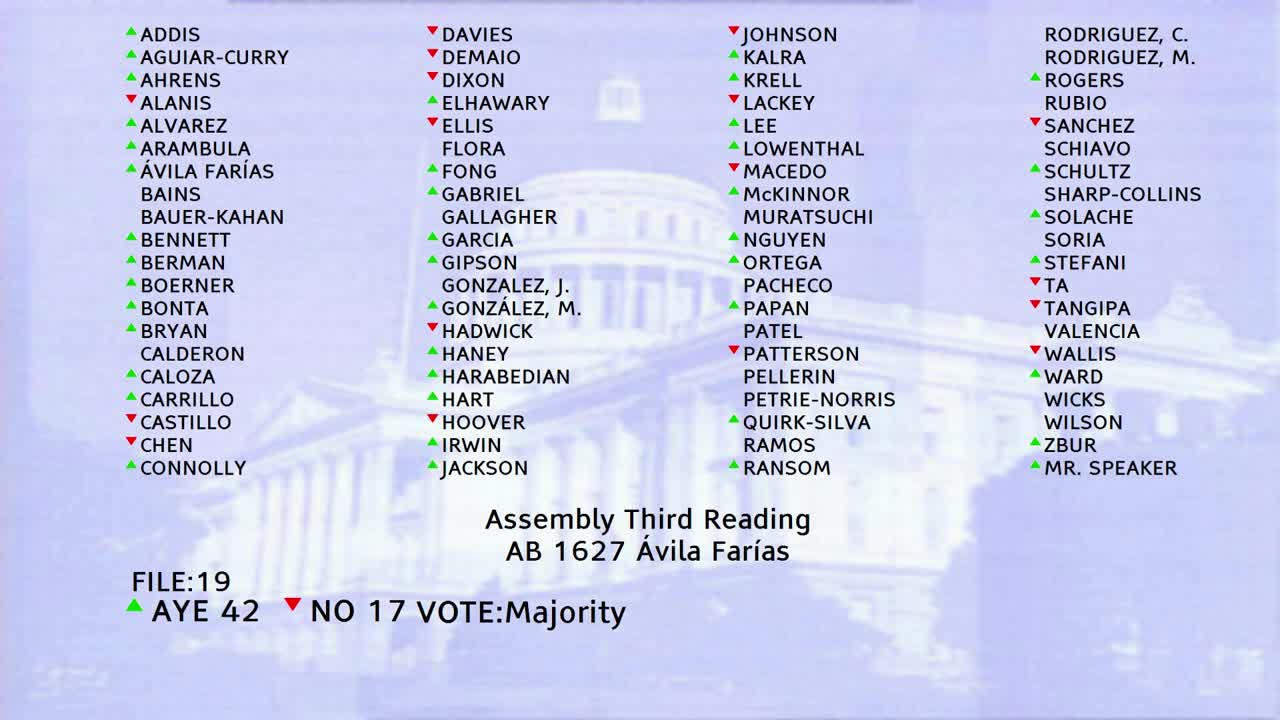 4MIN
Assembly Floor
 23MIN