AB 2144: General plan: annual report.
- Session Year: 2023-2024
- House: Assembly
- Latest Version Date: 2024-04-01
Current Status:
Failed
(2024-08-15: In committee: Held under submission.)
Introduced
In Committee
First Chamber
In Committee
Second Chamber
Enacted
Existing law, the Planning and Zoning Law, requires a city or county to adopt a general plan for land use development within its boundaries that includes, among other things, a housing element. Existing law requires the planning agency of a city or county to provide by April 1 of each year an annual report to, among other entities, the Department of Housing and Community Development. Existing law requires that the annual report include, among other specified information, the number of housing development applications received and the number of units approved and disapproved in the prior year. the progress in complying with specified laws. Existing law requires a city or county to provide an option for an applicant to apply for and retrieve a postentitlement phase permit on the citys or countys internet website.
Existing law, the Permit Streamlining Act, requires a city, county, or special district to maintain on its internet website, as applicable, a current schedule of fees, exactions, and affordability requirements imposed by the city, county, or special district, including any dependent special district, applicable to a proposed housing development project, all zoning ordinances and development standards, and annual fee reports or annual financial reports, as specified. Existing law requires a city, county, or special district to provide on its internet website an archive of impact fee nexus studies, cost of service studies, or equivalent, as specified.
This bill would require the planning agency to include in the annual report evidence of compliance with the above-described internet website requirements. By requiring a planning agency to include additional information in its annual report, the bill would impose a state-mandated local program.
The California Constitution requires the state to reimburse local agencies and school districts for certain costs mandated by the state. Statutory provisions establish procedures for making that reimbursement.
This bill would provide that no reimbursement is required by this act for a specified reason.
Existing law, the Planning and Zoning Law, requires a city or county to adopt a general plan for land use development within its boundaries that includes, among other things, a housing element. Existing law requires the planning agency of a city or county to provide by April 1 of each year an annual report to, among other entities, the Department of Housing and Community Development. Existing law requires that the annual report include, among other specified information, the number of housing development applications received and the number of units approved and disapproved in the prior year.
Existing law, the Permit Streamlining Act, requires a city, county, or special district to maintain on its internet website, as applicable, a current schedule of fees, exactions, and affordability requirements imposed by the city, county, or special district, including any dependent special district, applicable to a proposed housing development project, all zoning ordinances and development standards, and annual fee reports or annual financial reports, as specified. Existing law requires a city, county, or special district to provide on its internet website an archive of impact fee nexus studies, cost of service studies, or equivalent, as specified.
This bill would require the planning agency to include in the annual report evidence of compliance with the above-described internet website requirements. By requiring a planning agency to include additional information in its annual report, the bill would impose a state-mandated local program.
The California Constitution requires the state to reimburse local agencies and school districts for certain costs mandated by the state. Statutory provisions establish procedures for making that reimbursement.
This bill would provide that no reimbursement is required by this act for a specified reason.
(a)After the legislative body has adopted all or part of a general plan, the planning agency shall do both of the following:
(1)Investigate and make recommendations to the legislative body regarding reasonable and practical means for implementing the general plan or element of the general plan so that it will serve as an effective guide for orderly growth and development, preservation and conservation of open-space land and natural resources, and the efficient expenditure of public funds relating to the subjects addressed in the general plan.
(2)Provide by April 1 of each year an annual report to the legislative body, the Office of Planning and Research, and the Department of Housing and Community Development that includes all of the following:
(A)The status of the plan and progress in its implementation.
(B)(i)The progress in meeting its share of regional housing needs determined pursuant to Section 65584, including the need for extremely low income households, as determined pursuant to paragraph (1) of subdivision (a) of Section 65583, and local efforts to remove governmental constraints to the maintenance, improvement, and development of housing pursuant to paragraph (3) of subdivision (c) of Section 65583.
(ii)The housing element portion of the annual report, as required by this paragraph, shall be prepared through the use of standards, forms, and definitions adopted by the Department of Housing and Community Development. The department may review, adopt, amend, and repeal the standards, forms, or definitions to implement this article. Any standards, forms, or definitions adopted to implement this article shall not be subject to Chapter 3.5 (commencing with Section 11340) of Part 1 of Division 3 of Title 2. Before and after adoption of the forms, the housing element portion of the annual report shall include a section that describes the actions taken by the local government towards completion of the programs and status of the local governments compliance with the deadlines in its housing element. The report shall be considered at an annual public meeting before the legislative body where members of the public shall be allowed to provide oral testimony and written comments.
(iii)The report may include the number of units that have been completed pursuant to subdivision (c) of Section 65583.1. For purposes of this paragraph, committed assistance may be executed throughout the planning period, and the program under paragraph (1) of subdivision (c) of Section 65583.1 shall not be required. The report shall document how the units meet the standards set forth in that subdivision.
(iv)The planning agency shall include the number of units in a student housing development for lower income students for which the developer of the student housing development was granted a density bonus pursuant to subparagraph (F) of paragraph (1) of subdivision (b) of Section 65915.
(C)The number of housing development applications received in the prior year, including whether each housing development application is subject to a ministerial or discretionary approval process.
(D)The number of units included in all development applications in the prior year.
(E)The number of units approved and disapproved in the prior year.
(F)The degree to which its approved general plan complies with the guidelines developed and adopted pursuant to Section 65040.2 and the date of the last revision to the general plan.
(G)A listing of sites rezoned to accommodate that portion of the citys or countys share of the regional housing need for each income level that could not be accommodated on sites identified in the inventory required by paragraph (1) of subdivision (c) of Section 65583 and Section 65584.09. The listing of sites shall also include any additional sites that may have been required to be identified by Section 65863.
(H)(i)The number of units of housing demolished and new units of housing, including both rental housing and for-sale housing and any units that the County of Napa or the City of Napa may report pursuant to an agreement entered into pursuant to Section 65584.08, that have been issued a completed entitlement, a building permit, or a certificate of occupancy, thus far in the housing element cycle, and the income category, by area median income category, that each unit of housing satisfies. That production report shall do the following:
(I)For each income category described in this subparagraph, distinguish between the number of rental housing units and the number of for-sale units that satisfy each income category.
(II)For each entitlement, building permit, or certificate of occupancy, include a unique site identifier that must include the assessors parcel number, but may also include street address, or other identifiers.
(ii)For the County of Napa and the City of Napa, the production report may report units identified in the agreement entered into pursuant to Section 65584.08.
(I)The number of applications submitted pursuant to subdivision (a) of Section 65913.4, the location and the total number of developments approved pursuant to subdivision (c) of Section 65913.4, the total number of building permits issued pursuant to subdivision (c) of Section 65913.4, the total number of units including both rental housing and for-sale housing by area median income category constructed using the process provided for in subdivision (c) of Section 65913.4.
(J)If the city or county has received funding pursuant to the Local Government Planning Support Grants Program (Chapter 3.1 (commencing with Section 50515) of Part 2 of Division 31 of the Health and Safety Code), the information required pursuant to subdivision (a) of Section 50515.04 of the Health and Safety Code.
(K)The progress of the city or county in adopting or amending its general plan or local open-space element in compliance with its obligations to consult with California Native American tribes, and to identify and protect, preserve, and mitigate impacts to places, features, and objects described in Sections 5097.9 and 5097.993 of the Public Resources Code, pursuant to Chapter 905 of the Statutes of 2004.
(L)The following information with respect to density bonuses granted in accordance with Section 65915:
(i)The number of density bonus applications received by the city or county.
(ii)The number of density bonus applications approved by the city or county.
(iii)Data from all projects approved to receive a density bonus from the city or county, including, but not limited to, the percentage of density bonus received, the percentage of affordable units in the project, the number of other incentives or concessions granted to the project, and any waiver or reduction of parking standards for the project.
(M)The following information with respect to each application submitted pursuant to Chapter 4.1 (commencing with Section 65912.100):
(i)The location of the project.
(ii)The status of the project, including whether it has been entitled, whether a building permit has been issued, and whether or not it has been completed.
(iii)The number of units in the project.
(iv)The number of units in the project that are rental housing.
(v)The number of units in the project that are for-sale housing.
(vi)The household income category of the units, as determined pursuant to subdivision (f) of Section 65584.
(N)Evidence of compliance with Section 65940.1 65940.1.
(O)The progress in complying with subdivision (b) of Section 65913.3.5.
(b)(1)(A)The department may request corrections to the housing element portion of an annual report submitted pursuant to paragraph (2) of subdivision (a) within 90 days of receipt. A planning agency shall make the requested corrections within 30 days after which the department may reject the report if the report is not in substantial compliance with the requirements of that paragraph.
(B)If the department rejects the housing element portion of an annual report as authorized by subparagraph (A), the department shall provide the reasons the report is inconsistent with paragraph (2) of subdivision (a) to the planning agency in writing.
(2)If a court finds, upon a motion to that effect, that a city, county, or city and county failed to submit, within 60 days of the deadline established in this section, the housing element portion of the report required pursuant to subparagraph (B) of paragraph (2) of subdivision (a) that substantially complies with the requirements of this section, the court shall issue an order or judgment compelling compliance with this section within 60 days. If the city, county, or city and county fails to comply with the courts order within 60 days, the plaintiff or petitioner may move for sanctions, and the court may, upon that motion, grant appropriate sanctions. The court shall retain jurisdiction to ensure that its order or judgment is carried out. If the court determines that its order or judgment is not carried out within 60 days, the court may issue further orders as provided by law to ensure that the purposes and policies of this section are fulfilled. This subdivision applies to proceedings initiated on or after the first day of October following the adoption of forms and definitions by the Department of Housing and Community Development pursuant to paragraph (2) of subdivision (a), but no sooner than six months following that adoption.
(c)The Department of Housing and Community Development shall post a report submitted pursuant to this section on its internet website within a reasonable time of receiving the report.
SEC. 2.No reimbursement is required by this act pursuant to Section 6 of Article XIIIB of the California Constitution because a local agency or school district has the authority to levy service charges, fees, or assessments sufficient to pay for the program or level of service mandated by this act, within the meaning of Section 17556 of the Government Code.
(a)After the legislative body has adopted all or part of a general plan, the planning agency shall do both of the following:
(1)Investigate and make recommendations to the legislative body regarding reasonable and practical means for implementing the general plan or element of the general plan so that it will serve as an effective guide for orderly growth and development, preservation and conservation of open-space land and natural resources, and the efficient expenditure of public funds relating to the subjects addressed in the general plan.
(2)Provide by April 1 of each year an annual report to the legislative body, the Office of Planning and Research, and the Department of Housing and Community Development that includes all of the following:
(A)The status of the plan and progress in its implementation.
(B)(i)The progress in meeting its share of regional housing needs determined pursuant to Section 65584, including the need for extremely low income households, as determined pursuant to paragraph (1) of subdivision (a) of Section 65583, and local efforts to remove governmental constraints to the maintenance, improvement, and development of housing pursuant to paragraph (3) of subdivision (c) of Section 65583.
(ii)The housing element portion of the annual report, as required by this paragraph, shall be prepared through the use of standards, forms, and definitions adopted by the Department of Housing and Community Development. The department may review, adopt, amend, and repeal the standards, forms, or definitions to implement this article. Any standards, forms, or definitions adopted to implement this article shall not be subject to Chapter 3.5 (commencing with Section 11340) of Part 1 of Division 3 of Title 2. Before and after adoption of the forms, the housing element portion of the annual report shall include a section that describes the actions taken by the local government towards completion of the programs and status of the local governments compliance with the deadlines in its housing element. The report shall be considered at an annual public meeting before the legislative body where members of the public shall be allowed to provide oral testimony and written comments.
(iii)The report may include the number of units that have been completed pursuant to subdivision (c) of Section 65583.1. For purposes of this paragraph, committed assistance may be executed throughout the planning period, and the program under paragraph (1) of subdivision (c) of Section 65583.1 shall not be required. The report shall document how the units meet the standards set forth in that subdivision.
(iv)The planning agency shall include the number of units in a student housing development for lower income students for which the developer of the student housing development was granted a density bonus pursuant to subparagraph (F) of paragraph (1) of subdivision (b) of Section 65915.
(C)The number of housing development applications received in the prior year, including whether each housing development application is subject to a ministerial or discretionary approval process.
(D)The number of units included in all development applications in the prior year.
(E)The number of units approved and disapproved in the prior year.
(F)The degree to which its approved general plan complies with the guidelines developed and adopted pursuant to Section 65040.2 and the date of the last revision to the general plan.
(G)A listing of sites rezoned to accommodate that portion of the citys or countys share of the regional housing need for each income level that could not be accommodated on sites identified in the inventory required by paragraph (1) of subdivision (c) of Section 65583 and Section 65584.09. The listing of sites shall also include any additional sites that may have been required to be identified by Section 65863.
(H)(i)The number of units of housing demolished and new units of housing, including both rental housing and for-sale housing and any units that the County of Napa or the City of Napa may report pursuant to an agreement entered into pursuant to Section 65584.08, that have been issued a completed entitlement, a building permit, or a certificate of occupancy, thus far in the housing element cycle, and the income category, by area median income category, that each unit of housing satisfies. That production report shall do the following:
(I)For each income category described in this subparagraph, distinguish between the number of rental housing units and the number of for-sale units that satisfy each income category.
(II)For each entitlement, building permit, or certificate of occupancy, include a unique site identifier that must include the assessors parcel number, but may also include street address, or other identifiers.
(ii)For the County of Napa and the City of Napa, the production report may report units identified in the agreement entered into pursuant to Section 65584.08.
(I)The number of applications submitted pursuant to subdivision (a) of Section 65913.4, the location and the total number of developments approved pursuant to subdivision (c) of Section 65913.4, the total number of building permits issued pursuant to subdivision (c) of Section 65913.4, the total number of units including both rental housing and for-sale housing by area median income category constructed using the process provided for in subdivision (c) of Section 65913.4.
(J)If the city or county has received funding pursuant to the Local Government Planning Support Grants Program (Chapter 3.1 (commencing with Section 50515) of Part 2 of Division 31 of the Health and Safety Code), the information required pursuant to subdivision (a) of Section 50515.04 of the Health and Safety Code.
(K)The progress of the city or county in adopting or amending its general plan or local open-space element in compliance with its obligations to consult with California Native American tribes, and to identify and protect, preserve, and mitigate impacts to places, features, and objects described in Sections 5097.9 and 5097.993 of the Public Resources Code, pursuant to Chapter 905 of the Statutes of 2004.
(L)The following information with respect to density bonuses granted in accordance with Section 65915:
(i)The number of density bonus applications received by the city or county.
(ii)The number of density bonus applications approved by the city or county.
(iii)Data from all projects approved to receive a density bonus from the city or county, including, but not limited to, the percentage of density bonus received, the percentage of affordable units in the project, the number of other incentives or concessions granted to the project, and any waiver or reduction of parking standards for the project.
(M)The following information with respect to each application submitted pursuant to Chapter 4.1 (commencing with Section 65912.100):
(i)The location of the project.
(ii)The status of the project, including whether it has been entitled, whether a building permit has been issued, and whether or not it has been completed.
(iii)The number of units in the project.
(iv)The number of units in the project that are rental housing.
(v)The number of units in the project that are for-sale housing.
(vi)The household income category of the units, as determined pursuant to subdivision (f) of Section 65584.
(N)Evidence of compliance with Section 65940.1
(b)(1)(A)The department may request corrections to the housing element portion of an annual report submitted pursuant to paragraph (2) of subdivision (a) within 90 days of receipt. A planning agency shall make the requested corrections within 30 days after which the department may reject the report if the report is not in substantial compliance with the requirements of that paragraph.
(B)If the department rejects the housing element portion of an annual report as authorized by subparagraph (A), the department shall provide the reasons the report is inconsistent with paragraph (2) of subdivision (a) to the planning agency in writing.
(2)If a court finds, upon a motion to that effect, that a city, county, or city and county failed to submit, within 60 days of the deadline established in this section, the housing element portion of the report required pursuant to subparagraph (B) of paragraph (2) of subdivision (a) that substantially complies with the requirements of this section, the court shall issue an order or judgment compelling compliance with this section within 60 days. If the city, county, or city and county fails to comply with the courts order within 60 days, the plaintiff or petitioner may move for sanctions, and the court may, upon that motion, grant appropriate sanctions. The court shall retain jurisdiction to ensure that its order or judgment is carried out. If the court determines that its order or judgment is not carried out within 60 days, the court may issue further orders as provided by law to ensure that the purposes and policies of this section are fulfilled. This subdivision applies to proceedings initiated on or after the first day of October following the adoption of forms and definitions by the Department of Housing and Community Development pursuant to paragraph (2) of subdivision (a), but no sooner than six months following that adoption.
(c)The Department of Housing and Community Development shall post a report submitted pursuant to this section on its internet website within a reasonable time of receiving the report.
SEC. 2.No reimbursement is required by this act pursuant to Section 6 of Article XIIIB of the California Constitution because a local agency or school district has the authority to levy service charges, fees, or assessments sufficient to pay for the program or level of service mandated by this act, within the meaning of Section 17556 of the Government Code.
|
Date
|
Status
|
|---|---|
| Aug 15, 2024 | In committee: Held under submission. |
| Jul 1, 2024 | In committee: Referred to suspense file. |
| Jun 19, 2024 | From committee: Do pass and re-refer to Com. on APPR with recommendation: To Consent Calendar. (Ayes 10. Noes 0.) (June 18). Re-referred to Com. on APPR. |
| May 29, 2024 | Referred to Com. on HOUSING. |
| May 22, 2024 | In Senate. Read first time. To Com. on RLS. for assignment. |
| May 21, 2024 | Read third time. Passed. Ordered to the Senate. (Ayes 72. Noes 0. Page 5423.) |
| May 20, 2024 | Read second time. Ordered to third reading. |
| May 16, 2024 | From committee: Do pass. (Ayes 15. Noes 0.) (May 16). |
| May 1, 2024 | In committee: Set, first hearing. Referred to APPR. suspense file. |
| Apr 18, 2024 | From committee: Do pass and re-refer to Com. on APPR. with recommendation: To Consent Calendar. (Ayes 9. Noes 0.) (April 17). Re-referred to Com. on APPR. |
| Apr 2, 2024 | Re-referred to Com. on L. GOV. |
| Apr 1, 2024 | From committee chair, with author's amendments: Amend, and re-refer to Com. on L. GOV. Read second time and amended. |
| Mar 20, 2024 | From committee: Do pass and re-refer to Com. on L. GOV. with recommendation: To Consent Calendar. (Ayes 9. Noes 0.) (March 20). Re-referred to Com. on L. GOV. |
| Feb 20, 2024 | Referred to Coms. on H. & C.D. and L. GOV. |
| Feb 7, 2024 | From printer. May be heard in committee March 8. |
| Feb 6, 2024 | Read first time. To print. |
|
Date
|
Description
|
Location
|
Votes
|
|
|---|---|---|---|---|
| Jul 1, 2024 | Placed on suspense file | Senate Standing Committee on Appropriations |
Passed |
|
| Jun 18, 2024 | Do pass, but first be re-referred to the Committee on [Appropriations] with the recommendation: To Consent Calendar | Senate Standing Committee on Housing |
Passed |
|
| May 21, 2024 | AB 2144 Grayson Assembly Third Reading | Assembly Floor |
Passed |
|
| May 16, 2024 | Do pass. | Assembly Standing Committee on Appropriations |
Passed |
|
| Apr 17, 2024 | Do pass and be re-referred to the Committee on [Appropriations] with recommendation: To Consent Calendar | Assembly Standing Committee on Local Government |
Passed |
|
| Mar 20, 2024 | Do pass and be re-referred to the Committee on [Local Government] with recommendation: To Consent Calendar | Assembly Standing Committee on Housing and Community Development |
Passed |
This list shows positions taken on this bill by organizations on the date displayed, which is linked to the original source.
Positions by individuals are not included.
|
Organization
|
Position
|
Date
|
|---|---|---|
| California Apartment Association | ** Support | |
| California YIMBY | ** Support | |
| East Bay YIMBY | ** Support | |
| Fremont for Everyone | ** Support | |
| Housing Action Coalition | ** Support | |
| People For Housing Orange County | ** Support | |
| San Francisco Bay Area Planning and Urban Research Association | ** Support |
SENATE COMMITTEE ON APPROPRIATIONS
Senator Anna Caballero, Chair
2023 - 2024 Regular Session
AB 2144 (Grayson) - General plan: annual report
Version: April 1, 2024 | Policy Vote: HOUSING 10 - 0 |
Urgency: No | Mandate: Yes |
Hearing Date: July 1, 2024 | Consultant: Mark McKenzie |
Bill Summary:
AB 2144 would require cities and counties to include the following in their annual progress reports (APRs):
- Evidence of compliance with a requirement to post on its website specified information, including schedules of fees related to housing development projects, all zoning and development standards, fee and financial reports, and archived impact fee studies.
- Progress towards compliance with a requirement to provide an online option to apply for, complete, and retrieve post-entitlement phase permits.
Fiscal Impact:
- The Department of Housing and Community Development (HCD) estimates ongoing annual costs of approximately $240,000 for 1.0 PY of new staff to administer the review and interpretation of information on APRs to determine compliance. HCD indicates there could be additional one-time IT costs of up to $100,000 to incorporate new fields into the APR database. See Staff Comments. (General Fund)
- Unknown ongoing local costs for each city and county to include the additional information on compliance with specified requirements in its annual APR. These costs would not be state-reimbursable because local agencies have general authority to charge and adjust planning and permitting fees to cover any administrative costs associated with planning mandates. (local funds)
Background:
Existing law requires each city and county to submit an APR to HCD and the Governor’s Office of Planning and Research (OPR) by April 1 of each year that includes specified information relating to the status and progress of implementing its general plan and meeting its share of regional housing needs pursuant to its housing element, as specified. Specifically, each local government must include information on its progress towards developing housing that is affordable in four specific income categories, information about all proposed and approved development projects, a list of rezoned sites to accommodate housing for each income level, the number of net new units of housing, detailed information on SB 35 project applications, and information on density bonus applications and approvals, among other items.
Existing law, as enacted by AB 1483 (Grayson), Chap. 662/2019, requires a city, county, or special district that has a website to make all of the following information available on its website, and update any revised information within 30 days of a change:
- A current schedule of fees, exactions, and affordability requirements imposed by that local agency that are applicable to a proposed housing development project.
- All zoning ordinances and development standards, including which standards apply to each parcel.
- A specified list of projects located within military use airspace or low-level flight paths.
- The current and five previous annual fee reports and annual financial reports.
- An archive of impact fee nexus studies, cost of service studies, or equivalent, that are conducted by the local agency on or after January 1, 2018.
Existing law, as enacted by AB 2234 (Rivas), Chap. 651/2023, requires each city and county to provide an option for post-entitlement phase permits to be applied for, completed, and retrieved by the applicant on its website, and requires the website to list the current processing status of an applicant’s permit, and whether any action is required by the applicant. A local agency in a county with a population of 1,100,000 or greater, or a local agency with a population of 75,000 or greater in any county must comply with these requirements by January 1, 2024, and smaller jurisdictions must comply by January 1, 2028. Existing law defines a “post-entitlement phase permit” to include all non-discretionary permits and reviews after the discretionary entitlement process that are required prior to construction, as specified, such as building permits, permits for minor or standard off-site improvements, permits for demolition, and permits for minor or standard excavation and grading.
Proposed Law:
AB 2144 would require cities and counties to include both of the following in an annual APR submitted to HCD and OPR:
- Evidence of compliance with requirements in existing law, as enacted by AB 1483 of 2019, to post specified schedules of fees related to housing development projects, zoning ordinances and development standards, fee and financial reports, and archived impact fee studies, as noted above.
- Progress towards compliance with a requirement in existing law, as enacted by AB 2243 of 2022, to provide an online option to apply for, complete, and retrieve post-entitlement phase permits by specified dates, as noted above.
Related Legislation:
AB 2234 (Rivas), Chap. 651/2022, established time limits and procedures for the approval of post-entitlement permits, and required cities and counties to provide an option for an applicant to apply for, complete, and retrieve post-entitlement phase permits on the local agencies’ websites, as specified.
AB 1483 (Grayson), Chap. 662/2019, required cities and counties to post specified housing-related information on their web sites and required HCD to establish a workgroup, as specified, to develop a strategy for state housing data.
Staff Comments:
This bill would require HCD to update programs and APR forms, provide technical assistance to local governments, and review local policies regarding fees, zoning, permitting requirements, and nexus studies. HCD indicates that reviewing APRs submitted by local agencies to determine compliance with AB 1483 and AB 2243 requirements would be labor intensive. Since the bill requires a local agency’s APR to demonstrate “evidence” of compliance, which would likely be a qualitative, rather than quantitative, process, monitoring data would be complex and require subjective determinations of whether the evidence is sufficient. In addition, HCD notes the potential for one-time costs to make IT improvements, to the extent additional functionality needs to be incorporated into the database to allow for tracking of the specified compliance data.
The bill’s mandated local costs for cities and counties to incorporate additional information in APRs would not be subject to state reimbursement because local agencies have the authority to charge and adjust planning and permitting fees as necessary to cover administrative costs. Existing law authorizes planning and zoning fees to “include the costs reasonably necessary to prepare and revise the plans and policies that a local agency is required to adopt before it can make any necessary findings and determinations.” Case law and previous decisions by the Commission on State Mandates support the position that local governments’ planning costs are not reimbursable when the state imposes new planning mandates.
-- END --
SENATE COMMITTEE ON HOUSING
Senator Nancy Skinner, Chair
2023 - 2024 Regular
Bill No: AB 2144 Hearing Date: 6/18/2024
Author: | Grayson | ||
Version: | 4/1/2024 | ||
Urgency: | No | Fiscal: | Yes |
Consultant: | Erin Riches | ||
SUBJECT: General plan: annual report
DIGEST: This bill requires a local government to include in its Annual Progress Report (APR) specified information relating to compliance with existing law requirements to post specified fee and permit information on its website.
ANALYSIS:
Existing law relating to housing elements:
- Requires every city and county to prepare and adopt a general plan, including a housing element, to guide the future growth of a community. The housing element must identify and analyze existing and projected housing needs, identify adequate sites with appropriate zoning to meet the housing needs of all income segments of the community, and ensure that regulatory systems provide opportunities for, and do not unduly constrain, housing development.
- Provides that each community’s fair share of housing be determined through the regional housing needs allocation (RHNA) process, which is composed of three main stages: (a) the Department of Finance and Department of Housing and Community Development (HCD) develop regional housing needs estimates; (b) councils of government (COGs) allocate housing within each region based on these estimates (where a COG does not exist, HCD makes the determinations); and (c) cities and counties incorporate their allocations into their housing elements.
Existing law relating to Annual Progress Reports (APRs):
- Requires each city and county to submit an APR to HCD and the Office of Planning and Research by April 1 of each year that includes all of the following:
- Progress in meeting its RHNA share.
- Local efforts to remove governmental constraints to the maintenance, improvement, and development of housing.
- Actions taken by the city or county towards completing programs contained within the housing element and the status of compliance with deadlines in the housing element.
- The number of housing development applications received in the prior year, as well as the number of units included in these applications and the number of units approved and disapproved.
- A list of sites rezoned to accommodate the city’s or county’s RHNA allocation for each income level that could not be accommodated on sites identified in the housing element’s site inventory, and any additional sites that may be necessary to accommodate the city’s or county’s share of regional housing need.
- The number of net new units of housing, with a unique site identifier including but not limited to the parcel number, including both rental and for-sale housing, that have been issued a completed entitlement, building permit, or certificate of occupancy in the housing element cycle, and the income category that each unit satisfies.
- The number of SB 35 (Wiener, Chapter 366, Statutes of 2017) applications submitted and the total number of developments approved, the number of building permits issued, and the total number of units including both rental and for-sale housing by area median income, constructed through the SB 35 process.
- The number of density bonus applications received, and approved, by the city or county.
Existing law pursuant to AB 1483 (Grayson, Chapter 662, Statutes of 2019):
- Requires a city, county, or special district that has an Internet Web site to post on their Web sites the following information, as applicable:
- A current schedule of mitigation fees, exactions, and affordability requirements, as defined, imposed by the city, county, or special district, including any dependent special districts of the city or county, applicable to a housing development project, in a manner that clearly identifies the fees that apply to each parcel.
- All zoning ordinances and development standards, including which standards apply to each parcel.
- A list that cities and counties must develop under existing law of projects located within military use airspace or low-level flight path.
- The current and five previous annual fee reports or the current and five previous annual financial reports that local agencies must compile under to existing law.
- An archive of impact fee nexus studies, cost of service studies, or equivalent, conducted by the city, county, or special district on or after January 1, 2018.
- Requires a city or county to update the information required in (4) above, within 30 days of the changes.
Existing law pursuant to AB 2234 (Rivas, Chapter 651, of 2023):
- Requires each local government to provide for post-entitlement phase permits to be applied for, completed, and retrieved by the applicant through the local government’s website. Requires the website to list the current processing status of the applicant’s permit, including whether it is being reviewed by the agency or if action is required from the applicant. Provides for a bifurcated timeline for larger and smaller cities and counties to comply with these requirements.
- Defines “post-entitlement phase permits” to include all nondiscretionary permits and reviews after the discretionary entitlement process has been completed that are require or issued by the local agency to begin construction of a development that is intended to be at least two-thirds residential, excluding planning permits, entitlements, and other permits and reviews that are covered by the Permit Streamlining Act (PSA).
- Specifies that a post-entitlement phase permit shall include but not be limited to: building permits, permits for minor or standard off-site improvements, permits for demolition, and permits for minor or standard excavation and grading. It does not include a permit required and issued by the California Coastal Commission, a special district, or a utility that is not owned by a local agency.
This bill:
- Requires a local government to include both of the following in its APR:
- Evidence of compliance with existing law requirements (AB 1483 of 2019) to post specified fee information on its website.
- Progress in complying with existing law requirements (AB 2234 of 2022) relating to post-entitlement permits.
COMMENTS:
- Author statement. “AB 1483 (Grayson, 2019) was a significant step forward in providing greater transparency on development impact fees, and it required jurisdictions to provide information on impact fee schedules, nexus fees studies, and other information that could help inform a developer of a jurisdiction’s impact fees. Despite the progress made on providing greater transparency on development impact fees, recent reports by SPUR and the Terner Center found that there were significant shortcomings in compliance with the requirements of AB 1483 by many jurisdictions. While many jurisdictions have provided the information required by AB 1483, fee schedules often did not provide all applicable fees and other requirements of the bill were not being adequately complied with. Additionally, AB 2234 (Robert Rivas, 2022) was enacted to require jurisdictions to provide certain permitting tools online. AB 2144 would enhance enforcement of existing law by requiring jurisdictions to show evidence in their Annual Progress Report that they are complying with the requirements of AB 1483 and AB 2234. This will be a useful tool to ensure that jurisdiction are complying with impact fee transparency requirements and ultimately improve accessibility in housing development.”
- APRs. APRs are an important tool for both local governments and the state, as both parties can rely on them to track progress in implementing the housing policy in their housing element, as well as to track outcomes. They also help highlight implementation challenges that may require technical assistance or other support from HCD. Additionally, APRs are important for informing statewide housing policy. The APRs provide the data that, aggregated across the state’s 539 cities and counties, convey the amount, type, location, and affordability of housing be produced in California. Existing law provides a list of requirements for what must be reported in the APR (see Existing Law, #3 above).
- AB 1483 requirements. Concerned that mitigation fees could be increasing the cost of housing, the Legislature passed AB 879 (Grayson, 2017), which required HCD to complete a study to evaluate the reasonableness of local fees charged to new developments. In August 2019, HCD released the study, performed by UC Berkeley’s Terner Center for Housing Innovation (Terner Center).[1] Among other conclusions, the report argued that fees can be a barrier to development and can raise prices of both new and existing homes; however, it also noted that local governments face substantial fiscal constraints and thus have turned to fees as a source of revenue to fund public services for new developments. The report found that fee transparency could be substantially improved. According to the study, many jurisdictions do not post their fee schedules or their nexus studies online, making it difficult for developers to estimate project costs, while other jurisdictions have adopted best practices such as offering an estimate of the fees that a project would pay. The study recommended requiring local governments to post fees and nexus studies online, as well as annual reports on fee collections, and requiring jurisdictions to provide fee estimates. In response, the Legislature passed AB 1483 (Grayson, 2019), which required cities and counties to post specified housing-related information on their website and required HCD to establish a workgroup to develop a strategy for state housing data.
SPUR, the sponsor of this bill, SPUR, released a report in May 2021 with the Terner Center analyzing local governments’ compliance with AB 1483.[2] Of the 50 cities and 10 counties they analyzed, comprehensive fee schedules were available on less than half the websites, another 40% had outdated or incomplete fee schedules; and more than three-quarters of the websites did not have any nexus studies posted.
This bill requires each local government to report on the status of its compliance with the requirements of AB 1483 (see Existing Law #4 above) in its APR.
- AB 2234 requirements. AB 2234 required a local agency to compile one or more lists of information that will be required from any applicant for a post-entitlement phase permit. It also required each local government to offer post-entitlement phase permits to be applied for, completed, and retrieved by an applicant on its website.
This bill requires each local government to report on the status of its compliance with the requirements of AB 2234 relating to post-entitlement permits (see Existing Law #6-8 above) in its APR.
Related Legislation:
AB 2580 (Wicks, 2024) — requires a local government to provide specified information about historic designations, and how they affect its ability to meet its housing needs, in its APR and housing element. This bill will also be heard in this committee today.
AB 2234 (R. Rivas, Grayson, Chapter 651, Statutes of 2022) — established time limits and procedures for approval of, and requires online permitting of, post-entitlement permits.
AB 1483 (Grayson, Chapter 662, Statutes of 2019) — required cities and counties to post specified housing-related information on their websites and required HCD to establish a workgroup to develop a strategy for state housing data.
FISCAL EFFECT: Appropriation: Fiscal Com.: Local:
POSITIONS: (Communicated to the committee before noon on Wednesday,
June 12, 2024.)
SUPPORT:
SPUR (Sponsor)
Abundant Housing LA
California Apartment Association
California Building Industry Association (CBIA)
California Community Builders
California Hispanic Chambers of Commerce
California Housing Consortium
California YIMBY
CivicWell
Housing Action Coalition
Housing Trust Silicon Valley
LeadingAge California
MidPen Housing
YIMBY Action
OPPOSITION:
None received
-- END --
Hayley Raetz, David Garcia, and Nathaniel Decker. Residential Impact Fees in California (Terner Center for Housing Innovation, UC Berkely, August 2019). https://ternercenter.berkeley.edu/wp-content/uploads/pdfs/Residential_Impact_Fees_in_California_August_2019.pdf ↑
SPUR in consultation with the Terner Center, How Much Does it Cost to Permit a House? An analysis of city and county compliance with California AB 1483 and recommendations to improve the transparency of development fees (May 2021) at SPUR_How_Much_Does_It_Cost_To_Permit_A_House_0.pdf. ↑
ASSEMBLY THIRD READING
ATR Bill Id:AB 2144
Author:(Grayson)
As Amended Ver:April 1, 2024
Majority vote
SUMMARY
Adds evidence of compliance with existing law requirements for local governments to post fee schedules and other information on their websites to the list of information local governments must provide in their Annual Progress Report (APR) by April 1 of each year.
Major Provisions
COMMENTS
Recent Work on Impact Fees: Concerned that mitigation fees may be increasing the cost of housing, in 2017 the Legislature enacted AB 879 (Grayson) Chapter 374, which required the Department of Housing and Community Development (HCD) to complete a study to evaluate the reasonableness of local fees charged to new developments. On August 7, 2019, HCD released the study, performed by the Terner Center for Housing Innovation. The study's findings concerned three categories: fee transparency; fee structure; and fee design. Among other conclusions, the study argued that fees can be a barrier to development and raise prices of both new and existing homes. However, the study also noted that local governments face substantial fiscal constraints and thus have turned to fees as a source of revenue to fund public services for new developments.
Consistent with previous studies by the Terner Center and others, the report found that fee transparency could be substantially improved. According to the study, many jurisdictions did not post their fee schedules or their nexus studies online, making it hard for developers to know their costs ahead of time. Meanwhile, other jurisdictions have adopted best practices, such as offering an estimate of the fees that a project would pay. The study recommended requiring local governments to post fees and nexus studies online, as well as annual reports on fee collections, and requiring jurisdictions to provide fee estimates.
To address transparency concerns, the Legislature in 2019 enacted AB 1483 (Grayson) Chapter 662, which required a city, county, or special district that has a website to post on their websites the following information, as applicable:
- A current schedule of mitigation fees, exactions, and affordability requirements imposed by the city, county, or special district, including any dependent special districts of the city or county, applicable to a housing development project, in a manner that clearly identifies the fees that apply to each parcel;
- All zoning ordinances and development standards, including which standards apply to each parcel;
- A list that cities and counties must develop under existing law of projects located within military use airspace or low-level flight path;
- The current and five previous annual fee reports or the current and five previous annual financial reports that local agencies must compile under to existing law; and
- An archive of impact fee nexus studies, cost of service studies, or equivalent, conducted by the city, county, or special district on or after January 1, 2018.
A city, county, or special district must update this information on their website within 30 days of any change. The bill also defines "exaction" to mean:
- A construction excise tax;
- A requirement that the housing development project provide public art or an in-lieu payment;
- Mello-Roos taxes on new housing units; and
- Dedications of parkland or in-lieu fees imposed pursuant to the Quimby Act (which governs the exactions local governments may require for parkland).
These requirements went into effect on January 1, 2020.
SPUR Report on Compliance with AB 1483: In May 2021, SPUR and the Terner Center released the policy brief, "How Much Does It Cost to Permit a House?" which examined compliance with AB 1483 and contained recommendations for further improvement of the transparency of development fees.[1] SPUR and Terner Center analyzed the websites of 50 cities and 10 counties to evaluate whether those jurisdictions were posting the required information on fee schedules, nexus studies, affordability requirements, etc. They found many jurisdictions had not come into compliance with the law and their websites had incomplete or unreliable information regarding those fees and requirements. Comprehensive fee schedules were available on less than half of websites, another 40% had outdated or incomplete schedules, and over three-quarters of jurisdictions did not have nexus studies posted at all.
The author and sponsors indicate this low website posting rate and inconsistency of available information points to the need for additional mechanisms to bring local governments into compliance with the law's requirements.
Annual Progress Reports: Current law requires all local jurisdictions to provide housing information annually to HCD via the APR, including the following information from the prior year and/or for the current eight-year housing element cycle:
- The number of housing development applications received, and whether those applications are subject to ministerial or discretionary approval;
- The number of units included in all development applications;
- The number of units approved and disapproved;
- For each income category, the number of net new units of housing, including both rental housing and for-sale housing, that have been issued a completed entitlement, a building permit, or a certificate of occupancy;
- A unique site identifier (such as assessor's parcel number) for each entitlement, building permit, or certificate of occupancy; and
- The overall progress in meeting its share of regional housing needs.
This bill adds evidence of compliance with AB 1483's fee and development standards posting requirements to the list of information that local jurisdictions must include in their APRs. Evidence, while not defined, presumably could include links to the websites local governments are required to publish to host their fee schedule and other data.
According to the Author
"AB 1483 (Grayson, 2019) was a significant step forward in providing greater transparency on development impact fees, and it required jurisdictions to provide information on impact fee schedules, nexus fees studies, and other information that could help inform a developer of a jurisdiction's impact fees. Despite the progress made on providing greater transparency on development impact fees, recent reports by SPUR and the Terner Center found that there were significant shortcomings in compliance with the requirements of AB 1483 by many jurisdictions. While many jurisdictions have provided the information required by AB 1483, fee schedules often did not provide all applicable fees and other requirements of the bill were not being adequately complied with.
[This bill] would enhance enforcement of existing law by requiring jurisdictions to show evidence in their Annual Progress Report that they are complying with the requirements of AB 1483. This will be a useful tool to ensure that jurisdiction are complying with impact fee transparency requirements and ultimately improve accessibility in housing development."
Arguments in Support
According to the bill's sponsor, SPUR, "A 2018 study conducted by the Terner Center for Housing Innovation at the University of California, Berkeley, found that fees and exactions can amount to up to 18% of the median home price, that these fees and exactions are extremely difficult to estimate, and that fees and exactions continue to rise in California while decreasing nationally. Further, escalating fee and exaction costs make it more difficult for builders to deliver new housing for sale or rent at affordable prices. … AB 2144 is a 'good government' measure that seeks to provide greater sunlight, transparency and accessibility to the sum total of all development impact fees imposed on new residential development."
Arguments in Opposition
None on file.
FISCAL COMMENTS
According to the Assembly Committee on Appropriations:
- HCD estimates ongoing General Fund costs of $233,000 annually or one staff position to manage increased review time across all APRs and to supervise staff who review and process APRs. HCD indicates the data this bill proposes to include would likely be qualitative and non-numerical, as it specifically requires "evidence" of compliance with existing statute. Thus, reviewing submissions to ensure compliance could be a labor-intensive task. In addition, the department would need to update programs and forms, provide technical assistance to local governments, and review local policies regarding fees, zoning, permitting requirements and nexus studies. Of note, actual costs could vary depending on what constitutes "evidence," a term the bill does not define.
HCD notes several bills moving through the legislative process that update APRs – additional changes beyond this bill may necessitate additional staff.
- Ongoing local costs of an unknown amount for each city and county to include the additional information in its APR. These costs are not reimbursable by the state because local agencies have general authority to charge and adjust planning and permitting fees to cover their administrative expenses associated with new planning mandates.
VOTES
ASM HOUSING AND COMMUNITY DEVELOPMENT: 9-0-0
YES: Ward, Joe Patterson, Grayson, Kalra, Lee, Zbur, Reyes, Sanchez, Wilson
ASM LOCAL GOVERNMENT: 9-0-0
YES: Juan Carrillo, Waldron, Alanis, Haney, Kalra, Pacheco, Ramos, Ward, Wilson
ASM APPROPRIATIONS: 15-0-0
YES: Wicks, Sanchez, Arambula, Bryan, Calderon, Wendy Carrillo, Dixon, Mike Fong, Grayson, Haney, Hart, Jim Patterson, Pellerin, Ta, Villapudua
UPDATED
VERSION: April 1, 2024
CONSULTANT: Nicole Restmeyer / H. & C.D. / (916) 319-2085 FN: 0003367
https://www.spur.org/publications/policy-brief/2021-07-23/how-much-does-it-cost-permit-house ↑
Date of Hearing: May 1, 2024
ASSEMBLY COMMITTEE ON APPROPRIATIONS
Buffy Wicks, Chair
ABPCA Bill Id:AB 2144
Author:(Grayson) – As Amended Ver:April 1, 2024
Policy Committee: | Housing and Community Development | Vote: | 9 - 0 |
Local Government | 9 - 0 | ||
|
|
Urgency: No State Mandated Local Program: Yes Reimbursable: No
SUMMARY:
This bill requires a local planning agency to include in its annual progress report (APR) to the Department of Housing and Community Development (HCD) evidence of compliance with the requirement to post on its internet website fee schedules and other information applicable to a proposed housing development project.
FISCAL EFFECT:
- HCD estimates ongoing General Fund costs of $233,000 annually or one staff position to manage increased review time across all APRs and to supervise staff who review and process APRs. HCD indicates the data this bill proposes to include would likely be qualitative and non-numerical, as it specifically requires “evidence” of compliance with existing statute. Thus, reviewing submissions to ensure compliance could be a labor-intensive task. In addition, the department would need to update programs and forms, provide technical assistance to local governments, and review local policies regarding fees, zoning, permitting requirements and nexus studies. Of note, actual costs could vary depending on what constitutes “evidence,” a term the bill does not define.
HCD notes several bills moving through the legislative process that update APRs – additional changes beyond this bill may necessitate additional staff.
- Ongoing local costs of an unknown amount for each city and county to include the additional information in its APR. These costs are not reimbursable by the state because local agencies have general authority to charge and adjust planning and permitting fees to cover their administrative expenses associated with new planning mandates.
COMMENTS:
- Purpose. According to the author:
AB 1483 (Grayson, 2019) was a significant step forward in providing greater transparency on development impact fees, and it required jurisdictions to provide information on impact fee schedules, nexus fees studies, and other information that could help inform a developer of a jurisdiction’s impact fees. Despite the progress made on providing greater transparency on development impact fees, recent reports by SPUR and the Terner Center found that there were significant shortcomings in compliance with the requirements of AB 1483 by many jurisdictions.
[This bill] would enhance enforcement of existing law by requiring jurisdictions to show evidence in their Annual Progress Report that they are complying with the requirements of AB 1483. This will be a useful tool to ensure that jurisdiction are complying with impact fee transparency requirements and ultimately improve accessibility in housing development.
- Background. In response to transparency concerns regarding local development fees, AB 1483 (Grayson), Chapter 662, Statutes of 2019, requires a city, county, or special district to maintain on its internet website a current schedule of fees, exactions, and affordability requirements applicable to a proposed housing development project, along with all zoning ordinances and development standards, and annual fee reports or annual financial reports. AB 1483 also requires a local agency to provide on its internet website an archive of impact fee nexus studies and cost of service studies.
In May 2021, the San Francisco Bay Area Planning and Urban Research Association (SPUR) and the Terner Center for Housing Innovation released a policy brief that examined compliance with AB 1483 and contained recommendations for further improvements. For the brief, SPUR and the Terner Center analyzed the websites of 50 cities and 10 counties and found many jurisdictions were not in compliance and their websites had incomplete or unreliable information. Specifically, comprehensive fee schedules were available on less than half of websites, another 40% had outdated or incomplete schedules, and over 75% of jurisdictions did not have nexus studies posted at all.
The author and sponsors indicate these findings point to the need for additional measures to bring local governments into compliance with AB 1483’s requirements.
Existing law requires each city and county to submit an APR to HCD and the Governor’s Office of Planning and Research (OPR) that includes specified information relating to the jurisdiction’s progress in meeting its share of regional housing needs pursuant to its housing element. APRs must include information about all proposed and approved development projects in the prior year, including the number of housing development applications received, the number of units included in all development applications, the number of units approved and disapproved, and the number of new housing units issued a completed entitlement, building permit, or certificate of occupancy.
This bill adds evidence of compliance with AB 1483’s internet posting requirements to the list of information a local jurisdiction must include in its APR. The bill does not define “evidence.”
Analysis Prepared by: Jennifer Swenson / APPR. / (916) 319-2081
Date of Hearing: April 17, 2024
ASSEMBLY COMMITTEE ON LOCAL GOVERNMENT
Juan Carrillo, Chair
ABPCA Bill Id:AB 2144 (
Author:Grayson) – As Amended Ver:April 1, 2024
SUBJECT: General plan: annual report
SUMMARY: Requires local governments to include evidence of compliance for existing legal internet website requirements, as specified, in their Annual Progress Report (APR) to the Department of Housing and Community Development by April 1 of each year.
EXISTING LAW:
- Requires a planning agency to provide an APR to the legislative body, the Office of Planning and Research, and the Department of Housing and Community Development (HCD) by April of each year that includes all of the following:
- The status of the general plan and progress in its implementation;
- The progress in meeting its share of the regional housing needs, including the need for extremely low-income households, and local efforts to remove governmental constraints to the maintenance, improvement, and development of housing included in the housing element;
- The number of housing development applications received in the prior year, including whether each housing development application is subject to a ministerial or discretionary approval process;
- The number of units included in all development applications in the prior year;
- The number of units approved and disapproved in the prior year;
- The degree to which the approved general plan complies with the guidelines developed in existing law for addressing specified matters, including environmental justice matters, collaborative land use planning of adjacent civilian and military lands, consultation with Native American tribes, and road and highway safety;
- A listing of sites rezoned to accommodate that portion of the city or county’s share of the regional housing need for each income level that could not be accommodated on sites identified in the housing element’s site inventory and any sites that may have been required to be identified under the No Net Loss Zoning law;
- The number of housing units demolished and new units of housing, including both rental housing and for-sale housing, that have been issued a completed entitlement, a building permit, or a certificate of occupancy, thus far in the housing element cycle, and the income category by area median income that each housing unit satisfies;
- Certain information regarding funding that may have been allocated via the Local Government Planning Support Grants Program;
- The progress of the city or county in adopting or amending its general plan or local open-space element in compliance with its obligations to consult with California Native American tribes and to identify and protect, preserve, and mitigate impacts to tribal places, features, and objects;
- Specified information related to density bonus applications; and
- Specified information related to Affordable Housing and High Road Jobs Act of 2022 applications. (Government Code (GC) Section 65400(a)(2)(A)-(M))
- Requires HCD to post APR reports on its website within a reasonable time of receiving the reports. (GC 65400(c))
- Requires a city, county, or special district that has a website to make all of the following available on its website, as applicable:
- A current schedule of fees, exactions, and affordability requirements imposed by that city, county, or special district, including any dependent special districts of the city or county, applicable to a proposed housing development project;
- All zoning ordinances and development standards adopted by the city or county presenting the information, which must specify the zoning, design, and development standards that apply to each parcel;
- The list of information that will be required to be provided by any applicant for a development project;
- The current and five previous annual fee reports or financial reports that were required under specified existing law relating to the imposition of development fees, fees for water or sewer connections, or capacity charges; and
- An archive of impact fee nexus studies, cost of service studies, or equivalent, conducted by that city, county, or special district on or after January 1, 2018. (GC 65940.1(a)(1))
- Requires a city, county, or special district to update the information made available under 3) within 30 days of any changes. (GC 65940.1(a)(2))
- Requires a city or county to request from a development proponent, upon issuance of a certificate of occupancy or the final inspection, whichever occurs last, the total amount of fees and exactions associated with the project for which the certificate was issued. Requires the city or county to post this information on its website, and update it at least twice per year. (GC 65940.1(a)(3)(A))
FISCAL EFFECT: This bill is keyed fiscal and contains a state-mandated local program.
COMMENTS:
- Author’s Statement. According to the author, “AB 1483 (Grayson, 2019) was a significant step forward in providing greater transparency on development impact fees, and it required jurisdictions to provide information on impact fee schedules, nexus fees studies, and other information that could help inform a developer of a jurisdiction’s impact fees. Despite the progress made on providing greater transparency on development impact fees, recent reports by SPUR and the Terner Center found that there were significant shortcomings in compliance with the requirements of AB 1483 by many jurisdictions. While many jurisdictions have provided the information required by AB 1483, fee schedules often did not provide all applicable fees and other requirements of the bill were not being adequately complied with.
“AB 2144 would enhance enforcement of existing law by requiring jurisdictions to show evidence in their Annual Progress Report that they are complying with the requirements of AB 1483. This will be a useful tool to ensure that jurisdiction are complying with impact fee transparency requirements and ultimately improve accessibility in housing development.”
- Recent Work on Impact Fees. Concerned that mitigation fees may be increasing the cost of housing, in 2017 the Legislature enacted AB 879 (Grayson), Chapter 374, which required the Department of Housing and Community Development (HCD) to complete a study to evaluate the reasonableness of local fees charged to new developments. On August 7, 2019, HCD released the study, performed by the Terner Center for Housing Innovation. The study’s findings concerned three categories: fee transparency; fee structure; and fee design. Among other conclusions, the study argued that fees can be a barrier to development and raise prices of both new and existing homes. However, the study also noted that local governments face substantial fiscal constraints and thus have turned to fees as a source of revenue to fund public services for new developments.
Consistent with previous studies by the Terner Center and others, the report found that fee transparency could be substantially improved. According to the study, many jurisdictions did not post their fee schedules or their nexus studies online, making it hard for developers to know their costs ahead of time. Meanwhile, other jurisdictions have adopted best practices, such as offering an estimate of the fees that a project would pay. The study recommended requiring local governments to post fees and nexus studies online, as well as annual reports on fee collections, and requiring jurisdictions to provide fee estimates.
To address transparency concerns, the Legislature in 2019 enacted AB 1483 (Grayson), Chapter 662, which required a city, county, or special district that has a website to post on their websites the following information, as applicable:
- A current schedule of mitigation fees, exactions, and affordability requirements imposed by the city, county, or special district, including any dependent special districts of the city or county, applicable to a housing development project, in a manner that clearly identifies the fees that apply to each parcel;
- All zoning ordinances and development standards, including which standards apply to each parcel;
- A list that cities and counties must develop under existing law of projects located within military use airspace or low-level flight path;
- The current and five previous annual fee reports or the current and five previous annual financial reports that local agencies must compile under to existing law; and
- An archive of impact fee nexus studies, cost of service studies, or equivalent, conducted by the city, county, or special district on or after January 1, 2018.
A city, county, or special district must update this information on their website within 30 days of any change. The bill also defines “exaction” to mean:
- A construction excise tax;
- A requirement that the housing development project provide public art or an in-lieu payment;
- Mello-Roos taxes on new housing units; and
- Dedications of parkland or in-lieu fees imposed pursuant to the Quimby Act (which governs the exactions local governments may require for parkland).
These requirements went into effect on January 1, 2020.
- Annual Progress Reports: Current law requires all local jurisdictions to provide housing information annually to HCD via the APR, including the following information from the prior year and/or for the current eight-year housing element cycle:
- The number of housing development applications received, and whether those applications are subject to ministerial or discretionary approval;
- The number of units included in all development applications;
- The number of units approved and disapproved;
- For each income category, the number of net new units of housing, including both rental housing and for-sale housing, that have been issued a completed entitlement, a building permit, or a certificate of occupancy;
- A unique site identifier (such as assessor’s parcel number) for each entitlement, building permit, or certificate of occupancy; and
- The overall progress in meeting its share of regional housing needs.
This bill adds evidence of compliance with AB 1483’s fee and development standards posting requirements to the list of information that local jurisdictions must include in their APRs. Evidence, while not defined, presumably could include links to the websites local governments are required to publish to host their fee schedule and other data.
- Arguments in Support: According to the bill’s sponsor, SPUR, “A 2018 study conducted by the Terner Center for Housing Innovation at the University of California, Berkeley, found that fees and exactions can amount to up to 18 percent of the median home price, that these fees and exactions are extremely difficult to estimate, and that fees and exactions continue to rise in California while decreasing nationally. Further, escalating fee and exaction costs make it more difficult for builders to deliver new housing for sale or rent at affordable prices. … AB 2144 is a ‘good government’ measure that seeks to provide greater sunlight, transparency and accessibility to the sum total of all development impact fees imposed on new residential development.”
- Arguments in Opposition: None on file.
- Previous Legislation. SB 477 (Wiener, 2021) would have required a local government to provide in its APR a link to the website containing the information required to be posted related to development fee schedules, nexus studies, and associated development standards. This bill was vetoed by the Governor.
AB 602 (Grayson), Chapter 347, Statutes of 2021 established several new requirements for local governments in connection with adopting and imposing fees and exactions, including new nexus study and capital facilities planning obligations. The bill also requires local governments to request fee and exaction information from developers and then post whatever information is voluntarily provided on the local agency's to increase transparency with respect to the overall level of fees and exactions imposed on new housing in the jurisdiction.
AB 1484 (Grayson, 2019) would have required local agencies to publish fees for housing development projects on their internet website, and would have frozen “impact and development fees that are applicable to housing developments” for two-years after a development application was deemed complete. This bill died in the Senate Committee on Rules.
AB 1483 (Grayson), Chapter 662, Statutes of 2019, required local governments and special districts to post a schedule of fees, exactions, affordability requirements, zoning ordinances, development standards, and annual fee or financial reports on their websites. Also required local entities to post an archive of impact fee nexus studies and cost of service studies, and to update this information within 30 days of any changes to this information.
AB 879 (Grayson), Chapter 374, Statutes of 2017, required HCD to complete a study to evaluate the reasonableness of local fees charged to new developments, and include findings and recommendations regarding potential changes to the Mitigation Fee Act to substantially reduce fees for residential development.
- Related Legislation. AB 1820 (Schiavo, 2024) would allow a development proponent submitting a preliminary application for a residential or mixed-use development to request from the local agency a preliminary fee and exaction estimate, and require the local agency to provide such estimate within 10 business days of submission of the preliminary application. This bill is currently pending to be heard in this committee.
AB 3012 (Grayson, 2024) would require jurisdictions to develop, and make publicly accessible, fee estimate tools to calculate estimated fees and exactions. This bill is currently pending to be heard in this committee.
- Double Referred. This bill was also referred to the Assembly Committee on Housing and Community Development where it passed 9-0.
REGISTERED SUPPORT / OPPOSITION:
Support
California Apartment Association
California YIMBY
East Bay Yimby
Fremont for Everyone
Housing Action Coalition
People for Housing - Orange County
San Francisco Bay Area Planning and Urban Research Association (SPUR)
Opposition
None on file.
Analysis Prepared by: Claire Norton / L. GOV. / (916) 319-3958
Date of Hearing: March 20, 2024
ASSEMBLY COMMITTEE ON HOUSING AND COMMUNITY DEVELOPMENT
Christopher M. Ward, Chair
ABPCA Bill Id:AB 2144 (
Author:Grayson) – As Introduced Ver:February 6, 2024
SUBJECT: General plan: annual report: housing data
SUMMARY: Adds evidence of compliance with existing law requirements for local governments to post fee schedules and other information on their websites to the list of information local governments must provide in their Annual Progress Report (APR) by April 1 of each year.
EXISTING LAW:
- Requires a planning agency to provide an APR to the legislative body, the Office of Planning and Research, and the Department of Housing and Community Development (HCD) by April of each year that includes all of the following:
- The status of the general plan and progress in its implementation;
- The progress in meeting its share of the regional housing needs, including the need for extremely low-income households, and local efforts to remove governmental constraints to the maintenance, improvement, and development of housing included in the housing element;
- The number of housing development applications received in the prior year, including whether each housing development application is subject to a ministerial or discretionary approval process;
- The number of units included in all development applications in the prior year;
- The number of units approved and disapproved in the prior year;
- The degree to which the approved general plan complies with the guidelines developed in existing law for addressing specified matters, including environmental justice matters, collaborative land use planning of adjacent civilian and military lands, consultation with Native American tribes, and road and highway safety;
- A listing of sites rezoned to accommodate that portion of the city or county’s share of the regional housing need for each income level that could not be accommodated on sites identified in the housing element’s site inventory and any sites that may have been required to be identified under the No Net Loss Zoning law;
- The number of housing units demolished and new units of housing, including both rental housing and for-sale housing, that have been issued a completed entitlement, a building permit, or a certificate of occupancy, thus far in the housing element cycle, and the income category by area median income that each housing unit satisfies;
- Certain information regarding funding that may have been allocated via the Local Government Planning Support Grants Program;
- The progress of the city or county in adopting or amending its general plan or local open-space element in compliance with its obligations to consult with California Native American tribes and to identify and protect, preserve, and mitigate impacts to tribal places, features, and objects;
- Specified information related to density bonus applications; and
- Specified information related to Affordable Housing and High Road Jobs Act of 2022 applications. (Government Code (GC) Section 65400(a)(2)(A)-(M))
- Requires HCD to post APR reports on its website within a reasonable time of receiving the reports. (GC 65400(c))
- Requires a city, county, or special district that has a website to make all of the following available on its website, as applicable:
- A current schedule of fees, exactions, and affordability requirements imposed by that city, county, or special district, including any dependent special districts of the city or county, applicable to a proposed housing development project;
- All zoning ordinances and development standards adopted by the city or county presenting the information, which must specify the zoning, design, and development standards that apply to each parcel;
- The list of information that will be required to be provided by any applicant for a development project;
- The current and five previous annual fee reports or financial reports that were required under specified existing law relating to the imposition of development fees, fees for water or sewer connections, or capacity charges; and
- An archive of impact fee nexus studies, cost of service studies, or equivalent, conducted by that city, county, or special district on or after January 1, 2018. (GC 65940.1(a)(1))
- Requires a city, county, or special district to update the information made available under 3) within 30 days of any changes. (GC 65940.1(a)(2))
- Requires a city or county to request from a development proponent, upon issuance of a certificate of occupancy or the final inspection, whichever occurs last, the total amount of fees and exactions associated with the project for which the certificate was issued. Requires the city or county to post this information on its website, and update it at least twice per year. (GC 65940.1(a)(3)(A))
FISCAL EFFECT: Unknown.
COMMENTS:
Author’s Statement: According to the author, “AB 1483 (Grayson, 2019) was a significant step forward in providing greater transparency on development impact fees, and it required jurisdictions to provide information on impact fee schedules, nexus fees studies, and other information that could help inform a developer of a jurisdiction’s impact fees. Despite the progress made on providing greater transparency on development impact fees, recent reports by SPUR and the Terner Center found that there were significant shortcomings in compliance with the requirements of AB 1483 by many jurisdictions. While many jurisdictions have provided the information required by AB 1483, fee schedules often did not provide all applicable fees and other requirements of the bill were not being adequately complied with.
AB 2144 would enhance enforcement of existing law by requiring jurisdictions to show evidence in their Annual Progress Report that they are complying with the requirements of AB 1483. This will be a useful tool to ensure that jurisdiction are complying with impact fee transparency requirements and ultimately improve accessibility in housing development.”
Recent Work on Impact Fees: Concerned that mitigation fees may be increasing the cost of housing, in 2017 the Legislature enacted AB 879 (Grayson), Chapter 374, which required the Department of Housing and Community Development (HCD) to complete a study to evaluate the reasonableness of local fees charged to new developments. On August 7, 2019, HCD released the study, performed by the Terner Center for Housing Innovation. The study’s findings concerned three categories: fee transparency; fee structure; and fee design. Among other conclusions, the study argued that fees can be a barrier to development and raise prices of both new and existing homes. However, the study also noted that local governments face substantial fiscal constraints and thus have turned to fees as a source of revenue to fund public services for new developments.
Consistent with previous studies by the Terner Center and others, the report found that fee transparency could be substantially improved. According to the study, many jurisdictions did not post their fee schedules or their nexus studies online, making it hard for developers to know their costs ahead of time. Meanwhile, other jurisdictions have adopted best practices, such as offering an estimate of the fees that a project would pay. The study recommended requiring local governments to post fees and nexus studies online, as well as annual reports on fee collections, and requiring jurisdictions to provide fee estimates.
To address transparency concerns, the Legislature in 2019 enacted AB 1483 (Grayson), Chapter 662, which required a city, county, or special district that has a website to post on their websites the following information, as applicable:
- A current schedule of mitigation fees, exactions, and affordability requirements imposed by the city, county, or special district, including any dependent special districts of the city or county, applicable to a housing development project, in a manner that clearly identifies the fees that apply to each parcel;
- All zoning ordinances and development standards, including which standards apply to each parcel;
- A list that cities and counties must develop under existing law of projects located within military use airspace or low-level flight path;
- The current and five previous annual fee reports or the current and five previous annual financial reports that local agencies must compile under to existing law; and
- An archive of impact fee nexus studies, cost of service studies, or equivalent, conducted by the city, county, or special district on or after January 1, 2018.
A city, county, or special district must update this information on their website within 30 days of any change. The bill also defines “exaction” to mean:
- A construction excise tax;
- A requirement that the housing development project provide public art or an in-lieu payment;
- Mello-Roos taxes on new housing units; and
- Dedications of parkland or in-lieu fees imposed pursuant to the Quimby Act (which governs the exactions local governments may require for parkland).
These requirements went into effect on January 1, 2020.
SPUR Report on Compliance with AB 1483: In May 2021, SPUR and the Terner Center released the policy brief, “How Much Does It Cost to Permit a House?” which examined compliance with AB 1483 and contained recommendations for further improvement of the transparency of development fees.[1] SPUR and Terner Center analyzed the websites of 50 cities and 10 counties to evaluate whether those jurisdictions were posting the required information on fee schedules, nexus studies, affordability requirements, etc. They found many jurisdictions had not come into compliance with the law and their websites had incomplete or unreliable information regarding those fees and requirements. Comprehensive fee schedules were available on less than half of websites, another 40% had outdated or incomplete schedules, and over three-quarters of jurisdictions did not have nexus studies posted at all.
The author and sponsors indicate this low website posting rate and inconsistency of available information points to the need for additional mechanisms to bring local governments into compliance with the law’s requirements.
Annual Progress Reports: Current law requires all local jurisdictions to provide housing information annually to HCD via the APR, including the following information from the prior year and/or for the current eight-year housing element cycle:
- The number of housing development applications received, and whether those applications are subject to ministerial or discretionary approval;
- The number of units included in all development applications;
- The number of units approved and disapproved;
- For each income category, the number of net new units of housing, including both rental housing and for-sale housing, that have been issued a completed entitlement, a building permit, or a certificate of occupancy;
- A unique site identifier (such as assessor’s parcel number) for each entitlement, building permit, or certificate of occupancy; and
- The overall progress in meeting its share of regional housing needs.
This bill adds evidence of compliance with AB 1483’s fee and development standards posting requirements to the list of information that local jurisdictions must include in their APRs. Evidence, while not defined, presumably could include links to the websites local governments are required to publish to host their fee schedule and other data.
Arguments in Support: According to the bill’s sponsor, SPUR, “A 2018 study conducted by the Terner Center for Housing Innovation at the University of California, Berkeley, found that fees and exactions can amount to up to 18 percent of the median home price, that these fees and exactions are extremely difficult to estimate, and that fees and exactions continue to rise in California while decreasing nationally. Further, escalating fee and exaction costs make it more difficult for builders to deliver new housing for sale or rent at affordable prices. … AB 2144 is a ‘good government’ measure that seeks to provide greater sunlight, transparency and accessibility to the sum total of all development impact fees imposed on new residential development.”
Arguments in Opposition: None on file.
Related Legislation:
AB 1820 (Schiavo) of the current legislative session, among other things, would allow a development proponent submitting a preliminary application for a residential or mixed-use development to request from the local agency a preliminary fee and exaction estimate, and require the local agency to provide such estimate within 10 business days of submission of the preliminary application. This bill is currently pending a hearing before this committee.
SB 477 (Wiener) of 2021, among other things, would have required a local government to provide in its APR a link to the website containing the information required to be posted related to development fee schedules, nexus studies, and associated development standards. The bill was vetoed by the Governor, with the following message:
This bill would require a city or county planning agency to include specified information for proposed housing development projects within its jurisdiction in its annual report.
I strongly agree that in order to solve California's housing crisis, we must require more accountability at every level of government. That's why I signed AB 1483 (Chapter 662, Statutes of 2019) to require the Department of Housing and Community Development to develop a data strategy as part of the statewide housing plan - implementation is currently underway and the Department will produce its recommendations in January, on-time.
As HCD continues its work to implement AB 1483, I am directing the Department to consider including data on the effectiveness of various housing laws, as this bill contemplates. Building this analysis into the existing data process is the more appropriate approach to this issue, as opposed to creating a new requirement while the Department is mid-stream on implementing the thoughtful provisions of AB 1483.
As the Department completes this important work, further statutory changes may be necessary to implement any recommendations. I look forward to working with the Legislature next year to enact potential improvements identified by the Department.
AB 1483 (Grayson), Chapter 662, Statutes of 2019: Among other things, required local governments and special districts to post a schedule of fees, exactions, affordability requirements, zoning ordinances, development standards, and annual fee or financial reports on their websites. Also required local entities to post an archive of impact fee nexus studies and cost of service studies, and to update this information within 30 days of any changes to this information.
AB 879 (Grayson), Chapter 374, Statutes of 2017: Among other things, required HCD to complete a study to evaluate the reasonableness of local fees charged to new developments, and include findings and recommendations regarding potential changes to the Mitigation Fee Act to substantially reduce fees for residential development.
Double Referred: This bill was also referred to the Assembly Committee on Local Government where it will be heard should it pass out of this committee.
REGISTERED SUPPORT / OPPOSITION:
Support
California YIMBY (Sponsor)
San Francisco Bay Area Planning and Urban Research Association (Sponsor)
Abundant Housing LA
California Apartment Association
California Building Industry Association (CBIA)
California Community Builders
California Community Builders
California Hispanic Chambers of Commerce
California Housing Consortium
CivicWell
Housing Action Coalition
Housing Action Coalition (UNREG)
Housing Trust Silicon Valley
MidPen Housing
YIMBY Action
Opposition
None on file.
Analysis Prepared by: Nicole Restmeyer / H. & C.D. / (916) 319-2085
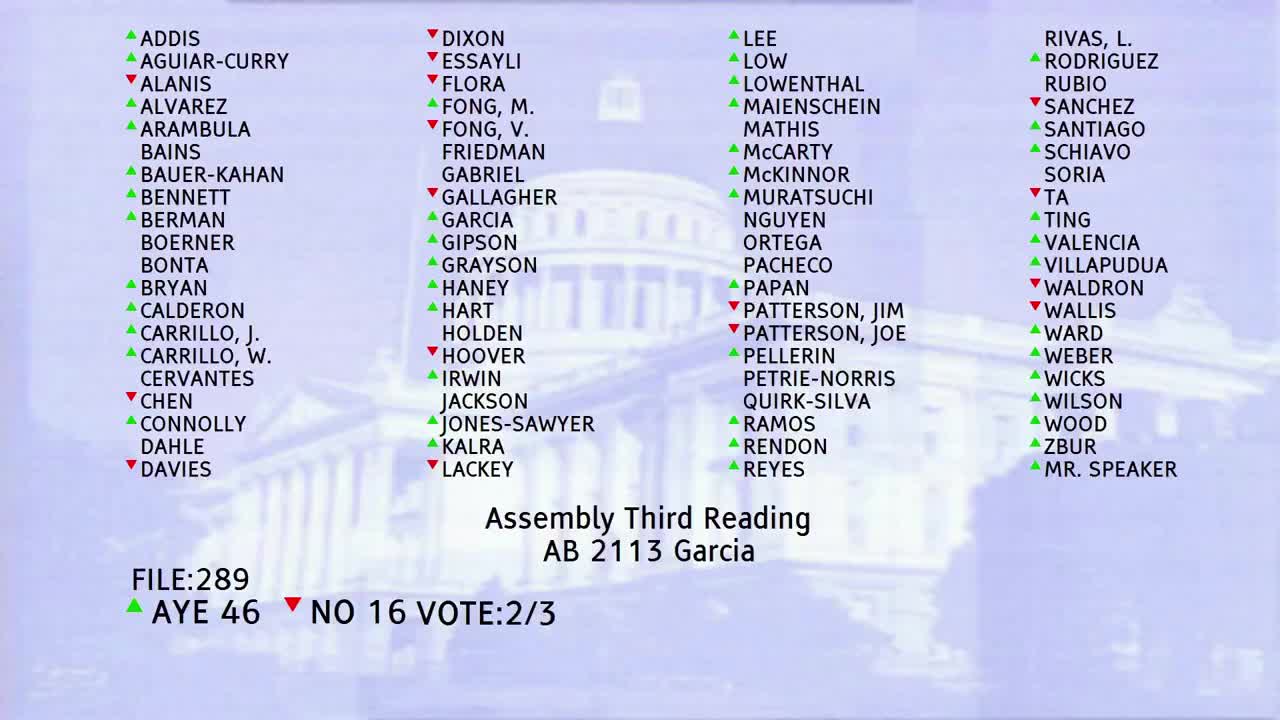
Bill Author

Bill Co-Author(s):