AB 2638: Housing programs: financing.
- Session Year: 2023-2024
- House: Assembly
- Latest Version Date: 2024-07-10
Current Status:
Failed
(2024-08-15: In committee: Held under submission.)
Introduced
In Committee
First Chamber
In Committee
Second Chamber
Enacted
Existing law law, the Zenovich-Moscone-Chacon Housing and Home Finance Act, among other things, establishes the Department of Housing and Community Development and requires it to administer various programs intended to promote the development of housing and to provide housing assistance and home loans. Existing law sets forth various general powers of the department in implementing these programs, including authorizing the department to enter into long-term contracts or agreements of up to 30 years for the purpose of servicing loans or grants or enforcing regulatory agreements or other security documents.
Existing law, unless an extension of a department loan, the reinstatement of a qualifying unpaid matured loan, the subordination of a department loan to new debt, or an investment of tax credit equity would result in a rent increase for tenants of a development, authorizes the Department of Housing and Community Development to approve an extension, reinstatement, subordination, payoff, extraction, or investment pursuant to specified rental housing finance programs, as specified, or if the department determines that a project has, or will have after rehabilitation or repairs, a potential remaining useful life equal to or greater than the term of the restructured loan. Existing law authorizes the department to charge a monitoring fee to cover the aggregate monitoring costs in years the loan is extended and a transaction fee to cover its costs for processing restructuring transactions, and requires developer fee limitations to be consistent with specified laws and regulations, including regulations by the California Tax Credit Allocation Committee.
This bill would revise and recast these provisions, including additionally authorizing the department to approve the payoff of a department loan in whole or part before the end of its term and the extraction of equity from a development for purposes approved by the department. The bill would specify eligible uses of loan and equity sources, if the department determines that a project has, or will have after rehabilitation or repairs, a potential remaining useful life equal to or greater than the term of the departments regulatory agreement for purposes of approving an extension, reinstatement, subordination, payoff, extraction, or investment, as described above. The bill would prohibit the extension, reinstatement, subordination, payoff, extraction, or investment, as described above, if it would result in a rent increase for tenants of a development over and above the annual adjustment to the tenants rents under the departments regulatory agreement.
This bill would recast certain provisions related to regulatory agreements, including authorizing the department to add another regulatory agreement and authorizing the department to waive specified requirements in the regulatory agreement if the loan is paid off, including requiring occupancy and financial reports. The bill would authorize the department to charge additional fees as necessary to cover its costs for processing restructuring transactions, and would provide that the monitoring fees continue until the end of the term of the departments regulatory agreement, as specified. The bill would limit developer fees to the amount allowed by the California Tax Credit Allocation Committee or to 25% of actual rehabilitation costs, as applicable. The bill would prohibit the department from limiting the amount a housing sponsor may spend on supportive service costs paid as operating expenses, except as specified.
Existing law, known as the No Place Like Home Program, requires the department to award up to $2,000,000,000 among counties to finance capital costs, including, but not limited to, acquisition, design, construction, rehabilitation, or preservation, and to capitalize operating reserves, of permanent supportive housing for the target population, as specified.
This bill would define capitalized operating reserves for purposes of the Zenovich-Moscone-Chacon Housing and Home Finance Act and the No Place Like Home Program.
This bill would declare that it is to take effect immediately as an urgency statute.
Existing law establishes the Department of Housing and Community Development and requires it to administer various programs intended to promote the development of housing and to provide housing assistance and home loans. Existing law sets forth various general powers of the department in implementing these programs, including authorizing the department to enter into long-term contracts or agreements of up to 30 years for the purpose of servicing loans or grants or enforcing regulatory agreements or other security documents.
Existing law, unless an extension of a department loan, the reinstatement of a qualifying unpaid matured loan, the subordination of a department loan to new debt, or an investment of tax credit equity would result in a rent increase for tenants of a development, authorizes the Department of Housing and Community Development to approve an extension, reinstatement, subordination, payoff, extraction, or investment pursuant to specified rental housing finance programs, as specified, or if the department determines that a project has, or will have after rehabilitation or repairs, a potential remaining useful life equal to or greater than the term of the restructured loan. Existing law authorizes the department to charge a monitoring fee to cover the aggregate monitoring costs in years the loan is extended and a transaction fee to cover its costs for processing restructuring transactions, and requires developer fee limitations to be consistent with specified laws and regulations, including regulations by the California Tax Credit Allocation Committee.
This bill would revise and recast these provisions, including additionally authorizing the department to approve the payoff of a department loan in whole or part before the end of its term and the extraction of equity from a development for purposes approved by the department. The bill would specify eligible uses of loan and equity sources, if the department determines that a project has, or will have after rehabilitation or repairs, a potential remaining useful life equal to or greater than the term of the departments regulatory agreement for purposes of approving an extension, reinstatement, subordination, payoff, extraction, or investment, as described above. The bill would prohibit the extension, reinstatement, subordination, payoff, extraction, or investment, as described above, if it would result in a rent increase for tenants of a development over and above the annual adjustment to the tenants rents under the departments regulatory agreement. The
This bill would authorize recast certain provisions related to regulatory agreements, including authorizing the department to add another regulatory agreement and authorizing the department to waive specified requirements in the regulatory agreement if the loan is paid off, including requiring occupancy and financial reports and governing the use of operating income and reserves for the development. reports. The bill would authorize the department to charge additional fees as necessary to cover its costs for processing restructuring transactions, and would provide that the monitoring fees continue until the end of the term of the departments regulatory agreement, as specified. The bill would limit developer fees to the amount allowed by the California Tax Credit Allocation Committee or to 25% of actual rehabilitation costs, as applicable. The bill would prohibit the department from limiting the amount a housing sponsor may spend on supportive service costs paid as operating expenses, except as specified.
Existing law establishes the Department of Housing and Community Development and requires it to administer various programs intended to promote the development of housing and to provide housing assistance and home loans. Existing law sets forth various general powers of the department in implementing these programs, including authorizing the department to enter into long-term contracts or agreements of up to 30 years for the purpose of servicing loans or grants or enforcing regulatory agreements or other security documents.
Existing law, unless an extension of a department loan, the reinstatement of a qualifying unpaid matured loan, the subordination of a department loan to new debt, or an investment of tax credit equity would result in a rent increase for tenants of a development, authorizes the Department of Housing and Community Development to approve an extension, reinstatement, subordination, payoff, extraction, or investment pursuant to specified rental housing finance programs, as specified, or if the department determines that a project has, or will have after rehabilitation or repairs, a potential remaining useful life equal to or greater than the term of the restructured loan. Existing law authorizes the department to charge a monitoring fee to cover the aggregate monitoring costs in years the loan is extended and a transaction fee to cover its costs for processing restructuring transactions, and requires developer fee limitations to be consistent with specified laws and regulations, including regulations by the California Tax Credit Allocation Committee.
This bill would revise and recast these provisions, including additionally authorizing the department to approve the payoff of a department loan in whole or part before the end of its term and the extraction of equity from a development for purposes approved by the department. The bill would specify eligible uses of loan and equity sources, if the department determines that a project has, or will have after rehabilitation or repairs, a potential remaining useful life equal to or greater than the term of the departments regulatory agreement for purposes of approving an extension, reinstatement, subordination, payoff, extraction, or investment, as described above. The bill would prohibit the extension, reinstatement, subordination, payoff, extraction, or investment, as described above, if it would result in a rent increase for tenants of a development over and above the annual adjustment to the tenants rents under the departments regulatory agreement. The bill would authorize the department to waive specified requirements in the regulatory agreement if the loan is paid off, including requiring occupancy and financial reports and governing the use of operating income and reserves for the development. The bill would authorize the department to charge additional fees as necessary to cover its costs for processing restructuring transactions, and would provide that the monitoring fees continue until the end of the term of the departments regulatory agreement, as specified. The bill would limit developer fees to the amount allowed by the California Tax Credit Allocation Committee or to 25% of actual rehabilitation costs, as applicable.
Capitalized operating reserves means capitalized funds for assisted units for the purpose of covering potential or projected operating deficits over time, including, but not limited to, operations, supportive services, and rent subsidies.
SEC. 2.Section 50560 of the Health and Safety Code is amended to read:50560.(a)Subject to the requirements of this chapter, the department may approve an extension of a department loan, the reinstatement of a qualifying unpaid matured loan, the subordination of a department loan to new debt, the payoff of a department loan in whole or part before the end of its term, the extraction of equity from a development for purposes approved by the department, or an investment of tax credit equity under one or more of the following rental housing finance programs: the original Rental Housing Construction Program established by Chapter 9 (commencing with Section 50735), the Special User Housing Rehabilitation Program established by Section 50670, the Deferred-Payment Rehabilitation Loan Program established by Chapter 6.5 (commencing with Section 50660), the rental component of the California Natural Disaster Assistance Program established by Chapter 6.5 (commencing with Section 50671), the State Earthquake Rehabilitation Assistance Program established by Chapter 6.5 (commencing with Section 50671), the rental component of the California Housing Rehabilitation Program established by Section 50668.5, the component of the Rental Housing Construction Program funded with bond proceeds governed by Section 50771.1, the Family Housing Demonstration Program established by Chapter 15 (commencing with Section 50880), the Families Moving to Work Program established by Chapter 15 (commencing with Section 50880), the Multifamily Housing Program established by Chapter 6.7 (commencing with Section 50675), and any and all other multifamily housing loans funded or monitored by the department.
(b)Once the department has approved a loan extension, reinstatement of a qualifying unpaid matured loan, subordination, payoff of a department loan in whole or part before the end of its term, extraction of equity from a development for purposes approved by the department, or tax credit investment pursuant to this chapter, the statutes enumerated in subdivision (a), and the regulations or guidelines promulgated pursuant to these statutes, shall no longer apply to developments restructured pursuant to this chapter. These developments shall instead be governed by this chapter and guidelines adopted pursuant to subdivision (h).
(c)All projects restructured pursuant to this chapter shall comply with the affirmative marketing and language accessibility requirements set forth in Section 50736 of this code and Section 65863 of the Government Code.
(d)The department may approve an extension of a loan, the reinstatement of a qualifying unpaid matured loan, the subordination of a department loan to new debt, the payoff of a department loan in whole or part before the end of its term, the extraction of equity from a development for purposes approved by the department, or an investment of tax credit equity if it determines that the project has, or will have after rehabilitation or repairs, a potential remaining useful life equal to or greater than the term of the departments regulatory agreement. Eligible uses of loan and equity sources under this subdivision include, but are not limited to, the purchase of a limited partner interest of a tax credit investor in the project, payment of any unpaid deferred developer fee for the project, payment for necessary repairs and rehabilitation of the project, and the establishment or replenishment of department-approved project reserves.
(e)The department may subordinate its loan to refinance existing senior debt for eligible activities pursuant to subdivision (d) and to reimburse borrower advances for predevelopment costs, capital improvements, and operating deficits, only if the departments security is not jeopardized, as determined by the department. The department shall not withhold consent unreasonably.
(f)The department shall not approve the extension of a department loan, the reinstatement of a qualifying unpaid matured loan, the subordination of a department loan to new debt, the payoff of a department loan in whole or part before the end of its term, the extraction of equity from a development for purposes approved by the department, or an investment of tax credit equity if it will result in a rent increase for tenants of a development exceeding the annual adjustment to the tenants rents under the departments regulatory agreement. The department may only subordinate a loan to senior debt if necessary to increase the feasibility of a project and to fund reasonable rehabilitation or improvements including soft costs. The application to refinance shall include a third-party analysis that supports the need for refinancing.
(g)The department may approve additional senior debt for eligible activities pursuant to subdivision (d), and only as necessary to finance rehabilitation or repairs, including soft costs, that are reasonable in size, scope, and cost, as determined by the department. In approving additional senior debt, the department may consider information from third-party capital needs assessment reports.
(h)It is the intent of the Legislature in enacting this chapter to provide to the department the flexibility necessary to maintain the quality of the affordable rental housing units for which the state has already made a significant public investment. The department may implement this chapter through guidelines that shall not be subject to Chapter 3.5 (commencing with Section 11340) of Part 1 of Division 3 of Title 2 of the Government Code. These guidelines shall be developed through the following process:
(1)The department shall provide a notice of proposed action as described in Section 11346.5 of the Government Code to the public at least 21 days before the close of the public comment period.
(2)The department shall schedule at least one public hearing as described in Section 11346.8 of the Government Code before the close of the public comment period.
(3)The department shall maintain a rulemaking file as described in Section 11347.3 of the Government Code.
(4)The final version of the guidelines shall be accompanied by a final statement of reason as described in subdivision (a) of Section 11346.9 of the Government Code.
(5)The rules and guidelines shall be effective immediately upon adoption by the department.
SEC. 3.Section 50561 of the Health and Safety Code is amended to read:50561.(a)The department may approve an extension of an existing rental housing development loan or regulatory agreement, if the extension facilitates the reinstatement of a qualifying unpaid matured loan, the subordination of a department loan to new debt, the extraction of equity from a development for purposes approved by the department, or an investment of tax credit equity, only if the rental housing development is being operated in a manner consistent with the regulatory agreement and the development requires an extension in order to continue to operate in a manner consistent with this chapter. Each extension shall be for a period of not less than 10 years and each extension shall not exceed 55 years, or 58 years if needed to match the term of tax credit restrictions. The interest rate shall be 3 percent simple interest. All loan payments shall be deferred for the full term of the loan, except for residual receipts payments. These residual receipts payments shall be structured to avoid reducing the amount of payments on local public agency loans resulting solely from changes in the payment terms on the departments loan, and not resulting from fees or other payments to the borrower, and shall otherwise be consistent with the provisions of the departments Uniform Multifamily Regulations or successor regulations. The department may charge a monitoring fee to cover the aggregate monitoring costs it incurs from the date of the recordation of the loan or regulatory documents regarding any of the eligible activities pursuant to this subdivision, and may charge a transaction fee or other fees to cover its costs for processing restructuring transactions. The monitoring fees shall continue until the end of the term of the department regulatory agreement, notwithstanding any payoff of the department loan, and the monitoring fees shall not be diminished in the event of any paydown of the department loan. The department may waive or defer some or all fees, if it determines that a particular development or class of developments does not have the ability to make these payments. In determining the fees and payments to be charged, the department shall seek to share monitoring activities with other regulatory agencies and to minimize the impact on tenants with the lowest incomes and on the capacity of the developments to support private debt or secure tax credit investments.
(b)To the minimum extent necessary to support new debt to pay for rehabilitation, but not for extraction of equity, rents for assisted units in these developments may be adjusted pursuant to the department guidelines and Section 42 of the Internal Revenue Code. This rehabilitation shall be determined by the department to be demonstrably necessary, based on third-party assessment and on the departments own inspection, if the department deems an inspection necessary. Assisted units in developments with a specific, department-approved plan to undertake the necessary rehabilitation, at a level that equals or exceeds the minimum per-unit rehabilitation cost standards under the low-income housing tax credit program, may be adjusted as follows:
(1)For developments originally financed under the bond-funded component of the Rental Housing Construction Program pursuant to Section 50771.1, and the Family Housing Demonstration Program, rents may be increased up to a maximum of 30 percent of 60 percent of area median income, for units designated in the developments original regulatory agreement as lower income units, and up to a maximum of 30 percent of 35 percent of area median income, for units designated in the developments original regulatory agreement as very low income units.
(2)For developments originally financed under other programs, rents for at least 35 percent of the assisted units, or as specified in the original regulatory agreement governing the development, whichever is greater, shall be restricted to the midlevel target used by the Multifamily Housing Program. Rents for the balance of the assisted units may be increased up to a maximum of 30 percent of 60 percent of area median income. For purposes of this paragraph, midlevel target used by the Multifamily Housing Program shall mean either of the following:
(A)For counties with an area median income of 110 percent or less of state median income, it shall mean 30 percent of 30 percent of state median income, expressed as a percentage of area median income.
(B)For counties with an area median income that exceeds 110 percent of the state median income, it shall mean 30 percent of 35 percent of state median income, expressed as a percentage of area median income.
(c)Rent increases for tenants living in assisted units at the time of restructuring pursuant to this chapter shall be limited as follows:
(1)For existing tenants with incomes not exceeding 35 percent of area median income, increases shall be limited to 5 percent per year, until the rents reach the levels set under subdivision (b).
(2)For existing tenants with incomes exceeding 35 percent of area median income, increases shall be limited to 10 percent per year, until they reach the levels specified in paragraphs (1) and (2) of subdivision (b) of Section 50561.
(3)It is the intent of the Legislature that rent increases for existing tenants authorized by this subdivision shall not be greater than necessary to ensure the financial feasibility of the project. The projected maximum rent for tenants in assisted units, as determined by subdivision (b), shall not exceed 50 percent of the households actual income. This requirement shall be applied using maximum rent levels and household incomes determined at the time of restructuring or at the time of the departments approval of the restructuring.
(4)If the refinance of a loan results in a rent increase, the project sponsor shall provide tenants with the following notifications:
(A)Notice six months before the scheduled rent increase with an estimate of the amount of the increase.
(B)Notice 90 days before the actual increase with the exact amount of the new rent.
(d)If existing tenants move, the rent for these units may be increased immediately up to the level specified in paragraphs (1) and (2) of subdivision (b). The income limit for new tenants shall correspond with the rent limit set pursuant to paragraphs (1) and (2) of subdivision (b).
(e)Once rents achieve the levels set forth in paragraphs (1) and (2) of subdivision (b), income levels and rent limits shall be calculated consistent with the calculation methodology used under the Low Income Housing Tax Credit program and the Multifamily Housing Program, and rent increases shall be based on increases in the area median income.
(f)Eligible households displaced as a result of rehabilitation pursuant to this section shall be accorded first priority in occupying comparable units in the development from which they were displaced, subsequent to rehabilitation. Tenants of rental housing developments repaired with assistance provided under this chapter who are temporarily or permanently displaced as a result of rehabilitation or other repair work, shall be entitled to relocation benefits pursuant to, and subject to, the requirements of Section 7260 of the Government Code. Sponsors of assisted rental housing developments shall be responsible for providing the benefits and assistance. The costs of the benefits and the assistance provided to tenants shall be eligible for funding by a loan provided pursuant to this section.
(g)The guidelines adopted by the department pursuant to subdivision (h) of Section 50560 shall be patterned after the regulations governing the Multifamily Housing Program, including the Uniform Multifamily Regulations, except that the department may adopt different standards for the following factors:
(1)Commercial vacancy loss assumptions must reflect project operating history.
(2)Debt service coverage ratios.
(3)Payment terms and principal amount of senior debt, considering financial market conditions, including costs and department risk, as determined by the department.
(4)Developer fee limitations shall be consistent with California Tax Credit Allocation Committee regulations for inclusion in the basis for projects receiving 9 percent tax credits, for projects receiving the special rent increases contemplated by this chapter, and, consistent with the requirements of other funding sources, for projects not receiving special rent increases, but developer fees shall not exceed the amount allowed by the California Tax Credit Allocation Committee regulations for projects receiving 9 or 4 percent tax credits, as applicable, and shall not exceed 25 percent of actual rehabilitation costs where there is no tax credit resyndication. Developer fees shall only be payable in the event of a resyndication involving major rehabilitation, as defined by the California Tax Credit Allocation Committee in regulations.
(5)Replacement reserve deposit amounts must be based on projected costs over 20 years, adjusted for inflation, and as shown in an independent replacement reserve analysis.
(h)It is the intent of the Legislature in enacting this section that the department shall manage its reserves for the original Rental Housing Construction Program in a manner that will allow for the continuation of benefits to current low-income tenants for the longest period of time possible up to the term of the original regulatory agreement or the depletion of the annuity funds, whichever occurs first. Accordingly, rents for those households in units subsidized by the annuity fund established pursuant to Section 50748 may be increased to 30 percent of household income. A household affected by the rent increase permitted by this subdivision shall be given at least 90 days advanced notice of the increase.
(i)(1)The department shall, within available resources, post on its internet website information regarding household incomes and rents for developments approved for restructuring.
(2)The information shall be provided within six months of a restructuring and, thereafter, no less than every three years.
(3)The information shall include the following or similar information:
(A)The monthly rent of each household at the time of restructuring.
(B)The current monthly rent of each household.
(C)The annual income of each household as a percentage of area median income at the time of restructuring.
(D)The current income of each household as a percentage of area median income.
SEC. 4.Section 50562 of the Health and Safety Code is amended to read:50562.(a)If a department loan is extended, subordinated, or paid off before the end of its term, the department approves the reinstatement of a qualifying unpaid matured loan, the department approves the extraction of equity from a development, or a new tax credit investment occurs, then the department shall enter into a new regulatory agreement with the developments owner, or amend the existing agreement, and may add another regulatory agreement if the department determines it necessary. The agreement shall be binding upon the developments owner and successors in interest upon sale or transfer of the development property, regardless of any prepayment of the loan. The agreement shall be recorded in the office of the county recorder in the county in which the development is located. The new or amended regulatory agreement shall:
(1)Set standards for tenant selection to ensure occupancy by the eligible households.
(2)Govern the terms of occupancy agreements.
(3)Restrict rents for assisted units, consistent with this chapter.
(4)Provide for periodic inspections by the department.
(5)Require occupancy and financial reports, and financial audits for the development, unless waived by the department if the department loan is paid off and the waiver may be rescinded in the sole determination of the department.
(6)Govern the use of operating income for the development, unless waived by the department if the department loan is paid off and the waiver may be rescinded in the sole determination of the department.
(7)Govern the use of reserves for the development, unless waived by the department if the department loan is paid off and the waiver may be rescinded in the sole determination of the department.
(8)Have a term for not less than the term of the loan, including any extension.
(9)Include other provisions necessary to carry out the purposes of this chapter, including the requirement that any extraction of equity from the development is subject to being shared with the department in an amount determined solely by the department, but not greater than an amount proportionate to the amount of the department loan secured by such project to the total construction costs of the project.
(b)The developments owner shall agree to replace or amend any other loan document to accomplish the purposes of this chapter.
SEC. 5.Section 5849.2 of the Welfare and Institutions Code, as amended by Section 69 of Chapter 790 of the Statutes of 2023, is amended to read:5849.2.As used in this part, the following definitions shall apply:
(a)At risk of chronic homelessness includes, but is not limited to, persons who are at high risk of long-term or intermittent homelessness, including persons with mental illness exiting institutionalized settings, including, but not limited to, jail and mental health facilities, who were homeless prior to admission, transition age youth experiencing homelessness or with significant barriers to housing stability, and others, as defined in program guidelines.
(b)Authority means the California Health Facilities Financing Authority established pursuant to Part 7.2 (commencing with Section 15430) of Division 3 of Title 2 of the Government Code.
(c)Capitalized operating reserves has the same meaning as defined in Section 50058.8 of the Health and Safety Code.
(c)(d)Chronically homeless has the same meaning as defined in Section 578.3 of Title 24 of the Code of Federal Regulations, as that section read on May 1, 2016.
(d)(e)Commission means the Mental Health Services Oversight and Accountability Commission established by Section 5845.
(e)(f)Committee means the No Place Like Home Program Advisory Committee established pursuant to Section 5849.3.
(f)(g)County includes, but is not limited to, a city and county, and a city receiving funds pursuant to Section 5701.5.
(g)(h)Department means the Department of Housing and Community Development.
(h)(i)Development sponsor has the same meaning as sponsor as defined in Section 50675.2 of the Health and Safety Code.
(i)(j)Fund means the No Place Like Home Fund established pursuant to Section 5849.4.
(j)(k)Homeless has the same meaning as defined in Section 578.3 of Title 24 of the Code of Federal Regulations, as that section read on May 1, 2016.
(k)(l)Permanent supportive housing has the same meaning as supportive housing, as defined in Section 50675.14 of the Health and Safety Code, except that permanent supportive housing shall include associated facilities if used to provide services to housing residents.
(l)(m)Program means the process for awarding funds and distributing moneys to applicants established in Sections 5849.7, 5849.8, and 5849.9 and the ongoing monitoring and enforcement of the applicants activities pursuant to Sections 5849.8, 5849.9, and 5849.11.
(1)Competitive program means that portion of the program established by Section 5849.8.
(2)Distribution program means that portion of the program described in Section 5849.9.
(m)(n)Target population means individuals or households as provided in Section 5600.3 who are homeless, chronically homeless, or at risk of chronic homelessness.
(n)(o)If amendments to the Mental Health Services Act are approved by the voters at the March 5, 2024, statewide primary election, this section shall become inoperative on January 1, 2025, and as of that date is repealed.
SEC. 6.Section 5849.2 of the Welfare and Institutions Code, as added by Section 70 of Chapter 790 of the Statutes of 2023, is amended to read:5849.2.As used in this part, the following definitions shall apply:
(a)At risk of chronic homelessness includes, but is not limited to, persons who are at high risk of long-term or intermittent homelessness, including persons with mental illness exiting institutionalized settings, including, but not limited to, jail, mental health, and substance use disorder facilities, who were homeless prior to admission, transition age youth experiencing homelessness or with significant barriers to housing stability, and others, as defined in program guidelines.
(b)Authority means the California Health Facilities Financing Authority established pursuant to Part 7.2 (commencing with Section 15430) of Division 3 of Title 2 of the Government Code.
(c)Capitalized operating reserves has the same meaning as defined in Section 50058.8 of the Health and Safety Code.
(c)(d)Chronically homeless has the same meaning as defined in Section 578.3 of Title 24 of the Code of Federal Regulations as that section read on May 1, 2016, or as otherwise modified or expanded by the State Department of Health Care Services.
(d)(e)Commission means the Behavioral Health Services Oversight and Accountability Commission established by Section 5845.
(e)(f)Committee means the No Place Like Home Program Advisory Committee established pursuant to Section 5849.3.
(f)(g)County includes, but is not limited to, a city and a city and county receiving funds pursuant to Section 5701.5.
(g)(h)Department means the Department of Housing and Community Development.
(h)(i)Development sponsor has the same meaning as sponsor as defined in Section 50675.2 of the Health and Safety Code.
(i)(j)Fund means the No Place Like Home Fund established pursuant to Section 5849.4.
(j)(k)Homeless has the same meaning as defined in Section 578.3 of Title 24 of the Code of Federal Regulations as that section read on May 1, 2016.
(k)(l)Permanent supportive housing has the same meaning as supportive housing, as defined in Section 50675.14 of the Health and Safety Code, except that permanent supportive housing shall include associated facilities if used to provide services to housing residents.
(l)(m)(1)Program means the process for awarding funds and distributing moneys to applicants established in Sections 5849.7, 5849.8, and 5849.9 and the ongoing monitoring and enforcement of the applicants activities pursuant to Sections 5849.8, 5849.9, and 5849.11.
(2)Competitive program means the portion of the program established by Section 5849.8.
(3)Distribution program means the portion of the program described in Section 5849.9.
(m)(n)Target population means individuals or households, as provided in Section 5600.3, who are homeless, chronically homeless, or at risk of chronic homelessness.
(n)(o)This section shall become operative on January 1, 2025, if amendments to the Mental Health Services Act are approved by the voters at the March 5, 2024, statewide primary election.
SEC. 7.This act is an urgency statute necessary for the immediate preservation of the public peace, health, or safety within the meaning of Article IV of the California Constitution and shall go into immediate effect. The facts constituting the necessity are:
In order to address the statewide affordable housing crisis in California and to provide immediate assistance to affordable housing developers, it is necessary that this act take effect immediately.
The department shall not limit the amount a housing sponsor may spend on supportive service costs paid as operating expenses, except as follows:
(1)The cost of staff supervision shall not exceed 10 percent of the cost of onsite staff salaries.
(2)Administrative overhead expenses, including accounting and human relations, shall not exceed 15 percent of the total supportive services costs paid as operating expenses.
SECTION 1.SEC. 2.Section 50560 of the Health and Safety Code is amended to read:50560.(a)Subject to the requirements of this chapter, the department may approve an extension of a department loan, the reinstatement of a qualifying unpaid matured loan, the subordination of a department loan to new debt, the payoff of a department loan in whole or part before the end of its term, the extraction of equity from a development for purposes approved by the department, or an investment of tax credit equity under one or more of the following rental housing finance programs: the original Rental Housing Construction Program established by Chapter 9 (commencing with Section 50735), the Special User Housing Rehabilitation Program established by Section 50670, the Deferred-Payment Rehabilitation Loan Program established by Chapter 6.5 (commencing with Section 50660), the rental component of the California Natural Disaster Assistance Program established by Chapter 6.5 (commencing with Section 50671), the State Earthquake Rehabilitation Assistance Program established by Chapter 6.5 (commencing with Section 50671), the rental component of the California Housing Rehabilitation Program established by Section 50668.5, the component of the Rental Housing Construction Program funded with bond proceeds governed by Section 50771.1, the Family Housing Demonstration Program established by Chapter 15 (commencing with Section 50880), the Families Moving to Work Program established by Chapter 15 (commencing with Section 50880), the Multifamily Housing Program established by Chapter 6.7 (commencing with Section 50675), and any and all other multifamily housing loans funded or monitored by the department.
(b)Once the department has approved a loan extension, reinstatement of a qualifying unpaid matured loan, subordination, payoff of a department loan in whole or part before the end of its term, extraction of equity from a development for purposes approved by the department, or tax credit investment pursuant to this chapter, the statutes enumerated in subdivision (a), and the regulations or guidelines promulgated pursuant to these statutes, shall no longer apply to developments restructured pursuant to this chapter. These developments shall instead be governed by this chapter and guidelines adopted pursuant to subdivision (h).
(c)All projects restructured pursuant to this chapter shall comply with the affirmative marketing and language accessibility requirements set forth in Section 50736 of this code and Section 65863 of the Government Code.
(d)The department may approve an extension of a loan, the reinstatement of a qualifying unpaid matured loan, the subordination of a department loan to new debt, the payoff of a department loan in whole or part before the end of its term, the extraction of equity from a development for purposes approved by the department, or an investment of tax credit equity if it determines that the project has, or will have after rehabilitation or repairs, a potential remaining useful life equal to or greater than the term of the departments regulatory agreement. Eligible uses of loan and equity sources under this subdivision include, but are not limited to, the purchase of a limited partner interest of a tax credit investor in the project, payment of any unpaid deferred developer fee for the project, payment for necessary repairs and rehabilitation of the project, and the establishment or replenishment of department-approved project reserves.
(e)The department may subordinate its loan to refinance existing senior debt for eligible activities pursuant to subdivision (d) and to reimburse borrower advances for predevelopment costs, capital improvements, and operating deficits, only if the departments security is not jeopardized, as determined by the department. The department shall not withhold consent unreasonably.
(f)If The department shall not approve the extension of a department loan, the reinstatement of a qualifying unpaid matured loan, the subordination of a department loan to new debt, the payoff of a department loan in whole or part before the end of its term, the extraction of equity from a development for purposes approved by the department, or an investment of tax credit equity if it will result in a rent increase for tenants of a development exceeding the annual adjustment to the tenants rents under the departments regulatory agreement, the agreement. The department may only subordinate a loan to senior debt if necessary to increase the feasibility of a project and to fund reasonable rehabilitation or improvements including soft costs. The application to refinance shall include a third-party analysis that supports the need for refinancing.
(g)The department may approve additional senior debt for eligible activities pursuant to subdivision (d), and only as necessary to finance rehabilitation or repairs, including soft costs, that are reasonable in size, scope, and cost, as determined by the department. In approving additional senior debt, the department may consider information from third-party capital needs assessment reports.
(h)It is the intent of the Legislature in enacting this chapter to provide to the department the flexibility necessary to maintain the quality of the affordable rental housing units for which the state has already made a significant public investment. The department may implement this chapter through guidelines that shall not be subject to Chapter 3.5 (commencing with Section 11340) of Part 1 of Division 3 of Title 2 of the Government Code. These guidelines shall be developed through the following process:
(1)The department shall provide a notice of proposed action as described in Section 11346.5 of the Government Code to the public at least 21 days before the close of the public comment period.
(2)The department shall schedule at least one public hearing as described in Section 11346.8 of the Government Code before the close of the public comment period.
(3)The department shall maintain a rulemaking file as described in Section 11347.3 of the Government Code.
(4)The final version of the guidelines shall be accompanied by a final statement of reason as described in subdivision (a) of Section 11346.9 of the Government Code.
(5)The rules and guidelines shall be effective immediately upon adoption by the department.
SEC. 2.SEC. 3.Section 50561 of the Health and Safety Code is amended to read:50561.(a)The department may approve an extension of an existing rental housing development loan or regulatory agreement, if the extension facilitates the reinstatement of a qualifying unpaid matured loan, the subordination of a department loan to new debt, the extraction of equity from a development for purposes approved by the department, or an investment of tax credit equity, only if the rental housing development is being operated in a manner consistent with the regulatory agreement and the development requires an extension in order to continue to operate in a manner consistent with this chapter. Each extension shall be for a period of not less than 10 years and each extension shall not exceed 55 years, or 58 years if needed to match the term of tax credit restrictions. The interest rate shall be 3 percent simple interest. All loan payments shall be deferred for the full term of the loan, except for residual receipts payments. These residual receipts payments shall be structured to avoid reducing the amount of payments on local public agency loans resulting solely from changes in the payment terms on the departments loan, and not resulting from fees or other payments to the borrower, and shall otherwise be consistent with the provisions of the departments Uniform Multifamily Regulations or successor regulations. The department may charge a monitoring fee to cover the aggregate monitoring costs it incurs from the date of the recordation of the loan or regulatory documents regarding any of the eligible activities pursuant to this subdivision, and may charge a transaction fee or other fees to cover its costs for processing restructuring transactions. The monitoring fees shall continue until the end of the term of the department regulatory agreement, notwithstanding any payoff of the department loan, and the monitoring fees shall not be diminished in the event of any paydown of the department loan. The department may waive or defer some or all fees, if it determines that a particular development or class of developments does not have the ability to make these payments. In determining the fees and payments to be charged, the department shall seek to share monitoring activities with other regulatory agencies and to minimize the impact on tenants with the lowest incomes and on the capacity of the developments to support private debt or secure tax credit investments.
(b)To the minimum extent necessary to support new debt to pay for rehabilitation, but not for extraction of equity, rents for assisted units in these developments may be adjusted pursuant to the department guidelines and Section 42 of the Internal Revenue Code. This rehabilitation shall be determined by the department to be demonstrably necessary, based on third-party assessment and on the departments own inspection, if the department deems an inspection necessary. Assisted units in developments with a specific, department-approved plan to undertake the necessary rehabilitation, at a level that equals or exceeds the minimum per-unit rehabilitation cost standards under the low-income housing tax credit program, may be adjusted as follows:
(1)For developments originally financed under the bond-funded component of the Rental Housing Construction Program pursuant to Section 50771.1, and the Family Housing Demonstration Program, rents may be increased up to a maximum of 30 percent of 60 percent of area median income, for units designated in the developments original regulatory agreement as lower income units, and up to a maximum of 30 percent of 35 percent of area median income, for units designated in the developments original regulatory agreement as very low income units.
(2)For developments originally financed under other programs, rents for at least 35 percent of the assisted units, or as specified in the original regulatory agreement governing the development, whichever is greater, shall be restricted to the midlevel target used by the Multifamily Housing Program. Rents for the balance of the assisted units may be increased up to a maximum of 30 percent of 60 percent of area median income. For purposes of this paragraph, midlevel target used by the Multifamily Housing Program shall mean either of the following:
(A)For counties with an area median income of 110 percent or less of state median income, it shall mean 30 percent of 30 percent of state median income, expressed as a percentage of area median income.
(B)For counties with an area median income that exceeds 110 percent of the state median income, it shall mean 30 percent of 35 percent of state median income, expressed as a percentage of area median income.
(c)Rent increases for tenants living in assisted units at the time of restructuring pursuant to this chapter shall be limited as follows:
(1)For existing tenants with incomes not exceeding 35 percent of area median income, increases shall be limited to 5 percent per year, until the rents reach the levels set under subdivision (b).
(2)For existing tenants with incomes exceeding 35 percent of area median income, increases shall be limited to 10 percent per year, until they reach the levels specified in paragraphs (1) and (2) of subdivision (b) of Section 50561.
(3)It is the intent of the Legislature that rent increases for existing tenants authorized by this subdivision shall not be greater than necessary to ensure the financial feasibility of the project. The projected maximum rent for tenants in assisted units, as determined by subdivision (b), shall not exceed 50 percent of the households actual income. This requirement shall be applied using maximum rent levels and household incomes determined at the time of restructuring or at the time of the departments approval of the restructuring.
(4)If the refinance of a loan results in a rent increase, the project sponsor shall provide tenants with the following notifications:
(A)Notice six months before the scheduled rent increase with an estimate of the amount of the increase.
(B)Notice 90 days before the actual increase with the exact amount of the new rent.
(d)If existing tenants move, the rent for these units may be increased immediately up to the level specified in paragraphs (1) and (2) of subdivision (b). The income limit for new tenants shall correspond with the rent limit set pursuant to paragraphs (1) and (2) of subdivision (b).
(e)Once rents achieve the levels set forth in paragraphs (1) and (2) of subdivision (b), income levels and rent limits shall be calculated consistent with the calculation methodology used under the Low Income Housing Tax Credit program and the Multifamily Housing Program, and rent increases shall be based on increases in the area median income.
(f)Eligible households displaced as a result of rehabilitation pursuant to this section shall be accorded first priority in occupying comparable units in the development from which they were displaced, subsequent to rehabilitation. Tenants of rental housing developments repaired with assistance provided under this chapter who are temporarily or permanently displaced as a result of rehabilitation or other repair work, shall be entitled to relocation benefits pursuant to, and subject to, the requirements of Section 7260 of the Government Code. Sponsors of assisted rental housing developments shall be responsible for providing the benefits and assistance. The costs of the benefits and the assistance provided to tenants shall be eligible for funding by a loan provided pursuant to this section.
(g)The guidelines adopted by the department pursuant to subdivision (h) of Section 50560 shall be patterned after the regulations governing the Multifamily Housing Program, including the Uniform Multifamily Regulations, except that the department may adopt different standards for the following factors:
(1)Commercial vacancy loss assumptions must reflect project operating history.
(2)Debt service coverage ratios.
(3)Payment terms and principal amount of senior debt, considering financial market conditions, including costs and department risk, as determined by the department.
(4)Developer fee limitations shall be consistent with California Tax Credit Allocation Committee regulations for inclusion in the basis for projects receiving 9 percent tax credits, for projects receiving the special rent increases contemplated by this chapter, and, consistent with the requirements of other funding sources, for projects not receiving special rent increases, but developer fees shall not exceed the amount allowed by the California Tax Credit Allocation Committee regulations for projects receiving 9 or 4 percent tax credits, as applicable, and shall not exceed 25 percent of actual rehabilitation costs where there is no tax credit resyndication. Developer fees shall only be payable in the event of a resyndication involving major rehabilitation, as defined by the California Tax Credit Allocation Committee in regulations.
(5)Replacement reserve deposit amounts must be based on projected costs over 20 years, adjusted for inflation, and as shown in an independent replacement reserve analysis.
(h)It is the intent of the Legislature in enacting this section that the department shall manage its reserves for the original Rental Housing Construction Program in a manner that will allow for the continuation of benefits to current low-income tenants for the longest period of time possible up to the term of the original regulatory agreement or the depletion of the annuity funds, whichever occurs first. Accordingly, rents for those households in units subsidized by the annuity fund established pursuant to Section 50748 may be increased to 30 percent of household income. A household affected by the rent increase permitted by this subdivision shall be given at least 90 days advanced notice of the increase.
(i)(1)The department shall, within available resources, post on its internet website information regarding household incomes and rents for developments approved for restructuring.
(2)The information shall be provided within six months of a restructuring and, thereafter, no less than every three years.
(3)The information shall include the following or similar information:
(A)The monthly rent of each household at the time of restructuring.
(B)The current monthly rent of each household.
(C)The annual income of each household as a percentage of area median income at the time of restructuring.
(D)The current income of each household as a percentage of area median income.
SEC. 3.SEC. 4.Section 50562 of the Health and Safety Code is amended to read:50562.(a)If a department loan is extended, subordinated, or paid off before the end of its term, the department approves the reinstatement of a qualifying unpaid matured loan, the department approves the extraction of equity from a development, or a new tax credit investment occurs, then the department shall enter into a new regulatory agreement with the developments owner, or amend the existing agreement, and may add another regulatory agreement if the department determines it necessary. The agreement shall be binding upon the developments owner and successors in interest upon sale or transfer of the development property, regardless of any prepayment of the loan. The agreement shall be recorded in the office of the county recorder in the county in which the development is located. The new or amended regulatory agreement shall:
(1)Set standards for tenant selection to ensure occupancy by the eligible households.
(2)Govern the terms of occupancy agreements.
(3)Restrict rents for assisted units, consistent with this chapter.
(4)Provide for periodic inspections by the department.
(5)Require occupancy and financial reports, and financial audits for the development, unless waived by the department if the department loan is paid off and the waiver may be rescinded in the sole determination of the department.
(6)Govern the use of operating income for the development, unless waived by the department if the department loan is paid off and the waiver may be rescinded in the sole determination of the department.
(7)Govern the use of reserves for the development, unless waived by the department if the department loan is paid off and the waiver may be rescinded in the sole determination of the department.
(8)Have a term for not less than the term of the loan, including any extension.
(9)Include other provisions necessary to carry out the purposes of this chapter, including the requirement that any extraction of equity from the development is subject to being shared with the department in an amount determined solely by the department. department, but not greater than an amount proportionate to the amount of the department loan secured by such project to the total construction costs of the project.
(b)The developments owner shall agree to replace or amend any other loan document to accomplish the purposes of this chapter.
(a)Subject to the requirements of this chapter, the department may approve an extension of a department loan, the reinstatement of a qualifying unpaid matured loan, the subordination of a department loan to new debt, the payoff of a department loan in whole or part before the end of its term, the extraction of equity from a development for purposes approved by the department, or an investment of tax credit equity under one or more of the following rental housing finance programs: the original Rental Housing Construction Program established by Chapter 9 (commencing with Section 50735), the Special User Housing Rehabilitation Program established by Section 50670, the Deferred Payment Deferred-Payment Rehabilitation Loan Program established by Chapter 6.5 (commencing with Section 50660), the rental component of the California Natural Disaster Assistance Program established by Chapter 6.5 (commencing with Section 50671), the State Earthquake Rehabilitation Assistance Program established by Chapter 6.5 (commencing with Section 50671), the rental component of the California Housing Rehabilitation Program established by Section 50668.5, the component of the Rental Housing Construction Program funded with bond proceeds governed by Section 50771.1, the Family Housing Demonstration Program established by Chapter 15 (commencing with Section 50880), the Families Moving to Work Program established by Chapter 15 (commencing with Section 50880), the Multifamily Housing Program established by Chapter 6.7 (commencing with Section 50675), and any and all other multifamily housing loans funded or monitored by the department.
(b)Once the department has approved a loan extension, reinstatement of a qualifying unpaid matured loan, subordination, payoff of a department loan in whole or part before the end of its term, extraction of equity from a development for purposes approved by the department, or tax credit investment pursuant to this chapter, the statutes enumerated in subdivision (a), and the regulations or guidelines promulgated pursuant to these statutes, shall no longer apply to developments restructured pursuant to this chapter. These developments shall instead be governed by this chapter and guidelines adopted pursuant to subdivision (h).
(c)All projects restructured pursuant to this chapter shall comply with the affirmative marketing and language accessibility requirements set forth in Section 50736 of this code and Section 65863 of the Government Code.
(d)The department may approve an extension of a loan, the reinstatement of a qualifying unpaid matured loan, the subordination of a department loan to new debt, the payoff of a department loan in whole or part before the end of its term, the extraction of equity from a development for purposes approved by the department, or an investment of tax credit equity if it determines that the project has, or will have after rehabilitation or repairs, a potential remaining useful life equal to or greater than the term of the restructured loan. departments regulatory agreement. Eligible uses of loan and equity sources under this subdivision include, but are not limited to, the purchase of a limited partner interest of a tax credit investor in the project, payment for necessary repairs and rehabilitation of the project, and the establishment or replenishment of department-approved project reserves.
(e)The department may subordinate its loan to refinance existing senior debt only as necessary for project feasibility for eligible activities pursuant to subdivision (d) and to reimburse borrower advances for predevelopment costs, recent capital improvements, and recent operating deficits. deficits, only if the departments security is not jeopardized, as determined by the department. The department shall not withhold consent unreasonably.
(f)If the extension of a department loan, the reinstatement of a qualifying unpaid matured loan, the subordination of a department loan to new debt, the payoff of a department loan in whole or part before the end of its term, the extraction of equity from a development for purposes approved by the department, or an investment of tax credit equity will result in a rent increase for tenants of a development, development exceeding the annual adjustment to the tenants rents under the departments regulatory agreement, the department may only subordinate a loan to senior debt if necessary to increase the feasibility of a project and to fund reasonable rehabilitation or improvements including soft costs. The application to refinance shall include a third-party analysis that supports the need for refinancing.
(g)The department may approve additional senior debt for eligible activities pursuant to subdivision (d), and only as necessary to finance rehabilitation or repairs, including soft costs, that are modest reasonable in size, scope, and cost, as determined by the department. In approving additional senior debt, the department may consider information from third-party capital needs assessment reports.
(h)It is the intent of the Legislature in enacting this chapter to provide to the department the flexibility necessary to maintain the quality of the affordable rental housing units for which the state has already made a significant public investment. The department may implement this chapter through guidelines that shall not be subject to Chapter 2.5 3.5 (commencing with Section 11340) of Part 1 of Division 3 of Title 2 of the Government Code. These guidelines shall be developed through the following process:
(1)The department shall provide a notice of proposed action as described in Section 11346.5 of the Government Code to the public at least 21 days before the close of the public comment period.
(2)The department shall schedule at least one public hearing as described in Section 11346.8 of the Government Code before the close of the public comment period.
(3)The department shall maintain a rulemaking file as described in Section 11347.3 of the Government Code.
(4)The final version of the guidelines shall be accompanied by a final statement of reason as described in subdivision (a) of Section 11346.9 of the Government Code.
(5)The rules and guidelines shall be effective immediately upon adoption by the department.
SEC. 2.Section 50561 of the Health and Safety Code is amended to read:50561.(a)The department may approve an extension of an existing rental housing development loan, loan or regulatory agreement, if the extension facilitates the reinstatement of a qualifying unpaid matured loan, the subordination of a department loan to new debt, the extraction of equity from a development for purposes approved by the department, or an investment of tax credit equity as long as equity, only if the rental housing development is being operated in a manner consistent with the regulatory agreement and the development requires an extension in order to continue to operate in a manner consistent with this chapter. Each extension shall be for a period of not less than 10 years and each extension shall not exceed 55 years, or 58 years if needed to match the term of tax credit restrictions. The interest rate shall be 3 percent simple interest. All loan payments shall be deferred for the full term of the loan, except for residual receipts payments. These residual receipts payments shall be structured to avoid reducing the amount of payments on local public agency loans resulting solely from changes in the payment terms on the departments loan, and not resulting from fees or other payments to the borrower, and shall otherwise be consistent with the provisions of the departments Uniform Multifamily Regulations or successor regulations. The department may charge a monitoring fee to cover the aggregate monitoring costs it incurs in years that the loan is extended and from the date of the recordation of the loan or regulatory documents regarding any of the eligible activities pursuant to this subdivision, and may charge a transaction fee or other fees to cover its costs for processing restructuring transactions. The monitoring fees shall continue until the end of the term of the department regulatory agreement, notwithstanding any payoff of the department loan, and the monitoring fees shall not be diminished in the event of any paydown of the department loan. The department may waive or defer some or all fees, if it determines that a particular development or class of developments does not have the ability to make these payments. In determining the fees and payments to be charged, the department shall seek to share monitoring activities with other regulatory agencies and to minimize the impact on tenants with the lowest incomes and on the capacity of the developments to support private debt or secure tax credit investments.
(b)To the minimum extent necessary to support new debt to pay for rehabilitation, but not for extraction of equity, rents for assisted units in these developments may be adjusted. adjusted pursuant to the department guidelines and Section 42 of the Internal Revenue Code. This rehabilitation shall be determined by the department to be demonstrably necessary, based on third-party assessment and on the departments own inspection. inspection, if the department deems an inspection necessary. Assisted units in developments with a specific, department-approved plan to undertake the necessary rehabilitation, at a level that equals or exceeds the minimum per-unit rehabilitation cost standards under the low-income housing tax credit program, may be adjusted as follows:
(1)For developments originally financed under the bond-funded component of the Rental Housing Construction Program pursuant to Section 50771.1, and the Family Housing Demonstration Program, rents may be increased up to a maximum of 30 percent of 60 percent of area median income, for units designated in the developments original regulatory agreement as lower income units, and up to a maximum of 30 percent of 35 percent of area median income, for units designated in the developments original regulatory agreement as very low income units.
(2)For developments originally financed under other programs, rents for at least 35 percent of the assisted units, or as specified in the original regulatory agreement governing the development, whichever is greater, shall be restricted to the midlevel target used by the Multifamily Housing Program. Rents for the balance of the assisted units may be increased up to a maximum of 30 percent of 60 percent of area median income. For purposes of this paragraph, midlevel target used by the Multifamily Housing Program shall mean either of the following:
(A)For counties with an area median income of 110 percent or less of state median income, it shall mean 30 percent of 30 percent of state median income, expressed as a percentage of area median income.
(B)For counties with an area median income that exceeds 110 percent of the state median income, it shall mean 30 percent of 35 percent of state median income, expressed as a percentage of area median income.
(c)Rent increases for tenants living in assisted units at the time of restructuring pursuant to this chapter shall be limited as follows:
(1)For existing tenants with incomes not exceeding 35 percent of area median income, increases shall be limited to 5 percent per year, until the rents reach the levels set under subdivision (b).
(2)For existing tenants with incomes exceeding 35 percent of area median income, increases shall be limited to 10 percent per year, until they reach the levels specified in paragraphs (1) and (2) of subdivision (b) of Section 50561.
(3)It is the intent of the Legislature that rent increases for existing tenants authorized by this subdivision shall not be greater than necessary to ensure the financial feasibility of the project. The projected maximum rent for tenants in assisted units, as determined by subdivision (b), shall not exceed 50 percent of the households actual income. This requirement shall be applied using maximum rent levels and household incomes determined at the time of restructuring or at the time of the departments approval of the restructuring.
(4)If the refinance of a loan results in a rent increase, the project sponsor shall provide tenants with the following notifications:
(A)Notice six months prior to before the scheduled rent increase with an estimate of the amount of the increase.
(B)Notice 90 days prior to before the actual increase with the exact amount of the new rent.
(d)If existing tenants move, the rent for these units may be increased immediately up to the level specified in paragraphs (1) and (2) of subdivision (b). The income limit for new tenants shall correspond with the rent limit set pursuant to paragraphs (1) and (2) of subdivision (b).
(e)Once rents achieve the levels set forth in paragraphs (1) and (2) of subdivision (b), income levels and rent limits shall be calculated consistent with the calculation methodology used under the Low Income Housing Tax Credit program and the Multifamily Housing Program, and rent increases shall be based on increases in the area median income.
(f)Eligible households displaced as a result of rehabilitation pursuant to this section shall be accorded first priority in occupying comparable units in the development from which they were displaced, subsequent to rehabilitation. Tenants of rental housing developments repaired with assistance provided under this chapter who are temporarily or permanently displaced as a result of rehabilitation or other repair work, shall be entitled to relocation benefits pursuant to, and subject to, the requirements of Section 7260 of the Government Code. Sponsors of assisted rental housing developments shall be responsible for providing the benefits and assistance. The costs of the benefits and the assistance provided to tenants shall be eligible for funding by a loan provided pursuant to this section.
(g)The guidelines adopted by the department pursuant to subdivision (h) of Section 50560 shall be patterned after the regulations governing the Multifamily Housing Program, including the Uniform Multifamily Regulations, except that the department may adopt different standards for the following factors:
(1)Commercial vacancy loss assumptions must reflect project operating history.
(2)Debt service coverage ratios.
(3)Payment terms and principal amount of senior debt, considering financial market conditions, including costs and department risk, as determined by the department.
(4)Developer fee limitations shall be consistent with California Tax Credit Allocation Committee regulations for inclusion in the basis for projects receiving 9 percent tax credits, for projects receiving the special rent increases contemplated by this chapter, and, consistent with the requirements of other funding sources, for projects not receiving special rent increases. increases, but developer fees shall not exceed the amount allowed by the California Tax Credit Allocation Committee regulations for projects receiving 9 or 4 percent tax credits, as applicable, and shall not exceed 25 percent of actual rehabilitation costs where there is no tax credit resyndication. Developer fees shall only be payable in the event of a resyndication involving major rehabilitation, as defined by the California Tax Credit Allocation Committee in regulations.
(5)Replacement reserve deposit amounts must be based on projected costs over 20 years, adjusted for inflation, and as shown in an independent replacement reserve analysis.
(h)It is the intent of the Legislature in enacting this section that the department shall manage its reserves for the original Rental Housing Construction Program in a manner that will allow for the continuation of benefits to current low-income tenants for the longest period of time possible up to the term of the original regulatory agreement or the depletion of the annuity funds, whichever occurs first. Accordingly, rents for those households in units subsidized by the annuity fund established pursuant to Section 50748 may be increased to 30 percent of household income. A household affected by the rent increase permitted by this subdivision shall be given at least 90 days advanced notice of the increase.
(i)(1)The department shall, within available resources, post on its Internet Web site internet website information regarding household incomes and rents for developments approved for restructuring.
(2)The information shall be provided within six months of a restructuring and, thereafter, no less than every three years.
(3)The information shall include the following or similar information:
(A)The monthly rent of each household at the time of restructuring.
(B)The current monthly rent of each household.
(C)The annual income of each household as a percentage of area median income at the time of restructuring.
(D)The current income of each household as a percentage of area median income.
SEC. 3.Section 50562 of the Health and Safety Code is amended to read:50562.(a)If a department loan is extended or extended, subordinated, or paid off before the end of its term, the department approves the reinstatement of a qualifying unpaid matured loan, the department approves the extraction of equity from a development, or a new tax credit investment occurs, then the department shall enter into a new regulatory agreement with the developments owner, or amend the existing agreement. agreement, and may add another regulatory agreement if the department determines it necessary. The agreement shall be binding upon the developments owner and successors in interest upon sale or transfer of the development property, regardless of any prepayment of the loan. The agreement shall be recorded in the office of the county recorder in the county in which the development is located. The new or amended regulatory agreement shall:
(1)Set standards for tenant selection to ensure occupancy by the eligible households.
(2)Govern the terms of occupancy agreements.
(3)Restrict rents for assisted units, consistent with this chapter.
(4)Provide for periodic inspections by the department.
(5)Require occupancy and financial reports, and financial audits for the development. development, unless waived by the department if the department loan is paid off and the waiver may be rescinded in the sole determination of the department.
(6)Govern the use of operating income for the development. development, unless waived by the department if the department loan is paid off and the waiver may be rescinded in the sole determination of the department.
(7)Govern the use of reserves for the development. development, unless waived by the department if the department loan is paid off and the waiver may be rescinded in the sole determination of the department.
(8)Have a term for not less than the term of the loan, including any extension.
(9)Include other provisions necessary to carry out the purposes of this chapter. chapter, including the requirement that any extraction of equity from the development is subject to being shared with the department in an amount determined solely by the department.
(b)The developments owner shall agree to replace or amend any other loan document to accomplish the purposes of this chapter.
|
Date
|
Status
|
|---|---|
| Aug 15, 2024 | In committee: Held under submission. |
| Aug 12, 2024 | In committee: Referred to APPR suspense file. |
| Aug 5, 2024 | From committee chair, with author's amendments: Amend, and re-refer to committee. Read second time, amended, and re-referred to Com. on APPR. |
| Jul 17, 2024 | In committee: Hearing postponed by committee. |
| Jun 25, 2024 | From committee: Do pass and re-refer to Com. on APPR. (Ayes 10. Noes 0.) (June 24). Re-referred to Com. on APPR. |
| Jun 5, 2024 | Referred to Com. on HOUSING. |
| May 23, 2024 | In Senate. Read first time. To Com. on RLS. for assignment. |
| May 22, 2024 | Read third time. Passed. Ordered to the Senate. (Ayes 70. Noes 0. Page 5551.) |
| May 20, 2024 | Read second time. Ordered to third reading. |
| May 16, 2024 | From committee: Do pass. (Ayes 15. Noes 0.) (May 16). |
| May 1, 2024 | In committee: Set, first hearing. Referred to APPR. suspense file. |
| Apr 17, 2024 | From committee: Do pass and re-refer to Com. on APPR. with recommendation: To Consent Calendar. (Ayes 9. Noes 0.) (April 17). Re-referred to Com. on APPR. |
| Apr 10, 2024 | Re-referred to Com. on H. & C.D. |
| Apr 9, 2024 | From committee chair, with author's amendments: Amend, and re-refer to Com. on H. & C.D. Read second time and amended. |
| Mar 4, 2024 | Referred to Com. on H. & C.D. |
| Feb 15, 2024 | From printer. May be heard in committee March 16. |
| Feb 14, 2024 | Read first time. To print. |
|
Date
|
Description
|
Location
|
Votes
|
|
|---|---|---|---|---|
| Aug 12, 2024 | Placed on suspense file | Senate Standing Committee on Appropriations |
Passed |
|
| Jun 24, 2024 | Do pass, but first be re-referred to the Committee on [Appropriations] | Senate Standing Committee on Housing |
Passed |
|
| May 22, 2024 | AB 2638 Ward Assembly Third Reading | Assembly Floor |
Passed |
|
| May 16, 2024 | Do pass. | Assembly Standing Committee on Appropriations |
Passed |
|
| Apr 17, 2024 | Do pass and be re-referred to the Committee on [Appropriations] with recommendation: To Consent Calendar | Assembly Standing Committee on Housing and Community Development |
Passed |
This list shows positions taken on this bill by organizations on the date displayed, which is linked to the original source.
Positions by individuals are not included.
|
Organization
|
Position
|
Date
|
|---|---|---|
| California Council For Affordable Housing | * Support | Jun 24, 2024 |
| California Housing Consortium | * Support | Jun 24, 2024 |
| California Housing Partnership | * Support | Jun 24, 2024 |
| Housing California | * Support | Jun 25, 2024 |
| Inner City Law Center | * Support | Jun 24, 2024 |
SENATE COMMITTEE ON
Senator Anna Caballero, Chair
2023 - 2024 Regular Session
AB 2638 (Ward) - Housing programs: financing
Version: | Policy Vote: |
Urgency: | Mandate: |
Hearing Date: | Consultant: |
Bill Summary:
AB 2638, an urgency measure, would amend the Loan Portfolio Restructuring Program (LPR Program) to authorize the Department of Housing and Community Development (HCD) to approve the payoff of a department loan prior to the end of its term, and the extraction of equity from a development for purposes approved by the department, as specified.
Fiscal Impact:
- HCD estimates ongoing costs of approximately $1.38 million and 6.0 PY of staff to implement and administer the expansion of the LPR Program to provide for loan payoffs and extraction of equity, as specified. Staff notes that while ongoing administrative costs are likely to be offset by transaction and monitoring fees charged to applicants and program participants, HCD is likely to incur significant one-time costs in the first year to engage with stakeholders, develop and adopt amendments to LPR Program guidelines, research and develop specialized legal criteria related to excess equity extraction, create staff tools and processes to analyze specialized transactions, and make revisions to forms, processes, and IT systems. (General Fund)
- Unknown revenue gains related to additional transaction and monitoring fee collections, which will be used to cover HCD’s ongoing administrative costs, as noted above, and for accelerated loan repayments and equity extractions that are shared with HCD. (various funds)
Background:
Existing law, the LPR Program, authorizes HCD to approve an extension of a department loan, the reinstatement of a qualifying unpaid mature loan, the subordination of a loan to new debt, or an investment of tax credit equity under the following rental housing finance programs:
- The original Rental Housing Construction Program.
- The Special User Housing Rehabilitation Program.
- The Deferred Payment Rehabilitation Loan Program.
- The rental component of the California Natural Disaster Assistance Program.
- The State Earthquake Rehabilitation Assistance Program.
- The rental component of the California Housing Rehabilitation Program.
- The bond-funded component of the Rental Housing Construction Program.
- The Family Housing Demonstration Program.
- The Families Moving to Work Program.
- The Multifamily Housing Program (MHP).
- Any and all other multifamily housing loans funded or monitored by HCD.
Existing law specifies that loans may only be restructured at HCD’s discretion if a development is in compliance with the existing regulatory agreement, the development requires a restructuring in order to continue to operate, and the development has, or will have after rehabilitation and repairs, a potential remaining useful life of at least as long as the new loan term. An extension must be for a period of at least 10 years and up to 55 years, at an interest rate of 3 percent. Rents may be adjusted upward to the minimum extent necessary to support the new debt to pay for rehabilitation, and subject to specified limits to maintain affordability. Existing law authorizes HCD to charge loan processing and monitoring fees to an applicant to generate sufficient revenue to cover initial and ongoing monitoring requirements of the program.
Proposed Law:
AB 2638, an urgency measure, would amend the LPR Program to also authorize HCD to approve the payoff of a department loan prior to the end of its term, and the extraction of equity from a development for purposes approved by the department, as specified. The bill would also revise and recast provisions of the LPR Program, and do the following:
- Define “capitalized operating reserves,” for purposes of specified programs, as capitalized funds for assisted units for the purpose of covering potential or projected operating deficits over time, including operations, supportive services, and rent subsidies.
- Authorize a housing sponsor to use a loan and equity payments for all of the following purposes: the purchase of a limited partner interest of a tax credit investor in the project, payment of any unpaid deferred developer fee for the project, payment for necessary repairs and rehabilitation of the project, and the establishment or replenishment of HCD-approved project reserves.
- Authorize HCD to subordinate its loan to refinance existing senior debt for those eligible purposes and to reimburse advances for predevelopment costs, capital improvements, and operating deficits, only if HCD’s security is not jeopardized, as determined by HCD.
- Prohibit the extension, reinstatement, subordination, payoff, extraction of equity, or investment of tax credit equity, as provided, if it would result in a rent increase for tenants of a development exceeding the annual rent adjustment under HCD’s regulatory agreement, as specified.
- Authorize HCD to consider information from third-party capital needs assessment reports in approving additional senior debt under the program.
- Authorize HCD’s monitoring fees to be charged from the date of recordation of the loan or regulatory documents for any LPR Program restructuring activities, and require monitoring fees to continue until the end of the term of HCD’s regulatory agreement, regardless of any loan payoffs, and shall not be diminished in the event that a loan is payed down.
- Require program guidelines to limit developer fees to the amount allowed by the California Tax Credit Allocation Committee regulations, as specified, and no more than 25% of actual rehabilitation costs where there is no tax credit resyndication.
- Authorize HCD to add another regulatory agreement, if necessary, in addition to new regulatory agreements entered into as a result of an LPR Program activity.
- Authorize HCD to waive specified requirements in regulatory agreements regarding operating income, use of reserves, and reports and audits if a loan is paid off.
- Require that any extraction of equity authorized under the LPR Program is subject to being shared with HCD in an amount determined solely by the department, but not greater than the amount proportionate to the amount of the department loan secured by such project to the total construction costs of the project.
Related Legislation:
AB 515 (Ward), which was held on this Committee’s Suspense File last year, was substantially similar to this bill.
AB 1699 (Torres), Chap. 780/2012, established the LPR Program and authorized HCD to approve an extension of a department loan, the subordination of a loan to new debt, or an investment of tax credit equity under older rental housing finance programs, as specified.
-- END --
SENATE COMMITTEE ON HOUSING
Senator Nancy Skinner, Chair
2023 - 2024 Regular
Bill No: AB 2638 Hearing Date: 6/24/2024
Author: | Ward | ||
Version: | 4/9/2024 | ||
Urgency: | No | Fiscal: | Yes |
Consultant: | Max Ladow | ||
SUBJECT: Housing programs: financing
DIGEST: This bill authorizes the Department of Housing and Community Development (HCD) to approve the pay-off of an HCD loan in whole or part, prior to the end of its term, and the extraction of equity from a development for purposes approved by HCD.
ANALYSIS:
Existing law:
- Allows HCD to approve an extension of an HCD loan, the reinstatement of a qualifying unpaid matured loan, the subordination of an HCD loan to new debt, or an investment of tax credit equity under various older HCD rental housing finance programs. Allows this approval if HCD determines that the project will have after rehabilitation of repairs, a potential remaining useful life equal to or greater than the term of the restructured loan.
- Allows HCD to charge a monitoring and transaction fee to cover its costs for loan extensions and transactions and requires developer fee limitations to be consistent with specified laws and regulations, including those set by the California Tax Credit Allocation Committee (CTCAC).
- Provides that HCD may subordinate its loan to refinance existing senior debt only as necessary for project feasibility and to reimburse borrower advances for predevelopment costs, recent capital improvements, and recent operating deficits.
- Includes, in Multi-family Housing Program (MHP) Regulations, issued by HCD, the following prohibitions:
- Prohibits a property owner from encumbering or pledging Rental Housing Development, or any interest therein or portion thereof, or allow any lien, charge, or assessment against the Rental Housing Development without the prior written approval of HCD.
- No loan may be paid-off prior to maturity without the prior written consent of HCD in its sole discretion. This consent shall be subject to conditions deemed necessary to ensure compliance with the Program requirements.
- The Loan Portfolio Restructuring Program includes the following prohibitions on cash payments to program sponsors:
- Project sales from involving a cash payment to the selling party, or to any party related to or affiliated with the selling,
- Property owners cash out their equity.
This bill:
- Authorizes HCD to approve the pay-off of an HCD loan in whole or part, prior to the end of its term, and the extraction of equity from a development for purposes approved by HCD.
- Allows a housing sponsor to use a loan and equity payments for all of the following eligible uses: the purchase of a limited partner interest of a tax credit investor in the project, payment of any unpaid deferred developer fee for the project, payment for necessary repairs and rehabilitation of the project, and the establishment or replenishment of HCD-approved project reserves.
- Allows HCD to subordinate its loan to refinance existing senior debt for eligible activities listed under (2) and to reimburse advances for predevelopment costs, capital improvements, and operating deficits, only if HCD’s security is not jeopardized, as determined by HCD. Also allows HCD to approve additional senior debt, as specified, and to consider information from third-party capital needs assessment reports in this additional debt approval.
- Prohibits the extension, reinstatement, subordination, payoff, extraction, or investment, as specified, if it would result in a rent increase for tenants of a development over the annual adjustment to the tenants’ rents under HCD’s regulatory agreement.
- Authorizes HCD to charge additional fees, as necessary, to cover its costs for processing restructuring transactions, and provides that the monitoring fees continue until the end of the term of HCD’s regulatory agreement, as specified.
- Limits developer fees that may be paid from equity payments from a restructured loan to the amount allowed by CTCAC and to 25% of actual rehabilitation costs, as applicable.
- Authorizes HCD to waive specified requirements in the regulatory agreement if a loan is paid off, including requiring occupancy and financial reports and governing the use of operating income and reserves for the development.
- Provides that any extraction of equity from a development is subject to being shared with HCD in an amount determined solely by HCD, but not greater than an amount proportionate to the amount of the HCD loan secured by such project to the total construction costs of the project.
- Prohibits HCD from limiting the amount a housing sponsor may spend on supportive service costs paid as operating expenses, except as follows:
- The cost of staff supervision shall not exceed 10% of the cost of onsite staff salaries; and
- Administrative overhead expenses, including accounting and human relations, shall not exceed 15% of the total supportive services costs paid as operating expenses.
COMMENTS:
- Author’s Statement. “Affordable housing developers are challenged with accessing enough funds to break ground and develop essential, affordable housing. Often, they have to access various sources of funds, including loans from HCD. However, when affordable housing developers access these loans, they are locked in and do not have any flexibilities. Under existing law, HCD has the authority to approve any prepayment of affordable housing loans; however, HCD has indicated that it will not currently approve any adjustments to its loans. Allowing affordable housing projects to sell or refinance HCD loans will provide additional funds for the development of desperately needed affordable homes in California. AB 2638 will require, under certain conditions, HCD to allow the sales and refinancing of HCD financed properties, unlocking millions of dollars by allowing repayments or partial repayments of HCD loans. Any sale or refinancing of HCD loans would include an agreement that the affordable housing development remains affordable for the duration of the original loan period, ensuring the preservation of affordable housing.”
- Affordable Housing Finance. The state finances affordable multifamily rental housing using a combination of loans, tax credits, and private activity bonds. Unlike market rate housing, affordable housing does not have the cash-flow from rents to support traditional financing.
Affordable housing is provided to tenants whose household income is below the area median income (AMI). To qualify, very low-income tenants must make 60% or less of the AMI and lower-income tenants must make only 80% or less of AMI. Tenants in affordable housing are only required to pay 30% of their income toward rent, so the state needs to provide enough long-term subsidy to reduce the overall debt service on a development. HCD loans serve as the permanent financing that comes in once a development is complete to take out the predevelopment and construction loans a developer took on to construct the development. HCD loans are secured with a lien in first position on the property. Developments are also subject to a 55-year recorded regulatory agreement which runs with the project. If a developer pays off an HCD loan before the covenants expire, the regulatory agreement is not extinguished and the developer must continue to provide the units at an affordability rent for the length of the regulatory agreement to lower-income tenants.
- HCD Prepayments and Equity Withdrawals. Developers with older HCD loans would like the option to sell developments with MHP loans and pay off the loans or to refinance the loans to take cash out to pay developer fees, rehabilitate a development, or re-deploy the funds to develop more affordable housing. This could generate millions of dollars to create new affordable housing.
MHP regulations suggest that HCD does have some discretion to allow for prepayment and limited ability to allow for a refinance of a loan. HCD may allow refinancing of existing liens or additional financing secured by the development maintain or improve the fiscal integrity of the project, to maintain affordable rents, or to decrease rents. HCD can also agree to a MHP loan being paid off prior to maturity.
HCD also administers the Loan Portfolio Restructuring Program (LPRP). This program was appropriated $332.5 million to preserve and rehabilitate existing HCD-funded developments, including those with MHP loans. To qualify, developments must have expired regulatory agreements or the regulatory agreements must be set to expire by 2032. The LPRP does not allow cash payments to the developer or any cash-out of their equity except if the cash payment is held in a restricted account, contributed to the project during the development period, and remains with the project as permanent funding.
This bill would authorize HCD to approve the pay-off of a department loan in whole or part before the end of its term and the extraction of equity from a development for purposes approved by HCD. Any modification to the loan or equity payment to the developer cannot result in in a rent increase for tenants of a development over and above the annual adjustment to the tenants’ rents under the HCD’s regulatory agreement. These core components of the bill have significant influence on affordable housing financing flexibility: how much equity a developer can take out of a project will impact rents levels for the length of the 55-year regulatory agreement, as well as the amount of equity available to maintain the development.
- Supportive Services. The MHP program provides loans to permanent supportive housing developments that provide both housing and supportive services to people experiencing homelessness. The loan is long-term and an equity investment in the development which keeps the rents at very low or extremely low levels. When an applicant applies for a loan, they can request funds to capitalize the operating reserves, or additional funds that are provided to support the supportive services and staff to provide supportive services for the development. HCD currently caps the amount of operating reserves that can be dedicated to supportive services. This bill would require HCD to eliminate the cap in regulations governing MHP. Using MHP funds to fund supportive services reduces the overall amount available for constructing affordable housing; however, it is a necessary trade-off as there are very limited long-term funding sources available for supportive services for supportive housing.
Related Legislation:
AB 515 (Ward, 2023) — would have required HCD, to the extent permitted under federal law and the California Constitution, to allow prepayment of any loans related to housing or housing projects administered by HCD, as specified. This bill was held in the Senate Appropriations Committee.
FISCAL EFFECT: Appropriation: No Fiscal Com.: Yes Local: No
POSITIONS: (Communicated to the committee before noon on Wednesday,
June 19, 2024.)
SUPPORT:
California Council for Affordable Housing (Sponsor)
California Housing Consortium
California Housing Partnership Corporation
Eden Housing
Housing California
LeadingAge California
Resources for Community Development
OPPOSITION:
None received.
-- END --
ASSEMBLY THIRD READING
ATR Bill Id:AB 2638
Author:(Ward)
As Amended Ver:April 9, 2024
Majority vote
SUMMARY
Authorizes the Department of Housing and Community Development (HCD) to approve the payoff of an HCD loan in whole or part, prior to the end of its term, and the extraction of equity from a development for purposes approved by HCD.
Major Provisions
- Authorizes HCD to approve the payoff of an HCD loan in whole or part, prior to the end of its term, and the extraction of equity from a development for purposes approved by HCD.
- Allows a housing sponsor to use a loan and equity payments for all of the following eligible uses: the purchase of a limited partner interest of a tax credit investor in the project, payment of any unpaid deferred developer fee for the project, payment for necessary repairs and rehabilitation of the project, and the establishment or replenishment of department-approved project reserves.
- Prohibits the extension, reinstatement, subordination, payoff, extraction, or investment, as specified, if it would result in a rent increase for tenants of a development over the annual adjustment to the tenants' rents under HCD's regulatory agreement.
- Authorizes HCD to charge additional fees, as necessary, to cover its costs for processing restructuring transactions, and provides that the monitoring fees continue until the end of the term of HCD's regulatory agreement, as specified.
- Limits developer fees that may be paid from equity payments from a restructured loan to the amount allowed by the California Tax Credit Allocation Committee (CTCAC) and to 25% of actual rehabilitation costs, as applicable.
- Authorizes HCD to waive specified requirements in the regulatory agreement if a loan is paid off, including requiring occupancy and financial reports and governing the use of operating income and reserves for the development.
- Provides that any extraction of equity from a development is subject to being shared with HCD in an amount determined solely by the department, but not greater than an amount proportionate to the amount of the department loan secured by such project to the total construction costs of the project.
- Prohibits HCD from limiting the amount a housing sponsor may spend on supportive service costs paid as operating expenses, except as follows:
- The cost of staff supervision shall not exceed 10% of the cost of onsite staff salaries; and
- Administrative overhead expenses, including accounting and human relations, shall not exceed 15% of the total supportive services costs paid as operating expenses.
COMMENTS
Affordable Housing Finance: The state finances affordable multifamily rental housing using a combination of loans, tax credits, and private activity bonds. Unlike market rate housing, affordable housing does not have the cash-flow from rents to support traditional financing. Affordable housing is provided to tenants whose household income is below the area median income (AMI). To qualify, very low-income tenants must make 60% or less of the AMI and lower-income tenants must make only 80% or less of AMI. Tenants in affordable housing are only required to pay 30% of their income toward rent, so the state provides enough long term subsidy to reduce the overall debt service on a development. HCD loans serve as the permanent financing that comes in once a development is complete to take out the predevelopment and construction loans a developer took on to construct the development. HCD loans are secured with a lien in first position on the property. Developments are also subject to a 55-year recorded regulatory agreement which runs with the project. If a developer pays off an HCD loan before the covenants expire, the regulatory agreement is not extinguished and the developer must continue to provide the units at an affordability rent for the length of the regulatory agreement to lower-income tenants.
HCD Prepayments and Equity Withdrawals: Developers with older HCD loans would like the option to sell developments with MHP loans and pay off the loans or to refinance the loans to take cash out to pay developer fees, rehabilitate a development, or re-deploy the funds to develop more affordable housing. This could generate millions of dollars to create new affordable housing.
MHP regulations suggest that HCD does have some discretion to allow for prepayment and limited ability to allow for a refinance of a loan:
25 California Code of Regulations (CCR) Section 7322 (d) prohibits a MHP development sponsor from refinancing or allowing any new liens or assessments on the development without HCD's prior written approval. Subject to the regulations, HCD may allow refinancing of existing liens or additional financing secured by the development to the extent necessary to maintain or improve the fiscal integrity of the project, to maintain affordable rents, or to decrease rents.
25 CCR Section 7322 (e) prohibits a MHP loan from being paid off prior to maturity without the prior written consent of the Department in its sole discretion, which consent shall be subject to conditions deemed necessary to ensure compliance with the Program requirements.
HCD also administers a Loan Portfolio Restructuring Program (LPRP) to preserve and rehabilitate existing HCD-funded developments, including those with MHP loans. To qualify, developments must have expired regulatory agreements or the regulatory agreements must be set to expire by 2032. The LPRP does not allow cash payments to the developer or any cash-out of their equity except if the cash payment is held in a restricted account, contributed to the project during the development period, and remains with the project as permanent funding.
This bill would authorize HCD to approve the payoff of a department loan in whole or part before the end of its term and the extraction of equity from a development for purposes approved by the department. Any modification to the loan or equity payment to the developer could not result in in a rent increase for tenants of a development over and above the annual adjustment to the tenants' rents under the department's regulatory agreement.
Supportive Services: The MHP program provides loans to permanent supportive housing developments that provide both housing and supportive services to people experiencing homelessness. The loan is long-term and an equity investment in the development which keeps the rents at very low or extremely low levels. When an applicant applies for a loan, they can request funds to capitalize the operating reserves, or additional funds that are provided to support the supportive services and staff to provide supportive services for the development. HCD currently caps the amount of operating reserves that can be dedicated to supportive services. This bill would require HCD to eliminate the cap in regulations governing MHP. Using MHP funds to fund supportive services reduces the overall amount available for constructing affordable housing; however, it is a necessary trade off because there very limited long-term funding sources available for supportive services for supportive housing.
According to the Author
"Affordable housing developers are challenged with accessing enough funds to break ground and develop essential, affordable housing. Often, they have to access various sources of funds, including loans from the Department of Housing and Community Development (HCD). However, when affordable housing developers access these loans, they are locked in and do not have any flexibilities. Under existing law, HCD has the authority to approve any prepayment of affordable housing loans; however, HCD has indicated that it will not currently approve any adjustments to its loans. Allowing affordable housing projects to sell or refinance HCD loans will provide additional funds for the development of desperately needed affordable homes in California. AB 2638 will require, under certain conditions, HCD to allow the sales and refinancing of HCD financed properties, unlocking millions of dollars by allowing repayments or partial repayments of HCD loans. Any sale or refinancing of HCD loans would include an agreement that the affordable housing development remains affordable for the duration of the original loan period, ensuring the preservation of affordable housing."
Arguments in Support
According to the sponsor, the California Council for Affordable Housing, "AB 2638 would allow HCD to approve the payoff of a department loan prior to the end of its term, as well as the extraction of equity from a development project. In doing so, this would unlock millions of dollars in loan repayments for HCD to increase the stock of desperately needed affordable homes. AB 2638 allows refinancing or sales of HCD financed projects to tum loan repayments into affordable housing opportunities. This is a major step in working to alleviate the housing crisis."
Arguments in Opposition
None on file.
FISCAL COMMENTS
According to the Assembly Committee on Appropriations:
- HCD estimates ongoing General Fund (GF) costs of $1.38 million annually for six staff positions to administer the expansion of the LPR program to provide for refinancing and extraction of equity, as specified. HCD expects these costs would be absorbed through the collection of program fees.
While ongoing administrative costs are likely to be offset by transaction and monitoring fees charged to applicants and program participants, HCD is likely to incur significant one-time GF costs in the first year to implement the changes to the program, including updating LPR Program guidelines, researching and developing specialized legal criteria related to excess equity extraction, creating technical materials, staff tools and processes to analyze specialized transactions, and making revisions to forms and processes.
- Revenue gains of an unknown amount (various funds) related to additional transaction and monitoring fee collections, which will be used to cover HCD's ongoing administrative costs, as noted above, and from accelerated loan repayments and equity extractions that are shared with HCD.
VOTES
ASM HOUSING AND COMMUNITY DEVELOPMENT: 9-0-0
YES: Ward, Joe Patterson, Grayson, Kalra, Lee, Quirk-Silva, Reyes, Sanchez, Wilson
ASM APPROPRIATIONS: 15-0-0
YES: Wicks, Sanchez, Arambula, Bryan, Calderon, Wendy Carrillo, Dixon, Mike Fong, Grayson, Haney, Hart, Jim Patterson, Pellerin, Ta, Villapudua
UPDATED
VERSION: April 9, 2024
CONSULTANT: Lisa Engel / H. & C.D. / (916) 319-2085 FN: 0003100
Date of Hearing: May 1, 2024
ASSEMBLY COMMITTEE ON APPROPRIATIONS
Buffy Wicks, Chair
ABPCA Bill Id:AB 2638
Author:(Ward) – As Amended Ver:April 9, 2024
Policy Committee: | Housing and Community Development | Vote: | 9 - 0 |
|
| ||
|
|
Urgency: No State Mandated Local Program: No Reimbursable: No
SUMMARY:
This bill amends the Loan Portfolio Restructuring Program (LPR Program) to authorize the Department of Housing and Community Development (HCD) to approve the payoff of a department loan prior to the end of its term, and the extraction of equity from a development for purposes approved by the department. This bill also prohibits HCD from limiting the amount a housing sponsor of a supportive housing development may spend on supportive services costs.
Specifically, this bill:
- Amends the LPR Program to also authorize HCD to approve the payoff of an HCD loan in whole or part prior to the end of its term, and the extraction of equity from a development for purposes approved by HCD, as specified.
- Revises and recasts provisions of the LPR Program to do the following:
- Prohibit the extension, reinstatement, subordination, payoff, extraction of equity, or investment of tax credit equity, as provided, if it would result in a rent increase for tenants of a development exceeding the annual rent adjustment under HCD’s regulatory agreement, as specified.
- Authorize HCD to consider information from third-party capital needs assessment reports in approving additional senior debt under the program.
- Authorize HCD’s monitoring fees be charged from the date of recordation of the loan or regulatory documents for any LPR Program restructuring activities, and require monitoring fees to continue until the end of the term of HCD’s regulatory agreement, regardless of any loan payoffs and not be diminished in the event that a loan is payed down.
- Prohibit the adjustment of rents due to the extraction of equity, as specified.
- Require program guidelines to limit developer fees paid from equity payments from a restructured loan to the amount allowed by the California Tax Credit Allocation Committee and no more than 25% of actual rehabilitation costs, as applicable.
- Authorize HCD to add another regulatory agreement, if necessary, in addition to new regulatory agreements entered into as a result of an LPR Program activity.
- Authorize HCD to waive specified requirements in regulatory agreements regarding operating income, use of reserves, and reports and audits if a loan is paid off.
- Require any extraction of equity authorized under the LPR Program is subject to being shared with HCD in an amount determined solely by the department, as specified.
- Prohibits HCD from limiting the amount a housing sponsor may spend on supportive service costs paid as operating expenses, except the cost of staff supervision may not exceed 10% of the cost of onsite staff salaries, and administrative overhead expenses may not exceed 15% of the total supportive services costs paid as operating expenses.
FISCAL EFFECT:
- HCD estimates ongoing General Fund (GF) costs of $1.38 million annually for six staff positions to administer the expansion of the LPR program to provide for refinancing and extraction of equity, as specified. HCD expects these costs would be absorbed through the collection of program fees.
While ongoing administrative costs are likely to be offset by transaction and monitoring fees charged to applicants and program participants, HCD is likely to incur significant one-time GF costs in the first year to implement the changes to the program, including updating LPR Program guidelines, researching and developing specialized legal criteria related to excess equity extraction, creating technical materials, staff tools and processes to analyze specialized transactions, and making revisions to forms and processes.
- Revenue gains of an unknown amount (various funds) related to additional transaction and monitoring fee collections, which will be used to cover HCD’s ongoing administrative costs, as noted above, and from accelerated loan repayments and equity extractions that are shared with HCD.
COMMENTS:
- Purpose. According to the author:
Affordable housing developers are challenged with accessing enough funds to break ground and develop essential, affordable housing. Often, they have to access various sources of funds, including loans from HCD. However, when affordable housing developers access these loans, they are locked in and do not have any flexibilities. Under existing law, HCD has the authority to approve any prepayment of affordable housing loans; however, HCD has indicated it will not currently approve any adjustments to its loans. Allowing affordable housing projects to sell or refinance HCD loans will provide additional funds for the development of desperately needed affordable homes in California.
- Background. The state finances affordable multifamily rental housing using a combination of loans, tax credits, and private activity bonds. Unlike market-rate housing, affordable housing does not have the cash-flow from rents to support traditional financing. Tenants in affordable housing are required to pay only 30% of their income toward rent, so the state provides enough long-term subsidy to reduce the overall debt service on a development. HCD loans serve as the permanent financing once a development is complete. HCD loans are secured with a lien in first position on the property. Developments are also subject to a 55-year recorded regulatory agreement, which runs with the project. If a developer pays off an HCD loan before the covenants expire, the regulatory agreement is not extinguished and the developer must continue to provide the units at an affordability rent for the length of the regulatory agreement to lower-income tenants.
The LPR Program authorizes HCD to approve an extension of a department loan, the reinstatement of a qualifying unpaid mature loan, the subordination of a loan to new debt, or an investment of tax credit equity under a variety of rental housing finance programs. However, HCD has only limited authority to allow for prepayment and refinancing of a loan.
Developers with older HCD loans would like the option to sell developments with Multi-family Housing Program (MHP) loans and pay off the loans or to refinance the loans to take cash out to rehabilitate a development or re-deploy the funds to develop more affordable housing. This bill requires HCD to allow a developer to take out additional debt on a development to increase or improve the supply of affordable housing, if certain conditions are met.
The MHP program provides loans to permanent supportive housing developments that provide both housing and supportive services to people experiencing homelessness. The loan is long-term and an equity investment in the development which keeps the rents at very low or extremely low levels. When an applicant applies for a loan, they can request funds to capitalize the operating reserves, or additional funds that are provided for supportive services for the development. HCD caps the amount of operating reserves that can be dedicated to supportive services. This bill would require HCD to eliminate the cap in regulations governing MHP. Lifting the cap is intended to improve the long-term funding sources available for supportive services in supportive housing developments.
- Prior Legislation. AB 515 (Ward), of this legislative session, was substantially similar to this bill, but did not contain the supportive service cost provisions in this year’s bill. AB 515 was held on the Senate Appropriations Committee’s suspense file.
Analysis Prepared by: Jennifer Swenson / APPR. / (916) 319-2081
Date of Hearing: April 17, 2024
ASSEMBLY COMMITTEE ON HOUSING AND COMMUNITY DEVELOPMENT
Christopher M. Ward, Chair
ABPCA Bill Id:AB 2638 (
Author:Ward) – As Amended Ver:April 9, 2024
SUBJECT: Housing programs: financing
SUMMARY: Authorizes the Department of Housing and Community Development (HCD) to approve the payoff of an HCD loan in whole or part, prior to the end of its term, and the extraction of equity from a development for purposes approved by HCD. Specifically, this bill:
- Authorizes HCD to approve the payoff of an HCD loan in whole or part, prior to the end of its term, and the extraction of equity from a development for purposes approved by HCD.
- Allows a housing sponsor to use a loan and equity payments for all of the following eligible uses: the purchase of a limited partner interest of a tax credit investor in the project, payment of any unpaid deferred developer fee for the project, payment for necessary repairs and rehabilitation of the project, and the establishment or replenishment of department-approved project reserves.
- Prohibits the extension, reinstatement, subordination, payoff, extraction, or investment, as specified, if it would result in a rent increase for tenants of a development over the annual adjustment to the tenants’ rents under HCD’s regulatory agreement.
- Authorizes HCD to charge additional fees, as necessary, to cover its costs for processing restructuring transactions, and provides that the monitoring fees continue until the end of the term of HCD’s regulatory agreement, as specified.
- Limits developer fees that may be paid from equity payments from a restructured loan to the amount allowed by the California Tax Credit Allocation Committee (CTCAC) and to 25% of actual rehabilitation costs, as applicable.
- Authorizes HCD to waive specified requirements in the regulatory agreement if a loan is paid off, including requiring occupancy and financial reports and governing the use of operating income and reserves for the development.
- Provides that any extraction of equity from a development is subject to being shared with HCD in an amount determined solely by the department, but not greater than an amount proportionate to the amount of the department loan secured by such project to the total construction costs of the project.
- Prohibits HCD from limiting the amount a housing sponsor may spend on supportive service costs paid as operating expenses, except as follows:
- The cost of staff supervision shall not exceed 10% of the cost of onsite staff salaries; and
- Administrative overhead expenses, including accounting and human relations, shall not exceed 15% of the total supportive services costs paid as operating expenses.
EXISTING LAW:
- Allows HCD to approve an extension of a department loan, the reinstatement of a qualifying unpaid matured loan, the subordination of a department loan to new debt, or an investment of tax credit equity under various older HCD rental housing finance programs. (Health and Safety Code (HSC) Section 50560)
- Allows HCD to approve an extension of a loan, the reinstatement of a qualifying unpaid matured loan, or the subordination of an HCD loan to new debt or an investment of tax credit equity if it determines that the project will have after rehabilitation of repairs, a potential remaining useful life equal to or greater than the term of the restructured loan. (HSC 50560)
- Provides that HCD may subordinate its loan to refinance existing senior debt only as necessary for project feasibility and to reimburse borrower advances for predevelopment costs, recent capital improvements, and recent operating deficits. (HSC 50560)
- Multi-family Housing Program (MHP) Regulations include the following prohibitions:
- Prohibits the Sponsor from encumbering, pledging, or hypothecating the Rental Housing Development, or any interest therein or portion thereof, or allow any lien, charge, or assessment against the Rental Housing Development without the prior written approval of HCD. HCD will not permit refinancing of existing liens or additional financing secured by the Rental Housing Development except to the extent necessary to maintain or improve the Fiscal Integrity of the Project, to maintain
Affordable Rents, or to decrease Rents and for no other purpose, including, but not
limited to, cash payments to the Sponsor, repayment of general partner loans or of
limited partner loans, or for limited partner buyouts. Notwithstanding the general
provisions in UMR Section 8308(g), this special condition controls, in that no MHP
reserve balance can fund a limited partner buyout or exit. - No loan may be paid off prior to maturity without the prior written consent of the
Department in its sole discretion, which consent shall be subject to conditions deemed
necessary to ensure compliance with the Program requirements. All of the loan
documents, including the Regulatory Agreement and Deed of Trust, shall continue in
full force and effect notwithstanding any prepayment, in whole or in part, or the loan. (California Code of Regulations (CCR), Title 25, Subchapter 4, MHP Regulations 7322 (d)-(e)) - The Loan Portfolio Restructuring Program includes the following prohibition on cash payments to program sponsors:
- Except as noted in this subsection, Project sales shall not involve a cash payment to the selling party, or to any party related to or affiliated with the selling. The Sponsor may not cash out their equity. The exception to this rule applies to cases where a cash payment to the seller is held in a restricted account, is contributed to the project during the development period, and remains with the project as permanent funding. In addition, any Sponsor loans related to the Restructuring, including carryback financing, shall be payable only out of sponsor distributions. (Loan Portfolio Restructuring Program Guidelines 112 (h))
FISCAL EFFECT: Unknown.
COMMENTS:
Author’s Statement: According to the author, “Affordable housing developers are challenged with accessing enough funds to break ground and develop essential, affordable housing. Often, they have to access various sources of funds, including loans from the Department of Housing and Community Development (HCD). However, when affordable housing developers access these loans, they are locked in and do not have any flexibilities. Under existing law, HCD has the authority to approve any prepayment of affordable housing loans; however, HCD has indicated that it will not currently approve any adjustments to its loans. Allowing affordable housing projects to sell or refinance HCD loans will provide additional funds for the development of desperately needed affordable homes in California. AB 2638 will require, under certain conditions, HCD to allow the sales and refinancing of HCD financed properties, unlocking millions of dollars by allowing repayments or partial repayments of HCD loans. Any sale or refinancing of HCD loans would include an agreement that the affordable housing development remains affordable for the duration of the original loan period, ensuring the preservation of affordable housing.”
Affordable Housing Finance: The state finances affordable multifamily rental housing using a combination of loans, tax credits, and private activity bonds. Unlike market rate housing, affordable housing does not have the cash-flow from rents to support traditional financing. Affordable housing is provided to tenants whose household income is below the area median income (AMI). To qualify, very low-income tenants must make 60% or less of the AMI and lower-income tenants must make only 80% or less of AMI. Tenants in affordable housing are only required to pay 30% of their income toward rent, so the state provides enough long term subsidy to reduce the overall debt service on a development. HCD loans serve as the permanent financing that comes in once a development is complete to take out the predevelopment and construction loans a developer took on to construct the development. HCD loans are secured with a lien in first position on the property. Developments are also subject to a 55-year recorded regulatory agreement which runs with the project. If a developer pays off an HCD loan before the covenants expire, the regulatory agreement is not extinguished and the developer must continue to provide the units at an affordability rent for the length of the regulatory agreement to lower-income tenants.
HCD Prepayments and Equity Withdrawals: Developers with older HCD loans would like the option to sell developments with MHP loans and pay off the loans or to refinance the loans to take cash out to pay developer fees, rehabilitate a development, or re-deploy the funds to develop more affordable housing. This could generate millions of dollars to create new affordable housing.
MHP regulations suggest that HCD does have some discretion to allow for prepayment and limited ability to allow for a refinance of a loan:
25 CCR § 7322 (d) prohibits a MHP development sponsor from refinancing or allowing any new liens or assessments on the development without HCD’s prior written approval. Subject to the regulations, HCD may allow refinancing of existing liens or additional financing secured by the development to the extent necessary to maintain or improve the fiscal integrity of the project, to maintain affordable rents, or to decrease rents.
25 CCR § 7322 (e) prohibits a MHP loan from being paid off prior to maturity without the prior written consent of the Department in its sole discretion, which consent shall be subject to conditions deemed necessary to ensure compliance with the Program requirements.
HCD also administers a Loan Portfolio Restructuring Program (LPRP) to preserve and rehabilitate existing HCD-funded developments, including those with MHP loans. To qualify, developments must have expired regulatory agreements or the regulatory agreements must be set to expire by 2032. The LPRP does not allow cash payments to the developer or any cash-out of their equity except if the cash payment is held in a restricted account, contributed to the project during the development period, and remains with the project as permanent funding.
This bill would authorize HCD to approve the payoff of a department loan in whole or part before the end of its term and the extraction of equity from a development for purposes approved by the department. Any modification to the loan or equity payment to the developer could not result in in a rent increase for tenants of a development over and above the annual adjustment to the tenants’ rents under the department’s regulatory agreement.
Supportive Services: The MHP program provides loans to permanent supportive housing developments that provide both housing and supportive services to people experiencing homelessness. The loan is long-term and an equity investment in the development which keeps the rents at very low or extremely low levels. When an applicant applies for a loan, they can request funds to capitalize the operating reserves, or additional funds that are provided to support the supportive services and staff to provide supportive services for the development. HCD currently caps the amount of operating reserves that can be dedicated to supportive services. This bill would require HCD to eliminate the cap in regulations governing MHP. Using MHP funds to fund supportive services reduces the overall amount available for constructing affordable housing; however, it is a necessary trade off because there very limited long-term funding sources available for supportive services for supportive housing.
Arguments in Support: According to the sponsor, the California Council for Affordable Housing, “AB 2638 would allow HCD to approve the payoff of a department loan prior to the end of its term, as well as the extraction of equity from a development project. In doing so, this would unlock millions of dollars in loan repayments for HCD to increase the stock of desperately needed affordable homes. AB 2638 allows refinancing or sales of HCD financed projects to tum loan repayments into affordable housing opportunities. This is a major step in working to alleviate the housing crisis.”
Arguments in Opposition: None on file.
Related Legislation:
AB 515 (Ward) of 2023 would have required HCD, to the extent permitted under federal law and the California Constitution, to allow prepayment of any loans related to housing or housing projects administered by HCD, as specified. This bill was held in the Senate Appropriations Committee.
REGISTERED SUPPORT / OPPOSITION:
Support
California Council for Affordable Housing (Sponsor)
California Housing Partnership Corporation
Opposition
None on file.
Analysis Prepared by: Lisa Engel / H. & C.D. / (916) 319-2085
Discussed in Hearing
View Older Hearings
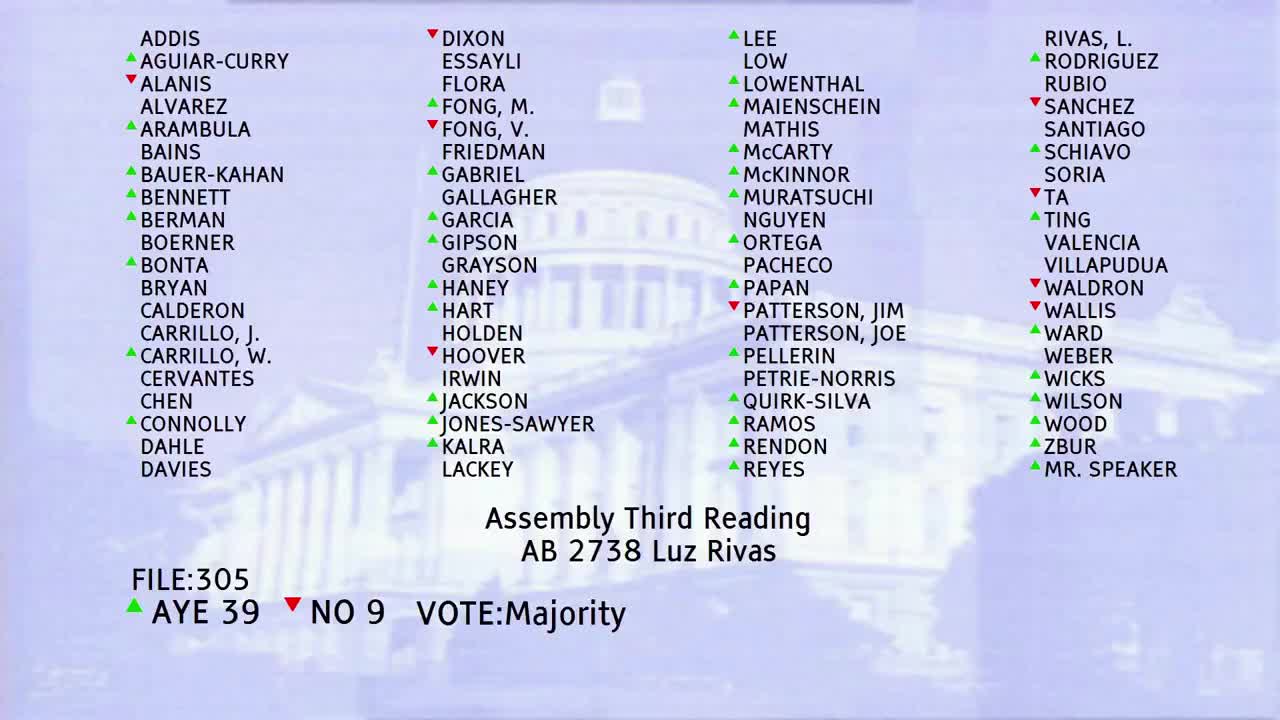
Bill Author

Bill Co-Author(s):