AB 2813: Government Investment Act.
- Session Year: 2023-2024
- House: Assembly
- Latest Version Date: 2024-07-18
Current Status:
Passed
(2024-07-18: Chaptered by Secretary of State - Chapter 155, Statutes of 2024.)
Introduced
In Committee
First Chamber
In Committee
Second Chamber
Enacted
(1)Existing law, known as the Proposition 218 Omnibus Implementation Act, defines various terms and prescribes procedures and parameters for local jurisdictions to comply with specified provisions of the California Constitution.
The Legislature adopted Assembly Constitutional Amendment 1 (ACA 1) and Assembly Constitutional Amendment 10 (ACA 10), amending ACA 1, at the 202324 Regular Session of the Legislature. If approved by the voters, ACA 1 would amend provisions of the California Constitution to create an additional exception to the 1% limit on the ad valorem tax rate on real property by authorizing a local jurisdiction to levy an ad valorem tax to service bonded indebtedness incurred to fund the construction, reconstruction, rehabilitation, or replacement of public infrastructure or affordable housing, if the proposition proposing that tax is approved by 55% of the voters in that local jurisdiction.
Pursuant to the existing law described above, ACA 1 is scheduled to appear on the ballot at the November 5, 2024, statewide general election.
This bill, for purposes of ACA 1, would define affordable housing to include rental housing, ownership housing, interim housing, and affordable housing programs such as downpayment assistance, first-time homebuyer programs, and owner-occupied affordable housing rehabilitation programs, that are affordable to households earning up to 150% of countywide median income. The bill would require a local government to ensure that any project that is funded with ACA 1 bonded indebtedness to have an estimated useful life of at least 15 years or 5 years if the funds are for specified public safety facilities, infrastructure, and equipment. The bill would define public infrastructure to exclude the construction, reconstruction, rehabilitation, or replacement of a sports stadium or arena where the majority of the use of the facility is for private ticketed activities. The bill would prohibit ACA 1 bonded indebtedness from being used for the acquisition or lease of any real property that has, at the time of acquisition or lease, been improved with one to 4 dwelling units, except as specified. The bill would also prohibit any ACA 1 bonded indebtedness, when added to existing bonded indebtedness of a local government, from exceeding the applicable statutory limit on the maximum amount of bonded indebtedness that a local government is authorized to incur.
ACA 1, as amended by ACA 10, and if approved by the voters, would require a proposition approving ACA 1 bonded indebtedness to include specified accountability requirements, including a requirement that the local government conduct annual independent performance and financial audits, as specified, and a requirement that the local government appoint a citizens oversight committee to ensure that revenues are expended only for the purposes described in the measure. ACA 1, if approved by the voters, would require a local government to submit the annual independent performance and financial audits to the California State Auditor for review. ACA 1, if approved by the voters, would authorize the Legislature to enact additional accountability measures, provided that the accountability measures are consistent with the purposes and intent of ACA 1.
This bill would require the California State Auditor to review, following specified practices, audits submitted based on the ACA 1 bonded indebtedness provisions.
The bill would establish various requirements regarding the appointment and function of a citizens oversight committee. In this regard, the bill would require the citizens oversight committee to consist of at least 7 members who serve for a minimum term of 2 years without compensation. The bill would prohibit an employee or official of the local government and any vendor, contractor, or consultant of the local government from being appointed to the citizens oversight committee. The bill would state the purpose of a citizens oversight committee is to inform the public concerning the expenditure of revenues derived from ACA 1 bonded indebtedness. The bill would require a citizens oversight committee to actively review and report on the proper expenditure of taxpayers money for the purposes described in ACA 1 and advise the public as to whether a local government is in compliance with the requirements of ACA 1. The bill would require the committee to issue regular reports on the results of its activities and would require the local government to provide the citizens oversight committee with any necessary technical assistance and administrative assistance in furtherance of its purpose, as specified.
Because the bill would enact additional accountability measures for ACA 1 taxes, the bill may only be adopted by a 2/3 vote of the Legislature.
ACA 1, if approved by the voters, would prohibit a local government from placing a proposition on the ballot pursuant to ACA 1 if the voters have previously approved an ACA 1 proposition until all funds from the previous proposition are committed to programs and projects, as described.
This bill would define committed for purposes of ACA 1 to mean all of the funds from ACA 1 bonded indebtedness are dedicated to specific projects or programs.
(2)Existing law, the Fire Protection District Law of 1987, requires a fire protection district board of directors to adopt a resolution making determinations and calling an election on a proposition to incur indebtedness and to issue general obligation bonds whenever that district board determines that it is necessary to incur a general obligation bonded indebtedness for the acquisition or construction of any real property or other capital expense or for funding or refunding of any outstanding indebtedness. Existing law also authorizes the district board, if 2/3 of voters voting upon the proposition favor incurring the indebtedness and issuing the bonds, to adopt resolutions to issue bonds for all or any part of the amount of the indebtedness.
This bill would create an exception to that provision to authorize the district board, if 55% of voters voting upon the proposition favor incurring the indebtedness and issuing bonds that would fund any or all of the activities described in ACA 1, to adopt resolutions to issue bonds for all or any part of the amount of the indebtedness.
(3)This bill would state that its provisions are severable.
(4)The bill would provide that these provisions would become operative only if Assembly Constitutional Amendment 1 of the 202324 Regular Session is approved by the voters.
(5)This bill would declare that it is to take effect immediately as an urgency statute.
(1)Existing law, known as the Proposition 218 Omnibus Implementation Act, defines various terms and prescribes procedures and parameters for local jurisdictions to comply with specified provisions of the California Constitution.
The Legislature adopted Assembly Constitutional Amendment 1 (ACA 1) at the 202324 Regular Session of the Legislature, which, if approved by the voters, would amend and add provisions of the California Constitution to (1) create an additional exception to the 1% limit on the ad valorem tax rate on real property by authorizing a local jurisdiction to levy an ad valorem tax to service bonded indebtedness incurred to fund the construction, reconstruction, rehabilitation, or replacement of public infrastructure, affordable housing, or permanent supportive housing, if the proposition proposing that tax is approved by 55% of the voters in that local jurisdiction; and (2) authorize a local jurisdiction to impose, extend, or increase a sales and use tax to fund the construction, reconstruction, rehabilitation, or replacement of public infrastructure, affordable housing, or permanent supportive housing, if the proposition proposing that tax is approved by 55% of the voters in that local jurisdiction.
Pursuant to the existing law described above, ACA 1 is scheduled to appear on the ballot at the November 5, 2024, statewide general election.
This bill, for purposes of ACA 1, would define affordable housing to include rental housing, ownership housing, interim housing, and affordable housing programs such as downpayment assistance, first-time homebuyer programs, and owner-occupied affordable housing rehabilitation programs, that are affordable to households earning up to 150% of countywide median income. The bill would require a local government to ensure that any project that is funded with ACA 1 bonded indebtedness to have an estimated useful life of at least 15 years or 5 years if the funds are for specified public safety facilities, infrastructure, and equipment. The bill would define public infrastructure to exclude the construction, reconstruction, rehabilitation, or replacement of a sports stadium or arena where the majority of the use of the facility is for private ticketed activities. The bill would prohibit ACA 1 bonded indebtedness from being used for the acquisition or lease of any real property that has, at the time of acquisition or lease, been improved with one to 4 dwelling units, except as specified. The bill would also prohibit any ACA 1 bonded indebtedness, when added to existing bonded indebtedness of a local government, from exceeding the applicable statutory limit on the maximum amount of bonded indebtedness that a local government is authorized to incur.
ACA 1, if approved by the voters, would require a proposition approving ACA 1 bonded indebtedness or an ACA special tax to include specified accountability requirements, including a requirement that the local government conduct annual independent performance and financial audits, as specified, and a requirement that the local government appoint a citizens oversight committee to ensure that revenues are expended only for the purposes described in the measure. ACA 1, if approved by the voters, would require a local government to submit the annual independent performance and financial audits to the California State Auditor for review. ACA 1, if approved by the voters, would authorize the Legislature to enact additional accountability measures, provided that the accountability measures are consistent with the purposes and intent of ACA 1.
This bill would require the California State Auditor to review a sample of annual independent performance audits and the annual independent financial audits that must be conducted under ACA 1 based on best practices. The bill would require the California State Auditor to establish best practices for the purposes for these provisions. review, following specified practices, audits submitted based on the ACA 1 bonded indebtedness provisions.
The bill would establish various requirements regarding the appointment and function of a citizens oversight committee. In this regard, the bill would require the citizens oversight committee to consist of at least 7 members who serve for a minimum term of 2 years without compensation. The bill would prohibit an employee or official of the local government and any vendor, contractor, or consultant of the local government from being appointed to the citizens oversight committee. The bill would state the purpose of a citizens oversight committee is to inform the public concerning the expenditure of revenues derived from ACA 1 bonded indebtedness. The bill would require a citizens oversight committee to actively review and report on the proper expenditure of taxpayers money for the purposes described in ACA 1 and advise the public as to whether a local government is in compliance with the requirements of ACA 1. The bill would require the committee to issue regular reports on the results of its activities and would require the local government to provide the citizens oversight committee with any necessary technical assistance and administrative assistance in furtherance of its purpose, as specified.
Because the bill would enact additional accountability measures for ACA 1 taxes, the bill may only be adopted by a 2/3 vote of the Legislature.
ACA 1, if approved by the voters, would prohibit a local government from placing a proposition on the ballot pursuant to ACA 1 if the voters have previously approved an ACA 1 proposition until all funds from the previous proposition are committed to programs and projects, as described.
This bill would define committed for purposes of ACA 1 to mean all of the funds from ACA 1 bonded indebtedness are dedicated to specific projects or programs.
(2)Existing law, the Fire Protection District Law of 1987, requires a fire protection district board of directors to adopt a resolution making determinations and calling an election on a proposition to incur indebtedness and to issue general obligation bonds whenever that district board determines that it is necessary to incur a general obligation bonded indebtedness for the acquisition or construction of any real property or other capital expense or for funding or refunding of any outstanding indebtedness. Existing law also authorizes the district board, if 2/3 of voters voting upon the proposition favor incurring the indebtedness and issuing the bonds, to adopt resolutions to issue bonds for all or any part of the amount of the indebtedness.
This bill would create an exception to that provision to authorize the district board, if 55% of voters voting upon the proposition favor incurring the indebtedness and issuing bonds that would fund any or all of the activities described in ACA 1, to adopt resolutions to issue bonds for all or any part of the amount of the indebtedness.
(3)This bill would state that its provisions are severable.
(4)The bill would provide that these provisions would become operative only if Assembly Constitutional Amendment 1 of the 202324 Regular Session is approved by the voters.
(5)This bill would declare that it is to take effect immediately as an urgency statute.
(1)Existing law, known as the Proposition 218 Omnibus Implementation Act, defines various terms and prescribes procedures and parameters for local jurisdictions to comply with specified provisions of the California Constitution.
The Legislature adopted Assembly Constitutional Amendment 1 (ACA 1) at the 202324 Regular Session of the Legislature, which, if approved by the voters, would amend and add provisions of the California Constitution to (1) create an additional exception to the 1% limit on the ad valorem tax rate on real property by authorizing a local jurisdiction to levy an ad valorem tax to service bonded indebtedness incurred to fund the construction, reconstruction, rehabilitation, or replacement of public infrastructure, affordable housing, or permanent supportive housing, if the proposition proposing that tax is approved by 55% of the voters in that local jurisdiction; and (2) authorize a local jurisdiction to impose, extend, or increase a sales and use tax to fund the construction, reconstruction, rehabilitation, or replacement of public infrastructure, affordable housing, or permanent supportive housing, if the proposition proposing that tax is approved by 55% of the voters in that local jurisdiction.
Pursuant to the existing law described above, ACA 1 is scheduled to appear on the ballot at the November 5, 2024, statewide general election.
This bill, for purposes of ACA 1, would define affordable housing to include rental housing, ownership housing, interim housing, and affordable housing programs such as downpayment assistance, first-time homebuyer programs, and owner-occupied affordable housing rehabilitation programs, that are affordable to households earning up to 150% of countywide median income. The bill would require a local government to ensure that any project that is funded with ACA 1 bonded indebtedness to have an estimated useful life of at least 15 years or 5 years if the funds are for specified public safety facilities, infrastructure, and equipment. The bill would define public infrastructure to exclude the construction, reconstruction, rehabilitation, or replacement of a sports stadium or arena where the majority of the use of the facility is for private ticketed activities. The bill would prohibit ACA 1 bonded indebtedness from being used for the acquisition or lease of any real property that has, at the time of acquisition or lease, been improved with one to 4 dwelling units, except as specified. The bill would also prohibit any ACA 1 bonded indebtedness, when added to existing bonded indebtedness of a local government, from exceeding the applicable statutory limit on the maximum amount of bonded indebtedness that a local government is authorized to incur.
ACA 1, if approved by the voters, would require a proposition approving ACA 1 bonded indebtedness or an ACA special tax to include specified accountability requirements, including a requirement that the local government conduct annual independent performance and financial audits, as specified, and a requirement that the local government appoint a citizens oversight committee to ensure that revenues are expended only for the purposes described in the measure. ACA 1, if approved by the voters, would require a local government to submit the annual independent performance and financial audits to the California State Auditor for review. ACA 1, if approved by the voters, would authorize the Legislature to enact additional accountability measures, provided that the accountability measures are consistent with the purposes and intent of ACA 1.
This bill would require the California State Auditor to review a sample of annual independent performance audits and the annual independent financial audits that must be conducted under ACA 1 based on best practices. The bill would require the California State Auditor to establish best practices for the purposes for these provisions.
The bill would establish various requirements regarding the appointment and function of a citizens oversight committee. In this regard, the bill would require the citizens oversight committee to consist of at least 7 members who serve for a minimum term of 2 years without compensation. The bill would prohibit an employee or official of the local government and any vendor, contractor, or consultant of the local government from being appointed to the citizens oversight committee. The bill would state the purpose of a citizens oversight committee is to inform the public concerning the expenditure of revenues derived from ACA 1 bonded indebtedness. The bill would require a citizens oversight committee to actively review and report on the proper expenditure of taxpayers money for the purposes described in ACA 1 and advise the public as to whether a local government is in compliance with the requirements of ACA 1. The bill would require the committee to issue regular reports on the results of its activities and would require the local government to provide the citizens oversight committee with any necessary technical assistance and administrative assistance in furtherance of its purpose, as specified.
Because the bill would enact additional accountability measures for ACA 1 taxes, the bill may only be adopted by a 2/3 vote of the Legislature.
ACA 1, if approved by the voters, would prohibit a local government from placing a proposition on the ballot pursuant to ACA 1 if the voters have previously approved an ACA 1 proposition until all funds from the previous proposition are committed to programs and projects, as described.
This bill would define committed for purposes of ACA 1 to mean all of the funds from ACA 1 bonded indebtedness are dedicated to specific projects or programs.
(2)Existing law, the Fire Protection District Law of 1987, requires a fire protection district board of directors to adopt a resolution making determinations and calling an election on a proposition to incur indebtedness and to issue general obligation bonds whenever that district board determines that it is necessary to incur a general obligation bonded indebtedness for the acquisition or construction of any real property or other capital expense or for funding or refunding of any outstanding indebtedness. Existing law also authorizes the district board, if 2/3 of voters voting upon the proposition favor incurring the indebtedness and issuing the bonds, to adopt resolutions to issue bonds for all or any part of the amount of the indebtedness.
This bill would create an exception to that provision to authorize the district board, if 55% of voters voting upon the proposition favor incurring the indebtedness and issuing bonds that would fund any or all of the activities described in ACA 1, to adopt resolutions to issue bonds for all or any part of the amount of the indebtedness.
(3)This bill would state that its provisions are severable.
(4)The bill would provide that these provisions would become operative only if Assembly Constitutional Amendment 1 of the 202324 Regular Session is approved by the voters.
(5)This bill would declare that it is to take effect immediately as an urgency statute.
(1)Existing law, known as the Proposition 218 Omnibus Implementation Act, defines various terms and prescribes procedures and parameters for local jurisdictions to comply with specified provisions of the California Constitution.
The Legislature adopted Assembly Constitutional Amendment 1 (ACA 1) at the 202324 Regular Session of the Legislature, which, if approved by the voters, would amend and add provisions of the California Constitution to (1) create an additional exception to the 1% limit on the ad valorem tax rate on real property by authorizing a local jurisdiction to levy an ad valorem tax to service bonded indebtedness incurred to fund the construction, reconstruction, rehabilitation, or replacement of public infrastructure, affordable housing, or permanent supportive housing, if the proposition proposing that tax is approved by 55% of the voters in that local jurisdiction; and (2) authorize a local jurisdiction to impose, extend, or increase a sales and use tax to fund the construction, reconstruction, rehabilitation, or replacement of public infrastructure, affordable housing, or permanent supportive housing, if the proposition proposing that tax is approved by 55% of the voters in that local jurisdiction.
Pursuant to the existing law described above, ACA 1 is scheduled to appear on the ballot at the November 5, 2024, statewide general election.
This bill, for purposes of ACA 1, would define affordable housing to include rental housing, ownership housing, interim housing, and affordable housing programs such as downpayment assistance, first-time homebuyer programs, and owner-occupied affordable housing rehabilitation programs. programs, that are affordable to households earning up to 150% of countywide median income. The bill would require a local government to ensure that any project that is funded with ACA 1 bonded indebtedness to have an estimated useful life of at least 15 years or 5 years if the funds are for specified public safety buildings, facilities, infrastructure, and equipment. The bill would define public infrastructure to exclude the construction, reconstruction, rehabilitation, or replacement of a sports stadium or arena where the majority of the use of the facility is for private ticketed activities. The bill would prohibit ACA 1 bonded indebtedness from being used for the acquisition or lease of any real property that has, at the time of acquisition or lease, been improved with one to 4 dwelling units, except as specified. The bill would also prohibit any ACA 1 bonded indebtedness, when added to existing bonded indebtedness of a local government, from exceeding the applicable statutory limit on the maximum amount of bonded indebtedness that a local government is authorized to incur.
ACA 1, if approved by the voters, would require a proposition approving ACA 1 bonded indebtedness or an ACA special tax to include specified accountability requirements, including a requirement that the local government conduct annual independent performance and financial audits, as specified, and a requirement that the local government appoint a citizens oversight committee to ensure that revenues are expended only for the purposes described in the measure. ACA 1, if approved by the voters, would require a local government to submit the annual independent performance and financial audits to the California State Auditor for review. ACA 1, if approved by the voters, would authorize the Legislature to enact additional accountability measures, provided that the accountability measures are consistent with the purposes and intent of ACA 1.
This bill would require the California State Auditor to review an unspecified percentage a sample of annual independent performance audits and the annual independent financial audits that must be conducted under ACA 1 based on best practices. The bill would require the California State Auditor to establish best practices for the purposes for these provisions.
The bill would establish various requirements regarding the appointment and function of a citizens oversight committee. In this regard, the bill would require the citizens oversight committee to consist of at least 7 members who serve for a minimum term of 2 years without compensation. The bill would prohibit an employee or official of the local government and any vendor, contractor, or consultant of the local government from being appointed to the citizens oversight committee. The bill would state the purpose of a citizens oversight committee is to inform the public concerning the expenditure of revenues derived from ACA 1 bonded indebtedness. The bill would require a citizens oversight committee to actively review and report on the proper expenditure of taxpayers money for the purposes described in ACA 1 and advise the public as to whether a local government is in compliance with the requirements of ACA 1. The bill would require the committee to issue regular reports on the results of its activities and would require the local government to provide the citizens oversight committee with any necessary technical assistance and administrative assistance in furtherance of its purpose, as specified.
Because the bill would enact additional accountability measures for ACA 1 taxes, the bill may only be adopted by a 2/3 vote of the Legislature.
ACA 1, if approved by the voters, would prohibit a local government from placing a proposition on the ballot pursuant to ACA 1 if the voters have previously approved an ACA 1 proposition until all funds from the previous proposition are committed to programs and projects, as described.
This bill would define committed for purposes of ACA 1 to mean all of the funds from ACA 1 bonded indebtedness are dedicated to specific projects or programs.
(2)Existing law, the Fire Protection District Law of 1987, requires a fire protection district board of directors to adopt a resolution making determinations and calling an election on a proposition to incur indebtedness and to issue general obligation bonds whenever that district board determines that it is necessary to incur a general obligation bonded indebtedness for the acquisition or construction of any real property or other capital expense or for funding or refunding of any outstanding indebtedness. Existing law also authorizes the district board, if 2/3 of voters voting upon the proposition favor incurring the indebtedness and issuing the bonds, to adopt resolutions to issue bonds for all or any part of the amount of the indebtedness.
This bill would create an exception to that provision to authorize the district board, if 55% of voters voting upon the proposition favor incurring the indebtedness and issuing bonds that would fund any or all of the activities described in ACA 1, to adopt resolutions to issue bonds for all or any part of the amount of the indebtedness.
(3)This bill would state that its provisions are severable.
(4)The bill would provide that these provisions would become operative only if Assembly Constitutional Amendment 1 of the 202324 Regular Session is approved by the voters.
(5)This bill would declare that it is to take effect immediately as an urgency statute.
(1)Existing law, known as the Proposition 218 Omnibus Implementation Act, defines various terms and prescribes procedures and parameters for local jurisdictions to comply with specified provisions of the California Constitution.
The Legislature adopted Assembly Constitutional Amendment 1 (ACA 1) at the 202324 Regular Session of the Legislature, which, if approved by the voters, would amend and add provisions of the California Constitution to (1) create an additional exception to the 1% limit on the ad valorem tax rate on real property by authorizing a local jurisdiction to levy an ad valorem tax to service bonded indebtedness incurred to fund the construction, reconstruction, rehabilitation, or replacement of public infrastructure, affordable housing, or permanent supportive housing, if the proposition proposing that tax is approved by 55% of the voters in that local jurisdiction; and (2) authorize a local jurisdiction to impose, extend, or increase a sales and use tax to fund the construction, reconstruction, rehabilitation, or replacement of public infrastructure, affordable housing, or permanent supportive housing, if the proposition proposing that tax is approved by 55% of the voters in that local jurisdiction.
Pursuant to the existing law described above, ACA 1 is scheduled to appear on the ballot at the November 5, 2024, statewide general election.
This bill, for purposes of ACA 1, would define affordable housing to include rental housing, ownership housing, interim housing, and affordable housing programs such as downpayment assistance, first-time homebuyer programs, and owner-occupied affordable housing rehabilitation programs. The bill would require a local government to ensure that any project that is funded with ACA 1 bonded indebtedness or ACA 1 special taxes to have an estimated useful life of at least 15 years or 5 years if the funds are for specified public safety buildings, facilities, and equipment. The bill would define public infrastructure to exclude the construction, reconstruction, rehabilitation, or replacement of a sports stadium or arena where the majority of the use of the facility is for private ticketed activities. The bill would prohibit ACA 1 bonded indebtedness from being used for the acquisition or lease of any real property that has, at the time of acquisition or lease, been improved with one to 4 dwelling units, except as specified. The bill would also prohibit any ACA 1 bonded indebtedness, when added to existing bonded indebtedness of a local government, from exceeding the applicable statutory limit on the maximum amount of bonded indebtedness that a local government is authorized to incur.
This bill would specify that a parcel tax imposed pursuant to ACA 1 may include an exemption for persons who are 65 years of age or older whose annual income does not exceed 250% of the 2012 federal poverty guidelines, persons receiving Supplemental Security Income for a disability, or persons receiving Social Security Disability Insurance Benefits and whose yearly income does not exceed specified amounts.ACA 1, if approved by the voters, would require a proposition approving ACA 1 bonded indebtedness or an ACA special tax to include specified accountability requirements, including a requirement that the local government conduct annual independent performance and financial audits, as specified, and a requirement that the local government appoint a citizens oversight committee to ensure that revenues are expended only for the purposes described in the measure. ACA 1, if approved by the voters, would require a local government to submit the annual independent performance and financial audits to the California State Auditor for review. ACA 1, if approved by the voters, would authorize the Legislature to enact additional accountability measures, provided that the accountability measures are consistent with the purposes and intent of ACA 1.
This bill would require the California State Auditor to review an unspecified percentage of annual independent performance audits and the annual independent financial audits that must be conducted under ACA 1 based on best practices. The bill would require the California State Auditor to establish best practices for the purposes for these provisions.
The bill would establish various requirements regarding the appointment and function of a citizens oversight committee. In this regard, the bill would require the citizens oversight committee to consist of at least 7 members who serve for a minimum term of 2 years without compensation. The bill would prohibit an employee or official of the local government and any vendor, contractor, or consultant of the local government from being appointed to the citizens oversight committee. The bill would state the purpose of a citizens oversight committee is to inform the public concerning the expenditure of revenues derived from ACA 1 bonded indebtedness and ACA 1 special taxes. indebtedness. The bill would require a citizens oversight committee to actively review and report on the proper expenditure of taxpayers money for the purposes described in ACA 1 and advise the public as to whether a local government is in compliance with the requirements of ACA 1. The bill would require the committee to issue regular reports on the results of its activities and would require the local government to provide the citizens oversight committee with any necessary technical assistance and administrative assistance in furtherance of its purpose, as specified.
Because the bill would enact additional accountability measures for ACA 1 taxes, the bill may only be adopted by a 2/3 vote of the Legislature.
ACA 1, if approved by the voters, would prohibit a local government from placing a proposition on the ballot pursuant to ACA 1 if the voters have previously approved an ACA 1 proposition until all funds from the previous proposition are committed to programs and projects, as described.
This bill would defined define committed for purposes of ACA 1 to mean all of the annual tax revenue funds from ACA 1 bonded indebtedness or an ACA 1 special tax is are dedicated to specific projects or programs.
(2)Existing law, the Fire Protection District Law of 1987, requires a fire protection district board of directors to adopt a resolution making determinations and calling an election on a proposition to incur indebtedness and to issue general obligation bonds whenever that district board determines that it is necessary to incur a general obligation bonded indebtedness for the acquisition or construction of any real property or other capital expense or for funding or refunding of any outstanding indebtedness. Existing law also authorizes the district board, if 2/3 of voters voting upon the proposition favor incurring the indebtedness and issuing the bonds, to adopt resolutions to issue bonds for all or any part of the amount of the indebtedness.
This bill would create an exception to that provision to authorize the district board, if 55% of voters voting upon the proposition favor incurring the indebtedness and issuing bonds that would fund any or all of the activities described in ACA 1, to adopt resolutions to issue bonds for all or any part of the amount of the indebtedness.
The(3)This bill would state that its provisions are severable.
The(4)The bill would provide that these provisions would become operative on January 1, 2025, but only if Assembly Constitutional Amendment 1 of the 202323 202324 Regular Session is approved by the voters.
(5)This bill would declare that it is to take effect immediately as an urgency statute.
Existing law, known as the Proposition 218 Omnibus Implementation Act, defines various terms and prescribes procedures and parameters for local jurisdictions to comply with specified provisions of the California Constitution.
The Legislature adopted ACA 1 Assembly Constitutional Amendment 1 (ACA 1) at the 202324 Regular Session of the Legislature, which, if approved by the voters, would amend and add provisions of the California Constitution to (1) create an additional exception to the 1% limit on the ad valorem tax rate on real property by authorizing a local jurisdiction to levy an ad valorem tax to service bonded indebtedness incurred to fund the construction, reconstruction, rehabilitation, or replacement of public infrastructure, affordable housing, or permanent supportive housing, if the proposition proposing that tax is approved by 55% of the voters in that local jurisdiction; and (2) authorize a local jurisdiction to impose, extend, or increase a sales and use tax to fund the construction, reconstruction, rehabilitation, or replacement of public infrastructure, affordable housing, or permanent supportive housing, if the proposition proposing that tax is approved by 55% of the voters in that local jurisdiction.
Pursuant to the existing law described above, ACA 1 is scheduled to appear on the ballot at the November 5, 2024, statewide general election.
This bill would authorize a local government that imposes a tax under ACA 1 to commit revenues to affordable housing programs, including downpayment assistance, first-time home buyer programs, and owner-occupied affordable housing rehabilitation programs. The billThis bill, for purposes of ACA 1, would define affordable housing to include rental housing, ownership housing, interim housing, and affordable housing programs such as downpayment assistance, first-time homebuyer programs, and owner-occupied affordable housing rehabilitation programs. The bill would require a local government to ensure that any project that is funded with ACA 1 bonded indebtedness or ACA 1 special taxes to have an estimated useful life of at least 15 years or 5 years if the funds are for specified public safety buildings, facilities, and equipment. The bill would specify that a local government may commit revenues derived from ACA 1 bonded indebtedness or an ACA 1 special tax to projects or programs administered by a nonprofit organization for affordable housing or permanent supportive housing purposes.
This bill would specify that a parcel tax imposed pursuant to ACA 1 may include an exemption for persons who are 65 years of age or older, older whose annual income does not exceed 250% of the 2012 federal poverty guidelines, persons receiving Supplemental Security Income for a disability, or persons receiving Social Security Disability Insurance Benefits and whose yearly income does not exceed specified amounts.
ACA 1, if approved by the voters, would require a proposition approving ACA 1 bonded indebtedness or an ACA special tax to include specified accountability requirements, including a requirement that the local government conduct annual independent performance and financial audits, as specified, and a requirement that the local government appoint a citizens oversight committee to ensure that revenues are expended only for the purposes described in the measure. ACA 1, if approved by the voters, would require a local government to submit the annual independent performance and financial audits to the California State Auditor for review. ACA 1, if approved by the voters, would authorize the Legislature to enact additional accountability measures, provided that the accountability measures are consistent with the purposes and intent of ACA 1.
This bill would require the California State Auditor to review an unspecified percentage of annual independent performance audits and the annual independent financial audits that must be conducted under ACA 1 based on best practices. The bill would require the California State Auditor to establish best practices for the purposes for these provisions.
The bill would establish various requirements regarding the appointment and function of a citizens oversight committee. In this regard, the bill would require the citizens oversight committee to consist of at least 7 members who serve for a minimum term of 2 years without compensation. The bill would prohibit an employee or official of the local government and any vendor, contractor, or consultant of the local government from being appointed to the citizens oversight committee. The bill would state the purpose of a citizens oversight committee is to inform the public concerning the expenditure of revenues derived from ACA 1 bonded indebtedness and ACA 1 special taxes. The bill would require a citizens oversight committee to actively review and report on the proper expenditure of taxpayers money for the purposes described in ACA 1 and advise the public as to whether a local government is in compliance with the requirements of ACA 1. The bill would require the committee to issue regular reports on the results of its activities and would require the local government to provide the citizens oversight committee with any necessary technical assistance and administrative assistance in furtherance of its purpose, as specified.
Because the bill would enact additional accountability measures for ACA 1 taxes, the bill may only be adopted by a 2/3 vote of the Legislature.
ACA 1, if approved by the voters, would prohibit a local government from placing a proposition on the ballot pursuant to ACA 1 if the voters have previously approved an ACA 1 proposition until all funds from the previous proposition are committed to programs and projects, as described.
This bill would defined committed for purposes of ACA 1 to mean all of the annual tax revenue from ACA 1 bonded indebtedness or an ACA 1 special tax is dedicated to specific projects or programs.
The bill would state that its provisions are severable.
The bill would provide that these provisions would become operative on January 1, 2025, but only if Assembly Constitutional Amendment 1 of the 202323 Regular Session is approved by the voters.
Existing law, known as the Proposition 218 Omnibus Implementation Act, defines various terms and prescribes procedures and parameters for local jurisdictions to comply with specified provisions of the California Constitution.
The Legislature adopted ACA 1 at the 202324 Regular Session of the Legislature, which, if approved by the voters, would amend and add provisions of the California Constitution to (1) create an additional exception to the 1% limit on the ad valorem tax rate on real property by authorizing a local jurisdiction to levy an ad valorem tax to service bonded indebtedness incurred to fund the construction, reconstruction, rehabilitation, or replacement of public infrastructure, affordable housing, or permanent supportive housing, if the proposition proposing that tax is approved by 55% of the voters in that local jurisdiction; and (2) authorize a local jurisdiction to impose, extend, or increase a sales and use tax to fund the construction, reconstruction, rehabilitation, or replacement of public infrastructure, affordable housing, or permanent supportive housing, if the proposition proposing that tax is approved by 55% of the voters in that local jurisdiction.
Pursuant to the existing law described above, ACA 1 is scheduled to appear on the ballot at the November 5, 2024, statewide general election.
This bill would authorize a local government that imposes a tax under ACA 1 to commit revenues to affordable housing programs, including downpayment assistance, first-time home buyer programs, and owner-occupied affordable housing rehabilitation programs. The bill would require a local government to ensure that any project that is funded with ACA 1 bonded indebtedness or ACA 1 special taxes to have an estimated useful life of at least 15 years or 5 years if the funds are for specified public safety buildings, facilities, and equipment. The bill would specify that a local government may commit revenues derived from ACA 1 bonded indebtedness or an ACA 1 special tax to projects or programs administered by a nonprofit organization for affordable housing or permanent supportive housing purposes.
This bill would specify that a parcel tax imposed pursuant to ACA 1 may include an exemption for persons who are 65 years of age or older, receiving Supplemental Security Income for a disability, or receiving Social Security Disability Insurance Benefits and whose yearly income does not exceed specified amounts.
ACA 1, if approved by the voters, would require a proposition approving ACA 1 bonded indebtedness or an ACA special tax to include specified accountability requirements, including a requirement that the local government conduct annual independent performance and financial audits, as specified, and a requirement that the local government appoint a citizens oversight committee to ensure that revenues are expended only for the purposes described in the measure. ACA 1, if approved by the voters, would require a local government to submit the annual independent performance and financial audits to the California State Auditor for review. ACA 1, if approved by the voters, would authorize the Legislature to enact additional accountability measures, provided that the accountability measures are consistent with the purposes and intent of ACA 1.
This bill would require the California State Auditor to review an unspecified percentage of annual independent performance audits and the annual independent financial audits that must be conducted under ACA 1 based on best practices. The bill would require the California State Auditor to establish best practices for the purposes for these provisions.
The bill would establish various requirements regarding the appointment and function of a citizens oversight committee. In this regard, the bill would state the purpose of a citizens oversight committee is to inform the public concerning the expenditure of revenues derived from ACA 1 bonded indebtedness and ACA 1 special taxes. The bill would require a citizens oversight committee to actively review and report on the proper expenditure of taxpayers money for the purposes described in ACA 1 and advise the public as to whether a local government is in compliance with the requirements of ACA 1.
Because the bill would enact additional accountability measures for ACA 1 taxes, the bill may only be adopted by a 2/3 vote of the Legislature.
ACA 1, if approved by the voters, would prohibit a local government from placing a proposition on the ballot pursuant to ACA 1 if the voters have previously approved an ACA 1 proposition until all funds from the previous proposition are committed to programs and projects, as described.
This bill would defined committed for purposes of ACA 1 to mean all of the annual tax revenue from ACA 1 bonded indebtedness or an ACA 1 special tax is dedicated to specific projects or programs.
The bill would state that its provisions are severable.
The bill would provide that these provisions would become operative on January 1, 2025, but only if Assembly Constitutional Amendment 1 of the 202323 Regular Session is approved by the voters.
For purposes of this article:
(a)ACA 1 bonded indebtedness means bonded indebtedness incurred by a local government pursuant to paragraph (4) of subdivision (b) of Section 1 of Article XIIIA of the California Constitution.
(b)Audits means the annual independent performance audit and the annual independent financial audit conducted by a local government pursuant to clauses (iv) and (v) of subparagraph (A) of paragraph (4) of subdivision (b) of Section 1 of Article XIIIA of the California Constitution.
(c)Citizens oversight committee means a citizens oversight committee appointed to oversee proceeds from ACA 1 bonded indebtedness.
(d)Local government means any county, city, city and county, including a charter city or county, any special district, a transit district, a regional transportation commission, or an association of governments, except that local government does not include a school district, redevelopment agency, or successor agency to a dissolved redevelopment agency.
53738.1.For purposes of paragraph (4) of subdivision (b) of Section 1 of Article XIIIA and subdivision (b) of Section 18 of Article XVI of the California Constitution, affordable housing includes, but is not limited to, rental housing, ownership housing, interim housing, and affordable housing programs such as downpayment assistance, first-time homebuyer programs, and owner-occupied affordable housing rehabilitation programs, that are affordable to households earning up to 150 percent of countywide median income.
53738.2.(a)Notwithstanding Section 53738.1 or any other provision of law, ACA 1 bonded indebtedness shall not be used for the acquisition or lease of any real property that has, at the time of acquisition or lease, been improved with one to four dwelling units.
(b)Subdivision (a) shall not apply to any of the following:
(1)The acquisition or lease of real property for construction of facilities or infrastructure for the delivery of police, fire protection, or emergency medical services listed in subclause (I) of clause (iv) of subparagraph (E) of paragraph (4) of subdivision (b) of Section 1 of Article XIIIA of the California Constitution.
(2)The acquisition or lease of real property that received funds through downpayment assistance or first-time homebuyer programs funded through ACA 1 bonded indebtedness.
(3)The acquisition or lease of real property acquired or leased by an entity that qualifies for the partial welfare exemption as described in paragraph (1) of subdivision (g) of Section 214 of the Revenue and Taxation Code that is organized and operated for the specific and primary purpose of serving any or all of the following: survivors of domestic violence, refugees, or people with developmental disabilities. Those units housing survivors of domestic violence, refugees, or people with developmental disabilities shall be subject to a recorded deed restriction that restricts the use of the unit as follows:
(A)For 55 years for rented units, unless a local ordinance or the terms of a federal, state, or local grant, tax credit, or other project financing requires, as a condition of the development of residential units, that the development include a certain percentage of units that are affordable to, and occupied by, low-income, lower income, very low income, or extremely low income households for a term that exceeds 55 years for rental housing units.
(B)For 45 years for owner-occupied units.
(4)The acquisition or lease of real property by a nonprofit corporation organized pursuant to Section 501(c)(3) of the Internal Revenue Code that receive a welfare exemption under Section 214.15 of the Revenue and Taxation Code for properties to be sold to low-income families who participate in a below-market interest rate loan program.
53738.3.For purposes of paragraph (4) of subdivision (b) of Section 1 of Article XIIIA of the California Constitution, public infrastructure shall not include the construction, reconstruction, rehabilitation, or replacement of a sports stadium or arena where the majority of the use of the facility is for private ticketed activities.
53738.4.Notwithstanding any other provision of law, any ACA 1 bonded indebtedness, when added to existing bonded indebtedness of a local government, shall not exceed the applicable statutory limit on the maximum amount of bonded indebtedness that a local government may incur.
53738.5.(a)Except as provided in subdivision (b), a local government shall ensure that any project that is funded with ACA 1 bonded indebtedness has an estimated useful life of at least 15 years.
(b)Notwithstanding subdivision (a), expenditures made pursuant to subclause (IV) of clause (iv) of subparagraph (E) of paragraph (4) of subdivision (b) of Section 1 of Article XIIIA of the California Constitution shall have an estimated use of life of at least five years.
53738.6.The California State Auditor shall review audits submitted based on Section 1 of Article XIIIA of the California Constitution pursuant to existing practices utilized for review of publicly available information as referenced in subdivision (b) of Section 8546.10.
53738.7.(a)A local government shall appoint a citizens oversight committee within 90 days of certifying an election that approves ACA 1 bonded indebtedness.
(b)(1)The purpose of the citizens oversight committee shall be to inform the public concerning the expenditure of revenues derived from ACA 1 bonded indebtedness.
(2)The citizens oversight committee shall actively review and report on the proper expenditure of taxpayers money for the construction, reconstruction, rehabilitation, or replacement of public infrastructure, affordable housing, or permanent supportive housing for persons at risk of chronic homelessness and the acquisition or lease of real property for public infrastructure, affordable housing, or permanent supportive housing for persons at risk of chronic homelessness.
(3)The citizens oversight committee shall advise the public as to whether a local government is in compliance with the requirements of paragraph (4) of subdivision (b) of Section 1 of Article XIIIA of the California Constitution.
(4)The citizens oversight committee shall convene to provide oversight for, but not be limited to, all of the following:
(A)Ensuring that revenues derived from ACA 1 bonded indebtedness are expended only for the purposes described in paragraph (4) of subdivision (b) of Section 1 of Article XIIIA of the California Constitution.
(B)Ensuring that funds are not used for employee salaries or other operating expenses, as prohibited by subparagraph (A) of paragraph (4) of subdivision (b) of Section 1 of Article XIIIA of the California Constitution.
(C)Ensuring that the administrative costs of the local government executing the projects and programs do not exceed 5 percent of the proceeds derived from the ACA 1 bonded indebtedness, as prohibited by subparagraph (A) of paragraph (4) of subdivision (b) of Section 1 of Article XIIIA of the California Constitution.
(c)In furtherance of its purpose, the citizens oversight committee may engage in any of the following activities:
(1)Receiving and reviewing copies of the annual, independent performance audit required by subparagraph (A) of paragraph (4) of subdivision (b) of Section 1 of Article XIIIA of the California Constitution.
(2)Receiving and reviewing copies of the annual, independent financial audit required by subparagraph (A) of paragraph (4) of subdivision (b) of Section 1 of Article XIIIA of the California Constitution.
(3)Inspecting public infrastructure, affordable housing, or permanent supportive housing to ensure that revenues derived from ACA 1 bonded indebtedness are expended in compliance with the requirements of paragraph (4) of subdivision (b) of Section 1 of Article XIIIA of the California Constitution.
(4)Receiving and reviewing copies of any local program or ordinance through which projects or programs will be funded with revenues derived from ACA 1 bonded indebtedness.
(5)Reviewing efforts by the local government to maximize revenues derived from ACA 1 bonded indebtedness by implementing cost-saving measures, including, but not limited to, all of the following:
(A)Mechanisms designed to reduce the costs of professional fees.
(B)Mechanisms designed to reduce the costs of site preparation.
(C)Mechanisms designed to reduce costs by incorporating efficiencies in public infrastructure, affordable housing, or permanent supportive housing design.
(D)Recommendations regarding the use of cost-effective and efficient reusable public infrastructure, affordable housing, or permanent supportive housing plans.
(d)All citizens oversight committee proceedings shall be open to the public and notice to the public shall be provided in the same manner as the proceedings of the governing board of the local government. The citizens oversight committee shall issue regular reports on the results of its activities. A report shall be issued at least once a year. Minutes of the proceedings of the citizens oversight committee and all documents received and reports issued shall be a matter of public record and be made available on an internet website maintained by the governing board of the local government.
(e)(1)The governing board of the local government shall, without expending proceeds derived from the ACA 1 bonded indebtedness, provide the citizens oversight committee with any necessary technical assistance and shall provide administrative assistance in furtherance of its purpose and sufficient resources to publicize the conclusions of the citizens oversight committee. Nothing in this section shall be construed to require the local government to pay for outside consultants for the committee.
(2)The local government shall provide the citizens oversight committee with responses to any and all findings, recommendations, and concerns addressed in the annual, independent financial and performance audits required by clauses (iv) and (v) of subparagraph (A) of paragraph (4) of subdivision (b) of Section 1 of Article XIIIA of the California Constitution within three months of receiving the audits.
(f)The citizens oversight committee shall consist of at least seven members who shall serve for a minimum term of two years without compensation and for no more than three consecutive terms.
(g)(1)An employee or official of the local government shall not be appointed to the citizens oversight committee.
(2)A vendor, contractor, or consultant of the local government shall not be appointed to the citizens oversight committee.
(3)Members of the citizens oversight committee shall abide by the prohibitions contained in Article 4 (commencing with Section 1090) and Article 4.7 (commencing with Section 1125) of Chapter 1 of Division 4 of Title 1.
53738.8.For purposes of clause (ix) of subparagraph (A) of paragraph (4) of subdivision (b) of Section 1 of Article XIIIA of the California Constitution, members of the legislative body of the local government and members of the citizens oversight committee shall be subject to Section 1090.
53738.9.For purposes of subparagraph (B) of paragraph (4) of subdivision (b) of Section 1 of Article XIIIA of the California Constitution, committed means all of the funds from the ACA 1 bonded indebtedness are dedicated to specific projects or programs.
53738.10.The provisions of this article are severable. If any provision of this article or its application is held invalid, that invalidity shall not affect other provisions or applications that can be given effect without the invalid provision or application.
SEC. 2.Section 13928 of the Health and Safety Code is amended to read:13928.(a)Except as provided in subdivision (b), if two-thirds of voters voting upon the proposition favor incurring the indebtedness and issuing the bonds, the district board may adopt resolutions to issue bonds for all or any part of the amount of the indebtedness.
(b)If 55 percent of voters voting upon the proposition favor incurring the indebtedness and issuing bonds that would fund any or all of the activities described in paragraph (4) of subdivision (b) of Section 1 of Article XIIIA of the California Constitution, the district board may adopt resolutions to issue bonds for all or any part of the amount of the indebtedness.
SEC. 3.Sections 1 and 2 of this act shall become operative only if Assembly Constitutional Amendment 1 of the 202324 Regular Session is approved by the voters.
SEC. 4.This act is an urgency statute necessary for the immediate preservation of the public peace, health, or safety within the meaning of Article IV of the California Constitution and shall go into immediate effect. The facts constituting the necessity are:
In order for the provisions of Assembly Constitutional Amendment 1 (Resolution Chapter 173 of the Statutes of 2023) to be implemented concurrently, it is necessary for this act to take effect immediately.
For purposes of this article:
(a)ACA 1 bonded indebtedness means bonded indebtedness incurred by a local government pursuant to paragraph (4) of subdivision (b) of Section 1 of Article XIIIA of the California Constitution.
(b)Audits means the annual independent performance audit and the annual independent financial audit conducted by a local government pursuant to clauses (iv) and (v) of subparagraph (A) of paragraph (4) of subdivision (b) of Section 1 of Article XIIIA of the California Constitution.
(c)Citizens oversight committee means a citizens oversight committee appointed to oversee proceeds from ACA 1 bonded indebtedness.
(d)Local government means any county, city, city and county, including a charter city or county, any special district, a transit district, a regional transportation commission, or an association of governments, except that local government does not include a school district, redevelopment agency, or successor agency to a dissolved redevelopment agency.
53738.1.For purposes of paragraph (4) of subdivision (b) of Section 1 of Article XIIIA and subdivision (b) of Section 18 of Article XVI of the California Constitution, affordable housing includes, but is not limited to, rental housing, ownership housing, interim housing, and affordable housing programs such as downpayment assistance, first-time homebuyer programs, and owner-occupied affordable housing rehabilitation programs, that are affordable to households earning up to 150 percent of countywide median income.
53738.2.(a)Notwithstanding Section 53738.1 or any other provision of law, ACA 1 bonded indebtedness shall not be used for the acquisition or lease of any real property that has, at the time of acquisition or lease, been improved with one to four dwelling units.
(b)Subdivision (a) shall not apply to any of the following:
(1)The acquisition or lease of real property for construction of facilities or infrastructure for the delivery of police, fire protection, or emergency medical services listed in subclause (I) of clause (iv) of subparagraph (E) of paragraph (4) of subdivision (b) of Section 1 of Article XIIIA of the California Constitution.
(2)The acquisition or lease of real property that received funds through downpayment assistance or first-time homebuyer programs funded through ACA 1 bonded indebtedness.
(3)The acquisition or lease of real property acquired or leased by an entity that qualifies for the partial welfare exemption as described in paragraph (1) of subdivision (g) of Section 214 of the Revenue and Taxation Code that is organized and operated for the specific and primary purpose of serving any or all of the following: survivors of domestic violence, refugees, or people with developmental disabilities. Those units shall be subject to a recorded deed restriction that restricts the use of the unit to serving or housing survivors of domestic violence, refugees, or people with developmental disabilities shall be subject to a recorded deed restriction that restricts the use of the unit as follows:
(A)For 55 years for rented units, unless a local ordinance or the terms of a federal, state, or local grant, tax credit, or other project financing requires, as a condition of the development of residential units, that the development include a certain percentage of units that are affordable to, and occupied by, low-income, lower income, very low income, or extremely low income households for a term that exceeds 55 years for rental housing units.
(B)For 45 years for owner-occupied units.
(4)The acquisition or lease of real property by a nonprofit corporation organized pursuant to Section 501(c)(3) of the Internal Revenue Code that receive a welfare exemption under Section 214.15 of the Revenue and Taxation Code for properties to be sold to low-income families who participate in a below-market interest rate loan program.
53738.3.For purposes of paragraph (4) of subdivision (b) of Section 1 of Article XIIIA of the California Constitution, public infrastructure shall not include the construction, reconstruction, rehabilitation, or replacement of a sports stadium or arena where the majority of the use of the facility is for private ticketed activities.
53738.4.Notwithstanding any other provision of law, any ACA 1 bonded indebtedness, when added to existing bonded indebtedness of a local government, shall not exceed the applicable statutory limit on the maximum amount of bonded indebtedness that a local government may incur.
53738.5.(a)Except as provided in subdivision (b), a local government shall ensure that any project that is funded with ACA 1 bonded indebtedness has an estimated useful life of at least 15 years.
(b)Notwithstanding subdivision (a), expenditures made pursuant to subclause (IV) of clause (iv) of subparagraph (E) of paragraph (4) of subdivision (b) of Section 1 of Article XIIIA of the California Constitution shall have an estimated use of life of at least five years.
53738.6.(a)The California State Auditor shall review a sample of the audits it receives each year based on best practices. audits submitted based on Section 1 of Article XIIIA of the California Constitution pursuant to existing practices utilized for review of publicly available information as referenced in subdivision (b) of Section 8546.10.
(b)The California State Auditor shall establish best practices for purposes of reviewing audits pursuant to subdivision (a).53738.7.(a)A local government shall appoint a citizens oversight committee within 90 days of certifying an election that approves ACA 1 bonded indebtedness.
(b)(1)The purpose of the citizens oversight committee shall be to inform the public concerning the expenditure of revenues derived from ACA 1 bonded indebtedness.
(2)The citizens oversight committee shall actively review and report on the proper expenditure of taxpayers money for the construction, reconstruction, rehabilitation, or replacement of public infrastructure, affordable housing, or permanent supportive housing for persons at risk of chronic homelessness and the acquisition or lease of real property for public infrastructure, affordable housing, or permanent supportive housing for persons at risk of chronic homelessness.
(3)The citizens oversight committee shall advise the public as to whether a local government is in compliance with the requirements of paragraph (4) of subdivision (b) of Section 1 of Article XIIIA of the California Constitution.
(4)The citizens oversight committee shall convene to provide oversight for, but not be limited to, all of the following:
(A)Ensuring that revenues derived from ACA 1 bonded indebtedness are expended only for the purposes described in paragraph (4) of subdivision (b) of Section 1 of Article XIIIA of the California Constitution.
(B)Ensuring that funds are not used for employee salaries or other operating expenses, as prohibited by subparagraph (A) of paragraph (4) of subdivision (b) of Section 1 of Article XIIIA of the California Constitution.
(C)Ensuring that the administrative costs of the local government executing the projects and programs do not exceed 5 percent of the proceeds derived from the ACA 1 bonded indebtedness, as prohibited by subparagraph (A) of paragraph (4) of subdivision (b) of Section 1 of Article XIIIA of the California Constitution.
(c)In furtherance of its purpose, the citizens oversight committee may engage in any of the following activities:
(1)Receiving and reviewing copies of the annual, independent performance audit required by subparagraph (A) of paragraph (4) of subdivision (b) of Section 1 of Article XIIIA of the California Constitution.
(2)Receiving and reviewing copies of the annual, independent financial audit required by subparagraph (A) of paragraph (4) of subdivision (b) of Section 1 of Article XIIIA of the California Constitution.
(3)Inspecting public infrastructure, affordable housing, or permanent supportive housing to ensure that revenues derived from ACA 1 bonded indebtedness are expended in compliance with the requirements of paragraph (4) of subdivision (b) of Section 1 of Article XIIIA of the California Constitution.
(4)Receiving and reviewing copies of any local program or ordinance through which projects or programs will be funded with revenues derived from ACA 1 bonded indebtedness.
(5)Reviewing efforts by the local government to maximize revenues derived from ACA 1 bonded indebtedness by implementing cost-saving measures, including, but not limited to, all of the following:
(A)Mechanisms designed to reduce the costs of professional fees.
(B)Mechanisms designed to reduce the costs of site preparation.
(C)Mechanisms designed to reduce costs by incorporating efficiencies in public infrastructure, affordable housing, or permanent supportive housing design.
(D)Recommendations regarding the use of cost-effective and efficient reusable public infrastructure, affordable housing, or permanent supportive housing plans.
(d)All citizens oversight committee proceedings shall be open to the public and notice to the public shall be provided in the same manner as the proceedings of the governing board of the local government. The citizens oversight committee shall issue regular reports on the results of its activities. A report shall be issued at least once a year. Minutes of the proceedings of the citizens oversight committee and all documents received and reports issued shall be a matter of public record and be made available on an internet website maintained by the governing board of the local government.
(e)(1)The governing board of the local government shall, without expending proceeds derived from the ACA 1 bonded indebtedness, provide the citizens oversight committee with any necessary technical assistance and shall provide administrative assistance in furtherance of its purpose and sufficient resources to publicize the conclusions of the citizens oversight committee. Nothing in this section shall be construed to require the local government to pay for outside consultants for the committee.
(2)The local government shall provide the citizens oversight committee with responses to any and all findings, recommendations, and concerns addressed in the annual, independent financial and performance audits required by clauses (iv) and (v) of subparagraph (A) of paragraph (4) of subdivision (b) of Section 1 of Article XIIIA of the California Constitution within three months of receiving the audits.
(f)The citizens oversight committee shall consist of at least seven members who shall serve for a minimum term of two years without compensation and for no more than three consecutive terms.
(g)(1)An employee or official of the local government shall not be appointed to the citizens oversight committee.
(2)A vendor, contractor, or consultant of the local government shall not be appointed to the citizens oversight committee.
(3)Members of the citizens oversight committee shall abide by the prohibitions contained in Article 4 (commencing with Section 1090) and Article 4.7 (commencing with Section 1125) of Chapter 1 of Division 4 of Title 1.
53738.8.For purposes of clause (ix) of subparagraph (A) of paragraph (4) of subdivision (b) of Section 1 of Article XIIIA of the California Constitution, members of the legislative body of the local government and members of the citizens oversight committee shall be subject to Section 1090.
53738.9.For purposes of subparagraph (B) of paragraph (4) of subdivision (b) of Section 1 of Article XIIIA of the California Constitution, committed means all of the funds from the ACA 1 bonded indebtedness are dedicated to specific projects or programs.
53738.10.The provisions of this article are severable. If any provision of this article or its application is held invalid, that invalidity shall not affect other provisions or applications that can be given effect without the invalid provision or application.
SEC. 2.Section 13928 of the Health and Safety Code is amended to read:13928.(a)Except as provided in subdivision (b), if two-thirds of voters voting upon the proposition favor incurring the indebtedness and issuing the bonds, the district board may adopt resolutions to issue bonds for all or any part of the amount of the indebtedness.
(b)If 55 percent of voters voting upon the proposition favor incurring the indebtedness and issuing bonds that would fund any or all of the activities described in paragraph (4) of subdivision (b) of Section 1 of Article XIIIA of the California Constitution, the district board may adopt resolutions to issue bonds for all or any part of the amount of the indebtedness.
SEC. 3.Sections 1 and 2 of this act shall become operative only if Assembly Constitutional Amendment 1 of the 202324 Regular Session is approved by the voters.
SEC. 4.This act is an urgency statute necessary for the immediate preservation of the public peace, health, or safety within the meaning of Article IV of the California Constitution and shall go into immediate effect. The facts constituting the necessity are:
In order for the provisions of Assembly Constitutional Amendment 1 (Resolution Chapter 173 of the Statutes of 2023) to be implemented concurrently, it is necessary for this act to take effect immediately.
For purposes of this article:
(a)ACA 1 bonded indebtedness means bonded indebtedness incurred by a local government pursuant to paragraph (4) of subdivision (b) of Section 1 of Article XIIIA of the California Constitution.
(b)Audits means the annual independent performance audit and the annual independent financial audit conducted by a local government pursuant to clauses (iv) and (v) of subparagraph (A) of paragraph (4) of subdivision (b) of Section 1 of Article XIIIA of the California Constitution.
(c)Citizens oversight committee means a citizens oversight committee appointed to oversee proceeds from ACA 1 bonded indebtedness.
(d)Local government means any county, city, city and county, including a charter city or county, any special district, a transit district, a regional transportation commission, or an association of governments, except that local government does not include a school district, redevelopment agency, or successor agency to a dissolved redevelopment agency.
53738.1.For purposes of paragraph (4) of subdivision (b) of Section 1 of Article XIIIA and subdivision (b) of Section 18 of Article XVI of the California Constitution, affordable housing includes, but is not limited to, rental housing, ownership housing, interim housing, and affordable housing programs such as downpayment assistance, first-time homebuyer programs, and owner-occupied affordable housing rehabilitation programs, that are affordable to households earning up to 150 percent of countywide median income.
53738.2.(a)Notwithstanding Section 53738.1 or any other provision of law, ACA 1 bonded indebtedness shall not be used for the acquisition or lease of any real property that has, at the time of acquisition or lease, been improved with one to four dwelling units.
(b)Subdivision (a) shall not apply to the acquisition any of the following:
(1)The acquisition or lease of real property for construction of facilities or infrastructure for the delivery of police, fire protection, or emergency medical services listed in subclause (I) of clause (iv) of subparagraph (E) of paragraph (4) of subdivision (b) of Section 1 of Article XIII A of the California Constitution.
(c)Subdivision (a) shall not apply to the acquisition(2)The acquisition or lease of real property that received funds through downpayment assistance or first-time homebuyer programs funded through ACA 1 bonded indebtedness.
(3)The acquisition or lease of real property acquired or leased by an entity that qualifies for the partial welfare exemption as described in paragraph (1) of subdivision (g) of Section 214 of the Revenue and Taxation Code that is organized and operated for the specific and primary purpose of serving any or all of the following: survivors of domestic violence, refugees, or people with developmental disabilities. Those units shall be subject to a recorded deed restriction that restricts the use of the unit to serving or housing survivors of domestic violence, refugees, or people with developmental disabilities as follows:
(A)For 55 years for rented units, unless a local ordinance or the terms of a federal, state, or local grant, tax credit, or other project financing requires, as a condition of the development of residential units, that the development include a certain percentage of units that are affordable to, and occupied by, low-income, lower income, very low income, or extremely low income households for a term that exceeds 55 years for rental housing units.
(B)For 45 years for owner-occupied units.
(4)The acquisition or lease of real property by a nonprofit corporation organized pursuant to Section 501(c)(3) of the Internal Revenue Code that receive a welfare exemption under Section 214.15 of the Revenue and Taxation Code for properties to be sold to low-income families who participate in a below-market interest rate loan program.
53738.3.For purposes of paragraph (4) of subdivision (b) of Section 1 of Article XIIIA of the California Constitution, public infrastructure shall not include the construction, reconstruction, rehabilitation, or replacement of a sports stadium or arena where the majority of the use of the facility is for private ticketed activities.
53738.4.Notwithstanding any other provision of law, any ACA 1 bonded indebtedness, when added to existing bonded indebtedness of a local government, shall not exceed the applicable statutory limit on the maximum amount of bonded indebtedness that a local government may incur.
53738.5.(a)Except as provided in subdivision (b), a local government shall ensure that any project that is funded with ACA 1 bonded indebtedness has an estimated useful life of at least 15 years.
(b)Notwithstanding subdivision (a), expenditures made pursuant to subclause (IV) of clause (iv) of subparagraph (E) of paragraph (4) of subdivision (b) of Section 1 of Article XIII A of the California Constitution shall have an estimated use of life of at least five years.
53738.6.(a)The California State Auditor shall review a sample of the audits it receives each year based on best practices.
(b)The California State Auditor shall establish best practices for purposes of reviewing audits pursuant to subdivision (a).
53738.7.(a)A local government shall appoint a citizens oversight committee within 90 days of certifying an election that approves ACA 1 bonded indebtedness.
(b)(1)The purpose of the citizens oversight committee shall be to inform the public concerning the expenditure of revenues derived from ACA 1 bonded indebtedness.
(2)The citizens oversight committee shall actively review and report on the proper expenditure of taxpayers money for the construction, reconstruction, rehabilitation, or replacement of public infrastructure, affordable housing, or permanent supportive housing for persons at risk of chronic homelessness and the acquisition or lease of real property for public infrastructure, affordable housing, or permanent supportive housing for persons at risk of chronic homelessness.
(3)The citizens oversight committee shall advise the public as to whether a local government is in compliance with the requirements of paragraph (4) of subdivision (b) of Section 1 of Article XIII A of the California Constitution.
(4)The citizens oversight committee shall convene to provide oversight for, but not be limited to, all of the following:
(A)Ensuring that revenues derived from ACA 1 bonded indebtedness are expended only for the purposes described in paragraph (4) of subdivision (b) of Section 1 of Article XIII A of the California Constitution.
(B)Ensuring that funds are not used for employee salaries or other operating expenses, as prohibited by subparagraph (A) of paragraph (4) of subdivision (b) of Section 1 of Article XIII A of the California Constitution.
(C)Ensuring that the administrative costs of the local government executing the projects and programs do not exceed 5 percent of the proceeds derived from the ACA 1 bonded indebtedness, as prohibited by subparagraph (A) of paragraph (4) of subdivision (b) of Section 1 of Article XIII A of the California Constitution.
(c)In furtherance of its purpose, the citizens oversight committee may engage in any of the following activities:
(1)Receiving and reviewing copies of the annual, independent performance audit required by subparagraph (A) of paragraph (4) of subdivision (b) of Section 1 of Article XIII A of the California Constitution.
(2)Receiving and reviewing copies of the annual, independent financial audit required by subparagraph (A) of paragraph (4) of subdivision (b) of Section 1 of Article XIII A of the California Constitution.
(3)Inspecting public infrastructure, affordable housing, or permanent supportive housing to ensure that revenues derived from ACA 1 bonded indebtedness are expended in compliance with the requirements of paragraph (4) of subdivision (b) of Section 1 of Article XIII A of the California Constitution.
(4)Receiving and reviewing copies of any local program or ordinance through which projects or programs will be funded with revenues derived from ACA 1 bonded indebtedness.
(5)Reviewing efforts by the local government to maximize revenues derived from ACA 1 bonded indebtedness by implementing cost-saving measures, including, but not limited to, all of the following:
(A)Mechanisms designed to reduce the costs of professional fees.
(B)Mechanisms designed to reduce the costs of site preparation.
(C)Mechanisms designed to reduce costs by incorporating efficiencies in public infrastructure, affordable housing, or permanent supportive housing design.
(D)Recommendations regarding the use of cost-effective and efficient reusable public infrastructure, affordable housing, or permanent supportive housing plans.
(d)All citizens oversight committee proceedings shall be open to the public and notice to the public shall be provided in the same manner as the proceedings of the governing board of the local government. The citizens oversight committee shall issue regular reports on the results of its activities. A report shall be issued at least once a year. Minutes of the proceedings of the citizens oversight committee and all documents received and reports issued shall be a matter of public record and be made available on an internet website maintained by the governing board of the local government.
(e)(1)The governing board of the local government shall, without expending proceeds derived from the ACA 1 bonded indebtedness, provide the citizens oversight committee with any necessary technical assistance and shall provide administrative assistance in furtherance of its purpose and sufficient resources to publicize the conclusions of the citizens oversight committee. Nothing in this section shall be construed to require the local government to pay for outside consultants for the committee.
(2)The local government shall provide the citizens oversight committee with responses to any and all findings, recommendations, and concerns addressed in the annual, independent financial and performance audits required by clauses (iv) and (v) of subparagraph (A) of paragraph (4) of subdivision (b) of Section 1 of Article XIII A of the California Constitution within three months of receiving the audits.
(f)The citizens oversight committee shall consist of at least seven members who shall serve for a minimum term of two years without compensation and for no more than three consecutive terms.
(g)(1)An employee or official of the local government shall not be appointed to the citizens oversight committee.
(2)A vendor, contractor, or consultant of the local government shall not be appointed to the citizens oversight committee.
(3)Members of the citizens oversight committee shall abide by the prohibitions contained in Article 4 (commencing with Section 1090) and Article 4.7 (commencing with Section 1125) of Chapter 1 of Division 4 of Title 1.
53738.8.For purposes of clause (ix) of subparagraph (A) of paragraph (4) of subdivision (b) of Section 1 of Article XIII A of the California Constitution, members of the legislative body of the local government and members of the citizens oversight committee shall be subject to Section 1090.
53738.9.For purposes of subparagraph (B) of paragraph (4) of subdivision (b) of Section 1 of Article XIII A of the California Constitution, committed means all of the funds from the ACA 1 bonded indebtedness are dedicated to specific projects or programs.
53738.10.The provisions of this article are severable. If any provision of this article or its application is held invalid, that invalidity shall not affect other provisions or applications that can be given effect without the invalid provision or application.
SEC. 2.Section 13928 of the Health and Safety Code is amended to read:13928.(a)Except as provided in subdivision (b), if two-thirds of voters voting upon the proposition favor incurring the indebtedness and issuing the bonds, the district board may adopt resolutions to issue bonds for all or any part of the amount of the indebtedness.
(b)If 55 percent of voters voting upon the proposition favor incurring the indebtedness and issuing bonds that would fund any or all of the activities described in paragraph (4) of subdivision (b) of Section 1 of Article XIIIA of the California Constitution, the district board may adopt resolutions to issue bonds for all or any part of the amount of the indebtedness.
SEC. 3.Sections 1 and 2 of this act shall become operative only if Assembly Constitutional Amendment 1 of the 202324 Regular Session is approved by the voters.
SEC. 4.This act is an urgency statute necessary for the immediate preservation of the public peace, health, or safety within the meaning of Article IV of the California Constitution and shall go into immediate effect. The facts constituting the necessity are:
In order for the provisions of Assembly Constitutional Amendment 1 (Resolution Chapter 173 of the Statutes of 2023) to be implemented concurrently, it is necessary for this act to take effect immediately.
For purposes of this article:
(a)ACA 1 bonded indebtedness means bonded indebtedness incurred by a local government pursuant to paragraph (4) of subdivision (b) of Section 1 of Article XIIIA of the California Constitution.
(b)Audits means the annual independent performance audit and the annual independent financial audit conducted by a local government pursuant to clauses (iv) and (v) of subparagraph (A) of paragraph (4) of subdivision (b) of Section 1 of Article XIIIA of the California Constitution.
(c)Citizens oversight committee means a citizens oversight committee appointed to oversee proceeds from ACA 1 bonded indebtedness.
(d)Local government means any county, city, city and county, including a charter city or county, any special district, a transit district, a regional transportation commission, or an association of governments, except that local government does not include a school district, redevelopment agency, or successor agency to a dissolved redevelopment agency.
53738.1.For purposes of paragraph (4) of subdivision (b) of Section 1 of Article XIIIA and subdivision (b) of Section 18 of Article XVI of the California Constitution, affordable housing includes, but is not limited to, rental housing, ownership housing, interim housing, and affordable housing programs such as downpayment assistance, first-time homebuyer programs, and owner-occupied affordable housing rehabilitation programs. programs, that are affordable to households earning up to 150 percent of countywide median income.
53738.2.(a)(1)Notwithstanding Section 53738.1 or any other provision of law, ACA 1 bonded indebtedness shall not be used for the acquisition or lease of any real property that has, at the time of acquisition or lease, been improved with one to four dwelling units.
(2)Paragraph (1)(b)Subdivision (a) shall not apply to the acquisition or lease of real property for construction of public safety buildings or facilities or infrastructure for the delivery of police, fire protection, or emergency medical services listed in subclause (XI) (I) of clause (iv) of subparagraph (E) of paragraph (4) of subdivision (b) of Section 1 of Article XIII A of the California Constitution.
(c)Subdivision (a) shall not apply to the acquisition or lease of real property that received funds through downpayment assistance or first-time homebuyer programs funded through ACA 1 bonded indebtedness.
53738.3.For purposes of paragraph (4) of subdivision (b) of Section 1 of Article XIIIA of the California Constitution, public infrastructure shall not include the construction, reconstruction, rehabilitation, or replacement of a sports stadium or arena where the majority of the use of the facility is for private ticketed activities.
53738.4.Notwithstanding any other provision of law, any ACA 1 bonded indebtedness, when added to existing bonded indebtedness of a local government, shall not exceed the applicable statutory limit on the maximum amount of bonded indebtedness that a local government may incur.
53738.5.(a)Except as provided in subdivision (b), a local government shall ensure that any project that is funded with ACA 1 bonded indebtedness has an estimated useful life of at least 15 years.
(b)Notwithstanding subdivision (a), expenditures made pursuant to subclause (XI) (IV) of clause (iv) of subparagraph (E) of paragraph (4) of subdivision (b) of Section 1 of Article XIII A of the California Constitution shall have an estimated use of life of at least five years.
53738.6.(a)The California State Auditor shall review at least ____ percent a sample of the audits it receives each year based on best practices.
(b)The California State Auditor shall establish best practices for purposes of reviewing audits pursuant to subdivision (a).
53738.7.(a)A local government shall appoint a citizens oversight committee within 60 90 days of certifying an election that approves ACA 1 bonded indebtedness.
(b)(1)The purpose of the citizens oversight committee shall be to inform the public concerning the expenditure of revenues derived from ACA 1 bonded indebtedness.
(2)The citizens oversight committee shall actively review and report on the proper expenditure of taxpayers money for the construction, reconstruction, rehabilitation, or replacement of public infrastructure, affordable housing, or permanent supportive housing for persons at risk of chronic homelessness and the acquisition or lease of real property for public infrastructure, affordable housing, or permanent supportive housing for persons at risk of chronic homelessness.
(3)The citizens oversight committee shall advise the public as to whether a local government is in compliance with the requirements of paragraph (4) of subdivision (b) of Section 1 of Article XIII A of the California Constitution.
(4)The citizens oversight committee shall convene to provide oversight for, but not be limited to, all of the following:
(A)Ensuring that revenues derived from ACA 1 bonded indebtedness are expended only for the purposes described in paragraph (4) of subdivision (b) of Section 1 of Article XIII A of the California Constitution.
(B)Ensuring that funds are not used for employee salaries or other operating expenses, as prohibited by subparagraph (A) of paragraph (4) of subdivision (b) of Section 1 of Article XIII A of the California Constitution.
(C)Ensuring that the administrative costs of the local government executing the projects and programs do not exceed 5 percent of the proceeds derived from the ACA 1 bonded indebtedness, as prohibited by subparagraph (A) of paragraph (4) of subdivision (b) of Section 1 of Article XIII A of the California Constitution.
(c)In furtherance of its purpose, the citizens oversight committee may engage in any of the following activities:
(1)Receiving and reviewing copies of the annual, independent performance audit required by subparagraph (A) of paragraph (4) of subdivision (b) of Section 1 of Article XIII A of the California Constitution.
(2)Receiving and reviewing copies of the annual, independent financial audit required by subparagraph (A) of paragraph (4) of subdivision (b) of Section 1 of Article XIII A of the California Constitution.
(3)Inspecting public infrastructure, affordable housing, or permanent supportive housing to ensure that revenues derived from ACA 1 bonded indebtedness are expended in compliance with the requirements of paragraph (4) of subdivision (b) of Section 1 of Article XIII A of the California Constitution.
(4)Receiving and reviewing copies of any local program or ordinance through which projects or programs will be funded with revenues derived from ACA 1 bonded indebtedness.
(5)Reviewing efforts by the local government to maximize revenues derived from ACA 1 bonded indebtedness by implementing cost-saving measures, including, but not limited to, all of the following:
(A)Mechanisms designed to reduce the costs of professional fees.
(B)Mechanisms designed to reduce the costs of site preparation.
(C)Mechanisms designed to reduce costs by incorporating efficiencies in public infrastructure, affordable housing, or permanent supportive housing design.
(D)Recommendations regarding the use of cost-effective and efficient reusable public infrastructure, affordable housing, or permanent supportive housing plans.
(d)All citizens oversight committee proceedings shall be open to the public and notice to the public shall be provided in the same manner as the proceedings of the governing board of the local government. The citizens oversight committee shall issue regular reports on the results of its activities. A report shall be issued at least once a year. Minutes of the proceedings of the citizens oversight committee and all documents received and reports issued shall be a matter of public record and be made available on an internet website maintained by the governing board of the local government.
(e)(1)The governing board of the local government shall, without expending proceeds derived from the ACA 1 bonded indebtedness, provide the citizens oversight committee with any necessary technical assistance and shall provide administrative assistance in furtherance of its purpose and sufficient resources to publicize the conclusions of the citizens oversight committee. Nothing in this section shall be construed to require the local government to pay for outside consultants for the committee.
(2)The local government shall provide the citizens oversight committee with responses to any and all findings, recommendations, and concerns addressed in the annual, independent financial and performance audits required by clauses (iv) and (v) of subparagraph (A) of paragraph (4) of subdivision (b) of Section 1 of Article XIII A of the California Constitution within three months of receiving the audits.
(f)The citizens oversight committee shall consist of at least seven members who shall serve for a minimum term of two years without compensation and for no more than three consecutive terms.
(g)(1)An employee or official of the local government shall not be appointed to the citizens oversight committee.
(2)A vendor, contractor, or consultant of the local government shall not be appointed to the citizens oversight committee.
(3)Members of the citizens oversight committee shall abide by the prohibitions contained in Article 4 (commencing with Section 1090) and Article 4.7 (commencing with Section 1125) of Chapter 1 of Division 4 of Title 1.
53738.8.For purposes of clause (ix) of subparagraph (A) of paragraph (4) of subdivision (b) of Section 1 of Article XIII A of the California Constitution, members of the legislative body of the local government and members of the citizens oversight committee shall be subject to Section 1090.
53738.9.For purposes of subparagraph (B) of paragraph (4) of subdivision (b) of Section 1 of Article XIII A of the California Constitution, committed means all of the funds from the ACA 1 bonded indebtedness are dedicated to specific projects or programs.
53738.10.The provisions of this article are severable. If any provision of this article or its application is held invalid, that invalidity shall not affect other provisions or applications that can be given effect without the invalid provision or application.
SEC. 2.Section 13928 of the Health and Safety Code is amended to read:13928.(a)Except as provided in subdivision (b), if two-thirds of voters voting upon the proposition favor incurring the indebtedness and issuing the bonds, the district board may adopt resolutions to issue bonds for all or any part of the amount of the indebtedness.
(b)If 55 percent of voters voting upon the proposition favor incurring the indebtedness and issuing bonds that would fund any or all of the activities described in paragraph (4) of subdivision (b) of Section 1 of Article XIIIA of the California Constitution, the district board may adopt resolutions to issue bonds for all or any part of the amount of the indebtedness.
SEC. 3.Sections 1 and 2 of this act shall become operative only if Assembly Constitutional Amendment 1 of the 202324 Regular Session is approved by the voters.
SEC. 4.This act is an urgency statute necessary for the immediate preservation of the public peace, health, or safety within the meaning of Article IV of the California Constitution and shall go into immediate effect. The facts constituting the necessity are:
In order for the provisions of Assembly Constitutional Amendment 1 (Resolution Chapter 173 of the Statutes of 2023) to be implemented concurrently, it is necessary for this act to take effect immediately.
For purposes of this article:
(a)ACA 1 bonded indebtedness means bonded indebtedness incurred by a local government pursuant to paragraph (4) of subdivision (b) of Section 1 of Article XIIIA of the California Constitution.
(b)ACA 1 special tax means any tax imposed by a local government pursuant to Section 2.5 of Article XIIIC of the California Constitution.(c)(b)Audits means the annual independent performance audit and the annual independent financial audit conducted by a local government pursuant to clauses (iv) and (v) of subparagraph (A) of paragraph (4) of subdivision (b) of Section 1 of Article XIIIA of the California Constitution and subparagraphs (D) and (E) of paragraph (2) of subdivision (a) of Section 2.5 of Article XIIIC of the California Constitution.
(d)(c)Citizens oversight committee means a citizens oversight committee appointed to oversee proceeds from ACA 1 bonded indebtedness or an ACA 1 special tax. indebtedness.
(e)(d)Local government means any county, city, city and county, including a charter city or county, any special district, a transit district, a regional transportation commission, or an association of governments, or any other local or regional governmental entity. except that local government does not include a school district, redevelopment agency, or successor agency to a dissolved redevelopment agency.
53738.1.For purposes of paragraph (4) of subdivision (b) of Section 1 of Article XIIIA, Section 2.5 of Article XIIIC, XIIIA and subdivision (b) of Section 18 of Article XVI of the California Constitution, affordable housing includes, but is not limited to, rental housing, ownership housing, interim housing, and affordable housing programs such as downpayment assistance, first-time homebuyer programs, and owner-occupied affordable housing rehabilitation programs.
53738.2.(a)(1)Notwithstanding Section 53738.1 or any other provision of law, ACA 1 bonded indebtedness shall not be used for the acquisition or lease of any real property that has, at the time of acquisition or lease, been improved with one to four dwelling units.
(2)Paragraph (1) shall not apply to the acquisition or lease of real property for construction of public safety buildings or facilities listed in subclause (XI) of clause (iv) of subparagraph (E) of paragraph (4) of subdivision (b) of Section 1 of Article XIII A of the California Constitution.
53738.3.For purposes of paragraph (4) of subdivision (b) of Section 1 of Article XIIIA of the California Constitution, public infrastructure shall not include the construction, reconstruction, rehabilitation, or replacement of a sports stadium or arena where the majority of the use of the facility is for private ticketed activities.
53738.4.Notwithstanding any other provision of law, any ACA 1 bonded indebtedness, when added to existing bonded indebtedness of a local government, shall not exceed the applicable statutory limit on the maximum amount of bonded indebtedness that a local government may incur.
53738.2.53738.5.(a)Except as provided in subdivision (b), a local government shall ensure that any project that is funded with ACA 1 bonded indebtedness or an ACA 1 special tax has an estimated useful life of at least 15 years.
(b)Notwithstanding subdivision (a), expenditures made pursuant to subclause (XI) of clause (iv) of subparagraph (E) of paragraph (4) of subdivision (b) of Section 1 of Article XIII A andsubparagraph (K) of Paragraph (5) of Subdivision (d) of Section 2.5 of Article XIII C of the California Constitution shall have an estimated use of life of at least five years.
53738.3.A parcel tax imposed pursuant to Section 2.5 of Article XIIIC of the California Constitution may include an exemption for any of the following taxpayers:(a)Persons who are 65 years of age or older whose annual income does not exceed 250 percent of the 2012 federal poverty guidelines issued by the United States Department of Health and Human Services.(b)Persons receiving Supplemental Security Income for a disability, regardless of age.(c)Persons receiving Social Security Disability Insurance benefits, regardless of age, whose yearly income does not exceed 250 percent of the 2012 federal poverty guidelines issued by the United States Department of Health and Human Services.53738.4.53738.6.(a)The California State Auditor shall review at least ____ percent of the audits it receives each year based on best practices.
(b)The California State Auditor shall establish best practices for purposes of reviewing audits pursuant to subdivision (a).
53738.5.53738.7.(a)A local government shall appoint a citizens oversight committee within 60 days of certifying an election that approves ACA 1 bonded indebtedness or an ACA 1 special tax. indebtedness.
(b)(1)The purpose of the citizens oversight committee shall be to inform the public concerning the expenditure of revenues derived from ACA 1 bonded indebtedness and ACA 1 special taxes. indebtedness.
(2)The citizens oversight committee shall actively review and report on the proper expenditure of taxpayers money for the construction, reconstruction, rehabilitation, or replacement of public infrastructure, affordable housing, or permanent supportive housing for persons at risk of chronic homelessness and the acquisition or lease of real property for public infrastructure, affordable housing, or permanent supportive housing for persons at risk of chronic homelessness.
(3)The citizens oversight committee shall advise the public as to whether a local government is in compliance with the requirements of paragraph (4) of subdivision (b) of Section 1 of Article XIII A of the California Constitution or Section 2.5 of Article XIIIC of the California Constitution, as applicable. Constitution.
(4)The citizens oversight committee shall convene to provide oversight for, but not be limited to, all of the following:
(A)Ensuring that revenues derived from ACA 1 bonded indebtedness and ACA 1 special taxes are expended only for the purposes described in paragraph (4) of subdivision (b) of Section 1 of Article XIII A of the California Constitution or Section 2.5 of Article XIIIC of the California Constitution, as applicable. Constitution.
(B)Ensuring that funds are not used for employee salaries or other operating expenses, as prohibited by subparagraph (A) of paragraph (4) of subdivision (b) of Section 1 of Article XIII A of the California Constitution or Section 2.5 of Article XIIIC of the California Constitution, as applicable. Constitution.
(C)Ensuring that the administrative costs of the local government executing the projects and programs do not exceed 5 percent of the proceeds derived from the ACA 1 bonded indebtedness or ACA 1 special taxes, indebtedness, as prohibited by subparagraph (A) of paragraph (4) of subdivision (b) of Section 1 of Article XIII A of the California Constitution or Section 2.5 of Article XIIIC of the California Constitution, as applicable. Constitution.
(c)In furtherance of its purpose, the citizens oversight committee may engage in any of the following activities:
(1)Receiving and reviewing copies of the annual, independent performance audit required by subparagraph (A) of paragraph (4) of subdivision (b) of Section 1 of Article XIII A of the California Constitution or Section 2.5 of Article XIIIC of the California Constitution, as applicable. Constitution.
(2)Receiving and reviewing copies of the annual, independent financial audit required by subparagraph (A) of paragraph (4) of subdivision (b) of Section 1 of Article XIII A of the California Constitution or Section 2.5 of Article XIIIC of the California Constitution, as applicable. Constitution.
(3)Inspecting public infrastructure, affordable housing, or permanent supportive housing to ensure that revenues derived from ACA 1 bonded indebtedness or ACA 1 special taxes are expended in compliance with the requirements of paragraph (4) of subdivision (b) of Section 1 of Article XIII A of the California Constitution or Section 2.5 of Article XIIIC of the California Constitution, as applicable. Constitution.
(4)Receiving and reviewing copies of any local program or ordinance through which projects or programs will be funded with revenues derived from ACA 1 bonded indebtedness or ACA 1 special taxes. indebtedness.
(5)Reviewing efforts by the local government to maximize revenues derived from ACA 1 bonded indebtedness or ACA 1 special taxes by implementing cost-saving measures, including, but not limited to, all of the following:
(A)Mechanisms designed to reduce the costs of professional fees.
(B)Mechanisms designed to reduce the costs of site preparation.
(C)Mechanisms designed to reduce costs by incorporating efficiencies in public infrastructure, affordable housing, or permanent supportive housing design.
(D)Recommendations regarding the use of cost-effective and efficient reusable public infrastructure, affordable housing, or permanent supportive housing plans.
(d)All citizens oversight committee proceedings shall be open to the public and notice to the public shall be provided in the same manner as the proceedings of the governing board of the local government. The citizens oversight committee shall issue regular reports on the results of its activities. A report shall be issued at least once a year. Minutes of the proceedings of the citizens oversight committee and all documents received and reports issued shall be a matter of public record and be made available on an internet website maintained by the governing board of the local government.
(e)(1)The governing board of the local government shall, without expending proceeds derived from the ACA 1 bonded indebtedness or ACA 1 special taxes, indebtedness, provide the citizens oversight committee with any necessary technical assistance and shall provide administrative assistance in furtherance of its purpose and sufficient resources to publicize the conclusions of the citizens oversight committee. Nothing in this section shall be construed to require the local government to pay for outside consultants for the committee.
(2)The local government shall provide the citizens oversight committee with responses to any and all findings, recommendations, and concerns addressed in the annual, independent financial and performance audits required by clauses (iv) and (v) of subparagraph (A) of paragraph (4) of subdivision (b) of Section 1 of Article XIII A of the California Constitution and subparagraphs (D) and (E) of paragraph (2) of subdivision (a) of Section 2.5 of Article XIII C of the California Constitution California Constitution within three months of receiving the audits.
(f)The citizens oversight committee shall consist of at least seven members who shall serve for a minimum term of two years without compensation and for no more than three consecutive terms.
(g)(1)An employee or official of the local government shall not be appointed to the citizens oversight committee.
(2)A vendor, contractor, or consultant of the local government shall not be appointed to the citizens oversight committee.
(3)Members of the citizens oversight committee shall abide by the prohibitions contained in Article 4 (commencing with Section 1090) and Article 4.7 (commencing with Section 1125) of Chapter 1 of Division 4 of Title 1.
53738.6.53738.8.For purposes of clause (ix) of subparagraph (A) of paragraph (4) of subdivision (b) of Section 1 of Article XIII A of the California Constitution and subclause (II) of clause (ii) of subparagraph (H) of paragraph (2) of subdivision (a) of Section 2.5 of Article XIIIC of the California Constitution, members of the legislative body of the local government and members of the citizens oversight committee shall be subject to Section 1090.
53738.7.53738.9.For purposes of subparagraph (B) of paragraph (4) of subdivision (b) of Section 1 of Article XIII A of the California Constitution and subdivision (b) of Section 2.5 of Article XIIIC of the California Constitution, committed means all of the current and future annual tax revenue funds from the ACA 1 bonded indebtedness or the ACA 1 special tax is are dedicated to specific projects or programs.
53738.8.53738.10.The provisions of this article are severable. If any provision of this article or its application is held invalid, that invalidity shall not affect other provisions or applications that can be given effect without the invalid provision or application.
SEC. 2.Section 13928 of the Health and Safety Code is amended to read:13928.If (a)Except as provided in subdivision (b), if two-thirds of voters voting upon the proposition favor incurring the indebtedness and issuing the bonds, the district board may adopt resolutions to issue bonds for all or any part of the amount of the indebtedness.
(b)If 55 percent of voters voting upon the proposition favor incurring the indebtedness and issuing bonds that would fund any or all of the activities described in paragraph (4) of subdivision (b) of Section 1 of Article XIIIA of the California Constitution, the district board may adopt resolutions to issue bonds for all or any part of the amount of the indebtedness.
SEC. 2.Section 1SEC. 3.Sections 1 and 2 of this act shall become operative only if Assembly Constitutional Amendment 1 of the 202324 Regular Session is approved by the voters and, in that event, shall become operative on January 1, 2025. voters.
SEC. 4.This act is an urgency statute necessary for the immediate preservation of the public peace, health, or safety within the meaning of Article IV of the California Constitution and shall go into immediate effect. The facts constituting the necessity are:
In order for the provisions of Assembly Constitutional Amendment 1 (Resolution Chapter 173 of the Statutes of 2023) to be implemented concurrently, it is necessary for this act to take effect immediately.
For purposes of this article:
(a)ACA 1 bonded indebtedness means bonded indebtedness incurred by a local government pursuant to paragraph (4) of subdivision (b) of Section 1 of Article XIIIA of the California Constitution.
(b)ACA 1 special tax means any tax imposed by a local government pursuant to Section 2.5 of Article XIIIC of the California Constitution.
(c)Audits means the annual independent performance audit and the annual independent financial audit conducted by a local government pursuant to clauses (iv) and (v) of subparagraph (A) of paragraph (4) of subdivision (b) of Section 1 of Article XIIIA of the California Constitution and subparagraphs (D) and (E) of paragraph (2) of subdivision (a) of Section 2.5 of Article XIIIC of the California Constitution.
(d)Citizens oversight committee means a citizens oversight committee appointed to oversee proceeds from ACA 1 bonded indebtedness or an ACA 1 special tax.
(e)Local government means any county, city, city and county, including a charter city or county, any special district, a transit district, a regional transportation commission, an association of governments, or any other local or regional governmental entity.
53738.1.(a)For purposes of paragraph (4) of subdivision (b) of Section 1 of Article XIIIA, Section 2.5 of Article XIIIC, and subdivision (b) of Section 18 of Article XVI of the California Constitution, affordable housing includes rental and for-ownership housing units. includes, but is not limited to, rental housing, ownership housing, interim housing, and affordable housing programs such as downpayment assistance, first-time homebuyer programs, and owner-occupied affordable housing rehabilitation programs.
(b)A local government may commit revenue from ACA 1 bonded indebtedness or an ACA 1 special tax to affordable housing programs, which include, but are not limited to, all of the following:(1)Downpayment assistance programs.(2)First-time home buyer programs.(3)Owner-occupied affordable housing rehabilitation programs.53738.2.(a)Except as provided in subdivision (b), a local government shall ensure that any project that is funded with ACA 1 bonded indebtedness or an ACA 1 special tax has an estimated useful life of at least 15 years.
(b)Notwithstanding subdivision (a), expenditures made pursuant to subclause (XI) of clause (iv) of subparagraph (E) of paragraph (4) of subdivision (b) of Section 1 of Article XIII A and subparagraph (K) of Paragraph (5) of Subdivision (d) of Section 2.5 of Article XIII C of the California Constitution shall have an estimated use of life of at least five years.
53738.3.A local government may commit revenues derived from ACA 1 bonded indebtedness or an ACA 1 special tax to projects or programs administered by a nonprofit organization that is exempt from taxation under Section 501(c)(3) of Title 26 of the United States Code for the purpose of constructing, reconstructing, rehabilitating, or replacing affordable housing or permanent supportive housing for persons at risk of chronic homelessness.53738.4.53738.3.A parcel tax imposed pursuant to Section 2.5 of Article XIIIC of the California Constitution may include an exemption for any of the following taxpayers:
(a)Persons who are 65 years of age or older. older whose annual income does not exceed 250 percent of the 2012 federal poverty guidelines issued by the United States Department of Health and Human Services.
(b)Persons receiving Supplemental Security Income for a disability, regardless of age.
(c)Persons receiving Social Security Disability Insurance benefits, regardless of age, whose yearly income does not exceed 250 percent of the 2012 federal poverty guidelines issued by the United States Department of Health and Human Services.
53738.5.53738.4.(a)The California State Auditor shall review at least ____ percent of the audits it receives each year based on best practices.
(b)The California State Auditor shall establish best practices for purposes of reviewing audits pursuant to subdivision (a).
53738.6.53738.5.(a)A local government shall appoint a citizens oversight committee within 60 days of certifying an election that approves ACA 1 bonded indebtedness or an ACA 1 special tax.
(b)(1)The purpose of the citizens oversight committee shall be to inform the public concerning the expenditure of revenues derived from ACA 1 bonded indebtedness and ACA 1 special taxes.
(2)The citizens oversight committee shall actively review and report on the proper expenditure of taxpayers money for the construction, reconstruction, rehabilitation, or replacement of public infrastructure, affordable housing, or permanent supportive housing for persons at risk of chronic homelessness and the acquisition or lease of real property for public infrastructure, affordable housing, or permanent supportive housing for persons at risk of chronic homelessness.
(3)The citizens oversight committee shall advise the public as to whether a local government is in compliance with the requirements of paragraph (4) of subdivision (b) of Section 1 of Article XIII A of the California Constitution or Section 2.5 of Article XIIIC of the California Constitution, as applicable.
(4)The citizens oversight committee shall convene to provide oversight for, but not be limited to, all of the following:
(A)Ensuring that revenues derived from ACA 1 bonded indebtedness and ACA 1 special taxes are expended only for the purposes described in paragraph (4) of subdivision (b) of Section 1 of Article XIII A of the California Constitution or Section 2.5 of Article XIIIC of the California Constitution, as applicable.
(B)Ensuring that funds are not used for employee salaries or other operating expenses, as prohibited by subparagraph (A) of paragraph (4) of subdivision (b) of Section 1 of Article XIII A of the California Constitution or Section 2.5 of Article XIIIC of the California Constitution, as applicable.
(C)Ensuring that the administrative costs of the local government executing the projects and programs do not exceed 5 percent of the proceeds derived from the ACA 1 bonded indebtedness or ACA 1 special taxes, as prohibited by subparagraph (A) of paragraph (4) of subdivision (b) of Section 1 of Article XIII A of the California Constitution or Section 2.5 of Article XIIIC of the California Constitution, as applicable.
(c)In furtherance of its purpose, the citizens oversight committee may engage in any of the following activities:
(1)Receiving and reviewing copies of the annual, independent performance audit required by subparagraph (A) of paragraph (4) of subdivision (b) of Section 1 of Article XIII A of the California Constitution or Section 2.5 of Article XIIIC of the California Constitution, as applicable.
(2)Receiving and reviewing copies of the annual, independent financial audit required by subparagraph (A) of paragraph (4) of subdivision (b) of Section 1 of Article XIII A of the California Constitution or Section 2.5 of Article XIIIC of the California Constitution, as applicable.
(3)Inspecting public infrastructure, affordable housing, or permanent supportive housing to ensure that revenues derived from ACA 1 bonded indebtedness or ACA 1 special taxes are expended in compliance with the requirements of paragraph (4) of subdivision (b) of Section 1 of Article XIII A of the California Constitution or Section 2.5 of Article XIIIC of the California Constitution, as applicable.
(4)Receiving and reviewing copies of any local program or ordinance through which projects or programs will be funded with revenues derived from ACA 1 bonded indebtedness or ACA 1 special taxes.
(5)Reviewing efforts by the local government to maximize revenues derived from ACA 1 bonded indebtedness or ACA 1 special taxes by implementing cost-saving measures, including, but not limited to, all of the following:
(A)Mechanisms designed to reduce the costs of professional fees.
(B)Mechanisms designed to reduce the costs of site preparation.
(C)Mechanisms designed to reduce costs by incorporating efficiencies in public infrastructure, affordable housing, or permanent supportive housing design.
(D)Recommendations regarding the use of cost-effective and efficient reusable public infrastructure, affordable housing, or permanent supportive housing plans.
(d)All citizens oversight committee proceedings shall be open to the public and notice to the public shall be provided in the same manner as the proceedings of the governing board of the local government. The citizens oversight committee shall issue regular reports on the results of its activities. A report shall be issued at least once a year. Minutes of the proceedings of the citizens oversight committee and all documents received and reports issued shall be a matter of public record and be made available on an internet website maintained by the governing board of the local government.
(e)(1)The governing board of the local government shall, without expending proceeds derived from the ACA 1 bonded indebtedness or ACA 1 special taxes, provide the citizens oversight committee with any necessary technical assistance and shall provide administrative assistance in furtherance of its purpose and sufficient resources to publicize the conclusions of the citizens oversight committee. Nothing in this section shall be construed to require the local government to pay for outside consultants for the committee.
(2)The local government shall provide the citizens oversight committee with responses to any and all findings, recommendations, and concerns addressed in the annual, independent financial and performance audits required by clauses (iv) and (v) of subparagraph (A) of paragraph (4) of subdivision (b) of Section 1 of Article XIII A of the California Constitution and subparagraphs (D) and (E) of paragraph (2) of subdivision (a) of Section 2.5 of Article XIII C of the California Constitution California Constitution within three months of receiving the audits.
(f)The citizens oversight committee shall consist of at least seven members who shall serve for a minimum term of two years without compensation and for no more than three consecutive terms.
(g)(1)An employee or official of the local government shall not be appointed to the citizens oversight committee.
(2)A vendor, contractor, or consultant of the local government shall not be appointed to the citizens oversight committee.
(3)Members of the citizens oversight committee shall abide by the prohibitions contained in Article 4 (commencing with Section 1090) and Article 4.7 (commencing with Section 1125) of Chapter 1 of Division 4 of Title 1.
53738.7.53738.6.For purposes of clause (ix) of subparagraph (A) of paragraph (4) of subdivision (b) of Section 1 of Article XIII A of the California Constitution and subclause (II) of clause (ii) of subparagraph (H) of paragraph (2) of subdivision (a) of Section 2.5 of Article XIIIC of the California Constitution, members of the legislative body of the local government and members of the citizens oversight committee shall be subject to Section 1090.
53738.8.53738.7.For purposes of subparagraph (B) of paragraph (4) of subdivision (b) of Section 1 of Article XIII A of the California Constitution and subdivision (b) of Section 2.5 of Article XIIIC of the California Constitution, committed means all of the current and future annual tax revenue from the ACA 1 bonded indebtedness or the ACA 1 special tax is dedicated to specific projects or programs.
53738.9.53738.8.The provisions of this article are severable. If any provision of this article or its application is held invalid, that invalidity shall not affect other provisions or applications that can be given effect without the invalid provision or application.
SEC. 2.Section 1 of this act shall become operative only if Assembly Constitutional Amendment 1 of the 202324 Regular Session is approved by the voters and, in that event, shall become operative on January 1, 2025.
For purposes of this article:
(a)ACA 1 bonded indebtedness means bonded indebtedness incurred by a local government pursuant to paragraph (4) of subdivision (b) of Section 1 of Article XIIIA of the California Constitution.
(b)ACA 1 special tax means any tax imposed by a local government pursuant to Section 2.5 of Article XIIIC of the California Constitution.
(c)Audits means the annual independent performance audit and the annual independent financial audit conducted by a local government pursuant to clauses (iv) and (v) of subparagraph (A) of paragraph (4) of subdivision (b) of Section 1 of Article XIIIA of the California Constitution and subparagraphs (D) and (E) of paragraph (2) of subdivision (a) of Section 2.5 of Article XIIIC of the California Constitution.
(d)Citizens oversight committee means a citizens oversight committee appointed to oversee proceeds from ACA 1 bonded indebtedness or an ACA 1 special tax.
(e)Local government means any county, city, city and county, including a charter city or county, any special district, a transit district, a regional transportation commission, an association of governments, or any other local or regional governmental entity.
53738.1.(a)For purposes of paragraph (4) of subdivision (b) of Section 1 of Article XIIIA, Section 2.5 of Article XIIIC, and subdivision (b) of Section 18 of Article XVI of the California Constitution, affordable housing includes rental and for-ownership housing units.
(b)A local government may commit revenue from ACA 1 bonded indebtedness or an ACA 1 special tax to affordable housing programs, which include, but are not limited to, all of the following:
(1)Downpayment assistance programs.
(2)First-time home buyer programs.
(3)Owner-occupied affordable housing rehabilitation programs.
53738.2.(a)Except as provided in subdivision (b), a local government shall ensure that any project that is funded with ACA 1 bonded indebtedness or an ACA 1 special tax has an estimated useful life of at least 15 years.
(b)Notwithstanding subdivision (a), expenditures made pursuant to subclause (XI) of clause (iv) of subparagraph (E) of paragraph (4) of subdivision (b) of Section 1 of Article XIII A and subparagraph (K) of Paragraph (5) of Subdivision (d) of Section 2.5 of Article XIII C of the California Constitution shall have an estimated use of life of at least five years.
53738.3.A local government may commit revenues derived from ACA 1 bonded indebtedness or an ACA 1 special tax to projects or programs administered by a nonprofit organization that is exempt from taxation under Section 501(c)(3) of Title 26 of the United States Code for the purpose of constructing, reconstructing, rehabilitating, or replacing affordable housing or permanent supportive housing for persons at risk of chronic homelessness.
53738.4.A parcel tax imposed pursuant to Section 2.5 of Article XIIIC of the California Constitution may include an exemption for any of the following taxpayers:
(a)Persons who are 65 years of age or older.
(b)Persons receiving Supplemental Security Income for a disability, regardless of age.
(c)Persons receiving Social Security Disability Insurance benefits, regardless of age, whose yearly income does not exceed 250 percent of the 2012 federal poverty guidelines issued by the United States Department of Health and Human Services.
53738.5.(a)The California State Auditor shall review at least ____ percent of the audits it receives each year based on best practices.
(b)The California State Auditor shall establish best practices for purposes of reviewing audits pursuant to subdivision (a).
53738.6.(a)A local government shall appoint a citizens oversight committee within 60 days of certifying an election that approves ACA 1 bonded indebtedness or an ACA 1 special tax.
(b)(1)The purpose of the citizens oversight committee shall be to inform the public concerning the expenditure of revenues derived from ACA 1 bonded indebtedness and ACA 1 special taxes.
(2)The citizens oversight committee shall actively review and report on the proper expenditure of taxpayers money for the construction, reconstruction, rehabilitation, or replacement of public infrastructure, affordable housing, or permanent supportive housing for persons at risk of chronic homelessness and the acquisition or lease of real property for public infrastructure, affordable housing, or permanent supportive housing for persons at risk of chronic homelessness.
(3)The citizens oversight committee shall advise the public as to whether a local government is in compliance with the requirements of paragraph (4) of subdivision (b) of Section 1 of Article XIII A of the California Constitution or Section 2.5 of Article XIIIC of the California Constitution, as applicable.
(4)The citizens oversight committee shall convene to provide oversight for, but not be limited to, all of the following:
(A)Ensuring that revenues derived from ACA 1 bonded indebtedness and ACA 1 special taxes are expended only for the purposes described in paragraph (4) of subdivision (b) of Section 1 of Article XIII A of the California Constitution or Section 2.5 of Article XIIIC of the California Constitution, as applicable.
(B)Ensuring that funds are not used for employee salaries or other operating expenses, as prohibited by subparagraph (A) of paragraph (4) of subdivision (b) of Section 1 of Article XIII A of the California Constitution or Section 2.5 of Article XIIIC of the California Constitution, as applicable.
(C)Ensuring that the administrative costs of the local government executing the projects and programs do not exceed 5 percent of the proceeds derived from the ACA 1 bonded indebtedness or ACA 1 special taxes, as prohibited by subparagraph (A) of paragraph (4) of subdivision (b) of Section 1 of Article XIII A of the California Constitution or Section 2.5 of Article XIIIC of the California Constitution, as applicable.
(c)In furtherance of its purpose, the citizens oversight committee may engage in any of the following activities:
(1)Receiving and reviewing copies of the annual, independent performance audit required by subparagraph (A) of paragraph (4) of subdivision (b) of Section 1 of Article XIII A of the California Constitution or Section 2.5 of Article XIIIC of the California Constitution, as applicable.
(2)Receiving and reviewing copies of the annual, independent financial audit required by subparagraph (A) of paragraph (4) of subdivision (b) of Section 1 of Article XIII A of the California Constitution or Section 2.5 of Article XIIIC of the California Constitution, as applicable.
(3)Inspecting public infrastructure, affordable housing, or permanent supportive housing to ensure that revenues derived from ACA 1 bonded indebtedness or ACA 1 special taxes are expended in compliance with the requirements of paragraph (4) of subdivision (b) of Section 1 of Article XIII A of the California Constitution or Section 2.5 of Article XIIIC of the California Constitution, as applicable.
(4)Receiving and reviewing copies of any local program or ordinance through which projects or programs will be funded with revenues derived from ACA 1 bonded indebtedness or ACA 1 special taxes.
(5)Reviewing efforts by the local government to maximize revenues derived from ACA 1 bonded indebtedness or ACA 1 special taxes by implementing cost-saving measures, including, but not limited to, all of the following:
(A)Mechanisms designed to reduce the costs of professional fees.
(B)Mechanisms designed to reduce the costs of site preparation.
(C)Mechanisms designed to reduce costs by incorporating efficiencies in public infrastructure, affordable housing, or permanent supportive housing design.
(D)Recommendations regarding the use of cost-effective and efficient reusable public infrastructure, affordable housing, or permanent supportive housing plans.
53738.7.For purposes of clause (ix) of subparagraph (A) of paragraph (4) of subdivision (b) of Section 1 of Article XIII A of the California Constitution and subclause (II) of clause (ii) of subparagraph (H) of paragraph (2) of subdivision (a) of Section 2.5 of Article XIIIC of the California Constitution, members of the legislative body of the local government and members of the citizens oversight committee shall be subject to Section 1090.
53738.8.For purposes of subparagraph (B) of paragraph (4) of subdivision (b) of Section 1 of Article XIII A of the California Constitution and subdivision (b) of Section 2.5 of Article XIIIC of the California Constitution, committed means all of the current and future annual tax revenue from the ACA 1 bonded indebtedness or the ACA 1 special tax is dedicated to specific projects or programs.
53738.9.The provisions of this article are severable. If any provision of this article or its application is held invalid, that invalidity shall not affect other provisions or applications that can be given effect without the invalid provision or application.
SEC. 2.Section 1 of this act shall become operative only if Assembly Constitutional Amendment 1 of the 202324 Regular Session is approved by the voters and, in that event, shall become operative on January 1, 2025.
|
Date
|
Status
|
|---|---|
| Jul 18, 2024 | Chaptered by Secretary of State - Chapter 155, Statutes of 2024. |
| Jul 18, 2024 | Approved by the Governor. |
| Jul 18, 2024 | Enrolled and presented to the Governor at 12:30 p.m. |
| Jul 3, 2024 | Urgency clause adopted. Senate amendments concurred in. To Engrossing and Enrolling. (Ayes 56. Noes 2. Page 6158.). |
| Jul 1, 2024 | In Assembly. Concurrence in Senate amendments pending. May be considered on or after July 3 pursuant to Assembly Rule 77. |
| Jul 1, 2024 | Read third time. Urgency clause adopted. Passed. Ordered to the Assembly. (Ayes 31. Noes 8. Page 4848.). |
| Jun 26, 2024 | From committee: Amend, and do pass as amended. (Ayes 5. Noes 2.) (June 26). |
| Jun 26, 2024 | From committee: Do pass and re-refer to Com. on APPR. (Ayes 5. Noes 1.) (June 26). Re-referred to Com. on APPR. |
| Jun 26, 2024 | Read second time and amended. Ordered to third reading. |
| Jun 24, 2024 | Referred to Com. on L. GOV. |
| Jun 24, 2024 | Joint Rule 62(a) suspended. (Ayes 30. Noes 6. Page 4666.) |
| Jun 24, 2024 | In Senate. Read first time. To Com. on RLS. for assignment. |
| Jun 24, 2024 | Withdrawn from committee. |
| Jun 24, 2024 | Read third time. Urgency clause adopted. Passed. Ordered to the Senate. (Ayes 55. Noes 3. Page 5984.). |
| Jun 24, 2024 | Re-referred to Com. on RLS. |
| Jun 24, 2024 | Assembly Rule 96 suspended. (Ayes 54. Noes 14. Page 5977.) |
| Jun 24, 2024 | Assembly Rule 63 suspended. (Ayes 54. Noes 14.) |
| Jun 21, 2024 | From committee chair, with author's amendments: Amend, and re-refer to Com. on RLS. Read second time and amended. |
| Jun 18, 2024 | Re-referred to Com. on RLS. |
| Jun 17, 2024 | Re-referred to Com. on RLS. pursuant to Assembly Rule 97. |
| Jun 17, 2024 | From committee chair, with author's amendments: Amend, and re-refer to Com. on RLS. Read second time and amended. |
| Jun 13, 2024 | Read third time and amended. Ordered to third reading. (Ayes 56. Noes 5. Page 5851.) |
| Jun 10, 2024 | Joint Rule 61(b)(11) suspended. (Ayes 59. Noes 14. Page 5790.) |
| Jun 6, 2024 | Notice of intention to remove from inactive file given by Assembly Member Aguiar-Curry. |
| May 22, 2024 | Ordered to inactive file at the request of Assembly Member Aguiar-Curry. |
| May 20, 2024 | Read second time. Ordered to third reading. |
| May 16, 2024 | Joint Rule 62(a), file notice suspended. (Page 5215.) |
| May 16, 2024 | From committee: Do pass. (Ayes 11. Noes 4.) (May 16). |
| May 15, 2024 | In committee: Set, first hearing. Referred to APPR. suspense file. |
| Apr 30, 2024 | Re-referred to Com. on APPR. |
| Apr 29, 2024 | Read second time and amended. |
| Apr 25, 2024 | From committee: Amend, and do pass as amended and re-refer to Com. on APPR. (Ayes 6. Noes 0.) (April 24). |
| Apr 1, 2024 | Referred to Com. on L. GOV. |
| Feb 16, 2024 | From printer. May be heard in committee March 17. |
| Feb 15, 2024 | Read first time. To print. |
|
Date
|
Description
|
Location
|
Votes
|
|
|---|---|---|---|---|
| Jul 3, 2024 | AB 2813 Aguiar-Curry Concurrence in Senate Amendments | Assembly Floor |
Passed |
|
| Jul 1, 2024 | Assembly 3rd Reading AB2813 Aguiar-Curry et al. By Glazer Urgency Clause | Senate Floor |
Passed |
|
| Jun 26, 2024 | Do pass, but first be re-referred to the Committee on [Appropriations] | Senate Standing Committee on Local Government |
Passed |
|
| Jun 26, 2024 | Do pass as amended | Senate Standing Committee on Appropriations |
Passed |
|
| Jun 24, 2024 | AB 2813 AGUIAR-CURRY Third Reading Urgency | Assembly Floor |
Passed |
|
| Jun 13, 2024 | AB 2813 Aguiar-Curry Assembly Third Reading Amendment Set #1 | Assembly Floor |
Passed |
|
| May 16, 2024 | Do pass. | Assembly Standing Committee on Appropriations |
Passed |
|
| Apr 24, 2024 | Do pass as amended and be re-referred to the Committee on [Appropriations] | Assembly Standing Committee on Local Government |
Passed |
This list shows positions taken on this bill by organizations on the date displayed, which is linked to the original source.
Positions by individuals are not included.
|
Organization
|
Position
|
Date
|
|---|---|---|
| Association Of Bay Area Governments | * Support | Apr 24, 2024 |
| California Association Of Local Housing Finance Agencies | * Support | Jun 26, 2024 |
| California Fire Chiefs Association | * Support | Jun 26, 2024 |
| California Housing Consortium | * Support | Jun 26, 2024 |
| California Professional Firefighters | * Support | Jun 26, 2024 |
| California Professional Firefighters | * Support | Jun 26, 2024 |
| California Professional Firefighters | ** Support | |
| California School Employees Association | ** Support | |
| California State Association Of Counties | ** Support | |
| California YIMBY | * Support | Apr 24, 2024 |
| City of Emeryville | ** Support | |
| Enterprise Community Partners Inc | * Support | Apr 24, 2024 |
| Habitat For Humanity California | ** Support | |
| Howard Jarvis Taxpayers Association | ** Against | |
| Metropolitan Transportation Commission | * Support | Apr 24, 2024 |
| Powerca Action | ** Support | |
| San Diego Housing Commission | * Support | Apr 24, 2024 |
| Santa Clara Valley Open Space Authority | * Support | Apr 24, 2024 |
| State Building Construction Trades Council | * Support | Jun 26, 2024 |
| State Building Construction Trades Council | * Support | Jun 26, 2024 |
| United Way Of Greater Los Angeles | * Support | Apr 24, 2024 |
CONCURRENCE IN SENATE AMENDMENTS
CSA1 Bill Id:AB 2813
Author:(Aguiar-Curry)
As Amended Ver:June 26, 2024
2/3 vote. Urgency
SUMMARY
Enacts provisions to implement Assembly Constitutional Amendment (ACA) 1 (Aguiar-Curry), Chapter 173, Statutes of 2023.
Senate Amendments
- Provide that the California State Auditor shall review specified audits pursuant to existing practices utilized for review of publicly available information as referenced in existing law.
- Remove the requirement that the California State Auditor establish best practices for the purposes of reviewing the specified audits.
- Make additional clarifying changes.
COMMENTS
Bonds. Article XVI, Section 18 of the California Constitution generally prohibits cities, counties, and school districts from incurring any debt or liabilities exceeding any year's revenues without two-thirds voter approval. One of the most common reasons local agencies incur debt is to raise sufficient capital for a project or cost that the local agency does not have sufficient cash on hand to immediately finance, such as a public infrastructure project, and promise to pay off the principal and interest on that debt over time. General obligation (GO) bonds, in the local government context, refer to bonds payable from ad valorem property tax revenue. These typically require two-thirds voter approval. However, Proposition 39 (2000) amended the Constitution to decrease the two-thirds approval requirement to 55% for school districts, community college districts, or county offices of education, to issue general obligation bonds for the construction or rehabilitation of school facilities.
ACA 1. ACA 1 (Aguiar-Curry), Chapter 173, Statutes of 2023, was adopted by the legislature last year, and was recently amended by ACA 10 (Aguiar-Curry) Chapter 134, Statutes of 2024. If approved by the voters at the November 2024 election, ACA 1 would lower the vote threshold from a two-thirds supermajority to 55% majority to approve local (city, county, and special district) GO bonds for affordable housing and public infrastructure, and defines those terms. ACA 1 also requires the proposition submitted to the voters to contain certain accountability provisions including a requirement that the proceeds from the bonds only be used for the purposes specified in the ACA, and not for employee salaries or other operating expenses.
The local ballot proposition must include the specific local program or ordinance through which projects will be funded and a certification that the city, county, or special district has evaluated alternative funding sources. It must also include a requirement that the city, county, or special district conduct both an annual performance audit and an independent financial audit. The local proposition must also include a requirement that a city, county, city and county, or special district post the audits in a manner that is easily accessible to the public. Lastly, a citizens' oversight committee must also be appointed to ensure that the proceeds of the bonds expended only for the purposes described in the measure approved by the voters, among other requirements.
Citizens' Oversight Committees. In 2000, Proposition 39 amended the Constitution to reduce the supermajority requirement from 60% to 55% for voters to pass local school bond measures. Legislation approved in June 2000 [AB 1908 (Lempert), Chapter 44, Statutes of 2000] placed certain limitations on local school bonds to be approved by 55% of the voters and included a requirement that the governing board of a school district or community college district appoint a citizens' oversight committee to inform the public concerning the spending of the bond revenues. The duties of the citizens' oversight committee as detailed in this bill are very similar to those that were implemented by AB 1908.
According to the Author
"AB 2813 is a companion measure to ACA 1, which will only take effect if ACA 1 is passed and approved by the voters. AB 2813 clarifies the technical implementation provisions of ACA 1, clarifies terms and project eligibility, and builds upon guardrails to ensure local transparency, oversight, and accountability, including such measures that were part of a compromise to allow the California Association of Realtors to remove their opposition. Many implementation issues do not need to be addressed in the California Constitution, this is best done via statute. This bill is simply the vehicle for those provisions."
Arguments in Support
According to the California Professional Firefighters on a previous version of the bill, "AB 2813 is a targeted companion legislation to clarify questions that were raised through the legislative process to ensure total clarity and accountability for this important measure. Included among these accountability measures are reviews of independent audits by the California State Auditor; requirements for a citizens' oversight committee; defining the useful life of projects both for general infrastructure and for specific public safety items; protecting the ability of fire districts to consider bond measures; and ensuring that cities, counties, and special districts do not go over their indebtedness limits. These clarifications will ensure that the funding raised via an ACA 1 bond measure is dedicated only to the purposes intended by the voters, and that it will provide the maximum benefit to the communities."
Arguments in Opposition
According to the Howard Jarvis Taxpayers Association on a previous version of this bill, "The intent of AB 2813 is to further the purposes of ACA 1 which repeals one of the most important protections in Proposition 13 by lowering the existing two-thirds vote threshold for both local bonds and special taxes to 55% for a myriad of purposes. The special tax threshold, which includes sales and parcel taxes, has been in place since 1978 while the two-thirds requirement for bonds has existed since the late 1800's. The intent of the two-thirds vote is to ensure a broad community consensus before the government exercises the power to tax. While everybody pays sales taxes, only property owners pay local bonds and parcel taxes. The latter of these is very regressive in that a property owner pays the same amount regardless of the size of their home or business. In addition, it is not impossible to meet the two-thirds threshold to approve special taxes if appropriate justification is made to voters. Dozens of such measures have been approved over the last decade. Making it easier to approve millions of dollars a year in new annual bonds and parcel taxes won't make it easier to afford a home, and it won't make it easier for renters, many of whom spend half their take home pay on rent, to be able to save."
FISCAL COMMENTS
According to the Senate Appropriations Committee:
- The California State Auditor anticipates absorbable costs to review financial and performance audits submitted by local agencies issuing ACA 1 bonds. These reviews would be consistent with the Auditor's existing processes related to reviewing publicly available information for purposes of making local high risk determinations. (General Fund)
- Local agencies proposing ACA 1 bonds that are approved by voters would incur costs to appoint and support the activities of citizens' oversight committees, as specified. Staff notes that this bill is not keyed as a state-mandated local program and any local agency costs for these activities are not state-reimbursable since the requirements regarding citizens' oversight committees are downstream of the discretionary action of proposing ACA 1 bonded indebtedness. (local costs)
VOTES:
ASM LOCAL GOVERNMENT: 6-0-3
YES: Juan Carrillo, Valencia, Kalra, Pacheco, Ward, Wilson
ABS, ABST OR NV: Waldron, Essayli, Ramos
ASM APPROPRIATIONS: 11-4-0
YES: Wicks, Arambula, Bryan, Calderon, Wendy Carrillo, Mike Fong, Grayson, Haney, Hart, Pellerin, Villapudua
NO: Sanchez, Dixon, Jim Patterson, Ta
ASSEMBLY FLOOR: 55-3-21
YES: Addis, Aguiar-Curry, Alvarez, Arambula, Bains, Bauer-Kahan, Bennett, Berman, Boerner, Bonta, Bryan, Calderon, Juan Carrillo, Wendy Carrillo, Cervantes, Connolly, Mike Fong, Friedman, Gabriel, Garcia, Grayson, Haney, Hart, Holden, Irwin, Jackson, Kalra, Lee, Low, Lowenthal, McCarty, McKinnor, Muratsuchi, Stephanie Nguyen, Ortega, Pacheco, Papan, Pellerin, Petrie-Norris, Quirk-Silva, Rendon, Reyes, Luz Rivas, Rodriguez, Blanca Rubio, Santiago, Ting, Villapudua, Ward, Weber, Wicks, Wilson, Wood, Zbur, Robert Rivas
NO: Dixon, Essayli, Sanchez
ABS, ABST OR NV: Alanis, Chen, Megan Dahle, Davies, Flora, Gallagher, Gipson, Hoover, Jones-Sawyer, Lackey, Maienschein, Mathis, Jim Patterson, Joe Patterson, Ramos, Schiavo, Soria, Ta, Valencia, Waldron, Wallis
ASSEMBLY FLOOR: 56-5-18
YES: Addis, Aguiar-Curry, Alvarez, Arambula, Bains, Bauer-Kahan, Bennett, Berman, Boerner, Bonta, Bryan, Calderon, Juan Carrillo, Wendy Carrillo, Cervantes, Connolly, Mike Fong, Friedman, Gabriel, Garcia, Gipson, Grayson, Haney, Hart, Holden, Irwin, Jackson, Jones-Sawyer, Kalra, Lee, Low, Lowenthal, Maienschein, McCarty, McKinnor, Muratsuchi, Stephanie Nguyen, Ortega, Pacheco, Papan, Pellerin, Petrie-Norris, Rendon, Reyes, Luz Rivas, Rodriguez, Blanca Rubio, Santiago, Ting, Villapudua, Ward, Wicks, Wilson, Wood, Zbur, Robert Rivas
NO: Dixon, Essayli, Gallagher, Joe Patterson, Sanchez
ABS, ABST OR NV: Alanis, Chen, Megan Dahle, Davies, Flora, Hoover, Lackey, Mathis, Jim Patterson, Quirk-Silva, Ramos, Schiavo, Soria, Ta, Valencia, Waldron, Wallis, Weber
UPDATED
VERSION: June 26, 2024
CONSULTANT: Jimmy MacDonald / L. GOV. / (916) 319-3958 FN: 0003683
SENATE COMMITTEE ON APPROPRIATIONS
Senator Anna Caballero, Chair
2023 - 2024 Regular Session
AB 2813 (Aguiar-Curry) - Government Investment Act
Version: June 21, 2024 | Policy Vote: |
Urgency: Yes | Mandate: No |
Hearing Date: June 26, 2024 | Consultant: Mark McKenzie |
Bill Summary:
AB 2813, an urgency measure, would enact specified statutory provisions related to the implementation of ACA 1 (Aguiar-Curry), Resolution Chap. 173/2023. The bill’s provisions are contingent upon voter approval of ACA 1 at the November 5, 2024 statewide general election.
Fiscal Impact:
(reflects proposed author’s amendments noted below)
- The California State Auditor anticipates absorbable costs to review financial and performance audits submitted by local agencies issuing ACA 1 bonds. These reviews would be consistent with the Auditor’s existing processes related to reviewing publicly available information for purposes of making local high risk determinations. (General Fund)
- Local agencies proposing ACA 1 bonds that are approved by voters would incur costs to appoint and support the activities of citizens’ oversight committees, as specified. Staff notes that this bill is not keyed as a state-mandated local program and any local agency costs for these activities are not state-reimbursable since the requirements regarding citizens’ oversight committees are downstream of the discretionary action of proposing ACA 1 bonded indebtedness. (local costs)
Background:
Under the California Constitution, a two-thirds vote is required at the local level for both general obligation (GO) bonds and special taxes, regardless of how the city, county, or special district proposes to use the funds. In contrast, local school districts must only achieve 55 percent voter approval for school bonds to fund the construction, reconstruction, rehabilitation or lease of real property.
Last year, the Legislature approved ACA 1 (Aguiar-Curry), Resolution Chap. 173/2023, for placement on the ballot at the November 5, 2024 statewide general election. ACA 1, if approved by the voters, would lower the vote threshold for cities, counties, and certain special districts to incur general obligation bonded indebtedness and to impose special taxes to fund the construction, rehabilitation, replacement, or acquisition of public infrastructure and affordable housing from two-thirds to 55 percent.
The measure defines public infrastructure to include projects that provide the following:
- Water or protection of water quality.
- Sanitary sewer.
- Treatment of wastewater or reduction of pollution from stormwater runoff.
- Protection of property from impacts of sea level rise.
- Parks and recreation facilities.
- Open space.
- Improvements to transit and streets and highways.
- Flood control.
- Broadband internet access service expansion in underserved areas.
- Local hospital construction.
- Public safety buildings or facilities, equipment related to fire suppression, emergency response equipment, or interoperable communications equipment for direct and exclusive use by fire, emergency response, police, or sheriff personnel.
- Public library facilities.
The measure defines affordable housing to include:
- Housing developments, or portions of housing developments, that provide housing affordable to households earning up to 150 percent of countywide median income, including capitalized operating reserves.
- Downpayment assistance programs.
To benefit from the lower vote threshold, bonds and special taxes must meet additional requirements, including that the local agency:
- Cannot use bond or tax proceeds for specified public infrastructure and affordable housing purposes, including local agency salaries and other operating expenses. Administrative costs cannot exceed 5 percent of bond or tax proceeds.
- Can only use bond or tax proceeds on projects and programs that serve the jurisdiction that approved the bond issuance.
- Must identify the specific local program or ordinance that will fund projects and programs, and certify the local agency has evaluated alternative funding sources.
- Must conduct annual, independent financial and performance audits of bond or tax proceeds and their use. The local agency must post these audits in a publicly accessible manner, and submit them to the State Auditor for review.
- Must appoint a citizens’ oversight committee to ensure the local agency only spends bond or tax proceeds as described in the measure voters approved. Appointed members must receive educational training about bonds or taxes, and fiscal oversight.
- Must prohibit entities owned or controlled by a local official that votes on whether to put a measure on the ballot from bidding on any work the proposition funds.
- Cannot, if voters have already approved an ACA 1 tax or bond measure, place a proposition on the ballot for additional bonds until all funds from the previous measure are committed to programs and projects.
ACA 1 allows the Legislature to enact laws establishing additional accountability measures with a 2/3 vote. It also allows the Legislature to enact laws for downpayment assistance programs by majority vote.
Proposed Law:
AB 2813, an urgency measure that is contingent upon voter approval of ACA 1 (Aguiar-Curry) at the November 5, 2024 general election, would enact statutory changes to guide the implementation of ACA 1, and outline the authority and composition of a citizens’ oversight committee. Specifically, this bill would:
- Specify that ACA 1’s definition of affordable housing includes the following if they are affordable to households earning up to 150 percent of countywide median income:
- Rental housing.
- Ownership housing.
- Interim housing.
- Affordable housing programs including down payment assistance, first-time homebuyer programs, and owner-occupied affordable housing rehabilitation programs.
- Prohibit local agencies from using ACA 1 bonds to acquire or lease real property that has been improved with one to four dwelling units at the time of acquisition or lease. This provision does not apply to:
- Public safety facilities or infrastructure.
- The acquisition or lease of real property through ACA 1 down payment assistance or first-time homebuyer programs.
- The acquisition or lease of real property by an entity that qualifies for a welfare exemption from property tax that is organized and operated for survivors of domestic violence, refugees, or people with developmental disabilities. These units must be subject to deed restrictions restricting their use to these groups of 55 years for rented units, and 45 years for owner-occupied units, as specified. (See below for proposed amendments)
- The acquisition or lease of real property by a nonprofit organization that qualifies for a welfare exemption from property tax for properties to be sold to low-income families who participate in a below-market interest rate loan program.
- Specify that the definition of public infrastructure does not include construction, reconstruction, rehabilitation, or replacement of a sports stadium or arena where the majority of the facility’s use is for private ticketed activities.
- Prohibit ACA 1 bonds from exceeding applicable statutory limits, when added to the local agency’s existing bonded indebtedness.
- Require projects funded with ACA 1 bonds to have a useful life of at least 15 years, except that equipment related to fire suppression, emergency response, or interoperable communications for use by public safety entities must have a useful life of at least 5 years.
- Require the State Auditor to review a sample of the annual audits it receives from local agencies pursuant to ACA 1, based on best practices developed by the State Auditor. (See below for proposed amendments)
- Authorize the board of a fire protection district, with 55 percent voter approval (rather than 2/3 approval) for incurring indebtedness and issuing bonds that would fund any or all of the activities described in the bond provisions of ACA 1, to adopt resolutions to issue bonds for all or any part of the amount of the indebtedness.
- Specify that its provisions are severable.
- Require a local agency to appoint a citizens' oversight committee within 90 days of certifying an election that approves ACA 1 bonded indebtedness. The committee’s purpose is to inform the public concerning the expenditure of bond proceeds by actively reviewing and reporting on the proper expenditure of funds for the purposes outlined in ACA 1, as specified.
- Authorizes a citizens’ oversight committee to do the following:
- Receive and review copies of the annual, independent performance and financial audits.
- Inspect public infrastructure, affordable housing, and permanent supportive housing.
- Receive and review copies of local programs or ordinances to fund ACA 1 projects.
- Review efforts by the local government to maximize ACA 1 revenues by implementing cost-saving measures, including:
- Mechanisms to reduce professional fees, site preparation costs, and incorporating efficiencies; and
- Recommendations regarding the use of cost-effective and efficient reusable public infrastructure, affordable housing, and permanent supportive housing.
- Require the governing board of the local government to, without expending proceeds derived from the ACA 1 bonded indebtedness, provide the citizens' oversight committee with any necessary technical assistance and provide administrative assistance in furtherance of its purpose and sufficient resources to publicize the conclusions of the citizens' oversight committee.
- Require the local agency to provide the committee with responses to its findings, recommendations, and concerns addressed in annual, independent financial and performance audits within three months of receiving the audits.
Related Legislation:
ACA 1 (Aguiar-Curry), Resolution Chap. 173/2023, if approved by the voters at the November 5, 2024 statewide general election, would lower the vote threshold for cities, counties, and special districts to incur bonded indebtedness or impose specified special taxes to fund certain public infrastructure, affordable housing, and permanent supportive housing projects from two-thirds to 55 percent.
ACA 10 (Aguiar-Curry), which is currently pending in this Committee, would direct the Secretary of State to make specified changes to ACA 1, including removing the authority for local agencies to impose special taxes with 55 percent voter approval, revising the definitions of affordable housing and public infrastructure that can be funded with ACA 1 bonds, and requiring 2/3 vote of the Legislature to impose or repeal conditions or restrictions on the acquisition or lease of real property.
Proposed Author Amendments:
- Make a clarifying change to provisions requiring units housing survivors of domestic violence, refugees, or people with developmental disabilities to be subject to a recorded deed restriction for 55 years for rental units, or 45 years for owner-occupied units.
- Delete requirements for the State Auditor to establish best practices for purposes of reviewing audits, and instead require the Auditor to review audits pursuant to existing practices utilized for review of publicly available information, as specified.
- Delete requirements for the State Auditor to review a sample of audits it receives each year based on best practices, and instead require the Auditor to review all audits submitted by local agencies for expenditures of ACA 1 bond proceeds, as specified.
-- END --
SENATE RULES COMMITTEE Office of Senate Floor Analyses (916) 651-1520 Fax: (916) 327-4478 | AB 2813 |
THIRD READING
Bill No: AB 2813
Author: Aguiar-Curry (D), et al.
Amended: 6/26/24 in Senate
Vote: 27 - Urgency
SENATE APPROPRIATIONS COMMITTEE: 5-2, 6/26/24
AYES: Caballero, Ashby, Becker, Bradford, Wahab
NOES: Jones, Seyarto
SENATE LOCAL GOVERNMENT COMMITTEE: 5-1, 6/26/24
AYES: Durazo, Glazer, Skinner, Wahab, Wiener
NOES: Seyarto
NO VOTE RECORDED: Dahle
ASSEMBLY FLOOR: 55-3, 6/24/24 - See last page for vote
SUBJECT: Government Investment Act
SOURCE: Author
DIGEST:
This bill enacts provisions to implement Assembly Constitutional Amendment 1 (Aguiar-Curry, 2023).
ANALYSIS:
Existing law:
- Defines a “general tax” as any tax imposed for general governmental purposes.
- Defines a “special tax” as any tax imposed for specific purposes, including a tax imposed for specific purposes, which is placed into a general fund.
- Specifies that all taxes imposed by any local government shall be deemed to be either general taxes or special taxes. Special purpose districts or agencies, including school districts, shall have no power to levy general taxes.
- Prohibits a local government from imposing, extending, or increasing a general tax unless and until that tax is submitted to the electorate and approved by a majority vote.
- Prohibits a local government from imposing, extending, or increasing a special tax unless and until that tax is submitted to the electorate and approved by a two-thirds vote.
- Authorizes a city, county, or special district, by a two-thirds vote of the qualified electors of such district, to impose special taxes on such district, except ad valorem taxes on real property or a transaction or sales tax on the sale of real property within such city, county, or special district.
- Caps the maximum amount of any ad valorem tax on real property at 1% of the property’s full cash value. Provides that this limitation does not apply to ad valorem taxes or special assessments to pay the interest and redemption charges on bonded indebtedness for the acquisition or improvement of real property approved on or after July 1, 1978, by two-thirds of the votes cast by the voters voting on the proposition, or bonded indebtedness incurred by a school district, community college district, or county office of education for the construction, reconstruction, rehabilitation, or replacement of school facilities, approved by 55% of the voters of the district or county. Provides that any such proposition relating to school facilities must include specified accountability requirements, including an annual, independent performance audit.
- Provides that every constitutional amendment, bond measure, or other legislative measure submitted to the people by the Legislature shall appear on the ballot of the first statewide election occurring at least 131 days after the adoption of the proposal by the Legislature.
- Provides that a proposed amendment or revision to the California Constitution, if approved by a majority of votes cast thereon, takes effect on the fifth day after the Secretary of State files the statement of the vote for the election at which the measure is voted on, but the measure may provide that it becomes operative after its effective date.
This bill:
- Provides that ACA 1’s definition of affordable housing includes the following if they are affordable to households earning up to 150 percent of countywide median income:
- Rental housing;
- Ownership housing;
- Interim housing; and
- Affordable housing programs including down payment assistance, first-time homebuyer programs, and owner-occupied affordable housing rehabilitation programs.
- Provides that local agencies cannot use ACA 1 bonds to acquire or lease real property that has been improved with one to four dwelling units at the time of acquisition or lease. This provision does not apply to:
- Public safety facilities or infrastructure;
- The acquisition or lease of real property through ACA 1 down payment assistance or first-time homebuyer programs;
- The acquisition or lease of real property by an entity that qualifies for a welfare exemption from property tax that is organized and operated for survivors of domestic violence, refugees, or people with developmental disabilities. These units housing these groups must be subject to deed restrictions of 55 years for rented units, and 45 years for owner-occupied units, as specified; and
- The acquisition or lease of real property by a nonprofit organization that qualifies for a welfare exemption from property tax for properties to be sold to low-income families who participate in a below-market interest rate loan program.
- Provides the definition of public infrastructure does not include construction, reconstruction, rehabilitation, or replacement of a sports stadium or arena where the majority of the facility’s use is for private ticketed activities.
- Provides that ACA 1 bonds, when added to the local agency’s existing bonded indebtedness, cannot exceed applicable statutory limits.
- Requires projects to have a useful life of at least 15 years, except that equipment related to fire suppression, emergency response, or interoperable communications for use by public safety entities must only have useful lives of at least five years.
- Requires the State Auditor to review audits local agencies submit under ACA 1 pursuant to existing practices utilized for review of publicly available information, as specified.
- Provides its provisions are severable, meaning a ruling that one provision is invalid does not invalidate the entire measure.
- Provides its provisions become operative only if ACA 1 passes.
- Spells out ACA 1’s requirement for a local agency to establish a citizens’ oversight committee. First, the local agency must appoint the members of the committee within 90 days of certifying an election that approves ACA 1 bonds. The committee’s purpose is to inform the public concerning the expenditure of bond proceeds. It does this by actively reviewing and reporting on the proper expenditure of funds for the purposes outlined in ACA 1. It must advise the public as to whether the local agency is in compliance. Additionally, the committee must convene to provide oversight for ensuring the local agency only spends revenues for ACA 1 purposes, and not for employee salaries or operating expenses.
- Allows a citizen’s oversight committee to do the following to fulfill its mission:
- Receive and review copies of the annual, independent performance and financial audits;
- Inspect public infrastructure, affordable housing, and permanent supportive housing;
- Receive and review copies of local programs or ordinances to fund ACA 1 projects; and
- Review efforts by the local government to maximize ACA 1 revenues by implementing cost-saving measures, as specified.
- Provides that all meetings must be open to the public and provided in the same manner as the proceedings of the governing board of the local agency. The committee must issue regular reports on its activities at least once per year. Meetings are a matter of public record and must be available on the website of the governing board of the local agency.
- Requires, without spending ACA bond proceeds, the local agency to provide the committee with any necessary technical and administrative assistance, and sufficient resources to publicize the committee’s conclusions, not including outside consultants for the committee.
- Requires the local agency to provide the committee with responses to its findings, recommendations, and concerns addressed in annual, independent financial and performance audits within three months of receiving the audits.
- Requires committees to include at least seven members who serve for a minimum term of two years without compensation. Committee members cannot serve more than three consecutive terms. Employees, officials, vendors, contractors, or consultants of the local agency cannot serve on a citizen’s oversight committee. Committee members must abide by state conflict of interest laws.
Background
- ACA 1 (Aguiar-Curry, 2023). Last year, the Legislature passed ACA 1 for placement on the November 2024 ballot. ACA 1 lowered the vote threshold for cities, counties, and certain special districts to incur general obligation bonds and to impose special taxes to fund the construction, rehabilitation, replacement, or acquisition of public infrastructure and affordable housing from 2/3 to 55 percent.
The constitutional amendment defined public infrastructure to include projects that provide:
- Water or protection of water quality;
- Sanitary sewer;
- Treatment of wastewater or reduction of pollution from stormwater runoff;
- Protection of property from impacts of sea level rise;
- Parks and recreation facilities;
- Open space;
- Improvements to transit and streets and highways;
- Flood control;
- Broadband internet access service expansion in underserved areas;
- Local hospital construction;
- Public safety buildings or facilities, equipment related to fire suppression, emergency response equipment, or interoperable communications equipment for direct and exclusive use by fire, emergency response, police, or sheriff personnel; and
- Public library facilities.
The constitutional amendment defines affordable housing to include:
- Housing developments, or portions of housing developments, that provide housing affordable to households earning up to 150 percent of countywide median income, including capitalized operating reserves; and
- Downpayment assistance programs.
To benefit from the lower threshold, bonds and special taxes must meet additional requirements, including that the local agency:
- Cannot use bond or tax proceeds for specified public infrastructure and affordable housing purposes, including local agency salaries and other operating expenses. Administrative costs cannot exceed five percent of bond or tax proceeds;
- Can only use bond or tax proceeds on projects and programs that serve the jurisdiction that approved the bond issuance;
- Must identify the specific local program or ordinance that will fund projects and programs, and certify the local agency has evaluated alternative funding sources;
- Must conduct annual, independent financial and performance audits of bond or tax proceeds and their use. The local agency must post these audits in a publicly accessible manner, and submit them to the State Auditor for review;
- Must appoint a citizens’ oversight committee to ensure the local agency only spends bond or tax proceeds as described in the measure voters approved. Appointed members must receive educational training about bonds or taxes, and fiscal oversight;
- Must prohibit entities owned or controlled by a local official that votes on whether to put a measure on the ballot from bidding on any work the proposition funds; and
- Cannot, if voters have already approved an ACA 1 tax or bond measure, place a proposition on the ballot for additional bonds until all funds from the previous measure are committed to programs and projects.
ACA 1 allows the Legislature to enact laws establishing additional accountability measures with a 2/3 vote. It also allows the Legislature to enact laws for downpayment assistance programs by majority vote.
Comments
- Purpose of the bill. According to the author, “AB 2813 is a companion measure to ACA 1, which will only take effect if ACA 1 is passed and approved by the voters. AB 2813 clarifies the technical implementation provisions of ACA 1, clarifies terms and project eligibility, and builds upon guardrails to ensure local transparency, oversight, and accountability, including such measures that were part of a compromise to allow the California Association of Realtors to remove their opposition. Many implementation issues do not need to be addressed in the California Constitution, this is best done via statute. This bill is simply the vehicle for those provisions.”
- Moving target. ACA 10 (Aguiar-Curry) directs the Secretary of State to make amendments to ACA 1 before the June 27th, 2024, deadline for the Secretary of State to formally qualify measures for the November 5, 2024 General Election ballot. Most notably, it removes special taxes from the measure, meaning local agencies would only be able to pass bonds at the lower vote threshold. Other significant changes include allowing the Legislature to enact additional conditions or restrictions on the acquisition and lease of real property with a 2/3 vote, and expanding the definitions of affordable housing and public infrastructure. The constitutional amendment is also scheduled for the Senate Appropriations Committee hearing on June 26th.
- Too far or not enough. This bill provides direction to local agencies to implement ACA 1. While this bill clarifies many aspects of ACA 1’s implementation, such as the composition, duties, and powers of the citizens’ oversight committee, other provisions make significant policy decisions that are not contemplated by ACA 1. For example, this bill prohibits local agencies from using ACA 1 bonds to acquire or lease real property with one to four residential units on it. It is unclear why this limitation is necessary to implement ACA 1. Also, this bill does not clarify certain provisions of ACA 1 that may warrant further clarification. For example, ACA 1 requires local agencies to certify they have evaluated alternative funding sources before funding a project with ACA 1 bonds. However, this bill does not provide any additional clarity on what this evaluation must entail. If a local agency wants to use ACA 1 to fund a project that benefits a specific development rather than a project of communitywide significance, does a local agency have to make specific findings to demonstrate why the project cannot be funded with impact fees charged to the developer? Does this bill provide sufficient clarity to implement ACA 1? Or, does this bill create additional policy beyond what is necessary to implement ACA 1?
FISCAL EFFECT: Appropriation: No Fiscal Com.: Yes Local: No
SUPPORT: (Verified 6/25/24)
California Professional Firefighters
California School Employees Association
California State Association of Counties
City of Emeryville
Habitat for Humanity California
Powerca Action
OPPOSITION: (Verified 6/25/24)
Howard Jarvis Taxpayers Association
ASSEMBLY FLOOR: 55-3, 6/24/24
AYES: Addis, Aguiar-Curry, Alvarez, Arambula, Bains, Bauer-Kahan, Bennett, Berman, Boerner, Bonta, Bryan, Calderon, Juan Carrillo, Wendy Carrillo, Cervantes, Connolly, Mike Fong, Friedman, Gabriel, Garcia, Grayson, Haney, Hart, Holden, Irwin, Jackson, Kalra, Lee, Low, Lowenthal, McCarty, McKinnor, Muratsuchi, Stephanie Nguyen, Ortega, Pacheco, Papan, Pellerin, Petrie-Norris, Quirk-Silva, Rendon, Reyes, Luz Rivas, Rodriguez, Blanca Rubio, Santiago, Ting, Villapudua, Ward, Weber, Wicks, Wilson, Wood, Zbur, Robert Rivas
NOES: Dixon, Essayli, Sanchez
NO VOTE RECORDED: Alanis, Chen, Megan Dahle, Davies, Flora, Gallagher, Gipson, Hoover, Jones-Sawyer, Lackey, Maienschein, Mathis, Jim Patterson, Joe Patterson, Ramos, Schiavo, Soria, Ta, Valencia, Waldron, Wallis
Prepared by: Jonathan Peterson / L. GOV. / (916) 651-4119
6/26/24 20:19:52
**** END ****
SENATE COMMITTEE ON LOCAL GOVERNMENT
Senator María Elena Durazo, Chair
2023 - 2024 Regular
Bill No: | AB 2813 | Hearing Date: | 6/26/24 |
Author: | Aguiar-Curry | Fiscal: | Yes |
Version: | 6/21/24 | Consultant: | Peterson |
Government Investment Act
Enacts provisions to implement Assembly Constitutional Amendment 1 (Aguiar-Curry, 2023).
Background
Local government finance after Proposition 13. A series of propositions have drastically cut into local revenue sources, requiring local governments to look elsewhere to fund services that the public demands. First, Proposition 13 (1978) capped property tax rates at 1 percent of assessed value (which only changes upon new construction or when ownership changes) and required 2/3 voter approval for special taxes; as a result local governments turned to general taxes to avoid the higher voter threshold. When Proposition 62 (1986) required majority voter approval of general taxes, local agencies imposed assessments that were more closely tied to the benefit that an individual property owner receives. Subsequently, Proposition 218 (1996) required voter approval of parcel taxes, assessments, and property-related fees.
In response to the reduction in property tax revenues from Proposition 13 and the difficulty of raising taxes, local agencies have turned to other sources of funds for general operations, including sales taxes and transient occupancy taxes, also known as hotel taxes. Commercial enterprises generate sales tax and hotel tax revenue, and simultaneously pay property taxes and demand relatively few services (such as public safety or parks). Residential developments, by contrast, do not directly generate sales or hotel tax revenue, and the new residents demand a wider variety of more intensive services. As a result, cities and counties face a disincentive to approve housing because of the higher net fiscal cost of residential development, particularly if they have the option to instead permit commercial development that may produce net fiscal benefits, also known as the fiscalization of land use.
Local bonds. When public agencies issue bonds, they borrow money from investors, who provide cash in exchange for the agencies’ commitment to repay the principal amount of the bond plus interest. Bonds are usually either revenue bonds, which repay investors out of revenue generated from the project the agency buys with bond proceeds, or general obligation bonds, which the public agency pays out of general revenues and the agency guarantees with its full faith and credit. Since bonds produce interest costs, they are generally used for financing projects with useful lives that correspond to the bond’s term, such as an affordable housing project. Public agencies generally do not use bonds to fund services, such as procuring legal services. The California Constitution has historically required a 2/3 vote for issuing bonds since 1879, and limits local agencies’ ability to issue general obligation bonds secured by ad valorem property taxes to acquiring and improving real property. Voters subsequently allowed school districts, community college districts, and county offices of education to issue bonded indebtedness for school facilities with 55 percent approval when complying with specified requirements (Proposition 39, 2000).
Special taxes. The California Constitution states that taxes levied by local governments are either general taxes, subject to majority approval of its voters, or special taxes, subject to 2/3 vote (Article XIII C), which the state or local agencies use for specified purposes. Proposition 13 (1978) required a 2/3 vote of each house of the Legislature for state tax increases, and 2/3 vote of local voters for local special taxes. Proposition 62 (1986) prohibited local agencies from imposing general taxes without majority approval of local voters, and a 2/3 vote for special taxes. Proposition 218 (1996) extended those vote thresholds to charter cities and limited local agencies’ powers to levy new assessments, fees, and taxes. The Constitution further bars school districts from imposing general taxes.
One of the most common forms of a special tax is a parcel tax. Parcel taxes are not ad valorem or assessed based on the value of a property; instead they are generally a flat rate assessed per parcel regardless of its size, or on a per square foot rate. Agencies can use revenues in almost any way that serves local needs, such as ongoing expenses, programs, or buildings. Counties collect parcel taxes with property taxes, and then remit funds to the agency imposing the tax. Property tax law generally guides parcel tax collection.
ACA 1 (Aguiar-Curry, 2023). Last year, the Legislature passed ACA 1 for placement on the November 2024 ballot. ACA 1 lowers the vote threshold for cities, counties, and certain special districts to incur general obligation bonds or impose special taxes to fund the construction, rehabilitation, replacement, or acquisition of public infrastructure and affordable housing from 2/3 to 55 percent.
The measure defines public infrastructure to include projects that provide:
- Water or protection of water quality;
- Sanitary sewer;
- Treatment of wastewater or reduction of pollution from stormwater runoff;
- Protection of property from impacts of sea level rise;
- Parks and recreation facilities;
- Open space;
- Improvements to transit and streets and highways;
- Flood control;
- Broadband internet access service expansion in underserved areas;
- Local hospital construction;
- Public safety buildings or facilities, equipment related to fire suppression, emergency response equipment, or interoperable communications equipment for direct and exclusive use by fire, emergency response, police, or sheriff personnel; and
- Public library facilities.
The measure defines affordable housing to include:
- Housing developments, or portions of housing developments, that provide housing affordable to households earning up to 150 percent of countywide median income, including capitalized operating reserves; and
- Downpayment assistance programs.
To benefit from the lower threshold, bonds and special taxes must meet additional requirements, including that the local agency:
- Cannot use bond or tax proceeds for specified public infrastructure and affordable housing purposes, including local agency salaries and other operating expenses. Administrative costs cannot exceed 5 percent of bond or tax proceeds;
- Can only use bond or tax proceeds on projects and programs that serve the jurisdiction that approved the bond issuance;
- Must identify the specific local program or ordinance that will fund projects and programs, and certify the local agency has evaluated alternative funding sources;
- Must conduct annual, independent financial and performance audits of bond or tax proceeds and their use. The local agency must post these audits in a publicly accessible manner, and submit them to the State Auditor for review;
- Must appoint a citizens’ oversight committee to ensure the local agency only spends bond or tax proceeds as described in the measure voters approved. Appointed members must receive educational training about bonds or taxes, and fiscal oversight;
- Must prohibit entities owned or controlled by a local official that votes on whether to put a measure on the ballot from bidding on any work the proposition funds;
- Cannot, if voters have already approved an ACA 1 tax or bond measure, place a proposition on the ballot for additional bonds until all funds from the previous measure are committed to programs and projects.
ACA 1 allows the Legislature to enact laws establishing additional accountability measures with a 2/3 vote. It also allows the Legislature to enact laws for down payment assistance programs by majority vote.
The author wants to clarify how ACA 1 is to be implemented.
Proposed Law
Assembly Bill 2813 includes various provisions to guide ACA 1’s implementation, and outlines the composition of a citizens’ oversight committee.
Implementation provisions. AB 2813 provides that:
- ACA 1’s definition of affordable housing includes the following if they are affordable to households earning up to 150 percent of countywide median income:
- Rental housing;
- Ownership housing;
- Interim housing; and
- Affordable housing programs including down payment assistance, first-time homebuyer programs, and owner-occupied affordable housing rehabilitation programs.
- Local agencies cannot use ACA 1 bonds to acquire or lease real property that has been improved with one to four dwelling units at the time of acquisition or lease. This provision does not apply to:
- Public safety facilities or infrastructure;
- The acquisition or lease of real property through ACA 1 down payment assistance or first-time homebuyer programs;
- The acquisition or lease of real property by an entity that qualifies for a welfare exemption from property tax that is organized and operated for survivors of domestic violence, refugees, or people with developmental disabilities. These units must be subject to deed restrictions restricting their use to these groups of 55 years for rented units, and 45 years for owner-occupied units, as specified; and
- The acquisition or lease of real property by a nonprofit organization that qualifies for a welfare exemption from property tax for properties to be sold to low-income families who participate in a below-market interest rate loan program.
- The definition of public infrastructure does not include construction, reconstruction, rehabilitation, or replacement of a sports stadium or arena where the majority of the facility’s use is for private ticketed activities;
- ACA 1 bonds, when added to the local agency’s existing bonded indebtedness, cannot exceed applicable statutory limits;
- Projects must have a useful life of at least 15 years, except that equipment related to fire suppression, emergency response, or interoperable communications for use by public safety entities must only have useful lives of at least 5 years;
- The State Auditor must review a sample of the audits it receives related to ACA 1 based on best practices it must develop;
- Its provisions are severable, meaning a ruling that one provision is invalid does not invalidate the entire measure; and
- Its provisions become operative only if ACA 1 passes.
Citizens’ oversight committee. AB 2813 spells out ACA 1’s requirement for a local agency to establish a citizens’ oversight committee. First, the local agency must appoint the members of the committee within 90 days of certifying an election that approves ACA 1 bonds. The committee’s purpose is to inform the public concerning the expenditure of bond proceeds. It does this by actively reviewing and reporting on the proper expenditure of funds for the purposes outlined in ACA 1. It must advise the public as to whether the local agency is in compliance. Additionally, the committee must convene to provide oversight for ensuring the local agency only spends revenues for ACA 1 purposes, and not for employee salaries or operating expenses.
To fulfill its, mission AB 2813 allows a citizen’s oversight committee to:
- Receive and review copies of the annual, independent performance and financial audits;
- Inspect public infrastructure, affordable housing, and permanent supportive housing;
- Receive and review copies of local programs or ordinances to fund ACA 1 projects;
- Review efforts by the local government to maximize ACA 1 revenues by implementing cost-saving measures, including:
- Mechanisms to reduce professional fees, site preparation costs, and incorporating efficiencies; and
- Recommendations regarding the use of cost-effective and efficient reusable public infrastructure, affordable housing, and permanent supportive housing.
All meetings must be open to the public and provided in the same manner as the proceedings of the governing board of the local agency. The committee must issue regular reports on its activities at least once per year. Meetings are a matter of public record and must be available on the website of the governing board of the local agency. Without spending ACA bond proceeds, the local agency must provide the committee with any necessary technical and administrative assistance, and sufficient resources to publicize the committee’s conclusions, not including outside consultants for the committee. The local agency must also provide the committee with responses to its findings, recommendations, and concerns addressed in annual, independent financial and performance audits within three months of receiving the audits.
These committees must include at least seven members who serve for a minimum term of two years without compensation. Committee members cannot serve more than three consecutive terms. Employees, officials, vendors, contractors, or consultants of the local agency cannot serve on a citizen’s oversight committee. Committee members must abide by state conflict of interest laws.
Comments
1. Purpose of the bill. According to the author, “AB 2813 is a companion measure to ACA 1, which will only take effect if ACA 1 is passed and approved by the voters. AB 2813 clarifies the technical implementation provisions of ACA 1, clarifies terms and project eligibility, and builds upon guardrails to ensure local transparency, oversight, and accountability, including such measures that were part of a compromise to allow the California Association of Realtors to remove their opposition. Many implementation issues do not need to be addressed in the California Constitution, this is best done via statute. This bill is simply the vehicle for those provisions.”
2. Moving target. ACA 10 (Aguiar-Curry) directs the Secretary of State to make amendments to ACA 1 before the June 27th, 2024, deadline for the Secretary of State to formally qualify measures for the November 5, 2024 General Election ballot. Most notably, it removes special taxes from the measure, meaning local agencies would only be able to pass bonds at the lower vote threshold. Other significant changes include allowing the Legislature to enact additional conditions or restrictions on the acquisition and lese of real property with a 2/3 vote, and expanding the definitions of affordable housing and public infrastructure. The measure is also scheduled for the Committee’s June 26th hearing.
3. Too far or not enough. AB 2813 provides direction to local agencies to implement ACA 1. While AB 2813 clarifies many aspects of ACA 1’s implementation, such as the composition, duties, and powers of the citizens’ oversight committee, other provisions make significant policy decisions that are not contemplated by ACA 1. For example, AB 2813 prohibits local agencies from using ACA 1 bonds to acquire or lease real property with one to four residential units on it. It is unclear why this limitation is necessary to implement ACA 1. Also, AB 2813 does not clarify certain provisions of ACA 1 that may warrant further clarification. For example, ACA 1 requires local agencies to certify they have evaluated alternative funding sources before funding a project with ACA 1 bonds. However, AB 2813 does not provide any additional clarity on what this evaluation must entail. If a local agency wants to use ACA 1 to fund a project that benefits a specific development rather than a project of communitywide significance, does a local agency have to make specific findings to demonstrate why the project cannot be funded with impact fees charged to the developer? Does AB 2813 provide sufficient clarity to implement ACA 1? Or, does AB 2813 create additional policy beyond what is necessary to implement ACA 1?
4. Food for thought. Despite the significant details that AB 2813 provides to implement ACA 1, it leaves local agencies with a high level of flexibility to determine what projects they should fund. There is not a requirement that local agencies fund projects that have communitywide significance and not projects that only benefit specific developments. Similarly, there is not a requirement for local agencies to distribute funds equitably across their entire jurisdiction. Does AB 2813 provide enough direction to local agencies to ensure local agencies spread ACA 1’s benefits across their entire jurisdiction?
5. Urgency. As an urgency statute, AB 2813 must be approved by 2/3 vote of each house of the Legislature. Regular legislation takes effect on the January 1 following its passage, but urgency bills take effect as soon as they are passed, signed, and chaptered.
Assembly Actions
Assembly Local Government Committee: 6-0
Assembly Appropriations Committee: 11-4
Assembly Floor: 55-3
Support and Opposition
(6/24/24)
Support:
California Professional Firefighters
California School Employees Association
California State Association of Counties
City of Emeryville
Habitat for Humanity California
Powerca Action
Opposition:
Howard Jarvis Taxpayers Association (HJTA)
-- END --
(Without Reference to File)
ASSEMBLY THIRD READING
ATR Bill Id:AB 2813
Author:(Aguiar-Curry)
As Amended Ver:June 21, 2024
2/3 vote. Urgency
SUMMARY
Enacts provisions to implement Assembly Constitutional Amendment (ACA) 1 (Aguiar-Curry), Chapter 173, Statutes of 2023.
Major Provisions
- Specifies that for the purposes of ACA 1, "affordable housing" includes, but is not limited to, rental housing, ownership housing, interim housing, and affordable housing programs such as downpayment assistance, first-time homebuyer programs, and owner-occupied affordable housing rehabilitation programs, that are affordable to households earning up to 150% of countywide median income.
- Requires a local government to ensure any project funded with ACA 1 bonded indebtedness has an estimated useful life of at least 15 years, with exceptions for certain public safety buildings or facilities, equipment related to fire suppression, emergency response equipment, or interoperable communications equipment for direct and exclusive use by fire, emergency response, police, or sheriff personnel, which must have an estimated useful life of at least five years.
- Requires the California State Auditor to review a sample of the audits it receives each year based on best practices.
- Requires a local government to appoint a citizens' oversight committee within 90 days of certifying an election that approves ACA 1 bonded indebtedness.
- Specifies the purpose of the citizen's oversight committee is to inform the public concerning the expenditure of revenues derived from ACA 1 bonded indebtedness. Requires the citizens' oversight committee to advise the public as to whether a local government is in compliance with the requirements of ACA 1, as applicable.
- Requires the citizens' oversight committee to actively review and report on the proper expenditure of taxpayers' money for public infrastructure, affordable housing, permanent supportive housing for persons at risk of chronic homelessness and the acquisition or lease of real property for public infrastructure, affordable housing, or permanent supportive housing for persons at risk of chronic homelessness.
- Specifies the membership and activities of the citizens' oversight committee.
- Requires the governing board of the local government to, without expending proceeds derived from the ACA 1 bonded indebtedness, provide the citizens' oversight committee with any necessary technical assistance and provide administrative assistance in furtherance of its purpose and sufficient resources to publicize the conclusions of the citizens' oversight committee.
- Specifies that ACA 1 bonded indebtedness shall not be used for the acquisition or lease of any real property that has, at the time of acquisition or lease, been improved with one to four dwelling units, unless otherwise specified.
- Provides that, for the purposes of ACA 1, "public infrastructure" shall not include the construction, reconstruction, rehabilitation, or replacement of a sports stadium or arena where the majority of the use of the facility is for private ticketed activities.
- Specifies that, notwithstanding any other provision of law, any ACA 1 bonded indebtedness, when added to existing bonded indebtedness of a local government, shall not exceed the applicable statutory limit on the maximum amount of bonded indebtedness that a local government may incur.
- Specifies that for fire protection districts, if 55% of voters voting upon the proposition favor incurring the indebtedness and issuing bonds that would fund any or all of the activities described in the bond provisions of ACA 1, the district board may adopt resolutions to issue bonds for all or any part of the amount of the indebtedness.
- Contains an urgency clause.
COMMENTS
Bonds. Article XVI, Section 18 of the California Constitution generally prohibits cities, counties, and school districts from incurring any debt or liabilities exceeding any year's revenues without 2/3 voter approval. One of the most common reasons local agencies incur debt is to raise sufficient capital for a project or cost that the local agency does not have sufficient cash on hand to immediately finance, such as a public infrastructure project, and promise to pay off the principal and interest on that debt over time. General obligation (GO) bonds, in the local government context, refer to bonds payable from ad valorem property tax revenue. These typically require 2/3 voter approval. However, Proposition 39 (2000) amended the Constitution to decrease the 2/3 approval requirement to 55% for school districts, community college districts, or county offices of education, to issue general obligation bonds for the construction or rehabilitation of school facilities.
ACA 1. ACA 1 (Aguiar-Curry), Chapter 173, Statutes of 2023, was adopted by the legislature last year. If approved by the voters at the November 2024 election, ACA 1 would lower the vote threshold from a two-thirds supermajority to 55% majority to approve local (city, county, and special district) GO bonds and certain special taxes for affordable housing, public infrastructure, and permanent supportive housing projects, and defines those terms. ACA 1 also requires the proposition submitted to the voters to contain certain accountability provisions including a requirement that the proceeds from the bonds or taxes only be used for the purposes specified in the ACA, and not for employee salaries or other operating expenses.
The local ballot proposition must include the specific local program or ordinance through which projects will be funded and a certification that the city, county, or special district has evaluated alternative funding sources. It must also include a requirement that the city, county, or special district conduct both an annual performance audit and an independent financial audit. The local proposition must also include a requirement that a city, county, city and county, or special district post the audits in a manner that is easily accessible to the public. Lastly, a citizens' oversight committee must also be appointed to ensure that the proceeds of the bonds or special taxes are expended only for the purposes described in the measure approved by the voters, among other requirements.
Citizens' Oversight Committees. In 2000, Proposition 39 amended the Constitution to reduce the supermajority requirement from 60% to 55% for voters to pass local school bond measures. Legislation approved in June 2000 [AB 1908 (Lempert), Chapter 44, Statutes of 2000] placed certain limitations on local school bonds to be approved by 55% of the voters and included a requirement that the governing board of a school district or community college district appoint a citizens' oversight committee to inform the public concerning the spending of the bond revenues. The duties of the citizens' oversight committee as detailed in this bill are very similar to those that were implemented by AB 1908.
According to the Author
"AB 2813 is a companion measure to ACA 1, which will only take effect if ACA 1 is passed and approved by the voters. AB 2813 clarifies the technical implementation provisions of ACA 1, clarifies terms and project eligibility, and builds upon guardrails to ensure local transparency, oversight, and accountability, including such measures that were part of a compromise to allow the California Association of Realtors to remove their opposition. Many implementation issues do not need to be addressed in the California Constitution, this is best done via statute. This bill is simply the vehicle for those provisions."
Arguments in Support
According to the California Professional Firefighters on a previous version of the bill, "AB 2813 is a targeted companion legislation to clarify questions that were raised through the legislative process to ensure total clarity and accountability for this important measure. Included among these accountability measures are reviews of independent audits by the California State Auditor; requirements for the citizens' oversight committee; defining the useful life of projects both for general infrastructure and for specific public safety items; protecting the ability of fire districts to consider bond measures; and ensuring that cities, counties and special districts do not go over their indebtedness limits. These clarifications will ensure that the funding raised via an ACA 1 bond measure is dedicated only to the purposes intended by the voters, and that it will provide the maximum benefit to the communities.
Arguments in Opposition
According to the Howard Jarvis Taxpayers Association on a previous version of this bill, "The intent of AB 2813 is to further the purposes of ACA 1 which repeals one of the most important protections in Proposition 13 by lowering the existing two-thirds vote threshold for both local bonds and special taxes to 55 percent for a myriad of purposes. The special tax threshold, which includes sales and parcel taxes, has been in place since 1978 while the two-thirds requirement for bonds has existed since the late 1800's.The intent of the two-thirds vote is to ensure a broad community consensus before the government exercises the power to tax. While everybody pays sales taxes, only property owners pay local bonds and parcel taxes. The latter of these is very regressive in that a property owner pays the same amount regardless of the size of their home or business. In addition, it is not impossible to meet the two-thirds threshold to approve special taxes if appropriate justification is made to voters. Dozens of such measures have been approved over the last decade. Making it easier to approve millions of dollars a year in new annual bonds and parcel taxes won't make it easier to afford a home, and it won't make it easier for renters, many of whom spend half their take home pay on rent, to be able to save."
FISCAL COMMENTS
According to the Assembly Appropriations Committee, "Implementation of this bill is contingent upon the passage of ACA 1 by the voters at the November 5, 2024, general election. Should ACA 1 pass, the following costs may be incurred as a result of this bill:
- Estimated General Fund costs to the California State Auditor, of an unknown amount, but likely in the hundreds of thousands of dollars annually to review an unspecified percentage of annual independent performance audits and the annual independent financial audits that must be conducted under ACA 1 based on best practices.
- Estimated local costs of an unknown amount, but potentially significant statewide, to local agencies to appoint and support a citizens' oversight committee. This bill requires a local government to, without expending proceeds derived from the ACA 1 bonded indebtedness or ACA 1 special taxes, provide the citizens' oversight committee with necessary technical assistance and administrative assistance in furtherance of its purpose and sufficient resources to publicize the conclusions of the citizens' oversight committee. These costs are likely not reimbursable by the state unless otherwise determined by the Commission on State Mandates.
According to the Legislative Analyst's Office, the General Fund faces a structural deficit in the tens of billions of dollars over the next several fiscal years."
VOTES
ASM LOCAL GOVERNMENT: 6-0-3
YES: Juan Carrillo, Valencia, Kalra, Pacheco, Ward, Wilson
ABS, ABST OR NV: Waldron, Essayli, Ramos
ASM APPROPRIATIONS: 11-4-0
YES: Wicks, Arambula, Bryan, Calderon, Wendy Carrillo, Mike Fong, Grayson, Haney, Hart, Pellerin, Villapudua
NO: Sanchez, Dixon, Jim Patterson, Ta
ASSEMBLY FLOOR: 56-5-18
YES: Addis, Aguiar-Curry, Alvarez, Arambula, Bains, Bauer-Kahan, Bennett, Berman, Boerner, Bonta, Bryan, Calderon, Juan Carrillo, Wendy Carrillo, Cervantes, Connolly, Mike Fong, Friedman, Gabriel, Garcia, Gipson, Grayson, Haney, Hart, Holden, Irwin, Jackson, Jones-Sawyer, Kalra, Lee, Low, Lowenthal, Maienschein, McCarty, McKinnor, Muratsuchi, Stephanie Nguyen, Ortega, Pacheco, Papan, Pellerin, Petrie-Norris, Rendon, Reyes, Luz Rivas, Rodriguez, Blanca Rubio, Santiago, Ting, Villapudua, Ward, Wicks, Wilson, Wood, Zbur, Robert Rivas
NO: Dixon, Essayli, Gallagher, Joe Patterson, Sanchez
ABS, ABST OR NV: Alanis, Chen, Megan Dahle, Davies, Flora, Hoover, Lackey, Mathis, Jim Patterson, Quirk-Silva, Ramos, Schiavo, Soria, Ta, Valencia, Waldron, Wallis, Weber
UPDATED
VERSION: June 21, 2024
CONSULTANT: Jimmy MacDonald / L. GOV. / (916) 319-3958 FN: 0003589
ASSEMBLY THIRD READING
ATR Bill Id:AB 2813
Author:(Aguiar-Curry)
As Amended Ver:June 13, 2024
2/3 vote. Urgency
SUMMARY
Enacts provisions to implement Assembly Constitutional Amendment (ACA) 1 (Aguiar-Curry), Chapter 173, Statutes of 2023.
Major Provisions
- Specifies that for the purposes of ACA 1, "affordable housing" includes, but is not limited to, rental housing, ownership housing, interim housing, and affordable housing programs such as downpayment assistance, first-time homebuyer programs, and owner-occupied affordable housing rehabilitation programs.
- Requires a local government to ensure any project funded with ACA 1 bonded indebtedness has an estimated useful life of at least 15 years, with exceptions for certain public safety buildings or facilities, equipment related to fire suppression, emergency response equipment, or interoperable communications equipment for direct and exclusive use by fire, emergency response, police, or sheriff personnel, which must have an estimated useful life of at least five years.
- Requires the California State Auditor to review at least ____ percent of the audits it receives each year based on best practices.
- Requires a local government to appoint a citizens' oversight committee within 60 days of certifying an election that approves ACA 1 bonded indebtedness.
- Specifies the purpose of the citizen's oversight committee is to inform the public concerning the expenditure of revenues derived from ACA 1 bonded indebtedness. Requires the citizens' oversight committee to advise the public as to whether a local government is in compliance with the requirements of ACA 1, as applicable.
- Requires the citizens' oversight committee to actively review and report on the proper expenditure of taxpayers' money for public infrastructure, affordable housing, permanent supportive housing for persons at risk of chronic homelessness and the acquisition or lease of real property for public infrastructure, affordable housing, or permanent supportive housing for persons at risk of chronic homelessness.
- Specifies the membership and activities of the citizens' oversight committee.
- Requires the governing board of the local government to, without expending proceeds derived from the ACA 1 bonded indebtedness, provide the citizens' oversight committee with any necessary technical assistance and provide administrative assistance in furtherance of its purpose and sufficient resources to publicize the conclusions of the citizens’ oversight committee.
- Specifies that ACA 1 bonded indebtedness shall not be used for the acquisition or lease of any real property that has, at the time of acquisition or lease, been improved with one to four dwelling units, unless otherwise specified.
- Provides that, for the purposes of ACA 1, "public infrastructure" shall not include the construction, reconstruction, rehabilitation, or replacement of a sports stadium or arena where the majority of the use of the facility is for private ticketed activities.
- Specifies that, notwithstanding any other provision of law, any ACA 1 bonded indebtedness, when added to existing bonded indebtedness of a local government, shall not exceed the applicable statutory limit on the maximum amount of bonded indebtedness that a local government may incur.
- Specifies that for fire protection districts, if 55% of voters voting upon the proposition favor incurring the indebtedness and issuing bonds that would fund any or all of the activities described in the bond provisions of ACA 1, the district board may adopt resolutions to issue bonds for all or any part of the amount of the indebtedness.
- Contains an urgency clause.
COMMENTS
Bonds. Article XVI, Section 18 of the California Constitution generally prohibits cities, counties, and school districts from incurring any debt or liabilities exceeding any year's revenues without 2/3 voter approval. One of the most common reasons local agencies incur debt is to raise sufficient capital for a project or cost that the local agency does not have sufficient cash on hand to immediately finance, such as a public infrastructure project, and promise to pay off the principal and interest on that debt over time. General obligation (GO) bonds, in the local government context, refer to bonds payable from ad valorem property tax revenue. These typically require 2/3 voter approval. However, Proposition 39 (2000) amended the Constitution to decrease the 2/3 approval requirement to 55% for school districts, community college districts, or county offices of education, to issue general obligation bonds for the construction or rehabilitation of school facilities.
ACA 1. ACA 1 (Aguiar-Curry), Chapter 173, Statutes of 2023, was adopted by the legislature last year. If approved by the voters at the November 2024 election, ACA 1 would lower the vote threshold from a two-thirds supermajority to 55% majority to approve local (city, county, and special district) GO bonds and certain special taxes for affordable housing, public infrastructure, and permanent supportive housing projects, and defines those terms. ACA 1 also requires the proposition submitted to the voters to contain certain accountability provisions including a requirement that the proceeds from the bonds or taxes only be used for the purposes specified in the ACA, and not for employee salaries or other operating expenses.
The local ballot proposition must include the specific local program or ordinance through which projects will be funded and a certification that the city, county, or special district has evaluated alternative funding sources. It must also include a requirement that the city, county, or special district conduct both an annual performance audit and an independent financial audit. The local proposition must also include a requirement that a city, county, city and county, or special district post the audits in a manner that is easily accessible to the public. Lastly, a citizens' oversight committee must also be appointed to ensure that the proceeds of the bonds or special taxes are expended only for the purposes described in the measure approved by the voters, among other requirements.
Citizens' Oversight Committees. In 2000, Proposition 39 amended the Constitution to reduce the supermajority requirement from 60% to 55% for voters to pass local school bond measures. Legislation approved in June 2000 [AB 1908 (Lempert), Chapter 44, Statutes of 2000] placed certain limitations on local school bonds to be approved by 55% of the voters and included a requirement that the governing board of a school district or community college district appoint a citizens' oversight committee to inform the public concerning the spending of the bond revenues. The duties of the citizens' oversight committee as detailed in this bill are very similar to those that were implemented by AB 1908.
According to the Author
"AB 2813 is a companion measure to ACA 1, which will only take effect if ACA 1 is passed and approved by the voters. This bill includes tax exemptions to vulnerable groups, like seniors and persons with disabilities. AB 2813 also clarifies the definition of the term 'affordable housing.' Many implementation issues do not need to be addressed in provision of the California Constitution, and instead can be done via statute. This bill is the vehicle for those provisions."
Arguments in Support
According to the California Professional Firefighters on a previous version of this bill, "ACA 1 will put to the voters of California the question as to whether it is appropriate to reduce the voter threshold for local infrastructure, housing, and public safety expenditures to 55% from the current threshold of 66%. Over the last several years, various public safety-specific tax and bond measures have appeared on local ballots up and down our state and received more than 55% majority vote in support but failed to attain the existing two-thirds voter approval. If passed by the voters, ACA 1 has the potential to radically improve the funding for critical projects throughout the state, and improve the lives, health, and safety of all Californians.
"AB 2813 is a targeted piece of clean-up legislation to clarify questions that were raised at the end of the legislative process in 2023 to ensure total clarity and accountability for this important measure. Included among these accountability measures are reviews of independent audits by the California State Auditor, requirements for the citizens’ oversight committee, and defining the useful life of projects both for general infrastructure and for specific public safety items. These clarifications will ensure that the funding raised via ACA 1 is dedicated only to the purposes intended by the voters, and that it will provide the maximum benefit to the communities."
Arguments in Opposition
According to the Howard Jarvis Taxpayers Association on a previous version of this bill, "The intent of AB 2813 is to further the purposes of ACA 1 which repeals one of the most important protections in Proposition 13 by lowering the existing two-thirds vote threshold for both local bonds and special taxes to 55 percent for a myriad of purposes.
"The special tax threshold, which includes sales and parcel taxes, has been in place since 1978 while the two-thirds requirement for bonds has existed since the late 1800's.The intent of the two-thirds vote is to ensure a broad community consensus before the government exercises the power to tax. While everybody pays sales taxes, only property owners pay local bonds and parcel taxes. The latter of these is very regressive in that a property owner pays the same amount regardless of the size of their home or business. In addition, it is not impossible to meet the two-thirds threshold to approve special taxes if appropriate justification is made to voters. Dozens of such measures have been approved over the last decade.
"Making it easier to approve millions of dollars a year in new annual bonds and parcel taxes won't make it easier to afford a home, and it won't make it easier for renters, many of whom spend half their take home pay on rent, to be able to save."
FISCAL COMMENTS
According to the Assembly Appropriations Committee, "Implementation of this bill is contingent upon the passage of ACA 1 by the voters at the November 5, 2024, general election. Should ACA 1 pass, the following costs may be incurred as a result of this bill:
- Estimated General Fund costs to the California State Auditor, of an unknown amount, but likely in the hundreds of thousands of dollars annually to review an unspecified percentage of annual independent performance audits and the annual independent financial audits that must be conducted under ACA 1 based on best practices.
- Estimated local costs of an unknown amount, but potentially significant statewide, to local agencies to appoint and support a citizens' oversight committee. This bill requires a local government to, without expending proceeds derived from the ACA 1 bonded indebtedness or ACA 1 special taxes, provide the citizens' oversight committee with necessary technical assistance and administrative assistance in furtherance of its purpose and sufficient resources to publicize the conclusions of the citizens' oversight committee. These costs are likely not reimbursable by the state unless otherwise determined by the Commission on State Mandates.
According to the Legislative Analyst's Office, the General Fund faces a structural deficit in the tens of billions of dollars over the next several fiscal years."
VOTES
ASM LOCAL GOVERNMENT: 6-0-3
YES: Juan Carrillo, Valencia, Kalra, Pacheco, Ward, Wilson
ABS, ABST OR NV: Waldron, Essayli, Ramos
ASM APPROPRIATIONS: 11-4-0
YES: Wicks, Arambula, Bryan, Calderon, Wendy Carrillo, Mike Fong, Grayson, Haney, Hart, Pellerin, Villapudua
NO: Sanchez, Dixon, Jim Patterson, Ta
ASSEMBLY FLOOR: 56-5-18
YES: Addis, Aguiar-Curry, Alvarez, Arambula, Bains, Bauer-Kahan, Bennett, Berman, Boerner, Bonta, Bryan, Calderon, Juan Carrillo, Wendy Carrillo, Cervantes, Connolly, Mike Fong, Friedman, Gabriel, Garcia, Gipson, Grayson, Haney, Hart, Holden, Irwin, Jackson, Jones‑Sawyer, Kalra, Lee, Low, Lowenthal, Maienschein, McCarty, McKinnor, Muratsuchi, Stephanie Nguyen, Ortega, Pacheco, Papan, Pellerin, Petrie-Norris, Rendon, Reyes, Luz Rivas, Rodriguez, Blanca Rubio, Santiago, Ting, Villapudua, Ward, Wicks, Wilson, Wood, Zbur, Robert Rivas
NO: Dixon, Essayli, Gallagher, Joe Patterson, Sanchez
ABS, ABST OR NV: Alanis, Chen, Megan Dahle, Davies, Flora, Hoover, Lackey, Mathis, Jim Patterson, Quirk-Silva, Ramos, Schiavo, Soria, Ta, Valencia, Waldron, Wallis, Weber
UPDATED
VERSION: June 13, 2024
CONSULTANT: Jimmy MacDonald / L. GOV. / (916) 319-3958 FN: 0003525
ASSEMBLY THIRD READING
ATR Bill Id:AB 2813
Author:(Aguiar-Curry)
As Amended Ver:April 29, 2024
2/3 vote
SUMMARY
Enacts provisions to implement Assembly Constitutional Amendment (ACA) 1 (Aguiar-Curry), Chapter 173, Statutes of 2023.
Major Provisions
- Specifies that for the purposes of ACA 1, "affordable housing" includes, but is not limited to, rental housing, ownership housing, interim housing, and affordable housing programs such as downpayment assistance, first-time homebuyer programs, and owner-occupied affordable housing rehabilitation programs.
- Requires a local government to ensure any project funded with ACA 1 bonded indebtedness or an ACA 1 special tax has an estimated useful life of at least 15 years, with exceptions for certain public safety buildings or facilities, equipment related to fire suppression, emergency response equipment, or interoperable communications equipment for direct and exclusive use by fire, emergency response, police, or sheriff personnel, which must have an estimated useful life of at least five years.
- Authorizes a parcel tax imposed pursuant to ACA 1's provisions to include an exemption for any of the following taxpayers:
- Persons who are 65 years of age or older whose annual income does not exceed 250% of the 2012 federal poverty guidelines issued by the United States Department of Health and Human Services.
- Persons receiving Supplemental Security Income for a disability, regardless of age.
- Persons receiving Social Security Disability Insurance benefits, regardless of age, whose yearly income does not exceed 250% of the 2012 federal poverty guidelines issued by the United States Department of Health and Human Services.
- Requires the California State Auditor (Auditor) to review at least ____ percent of the audits it receives each year based on best practices.
- Requires a local government to appoint a citizens' oversight committee within 60 days of certifying an election that approves ACA 1 bonded indebtedness or an ACA 1 special tax.
- Specifies the purpose of the citizen's oversight committee is to inform the public concerning the expenditure of revenues derived from ACA 1 bonded indebtedness and ACA 1 special taxes. Requires the citizens' oversight committee to advise the public as to whether a local government is in compliance with the requirements of ACA 1, as applicable
- Requires the citizens' oversight committee to actively review and report on the proper expenditure of taxpayers' money for public infrastructure, affordable housing, permanent supportive housing for persons at risk of chronic homelessness and the acquisition or lease of real property for public infrastructure, affordable housing, or permanent supportive housing for persons at risk of chronic homelessness.
- Specifies the membership and activities of the citizens' oversight committee.
- Requires the governing board of the local government to, without expending proceeds derived from the ACA 1 bonded indebtedness or ACA 1 special taxes, provide the citizens’ oversight committee with any necessary technical assistance and provide administrative assistance in furtherance of its purpose and sufficient resources to publicize the conclusions of the citizens’ oversight committee.
COMMENTS
- Limitations on Special Taxes. The California Constitution states that taxes local governments levy are either general taxes, subject to majority voter approval, or special taxes, subject to 2/3 vote (Article XIII C), which local agencies use for specified purposes. Proposition 13 (1978) required a 2/3 vote of each house of the Legislature for state tax increases, and 2/3 vote for local special taxes. Proposition 62 (1986) prohibited local agencies from imposing general taxes without majority approval of local voters. Proposition 218 (1996) extended those vote thresholds to charter cities and limited local agencies' powers to levy new assessments, fees, and taxes.
- Parcel Taxes. One common form of local tax is the parcel tax, which can be imposed by cities, counties, or special districts, like school districts. Parcel taxes are not ad valorem or assessed based on the value of a property like property taxes; instead they are generally a flat rate assessed per parcel regardless of its size, or per square foot of a parcel or its improvements. Agencies can generally use revenues from a parcel tax in almost any way that serves local needs, such as ongoing expenses, programs, or buildings. Counties collect parcel taxes with property taxes, and then remit funds to the agency imposing the parcel tax. Property tax law generally guides parcel tax collection.
The Legislature allowed school and community college districts to impose qualified special taxes that applied uniformly, to all taxpayers or real property within the district, but allowed districts to exempt persons over the age of 65 from the tax [AB 1440 (Hannigan), Chapter 100, Statutes of 1987]. In 2006, the Legislature allowed school districts to also exempt persons receiving Supplemental Security Income regardless of age [AB 385 (Lieber), Chapter 41, Statutes of 2006], and persons receiving Social Security Disability Insurance, whose yearly income was less than 250% of 2012 federal poverty guidelines [SB 874 (Hancock), Chapter 791, Statutes of 2012].
- Bonds. Article XVI, Section 18 of the California Constitution generally prohibits cities, counties, and school districts from incurring any debt or liabilities exceeding any year’s revenues without 2/3 voter approval. One of the most common reasons local agencies incur debt is to raise sufficient capital for a project or cost that the local agency does not have sufficient cash on hand to immediately finance, such as a public infrastructure project, and promise to pay off the principal and interest on that debt over time. General obligation (GO) bonds, in the local government context, refer to bonds payable from ad valorem property tax revenue. These typically require 2/3 voter approval. However, Proposition 39 (2000) amended the Constitution to decrease the 2/3 approval requirement to 55% percent for school districts, community college districts, or county offices of education, to issue general obligation bonds for the construction or rehabilitation of school facilities.
- ACA 1. If approved by the voters at the November 2024 election, ACA 1 would lower the vote threshold from a two-thirds supermajority to 55% majority to approve local (city, county, and special district) GO bonds and certain special taxes for affordable housing, public infrastructure, and permanent supportive housing projects, and defines those terms. ACA 1 also requires the proposition submitted to the voters to contain certain accountability provisions including a requirement that the proceeds from the bonds or taxes only be used for the purposes specified in the ACA, and not for employee salaries or other operating expenses.
The local ballot proposition must include the specific local program or ordinance through which projects will be funded and a certification that the city, county, or special district has evaluated alternative funding sources. It must also include a requirement that the city, county, or special district conduct both an annual performance audit and an independent financial audit. The local proposition must also include a requirement that a city, county, city and county, or special district post the audits in a manner that is easily accessible to the public. Lastly, a citizens' oversight committee must also be appointed to ensure that the proceeds of the bonds or special taxes are expended only for the purposes described in the measure approved by the voters, among other requirements.
- Citizens' Oversight Committees. In 2000, Proposition 39 amended the Constitution to reduce the supermajority requirement from 60% to 55% for voters to pass local school bond measures. Legislation approved in June 2000 [AB 1908 (Lempert), Chapter 44, Statutes of 2000] placed certain limitations on local school bonds to be approved by 55% of the voters and included a requirement that the governing board of a school district or community college district appoint a citizens' oversight committee to inform the public concerning the spending of the bond revenues. The duties of the citizens' oversight committee as detailed in this bill are very similar to those that were implemented by AB 1908.
According to the Author
According to the author, "AB 2813 is a companion measure to ACA 1, which will only take effect if ACA 1 is passed and approved by the voters. This bill includes tax exemptions to vulnerable groups, like seniors and persons with disabilities. AB 2813 also clarifies the definition of the term 'affordable housing.' Many implementation issues do not need to be addressed in provision of the California Constitution, and instead can be done via statute. This bill is the vehicle for those provisions."
Arguments in Support
According to the California Professional Firefighters, "ACA 1 will put to the voters of California the question as to whether it is appropriate to reduce the voter threshold for local infrastructure, housing, and public safety expenditures to 55% from the current threshold of 66%. Over the last several years, various public safety-specific tax and bond measures have appeared on local ballots up and down our state and received more than 55% majority vote in support but failed to attain the existing two-thirds voter approval. If passed by the voters, ACA 1 has the potential to radically improve the funding for critical projects throughout the state, and improve the lives, health, and safety of all Californians.
"AB 2813 is a targeted piece of clean-up legislation to clarify questions that were raised at the end of the legislative process in 2023 to ensure total clarity and accountability for this important measure. Included among these accountability measures are reviews of independent audits by the California State Auditor, requirements for the citizens’ oversight committee, and defining the useful life of projects both for general infrastructure and for specific public safety items. These clarifications will ensure that the funding raised via ACA 1 is dedicated only to the purposes intended by the voters, and that it will provide the maximum benefit to the communities."
Arguments in Opposition
According to the Howard Jarvis Taxpayers Association, "The intent of AB 2813 is to further the purposes of ACA 1 which repeals one of the most important protections in Proposition 13 by lowering the existing two-thirds vote threshold for both local bonds and special taxes to 55 percent for a myriad of purposes.
"The special tax threshold, which includes sales and parcel taxes, has been in place since 1978 while the two-thirds requirement for bonds has existed since the late 1800's.The intent of the two-thirds vote is to ensure a broad community consensus before the government exercises the power to tax. While everybody pays sales taxes, only property owners pay local bonds and parcel taxes. The latter of these is very regressive in that a property owner pays the same amount regardless of the size of their home or business. In addition, it is not impossible to meet the two-thirds threshold to approve special taxes if appropriate justification is made to voters. Dozens of such measures have been approved over the last decade.
"Making it easier to approve millions of dollars a year in new annual bonds and parcel taxes won’t make it easier to afford a home, and it won't make it easier for renters, many of whom spend half their take home pay on rent, to be able to save."
FISCAL COMMENTS
According to the Assembly Appropriations Committee, "Implementation of this bill is contingent upon the passage of ACA 1 by the voters at the November 5, 2024, general election. Should ACA 1 pass, the following costs may be incurred as a result of this bill:
- Estimated General Fund costs to the California State Auditor, of an unknown amount, but likely in the hundreds of thousands of dollars annually to review an unspecified percentage of annual independent performance audits and the annual independent financial audits that must be conducted under ACA 1 based on best practices.
- Estimated local costs of an unknown amount, but potentially significant statewide, to local agencies to appoint and support a citizens' oversight committee. This bill requires a local government to, without expending proceeds derived from the ACA 1 bonded indebtedness or ACA 1 special taxes, provide the citizens' oversight committee with necessary technical assistance and administrative assistance in furtherance of its purpose and sufficient resources to publicize the conclusions of the citizens' oversight committee. These costs are likely not reimbursable by the state unless otherwise determined by the Commission on State Mandates.
According to the Legislative Analyst's Office, the General Fund faces a structural deficit in the tens of billions of dollars over the next several fiscal years."
VOTES
ASM LOCAL GOVERNMENT: 6-0-3
YES: Juan Carrillo, Valencia, Kalra, Pacheco, Ward, Wilson
ABS, ABST OR NV: Waldron, Essayli, Ramos
ASM APPROPRIATIONS: 11-4-0
YES: Wicks, Arambula, Bryan, Calderon, Wendy Carrillo, Mike Fong, Grayson, Haney, Hart, Pellerin, Villapudua
NO: Sanchez, Dixon, Jim Patterson, Ta
UPDATED
VERSION: April 29, 2024
CONSULTANT: Jimmy MacDonald / L. GOV. / (916) 319-3958 FN: 0002969
Date of Hearing: May 15, 2024
ASSEMBLY COMMITTEE ON APPROPRIATIONS
Buffy Wicks, Chair
ABPCA Bill Id:AB 2813
Author:(Aguiar-Curry) – As Amended Ver:April 29, 2024
Policy Committee: | Local Government | Vote: | 6 - 0 |
|
| ||
|
|
Urgency: No State Mandated Local Program: No Reimbursable: No
SUMMARY:
This bill enacts provisions to implement Assembly Constitutional Amendment (ACA) 1 (Aguiar-Curry), Resolution Chapter 173, Statutes of 2023, provided ACA 1 is approved by the voters at the November 5, 2024, general election.
Major provisions include:
- Specifies that for the purposes of ACA 1, “affordable housing” includes, but is not limited to, rental housing, ownership housing, interim housing, and affordable housing programs such as downpayment assistance, first-time homebuyer programs, and owner-occupied affordable housing rehabilitation programs.
- Requires a local government to ensure any project funded with ACA 1 bonded indebtedness or an ACA 1 special tax has an estimated useful life of at least 15 years, with exceptions for certain public safety buildings or facilities, equipment related to fire suppression, emergency response equipment, or interoperable communications equipment for direct and exclusive use by fire, emergency response, police, or sheriff personnel, which must have an estimated useful life of at least five years.
- Authorizes a parcel tax imposed pursuant to ACA 1’s provisions to include an exemption for any of the following taxpayers:
- Persons who are 65 years of age or older whose annual income does not exceed 250% of the 2012 federal poverty guidelines issued by the United States Department of Health and Human Services.
- Persons receiving Supplemental Security Income for a disability, regardless of age.
- Persons receiving Social Security Disability Insurance benefits, regardless of age, whose yearly income does not exceed 250% of the 2012 federal poverty guidelines issued by the United States Department of Health and Human Services.
- Requires the California State Auditor (Auditor) to review at least ____ percent of the audits it receives each year based on best practices.
- Requires a local government to appoint a citizens’ oversight committee within 60 days of certifying an election that approves ACA 1 bonded indebtedness or an ACA 1 special tax.
- Specifies the purpose of the citizen’s oversight committee is to inform the public concerning the expenditure of revenues derived from ACA 1 bonded indebtedness and ACA 1 special taxes. Requires the citizens’ oversight committee to advise the public as to whether a local government is in compliance with the requirements of ACA 1, as applicable
- Requires the citizens’ oversight committee to actively review and report on the proper expenditure of taxpayers’ money for public infrastructure, affordable housing, permanent supportive housing for persons at risk of chronic homelessness and the acquisition or lease of real property for public infrastructure, affordable housing, or permanent supportive housing for persons at risk of chronic homelessness.
- Specifies the membership and activities of the citizens’ oversight committee.
- Requires the governing board of the local government to, without expending proceeds derived from the ACA 1 bonded indebtedness or ACA 1 special taxes, provide the citizens’ oversight committee with any necessary technical assistance and provide administrative assistance in furtherance of its purpose and sufficient resources to publicize the conclusions of the citizens’ oversight committee.
FISCAL EFFECT:
Implementation of this bill is contingent upon the passage of ACA 1 by the voters at the November 5, 2024, general election. Should ACA 1 pass, the following costs may be incurred as a result of this bill:
- Estimated General Fund costs to the California State Auditor, of an unknown amount, but likely in the hundreds of thousands of dollars annually to review an unspecified percentage of annual independent performance audits and the annual independent financial audits that must be conducted under ACA 1 based on best practices.
- Estimated local costs of an unknown amount, but potentially significant statewide, to local agencies to appoint and support a citizens’ oversight committee. This bill requires a local government to, without expending proceeds derived from the ACA 1 bonded indebtedness or ACA 1 special taxes, provide the citizens’ oversight committee with necessary technical assistance and administrative assistance in furtherance of its purpose and sufficient resources to publicize the conclusions of the citizens’ oversight committee. These costs are likely not reimbursable by the state unless otherwise determined by the Commission on State Mandates.
According to the Legislative Analyst’s Office, the General Fund faces a structural deficit in the tens of billions of dollars over the next several fiscal years.
COMMENTS:
- Purpose. According to the author:
[This bill] is a companion measure to ACA 1, which will only take effect if ACA 1 is passed and approved by the voters. This bill includes tax exemptions to vulnerable groups, like seniors and persons with disabilities. [This bill] also clarifies the definition of the term ‘affordable housing.’ Many implementation issues do not need to be addressed in provision of the California Constitution, and instead can be done via statute. This bill is the vehicle for those provisions.
- Background.
ACA 1. If approved by the voters at the November 5, 2024 general election, ACA 1 would lower the vote threshold from a two-thirds supermajority to 55% majority to approve local (city, county, and special district) general obligation bonds and certain special taxes for affordable housing, public infrastructure, and permanent supportive housing projects, and defines those terms. ACA 1 contains certain accountability provisions including a requirement the proceeds from the bonds or taxes only be used for the purposes specified in the ACA, and not for employee salaries or other operating expenses.
Under ACA 1, a local ballot proposition must include the specific local program or ordinance through which projects will be funded and a certification the city, county, or special district has evaluated alternative funding sources. It must also include a requirement that the city, county, or special district conduct both an annual performance audit and an independent financial audit and post the audits in a manner easily accessible to the public. A local government must also appoint a citizens’ oversight committee to ensure the proceeds of the bonds or special taxes are expended only for the purposes described in the measure approved by the voters, among other requirements.
Citizens’ Oversight Committees. In 2000, Proposition 39 amended the Constitution to reduce the supermajority requirement from 60% to 55% for voters to pass local school bond measures. Legislation approved in June 2000 placed certain limitations on local school bonds to be approved by 55% of the voters and included a requirement that the governing board of a school district or community college district appoint a citizens’ oversight committee to inform the public concerning the spending of the bond revenues. This bill contains citizens’ oversight committee provisions very similar to those required of a school district or community college district.
- Arguments in Support. According to the California Professional Firefighters:
[This bill] is a targeted piece of clean-up legislation to clarify questions raised at the end of the legislative process in 2023 to ensure total clarity and accountability for this important measure. Included among these accountability measures are reviews of independent audits by the California State Auditor, requirements for the citizens’ oversight committee, and defining the useful life of projects both for general infrastructure and for specific public safety items. These clarifications will ensure that the funding raised via ACA 1 is dedicated only to the purposes intended by the voters, and that it will provide the maximum benefit to the communities.
- Arguments in Opposition. According to the Howard Jarvis Taxpayers Association:
The intent of [this bill] is to further the purposes of ACA 1 which repeals one of the most important protections in Proposition 13 by lowering the existing two-thirds vote threshold for both local bonds and special taxes to 55 percent for a myriad of purposes. Making it easier to approve millions of dollars a year in new annual bonds and parcel taxes won’t make it easier to afford a home, and it won’t make it easier for renters, many of whom spend half their take home pay on rent, to be able to save.
Analysis Prepared by: Jennifer Swenson / APPR. / (916) 319-2081
Date of Hearing: April 24, 2024
ASSEMBLY COMMITTEE ON LOCAL GOVERNMENT
Juan Carrillo, Chair
ABPCA Bill Id:AB 2813 (
Author:Aguiar-Curry) – As Introduced Ver:February 15, 2024
SUBJECT: Government Investment Act.
SUMMARY: Enacts provisions to implement Assembly Constitutional Amendment (ACA) 1 (Aguiar-Curry), Chapter 173, Statutes of 2023. Specifically, this bill:
- Defines the following terms:
- “ACA 1 bonded indebtedness” as bonded indebtedness incurred by a local government pursuant to the constitutional provisions added by ACA 1.
- “ACA 1 special tax” as any tax imposed by a local government pursuant to the constitutional provisions added by ACA 1.
- “Audits” as the annual independent performance audit and the annual independent financial audit conducted by a local government conducted pursuant to the provisions of ACA 1.
- “Citizens’ oversight committee” as a citizens’ oversight committee appointed to oversee proceeds from ACA 1 bonded indebtedness or an ACA 1 special tax.
- “Local Government” as any county, city, city and county, including a charter city or county, any special district, transit district, a regional transportation commission, and association of governments, or any other local or regional governmental entity.
- Specifies that for the purposes of ACA 1, “affordable housing” includes rental and for-ownership housing units.
- Provides that a local government may commit revenue from ACA 1 bonded indebtedness or an ACA 1 special tax to affordable housing programs, which include, but are not limited to, all of the following:
- Downpayment assistance programs.
- First-time home buyer programs.
- Owner-occupied affordable housing rehabilitation programs.
- Requires a local government to ensure that any project that is funded with ACA 1 bonded indebtedness or an ACA 1 special tax has an estimated useful life of at least 15 years, except for expenditures made in regards to public safety buildings or facilities, equipment related to fire suppression, emergency response equipment, or interoperable communications equipment for direct and exclusive use by fire, emergency response, police, or sheriff personnel, which shall have an estimated useful life of at least five years.
- Authorizes a local government to commit revenues derived from ACA 1 bonded indebtedness or an ACA 1 special tax to projects or programs administered by a nonprofit organization that is exempt from taxation under Section 501(c)(3) of Title 26 of the United States Code for the purpose of constructing, reconstructing, rehabilitating, or replacing affordable housing or permanent supportive housing for persons at risk of chronic homelessness.
- Authorizes a parcel tax imposed pursuant to ACA 1’s provisions to include an exemption for any of the following taxpayers:
- Persons who are 65 years of age or older.
- Persons receiving Supplemental Security Income for a Disability, regardless of age.
- Persons receiving Social Security Disability Insurance benefits, regardless of age, whose yearly income does not exceed 250% of the 2012 federal poverty guidelines issued by the United States Department of Health and Human Services.
- Requires the California State Auditor (Auditor) to review at least ____ percent of the audits it receives each year based on best practices.
- Specifies that that the Auditor shall establish best practices for purposes of reviewing audits.
- Requires a local government to appoint a citizens’ oversight committee within 60 days of certifying an election that approves ACA 1 bonded indebtedness or an ACA 1 special tax.
- Provides that the purpose of the citizen’s oversight committee shall be to inform the public concerning the expenditure of revenues derived from ACA 1 bonded indebtedness and ACA 1 special taxes.
- Specifies that the citizens’ oversight committee shall actively review and report on the proper expenditure of taxpayers’ money for the construction, reconstruction, rehabilitation, or replacement of public infrastructure, affordable housing, permanent supportive housing for persons at risk of chronic homelessness and the acquisition or lease of real property for public infrastructure, affordable housing, or permanent supportive housing for persons at risk of chronic homelessness.
- Requires the citizens’ oversight committee to advise the public as to whether a local government is in compliance with the requirements of ACA 1, as applicable.
- Specifies that the citizens’ oversight committee shall convene to provide oversight for, but not be limited to, all of the following::
- Ensuring that revenues derived from ACA 1 bonded indebtedness and ACA 1 special taxes are expended only for the purposes described in ACA 1.
- Ensuring that funds are not used for employee salaries or other operating expenses, as prohibited by ACA 1.
- Ensuring that the administrative costs of the local government executing the projects and programs do not exceed 5% of the proceeds derived from the ACA 1 bonded indebtedness or ACA 1 special taxes, as prohibited by ACA 1.
- Authorizes, in furtherance of its purpose, the citizens’ oversight committee to engage in any of the following activities:
- Receiving and reviewing copies of the annual, independent performance audit required by ACA 1 as applicable.
- Receiving and reviewing copies of the annual, independent financial audit required by ACA 1, as applicable.
- Inspecting public infrastructure, affordable housing, or permanent supportive housing to ensure that revenues derived from ACA 1 bonded indebtedness or ACA 1 special taxes are expended in compliance with the requirements of ACA 1, as applicable.
- Reviewing efforts by the local government to maximize revenues derived from ACA 1 bonded indebtedness or ACA 1 special taxes by implementing cost-saving measures, including, but not limited to, all of the following:
- Mechanisms designed to reduce the costs of professional fees.
- Mechanisms designed to reduce the costs of site preparation.
- Mechanisms designed to reduce costs by incorporating efficiencies in public infrastructure, affordable housing, or permanent supportive housing design.
- Recommendations regarding the use of cost-effective and efficient reusable public infrastructure, affordable housing, or permanent supportive housing.
- Provides that, for purposes of certain requirements in ACA 1, members of the legislative body of the local government and members of the citizens’ oversight committee shall be subject to specified existing conflict of interest laws.
- Provides that, for purposes of certain requirements in ACA 1, “committed” means all of the current and future annual tax revenue from the ACA 1 bonded indebtedness or the ACA 1 special tax is dedicated to specific projects or programs.
- Specifies that the provisions of this bill are severable. If any provision of this article or its application is held invalid, that invalidity shall not affect other provisions or applications that can be given effect without the invalid provision or application.
- Provides that this bill shall become operative only if ACA 1 of the 2023-24 Regular Session is approved by the voters and, in that event, shall become operative on January 1, 2025.
EXISTING LAW:
- Defines a "general tax" as any tax imposed for general governmental purposes. (Cal. Const., art. XIII C, § 1)
- Defines a "special tax" as any tax imposed for specific purposes, including a tax imposed for specific purposes, which is placed into a general fund. (Cal. Const., art. XIII C, § 1)
- Specifies that all taxes imposed by any local government shall be deemed to be either general taxes or special taxes. Special purpose districts or agencies, including school districts, shall have no power to levy general taxes. (Cal. Const., art. XIII C, § 2)
- Prohibits a local government from imposing, extending, or increasing a general tax unless and until that tax is submitted to the electorate and approved by a majority vote. (Cal. Const., art. XIII C, § 2)
- Prohibits a local government from imposing, extending, or increasing a special tax unless and until that tax is submitted to the electorate and approved by a two-thirds vote. (Cal. Const., art. XIII C, § 2)
- Authorizes a city, county, or special district, by a two-thirds vote of the qualified electors of such district, to impose special taxes on such district, except ad valorem taxes on real property or a transaction or sales tax on the sale of real property within such city, county, or special district. (Cal. Const., art. XIII A, § 4)
- Caps the maximum amount of any ad valorem tax on real property at 1% of the property's full cash value. This limitation does not apply to ad valorem taxes or special assessments to pay the interest and redemption charges on bonded indebtedness for the acquisition or improvement of real property approved on or after July 1, 1978, by two-thirds of the votes cast by the voters voting on the proposition, or bonded indebtedness incurred by a school district, community college district, or county office of education for the construction, reconstruction, rehabilitation, or replacement of school facilities, approved by 55% of the voters of the district or county. Any such proposition must include specified accountability requirements, including an annual, independent performance audit. (Cal. Const., art. XIII A, § 1)
FISCAL EFFECT: This bill is keyed fiscal.
COMMENTS:
- Limitations on Special Taxes. The California Constitution states that taxes local governments levy are either general taxes, subject to majority voter approval, or special taxes, subject to 2/3 vote (Article XIII C), which local agencies use for specified purposes. Proposition 13 (1978) required a 2/3 vote of each house of the Legislature for state tax increases, and 2/3 vote for local special taxes. Proposition 62 (1986) prohibited local agencies from imposing general taxes without majority approval of local voters. Proposition 218 (1996) extended those vote thresholds to charter cities and limited local agencies’ powers to levy new assessments, fees, and taxes.
- Parcel Taxes. One common form of local tax is the parcel tax, which can be imposed by cities, counties, or special districts, like school districts. Parcel taxes are not ad valorem or assessed based on the value of a property like property taxes; instead they are generally a flat rate assessed per parcel regardless of its size, or per square foot of a parcel or its improvements. Agencies can generally use revenues from a parcel tax in almost any way that serves local needs, such as ongoing expenses, programs, or buildings. Counties collect parcel taxes with property taxes, and then remit funds to the agency imposing the parcel tax. Property tax law generally guides parcel tax collection.
The Legislature allowed school and community college districts to impose qualified special taxes that applied uniformly, to all taxpayers or real property within the district, but allowed districts to exempt persons over the age of 65 from the tax [AB 1440 (Hannigan), Chapter 100, Statutes of 1987]. In 2006, the Legislature allowed school districts to also exempt persons receiving Supplemental Security Income regardless of age [AB 385 (Lieber), Chapter 41, Statutes of 2006], and persons receiving Social Security Disability Insurance, whose yearly income was less than 250% of 2012 federal poverty guidelines [SB 874 (Hancock), Chapter 791, Statutes of 2012].
- Bonds. Article XVI, Section 18 of the California Constitution generally prohibits cities, counties, and school districts from incurring any debt or liabilities exceeding any year’s revenues without 2/3 voter approval. One of the most common reasons local agencies incur debt is to raise sufficient capital for a project or cost that the local agency does not have sufficient cash on hand to immediately finance, such as a public infrastructure project, and promise to pay off the principal and interest on that debt over time. General obligation (GO) bonds, in the local government context, refer to bonds payable from ad valorem property tax revenue. These typically require 2/3 voter approval. However, Proposition 39 (2000) amended the Constitution to decrease the 2/3 approval requirement to 55% percent for school districts, community college districts, or county offices of education, to issue general obligation bonds for the construction or rehabilitation of school facilities.
- ACA 1. If approved by the voters at the November 2024 election, ACA 1 would lower the vote threshold from a two-thirds supermajority to 55% majority to approve local (city, county, and special district) GO bonds and certain special taxes for affordable housing, public infrastructure, and permanent supportive housing projects, and defines those terms. ACA 1 also requires the proposition submitted to the voters to contain certain accountability provisions including a requirement that the proceeds from the bonds or taxes only be used for the purposes specified in the ACA, and not for employee salaries or other operating expenses.
The local ballot proposition must include the specific local program or ordinance through which projects will be funded and a certification that the city, county, or special district has evaluated alternative funding sources. It must also include a requirement that the city, county, or special district conduct both an annual performance audit and an independent financial audit. The local proposition must also include a requirement that a city, county, city and county, or special district post the audits in a manner that is easily accessible to the public. Lastly, a citizens’ oversight committee must also be appointed to ensure that the proceeds of the bonds or special taxes are expended only for the purposes described in the measure approved by the voters, among other requirements.
- Citizens’ Oversight Committees. In 2000, Proposition 39 amended the Constitution to reduce the supermajority requirement from 60% to 55% for voters to pass local school bond measures. Legislation approved in June 2000 [AB 1908 (Lempert), Chapter 44, Statutes of 2000] placed certain limitations on local school bonds to be approved by 55% of the voters and included a requirement that the governing board of a school district or community college district appoint a citizens’ oversight committee to inform the public concerning the spending of the bond revenues. The duties of the citizens’ oversight committee as detailed in this bill are very similar to those that were implemented by AB 1908.
- Bill Summary. This bill would enact a number of provisions to implement portions of ACA 1 if ACA is approved by the voters at the November 2024 election. This bill authorizes a local government that issues a bond or imposes a tax under ACA 1 to commit revenue to affordable housing programs such as downpayment assistance programs, first-time home buyer programs, and owner-occupied affordable housing rehabilitation programs. This bill also provides that any project funded under ACA 1 must have a useful life of at least 15 years unless otherwise specified, and that a local government may commit revenues derived under ACA 1 to projects and programs administered by a nonprofit organization, as specified. Additionally, this bill allows a parcel tax imposed under ACA 1 to include exemptions for certain taxpayers and requires the Auditor to review an unspecified percent of audits. Lastly, this bill requires a local government to appoint a citizens’ oversight committee within 60 days to inform the public concerning the expenditure of revenues derived under ACA 1, as specified. This bill is sponsored by the author.
- Author’s Statement. According to the author, “AB 2813 is a companion measure to ACA 1, which will only take effect if ACA 1 is passed and approved by the voters. This bill includes tax exemptions to vulnerable groups, like seniors and persons with disabilities. AB 2813 also clarifies the definition of the term ‘affordable housing.’ Many implementation issues do not need to be addressed in provision of the California Constitution, and instead can be done via statute. This bill is the vehicle for those provisions.”
- Policy Consideration. Existing law details school bond oversight committees, including the requirements they must follow, the number of committee members, who can be a committee member, and more. However, this bill does not include all of the same provisions regarding oversight committees as existing law does for school bonds. The Committee may wish to consider if this bill should more closely mirror the oversight committees for schools.
- Committee Amendments. In order to address the above policy consideration, the Committee may wish to amend this bill as follows:
53738.6. (d) All citizens’ oversight committee proceedings shall be open to the public and notice to the public shall be provided in the same manner as the proceedings of the governing board of the local government. The citizens’ oversight committee shall issue regular reports on the results of its activities. A report shall be issued at least once a year. Minutes of the proceedings of the citizens’ oversight committee and all documents received and reports issued shall be a matter of public record and be made available on an Internet Web site maintained by the governing board of the local government.
(e) (1) The governing board of the local government shall, without expending proceeds derived from the ACA 1 bonded indebtedness or ACA 1 special taxes, provide the citizens’ oversight committee with any necessary technical assistance and shall provide administrative assistance in furtherance of its purpose and sufficient resources to publicize the conclusions of the citizens’ oversight committee. Nothing in this section shall be construed to require the local government to pay for outside consultants for the committee.
(2) The local government shall provide the citizens’ oversight committee with responses to any and all findings, recommendations, and concerns addressed in the annual, independent financial and performance audits required by clauses (iv) and (v) of subparagraph (A) of paragraph (4) of subdivision (b) of Section 1 of Article XIII A of the California Constitution and subparagraphs (D) and (E) of paragraph (2) of subdivision (a) of Section 2.5 of Article XIII C of the California Constitution California Constitution within three months of receiving the audits.
(f) The citizens’ oversight committee shall consist of at least seven members who shall serve for a minimum term of two years without compensation and for no more than three consecutive terms.
(g) (1) An employee or official of the local government shall not be appointed to the citizens’ oversight committee.
(2) A vendor, contractor, or consultant of the local government shall not be appointed to the citizens’ oversight committee.
(3) Members of the citizens’ oversight committee shall abide by the prohibitions contained in Article 4 (commencing with Section 1090) and Article 4.7 (commencing with Section 1125) of Chapter 1 of Division 4 of Title 1.
- Author Amendments. Due to time constraints, the Author has requested that the Committee adopt the following amendments:
53738.1. (a) For purposes of paragraph (4) of subdivision (b) of Section 1 of Article XIII A, Section 2.5 of Article XIII C, and subdivision (b) of Section 18 of Article XVI of the California Constitution, “affordable housing” includes rental and for-ownership housing units. includes, but is not limited to, rental housing, ownership housing, interim housing, and affordable housing programs such as downpayment assistance, first-time homebuyer programs, and owner-occupied affordable housing rehabilitation programs.
(b) A local government may commit revenue from ACA 1 bonded indebtedness or an ACA 1 special tax to affordable housing programs, which include, but are not limited to, all of the following:
(1) Downpayment assistance programs.
(2) First-time home buyer programs.
(3) Owner-occupied affordable housing rehabilitation programs.
53738.3. A local government may commit revenues derived from ACA 1 bonded indebtedness or an ACA 1 special tax to projects or programs administered by a nonprofit organization that is exempt from taxation under Section 501(c)(3) of Title 26 of the United States Code for the purpose of constructing, reconstructing, rehabilitating, or replacing affordable housing or permanent supportive housing for persons at risk of chronic homelessness.
53738.4 (a) Persons who are 65 years of age or older. older whose annual income does not exceed 250 percent of the 2012 federal poverty guidelines issued by the United States Department of Health and Human Services.
- Arguments in Support. According to the California Professional Firefighters, “ACA 1 will put to the voters of California the question as to whether it is appropriate to reduce the voter threshold for local infrastructure, housing, and public safety expenditures to 55% from the current threshold of 66%. Over the last several years, various public safety-specific tax and bond measures have appeared on local ballots up and down our state and received more than 55% majority vote in support but failed to attain the existing two-thirds voter approval. If passed by the voters, ACA 1 has the potential to radically improve the funding for critical projects throughout the state, and improve the lives, health, and safety of all Californians.
“AB 2813 is a targeted piece of clean-up legislation to clarify questions that were raised at the end of the legislative process in 2023 to ensure total clarity and accountability for this important measure. Included among these accountability measures are reviews of independent audits by the California State Auditor, requirements for the citizens’ oversight committee, and defining the useful life of projects both for general infrastructure and for specific public safety items. These clarifications will ensure that the funding raised via ACA 1 is dedicated only to the purposes intended by the voters, and that it will provide the maximum benefit to the communities.”
- Arguments in Opposition. According to the Howard Jarvis Taxpayers Association, “The intent of AB 2813 is to further the purposes of ACA 1 which repeals one of the most important protections in Proposition 13 by lowering the existing two-thirds vote threshold for both local bonds and special taxes to 55 percent for a myriad of purposes.
“The special tax threshold, which includes sales and parcel taxes, has been in place since 1978 while the two-thirds requirement for bonds has existed since the late 1800’s.
The intent of the two-thirds vote is to ensure a broad community consensus before the government exercises the power to tax. While everybody pays sales taxes, only property owners pay local bonds and parcel taxes. The latter of these is very regressive in that a property owner pays the same amount regardless of the size of their home or business. In addition, it is not impossible to meet the two-thirds threshold to approve special taxes if appropriate justification is made to voters. Dozens of such measures have been approved over the last decade.
“Making it easier to approve millions of dollars a year in new annual bonds and parcel taxes won’t make it easier to afford a home, and it won’t make it easier for renters, many of whom spend half their take home pay on rent, to be able to save.”
REGISTERED SUPPORT / OPPOSITION:
Support
California Professional Firefighters
California State Association of Counties
Habitat for Humanity California
PowerCA Action
Opposition
Howard Jarvis Taxpayers Association
Analysis Prepared by: Jimmy MacDonald / L. GOV. / (916) 319-3958
Discussed in Hearing
 1MIN
Assembly Floor
 2MIN
Senate Floor
 2MIN
Senate Standing Committee on Appropriations
 5MIN
Senate Standing Committee on Local Government
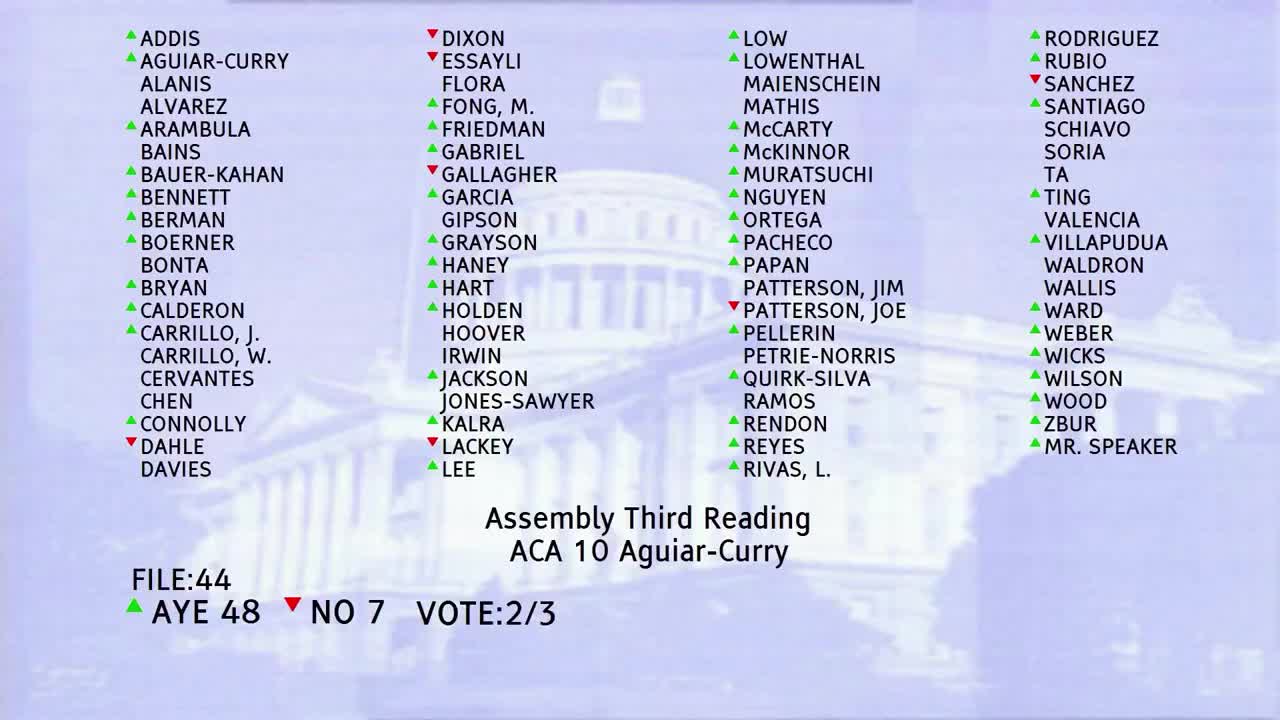 4MIN
Assembly Floor
 1MIN
Assembly Floor
 7MIN
Assembly Standing Committee on Local Government
Bill Author

Bill Co-Author(s):
