ACR 94: Juneteenth.
- Session Year: 2023-2024
- House: Assembly
- Latest Version Date: 2023-07-17
Current Status:
Passed
(2023-07-17: Chaptered by Secretary of State - Res. Chapter 122, Statutes of 2023.)
Introduced
In Committee
First Chamber
In Committee
Second Chamber
Enacted
This measure would recognize June 19, 2023, as Juneteenth and would urge the people of California to join in celebrating Juneteenth as a day to honor and reflect on the significant role that African Americans have played in the history of the United States and how they have enriched society through their steadfast commitment to promoting unity and equality.
This measure would recognize June 19, 2023, as Juneteenth and would urge the people of California to join in celebrating Juneteenth as a day to honor and reflect on the significant role that African Americans have played in the history of the United States and how they have enriched society through their steadfast commitment to promoting unity and equality.
This measure would recognize June 19, 2023, as Juneteenth and would urge the people of California to join in celebrating Juneteenth as a day to honor and reflect on the significant role that African Americans have played in the history of the United States and how they have enriched society through their steadfast commitment to promoting unity and equality.
WHEREAS, Juneteenth, also known as Juneteenth Independence Day, Emancipation Day, Emancipation Celebration, and Freedom Day, is the oldest African American holiday observance in the United States; and
WHEREAS, Juneteenth, or June 19, 1865, is considered the date when the last slaves in America were freed when General Gordon Granger rode into the City of Galveston, Texas, and issued General Order No. 3, almost two and one-half years after President Lincoln issued the Emancipation Proclamation; and
WHEREAS, 2023 marks 158 years of freedom celebrations; and
WHEREAS, Juneteenth commemorates the strong survival instinct of African Americans who were first brought to this country stacked and shackled in the bottom of slave ships in a monthlong journey across the Atlantic Ocean known as the Middle Passage; and
WHEREAS, August 2019 marked 400 years since the first arrival of Africans to colonial America, and the United States Congress has established the 400 Years of African-American History Commission to commemorate the historic heritage and contributions that Americans of African descent have made to help shape the cultural, academic, social, economic, and moral attributes of this nation; and
WHEREAS, In August 1619, the first documented Africans arrived in the English colony of Virginia. The group, recorded upon arrival as 20 and odd Negros, was part of a larger group of West Africans enslaved by Portuguese slave traders. They were on their way to the City of Veracruz, Mexico, aboard a Spanish ship when they were captured off the coast of Mexico by an English privateer ship and transported to Virginia, where they were put ashore at what is now the City of Hampton, Virginia, and sold as involuntary laborers or indentured servants; and
WHEREAS, Slavery had not yet been institutionalized, so the Africans were informed they would work under contract for a certain period of time before being granted freedom and the rights afforded other settlers. However, while European indentured servants were listed along with their year of expected freedom, no such information accompanied the names of the African indentured servants; and
WHEREAS, On September 22, 1862, President Lincoln issued the celebrated Emancipation Proclamation, warning the rebellious Confederate States that he would declare their slaves forever free if those states did not return to the Union by January 1, 1863. Enforcement of the Emancipation Proclamation occurred only in Confederate States that were under Union Army control; and
WHEREAS, Even after the lapse of Californias Fugitive Slave Law in 1855, masters informally held enslaved people in California until 1864, and it was not until June 28, 1864, that all fugitive slave laws were officially repealed; and
WHEREAS, Prior to the end of the Civil War, on January 31, 1865, Congress passed the Thirteenth Amendment to the United States Constitution, which abolished slavery throughout the United States and its territories. Spontaneous celebrations erupted throughout the country when African Americans learned of their freedom; and
WHEREAS, Texas, as a part of the Confederacy, was resistant to the Emancipation Proclamation. But on June 18, 1865, Union troops arrived in the City of Galveston, Texas, to take possession of the state and enforce the emancipation of its slaves. Former slaves in Galveston rejoiced in the streets with jubilant celebrations. The following day, June 19, became known as Juneteenth, a name derived from a portmanteau of the words June and nineteenth. Juneteenth celebrations began in Texas the following year; and
WHEREAS, Juneteenth education and celebrations declined in America in the early part of the 20th century. But the Civil Rights Movement of the 1950s and 1960s saw a resurgence of interest in Juneteenth, along with renewed community celebrations of the day; and
WHEREAS, On January 1, 1980, Juneteenth became an official state holiday in Texas through the efforts of Al Edwards, an African American state legislator. The successful passage of this bill marked Juneteenth as the first emancipation celebration granted official state recognition; and
WHEREAS, As of 2022, all 50 states in the country recognize Juneteenth as an official state holiday or day of observance; and
WHEREAS, In June of 2020, after the brutal murder of George Floyd, several prominent companies, including Nike, the National Football League, Twitter, and Square, announced plans to offer Juneteenth as a paid holiday to their employees. Further, several financial institutions, including JPMorgan Chase, Northern Trust, Fifth Third Bank, PNC Bank, and Capital One, also announced that they will be closing all or parts of their business early on June 19 while paying employees for the full day; and
WHEREAS, On June 17, 2021, President Biden signed the Juneteenth National Independence Day Act into law, establishing June 19 as a federal holiday and making it the first federal holiday since the establishment of Martin Luther King Jr. Day in 1983; and
WHEREAS, A growing number of American and African American cultural institutions have sponsored Juneteenth cultural events designed to make all Americans aware of this celebration, including the Smithsonian Institutions National Museum of American History in Washington, D.C., the Chicago Historical Society, the Black Archives of Mid-America in Kansas City, Inc. in the City of Kansas City, Missouri, the California African American Museum in the City of Los Angeles, California, the Henry Ford Museum and Greenfield Village in the City of Dearborn, Michigan, the African American Museum in the City of Dallas, Texas, and the National Juneteenth Observance Foundation. Juneteenth celebrations are a tribute to those African Americans who fought so long for freedom and worked so hard to make the dream of equality a reality; and
WHEREAS, California law requires the Governor to proclaim the third Saturday in June of each year to be known as Juneteenth National Freedom Day: A day of observance to urge all Californians in celebrating this day to honor and reflect on the significant roles that African Americans have played in the history of the United States and how African Americans have enriched society through their steadfast commitment to promoting freedom, brotherhood, and equality; and
WHEREAS, Juneteenth commemorates African American freedom and emphasizes education and achievement. It is a day, a week, and in some areas, a month marked with celebrations, guest speakers, picnics, and family gatherings. It is a time for reflection and rejoicing. It is a time for assessment, self-improvement, and for planning the future; now, therefore, be it
Resolved by the Assembly of the State of California, the Senate thereof concurring, That the Legislature of the State of California hereby recognizes June 19, 2023, as Juneteenth; and be it further
Resolved, That the Legislature urges the people of California to join in celebrating Juneteenth as a day to honor and reflect on the significant role that African Americans have played in the history of the United States and how they have enriched society through their steadfast commitment to promoting unity and equality; and be it further
Resolved, That the Chief Clerk of the Assembly transmit copies of this resolution to the author for appropriate distribution.
|
Date
|
Status
|
|---|---|
| Jul 17, 2023 | Chaptered by Secretary of State - Res. Chapter 122, Statutes of 2023. |
| Jul 17, 2023 | Enrolled and filed with the Secretary of State at 2 p.m. |
| Jul 6, 2023 | In Assembly. Ordered to Engrossing and Enrolling. |
| Jul 6, 2023 | Adopted and to Assembly. (Ayes 40. Noes 0. Page 1917.) |
| Jul 5, 2023 | Ordered to special consent calendar. |
| Jun 28, 2023 | From committee: Ordered to third reading. |
| Jun 20, 2023 | In Senate. To Com. on RLS. |
| Jun 20, 2023 | Introduced measure version corrected. |
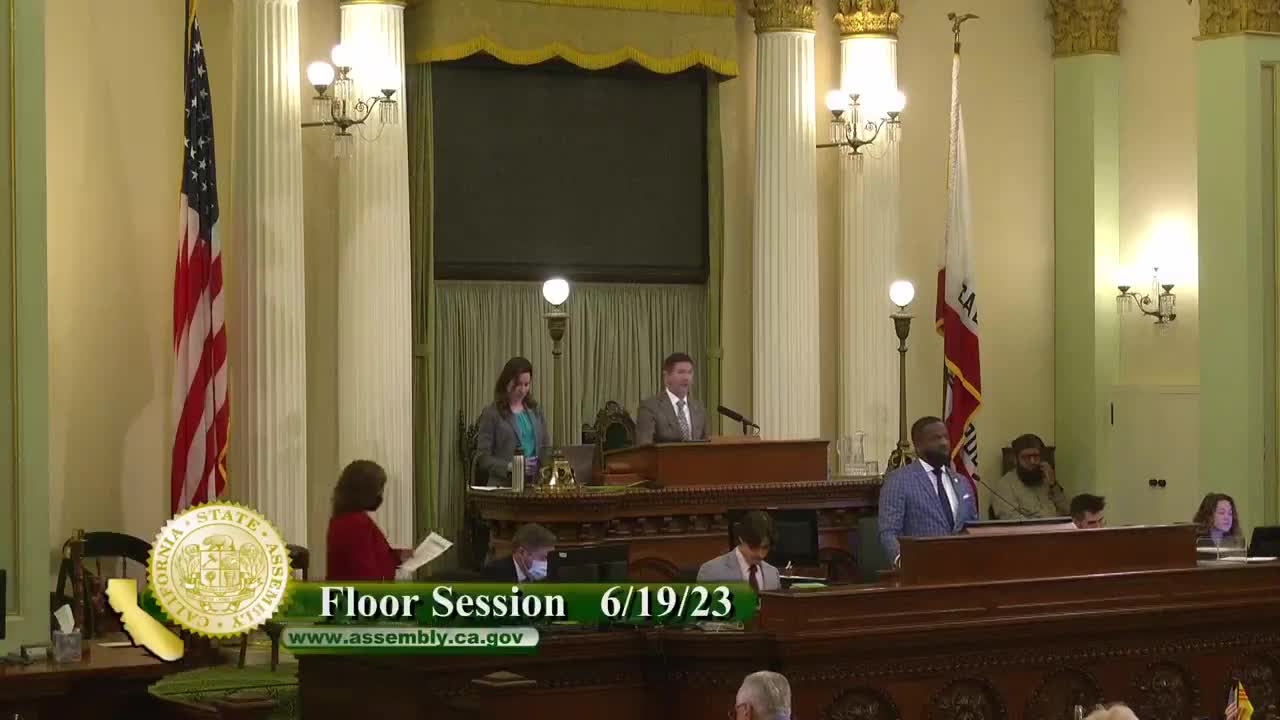
| Jun 19, 2023 | Adopted and to Senate. (Page 2286.) |
| Jun 19, 2023 | Coauthors revised. |
| Jun 8, 2023 | From committee: Be adopted. Ordered to Third Reading. (Ayes 12. Noes 0.) (June 8). |
| Jun 8, 2023 | Referred to Com. on RLS. |
| Jun 7, 2023 | From printer. |
| Jun 6, 2023 | Introduced. To print. |
|
Date
|
Description
|
Location
|
Votes
|
|
|---|---|---|---|---|
| Jul 6, 2023 | Special Consent ACR94 Jones-Sawyer et al. | Senate Floor |
Passed |
|
| Jun 8, 2023 | Be adopted. To third reading. | Assembly Standing Committee on Rules |
Passed |
This list shows positions taken on this bill by organizations on the date displayed, which is linked to the original source.
Positions by individuals are not included.
SENATE RULES COMMITTEE Office of Senate Floor Analyses (916) 651-1520 Fax: (916) 327-4478 | ACR 94 |
THIRD READING
Bill No: ACR 94
Author: Jones-Sawyer (D), et al.
Introduced: 6/6/23
Vote: 21
ASSEMBLY FLOOR: Read and adopted, 6/19/23
SUBJECT: Juneteenth
SOURCE: Author
DIGEST:
This resolution recognizes June 19, 2023, as Juneteenth and urges the people of California to join in celebrating Juneteenth as a day to honor and reflect on the significant role that African Americans have played in the history of the United States and how they have enriched society through their steadfast commitment to promoting unity and equality.
ANALYSIS: This resolution makes the following legislative findings:
- Juneteenth, also known as “Juneteenth Independence Day,” “Emancipation Day,” “Emancipation Celebration,” and “Freedom Day,” is the oldest African American holiday observance in the United States.
- Juneteenth, or June 19, 1865, is considered the date when the last slaves in America were freed when General Gordon Granger rode into the City of Galveston, Texas, and issued General Order No. 3, almost two and one-half years after President Lincoln issued the Emancipation Proclamation.
- Juneteenth commemorates the strong survival instinct of African Americans who were first brought to this country stacked and shackled in the bottom of slave ships in a monthlong journey across the Atlantic Ocean known as the “Middle Passage.”
- In August 1619, the first documented Africans arrived in the English colony of Virginia. The group, recorded upon arrival as “20 and odd Negros,” was part of a larger group of West Africans enslaved by Portuguese slave traders. They were on their way to the City of Veracruz, Mexico, aboard a Spanish ship when they were captured off the coast of Mexico by an English privateer ship and transported to Virginia, where they were put ashore at what is now the City of Hampton, Virginia, and sold as involuntary laborers or indentured servants.
- Slavery had not yet been institutionalized, so the Africans were informed they would work under contract for a certain period of time before being granted freedom and the rights afforded other settlers. However, while European indentured servants were listed along with their year of expected freedom, no such information accompanied the names of the African indentured servants.
- On September 22, 1862, President Lincoln issued the celebrated Emancipation Proclamation, warning the rebellious Confederate States that he would declare their slaves “forever free” if those states did not return to the Union by January 1, 1863. Enforcement of the Emancipation Proclamation occurred only in Confederate States that were under Union Army control.
- Even after the lapse of California’s Fugitive Slave Law in 1855, masters informally held enslaved people in California until 1864, and it was not until June 28, 1864, that all fugitive slave laws were officially repealed.
- Prior to the end of the Civil War, on January 31, 1865, Congress passed the Thirteenth Amendment to the United States Constitution, which abolished slavery throughout the United States and its territories. Spontaneous celebrations erupted throughout the country when African Americans learned of their freedom.
- Texas, as a part of the Confederacy, was resistant to the Emancipation Proclamation. But on June 18, 1865, Union troops arrived in the City of Galveston, Texas, to take possession of the state and enforce the emancipation of its slaves. Former slaves in Galveston rejoiced in the streets with jubilant celebrations. The following day, June 19, became known as “Juneteenth,” a name derived from a portmanteau of the words “June” and “nineteenth.” Juneteenth celebrations began in Texas the following year.
- On January 1, 1980, Juneteenth became an official state holiday in Texas through the efforts of Al Edwards, an African American state legislator. The successful passage of this bill marked Juneteenth as the first emancipation celebration granted official state recognition.
- As of 2022, all 50 states in the country recognize Juneteenth as an official state holiday or day of observance.
- On June 17, 2021, President Biden signed the Juneteenth National Independence Day Act into law, establishing June 19 as a federal holiday and making it the first federal holiday since the establishment of Martin Luther King Jr. Day in 1983.
This resolution:
- Recognizes June 19, 2023, as Juneteenth.
- Urges the people of California to join in celebrating Juneteenth as a day to honor and reflect on the significant role that African Americans have played in the history of the United States and how they have enriched society through their steadfast commitment to promoting unity and equality.
Related/Prior Legislation
The following are the most recent measures relative to Juneteenth:
- SCR 109 (Bradford, Resolution Chapter 117, Statutes of 2022).
- ACR 190 (Jones-Sawyer, Resolution Chapter 139, Statutes of 2022).
- AB 1655 (Jones-Sawyer, Chapter 753, Statutes of 2022).
- SCR 41 (Bradford, Resolution Chapter 99, Statutes of 2021).
- ACR 82 (Cooper, Resolution Chapter 95, Statutes of 2021).
FISCAL EFFECT: Appropriation: No Fiscal Com.: No Local: No
SUPPORT: (Verified 6/26/23)
None received
OPPOSITION: (Verified 6/26/23)
None received
Prepared by: Karen Chow / SFA / (916) 651-1520
6/28/23 11:22:18
**** END ****
ASSEMBLY THIRD READING
ATR Bill Id:ACR 94
Author:(Jones-Sawyer)
As Introduced Ver:June 6, 2023
Majority vote
SUMMARY
Recognizes June 19, 2023, as Juneteenth; and, urges the people of California to join in celebrating Juneteenth as a day to honor and reflect on the significant role that African Americans have played in the history of the United States, and how they have enriched society through their steadfast commitment to promoting unity and equality.
Major Provisions
- Juneteenth, also known as "Juneteenth Independence Day," "Emancipation Day," "Emancipation Celebration," and "Freedom Day," is the oldest African American holiday observance in the United States.
- Juneteenth, or June 19, 1865, is considered the date when the last slaves in America were freed when General Gordon Granger rode into Galveston, Texas, and issued General Order No. 3, almost two and one-half years after President Lincoln issued the Emancipation Proclamation.
- Juneteenth education and celebrations declined in America in the early part of the 20th century. But the Civil Rights Movement of the 1950s and 1960s saw a resurgence of interest in Juneteenth, along with renewed community celebrations of the day.
- On January 1, 1980, Juneteenth became an official state holiday in Texas through the efforts of Al Edwards, an African American state legislator. The successful passage of this bill marked Juneteenth as the first emancipation celebration granted official state recognition.
- As of 2022, all 50 states in the country recognize Juneteenth as an official state holiday or day of observance.
- California law requires the Governor to proclaim the third Saturday in June of each year to be known as "Juneteenth National Freedom Day: A day of observance," to urge all Californians in celebrating this day to honor and reflect on the significant roles that African Americans have played in the history of the United States.
- A growing number of American and African American cultural institutions have sponsored Juneteenth cultural events designed to make all Americans aware of this celebration, including the Smithsonian Institution's National Museum of American History in Washington, D.C., the Chicago Historical Society, the Black Archives of Mid-America in Kansas City, and the California African American Museum in the City of Los Angeles.
- Juneteenth commemorates African American freedom and emphasizes education and achievement. It is a day, a week, and in some areas, a month marked with celebrations, guest speakers, picnics, and family gatherings. It is a time for reflection and rejoicing. It is a time for assessment, self-improvement, and for planning the future.
- 2023 marks 158 years of freedom celebrations.
COMMENTS
According to the Author
Juneteenth not only celebrates the ending of slavery but also serves as an annual reminder that we can only overcome our history if we make a conscious effort to learn about it. Most importantly, this day reminds the nation that the struggle for true equality and justice for black Americans is ongoing. Juneteenth is a vital point in American history and must be given its just respect as a day of reflection and learning about Black American history.
Arguments in Support
None on file
Arguments in Opposition
None on file
FISCAL COMMENTS
No fiscal impact. This resolution is keyed non-fiscal by Legislative Counsel.
VOTES
ASM RULES: 12-0-1
YES: Ramos, Waldron, Addis, Juan Carrillo, Essayli, Flora, Low, Ortega, Pacheco, Papan, Pellerin, Blanca Rubio
ABS, ABST OR NV: Valencia
UPDATED
VERSION: June 6, 2023
CONSULTANT: Michael Erke / RLS. / (916) 319-2800 FN: 0001067
Date of Hearing: June 8, 2023
ASSEMBLY COMMITTEE ON RULES
James Ramos, Chair
ABPCA Bill Id:ACR 94 (
Author:Jones-Sawyer) – As Introduced Ver:June 6, 2023
SUBJECT: Juneteenth.
SUMMARY: Recognizes June 19, 2023, as Juneteenth; and, urges the people of California to join in celebrating Juneteenth as a day to honor and reflect on the significant role that African Americans have played in the history of the United States, and how they have enriched society through their steadfast commitment to promoting unity and equality. Specifically, this resolution makes the following legislative findings:
- Juneteenth, also known as “Juneteenth Independence Day,” “Emancipation Day,” “Emancipation Celebration,” and “Freedom Day,” is the oldest African American holiday observance in the United States.
- Juneteenth, or June 19, 1865, is considered the date when the last slaves in America were freed when General Gordon Granger rode into Galveston, Texas, and issued General Order No. 3, almost two and one-half years after President Lincoln issued the Emancipation Proclamation.
- Juneteenth education and celebrations declined in America in the early part of the 20th century. But the Civil Rights Movement of the 1950s and 1960s saw a resurgence of interest in Juneteenth, along with renewed community celebrations of the day.
- On January 1, 1980, Juneteenth became an official state holiday in Texas through the efforts of Al Edwards, an African American state legislator. The successful passage of this bill marked Juneteenth as the first emancipation celebration granted official state recognition.
- As of 2022, all 50 states in the country recognize Juneteenth as an official state holiday or day of observance.
- California law requires the Governor to proclaim the third Saturday in June of each year to be known as “Juneteenth National Freedom Day: A day of observance,” to urge all Californians in celebrating this day to honor and reflect on the significant roles that African Americans have played in the history of the United States.
- A growing number of American and African American cultural institutions have sponsored Juneteenth cultural events designed to make all Americans aware of this celebration, including the Smithsonian Institution’s National Museum of American History in Washington, D.C., the Chicago Historical Society, the Black Archives of Mid-America in Kansas City, and the California African American Museum in the City of Los Angeles.
- Juneteenth commemorates African American freedom and emphasizes education and achievement. It is a day, a week, and in some areas, a month marked with celebrations, guest speakers, picnics, and family gatherings. It is a time for reflection and rejoicing. It is a time for assessment, self-improvement, and for planning the future.
- 2023 marks 158 years of freedom celebrations.
FISCAL EFFECT: None
REGISTERED SUPPORT / OPPOSITION:
Support
None on file
Opposition
None on file
Analysis Prepared by: Michael Erke / RLS. / (916) 319-2800
Bill Author

Bill Co-Author(s):