SB 1025: Pretrial diversion for veterans.
- Session Year: 2023-2024
- House: Senate
- Latest Version Date: 2024-09-29
Current Status:
Passed
(2024-09-29: Chaptered by Secretary of State. Chapter 924, Statutes of 2024.)
Introduced
In Committee
First Chamber
In Committee
Second Chamber
Enacted
What does this bill do?
The bill expands California's pretrial veteran diversion program to allow some felonies if a veteran's military-related condition—such as military sexual trauma, traumatic brain injury, PTSD, or substance abuse—was a significant factor. A judge must find the condition was a significant factor unless there is clear and convincing evidence it was not (a high level of proof), and the judge may consider any relevant evidence. It also limits DUI diversion to misdemeanors under Vehicle Code 23152 and 23153 and lets prosecutors ask a judge to bar a veteran in diversion who is a danger to themselves or others from possessing firearms.
The summary is provided by generative AI which can make mistakes. For original language, please view the details in the table below.
Existing law provides for the diversion of specified criminal offenders in alternate sentencing and treatment programs. Existing law provides for a pretrial diversion program for a defendant who was, or currently is, a member of the Armed Forces of the United States, who may be suffering from sexual trauma, traumatic brain injury, post-traumatic stress disorder, substance abuse, or mental health problems as a result of the defendants military service. Existing law authorizes the court, with the consent of the defendant and a waiver of the defendants speedy trial right, to postpone prosecution, either temporarily or permanently, of a criminal offense and place the defendant in a pretrial diversion program.
This bill would add felony offenses, as specified, to the pretrial diversion program for a defendant who was, or currently is, a member of the Armed Forces of the United States and when the defendants condition was a significant factor in the commission of the charged offense. The bill would require the court to find that the defendants condition was a significant factor in the commission of the offense unless there is clear and convincing evidence otherwise and would authorize the court to consider any relevant and credible evidence in making this determination. By requiring counties to coordinate services for a new group of veterans, this bill would impose a state-mandated local program.
Existing law specifically authorizes a defendant who has been convicted of certain misdemeanor offenses related to driving under the influence to be placed in that diversion program.
This bill would prohibit a defendant who has been convicted of any other offense related to driving under the influence from being placed in that diversion program.
Existing law prohibits a person, who has been found by a court to be prohibited from owning or controlling a firearm because they are a danger to themselves or others and has been granted pretrial mental health diversion, from owning or possessing a firearm until the person successfully completes diversion or their firearm rights are restored, as specified. A violation of this prohibition is punishable as a crime.
This bill would authorize the prosecution to request an order from the court, as specified, to prohibit a veteran defendant in diversion from controlling, owning, purchasing, possessing, or receiving a firearm because they are a danger to themselves or others until they successfully complete diversion or their firearm rights are restored, as specified. By expanding the group of people to whom a crime applies, this bill would impose a state-mandated local program.
This bill would incorporate additional changes to Section 8103 of the Welfare and Institutions Code proposed by AB 2629 and SB 1002 to be operative only if this bill and one or both of those bills are enacted and this bill is enacted last.
The California Constitution requires the state to reimburse local agencies and school districts for certain costs mandated by the state. Statutory provisions establish procedures for making that reimbursement.
This bill would provide that with regard to certain mandates no reimbursement is required by this act for a specified reason.
With regard to any other mandates, this bill would provide that, if the Commission on State Mandates determines that the bill contains costs so mandated by the state, reimbursement for those costs shall be made pursuant to the statutory provisions noted above.
Existing law provides for the diversion of specified criminal offenders in alternate sentencing and treatment programs. Existing law provides for a pretrial diversion program for a defendant who was, or currently is, a member of the Armed Forces of the United States, who may be suffering from sexual trauma, traumatic brain injury, post-traumatic stress disorder, substance abuse, or mental health problems as a result of the defendants military service. Existing law authorizes the court, with the consent of the defendant and a waiver of the defendants speedy trial right, to postpone prosecution, either temporarily or permanently, of a criminal offense and place the defendant in a pretrial diversion program.
This bill would add felony offenses, as specified, to the pretrial diversion program for a defendant who was, or currently is, a member of the Armed Forces of the United States and when the defendants condition was a significant factor in the commission of the charged offense. The bill would require the court to find that the defendants condition was a significant factor in the commission of the offense unless there is clear and convincing evidence otherwise and would authorize the court to consider any relevant and credible evidence in making this determination. By requiring counties to coordinate services for a new group of veterans, this bill would impose a state-mandated local program.
The California Constitution requires the state to reimburse local agencies and school districts for certain costs mandated by the state. Statutory provisions establish procedures for making that reimbursement.This bill would provide that, if the Commission on State Mandates determines that the bill contains costs mandated by the state, reimbursement for those costs shall be made pursuant to the statutory provisions noted above.Existing law prohibits a person, who has been found by a court to be prohibited from owning or controlling a firearm because they are a danger to themselves or others and has been granted pretrial mental health diversion, from owning or possessing a firearm until the person successfully completes diversion or their firearm rights are restored, as specified. A violation of this prohibition is punishable as a crime.
This bill would authorize the prosecution to request an order from the court, as specified, to prohibit a veteran defendant in diversion from controlling, owning, purchasing, possessing, or receiving a firearm because they are a danger to themselves or others until they successfully complete diversion or their firearm rights are restored, as specified. By expanding the group of people to whom a crime applies, this bill would impose a state-mandated local program.
The California Constitution requires the state to reimburse local agencies and school districts for certain costs mandated by the state. Statutory provisions establish procedures for making that reimbursement.
This bill would provide that with regard to certain mandates no reimbursement is required by this act for a specified reason.
With regard to any other mandates, this bill would provide that, if the Commission on State Mandates determines that the bill contains costs so mandated by the state, reimbursement for those costs shall be made pursuant to the statutory provisions noted above.
Existing law provides for the diversion of specified criminal offenders in alternate sentencing and treatment programs. Existing law provides for a pretrial diversion program for a defendant who was, or currently is, a member of the Armed Forces of the United States, who may be suffering from sexual trauma, traumatic brain injury, post-traumatic stress disorder, substance abuse, or mental health problems as a result of the defendants military service. Existing law authorizes the court, with the consent of the defendant and a waiver of the defendants speedy trial right, to postpone prosecution, either temporarily or permanently, of a criminal offense and place the defendant in a pretrial diversion program.
This bill would add felony offenses, as specified, to the pretrial diversion program for a defendant who was, or currently is, a member of the Armed Forces of the United States. States and when the defendants condition was a significant factor in the commission of the charged offense. The bill would require the court to find that the defendants condition was a significant factor in the commission of the offense unless there is clear and convincing evidence otherwise and would authorize the court to consider any relevant and credible evidence in making this determination. By requiring counties to coordinate services for a new group of veterans, this bill would impose a state-mandated local program.
The California Constitution requires the state to reimburse local agencies and school districts for certain costs mandated by the state. Statutory provisions establish procedures for making that reimbursement.
This bill would provide that, if the Commission on State Mandates determines that the bill contains costs mandated by the state, reimbursement for those costs shall be made pursuant to the statutory provisions noted above.
Existing law provides for the diversion of specified criminal offenders in alternate sentencing and treatment programs. Existing law provides for a pretrial diversion program for a defendant who was, or currently is, a member of the Armed Forces of the United States, who may be suffering from sexual trauma, traumatic brain injury, post-traumatic stress disorder, substance abuse, or mental health problems as a result of the defendants military service. Existing law authorizes the court, with the consent of the defendant and a waiver of the defendants speedy trial right, to postpone prosecution, either temporarily or permanently, of a criminal offense and place the defendant in a pretrial diversion program.
This bill would add felony offenses, as specified, to the pretrial diversion program for a defendant who was, or currently is, a member of the Armed Forces of the United States. By requiring counties to coordinate services for a new group of veterans, this bill would impose a state-mandated local program.
The California Constitution requires the state to reimburse local agencies and school districts for certain costs mandated by the state. Statutory provisions establish procedures for making that reimbursement.
This bill would provide that, if the Commission on State Mandates determines that the bill contains costs mandated by the state, reimbursement for those costs shall be made pursuant to the statutory provisions noted above.
(a)This chapter shall apply to a case before a court on an accusatory pleading alleging the commission of a misdemeanor or felony offense not set forth in subdivision (o) to a defendant who is eligible based on the criteria set forth in this chapter.
(b)A defendant charged with a misdemeanor is eligible for diversion if both of the following apply:
(1)The defendant was, or currently is, a member of the United States military.
(2)(A)The defendant may be suffering from sexual trauma, traumatic brain injury, post-traumatic stress disorder, substance abuse, or mental health problems as a result of their military service.
(B)The court may request, using existing resources, an assessment to aid in the determination that this paragraph applies to a defendant.
(c)A defendant charged with a felony offense not set forth in subdivision (o) is eligible if both of the following apply:
(1)The defendant was, or currently is, a member of the United States military.
(2)(A)The defendant may be suffering from sexual trauma, traumatic brain injury, post-traumatic stress disorder, substance abuse, or a mental health problem as a result of their military service, and the defendants condition was a significant factor in the commission of the charged offense.
(B)The court shall find that the defendants condition was a significant factor in the commission of the offense unless there is clear and convincing evidence that it was not a motivating factor, causal factor, or contributing factor to the defendants involvement in the alleged offense.
(C)A court may consider any relevant and credible evidence, including, but not limited to, a police report, preliminary hearing transcript, witness statement, statement by the defendants mental health treatment provider, medical record, or record or report by qualified medical expert, that the defendant displayed symptoms consistent with the condition at or near the time of the offense.
(D)The court may request, using existing resources, an assessment to aid in the determination that this paragraph applies to a defendant.
(d)If the court determines that a defendant charged with an applicable offense under this chapter is a person described in subdivision (b) or (c), the court, with the consent of the defendant and a waiver of the defendants speedy trial right, may place the defendant in a pretrial diversion program as defined in subdivision (k).
(e)If it appears to the court that the defendant is performing unsatisfactorily in the assigned program, or that the defendant is not benefiting from the treatment and services provided under the diversion program, after notice to the defendant, the court shall hold a hearing to determine whether the criminal proceedings should be reinstituted. If the court finds that the defendant is not performing satisfactorily in the assigned program, or that the defendant is not benefiting from diversion, the court may end the diversion and order resumption of the criminal proceedings. If the defendant has performed satisfactorily during the period of diversion, at the end of the period of diversion, the criminal charges shall be dismissed.
(f)If a referral is made to the county mental health authority as part of the pretrial diversion program, the county shall provide mental health treatment services only to the extent that resources are available for that purpose as described in paragraph (5) of subdivision (b) of Section 5600.3 of the Welfare and Institutions Code. If mental health treatment services are ordered by the court, the county mental health agency shall coordinate appropriate referral of the defendant to the county veterans service officer as described in paragraph (5) of subdivision (b) of Section 5600.3 of the Welfare and Institutions Code. The county mental health agency is not responsible for providing services outside its traditional scope of services. An order shall be made referring a defendant to a county mental health agency only if that agency has agreed to accept responsibility for all of the following:
(1)The treatment of the defendant.
(2)The coordination of appropriate referral to a county veterans service officer.
(3)The filing of reports pursuant to subdivision (j).
(g)When determining the requirements of a pretrial diversion program pursuant to this chapter, the court shall assess whether the defendant should be ordered to participate in a federal or community-based treatment service program with a demonstrated history of specializing in the treatment of mental health problems, including substance abuse, post-traumatic stress disorder, traumatic brain injury, military sexual trauma, and other related mental health problems.
(h)The court, in making an order pursuant to this section to commit a defendant to an established treatment program, shall give preference to a treatment program that has a history of successfully treating veterans who suffer from sexual trauma, traumatic brain injury, post-traumatic stress disorder, substance abuse, or mental health problems as a result of military service, including, but not limited to, programs operated by the United States Department of Defense or the United States Department of Veterans Affairs.
(i)The court and the assigned treatment program may collaborate with the Department of Veterans Affairs and the United States Department of Veterans Affairs to maximize benefits and services provided to a veteran.
(j)The period during which criminal proceedings against the defendant may be diverted shall be no longer than two years. The responsible agency or agencies shall file reports on the defendants progress in the diversion program with the court and with the prosecutor not less than every six months.
(k)A record filed with the Department of Justice shall indicate the disposition of those cases diverted pursuant to this chapter. Upon successful completion of a diversion program, the arrest upon which the diversion was based shall be deemed to have never occurred. The defendant may indicate in response to a question concerning their prior criminal record that they were not arrested or diverted for the offense, except as specified in subdivision (l). A record pertaining to an arrest resulting in successful completion of a diversion program shall not, without the defendants consent, be used in a way that could result in the denial of any employment, benefit, license, or certificate.
(l)The defendant shall be advised that, regardless of their successful completion of diversion, the arrest upon which the diversion was based may be disclosed by the Department of Justice in response to a peace officer application request and that, notwithstanding subdivision (k), this section does not relieve them of the obligation to disclose the arrest in response to a direct question contained in a questionnaire or application for a position as a peace officer as defined in Section 830.
(m)(1)As used in this chapter, pretrial diversion means the procedure of postponing prosecution, either temporarily or permanently, at any point in the judicial process from the point at which the accused is charged until adjudication.
(2)A pretrial diversion program shall utilize existing resources available to current or former members of the United States military to address and treat those suffering from sexual trauma, traumatic brain injury, post-traumatic stress disorder, substance abuse, or mental health problems as a result of military service.
(n)(1)Notwithstanding any other law, including Section 23640 of the Vehicle Code, an offense for which a defendant may be placed in a pretrial diversion program in accordance with this section includes a misdemeanor violation of Section 23152 or 23153 of the Vehicle Code, however, this section does not limit the authority of the Department of Motor Vehicles to take administrative action concerning the driving privileges of a person arrested for a violation of Section 23152 or 23153 of the Vehicle Code.
(2)A defendant shall not be placed in a pretrial diversion program in accordance with this section for any offense related to driving under the influence other than those identified in paragraph (1).
(o)A defendant may not be placed into a diversion program, pursuant to this section, for the following current charged offenses:
(1)Murder or voluntary manslaughter.
(2)An offense for which a person, if convicted, would be required to register pursuant to Section 290, except for a violation of Section 314.
(3)Rape.
(4)Lewd or lascivious act on a child under 14 years of age.
(5)Assault with intent to commit rape, sodomy, or oral copulation in violation of Section 220.
(6)Commission of rape or sexual penetration in concert with another person in violation of Section 264.1.
(7)Continuous sexual abuse of a child in violation of Section 288.5.
(8)A violation of subdivision (b) or (c) of Section 11418.
(p)(1)The prosecution may request an order from the court that the defendant be prohibited from controlling, owning, purchasing, possessing, or receiving a firearm until they successfully complete diversion because they are a danger to themselves or others pursuant to subdivision (i) of Section 8103 of the Welfare and Institutions Code.
(2)The prosecution shall bear the burden of proving, by clear and convincing evidence, both of the following are true:
(A)The defendant poses a significant danger of causing personal injury to themselves or another by controlling, owning, purchasing, possessing, or receiving a firearm.
(B)The prohibition is necessary to prevent personal injury to the defendant or another person because less restrictive alternatives either have been tried and found to be ineffective or are inadequate or inappropriate for the circumstances of the defendant.
(3)(A)If the court finds that the prosecution has not met that burden, the court shall not order that the person is prohibited from controlling, owning, purchasing, possessing, or receiving a firearm.
(B)If the court finds that the prosecution has met the burden, the court shall order that the person is prohibited, and shall inform the person that they are prohibited, from controlling, owning, purchasing, possessing, or receiving a firearm until they successfully complete diversion because they are a danger to themselves or others.
(4)An order imposed pursuant to this subdivision shall be in effect until the defendant has successfully completed diversion or until their firearm rights are restored pursuant to paragraph (4) of subdivision (g) of Section 8103 of the Welfare and Institutions Code.
SEC. 2.Section 8103 of the Welfare and Institutions Code is amended to read:8103.(a)(1)A person who after October 1, 1955, has been adjudicated by a court of any state to be a danger to others as a result of a mental disorder or mental illness, or who has been adjudicated to be a mentally disordered sex offender, shall not purchase or receive, or attempt to purchase or receive, or have possession, custody, or control of a firearm or any other deadly weapon unless there has been issued to the person a certificate by the court of adjudication upon release from treatment or at a later date stating that the person may possess a firearm or any other deadly weapon without endangering others, and the person has not, subsequent to the issuance of the certificate, again been adjudicated by a court to be a danger to others as a result of a mental disorder or mental illness.
(2)The court shall notify the Department of Justice of the court order finding the individual to be a person described in paragraph (1) as soon as possible, but not later than one court day after issuing the order. The court shall also notify the Department of Justice of any certificate issued as described in paragraph (1) as soon as possible, but not later than one court day after issuing the certificate.
(b)(1)A person who has been found, pursuant to Section 1026 of the Penal Code or the law of any other state or the United States, not guilty by reason of insanity of murder, mayhem, a violation of Section 207, 209, or 209.5 of the Penal Code in which the victim suffers intentionally inflicted great bodily injury, carjacking or robbery in which the victim suffers great bodily injury, a violation of Section 451 or 452 of the Penal Code involving a trailer coach, as defined in Section 635 of the Vehicle Code, or any dwelling house, a violation of paragraph (1) or (2) of subdivision (a) of Section 262 or paragraph (2) or (3) of subdivision (a) of Section 261 of the Penal Code, a violation of Section 459 of the Penal Code in the first degree, assault with intent to commit murder, a violation of Section 220 of the Penal Code in which the victim suffers great bodily injury, a violation of Section 18715, 18725, 18740, 18745, 18750, or 18755 of the Penal Code, or of a felony involving death, great bodily injury, or an act which poses a serious threat of bodily harm to another person, or a violation of the law of any other state or the United States that includes all the elements of any of the above felonies as defined under California law, shall not purchase or receive, or attempt to purchase or receive, or have possession, custody, or control of any firearm or any other deadly weapon.
(2)The court shall notify the Department of Justice of the court order finding the person to be a person described in paragraph (1) as soon as possible, but not later than one court day after issuing the order.
(c)(1)A person who has been found, pursuant to Section 1026 of the Penal Code or the law of any other state or the United States, not guilty by reason of insanity of any crime other than those described in subdivision (b) shall not purchase or receive, or attempt to purchase or receive, or have possession, custody, or control of any firearm or any other deadly weapon unless the court of commitment has found the person to have recovered sanity, pursuant to Section 1026.2 of the Penal Code or the law of any other state or the United States.
(2)The court shall notify the Department of Justice of the court order finding the person to be a person described in paragraph (1) as soon as possible, but not later than one court day after issuing the order. The court shall also notify the Department of Justice when it finds that the person has recovered their sanity as soon as possible, but not later than one court day after making the finding.
(d)(1)A person found by a court to be mentally incompetent to stand trial, pursuant to Section 1370 or 1370.1 of the Penal Code or the law of any other state or the United States, shall not purchase or receive, or attempt to purchase or receive, or have possession, custody, or control of any firearm or any other deadly weapon, unless there has been a finding with respect to the person of restoration to competence to stand trial by the committing court, pursuant to Section 1372 of the Penal Code or the law of any other state or the United States.
(2)The court shall notify the Department of Justice of the court order finding the person to be mentally incompetent as described in paragraph (1) as soon as possible, but not later than one court day after issuing the order. The court shall also notify the Department of Justice when it finds that the person has recovered competence as soon as possible, but not later than one court day after making the finding.
(e)(1)A person who has been placed under conservatorship by a court, pursuant to Section 5350 or the law of any other state or the United States, because the person is gravely disabled as a result of a mental disorder or impairment by chronic alcoholism, shall not purchase or receive, or attempt to purchase or receive, or have possession, custody, or control of any firearm or any other deadly weapon while under the conservatorship if, at the time the conservatorship was ordered or thereafter, the court that imposed the conservatorship found that possession of a firearm or any other deadly weapon by the person would present a danger to the safety of the person or to others. Upon placing a person under conservatorship, and prohibiting firearm or any other deadly weapon possession by the person, the court shall notify the person of this prohibition.
(2)The court shall notify the Department of Justice of the court order placing the person under conservatorship and prohibiting firearm or any other deadly weapon possession by the person as described in paragraph (1) as soon as possible, but not later than one court day after placing the person under conservatorship. The notice shall include the date the conservatorship was imposed and the date the conservatorship is to be terminated. If the conservatorship is subsequently terminated before the date listed in the notice to the Department of Justice or the court subsequently finds that possession of a firearm or any other deadly weapon by the person would no longer present a danger to the safety of the person or others, the court shall notify the Department of Justice as soon as possible, but not later than one court day after terminating the conservatorship.
(3)All information provided to the Department of Justice pursuant to paragraph (2) shall be kept confidential, separate, and apart from all other records maintained by the Department of Justice, and shall be used only to determine eligibility to purchase or possess firearms or other deadly weapons. A person who knowingly furnishes that information for any other purpose is guilty of a misdemeanor. All the information concerning any person shall be destroyed upon receipt by the Department of Justice of notice of the termination of conservatorship as to that person pursuant to paragraph (2).
(f)(1)(A)A person who has been (i) taken into custody as provided in Section 5150 because that person is a danger to themselves or to others, (ii) assessed within the meaning of Section 5151, and (iii) admitted to a designated facility within the meaning of Sections 5151 and 5152 because that person is a danger to themselves or others, shall not own, possess, control, receive, or purchase, or attempt to own, possess, control, receive, or purchase, any firearm for a period of five years after the person is released from the facility.
(B)A person who has been taken into custody, assessed, and admitted as specified in subparagraph (A), and who was previously taken into custody, assessed, and admitted as specified in subparagraph (A) one or more times within a period of one year preceding the most recent admittance, shall not own, possess, control, receive, or purchase, or attempt to own, possess, control, receive, or purchase, any firearm for the remainder of their life.
(C)A person described in this paragraph, however, may own, possess, control, receive, or purchase, or attempt to own, possess, control, receive, or purchase any firearm if the superior court has, pursuant to paragraph (5), found that the people of the State of California have not met their burden pursuant to paragraph (6).
(2)(A)(i)For each person subject to this subdivision, the facility shall, within 24 hours of the time of admission, submit a report to the Department of Justice, on a form prescribed by the Department of Justice, containing information that includes, but is not limited to, the identity of the person and the legal grounds upon which the person was admitted to the facility.
(ii)Any report submitted pursuant to this paragraph shall be confidential, except for purposes of the court proceedings described in this subdivision and for determining the eligibility of the person to own, possess, control, receive, or purchase a firearm.
(B)Facilities shall submit reports pursuant to this paragraph exclusively by electronic means, in a manner prescribed by the Department of Justice.
(3)Prior to, or concurrent with, the discharge, the facility shall inform a person subject to this subdivision that they are prohibited from owning, possessing, controlling, receiving, or purchasing any firearm for a period of five years or, if the person was previously taken into custody, assessed, and admitted to custody for a 72-hour hold because they were a danger to themselves or to others during the previous one-year period, for life. Simultaneously, the facility shall inform the person that they may request a hearing from a court, as provided in this subdivision, for an order permitting the person to own, possess, control, receive, or purchase a firearm. The facility shall provide the person with a copy of the most recent Patient Notification of Firearm Prohibition and Right to Hearing Form prescribed by the Department of Justice. The Department of Justice shall update this form in accordance with the requirements of this section and distribute the updated form to facilities by January 1, 2020. The form shall include information regarding how the person was referred to the facility. The form shall include an authorization for the release of the persons mental health records, upon request, to the appropriate court, solely for use in the hearing conducted pursuant to paragraph (5). A request for the records may be made by mail to the custodian of records at the facility, and shall not require personal service. The facility shall not submit the form on behalf of the person subject to this subdivision.
(4)The Department of Justice shall provide the form upon request to any person described in paragraph (1). The Department of Justice shall also provide the form to the superior court in each county. A person described in paragraph (1) may make a single request for a hearing at any time during the five-year period or period of the lifetime prohibition. The request for hearing shall be made on the form prescribed by the department or in a document that includes equivalent language.
(5)A person who is subject to paragraph (1) who has requested a hearing from the superior court of the county of their residence for an order that they may own, possess, control, receive, or purchase firearms shall be given a hearing. The clerk of the court shall set a hearing date and notify the person, the Department of Justice, and the district attorney. The people of the State of California shall be the plaintiff in the proceeding and shall be represented by the district attorney. Upon motion of the district attorney, or on its own motion, the superior court may transfer the hearing to the county in which the person resided at the time of their detention, the county in which the person was detained, or the county in which the person was evaluated or treated. Within seven days after the request for a hearing, the Department of Justice shall file copies of the reports described in this section with the superior court. The reports shall be disclosed upon request to the person and to the district attorney. The court shall set the hearing within 60 days of receipt of the request for a hearing. Upon showing good cause, the district attorney shall be entitled to a continuance not to exceed 30 days after the district attorney was notified of the hearing date by the clerk of the court. If additional continuances are granted, the total length of time for continuances shall not exceed 60 days. The district attorney may notify the county behavioral health director of the hearing who shall provide information about the detention of the person that may be relevant to the court and shall file that information with the superior court. That information shall be disclosed to the person and to the district attorney. The court, upon motion of the person subject to paragraph (1) establishing that confidential information is likely to be discussed during the hearing that would cause harm to the person, shall conduct the hearing in camera with only the relevant parties present, unless the court finds that the public interest would be better served by conducting the hearing in public. Notwithstanding any other law, declarations, police reports, including criminal history information, and any other material and relevant evidence that is not excluded under Section 352 of the Evidence Code shall be admissible at the hearing under this section.
(6)The people shall bear the burden of showing by a preponderance of the evidence that the person would not be likely to use firearms in a safe and lawful manner.
(7)If the court finds at the hearing set forth in paragraph (5) that the people have not met their burden as set forth in paragraph (6), the court shall order that the person shall not be subject to the five-year prohibition or lifetime prohibition, as appropriate, in this section on the ownership, control, receipt, possession, or purchase of firearms, and that person shall comply with the procedure described in Chapter 2 (commencing with Section 33850) of Division 11 of Title 4 of Part 6 of the Penal Code for the return of any firearms. A copy of the order shall be submitted to the Department of Justice. Upon receipt of the order, the Department of Justice shall delete any reference to the prohibition against firearms from the persons state mental health firearms prohibition system information.
(8)If the district attorney declines or fails to go forward in the hearing, the court shall order that the person shall not be subject to the five-year prohibition or lifetime prohibition required by this subdivision on the ownership, control, receipt, possession, or purchase of firearms. A copy of the order shall be submitted to the Department of Justice. Upon receipt of the order, the Department of Justice shall, within 15 days, delete any reference to the prohibition against firearms from the persons state mental health firearms prohibition system information, and that person shall comply with the procedure described in Chapter 2 (commencing with Section 33850) of Division 11 of Title 4 of Part 6 of the Penal Code for the return of any firearms.
(9)This subdivision does not prohibit the use of reports filed pursuant to this section to determine the eligibility of persons to own, possess, control, receive, or purchase a firearm if the person is the subject of a criminal investigation, a part of which involves the ownership, possession, control, receipt, or purchase of a firearm.
(10)If the court finds that the people have met their burden to show by a preponderance of the evidence that the person would not be likely to use firearms in a safe and lawful manner and the person is subject to a lifetime firearm prohibition because the person had been admitted as specified in subparagraph (A) of paragraph (1) more than once within the previous one-year period, the court shall inform the person of their right to file a subsequent petition no sooner than five years from the date of the hearing.
(11)A person subject to a lifetime firearm prohibition is entitled to bring subsequent petitions pursuant to this subdivision. A person shall not be entitled to file a subsequent petition, and shall not be entitled to a subsequent hearing, until five years have passed since the determination on the persons last petition. A hearing on subsequent petitions shall be conducted as described in this subdivision, with the exception that the burden of proof shall be on the petitioner to establish by a preponderance of the evidence that the petitioner can use a firearm in a safe and lawful manner. Subsequent petitions shall be filed in the same court of jurisdiction as the initial petition regarding the lifetime firearm prohibition.
(g)(1)(A)A person who has been certified for intensive treatment under Section 5250, 5260, or 5270.15 shall not own, possess, control, receive, or purchase, or attempt to own, possess, control, receive, or purchase, any firearm for a period of five years.
(B)Any person who meets the criteria contained in subdivision (e) or (f) who is released from intensive treatment shall nevertheless, if applicable, remain subject to the prohibition contained in subdivision (e) or (f).
(2)(A)For each person certified for intensive treatment under paragraph (1), the facility shall, within 24 hours of the certification, submit a report to the Department of Justice, on a form prescribed by the department, containing information regarding the person, including, but not limited to, the legal identity of the person and the legal grounds upon which the person was certified. A report submitted pursuant to this paragraph shall only be used for the purposes specified in paragraph (2) of subdivision (f).
(B)Facilities shall submit reports pursuant to this paragraph exclusively by electronic means, in a manner prescribed by the Department of Justice.
(3)Prior to, or concurrent with, the discharge of each person certified for intensive treatment under paragraph (1), the facility shall inform the person of that information specified in paragraph (3) of subdivision (f).
(4)A person who is subject to paragraph (1) may petition the superior court of the county of their residence for an order that they may own, possess, control, receive, or purchase firearms. At the time the petition is filed, the clerk of the court shall set a hearing date within 60 days of receipt of the petition and notify the person, the Department of Justice, and the district attorney. The people of the State of California shall be the respondent in the proceeding and shall be represented by the district attorney. Upon motion of the district attorney, or on its own motion, the superior court may transfer the petition to the county in which the person resided at the time of their detention, the county in which the person was detained, or the county in which the person was evaluated or treated. Within seven days after receiving notice of the petition, the Department of Justice shall file copies of the reports described in this section with the superior court. The reports shall be disclosed upon request to the person and to the district attorney. The district attorney shall be entitled to a continuance of the hearing to a date of not less than 30 days after the district attorney was notified of the hearing date by the clerk of the court. If additional continuances are granted, the total length of time for continuances shall not exceed 60 days. The district attorney may notify the county behavioral health director of the petition, and the county behavioral health director shall provide information about the detention of the person that may be relevant to the court and shall file that information with the superior court. That information shall be disclosed to the person and to the district attorney. The court, upon motion of the person subject to paragraph (1) establishing that confidential information is likely to be discussed during the hearing that would cause harm to the person, shall conduct the hearing in camera with only the relevant parties present, unless the court finds that the public interest would be better served by conducting the hearing in public. Notwithstanding any other law, any declaration, police reports, including criminal history information, and any other material and relevant evidence that is not excluded under Section 352 of the Evidence Code, shall be admissible at the hearing under this section. If the court finds by a preponderance of the evidence that the person would be likely to use firearms in a safe and lawful manner, the court may order that the person may own, control, receive, possess, or purchase firearms, and that person shall comply with the procedure described in Chapter 2 (commencing with Section 33850) of Division 11 of Title 4 of Part 6 of the Penal Code for the return of any firearms. A copy of the order shall be submitted to the Department of Justice. Upon receipt of the order, the Department of Justice shall delete any reference to the prohibition against firearms from the persons state mental health firearms prohibition system information.
(h)(1)For all persons identified in subdivisions (f) and (g), facilities shall report to the Department of Justice as specified in those subdivisions, except facilities shall not report persons under subdivision (g) if the same persons previously have been reported under subdivision (f).
(2)Additionally, all facilities shall report to the Department of Justice upon the discharge of persons from whom reports have been submitted pursuant to subdivision (f) or (g). However, a report shall not be filed for persons who are discharged within 31 days after the date of admission.
(i)(1)A person, who has been found by a court, on or after July 1, 2024, to be prohibited from owning or controlling a firearm because they are a danger to themselves or others and has been granted pretrial mental health diversion pursuant to subdivision (m) of Section 1001.36 or subdivision (p) of Section 1001.80 of the Penal Code, shall not own, possess, control, receive, or purchase, or attempt to own, possess, control, receive, or purchase, any firearm until the person successfully completes diversion or their firearm rights are restored pursuant to paragraph (4) of subdivision (g).
(2)The court shall notify the Department of Justice of the court order finding the person to be an individual described in paragraph (1) as soon as possible, but not later than one court day after issuing the order. The court shall also notify the Department of Justice that the person has successfully completed diversion as soon as possible, but not later than one court day after completion.
(j)Every person who owns or possesses or has custody or control of, or purchases or receives, or attempts to purchase or receive, any firearm or any other deadly weapon in violation of this section shall be punished by imprisonment pursuant to subdivision (h) of Section 1170 of the Penal Code or in a county jail for not more than one year.
(k)Deadly weapon, as used in this section, has the meaning prescribed by Section 8100.
(l)Any notice or report required to be submitted to the Department of Justice pursuant to this section shall be submitted in an electronic format, in a manner prescribed by the Department of Justice.
SEC. 2.1.Section 8103 of the Welfare and Institutions Code is amended to read:8103.(a)(1)A person who after October 1, 1955, has been adjudicated by a court of any state to be a danger to others as a result of a mental disorder or mental illness, or who has been adjudicated to be a mentally disordered sex offender, shall not purchase or receive, or attempt to purchase or receive, or have possession, custody, or control of a firearm, other deadly weapon, or ammunition unless there has been issued to the person a certificate by the court of adjudication upon release from treatment or at a later date stating that the person may possess a firearm, other deadly weapon, or ammunition without endangering others, and the person has not, subsequent to the issuance of the certificate, again been adjudicated by a court to be a danger to others as a result of a mental disorder or mental illness.
(2)The court shall notify the Department of Justice of the court order finding the individual to be a person described in paragraph (1) as soon as possible, but not later than one court day after issuing the order. The court shall also notify the Department of Justice of a certificate issued as described in paragraph (1) as soon as possible, but not later than one court day after issuing the certificate.
(3)A person described in paragraph (1) shall, in accordance with applicable state law and local procedure, relinquish to law enforcement a firearm, other deadly weapon, or ammunition in their custody or control within 14 days of a court order finding the person to be a person described in paragraph (1) and submit a receipt to the court to show proof of relinquishment.
(b)(1)A person who has been found, pursuant to Section 1026 of the Penal Code or the law of any other state or the United States, not guilty by reason of insanity of murder, mayhem, a violation of Section 207, 209, or 209.5 of the Penal Code in which the victim suffers intentionally inflicted great bodily injury, carjacking or robbery in which the victim suffers great bodily injury, a violation of Section 451 or 452 of the Penal Code involving a trailer coach, as defined in Section 635 of the Vehicle Code, or a dwelling house, a violation of paragraph (1) or (2) of subdivision (a) of former Section 262 of the Penal Code or paragraph (2) or (3) of subdivision (a) of Section 261 of the Penal Code, a violation of Section 459 of the Penal Code in the first degree, assault with intent to commit murder, a violation of Section 220 of the Penal Code in which the victim suffers great bodily injury, a violation of Section 18715, 18725, 18740, 18745, 18750, or 18755 of the Penal Code, or of a felony involving death, great bodily injury, or an act which poses a serious threat of bodily harm to another person, or a violation of the law of any other state or the United States that includes all the elements of any of the above felonies as defined under California law, shall not purchase or receive, or attempt to purchase or receive, or have possession, custody, or control of a firearm, other deadly weapon, or ammunition.
(2)The court shall notify the Department of Justice of the court order finding the person to be a person described in paragraph (1) as soon as possible, but not later than one court day after issuing the order.
(3)A person described in paragraph (1) shall, in accordance with applicable state law and local procedure, relinquish to law enforcement a firearm, other deadly weapon, or ammunition in their custody or control within 14 days of the court order finding the person to be a person described in paragraph (1) and submit a receipt to the court to show proof of relinquishment.
(c)(1)A person who has been found, pursuant to Section 1026 of the Penal Code or the law of any other state or the United States, not guilty by reason of insanity of a crime other than those described in subdivision (b) shall not purchase or receive, or attempt to purchase or receive, or have possession, custody, or control of a firearm, other deadly weapon, or ammunition unless the court of commitment has found the person to have recovered sanity, pursuant to Section 1026.2 of the Penal Code or the law of any other state or the United States.
(2)The court shall notify the Department of Justice of the court order finding the person to be a person described in paragraph (1) as soon as possible, but not later than one court day after issuing the order. The court shall also notify the Department of Justice when it finds that the person has recovered their sanity as soon as possible, but not later than one court day after making the finding.
(3)A person described in paragraph (1) shall, in accordance with applicable state law and local procedure, relinquish to law enforcement a firearm, other deadly weapon, or ammunition in their custody or control within 14 days of the court order finding the person to be a person described in paragraph (1) and submit a receipt to the court to show proof of relinquishment.
(d)(1)A person found by a court to be mentally incompetent to stand trial, pursuant to Section 1370 or 1370.1 of the Penal Code or the law of any other state or the United States, shall not purchase or receive, or attempt to purchase or receive, or have possession, custody, or control of a firearm, other deadly weapon, or ammunition unless there has been a finding with respect to the person of restoration to competence to stand trial by the committing court, pursuant to Section 1372 of the Penal Code or the law of any other state or the United States.
(2)The court shall notify the Department of Justice of the court order finding the person to be mentally incompetent, as described in paragraph (1), as soon as possible, but not later than one court day after issuing the order. The court shall also notify the Department of Justice when it finds that the person has recovered competence as soon as possible, but not later than one court day after making the finding.
(e)(1)A person who has been placed under conservatorship by a court, pursuant to Section 5350 or the law of any other state or the United States, because the person is gravely disabled as a result of a mental disorder or impairment by chronic alcoholism, shall not purchase or receive, or attempt to purchase or receive, or have possession, custody, or control of a firearm, other deadly weapon, or ammunition while under the conservatorship if, at the time the conservatorship was ordered or thereafter, the court that imposed the conservatorship found that possession of a firearm, other deadly weapon, or ammunition by the person would present a danger to the safety of the person or to others. Upon placing a person under conservatorship, and prohibiting firearm, other deadly weapon, or ammunition possession by the person, the court shall notify the person of this prohibition.
(2)The court shall notify the Department of Justice of the court order placing the person under conservatorship and prohibiting firearm, other deadly weapon, or ammunition possession by the person, as described in paragraph (1), as soon as possible, but not later than one court day after placing the person under conservatorship. The notice shall include the date the conservatorship was imposed and the date the conservatorship is to be terminated. If the conservatorship is subsequently terminated before the date listed in the notice to the Department of Justice or the court subsequently finds that possession of a firearm, other deadly weapon, or ammunition by the person would no longer present a danger to the safety of the person or others, the court shall notify the Department of Justice as soon as possible, but not later than one court day after terminating the conservatorship.
(3)All information provided to the Department of Justice pursuant to paragraph (2) shall be kept confidential, separate, and apart from all other records maintained by the Department of Justice, and shall be used only to determine eligibility to purchase or possess a firearm, other deadly weapon, or ammunition. A person who knowingly furnishes that information for any other purpose is guilty of a misdemeanor. All the information concerning a person shall be destroyed upon receipt by the Department of Justice of notice of the termination of conservatorship as to that person pursuant to paragraph (2).
(f)(1)(A)A person who has been (i) taken into custody as provided in Section 5150 because that person is a danger to themselves or to others, (ii) assessed within the meaning of Section 5151, and (iii) admitted to a designated facility within the meaning of Sections 5151 and 5152 because that person is a danger to themselves or others shall not own, possess, control, receive, or purchase, or attempt to own, possess, control, receive, or purchase, a firearm, other deadly weapon, or ammunition for a period of five years after the person is released from the facility.
(B)A person who has been taken into custody, assessed, and admitted as specified in subparagraph (A), and who was previously taken into custody, assessed, and admitted as specified in subparagraph (A) one or more times within a period of one year preceding the most recent admittance, shall not own, possess, control, receive, or purchase, or attempt to own, possess, control, receive, or purchase, a firearm for the remainder of their life.
(C)A person described in this paragraph, however, may own, possess, control, receive, or purchase, or attempt to own, possess, control, receive, or purchase a firearm, other deadly weapon, or ammunition if the superior court has, pursuant to paragraph (5), found that the people of the State of California have not met their burden pursuant to paragraph (6).
(2)(A)(i)For each person subject to this subdivision, the facility shall, within 24 hours of the time of admission, submit a report to the Department of Justice, on a form prescribed by the Department of Justice, containing information that includes, but is not limited to, the identity of the person and the legal grounds upon which the person was admitted to the facility.
(ii)A report submitted pursuant to this paragraph shall be confidential, except for purposes of the court proceedings described in this subdivision and for determining the eligibility of the person to own, possess, control, receive, or purchase a firearm, other deadly weapon, or ammunition.
(B)Facilities shall submit reports pursuant to this paragraph exclusively by electronic means, in a manner prescribed by the Department of Justice.
(3)Prior to, or concurrent with, the discharge, the facility shall inform a person subject to this subdivision that they are prohibited from owning, possessing, controlling, receiving, or purchasing a firearm, other deadly weapon, or ammunition for a period of five years or, if the person was previously taken into custody, assessed, and admitted to custody for a 72-hour hold because they were a danger to themselves or to others during the previous one-year period, for life. The facility shall inform the person that they are required to relinquish a firearm, other deadly weapon, or ammunition that the person owns, possesses, or controls within 72 hours of discharge from the facility and how to relinquish a firearm, other deadly weapon, or ammunition according to state law and local procedures. Simultaneously, the facility shall inform the person that they may request a hearing from a court, as provided in this subdivision, for an order permitting the person to own, possess, control, receive, or purchase a firearm, other deadly weapon, or ammunition. The facility shall also provide the person with a copy of the most recent Patient Notification of Firearm Prohibition and Right to Hearing Form prescribed by the Department of Justice and a copy of the completed form to the Department of Justice in a manner prescribed by the Department of Justice. The Department of Justice shall update this form in accordance with the requirements of this section and distribute the updated form to facilities by January 1, 2020. The form shall include information regarding how the person was referred to the facility. The form shall include an authorization for the release of the persons mental health records, upon request, to the appropriate court, solely for use in the hearing conducted pursuant to paragraph (5). A request for the records may be made by mail to the custodian of records at the facility, and shall not require personal service. The facility shall not submit the form on behalf of the person subject to this subdivision.
(4)The Department of Justice shall provide the form upon request to a person described in paragraph (1). The Department of Justice shall also provide the form to the superior court in each county. The Department of Justice shall also provide a copy of the form upon the request of a law enforcement agency solely for investigative purposes. A person described in paragraph (1) may make a single request for a hearing at any time during the five-year period or period of the lifetime prohibition. The request for hearing shall be made on the form prescribed by the department or in a document that includes equivalent language.
(5)A person who is subject to paragraph (1) who has requested a hearing from the superior court of the county of their residence for an order that they may own, possess, control, receive, or purchase a firearm, other deadly weapon, or ammunition shall be given a hearing. The clerk of the court shall set a hearing date and notify the person, the Department of Justice, and the district attorney. The people of the State of California shall be the plaintiff in the proceeding and shall be represented by the district attorney. Upon motion of the district attorney, or on its own motion, the superior court may transfer the hearing to the county in which the person resided at the time of their detention, the county in which the person was detained, or the county in which the person was evaluated or treated. Within seven days after the request for a hearing, the Department of Justice shall file copies of the reports described in this section with the superior court. The reports shall be disclosed upon request to the person and to the district attorney. The court shall set the hearing within 60 days of receipt of the request for a hearing. Upon showing good cause, the district attorney shall be entitled to a continuance not to exceed 30 days after the district attorney was notified of the hearing date by the clerk of the court. If additional continuances are granted, the total length of time for continuances shall not exceed 60 days. The district attorney may notify the county behavioral health director of the hearing who shall provide information about the detention of the person that may be relevant to the court and shall file that information with the superior court. That information shall be disclosed to the person and to the district attorney. The court, upon motion of the person subject to paragraph (1) establishing that confidential information is likely to be discussed during the hearing that would cause harm to the person, shall conduct the hearing in camera with only the relevant parties present, unless the court finds that the public interest would be better served by conducting the hearing in public. Notwithstanding any other law, declarations, police reports, including criminal history information, and any other material and relevant evidence that is not excluded under Section 352 of the Evidence Code shall be admissible at the hearing under this section.
(6)The people shall bear the burden of showing by a preponderance of the evidence that the person would not be likely to use a firearm, other deadly weapon, or ammunition in a safe and lawful manner.
(7)If the court finds at the hearing set forth in paragraph (5) that the people have not met their burden as set forth in paragraph (6), the court shall order that the person shall not be subject to the five-year prohibition or lifetime prohibition, as appropriate, in this section on the ownership, control, receipt, possession, or purchase of a firearm, and that person shall comply with the procedure described in Chapter 2 (commencing with Section 33850) of Division 11 of Title 4 of Part 6 of the Penal Code for the return of a firearm. A copy of the order shall be submitted to the Department of Justice. Upon receipt of the order, the Department of Justice shall delete any reference to the prohibition against firearms from the persons state mental health firearms prohibition system information.
(8)If the district attorney declines or fails to go forward in the hearing, the court shall order that the person shall not be subject to the five-year prohibition or lifetime prohibition required by this subdivision on the ownership, control, receipt, possession, or purchase of firearms. A copy of the order shall be submitted to the Department of Justice. Upon receipt of the order, the Department of Justice shall, within 15 days, delete any reference to the prohibition against firearms from the persons state mental health firearms prohibition system information, and that person shall comply with the procedure described in Chapter 2 (commencing with Section 33850) of Division 11 of Title 4 of Part 6 of the Penal Code for the return of a firearm.
(9)This subdivision does not prohibit the use of reports filed pursuant to this section to determine the eligibility of persons to own, possess, control, receive, or purchase a firearm, other deadly weapon, or ammunition if the person is the subject of a criminal investigation, a part of which involves the ownership, possession, control, receipt, or purchase of a firearm, other deadly weapon, or ammunition.
(10)If the court finds that the people have met their burden to show by a preponderance of the evidence that the person would not be likely to use a firearm, other deadly weapon, or ammunition in a safe and lawful manner and the person is subject to a lifetime firearm prohibition because the person had been admitted as specified in subparagraph (A) of paragraph (1) more than once within the previous one-year period, the court shall inform the person of their right to file a subsequent petition no sooner than five years from the date of the hearing.
(11)A person subject to a lifetime firearm prohibition is entitled to bring subsequent petitions pursuant to this subdivision. A person shall not be entitled to file a subsequent petition, and shall not be entitled to a subsequent hearing, until five years have passed since the determination on the persons last petition. A hearing on subsequent petitions shall be conducted as described in this subdivision, with the exception that the burden of proof shall be on the petitioner to establish by a preponderance of the evidence that the petitioner can use a firearm in a safe and lawful manner. Subsequent petitions shall be filed in the same court of jurisdiction as the initial petition regarding the lifetime firearm prohibition.
(12)(A)A person who is subject to paragraph (1), within 72 hours of discharge from a facility, shall relinquish a firearm, other deadly weapon, or ammunition that they own, possess, or control in a safe manner by any of the following methods:
(i)Surrender to the control of a law enforcement agency.
(ii)Sell or transfer to a licensed firearms dealer, as specified in Article 1 (commencing with Section 26700) and Article 2 (commencing with Section 26800) of Chapter 2 of Division 6 of Title 4 of Part 6 of the Penal Code.
(iii)Transfer or cause to be transferred to a licensed firearms dealer for storage during the duration of the prohibition pursuant to Section 29830 of the Penal Code.
(iv)Sell or transfer to a nonprohibited third party with whom the prohibited person does not live using a licensed firearms dealer pursuant to Section 28050 of the Penal Code.
(B)The law enforcement agency or licensed firearms dealer taking possession of a firearm, other deadly weapon, or ammunition from a person relinquishing a firearm, other deadly weapon, or ammunition pursuant to this paragraph shall issue a receipt to the person at the time of relinquishment.
(C)The Patient Notification of Firearm Prohibition and Right to Hearing Form described in paragraph (3) shall include information about how a person will relinquish their firearm, other deadly weapon, or ammunition pursuant to subparagraph (A).
(g)(1)(A)A person who has been certified for intensive treatment under Section 5250, 5260, or 5270.15 shall not own, possess, control, receive, or purchase, or attempt to own, possess, control, receive, or purchase, a firearm, other deadly weapon, or ammunition for a period of five years.
(B)A person who meets the criteria contained in subdivision (e) or (f) who is released from intensive treatment shall nevertheless, if applicable, remain subject to the prohibition contained in subdivision (e) or (f).
(2)(A)For each person certified for intensive treatment under paragraph (1), the facility shall, within 24 hours of the certification, submit a report to the Department of Justice, on a form prescribed by the department, containing information regarding the person, including, but not limited to, the legal identity of the person and the legal grounds upon which the person was certified. A report submitted pursuant to this paragraph shall only be used for the purposes specified in paragraph (2) of subdivision (f).
(B)Facilities shall submit reports pursuant to this paragraph exclusively by electronic means, in a manner prescribed by the Department of Justice.
(3)Prior to, or concurrent with, the discharge of each person certified for intensive treatment under paragraph (1), the facility shall inform the person of that information specified in paragraph (3) of subdivision (f).
(4)A person who is subject to paragraph (1) may petition the superior court of the county of their residence for an order that they may own, possess, control, receive, or purchase a firearm, other deadly weapon, or ammunition. At the time the petition is filed, the clerk of the court shall set a hearing date within 60 days of receipt of the petition and notify the person, the Department of Justice, and the district attorney. The people of the State of California shall be the respondent in the proceeding and shall be represented by the district attorney. Upon motion of the district attorney, or on its own motion, the superior court may transfer the petition to the county in which the person resided at the time of their detention, the county in which the person was detained, or the county in which the person was evaluated or treated. Within seven days after receiving notice of the petition, the Department of Justice shall file copies of the reports described in this section with the superior court. The reports shall be disclosed upon request to the person and to the district attorney. The district attorney shall be entitled to a continuance of the hearing to a date of not less than 30 days after the district attorney was notified of the hearing date by the clerk of the court. If additional continuances are granted, the total length of time for continuances shall not exceed 60 days. The district attorney may notify the county behavioral health director of the petition, and the county behavioral health director shall provide information about the detention of the person that may be relevant to the court and shall file that information with the superior court. That information shall be disclosed to the person and to the district attorney. The court, upon motion of the person subject to paragraph (1) establishing that confidential information is likely to be discussed during the hearing that would cause harm to the person, shall conduct the hearing in camera with only the relevant parties present, unless the court finds that the public interest would be better served by conducting the hearing in public. Notwithstanding any other law, a declaration, police report, including criminal history information, and any other material and relevant evidence that is not excluded under Section 352 of the Evidence Code, shall be admissible at the hearing under this section. If the court finds by a preponderance of the evidence that the person would be likely to use a firearm, other deadly weapon, or ammunition in a safe and lawful manner, the court may order that the person may own, control, receive, possess, or purchase a firearm, other deadly weapon, or ammunition, and that person shall comply with the procedure described in Chapter 2 (commencing with Section 33850) of Division 11 of Title 4 of Part 6 of the Penal Code for the return of a firearm, other deadly weapon, or ammunition. A copy of the order shall be submitted to the Department of Justice. Upon receipt of the order, the Department of Justice shall delete any reference to the prohibition from the persons state mental health firearms prohibition system information.
(h)(1)For all persons identified in subdivisions (f) and (g), a facility shall report to the Department of Justice, as specified in those subdivisions, except a facility shall not report a person under subdivision (g) if the same person was previously reported under subdivision (f).
(2)Additionally, a facility shall report to the Department of Justice upon the discharge of persons from whom reports have been submitted pursuant to subdivision (f) or (g). However, a report shall not be filed for persons who are discharged within 31 days after the date of admission.
(i)(1)A person, who has been found by a court, on or after July 1, 2024, to be prohibited from owning or controlling a firearm, other deadly weapon, or ammunition because they are a danger to themselves or others and has been granted pretrial mental health diversion pursuant to subdivision (m) of Section 1001.36 or subdivision (p) of Section 1001.80 of the Penal Code, shall not own, possess, control, receive, or purchase, or attempt to own, possess, control, receive, or purchase, a firearm, other deadly weapon, or ammunition until the person successfully completes diversion or their rights are restored pursuant to paragraph (4) of subdivision (g).
(2)The court shall notify the Department of Justice of the court order finding the person to be an individual described in paragraph (1) as soon as possible, but not later than one court day after issuing the order. The court shall also notify the Department of Justice that the person has successfully completed diversion as soon as possible, but not later than one court day after completion.
(j)Every person who owns or possesses or has custody or control of, or purchases or receives, or attempts to purchase or receive, a firearm, other deadly weapon, or ammunition in violation of this section shall be punished by imprisonment pursuant to subdivision (h) of Section 1170 of the Penal Code or in a county jail for not more than one year.
(k)Deadly weapon, as used in this section, has the meaning prescribed by Section 8100.
(l)A notice or report required to be submitted to the Department of Justice pursuant to this section shall be submitted in an electronic format, in a manner prescribed by the Department of Justice.
SEC. 2.2.Section 8103 of the Welfare and Institutions Code is amended to read:8103.(a)(1)A person who after October 1, 1955, has been adjudicated by a court of any state to be a danger to others as a result of a mental disorder or mental illness, or who has been adjudicated to be a mentally disordered sex offender, shall not purchase or receive, or attempt to purchase or receive, or have possession, custody, or control of a firearm or any other deadly weapon unless there has been issued to the person a certificate by the court of adjudication upon release from treatment or at a later date stating that the person may possess a firearm or any other deadly weapon without endangering others, and the person has not, subsequent to the issuance of the certificate, again been adjudicated by a court to be a danger to others as a result of a mental disorder or mental illness.
(2)The court shall notify the Department of Justice of the court order finding the individual to be a person described in paragraph (1) as soon as possible, but not later than one court day after issuing the order. The court shall also notify the Department of Justice of any certificate issued as described in paragraph (1) as soon as possible, but not later than one court day after issuing the certificate.
(b)(1)A person who has been found, pursuant to Section 1026 of the Penal Code or the law of any other state or the United States, not guilty by reason of insanity of murder, mayhem, a violation of Section 207, 209, or 209.5 of the Penal Code in which the victim suffers intentionally inflicted great bodily injury, carjacking or robbery in which the victim suffers great bodily injury, a violation of Section 451 or 452 of the Penal Code involving a trailer coach, as defined in Section 635 of the Vehicle Code, or any dwelling house, a violation of paragraph (1) or (2) of subdivision (a) of Section 262 or paragraph (2) or (3) of subdivision (a) of Section 261 of the Penal Code, a violation of Section 459 of the Penal Code in the first degree, assault with intent to commit murder, a violation of Section 220 of the Penal Code in which the victim suffers great bodily injury, a violation of Section 18715, 18725, 18740, 18745, 18750, or 18755 of the Penal Code, or of a felony involving death, great bodily injury, or an act which poses a serious threat of bodily harm to another person, or a violation of the law of any other state or the United States that includes all the elements of any of the above felonies as defined under California law, shall not purchase or receive, or attempt to purchase or receive, or have possession, custody, or control of any firearm or any other deadly weapon.
(2)The court shall notify the Department of Justice of the court order finding the person to be a person described in paragraph (1) as soon as possible, but not later than one court day after issuing the order.
(c)(1)A person who has been found, pursuant to Section 1026 of the Penal Code or the law of any other state or the United States, not guilty by reason of insanity of any crime other than those described in subdivision (b) shall not purchase or receive, or attempt to purchase or receive, or have possession, custody, or control of any firearm or any other deadly weapon unless the court of commitment has found the person to have recovered sanity, pursuant to Section 1026.2 of the Penal Code or the law of any other state or the United States.
(2)The court shall notify the Department of Justice of the court order finding the person to be a person described in paragraph (1) as soon as possible, but not later than one court day after issuing the order. The court shall also notify the Department of Justice when it finds that the person has recovered their sanity as soon as possible, but not later than one court day after making the finding.
(d)(1)A person found by a court to be mentally incompetent to stand trial, pursuant to Section 1370 or 1370.1 of the Penal Code or the law of any other state or the United States, shall not purchase or receive, or attempt to purchase or receive, or have possession, custody, or control of any firearm or any other deadly weapon, unless there has been a finding with respect to the person of restoration to competence to stand trial by the committing court, pursuant to Section 1372 of the Penal Code or the law of any other state or the United States.
(2)The court shall notify the Department of Justice of the court order finding the person to be mentally incompetent as described in paragraph (1) as soon as possible, but not later than one court day after issuing the order. The court shall also notify the Department of Justice when it finds that the person has recovered competence as soon as possible, but not later than one court day after making the finding.
(e)(1)A person who has been placed under conservatorship by a court, pursuant to Section 5350 or the law of any other state or the United States, because the person is gravely disabled as a result of a mental disorder or impairment by chronic alcoholism, shall not purchase or receive, or attempt to purchase or receive, or have possession, custody, or control of any firearm or any other deadly weapon while under the conservatorship if, at the time the conservatorship was ordered or thereafter, the court that imposed the conservatorship found that possession of a firearm or any other deadly weapon by the person would present a danger to the safety of the person or to others. Upon placing a person under conservatorship, and prohibiting firearm or any other deadly weapon possession by the person, the court shall notify the person of this prohibition.
(2)The court shall notify the Department of Justice of the court order placing the person under conservatorship and prohibiting firearm or any other deadly weapon possession by the person as described in paragraph (1) as soon as possible, but not later than one court day after placing the person under conservatorship. The notice shall include the date the conservatorship was imposed and the date the conservatorship is to be terminated. If the conservatorship is subsequently terminated before the date listed in the notice to the Department of Justice or the court subsequently finds that possession of a firearm or any other deadly weapon by the person would no longer present a danger to the safety of the person or others, the court shall notify the Department of Justice as soon as possible, but not later than one court day after terminating the conservatorship.
(3)All information provided to the Department of Justice pursuant to paragraph (2) shall be kept confidential, separate, and apart from all other records maintained by the Department of Justice, and shall be used only to determine eligibility to purchase or possess firearms or other deadly weapons. A person who knowingly furnishes that information for any other purpose is guilty of a misdemeanor. All the information concerning any person shall be destroyed upon receipt by the Department of Justice of notice of the termination of conservatorship as to that person pursuant to paragraph (2).
(f)(1)(A)A person who has been (i) taken into custody as provided in Section 5150 because that person is a danger to themselves or to others, (ii) assessed within the meaning of Section 5151, and (iii) admitted to a designated facility within the meaning of Sections 5151 and 5152 because that person is a danger to themselves or others, shall not own, possess, control, receive, or purchase, or attempt to own, possess, control, receive, or purchase, any firearm for a period of five years after the person is released from the facility.
(B)A person who has been taken into custody, assessed, and admitted as specified in subparagraph (A), and who was previously taken into custody, assessed, and admitted as specified in subparagraph (A) one or more times within a period of one year preceding the most recent admittance, shall not own, possess, control, receive, or purchase, or attempt to own, possess, control, receive, or purchase, any firearm for the remainder of their life.
(C)A person described in this paragraph, however, may own, possess, control, receive, or purchase, or attempt to own, possess, control, receive, or purchase any firearm if the superior court has, pursuant to paragraph (5), found that the people of the State of California have not met their burden pursuant to paragraph (6).
(2)(A)(i)For each person subject to this subdivision, the facility shall, within 24 hours of the time of admission, submit a report to the Department of Justice, on a form prescribed by the Department of Justice, containing information that includes, but is not limited to, the identity of the person and the legal grounds upon which the person was admitted to the facility.
(ii)Any report submitted pursuant to this paragraph shall be confidential, except for purposes of the court proceedings described in this subdivision and for determining the eligibility of the person to own, possess, control, receive, or purchase a firearm.
(B)Facilities shall submit reports pursuant to this paragraph exclusively by electronic means, in a manner prescribed by the Department of Justice.
(3)Prior to, or concurrent with, the discharge, the facility shall inform a person subject to this subdivision that they are prohibited from owning, possessing, controlling, receiving, or purchasing any firearm for a period of five years or, if the person was previously taken into custody, assessed, and admitted to custody for a 72-hour hold because they were a danger to themselves or to others during the previous one-year period, for life. Simultaneously, the facility shall inform the person that they may request a hearing from a court, as provided in this subdivision, for an order permitting the person to own, possess, control, receive, or purchase a firearm. The facility shall provide the person with a copy of the most recent Patient Notification of Firearm Prohibition and Right to Hearing Form prescribed by the Department of Justice. The Department of Justice shall update this form in accordance with the requirements of this section and distribute the updated form to facilities by January 1, 2020. The form shall include information regarding how the person was referred to the facility. The form shall include an authorization for the release of the persons mental health records, upon request, to the appropriate court, solely for use in the hearing conducted pursuant to paragraph (5). A request for the records may be made by mail to the custodian of records at the facility, and shall not require personal service. The facility shall not submit the form on behalf of the person subject to this subdivision.
(4)The Department of Justice shall provide the form upon request to any person described in paragraph (1). The Department of Justice shall also provide the form to the superior court in each county. A person described in paragraph (1) may make a single request for a hearing at any time during the five-year period or period of the lifetime prohibition. The request for hearing shall be made on the form prescribed by the department or in a document that includes equivalent language.
(5)A person who is subject to paragraph (1) who has requested a hearing from the superior court of the county of their residence for an order that they may own, possess, control, receive, or purchase firearms shall be given a hearing. The clerk of the court shall set a hearing date and notify the person, the Department of Justice, and the district attorney. The people of the State of California shall be the plaintiff in the proceeding and shall be represented by the district attorney. Upon motion of the district attorney, or on its own motion, the superior court may transfer the hearing to the county in which the person resided at the time of their detention, the county in which the person was detained, or the county in which the person was evaluated or treated. Within seven days after the request for a hearing, the Department of Justice shall file copies of the reports described in this section with the superior court. The reports shall be disclosed upon request to the person and to the district attorney. The court shall set the hearing within 60 days of receipt of the request for a hearing. Upon showing good cause, the district attorney shall be entitled to a continuance not to exceed 30 days after the district attorney was notified of the hearing date by the clerk of the court. If additional continuances are granted, the total length of time for continuances shall not exceed 60 days. The district attorney may notify the county behavioral health director of the hearing who shall provide information about the detention of the person that may be relevant to the court and shall file that information with the superior court. That information shall be disclosed to the person and to the district attorney. The court, upon motion of the person subject to paragraph (1) establishing that confidential information is likely to be discussed during the hearing that would cause harm to the person, shall conduct the hearing in camera with only the relevant parties present, unless the court finds that the public interest would be better served by conducting the hearing in public. Notwithstanding any other law, declarations, police reports, including criminal history information, and any other material and relevant evidence that is not excluded under Section 352 of the Evidence Code shall be admissible at the hearing under this section.
(6)The people shall bear the burden of showing by a preponderance of the evidence that the person would not be likely to use firearms in a safe and lawful manner.
(7)If the court finds at the hearing set forth in paragraph (5) that the people have not met their burden as set forth in paragraph (6), the court shall order that the person shall not be subject to the five-year prohibition or lifetime prohibition, as appropriate, in this section on the ownership, control, receipt, possession, or purchase of firearms, and that person shall comply with the procedure described in Chapter 2 (commencing with Section 33850) of Division 11 of Title 4 of Part 6 of the Penal Code for the return of any firearms. A copy of the order shall be submitted to the Department of Justice. Upon receipt of the order, the Department of Justice shall delete any reference to the prohibition against firearms from the persons state mental health firearms prohibition system information.
(8)If the district attorney declines or fails to go forward in the hearing, the court shall order that the person shall not be subject to the five-year prohibition or lifetime prohibition required by this subdivision on the ownership, control, receipt, possession, or purchase of firearms. A copy of the order shall be submitted to the Department of Justice. Upon receipt of the order, the Department of Justice shall, within 15 days, delete any reference to the prohibition against firearms from the persons state mental health firearms prohibition system information, and that person shall comply with the procedure described in Chapter 2 (commencing with Section 33850) of Division 11 of Title 4 of Part 6 of the Penal Code for the return of any firearms.
(9)This subdivision does not prohibit the use of reports filed pursuant to this section to determine the eligibility of persons to own, possess, control, receive, or purchase a firearm if the person is the subject of a criminal investigation, a part of which involves the ownership, possession, control, receipt, or purchase of a firearm.
(10)If the court finds that the people have met their burden to show by a preponderance of the evidence that the person would not be likely to use firearms in a safe and lawful manner and the person is subject to a lifetime firearm prohibition because the person had been admitted as specified in subparagraph (A) of paragraph (1) more than once within the previous one-year period, the court shall inform the person of their right to file a subsequent petition no sooner than five years from the date of the hearing.
(11)A person subject to a lifetime firearm prohibition is entitled to bring subsequent petitions pursuant to this subdivision. A person shall not be entitled to file a subsequent petition, and shall not be entitled to a subsequent hearing, until five years have passed since the determination on the persons last petition. A hearing on subsequent petitions shall be conducted as described in this subdivision, with the exception that the burden of proof shall be on the petitioner to establish by a preponderance of the evidence that the petitioner can use a firearm in a safe and lawful manner. Subsequent petitions shall be filed in the same court of jurisdiction as the initial petition regarding the lifetime firearm prohibition.
(g)(1)(A)A person who has been certified for intensive treatment under Section 5250, 5260, or 5270.15 shall not own, possess, control, receive, or purchase, or attempt to own, possess, control, receive, or purchase, any firearm for a period of five years.
(B)Any person who meets the criteria contained in subdivision (e) or (f) who is released from intensive treatment shall nevertheless, if applicable, remain subject to the prohibition contained in subdivision (e) or (f).
(2)(A)For each person certified for intensive treatment under paragraph (1), the facility shall, within 24 hours of the certification, submit a report to the Department of Justice, on a form prescribed by the department, containing information regarding the person, including, but not limited to, the legal identity of the person and the legal grounds upon which the person was certified. A report submitted pursuant to this paragraph shall only be used for the purposes specified in paragraph (2) of subdivision (f).
(B)Facilities shall submit reports pursuant to this paragraph exclusively by electronic means, in a manner prescribed by the Department of Justice.
(3)Prior to, or concurrent with, the discharge of each person certified for intensive treatment under paragraph (1), the facility shall inform the person of that information specified in paragraph (3) of subdivision (f).
(4)A person who is subject to paragraph (1) may petition the superior court of the county of their residence for an order that they may own, possess, control, receive, or purchase firearms. At the time the petition is filed, the clerk of the court shall set a hearing date within 60 days of receipt of the petition and notify the person, the Department of Justice, and the district attorney. The people of the State of California shall be the respondent in the proceeding and shall be represented by the district attorney. Upon motion of the district attorney, or on its own motion, the superior court may transfer the petition to the county in which the person resided at the time of their detention, the county in which the person was detained, or the county in which the person was evaluated or treated. Within seven days after receiving notice of the petition, the Department of Justice shall file copies of the reports described in this section with the superior court. The reports shall be disclosed upon request to the person and to the district attorney. The district attorney shall be entitled to a continuance of the hearing to a date of not less than 30 days after the district attorney was notified of the hearing date by the clerk of the court. If additional continuances are granted, the total length of time for continuances shall not exceed 60 days. The district attorney may notify the county behavioral health director of the petition, and the county behavioral health director shall provide information about the detention of the person that may be relevant to the court and shall file that information with the superior court. That information shall be disclosed to the person and to the district attorney. The court, upon motion of the person subject to paragraph (1) establishing that confidential information is likely to be discussed during the hearing that would cause harm to the person, shall conduct the hearing in camera with only the relevant parties present, unless the court finds that the public interest would be better served by conducting the hearing in public. Notwithstanding any other law, any declaration, police reports, including criminal history information, and any other material and relevant evidence that is not excluded under Section 352 of the Evidence Code, shall be admissible at the hearing under this section. If the court finds by a preponderance of the evidence that the person would be likely to use firearms in a safe and lawful manner, the court may order that the person may own, control, receive, possess, or purchase firearms, and that person shall comply with the procedure described in Chapter 2 (commencing with Section 33850) of Division 11 of Title 4 of Part 6 of the Penal Code for the return of any firearms. A copy of the order shall be submitted to the Department of Justice. Upon receipt of the order, the Department of Justice shall delete any reference to the prohibition against firearms from the persons state mental health firearms prohibition system information.
(h)(1)For all persons identified in subdivisions (f) and (g), facilities shall report to the Department of Justice as specified in those subdivisions, except facilities shall not report persons under subdivision (g) if the same persons previously have been reported under subdivision (f).
(2)Additionally, all facilities shall report to the Department of Justice upon the discharge of persons from whom reports have been submitted pursuant to subdivision (f) or (g). However, a report shall not be filed for persons who are discharged within 31 days after the date of admission.
(i)(1)A person, who has been found by a court, on or after July 1, 2024, to be prohibited from owning or controlling a firearm because they are a danger to themselves or others and has been granted pretrial mental health diversion pursuant to subdivision (m) of Section 1001.36 or subdivision (p) of Section 1001.80 of the Penal Code, shall not own, possess, control, receive, or purchase, or attempt to own, possess, control, receive, or purchase, any firearm until the person successfully completes diversion or their firearm rights are restored pursuant to paragraph (4) of subdivision (g).
(2)The court shall notify the Department of Justice of the court order finding the person to be an individual described in paragraph (1) as soon as possible, but not later than one court day after issuing the order. The court shall also notify the Department of Justice that the person has successfully completed diversion as soon as possible, but not later than one court day after completion.
(j)Every person who owns or possesses or has custody or control of, or purchases or receives, or attempts to purchase or receive, any firearm or any other deadly weapon in violation of this section shall be punished by imprisonment pursuant to subdivision (h) of Section 1170 of the Penal Code or in a county jail for not more than one year.
(k)Deadly weapon, as used in this section, has the meaning prescribed by Section 8100.
(l)Any notice or report required to be submitted to the Department of Justice pursuant to this section shall be submitted in an electronic format, in a manner prescribed by the Department of Justice.
(m)This section shall remain in effect only until September 1, 2025, and as of that date is repealed.
SEC. 2.3.Section 8103 is added to the Welfare and Institutions Code, to read:8103.(a)(1)A person who after October 1, 1955, has been adjudicated by a court of any state to be a danger to others as a result of a mental disorder or mental illness, or who has been adjudicated to be a mentally disordered sex offender, shall not purchase or receive, or attempt to purchase or receive, or have possession, custody, or control of a firearm or any other deadly weapon unless there has been issued to the person a certificate by the court of adjudication upon release from treatment or at a later date stating that the person may possess a firearm or any other deadly weapon without endangering others, and the person has not, subsequent to the issuance of the certificate, again been adjudicated by a court to be a danger to others as a result of a mental disorder or mental illness.
(2)The court shall notify the Department of Justice of the court order finding the individual to be a person described in paragraph (1) as soon as possible, but not later than one court day after issuing the order. The court shall also notify the department of any certificate issued as described in paragraph (1) as soon as possible, but not later than one court day after issuing the certificate.
(b)(1)A person who has been found, pursuant to Section 1026 of the Penal Code or the law of any other state or the United States, not guilty by reason of insanity of murder, mayhem, a violation of Section 207, 209, or 209.5 of the Penal Code in which the victim suffers intentionally inflicted great bodily injury, carjacking or robbery in which the victim suffers great bodily injury, a violation of Section 451 or 452 of the Penal Code involving a trailer coach, as defined in Section 635 of the Vehicle Code, or any dwelling house, a violation of paragraph (1) or (2) of subdivision (a) of Section 262 or paragraph (2) or (3) of subdivision (a) of Section 261 of the Penal Code, a violation of Section 459 of the Penal Code in the first degree, assault with intent to commit murder, a violation of Section 220 of the Penal Code in which the victim suffers great bodily injury, a violation of Section 18715, 18725, 18740, 18745, 18750, or 18755 of the Penal Code, or of a felony involving death, great bodily injury, or an act which poses a serious threat of bodily harm to another person, or a violation of the law of any other state or the United States that includes all the elements of any of the above felonies as defined under California law, shall not purchase or receive, or attempt to purchase or receive, or have possession, custody, or control of any firearm or any other deadly weapon.
(2)The court shall notify the Department of Justice of the court order finding the person to be a person described in paragraph (1) as soon as possible, but not later than one court day after issuing the order.
(c)(1)A person who has been found, pursuant to Section 1026 of the Penal Code or the law of any other state or the United States, not guilty by reason of insanity of any crime other than those described in subdivision (b) shall not purchase or receive, or attempt to purchase or receive, or have possession, custody, or control of any firearm or any other deadly weapon unless the court of commitment has found the person to have recovered sanity, pursuant to Section 1026.2 of the Penal Code or the law of any other state or the United States.
(2)The court shall notify the Department of Justice of the court order finding the person to be a person described in paragraph (1) as soon as possible, but not later than one court day after issuing the order. The court shall also notify the Department of Justice when it finds that the person has recovered their sanity as soon as possible, but not later than one court day after making the finding.
(d)(1)A person found by a court to be mentally incompetent to stand trial, pursuant to Section 1370, 1370.02, or 1370.1 of the Penal Code or the law of any other state or the United States, shall not purchase or receive, or attempt to purchase or receive, or have possession, custody, or control of any firearm or any other deadly weapon, unless there has been a finding with respect to the person of restoration to competence to stand trial by the committing court, pursuant to Section 1372 of the Penal Code or the law of any other state or the United States.
(2)The court shall notify the Department of Justice of any court order finding a person to be mentally incompetent to stand trial as soon as possible, but not later than one court day after issuing the order. The court shall also notify the Department of Justice when it finds that the person has recovered competence as soon as possible, but not later than one court day after making the finding.
(e)(1)A person who has been placed under conservatorship by a court, pursuant to Section 5350 or the law of any other state or the United States, because the person is gravely disabled as a result of a mental disorder or impairment by chronic alcoholism, shall not purchase or receive, or attempt to purchase or receive, or have possession, custody, or control of any firearm or any other deadly weapon while under the conservatorship if, at the time the conservatorship was ordered or thereafter, the court that imposed the conservatorship found that possession of a firearm or any other deadly weapon by the person would present a danger to the safety of the person or to others. Upon placing a person under conservatorship, and prohibiting firearm or any other deadly weapon possession by the person, the court shall notify the person of this prohibition.
(2)The court shall notify the Department of Justice of the court order placing the person under conservatorship and prohibiting firearm or any other deadly weapon possession by the person as described in paragraph (1) as soon as possible, but not later than one court day after placing the person under conservatorship. The notice shall include the date the conservatorship was imposed and the date the conservatorship is to be terminated. If the conservatorship is subsequently terminated before the date listed in the notice to the Department of Justice or the court subsequently finds that possession of a firearm or any other deadly weapon by the person would no longer present a danger to the safety of the person or others, the court shall notify the Department of Justice as soon as possible, but not later than one court day after terminating the conservatorship.
(3)All information provided to the Department of Justice pursuant to paragraph (2) shall be kept confidential, separate, and apart from all other records maintained by the Department of Justice, and shall be used only to determine eligibility to purchase or possess firearms or other deadly weapons. A person who knowingly furnishes that information for any other purpose is guilty of a misdemeanor. All the information concerning any person shall be destroyed upon receipt by the Department of Justice of notice of the termination of conservatorship as to that person pursuant to paragraph (2).
(f)(1)(A)A person who has been (i) taken into custody as provided in Section 5150 because that person is a danger to themselves or to others, (ii) assessed within the meaning of Section 5151, and (iii) admitted to a designated facility within the meaning of Sections 5151 and 5152 because that person is a danger to themselves or others, shall not own, possess, control, receive, or purchase, or attempt to own, possess, control, receive, or purchase, any firearm for a period of five years after the person is released from the facility.
(B)A person who has been taken into custody, assessed, and admitted as specified in subparagraph (A), and who was previously taken into custody, assessed, and admitted as specified in subparagraph (A) one or more times within a period of one year preceding the most recent admittance, shall not own, possess, control, receive, or purchase, or attempt to own, possess, control, receive, or purchase, any firearm for the remainder of their life.
(C)A person described in this paragraph, however, may own, possess, control, receive, or purchase, or attempt to own, possess, control, receive, or purchase any firearm if the superior court has, pursuant to paragraph (5), found that the people of the State of California have not met their burden pursuant to paragraph (6).
(2)(A)(i)For each person subject to this subdivision, the facility shall, within 24 hours of the time of admission, submit a report to the Department of Justice, on a form prescribed by the Department of Justice, containing information that includes, but is not limited to, the identity of the person and the legal grounds upon which the person was admitted to the facility.
(ii)Any report submitted pursuant to this paragraph shall be confidential, except for purposes of the court proceedings described in this subdivision and for determining the eligibility of the person to own, possess, control, receive, or purchase a firearm.
(B)Facilities shall submit reports pursuant to this paragraph exclusively by electronic means, in a manner prescribed by the Department of Justice.
(3)Prior to, or concurrent with, the discharge, the facility shall inform a person subject to this subdivision that they are prohibited from owning, possessing, controlling, receiving, or purchasing any firearm for a period of five years or, if the person was previously taken into custody, assessed, and admitted to custody for a 72-hour hold because they were a danger to themselves or to others during the previous one-year period, for life. Simultaneously, the facility shall inform the person that they may request a hearing from a court, as provided in this subdivision, for an order permitting the person to own, possess, control, receive, or purchase a firearm. The facility shall provide the person with a copy of the most recent Patient Notification of Firearm Prohibition and Right to Hearing Form prescribed by the Department of Justice. The Department of Justice shall update this form in accordance with the requirements of this section and distribute the updated form to facilities by January 1, 2020. The form shall include information regarding how the person was referred to the facility. The form shall include an authorization for the release of the persons mental health records, upon request, to the appropriate court, solely for use in the hearing conducted pursuant to paragraph (5). A request for the records may be made by mail to the custodian of records at the facility, and shall not require personal service. The facility shall not submit the form on behalf of the person subject to this subdivision.
(4)The Department of Justice shall provide the form upon request to any person described in paragraph (1). The Department of Justice shall also provide the form to the superior court in each county. A person described in paragraph (1) may make a single request for a hearing at any time during the five-year period or period of the lifetime prohibition. The request for hearing shall be made on the form prescribed by the department or in a document that includes equivalent language.
(5)A person who is subject to paragraph (1) who has requested a hearing from the superior court of the county of their residence for an order that they may own, possess, control, receive, or purchase firearms shall be given a hearing. The clerk of the court shall set a hearing date and notify the person, the Department of Justice, and the district attorney. The people of the State of California shall be the plaintiff in the proceeding and shall be represented by the district attorney. Upon motion of the district attorney, or on its own motion, the superior court may transfer the hearing to the county in which the person resided at the time of their detention, the county in which the person was detained, or the county in which the person was evaluated or treated. Within seven days after the request for a hearing, the Department of Justice shall file copies of the reports described in this section with the superior court. The reports shall be disclosed upon request to the person and to the district attorney. The court shall set the hearing within 60 days of receipt of the request for a hearing. Upon showing good cause, the district attorney shall be entitled to a continuance not to exceed 30 days after the district attorney was notified of the hearing date by the clerk of the court. If additional continuances are granted, the total length of time for continuances shall not exceed 60 days. The district attorney may notify the county behavioral health director of the hearing who shall provide information about the detention of the person that may be relevant to the court and shall file that information with the superior court. That information shall be disclosed to the person and to the district attorney. The court, upon motion of the person subject to paragraph (1) establishing that confidential information is likely to be discussed during the hearing that would cause harm to the person, shall conduct the hearing in camera with only the relevant parties present, unless the court finds that the public interest would be better served by conducting the hearing in public. Notwithstanding any other law, declarations, police reports, including criminal history information, and any other material and relevant evidence that is not excluded under Section 352 of the Evidence Code shall be admissible at the hearing under this section.
(6)The people shall bear the burden of showing by a preponderance of the evidence that the person would not be likely to use firearms in a safe and lawful manner.
(7)If the court finds at the hearing set forth in paragraph (5) that the people have not met their burden as set forth in paragraph (6), the court shall order that the person shall not be subject to the five-year prohibition or lifetime prohibition, as appropriate, in this section on the ownership, control, receipt, possession, or purchase of firearms, and that person shall comply with the procedure described in Chapter 2 (commencing with Section 33850) of Division 11 of Title 4 of Part 6 of the Penal Code for the return of any firearms. A copy of the order shall be submitted to the Department of Justice. Upon receipt of the order, the Department of Justice shall delete any reference to the prohibition against firearms from the persons state mental health firearms prohibition system information.
(8)If the district attorney declines or fails to go forward in the hearing, the court shall order that the person shall not be subject to the five-year prohibition or lifetime prohibition required by this subdivision on the ownership, control, receipt, possession, or purchase of firearms. A copy of the order shall be submitted to the Department of Justice. Upon receipt of the order, the Department of Justice shall, within 15 days, delete any reference to the prohibition against firearms from the persons state mental health firearms prohibition system information, and that person shall comply with the procedure described in Chapter 2 (commencing with Section 33850) of Division 11 of Title 4 of Part 6 of the Penal Code for the return of any firearms.
(9)This subdivision does not prohibit the use of reports filed pursuant to this section to determine the eligibility of persons to own, possess, control, receive, or purchase a firearm if the person is the subject of a criminal investigation, a part of which involves the ownership, possession, control, receipt, or purchase of a firearm.
(10)If the court finds that the people have met their burden to show by a preponderance of the evidence that the person would not be likely to use firearms in a safe and lawful manner and the person is subject to a lifetime firearm prohibition because the person had been admitted as specified in subparagraph (A) of paragraph (1) more than once within the previous one-year period, the court shall inform the person of their right to file a subsequent petition no sooner than five years from the date of the hearing.
(11)A person subject to a lifetime firearm prohibition is entitled to bring subsequent petitions pursuant to this subdivision. A person shall not be entitled to file a subsequent petition, and shall not be entitled to a subsequent hearing, until five years have passed since the determination on the persons last petition. A hearing on subsequent petitions shall be conducted as described in this subdivision, with the exception that the burden of proof shall be on the petitioner to establish by a preponderance of the evidence that the petitioner can use a firearm in a safe and lawful manner. Subsequent petitions shall be filed in the same court of jurisdiction as the initial petition regarding the lifetime firearm prohibition.
(g)(1)(A)A person who has been certified for intensive treatment under Section 5250, 5260, or 5270.15 shall not own, possess, control, receive, or purchase, or attempt to own, possess, control, receive, or purchase, any firearm for a period of five years.
(B)Any person who meets the criteria contained in subdivision (e) or (f) who is released from intensive treatment shall nevertheless, if applicable, remain subject to the prohibition contained in subdivision (e) or (f).
(2)(A)For each person certified for intensive treatment under paragraph (1), the facility shall, within 24 hours of the certification, submit a report to the Department of Justice, on a form prescribed by the department, containing information regarding the person, including, but not limited to, the legal identity of the person and the legal grounds upon which the person was certified. A report submitted pursuant to this paragraph shall only be used for the purposes specified in paragraph (2) of subdivision (f).
(B)Facilities shall submit reports pursuant to this paragraph exclusively by electronic means, in a manner prescribed by the Department of Justice.
(3)Prior to, or concurrent with, the discharge of each person certified for intensive treatment under paragraph (1), the facility shall inform the person of that information specified in paragraph (3) of subdivision (f).
(4)A person who is subject to paragraph (1) may petition the superior court of the county of their residence for an order that they may own, possess, control, receive, or purchase firearms. At the time the petition is filed, the clerk of the court shall set a hearing date within 60 days of receipt of the petition and notify the person, the Department of Justice, and the district attorney. The people of the State of California shall be the respondent in the proceeding and shall be represented by the district attorney. Upon motion of the district attorney, or on its own motion, the superior court may transfer the petition to the county in which the person resided at the time of their detention, the county in which the person was detained, or the county in which the person was evaluated or treated. Within seven days after receiving notice of the petition, the Department of Justice shall file copies of the reports described in this section with the superior court. The reports shall be disclosed upon request to the person and to the district attorney. The district attorney shall be entitled to a continuance of the hearing to a date of not less than 30 days after the district attorney was notified of the hearing date by the clerk of the court. If additional continuances are granted, the total length of time for continuances shall not exceed 60 days. The district attorney may notify the county behavioral health director of the petition, and the county behavioral health director shall provide information about the detention of the person that may be relevant to the court and shall file that information with the superior court. That information shall be disclosed to the person and to the district attorney. The court, upon motion of the person subject to paragraph (1) establishing that confidential information is likely to be discussed during the hearing that would cause harm to the person, shall conduct the hearing in camera with only the relevant parties present, unless the court finds that the public interest would be better served by conducting the hearing in public. Notwithstanding any other law, any declaration, police reports, including criminal history information, and any other material and relevant evidence that is not excluded under Section 352 of the Evidence Code, shall be admissible at the hearing under this section. If the court finds by a preponderance of the evidence that the person would be likely to use firearms in a safe and lawful manner, the court may order that the person may own, control, receive, possess, or purchase firearms, and that person shall comply with the procedure described in Chapter 2 (commencing with Section 33850) of Division 11 of Title 4 of Part 6 of the Penal Code for the return of any firearms. A copy of the order shall be submitted to the Department of Justice. Upon receipt of the order, the Department of Justice shall delete any reference to the prohibition against firearms from the persons state mental health firearms prohibition system information.
(h)(1)For all persons identified in subdivisions (f) and (g), facilities shall report to the Department of Justice as specified in those subdivisions, except facilities shall not report persons under subdivision (g) if the same persons previously have been reported under subdivision (f).
(2)Additionally, all facilities shall report to the Department of Justice upon the discharge of persons from whom reports have been submitted pursuant to subdivision (f) or (g). However, a report shall not be filed for persons who are discharged within 31 days after the date of admission.
(i)(1)A person, who has been found by a court, on or after July 1, 2024, to be prohibited from owning or controlling a firearm because they are a danger to themselves or others and has been granted pretrial mental health diversion pursuant to subdivision (m) of Section 1001.36 or subdivision (p) of Section 1001.80 of the Penal Code, shall not own, possess, control, receive, or purchase, or attempt to own, possess, control, receive, or purchase, any firearm until the person successfully completes diversion or their firearm rights are restored pursuant to paragraph (4) of subdivision (g).
(2)The court shall notify the Department of Justice of the court order finding the person to be an individual described in paragraph (1) as soon as possible, but not later than one court day after issuing the order. The court shall also notify the Department of Justice that the person has successfully completed diversion as soon as possible, but not later than one court day after completion.
(j)Every person who owns or possesses or has custody or control of, or purchases or receives, or attempts to purchase or receive, any firearm or any other deadly weapon in violation of this section shall be punished by imprisonment pursuant to subdivision (h) of Section 1170 of the Penal Code or in a county jail for not more than one year.
(k)Deadly weapon, as used in this section, has the meaning prescribed by Section 8100.
(l)Any notice or report required to be submitted to the Department of Justice pursuant to this section shall be submitted in an electronic format, in a manner prescribed by the Department of Justice.
(m)This section shall become operative on September 1, 2025.
SEC. 2.4.Section 8103 of the Welfare and Institutions Code is amended to read:8103.(a)(1)A person who after October 1, 1955, has been adjudicated by a court of any state to be a danger to others as a result of a mental disorder or mental illness, or who has been adjudicated to be a mentally disordered sex offender, shall not purchase or receive, or attempt to purchase or receive, or have possession, custody, or control of a firearm, other deadly weapon, or ammunition unless there has been issued to the person a certificate by the court of adjudication upon release from treatment or at a later date stating that the person may possess a firearm, other deadly weapon, or ammunition without endangering others, and the person has not, subsequent to the issuance of the certificate, again been adjudicated by a court to be a danger to others as a result of a mental disorder or mental illness.
(2)The court shall notify the Department of Justice of the court order finding the individual to be a person described in paragraph (1) as soon as possible, but not later than one court day after issuing the order. The court shall also notify the Department of Justice of a certificate issued as described in paragraph (1) as soon as possible, but not later than one court day after issuing the certificate.
(3)A person described in paragraph (1) shall, in accordance with applicable state law and local procedure, relinquish to law enforcement a firearm, other deadly weapon, or ammunition in their custody or control within 14 days of a court order finding the person to be a person described in paragraph (1) and submit a receipt to the court to show proof of relinquishment.
(b)(1)A person who has been found, pursuant to Section 1026 of the Penal Code or the law of any other state or the United States, not guilty by reason of insanity of murder, mayhem, a violation of Section 207, 209, or 209.5 of the Penal Code in which the victim suffers intentionally inflicted great bodily injury, carjacking or robbery in which the victim suffers great bodily injury, a violation of Section 451 or 452 of the Penal Code involving a trailer coach, as defined in Section 635 of the Vehicle Code, or a dwelling house, a violation of paragraph (1) or (2) of subdivision (a) of former Section 262 of the Penal Code or paragraph (2) or (3) of subdivision (a) of Section 261 of the Penal Code, a violation of Section 459 of the Penal Code in the first degree, assault with intent to commit murder, a violation of Section 220 of the Penal Code in which the victim suffers great bodily injury, a violation of Section 18715, 18725, 18740, 18745, 18750, or 18755 of the Penal Code, or of a felony involving death, great bodily injury, or an act which poses a serious threat of bodily harm to another person, or a violation of the law of any other state or the United States that includes all the elements of any of the above felonies as defined under California law, shall not purchase or receive, or attempt to purchase or receive, or have possession, custody, or control of a firearm, other deadly weapon, or ammunition.
(2)The court shall notify the Department of Justice of the court order finding the person to be a person described in paragraph (1) as soon as possible, but not later than one court day after issuing the order.
(3)A person described in paragraph (1) shall, in accordance with applicable state law and local procedure, relinquish to law enforcement a firearm, other deadly weapon, or ammunition in their custody or control within 14 days of the court order finding the person to be a person described in paragraph (1) and submit a receipt to the court to show proof of relinquishment.
(c)(1)A person who has been found, pursuant to Section 1026 of the Penal Code or the law of any other state or the United States, not guilty by reason of insanity of a crime other than those described in subdivision (b) shall not purchase or receive, or attempt to purchase or receive, or have possession, custody, or control of a firearm, other deadly weapon, or ammunition unless the court of commitment has found the person to have recovered sanity, pursuant to Section 1026.2 of the Penal Code or the law of any other state or the United States.
(2)The court shall notify the Department of Justice of the court order finding the person to be a person described in paragraph (1) as soon as possible, but not later than one court day after issuing the order. The court shall also notify the Department of Justice when it finds that the person has recovered their sanity as soon as possible, but not later than one court day after making the finding.
(3)A person described in paragraph (1) shall, in accordance with applicable state law and local procedure, relinquish to law enforcement a firearm, other deadly weapon, or ammunition in their custody or control within 14 days of the court order finding the person to be a person described in paragraph (1) and submit a receipt to the court to show proof of relinquishment.
(d)(1)A person found by a court to be mentally incompetent to stand trial, pursuant to Section 1370 or 1370.1 of the Penal Code or the law of any other state or the United States, shall not purchase or receive, or attempt to purchase or receive, or have possession, custody, or control of a firearm, other deadly weapon, or ammunition unless there has been a finding with respect to the person of restoration to competence to stand trial by the committing court, pursuant to Section 1372 of the Penal Code or the law of any other state or the United States.
(2)The court shall notify the Department of Justice of the court order finding the person to be mentally incompetent, as described in paragraph (1), as soon as possible, but not later than one court day after issuing the order. The court shall also notify the Department of Justice when it finds that the person has recovered competence as soon as possible, but not later than one court day after making the finding.
(e)(1)A person who has been placed under conservatorship by a court, pursuant to Section 5350 or the law of any other state or the United States, because the person is gravely disabled as a result of a mental disorder or impairment by chronic alcoholism, shall not purchase or receive, or attempt to purchase or receive, or have possession, custody, or control of a firearm, other deadly weapon, or ammunition while under the conservatorship if, at the time the conservatorship was ordered or thereafter, the court that imposed the conservatorship found that possession of a firearm, other deadly weapon, or ammunition by the person would present a danger to the safety of the person or to others. Upon placing a person under conservatorship, and prohibiting firearm, other deadly weapon, or ammunition possession by the person, the court shall notify the person of this prohibition.
(2)The court shall notify the Department of Justice of the court order placing the person under conservatorship and prohibiting firearm, other deadly weapon, or ammunition possession by the person, as described in paragraph (1), as soon as possible, but not later than one court day after placing the person under conservatorship. The notice shall include the date the conservatorship was imposed and the date the conservatorship is to be terminated. If the conservatorship is subsequently terminated before the date listed in the notice to the Department of Justice or the court subsequently finds that possession of a firearm, other deadly weapon, or ammunition by the person would no longer present a danger to the safety of the person or others, the court shall notify the Department of Justice as soon as possible, but not later than one court day after terminating the conservatorship.
(3)All information provided to the Department of Justice pursuant to paragraph (2) shall be kept confidential, separate, and apart from all other records maintained by the Department of Justice, and shall be used only to determine eligibility to purchase or possess a firearm, other deadly weapon, or ammunition. A person who knowingly furnishes that information for any other purpose is guilty of a misdemeanor. All the information concerning a person shall be destroyed upon receipt by the Department of Justice of notice of the termination of conservatorship as to that person pursuant to paragraph (2).
(f)(1)(A)A person who has been (i) taken into custody as provided in Section 5150 because that person is a danger to themselves or to others, (ii) assessed within the meaning of Section 5151, and (iii) admitted to a designated facility within the meaning of Sections 5151 and 5152 because that person is a danger to themselves or others shall not own, possess, control, receive, or purchase, or attempt to own, possess, control, receive, or purchase, a firearm, other deadly weapon, or ammunition for a period of five years after the person is released from the facility.
(B)A person who has been taken into custody, assessed, and admitted as specified in subparagraph (A), and who was previously taken into custody, assessed, and admitted as specified in subparagraph (A) one or more times within a period of one year preceding the most recent admittance, shall not own, possess, control, receive, or purchase, or attempt to own, possess, control, receive, or purchase, a firearm for the remainder of their life.
(C)A person described in this paragraph, however, may own, possess, control, receive, or purchase, or attempt to own, possess, control, receive, or purchase a firearm, other deadly weapon, or ammunition if the superior court has, pursuant to paragraph (5), found that the people of the State of California have not met their burden pursuant to paragraph (6).
(2)(A)(i)For each person subject to this subdivision, the facility shall, within 24 hours of the time of admission, submit a report to the Department of Justice, on a form prescribed by the Department of Justice, containing information that includes, but is not limited to, the identity of the person and the legal grounds upon which the person was admitted to the facility.
(ii)A report submitted pursuant to this paragraph shall be confidential, except for purposes of the court proceedings described in this subdivision and for determining the eligibility of the person to own, possess, control, receive, or purchase a firearm, other deadly weapon, or ammunition.
(B)Facilities shall submit reports pursuant to this paragraph exclusively by electronic means, in a manner prescribed by the Department of Justice.
(3)Prior to, or concurrent with, the discharge, the facility shall inform a person subject to this subdivision that they are prohibited from owning, possessing, controlling, receiving, or purchasing a firearm, other deadly weapon, or ammunition for a period of five years or, if the person was previously taken into custody, assessed, and admitted to custody for a 72-hour hold because they were a danger to themselves or to others during the previous one-year period, for life. The facility shall inform the person that they are required to relinquish a firearm, other deadly weapon, or ammunition that the person owns, possesses, or controls within 72 hours of discharge from the facility and how to relinquish a firearm, other deadly weapon, or ammunition according to state law and local procedures. Simultaneously, the facility shall inform the person that they may request a hearing from a court, as provided in this subdivision, for an order permitting the person to own, possess, control, receive, or purchase a firearm, other deadly weapon, or ammunition. The facility shall also provide the person with a copy of the most recent Patient Notification of Firearm Prohibition and Right to Hearing Form prescribed by the Department of Justice and a copy of the completed form to the Department of Justice in a manner prescribed by the Department of Justice. The Department of Justice shall update this form in accordance with the requirements of this section and distribute the updated form to facilities by January 1, 2020. The form shall include information regarding how the person was referred to the facility. The form shall include an authorization for the release of the persons mental health records, upon request, to the appropriate court, solely for use in the hearing conducted pursuant to paragraph (5). A request for the records may be made by mail to the custodian of records at the facility, and shall not require personal service. The facility shall not submit the form on behalf of the person subject to this subdivision.
(4)The Department of Justice shall provide the form upon request to a person described in paragraph (1). The Department of Justice shall also provide the form to the superior court in each county. The Department of Justice shall also provide a copy of the form upon the request of a law enforcement agency solely for investigative purposes. A person described in paragraph (1) may make a single request for a hearing at any time during the five-year period or period of the lifetime prohibition. The request for hearing shall be made on the form prescribed by the department or in a document that includes equivalent language.
(5)A person who is subject to paragraph (1) who has requested a hearing from the superior court of the county of their residence for an order that they may own, possess, control, receive, or purchase a firearm, other deadly weapon, or ammunition shall be given a hearing. The clerk of the court shall set a hearing date and notify the person, the Department of Justice, and the district attorney. The people of the State of California shall be the plaintiff in the proceeding and shall be represented by the district attorney. Upon motion of the district attorney, or on its own motion, the superior court may transfer the hearing to the county in which the person resided at the time of their detention, the county in which the person was detained, or the county in which the person was evaluated or treated. Within seven days after the request for a hearing, the Department of Justice shall file copies of the reports described in this section with the superior court. The reports shall be disclosed upon request to the person and to the district attorney. The court shall set the hearing within 60 days of receipt of the request for a hearing. Upon showing good cause, the district attorney shall be entitled to a continuance not to exceed 30 days after the district attorney was notified of the hearing date by the clerk of the court. If additional continuances are granted, the total length of time for continuances shall not exceed 60 days. The district attorney may notify the county behavioral health director of the hearing who shall provide information about the detention of the person that may be relevant to the court and shall file that information with the superior court. That information shall be disclosed to the person and to the district attorney. The court, upon motion of the person subject to paragraph (1) establishing that confidential information is likely to be discussed during the hearing that would cause harm to the person, shall conduct the hearing in camera with only the relevant parties present, unless the court finds that the public interest would be better served by conducting the hearing in public. Notwithstanding any other law, declarations, police reports, including criminal history information, and any other material and relevant evidence that is not excluded under Section 352 of the Evidence Code shall be admissible at the hearing under this section.
(6)The people shall bear the burden of showing by a preponderance of the evidence that the person would not be likely to use a firearm, other deadly weapon, or ammunition in a safe and lawful manner.
(7)If the court finds at the hearing set forth in paragraph (5) that the people have not met their burden as set forth in paragraph (6), the court shall order that the person shall not be subject to the five-year prohibition or lifetime prohibition, as appropriate, in this section on the ownership, control, receipt, possession, or purchase of a firearm, and that person shall comply with the procedure described in Chapter 2 (commencing with Section 33850) of Division 11 of Title 4 of Part 6 of the Penal Code for the return of a firearm. A copy of the order shall be submitted to the Department of Justice. Upon receipt of the order, the Department of Justice shall delete any reference to the prohibition against firearms from the persons state mental health firearms prohibition system information.
(8)If the district attorney declines or fails to go forward in the hearing, the court shall order that the person shall not be subject to the five-year prohibition or lifetime prohibition required by this subdivision on the ownership, control, receipt, possession, or purchase of firearms. A copy of the order shall be submitted to the Department of Justice. Upon receipt of the order, the Department of Justice shall, within 15 days, delete any reference to the prohibition against firearms from the persons state mental health firearms prohibition system information, and that person shall comply with the procedure described in Chapter 2 (commencing with Section 33850) of Division 11 of Title 4 of Part 6 of the Penal Code for the return of a firearm.
(9)This subdivision does not prohibit the use of reports filed pursuant to this section to determine the eligibility of persons to own, possess, control, receive, or purchase a firearm, other deadly weapon, or ammunition if the person is the subject of a criminal investigation, a part of which involves the ownership, possession, control, receipt, or purchase of a firearm, other deadly weapon, or ammunition.
(10)If the court finds that the people have met their burden to show by a preponderance of the evidence that the person would not be likely to use a firearm, other deadly weapon, or ammunition in a safe and lawful manner and the person is subject to a lifetime firearm prohibition because the person had been admitted as specified in subparagraph (A) of paragraph (1) more than once within the previous one-year period, the court shall inform the person of their right to file a subsequent petition no sooner than five years from the date of the hearing.
(11)A person subject to a lifetime firearm prohibition is entitled to bring subsequent petitions pursuant to this subdivision. A person shall not be entitled to file a subsequent petition, and shall not be entitled to a subsequent hearing, until five years have passed since the determination on the persons last petition. A hearing on subsequent petitions shall be conducted as described in this subdivision, with the exception that the burden of proof shall be on the petitioner to establish by a preponderance of the evidence that the petitioner can use a firearm in a safe and lawful manner. Subsequent petitions shall be filed in the same court of jurisdiction as the initial petition regarding the lifetime firearm prohibition.
(12)(A)A person who is subject to paragraph (1), within 72 hours of discharge from a facility, shall relinquish a firearm, other deadly weapon, or ammunition that they own, possess, or control in a safe manner by any of the following methods:
(i)Surrender to the control of a law enforcement agency.
(ii)Sell or transfer to a licensed firearms dealer, as specified in Article 1 (commencing with Section 26700) and Article 2 (commencing with Section 26800) of Chapter 2 of Division 6 of Title 4 of Part 6 of the Penal Code.
(iii)Transfer or cause to be transferred to a licensed firearms dealer for storage during the duration of the prohibition pursuant to Section 29830 of the Penal Code.
(iv)Sell or transfer to a nonprohibited third party with whom the prohibited person does not live using a licensed firearms dealer pursuant to Section 28050 of the Penal Code.
(B)The law enforcement agency or licensed firearms dealer taking possession of a firearm, other deadly weapon, or ammunition from a person relinquishing a firearm, other deadly weapon, or ammunition pursuant to this paragraph shall issue a receipt to the person at the time of relinquishment.
(C)The Patient Notification of Firearm Prohibition and Right to Hearing Form described in paragraph (3) shall include information about how a person will relinquish their firearm, other deadly weapon, or ammunition pursuant to subparagraph (A).
(g)(1)(A)A person who has been certified for intensive treatment under Section 5250, 5260, or 5270.15 shall not own, possess, control, receive, or purchase, or attempt to own, possess, control, receive, or purchase, a firearm, other deadly weapon, or ammunition for a period of five years.
(B)A person who meets the criteria contained in subdivision (e) or (f) who is released from intensive treatment shall nevertheless, if applicable, remain subject to the prohibition contained in subdivision (e) or (f).
(2)(A)For each person certified for intensive treatment under paragraph (1), the facility shall, within 24 hours of the certification, submit a report to the Department of Justice, on a form prescribed by the department, containing information regarding the person, including, but not limited to, the legal identity of the person and the legal grounds upon which the person was certified. A report submitted pursuant to this paragraph shall only be used for the purposes specified in paragraph (2) of subdivision (f).
(B)Facilities shall submit reports pursuant to this paragraph exclusively by electronic means, in a manner prescribed by the Department of Justice.
(3)Prior to, or concurrent with, the discharge of each person certified for intensive treatment under paragraph (1), the facility shall inform the person of that information specified in paragraph (3) of subdivision (f).
(4)A person who is subject to paragraph (1) may petition the superior court of the county of their residence for an order that they may own, possess, control, receive, or purchase a firearm, other deadly weapon, or ammunition. At the time the petition is filed, the clerk of the court shall set a hearing date within 60 days of receipt of the petition and notify the person, the Department of Justice, and the district attorney. The people of the State of California shall be the respondent in the proceeding and shall be represented by the district attorney. Upon motion of the district attorney, or on its own motion, the superior court may transfer the petition to the county in which the person resided at the time of their detention, the county in which the person was detained, or the county in which the person was evaluated or treated. Within seven days after receiving notice of the petition, the Department of Justice shall file copies of the reports described in this section with the superior court. The reports shall be disclosed upon request to the person and to the district attorney. The district attorney shall be entitled to a continuance of the hearing to a date of not less than 30 days after the district attorney was notified of the hearing date by the clerk of the court. If additional continuances are granted, the total length of time for continuances shall not exceed 60 days. The district attorney may notify the county behavioral health director of the petition, and the county behavioral health director shall provide information about the detention of the person that may be relevant to the court and shall file that information with the superior court. That information shall be disclosed to the person and to the district attorney. The court, upon motion of the person subject to paragraph (1) establishing that confidential information is likely to be discussed during the hearing that would cause harm to the person, shall conduct the hearing in camera with only the relevant parties present, unless the court finds that the public interest would be better served by conducting the hearing in public. Notwithstanding any other law, a declaration, police report, including criminal history information, and any other material and relevant evidence that is not excluded under Section 352 of the Evidence Code, shall be admissible at the hearing under this section. If the court finds by a preponderance of the evidence that the person would be likely to use a firearm, other deadly weapon, or ammunition in a safe and lawful manner, the court may order that the person may own, control, receive, possess, or purchase a firearm, other deadly weapon, or ammunition, and that person shall comply with the procedure described in Chapter 2 (commencing with Section 33850) of Division 11 of Title 4 of Part 6 of the Penal Code for the return of a firearm, other deadly weapon, or ammunition. A copy of the order shall be submitted to the Department of Justice. Upon receipt of the order, the Department of Justice shall delete any reference to the prohibition from the persons state mental health firearms prohibition system information.
(h)(1)For all persons identified in subdivisions (f) and (g), a facility shall report to the Department of Justice, as specified in those subdivisions, except a facility shall not report a person under subdivision (g) if the same person was previously reported under subdivision (f).
(2)Additionally, a facility shall report to the Department of Justice upon the discharge of persons from whom reports have been submitted pursuant to subdivision (f) or (g). However, a report shall not be filed for persons who are discharged within 31 days after the date of admission.
(i)(1)A person, who has been found by a court, on or after July 1, 2024, to be prohibited from owning or controlling a firearm, other deadly weapon, or ammunition because they are a danger to themselves or others and has been granted pretrial mental health diversion pursuant to subdivision (m) of Section 1001.36 or subdivision (p) of Section 1001.80 of the Penal Code, shall not own, possess, control, receive, or purchase, or attempt to own, possess, control, receive, or purchase, a firearm, other deadly weapon, or ammunition until the person successfully completes diversion or their rights are restored pursuant to paragraph (4) of subdivision (g).
(2)The court shall notify the Department of Justice of the court order finding the person to be an individual described in paragraph (1) as soon as possible, but not later than one court day after issuing the order. The court shall also notify the Department of Justice that the person has successfully completed diversion as soon as possible, but not later than one court day after completion.
(j)Every person who owns or possesses or has custody or control of, or purchases or receives, or attempts to purchase or receive, a firearm, other deadly weapon, or ammunition in violation of this section shall be punished by imprisonment pursuant to subdivision (h) of Section 1170 of the Penal Code or in a county jail for not more than one year.
(k)Deadly weapon, as used in this section, has the meaning prescribed by Section 8100.
(l)A notice or report required to be submitted to the Department of Justice pursuant to this section shall be submitted in an electronic format, in a manner prescribed by the Department of Justice.
(m)This section shall remain in effect only until September 1, 2025, and as of that date is repealed.
SEC. 2.5.Section 8103 is added to the Welfare and Institutions Code, to read:8103.(a)(1)A person who after October 1, 1955, has been adjudicated by a court of any state to be a danger to others as a result of a mental disorder or mental illness, or who has been adjudicated to be a mentally disordered sex offender, shall not purchase or receive, or attempt to purchase or receive, or have possession, custody, or control of a firearm, other deadly weapon, or ammunition unless there has been issued to the person a certificate by the court of adjudication upon release from treatment or at a later date stating that the person may possess a firearm, other deadly weapon, or ammunition without endangering others, and the person has not, subsequent to the issuance of the certificate, again been adjudicated by a court to be a danger to others as a result of a mental disorder or mental illness.
(2)The court shall notify the Department of Justice of the court order finding the individual to be a person described in paragraph (1) as soon as possible, but not later than one court day after issuing the order. The court shall also notify the department of a certificate issued as described in paragraph (1) as soon as possible, but not later than one court day after issuing the certificate.
(3)A person described in paragraph (1) shall, in accordance with applicable state law and local procedure, relinquish to law enforcement a firearm, other deadly weapon, or ammunition in their custody or control within 14 days of a court order finding the person to be a person described in paragraph (1) and submit a receipt to the court to show proof of relinquishment.
(b)(1)A person who has been found, pursuant to Section 1026 of the Penal Code or the law of any other state or the United States, not guilty by reason of insanity of murder, mayhem, a violation of Section 207, 209, or 209.5 of the Penal Code in which the victim suffers intentionally inflicted great bodily injury, carjacking or robbery in which the victim suffers great bodily injury, a violation of Section 451 or 452 of the Penal Code involving a trailer coach, as defined in Section 635 of the Vehicle Code, or a dwelling house, a violation of paragraph (1) or (2) of subdivision (a) of former Section 262 of the Penal Code or paragraph (2) or (3) of subdivision (a) of Section 261 of the Penal Code, a violation of Section 459 of the Penal Code in the first degree, assault with intent to commit murder, a violation of Section 220 of the Penal Code in which the victim suffers great bodily injury, a violation of Section 18715, 18725, 18740, 18745, 18750, or 18755 of the Penal Code, or of a felony involving death, great bodily injury, or an act which poses a serious threat of bodily harm to another person, or a violation of the law of any other state or the United States that includes all the elements of any of the above felonies as defined under California law, shall not purchase or receive, or attempt to purchase or receive, or have possession, custody, or control of a firearm, other deadly weapon, or ammunition.
(2)The court shall notify the Department of Justice of the court order finding the person to be a person described in paragraph (1) as soon as possible, but not later than one court day after issuing the order.
(3)A person described in paragraph (1) shall, in accordance with applicable state law and local procedure, relinquish to law enforcement a firearm, other deadly weapon, or ammunition in their custody or control within 14 days of the court order finding the person to be a person described in paragraph (1) and submit a receipt to the court to show proof of relinquishment.
(c)(1)A person who has been found, pursuant to Section 1026 of the Penal Code or the law of any other state or the United States, not guilty by reason of insanity of a crime other than those described in subdivision (b) shall not purchase or receive, or attempt to purchase or receive, or have possession, custody, or control of a firearm, other deadly weapon, or ammunition unless the court of commitment has found the person to have recovered sanity, pursuant to Section 1026.2 of the Penal Code or the law of any other state or the United States.
(2)The court shall notify the Department of Justice of the court order finding the person to be a person described in paragraph (1) as soon as possible, but not later than one court day after issuing the order. The court shall also notify the Department of Justice when it finds that the person has recovered their sanity as soon as possible, but not later than one court day after making the finding.
(3)A person described in paragraph (1) shall, in accordance with applicable state law and local procedure, relinquish to law enforcement a firearm, other deadly weapon, or ammunition in their custody or control within 14 days of the court order finding the person to be a person described in paragraph (1) and submit a receipt to the court to show proof of relinquishment.
(d)(1)A person found by a court to be mentally incompetent to stand trial, pursuant to Section 1370, 1370.02, or 1370.1 of the Penal Code or the law of any other state or the United States, shall not purchase or receive, or attempt to purchase or receive, or have possession, custody, or control of a firearm, other deadly weapon, or ammunition unless there has been a finding with respect to the person of restoration to competence to stand trial by the committing court, pursuant to Section 1372 of the Penal Code or the law of any other state or the United States.
(2)The court shall notify the Department of Justice of any court order finding a person to be mentally incompetent to stand trial as soon as possible, but not later than one court day after issuing the order. The court shall also notify the Department of Justice when it finds that the person has recovered competence as soon as possible, but not later than one court day after making the finding.
(e)(1)A person who has been placed under conservatorship by a court, pursuant to Section 5350 or the law of any other state or the United States, because the person is gravely disabled as a result of a mental disorder or impairment by chronic alcoholism, shall not purchase or receive, or attempt to purchase or receive, or have possession, custody, or control of a firearm, other deadly weapon, or ammunition while under the conservatorship if, at the time the conservatorship was ordered or thereafter, the court that imposed the conservatorship found that possession of a firearm, other deadly weapon, or ammunition by the person would present a danger to the safety of the person or to others. Upon placing a person under conservatorship, and prohibiting firearm, other deadly weapon, or ammunition possession by the person, the court shall notify the person of this prohibition.
(2)The court shall notify the Department of Justice of the court order placing the person under conservatorship and prohibiting firearm, other deadly weapon, or ammunition possession by the person, as described in paragraph (1), as soon as possible, but not later than one court day after placing the person under conservatorship. The notice shall include the date the conservatorship was imposed and the date the conservatorship is to be terminated. If the conservatorship is subsequently terminated before the date listed in the notice to the Department of Justice or the court subsequently finds that possession of a firearm, other deadly weapon, or ammunition by the person would no longer present a danger to the safety of the person or others, the court shall notify the Department of Justice as soon as possible, but not later than one court day after terminating the conservatorship.
(3)All information provided to the Department of Justice pursuant to paragraph (2) shall be kept confidential, separate, and apart from all other records maintained by the Department of Justice, and shall be used only to determine eligibility to purchase or possess a firearm, other deadly weapon, or ammunition. A person who knowingly furnishes that information for any other purpose is guilty of a misdemeanor. All the information concerning a person shall be destroyed upon receipt by the Department of Justice of notice of the termination of conservatorship as to that person pursuant to paragraph (2).
(f)(1)(A)A person who has been (i) taken into custody as provided in Section 5150 because that person is a danger to themselves or to others, (ii) assessed within the meaning of Section 5151, and (iii) admitted to a designated facility within the meaning of Sections 5151 and 5152 because that person is a danger to themselves or others shall not own, possess, control, receive, or purchase, or attempt to own, possess, control, receive, or purchase, a firearm, other deadly weapon, or ammunition for a period of five years after the person is released from the facility.
(B)A person who has been taken into custody, assessed, and admitted as specified in subparagraph (A), and who was previously taken into custody, assessed, and admitted as specified in subparagraph (A) one or more times within a period of one year preceding the most recent admittance, shall not own, possess, control, receive, or purchase, or attempt to own, possess, control, receive, or purchase, any firearm for the remainder of their life.
(C)A person described in this paragraph, however, may own, possess, control, receive, or purchase, or attempt to own, possess, control, receive, or purchase a firearm, other deadly weapon, or ammunition if the superior court has, pursuant to paragraph (5), found that the people of the State of California have not met their burden pursuant to paragraph (6).
(2)(A)(i)For each person subject to this subdivision, the facility shall, within 24 hours of the time of admission, submit a report to the Department of Justice, on a form prescribed by the Department of Justice, containing information that includes, but is not limited to, the identity of the person and the legal grounds upon which the person was admitted to the facility.
(ii)A report submitted pursuant to this paragraph shall be confidential, except for purposes of the court proceedings described in this subdivision and for determining the eligibility of the person to own, possess, control, receive, or purchase a firearm, other deadly weapon, or ammunition.
(B)Facilities shall submit reports pursuant to this paragraph exclusively by electronic means, in a manner prescribed by the Department of Justice.
(3)Prior to, or concurrent with, the discharge, the facility shall inform a person subject to this subdivision that they are prohibited from owning, possessing, controlling, receiving, or purchasing a firearm, other deadly weapon, or ammunition for a period of five years or, if the person was previously taken into custody, assessed, and admitted to custody for a 72-hour hold because they were a danger to themselves or to others during the previous one-year period, for life. The facility shall inform the person that they are required to relinquish a firearm, other deadly weapon, or ammunition that the person owns, possesses, or controls within 72 hours of discharge from the facility and how to relinquish a firearm, other deadly weapon, or ammunition according to state law and local procedures. Simultaneously, the facility shall inform the person that they may request a hearing from a court, as provided in this subdivision, for an order permitting the person to own, possess, control, receive, or purchase a firearm, other deadly weapon, or ammunition. The facility shall also provide the person with a copy of the most recent Patient Notification of Firearm Prohibition and Right to Hearing Form prescribed by the Department of Justice and a copy of the completed form to the Department of Justice in a manner prescribed by the Department of Justice. The Department of Justice shall update this form in accordance with the requirements of this section and distribute the updated form to facilities by January 1, 2020. The form shall include information regarding how the person was referred to the facility. The form shall include an authorization for the release of the persons mental health records, upon request, to the appropriate court, solely for use in the hearing conducted pursuant to paragraph (5). A request for the records may be made by mail to the custodian of records at the facility, and shall not require personal service. The facility shall not submit the form on behalf of the person subject to this subdivision.
(4)The Department of Justice shall provide the form upon request to a person described in paragraph (1). The Department of Justice shall also provide the form to the superior court in each county. The Department of Justice shall also provide a copy of the form upon the request of a law enforcement agency solely for investigative purposes. A person described in paragraph (1) may make a single request for a hearing at any time during the five-year period or period of the lifetime prohibition. The request for hearing shall be made on the form prescribed by the department or in a document that includes equivalent language.
(5)A person who is subject to paragraph (1) who has requested a hearing from the superior court of the county of their residence for an order that they may own, possess, control, receive, or purchase a firearm, other deadly weapon, or ammunition shall be given a hearing. The clerk of the court shall set a hearing date and notify the person, the Department of Justice, and the district attorney. The people of the State of California shall be the plaintiff in the proceeding and shall be represented by the district attorney. Upon motion of the district attorney, or on its own motion, the superior court may transfer the hearing to the county in which the person resided at the time of their detention, the county in which the person was detained, or the county in which the person was evaluated or treated. Within seven days after the request for a hearing, the Department of Justice shall file copies of the reports described in this section with the superior court. The reports shall be disclosed upon request to the person and to the district attorney. The court shall set the hearing within 60 days of receipt of the request for a hearing. Upon showing good cause, the district attorney shall be entitled to a continuance not to exceed 30 days after the district attorney was notified of the hearing date by the clerk of the court. If additional continuances are granted, the total length of time for continuances shall not exceed 60 days. The district attorney may notify the county behavioral health director of the hearing who shall provide information about the detention of the person that may be relevant to the court and shall file that information with the superior court. That information shall be disclosed to the person and to the district attorney. The court, upon motion of the person subject to paragraph (1) establishing that confidential information is likely to be discussed during the hearing that would cause harm to the person, shall conduct the hearing in camera with only the relevant parties present, unless the court finds that the public interest would be better served by conducting the hearing in public. Notwithstanding any other law, declarations, police reports, including criminal history information, and any other material and relevant evidence that is not excluded under Section 352 of the Evidence Code shall be admissible at the hearing under this section.
(6)The people shall bear the burden of showing by a preponderance of the evidence that the person would not be likely to use a firearm, other deadly weapon, or ammunition in a safe and lawful manner.
(7)If the court finds at the hearing set forth in paragraph (5) that the people have not met their burden as set forth in paragraph (6), the court shall order that the person shall not be subject to the five-year prohibition or lifetime prohibition, as appropriate, in this section on the ownership, control, receipt, possession, or purchase of a firearm, and that person shall comply with the procedure described in Chapter 2 (commencing with Section 33850) of Division 11 of Title 4 of Part 6 of the Penal Code for the return of a firearm. A copy of the order shall be submitted to the Department of Justice. Upon receipt of the order, the Department of Justice shall delete any reference to the prohibition against firearms from the persons state mental health firearms prohibition system information.
(8)If the district attorney declines or fails to go forward in the hearing, the court shall order that the person shall not be subject to the five-year prohibition or lifetime prohibition required by this subdivision on the ownership, control, receipt, possession, or purchase of firearms. A copy of the order shall be submitted to the Department of Justice. Upon receipt of the order, the Department of Justice shall, within 15 days, delete any reference to the prohibition against firearms from the persons state mental health firearms prohibition system information, and that person shall comply with the procedure described in Chapter 2 (commencing with Section 33850) of Division 11 of Title 4 of Part 6 of the Penal Code for the return of a firearm.
(9)This subdivision does not prohibit the use of reports filed pursuant to this section to determine the eligibility of persons to own, possess, control, receive, or purchase a firearm, other deadly weapon, or ammunition if the person is the subject of a criminal investigation, a part of which involves the ownership, possession, control, receipt, or purchase of a firearm, other deadly weapon, or ammunition.
(10)If the court finds that the people have met their burden to show by a preponderance of the evidence that the person would not be likely to use a firearm, other deadly weapon, or ammunition in a safe and lawful manner and the person is subject to a lifetime firearm prohibition because the person had been admitted as specified in subparagraph (A) of paragraph (1) more than once within the previous one-year period, the court shall inform the person of their right to file a subsequent petition no sooner than five years from the date of the hearing.
(11)A person subject to a lifetime firearm prohibition is entitled to bring subsequent petitions pursuant to this subdivision. A person shall not be entitled to file a subsequent petition, and shall not be entitled to a subsequent hearing, until five years have passed since the determination on the persons last petition. A hearing on subsequent petitions shall be conducted as described in this subdivision, with the exception that the burden of proof shall be on the petitioner to establish by a preponderance of the evidence that the petitioner can use a firearm in a safe and lawful manner. Subsequent petitions shall be filed in the same court of jurisdiction as the initial petition regarding the lifetime firearm prohibition.
(12)(A)A person who is subject to paragraph (1), within 72 hours of discharge from a facility, shall relinquish a firearm, other deadly weapon, or ammunition that they own, possess, or control in a safe manner by any of the following methods:
(i)Surrender to the control of a law enforcement agency.
(ii)Sell or transfer to a licensed firearms dealer, as specified in Article 1 (commencing with Section 26700) and Article 2 (commencing with Section 26800) of Chapter 2 of Division 6 of Title 4 of Part 6 of the Penal Code.
(iii)Transfer or cause to be transferred to a licensed firearms dealer for storage during the duration of the prohibition pursuant to Section 29830 of the Penal Code.
(iv)Sell or transfer to a nonprohibited third party with whom the prohibited person does not live using a licensed firearms dealer pursuant to Section 28050 of the Penal Code.
(B)The law enforcement agency or licensed firearms dealer taking possession of a firearm, other deadly weapon, or ammunition from a person relinquishing a firearm, other deadly weapon, or ammunition pursuant to this paragraph shall issue a receipt to the person at the time of relinquishment.
(C)The Patient Notification of Firearm Prohibition and Right to Hearing Form described in paragraph (3) shall include information about how a person will relinquish their firearm, other deadly weapon, or ammunition pursuant to subparagraph (A).
(g)(1)(A)A person who has been certified for intensive treatment under Section 5250, 5260, or 5270.15 shall not own, possess, control, receive, or purchase, or attempt to own, possess, control, receive, or purchase, a firearm, other deadly weapon, or ammunition for a period of five years.
(B)A person who meets the criteria contained in subdivision (e) or (f) who is released from intensive treatment shall nevertheless, if applicable, remain subject to the prohibition contained in subdivision (e) or (f).
(2)(A)For each person certified for intensive treatment under paragraph (1), the facility shall, within 24 hours of the certification, submit a report to the Department of Justice, on a form prescribed by the department, containing information regarding the person, including, but not limited to, the legal identity of the person and the legal grounds upon which the person was certified. A report submitted pursuant to this paragraph shall only be used for the purposes specified in paragraph (2) of subdivision (f).
(B)Facilities shall submit reports pursuant to this paragraph exclusively by electronic means, in a manner prescribed by the Department of Justice.
(3)Prior to, or concurrent with, the discharge of each person certified for intensive treatment under paragraph (1), the facility shall inform the person of that information specified in paragraph (3) of subdivision (f).
(4)A person who is subject to paragraph (1) may petition the superior court of the county of their residence for an order that they may own, possess, control, receive, or purchase a firearm, other deadly weapon, or ammunition. At the time the petition is filed, the clerk of the court shall set a hearing date within 60 days of receipt of the petition and notify the person, the Department of Justice, and the district attorney. The people of the State of California shall be the respondent in the proceeding and shall be represented by the district attorney. Upon motion of the district attorney, or on its own motion, the superior court may transfer the petition to the county in which the person resided at the time of their detention, the county in which the person was detained, or the county in which the person was evaluated or treated. Within seven days after receiving notice of the petition, the Department of Justice shall file copies of the reports described in this section with the superior court. The reports shall be disclosed upon request to the person and to the district attorney. The district attorney shall be entitled to a continuance of the hearing to a date of not less than 30 days after the district attorney was notified of the hearing date by the clerk of the court. If additional continuances are granted, the total length of time for continuances shall not exceed 60 days. The district attorney may notify the county behavioral health director of the petition, and the county behavioral health director shall provide information about the detention of the person that may be relevant to the court and shall file that information with the superior court. That information shall be disclosed to the person and to the district attorney. The court, upon motion of the person subject to paragraph (1) establishing that confidential information is likely to be discussed during the hearing that would cause harm to the person, shall conduct the hearing in camera with only the relevant parties present, unless the court finds that the public interest would be better served by conducting the hearing in public. Notwithstanding any other law, a declaration, police report, including criminal history information, and any other material and relevant evidence that is not excluded under Section 352 of the Evidence Code, shall be admissible at the hearing under this section. If the court finds by a preponderance of the evidence that the person would be likely to use a firearm, other deadly weapon, or ammunition in a safe and lawful manner, the court may order that the person may own, control, receive, possess, or purchase a firearm, other deadly weapon, or ammunition, and that person shall comply with the procedure described in Chapter 2 (commencing with Section 33850) of Division 11 of Title 4 of Part 6 of the Penal Code for the return of a firearm, other deadly weapon, or ammunition. A copy of the order shall be submitted to the Department of Justice. Upon receipt of the order, the Department of Justice shall delete any reference to the prohibition from the persons state mental health firearms prohibition system information.
(h)(1)For all persons identified in subdivisions (f) and (g), a facility shall report to the Department of Justice, as specified in those subdivisions, except facilities shall not report a person under subdivision (g) if the same person was previously reported under subdivision (f).
(2)Additionally, a facility shall report to the Department of Justice upon the discharge of persons from whom reports have been submitted pursuant to subdivision (f) or (g). However, a report shall not be filed for persons who are discharged within 31 days after the date of admission.
(i)(1)A person, who has been found by a court, on or after July 1, 2024, to be prohibited from owning or controlling a firearm, other deadly weapon, or ammunition because they are a danger to themselves or others and has been granted pretrial mental health diversion pursuant to subdivision (m) of Section 1001.36 or subdivision (p) of Section 1001.80 of the Penal Code, shall not own, possess, control, receive, or purchase, or attempt to own, possess, control, receive, or purchase, a firearm, other deadly weapon, or ammunition until the person successfully completes diversion or their rights are restored pursuant to paragraph (4) of subdivision (g).
(2)The court shall notify the Department of Justice of the court order finding the person to be an individual described in paragraph (1) as soon as possible, but not later than one court day after issuing the order. The court shall also notify the Department of Justice that the person has successfully completed diversion as soon as possible, but not later than one court day after completion.
(j)Every person who owns or possesses or has custody or control of, or purchases or receives, or attempts to purchase or receive, a firearm, other deadly weapon, or ammunition in violation of this section shall be punished by imprisonment pursuant to subdivision (h) of Section 1170 of the Penal Code or in a county jail for not more than one year.
(k)Deadly weapon, as used in this section, has the meaning prescribed by Section 8100.
(l)A notice or report required to be submitted to the Department of Justice pursuant to this section shall be submitted in an electronic format, in a manner prescribed by the Department of Justice.
(m)This section shall become operative on September 1, 2025.
SEC. 3.(a)Section 2.1 of this bill incorporates amendments to Section 8103 of the Welfare and Institutions Code proposed by both this bill and Senate Bill 1002. That section of this bill shall only become operative if (1) both bills are enacted and become effective on or before January 1, 2025, (2) each bill amends Section 8103 of the Welfare and Institutions Code, (3) Assembly Bill 2629 is not enacted or as enacted does not amend that section, and (4) this bill is enacted after Senate Bill 1002, in which case Sections 2, 2.2, 2.3, 2.4, and 2.5 of this bill shall not become operative.
(b)Sections 2.2 and 2.3 of this bill incorporate amendments to Section 8103 of the Welfare and Institutions Code proposed by both this bill and Assembly Bill 2629. Those sections of this bill shall only become operative if (1) both bills are enacted and become effective on or before January 1, 2025, (2) this bill amends Section 8103 of the Welfare and Institutions Code and Assembly Bill 2629 amends, repeals, and adds Section 8103 of the Welfare and Institutions Code, (3) Senate Bill 1002 is not enacted or as enacted does not amend that section, and (4) this bill is enacted after Assembly Bill 2629 in which case Sections 2, 2.1, 2.4, and 2.5 of this bill and Sections 1 and 2 of Assembly Bill 2629 shall not become operative.
(c)Sections 2.4 and 2.5 of this bill incorporate amendments to Section 8103 of the Welfare and Institutions Code proposed by this bill, Senate Bill 1002, and Assembly Bill 2629. Those sections of this bill shall only become operative if (1) all three bills are enacted and become effective on or before January 1, 2025, (2) this bill and Senate Bill 1002 amend Section 8103 of the Welfare and Institutions Code and Assembly Bill 2629 amends, repeals, and adds Section 8103 of the Welfare and Institutions Code, and (3) this bill is enacted after Senate Bill 1002 and Assembly Bill 2629, in which case Sections 2, 2.1, 2.2, and 2.3 of this bill and Sections 1 and 2 of Assembly Bill 2629 shall not become operative.
SEC. 4.No reimbursement is required by this act pursuant to Section 6 of Article XIIIB of the California Constitution for certain costs that may be incurred by a local agency or school district because, in that regard, this act creates a new crime or infraction, eliminates a crime or infraction, or changes the penalty for a crime or infraction, within the meaning of Section 17556 of the Government Code, or changes the definition of a crime within the meaning of Section 6 of Article XIIIB of the California Constitution.
However, if the Commission on State Mandates determines that this act contains other costs mandated by the state, reimbursement to local agencies and school districts for those costs shall be made pursuant to Part 7 (commencing with Section 17500) of Division 4 of Title 2 of the Government Code.
(a)This chapter shall apply to a case before a court on an accusatory pleading alleging the commission of a misdemeanor or felony offense not set forth in subdivision (o) to a defendant who is eligible based on the criteria set forth in this chapter.
(b)A defendant charged with a misdemeanor is eligible for diversion if both of the following apply:
(1)The defendant was, or currently is, a member of the United States military.
(2)(A)The defendant may be suffering from sexual trauma, traumatic brain injury, post-traumatic stress disorder, substance abuse, or mental health problems as a result of their military service.
(B)The court may request, using existing resources, an assessment to aid in the determination that this paragraph applies to a defendant.
(c)A defendant charged with a felony offense not set forth in subdivision (o) is eligible if both of the following apply:
(1)The defendant was, or currently is, a member of the United States military.
(2)(A)The defendant may be suffering from sexual trauma, traumatic brain injury, post-traumatic stress disorder, substance abuse, or a mental health problem as a result of their military service, and the defendants condition was a significant factor in the commission of the charged offense.
(B)The court shall find that the defendants condition was a significant factor in the commission of the offense unless there is clear and convincing evidence that it was not a motivating factor, causal factor, or contributing factor to the defendants involvement in the alleged offense.
(C)A court may consider any relevant and credible evidence, including, but not limited to, a police report, preliminary hearing transcript, witness statement, statement by the defendants mental health treatment provider, medical record, or record or report by qualified medical expert, that the defendant displayed symptoms consistent with the condition at or near the time of the offense.
(D)The court may request, using existing resources, an assessment to aid in the determination that this paragraph applies to a defendant.
(d)If the court determines that a defendant charged with an applicable offense under this chapter is a person described in subdivision (b) or (c), the court, with the consent of the defendant and a waiver of the defendants speedy trial right, may place the defendant in a pretrial diversion program as defined in subdivision (k).
(e)If it appears to the court that the defendant is performing unsatisfactorily in the assigned program, or that the defendant is not benefiting from the treatment and services provided under the diversion program, after notice to the defendant, the court shall hold a hearing to determine whether the criminal proceedings should be reinstituted. If the court finds that the defendant is not performing satisfactorily in the assigned program, or that the defendant is not benefiting from diversion, the court may end the diversion and order resumption of the criminal proceedings. If the defendant has performed satisfactorily during the period of diversion, at the end of the period of diversion, the criminal charges shall be dismissed.
(f)If a referral is made to the county mental health authority as part of the pretrial diversion program, the county shall provide mental health treatment services only to the extent that resources are available for that purpose as described in paragraph (5) of subdivision (b) of Section 5600.3 of the Welfare and Institutions Code. If mental health treatment services are ordered by the court, the county mental health agency shall coordinate appropriate referral of the defendant to the county veterans service officer as described in paragraph (5) of subdivision (b) of Section 5600.3 of the Welfare and Institutions Code. The county mental health agency is not responsible for providing services outside its traditional scope of services. An order shall be made referring a defendant to a county mental health agency only if that agency has agreed to accept responsibility for all of the following:
(1)The treatment of the defendant.
(2)The coordination of appropriate referral to a county veterans service officer.
(3)The filing of reports pursuant to subdivision (j).
(g)When determining the requirements of a pretrial diversion program pursuant to this chapter, the court shall assess whether the defendant should be ordered to participate in a federal or community-based treatment service program with a demonstrated history of specializing in the treatment of mental health problems, including substance abuse, post-traumatic stress disorder, traumatic brain injury, military sexual trauma, and other related mental health problems.
(h)The court, in making an order pursuant to this section to commit a defendant to an established treatment program, shall give preference to a treatment program that has a history of successfully treating veterans who suffer from sexual trauma, traumatic brain injury, post-traumatic stress disorder, substance abuse, or mental health problems as a result of military service, including, but not limited to, programs operated by the United States Department of Defense or the United States Department of Veterans Affairs.
(i)The court and the assigned treatment program may collaborate with the Department of Veterans Affairs and the United States Department of Veterans Affairs to maximize benefits and services provided to a veteran.
(j)The period during which criminal proceedings against the defendant may be diverted shall be no longer than two years. The responsible agency or agencies shall file reports on the defendants progress in the diversion program with the court and with the prosecutor not less than every six months.
(k)A record filed with the Department of Justice shall indicate the disposition of those cases diverted pursuant to this chapter. Upon successful completion of a diversion program, the arrest upon which the diversion was based shall be deemed to have never occurred. The defendant may indicate in response to a question concerning their prior criminal record that they were not arrested or diverted for the offense, except as specified in subdivision (l). A record pertaining to an arrest resulting in successful completion of a diversion program shall not, without the defendants consent, be used in a way that could result in the denial of any employment, benefit, license, or certificate.
(l)The defendant shall be advised that, regardless of their successful completion of diversion, the arrest upon which the diversion was based may be disclosed by the Department of Justice in response to a peace officer application request and that, notwithstanding subdivision (k), this section does not relieve them of the obligation to disclose the arrest in response to a direct question contained in a questionnaire or application for a position as a peace officer as defined in Section 830.
(m)(1)As used in this chapter, pretrial diversion means the procedure of postponing prosecution, either temporarily or permanently, at any point in the judicial process from the point at which the accused is charged until adjudication.
(2)A pretrial diversion program shall utilize existing resources available to current or former members of the United States military to address and treat those suffering from sexual trauma, traumatic brain injury, post-traumatic stress disorder, substance abuse, or mental health problems as a result of military service.
(n)(1)Notwithstanding any other law, including Section 23640 of the Vehicle Code, an offense for which a defendant may be placed in a pretrial diversion program in accordance with this section includes a misdemeanor violation of Section 23152 or 23153 of the Vehicle Code. However, Code, however, this section does not limit the authority of the Department of Motor Vehicles to take administrative action concerning the driving privileges of a person arrested for a violation of Section 23152 or 23153 of the Vehicle Code.
(2)A defendant shall not be placed in a pretrial diversion program in accordance with this section for any offense related to driving under the influence other than those identified in paragraph (1).
(o)A defendant may not be placed into a diversion program, pursuant to this section, for the following current charged offenses:
(1)Murder or voluntary manslaughter.
(2)An offense for which a person, if convicted, would be required to register pursuant to Section 290, except for a violation of Section 314.
(3)Rape.
(4)Lewd or lascivious act on a child under 14 years of age.
(5)Assault with intent to commit rape, sodomy, or oral copulation in violation of Section 220.
(6)Commission of rape or sexual penetration in concert with another person in violation of Section 264.1.
(7)Continuous sexual abuse of a child in violation of Section 288.5.
(8)A violation of subdivision (b) or (c) of Section 11418.
(p)(1)The prosecution may request an order from the court that the defendant be prohibited from controlling, owning, purchasing, possessing, or receiving a firearm until they successfully complete diversion because they are a danger to themselves or others pursuant to subdivision (i) of Section 8103 of the Welfare and Institutions Code.
(2)The prosecution shall bear the burden of proving, by clear and convincing evidence, both of the following are true:
(A)The defendant poses a significant danger of causing personal injury to themselves or another by controlling, owning, purchasing, possessing, or receiving a firearm.
(B)The prohibition is necessary to prevent personal injury to the defendant or another person because less restrictive alternatives either have been tried and found to be ineffective or are inadequate or inappropriate for the circumstances of the defendant.
(3)(A)If the court finds that the prosecution has not met that burden, the court shall not order that the person is prohibited from controlling, owning, purchasing, possessing, or receiving a firearm.
(B)If the court finds that the prosecution has met the burden, the court shall order that the person is prohibited, and shall inform the person that they are prohibited, from controlling, owning, purchasing, possessing, or receiving a firearm until they successfully complete diversion because they are a danger to themselves or others.
(4)An order imposed pursuant to this subdivision shall be in effect until the defendant has successfully completed diversion or until their firearm rights are restored pursuant to paragraph (4) of subdivision (g) of Section 8103 of the Welfare and Institutions Code.
SEC. 2.Section 8103 of the Welfare and Institutions Code is amended to read:8103.(a)(1)A person who after October 1, 1955, has been adjudicated by a court of any state to be a danger to others as a result of a mental disorder or mental illness, or who has been adjudicated to be a mentally disordered sex offender, shall not purchase or receive, or attempt to purchase or receive, or have possession, custody, or control of a firearm or any other deadly weapon unless there has been issued to the person a certificate by the court of adjudication upon release from treatment or at a later date stating that the person may possess a firearm or any other deadly weapon without endangering others, and the person has not, subsequent to the issuance of the certificate, again been adjudicated by a court to be a danger to others as a result of a mental disorder or mental illness.
(2)The court shall notify the Department of Justice of the court order finding the individual to be a person described in paragraph (1) as soon as possible, but not later than one court day after issuing the order. The court shall also notify the Department of Justice of any certificate issued as described in paragraph (1) as soon as possible, but not later than one court day after issuing the certificate.
(b)(1)A person who has been found, pursuant to Section 1026 of the Penal Code or the law of any other state or the United States, not guilty by reason of insanity of murder, mayhem, a violation of Section 207, 209, or 209.5 of the Penal Code in which the victim suffers intentionally inflicted great bodily injury, carjacking or robbery in which the victim suffers great bodily injury, a violation of Section 451 or 452 of the Penal Code involving a trailer coach, as defined in Section 635 of the Vehicle Code, or any dwelling house, a violation of paragraph (1) or (2) of subdivision (a) of Section 262 or paragraph (2) or (3) of subdivision (a) of Section 261 of the Penal Code, a violation of Section 459 of the Penal Code in the first degree, assault with intent to commit murder, a violation of Section 220 of the Penal Code in which the victim suffers great bodily injury, a violation of Section 18715, 18725, 18740, 18745, 18750, or 18755 of the Penal Code, or of a felony involving death, great bodily injury, or an act which poses a serious threat of bodily harm to another person, or a violation of the law of any other state or the United States that includes all the elements of any of the above felonies as defined under California law, shall not purchase or receive, or attempt to purchase or receive, or have possession, custody, or control of any firearm or any other deadly weapon.
(2)The court shall notify the Department of Justice of the court order finding the person to be a person described in paragraph (1) as soon as possible, but not later than one court day after issuing the order.
(c)(1)A person who has been found, pursuant to Section 1026 of the Penal Code or the law of any other state or the United States, not guilty by reason of insanity of any crime other than those described in subdivision (b) shall not purchase or receive, or attempt to purchase or receive, or have possession, custody, or control of any firearm or any other deadly weapon unless the court of commitment has found the person to have recovered sanity, pursuant to Section 1026.2 of the Penal Code or the law of any other state or the United States.
(2)The court shall notify the Department of Justice of the court order finding the person to be a person described in paragraph (1) as soon as possible, but not later than one court day after issuing the order. The court shall also notify the Department of Justice when it finds that the person has recovered their sanity as soon as possible, but not later than one court day after making the finding.
(d)(1)A person found by a court to be mentally incompetent to stand trial, pursuant to Section 1370 or 1370.1 of the Penal Code or the law of any other state or the United States, shall not purchase or receive, or attempt to purchase or receive, or have possession, custody, or control of any firearm or any other deadly weapon, unless there has been a finding with respect to the person of restoration to competence to stand trial by the committing court, pursuant to Section 1372 of the Penal Code or the law of any other state or the United States.
(2)The court shall notify the Department of Justice of the court order finding the person to be mentally incompetent as described in paragraph (1) as soon as possible, but not later than one court day after issuing the order. The court shall also notify the Department of Justice when it finds that the person has recovered competence as soon as possible, but not later than one court day after making the finding.
(e)(1)A person who has been placed under conservatorship by a court, pursuant to Section 5350 or the law of any other state or the United States, because the person is gravely disabled as a result of a mental disorder or impairment by chronic alcoholism, shall not purchase or receive, or attempt to purchase or receive, or have possession, custody, or control of any firearm or any other deadly weapon while under the conservatorship if, at the time the conservatorship was ordered or thereafter, the court that imposed the conservatorship found that possession of a firearm or any other deadly weapon by the person would present a danger to the safety of the person or to others. Upon placing a person under conservatorship, and prohibiting firearm or any other deadly weapon possession by the person, the court shall notify the person of this prohibition.
(2)The court shall notify the Department of Justice of the court order placing the person under conservatorship and prohibiting firearm or any other deadly weapon possession by the person as described in paragraph (1) as soon as possible, but not later than one court day after placing the person under conservatorship. The notice shall include the date the conservatorship was imposed and the date the conservatorship is to be terminated. If the conservatorship is subsequently terminated before the date listed in the notice to the Department of Justice or the court subsequently finds that possession of a firearm or any other deadly weapon by the person would no longer present a danger to the safety of the person or others, the court shall notify the Department of Justice as soon as possible, but not later than one court day after terminating the conservatorship.
(3)All information provided to the Department of Justice pursuant to paragraph (2) shall be kept confidential, separate, and apart from all other records maintained by the Department of Justice, and shall be used only to determine eligibility to purchase or possess firearms or other deadly weapons. A person who knowingly furnishes that information for any other purpose is guilty of a misdemeanor. All the information concerning any person shall be destroyed upon receipt by the Department of Justice of notice of the termination of conservatorship as to that person pursuant to paragraph (2).
(f)(1)(A)A person who has been (i) taken into custody as provided in Section 5150 because that person is a danger to themselves or to others, (ii) assessed within the meaning of Section 5151, and (iii) admitted to a designated facility within the meaning of Sections 5151 and 5152 because that person is a danger to themselves or others, shall not own, possess, control, receive, or purchase, or attempt to own, possess, control, receive, or purchase, any firearm for a period of five years after the person is released from the facility.
(B)A person who has been taken into custody, assessed, and admitted as specified in subparagraph (A), and who was previously taken into custody, assessed, and admitted as specified in subparagraph (A) one or more times within a period of one year preceding the most recent admittance, shall not own, possess, control, receive, or purchase, or attempt to own, possess, control, receive, or purchase, any firearm for the remainder of their life.
(C)A person described in this paragraph, however, may own, possess, control, receive, or purchase, or attempt to own, possess, control, receive, or purchase any firearm if the superior court has, pursuant to paragraph (5), found that the people of the State of California have not met their burden pursuant to paragraph (6).
(2)(A)(i)For each person subject to this subdivision, the facility shall, within 24 hours of the time of admission, submit a report to the Department of Justice, on a form prescribed by the Department of Justice, containing information that includes, but is not limited to, the identity of the person and the legal grounds upon which the person was admitted to the facility.
(ii)Any report submitted pursuant to this paragraph shall be confidential, except for purposes of the court proceedings described in this subdivision and for determining the eligibility of the person to own, possess, control, receive, or purchase a firearm.
(B)Facilities shall submit reports pursuant to this paragraph exclusively by electronic means, in a manner prescribed by the Department of Justice.
(3)Prior to, or concurrent with, the discharge, the facility shall inform a person subject to this subdivision that they are prohibited from owning, possessing, controlling, receiving, or purchasing any firearm for a period of five years or, if the person was previously taken into custody, assessed, and admitted to custody for a 72-hour hold because they were a danger to themselves or to others during the previous one-year period, for life. Simultaneously, the facility shall inform the person that they may request a hearing from a court, as provided in this subdivision, for an order permitting the person to own, possess, control, receive, or purchase a firearm. The facility shall provide the person with a copy of the most recent Patient Notification of Firearm Prohibition and Right to Hearing Form prescribed by the Department of Justice. The Department of Justice shall update this form in accordance with the requirements of this section and distribute the updated form to facilities by January 1, 2020. The form shall include information regarding how the person was referred to the facility. The form shall include an authorization for the release of the persons mental health records, upon request, to the appropriate court, solely for use in the hearing conducted pursuant to paragraph (5). A request for the records may be made by mail to the custodian of records at the facility, and shall not require personal service. The facility shall not submit the form on behalf of the person subject to this subdivision.
(4)The Department of Justice shall provide the form upon request to any person described in paragraph (1). The Department of Justice shall also provide the form to the superior court in each county. A person described in paragraph (1) may make a single request for a hearing at any time during the five-year period or period of the lifetime prohibition. The request for hearing shall be made on the form prescribed by the department or in a document that includes equivalent language.
(5)A person who is subject to paragraph (1) who has requested a hearing from the superior court of the county of their residence for an order that they may own, possess, control, receive, or purchase firearms shall be given a hearing. The clerk of the court shall set a hearing date and notify the person, the Department of Justice, and the district attorney. The people of the State of California shall be the plaintiff in the proceeding and shall be represented by the district attorney. Upon motion of the district attorney, or on its own motion, the superior court may transfer the hearing to the county in which the person resided at the time of their detention, the county in which the person was detained, or the county in which the person was evaluated or treated. Within seven days after the request for a hearing, the Department of Justice shall file copies of the reports described in this section with the superior court. The reports shall be disclosed upon request to the person and to the district attorney. The court shall set the hearing within 60 days of receipt of the request for a hearing. Upon showing good cause, the district attorney shall be entitled to a continuance not to exceed 30 days after the district attorney was notified of the hearing date by the clerk of the court. If additional continuances are granted, the total length of time for continuances shall not exceed 60 days. The district attorney may notify the county behavioral health director of the hearing who shall provide information about the detention of the person that may be relevant to the court and shall file that information with the superior court. That information shall be disclosed to the person and to the district attorney. The court, upon motion of the person subject to paragraph (1) establishing that confidential information is likely to be discussed during the hearing that would cause harm to the person, shall conduct the hearing in camera with only the relevant parties present, unless the court finds that the public interest would be better served by conducting the hearing in public. Notwithstanding any other law, declarations, police reports, including criminal history information, and any other material and relevant evidence that is not excluded under Section 352 of the Evidence Code shall be admissible at the hearing under this section.
(6)The people shall bear the burden of showing by a preponderance of the evidence that the person would not be likely to use firearms in a safe and lawful manner.
(7)If the court finds at the hearing set forth in paragraph (5) that the people have not met their burden as set forth in paragraph (6), the court shall order that the person shall not be subject to the five-year prohibition or lifetime prohibition, as appropriate, in this section on the ownership, control, receipt, possession, or purchase of firearms, and that person shall comply with the procedure described in Chapter 2 (commencing with Section 33850) of Division 11 of Title 4 of Part 6 of the Penal Code for the return of any firearms. A copy of the order shall be submitted to the Department of Justice. Upon receipt of the order, the Department of Justice shall delete any reference to the prohibition against firearms from the persons state mental health firearms prohibition system information.
(8)If the district attorney declines or fails to go forward in the hearing, the court shall order that the person shall not be subject to the five-year prohibition or lifetime prohibition required by this subdivision on the ownership, control, receipt, possession, or purchase of firearms. A copy of the order shall be submitted to the Department of Justice. Upon receipt of the order, the Department of Justice shall, within 15 days, delete any reference to the prohibition against firearms from the persons state mental health firearms prohibition system information, and that person shall comply with the procedure described in Chapter 2 (commencing with Section 33850) of Division 11 of Title 4 of Part 6 of the Penal Code for the return of any firearms.
(9)This subdivision does not prohibit the use of reports filed pursuant to this section to determine the eligibility of persons to own, possess, control, receive, or purchase a firearm if the person is the subject of a criminal investigation, a part of which involves the ownership, possession, control, receipt, or purchase of a firearm.
(10)If the court finds that the people have met their burden to show by a preponderance of the evidence that the person would not be likely to use firearms in a safe and lawful manner and the person is subject to a lifetime firearm prohibition because the person had been admitted as specified in subparagraph (A) of paragraph (1) more than once within the previous one-year period, the court shall inform the person of their right to file a subsequent petition no sooner than five years from the date of the hearing.
(11)A person subject to a lifetime firearm prohibition is entitled to bring subsequent petitions pursuant to this subdivision. A person shall not be entitled to file a subsequent petition, and shall not be entitled to a subsequent hearing, until five years have passed since the determination on the persons last petition. A hearing on subsequent petitions shall be conducted as described in this subdivision, with the exception that the burden of proof shall be on the petitioner to establish by a preponderance of the evidence that the petitioner can use a firearm in a safe and lawful manner. Subsequent petitions shall be filed in the same court of jurisdiction as the initial petition regarding the lifetime firearm prohibition.
(g)(1)(A)A person who has been certified for intensive treatment under Section 5250, 5260, or 5270.15 shall not own, possess, control, receive, or purchase, or attempt to own, possess, control, receive, or purchase, any firearm for a period of five years.
(B)Any person who meets the criteria contained in subdivision (e) or (f) who is released from intensive treatment shall nevertheless, if applicable, remain subject to the prohibition contained in subdivision (e) or (f).
(2)(A)For each person certified for intensive treatment under paragraph (1), the facility shall, within 24 hours of the certification, submit a report to the Department of Justice, on a form prescribed by the department, containing information regarding the person, including, but not limited to, the legal identity of the person and the legal grounds upon which the person was certified. A report submitted pursuant to this paragraph shall only be used for the purposes specified in paragraph (2) of subdivision (f).
(B)Facilities shall submit reports pursuant to this paragraph exclusively by electronic means, in a manner prescribed by the Department of Justice.
(3)Prior to, or concurrent with, the discharge of each person certified for intensive treatment under paragraph (1), the facility shall inform the person of that information specified in paragraph (3) of subdivision (f).
(4)A person who is subject to paragraph (1) may petition the superior court of the county of their residence for an order that they may own, possess, control, receive, or purchase firearms. At the time the petition is filed, the clerk of the court shall set a hearing date within 60 days of receipt of the petition and notify the person, the Department of Justice, and the district attorney. The people of the State of California shall be the respondent in the proceeding and shall be represented by the district attorney. Upon motion of the district attorney, or on its own motion, the superior court may transfer the petition to the county in which the person resided at the time of their detention, the county in which the person was detained, or the county in which the person was evaluated or treated. Within seven days after receiving notice of the petition, the Department of Justice shall file copies of the reports described in this section with the superior court. The reports shall be disclosed upon request to the person and to the district attorney. The district attorney shall be entitled to a continuance of the hearing to a date of not less than 30 days after the district attorney was notified of the hearing date by the clerk of the court. If additional continuances are granted, the total length of time for continuances shall not exceed 60 days. The district attorney may notify the county behavioral health director of the petition, and the county behavioral health director shall provide information about the detention of the person that may be relevant to the court and shall file that information with the superior court. That information shall be disclosed to the person and to the district attorney. The court, upon motion of the person subject to paragraph (1) establishing that confidential information is likely to be discussed during the hearing that would cause harm to the person, shall conduct the hearing in camera with only the relevant parties present, unless the court finds that the public interest would be better served by conducting the hearing in public. Notwithstanding any other law, any declaration, police reports, including criminal history information, and any other material and relevant evidence that is not excluded under Section 352 of the Evidence Code, shall be admissible at the hearing under this section. If the court finds by a preponderance of the evidence that the person would be likely to use firearms in a safe and lawful manner, the court may order that the person may own, control, receive, possess, or purchase firearms, and that person shall comply with the procedure described in Chapter 2 (commencing with Section 33850) of Division 11 of Title 4 of Part 6 of the Penal Code for the return of any firearms. A copy of the order shall be submitted to the Department of Justice. Upon receipt of the order, the Department of Justice shall delete any reference to the prohibition against firearms from the persons state mental health firearms prohibition system information.
(h)(1)For all persons identified in subdivisions (f) and (g), facilities shall report to the Department of Justice as specified in those subdivisions, except facilities shall not report persons under subdivision (g) if the same persons previously have been reported under subdivision (f).
(2)Additionally, all facilities shall report to the Department of Justice upon the discharge of persons from whom reports have been submitted pursuant to subdivision (f) or (g). However, a report shall not be filed for persons who are discharged within 31 days after the date of admission.
(i)(1)A person, who has been found by a court, on or after July 1, 2024, to be prohibited from owning or controlling a firearm because they are a danger to themselves or others and has been granted pretrial mental health diversion pursuant to subdivision (m) of Section 1001.36 or subdivision (p) of Section 1001.80 of the Penal Code, shall not own, possess, control, receive, or purchase, or attempt to own, possess, control, receive, or purchase, any firearm until the person successfully completes diversion or their firearm rights are restored pursuant to paragraph (4) of subdivision (g).
(2)The court shall notify the Department of Justice of the court order finding the person to be an individual described in paragraph (1) as soon as possible, but not later than one court day after issuing the order. The court shall also notify the Department of Justice that the person has successfully completed diversion as soon as possible, but not later than one court day after completion.
(j)Every person who owns or possesses or has custody or control of, or purchases or receives, or attempts to purchase or receive, any firearm or any other deadly weapon in violation of this section shall be punished by imprisonment pursuant to subdivision (h) of Section 1170 of the Penal Code or in a county jail for not more than one year.
(k)Deadly weapon, as used in this section, has the meaning prescribed by Section 8100.
(l)Any notice or report required to be submitted to the Department of Justice pursuant to this section shall be submitted in an electronic format, in a manner prescribed by the Department of Justice.
SEC. 2.1.Section 8103 of the Welfare and Institutions Code is amended to read:8103.(a)(1)A person who after October 1, 1955, has been adjudicated by a court of any state to be a danger to others as a result of a mental disorder or mental illness, or who has been adjudicated to be a mentally disordered sex offender, shall not purchase or receive, or attempt to purchase or receive, or have possession, custody, or control of a firearm or any other deadly weapon firearm, other deadly weapon, or ammunition unless there has been issued to the person a certificate by the court of adjudication upon release from treatment or at a later date stating that the person may possess a firearm or any other deadly weapon firearm, other deadly weapon, or ammunition without endangering others, and the person has not, subsequent to the issuance of the certificate, again been adjudicated by a court to be a danger to others as a result of a mental disorder or mental illness.
(2)The court shall notify the Department of Justice of the court order finding the individual to be a person described in paragraph (1) as soon as possible, but not later than one court day after issuing the order. The court shall also notify the Department of Justice of any a certificate issued as described in paragraph (1) as soon as possible, but not later than one court day after issuing the certificate.
(3)A person described in paragraph (1) shall, in accordance with applicable state law and local procedure, relinquish to law enforcement a firearm, other deadly weapon, or ammunition in their custody or control within 14 days of a court order finding the person to be a person described in paragraph (1) and submit a receipt to the court to show proof of relinquishment.
(b)(1)A person who has been found, pursuant to Section 1026 of the Penal Code or the law of any other state or the United States, not guilty by reason of insanity of murder, mayhem, a violation of Section 207, 209, or 209.5 of the Penal Code in which the victim suffers intentionally inflicted great bodily injury, carjacking or robbery in which the victim suffers great bodily injury, a violation of Section 451 or 452 of the Penal Code involving a trailer coach, as defined in Section 635 of the Vehicle Code, or any a dwelling house, a violation of paragraph (1) or (2) of subdivision (a) of former Section 262 of the Penal Code or paragraph (2) or (3) of subdivision (a) of Section 261 of the Penal Code, a violation of Section 459 of the Penal Code in the first degree, assault with intent to commit murder, a violation of Section 220 of the Penal Code in which the victim suffers great bodily injury, a violation of Section 18715, 18725, 18740, 18745, 18750, or 18755 of the Penal Code, or of a felony involving death, great bodily injury, or an act which poses a serious threat of bodily harm to another person, or a violation of the law of any other state or the United States that includes all the elements of any of the above felonies as defined under California law, shall not purchase or receive, or attempt to purchase or receive, or have possession, custody, or control of any firearm or any other deadly weapon. a firearm, other deadly weapon, or ammunition.
(2)The court shall notify the Department of Justice of the court order finding the person to be a person described in paragraph (1) as soon as possible, but not later than one court day after issuing the order.
(3)A person described in paragraph (1) shall, in accordance with applicable state law and local procedure, relinquish to law enforcement a firearm, other deadly weapon, or ammunition in their custody or control within 14 days of the court order finding the person to be a person described in paragraph (1) and submit a receipt to the court to show proof of relinquishment.
(c)(1)A person who has been found, pursuant to Section 1026 of the Penal Code or the law of any other state or the United States, not guilty by reason of insanity of any a crime other than those described in subdivision (b) shall not purchase or receive, or attempt to purchase or receive, or have possession, custody, or control of any firearm or any other deadly weapon a firearm, other deadly weapon, or ammunition unless the court of commitment has found the person to have recovered sanity, pursuant to Section 1026.2 of the Penal Code or the law of any other state or the United States.
(2)The court shall notify the Department of Justice of the court order finding the person to be a person described in paragraph (1) as soon as possible, but not later than one court day after issuing the order. The court shall also notify the Department of Justice when it finds that the person has recovered their sanity as soon as possible, but not later than one court day after making the finding.
(3)A person described in paragraph (1) shall, in accordance with applicable state law and local procedure, relinquish to law enforcement a firearm, other deadly weapon, or ammunition in their custody or control within 14 days of the court order finding the person to be a person described in paragraph (1) and submit a receipt to the court to show proof of relinquishment.
(d)(1)A person found by a court to be mentally incompetent to stand trial, pursuant to Section 1370 or 1370.1 of the Penal Code or the law of any other state or the United States, shall not purchase or receive, or attempt to purchase or receive, or have possession, custody, or control of any firearm or any other deadly weapon, a firearm, other deadly weapon, or ammunition unless there has been a finding with respect to the person of restoration to competence to stand trial by the committing court, pursuant to Section 1372 of the Penal Code or the law of any other state or the United States.
(2)The court shall notify the Department of Justice of the court order finding the person to be mentally incompetent incompetent, as described in paragraph (1) (1), as soon as possible, but not later than one court day after issuing the order. The court shall also notify the Department of Justice when it finds that the person has recovered competence as soon as possible, but not later than one court day after making the finding.
(e)(1)A person who has been placed under conservatorship by a court, pursuant to Section 5350 or the law of any other state or the United States, because the person is gravely disabled as a result of a mental disorder or impairment by chronic alcoholism, shall not purchase or receive, or attempt to purchase or receive, or have possession, custody, or control of any firearm or any other deadly weapon a firearm, other deadly weapon, or ammunition while under the conservatorship if, at the time the conservatorship was ordered or thereafter, the court that imposed the conservatorship found that possession of a firearm or any other deadly weapon firearm, other deadly weapon, or ammunition by the person would present a danger to the safety of the person or to others. Upon placing a person under conservatorship, and prohibiting firearm or any other deadly weapon firearm, other deadly weapon, or ammunition possession by the person, the court shall notify the person of this prohibition.
(2)The court shall notify the Department of Justice of the court order placing the person under conservatorship and prohibiting firearm or any other deadly weapon firearm, other deadly weapon, or ammunition possession by the person person, as described in paragraph (1) (1), as soon as possible, but not later than one court day after placing the person under conservatorship. The notice shall include the date the conservatorship was imposed and the date the conservatorship is to be terminated. If the conservatorship is subsequently terminated before the date listed in the notice to the Department of Justice or the court subsequently finds that possession of a firearm or any other deadly weapon firearm, other deadly weapon, or ammunition by the person would no longer present a danger to the safety of the person or others, the court shall notify the Department of Justice as soon as possible, but not later than one court day after terminating the conservatorship.
(3)All information provided to the Department of Justice pursuant to paragraph (2) shall be kept confidential, separate, and apart from all other records maintained by the Department of Justice, and shall be used only to determine eligibility to purchase or possess firearms or other deadly weapons. a firearm, other deadly weapon, or ammunition. A person who knowingly furnishes that information for any other purpose is guilty of a misdemeanor. All the information concerning any a person shall be destroyed upon receipt by the Department of Justice of notice of the termination of conservatorship as to that person pursuant to paragraph (2).
(f)(1)(A)A person who has been (i) taken into custody as provided in Section 5150 because that person is a danger to themselves or to others, (ii) assessed within the meaning of Section 5151, and (iii) admitted to a designated facility within the meaning of Sections 5151 and 5152 because that person is a danger to themselves or others, others shall not own, possess, control, receive, or purchase, or attempt to own, possess, control, receive, or purchase, any firearm a firearm, other deadly weapon, or ammunition for a period of five years after the person is released from the facility.
(B)A person who has been taken into custody, assessed, and admitted as specified in subparagraph (A), and who was previously taken into custody, assessed, and admitted as specified in subparagraph (A) one or more times within a period of one year preceding the most recent admittance, shall not own, possess, control, receive, or purchase, or attempt to own, possess, control, receive, or purchase, any a firearm for the remainder of their life.
(C)A person described in this paragraph, however, may own, possess, control, receive, or purchase, or attempt to own, possess, control, receive, or purchase any firearm a firearm, other deadly weapon, or ammunition if the superior court has, pursuant to paragraph (5), found that the people of the State of California have not met their burden pursuant to paragraph (6).
(2)(A)(i)For each person subject to this subdivision, the facility shall, within 24 hours of the time of admission, submit a report to the Department of Justice, on a form prescribed by the Department of Justice, containing information that includes, but is not limited to, the identity of the person and the legal grounds upon which the person was admitted to the facility.
(ii)Any A report submitted pursuant to this paragraph shall be confidential, except for purposes of the court proceedings described in this subdivision and for determining the eligibility of the person to own, possess, control, receive, or purchase a firearm. firearm, other deadly weapon, or ammunition.
(B)Facilities shall submit reports pursuant to this paragraph exclusively by electronic means, in a manner prescribed by the Department of Justice.
(3)Prior to, or concurrent with, the discharge, the facility shall inform a person subject to this subdivision that they are prohibited from owning, possessing, controlling, receiving, or purchasing any firearm a firearm, other deadly weapon, or ammunition for a period of five years or, if the person was previously taken into custody, assessed, and admitted to custody for a 72-hour hold because they were a danger to themselves or to others during the previous one-year period, for life. The facility shall inform the person that they are required to relinquish a firearm, other deadly weapon, or ammunition that the person owns, possesses, or controls within 72 hours of discharge from the facility and how to relinquish a firearm, other deadly weapon, or ammunition according to state law and local procedures. Simultaneously, the facility shall inform the person that they may request a hearing from a court, as provided in this subdivision, for an order permitting the person to own, possess, control, receive, or purchase a firearm. firearm, other deadly weapon, or ammunition. The facility shall also provide the person with a copy of the most recent Patient Notification of Firearm Prohibition and Right to Hearing Form prescribed by the Department of Justice. Justice and a copy of the completed form to the Department of Justice in a manner prescribed by the Department of Justice. The Department of Justice shall update this form in accordance with the requirements of this section and distribute the updated form to facilities by January 1, 2020. The form shall include information regarding how the person was referred to the facility. The form shall include an authorization for the release of the persons mental health records, upon request, to the appropriate court, solely for use in the hearing conducted pursuant to paragraph (5). A request for the records may be made by mail to the custodian of records at the facility, and shall not require personal service. The facility shall not submit the form on behalf of the person subject to this subdivision.
(4)The Department of Justice shall provide the form upon request to any a person described in paragraph (1). The Department of Justice shall also provide the form to the superior court in each county. The Department of Justice shall also provide a copy of the form upon the request of a law enforcement agency solely for investigative purposes. A person described in paragraph (1) may make a single request for a hearing at any time during the five-year period or period of the lifetime prohibition. The request for hearing shall be made on the form prescribed by the department or in a document that includes equivalent language.
(5)A person who is subject to paragraph (1) who has requested a hearing from the superior court of the county of their residence for an order that they may own, possess, control, receive, or purchase firearms a firearm, other deadly weapon, or ammunition shall be given a hearing. The clerk of the court shall set a hearing date and notify the person, the Department of Justice, and the district attorney. The people of the State of California shall be the plaintiff in the proceeding and shall be represented by the district attorney. Upon motion of the district attorney, or on its own motion, the superior court may transfer the hearing to the county in which the person resided at the time of their detention, the county in which the person was detained, or the county in which the person was evaluated or treated. Within seven days after the request for a hearing, the Department of Justice shall file copies of the reports described in this section with the superior court. The reports shall be disclosed upon request to the person and to the district attorney. The court shall set the hearing within 60 days of receipt of the request for a hearing. Upon showing good cause, the district attorney shall be entitled to a continuance not to exceed 30 days after the district attorney was notified of the hearing date by the clerk of the court. If additional continuances are granted, the total length of time for continuances shall not exceed 60 days. The district attorney may notify the county behavioral health director of the hearing who shall provide information about the detention of the person that may be relevant to the court and shall file that information with the superior court. That information shall be disclosed to the person and to the district attorney. The court, upon motion of the person subject to paragraph (1) establishing that confidential information is likely to be discussed during the hearing that would cause harm to the person, shall conduct the hearing in camera with only the relevant parties present, unless the court finds that the public interest would be better served by conducting the hearing in public. Notwithstanding any other law, declarations, police reports, including criminal history information, and any other material and relevant evidence that is not excluded under Section 352 of the Evidence Code shall be admissible at the hearing under this section.
(6)The people shall bear the burden of showing by a preponderance of the evidence that the person would not be likely to use firearms a firearm, other deadly weapon, or ammunition in a safe and lawful manner.
(7)If the court finds at the hearing set forth in paragraph (5) that the people have not met their burden as set forth in paragraph (6), the court shall order that the person shall not be subject to the five-year prohibition or lifetime prohibition, as appropriate, in this section on the ownership, control, receipt, possession, or purchase of firearms, a firearm, and that person shall comply with the procedure described in Chapter 2 (commencing with Section 33850) of Division 11 of Title 4 of Part 6 of the Penal Code for the return of any firearms. a firearm. A copy of the order shall be submitted to the Department of Justice. Upon receipt of the order, the Department of Justice shall delete any reference to the prohibition against firearms from the persons state mental health firearms prohibition system information.
(8)If the district attorney declines or fails to go forward in the hearing, the court shall order that the person shall not be subject to the five-year prohibition or lifetime prohibition required by this subdivision on the ownership, control, receipt, possession, or purchase of firearms. A copy of the order shall be submitted to the Department of Justice. Upon receipt of the order, the Department of Justice shall, within 15 days, delete any reference to the prohibition against firearms from the persons state mental health firearms prohibition system information, and that person shall comply with the procedure described in Chapter 2 (commencing with Section 33850) of Division 11 of Title 4 of Part 6 of the Penal Code for the return of any firearms. a firearm.
(9)This subdivision does not prohibit the use of reports filed pursuant to this section to determine the eligibility of persons to own, possess, control, receive, or purchase a firearm firearm, other deadly weapon, or ammunition if the person is the subject of a criminal investigation, a part of which involves the ownership, possession, control, receipt, or purchase of a firearm. firearm, other deadly weapon, or ammunition.
(10)If the court finds that the people have met their burden to show by a preponderance of the evidence that the person would not be likely to use firearms a firearm, other deadly weapon, or ammunition in a safe and lawful manner and the person is subject to a lifetime firearm prohibition because the person had been admitted as specified in subparagraph (A) of paragraph (1) more than once within the previous one-year period, the court shall inform the person of their right to file a subsequent petition no sooner than five years from the date of the hearing.
(11)A person subject to a lifetime firearm prohibition is entitled to bring subsequent petitions pursuant to this subdivision. A person shall not be entitled to file a subsequent petition, and shall not be entitled to a subsequent hearing, until five years have passed since the determination on the persons last petition. A hearing on subsequent petitions shall be conducted as described in this subdivision, with the exception that the burden of proof shall be on the petitioner to establish by a preponderance of the evidence that the petitioner can use a firearm in a safe and lawful manner. Subsequent petitions shall be filed in the same court of jurisdiction as the initial petition regarding the lifetime firearm prohibition.
(12)(A)A person who is subject to paragraph (1), within 72 hours of discharge from a facility, shall relinquish a firearm, other deadly weapon, or ammunition that they own, possess, or control in a safe manner by any of the following methods:
(i)Surrender to the control of a law enforcement agency.
(ii)Sell or transfer to a licensed firearms dealer, as specified in Article 1 (commencing with Section 26700) and Article 2 (commencing with Section 26800) of Chapter 2 of Division 6 of Title 4 of Part 6 of the Penal Code.
(iii)Transfer or cause to be transferred to a licensed firearms dealer for storage during the duration of the prohibition pursuant to Section 29830 of the Penal Code.
(iv)Sell or transfer to a nonprohibited third party with whom the prohibited person does not live using a licensed firearms dealer pursuant to Section 28050 of the Penal Code.
(B)The law enforcement agency or licensed firearms dealer taking possession of a firearm, other deadly weapon, or ammunition from a person relinquishing a firearm, other deadly weapon, or ammunition pursuant to this paragraph shall issue a receipt to the person at the time of relinquishment.
(C)The Patient Notification of Firearm Prohibition and Right to Hearing Form described in paragraph (3) shall include information about how a person will relinquish their firearm, other deadly weapon, or ammunition pursuant to subparagraph (A).
(g)(1)(A)A person who has been certified for intensive treatment under Section 5250, 5260, or 5270.15 shall not own, possess, control, receive, or purchase, or attempt to own, possess, control, receive, or purchase, any firearm a firearm, other deadly weapon, or ammunition for a period of five years.
(B)Any A person who meets the criteria contained in subdivision (e) or (f) who is released from intensive treatment shall nevertheless, if applicable, remain subject to the prohibition contained in subdivision (e) or (f).
(2)(A)For each person certified for intensive treatment under paragraph (1), the facility shall, within 24 hours of the certification, submit a report to the Department of Justice, on a form prescribed by the department, containing information regarding the person, including, but not limited to, the legal identity of the person and the legal grounds upon which the person was certified. A report submitted pursuant to this paragraph shall only be used for the purposes specified in paragraph (2) of subdivision (f).
(B)Facilities shall submit reports pursuant to this paragraph exclusively by electronic means, in a manner prescribed by the Department of Justice.
(3)Prior to, or concurrent with, the discharge of each person certified for intensive treatment under paragraph (1), the facility shall inform the person of that information specified in paragraph (3) of subdivision (f).
(4)A person who is subject to paragraph (1) may petition the superior court of the county of their residence for an order that they may own, possess, control, receive, or purchase firearms. a firearm, other deadly weapon, or ammunition. At the time the petition is filed, the clerk of the court shall set a hearing date within 60 days of receipt of the petition and notify the person, the Department of Justice, and the district attorney. The people of the State of California shall be the respondent in the proceeding and shall be represented by the district attorney. Upon motion of the district attorney, or on its own motion, the superior court may transfer the petition to the county in which the person resided at the time of their detention, the county in which the person was detained, or the county in which the person was evaluated or treated. Within seven days after receiving notice of the petition, the Department of Justice shall file copies of the reports described in this section with the superior court. The reports shall be disclosed upon request to the person and to the district attorney. The district attorney shall be entitled to a continuance of the hearing to a date of not less than 30 days after the district attorney was notified of the hearing date by the clerk of the court. If additional continuances are granted, the total length of time for continuances shall not exceed 60 days. The district attorney may notify the county behavioral health director of the petition, and the county behavioral health director shall provide information about the detention of the person that may be relevant to the court and shall file that information with the superior court. That information shall be disclosed to the person and to the district attorney. The court, upon motion of the person subject to paragraph (1) establishing that confidential information is likely to be discussed during the hearing that would cause harm to the person, shall conduct the hearing in camera with only the relevant parties present, unless the court finds that the public interest would be better served by conducting the hearing in public. Notwithstanding any other law, any a declaration, police reports, report, including criminal history information, and any other material and relevant evidence that is not excluded under Section 352 of the Evidence Code, shall be admissible at the hearing under this section. If the court finds by a preponderance of the evidence that the person would be likely to use firearms a firearm, other deadly weapon, or ammunition in a safe and lawful manner, the court may order that the person may own, control, receive, possess, or purchase firearms, a firearm, other deadly weapon, or ammunition, and that person shall comply with the procedure described in Chapter 2 (commencing with Section 33850) of Division 11 of Title 4 of Part 6 of the Penal Code for the return of any firearms. a firearm, other deadly weapon, or ammunition. A copy of the order shall be submitted to the Department of Justice. Upon receipt of the order, the Department of Justice shall delete any reference to the prohibition against firearms from the persons state mental health firearms prohibition system information.
(h)(1)For all persons identified in subdivisions (f) and (g), facilities a facility shall report to the Department of Justice Justice, as specified in those subdivisions, except facilities a facility shall not report persons a person under subdivision (g) if the same persons previously have been person was previously reported under subdivision (f).
(2)Additionally, all facilities a facility shall report to the Department of Justice upon the discharge of persons from whom reports have been submitted pursuant to subdivision (f) or (g). However, a report shall not be filed for persons who are discharged within 31 days after the date of admission.
(i)(1)A person, who has been found by a court, on or after July 1, 2024, to be prohibited from owning or controlling a firearm firearm, other deadly weapon, or ammunition because they are a danger to themselves or others and has been granted pretrial mental health diversion pursuant to subdivision (m) of Section 1001.36 or subdivision (p) of Section 1001.80 of the Penal Code, shall not own, possess, control, receive, or purchase, or attempt to own, possess, control, receive, or purchase, any firearm a firearm, other deadly weapon, or ammunition until the person successfully completes diversion or their firearm rights are restored pursuant to paragraph (4) of subdivision (g).
(2)The court shall notify the Department of Justice of the court order finding the person to be an individual described in paragraph (1) as soon as possible, but not later than one court day after issuing the order. The court shall also notify the Department of Justice that the person has successfully completed diversion as soon as possible, but not later than one court day after completion.
(j)Every person who owns or possesses or has custody or control of, or purchases or receives, or attempts to purchase or receive, any firearm or any other deadly weapon a firearm, other deadly weapon, or ammunition in violation of this section shall be punished by imprisonment pursuant to subdivision (h) of Section 1170 of the Penal Code or in a county jail for not more than one year.
(k)Deadly weapon, as used in this section, has the meaning prescribed by Section 8100.
(l)Any A notice or report required to be submitted to the Department of Justice pursuant to this section shall be submitted in an electronic format, in a manner prescribed by the Department of Justice.
SEC. 2.2.Section 8103 of the Welfare and Institutions Code is amended to read:8103.(a)(1)A person who after October 1, 1955, has been adjudicated by a court of any state to be a danger to others as a result of a mental disorder or mental illness, or who has been adjudicated to be a mentally disordered sex offender, shall not purchase or receive, or attempt to purchase or receive, or have possession, custody, or control of a firearm or any other deadly weapon unless there has been issued to the person a certificate by the court of adjudication upon release from treatment or at a later date stating that the person may possess a firearm or any other deadly weapon without endangering others, and the person has not, subsequent to the issuance of the certificate, again been adjudicated by a court to be a danger to others as a result of a mental disorder or mental illness.
(2)The court shall notify the Department of Justice of the court order finding the individual to be a person described in paragraph (1) as soon as possible, but not later than one court day after issuing the order. The court shall also notify the Department of Justice of any certificate issued as described in paragraph (1) as soon as possible, but not later than one court day after issuing the certificate.
(b)(1)A person who has been found, pursuant to Section 1026 of the Penal Code or the law of any other state or the United States, not guilty by reason of insanity of murder, mayhem, a violation of Section 207, 209, or 209.5 of the Penal Code in which the victim suffers intentionally inflicted great bodily injury, carjacking or robbery in which the victim suffers great bodily injury, a violation of Section 451 or 452 of the Penal Code involving a trailer coach, as defined in Section 635 of the Vehicle Code, or any dwelling house, a violation of paragraph (1) or (2) of subdivision (a) of Section 262 or paragraph (2) or (3) of subdivision (a) of Section 261 of the Penal Code, a violation of Section 459 of the Penal Code in the first degree, assault with intent to commit murder, a violation of Section 220 of the Penal Code in which the victim suffers great bodily injury, a violation of Section 18715, 18725, 18740, 18745, 18750, or 18755 of the Penal Code, or of a felony involving death, great bodily injury, or an act which poses a serious threat of bodily harm to another person, or a violation of the law of any other state or the United States that includes all the elements of any of the above felonies as defined under California law, shall not purchase or receive, or attempt to purchase or receive, or have possession, custody, or control of any firearm or any other deadly weapon.
(2)The court shall notify the Department of Justice of the court order finding the person to be a person described in paragraph (1) as soon as possible, but not later than one court day after issuing the order.
(c)(1)A person who has been found, pursuant to Section 1026 of the Penal Code or the law of any other state or the United States, not guilty by reason of insanity of any crime other than those described in subdivision (b) shall not purchase or receive, or attempt to purchase or receive, or have possession, custody, or control of any firearm or any other deadly weapon unless the court of commitment has found the person to have recovered sanity, pursuant to Section 1026.2 of the Penal Code or the law of any other state or the United States.
(2)The court shall notify the Department of Justice of the court order finding the person to be a person described in paragraph (1) as soon as possible, but not later than one court day after issuing the order. The court shall also notify the Department of Justice when it finds that the person has recovered their sanity as soon as possible, but not later than one court day after making the finding.
(d)(1)A person found by a court to be mentally incompetent to stand trial, pursuant to Section 1370 or 1370.1 of the Penal Code or the law of any other state or the United States, shall not purchase or receive, or attempt to purchase or receive, or have possession, custody, or control of any firearm or any other deadly weapon, unless there has been a finding with respect to the person of restoration to competence to stand trial by the committing court, pursuant to Section 1372 of the Penal Code or the law of any other state or the United States.
(2)The court shall notify the Department of Justice of the court order finding the person to be mentally incompetent as described in paragraph (1) as soon as possible, but not later than one court day after issuing the order. The court shall also notify the Department of Justice when it finds that the person has recovered competence as soon as possible, but not later than one court day after making the finding.
(e)(1)A person who has been placed under conservatorship by a court, pursuant to Section 5350 or the law of any other state or the United States, because the person is gravely disabled as a result of a mental disorder or impairment by chronic alcoholism, shall not purchase or receive, or attempt to purchase or receive, or have possession, custody, or control of any firearm or any other deadly weapon while under the conservatorship if, at the time the conservatorship was ordered or thereafter, the court that imposed the conservatorship found that possession of a firearm or any other deadly weapon by the person would present a danger to the safety of the person or to others. Upon placing a person under conservatorship, and prohibiting firearm or any other deadly weapon possession by the person, the court shall notify the person of this prohibition.
(2)The court shall notify the Department of Justice of the court order placing the person under conservatorship and prohibiting firearm or any other deadly weapon possession by the person as described in paragraph (1) as soon as possible, but not later than one court day after placing the person under conservatorship. The notice shall include the date the conservatorship was imposed and the date the conservatorship is to be terminated. If the conservatorship is subsequently terminated before the date listed in the notice to the Department of Justice or the court subsequently finds that possession of a firearm or any other deadly weapon by the person would no longer present a danger to the safety of the person or others, the court shall notify the Department of Justice as soon as possible, but not later than one court day after terminating the conservatorship.
(3)All information provided to the Department of Justice pursuant to paragraph (2) shall be kept confidential, separate, and apart from all other records maintained by the Department of Justice, and shall be used only to determine eligibility to purchase or possess firearms or other deadly weapons. A person who knowingly furnishes that information for any other purpose is guilty of a misdemeanor. All the information concerning any person shall be destroyed upon receipt by the Department of Justice of notice of the termination of conservatorship as to that person pursuant to paragraph (2).
(f)(1)(A)A person who has been (i) taken into custody as provided in Section 5150 because that person is a danger to themselves or to others, (ii) assessed within the meaning of Section 5151, and (iii) admitted to a designated facility within the meaning of Sections 5151 and 5152 because that person is a danger to themselves or others, shall not own, possess, control, receive, or purchase, or attempt to own, possess, control, receive, or purchase, any firearm for a period of five years after the person is released from the facility.
(B)A person who has been taken into custody, assessed, and admitted as specified in subparagraph (A), and who was previously taken into custody, assessed, and admitted as specified in subparagraph (A) one or more times within a period of one year preceding the most recent admittance, shall not own, possess, control, receive, or purchase, or attempt to own, possess, control, receive, or purchase, any firearm for the remainder of their life.
(C)A person described in this paragraph, however, may own, possess, control, receive, or purchase, or attempt to own, possess, control, receive, or purchase any firearm if the superior court has, pursuant to paragraph (5), found that the people of the State of California have not met their burden pursuant to paragraph (6).
(2)(A)(i)For each person subject to this subdivision, the facility shall, within 24 hours of the time of admission, submit a report to the Department of Justice, on a form prescribed by the Department of Justice, containing information that includes, but is not limited to, the identity of the person and the legal grounds upon which the person was admitted to the facility.
(ii)Any report submitted pursuant to this paragraph shall be confidential, except for purposes of the court proceedings described in this subdivision and for determining the eligibility of the person to own, possess, control, receive, or purchase a firearm.
(B)Facilities shall submit reports pursuant to this paragraph exclusively by electronic means, in a manner prescribed by the Department of Justice.
(3)Prior to, or concurrent with, the discharge, the facility shall inform a person subject to this subdivision that they are prohibited from owning, possessing, controlling, receiving, or purchasing any firearm for a period of five years or, if the person was previously taken into custody, assessed, and admitted to custody for a 72-hour hold because they were a danger to themselves or to others during the previous one-year period, for life. Simultaneously, the facility shall inform the person that they may request a hearing from a court, as provided in this subdivision, for an order permitting the person to own, possess, control, receive, or purchase a firearm. The facility shall provide the person with a copy of the most recent Patient Notification of Firearm Prohibition and Right to Hearing Form prescribed by the Department of Justice. The Department of Justice shall update this form in accordance with the requirements of this section and distribute the updated form to facilities by January 1, 2020. The form shall include information regarding how the person was referred to the facility. The form shall include an authorization for the release of the persons mental health records, upon request, to the appropriate court, solely for use in the hearing conducted pursuant to paragraph (5). A request for the records may be made by mail to the custodian of records at the facility, and shall not require personal service. The facility shall not submit the form on behalf of the person subject to this subdivision.
(4)The Department of Justice shall provide the form upon request to any person described in paragraph (1). The Department of Justice shall also provide the form to the superior court in each county. A person described in paragraph (1) may make a single request for a hearing at any time during the five-year period or period of the lifetime prohibition. The request for hearing shall be made on the form prescribed by the department or in a document that includes equivalent language.
(5)A person who is subject to paragraph (1) who has requested a hearing from the superior court of the county of their residence for an order that they may own, possess, control, receive, or purchase firearms shall be given a hearing. The clerk of the court shall set a hearing date and notify the person, the Department of Justice, and the district attorney. The people of the State of California shall be the plaintiff in the proceeding and shall be represented by the district attorney. Upon motion of the district attorney, or on its own motion, the superior court may transfer the hearing to the county in which the person resided at the time of their detention, the county in which the person was detained, or the county in which the person was evaluated or treated. Within seven days after the request for a hearing, the Department of Justice shall file copies of the reports described in this section with the superior court. The reports shall be disclosed upon request to the person and to the district attorney. The court shall set the hearing within 60 days of receipt of the request for a hearing. Upon showing good cause, the district attorney shall be entitled to a continuance not to exceed 30 days after the district attorney was notified of the hearing date by the clerk of the court. If additional continuances are granted, the total length of time for continuances shall not exceed 60 days. The district attorney may notify the county behavioral health director of the hearing who shall provide information about the detention of the person that may be relevant to the court and shall file that information with the superior court. That information shall be disclosed to the person and to the district attorney. The court, upon motion of the person subject to paragraph (1) establishing that confidential information is likely to be discussed during the hearing that would cause harm to the person, shall conduct the hearing in camera with only the relevant parties present, unless the court finds that the public interest would be better served by conducting the hearing in public. Notwithstanding any other law, declarations, police reports, including criminal history information, and any other material and relevant evidence that is not excluded under Section 352 of the Evidence Code shall be admissible at the hearing under this section.
(6)The people shall bear the burden of showing by a preponderance of the evidence that the person would not be likely to use firearms in a safe and lawful manner.
(7)If the court finds at the hearing set forth in paragraph (5) that the people have not met their burden as set forth in paragraph (6), the court shall order that the person shall not be subject to the five-year prohibition or lifetime prohibition, as appropriate, in this section on the ownership, control, receipt, possession, or purchase of firearms, and that person shall comply with the procedure described in Chapter 2 (commencing with Section 33850) of Division 11 of Title 4 of Part 6 of the Penal Code for the return of any firearms. A copy of the order shall be submitted to the Department of Justice. Upon receipt of the order, the Department of Justice shall delete any reference to the prohibition against firearms from the persons state mental health firearms prohibition system information.
(8)If the district attorney declines or fails to go forward in the hearing, the court shall order that the person shall not be subject to the five-year prohibition or lifetime prohibition required by this subdivision on the ownership, control, receipt, possession, or purchase of firearms. A copy of the order shall be submitted to the Department of Justice. Upon receipt of the order, the Department of Justice shall, within 15 days, delete any reference to the prohibition against firearms from the persons state mental health firearms prohibition system information, and that person shall comply with the procedure described in Chapter 2 (commencing with Section 33850) of Division 11 of Title 4 of Part 6 of the Penal Code for the return of any firearms.
(9)This subdivision does not prohibit the use of reports filed pursuant to this section to determine the eligibility of persons to own, possess, control, receive, or purchase a firearm if the person is the subject of a criminal investigation, a part of which involves the ownership, possession, control, receipt, or purchase of a firearm.
(10)If the court finds that the people have met their burden to show by a preponderance of the evidence that the person would not be likely to use firearms in a safe and lawful manner and the person is subject to a lifetime firearm prohibition because the person had been admitted as specified in subparagraph (A) of paragraph (1) more than once within the previous one-year period, the court shall inform the person of their right to file a subsequent petition no sooner than five years from the date of the hearing.
(11)A person subject to a lifetime firearm prohibition is entitled to bring subsequent petitions pursuant to this subdivision. A person shall not be entitled to file a subsequent petition, and shall not be entitled to a subsequent hearing, until five years have passed since the determination on the persons last petition. A hearing on subsequent petitions shall be conducted as described in this subdivision, with the exception that the burden of proof shall be on the petitioner to establish by a preponderance of the evidence that the petitioner can use a firearm in a safe and lawful manner. Subsequent petitions shall be filed in the same court of jurisdiction as the initial petition regarding the lifetime firearm prohibition.
(g)(1)(A)A person who has been certified for intensive treatment under Section 5250, 5260, or 5270.15 shall not own, possess, control, receive, or purchase, or attempt to own, possess, control, receive, or purchase, any firearm for a period of five years.
(B)Any person who meets the criteria contained in subdivision (e) or (f) who is released from intensive treatment shall nevertheless, if applicable, remain subject to the prohibition contained in subdivision (e) or (f).
(2)(A)For each person certified for intensive treatment under paragraph (1), the facility shall, within 24 hours of the certification, submit a report to the Department of Justice, on a form prescribed by the department, containing information regarding the person, including, but not limited to, the legal identity of the person and the legal grounds upon which the person was certified. A report submitted pursuant to this paragraph shall only be used for the purposes specified in paragraph (2) of subdivision (f).
(B)Facilities shall submit reports pursuant to this paragraph exclusively by electronic means, in a manner prescribed by the Department of Justice.
(3)Prior to, or concurrent with, the discharge of each person certified for intensive treatment under paragraph (1), the facility shall inform the person of that information specified in paragraph (3) of subdivision (f).
(4)A person who is subject to paragraph (1) may petition the superior court of the county of their residence for an order that they may own, possess, control, receive, or purchase firearms. At the time the petition is filed, the clerk of the court shall set a hearing date within 60 days of receipt of the petition and notify the person, the Department of Justice, and the district attorney. The people of the State of California shall be the respondent in the proceeding and shall be represented by the district attorney. Upon motion of the district attorney, or on its own motion, the superior court may transfer the petition to the county in which the person resided at the time of their detention, the county in which the person was detained, or the county in which the person was evaluated or treated. Within seven days after receiving notice of the petition, the Department of Justice shall file copies of the reports described in this section with the superior court. The reports shall be disclosed upon request to the person and to the district attorney. The district attorney shall be entitled to a continuance of the hearing to a date of not less than 30 days after the district attorney was notified of the hearing date by the clerk of the court. If additional continuances are granted, the total length of time for continuances shall not exceed 60 days. The district attorney may notify the county behavioral health director of the petition, and the county behavioral health director shall provide information about the detention of the person that may be relevant to the court and shall file that information with the superior court. That information shall be disclosed to the person and to the district attorney. The court, upon motion of the person subject to paragraph (1) establishing that confidential information is likely to be discussed during the hearing that would cause harm to the person, shall conduct the hearing in camera with only the relevant parties present, unless the court finds that the public interest would be better served by conducting the hearing in public. Notwithstanding any other law, any declaration, police reports, including criminal history information, and any other material and relevant evidence that is not excluded under Section 352 of the Evidence Code, shall be admissible at the hearing under this section. If the court finds by a preponderance of the evidence that the person would be likely to use firearms in a safe and lawful manner, the court may order that the person may own, control, receive, possess, or purchase firearms, and that person shall comply with the procedure described in Chapter 2 (commencing with Section 33850) of Division 11 of Title 4 of Part 6 of the Penal Code for the return of any firearms. A copy of the order shall be submitted to the Department of Justice. Upon receipt of the order, the Department of Justice shall delete any reference to the prohibition against firearms from the persons state mental health firearms prohibition system information.
(h)(1)For all persons identified in subdivisions (f) and (g), facilities shall report to the Department of Justice as specified in those subdivisions, except facilities shall not report persons under subdivision (g) if the same persons previously have been reported under subdivision (f).
(2)Additionally, all facilities shall report to the Department of Justice upon the discharge of persons from whom reports have been submitted pursuant to subdivision (f) or (g). However, a report shall not be filed for persons who are discharged within 31 days after the date of admission.
(i)(1)A person, who has been found by a court, on or after July 1, 2024, to be prohibited from owning or controlling a firearm because they are a danger to themselves or others and has been granted pretrial mental health diversion pursuant to subdivision (m) of Section 1001.36 or subdivision (p) of Section 1001.80 of the Penal Code, shall not own, possess, control, receive, or purchase, or attempt to own, possess, control, receive, or purchase, any firearm until the person successfully completes diversion or their firearm rights are restored pursuant to paragraph (4) of subdivision (g).
(2)The court shall notify the Department of Justice of the court order finding the person to be an individual described in paragraph (1) as soon as possible, but not later than one court day after issuing the order. The court shall also notify the Department of Justice that the person has successfully completed diversion as soon as possible, but not later than one court day after completion.
(j)Every person who owns or possesses or has custody or control of, or purchases or receives, or attempts to purchase or receive, any firearm or any other deadly weapon in violation of this section shall be punished by imprisonment pursuant to subdivision (h) of Section 1170 of the Penal Code or in a county jail for not more than one year.
(k)Deadly weapon, as used in this section, has the meaning prescribed by Section 8100.
(l)Any notice or report required to be submitted to the Department of Justice pursuant to this section shall be submitted in an electronic format, in a manner prescribed by the Department of Justice.
(m)This section shall remain in effect only until September 1, 2025, and as of that date is repealed.
SEC. 2.3.Section 8103 is added to the Welfare and Institutions Code, to read:8103.(a)(1)A person who after October 1, 1955, has been adjudicated by a court of any state to be a danger to others as a result of a mental disorder or mental illness, or who has been adjudicated to be a mentally disordered sex offender, shall not purchase or receive, or attempt to purchase or receive, or have possession, custody, or control of a firearm or any other deadly weapon unless there has been issued to the person a certificate by the court of adjudication upon release from treatment or at a later date stating that the person may possess a firearm or any other deadly weapon without endangering others, and the person has not, subsequent to the issuance of the certificate, again been adjudicated by a court to be a danger to others as a result of a mental disorder or mental illness.
(2)The court shall notify the Department of Justice of the court order finding the individual to be a person described in paragraph (1) as soon as possible, but not later than one court day after issuing the order. The court shall also notify the department of any certificate issued as described in paragraph (1) as soon as possible, but not later than one court day after issuing the certificate.
(b)(1)A person who has been found, pursuant to Section 1026 of the Penal Code or the law of any other state or the United States, not guilty by reason of insanity of murder, mayhem, a violation of Section 207, 209, or 209.5 of the Penal Code in which the victim suffers intentionally inflicted great bodily injury, carjacking or robbery in which the victim suffers great bodily injury, a violation of Section 451 or 452 of the Penal Code involving a trailer coach, as defined in Section 635 of the Vehicle Code, or any dwelling house, a violation of paragraph (1) or (2) of subdivision (a) of Section 262 or paragraph (2) or (3) of subdivision (a) of Section 261 of the Penal Code, a violation of Section 459 of the Penal Code in the first degree, assault with intent to commit murder, a violation of Section 220 of the Penal Code in which the victim suffers great bodily injury, a violation of Section 18715, 18725, 18740, 18745, 18750, or 18755 of the Penal Code, or of a felony involving death, great bodily injury, or an act which poses a serious threat of bodily harm to another person, or a violation of the law of any other state or the United States that includes all the elements of any of the above felonies as defined under California law, shall not purchase or receive, or attempt to purchase or receive, or have possession, custody, or control of any firearm or any other deadly weapon.
(2)The court shall notify the Department of Justice of the court order finding the person to be a person described in paragraph (1) as soon as possible, but not later than one court day after issuing the order.
(c)(1)A person who has been found, pursuant to Section 1026 of the Penal Code or the law of any other state or the United States, not guilty by reason of insanity of any crime other than those described in subdivision (b) shall not purchase or receive, or attempt to purchase or receive, or have possession, custody, or control of any firearm or any other deadly weapon unless the court of commitment has found the person to have recovered sanity, pursuant to Section 1026.2 of the Penal Code or the law of any other state or the United States.
(2)The court shall notify the Department of Justice of the court order finding the person to be a person described in paragraph (1) as soon as possible, but not later than one court day after issuing the order. The court shall also notify the Department of Justice when it finds that the person has recovered their sanity as soon as possible, but not later than one court day after making the finding.
(d)(1)A person found by a court to be mentally incompetent to stand trial, pursuant to Section 1370, 1370.02, or 1370.1 of the Penal Code or the law of any other state or the United States, shall not purchase or receive, or attempt to purchase or receive, or have possession, custody, or control of any firearm or any other deadly weapon, unless there has been a finding with respect to the person of restoration to competence to stand trial by the committing court, pursuant to Section 1372 of the Penal Code or the law of any other state or the United States.
(2)The court shall notify the Department of Justice of any court order finding a person to be mentally incompetent to stand trial as soon as possible, but not later than one court day after issuing the order. The court shall also notify the Department of Justice when it finds that the person has recovered competence as soon as possible, but not later than one court day after making the finding.
(e)(1)A person who has been placed under conservatorship by a court, pursuant to Section 5350 or the law of any other state or the United States, because the person is gravely disabled as a result of a mental disorder or impairment by chronic alcoholism, shall not purchase or receive, or attempt to purchase or receive, or have possession, custody, or control of any firearm or any other deadly weapon while under the conservatorship if, at the time the conservatorship was ordered or thereafter, the court that imposed the conservatorship found that possession of a firearm or any other deadly weapon by the person would present a danger to the safety of the person or to others. Upon placing a person under conservatorship, and prohibiting firearm or any other deadly weapon possession by the person, the court shall notify the person of this prohibition.
(2)The court shall notify the Department of Justice of the court order placing the person under conservatorship and prohibiting firearm or any other deadly weapon possession by the person as described in paragraph (1) as soon as possible, but not later than one court day after placing the person under conservatorship. The notice shall include the date the conservatorship was imposed and the date the conservatorship is to be terminated. If the conservatorship is subsequently terminated before the date listed in the notice to the Department of Justice or the court subsequently finds that possession of a firearm or any other deadly weapon by the person would no longer present a danger to the safety of the person or others, the court shall notify the Department of Justice as soon as possible, but not later than one court day after terminating the conservatorship.
(3)All information provided to the Department of Justice pursuant to paragraph (2) shall be kept confidential, separate, and apart from all other records maintained by the Department of Justice, and shall be used only to determine eligibility to purchase or possess firearms or other deadly weapons. A person who knowingly furnishes that information for any other purpose is guilty of a misdemeanor. All the information concerning any person shall be destroyed upon receipt by the Department of Justice of notice of the termination of conservatorship as to that person pursuant to paragraph (2).
(f)(1)(A)A person who has been (i) taken into custody as provided in Section 5150 because that person is a danger to themselves or to others, (ii) assessed within the meaning of Section 5151, and (iii) admitted to a designated facility within the meaning of Sections 5151 and 5152 because that person is a danger to themselves or others, shall not own, possess, control, receive, or purchase, or attempt to own, possess, control, receive, or purchase, any firearm for a period of five years after the person is released from the facility.
(B)A person who has been taken into custody, assessed, and admitted as specified in subparagraph (A), and who was previously taken into custody, assessed, and admitted as specified in subparagraph (A) one or more times within a period of one year preceding the most recent admittance, shall not own, possess, control, receive, or purchase, or attempt to own, possess, control, receive, or purchase, any firearm for the remainder of their life.
(C)A person described in this paragraph, however, may own, possess, control, receive, or purchase, or attempt to own, possess, control, receive, or purchase any firearm if the superior court has, pursuant to paragraph (5), found that the people of the State of California have not met their burden pursuant to paragraph (6).
(2)(A)(i)For each person subject to this subdivision, the facility shall, within 24 hours of the time of admission, submit a report to the Department of Justice, on a form prescribed by the Department of Justice, containing information that includes, but is not limited to, the identity of the person and the legal grounds upon which the person was admitted to the facility.
(ii)Any report submitted pursuant to this paragraph shall be confidential, except for purposes of the court proceedings described in this subdivision and for determining the eligibility of the person to own, possess, control, receive, or purchase a firearm.
(B)Facilities shall submit reports pursuant to this paragraph exclusively by electronic means, in a manner prescribed by the Department of Justice.
(3)Prior to, or concurrent with, the discharge, the facility shall inform a person subject to this subdivision that they are prohibited from owning, possessing, controlling, receiving, or purchasing any firearm for a period of five years or, if the person was previously taken into custody, assessed, and admitted to custody for a 72-hour hold because they were a danger to themselves or to others during the previous one-year period, for life. Simultaneously, the facility shall inform the person that they may request a hearing from a court, as provided in this subdivision, for an order permitting the person to own, possess, control, receive, or purchase a firearm. The facility shall provide the person with a copy of the most recent Patient Notification of Firearm Prohibition and Right to Hearing Form prescribed by the Department of Justice. The Department of Justice shall update this form in accordance with the requirements of this section and distribute the updated form to facilities by January 1, 2020. The form shall include information regarding how the person was referred to the facility. The form shall include an authorization for the release of the persons mental health records, upon request, to the appropriate court, solely for use in the hearing conducted pursuant to paragraph (5). A request for the records may be made by mail to the custodian of records at the facility, and shall not require personal service. The facility shall not submit the form on behalf of the person subject to this subdivision.
(4)The Department of Justice shall provide the form upon request to any person described in paragraph (1). The Department of Justice shall also provide the form to the superior court in each county. A person described in paragraph (1) may make a single request for a hearing at any time during the five-year period or period of the lifetime prohibition. The request for hearing shall be made on the form prescribed by the department or in a document that includes equivalent language.
(5)A person who is subject to paragraph (1) who has requested a hearing from the superior court of the county of their residence for an order that they may own, possess, control, receive, or purchase firearms shall be given a hearing. The clerk of the court shall set a hearing date and notify the person, the Department of Justice, and the district attorney. The people of the State of California shall be the plaintiff in the proceeding and shall be represented by the district attorney. Upon motion of the district attorney, or on its own motion, the superior court may transfer the hearing to the county in which the person resided at the time of their detention, the county in which the person was detained, or the county in which the person was evaluated or treated. Within seven days after the request for a hearing, the Department of Justice shall file copies of the reports described in this section with the superior court. The reports shall be disclosed upon request to the person and to the district attorney. The court shall set the hearing within 60 days of receipt of the request for a hearing. Upon showing good cause, the district attorney shall be entitled to a continuance not to exceed 30 days after the district attorney was notified of the hearing date by the clerk of the court. If additional continuances are granted, the total length of time for continuances shall not exceed 60 days. The district attorney may notify the county behavioral health director of the hearing who shall provide information about the detention of the person that may be relevant to the court and shall file that information with the superior court. That information shall be disclosed to the person and to the district attorney. The court, upon motion of the person subject to paragraph (1) establishing that confidential information is likely to be discussed during the hearing that would cause harm to the person, shall conduct the hearing in camera with only the relevant parties present, unless the court finds that the public interest would be better served by conducting the hearing in public. Notwithstanding any other law, declarations, police reports, including criminal history information, and any other material and relevant evidence that is not excluded under Section 352 of the Evidence Code shall be admissible at the hearing under this section.
(6)The people shall bear the burden of showing by a preponderance of the evidence that the person would not be likely to use firearms in a safe and lawful manner.
(7)If the court finds at the hearing set forth in paragraph (5) that the people have not met their burden as set forth in paragraph (6), the court shall order that the person shall not be subject to the five-year prohibition or lifetime prohibition, as appropriate, in this section on the ownership, control, receipt, possession, or purchase of firearms, and that person shall comply with the procedure described in Chapter 2 (commencing with Section 33850) of Division 11 of Title 4 of Part 6 of the Penal Code for the return of any firearms. A copy of the order shall be submitted to the Department of Justice. Upon receipt of the order, the Department of Justice shall delete any reference to the prohibition against firearms from the persons state mental health firearms prohibition system information.
(8)If the district attorney declines or fails to go forward in the hearing, the court shall order that the person shall not be subject to the five-year prohibition or lifetime prohibition required by this subdivision on the ownership, control, receipt, possession, or purchase of firearms. A copy of the order shall be submitted to the Department of Justice. Upon receipt of the order, the Department of Justice shall, within 15 days, delete any reference to the prohibition against firearms from the persons state mental health firearms prohibition system information, and that person shall comply with the procedure described in Chapter 2 (commencing with Section 33850) of Division 11 of Title 4 of Part 6 of the Penal Code for the return of any firearms.
(9)This subdivision does not prohibit the use of reports filed pursuant to this section to determine the eligibility of persons to own, possess, control, receive, or purchase a firearm if the person is the subject of a criminal investigation, a part of which involves the ownership, possession, control, receipt, or purchase of a firearm.
(10)If the court finds that the people have met their burden to show by a preponderance of the evidence that the person would not be likely to use firearms in a safe and lawful manner and the person is subject to a lifetime firearm prohibition because the person had been admitted as specified in subparagraph (A) of paragraph (1) more than once within the previous one-year period, the court shall inform the person of their right to file a subsequent petition no sooner than five years from the date of the hearing.
(11)A person subject to a lifetime firearm prohibition is entitled to bring subsequent petitions pursuant to this subdivision. A person shall not be entitled to file a subsequent petition, and shall not be entitled to a subsequent hearing, until five years have passed since the determination on the persons last petition. A hearing on subsequent petitions shall be conducted as described in this subdivision, with the exception that the burden of proof shall be on the petitioner to establish by a preponderance of the evidence that the petitioner can use a firearm in a safe and lawful manner. Subsequent petitions shall be filed in the same court of jurisdiction as the initial petition regarding the lifetime firearm prohibition.
(g)(1)(A)A person who has been certified for intensive treatment under Section 5250, 5260, or 5270.15 shall not own, possess, control, receive, or purchase, or attempt to own, possess, control, receive, or purchase, any firearm for a period of five years.
(B)Any person who meets the criteria contained in subdivision (e) or (f) who is released from intensive treatment shall nevertheless, if applicable, remain subject to the prohibition contained in subdivision (e) or (f).
(2)(A)For each person certified for intensive treatment under paragraph (1), the facility shall, within 24 hours of the certification, submit a report to the Department of Justice, on a form prescribed by the department, containing information regarding the person, including, but not limited to, the legal identity of the person and the legal grounds upon which the person was certified. A report submitted pursuant to this paragraph shall only be used for the purposes specified in paragraph (2) of subdivision (f).
(B)Facilities shall submit reports pursuant to this paragraph exclusively by electronic means, in a manner prescribed by the Department of Justice.
(3)Prior to, or concurrent with, the discharge of each person certified for intensive treatment under paragraph (1), the facility shall inform the person of that information specified in paragraph (3) of subdivision (f).
(4)A person who is subject to paragraph (1) may petition the superior court of the county of their residence for an order that they may own, possess, control, receive, or purchase firearms. At the time the petition is filed, the clerk of the court shall set a hearing date within 60 days of receipt of the petition and notify the person, the Department of Justice, and the district attorney. The people of the State of California shall be the respondent in the proceeding and shall be represented by the district attorney. Upon motion of the district attorney, or on its own motion, the superior court may transfer the petition to the county in which the person resided at the time of their detention, the county in which the person was detained, or the county in which the person was evaluated or treated. Within seven days after receiving notice of the petition, the Department of Justice shall file copies of the reports described in this section with the superior court. The reports shall be disclosed upon request to the person and to the district attorney. The district attorney shall be entitled to a continuance of the hearing to a date of not less than 30 days after the district attorney was notified of the hearing date by the clerk of the court. If additional continuances are granted, the total length of time for continuances shall not exceed 60 days. The district attorney may notify the county behavioral health director of the petition, and the county behavioral health director shall provide information about the detention of the person that may be relevant to the court and shall file that information with the superior court. That information shall be disclosed to the person and to the district attorney. The court, upon motion of the person subject to paragraph (1) establishing that confidential information is likely to be discussed during the hearing that would cause harm to the person, shall conduct the hearing in camera with only the relevant parties present, unless the court finds that the public interest would be better served by conducting the hearing in public. Notwithstanding any other law, any declaration, police reports, including criminal history information, and any other material and relevant evidence that is not excluded under Section 352 of the Evidence Code, shall be admissible at the hearing under this section. If the court finds by a preponderance of the evidence that the person would be likely to use firearms in a safe and lawful manner, the court may order that the person may own, control, receive, possess, or purchase firearms, and that person shall comply with the procedure described in Chapter 2 (commencing with Section 33850) of Division 11 of Title 4 of Part 6 of the Penal Code for the return of any firearms. A copy of the order shall be submitted to the Department of Justice. Upon receipt of the order, the Department of Justice shall delete any reference to the prohibition against firearms from the persons state mental health firearms prohibition system information.
(h)(1)For all persons identified in subdivisions (f) and (g), facilities shall report to the Department of Justice as specified in those subdivisions, except facilities shall not report persons under subdivision (g) if the same persons previously have been reported under subdivision (f).
(2)Additionally, all facilities shall report to the Department of Justice upon the discharge of persons from whom reports have been submitted pursuant to subdivision (f) or (g). However, a report shall not be filed for persons who are discharged within 31 days after the date of admission.
(i)(1)A person, who has been found by a court, on or after July 1, 2024, to be prohibited from owning or controlling a firearm because they are a danger to themselves or others and has been granted pretrial mental health diversion pursuant to subdivision (m) of Section 1001.36 or subdivision (p) of Section 1001.80 of the Penal Code, shall not own, possess, control, receive, or purchase, or attempt to own, possess, control, receive, or purchase, any firearm until the person successfully completes diversion or their firearm rights are restored pursuant to paragraph (4) of subdivision (g).
(2)The court shall notify the Department of Justice of the court order finding the person to be an individual described in paragraph (1) as soon as possible, but not later than one court day after issuing the order. The court shall also notify the Department of Justice that the person has successfully completed diversion as soon as possible, but not later than one court day after completion.
(j)Every person who owns or possesses or has custody or control of, or purchases or receives, or attempts to purchase or receive, any firearm or any other deadly weapon in violation of this section shall be punished by imprisonment pursuant to subdivision (h) of Section 1170 of the Penal Code or in a county jail for not more than one year.
(k)Deadly weapon, as used in this section, has the meaning prescribed by Section 8100.
(l)Any notice or report required to be submitted to the Department of Justice pursuant to this section shall be submitted in an electronic format, in a manner prescribed by the Department of Justice.
(m)This section shall become operative on September 1, 2025.
SEC. 2.4.Section 8103 of the Welfare and Institutions Code is amended to read:8103.(a)(1)A person who after October 1, 1955, has been adjudicated by a court of any state to be a danger to others as a result of a mental disorder or mental illness, or who has been adjudicated to be a mentally disordered sex offender, shall not purchase or receive, or attempt to purchase or receive, or have possession, custody, or control of a firearm or any other deadly weapon firearm, other deadly weapon, or ammunition unless there has been issued to the person a certificate by the court of adjudication upon release from treatment or at a later date stating that the person may possess a firearm or any other deadly weapon firearm, other deadly weapon, or ammunition without endangering others, and the person has not, subsequent to the issuance of the certificate, again been adjudicated by a court to be a danger to others as a result of a mental disorder or mental illness.
(2)The court shall notify the Department of Justice of the court order finding the individual to be a person described in paragraph (1) as soon as possible, but not later than one court day after issuing the order. The court shall also notify the Department of Justice of any a certificate issued as described in paragraph (1) as soon as possible, but not later than one court day after issuing the certificate.
(3)A person described in paragraph (1) shall, in accordance with applicable state law and local procedure, relinquish to law enforcement a firearm, other deadly weapon, or ammunition in their custody or control within 14 days of a court order finding the person to be a person described in paragraph (1) and submit a receipt to the court to show proof of relinquishment.
(b)(1)A person who has been found, pursuant to Section 1026 of the Penal Code or the law of any other state or the United States, not guilty by reason of insanity of murder, mayhem, a violation of Section 207, 209, or 209.5 of the Penal Code in which the victim suffers intentionally inflicted great bodily injury, carjacking or robbery in which the victim suffers great bodily injury, a violation of Section 451 or 452 of the Penal Code involving a trailer coach, as defined in Section 635 of the Vehicle Code, or any a dwelling house, a violation of paragraph (1) or (2) of subdivision (a) of former Section 262 of the Penal Code or paragraph (2) or (3) of subdivision (a) of Section 261 of the Penal Code, a violation of Section 459 of the Penal Code in the first degree, assault with intent to commit murder, a violation of Section 220 of the Penal Code in which the victim suffers great bodily injury, a violation of Section 18715, 18725, 18740, 18745, 18750, or 18755 of the Penal Code, or of a felony involving death, great bodily injury, or an act which poses a serious threat of bodily harm to another person, or a violation of the law of any other state or the United States that includes all the elements of any of the above felonies as defined under California law, shall not purchase or receive, or attempt to purchase or receive, or have possession, custody, or control of any firearm or any other deadly weapon. a firearm, other deadly weapon, or ammunition.
(2)The court shall notify the Department of Justice of the court order finding the person to be a person described in paragraph (1) as soon as possible, but not later than one court day after issuing the order.
(3)A person described in paragraph (1) shall, in accordance with applicable state law and local procedure, relinquish to law enforcement a firearm, other deadly weapon, or ammunition in their custody or control within 14 days of the court order finding the person to be a person described in paragraph (1) and submit a receipt to the court to show proof of relinquishment.
(c)(1)A person who has been found, pursuant to Section 1026 of the Penal Code or the law of any other state or the United States, not guilty by reason of insanity of any a crime other than those described in subdivision (b) shall not purchase or receive, or attempt to purchase or receive, or have possession, custody, or control of any firearm or any other deadly weapon a firearm, other deadly weapon, or ammunition unless the court of commitment has found the person to have recovered sanity, pursuant to Section 1026.2 of the Penal Code or the law of any other state or the United States.
(2)The court shall notify the Department of Justice of the court order finding the person to be a person described in paragraph (1) as soon as possible, but not later than one court day after issuing the order. The court shall also notify the Department of Justice when it finds that the person has recovered their sanity as soon as possible, but not later than one court day after making the finding.
(3)A person described in paragraph (1) shall, in accordance with applicable state law and local procedure, relinquish to law enforcement a firearm, other deadly weapon, or ammunition in their custody or control within 14 days of the court order finding the person to be a person described in paragraph (1) and submit a receipt to the court to show proof of relinquishment.
(d)(1)A person found by a court to be mentally incompetent to stand trial, pursuant to Section 1370 or 1370.1 of the Penal Code or the law of any other state or the United States, shall not purchase or receive, or attempt to purchase or receive, or have possession, custody, or control of any firearm or any other deadly weapon, a firearm, other deadly weapon, or ammunition unless there has been a finding with respect to the person of restoration to competence to stand trial by the committing court, pursuant to Section 1372 of the Penal Code or the law of any other state or the United States.
(2)The court shall notify the Department of Justice of the court order finding the person to be mentally incompetent incompetent, as described in paragraph (1) (1), as soon as possible, but not later than one court day after issuing the order. The court shall also notify the Department of Justice when it finds that the person has recovered competence as soon as possible, but not later than one court day after making the finding.
(e)(1)A person who has been placed under conservatorship by a court, pursuant to Section 5350 or the law of any other state or the United States, because the person is gravely disabled as a result of a mental disorder or impairment by chronic alcoholism, shall not purchase or receive, or attempt to purchase or receive, or have possession, custody, or control of any firearm or any other deadly weapon a firearm, other deadly weapon, or ammunition while under the conservatorship if, at the time the conservatorship was ordered or thereafter, the court that imposed the conservatorship found that possession of a firearm or any other deadly weapon firearm, other deadly weapon, or ammunition by the person would present a danger to the safety of the person or to others. Upon placing a person under conservatorship, and prohibiting firearm or any other deadly weapon firearm, other deadly weapon, or ammunition possession by the person, the court shall notify the person of this prohibition.
(2)The court shall notify the Department of Justice of the court order placing the person under conservatorship and prohibiting firearm or any other deadly weapon firearm, other deadly weapon, or ammunition possession by the person person, as described in paragraph (1) (1), as soon as possible, but not later than one court day after placing the person under conservatorship. The notice shall include the date the conservatorship was imposed and the date the conservatorship is to be terminated. If the conservatorship is subsequently terminated before the date listed in the notice to the Department of Justice or the court subsequently finds that possession of a firearm or any other deadly weapon firearm, other deadly weapon, or ammunition by the person would no longer present a danger to the safety of the person or others, the court shall notify the Department of Justice as soon as possible, but not later than one court day after terminating the conservatorship.
(3)All information provided to the Department of Justice pursuant to paragraph (2) shall be kept confidential, separate, and apart from all other records maintained by the Department of Justice, and shall be used only to determine eligibility to purchase or possess firearms or other deadly weapons. a firearm, other deadly weapon, or ammunition. A person who knowingly furnishes that information for any other purpose is guilty of a misdemeanor. All the information concerning any a person shall be destroyed upon receipt by the Department of Justice of notice of the termination of conservatorship as to that person pursuant to paragraph (2).
(f)(1)(A)A person who has been (i) taken into custody as provided in Section 5150 because that person is a danger to themselves or to others, (ii) assessed within the meaning of Section 5151, and (iii) admitted to a designated facility within the meaning of Sections 5151 and 5152 because that person is a danger to themselves or others, others shall not own, possess, control, receive, or purchase, or attempt to own, possess, control, receive, or purchase, any firearm a firearm, other deadly weapon, or ammunition for a period of five years after the person is released from the facility.
(B)A person who has been taken into custody, assessed, and admitted as specified in subparagraph (A), and who was previously taken into custody, assessed, and admitted as specified in subparagraph (A) one or more times within a period of one year preceding the most recent admittance, shall not own, possess, control, receive, or purchase, or attempt to own, possess, control, receive, or purchase, any a firearm for the remainder of their life.
(C)A person described in this paragraph, however, may own, possess, control, receive, or purchase, or attempt to own, possess, control, receive, or purchase any firearm a firearm, other deadly weapon, or ammunition if the superior court has, pursuant to paragraph (5), found that the people of the State of California have not met their burden pursuant to paragraph (6).
(2)(A)(i)For each person subject to this subdivision, the facility shall, within 24 hours of the time of admission, submit a report to the Department of Justice, on a form prescribed by the Department of Justice, containing information that includes, but is not limited to, the identity of the person and the legal grounds upon which the person was admitted to the facility.
(ii)Any A report submitted pursuant to this paragraph shall be confidential, except for purposes of the court proceedings described in this subdivision and for determining the eligibility of the person to own, possess, control, receive, or purchase a firearm. firearm, other deadly weapon, or ammunition.
(B)Facilities shall submit reports pursuant to this paragraph exclusively by electronic means, in a manner prescribed by the Department of Justice.
(3)Prior to, or concurrent with, the discharge, the facility shall inform a person subject to this subdivision that they are prohibited from owning, possessing, controlling, receiving, or purchasing any firearm a firearm, other deadly weapon, or ammunition for a period of five years or, if the person was previously taken into custody, assessed, and admitted to custody for a 72-hour hold because they were a danger to themselves or to others during the previous one-year period, for life. The facility shall inform the person that they are required to relinquish a firearm, other deadly weapon, or ammunition that the person owns, possesses, or controls within 72 hours of discharge from the facility and how to relinquish a firearm, other deadly weapon, or ammunition according to state law and local procedures. Simultaneously, the facility shall inform the person that they may request a hearing from a court, as provided in this subdivision, for an order permitting the person to own, possess, control, receive, or purchase a firearm. firearm, other deadly weapon, or ammunition. The facility shall also provide the person with a copy of the most recent Patient Notification of Firearm Prohibition and Right to Hearing Form prescribed by the Department of Justice. Justice and a copy of the completed form to the Department of Justice in a manner prescribed by the Department of Justice. The Department of Justice shall update this form in accordance with the requirements of this section and distribute the updated form to facilities by January 1, 2020. The form shall include information regarding how the person was referred to the facility. The form shall include an authorization for the release of the persons mental health records, upon request, to the appropriate court, solely for use in the hearing conducted pursuant to paragraph (5). A request for the records may be made by mail to the custodian of records at the facility, and shall not require personal service. The facility shall not submit the form on behalf of the person subject to this subdivision.
(4)The Department of Justice shall provide the form upon request to any a person described in paragraph (1). The Department of Justice shall also provide the form to the superior court in each county. The Department of Justice shall also provide a copy of the form upon the request of a law enforcement agency solely for investigative purposes. A person described in paragraph (1) may make a single request for a hearing at any time during the five-year period or period of the lifetime prohibition. The request for hearing shall be made on the form prescribed by the department or in a document that includes equivalent language.
(5)A person who is subject to paragraph (1) who has requested a hearing from the superior court of the county of their residence for an order that they may own, possess, control, receive, or purchase firearms a firearm, other deadly weapon, or ammunition shall be given a hearing. The clerk of the court shall set a hearing date and notify the person, the Department of Justice, and the district attorney. The people of the State of California shall be the plaintiff in the proceeding and shall be represented by the district attorney. Upon motion of the district attorney, or on its own motion, the superior court may transfer the hearing to the county in which the person resided at the time of their detention, the county in which the person was detained, or the county in which the person was evaluated or treated. Within seven days after the request for a hearing, the Department of Justice shall file copies of the reports described in this section with the superior court. The reports shall be disclosed upon request to the person and to the district attorney. The court shall set the hearing within 60 days of receipt of the request for a hearing. Upon showing good cause, the district attorney shall be entitled to a continuance not to exceed 30 days after the district attorney was notified of the hearing date by the clerk of the court. If additional continuances are granted, the total length of time for continuances shall not exceed 60 days. The district attorney may notify the county behavioral health director of the hearing who shall provide information about the detention of the person that may be relevant to the court and shall file that information with the superior court. That information shall be disclosed to the person and to the district attorney. The court, upon motion of the person subject to paragraph (1) establishing that confidential information is likely to be discussed during the hearing that would cause harm to the person, shall conduct the hearing in camera with only the relevant parties present, unless the court finds that the public interest would be better served by conducting the hearing in public. Notwithstanding any other law, declarations, police reports, including criminal history information, and any other material and relevant evidence that is not excluded under Section 352 of the Evidence Code shall be admissible at the hearing under this section.
(6)The people shall bear the burden of showing by a preponderance of the evidence that the person would not be likely to use firearms a firearm, other deadly weapon, or ammunition in a safe and lawful manner.
(7)If the court finds at the hearing set forth in paragraph (5) that the people have not met their burden as set forth in paragraph (6), the court shall order that the person shall not be subject to the five-year prohibition or lifetime prohibition, as appropriate, in this section on the ownership, control, receipt, possession, or purchase of firearms, a firearm, and that person shall comply with the procedure described in Chapter 2 (commencing with Section 33850) of Division 11 of Title 4 of Part 6 of the Penal Code for the return of any firearms. a firearm. A copy of the order shall be submitted to the Department of Justice. Upon receipt of the order, the Department of Justice shall delete any reference to the prohibition against firearms from the persons state mental health firearms prohibition system information.
(8)If the district attorney declines or fails to go forward in the hearing, the court shall order that the person shall not be subject to the five-year prohibition or lifetime prohibition required by this subdivision on the ownership, control, receipt, possession, or purchase of firearms. A copy of the order shall be submitted to the Department of Justice. Upon receipt of the order, the Department of Justice shall, within 15 days, delete any reference to the prohibition against firearms from the persons state mental health firearms prohibition system information, and that person shall comply with the procedure described in Chapter 2 (commencing with Section 33850) of Division 11 of Title 4 of Part 6 of the Penal Code for the return of any firearms. a firearm.
(9)This subdivision does not prohibit the use of reports filed pursuant to this section to determine the eligibility of persons to own, possess, control, receive, or purchase a firearm firearm, other deadly weapon, or ammunition if the person is the subject of a criminal investigation, a part of which involves the ownership, possession, control, receipt, or purchase of a firearm. firearm, other deadly weapon, or ammunition.
(10)If the court finds that the people have met their burden to show by a preponderance of the evidence that the person would not be likely to use firearms a firearm, other deadly weapon, or ammunition in a safe and lawful manner and the person is subject to a lifetime firearm prohibition because the person had been admitted as specified in subparagraph (A) of paragraph (1) more than once within the previous one-year period, the court shall inform the person of their right to file a subsequent petition no sooner than five years from the date of the hearing.
(11)A person subject to a lifetime firearm prohibition is entitled to bring subsequent petitions pursuant to this subdivision. A person shall not be entitled to file a subsequent petition, and shall not be entitled to a subsequent hearing, until five years have passed since the determination on the persons last petition. A hearing on subsequent petitions shall be conducted as described in this subdivision, with the exception that the burden of proof shall be on the petitioner to establish by a preponderance of the evidence that the petitioner can use a firearm in a safe and lawful manner. Subsequent petitions shall be filed in the same court of jurisdiction as the initial petition regarding the lifetime firearm prohibition.
(12)(A)A person who is subject to paragraph (1), within 72 hours of discharge from a facility, shall relinquish a firearm, other deadly weapon, or ammunition that they own, possess, or control in a safe manner by any of the following methods:
(i)Surrender to the control of a law enforcement agency.
(ii)Sell or transfer to a licensed firearms dealer, as specified in Article 1 (commencing with Section 26700) and Article 2 (commencing with Section 26800) of Chapter 2 of Division 6 of Title 4 of Part 6 of the Penal Code.
(iii)Transfer or cause to be transferred to a licensed firearms dealer for storage during the duration of the prohibition pursuant to Section 29830 of the Penal Code.
(iv)Sell or transfer to a nonprohibited third party with whom the prohibited person does not live using a licensed firearms dealer pursuant to Section 28050 of the Penal Code.
(B)The law enforcement agency or licensed firearms dealer taking possession of a firearm, other deadly weapon, or ammunition from a person relinquishing a firearm, other deadly weapon, or ammunition pursuant to this paragraph shall issue a receipt to the person at the time of relinquishment.
(C)The Patient Notification of Firearm Prohibition and Right to Hearing Form described in paragraph (3) shall include information about how a person will relinquish their firearm, other deadly weapon, or ammunition pursuant to subparagraph (A).
(g)(1)(A)A person who has been certified for intensive treatment under Section 5250, 5260, or 5270.15 shall not own, possess, control, receive, or purchase, or attempt to own, possess, control, receive, or purchase, any firearm a firearm, other deadly weapon, or ammunition for a period of five years.
(B)Any A person who meets the criteria contained in subdivision (e) or (f) who is released from intensive treatment shall nevertheless, if applicable, remain subject to the prohibition contained in subdivision (e) or (f).
(2)(A)For each person certified for intensive treatment under paragraph (1), the facility shall, within 24 hours of the certification, submit a report to the Department of Justice, on a form prescribed by the department, containing information regarding the person, including, but not limited to, the legal identity of the person and the legal grounds upon which the person was certified. A report submitted pursuant to this paragraph shall only be used for the purposes specified in paragraph (2) of subdivision (f).
(B)Facilities shall submit reports pursuant to this paragraph exclusively by electronic means, in a manner prescribed by the Department of Justice.
(3)Prior to, or concurrent with, the discharge of each person certified for intensive treatment under paragraph (1), the facility shall inform the person of that information specified in paragraph (3) of subdivision (f).
(4)A person who is subject to paragraph (1) may petition the superior court of the county of their residence for an order that they may own, possess, control, receive, or purchase firearms. a firearm, other deadly weapon, or ammunition. At the time the petition is filed, the clerk of the court shall set a hearing date within 60 days of receipt of the petition and notify the person, the Department of Justice, and the district attorney. The people of the State of California shall be the respondent in the proceeding and shall be represented by the district attorney. Upon motion of the district attorney, or on its own motion, the superior court may transfer the petition to the county in which the person resided at the time of their detention, the county in which the person was detained, or the county in which the person was evaluated or treated. Within seven days after receiving notice of the petition, the Department of Justice shall file copies of the reports described in this section with the superior court. The reports shall be disclosed upon request to the person and to the district attorney. The district attorney shall be entitled to a continuance of the hearing to a date of not less than 30 days after the district attorney was notified of the hearing date by the clerk of the court. If additional continuances are granted, the total length of time for continuances shall not exceed 60 days. The district attorney may notify the county behavioral health director of the petition, and the county behavioral health director shall provide information about the detention of the person that may be relevant to the court and shall file that information with the superior court. That information shall be disclosed to the person and to the district attorney. The court, upon motion of the person subject to paragraph (1) establishing that confidential information is likely to be discussed during the hearing that would cause harm to the person, shall conduct the hearing in camera with only the relevant parties present, unless the court finds that the public interest would be better served by conducting the hearing in public. Notwithstanding any other law, any a declaration, police reports, report, including criminal history information, and any other material and relevant evidence that is not excluded under Section 352 of the Evidence Code, shall be admissible at the hearing under this section. If the court finds by a preponderance of the evidence that the person would be likely to use firearms a firearm, other deadly weapon, or ammunition in a safe and lawful manner, the court may order that the person may own, control, receive, possess, or purchase firearms, a firearm, other deadly weapon, or ammunition, and that person shall comply with the procedure described in Chapter 2 (commencing with Section 33850) of Division 11 of Title 4 of Part 6 of the Penal Code for the return of any firearms. a firearm, other deadly weapon, or ammunition. A copy of the order shall be submitted to the Department of Justice. Upon receipt of the order, the Department of Justice shall delete any reference to the prohibition against firearms from the persons state mental health firearms prohibition system information.
(h)(1)For all persons identified in subdivisions (f) and (g), facilities a facility shall report to the Department of Justice Justice, as specified in those subdivisions, except facilities a facility shall not report persons a person under subdivision (g) if the same persons previously have been person was previously reported under subdivision (f).
(2)Additionally, all facilities a facility shall report to the Department of Justice upon the discharge of persons from whom reports have been submitted pursuant to subdivision (f) or (g). However, a report shall not be filed for persons who are discharged within 31 days after the date of admission.
(i)(1)A person, who has been found by a court, on or after July 1, 2024, to be prohibited from owning or controlling a firearm firearm, other deadly weapon, or ammunition because they are a danger to themselves or others and has been granted pretrial mental health diversion pursuant to subdivision (m) of Section 1001.36 or subdivision (p) of Section 1001.80 of the Penal Code, shall not own, possess, control, receive, or purchase, or attempt to own, possess, control, receive, or purchase, any firearm a firearm, other deadly weapon, or ammunition until the person successfully completes diversion or their firearm rights are restored pursuant to paragraph (4) of subdivision (g).
(2)The court shall notify the Department of Justice of the court order finding the person to be an individual described in paragraph (1) as soon as possible, but not later than one court day after issuing the order. The court shall also notify the Department of Justice that the person has successfully completed diversion as soon as possible, but not later than one court day after completion.
(j)Every person who owns or possesses or has custody or control of, or purchases or receives, or attempts to purchase or receive, any firearm or any other deadly weapon a firearm, other deadly weapon, or ammunition in violation of this section shall be punished by imprisonment pursuant to subdivision (h) of Section 1170 of the Penal Code or in a county jail for not more than one year.
(k)Deadly weapon, as used in this section, has the meaning prescribed by Section 8100.
(l)Any A notice or report required to be submitted to the Department of Justice pursuant to this section shall be submitted in an electronic format, in a manner prescribed by the Department of Justice.
(m)This section shall remain in effect only until September 1, 2025, and as of that date is repealed.
SEC. 2.5.Section 8103 is added to the Welfare and Institutions Code, to read:8103.(a)(1)A person who after October 1, 1955, has been adjudicated by a court of any state to be a danger to others as a result of a mental disorder or mental illness, or who has been adjudicated to be a mentally disordered sex offender, shall not purchase or receive, or attempt to purchase or receive, or have possession, custody, or control of a firearm, other deadly weapon, or ammunition unless there has been issued to the person a certificate by the court of adjudication upon release from treatment or at a later date stating that the person may possess a firearm, other deadly weapon, or ammunition without endangering others, and the person has not, subsequent to the issuance of the certificate, again been adjudicated by a court to be a danger to others as a result of a mental disorder or mental illness.
(2)The court shall notify the Department of Justice of the court order finding the individual to be a person described in paragraph (1) as soon as possible, but not later than one court day after issuing the order. The court shall also notify the department of a certificate issued as described in paragraph (1) as soon as possible, but not later than one court day after issuing the certificate.
(3)A person described in paragraph (1) shall, in accordance with applicable state law and local procedure, relinquish to law enforcement a firearm, other deadly weapon, or ammunition in their custody or control within 14 days of a court order finding the person to be a person described in paragraph (1) and submit a receipt to the court to show proof of relinquishment.
(b)(1)A person who has been found, pursuant to Section 1026 of the Penal Code or the law of any other state or the United States, not guilty by reason of insanity of murder, mayhem, a violation of Section 207, 209, or 209.5 of the Penal Code in which the victim suffers intentionally inflicted great bodily injury, carjacking or robbery in which the victim suffers great bodily injury, a violation of Section 451 or 452 of the Penal Code involving a trailer coach, as defined in Section 635 of the Vehicle Code, or a dwelling house, a violation of paragraph (1) or (2) of subdivision (a) of former Section 262 of the Penal Code or paragraph (2) or (3) of subdivision (a) of Section 261 of the Penal Code, a violation of Section 459 of the Penal Code in the first degree, assault with intent to commit murder, a violation of Section 220 of the Penal Code in which the victim suffers great bodily injury, a violation of Section 18715, 18725, 18740, 18745, 18750, or 18755 of the Penal Code, or of a felony involving death, great bodily injury, or an act which poses a serious threat of bodily harm to another person, or a violation of the law of any other state or the United States that includes all the elements of any of the above felonies as defined under California law, shall not purchase or receive, or attempt to purchase or receive, or have possession, custody, or control of a firearm, other deadly weapon, or ammunition.
(2)The court shall notify the Department of Justice of the court order finding the person to be a person described in paragraph (1) as soon as possible, but not later than one court day after issuing the order.
(3)A person described in paragraph (1) shall, in accordance with applicable state law and local procedure, relinquish to law enforcement a firearm, other deadly weapon, or ammunition in their custody or control within 14 days of the court order finding the person to be a person described in paragraph (1) and submit a receipt to the court to show proof of relinquishment.
(c)(1)A person who has been found, pursuant to Section 1026 of the Penal Code or the law of any other state or the United States, not guilty by reason of insanity of a crime other than those described in subdivision (b) shall not purchase or receive, or attempt to purchase or receive, or have possession, custody, or control of a firearm, other deadly weapon, or ammunition unless the court of commitment has found the person to have recovered sanity, pursuant to Section 1026.2 of the Penal Code or the law of any other state or the United States.
(2)The court shall notify the Department of Justice of the court order finding the person to be a person described in paragraph (1) as soon as possible, but not later than one court day after issuing the order. The court shall also notify the Department of Justice when it finds that the person has recovered their sanity as soon as possible, but not later than one court day after making the finding.
(3)A person described in paragraph (1) shall, in accordance with applicable state law and local procedure, relinquish to law enforcement a firearm, other deadly weapon, or ammunition in their custody or control within 14 days of the court order finding the person to be a person described in paragraph (1) and submit a receipt to the court to show proof of relinquishment.
(d)(1)A person found by a court to be mentally incompetent to stand trial, pursuant to Section 1370, 1370.02, or 1370.1 of the Penal Code or the law of any other state or the United States, shall not purchase or receive, or attempt to purchase or receive, or have possession, custody, or control of a firearm, other deadly weapon, or ammunition unless there has been a finding with respect to the person of restoration to competence to stand trial by the committing court, pursuant to Section 1372 of the Penal Code or the law of any other state or the United States.
(2)The court shall notify the Department of Justice of any court order finding a person to be mentally incompetent to stand trial as soon as possible, but not later than one court day after issuing the order. The court shall also notify the Department of Justice when it finds that the person has recovered competence as soon as possible, but not later than one court day after making the finding.
(e)(1)A person who has been placed under conservatorship by a court, pursuant to Section 5350 or the law of any other state or the United States, because the person is gravely disabled as a result of a mental disorder or impairment by chronic alcoholism, shall not purchase or receive, or attempt to purchase or receive, or have possession, custody, or control of a firearm, other deadly weapon, or ammunition while under the conservatorship if, at the time the conservatorship was ordered or thereafter, the court that imposed the conservatorship found that possession of a firearm, other deadly weapon, or ammunition by the person would present a danger to the safety of the person or to others. Upon placing a person under conservatorship, and prohibiting firearm, other deadly weapon, or ammunition possession by the person, the court shall notify the person of this prohibition.
(2)The court shall notify the Department of Justice of the court order placing the person under conservatorship and prohibiting firearm, other deadly weapon, or ammunition possession by the person, as described in paragraph (1), as soon as possible, but not later than one court day after placing the person under conservatorship. The notice shall include the date the conservatorship was imposed and the date the conservatorship is to be terminated. If the conservatorship is subsequently terminated before the date listed in the notice to the Department of Justice or the court subsequently finds that possession of a firearm, other deadly weapon, or ammunition by the person would no longer present a danger to the safety of the person or others, the court shall notify the Department of Justice as soon as possible, but not later than one court day after terminating the conservatorship.
(3)All information provided to the Department of Justice pursuant to paragraph (2) shall be kept confidential, separate, and apart from all other records maintained by the Department of Justice, and shall be used only to determine eligibility to purchase or possess a firearm, other deadly weapon, or ammunition. A person who knowingly furnishes that information for any other purpose is guilty of a misdemeanor. All the information concerning a person shall be destroyed upon receipt by the Department of Justice of notice of the termination of conservatorship as to that person pursuant to paragraph (2).
(f)(1)(A)A person who has been (i) taken into custody as provided in Section 5150 because that person is a danger to themselves or to others, (ii) assessed within the meaning of Section 5151, and (iii) admitted to a designated facility within the meaning of Sections 5151 and 5152 because that person is a danger to themselves or others shall not own, possess, control, receive, or purchase, or attempt to own, possess, control, receive, or purchase, a firearm, other deadly weapon, or ammunition for a period of five years after the person is released from the facility.
(B)A person who has been taken into custody, assessed, and admitted as specified in subparagraph (A), and who was previously taken into custody, assessed, and admitted as specified in subparagraph (A) one or more times within a period of one year preceding the most recent admittance, shall not own, possess, control, receive, or purchase, or attempt to own, possess, control, receive, or purchase, any firearm for the remainder of their life.
(C)A person described in this paragraph, however, may own, possess, control, receive, or purchase, or attempt to own, possess, control, receive, or purchase a firearm, other deadly weapon, or ammunition if the superior court has, pursuant to paragraph (5), found that the people of the State of California have not met their burden pursuant to paragraph (6).
(2)(A)(i)For each person subject to this subdivision, the facility shall, within 24 hours of the time of admission, submit a report to the Department of Justice, on a form prescribed by the Department of Justice, containing information that includes, but is not limited to, the identity of the person and the legal grounds upon which the person was admitted to the facility.
(ii)A report submitted pursuant to this paragraph shall be confidential, except for purposes of the court proceedings described in this subdivision and for determining the eligibility of the person to own, possess, control, receive, or purchase a firearm, other deadly weapon, or ammunition.
(B)Facilities shall submit reports pursuant to this paragraph exclusively by electronic means, in a manner prescribed by the Department of Justice.
(3)Prior to, or concurrent with, the discharge, the facility shall inform a person subject to this subdivision that they are prohibited from owning, possessing, controlling, receiving, or purchasing a firearm, other deadly weapon, or ammunition for a period of five years or, if the person was previously taken into custody, assessed, and admitted to custody for a 72-hour hold because they were a danger to themselves or to others during the previous one-year period, for life. The facility shall inform the person that they are required to relinquish a firearm, other deadly weapon, or ammunition that the person owns, possesses, or controls within 72 hours of discharge from the facility and how to relinquish a firearm, other deadly weapon, or ammunition according to state law and local procedures. Simultaneously, the facility shall inform the person that they may request a hearing from a court, as provided in this subdivision, for an order permitting the person to own, possess, control, receive, or purchase a firearm, other deadly weapon, or ammunition. The facility shall also provide the person with a copy of the most recent Patient Notification of Firearm Prohibition and Right to Hearing Form prescribed by the Department of Justice and a copy of the completed form to the Department of Justice in a manner prescribed by the Department of Justice. The Department of Justice shall update this form in accordance with the requirements of this section and distribute the updated form to facilities by January 1, 2020. The form shall include information regarding how the person was referred to the facility. The form shall include an authorization for the release of the persons mental health records, upon request, to the appropriate court, solely for use in the hearing conducted pursuant to paragraph (5). A request for the records may be made by mail to the custodian of records at the facility, and shall not require personal service. The facility shall not submit the form on behalf of the person subject to this subdivision.
(4)The Department of Justice shall provide the form upon request to a person described in paragraph (1). The Department of Justice shall also provide the form to the superior court in each county. The Department of Justice shall also provide a copy of the form upon the request of a law enforcement agency solely for investigative purposes. A person described in paragraph (1) may make a single request for a hearing at any time during the five-year period or period of the lifetime prohibition. The request for hearing shall be made on the form prescribed by the department or in a document that includes equivalent language.
(5)A person who is subject to paragraph (1) who has requested a hearing from the superior court of the county of their residence for an order that they may own, possess, control, receive, or purchase a firearm, other deadly weapon, or ammunition shall be given a hearing. The clerk of the court shall set a hearing date and notify the person, the Department of Justice, and the district attorney. The people of the State of California shall be the plaintiff in the proceeding and shall be represented by the district attorney. Upon motion of the district attorney, or on its own motion, the superior court may transfer the hearing to the county in which the person resided at the time of their detention, the county in which the person was detained, or the county in which the person was evaluated or treated. Within seven days after the request for a hearing, the Department of Justice shall file copies of the reports described in this section with the superior court. The reports shall be disclosed upon request to the person and to the district attorney. The court shall set the hearing within 60 days of receipt of the request for a hearing. Upon showing good cause, the district attorney shall be entitled to a continuance not to exceed 30 days after the district attorney was notified of the hearing date by the clerk of the court. If additional continuances are granted, the total length of time for continuances shall not exceed 60 days. The district attorney may notify the county behavioral health director of the hearing who shall provide information about the detention of the person that may be relevant to the court and shall file that information with the superior court. That information shall be disclosed to the person and to the district attorney. The court, upon motion of the person subject to paragraph (1) establishing that confidential information is likely to be discussed during the hearing that would cause harm to the person, shall conduct the hearing in camera with only the relevant parties present, unless the court finds that the public interest would be better served by conducting the hearing in public. Notwithstanding any other law, declarations, police reports, including criminal history information, and any other material and relevant evidence that is not excluded under Section 352 of the Evidence Code shall be admissible at the hearing under this section.
(6)The people shall bear the burden of showing by a preponderance of the evidence that the person would not be likely to use a firearm, other deadly weapon, or ammunition in a safe and lawful manner.
(7)If the court finds at the hearing set forth in paragraph (5) that the people have not met their burden as set forth in paragraph (6), the court shall order that the person shall not be subject to the five-year prohibition or lifetime prohibition, as appropriate, in this section on the ownership, control, receipt, possession, or purchase of a firearm, and that person shall comply with the procedure described in Chapter 2 (commencing with Section 33850) of Division 11 of Title 4 of Part 6 of the Penal Code for the return of a firearm. A copy of the order shall be submitted to the Department of Justice. Upon receipt of the order, the Department of Justice shall delete any reference to the prohibition against firearms from the persons state mental health firearms prohibition system information.
(8)If the district attorney declines or fails to go forward in the hearing, the court shall order that the person shall not be subject to the five-year prohibition or lifetime prohibition required by this subdivision on the ownership, control, receipt, possession, or purchase of firearms. A copy of the order shall be submitted to the Department of Justice. Upon receipt of the order, the Department of Justice shall, within 15 days, delete any reference to the prohibition against firearms from the persons state mental health firearms prohibition system information, and that person shall comply with the procedure described in Chapter 2 (commencing with Section 33850) of Division 11 of Title 4 of Part 6 of the Penal Code for the return of a firearm.
(9)This subdivision does not prohibit the use of reports filed pursuant to this section to determine the eligibility of persons to own, possess, control, receive, or purchase a firearm, other deadly weapon, or ammunition if the person is the subject of a criminal investigation, a part of which involves the ownership, possession, control, receipt, or purchase of a firearm, other deadly weapon, or ammunition.
(10)If the court finds that the people have met their burden to show by a preponderance of the evidence that the person would not be likely to use a firearm, other deadly weapon, or ammunition in a safe and lawful manner and the person is subject to a lifetime firearm prohibition because the person had been admitted as specified in subparagraph (A) of paragraph (1) more than once within the previous one-year period, the court shall inform the person of their right to file a subsequent petition no sooner than five years from the date of the hearing.
(11)A person subject to a lifetime firearm prohibition is entitled to bring subsequent petitions pursuant to this subdivision. A person shall not be entitled to file a subsequent petition, and shall not be entitled to a subsequent hearing, until five years have passed since the determination on the persons last petition. A hearing on subsequent petitions shall be conducted as described in this subdivision, with the exception that the burden of proof shall be on the petitioner to establish by a preponderance of the evidence that the petitioner can use a firearm in a safe and lawful manner. Subsequent petitions shall be filed in the same court of jurisdiction as the initial petition regarding the lifetime firearm prohibition.
(12)(A)A person who is subject to paragraph (1), within 72 hours of discharge from a facility, shall relinquish a firearm, other deadly weapon, or ammunition that they own, possess, or control in a safe manner by any of the following methods:
(i)Surrender to the control of a law enforcement agency.
(ii)Sell or transfer to a licensed firearms dealer, as specified in Article 1 (commencing with Section 26700) and Article 2 (commencing with Section 26800) of Chapter 2 of Division 6 of Title 4 of Part 6 of the Penal Code.
(iii)Transfer or cause to be transferred to a licensed firearms dealer for storage during the duration of the prohibition pursuant to Section 29830 of the Penal Code.
(iv)Sell or transfer to a nonprohibited third party with whom the prohibited person does not live using a licensed firearms dealer pursuant to Section 28050 of the Penal Code.
(B)The law enforcement agency or licensed firearms dealer taking possession of a firearm, other deadly weapon, or ammunition from a person relinquishing a firearm, other deadly weapon, or ammunition pursuant to this paragraph shall issue a receipt to the person at the time of relinquishment.
(C)The Patient Notification of Firearm Prohibition and Right to Hearing Form described in paragraph (3) shall include information about how a person will relinquish their firearm, other deadly weapon, or ammunition pursuant to subparagraph (A).
(g)(1)(A)A person who has been certified for intensive treatment under Section 5250, 5260, or 5270.15 shall not own, possess, control, receive, or purchase, or attempt to own, possess, control, receive, or purchase, a firearm, other deadly weapon, or ammunition for a period of five years.
(B)A person who meets the criteria contained in subdivision (e) or (f) who is released from intensive treatment shall nevertheless, if applicable, remain subject to the prohibition contained in subdivision (e) or (f).
(2)(A)For each person certified for intensive treatment under paragraph (1), the facility shall, within 24 hours of the certification, submit a report to the Department of Justice, on a form prescribed by the department, containing information regarding the person, including, but not limited to, the legal identity of the person and the legal grounds upon which the person was certified. A report submitted pursuant to this paragraph shall only be used for the purposes specified in paragraph (2) of subdivision (f).
(B)Facilities shall submit reports pursuant to this paragraph exclusively by electronic means, in a manner prescribed by the Department of Justice.
(3)Prior to, or concurrent with, the discharge of each person certified for intensive treatment under paragraph (1), the facility shall inform the person of that information specified in paragraph (3) of subdivision (f).
(4)A person who is subject to paragraph (1) may petition the superior court of the county of their residence for an order that they may own, possess, control, receive, or purchase a firearm, other deadly weapon, or ammunition. At the time the petition is filed, the clerk of the court shall set a hearing date within 60 days of receipt of the petition and notify the person, the Department of Justice, and the district attorney. The people of the State of California shall be the respondent in the proceeding and shall be represented by the district attorney. Upon motion of the district attorney, or on its own motion, the superior court may transfer the petition to the county in which the person resided at the time of their detention, the county in which the person was detained, or the county in which the person was evaluated or treated. Within seven days after receiving notice of the petition, the Department of Justice shall file copies of the reports described in this section with the superior court. The reports shall be disclosed upon request to the person and to the district attorney. The district attorney shall be entitled to a continuance of the hearing to a date of not less than 30 days after the district attorney was notified of the hearing date by the clerk of the court. If additional continuances are granted, the total length of time for continuances shall not exceed 60 days. The district attorney may notify the county behavioral health director of the petition, and the county behavioral health director shall provide information about the detention of the person that may be relevant to the court and shall file that information with the superior court. That information shall be disclosed to the person and to the district attorney. The court, upon motion of the person subject to paragraph (1) establishing that confidential information is likely to be discussed during the hearing that would cause harm to the person, shall conduct the hearing in camera with only the relevant parties present, unless the court finds that the public interest would be better served by conducting the hearing in public. Notwithstanding any other law, a declaration, police report, including criminal history information, and any other material and relevant evidence that is not excluded under Section 352 of the Evidence Code, shall be admissible at the hearing under this section. If the court finds by a preponderance of the evidence that the person would be likely to use a firearm, other deadly weapon, or ammunition in a safe and lawful manner, the court may order that the person may own, control, receive, possess, or purchase a firearm, other deadly weapon, or ammunition, and that person shall comply with the procedure described in Chapter 2 (commencing with Section 33850) of Division 11 of Title 4 of Part 6 of the Penal Code for the return of a firearm, other deadly weapon, or ammunition. A copy of the order shall be submitted to the Department of Justice. Upon receipt of the order, the Department of Justice shall delete any reference to the prohibition from the persons state mental health firearms prohibition system information.
(h)(1)For all persons identified in subdivisions (f) and (g), a facility shall report to the Department of Justice, as specified in those subdivisions, except facilities shall not report a person under subdivision (g) if the same person was previously reported under subdivision (f).
(2)Additionally, a facility shall report to the Department of Justice upon the discharge of persons from whom reports have been submitted pursuant to subdivision (f) or (g). However, a report shall not be filed for persons who are discharged within 31 days after the date of admission.
(i)(1)A person, who has been found by a court, on or after July 1, 2024, to be prohibited from owning or controlling a firearm, other deadly weapon, or ammunition because they are a danger to themselves or others and has been granted pretrial mental health diversion pursuant to subdivision (m) of Section 1001.36 or subdivision (p) of Section 1001.80 of the Penal Code, shall not own, possess, control, receive, or purchase, or attempt to own, possess, control, receive, or purchase, a firearm, other deadly weapon, or ammunition until the person successfully completes diversion or their rights are restored pursuant to paragraph (4) of subdivision (g).
(2)The court shall notify the Department of Justice of the court order finding the person to be an individual described in paragraph (1) as soon as possible, but not later than one court day after issuing the order. The court shall also notify the Department of Justice that the person has successfully completed diversion as soon as possible, but not later than one court day after completion.
(j)Every person who owns or possesses or has custody or control of, or purchases or receives, or attempts to purchase or receive, a firearm, other deadly weapon, or ammunition in violation of this section shall be punished by imprisonment pursuant to subdivision (h) of Section 1170 of the Penal Code or in a county jail for not more than one year.
(k)Deadly weapon, as used in this section, has the meaning prescribed by Section 8100.
(l)A notice or report required to be submitted to the Department of Justice pursuant to this section shall be submitted in an electronic format, in a manner prescribed by the Department of Justice.
(m)This section shall become operative on September 1, 2025.
SEC. 3.(a)Section 2.1 of this bill incorporates amendments to Section 8103 of the Welfare and Institutions Code proposed by both this bill and Senate Bill 1002. That section of this bill shall only become operative if (1) both bills are enacted and become effective on or before January 1, 2025, (2) each bill amends Section 8103 of the Welfare and Institutions Code, (3) Assembly Bill 2629 is not enacted or as enacted does not amend that section, and (4) this bill is enacted after Senate Bill 1002, in which case Sections 2, 2.2, 2.3, 2.4, and 2.5 of this bill shall not become operative.
(b)Sections 2.2 and 2.3 of this bill incorporate amendments to Section 8103 of the Welfare and Institutions Code proposed by both this bill and Assembly Bill 2629. Those sections of this bill shall only become operative if (1) both bills are enacted and become effective on or before January 1, 2025, (2) this bill amends Section 8103 of the Welfare and Institutions Code and Assembly Bill 2629 amends, repeals, and adds Section 8103 of the Welfare and Institutions Code, (3) Senate Bill 1002 is not enacted or as enacted does not amend that section, and (4) this bill is enacted after Assembly Bill 2629 in which case Sections 2, 2.1, 2.4, and 2.5 of this bill and Sections 1 and 2 of Assembly Bill 2629 shall not become operative.
(c)Sections 2.4 and 2.5 of this bill incorporate amendments to Section 8103 of the Welfare and Institutions Code proposed by this bill, Senate Bill 1002, and Assembly Bill 2629. Those sections of this bill shall only become operative if (1) all three bills are enacted and become effective on or before January 1, 2025, (2) this bill and Senate Bill 1002 amend Section 8103 of the Welfare and Institutions Code and Assembly Bill 2629 amends, repeals, and adds Section 8103 of the Welfare and Institutions Code, and (3) this bill is enacted after Senate Bill 1002 and Assembly Bill 2629, in which case Sections 2, 2.1, 2.2, and 2.3 of this bill and Sections 1 and 2 of Assembly Bill 2629 shall not become operative.
SEC. 3.SEC. 4.No reimbursement is required by this act pursuant to Section 6 of Article XIIIB of the California Constitution for certain costs that may be incurred by a local agency or school district because, in that regard, this act creates a new crime or infraction, eliminates a crime or infraction, or changes the penalty for a crime or infraction, within the meaning of Section 17556 of the Government Code, or changes the definition of a crime within the meaning of Section 6 of Article XIIIB of the California Constitution.
However, if the Commission on State Mandates determines that this act contains other costs mandated by the state, reimbursement to local agencies and school districts for those costs shall be made pursuant to Part 7 (commencing with Section 17500) of Division 4 of Title 2 of the Government Code.
(a)This chapter shall apply to a case before a court on an accusatory pleading alleging the commission of a misdemeanor or felony offense not set forth in subdivision (o) to a defendant who is eligible based on the criteria set forth in this chapter.
(b)A defendant charged with a misdemeanor is eligible for diversion if both of the following apply:
(1)The defendant was, or currently is, a member of the United States military.
(2)(A)The defendant may be suffering from sexual trauma, traumatic brain injury, post-traumatic stress disorder, substance abuse, or mental health problems as a result of their military service.
(B)The court may request, using existing resources, an assessment to aid in the determination that this paragraph applies to a defendant.
(c)A defendant charged with a felony offense not set forth in subdivision (o) is eligible if both of the following apply:
(1)The defendant was, or currently is, a member of the United States military.
(2)(A)The defendant may be suffering from sexual trauma, traumatic brain injury, post-traumatic stress disorder, substance abuse, or a mental health problem as a result of their military service, and the defendants condition was a significant factor in the commission of the charged offense.
(B)The court shall find that the defendants condition was a significant factor in the commission of the offense unless there is clear and convincing evidence that it was not a motivating factor, causal factor, or contributing factor to the defendants involvement in the alleged offense.
(C)A court may consider any relevant and credible evidence, including, but not limited to, a police report, preliminary hearing transcript, witness statement, statement by the defendants mental health treatment provider, medical record, or record or report by qualified medical expert, that the defendant displayed symptoms consistent with the condition at or near the time of the offense.
(D)The court may request, using existing resources, an assessment to aid in the determination that this paragraph applies to a defendant.
(d)If the court determines that a defendant charged with an applicable offense under this chapter is a person described in subdivision (b) or (c), the court, with the consent of the defendant and a waiver of the defendants speedy trial right, may place the defendant in a pretrial diversion program as defined in subdivision (k).
(e)If it appears to the court that the defendant is performing unsatisfactorily in the assigned program, or that the defendant is not benefiting from the treatment and services provided under the diversion program, after notice to the defendant, the court shall hold a hearing to determine whether the criminal proceedings should be reinstituted. If the court finds that the defendant is not performing satisfactorily in the assigned program, or that the defendant is not benefiting from diversion, the court may end the diversion and order resumption of the criminal proceedings. If the defendant has performed satisfactorily during the period of diversion, at the end of the period of diversion, the criminal charges shall be dismissed.
(f)If a referral is made to the county mental health authority as part of the pretrial diversion program, the county shall provide mental health treatment services only to the extent that resources are available for that purpose as described in paragraph (5) of subdivision (b) of Section 5600.3 of the Welfare and Institutions Code. If mental health treatment services are ordered by the court, the county mental health agency shall coordinate appropriate referral of the defendant to the county veterans service officer as described in paragraph (5) of subdivision (b) of Section 5600.3 of the Welfare and Institutions Code. The county mental health agency is not responsible for providing services outside its traditional scope of services. An order shall be made referring a defendant to a county mental health agency only if that agency has agreed to accept responsibility for all of the following:
(1)The treatment of the defendant.
(2)The coordination of appropriate referral to a county veterans service officer.
(3)The filing of reports pursuant to subdivision (j).
(g)When determining the requirements of a pretrial diversion program pursuant to this chapter, the court shall assess whether the defendant should be ordered to participate in a federal or community-based treatment service program with a demonstrated history of specializing in the treatment of mental health problems, including substance abuse, post-traumatic stress disorder, traumatic brain injury, military sexual trauma, and other related mental health problems.
(h)The court, in making an order pursuant to this section to commit a defendant to an established treatment program, shall give preference to a treatment program that has a history of successfully treating veterans who suffer from sexual trauma, traumatic brain injury, post-traumatic stress disorder, substance abuse, or mental health problems as a result of military service, including, but not limited to, programs operated by the United States Department of Defense or the United States Department of Veterans Affairs.
(i)The court and the assigned treatment program may collaborate with the Department of Veterans Affairs and the United States Department of Veterans Affairs to maximize benefits and services provided to a veteran.
(j)The period during which criminal proceedings against the defendant may be diverted shall be no longer than two years. The responsible agency or agencies shall file reports on the defendants progress in the diversion program with the court and with the prosecutor not less than every six months.
(k)A record filed with the Department of Justice shall indicate the disposition of those cases diverted pursuant to this chapter. Upon successful completion of a diversion program, the arrest upon which the diversion was based shall be deemed to have never occurred. The defendant may indicate in response to a question concerning their prior criminal record that they were not arrested or diverted for the offense, except as specified in subdivision (l). A record pertaining to an arrest resulting in successful completion of a diversion program shall not, without the defendants consent, be used in a way that could result in the denial of any employment, benefit, license, or certificate.
(l)The defendant shall be advised that, regardless of their successful completion of diversion, the arrest upon which the diversion was based may be disclosed by the Department of Justice in response to a peace officer application request and that, notwithstanding subdivision (k), this section does not relieve them of the obligation to disclose the arrest in response to a direct question contained in a questionnaire or application for a position as a peace officer as defined in Section 830.
(m)(1)As used in this chapter, pretrial diversion means the procedure of postponing prosecution, either temporarily or permanently, at any point in the judicial process from the point at which the accused is charged until adjudication.
(2)A pretrial diversion program shall utilize existing resources available to current or former members of the United States military to address and treat those suffering from sexual trauma, traumatic brain injury, post-traumatic stress disorder, substance abuse, or mental health problems as a result of military service.
(n)Notwithstanding any other law, including Section 23640 of the Vehicle Code, an offense for which a defendant may be placed in a pretrial diversion program in accordance with this section includes a misdemeanor violation of Section 23152 or 23153 of the Vehicle Code. However, this section does not limit the authority of the Department of Motor Vehicles to take administrative action concerning the driving privileges of a person arrested for a violation of Section 23152 or 23153 of the Vehicle Code.
(o)A defendant may not be placed into a diversion program, pursuant to this section, for the following current charged offenses:
(1)Murder or voluntary manslaughter.
(2)An offense for which a person, if convicted, would be required to register pursuant to Section 290, except for a violation of Section 314.
(3)Rape.
(4)Lewd or lascivious act on a child under 14 years of age.
(5)Assault with intent to commit rape, sodomy, or oral copulation in violation of Section 220.
(6)Commission of rape or sexual penetration in concert with another person in violation of Section 264.1.
(7)Continuous sexual abuse of a child in violation of Section 288.5.
(8)A violation of subdivision (b) or (c) of Section 11418.
(p)(1)The prosecution may request an order from the court that the defendant be prohibited from controlling, owning, purchasing, possessing, or receiving a firearm until they successfully complete diversion because they are a danger to themselves or others pursuant to subdivision (i) of Section 8103 of the Welfare and Institutions Code.
(2)The prosecution shall bear the burden of proving, by clear and convincing evidence, both of the following are true:
(A)The defendant poses a significant danger of causing personal injury to themselves or another by controlling, owning, purchasing, possessing, or receiving a firearm.
(B)The prohibition is necessary to prevent personal injury to the defendant or another person because less restrictive alternatives either have been tried and found to be ineffective or are inadequate or inappropriate for the circumstances of the defendant.
(3)(A)If the court finds that the prosecution has not met that burden, the court shall not order that the person is prohibited from controlling, owning, purchasing, possessing, or receiving a firearm.
(B)If the court finds that the prosecution has met the burden, the court shall order that the person is prohibited, and shall inform the person that they are prohibited, from controlling, owning, purchasing, possessing, or receiving a firearm until they successfully complete diversion because they are a danger to themselves or others.
(4)An order imposed pursuant to this subdivision shall be in effect until the defendant has successfully completed diversion or until their firearm rights are restored pursuant to paragraph (4) of subdivision (g) of Section 8103 of the Welfare and Institutions Code.
SEC. 2.Section 8103 of the Welfare and Institutions Code is amended to read:8103.(a)(1)A person who after October 1, 1955, has been adjudicated by a court of any state to be a danger to others as a result of a mental disorder or mental illness, or who has been adjudicated to be a mentally disordered sex offender, shall not purchase or receive, or attempt to purchase or receive, or have possession, custody, or control of a firearm or any other deadly weapon unless there has been issued to the person a certificate by the court of adjudication upon release from treatment or at a later date stating that the person may possess a firearm or any other deadly weapon without endangering others, and the person has not, subsequent to the issuance of the certificate, again been adjudicated by a court to be a danger to others as a result of a mental disorder or mental illness.
(2)The court shall notify the Department of Justice of the court order finding the individual to be a person described in paragraph (1) as soon as possible, but not later than one court day after issuing the order. The court shall also notify the Department of Justice of any certificate issued as described in paragraph (1) as soon as possible, but not later than one court day after issuing the certificate.
(b)(1)A person who has been found, pursuant to Section 1026 of the Penal Code or the law of any other state or the United States, not guilty by reason of insanity of murder, mayhem, a violation of Section 207, 209, or 209.5 of the Penal Code in which the victim suffers intentionally inflicted great bodily injury, carjacking or robbery in which the victim suffers great bodily injury, a violation of Section 451 or 452 of the Penal Code involving a trailer coach, as defined in Section 635 of the Vehicle Code, or any dwelling house, a violation of paragraph (1) or (2) of subdivision (a) of Section 262 or paragraph (2) or (3) of subdivision (a) of Section 261 of the Penal Code, a violation of Section 459 of the Penal Code in the first degree, assault with intent to commit murder, a violation of Section 220 of the Penal Code in which the victim suffers great bodily injury, a violation of Section 18715, 18725, 18740, 18745, 18750, or 18755 of the Penal Code, or of a felony involving death, great bodily injury, or an act which poses a serious threat of bodily harm to another person, or a violation of the law of any other state or the United States that includes all the elements of any of the above felonies as defined under California law, shall not purchase or receive, or attempt to purchase or receive, or have possession, custody, or control of any firearm or any other deadly weapon.
(2)The court shall notify the Department of Justice of the court order finding the person to be a person described in paragraph (1) as soon as possible, but not later than one court day after issuing the order.
(c)(1)A person who has been found, pursuant to Section 1026 of the Penal Code or the law of any other state or the United States, not guilty by reason of insanity of any crime other than those described in subdivision (b) shall not purchase or receive, or attempt to purchase or receive, or have possession, custody, or control of any firearm or any other deadly weapon unless the court of commitment has found the person to have recovered sanity, pursuant to Section 1026.2 of the Penal Code or the law of any other state or the United States.
(2)The court shall notify the Department of Justice of the court order finding the person to be a person described in paragraph (1) as soon as possible, but not later than one court day after issuing the order. The court shall also notify the Department of Justice when it finds that the person has recovered their sanity as soon as possible, but not later than one court day after making the finding.
(d)(1)A person found by a court to be mentally incompetent to stand trial, pursuant to Section 1370 or 1370.1 of the Penal Code or the law of any other state or the United States, shall not purchase or receive, or attempt to purchase or receive, or have possession, custody, or control of any firearm or any other deadly weapon, unless there has been a finding with respect to the person of restoration to competence to stand trial by the committing court, pursuant to Section 1372 of the Penal Code or the law of any other state or the United States.
(2)The court shall notify the Department of Justice of the court order finding the person to be mentally incompetent as described in paragraph (1) as soon as possible, but not later than one court day after issuing the order. The court shall also notify the Department of Justice when it finds that the person has recovered competence as soon as possible, but not later than one court day after making the finding.
(e)(1)A person who has been placed under conservatorship by a court, pursuant to Section 5350 or the law of any other state or the United States, because the person is gravely disabled as a result of a mental disorder or impairment by chronic alcoholism, shall not purchase or receive, or attempt to purchase or receive, or have possession, custody, or control of any firearm or any other deadly weapon while under the conservatorship if, at the time the conservatorship was ordered or thereafter, the court that imposed the conservatorship found that possession of a firearm or any other deadly weapon by the person would present a danger to the safety of the person or to others. Upon placing a person under conservatorship, and prohibiting firearm or any other deadly weapon possession by the person, the court shall notify the person of this prohibition.
(2)The court shall notify the Department of Justice of the court order placing the person under conservatorship and prohibiting firearm or any other deadly weapon possession by the person as described in paragraph (1) as soon as possible, but not later than one court day after placing the person under conservatorship. The notice shall include the date the conservatorship was imposed and the date the conservatorship is to be terminated. If the conservatorship is subsequently terminated before the date listed in the notice to the Department of Justice or the court subsequently finds that possession of a firearm or any other deadly weapon by the person would no longer present a danger to the safety of the person or others, the court shall notify the Department of Justice as soon as possible, but not later than one court day after terminating the conservatorship.
(3)All information provided to the Department of Justice pursuant to paragraph (2) shall be kept confidential, separate, and apart from all other records maintained by the Department of Justice, and shall be used only to determine eligibility to purchase or possess firearms or other deadly weapons. A person who knowingly furnishes that information for any other purpose is guilty of a misdemeanor. All the information concerning any person shall be destroyed upon receipt by the Department of Justice of notice of the termination of conservatorship as to that person pursuant to paragraph (2).
(f)(1)(A)A person who has been (i) taken into custody as provided in Section 5150 because that person is a danger to themselves or to others, (ii) assessed within the meaning of Section 5151, and (iii) admitted to a designated facility within the meaning of Sections 5151 and 5152 because that person is a danger to themselves or others, shall not own, possess, control, receive, or purchase, or attempt to own, possess, control, receive, or purchase, any firearm for a period of five years after the person is released from the facility.
(B)A person who has been taken into custody, assessed, and admitted as specified in subparagraph (A), and who was previously taken into custody, assessed, and admitted as specified in subparagraph (A) one or more times within a period of one year preceding the most recent admittance, shall not own, possess, control, receive, or purchase, or attempt to own, possess, control, receive, or purchase, any firearm for the remainder of their life.
(C)A person described in this paragraph, however, may own, possess, control, receive, or purchase, or attempt to own, possess, control, receive, or purchase any firearm if the superior court has, pursuant to paragraph (5), found that the people of the State of California have not met their burden pursuant to paragraph (6).
(2)(A)(i)For each person subject to this subdivision, the facility shall, within 24 hours of the time of admission, submit a report to the Department of Justice, on a form prescribed by the Department of Justice, containing information that includes, but is not limited to, the identity of the person and the legal grounds upon which the person was admitted to the facility.
(ii)Any report submitted pursuant to this paragraph shall be confidential, except for purposes of the court proceedings described in this subdivision and for determining the eligibility of the person to own, possess, control, receive, or purchase a firearm.
(B)Facilities shall submit reports pursuant to this paragraph exclusively by electronic means, in a manner prescribed by the Department of Justice.
(3)Prior to, or concurrent with, the discharge, the facility shall inform a person subject to this subdivision that they are prohibited from owning, possessing, controlling, receiving, or purchasing any firearm for a period of five years or, if the person was previously taken into custody, assessed, and admitted to custody for a 72-hour hold because they were a danger to themselves or to others during the previous one-year period, for life. Simultaneously, the facility shall inform the person that they may request a hearing from a court, as provided in this subdivision, for an order permitting the person to own, possess, control, receive, or purchase a firearm. The facility shall provide the person with a copy of the most recent Patient Notification of Firearm Prohibition and Right to Hearing Form prescribed by the Department of Justice. The Department of Justice shall update this form in accordance with the requirements of this section and distribute the updated form to facilities by January 1, 2020. The form shall include information regarding how the person was referred to the facility. The form shall include an authorization for the release of the persons mental health records, upon request, to the appropriate court, solely for use in the hearing conducted pursuant to paragraph (5). A request for the records may be made by mail to the custodian of records at the facility, and shall not require personal service. The facility shall not submit the form on behalf of the person subject to this subdivision.
(4)The Department of Justice shall provide the form upon request to any person described in paragraph (1). The Department of Justice shall also provide the form to the superior court in each county. A person described in paragraph (1) may make a single request for a hearing at any time during the five-year period or period of the lifetime prohibition. The request for hearing shall be made on the form prescribed by the department or in a document that includes equivalent language.
(5)A person who is subject to paragraph (1) who has requested a hearing from the superior court of the county of their residence for an order that they may own, possess, control, receive, or purchase firearms shall be given a hearing. The clerk of the court shall set a hearing date and notify the person, the Department of Justice, and the district attorney. The people of the State of California shall be the plaintiff in the proceeding and shall be represented by the district attorney. Upon motion of the district attorney, or on its own motion, the superior court may transfer the hearing to the county in which the person resided at the time of their detention, the county in which the person was detained, or the county in which the person was evaluated or treated. Within seven days after the request for a hearing, the Department of Justice shall file copies of the reports described in this section with the superior court. The reports shall be disclosed upon request to the person and to the district attorney. The court shall set the hearing within 60 days of receipt of the request for a hearing. Upon showing good cause, the district attorney shall be entitled to a continuance not to exceed 30 days after the district attorney was notified of the hearing date by the clerk of the court. If additional continuances are granted, the total length of time for continuances shall not exceed 60 days. The district attorney may notify the county behavioral health director of the hearing who shall provide information about the detention of the person that may be relevant to the court and shall file that information with the superior court. That information shall be disclosed to the person and to the district attorney. The court, upon motion of the person subject to paragraph (1) establishing that confidential information is likely to be discussed during the hearing that would cause harm to the person, shall conduct the hearing in camera with only the relevant parties present, unless the court finds that the public interest would be better served by conducting the hearing in public. Notwithstanding any other law, declarations, police reports, including criminal history information, and any other material and relevant evidence that is not excluded under Section 352 of the Evidence Code shall be admissible at the hearing under this section.
(6)The people shall bear the burden of showing by a preponderance of the evidence that the person would not be likely to use firearms in a safe and lawful manner.
(7)If the court finds at the hearing set forth in paragraph (5) that the people have not met their burden as set forth in paragraph (6), the court shall order that the person shall not be subject to the five-year prohibition or lifetime prohibition, as appropriate, in this section on the ownership, control, receipt, possession, or purchase of firearms, and that person shall comply with the procedure described in Chapter 2 (commencing with Section 33850) of Division 11 of Title 4 of Part 6 of the Penal Code for the return of any firearms. A copy of the order shall be submitted to the Department of Justice. Upon receipt of the order, the Department of Justice shall delete any reference to the prohibition against firearms from the persons state mental health firearms prohibition system information.
(8)If the district attorney declines or fails to go forward in the hearing, the court shall order that the person shall not be subject to the five-year prohibition or lifetime prohibition required by this subdivision on the ownership, control, receipt, possession, or purchase of firearms. A copy of the order shall be submitted to the Department of Justice. Upon receipt of the order, the Department of Justice shall, within 15 days, delete any reference to the prohibition against firearms from the persons state mental health firearms prohibition system information, and that person shall comply with the procedure described in Chapter 2 (commencing with Section 33850) of Division 11 of Title 4 of Part 6 of the Penal Code for the return of any firearms.
(9)This subdivision does not prohibit the use of reports filed pursuant to this section to determine the eligibility of persons to own, possess, control, receive, or purchase a firearm if the person is the subject of a criminal investigation, a part of which involves the ownership, possession, control, receipt, or purchase of a firearm.
(10)If the court finds that the people have met their burden to show by a preponderance of the evidence that the person would not be likely to use firearms in a safe and lawful manner and the person is subject to a lifetime firearm prohibition because the person had been admitted as specified in subparagraph (A) of paragraph (1) more than once within the previous one-year period, the court shall inform the person of their right to file a subsequent petition no sooner than five years from the date of the hearing.
(11)A person subject to a lifetime firearm prohibition is entitled to bring subsequent petitions pursuant to this subdivision. A person shall not be entitled to file a subsequent petition, and shall not be entitled to a subsequent hearing, until five years have passed since the determination on the persons last petition. A hearing on subsequent petitions shall be conducted as described in this subdivision, with the exception that the burden of proof shall be on the petitioner to establish by a preponderance of the evidence that the petitioner can use a firearm in a safe and lawful manner. Subsequent petitions shall be filed in the same court of jurisdiction as the initial petition regarding the lifetime firearm prohibition.
(g)(1)(A)A person who has been certified for intensive treatment under Section 5250, 5260, or 5270.15 shall not own, possess, control, receive, or purchase, or attempt to own, possess, control, receive, or purchase, any firearm for a period of five years.
(B)Any person who meets the criteria contained in subdivision (e) or (f) who is released from intensive treatment shall nevertheless, if applicable, remain subject to the prohibition contained in subdivision (e) or (f).
(2)(A)For each person certified for intensive treatment under paragraph (1), the facility shall, within 24 hours of the certification, submit a report to the Department of Justice, on a form prescribed by the department, containing information regarding the person, including, but not limited to, the legal identity of the person and the legal grounds upon which the person was certified. A report submitted pursuant to this paragraph shall only be used for the purposes specified in paragraph (2) of subdivision (f).
(B)Facilities shall submit reports pursuant to this paragraph exclusively by electronic means, in a manner prescribed by the Department of Justice.
(3)Prior to, or concurrent with, the discharge of each person certified for intensive treatment under paragraph (1), the facility shall inform the person of that information specified in paragraph (3) of subdivision (f).
(4)A person who is subject to paragraph (1) may petition the superior court of the county of their residence for an order that they may own, possess, control, receive, or purchase firearms. At the time the petition is filed, the clerk of the court shall set a hearing date within 60 days of receipt of the petition and notify the person, the Department of Justice, and the district attorney. The people of the State of California shall be the respondent in the proceeding and shall be represented by the district attorney. Upon motion of the district attorney, or on its own motion, the superior court may transfer the petition to the county in which the person resided at the time of their detention, the county in which the person was detained, or the county in which the person was evaluated or treated. Within seven days after receiving notice of the petition, the Department of Justice shall file copies of the reports described in this section with the superior court. The reports shall be disclosed upon request to the person and to the district attorney. The district attorney shall be entitled to a continuance of the hearing to a date of not less than 30 days after the district attorney was notified of the hearing date by the clerk of the court. If additional continuances are granted, the total length of time for continuances shall not exceed 60 days. The district attorney may notify the county behavioral health director of the petition, and the county behavioral health director shall provide information about the detention of the person that may be relevant to the court and shall file that information with the superior court. That information shall be disclosed to the person and to the district attorney. The court, upon motion of the person subject to paragraph (1) establishing that confidential information is likely to be discussed during the hearing that would cause harm to the person, shall conduct the hearing in camera with only the relevant parties present, unless the court finds that the public interest would be better served by conducting the hearing in public. Notwithstanding any other law, any declaration, police reports, including criminal history information, and any other material and relevant evidence that is not excluded under Section 352 of the Evidence Code, shall be admissible at the hearing under this section. If the court finds by a preponderance of the evidence that the person would be likely to use firearms in a safe and lawful manner, the court may order that the person may own, control, receive, possess, or purchase firearms, and that person shall comply with the procedure described in Chapter 2 (commencing with Section 33850) of Division 11 of Title 4 of Part 6 of the Penal Code for the return of any firearms. A copy of the order shall be submitted to the Department of Justice. Upon receipt of the order, the Department of Justice shall delete any reference to the prohibition against firearms from the persons state mental health firearms prohibition system information.
(h)(1)For all persons identified in subdivisions (f) and (g), facilities shall report to the Department of Justice as specified in those subdivisions, except facilities shall not report persons under subdivision (g) if the same persons previously have been reported under subdivision (f).
(2)Additionally, all facilities shall report to the Department of Justice upon the discharge of persons from whom reports have been submitted pursuant to subdivision (f) or (g). However, a report shall not be filed for persons who are discharged within 31 days after the date of admission.
(i)(1)A person, who has been found by a court, on or after July 1, 2024, to be prohibited from owning or controlling a firearm because they are a danger to themselves or others and has been granted pretrial mental health diversion pursuant to subdivision (m) of Section 1001.36 or subdivision (p) of Section 1001.80 of the Penal Code, shall not own, possess, control, receive, or purchase, or attempt to own, possess, control, receive, or purchase, any firearm until the person successfully completes diversion or their firearm rights are restored pursuant to paragraph (4) of subdivision (g).
(2)The court shall notify the Department of Justice of the court order finding the person to be an individual described in paragraph (1) as soon as possible, but not later than one court day after issuing the order. The court shall also notify the Department of Justice that the person has successfully completed diversion as soon as possible, but not later than one court day after completion.
(j)Every person who owns or possesses or has custody or control of, or purchases or receives, or attempts to purchase or receive, any firearm or any other deadly weapon in violation of this section shall be punished by imprisonment pursuant to subdivision (h) of Section 1170 of the Penal Code or in a county jail for not more than one year.
(k)Deadly weapon, as used in this section, has the meaning prescribed by Section 8100.
(l)Any notice or report required to be submitted to the Department of Justice pursuant to this section shall be submitted in an electronic format, in a manner prescribed by the Department of Justice.
SEC. 2.If the Commission on State Mandates determines that this act contains costs mandated by the state, reimbursement to local agencies and school districts for those costs shall be made pursuant to Part 7 (commencing with Section 17500) of Division 4 of Title 2 of the Government Code.SEC. 3.No reimbursement is required by this act pursuant to Section 6 of Article XIIIB of the California Constitution for certain costs that may be incurred by a local agency or school district because, in that regard, this act creates a new crime or infraction, eliminates a crime or infraction, or changes the penalty for a crime or infraction, within the meaning of Section 17556 of the Government Code, or changes the definition of a crime within the meaning of Section 6 of Article XIIIB of the California Constitution.
However, if the Commission on State Mandates determines that this act contains other costs mandated by the state, reimbursement to local agencies and school districts for those costs shall be made pursuant to Part 7 (commencing with Section 17500) of Division 4 of Title 2 of the Government Code.
(a)This chapter shall apply to a case before a court on an accusatory pleading alleging the commission of a misdemeanor or felony offense not set forth in subdivision (m) if both of the following apply to the defendant: (o) to a defendant who is eligible based on the criteria set forth in this chapter.
(b)A defendant charged with a misdemeanor is eligible for diversion if both of the following apply:
(1)The defendant was, or currently is, a member of the United States military.
(2)(A)The defendant may be suffering from sexual trauma, traumatic brain injury, post-traumatic stress disorder, substance abuse, or mental health problems as a result of their military service. The
(B)The court may request, using existing resources, an assessment to aid in the determination that this paragraph applies to a defendant.
(c)A defendant charged with a felony offense not set forth in subdivision (o) is eligible if both of the following apply:
(1)The defendant was, or currently is, a member of the United States military.
(2)(A)The defendant may be suffering from sexual trauma, traumatic brain injury, post-traumatic stress disorder, substance abuse, or a mental health problem as a result of their military service, and the defendants condition was a significant factor in the commission of the charged offense.
(B)The court shall find that the defendants condition was a significant factor in the commission of the offense unless there is clear and convincing evidence that it was not a motivating factor, causal factor, or contributing factor to the defendants involvement in the alleged offense.
(C)A court may consider any relevant and credible evidence, including, but not limited to, a police report, preliminary hearing transcript, witness statement, statement by the defendants mental health treatment provider, medical record, or record or report by qualified medical expert, that the defendant displayed symptoms consistent with the condition at or near the time of the offense.
(D)The court may request, using existing resources, an assessment to aid in the determination that this paragraph applies to a defendant.
(b)(d)If the court determines that a defendant charged with an applicable offense under this chapter is a person described in subdivision (a), (b) or (c), the court, with the consent of the defendant and a waiver of the defendants speedy trial right, may place the defendant in a pretrial diversion program as defined in subdivision (k).
(c)(e)If it appears to the court that the defendant is performing unsatisfactorily in the assigned program, or that the defendant is not benefiting from the treatment and services provided under the diversion program, after notice to the defendant, the court shall hold a hearing to determine whether the criminal proceedings should be reinstituted. If the court finds that the defendant is not performing satisfactorily in the assigned program, or that the defendant is not benefiting from diversion, the court may end the diversion and order resumption of the criminal proceedings. If the defendant has performed satisfactorily during the period of diversion, at the end of the period of diversion, the criminal charges shall be dismissed.
(d)(f)If a referral is made to the county mental health authority as part of the pretrial diversion program, the county shall provide mental health treatment services only to the extent that resources are available for that purpose as described in paragraph (5) of subdivision (b) of Section 5600.3 of the Welfare and Institutions Code. If mental health treatment services are ordered by the court, the county mental health agency shall coordinate appropriate referral of the defendant to the county veterans service officer as described in paragraph (5) of subdivision (b) of Section 5600.3 of the Welfare and Institutions Code. The county mental health agency is not responsible for providing services outside its traditional scope of services. An order shall be made referring a defendant to a county mental health agency only if that agency has agreed to accept responsibility for all of the following:
(1)The treatment of the defendant.
(2)The coordination of appropriate referral to a county veterans service officer.
(3)The filing of reports pursuant to subdivision (h). (j).
(e)(g)When determining the requirements of a pretrial diversion program pursuant to this chapter, the court shall assess whether the defendant should be ordered to participate in a federal or community-based treatment service program with a demonstrated history of specializing in the treatment of mental health problems, including substance abuse, post-traumatic stress disorder, traumatic brain injury, military sexual trauma, and other related mental health problems.
(f)(h)The court, in making an order pursuant to this section to commit a defendant to an established treatment program, shall give preference to a treatment program that has a history of successfully treating veterans who suffer from sexual trauma, traumatic brain injury, post-traumatic stress disorder, substance abuse, or mental health problems as a result of military service, including, but not limited to, programs operated by the United States Department of Defense or the United States Department of Veterans Affairs.
(g)(i)The court and the assigned treatment program may collaborate with the Department of Veterans Affairs and the United States Department of Veterans Affairs to maximize benefits and services provided to a veteran.
(h)(j)The period during which criminal proceedings against the defendant may be diverted shall be no longer than two years. The responsible agency or agencies shall file reports on the defendants progress in the diversion program with the court and with the prosecutor not less than every six months.
(i)(k)A record filed with the Department of Justice shall indicate the disposition of those cases diverted pursuant to this chapter. Upon successful completion of a diversion program, the arrest upon which the diversion was based shall be deemed to have never occurred. The defendant may indicate in response to a question concerning their prior criminal record that they were not arrested or diverted for the offense, except as specified in subdivision (j). (l). A record pertaining to an arrest resulting in successful completion of a diversion program shall not, without the defendants consent, be used in a way that could result in the denial of any employment, benefit, license, or certificate.
(j)(l)The defendant shall be advised that, regardless of their successful completion of diversion, the arrest upon which the diversion was based may be disclosed by the Department of Justice in response to a peace officer application request and that, notwithstanding subdivision (i), (k), this section does not relieve them of the obligation to disclose the arrest in response to a direct question contained in a questionnaire or application for a position as a peace officer as defined in Section 830.
(k)(m)(1)As used in this chapter, pretrial diversion means the procedure of postponing prosecution, either temporarily or permanently, at any point in the judicial process from the point at which the accused is charged until adjudication.
(2)A pretrial diversion program shall utilize existing resources available to current or former members of the United States military to address and treat those suffering from sexual trauma, traumatic brain injury, post-traumatic stress disorder, substance abuse, or mental health problems as a result of military service.
(l)(n)Notwithstanding any other law, including Section 23640 of the Vehicle Code, an offense for which a defendant may be placed in a pretrial diversion program in accordance with this section includes a misdemeanor violation of Section 23152 or 23153 of the Vehicle Code. However, this section does not limit the authority of the Department of Motor Vehicles to take administrative action concerning the driving privileges of a person arrested for a violation of Section 23152 or 23153 of the Vehicle Code.
(m)(o)A defendant may not be placed into a diversion program, pursuant to this section, for the following current charged offenses:
(1)Murder or voluntary manslaughter.
(2)An offense for which a person, if convicted, would be required to register pursuant to Section 290, except for a violation of Section 314.
(3)Rape.
(4)Lewd or lascivious act on a child under 14 years of age.
(5)Assault with intent to commit rape, sodomy, or oral copulation in violation of Section 220.
(6)Commission of rape or sexual penetration in concert with another person in violation of Section 264.1.
(7)Continuous sexual abuse of a child in violation of Section 288.5.
(8)A violation of subdivision (b) or (c) of Section 11418.
SEC. 2.If the Commission on State Mandates determines that this act contains costs mandated by the state, reimbursement to local agencies and school districts for those costs shall be made pursuant to Part 7 (commencing with Section 17500) of Division 4 of Title 2 of the Government Code.
(a)This chapter shall apply to a case before a court on an accusatory pleading alleging the commission of a misdemeanor or felony offense not set forth in subdivision (m) if both of the following apply to the defendant:
(1)The defendant was, or currently is, a member of the United States military.
(2)The defendant may be suffering from sexual trauma, traumatic brain injury, post-traumatic stress disorder, substance abuse, or mental health problems as a result of his or her their military service. The court may request, using existing resources, an assessment to aid in the determination that this paragraph applies to a defendant.
(b)If the court determines that a defendant charged with an applicable offense under this chapter is a person described in subdivision (a), the court, with the consent of the defendant and a waiver of the defendants speedy trial right, may place the defendant in a pretrial diversion program, program as defined in subdivision (k).
(c)If it appears to the court that the defendant is performing unsatisfactorily in the assigned program, or that the defendant is not benefiting from the treatment and services provided under the diversion program, after notice to the defendant, the court shall hold a hearing to determine whether the criminal proceedings should be reinstituted. If the court finds that the defendant is not performing satisfactorily in the assigned program, or that the defendant is not benefiting from diversion, the court may end the diversion and order resumption of the criminal proceedings. If the defendant has performed satisfactorily during the period of diversion, at the end of the period of diversion, the criminal charges shall be dismissed.
(d)If a referral is made to the county mental health authority as part of the pretrial diversion program, the county shall provide mental health treatment services only to the extent that resources are available for that purpose, purpose as described in paragraph (5) of subdivision (b) of Section 5600.3 of the Welfare and Institutions Code. If mental health treatment services are ordered by the court, the county mental health agency shall coordinate appropriate referral of the defendant to the county veterans service officer, officer as described in paragraph (5) of subdivision (b) of Section 5600.3 of the Welfare and Institutions Code. The county mental health agency is not responsible for providing services outside its traditional scope of services. An order shall be made referring a defendant to a county mental health agency only if that agency has agreed to accept responsibility for all of the following:
(1)The treatment of the defendant.
(2)The coordination of appropriate referral to a county veterans service officer.
(3)The filing of reports pursuant to subdivision (h).
(e)When determining the requirements of a pretrial diversion program pursuant to this chapter, the court shall assess whether the defendant should be ordered to participate in a federal or community-based treatment service program with a demonstrated history of specializing in the treatment of mental health problems, including substance abuse, post-traumatic stress disorder, traumatic brain injury, military sexual trauma, and other related mental health problems.
(f)The court, in making an order pursuant to this section to commit a defendant to an established treatment program, shall give preference to a treatment program that has a history of successfully treating veterans who suffer from sexual trauma, traumatic brain injury, post-traumatic stress disorder, substance abuse, or mental health problems as a result of military service, including, but not limited to, programs operated by the United States Department of Defense or the United States Department of Veterans Affairs.
(g)The court and the assigned treatment program may collaborate with the Department of Veterans Affairs and the United States Department of Veterans Affairs to maximize benefits and services provided to a veteran.
(h)The period during which criminal proceedings against the defendant may be diverted shall be no longer than two years. The responsible agency or agencies shall file reports on the defendants progress in the diversion program with the court and with the prosecutor not less than every six months.
(i)A record filed with the Department of Justice shall indicate the disposition of those cases diverted pursuant to this chapter. Upon successful completion of a diversion program, the arrest upon which the diversion was based shall be deemed to have never occurred. The defendant may indicate in response to a question concerning his or her their prior criminal record that he or she was they were not arrested or diverted for the offense, except as specified in subdivision (j). A record pertaining to an arrest resulting in successful completion of a diversion program shall not, without the defendants consent, be used in any a way that could result in the denial of any employment, benefit, license, or certificate.
(j)The defendant shall be advised that, regardless of his or her their successful completion of diversion, the arrest upon which the diversion was based may be disclosed by the Department of Justice in response to a peace officer application request and that, notwithstanding subdivision (i), this section does not relieve him or her them of the obligation to disclose the arrest in response to a direct question contained in a questionnaire or application for a position as a peace officer, officer as defined in Section 830.
(k)(1)As used in this chapter, pretrial diversion means the procedure of postponing prosecution, either temporarily or permanently, at any point in the judicial process from the point at which the accused is charged until adjudication.
(2)A pretrial diversion program shall utilize existing resources available to current or former members of the United States military to address and treat those suffering from sexual trauma, traumatic brain injury, post-traumatic stress disorder, substance abuse, or mental health problems as a result of military service.
(l)Notwithstanding any other law, including Section 23640 of the Vehicle Code, a misdemeanor an offense for which a defendant may be placed in a pretrial diversion program in accordance with this section includes a misdemeanor violation of Section 23152 or 23153 of the Vehicle Code. However, this section does not limit the authority of the Department of Motor Vehicles to take administrative action concerning the driving privileges of a person arrested for a violation of Section 23152 or 23153 of the Vehicle Code.
(m)A defendant may not be placed into a diversion program, pursuant to this section, for the following current charged offenses:
(1)Murder or voluntary manslaughter.
(2)An offense for which a person, if convicted, would be required to register pursuant to Section 290, except for a violation of Section 314.
(3)Rape.
(4)Lewd or lascivious act on a child under 14 years of age.
(5)Assault with intent to commit rape, sodomy, or oral copulation in violation of Section 220.
(6)Commission of rape or sexual penetration in concert with another person in violation of Section 264.1.
(7)Continuous sexual abuse of a child in violation of Section 288.5.
(8)A violation of subdivision (b) or (c) of Section 11418.
SEC. 2.If the Commission on State Mandates determines that this act contains costs mandated by the state, reimbursement to local agencies and school districts for those costs shall be made pursuant to Part 7 (commencing with Section 17500) of Division 4 of Title 2 of the Government Code.
|
Date
|
Status
|
|---|---|
| Sep 29, 2024 | Chaptered by Secretary of State. Chapter 924, Statutes of 2024. |
| Sep 29, 2024 | Approved by the Governor. |
| Sep 10, 2024 | Enrolled and presented to the Governor at 4 p.m. |
| Aug 30, 2024 | Assembly amendments concurred in. (Ayes 35. Noes 0. Page 5728.) Ordered to engrossing and enrolling. |
| Aug 30, 2024 | In Senate. Concurrence in Assembly amendments pending. |
| Aug 29, 2024 | Read third time. Passed. (Ayes 74. Noes 0. Page 6895.) Ordered to the Senate. |
| Aug 23, 2024 | Read third time and amended. |
| Aug 23, 2024 | Ordered to third reading. |
| Aug 20, 2024 | Read second time. Ordered to third reading. |
| Aug 19, 2024 | Read second time and amended. Ordered to second reading. |
| Aug 15, 2024 | From committee: Do pass as amended. (Ayes 12. Noes 0.) (August 15). |
| Jul 2, 2024 | July 2 set for first hearing. Placed on suspense file. |
| Jun 18, 2024 | From committee: Do pass and re-refer to Com. on APPR. (Ayes 7. Noes 0.) (June 18). Re-referred to Com. on APPR. |
| May 28, 2024 | Referred to Com. on PUB. S. |
| May 21, 2024 | In Assembly. Read first time. Held at Desk. |
| May 20, 2024 | Read third time. Passed. (Ayes 33. Noes 0. Page 4029.) Ordered to the Assembly. |
| May 16, 2024 | Read second time. Ordered to third reading. |
| May 16, 2024 | From committee: Do pass. (Ayes 5. Noes 2. Page 3968.) (May 16). |
| May 10, 2024 | Set for hearing May 16. |
| Apr 15, 2024 | April 15 hearing: Placed on APPR suspense file. |
| Apr 5, 2024 | Set for hearing April 15. |
| Mar 21, 2024 | Read second time and amended. Re-referred to Com. on APPR. |
| Mar 20, 2024 | From committee: Do pass as amended and re-refer to Com. on APPR. (Ayes 4. Noes 0. Page 3351.) (March 19). |
| Mar 13, 2024 | Set for hearing March 19. |
| Mar 12, 2024 | March 12 set for first hearing canceled at the request of author. |
| Feb 23, 2024 | Set for hearing March 12. |
| Feb 14, 2024 | Referred to Com. on PUB S. |
| Feb 7, 2024 | From printer. May be acted upon on or after March 8. |
| Feb 6, 2024 | Introduced. Read first time. To Com. on RLS. for assignment. To print. |
|
Date
|
Description
|
Location
|
Votes
|
|
|---|---|---|---|---|
| Aug 30, 2024 | Unfinished Business SB1025 Eggman Concurrence | Senate Floor |
Passed |
|
| Aug 29, 2024 | SB 1025 Eggman Senate Third Reading By Lackey | Assembly Floor |
Passed |
|
| Aug 15, 2024 | Do pass as amended. | Assembly Standing Committee on Appropriations |
Passed |
|
| Jun 18, 2024 | Do pass and be re-referred to the Committee on [Appropriations] | Assembly Standing Committee on Public Safety |
Passed |
|
| May 20, 2024 | Senate 3rd Reading SB1025 Eggman | Senate Floor |
Passed |
|
| May 16, 2024 | Do pass | Senate Standing Committee on Appropriations |
Passed |
|
| Apr 15, 2024 | Placed on suspense file | Senate Standing Committee on Appropriations |
Passed |
|
| Mar 19, 2024 | Do pass as amended, but first amend, and re-refer to the Committee on [Appropriations] | Senate Standing Committee on Public Safety |
Passed |
This list shows positions taken on this bill by organizations on the date displayed, which is linked to the original source.
Positions by individuals are not included.
|
Organization
|
Position
|
Date
|
|---|---|---|
| Aclu California Action | ** Support | |
| California Attorneys For Criminal Justice | * Support | Mar 19, 2024 |
| California Judges Association | ** Support | |
| California Public Defenders Association | ** Support | |
| California State Association of Psychiatrists | * Support | Mar 19, 2024 |
| Californians for Safety and Justice | * Support | Mar 19, 2024 |
| County of Riverside | ** Support | |
| Ella Baker Center For Human Rights | ** Support | |
| Initiate Justice | ** Support | |
| Orange County Veterans and Military Families Collaborative | ** Support | |
| Riverside County District Attorney's Office | * Against Unless Amend | Mar 19, 2024 |
| Santa Clara County Superior Court | * Support | Mar 19, 2024 |
| Secure Justice | ** Support | |
| Smart Justice California, a project of Tides Advocacy | ** Support | |
| Steinberg Institute | ** Support | |
| United States Army | * Support | Mar 19, 2024 |
| United States Marine Corp | * Support | Mar 19, 2024 |
SENATE RULES COMMITTEE Office of Senate Floor Analyses (916) 651-1520 Fax: (916) 327-4478 | SB 1025 |
UNFINISHED BUSINESS
Bill No: SB 1025
Author: Eggman (D)
Amended: 8/23/24
Vote: 21
SENATE PUBLIC SAFETY COMMITTEE: 4-0, 3/19/24
AYES: Wahab, Bradford, Skinner, Wiener
NO VOTE RECORDED: Seyarto
SENATE APPROPRIATIONS COMMITTEE: 5-2, 5/16/24
AYES: Caballero, Ashby, Becker, Bradford, Wahab
NOES: Jones, Seyarto
SENATE FLOOR: 33-0, 5/20/24
AYES: Allen, Alvarado-Gil, Archuleta, Ashby, Atkins, Becker, Blakespear, Bradford, Caballero, Cortese, Dodd, Durazo, Eggman, Glazer, Gonzalez, Grove, Hurtado, Laird, Limón, McGuire, Menjivar, Newman, Padilla, Portantino, Roth, Rubio, Skinner, Smallwood-Cuevas, Stern, Umberg, Wahab, Wiener, Wilk
NO VOTE RECORDED: Dahle, Jones, Min, Nguyen, Niello, Ochoa Bogh, Seyarto
ASSEMBLY FLOOR: 74-0, 8/29/24 - See last page for vote
SUBJECT: Pretrial diversion for veterans
SOURCE: California Judges Association
DIGEST:
This bill expands eligibility for the Military Diversion Program to felonies, subject to specified exceptions.
Assembly Amendments
- Authorize the prosecution to request an order from the court to prohibit a defendant in the diversion program from controlling, owning, purchasing, possessing, or receiving a firearm because they are a danger to themselves or others until they successfully complete diversion or their firearm rights are restored.
- Specify that a defendant shall not be diverted for any offense related to driving under the influence other than those specified misdemeanor offenses related to driving under the influence authorized under existing law.
ANALYSIS:
Existing law:
- Establishes a diversion program for defendants charged with a misdemeanor offense who were, or currently are, a member of the United States military. (Pen. Code, § 1001.80.)
- States that this program may apply to a defendant who may be suffering from sexual trauma, traumatic brain injury, post-traumatic stress disorder, substance abuse, or mental health problems as a result of their military service. The court may request, using existing resources, an assessment to aid in making this determination. (Pen. Code, § 1001.80, subd. (a)(2).)
- States that if the court determines that a defendant charged with an applicable offense is eligible, the court, with the consent of the defendant and a waiver of the defendant’s speedy trial right, may place the defendant in a pretrial diversion program. (Pen. Code, § 1001.80, subd. (b).)
- Defines “pretrial diversion” to mean the procedure of postponing prosecution, either temporarily or permanently, at any point in the judicial process from the point at which the accused is charged until adjudication. (Pen. Code, § 1001.80, subd. (k).)
- States that if it appears to the court that the defendant is performing unsatisfactorily in the assigned program, or that the defendant is not benefiting from the treatment and services provided under the diversion program, after notice to the defendant, the court shall hold a hearing to determine whether the criminal proceedings should be reinstituted. (Pen. Code, § 1001.80, subd. (c).)
- States that if the court finds that the defendant is not performing satisfactorily in the assigned program, or that the defendant is not benefiting from diversion, the court may end the diversion and order resumption of the criminal proceedings. If the defendant has performed satisfactorily during the period of diversion, at the end of the period of diversion, the criminal charges shall be dismissed. (Pen. Code, § 1001.80, subd. (c).)
- Provides that if a referral is made to the county mental health authority as part of the diversion program, the county shall provide mental health treatment services only to the extent that resources are available for that purpose. If mental health treatment services are ordered by the court, the county mental health agency shall coordinate appropriate referral of the defendant to the county veterans service officer. The county mental health agency is not responsible for providing services outside its traditional scope of services. (Pen. Code, § 1001.80, subd. (d).)
- States that the court, in making an order to commit a defendant to an established treatment program, shall give preference to a treatment program that has a history of successfully treating veterans who suffer from sexual trauma, traumatic brain injury, post-traumatic stress disorder, substance abuse, or mental health problems as a result of military service, including, but not limited to, programs operated by the United States Department of Defense or the United States Department of Veterans Affairs. (Pen. Code, § 1001.80, subd. (f).)
- Provides that the period during which criminal proceedings against the defendant may be diverted shall be no longer than two years. The responsible agency or agencies shall file reports on the defendant’s progress in the diversion program with the court and with the prosecutor not less than every six month. (Pen. Code, §1001.80, subd. (h).)
- States that upon successful completion of a diversion program, the arrest upon which the diversion was based shall be deemed to have never occurred. The defendant may indicate in response to a question concerning his or her prior criminal record that he or she was not arrested or diverted for the offense, except in an application for a position as a peace officer. (Pen. Code, § 1001.80, subds. (i) and (j).)
This bill:
- Allows felony offenses, except the following, to be diverted under the Military Diversion Program:
- Murder or voluntary manslaughter;
- An offense for which a person, if convicted, would be required to register as a sex offender;
- Rape;
- Lewd or lascivious act on a child under 14 years of age;
- Assault with intent to commit rape, sodomy, or oral copulation;
- Commission of rape or sexual penetration in concert with another person;
- Continuous sexual abuse of a child; or,
- Specified violations involving weapons of mass destruction.
- Requires in addition to existing criteria, when a felony charge is diverted under the Military Diversion Program, that the defendant’s condition was a significant factor in the commission of the charged offense.
- States that the court shall find that the defendant’s condition was a significant factor in the commission of the offense unless there is clear and convincing evidence that it was not a motivating factor, causal factor, or contributing factor to the defendant’s involvement in the alleged offense.
- Provides that a court may consider any relevant and credible evidence, including, but not limited to, a police report, preliminary hearing transcript, witness statement, statement by the defendant’s mental health treatment provider, medical record, or record or report by qualified medical expert, that the defendant displayed symptoms consistent with the condition at or near the time of the offense.
- States that the court may request, using existing resources, an assessment to aid in the determination that this paragraph applies to a defendant.
- Specifies that a defendant shall not be diverted for any offense related to driving under the influence other than those specified misdemeanor offenses related to driving under the influence authorized under existing law.
- Authorizes the prosecution to request an order from the court to prohibit a defendant in the diversion program from controlling, owning, purchasing, possessing, or receiving a firearm because they are a danger to themselves or others until they successfully complete diversion or their firearm rights are restored.
Background
SB 1227 (Hancock) Chapter 658, Statutes of 2013 created a pre-plea military diversion program. According to the author of SB 1227:
California has nearly two million military veterans living in the state, more than any other state in the country. Many of these veterans suffer from service related trauma, such as Post Traumatic Stress Disorder, or Traumatic Brain Injury. Unfortunately, some veterans find themselves entangled in the criminal justice system.
Diversion programs and the benefits of these programs are well established in California. These programs reduce recidivism by targeting the underlying source of criminal behavior. Diversion programs also reduce court and incarceration costs, as well as connect participants to services that help them resume positive community participation.
. . . .
Existing veterans’ courts are post-plea, probationary programs. Veterans are eligible only after they have been found guilty. hile these courts have proven effective, they do not afford participating veterans the benefits of pre-plea diversion programs.
(Sen. Com. on Pub. Safety, Analysis of Sen. Bill No. 1227 (2013-2014 Reg. Sess.) as introduced Feb. 20, 2013, pp. 4-5.)
The goal of the diversion program is provide help for veterans who may be suffering as a result of their service. This program allows them to not only get proper services but also allow them to be more easily employed in the future by keeping the crime off their record if they complete their diversion program successfully.
In order to be eligible for military diversion, the defendant must currently be, or was, a member of the United States military and the defendant suffers from sexual trauma, traumatic brain injury, post-traumatic stress disorder, substance abuse, or mental health problems as a result of their military service. The court may request, under existing resources, an assessment to aid in making this determination. (Pen. Code, § 1001.80, subd. (a).) The court and the assigned treatment program may collaborate with the Department of Veterans Affairs and the United States Department of Veterans Affairs to maximize benefits and services provided to a veteran. (Pen. Code, § 1001.80, subd. (g).) The diversion program shall use existing resources available to current or former members of the military to address and treat those suffering from trauma and mental illness. (Pen. Code, § 1001.80, subd. (k).) The diversion program shall be no longer than two years and the responsible agency or agencies shall file reports on the defendant’s progress in the program with the court and prosecutor not less than every six months. (Pen. Code,§ 1001.80, subd. (h).
When SB 1227 was first introduced, the diversion program was to apply to misdemeanors and jail-eligible felonies, which are generally non-violent, non-serious, non-sex offender registration felonies. As the bill moved through the Legislature, the bill was amended to only apply to misdemeanors.
This bill would expand the military diversion program to also apply to any offense except: murder or voluntary manslaughter, any offense requiring sex offender registration except indecent exposure, rape and other specified sex offenses, or the use of a weapon of mass destruction. This exclusion list conforms with the current list of offense exclusions for the mental health diversion program. (Pen. Code, § 1001.36, subd. (d).) This bill additionally specifies that a defendant shall not be diverted for any offense related to driving under the influence other than those specified misdemeanor offenses related to driving under the influence authorized under existing law. This bill also requires when a felony charge is diverted under the military diversion program, the defendant’s condition was a significant factor in the commission of the charged offense, as specified.
FISCAL EFFECT: Appropriation: No Fiscal Com.: Yes Local: Yes
According to the Assembly Appropriations Committee:
- Costs (local funds, General Fund) of an unknown but potentially significant amount to county mental health agencies to provide services to qualifying defendants charged with felonies and referred to diversion. For each referred defendant, a county mental health agency may provide mental health services, coordinate referrals to county veterans’ service providers, and file reports to the court on the defendant’s progress during diversion. General Fund costs will depend on whether the duties imposed by this bill constitute a reimbursable state mandate, as determined by the Commission on State Mandates.
- Possible future savings (local funds, General Fund) to the extent qualifying defendants successfully complete diversion and therefore are not convicted and incarcerated in county jail or state prison.
According to the Legislative Analyst’s Office, the General Fund faces a structural deficit in the tens of billions of dollars over the next several fiscal years.
SUPPORT: (Verified 8/27/24)
California Judges Association (source)
ACLU California Action
California Public Defenders Association
County of Riverside
Ella Baker Center for Human Rights
Initiate Justice
Orange County Veterans and Military Families Collaborative
Secure Justice
Smart Justice California, a Project of Tides Advocacy
Steinberg Institute
1 Individual
OPPOSITION: (Verified 8/27/24)
ASSEMBLY FLOOR: 74-0, 8/29/24
AYES: Addis, Aguiar-Curry, Alanis, Alvarez, Arambula, Bains, Bauer-Kahan, Bennett, Berman, Boerner, Bonta, Bryan, Calderon, Juan Carrillo, Wendy Carrillo, Chen, Connolly, Megan Dahle, Davies, Dixon, Essayli, Flora, Mike Fong, Friedman, Gabriel, Gallagher, Garcia, Gipson, Grayson, Haney, Hart, Holden, Hoover, Irwin, Jackson, Jones-Sawyer, Kalra, Lackey, Lee, Low, Lowenthal, Maienschein, Mathis, McCarty, McKinnor, Muratsuchi, Stephanie Nguyen, Pacheco, Papan, Jim Patterson, Joe Patterson, Pellerin, Petrie-Norris, Quirk-Silva, Ramos, Rendon, Reyes, Luz Rivas, Rodriguez, Blanca Rubio, Santiago, Schiavo, Soria, Ta, Ting, Valencia, Waldron, Wallis, Ward, Weber, Wicks, Wilson, Wood, Robert Rivas
NO VOTE RECORDED: Cervantes, Ortega, Sanchez, Villapudua, Zbur
Prepared by: Stella Choe / PUB. S. /
8/29/24 19:59:02
**** END ****
SENATE THIRD READING
STR Bill Id:SB 1025
Author:(Eggman)
As Amended Ver:August 23, 2024
Majority vote
SUMMARY
Adds felony offenses to the military diversion program for a defendant who was, or currently is, a member of the Armed Forces of the United States, except as specified.
Major Provisions
- Provides that a defendant charged with a felony may participate in the military diversion program if the defendant was, or currently is a member of the United States Armed Forces, and the defendant may be suffering from sexual trauma, traumatic brain injury, post-traumatic stress disorder, substance abuse or a mental health problem as a result of their military service, and the defendant's condition was a significant factor in the commission of the charged offense.
- Requires the court to find that the defendant's condition was a significant factor in the commission of the charged offense unless there is clear and convincing evidence that it was not a motivating factor, causal factor, or contributing factor to the defendant's involvement in the alleged offense.
- Allows a court to consider any relevant and credible evidence, including, but not limited to, a police report, preliminary hearing transcript, witness statement, statement by the defendant's mental health treatment provider, or medical record, or record or report by qualified medical expert, that the defendant displayed symptoms consistent with the condition at or near the time of the offense.
- Provides that the court may request, using existing resources, an assessment that the above provisions apply to the defendant.
- Allows a defendant charged with driving under the influence of alcohol, or driving under the influence of alcohol resulting in bodily injury to another person to participate in the veteran pretrial diversion program.
- Prohibits a defendant from participating in the veteran pretrial diversion program for any offense related to driving under the influence other than those identified in the above paragraph.
- States that a defendant may not be placed in a military diversion program for the following current charges:
- Murder or voluntary manslaughter;
- An offense for which a person, if convicted, would be required to register as a sex offender;
- Rape;
- Lewd or lascivious act on a child under 14 years of age;
- Assault with intent to commit rape, sodomy, or oral copulation;
- Commission of rape or sexual penetration in concert with another person;
- Continuous sexual abuse of a child; and,
- Specified violations involving weapons of mass destruction.
- Allows the prosecution to request an order from the court that the defendant be prohibited from controlling, owning, purchasing, possessing, or receiving a firearm until they successfully complete diversion because they are a danger to themselves or others.
- Provides that the prosecution shall have the burden of proving by clear and convincing evidence that both of the following are true:
- The defendant poses a significant danger of causing personal injury to themselves or others by controlling, owning, purchasing, possessing, or receiving a firearm:
- The prohibition is necessary to prevent personal injury to the defendant or another person because less restrictive alternatives either have been tried and found to be ineffective or are inadequate or inappropriate for the circumstances of the defendant.
- States that if the has not met that burden the court shall not order that the person not be prohibited from controlling, owning, purchasing, possessing, or receiving a firearm.
- Provides that if the court finds that the prosecution has met the burden, the court shall order that the person is prohibited, and they are prohibited from controlling, owning, purchasing, possessing, or receiving a firearm until they successfully complete diversion because they are a danger to themselves or others,
- States that a prohibition order shall be in effect until the defendant has successfully completed diversion or until their firearms rights are restored, as specified.
- Makes a conforming cross reference to existing law relating to persons that are a danger to themselves or others.
- Double Join this bill with SB 1002 (Blakespear) and AB 2629 (Haney) to avoid chaptering problems.
COMMENTS
According to the Author
"More than half of our California justice-involved veterans are tackling homelessness, mental health struggles including PTSD, depression, anxiety and substance abuse disorders after fighting for our country. This bill gives our veterans with felony offenses an opportunity to rehabilitate and be given the proper care and resources that they need in order to reintegrate back into society rather than being sentenced to a crime they committed while dealing with undue pressure of service linked mental health issues. Many courts are already allowing for military veterans who committed felonies the opportunity to enter a diversion program. This bill simply allows for all courts to do so in order to create fairness to all military veterans who need support in California."
Arguments in Support
According to the California Judges Association, "Diversion is the suspension of criminal proceedings for a prescribed time period with certain conditions. A defendant may not be required to admit guilt as a prerequisite for placement in a pretrial diversion program. If diversion is successfully completed, the criminal charges are dismissed and the defendant may, with certain exceptions, legally answer that they have never been arrested or charged for the diverted offense. If diversion is not successfully completed, the criminal proceedings resume; however, a hearing to terminate diversion is required. Many diversion programs aim to assist veterans facing service-related challenges, providing them with necessary support to access services and enhancing their employability by keeping their record clean upon successful completion.
"In 2013, California enacted SB 1227 (Hancock; Chapter 658, Statutes of 2013) which created a pre-plea military diversion program for active-duty members and veterans who have committed misdemeanors. Many veterans suffer from service-related trauma, such as post-traumatic stress disorder (PTSD), traumatic brain injury, sexual trauma, substance abuse, or mental health issues resulting from their service. Since SB 1227's enactment, military diversion programs have seen significant success with veterans and active-duty members being connected with critical veteran and military services.
"While felony offenses are not eligible as part of SB 1227's diversion programs for veterans, some military diversion programs will accept veterans charged with certain felonies without requiring a guilty plea or on a case-by-case basis with an agreement with the local District Attorney. For example, the San Francisco Veterans Justice Court has informed us that most of the participants in their court have open felony charges and over 85% of veterans who graduate from their program have not been arrested again.
"SB 1025 finishes where SB 1227 started by adding felony offenses, as specified, to these pre-plea diversion programs for veterans. SB 1025 requires that the defendant's suffering, as a result of their military service, from sexual trauma, traumatic brain injury, post-traumatic stress disorder, substance abuse, or a mental health problem is a significant factor in the charged offense. By expanding diversion services, this bill is giving our veterans and active-duty members more opportunities to rehabilitate and access potentially life-saving services."
Arguments in Opposition
No longer applicable.
FISCAL COMMENTS
According to the Assembly Appropriations Committee:
- Costs (local funds, General Fund) of an unknown but potentially significant amount to county mental health agencies to provide services to qualifying defendants charged with felonies and referred to diversion. For each referred defendant, a county mental health agency may provide mental health services, coordinate referrals to county veterans' service providers, and file reports to the court on the defendant's progress during diversion. General Fund costs will depend on whether the duties imposed by this bill constitute a reimbursable state mandate, as determined by the Commission on State Mandates.
- Possible future savings (local funds, General Fund) to the extent qualifying defendants successfully complete diversion and therefore are not convicted and incarcerated in county jail or state prison.
According to the Legislative Analyst's Office, the General Fund faces a structural deficit in the tens of billions of dollars over the next several fiscal years.
VOTES
SENATE FLOOR: 33-0-7
YES: Allen, Alvarado-Gil, Archuleta, Ashby, Atkins, Becker, Blakespear, Bradford, Caballero, Cortese, Dodd, Durazo, Eggman, Glazer, Gonzalez, Grove, Hurtado, Laird, Limón, McGuire, Menjivar, Newman, Padilla, Portantino, Roth, Rubio, Skinner, Smallwood-Cuevas, Stern, Umberg, Wahab, Wiener, Wilk
ABS, ABST OR NV: Dahle, Jones, Min, Nguyen, Niello, Ochoa Bogh, Seyarto
ASM PUBLIC SAFETY: 7-0-1
YES: McCarty, Alanis, Lackey, Stephanie Nguyen, Reyes, Ting, Zbur
ABS, ABST OR NV: Wilson
ASM APPROPRIATIONS: 12-0-3
YES: Wicks, Arambula, Bryan, Calderon, Wendy Carrillo, Dixon, Mike Fong, Grayson, Haney, Hart, Pellerin, Villapudua
ABS, ABST OR NV: Sanchez, Jim Patterson, Ta
UPDATED
VERSION: August 23, 2024
CONSULTANT: Gregory Pagan / PUB. S. / (916) 319-3744 FN: 0004550
SENATE THIRD READING
STR Bill Id:SB 1025
Author:(Eggman)
As Amended Ver:August 19, 2024
Majority vote
SUMMARY
Adds felony offenses to the military diversion program for a defendant who was, or currently is, a member of the Armed Forces of the United States, except as specified.
Major Provisions
- Provides that a defendant charged with a felony may participate in the military diversion program if the defendant was, or currently is a member of the United States Armed Forces, and the defendant may be suffering from sexual trauma, traumatic brain injury, post-traumatic stress disorder, substance abuse or a mental health problem as a result of their military service, and the defendant's condition was a significant factor in the commission of the charged offense.
- Requires the court to find that the defendant's condition was a significant factor in the commission of the charged offense unless there is clear and convincing evidence that it was not a motivating factor, causal factor, or contributing factor to the defendant's involvement in the alleged offense.
- Allows a court to consider any relevant and credible evidence, including, but not limited to, a police report, preliminary hearing transcript, witness statement, statement by the defendant's mental health treatment provider, or medical record, or record or report by qualified medical expert, that the defendant displayed symptoms consistent with the condition at or near the time of the offense.
- Provides that the court may request, using existing resources, an assessment that the above provisions apply to the defendant.
- States that a defendant may not be placed in a military diversion program for the following current charges:
- Murder or voluntary manslaughter;
- An offense for which a person, if convicted, would be required to register as a sex offender;
- Rape;
- Lewd or lascivious act on a child under 14 years of age;
- Assault with intent to commit rape, sodomy, or oral copulation;
- Commission of rape or sexual penetration in concert with another person;
- Continuous sexual abuse of a child; and,
- Specified violations involving weapons of mass destruction.
- Allows the prosecution to request an order from the court that the defendant be prohibited from controlling, owning, purchasing, possessing, or receiving a firearm until they successfully complete diversion because they are a danger to themselves or others.
- Provides that the prosecution shall have the burden of proving by clear and convincing evidence that both of the following are true:
- The defendant poses a significant danger of causing personal injury to themselves or others by controlling, owning, purchasing, possessing, or receiving a firearm:
- The prohibition is necessary to prevent personal injury to the defendant or another person because less restrictive alternatives either have been tried and found to be ineffective or are inadequate or inappropriate for the circumstances of the defendant.
- States that if the has not met that burden the court shall not order that the person not be prohibited from controlling, owning, purchasing, possessing, or receiving a firearm.
- Provides that if the court finds that the prosecution has met the burden, the court shall order that the person is prohibited, and they are prohibited from controlling, owning, purchasing, possessing, or receiving a firearm until they successfully complete diversion because they are a danger to themselves or others,
- States that a prohibition order shall be in effect until the defendant has successfully completed diversion or until their firearms rights are restored, as specified.
- Makes a conforming cross reference to existing law relating to persons that are a danger to themselves or others.
COMMENTS
According to the Author
"More than half of our California justice-involved veterans are tackling homelessness, mental health struggles including PTSD, depression, anxiety and substance abuse disorders after fighting for our country. This bill gives our veterans with felony offenses an opportunity to rehabilitate and be given the proper care and resources that they need in order to reintegrate back into society rather than being sentenced to a crime they committed while dealing with undue pressure of service linked mental health issues. Many courts are already allowing for military veterans who committed felonies the opportunity to enter a diversion program. This bill simply allows for all courts to do so in order to create fairness to all military veterans who need support in California."
Arguments in Support
According to the California Judges Association, "Diversion is the suspension of criminal proceedings for a prescribed time period with certain conditions. A defendant may not be required to admit guilt as a prerequisite for placement in a pretrial diversion program. If diversion is successfully completed, the criminal charges are dismissed and the defendant may, with certain exceptions, legally answer that they have never been arrested or charged for the diverted offense. If diversion is not successfully completed, the criminal proceedings resume; however, a hearing to terminate diversion is required. Many diversion programs aim to assist veterans facing service-related challenges, providing them with necessary support to access services and enhancing their employability by keeping their record clean upon successful completion.
"In 2013, California enacted SB 1227 (Hancock; Chapter 658, Statutes of 2013) which created a pre-plea military diversion program for active-duty members and veterans who have committed misdemeanors. Many veterans suffer from service-related trauma, such as post-traumatic stress disorder (PTSD), traumatic brain injury, sexual trauma, substance abuse, or mental health issues resulting from their service. Since SB 1227's enactment, military diversion programs have seen significant success with veterans and active-duty members being connected with critical veteran and military services.
"While felony offenses are not eligible as part of SB 1227's diversion programs for veterans, some military diversion programs will accept veterans charged with certain felonies without requiring a guilty plea or on a case-by-case basis with an agreement with the local District Attorney. For example, the San Francisco Veterans Justice Court has informed us that most of the participants in their court have open felony charges and over 85% of veterans who graduate from their program have not been arrested again.
"SB 1025 finishes where SB 1227 started by adding felony offenses, as specified, to these pre-plea diversion programs for veterans. SB 1025 requires that the defendant's suffering, as a result of their military service, from sexual trauma, traumatic brain injury, post-traumatic stress disorder, substance abuse, or a mental health problem is a significant factor in the charged offense. By expanding diversion services, this bill is giving our veterans and active-duty members more opportunities to rehabilitate and access potentially life-saving services."
Arguments in Opposition
No longer applicable.
FISCAL COMMENTS
According to the Assembly Appropriations Committee:
- Costs (local funds, General Fund) of an unknown but potentially significant amount to county mental health agencies to provide services to qualifying defendants charged with felonies and referred to diversion. For each referred defendant, a county mental health agency may provide mental health services, coordinate referrals to county veterans' service providers, and file reports to the court on the defendant's progress during diversion. General Fund costs will depend on whether the duties imposed by this bill constitute a reimbursable state mandate, as determined by the Commission on State Mandates.
- Possible future savings (local funds, General Fund) to the extent qualifying defendants successfully complete diversion and therefore are not convicted and incarcerated in county jail or state prison.
- Costs (General Fund) to the Department of Justice (DOJ) of an unknown but potentially significant amount, to add this bill's firearm prohibition to the Armed and Prohibited Persons System (APPS).
- Cost pressures (Trial Court Trust Fund, General Fund) to the courts to adjudicate violations of the firearm prohibition added by this bill. A defendant charged with a misdemeanor or felony is entitled to no-cost legal representation and a jury trial. Actual court costs will depend on the number of violations and the amount of court time needed to adjudicate each case. Although courts are not funded on the basis of workload, increased pressure on the Trial Court Trust Fund may create a need for increased funding for courts from the General Fund. The fiscal year 2024-25 state budget provides $37.3 million ongoing General Fund to backfill declining revenue to the Trial Court Trust Fund.
- Costs (local funds, General Fund) to the counties and the California Department of Corrections and Rehabilitation to incarcerate people convicted of violating the firearms prohibition added by this bill. Actual incarceration costs will depend on the number of convictions, the length of each sentence, and whether each sentence must be served in county jail or state prison. The average annual cost to incarcerate one person in county jail is approximately $29,000. The Legislative Analyst's Office (LAO) estimates the average annual cost to incarcerate one person in state prison is $133,000. Although county incarceration costs are generally not considered reimbursable state mandates pursuant to Proposition 30 (2012), overcrowding in county jails creates cost pressure on the General Fund because the state has historically granted new funding to counties to offset overcrowding resulting from 2011 public safety realignment.
VOTES
SENATE FLOOR: 33-0-7
YES: Allen, Alvarado-Gil, Archuleta, Ashby, Atkins, Becker, Blakespear, Bradford, Caballero, Cortese, Dodd, Durazo, Eggman, Glazer, Gonzalez, Grove, Hurtado, Laird, Limón, McGuire, Menjivar, Newman, Padilla, Portantino, Roth, Rubio, Skinner, Smallwood-Cuevas, Stern, Umberg, Wahab, Wiener, Wilk
ABS, ABST OR NV: Dahle, Jones, Min, Nguyen, Niello, Ochoa Bogh, Seyarto
ASM PUBLIC SAFETY: 7-0-1
YES: McCarty, Alanis, Lackey, Stephanie Nguyen, Reyes, Ting, Zbur
ABS, ABST OR NV: Wilson
ASM APPROPRIATIONS: 12-0-3
YES: Wicks, Arambula, Bryan, Calderon, Wendy Carrillo, Dixon, Mike Fong, Grayson, Haney, Hart, Pellerin, Villapudua
ABS, ABST OR NV: Sanchez, Jim Patterson, Ta
UPDATED
VERSION: August 19, 2024
CONSULTANT: Gregory Pagan / PUB. S. / (916) 319-3744 FN: 0004007
Date of Hearing: July 2, 2024
ASSEMBLY COMMITTEE ON APPROPRIATIONS
Buffy Wicks, Chair
SBPCA Bill Id:SB 1025
Author:(Eggman) – As Amended Ver:March 21, 2024
Policy Committee: | Public Safety | Vote: | 7 - 0 |
|
| ||
|
|
Urgency: No State Mandated Local Program: Yes Reimbursable: Yes
SUMMARY:
This bill expands military diversion eligibility to qualifying defendants charged with certain felony offenses.
Under this bill, a felony defendant is eligible for military diversion if the court finds:
- The defendant was, or currently is, a member of the United States military.
- The defendant may be suffering from sexual trauma, traumatic brain injury, post-traumatic stress disorder, substance abuse, or a mental health problem as a result of their military service, and their condition was a significant factor in the commission of the charged offense.
The bill does not allow diversion for specified felony charges, including murder, voluntary manslaughter, offenses requiring sex offender registration, or specified offenses involving weapons of mass destruction, among others.
FISCAL EFFECT:
- Costs (local funds, General Fund) of an unknown but potentially significant amount to county mental health agencies to provide services to qualifying defendants charged with felonies and referred to diversion. For each referred defendant, a county mental health agency may provide mental health services, coordinate referrals to county veterans’ service providers, and file reports to the court on the defendant’s progress during diversion. General Fund costs will depend on whether the duties imposed by this bill constitute a reimbursable state mandate, as determined by the Commission on State Mandates.
- Possible future savings (local funds, General Fund) to the extent qualifying defendants successfully complete diversion and therefore are not convicted and incarcerated in county jail or state prison.
According to the Legislative Analyst’s Office, the General Fund faces a structural deficit in the tens of billions of dollars over the next several fiscal years.
COMMENTS:
- Purpose. According to the author:
More than half of our California justice-involved veterans are tackling homelessness, mental health struggles including PTSD, depression, anxiety and substance abuse disorders after fighting for our country. This bill gives our veterans with felony offenses an opportunity to rehabilitate and be given the proper care and resources that they need in order to reintegrate back into society rather than being sentenced to a crime they committed while dealing with undue pressure of service linked mental health issues.
- Background. Military diversion is a form of pretrial diversion available to a criminal defendant who is an active member or veteran of the United States military. If such a defendant is referred to military diversion, the criminal proceedings against them are suspended while the defendant completes a program intended to address the underlying factors that contributed to the commission of the offense. If the defendant successfully completes the diversion program, the criminal charges against them are dismissed. If the defendant does not successfully complete the diversion program, criminal proceedings resume and the defendant may proceed to trial or enter a plea.
Under existing law, a qualifying defendant charged with a misdemeanor may be referred to military diversion. This bill expands military diversion eligibility by allowing a court to refer a qualifying defendant charged with a felony to military diversion. As described above, certain very serious felony charges are not eligible for referral to diversion under the bill.
- Related Legislation. SB 492 (Eggman), of this legislative session, was substantially the same as this bill. SB 492 was held on the Senate Appropriations suspense file.
Analysis Prepared by: Annika Carlson / APPR. / (916) 319-2081
Date of Hearing: June 18, 2024
Chief Counsel: Gregory Pagan
ASSEMBLY COMMITTEE ON PUBLIC SAFETY
Kevin McCarty, Chair
SBPCA Bill Id:SB 1025
Author:(Eggman) – As Amended Ver:March 21, 2024
SUMMARY: Adds felony offenses to the military diversion program for a defendant who was, or currently is, a member of the Armed Forces of the United States, except as specified. Specifically, this bill:
- Provides that a defendant charged with a felony may participate in the military diversion program if the defendant was, or currently is a member of the United States Armed Forces, and the defendant may be suffering from sexual trauma, traumatic brain injury, post-traumatic stress disorder, substance abuse or a mental health problem as a result of their military service, and the defendant’s condition was a significant factor in the commission of the charged offense.
- Requires the court to find that the defendant’s condition was a significant factor in the commission of the charged offense unless there is clear and convincing evidence that it was not a motivating factor, causal factor, or contributing factor to the defendant’s involvement in the alleged offense.
- Allows a court to consider any relevant and credible evidence, including, but not limited to, a police report, preliminary hearing transcript, witness statement, statement by the defendant’s mental health treatment provider, or medical record, or record or report by qualified medical expert, that the defendant displayed symptoms consistent with the condition at or near the time of the offense.
- Provides that the court may request, using existing resources, an assessment that the above provisions apply to the defendant.
- States that a defendant may not be placed in a military diversion program for the following current charges:
- Murder or voluntary manslaughter;
- An offense for which a person, if convicted, would be required to register as a sex offender;
- Rape;
- Lewd or lascivious act on a child under 14 years of age;
- Assault with intent to commit rape, sodomy, or oral copulation;
- Commission of rape or sexual penetration in concert with another person;
- Continuous sexual abuse of a child; and,
- Specified violations involving weapons of mass destruction.
- Murder or voluntary manslaughter;
EXISTING LAW:
- Establishes a diversion program for defendants charged with a misdemeanor offense who were, or currently are, a member of the United States military. (Pen. Code, § 1001.80.)
- States that this program may apply to a defendant who may be suffering from sexual trauma, traumatic brain injury, post-traumatic stress disorder, substance abuse, or mental health problems as a result of their military service. The court may request, using existing resources, an assessment to aid in making this determination. (Pen. Code, § 1001.80, subd. (a)(2).)
- Provides that if the court determines that a defendant charged with an applicable offense is eligible, the court, with the consent of the defendant and a waiver of the defendant’s speedy trial right, may place the defendant in a pretrial diversion program. (Pen. Code, § 1001.80, subd. (b).)
- Defines “pretrial diversion” to mean the procedure of postponing prosecution, either temporarily or permanently, at any point in the judicial process from the point at which the accused is charged until adjudication. (Pen. Code, § 1001.80, subd. (k).)
- States that if it appears to the court that the defendant is performing unsatisfactorily in the assigned program, or that the defendant is not benefiting from the treatment and services provided under the diversion program, after notice to the defendant, the court shall hold a hearing to determine whether the criminal proceedings should be reinstituted. (Pen. Code, § 1001.80, subd. (c).)
- Provides that if the court finds that the defendant is not performing satisfactorily in the assigned program, or that the defendant is not benefiting from diversion, the court may end the diversion and order resumption of the criminal proceedings. If the defendant has performed satisfactorily during the period of diversion, at the end of the period of diversion, the criminal charges shall be dismissed. (Pen. Code, § 1001.80, subd. (c).)
- States that if a referral is made to the county mental health authority as part of the diversion program, the county shall provide mental health treatment services only to the extent that resources are available for that purpose. If mental health treatment services are ordered by the court, the county mental health agency shall coordinate appropriate referral of the defendant to the county veterans service officer. The county mental health agency is not responsible for providing services outside its traditional scope of services. (Pen. Code, § 1001.80, subd. (d).)
- Authorizes the court to order the referral of a defendant to a county mental health agency only if that agency has agreed to accept responsibility for all of the following:
- The treatment of the defendant;
- The coordination of appropriate referral to a county veterans service officer; and,
- The filing of Progress reports. (Pen. Code, § 1001.80, subd. (d).)
- The treatment of the defendant;
- States that the court, in making an order to commit a defendant to an established treatment program, shall give preference to a treatment program that has a history of successfully treating veterans who suffer from sexual trauma, traumatic brain injury, post-traumatic stress disorder, substance abuse, or mental health problems as a result of military service, including, but not limited to, programs operated by the United States Department of Defense or the United States Department of Veterans Affairs. (Pen. Code, § 1001.80, subd. (f).)
- Provides that the period during which criminal proceedings against the defendant may be diverted shall be no longer than two years. The responsible agency or agencies shall file reports on the defendant’s progress in the diversion program with the court and with the prosecutor not less than every six month. (Pen. Code, §1001.80, subd. (h).)
- States that upon successful completion of a diversion program, the arrest upon which the diversion was based shall be deemed to have never occurred. The defendant may indicate in response to a question concerning his or her prior criminal record that he or she was not arrested or diverted for the offense, except in an application for a position as a peace officer. (Pen. Code, § 1001.80, subds. (i) and (j).)
FISCAL EFFECT: Unknown
COMMENTS:
- Author's Statement: According to the author, "More than half of our California justice-involved veterans are tackling homelessness, mental health struggles including PTSD, depression, anxiety and substance abuse disorders after fighting for our country. This bill gives our veterans with felony offenses an opportunity to rehabilitate and be given the proper care and resources that they need in order to reintegrate back into society rather than being sentenced to a crime they committed while dealing with undue pressure of service linked mental health issues. Many courts are already allowing for military veterans who committed felonies the opportunity to enter a diversion program. This bill simply allows for all courts to do so in order to create fairness to all military veterans who need support in California.”
- Background: Current law (SB 1227, Hancock; Chapter 658, Statutes of 2013) allows for active-duty military members and veterans who have committed a misdemeanor to enter a pre-plea military diversion program as an alternative to sentencing. While felonies are not included as part of this diversion program, some diversion programs do allow them on a case-by-case basis, which creates a lack of consistency in our diversion court programs and forces veterans to be placed in different diversion programs to get the care they need. Veterans may have to sacrifice the veteran-focused and centered services found in the military diversion program to avoid jail time and permanent records.
SB 1025 seeks to formally include felony charges in the military diversion program when, as a result of their military service, the defendant is suffering from sexual trauma, traumatic brain injury, post-traumatic stress disorder, substance abuse, or a mental health problem and the defendant’s condition is a significant factor in the commission of the charged offense. This creates parity with the other diversion programs. Including felony offenses, excluding sex and murder-related crimes, in the diversion program would allow military veterans to rehabilitate outside of the criminal justice system. The San Francisco Veterans Justice Court, which allows active-duty military members and veterans with felony offenses to participate in its military diversion program states that over 85% of their veteran participants have successfully rehabilitated and reintegrated back into society.
- Argument in Support: According to the California Judges Association, “Diversion is the suspension of criminal proceedings for a prescribed time period with certain conditions. A defendant may not be required to admit guilt as a prerequisite for placement in a pretrial diversion program. If diversion is successfully completed, the criminal charges are dismissed and the defendant may, with certain exceptions, legally answer that they have never been arrested or charged for the diverted offense. If diversion is not successfully completed, the criminal proceedings resume; however, a hearing to terminate diversion is required. Many diversion programs aim to assist veterans facing service-related challenges, providing them with necessary support to access services and enhancing their employability by keeping their record clean upon successful completion.
“In 2013, California enacted SB 1227 (Hancock; Chapter 658, Statutes of 2013) which created a pre-plea military diversion program for active-duty members and veterans who have committed misdemeanors. Many veterans suffer from service-related trauma, such as post-traumatic stress disorder (PTSD), traumatic brain injury, sexual trauma, substance abuse, or mental health issues resulting from their service. Since SB 1227’s enactment, military diversion programs have seen significant success with veterans and active-duty members being connected with critical veteran and military services.
“While felony offenses are not eligible as part of SB 1227’s diversion programs for veterans, some military diversion programs will accept veterans charged with certain felonies without requiring a guilty plea or on a case-by-case basis with an agreement with the local District Attorney. For example, the San Francisco Veterans Justice Court has informed us that most of the participants in their court have open felony charges and over 85% of veterans who graduate from their program have not been arrested again.
“SB 1025 finishes where SB 1227 started by adding felony offenses, as specified, to these pre-plea diversion programs for veterans. SB 1025 requires that the defendant’s suffering, as a result of their military service, from sexual trauma, traumatic brain injury, post-traumatic stress disorder, substance abuse, or a mental health problem is a significant factor in the charged offense. By expanding diversion services, this bill is giving our veterans and active-duty members more opportunities to rehabilitate and access potentially life-saving services.”
- Prior Legislation: SB 492 (Eggman) of the 2023 Legislative Session was identical to this bill. SB 492 was held on the Assembly Appropriations Suspense File.
REGISTERED SUPPORT / OPPOSITION:
Support
California Judges Association (Sponsor)
ACLU California Action
California Public Defenders Association
Ella Baker Center for Human Rights
Initiate Justice
Orange County Veterans and Military Families Collaborative (OCVMFC)
Secure Justice
Smart Justice California, a Project of Tides Advocacy
Steinberg Institute
Opposition
None
Analysis Prepared by: Gregory Pagan / PUB. S. / (916) 319-3744
SENATE RULES COMMITTEE Office of Senate Floor Analyses (916) 651-1520 Fax: (916) 327-4478 | SB 1025 |
THIRD READING
Bill No: SB 1025
Author: Eggman (D)
Amended: 3/21/24
Vote: 21
SENATE PUBLIC SAFETY COMMITTEE: 4-0, 3/19/24
AYES: Wahab, Bradford, Skinner, Wiener
NO VOTE RECORDED: Seyarto
SENATE APPROPRIATIONS COMMITTEE: 5-2, 5/16/24
AYES: Caballero, Ashby, Becker, Bradford, Wahab
NOES: Jones, Seyarto
SUBJECT: Pretrial diversion for veterans
SOURCE: California Judges Association
DIGEST:
This bill expands eligibility for the Military Diversion Program to felonies, subject to specified exceptions.
ANALYSIS:
Existing law:
- Establishes a diversion program for defendants charged with a misdemeanor offense who were, or currently are, a member of the United States military. (Pen. Code, § 1001.80.)
- States that this program may apply to a defendant who may be suffering from sexual trauma, traumatic brain injury, post-traumatic stress disorder, substance abuse, or mental health problems as a result of their military service. The court may request, using existing resources, an assessment to aid in making this determination. (Pen. Code, § 1001.80, subd. (a)(2).)
- States that if the court determines that a defendant charged with an applicable offense is eligible, the court, with the consent of the defendant and a waiver of the defendant’s speedy trial right, may place the defendant in a pretrial diversion program. (Pen. Code, § 1001.80, subd. (b).)
- Defines “pretrial diversion” to mean the procedure of postponing prosecution, either temporarily or permanently, at any point in the judicial process from the point at which the accused is charged until adjudication. (Pen. Code, § 1001.80, subd. (k).)
- States that if it appears to the court that the defendant is performing unsatisfactorily in the assigned program, or that the defendant is not benefiting from the treatment and services provided under the diversion program, after notice to the defendant, the court shall hold a hearing to determine whether the criminal proceedings should be reinstituted. (Pen. Code, § 1001.80, subd. (c).)
- States that if the court finds that the defendant is not performing satisfactorily in the assigned program, or that the defendant is not benefiting from diversion, the court may end the diversion and order resumption of the criminal proceedings. If the defendant has performed satisfactorily during the period of diversion, at the end of the period of diversion, the criminal charges shall be dismissed. (Pen. Code, § 1001.80, subd. (c).)
- Provides that if a referral is made to the county mental health authority as part of the diversion program, the county shall provide mental health treatment services only to the extent that resources are available for that purpose. If mental health treatment services are ordered by the court, the county mental health agency shall coordinate appropriate referral of the defendant to the county veterans service officer. The county mental health agency is not responsible for providing services outside its traditional scope of services. (Pen. Code, § 1001.80, subd. (d).)
- States that the court, in making an order to commit a defendant to an established treatment program, shall give preference to a treatment program that has a history of successfully treating veterans who suffer from sexual trauma, traumatic brain injury, post-traumatic stress disorder, substance abuse, or mental health problems as a result of military service, including, but not limited to, programs operated by the United States Department of Defense or the United States Department of Veterans Affairs. (Pen. Code, § 1001.80, subd. (f).)
- Provides that the period during which criminal proceedings against the defendant may be diverted shall be no longer than two years. The responsible agency or agencies shall file reports on the defendant’s progress in the diversion program with the court and with the prosecutor not less than every six month. (Pen. Code, §1001.80, subd. (h).)
- States that upon successful completion of a diversion program, the arrest upon which the diversion was based shall be deemed to have never occurred. The defendant may indicate in response to a question concerning his or her prior criminal record that he or she was not arrested or diverted for the offense, except in an application for a position as a peace officer. (Pen. Code, § 1001.80, subds. (i) and (j).)
This bill:
- Allows felony offenses, except the following, to be diverted under the Military Diversion Program:
- Murder or voluntary manslaughter;
- An offense for which a person, if convicted, would be required to register as a sex offender;
- Rape;
- Lewd or lascivious act on a child under 14 years of age;
- Assault with intent to commit rape, sodomy, or oral copulation;
- Commission of rape or sexual penetration in concert with another person;
- Continuous sexual abuse of a child; or,
- Specified violations involving weapons of mass destruction.
- Requires in addition to existing criteria, when a felony charge is diverted under the Military Diversion Program, that the defendant’s condition was a significant factor in the commission of the charged offense.
- States that the court shall find that the defendant’s condition was a significant factor in the commission of the offense unless there is clear and convincing evidence that it was not a motivating factor, causal factor, or contributing factor to the defendant’s involvement in the alleged offense.
- Provides that a court may consider any relevant and credible evidence, including, but not limited to, a police report, preliminary hearing transcript, witness statement, statement by the defendant’s mental health treatment provider, medical record, or record or report by qualified medical expert, that the defendant displayed symptoms consistent with the condition at or near the time of the offense.
- States that the court may request, using existing resources, an assessment to aid in the determination that this paragraph applies to a defendant.
Background
SB 1227 (Hancock, Chapter 658, Statutes of 2013) created a pre-plea military diversion program. According to the author of SB 1227:
California has nearly two million military veterans living in the state, more than any other state in the country. Many of these veterans suffer from service related trauma, such as Post Traumatic Stress Disorder, or Traumatic Brain Injury. Unfortunately, some veterans find themselves entangled in the criminal justice system.
Diversion programs and the benefits of these programs are well established in California. These programs reduce recidivism by targeting the underlying source of criminal behavior. Diversion programs also reduce court and incarceration costs, as well as connect participants to services that help them resume positive community participation.
. . . .
Existing veterans’ courts are post-plea, probationary programs. Veterans are eligible only after they have been found guilty. While these courts have proven effective, they do not afford participating veterans the benefits of pre-plea diversion programs.
(Sen. Com. on Pub. Safety, Analysis of Sen. Bill No. 1227 (2013-2014 Reg. Sess.) as introduced Feb. 20, 2013, pp. 4-5.)
The goal of the diversion program is provide help for veterans who may be suffering as a result of their service. This program allows them to not only get proper services but also allow them to be more easily employed in the future by keeping the crime off their record if they complete their diversion program successfully.
In order to be eligible for military diversion, the defendant must currently be, or was, a member of the United States military and the defendant suffers from sexual trauma, traumatic brain injury, post-traumatic stress disorder, substance abuse, or mental health problems as a result of their military service. The court may request, under existing resources, an assessment to aid in making this determination. (Pen. Code, § 1001.80, subd. (a).) The court and the assigned treatment program may collaborate with the Department of Veterans Affairs and the United States Department of Veterans Affairs to maximize benefits and services provided to a veteran. (Pen. Code, § 1001.80, subd. (g).) The diversion program shall use existing resources available to current or former members of the military to address and treat those suffering from trauma and mental illness. (Pen. Code, § 1001.80, subd. (k).) The diversion program shall be no longer than two years and the responsible agency or agencies shall file reports on the defendant’s progress in the program with the court and prosecutor not less than every six months. (Pen. Code,§ 1001.80, subd. (h).
When SB 1227 was first introduced, the diversion program was to apply to misdemeanors and jail-eligible felonies, which are generally non-violent, non-serious, non-sex offender registration felonies. As the bill moved through the Legislature, the bill was amended to only apply to misdemeanors.
This bill expands the military diversion program to also apply to any offense except: murder or voluntary manslaughter, any offense requiring sex offender registration except indecent exposure, rape and other specified sex offenses, or the use of a weapon of mass destruction. This exclusion list conforms with the current list of offense exclusions for the mental health diversion program. (Pen. Code, § 1001.36, subd. (d).) This bill also requires when a felony charge is diverted under the military diversion program, the defendant’s condition was a significant factor in the commission of the charged offense, as specified.
FISCAL EFFECT: Appropriation: No Fiscal Com.: Yes Local: Yes
According to the Senate Appropriations Committee:
- Unknown, potentially reimbursable local costs for county mental health agencies to provide mental health treatment services, coordinate referrals to county veterans service officers, and file specified reports on defendants’ progress in diversion programs. General Fund costs would be subject to a determination by the Commission on State Mandates on whether the bill imposes a reimbursable state mandate, to the extent a local agency files a reimbursement. See Staff Comments. (local funds, General Fund)
- Unknown impacts on the courts. The bill could increase court workload to conduct assessments to determine defendant eligibility, assess program placement, hold periodic hearings, review progress reports, and coordinate with various local, state, and federal agencies. To the extent felony cases are diverted as a result of the bill, however, there would be a significant decrease in court workload as a result of averted criminal proceedings. (Trial Court Trust Fund, General Fund)
- Unknown future cost savings as a result of reduced incarceration and supervision costs to the extent participation in pretrial diversion programs is successful and criminal charges are dismissed. (local funds, General Fund)
SUPPORT: (Verified 5/16/24)
California Judges Association (source)
ACLU California Action
California Judges Association
California Public Defenders Association
Ella Baker Center for Human Rights
Initiate Justice
Smart Justice California, a Project of Tides Advocacy
Steinberg Institute
OPPOSITION: (Verified 5/16/24)
Prepared by: Stella Choe / PUB. S. /
5/17/24 15:28:56
**** END ****
SENATE COMMITTEE ON APPROPRIATIONS
Senator Anna Caballero, Chair
2023 - 2024 Regular Session
SB 1025 (Eggman) - Pretrial diversion for veterans
Version: March 21, 2024 | Policy Vote: PUB. S. 4 - 0 |
Urgency: No | Mandate: Yes |
Hearing Date: April 15, 2024 | Consultant: Mark McKenzie |
Bill Summary:
SB 1025 would expand the Military Diversion Program by authorizing a court to place a defendant charged with an applicable felony offense in a pretrial diversion program if the defendant is a current or former member of the military who may be suffering from service-related trauma, substance abuse, or mental health issues, as specified.
Fiscal Impact:
- Unknown, potentially reimbursable local costs for county mental health agencies to provide mental health treatment services, coordinate referrals to county veterans service officers, and file specified reports on defendants’ progress in diversion programs. General Fund costs would be subject to a determination by the Commission on State Mandates on whether the bill imposes a reimbursable state mandate, to the extent a local agency files a reimbursement. See Staff Comments. (local funds, General Fund)
- Unknown impacts on the courts. The bill could increase court workload to conduct assessments to determine defendant eligibility, assess program placement, hold periodic hearings, review progress reports, and coordinate with various local, state, and federal agencies. To the extent felony cases are diverted as a result of the bill, however, there would be a significant decrease in court workload as a result of averted criminal proceedings. (Trial Court Trust Fund, General Fund)
- Unknown future cost savings as a result of reduced incarceration and supervision costs to the extent participation in pretrial diversion programs is successful and criminal charges are dismissed. (local funds, General Fund)
Background:
Diversion is the suspension of criminal proceedings for a prescribed time period with certain conditions. A defendant may not be required to admit guilt as a prerequisite for placement in a pretrial diversion program. If diversion is successfully completed, the criminal charges are dismissed and the defendant may, with certain exceptions, legally answer that he or she has never been arrested or charged for the diverted offense. If diversion is not successfully completed, the criminal proceedings resume, but a hearing to terminate diversion is required.
In order to be eligible for military diversion under existing law, a defendant charged with a misdemeanor must be a current or former member of the United States military who may be suffering from sexual trauma, traumatic brain injury, post-traumatic stress disorder, substance abuse, or mental health problems as a result of their military service. The court may request, under existing resources, an assessment to aid in making this determination. If the court determines that a defendant is eligible for diversion, and the defendant waives the right to a speedy trial and consents to diversion, the court may place the defendant in a pretrial diversion program. The court and the assigned treatment program may collaborate with the Department of Veterans Affairs and the United States Department of Veterans Affairs to maximize benefits and services provided to a veteran. The diversion program must use existing resources available to current or former members of the military to address and treat those suffering from trauma and mental illness. The diversion program must be no longer than two years and the responsible agency or agencies must file reports on the defendant’s progress in the program with the court and prosecutor not less than every six months.
Proposed Law:
SB 1025 would expand the Military Diversion Program to felony charges, except as specified. Specifically, this bill would:
- Authorize the court to place a defendant charged with an applicable felony offense in a pretrial diversion program if both of the following apply:
- The defendant was, or currently is, a member of the United States military.
- The defendant may be suffering from sexual trauma, traumatic brain injury, post-traumatic stress disorder, substance abuse, or a mental health problem as a result of their military service, and the defendant’s condition was a significant factor in the commission of the charged offense, as specified.
- Prohibit the court from placing a defendant into the Military Diversion Program for the following charged felony offenses:
- Murder or voluntary manslaughter;
- An offense for which a person, if convicted, would be required to register as a sex offender, except for indecent exposure.
- Rape;
- Lewd or lascivious act on a child under 14 years of age;
- Assault with intent to commit rape, sodomy, or oral copulation;
- Commission of rape or sexual penetration in concert with another person; and
- Continuous sexual abuse of a child; and,
- Specified offenses relating to the use of weapons of mass destruction.
Related Legislation:
SB 725 (Jackson), Ch. 179/2017, specified that a trial court can grant military pretrial diversion on a misdemeanor charge of driving under the influence of alcohol and/or drugs (DUI).
SB 1227 (Hancock), Ch. 658/2013, established the Military Diversion Program for veterans charged with misdemeanors who are suffering from service-related trauma, substance abuse, or mental health issues, as specified.
Staff Comments:
Legislative Counsel has keyed this bill as a state mandate as a result of the requirement for counties to coordinate services for a new group of veterans who are eligible for the Military Diversion Program. County mental health agencies would incur costs to provide mental health treatment services, coordinate referrals to county veterans service officers, and file specified reports on defendants’ progress in diversion programs. Staff notes, however, that existing law specifies that courts may only refer a defendant to a county mental health agency if that agency has agreed to accept responsibility for the treatment of the defendant, coordination of appropriate referral to a county veterans service officer, and the filing of specified progress reports, which appears to provide discretion to counties, rather than explicitly mandating those duties. Ultimately, whether the bill imposes a reimbursable state mandate is subject to a determination by the Commission on State Mandates, should a local agency file a claim for reimbursement of costs incurred as a result of this bill.
Recommended Amendments:
Staff recommends a technical amendment to correct a cross-reference to the definition of a “pretrial diversion program.” Specifically, on page 3, line 23, “subdivision (k).” should be replaced with “subdivision (m).”
-- END --
SENATE COMMITTEE ON PUBLIC SAFETY
Senator Aisha Wahab, Chair
2023 - 2024 Regular
Bill No: SB 1025 Hearing Date: March 19, 2024
Author: | Eggman | ||
Version: | February 6, 2024 | ||
Urgency: | No | Fiscal: | Yes |
Consultant: | SC | ||
Subject: Pretrial diversion for veterans
HISTORY
Source: California Judges Association
Prior Legislation: SB 492 (Eggman), held in Assem. Approps., 2023
AB 725 (Jackson), Ch. 179, Stats. 2017
SB 1110 (Jackson), Ch. 655, Stats. 2014
SB 1227 (Hancock), Ch. 658, Stats. 2013
Support: California Public Defenders Association; Ella Baker Center for Human Rights; Initiate Justice; The Steinberg Institute
Opposition: California District Attorneys Association (oppose unless amended)
PURPOSE
The purpose of this bill is to expand eligibility for the Military Diversion Program to felonies, subject to specified exceptions.
Existing law requires establishes a diversion program for defendants charged with a misdemeanor offense who were, or currently are, a member of the United States military. (Pen. Code, § 1001.80.)
Existing law states that this program may apply to a defendant who may be suffering from sexual trauma, traumatic brain injury, post-traumatic stress disorder, substance abuse, or mental health problems as a result of their military service. The court may request, using existing resources, an assessment to aid in making this determination. (Pen. Code, § 1001.80, subd. (a)(2).)
Existing law states that if the court determines that a defendant charged with an applicable offense is eligible, the court, with the consent of the defendant and a waiver of the defendant’s speedy trial right, may place the defendant in a pretrial diversion program. (Pen. Code, § 1001.80, subd. (b).)
Existing law defines “pretrial diversion” to mean the procedure of postponing prosecution, either temporarily or permanently, at any point in the judicial process from the point at which the accused is charged until adjudication. (Pen. Code, § 1001.80, subd. (k).)
Existing law states that if it appears to the court that the defendant is performing unsatisfactorily in the assigned program, or that the defendant is not benefiting from the treatment and services provided under the diversion program, after notice to the defendant, the court shall hold a hearing to determine whether the criminal proceedings should be reinstituted. (Pen. Code, § 1001.80, subd. (c).)
Existing law states that if the court finds that the defendant is not performing satisfactorily in the assigned program, or that the defendant is not benefiting from diversion, the court may end the diversion and order resumption of the criminal proceedings. If the defendant has performed satisfactorily during the period of diversion, at the end of the period of diversion, the criminal charges shall be dismissed. (Pen. Code, § 1001.80, subd. (c).)
Existing law provides that if a referral is made to the county mental health authority as part of the diversion program, the county shall provide mental health treatment services only to the extent that resources are available for that purpose. If mental health treatment services are ordered by the court, the county mental health agency shall coordinate appropriate referral of the defendant to the county veterans service officer. The county mental health agency is not responsible for providing services outside its traditional scope of services. (Pen. Code, § 1001.80, subd. (d).)
Existing law authorizes the court to order the referral of a defendant to a county mental health agency only if that agency has agreed to accept responsibility for all of the following:
- The treatment of the defendant;
- The coordination of appropriate referral to a county veterans service officer; and,
- The filing of progress reports. (Pen. Code, § 1001.80, subd. (d).)
Existing law states that the court, in making an order to commit a defendant to an established treatment program, shall give preference to a treatment program that has a history of successfully treating veterans who suffer from sexual trauma, traumatic brain injury, post-traumatic stress disorder, substance abuse, or mental health problems as a result of military service, including, but not limited to, programs operated by the United States Department of Defense or the United States Department of Veterans Affairs. (Pen. Code, § 1001.80, subd. (f).)
Existing law provides that the period during which criminal proceedings against the defendant may be diverted shall be no longer than two years. The responsible agency or agencies shall file reports on the defendant’s progress in the diversion program with the court and with the prosecutor not less than every six month. (Pen. Code, §1001.80, subd. (h).)
Existing law states that upon successful completion of a diversion program, the arrest upon which the diversion was based shall be deemed to have never occurred. The defendant may indicate in response to a question concerning his or her prior criminal record that he or she was not arrested or diverted for the offense, except in an application for a position as a peace officer. (Pen. Code, § 1001.80, subds. (i) and (j).)
This bill would allow felony offenses, except as specified below, to be diverted under the military diversion program:
- Murder or voluntary manslaughter;
- An offense for which a person, if convicted, would be required to register as a sex offender;
- Rape;
- Lewd or lascivious act on a child under 14 years of age;
- Assault with intent to commit rape, sodomy, or oral copulation;
- Commission of rape or sexual penetration in concert with another person;
- Continuous sexual abuse of a child; or,
- Specified violations involving weapons of mass destruction.
COMMENTS
- Need for This Bill
According to the author of this bill:
More than half of our California justice-involved veterans are tackling homelessness, mental health struggles including PTSD, depression, anxiety and substance abuse disorders after fighting for our country. This bill gives our veterans with felony offenses an opportunity to rehabilitate and be given the proper care and resources that they need in order to reintegrate back into society rather than being sentenced to a crime they committed while dealing with undue pressure of service linked mental health issues. Many courts are already allowing for military veterans who committed felonies the opportunity to enter a diversion program. This bill simply allows for all courts to do so in order to create fairness to all military veterans who need support in California.
- Background: Diversion
Diversion is the suspension of criminal proceedings for a prescribed time period with certain conditions. A defendant may not be required to admit guilt as a prerequisite for placement in a pretrial diversion program. If diversion is successfully completed, the criminal charges are dismissed and the defendant may, with certain exceptions, legally answer that he or she has never been arrested or charged for the diverted offense. If diversion is not successfully completed, the criminal proceedings resume, however, a hearing to terminate diversion is required.
Diversion programs may be pre-plea or post-plea. Pre-plea programs allow a defendant to participate in the program without admitting guilt. In post-plea programs, the defendant must first admit guilt before participating in the program. The main difference between the two types of diversion is that in a pre-plea program, if the defendant does not successfully complete the program, criminal proceedings resume and the defendant has the option to plead guilty or pursue a defense against their case. In a post-plea diversion program, if a defendant does not successfully complete the program, the defendant having already plead guilty, would be sentenced.
- Military Diversion Program
SB 1227 (Hancock) Chapter 658, Statutes of 2013 created a pre-plea military diversion program. According to the author of SB 1227:
California has nearly two million military veterans living in the state, more than any other state in the country. Many of these veterans suffer from service related trauma, such as Post Traumatic Stress Disorder, or Traumatic Brain Injury. Unfortunately, some veterans find themselves entangled in the criminal justice system.
Diversion programs and the benefits of these programs are well established in California. These programs reduce recidivism by targeting the underlying source of criminal behavior. Diversion programs also reduce court and incarceration costs, as well as connect participants to services that help them resume positive community participation.
. . . .
Existing veterans’ courts are post-plea, probationary programs. Veterans are eligible only after they have been found guilty. While these courts have proven effective, they do not afford participating veterans the benefits of pre-plea diversion programs.
(Sen. Com. on Pub. Safety, Analysis of Sen. Bill No. 1227 (2013-2014 Reg. Sess.) as introduced Feb. 20, 2013, pp. 4-5.)
The goal of the diversion program is provide help for veterans who may be suffering as a result of their service. This program allows them to not only get proper services but also allow them to be more easily employed in the future by keeping the crime off their record if they complete their diversion program successfully.
In order to be eligible for military diversion, the defendant must currently be, or was, a member of the United States military and the defendant suffers from sexual trauma, traumatic brain injury, post-traumatic stress disorder, substance abuse, or mental health problems as a result of their military service. The court may request, under existing resources, an assessment to aid in making this determination. (Pen. Code, § 1001.80, subd. (a).) The court and the assigned treatment program may collaborate with the Department of Veterans Affairs and the United States Department of Veterans Affairs to maximize benefits and services provided to a veteran. (Pen. Code, § 1001.80, subd. (g).) The diversion program shall use existing resources available to current or former members of the military to address and treat those suffering from trauma and mental illness. (Pen. Code, § 1001.80, subd. (k).) The diversion program shall be no longer than two years and the responsible agency or agencies shall file reports on the defendant’s progress in the program with the court and prosecutor not less than every six months. (Pen. Code,§ 1001.80, subd. (h).
When SB 1227 was first introduced, the diversion program was to apply to misdemeanors and jail-eligible felonies, which are generally non-violent, non-serious, non-sex offender registration felonies. As the bill moved through the Legislature, the bill was amended to only apply to misdemeanors.
This bill would expand the military diversion program to also apply to any offense except: murder or voluntary manslaughter, any offense requiring sex offender registration except indecent exposure, rape and other specified sex offenses, or the use of a weapon of mass destruction. This exclusion list conforms with the current list of offense exclusions for the mental health diversion program. (Pen. Code, § 1001.36, subd. (d).)
- Potential Amendments to be Adopted in Committee
The author intends to amend the bill in committee to require, for a felony charge diverted under the military diversion program, that the defendant’s PTSD was a significant factor in the commission of the charged offense.
This requirement is also found in the existing mental health diversion program and is noted as an issue of concern by California District Attorneys Association’s letter (see note 6 below).
- Argument in Support
According to Initiate Justice:
Current law (SB 1227) allows for military veterans who have committed a misdemeanor to enter a military diversion program as an alternate to sentencing. While felonies are not included as part of the diversion program, some diversion programs do allow it on a case by case basis, which creates a lack of consistency in our diversion court programs. Veterans then have to be moved into a different diversion program to get them the care they need. However, they have to sacrifice the veteran-centered services found in the military diversion program to avoid jail time and permanent records.
The San Francisco Veterans Justice Court who allows for military veterans with felony offenses to participate in its military diversion program states that over 85% of their veteran participants have successfully rehabilitated and reintegrated back into society.
This bill would add felony offenses, as specified, to the pretrial diversion program for a defendant who was, or currently is, a member of the Armed Forces of the United States. This bill gives our veterans with felony offenses an opportunity to rehabilitate and be given the proper care and resources that they need in order to reintegrate back into society rather than being sentenced to a crime they committed while dealing with undue pressure of service linked mental health issues.
- Argument in Opposition
California District Attorneys Association (CDAA) writes:
This bill would allow pretrial diversion access for all California veterans or active-duty service members charged with nearly any felony offense. CDAA recommends amending the measure to allow diversion for only enumerated felonies, such as grand theft, as military diversion requires a lower threshold to access than other types of diversion.
As written, to qualify for military diversion, aside from status as a veteran or active-duty service member, the defendant “may be suffering” from an injury, like mental health problems, as a result of their military service. (Pen. Code, § 1001.80, subd. (a)(2).) Courts “may request” an assessment to determine whether this requirement applies to the defendant. (Pen. Code, § 1001.80, subd. (a)(2).) If the court determines that the defendant meets the qualifications, the defendant may be placed in diversion.
But this standard is more permissive than the existing standards for a comparable diversion program, like mental health diversion. There, to be eligible for diversion, the defendant must have been diagnosed with a mental disorder (Pen. Code, § 1001.36, subd. (b)(1)) and that the mental disorder “was a significant factor in the commission of the charged offense.” (Pen. Code, § 1001.36, subd. (b)(2).) Mental health diversion is eligible for all felony offenses, except as for identified offenses. (Pen. Code, § 1001.36, subd. (d).) SB 1025, as introduced, mirrors this same language, and excludes the same felony offenses.
-- END –
SENATE COMMITTEE ON PUBLIC SAFETY
Senator Aisha Wahab, Chair
2023 - 2024 Regular
Bill No: SB 1025 Hearing Date: March 12, 2024
Author: | Eggman | ||
Version: | February 6, 2024 | ||
Urgency: | No | Fiscal: | Yes |
Consultant: | SC | ||
Subject: Pretrial diversion for veterans
HISTORY
Source: California Judges Association
Prior Legislation: SB 492 (Eggman), held in Assem. Approps., 2023
AB 725 (Jackson), Ch. 179, Stats. 2017
SB 1110 (Jackson), Ch. 655, Stats. 2014
SB 1227 (Hancock), Ch. 658, Stats. 2013
Support: California Public Defenders Association; Ella Baker Center for Human Rights; Initiate Justice
Opposition: California District Attorneys Association (oppose unless amended)
PURPOSE
The purpose of this bill is to expand eligibility for the Military Diversion Program to felonies, subject to specified exceptions.
Existing law requires establishes a diversion program for defendants charged with a misdemeanor offense who were, or currently are, a member of the United States military. (Pen. Code, § 1001.80.)
Existing law states that this program may apply to a defendant who may be suffering from sexual trauma, traumatic brain injury, post-traumatic stress disorder, substance abuse, or mental health problems as a result of their military service. The court may request, using existing resources, an assessment to aid in making this determination. (Pen. Code, § 1001.80, subd. (a)(2).)
Existing law states that if the court determines that a defendant charged with an applicable offense is eligible, the court, with the consent of the defendant and a waiver of the defendant’s speedy trial right, may place the defendant in a pretrial diversion program. (Pen. Code, § 1001.80, subd. (b).)
Existing law defines “pretrial diversion” to mean the procedure of postponing prosecution, either temporarily or permanently, at any point in the judicial process from the point at which the accused is charged until adjudication. (Pen. Code, § 1001.80, subd. (k).)
Existing law states that if it appears to the court that the defendant is performing unsatisfactorily in the assigned program, or that the defendant is not benefiting from the treatment and services provided under the diversion program, after notice to the defendant, the court shall hold a hearing to determine whether the criminal proceedings should be reinstituted. (Pen. Code, § 1001.80, subd. (c).)
Existing law states that if the court finds that the defendant is not performing satisfactorily in the assigned program, or that the defendant is not benefiting from diversion, the court may end the diversion and order resumption of the criminal proceedings. If the defendant has performed satisfactorily during the period of diversion, at the end of the period of diversion, the criminal charges shall be dismissed. (Pen. Code, § 1001.80, subd. (c).)
Existing law provides that if a referral is made to the county mental health authority as part of the diversion program, the county shall provide mental health treatment services only to the extent that resources are available for that purpose. If mental health treatment services are ordered by the court, the county mental health agency shall coordinate appropriate referral of the defendant to the county veterans service officer. The county mental health agency is not responsible for providing services outside its traditional scope of services. (Pen. Code, § 1001.80, subd. (d).)
Existing law authorizes the court to order the referral of a defendant to a county mental health agency only if that agency has agreed to accept responsibility for all of the following:
- The treatment of the defendant;
- The coordination of appropriate referral to a county veterans service officer; and,
- The filing of progress reports. (Pen. Code, § 1001.80, subd. (d).)
Existing law states that the court, in making an order to commit a defendant to an established treatment program, shall give preference to a treatment program that has a history of successfully treating veterans who suffer from sexual trauma, traumatic brain injury, post-traumatic stress disorder, substance abuse, or mental health problems as a result of military service, including, but not limited to, programs operated by the United States Department of Defense or the United States Department of Veterans Affairs. (Pen. Code, § 1001.80, subd. (f).)
Existing law provides that the period during which criminal proceedings against the defendant may be diverted shall be no longer than two years. The responsible agency or agencies shall file reports on the defendant’s progress in the diversion program with the court and with the prosecutor not less than every six month. (Pen. Code, §1001.80, subd. (h).)
Existing law states that upon successful completion of a diversion program, the arrest upon which the diversion was based shall be deemed to have never occurred. The defendant may indicate in response to a question concerning his or her prior criminal record that he or she was not arrested or diverted for the offense, except in an application for a position as a peace officer. (Pen. Code, § 1001.80, subds. (i) and (j).)
This bill would allow felony offenses, except as specified below, to be diverted under the military diversion program:
- Murder or voluntary manslaughter;
- An offense for which a person, if convicted, would be required to register as a sex offender;
- Rape;
- Lewd or lascivious act on a child under 14 years of age;
- Assault with intent to commit rape, sodomy, or oral copulation;
- Commission of rape or sexual penetration in concert with another person;
- Continuous sexual abuse of a child; or,
- Specified violations involving weapons of mass destruction.
COMMENTS
- Need for This Bill
According to the author of this bill:
More than half of our California justice-involved veterans are tackling homelessness, mental health struggles including PTSD, depression, anxiety and substance abuse disorders after fighting for our country. This bill gives our veterans with felony offenses an opportunity to rehabilitate and be given the proper care and resources that they need in order to reintegrate back into society rather than being sentenced to a crime they committed while dealing with undue pressure of service linked mental health issues. Many courts are already allowing for military veterans who committed felonies the opportunity to enter a diversion program. This bill simply allows for all courts to do so in order to create fairness to all military veterans who need support in California.
- Background: Diversion
Diversion is the suspension of criminal proceedings for a prescribed time period with certain conditions. A defendant may not be required to admit guilt as a prerequisite for placement in a pretrial diversion program. If diversion is successfully completed, the criminal charges are dismissed and the defendant may, with certain exceptions, legally answer that he or she has never been arrested or charged for the diverted offense. If diversion is not successfully completed, the criminal proceedings resume, however, a hearing to terminate diversion is required.
Diversion programs may be pre-plea or post-plea. Pre-plea programs allow a defendant to participate in the program without admitting guilt. In post-plea programs, the defendant must first admit guilt before participating in the program. The main difference between the two types of diversion is that in a pre-plea program, if the defendant does not successfully complete the program, criminal proceedings resume and the defendant has the option to plead guilty or pursue a defense against their case. In a post-plea diversion program, if a defendant does not successfully complete the program, the defendant having already plead guilty, would be sentenced.
- Military Diversion Program
SB 1227 (Hancock) Chapter 658, Statutes of 2013 created a pre-plea military diversion program. According to the author of SB 1227:
California has nearly two million military veterans living in the state, more than any other state in the country. Many of these veterans suffer from service related trauma, such as Post Traumatic Stress Disorder, or Traumatic Brain Injury. Unfortunately, some veterans find themselves entangled in the criminal justice system.
Diversion programs and the benefits of these programs are well established in California. These programs reduce recidivism by targeting the underlying source of criminal behavior. Diversion programs also reduce court and incarceration costs, as well as connect participants to services that help them resume positive community participation.
. . . .
Existing veterans’ courts are post-plea, probationary programs. Veterans are eligible only after they have been found guilty. While these courts have proven effective, they do not afford participating veterans the benefits of pre-plea diversion programs.
(Sen. Com. on Pub. Safety, Analysis of Sen. Bill No. 1227 (2013-2014 Reg. Sess.) as introduced Feb. 20, 2013, pp. 4-5.)
The goal of the diversion program is provide help for veterans who may be suffering as a result of their service. This program allows them to not only get proper services but also allow them to be more easily employed in the future by keeping the crime off their record if they complete their diversion program successfully.
In order to be eligible for military diversion, the defendant must currently be, or was, a member of the United States military and the defendant suffers from sexual trauma, traumatic brain injury, post-traumatic stress disorder, substance abuse, or mental health problems as a result of their military service. The court may request, under existing resources, an assessment to aid in making this determination. (Pen. Code, § 1001.80, subd. (a).) The court and the assigned treatment program may collaborate with the Department of Veterans Affairs and the United States Department of Veterans Affairs to maximize benefits and services provided to a veteran. (Pen. Code, § 1001.80, subd. (g).) The diversion program shall use existing resources available to current or former members of the military to address and treat those suffering from trauma and mental illness. (Pen. Code, § 1001.80, subd. (k).) The diversion program shall be no longer than two years and the responsible agency or agencies shall file reports on the defendant’s progress in the program with the court and prosecutor not less than every six months. (Pen. Code,§ 1001.80, subd. (h).
When SB 1227 was first introduced, the diversion program was to apply to misdemeanors and jail-eligible felonies, which are generally non-violent, non-serious, non-sex offender registration felonies. As the bill moved through the Legislature, the bill was amended to only apply to misdemeanors.
This bill would expand the military diversion program to also apply to any offense except: murder or voluntary manslaughter, any offense requiring sex offender registration except indecent exposure, rape and other specified sex offenses, or the use of a weapon of mass destruction. This exclusion list conforms with the current list of offense exclusions for the mental health diversion program. (Pen. Code, § 1001.36, subd. (d).)
- Argument in Support
According to Initiate Justice:
Current law (SB 1227) allows for military veterans who have committed a misdemeanor to enter a military diversion program as an alternate to sentencing. While felonies are not included as part of the diversion program, some diversion programs do allow it on a case by case basis, which creates a lack of consistency in our diversion court programs. Veterans then have to be moved into a different diversion program to get them the care they need. However, they have to sacrifice the veteran-centered services found in the military diversion program to avoid jail time and permanent records.
The San Francisco Veterans Justice Court who allows for military veterans with felony offenses to participate in its military diversion program states that over 85% of their veteran participants have successfully rehabilitated and reintegrated back into society.
This bill would add felony offenses, as specified, to the pretrial diversion program for a defendant who was, or currently is, a member of the Armed Forces of the United States. This bill gives our veterans with felony offenses an opportunity to rehabilitate and be given the proper care and resources that they need in order to reintegrate back into society rather than being sentenced to a crime they committed while dealing with undue pressure of service linked mental health issues.
- Argument in Opposition
California District Attorneys Association (CDAA) writes:
This bill would allow pretrial diversion access for all California veterans or active-duty service members charged with nearly any felony offense. CDAA recommends amending the measure to allow diversion for only enumerated felonies, such as grand theft, as military diversion requires a lower threshold to access than other types of diversion.
As written, to qualify for military diversion, aside from status as a veteran or active-duty service member, the defendant “may be suffering” from an injury, like mental health problems, as a result of their military service. (Pen. Code, § 1001.80, subd. (a)(2).) Courts “may request” an assessment to determine whether this requirement applies to the defendant. (Pen. Code, § 1001.80, subd. (a)(2).) If the court determines that the defendant meets the qualifications, the defendant may be placed in diversion.
But this standard is more permissive than the existing standards for a comparable diversion program, like mental health diversion. There, to be eligible for diversion, the defendant must have been diagnosed with a mental disorder (Pen. Code, § 1001.36, subd. (b)(1)) and that the mental disorder “was a significant factor in the commission of the charged offense.” (Pen. Code, § 1001.36, subd. (b)(2).) Mental health diversion is eligible for all felony offenses, except as for identified offenses. (Pen. Code, § 1001.36, subd. (d).) SB 1025, as introduced, mirrors this same language, and excludes the same felony offenses.
-- END –
Discussed in Hearing
 1MIN
Senate Floor
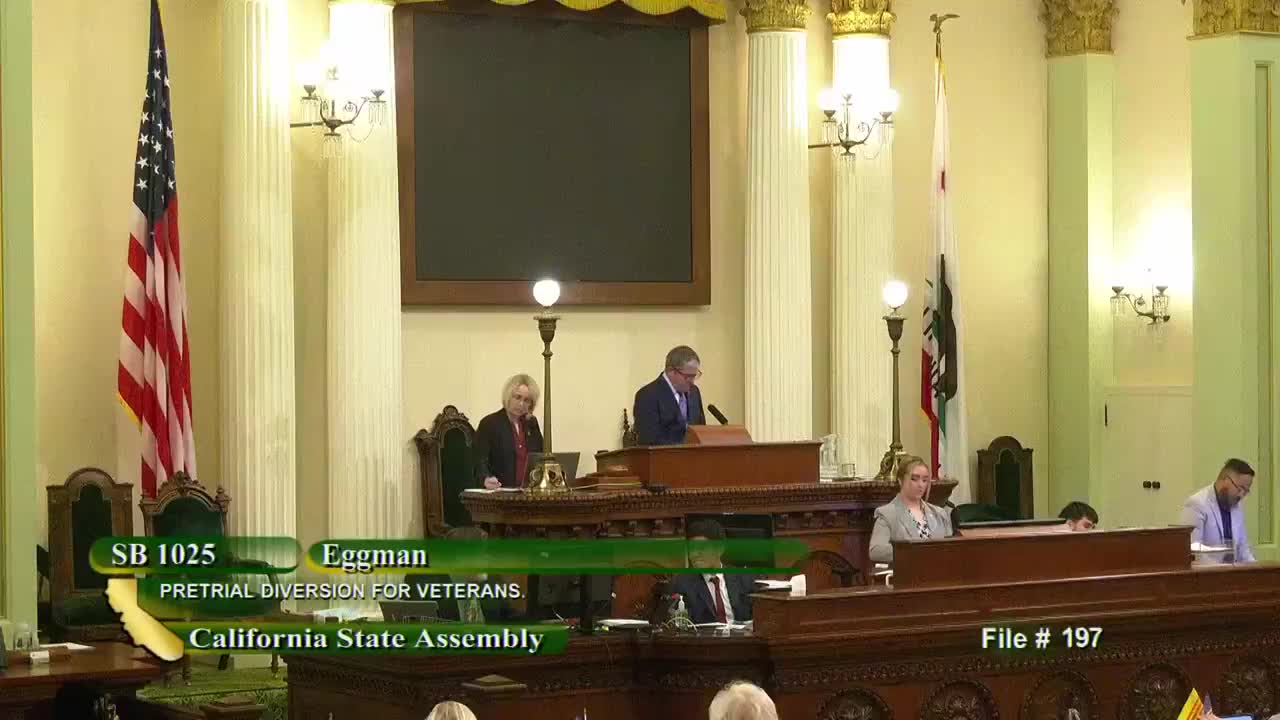 1MIN
Assembly Floor
 2MIN
Senate Floor
 9MIN
Senate Standing Committee on Public Safety
Bill Author

Bill Co-Author(s):