SB 1043: Short-term residential therapeutic programs: dashboard: seclusion or behavioral restraints.
- Session Year: 2023-2024
- House: Senate
- Latest Version Date: 2024-09-27
Current Status:
Passed
(2024-09-27: Chaptered by Secretary of State. Chapter 628, Statutes of 2024.)
Introduced
In Committee
First Chamber
In Committee
Second Chamber
Enacted
What does this bill do?
The bill requires short-term residential therapeutic programs that isolate or physically restrain a foster child to notify the child of their rights and give the child and their family or legal representative an oral and written account of the incident, including what happened, why it was done, who acted, and how long it lasted, and to file the written report with the Department of Social Services. It also requires the department to review and investigate concerning incidents, share reports with the foster care ombudsperson when needed, and post deidentified incident summaries, data, and licensing actions for these programs online twice a year.
The summary is provided by generative AI which can make mistakes. For original language, please view the details in the table below.
Existing law, the California Community Care Facilities Act, provides for the licensing and regulation of community care facilities, including short-term residential therapeutic programs, by the State Department of Social Services. The act defines a short-term residential therapeutic program as a residential facility licensed by the department and operated by any public agency or private organization that provides an integrated program of specialized and intensive care and supervision, services and supports, treatment, and short-term, 24-hour care and supervision to children that is trauma-informed.
Existing law requires specified facilities, including community care facilities, to conduct a clinical and quality review for each episode of the use of seclusion or behavioral restraints, as defined. Existing law requires the facility to conduct a debriefing regarding the incident with the person, and other specified individuals upon the persons request, to discuss how to avoid a similar incident in the future. Under existing law, the persons participation in the debriefing is voluntary.
This bill, The Accountability in Childrens Treatment Act, would require, in the case of an incident involving the use of seclusion or behavioral restraints in a short-term residential therapeutic program, the facility to notify any foster child who has been subject to seclusion or behavioral restraints of their personal rights by no later than the day following the incident and to provide, within 7 days, a description of the incident, in both oral and written forms, to the person subject to the seclusion or behavioral restraints and, as applicable, to the persons parent, foster parent, guardian, Indian custodian, or other authorized representative, and attorney, if any, and for Indian children, the tribal representative. The bill would require that the description contain certain information, including the actions taken during the incident and its duration, the rationale for the actions, and the personnel approving and implementing the actions. The bill would require the facility to provide a copy of the written description to the department, also within 7 days.
The bill would require the department to review all reported incidents involving the use of seclusion or behavioral restraints and to investigate any incidents that indicate a potential health and safety concern or licensing violation. As part of the assessment to determine if an investigation is required, the bill would require the department to determine whether the use of seclusion or behavioral restraints potentially violated any licensing laws and regulations or violated the licensees approved emergency intervention plan. If the department determines that an incident should be investigated, the bill would require the department to provide the Office of the State Foster Care Ombudsperson with a copy of the incident report and require the ombudsperson to exercise their discretion in determining whether to investigate the incident, as specified.
Existing law requires the Secretary of California Health and Human Services or their designee to take steps to establish a system of mandatory, consistent, timely, and publicly accessible data collection regarding the use of seclusion and behavioral restraints in specified facilities, including community care facilities, that utilize seclusion and behavioral restraints. Existing law requires that data collected include, among other information, the number of incidents, the duration of time spent per incident, and the number of serious injuries or deaths occurring while the person is in seclusion or subject to behavioral restraints.
Existing law requires the secretary to develop a mechanism for making this information, as it becomes available, publicly available on the internet. Existing law requires the State Department of Social Services and other specified departments to annually provide information to the Legislature about the progress made in implementing the above-described provisions on data collection, clinical and quality review, and debriefing.
This bill would require the State Department of Social Services, by January 1, 2026, to display, on its internet website, data that is specific to short-term residential therapeutic programs. The bill would require the dashboard to display the above-described data on seclusion or behavioral restraints as applicable to those programs, the above-described written descriptions of the incidents, and the numbers and types of licensing and administrative actions taken for the improper use of seclusion or behavioral restraints by the short-term residential therapeutic program or an associated individual for the improper use of seclusion or behavioral restraints. The bill would require the department to update the information biannually.
Under the bill, this data would exclude any personally identifiable information, as specified, and the provisions of the bill would be implemented to the extent not in conflict with any applicable federal or state privacy laws.
Existing law, the California Community Care Facilities Act, provides for the licensing and regulation of community care facilities, including short-term residential therapeutic programs, by the State Department of Social Services. The act defines a short-term residential therapeutic program as a residential facility licensed by the department and operated by any public agency or private organization that provides an integrated program of specialized and intensive care and supervision, services and supports, treatment, and short-term, 24-hour care and supervision to children that is trauma-informed.
Existing law requires specified facilities, including community care facilities, to conduct a clinical and quality review for each episode of the use of seclusion or behavioral restraints, as defined. Existing law requires the facility to conduct a debriefing regarding the incident with the person, and other specified individuals upon the persons request, to discuss how to avoid a similar incident in the future. Under existing law, the persons participation in the debriefing is voluntary.
This bill, The Accountability in Childrens Treatment Act, would require, in the case of an incident involving the use of seclusion or behavioral restraints in a short-term residential therapeutic program, the facility to notify any foster child who has been subject to seclusion or behavioral restraints of their personal rights by no later than the day following the incident and to provide, within 7 days, a description of the incident, in both oral and written forms, to the person subject to the seclusion or behavioral restraint restraints and, as applicable, to the persons parent, foster parent, guardian, Indian custodian, or other authorized representative, and attorney, if any, and for Indian children, the tribal representative. The bill would require that the description contain certain information, including the actions taken during the incident and its duration, the rationale for the actions, and the personnel approving and implementing the actions. The bill would require the facility to provide a copy of the written description to the department, also within 7 days. The
The bill would require the department to investigate the incident within 30 days of receipt of the incident report. review all reported incidents involving the use of seclusion or behavioral restraints and to investigate any incidents that indicate a potential health and safety concern or licensing violation. As part of the assessment to determine if an investigation is required, the bill would require the department to determine whether the use of seclusion or behavioral restraints potentially violated any licensing laws and regulations or violated the licensees approved emergency intervention plan. If the department determines that an incident should be investigated, the bill would require the department to provide the Office of the State Foster Care Ombudsperson with a copy of the incident report and require the ombudsperson to exercise their discretion in determining whether to investigate the incident, as specified.
The bill would require the Office of the Foster Care Ombudsperson to collect a statement, to be provided to the department within 7 days, about the incident from the person subject to the seclusion or behavioral restraint. The bill would authorize the statement to be collected privately.Existing law requires the Secretary of California Health and Human Services or their designee to take steps to establish a system of mandatory, consistent, timely, and publicly accessible data collection regarding the use of seclusion and behavioral restraints in specified facilities, including community care facilities, that utilize seclusion and behavioral restraints. Existing law requires that data collected include, among other information, the number of incidents, the duration of time spent per incident, and the number of serious injuries or deaths occurring while the person is in seclusion or subject to behavioral restraints.
Existing law requires the secretary to develop a mechanism for making this information, as it becomes available, publicly available on the internet. Existing law requires the State Department of Social Services and other specified departments to annually provide information to the Legislature about the progress made in implementing the above-described provisions on data collection, clinical and quality review, and debriefing.
This bill would require the State Department of Social Services, by January 1, 2026, to display, on its internet website, data that is specific to short-term residential therapeutic programs. The bill would require the dashboard to display the above-described data on seclusion or behavioral restraints as applicable to those programs, the above-described written descriptions of the incidents, and the numbers and types of licensing and administrative actions taken for the improper use of seclusion or behavioral restraints by the short-term residential therapeutic program or an associated individual for the improper use of seclusion or behavioral restraints. The bill would require the department to update the information biannually.
Under the bill, this data would exclude any personally identifiable information, as specified, and the provisions of the bill would be implemented to the extent not in conflict with any applicable federal or state privacy laws.
Existing law, the California Community Care Facilities Act, provides for the licensing and regulation of community care facilities, including short-term residential therapeutic programs, by the State Department of Social Services. The act defines a short-term residential therapeutic program as a residential facility licensed by the department and operated by any public agency or private organization that provides an integrated program of specialized and intensive care and supervision, services and supports, treatment, and short-term, 24-hour care and supervision to children that is trauma-informed.
Existing law requires specified facilities, including community care facilities, to conduct a clinical and quality review for each episode of the use of seclusion or behavioral restraints, as defined. Existing law requires the facility to conduct a debriefing regarding the incident with the person, and other specified individuals upon the persons request, to discuss how to avoid a similar incident in the future. Under existing law, the persons participation in the debriefing is voluntary.
This bill, The Accountability in Childrens Treatment Act, would require, in the case of an incident involving the use of seclusion or behavioral restraints in a short-term residential therapeutic program, would require the facility to provide provide, within 7 days, a description of the incident, in both oral and written forms, to the person subject to the seclusion or behavioral restraint and, as applicable, to the persons parent, foster parent, guardian, Indian custodian, or other authorized representative. representative, and attorney, if any, and for Indian children, the tribal representative. The bill would require that the description contain certain information, including the actions taken during the incident and its duration, the rationale for the actions, and the personnel approving and implementing the actions. The bill would require the facility to provide a copy of the written description to the department. department, also within 7 days. The bill would require the department to investigate the incident within 30 days of receipt of the incident report.
The bill would require the Office of the Foster Care Ombudsperson to collect a statement, to be provided to the department within 7 days, about the incident from the person subject to the seclusion or behavioral restraint. The bill would authorize the statement to be collected privately.
Existing law requires the Secretary of California Health and Human Services or their designee to take steps to establish a system of mandatory, consistent, timely, and publicly accessible data collection regarding the use of seclusion and behavioral restraints in specified facilities, including community care facilities, that utilize seclusion and behavioral restraints. Existing law requires that data collected include, among other information, the number of incidents, the duration of time spent per incident, and the number of serious injuries or deaths occurring while the person is in seclusion or subject to behavioral restraints.
Existing law requires the secretary to develop a mechanism for making this information, as it becomes available, publicly available on the internet. Existing law requires the State Department of Social Services and other specified departments to annually provide information to the Legislature about the progress made in implementing the above-described provisions on data collection, clinical and quality review, and debriefing.
This bill would require the State Department of Social Services, by January 1, 2026, to create and post, on its internet website, a public dashboard display, on its internet website, data that is specific to short-term residential therapeutic programs. The bill would require the dashboard to display the above-described data on seclusion or behavioral restraints as applicable to those programs and to display programs, the above-described written descriptions of the incidents. incidents, and the numbers and types of licensing and administrative actions taken for the improper use of seclusion or behavioral restraints by the short-term residential therapeutic program or an associated individual for the improper use of seclusion or behavioral restraints. The bill would require the department to update the information on a quarterly basis. biannually.
Under the bill, copies of the written descriptions and the dashboard this data would exclude any personally identifiable information, as specified, and the provisions of the bill would be implemented to the extent not in conflict with any applicable federal or state privacy laws.
Existing law, the California Community Care Facilities Act, provides for the licensing and regulation of community care facilities, including short-term residential therapeutic programs, by the State Department of Social Services, and Services. The act defines a short-term residential therapeutic program as a residential facility licensed by the department and operated by any public agency or private organization that provides an integrated program of specialized and intensive care and supervision, services and supports, treatment, and short-term, 24-hour care and supervision to children that is trauma-informed.
Existing law requires a short-term residential therapeutic program to prepare and maintain a current, written plan of operation that includes a program statement containing, among other things, a description of how the short-term residential therapeutic program will meet specified standards established by the department in collaboration with the State Department of Health Care Services. Existing law requires a short-term residential therapeutic plan to ensure the availability of licensed nursing staff, as specified.This bill would state that it is the intent of the Legislature to enact legislation that would require the State Department of Social Services to create an online dashboard of restraint use reports at short-term residential therapeutic programs that the public may access on the departments internet website.Existing law requires specified facilities, including community care facilities, to conduct a clinical and quality review for each episode of the use of seclusion or behavioral restraints, as defined. Existing law requires the facility to conduct a debriefing regarding the incident with the person, and other specified individuals upon the persons request, to discuss how to avoid a similar incident in the future. Under existing law, the persons participation in the debriefing is voluntary.
This bill, in the case of an incident involving the use of seclusion or behavioral restraints in a short-term residential therapeutic program, would require the facility to provide a description of the incident, in both oral and written forms, to the person subject to the seclusion or behavioral restraint and, as applicable, to the persons foster parent, guardian, or other authorized representative. The bill would require that the description contain certain information, including the actions taken during the incident and its duration, the rationale for the actions, and the personnel approving and implementing the actions. The bill would require the facility to provide a copy of the written description to the department.
Existing law requires the Secretary of California Health and Human Services or their designee to take steps to establish a system of mandatory, consistent, timely, and publicly accessible data collection regarding the use of seclusion and behavioral restraints in specified facilities, including community care facilities, that utilize seclusion and behavioral restraints. Existing law requires that data collected include, among other information, the number of incidents, the duration of time spent per incident, and the number of serious injuries or deaths occurring while the person is in seclusion or subject to behavioral restraints.
Existing law requires the secretary to develop a mechanism for making this information, as it becomes available, publicly available on the internet. Existing law requires the State Department of Social Services and other specified departments to annually provide information to the Legislature about the progress made in implementing the above-described provisions on data collection, clinical and quality review, and debriefing.
This bill would require the State Department of Social Services, by January 1, 2026, to create and post, on its internet website, a public dashboard that is specific to short-term residential therapeutic programs. The bill would require the dashboard to display the above-described data on seclusion or behavioral restraints as applicable to those programs and to display the above-described written descriptions of the incidents. The bill would require the department to update the information on a quarterly basis.
Under the bill, copies of the written descriptions and the dashboard would exclude any personally identifiable information, as specified, and the provisions of the bill would be implemented to the extent not in conflict with any applicable federal or state privacy laws.
Existing law, the California Community Care Facilities Act, provides for the licensing and regulation of community care facilities, including short-term residential therapeutic programs, by the State Department of Social Services, and defines a short-term residential therapeutic program as a residential facility licensed by the department and operated by any public agency or private organization that provides an integrated program of specialized and intensive care and supervision, services and supports, treatment, and short-term, 24-hour care and supervision to children that is trauma-informed.
Existing law requires a short-term residential therapeutic program to prepare and maintain a current, written plan of operation that includes a program statement containing, among other things, a description of how the short-term residential therapeutic program will meet specified standards established by the department in collaboration with the State Department of Health Care Services. Existing law requires a short-term residential therapeutic plan to ensure the availability of licensed nursing staff, as specified.
This bill would state that it is the intent of the Legislature to enact legislation that would require the State Department of Social Services to create an online dashboard of restraint use reports at short-term residential therapeutic programs that the public may access on the departments internet website.
This act shall be known, and may be cited, as The Accountability in Childrens Treatment Act.
SEC. 2.Section 1180.55 is added to the Health and Safety Code, immediately following Section 1180.5, to read:1180.55.(a)In the case of an incident involving the use of seclusion or behavioral restraints in a short-term residential therapeutic program, the facility shall, in conjunction with its process for a clinical and quality review and a debriefing as described in Section 1180.5, comply with all of the following steps:
(1)By no later than the day following the incident, notify any foster child who has been subject to seclusion or behavioral restraints of their personal rights, as specified in Section 16001.9 of the Welfare and Institutions Code, including, among others, the right to be provided with the contact information of the Community Care Licensing Division of the State Department of Social Services and the Office of the State Foster Care Ombudsperson, the right to contact either or both of these offices immediately upon request regarding any violations of the foster childs rights, the right to speak to representatives of these offices confidentially, and the right to be free from threats or punishment for making complaints.
(2)Within seven days, provide a description of the incident, in both oral and written forms, to the person who was subject to seclusion or behavioral restraints and, as applicable, to the persons parent, foster parent, guardian, Indian custodian, or other authorized representative, and attorney, if any, and for Indian children, as defined by subdivisions (a) and (b) of Section 224.1 of the Welfare and Institutions Code, the tribal representative. At a minimum, the description shall contain information on all of the following:
(A)The actions taken during the incident.
(B)The rationale for the actions.
(C)The personnel implementing the actions.
(D)The duration of the incident.
(3)Within seven days, provide a copy of the written description described in paragraph (2) to the State Department of Social Services.
(b)(1)The State Department of Social Services shall review all reported incidents involving the use of seclusion or behavioral restraints and shall investigate any incidents that indicate a potential health and safety concern or licensing violation. As part of the assessment to determine if an investigation is required, the department shall determine whether the use of seclusion or behavioral restraints potentially violated any licensing laws and regulations or violated the licensees approved emergency intervention plan.
(2)If the department determines that an incident involving the use of seclusion or behavioral restraints should be investigated, the department shall provide the Office of the State Foster Care Ombudsperson with a copy of the incident report. The ombudsperson shall exercise their discretion in determining whether to investigate the incident pursuant to paragraph (3) of subdivision (a) of Section 16164 of the Welfare and Institutions Codes.
(c)(1)By January 1, 2026, the department shall display, on its internet website, data that is specific to short-term residential therapeutic programs and that displays all of the following:
(A)Data collected pursuant to paragraph (4) of subdivision (c) of Section 1180.3, with regard to seclusion or behavioral restraints, as applicable to short-term residential therapeutic programs.
(B)Written descriptions collected pursuant to subdivision (a), subject to the limitations described in subdivision (d).
(C)The number and types of licensing administrative actions taken against a short-term residential therapeutic program or individual associated with the short-term residential therapeutic program for the improper use of seclusion or behavioral restraints.
(D)Completed investigation reports.
(2)The department shall update the data described in paragraph (1) biannually.
(d)(1)Data described in subdivision (c) shall exclude any personally identifiable information of the person, personnel, or other individuals listed in paragraph (2) of subdivision (a).
(2)This section shall be implemented to the extent not in conflict with any applicable federal or state privacy laws.
This act shall be known, and may be cited, as The Accountability in Childrens Treatment Act.
SEC. 2.Section 1180.55 is added to the Health and Safety Code, immediately following Section 1180.5, to read:1180.55.(a)In the case of an incident involving the use of seclusion or behavioral restraints in a short-term residential therapeutic program, the facility shall, in conjunction with its process for a clinical and quality review and a debriefing as described in Section 1180.5, comply, within 7 days, comply with both all of the following steps:
(1)By no later than the day following the incident, notify any foster child who has been subject to seclusion or behavioral restraints of their personal rights, as specified in Section 16001.9 of the Welfare and Institutions Code, including, among others, the right to be provided with the contact information of the Community Care Licensing Division of the State Department of Social Services and the Office of the State Foster Care Ombudsperson, the right to contact either or both of these offices immediately upon request regarding any violations of the foster childs rights, the right to speak to representatives of these offices confidentially, and the right to be free from threats or punishment for making complaints.
(1)Provide(2)Within seven days, provide a description of the incident, in both oral and written forms, to the person who was subject to the seclusion or behavioral restraint seclusion or behavioral restraints and, as applicable, to the persons parent, foster parent, guardian, Indian custodian, or other authorized representative, and attorney, if any, and for Indian children, as defined by subdivisions (a) and (b) of Section 224.1 of the Welfare and Institutions Code, the tribal representative. At a minimum, the description shall contain information on all of the following:
(A)The actions taken during the incident.
(B)The rationale for the actions.
(C)The personnel implementing the actions.
(D)The duration of the incident.
(E)Type of placement with the facility, including, but not limited to, child welfare, probation, or voluntary.(2)Provide(3)Within seven days, provide a copy of the written description described in paragraph (1) (2) to the State Department of Social Services.
(b)The department shall investigate all incidents reported, as described in subdivision (a), within 30 days of receipt of the incident report.(b)(1)The State Department of Social Services shall review all reported incidents involving the use of seclusion or behavioral restraints and shall investigate any incidents that indicate a potential health and safety concern or licensing violation. As part of the assessment to determine if an investigation is required, the department shall determine whether the use of seclusion or behavioral restraints potentially violated any licensing laws and regulations or violated the licensees approved emergency intervention plan.
(2)If the department determines that an incident involving the use of seclusion or behavioral restraints should be investigated, the department shall provide the Office of the State Foster Care Ombudsperson with a copy of the incident report. The ombudsperson shall exercise their discretion in determining whether to investigate the incident pursuant to paragraph (3) of subdivision (a) of Section 16164 of the Welfare and Institutions Codes.
(c)The Office of the Foster Care Ombudsperson shall collect a statement, to be provided to the department within 7 days, about the incident from the person subject to the seclusion or behavioral restraint. The statement may be collected privately.(d)(c)(1)By January 1, 2026, the department shall display, on its internet website, data that is specific to short-term residential therapeutic programs and that displays all of the following:
(A)Data collected pursuant to paragraph (4) of subdivision (c) of Section 1180.3, with regard to seclusion or behavioral restraints, as applicable to short-term residential therapeutic programs.
(B)Written descriptions collected pursuant to subdivision (a), subject to the limitations described in subdivision (e). (d).
(C)The number and types of licensing administrative actions taken against a short-term residential therapeutic program or individual associated with the short-term residential therapeutic program for the improper use of seclusion or behavioral restraints.
(D)Completed investigation reports.
(2)The department shall update the data described in paragraph (1) biannually.
(e)(d)(1)Data described in subdivision (d) (c) shall exclude any personally identifiable information of the person, personnel, or other individuals listed in paragraph (1) (2) of subdivision (a).
(2)This section shall be implemented to the extent not in conflict with any applicable federal or state privacy laws.
This act shall be known, and may be cited, as The Accountability in Childrens Treatment. Treatment Act.
SEC. 2.Section 1180.55 is added to the Health and Safety Code, immediately following Section 1180.5, to read:1180.55.(a)In the case of an incident involving the use of seclusion or behavioral restraints in a short-term residential therapeutic program, the facility shall, in conjunction with its process for a clinical and quality review and a debriefing as described in Section 1180.5, comply comply, within 7 days, with both of the following steps:
(1)Provide a description of the incident, in both oral and written forms, to the person subject to the seclusion or behavioral restraint and, as applicable, to the persons parent, foster parent, guardian, Indian custodian, or other authorized representative. representative, and attorney, if any, and for Indian children, as defined by subdivisions (a) and (b) of Section 224.1 of the Welfare and Institutions Code, the tribal representative. At a minimum, the description shall contain information on all of the following:
(A)The actions taken during the incident.
(B)The rationale for the actions.
(C)The personnel approving the actions.(D)(C)The personnel implementing the actions.
(E)(D)The duration of the incident.
(F)Whether the person is a minor or a nonminor dependent.(E)Type of placement with the facility, including, but not limited to, child welfare, probation, or voluntary.
(2)Provide a copy of the written description described in paragraph (1) to the State Department of Social Services, subject to the limitations described in subdivision (c). Services.
(b)The department shall investigate all incidents reported, as described in subdivision (a), within 30 days of receipt of the incident report.
(c)The Office of the Foster Care Ombudsperson shall collect a statement, to be provided to the department within 7 days, about the incident from the person subject to the seclusion or behavioral restraint. The statement may be collected privately.
(b)(d)(1)By January 1, 2026, the department shall create and post, display, on its internet website, a public dashboard data that is specific to short-term residential therapeutic programs and that displays both all of the following:
(A)Data collected pursuant to paragraph (4) of subdivision (c) of Section 1180.3, with regard to seclusion or behavioral restraints, as applicable to short-term residential therapeutic programs.
(B)Written descriptions collected pursuant to subdivision (a), subject to the limitations described in subdivision (c). (e).
(C)The number and types of licensing administrative actions taken against a short-term residential therapeutic program or individual associated with the short-term residential therapeutic program for the improper use of seclusion or behavioral restraints.
(D)Completed investigation reports.
(2)The department shall update the information on the dashboard data described in paragraph (1) on a quarterly basis. biannually.
(c)(e)(1)Copies of the written descriptions provided pursuant to paragraph (2) of subdivision (a) and the dashboard Data described in subdivision (b) (d) shall exclude any personally identifiable information of the person, personnel, or other individuals listed in paragraph (1) of subdivision (a).
(2)This section shall be implemented to the extent not in conflict with any applicable federal or state privacy laws.
This act shall be known, and may be cited, as Accountability in Childrens Treatment.
SEC. 2.Section 1180.55 is added to the Health and Safety Code, immediately following Section 1180.5, to read:1180.55.(a)In the case of an incident involving the use of seclusion or behavioral restraints in a short-term residential therapeutic program, the facility shall, in conjunction with its process for a clinical and quality review and a debriefing as described in Section 1180.5, comply with both of the following steps:
(1)Provide a description of the incident, in both oral and written forms, to the person subject to the seclusion or behavioral restraint and, as applicable, to the persons foster parent, guardian, or other authorized representative. At a minimum, the description shall contain information on all of the following:
(A)The actions taken during the incident.
(B)The rationale for the actions.
(C)The personnel approving the actions.
(D)The personnel implementing the actions.
(E)The duration of the incident.
(F)Whether the person is a minor or a nonminor dependent.
(2)Provide a copy of the written description described in paragraph (1) to the State Department of Social Services, subject to the limitations described in subdivision (c).
(b)(1)By January 1, 2026, the department shall create and post, on its internet website, a public dashboard that is specific to short-term residential therapeutic programs and that displays both of the following:
(A)Data collected pursuant to paragraph (4) of subdivision (c) of Section 1180.3, with regard to seclusion or behavioral restraints, as applicable to short-term residential therapeutic programs.
(B)Written descriptions collected pursuant to subdivision (a), subject to the limitations described in subdivision (c).
(2)The department shall update the information on the dashboard described in paragraph (1) on a quarterly basis.
(c)(1)Copies of the written descriptions provided pursuant to paragraph (2) of subdivision (a) and the dashboard described in subdivision (b) shall exclude any personally identifiable information of the person, personnel, or other individuals listed in paragraph (1) of subdivision (a).
(2)This section shall be implemented to the extent not in conflict with any applicable federal or state privacy laws.
SECTION 1.It is the intent of the Legislature to enact legislation that would require the State Department of Social Services to create an online dashboard of restraint use reports at short-term residential therapeutic programs that the public may access on the departments internet website.It is the intent of the Legislature to enact legislation that would require the State Department of Social Services to create an online dashboard of restraint use reports at short-term residential therapeutic programs that the public may access on the departments internet website.
|
Date
|
Status
|
|---|---|
| Sep 27, 2024 | Chaptered by Secretary of State. Chapter 628, Statutes of 2024. |
| Sep 27, 2024 | Approved by the Governor. |
| Sep 4, 2024 | Enrolled and presented to the Governor at 4 p.m. |
| Aug 28, 2024 | Assembly amendments concurred in. (Ayes 39. Noes 0. Page 5613.) Ordered to engrossing and enrolling. |
| Aug 27, 2024 | Ordered to special consent calendar. |
| Aug 26, 2024 | In Senate. Concurrence in Assembly amendments pending. |
| Aug 26, 2024 | Read third time. Passed. (Ayes 77. Noes 0. Page 6551.) Ordered to the Senate. |
| Aug 20, 2024 | Read second time. Ordered to third reading. |
| Aug 19, 2024 | Read second time and amended. Ordered to second reading. |
| Aug 15, 2024 | From committee: Do pass as amended. (Ayes 11. Noes 0.) (August 15). |
| Aug 7, 2024 | August 7 set for first hearing. Placed on suspense file. |
| Jun 27, 2024 | Read second time and amended. Re-referred to Com. on APPR. |
| Jun 26, 2024 | From committee: Do pass as amended and re-refer to Com. on APPR. (Ayes 6. Noes 0.) (June 25). |
| Jun 3, 2024 | Referred to Com. on HUM. S. |
| May 24, 2024 | In Assembly. Read first time. Held at Desk. |
| May 23, 2024 | Read third time. Passed. (Ayes 37. Noes 0. Page 4179.) Ordered to the Assembly. |
| May 20, 2024 | Ordered to special consent calendar. |
| May 16, 2024 | Read second time. Ordered to third reading. |
| May 16, 2024 | From committee: Do pass. (Ayes 7. Noes 0. Page 3969.) (May 16). |
| May 10, 2024 | Set for hearing May 16. |
| Apr 29, 2024 | April 29 hearing: Placed on APPR suspense file. |
| Apr 22, 2024 | Set for hearing April 29. |
| Apr 16, 2024 | From committee: Do pass and re-refer to Com. on APPR. (Ayes 5. Noes 0. Page 3606.) (April 15). Re-referred to Com. on APPR. |
| Apr 4, 2024 | Set for hearing April 15. |
| Apr 3, 2024 | Re-referred to Com. on HUMAN S. |
| Mar 18, 2024 | From committee with author's amendments. Read second time and amended. Re-referred to Com. on RLS. |
| Feb 14, 2024 | Referred to Com. on RLS. |
| Feb 8, 2024 | From printer. May be acted upon on or after March 9. |
| Feb 7, 2024 | Introduced. Read first time. To Com. on RLS. for assignment. To print. |
|
Date
|
Description
|
Location
|
Votes
|
|
|---|---|---|---|---|
| Aug 28, 2024 | Special Consent SB1043 Grove et al. | Senate Floor |
Passed |
|
| Aug 26, 2024 | SB 1043 Grove Senate Third Reading By Lee | Assembly Floor |
Passed |
|
| Aug 15, 2024 | Do pass as amended. | Assembly Standing Committee on Appropriations |
Passed |
|
| Jun 25, 2024 | Do pass as amended and be re-referred to the Committee on [Appropriations] | Assembly Standing Committee on Human Services |
Passed |
|
| May 23, 2024 | Special Consent SB1043 Grove et al. | Senate Floor |
Passed |
|
| May 16, 2024 | Do pass | Senate Standing Committee on Appropriations |
Passed |
|
| Apr 29, 2024 | Placed on suspense file | Senate Standing Committee on Appropriations |
Passed |
|
| Apr 15, 2024 | Do pass, but first be re-referred to the Committee on [Appropriations] | Senate Standing Committee on Human Services |
Passed |
This list shows positions taken on this bill by organizations on the date displayed, which is linked to the original source.
Positions by individuals are not included.
|
Organization
|
Position
|
Date
|
|---|---|---|
| 11:11 Media | * Support | Apr 15, 2024 |
| 11:11 Media | * Support | Apr 15, 2024 |
| 11:11 Media | ** Support | |
| 11:11 Media Impact | ** Support | |
| Activists San Diego | * Support | Apr 29, 2024 |
| Alpine Academy | * Support | Apr 15, 2024 |
| Ambika Law | ** Support | |
| Anti-Recidivism Coalition | ** Support | |
| Boys and Girls Club of Kern County | ** Support | |
| Children'S Law Center Of California | ** Support | |
| Clean Earth for Kids | * Support | Apr 29, 2024 |
| Coalition for California Welfare Rights Organizations | * Support | Apr 15, 2024 |
| Disability Rights California | ** Support | |
| Educate. Advocate. | ** Support | |
| Institutional Child Abuse Prevention & Advocacy Network | ** Support | |
| Institutional Child Abuse Prevention and Advocacy Network | * Support | Apr 15, 2024 |
| Kern County Network for Children | ** Support | |
| Lives in The Balance | ** Support | |
| National Center for Lesbian Rights | ** Support | |
| North County Equity and Justice Coalition | * Support | Apr 29, 2024 |
| Steinberg Institute | ** Support | |
| The Mission At Kern County | ** Support | |
| Unsilenced | ** Support | |
| Valkyrie Network | * Support | Apr 15, 2024 |
| Valkyrie Network | * Support | Apr 15, 2024 |
SENATE RULES COMMITTEE Office of Senate Floor Analyses (916) 651-1520 Fax: (916) 327-4478 | SB 1043 |
UNFINISHED BUSINESS
Bill No: SB 1043
Author: Grove (R), Ashby (D) and Wahab (D), et al.
Amended: 8/19/24
Vote: 21
SENATE HUMAN SERVICES COMMITTEE: 5-0, 4/15/24
AYES: Alvarado-Gil, Ochoa Bogh, Blakespear, Hurtado, Menjivar
SENATE APPROPRIATIONS COMMITTEE: 7-0, 5/16/24
AYES: Caballero, Jones, Ashby, Becker, Bradford, Seyarto, Wahab
SENATE FLOOR: 37-0, 5/23/24
AYES: Alvarado-Gil, Ashby, Atkins, Becker, Blakespear, Bradford, Caballero, Cortese, Dahle, Dodd, Durazo, Eggman, Glazer, Gonzalez, Grove, Hurtado, Jones, Laird, Limón, McGuire, Menjivar, Min, Nguyen, Niello, Ochoa Bogh, Padilla, Portantino, Roth, Rubio, Seyarto, Skinner, Smallwood-Cuevas, Stern, Umberg, Wahab, Wiener, Wilk
NO VOTE RECORDED: Allen, Archuleta, Newman
ASSEMBLY FLOOR: 77-0, 8/26/24 - See last page for vote
SUBJECT: Short-term residential therapeutic programs: dashboard: seclusion or behavioral restraints
SOURCE: 11:11 Media
DIGEST:
This bill requires facilities operating short-term therapeutic programs (STRTPs) to provide specified information to a child subject to seclusion or behavioral restraints, their parent, foster parent, guardian, or tribal representative, and the California Department of Social Services (CDSS). Requires CDSS to review all reported incidents involving the use of seclusion or behavioral restraints, and investigate any incidents that indicate a potential health and safety concern or licensing violation. Requires CDSS to display data that is specific to STRTPs on its website regarding the use of seclusion or behavioral restraints.
Assembly Amendments
make technical and clarifying changes and delete the 30 day investigation requirement.
ANALYSIS:
Existing Law:
- Defines a STRTP as a residential facility operated by a public agency or private organization and licensed by CDSS that provides an integrated program of specialized and intensive care and supervision, services and supports, treatment, and short-term, 24-hour care and supervision to children. Further, requires the care and supervision provided by a STRTP be nonmedical, except as otherwise permitted, as specified. (HSC 1502(a)(18))
- Requires the development of technical assistance and training programs for specified health facilities to reduce or eliminate the use of seclusion and behavioral restraints in those facilities that utilize them. (HSC 1180.3)
- Provides that the Secretary of California Health and Human Services (Secretary) or their designee shall take steps to establish a system of mandatory, consistent, timely, and publicly accessible data collection regarding the use of seclusion and behavioral restraints in all specified facilities that utilize seclusion and behavioral restraints. The Secretary shall develop a mechanism for making this information, as it becomes available, publicly available on the internet. For data currently being collected, implementation shall be done as soon as it reasonably can be achieved within existing resources. As new reporting requirements are developed and result in additional data becoming available, this additional data shall be included in the data publicly available on the internet. (HSC 1180.3)
- Provides that the data to be collected above shall include of the following:
- The number of deaths that occur while persons are in seclusion or behavioral restraints, or where it is reasonable to assume that a death was proximately related to the use of seclusion or behavioral restraints.
- The number of serious injuries sustained by persons while in seclusion or subject to behavioral restraints.
- The number of serious injuries sustained by staff that occur during the use of seclusion or behavioral restraints.
- The number of incidents of seclusion.
- The number of incidents of use of behavioral restraints.
- The duration of time spent per incident in seclusion.
- The duration of time spent per incident subject to behavioral restraints.
- The number of times an involuntary emergency medication is used to control behavior, as defined by the State Department of State Hospitals. (HSC 1180.2(d)(3))
- Provides that the above data collection, reporting, and information being made publically available is not required if implementation cannot be achieved within existing resources, unless additional funding for this purpose becomes available. (HSC 1180.3)
- Provides that facilities, including STRTPs, shall, as quickly as possible but no later than 24 hours after the use of seclusion or behavioral restraints, conduct a debriefing regarding the incident with the person, and, if the person requests it, the person’s family member, domestic partner, significant other, or authorized representative, if the desired third party can be present at the time of the debriefing at no cost to the facility, as well as with the staff members involved in the incident, if reasonably available, and a supervisor, to discuss how to avoid a similar incident in the future. The person’s participation in the debriefing shall be voluntary. The purposes of the debriefing shall be to do all of the following:
- Assist the person to identify the precipitant of the incident, and suggest methods of more safely and constructively responding to the incident.
- Assist the staff to understand the precipitants to the incident, and to develop alternative methods of helping the person avoid or cope with those incidents.
- Help treatment team staff devise treatment interventions to address the root cause of the incident and its consequences, and to modify the treatment plan.
- Help assess whether the intervention was necessary and whether it was implemented in a manner consistent with staff training and facility policies. (HSC 1180.5(b))
This bill:
- Requires a facility, in the case of an incident involving the use of seclusion or behavioral restraints in an STRTP, in conjunction with its process for a clinical and quality review and a debriefing as described in existing law, to comply with all of the following steps:
- Notify, by no later than the day following the incident, any foster child who has been subject to seclusion or behavioral restraints of their personal rights, as specified in existing law, including, among others, the right to be provided with the contact information of the Community Care Licensing Division (CCLD) of CDSS and the California Office of the Foster Care Ombudsperson (OFCO); the right to contact either or both of these offices immediately upon request regarding any violations of the foster child's rights, the right to speak to representatives of these offices confidentially, and the right to be free from threats or punishment for making complaints.
- Provide a description of the incident within seven days, in both oral and written forms, to the person who was subject to seclusion or behavioral restraint and, as applicable, to the person's foster parent, guardian, other authorized representative, or attorney if any, and for Indian children, the tribal representative. Requires, at a minimum, the description to contain information regarding the actions taken during the incident; the rationale for the actions; the personnel approving the actions; the personnel implementing the actions; and, the duration of the incident; and,
- Provide a copy of the written description referenced in b) above to CDSS within seven days, excluding any personally identifiable information of the person, personnel, or the person's foster parent, guardian, or other authorized representative.
- Requires CDSS to review all reported incidents involving the use of seclusion or behavioral restraints and investigate any incidents that indicate a potential health and safety concern or licensing violation.
- Requires CDSS, as part of the assessment to determine if an investigation is required, to determine whether the use of seclusion or behavioral restraints potentially violated any licensing laws and regulations or violated the licensee's approved emergency intervention plan.
- Requires CDSS, if it determines that an incident involving the use of seclusion or behavioral restraints should be investigated, to provide OFCO with a copy of the incident report. Further requires the Ombudsperson to exercise their discretion, as provided in existing law, in determining whether to investigate the incident.
- Requires CDSS, by January 1, 2026, to display on its website data collected pursuant to existing law, with regard to seclusion or behavioral restraints, as applicable to STRTPs that excludes any identifiable information, to be updated biannually, that displays all of the following:
- Data collected pursuant to existing law that details the number of deaths and injuries that occur while persons are in seclusion or behavioral restraints; the number of serious injuries sustained by staff that occur during the use of seclusion or behavioral restraints; the number and duration of incidents of use of behavioral restraints and seclusion; and, the number of times an involuntary emergency medication is used to control behavior;
- Written descriptions collected pursuant to 1) c) above, subject to the limitations related to the inclusion of personal identifiable information;
- The number and types of licensing administrative actions taken against an STRTP or individual associated with the STRTP for the improper use of seclusion or behavioral restraints; and,
- Completed investigation reports.
- Data collected pursuant to existing law that details the number of deaths and injuries that occur while persons are in seclusion or behavioral restraints; the number of serious injuries sustained by staff that occur during the use of seclusion or behavioral restraints; the number and duration of incidents of use of behavioral restraints and seclusion; and, the number of times an involuntary emergency medication is used to control behavior;
- Specifies these provisions shall be implemented to the extent they are not in conflict with any applicable federal or state privacy laws.
Background:
According to the author, “California has been on the forefront when it comes to recognizing the need to strengthen laws surrounding youth in congregate care. SB 1043 is a children’s protection measure that will create more accountability in their treatment. When it comes to our children’s health and wellness we should only accept the highest level of transparency in these areas of care. SB 1043 will create more transparency at CDSS by requiring CDSS to create a dashboard on their website to publish the use of restraints and seclusion rooms in STRTPs.”
Movement to Family Based Care In 2011, the Legislature directed the CDSS to reduce the Child Welfare System’s dependence on congregate care[1]. In 2015, after a three year workgroup co-led by the County Welfare Directors Association of California (CWDA), the CDSS published a report entitled “California’s Child Welfare Continuum of Care Reform (CCR),”[2] as required by the legislature in SB 1013. The 56-page report, developed in collaboration with stakeholders, provided recommendations for restructuring the child welfare system to care for children in foster homes. The CCR report outlined a reform of California’s Child Welfare System by improving assessments of children and families, emphasizing home-based family placements of foster children, and changing the goals of congregate care placements. The report noted: “Children should live in their communities in home-based family care settings.” This move mirrored changes being made at the federal level.
CCR was designed to reduce the number of foster children placed in congregate care settings by improving the assessments of children and families and establishing child and family teams (CFTs) for each child in foster care. Assembly Bill 403 (Stone, Chapter 773, Statutes of 2015) was the first of six CDSS-sponsored CCR bills and provided the statutory and policy framework to ensure services and supports provided to the child or youth and their family are tailored toward the ultimate goal of maintaining a stable permanent family. AB 403 advanced California’s goal to move away from the use of long-term group home care by enacting a sunset for group home licenses, increasing youth placement into family settings, strengthening training and supports through the development of “child and family teams.” Subsequent bills established requirements for mental health certification of STRTPs, made changes to the Resource Family Approval (RFA) process, and provided additional oversight of foster homes, the Intensive Services Foster Care category for children with high needs, and an option to license respite caregivers, among other changes. A sunset was also placed on federal and state participation in rates paid to group homes, effectively eliminating placement into group home care.
In the years leading up to California’s CCR efforts, federal law[3] directed states to implement policies to ensure children are placed in a permanent home quickly through reunification, adoption, guardianship, or permanent placement with a fit and willing relative. Changes in federal law included prohibiting a plan of long-term foster care for children younger than 16 years old, expanding the requirement to notify relatives when a child is brought into care, and increased incentives for adoption and guardianship. In California, the simultaneous reforms mandated by CCR required changes in the approach to evaluating children’s needs, including the use of a newly adopted evaluation tool, the implementation of CFTs to determine placements, an increased emphasis on family finding for youth who must enter care, and the use of a new RFA process for all foster parents and relative caretakers. The reforms also created the STRTP model, which requires an integration of federal Title IV-E and Medi-Cal funded services.
Out of State Placement In April 2020, staff members at a Michigan facility for foster youth restrained 16-year-old Cornelius Frederick for 12 minutes until he lost consciousness. He was in cardiac arrest when the paramedics arrived. Frederick died in a hospital two days later and his death was ruled a homicide. He had been living at the facility for two years. A Michigan state investigation concluded that the facility failed to follow state licensing rules on restraints.
Following Frederick’s death, several fights broke out and 26 of the 124 youth housed there ran away, according to news accounts. The facility was also experiencing widespread exposure of COVID-19 at the time. The Michigan Department of Health and Human Services subsequently ordered all youth be removed from the facility. Forty-one California youth were brought home in May 2020.
The same year, CDSS reviewed the operations of all certified out-of-state facilities and found significant licensing violations. In December 2020, CDSS decertified the out-of-state facilities failing to meet licensing standards, and returned all youth placed in those facilities back to California. Subsequently, the Legislature passed AB 153 (Committee on Budget, Chapter 86, Statutes of 2021), a budget trailer bill, which phased out the use of out-of-state residential facilities by child welfare and probation departments, removing foster children from out-of-state facilities by July 1, 2022.
Current Reporting Requirements Existing law (HSC 1180.2(d)(3)) requires facilities, including STRTPs, to collect data including:
- The number of deaths that occur while persons are in seclusion or behavioral restraints, or where it is reasonable to assume that a death was proximately related to the use of seclusion or behavioral restraints.
- The number of serious injuries sustained by persons while in seclusion or subject to behavioral restraints.
- The number of serious injuries sustained by staff that occur during the use of seclusion or behavioral restraints.
- The number of incidents of seclusion.
- The number of incidents of use of behavioral restraints.
- The duration of time spent per incident in seclusion.
- The duration of time spent per incident subject to behavioral restraints.
- The number of times an involuntary emergency medication is used to control behavior, as defined by the State Department of State Hospitals.
However, the law also provides that the above data collection, reporting, and information being made publically available is not required if implementation cannot be achieved within existing resources, unless additional funding for this purpose becomes available. As a result, this information has not been made public. This bill would provide that for STRTPs, information is required, regardless of funding, to be collected and published. If and until such information is made available to the public, it is unclear what reforms need to be made to the STRTP seclusion and restraint practices.
Related/Prior Legislation:
AB 501 (Ridley-Thomas, Chapter 704, Statutes of 2017) expanded the definition of STRTP to include a CCRP to be used as diversion from psychiatric hospitalization and created a new facility licensure category for CCRPs, and made related changes.
AB 741 (Williams, 2016) would have expanded the definition of a STRTP to include a CCRP to be used as a diversion from psychiatric hospitalization and would have limited the state to 10 consecutive days and no more than 20 days total within a six-month period. The bill was vetoed by the Governor.
SB 82 (Committee on Budget and Fiscal Review, Chapter 34, Statutes of 2013) established the Investment in Mental Health Wellness Act of 2013, which authorized the California Health Facilities Financing Authority to administer a local grant program to increase capacity for crisis support programs.
SB 1013 (Committee on Budget and Fiscal Review, Chapter 35, Statutes of 2012) required CDSS to establish a working group to develop recommended revisions to the current rate-setting system, resulting in the Continuum of Care Reform (CCR) effort.
FISCAL EFFECT: Appropriation: No Fiscal Com.: Yes Local: No
According to the Assembly Appropriations Committee
CDSS estimates total General Fund costs of $13.2 million in the first year, $12.8 million in the second year, $15.8 million in the third and fourth years, and $12.1 million annually thereafter for additional staff and resources to manage the increased workload associated with this bill. These costs include:
1) Approximately $6.3 million annually ongoing to the Community Care Licensing Division for additional licensing and support staff to investigate all incidents involving the use of seclusion or behavioral restraints in an STRTP, as well as approximately $2.4 annually in administrative and legal support of these investigations.
2) Approximately $1.2 million annually ongoing to the Office of the Foster Care Ombudsperson for additional staff to conduct outreach and interviews of children who are the subject of seclusion or behavioral restraints.
3) Approximately $1.4 million in the first year and $1.3 million annually thereafter to the Information Systems Division to develop infrastructure to process incident reports and publish related data.
4) Approximately $2.0 million in the first year, $1.8 million in the second year, $4.8 million in the third and fourth years, and $1.1 million annually thereafter to develop and deploy a segregated telephone system for the Office of the Foster Care Ombudsperson to process interviews with youth.
The Budget Act of 2024 does not include funding for the provisions of this bill.
According to the Legislative Analyst’s Office, the General Fund faces a structural deficit in the tens of billions of dollars over the next several fiscal years.
SUPPORT: (Verified 8/27/24)
11:11 Media (source)
11:11 Media Impact
Ambika Law
Anti-recidivism Coalition (UNREG)
Boys and Girls Club of Kern County
Children's Law Center of California
Disability Rights California
Educate. Advocate.
Institutional Child Abuse Prevention & Advocacy Network
Kern County Network for Children
Lives in The Balance
National Center for Lesbian Rights
Steinberg Institute
The Mission At Kern County
Unsilenced
OPPOSITION: (Verified 8/27/24)
None received
ASSEMBLY FLOOR: 77-0, 8/26/24
AYES: Addis, Aguiar-Curry, Alanis, Alvarez, Arambula, Bains, Bauer-Kahan, Bennett, Berman, Boerner, Bonta, Bryan, Calderon, Juan Carrillo, Wendy Carrillo, Chen, Connolly, Megan Dahle, Davies, Dixon, Essayli, Flora, Mike Fong, Friedman, Gabriel, Gallagher, Garcia, Gipson, Grayson, Haney, Hart, Holden, Hoover, Irwin, Jackson, Jones-Sawyer, Kalra, Lackey, Lee, Low, Lowenthal, Maienschein, Mathis, McCarty, McKinnor, Muratsuchi, Stephanie Nguyen, Pacheco, Papan, Jim Patterson, Joe Patterson, Pellerin, Petrie-Norris, Quirk-Silva, Ramos, Rendon, Reyes, Luz Rivas, Rodriguez, Blanca Rubio, Sanchez, Santiago, Schiavo, Soria, Ta, Ting, Valencia, Villapudua, Waldron, Wallis, Ward, Weber, Wicks, Wilson, Wood, Zbur, Robert Rivas
NO VOTE RECORDED: Cervantes, Ortega
Prepared by: Heather Hopkins / HUMAN S. / (916) 651-1524
8/27/24 12:54:25
**** END ****
SB 1013 (Committee on Budget and Fiscal Review, Chapter 35, Statutes of 2012) ↑
https://www.cdss.ca.gov/cdssweb/entres/pdf/CCR_LegislativeReport.pdf ↑
Fostering Connections to Success and Increasing Adoptions Act of 2008 (P.L. 110-351) and the Preventing Sex Trafficking and Strengthening Families Act (P.L. 113-183) ↑
SENATE THIRD READING
STR Bill Id:SB 1043
Author:(Grove, et al.)
As Amended Ver:August 19, 2024
Majority vote
SUMMARY
Requires facilities operating short-term therapeutic programs (STRTPs) to provide specified information to a child subject to seclusion or behavioral restraints, their parent, foster parent, guardian, or tribal representative, and the California Department of Social Services (CDSS). Requires CDSS to review all reported incidents involving the use of seclusion or behavioral restraints, and investigate any incidents that indicate a potential health and safety concern or licensing violation. Requires CDSS to display data that is specific to STRTPs on its website regarding the use of seclusion or behavioral restraints.
Major Provisions
- Requires a facility, in the case of an incident involving the use of seclusion or behavioral restraints in an STRTP, in conjunction with its process for a clinical and quality review and a debriefing as described in existing law, to comply with all of the following steps:
- Notify, by no later than the day following the incident, any foster child who has been subject to seclusion or behavioral restraints of their personal rights, as specified in existing law, including, among others, the right to be provided with the contact information of the Community Care Licensing Division (CCLD) of CDSS and the California Office of the Foster Care Ombudsperson (OFCO); the right to contact either or both of these offices immediately upon request regarding any violations of the foster child's rights, the right to speak to representatives of these offices confidentially, and the right to be free from threats or punishment for making complaints.
- Provide a description of the incident within seven days, in both oral and written forms, to the person who was subject to seclusion or behavioral restraint and, as applicable, to the person's foster parent, guardian, other authorized representative, or attorney if any, and for Indian children, the tribal representative. Requires, at a minimum, the description to contain information regarding the actions taken during the incident; the rationale for the actions; the personnel approving the actions; the personnel implementing the actions; and, the duration of the incident; and,
- Provide a copy of the written description referenced in b) above to CDSS within seven days, excluding any personally identifiable information of the person, personnel, or the person's foster parent, guardian, or other authorized representative.
- Requires CDSS to review all reported incidents involving the use of seclusion or behavioral restraints and investigate any incidents that indicate a potential health and safety concern or licensing violation.
- Requires CDSS, as part of the assessment to determine if an investigation is required, to determine whether the use of seclusion or behavioral restraints potentially violated any licensing laws and regulations or violated the licensee's approved emergency intervention plan.
- Requires CDSS, if it determines that an incident involving the use of seclusion or behavioral restraints should be investigated, to provide OFCO with a copy of the incident report. Further requires the Ombudsperson to exercise their discretion, as provided in existing law, in determining whether to investigate the incident
- Requires CDSS, by January 1, 2026, to display on its website data collected pursuant to existing law, with regard to seclusion or behavioral restraints, as applicable to STRTPs that excludes any identifiable information, to be updated biannually, that displays all of the following:
- Data collected pursuant to existing law that details the number of deaths and injuries that occur while persons are in seclusion or behavioral restraints; the number of serious injuries sustained by staff that occur during the use of seclusion or behavioral restraints; the number and duration of incidents of use of behavioral restraints and seclusion; and, the number of times an involuntary emergency medication is used to control behavior;
- Written descriptions collected pursuant to 1) c) above, subject to the limitations related to the inclusion of personal identifiable information;
- The number and types of licensing administrative actions taken against an STRTP or individual associated with the STRTP for the improper use of seclusion or behavioral restraints; and,
- Completed investigation reports.
- Specifies these provisions shall be implemented to the extent they are not in conflict with any applicable federal or state privacy laws
COMMENTS
Background: History of the Use of Seclusion and Restraints on Children. SB 130 (Chesbro), Chapter 750, Statutes of 2003, required the California Health and Human Services Agency (CalHHS) to provide the leadership and coordination necessary to reduce the use of seclusion and behavioral restraints in facilities that are licensed, certified, or monitored by departments that fall within its jurisdiction, and also established measures to reduce the use of seclusion and behavioral restraints.
However, the historical use of seclusion and restraints in these facilities has concerned many stakeholders and policymakers and there is a history of documented abuse of youth placed in these facilities in other states. According to the United States (U.S.) Government Accountability Office (GAO), "Prior GAO reports have described allegations of youth being maltreated, and sometimes killed, by staff employed at residential facilities. Many of the youth placed in residential facilities are in foster care." In response, legislation has been passed at the federal and state level to establish training standards for staff who work in these facilities with children and to require transparency in reporting these incidents.
The requirements governing the use of seclusion and restraints on children in STRTPs are largely contained within the interim licensing standards that were established as a result of legislation implementing Continuum of Care Reform (CCR). CDSS is authorized to use the interim licensing standards until regulations are adopted.
Short-Term Residential Therapeutic Programs. STRTPs were established in 2017 as a new community care facility to provide short-term, 24-hour nonmedical care and supervision to children and offer mental health interventions to stabilize, support, and transition youth with high-level mental health needs to lower levels of care using trauma-informed, culturally relevant services. This licensing category was established to align mental health policy with the state's efforts to reduce the use of congregate care settings as part of CCR. The use of residential facilities as placements for youth in foster care has declined over the course of 20 years, according to data from the federal Department of Health and Human Services. Residential facilities were listed as the most recent placement for about 101,000 youth in foster care in 2002. By 2022, the most recent year of available data, that number had dropped to about 34,000 youth. As of June 12, 2024, there were 339 licensed STRTPs in California with a capacity to serve 2,605 children. Currently, there are 1,182 child welfare placements and 317 probation placements for a total of 1,499 youth residing in STRTPs.
Emergency Intervention Plans. Due to the high incidence of children in STRTPs with reported complex care needs, the interim licensing standards for STRTPs outline the requirements for each facility's emergency intervention plan when challenging incidents occur. The current version of STRTP interim licensing standards require the plan to be trauma-informed, culturally relevant, appropriate for the age, size, emotional, behavioral, and developmental level of the children and account for their particular traumas, including commercially sexually exploited children (CSEC). The plan must include de-escalation and harm reduction techniques and must be submitted to, and approved by CDSS, prior to implementation.
Debriefing and Review of Manual Restraint Use. Existing law requires STRTPs, as quickly as possible but no later than 24 hours after the use of seclusion or behavioral restraints, to conduct a debriefing regarding the incident with the person, and, if the person requests it, the child's family member, domestic partner, significant other, or authorized representative, as well as with the staff members involved in the incident, and a supervisor, to discuss how to avoid a similar incident in the future. The child's participation in the debriefing is voluntary. The interim licensing standards also detail a process for a debriefing and review of manual restraint use and requires an administrator to offer a debriefing to the child involved with the use of manual restraint.
This bill would require the facility to provide a description of the incident, in both oral and written forms to the child subject to the seclusion or behavioral restraint in conjunction with the existing debriefing process. The facility would also be required to submit the written description of the incident to CDSS to be posted on their website, with any personally identifiable information redacted.
Incident Reports. According to the interim licensing standards, each use of manual restraints must be reported to CDSS and the child's authorized representative by telephone no later than the next working day following the incident. A written incident report must be submitted to CDSS within seven days, as required by California Code of Regulations, Title 22, Section 80061.
According to CDSS, once an incident report is received from an STRTP, a licensing program analyst triages with a manager to determine if an investigation is warranted based on the appearance or potential use of an improper restraint. This bill would require CDSS, if they determine that an incident involving the use of seclusion or behavioral restraints should be investigated, to provide OFCO with a copy of the incident report.
Lack of Transparency: Seclusion and Restraint Data. The incident reports are stored on an internal CDSS network server and are not publicly available. CDSS reported to the Committee that after a hand count, in 2023, there were roughly 3,000 incidents of restraint or seclusion in licensed STRTPs. However, there was no further data shared due to their current process.
Seclusion and behavioral restraints are used in other state-licensed facilities. The use of restraints and their appropriateness has come up several times in the Legislature in the last decade. Ultimately, they are permitted in limited circumstances and with the expectation data on the use is made available.
Current law, established under SB 130, requires the CalHHS secretary to take steps to establish a system of mandatory, consistent, timely, and publicly accessible data collection regarding the use of seclusion and behavioral restraints in the facilities mentioned above. SB 130 also requires the CalHHS secretary to develop a mechanism for making information, as it becomes available, publicly available on the internet, and for data currently being collected, to be available as soon as it reasonably can be achieved within existing resources. At the direction of the CalHHS secretary, the departments are required to cooperate and share resources for developing uniform reporting for all facilities and requires uniform reporting of seclusion and behavioral restraint utilization information, to the extent possible, to be incorporated into existing reporting requirements for facilities.
Equity Implications: Youth who are referred to an STRTP have complex care needs and are overwhelmingly represented by foster youth. According to the data provided by the Catalyst Center covering May 18, 2020, to May 29, 2024, there were 279 total requests for placements or service referrals, and of that number, 242 unique youth, of which 45% are CSEC, transgender or non-binary, or have substance use factors and the plurality, (75%) of requests were initiated by child welfare. Because these youth arrive to these facilities in a particularly vulnerable state, it is imperative that their well-being and safety is protected along with that of the staff who are charged with addressing the needs of youth who can sometimes present with difficult behavior. While there is a robust process laid out in statute, regulations, and interim licensing standards regarding the use of seclusion and restraints in STRTPs, there is little known about how often these incidents take place, how often and why they are investigated, and whether the youth agree with the characterizations and outcomes of the investigations. This lack of transparency makes it difficult to gauge whether restraints are being applied in a disproportionate manner.
According to the Author
"California has been at the forefront in strengthening youth in congregate care laws. [This bill] is a children's protection measure that will create more accountability in in how children in these facilities are treated. When it comes to our children's health and wellness we should only accept the highest level of transparency in these areas of care. [This bill] will create more transparency at the Department of Social Services by requiring the Department to create a dashboard on their website to publish the use of restraints and seclusion rooms in Short-Term Residential Therapeutic Programs (STRTPs)."
Arguments in Support
11:11 Media, the Sponsor of this bill, writes in support, "California has made commendable progress in addressing issues within the foster care system, particularly concerning the placement of children in out-of-state facilities. However, there remains a pressing need to ensure the safety and well-being of children in residential care settings within the state. [This bill] will address a critical gap by requiring the reporting of key data, including incidents resulting in serious injuries or deaths, duration of seclusion or restraint incidents, and the use of involuntary emergency medication, as well as publishing this information on the California Department of Social Services website. We cannot fix what we do not know. [This bill] will provide vital information to key stakeholders, including policymakers, regulatory and placing agencies, advocacy groups, and concerned citizens. We hope added transparency will serve as a crucial tool in informing decision-making and holding facilities accountable for their actions, ultimately ensuring the protection of our state's most vulnerable youth."
Arguments in Opposition
No opposition on file.
FISCAL COMMENTS
According to the Assembly Appropriations Committee on August 15, 2024, CDSS estimates General Fund costs of approximately $1.4 million in the first year and $1.3 million annually thereafter to the Information Systems Division to develop infrastructure to process incident reports and publish related data. The Budget Act of 2024 does not include funding for the provisions of this bill. According to the Legislative Analyst's Office, the General Fund faces a structural deficit in the tens of billions of dollars over the next several fiscal years. '
VOTES
SENATE FLOOR: 37-0-3
YES: Alvarado-Gil, Ashby, Atkins, Becker, Blakespear, Bradford, Caballero, Cortese, Dahle, Dodd, Durazo, Eggman, Glazer, Gonzalez, Grove, Hurtado, Jones, Laird, Limón, McGuire, Menjivar, Min, Nguyen, Niello, Ochoa Bogh, Padilla, Portantino, Roth, Rubio, Seyarto, Skinner, Smallwood-Cuevas, Stern, Umberg, Wahab, Wiener, Wilk
ABS, ABST OR NV: Allen, Archuleta, Newman
ASM HUMAN SERVICES: 6-0-1
YES: Lee, Essayli, Calderon, Jackson, Dixon, Ortega
ABS, ABST OR NV: Gipson
ASM APPROPRIATIONS: 11-0-4
YES: Wicks, Arambula, Bryan, Calderon, Wendy Carrillo, Mike Fong, Grayson, Haney, Hart, Pellerin, Villapudua
ABS, ABST OR NV: Sanchez, Dixon, Jim Patterson, Ta
UPDATED
VERSION: August 19, 2024
CONSULTANT: Jessica Langtry / HUM. S. / (916) 319-2089 FN: 0004135
Date of Hearing: August 7, 2024
ASSEMBLY COMMITTEE ON APPROPRIATIONS
Buffy Wicks, Chair
SBPCA Bill Id:SB 1043
Author:(Grove) – As Amended Ver:June 27, 2024
Policy Committee: | Human Services | Vote: | 6 - 0 |
|
| ||
|
|
Urgency: No State Mandated Local Program: No Reimbursable: No
SUMMARY:
This bill requires the California Department of Social Services (CDSS) to investigate each incident involving the use of seclusion or behavioral restraints in a facility operating a short-term therapeutic program (STRTP) and to display on its internet website data specific to STRTPs’ use of seclusion or behavioral restraints, as specified.
Specifically, this bill:
- Requires a facility, in the case of an incident involving the use of seclusion or behavioral restraints in an STRTP, in conjunction with its existing review and debriefing processes under existing law, to provide a description of the incident within seven days, in both oral and written forms, to the person subject to the seclusion or behavioral restraint, the person’s parent, foster parent, Indian custodian, and attorney or tribal representative, as applicable, and, in written form, to CDSS.
- Requires the description provided in 1, above, to contain, at a minimum, information on actions taken during the incident, rationale for the actions, personnel implementing the actions, duration of the incident, and type of placement with the facility, including but not limited to, child welfare, probation, or voluntary.
- Requires CDSS to investigate an incident within 30 days of receipt of the incident report from the facility.
- Requires the Office of the Foster Care Ombudsperson to collect a statement from the person subject to the seclusion or behavioral restraint and to provide the statement to CDSS within seven days. Specifies the statement may be collected privately.
- Requires CDSS, by January 1, 2026, to display on its internet website data specific to STRTPs, updated biannually, that includes all of the following:
- Data collected pursuant to existing law, with regard to seclusion or behavioral restraints, as applicable to STRTPs.
- Written descriptions collected pursuant to 1, above, excluding personally identifiable information, as specified.
- The number and types of licensing administrative actions taken against an STRTP or individual associated with the STRTP for the improper use of seclusion or behavioral restraints.
- Completed investigation reports.
- Requires data described in 5, above, to exclude any personally identifiable information of the person, personnel, and other individuals listed in 1, above.
FISCAL EFFECT:
CDSS estimates total General Fund costs of $13.2 million in the first year, $12.8 million in the second year, $15.8 million in the third and fourth years, and $12.1 million annually thereafter for additional staff and resources to manage the increased workload associated with this bill. These costs include:
- Approximately $6.3 million annually ongoing to the Community Care Licensing Division for additional licensing and support staff to investigate all incidents involving the use of seclusion or behavioral restraints in an STRTP, as well as approximately $2.4 annually in administrative and legal support of these investigations.
- Approximately $1.2 million annually ongoing to the Office of the Foster Care Ombudsperson for additional staff to conduct outreach and interviews of children who are the subject of seclusion or behavioral restraints.
- Approximately $1.4 million in the first year and $1.3 million annually thereafter to the Information Systems Division to develop infrastructure to process incident reports and publish related data.
- Approximately $2.0 million in the first year, $1.8 million in the second year, $4.8 million in the third and fourth years, and $1.1 million annually thereafter to develop and deploy a segregated telephone system for the Office of the Foster Care Ombudsperson to process interviews with youth.
The Budget Act of 2024 does not include funding for the provisions of this bill.
According to the Legislative Analyst’s Office, the General Fund faces a structural deficit in the tens of billions of dollars over the next several fiscal years.
COMMENTS:
- Purpose. According to the author:
California has been at the forefront in strengthening youth in congregate care laws. [This bill] is a children's protection measure that will create more accountability in in how children in these facilities are treated. When it comes to our children's health and wellness we should only accept the highest level of transparency in these areas of care.
- Background. STRTPs. Existing law, the Community Care Facilities Act, provides for the licensure and regulation by CDSS of community care facilities, including STRTPs. An STRTP is a residential facility operated by a public agency or private organization to provide short-term, 24-hour nonmedical care and supervision to children and to offer mental health interventions to stabilize, support, and transition youth with high-level mental health needs to lower levels of care using trauma-informed, culturally relevant services. STRTPs were established as a licensing category in 2017 to align mental health policy with the state’s efforts to reduce the use of congregate care settings. STRTPs serve a specialized population of primarily foster youth up to 20 years of age whose challenging behaviors and emotional and developmental needs create barriers to placement in family-based care. As of June 2024, there were 339 licensed STRTPs in California with the capacity to serve 2,605 children. There are currently 1,182 child welfare placements and 317 probation placements in STRTPs.
Seclusion and Behavioral Restraints. Existing law, regulations, and protocols govern the use of seclusion and behavioral restraints (also called manual restraints) in California facilities, including STRTPs. Manual restraints are only justified after less restrictive methods and interventions have been attempted and were not effective and the child continues to present an imminent danger of injuring or endangering self or others. To use seclusion or behavioral restraints, a facility must have a CDSS-approved plan as part of its emergency intervention plan, and the plan must be discussed with each child and authorized representative at the time of admission. Each use of seclusion or restraint must be reviewed for consistency with the plan and must be documented. Existing law requires ongoing staff training on emergency intervention training, trauma-informed interventions and de-escalation techniques.
Existing regulations require each facility, including an STRTP, to notify the youth’s authorized representative and CDSS within 24 hours of the use of seclusion or behavioral restraints and to provide to CDSS, within seven days, a written incident report containing specified information. Upon receipt of an incident report, CDSS reviews the report for violations of statute, regulations, and other protocols to determine if an investigation of the incident is warranted.
Existing regulations also require a facility administrator, within 24 hours, to discuss the restraint use with staff and the mental health head of service. The child must be offered a debriefing regarding the incident, which, if the child accepts, must be conducted in a trauma-informed manner, and include the child, an authorized representative, staff involved in the incident, the administrator, and other individuals the child wishes to include, such as the child’s attorney.
This bill requires an STRTP to provide both an oral and written description of the incident within seven days to the child subject to seclusion or behavioral restraint, and others, in conjunction with the existing debriefing process, and to submit a written description of the incident to CDSS within seven days. This bill also requires CDSS to investigate all incidents, even if no investigation is otherwise indicated per CDSS review.
Data. Existing law requires the Secretary of the California Health and Human Services Agency (CalHHS) to take steps to establish a system of mandatory, consistent, timely, and publicly accessible data collection regarding the use of seclusion and behavioral restraints in specified facilities. Existing law requires the Secretary to develop a mechanism for making this information, as it becomes available, publicly available on the internet. Existing law conditions the implementation of these requirements by the agency or any department on the availability of funding.
This bill requires CDSS, by January 1, 2026, to display on its internet website data specific to the use of seclusion and restraints by STRTPs, including the written descriptions to CDSS and completed investigation reports required under this bill, among other data. The bill does not identify a funding source for this task.
Analysis Prepared by: Jennifer Swenson / APPR. / (916) 319-2081
Date of Hearing: June 25, 2024
ASSEMBLY COMMITTEE ON HUMAN SERVICES
Alex Lee, Chair
SBPCA Bill Id:SB 1043
Author:(Grove) – As Amended Ver:March 18, 2024
SENATE VOTE: 37-0
SUBJECT: Short-term residential therapeutic programs: dashboard: seclusion or behavioral restraints
SUMMARY: Requires facilities operating short-term therapeutic programs (STRTPs) to provide specified information to a child subject to seclusion or behavioral restraints, their foster parent, guardian, or authorized representative, and the California Department of Social Services (CDSS). Requires CDSS to post a public dashboard that is specific to STRTPs on its website, to display specified data regarding the use of seclusion or behavioral restraints. Specifically, this bill:
- Provides that this act shall be known, and may be cited, as Accountability in Children’s Treatment.
- Requires a facility, in the case of an incident involving the use of seclusion or behavioral restraints in an STRTP, in conjunction with its process for a clinical and quality review and a debriefing as described in 9) in existing law below, to comply with both of the following steps:
- Provide a description of the incident, in both oral and written forms, to the person subject to the seclusion or behavioral restraint and, as applicable, to the person’s foster parent, guardian, or other authorized representative. Requires, at a minimum, the description to contain information on all of the following:
- The actions taken during the incident;
- The rationale for the actions;
- The personnel approving the actions;
- The personnel implementing the actions;
- The duration of the incident; and,
- Whether the person is a minor or a nonminor dependent (NMD).
- Provide a copy of the written description referenced in a) above to CDSS, excluding any personally identifiable information of the person, personnel, or the person’s foster parent, guardian, or other authorized representative.
- Requires CDSS, by January 1, 2026, to create and post on its website, a public dashboard that is specific to STRTPs, updated quarterly, and that displays both of the following:
- Data collected pursuant to existing law, with regard to seclusion or behavioral restraints, as applicable to STRTPs, that includes all of the following:
- The number of deaths that occur while persons are in seclusion or behavioral restraints, or where it is reasonable to assume that a death was proximately related to the use of seclusion or behavioral restraints;
- The number of serious injuries sustained by persons while in seclusion or subject to behavioral restraints;
- The number of serious injuries sustained by staff that occur during the use of seclusion or behavioral restraints;
- The number of incidents of seclusion;
- The number of incidents of use of behavioral restraints;
- The duration of time spent per incident in seclusion;
- The duration of time spent per incident subject to behavioral restraints, and,
- The number of times an involuntary emergency medication is used to control behavior, as defined by the Department of State Hospitals (DSH).
- Written descriptions collected pursuant to 2) a) above, subject to the limitations related to the inclusion of personal identifiable information.
- Requires these provisions to be implemented to the extent they are not in conflict with any applicable federal or state privacy laws.
EXISTING LAW:
- Defines a “short-term residential therapeutic program” to mean a non-detention, licensed community care facility (CCF), as defined in 19) below, that provides an integrated program of specialized and intensive care and supervision, services and supports, and treatment for the child or youth, when the child’s or youth’s case plan specifies the need for, nature of, and anticipated duration of this specialized treatment. Requires STRTPs to be organized and operated on a nonprofit basis. (Welfare and Institutions Code [WIC] § 11400(ad))
- Requires the Department of Developmental Services (DDS) to ensure the consistent, timely, and public reporting of data it receives from regional centers pursuant to regulations as described in 26) below, regarding the use of physical restraint, chemical restraint, or both, by all regional center vendors who provide residential services or supported living services, and by long-term health care facilities and acute psychiatric hospitals serving individuals with developmental disabilities. Requires DDS to publish quarterly on its website, specified data, segregated by individual regional center vendor that provides residential services or supported living services and each individual long-term health care facility and acute psychiatric hospital that serves persons with developmental disabilities regarding the number of incidents of the use of restraints. (WIC § 4436.5)
- Prohibits a child or nonminor who has been voluntarily placed, or as to whom a petition has been filed, or adjudged a dependent child of the juvenile court due to neglect or abuse, or an NMD, from being placed or detained in an STRTP, group home, licensed foster family home, resource family, or certified family home or resource family of a foster family agency, with any minor adjudged a ward of the juvenile court, unless the social worker or probation officer with placement authority has determined that both of the following are true:
- The placement setting has a program that meets the specific needs of the child or NMD being placed or detained, or, in the case of placement when no program is required by law, the home meets the specific needs of the child or nonminor; and,
- There is a commonality of needs with the other children and NMDs in the placement setting. (WIC § 16514(c))
- Authorizes an STRTP to accept for placement a child who meets the criteria in a) and b) and at least one of the conditions in c):
- The child does not require inpatient care in a licensed health facility;
- The child has been assessed as requiring the level of services provided in an STRTP in order to maintain the safety and well-being of the child or others due to behaviors, including those resulting from traumas, that render the child or those around the child unsafe or at risk of harm, or that prevent the effective delivery of needed services and supports provided in the child’s own home or in other family settings, such as with a relative, guardian, foster family, resource family, or adoptive family. Requires the assessment to ensure the child has needs in common with other children or youth in the care of the facility, consistent with 3) above; and,
- The child meets at least one of the following conditions:
- The child has been assessed as meeting the medical necessity criteria for Medi-Cal specialty mental health services, as provided;
- The child has been assessed as seriously emotionally disturbed, as defined in 7) below;
- The child requires emergency placement; or,
- The child has been assessed as requiring the level of services provided by the STRTP in order to meet the child’s behavioral or therapeutic needs. (WIC § 11462(b)(1-3))
- Authorizes an STRTP to have a specialized program to serve a child, including, but not limited to, the following:
- A commercially sexually exploited child (CSEC);
- A private voluntary placement, if the youth exhibits status offender behavior, the parents or other relatives feel they cannot control the child’s behavior, and short-term intervention is needed to transition the child back into the home;
- A juvenile sex offender; or,
- A child who is affiliated with, or impacted by, a gang. (WIC § 11462.01(b)(4))
- Allows a CCF licensed as a group home for children to only accept for placement, and provide care and supervision to, a child assessed as seriously emotionally disturbed as long as the child does not need inpatient care in a licensed health facility, as defined. (Health and Safety Code (HSC) § 1502.45 (a)(1))
- Defines “seriously emotionally disturbed children or adolescents” to mean minors under 18 years of age who have a mental disorder as identified in the most recent edition of the Diagnostic and Statistical Manual of Mental Disorders, other than a primary substance use disorder or developmental disorder, which results in behavior inappropriate to the child’s age according to expected developmental norms. Further requires members of this target population to meet one or more of the following criteria:
- As a result of the mental disorder, the child has substantial impairment in at least two of the following areas: self-care, school functioning, family relationships, or ability to function in the community; and either of the following occur:
- The child is at risk of removal from home or has already been removed from the home; or,
- The mental disorder and impairments have been present for more than six months or are likely to continue for more than one year without treatment.
- The child displays one of the following: psychotic features, risk of suicide or risk of violence due to a mental disorder. (WIC § 5600.3.)
- Defines the following terms to apply to the use of seclusion and behavioral restraints in facilities licensed, certified, or monitored by departments that fall within the California Health and Human Services Agency’s (CalHHS) jurisdiction:
- “Behavioral restraint” means “mechanical restraint” or “physical restraint” used as an intervention when a person presents an immediate danger to self or to others. It does not include restraints used for medical purposes, including, but not limited to, securing an intravenous needle or immobilizing a person for a surgical procedure, or postural restraints, or devices used to prevent injury or to improve a person’s mobility and independent functioning rather than to restrict movement;
- “Containment” means a brief physical restraint of a person for the purpose of effectively gaining quick control of a person who is aggressive or agitated or who is a danger to self or others;
- “Mechanical restraint” means the use of a mechanical device, material, or equipment attached or adjacent to the person’s body that he or she cannot easily remove and that restricts the freedom of movement of all or part of a person’s body or restricts normal access to the person’s body, and that is used as a behavioral restraint;
- “Physical restraint” means the use of a manual hold to restrict freedom of movement of all or part of a person’s body, or to restrict normal access to the person’s body, and that is used as a behavioral restraint. Physical restraint is staff-to-person physical contact in which the person unwillingly participates. Physical restraint does not include briefly holding a person without undue force in order to calm or comfort, or physical contact intended to gently assist a person in performing tasks or to guide or assist a person from one area to another; and,
- “Seclusion” means the involuntary confinement of a person alone in a room or an area from which the person is physically prevented from leaving. Seclusion does not include a “timeout,” as defined in regulations relating to facilities operated by DDS. (HSC § 1180.1(a-e))
- Requires state hospitals operated by DSH, facilities operated by DDS, psychiatric units of general acute care hospitals (GACHs), acute psychiatric hospitals (APHs), psychiatric health facilities, psychiatric residential treatment facilities (PRTFs), crisis stabilization units (CSUs), community treatment facilities (CTFs), group homes, skilled nursing facilities (SNFs), intermediate care facilities (ICFs), CCFs, and mental health rehabilitation centers to conduct a clinical and quality review for each episode of the use of seclusion or behavioral restraints. (HSC) § 1180.5(a))
- Requires state hospitals operated by DSH, facilities operated by DDS, psychiatric units of GACHs, APHs, psychiatric health facilities, PTRFs, CSUs, CTFs, group homes, SNFs, ICFs, CCFs, and mental health rehabilitation centers, as quickly as possible but no later than 24 hours after the use of seclusion or behavioral restraints, to conduct a debriefing regarding the incident with the person, and, if the person requests it, the person’s family member, domestic partner, significant other, or authorized representative, as well as with the staff members involved in the incident, and a supervisor, to discuss how to avoid a similar incident in the future. Specifies the person’s participation in the debriefing is voluntary and that the purposes of the debriefing is to do all of the following:
- Assist the person to identify the precipitant of the incident, and suggest methods of more safely and constructively responding to the incident;
- Assist the staff to understand the precipitants to the incident, and to develop alternative methods of helping the person avoid or cope with those incidents;
- Help treatment team staff devise treatment interventions to address the root cause of the incident and its consequences, and to modify the treatment plan; and,
- Help assess whether the intervention was necessary and whether it was implemented in a manner consistent with staff training and facility policies. (HSC § 1180.5(b))
- Requires the facility, in the debriefing, to provide both the person and staff the opportunity to discuss the circumstances resulting in the use of seclusion or behavioral restraints, and strategies to be used by the staff, the person, or others that could prevent the future use of seclusion or behavioral restraints. (HSC § 1180.5(c))
- Requires the facility staff to document in the person’s record that the debriefing session took place and any changes to the person’s treatment plan that resulted from the debriefing. (HSC § 1180.5(d))
- Requires the CalHHS secretary to take steps to establish a system of mandatory, consistent, timely, and publicly accessible data collection regarding the use of seclusion and behavioral restraints in all psychiatric units of GACHs, acute psychiatric hospitals, psychiatric health facilities, PRTFs, crisis stabilization units, community treatment facilities, group homes, SNFs, ICFs, CCFs, and mental health rehabilitation centers that utilize seclusion and behavioral restraints. Requires, in determining a system of data collection, the CalHHS secretary to utilize existing efforts, and direct new or ongoing efforts, of associated state departments to revise or improve their data collection systems and to make recommendations for a mechanism to ensure compliance by facilities, including, but not limited to, penalties for failure to report in a timely manner. States legislative intent that data be compiled in a manner that allows for standard statistical comparison and to be maintained for each facility subject to reporting requirements for the use of seclusion and behavioral restraints. (HSC §1180.3(c)(1))
- Requires the CalHHS secretary to develop a mechanism for making this information, as it becomes available, publicly available on the internet. Requires, for data currently being collected, this provision to be implemented as soon as it reasonably can be achieved within existing resources. Requires, as new reporting requirements are developed and result in additional data becoming available, this additional data to be included in the data publicly available on the internet. (HSC §1180.3(c)(2))
- Requires, at the direction of the CalHHS secretary, the associated state departments to cooperate and share resources for developing uniform reporting for all facilities and requires uniform reporting of seclusion and behavioral restraint utilization information, to the extent possible, to be incorporated into existing reporting requirements for facilities, as described in 13) above. (HSC §1180.3(c)(3))
- Requires data collected pursuant to 13) above to include all of the data described in 3) under this bill. (HSC §1180.3(c)(4))
- Requires the CalHHS secretary or their designee to work with the state departments that have responsibility for oversight of the use of seclusion and behavioral restraints to review and eliminate redundancies and outdated requirements in the reporting of data on the use of seclusion and behavioral restraints in order to ensure cost-effectiveness. (HSC §1180.3(c)(5))
- Prohibits CalHHS or any associated state department from being required to implement provisions under HSC §1180.3 (a-c) if implementation cannot be achieved within existing resources, unless additional funding for this purpose becomes available. Permits CalHHS and involved departments to incrementally implement these provisions in order to accomplish its goals within existing resources, through the use of federal or private funding, or upon the subsequent appropriation of funds by the Legislature for this purpose, or all of these. (HSC §1180.3(d))
- Defines “community care facility” to mean any facility, place, or building that is maintained and operated to provide nonmedical residential care, day treatment, adult day care, or foster family agency services for children, adults, or children and adults, including, but not limited to, the physically handicapped, mentally impaired, incompetent persons, and abused or neglected children, and includes a “short-term residential therapeutic program,” defined as residential facility operated by a public agency or private organization and licensed by CDSS that provides an integrated program of specialized and intensive care and supervision, services and supports, treatment, and short-term, 24-hour care and supervision to children that is trauma-informed, as defined in standards and regulations. Requires the care and supervision provided by an STRTP to be nonmedical, except as otherwise permitted by law and requires private STRTPs to be organized and operated on a nonprofit basis. Authorizes an STRTP to be operated as a children’s crisis residential program. (HSC § 1502(a)(18))
- Requires CDSS to license STRTPs pursuant to the California Community Care Facilities Act (CCF Act), and requires STRTPs to comply with all requirements that are applicable to group homes. (HSC § 1562.01(a))
- Requires STRTPs to have national accreditation from an entity identified by CDSS and requires STRTP applicants to submit documentation of accreditation or application for accreditation with its application for licensure. Provides STRTPs up to 24 months from the date of licensure to obtain accreditation and allows CDSS to revoke an STRTP’s license for failure to obtain accreditation within the specified timeframes. (HSC § 1562.01(b))
- Requires STRTPs to maintain the program approval in good standing during its licensure and requires CDSS to track the number of licensed STRTPs that were unable to obtain a mental health program approval and provide that information to the Legislature annually as part of the state budget process. (HSC § 1562.01(c))
- Establishes the Office of the Foster Care Ombudsperson as an autonomous entity within CDSS for the purpose of providing children who are placed in foster care with a means to resolve issues related to their care, placement, or services. (WIC § 16161)
- Requires the Office of the Foster Care Ombudsperson to, among other things, disseminate information and provide training and technical assistance to foster youth and relevant parties on the rights of children and youth in foster care, reasonable and prudent parent standards, and the services provided by the Office; investigate and attempt to resolve complaints made by or on behalf of children placed in foster care, related to their care, placement, or services; and, have access to copies of any record of a state or local agency, and contractors with state and local agencies, that is necessary to carry out their responsibilities, and may meet or communicate with any foster child in their placement or elsewhere. (WIC §16164)
- Requires licensees of foster family homes to provide reports to the licensing agency as required by CDSS for the following events: death of any client (regardless of cause or location); injury requiring medical treatment; unusual incidents or client absences, threatening health or safety; suspected psychological abuse of clients; suspected physical abuse of minors; and, epidemic outbreaks, poisonings, catastrophes, and fires/explosions on the premises. (California Code of Regulations Title 22 § 87061)
- Establishes requirements for special incident reporting by vendors and long-term health care facilities. (California Code of Regulations Title 17 § 54327)
FISCAL EFFECT: According to the Senate Appropriations Committee on March 18, 2024, the California Department of Social Services (CDSS) estimates General Fund costs of $1,725,000 in the first year and $1,687,000 ongoing thereafter, for staffing and information technology costs related to data collection activities.
COMMENTS:
Background: History of the Use of Seclusion and Restraints on Children. SB 130 (Chesbro), Chapter 750, Statutes of 2003, required CalHHS to provide the leadership and coordination necessary to reduce the use of seclusion and behavioral restraints in facilities that are licensed, certified, or monitored by departments that fall within its jurisdiction, and also established measures to reduce the use of seclusion and behavioral restraints. AB 107 (Committee on Budget), Chapter 18, Statutes of 2017, established seclusion and behavioral restraint utilization and reporting requirements for new community-based residential models operated by DDS and required them to develop guidelines regarding the use of restraints or containment in enhanced behavioral support homes.
AB 2317 (Ramos), Chapter 589, Statutes of 2022, established requirements for an order for the use of restraints or seclusion for a person under 21 years of age at a residential psychiatric facility, and aligned with the requirements established by AB 107 regarding uniform reporting on the use of seclusion and restraints. AB 2317 also established psychiatric residential treatment facilities (PRTFs) in California. PRTFs are licensed by the California Department of Health Care Services (DHCS), which falls under the jurisdiction of CalHHS, and provide inpatient psychiatric services to individuals under 21 years of age in a non-hospital setting. PRTFs are required to report to DHCS annually regarding the number of patients subjected to restraint, the number of times each patient was subjected to restraint, and the types and duration of restraint. Additionally, DHCS and CDSS are required to annually provide a report summarizing this data, among other information, to the Senate and Assembly Committees on Health, Human Services, and Judiciary. To date, there are no PRTFs licensed in California.
However, the historical use of seclusion and restraints in these facilities has concerned many stakeholders and policymakers and there is a history of documented abuse of youth placed in these facilities in other states. According to the United States (U.S.) Government Accountability Office (GAO), “Prior GAO reports have described allegations of youth being maltreated, and sometimes killed, by staff employed at residential facilities. Many of the youth placed in residential facilities are in foster care.” In response, legislation has been passed at the federal and state level to establish training standards for staff who work in these facilities with children and to require transparency in reporting these incidents. California requires that direct care staff receive eight hours of training before working unsupervised with children.
Federal regulations state that restraint and seclusion should not be used as coercion, discipline, convenience, or retaliation, and must not result in harm or injury. Seclusion and restraint are dangerous and traumatic not only to the individuals subjected to these practices, but also for the staff implementing them, according to an issue brief published by the U.S. Department of Health and Human Services’ (HHS’) Substance Abuse and Mental Health Services Administration. The requirements governing the use of seclusion and restraints on children in STRTPs are largely contained within the interim licensing standards that were established as a result of legislation implementing Continuum of Care Reform (CCR). CDSS is authorized to use the interim licensing standards until regulations are adopted.
The Community Care Facility Act. The CCF Act contains provisions for various community-based housing options to create a new community-based care system for adults and children who require additional supervision and support. These care facilities provide nonmedical services to individuals with disabilities, seniors, children in foster care, families who need early child education, and those with severe behavioral, emotional, or mental health disorders. CDSS is responsible for licensing facilities across programs and ensures regulatory compliance and enforcement when necessary with a mission to promote the health, safety, and quality of life of each person in community care through the administration of an effective collaborative regulatory enforcement system.
Within CDSS, the Community Care Licensing Division, Children’s Residential Program, licenses several categories of children’s CCFs, typically those in the child welfare system. These facilities provide 24-hour care and supervision for minors, from birth through 17 years of age, and nonminor dependents 18 to 20 years of age. According to the CDSS website, the Children’s Residential Program’s mission is to protect and improve the lives of all youth who reside in a CCF through the administration of a transparent licensing system that is collaborative, fair, and supportive of families. Some of the facilities include crisis nurseries; adoption agencies; foster family agencies; licensed foster family homes; small family homes; group homes; and STRTPs. Although they vary in care and supervision level, these facilities are all licensed by CDSS.
Short-Term Residential Therapeutic Programs. STRTPs were established in 2017 as a new CCF to provide short-term, 24-hour nonmedical care and supervision to children and offer mental health interventions to stabilize, support, and transition youth with high-level mental health needs to lower levels of care using trauma-informed, culturally relevant services. This licensing category was established to align mental health policy with the state’s efforts to reduce the use of congregate care settings as part of CCR. The use of residential facilities as placements for youth in foster care has declined over the course of 20 years, according to data from HHS. Residential facilities were listed as the most recent placement for about 101,000 youth in foster care in 2002. By 2022, the most recent year of available data, that number had dropped to about 34,000 youth. As of June 12, 2024, there were 339 licensed STRTPs in California with a capacity to serve 2,605 children. Currently, there are 1,182 child welfare placements and 317 probation placements for a total of 1,499 youth residing in STRTPs.
As part of CCR, group homes were replaced with STRTPs in order to serve a more specialized population of mostly foster youth up to 20 years of age whose challenging behaviors and significant emotional and developmental needs created barriers to placement in family-based care. According to a February 2021 report published by the California Alliance of Child and Family Services regarding STRTP Policy and Practice Recommendations, the STRTP is often described as one step below psychiatric hospitalization and that residents in STRTPs can present behavior that includes attempts to harm themselves and others including violent assaults on peers and adults. However, there are also complaint investigation reports listed by facility that detail incidents where children have been injured by staff, sometimes requiring hospital emergency room visits for a broken wrist or personal rights violations where reports of staff physically restraining a child and knocking them down on the ground have been substantiated. A January 2022 GAO report entitled, Child Welfare: HHS Should Facilitate Information Sharing between States to Help Prevent and Address Maltreatment in Residential Facilities, reviewed this issue as a result of several incidents of youth being maltreated by staff employed at residential facilities which were reported in the media. Some of these youth were in the child welfare system and some had special needs. Because states oversee these facilities, and often contract with private providers to operate them, the GAO states that little information is publicly available about incidents of maltreatment in federally funded residential facilities for youth. The report found that, “Differing interpretations of what constitutes maltreatment may result in facilities over- or under-reporting incidents, thereby complicating states’ data collection efforts, according to state officials and other stakeholders. In response, selected states have taken steps to make it easier for residential facility staff to determine what types of incidents they should report, such as by providing facilities with technical assistance on states’ legal reporting requirements.”
Out-of-State Facilities. Prior to 2022, when certain children were in need of behavioral health services that could not be met in California facilities, children were placed in out-of-state facilities that had been certified by CDSS once the court had reviewed the necessary assessments, technical assistance efforts, or recommendations, and found that in-state facilities or programs were unavailable or inadequate to meet the needs of the child.
However, in April 2020, staff members at a CDSS-certified Michigan facility for foster youth restrained 16-year-old Cornelius Frederick for 12 minutes in response to him throwing a sandwich at another boy in the cafeteria of the residential facility where he had been placed. Reports of the incident allege that two staff members laid across Cornelius’ torso. He was in cardiac arrest when the paramedics arrived and died in a hospital two days later. His death was ruled a homicide, the result of asphyxiation. According to an NBC News report, “California’s Department of Social Services documented at least seven violations in the two years before Cornelius died, including concerns with ‘types of physical intervention possibly being utilized’.”
In May of 2020, CDSS reviewed the operations of all certified out-of-state facilities and found significant licensing violations and in December 2020, decertified the out-of-state facilities, and returned all youth placed in those facilities back to California. Subsequently, the Legislature passed AB 153 (Committee on Budget), Chapter 86, Statutes of 2021, a budget trailer bill, which phased out the use of out-of-state residential facilities by child welfare and probation departments, removing all foster children from out-of-state facilities as of July 1, 2022.
Emergency Intervention Plans. Due to the high incidence of children in STRTPs with reported complex care needs, the interim licensing standards for STRTPs outline the requirements for each facility’s emergency intervention plan when challenging incidents occur. The current version of STRTP interim licensing standards require the plan to be trauma-informed, culturally relevant, appropriate for the age, size, emotional, behavioral and developmental level of the children and account for their particular traumas, including CSEC. The plan must include de-escalation and harm reduction techniques and must be submitted to, and approved by CDSS, prior to implementation.
For each type of emergency intervention, the plan is required to include specified information, including the following:
- A description of each emergency intervention technique, including manual restraints, to be used and in what types of situations they will be used;
- Maximum time limits for each emergency intervention technique, not to exceed specified maximum time limits;
- In what situations each emergency intervention technique is not to be used;
- A statement specifying what emergency interventions will never be used;
- A description of the circumstances and the types of behaviors that may require the use of emergency intervention;
- Procedures for determining and using age and size appropriate emergency intervention techniques;
- A description of how the assessments for each child, which includes the needs and services plan, will be used to inform the licensee’s emergency intervention plan;
- The manual restraint plan is to be included as a component of the emergency intervention plan. If the facility will use, or it is reasonably foreseeable that the facility will use, manual restraints, the plan must include the following:
- Procedures for ensuring a child's safety when a manual restraint is being used including, but not limited to, the titles of staff responsible for checking the child’s breathing and circulation and the job titles or names of the administrator’s designee(s) who will be authorized to extend the restraint time;
- Procedures for determining when a medical examination is needed during a manual restraint;
- Procedures for ensuring that the amount of time a child is restrained is limited to the amount of time when the child is presenting an immediate danger to themselves or others and that the restraints will not cause injury to the child. Such procedures must include provisions that ensure the following:
- A child does not remain in a manual restraint for more than 15 consecutive minutes, unless written approval to continue the restraint after the initial 15 minutes is obtained from the administrator or administrator’s designee.
- Written approval to continue a manual restraint beyond 15 consecutive minutes must be documented in the child’s record.
- A child does not remain in a manual restraint for more than 30 consecutive minutes in a 24-hour period unless the child is still presenting a danger to self or others and written approval to continue the restraint after the initial 30 minutes is obtained from the administrator or administrator’s designee and the facility social work staff.
Debriefing and Review of Manual Restraint Use. Existing law requires STRTPs, as quickly as possible but no later than 24 hours after the use of seclusion or behavioral restraints, to conduct a debriefing regarding the incident with the person, and, if the person requests it, the child’s family member, domestic partner, significant other, or authorized representative, as well as with the staff members involved in the incident, and a supervisor, to discuss how to avoid a similar incident in the future. The child’s participation in the debriefing is voluntary.
The interim licensing standards also detail a process for a debriefing and review of manual restraint use and requires an administrator to offer a debriefing to the child involved with the use of manual restraint. If the child chooses to attend the debriefing, the debriefing process is required to be facilitated in a trauma-informed manner and is required to include the following individuals, at a minimum:
- The child who was manually restrained;
- The child’s authorized representative, if applicable;
- The mental health head of service and the administrator or their designee; and,
- Other individuals requested by the child, such as the child’s attorney or support person chosen by the child.
This bill would require the facility to provide a description of the incident, in both oral and written forms to the child subject to the seclusion or behavioral restraint in conjunction with the existing debriefing process. The facility would also be required to submit the written description of the incident to CDSS to be posted on their website, with any personally identifiable information redacted.
Incident Reports. According to the interim licensing standards, each use of manual restraints must be reported to CDSS and the child’s authorized representative by telephone no later than the next working day following the incident. A written incident report must be submitted to CDSS within seven days, as required by California Code of Regulations, Title 22, Section 80061.
Incident reports documenting the use of manual restraints must include the following:
- Date and time of other manual restraints involving the same child in the past 24 hours;
- A description of the child’s behavior that required the use of manual restraints, and description of the precipitating factors which led to the intervention;
- Description of what manual restraints were used, and how long the child was restrained;
- Description of what non-physical interventions, trauma-informed practices, or de-escalation techniques were utilized prior to the restraint and an explanation of why more restrictive interventions were necessary;
- Description of any injuries sustained by the child or facility personnel, including what type of medical treatment was sought, where the child was taken, and an explanation if medical treatment was not sought for injuries;
- Name(s) of facility personnel who conducted the manual restraint;
- Name(s) of facility personnel who witnessed the child’s behavior and the restraint;
- The child’s verbal response and physical appearance, including a description of any injuries at the completion of the restraint;
- If it is determined by the post incident review that facility personnel did not attempt to prevent the manual restraint, staff need to provide a description of what action should have been taken by facility personnel to prevent the manual restraint incident. If law enforcement was involved, a detailed description of the events involving the law enforcement contact, including a police report number if available; and,
- Documentation that the child’s authorized representative has been notified of the incident.
According to CDSS, once an incident report is received from an STRTP, a licensing program analyst (LPA) triages with a manager to determine if an investigation is warranted based on the appearance or potential use of an improper restraint. There are no criteria in statute or regulations for when an incident must be investigated. CDSS reports that there is no uniform guiding policy for LPAs to make that determination either. CDSS does not collect data on how often an incident report is the basis for an investigation.
Lack of Transparency: Seclusion and Restraint Data. The incident reports are stored on an in internal CDSS network server and are not publicly available. CDSS reported to the Committee that after a hand count, in 2023, there were roughly 3,000 incidents of restraint or seclusion in licensed STRTPs. However, there was no further data shared due to their current process.
Seclusion and behavioral restraints are used in other state-licensed facilities. The use of restraints and their appropriateness has come up several times in the Legislature in the last decade. Ultimately, they are permitted in limited circumstances and with the expectation data on the use is made available. Specifically, SB 130 (Chesbro) states legislative intent that publicly accessible data regarding the use of seclusion and behavioral restraints in all psychiatric units of GACHs, acute psychiatric hospitals, psychiatric health facilities, PRTFs, crisis stabilization units, group homes, SNFs, ICFs, CCFs, and mental health rehabilitation centers should be compiled in a manner that allows for standard statistical comparison and maintained for each facility. As reported by the Author after several attempts at accessing this data in the last six-months, to date, CDSS has not provided this data for STRTPs, which are under the CCF licensing category.
DDS, DSH, and DHCS, all departments under CalHHS, currently publish quarterly data regarding the use of restraints, which is posted on their respective websites. It is unclear why CDSS is not currently sharing similar information.
Current law established under SB 130 (Chesbro) requires the CalHHS secretary to take steps to establish a system of mandatory, consistent, timely, and publicly accessible data collection regarding the use of seclusion and behavioral restraints in the facilities mentioned above. SB 130 also requires the CalHHS secretary to develop a mechanism for making information, as it becomes available, publicly available on the internet, and for data currently being collected, to be available as soon as it reasonably can be achieved within existing resources. At the direction of the CalHHS secretary, the departments are required to cooperate and share resources for developing uniform reporting for all facilities and requires uniform reporting of seclusion and behavioral restraint utilization information, to the extent possible, to be incorporated into existing reporting requirements for facilities.
Author’s Statement: According to the Author, “California has been at the forefront in strengthening youth in congregate care laws. [This bill] is a children's protection measure that will create more accountability in in how children in these facilities are treated. When it comes to our children's health and wellness we should only accept the highest level of transparency in these areas of care. [This bill] will create more transparency at the Department of Social Services by requiring the Department to create a dashboard on their website to publish the use of restraints and seclusion rooms in Short-Term Residential Therapeutic Programs (STRTPs).”
Equity Implications: Youth who are referred to an STRTP have complex care needs and are overwhelmingly represented by foster youth. According to the data provided by the Catalyst Center covering May 18, 2020, to May 29, 2024, there were 279 total requests for placements or service referrals, and of that number, 242 unique youth, of which 45% are CSEC, transgender or non-binary, or have substance use factors and the plurality, (75%) of requests were initiated by child welfare. Because these youth arrive to these facilities in a particularly vulnerable state, it is imperative that their well-being and safety is protected along with that of the staff who are charged with addressing the needs of youth who can sometimes present with difficult behavior. While there is a robust process laid out in statute, regulations, and interim licensing standards regarding the use of seclusion and restraints in STRTPs, there is little known about how often these incidents take place, how often and why they are investigated, and whether the youth agree with the characterizations and outcomes of the investigations. This lack of transparency makes it difficult to gauge whether restraints are being applied in a disproportionate manner.
Policy Considerations: As noted above, the overwhelming majority of STRTP residents (75%), are foster youth. While the Legislature has allowed the use of seclusion and restraints in residential facilities that serve children, the Legislature also codified provisions requiring CalHHS to reduce their use in departments that fall within its jurisdiction. Advocates and policymakers do recognize there are limited circumstances where it is appropriate to utilize restraints to protect the residents’ and staffs’ well-being and to prevent youth from injuring themselves or others or running away under dangerous conditions. However, without being able to access the data that indicates the frequency of their use, or without having criteria for when an incident is investigated, there is no way to conduct the statistical comparison for the use of seclusion and behavioral restraints for each facility and to ensure restraints are being properly used in the limited circumstances. Without the data on their use, there is no way to measure reductions.
The provisions of this bill seek to address a lack of transparency when it comes to the use of seclusion and restraints in STRTPs, by requiring CDSS to post data about these incidents on an STRTP-specific website. While this is a laudable goal, and it is appropriate to access aggregated data regarding the use of restraints and seclusion in STRTPs after the fact, there are no provisions related the needs of the youth who are subject to the inappropriate use of restraints and seclusions in these facilities in real time.
Should this bill move forward, the author may wish to consider ways to also address instances where youth are currently being subject to the improper use of seclusion and restraints in STRTPs.
The existing process outlined in the interim licensing standards requires an incident report to be filed with CDSS for each instance of the use of seclusion and restraints, but leaves the determination of whether to conduct an investigation to the discretion of the LPA. The incident reports are not publicly available.
Should this bill move forward, the author may wish to consider establishing criteria for when an investigation is conducted after an incident report has been made regarding the use of seclusion and restraints in an STRTP.
This bill establishes a process for a facility to follow in the case involving the use of seclusion or behavioral restraints in an STRTP, in conjunction with its process for a clinical and quality review and a debriefing, but does not specifically include a process or appoint a neutral third party for the child who was subject to the restraint and seclusion, to provide input in the incident report or any subsequent investigation, nor does it establish a timeline for the process.
Should this bill move forward, the author may wish to consider placing a deadline on when the facility must comply with this process and include a youth-centered procedure that specifically includes the youth perspective in the investigation.
Proposed Committee Amendments:
The Committee proposes amendments to address policy considerations stated above to do the following:
- Require CDSS to investigate all incidents of seclusion and restraints in STRTPs that are reported.
- Require the Office of the Foster Care Ombudsperson to collect a statement about the incident from the child subject to the seclusion or behavioral restraint, to be included in the completed investigation report.
- Require completed investigation reports regarding the use of seclusion and restraints, specific to STRTPs, to be displayed on CDSS’ website and updated bi-annually.
- Require STRTPs, in the case of an incident involving the use of seclusion or behavioral restraints, when providing a copy to CDSS, to also include a description of the type the placement the youth falls under, and the type of personnel implementing the actions within 7 days.
- Require CDSS to display data on the number and types of licensing administrative actions taken against an STRTP or individual associated to STRTP for the improper use of seclusion or behavioral restraints.
- Technical amendments to correctly cite this act as “The Accountability in Children’s Treatment Act,” strike the term “public dashboard” and replace with “data.”
RELATED AND PRIOR LEGISLATION:
AB 2317 (Ramos), Chapter 589, Statutes of 2022, see comments above.
AB 226 (Ramos) of 2021, would have eliminated Children’s Crisis Residential Programs (CCRPs) under the purview of CDSS and instead create Children’s Crisis Psychiatric Residential Treatment Facilities under the purview of DHCS, to provide intensive mental health care for children, including those in foster care. AB 226 was vetoed by Governor Newsom.
AB 107 (Committee on Budget), Chapter 18, Statutes of 2017, see comments above.
AB 501 (Ridley-Thomas), Chapter 704, Statutes of 2017, expanded the definition of STRTP to include CCRPs to be used as diversion from psychiatric hospitalization and created a new facility licensure category for CCRPs, and made related changes.
AB 741 (Williams) of 2016, would have expanded the definition of an STRTP to include a CCRP to be used as a diversion from psychiatric hospitalization with limited time stays. AB 741 was vetoed by Governor Brown.
AB 1997 (Mark Stone), Chapter 612, Statutes of 2016, adopted changes to further facilitate implementation of CCR provisions established by AB 403 including modifications of the resource family approval process, required payment of basic rate to all families regardless of approval process, and altered requirements for mental health certification of STRTPs.
AB 403 (Mark Stone), Chapter 773, Statues of 2015, established STRTPs as a new CCF category, among other provisions related to the implementation of CCR.
AB 918 (Mark Stone), Chapter 340, Statutes of 2015, required the Secretary of CalHHS to establish a system of mandatory, consistent, timely, and publicly accessible data collection related to data on seclusion and restraint in community facilities serving aged and developmentally disabled persons. Required DDS to publish on its website the number of incidents of physical and chemical restraint in community facilities, as specified. Further requires community facilities to report every death or serious injury of a person in seclusion or in physical or chemical restraint no later than the close of business day following the death or serious injury.
SB 130 (Chesbro), Chapter 750, Statutes of 2003, see comments above.
REGISTERED SUPPORT / OPPOSITION:
Support
11:11 Media Impact (Sponsor)
11:11 Media
Ambika Law
Anti-Recidivism Coalition
Boys and Girls Club of Kern County
Children's Law Center of California
Disability Rights California
Educate. Advocate.
Institutional Child Abuse Prevention & Advocacy Network
Kern County Network for Children
Lives in the Balance
National Center for Lesbian Rights
Steinberg Institute
The Mission At Kern County
Unsilenced
Opposition
None on file.
Analysis Prepared by: Jessica Langtry / HUM. S. / (916) 319-2089
SENATE RULES COMMITTEE Office of Senate Floor Analyses (916) 651-1520 Fax: (916) 327-4478 | SB 1043 |
THIRD READING
Bill No: SB 1043
Author: Grove (R), Ashby (D) and Wahab (D), et al.
Amended: 3/18/24
Vote: 21
SENATE HUMAN SERVICES COMMITTEE: 5-0, 4/15/24
AYES: Alvarado-Gil, Ochoa Bogh, Blakespear, Hurtado, Menjivar
SENATE APPROPRIATIONS COMMITTEE: 7-0, 5/16/24
AYES: Caballero, Jones, Ashby, Becker, Bradford, Niello, Wahab
SUBJECT: Short-term residential therapeutic programs: dashboard: seclusion or behavioral restraints
SOURCE: 11:11 Media
11:11 Media Impact
DIGEST:
This bill creates the Accountability in Children’s Treatment Act, which provides that if there is an incident in a short-term residential therapeutic program (STRTP) involving the use of seclusion or behavior restraints the facility must provide an oral and written description of the event and follow specified procedures. A copy of the written description must be provided to the California Department of Social Services (CDSS). Requires CDSS, by January 1, 2026, to create and post, on its internet website, a public dashboard that is specific to STRTPs and include data on seclusion or behavioral restraints as applicable to those programs and to display the above-described written descriptions of the incidents.
ANALYSIS:
Existing Law:
- Defines a STRTP as a residential facility operated by a public agency or private organization and licensed by CDSS that provides an integrated program of specialized and intensive care and supervision, services and supports, treatment, and short-term, 24-hour care and supervision to children. Further, requires the care and supervision provided by a STRTP be nonmedical, except as otherwise permitted, as specified. (HSC 1502(a)(18))
- Defines “behavioral restraint” to mean a “mechanical restraint” or “physical restraint” used as an intervention when a person presents an immediate danger to self or to others. It does not include restraints used for medical purposes. (HSC 11801.1(a))
- Defines “mechanical restraint” as the use of a mechanical device, material, or equipment attached or adjacent to the person’s body that he or she cannot easily remove and that restricts the freedom of movement of all or part of a person’s body or restricts normal access to the person’s body, and that is used as a behavioral restraint. (HSC 11801.1(d))
- Defines “physical restraint” as the use of a manual hold to restrict freedom of movement of all or part of a person’s body, or to restrict normal access to the person’s body, and that is used as a behavioral restraint. “Physical restraint” is staff-to-person physical contact in which the person unwillingly participates. “Physical restraint” does not include briefly holding a person without undue force in order to calm or comfort, or physical contact intended to gently assist a person in performing tasks or to guide or assist a person from one area to another. (HSC 11801.11(d))
- Defines “seclusion” as the involuntary confinement of a person alone in a room or an area from which the person is physically prevented from leaving. “Seclusion” does not include a “timeout,” as defined in regulations relating to facilities operated by the State Department of Developmental Services. (HSC 11801.11(e))
- Requires the development of technical assistance and training programs for specified health facilities to reduce or eliminate the use of seclusion and behavioral restraints in those facilities that utilize them. (HSC 1180.3)
- Provides that the Secretary of California Health and Human Services (Secretary) or their designee shall take steps to establish a system of mandatory, consistent, timely, and publicly accessible data collection regarding the use of seclusion and behavioral restraints in all specified facilities that utilize seclusion and behavioral restraints. The Secretary shall develop a mechanism for making this information, as it becomes available, publicly available on the internet. For data currently being collected, implementation shall be done as soon as it reasonably can be achieved within existing resources. As new reporting requirements are developed and result in additional data becoming available, this additional data shall be included in the data publicly available on the internet. (HSC 1180.3)
- Provides that the data to be collected above shall include of the following:
- The number of deaths that occur while persons are in seclusion or behavioral restraints, or where it is reasonable to assume that a death was proximately related to the use of seclusion or behavioral restraints.
- The number of serious injuries sustained by persons while in seclusion or subject to behavioral restraints.
- The number of serious injuries sustained by staff that occur during the use of seclusion or behavioral restraints.
- The number of incidents of seclusion.
- The number of incidents of use of behavioral restraints.
- The duration of time spent per incident in seclusion.
- The duration of time spent per incident subject to behavioral restraints.
- The number of times an involuntary emergency medication is used to control behavior, as defined by the State Department of State Hospitals. (HSC 1180.2(d)(3))
- Provides that the above data collection, reporting, and information being made publically available is not required if implementation cannot be achieved within existing resources, unless additional funding for this purpose becomes available. (HSC 1180.3)
- Provides that facilities, including STRTPs, shall conduct a clinical and quality review for each episode of the use of seclusion or behavior restraints. (HSC 1180.5(a))
- Provides that facilities, including STRTPs, shall, as quickly as possible but no later than 24 hours after the use of seclusion or behavioral restraints, conduct a debriefing regarding the incident with the person, and, if the person requests it, the person’s family member, domestic partner, significant other, or authorized representative, if the desired third party can be present at the time of the debriefing at no cost to the facility, as well as with the staff members involved in the incident, if reasonably available, and a supervisor, to discuss how to avoid a similar incident in the future. The person’s participation in the debriefing shall be voluntary. The purposes of the debriefing shall be to do all of the following:
- Assist the person to identify the precipitant of the incident, and suggest methods of more safely and constructively responding to the incident.
- Assist the staff to understand the precipitants to the incident, and to develop alternative methods of helping the person avoid or cope with those incidents.
- Help treatment team staff devise treatment interventions to address the root cause of the incident and its consequences, and to modify the treatment plan.
- Help assess whether the intervention was necessary and whether it was implemented in a manner consistent with staff training and facility policies. (HSC 1180.5(b))
This Bill:
- Provides that if, in a STRTP, there is an incident involving the use of seclusion or behavioral restraints, the facility shall, in conjunction with existing processes, comply with the following:
- Provide a description of the incident, in oral and written forms, to the person subject to the seclusion or behavioral restraint and, as applicable, to the person’s foster parent, guardian, or other authorized representative. The description shall contain, at a minimum, information on all of the following:
- The actions taken during the incident.
- The rationale for the actions.
- The personnel approving the actions.
- The personnel implementing the actions.
- The duration of the incident.
- Whether the person is a minor or a nonminor dependent.
- Provide a copy of the written description to CDSS.
- Provide a description of the incident, in oral and written forms, to the person subject to the seclusion or behavioral restraint and, as applicable, to the person’s foster parent, guardian, or other authorized representative. The description shall contain, at a minimum, information on all of the following:
- Requires CDSS, by January 1, 2026, to create and post, on its internet website, a public dashboard that is specific to STRTPs and that displays both of the following:
- Data collected pursuant to paragraph (4) of subdivision (c) of Health and Safety Code Section 1180.3, with regard to seclusion or behavioral restraints, as applicable to STRTPs.
- Written descriptions collected shall exclude any personal identifying information.
- Requires CDSS to update the information on the dashboard quarterly.
- Provides that the written descriptions and the information on the dashboard shall exclude any personally identifiable information of the person, personnel, or other individuals.
- Provides that this section shall be implemented to the extent not in conflict with any applicable federal or state privacy laws.
Comments
According to the author:
“California has been on the forefront when it comes to recognizing the need to strengthen laws surrounding youth in congregate care. SB 1043 is a children’s protection measure that will create more accountability in their treatment. When it comes to our children’s health and wellness we should only accept the highest level of transparency in these areas of care. SB 1043 will create more transparency at CDSS by requiring CDSS to create a dashboard on their website to publish the use of restraints and seclusion rooms in STRTPs.”
Movement to Family Based Care In 2011, the California Legislature directed the CDSS to reduce the Child Welfare System’s dependence on congregate care[1]. In 2015, after a three year workgroup co-led by the County Welfare Directors Association of California (CWDA), the CDSS published a report entitled “California’s Child Welfare Continuum of Care Reform (CCR),”[2] as required by the legislature in SB 1013. The 56-page report, developed in collaboration with stakeholders, provided recommendations for restructuring the child welfare system to care for children in foster homes. The CCR report outlined a reform of California’s Child Welfare System by improving assessments of children and families, emphasizing home-based family placements of foster children, and changing the goals of congregate care placements. The report noted: “Children should live in their communities in home-based family care settings.” This move mirrored changes being made at the federal level.
CCR was designed to reduce the number of foster children placed in congregate care settings by improving the assessments of children and families and establishing child and family teams (CFTs) for each child in foster care. Assembly Bill 403 (Stone, Chapter 773, Statutes of 2015) was the first of six CDSS-sponsored CCR bills and provided the statutory and policy framework to ensure services and supports provided to the child or youth and their family are tailored toward the ultimate goal of maintaining a stable permanent family. AB 403 advanced California’s goal to move away from the use of long-term group home care by enacting a sunset for group home licenses, increasing youth placement into family settings, strengthening training and supports through the development of “child and family teams.” Subsequent bills established requirements for mental health certification of STRTPs, made changes to the Resource Family Approval (RFA) process, and provided additional oversight of foster homes, the Intensive Services Foster Care category for children with high needs, and an option to license respite caregivers, among other changes. A sunset was also placed on federal and state participation in rates paid to group homes, effectively eliminating placement into group home care.
In the years leading up to California’s CCR efforts, federal law[3] directed states to implement policies to ensure children are placed in a permanent home quickly through reunification, adoption, guardianship, or permanent placement with a fit and willing relative. Changes in federal law included prohibiting a plan of long-term foster care for children younger than 16 years old, expanding the requirement to notify relatives when a child is brought into care, and increased incentives for adoption and guardianship. In California, the simultaneous reforms mandated by CCR required changes in the approach to evaluating children’s needs, including the use of a newly adopted evaluation tool, the implementation of CFTs to determine placements, an increased emphasis on family finding for youth who must enter care, and the use of a new RFA process for all foster parents and relative caretakers. The reforms also created the STRTP model, which requires an integration of federal Title IV-E and Medi-Cal funded services.
Out of State Placement In April 2020, staff members at a Michigan facility for foster youth restrained 16-year-old Cornelius Frederick for 12 minutes until he lost consciousness. He was in cardiac arrest when the paramedics arrived. Frederick died in a hospital two days later and his death was ruled a homicide. He had been living at the facility for two years. A Michigan state investigation concluded that the facility failed to follow state licensing rules on restraints.
Following Frederick’s death, several fights broke out and 26 of the 124 youth housed there ran away, according to news accounts. The facility was also experiencing widespread exposure of COVID-19 at the time. The Michigan Department of Health and Human Services subsequently ordered all youth be removed from the facility. Forty-one California youth were brought home in May 2020.
The same year, CDSS reviewed the operations of all certified out-of-state facilities and found significant licensing violations. In December 2020, CDSS decertified the out-of-state facilities failing to meet licensing standards, and returned all youth placed in those facilities back to California. Subsequently, the Legislature passed AB 153 (Committee on Budget, Chapter 86, Statutes of 2021), a budget trailer bill, which phased out the use of out-of-state residential facilities by child welfare and probation departments, removing foster children from out-of-state facilities by July 1, 2022.
Current Reporting Requirements
Existing law (HSC 1180.2(d)(3)) requires facilities, including STRTPs, to collect specified date. However, the law also provides that the data collection, reporting, and information being made publically available is not required if implementation cannot be achieved within existing resources, unless additional funding for this purpose becomes available. As a result, this information has not been made public. This bill would provide that for STRTPs, information is required, regardless of funding, to be collected and published. If and until such information is made available to the public, it is unclear what reforms need to be made to the STRTP seclusion and restraint practices.
Related/Prior Legislation
AB 501 (Ridley-Thomas, Chapter 704, Statutes of 2017) expanded the definition of STRTP to include a CCRP to be used as diversion from psychiatric hospitalization and created a new facility licensure category for CCRPs, and made related changes.
AB 741 (Williams, 2016) would have expanded the definition of a STRTP to include a CCRP to be used as a diversion from psychiatric hospitalization and would have limited the state to 10 consecutive days and no more than 20 days total within a six-month period. AB 741 was vetoed by the Governor.
SB 82 (Committee on Budget and Fiscal Review, Chapter 34, Statutes of 2013) established the Investment in Mental Health Wellness Act of 2013, which authorized the California Health Facilities Financing Authority to administer a local grant program to increase capacity for crisis support programs.
SB 1013 (Committee on Budget and Fiscal Review, Chapter 35, Statutes of 2012) required CDSS to establish a working group to develop recommended revisions to the current rate-setting system, resulting in the Continuum of Care Reform (CCR) effort.
FISCAL EFFECT: Appropriation: No Fiscal Com.: Yes Local: No
According to the Senate Appropriations Committee:
- CDSS estimates General Fund costs of $1,725,000 in the first year and $1,687,000 ongoing thereafter, for staffing and information technology costs related to data collection activities.
SUPPORT:
11:11 Media (co-source)
11:11 Media Impact (co-source)
Ambika Law
Anti-recidivism Coalition
Anti-recidivism Coalition (UNREG)
Boys and Girls Club of Kern County
Children's Law Center of California
Disability Rights California
Institutional Child Abuse Prevention & Advocacy Network
Kern County Network for Children
Lives in The Balance
National Center for Lesbian Rights
Steinberg Institute
The Mission At Kern County
Unsilenced
OPPOSITION:
Prepared by: Heather Hopkins / HUMAN S. / (916) 651-1524
5/17/24 13:33:35
**** END ****
SB 1013 (Committee on Budget and Fiscal Review, Chapter 35, Statutes of 2012) ↑
https://www.cdss.ca.gov/cdssweb/entres/pdf/CCR_LegislativeReport.pdf ↑
Fostering Connections to Success and Increasing Adoptions Act of 2008 (P.L. 110-351) and the Preventing Sex Trafficking and Strengthening Families Act (P.L. 113-183) ↑
SENATE COMMITTEE ON APPROPRIATIONS
Senator Anna Caballero, Chair
2023 - 2024 Regular Session
SB 1043 (Grove) - Short-term residential therapeutic programs: dashboard: seclusion or behavioral restraints
Version: March 18, 2024 | Policy Vote: HUMAN S. 5 - 0 |
Urgency: No | Mandate: No |
Hearing Date: April 29, 2024 | Consultant: Agnes Lee |
Bill Summary:
SB 1043 would add requirements related to information involving the use of seclusion or behavior restraints occurring in short-term residential therapeutic programs (STRTPs).
Fiscal Impact:
The California Department of Social Services (CDSS) estimates General Fund costs of $1,725,000 in the first year and $1,687,000 ongoing thereafter, for staffing and information technology costs related to data collection activities.
Background:
Current law establishes a STRTP as a residential facility operated by a public agency or private organization and licensed by CDSS that provides an integrated program of specialized and intensive care and supervision, services and supports, treatment, and short-term, 24-hour care and supervision to children. Current law requires facilities, including STRTPs, as quickly as possible but no later than 24 hours after the use of seclusion or behavioral restraints, to conduct a debriefing regarding the incident. The debriefing is held with the person, and, if the person requests it, the person’s family member, domestic partner, significant other, or authorized representative, if the desired third party can be present at the time of the debriefing at no cost to the facility, as well as with the staff members involved in the incident, if reasonably available, and a supervisor, to discuss how to avoid a similar incident in the future. The person’s participation in the debriefing is voluntary.
Current law requires the Secretary of the California Health and Human Services Agency, or their designee, to take steps to establish a system of mandatory, consistent, timely, and publicly accessible data collection regarding the use of seclusion and behavioral restraints in all specified facilities that utilize seclusion and behavioral restraints. The Secretary must develop a mechanism for making this information, as it becomes available, publicly available on the internet.
Proposed Law:
Specific provisions of the bill would:
- Require STRTPs, in the case of an incident involving the use of seclusion or behavioral restraints, to provide a description of the incident, as specified, to the person subject to the seclusion or behavioral restraint and, as applicable, to the person’s foster parent, guardian, or other authorized representative; and require the STRTP to provide a copy of the description to the CDSS.
- Require CDSS to create and post, on its internet website, a public dashboard that is specific to STRTPs with regard to seclusion or behavioral restraints, as specified.
-- END --
SENATE COMMITTEE ON HUMAN SERVICES
Senator Alvarado-Gil, Chair
2023 - 2024 Regular
Bill No: | SB 1043 | ||
Author: | Grove | ||
Version: | March 18, 2024 | Hearing Date: | April 15, 2024 |
Urgency: | No | Fiscal: | Yes |
Consultant: | Heather Hopkins | ||
Subject: Short-term residential therapeutic programs: dashboard: seclusion or behavioral restraints.
SUMMARY
This bill creates the Accountability in Children’s Treatment Act, which provides that if there is an incident in a short-term residential therapeutic program (STRTP) involving the use of seclusion or behavior restraints the facility must provide an oral and written description of the event and follow specified procedures. A copy of the written description must be provided to the California Department of Social Services (CDSS). Requires CDSS, by January 1, 2026, to create and post, on its internet website, a public dashboard that is specific to STRTPs and include data on seclusion or behavioral restraints as applicable to those programs and to display the above-described written descriptions of the incidents.
ABSTRACT
Existing Law:
- Defines a STRTP as a residential facility operated by a public agency or private organization and licensed by CDSS that provides an integrated program of specialized and intensive care and supervision, services and supports, treatment, and short-term, 24-hour care and supervision to children. Further, requires the care and supervision provided by a STRTP be nonmedical, except as otherwise permitted, as specified. (HSC 1502(a)(18))
- Defines “behavioral restraint” to mean a “mechanical restraint” or “physical restraint” used as an intervention when a person presents an immediate danger to self or to others. It does not include restraints used for medical purposes. (HSC 11801.1(a))
- Defines “mechanical restraint” as the use of a mechanical device, material, or equipment attached or adjacent to the person’s body that he or she cannot easily remove and that restricts the freedom of movement of all or part of a person’s body or restricts normal access to the person’s body, and that is used as a behavioral restraint. (HSC 11801.1(d))
- Defines “physical restraint” as the use of a manual hold to restrict freedom of movement of all or part of a person’s body, or to restrict normal access to the person’s body, and that is used as a behavioral restraint. “Physical restraint” is staff-to-person physical contact in which the person unwillingly participates. “Physical restraint” does not include briefly holding a person without undue force in order to calm or comfort, or physical contact intended to gently assist a person in performing tasks or to guide or assist a person from one area to another. (HSC 11801.11(d))
- Defines “seclusion” as the involuntary confinement of a person alone in a room or an area from which the person is physically prevented from leaving. “Seclusion” does not include a “timeout,” as defined in regulations relating to facilities operated by the State Department of Developmental Services. (HSC 11801.11(e))
- Requires the development of technical assistance and training programs for specified health facilities to reduce or eliminate the use of seclusion and behavioral restraints in those facilities that utilize them. (HSC 1180.3)
- Provides that the Secretary of California Health and Human Services (Secretary) or their designee shall take steps to establish a system of mandatory, consistent, timely, and publicly accessible data collection regarding the use of seclusion and behavioral restraints in all specified facilities that utilize seclusion and behavioral restraints. The Secretary shall develop a mechanism for making this information, as it becomes available, publicly available on the internet. For data currently being collected, implementation shall be done as soon as it reasonably can be achieved within existing resources. As new reporting requirements are developed and result in additional data becoming available, this additional data shall be included in the data publicly available on the internet. (HSC 1180.3)
- Provides that the data to be collected above shall include of the following:
- The number of deaths that occur while persons are in seclusion or behavioral restraints, or where it is reasonable to assume that a death was proximately related to the use of seclusion or behavioral restraints.
- The number of serious injuries sustained by persons while in seclusion or subject to behavioral restraints.
- The number of serious injuries sustained by staff that occur during the use of seclusion or behavioral restraints.
- The number of incidents of seclusion.
- The number of incidents of use of behavioral restraints.
- The duration of time spent per incident in seclusion.
- The duration of time spent per incident subject to behavioral restraints.
- The number of times an involuntary emergency medication is used to control behavior, as defined by the State Department of State Hospitals. (HSC 1180.2(d)(3))
- The number of deaths that occur while persons are in seclusion or behavioral restraints, or where it is reasonable to assume that a death was proximately related to the use of seclusion or behavioral restraints.
- Provides that the above data collection, reporting, and information being made publically available is not required if implementation cannot be achieved within existing resources, unless additional funding for this purpose becomes available. (HSC 1180.3)
- Provides that facilities, including STRTPs, shall conduct a clinical and quality review for each episode of the use of seclusion or behavior restraints. (HSC 1180.5(a))
- Provides that facilities, including STRTPs, shall, as quickly as possible but no later than 24 hours after the use of seclusion or behavioral restraints, conduct a debriefing regarding the incident with the person, and, if the person requests it, the person’s family member, domestic partner, significant other, or authorized representative, if the desired third party can be present at the time of the debriefing at no cost to the facility, as well as with the staff members involved in the incident, if reasonably available, and a supervisor, to discuss how to avoid a similar incident in the future. The person’s participation in the debriefing shall be voluntary. The purposes of the debriefing shall be to do all of the following:
- Assist the person to identify the precipitant of the incident, and suggest methods of more safely and constructively responding to the incident.
- Assist the staff to understand the precipitants to the incident, and to develop alternative methods of helping the person avoid or cope with those incidents.
- Help treatment team staff devise treatment interventions to address the root cause of the incident and its consequences, and to modify the treatment plan.
- Help assess whether the intervention was necessary and whether it was implemented in a manner consistent with staff training and facility policies. (HSC 1180.5(b))
- Assist the person to identify the precipitant of the incident, and suggest methods of more safely and constructively responding to the incident.
- Establishes the “California Community Care Facilities Act” (CCFA) and requires CDSS to administer and license community care facilities providing nonmedical services, including adult residential facilities and STRTPs, among others. (HSC 1500 et seq.)
- Requires interagency placement committees to do the following when placing a child with an STRTP:
- Ensure that the care and services the child needs are provided by the STRTP program selected for their placement;
- Ensure commonality of need requirements have been met;
- Consider the detailed history that shall be provided by the placing agency to the STRTP provider outlining behavior that may pose a threat to the health or safety of that child and other children residing in the program and consider any potential interference with the effectiveness of the care and services provided to that child and other children residing in the program;
- Describe additional safety measures and therapeutic interventions needed to mitigate identified challenging behaviors or risks to the safety of the child and other children in the facility; and
- Present the determination to the placing agency within five business days of the referral. (WIC 4906(e)(2))
- Ensure that the care and services the child needs are provided by the STRTP program selected for their placement;
This Bill:
- Provides that if, in a STRTP, there is an incident involving the use of seclusion or behavioral restraints, the facility shall, in conjunction with existing processes, comply with the following:
- Provide a description of the incident, in oral and written forms, to the person subject to the seclusion or behavioral restraint and, as applicable, to the person’s foster parent, guardian, or other authorized representative. The description shall contain, at a minimum, information on all of the following:
- The actions taken during the incident.
- The rationale for the actions.
- The personnel approving the actions.
- The personnel implementing the actions.
- The duration of the incident.
- Whether the person is a minor or a nonminor dependent.
- The actions taken during the incident.
- Provide a copy of the written description to CDSS.
- Provide a description of the incident, in oral and written forms, to the person subject to the seclusion or behavioral restraint and, as applicable, to the person’s foster parent, guardian, or other authorized representative. The description shall contain, at a minimum, information on all of the following:
- Requires CDSS, by January 1, 2026, to create and post, on its internet website, a public dashboard that is specific to STRTPs and that displays both of the following:
- Data collected pursuant to paragraph (4) of subdivision (c) of Health and Safety Code Section 1180.3, with regard to seclusion or behavioral restraints, as applicable to STRTPs.
- Written descriptions collected shall exclude any personal identifying information.
- Data collected pursuant to paragraph (4) of subdivision (c) of Health and Safety Code Section 1180.3, with regard to seclusion or behavioral restraints, as applicable to STRTPs.
- Requires CDSS to update the information on the dashboard quarterly.
- Provides that the written descriptions and the information on the dashboard shall exclude any personally identifiable information of the person, personnel, or other individuals.
- Provides that this section shall be implemented to the extent not in conflict with any applicable federal or state privacy laws.
FISCAL IMPACT
This bill has not yet been analyzed by a fiscal committee.
BACKGROUND AND DISCUSSION
Purpose of the Bill:
According to the author, “California has been on the forefront when it comes to recognizing the need to strengthen laws surrounding youth in congregate care. SB 1043 is a children’s protection measure that will create more accountability in their treatment. When it comes to our children’s health and wellness we should only accept the highest level of transparency in these areas of care. SB 1043 will create more transparency at CDSS by requiring CDSS to create a dashboard on their website to publish the use of restraints and seclusion rooms in STRTPs.”
Movement to Family Based Care
In 2011, the California Legislature directed the CDSS to reduce the Child Welfare System’s dependence on congregate care[1]. In 2015, after a three year workgroup co-led by the County Welfare Directors Association of California (CWDA), the CDSS published a report entitled “California’s Child Welfare Continuum of Care Reform (CCR),”[2] as required by the legislature in SB 1013. The 56-page report, developed in collaboration with stakeholders, provided recommendations for restructuring the child welfare system to care for children in foster homes. The CCR report outlined a reform of California’s Child Welfare System by improving assessments of children and families, emphasizing home-based family placements of foster children, and changing the goals of congregate care placements. The report noted: “Children should live in their communities in home-based family care settings.” This move mirrored changes being made at the federal level.
CCR was designed to reduce the number of foster children placed in congregate care settings by improving the assessments of children and families and establishing child and family teams (CFTs) for each child in foster care. Assembly Bill 403 (Stone, Chapter 773, Statutes of 2015) was the first of six CDSS-sponsored CCR bills and provided the statutory and policy framework to ensure services and supports provided to the child or youth and their family are tailored toward the ultimate goal of maintaining a stable permanent family. AB 403 advanced California’s goal to move away from the use of long-term group home care by enacting a sunset for group home licenses, increasing youth placement into family settings, strengthening training and supports through the development of “child and family teams.” Subsequent bills established requirements for mental health certification of STRTPs, made changes to the Resource Family Approval (RFA) process, and provided additional oversight of foster homes, the Intensive Services Foster Care category for children with high needs, and an option to license respite caregivers, among other changes. A sunset was also placed on federal and state participation in rates paid to group homes, effectively eliminating placement into group home care.
In the years leading up to California’s CCR efforts, federal law[3] directed states to implement policies to ensure children are placed in a permanent home quickly through reunification, adoption, guardianship, or permanent placement with a fit and willing relative. Changes in federal law included prohibiting a plan of long-term foster care for children younger than 16 years old, expanding the requirement to notify relatives when a child is brought into care, and increased incentives for adoption and guardianship. In California, the simultaneous reforms mandated by CCR required changes in the approach to evaluating children’s needs, including the use of a newly adopted evaluation tool, the implementation of CFTs to determine placements, an increased emphasis on family finding for youth who must enter care, and the use of a new RFA process for all foster parents and relative caretakers. The reforms also created the STRTP model, which requires an integration of federal Title IV-E and Medi-Cal funded services.
Out of State Placement
In April 2020, staff members at a Michigan facility for foster youth restrained 16-year-old Cornelius Frederick for 12 minutes until he lost consciousness. He was in cardiac arrest when the paramedics arrived. Frederick died in a hospital two days later and his death was ruled a homicide. He had been living at the facility for two years. A Michigan state investigation concluded that the facility failed to follow state licensing rules on restraints.
Following Frederick’s death, several fights broke out and 26 of the 124 youth housed there ran away, according to news accounts. The facility was also experiencing widespread exposure of COVID-19 at the time. The Michigan Department of Health and Human Services subsequently ordered all youth be removed from the facility. Forty-one California youth were brought home in May 2020.
The same year, CDSS reviewed the operations of all certified out-of-state facilities and found significant licensing violations. In December 2020, CDSS decertified the out-of-state facilities failing to meet licensing standards, and returned all youth placed in those facilities back to California. Subsequently, the Legislature passed AB 153 (Committee on Budget, Chapter 86, Statutes of 2021), a budget trailer bill, which phased out the use of out-of-state residential facilities by child welfare and probation departments, removing foster children from out-of-state facilities by July 1, 2022.
Current Reporting Requirements
Existing law (HSC 1180.2(d)(3)) requires facilities, including STRTPs, to collect data including:
- The number of deaths that occur while persons are in seclusion or behavioral restraints, or where it is reasonable to assume that a death was proximately related to the use of seclusion or behavioral restraints.
- The number of serious injuries sustained by persons while in seclusion or subject to behavioral restraints.
- The number of serious injuries sustained by staff that occur during the use of seclusion or behavioral restraints.
- The number of incidents of seclusion.
- The number of incidents of use of behavioral restraints.
- The duration of time spent per incident in seclusion.
- The duration of time spent per incident subject to behavioral restraints.
- The number of times an involuntary emergency medication is used to control behavior, as defined by the State Department of State Hospitals.
However, the law also provides that the above data collection, reporting, and information being made publically available is not required if implementation cannot be achieved within existing resources, unless additional funding for this purpose becomes available. As a result, this information has not been made public. This bill would provide that for STRTPs, information is required, regardless of funding, to be collected and published. If and until such information is made available to the public, it is unclear what reforms need to be made to the STRTP seclusion and restraint practices.
Related/Prior Legislation:
AB 501 (Ridley-Thomas, Chapter 704, Statutes of 2017) expanded the definition of STRTP to include a CCRP to be used as diversion from psychiatric hospitalization and created a new facility licensure category for CCRPs, and made related changes.
AB 741 (Williams, 2016) would have expanded the definition of a STRTP to include a CCRP to be used as a diversion from psychiatric hospitalization and would have limited the state to 10 consecutive days and no more than 20 days total within a six-month period. AB 741 was vetoed by the Governor.
SB 82 (Committee on Budget and Fiscal Review, Chapter 34, Statutes of 2013) established the Investment in Mental Health Wellness Act of 2013, which authorized the California Health Facilities Financing Authority to administer a local grant program to increase capacity for crisis support programs.
SB 1013 (Committee on Budget and Fiscal Review, Chapter 35, Statutes of 2012) required CDSS to establish a working group to develop recommended revisions to the current rate-setting system, resulting in the Continuum of Care Reform (CCR) effort.
COMMENTS
California has made tremendous strides to protect children from placements that cause harm – from limiting placement in group homes to ending out-of-state placement. Currently facilities are required to report use of restraint in incident reports which are provided to CDSS. This information also goes to the CDSS Community Care Licensing Division, which looks at the reports to see if the use of restraints is consistent with existing regulations. Currently, data is collected in a manner that focuses on each facility to see if there seem to be any trends at any given location. This bill seeks to collect additional data, and specify the manner of data collection in order to better assess how and when restraints are being used and what reforms may need to occur regarding their use.
POSITIONS
Support:
11:11 Media (Sponsor)
11:11 Media Impact
Ambika Law
Anti-recidivism Coalition (UNREG)
Boys and Girls Club of Kern County
Children's Law Center of California
Disability Rights California
Institutional Child Abuse Prevention & Advocacy Network
Kern County Network for Children
Lives in The Balance
The Mission At Kern County
Unsilenced
Oppose:
None
-- END --
SB 1013 (Committee on Budget and Fiscal Review, Chapter 35, Statutes of 2012) ↑
https://www.cdss.ca.gov/cdssweb/entres/pdf/CCR_LegislativeReport.pdf ↑
Fostering Connections to Success and Increasing Adoptions Act of 2008 (P.L. 110-351) and the Preventing Sex Trafficking and Strengthening Families Act (P.L. 113-183) ↑
Discussed in Hearing
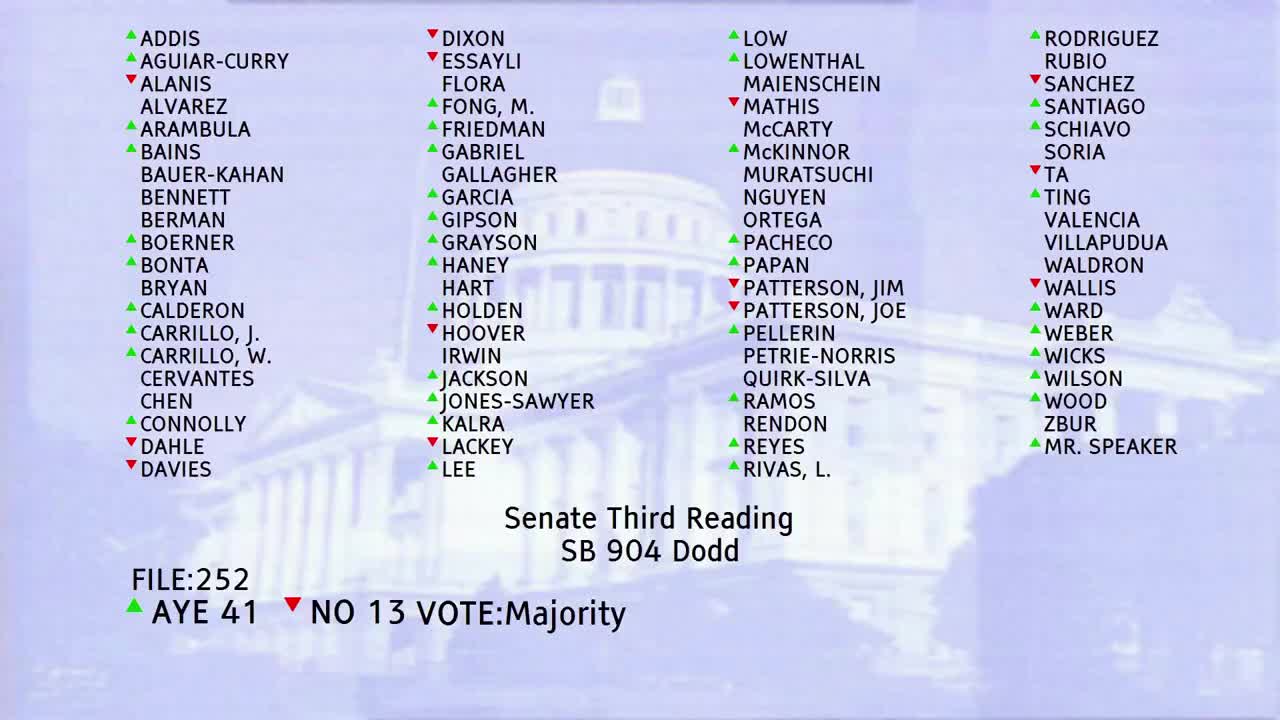 1MIN
Assembly Floor
 7MIN
Assembly Standing Committee on Appropriations
 15MIN
Assembly Standing Committee on Human Services
 7MIN
Senate Standing Committee on Appropriations
 18MIN