SB 1067: Healing arts: expedited licensure process.
- Session Year: 2023-2024
- House: Senate
- Latest Version Date: 2024-09-03
Current Status:
Failed
(2024-09-27: In Senate. Consideration of Governor's veto pending.)
Introduced
In Committee
First Chamber
In Committee
Second Chamber
Enacted
Existing law establishes various boards within the Department of Consumer Affairs to license and regulate various health professionals. Existing law requires specified boards to expedite the licensure process of an applicant who can demonstrate that they intend to provide abortions within their scope of practice and specifies the documentation an applicant is required to provide to demonstrate their intent.
This bill would require the Board of Behavioral Sciences, the Board of Registered Nursing, the Board of Vocational Nursing and Psychiatric Technicians of the State of California, the California State Board of Pharmacy, the Dental Board of California, the Dental Hygiene Board of California, the Podiatric Medical Board of California, and the Physician Assistant Board to develop a process to expedite the licensure process by giving priority review status to the application of an applicant for a license who demonstrates that they intend to practice in a medically underserved area or in a health professional shortage area, as reflected in a specified federal database, or serve a medically underserved population, as defined, and who meets specified requirements for the expedited licensure process. The bill would require an applicant for a license to demonstrate their intent to practice in a medically underserved area or in a health professional shortage area, or serve a medically underserved population, by providing a letter addressed to the applicable board from an employer that includes prescribed information. The bill would require the employer to include a written statement, signed and dated by an authorized representative of the employer, on the employer letterhead, declaring that the information provided in the letter to the board is true and correct. Under the bill, no criminal or civil penalty would be imposed for a violation of that requirement. The bill would become operative on March 1, 2025. The bill would repeal these provisions on January 1, 2029.
Existing law establishes various boards within the Department of Consumer Affairs to license and regulate various health professionals. Existing law requires specified boards to expedite the licensure process of an applicant who can demonstrate that they intend to provide abortions within their scope of practice and specifies the documentation an applicant is required to provide to demonstrate their intent.
This bill would require the Board of Behavioral Sciences, the Board of Registered Nursing, the Board of Vocational Nursing and Psychiatric Technicians of the State of California, the California State Board of Pharmacy, the Dental Board of California, the Dental Hygiene Board of California, the Podiatric Medical Board of California, and the Physician Assistant Board to develop a process to expedite the licensure process by giving priority review status to the application of an applicant for a license who demonstrates that they intend to practice in a medically underserved area or in a health professional shortage area, as reflected in a specified federal database, or serve a medically underserved population, as defined. defined, and who meets specified requirements for the expedited licensure process. The bill would authorize require an applicant for a license to demonstrate their intent to practice in a medically underserved area or in a health professional shortage area, or serve a medically underserved population population, by providing proper documentation, including, but not limited to, a letter addressed to the applicable board from an employer that includes prescribed information. The bill would provide that compliance with the bill does not require the department or any of the boards to open a regulatory or rulemaking process to change their licensee application process and would deem a board to be in compliance if it includes a supplemental letter or cover statement to their application explaining the availability of the expedited licensure process and indicating what an applicants employer would need to provide to the board for the applicant to qualify for the priority review status. The bill would require the employer to include a written statement, signed and dated by an authorized representative of the employer, on the employer letterhead, declaring that the information provided in the letter to the board is true and correct. Under the bill, no criminal or civil penalty would be imposed for a violation of that requirement. The bill would become operative on March 1, 2025. The bill would repeal these provisions on January 1, 2029.
Existing law establishes various boards within the Department of Consumer Affairs to license and regulate various health professionals. Existing law requires specified boards to expedite the licensure process of an applicant who can demonstrate that they intend to provide abortions within their scope of practice and specifies the documentation an applicant is required to provide to demonstrate their intent.
This bill would require the Board of Behavioral Sciences, the Board of Registered Nursing, the Board of Vocational Nursing and Psychiatric Technicians of the State of California, the California State Board of Pharmacy, the Dental Board of California, the Dental Hygiene Board of California, and the Physician Assistant Board to develop a process to expedite the licensure process by giving priority review status to the application of an applicant for a license who demonstrates that they intend to practice in a medically underserved area or serve a medically underserved population, as defined. The bill would authorize an applicant for a license to demonstrate their intent to practice in a medically underserved area or serve a medically underserved population by providing proper documentation, including, but not limited to, a letter from an employer that includes prescribed information. The bill would provide that compliance with the bill does not require the department or any of the boards to open a regulatory or rulemaking process to change their licensee application process and would deem a board to be in compliance if it includes a supplemental letter or cover statement to their application explaining the availability of the expedited licensure process and indicating what an applicants employer would need to provide to the board for the applicant to qualify for the priority review status. The bill would repeal these provisions on January 1, 2029.
Existing law establishes various boards within the Department of Consumer Affairs to license and regulate various health professionals. Existing law requires specified boards to expedite the licensure process of an applicant who can demonstrate that they intend to provide abortions within their scope of practice and specifies the documentation an applicant is required to provide to demonstrate their intent.
This bill would require each healing arts board, as defined, the Board of Behavioral Sciences, the Board of Registered Nursing, the Board of Vocational Nursing and Psychiatric Technicians of the State of California, the California State Board of Pharmacy, the Dental Board of California, the Dental Hygiene Board of California, and the Physician Assistant Board to develop a process to expedite the licensure process by giving priority review status to the application of an applicant for a license who demonstrates that they intend to practice in a medically underserved area or serve a medically underserved population, as defined. The bill would authorize an applicant for a license to demonstrate their intent to practice in a medically underserved area or serve a medically underserved population by providing proper documentation, including, but not limited to, a letter from an employer, located in a medically underserved area or which serves a medically underserved population, indicating that the applicant has accepted employment and stating the start date. employer that includes prescribed information. The bill would provide that compliance with the bill does not require the department or any of the boards to open a regulatory or rulemaking process to change their licensee application process and would deem a board to be in compliance if it includes a supplemental letter or cover statement to their application explaining the availability of the expedited licensure process and indicating what an applicants employer would need to provide to the board for the applicant to qualify for the priority review status.
Existing law establishes various boards within the Department of Consumer Affairs to license and regulate various health professionals. Existing law requires specified boards to expedite the licensure process of an applicant who can demonstrate that they intend to provide abortions within their scope of practice and specifies the documentation an applicant is required to provide to demonstrate their intent.
This bill would require each healing arts board, as defined, to develop a process to expedite the licensure process by giving priority review status to the application of an applicant for a license who demonstrates that they intend to practice in a medically underserved area or serve a medically underserved population, as defined. The bill would authorize an applicant for a license to demonstrate their intent to practice in a medically underserved area or serve a medically underserved population by providing proper documentation, including, but not limited to, a letter from an employer, located in a medically underserved area or which serves a medically underserved population, indicating that the applicant has accepted employment and stating the start date.
(a)The Board of Behavioral Sciences, the Board of Registered Nursing, the Board of Vocational Nursing and Psychiatric Technicians of the State of California, the California State Board of Pharmacy, the Dental Board of California, the Dental Hygiene Board of California, the Podiatric Medical Board of California, and the Physician Assistant Board shall develop a process to expedite the licensure process by giving priority review status to the application of an applicant for a license who demonstrates that they intend to practice in a medically underserved area or in a health professional shortage area, as reflected in a database compiled by the federal Health Resources and Services Administration, or serve a medically underserved population, as defined in Section 128552 of the Health and Safety Code, and who meets the requirements for the expedited licensure process as described in subdivisions (b) and (d).
(b)An applicant for a license shall demonstrate their intent to practice in a medically underserved area or in a health professional shortage area, or serve a medically underserved population, by providing a letter addressed to the applicable healing arts board from an employer containing all of the following information:
(1)The name of the employer.
(2)The address and telephone number of the employer.
(3)The applicants name.
(4)A statement that the employer is located in a medically underserved area or in a health professional shortage area, or a statement that the employer serves a medically underserved population, and identifying which is applicable.
(5)A statement that the applicant has accepted employment with the employer in the same business or profession within which the applicant applies for licensure with the board.
(6)The applicants proposed start date.
(7)(A)A written statement, signed and dated by an authorized representative of the employer, on the employer letterhead, declaring that the information provided in the letter to the board is true and correct.
(B)No criminal or civil penalty shall be imposed for a violation of this subdivision.
(c)A board shall be deemed to be in compliance with this section if it includes a supplemental letter or cover statement to their application explaining the availability of this expedited licensure process and indicating what an applicants employer would need to provide to the board for the applicant to qualify for the priority review status.
(d)A board described in subdivision (a) shall expedite the application if the address provided by the employer in accordance with subdivision (b) is contained in the search results of the current Find Shortage Areas by Address web page of the federal Health Resources and Services Administration, which reflects the database compiled by that entity.
(e)This section shall become operative on March 1, 2025.
(f)This section shall remain in effect only until January 1, 2029, and as of that date is repealed.
(a)The Board of Behavioral Sciences, the Board of Registered Nursing, the Board of Vocational Nursing and Psychiatric Technicians of the State of California, the California State Board of Pharmacy, the Dental Board of California, the Dental Hygiene Board of California, the Podiatric Medical Board of California, and the Physician Assistant Board, Board shall develop a process to expedite the licensure process by giving priority review status to the application of an applicant for a license who demonstrates that they intend to practice in a medically underserved area or in a health professional shortage area, as reflected in a database compiled by the federal Health Resources and Services Administration, or serve a medically underserved population, as defined in Section 128552 of the Health and Safety Code. Code, and who meets the requirements for the expedited licensure process as described in subdivisions (b) and (d).
(b)An applicant for a license may shall demonstrate their intent to practice in a medically underserved area or in a health professional shortage area, or serve a medically underserved population population, by providing proper documentation, including, but not limited to, a letter addressed to the applicable healing arts board from an employer that does containing all of the following: following information:
(1)Indicating the employer is located in a medically underserved area or indicating the employer serves a medically underserved population and identifying which is applicable.(2)Indicating that the applicant has accepted employment.(1)The name of the employer.
(2)The address and telephone number of the employer.
(3)The applicants name.
(4)A statement that the employer is located in a medically underserved area or in a health professional shortage area, or a statement that the employer serves a medically underserved population, and identifying which is applicable.
(5)A statement that the applicant has accepted employment with the employer in the same business or profession within which the applicant applies for licensure with the board.
(3)Stating the(6)The applicants proposed start date.
(7)(A)A written statement, signed and dated by an authorized representative of the employer, on the employer letterhead, declaring that the information provided in the letter to the board is true and correct.
(B)No criminal or civil penalty shall be imposed for a violation of this subdivision.
(c)Compliance with this section does not require the Department of Consumer Affairs or any of the boards listed in subdivision (a) to open a regulatory or rulemaking process to change their licensee application process. A board shall be deemed to be in compliance with this section if it includes a supplemental letter or cover statement to their application explaining the availability of this expedited licensure process and indicating what an applicants employer would need to provide to the board for the applicant to qualify for the priority review status.
(d)A board described in subdivision (a) shall expedite the application if the address provided by the employer in accordance with subdivision (b) is contained in the search results of the current Find Shortage Areas by Address web page of the federal Health Resources and Services Administration, which reflects the database compiled by that entity.
(e)This section shall become operative on March 1, 2025.
(d)(f)This section shall remain in effect only until January 1, 2029, and as of that date is repealed.
(a)The Board of Behavioral Sciences, the Board of Registered Nursing, the Board of Vocational Nursing and Psychiatric Technicians of the State of California, the California State Board of Pharmacy, the Dental Board of California, the Dental Hygiene Board of California, and the Physician Assistant Board, shall develop a process to expedite the licensure process by giving priority review status to the application of an applicant for a license who demonstrates that they intend to practice in a medically underserved area or serve a medically underserved population, as defined in Section 128552 of the Health and Safety Code.
(b)An applicant for a license may demonstrate their intent to practice in a medically underserved area or serve a medically underserved population by providing proper documentation, including, but not limited to, a letter from an employer that does all of the following:
(1)Indicating the employer is located in a medically underserved area or indicating the employer serves a medically underserved population and identifying which is applicable.
(2)Indicating that the applicant has accepted employment.
(3)Stating the applicants proposed start date.
(c)Compliance with this section does not require the Department of Consumer Affairs or any of the boards listed in subdivision (a) to open a regulatory or rulemaking process to change their licensee application process. A board shall be deemed to be in compliance with this section if it includes a supplemental letter or cover statement to their application explaining the availability of this expedited licensure process and indicating what an applicants employer would need to provide to the board for the applicant to qualify for the priority review status.
(d)This section shall remain in effect only until January 1, 2029, and as of that date is repealed.
(a)Each healing arts board The Board of Behavioral Sciences, the Board of Registered Nursing, the Board of Vocational Nursing and Psychiatric Technicians of the State of California, the California State Board of Pharmacy, the Dental Board of California, the Dental Hygiene Board of California, and the Physician Assistant Board, shall develop a process to expedite the licensure process by giving priority review status to the application of an applicant for a license who demonstrates that they intend to practice in a medically underserved area or serve a medically underserved population, as defined in Section 128552 of the Health and Safety Code.
(b)An applicant for a license may demonstrate their intent to practice in a medically underserved area or serve a medically underserved population by providing proper documentation, including, but not limited to, a letter from an employer, located in a medically underserved area or which serves a medically underserved population, indicating that the applicant has accepted employment and stating the start date. employer that does all of the following:
(1)Indicating the employer is located in a medically underserved area or indicating the employer serves a medically underserved population and identifying which is applicable.
(2)Indicating that the applicant has accepted employment.
(3)Stating the applicants proposed start date.
(c)As used in this section, healing arts board means any board, division, or examining committee in the Department of Consumer Affairs that licenses or certifies health professionals.(c)Compliance with this section does not require the Department of Consumer Affairs or any of the boards listed in subdivision (a) to open a regulatory or rulemaking process to change their licensee application process. A board shall be deemed to be in compliance with this section if it includes a supplemental letter or cover statement to their application explaining the availability of this expedited licensure process and indicating what an applicants employer would need to provide to the board for the applicant to qualify for the priority review status.
(a)Each healing arts board shall develop a process to expedite the licensure process by giving priority review status to the application of an applicant for a license who demonstrates that they intend to practice in a medically underserved area or serve a medically underserved population, as defined in Section 128552 of the Health and Safety Code.
(b)An applicant for a license may demonstrate their intent to practice in a medically underserved area or serve a medically underserved population by providing proper documentation, including, but not limited to, a letter from an employer, located in a medically underserved area or which serves a medically underserved population, indicating that the applicant has accepted employment and stating the start date.
(c)As used in this section, healing arts board means any board, division, or examining committee in the Department of Consumer Affairs that licenses or certifies health professionals.
|
Date
|
Status
|
|---|---|
| Sep 27, 2024 | In Senate. Consideration of Governor's veto pending. |
| Sep 27, 2024 | Vetoed by the Governor. |
| Sep 9, 2024 | Enrolled and presented to the Governor at 3 p.m. |
| Aug 29, 2024 | Assembly amendments concurred in. (Ayes 39. Noes 0. Page 5630.) Ordered to engrossing and enrolling. |
| Aug 26, 2024 | In Senate. Concurrence in Assembly amendments pending. |
| Aug 26, 2024 | Read third time. Passed. (Ayes 77. Noes 0. Page 6505.) Ordered to the Senate. |
| Aug 20, 2024 | Read third time and amended. |
| Aug 20, 2024 | Ordered to third reading. |
| Aug 5, 2024 | Ordered to third reading. |
| Aug 5, 2024 | From consent calendar on motion of Assembly Member Jackson. |
| Jul 3, 2024 | Read second time. Ordered to consent calendar. |
| Jul 2, 2024 | From committee: Do pass. Ordered to consent calendar. (Ayes 15. Noes 0.) (July 2). |
| Jun 26, 2024 | June 26 hearing postponed by committee. |
| Jun 12, 2024 | Read second time and amended. Re-referred to Com. on APPR. |
| Jun 11, 2024 | From committee: Do pass as amended and re-refer to Com. on APPR. (Ayes 17. Noes 0.) (June 11). |
| Jun 3, 2024 | Referred to Com. on B. & P. |
| May 23, 2024 | In Assembly. Read first time. Held at Desk. |
| May 22, 2024 | Read third time. Passed. (Ayes 35. Noes 0. Page 4143.) Ordered to the Assembly. |
| May 20, 2024 | Read second time. Ordered to third reading. |
| May 16, 2024 | Read second time and amended. Ordered to second reading. |
| May 16, 2024 | From committee: Do pass as amended. (Ayes 7. Noes 0. Page 3970.) (May 16). |
| May 10, 2024 | Set for hearing May 16. |
| Apr 22, 2024 | April 22 hearing: Placed on APPR suspense file. |
| Apr 12, 2024 | Set for hearing April 22. |
| Apr 8, 2024 | From committee: Do pass and re-refer to Com. on APPR. (Ayes 9. Noes 0. Page 3511.) (April 8). Re-referred to Com. on APPR. |
| Apr 4, 2024 | Set for hearing April 8. |
| Feb 21, 2024 | Referred to Com. on B., P. & E. D. |
| Feb 13, 2024 | From printer. May be acted upon on or after March 14. |
| Feb 12, 2024 | Introduced. Read first time. To Com. on RLS. for assignment. To print. |
|
Date
|
Description
|
Location
|
Votes
|
|
|---|---|---|---|---|
| Aug 29, 2024 | Unfinished Business SB1067 Smallwood-Cuevas et al. Concurrence | Senate Floor |
Passed |
|
| Aug 26, 2024 | SB 1067 Smallwood-Cuevas Senate Third Reading By Jackson | Assembly Floor |
Passed |
|
| Jul 2, 2024 | Do pass. To Consent Calendar. | Assembly Standing Committee on Appropriations |
Passed |
|
| Jun 11, 2024 | Do pass as amended and be re-referred to the Committee on [Appropriations] | Assembly Standing Committee on Business and Professions |
Passed |
|
| May 22, 2024 | Senate 3rd Reading SB1067 Smallwood-Cuevas | Senate Floor |
Passed |
|
| May 16, 2024 | Do pass as amended | Senate Standing Committee on Appropriations |
Passed |
|
| Apr 22, 2024 | Placed on suspense file | Senate Standing Committee on Appropriations |
Passed |
|
| Apr 8, 2024 | Do pass, but first be re-referred to the Committee on [Appropriations] | Senate Standing Committee on Business, Professions and Economic Development |
Passed |
This list shows positions taken on this bill by organizations on the date displayed, which is linked to the original source.
Positions by individuals are not included.
|
Organization
|
Position
|
Date
|
|---|---|---|
| Alameda Health Consortium | ** Support | |
| Altamed Health Services Corporation | ** Support | |
| APLA Health | ** Support | |
| Arroyo Vista Family Health Center | ** Support | |
| Asian Health Services | ** Support | |
| Board of Behavioral Sciences | * For If Amend | Jun 11, 2024 |
| California Academy Of Family Physicians | ** Support | |
| California Association For Health Services At Home | ** Support | |
| California Association of Rural Health Clinics | ** Support | |
| California Consortium for Urban Indian Health | ** Support | |
| California Immigrant Policy Center | ** Support | |
| California Pan Ethnic Health Network | * Support | Apr 8, 2024 |
| CALIFORNIA PRIMARY CARE ASSOCIATION ADVOCATES | ** Support | |
| Capa | ** Support | |
| Chapa-De Indian Health | ** Support | |
| Communicare+OLE | ** Support | |
| Community Clinic Association of Los Angeles County | ** Support | |
| Comprehensive Community Health Centers | ** Support | |
| DAP Health | ** Support | |
| Dientes Community Dental | ** Support | |
| Eisner Health | ** Support | |
| El Proyecto del Barrio, Inc. | ** Support | |
| Family Health Centers of San Diego | ** Support | |
| Friends of Family Health Center | ** Support | |
| Golden Valley Health Centers | ** Support | |
| Health Alliance of Northern California | ** Support | |
| Health and Life Organization, Inc./ Dba Sacramento Community Clinics | ** Support | |
| Health Center Partners of Southern California | ** Support | |
| Hill Country Community Clinic | ** Support | |
| Inland Family Community Health Center | ** Support | |
| La Clinica de La Raza, Inc. | ** Support | |
| La Maestra Community Health Centers | ** Support | |
| Lifelong Medical Care | ** Support | |
| Neighborhood Healthcare | ** Support | |
| North Coast Clinics Network | ** Support | |
| North East Medical Services | ** Support | |
| Northeast Valley Health Corporation | ** Support | |
| Petaluma Health Center | ** Support | |
| SAC Health | ** Support | |
| Sacramento Native American Health Center, Inc. | * Support | Apr 8, 2024 |
| San Diego Chamber of Commerce | * Support | Jun 11, 2024 |
| San Diego Regional Chamber Of Commerce | ** Support | |
| San Ysidro Health | ** Support | |
| Share Our Selves | ** Support | |
| Shasta Cascade Health Centers | ** Support | |
| Shasta Community Health Center | ** Support | |
| St. John’s Community Health | ** Support | |
| Steinburg Institute | * Support | Jun 11, 2024 |
| The Children's Clinic, "serving Children and Their Families"/TCC Family Health | ** Support | |
| TrueCare | ** Support | |
| Ultimate Health Services | * Support | Jun 11, 2024 |
| Unicare Community Health Center | ** Support | |
| Venice Family Clinic | ** Support | |
| Wellspace Health | ** Support | |
| West County Health Centers, Inc. | ** Support |
SENATE RULES COMMITTEE Office of Senate Floor Analyses (916) 651-1520 Fax: (916) 327-4478 | SB 1067 |
VETO
Bill No: SB 1067
Author: Smallwood-Cuevas (D), et al.
Enrolled: 9/3/24
Vote: 27
SENATE BUS., PROF. & ECON. DEV. COMMITTEE: 9-0, 4/8/24
AYES: Ashby, Alvarado-Gil, Archuleta, Dodd, Eggman, Glazer, Menjivar, Smallwood-Cuevas, Wilk
NO VOTE RECORDED: Nguyen, Becker, Niello, Roth
SENATE APPROPRIATIONS COMMITTEE: 7-0, 5/16/24
AYES: Caballero, Jones, Ashby, Becker, Bradford, Seyarto, Wahab
SENATE FLOOR: 35-0, 5/22/24
AYES: Alvarado-Gil, Ashby, Atkins, Becker, Blakespear, Bradford, Caballero, Cortese, Dahle, Dodd, Durazo, Eggman, Glazer, Gonzalez, Grove, Jones, Laird, Limón, McGuire, Menjivar, Min, Newman, Ochoa Bogh, Padilla, Portantino, Roth, Rubio, Seyarto, Skinner, Smallwood-Cuevas, Stern, Umberg, Wahab, Wiener, Wilk
NO VOTE RECORDED: Allen, Archuleta, Hurtado, Nguyen, Niello
SENATE FLOOR: 39-0, 8/29/24
AYES: Allen, Alvarado-Gil, Archuleta, Ashby, Atkins, Becker, Blakespear, Bradford, Caballero, Cortese, Dahle, Dodd, Durazo, Eggman, Glazer, Gonzalez, Grove, Hurtado, Jones, Laird, Limón, McGuire, Menjivar, Min, Newman, Nguyen, Ochoa Bogh, Padilla, Portantino, Roth, Rubio, Seyarto, Skinner, Smallwood-Cuevas, Stern, Umberg, Wahab, Wiener, Wilk
NO VOTE RECORDED: Niello
ASSEMBLY FLOOR: 77-0, 8/26/24 - See last page for vote
SUBJECT: Healing arts: expedited licensure process
SOURCE: California Primary Care Association Advocates
DIGEST:
This bill requires, beginning March 1, 2025 until January 1, 2029, the Board of Behavioral Sciences (BBS), Board of Registered Nursing (BRN), Board of Vocational Nursing and Psychiatric Technicians (BVNPT), Board of Pharmacy (BOP), Dental Board of California (DBC), Dental Hygiene Board (DHB), Podiatric Medical Board of California (PMBC), and Physician Assistant Board (PAB) to develop a process to expedite the licensure process by giving priority review status to the application of an applicant for a license who demonstrates that they intend to practice in a medically underserved area or in a health professional shortage area, as reflected in a database compiled by the federal Health Resources and Services Administration, or serve a medically underserved population, as defined.
ANALYSIS:
Existing law:
- Requires all DCA boards to expedite and assist the initial licensure process for an applicant who supplies satisfactory evidence to the board that the applicant has served as an active duty member of the Armed Forces of the United States and was honorably discharged, or is the spouse or domestic partner of an active duty member of the Armed Forces who is currently assigned to a duty station in California under official active duty military orders and if the spouse or domestic partner holds a current license another state, district, or territory of the United States in the profession or vocation for which the applicant seeks a license. (BPC §§ 115.4; 115.5)
- Requires all DCA boards to expedite and assist the initial licensure process for an applicant who supplies satisfactory evidence to the board that they have been admitted to the United States as a refugee under Section 1157 of Title 8 of the United States Code, have been granted asylum by the Secretary of Homeland Security or the Attorney General of the United States pursuant to Section 1158 of Title 8 of the United States Code, or they have a special immigrant visa (SIV) that has been granted a status under Section 1244 of Public Law 110-181, under Public Law 109-163, or under Section 602(b) of Title VI of Division F of Public Law 111-8. (BPC § 135.4)
- Requires a board, other than a board that has a process by which an out-of-state licensed applicant in good standing who is married to, or in a domestic partnership or other legal union with, an active duty member of the Armed Forces of the United States is able to receive expedited, temporary authorization to practice while meeting state-specific requirements for a period of at least one year or is able to receive an expedited license by endorsement with no additional requirements, to issue a temporary license to practice a profession or vocation to an applicant who meets certain requirements, including:
- They provide evidence that they are married to, or in a domestic partnership or other legal union with, an active duty member of the Armed Forces of the United States who is assigned to a duty station in this state under official active duty military orders.
- They hold a current, active, and unrestricted license from another state that authorizes them to practice the profession or vocation within the same scope for which the applicant seeks a temporary license from the board.
- They submit an application that includes written verification from their original licensing jurisdiction stating that they are in good standing in that jurisdiction.
- They have not committed an act in any jurisdiction that would have constituted grounds for denial, suspension, or revocation of the license under this code at the time the act was committed.
- They have not been disciplined by a licensing entity in another jurisdiction and are not be the subject of an unresolved complaint, review procedure, or disciplinary proceeding conducted by a licensing entity in another jurisdiction.
- Requires a board to issue the temporary license within 30 days of receiving documentation that the applicant has met the requirements and specifies authority for the license to be terminated if they do not meet the requirements or if they engaged in unprofessional conduct or any other act that is a cause for discipline by the board. Specifies that the temporary licenses is not renewable and expires 12 months after being issued or when a standard license is issued or denied.
- Requires the Medical Board of California (MBC), the Osteopathic Medical Board of California (OMBC), BRN, and the PAB to expedite the licensure process for an applicant who demonstrates that they intend to provide abortions, accompanied by a letter from an employer or health care entity indicating that the applicant has accepted employment or entered into a contract to provide abortions, the applicant's starting date, the location where the applicant will be providing abortions, and that the applicant will be providing abortions within the scope of practice of their license. (BPC § 870)
- Requires the MBC to develop a process to give priority review status to the application of an applicant for a physician and surgeon’s certificate who can demonstrate that he or she intends to practice in a medically underserved area or serve a medically underserved population. (BPC § 2092)
This bill:
- From March 1, 2025 until January 1, 2029, this bill requires the BBS, BRN, BVNPT, BOP, DBC, DHB, PMBC, and PAB to develop a process to expedite the licensure process by giving priority review status to the application of an applicant for a license who demonstrates that they intend to practice in a medically underserved area or in a health professional shortage area, as reflected in a database compiled by the federal Health Resources and Services Administration, or serve a medically underserved population, as defined.
- Specifies that an applicant may demonstrate their intent to practice in a medically underserved area or serve a medically underserved population by providing a letter from an employer that meets specified requirements.
- Provides that boards are deemed to be in compliance if they include a supplemental letter or cover statement to their application explaining the availability of this expedited licensure process and indicating what an applicant’s employer would need to provide to the board for the applicant to qualify for the priority review status.
Background
Expedited and Priority Licensing. The DCA currently requires that three populations receive priority review for licensure from DCA entities: (1) members of the Armed Forces who have served on active duty and were honorably discharged, (2) spouses or domestic partners of active duty members of the Armed Forces who are currently assigned to a duty station in California under official active duty military orders, and (3) refugees who have been granted asylum by the Secretary of Homeland Security or the Attorney General of the United States or those with an SIV. In addition, the MBC also grants expedited licensure review to physician and surgeon’s certificate applicants who can demonstrate that they intend to practice in a medically underserved area or serve a medically underserved population and MBC, OMBC, BRN, and PAB expedite the licensure process for an applicant who demonstrates that they intend to provide abortions.
Temporary Licenses. If licensed in another state, and depending on the license, military spouses and other applicants may be able to issue to utilize provisions that recognize out-of-state licenses, also known as reciprocity or licensure by endorsement. However, depending on the specific license requirements and the potential differences in requirements between states, concerns about applicants still experiencing long wait times as their qualifications are reviewed have been the source of numerous efforts and bills.
In general, temporary licenses allow an applicant to practice for a limited period, allowing them to practice while the remainder of the qualifications is obtained or verified. Since license requirements are intended to protect the public, applicants usually must be able to immediately demonstrate meeting some of the qualifications required for licensure and pass a background check. Some programs authorize temporary practice for a specified period of time to individuals who do not intend to become permanently licensed in California but in response to concerns about the inability for individuals to become employed while waiting for licensing processing, boards are now required to issue temporary licenses for up to 12-months to military spouses.
Comments
Despite statutory attempts to ensure swifter licensing timeframes for specified applicants, factors beyond a program’s control (deficiencies in applications, the length of time fingerprint clearance is provided, delays in receiving transcripts and education program completion verification, and more) can lead to lengthy holdups in the process, regardless of the program’s internal efforts to expedite processing.
Programs that bill proponents cite as having lengthy application processing timeframes are actually processing licenses in shorter timeframes than their internal goals and historic averages. For example, DBC reported during its 2024 sunset review oversight that complete applications for licensure licenses are being processed within about 24 days. PAB has been on target to meet its 30-day licensing timeframe for completed applications but is taking twice that long for applications that are missing information. Between October 2023 and December 2023 PAB processed the 126 complete physician assistant applications they received within 30 days, but they also received 327 incomplete applications. It is unclear whether a mandate to expedite the licensing process will increase the capacity of critical healthcare workforce personnel delivering important care to patients throughout the state.
FISCAL EFFECT: Appropriation: No Fiscal Com.: Yes Local: No
According to the Assembly Committee on Appropriations, BBS estimates an additional workload of 30 minutes per application, resulting in the need for one additional staff position to identify qualified applications, verify eligibility, inform the applicant whether they qualify, and handle all other communication throughout the process. BBS would require limited-term resources of $137,000 in 2025-26, DCA reports minor, if any, costs to the other affected boards, as each board already has a process for expediting applications or would require only minor updates.
SUPPORT: (Verified 10/8/24)
California Primary Care Association Advocates (source)
Alameda Health Consortium
Altamed Health Services Corporation
Apla Health
Arroyo Vista Family Health Center
Asian Health Services
California Academy of Family Physicians
California Association for Health Services At Home
California Association of Rural Health Clinics
California Consortium for Urban Indian Health
California Immigrant Policy Center
CAPA
Chapa-de Indian Health
Communicare+ole
Community Clinic Association of Los Angeles County
Comprehensive Community Health Centers
DAP Health
Dientes Community Dental
Eisner Health
El Proyecto Del Barrio, INC.
Family Health Centers of San Diego
Friends of Family Health Center
Golden Valley Health Centers
Health Alliance of Northern California
Health and Life Organization, Inc./ Dba Sacramento Community Clinics
Health Center Partners of Southern California
Hill Country Community Clinic
Inland Family Community Health Center
La Clinica De La Raza, INC.
La Maestra Community Health Centers
Lifelong Medical Care
Neighborhood Healthcare
North Coast Clinics Network
North East Medical Services
Northeast Valley Health Corporation
Petaluma Health Center
Sac Health
San Diego Regional Chamber of Commerce
San Ysidro Health
Share Our Selves
Shasta Cascade Health Centers
Shasta Community Health Center
St. John’s Community Health
The Children's Clinic, "serving Children and Their Families"/TCC Family Health
Truecare
Unicare Community Health Center
Venice Family Clinic
Wellspace Health
West County Health Centers, INC.
OPPOSITION: (Verified 10/8/24)
None received
ARGUMENTS IN SUPPORT: Supporters state that community health center workforce challenges continue to worsen, noting that the pandemic led to burnout, which contributed to a significant loss of professionals from the healthcare sector. Supporters state that health professional licensing boards have prolonged backlogs for processing applications for licensure, often preventing a provider from joining the workforce in a timely and efficient manner…delays create bottlenecks and further exacerbate recruitment and retention challenges.
GOVERNOR'S VETO MESSAGE:
These bills would require specified Department of Consumer Affairs boards to create an expedited licensing process for a subset of applicants based on the type of care they intend to provide or the geographic area where they intend to provide care.
I commend the authors’ commitment to addressing healthcare gaps in the state, but I am concerned about the aggregate effect of legislation that seeks to expedite licensure. As the number of applicants who qualify for expedited licensure grows through legislation, the benefits of mandated prioritization may start to diminish, at the expense of potential negative impacts to other applicants. Additionally, the increase in staff needed to ensure expedited applications may lead to licensing fee increases.
It would be prudent to allow time for the current expedited licensure processes to continue so that we can gather data on their effectiveness. This will allow the state to be well informed on the efficacy of this practice before pursuing additional frameworks for expedited licensure and confirm these processes do not lead to unintended consequences on the broader healthcare workforce.
For these reasons, I cannot sign these bills.
ASSEMBLY FLOOR: 77-0, 8/26/24
AYES: Addis, Aguiar-Curry, Alanis, Alvarez, Arambula, Bains, Bauer-Kahan, Bennett, Berman, Boerner, Bonta, Bryan, Calderon, Juan Carrillo, Wendy Carrillo, Chen, Connolly, Megan Dahle, Davies, Dixon, Essayli, Flora, Mike Fong, Friedman, Gabriel, Gallagher, Garcia, Gipson, Grayson, Haney, Hart, Holden, Hoover, Irwin, Jackson, Jones-Sawyer, Kalra, Lackey, Lee, Low, Lowenthal, Maienschein, Mathis, McCarty, McKinnor, Muratsuchi, Stephanie Nguyen, Pacheco, Papan, Jim Patterson, Joe Patterson, Pellerin, Petrie-Norris, Quirk-Silva, Ramos, Rendon, Reyes, Luz Rivas, Rodriguez, Blanca Rubio, Sanchez, Santiago, Schiavo, Soria, Ta, Ting, Valencia, Villapudua, Waldron, Wallis, Ward, Weber, Wicks, Wilson, Wood, Zbur, Robert Rivas
NO VOTE RECORDED: Cervantes, Ortega
Prepared by: Sarah Mason / B., P. & E.D. /
10/16/24 14:16:27
**** END ****
SENATE RULES COMMITTEE Office of Senate Floor Analyses (916) 651-1520 Fax: (916) 327-4478 | SB 1067 |
UNFINISHED BUSINESS
Bill No: SB 1067
Author: Smallwood-Cuevas (D), et al.
Amended: 8/20/24
Vote: 21
SENATE BUS., PROF. & ECON. DEV. COMMITTEE: 9-0, 4/8/24
AYES: Ashby, Alvarado-Gil, Archuleta, Dodd, Eggman, Glazer, Menjivar, Smallwood-Cuevas, Wilk
NO VOTE RECORDED: Nguyen, Becker, Niello, Roth
SENATE APPROPRIATIONS COMMITTEE: 7-0, 5/16/24
AYES: Caballero, Jones, Ashby, Becker, Bradford, Seyarto, Wahab
SENATE FLOOR: 35-0, 5/22/24
AYES: Alvarado-Gil, Ashby, Atkins, Becker, Blakespear, Bradford, Caballero, Cortese, Dahle, Dodd, Durazo, Eggman, Glazer, Gonzalez, Grove, Jones, Laird, Limón, McGuire, Menjivar, Min, Newman, Ochoa Bogh, Padilla, Portantino, Roth, Rubio, Seyarto, Skinner, Smallwood-Cuevas, Stern, Umberg, Wahab, Wiener, Wilk
NO VOTE RECORDED: Allen, Archuleta, Hurtado, Nguyen, Niello
ASSEMBLY FLOOR: 77-0, 8/26/24 - See last page for vote
SUBJECT: Healing arts: expedited licensure process
SOURCE: California Primary Care Association Advocates
DIGEST:
This bill requires, beginning March 1, 2025 until January 1, 2029, the Board of Behavioral Sciences (BBS), Board of Registered Nursing (BRN), Board of Vocational Nursing and Psychiatric Technicians (BVNPT), Board of Pharmacy (BOP), Dental Board of California (DBC), Dental Hygiene Board (DHB), Podiatric Medical Board of California (PMBC), and Physician Assistant Board (PAB) to develop a process to expedite the licensure process by giving priority review status to the application of an applicant for a license who demonstrates that they intend to practice in a medically underserved area or in a health professional shortage area, as reflected in a database compiled by the federal Health Resources and Services Administration, or serve a medically underserved population, as defined.
Assembly Amendments delay implementation and add a sunset date, expand the requirements to the PMBC, and make various conforming and implementation changes to specify what the letter from an employer must contain, among other provisions.
ANALYSIS:
Existing law:
- Requires all DCA boards to expedite and assist the initial licensure process for an applicant who supplies satisfactory evidence to the board that the applicant has served as an active duty member of the Armed Forces of the United States and was honorably discharged, or is the spouse or domestic partner of an active duty member of the Armed Forces who is currently assigned to a duty station in California under official active duty military orders and if the spouse or domestic partner holds a current license another state, district, or territory of the United States in the profession or vocation for which the applicant seeks a license. (BPC §§ 115.4; 115.5)
- Requires all DCA boards to expedite and assist the initial licensure process for an applicant who supplies satisfactory evidence to the board that they have been admitted to the United States as a refugee under Section 1157 of Title 8 of the United States Code, have been granted asylum by the Secretary of Homeland Security or the Attorney General of the United States pursuant to Section 1158 of Title 8 of the United States Code, or they have a special immigrant visa (SIV) that has been granted a status under Section 1244 of Public Law 110-181, under Public Law 109-163, or under Section 602(b) of Title VI of Division F of Public Law 111-8. (BPC § 135.4)
- Requires a board, other than a board that has a process by which an out-of-state licensed applicant in good standing who is married to, or in a domestic partnership or other legal union with, an active duty member of the Armed Forces of the United States is able to receive expedited, temporary authorization to practice while meeting state-specific requirements for a period of at least one year or is able to receive an expedited license by endorsement with no additional requirements, to issue a temporary license to practice a profession or vocation to an applicant who meets certain requirements, including:
- They provide evidence that they are married to, or in a domestic partnership or other legal union with, an active duty member of the Armed Forces of the United States who is assigned to a duty station in this state under official active duty military orders.
- They hold a current, active, and unrestricted license from another state that authorizes them to practice the profession or vocation within the same scope for which the applicant seeks a temporary license from the board.
- They submit an application that includes written verification from their original licensing jurisdiction stating that they are in good standing in that jurisdiction.
- They have not committed an act in any jurisdiction that would have constituted grounds for denial, suspension, or revocation of the license under this code at the time the act was committed.
- They have not been disciplined by a licensing entity in another jurisdiction and are not be the subject of an unresolved complaint, review procedure, or disciplinary proceeding conducted by a licensing entity in another jurisdiction.
- Requires a board to issue the temporary license within 30 days of receiving documentation that the applicant has met the requirements and specifies authority for the license to be terminated if they do not meet the requirements or if they engaged in unprofessional conduct or any other act that is a cause for discipline by the board. Specifies that the temporary licenses is not renewable and expires 12 months after being issued or when a standard license is issued or denied.
- Requires the Medical Board of California (MBC), the Osteopathic Medical Board of California (OMBC), BRN, and the PAB to expedite the licensure process for an applicant who demonstrates that they intend to provide abortions, accompanied by a letter from an employer or health care entity indicating that the applicant has accepted employment or entered into a contract to provide abortions, the applicant's starting date, the location where the applicant will be providing abortions, and that the applicant will be providing abortions within the scope of practice of their license. (BPC § 870)
- Requires the MBC to develop a process to give priority review status to the application of an applicant for a physician and surgeon’s certificate who can demonstrate that he or she intends to practice in a medically underserved area or serve a medically underserved population. (BPC § 2092)
This bill:
- From March 1, 2025 until January 1, 2029, this bill requires the Board of Behavioral Sciences (BBS), Board of Registered Nursing (BRN), Board of Vocational Nursing and Psychiatric Technicians (BVNPT), Board of Pharmacy (BOP), Dental Board of California (DBC), Dental Hygiene Board (DHB), Podiatric Medical Board of California (PMBC), and Physician Assistant Board (PAB) to develop a process to expedite the licensure process by giving priority review status to the application of an applicant for a license who demonstrates that they intend to practice in a medically underserved area or in a health professional shortage area, as reflected in a database compiled by the federal Health Resources and Services Administration, or serve a medically underserved population, as defined.
- Specifies that an applicant may demonstrate their intent to practice in a medically underserved area or serve a medically underserved population by providing a letter from an employer that meets specified requirements.
- Provides that boards are deemed to be in compliance if they include a supplemental letter or cover statement to their application explaining the availability of this expedited licensure process and indicating what an applicant’s employer would need to provide to the board for the applicant to qualify for the priority review status.
Background
Expedited and Priority Licensing. The DCA currently requires that three populations receive priority review for licensure from DCA entities: (1) members of the Armed Forces who have served on active duty and were honorably discharged, (2) spouses or domestic partners of active duty members of the Armed Forces who are currently assigned to a duty station in California under official active duty military orders, and (3) refugees who have been granted asylum by the Secretary of Homeland Security or the Attorney General of the United States or those with an SIV. In addition, the MBC also grants expedited licensure review to physician and surgeon’s certificate applicants who can demonstrate that they intend to practice in a medically underserved area or serve a medically underserved population and MBC, OMBC, BRN, and PAB expedite the licensure process for an applicant who demonstrates that they intend to provide abortions.
Temporary Licenses. If licensed in another state, and depending on the license, military spouses and other applicants may be able to issue to utilize provisions that recognize out-of-state licenses, also known as reciprocity or licensure by endorsement. However, depending on the specific license requirements and the potential differences in requirements between states, concerns about applicants still experiencing long wait times as their qualifications are reviewed have been the source of numerous efforts and bills.
In general, temporary licenses allow an applicant to practice for a limited period, allowing them to practice while the remainder of the qualifications is obtained or verified. Since license requirements are intended to protect the public, applicants usually must be able to immediately demonstrate meeting some of the qualifications required for licensure and pass a background check. Some programs authorize temporary practice for a specified period of time to individuals who do not intend to become permanently licensed in California but in response to concerns about the inability for individuals to become employed while waiting for licensing processing, boards are now required to issue temporary licenses for up to 12-months to military spouses.
Comments
Despite statutory attempts to ensure swifter licensing timeframes for specified applicants, factors beyond a program’s control (deficiencies in applications, the length of time fingerprint clearance is provided, delays in receiving transcripts and education program completion verification, and more) can lead to lengthy holdups in the process, regardless of the program’s internal efforts to expedite processing.
Programs that bill proponents cite as having lengthy application processing timeframes are actually processing licenses in shorter timeframes than their internal goals and historic averages. For example, DBC reported during its 2024 sunset review oversight that complete applications for licensure licenses are being processed within about 24 days. PAB has been on target to meet its 30-day licensing timeframe for completed applications but is taking twice that long for applications that are missing information. Between October 2023 and December 2023 PAB processed the 126 complete physician assistant applications they received within 30 days, but they also received 327 incomplete applications. It is unclear whether a mandate to expedite the licensing process will increase the capacity of critical healthcare workforce personnel delivering important care to patients throughout the state.
FISCAL EFFECT: Appropriation: No Fiscal Com.: Yes Local: No
According to the Assembly Committee on Appropriations, BBS estimates an additional workload of 30 minutes per application, resulting in the need for one additional staff position to identify qualified applications, verify eligibility, inform the applicant whether they qualify, and handle all other communication throughout the process. BBS would require limited-term resources of $137,000 in 2025-26, DCA reports minor, if any, costs to the other affected boards, as each board already has a process for expediting applications or would require only minor updates.
SUPPORT: (Verified 8/26/24)
California Primary Care Association Advocates (source)
Alameda Health Consortium
Altamed Health Services Corporation
Apla Health
Arroyo Vista Family Health Center
Asian Health Services
California Academy of Family Physicians
California Association for Health Services At Home
California Association of Rural Health Clinics
California Consortium for Urban Indian Health
California Immigrant Policy Center
CAPA
Chapa-de Indian Health
Communicare+ole
Community Clinic Association of Los Angeles County
Comprehensive Community Health Centers
DAP Health
Dientes Community Dental
Eisner Health
El Proyecto Del Barrio, INC.
Family Health Centers of San Diego
Friends of Family Health Center
Golden Valley Health Centers
Health Alliance of Northern California
Health and Life Organization, Inc./ Dba Sacramento Community Clinics
Health Center Partners of Southern California
Hill Country Community Clinic
Inland Family Community Health Center
La Clinica De La Raza, INC.
La Maestra Community Health Centers
Lifelong Medical Care
Neighborhood Healthcare
North Coast Clinics Network
North East Medical Services
Northeast Valley Health Corporation
Petaluma Health Center
Sac Health
San Diego Regional Chamber of Commerce
San Ysidro Health
Share Our Selves
Shasta Cascade Health Centers
Shasta Community Health Center
St. John’s Community Health
The Children's Clinic, "serving Children and Their Families"/TCC Family Health
Truecare
Unicare Community Health Center
Venice Family Clinic
Wellspace Health
West County Health Centers, INC.
OPPOSITION: (Verified 8/26/24)
None received
ARGUMENTS IN SUPPORT: Supporters state that community health center workforce challenges continue to worsen, noting that the pandemic led to burnout, which contributed to a significant loss of professionals from the healthcare sector. Supporters state that health professional licensing boards have prolonged backlogs for processing applications for licensure, often preventing a provider from joining the workforce in a timely and efficient manner…delays create bottlenecks and further exacerbate recruitment and retention challenges.
ASSEMBLY FLOOR: 77-0, 8/26/24
AYES: Addis, Aguiar-Curry, Alanis, Alvarez, Arambula, Bains, Bauer-Kahan, Bennett, Berman, Boerner, Bonta, Bryan, Calderon, Juan Carrillo, Wendy Carrillo, Chen, Connolly, Megan Dahle, Davies, Dixon, Essayli, Flora, Mike Fong, Friedman, Gabriel, Gallagher, Garcia, Gipson, Grayson, Haney, Hart, Holden, Hoover, Irwin, Jackson, Jones-Sawyer, Kalra, Lackey, Lee, Low, Lowenthal, Maienschein, Mathis, McCarty, McKinnor, Muratsuchi, Stephanie Nguyen, Pacheco, Papan, Jim Patterson, Joe Patterson, Pellerin, Petrie-Norris, Quirk-Silva, Ramos, Rendon, Reyes, Luz Rivas, Rodriguez, Blanca Rubio, Sanchez, Santiago, Schiavo, Soria, Ta, Ting, Valencia, Villapudua, Waldron, Wallis, Ward, Weber, Wicks, Wilson, Wood, Zbur, Robert Rivas
NO VOTE RECORDED: Cervantes, Ortega
Prepared by: Sarah Mason / B., P. & E.D. /
8/27/24 13:38:29
**** END ****
SENATE THIRD READING
STR Bill Id:SB 1067
Author:(Smallwood-Cuevas)
As Amended Ver:August 20, 2024
Majority vote
SUMMARY
Requires, until January 1, 2029, specified healing arts boards under the Department of Consumer Affairs (DCA) to expedite the licensure process for applicants who demonstrate that they intend to practice in a medically underserved area or health professional shortage area, or serve a medically underserved population.
Major Provisions
- Requires the Board of Behavioral Sciences (BBS), the Board of Registered Nursing (BRN), the Board of Vocational Nursing and Psychiatric Technicians (BVNPT), the California State Board of Pharmacy (BOP), the Dental Board of California (DBC), the Dental Hygiene Board of California (DHBC), the Physician Assistant Board (PAB), and the Podiatric Medical Board of California (PMB) to expedite the licensure process for applicants for a license who demonstrate that they intend to practice in a medically underserved area or health professional shortage area or serve a medically underserved population.
- Requires an applicant to demonstrate their intent to practice in a medically underserved area or health professional shortage area or serve a medically underserved population by providing proper documentation, including, but not limited to, a letter from an employer to the applicable board that contains all of the following:
- The name of the employer.
- The address and telephone number of the employer.
- The applicant's name.
- A statement that the employer is located in a medically underserved area or in a health professional shortage area, or a statement that the employer serves a medically underserved population, and identifying which is applicable.
- A statement that the applicant has accepted employment with the employer in the same business or profession within which the applicant applies for licensure with the board.
- The applicant's proposed start date.
- A written statement, signed and dated by an authorized representative of the employer, on the employer letterhead, declaring that the information provided in the letter to the board is true and correct.
- Provides that no criminal or civil penalty shall be imposed for a violation of the bill.
- Requires an applicable board to expedite the application if the address provided by the employer is contained in the search results of the current "Find Shortage Areas by Address" webpage of the federal Health Resources and Services Administration, which reflects the database compiled by that entity.
- Subjects the bill's provisions to repeal on January 1, 2029 and delays their implementation until March 1, 2025.
COMMENTS
Expedited Licensure. The DCA consists of 36 boards, bureaus, and other entities responsible for licensing, certifying, or otherwise regulating professionals in California. As of March 2023, there are over 3.4 million licensees overseen by programs under the DCA, including health professionals regulated by healing arts boards under Division 2 of the Business and Professions Code. Each licensing program has its own unique requirements, with the governing acts for each profession providing for various prerequisites including prelicensure education, training, and examination. Most boards additionally require the payment of a fee and some form of background check for each applicant.
The average length of time between the submission of an initial license application and approval by an entity under the DCA can vary based on a number of circumstances, including increased workload, delays in obtaining an applicant's criminal history, and deficiencies in an application. Boards typically set internal targets for application processing timelines and seek adequate staffing in an effort to meet those targets consistently. License processing timelines are then regularly evaluated through the Legislature's sunset review oversight process.
The first expedited licensure laws specifically related to the unique needs of military families. The Syracuse University Institute for Veterans and Military Families found that up to 35% of military spouses are employed in fields requiring licensure. Because each state possesses its own licensing regime for professional occupations, military family members are required to obtain a new license each time they move states, with one-third of military spouses reportedly moving four or more times while their partner is on active duty. Because of the barriers encountered by military family members who seek to relocate their licensed work to a new state, it is understood that continuing to work in their field is often challenging if not impossible.
In an effort to address these concerns, Assembly Bill 1904 (Block) Chapter 399, Statutes of 2012 was enacted in 2012 to require boards and bureaus under the DCA to expedite the licensure process for military spouses and domestic partners of a military member who is on active duty in California. Two years later, Senate Bill 1226 (Correa), Chapter 657, Statutes of 2014 was enacted to similarly require boards and bureaus under the DCA to expedite applications from honorably discharged veterans, with the goal of enabling these individuals to quickly transition into civilian employment upon retiring from service.
Statute requires entities under the DCA to annually report the number of applications for expedited licensure that were submitted by veterans and active-duty spouses and partners. For example, in Fiscal Year 2022-23, the MBC received 14 applications from military spouses or partners and 101 applications from honorably discharged veterans subject to expedited processing. In 2023, the federal Servicemembers Civil Relief Act (SCRA) imposed new requirements on states to recognize qualifying out-of-state licenses for service members and their spouses. This new form of enhanced license portability potentially displaces the need for expedited licensure for these applicants.
A decade after the first expedited licensure laws were enacted for military families, the Legislature enacted in 2020 Assembly Bill 2113 (Low) Chapter 186, Statutes of 2020 to require licensing entities under the DCA to expedite licensure applications for refugees, asylees, and Special Immigrant Visa holders. The intent of this bill was to address the urgency of allowing those forced to flee their homes to restart their lives upon acceptance into California with refugee status. It is understood that the population of license applicants who have utilized this new expedited licensure program across all DCA entities is, to date, relatively small.
Subsequently in 2022, the Legislature enacted Assembly Bill 657 (Cooper) Chapter 560, Statutes of 2022 to add another category of applicants eligible for expedited licensure. This bill required the MBC, OMBC, the BRN, and the PAB to expedite the license application for an applicant who demonstrates that they intend to provide abortions. This bill was passed in the wake of the Supreme Court's decision to overturn Roe v. Wade, which led to concerns that with approximately half of all states likely to seek to ban abortion, patients in those states would come to California to receive abortion services, creating a swell in demand for abortion providers. Assembly Bill 657 was passed to ensure that there is an adequate health care provider workforce to provide urgent reproductive care services.
Health Care Workforce Inequities. There has long been an acknowledged decline in the number of accessible health professionals, which has disproportionately impacted communities with concentrated populations of low-income residents, immigrant families, and people of color. A recent study found that between 2010 and 2019, the number of primary care physicians in proportion to population remained largely unchanged nationally, and that counties with a high proportion of minorities saw a decline during that period. Similar access gaps exist for other types of health care providers. A report published by the UCLA Center for Health Policy Research in 2021 found that "a higher proportion of low-income adults lived in some regions that had a low concentration of dentists."
In February 2024, the Assembly Committee on Health held an informational hearing on diversity in California's health care workforce. The background paper for the hearing concluded that "it is well-documented that physicians from minority backgrounds are more likely to practice in Health Profession Shortage Areas and to care for minority, Medicaid, and uninsured people than their counterparts." However, research cited by the California Health Care Foundation (CHCF) in its 2021 report titled "Health Workforce Strategies for California: A Review of the Evidence" found that while 39% of Californians identified as Latino/x in 2019, only 14% of medical school matriculants and 6% of active patient care physicians in California were Latino/x.
California has historically attempted to resolve these longstanding issues of access and representation through a number of different approaches. For example, the Legislature has previously enacted and funded loan repayment programs, such as the Dental Corps Loan Repayment Program of 2002, which provided grants to qualifying dentists who agreed to work for at least three years in a clinic or dental practice located in a dentally unserved area, or in which at least 50% of patients are from a dentally underserved population. The Health Professions Career Opportunity Program within HCAI similarly supports initiatives designed to enhance diversity and representation in the health professions by awarding grant funding through competitive programs.
This bill would seek to build on the state's efforts to improve access to care in underserved communities by requiring specified healing arts boards to develop a process to expedite the licensure process by giving priority review status to the application of an applicant for a license who demonstrates that they intend to practice in a medically underserved area or health professional shortage area or serve a medically underserved population. These requirements would apply to the BBS, the BRN, the BVNPT, the BOP, the DBC, the DHBC, the PAB, and the PMBC. Similar language establishing essentially same expedited licensing requirements already exists in statute for the licensing of physicians and surgeons by the MBC and the OMBC. The author believes that extending that requirement to additional healing arts boards will contribute toward the state's goals to significantly and expeditiously expand access to health care for its most vulnerable communities.
Several pieces of legislation have been introduced this year that would establish new expedited licensure requirements for additional populations of applicants. While each of these proposals is meritorious, there is potentially a cause for concern that as the state contemplates adding more categories of license applicants to the growing list of applications that must be expedited by entities within the DCA, the value of expediting each applicant type becomes diluted and non-expedited applications could become unduly delayed. As a result, this bill and similar proposals have been amended to provide for a four-year sunset date, at which time the Legislature may revisit expedited licensure requirements to determine if those requirements are still needed.
According to the Author
"For decades, California has struggled to provide our most vulnerable populations with access to affordable and timely medical care. Hundreds of thousands of Californians throughout the state -- including in parts of my district in South Los Angeles -- live in Medically Underserved Areas, with diminished access to primary care services. Despite serving our most vulnerable communities, health care providers like clinics, have reported high vacancy rates and prolonged periods to fill staff vacancies for critical positions for physicians, dentists, nurses and many more. Wait times in the licensure process is just one of the factors contributing to our state's medical workforce shortage. These shortages undermine quality patient care, make it harder to catch preventable diseases, and only further exacerbate existing health disparities in our state. Expediting licenses for practitioners, who plan to serve our most vulnerable populations, is a valuable incentive for them to work in the communities that need them most and provide the state with another tool to address healthcare workforce shortages."
Arguments in Support
California Primary Care Association (CPCA) Advocates is the sponsor of this bill. CPCA writes in support: "Workforce has historically been a major issue in medically underserved areas of the state, and in health facilities primarily serving the populations who access safety net services like CHCs. Data shows community health centers need an average of 26.6 weeks to fill a physician vacancy and 18 weeks to fill a dentist and nurse practitioner vacancy. This has left those serving our safety net population in an untenable and challenging position when it comes to recruiting workers to provide healthcare to some of the state's most vulnerable populations. Recently, the Medical Board of California established a process to expedite license applications for those who can demonstrate they intend to practice in a medically underserved area or serve a medically underserved population, and it has been a huge success. This bill is modeled off this existing process."
Arguments in Opposition
The Dental Board of California (DBC) opposes this bill unless amended. The DBC writes: "With the recent growth in the number of groups that qualify for expedited processing, the benefits of this expedited processing may diminish because of the increase in the number of applicants that are advanced to processing. It would be useful to have guidance in the bill as to how to manage this growth in expedited processing. The Board appreciates your staff's willingness to work with the Board and anticipates these issues to be addressed in future proposed amendments to the bill."
FISCAL COMMENTS
According to the Assembly Committee on Appropriations, the BBS would require limited-term resources of $137,000 in 2025-26, $129,000 in 2026-27 and 2027-28, and $65,000 in 2028-29 to support the position; additional minor costs to each board reported by the DCA.
VOTES
SENATE FLOOR: 35-0-5
YES: Alvarado-Gil, Ashby, Atkins, Becker, Blakespear, Bradford, Caballero, Cortese, Dahle, Dodd, Durazo, Eggman, Glazer, Gonzalez, Grove, Jones, Laird, Limón, McGuire, Menjivar, Min, Newman, Ochoa Bogh, Padilla, Portantino, Roth, Rubio, Seyarto, Skinner, Smallwood-Cuevas, Stern, Umberg, Wahab, Wiener, Wilk
ABS, ABST OR NV: Allen, Archuleta, Hurtado, Nguyen, Niello
ASM BUSINESS AND PROFESSIONS: 17-0-1
YES: Berman, Flora, Alanis, Bains, Juan Carrillo, Chen, Dixon, Irwin, Jackson, Low, Lowenthal, McKinnor, Stephanie Nguyen, Pellerin, Sanchez, Soria, Zbur
ABS, ABST OR NV: Grayson
ASM APPROPRIATIONS: 15-0-0
YES: Wicks, Sanchez, Arambula, Bryan, Calderon, Wendy Carrillo, Dixon, Mike Fong, Grayson, Haney, Hart, Jim Patterson, Pellerin, Ta, Villapudua
UPDATED
VERSION: August 20, 2024
CONSULTANT: Robert Sumner / B. & P. / (916) 319-3301 FN: 0004197
SENATE THIRD READING
STR Bill Id:SB 1067
Author:(Smallwood-Cuevas)
As Amended Ver:June 12, 2024
Majority vote
SUMMARY
Requires, until January 1, 2029, specified healing arts boards under the Department of Consumer Affairs (DCA) to expedite the licensure process for applicants who demonstrate that they intend to practice in a medically underserved area or serve a medically underserved population.
Major Provisions
- Requires the Board of Behavioral Sciences (BBS), the Board of Registered Nursing (BRN), the Board of Vocational Nursing and Psychiatric Technicians (BVNPT), the California State Board of Pharmacy (BOP), the Dental Board of California (DBC), the Dental Hygiene Board of California (DHBC), and the Physician Assistant Board (PAB) to expedite the licensure process for applicants for a license who demonstrate that they intend to practice in a medically underserved area or serve a medically underserved population.
- Allows an applicant to demonstrate their intent to practice in a medically underserved area or serve a medically underserved population by providing proper documentation, including, but not limited to, a letter from an employer that does all of the following:
- Indicating the employer is located in a medically underserved area or indicating the employer serves a medically underserved population and identifying which is applicable.
- Indicating that the applicant has accepted employment.
- Stating the applicant's proposed start date.
- Declares that compliance with the bill does not require the DCA or any of the respective boards to open a regulatory or rulemaking process to change their application process.
- Provides that a board shall be deemed to be in compliance with the bill if it includes a supplemental letter or cover statement to their application explaining the availability of the expedited licensure process and indicating what an applicant's employer would need to provide to the board for the applicant to qualify for the priority review status.
- Subjects the bill's provisions to repeal on January 1, 2029.
COMMENTS
Expedited Licensure. The DCA consists of 36 boards, bureaus, and other entities responsible for licensing, certifying, or otherwise regulating professionals in California. As of March 2023, there are over 3.4 million licensees overseen by programs under the DCA, including health professionals regulated by healing arts boards under Division 2 of the Business and Professions Code. Each licensing program has its own unique requirements, with the governing acts for each profession providing for various prerequisites including prelicensure education, training, and examination. Most boards additionally require the payment of a fee and some form of background check for each applicant.
The average length of time between the submission of an initial license application and approval by an entity under the DCA can vary based on a number of circumstances, including increased workload, delays in obtaining an applicant's criminal history, and deficiencies in an application. Boards typically set internal targets for application processing timelines and seek adequate staffing in an effort to meet those targets consistently. License processing timelines are then regularly evaluated through the Legislature's sunset review oversight process.
The first expedited licensure laws specifically related to the unique needs of military families. The Syracuse University Institute for Veterans and Military Families found that up to 35% of military spouses are employed in fields requiring licensure. Because each state possesses its own licensing regime for professional occupations, military family members are required to obtain a new license each time they move states, with one-third of military spouses reportedly moving four or more times while their partner is on active duty. Because of the barriers encountered by military family members who seek to relocate their licensed work to a new state, it is understood that continuing to work in their field is often challenging if not impossible.
In an effort to address these concerns, Assembly Bill 1904 (Block), Chapter 399, Statutes of 2012 was enacted in 2012 to require boards and bureaus under the DCA to expedite the licensure process for military spouses and domestic partners of a military member who is on active duty in California. Two years later, Senate Bill 1226 (Correa), Chapter 657, Statutes of 2014 was enacted to similarly require boards and bureaus under the DCA to expedite applications from honorably discharged veterans, with the goal of enabling these individuals to quickly transition into civilian employment upon retiring from service.
Statute requires entities under the DCA to annually report the number of applications for expedited licensure that were submitted by veterans and active-duty spouses and partners. For example, in Fiscal Year 2022-23, the Medical Board of California (MBC) received 14 applications from military spouses or partners and 101 applications from honorably discharged veterans subject to expedited processing. In 2023, the federal Servicemembers Civil Relief Act (SCRA) imposed new requirements on states to recognize qualifying out-of-state licenses for service members and their spouses. This new form of enhanced license portability potentially displaces the need for expedited licensure for these applicants.
A decade after the first expedited licensure laws were enacted for military families, the Legislature enacted Assembly Bill 2113 (Low), Chapter 186, Statues of 2020 to require licensing entities under the DCA to expedite licensure applications for refugees, asylees, and Special Immigrant Visa holders. The intent of this bill was to address the urgency of allowing those forced to flee their homes to restart their lives upon acceptance into California with refugee status. It is understood that the population of license applicants who have utilized this new expedited licensure program across all DCA entities is, to date, relatively small.
Subsequently in 2022, the Legislature enacted Assembly Bill 657 (Cooper), Chapter 560, Statutes of 2022 to add another category of applicants eligible for expedited licensure. This bill required the MBC, OMBC, the BRN, and the PAB to expedite the license application for an applicant who demonstrates that they intend to provide abortions. This bill was passed in the wake of the Supreme Court's decision to overturn Roe v. Wade, which led to concerns that with approximately half of all states likely to seek to ban abortion, patients in those states would come to California to receive abortion services, creating a swell in demand for abortion providers. Assembly Bill 657 was passed to ensure that there is an adequate health care provider workforce to provide urgent reproductive care services.
Health Care Workforce Inequities. There has long been an acknowledged decline in the number of accessible health professionals, which has disproportionately impacted communities with concentrated populations of low-income residents, immigrant families, and people of color. A recent study found that between 2010 and 2019, the number of primary care physicians in proportion to population remained largely unchanged nationally, and that counties with a high proportion of minorities saw a decline during that period. Similar access gaps exist for other types of health care providers. A report published by the UCLA Center for Health Policy Research in 2021 found that "a higher proportion of low-income adults lived in some regions that had a low concentration of dentists."
In February 2024, the Assembly Committee on Health held an informational hearing on diversity in California's health care workforce. The background paper for the hearing concluded that "it is well-documented that physicians from minority backgrounds are more likely to practice in Health Profession Shortage Areas and to care for minority, Medicaid, and uninsured people than their counterparts." However, research cited by the California Health Care Foundation (CHCF) in its 2021 report titled "Health Workforce Strategies for California: A Review of the Evidence" found that while 39% of Californians identified as Latino/x in 2019, only 14% of medical school matriculants and 6% of active patient care physicians in California were Latino/x.
California has historically attempted to resolve these longstanding issues of access and representation through a number of different approaches. For example, the Legislature has previously enacted and funded loan repayment programs, such as the Dental Corps Loan Repayment Program of 2002, which provided grants to qualifying dentists who agreed to work for at least three years in a clinic or dental practice located in a dentally unserved area, or in which at least 50% of patients are from a dentally underserved population. The Health Professions Career Opportunity Program within the Department of Health Care Access and Information (HCAI) similarly supports initiatives designed to enhance diversity and representation in the health professions by awarding grant funding through competitive programs.
This bill would seek to build on the state's efforts to improve access to care in underserved communities by requiring specified healing arts boards to develop a process to expedite the licensure process by giving priority review status to the application of an applicant for a license who demonstrates that they intend to practice in a medically underserved area or serve a medically underserved population. These requirements would apply to the BBS, the BRN, the BVNPT, the BOP, the DBC, the DHBC, and the PAB. Similar language establishing essentially same expedited licensing requirements already exists in statute for the licensing of physicians and surgeons by the MBC and the OMBC. The author believes that extending that requirement to additional healing arts boards will contribute toward the state's goals to significantly and expeditiously expand access to health care for its most vulnerable communities.
Several pieces of legislation have been introduced this year that would establish new expedited licensure requirements for additional populations of applicants. While each of these proposals is meritorious, there is potentially a cause for concern that as the state contemplates adding more categories of license applicants to the growing list of applications that must be expedited by entities within the DCA, the value of expediting each applicant type becomes diluted and non-expedited applications could become unduly delayed. As a result, this bill and similar proposals have been amended to provide for a four-year sunset date, at which time the Legislature may revisit expedited licensure requirements to determine if those requirements are still needed.
According to the Author
"For decades, California has struggled to provide our most vulnerable populations with access to affordable and timely medical care. Hundreds of thousands of Californians throughout the state -- including in parts of my district in South Los Angeles -- live in Medically Underserved Areas, with diminished access to primary care services. Despite serving our most vulnerable communities, health care providers like clinics, have reported high vacancy rates and prolonged periods to fill staff vacancies for critical positions for physicians, dentists, nurses and many more. Wait times in the licensure process is just one of the factors contributing to our state's medical workforce shortage. These shortages undermine quality patient care, make it harder to catch preventable diseases, and only further exacerbate existing health disparities in our state. Expediting licenses for practitioners, who plan to serve our most vulnerable populations, is a valuable incentive for them to work in the communities that need them most and provide the state with another tool to address healthcare workforce shortages."
Arguments in Support
California Primary Care Association (CPCA) Advocates is the sponsor of this bill. CPCA writes in support: "Workforce has historically been a major issue in medically underserved areas of the state, and in health facilities primarily serving the populations who access safety net services like CHCs. Data shows community health centers need an average of 26.6 weeks to fill a physician vacancy and 18 weeks to fill a dentist and nurse practitioner vacancy. This has left those serving our safety net population in an untenable and challenging position when it comes to recruiting workers to provide healthcare to some of the state's most vulnerable populations. Recently, the Medical Board of California established a process to expedite license applications for those who can demonstrate they intend to practice in a medically underserved area or serve a medically underserved population, and it has been a huge success. This bill is modeled off this existing process."
Arguments in Opposition
The Dental Board of California (DBC) opposes this bill unless amended. The DBC writes: "With the recent growth in the number of groups that qualify for expedited processing, the benefits of this expedited processing may diminish because of the increase in the number of applicants that are advanced to processing. It would be useful to have guidance in the bill as to how to manage this growth in expedited processing. The Board appreciates your staff's willingness to work with the Board and anticipates these issues to be addressed in future proposed amendments to the bill."
FISCAL COMMENTS
According to the Assembly Committee on Appropriations, the BBS would require limited-term resources of $137,000 in 2025-26, $129,000 in 2026-27 and 2027-28, and $65,000 in 2028-29 to support the position; additional minor costs to each board reported by the DCA.
VOTES
SENATE FLOOR: 35-0-5
YES: Alvarado-Gil, Ashby, Atkins, Becker, Blakespear, Bradford, Caballero, Cortese, Dahle, Dodd, Durazo, Eggman, Glazer, Gonzalez, Grove, Jones, Laird, Limón, McGuire, Menjivar, Min, Newman, Ochoa Bogh, Padilla, Portantino, Roth, Rubio, Seyarto, Skinner, Smallwood-Cuevas, Stern, Umberg, Wahab, Wiener, Wilk
ABS, ABST OR NV: Allen, Archuleta, Hurtado, Nguyen, Niello
ASM BUSINESS AND PROFESSIONS: 17-0-1
YES: Berman, Flora, Alanis, Bains, Juan Carrillo, Chen, Dixon, Irwin, Jackson, Low, Lowenthal, McKinnor, Stephanie Nguyen, Pellerin, Sanchez, Soria, Zbur
ABS, ABST OR NV: Grayson
ASM APPROPRIATIONS: 15-0-0
YES: Wicks, Sanchez, Arambula, Bryan, Calderon, Wendy Carrillo, Dixon, Mike Fong, Grayson, Haney, Hart, Jim Patterson, Pellerin, Ta, Villapudua
UPDATED
VERSION: June 12, 2024
CONSULTANT: Robert Sumner / B. & P. / (916) 319-3301 FN: 0003736
Date of Hearing: July 2, 2024
ASSEMBLY COMMITTEE ON APPROPRIATIONS
Buffy Wicks, Chair
SBPCA Bill Id:SB 1067
Author:(Smallwood-Cuevas) – As Amended Ver:June 12, 2024
Policy Committee: | Business and Professions | Vote: | 17 - 0 |
|
| ||
|
|
Urgency: No State Mandated Local Program: No Reimbursable: No
SUMMARY:
This bill requires seven healing arts boards to develop an expedited licensure process for a license applicant who demonstrates they intend to practice in a medically underserved area or serve a medically underserved population.
Specifically, this bill:
- Requires the Board of Behavioral Sciences (BBS), the Board of Registered Nursing, the Board of Vocational Nursing and Psychiatric Technicians of the State of California, the California State Board of Pharmacy, the Dental Board of California, the Dental Hygiene Board of California, and the Physician Assistant Board, to develop an expedited licensure process for an applicant who demonstrates that they intend to practice in a medically underserved area or serve a medically underserved population, as defined.
- Allows a license applicant to demonstrate their eligibility for expedited licensure by providing proper documentation, including a letter from an employer that: (a) indicates the employer is located in a medically underserved area or serves a medically underserved population; (b) indicates the applicant has accepted employment; and (c) states the applicant’s proposed start date.
- Provides that a board is deemed to be in compliance with this bill if it includes a supplemental letter or cover statement to their application explaining the availability of this expedited licensure process and indicating what an applicant’s employer would need to provide to the board for the applicant to qualify for priority review status.
- Repeals the provisions of this bill on January 1, 2029.
FISCAL EFFECT:
The BBS estimates 19% of the registrant population falls within the category of intending to practice in a medically underserved area or to serve a medically underserved population, and 3,116 applicants would require an expedited licensure process. The BBS estimates an additional workload of 30 minutes per application, resulting in the need for one additional staff position to identify qualified applications, verify eligibility, inform the applicant whether they qualify, and handle all other communication throughout the process. BBS would require limited-term resources of $137,000 in 2025-26, $129,000 in 2026-27 and 2027-28, and $65,000 in 2028-29 to support the position (Behavioral Science Examiners Fund, Professions and Vocations Fund).
The BBS would also need to update forms with instructions on qualifications for the expedited process, and the Department of Consumer Affairs (DCA) Office of Information Services will require system updates. The workload for these activities is absorbable.
DCA reports minor, if any, costs to the other affected boards, as each board already has a process for expediting applications or would require only minor updates.
COMMENTS:
- Purpose. This bill is sponsored by California Primary Care Association Advocates. According to the author:
For decades, California has struggled to provide our most vulnerable populations with access to affordable and timely medical care. Hundreds of thousands of Californians throughout the state, including in parts of my district in South Los Angeles live in Medically Underserved Areas, with diminished access to primary care services. Despite serving our most vulnerable communities, health care providers like clinics, have reported high vacancy rates and prolonged periods to fill staff vacancies for critical positions for physicians, dentists, nurses and many more. Wait times in the licensure process is just one of the factors contributing to our state’s medical workforce shortage. These shortages undermine quality patient care, make it harder to catch preventable diseases, and only further exacerbate existing health disparities in our state. Expediting licenses for practitioners, who plan to serve our most vulnerable populations, is a valuable incentive for them to work in the communities that need them most and provide the state with another tool to address healthcare workforce shortages.
- Background. The first expedited licensure laws specifically related to the unique needs of military families. Because of the barriers encountered by military family members who seek to relocate their licensed work to a new state, continuing to work in their field is often challenging, if not impossible. Statute requires entities under the DCA to annually report the number of applications for expedited licensure that were submitted by veterans and active-duty spouses and partners. In fiscal year 2022-23, the MBC received 14 applications from military spouses or partners and 101 applications from honorably discharged veterans subject to expedited processing. In 2023, the federal Servicemembers Civil Relief Act (SCRA) imposed new requirements on states to recognize qualifying out-of-state licenses for service members and their spouses.
- Related Legislation.
- AB 2442 (Zbur) requires specified healing arts boards to expedite the licensure process for applicants who intend to provide gender-affirming health care or gender-affirming mental health care services. AB 2442 is pending on the Senate floor.
- AB 2862 (Gipson) requires boards under the DCA to prioritize African American applicants seeking licenses, especially applicants who are descended from a person enslaved in the United States. AB 2862 is pending in the Senate Business, Professions and Economic Development Committee.
- AB 2442 (Zbur) requires specified healing arts boards to expedite the licensure process for applicants who intend to provide gender-affirming health care or gender-affirming mental health care services. AB 2442 is pending on the Senate floor.
- Prior Legislation. Recent chaptered bills have expedited licensure for abortion providers; refugees, asylees, and special immigrant visa holders; honorably discharged veterans; physicians who intend to practice in a medically underserved area or serve a medically underserved population; and military spouses and partners.
- Policy Issue. The Assembly Business and Professions Committee analysis of this bill notes that as the state contemplates adding more categories to the growing list of applications that must be expedited by entities within the DCA, the value of expediting each applicant type becomes diluted, and non-expedited applications could become unduly delayed. Similarly, the Dental Board of California writes: “the benefits of this expedited processing may diminish because of the increase in the number of applicants that are advanced to processing.” The Assembly Business and Professions Committee analysis recommends the Legislature consider the effect all these proposals ultimately have in their totality, and revisit the need for expedited licensure requirements that were established in particular contexts and determine if they are still needed.
Analysis Prepared by: Allegra Kim / APPR. / (916) 319-2081
Date of Hearing: June 11, 2024
ASSEMBLY COMMITTEE ON BUSINESS AND PROFESSIONS
Marc Berman, Chair
SBPCA Bill Id:SB 1067
Author:(Smallwood-Cuevas) – As Amended Ver:May 16, 2024
SENATE VOTE: 35-0
SUBJECT: Healing arts: expedited licensure process: medically underserved area or population
SUMMARY: Requires specified healing arts boards under the Department of Consumer Affairs (DCA) to expedite the licensure process for applicants who demonstrate that they intend to practice in a medically underserved area or serve a medically underserved population.
EXISTING LAW:
- Establishes the DCA within the Business, Consumer Services, and Housing Agency. (Business and Professions Code (BPC) § 100)
- Enumerates various regulatory boards, bureaus, committees, and commissions under the DCA’s jurisdiction, including healing arts boards under Division 2. (BPC § 101)
- States that boards, bureaus, and commissions within the DCA must establish minimum qualifications and levels of competency and license persons desiring to engage in the occupations they regulate, upon determining that such persons possess the requisite skills and qualifications necessary to provide safe and effective services to the public. (BPC § 101.6)
- Requires boards within the DCA to expedite, and authorizes boards to assist, the initial licensure process for an applicant who has served as an active duty member of the Armed Forces of the United States and was honorably discharged or who, beginning July 1, 2024, is enrolled in the United States Department of Defense SkillBridge program. (BPC § 115.4)
- Requires boards within the DCA to expedite the licensure process and waive any associated fees for applicants who hold a current license in another state and who are married to, or in a domestic partnership or other legal union with, an active duty member of the Armed Forces of the United States who is assigned to a duty station in this state under official active duty military orders. (BPC § 115.5)
- Requires boards within the DCA to expedite, and authorizes boards to assist, the initial licensure process for applicants who have been admitted to the United States as a refugee, have been granted asylum by the Secretary of Homeland Security or the Attorney General of the United States, or have a special immigrant visa. (BPC § 135.4)
- Establishes the Medical Board of California (MBC) within the DCA to regulate physicians and surgeons under the Medical Practice Act. (BPC §§ 2000 et seq.)
- Requires the MBC to develop a process to give priority review status to applicants who can demonstrate that they intend to practice in a medically underserved area or serve a medically underserved population. (BPC § 2092)
- Establishes the Board of Registered Nursing (BRN) within the DCA to regulate licensed registered nurses under the Nursing Practice Act. (BPC §§ 2700 et seq.)
- Establishes the Physician Assistant Board (PAB) within the DCA to regulate physician assistants under the Physician Assistant Practice Act. (BPC §§ 3500 et seq.)
- Requires the MBC, the OMBC, the BRN, and the PAB to expedite the licensure process for applicants who demonstrate that they intend to provide abortions within the scope of practice of their license. (BPC § 870)
- Establishes the Dental Board of California (DBC) within the DCA to regulate dentists and dental assistants under the Dental Practice Acts. (BPC §§ 1600 et seq.)
- Establishes the Dental Hygiene Board of California (DHBC) within the DCA to regulate dental hygienists under the Dental Hygiene Practice Act. (BPC §§ 1902 et seq.)
- Establishes the Board of Vocational Nursing and Psychiatric Technicians (BVNPT) within the DCA to regulate vocational nurses and psychiatric technicians under the Vocational Nursing Practice Act and the Psychiatric Technicians Law. (BPC §§ 2840–2895.5; 4500–4548)
- Establishes the California State Board of Pharmacy (BOP) within the DCA to regulate pharmacy professionals under the Pharmacy Law. (BPC §§ 4000 et seq.)
- Establishes the Board of Behavioral Sciences (BBS) within the DCA to regulate marriage and family therapists, clinical social workers, professional clinical counselors, and educational psychologists under their respective practice acts. (BPC §§ 4990 et seq.)
- Establishes the Department of Health Care Access and Information (HCAI), previously established as the Office of Statewide Health Planning and Development, vested with responsibilities related to health planning and research development. (Health and Safety Code (HSC) §§ 127000 et seq.)
- Requires HCAI to establish a health care workforce research and data center to serve as the central source of health care workforce and educational data in the state and to engage in the collection, analysis, and distribution of information on the educational and employment trends for health care occupations and distribution in the state. (HSC § 128050)
- Defines “medically underserved area” as an area defined under federal regulation as a health professional shortage area or an area of the state where unmet priority needs for physicians exist as determined by the California Department of Health Care Access and Information. (HSC § 128552(d))
- Defines “medically underserved population” as the Medi-Cal program and uninsured populations. (HSC § 128552(e))
THIS BILL:
- Requires the BBS, the BRN, the BVNPT, the BOP, the DBC, the DHBC, and the PAB to develop a process to expedite the licensure process by giving priority review status to the application of an applicant for a license who demonstrates that they intend to practice in a medically underserved area or serve a medically underserved population.
- Allows an applicant to demonstrate their intent to practice in a medically underserved area or serve a medically underserved population by providing proper documentation, including, but not limited to, a letter from an employer that does all of the following:
- Indicating the employer is located in a medically underserved area or indicating the employer serves a medically underserved population and identifying which is applicable.
- Indicating that the applicant has accepted employment.
- Stating the applicant’s proposed start date.
- Declares that compliance with the bill does not require the DCA or any of the respective boards to open a regulatory or rulemaking process to change their application process.
- Provides that a board shall be deemed to be in compliance with the bill if it includes a supplemental letter or cover statement to their application explaining the availability of the expedited licensure process and indicating what an applicant’s employer would need to provide to the board for the applicant to qualify for the priority review status.
FISCAL EFFECT: According to the Senate Committee on Appropriations, unknown fiscal impact to the BBS, with prior estimates of $137,000 in one-time costs and ongoing costs of $129,000; unknown, potentially minor workload impacts to the other impacted boards.
COMMENTS:
Purpose. This bill is sponsored by the California Primary Care Association Advocates. According to the author:
“For decades, California has struggled to provide our most vulnerable populations with access to affordable and timely medical care. Hundreds of thousands of Californians throughout the state -- including in parts of my district in South Los Angeles -- live in Medically Underserved Areas, with diminished access to primary care services. Despite serving our most vulnerable communities, health care providers like clinics, have reported high vacancy rates and prolonged periods to fill staff vacancies for critical positions for physicians, dentists, nurses and many more. Wait times in the licensure process is just one of the factors contributing to our state’s medical workforce shortage. These shortages undermine quality patient care, make it harder to catch preventable diseases, and only further exacerbate existing health disparities in our state. Expediting licenses for practitioners, who plan to serve our most vulnerable populations, is a valuable incentive for them to work in the communities that need them most and provide the state with another tool to address healthcare workforce shortages.”
Background.
Board of Behavioral Sciences. The BBS licenses and regulates healing arts professionals engaged in the practice of providing certain behavioral health services to patients. Specifically, the BBS provides for the oversight of licensed marriage and family therapists; licensed clinical social workers; licensed professional clinical counselors; and licensed educational psychologists. The BBS also licenses associates completing supervised training requirements for full licensure.
Board of Registered Nursing. The BRN is responsible for administering and enforcing the Nursing Practice Act. The Act outlines the regulatory framework for the practice, licensing, education, and discipline of registered nurses (RNs), and advanced practice registered nurses, which includes certified nurse-midwives, nurse anesthetists, nurse practitioners, and clinical nurse specialists. The BRN also issues certificates to RNs who qualify as public health nurses. The BRN also maintains a list of RNs who specialize in psychiatric-mental health nursing for purposes of statutory requirements relating to counseling services for victims of crime.
Board of Vocational Nursing and Psychiatric Technicians. The BVNPT is the licensing entity responsible for administering and enforcing both the Vocational Nursing Practice Act and the Psychiatric Technicians Law. Those laws establish the BVNPT and outline two distinct licensure programs, each with a separate regulatory framework for the practice, licensing, education, and discipline of licensed vocational nurses and psychiatric technicians. The BVNPT also approves educational programs for both licenses.
California State Board of Pharmacy. The BOP is responsible for administering and enforcing the Pharmacy Law. As a licensing entity, the BOP regulates over 47,000 pharmacists, 550 advanced practice pharmacists, 6,500 intern pharmacists, and 70,000 pharmacy technicians across a total of 32 licensing programs. The BOP additionally issues various licenses to pharmacies, clinics, sterile compounding pharmacies, wholesalers, hospitals, outsourcing facilities, and reverse distributors.
Dental Board of California. The DBC is responsible for licensing and regulating the practice of dentistry in California. The DBC licenses an estimated 112,000 dental professionals, of which approximately 43,500 are dentists; 46,000 are registered dental assistants; and 2,300 are registered dental assistants in extended functions. The DBC is also responsible for setting the duties and functions of unlicensed dental assistants.
Dental Hygiene Board of California. The DHBC regulates three categories of mid-level dental professionals. These categories include registered dental hygienists, registered dental hygienists in alternative practice, and registered dental hygienists in extended functions. The DHBC maintains authority over all aspects of licensure, enforcement, and investigation of California dental hygienists.
Physician Assistant Board. The PAB licenses and regulates physician assistants who provide health care services with the direction and responsible supervision of a doctor of medicine or osteopathy. The PAB licenses approximately 14,000 physician assistants. Physician assistants make clinical decisions and provide a broad range of diagnostic, therapeutic, preventative and health maintenance services.
Expedited Licensure. The DCA consists of 36 boards, bureaus, and other entities responsible for licensing, certifying, or otherwise regulating professionals in California. As of March 2023, there are over 3.4 million licensees overseen by programs under the DCA, including health professionals regulated by healing arts boards under Division 2 of the Business and Professions Code. Each licensing program has its own unique requirements, with the governing acts for each profession providing for various prerequisites including prelicensure education, training, and examination. Most boards additionally require the payment of a fee and some form of background check for each applicant.
The average length of time between the submission of an initial license application and approval by an entity under the DCA can vary based on a number of circumstances, including increased workload, delays in obtaining an applicant’s criminal history, and deficiencies in an application. Boards typically set internal targets for application processing timelines and seek adequate staffing in an effort to meet those targets consistently. License processing timelines are then regularly evaluated through the Legislature’s sunset review oversight process.
The first expedited licensure laws specifically related to the unique needs of military families. The Syracuse University Institute for Veterans and Military Families found that up to 35 percent of military spouses are employed in fields requiring licensure. Because each state possesses its own licensing regime for professional occupations, military family members are required to obtain a new license each time they move states, with one-third of military spouses reportedly moving four or more times while their partner is on active duty. Because of the barriers encountered by military family members who seek to relocate their licensed work to a new state, it is understood that continuing to work in their field is often challenging if not impossible.
In an effort to address these concerns, Assembly Bill 1904 (Block) was enacted in 2012 to require boards and bureaus under the DCA to expedite the licensure process for military spouses and domestic partners of a military member who is on active duty in California. Two years later, Senate Bill 1226 (Correa) was enacted to similarly require boards and bureaus under the DCA to expedite applications from honorably discharged veterans, with the goal of enabling these individuals to quickly transition into civilian employment upon retiring from service.
Statute requires entities under the DCA to annually report the number of applications for expedited licensure that were submitted by veterans and active-duty spouses and partners. For example, in Fiscal Year 2022-23, the MBC received 14 applications from military spouses or partners and 101 applications from honorably discharged veterans subject to expedited processing. In 2023, the federal Servicemembers Civil Relief Act (SCRA) imposed new requirements on states to recognize qualifying out-of-state licenses for service members and their spouses. This new form of enhanced license portability potentially displaces the need for expedited licensure for these applicants.
A decade after the first expedited licensure laws were enacted for military families, the Legislature enacted Assembly Bill 2113 (Low) in 2020 to require licensing entities under the DCA to expedite licensure applications for refugees, asylees, and Special Immigrant Visa holders. The intent of this bill was to address the urgency of allowing those forced to flee their homes to restart their lives upon acceptance into California with refugee status. It is understood that the population of license applicants who have utilized this new expedited licensure program across all DCA entities is, to date, relatively small.
Subsequently in 2022, the Legislature enacted Assembly Bill 657 (Cooper) to add another category of applicants eligible for expedited licensure. This bill required the MBC, OMBC, the BRN, and the PAB to expedite the license application for an applicant who demonstrates that they intend to provide abortions. This bill was passed in the wake of the Supreme Court’s decision to overturn Roe v. Wade, which led to concerns that with approximately half of all states likely to seek to ban abortion, patients in those states would come to California to receive abortion services, creating a swell in demand for abortion providers. Assembly Bill 657 was passed to ensure that there is an adequate health care provider workforce to provide urgent reproductive care services.
Health Care Workforce Inequities. There has long been an acknowledged decline in the number of accessible health professionals, which has disproportionately impacted communities with concentrated populations of low-income residents, immigrant families, and people of color. A recent study found that between 2010 and 2019, the number of primary care physicians in proportion to population remained largely unchanged nationally, and that counties with a high proportion of minorities saw a decline during that period.[1] Similar access gaps exist for other types of health care providers. A report published by the UCLA Center for Health Policy Research in 2021 found that “a higher proportion of low-income adults lived in some regions that had a low concentration of dentists.”[2]
In February 2024, the Assembly Committee on Health held an informational hearing on diversity in California’s health care workforce. The background paper for the hearing concluded that “it is well-documented that physicians from minority backgrounds are more likely to practice in Health Profession Shortage Areas and to care for minority, Medicaid, and uninsured people than their counterparts.”[3] However, research cited by the California Health Care Foundation (CHCF) in its 2021 report titled “Health Workforce Strategies for California: A Review of the Evidence” found that while 39 percent of Californians identified as Latino/x in 2019, only 14 percent of medical school matriculants and 6 percent of active patient care physicians in California were Latino/x.[4]
California has historically attempted to resolve these longstanding issues of access and representation through a number of different approaches. For example, the Legislature has previously enacted and funded loan repayment programs, such as the Dental Corps Loan Repayment Program of 2002, which provided grants to qualifying dentists who agreed to work for at least three years in a clinic or dental practice located in a dentally unserved area, or in which at least 50 percent of patients are from a dentally underserved population. The Health Professions Career Opportunity Program within HCAI similarly supports initiatives designed to enhance diversity and representation in the health professions by awarding grant funding through competitive programs.
This bill would seek to build on the state’s efforts to improve access to care in underserved communities by requiring specified healing arts boards to develop a process to expedite the licensure process by giving priority review status to the application of an applicant for a license who demonstrates that they intend to practice in a medically underserved area or serve a medically underserved population. These requirements would apply to the BBS, the BRN, the BVNPT, the BOP, the DBC, the DHBC, and the PAB. Similar language establishing essentially same expedited licensing requirements already exists in statute for the licensing of physicians and surgeons by the MBC and the OMBC. The author believes that extending that requirement to additional healing arts boards will contribute toward the state’s goals to significantly and expeditiously expand access to health care for its most vulnerable communities.
Current Related Legislation.
AB 2442 (Zbur) requires specified healing arts boards to expedite the licensure process for applicants who intend to provide gender-affirming health care or gender-affirming mental health care services. This bill is pending in the Senate Committee on Appropriations.
AB 2862 (Gipson) would require boards under the DCA to prioritize African American applicants seeking licenses, especially applicants who are descended from a person enslaved in the United States. This bill is pending in the Senate Committee on Rules.
Prior Related Legislation.
AB 657 (Cooper, Chapter 560, Statutes of 2022) requires specified boards under the DCA to expedite applications from applicants who demonstrate that they intend to provide abortions.
AB 2113 (Low, Chapter 186, Statutes of 2020) requires entities under the DCA to expedite applications from refugees, asylees, and special immigrant visa holders.
SB 1226 (Correa, Chapter 657, Statutes of 2014) requires entities under the DCA to expedite applications from honorable discharged veterans.
AB 1288 (Pérez, Chapter 307, Statutes of 2013) requires the MBC and the OMBC to give priority review status to applicants who can demonstrate that they intend to practice in a medically underserved area or serve a medically underserved population.
AB 1904 (Block, Chapter 399, Statutes of 2012) requires entities under the DCA to expedite applications from military spouses and partners.
ARGUMENTS IN SUPPORT:
California Primary Care Association (CPCA) Advocates is the sponsor of this bill. CPCA writes in support: “Workforce has historically been a major issue in medically underserved areas of the state, and in health facilities primarily serving the populations who access safety net services like CHCs. Data shows community health centers need an average of 26.6 weeks to fill a physician vacancy and 18 weeks to fill a dentist and nurse practitioner vacancy. This has left those serving our safety net population in an untenable and challenging position when it comes to recruiting workers to provide healthcare to some of the state’s most vulnerable populations. Recently, the Medical Board of California established a process to expedite license applications for those who can demonstrate they intend to practice in a medically underserved area or serve a medically underserved population, and it has been a huge success. This bill is modeled off this existing process.”
ARGUMENTS IN OPPOSITION:
The Dental Board of California (DBC) opposes this bill unless amended. The DBC writes: “With the recent growth in the number of groups that qualify for expedited processing, the benefits of this expedited processing may diminish because of the increase in the number of applicants that are advanced to processing. It would be useful to have guidance in the bill as to how to manage this growth in expedited processing. The Board appreciates your staff’s willingness to work with the Board and anticipates these issues to be addressed in future proposed amendments to the bill.”
POLICY ISSUES:
When expedited licensure was first established as a process in California, it was intended to address unique issues relating to military families who move frequently and can often not afford to wait to qualify for a new license each time they relocate to a new state. The addition of refugee and asylee applicants was intended to respond to a growing international refugee crisis by providing similar benefits to a small number of applicants whose relocation to California was presumably abrupt and who would need to rebuild their professions. In that same spirit, the extension of expedited licensure to abortion care providers was aimed at preparing for a potential influx of demand for those services in the wake of the Supreme Court’s decision to overturn longstanding protections for reproductive rights.
Several pieces of legislation have been introduced this year that would establish new expedited licensure requirements for additional populations of applicants. Each of these proposals is certainly meritorious, as were each of the measures previously signed into law. However, there is potentially a cause for concern that as the state contemplates adding more categories of license applicants to the growing list of applications that must be expedited by entities within the DCA, the value of expediting each applicant type becomes diluted and non-expedited applications could become unduly delayed.
If the Legislature intends to extend expedited licensure requirements to new demographics of applicants—which the author of this bill has argued cogently in favor of doing—attention should be paid to the impact that all these proposals ultimately have in their totality. The Legislature should also subsequently revisit the need for expedited licensure requirements that were established in particular contexts and determine if they are still needed, which could be achieved by the addition of sunset clauses. It may ultimately prove to be appropriate to continue expediting the licensing process for those applicants proposed in this bill in the future.
AMENDMENTS:
To allow the Legislature to revisit the expedited licensure requirements of this bill in the future to determine if those requirements are still needed, add a new subdivision providing that the bill’s provisions will sunset in four years unless extended by the Legislature.
REGISTERED SUPPORT:
California Primary Care Association Advocates (Sponsor)
Alameda Health Consortium – San Leandro, CA
AltaMed Health Services Corporation
APLA Health
Arroyo Vista Family Health Center
Asian Health Services
California Academy of Physician Assistants
California Association for Health Services At Home
California Association of Rural Health Clinics
California Consortium for Urban Indian Health
California Immigrant Policy Center
Chapa-De Indian Health
CommuniCare+OLE
Community Clinic Association of Los Angeles County
Comprehensive Community Health Centers
DAP Health
Dientes Community Dental
Eisner Health
El Proyecto Del Barrio, Inc.
Family Health Centers of San Diego
Friends of Family Health Center
Golden Valley Health Centers
Health Alliance of Northern California
Health Center Partners of Southern California
Hill Country Community Clinic
Inland Family Community Health Center
La Clinica De La Raza, Inc.
La Maestra Community Health Centers
Lifelong Medical Care
Neighborhood Healthcare
North Coast Clinics Network
North East Medical Services
Northeast Valley Health Corporation
Petaluma Health Center
Sac Health
Sacramento Community Clinics
San Diego Regional Chamber of Commerce
San Ysidro Health
Share Our Selves
Shasta Cascade Health Centers
Shasta Community Health Center
St. John’s Community Health
Steinberg Institute
The Children’s Clinic Family Health
TrueCare
Unicare Community Health Center
Venice Family Clinic
Wellspace Health
West County Health Centers, Inc.
REGISTERED OPPOSITION:
Dental Board of California (Unless Amended)
Analysis Prepared by: Robert Sumner / B. & P. / (916) 319-3301
Liu M, Wadhera RK. Primary Care Physician Supply by County-Level Characteristics, 2010-2019. ↑
Pourat, Nadereh, et al. The Challenge of Meeting the Dental Care Needs of Low-Income California Adults With the Current Dental Workforce, June 2021. ↑
https://ahea.assembly.ca.gov/media/1665 ↑
https://www.chcf.org/publication/health-workforce-strategies-california ↑
SENATE RULES COMMITTEE Office of Senate Floor Analyses (916) 651-1520 Fax: (916) 327-4478 | SB 1067 |
THIRD READING
Bill No: SB 1067
Author: Smallwood-Cuevas (D)
Introduced: 2/12/24
Vote: 21
SENATE BUS., PROF. & ECON. DEV. COMMITTEE: 9-0, 4/8/24
AYES: Ashby, Alvarado-Gil, Archuleta, Dodd, Eggman, Glazer, Menjivar, Smallwood-Cuevas, Wilk
NO VOTE RECORDED: Nguyen, Becker, Niello, Roth
SENATE APPROPRIATIONS COMMITTEE: 7-0, 5/16/24
AYES: Caballero, Jones, Ashby, Becker, Bradford, Seyarto, Wahab
SUBJECT: Healing arts: expedited licensure process: medically underserved area or population
SOURCE: California Primary Care Association Advocates
DIGEST:
This bill requires the Board of Behavioral Sciences (BBS), Board of Registered Nursing (BRN), Board of Vocational Nursing and Psychiatric Technicians (BVNPT), Board of Pharmacy (BOP), Dental Board of California (DBC), Dental Hygiene Board (DHB), and Physician Assistant Board (PAB) to give priority review status to the application of an applicant for licensure who demonstrates that they intend to practice in a medically underserved area or serve a medically underserved population.
ANALYSIS:
Existing law:
- Requires all DCA boards to expedite and assist the initial licensure process for an applicant who supplies satisfactory evidence to the board that the applicant has served as an active duty member of the Armed Forces of the United States and was honorably discharged, or is the spouse or domestic partner of an active duty member of the Armed Forces who is currently assigned to a duty station in California under official active duty military orders and if the spouse or domestic partner holds a current license another state, district, or territory of the United States in the profession or vocation for which the applicant seeks a license. (BPC §§ 115.4; 115.5)
- Requires all DCA boards to expedite and assist the initial licensure process for an applicant who supplies satisfactory evidence to the board that they have been admitted to the United States as a refugee under Section 1157 of Title 8 of the United States Code, have been granted asylum by the Secretary of Homeland Security or the Attorney General of the United States pursuant to Section 1158 of Title 8 of the United States Code, or they have a special immigrant visa (SIV) that has been granted a status under Section 1244 of Public Law 110-181, under Public Law 109-163, or under Section 602(b) of Title VI of Division F of Public Law 111-8. (BPC § 135.4)
- Requires a board, other than a board that has a process by which an out-of-state licensed applicant in good standing who is married to, or in a domestic partnership or other legal union with, an active duty member of the Armed Forces of the United States is able to receive expedited, temporary authorization to practice while meeting state-specific requirements for a period of at least one year or is able to receive an expedited license by endorsement with no additional requirements, to issue a temporary license to practice a profession or vocation to an applicant who meets certain requirements, including:
- They provide evidence that they are married to, or in a domestic partnership or other legal union with, an active duty member of the Armed Forces of the United States who is assigned to a duty station in this state under official active duty military orders.
- They hold a current, active, and unrestricted license from another state that authorizes them to practice the profession or vocation within the same scope for which the applicant seeks a temporary license from the board.
- They submit an application that includes written verification from their original licensing jurisdiction stating that they are in good standing in that jurisdiction.
- They have not committed an act in any jurisdiction that would have constituted grounds for denial, suspension, or revocation of the license under this code at the time the act was committed.
- They have not been disciplined by a licensing entity in another jurisdiction and are not be the subject of an unresolved complaint, review procedure, or disciplinary proceeding conducted by a licensing entity in another jurisdiction.
- Requires a board to issue the temporary license within 30 days of receiving documentation that the applicant has met the requirements and specifies authority for the license to be terminated if they do not meet the requirements or if they engaged in unprofessional conduct or any other act that is a cause for discipline by the board. Specifies that the temporary licenses is not renewable and expires 12 months after being issued or when a standard license is issued or denied.
- Requires the Medical Board of California (MBC), the Osteopathic Medical Board of California (OMBC), BRN, and the PAB to expedite the licensure process for an applicant who demonstrates that they intend to provide abortions, accompanied by a letter from an employer or health care entity indicating that the applicant has accepted employment or entered into a contract to provide abortions, the applicant's starting date, the location where the applicant will be providing abortions, and that the applicant will be providing abortions within the scope of practice of their license. (BPC § 870)
- Requires the MBC to develop a process to give priority review status to the application of an applicant for a physician and surgeon’s certificate who can demonstrate that he or she intends to practice in a medically underserved area or serve a medically underserved population. (BPC § 2092)
This bill:
- Requires BBS, BRN, BVNPT, BOP, DBC, DHB, and PAB to give priority review status to the application of an applicant for licensure who demonstrates that they intend to practice in a medically underserved area or serve a medically underserved population.to develop a process to expedite the licensure process by giving priority review status to the application of an applicant for a license who demonstrates that they intend to practice in a medically underserved area or serve a medically underserved population.
- Specifies that an applicant may demonstrate their intent to practice in a medically underserved area or serve a medically underserved population by providing proper documentation, including, but not limited to, a letter from an employer that meets specified requirements.
- Clarifies that the boards are not required to promulgate regulations to change their respective licensee application processes.
Background
Expedited and Priority Licensing. The DCA currently requires that three populations receive priority review for licensure from DCA entities: (1) members of the Armed Forces who have served on active duty and were honorably discharged, (2) spouses or domestic partners of active duty members of the Armed Forces who are currently assigned to a duty station in California under official active duty military orders, and (3) refugees who have been granted asylum by the Secretary of Homeland Security or the Attorney General of the United States or those with an SIV. In addition, the MBC also grants expedited licensure review to physician and surgeon’s certificate applicants who can demonstrate that they intend to practice in a medically underserved area or serve a medically underserved population and MBC, OMBC, BRN, and PAB expedite the licensure process for an applicant who demonstrates that they intend to provide abortions.
Temporary Licenses. If licensed in another state, and depending on the license, military spouses and other applicants may be able to issue to utilize provisions that recognize out-of-state licenses, also known as reciprocity or licensure by endorsement. However, depending on the specific license requirements and the potential differences in requirements between states, concerns about applicants still experiencing long wait times as their qualifications are reviewed have been the source of numerous efforts and bills.
In general, temporary licenses allow an applicant to practice for a limited period, allowing them to practice while the remainder of the qualifications is obtained or verified. Since license requirements are intended to protect the public, applicants usually must be able to immediately demonstrate meeting some of the qualifications required for licensure and pass a background check. Some programs authorize temporary practice for a specified period of time to individuals who do not intend to become permanently licensed in California but in response to concerns about the inability for individuals to become employed while waiting for licensing processing, boards are now required to issue temporary licenses for up to 12-months to military spouses.
Related/Prior Legislation
AB 2442 (Zbur, 2024) requires MBC, OMBC, BRN, and PAB to expedite the licensure process for an applicant who demonstrates that they intend to provide gender-affirming health care or gender-affirming mental health care services within the scope of practice of their license.
AB 883 (Mathis, 2023) requires a DCA licensing program, after July 1, 2024, to expedite, and authorizes the program to assist with, the initial licensure process for an applicant who supplies satisfactory evidence they are an active duty member of a regular component of the Armed Forces of the United States enrolled in the United States Department of Defense SkillBridge program.
SB 1168 (Morrell, 2020) would have required a state agency that issues a business license to establish a process to expedite licensing services for a person or business that meets specified criteria, including that the person or business has been displaced by an emergency proclaimed or declared within 365 days of the request for licensing services.
AB 2113 (Low, 2020) requires DCA Boards to expedite licensure applications for refugees, asylees, and special immigrant visa holders.
Comments
Despite statutory attempts to ensure swifter licensing timeframes for specified applicants, factors beyond a program’s control (deficiencies in applications, the length of time fingerprint clearance is provided, delays in receiving transcripts and education program completion verification, and more) can lead to lengthy holdups in the process, regardless of the program’s internal efforts to expedite processing.
Programs that bill proponents cite as having lengthy application processing timeframes are actually processing licenses in shorter timeframes than their internal goals and historic averages. For example, DBC reported during its 2024 sunset review oversight that complete applications for licensure licenses are being processed within about 24 days. PAB has been on target to meet its 30-day licensing timeframe for completed applications but is taking twice that long for applications that are missing information. Between October 2023 and December 2023 PAB processed the 126 complete physician assistant applications they received within 30 days, but they also received 327 incomplete applications. It is unclear whether a mandate to expedite the licensing process will increase the capacity of critical healthcare workforce personnel delivering important care to patients throughout the state.
FISCAL EFFECT: Appropriation: No Fiscal Com.: Yes Local: No
According to the Senate Appropriations Committee:
This bill will result in unknown, potentially minor workload impacts to impacted healing arts boards, as DCA notes that the majority of its boards generally have a process in place for expediting applications. Actual fiscal impact will depend on how many applicants for licensure would qualify for expedited application review under each board.
SUPPORT: (Verified 5/16/24)
CPCA Advocates, Subsidiary of The California Primary Care Association (source)
Alameda Health Consortium
Altamed Health Services Corporation
Apla Health
Arroyo Vista Family Health Center
Asian Health Services
California Association for Health Services At Home
California Association of Rural Health Clinics
California Consortium for Urban Indian Health
CAPA
Chapa-de Indian Health
Communicare+ole
Community Clinic Association of Los Angeles County
Comprehensive Community Health Centers
DAP Health
Dientes Community Dental
Eisner Health
El Proyecto Del Barrio, INC.
Family Health Centers of San Diego
Friends of Family Health Center
Golden Valley Health Centers
Health Alliance of Northern California
Health and Life Organization, Inc./ Dba Sacramento Community Clinics
Health Center Partners of Southern California
Hill Country Community Clinic
Inland Family Community Health Center
La Clinica De La Raza, INC.
La Maestra Community Health Centers
Lifelong Medical Care
Neighborhood Healthcare
North Coast Clinics Network
North East Medical Services
Northeast Valley Health Corporation
Petaluma Health Center
Sac Health
San Diego Regional Chamber of Commerce
San Ysidro Health
Share Our Selves
Shasta Cascade Health Centers
Shasta Community Health Center
St. John’s Community Health
The Children's Clinic, "serving Children and Their Families"/TCC Family Health
Truecare
Unicare Community Health Center
Venice Family Clinic
Wellspace Health
West County Health Centers, INC.
OPPOSITION: (Verified 5/16/24)
None received
ARGUMENTS IN SUPPORT: Supporters state that community health center workforce challenges continue to worsen, noting that the pandemic led to burnout, which contributed to a significant loss of professionals from the healthcare sector. Supporters state that health professional licensing boards have prolonged backlogs for processing applications for licensure, often preventing a provider from joining the workforce in a timely and efficient manner…delays create bottlenecks and further exacerbate recruitment and retention challenges.
Prepared by: Sarah Mason / B., P. & E.D. /
5/17/24 11:56:24
**** END ****
SENATE COMMITTEE ON
Senator Anna Caballero, Chair
2023 - 2024 Regular Session
SB 1067 (Smallwood-Cuevas) - Healing arts: expedited licensure process: medically underserved area or population
Version: | Policy Vote: |
Urgency: | Mandate: |
Hearing Date: | Consultant: |
Bill Summary:
SB 1067 requires the healing arts boards under the Department of Consumer Affairs (DCA) to prioritize the review of applicants who demonstrate that they intend to practice in medically underserved areas or serve a medically underserved population.
*********** ANALYSIS ADDENDUM – SUSPENSE FILE ***********
The following information is revised to reflect amendments
adopted by the committee on May 16, 2024
Fiscal Impact:
- Unknown, fiscal impact to the Board of Behavioral Sciences (BBS). While an updated estimate from BBS was not available at the time of this analysis, BBS noted one-time cost of $137,000 in Fiscal Year 2025-26 and ongoing costs of $129,000 for the previous version of this bill. BBS’s estimate includes staff resources for increased workload to identify qualified applications, verify eligibility, and continue communication with applicants through the expedited licensure process (Behavioral Sciences Fund). BBS notes 19 percent of its registrant population, or approximately 3,116 applicants, may qualify for expedited licensure under this bill.
- Unknown, potentially minor workload impacts to the other impacted healing arts boards, as DCA notes that the majority of its boards generally have a process in place for expediting applications (various special funds). Actual fiscal impact to the other healing arts boards will depend on how many applicants for licensure would qualify for expedited application review under each board.
Author Amendments:
- Narrow expedited licensure review requirements to the BBS, Board of Registered Nursing, Board of Vocational Nursing and Psychiatric Technicians, Board of Pharmacy, Dental Board, Dental Hygiene Board, and Physician Assistant Board.
- Revise the process by which a license applicant may demonstrate eligibility for expedited licensure review.
- Provide that impacted boards are not required to promulgate regulations to change their respective licensee application processes.
-- END --
SENATE COMMITTEE ON
Senator Anna Caballero, Chair
2023 - 2024 Regular Session
SB 1067 (Smallwood-Cuevas) - Healing arts: expedited licensure process: medically underserved area or population
Version: | Policy Vote: |
Urgency: | Mandate: |
Hearing Date: | Consultant: |
Bill Summary:
SB 1067 requires the healing arts boards under the Department of Consumer Affairs (DCA) to prioritize the review of applicants who demonstrate that they intend to practice in medically underserved areas or serve a medically underserved population.
Fiscal Impact:
- One-time cost of $137,000 in Fiscal Year 2025-26 and ongoing costs of $129,000 to the Board of Behavioral Sciences (BBS) to address increased workload to identify qualified applications, verify eligibility, and continue communication with applicants through the expedited licensure process (Behavioral Sciences Fund). Workload to update forms is anticipated to be absorbable. BBS notes 19 percent of its registrant population, or approximately 3,116 applicants, may qualify for expedited licensure under this bill.
- Unknown, potentially minor workload impacts to other healing arts boards, as DCA notes that the majority of its boards generally have a process in place for expediting applications (various special funds). Actual fiscal impact to the other healing arts boards will depend on how many applicants for licensure would qualify for expedited application review under each board.
- One-time IT cost of $55,000 to DCA’s Office of Information Services to update systems, which may be absorbable through the redirection of existing maintenance resources.
Background:
The DCA currently requires that three populations receive priority review for licensure from DCA entities: (1) members of the Armed Forces who have served on active duty and were honorably discharged, (2) spouses or domestic partners of active duty members of the Armed Forces who are currently assigned to a duty station in California under official active duty military orders, and (3) refugees who have been granted asylum by the Secretary of Homeland Security or the Attorney General of the United States or those with a Special Immigrant Visa. In addition, the Medical Board of California (MBC) also grants expedited licensure review to physician and surgeon’s certificate applicants who can demonstrate that they intend to practice in a medically underserved area or serve a medically underserved population and MBC, Osteopathic Medical Board of California, Board of Registered Nursing, and Physician Assistant Board expedite the licensure process for an applicant who demonstrates that they intend to provide abortions.
Proposed Law:
- Requires each healing arts board to develop a process to expedite the licensure process by giving priority review status to applicants who demonstrate that they intend to practice in medically underserved areas or serve a medically underserved population.
- Authorizes an applicant to demonstrate their intent to practice in a medically underserved area or serve a medically underserved population by providing proper documentation, including but not limited to, a letter from an employer located in a medically underserved area or which serves a medically underserved population.
Staff Comments:
The boards and bureaus within the DCA are special fund agencies whose activities are funded by regulatory and license fees and generally receive no support from the General Fund. New legislative mandates, even those modest in scope, may in totality create new cost pressures and impact the entity’s operating costs, future budget requests, or license fees.
-- END --
SENATE COMMITTEE ON
BUSINESS, PROFESSIONS AND ECONOMIC DEVELOPMENT
Senator Angelique Ashby, Chair
2023 - 2024 Regular
Bill No: Hearing Date: April 8, 2024
Author: | |||
Version: | February 12, 2024 | ||
Urgency: | No | Fiscal: | Yes |
Consultant: | Sarah Mason | ||
Subject:
SUMMARY:
Requires a health professional licensing board to give priority review status to the application of an applicant for licensure who demonstrates that they intend to practice in a medically underserved area or serve a medically underserved population.
Existing law:
- Requires all DCA boards to expedite and assist the initial licensure process for an applicant who supplies satisfactory evidence to the board that the applicant has served as an active duty member of the Armed Forces of the United States and was honorably discharged, or is the spouse or domestic partner of an active duty member of the Armed Forces who is currently assigned to a duty station in California under official active duty military orders and if the spouse or domestic partner holds a current license another state, district, or territory of the United States in the profession or vocation for which the applicant seeks a license. (BPC §§ 115.4; 115.5)
- Requires all DCA boards to expedite and assist the initial licensure process for an applicant who supplies satisfactory evidence to the board that they have been admitted to the United States as a refugee under Section 1157 of Title 8 of the United States Code, have been granted asylum by the Secretary of Homeland Security or the Attorney General of the United States pursuant to Section 1158 of Title 8 of the United States Code, or they have a special immigrant visa (SIV) that has been granted a status under Section 1244 of Public Law 110-181, under Public Law 109-163, or under Section 602(b) of Title VI of Division F of Public Law 111-8. (BPC § 135.4)
- Requires a board, other than a board that has a process by which an out-of-state licensed applicant in good standing who is married to, or in a domestic partnership or other legal union with, an active duty member of the Armed Forces of the United States is able to receive expedited, temporary authorization to practice while meeting state-specific requirements for a period of at least one year or is able to receive an expedited license by endorsement with no additional requirements, to issue a temporary license to practice a profession or vocation to an applicant who meets certain requirements, including:
- They provide evidence that they are married to, or in a domestic partnership or other legal union with, an active duty member of the Armed Forces of the United States who is assigned to a duty station in this state under official active duty military orders.
- They hold a current, active, and unrestricted license from another state that authorizes them to practice the profession or vocation within the same scope for which the applicant seeks a temporary license from the board.
- They submit an application that includes written verification from their original licensing jurisdiction stating that they are in good standing in that jurisdiction.
- They have not committed an act in any jurisdiction that would have constituted grounds for denial, suspension, or revocation of the license under this code at the time the act was committed.
- They have not been disciplined by a licensing entity in another jurisdiction and are not be the subject of an unresolved complaint, review procedure, or disciplinary proceeding conducted by a licensing entity in another jurisdiction.
- Requires a board to issue the temporary license within 30 days of receiving documentation that the applicant has met the requirements and specifies authority for the license to be terminated if they do not meet the requirements or if they engaged in unprofessional conduct or any other act that is a cause for discipline by the board. Specifies that the temporary licenses is not renewable and expires 12 months after being issued or when a standard license is issued or denied.
- Requires the Medical Board of California (MBC), the Osteopathic Medical Board of California (OMBC), the Board of Registered Nursing (BRN), and the Physician Assistant Board (PAB) to expedite the licensure process for an applicant who demonstrates that they intend to provide abortions, accompanied by a letter from an employer or health care entity indicating that the applicant has accepted employment or entered into a contract to provide abortions, the applicant's starting date, the location where the applicant will be providing abortions, and that the applicant will be providing abortions within the scope of practice of their license. (BPC § 870)
- Requires the MBC to develop a process to give priority review status to the application of an applicant for a physician and surgeon’s certificate who can demonstrate that he or she intends to practice in a medically underserved area or serve a medically underserved population. (BPC § 2092)
This bill:
- Requires each DCA health professional licensing board to develop a process to expedite the licensure process by giving priority review status to the application of an applicant for a license who demonstrates that they intend to practice in a medically underserved area or serve a medically underserved population.
- Specifies that an applicant may demonstrate their intent to practice in a medically underserved area or serve a medically underserved population by providing proper documentation, including, but not limited to, a letter from an employer located in a medically underserved area or which serves a medically underserved population, indicating that the applicant has accepted employment and stating the start date.
FISCAL EFFECT:
Unknown. This bill is keyed fiscal by Legislative Counsel.
COMMENTS:
- Purpose. This bill is sponsored by California Primary Care Association Advocates (CPCA Advocates). According to the Author, “The healing arts boards who license dentists, nurses, and other healthcare providers in California have lengthy backlogs for processing applications for licensure, which prevents a provider from joining the healthcare workforce in a timely manner. Licensing delays undermine quality patient care, timely access to care, and further exacerbates the major healthcare workforce shortage in California. Workforce has historically been a major issue in medically underserved areas of the state, and in health facilities primarily serving the populations who access safety net services like Community Health Centers. (CHCs) The issue has become more acute since the COVID-19 pandemic when workforce burnout contributed to a mass resignation from healthcare jobs. In a recent survey CHCs reported high vacancy rates and prolonged periods of time to fill staff vacancies for key positions such as physicians, dentists, and nurse practitioners. The existing expedited licensure process for medically underserved areas and medically underserved populations at the MBC has been a huge success. By replicating this for other healthcare providers we can support those serving the safety net population when it comes to recruiting workers to provide healthcare to some of the state’s most vulnerable populations.”
- Background.
Expedited and Priority Licensing. The DCA currently requires that three populations receive priority review for licensure from DCA entities: (1) members of the Armed Forces who have served on active duty and were honorably discharged, (2) spouses or domestic partners of active duty members of the Armed Forces who are currently assigned to a duty station in California under official active duty military orders, and (3) refugees who have been granted asylum by the Secretary of Homeland Security or the Attorney General of the United States or those with an SIV. In addition, the MBC also grants expedited licensure review to physician and surgeon’s certificate applicants who can demonstrate that they intend to practice in a medically underserved area or serve a medically underserved population and MBC, OMBC, BRN, and PAB expedite the licensure process for an applicant who demonstrates that they intend to provide abortions.
Temporary Licenses. If licensed in another state, and depending on the license, military spouses and other applicants may be able to issue to utilize provisions that recognize out-of-state licenses, also known as reciprocity or licensure by endorsement. However, depending on the specific license requirements and the potential differences in requirements between states, concerns about applicants still experiencing long wait times as their qualifications are reviewed have been the source of numerous efforts and bills.
In general, temporary licenses allow an applicant to practice for a limited period, allowing them to practice while the remainder of the qualifications is obtained or verified. Since license requirements are intended to protect the public, applicants usually must be able to immediately demonstrate meeting some of the qualifications required for licensure and pass a background check. Some programs authorize temporary practice for a specified period of time to individuals who do not intend to become permanently licensed in California but in response to concerns about the inability for individuals to become employed while waiting for licensing processing, boards are now required to issue temporary licenses for up to 12-months to military spouses.
Recent Similar Efforts. AB 2442 (Zbur, 2024) requires MBC, OMBC, BRN, and PAB to expedite the licensure process for an applicant who demonstrates that they intend to provide gender-affirming health care or gender-affirming mental health care services within the scope of practice of their license.
AB 883 (Mathis, 2023) requires a DCA licensing program, after July 1, 2024, to expedite, and authorizes the program to assist with, the initial licensure process for an applicant who supplies satisfactory evidence they are an active duty member of a regular component of the Armed Forces of the United States enrolled in the United States Department of Defense SkillBridge program.
SB 1168 (Morrell, 2020) would have required a state agency that issues a business license to establish a process to expedite licensing services for a person or business that meets specified criteria, including that the person or business has been displaced by an emergency proclaimed or declared within 365 days of the request for licensing services.
AB 2113 (Low, 2020) requires DCA Boards to expedite licensure applications for refugees, asylees, and special immigrant visa holders.
- Arguments in Support. Supporters state that community health center workforce challenges continue to worsen, noting that the pandemic led to burnout, which contributed to a significant loss of professionals from the healthcare sector. Supporters state that health professional licensing boards have prolonged backlogs for processing applications for licensure, often preventing a provider from joining the workforce in a timely and efficient manner…delays create bottlenecks and further exacerbate recruitment and retention challenges.
- Policy Comments and Questions.
Should this apply to all health professional boards and all license types issued by those boards? Will an expedited process actually result in increased workforce capacity particularly, given the potential size of the population of license types eligible for an expedited process? Despite statutory attempts to ensure swifter licensing timeframes for specified applicants, factors beyond a program’s control (deficiencies in applications, the length of time fingerprint clearance is provided, delays in receiving transcripts and education program completion verification, and more) can lead to lengthy holdups in the process, regardless of the program’s internal efforts to expedite processing.
Programs that bill proponents cite as having lengthy application processing timeframes are actually processing licenses in shorter timeframes than their internal goals and historic averages. For example, the Dental Board of California reported during its 2024 sunset review oversight that complete applications for licensure licenses are being processed within about 24 days. The Physician Assistant Board has been on target to meet its 30-day licensing timeframe for completed applications but is taking twice that long for applications that are missing information. Between October 2023 and December 2023 they processed the 126 complete PA applications they received within 30 days, but they also received 327 incomplete applications. It is unclear whether a mandate for every healing arts program to expedite the process for every single license type in every single medically underserved area in the state will increase the capacity of critical healthcare workforce personnel delivering important care to patients throughout the state. Moving forward, the Author may wish to include the mandate in this bill for one or two health professional licensing programs as a pilot program, or focus on particular areas of the state that meet the qualifications of being a medically underserved area or for medically underserved populations.
SUPPORT AND OPPOSITION:
Support:
Alameda Health Consortium
Altamed Health Services Corporation
Apla Health
Arroyo Vista Family Health Center
Asian Health Services
California Consortium for Urban Indian Health
CAPA
Chapa-de Indian Health
Communicare+ole
Community Clinic Association of Los Angeles County (CCALAC)
Comprehensive Community Health Centers
CPCA Advocates, Subsidiary of The California Primary Care Association
DAP Health
Dientes Community Dental
Eisner Health
El Proyecto Del Barrio, INC.
Family Health Centers of San Diego
Friends of Family Health Center
Golden Valley Health Centers
Health Alliance of Northern California
Health and Life Organization, Inc./ Dba Sacramento Community Clinics
Health Center Partners of Southern California
Hill Country Community Clinic
Inland Family Community Health Center
LA Clinica De LA Raza, INC.
LA Maestra Community Health Centers
Lifelong Medical Care
Neighborhood Healthcare
North Coast Clinics Network
North East Medical Services
North East Medical Services
Northeast Valley Health Corporation
Petaluma Health Center
San Ysidro Health
Share Our Selves
Shasta Cascade Health Centers
Shasta Community Health Center
The Children's Clinic, "serving Children and Their Families"/TCC Family Health
Truecare
Unicare Community Health Center
Venice Family Clinic
Wellspace Health
West County Health Centers, INC.
Opposition:
None received
-- END --
Discussed in Hearing
 2MIN
Senate Floor
 1MIN
Assembly Floor
 8MIN
Assembly Standing Committee on Business and Professions
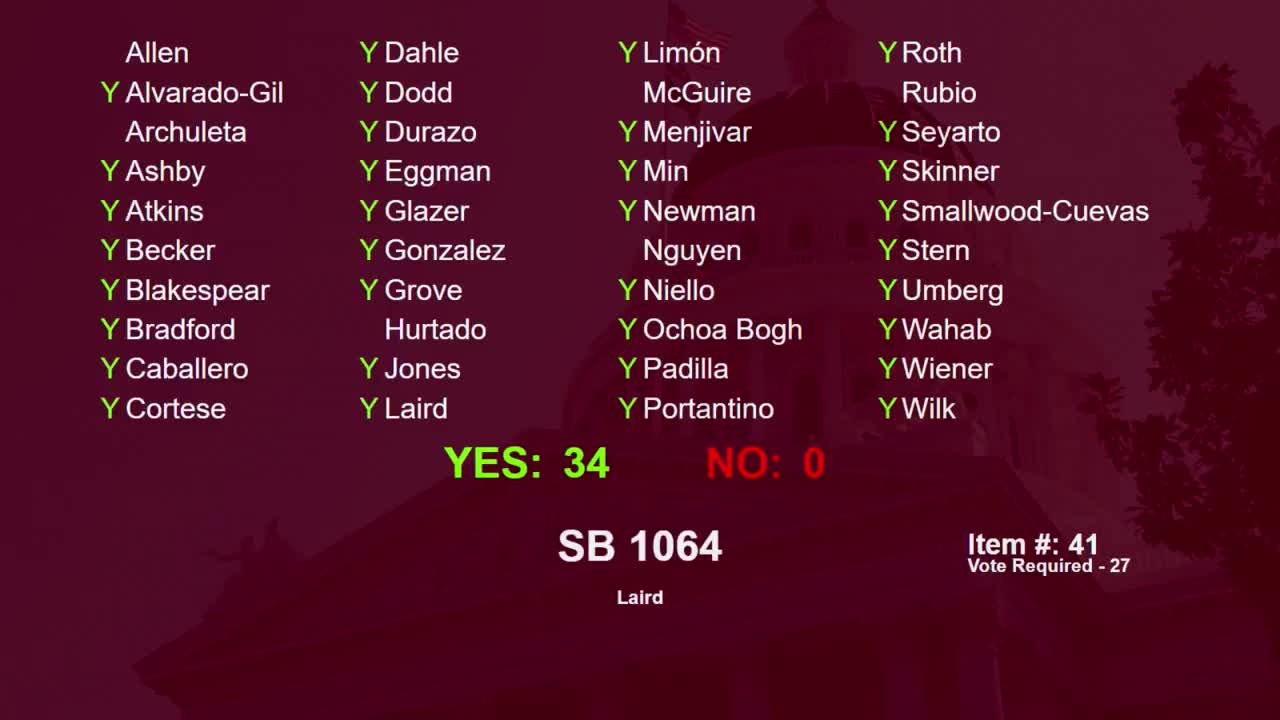 5MIN
Senate Floor
 34SEC
Senate Standing Committee on Appropriations
 22MIN
Senate Standing Committee on Business, Professions and Economic Development
Bill Author