SB 1099: Newborn screening: genetic diseases: blood samples collected.
- Session Year: 2023-2024
- House: Senate
- Latest Version Date: 2024-09-25
Current Status:
Passed
(2024-09-25: Chaptered by Secretary of State. Chapter 598, Statutes of 2024.)
Introduced
In Committee
First Chamber
In Committee
Second Chamber
Enacted
What does this bill do?
The bill requires the State Department of Public Health to publish an annual public report about the California Biobank Program showing how many leftover blood samples from prenatal and newborn screening it stores and how those samples are used. Each report must list totals and new samples, the number of inheritable conditions found by the original screens, the number of research projects and published studies using the samples, how many samples were provided to each project, how many screenings were waived for religious reasons, and how many samples were destroyed or are awaiting destruction at someone’s request.
The summary is provided by generative AI which can make mistakes. For original language, please view the details in the table below.
Existing law requires the State Department of Public Health to administer a statewide program for prenatal testing for genetic disorders and birth defects, including, but not limited to, ultrasound, amniocentesis, chorionic villus sampling, and blood testing. Existing law requires the department to expand prenatal screening to include all tests that meet or exceed the current standard of care as recommended by national recognized medical or genetic organizations. Existing law requires the department to set guidelines for invoicing, charging, and collecting fee amounts from approved researchers in order to cover the costs of, among other things, data linkage, retrieval, and data processing. Existing law establishes the continuously appropriated Birth Defects Monitoring Program Fund, consisting of fees paid for prenatal screening, and states the intent of the Legislature that all costs of the genetic disease testing program be fully supported by fees paid for prenatal screening tests, which are deposited in the fund. Existing law requires funds to be available, upon appropriation by the Legislature, in order to support pregnancy blood sample storage, testing, and research activities of the Birth Defects Monitoring Program.
This bill would require the department, commencing July 1, 2026, and each July 1 thereafter until the department has provided 5 annual reports, as part of its research activities, to report various data to the Legislature, including the number of research projects utilizing residual screening samples from the program and the number of inheritable conditions identified by the original screening tests during the previous calendar year. The bill would require the department to additionally set fee guidelines to cover the costs of reporting. The bill would require the annual report to be made available to the public on the departments internet website, and would require the report to be posted even after the above-described 5th report has been provided to the Legislature.
This bill would make other conforming changes.
Existing law requires the State Department of Public Health to administer a statewide program for prenatal testing for genetic disorders and birth defects, including, but not limited to, ultrasound, amniocentesis, chorionic villus sampling, and blood testing. Existing law requires the department to expand prenatal screening to include all tests that meet or exceed the current standard of care as recommended by national recognized medical or genetic organizations. Existing law requires the department to set guidelines for invoicing, charging, and collecting fee amounts from approved researchers in order to cover the costs of, among other things, data linkage, retrieval, and data processing. Existing law establishes the continuously appropriated Birth Defects Monitoring Program Fund, consisting of fees paid for prenatal screening, and states the intent of the Legislature that all costs of the genetic disease testing program be fully supported by fees paid for prenatal screening tests, which are deposited in the fund. Existing law requires funds to be available, upon appropriation by the Legislature, in order to support pregnancy blood sample storage, testing, and research activities of the Birth Defects Monitoring Program.
This bill would require the department, commencing July 1, 2026, and each July 1 thereafter, thereafter until the department has provided 5 annual reports, as part of its research activities, to report various data to the Legislature, including the number of research projects utilizing residual screening samples from the program and the number of inheritable conditions identified by the original screening tests during the previous calendar year. The bill would require the department to additionally set fee guidelines to cover the costs of reporting. The bill would also require the annual report to be made available to the public on the departments internet website. website, and would require the report to be posted even after the above-described 5th report has been provided to the Legislature.
This bill would make other conforming changes.
Existing law requires the State Department of Public Health to administer a statewide program for prenatal testing for genetic disorders and birth defects, including, but not limited to, ultrasound, amniocentesis, chorionic villus sampling, and blood testing. Existing law requires the department to expand prenatal screening to include all tests that meet or exceed the current standard of care as recommended by national recognized medical or genetic organizations. Existing law requires the department to set guidelines for invoicing, charging, and collecting fee amounts from approved researchers in order to cover the costs of, among other things, data linkage, retrieval, and data processing. Existing law establishes the continuously appropriated Birth Defects Monitoring Program Fund, consisting of fees paid for prenatal screening, and states the intent of the Legislature that all costs of the genetic disease testing program be fully supported by fees paid for prenatal screening tests, which are deposited in the fund. Existing law requires funds to be available, upon appropriation by the Legislature, in order to support pregnancy blood sample storage, testing, and research activities of the Birth Defects Monitoring Program.
This bill would require the department, commencing July 1, 2026, and each July 1 thereafter, as part of its research activities, to report various data to the Legislature, including the number of research projects utilizing residual screening samples from the program and the number of inheritable conditions identified by the original screening tests the previous calendar year. The bill would require the department to additionally set fee guidelines to cover the costs of reporting. The bill would also require the annual report to be made available to the public on the departments internet website.
This bill would make other conforming changes.
Existing law requires the State Department of Public Health to administer a statewide program for prenatal testing for genetic disorders and birth defects, including, but not limited to, ultrasound, amniocentesis, chorionic villus sampling, and blood testing. Existing law requires the department to expand prenatal screening to include all tests that meet or exceed the current standard of care as recommended by national recognized medical or genetic organizations. Existing law requires the department to set guidelines for invoicing, charging, and collecting fee amounts from approved researchers in order to cover the costs of, among other things, data linkage, retrieval, and data processing. Existing law establishes the continuously appropriated Birth Defects Monitoring Program Fund, consisting of fees paid for prenatal screening, and states the intent of the Legislature that all costs of the genetic disease testing program be fully supported by fees paid for prenatal screening tests, which are deposited in the fund. Existing law requires funds to be available, upon appropriation by the Legislature, in order to support pregnancy blood sample storage, testing, and research activities of the Birth Defects Monitoring Program.
This bill would require the department, commencing January July 1, 2026, and each January July 1 thereafter, as part of its research activities, to report various data to the Legislature, including the number of research projects utilizing residual screening samples from the program and the number of inheritable conditions identified by the original screening tests the previous calendar year. The bill would require the department to additionally set fee guidelines to cover the costs of reporting. The bill would also require the annual report to be made available to the public on the departments internet website.
This bill would make other conforming changes.
Existing law requires the State Department of Public Health to administer a statewide program for prenatal testing for genetic disorders and birth defects, including, but not limited to, ultrasound, amniocentesis, chorionic villus sampling, and blood testing. Existing law requires the department to expand prenatal screening to include all tests that meet or exceed the current standard of care as recommended by national recognized medical or genetic organizations. Existing law establishes the continuously appropriated Birth Defects Monitoring Program Fund, consisting of fees paid for prenatal screening, and states the intent of the Legislature that all costs of the genetic disease testing program be fully supported by fees paid for prenatal screening tests, which are deposited in the fund. Existing law requires funds to be available, upon appropriation by the Legislature, in order to support pregnancy blood sample storage, testing, and research activities of the Birth Defects Monitoring Program.
This bill would require the department, commencing January 1, 2026, and each January 1 thereafter, as part of its research activities, to report various data to the Legislature, including the number of research projects utilizing residual screening samples from the program and the number of inheritable conditions identified by the original screening tests the previous calendar year. The bill would also require the annual report to be made available to the public on the departments internet website.
This bill would make other conforming changes.
(a)It is the intent of the Legislature that, unless otherwise specified, the genetic disease testing program carried out pursuant to this chapter be fully supported from fees collected for services provided by the program.
(b)(1)The department shall charge a fee to all payers for any test or activity performed pursuant to this chapter. The amount of the fee shall be established by regulation and periodically adjusted by the director in order to meet the costs of this chapter. Notwithstanding any other law, any fee charged for prenatal screening and followup services provided to a person enrolled in the Medi-Cal program, health care service plan enrollee, or person covered by a health insurance policy shall be paid in full and deposited in the Genetic Disease Testing Fund or the Birth Defects Monitoring Program Fund consistent with this section.
(2)The department shall expeditiously undertake all steps necessary to implement the fee collection process, including personnel, contracts, and data processing, to initiate the fee collection process at the earliest opportunity.
(3)Effective for services provided on and after July 1, 2002, the department shall charge a fee to the hospital of birth or, for births not occurring in a hospital, to families of the newborn for newborn screening and followup services. The hospital of birth and families of newborns born outside the hospital shall make payment in full to the Genetic Disease Testing Fund. The department shall not charge or bill Medi-Cal beneficiaries for services provided pursuant to this chapter.
(4)(A)The department shall charge a fee for prenatal screening to support the pregnancy blood sample storage, testing, and research activities of the Birth Defects Monitoring Program.
(B)The prenatal screening fee for activities of the Birth Defects Monitoring Program shall be ten dollars ($10).
(5)The department shall set guidelines for invoicing, charging, and collecting from approved researchers the amount necessary to cover all expenses associated with research application requests made pursuant to this section, data linkage, retrieval, data processing, data entry, reinventory, reporting, and shipping of blood samples or their components, and related data management.
(6)The only funds from the Genetic Disease Testing Fund that may be used for the purpose of supporting the pregnancy blood sample storage, testing, and research activities of the Birth Defects Monitoring Program are those prenatal screening fees assessed and collected prior to the creation of the Birth Defects Monitoring Program Fund specifically to support those Birth Defects Monitoring Program activities.
(7)(A)The Birth Defects Monitoring Program Fund is hereby created as a special fund in the State Treasury. Fee revenues that are collected pursuant to paragraph (4) shall be deposited into the fund and shall be available upon appropriation by the Legislature to support the pregnancy blood sample storage, testing, and research activities, including reporting, of the Birth Defects Monitoring Program.
(B)Notwithstanding Section 16305.7 of the Government Code, interest earned on funds in the Birth Defects Monitoring Program Fund shall be deposited as revenue into the fund to support the Birth Defects Monitoring Program.
(c)(1)The Legislature finds that timely implementation of changes in genetic screening programs and continuous maintenance of quality statewide services requires expeditious regulatory and administrative procedures to obtain the most cost-effective electronic data processing, hardware, software services, testing equipment, and testing and followup services.
(2)The expenditure of funds from the Genetic Disease Testing Fund for these purposes is not subject to Section 12102 of, and Chapter 2 (commencing with Section 10290) of Part 2 of Division 2 of, the Public Contract Code or to Division 25.2 (commencing with Section 38070) of this code. The department shall provide the Department of Finance with documentation that equipment and services have been obtained at the lowest cost consistent with technical requirements for a comprehensive high-quality program.
(3)The expenditure of funds from the Genetic Disease Testing Fund for implementation of the Tandem Mass Spectrometry screening for fatty acid oxidation, amino acid, and organic acid disorders, and screening for congenital adrenal hyperplasia, may be implemented through the amendment of the Genetic Disease Branch Screening Information System contracts and is not subject to Chapter 3 (commencing with Section 12100) of Part 2 of Division 2 of the Public Contract Code, Article 4 (commencing with Section 19130) of Chapter 5 of Part 2 of Division 5 of Title 2 of the Government Code, and any policy, procedure, regulation, or manual authorized by those laws.
(4)(A)The expenditure of funds from the Genetic Disease Testing Fund for the expansion of the Genetic Disease Branch Screening Information System to include cystic fibrosis, biotinidase, severe combined immunodeficiency (SCID), adrenoleukodystrophy (ALD), and any other disease that is detectable in blood samples, as specified in subdivision (d) of Section 125001, may be implemented through the amendment of the Genetic Disease Branch Screening Information System contracts and shall not be subject to Chapter 2 (commencing with Section 10290) or Chapter 3 (commencing with Section 12100) of Part 2 of Division 2 of the Public Contract Code, Article 4 (commencing with Section 19130) of Chapter 5 of Part 2 of Division 5 of Title 2 of the Government Code, or Sections 4800 to 5180, inclusive, of the State Administrative Manual as they relate to approval of information technology projects or approval of increases in the duration or costs of information technology projects.
(B)This paragraph shall apply to the design, development, and implementation of the expansion and to the maintenance and operation of the Genetic Disease Branch Screening Information System, including change requests, once the expansion is implemented.
(d)(1)(A)The department may adopt emergency regulations to implement and make specific this chapter in accordance with Chapter 3.5 (commencing with Section 11340) of Part 1 of Division 3 of Title 2 of the Government Code.
(B)For the purposes of the Administrative Procedure Act, the adoption of regulations shall be deemed an emergency and necessary for the immediate preservation of the public peace, health and safety, or general welfare.
(C)Notwithstanding Chapter 3.5 (commencing with Section 11340) of Part 1 of Division 3 of Title 2 of the Government Code, these emergency regulations shall not be subject to the review and approval of the Office of Administrative Law.
(D)Notwithstanding Sections 11346.1 and 11349.6 of the Government Code, the department shall submit these regulations directly to the Secretary of State for filing.
(E)The regulations shall become effective immediately upon filing by the Secretary of State.
(F)Regulations shall be subject to public hearing within 120 days of filing with the Secretary of State and shall comply with Sections 11346.8 and 11346.9 of the Government Code or shall be repealed.
(2)(A)The Office of Administrative Law shall provide for the printing and publication of these regulations in the California Code of Regulations.
(B)Notwithstanding Chapter 3.5 (commencing with Section 11340) of Part 1 of Division 3 of Title 2 of the Government Code, the regulations adopted pursuant to this chapter shall not be repealed by the Office of Administrative Law and shall remain in effect until revised or repealed by the department.
(3)The Legislature finds and declares that the health and safety of California newborns is in part dependent on an effective and adequately staffed genetic disease program, the cost of which shall be supported by the fees generated by the program.
SEC. 2.Section 124991 of the Health and Safety Code is amended to read:124991.(a)(1)The Birth Defects Monitoring Program, within the State Department of Public Health, shall collect and store any umbilical cord blood samples it receives from hospitals for storage and research. For purposes of ensuring financial stability, the Birth Defects Monitoring Program shall ensure that the following conditions, alone or in combination, are met:
(A)The fees paid by researchers pursuant to subdivision (c) shall be used for, and be sufficient to cover the cost of, collecting and storing blood samples, including umbilical cord blood samples.
(B)The department receives confirmation that a researcher has requested umbilical cord blood samples from the Birth Defects Monitoring Program for research or has requested umbilical cord blood samples to be included within a request for pregnancy or newborn blood samples through the program and has provided satisfactory evidence that adequate funding will be provided to the department from the fees paid by the researcher for the request.
(C)The department receives federal grant moneys to pay for initial startup costs for the collection and storage of umbilical cord blood samples.
(2)The department may limit the number of umbilical cord blood samples the program collects each year.
(b)(1)All information relating to umbilical cord blood samples collected and utilized by the department shall be confidential, and shall be used solely for the purposes of the program, or, if approved by the department, research. Access to confidential information shall be limited to authorized persons who agree, in writing, to maintain the confidentiality of that information. Notwithstanding any other provision of law, when the blood samples specified in subdivision (c), including those samples with any information identifying the person from whom the samples were obtained, are stored, processed, analyzed, or otherwise shared for research purposes with nondepartment staff, those samples may be shared by the program with department-authorized researchers for research purposes, and department representatives approved by the department, subject to the confidentiality and security requirements for confidential information established in this section and in Section 103850.
(2)The department shall maintain an accurate record of all persons who are given confidential information pursuant to this section, and any disclosure of confidential information shall be made only upon written agreement that the information will be kept confidential, used for its approved purpose, and not be further disclosed.
(3)A person who, in violation of a written agreement to maintain confidentiality, discloses information provided pursuant to this section, or who uses information provided pursuant to this section in a manner other than as approved pursuant to this section may be denied further access to confidential information maintained by the department, and shall be subject to a civil penalty not exceeding one thousand dollars ($1,000). The penalty provided in this section does not limit or otherwise restrict a remedy, provisional or otherwise, provided by law for the benefit of the department or a person covered by this section.
(c)In order to implement this section, the department shall establish fees in an amount that shall not exceed the costs of administering the program and the collection and storage of these samples, which the department shall collect from researchers who have been approved by the department and who seek to use the following types of blood samples for research:
(1)Umbilical cord blood.
(2)Pregnancy blood collected by the Genetic Disease Screening Program, and stored by the Birth Defects Monitoring Program.
(3)Newborn blood collected by the Genetic Disease Screening Program.
(d)Fees collected pursuant to subdivision (c) shall be collected by the department and deposited into the Birth Defects Monitoring Program Fund, the Genetic Disease Testing Fund, created pursuant to Section 124996, or the Cord Blood Banking Fund, which is hereby created as a special fund in the State Treasury. The amount of fees deposited into each of these funds shall be based on the program that is providing those pregnancy blood samples, and the purpose for which the blood sample was obtained. Notwithstanding any other provision of law, the moneys in the Birth Defects Monitoring Program Fund, the Genetic Disease Testing Fund, and the Cord Blood Banking Fund that are collected pursuant to subdivision (c), may be used by the department, upon appropriation by the Legislature, for the purposes specified in subdivision (e).
(e)Moneys in those funds shall be used for the costs related to reporting, data management, including data linkage and entry, and blood collection, storage, retrieval, processing, inventory, and shipping.
(f)The department shall comply with the existing requirements in the Birth Defects Monitoring Program, as set forth in Chapter 1 (commencing with Section 103825) of Part 2 of Division 102.
(g)The department, any entities approved by the department, and researchers shall maintain the confidentiality of patient information and blood samples in accordance with existing law and in the same manner as other medical record information with patient identification that they possess, and shall use the information only for the following purposes:
(1)Research to identify risk factors for childrens and womens diseases.
(2)Research to develop and evaluate screening tests.
(3)Research to develop and evaluate prevention strategies.
(4)Research to develop and evaluate treatments.
(h)(1)For purposes of ensuring the security of a donors personal information, before any blood samples are released pursuant to this section for research purposes, the State Committee for the Protection of Human Subjects (CPHS) shall determine if all of the following criteria have been met:
(A)The department, contractors, researchers, or other entities approved by the department have provided a plan sufficient to protect personal information from improper use and disclosures, including sufficient administrative, physical, and technical safeguards to protect personal information from reasonable anticipated threats to the security or confidentiality of the information.
(B)The department, contractors, researchers, or other entities approved by the department have provided a sufficient plan to destroy or return all personal information as soon as it is no longer needed for the research activity, unless the program contractors, researchers, or other entities approved by the department have demonstrated an ongoing need for the personal information for the research activity and have provided a long-term plan sufficient to protect the confidentiality of that information.
(C)The department, contractors, researchers, or other entities approved by the department have provided sufficient written assurances that the personal information will not be reused or disclosed to a person or entity, or used in a manner not approved in the research protocol, except as required by law or for authorized oversight of the research activity.
(2)As part of its review and approval of the research activity for the purpose of protecting personal information held in agency databases, CPHS shall accomplish at least all of the following:
(A)Determine whether the requested personal information is needed to conduct the research.
(B)Permit access to personal information only if it is needed for the research activity.
(C)Permit access only to the minimum personal information necessary for the research activity.
(D)Require the assignment of unique subject codes that are not derived from personal information in lieu of social security numbers if the research can be conducted without social security numbers.
(E)If feasible, and if cost, time, and technical expertise permit, require the agency to conduct a portion of the data processing for the researcher to minimize the release of personal information.
(i)In addition to the fees described in subdivision (c), the department may bill a researcher for the costs associated with the departments process of protecting personal information, including, but not limited to, the departments costs for conducting a portion of the data processing for the researcher, removing personal information, encrypting or otherwise securing personal information, or assigning subject codes.
(j)This section does not prohibit the department from using its existing authority to enter into written agreements to enable other institutional review boards to approve research activities, projects or classes of projects for the department, provided that the data security requirements set forth in this section are satisfied.
SEC. 3.Article 2.5 (commencing with Section 125010) is added to Chapter 1 of Part 5 of Division 106 of the Health and Safety Code, to read:2.5.California Biobank Program125010.Commencing July 1, 2026, and each July 1 thereafter, the State Department of Public Health shall generate a report that includes each of the following:
(a)The total number of any residual screening specimens stored by the California Biobank Program.
(b)The number of new residual screening specimens collected during the previous calendar year.
(c)The number of inheritable conditions identified by the original screening tests during the previous calendar year.
(d)The number of projects utilizing specimens from the California Biobank Program.
(e)The number of published research studies where biospecimens from the California Biobank Program were used or referenced and the potential public health benefits from the research.
(f)The number of specimens provided by the California Biobank Program for each research project.
(g)The number of screening tests waived for religious purposes during the previous calendar year.
(h)The number of residual screening specimens destroyed at the request of a parent or adult during the previous calendar year.
(i)The number of residual screening samples remaining to be destroyed at the request of a parent or adult during the previous calendar year.
125011.Commencing July 1, 2026, and each July 1 thereafter, a report generated pursuant to this article shall be provided to the Legislature until the department has provided five annual reports and that report shall be made available to the public on the departments internet website. The department shall continue to post the annual report to its internet website after the fifth annual report has been provided to the Legislature.
125012.A report submitted to the Legislature pursuant to this article shall be submitted in compliance with Section 9795 of the Government Code.
(a)It is the intent of the Legislature that, unless otherwise specified, the genetic disease testing program carried out pursuant to this chapter be fully supported from fees collected for services provided by the program.
(b)(1)The department shall charge a fee to all payers for any test or activity performed pursuant to this chapter. The amount of the fee shall be established by regulation and periodically adjusted by the director in order to meet the costs of this chapter. Notwithstanding any other law, any fee charged for prenatal screening and followup services provided to a person enrolled in the Medi-Cal program, health care service plan enrollee, or person covered by a health insurance policy shall be paid in full and deposited in the Genetic Disease Testing Fund or the Birth Defects Monitoring Program Fund consistent with this section.
(2)The department shall expeditiously undertake all steps necessary to implement the fee collection process, including personnel, contracts, and data processing, to initiate the fee collection process at the earliest opportunity.
(3)Effective for services provided on and after July 1, 2002, the department shall charge a fee to the hospital of birth or, for births not occurring in a hospital, to families of the newborn for newborn screening and followup services. The hospital of birth and families of newborns born outside the hospital shall make payment in full to the Genetic Disease Testing Fund. The department shall not charge or bill Medi-Cal beneficiaries for services provided pursuant to this chapter.
(4)(A)The department shall charge a fee for prenatal screening to support the pregnancy blood sample storage, testing, and research activities of the Birth Defects Monitoring Program.
(B)The prenatal screening fee for activities of the Birth Defects Monitoring Program shall be ten dollars ($10).
(5)The department shall set guidelines for invoicing, charging, and collecting from approved researchers the amount necessary to cover all expenses associated with research application requests made pursuant to this section, data linkage, retrieval, data processing, data entry, reinventory, reporting, and shipping of blood samples or their components, and related data management.
(6)The only funds from the Genetic Disease Testing Fund that may be used for the purpose of supporting the pregnancy blood sample storage, testing, and research activities of the Birth Defects Monitoring Program are those prenatal screening fees assessed and collected prior to the creation of the Birth Defects Monitoring Program Fund specifically to support those Birth Defects Monitoring Program activities.
(7)(A)The Birth Defects Monitoring Program Fund is hereby created as a special fund in the State Treasury. Fee revenues that are collected pursuant to paragraph (4) shall be deposited into the fund and shall be available upon appropriation by the Legislature to support the pregnancy blood sample storage, testing, and research activities, including reporting, of the Birth Defects Monitoring Program.
(B)Notwithstanding Section 16305.7 of the Government Code, interest earned on funds in the Birth Defects Monitoring Program Fund shall be deposited as revenue into the fund to support the Birth Defects Monitoring Program.
(c)(1)The Legislature finds that timely implementation of changes in genetic screening programs and continuous maintenance of quality statewide services requires expeditious regulatory and administrative procedures to obtain the most cost-effective electronic data processing, hardware, software services, testing equipment, and testing and followup services.
(2)The expenditure of funds from the Genetic Disease Testing Fund for these purposes is not subject to Section 12102 of, and Chapter 2 (commencing with Section 10290) of Part 2 of Division 2 of, the Public Contract Code or to Division 25.2 (commencing with Section 38070) of this code. The department shall provide the Department of Finance with documentation that equipment and services have been obtained at the lowest cost consistent with technical requirements for a comprehensive high-quality program.
(3)The expenditure of funds from the Genetic Disease Testing Fund for implementation of the Tandem Mass Spectrometry screening for fatty acid oxidation, amino acid, and organic acid disorders, and screening for congenital adrenal hyperplasia, may be implemented through the amendment of the Genetic Disease Branch Screening Information System contracts and is not subject to Chapter 3 (commencing with Section 12100) of Part 2 of Division 2 of the Public Contract Code, Article 4 (commencing with Section 19130) of Chapter 5 of Part 2 of Division 5 of Title 2 of the Government Code, and any policy, procedure, regulation, or manual authorized by those laws.
(4)(A)The expenditure of funds from the Genetic Disease Testing Fund for the expansion of the Genetic Disease Branch Screening Information System to include cystic fibrosis, biotinidase, severe combined immunodeficiency (SCID), adrenoleukodystrophy (ALD), and any other disease that is detectable in blood samples, as specified in subdivision (d) of Section 125001, may be implemented through the amendment of the Genetic Disease Branch Screening Information System contracts and shall not be subject to Chapter 2 (commencing with Section 10290) or Chapter 3 (commencing with Section 12100) of Part 2 of Division 2 of the Public Contract Code, Article 4 (commencing with Section 19130) of Chapter 5 of Part 2 of Division 5 of Title 2 of the Government Code, or Sections 4800 to 5180, inclusive, of the State Administrative Manual as they relate to approval of information technology projects or approval of increases in the duration or costs of information technology projects.
(B)This paragraph shall apply to the design, development, and implementation of the expansion and to the maintenance and operation of the Genetic Disease Branch Screening Information System, including change requests, once the expansion is implemented.
(d)(1)(A)The department may adopt emergency regulations to implement and make specific this chapter in accordance with Chapter 3.5 (commencing with Section 11340) of Part 1 of Division 3 of Title 2 of the Government Code.
(B)For the purposes of the Administrative Procedure Act, the adoption of regulations shall be deemed an emergency and necessary for the immediate preservation of the public peace, health and safety, or general welfare.
(C)Notwithstanding Chapter 3.5 (commencing with Section 11340) of Part 1 of Division 3 of Title 2 of the Government Code, these emergency regulations shall not be subject to the review and approval of the Office of Administrative Law.
(D)Notwithstanding Sections 11346.1 and 11349.6 of the Government Code, the department shall submit these regulations directly to the Secretary of State for filing.
(E)The regulations shall become effective immediately upon filing by the Secretary of State.
(F)Regulations shall be subject to public hearing within 120 days of filing with the Secretary of State and shall comply with Sections 11346.8 and 11346.9 of the Government Code or shall be repealed.
(2)(A)The Office of Administrative Law shall provide for the printing and publication of these regulations in the California Code of Regulations.
(B)Notwithstanding Chapter 3.5 (commencing with Section 11340) of Part 1 of Division 3 of Title 2 of the Government Code, the regulations adopted pursuant to this chapter shall not be repealed by the Office of Administrative Law and shall remain in effect until revised or repealed by the department.
(3)The Legislature finds and declares that the health and safety of California newborns is in part dependent on an effective and adequately staffed genetic disease program, the cost of which shall be supported by the fees generated by the program.
SEC. 2.Section 124991 of the Health and Safety Code is amended to read:124991.(a)(1)The Birth Defects Monitoring Program, within the State Department of Public Health, shall collect and store any umbilical cord blood samples it receives from hospitals for storage and research. For purposes of ensuring financial stability, the Birth Defects Monitoring Program shall ensure that the following conditions, alone or in combination, are met:
(A)The fees paid by researchers pursuant to subdivision (c) shall be used for, and be sufficient to cover the cost of, collecting and storing blood samples, including umbilical cord blood samples.
(B)The department receives confirmation that a researcher has requested umbilical cord blood samples from the Birth Defects Monitoring Program for research or has requested umbilical cord blood samples to be included within a request for pregnancy or newborn blood samples through the program and has provided satisfactory evidence that adequate funding will be provided to the department from the fees paid by the researcher for the request.
(C)The department receives federal grant moneys to pay for initial startup costs for the collection and storage of umbilical cord blood samples.
(2)The department may limit the number of umbilical cord blood samples the program collects each year.
(b)(1)All information relating to umbilical cord blood samples collected and utilized by the department shall be confidential, and shall be used solely for the purposes of the program, or, if approved by the department, research. Access to confidential information shall be limited to authorized persons who agree, in writing, to maintain the confidentiality of that information. Notwithstanding any other provision of law, when the blood samples specified in subdivision (c), including those samples with any information identifying the person from whom the samples were obtained, are stored, processed, analyzed, or otherwise shared for research purposes with nondepartment staff, those samples may be shared by the program with department-authorized researchers for research purposes, and department representatives approved by the department, subject to the confidentiality and security requirements for confidential information established in this section and in Section 103850.
(2)The department shall maintain an accurate record of all persons who are given confidential information pursuant to this section, and any disclosure of confidential information shall be made only upon written agreement that the information will be kept confidential, used for its approved purpose, and not be further disclosed.
(3)A person who, in violation of a written agreement to maintain confidentiality, discloses information provided pursuant to this section, or who uses information provided pursuant to this section in a manner other than as approved pursuant to this section may be denied further access to confidential information maintained by the department, and shall be subject to a civil penalty not exceeding one thousand dollars ($1,000). The penalty provided in this section does not limit or otherwise restrict a remedy, provisional or otherwise, provided by law for the benefit of the department or a person covered by this section.
(c)In order to implement this section, the department shall establish fees in an amount that shall not exceed the costs of administering the program and the collection and storage of these samples, which the department shall collect from researchers who have been approved by the department and who seek to use the following types of blood samples for research:
(1)Umbilical cord blood.
(2)Pregnancy blood collected by the Genetic Disease Screening Program, and stored by the Birth Defects Monitoring Program.
(3)Newborn blood collected by the Genetic Disease Screening Program.
(d)Fees collected pursuant to subdivision (c) shall be collected by the department and deposited into the Birth Defects Monitoring Program Fund, the Genetic Disease Testing Fund, created pursuant to Section 124996, or the Cord Blood Banking Fund, which is hereby created as a special fund in the State Treasury. The amount of fees deposited into each of these funds shall be based on the program that is providing those pregnancy blood samples, and the purpose for which the blood sample was obtained. Notwithstanding any other provision of law, the moneys in the Birth Defects Monitoring Program Fund, the Genetic Disease Testing Fund, and the Cord Blood Banking Fund that are collected pursuant to subdivision (c), may be used by the department, upon appropriation by the Legislature, for the purposes specified in subdivision (e).
(e)Moneys in those funds shall be used for the costs related to reporting, data management, including data linkage and entry, and blood collection, storage, retrieval, processing, inventory, and shipping.
(f)The department shall comply with the existing requirements in the Birth Defects Monitoring Program, as set forth in Chapter 1 (commencing with Section 103825) of Part 2 of Division 102.
(g)The department, any entities approved by the department, and researchers shall maintain the confidentiality of patient information and blood samples in accordance with existing law and in the same manner as other medical record information with patient identification that they possess, and shall use the information only for the following purposes:
(1)Research to identify risk factors for childrens and womens diseases.
(2)Research to develop and evaluate screening tests.
(3)Research to develop and evaluate prevention strategies.
(4)Research to develop and evaluate treatments.
(h)(1)For purposes of ensuring the security of a donors personal information, before any blood samples are released pursuant to this section for research purposes, the State Committee for the Protection of Human Subjects (CPHS) shall determine if all of the following criteria have been met:
(A)The department, contractors, researchers, or other entities approved by the department have provided a plan sufficient to protect personal information from improper use and disclosures, including sufficient administrative, physical, and technical safeguards to protect personal information from reasonable anticipated threats to the security or confidentiality of the information.
(B)The department, contractors, researchers, or other entities approved by the department have provided a sufficient plan to destroy or return all personal information as soon as it is no longer needed for the research activity, unless the program contractors, researchers, or other entities approved by the department have demonstrated an ongoing need for the personal information for the research activity and have provided a long-term plan sufficient to protect the confidentiality of that information.
(C)The department, contractors, researchers, or other entities approved by the department have provided sufficient written assurances that the personal information will not be reused or disclosed to a person or entity, or used in a manner not approved in the research protocol, except as required by law or for authorized oversight of the research activity.
(2)As part of its review and approval of the research activity for the purpose of protecting personal information held in agency databases, CPHS shall accomplish at least all of the following:
(A)Determine whether the requested personal information is needed to conduct the research.
(B)Permit access to personal information only if it is needed for the research activity.
(C)Permit access only to the minimum personal information necessary for the research activity.
(D)Require the assignment of unique subject codes that are not derived from personal information in lieu of social security numbers if the research can be conducted without social security numbers.
(E)If feasible, and if cost, time, and technical expertise permit, require the agency to conduct a portion of the data processing for the researcher to minimize the release of personal information.
(i)In addition to the fees described in subdivision (c), the department may bill a researcher for the costs associated with the departments process of protecting personal information, including, but not limited to, the departments costs for conducting a portion of the data processing for the researcher, removing personal information, encrypting or otherwise securing personal information, or assigning subject codes.
(j)This section does not prohibit the department from using its existing authority to enter into written agreements to enable other institutional review boards to approve research activities, projects or classes of projects for the department, provided that the data security requirements set forth in this section are satisfied.
SEC. 3.Section 125055 of the Health and Safety Code is amended to read:125055.The department shall:(a)Establish criteria for eligibility for the prenatal testing program. Eligibility shall include definition of conditions and circumstances that result in a high risk of a detectable genetic disorder or birth defect.(b)(1)Develop an education program designed to educate physicians and surgeons and the public concerning the uses of prenatal testing and the availability of the program.(2)(A)Include information regarding environmental health in the California Prenatal Screening Program patient educational information. This environmental health information shall include the following statement:We encounter chemicals and other substances in everyday life that may affect your developing fetus. Fortunately, there are steps you can take to reduce your exposure to these potentially harmful substances at home, in the workplace, and in the environment. Many Californians are unaware that a number of everyday consumer products may pose potential harm. Prospective parents should talk to their doctor and are encouraged to read more about this topic to learn about simple actions to promote a healthy pregnancy.(B)The department shall include in the patient educational information links to educational materials derived from peer-reviewed materials based on the best available evidence relating to environmental health and reproductive toxins.(C)The department shall post the environmental health information described in subparagraphs (A) and (B) on its internet website.(D)The department shall send a notice to all distributors of the patient educational information informing them of the change to that information. In the notice, the department shall encourage obstetrician-gynecologists and midwives to discuss environmental health with their patients and to direct their patients to the appropriate page or pages in the patient educational information to provide their patients with additional information.(E)In order to minimize costs, the environmental health information described in this paragraph shall be included when the patient educational information is otherwise revised and reprinted.(F)The department may modify the language in the patient educational information after consultation with medical and scientific experts in the field of environmental health and reproductive toxins.(c)Ensure that genetic counseling be given in conjunction with prenatal testing at the approved prenatal diagnosis centers.(d)Designate sufficient prenatal diagnosis centers to meet the need for these services. Prenatal diagnosis centers shall have equipment and staff trained and capable of providing genetic counseling and performing prenatal diagnostic procedures and tests, including the interpretation of the results of the procedures and tests.(e)Administer a program of subsidy grants for approved nonprofit prenatal diagnosis centers. The subsidy grants shall be awarded based on the reported number of low-income women referred to the center, the number of prenatal diagnoses performed in the previous year at that center, and the estimated size of unmet need for prenatal diagnostic procedures and tests in its service area. This subsidy shall be in addition to fees collected under other state programs.(f)Establish any rules, regulations, and standards for prenatal diagnostic testing and the allocation of subsidies as the director deems necessary to promote and protect the public health and safety and to implement the Hereditary Disorders Act (Section 27).(g)(1)The department shall expand prenatal screening to include all tests that meet or exceed the current standard of care as recommended by nationally recognized medical or genetic organizations, including, but not limited to, inhibin.(2)The prenatal screening fee increase for expanding prenatal screening to include those tests described in paragraph (1) is forty dollars ($40).(3)The department shall report to the Legislature regarding the progress of the program with regard to implementing prenatal screening for those tests described in paragraph (1) on or before July 1, 2007. The report shall include the costs of screening, followup, and treatment as compared to costs and morbidity averted by this testing under the program.(4)(A)The expenditure of funds from the Genetic Disease Testing Fund for the expansion of the Genetic Disease Branch Screening Information System to include the expansion of prenatal screenings, pursuant to paragraph (1), may be implemented through the amendment of the Genetic Disease Branch Screening Information System contracts, and shall not be subject to Chapter 2 (commencing with Section 10290) or Chapter 3 (commencing with Section 12100) of Part 2 of Division 2 of the Public Contract Code, Article 4 (commencing with Section 19130) of Chapter 5 of Part 2 of Division 5 of Title 2 of the Government Code, or Sections 4800 to 5180, inclusive, of the State Administrative Manual as they relate to approval of information technology projects or approval of increases in the duration or costs of information technology projects. This paragraph shall apply to the design, development, and implementation of the expansion, and to the maintenance and operation of the Genetic Disease Branch Screening Information System, including change requests, once the expansion is implemented.(B)(i)The department may adopt emergency regulations to implement and make specific the amendments to this section made during the 2006 portion of the 200506 Regular Session in accordance with Chapter 3.5 (commencing with Section 11340) of Part 1 of Division 3 of Title 2 of the Government Code. For the purposes of the Administrative Procedure Act, the adoption of regulations shall be deemed an emergency and necessary for the immediate preservation of the public peace, health and safety, or general welfare. Notwithstanding Chapter 3.5 (commencing with Section 11340) of Part 1 of Division 3 of Title 2 of the Government Code, these emergency regulations shall not be subject to the review and approval of the Office of Administrative Law. Notwithstanding Sections 11346.1 and 11349.6 of the Government Code, the department shall submit these regulations directly to the Secretary of State for filing. The regulations shall become effective immediately upon filing by the Secretary of State. Regulations shall be subject to public hearing within 120 days of filing with the Secretary of State and shall comply with Sections 11346.8 and 11346.9 of the Government Code or shall be repealed.(ii)The Office of Administrative Law shall provide for the printing and publication of these regulations in the California Code of Regulations. Notwithstanding Chapter 3.5 (commencing with Section 11340) of Part 1 of Division 3 of Title 2 of the Government Code, the regulations adopted pursuant to this chapter shall not be repealed by the Office of Administrative Law and shall remain in effect until revised or repealed by the department.(h)Commencing July 1, 2026, and each July 1 thereafter, the department shall provide a report to the Legislature that includes each of the following:(1)The total number of any residual screening specimens stored at the California Biobank.(2)The number of new residual screening specimens collected the previous calendar year.(3)The number of inheritable conditions identified by the original screening tests the previous calendar year.(4)The number of projects utilizing specimens from the California Biobank.(5)The number of published research studies where biospecimens from the California Biobank were used or referenced and the potential public health benefits from the research.(6)The number of specimens provided by the California Biobank for each research project.(7)The number of screening tests waived for religious purposes the previous calendar year.(8)The number of residual screening specimens destroyed at the request of a parent or adult the previous calendar year.(9)The number of residual screening samples remaining to be destroyed pursuant to a request in paragraph (8).(i)Commencing July 1, 2026, the report in subdivision (h) shall be made available to the public on the departments internet website.(j)The report submitted to the Legislature pursuant to subdivision (h) shall be submitted in compliance with Section 9795 of the Government Code.SEC. 3.Article 2.5 (commencing with Section 125010) is added to Chapter 1 of Part 5 of Division 106 of the Health and Safety Code, to read:2.5.California Biobank Program125010.Commencing July 1, 2026, and each July 1 thereafter, the State Department of Public Health shall generate a report that includes each of the following:
(a)The total number of any residual screening specimens stored by the California Biobank Program.
(b)The number of new residual screening specimens collected during the previous calendar year.
(c)The number of inheritable conditions identified by the original screening tests during the previous calendar year.
(d)The number of projects utilizing specimens from the California Biobank Program.
(e)The number of published research studies where biospecimens from the California Biobank Program were used or referenced and the potential public health benefits from the research.
(f)The number of specimens provided by the California Biobank Program for each research project.
(g)The number of screening tests waived for religious purposes during the previous calendar year.
(h)The number of residual screening specimens destroyed at the request of a parent or adult during the previous calendar year.
(i)The number of residual screening samples remaining to be destroyed at the request of a parent or adult during the previous calendar year.
125011.Commencing July 1, 2026, and each July 1 thereafter, a report generated pursuant to this article shall be provided to the Legislature until the department has provided five annual reports and that report shall be made available to the public on the departments internet website. The department shall continue to post the annual report to its internet website after the fifth annual report has been provided to the Legislature.
125012.A report submitted to the Legislature pursuant to this article shall be submitted in compliance with Section 9795 of the Government Code.
(a)It is the intent of the Legislature that, unless otherwise specified, the genetic disease testing program carried out pursuant to this chapter be fully supported from fees collected for services provided by the program.
(b)(1)The department shall charge a fee to all payers for any test or activity performed pursuant to this chapter. The amount of the fee shall be established by regulation and periodically adjusted by the director in order to meet the costs of this chapter. Notwithstanding any other law, any fee charged for prenatal screening and followup services provided to a person enrolled in the Medi-Cal program, health care service plan enrollee, or person covered by a health insurance policy shall be paid in full and deposited in the Genetic Disease Testing Fund or the Birth Defects Monitoring Program Fund consistent with this section.
(2)The department shall expeditiously undertake all steps necessary to implement the fee collection process, including personnel, contracts, and data processing, to initiate the fee collection process at the earliest opportunity.
(3)Effective for services provided on and after July 1, 2002, the department shall charge a fee to the hospital of birth or, for births not occurring in a hospital, to families of the newborn for newborn screening and followup services. The hospital of birth and families of newborns born outside the hospital shall make payment in full to the Genetic Disease Testing Fund. The department shall not charge or bill Medi-Cal beneficiaries for services provided pursuant to this chapter.
(4)(A)The department shall charge a fee for prenatal screening to support the pregnancy blood sample storage, testing, and research activities of the Birth Defects Monitoring Program.
(B)The prenatal screening fee for activities of the Birth Defects Monitoring Program shall be ten dollars ($10).
(5)The department shall set guidelines for invoicing, charging, and collecting from approved researchers the amount necessary to cover all expenses associated with research application requests made pursuant to this section, data linkage, retrieval, data processing, data entry, reinventory, reporting, and shipping of blood samples or their components, and related data management.
(6)The only funds from the Genetic Disease Testing Fund that may be used for the purpose of supporting the pregnancy blood sample storage, testing, and research activities of the Birth Defects Monitoring Program are those prenatal screening fees assessed and collected prior to the creation of the Birth Defects Monitoring Program Fund specifically to support those Birth Defects Monitoring Program activities.
(7)(A)The Birth Defects Monitoring Program Fund is hereby created as a special fund in the State Treasury. Fee revenues that are collected pursuant to paragraph (4) shall be deposited into the fund and shall be available upon appropriation by the Legislature to support the pregnancy blood sample storage, testing, and research activities, including reporting, of the Birth Defects Monitoring Program.
(B)Notwithstanding Section 16305.7 of the Government Code, interest earned on funds in the Birth Defects Monitoring Program Fund shall be deposited as revenue into the fund to support the Birth Defects Monitoring Program.
(c)(1)The Legislature finds that timely implementation of changes in genetic screening programs and continuous maintenance of quality statewide services requires expeditious regulatory and administrative procedures to obtain the most cost-effective electronic data processing, hardware, software services, testing equipment, and testing and followup services.
(2)The expenditure of funds from the Genetic Disease Testing Fund for these purposes is not subject to Section 12102 of, and Chapter 2 (commencing with Section 10290) of Part 2 of Division 2 of, the Public Contract Code or to Division 25.2 (commencing with Section 38070) of this code. The department shall provide the Department of Finance with documentation that equipment and services have been obtained at the lowest cost consistent with technical requirements for a comprehensive high-quality program.
(3)The expenditure of funds from the Genetic Disease Testing Fund for implementation of the Tandem Mass Spectrometry screening for fatty acid oxidation, amino acid, and organic acid disorders, and screening for congenital adrenal hyperplasia, may be implemented through the amendment of the Genetic Disease Branch Screening Information System contracts and is not subject to Chapter 3 (commencing with Section 12100) of Part 2 of Division 2 of the Public Contract Code, Article 4 (commencing with Section 19130) of Chapter 5 of Part 2 of Division 5 of Title 2 of the Government Code, and any policy, procedure, regulation, or manual authorized by those laws.
(4)(A)The expenditure of funds from the Genetic Disease Testing Fund for the expansion of the Genetic Disease Branch Screening Information System to include cystic fibrosis, biotinidase, severe combined immunodeficiency (SCID), adrenoleukodystrophy (ALD), and any other disease that is detectable in blood samples, as specified in subdivision (d) of Section 125001, may be implemented through the amendment of the Genetic Disease Branch Screening Information System contracts and shall not be subject to Chapter 2 (commencing with Section 10290) or Chapter 3 (commencing with Section 12100) of Part 2 of Division 2 of the Public Contract Code, Article 4 (commencing with Section 19130) of Chapter 5 of Part 2 of Division 5 of Title 2 of the Government Code, or Sections 4800 to 5180, inclusive, of the State Administrative Manual as they relate to approval of information technology projects or approval of increases in the duration or costs of information technology projects.
(B)This paragraph shall apply to the design, development, and implementation of the expansion and to the maintenance and operation of the Genetic Disease Branch Screening Information System, including change requests, once the expansion is implemented.
(d)(1)(A)The department may adopt emergency regulations to implement and make specific this chapter in accordance with Chapter 3.5 (commencing with Section 11340) of Part 1 of Division 3 of Title 2 of the Government Code.
(B)For the purposes of the Administrative Procedure Act, the adoption of regulations shall be deemed an emergency and necessary for the immediate preservation of the public peace, health and safety, or general welfare.
(C)Notwithstanding Chapter 3.5 (commencing with Section 11340) of Part 1 of Division 3 of Title 2 of the Government Code, these emergency regulations shall not be subject to the review and approval of the Office of Administrative Law.
(D)Notwithstanding Sections 11346.1 and 11349.6 of the Government Code, the department shall submit these regulations directly to the Secretary of State for filing.
(E)The regulations shall become effective immediately upon filing by the Secretary of State.
(F)Regulations shall be subject to public hearing within 120 days of filing with the Secretary of State and shall comply with Sections 11346.8 and 11346.9 of the Government Code or shall be repealed.
(2)(A)The Office of Administrative Law shall provide for the printing and publication of these regulations in the California Code of Regulations.
(B)Notwithstanding Chapter 3.5 (commencing with Section 11340) of Part 1 of Division 3 of Title 2 of the Government Code, the regulations adopted pursuant to this chapter shall not be repealed by the Office of Administrative Law and shall remain in effect until revised or repealed by the department.
(3)The Legislature finds and declares that the health and safety of California newborns is in part dependent on an effective and adequately staffed genetic disease program, the cost of which shall be supported by the fees generated by the program.
SEC. 2.Section 124991 of the Health and Safety Code is amended to read:124991.(a)(1)The Birth Defects Monitoring Program, within the State Department of Public Health, shall collect and store any umbilical cord blood samples it receives from hospitals for storage and research. For purposes of ensuring financial stability, the Birth Defects Monitoring Program shall ensure that the following conditions, alone or in combination, are met:
(A)The fees paid by researchers pursuant to subdivision (c) shall be used for, and be sufficient to cover the cost of, collecting and storing blood samples, including umbilical cord blood samples.
(B)The department receives confirmation that a researcher has requested umbilical cord blood samples from the Birth Defects Monitoring Program for research or has requested umbilical cord blood samples to be included within a request for pregnancy or newborn blood samples through the program and has provided satisfactory evidence that adequate funding will be provided to the department from the fees paid by the researcher for the request.
(C)The department receives federal grant moneys to pay for initial startup costs for the collection and storage of umbilical cord blood samples.
(2)The department may limit the number of umbilical cord blood samples the program collects each year.
(b)(1)All information relating to umbilical cord blood samples collected and utilized by the department shall be confidential, and shall be used solely for the purposes of the program, or, if approved by the department, research. Access to confidential information shall be limited to authorized persons who agree, in writing, to maintain the confidentiality of that information. Notwithstanding any other provision of law, when the blood samples specified in subdivision (c), including those samples with any information identifying the person from whom the samples were obtained, are stored, processed, analyzed, or otherwise shared for research purposes with nondepartment staff, those samples may be shared by the program with department-authorized researchers for research purposes, and department representatives approved by the department, subject to the confidentiality and security requirements for confidential information established in this section and in Section 103850.
(2)The department shall maintain an accurate record of all persons who are given confidential information pursuant to this section, and any disclosure of confidential information shall be made only upon written agreement that the information will be kept confidential, used for its approved purpose, and not be further disclosed.
(3)A person who, in violation of a written agreement to maintain confidentiality, discloses information provided pursuant to this section, or who uses information provided pursuant to this section in a manner other than as approved pursuant to this section may be denied further access to confidential information maintained by the department, and shall be subject to a civil penalty not exceeding one thousand dollars ($1,000). The penalty provided in this section does not limit or otherwise restrict a remedy, provisional or otherwise, provided by law for the benefit of the department or a person covered by this section.
(c)In order to implement this section, the department shall establish fees in an amount that shall not exceed the costs of administering the program and the collection and storage of these samples, which the department shall collect from researchers who have been approved by the department and who seek to use the following types of blood samples for research:
(1)Umbilical cord blood.
(2)Pregnancy blood collected by the Genetic Disease Screening Program, and stored by the Birth Defects Monitoring Program.
(3)Newborn blood collected by the Genetic Disease Screening Program.
(d)Fees collected pursuant to subdivision (c) shall be collected by the department and deposited into the Birth Defects Monitoring Program Fund, the Genetic Disease Testing Fund, created pursuant to Section 124996, or the Cord Blood Banking Fund, which is hereby created as a special fund in the State Treasury. The amount of fees deposited into each of these funds shall be based on the program that is providing those pregnancy blood samples, and the purpose for which the blood sample was obtained. Notwithstanding any other provision of law, the moneys in the Birth Defects Monitoring Program Fund, the Genetic Disease Testing Fund, and the Cord Blood Banking Fund that are collected pursuant to subdivision (c), may be used by the department, upon appropriation by the Legislature, for the purposes specified in subdivision (e).
(e) Moneys in those funds shall be used for the costs related to reporting, data management, including data linkage and entry, and blood collection, storage, retrieval, processing, inventory, and shipping.
(f)The department shall comply with the existing requirements in the Birth Defects Monitoring Program, as set forth in Chapter 1 (commencing with Section 103825) of Part 2 of Division 102.
(g)The department, any entities approved by the department, and researchers shall maintain the confidentiality of patient information and blood samples in accordance with existing law and in the same manner as other medical record information with patient identification that they possess, and shall use the information only for the following purposes:
(1)Research to identify risk factors for childrens and womens diseases.
(2)Research to develop and evaluate screening tests.
(3)Research to develop and evaluate prevention strategies.
(4)Research to develop and evaluate treatments.
(h)(1)For purposes of ensuring the security of a donors personal information, before any blood samples are released pursuant to this section for research purposes, the State Committee for the Protection of Human Subjects (CPHS) shall determine if all of the following criteria have been met:
(A)The department, contractors, researchers, or other entities approved by the department have provided a plan sufficient to protect personal information from improper use and disclosures, including sufficient administrative, physical, and technical safeguards to protect personal information from reasonable anticipated threats to the security or confidentiality of the information.
(B)The department, contractors, researchers, or other entities approved by the department have provided a sufficient plan to destroy or return all personal information as soon as it is no longer needed for the research activity, unless the program contractors, researchers, or other entities approved by the department have demonstrated an ongoing need for the personal information for the research activity and have provided a long-term plan sufficient to protect the confidentiality of that information.
(C)The department, contractors, researchers, or other entities approved by the department have provided sufficient written assurances that the personal information will not be reused or disclosed to a person or entity, or used in a manner not approved in the research protocol, except as required by law or for authorized oversight of the research activity.
(2)As part of its review and approval of the research activity for the purpose of protecting personal information held in agency databases, CPHS shall accomplish at least all of the following:
(A)Determine whether the requested personal information is needed to conduct the research.
(B)Permit access to personal information only if it is needed for the research activity.
(C)Permit access only to the minimum personal information necessary for the research activity.
(D)Require the assignment of unique subject codes that are not derived from personal information in lieu of social security numbers if the research can be conducted without social security numbers.
(E)If feasible, and if cost, time, and technical expertise permit, require the agency to conduct a portion of the data processing for the researcher to minimize the release of personal information.
(i)In addition to the fees described in subdivision (c), the department may bill a researcher for the costs associated with the departments process of protecting personal information, including, but not limited to, the departments costs for conducting a portion of the data processing for the researcher, removing personal information, encrypting or otherwise securing personal information, or assigning subject codes.
(j)This section does not prohibit the department from using its existing authority to enter into written agreements to enable other institutional review boards to approve research activities, projects or classes of projects for the department, provided that the data security requirements set forth in this section are satisfied.
SEC. 3.Section 125055 of the Health and Safety Code is amended to read:125055.The department shall:
(a)Establish criteria for eligibility for the prenatal testing program. Eligibility shall include definition of conditions and circumstances that result in a high risk of a detectable genetic disorder or birth defect.
(b)(1)Develop an education program designed to educate physicians and surgeons and the public concerning the uses of prenatal testing and the availability of the program.
(2)(A)Include information regarding environmental health in the California Prenatal Screening Program patient educational information. This environmental health information shall include the following statement:
We encounter chemicals and other substances in everyday life that may affect your developing fetus. Fortunately, there are steps you can take to reduce your exposure to these potentially harmful substances at home, in the workplace, and in the environment. Many Californians are unaware that a number of everyday consumer products may pose potential harm. Prospective parents should talk to their doctor and are encouraged to read more about this topic to learn about simple actions to promote a healthy pregnancy.
(B)The department shall include in the patient educational information links to educational materials derived from peer-reviewed materials based on the best available evidence relating to environmental health and reproductive toxins.
(C)The department shall post the environmental health information described in subparagraphs (A) and (B) on its internet website.
(D)The department shall send a notice to all distributors of the patient educational information informing them of the change to that information. In the notice, the department shall encourage obstetrician-gynecologists and midwives to discuss environmental health with their patients and to direct their patients to the appropriate page or pages in the patient educational information to provide their patients with additional information.
(E)In order to minimize costs, the environmental health information described in this paragraph shall be included when the patient educational information is otherwise revised and reprinted.
(F)The department may modify the language in the patient educational information after consultation with medical and scientific experts in the field of environmental health and reproductive toxins.
(c)Ensure that genetic counseling be given in conjunction with prenatal testing at the approved prenatal diagnosis centers.
(d)Designate sufficient prenatal diagnosis centers to meet the need for these services. Prenatal diagnosis centers shall have equipment and staff trained and capable of providing genetic counseling and performing prenatal diagnostic procedures and tests, including the interpretation of the results of the procedures and tests.
(e)Administer a program of subsidy grants for approved nonprofit prenatal diagnosis centers. The subsidy grants shall be awarded based on the reported number of low-income women referred to the center, the number of prenatal diagnoses performed in the previous year at that center, and the estimated size of unmet need for prenatal diagnostic procedures and tests in its service area. This subsidy shall be in addition to fees collected under other state programs.
(f)Establish any rules, regulations, and standards for prenatal diagnostic testing and the allocation of subsidies as the director deems necessary to promote and protect the public health and safety and to implement the Hereditary Disorders Act (Section 27).
(g)(1)The department shall expand prenatal screening to include all tests that meet or exceed the current standard of care as recommended by nationally recognized medical or genetic organizations, including, but not limited to, inhibin.
(2)The prenatal screening fee increase for expanding prenatal screening to include those tests described in paragraph (1) is forty dollars ($40).
(3)The department shall report to the Legislature regarding the progress of the program with regard to implementing prenatal screening for those tests described in paragraph (1) on or before July 1, 2007. The report shall include the costs of screening, followup, and treatment as compared to costs and morbidity averted by this testing under the program.
(4)(A)The expenditure of funds from the Genetic Disease Testing Fund for the expansion of the Genetic Disease Branch Screening Information System to include the expansion of prenatal screenings, pursuant to paragraph (1), may be implemented through the amendment of the Genetic Disease Branch Screening Information System contracts, and shall not be subject to Chapter 2 (commencing with Section 10290) or Chapter 3 (commencing with Section 12100) of Part 2 of Division 2 of the Public Contract Code, Article 4 (commencing with Section 19130) of Chapter 5 of Part 2 of Division 5 of Title 2 of the Government Code, or Sections 4800 to 5180, inclusive, of the State Administrative Manual as they relate to approval of information technology projects or approval of increases in the duration or costs of information technology projects. This paragraph shall apply to the design, development, and implementation of the expansion, and to the maintenance and operation of the Genetic Disease Branch Screening Information System, including change requests, once the expansion is implemented.
(B)(i)The department may adopt emergency regulations to implement and make specific the amendments to this section made during the 2006 portion of the 200506 Regular Session in accordance with Chapter 3.5 (commencing with Section 11340) of Part 1 of Division 3 of Title 2 of the Government Code. For the purposes of the Administrative Procedure Act, the adoption of regulations shall be deemed an emergency and necessary for the immediate preservation of the public peace, health and safety, or general welfare. Notwithstanding Chapter 3.5 (commencing with Section 11340) of Part 1 of Division 3 of Title 2 of the Government Code, these emergency regulations shall not be subject to the review and approval of the Office of Administrative Law. Notwithstanding Sections 11346.1 and 11349.6 of the Government Code, the department shall submit these regulations directly to the Secretary of State for filing. The regulations shall become effective immediately upon filing by the Secretary of State. Regulations shall be subject to public hearing within 120 days of filing with the Secretary of State and shall comply with Sections 11346.8 and 11346.9 of the Government Code or shall be repealed.
(ii)The Office of Administrative Law shall provide for the printing and publication of these regulations in the California Code of Regulations. Notwithstanding Chapter 3.5 (commencing with Section 11340) of Part 1 of Division 3 of Title 2 of the Government Code, the regulations adopted pursuant to this chapter shall not be repealed by the Office of Administrative Law and shall remain in effect until revised or repealed by the department.
(h)Commencing July 1, 2026, and each July 1 thereafter, the department shall provide a report to the Legislature that includes each of the following:
(1)The total number of any residual screening specimens stored at the California Biobank.
(2)The number of new residual screening specimens collected the previous calendar year.
(3)The number of inheritable conditions identified by the original screening tests the previous calendar year.
(4)The number of projects utilizing specimens from the California Biobank.
(5)The identity of each entity performing a research project, the specific nature of the research they are performing, and the potentially substantial public health benefit from the research.(6)A list of all publication citations where biospecimens from the California Biobank were used or referenced.(5)The number of published research studies where biospecimens from the California Biobank were used or referenced and the potential public health benefits from the research.
(7)(6)The number of specimens provided by the California Biobank for each research project.
(8)(7)The number of screening tests waived for religious purposes the previous calendar year.
(9)(8)The number of residual screening specimens destroyed at the request of a parent or adult the previous calendar year.
(10)(9)The number of residual screening samples remaining to be destroyed pursuant to a request in paragraph (9). (8).
(i)Commencing July 1, 2026, the report in subdivision (h) shall be made available to the public on the departments internet website.
(j)The report submitted to the Legislature pursuant to subdivision (h) shall be submitted in compliance with Section 9795 of the Government Code.
(a)It is the intent of the Legislature that, unless otherwise specified, the genetic disease testing program carried out pursuant to this chapter be fully supported from fees collected for services provided by the program.
(b)(1)The department shall charge a fee to all payers for any test or activity performed pursuant to this chapter. The amount of the fee shall be established by regulation and periodically adjusted by the director in order to meet the costs of this chapter. Notwithstanding any other law, any fee charged for prenatal screening and followup services provided to a person enrolled in the Medi-Cal program, health care service plan enrollee, or person covered by a health insurance policy shall be paid in full and deposited in the Genetic Disease Testing Fund or the Birth Defects Monitoring Program Fund consistent with this section.
(2)The department shall expeditiously undertake all steps necessary to implement the fee collection process, including personnel, contracts, and data processing, to initiate the fee collection process at the earliest opportunity.
(3)Effective for services provided on and after July 1, 2002, the department shall charge a fee to the hospital of birth or, for births not occurring in a hospital, to families of the newborn for newborn screening and followup services. The hospital of birth and families of newborns born outside the hospital shall make payment in full to the Genetic Disease Testing Fund. The department shall not charge or bill Medi-Cal beneficiaries for services provided pursuant to this chapter.
(4)(A)The department shall charge a fee for prenatal screening to support the pregnancy blood sample storage, testing, and research activities of the Birth Defects Monitoring Program.
(B)The prenatal screening fee for activities of the Birth Defects Monitoring Program shall be ten dollars ($10).
(5)The department shall set guidelines for invoicing, charging, and collecting from approved researchers the amount necessary to cover all expenses associated with research application requests made pursuant to this section, data linkage, retrieval, data processing, data entry, reinventory, reporting, and shipping of blood samples or their components, and related data management.
(6)The only funds from the Genetic Disease Testing Fund that may be used for the purpose of supporting the pregnancy blood sample storage, testing, and research activities of the Birth Defects Monitoring Program are those prenatal screening fees assessed and collected prior to the creation of the Birth Defects Monitoring Program Fund specifically to support those Birth Defects Monitoring Program activities.
(7)(A)The Birth Defects Monitoring Program Fund is hereby created as a special fund in the State Treasury. Fee revenues that are collected pursuant to paragraph (4) shall be deposited into the fund and shall be available upon appropriation by the Legislature to support the pregnancy blood sample storage, testing, and research activities, including reporting, of the Birth Defects Monitoring Program.
(B)Notwithstanding Section 16305.7 of the Government Code, interest earned on funds in the Birth Defects Monitoring Program Fund shall be deposited as revenue into the fund to support the Birth Defects Monitoring Program.
(c)(1)The Legislature finds that timely implementation of changes in genetic screening programs and continuous maintenance of quality statewide services requires expeditious regulatory and administrative procedures to obtain the most cost-effective electronic data processing, hardware, software services, testing equipment, and testing and followup services.
(2)The expenditure of funds from the Genetic Disease Testing Fund for these purposes is not subject to Section 12102 of, and Chapter 2 (commencing with Section 10290) of Part 2 of Division 2 of, the Public Contract Code or to Division 25.2 (commencing with Section 38070) of this code. The department shall provide the Department of Finance with documentation that equipment and services have been obtained at the lowest cost consistent with technical requirements for a comprehensive high-quality program.
(3)The expenditure of funds from the Genetic Disease Testing Fund for implementation of the Tandem Mass Spectrometry screening for fatty acid oxidation, amino acid, and organic acid disorders, and screening for congenital adrenal hyperplasia, may be implemented through the amendment of the Genetic Disease Branch Screening Information System contracts and is not subject to Chapter 3 (commencing with Section 12100) of Part 2 of Division 2 of the Public Contract Code, Article 4 (commencing with Section 19130) of Chapter 5 of Part 2 of Division 5 of Title 2 of the Government Code, and any policy, procedure, regulation, or manual authorized by those laws.
(4)(A)The expenditure of funds from the Genetic Disease Testing Fund for the expansion of the Genetic Disease Branch Screening Information System to include cystic fibrosis, biotinidase, severe combined immunodeficiency (SCID), adrenoleukodystrophy (ALD), and any other disease that is detectable in blood samples, as specified in subdivision (d) of Section 125001, may be implemented through the amendment of the Genetic Disease Branch Screening Information System contracts and shall not be subject to Chapter 2 (commencing with Section 10290) or Chapter 3 (commencing with Section 12100) of Part 2 of Division 2 of the Public Contract Code, Article 4 (commencing with Section 19130) of Chapter 5 of Part 2 of Division 5 of Title 2 of the Government Code, or Sections 4800 to 5180, inclusive, of the State Administrative Manual as they relate to approval of information technology projects or approval of increases in the duration or costs of information technology projects.
(B)This paragraph shall apply to the design, development, and implementation of the expansion and to the maintenance and operation of the Genetic Disease Branch Screening Information System, including change requests, once the expansion is implemented.
(d)(1)(A)The department may adopt emergency regulations to implement and make specific this chapter in accordance with Chapter 3.5 (commencing with Section 11340) of Part 1 of Division 3 of Title 2 of the Government Code.
(B)For the purposes of the Administrative Procedure Act, the adoption of regulations shall be deemed an emergency and necessary for the immediate preservation of the public peace, health and safety, or general welfare.
(C)Notwithstanding Chapter 3.5 (commencing with Section 11340) of Part 1 of Division 3 of Title 2 of the Government Code, these emergency regulations shall not be subject to the review and approval of the Office of Administrative Law.
(D)Notwithstanding Sections 11346.1 and 11349.6 of the Government Code, the department shall submit these regulations directly to the Secretary of State for filing.
(E)The regulations shall become effective immediately upon filing by the Secretary of State.
(F)Regulations shall be subject to public hearing within 120 days of filing with the Secretary of State and shall comply with Sections 11346.8 and 11346.9 of the Government Code or shall be repealed.
(2)(A)The Office of Administrative Law shall provide for the printing and publication of these regulations in the California Code of Regulations.
(B)Notwithstanding Chapter 3.5 (commencing with Section 11340) of Part 1 of Division 3 of Title 2 of the Government Code, the regulations adopted pursuant to this chapter shall not be repealed by the Office of Administrative Law and shall remain in effect until revised or repealed by the department.
(3)The Legislature finds and declares that the health and safety of California newborns is in part dependent on an effective and adequately staffed genetic disease program, the cost of which shall be supported by the fees generated by the program.
SEC. 2.Section 124991 of the Health and Safety Code is amended to read:124991.(a)(1)The Birth Defects Monitoring Program, within the State Department of Public Health, shall collect and store any umbilical cord blood samples it receives from hospitals for storage and research. For purposes of ensuring financial stability, the Birth Defects Monitoring Program shall ensure that the following conditions, alone or in combination, are met:
(A)The fees paid by researchers pursuant to subdivision (c) shall be used for, and be sufficient to cover the cost of, collecting and storing blood samples, including umbilical cord blood samples.
(B)The department receives confirmation that a researcher has requested umbilical cord blood samples from the Birth Defects Monitoring Program for research or has requested umbilical cord blood samples to be included within a request for pregnancy or newborn blood samples through the program and has provided satisfactory evidence that adequate funding will be provided to the department from the fees paid by the researcher for the request.
(C)The department receives federal grant moneys to pay for initial startup costs for the collection and storage of umbilical cord blood samples.
(2)The department may limit the number of umbilical cord blood samples the program collects each year.
(b)(1)All information relating to umbilical cord blood samples collected and utilized by the department shall be confidential, and shall be used solely for the purposes of the program, or, if approved by the department, research. Access to confidential information shall be limited to authorized persons who agree, in writing, to maintain the confidentiality of that information. Notwithstanding any other provision of law, when the blood samples specified in subdivision (c), including those samples with any information identifying the person from whom the samples were obtained, are stored, processed, analyzed, or otherwise shared for research purposes with nondepartment staff, those samples may be shared by the program with department-authorized researchers for research purposes, and department representatives approved by the department, subject to the confidentiality and security requirements for confidential information established in this section and in Section 103850.
(2)The department shall maintain an accurate record of all persons who are given confidential information pursuant to this section, and any disclosure of confidential information shall be made only upon written agreement that the information will be kept confidential, used for its approved purpose, and not be further disclosed.
(3)A person who, in violation of a written agreement to maintain confidentiality, discloses information provided pursuant to this section, or who uses information provided pursuant to this section in a manner other than as approved pursuant to this section may be denied further access to confidential information maintained by the department, and shall be subject to a civil penalty not exceeding one thousand dollars ($1,000). The penalty provided in this section does not limit or otherwise restrict a remedy, provisional or otherwise, provided by law for the benefit of the department or a person covered by this section.
(c)In order to implement this section, the department shall establish fees in an amount that shall not exceed the costs of administering the program and the collection and storage of these samples, which the department shall collect from researchers who have been approved by the department and who seek to use the following types of blood samples for research:
(1)Umbilical cord blood.
(2)Pregnancy blood collected by the Genetic Disease Screening Program, and stored by the Birth Defects Monitoring Program.
(3)Newborn blood collected by the Genetic Disease Screening Program.
(d)Fees collected pursuant to subdivision (c) shall be collected by the department and deposited into the Birth Defects Monitoring Program Fund, the Genetic Disease Testing Fund, created pursuant to Section 124996, or the Cord Blood Banking Fund, which is hereby created as a special fund in the State Treasury. The amount of fees deposited into each of these funds shall be based on the program that is providing those pregnancy blood samples, and the purpose for which the blood sample was obtained. Notwithstanding any other provision of law, the moneys in the Birth Defects Monitoring Program Fund, the Genetic Disease Testing Fund, and the Cord Blood Banking Fund that are collected pursuant to subdivision (c), may be used by the department, upon appropriation by the Legislature, for the purposes specified in subdivision (e).
(e) Moneys in those funds shall be used for the costs related to reporting, data management, including data linkage and entry, and blood collection, storage, retrieval, processing, inventory, and shipping.
(f)The department shall comply with the existing requirements in the Birth Defects Monitoring Program, as set forth in Chapter 1 (commencing with Section 103825) of Part 2 of Division 102.
(g)The department, any entities approved by the department, and researchers shall maintain the confidentiality of patient information and blood samples in accordance with existing law and in the same manner as other medical record information with patient identification that they possess, and shall use the information only for the following purposes:
(1)Research to identify risk factors for childrens and womens diseases.
(2)Research to develop and evaluate screening tests.
(3)Research to develop and evaluate prevention strategies.
(4)Research to develop and evaluate treatments.
(h)(1)For purposes of ensuring the security of a donors personal information, before any blood samples are released pursuant to this section for research purposes, the State Committee for the Protection of Human Subjects (CPHS) shall determine if all of the following criteria have been met:
(A)The department, contractors, researchers, or other entities approved by the department have provided a plan sufficient to protect personal information from improper use and disclosures, including sufficient administrative, physical, and technical safeguards to protect personal information from reasonable anticipated threats to the security or confidentiality of the information.
(B)The department, contractors, researchers, or other entities approved by the department have provided a sufficient plan to destroy or return all personal information as soon as it is no longer needed for the research activity, unless the program contractors, researchers, or other entities approved by the department have demonstrated an ongoing need for the personal information for the research activity and have provided a long-term plan sufficient to protect the confidentiality of that information.
(C)The department, contractors, researchers, or other entities approved by the department have provided sufficient written assurances that the personal information will not be reused or disclosed to a person or entity, or used in a manner not approved in the research protocol, except as required by law or for authorized oversight of the research activity.
(2)As part of its review and approval of the research activity for the purpose of protecting personal information held in agency databases, CPHS shall accomplish at least all of the following:
(A)Determine whether the requested personal information is needed to conduct the research.
(B)Permit access to personal information only if it is needed for the research activity.
(C)Permit access only to the minimum personal information necessary for the research activity.
(D)Require the assignment of unique subject codes that are not derived from personal information in lieu of social security numbers if the research can be conducted without social security numbers.
(E)If feasible, and if cost, time, and technical expertise permit, require the agency to conduct a portion of the data processing for the researcher to minimize the release of personal information.
(i)In addition to the fees described in subdivision (c), the department may bill a researcher for the costs associated with the departments process of protecting personal information, including, but not limited to, the departments costs for conducting a portion of the data processing for the researcher, removing personal information, encrypting or otherwise securing personal information, or assigning subject codes.
(j)This section does not prohibit the department from using its existing authority to enter into written agreements to enable other institutional review boards to approve research activities, projects or classes of projects for the department, provided that the data security requirements set forth in this section are satisfied.
SEC. 2.SEC. 3.Section 125055 of the Health and Safety Code is amended to read:125055.The department shall:
(a)Establish criteria for eligibility for the prenatal testing program. Eligibility shall include definition of conditions and circumstances that result in a high risk of a detectable genetic disorder or birth defect.
(b)(1)Develop an education program designed to educate physicians and surgeons and the public concerning the uses of prenatal testing and the availability of the program.
(2)(A)Include information regarding environmental health in the California Prenatal Screening Program patient educational information. This environmental health information shall include the following statement:
We encounter chemicals and other substances in everyday life that may affect your developing fetus. Fortunately, there are steps you can take to reduce your exposure to these potentially harmful substances at home, in the workplace, and in the environment. Many Californians are unaware that a number of everyday consumer products may pose potential harm. Prospective parents should talk to their doctor and are encouraged to read more about this topic to learn about simple actions to promote a healthy pregnancy.
(B)The department shall include in the patient educational information links to educational materials derived from peer-reviewed materials based on the best available evidence relating to environmental health and reproductive toxins.
(C)The department shall post the environmental health information described in subparagraphs (A) and (B) on its internet website.
(D)The department shall send a notice to all distributors of the patient educational information informing them of the change to that information. In the notice, the department shall encourage obstetrician-gynecologists and midwives to discuss environmental health with their patients and to direct their patients to the appropriate page or pages in the patient educational information to provide their patients with additional information.
(E)In order to minimize costs, the environmental health information described in this paragraph shall be included when the patient educational information is otherwise revised and reprinted.
(F)The department may modify the language in the patient educational information after consultation with medical and scientific experts in the field of environmental health and reproductive toxins.
(c)Ensure that genetic counseling be given in conjunction with prenatal testing at the approved prenatal diagnosis centers.
(d)Designate sufficient prenatal diagnosis centers to meet the need for these services. Prenatal diagnosis centers shall have equipment and staff trained and capable of providing genetic counseling and performing prenatal diagnostic procedures and tests, including the interpretation of the results of the procedures and tests.
(e)Administer a program of subsidy grants for approved nonprofit prenatal diagnosis centers. The subsidy grants shall be awarded based on the reported number of low-income women referred to the center, the number of prenatal diagnoses performed in the previous year at that center, and the estimated size of unmet need for prenatal diagnostic procedures and tests in its service area. This subsidy shall be in addition to fees collected under other state programs.
(f)Establish any rules, regulations, and standards for prenatal diagnostic testing and the allocation of subsidies as the director deems necessary to promote and protect the public health and safety and to implement the Hereditary Disorders Act (Section 27).
(g)(1)The department shall expand prenatal screening to include all tests that meet or exceed the current standard of care as recommended by nationally recognized medical or genetic organizations, including, but not limited to, inhibin.
(2)The prenatal screening fee increase for expanding prenatal screening to include those tests described in paragraph (1) is forty dollars ($40).
(3)The department shall report to the Legislature regarding the progress of the program with regard to implementing prenatal screening for those tests described in paragraph (1) on or before July 1, 2007. The report shall include the costs of screening, followup, and treatment as compared to costs and morbidity averted by this testing under the program.
(4)(A)The expenditure of funds from the Genetic Disease Testing Fund for the expansion of the Genetic Disease Branch Screening Information System to include the expansion of prenatal screenings, pursuant to paragraph (1), may be implemented through the amendment of the Genetic Disease Branch Screening Information System contracts, and shall not be subject to Chapter 2 (commencing with Section 10290) or Chapter 3 (commencing with Section 12100) of Part 2 of Division 2 of the Public Contract Code, Article 4 (commencing with Section 19130) of Chapter 5 of Part 2 of Division 5 of Title 2 of the Government Code, or Sections 4800 to 5180, inclusive, of the State Administrative Manual as they relate to approval of information technology projects or approval of increases in the duration or costs of information technology projects. This paragraph shall apply to the design, development, and implementation of the expansion, and to the maintenance and operation of the Genetic Disease Branch Screening Information System, including change requests, once the expansion is implemented.
(B)(i)The department may adopt emergency regulations to implement and make specific the amendments to this section made during the 2006 portion of the 200506 Regular Session in accordance with Chapter 3.5 (commencing with Section 11340) of Part 1 of Division 3 of Title 2 of the Government Code. For the purposes of the Administrative Procedure Act, the adoption of regulations shall be deemed an emergency and necessary for the immediate preservation of the public peace, health and safety, or general welfare. Notwithstanding Chapter 3.5 (commencing with Section 11340) of Part 1 of Division 3 of Title 2 of the Government Code, these emergency regulations shall not be subject to the review and approval of the Office of Administrative Law. Notwithstanding Sections 11346.1 and 11349.6 of the Government Code, the department shall submit these regulations directly to the Secretary of State for filing. The regulations shall become effective immediately upon filing by the Secretary of State. Regulations shall be subject to public hearing within 120 days of filing with the Secretary of State and shall comply with Sections 11346.8 and 11346.9 of the Government Code or shall be repealed.
(ii)The Office of Administrative Law shall provide for the printing and publication of these regulations in the California Code of Regulations. Notwithstanding Chapter 3.5 (commencing with Section 11340) of Part 1 of Division 3 of Title 2 of the Government Code, the regulations adopted pursuant to this chapter shall not be repealed by the Office of Administrative Law and shall remain in effect until revised or repealed by the department.
(h)Commencing January July 1, 2026, and each January July 1 thereafter, the department shall provide a report to the Legislature that includes each of the following:
(1)The total number of any residual screening specimens stored at the California Biobank.
(2)The number of new residual screening specimens collected the previous calendar year.
(3)The number of inheritable conditions identified by the original screening tests the previous calendar year.
(4)The number of projects utilizing specimens from the California Biobank.
(5)The identity of each entity performing a research project, the specific nature of the research they are performing, whether any of the research may be used for commercial profit, and the potentially substantial public health benefit from the research.
(6)A list of all publication citations where biospecimens from the California Biobank were used or referenced.
(6)(7)The number of specimens provided by the California Biobank for each research project.
(7)(8)The number of screening tests waived for religious purposes the previous calendar year.
(8)(9)The number of residual screening specimens destroyed at the request of a parent or adult the previous calendar year.
(9)(10)The number of residual screening samples remaining to be destroyed pursuant to a request in paragraph (8). (9).
(i)Commencing January July 1, 2026, the report in subdivision (h) shall be made available to the public on the departments internet website.
(j)The report submitted to the Legislature pursuant to subdivision (h) shall be submitted in compliance with Section 9795 of the Government Code.
(a)It is the intent of the Legislature that, unless otherwise specified, the genetic disease testing program carried out pursuant to this chapter be fully supported from fees collected for services provided by the program.
(b)(1)The department shall charge a fee to all payers for any tests or activities test or activity performed pursuant to this chapter. The amount of the fee shall be established by regulation and periodically adjusted by the director in order to meet the costs of this chapter. Notwithstanding any other law, any fees fee charged for prenatal screening and followup services provided to persons a person enrolled in the Medi-Cal program, health care service plan enrollees, enrollee, or persons person covered by a health insurance policies, policy shall be paid in full and deposited in the Genetic Disease Testing Fund or the Birth Defects Monitoring Program Fund consistent with this section.
(2)The department shall expeditiously undertake all steps necessary to implement the fee collection process, including personnel, contracts, and data processing, so as to initiate the fee collection process at the earliest opportunity.
(3)Effective for services provided on and after July 1, 2002, the department shall charge a fee to the hospital of birth, birth or, for births not occurring in a hospital, to families of the newborn, newborn for newborn screening and followup services. The hospital of birth and families of newborns born outside the hospital shall make payment in full to the Genetic Disease Testing Fund. The department shall not charge or bill Medi-Cal beneficiaries for services provided pursuant to this chapter.
(4)(A)The department shall charge a fee for prenatal screening to support the pregnancy blood sample storage, testing, and research activities of the Birth Defects Monitoring Program.
(B)The prenatal screening fee for activities of the Birth Defects Monitoring Program shall be ten dollars ($10).
(5)The department shall set guidelines for invoicing, charging, and collecting from approved researchers the amount necessary to cover all expenses associated with research application requests made pursuant to this section, data linkage, retrieval, data processing, data entry, reinventory, and shipping of blood samples or their components, and related data management.
(6)The only funds from the Genetic Disease Testing Fund that may be used for the purpose of supporting the pregnancy blood sample storage, testing, and research activities of the Birth Defects Monitoring Program are those prenatal screening fees assessed and collected prior to the creation of the Birth Defects Monitoring Program Fund specifically to support those Birth Defects Monitoring Program activities.
(7)(A)The Birth Defects Monitoring Program Fund is hereby created as a special fund in the State Treasury. Fee revenues that are collected pursuant to paragraph (4) shall be deposited into the fund and shall be available upon appropriation by the Legislature to support the pregnancy blood sample storage, testing, and research activities activities, including reporting, of the Birth Defects Monitoring Program. Notwithstanding
(B)Notwithstanding Section 16305.7 of the Government Code, interest earned on funds in the Birth Defects Monitoring Program Fund shall be deposited as revenue into the fund to support the Birth Defects Monitoring Program.
(c)(1)The Legislature finds that timely implementation of changes in genetic screening programs and continuous maintenance of quality statewide services requires expeditious regulatory and administrative procedures to obtain the most cost-effective electronic data processing, hardware, software services, testing equipment, and testing and followup services.
(2)The expenditure of funds from the Genetic Disease Testing Fund for these purposes shall not be is not subject to Section 12102 of, and Chapter 2 (commencing with Section 10290) of Part 2 of Division 2 of, the Public Contract Code, Code or to Division 25.2 (commencing with Section 38070) of this code. The department shall provide the Department of Finance with documentation that equipment and services have been obtained at the lowest cost consistent with technical requirements for a comprehensive high-quality program.
(3)The expenditure of funds from the Genetic Disease Testing Fund for implementation of the Tandem Mass Spectrometry screening for fatty acid oxidation, amino acid, and organic acid disorders, and screening for congenital adrenal hyperplasia hyperplasia, may be implemented through the amendment of the Genetic Disease Branch Screening Information System contracts and shall not be is not subject to Chapter 3 (commencing with Section 12100) of Part 2 of Division 2 of the Public Contract Code, Article 4 (commencing with Section 19130) of Chapter 5 of Part 2 of Division 5 of Title 2 of the Government Code, and any policies, procedures, regulations, or manuals policy, procedure, regulation, or manual authorized by those laws.
(4)(A)The expenditure of funds from the Genetic Disease Testing Fund for the expansion of the Genetic Disease Branch Screening Information System to include cystic fibrosis, biotinidase, severe combined immunodeficiency (SCID), adrenoleukodystrophy (ALD), and any other disease that is detectable in blood samples, as specified in subdivision (d) of Section 125001, may be implemented through the amendment of the Genetic Disease Branch Screening Information System contracts, contracts and shall not be subject to Chapter 2 (commencing with Section 10290) or Chapter 3 (commencing with Section 12100) of Part 2 of Division 2 of the Public Contract Code, Article 4 (commencing with Section 19130) of Chapter 5 of Part 2 of Division 5 of Title 2 of the Government Code, or Sections 4800 to 5180, inclusive, of the State Administrative Manual as they relate to approval of information technology projects or approval of increases in the duration or costs of information technology projects. This
(B)This paragraph shall apply to the design, development, and implementation of the expansion, expansion and to the maintenance and operation of the Genetic Disease Branch Screening Information System, including change requests, once the expansion is implemented.
(d)(1)(A)The department may adopt emergency regulations to implement and make specific this chapter in accordance with Chapter 3.5 (commencing with Section 11340) of Part 1 of Division 3 of Title 2 of the Government Code. For
(B)For the purposes of the Administrative Procedure Act, the adoption of regulations shall be deemed an emergency and necessary for the immediate preservation of the public peace, health and safety, or general welfare. Notwithstanding
(C)Notwithstanding Chapter 3.5 (commencing with Section 11340) of Part 1 of Division 3 of Title 2 of the Government Code, these emergency regulations shall not be subject to the review and approval of the Office of Administrative Law. Notwithstanding
(D)Notwithstanding Sections 11346.1 and 11349.6 of the Government Code, the department shall submit these regulations directly to the Secretary of State for filing. The
(E)The regulations shall become effective immediately upon filing by the Secretary of State. Regulations
(F)Regulations shall be subject to public hearing within 120 days of filing with the Secretary of State and shall comply with Sections 11346.8 and 11346.9 of the Government Code or shall be repealed.
(2)(A)The Office of Administrative Law shall provide for the printing and publication of these regulations in the California Code of Regulations. Notwithstanding
(B)Notwithstanding Chapter 3.5 (commencing with Section 11340) of Part 1 of Division 3 of Title 2 of the Government Code, the regulations adopted pursuant to this chapter shall not be repealed by the Office of Administrative Law and shall remain in effect until revised or repealed by the department.
(3)The Legislature finds and declares that the health and safety of California newborns is in part dependent on an effective and adequately staffed genetic disease program, the cost of which shall be supported by the fees generated by the program.
SEC. 2.Section 125055 of the Health and Safety Code is amended to read:125055.The department shall:
(a)Establish criteria for eligibility for the prenatal testing program. Eligibility shall include definition of conditions and circumstances that result in a high risk of a detectable genetic disorder or birth defect.
(b)(1)Develop an education program designed to educate physicians and surgeons and the public concerning the uses of prenatal testing and the availability of the program.
(2)(A)Include information regarding environmental health in the California Prenatal Screening Program patient educational information. This environmental health information shall include the following statement:
We encounter chemicals and other substances in everyday life that may affect your developing fetus. Fortunately, there are steps you can take to reduce your exposure to these potentially harmful substances at home, in the workplace, and in the environment. Many Californians are unaware that a number of everyday consumer products may pose potential harm. Prospective parents should talk to their doctor and are encouraged to read more about this topic to learn about simple actions to promote a healthy pregnancy.
(B)The department shall include in the patient educational information links to educational materials derived from peer-reviewed materials based on the best available evidence relating to environmental health and reproductive toxins.
(C)The department shall post the environmental health information described in subparagraphs (A) and (B) on its Internet Web site. internet website.
(D)The department shall send a notice to all distributors of the patient educational information informing them of the change to that information. In the notice, the department shall encourage obstetrician-gynecologists and midwives to discuss environmental health with their patients and to direct their patients to the appropriate page or pages in the patient educational information to provide their patients with additional information.
(E)In order to minimize costs, the environmental health information described in this paragraph shall be included when the patient educational information is otherwise revised and reprinted.
(F)The department may modify the language in the patient educational information after consultation with medical and scientific experts in the field of environmental health and reproductive toxins.
(c)Ensure that genetic counseling be given in conjunction with prenatal testing at the approved prenatal diagnosis centers.
(d)Designate sufficient prenatal diagnosis centers to meet the need for these services. Prenatal diagnosis centers shall have equipment and staff trained and capable of providing genetic counseling and performing prenatal diagnostic procedures and tests, including the interpretation of the results of the procedures and tests.
(e)Administer a program of subsidy grants for approved nonprofit prenatal diagnosis centers. The subsidy grants shall be awarded based on the reported number of low-income women referred to the center, the number of prenatal diagnoses performed in the previous year at that center, and the estimated size of unmet need for prenatal diagnostic procedures and tests in its service area. This subsidy shall be in addition to fees collected under other state programs.
(f)Establish any rules, regulations, and standards for prenatal diagnostic testing and the allocation of subsidies as the director deems necessary to promote and protect the public health and safety and to implement the Hereditary Disorders Act (Section 27).
(g)(1)The department shall expand prenatal screening to include all tests that meet or exceed the current standard of care as recommended by nationally recognized medical or genetic organizations, including, but not limited to, inhibin.
(2)The prenatal screening fee increase for expanding prenatal screening to include those tests described in paragraph (1) is forty dollars ($40).
(3)The department shall report to the Legislature regarding the progress of the program with regard to implementing prenatal screening for those tests described in paragraph (1) on or before July 1, 2007. The report shall include the costs of screening, followup, and treatment as compared to costs and morbidity averted by this testing under the program.
(4)(A)The expenditure of funds from the Genetic Disease Testing Fund for the expansion of the Genetic Disease Branch Screening Information System to include the expansion of prenatal screenings, pursuant to paragraph (1), may be implemented through the amendment of the Genetic Disease Branch Screening Information System contracts, and shall not be subject to Chapter 2 (commencing with Section 10290) or Chapter 3 (commencing with Section 12100) of Part 2 of Division 2 of the Public Contract Code, Article 4 (commencing with Section 19130) of Chapter 5 of Part 2 of Division 5 of Title 2 of the Government Code, or Sections 4800 to 5180, inclusive, of the State Administrative Manual as they relate to approval of information technology projects or approval of increases in the duration or costs of information technology projects. This paragraph shall apply to the design, development, and implementation of the expansion, and to the maintenance and operation of the Genetic Disease Branch Screening Information System, including change requests, once the expansion is implemented.
(B)(i)The department may adopt emergency regulations to implement and make specific the amendments to this section made during the 2006 portion of the 200506 Regular Session in accordance with Chapter 3.5 (commencing with Section 11340) of Part 1 of Division 3 of Title 2 of the Government Code. For the purposes of the Administrative Procedure Act, the adoption of regulations shall be deemed an emergency and necessary for the immediate preservation of the public peace, health and safety, or general welfare. Notwithstanding Chapter 3.5 (commencing with Section 11340) of Part 1 of Division 3 of Title 2 of the Government Code, these emergency regulations shall not be subject to the review and approval of the Office of Administrative Law. Notwithstanding Sections 11346.1 and 11349.6 of the Government Code, the department shall submit these regulations directly to the Secretary of State for filing. The regulations shall become effective immediately upon filing by the Secretary of State. Regulations shall be subject to public hearing within 120 days of filing with the Secretary of State and shall comply with Sections 11346.8 and 11346.9 of the Government Code or shall be repealed.
(ii)The Office of Administrative Law shall provide for the printing and publication of these regulations in the California Code of Regulations. Notwithstanding Chapter 3.5 (commencing with Section 11340) of Part 1 of Division 3 of Title 2 of the Government Code, the regulations adopted pursuant to this chapter shall not be repealed by the Office of Administrative Law and shall remain in effect until revised or repealed by the department.
(h)Commencing January 1, 2026, and each January 1 thereafter, the department shall provide a report to the Legislature that includes each of the following:
(1)The total number of any residual screening specimens stored at the California Biobank.
(2)The number of new residual screening specimens collected the previous calendar year.
(3)The number of inheritable conditions identified by the original screening tests the previous calendar year.
(4)The number of projects utilizing specimens from the California Biobank.
(5)The identity of each entity performing a research project, the specific nature of the research they are performing, whether any of the research may be used for commercial profit, and the potentially substantial public health benefit from the research.
(6)The number of specimens provided by the California Biobank for each research project.
(7)The number of screening tests waived for religious purposes the previous calendar year.
(8)The number of residual screening specimens destroyed at the request of a parent or adult the previous calendar year.
(9)The number of residual screening samples remaining to be destroyed pursuant to a request in paragraph (8).
(i)Commencing January 1, 2026, the report in subdivision (h) shall be made available to the public on the departments internet website.
(j)The report submitted to the Legislature pursuant to subdivision (h) shall be submitted in compliance with Section 9795 of the Government Code.
|
Date
|
Status
|
|---|---|
| Sep 25, 2024 | Chaptered by Secretary of State. Chapter 598, Statutes of 2024. |
| Sep 25, 2024 | Approved by the Governor. |
| Sep 4, 2024 | Enrolled and presented to the Governor at 4 p.m. |
| Aug 28, 2024 | Assembly amendments concurred in. (Ayes 39. Noes 0. Page 5613.) Ordered to engrossing and enrolling. |
| Aug 27, 2024 | Ordered to special consent calendar. |
| Aug 26, 2024 | In Senate. Concurrence in Assembly amendments pending. |
| Aug 26, 2024 | Read third time. Passed. (Ayes 76. Noes 0. Page 6507.) Ordered to the Senate. |
| Aug 19, 2024 | Read third time and amended. |
| Aug 19, 2024 | Ordered to third reading. |
| Aug 8, 2024 | Read second time. Ordered to third reading. |
| Aug 7, 2024 | From committee: Do pass. (Ayes 13. Noes 0.) (August 7). |
| Jun 26, 2024 | From committee: Do pass and re-refer to Com. on APPR. with recommendation: To consent calendar. (Ayes 16. Noes 0.) (June 25). Re-referred to Com. on APPR. |
| Jun 11, 2024 | From committee with author's amendments. Read second time and amended. Re-referred to Com. on HEALTH. |
| Jun 6, 2024 | June 11 set for first hearing canceled at the request of author. |
| May 20, 2024 | Referred to Com. on HEALTH. |
| May 9, 2024 | In Assembly. Read first time. Held at Desk. |
| May 9, 2024 | Read third time. Passed. (Ayes 37. Noes 0. Page 3872.) Ordered to the Assembly. |
| May 7, 2024 | Read second time. Ordered to consent calendar. |
| May 6, 2024 | From committee: Be ordered to second reading pursuant to Senate Rule 28.8 and ordered to consent calendar. |
| Apr 26, 2024 | Set for hearing May 6. |
| Apr 23, 2024 | From committee: Do pass and re-refer to Com. on APPR with recommendation: To consent calendar. (Ayes 11. Noes 0. Page 3702.) (April 22). Re-referred to Com. on APPR. |
| Apr 18, 2024 | Set for hearing April 22. |
| Apr 18, 2024 | April 24 hearing postponed by committee. |
| Apr 16, 2024 | From committee with author's amendments. Read second time and amended. Re-referred to Com. on HEALTH. |
| Apr 3, 2024 | Set for hearing April 24. |
| Feb 21, 2024 | Referred to Com. on HEALTH. |
| Feb 14, 2024 | From printer. May be acted upon on or after March 15. |
| Feb 13, 2024 | Introduced. Read first time. To Com. on RLS. for assignment. To print. |
|
Date
|
Description
|
Location
|
Votes
|
|
|---|---|---|---|---|
| Aug 28, 2024 | Special Consent SB1099 Nguyen | Senate Floor |
Passed |
|
| Aug 26, 2024 | SB 1099 Nguyen Senate Third Reading By Sanchez | Assembly Floor |
Passed |
|
| Aug 7, 2024 | Do pass. | Assembly Standing Committee on Appropriations |
Passed |
|
| Jun 25, 2024 | Do pass and be re-referred to the Committee on [Appropriations] with recommendation: To Consent Calendar | Assembly Standing Committee on Health |
Passed |
|
| May 9, 2024 | Consent Calendar 2nd SB1099 Nguyen | Senate Floor |
Passed |
|
| Apr 22, 2024 | Do pass, but first be re-referred to the Committee on [Appropriations] with the recommendation: To Consent Calendar | Senate Standing Committee on Health |
Passed |
This list shows positions taken on this bill by organizations on the date displayed, which is linked to the original source.
Positions by individuals are not included.
|
Organization
|
Position
|
Date
|
|---|---|---|
| A Voice for Choice Advocacy | ** Support | |
| american nurses association - california | ** Support | |
| California Health Coalition Advocacy | ** Support | |
| Educate. Advocate. | ** Support | |
| National Association of Pediatric Nurse Practitioners | ** Support | |
| Oakland Privacy | ** Support |
SENATE RULES COMMITTEE Office of Senate Floor Analyses (916) 651-1520 Fax: (916) 327-4478 | SB 1099 |
UNFINISHED BUSINESS
Bill No: SB 1099
Author: Nguyen (R)
Amended: 8/19/24
Vote: 21
SENATE HEALTH COMMITTEE: 11-0, 4/22/24
AYES: Roth, Nguyen, Glazer, Gonzalez, Grove, Hurtado, Limón, Menjivar, Rubio, Smallwood-Cuevas, Wiener
SENATE APPROPRIATIONS COMMITTEE: Senate Rule 28.8
SENATE FLOOR: 37-0, 5/9/24 (Consent)
AYES: Allen, Alvarado-Gil, Archuleta, Ashby, Atkins, Becker, Blakespear, Bradford, Caballero, Cortese, Dahle, Dodd, Durazo, Eggman, Glazer, Gonzalez, Hurtado, Jones, Laird, Limón, McGuire, Menjivar, Newman, Nguyen, Niello, Ochoa Bogh, Portantino, Roth, Rubio, Seyarto, Skinner, Smallwood-Cuevas, Stern, Umberg, Wahab, Wiener, Wilk
NO VOTE RECORDED: Grove, Min, Padilla
ASSEMBLY FLOOR: 76-0, 8/26/24 - See last page for vote
SUBJECT: Newborn screening: genetic diseases: blood samples collected
SOURCE: California Health Coalition Advocacy
DIGEST:
This bill requires the California Department of Public Health (CDPH), commencing July 1, 2026, and each July 1 thereafter, to provide a report to the Legislature that includes specified information regarding the collection of blood specimens pursuant to the California Newborn Screening Program (CNSP). Requires CDPH to make the report available on its website. Requires specified fee revenue to fund CDPH’s reporting requirement.
Assembly Amendments
narrow the scope of the information CDPH is required to report regarding research projects, including deleting the requirement to report the identity of each entity performing a research project and the nature of their project.
ANALYSIS:
Existing law:
- Requires CDPH to establish a genetic disease unit to coordinate all CDPH programs in the area of genetic disease that will promote a statewide program of information, testing, and counseling services; and, have the responsibility of designating tests and regulations to be used in executing the CNSP. [Health and Safety Code (HSC) §125000]
- Requires CDPH to include in the CNSP screening for phenylketonuria, fatty acid oxidation, amino acid, organic acid disorders, congenital adrenal hyperplasia, severe combined immunodeficiency (SCID), adrenoleukodystrophy (ALD), and any other disease that is detectable in blood samples as soon as practicable, but no later than two years after the disease is adopted by the federal Recommended Uniform Screening Panel or state law is amended, whichever is later. [HSC §125000, 12501]
- Requires birth attendants to provide pregnant women, prior to the estimated delivery date, with a copy of CDPH’s informational material entitled “Important Information for Parents.” Requires perinatal licensed health facilities to provide the same to women admitted for delivery if she has not already received it and to translate or read the material in a language she understands if she cannot read it. [Title 17, California Code Regulations (CCR) §6504, 6504.2]
- Authorizes the parent or guardian of a newborn child to opt out of the CNSP if they object to a test on the ground that the test conflicts with their religious beliefs or practices. Requires parents or guardians who opt out to sign a refusal form approved by CDPH and provided by the physician or birth attendant. Requires the form to be translated or read in a language understood by the parent or guardian if they cannot read the form. [HSC §125000; Title 17, CCR §6501.2]
- Requires perinatal health facilities to collect the CNSP blood spot specimen when a newborn is between 12 and 48 hours old, with certain exceptions, and send such specimen to a CNSP laboratory on the same or next business day. For infants not born in a perinatal licensed health facility, but admitted to such a facility, the facility is required to obtain a specimen within 48 hours of admission and send it to a CNSP laboratory on the same or next business day. For infants neither born nor admitted to a perinatal licensed health facility after birth, the out-of-hospital provider is required to collect the CNSP specimen when a newborn is between 12 and 48 hours old, unless a religious objection is executed, and sent to a CNSP laboratory on the same or next business day. [Title 17, CCR §6505]
- Requires county registrars of births to provide a copy of the CNSP informational material to each person registering the birth of a newborn that occurred outside of a perinatal health facility when the newborn was not admitted to such a facility within the first 30 days of age. Requires the county registrar of birth to notify the local health officer and CDPH of this birth, and requires the local health department to make every reasonable effort to obtain CNSP specimens. Permits local health departments, with permission from CDPH, to terminate efforts to obtain the CNSP specimen after 30 days. [Title 17, CCR §6505, 6507.1]
- Requires CDPH to provide the following forms for the administration of the CNSP: the California Newborn Screening Test Request Form (CDPH-4409) and the Notification of Registration of Birth Which Occurred Out of a Licensed Health Facility (CDPH-4460). [Title 17, CCR §6501.5]
- Requires CNSP results to be available to individuals over 18 years of age or the individual’s parent or guardian. Requires results to be held as a confidential medical record, except for data compiled without reference to the identity of any individual and for research purposes, provided that the research has first been reviewed and approved by an institutional review board, as specified. Requires any disclosure of information to preserve the anonymity of the persons tested unless the person has given written consent to disclose the information. [HSC §124980; Title 17, CCR §6502.1]
- Requires CDPH to charge a fee for newborn screening and follow-up services, and requires the amount of the fee to be periodically adjusted in order to meet the costs of the CNSP. [HSC §125000]
- Requires CDPH to charge a fee for prenatal screening to support the pregnancy blood sample storage, testing, and research activities of the Birth Defects Monitoring Program (BDMP). Creates the BDMP Fund as a special fund in the State Treasury. Requires the fee revenues that are collected to be deposited into the fund and made available upon appropriation by the Legislature to support the pregnancy blood sample storage, testing, and research activities of the BDMP. [HSC §124977]
- Requires CDPH to establish fees in an amount that shall not exceed the costs of administering the BDMP, which CDPH is required to collect from researchers who have been approved by CDPH. Requires these moneys to be used for the costs related to data management, including data linkage and entry, blood collection, storage, retrieval, processing, inventory, and shipping. [HSC §124991]
This bill:
- Requires CDPH, commencing July 1, 2026, and each July 1 thereafter, to provide a report to the Legislature until it has provided five annual reports, and to post the report on its website, that includes each of the following concerning the CNSP:
- The total number of any residual screening specimens stored by the California Biobank Program.
- The number of new residual screening specimens collected during the previous calendar year.
- The number of inheritable conditions identified by the original screening tests during the previous calendar year.
- The number of projects utilizing specimens from the California Biobank Program.
- The number of published research studies where biospecimens from the California Biobank Program were used or referenced and the potential public health benefits from the research.
- The number of specimens provided by the California Biobank Program for each research project.
- The number of screening tests waived for religious purposes during the previous calendar year.
- The number of residual screening specimens destroyed at the request of a parent or adult during the previous calendar year.
- The number of residual screening samples remaining to be destroyed at the request of a parent or adult during the previous calendar year.
2) Requires the fee revenues in 10) and 11) of existing law above to fund CDPH’s reporting requirement pursuant to this bill.
3) Makes technical drafting changes to current law.
Comments
- Author’s statement. According to the author, “The California Biobank contains blood specimens from roughly 20 million Californians, including specimens of whole blood from about 99% of the infants born in California since 1983. CDPH has retained, stored, and for a fee, made them available to researchers to use. There has never been any report from or audit of the, California Biobank that has been available to the Legislature or to the public. Californians deserve to know how their DNA is being used by private and public researchers.”
- CNSP. In 1966, California began its CNSP with the testing of phenylketonuria. Since its creation, the CNSP has been expanded several times as new discoveries are made and tests are developed, and now screens for more than 80 disorders. Diseases have been continually added through regulation and legislation.
Prior to leaving the hospital, a few drops of blood from a newborn’s heel are collected on filter paper. According to CDPH, the newborn screening test should be done when the baby is at least 12 hours of age but before six days of age. The ideal time to do the test is when the baby is between 24 and 48 hours of age. Blood collected before 12 hours of age is not always reliable for some metabolic diseases. Samples are sent to regional labs that contract with CDPH for testing, and results are sent to CDPH for data collection and quality control. It takes two to three weeks for the doctor to receive the written results, and parents to obtain the test results from the baby’s doctor. If the baby needs more tests, parents are notified a few days after discharge from the hospital. Positive test results are immediately telephoned to a follow-up coordinator at one of the Newborn Screening Area Service Centers throughout the state. The coordinator contacts the newborn’s physician to arrange for repeat testing. If repeat testing determines that the baby has a disorder, the coordinator will supply the latest clinical information on diagnosis and treatment and assist with referrals to specialty care. Approximately 500,000 newborns are screened for over 80 genetic disorders each year. According to CDPH, about one out of every 600 babies tested will have a rare, but treatable, genetic disorder. The current pamphlet “Screening Your Newborn: Important Information for Parents about Newborn Blood Spot Screening” explains the CNSP test, how it is done, how to get results, what happens to the blood spots after the screen, and the parents’ right to have the specimen card destroyed and how to do so, or how to find additional information about CNSP.
- California Biobank Program (CBP). The CBP, a large and diverse biobank maintained by CDPH, includes over 20 million newborn leftover blood spots. These samples were collected for testing by CNSP, which are linked to Genetic Disease Screening Program data and BDMP registry data. The samples and data are also linked to the State Registrar of Vital Statistics databases that include fetal death, live birth, and death data. The CBP is mandated to make specimens and data available to researchers for the following approved purposes: identifying risk factors for children’s and women’s diseases; developing and evaluating screening tests (including updating the CNSP test); developing and evaluating screening strategies; and, developing and evaluating treatment. According to CDPH, for the CNSP program, the data available to researchers includes patient demographic data, analytic values for the screening tests as performed, determination of screen positive or screen negative status, and resolution of positive results as true or false positive. Newborn screening data is available from 1982 to present. Researchers are not provided with any information that would allow them to identify the individual whose blood spots they are given. All research projects are required to be approved by the State Committee for the Protection of Human Subjects to evaluate the design, ethics, and confidentiality of the study. Only after this and potentially other institutional review boards have approved the project, can the researchers apply to use CNSP blood spots, which is then subject to the approval of CDPH. Researchers are charged a processing fee for limited use of the spots and they must sign a use agreement that prohibits them from using the blood spots for any purpose except the approved research project. Once a project is complete, any remaining blood must be destroyed.
- Emerging concerns regarding genetic privacy. In April of 2018, police arrested Joseph James DeAngelo, alleging that he was the “Golden State Killer” suspected of at least 13 murders, 50 rapes, and 100 burglaries in California between 1974 and 1986. The break in the case arose from law enforcement’s use of publicly available genetic data supplied to the freely accessible genealogical database GEDMatch, to which users upload their genetic data received from direct-to-consumer genetic tests in order to identify familial matches among other users. Using the killer’s DNA profile collected from a rape kit, investigators submitted the killer’s genetic information to GEDMatch and identified 10 to 20 relatives who shared the killer’s great-great-great grandparents. Investigators then reconstructed a family tree using this information, ultimately identifying two prime suspects, one of which was exonerated by a family member’s submitted genetic data; the other, DeAngelo, was a genetic match with the killer. Since that time, various articles, including a local news story and an academic article, have connected what law enforcement was able to do in the Golden State Killer case and the potential use of stored CNSP blood spot specimens. SB 41 (Umberg, Chapter 596, Statutes of 2021) requires direct-to-consumer genetic testing companies to provide consumers with information regarding the company’s policies and procedures for the collection, use, and disclosure of genetic data and to obtain a consumer’s express consent for collection, use, or disclosure of a consumer’s genetic data. CNSP was expressly exempted from SB 41. There are several factors that distinguish CNSP from a direct-to-consumer genetic testing company, such as: a) CNSP serves a public health purpose rather than a private commercial purpose; b) CNSP specimens are not used to create a DNA database; c) participation in CNSP testing is mandatory with a limited exception; and, d) the use of CNSP specimens is limited to specific research purposes, some of which are to improve the CNSP tests themselves. Nonetheless, clearer consumer information about the use of the CNSP specimens and their rights may be desired at a time when there are real concerns as to how genetic material may be used.
FISCAL EFFECT: Appropriation: No Fiscal Com.: Yes Local: No
According to the Assembly Appropriations Committee, CDPH estimates minor and absorbable costs. CDPH is already collecting this data and can use existing resources to organize and place the information on its website.
SUPPORT: (Verified 8/26/24)
California Health Coalition Advocacy (source)
A Voice for Choice Advocacy
American Nurses Association - California
Educate. Advocate.
National Association of Pediatric Nurse Practitioners
Oakland Privacy
Three individuals
OPPOSITION: (Verified 8/26/24)
None received
ARGUMENTS IN SUPPORT: The California Health Coalition Advocacy; A Voice for Choice Advocacy; the American Nurses Association – California; Educate. Advocate; the National Association of Pediatric Nurse Practitioners; Oakland Privacy; and three individuals state that each year in California hundreds of thousands of newborn screenings are performed to detect genetic conditions. In addition, hundreds of thousands of prenatal screenings are performed to evaluate risk of certain birth defects, and pregnant mothers have the option to allow residual blood samples to be stored and used for research. California indefinitely stores the residual blood samples in the California Biobank and makes them available to third party researchers and in the case of newborn residual samples, without the consent of parents. The genetic material of mothers and children is being stored and used for research for public health purposes, but there is no transparency into what research is being conducted, what entities are utilizing the residual blood samples, or what specific public health benefits have been achieved. Supporters state this bill would ensure that the public has access to information about the activities of the California Biobank by requiring CDPH to annually prepare a report, deliver a copy of the report to the Legislature, and post the report on their website. Oakland Privacy states that CDPH has not adequately tracked or reported the outcomes of its newborn genetic program or adhered to restrictions to only use this genetic information solely as outlined by its stated purpose. Oakland Privacy argues CDPH is obscuring its activities, making it difficult for patients to give informed consent, for the proper transparency to the public, or for CDPH to be accountable as a government entity. Oakland Privacy says this bill is essential to track outcomes, evaluate program effectiveness, and ensure robust compliance and privacy protections for the very sensitive genetic information of millions of Californians. DNA contains sensitive information about people’s identities, genealogies, and diseases. Oakland Privacy further states the mishandling of this information puts Californians’ privacy at risk and can have negative consequences if exposed.
ASSEMBLY FLOOR: 76-0, 8/26/24
AYES: Addis, Aguiar-Curry, Alanis, Alvarez, Arambula, Bains, Bauer-Kahan, Bennett, Berman, Boerner, Bonta, Bryan, Calderon, Juan Carrillo, Wendy Carrillo, Chen, Connolly, Megan Dahle, Davies, Dixon, Essayli, Flora, Mike Fong, Friedman, Gabriel, Gallagher, Garcia, Gipson, Grayson, Haney, Hart, Holden, Hoover, Irwin, Jackson, Jones-Sawyer, Kalra, Lackey, Lee, Low, Lowenthal, Maienschein, Mathis, McCarty, McKinnor, Muratsuchi, Stephanie Nguyen, Pacheco, Papan, Jim Patterson, Joe Patterson, Pellerin, Petrie-Norris, Quirk-Silva, Ramos, Rendon, Reyes, Luz Rivas, Rodriguez, Blanca Rubio, Sanchez, Santiago, Schiavo, Soria, Ting, Valencia, Villapudua, Waldron, Wallis, Ward, Weber, Wicks, Wilson, Wood, Zbur, Robert Rivas
NO VOTE RECORDED: Cervantes, Ortega, Ta
Prepared by: Reyes Diaz / HEALTH / (916) 651-4111
8/27/24 12:23:16
**** END ****
SENATE THIRD READING
STR Bill Id:SB 1099
Author:(Nguyen)
As Amended Ver:August 19, 2024
Majority vote
SUMMARY
Requires the California Department of Public Health (DPH), commencing July 1, 2026, and each July 1 thereafter until five annual reports have been submitted, to provide a report to the Legislature that includes specified information regarding the collection of residual screening specimens stored by the California Biobank Program. Requires DPH to make the report available on its website, and would require to report to be posted even after the aforementioned fifth report has been submitted. Requires specified fee revenue to fund DPH's reporting requirements.
Major Provisions
COMMENTS
California Biobank Program (CBP). CBP represents the combined biospecimen and data resources of two DPH and monitoring programs, the California Genetic Disease Screening Program (GDSP) and the California Birth Defects Monitoring Program (CBDMP). GDSP administers both the California Newborn Screen Program and the Prenatal Screening Program, one of the largest and most comprehensive screening programs in the world. GDSP screens approximately 500,000 newborns each year for over 80 genetic and congenital disorders and over 350,000 pregnant women for Down syndrome, trisomy 18, and neural tube defects. The CBDMP administered by the GDSP, began tracking birth defects in 1983, and is recognized as a model for birth defects surveillance. CBDMP maintains a registry of data on children with serious major malformations. The CBP has been mandated to make specimens and data available to researchers for the following approved purposes: to identify risk factors for children's and women's diseases; to develop and evaluate screening tests; to develop and evaluate screening strategies; and, to develop and evaluate treatments.
Emerging Genetic Privacy Concerns. In April of 2018, police arrested Joseph James DeAngelo, alleging that he was the "Golden State Killer" suspected of at least 13 murders, 50 rapes, and 100 burglaries in California between 1974 and 1986. The break in the case arose from law enforcement's use of publicly available genetic data supplied to the freely accessible genealogical database GEDMatch, to which users upload their genetic data received from direct-to-consumer genetic tests in order to identify familial matches among other users. Using the killer's DNA profile collected from a rape kit, investigators submitted the killer's genetic information to GEDMatch and identified 10 to 20 relatives who shared the killer's great-great-great grandparents. Investigators then reconstructed a family tree using this information, ultimately identifying two prime suspects, one of which was exonerated by a family member's submitted genetic data; the other, DeAngelo, was a genetic match with the killer. Since that time, various articles, including a local news story and an academic article, have raised genetic privacy concerns regarding the Biobank's retention of specimens.
This bill seeks to increase transparency by requiring DPH to report to the Legislature information regarding the use of specimens from the California Biobank by outside researchers, including the number of published research studies where specimens from the California Biobank were used and the potential public health benefits. Please see the Assembly Health Committee Analysis for a full list of the reporting requirements.
According to the Author
The California Biobank contains blood specimens from roughly 20 million Californians, including specimens of whole blood from about 99% of the infants born in California since 1983. DPH has retained, stored, and for a fee, made them available to researchers to use. The author states that there has never been any report from or audit of the California Biobank that has been available to the Legislature or to the public. The author argues Californians deserve to know how their DNA is being used by private and public researchers.
Arguments in Support
According to California Health Coalition Advocacy (CHCA), the sponsor of this bill, each year in California, hundreds of thousands of newborn screenings are performed to detect genetic conditions. In addition, hundreds of thousands of prenatal screenings are performed to evaluate risk of certain birth defects, and pregnant mothers have the option to allow residual blood samples to be stored and used for research. CHCA continues that California indefinitely stores the residual blood samples in the California Biobank and makes them available to third party researchers, and in the case of newborn residual samples, without the consent of parents. CHCA contends that the genetic material of mothers and children is being stored and used for research for public health purposes, but there is no transparency into: what research is being conducted, what entities are utilizing the residual blood samples, or what specific public health benefits have been achieved. CHCA concludes that this bill would ensure that the public has access to information about the activities of the California Biobank by requiring DPH to annually prepare a report, deliver a copy of the report to the Legislature, and post the report on their website.
Arguments in Opposition
There is no known opposition to this bill.
FISCAL COMMENTS
According to the Assembly Appropriations Committee, DPH estimates minor and absorbable costs. DPH is already collecting this data and can use existing resources to organize and place the information on DPH's website.
VOTES
SENATE FLOOR: 37-0-3
YES: Allen, Alvarado-Gil, Archuleta, Ashby, Atkins, Becker, Blakespear, Bradford, Caballero, Cortese, Dahle, Dodd, Durazo, Eggman, Glazer, Gonzalez, Hurtado, Jones, Laird, Limón, McGuire, Menjivar, Newman, Nguyen, Niello, Ochoa Bogh, Portantino, Roth, Rubio, Seyarto, Skinner, Smallwood-Cuevas, Stern, Umberg, Wahab, Wiener, Wilk
ABS, ABST OR NV: Grove, Min, Padilla
ASM HEALTH: 16-0-0
YES: Bonta, Waldron, Aguiar-Curry, Arambula, Wendy Carrillo, Flora, Haney, Wood, Jackson, McCarty, Joe Patterson, Rodriguez, Sanchez, Santiago, Schiavo, Weber
ASM APPROPRIATIONS: 13-0-2
YES: Wicks, Sanchez, Arambula, Bryan, Calderon, Wendy Carrillo, Dixon, Mike Fong, Grayson, Haney, Hart, Jim Patterson, Pellerin
ABS, ABST OR NV: Ta, Villapudua
UPDATED
VERSION: August 19, 2024
CONSULTANT: Eliza Brooks / HEALTH / (916) 319-2097 FN: 0004077
SENATE THIRD READING
STR Bill Id:SB 1099
Author:(Nguyen)
As Amended Ver:June 11, 2024
Majority vote
SUMMARY
Requires the California Department of Public Health (DPH), commencing July 1, 2026, and each July 1 thereafter, to provide a report to the Legislature that includes specified information regarding the collection of residual screening specimens stored at the California Biobank. Requires DPH to make the report available on its website. Requires specified fee revenue to fund DPH's reporting requirements.
COMMENTS
California Biobank Program (CBP). CBP represents the combined biospecimen and data resources of two DPH and monitoring programs, the California Genetic Disease Screening Program (GDSP) and the California Birth Defects Monitoring Program (CBDMP). GDSP administers both the California Newborn Screen Program and the Prenatal Screening Program, one of the largest and most comprehensive screening programs in the world. GDSP screens approximately 500,000 newborns each year for over 80 genetic and congenital disorders and over 350,000 pregnant women for Down syndrome, trisomy 18 and neural tube defects. The CBDMP administered by the GDSP, began tracking birth defects in 1983, and is recognized as a model for birth defects surveillance. CBDMP maintains a registry of data on children with serious major malformations. The CBP has been mandated to make specimens and data available to researchers for the following approved purposes: to identify risk factors for children's and women's diseases; to develop and evaluate screening tests; to develop and evaluate screening strategies; and, to develop and evaluate treatments.
Emerging Genetic Privacy Concerns. In April of 2018, police arrested Joseph James DeAngelo, alleging that he was the "Golden State Killer" suspected of at least 13 murders, 50 rapes, and 100 burglaries in California between 1974 and 1986. The break in the case arose from law enforcement's use of publicly available genetic data supplied to the freely accessible genealogical database GEDMatch, to which users upload their genetic data received from direct-to-consumer genetic tests in order to identify familial matches among other users. Using the killer's DNA profile collected from a rape kit, investigators submitted the killer's genetic information to GEDMatch and identified 10 to 20 relatives who shared the killer's great-great-great grandparents. Investigators then reconstructed a family tree using this information, ultimately identifying two prime suspects, one of which was exonerated by a family member's submitted genetic data; the other, DeAngelo, was a genetic match with the killer. Since that time, various articles, including a local news story and an academic article, have raised genetic privacy concerns regarding the Biobank's retention of specimens.
This bill seeks to increase transparency by requiring DPH to report to the Legislature information regarding the use of specimens from the California Biobank by outside researchers, including the number of published research studies where specimens from the California Biobank were used and the potential public health benefits. Please see the Assembly Health Committee Analysis for a full list of the reporting requirements.
According to the Author
The California Biobank contains blood specimens from roughly 20 million Californians, including specimens of whole blood from about 99% of the infants born in California since 1983. DPH has retained, stored, and for a fee, made them available to researchers to use. The author states that there has never been any report from or audit of the California Biobank that has been available to the Legislature or to the public. The author argues Californians deserve to know how their DNA is being used by private and public researchers.
Arguments in Support
According to California Health Coalition Advocacy (CHCA), the sponsor of this bill, each year in California, hundreds of thousands of newborn screenings are performed to detect genetic conditions. In addition, hundreds of thousands of prenatal screenings are performed to evaluate risk of certain birth defects, and pregnant mothers have the option to allow residual blood samples to be stored and used for research. CHCA continues that California indefinitely stores the residual blood samples in the California Biobank and makes them available to third party researchers, and in the case of newborn residual samples, without the consent of parents. CHCA contends that the genetic material of mothers and children is being stored and used for research for public health purposes, but there is no transparency into: what research is being conducted, what entities are utilizing the residual blood samples, or what specific public health benefits have been achieved. CHCA concludes that this bill would ensure that the public has access to information about the activities of the California Biobank by requiring DPH to annually prepare a report, deliver a copy of the report to the Legislature, and post the report on their website.
Arguments in Opposition
There is no known opposition to this bill.
FISCAL COMMENTS
According to the Assembly Appropriations Committee, DPH estimates minor and absorbable costs. DPH is already collecting this data and can use existing resources to organize and place the information on DPH's website.
VOTES
SENATE FLOOR: 37-0-3
YES: Allen, Alvarado-Gil, Archuleta, Ashby, Atkins, Becker, Blakespear, Bradford, Caballero, Cortese, Dahle, Dodd, Durazo, Eggman, Glazer, Gonzalez, Hurtado, Jones, Laird, Limón, McGuire, Menjivar, Newman, Nguyen, Niello, Ochoa Bogh, Portantino, Roth, Rubio, Seyarto, Skinner, Smallwood-Cuevas, Stern, Umberg, Wahab, Wiener, Wilk
ABS, ABST OR NV: Grove, Min, Padilla
ASM HEALTH: 16-0-0
YES: Bonta, Waldron, Aguiar-Curry, Arambula, Wendy Carrillo, Flora, Haney, Wood, Jackson, McCarty, Joe Patterson, Rodriguez, Sanchez, Santiago, Schiavo, Weber
ASM APPROPRIATIONS: 13-0-2
YES: Wicks, Sanchez, Arambula, Bryan, Calderon, Wendy Carrillo, Dixon, Mike Fong, Grayson, Haney, Hart, Jim Patterson, Pellerin
ABS, ABST OR NV: Ta, Villapudua
UPDATED
VERSION: June 11, 2024
CONSULTANT: Eliza Brooks / HEALTH / (916) 319-2097 FN: 0003770
Date of Hearing: August 7, 2024
ASSEMBLY COMMITTEE ON APPROPRIATIONS
Buffy Wicks, Chair
SBPCA Bill Id:SB 1099
Author:(Nguyen) – As Amended Ver:June 11, 2024
Policy Committee: | Health | Vote: | 16 - 0 |
|
| ||
|
|
Urgency: No State Mandated Local Program: No Reimbursable: No
SUMMARY:
This bill requires the California Department of Public Health (CDPH), commencing July 1, 2026, and each July 1 thereafter, to provide the Legislature a report on prenatal genetic disorders and birth defects screening specimens, including the number of research projects utilizing residual screening samples.
Specifically, this bill:
- Commencing July 1, 2026, and each July 1 thereafter, requires CDPH provide to the Legislature and publish on its website a report that includes each of the following:
- The total number of residual screening specimens stored at the California Biobank.
- The number of new residual screening specimens collected the previous calendar year.
- The number of inheritable conditions identified by the original screening tests the previous calendar year.
- The number of projects utilizing specimens from the California Biobank.
- The number of published research studies using biospecimens from the California Biobank, and the potential public health benefits from the research.
- The number of specimens provided by the California Biobank for each research project.
- The number of screening tests waived for religious purposes the previous calendar year.
- The number of residual screening specimens destroyed at the request of a parent or adult the previous calendar year.
- The number of residual screening samples remaining to be destroyed pursuant to a request in h, above.
- Requires fee revenues in the Birth Defects Monitoring Program Fund be available to support reporting.
FISCAL EFFECT:
CDPH estimates minor and absorbable costs. CDPH is already collecting this data and can use existing resources to organize and place the information on CDPH’s website.
COMMENTS:
- Purpose. This bill is sponsored by California Health Coalition Advocacy. According to the author:
Since 1983, California has collected and retained approximately 20 million individual blood specimens. Researchers can purchase samples of these specimens for use in their research. The California Biobank is the largest of its kind in the U.S. and contains a goldmine of information readily available to researchers. Interestingly, there has never been a report to the Legislature about the operations and management of this Biobank. Because of the immense amount of very personal information…contained in the Biobank, along with the public’s intense interest in privacy, this measure is necessary to allay concerns and fears of the public, especially members of the groups who have been targets of medical experiments in the past. SB 1099 will require [CDPH] to annually prepare a report concerning the activities of the California Biobank, post it on their website, and deliver a copy to the Legislature.
- Background. The California Biobank Program (CBP) represents the combined biospecimen and data resources of two CDPH monitoring programs – the California Genetic Disease Screening Program (GDSP) and the California Birth Defects Monitoring Program (CBDMP). GDSP administers both the California Newborn Screening Program and the Prenatal Screening Program. GDSP screens approximately 500,000 newborns each year for over 80 genetic and congenital disorders and over 350,000 pregnant women for Down syndrome, trisomy 18, and neural tube defects. The CBDMP began tracking birth defects in 1983 and maintains a registry of data on children with serious major malformations. The CBP makes specimens and data available to researchers for the following approved purposes: to identify risk factors for children's and women's diseases; to develop and evaluate screening tests; to develop and evaluate screening strategies; and, to develop and evaluate treatments.
- Related Legislation.
- SB 625 (Nguyen) requires CDPH to allow a parent or legal guardian to opt out of the retention or use of a newborn child’s blood sample for medical research and prohibits any residual screening specimen from being released to any person or entity for law enforcement purposes or to establish a database for forensic identification. SB 625 also authorizes a parent or guardian of a minor child, and the child, once they are at least 18 years of age, to request CDPH destroy the residual screening specimen or not use it for research purposes. SB 625 was held on the Senate Appropriations Committee suspense file.
- SB 1250 (Nguyen) applies the requirements of the Genetic Information Privacy Act to the California Newborn Screening Program. SB 1250 was referred to, but not heard in, the Senate Judiciary Committee.
Analysis Prepared by: Allegra Kim / APPR. / (916) 319-2081
Date of Hearing: June 25, 2024
ASSEMBLY COMMITTEE ON HEALTH
Mia Bonta, Chair
SBPCA Bill Id:SB 1099
Author:(Nguyen) – As Amended Ver:June 11, 2024
SENATE VOTE: 37-0
SUBJECT: Newborn screening: genetic diseases: blood samples collected.
SUMMARY: Requires the California Department of Public Health (DPH), commencing July 1, 2026, and each July 1 thereafter, to provide a report to the Legislature that includes specified information regarding the collection of residual screening specimens stored at the California Biobank. Requires DPH to make the report available on its website. Requires specified fee revenue to fund DPH’s reporting requirement. Specifically, this bill:
- Requires DPH, commencing July 1, 2026, and each July 1 thereafter, to provide a report to the Legislature, and to post the report on its website, that includes each of the following:
- The total number of any residual screening specimens stored at the California Biobank;
- The number of new residual screening specimens collected the previous calendar year;
- The number of inheritable conditions identified by the original screening tests the previous calendar year;
- The number of projects utilizing specimens from the California Biobank;
- The number of published research studies where biospecimens from the California Biobank were used or referenced and the potential public health benefits from the research;
- The number of specimens provided by the California Biobank for each research project;
- The number of screening tests waived for religious purposes the previous calendar year; and,
- The number of residual screening specimens destroyed at the request of a parent or adult the previous calendar year.
- Requires the fee revenues in existing law below to fund DPH’s reporting requirement pursuant to this bill.
- Makes technical changes to existing law.
EXISTING LAW:
- Establishes the Birth Defects Monitoring Program (BDMP) within DPH to operate statewide to accomplish the following:
- To provide information on the incidence, prevalence, and trends of birth defects, stillbirths, and miscarriages;
- To provide information to determine whether environmental hazards are associated with birth defects, stillbirths, and miscarriages;
- To provide information as to other possible causes of birth defects, stillbirths, and miscarriages;
- To develop prevention strategies for reducing the incidence of birth defects, stillbirths, and miscarriages; and,
- To conduct interview studies about the causes of birth defects. [Health and Safety Code (HSC) § 103825 – 103855]
- Requires DPH to establish a genetic disease unit to coordinate all DPH programs in the area of genetic disease that will promote a statewide program of information, testing, and counseling services; and, have the responsibility of designating tests and regulations to be used in executing the California Newborn Screening Program (CNSP). [HSC §125000]
- Requires DPH to establish a program for the development, provision, and evaluation of genetic disease testing, and may provide laboratory testing facilities or make grants to, contract with, or make payments to, any laboratory that it deems qualified and cost effective to conduct testing or with any metabolic specialty clinic to provide necessary treatment with qualified specialists. The program shall provide genetic screening and followup services for persons who have the screening. [HSC §125000]
- Requires DPH to include in the CNSP screening for phenylketonuria, fatty acid oxidation, amino acid, organic acid disorders, congenital adrenal hyperplasia, severe combined immunodeficiency, adrenoleukodystrophy, and any other disease that is detectable in blood samples as soon as practicable, but no later than two years after the disease is adopted by the federal Recommended Uniform Screening Panel or state law is amended, whichever is later. [HSC §125000, 12501]
- Requires birth attendants to provide pregnant women, prior to the estimated delivery date, with a copy of DPH’s informational material entitled “Important Information for Parents.” Requires perinatal licensed health facilities to provide the same to women admitted for delivery if she has not already received it and to translate or read the material in a language she understands if she cannot read it. [Title 17 California Code of Regulations (CCR) §6504, 6504.2]
- Authorizes the parent or guardian of a newborn child to opt out of the CNSP if they object to a test on the ground that the test conflicts with their religious beliefs or practices. Requires parents or guardians who opt out to sign a refusal form approved by DPH and provided by the physician or birth attendant. Requires the form to be translated or read in a language understood by the parent or guardian if they cannot read the form. [HSC §125000; 17 CCR §6501.2]
- Requires perinatal health facilities to collect the CNSP blood spot specimen when a newborn is between 12 and 48 hours old, with certain exceptions, and send such specimen to a CNSP laboratory on the same or next business day. For infants not born in a perinatal licensed health facility, but admitted to such a facility, the facility is required to obtain a specimen within 48 hours of admission and send it to a CNSP laboratory on the same or next business day. For infants neither born nor admitted to a perinatal licensed health facility after birth, the out-of-hospital provider is required to collect the CNSP specimen when a newborn is between 12 and 48 hours old, unless a religious objection is executed, and sent to a CNSP laboratory on the same or next business day. [17 CCR §6505]
- Requires county registrars of births to provide a copy of the CNSP informational material to each person registering the birth of a newborn that occurred outside of a perinatal health facility when the newborn was not admitted to such a facility within the first 30 days of age. Requires the county registrar of birth to notify the local health officer and DPH of this birth, and requires the local health department to make every reasonable effort to obtain CNSP specimens. Permits local health departments, with permission from DPH, to terminate efforts to obtain the CNSP specimen after 30 days. [17 CCR §6505, 6507.1]
- Requires DPH to provide the following forms for the administration of the CNSP: the California Newborn Screening Test Request Form (CDPH-4409) and the Notification of Registration of Birth Which Occurred Out of a Licensed Health Facility (CDPH-4460). [17 CCR §6501.5]
- Requires CNSP results to be available to individuals over 18 years of age or the individual’s parent or guardian. Requires results to be held as a confidential medical record, except for data compiled without reference to the identity of any individual and for research purposes, provided that the research has first been reviewed and approved by an institutional review board, as specified. Requires any disclosure of information to preserve the anonymity of the persons tested unless the person has given written consent to disclose the information. [HSC §124980; 17 CCR §6502.1]
- Requires DPH to charge a fee for newborn screening and follow-up services, and requires the amount of the fee to be periodically adjusted in order to meet the costs of the CNSP. [HSC §125000]
- Requires DPH to charge a fee for prenatal screening to support the pregnancy blood sample storage, testing, and research activities of the BDMP. Creates the BDMP Fund as a special fund in the State Treasury. Requires the fee revenues that are collected to be deposited into the fund and made available upon appropriation by the Legislature to support the pregnancy blood sample storage, testing, and research activities of the BDMP. [HSC §124977]
- Requires DPH to establish fees in an amount that do not exceed the costs of administering the BDMP, which DPH is required to collect from researchers who have been approved by DPH. Requires these moneys to be used for the costs related to data management, including data linkage and entry, blood collection, storage, retrieval, processing, inventory, and shipping. [HSC §124991]
FISCAL EFFECT: According to the Senate Appropriations Committee, pursuant to Senate Rule 28.8, negligible state costs.
COMMENTS:
- PURPOSE OF THIS BILL. According to the author, the California Biobank contains blood specimens from roughly 20 million Californians, including specimens of whole blood from about 99% of the infants born in California since 1983. DPH has retained, stored, and for a fee, made them available to researchers to use. The author states that there has never been any report from or audit of the California Biobank that has been available to the Legislature or to the public. The author argues Californians deserve to know how their DNA is being used by private and public researchers.
- BACKGROUND.
- California Biobank Program (CBP). CBP represents the combined biospecimen and data resources of two DPH and monitoring programs, the California Genetic Disease Screening Program (GDSP) and the California Birth Defects Monitoring Program (CBDMP). GDSP administers both the CNSP and the Prenatal Screening Program, one of the largest and most comprehensive screening programs in the world. GDSP screens approximately 500,000 newborns each year for over 80 genetic and congenital disorders and over 350,000 pregnant women for Down syndrome, trisomy 18 and neural tube defects. The CBDMP administered by the GDSP, began tracking birth defects in 1983, and is recognized as a model for birth defects surveillance. CBDMP maintains a registry of data on children with serious major malformations. The CBP has been mandated to make specimens and data available to researchers for the following approved purposes: to identify risk factors for children's and women's diseases; to develop and evaluate screening tests; to develop and evaluate screening strategies; and, to develop and evaluate treatments.
- Emerging Genetic Privacy Concerns. In April of 2018, police arrested Joseph James DeAngelo, alleging that he was the “Golden State Killer” suspected of at least 13 murders, 50 rapes, and 100 burglaries in California between 1974 and 1986. The break in the case arose from law enforcement’s use of publicly available genetic data supplied to the freely accessible genealogical database GEDMatch, to which users upload their genetic data received from direct-to-consumer genetic tests in order to identify familial matches among other users. Using the killer’s DNA profile collected from a rape kit, investigators submitted the killer’s genetic information to GEDMatch and identified 10 to 20 relatives who shared the killer’s great-great-great grandparents. Investigators then reconstructed a family tree using this information, ultimately identifying two prime suspects, one of which was exonerated by a family member’s submitted genetic data; the other, DeAngelo, was a genetic match with the killer. Since that time, various articles, including a local news story and an academic article, have raised genetic privacy concerns regarding the Biobank’s retention of specimens.
This bill seeks to increase transparency by requiring DPH to report to the Legislature information regarding the use of specimens from the California Biobank by outside researchers, including, among other things, the number of published research studies where specimens from the California Biobank were used and the potential public health benefits.
- SUPPORT. According to California Health Coalition Advocacy (CHCA), the sponsor of this bill, each year in California, hundreds of thousands of newborn screenings are performed to detect genetic conditions. In addition, hundreds of thousands of prenatal screenings are performed to evaluate risk of certain birth defects, and pregnant mothers have the option to allow residual blood samples to be stored and used for research. CHCA continues that California indefinitely stores the residual blood samples in the California Biobank and makes them available to third party researchers, and in the case of newborn residual samples, without the consent of parents. CHCA contends that the genetic material of mothers and children is being stored and used for research for public health purposes, but there is no transparency into: what research is being conducted, what entities are utilizing the residual blood samples, or what specific public health benefits have been achieved. CHCA concludes that this bill would ensure that the public has access to information about the activities of the California Biobank by requiring DPH to annually prepare a report, deliver a copy of the report to the Legislature, and post the report on their website.
- RELATED LEGISLATION. SB 1250 (Nguyen) applies the requirements of SB 41 as described in 5)b) of previous legislation below to the CNSP and any contracts entered into before the implementation date, beginning on January 1, 2025. SB 1250 was not heard in the Senate Judiciary Committee.
- PREVIOUS LEGISLATION.
- SB 625 (Nguyen) of 2023 would have required DPH to permit the parent or legal guardian to opt out of the retention or use of the newborn child’s blood sample for medical research. SB 625 would have prohibited any residual screening specimen from being released to any person or entity for law enforcement purposes or to establish a database for forensic identification. SB 625 would have authorized a parent or guardian of a minor child, and the child, once they are at least 18 years of age, to request that DPH destroy the residual screening specimen or retain the specimen, but not use it for research purposes. SB 625 would have further required DPH to prepare a separate standard informational acceptance form with a space for the parent or legal guardian of the newborn child to provide a signed and dated written acknowledgment of receipt of the informational brochure and would have required the form to be maintained in the mother’s medical file, as specified. SB 625 was held on the Senate Appropriations Committee suspense file.
- SB 41 (Umberg), Chapter 596, Statutes of 2021, established the Genetic Information Privacy Act, which requires direct-to-consumer genetic testing companies to provide consumers with information regarding the company’s policies and procedures for the collection, use, and disclosure of genetic data and to obtain a consumer’s express consent for collection, use, or disclosure of a consumer’s genetic data. CNSP was specifically exempted.
- SB 980 (Umberg) of 2020 was substantively similar to SB 41 as described in b) above. SB 980 was vetoed by the Governor who found the broad language of the bill could interfere with laboratories’ mandatory requirement to report COVID-19 test outcomes to local public health departments who report that information to DPH.
- AB 170 (Gatto) of 2015 would have required DPH to provide information about genetic testing and to obtain a signed form, as specified, from a parent or guardian of a newborn child regarding the collection of blood samples, as specified. AB 170 would have allowed parents and guardians, and individuals at least 18 years of age, to request, as specified, that blood samples not be used for medical research, or to be destroyed, or both, as specified. AB 170 was not heard in Senate Health Committee.
- SB 222 (Padilla) of 2014 would have enacted the Genetic Information Privacy Act, which would have required an individual’s written authorization prior to the collection of genetic information for testing, analysis, retention, or disclosure. SB 222 was held in the Senate Appropriations Committee.
- SB 625 (Nguyen) of 2023 would have required DPH to permit the parent or legal guardian to opt out of the retention or use of the newborn child’s blood sample for medical research. SB 625 would have prohibited any residual screening specimen from being released to any person or entity for law enforcement purposes or to establish a database for forensic identification. SB 625 would have authorized a parent or guardian of a minor child, and the child, once they are at least 18 years of age, to request that DPH destroy the residual screening specimen or retain the specimen, but not use it for research purposes. SB 625 would have further required DPH to prepare a separate standard informational acceptance form with a space for the parent or legal guardian of the newborn child to provide a signed and dated written acknowledgment of receipt of the informational brochure and would have required the form to be maintained in the mother’s medical file, as specified. SB 625 was held on the Senate Appropriations Committee suspense file.
REGISTERED SUPPORT / OPPOSITION:
Support
California Health Coalition Advocacy (sponsor)
A Voice for Choice Advocacy
American Nurses Association/California
Educate. Advocate.
National Association of Pediatric Nurse Practitioners (NAPNAP)
Oakland Privacy
Opposition
None on file.
Analysis Prepared by: Eliza Brooks / HEALTH / (916) 319-2097
SENATE RULES COMMITTEE Office of Senate Floor Analyses (916) 651-1520 Fax: (916) 327-4478 | SB 1099 |
CONSENT
Bill No: SB 1099
Author: Nguyen (R)
Amended: 4/16/24
Vote: 21
SENATE HEALTH COMMITTEE: 11-0, 4/22/24
AYES: Roth, Nguyen, Glazer, Gonzalez, Grove, Hurtado, Limón, Menjivar, Rubio, Smallwood-Cuevas, Wiener
SENATE APPROPRIATIONS COMMITTEE: Senate Rule 28.8
SUBJECT: Newborn screening: genetic diseases: blood samples collected
SOURCE: California Health Coalition Advocacy
DIGEST:
This bill requires the California Department of Public Health (CDPH), commencing July 1, 2026, and each July 1 thereafter, to provide a report to the Legislature that includes specified information regarding the collection of blood specimens pursuant to the California Newborn Screening Program (CNSP). Requires CDPH to make the report available on its website. Requires specified fee revenue to fund CDPH’s reporting requirement.
ANALYSIS:
Existing law:
- Requires CDPH to establish a genetic disease unit to coordinate all CDPH programs in the area of genetic disease that will promote a statewide program of information, testing, and counseling services; and, have the responsibility of designating tests and regulations to be used in executing the CNSP. [Health and Safety Code (HSC) §125000]
- Requires CDPH to include in the CNSP screening for phenylketonuria, fatty acid oxidation, amino acid, organic acid disorders, congenital adrenal hyperplasia, severe combined immunodeficiency (SCID), adrenoleukodystrophy (ALD), and any other disease that is detectable in blood samples as soon as practicable, but no later than two years after the disease is adopted by the federal Recommended Uniform Screening Panel or state law is amended, whichever is later. [HSC §125000, 12501]
- Requires birth attendants to provide pregnant women, prior to the estimated delivery date, with a copy of CDPH’s informational material entitled “Important Information for Parents.” Requires perinatal licensed health facilities to provide the same to women admitted for delivery if she has not already received it and to translate or read the material in a language she understands if she cannot read it. [Title 17, California Code Regulations (CCR) §6504, 6504.2]
- Authorizes the parent or guardian of a newborn child to opt out of the CNSP if they object to a test on the ground that the test conflicts with their religious beliefs or practices. Requires parents or guardians who opt out to sign a refusal form approved by CDPH and provided by the physician or birth attendant. Requires the form to be translated or read in a language understood by the parent or guardian if they cannot read the form. [HSC §125000; Title 17, CCR §6501.2]
- Requires perinatal health facilities to collect the CNSP blood spot specimen when a newborn is between 12 and 48 hours old, with certain exceptions, and send such specimen to a CNSP laboratory on the same or next business day. For infants not born in a perinatal licensed health facility, but admitted to such a facility, the facility is required to obtain a specimen within 48 hours of admission and send it to a CNSP laboratory on the same or next business day. For infants neither born nor admitted to a perinatal licensed health facility after birth, the out-of-hospital provider is required to collect the CNSP specimen when a newborn is between 12 and 48 hours old, unless a religious objection is executed, and sent to a CNSP laboratory on the same or next business day. [Title 17, CCR §6505]
- Requires county registrars of births to provide a copy of the CNSP informational material to each person registering the birth of a newborn that occurred outside of a perinatal health facility when the newborn was not admitted to such a facility within the first 30 days of age. Requires the county registrar of birth to notify the local health officer and CDPH of this birth, and requires the local health department to make every reasonable effort to obtain CNSP specimens. Permits local health departments, with permission from CDPH, to terminate efforts to obtain the CNSP specimen after 30 days. [Title 17, CCR §6505, 6507.1]
- Requires CDPH to provide the following forms for the administration of the CNSP: the California Newborn Screening Test Request Form (CDPH-4409) and the Notification of Registration of Birth Which Occurred Out of a Licensed Health Facility (CDPH-4460). [Title 17, CCR §6501.5]
- Requires CNSP results to be available to individuals over 18 years of age or the individual’s parent or guardian. Requires results to be held as a confidential medical record, except for data compiled without reference to the identity of any individual and for research purposes, provided that the research has first been reviewed and approved by an institutional review board, as specified. Requires any disclosure of information to preserve the anonymity of the persons tested unless the person has given written consent to disclose the information. [HSC §124980; Title 17, CCR §6502.1]
- Requires CDPH to charge a fee for newborn screening and follow-up services, and requires the amount of the fee to be periodically adjusted in order to meet the costs of the CNSP. [HSC §125000]
- Requires CDPH to charge a fee for prenatal screening to support the pregnancy blood sample storage, testing, and research activities of the Birth Defects Monitoring Program (BDMP). Creates the BDMP Fund as a special fund in the State Treasury. Requires the fee revenues that are collected to be deposited into the fund and made available upon appropriation by the Legislature to support the pregnancy blood sample storage, testing, and research activities of the BDMP. [HSC §124977]
- Requires CDPH to establish fees in an amount that shall not exceed the costs of administering the BDMP, which CDPH is required to collect from researchers who have been approved by CDPH. Requires these moneys to be used for the costs related to data management, including data linkage and entry, blood collection, storage, retrieval, processing, inventory, and shipping. [HSC §124991]
This bill:
- Requires CDPH, commencing July 1, 2026, and each July 1 thereafter, to provide a report to the Legislature, and to post the report on its website, that includes each of the following concerning the CNSP:
- The total number of any residual screening specimens stored at the California Biobank.
- The number of new residual screening specimens collected the previous calendar year.
- The number of inheritable conditions identified by the original screening tests the previous calendar year.
- The number of projects utilizing specimens from the California Biobank.
- The identity of each entity performing a research project; the specific nature of the research they are performing; and, the potentially substantial public health benefit from the research.
- A list of all publication citations where bio specimens from the California Biobank were used or referenced.
- The number of specimens provided by the California Biobank for each research project.
- The number of screening tests waived for religious purposes the previous calendar year.
- The number of residual screening specimens destroyed at the request of a parent or adult the previous calendar year.
- The number of residual screening samples remaining to be destroyed after requested by a parent or adult the previous calendar year.
- Requires the fee revenues in 10) and 11) of existing law above to fund CDPH’s reporting requirement pursuant to this bill.
- Makes technical drafting changes to current law.
Comments
- Author’s statement. According to the author, “The California Biobank contains blood specimens from roughly 20 million Californians, including specimens of whole blood from about 99% of the infants born in California since 1983. CDPH has retained, stored, and for a fee, made them available to researchers to use. There has never been any report from or audit of the, California Biobank that has been available to the Legislature or to the public. Californians deserve to know how their DNA is being used by private and public researchers.”
- CNSP. In 1966, California began its CNSP with the testing of phenylketonuria. Since its creation, the CNSP has been expanded several times as new discoveries are made and tests are developed, and now screens for more than 80 disorders. Diseases have been continually added through regulation and legislation.
Prior to leaving the hospital, a few drops of blood from a newborn’s heel are collected on filter paper. According to CDPH, the newborn screening test should be done when the baby is at least 12 hours of age but before six days of age. The ideal time to do the test is when the baby is between 24 and 48 hours of age. Blood collected before 12 hours of age is not always reliable for some metabolic diseases. Samples are sent to regional labs that contract with CDPH for testing, and results are sent to CDPH for data collection and quality control. It takes two to three weeks for the doctor to receive the written results, and parents to obtain the test results from the baby’s doctor. If the baby needs more tests, parents are notified a few days after discharge from the hospital. Positive test results are immediately telephoned to a follow-up coordinator at one of the Newborn Screening Area Service Centers throughout the state. The coordinator contacts the newborn’s physician to arrange for repeat testing. If repeat testing determines that the baby has a disorder, the coordinator will supply the latest clinical information on diagnosis and treatment and assist with referrals to specialty care. Approximately 500,000 newborns are screened for over 80 genetic disorders each year. According to CDPH, about one out of every 600 babies tested will have a rare, but treatable, genetic disorder. The current pamphlet “Screening Your Newborn: Important Information for Parents about Newborn Blood Spot Screening” explains the CNSP test, how it is done, how to get results, what happens to the blood spots after the screen, and the parents’ right to have the specimen card destroyed and how to do so, or how to find additional information about CNSP.
- California Biobank Program (CBP). The CBP, a large and diverse biobank maintained by CDPH, includes over 20 million newborn leftover blood spots. These samples were collected for testing by CNSP, which are linked to Genetic Disease Screening Program data and BDMP registry data. The samples and data are also linked to the State Registrar of Vital Statistics databases that include fetal death, live birth, and death data. The CBP is mandated to make specimens and data available to researchers for the following approved purposes: identifying risk factors for children’s and women’s diseases; developing and evaluating screening tests (including updating the CNSP test); developing and evaluating screening strategies; and, developing and evaluating treatment. According to CDPH, for the CNSP program, the data available to researchers includes patient demographic data, analytic values for the screening tests as performed, determination of screen positive or screen negative status, and resolution of positive results as true or false positive. Newborn screening data is available from 1982 to present. Researchers are not provided with any information that would allow them to identify the individual whose blood spots they are given. All research projects are required to be approved by the State Committee for the Protection of Human Subjects to evaluate the design, ethics, and confidentiality of the study. Only after this and potentially other institutional review boards have approved the project, can the researchers apply to use CNSP blood spots, which is then subject to the approval of CDPH. Researchers are charged a processing fee for limited use of the spots and they must sign a use agreement that prohibits them from using the blood spots for any purpose except the approved research project. Once a project is complete, any remaining blood must be destroyed.
- Emerging concerns regarding genetic privacy. In April of 2018, police arrested Joseph James DeAngelo, alleging that he was the “Golden State Killer” suspected of at least 13 murders, 50 rapes, and 100 burglaries in California between 1974 and 1986. The break in the case arose from law enforcement’s use of publicly available genetic data supplied to the freely accessible genealogical database GEDMatch, to which users upload their genetic data received from direct-to-consumer genetic tests in order to identify familial matches among other users. Using the killer’s DNA profile collected from a rape kit, investigators submitted the killer’s genetic information to GEDMatch and identified 10 to 20 relatives who shared the killer’s great-great-great grandparents. Investigators then reconstructed a family tree using this information, ultimately identifying two prime suspects, one of which was exonerated by a family member’s submitted genetic data; the other, DeAngelo, was a genetic match with the killer. Since that time, various articles, including a local news story and an academic article, have connected what law enforcement was able to do in the Golden State Killer case and the potential use of stored CNSP blood spot specimens. SB 41 (Umberg, Chapter 596, Statutes of 2021) requires direct-to-consumer genetic testing companies to provide consumers with information regarding the company’s policies and procedures for the collection, use, and disclosure of genetic data and to obtain a consumer’s express consent for collection, use, or disclosure of a consumer’s genetic data. CNSP was expressly exempted from SB 41. There are several factors that distinguish CNSP from a direct-to-consumer genetic testing company, such as: a) CNSP serves a public health purpose rather than a private commercial purpose; b) CNSP specimens are not used to create a DNA database; c) participation in CNSP testing is mandatory with a limited exception; and, d) the use of CNSP specimens is limited to specific research purposes, some of which are to improve the CNSP tests themselves. Nonetheless, clearer consumer information about the use of the CNSP specimens and their rights may be desired at a time when there are real concerns as to how genetic material may be used.
FISCAL EFFECT: Appropriation: No Fiscal Com.: Yes Local: No
SUPPORT: (Verified 5/6/24)
California Health Coalition Advocacy (source)
A Voice for Choice Advocacy
American Nurses Association - California
Educate. Advocate.
National Association of Pediatric Nurse Practitioners
Oakland Privacy
3 individuals
OPPOSITION: (Verified 5/6/24)
None received
ARGUMENTS IN SUPPORT: The California Health Coalition Advocacy; A Voice for Choice Advocacy; the American Nurses Association – California; Educate. Advocate; the National Association of Pediatric Nurse Practitioners; Oakland Privacy; and three individuals state that each year in California hundreds of thousands of newborn screenings are performed to detect genetic conditions. In addition, hundreds of thousands of prenatal screenings are performed to evaluate risk of certain birth defects, and pregnant mothers have the option to allow residual blood samples to be stored and used for research. California indefinitely stores the residual blood samples in the California Biobank and makes them available to third party researchers and in the case of newborn residual samples, without the consent of parents. The genetic material of mothers and children is being stored and used for research for public health purposes, but there is no transparency into what research is being conducted, what entities are utilizing the residual blood samples, or what specific public health benefits have been achieved. Supporters state this bill would ensure that the public has access to information about the activities of the California Biobank by requiring CDPH to annually prepare a report, deliver a copy of the report to the Legislature, and post the report on their website. Oakland Privacy states that CDPH has not adequately tracked or reported the outcomes of its newborn genetic program or adhered to restrictions to only use this genetic information solely as outlined by its stated purpose. Oakland Privacy argues CDPH is obscuring its activities, making it difficult for patients to give informed consent, for the proper transparency to the public, or for CDPH to be accountable as a government entity. Oakland Privacy says this bill is essential to track outcomes, evaluate program effectiveness, and ensure robust compliance and privacy protections for the very sensitive genetic information of millions of Californians. DNA contains sensitive information about people’s identities, genealogies, and diseases. Oakland Privacy further states the mishandling of this information puts Californians’ privacy at risk and can have negative consequences if exposed.
Prepared by: Reyes Diaz / HEALTH / (916) 651-4111
5/7/24 11:57:10
**** END ****
SENATE COMMITTEE ON HEALTH
Senator Richard Roth, Chair
BILL NO: SB 1099
AUTHOR: | Nguyen | ||
VERSION: | April 16, 2024 | ||
HEARING DATE: | April 22, 2024 | ||
CONSULTANT: | Reyes Diaz | ||
SUBJECT: Newborn screening: genetic diseases: blood samples collected
SUMMARY:
Requires the California Department of Public Health (CDPH), commencing July 1, 2026, and each July 1 thereafter, to provide a report to the Legislature that includes specified information regarding the collection of blood specimens pursuant to the California Newborn Screening Program. Requires CDPH to make the report available on its website. Requires specified fee revenue to fund CDPH’s reporting requirement.
Existing law:
- Requires CDPH to establish a genetic disease unit to coordinate all CDPH programs in the area of genetic disease that will promote a statewide program of information, testing, and counseling services; and, have the responsibility of designating tests and regulations to be used in executing the California Newborn Screening Program (CNSP). [HSC §125000]
- Requires CDPH to include in the CNSP screening for phenylketonuria, fatty acid oxidation, amino acid, organic acid disorders, congenital adrenal hyperplasia, severe combined immunodeficiency (SCID), adrenoleukodystrophy (ALD), and any other disease that is detectable in blood samples as soon as practicable, but no later than two years after the disease is adopted by the federal Recommended Uniform Screening Panel or state law is amended, whichever is later. [HSC §125000, 12501]
- Requires birth attendants to provide pregnant women, prior to the estimated delivery date, with a copy of CDPH’s informational material entitled “Important Information for Parents.” Requires perinatal licensed health facilities to provide the same to women admitted for delivery if she has not already received it and to translate or read the material in a language she understands if she cannot read it. [17 CCR §6504, 6504.2]
- Authorizes the parent or guardian of a newborn child to opt out of the CNSP if they object to a test on the ground that the test conflicts with their religious beliefs or practices. Requires parents or guardians who opt out to sign a refusal form approved by CDPH and provided by the physician or birth attendant. Requires the form to be translated or read in a language understood by the parent or guardian if they cannot read the form. [HSC §125000; 17 CCR §6501.2]
- Requires perinatal health facilities to collect the CNSP blood spot specimen when a newborn is between 12 and 48 hours old, with certain exceptions, and send such specimen to a CNSP laboratory on the same or next business day. For infants not born in a perinatal licensed health facility, but admitted to such a facility, the facility is required to obtain a specimen within 48 hours of admission and send it to a CNSP laboratory on the same or next business day. For infants neither born nor admitted to a perinatal licensed health facility after birth, the out-of-hospital provider is required to collect the CNSP specimen when a newborn is between 12 and 48 hours old, unless a religious objection is executed, and sent to a CNSP laboratory on the same or next business day. [17 CCR §6505]
- Requires county registrars of births to provide a copy of the CNSP informational material to each person registering the birth of a newborn that occurred outside of a perinatal health facility when the newborn was not admitted to such a facility within the first 30 days of age. Requires the county registrar of birth to notify the local health officer and CDPH of this birth, and requires the local health department to make every reasonable effort to obtain CNSP specimens. Permits local health departments, with permission from CDPH, to terminate efforts to obtain the CNSP specimen after 30 days. [17 CCR §6505, 6507.1]
- Requires CDPH to provide the following forms for the administration of the CNSP: the California Newborn Screening Test Request Form (CDPH-4409) and the Notification of Registration of Birth Which Occurred Out of a Licensed Health Facility (CDPH-4460). [17 CCR §6501.5]
- Requires CNSP results to be available to individuals over 18 years of age or the individual’s parent or guardian. Requires results to be held as a confidential medical record, except for data compiled without reference to the identity of any individual and for research purposes, provided that the research has first been reviewed and approved by an institutional review board, as specified. Requires any disclosure of information to preserve the anonymity of the persons tested unless the person has given written consent to disclose the information. [HSC §124980; 17 CCR §6502.1]
- Requires CDPH to charge a fee for newborn screening and follow-up services, and requires the amount of the fee to be periodically adjusted in order to meet the costs of the CNSP. [HSC §125000]
- Requires CDPH to charge a fee for prenatal screening to support the pregnancy blood sample storage, testing, and research activities of the Birth Defects Monitoring Program (BDMP). Creates the BDMP Fund as a special fund in the State Treasury. Requires the fee revenues that are collected to be deposited into the fund and made available upon appropriation by the Legislature to support the pregnancy blood sample storage, testing, and research activities of the BDMP. [HSC §124977]
- Requires CDPH to establish fees in an amount that shall not exceed the costs of administering the BDMP, which CDPH is required to collect from researchers who have been approved by CDPH. Requires these moneys to be used for the costs related to data management, including data linkage and entry, blood collection, storage, retrieval, processing, inventory, and shipping. [HSC §124991]
This bill:
- Requires CDPH, commencing July 1, 2026, and each July 1 thereafter, to provide a report to the Legislature, and to post the report on its website, that includes each of the following concerning the CNSP:
- The total number of any residual screening specimens stored at the California Biobank;
- The number of new residual screening specimens collected the previous calendar year;
- The number of inheritable conditions identified by the original screening tests the previous calendar year;
- The number of projects utilizing specimens from the California Biobank;
- The identity of each entity performing a research project; the specific nature of the research they are performing; and, the potentially substantial public health benefit from the research;
- A list of all publication citations where bio specimens from the California Biobank were used or referenced;
- The number of specimens provided by the California Biobank for each research project;
- The number of screening tests waived for religious purposes the previous calendar year;
- The number of residual screening specimens destroyed at the request of a parent or adult the previous calendar year; and,
- The number of residual screening samples remaining to be destroyed after requested by a parent or adult the previous calendar year.
- Requires the fee revenues in 10) and 11) of existing law above to fund CDPH’s reporting requirement pursuant to this bill.
- Makes technical drafting changes to current law.
FISCAL EFFECT:
This bill has not been analyzed by a fiscal committee.
COMMENTS:
- Author’s statement. According to the author, the California Biobank contains blood specimens from roughly 20 million Californians, including specimens of whole blood from about 99% of the infants born in California since 1983. CDPH has retained, stored, and for a fee, made them available to researchers to use. There has never been any report from or audit of the, California Biobank that has been available to the Legislature or to the public. Californians deserve to know how their DNA is being used by private and public researchers.
- CNSP. In 1966, California began its CNSP with the testing of phenylketonuria. Since its creation, the CNSP has been expanded several times as new discoveries are made and tests are developed, and now screens for more than 80 disorders. Diseases have been continually added through regulation and legislation.
Prior to leaving the hospital, a few drops of blood from a newborn’s heel are collected on filter paper. According to CDPH, the newborn screening test should be done when the baby is at least 12 hours of age but before six days of age. The ideal time to do the test is when the baby is between 24 and 48 hours of age. Blood collected before 12 hours of age is not always reliable for some metabolic diseases. Samples are sent to regional labs that contract with CDPH for testing, and results are sent to CDPH for data collection and quality control. It takes two to three weeks for the doctor to receive the written results, and parents to obtain the test results from the baby’s doctor. If the baby needs more tests, parents are notified a few days after discharge from the hospital. Positive test results are immediately telephoned to a follow-up coordinator at one of the Newborn Screening Area Service Centers throughout the state. The coordinator contacts the newborn’s physician to arrange for repeat testing. If repeat testing determines that the baby has a disorder, the coordinator will supply the latest clinical information on diagnosis and treatment and assist with referrals to specialty care. Approximately 500,000 newborns are screened for over 80 genetic disorders each year. According to CDPH, about one out of every 600 babies tested will have a rare, but treatable, genetic disorder. The current pamphlet “Screening Your Newborn: Important Information for Parents about Newborn Blood Spot Screening” explains the CNSP test, how it is done, how to get results, what happens to the blood spots after the screen, and the parents’ right to have the specimen card destroyed and how to do so, or how to find additional information about CNSP.
- California Biobank Program (CBP). The CBP, a large and diverse biobank maintained by CDPH, includes over 20 million newborn leftover blood spots. These samples were collected for testing by CNSP, which are linked to GDSP data and BDMP registry data. The samples and data are also linked to the State Registrar of Vital Statistics databases that include fetal death, live birth, and death data. The CBP is mandated to make specimens and data available to researchers for the following approved purposes: identifying risk factors for children’s and women’s diseases; developing and evaluating screening tests (including updating the CNSP test); developing and evaluating screening strategies; and, developing and evaluating treatment. According to CDPH, for the CNSP program, the data available to researchers includes patient demographic data, analytic values for the screening tests as performed, determination of screen positive or screen negative status, and resolution of positive results as true or false positive. Newborn screening data is available from 1982 to present. Researchers are not provided with any information that would allow them to identify the individual whose blood spots they are given. All research projects are required to be approved by the State Committee for the Protection of Human Subjects to evaluate the design, ethics, and confidentiality of the study. Only after this and potentially other institutional review boards have approved the project, can the researchers apply to use CNSP blood spots, which is then subject to the approval of CDPH. Researchers are charged a processing fee for limited use of the spots and they must sign a use agreement that prohibits them from using the blood spots for any purpose except the approved research project. Once a project is complete, any remaining blood must be destroyed.
- Emerging concerns regarding genetic privacy. In April of 2018, police arrested Joseph James DeAngelo, alleging that he was the “Golden State Killer” suspected of at least 13 murders, 50 rapes, and 100 burglaries in California between 1974 and 1986. The break in the case arose from law enforcement’s use of publicly available genetic data supplied to the freely accessible genealogical database GEDMatch, to which users upload their genetic data received from direct-to-consumer genetic tests in order to identify familial matches among other users. Using the killer’s DNA profile collected from a rape kit, investigators submitted the killer’s genetic information to GEDMatch and identified 10 to 20 relatives who shared the killer’s great-great-great grandparents. Investigators then reconstructed a family tree using this information, ultimately identifying two prime suspects, one of which was exonerated by a family member’s submitted genetic data; the other, DeAngelo, was a genetic match with the killer. Since that time, various articles, including a local news story and an academic article, have connected what law enforcement was able to do in the Golden State Killer case and the potential use of stored CNSP blood spot specimens. SB 41 (Umberg, Chapter 596, Statutes of 2021) requires direct-to-consumer genetic testing companies to provide consumers with information regarding the company’s policies and procedures for the collection, use, and disclosure of genetic data and to obtain a consumer’s express consent for collection, use, or disclosure of a consumer’s genetic data. CNSP was expressly exempted from SB 41. There are several factors that distinguish CNSP from a direct-to-consumer genetic testing company, such as: a) CNSP serves a public health purpose rather than a private commercial purpose; b) CNSP specimens are not used to create a DNA database; c) participation in CNSP testing is mandatory with a limited exception; and, d) the use of CNSP specimens is limited to specific research purposes, some of which are to improve the CNSP tests themselves. Nonetheless, clearer consumer information about the use of the CNSP specimens and their rights may be desired at a time when there are real concerns as to how genetic material may be used.
- Related legislation. SB 1250 (Nguyen) applies the requirements of SB 41 to the CNSP and any contracts entered into before the implementation date, beginning on January 1, 2025. SB 1250 is set for hearing on April 23, 2024 in the Senate Judiciary Committee.
- Prior legislation. SB 625 (Nguyen of 2023) would have required CDPH to permit the parent or legal guardian to opt out of the retention or use of the newborn child’s blood sample for medical research. SB 625 would have prohibited any residual screening specimen from being released to any person or entity for law enforcement purposes or to establish a database for forensic identification. SB 625 would have authorized a parent or guardian of a minor child, and the child, once they are at least 18 years of age, to request that CDPH destroy the residual screening specimen or retain the specimen, but not use it for research purposes. SB 625 would have further required CDPH to prepare a separate standard informational acceptance form with a space for the parent or legal guardian of the newborn child to provide a signed and dated written acknowledgment of receipt of the informational brochure and would have required the form to be maintained in the mother’s medical file, as specified. SB 625 was held on the Senate Appropriations Committee suspense file.
SB 41 (Umberg, Chapter 596, Statutes of 2021) established the Genetic Information Privacy Act, which requires direct-to-consumer genetic testing companies to provide consumers with information regarding the company’s policies and procedures for the collection, use, and disclosure of genetic data and to obtain a consumer’s express consent for collection, use, or disclosure of a consumer’s genetic data. CNSP was specifically exempted.
SB 980 (Umberg of 2020) was substantively similar to SB 41. SB 980 was vetoed by the Governor who found the broad language of the bill could interfere with laboratories’ mandatory requirement to report COVID-19 test outcomes to local public health departments who report that information to CDPH.
AB 170 (Gatto of 2015) would have required CDPH to provide information about genetic testing and to obtain a signed form, as specified, from a parent or guardian of a newborn child regarding the collection of blood samples, as specified. AB 170 would have allowed parents and guardians, and individuals at least 18 years of age, to request, as specified, that blood samples not be used for medical research, or to be destroyed, or both, as specified. AB 170 was held in this Committee.
SB 222 (Padilla of 2014) would have enacted the Genetic Information Privacy Act, which would have required an individual’s written authorization prior to the collection of genetic information for testing, analysis, retention, or disclosure. SB 222 was held in the Senate Appropriations Committee.
- Support. The sponsor and other supporters of this bill state that each year in California hundreds of thousands of newborn screenings are performed to detect genetic conditions. In addition, hundreds of thousands of prenatal screenings are performed to evaluate risk of certain birth defects, and pregnant mothers have the option to allow residual blood samples to be stored and used for research. California indefinitely stores the residual blood samples in the California Biobank and makes them available to third party researchers and in the case of newborn residual samples, without the consent of parents. The genetic material of mothers and children is being stored and used for research for public health purposes, but there is no transparency into what research is being conducted, what entities are utilizing the residual blood samples, or what specific public health benefits have been achieved. Supporters state this bill would ensure that the public has access to information about the activities of the California Biobank by requiring CDPH to annually prepare a report, deliver a copy of the report to the Legislature, and post the report on their website. Oakland Privacy states that CDPH has not adequately tracked or reported the outcomes of its newborn genetic program or adhered to restrictions to only use this genetic information solely as outlined by its stated purpose. Oakland Privacy argues CDPH is obscuring its activities, making it difficult for patients to give informed consent, for the proper transparency to the public, or for CDPH to be accountable as a government entity. Oakland Privacy says this bill is essential to track outcomes, evaluate program effectiveness, and ensure robust compliance and privacy protections for the very sensitive genetic information of millions of Californians. DNA contains sensitive information about people’s identities, genealogies, and diseases. Oakland Privacy further states the mishandling of this information puts Californians’ privacy at risk and can have negative consequences if exposed.
SUPPORT AND OPPOSITION:
Support: California Health Coalition Advocacy (sponsor)
A Voice for Choice Advocacy
American Nurses Association - California
Educate. Advocate.
National Association of Pediatric Nurse Practitioners
Oakland Privacy
Three individuals
Oppose: None received
-- END --
Discussed in Hearing
 1MIN
Assembly Floor
 1MIN
Assembly Floor
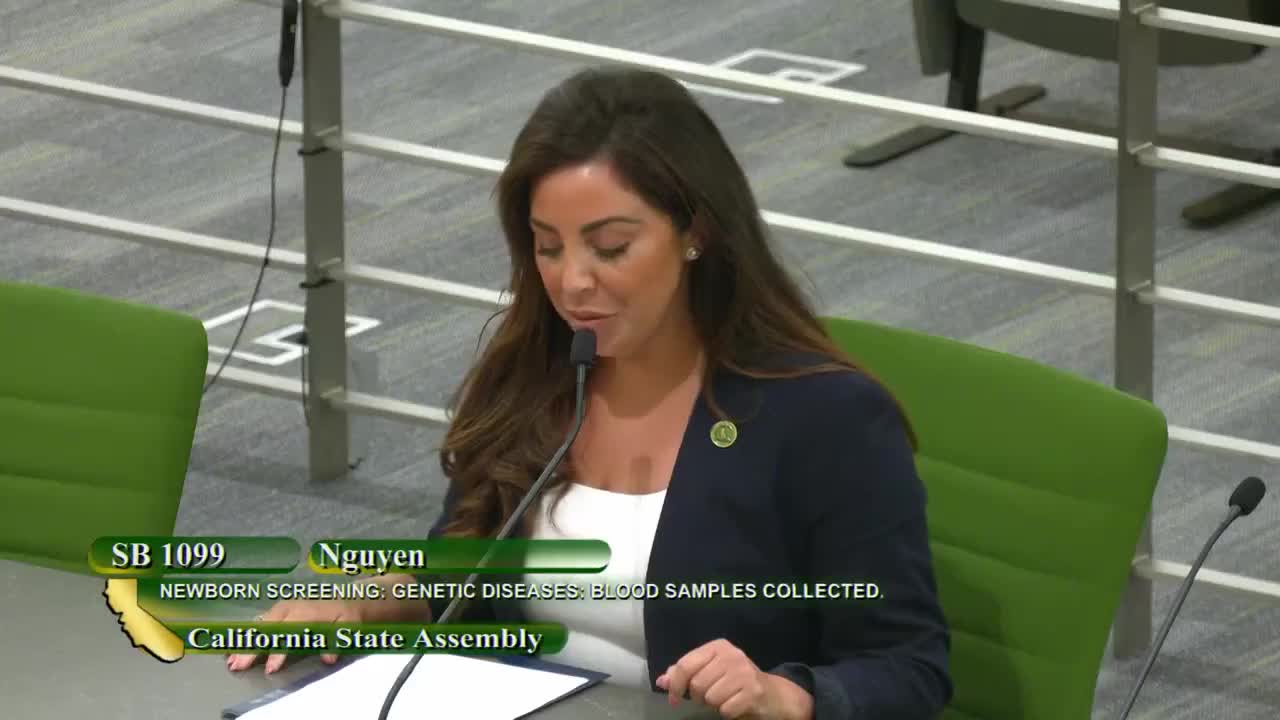 3MIN
Assembly Standing Committee on Appropriations
Bill Author

Bill Co-Author(s):