SB 1142: Electrical and gas corporations: restoration and termination of services.
- Session Year: 2023-2024
- House: Senate
- Latest Version Date: 2024-09-25
Current Status:
Passed
(2024-09-25: Chaptered by Secretary of State. Chapter 600, Statutes of 2024.)
Introduced
In Committee
First Chamber
In Committee
Second Chamber
Enacted
What does this bill do?
The bill requires electric and gas utilities to restore service to residential customers who were shut off for nonpayment once the customer enters an amortization agreement (a plan to pay past-due charges over time) or another payment plan approved by the California Public Utilities Commission, with reconnection timelines—where allowed by commission rules—of 24 hours for remote reconnections and one business day for field reconnections except for safety or extreme weather. It also directs the commission to decide by mid‑2025 whether utilities must consider a customer’s ability to pay before disconnecting service, before disconnecting someone already on a payment plan, and when reconnecting service, and to consider limits on amounts utilities can collect and impacts on other customers.
The summary is provided by generative AI which can make mistakes. For original language, please view the details in the table below.
Existing law prohibits an electrical or gas corporation from terminating residential service for nonpayment of a delinquent account unless the corporation first gives notice of the delinquency and impending termination, as provided. Existing law requires the notice to include information on procedures by which the affected residential customer may initiate a complaint, request an investigation concerning the service or charges, and request amortization of the unpaid charges. Existing law requires that a residential customer who initiated a complaint, requested an investigation, or requested an extension of the payment period be given an opportunity for review of the complaint, investigation, or request by a review manager of the corporation. Existing law requires the review to include a consideration of whether the customer is to be permitted to amortize the unpaid balance of the delinquent account over a reasonable time period, not to exceed 12 months.
This bill would require an electrical or gas corporation to restore service to a residential customer whose service was previously terminated for nonpayment of delinquent amounts upon the customer entering into an amortization agreement or any other arrearage payment plan determined by the Public Utilities Commission. The bill would require the restoration of service to occur by specified deadlines, to the extent authorized by commission rules.
This bill would require the commission, on or before July 1, 2025, to determine whether to direct electrical and gas corporations to take into account a customers ability to pay before terminating or reconnecting services, as provided.
Under existing law, a violation of the Public Utilities Act or an order, decision, rule, direction, demand, or requirement of the commission is a crime.
Because a violation of the provisions of this bill or a commission action implementing the requirements of the bill would be a crime, the bill would impose a state-mandated local program.
The California Constitution requires the state to reimburse local agencies and school districts for certain costs mandated by the state. Statutory provisions establish procedures for making that reimbursement.
This bill would provide that no reimbursement is required by this act for a specified reason.
Existing law prohibits an electrical or gas corporation from terminating residential service for nonpayment of a delinquent account unless the corporation first gives notice of the delinquency and impending termination, as provided. Existing law requires the notice to include information on procedures by which the affected residential customer may initiate a complaint, request an investigation concerning the service or charges, and request amortization of the unpaid charges. Existing law requires that a residential customer who initiated a complaint, requested an investigation, or requested an extension of the payment period be given an opportunity for review of the complaint, investigation, or request by a review manager of the corporation. Existing law requires the review to include a consideration of whether the customer is to be permitted to amortize the unpaid balance of the delinquent account over a reasonable time period, not to exceed 12 months.
This bill would require an electrical or gas corporation to restore service to a residential customer whose service was previously terminated for nonpayment of delinquent amounts upon the customer entering into an amortization agreement to the extent authorized by commission rules. or any other arrearage payment plan determined by the commission. The bill would require the reconnection restoration of service to occur, as specified. occur by specified deadlines.
This bill would require the commission, on or before July 1, 2025, to determine whether to direct electrical and gas corporations to take into account a customers ability to pay before terminating or reconnecting services, as provided.
Under existing law, a violation of the Public Utilities Act or an order, decision, rule, direction, demand, or requirement of the commission is a crime.
Because a violation of the provisions of this bill or a commission action implementing the requirements of the bill would be a crime, the bill would impose a state-mandated local program.
The California Constitution requires the state to reimburse local agencies and school districts for certain costs mandated by the state. Statutory provisions establish procedures for making that reimbursement.
This bill would provide that no reimbursement is required by this act for a specified reason.
Existing law prohibits an electrical or gas corporation from terminating residential service for nonpayment of a delinquent account unless the corporation first gives notice of the delinquency and impending termination, as provided. Existing law requires the notice to include information on procedures by which the affected residential customer may initiate a complaint, request an investigation concerning the service or charges, and request amortization of the unpaid charges. Existing law requires that a residential customer who initiated a complaint, requested an investigation, or requested an extension of the payment period be given an opportunity for review of the complaint, investigation, or request by a review manager of the corporation. Existing law requires the review to include a consideration of whether the customer is to be permitted to amortize the unpaid balance of the delinquent account over a reasonable time period, not to exceed 12 months.
This bill would require an electrical or gas corporation to restore service to a residential customer whose service was previously terminated for nonpayment of delinquent amounts upon the customer entering into an amortization agreement to the extent authorized by commission rules. The bill would require the reconnection to occur within 24 hours of the payment as authorized pursuant to commission rules. occur, as specified.
This bill would require the commission, on or before July 1, 2025, to determine whether to direct electrical and gas corporations to take into account a customers ability to pay before terminating or reconnecting services, as provided.
Under existing law, a violation of the Public Utilities Act or an order, decision, rule, direction, demand, or requirement of the commission is a crime.
Because a violation of the provisions of this bill or a commission action implementing the requirements of the bill would be a crime, the bill would impose a state-mandated local program.
The California Constitution requires the state to reimburse local agencies and school districts for certain costs mandated by the state. Statutory provisions establish procedures for making that reimbursement.
This bill would provide that no reimbursement is required by this act for a specified reason.
Existing law prohibits an electrical or gas corporation from terminating residential service for nonpayment of a delinquent account unless the corporation first gives notice of the delinquency and impending termination, as provided. Existing law requires the notice to include information on procedures by which the affected residential customer may initiate a complaint, request an investigation concerning the service or charges, and request amortization of the unpaid charges. Existing law requires that a residential customer who initiated a complaint, requested an investigation, or requested an extension of the payment period be given an opportunity for review of the complaint, investigation, or request by a review manager of the corporation. Existing law requires the review to include a consideration of whether the customer is to be permitted to amortize the unpaid balance of the delinquent account over a reasonable time period, not to exceed 12 months.
This bill would provide that, for electrical or gas service, the reasonable time period for the amortization period is at minimum 24 months unless a shorter amortization period is mutually agreed upon by the customer and the electrical or gas corporation. The bill would expressly prohibit the electrical or gas corporation from terminating service if the customer agrees to pay the unpaid balance of a delinquent account over the amortization period. The bill would prohibit an electrical or gas corporation from requiring a residential customer to pay more than 20% of the outstanding bill balance to retain service after serving the customer with the notice of termination. The bill would require the electrical or gas corporation, in determining the payment, to take into account the customers ability to pay. The bill would prohibit an electrical or gas corporation from terminating service to a customer who fails to comply with an amortization agreement under specified circumstances, as provided.This bill would require an electrical or gas corporation to restore service to a residential customer whose service is was previously terminated for nonpayment of delinquent amount if amounts upon the customer has entered entering into an amortization agreement. agreement to the extent authorized by commission rules. The bill would prohibit the electrical or gas corporation from charging a reconnection fee before reconnecting those residential customers and would require the reconnection to occur within 24 hours of the payment. payment as authorized pursuant to commission rules.
Existing law requires the decision of an electrical, gas, heat, telephone, or water corporation to require a new residential applicant to deposit a sum of money with the corporation before establishing an account and furnish service to be based solely on the credit worthiness of the applicant.This bill would prohibit an electrical or gas corporation from requiring a new residential applicant to deposit a sum of money with the corporation before establishing an account and furnishing service.Under existing law, a violation of the Public Utilities Act is a crime.Because the provisions of this bill would be a part of the act, a violation of which would be a crime, the bill would impose a state-mandated local program.This bill would require the commission, on or before July 1, 2025, to determine whether to direct electrical and gas corporations to take into account a customers ability to pay before terminating or reconnecting services, as provided.
Under existing law, a violation of the Public Utilities Act or an order, decision, rule, direction, demand, or requirement of the commission is a crime.
Because a violation of the provisions of this bill or a commission action implementing the requirements of the bill would be a crime, the bill would impose a state-mandated local program.
The California Constitution requires the state to reimburse local agencies and school districts for certain costs mandated by the state. Statutory provisions establish procedures for making that reimbursement.
This bill would provide that no reimbursement is required by this act for a specified reason.
Existing law prohibits an electrical or gas corporation from terminating residential service for nonpayment of a delinquent account unless the corporation first gives notice of the delinquency and impending termination, as provided. Existing law requires the notice to include information on procedures by which the affected residential customer may initiate a complaint, request an investigation concerning the service or charges, and request amortization of the unpaid charges. Existing law requires that a residential customer who initiated a complaint, requested an investigation, or requested an extension of the payment period be given an opportunity for review of the complaint, investigation, or request by a review manager of the corporation. Existing law requires the review to include a consideration of whether the customer is to be permitted to amortize the unpaid balance of the delinquent account over a reasonable time period, not to exceed 12 months.
This bill would provide that, for electrical or gas service, the reasonable time period for the amortization period is at minimum 24 months unless a shorter amortization period is mutually agreed upon by the customer and the electrical or gas corporation. The bill would expressly prohibit the electrical or gas corporation from terminating service if the customer agrees to pay the unpaid balance of a delinquent account over the amortization period. The bill would prohibit an electrical or gas corporation from requiring a residential customer to pay more than 20% of the outstanding bill balance to retain service after serving the customer with the notice of termination. The bill would require the electrical or gas corporation, in determining the payment, to take into account the customers ability to pay. The bill would prohibit an electrical or gas corporation from terminating service to a customer who fails to comply with an amortization agreement under specified circumstances, as provided.
This bill would require an electrical or gas corporation to restore service to a residential customer whose service is previously terminated for nonpayment of delinquent amount if the customer has entered into an amortization agreement. The bill would prohibit the electrical or gas corporation from charging a reconnection fee before reconnecting those residential customers and would require the reconnection to occur within 24 hours of the payment.
Existing law requires the decision of an electrical, gas, heat, telephone, or water corporation to require a new residential applicant to deposit a sum of money with the corporation before establishing an account and furnish service to be based solely on the credit worthiness of the applicant.
This bill would prohibit an electrical or gas corporation from requiring a new residential applicant to deposit a sum of money with the corporation before establishing an account and furnishing service.
Under existing law, a violation of the Public Utilities Act is a crime.
Because the provisions of this bill would be a part of the act, a violation of which would be a crime, the bill would impose a state-mandated local program.
The California Constitution requires the state to reimburse local agencies and school districts for certain costs mandated by the state. Statutory provisions establish procedures for making that reimbursement.
This bill would provide that no reimbursement is required by this act for a specified reason.
Existing law vests the Public Utilities Commission with regulatory authority over public utilities, including telephone corporations. Existing law requires entities offering the services of telephone prepaid debit cards that are not certificated by the commission to provide telephone service to register with the commission, as specified. Existing law prohibits entities that have failed to register, or that are denied registration, from offering telephone prepaid debit cards, and subjects entities that have failed to register, or that are denied registration, that offer telephone prepaid debit cards to fines or other sanctions, as specified.This bill would make nonsubstantive changes to that prohibition.Existing law vests the Public Utilities Commission with regulatory authority over public utilities, including telephone corporations. Existing law requires entities offering the services of telephone prepaid debit cards that are not certificated by the commission to provide telephone service to register with the commission, as specified. Existing law prohibits entities that have failed to register, or that are denied registration, from offering telephone prepaid debit cards, and subjects entities that have failed to register, or that are denied registration, that offer telephone prepaid debit cards to fines or other sanctions, as specified.
This bill would make nonsubstantive changes to that prohibition.
(a)An electrical or gas corporation shall restore service to a residential customer whose service was previously terminated for nonpayment of delinquent amounts upon the customer entering into either an amortization agreement described in subdivision (c) of Section 779 or any other arrearage payment plan determined by the commission.
(b)To the extent authorized by commission rules, the restoration of service shall occur as follows:
(1)Within 24 hours of the payment for remote reconnections.
(2)Within one business day for field reconnections, except in situations relating to safety or extreme weather.
SEC. 2.Section 779.7 is added to the Public Utilities Code, to read:779.7.(a)On or before July 1, 2025, the commission shall, in a new or existing proceeding, determine whether to direct electrical and gas corporations to take into account a customers ability to pay in any of the following circumstances:
(1)Before terminating service due to nonpayment.
(2)Before terminating service for a customer on an amortization agreement.
(3)In reconnecting service for a residential customer whose service was previously terminated for nonpayment.
(b)In determining whether to direct electrical corporations to consider a customers ability to pay before terminating service, the commission shall consider whether to limit the amount an electrical corporation can collect up to an amount specified by the commission.
(c)The commission shall consider impacts to participating and nonparticipating customers to inform the determinations made pursuant to subdivision (a).
SEC. 3.No reimbursement is required by this act pursuant to Section 6 of Article XIIIB of the California Constitution because the only costs that may be incurred by a local agency or school district will be incurred because this act creates a new crime or infraction, eliminates a crime or infraction, or changes the penalty for a crime or infraction, within the meaning of Section 17556 of the Government Code, or changes the definition of a crime within the meaning of Section 6 of Article XIIIB of the California Constitution.
(a)An electrical or gas corporation shall restore service to a residential customer whose service was previously terminated for nonpayment of delinquent amounts upon the customer entering into either an amortization agreement described in subdivision (c) of Section 779 to the extent authorized by commission rules. or any other arrearage payment plan determined by the commission.
(b)The reconnection To the extent authorized by commission rules, the restoration of service shall occur as follows:
(1)Within 24 hours of the payment for remote reconnections.
(2)Within one business day for field reconnections, except in situations relating to safety or extreme weather.
(3)As otherwise authorized pursuant to commission rules.SEC. 2.Section 779.7 is added to the Public Utilities Code, to read:779.7.(a)On or before July 1, 2025, the commission shall, in a new or existing proceeding, determine whether to direct electrical and gas corporations to take into account a customers ability to pay in any of the following circumstances:
(1)Before terminating service due to nonpayment.
(2)Before terminating service for a customer on an amortization agreement.
(3)In reconnecting service for a residential customer whose service was previously terminated for nonpayment.
(b)In determining whether to direct electrical corporations to consider a customers ability to pay before terminating service, the commission shall consider whether to limit the amount an electrical corporation can collect up to 20 percent of the customers outstanding balance, as specified for the termination and reconnection of gas service in commission Decision D.20-06-003 (June 16, 2020) Phase I Decision Adopting Rules and Policy Changes to Reduce Residential Customer Disconnections for the Larger California-Jurisdictional Energy Utilities. an amount specified by the commission.
(c)The commission shall consider impacts to participating and nonparticipating customers to inform the determinations made pursuant to subdivision (a).
SEC. 3.No reimbursement is required by this act pursuant to Section 6 of Article XIIIB of the California Constitution because the only costs that may be incurred by a local agency or school district will be incurred because this act creates a new crime or infraction, eliminates a crime or infraction, or changes the penalty for a crime or infraction, within the meaning of Section 17556 of the Government Code, or changes the definition of a crime within the meaning of Section 6 of Article XIIIB of the California Constitution.
(a)An electrical or gas corporation shall restore service to a residential customer whose service was previously terminated for nonpayment of delinquent amounts upon the customer entering into an amortization agreement described in subdivision (c) of Section 779 to the extent authorized by commission rules.
(b)The reconnection shall occur within as follows:
(1)Within 24 hours of the payment as for remote reconnections.
(2)Within one business day for field reconnections, except in situations relating to safety or extreme weather.
(3)As otherwise authorized pursuant to commission rules.
SEC. 2.Section 779.7 is added to the Public Utilities Code, to read:779.7.(a)On or before July 1, 2025, the commission shall, in a new or existing proceeding, determine whether to direct electrical and gas corporations to take into account a customers ability to pay in any of the following circumstances:
(1)Before terminating service due to nonpayment.
(2)Before terminating service for a customer on an amortization agreement.
(3)In reconnecting service for a residential customer whose service was previously terminated for nonpayment.
(b)In determining whether to direct electrical corporations to consider a customers ability to pay before terminating service, the commission shall consider whether to limit the amount an electrical corporation can collect up to 20 percent of the customers outstanding balance, as specified for the termination and reconnection of gas service in commission Decision D.20-06-003 (June 16, 2020) Phase I Decision Adopting Rules and Policy Changes to Reduce Residential Customer Disconnections for the Larger California-Jurisdictional Energy Utilities.
(c)The commission shall consider impacts to participating and nonparticipating customers to inform the determinations made pursuant to subdivision (a).
SEC. 3.No reimbursement is required by this act pursuant to Section 6 of Article XIIIB of the California Constitution because the only costs that may be incurred by a local agency or school district will be incurred because this act creates a new crime or infraction, eliminates a crime or infraction, or changes the penalty for a crime or infraction, within the meaning of Section 17556 of the Government Code, or changes the definition of a crime within the meaning of Section 6 of Article XIIIB of the California Constitution.
(a)An electrical or gas corporation shall restore service to a residential customer whose service was previously terminated for nonpayment of delinquent amounts upon the customer entering into an amortization agreement described in paragraph (4) of subdivision (b) of Section 779. subdivision (c) of Section 779 to the extent authorized by commission rules.
(b)An electrical or gas corporation shall not require payment of a reconnection fee before reconnecting a residential customer whose service was previously terminated for nonpayment of delinquent amounts.(c)(b)The reconnection shall occur within 24 hours of the payment of a portion of the outstanding bill balance that takes into account the customers ability to pay, not to exceed 20 percent of the outstanding bill balance. as authorized pursuant to commission rules.
(d)An electrical or gas corporation that fails to comply with this section is subject to a penalty of not less than five hundred dollars ($500), but not more than one hundred thousand dollars ($100,000), for each offense. Pursuant to Section 748.1, the electrical or gas shall not recover any penalty assessed from ratepayers.SEC. 2.Section 779.7 is added to the Public Utilities Code, to read:779.7.(a)On or before July 1, 2025, the commission shall, in a new or existing proceeding, determine whether to direct electrical and gas corporations to take into account a customers ability to pay in any of the following circumstances:
(1)Before terminating service due to nonpayment.
(2)Before terminating service for a customer on an amortization agreement.
(3)In reconnecting service for a residential customer whose service was previously terminated for nonpayment.
(b)In determining whether to direct electrical corporations to consider a customers ability to pay before terminating service, the commission shall consider whether to limit the amount an electrical corporation can collect up to 20 percent of the customers outstanding balance, as specified for the termination and reconnection of gas service in commission Decision D.20-06-003 (June 16, 2020) Phase I Decision Adopting Rules and Policy Changes to Reduce Residential Customer Disconnections for the Larger California-Jurisdictional Energy Utilities.
(c)The commission shall consider impacts to participating and nonparticipating customers to inform the determinations made pursuant to subdivision (a).
SEC. 5.SEC. 3.No reimbursement is required by this act pursuant to Section 6 of Article XIIIB of the California Constitution because the only costs that may be incurred by a local agency or school district will be incurred because this act creates a new crime or infraction, eliminates a crime or infraction, or changes the penalty for a crime or infraction, within the meaning of Section 17556 of the Government Code, or changes the definition of a crime within the meaning of Section 6 of Article XIIIB of the California Constitution.
(a)No An electrical, gas, heat, or water corporation may shall not terminate residential service for nonpayment of a delinquent account unless the corporation first gives notice of the delinquency and impending termination, as provided in Section 779.1.
(b)No An electrical, gas, heat, or water corporation may shall not terminate residential service for nonpayment in any of the following situations:
(1)During the pendency of an investigation by the corporation of a customer or subscriber dispute or complaint.
(2)When a customer has been granted an extension of the period for payment of a bill.
(3)On the certification of a licensed physician and surgeon that to do so will be life threatening to the customer and the customer is financially unable to pay for service within the normal payment period and is willing to enter into an amortization agreement with the corporation pursuant to subdivision (e) with respect to all charges that the customer is unable to pay prior to before delinquency.
(4)For customers of electrical and gas corporations, the customer agrees to pay the unpaid balance of delinquent accounts over a minimum of 24 months unless a shorter amortization period is mutually agreed upon by the customer and the electrical or gas corporation.
(c)Any A residential customer who has initiated a complaint or requested an investigation within five days of receiving the disputed bill, or who has, before termination of service, made a request for extension of the payment period of a bill asserted to be beyond the means of the customer to pay in full within the normal period for payment, shall be given an opportunity for review of the complaint, investigation, or request by a review manager of the corporation. The review shall include consideration of whether the customer shall be permitted to amortize any unpaid balance of the delinquent account over a reasonable period of time, not to exceed 12 months. No termination months for heat or water service, or a reasonable period of time that is at minimum 24 months for electrical or gas service unless a shorter amortization period is mutually agreed upon by the customer and the electrical or gas corporation, as appropriate. Termination of service shall not be effected for any a customer complying with an amortization agreement, if the customer also keeps the account current as charges accrue in each subsequent billing period.
(d)Any A customer whose complaint or request for an investigation pursuant to subdivision (c) has resulted in an adverse determination by the corporation may appeal the determination to the commission. Any subsequent appeal of the dispute or complaint to the commission is not subject to this section.
(e)Any A customer meeting the requirements of paragraph (3) of subdivision (b) shall, upon request, be permitted to amortize, over a period not to exceed 12 months, specified in subdivision (c), the unpaid balance of any bill asserted to be beyond the means of the customer to pay within the normal period for payment.
SEC. 2.Section 779.1 of the Public Utilities Code is amended to read:779.1.(a)Every electrical, gas, heat, or water corporation shall allow every residential customer at least 19 days from the date of mailing its bill for services, postage prepaid, for payment of the charges demanded. A corporation subject to this section shall not terminate residential service for nonpayment of a delinquent account unless the corporation first gives notice of the delinquency and impending termination, at least 10 days prior to before the proposed termination, by means of a notice mailed, postage prepaid, to the customer to whom the service is billed, not earlier than 19 days from the date of mailing the corporations bill for services, and the 10-day period shall not commence until five days after the mailing of the notice.
(b)Every corporation shall make a reasonable attempt to contact an adult person residing at the premises of the customer by telephone or personal contact at least 24 hours prior to before any termination of service, except that, whenever telephone or personal contact cannot be accomplished, the corporation shall give, either by mail or in person, a notice of termination of service at least 48 hours prior to before termination.
(c)Every corporation shall make available to its residential customers who are 65 years of age or older, or who are dependent adults as defined in Section 15610.23 of the Welfare and Institutions Code, a third-party notification service, whereby the corporation will attempt to notify a person designated by the customer to receive notification when the customers account is past due and subject to termination. The notification shall include information on what is required to prevent termination of service. The residential customer shall make a request for third-party notification on a form provided by the corporation, and shall include the written consent of the designated third party. The third-party notification does not obligate the third party to pay the overdue charges, nor shall it prevent or delay termination of service.
(d)(1)Every notice of termination of service pursuant to subdivision (a) or (b) shall include all of the following information:
(1)(A)The name and address of the customer whose account is delinquent.
(2)(B)The amount of the delinquency.
(3)(C)(i)The date by which payment or arrangements for payment is required in order to avoid termination.
(ii)For an electrical or gas corporation, the payment required to avoid termination shall take into account the customers ability to pay and other factors and shall not exceed 20 percent of the outstanding balance. The notice shall provide the customer with information, including information on the customers ability to pay and other relevant factors, required for setting up payments or arrangements for payments.
(4)(D)The procedure by which the customer may initiate a complaint or request an investigation concerning service or charges.
(5)(E)The procedure by which the customer may request amortization of the unpaid charges.
(6)(F)The procedure for the customer to obtain information on the availability of financial assistance, including private, local, state, or federal sources, if applicable.
(7)(G)The telephone number of a representative of the corporation who can provide additional information or institute arrangements for payment.
(8)(H)The telephone number of the commission to which inquiries by the customer may be directed.
All(2)All written notices shall be in a clear and legible format.
(e)Any A residential customer whose complaint or request for an investigation has resulted in an adverse determination by the corporation may appeal the determination to the commission. Any A subsequent appeal of the dispute or complaint to the commission is not subject to this section.
(f)(1)If a residential customer fails to comply with an amortization agreement, the corporation shall not terminate service without giving notice to the customer at least 48 hours prior to before termination of the conditions the customer is required to meet to avoid termination, but this notice does not entitle the customer to further investigation by the corporation.
(2)An electrical or gas corporation shall not terminate service to a residential customer who fails to comply with an amortization agreement if the customer does both of the following:
(A)Makes a payment on the outstanding bill amount that takes into account the ability of the customer to pay and does not exceed 20 percent of the outstanding bill balance.
(B)Agrees to continuing payment of the unpaid balance subject to the amortization agreement.
(g)A termination of service shall not be effected without compliance with this section. Any A service wrongfully terminated shall be restored without charge for the restoration of service, and a notation thereof shall be mailed to the customer at the customers billing address.
SEC. 3.Section 779.5 of the Public Utilities Code is amended to read:779.5.(a)The decision of an electrical, gas, a heat, telephone, or water corporation to require a new residential applicant to deposit a sum of money with the corporation prior to before establishing an account and furnishing service shall be based solely upon the credit worthiness of the applicant as determined by the corporation.
(b)An electrical or gas corporation shall not require a new residential applicant to deposit a sum of money with the corporation before establishing an account and furnishing service.
SEC. 4.Section 779.6 is added to the Public Utilities Code, to read:779.6.(a)An electrical or gas corporation shall restore service to a residential customer whose service was previously terminated for nonpayment of delinquent amounts upon the customer entering into an amortization agreement described in paragraph (4) of subdivision (b) of Section 779.
(b)An electrical or gas corporation shall not require payment of a reconnection fee before reconnecting a residential customer whose service was previously terminated for nonpayment of delinquent amounts.
(c)The reconnection shall occur within 24 hours of the payment of a portion of the outstanding bill balance that takes into account the customers ability to pay, not to exceed 20 percent of the outstanding bill balance.
(d)An electrical or gas corporation that fails to comply with this section is subject to a penalty of not less than five hundred dollars ($500), but not more than one hundred thousand dollars ($100,000), for each offense. Pursuant to Section 748.1, the electrical or gas shall not recover any penalty assessed from ratepayers.
SEC. 5.No reimbursement is required by this act pursuant to Section 6 of Article XIIIB of the California Constitution because the only costs that may be incurred by a local agency or school district will be incurred because this act creates a new crime or infraction, eliminates a crime or infraction, or changes the penalty for a crime or infraction, within the meaning of Section 17556 of the Government Code, or changes the definition of a crime within the meaning of Section 6 of Article XIIIB of the California Constitution.
SECTION 1.Section 886 of the Public Utilities Code is amended to read:886.Entities that are required to register, but have failed to register, or entities that are denied registration by the commission, shall not offer the services of telephone prepaid debit cards. Entities that are required to register, but have failed to register, and entities denied registration that offer telephone prepaid debit cards shall be subject to fines or other sanctions that may be ordered by the commission.Entities that are required to register, but have failed to do so, register, or entities that are denied registration by the commission, shall not offer the services of telephone prepaid debit cards. Entities that are required to register, but have failed to do so, register, and entities denied registration that offer telephone prepaid debit cards shall be subject to fines or other sanctions that may be ordered by the commission.
|
Date
|
Status
|
|---|---|
| Sep 25, 2024 | Chaptered by Secretary of State. Chapter 600, Statutes of 2024. |
| Sep 25, 2024 | Approved by the Governor. |
| Sep 9, 2024 | Enrolled and presented to the Governor at 3 p.m. |
| Aug 29, 2024 | Assembly amendments concurred in. (Ayes 31. Noes 8. Page 5653.) Ordered to engrossing and enrolling. |
| Aug 28, 2024 | In Senate. Concurrence in Assembly amendments pending. |
| Aug 28, 2024 | Read third time. Passed. (Ayes 64. Noes 6. Page 6790.) Ordered to the Senate. |
| Aug 20, 2024 | Read second time. Ordered to third reading. |
| Aug 19, 2024 | Read second time and amended. Ordered to second reading. |
| Aug 15, 2024 | From committee: Do pass as amended. (Ayes 11. Noes 2.) (August 15). |
| Aug 7, 2024 | August 7 set for first hearing. Placed on suspense file. |
| Jul 3, 2024 | Read second time and amended. Re-referred to Com. on APPR. |
| Jul 2, 2024 | From committee: Do pass as amended and re-refer to Com. on APPR. (Ayes 12. Noes 0.) (July 1). |
| Jun 5, 2024 | June 19 set for first hearing canceled at the request of author. |
| May 28, 2024 | Referred to Com. on U. & E. |
| May 22, 2024 | In Assembly. Read first time. Held at Desk. |
| May 21, 2024 | Read third time. Passed. (Ayes 30. Noes 8. Page 4085.) Ordered to the Assembly. |
| May 16, 2024 | Read second time. Ordered to third reading. |
| May 16, 2024 | From committee: Do pass. (Ayes 5. Noes 2. Page 3973.) (May 16). |
| May 14, 2024 | Set for hearing May 16. |
| May 13, 2024 | May 13 hearing: Placed on APPR suspense file. |
| May 3, 2024 | Set for hearing May 13. |
| Apr 29, 2024 | Read second time and amended. Re-referred to Com. on APPR. |
| Apr 25, 2024 | From committee: Do pass as amended and re-refer to Com. on APPR. (Ayes 14. Noes 3. Page 3700.) (April 22). |
| Apr 4, 2024 | Set for hearing April 22. |
| Apr 3, 2024 | Re-referred to Com. on E., U. & C. |
| Mar 18, 2024 | From committee with author's amendments. Read second time and amended. Re-referred to Com. on RLS. |
| Feb 21, 2024 | Referred to Com. on RLS. |
| Feb 15, 2024 | From printer. May be acted upon on or after March 16. |
| Feb 14, 2024 | Introduced. Read first time. To Com. on RLS. for assignment. To print. |
|
Date
|
Description
|
Location
|
Votes
|
|
|---|---|---|---|---|
| Aug 29, 2024 | Unfinished Business SB1142 Menjivar Concurrence | Senate Floor |
Passed |
|
| Aug 28, 2024 | SB 1142 Menjivar Senate Third Reading By Bauer-Kahan | Assembly Floor |
Passed |
|
| Aug 15, 2024 | Do pass as amended. | Assembly Standing Committee on Appropriations |
Passed |
|
| Jul 1, 2024 | Do pass as amended and be re-referred to the Committee on [Appropriations] | Assembly Standing Committee on Utilities and Energy |
Passed |
|
| May 21, 2024 | Senate 3rd Reading SB1142 Menjivar | Senate Floor |
Passed |
|
| May 16, 2024 | Do pass | Senate Standing Committee on Appropriations |
Passed |
|
| May 13, 2024 | Placed on suspense file | Senate Standing Committee on Appropriations |
Passed |
|
| Apr 22, 2024 | Do pass as amended, but first amend, and re-refer to the Committee on [Appropriations] | Senate Standing Committee on Energy, Utilities and Communications |
Passed |
This list shows positions taken on this bill by organizations on the date displayed, which is linked to the original source.
Positions by individuals are not included.
|
Organization
|
Position
|
Date
|
|---|---|---|
| California Environmental Voters | ** Support | |
| Central Coast Energy Services | ** Support | |
| City of San Jose | ** Support | |
| City of San José | ** Support | |
| FAIR California Coalition | ** Support | |
| Fire Accountability Infrastructure for Ratepayers | ** Support | |
| Housing Action Coalition | ** Support | |
| MCE | * Support | Jul 1, 2024 |
| Neutral | ** Against | |
| Our Voice: Communities for Quality Education | ** Support | |
| Pacific Gas Electric Company | * For If Amend | Jul 1, 2024 |
| San Francisco Peninsula Energy Services | ** Support | |
| San Jose Clean Energy | * Support | Jul 1, 2024 |
| San José Clean Energy | ** Support | |
| SAN JOSE; CITY OF | ** Support | |
| SoCalGas | * Neutral | Jul 1, 2024 |
| Southern California Edision | * Neutral | Jul 1, 2024 |
| The Utility Reform Network | ** Support | |
| US Green Building Council | * Indeterminate | Apr 22, 2024 |
SENATE RULES COMMITTEE Office of Senate Floor Analyses (916) 651-1520 Fax: (916) 327-4478 | SB 1142 |
UNFINISHED BUSINESS
Bill No: SB 1142
Author: Menjivar (D)
Amended: 8/19/24
Vote: 21
SENATE ENERGY, U. & C. COMMITTEE: 14-3, 4/22/24
AYES: Bradford, Ashby, Becker, Caballero, Dodd, Durazo, Eggman, Gonzalez, Limón, Min, Newman, Rubio, Skinner, Wahab
NOES: Dahle, Seyarto, Wilk
NO VOTE RECORDED: Grove
SENATE APPROPRIATIONS COMMITTEE: 5-2, 5/16/24
AYES: Caballero, Ashby, Becker, Bradford, Wahab
NOES: Jones, Seyarto
SENATE FLOOR: 30-8, 5/21/24
AYES: Archuleta, Ashby, Atkins, Becker, Blakespear, Bradford, Caballero, Cortese, Dodd, Durazo, Eggman, Glazer, Gonzalez, Hurtado, Laird, Limón, McGuire, Menjivar, Min, Newman, Padilla, Portantino, Roth, Rubio, Skinner, Smallwood-Cuevas, Stern, Umberg, Wahab, Wiener
NOES: Alvarado-Gil, Dahle, Grove, Jones, Nguyen, Niello, Seyarto, Wilk
NO VOTE RECORDED: Allen, Ochoa Bogh
ASSEMBLY FLOOR: 64-6, 8/28/24 - See last page for vote
SUBJECT: Electrical and gas corporations: restoration and termination of services
SOURCE: The Utility Reform Network
DIGEST:
This bill proposes policies related to disconnection of electric and gas utility service, including requiring the California Public Utilities Commission (CPUC), on or before July 1, 2025, to determine whether to direct electrical and gas corporations to take into account a customer’s ability to pay before terminating or reconnecting services.
Assembly Amendments
provide details concerning the timing of field reconnections of utility service; and replace language that specified a limit of collecting 20 percent of the customer’s outstanding balance with language that provides additional discretion to the CPUC to determine the amount the electrical corporation can collect.
ANALYSIS:
Existing law:
- Establishes and vests the CPUC with regulatory authority over public utilities, including electrical and gas corporations. (Article XII of the California Constitution)
- Requires that only an electrical corporation or publicly owned electric utility that provides physical service to the affected customer has the authority to physically disconnect or reconnect a customer from the transmission or distribution grid. Requires that physical disconnection by electrical corporations subject to the CPUC’s jurisdiction occur only in accordance with protocols established by the CPUC. Authorizes the CPUC to adopt additional residential and small commercial consumer protection standards that are in the public interest. (Public Utilities Code §394.4(b))
- Requires the CPUC to develop policies, rules, or regulations with a goal of reducing, by January 1, 2024, the statewide level of gas and electric service disconnections due to nonpayment by residential customers. (Public Utilities Code §718)
- Requires the CPUC, in order to protect customers from unwarranted disconnection of necessary electric and gas services, to require all electrical and gas utilities through which California Alternate Rates for Energy (CARE) program rates are available to conduct several actions to increase penetration of the CARE program, including: (a) offer individual payment arrangements that allow customers to pay amounts due over a reasonable period of time, not to exceed 12 months; (b) prohibit disconnection of customers that have made, and are in compliance with, payment arrangements offered by an electric or gas utility or for amounts due in which the utility receives a commitment pledge, letter of intent, purchase order, or other notification that a provider of energy assistance is forwarding payment sufficient to prevent disconnection; and (c) advise residential customers about enrollment in the levelizing payment program in conjunction with completion of payment arrangements. (Public Utilities Code §739.4)
- Prohibits an electrical and gas corporation from terminating residential service for nonpayment of a delinquent account unless the corporation first gives notice of the delinquency and impending termination and prohibits an electrical and gas corporation from terminating residential service for nonpayment of a delinquent account for specified conditions, including when it is life threatening to the customer. (Public Utilities Code §779)
- Requires electrical and gas corporations when deciding whether to require a new residential applicant to deposit a sum of money with the corporation prior to establishing an account and furnishing service to be based solely upon the credit worthiness of the applicant. (Public Utilities Code §779.5)
This bill:
- Requires an electrical or gas corporation to restore service to a residential customer whose service was previously terminated for nonpayment of delinquent amounts upon the customer entering into an amortization agreement or any arrearage payment plan determined by the CPUC.
- Requires the restoration of service to occur within 24 hours of the payment for remote connections or within one business day for field reconnections (except in situations relating to safety) as authorized pursuant to CPUC rules.
- Requires the CPUC, on or before July 1, 2025, to determine whether to direct electrical and gas corporations to take into account a customer’s ability to pay before terminating or reconnecting services, including whether to limit the amount an electrical corporation can collect up to an amount specified by the CPUC.
- Requires the CPUC to consider the impacts to participating and nonparticipating customers to inform the determinations.
Background
Process for disconnecting electric and gas utility service. The process of disconnecting service due to nonpayment by an electrical or gas corporation is governed by existing statutory minimum timeline requirements, the practices that were adopted in CPUC Rulemaking 10-02-005, and reflected in Tariff Rule 11 for electric utilities and Rule 9 for gas utilities.
Utility bill assistance. There are several programs that provide eligible utility ratepayers with utility bill assistance. They include programs that provide rate assistance: a) CARE program which provides a discount of up to 35 percent reduction in utility bills to low-income ratepayers whose income falls below 200 percent of the federal poverty guidelines; b) Family Electric Rate Assistance (FERA) program for families whose household income slightly exceeds the CARE program eligibility, the program provides an 18 percent line-item discount on electric bills for households with three or more individuals whose income falls between 200 and 250 percent of federal poverty guidelines; c) medical baseline allowance requires utilities to provide additional allowance of electric or gas service for customers facing life-threatening conditions or on life support. Customers on medical baseline are also provided the opportunity to amortize their bill payment, for a period up to 12 months, in order to avoid disconnection of service. Additional programs, include: payment plan options provide ratepayers options that can spread the costs of their bills over a limited time period, generally three months to twelve months, depending on the utility and circumstances. The federal Low Income Home Energy Assistance program (LIHEAP) helps low-income customers heat their homes. In addition to weatherization services, the program provides one-time assistance funds for ratepayers facing a utility disconnection. The Energy Savings Assistance (ESA) program helps to reduce energy costs through weatherization improvements and appliance rebates for customers on CARE and FERA.
- Costs to customer to reconnect service. Most utility disconnections are reconnected within 24 hours. However, in addition to the bill amount, customers have historically had to pay for additional fees, including reconnection fees and deposit requirements. Reconnection fees can range from a high of $30 to as low as $1.50 for some CARE customers. Deposits have generally been twice the average monthly bill.
- Utility disconnections on the rise. Prior to the COVID-19 pandemic, the number of utility disconnections due to nonpayment had been trending upwards among the four largest utilities–Pacific Gas & Electric (PG&E), San Diego Gas & Electric (SDG&E), Southern California Edison (SCE), and Southern California Gas Company (SoCal Gas). The CPUC had noted “an upward trend in shutoffs among all [four] utilities… The low point of disconnections was at the end of the great recession in Q4 of 2009… Disconnection rates were stable from 2009-2012, and have been rising since that time.”[Electric and Gas Utility Customer Disconnections. Memo by CPUC Policy & Planning Division, Q3 2016]. According to the CPUC, these increases are not fully accounted for by the increase in customers over that timeframe.
- SB 598 (Hueso, Chapter 362, Statutes of 2017). In response to the rise of electric and gas utility disconnections due to nonpayment, the Legislature passed SB 598. The bill prohibits electrical and gas corporations from disconnecting service due to nonpayment from customers facing life-threatening medical conditions when the customer is financially unable to pay for service within the normal payment period and is willing to enter into an amortization agreement. The bill also requires the CPUC to adopt rules, policies and regulations with the goal of reducing the statewide level of gas and electric utility service disconnections for nonpayment by residential customers.
- CPUC Rulemaking 18-07-005. In response to SB 598, in July 2018, the CPUC opened a rulemaking proceeding (R. 18-07-005), Order Instituting Rulemaking to Consider New Approaches to Disconnections and Reconnections to Improve Energy Access and Contain Costs. The proceeding has been very active and robust, with many stakeholders participating, including ratepayer organizations, utilities, community choice aggregators, and organizations representing particular stakeholders. The primary goal of the proceeding is to reduce residential disconnections and improve reconnection processes. Within the proceeding there have been several CPUC decisions to require new policies and new pilot programs to address electric and gas residential utility disconnections. Overlapping the timing of these decisions are related policies to address the COVID-19 pandemic.
(NOTE: See policy committee analysis for list of decisions.)
- Arrearage Management Plan (AMP). CPUC requires utilities to administer an AMP program that allow customers with utility debt to make on-time payments, after 12 on-time payments, the customer’s debt (arrearage) will be fully forgiven. The program is available to CARE and FERA customers who are protected from utility disconnection while participating AMP. Participants can have a maximum of $8,000 of utility debt forgiven, per successful completion of the AMP program. Arrears must be at least 90 days with electric customers having more than $500 of debt and gas customers $250 minimum in arrears. AMP is extended to October 1, 2026. Afterwards, the CPUC will initiate a proceeding to consider whether to continue, terminate, or modify the program, informed by an evaluation of the program.
- Percentage of Income Payment Plan (PIPP) pilot program. The goal of the PIPP pilot program is to test whether a PIPP program can (a) reduce the number of low-income households at risk of disconnection, (b) encourage participation in energy savings ad energy management programs, (c) increase access to essential levels of energy service, (d) control program costs. A PIPP is a program that sets a participant’s utility bill payment amounts at an affordable percentage of the participant’s monthly income. Participants receive a monthly bill cap for current electricity and gas charges based on four percent of their household’s monthly income tiers: 0-100 percent of Federal Poverty Guidelines, and 101-200 percent of Federal Poverty Guidelines. The CPUC directed utilities to enroll a total of 15,000 participants for 48 months to test whether a PIPP program can reduce the number of low-income households at risk of disconnection, encourage participation in energy saving and energy management programs, increase access to essential levels of energy service, and control program costs.
- Payment plans extended to 24-Months. CPUC Decision (D. 22-08-049) requires large utilities to offer 24-month payment plans to eligible residential customers until October 1, 2026. Eligible residential customers are those with unpaid bills at least 60 days past due and who are not enrolled in a payment plan, a net energy metering tariff, levelized billing, budget billing, or automatic billing. The program allows customers to miss two payments before being removed from the payment plan, missed payment amounts will be amortized and added to the remaining payments, utilities shall not disconnect any residential customers who is current on both monthly bills and the 24-month payment plan, a utility may offer the 24-month payment plan to customers to fulfill the requirements of OP 1(d) of D. 20-06-003, and a customer may elect to participate in the 24-month payment plan more than once.
- Gas corporations directed to collect up to 20 percent of customers’ outstanding balance to reconnect service. In the same decision, D. 20-06-003, the CPUC directed gas corporations to collect up to 20 percent of the customer’s outstanding balance when a service worker is deployed to terminate service. The decisions requires gas corporations to reconnect the service if the customer is willing to pay up to the 20 percent of the outstanding balance.
Comments
- Need for this bill. The author and sponsors of the bill contend: “California is facing an energy insecurity crisis, with California ratepayers paying increasingly unaffordable rates. Even with arrearage forgiveness, about 2.4 million customers of California’s three largest utilities are behind on their bills to the tune of $2 billion in energy debt. This amounts to one in four customers of the major investor-owned utilities (IOU’s) being energy insecure.”
- Costs to society. The loss of utility service poses risks and hazards to public safety. In today’s day and age, the loss of essential gas or electric service can be life-threatening. Therefore, every effort must be made to prevent disconnection of service while ensuring all other ratepayers are not unfairly burdened. The introduction of smart meters provides electric utilities the opportunity to disconnect service remotely. As a result, the majority of disconnections are handled remotely, except for gas customers. Due to safety issues surrounding disconnecting gas service, these disconnections usually require a utility to deploy a representative to disconnect (and to reconnect) the service.
- Electricity utility bills continue trending higher. Californians have generally enjoyed lower energy bills when compared to the rest of the country, largely due to milder weather and investments in energy efficiency, even as electric rates have been higher than many other states. However, in more recent years, these trends have been changing as California’s higher energy rates are also resulting in higher energy utility bills. Affordable energy utility bills was the topic of an oversight hearing by this committee earlier this year. Members raised concerns they were hearing from residents about the increasing costs of energy utility bills. These impacts have been exacerbated by the COVID-19 pandemic, and compounded by recent inflation and supply shortages on most goods and services.
- Bill requires CPUC determination within a proceeding. As noted above, the CPUC has adopted a number of policies and initiated a number of programs to help address utility disconnections and affordability. Nonetheless, utility bill affordability continues to be a struggle for many customers. The need to provide relief for customers who struggle to pay utility bills is critical to supporting their safety and public health. However, the costs to affected customers, other customers, and the utility system overall, must be considered. These issues are best addressed in a CPUC proceeding that affords stakeholders the opportunity to shape the important nuances of these decisions, as has been demonstrated with the above the decisions by the CPUC.
Related/Prior Legislation
SB 598 (Hueso, Chapter 362, Statutes of 2017) required the CPUC to adopt rules, policies and regulations with the goal of reducing the statewide level of gas and electric utility service disconnections for nonpayment by residential customers and extends special considerations to residential customers who have specified medical conditions or who have a member of the household with those conditions.
FISCAL EFFECT: Appropriation: No Fiscal Com.: Yes Local: Yes
According to the Assembly Committee on Appropriations:
- The CPUC anticipates needing an attorney to represent the Public Advocates Office, an independent office within the CPUC, in any proceedings to implement the requirements of the bill, and to represent the CPUC’s Consumer Protection and Enforcement Division in enforcement actions, at an annual cost of $250,000 (Public Utilities Commission Utilities Reimbursement Account (PUCURA)).
- The CPUC contends it will need to incorporate the requirements of this bill into an existing proceeding, and possibly open additional proceedings. For each additional proceeding the CPUC opens, it will need an additional administrative law judge, at an annual cost of $249,000 for the duration of the proceeding (PUCURA).
SUPPORT: (Verified 8/19/24)
The Utility Reform Network (source)
Central Coast Energy Services
City of San José
FAIR California Coalition
Our Voices: Communities for Quality Education
San Francisco Peninsula Energy Services
San José Clean Energy
OPPOSITION: (Verified 8/19/24)
None received
ARGUMENTS IN SUPPORT: According to the author:
California is facing an energy insecurity crisis. With increasingly unaffordable rates and the California Public Utilities Commission recently voting to further raise rates, the crisis will only get worse. Even with arrearage forgiveness, about 2.4 million utility customers, or one in four Californians, are energy insecure. A family that is experiencing energy insecurity today is at a higher risk of experiencing housing insecurity tomorrow. This is why I introduced SB 1142, which protects Californians who are behind on their electricity bills by barring IOUs from charging more than 20% in arrears for simply reconnecting service. This bill would also prohibit IOUs from requiring customers to pay a security deposit in order to initiate service and will codify the CPUC’s prohibition on residential reconnection fees. This dangerous financial barrier to access is within our power to change.
ASSEMBLY FLOOR: 64-6, 8/28/24
AYES: Addis, Aguiar-Curry, Alanis, Alvarez, Arambula, Bains, Bauer-Kahan, Bennett, Berman, Boerner, Bonta, Bryan, Calderon, Juan Carrillo, Wendy Carrillo, Connolly, Mike Fong, Friedman, Gabriel, Gallagher, Garcia, Gipson, Grayson, Haney, Hart, Holden, Irwin, Jackson, Jones-Sawyer, Kalra, Lee, Low, Lowenthal, Maienschein, McCarty, McKinnor, Muratsuchi, Stephanie Nguyen, Pacheco, Papan, Pellerin, Petrie-Norris, Quirk-Silva, Ramos, Rendon, Reyes, Luz Rivas, Rodriguez, Blanca Rubio, Santiago, Schiavo, Soria, Ting, Valencia, Villapudua, Waldron, Wallis, Ward, Weber, Wicks, Wilson, Wood, Zbur, Robert Rivas
NOES: Megan Dahle, Davies, Dixon, Mathis, Jim Patterson, Sanchez
NO VOTE RECORDED: Cervantes, Chen, Essayli, Flora, Hoover, Lackey, Ortega, Joe Patterson, Ta
Prepared by: Nidia Bautista / E., U. & C. / (916) 651-4107
8/28/24 22:43:44
**** END ****
SENATE THIRD READING
STR Bill Id:SB 1142
Author:(Menjivar)
As Amended Ver:August 19, 2024
Majority vote
SUMMARY
Requires an electrical or gas corporation to restore service to a residential customer whose service has been disconnected for nonpayment of bills if certain conditions are met, and directs the California Public Utilities Commission (CPUC) to determine whether to direct such utilities to take into account a customer's ability to pay before terminating service.
Major Provisions
- Requires an electrical or gas corporation (also known as an investor-owned utility, or IOU) to restore service to a residential customer whose service was previously terminated for nonpayment of delinquent amounts upon the customer entering into an amortization agreement, pursuant to existing law or any other arrearage payment plan determined by the CPUC.
- Specifies, to the extent authorized by CPUC rules, the restoration of service shall occur: (a) within 24 hours of the payment for remote reconnections, (b) within one business day for field reconnections, except in situations relating to safety or extreme weather.
- Directs the CPUC, by July 1, 2025, to determine whether to direct IOUs to take into account a customer's ability to pay in any of the following circumstances: (a) before terminating service due to nonpayment, (b) before terminating service for a customer on an amortization agreement and (c) in reconnecting service for a residential customer whose service was previously terminated for nonpayment.
- Requires the CPUC, in determining whether to direct electrical IOUs to consider a customer's ability to pay before terminating service, to consider whether to limit the amount the IOU may collect of the customer's outstanding balance.
- Requires the CPUC to consider impacts to participating and nonparticipating customers in making the determinations required by this bill.
COMMENTS
An IOU has an obligation to serve customers within its service territory. Generally, existing law allows an IOU to terminate customer service for nonpayment of bills only after the IOU has provided the customer with notice of the nonpayment and of the pending termination of service. An IOU, and only an IOU, may disconnect a customer's service, but only in keeping with rules established by the CPUC. Those rules are detailed in two CPUC documents: Tariff Rule 11 for electric utilities and Rule 9 for gas utilities.
In 2017, the Legislature passed Senate Bill 598 (Hueso, Chapter 362, Statutes of 2017), which directed the CPUC to adopt rules with the goal of reducing the statewide level of gas and electric utility service disconnections for nonpayment by residential customers. Soon thereafter, the CPUC opened a rulemaking to enact new policies to reduce the level of disconnections by IOUs statewide. As a result, the CPUC authorized the IOUs to institute arrearage management plans by which a customer participating in one of the CPUC-approved bill subsidy programs for lower-income customers could enroll in a 12-month payment plan that forgives one-half of a participant's debt after each on-time payment of the current month's bill.
The COVID-19 pandemic made it harder for many Californians to pay their utility bills. The CPUC took several actions in response, including temporarily prohibiting IOUs from disconnecting customer service for failure to pay a utility bill, and authorizing pilot programs that allow a low-income customer to pay predetermined affordable percentage of their monthly income toward their electricity or natural gas bills. Many customers fell into arrears during the pandemic, and the Legislature even took the unprecedented step of allocating over $2 billion in one-time funding to help restore customer debt.
However, these efforts seemed to only provide temporary relief. In January 2024, the U.S. Census Bureau conducted a Household Pulse Survey finding roughly a quarter of Californians report being "unable to pay energy bills." This mirrors findings from the Public Advocates Office (PAO) that showed as of November 2023, roughly 22% of Pacific Gas and Electric customers and roughly 26% of San Diego Gas and Electric customers were in arrears, with the average amount owed $550 and $737, respectively. Across the three largest IOUs, rates have increased since 2013. According to an analysis by PAO, the primary drivers for these cost increases arise from wildfire mitigation work, transmission and distribution investments, and rooftop solar incentives. A recent report by the State Auditor had similar findings. (See Report # 2022-115, from August 29, 2023.)
The need to provide relief for customers who struggle to pay utility bills is critical to supporting their health, safety, and comfort. However, there are costs inherent in such efforts, impacting eligible customers, non-participating customers, and the utility system overall. This bill seeks to balance these issues by directing the CPUC to determine how best to manage these payments and address equity amongst different customers.
According to the Author
According to the author, "California is facing an energy insecurity crisis. With increasingly unaffordable rates and California Public Utilities Commission recently voting to further raise rates, the crisis will only get worse. Even with arrearage forgiveness, about 2.2 million utility customers, or one in four Californians, are energy insecure. A family that is experiencing energy insecurity today is at a higher risk of experiencing housing insecurity tomorrow. This is why I introduced SB 1142, which will direct the CPUC to consider additional customer protections for Californians who are behind on their electricity bills including whether to limit the IOUs from charging more than 20% in arrears for reconnecting service. These protections will help ensure that every IOU customer is treated equally when facing or recovering from potential disconnection."
Arguments in Support
A coalition of organizations, including several that advocate on behalf of utility ratepayers, such as the Utility Reform Network (TURN), support this bill, writing that this bill "directs consideration of the additional protections required to ensure customers have every reasonable opportunity to remain connected to their electric and gas service."
Arguments in Opposition
None on file.
FISCAL COMMENTS
According to the Assembly Committee on Appropriations, the CPUC estimates this bill will result in annual costs upwards of $250,000, with the value increasing with each new proceedings opened to implement the bill.
VOTES
SENATE FLOOR: 30-8-2
YES: Archuleta, Ashby, Atkins, Becker, Blakespear, Bradford, Caballero, Cortese, Dodd, Durazo, Eggman, Glazer, Gonzalez, Hurtado, Laird, Limón, McGuire, Menjivar, Min, Newman, Padilla, Portantino, Roth, Rubio, Skinner, Smallwood-Cuevas, Stern, Umberg, Wahab, Wiener
NO: Alvarado-Gil, Dahle, Grove, Jones, Nguyen, Niello, Seyarto, Wilk
ABS, ABST OR NV: Allen, Ochoa Bogh
ASM UTILITIES AND ENERGY: 12-0-4
YES: Petrie-Norris, Bauer-Kahan, Calderon, Friedman, Hart, Holden, Reyes, Santiago, Schiavo, Ting, Wood, Zbur
ABS, ABST OR NV: Jim Patterson, Chen, Joe Patterson, Wallis
ASM APPROPRIATIONS: 11-2-2
YES: Wicks, Arambula, Bryan, Calderon, Wendy Carrillo, Mike Fong, Grayson, Haney, Hart, Pellerin, Villapudua
NO: Sanchez, Dixon
ABS, ABST OR NV: Jim Patterson, Ta
UPDATED
VERSION: August 19, 2024
CONSULTANT: Laura Shybut / U. & E. / (916) 319-2083 FN: 0004075
Date of Hearing: August 7, 2024
ASSEMBLY COMMITTEE ON APPROPRIATIONS
Buffy Wicks, Chair
SBPCA Bill Id:SB 1142
Author:(Menjivar) – As Amended Ver:July 3, 2024
Policy Committee: | Utilities and Energy | Vote: | 12 - 0 |
|
| ||
|
|
Urgency: No State Mandated Local Program: Yes Reimbursable: No
SUMMARY:
This bill requires an electrical or gas corporation to restore service to a residential customer whose service has been disconnected for nonpayment of bills if certain conditions are met and directs the California Public Utilities Commission (CPUC) to determine whether to direct such utilities to take into account a customer’s ability to pay before terminating service.
Specifically, this bill:
- Requires an electrical or gas corporation (also known as an investor-owned utility, or IOU) to restore service to a residential customer whose service was previously terminated for nonpayment of delinquent amounts upon the customer entering into an amortization agreement, pursuant to existing law, to the extent authorized by CPUC rules, and as follows: (a) within 24 hours of the payment for remote reconnections, (b) within one business day for field reconnections, except in situations relating to safety or extreme weather, and (c) as otherwise authorized pursuant to commission rules.
- Directs the CPUC, by July 1, 2025, to determine whether to direct IOUs to take into account a customer’s ability to pay in any of the following circumstances: (a) before terminating service due to nonpayment, (b) before terminating service for a customer on an amortization agreement and (c) in reconnecting service for a residential customer whose service was previously terminated for nonpayment.
- Requires the CPUC, in determining whether to direct electrical IOUs to consider a customer’s ability to pay before terminating service, to consider whether to limit the amount the IOU may collect up to 20% of the customer’s outstanding balance, as specified in the CPUC’s Decision D.20-06-003 (June 16, 2020).
- Requires the CPUC to consider impacts to participating and nonparticipating customers in making the determinations required by this bill.
FISCAL EFFECT:
The CPUC anticipates needing an attorney to represent the Public Advocates Office, an independent office within the CPUC, in any proceedings to implement the requirements of the bill, and to represent the CPUC’s Consumer Protection and Enforcement Division in enforcement actions, at an annual cost of $250,000 (Public Utilities Commission Utilities Reimbursement Account (PUCURA)).
The CPUC contends it will need to incorporate the requirements of this bill into an existing proceeding, and possibly open additional proceedings. For each additional proceeding the CPUC opens, it will need an additional administrative law judge, at an annual cost of $249,000 for the duration of the proceeding (PUCURA).
COMMENTS:
- Purpose. The author describes California as experiencing an “energy affordability crisis” and intends this bill to help those struggling to pay their utility bills. According to the author:
A family that is experiencing energy insecurity today is at a higher risk of experiencing housing insecurity tomorrow. This is why I introduced SB 1142, which will direct the CPUC to consider additional customer protections for Californians who are behind on their electricity bills including whether to limit the IOUs from charging more than 20% in arrears for reconnecting service. These protections will help ensure that every IOU customer is treated equally when facing or recovering from potential disconnection.
- Background. An IOU has an obligation to serve customers within its service territory. Generally, existing law allows an IOU to terminate customer service for nonpayment of bills only after the IOU has provided the customer with notice of the nonpayment and of the pending termination of service. An IOU—and only an IOU—may disconnect a customer’s service, but only in keeping with rules established by the CPUC. Those rules are detailed in two CPUC documents—Tariff Rule 11 for electric utilities and Rule 9 for gas utilities.
In 2017, the Legislature passed Senate Bill 598 (Hueso), Chapter 362, Statutes of 2017, which directed the CPUC to adopt rules with the goal of reducing the statewide level of gas and electric utility service disconnections for nonpayment by residential customers. Soon thereafter, the CPUC opened a rulemaking to enact new policies to reduce the level of disconnections by IOUs statewide. As a result, the CPUC authorized the IOUs to institute arrearage management plans by which a customer participating in one of the CPUC-approved bill subsidy programs for lower-income customers could enroll in a 12-month payment plan that forgives one-half of a participant's debt after each on-time payment of the current month's bill.
The COVID-19 pandemic made it harder for many Californians to pay their utility bills. The CPUC took several actions in response, including temporarily prohibiting IOUs from disconnecting customer service for failure to pay a utility bill, and authorizing pilot programs that allow a low-income customer to pay predetermined affordable percentage of their monthly income toward their electricity or natural gas bills.
Nonetheless, IOU rates have increased in recent years, and many Californians struggle to pay their utility bills.
- Support and Opposition. A coalition of organizations, including several that advocate on behalf of utility ratepayers, such as the Utility Reform Network (TURN), support this bill, writing:
The arrearage data for December 2023 reflects growing energy insecurity: across all four major IOUs in California, 1 in 4 utility customers are in arrears. Among CARE customers, low-income customers that receive a discount on their energy bills, 1 in 3 customers are in arrears and energy insecure. In December 2023, over 900k more customers were in arrears than in December 2021.
It is in the best interests of the utilities and their customers to ensure that disconnections are minimized. Not only does a disconnection leave the utility system with one less customer account paying for fixed infrastructure, but any debt left behind by that customer will eventually be collected by the remaining customers on the system. Not only do higher rates lead to increased disconnections. Increased disconnections and the related uncollectibles exacerbate rate increases…
SB 1142 directs consideration of the additional protections required to ensure customers have every reasonable opportunity to remain connected to their electric and gas service.
There is no opposition to this bill.
Analysis Prepared by: Jay Dickenson / APPR. / (916) 319-2081
Date of Hearing: July 1, 2024
ASSEMBLY COMMITTEE ON UTILITIES AND ENERGY
Cottie Petrie-Norris, Chair
SBPCA Bill Id:SB 1142
Author:(Menjivar) – As Amended Ver:April 29, 2024
SENATE VOTE: 30-8
SUBJECT: Electrical and gas corporations: termination of services
SUMMARY: Proposes policies related to disconnection of electric and gas utility service, including requiring the California Public Utilities Commission (CPUC), on or before July 1, 2025, to determine whether to direct electrical and gas corporations to take into account a customer’s ability to pay before terminating or reconnecting services. Specifically, this bill:
- Requires an electrical or gas corporation to restore service to a residential customer whose service was previously terminated for nonpayment of delinquent amounts upon the customer entering into an amortization agreement to the extent authorized by CPUC rules.
- Requires the reconnection of residential customer service to occur within 24 hours of the payment as authorized pursuant to CPUC rules.
- Requires the CPUC, on or before July 1, 2025, to determine whether to direct electrical and gas corporations to take into account a customer’s ability to pay before terminating or reconnecting services, including whether to limit the amount an electrical corporation can collect up to 20% of the customer’s outstanding balance, as authorized for gas corporation customers.
- Requires the CPUC to consider the impacts to nonparticipating customers to inform the determinations.
EXISTING LAW:
- Requires that only an electrical corporation or publicly owned electric utility that provides physical service to the affected customer has the authority to physically disconnect or reconnect a customer from the transmission or distribution grid. Requires that physical disconnection by electrical corporations subject to the CPUC’s jurisdiction occur only in accordance with protocols established by the CPUC. Authorizes the CPUC to adopt additional residential and small commercial consumer protection standards that are in the public interest. (Public Utilities Code § 394.4(b))
- Requires the CPUC to develop policies, rules, or regulations with a goal of reducing, by January 1, 2024, the statewide level of gas and electric service disconnections due to nonpayment by residential customers. (Public Utilities Code § 718)
- Requires the CPUC, in order to protect customers from unwarranted disconnection of necessary electric and gas services, to require all electrical and gas utilities through which California Alternate Rates for Energy (CARE) program rates are available to conduct several actions to increase penetration of the CARE program, including: (a) offer individual payment arrangements that allow customers to pay amounts due over a reasonable period of time, not to exceed 12 months; (b) prohibit disconnection of customers that have made, and are in compliance with, payment arrangements offered by an electric or gas utility or for amounts due in which the utility receives a commitment pledge, letter of intent, purchase order, or other notification that a provider of energy assistance is forwarding payment sufficient to prevent disconnection; and (c) advise residential customers about enrollment in the levelizing payment program in conjunction with completion of payment arrangements. (Public Utilities Code § 739.4)
- Prohibits an electrical and gas corporation from terminating residential service for nonpayment of a delinquent account unless the corporation first gives notice of the delinquency and impending termination and prohibits an electrical and gas corporation from terminating residential service for nonpayment of a delinquent account for specified conditions, including when it is life threatening to the customer. (Public Utilities Code § 779)
- Requires electrical and gas corporations when deciding whether to require a new residential applicant to deposit a sum of money with the corporation prior to establishing an account and furnishing service to be based solely upon the credit worthiness of the applicant. (Public Utilities Code § 779.5)
FISCAL EFFECT: According to the Senate Committee on Appropriations, this bill may result in costs of about $748,000 annually to the CPUC.
BACKGROUND:
Energy Affordability in Focus – In January 2024, the U.S. Census Bureau conducted a Household Pulse Survey to quickly collect data on emergent social and economic issues throughout the nation, with data disseminated in near real-time to inform policy actions. The Survey found roughly a quarter of Californians report being “unable to pay energy bills.”[1] This mirrors findings from the Public Advocates Office (PAO) that showed as of November 2023, roughly 22% of Pacific Gas and Electric (PG&E) customers and roughly 26% of San Diego Gas and Electric (SDG&E) customers were in arrears, with the average amount owed $550 and $737, respectively.[2] Across all three investor-owned utilities (IOUs), rates have increased since 2013.[3] According to an analysis by PAO, the primary drivers for these cost increases arise from wildfire mitigation work, transmission and distribution investments, and rooftop solar incentives.[4] A recent report by the State Auditor had similar findings.[5]
While these rates are high, the actual electric bill the average residential and industrial customer pays is below the national average,[6] largely attributable to California’s mild climate and strong commitment to energy efficiency. However, increases in customer electricity usage from greater home electrification, such as at-home electric vehicle charging, are beginning to buck decades of flat customer consumption trends. This represents a new era in electricity demand, one in which demand is growing significantly while the cost to serve that demand (the distribution system cost in particular) is also rapidly growing. What this means for individual consumers – especially those that electrify their house and vehicle – is higher and higher electricity bills.[7]
The projected growth in electricity costs over the next decade suggests that many Californian households may struggle with energy affordability. These high rates might make it more expensive for a business to produce goods, or might discourage adoption of electric vehicles or electric appliances. For customers most acutely impacted by changes to their electricity bills – such as low-income customers, customers in hot climate zones, medically vulnerable customers, or customers in public housing – these higher costs can have dire consequences. Failure to pay electricity bills and the resulting potential for disconnections can lead to critical medical equipment shutting off, the potential for heatstroke during a heatwave, or even the loss of custody of children to the State. Energy shutoffs in California increased by over 50% from 2010-2017.[8] During the first two years of the COVID-19 pandemic, disconnections were suspended; but as noted earlier, as of November 2023, roughly 22% of PG&E customers and roughly 26% of SDG&E customers are in arrears, with the average amount owed $550 and $737, respectively.[9] Given the critical role electricity plays in everyday life, having roughly 1 in 4 Californians electricity-insecure, or on the cusp of disconnection, is untenable.
Disconnections in electric and gas service – the process by an electrical or gas corporation of disconnecting service due to nonpayment is governed by existing statutory minimum timeline requirements, the practices that were adopted in CPUC Rulemaking 10-02-005, and reflected in Tariff Rule 11 for electric utilities and Rule 9 for gas utilities. Most utility disconnections are reconnected within 24 hours. However, in addition to the bill amount, customers have historically had to pay for additional fees, including reconnection fees and deposit requirements. Reconnection fees can range from a high of $30 to as low as $1.50 for some low-income customers. Deposits have generally been twice the average monthly bill. Gas corporations are directed to collect up to 20% of customers’ outstanding balance to reconnect service. In D. 20-06-003, the CPUC directed gas corporations to collect up to 20% of the customer’s outstanding balance when a service worker is deployed to terminate service. The decisions requires gas corporations to reconnect the service if the customer is willing to pay up to the 20% of the outstanding balance.
Prior to the COVID-19 pandemic, the number of utility disconnections due to nonpayment had been trending upwards among the four largest utilities: PG&E, SDG&E, Southern California Edison (SCE), and Southern California Gas Company (SoCal Gas). The CPUC had noted “an upward trend in shutoffs among all [four] utilities… The low point of disconnections was at the end of the great recession in Q4 of 2009… Disconnection rates were stable from 2009-2012, and have been rising since that time.”[10] According to the CPUC, these increases are not fully accounted for by the increase in customers over that timeframe.
In response to the rise of electric and gas utility disconnections due to nonpayment, the Legislature passed SB 598 (Hueso, Chapter 362, Statutes of 2017). The bill prohibits electrical and gas corporations from disconnecting service due to nonpayment from customers facing life-threatening medical conditions when the customer is financially unable to pay for service within the normal payment period and is willing to enter into an amortization agreement. The bill also requires the CPUC to adopt rules, policies, and regulations with the goal of reducing the statewide level of gas and electric utility service disconnections for nonpayment by residential customers. In July 2018, the CPUC opened a rulemaking to implement SB 598.[11] The primary goal of the proceeding is to reduce residential disconnections and improve reconnection processes. Within the proceeding there have been several CPUC decisions to require new policies and new pilot programs to address electric and gas residential utility disconnections. Overlapping the timing of these decisions are related policies that addressed bill impacts during the COVID-19 pandemic.
Utility bill assistance – There are several programs that provide eligible utility ratepayers with utility bill assistance, as well as programs that provide unique financing arrangements. Bill assistance programs include: a) CARE program which provides a discount of up to 35% reduction in utility bills to low-income ratepayers whose income falls below 200% of the federal poverty guidelines; b) FERA program for families whose household income slightly exceeds the CARE program eligibility, the program provides an 18% line-item discount on electric bills for households with three or more individuals whose income falls between 200-250% of federal poverty guidelines; c) medical baseline allowance requires utilities to provide additional allowance of electric or gas service for customers facing life-threatening conditions or on life support. Customers on medical baseline are also provided the opportunity to amortize their bill payment, for a period up to 12 months, in order to avoid disconnection of service.
Unique financing arrangements include the Arrearage Management Plans (AMPs) and the Percentage of Income Payment Plan (PIPP) pilots. The CPUC requires utilities to administer an AMP program that allows customers with utility debt to make on-time payments. After 12 on-time payments, the customer’s debt (arrearage) will be fully forgiven. The program is available to CARE and FERA customers who are protected from utility disconnection while participating in AMP. Participants can have a maximum of $8,000 of utility debt forgiven, per successful completion of the AMP program. Arrears must be at least 90 days with electric customers having more than $500 of debt and gas customers $250 minimum. AMP was extended to October 1, 2026. Afterwards, the CPUC will evaluate the program and consider whether to continue, terminate, or modify it.
The PIPP allows a participant to pay a predetermined affordable percentage of their monthly income toward their utility electricity or natural gas bill.[12] PIPP participants will receive a monthly bill cap for current charges set at 4% of their household’s monthly income. The CPUC directed utilities to enroll a total of 15,000 participants for 48 months to test whether a PIPP program can reduce the number of low-income households at risk of disconnection, encourage participation in energy saving and energy management programs, increase access to essential levels of energy service, and control program costs. To the committee’s knowledge, these pilots are ongoing.
COMMENTS:
- Author’s Statement. According to the author, “California is facing an energy insecurity crisis. With increasingly unaffordable rates and California Public Utilities Commission recently voting to further raise rates, the crisis will only get worse. Even with arrearage forgiveness, about 2.2 million utility customers, or one in four Californians, are energy insecure. A family that is experiencing energy insecurity today is at a higher risk of experiencing housing insecurity tomorrow. This is why I introduced SB 1142, which will direct the CPUC to consider additional customer protections for Californians who are behind on their electricity bills including whether to limit the IOUs from charging more than 20% in arrears for reconnecting service. These protections will help ensure that every IOU customer is treated equally when facing or recovering from potential disconnection.”
- Need for the bill. As noted above, the CPUC has adopted a number of policies and programs to help address utility disconnections and affordability. Despite these efforts, utility bill affordability continues to be a struggle for many customers. The need to provide relief for customers who struggle to pay utility bills is critical to supporting their health, safety, and comfort. However, there are costs inherent in such efforts, impacting eligible customers, non-participating customers, and the utility system overall. Such costs must be considered and delicately weighed. This bill appropriately recognizes this consideration by directing the CPUC to determine how best to address and manage arrearages, disconnections, amortization agreements, and equity amongst different customer groups, while still elevating the critical issue of customer access to affordable electric and gas service.
- Call it a Day. The introduction of smart meters provides electric utilities the opportunity to disconnect service remotely. As a result, the majority of disconnections are handled remotely, except for gas customers. Due to safety issues surrounding disconnecting gas service, gas disconnections usually require a utility to deploy a representative to disconnect (and to reconnect) the service. This bill requires, to the extent authorized pursuant to CPUC rules, customer reconnections for both electric and gas service occur within 24 hours of a payment to reestablish service. In 2018, the CPUC reported reconnection rates within 24 hours for PG&E and SDG&E at 79% and SCE at 81%,[13] showing that in the vast majority of circumstances the 24 hour rule is achievable.
However, the IOUs have raised concern that in some situations, particularly where remote reconnection via smart meters cannot be deployed or in cases of extreme weather, the 24 hour rule is infeasible. While the language in this bill provides that the reconnection requirement is pursuant to CPUC rules, the IOUs are seeking express flexibility for these more unique circumstances. As such, the committee recommends amending PUC § 779.6(b) to clarify that reconnection shall occur within 24 hours for remote reconnections, but within one business day for field reconnections (such as required for gas service), as well as providing an exception to these timelines in situations where safety may be compromised or extreme weather is a factor.
- Previous Legislation.
SB 598 (Hueso) required the CPUC to adopt rules, policies and regulations with the goal of reducing the statewide level of gas and electric utility service disconnections for nonpayment by residential customers and extends special considerations to residential customers who have specified medical conditions or who have a member of the household with those conditions. Status: Chapter 362, Statutes of 2017.
REGISTERED SUPPORT / OPPOSITION:
Support
California Environmental Voters (formerly CLCV)
Central Coast Energy Services
City of San Jose
Fire Accountability Infrastructure for Ratepayers (FAIR California)
Housing Action Coalition
Marin Clean Energy (MCE)
Our Voice: Communities for Quality Education
San Francisco Peninsula Energy Services
San Jose Clean Energy
San Jose; City of
The Utility Reform Network (TURN)
Opposition
Pacific Gas and Electric Company and Its Affiliated Entities
Southern California Gas Company
Southern California Edison
Neutral
San Diego Gas and Electric Company
Analysis Prepared by: Laura Shybut / U. & E. / (916) 319-2083
~26% of Californians; U.S. Census Bureau, Household Pulse Survey, Phase 4.0, https://www.census.gov/data-tools/demo/hhp/#/?measures=ENERGYBILL&s_state=00006&periodSelector= ↑
Inclusive of both electric and natural gas customers; pg. 4; PAO slidedeck “Q4 2023 Electric Rates Report;” January 19, 2024; https://www.publicadvocates.cpuc.ca.gov/-/media/cal-advocates-website/files/press-room/reports-and-analyses/240119-caladvocates-q4-2023-quarterly-rate-report.pdf ↑
Bundled system average rate; by 37% for PG&E, 6% for SCE, and 48% for SDG&E. Pg. 7; “Utility Costs and Affordability of the Grid of the Future: An Evaluation of Electric Costs, Rates, and Equity Issues Pursuant to P.U. Code Section 913.1,” CPUC, February 2021. ↑
Slide 6, PAO slidedeck “Q4 2023 Electric Rates Report;” January 19, 2024; https://www.publicadvocates.cpuc.ca.gov/-/media/cal-advocates-website/files/press-room/reports-and-analyses/240119-caladvocates-q4-2023-quarterly-rate-report.pdf ↑
State Auditor, 2023; Ibid. ↑
Data from the U.S. Energy Information Administration EIA-861 schedules 4A-D, EIA-861S and EIA-861U; https://www.eia.gov/electricity/sales_revenue_price/pdf/table5_a.pdf and https://www.eia.gov/electricity/sales_revenue_price/pdf/table5_c.pdf ↑
However, collectively there is evidence that greater electrification leads to a reduction in system costs for all customers, due to a larger pool of customers or a subset of customers (e.g. electric vehicle owners) paying more to maintain the same infrastructure. See: Frost, J; et. al; “Electric Vehicles Are Driving Electric Rates Down;” Synapse Energy Economics, Inc., June 2020; https://www.synapse-energy.com/sites/default/files/EV_Impacts_June_2020_18-122.pdf ↑
TURN, “Living Without Power: Health Impacts of Utility Shutoffs in California,” May 2018, http://www.turn.org/wp-content/uploads/2018/05/2018_TURN_Shut-Off-Report_FINAL.pdf ↑
Inclusive of both electric and natural gas customers; pg. 4; PAO slidedeck “Q4 2023 Electric Rates Report;” January 19, 2024; https://www.publicadvocates.cpuc.ca.gov/-/media/cal-advocates-website/files/press-room/reports-and-analyses/240119-caladvocates-q4-2023-quarterly-rate-report.pdf ↑
CPUC Electric and Gas Utility Customer Disconnections. Memo by CPUC Policy & Planning Division, Q3 2016 ↑
R. 18-07-005, Order Instituting Rulemaking to Consider New Approaches to Disconnections and Reconnections to Improve Energy Access and Contain Costs ↑
D.21-10-012 ↑
Pg. 34, D.20-06-003 ↑
SENATE RULES COMMITTEE Office of Senate Floor Analyses (916) 651-1520 Fax: (916) 327-4478 | SB 1142 |
THIRD READING
Bill No: SB 1142
Author: Menjivar (D)
Amended: 4/29/24
Vote: 21
SENATE ENERGY, U. & C. COMMITTEE: 14-3, 4/22/24
AYES: Bradford, Ashby, Becker, Caballero, Dodd, Durazo, Eggman, Gonzalez, Limón, Min, Newman, Rubio, Skinner, Wahab
NOES: Dahle, Seyarto, Wilk
NO VOTE RECORDED: Grove
SENATE APPROPRIATIONS COMMITTEE: 5-2, 5/16/24
AYES: Caballero, Ashby, Becker, Bradford, Wahab
NOES: Jones, Seyarto
SUBJECT: Electrical and gas corporations: termination of services
SOURCE: The Utility Reform Network
DIGEST:
This bill proposes policies related to disconnection of electric and gas utility service, including requiring the California Public Utilities Commission (CPUC), on or before July 1, 2025, to determine whether to direct electrical and gas corporations to take into account a customer’s ability to pay before terminating or reconnecting services.
ANALYSIS:
Existing law:
- Establishes and vests the CPUC with regulatory authority over public utilities, including electrical and gas corporations. (Article XII of the California Constitution)
- Requires that only an electrical corporation or publicly owned electric utility that provides physical service to the affected customer has the authority to physically disconnect or reconnect a customer from the transmission or distribution grid. Requires that physical disconnection by electrical corporations subject to the CPUC’s jurisdiction occur only in accordance with protocols established by the CPUC. Authorizes the CPUC to adopt additional residential and small commercial consumer protection standards that are in the public interest. (Public Utilities Code §394.4(b))
- Requires the CPUC to develop policies, rules, or regulations with a goal of reducing, by January 1, 2024, the statewide level of gas and electric service disconnections due to nonpayment by residential customers. (Public Utilities Code §718)
- Requires the CPUC, in order to protect customers from unwarranted disconnection of necessary electric and gas services, to require all electrical and gas utilities through which California Alternate Rates for Energy (CARE) program rates are available to conduct several actions to increase penetration of the CARE program, including: (a) offer individual payment arrangements that allow customers to pay amounts due over a reasonable period of time, not to exceed 12 months; (b) prohibit disconnection of customers that have made, and are in compliance with, payment arrangements offered by an electric or gas utility or for amounts due in which the utility receives a commitment pledge, letter of intent, purchase order, or other notification that a provider of energy assistance is forwarding payment sufficient to prevent disconnection; and (c) advise residential customers about enrollment in the levelizing payment program in conjunction with completion of payment arrangements. (Public Utilities Code §739.4)
- Prohibits an electrical and gas corporation from terminating residential service for nonpayment of a delinquent account unless the corporation first gives notice of the delinquency and impending termination and prohibits an electrical and gas corporation from terminating residential service for nonpayment of a delinquent account for specified conditions, including when it is life threatening to the customer. (Public Utilities Code §779)
- Requires electrical and gas corporations when deciding whether to require a new residential applicant to deposit a sum of money with the corporation prior to establishing an account and furnishing service to be based solely upon the credit worthiness of the applicant. (Public Utilities Code §779.5)
This bill:
- Requires an electrical or gas corporation to restore service to a residential customer whose service was previously terminated for nonpayment of delinquent amounts upon the customer entering into an amortization agreement to the extent authorized by CPUC rules.
- Requires the reconnection to occur within 24 hours of the payment as authorized pursuant to CPUC rules.
- Requires the CPUC, on or before July 1, 2025, to determine whether to direct electrical and gas corporations to take into account a customer’s ability to pay before terminating or reconnecting services, including whether to limit the amount an electrical corporation can collect up to 20 percent of the customer’s outstanding balance, as authorized for gas corporation customers.
- Requires the CPUC to consider the impacts to nonparticipating customers to inform the determinations.
Background
Process for disconnecting electric and gas utility service. The process of disconnecting service due to nonpayment by an electrical or gas corporation is governed by existing statutory minimum timeline requirements, the practices that were adopted in CPUC Rulemaking 10-02-005, and reflected in Tariff Rule 11 for electric utilities and Rule 9 for gas utilities.
Utility bill assistance. There are several programs that provide eligible utility ratepayers with utility bill assistance. They include programs that provide rate assistance: a) CARE program which provides a discount of up to 35 percent reduction in utility bills to low-income ratepayers whose income falls below 200 percent of the federal poverty guidelines; b) FERA program for families whose household income slightly exceeds the CARE program eligibility, the program provides an 18 percent line-item discount on electric bills for households with three or more individuals whose income falls between 200 and 250 percent of federal poverty guidelines; c) medical baseline allowance requires utilities to provide additional allowance of electric or gas service for customers facing life-threatening conditions or on life support. Customers on medical baseline are also provided the opportunity to amortize their bill payment, for a period up to 12 months, in order to avoid disconnection of service. Additional programs, include: payment plan options provide ratepayers options that can spread the costs of their bills over a limited time period, generally three months to twelve months, depending on the utility and circumstances. The federal Low Income Home Energy Assistance program (LIHEAP) helps low-income customers heat their homes. In addition to weatherization services, the program provides one-time assistance funds for ratepayers facing a utility disconnection. The Energy Savings Assistance (ESA) program helps to reduce energy costs through weatherization improvements and appliance rebates for customers on CARE and FERA.
- Costs to customer to reconnect service. Most utility disconnections are reconnected within 24 hours. However, in addition to the bill amount, customers have historically had to pay for additional fees, including reconnection fees and deposit requirements. Reconnection fees can range from a high of $30 to as low as $1.50 for some CARE customers. Deposits have generally been twice the average monthly bill.
- Utility disconnections on the rise. Prior to the COVID-19 pandemic, the number of utility disconnections due to nonpayment had been trending upwards among the four largest utilities–Pacific Gas & Electric (PG&E), San Diego Gas & Electric (SDG&E), Southern California Edison (SCE), and Southern California Gas Company (SoCal Gas). The CPUC had noted “an upward trend in shutoffs among all [four] utilities… The low point of disconnections was at the end of the great recession in Q4 of 2009… Disconnection rates were stable from 2009-2012, and have been rising since that time.”[Electric and Gas Utility Customer Disconnections. Memo by CPUC Policy & Planning Division, Q3 2016]. According to the CPUC, these increases are not fully accounted for by the increase in customers over that timeframe.
- SB 598 (Hueso, Chapter 362, Statutes of 2017). In response to the rise of electric and gas utility disconnections due to nonpayment, the Legislature passed SB 598. The bill prohibits electrical and gas corporations from disconnecting service due to nonpayment from customers facing life-threatening medical conditions when the customer is financially unable to pay for service within the normal payment period and is willing to enter into an amortization agreement. The bill also requires the CPUC to adopt rules, policies and regulations with the goal of reducing the statewide level of gas and electric utility service disconnections for nonpayment by residential customers.
- CPUC Rulemaking 18-07-005. In response to SB 598, in July 2018, the CPUC opened a rulemaking proceeding (R. 18-07-005), Order Instituting Rulemaking to Consider New Approaches to Disconnections and Reconnections to Improve Energy Access and Contain Costs. The proceeding has been very active and robust, with many stakeholders participating, including ratepayer organizations, utilities, community choice aggregators, and organizations representing particular stakeholders. The primary goal of the proceeding is to reduce residential disconnections and improve reconnection processes. Within the proceeding there have been several CPUC decisions to require new policies and new pilot programs to address electric and gas residential utility disconnections. Overlapping the timing of these decisions are related policies to address the COVID-19 pandemic.
(NOTE: See policy committee analysis for list of decisions.)
- Arrearage Management Plan (AMP). CPUC requires utilities to administer an AMP program that allow customers with utility debt to make on-time payments, after 12 on-time payments, the customer’s debt (arrearage) will be fully forgiven. The program is available to CARE and FERA customers who are protected from utility disconnection while participating AMP. Participants can have a maximum of $8,000 of utility debt forgiven, per successful completion of the AMP program. Arrears must be at least 90 days with electric customers having more than $500 of debt and gas customers $250 minimum in arrears. AMP is extended to October 1, 2026. Afterwards, the CPUC will initiate a proceeding to consider whether to continue, terminate, or modify the program, informed by an evaluation of the program.
- Percentage of Income Payment Plan (PIPP) pilot program. The goal of the PIPP pilot program is to test whether a PIPP program can (a) reduce the number of low-income households at risk of disconnection, (b) encourage participation in energy savings ad energy management programs, (c) increase access to essential levels of energy service, (d) control program costs. A PIPP is a program that sets a participant’s utility bill payment amounts at an affordable percentage of the participant’s monthly income. Participants receive a monthly bill cap for current electricity and gas charges based on four percent of their household’s monthly income tiers: 0-100 percent of Federal Poverty Guidelines, and 101-200 percent of Federal Poverty Guidelines. The CPUC directed utilities to enroll a total of 15,000 participants for 48 months to test whether a PIPP program can reduce the number of low-income households at risk of disconnection, encourage participation in energy saving and energy management programs, increase access to essential levels of energy service, and control program costs.
- Payment plans extended to 24-Months. CPUC Decision (D. 22-08-049) requires large utilities to offer 24-month payment plans to eligible residential customers until October 1, 2026. Eligible residential customers are those with unpaid bills at least 60 days past due and who are not enrolled in a payment plan, a net energy metering tariff, levelized billing, budget billing, or automatic billing. The program allows customers to miss two payments before being removed from the payment plan, missed payment amounts will be amortized and added to the remaining payments, utilities shall not disconnect any residential customers who is current on both monthly bills and the 24-month payment plan, a utility may offer the 24-month payment plan to customers to fulfill the requirements of OP 1(d) of D. 20-06-003, and a customer may elect to participate in the 24-month payment plan more than once.
- Gas corporations directed to collect up to 20 percent of customers’ outstanding balance to reconnect service. In the same decision, D. 20-06-003, the CPUC directed gas corporations to collect up to 20 percent of the customer’s outstanding balance when a service worker is deployed to terminate service. The decisions requires gas corporations to reconnect the service if the customer is willing to pay up to the 20 percent of the outstanding balance.
Comments
- Need for this bill. The author and sponsors of the bill contend: “California is facing an energy insecurity crisis, with California ratepayers paying increasingly unaffordable rates. Even with arrearage forgiveness, about 2.4 million customers of California’s three largest utilities are behind on their bills to the tune of $2 billion in energy debt. This amounts to one in four customers of the major investor-owned utilities (IOU’s) being energy insecure.”
- Costs to society. The loss of utility service poses risks and hazards to public safety. In today’s day and age, the loss of essential gas or electric service can be life-threatening. Therefore, every effort must be made to prevent disconnection of service while ensuring all other ratepayers are not unfairly burdened. The introduction of smart meters provides electric utilities the opportunity to disconnect service remotely. As a result, the majority of disconnections are handled remotely, except for gas customers. Due to safety issues surrounding disconnecting gas service, these disconnections usually require a utility to deploy a representative to disconnect (and to reconnect) the service.
- Electricity utility bills continue trending higher. Californians have generally enjoyed lower energy bills when compared to the rest of the country, largely due to milder weather and investments in energy efficiency, even as electric rates have been higher than many other states. However, in more recent years, these trends have been changing as California’s higher energy rates are also resulting in higher energy utility bills. Affordable energy utility bills was the topic of an oversight hearing by this committee earlier this year. Members raised concerns they were hearing from residents about the increasing costs of energy utility bills. These impacts have been exacerbated by the COVID-19 pandemic, and compounded by recent inflation and supply shortages on most goods and services.
- Bill requires CPUC determination within a proceeding. As noted above, the CPUC has adopted a number of policies and initiated a number of programs to help address utility disconnections and affordability. Nonetheless, utility bill affordability continues to be a struggle for many customers. The need to provide relief for customers who struggle to pay utility bills is critical to supporting their safety and public health. However, the costs to affected customers, other customers, and the utility system overall, must be considered. These issues are best addressed in a CPUC proceeding that affords stakeholders the opportunity to shape the important nuances of these decisions, as has been demonstrated with the above the decisions by the CPUC.
Related/Prior Legislation
SB 598 (Hueso, Chapter 362, Statutes of 2017) required the CPUC to adopt rules, policies and regulations with the goal of reducing the statewide level of gas and electric utility service disconnections for nonpayment by residential customers and extends special considerations to residential customers who have specified medical conditions or who have a member of the household with those conditions.
FISCAL EFFECT: Appropriation: No Fiscal Com.: Yes Local: Yes
According to the Senate Appropriations Committee, the California Public Utilities Commission (CPUC) estimates costs of about $748,000 annually (ratepayer funds) to scope the consideration of these requirements into the existing Disconnections rulemaking (R.18-07-005) and to issue a decision implementing them via an advice letter proceeding. The CPUC notes it is possible that one or two new proceedings would be necessary.
SUPPORT: (Verified 5/15/24)
The Utility Reform Network (source)
Central Coast Energy Services
City of San José
FAIR California Coalition
San Francisco Peninsula Energy Services
San José Clean Energy
OPPOSITION: (Verified 5/15/24)
Pacific Gas & Electric Company
San Diego Gas & Electric Company
Southern California Edison
Southern California Gas Company
ARGUMENTS IN SUPPORT: According to the author:
California is facing an energy insecurity crisis. With increasingly unaffordable rates and the California Public Utilities Commission recently voting to further raise rates, the crisis will only get worse. Even with arrearage forgiveness, about 2.4 million utility customers, or one in four Californians, are energy insecure. A family that is experiencing energy insecurity today is at a higher risk of experiencing housing insecurity tomorrow. This is why I introduced SB 1142, which protects Californians who are behind on their electricity bills by barring IOUs from charging more than 20% in arrears for simply reconnecting service. This bill would also prohibit IOUs from requiring customers to pay a security deposit in order to initiate service and will codify the CPUC’s prohibition on residential reconnection fees. This dangerous financial barrier to access is within our power to change.
ARGUMENTS IN OPPOSITION: In opposition to the bill, in their letter from the when the bill was heard in policy committee, the utilities contend that the bill will exacerbate arrears and supersede timelines to revisit these policies at the CPUC. The utilities state:
The Joint IOUs believe that despite its intention to reduce residential disconnections, SB 1142 would inadvertently implement policies that make solvency and on-time payment less achievable for customers. As customers continue to struggle with historic arrearages following the COVID-19 pandemic, the Joint IOUs recommend that the sustainable reduction in arrearages should be the primary feature of any policy that aims to mitigate disconnections. Alternative approaches that merely delay repayment may exacerbate existing arrearage challenges and increase the risk of persistent disconnections in the long-term.
Prepared by: Nidia Bautista / E., U. & C. / (916) 651-4107
5/17/24 12:27:20
**** END ****
SENATE COMMITTEE ON
Senator Anna Caballero, Chair
2023 - 2024 Regular Session
SB 1142 (Menjivar) - Electrical and gas corporations: termination of services
Version: | Policy Vote: |
Urgency: | Mandate: |
Hearing Date: | Consultant: |
Bill Summary:
This bill would require an electrical or gas corporation to restore service to a residential customer whose service was previously terminated for nonpayment of delinquent amounts upon the customer entering into an amortization agreement and for the reconnection to occur within 24 hours of the payment, as specified.
Fiscal Impact:
- The California Public Utilities Commission (CPUC) estimates costs of about $748,000 annually (ratepayer funds) to scope the consideration of these requirements into the existing Disconnections rulemaking (R.18-07-005) and to issue a decision implementing them via an advice letter proceeding. The CPUC notes it is possible that one or two new proceedings would be necessary.
Background:
Process for disconnecting electric and gas utility service. The process of disconnecting service due to nonpayment by an electrical or gas corporation is governed by existing statutory minimum timeline requirements, the practices that were adopted in CPUC Rulemaking 10-02-005, and reflected in Tariff Rule 11 for electric utilities and Rule 9 for gas utilities. In general, the rules require a utility to mail a 15-day written notice to the customer for disconnection due to non-payment. The second step requires a 48-hour written notice mailed to the customer, including an in-person visit for customers on life support or other life-threatening medical condition. Lastly, the utility makes an outbound call on the day of the scheduled disconnection, but before disconnecting service, in order to offer a payment plan option. [Overview of Bill Protections and Disconnection of Service to Residential Gas & Electric Customers. Presentation by Ed Randolph, CPUC Energy Division Manager. CPUC Business Meeting, March 2, 2017]
Utility bill assistance. There are several programs that provide eligible utility ratepayers with utility bill assistance. They include:
- CARE program – The CARE program provides a discount of up to 35 percent reduction in utility bills to low-income ratepayers whose income falls below 200 percent of the federal poverty guidelines.
- FERA program – For families whose household income slightly exceeds the CARE program eligibility, the program provides an 18 percent line-item discount on electric bills for households with 3 or more individuals whose income falls between 200 and 250 percent of federal poverty guidelines.
- Medical baseline allowance – Per statute, utilities are required to provide additional baseline allowance of electric or gas service for customers facing life-threatening conditions or on life support. Electric and gas corporations currently administer medical baseline, and, as such, have existing processes for identifying these customers, including requiring physicians and other medical personnel to certify as to the medical condition. Customers on medical baseline are also provided the opportunity to amortize their bill payment, for a period up to 12 months, in order to avoid disconnection of service.
- Payment plan options – In addition to rate assistance programs, utilities provide ratepayers payment plan options that can spread the costs of their bills over a limited time period, generally three months to twelve months, depending on the utility and circumstances.
- Low Income Home Energy Assistance program (LIHEAP) – Federal energy assistance program that helps low-income customers heat their homes. In addition to weatherization services, the program provides one-time assistance funds for ratepayers facing a utility disconnection.
- Energy Savings Assistance (ESA) program – Additionally, there are assistance programs to help reduce energy costs through weatherization improvements and appliance rebates for customers on CARE and FERA.
Costs to customer to reconnect service. Most utility disconnections are reconnected within 24 hours. However, in addition to the bill amount, customers have historically had to pay for additional fees, including reconnection fees and deposit requirements. Reconnection fees can range from a high of $30 to as low as $1.50 for some CARE customers. Deposits have generally been twice the average monthly bill.
Utility disconnections on the rise. Prior to the COVID-19 pandemic, the number of utility disconnections due to nonpayment had been trending upwards among the four largest utilities–Pacific Gas & Electric (PG&E), San Diego Gas & Electric (SDG&E), Southern California Edison (SCE), and Southern California Gas Company (SoCal Gas). The CPUC had noted “an upward trend in shutoffs among all [four] utilities… The low point of disconnections was at the end of the great recession in Q4 of 2009… Disconnection rates were stable from 2009-2012, and have been rising since that time.”[Electric and Gas Utility Customer Disconnections. Memo by CPUC Policy & Planning Division, Q3 2016]. According to the CPUC, these increases are not fully accounted for by the increase in customers over that timeframe.
Proposed Law:
This bill would make changes related to limiting when an electrical or gas corporation can disconnect a customer from service. Specifically, this bill would:
- Require an electrical or gas corporation to restore service to a residential customer whose service was previously terminated for nonpayment of delinquent amounts upon the customer entering into an amortization agreement to the extent authorized by CPUC rules.
- Require the reconnection to occur within 24 hours of the payment as authorized pursuant to CPUC rules.
- Require the CPUC, on or before July 1, 2025, to determine whether to direct electrical and gas corporations to take into account a customer’s ability to pay before terminating or reconnecting services, as provided.
- Because a violation of the provisions of this bill or a commission action implementing the requirements of the bill would be a crime, the bill would impose a state-mandated local program. Provide that no reimbursement is required by this act because the only costs that may be incurred by a local agency will be incurred because this act creates a new crime or infraction, eliminates a crime or infraction, changes the penalty for a crime or infraction, or changes the definition of a crime.
Related Legislation:
SB 1130 (Bradford, 2024) would expand eligibility for the FERA discount program to households with fewer than three members and requires specified reporting by electrical corporations about enrollment in the program.
SB 1135 (Bradford, Chapter 413, Statutes of 2018) codified the requirements of an existing low-income electric rate discount program, known as the FERA program, for eligible customers of the state’s three largest electrical corporations and increased the program discount from 12 percent to 18 percent line-item discount on a customer’s electric utility bill.
SB 598 (Hueso, Chapter 362, Statutes of 2017) required the CPUC to adopt rules, policies and regulations with the goal of reducing the statewide level of gas and electric utility service disconnections for nonpayment by residential customers and extends special considerations to residential customers who have specified medical conditions or who have a member of the household with those conditions.
AB 327 (Perea, Chapter 611, Statutes of 2013) restructured the rate design for residential electric customers, including directing the CPUC to establish a discount between 30 percent and 35 percent to eligible customers of the large IOUs.
-- END --
SENATE COMMITTEE ON ENERGY, UTILITIES AND COMMUNICATIONS
Senator Steven Bradford, Chair
2023 - 2024 Regular
Bill No: Hearing Date: 4/22/2024
Author: | |||
Version: | Amended | ||
Urgency: | Fiscal: | ||
Consultant: | |||
SUBJECT:
DIGEST: This bill prescribes policies related to limiting when an electrical or gas corporation can disconnect a customer from service. Specifically, this bill requires an amortization payment plan is no less than 24 months, prohibits disconnection from service if a customer is making payments on the amortization agreement, prohibits the utility from requiring more than 20 percent of the outstanding balance to be paid by the customer to avoid disconnection of service, prohibits the utility from charging a reconnection fee for reconnecting service or requiring a deposit to before establishing an account for service.
ANALYSIS:
Existing law:
- Establishes and vests the California Public Utilities Commission (CPUC) with regulatory authority over public utilities, including electrical and gas corporations. (Article XII of the California Constitution)
- Requires that only an electrical corporation or publicly owned electric utility that provides physical service to the affected customer has the authority to physically disconnect or reconnect a customer from the transmission or distribution grid. Requires that physical disconnection by electrical corporations subject to the CPUC’s jurisdiction occur only in accordance with protocols established by the CPUC. Authorizes the CPUC to adopt additional residential and small commercial consumer protection standards that are in the public interest. (Public Utilities Code §394.4(b))
- Requires the CPUC to develop policies, rules, or regulations with a goal of reducing, by January 1, 2024, the statewide level of gas and electric service disconnections due to nonpayment by residential customers. (Public Utilities Code §718)
- Requires the CPUC to establish a standard limited allowance in addition to the baseline quantity and higher energy allocation of gas and electricity for residential customers dependent on life-support equipment and patients being treated for a life-threatening illness or who have a compromised immune system, if a licensed physician or other specified medical personnel certifies in writing to the ability that the additional heating or cooling allowance is medically necessary to sustain life or prevent deterioration of the person’s medical condition, often referred to as the Medical Baseline Allowance program. (Public Utilities Code §739 (2)(c))
- Establishes the California Alternate Rates for Energy (CARE) program for assistance to low-income electric and gas customers with annual household incomes that are no greater than 200 percent of the federal poverty guideline levels to ensure low-income ratepayers are not jeopardized or overburdened by monthly energy expenditures. Requires the CARE discount for electrical corporations with 100,000 or more customer accounts in California is not less than 30 percent or more than 35 percent of the revenues that would have been produced for the same billed usage by non-CARE customers and requires the entire discount to be provided in the form of a reduction in the overall bill for the eligible CARE customer. (Public Utilities Code §739.1)
- Requires the CPUC to continue a program of assistance to residential customers of the state’s three largest electrical corporations consisting of households of three or more persons with total household annual gross income levels between 200 percent and 250 percent of the federal poverty guideline level, which is referred to as the Family Electric Rate Assistance (FERA) program. Requires the FERA program discount to be an 18 percent line-item discount applied to an eligible customer’s bill calculated at the applicable rate for the billing period. (Public Utilities Code §739.12)
- Requires the CPUC, in order to protect customers from unwarranted disconnection of necessary electric and gas services, to require all electrical and gas utilities through which CARE program rates are available to conduct several actions to increase penetration of the CARE program, including:
- Offer individual payment arrangements that allow customers to pay amounts due over a reasonable period of time, not to exceed 12 months.
- Prohibit disconnection of customers that have made, and are in compliance with, payment arrangements offered by an electric or gas utility or for amounts due in which the utility receives a commitment pledge, letter of intent, purchase order, or other notification that a provider of energy assistance is forwarding payment sufficient to prevent disconnection.
- Advise residential customers about enrollment in the levelizing payment program in conjunction with completion of payment arrangements. (Public Utilities Code §739.4)
- Prohibits an electrical and gas corporation from terminating residential service for nonpayment of a delinquent account unless the corporation first gives notice of the delinquency and impending termination and prohibits an electrical and gas corporation from terminating residential service for nonpayment of a delinquent account: during an investigation of a customer dispute or complaint; when a customer has been granted an extension of the period for payment of a bill; and when a licensed physician or other medical personnel certifies that to do so will be life threatening to the customer and the customer is financially unable to pay for the service within the normal payment period and is willing to enter into an amortization agreement with the corporation. (Public Utilities Code §779)
- Requires every electrical and gas corporation to allow every residential customer at least 19 days from the date of mailing its bill for services, postage prepaid, for payment of the charges demanded. Prohibits a corporation from terminating service for nonpayment of a delinquent account unless the corporation first gives notice of the delinquency and impending termination, at least 10 days prior to the proposed termination, by means of a notice mailed, postage prepaid, to the customer to whom the service is billed, not earlier than 19 days from the date of mailing the corporation’s bill for service, and the 10-day period shall not commence until five days after the mailing of the notice. (Public Utilities Code §779.1)
- Requires every corporation to make a reasonable attempt to contact an adult person residing at the premises of the customer by telephone or personal contact at least 24 hours prior to any termination of service, except when not possible, the corporation shall give a notice of termination of service at least 48 hours prior to termination. (Public Utilities Code §779.1)
- Requires electrical and gas corporations when deciding whether to require a new residential applicant to deposit a sum of money with the corporation prior to establishing an account and furnishing service to be based solely upon the credit worthiness of the applicant. (Public Utilities Code §779.5)
- Prohibits electrical and gas corporations from terminating service due to delinquency in payment of its charges on any Saturday, Sunday, legal holiday, or at any time during which the business offices of the corporation are not open to the public. (Public Utilities Code §780)
This bill:
- Provides that, for electrical or gas service, the reasonable time period for the amortization period is at minimum 24 months unless a shorter amortization period is mutually agreed upon by the customer and the electrical or gas corporation.
- Expressly prohibits the electrical or gas corporation from terminating service if the customer agrees to pay the unpaid balance of a delinquent account over the amortization period.
- Prohibits an electrical or gas corporation from requiring a residential customer to pay more than 20 percent of the outstanding bill balance to retain service after serving the customer with the notice of termination.
- Requires the electrical or gas corporation, in determining the payment, to take into account the customer’s ability to pay. Prohibits an electrical or gas corporation from terminating service to a customer who fails to comply with an amortization agreement under specified circumstances, as provided.
- Requires an electrical or gas corporation to restore service to a residential customer whose service is previously terminated for nonpayment of delinquent amount if the customer has entered into an amortization agreement. Prohibits the electrical or gas corporation from charging a reconnection fee before reconnecting those residential customers and would require the reconnection to occur within 24 hours of the payment.
- Prohibits an electrical or gas corporation from requiring a new residential applicant to deposit a sum of money with the corporation before establishing an account and furnishing service.
Background
Process for disconnecting electric and gas utility service. The process of disconnecting service due to nonpayment by an electrical or gas corporation is governed by existing statutory minimum timeline requirements, the practices that were adopted in CPUC Rulemaking 10-02-005, and reflected in Tariff Rule 11 for electric utilities and Rule 9 for gas utilities. In general, the rules require a utility to mail a 15-day written notice to the customer for disconnection due to non-payment. The second step requires a 48-hour written notice mailed to the customer, including an in-person visit for customers on life support or other life-threatening medical condition. Lastly, the utility makes an outbound call on the day of the scheduled disconnection, but before disconnecting service, in order to offer a payment plan option. [Overview of Bill Protections and Disconnection of Service to Residential Gas & Electric Customers. Presentation by Ed Randolph, CPUC Energy Division Manager. CPUC Business Meeting, March 2, 2017]
Utility bill assistance. There are several programs that provide eligible utility ratepayers with utility bill assistance. They include:
- CARE program – The CARE program provides a discount of up to 35 percent reduction in utility bills to low-income ratepayers whose income falls below 200 percent of the federal poverty guidelines.
- FERA program – For families whose household income slightly exceeds the CARE program eligibility, the program provides an 18 percent line-item discount on electric bills for households with 3 or more individuals whose income falls between 200 and 250 percent of federal poverty guidelines.
- Medical baseline allowance – Per statute, utilities are required to provide additional baseline allowance of electric or gas service for customers facing life-threatening conditions or on life support. Electric and gas corporations currently administer medical baseline, and, as such, have existing processes for identifying these customers, including requiring physicians and other medical personnel to certify as to the medical condition. Customers on medical baseline are also provided the opportunity to amortize their bill payment, for a period up to 12 months, in order to avoid disconnection of service.
- Payment plan options – In addition to rate assistance programs, utilities provide ratepayers payment plan options that can spread the costs of their bills over a limited time period, generally three months to twelve months, depending on the utility and circumstances.
- Low Income Home Energy Assistance program (LIHEAP) – Federal energy assistance program that helps low-income customers heat their homes. In addition to weatherization services, the program provides one-time assistance funds for ratepayers facing a utility disconnection.
- Energy Savings Assistance (ESA) program – Additionally, there are assistance programs to help reduce energy costs through weatherization improvements and appliance rebates for customers on CARE and FERA.
Costs to customer to reconnect service. Most utility disconnections are reconnected within 24 hours. However, in addition to the bill amount, customers have historically had to pay for additional fees, including reconnection fees and deposit requirements. Reconnection fees can range from a high of $30 to as low as $1.50 for some CARE customers. Deposits have generally been twice the average monthly bill.
Utility disconnections on the rise. Prior to the COVID-19 pandemic, the number of utility disconnections due to nonpayment had been trending upwards among the four largest utilities–Pacific Gas & Electric (PG&E), San Diego Gas & Electric (SDG&E), Southern California Edison (SCE), and Southern California Gas Company (SoCal Gas). The CPUC had noted “an upward trend in shutoffs among all [four] utilities… The low point of disconnections was at the end of the great recession in Q4 of 2009… Disconnection rates were stable from 2009-2012, and have been rising since that time.”[Electric and Gas Utility Customer Disconnections. Memo by CPUC Policy & Planning Division, Q3 2016]. According to the CPUC, these increases are not fully accounted for by the increase in customers over that timeframe.
SB 598 (Hueso, Chapter 362, Statutes of 2017). In response to the rise of electric and gas utility disconnections due to nonpayment, the Legislature passed SB 598. The bill prohibits electrical and gas corporations from disconnecting service due to nonpayment from customers facing life-threatening medical conditions when the customer is financially unable to pay for service within the normal payment period and is willing to enter into an amortization agreement. The bill also requires the CPUC to adopt rules, policies and regulations with the goal of reducing the statewide level of gas and electric utility service disconnections for nonpayment by residential customers. Additionally, SB 598 requires consideration of utility disconnections in utility general rate cases and requires the CPUC to submit a report to the Legislature on residential gas and electric service disconnections.
CPUC Rulemaking 18-07-005. In response to SB 598, in July 2018, the CPUC opened a rulemaking proceeding (R. 18-07-005), Order Instituting Rulemaking to Consider New Approaches to Disconnections and Reconnections to Improve Energy Access and Contain Costs. The proceeding has been very active and robust, with many stakeholders participating, including ratepayer organizations, utilities, community choice aggregators, and organizations representing particular stakeholders. The primary goal of the proceeding is to reduce residential disconnections and improve reconnection processes.
Within the proceeding there have been several CPUC decisions to require new policies and new pilot programs to address electric and gas residential utility disconnections. Overlapping the timing of these decisions are related policies to address the COVID-19 pandemic. Specifically:
- Decision (D.) 18-12-013 – established interim rules to reduce residential disconnections by the large utilities. These policies included a cap on disconnections based on 2017 recorded levels; extension of extreme weather conditions to 72 hours; and expanded the definition of vulnerable customers.
- Executive Order (E.O. N-33-20) – Beginning in March 2020, as the COVID-19 pandemic disrupted life across the globe, interim policies were put in place that included an E.O. by the governor directing utilities and the CPUC to implement emergency customer protections to address the public health crisis.
- CPUC Resolution M-4842 – In April 2020, the CPUC adopted resolution M-4842 ratifying the emergency customer protections to address the COVID-19 emergency, including a moratorium on electric and gas disconnections.
- CPUC D. 20-06-003 – In June 2020, the CPUC adopted ongoing rules to reduce residential disconnections by the large utilities. The decision also requires large utilities to enroll eligible customers in all applicable utility programs, requires payment plans of 12-month periods, and prohibits disconnections if a customer has a LIHEAP pledge for assistance. The decision also prohibits electrical and gas corporations from requiring service deposits or reestablishment of service deposit and precluded utilities from charging reconnection fees. The decision also creates an Arrearage Management Plan (AMP) that gives customers the opportunity for a payment plan option that retires debt. The decision also mandated an enforcement program.
- CPUC Resolution M-4849 – In February 2021, the CPUC adopted resolution M-4849 which extended the moratorium on disconnections due to nonpayment until June 30, 2021.
- CPUC D. 21-06-036 – In June 2021, the CPUC extended the moratorium until September 30, 2021 and ordered all electric and gas utilities to automatically enroll residential and small business customers with arrearages more than 60 days past due in long-term payment plans (referred to as COVID payment plans).
- State Budget allocates arrearage funding – In 2021 and 2022, the Legislature allocated nearly $2.2 billion to fund the California Arrearages Payment Program (CAPP) to address California energy customer bill arrearages accrued between March 4, 2020 and June 15, 2021.
- CPUC D. 21-10-012 – In October 2021, the CPUC approved a Percentage of Income Payment Plans (PIPP) pilot programs for the large energy utilities.
- CPUC D. 22-04-037 – In April 2022, the CPUC decision required the development of a Community-Based Organization Arrears Case Management Pilot Program.
- CPUC D. 22-08-037 – In August 2022, the CPUC approved a decision to address residential disconnection protections for the small jurisdictional electrical and gas corporations.
- CPUC D. 22-08-049 – In August 2023, the CPUC adopted a decision that requires the large utilities to offer 24-month payment plans to residential customers until October 1, 2026, extends the AMP program to October 1, 2026, and authorizes a study of the eligible population for the Medical Baseline program in the large utilities’ service territories.
More on recent CPUC programs to help customers:
AMP. CPUC requires utilities to administer an AMP program that allow customers with utility debt to make on-time payments, after 12 on-time payments, the customer’s debt (arrearage) will be fully forgiven. The program is available to CARE and FERA customers who are protected from utility disconnection while participating AMP. Participants can have a maximum of $8,000 of utility debt forgiven, per successful completion of the AMP program. Arrears must be at least 90 days with electric customers having more than $500 of debt and gas customers $250 minimum in arrears. AMP is extended to October 1, 2026. Afterwards, the CPUC will initiate a proceeding to consider whether to continue, terminate, or modify the program, informed by an evaluation of the program.
Percentage of Income Payment Plan (PIPP) pilot program. The goal of the PIPP pilot program is to test whether a PIPP program can (i) reduce the number of low-income households at risk of disconnection, (ii) encourage participation in energy savings ad energy management programs, (iii) increase access to essential levels of energy service, (iv) control program costs. CPUC ordered large utilities to implement pilot programs to reduce residential disconnection of electric and gas service. A PIPP is a program that sets a participant’s utility bill payment amounts at an affordable percentage of the participant’s monthly income. Participants receive a monthly bill cap for current electricity and gas charges based on four percent of their household’s monthly income tiers: 0-100 percent of Federal Poverty Guidelines, and 101-200 percent of Federal Poverty Guidelines. The CPUC directed utilities to enroll a total of 15,000 participants for 48 months to test whether a PIPP program can reduce the number of low-income households at risk of disconnection, encourage participation in energy saving and energy management programs, increase access to essential levels of energy service, and control program costs. The CPUC has required an evaluation of the PIPP to assess whether it is effective at meeting the program’s goals.
Payment Plans extended to 24-Months. D. 22-08-049 requires large utilities to offer 24-month payment plans to eligible residential customers until October 1, 2026. Eligible residential customers should be defined as customers with unpaid bills at least 60 days past due and who are not enrolled in a payment plan, a net energy metering tariff, levelized billing, budget billing, or automatic billing. Allows customers to miss two payments before being removed from the payment plan, missed payment amounts will be amortized and added to the remaining payments, utilities shall not disconnect any residential customers who is current on both monthly bills and the 24-month payment plan, a utility may offer the 24-month payment plan to customers to fulfill the requirements of OP 1(d) of D. 20-06-003, and a customer may elect to participate in the 24-month payment plan more than once.
Comments
Need for this bill. The author and sponsors of the bill contend: “California is facing an energy insecurity crisis, with California ratepayers paying increasingly unaffordable rates. Even with arrearage forgiveness, about 2.4 million customers of California’s three largest utilities are behind on their bills to the tune of $2 billion in energy debt. This amounts to one in four customers of the major investor-owned utilities (IOU’s) being energy insecure.”
Costs to society. The loss of utility service poses risks and hazards to public safety. In today’s day and age, the loss of essential gas or electric service can be life-threatening. Therefore, every effort must be made to prevent disconnection of service while ensuring all other ratepayers are not unfairly burdened. The introduction of smart meters provides electric utilities the opportunity to disconnect service remotely. As a result, the majority of disconnections are handled remotely, except for gas customers. Due to safety issues surrounding disconnecting gas service, these disconnections usually require a utility to deploy a representative to disconnect (and to reconnect) the service.
Electricity utility bills continue trending higher. Californians have generally enjoyed lower energy bills when compared to the rest of the country, largely due to milder weather and investments in energy efficiency, even as electric rates have been higher than many other states. However, in more recent years, these trends have been changing as California’s higher energy rates are also resulting in higher energy utility bills. Affordable energy utility bills was the topic of an oversight hearing by this committee earlier this year. Members raised concerns they were hearing from residents about the increasing costs of energy utility bills. These impacts have been exacerbated by the COVID-19 pandemic, and compounded by recent inflation and supply shortages on most goods and services.
Need for amendments. As noted above, the CPUC has adopted a number of policies and initiated a number of programs to help address utility disconnections and affordability. Nonetheless, utility bill affordability continues to be a struggle for many customers. The need to provide relief for customers struggle to pay utility bills is critical to supporting their safety and public health. However, the costs of such policies must also be considered for them, other customers, and the utility systems overall. These issues are best addressed in a CPUC proceeding that affords stakeholders the opportunity to shape the important nuances of these decisions, as has been demonstrated with the above the decisions by CPUC. In this regard the author and committee may wish to amend the bill as follows:
- Delete the 24 months payment plans as these are currently being piloted at the CPUC through October 1, 2026.[PUC 779(b)(4)]
- Recast the language related to limiting the electric and gas utilities from requiring more than 20 percent of a customer’s outstanding balance to avoid termination and instead require the CPUC to determine, by July 1, 2025, whether and how to implement such a requirement within an existing or new proceeding. (779.1(d)(C)(ii)]
- Recast the language regarding prohibiting an electrical or gas corporation to terminate service for a customer on an amortization agreement if the customer: (a) makes a payment on the outstanding balance that does not exceed 20 percent of the balance and (b) the customer agrees to continuing payment of the unpaid balance subject to the amortization agreement. Instead require the CPUC, by July 1, 2025, in an existing or new proceeding to consider whether to implement such a requirement and how to structure such an approach. [779.1 (f)(1)]
- Delete the deposit prohibition for new customers. [779.5(b)]
- Delete the reconnections language in 779.6(b) for terminations, but retain “ The reconnection shall occur within 24 hours of payment pursuant to commission rules and tariff requirements.”
- Delete penalties proposed [779.6(d)], as CPUC has existing statutory authority to impose fines and penalties.
Prior/Related Legislation
SB 1130 (Bradford, 2024) expands eligibility for the FERA discount program to households with fewer than three members and requires specified reporting by electrical corporations about enrollment in the program. The bill is pending in the Senate Committee on Appropriations.
SB 1135 (Bradford, Chapter 413, Statutes of 2018) codified the requirements of an existing low-income electric rate discount program, known as the FERA program, for eligible customers of the state’s three largest electrical corporations and increased the program discount from 12 percent to 18 percent line-item discount on a customer’s electric utility bill.
SB 598 (Hueso, Chapter 362, Statutes of 2017) required the CPUC to adopt rules, policies and regulations with the goal of reducing the statewide level of gas and electric utility service disconnections for nonpayment by residential customers and extends special considerations to residential customers who have specified medical conditions or who have a member of the household with those conditions.
AB 327 (Perea, Chapter 611, Statutes of 2013) restructured the rate design for residential electric customers, including directing the CPUC to establish a discount between 30 percent and 35 percent to eligible customers of the large IOUs
FISCAL EFFECT: Appropriation: Fiscal Com.: Local:
SUPPORT:
The Utility Reform Network, Sponsor
Central Coast Energy Services
San Francisco Peninsula Energy Services
OPPOSITION:
Pacific Gas and Electric Company
San Diego Gas & Electric Company
Southern California Edison
Southern California Gas Company
ARGUMENTS IN SUPPORT: According to the author:
California is facing an energy insecurity crisis. With increasingly unaffordable rates and the California Public Utilities Commission recently voting to further raise rates, the crisis will only get worse. Even with arrearage forgiveness, about 2.4 million utility customers, or one in four Californians, are energy insecure. A family that is experiencing energy insecurity today is at a higher risk of experiencing housing insecurity tomorrow. This is why I introduced SB 1142, which protects Californians who are behind on their electricity bills by barring IOUs from charging more than 20% in arrears for simply reconnecting service. This bill would also prohibit IOUs from requiring customers to pay a security deposit in order to initiate service and will codify the CPUC’s prohibition on residential reconnection fees. This dangerous financial barrier to access is within our power to change.”
ARGUMENTS IN OPPOSITION: In opposition to the bill, the utilities contend that the bill will exacerbate arrears and supersede timelines to revisit these policies at the CPUC. The utilities state:
The Joint IOUs believe that despite its intention to reduce residential disconnections, SB 1142 would inadvertently implement policies that make solvency and on-time payment less achievable for customers. As customers continue to struggle with historic arrearages following the COVID-19 pandemic, the Joint IOUs recommend that the sustainable reduction in arrearages should be the primary feature of any policy that aims to mitigate disconnections. Alternative approaches that merely delay repayment may exacerbate existing arrearage challenges and increase the risk of persistent disconnections in the long-term
-- END --
Discussed in Hearing
 2MIN
Senate Floor
 1MIN
Assembly Floor
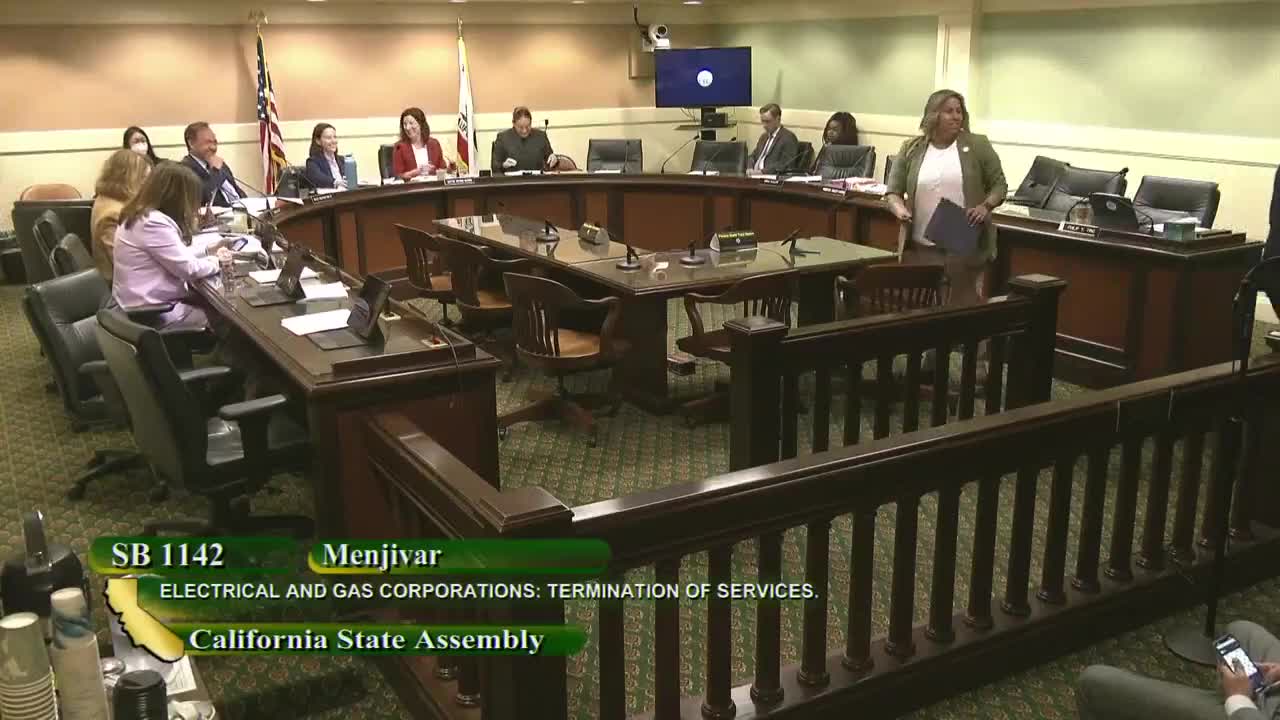 6MIN
Assembly Standing Committee on Utilities and Energy
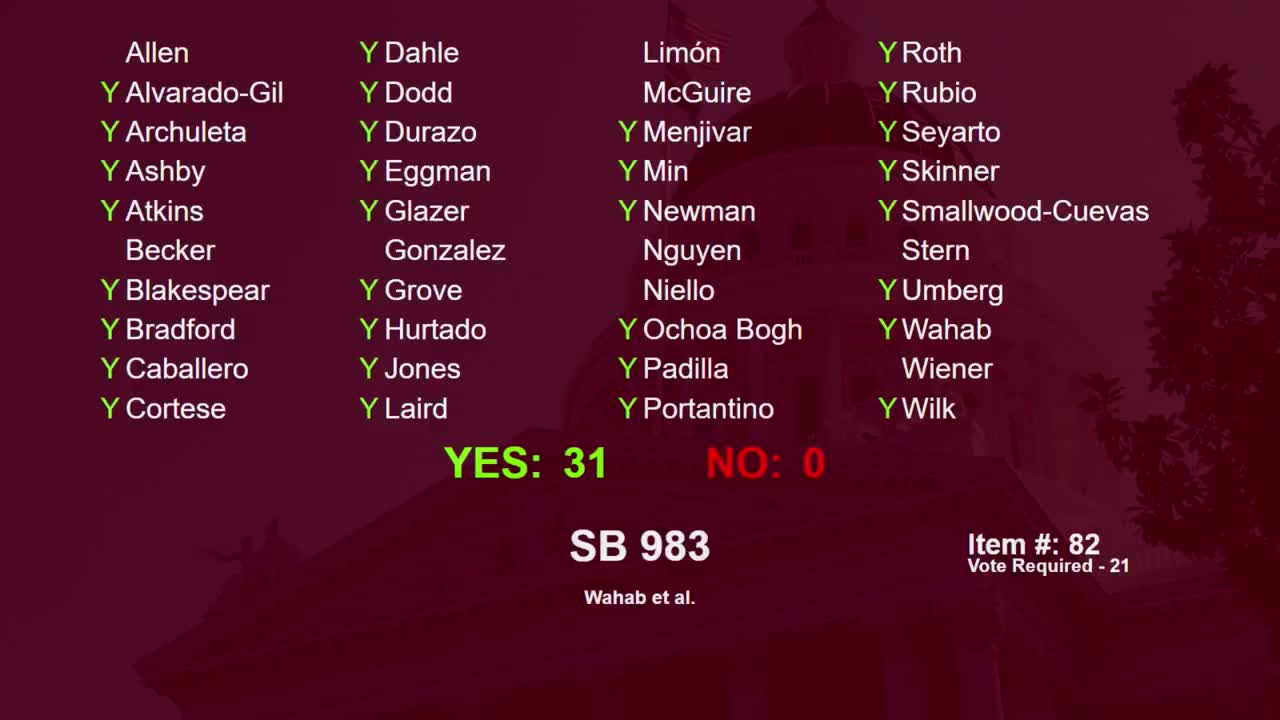 5MIN
Senate Floor
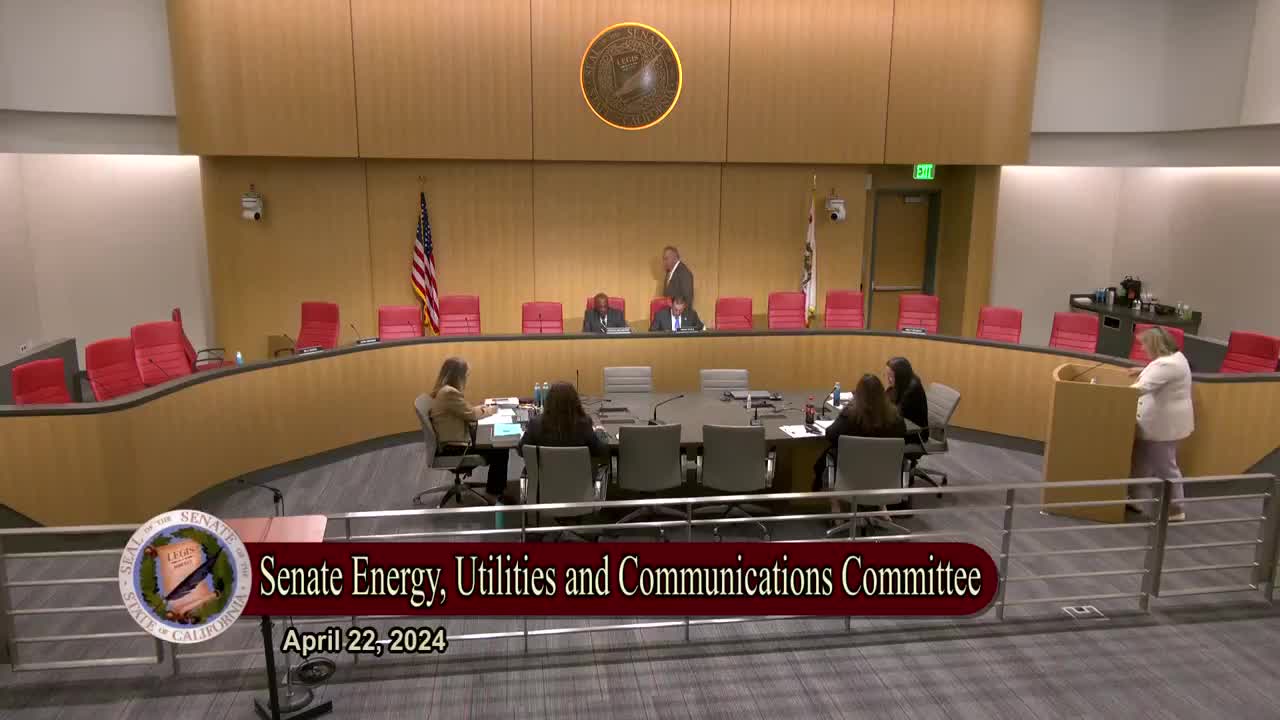 13MIN
Senate Standing Committee on Energy, Utilities and Communications
 1MIN
Senate Standing Committee on Energy, Utilities and Communications
Bill Author
Bill Co-Author(s):