SB 1187: Housing programs: Tribal Housing Reconstitution and Resiliency Act.
- Session Year: 2023-2024
- House: Senate
- Latest Version Date: 2024-09-19
Current Status:
Passed
(2024-09-19: Chaptered by Secretary of State. Chapter 295, Statutes of 2024.)
Introduced
In Committee
First Chamber
In Committee
Second Chamber
Enacted
What does this bill do?
This bill creates the Tribal Housing Reconstitution and Resiliency Act and a Tribal Housing Grant Program Trust Fund run by the Department of Housing and Community Development to provide state housing money to California’s federally recognized tribes, tribally designated housing entities, and tribal–nonprofit partnerships. The fund will get legislative appropriations and a 10% set‑aside from certain state housing programs, with 95% given to tribes by formula and 5% reserved for technical help. Tribes may use the money for homebuyer aid, repairs, new construction, infrastructure, supportive services, housing management and admin; funds must be spent within set time limits and serve tribal members and other eligible local families under income rules.
The summary is provided by generative AI which can make mistakes. For original language, please view the details in the table below.
Existing law establishes the Department of Housing and Community Development in the Business, Consumer Services, and Housing Agency and makes the department responsible for administering various housing programs throughout the state, including, among others, the Multifamily Housing Program, the CalHome Program, and the California Emergency Solutions Grants Program.
This bill would enact the Tribal Housing Reconstitution and Resiliency Act and would create the Tribal Housing Grant Program Trust Fund to be administered by the department. The bill would require any moneys appropriated and made available by the Legislature through the annual Budget Act for purposes of the fund and 10% of any moneys that will be appropriated and made available by the Legislature to the department through the annual Budget Act for specified housing programs to be paid and deposited in the fund. The bill would require the department to monitor the balance of the fund and when the department determines that sufficient moneys are available in the fund, the bill would require the moneys in the fund to be allocated in accordance with a specified formula, as provided.
This bill would authorize the funds to be allocated for specific purposes, including, among others, housing and housing-related program services for affordable housing, housing and community development project costs, and management services for affordable housing. The bill would require the funds to be allocated only for the benefit of eligible beneficiaries, including, among others, Indian and essential families and individuals residing in an Indian area, as specified.
This bill would require recipients of the funds to expend all funds allocated to programs and services within 5 years from the date of execution of a funding agreement with the department, and to expend all funds allocated to projects within 7 years from the date of execution of a funding agreement with the department, unless granted an extension by the department, as specified.
Existing law establishes the Department of Housing and Community Development in the Business, Consumer Services, and Housing Agency and makes the department responsible for administering various housing programs throughout the state, including, among others, the Multifamily Housing Program, the CalHOME CalHome Program, and the California Emergency Solutions Grants Program.
This bill would enact the Tribal Housing Reconstitution and Resiliency Act and would create the Tribal Housing Grant Program Trust Fund to be administered by the department. The bill would require the fund, upon appropriation from the Legislature, The bill would require any moneys appropriated and made available by the Legislature through the annual Budget Act for purposes of the fund and 10% of any moneys that will be appropriated and made available by the Legislature to the department through the annual Budget Act for specified housing programs to be paid and deposited in the fund. The bill would require the department to monitor the balance of the fund and when the department determines that sufficient moneys are available in the fund, the bill would require the moneys in the fund to be allocated in accordance with a specified formula, as provided.
This bill would authorize the funds to be allocated for specific purposes, including, among others, housing and housing-related program services for affordable housing, housing and community development project costs, and management services for affordable housing. The bill would require the funds to be allocated only for the benefit of eligible beneficiaries, including, among others, Indian and essential families and individuals residing in an Indian area, as specified.
This bill would require recipients of the funds to expend all funds allocated to programs and services within 3 5 years from the date of execution of a funding agreement with the department, and to expend all funds allocated to projects within 5 7 years from the date of execution of a funding agreement with the department, unless granted an extension by the department, as specified. The bill would require moneys paid and deposited into the Tribal Housing Grant Program Trust Fund to be appropriated on an annual basis for a 5-year period starting January 1, 2025, through December 31, 2029.
Existing law establishes the Department of Housing and Community Development in the Business, Consumer Services, and Housing Agency and makes the department responsible for administering various housing programs throughout the state, including, among others, the Multifamily Housing Program, the CalHOME Program, and the California Emergency Solutions Grants Program.
This bill would enact the Tribal Housing Reconstitution and Resiliency Act and would create the Tribal Housing Grant Program Trust Fund to be administered by the department. The bill would require the fund, upon appropriation from the Legislature, to be allocated in accordance with a specified formula, as provided.
This bill would authorize the funds to be allocated for specific purposes, including, among others, housing and housing-related program services for affordable housing, housing and community development project costs, and management services for affordable housing. The bill would require the funds to be allocated only for the benefit of eligible beneficiaries, including, among others, Indian and essential families and individuals residing in an Indian area, as specified.
This bill would require recipients of the funds to expend all funds allocated to programs and services within 3 years from the date of execution of a funding agreement with the department, and to expend all funds allocated to projects within 5 years from the date of execution of a funding agreement with the department, unless granted an extension by the department, as specified. The bill would require moneys paid and deposited into the Tribal Housing Grant Program Trust Fund to be appropriated on an annual basis for a 5-year period starting January 1, 2025, through December 31, 2029.
This act shall be known, and may be cited, as the Tribal Housing Reconstitution and Resiliency Act.
SEC. 2.The Legislature finds and declares all of the following:
(a)The legacy of state- and federal-sponsored genocide, land theft, displacement, and discrimination is directly related to the isolation, marginalization, disenfranchisement, and underdevelopment of the states first nations to this day.
(b)For decades, tribes were shut out of state housing programs and totally reliant on federal housing programs. Federal programs are still critical but insufficient to cover all housing and community development needs that have grown over generations of neglect.
(c)Despite the passage of AB 1010 in 2019, which made tribes eligible for most state housing programs and recreated the G. David Singleton California Indian Assistance Program (CIAP) in the Department of Housing and Community Development, tribes still face serious structural and inequitable obstacles to accessing and competing in these programs.
(d)Existing state programs were not designed with tribes in mind. They are often too restrictive for tribes to meet threshold and compliance requirements or mismatched to the opportunities and needs that exist on tribal trust and fee land.
(e)State housing program requirements conflict with tribal sovereignty and the concept of sovereign immunity. As a result, tribes must often appeal for time-consuming program waivers, which depend on the good will and understanding of nontribal staff about tribal laws, culture, and practices.
(f)For the overwhelming majority of tribes, program applications can be onerous and opaque. Only a few tribes are willing and able to commit limited time and resources to learn these programs and prepare applications for small tribal set-asides that will fund only a handful of applicants.
(g)There is a lack of consistency between federal Indian housing programs and state housing programs. Federal programs incorporate conditions and requirements that are a better fit and often more flexible than conventional state housing programs.
(h)There are currently 109 federally recognized tribes in California. They vary greatly in terms of land, resources, and capacity.
(i)The housing conditions of tribal members living in California reservations and rancherias have not changed for many years. According to the 2019 study California Tribal Housing Needs and Opportunities, tribes have much higher rates of poverty, overcrowding, substandard housing, and homelessness than other Californians.
(j)About 25 of the states federally recognized tribes either have no land base, a land base but no resident population, or no housing units reported. Tribes with a land base often have limited developable sites because of topography, soil and drainage problems, and fire hazards. Sites that are developable have low-capacity, failing, or nonexistent water, sewer, and electrical systems. These tribes must compete in the private market for decent sites to house their members.
(k)Tribes typically do not have the staff capacity of other units of local government. They have insufficient financial resources to attract and retain long-term housing program and project staff with experience accessing the states system of housing finance and cannot afford external consultants.
(l)Therefore, in furtherance of Governor Gavin Newsoms Executive Order No. N-15-19 formally apologizing to Californias Native Americans for historical mistreatment, violence, and neglect, a dedicated, flexible, and comprehensive state program, designed by and for tribes, is needed to finance housing and housing-related activities that will enable tribes to rebuild and reconstitute their communities.
SEC. 3.Chapter 6.4 (commencing with Section 50651) is added to Part 2 of Division 31 of the Health and Safety Code, to read:6.4.Tribal Housing Reconstitution and Resiliency Act50651.For purposes of this chapter, all of the following definitions apply:
(a)Department means the Department of Housing and Community Development.
(b)Eligible applicant means all of, or a combination of, the following:
(1)The duly constituted governing body of a California-based federally recognized Indian reservation or rancheria.
(2)A tribally designated housing entity delegated by a California-based federally recognized Indian reservation or rancheria to perform housing and housing-related activities on behalf of one or more Indian tribes.
(3)A consortium of one or more of the following:
(A)California-based federally recognized Indian reservations or rancherias.
(B)Tribally designated housing entities.
(4)An eligible development partnership between the duly constituted governing body of a California-based federally recognized Indian reservation or rancheria or tribally designated housing entity with a nonnative nonprofit housing sponsor.
(c)Eligible development partnership means the partnership of a duly constituted governing body of a California-based federally recognized Indian reservation or rancheria or tribally designated housing entity with a nonnative nonprofit housing sponsor, evinced by a development agreement, joint venture agreement, or other type of agreement with equitable and fair terms to the tribal entity. The agreement must specify the development, ownership, and management responsibilities between the parties and the tribal entity shall receive no less than 50 percent of the developer fee, including upfront developer fee and deferred developer fee, and hold a controlling or at least equivalent interest in the ownership entity or if the owner is a low-income housing tax credit limited partnership for the purposes of syndicating tax credits, have a first option to acquire the property at the end of the tax credit compliance period.
(d)Essential families means families or individuals whose presence is determined to be essential to the well-being of the reservation or rancheria, as defined in Section 201(b)(3) of NAHASDA.
(e)Federally recognized tribe means any Indian tribe, band, nation, or other organized group or community of Indians that is recognized as eligible for the special programs and services provided by the United States to Indians because of their status as Indians pursuant to the Indian Self-Determination and Education Assistance Act (Public Law 93-638).
(f)Housing means home ownership housing and rental housing that may be single-family units, attached units such as duplexes and triplexes, multifamily housing projects, permanent supportive housing for the homeless, single room occupancy units, mobile or manufactured homes, group homes for persons with special needs such as the elderly and disabled, congregate housing, transitional housing, halfway housing, domestic violence shelters, and homeless emergency shelters.
(g)Indian means any person who is a member of an Indian tribe.
(h)Indian area means the area within which an Indian tribe operates affordable housing programs or the area in which a tribally designated housing entity, as authorized by one or more Indian tribes, operates affordable housing programs. Whenever the term is used in this chapter, it shall mean the Indian area of a California-based Indian reservation or rancheria.
(i)Indian tribe means a tribe that is a federally recognized tribe.
(j)NAHASDA means the Native American Housing Assistance and Self-Determination Act of 1996 (25 U.S.C. Sec. 4101 et seq.).
(k)Nonprofit housing sponsor means a nonprofit corporation incorporated pursuant to Division 2 (commencing with Section 5000) of Title 1 of the Corporations Code.
(l)Median income for the area means for purposes of this chapter, the greater of the following:
(1)The median income of the county or counties in which the Indian area is located.
(2)The median income for the United States.
(m)Rancheria means a small tract of California Indian land under federal trust.
(n)Tribally designated housing entity means an entity as that term is defined in Section 50104.6.5.
(o)Tribal housing grant program trust fund advisory committee means a state advisory body established pursuant to Section 15990 of the Government Code to represent tribal interests in state housing programs, including providing guidance to the department on proposed guidelines and making recommendations. Committee composition shall consist of at least 51 percent tribal housing staff, tribal leaders, and a tribal attorney and shall include diverse representation from tribes in terms of geographic location, size of tribe, and revenue from sources other than NAHASDA.
50651.1.There is hereby created in the State Treasury the Tribal Housing Grant Program Trust Fund to be administered by the department. All interest or other increments resulting from the investment of moneys in the fund shall be deposited in the fund, notwithstanding Section 16305.7 of the Government Code.
(a)Moneys in the Tribal Housing Grant Program Trust Fund shall not be subject to transfer to any other fund pursuant to any provision of Part 2 (commencing with Section 16300) of Division 4 of Title 2 of the Government Code, except to the Surplus Money Investment Fund.
(b)Both of the following shall be paid and deposited in the fund:
(1)Any moneys appropriated and made available by the Legislature through the annual Budget Act for purposes of the fund.
(2)Ten percent of any moneys that will be appropriated and made available by the Legislature to the department through the annual Budget Act for the Multifamily Housing Program (Chapter 6.7 (commencing with Section 50675)), Infill Infrastructure Grant Program of 2019 (Part 12.5 (commencing with Section 53559)), Veterans Housing and Homeless Prevention Act of 2014 (Article 3.2 (commencing with Section 987.001) of Chapter 6 of Division 4 of the Military and Veterans Code), and Joe Serna, Jr. Farmworker Housing Grant Program (Chapter 3.2 (commencing with Section 50515.2)). The use of moneys deposited into the fund pursuant to this subdivision shall only be subject to this chapter, regardless of any other law governing the use of the balance of the funds appropriated to programs governed by this division.
(c)Separate from the fund, and subject to appropriation by the Legislature, moneys made available to the department through voter-approved bonds for the Multifamily Housing Program, Infill Infrastructure Grant Program of 2019, Veterans Housing and Homelessness Prevention Program, and Joe Serna, Jr. Farmworker Housing Grant Program may be made available as tribal set-asides in alignment with the eligible uses of those funds.
(d)The department shall monitor the balance of the fund. When the department determines that sufficient moneys are available in the fund to allocate, the department shall allocate the moneys as follows:
(1)Ninety-five percent of deposits into the fund pursuant to subdivision (b) shall be made available on an entitlement basis to the duly constituted governing body of a California-based federally recognized Indian reservation or rancheria in accordance with a formula allocation to be determined by the department. The formula shall be based on input and guidance from Indian tribes and the tribal housing grant program trust fund advisory committee, which may include, but not be limited to, a specific formula or factors to be used in a formula for allocation. Funds shall be provided in the form of multipurpose block grants for eligible uses in support of housing and housing-related planning, program, project predevelopment, operating subsidies, staffing, and administrative activities as specified in this chapter.
(2)Five percent of deposits into the fund shall be available for technical assistance to eligible tribes and tribally designated housing entities to build their capacity to independently plan, design, apply for, implement, and operate affordable housing programs and projects.
(e)Recipients that receive an allocation pursuant to paragraph (1) of subdivision (d) shall use no more than 20 percent of that allocation for costs related to the administration of funds received on an entitlement basis, unless the recipient receives approval by the department.
(f)To receive moneys pursuant to this section, tribal governments shall do both of the following:
(1)Annually submit a plan to the department detailing the way allocated funds will be used by the tribe in a manner consistent with this section.
(2)Submit an annual report to the department that provides ongoing tracking of the uses and expenditures of any allocated funds.
(g)The department shall ensure geographic equity in the distribution and expenditure of funds allocated pursuant to this section.
(h)In close consultation with California tribes and a tribal housing grant program trust fund advisory committee, the department shall adopt guidelines to implement this section, including determining allocation methodologies. Thereafter, the department may adopt, amend, or repeal guidelines for the administration and implementation of this chapter, in consultation with California tribes and a tribal housing grant program trust fund advisory committee.
50651.2.The moneys in the fund allocated in accordance with Section 50651.1 to eligible applicants may be expended for all of the following purposes:
(a)Housing and housing-related program services for affordable housing that include, but are not limited to, all of the following:
(1)Home buyer assistance, such as first-time home buyer loans, downpayment assistance, closing costs, and mortgage subsidies.
(2)Owner-occupied home rehabilitation loans and grants.
(3)Homeowner, home buyer, and renter counseling, including credit counseling.
(4)Rental assistance, student rental assistance, emergency rental assistance, move-in and utility expenses, and rental subsidies, including tenant-based rental assistance to individual tribal members, or similar assistance.
(5)Energy audits, retrofits to achieve greater energy efficiencies, water conservation measures, resident training, and other activities related to climate resilience, fire protection, and sustainability, or similar activities.
(6)Improvements to remediate lead-based paint, mold, and other hazards.
(7)Improvements to increase physical accessibility for elderly and disabled persons, including universal design.
(8)Wrap-around services, including childcare, after school programs, and job training for tribal members living in affordable housing.
(9)Community outreach to tribal members experiencing homelessness.
(10)Model activities that provide creative approaches to solving affordable housing activities.
(11)Other affordable housing program services permissible under NAHASDA.
(b)Housing and community development project costs including, but not limited to, all of the following:
(1)The acquisition, new construction, reconstruction, or moderate or substantial rehabilitation of affordable multifamily and single-family housing projects for rent or ownership, including real property acquisition, demolition, and relocation.
(2)The conversion of nonresidential buildings into affordable housing.
(3)Site preparation, including grading and drainage improvements, development and rehabilitation of utilities, including sewer, water, and electrical systems, and other necessary infrastructure.
(4)Site amenities, including recreational areas, playgrounds, and on-site streets and sidewalks for affordable housing units.
(5)The construction or rehabilitation of community-serving amenities, including childcare centers, health services, supportive services space, or other activities and services that are colocated with an affordable housing project.
(6)The construction or rehabilitation of commercial uses that create job or economic development opportunities for tribal members that is colocated with an affordable housing project.
(7)Other predevelopment costs including, but not limited to, administration and planning of affordable housing projects, market studies, soils, engineering, and architectural plans, grant writers contracted to work on project funding applications, and finance professionals to assist with financial packaging of state and nonstate housing assistance programs.
(8)Other affordable housing project development costs permissible under NAHASDA.
(c)Management services for affordable housing, including preparation of work specifications, loan processing, inspections, tenant selection, management of tenant-based rental assistance, the costs of operation and maintenance of units developed with funds provided under this chapter, all activities related to maintaining compliance with housing loan or grant sources, and management of affordable housing projects.
(d)Allowable administrative costs shall include, but not be limited to, all of the following:
(1)Comprehensive housing and community development activities.
(2)Overhead subject to a federally negotiated indirect cost rate and the salaries and benefits of individuals engaged in overall program administration and management of affordable housing activities assisted with funds allocated under this chapter.
(3)Grant writers contracted to work on program applications to prospective funders.
(4)Monitoring, data collection, evaluation, and preparation of annual performance reports to the department.
(5)A recipient may request the departments approval for use of more than 20 percent of entitlement funds allocated under Section 50651.1 to help cover administrative costs.
50651.3.The moneys in the fund allocated to eligible applicants in accordance with Section 50651.1 shall only be expended for the benefit of one or more of the following eligible beneficiaries:
(a)Indian and essential families and individuals residing in an Indian area.
(b)Households residing in an Indian area with annual incomes up to 80 percent of the median income for the area for rental housing programs and projects and up to 120 percent of median income for the area for home ownership programs and projects.
(c)In high-cost areas, tribes may provide financial assistance to households with incomes up to 150 percent of median income for the area for home ownership programs and projects provided the total dollar amount of assistance does not exceed more than 10 percent of total funds allocated.
50651.4.(a)(1)Recipients shall have five years from the date of execution of a funding agreement with the department to expend all funds allocated to programs and services.
(2)Recipients shall have seven years from the date of execution of a funding agreement with the department to expend all funds allocated to projects.
(3)An extension to expend funds may be approved by the department when the recipient demonstrates significant progress toward completing the approved activities and a reasonable plan to complete them within the extension period.
(b)If it is determined, on the basis of a review of the recipients annual reports, that the eligible activities have not been completed or are unlikely to be completed in the required timeframes, the award may be reallocated to another eligible activity, reduced, or withdrawn except that funds already expended on eligible activities shall not be recaptured. A reallocation of an award will not be made until the recipient has submitted an explanation as to why the original eligible activity will not proceed and has requested reallocation to another eligible activity. A reduction or withdrawal of an award will not be made until the recipient has been provided notice, and only then if the recipient has not made an appropriate and timely response which may include submittal of revised implementation schedules and plans to achieve the eligible activities.
This act shall be known, and may be cited, as the Tribal Housing Reconstitution and Resiliency Act.
SEC. 2.The Legislature finds and declares all of the following:
(a)The legacy of state- and federal-sponsored genocide, land theft, displacement, and discrimination is directly related to the isolation, marginalization, disenfranchisement, and underdevelopment of the states first nations to this day.
(b)For decades, tribes were shut out of state housing programs and totally reliant on federal housing programs. Federal programs are still critical but insufficient to cover all housing and community development needs that have grown over generations of neglect.
(c)Despite the passage of AB 1010 in 2019, which made tribes eligible for most state housing programs and recreated the G. David Singleton California Indian Assistance Program (CIAP) in the Department of Housing and Community Development, tribes still face serious structural and inequitable obstacles to accessing and competing in these programs.
(d)Existing state programs were not designed with tribes in mind. They are often too restrictive for tribes to meet threshold and compliance requirements or mismatched to the opportunities and needs that exist on tribal trust and fee land.
(e)State housing program requirements conflict with tribal sovereignty and the concept of sovereign immunity. As a result, tribes must often appeal for time-consuming program waivers, which depend on the good will and understanding of nontribal staff about tribal laws, culture, and practices.
(f)For the overwhelming majority of tribes, program applications can be onerous and opaque. Only a few tribes are willing and able to commit limited time and resources to learn these programs and prepare applications for small tribal set-asides that will fund only a handful of applicants.
(g)There is a lack of consistency between federal Indian housing programs and state housing programs. Federal programs incorporate conditions and requirements that are a better fit and often more flexible than conventional state housing programs.
(h)There are currently 109 federally recognized tribes in California. They vary greatly in terms of land, resources, and capacity.
(i)The housing conditions of tribal members living in California reservations and rancherias have not changed for many years. According to the 2019 study California Tribal Housing Needs and Opportunities, tribes have much higher rates of poverty, overcrowding, substandard housing, and homelessness than other Californians.
(j)About 25 of the states federally recognized tribes either have no land base, a land base but no resident population, or no housing units reported. Tribes with a land base often have limited developable sites because of topography, soil and drainage problems, and fire hazards. Sites that are developable have low-capacity, failing, or nonexistent water, sewer, and electrical systems. These tribes must compete in the private market for decent sites to house their members.
(k)Tribes typically do not have the staff capacity of other units of local government. They have insufficient financial resources to attract and retain long-term housing program and project staff with experience accessing the states system of housing finance and cannot afford external consultants.
(l)Therefore, in furtherance of Governor Gavin Newsoms Executive Order No. N-15-19 formally apologizing to Californias Native Americans for historical mistreatment, violence, and neglect, a dedicated, flexible, and comprehensive state program, designed by and for tribes, is needed to finance housing and housing-related activities that will enable tribes to rebuild and reconstitute their communities.
SEC. 3.Chapter 6.4 (commencing with Section 50651) is added to Part 2 of Division 31 of the Health and Safety Code, to read:6.4.Tribal Housing Reconstitution and Resiliency Act50651.For purposes of this chapter, all of the following definitions apply:
(a)Department means the Department of Housing and Community Development.
(b)Eligible applicant means all of, or a combination of, the following:
(1)The duly constituted governing body of a California-based federally recognized Indian reservation or rancheria.
(2)A tribally designated housing entity delegated by a California-based federally recognized Indian reservation or rancheria to perform housing and housing-related activities on behalf of one or more Indian tribes.
(3)A consortium of one or more of the following:
(A)California-based federally recognized Indian reservations or rancherias.
(B)Tribally designated housing entities.
(4)An eligible development partnership between the duly constituted governing body of a California-based federally recognized Indian reservation or rancheria or tribally designated housing entity with a nonnative nonprofit housing sponsor.
(c)Eligible development partnership means the partnership of a duly constituted governing body of a California-based federally recognized Indian reservation or rancheria or tribally designated housing entity with a nonnative nonprofit housing sponsor, evinced by a development agreement, joint venture agreement, or other type of agreement with equitable and fair terms to the tribal entity. The agreement must specify the development, ownership, and management responsibilities between the parties and the tribal entity shall receive no less than 50 percent of the developer fee, including upfront developer fee and deferred developer fee, and hold a controlling or at least equivalent interest in the ownership entity or if the owner is a low-income housing tax credit limited partnership for the purposes of syndicating tax credits, have a first option to acquire the property at the end of the tax credit compliance period.
(d)Essential families means families or individuals whose presence is determined to be essential to the well-being of the reservation or rancheria, as defined in Section 201(b)(3) of NAHASDA.
(e)Federally recognized tribe means any Indian tribe, band, nation, or other organized group or community of Indians that is recognized as eligible for the special programs and services provided by the United States to Indians because of their status as Indians pursuant to the Indian Self-Determination and Education Assistance Act of 1975. (Public Law 93-638).
(f)Housing means home ownership housing and rental housing that may be single-family units, attached units such as duplexes and triplexes, multifamily housing projects, permanent supportive housing for the homeless, single room occupancy units, mobile or manufactured homes, group homes for persons with special needs such as the elderly and disabled, congregate housing, transitional housing, halfway housing, domestic violence shelters, and homeless emergency shelters.
(g)Indian means any person who is a member of an Indian tribe.
(h)Indian area means the area within which an Indian tribe operates affordable housing programs or the area in which a tribally designated housing entity, as authorized by one or more Indian tribes, operates affordable housing programs. Whenever the term is used in this chapter, it shall mean the Indian area of a California-based Indian reservation or rancheria.
(i)Indian tribe means a tribe that is a federally recognized tribe.
(j)NAHASDA means the Native American Housing Assistance and Self-Determination Act of 1996 (25 U.S.C. Sec. 4101 et seq.).
(k)Nonprofit housing sponsor means a nonprofit corporation incorporated pursuant to Division 2 (commencing with Section 5000) of Title 1 of the Corporations Code.
(l)Median income for the area means for purposes of this chapter, the greater of the following:
(1)The median income of the county or counties in which the Indian area is located.
(2)The median income for the United States.
(m)Rancheria means a small tract of California Indian land under federal trust.
(n)Tribally designated housing entity means an entity as that term is defined in Section 50104.6.5.
(o)Tribal equity housing grant program trust fund advisory committee means a state advisory body created established pursuant to Section 15990 of the Government Code to represent tribal interests in state housing programs, including reviewing proposed guidelines, making recommendations, and adjudicating appeals. providing guidance to the department on proposed guidelines and making recommendations. Committee composition shall consist of at least 51 percent tribal housing staff, tribal leaders, and a tribal attorney and shall include diverse representation from tribes in terms of geographic location, size of tribe, and revenue from sources other than NAHASDA.
50651.1.There is hereby created in the State Treasury the Tribal Housing Grant Program Trust Fund to be administered by the department. All interest or other increments resulting from the investment of moneys in the fund shall be deposited in the fund, notwithstanding Section 16305.7 of the Government Code.
(a)Moneys in the Tribal Housing Grant Program Trust Fund shall not be subject to transfer to any other fund pursuant to any provision of Part 2 (commencing with Section 16300) of Division 4 of Title 2 of the Government Code, except to the Surplus Money Investment Fund.
(b)Both of the following shall be paid and deposited in the fund:
(1)Any moneys appropriated and made available by the Legislature through the annual Budget Act for purposes of the fund.
(2)Any other moneys that may be made available to the department for the purposes of the fund from any other source or sources.(c)Upon appropriation by the Legislature, the department shall allocate the moneys in the Tribal Housing Grant Program Trust Fund as follows:(2)Ten percent of any moneys that will be appropriated and made available by the Legislature to the department through the annual Budget Act for the Multifamily Housing Program (Chapter 6.7 (commencing with Section 50675)), Infill Infrastructure Grant Program of 2019 (Part 12.5 (commencing with Section 53559)), Veterans Housing and Homeless Prevention Act of 2014 (Article 3.2 (commencing with Section 987.001) of Chapter 6 of Division 4 of the Military and Veterans Code), and Joe Serna, Jr. Farmworker Housing Grant Program (Chapter 3.2 (commencing with Section 50515.2)). The use of moneys deposited into the fund pursuant to this subdivision shall only be subject to this chapter, regardless of any other law governing the use of the balance of the funds appropriated to programs governed by this division.
(c)Separate from the fund, and subject to appropriation by the Legislature, moneys made available to the department through voter-approved bonds for the Multifamily Housing Program, Infill Infrastructure Grant Program of 2019, Veterans Housing and Homelessness Prevention Program, and Joe Serna, Jr. Farmworker Housing Grant Program may be made available as tribal set-asides in alignment with the eligible uses of those funds.
(d)The department shall monitor the balance of the fund. When the department determines that sufficient moneys are available in the fund to allocate, the department shall allocate the moneys as follows:
(1)Eighty Ninety-five percent of deposits into the fund pursuant to subdivision (b) shall be made available on an entitlement basis to the duly constituted governing body of a California-based federally recognized Indian reservation or rancheria in accordance with a formula allocation to be determined by the department in consultation with Indian tribes and a tribal equity advisory committee. department. The formula shall be based on input and guidance from Indian tribes and the tribal housing grant program trust fund advisory committee, which may include, but not be limited to, a specific formula or factors to be used in a formula for allocation. Funds shall be provided in the form of multipurpose block grants for eligible uses in support of housing and housing-related planning, program, project predevelopment, operating subsidies, staffing, and administrative activities as specified in this chapter.
(2)Fifteen percent of deposits into the fund shall be made available on a competitive basis to the duly constituted governing body of a California-based federally recognized Indian reservation or rancheria or a tribally designated housing entity for the express purpose of construction, reconstruction, rehabilitation, or acquisition and rehabilitation of housing and infrastructure improvements as specified in this chapter.(3)(2)Five percent of deposits into the fund shall be available for technical assistance to eligible tribes and tribally designated housing entities to build their capacity to independently plan, design, apply for, implement, and operate affordable housing programs and projects.
(4)The percentages specified in paragraphs (1), (2), and (3) may be adjusted periodically by the department pursuant to subdivision (g) to best achieve the goals of this chapter. The percentages shall not be adjusted by more than 10 percent of the most recent annual allocation made by the Legislature.(d)(e)Recipients that receive an allocation pursuant to paragraph (1) of subdivision (c) (d) shall use no more than 20 percent of that allocation for costs related to the administration of funds received on an entitlement basis, unless the recipient receives approval by the department.
(e)(f)To receive moneys pursuant to this section, tribal governments shall do both of the following:
(1)Annually submit a plan to the department detailing the way allocated funds will be used by the tribe in a manner consistent with this section.
(2)Submit an annual report to the department that provides ongoing tracking of the uses and expenditures of any allocated funds.
(f)(g)The department shall ensure geographic equity in the distribution and expenditure of funds allocated pursuant to this section.
(g)(h)In close consultation with California tribes and a tribal equity housing grant program trust fund advisory committee, the department shall adopt guidelines to implement this section, including determining allocation methodologies. Thereafter, the department may adopt, amend, or repeal guidelines for the administration and implementation of this chapter, in consultation with California tribes and a tribal equity housing grant program trust fund advisory committee.
50651.2.The moneys in the fund allocated in accordance with Section 50651.1 to eligible applicants may be expended for all of the following purposes:
(a)Housing and housing-related program services for affordable housing that include, but are not limited to, all of the following:
(1)Home buyer assistance, such as first-time home buyer loans, downpayment assistance, closing costs, and mortgage subsidies.
(2)Owner-occupied home rehabilitation loans and grants.
(3)Homeowner, home buyer, and renter counseling, including credit counseling.
(4)Rental assistance, student rental assistance, emergency rental assistance, move-in and utility expenses, and rental subsidies, including tenant-based rental assistance to individual tribal members, or similar assistance.
(5)Energy audits, retrofits to achieve greater energy efficiencies, water conservation measures, resident training, and other activities related to climate resilience, fire protection, and sustainability, or similar activities.
(6)Improvements to remediate lead-based paint, mold, and other hazards.
(7)Improvements to increase physical accessibility for elderly and disabled persons, including universal design.
(8)Wrap-around services, including childcare, after school programs, and job training for tribal members living in affordable housing.
(9)Community outreach to tribal members experiencing homelessness.
(10)Model activities that provide creative approaches to solving affordable housing activities.
(11)Other affordable housing program services permissible under NAHASDA.
(b)Housing and community development project costs including, but not limited to, all of the following:
(1)The acquisition, new construction, reconstruction, or moderate or substantial rehabilitation of affordable multifamily and single-family housing projects for rent or ownership, including real property acquisition, demolition, and relocation.
(2)The conversion of nonresidential buildings into affordable housing.
(3)Site preparation, including grading and drainage improvements, development and rehabilitation of utilities, including sewer, water, and electrical systems, and other necessary infrastructure.
(4)Site amenities, including recreational areas, playgrounds, and on-site streets and sidewalks for affordable housing units.
(5)The construction or rehabilitation of community-serving amenities, including childcare centers, health services, supportive services space, or other activities and services that are colocated with an affordable housing project.
(6)The construction or rehabilitation of commercial uses that create job or economic development opportunities for tribal members that is colocated with an affordable housing project.
(7)Other predevelopment costs including, but not limited to, administration and planning of affordable housing projects, market studies, soils, engineering, and architectural plans, grant writers contracted to work on project funding applications, and finance professionals to assist with financial packaging of state and nonstate housing assistance programs.
(8)Other affordable housing project development costs permissible under NAHASDA.
(c)Management services for affordable housing, including preparation of work specifications, loan processing, inspections, tenant selection, management of tenant-based rental assistance, the costs of operation and maintenance of units developed with funds provided under this chapter, all activities related to maintaining compliance with housing loan or grant sources, and management of affordable housing projects.
(d)Allowable administrative costs shall include, but not be limited to, all of the following:
(1)Comprehensive housing and community development activities.
(2)Overhead subject to a federally negotiated indirect cost rate and the salaries and benefits of individuals engaged in overall program administration and management of affordable housing activities assisted with funds allocated under this chapter.
(3)Grant writers contracted to work on program applications to prospective funders.
(4)Monitoring, data collection, evaluation, and preparation of annual performance reports to the department.
(5)A recipient may request the departments approval for use of more than 20 percent of entitlement funds allocated under Section 50651.1 to help cover administrative costs.
50651.3.The moneys in the fund allocated to eligible applicants in accordance with Section 50651.1 shall only be expended for the benefit of one or more of the following eligible beneficiaries:
(a)Indian and essential families and individuals residing in an Indian area.
(b)Households residing in an Indian area with annual incomes up to 80 percent of the median income for the area for rental housing programs and projects and up to 120 percent of median income for the area for home ownership programs and projects.
(c)In high-cost areas, tribes may provide financial assistance to households with incomes up to 150 percent of median income for the area for home ownership programs and projects provided the total dollar amount of assistance does not exceed more than 10 percent of total funds allocated.
50651.4.(a)(1)Recipients shall have three five years from the date of execution of a funding agreement with the department to expend all funds allocated to programs and services.
(2)Recipients shall have five seven years from the date of execution of a funding agreement with the department to expend all funds allocated to projects.
(3)An extension to expend funds may be approved by the department when the recipient demonstrates significant progress toward completing the approved activities and a reasonable plan to complete them within the extension period.
(b)If it is determined, on the basis of a review of the recipients annual reports, that the eligible activities have not been completed or are unlikely to be completed in the required timeframes, the award may be reallocated to another eligible activity, reduced, or withdrawn except that funds already expended on eligible activities shall not be recaptured. A reallocation of an award will not be made until the recipient has submitted an explanation as to why the original eligible activity will not proceed and has requested reallocation to another eligible activity. A reduction or withdrawal of an award will not be made until the recipient has been provided notice, and only then if the recipient has not made an appropriate and timely response which may include submittal of revised implementation schedules and plans to achieve the eligible activities.
50651.5.(a)Moneys paid and deposited into the Tribal Housing Grant Program Trust Fund shall be appropriated in the Budget Act on an annual basis for a five-year period starting January 1, 2025, through December 31, 2029.(b)The Office of State Audits and Evaluations in the Department of Finance may conduct periodic audits to ensure that the annual allocation to individual programs is awarded by the department in a timely fashion consistent with the requirements of this chapter.(c)The department shall reimburse the Office of State Audits and Evaluations for the actual costs of audit work performed pursuant to this section.This act shall be known, and may be cited, as the Tribal Housing Reconstitution and Resiliency Act.
SEC. 2.The Legislature finds and declares all of the following:
(a)The legacy of state- and federal-sponsored genocide, land theft, displacement, and discrimination is directly related to the isolation, marginalization, disenfranchisement, and underdevelopment of the states first nations to this day.
(b)For decades, tribes were shut out of state housing programs and totally reliant on federal housing programs. Federal programs are still critical but insufficient to cover all housing and community development needs that have grown over generations of neglect.
(c)Despite the passage of AB 1010 in 2019, which made tribes eligible for most state housing programs and recreated the G. David Singleton California Indian Assistance Program (CIAP) in the Department of Housing and Community Development, tribes still face serious structural and inequitable obstacles to accessing and competing in these programs.
(d)Existing state programs were not designed with tribes in mind. They are often too restrictive for tribes to meet threshold and compliance requirements or mismatched to the opportunities and needs that exist on tribal trust and fee land.
(e)State housing program requirements conflict with tribal sovereignty and the concept of sovereign immunity. As a result, tribes must often appeal for time-consuming program waivers, which depend on the good will and understanding of nontribal staff about tribal laws, culture, and practices.
(f)For the overwhelming majority of tribes, program applications can be onerous and opaque. Only a few tribes are willing and able to commit limited time and resources to learn these programs and prepare applications for small tribal set-asides that will fund only a handful of applicants.
(g)There is a lack of consistency between federal Indian housing programs and state housing programs. Federal programs incorporate conditions and requirements that are a better fit and often more flexible than conventional state housing programs.
(h)There are currently 109 federally recognized tribes in California. They vary greatly in terms of land, resources, and capacity.
(i)The housing conditions of tribal members living in California reservations and rancherias have not changed for many years. According to the 2019 study California Tribal Housing Needs and Opportunities, tribes have much higher rates of poverty, overcrowding, substandard housing, and homelessness than other Californians.
(j)About 25 of the states federally recognized tribes either have no land base, a land base but no resident population, or no housing units reported. Tribes with a land base often have limited developable sites because of topography, soil and drainage problems, and fire hazards. Sites that are developable have low-capacity, failing, or nonexistent water, sewer, and electrical systems. These tribes must compete in the private market for decent sites to house their members.
(k)Tribes typically do not have the staff capacity of other units of local government. They have insufficient financial resources to attract and retain long-term housing program and project staff with experience accessing the states system of housing finance and cannot afford external consultants.
(l)Therefore, in furtherance of Governor Gavin Newsoms Executive Order No. N-15-19 formally apologizing to Californias Native Americans for historical mistreatment, violence, and neglect, a dedicated, flexible, and comprehensive state program, designed by and for tribes, is needed to finance housing and housing-related activities that will enable tribes to rebuild and reconstitute their communities.
SEC. 3.Chapter 6.4 (commencing with Section 50651) is added to Part 2 of Division 31 of the Health and Safety Code, to read:6.4.Tribal Housing Reconstitution and Resiliency Act50651.For purposes of this chapter, all of the following definitions apply:
(a)Department means the Department of Housing and Community Development.
(b)Eligible applicant means all of, or a combination of, the following:
(1)The duly constituted governing body of a California-based federally recognized Indian reservation or rancheria.
(2)A tribally designated housing entity delegated by a California-based federally recognized Indian reservation or rancheria to perform housing and housing-related activities on behalf of one or more Indian tribes.
(3)A consortium of one or more of the following:
(A)California-based federally recognized Indian reservations or rancherias.
(B)Tribally designated housing entities.
(4)An eligible development partnership between the duly constituted governing body of a California-based federally recognized Indian reservation or rancheria or tribally designated housing entity with a nonnative nonprofit housing sponsor.
(c)Eligible development partnership means the partnership of a duly constituted governing body of a California-based federally recognized Indian reservation or rancheria or tribally designated housing entity with a nonnative nonprofit housing sponsor, evinced by a development agreement, joint venture agreement, or other type of agreement with equitable and fair terms to the tribal entity. The agreement must specify the development, ownership, and management responsibilities between the parties and the tribal entity shall receive no less than 50 percent of the developer fee, including upfront developer fee and deferred developer fee, and hold a controlling or at least equivalent interest in the ownership entity or if the owner is a low-income housing tax credit limited partnership for the purposes of syndicating tax credits, have a first option to acquire the property at the end of the tax credit compliance period.
(d)Essential families means families or individuals whose presence is determined to be essential to the well-being of the reservation or rancheria, as defined in Section 201(b)(3) of NAHASDA.
(e)Federally recognized tribe means any Indian tribe, band, nation, or other organized group or community of Indians that is recognized as eligible for the special programs and services provided by the United States to Indians because of their status as Indians pursuant to the Indian Self-Determination and Education Assistance Act of 1975.
(f)Housing means home ownership housing and rental housing that may be single-family units, attached units such as duplexes and triplexes, multifamily housing projects, permanent supportive housing for the homeless, single room occupancy units, mobile or manufactured homes, group homes for persons with special needs such as the elderly and disabled, congregate housing, transitional housing, halfway housing, domestic violence shelters, and homeless emergency shelters.
(g)Indian means any person who is a member of an Indian tribe.
(h)Indian area means the area within which an Indian tribe operates affordable housing programs or the area in which a tribally designated housing entity, as authorized by one or more Indian tribes, operates affordable housing programs. Whenever the term is used in this chapter, it shall mean the Indian area of a California-based Indian reservation or rancheria.
(i)Indian tribe means a tribe that is a federally recognized tribe.
(j)NAHASDA means the Native American Housing Assistance and Self-Determination Act of 1996 (25 U.S.C. Sec. 4101 et seq.).
(k)Nonprofit housing sponsor means a nonprofit corporation incorporated pursuant to Division 2 (commencing with Section 5000) of Title 1 of the Corporations Code.
(l)Median income for the area means for purposes of this chapter, the greater of the following:
(1)The median income of the county or counties in which the Indian area is located.
(2)The median income for the United States.
(m)Rancheria means a small tract of California Indian land under federal trust.
(n)Tribally designated housing entity means an entity as that term is defined in Section 50104.6.5.
(o)Tribal equity advisory committee means a state advisory body created to represent tribal interests in state housing programs, including reviewing proposed guidelines, making recommendations, and adjudicating appeals. Committee composition shall consist of at least 51 percent tribal housing staff, tribal leaders, and a tribal attorney and shall include diverse representation from tribes in terms of geographic location, size of tribe, and revenue from sources other than NAHASDA.
50651.1.There is hereby created in the State Treasury the Tribal Housing Grant Program Trust Fund to be administered by the department. All interest or other increments resulting from the investment of moneys in the fund shall be deposited in the fund, notwithstanding Section 16305.7 of the Government Code.
(a)Moneys in the Tribal Housing Grant Program Trust Fund shall not be subject to transfer to any other fund pursuant to any provision of Part 2 (commencing with Section 16300) of Division 4 of Title 2 of the Government Code, except to the Surplus Money Investment Fund.
(b)Both of the following shall be paid and deposited in the fund:
(1)Any moneys appropriated and made available by the Legislature through the annual Budget Act for purposes of the fund.
(2)Any other moneys that may be made available to the department for the purposes of the fund from any other source or sources.
(c)Upon appropriation by the Legislature, the department shall allocate the moneys in the Tribal Housing Grant Program Trust Fund as follows:
(1)Eighty percent of deposits into the fund shall be made available on an entitlement basis to the duly constituted governing body of a California-based federally recognized Indian reservation or rancheria in accordance with a formula to be determined by the department in consultation with Indian tribes and a tribal equity advisory committee. Funds shall be provided in the form of multipurpose block grants for eligible uses in support of housing and housing-related planning, program, project predevelopment, operating subsidies, staffing, and administrative activities as specified in this chapter.
(2)Fifteen percent of deposits into the fund shall be made available on a competitive basis to the duly constituted governing body of a California-based federally recognized Indian reservation or rancheria or a tribally designated housing entity for the express purpose of construction, reconstruction, rehabilitation, or acquisition and rehabilitation of housing and infrastructure improvements as specified in this chapter.
(3)Five percent of deposits into the fund shall be available for technical assistance to eligible tribes and tribally designated housing entities to build their capacity to independently plan, design, apply for, implement, and operate affordable housing programs and projects.
(4)The percentages specified in paragraphs (1), (2), and (3) may be adjusted periodically by the department pursuant to subdivision (g) to best achieve the goals of this chapter. The percentages shall not be adjusted by more than 10 percent of the most recent annual allocation made by the Legislature.
(d)Recipients that receive an allocation pursuant to paragraph (1) of subdivision (c) shall use no more than 20 percent of that allocation for costs related to the administration of funds received on an entitlement basis, unless the recipient receives approval by the department.
(e)To receive moneys pursuant to this section, tribal governments shall do both of the following:
(1)Annually submit a plan to the department detailing the way allocated funds will be used by the tribe in a manner consistent with this section.
(2)Submit an annual report to the department that provides ongoing tracking of the uses and expenditures of any allocated funds.
(f)The department shall ensure geographic equity in the distribution and expenditure of funds allocated pursuant to this section.
(g)In close consultation with California tribes and a tribal equity advisory committee, the department shall adopt guidelines to implement this section, including determining allocation methodologies. Thereafter, the department may adopt, amend, or repeal guidelines for the administration and implementation of this chapter, in consultation with California tribes and a tribal equity advisory committee.50651.2.The moneys in the fund allocated in accordance with Section 50651.1 to eligible applicants may be expended for all of the following purposes:
(a)Housing and housing-related program services for affordable housing that include, but are not limited to, all of the following:
(1)Home buyer assistance, such as first-time home buyer loans, downpayment assistance, closing costs, and mortgage subsidies.
(2)Owner-occupied home rehabilitation loans and grants.
(3)Homeowner, home buyer, and renter counseling, including credit counseling.
(4)Rental assistance, student rental assistance, emergency rental assistance, move-in and utility expenses, and rental subsidies, including tenant-based rental assistance to individual tribal members, or similar assistance.
(5)Energy audits, retrofits to achieve greater energy efficiencies, water conservation measures, resident training, and other activities related to climate resilience, fire protection, and sustainability, or similar activities.
(6)Improvements to remediate lead-based paint, mold, and other hazards.
(7)Improvements to increase physical accessibility for elderly and disabled persons, including universal design.
(8)Wrap-around services, including childcare, after school programs, and job training for tribal members living in affordable housing.
(9)Community outreach to tribal members experiencing homelessness.
(10)Model activities that provide creative approaches to solving affordable housing activities.
(11)Other affordable housing program services permissible under NAHASDA.
(b)Housing and community development project costs including, but not limited to, all of the following:
(1)The acquisition, new construction, reconstruction, or moderate or substantial rehabilitation of affordable multifamily and single-family housing projects for rent or ownership, including real property acquisition, demolition, and relocation.
(2)The conversion of nonresidential buildings into affordable housing.
(3)Site preparation, including grading and drainage improvements, development and rehabilitation of utilities, including sewer, water, and electrical systems, and other necessary infrastructure.
(4)Site amenities, including recreational areas, playgrounds, and on-site streets and sidewalks for affordable housing units.
(5)The construction or rehabilitation of community-serving amenities, including childcare centers, health services, supportive services space, or other activities and services that are colocated with an affordable housing project.
(6)The construction or rehabilitation of commercial uses that create job or economic development opportunities for tribal members that is colocated with an affordable housing project.
(7)Other predevelopment costs including, but not limited to, administration and planning of affordable housing projects, market studies, soils, engineering, and architectural plans, grant writers contracted to work on project funding applications, and finance professionals to assist with financial packaging of state and nonstate housing assistance programs.
(8)Other affordable housing project development costs permissible under NAHASDA.
(c)Management services for affordable housing, including preparation of work specifications, loan processing, inspections, tenant selection, management of tenant-based rental assistance, the costs of operation and maintenance of units developed with funds provided under this chapter, all activities related to maintaining compliance with housing loan or grant sources, and management of affordable housing projects.
(d)Allowable administrative costs shall include, but not be limited to, all of the following:
(1)Comprehensive housing and community development activities.
(2)Overhead subject to a federally negotiated indirect cost rate and the salaries and benefits of individuals engaged in overall program administration and management of affordable housing activities assisted with funds allocated under this chapter.
(3)Grant writers contracted to work on program applications to prospective funders.
(4)Monitoring, data collection, evaluation, and preparation of annual performance reports to the department.
(5)A recipient may request the departments approval for use of more than 20 percent of entitlement funds allocated under Section 50651.1 to help cover administrative costs.
50651.3.The moneys in the fund allocated to eligible applicants in accordance with Section 50651.1 shall only be expended for the benefit of one or more of the following eligible beneficiaries:
(a)Indian and essential families and individuals residing in an Indian area.
(b)Households residing in an Indian area with annual incomes up to 80 percent of the median income for the area for rental housing programs and projects and up to 120 percent of median income for the area for home ownership programs and projects.
(c)In high-cost areas, tribes may provide financial assistance to households with incomes up to 150 percent of median income for the area for home ownership programs and projects provided the total dollar amount of assistance does not exceed more than 10 percent of total funds allocated.
50651.4.(a)(1)Recipients shall have three years from the date of execution of a funding agreement with the department to expend all funds allocated to programs and services.
(2)Recipients shall have five years from the date of execution of a funding agreement with the department to expend all funds allocated to projects.
(3)An extension to expend funds may be approved by the department when the recipient demonstrates significant progress toward completing the approved activities and a reasonable plan to complete them within the extension period.
(b)If it is determined, on the basis of a review of the recipients annual reports, that the eligible activities have not been completed or are unlikely to be completed in the required timeframes, the award may be reallocated to another eligible activity, reduced, or withdrawn except that funds already expended on eligible activities shall not be recaptured. A reallocation of an award will not be made until the recipient has submitted an explanation as to why the original eligible activity will not proceed and has requested reallocation to another eligible activity. A reduction or withdrawal of an award will not be made until the recipient has been provided notice, and only then if the recipient has not made an appropriate and timely response which may include submittal of revised implementation schedules and plans to achieve the eligible activities.
50651.5.(a)Moneys paid and deposited into the Tribal Housing Grant Program Trust Fund shall be appropriated in the Budget Act on an annual basis for a five-year period starting January 1, 2025, through December 31, 2029.
(b)The Office of State Audits and Evaluations in the Department of Finance may conduct periodic audits to ensure that the annual allocation to individual programs is awarded by the department in a timely fashion consistent with the requirements of this chapter.
(c)The department shall reimburse the Office of State Audits and Evaluations for the actual costs of audit work performed pursuant to this section.
|
Date
|
Status
|
|---|---|
| Sep 19, 2024 | Chaptered by Secretary of State. Chapter 295, Statutes of 2024. |
| Sep 19, 2024 | Approved by the Governor. |
| Sep 10, 2024 | Enrolled and presented to the Governor at 4 p.m. |
| Aug 30, 2024 | Assembly amendments concurred in. (Ayes 40. Noes 0. Page 5749.) Ordered to engrossing and enrolling. |
| Aug 29, 2024 | Ordered to special consent calendar. |
| Aug 28, 2024 | In Senate. Concurrence in Assembly amendments pending. |
| Aug 28, 2024 | Read third time. Passed. (Ayes 77. Noes 0. Page 6718.) Ordered to the Senate. |
| Aug 22, 2024 | Read third time and amended. |
| Aug 22, 2024 | Ordered to third reading. |
| Aug 19, 2024 | Read second time. Ordered to third reading. |
| Aug 15, 2024 | From committee: Do pass. (Ayes 14. Noes 0.) (August 15). |
| Jul 2, 2024 | July 2 set for first hearing. Placed on suspense file. |
| Jun 26, 2024 | From committee: Do pass and re-refer to Com. on APPR. with recommendation: To consent calendar. (Ayes 9. Noes 0.) (June 26). Re-referred to Com. on APPR. |
| Jun 3, 2024 | Referred to Com. on H. & C.D. |
| May 24, 2024 | In Assembly. Read first time. Held at Desk. |
| May 23, 2024 | Read third time. Passed. (Ayes 37. Noes 0. Page 4180.) Ordered to the Assembly. |
| May 20, 2024 | Ordered to special consent calendar. |
| May 16, 2024 | Read second time. Ordered to third reading. |
| May 16, 2024 | From committee: Do pass. (Ayes 7. Noes 0. Page 3974.) (May 16). |
| May 10, 2024 | Set for hearing May 16. |
| Apr 15, 2024 | April 15 hearing: Placed on APPR suspense file. |
| Apr 5, 2024 | Set for hearing April 15. |
| Apr 3, 2024 | From committee: Do pass and re-refer to Com. on APPR. (Ayes 10. Noes 0. Page 3446.) (April 2). Re-referred to Com. on APPR. |
| Mar 26, 2024 | Set for hearing April 2. |
| Feb 21, 2024 | Referred to Com. on HOUSING. |
| Feb 15, 2024 | From printer. May be acted upon on or after March 16. |
| Feb 14, 2024 | Introduced. Read first time. To Com. on RLS. for assignment. To print. |
|
Date
|
Description
|
Location
|
Votes
|
|
|---|---|---|---|---|
| Aug 30, 2024 | Special Consent SB1187 McGuire | Senate Floor |
Passed |
|
| Aug 28, 2024 | SB 1187 McGuire Senate Third Reading By Aguiar-Curry | Assembly Floor |
Passed |
|
| Aug 15, 2024 | Do pass. | Assembly Standing Committee on Appropriations |
Passed |
|
| Jun 26, 2024 | Do pass and be re-referred to the Committee on [Appropriations] with recommendation: To Consent Calendar | Assembly Standing Committee on Housing and Community Development |
Passed |
|
| May 23, 2024 | Special Consent SB1187 McGuire | Senate Floor |
Passed |
|
| May 16, 2024 | Do pass | Senate Standing Committee on Appropriations |
Passed |
|
| Apr 15, 2024 | Placed on suspense file | Senate Standing Committee on Appropriations |
Passed |
|
| Apr 2, 2024 | Do pass, but first be re-referred to the Committee on [Appropriations] | Senate Standing Committee on Housing |
Passed |
This list shows positions taken on this bill by organizations on the date displayed, which is linked to the original source.
Positions by individuals are not included.
|
Organization
|
Position
|
Date
|
|---|---|---|
| All Home | ** Support | |
| American Planning Association, California Chapter | ** Support | |
| Burbank Housing Development Corporation | ** Support | |
| Cabrillo Economic Development Corporation | ** Support | |
| CalChamber | ** Support | |
| California Coalition for Community Investment | ** Support | |
| California Coalition For Rural Housing | ** Support | |
| California Green New Deal Coalition | ** Support | |
| California Housing Partnership Corporation | ** Support | |
| California State Association Of Counties | ** Support | |
| California Tribal Business Alliance | ** Support | |
| Community Housing Improvement Program | ** Support | |
| Disability Rights California | * Support | Apr 2, 2024 |
| EAH Housing | ** Support | |
| Habematolel Pomo Of Upper Lake | * Support | Apr 2, 2024 |
| Housing California | ** Support | |
| Kaweah Tribe | * Support | Apr 2, 2024 |
| Mutual Housing California | ** Support | |
| North Fork Rancheria Indian Housing Authority | ** Support | |
| Northern Circle Indian Housing Authority | ** Support | |
| People's Self-Help Housing | ** Support | |
| Public Advocates | ** Support | |
| Rural Community Assistance Corporation | * Support | Apr 2, 2024 |
| Yurok Tribe | * Support | Apr 2, 2024 |
SENATE RULES COMMITTEE Office of Senate Floor Analyses (916) 651-1520 Fax: (916) 327-4478 | SB 1187 |
UNFINISHED BUSINESS
Bill No: SB 1187
Author: McGuire (D)
Amended: 8/22/24
Vote: 21
SENATE HOUSING COMMITTEE: 10-0, 4/2/24
AYES: Skinner, Ochoa Bogh, Blakespear, Caballero, Cortese, Menjivar, Padilla, Seyarto, Umberg, Wahab
SENATE APPROPRIATIONS COMMITTEE: 7-0, 5/16/24
AYES: Caballero, Jones, Ashby, Becker, Bradford, Seyarto, Wahab
SENATE FLOOR: 37-0, 5/23/24
AYES: Alvarado-Gil, Ashby, Atkins, Becker, Blakespear, Bradford, Caballero, Cortese, Dahle, Dodd, Durazo, Eggman, Glazer, Gonzalez, Grove, Hurtado, Jones, Laird, Limón, McGuire, Menjivar, Min, Nguyen, Niello, Ochoa Bogh, Padilla, Portantino, Roth, Rubio, Seyarto, Skinner, Smallwood-Cuevas, Stern, Umberg, Wahab, Wiener, Wilk
NO VOTE RECORDED: Allen, Archuleta, Newman
ASSEMBLY FLOOR: 77-0, 8/28/24 - See last page for vote
SUBJECT: Housing programs: Tribal Housing Reconstitution and Resiliency Act
SOURCE: Author
DIGEST:
This bill creates a new tribal housing program, the Tribal Housing Grant Program (THGP), in the Department of Housing and Community Development (HCD) for the construction and rehabilitation of rental and for-sale housing.
Assembly Amendments
(1) require money made available through the budget for specific programs to be deposited in the Tribal Housing Grant Program Trust Fund (Fund); (2) authorize other funds to be deposited in the Fund; (3) require 95%, instead of 80% of the funds, to be made available on an entitlement basis to eligible tribes, as specified; and (4) makes other technical changes.
ANALYSIS:
Existing law:
- Includes a tribally-designated housing entity or a duly constituted governing body of an Indian reservation or rancheria as a qualifying applicant to a variety of housing programs.
- Requires the Department of Housing and Community Development (HCD), under the G. David Singleton California Indian Assistance Program (CIAP), to provide comprehensive technical assistance to tribal housing authorities, housing sponsors, and governmental agencies on reservations, rancherias, and on public domain to facilitate the planning and orderly development of suitable, decent, safe, and sanitary housing for American Indians residing in those areas.
This bill:
- Creates the Tribal Housing Grant Program Trust Fund (Fund), administered by HCD. The Fund, upon appropriation, allocates as follows:
- 95% on an entitlement basis for a federally recognized Indian reservation or Rancheria, in the form of multipurpose block grants for housing and housing-related planning, programming, project predevelopment, operating subsidies, staffing, and administrative activities, as specified. Requires the formula to be based on input and guidance from tribes and the tribal housing grant program trust fund advisory committee.
- 5% for technical assistance to eligible tribes and tribally designated housing entities for capacity building.
- Requires the Fund to include:
- Any money appropriated through the Budget Act for purposes of the fund;
- 10% of any moneys through the Budget Act for the Multifamily Housing Program (MHP), the Infill Infrastructure Grant Program of 2019 (IIG of 2019), the Veterans Housing and Homeless Prevention (VHHP) Act of 2014, and the Joe Serna Jr. Farmworker Housing Grant (Serna) Program.
- Authorizes money made available to HCD through voter-approved bonds for MHP, IIG of 2019, VHHP, or the Serna Program to be available as tribal set-asides.
- Requires recipients to submit an annual plan and report to HCD to track uses and expenditures.
- Authorizes HCD to adopt guidelines to implement THGP.
- Authorizes the funds to be allocated for the following purposes:
- Housing and housing-related program services for affordable housing. (e.g., home buyer assistance, homeowner rehabilitation, housing and credit counseling, rental assistance, energy retrofits, wrap-around services, etc.)
- Housing and community development project costs. (e.g., acquisition, new construction, reconstruction, rehabilitation or conversion of affordable housing, site preparation, etc.)
- Management services for affordable housing. (e.g., loan processing, inspections, tenant selection, etc.)
- Administration costs.
- Requires the funds to be allocated only for Indian and essential families and individuals in an Indian area, or lower-income households residing in an Indian area, as defined.
- Requires award recipients to expend all program funds within five years from the date of execution of an agreement with HCD, and to expend all funds allocated to projects within seven years from the date of execution of an agreement with HCD, unless granted an extension by HCD, as specified.
Background
California has 109 federally recognized tribes including nearly 100 small reservations and Rancherias spread out across the state. Nearly 360,500 Californians identify in whole or part as American Indian and/or Native American. The rate of tribal poverty is more than twice that of the rest of California's population and one third of tribal residents live below the federal poverty rate.
For decades, tribal communities have been excluded from benefiting from state-administered housing programs. Over time, this led to increased disparities in access to safe, affordable housing among tribal communities in California. To improve communication and consideration of the needs of tribes, Governor Edmund “Jerry” Brown issued Executive Order (EO) B-10-11 in 2011. This order established the Governor's Office of the Tribal Advisor and requires all state agencies and departments to encourage early consideration, communication, and consultation with tribes when developing legislation, guidelines, regulations, rules, or policies on matters that affect tribes and their communities.
In 2019, Governor Gavin Newsom issued EO N-15-19, which reaffirmed the previous executive order and added a formal apology to California’s First Nations for atrocities committed and discriminatory practices enacted by the State against tribal communities. This marked a major step forward in California's commitment to acknowledge past wrongdoings and build relationships with tribes. The work to explore the historical relationship between California’s First Nations and the State as well as to recommend paths forward continues through the California Truth & Healing Council.
Comments
- Author’s statement. According to the author, “For far too long California tribes weren’t eligible for state funding despite the fact that tribes are disproportionally represented among the state’s homeless and have higher rates of poverty, overcrowded and substandard homes, than any other population. Even now, tribal governments struggle to meet the requirements for housing grants because these programs are not set up to meet the needs of tribal communities. The golden state must end this injustice and advance funding that is diversified and has the ability to address the unique needs of California tribal governments.”
- Funding for Indian reservations and Rancherias. HCD previously operated a program to provide technical assistance to Indian reservations and Rancherias in planning for affordable housing, but it was not funded beyond 2006. A bill passed in 2019, AB 1010 (Eduardo Garcia, Chapter 660, Statutes of 2019), required HCD to provide technical assistance to tribal housing authorities, housing sponsors, and governmental agencies on reservations, rancherias, and on public domain. The goal of this technical assistance is to facilitate the planning and orderly development of suitable, decent, safe, and sanitary housing for tribes residing in those areas.
- The Problem. Since 2014, only 13 out of 109 tribes have been awarded State funds for housing and housing-related services. Generally, larger tribes have been awarded funds; other tribes lack the financial necessary resources to attract and retain long-term housing program and project staff with experience navigating the state’s complex housing programs. These awards have funded the development of 441 homes.
Despite passage of AB 1010, which made tribes eligible for most state housing programs, tribes and tribally designated housing entities still face serious structural obstacles to accessing and competing in these programs, such as AHSC, which requires applicants to have at least 10 years of experience developing housing of a similar size. These state programs have only been available to tribes since 2019; therefore they cannot meet the experience requirements (most tribes access federally-funded housing programs which focus on single family housing and home ownership, rather than on larger, multifamily housing projects). Existing housing programs also conflict with tribal sovereignty, laws, and culture; navigating these challenges require time-consuming waivers from program rules. Current programs do not fit tribal needs and conditions. This bill would address these challenges by creating a new and separate housing program specific to tribal needs.
FISCAL EFFECT: Appropriation: No Fiscal Com.: Yes Local: No
According to the Assembly Appropriations Committee:
- Ongoing General Fund cost pressures, at least in the tens of millions of dollars, and potentially exceeding $100 million annually, to provide funding for the grant program.
- HCD estimates ongoing General Fund costs in the high millions of dollars annually for dedicated staff to implement and administer the new grant program. These costs would be incurred only to the extent funding is appropriated for the program, and the ultimate ongoing staffing needs would be partially dependent upon the amount of funding provided for the program.
The Budget Act of 2024 includes no funding for a tribal housing grant program.
SUPPORT: (Verified 8/23/24)
All Home
American Planning Association, California Chapter
Burbank Housing Development Corporation
Cabrillo Economic Development Corporation
CalChamber
California Coalition for Community Investment
California Coalition for Rural Housing
California Green New Deal Coalition
California Housing Partnership Corporation
California State Association of Counties
California Tribal Business Alliance
Community Housing Improvement Program
EAH Housing
Housing California
Mutual Housing California
North Fork Rancheria Indian Housing Authority
Northern Circle Indian Housing Authority
People's Self-help Housing
Public Advocates
OPPOSITION: (Verified 8/23/24)
None received
ASSEMBLY FLOOR: 77-0, 8/28/24
AYES: Addis, Aguiar-Curry, Alanis, Alvarez, Arambula, Bains, Bauer-Kahan, Bennett, Berman, Boerner, Bonta, Bryan, Calderon, Juan Carrillo, Wendy Carrillo, Chen, Connolly, Megan Dahle, Davies, Dixon, Essayli, Flora, Mike Fong, Friedman, Gabriel, Gallagher, Garcia, Gipson, Grayson, Haney, Hart, Holden, Hoover, Irwin, Jackson, Jones-Sawyer, Kalra, Lackey, Lee, Low, Lowenthal, Maienschein, Mathis, McCarty, McKinnor, Muratsuchi, Stephanie Nguyen, Pacheco, Papan, Jim Patterson, Joe Patterson, Pellerin, Petrie-Norris, Quirk-Silva, Ramos, Rendon, Reyes, Luz Rivas, Rodriguez, Blanca Rubio, Sanchez, Santiago, Schiavo, Soria, Ta, Ting, Valencia, Villapudua, Waldron, Wallis, Ward, Weber, Wicks, Wilson, Wood, Zbur, Robert Rivas
NO VOTE RECORDED: Cervantes, Ortega
Prepared by: Alison Hughes / HOUSING / (916) 651-4124
8/29/24 11:16:55
**** END ****
SENATE RULES COMMITTEE Office of Senate Floor Analyses (916) 651-1520 Fax: (916) 327-4478 | SB 1187 |
UNFINISHED BUSINESS
Bill No: SB 1187
Author: McGuire (D)
Amended: 8/22/24
Vote: 21
SENATE HOUSING COMMITTEE: 10-0, 4/2/24
AYES: Skinner, Ochoa Bogh, Blakespear, Caballero, Cortese, Menjivar, Padilla, Seyarto, Umberg, Wahab
SENATE APPROPRIATIONS COMMITTEE: 7-0, 5/16/24
AYES: Caballero, Jones, Ashby, Becker, Bradford, Seyarto, Wahab
SENATE FLOOR: 37-0, 5/23/24
AYES: Alvarado-Gil, Ashby, Atkins, Becker, Blakespear, Bradford, Caballero, Cortese, Dahle, Dodd, Durazo, Eggman, Glazer, Gonzalez, Grove, Hurtado, Jones, Laird, Limón, McGuire, Menjivar, Min, Nguyen, Niello, Ochoa Bogh, Padilla, Portantino, Roth, Rubio, Seyarto, Skinner, Smallwood-Cuevas, Stern, Umberg, Wahab, Wiener, Wilk
NO VOTE RECORDED: Allen, Archuleta, Newman
ASSEMBLY FLOOR: 55-0, 8/28/24 – Roll call vote not available
SUBJECT: Housing programs: Tribal Housing Reconstitution and Resiliency Act
SOURCE: Author
DIGEST:
This bill creates a new tribal housing program, the Tribal Housing Grant Program (THGP), in the Department of Housing and Community Development (HCD) for the construction and rehabilitation of rental and for-sale housing.
Assembly Amendments
(1) require money made available through the budget for specific programs to be deposited in the Tribal Housing Grant Program Trust Fund (Fund); (2) authorize other funds to be deposited in the Fund; (3) require 95%, instead of 80% of the funds, to be made available on an entitlement basis to eligible tribes, as specified; and (4) makes other technical changes.
ANALYSIS:
Existing law:
- Includes a tribally-designated housing entity or a duly constituted governing body of an Indian reservation or rancheria as a qualifying applicant to a variety of housing programs.
- Requires the Department of Housing and Community Development (HCD), under the G. David Singleton California Indian Assistance Program (CIAP), to provide comprehensive technical assistance to tribal housing authorities, housing sponsors, and governmental agencies on reservations, rancherias, and on public domain to facilitate the planning and orderly development of suitable, decent, safe, and sanitary housing for American Indians residing in those areas.
This bill:
- Creates the Tribal Housing Grant Program Trust Fund (Fund), administered by HCD. The Fund, upon appropriation, allocates as follows:
- 95% on an entitlement basis for a federally recognized Indian reservation or Rancheria, in the form of multipurpose block grants for housing and housing-related planning, programming, project predevelopment, operating subsidies, staffing, and administrative activities, as specified. Requires the formula to be based on input and guidance from tribes and the tribal housing grant program trust fund advisory committee.
- 5% for technical assistance to eligible tribes and tribally designated housing entities for capacity building.
- Requires the Fund to include:
- Any money appropriated through the Budget Act for purposes of the fund;
- 10% of any moneys through the Budget Act for the Multifamily Housing Program (MHP), the Infill Infrastructure Grant Program of 2019 (IIG of 2019), the Veterans Housing and Homeless Prevention (VHHP) Act of 2014, and the Joe Serna Jr. Farmworker Housing Grant (Serna) Program.
- Authorizes money made available to HCD through voter-approved bonds for MHP, IIG of 2019, VHHP, or the Serna Program to be available as tribal set-asides.
- Requires recipients to submit an annual plan and report to HCD to track uses and expenditures.
- Authorizes HCD to adopt guidelines to implement THGP.
- Authorizes the funds to be allocated for the following purposes:
- Housing and housing-related program services for affordable housing. (e.g., home buyer assistance, homeowner rehabilitation, housing and credit counseling, rental assistance, energy retrofits, wrap-around services, etc.)
- Housing and community development project costs. (e.g., acquisition, new construction, reconstruction, rehabilitation or conversion of affordable housing, site preparation, etc.)
- Management services for affordable housing. (e.g., loan processing, inspections, tenant selection, etc.)
- Administration costs.
- Requires the funds to be allocated only for Indian and essential families and individuals in an Indian area, or lower-income households residing in an Indian area, as defined.
- Requires award recipients to expend all program funds within five years from the date of execution of an agreement with HCD, and to expend all funds allocated to projects within seven years from the date of execution of an agreement with HCD, unless granted an extension by HCD, as specified.
Background
California has 109 federally recognized tribes including nearly 100 small reservations and Rancherias spread out across the state. Nearly 360,500 Californians identify in whole or part as American Indian and/or Native American. The rate of tribal poverty is more than twice that of the rest of California's population and one third of tribal residents live below the federal poverty rate.
For decades, tribal communities have been excluded from benefiting from state-administered housing programs. Over time, this led to increased disparities in access to safe, affordable housing among tribal communities in California. To improve communication and consideration of the needs of tribes, Governor Edmund “Jerry” Brown issued Executive Order (EO) B-10-11 in 2011. This order established the Governor's Office of the Tribal Advisor and requires all state agencies and departments to encourage early consideration, communication, and consultation with tribes when developing legislation, guidelines, regulations, rules, or policies on matters that affect tribes and their communities.
In 2019, Governor Gavin Newsom issued EO N-15-19, which reaffirmed the previous executive order and added a formal apology to California’s First Nations for atrocities committed and discriminatory practices enacted by the State against tribal communities. This marked a major step forward in California's commitment to acknowledge past wrongdoings and build relationships with tribes. The work to explore the historical relationship between California’s First Nations and the State as well as to recommend paths forward continues through the California Truth & Healing Council.
Comments
- Author’s statement. According to the author, “For far too long California tribes weren’t eligible for state funding despite the fact that tribes are disproportionally represented among the state’s homeless and have higher rates of poverty, overcrowded and substandard homes, than any other population. Even now, tribal governments struggle to meet the requirements for housing grants because these programs are not set up to meet the needs of tribal communities. The golden state must end this injustice and advance funding that is diversified and has the ability to address the unique needs of California tribal governments.”
- Funding for Indian reservations and Rancherias. HCD previously operated a program to provide technical assistance to Indian reservations and Rancherias in planning for affordable housing, but it was not funded beyond 2006. A bill passed in 2019, AB 1010 (Eduardo Garcia, Chapter 660, Statutes of 2019), required HCD to provide technical assistance to tribal housing authorities, housing sponsors, and governmental agencies on reservations, rancherias, and on public domain. The goal of this technical assistance is to facilitate the planning and orderly development of suitable, decent, safe, and sanitary housing for tribes residing in those areas.
- The Problem. Since 2014, only 13 out of 109 tribes have been awarded State funds for housing and housing-related services. Generally, larger tribes have been awarded funds; other tribes lack the financial necessary resources to attract and retain long-term housing program and project staff with experience navigating the state’s complex housing programs. These awards have funded the development of 441 homes.
Despite passage of AB 1010, which made tribes eligible for most state housing programs, tribes and tribally designated housing entities still face serious structural obstacles to accessing and competing in these programs, such as AHSC, which requires applicants to have at least 10 years of experience developing housing of a similar size. These state programs have only been available to tribes since 2019; therefore they cannot meet the experience requirements (most tribes access federally-funded housing programs which focus on single family housing and home ownership, rather than on larger, multifamily housing projects). Existing housing programs also conflict with tribal sovereignty, laws, and culture; navigating these challenges require time-consuming waivers from program rules. Current programs do not fit tribal needs and conditions. This bill would address these challenges by creating a new and separate housing program specific to tribal needs.
FISCAL EFFECT: Appropriation: No Fiscal Com.: Yes Local: No
According to the Assembly Appropriations Committee:
- Ongoing General Fund cost pressures, at least in the tens of millions of dollars, and potentially exceeding $100 million annually, to provide funding for the grant program.
- HCD estimates ongoing General Fund costs in the high millions of dollars annually for dedicated staff to implement and administer the new grant program. These costs would be incurred only to the extent funding is appropriated for the program, and the ultimate ongoing staffing needs would be partially dependent upon the amount of funding provided for the program.
The Budget Act of 2024 includes no funding for a tribal housing grant program.
SUPPORT: (Verified 8/23/24)
All Home
American Planning Association, California Chapter
Burbank Housing Development Corporation
Cabrillo Economic Development Corporation
CalChamber
California Coalition for Community Investment
California Coalition for Rural Housing
California Green New Deal Coalition
California Housing Partnership Corporation
California State Association of Counties
California Tribal Business Alliance
Community Housing Improvement Program
EAH Housing
Housing California
Mutual Housing California
North Fork Rancheria Indian Housing Authority
Northern Circle Indian Housing Authority
People's Self-help Housing
Public Advocates
OPPOSITION: (Verified 8/23/24)
None received
Prepared by: Alison Hughes / HOUSING / (916) 651-4124
8/28/24 22:09:24
**** END ****
SENATE THIRD READING
STR Bill Id:SB 1187
Author:(McGuire)
As Amended Ver:August 22, 2024
Majority vote
SUMMARY
Enacts the Tribal Housing Reconstitution and Resiliency Act and creates a new tribal housing program, the Tribal Housing Grant Program (THGP), at the Department of Housing and Community Development (HCD) for the construction and rehabilitation of affordable rental and for-sale housing for Indian and essential families and individuals residing in an Indian area.
Major Provisions
- Creates the THGP Trust Fund (Fund), administered by HCD. The Fund, upon annual appropriation, shall be allocated as follows:
- 95% on an entitlement basis for a federally recognized Indian reservation or Rancheria, in the form of multipurpose block grants for housing and housing-related planning, programs, project predevelopment, operating subsidies, staffing, and administrative activities, as specified;
- 5% for technical assistance to eligible tribes and tribally designated housing entities for capacity building.
- Requires 10% of any moneys appropriated and made available to HCD for the Multi-family Housing Program (MHP), the Infill Infrastructure and Grant Program (IIG), the Veterans Housing and homelessness Prevention Act (VHHP), and the Joe Serna Jr. Farmworker Housing Grant Program (Joe Serna Jr. Farmworker Program).
- Provides that separate from the Fund, and subject to appropriation by the Legislature, money available from voter-approved bonds for MHP, VHHP, IIG, and the Joe Serna Jr. Farmworker Program may be made available as tribal set-asides in alignment with the eligible uses of those funds.
- Requires recipients to submit an annual plan and report to HCD to track uses and expenditures, and requires recipients to use no more than 20% of an award for costs related to the administration of funds, unless approved by HCD.
- Requires HCD to ensure geographic equity in the distribution and expenditure of funds.
- Requires HCD to adopt guidelines to implement THGP in close consultation with California tribes and a tribal housing grant program trust fund advisory committee.
- Authorizes the funds to be spent for the following purposes:
- Housing and housing-related program services for affordable housing, including home buyer assistance, homeowner rehabilitation, housing and credit counseling, rental assistance, energy retrofits, and wrap-around services;
- Housing and community development project costs, including acquisition, new construction, reconstruction, rehabilitation, or conversion of affordable housing, site preparation, construction of community-serving amenities, and other predevelopment costs;
- Management services for affordable housing, including loan processing, inspections, tenant selection, management of tenant-based rental assistance, and maintaining compliance with housing loan or grant sources; and
- Administration costs, including grant writers and data collection.
- Requires the funds to be allocated only for Indian and essential families, individuals in an Indian area, or lower income households residing in an Indian area, as defined.
- Allows tribes in high-cost areas to provide financial assistance to households with incomes up to 150% of area median income for homeownership programs, as specified.
- Requires award recipients to expend all program funds within three years from the date of execution of an agreement with HCD, and to expend all funds allocated to projects within five years from the date of execution of an agreement with HCD, unless granted an extension by HCD, as specified.
COMMENTS
Background on Tribal Access to State Housing Programs: California has the largest Native American/American Indian population in the nation with nearly 360,500 Californians identifying in whole or part as "American Indian." California has 109 federally recognized tribes, which include nearly 100 small reservations and rancherias spread across the state. Additionally, the rate of tribal poverty is more than twice that of the rest of California's population and one-third of tribal residents live below the federal poverty line.
California also differs from other states in that only a small percentage of California tribes' land is held in trust by the U.S. government – often on reservations and rancherias – as compared to fee land, under complete control of its tribal owner or individual tribal member, or restricted fee land, which is owned by a tribe or tribal member but cannot be sold or encumbered. Trust or restricted fee lands may also be allotted, in that these were formerly communal lands that have since been broken up into individual allotments redistributed among individual tribal members. As a result, there are a variety of complex tribal property ownership and land designation statuses that require specialized knowledge to navigate when developing tribal housing.
In September of 2011, Governor Brown issued Executive Order B-10-11, which reflected a significant administrative change to encourage communication and consultation with California tribes. In line with this directive, HCD adopted a Tribal Consultation Policy in 2015, which sought to "foster and promote consultation and collaboration between HCD and federally-recognized California Indian Tribes and non-federally recognized tribes." While California Indian tribes have not been eligible for and competitive for most state housing and community development program grants in the past, the California Tax Credit Allocation Committee (TCAC) changed this in 2014 with their first round of awards for tribal housing within its rural set-aside. 12 tribal housing projects were funded from 2014-2021.
Additionally, in 2016, HCD proposed regulation changes addressing tribal access to the Home Investment Partnerships program (HOME). The State HOME program then became eligible to tribes and awarded the first-ever grant for a tribal project in Mendocino County.
While tribes had been explicitly eligible for some state housing programs like those mentioned, before the passage of AB 1010 (E. Garcia, Chapter 667, Statutes of 2019), the terminology used to refer to tribes was inconsistent and confusing. Other programs omitted tribes and tribal entities as eligible applicants altogether.
AB 1010 (E. Garcia) made the governing board of an Indian reservation or rancheria eligible to receive funding from various affordable housing programs, including the Joe Serna, Jr. Farmworker Housing Program, the Predevelopment Loan Program, the Local Housing Trust Fund Program, the CalHOME program, and the Special User Housing Rehabilitation Program. These programs had received new funding from housing bonds approved by the voters through Proposition 1 in 2018.
In addition, for approximately 30 years the state operated a program – the CIAP – to provide technical assistance to Indian reservations and rancherias in planning for affordable housing and to help them access local, state, and federal housing and community development resources. However, the program was shuttered in 2008. AB 1010 (E. Garcia) required HCD to reconstitute the CIAP, renamed the program, and appropriated funding for one full-time program position.
Challenges Continue with Accessing Some Housing Funds: The sponsor and author of this bill point out that despite the passage of AB 1010 (E. Garcia), there are a variety of challenges that continue to make it difficult for tribes to access housing funds. Those challenges include:
- Existing state programs often were not designed with tribes in mind, meaning they have restrictive threshold and compliance requirements that are too difficult for tribes to meet, or are mismatched to the opportunities that exist on tribal trust and fee land;
- Due to conflicts with tribal sovereignty and laws, tribes must often appeal for time-consuming program waivers, which depend on HCD staff to have knowledge of tribal needs and awareness of their specific legal and cultural circumstances;
- Because program applications can be onerous and opaque, only a few tribes with resources are willing and able to expend the time and money to learn program requirements and prepare applications for tribal set-asides that will fund only a handful of applicants, if they are successful at all;
- Tribal technical assistance, which HCD is required to provide under AB 1010 (E. Garcia), is a competency-based skill that not many housing providers or developers have, and tribal housing knowledge and experience also varies between communities, reservations, rancherias, and even across state lines. Inadequate provision of technical assistance is negatively impacting tribes' ability to apply for programs, resulting in missed opportunities, small numbers of applicants, and failed set-asides;
- There are inconsistencies between federal housing programs, state-administered federal housing programs, and state housing programs. Federal regulations allow tribes to have leniency on certain aspects of housing requirements, such as allowing locally higher area median income in determining eligibility of applicants for certain income-restricted homeownership programs; and
- Decades of oppression and disinvestment – including outright taking of tribal lands and forced displacement of indigenous communities – have left many tribes lacking basic or quality infrastructure, including failing water and sewer systems or other basic infrastructure required to support housing developments.
This bill would address these challenges by creating a new and separate housing program specific to tribal needs, subject to appropriation in the Budget Act. Ten percent of future appropriations to existing programs-MHP, IIG, VHHP, Joe Serna Jr Farmworker Program would go toward the THGP. The funds would be offered on an entitlement basis and HCD would be required to ensure geographic apportionment. THPG would act as a block grant and allow funds to be used for a wide variety of housing, homeownership, and homelessness activities. HCD is required to work with a tribal housing trust fund advisory committee that is being created in AB 1878 (Garcia) (this bill is pending a vote on the Senate Floor) to inform guidelines to implement the program and determine allocation methodologies. No funds were appropriated for the THGP or the creation of the tribal housing trust fund advisory committee in this year's budget.
According to the Author
"For far too long California tribes weren't eligible for state funding despite the fact that tribes are disproportionally represented among the state's homeless and have higher rates of poverty, overcrowded and substandard homes, than any other population. Even now, tribal governments struggle to meet the requirements for housing grants because these programs are not set up to meet the needs of tribal communities. The golden state must end this injustice and advance funding that is diversified and has the ability to address the unique needs of California tribal governments."
Arguments in Support
According to the North Fork Rancheria Indian Housing Authority, "Existing State housing and community development programs, despite recent Tribal set-asides, have failed to address these needs. Most Tribes do not apply because applications are onerous, and they cannot dedicate the upfront staff and funds required. As of 2023, only 12 of the 109 Tribes have succeeded, mostly larger Tribes with funds for full-time housing staff and expensive consultants. Existing programs also conflict with Tribal sovereignty, laws, and culture, which necessitates requests for time-consuming waivers from program rules. In other words, these programs simply don't fit Tribal needs and conditions. The Tribal Housing Reconstitution and Resiliency Act is designed by Tribes for Tribes. In other words, it does not try to impose a non-Native model of housing and community development on Indian lands. This isn't another state program; it's a step toward reparations for Natives and amending the historic displacement of Indigenous communities and providing them resources to meet their housing needs."
Arguments in Opposition
None on file.
FISCAL COMMENTS
According to the Assembly Committee on Appropriations:
- Ongoing General Fund cost pressures, at least in the tens of millions of dollars, and potentially exceeding $100 million annually, to provide funding for the grant program.
- HCD estimates ongoing General Fund costs in the high millions of dollars annually for dedicated staff to implement and administer the new grant program. These costs would be incurred only to the extent funding is appropriated for the program, and the ultimate ongoing staffing needs would be partially dependent upon the amount of funding provided for the program.
The Budget Act of 2024 includes no funding for a tribal housing grant program.
According to the Legislative Analyst's Office, the General Fund faces a structural deficit in the tens of billions of dollars over the next several fiscal years.
VOTES
SENATE FLOOR: 37-0-3
YES: Alvarado-Gil, Ashby, Atkins, Becker, Blakespear, Bradford, Caballero, Cortese, Dahle, Dodd, Durazo, Eggman, Glazer, Gonzalez, Grove, Hurtado, Jones, Laird, Limón, McGuire, Menjivar, Min, Nguyen, Niello, Ochoa Bogh, Padilla, Portantino, Roth, Rubio, Seyarto, Skinner, Smallwood-Cuevas, Stern, Umberg, Wahab, Wiener, Wilk
ABS, ABST OR NV: Allen, Archuleta, Newman
ASM HOUSING AND COMMUNITY DEVELOPMENT: 9-0-0
YES: Ward, Joe Patterson, Grayson, Kalra, Lee, Quirk-Silva, Reyes, Sanchez, Wilson
ASM APPROPRIATIONS: 14-0-1
YES: Wicks, Sanchez, Arambula, Bryan, Calderon, Wendy Carrillo, Dixon, Mike Fong, Grayson, Haney, Hart, Pellerin, Ta, Villapudua
ABS, ABST OR NV: Jim Patterson
UPDATED
VERSION: August 22, 2024
CONSULTANT: Lisa Engel / H. & C.D. / (916) 319-2085 FN: 0004528
SENATE THIRD READING
STR Bill Id:SB 1187
Author:(McGuire)
As Introduced Ver:February 14, 2024
Majority vote
SUMMARY
Creates a new tribal housing program, the Tribal Housing Grant Program (THGP), in the Department of Housing and Community Development (HCD) for the construction and rehabilitation of rental and for-sale housing.
Major Provisions
- Creates the THGP Trust Fund (Fund), administered by HCD. The Fund, upon annual appropriation, allocates as follows:
- Eighty percent on an entitlement basis for a federally recognized Indian reservation or Rancheria, in the form of multipurpose block grants for housing and housing-related planning, program, project predevelopment, operating subsidies, staffing, and administrative activities, as specified;
- Fifteen percent on a competitive basis for a federally recognized Indian reservation, Rancheria, or tribally designated housing entity for the construction, reconstruction, rehabilitation, or acquisition and rehabilitation of housing and infrastructure improvements, as specified; and
- Five percent for technical assistance to eligible tribes and tribally designated housing entities for capacity building.
- Authorizes HCD to adjust the percentages in 1) periodically to best achieve the goals of the THGP.
- Requires recipients to submit an annual plan and report to HCD to track uses and expenditures, and requires recipients to use no more than 20 percent of an award for costs related to the administration of funds, unless approved by HCD.
- Requires HCD to ensure geographic equity in the distribution and expenditure of funds.
- Requires HCD to adopt guidelines to implement THGP in close consultation with California tribes and a tribal equity advisory committee.
- Exempts any THGP guideline issued by HCD from the Administrative Procedure Act (APA).
- Authorizes the funds to be spent for the following purposes:
- Housing and housing-related program services for affordable housing, including home buyer assistance, homeowner rehabilitation, housing and credit counseling, rental assistance, energy retrofits, and wrap-around services;
- Housing and community development project costs, including acquisition, new construction, reconstruction, rehabilitation, or conversion of affordable housing, site preparation, construction of community-serving amenities, and other predevelopment costs;
- Management services for affordable housing, including loan processing, inspections, tenant selection, management of tenant-based rental assistance, and maintaining compliance with housing loan or grant sources; and
- Administration costs, including grant writers and data collection.
- Requires the funds to be allocated only for Indian and essential families, individuals in an Indian area, or lower income households residing in an Indian area, as defined.
- Allows tribes in high-cost areas to provide financial assistance to households with incomes up to 150 percent of area median income for homeownership programs, as specified.
- Requires award recipients to expend all program funds within three years from the date of execution of an agreement with HCD, and to expend all funds allocated to projects within five years from the date of execution of an agreement with HCD, unless granted an extension by HCD, as specified.
- Requires moneys paid and deposited into the Fund be continuously appropriated on an annual basis for a five-year period starting January 1, 2025, through December 31, 2029.
COMMENTS
Background on Tribal Access to State Housing Programs: California has the largest Native American/American Indian population in the nation with nearly 360,500 Californians identifying in whole or part as "American Indian." California has 109 federally recognized tribes, which include nearly 100 small reservations and rancherias spread across the state. Additionally, the rate of tribal poverty is more than twice that of the rest of California's population and one-third of tribal residents live below the federal poverty line.
California also differs from other states in that only a small percentage of California tribes' land is held in trust by the U.S. government – often on reservations and rancherias – as compared to fee land, under complete control of its tribal owner or individual tribal member, or restricted fee land, which is owned by a tribe or tribal member but cannot be sold or encumbered. Trust or restricted fee lands may also be allotted, in that these were formerly communal lands that have since been broken up into individual allotments redistributed among individual tribal members. As a result, there are a variety of complex tribal property ownership and land designation statuses that require specialized knowledge to navigate when developing tribal housing.
In September of 2011, Governor Brown issued Executive Order B-10-11, which reflected a significant administrative change to encourage communication and consultation with California tribes. In line with this directive, HCD adopted a Tribal Consultation Policy in 2015, which sought to "foster and promote consultation and collaboration between HCD and federally-recognized California Indian Tribes and non-federally recognized tribes." While California Indian tribes have not been eligible for and competitive for most state housing and community development program grants in the past, the California Tax Credit Allocation Committee (TCAC) changed this in 2014 with their first round of awards for tribal housing within its rural set-aside. Twelve tribal housing projects were funded from 2014-2021.
Additionally, in 2016, HCD proposed regulation changes addressing tribal access to the Home Investment Partnerships program (HOME). The State HOME program then became eligible to tribes and awarded the first-ever grant for a tribal project in Mendocino County.
While tribes had been explicitly eligible for some state housing programs like those mentioned, before the passage of AB 1010 (E. Garcia, Chapter 667, Statutes of 2019), the terminology used to refer to tribes was inconsistent and confusing. Other programs omitted tribes and tribal entities as eligible applicants altogether.
AB 1010 (E. Garcia) made the governing board of an Indian reservation or rancheria eligible to receive funding from various affordable housing programs, including the Joe Serna, Jr. Farmworker Housing Program, the Predevelopment Loan Program, the Local Housing Trust Fund Program, the CalHOME program, and the Special User Housing Rehabilitation Program. These programs had received new funding from housing bonds approved by the voters through Proposition 1 in 2018.
In addition, for approximately 30 years the state operated a program – the CIAP – to provide technical assistance to Indian reservations and rancherias in planning for affordable housing and to help them access local, state, and federal housing and community development resources. However, the program was shuttered in 2008. AB 1010 (E. Garcia) required HCD to reconstitute the CIAP, renamed the program, and appropriated funding for one full-time program position.
Challenges Continue with Accessing Some Housing Funds: The sponsor and author of this bill point out that despite the passage of AB 1010 (E. Garcia), there are a variety of challenges that continue to make it difficult for tribes to access housing funds. Those challenges include:
- Existing state programs often were not designed with tribes in mind, meaning they have restrictive threshold and compliance requirements that are too difficult for tribes to meet, or are mismatched to the opportunities that exist on tribal trust and fee land;
- Due to conflicts with tribal sovereignty and laws, tribes must often appeal for time-consuming program waivers, which depend on HCD staff to have knowledge of tribal needs and awareness of their specific legal and cultural circumstances;
- Because program applications can be onerous and opaque, only a few tribes with resources are willing and able to expend the time and money to learn program requirements and prepare applications for tribal set-asides that will fund only a handful of applicants, if they are successful at all;
- Tribal technical assistance, which HCD is required to provide under AB 1010 (E. Garcia), is a competency-based skill that not many housing providers or developers have, and tribal housing knowledge and experience also varies between communities, reservations, rancherias, and even across state lines. Inadequate provision of technical assistance is negatively impacting tribes' ability to apply for programs, resulting in missed opportunities, small numbers of applicants, and failed set-asides;
- There are inconsistencies between federal housing programs, state-administered federal housing programs, and state housing programs. Federal regulations allow tribes to have leniency on certain aspects of housing requirements, such as allowing locally higher area median income in determining eligibility of applicants for certain income-restricted homeownership programs; and
- Decades of oppression and disinvestment – including outright taking of tribal lands and forced displacement of indigenous communities – have left many tribes lacking basic or quality infrastructure, including failing water and sewer systems or other basic infrastructure required to support housing developments.
This bill would address these challenges by creating a new and separate housing program specific to tribal needs, subject to appropriation in the Budget Act. No funding was included in this year's budget for this program. THPG would act as a block grant and allow funds to be used for a wide variety of housing, homeownership, and homelessness activities. The author and sponsors point out that the THGP is modeled after federal Indian Housing programs and state programs like the Joe Serna, Jr. Farmworker Housing Grant Program, which deliberately provide more flexibility than other housing programs due to the special populations served.
According to the Author
"For far too long California tribes weren't eligible for state funding despite the fact that tribes are disproportionally represented among the state's homeless and have higher rates of poverty, overcrowded and substandard homes, than any other population. Even now, tribal governments struggle to meet the requirements for housing grants because these programs are not set up to meet the needs of tribal communities. The golden state must end this injustice and advance funding that is diversified and has the ability to address the unique needs of California tribal governments."
Arguments in Support
According to the North Fork Rancheria Indian Housing Authority, "Existing State housing and community development programs, despite recent Tribal set-asides, have failed to address these needs. Most Tribes do not apply because applications are onerous, and they cannot dedicate the upfront staff and funds required. As of 2023, only 12 of the 109 Tribes have succeeded, mostly larger Tribes with funds for full-time housing staff and expensive consultants. Existing programs also conflict with Tribal sovereignty, laws, and culture, which necessitates requests for time-consuming waivers from program rules. In other words, these programs simply don't fit Tribal needs and conditions. The Tribal Housing Reconstitution and Resiliency Act is designed by Tribes for Tribes. In other words, it does not try to impose a non-Native model of housing and community development on Indian lands. This isn't another state program; it's a step toward reparations for Natives and amending the historic displacement of Indigenous communities and providing them resources to meet their housing needs."
Arguments in Opposition
None on file.
FISCAL COMMENTS
According to the Assembly Committee on Appropriations:
- Ongoing General Fund cost pressures, at least in the tens of millions of dollars, and potentially exceeding $100 million annually, to provide funding for the grant program.
- HCD estimates ongoing General Fund costs in the high millions of dollars annually for dedicated staff to implement and administer the new grant program. These costs would be incurred only to the extent funding is appropriated for the program, and the ultimate ongoing staffing needs would be partially dependent upon the amount of funding provided for the program.
The Budget Act of 2024 includes no funding for a tribal housing grant program.
According to the Legislative Analyst's Office, the General Fund faces a structural deficit in the tens of billions of dollars over the next several fiscal years.
VOTES
SENATE FLOOR: 37-0-3
YES: Alvarado-Gil, Ashby, Atkins, Becker, Blakespear, Bradford, Caballero, Cortese, Dahle, Dodd, Durazo, Eggman, Glazer, Gonzalez, Grove, Hurtado, Jones, Laird, Limón, McGuire, Menjivar, Min, Nguyen, Niello, Ochoa Bogh, Padilla, Portantino, Roth, Rubio, Seyarto, Skinner, Smallwood-Cuevas, Stern, Umberg, Wahab, Wiener, Wilk
ABS, ABST OR NV: Allen, Archuleta, Newman
ASM HOUSING AND COMMUNITY DEVELOPMENT: 9-0-0
YES: Ward, Joe Patterson, Grayson, Kalra, Lee, Quirk-Silva, Reyes, Sanchez, Wilson
ASM APPROPRIATIONS: 14-0-1
YES: Wicks, Sanchez, Arambula, Bryan, Calderon, Wendy Carrillo, Dixon, Mike Fong, Grayson, Haney, Hart, Pellerin, Ta, Villapudua
ABS, ABST OR NV: Jim Patterson
UPDATED
VERSION: February 14, 2024
CONSULTANT: Lisa Engel / H. & C.D. / (916) 319-2085 FN: 0003963
Date of Hearing: July 2, 2024
ASSEMBLY COMMITTEE ON APPROPRIATIONS
Buffy Wicks, Chair
SBPCA Bill Id:SB 1187
Author:(McGuire) – As Introduced Ver:February 14, 2024
Policy Committee: | Housing and Community Development | Vote: | 9 - 0 |
|
| ||
|
|
Urgency: No State Mandated Local Program: No Reimbursable: No
SUMMARY:
This bill establishes the Tribal Housing Grant Program (grant program), and requires the Department of Housing and Community Development (HCD) to allocate competitive and entitlement grant funding, upon appropriation by the Legislature, to federally-recognized Indian reservations and rancherias and tribally designated housing entities for affordable housing projects and purposes.
Among its provisions, this bill:
- Creates the grant program Trust Fund (Fund) in the State Treasury, to be administered by HCD, to contain deposits of any moneys appropriated by the Legislature through the annual Budget Act for the program, and any other moneys made available to HCD from any other source for the program.
- Requires HCD, upon annual appropriation, to allocate the Fund as follows:
- 80% on an entitlement basis for federally recognized Indian reservations or rancherias, in the form of multipurpose block grants for housing and housing-related planning, program, project predevelopment, operating subsidies, staffing, and administrative activities, as specified. Recipients may use up to 20% of allocated funds for administrative costs.
- 15% on a competitive basis for federally recognized Indian reservations, rancherias, or tribally designated housing entities for the construction, reconstruction, rehabilitation, or acquisition and rehabilitation of housing and infrastructure improvements, as specified.
- 5% for technical assistance to eligible tribes and tribally designated housing entities for capacity building.
- Authorizes HCD to adjust the percentages in 2, above, periodically to best achieve the goals of the grant program.
- Requires recipients, as a condition of receiving funds, to annually submit a plan to HCD detailing the way funds will be used and to submit an annual report to HCD that provides ongoing tracking of the uses and expenditures of program funds.
- Requires HCD to ensure geographic equity in the distribution and expenditure of funds and to adopt grant program implementation guidelines, in close consultation with California tribes and a tribal equity advisory committee, including determining allocation methodologies.
- Authorizes funds be spent for housing and housing-related program services for affordable housing; housing and community development project costs; management services for affordable housing; and administration costs, including grant writers and data collection.
- Requires funds be allocated only for Indian and essential families, as defined, and individuals residing in Indian areas, lower income households residing in Indian areas, or, in high-cost areas, to households with incomes up to 150% of area median income for homeownership programs, not to exceed 10% of the total funds allocated.
- Requires award recipients to expend all program funds within three years from the date of execution of an agreement with HCD, and to expend all project funds within five years, unless HCD approves an extension.
- Authorizes awards be reallocated to another eligible activity, reduced, or withdrawn if annual reports show eligible activities have not been completed or are unlikely to be completed.
- Requires moneys paid and deposited into the Fund be continuously appropriated on an annual basis for a five-year period starting January 1, 2025, through December 31, 2029.
FISCAL EFFECT:
- Ongoing General Fund cost pressures, at least in the tens of millions of dollars, and potentially exceeding $100 million annually, to provide funding for the grant program.
- HCD estimates ongoing General Fund costs in the high millions of dollars annually for dedicated staff to implement and administer the new grant program. These costs would be incurred only to the extent funding is appropriated for the program, and the ultimate ongoing staffing needs would be partially dependent upon the amount of funding provided for the program.
The Budget Act of 2024 includes no funding for a tribal housing grant program.
According to the Legislative Analyst’s Office, the General Fund faces a structural deficit in the tens of billions of dollars over the next several fiscal years.
COMMENTS:
- Purpose. The author seeks to address challenges experienced by tribes and tribally designated housing entities as they have attempted to access and compete for funding in existing state housing programs. According to the author:
For far too long California tribes weren’t eligible for state funding despite the fact that tribes are disproportionally represented among the state’s homeless and have higher rates of poverty, overcrowded and substandard homes, than any other population. Even now, tribal governments struggle to meet the requirements for housing grants because these programs are not set up to meet the needs of tribal communities. The golden state must end this injustice and advance funding that is diversified and has the ability to address the unique needs of California tribal governments.
- Background. California has the largest Native American population in the nation, with over 365,000 Californians identifying in whole or part as American Indian, Native American, or both. California has 109 federally recognized tribes, which include nearly 100 small reservations and rancherias spread across the state. Additionally, the rate of tribal poverty is more than twice that of the rest of California's population and one-third of tribal residents live below the federal poverty line.
California differs from other states in that only a small percentage of California tribes’ lands are held in trust by the U.S. government – often on reservations and rancherias – as compared to fee land, under complete control of its tribal owner or individual tribal member. As a result, there are a variety of complex tribal property ownership and land designation statuses that require specialized knowledge to navigate for purposes of developing tribal housing.
Tribal access to housing funds. In response to Governor Brown’s issuance of Executive Order B-10-11, HCD adopted a Tribal Consultation Policy on December 1, 2014, to memorialize its commitment to strengthening and promoting relationships between the Tribes and the State of California. HCD intends its policy to foster and promote effective consultation and collaboration between HCD and federally-recognized California Indian Tribes and non-federally recognized tribes eligible for HCD’s financing programs, regarding development and implementation of policies, rules, regulations, programs, projects, plans, and activities that may affect tribal communities. In 2019, Governor Newsom issued EO N-15-19, which reaffirmed the previous executive order.
AB 1010 (E. Garcia), Chapter 667, Statutes of 2019, made tribes eligible to receive funding from various affordable housing programs, including the Joe Serna, Jr. Farmworker Housing Program, the Predevelopment Loan Program, the Local Housing Trust Fund Program, the CalHOME program, and the Special User Housing Rehabilitation Program. These programs had received new funding from housing bonds approved by the voters through Proposition 1 in 2018.
AB 1010 additionally required HCD to reconstitute the G. David Singleton California Indian Assistance Program (CIAP), a state-operated program, shuttered in 2008, to provide technical assistance to Indian reservations and rancherias in planning for affordable housing and to help them access local, state, and federal housing and community development resources. AB 1010 renamed the program and appropriated funding for one full-time program position. Existing law also authorizes HCD to act on behalf of a tribal housing authority and perform its functions, upon request of the governing body of a reservation or Rancheria.
The author and sponsors point out that, despite the passage of AB 1010 (E. Garcia), there are a variety of challenges that continue to make it difficult for tribes to access housing funds. To address these challenges, this bill creates the tribal housing grant program, a new and separate housing program specific to tribal needs, subject to appropriation in the budget act.
- Related Legislation. SB 18 (McGuire), of this legislative session, was nearly identical to this bill. SB 18 was vetoed by the Governor.
AB 1878 (Garcia), of this legislative session, and nearly identical to AB 371 of last year which was vetoed by the Governor, creates a Tribal Housing Advisory Committee in the Business, Consumer Services, and Housing Agency. AB 1878 is pending a hearing in Senate Judiciary Committee.
Analysis Prepared by: Jennifer Swenson / APPR. / (916) 319-2081
Date of Hearing: June 26, 2024
ASSEMBLY COMMITTEE ON HOUSING AND COMMUNITY DEVELOPMENT
Christopher M. Ward, Chair
SBPCA Bill Id:SB 1187
Author:(McGuire) – As Introduced Ver:February 14, 2024
SENATE VOTE: 37-0
SUBJECT: Housing programs: Tribal Housing Reconstitution and Resiliency Act
SUMMARY: Creates a new tribal housing program, the Tribal Housing Grant Program (THGP), in the Department of Housing and Community Development (HCD) for the construction and rehabilitation of rental and for-sale housing. Specifically, this bill:
- Creates the THGP Trust Fund (Fund), administered by HCD. The Fund, upon annual appropriation, allocates as follows:
- Eighty percent on an entitlement basis for a federally recognized Indian reservation or Rancheria, in the form of multipurpose block grants for housing and housing-related planning, program, project predevelopment, operating subsidies, staffing, and administrative activities, as specified;
- Fifteen percent on a competitive basis for a federally recognized Indian reservation, Rancheria, or tribally designated housing entity for the construction, reconstruction, rehabilitation, or acquisition and rehabilitation of housing and infrastructure improvements, as specified; and
- Five percent for technical assistance to eligible tribes and tribally designated housing entities for capacity building.
- Authorizes HCD to adjust the percentages in 1) periodically to best achieve the goals of the THGP.
- Requires recipients to submit an annual plan and report to HCD to track uses and expenditures, and requires recipients to use no more than 20 percent of an award for costs related to the administration of funds, unless approved by HCD.
- Requires HCD to ensure geographic equity in the distribution and expenditure of funds.
- Requires HCD to adopt guidelines to implement THGP in close consultation with California tribes and a tribal equity advisory committee.
- Exempts any THGP guideline issued by HCD from the Administrative Procedure Act (APA).
- Authorizes the funds to be spent for the following purposes:
- Housing and housing-related program services for affordable housing, including home buyer assistance, homeowner rehabilitation, housing and credit counseling, rental assistance, energy retrofits, and wrap-around services;
- Housing and community development project costs, including acquisition, new construction, reconstruction, rehabilitation, or conversion of affordable housing, site preparation, construction of community-serving amenities, and other predevelopment costs;
- Management services for affordable housing, including loan processing, inspections, tenant selection, management of tenant-based rental assistance, and maintaining compliance with housing loan or grant sources; and
- Administration costs, including grant writers and data collection.
- Requires the funds to be allocated only for Indian and essential families, individuals in an Indian area, or lower income households residing in an Indian area, as defined.
- Allows tribes in high-cost areas to provide financial assistance to households with incomes up to 150 percent of area median income for homeownership programs, as specified.
- Requires award recipients to expend all program funds within three years from the date of execution of an agreement with HCD, and to expend all funds allocated to projects within five years from the date of execution of an agreement with HCD, unless granted an extension by HCD, as specified.
- Requires moneys paid and deposited into the Fund be continuously appropriated on an annual basis for a five-year period starting January 1, 2025, through December 31, 2029.
EXISTING LAW:
- Includes a tribally-designated housing entity or a duly constituted governing body of an Indian reservation or rancheria as a qualifying applicant to a variety of housing programs. (Health and Safety Code (HSC) Section 50077, 50079, 50091, etc.)
- Requires HCD, under the G. David Singleton California Indian Assistance Program (CIAP), to provide comprehensive technical assistance to tribal housing authorities, housing sponsors, and governmental agencies on reservations, rancherias, and on public domain to facilitate the planning and orderly development of suitable, decent, safe, and sanitary housing for American Indians residing in those areas. (HSC 50513)
- Establishes the APA, which provides rulemaking procedures and standards for state agencies in California designed to provide the public with a meaningful opportunity to participate in the adoption of state regulations and to ensure that regulations are clear, necessary, and legally valid. (Government Code Section 11340 et seq.)
FISCAL EFFECT: Unknown.
COMMENTS:
Author’s statement: According to the author, “For far too long California tribes weren’t eligible for state funding despite the fact that tribes are disproportionally represented among the state’s homeless and have higher rates of poverty, overcrowded and substandard homes, than any other population. Even now, tribal governments struggle to meet the requirements for housing grants because these programs are not set up to meet the needs of tribal communities. The golden state must end this injustice and advance funding that is diversified and has the ability to address the unique needs of California tribal governments.”
Background on Tribal Access to State Housing Programs: California has the largest Native American/American Indian population in the nation with nearly 360,500 Californians identifying in whole or part as “American Indian.” California has 109 federally recognized tribes, which include nearly 100 small reservations and rancherias spread across the state. Additionally, the rate of tribal poverty is more than twice that of the rest of California's population and one-third of tribal residents live below the federal poverty line.[1]
California also differs from other states in that only a small percentage of California tribes’ land is held in trust by the U.S. government – often on reservations and rancherias – as compared to fee land, under complete control of its tribal owner or individual tribal member, or restricted fee land, which is owned by a tribe or tribal member but cannot be sold or encumbered. Trust or restricted fee lands may also be allotted, in that these were formerly communal lands that have since been broken up into individual allotments redistributed among individual tribal members. As a result, there are a variety of complex tribal property ownership and land designation statuses that require specialized knowledge to navigate when developing tribal housing.[2]
In September of 2011, Governor Brown issued Executive Order B-10-11, which reflected a significant administrative change to encourage communication and consultation with California tribes. In line with this directive, HCD adopted a Tribal Consultation Policy in 2015, which sought to “foster and promote consultation and collaboration between HCD and federally-recognized California Indian Tribes and non-federally recognized tribes.” While California Indian tribes have not been eligible for and competitive for most state housing and community development program grants in the past, the California Tax Credit Allocation Committee (TCAC) changed this in 2014 with their first round of awards for tribal housing within its rural set-aside. Twelve tribal housing projects were funded from 2014-2021.[3]
Additionally, in 2016, HCD proposed regulation changes addressing tribal access to the Home Investment Partnerships program (HOME). The State HOME program then became eligible to tribes and awarded the first-ever grant for a tribal project in Mendocino County.
While tribes had been explicitly eligible for some state housing programs like those mentioned, before the passage of AB 1010 (E. Garcia, Chapter 667, Statutes of 2019), the terminology used to refer to tribes was inconsistent and confusing. Other programs omitted tribes and tribal entities as eligible applicants altogether.
AB 1010 (E. Garcia) made the governing board of an Indian reservation or rancheria eligible to receive funding from various affordable housing programs, including the Joe Serna, Jr. Farmworker Housing Program, the Predevelopment Loan Program, the Local Housing Trust Fund Program, the CalHOME program, and the Special User Housing Rehabilitation Program. These programs had received new funding from housing bonds approved by the voters through Proposition 1 in 2018.
In addition, for approximately 30 years the state operated a program – the CIAP – to provide technical assistance to Indian reservations and rancherias in planning for affordable housing and to help them access local, state, and federal housing and community development resources. However, the program was shuttered in 2008. AB 1010 (E. Garcia) required HCD to reconstitute the CIAP, renamed the program, and appropriated funding for one full-time program position.
Challenges Continue with Accessing Some Housing Funds: The sponsor and author of this bill point out that despite the passage of AB 1010 (E. Garcia), there are a variety of challenges that continue to make it difficult for tribes to access housing funds. Those challenges include:
- Existing state programs often were not designed with tribes in mind, meaning they have restrictive threshold and compliance requirements that are too difficult for tribes to meet, or are mismatched to the opportunities that exist on tribal trust and fee land;
- Due to conflicts with tribal sovereignty and laws, tribes must often appeal for time-consuming program waivers, which depend on HCD staff to have knowledge of tribal needs and awareness of their specific legal and cultural circumstances;
- Because program applications can be onerous and opaque, only a few tribes with resources are willing and able to expend the time and money to learn program requirements and prepare applications for tribal set-asides that will fund only a handful of applicants, if they are successful at all;
- Tribal technical assistance, which HCD is required to provide under AB 1010 (E. Garcia), is a competency-based skill that not many housing providers or developers have, and tribal housing knowledge and experience also varies between communities, reservations, rancherias, and even across state lines. Inadequate provision of technical assistance is negatively impacting tribes’ ability to apply for programs, resulting in missed opportunities, small numbers of applicants, and failed set-asides;
- There are inconsistencies between federal housing programs, state-administered federal housing programs, and state housing programs. Federal regulations allow tribes to have leniency on certain aspects of housing requirements, such as allowing locally higher area median income in determining eligibility of applicants for certain income-restricted homeownership programs; and
- Decades of oppression and disinvestment – including outright taking of tribal lands and forced displacement of indigenous communities – have left many tribes lacking basic or quality infrastructure, including failing water and sewer systems or other basic infrastructure required to support housing developments.
This bill would address these challenges by creating a new and separate housing program specific to tribal needs, subject to appropriation in the Budget Act. No funding was included in this year’s budget for this program. THPG would act as a block grant and allow funds to be used for a wide variety of housing, homeownership, and homelessness activities. The author and sponsors point out that the THGP is modeled after federal Indian Housing programs and state programs like the Joe Serna, Jr. Farmworker Housing Grant Program, which deliberately provide more flexibility than other housing programs due to the special populations served.
Arguments in support: According to the North Fork Rancheria Indian Housing Authority, “Existing State housing and community development programs, despite recent Tribal set-asides, have failed to address these needs. Most Tribes do not apply because applications are onerous, and they cannot dedicate the upfront staff and funds required. As of 2023, only 12 of the 109 Tribes have succeeded, mostly larger Tribes with funds for full-time housing staff and expensive consultants. Existing programs also conflict with Tribal sovereignty, laws, and culture, which necessitates requests for time-consuming waivers from program rules. In other words, these programs simply don't fit Tribal needs and conditions. The Tribal Housing Reconstitution and Resiliency Act is designed by Tribes for Tribes. In other words, it does not try to impose a non-Native model of housing and community development on Indian lands. This isn't another state program; it's a step toward reparations for Natives and amending the historic displacement of Indigenous communities and providing them resources to meet their housing needs.”
Arguments in opposition: None on file.
Related Legislation:
SB 18 (McGuire, 2023) would have created a new tribal housing program, the THGP, at HCD for the construction and rehabilitation of rental and for-sale housing. This bill is nearly identical to SB 18 (McGuire, 2023), which was vetoed by the Governor for the following reasons:
“I want to thank the authors and their supporters for their commitment to providing more safe and affordable housing for California's tribal residents. These legislative efforts are well-intentioned, and I share the desire to further remove barriers and increase tribal access to housing and homelessness programs.
“I signed legislation in 2019 to make tribes eligible for most State housing programs, and I remain committed to doing more. My Administration has provided tribal set asides in a variety of new programs we created, including: $30 million in the Behavioral Health Infrastructure Bond Act of 2023; $29 million through the first round of the Multifamily Super Notice of Funding Availability, which combines funding for four affordable housing funding programs; $20 million recently awarded through the Homeless, Housing Assistance and Prevention program (HHAP); and a forthcoming Homekey Tribal Entity Notice of Funding Availability of approximately $75 million, to name a few.
“But system overhauls such as those included in these two bills need to be made through the budget process where a dedicated grant program to address tribal housing needs - using either new general fund and/or reappropriation of existing tribal set-asides - can be established, along with appropriate program rules to streamline application processes, with more flexible uses to better meet the unique housing needs of tribal governments.
“I am committed to addressing these important issues in next year's budget and look forward to working with the Legislature and our tribal partners to help deliver these critical dollars to tribal communities where - and how - they are needed.”
AB 1878 (Garcia), in the current Legislative session, creates a Tribal Housing Advisory Committee in the Business, Consumer Services, and Housing Agency. This bill is pending a hearing in Senate Housing Committee.
AB 371 (Garcia) (2023) creates a Tribal Housing Advisory Committee in the Business, Consumer Services, and Housing Agency. This bill was vetoed.
SB 18 would create the Tribal Housing Grant Program Trust Fund to provide grant funds to tribal entities, and AB 371 would change the current waiver process utilized to assist tribal entities in applying for various housing financing programs administered by the Department.
I want to thank the authors and their supporters for their commitment to providing more safe and affordable housing for California's tribal residents. These legislative efforts are well-intentioned, and I share the desire to further remove barriers and increase tribal access to housing and homelessness programs.
I signed legislation in 2019 to make tribes eligible for most State housing programs, and I remain committed to doing more. My Administration has provided tribal set asides in a variety of new programs we created, including: $30 million in the Behavioral Health Infrastructure Bond Act of 2023; $29 million through the first round of the Multifamily Super Notice of Funding Availability, which combines funding for four affordable housing funding programs; $20 million recently awarded through the Homeless, Housing Assistance and Prevention program (HHAP); and a forthcoming Homekey Tribal Entity Notice of Funding Availability of approximately $75 million, to name a few.
But system overhauls such as those included in these two bills need to be made through the budget process where a dedicated grant program to address tribal housing needs - using either new general fund and/or reappropriation of existing tribal set-asides - can be established, along with appropriate program rules to streamline application processes, with more flexible uses to better meet the unique housing needs of tribal governments.
I am committed to addressing these important issues in next year's budget and look forward to working with the Legislature and our tribal partners to help deliver these critical dollars to tribal communities where - and how - they are needed.
AB 1010 (E. Garcia), Chapter 660, Statutes of 2019: Made the governing body of Indian reservations and Rancherias eligible to receive funding from various state affordable housing programs and reconstituted the CIAP.
REGISTERED SUPPORT / OPPOSITION:
Support
California Coalition for Community Investment
California Housing Partnership Corporation
California State Association of Counties
Enterprise Community Partners
Junior Leagues of California State Public Affairs Committee
Rural Community Assistance Corporation
Opposition
None on file.
Analysis Prepared by: Lisa Engel / H. & C.D. / (916) 319-2085
California Coalition for Rural Housing and Rural Community Assistance Corporation, “California Tribal Housing Needs and Opportunities: A Vision Forward” (2019) ↑
Congressional Research Service, “Tribal Lands: An Overview” (2021) ↑
https://tribalbusinessnews.com/sections/real-estate/13605-belatedly-a-housing-program-starts-to-work-for-california-tribes ↑
SENATE RULES COMMITTEE Office of Senate Floor Analyses (916) 651-1520 Fax: (916) 327-4478 | SB 1187 |
THIRD READING
Bill No: SB 1187
Author: McGuire (D)
Introduced: 2/14/24
Vote: 21
SENATE HOUSING COMMITTEE: 10-0, 4/2/24
AYES: Skinner, Ochoa Bogh, Blakespear, Caballero, Cortese, Menjivar, Padilla, Seyarto, Umberg, Wahab
SENATE APPROPRIATIONS COMMITTEE: 7-0, 5/16/24
AYES: Caballero, Jones, Ashby, Becker, Bradford, Seyarto, Wahab
SUBJECT: Housing programs: Tribal Housing Reconstitution and Resiliency Act
SOURCE: Author
DIGEST:
This bill creates a new tribal housing program, the Tribal Housing Grant Program (THGP), in the Department of Housing and Community Development (HCD) for the construction and rehabilitation of rental and for-sale housing.
ANALYSIS:
Existing law:
- Includes a tribally-designated housing entity or a duly constituted governing body of an Indian reservation or rancheria as a qualifying applicant to a variety of housing programs.
- Requires the Department of Housing and Community Development (HCD), under the G. David Singleton California Indian Assistance Program (CIAP), to provide comprehensive technical assistance to tribal housing authorities, housing sponsors, and governmental agencies on reservations, rancherias, and on public domain to facilitate the planning and orderly development of suitable, decent, safe, and sanitary housing for American Indians residing in those areas.
This bill:
- Creates the Tribal Housing Grant Program Trust Fund (Fund), administered by HCD. The Fund, upon annual appropriation, allocates as follows:
- 80% on an entitlement basis for a federally recognized Indian reservation or Rancheria, in the form of multipurpose block grants for housing and housing-related planning, programming, project predevelopment, operating subsidies, staffing, and administrative activities, as specified;
- 15% on a competitive basis for a federally recognized Indian reservation, Rancheria, or tribally designated housing entity for the construction, reconstruction, rehabilitation, or acquisition and rehabilitation of housing and infrastructure improvements, as specified; and
- 5% for technical assistance to eligible tribes and tribally designated housing entities for capacity building.
- Requires recipients to submit an annual plan and report to HCD to track uses and expenditures.
- Authorizes HCD to adopt guidelines to implement THGP.
- Authorizes the funds to be allocated for the following purposes:
- Housing and housing-related program services for affordable housing. (e.g., home buyer assistance, homeowner rehabilitation, housing and credit counseling, rental assistance, energy retrofits, wrap-around services, etc.)
- Housing and community development project costs. (e.g., acquisition, new construction, reconstruction, rehabilitation or conversion of affordable housing, site preparation, etc.)
- Management services for affordable housing. (e.g., loan processing, inspections, tenant selection, etc.)
- Administration costs.
- Requires the funds to be allocated only for Indian and essential families and individuals in an Indian area, or lower income households residing in an Indian area, as defined.
- Requires award recipients to expend all program funds within three years from the date of execution of an agreement with HCD, and to expend all funds allocated to projects within five years from the date of execution of an agreement with HCD, unless granted an extension by HCD, as specified.
- Requires moneys paid and deposited into the Fund be continuously appropriated on an annual basis for a five-year period starting January 1, 2025, through December 31, 2029.
Background
California has 109 federally recognized tribes including nearly 100 small reservations and Rancherias spread out across the state. Nearly 360,500 Californians identify in whole or part as American Indian and/or Native American. The rate of tribal poverty is more than twice that of the rest of California's population and one third of tribal residents live below the federal poverty rate.
For decades, tribal communities have been excluded from benefiting from state-administered housing programs. Over time, this led to increased disparities in access to safe, affordable housing among tribal communities in California. To improve communication and consideration of the needs of tribes, Governor Edmund “Jerry” Brown issued Executive Order (EO) B-10-11 in 2011. This order established the Governor's Office of the Tribal Advisor and requires all state agencies and departments to encourage early consideration, communication, and consultation with tribes when developing legislation, guidelines, regulations, rules, or policies on matters that affect tribes and their communities.
In 2019, Governor Gavin Newsom issued EO N-15-19, which reaffirmed the previous executive order and added a formal apology to California’s First Nations for atrocities committed and discriminatory practices enacted by the State against tribal communities. This marked a major step forward in California's commitment to acknowledge past wrongdoings and build relationships with tribes. The work to explore the historical relationship between California’s First Nations and the State as well as to recommend paths forward continues through the California Truth & Healing Council.
Comments
- Author’s statement. According to the author, “For far too long California tribes weren’t eligible for state funding despite the fact that tribes are disproportionally represented among the state’s homeless and have higher rates of poverty, overcrowded and substandard homes, than any other population. Even now, tribal governments struggle to meet the requirements for housing grants because these programs are not set up to meet the needs of tribal communities. The golden state must end this injustice and advance funding that is diversified and has the ability to address the unique needs of California tribal governments.”
- Funding for Indian reservations and Rancherias. HCD previously operated a program to provide technical assistance to Indian reservations and Rancherias in planning for affordable housing, but it was not funded beyond 2006.
A bill passed in 2019, AB 1010 (Eduardo Garcia, Chapter 660, Statutes of 2019), required HCD to provide technical assistance to tribal housing authorities, housing sponsors, and governmental agencies on reservations, rancherias, and on public domain. The goal of this technical assistance is to facilitate the planning and orderly development of suitable, decent, safe, and sanitary housing for tribes residing in those areas.
- The Problem. Since 2014, only 13 out of 109 tribes have been awarded State funds for housing and housing-related services. Generally, larger tribes have been awarded funds; other tribes lack the financial necessary resources to attract and retain long-term housing program and project staff with experience navigating the state’s complex housing programs. These awards have funded the development of 441 homes.
Despite passage of AB 1010, which made tribes eligible for most state housing programs, tribes and tribally designated housing entities still face serious structural obstacles to accessing and competing in these programs, such as AHSC, which requires applicants to have at least 10 years of experience developing housing of a similar size. These state programs have only been available to tribes since 2019; therefore they cannot meet the experience requirements (most tribes access federally-funded housing programs which focus on single family housing and home ownership, rather than on larger, multifamily housing projects).
Existing housing programs also conflict with tribal sovereignty, laws, and culture; navigating these challenges require time-consuming waivers from program rules. Current programs do not fit tribal needs and conditions.
This bill would address these challenges by creating a new and separate housing program specific to tribal needs.
FISCAL EFFECT: Appropriation: No Fiscal Com.: Yes Local: No
According to the Senate Appropriations Committee:
- Unknown ongoing HCD costs, at least the low millions annually, for dedicated staff to develop and administer the Tribal Housing Grant Program. Specific duties include coordination with specified tribal stakeholders, developing and adopting guidelines, issuing notices of funding availability, providing technical assistance, reviewing applications, awarding funds under the three program components, and conducting ongoing compliance monitoring. Staff notes that these costs would only be incurred to the extent funding is appropriated for the program, and the ultimate ongoing staffing needs would be partially dependent upon the amount of funding provided for the program. (General Fund)
- Ongoing General Fund cost pressures, at least in the tens of millions, and potentially exceeding $100 million annually, to provide funding for the Tribal Housing Grant Program.
SUPPORT: (Verified 5/16/24)
All Home
American Planning Association, California Chapter
Burbank Housing Development Corporation
Cabrillo Economic Development Corporation
CalChamber
California Coalition for Community Investment
California Green New Deal Coalition
California Coalition for Rural Housing
California Housing Partnership Corporation
California State Association of Counties (CSAC)
California Tribal Business Alliance
Community Housing Improvement Program (CHIP)
EAH Housing
Housing California
Mutual Housing California
North Fork Rancheria Indian Housing Authority
Northern Circle Indian Housing Authority
People's Self-Help Housing
Public Advocates
OPPOSITION: (Verified 5/16/24)
None received
Prepared by: Alison Hughes / HOUSING / (916) 651-4124
5/17/24 11:56:25
**** END ****
SENATE COMMITTEE ON
Senator Anna Caballero, Chair
2023 - 2024 Regular Session
SB 1187 (McGuire) - Housing programs: Tribal Housing Reconstitution and Resiliency Act
Version: | Policy Vote: |
Urgency: | Mandate: |
Hearing Date: | Consultant: |
Bill Summary:
SB 1187 would establish the Tribal Housing Grant Program, and require the Department of Housing and Community Development (HCD) to allocate competitive and entitlement grant funding, upon appropriation of funds by the Legislature, to federally-recognized Indian reservations and Rancherias, and tribally designated housing entities, for specified affordable housing projects and purposes.
Fiscal Impact:
- Unknown ongoing HCD costs, at least the low millions annually, for dedicated staff to develop and administer the Tribal Housing Grant Program. Specific duties include coordination with specified tribal stakeholders, developing and adopting guidelines, issuing notices of funding availability, providing technical assistance, reviewing applications, awarding funds under the three program components, and conducting ongoing compliance monitoring. Staff notes that these costs would only be incurred to the extent funding is appropriated for the program, and the ultimate ongoing staffing needs would be partially dependent upon the amount of funding provided for the program. (General Fund)
- Ongoing General Fund cost pressures, at least in the tens of millions, and potentially exceeding $100 million annually, to provide funding for the Tribal Housing Grant Program.
Background:
California has the largest Native American population in the nation, with over 365,000 Californians identifying in whole or part as American Indian and/or Native American. California currently has 109 federally recognized tribes, almost one-fifth of all tribes nationwide. These tribes, which include nearly 100 small reservations and Rancherias, are spread out across the state, in urban, suburban, and rural jurisdictions. California differs from other states in that only a small percentage of tribal lands are held in trust by the U.S. government. Poverty disproportionately affects tribal populations; the rate of tribal poverty is more than twice that of the rest of the state’s population, and one-third of tribal residents live below the federal poverty rate.
In response to Governor Brown’s issuance of Executive Order B-10-11, HCD adopted a Tribal Consultation Policy on December 1, 2014 to memorialize its commitment to strengthening and promoting relationships between the Tribes and the State of California. HCD’s Policy is intended to foster and promote effective consultation and collaboration between HCD and federally-recognized California Indian Tribes and non-federally recognized tribes eligible for HCD’s financing programs, regarding development and/or implementation of policies, rules, regulations, programs, projects, plans, and activities that may affect tribal communities. In 2019, Governor Newsom issued EO N-15-19, which reaffirmed the previous executive order and added a formal apology to California’s First Nations to atrocities committed by the State against tribal communities during early statehood.
Existing law, as enacted by AB 1010 (E.Garcia), Chap. 660/2019, expressly includes a duly constituted governing body of an Indian reservation or Rancheria, and tribally designated housing entities, as eligible applicants under numerous state housing programs. AB 1010 also reconstituted the “G. David Singleton California Indian Assistance Program,” which requires HCD to provide comprehensive technical assistance to tribal housing authorities, housing sponsors, and governmental agencies on reservations, Rancherias, and on public domain to facilitate the planning and orderly development of suitable, decent, safe, and sanitary housing for American Indians residing in such areas. Existing law also authorizes HCD to act on behalf of a tribal housing authority and perform its functions, upon request of the governing body of a reservation or Rancheria, as specified.
Proposed Law:
SB 1187 would enact the Tribal Housing Reconstitution and Resiliency Act and require HCD to allocate grant funds, upon appropriation by the Legislature, to federally-recognized Indian reservations and Rancherias, and tribally designated housing entities, for specified affordable housing projects and purposes. Specifically, this bill would:
- Establish the Tribal Housing Grant Program (THGP) Trust Fund in the State Treasury, to be administered by HCD, to contain deposits of any moneys appropriated by the Legislature through the annual Budget Act for the program, and any other moneys made available to HCD from any other source for the program.
- Require HCD, upon appropriation by the Legislature, to allocate moneys in the THGP Trust Fund as follows:
- 80% to be made available on an entitlement basis to the duly constituted governing body of a California-based federally recognized Indian reservation or Rancheria, for eligible uses in support of housing and housing-related planning, program, project predevelopment, operating subsidies, staffing, and administrative activities, as specified. Recipients of entitlement funding may use up to 20% of allocated funds for administrative costs, as specified.
- 15% made available on a competitive basis to the duly constituted governing body of a California-based federally recognized Indian reservation or Rancheria or a tribally designated housing entity for the express purpose of construction, reconstruction, rehabilitation, or acquisition and rehabilitation of housing and infrastructure improvements, as specified.
- 5% for technical assistance to eligible tribes and tribally designated housing entities to build their capacity to independently plan, design, apply for, implement, and operate affordable housing programs and projects.
- Authorize HCD to adjust these percentages by up to 10% of the most recent annual allocation, in consultation with tribes and a specified tribal equity advisory committee to best achieve the bill’s goals.
- Require tribal governments, as a condition of receiving funds, to annually submit a plan to HCD detailing the way funds will be used and to submit an annual report to HCD that provides ongoing tracking of the uses and expenditures of program funds.
- Require HCD, in close consultation with California tribes and a tribal equity advisory committee, to adopt guidelines to implement this bill, including determining allocation methodologies. Thereafter, HCD may adopt, amend, or repeal guidelines for the administration and implementation of the bill, in consultation with California tribes and a tribal equity advisory committee, as specified.
- Authorize eligible applicants to expend funds for all of the following purposes:
- Housing and housing-related program services for affordable housing, as specified.
- Housing and community development project costs, as specified.
- Management services for affordable housing, as specified.
- Specified allowable administrative costs.
- Requires that funds be expended only for the benefit of one of the following eligible beneficiaries:
- Indian and essential families and individuals residing in an Indian area.
- Households residing in an Indian area with annual incomes up to 80% of the median income for the area for rental housing programs and projects and up to 120% of median income for the area for home ownership programs and projects.
- In high-cost areas, tribes may provide financial assistance to households with incomes up to 150% of median income for the area for home ownership programs, as specified.
- Provide recipients with three years from the date of execution of a funding agreement with HCD to expend all funds allocated to programs and services, and five years to expend all funds allocated to projects, as specified, and provide for an extension of these timeframes.
- Authorize awards to be reallocated to another eligible activity, reduced, or withdrawn if annual reports show that eligible activities have not been completed or are unlikely to be completed, as specified.
- Require moneys paid and deposited into the THGP Trust Fund to be appropriated in the Budget Act on an annual basis for a five-year period starting January 1, 2025, through December 31, 2029.
- Authorize the Office of State Audits and Evaluations in the Department of Finance (DOF) to conduct periodic audits to ensure that the annual allocation to individual programs is awarded by HCD in a timely fashion consistent with the requirements of the bill, as specified. HCD must reimburse DOF for the actual costs of audit work.
Related Legislation:
AB 1878 (E.Garcia), which is currently pending in the Assembly Appropriations Committee, and is nearly identical to AB 371 (E.Garcia) from last year (see below), would create a Tribal Housing Advisory Committee in the Business, Consumer Services, and Housing Agency.
SB 18 (McGuire), which was vetoed by the Governor last year, was nearly identical to this bill. The veto message indicated that Governor Newsom shares the author’s “desire to further remove barriers and increase tribal access to tribal access to housing and homelessness programs,” and noted recent allocations of funding specifically for tribes through set asides in several housing and homelessness programs. The Governor’s veto message further stated the following:
System overhauls such as those included in these two bills need to be made through the budget process where a dedicated grant program to address tribal housing needs - using either new general fund and/or reappropriation of existing tribal set-asides - can be established, along with appropriate program rules to streamline application processes, with more flexible uses to better meet the unique housing needs of tribal governments.
I am committed to addressing these important issues in next year's budget and look forward to working with the Legislature and our tribal partners to help deliver these critical dollars to tribal communities where - and how- they are needed.
AB 371 (E.Garcia), which was also vetoed by the Governor last year in conjunction with SB 18 (see veto message above), would have created a Tribal Housing Advisory Committee in the Business, Consumer Services, and Housing Agency.
AB 1010 (E.Garcia), Chap. 660/2019, expanded applicant eligibility for numerous state housing programs to include a duly constituted governing body of an Indian reservation or Rancheria, or a tribally designated housing entity, and required HCD to provide technical assistance to specified tribal entities to facilitate housing development for American Indians.
Staff Comments:
This bill would address the challenges and structural obstacles experienced by tribes and tribally designated housing entities as they have attempted to access and compete for funding in existing state housing programs by establishing a new and separate housing program specific to tribal needs.
SB 1187 requires HCD to consult with “tribal equity advisory committee,” at various points in the administration of this new program, including in the development of program guidelines, establishing formulas for distributing entitlement grants, and determining allocation methodologies. The bill defines the tribal equity advisory committee as a state advisory body created to represent tribal interests in state housing programs, including reviewing proposed guidelines, making recommendations, and adjudicating appeals, as specified. Staff notes that this entity does not currently exist in state government, but the creation of that advisory body is proposed by AB 1878 (E.Garcia), which is currently pending in the Assembly Appropriations Committee.
As noted in the “Related Legislation” section above, the Governor vetoed both SB 18 (McGuire) and AB 371 (E.Garcia) last year, and expressed a commitment to address the issues raised in those measures in this year’s budget. Staff notes, however, that the 2024-25 Governor’s Proposed Budget does not include provisions or provide funding to address tribal housing programmatic barriers or for a tribal housing grant program. According to the Legislative Analyst’s Office, the General Fund faces a structural deficit in the tens of billions of dollars over the next several fiscal years.
-- END --
SENATE COMMITTEE ON HOUSING
Senator Nancy Skinner, Chair
2023 - 2024 Regular
Bill No: SB 1187 Hearing Date: 4/2/2024
Author: | McGuire | ||
Version: | 2/14/2024 Introduced | ||
Urgency: | No | Fiscal: | Yes |
Consultant: | Alison Hughes | ||
SUBJECT: Housing programs: Tribal Housing Reconstitution and Resiliency Act
DIGEST: This bill creates a new tribal housing program, the Tribal Housing Grant Program (THGP), in the Department of Housing and Community Development (HCD) for the construction and rehabilitation of rental and for-sale housing.
ANALYSIS:
Existing law:
- Includes a tribally-designated housing entity or a duly constituted governing body of an Indian reservation or rancheria as a qualifying applicant to a variety of housing programs.
- Requires the Department of Housing and Community Development (HCD), under the G. David Singleton California Indian Assistance Program (CIAP), to provide comprehensive technical assistance to tribal housing authorities, housing sponsors, and governmental agencies on reservations, rancherias, and on public domain to facilitate the planning and orderly development of suitable, decent, safe, and sanitary housing for American Indians residing in those areas.
This bill:
- Creates the Tribal Housing Grant Program Trust Fund (Fund), administered by HCD. The Fund, upon annual appropriation, allocates as follows:
- 80% on an entitlement basis for a federally recognized Indian reservation or Rancheria, in the form of multipurpose block grants for housing and housing-related planning, programming, project predevelopment, operating subsidies, staffing, and administrative activities, as specified;
- 15% on a competitive basis for a federally recognized Indian reservation, Rancheria, or tribally designated housing entity for the construction, reconstruction, rehabilitation, or acquisition and rehabilitation of housing and infrastructure improvements, as specified; and
- 5% for technical assistance to eligible tribes and tribally designated housing entities for capacity building.
- Requires recipients to submit an annual plan and report to HCD to track uses and expenditures.
- Authorizes HCD to adopt guidelines to implement THGP.
- Authorizes the funds to be allocated for the following purposes:
- Housing and housing-related program services for affordable housing (e.g., home buyer assistance, homeowner rehabilitation, housing and credit counseling, rental assistance, energy retrofits, wrap-around services, etc.)
- Housing and community development project costs (e.g., acquisition, new construction, reconstruction, rehabilitation or conversion of affordable housing, site preparation, etc.)
- Management services for affordable housing (e.g., loan processing, inspections, tenant selection, etc.)
- Administration costs
- Requires the funds to be allocated only for Indian and essential families and individuals in an Indian area, or lower income households residing in an Indian area, as defined.
- Requires award recipients to expend all program funds within three years from the date of execution of an agreement with HCD, and to expend all funds allocated to projects within five years from the date of execution of an agreement with HCD, unless granted an extension by HCD, as specified.
- Requires moneys paid and deposited into the Fund be continuously appropriated on an annual basis for a five-year period starting January 1, 2025, through December 31, 2029.
COMMENTS:
- Author’s statement. “For far too long California tribes weren’t eligible for state funding despite the fact that tribes are disproportionally represented among the state’s homeless and have higher rates of poverty, overcrowded and substandard homes, than any other population. Even now, tribal governments struggle to meet the requirements for housing grants because these programs are not set up to meet the needs of tribal communities. The golden state must end this injustice and advance funding that is diversified and has the ability to address the unique needs of California tribal governments.”
- Background. California has 109 federally recognized tribes including nearly 100 small reservations and Rancherias spread out across the state. Nearly 360,500 Californians identify in whole or part as American Indian and/or Native American. The rate of tribal poverty is more than twice that of the rest of California's population and one third of tribal residents live below the federal poverty rate.
For decades, tribal communities have been excluded from benefiting from state-administered housing programs. Over time, this led to increased disparities in access to safe, affordable housing among tribal communities in California. To improve communication and consideration of the needs of tribes, Governor Edmund “Jerry” Brown issued Executive Order (EO) B-10-11 in 2011. This order established the Governor's Office of the Tribal Advisor and requires all state agencies and departments to encourage early consideration, communication, and consultation with tribes when developing legislation, guidelines, regulations, rules, or policies on matters that affect tribes and their communities.
In 2019, Governor Gavin Newsom issued EO N-15-19, which reaffirmed the previous executive order and added a formal apology to California’s First Nations for atrocities committed and discriminatory practices enacted by the State against tribal communities. This marked a major step forward in California's commitment to acknowledge past wrongdoings and build relationships with tribes. The work to explore the historical relationship between California’s First Nations and the State as well as to recommend paths forward continues through the California Truth & Healing Council.
- Funding for Indian reservations and Rancherias. HCD previously operated a program to provide technical assistance to Indian reservations and Rancherias in planning for affordable housing, but it was not funded beyond 2006.
A bill passed in 2019, AB 1010 (Eduardo Garcia, Chapter 660), required HCD to provide technical assistance to tribal housing authorities, housing sponsors, and governmental agencies on reservations, rancherias, and on public domain. The goal of this technical assistance is to facilitate the planning and orderly development of suitable, decent, safe, and sanitary housing for tribes residing in those areas.
- The Problem. Since 2014, only 13 out of 109 tribes have been awarded State funds for housing and housing-related services. Generally, larger tribes have been awarded funds; other tribes lack the financial necessary resources to attract and retain long-term housing program and project staff with experience navigating the state’s complex housing programs. These awards have funded the development of 441 homes.
Despite passage of AB 1010 (2019), which made tribes eligible for most state housing programs, tribes and tribally designated housing entities still face serious structural obstacles to accessing and competing in these programs, such as AHSC, which requires applicants to have at least 10 years of experience developing housing of a similar size. These state programs have only been available to tribes since 2019; therefore they cannot meet the experience requirements (most tribes access federally-funded housing programs which focus on single family housing and home ownership, rather than on larger, multifamily housing projects).
Existing housing programs also conflict with tribal sovereignty, laws, and culture; navigating these challenges require time-consuming waivers from program rules. Current programs do not fit tribal needs and conditions.
This bill would address these challenges by creating a new and separate housing program specific to tribal needs.
- “If at first you don’t succeed….” This bill is nearly identical to SB 18 (McGuire, 2023), which was vetoed by the Governor for the following reasons:
“I want to thank the authors and their supporters for their commitment to providing more safe and affordable housing for California's tribal residents. These legislative efforts are well-intentioned, and I share the desire to further remove barriers and increase tribal access to housing and homelessness programs.
“I signed legislation in 2019 to make tribes eligible for most State housing programs, and I remain committed to doing more. My Administration has provided tribal set asides in a variety of new programs we created, including: $30 million in the Behavioral Health Infrastructure Bond Act of 2023; $29 million through the first round of the Multifamily Super Notice of Funding Availability, which combines funding for four affordable housing funding programs; $20 million recently awarded through the Homeless, Housing Assistance and Prevention program (HHAP); and a forthcoming Homekey Tribal Entity Notice of Funding Availability of approximately $75 million, to name a few.
“But system overhauls such as those included in these two bills need to be made through the budget process where a dedicated grant program to address tribal housing needs - using either new general fund and/or reappropriation of existing tribal set-asides - can be established, along with appropriate program rules to streamline application processes, with more flexible uses to better meet the unique housing needs of tribal governments.
“I am committed to addressing these important issues in next year's budget and look forward to working with the Legislature and our tribal partners to help deliver these critical dollars to tribal communities where - and how - they are needed.”
Related Legislation:
SB 18 (McGuire, 2023) — would have created a new tribal housing program, the THGP, at HCD for the construction and rehabilitation of rental and for-sale housing. This bill was vetoed by the Governor.
AB 371 (Eduardo Garcia, 2023) — would have created a Tribal Housing Advisory Committee in the Business, Consumer Services, and Housing Agency. This bill was vetoed by the Governor.
AB 1010 (Eduardo Garcia, Chapter 660, Statutes of 2019) — made the governing body of Indian reservations and Rancherias eligible to receive funding from various state affordable housing programs.
FISCAL EFFECT: Appropriation: No Fiscal Com.: Yes Local: No
POSITIONS: (Communicated to the committee before noon on Wednesday,
March 27, 2024.)
SUPPORT:
Burbank Housing Development Corporation
CalChamber
California Coalition for Rural Housing
California Housing Partnership Corporation
California Tribal Business Alliance
Housing California
Public Advocates
OPPOSITION:
None received.
-- END --
Discussed in Hearing
View Older Hearings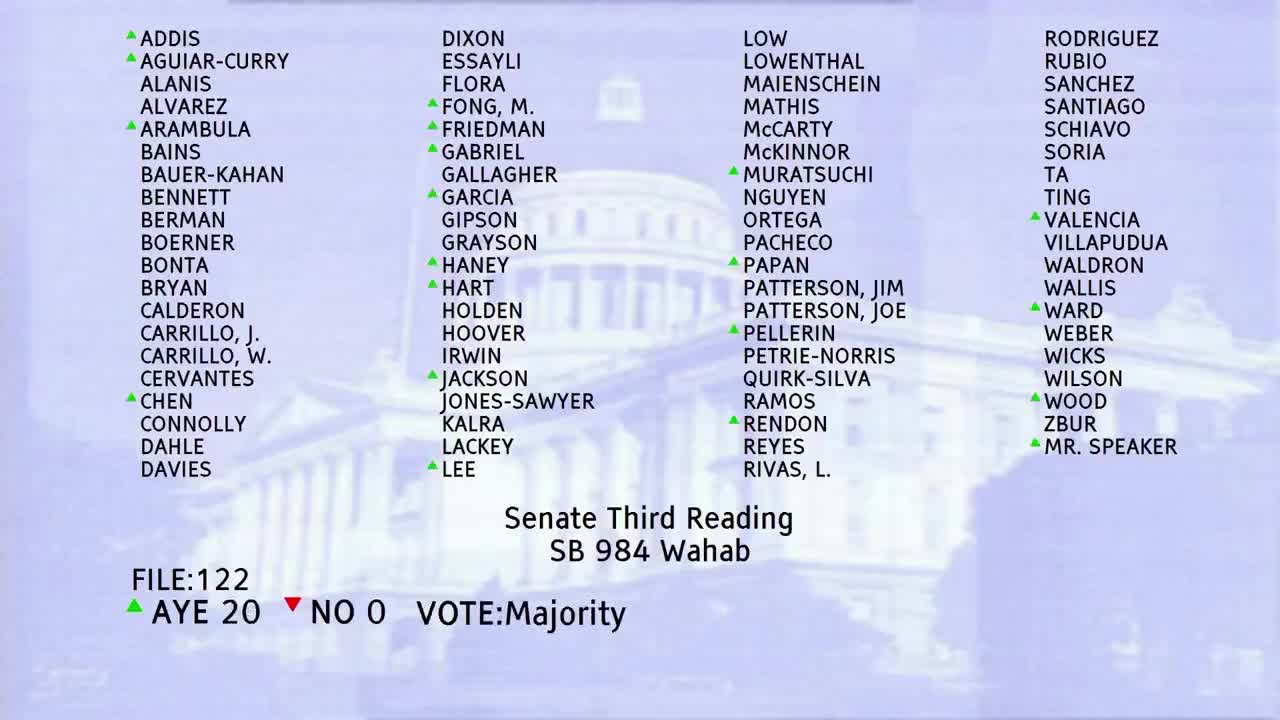
Bill Author

Bill Co-Author(s):