SB 1243: Campaign contributions: agency officers.
- Session Year: 2023-2024
- House: Senate
- Latest Version Date: 2024-09-30
Current Status:
Passed
(2024-09-30: Chaptered by Secretary of State. Chapter 1017, Statutes of 2024.)
Introduced
In Committee
First Chamber
In Committee
Second Chamber
Enacted
The Political Reform Act of 1974 prohibits certain contributions of more than $250 to an officer of an agency by any party, participant, or party or participants agent in a proceeding while a proceeding involving a license, permit, or other entitlement for use is pending before the agency and for 12 months following the date a final decision is rendered in the proceeding, as specified. The act requires disclosure on the record of the proceeding, as specified, of certain contributions of more than $250 within the preceding 12 months to an officer from a party or participant, or partys agent. The act disqualifies an officer from participating in a decision in a proceeding if the officer has willfully or knowingly received a contribution of more than $250 from a party or a partys agent, or a participant or a participants agent, as specified. The act allows an officer to cure certain violations of these provisions by returning a contribution, or the portion of the contribution of in excess of $250, within 14 days of accepting, soliciting, or receiving the contribution, whichever comes latest.
This bill would raise the threshold for contributions regulated by these provisions to $500, as specified. The bill would extend the period during which an officer may cure a violation to within 30 days of accepting, soliciting, or directing the contribution, whichever is latest. The bill would specify that a person is not a participant for the purposes of these provisions if their financial interest in a decision results solely from an increase or decrease in membership dues. The bill would exempt from these provisions contracts valued under $50,000, contracts between 2 or more government agencies, contracts where no party receives financial compensation, and the periodic review or renewal of development agreements, as specified, from these provisions.
This bill would incorporate additional changes to Section 84308 of the Government Code proposed by SB 1181 to be operative only if this bill and SB 1181 are enacted and this bill is enacted last.
The Political Reform Act of 1974, an initiative measure, provides that the Legislature may amend the act to further the acts purposes upon a 2/3 vote of each house of the Legislature and compliance with specified procedural requirements.
This bill would declare that it furthers the purposes of the act.
The Political Reform Act of 1974 prohibits certain contributions of more than $250 to an officer of an agency by any party, participant, or party or participants agent in a proceeding while a proceeding involving a license, permit, or other entitlement for use is pending before the agency and for 12 months following the date a final decision is rendered in the proceeding, as specified. The act requires disclosure on the record of the proceeding, as specified, of certain contributions of more than $250 within the preceding 12 months to an officer from a party or participant, or partys agent. The act disqualifies an officer from participating in a decision in a proceeding if the officer has willfully or knowingly received a contribution of more than $250 from a party or a partys agent, or a participant or a participants agent, as specified. The act allows an officer to cure certain violations of these provisions by returning a contribution, or the portion of the contribution of in excess of $250, within 14 days of accepting, soliciting, or receiving the contribution, whichever comes latest.
This bill would raise the threshold for contributions regulated by these provisions to $500, as specified. The bill would extend the period during which an officer may cure a violation to within 30 days of accepting, soliciting, or directing the contribution, whichever is latest. The bill would specify that a person is not a participant for the purposes of these provisions if their financial interest in a decision results solely from an increase or decrease in membership dues. The bill would clarify when a person is considered to be an agent of a party to, or participant in, a pending proceeding. The bill would exempt from these provisions contracts valued under $50,000, contracts between 2 or more government agencies, contracts where no party receives financial compensation, and the periodic review or renewal of development agreements and competitively bid contracts unless there is a material modification or amendment proposed to the agreement, agreements, as specified, from these provisions.
This bill would incorporate additional changes to Section 84308 of the Government Code proposed by SB 1181 to be operative only if this bill and SB 1181 are enacted and this bill is enacted last.
The Political Reform Act of 1974, an initiative measure, provides that the Legislature may amend the act to further the acts purposes upon a 2/3 vote of each house of the Legislature and compliance with specified procedural requirements.
This bill would declare that it furthers the purposes of the act.
The Political Reform Act of 1974 prohibits certain contributions of more than $250 to an officer of an agency by any party, participant, or party or participants agent in a proceeding while a proceeding involving a license, permit, or other entitlement for use is pending before the agency and for 12 months following the date a final decision is rendered in the proceeding, as specified. The act requires disclosure on the record of the proceeding, as specified, of certain contributions of more than $250 within the preceding 12 months to an officer from a party or participant, or partys agent. The act disqualifies an officer from participating in a decision in a proceeding if the officer has willfully or knowingly received a contribution of more than $250 from a party or a partys agent, or a participant or a participants agent, as specified. The act allows an officer to cure certain violations of these provisions by returning a contribution, or the portion of the contribution of in excess of $250, within 14 days of accepting, soliciting, or receiving the contribution, whichever comes latest.
This bill would raise the threshold for contributions regulated by these provisions to $1,000, $500, as specified. The bill would extend the period during which an officer may cure a violation to within 30 days of accepting, soliciting, or directing the contribution, whichever is latest. The bill would specify that a person is not a participant for the purposes of these provisions if their financial interest in a decision results solely from an increase or decrease in membership dues. The bill would clarify when a person is considered to be an agent of a party to, or participant in, a pending proceeding. The bill would exempt from these provisions contracts valued under $50,000, contracts between two 2 or more government agencies, contracts where neither no party receives financial compensation, and the periodic review or renewal of development projects agreements and competitively bid contracts unless there is a material modification or amendment proposed to the agreement, as specified, from these provisions.
The Political Reform Act of 1974, an initiative measure, provides that the Legislature may amend the act to further the acts purposes upon a 2/3 vote of each house of the Legislature and compliance with specified procedural requirements.
This bill would declare that it furthers the purposes of the act.
The Political Reform Act of 1974 prohibits certain contributions of more than $250 to an officer of an agency by any party, participant, or party or participants agent in a proceeding while a proceeding involving a license, permit, or other entitlement for use is pending before the agency and for 12 months following the date a final decision is rendered in the proceeding, as specified. The act requires disclosure on the record of the proceeding, as specified, of certain contributions of more than $250 within the preceding 12 months to an officer from a party or participant, or partys agent. The act disqualifies an officer from participating in a decision in a proceeding if the officer has willfully or knowingly received a contribution of more than $250 from a party or a partys agent, or a participant or a participants agent, as specified. The act allows an officer to cure certain violations of these provisions by returning a contribution, or the portion of the contribution of in excess of $250, within 14 days of accepting, soliciting, or receiving the contribution, whichever comes latest.
This bill would raise the threshold for contributions regulated by these provisions to $1,000, as specified. The bill would extend the period during which an officer may cure a violation to within 30 days of accepting, soliciting, or directing the contribution, whichever is latest. The bill would specify that a person is not a participant for the purposes of these provisions if their financial interest in a decision results solely from an increase or decrease in membership dues. The bill would clarify when a person is considered to be an agent of a party to, or participant in, a pending proceeding. The bill would exempt contracts between two or more government agencies, contracts where neither party receives financial compensation, and the periodic review of development projects from these provisions.
The Political Reform Act of 1974, an initiative measure, provides that the Legislature may amend the act to further the acts purposes upon a 2/3 vote of each house of the Legislature and compliance with specified procedural requirements.
This bill would declare that it furthers the purposes of the act.
The Political Reform Act of 1974 prohibits certain contributions of more than $250 to an officer of an agency by any party, participant, or party or participants agent in a proceeding while a proceeding involving a license, permit, or other entitlement for use is pending before the agency and for 12 months following the date a final decision is rendered in the proceeding, as specified. The act requires disclosure on the record of the proceeding, as specified, of certain contributions of more than $250 within the preceding 12 months to an officer from a party or participant, or partys agent. The act disqualifies an officer from participating in a decision in a proceeding if the officer has willfully or knowingly received a contribution of more than $250 from a party or a partys agent, or a participant or a participants agent, as specified. The act allows an officer to cure certain violations of these provisions by returning a contribution, or the portion of the contribution of in excess of $250, within 14 days of accepting, soliciting, or receiving the contribution, whichever comes latest.
This bill would raise the threshold for contributions regulated by these provisions to $1,000, as specified. The bill would limit the prohibition on contributions made during and after a proceeding to the 9 months after a final decision in a proceeding is made, and it would extend the period during which an officer may cure a violation to within 30 days of accepting, soliciting, or directing the contribution, whichever is latest. The bill would specify that a person is not a participant for the purposes of these provisions if their financial interest in a decision results solely from an increase or decrease in membership dues. The bill would prohibit an agent of a party or participant from making any contribution to an officer during a proceeding and for 9 months after a final decision is made, and it would further clarify when a person is considered to be an agent for these purposes. of a party to, or participant in, a pending proceeding. The bill would exempt contracts between two or more government agencies, contracts where neither party receives financial compensation, and the periodic review of development projects from these provisions.
The Political Reform Act of 1974, an initiative measure, provides that the Legislature may amend the act to further the acts purposes upon a 2/3 vote of each house of the Legislature and compliance with specified procedural requirements.
This bill would declare that it furthers the purposes of the act.
The Political Reform Act of 1974 prohibits certain contributions of more than $250 to an officer of an agency by any party, participant, or party or participants agent in a proceeding while a proceeding involving a license, permit, or other entitlement for use is pending before the agency and for 12 months following the date a final decision is rendered in the proceeding, as specified. The act requires disclosure on the record of the proceeding, as specified, of certain contributions of more than $250 within the preceding 12 months to an officer from a party or participant, or partys agent. The act disqualifies an officer from participating in a decision in a proceeding if the officer has willfully or knowingly received a contribution of more than $250 from a party or a partys agent, or a participant or a participants agent, as specified. The act allows an officer to cure certain violations of these provisions by returning a contribution, or the portion of the contribution of in excess of $250, within 14 days of accepting, soliciting, or receiving the contribution, whichever comes latest.
This bill would raise the threshold for contributions regulated by these provisions to $1,000, as specified. The bill would limit the prohibition on contributions made during and after a proceeding to the 9 months before and after a final decision in a proceeding is made, and it would extend the period during which an officer may cure a violation to within 30 days of accepting, soliciting, or directing the contribution, whichever is latest. The bill would specify that a person is not a participant for the purposes of these provisions if their financial interest in a decision results solely from an increase or decrease in membership dues. The bill would prohibit an agent of a party or participant from making any contribution to an officer during a proceeding and for 9 months after a final decision is made, and it would further clarify when a person is considered to be an agent for these purposes. The bill would exempt specified housing the periodic review of development projects from these provisions.
The Political Reform Act of 1974, an initiative measure, provides that the Legislature may amend the act to further the acts purposes upon a 2/3 vote of each house of the Legislature and compliance with specified procedural requirements.
This bill would declare that it furthers the purposes of the act.
The Political Reform Act of 1974 prohibits certain contributions of more than $250 to an officer of an agency by any party, participant, or party or participants agent in a proceeding while a proceeding involving a license, permit, or other entitlement for use is pending before the agency and for 12 months following the date a final decision is rendered in the proceeding, as specified. The act requires disclosure on the record of the proceeding, as specified, of certain contributions of more than $250 within the preceding 12 months to an officer from a party or participant, or partys agent. The act disqualifies an officer from participating in a decision in a proceeding if the officer has willfully or knowingly received a contribution of more than $250 from a party or a partys agent, or a participant or a participants agent, as specified. The act allows an officer to cure certain violations of these provisions by returning a contribution, or the portion of the contribution of in excess of $250, within 14 days of accepting, soliciting, or receiving the contribution, whichever comes latest.
This bill would raise the threshold for contributions regulated by these provisions to $1,000, as specified. The bill would limit the prohibition on contributions made during and after a proceeding to the 9 months before and after a final decision in a proceeding is made, and it would extend the period during which an officer may cure a violation to within 30 days of accepting, soliciting, or directing the contribution, whichever is latest. The bill would specify that a person is not a participant for the purposes of these provisions if their financial interest in a decision results solely from an increase or decrease in membership dues. The bill would exempt specified housing development projects from these provisions.
The Political Reform Act of 1974, an initiative measure, provides that the Legislature may amend the act to further the acts purposes upon a 2/3 vote of each house of the Legislature and compliance with specified procedural requirements.
This bill would declare that it furthers the purposes of the act.
Existing law generally provides that a contingent or unknown event that may damnify a person with an insurable interest, or create a liability against the person, may be insured against.This bill would make technical, nonsubstantive changes to that provision.Existing law generally provides that a contingent or unknown event that may damnify a person with an insurable interest, or create a liability against the person, may be insured against.
This bill would make technical, nonsubstantive changes to that provision.
(a)The definitions set forth in this subdivision shall govern the interpretation of this section.
(1)Party means any person who files an application for, or is the subject of, a proceeding involving a license, permit, or other entitlement for use.
(2)Participant means any person who is not a party but who actively supports or opposes a particular decision in a proceeding involving a license, permit, or other entitlement for use and who has a financial interest in the decision, as described in Article 1 (commencing with Section 87100) of Chapter 7. A person actively supports or opposes a particular decision in a proceeding if that person lobbies in person the officers or employees of the agency, testifies in person before the agency, or otherwise acts to influence officers of the agency. A person is not a participant under this paragraph if their financial interest in the decision results solely from an increase or decrease in membership dues.
(3)Agency means an agency as defined in Section 82003 except that it does not include the courts or any agency in the judicial branch of government, the Legislature, the Board of Equalization, or constitutional officers. However, this section applies to any person who is a member of an exempted agency but is acting as a voting member of another agency.
(4)Officer means any elected or appointed officer of an agency, any alternate to an elected or appointed officer of an agency, and any candidate for elective office in an agency.
(5)(A)Except as provided in subparagraph (B), license, permit, or other entitlement for use means all business, professional, trade, and land use licenses and permits and all other entitlements for use, including all entitlements for land use, all contracts, and all franchises.
(B)License, permit, or other entitlement for use does not include any of the following:
(i)Competitively bid contracts that are required by law, agency policy, or agency rule to be awarded pursuant to a competitive process.
(ii)Labor contracts.
(iii)Personal employment contracts.
(iv)Contracts valued under fifty thousand dollars ($50,000).
(v)Contracts where no party receives financial compensation.
(vi)Contracts between two or more agencies.
(vii)The periodic review or renewal of development agreements unless there is a material modification or amendment proposed to the agreement. Non-material modifications or amendments may be approved by agency staff.
(6)Contribution includes contributions to candidates and committees in federal, state, or local elections.
(7)Pending in a proceeding involving a license, permit, or other entitlement for use means either of the following:
(A)For an officer, when either of the following occurs:
(i)An item involving the license, permit, or other entitlement for use is placed on the agenda for discussion or decision at a public meeting of the body of which the officer is a member.
(ii)The officer knows a proceeding involving a license, permit, or other entitlement for use is within the jurisdiction of the officers agency for its decision or other action, and it is reasonably foreseeable that the decision will come before the officer in the officers decisionmaking capacity.
(B)For a party or partys agent, or a participant or participants agent, when an application is filed with an agency, or, if the proceeding process does not require an application, when the proceeding is before the agency for its decision or other action.
(b)(1)While a proceeding involving a license, permit, or other entitlement for use is pending, and for 12 months following the date a final decision is rendered in the proceeding, an officer of an agency shall not accept, solicit, or direct a contribution of more than five hundred dollars ($500) from any party or a partys agent, or from any participant or a participants agent if the officer knows or has reason to know that the participant has a financial interest, as that term is used in Article 1 (commencing with Section 87100) of Chapter 7. This prohibition applies regardless of whether the officer accepts, solicits, or directs the contribution on the officers own behalf, or on behalf of any other officer, or on behalf of any candidate for office or on behalf of any committee.
(2)With respect to elected officers, paragraph (1) applies only if the elected officer or the body of which they are a member has the authority to make any decision or recommendation in the proceeding.
(c)(1)Before rendering any decision in a proceeding involving a license, permit, or other entitlement for use, each officer of the agency who received a contribution within the preceding 12 months in an amount of more than five hundred dollars ($500) from a party or from any participant shall disclose that fact on the record of the proceeding. An officer of an agency shall not make, participate in making, or in any way attempt to use the officers official position to influence the decision in a proceeding involving a license, permit, or other entitlement for use if the officer has willfully or knowingly received a contribution in an amount of more than five hundred dollars ($500) within the preceding 12 months from a party or a partys agent, or from any participant or a participants agent if the officer knows or has reason to know that the participant has a financial interest in the decision, as that term is described with respect to public officials in Article 1 (commencing with Section 87100) of Chapter 7.
(2)With respect to elected officers, paragraph (1) applies only if the elected officer or the body of which they are a member has the authority to make any decision or recommendation in the proceeding.
(d)(1)If an officer receives a contribution that would otherwise require disqualification under this section, and returns the contribution within 30 days from the time the officer makes any decision, or knows, or should have known, about the contribution and the proceeding involving a license, permit, or other entitlement for use, whichever comes last, the officer shall be permitted to participate in the proceeding.
(2)(A)Subject to subparagraph (B), if an officer accepts, solicits, or directs a contribution of more than five hundred dollars ($500) during the 12 months after the date the final decision is rendered in violation of subdivision (b), the officer may cure the violation by returning the contribution, or the portion of the contribution in excess of five hundred dollars ($500), within 30 days of accepting, soliciting, or directing the contribution, whichever comes latest.
(B)An officer may cure a violation as specified in subparagraph (A) only if the officer did not knowingly and willfully accept, solicit, or direct the prohibited contribution.
(C)An officers controlled committee, or the officer if no controlled committee exists, shall maintain records of curing any violation pursuant to this paragraph.
(e)(1)A party to a proceeding before an agency involving a license, permit, or other entitlement for use shall disclose on the record of the proceeding any contribution in an amount of more than five hundred dollars ($500) made within the preceding 12 months before the date that any decision is rendered by the agency by the party or the partys agent.
(2)A party to a proceeding involving a license, permit, or other entitlement for use pending before any agency or a participant in the proceeding shall not make a contribution of more than five hundred dollars ($500) to any officer of that agency during the proceeding and for 12 months following the date the final decision is rendered by the agency in the proceeding.
(3)An agent to a party or participant shall not make a contribution in any amount to an officer during the time periods described in paragraph (2).
(4)When a closed corporation is a party to, or a participant in, a proceeding involving a license, permit, or other entitlement for use pending before an agency, the majority shareholder is subject to the disclosure and prohibition requirements specified in this section.
(f)This section shall not be construed to imply that any contribution subject to being reported under this title shall not be so reported.
(g)For purposes of this section, in determining whether a contribution has exceeded five hundred dollars ($500), the contributions of an agent shall not be aggregated with contributions from a party or participant.
(h)(1)Except as provided in paragraph (2), the provisions of this act are severable. If any provision of this act or its application is held invalid, that invalidity shall not affect other provisions or applications that can be given effect without the invalid provision or application.
(2)Subdivision (g) is not severable from paragraph (3) of subdivision (e) if paragraph (3) of subdivision (e) is held invalid in a final decision of a court of competent jurisdiction. If that occurs, subdivision (g) shall become inoperative on the date of that final decision.
SEC. 1.5.Section 84308 of the Government Code is amended to read:84308.(a)The definitions set forth in this subdivision shall govern the interpretation of this section.
(1)Party means any person who files an application for, or is the subject of, a proceeding involving a license, permit, or other entitlement for use.
(2)Participant means any person who is not a party but who actively supports or opposes a particular decision in a proceeding involving a license, permit, or other entitlement for use and who has a financial interest in the decision, as described in Article 1 (commencing with Section 87100) of Chapter 7. A person actively supports or opposes a particular decision in a proceeding if that person lobbies in person the officers or employees of the agency, testifies in person before the agency, or otherwise acts to influence officers of the agency. A person is not a participant under this paragraph if their financial interest in the decision results solely from an increase or decrease in membership dues.
(3)Agency means an agency as defined in Section 82003 except that it does not include the courts or any agency in the judicial branch of government, the Legislature, the Board of Equalization, or constitutional officers. However, this section applies to any person who is a member of an exempted agency but is acting as a voting member of another agency.
(4)Officer means any elected or appointed officer of an agency, any alternate to an elected or appointed officer of an agency, and any candidate for elective office in an agency, other than a city attorney or county counsel providing legal advice to the agency who does not have the authority to make a final decision in the proceeding.
(5)(A)Except as provided in subparagraph (B), license, permit, or other entitlement for use means all business, professional, trade, and land use licenses and permits and all other entitlements for use, including all entitlements for land use, all contracts, and all franchises.
(B)License, permit, or other entitlement for use does not include any of the following:
(i)Competitively bid contracts that are required by law, agency policy, or agency rule to be awarded pursuant to a competitive process.
(ii)Labor contracts.
(iii)Personal employment contracts.
(iv)Contracts valued under fifty thousand dollars ($50,000).
(v)Contracts where no party receives financial compensation.
(vi)Contracts between two or more agencies.
(vii)The periodic review or renewal of development agreements unless there is a material modification or amendment proposed to the agreement. Non-material modifications or amendments may be approved by agency staff.
(viii)The periodic review or renewal of competitively bid contracts unless there are material modifications or amendments proposed to the agreement that are valued at more than 10 percent of the value of the contract or fifty thousand dollars ($50,000), whichever is less. Non-material modifications or amendments may be approved by agency staff.
(ix)Modification of or amendments to contracts that are exempt under this subparagraph, other than competitively bid contracts.
(6)Contribution includes contributions to candidates and committees in federal, state, or local elections.
(7)Pending in a proceeding involving a license, permit, or other entitlement for use means either of the following:
(A)For an officer, when either of the following occurs:
(i)An item involving the license, permit, or other entitlement for use is placed on the agenda for discussion or decision at a public meeting of the body of which the officer is a member.
(ii)The officer knows a proceeding involving a license, permit, or other entitlement for use is within the jurisdiction of the officers agency for its decision or other action, and it is reasonably foreseeable that the decision will come before the officer in the officers decisionmaking capacity.
(B)For a party or partys agent, or a participant or participants agent, when an application is filed with an agency, or, if the proceeding process does not require an application, when the proceeding is before the agency for its decision or other action.
(b)(1)While a proceeding involving a license, permit, or other entitlement for use is pending, and for 12 months following the date a final decision is rendered in the proceeding, an officer of an agency shall not accept, solicit, or direct a contribution of more than five hundred dollars ($500) from any party or a partys agent, or from any participant or a participants agent if the officer knows or has reason to know that the participant has a financial interest, as that term is used in Article 1 (commencing with Section 87100) of Chapter 7. This prohibition applies regardless of whether the officer accepts, solicits, or directs the contribution on the officers own behalf, or on behalf of any other officer, or on behalf of any candidate for office or on behalf of any committee.
(2)With respect to elected officers, paragraph (1) applies only if the elected officer or the body of which they are a member has the authority to make any decision or recommendation in the proceeding.
(c)(1)Before rendering any decision in a proceeding involving a license, permit, or other entitlement for use, each officer of the agency who received a contribution within the preceding 12 months in an amount of more than five hundred dollars ($500) from a party or from any participant shall disclose that fact on the record of the proceeding. An officer of an agency shall not make, participate in making, or in any way attempt to use the officers official position to influence the decision in a proceeding involving a license, permit, or other entitlement for use if the officer has willfully or knowingly received a contribution in an amount of more than five hundred dollars ($500) within the preceding 12 months from a party or a partys agent, or from any participant or a participants agent if the officer knows or has reason to know that the participant has a financial interest in the decision, as that term is described with respect to public officials in Article 1 (commencing with Section 87100) of Chapter 7.
(2)With respect to elected officers, paragraph (1) applies only if the elected officer or the body of which they are a member has the authority to make any decision or recommendation in the proceeding.
(d)(1)If an officer receives a contribution that would otherwise require disqualification under this section, and returns the contribution within 30 days from the time the officer makes any decision, or knows, or should have known, about the contribution and the proceeding involving a license, permit, or other entitlement for use, whichever comes last, the officer shall be permitted to participate in the proceeding.
(2)(A)Subject to subparagraph (B), if an officer accepts, solicits, or directs a contribution of more than five hundred dollars ($500) during the 12 months after the date the final decision is rendered in violation of subdivision (b), the officer may cure the violation by returning the contribution, or the portion of the contribution in excess of five hundred dollars ($500), within 30 days of accepting, soliciting, or directing the contribution, whichever comes latest.
(B)An officer may cure a violation as specified in subparagraph (A) only if the officer did not knowingly and willfully accept, solicit, or direct the prohibited contribution.
(C)An officers controlled committee, or the officer if no controlled committee exists, shall maintain records of curing any violation pursuant to this paragraph.
(e)(1)A party to a proceeding before an agency involving a license, permit, or other entitlement for use shall disclose on the record of the proceeding any contribution in an amount of more than five hundred dollars ($500) made within the preceding 12 months before the date that any decision is rendered by the agency by the party or the partys agent.
(2)A party to a proceeding involving a license, permit, or other entitlement for use pending before any agency or a participant in the proceeding shall not make a contribution of more than five hundred dollars ($500) to any officer of that agency during the proceeding and for 12 months following the date the final decision is rendered by the agency in the proceeding.
(3)An agent to a party or participant shall not make a contribution in any amount to an officer during the time periods described in paragraph (2).
(4)When a closed corporation is a party to, or a participant in, a proceeding involving a license, permit, or other entitlement for use pending before an agency, the majority shareholder is subject to the disclosure and prohibition requirements specified in this section.
(f)This section shall not be construed to imply that any contribution subject to being reported under this title shall not be so reported.
(g)For the purposes of this section, in determining whether a contribution has exceeded five hundred dollars ($500), the contributions of an agent shall not be aggregated with contributions from a party or participant.
(h)(1)A person is the agent of a party to, or a participant in, a pending proceeding involving a license, permit, or other entitlement for use only if the person represents that party or participant for compensation and appears before or otherwise communicates with an agency for the purpose of influencing the proceeding on behalf of a party or participant.
(2)If an individual acting as an agent is also acting as an employee or member of a law, architectural, engineering, or consulting firm, or a similar entity or corporation, both the entity or corporation and the individual are agents.
(3)Agent includes a lobbyist registered to lobby the agency and who otherwise meets the requirements of paragraph (1).
(4)Communicate with the agency for the purpose of influencing the proceeding does not include either of the following:
(A)Preparing drawings or submissions of an architectural, engineering, or similar nature for a client to submit in a proceeding before the agency if both of the following conditions are met:
(i)The work is performed pursuant to the persons profession.
(ii)The person does not make any contact with the agency other than contact with agency staff concerning the process or evaluation of the documents prepared by the person.
(B)Providing technical data or analysis to an agency if the person does not otherwise engage in direct communication for the purpose of influencing the proceeding.
(i)(1)Except as provided in paragraph (2), the provisions of this act are severable. If any provision of this act or its application is held invalid, that invalidity shall not affect other provisions or applications that can be given effect without the invalid provision or application.
(2)Subdivision (g) is not severable from paragraph (3) of subdivision (e) if paragraph (3) of subdivision (e) is held invalid in a final decision of a court of competent jurisdiction. If that occurs, subdivision (g) shall become inoperative on the date of that final decision.
SEC. 2.The Legislature finds and declares that banning agents of parties and participants from contributing to officers in specified situations, as provided in Section 1 of this act, is necessary and narrowly tailored to address the state interest of preventing corruption and the appearance of corruption.
SEC. 3.Section 1.5 of this bill incorporates amendments to Section 84308 of the Government Code proposed by both this bill and Senate Bill 1181. That section of this bill shall only become operative if (1) both bills are enacted and become effective on or before January 1, 2025, (2) each bill amends Section 84308 of the Government Code, and (3) this bill is enacted after Senate Bill 1181, in which case Section 1 of this bill shall not become operative.
SEC. 4.The Legislature finds and declares that this bill furthers the purposes of the Political Reform Act of 1974 within the meaning of subdivision (a) of Section 81012 of the Government Code.
(a)The definitions set forth in this subdivision shall govern the interpretation of this section.
(1)Party means any person who files an application for, or is the subject of, a proceeding involving a license, permit, or other entitlement for use.
(2)Participant means any person who is not a party but who actively supports or opposes a particular decision in a proceeding involving a license, permit, or other entitlement for use and who has a financial interest in the decision, as described in Article 1 (commencing with Section 87100) of Chapter 7. A person actively supports or opposes a particular decision in a proceeding if that person lobbies in person the officers or employees of the agency, testifies in person before the agency, or otherwise acts to influence officers of the agency. A person is not a participant under this paragraph if their financial interest in the decision results solely from an increase or decrease in membership dues.
(3)Agency means an agency as defined in Section 82003 except that it does not include the courts or any agency in the judicial branch of government, the Legislature, the Board of Equalization, or constitutional officers. However, this section applies to any person who is a member of an exempted agency but is acting as a voting member of another agency.
(4)Officer means any elected or appointed officer of an agency, any alternate to an elected or appointed officer of an agency, and any candidate for elective office in an agency.
(5)(A)Except as provided in subparagraph (B), license, permit, or other entitlement for use means all business, professional, trade, and land use licenses and permits and all other entitlements for use, including all entitlements for land use, all contracts, and all franchises.
(B)License, permit, or other entitlement for use does not include any of the following:
(i)Competitively bid contracts that are required by law, agency policy, or agency rule to be awarded pursuant to a competitive process.
(ii)Labor contracts.
(iii)Personal employment contracts.
(iv)Contracts valued under fifty thousand dollars ($50,000).
(v)Contracts where no party receives financial compensation.
(vi)Contracts between two or more agencies.
(vii)The periodic review or renewal of development agreements unless there is a material modification or amendment proposed to the agreement. Non-material modifications or amendments may be approved by agency staff.
(viii)The periodic review or renewal of competitively bid contracts unless there are material modifications or amendments proposed to the agreement that are valued at more than 10 percent of the value of the contract or fifty thousand dollars ($50,000), whichever is less. Non-material modifications or amendments may be approved by agency staff.(ix)Modification of or amendments to contracts that are exempt under this subparagraph, other than competitively bid contracts.(6)Contribution includes contributions to candidates and committees in federal, state, or local elections.
(7)Pending in a proceeding involving a license, permit, or other entitlement for use means either of the following:
(A)For an officer, when either of the following occurs:
(i)An item involving the license, permit, or other entitlement for use is placed on the agenda for discussion or decision at a public meeting of the body of which the officer is a member.
(ii)The officer knows a proceeding involving a license, permit, or other entitlement for use is within the jurisdiction of the officers agency for its decision or other action, and it is reasonably foreseeable that the decision will come before the officer in the officers decisionmaking capacity.
(B)For a party or partys agent, or a participant or participants agent, when an application is filed with an agency. agency, or, if the proceeding process does not require an application, when the proceeding is before the agency for its decision or other action.
(b)(1)While a proceeding involving a license, permit, or other entitlement for use is pending, and for 12 months following the date a final decision is rendered in the proceeding, an officer of an agency shall not accept, solicit, or direct a contribution of more than five hundred dollars ($500) from any party or a partys agent, or from any participant or a participants agent if the officer knows or has reason to know that the participant has a financial interest, as that term is used in Article 1 (commencing with Section 87100) of Chapter 7. This prohibition applies regardless of whether the officer accepts, solicits, or directs the contribution on the officers own behalf, or on behalf of any other officer, or on behalf of any candidate for office or on behalf of any committee.
(2)(A)With respect to elected officers, paragraph (1) applies only if the elected officer or the body of which they are a member has the authority to make any decision or recommendation in the proceeding.
(B)Paragraph (1) does not apply to a city attorney or county counsel providing legal advice to the agency who does not have the authority to make a decision in the proceeding.(c)(1)Before rendering any decision in a proceeding involving a license, permit, or other entitlement for use, each officer of the agency who received a contribution within the preceding 12 months in an amount of more than five hundred dollars ($500) from a party or from any participant shall disclose that fact on the record of the proceeding. An officer of an agency shall not make, participate in making, or in any way attempt to use the officers official position to influence the decision in a proceeding involving a license, permit, or other entitlement for use if the officer has willfully or knowingly received a contribution in an amount of more than five hundred dollars ($500) within the preceding 12 months from a party or a partys agent, or from any participant or a participants agent if the officer knows or has reason to know that the participant has a financial interest in the decision, as that term is described with respect to public officials in Article 1 (commencing with Section 87100) of Chapter 7.
(2)(A)With respect to elected officers, paragraph (1) applies only if the elected officer or the body of which they are a member has the authority to make any decision or recommendation in the proceeding.
(B)Paragraph (1) does not apply to a city attorney or county counsel providing legal advice to the agency who does not have the authority to make a decision in the proceeding.(d)(1)If an officer receives a contribution that would otherwise require disqualification under this section, and returns the contribution within 30 days from the time the officer makes any decision, or knows, or should have known, about the contribution and the proceeding involving a license, permit, or other entitlement for use, whichever comes last, the officer shall be permitted to participate in the proceeding.
(2)(A)Subject to subparagraph (B), if an officer accepts, solicits, or directs a contribution of more than five hundred dollars ($500) during the 12 months after the date the final decision is rendered in violation of subdivision (b), the officer may cure the violation by returning the contribution, or the portion of the contribution in excess of five hundred dollars ($500), within 30 days of accepting, soliciting, or directing the contribution, whichever comes latest.
(B)An officer may cure a violation as specified in subparagraph (A) only if the officer did not knowingly and willfully accept, solicit, or direct the prohibited contribution.
(C)An officers controlled committee, or the officer if no controlled committee exists, shall maintain records of curing any violation pursuant to this paragraph.
(e)(1)A party to a proceeding before an agency involving a license, permit, or other entitlement for use shall disclose on the record of the proceeding any contribution in an amount of more than five hundred dollars ($500) made within the preceding 12 months before the date that any decision is rendered by the agency by the party or the partys agent.
(2)A party to a proceeding involving a license, permit, or other entitlement for use pending before any agency or a participant in the proceeding shall not make a contribution of more than five hundred dollars ($500) to any officer of that agency during the proceeding and for 12 months following the date the final decision is rendered by the agency in the proceeding.
(3)An agent to a party or participant shall not make a contribution in any amount to an officer during the time periods described in paragraph (2).
(4)When a closed corporation is a party to, or a participant in, a proceeding involving a license, permit, or other entitlement for use pending before an agency, the majority shareholder is subject to the disclosure and prohibition requirements specified in this section.
(f)This section shall not be construed to imply that any contribution subject to being reported under this title shall not be so reported.
(g)For purposes of this section, in determining whether a contribution has exceeded five hundred dollars ($500), the contributions of an agent shall not be aggregated with contributions from a party or participant.
(h)(1)A person is the agent of a party to, or a participant in, a pending proceeding involving a license, permit, or other entitlement for use only if the person represents that party or participant for compensation and appears before or otherwise communicates with an agency for the purpose of influencing the proceeding on behalf of a party or participant.(2)If an individual acting as an agent is also acting as an employee or member of a law, architectural, engineering, or consulting firm, or a similar entity or corporation, both the entity or corporation and the individual are agents.(3)Agent includes a lobbyist registered with the local jurisdiction who otherwise meets the requirements of paragraph (1).(4)Communicate with the agency for the purpose of influencing the proceeding does not include either of the following:(A)Preparing drawings or submissions of an architectural, engineering, or similar nature for a client to submit in a proceeding before the agency if both of the following conditions are met:(i)The work is performed pursuant to the persons profession.(ii)The person does not make any contact with the agency other than contact with agency staff concerning the process or evaluation of the documents prepared by the person.(B)Providing technical data or analysis to an agency if the person does not otherwise engage in direct communication for the purpose of influencing the proceeding.(i)(h)(1)Except as provided in paragraph (2), the provisions of this act are severable. If any provision of this act or its application is held invalid, that invalidity shall not affect other provisions or applications that can be given effect without the invalid provision or application.
(2)Subdivision (g) is not severable from paragraph (3) of subdivision (e) if paragraph (3) of subdivision (e) is held invalid in a final decision of a court of competent jurisdiction. If that occurs, subdivision (g) shall become inoperative on the date of that final decision.
SEC. 1.5.Section 84308 of the Government Code is amended to read:84308.(a)The definitions set forth in this subdivision shall govern the interpretation of this section.
(1)Party means any person who files an application for, or is the subject of, a proceeding involving a license, permit, or other entitlement for use.
(2)Participant means any person who is not a party but who actively supports or opposes a particular decision in a proceeding involving a license, permit, or other entitlement for use and who has a financial interest in the decision, as described in Article 1 (commencing with Section 87100) of Chapter 7. A person actively supports or opposes a particular decision in a proceeding if that person lobbies in person the officers or employees of the agency, testifies in person before the agency, or otherwise acts to influence officers of the agency. A person is not a participant under this paragraph if their financial interest in the decision results solely from an increase or decrease in membership dues.
(3)Agency means an agency as defined in Section 82003 except that it does not include the courts or any agency in the judicial branch of government, the Legislature, the Board of Equalization, or constitutional officers. However, this section applies to any person who is a member of an exempted agency but is acting as a voting member of another agency.
(4)Officer means any elected or appointed officer of an agency, any alternate to an elected or appointed officer of an agency, and any candidate for elective office in an agency. agency, other than a city attorney or county counsel providing legal advice to the agency who does not have the authority to make a final decision in the proceeding.
(5)License, (A)Except as provided in subparagraph (B), license, permit, or other entitlement for use means all business, professional, trade, and land use licenses and permits and all other entitlements for use, including all entitlements for land use, all contracts (other than competitively bid, labor, or personal employment contracts), contracts, and all franchises.
(B)License, permit, or other entitlement for use does not include any of the following:
(i)Competitively bid contracts that are required by law, agency policy, or agency rule to be awarded pursuant to a competitive process.
(ii)Labor contracts.
(iii)Personal employment contracts.
(iv)Contracts valued under fifty thousand dollars ($50,000).
(v)Contracts where no party receives financial compensation.
(vi)Contracts between two or more agencies.
(vii)The periodic review or renewal of development agreements unless there is a material modification or amendment proposed to the agreement. Non-material modifications or amendments may be approved by agency staff.
(viii)The periodic review or renewal of competitively bid contracts unless there are material modifications or amendments proposed to the agreement that are valued at more than 10 percent of the value of the contract or fifty thousand dollars ($50,000), whichever is less. Non-material modifications or amendments may be approved by agency staff.
(ix)Modification of or amendments to contracts that are exempt under this subparagraph, other than competitively bid contracts.
(6)Contribution includes contributions to candidates and committees in federal, state, or local elections.
(7)Pending in a proceeding involving a license, permit, or other entitlement for use means either of the following:
(A)For an officer, when either of the following occurs:
(i)An item involving the license, permit, or other entitlement for use is placed on the agenda for discussion or decision at a public meeting of the body of which the officer is a member.
(ii)The officer knows a proceeding involving a license, permit, or other entitlement for use is within the jurisdiction of the officers agency for its decision or other action, and it is reasonably foreseeable that the decision will come before the officer in the officers decisionmaking capacity.
(B)For a party or partys agent, or a participant or participants agent, when an application is filed with an agency, or, if the proceeding process does not require an application, when the proceeding is before the agency for its decision or other action.
(b)(1)While a proceeding involving a license, permit, or other entitlement for use is pending, and for 12 months following the date a final decision is rendered in the proceeding, an officer of an agency shall not accept, solicit, or direct a contribution of more than two hundred fifty dollars ($250) five hundred dollars ($500) from any party or a partys agent, or from any participant or a participants agent if the officer knows or has reason to know that the participant has a financial interest, as that term is used in Article 1 (commencing with Section 87100) of Chapter 7. This prohibition shall apply applies regardless of whether the officer accepts, solicits, or directs the contribution on the officers own behalf, or on behalf of any other officer, or on behalf of any candidate for office or on behalf of any committee.
(2)With respect to elected officers, paragraph (1) applies only if the elected officer or the body of which they are a member has the authority to make any decision or recommendation in the proceeding.
(c)Prior to (1)Before rendering any decision in a proceeding involving a license, permit, or other entitlement for use pending before an agency, use, each officer of the agency who received a contribution within the preceding 12 months in an amount of more than two hundred fifty dollars ($250) five hundred dollars ($500) from a party or from any participant shall disclose that fact on the record of the proceeding. An officer of an agency shall not make, participate in making, or in any way attempt to use the officers official position to influence the decision in a proceeding involving a license, permit, or other entitlement for use pending before the agency if the officer has willfully or knowingly received a contribution in an amount of more than two hundred fifty dollars ($250) five hundred dollars ($500) within the preceding 12 months from a party or a partys agent, or from any participant or a participants agent if the officer knows or has reason to know that the participant has a financial interest in the decision, as that term is described with respect to public officials in Article 1 (commencing with Section 87100) of Chapter 7.
(2)With respect to elected officers, paragraph (1) applies only if the elected officer or the body of which they are a member has the authority to make any decision or recommendation in the proceeding.
(d)(1)If an officer receives a contribution which that would otherwise require disqualification under this section, and returns the contribution within 30 days from the time the officer makes any decision, or knows, or should have known, about the contribution and the proceeding involving a license, permit, or other entitlement for use, whichever comes last, the officer shall be permitted to participate in the proceeding.
(2)(A)Subject to subparagraph (B), if an officer accepts, solicits, or directs a contribution of more than two hundred fifty dollars ($250) five hundred dollars ($500) during the 12 months after the date a the final decision is rendered in the proceeding in violation of subdivision (b), the officer may cure the violation by returning the contribution, or the portion of the contribution in excess of two hundred fifty dollars ($250), five hundred dollars ($500), within 14 30 days of accepting, soliciting, or directing the contribution, whichever comes latest.
(B)An officer may cure a violation as specified in subparagraph (A) only if the officer did not knowingly and willfully accept, solicit, or direct the prohibited contribution.
(C)An officers controlled committee, or the officer if no controlled committee exists, shall maintain records of curing any violation pursuant to this paragraph.
(e)(1)A party to a proceeding before an agency involving a license, permit, or other entitlement for use shall disclose on the record of the proceeding any contribution in an amount of more than two hundred fifty dollars ($250) five hundred dollars ($500) made within the preceding 12 months before the date that any decision is rendered by the agency by the party or the partys agent.
(2)A party, or agent to a party, party to a proceeding involving a license, permit, or other entitlement for use pending before any agency or a participant, or agent to a participant, participant in the proceeding shall not make a contribution of more than two hundred fifty dollars ($250) five hundred dollars ($500) to any officer of that agency during the proceeding and for 12 months following the date a the final decision is rendered by the agency in the proceeding.
(3)An agent to a party or participant shall not make a contribution in any amount to an officer during the time periods described in paragraph (2).
(3)(4)When a closed corporation is a party to, or a participant in, a proceeding involving a license, permit, or other entitlement for use pending before an agency, the majority shareholder is subject to the disclosure and prohibition requirements specified in this section.
(f)This section shall not be construed to imply that any contribution subject to being reported under this title shall not be so reported.
(g)For the purposes of this section, in determining whether a contribution has exceeded five hundred dollars ($500), the contributions of an agent shall not be aggregated with contributions from a party or participant.
(h)(1)A person is the agent of a party to, or a participant in, a pending proceeding involving a license, permit, or other entitlement for use only if the person represents that party or participant for compensation and appears before or otherwise communicates with an agency for the purpose of influencing the proceeding on behalf of a party or participant.
(2)If an individual acting as an agent is also acting as an employee or member of a law, architectural, engineering, or consulting firm, or a similar entity or corporation, both the entity or corporation and the individual are agents.
(3)Agent includes a lobbyist registered to lobby the agency and who otherwise meets the requirements of paragraph (1).
(4)Communicate with the agency for the purpose of influencing the proceeding does not include either of the following:
(A)Preparing drawings or submissions of an architectural, engineering, or similar nature for a client to submit in a proceeding before the agency if both of the following conditions are met:
(i)The work is performed pursuant to the persons profession.
(ii)The person does not make any contact with the agency other than contact with agency staff concerning the process or evaluation of the documents prepared by the person.
(B)Providing technical data or analysis to an agency if the person does not otherwise engage in direct communication for the purpose of influencing the proceeding.
(i)(1)Except as provided in paragraph (2), the provisions of this act are severable. If any provision of this act or its application is held invalid, that invalidity shall not affect other provisions or applications that can be given effect without the invalid provision or application.
(2)Subdivision (g) is not severable from paragraph (3) of subdivision (e) if paragraph (3) of subdivision (e) is held invalid in a final decision of a court of competent jurisdiction. If that occurs, subdivision (g) shall become inoperative on the date of that final decision.
SEC. 2.The Legislature finds and declares that banning agents of parties and participants from contributing to officers in specified situations, as provided in Section 1 of this act, is necessary and narrowly tailored to address the state interest of preventing corruption and the appearance of corruption.
SEC. 3.Section 1.5 of this bill incorporates amendments to Section 84308 of the Government Code proposed by both this bill and Senate Bill 1181. That section of this bill shall only become operative if (1) both bills are enacted and become effective on or before January 1, 2025, (2) each bill amends Section 84308 of the Government Code, and (3) this bill is enacted after Senate Bill 1181, in which case Section 1 of this bill shall not become operative.
SEC. 3.SEC. 4.The Legislature finds and declares that this bill furthers the purposes of the Political Reform Act of 1974 within the meaning of subdivision (a) of Section 81012 of the Government Code.
(a)The definitions set forth in this subdivision shall govern the interpretation of this section.
(1)Party means any person who files an application for, or is the subject of, a proceeding involving a license, permit, or other entitlement for use.
(2)Participant means any person who is not a party but who actively supports or opposes a particular decision in a proceeding involving a license, permit, or other entitlement for use and who has a financial interest in the decision, as described in Article 1 (commencing with Section 87100) of Chapter 7. A person actively supports or opposes a particular decision in a proceeding if that person lobbies in person the officers or employees of the agency, testifies in person before the agency, or otherwise acts to influence officers of the agency. A person is not a participant under this paragraph if their financial interest in the decision results solely from an increase or decrease in membership dues.
(3)Agency means an agency as defined in Section 82003 except that it does not include the courts or any agency in the judicial branch of government, the Legislature, the Board of Equalization, or constitutional officers. However, this section applies to any person who is a member of an exempted agency but is acting as a voting member of another agency.
(4)Officer means any elected or appointed officer of an agency, any alternate to an elected or appointed officer of an agency, and any candidate for elective office in an agency.
(5)License, (A)Except as provided in subparagraph (B), license, permit, or other entitlement for use means all business, professional, trade, and land use licenses and permits and all other entitlements for use, including all entitlements for land use, all contracts (other than competitively bid, labor, or personal employment contracts, contracts between two or more government agencies, contracts where neither party receives financial compensation, and the periodic review of development agreements unless there is a material modification or amendment proposed to the agreement) contracts, and all franchises.
(6)Competitively bid contract means a contract that is required by law, agency policy, or agency rule to be awarded to the highest or lowest responsible bidder with a responsive bid.(B)License, permit, or other entitlement for use does not include any of the following:
(i)Competitively bid contracts that are required by law, agency policy, or agency rule to be awarded pursuant to a competitive process.
(ii)Labor contracts.
(iii)Personal employment contracts.
(iv)Contracts valued under fifty thousand dollars ($50,000).
(v)Contracts where no party receives financial compensation.
(vi)Contracts between two or more agencies.
(vii)The periodic review or renewal of development agreements unless there is a material modification or amendment proposed to the agreement. Non-material modifications or amendments may be approved by agency staff.
(viii)The periodic review or renewal of competitively bid contracts unless there are material modifications or amendments proposed to the agreement that are valued at more than 10 percent of the value of the contract or fifty thousand dollars ($50,000), whichever is less. Non-material modifications or amendments may be approved by agency staff.
(ix)Modification of or amendments to contracts that are exempt under this subparagraph, other than competitively bid contracts.
(7)(6)Contribution includes contributions to candidates and committees in federal, state, or local elections.
(8)(7)Pending in a proceeding involving a license, permit, or other entitlement for use means either of the following:
(A)For an officer, when either of the following occurs:
(i)An item involving the license, permit, or other entitlement for use is placed on the agenda for discussion or decision at a public meeting of the body of which the officer is a member.
(ii)The officer knows a proceeding involving a license, permit, or other entitlement for use is within the jurisdiction of the officers agency for its decision or other action, and that it it is reasonably foreseeable that the decision will come before the officer in the officer's officers decisionmaking capacity.
(B)For a party or partys agent, or a participant or participants agent, when an application is filed with an agency.
(b)(1)While a proceeding involving a license, permit, or other entitlement for use is pending, and for 12 months following the date a final decision is rendered in the proceeding, an officer of an agency shall not accept, solicit, or direct a contribution of more than one thousand dollars ($1,000) five hundred dollars ($500) from any party or a partys agent, or from any participant or a participants agent if the officer knows or has reason to know that the participant has a financial interest, as that term is used in Article 1 (commencing with Section 87100) of Chapter 7. This prohibition shall apply applies regardless of whether the officer accepts, solicits, or directs the contribution on the officers own behalf, or on behalf of any other officer, or on behalf of any candidate for office or on behalf of any committee.
(2)(A)With respect to elected officers, paragraph (1) applies only if the elected officer or the body of which they are a member has the authority to make any decision or recommendation in the proceeding.
(B)Paragraph (1) does not apply to a city attorney or county counsel providing legal advice to the agency who does not have the authority to make a decision in the proceeding.
(c)(1)Before rendering a final any decision in a proceeding involving a license, permit, or other entitlement for use, each officer of the agency who received a contribution within the preceding 12 months in an amount of more than one thousand dollars ($1,000) five hundred dollars ($500) from a party or from any participant shall disclose that fact on the record of the proceeding. An officer of an agency shall not make, participate in making, or in any way attempt to use the officers official position to influence the final decision in a proceeding involving a license, permit, or other entitlement for use if the officer has willfully or knowingly received a contribution in an amount of more than one thousand dollars ($1,000) five hundred dollars ($500) within the preceding 12 months from a party or a partys agent, or from any participant or a participants agent if the officer knows or has reason to know that the participant has a financial interest in the decision, as that term is described with respect to public officials in Article 1 (commencing with Section 87100) of Chapter 7.
(2)(A)With respect to elected officers, paragraph (1) applies only if the elected officer or the body of which they are a member has the authority to make any decision or recommendation in the proceeding.
(B)Paragraph (1) does not apply to a city attorney or county counsel providing legal advice to the agency who does not have the authority to make a decision in the proceeding.
(d)(1)If an officer receives a contribution which that would otherwise require disqualification under this section, and returns the contribution within 30 days from the time the officer makes any decision, or knows, or should have known, about the contribution and the proceeding involving a license, permit, or other entitlement for use, or before rendering any decision in the proceeding, whichever comes latest, last, the officer shall be permitted to participate in the proceeding.
(2)(A)Subject to subparagraph (B), if an officer accepts, solicits, or directs a contribution of more than one thousand dollars ($1,000) five hundred dollars ($500) during the 12 months after the date the final decision is rendered in violation of subdivision (b), the officer may cure the violation by returning the contribution, or the portion of the contribution in excess of one thousand dollars ($1,000), five hundred dollars ($500), within 30 days of accepting, soliciting, or directing the contribution, whichever comes latest.
(B)An officer may cure a violation as specified in subparagraph (A) only if the officer did not knowingly and willfully accept, solicit, or direct the prohibited contribution.
(C)An officers controlled committee, or the officer if no controlled committee exists, shall maintain records of curing any violation pursuant to this paragraph.
(e)(1)A party to a proceeding before an agency involving a license, permit, or other entitlement for use shall disclose on the record of the proceeding any contribution in an amount of more than one thousand dollars ($1,000) five hundred dollars ($500) made within the preceding 12 months before the date that the final any decision is rendered by the agency by the party or the partys agent.
(2)A party to a proceeding involving a license, permit, or other entitlement for use pending before any agency or a participant in the proceeding shall not make a contribution of more than one thousand dollars ($1,000) five hundred dollars ($500) to any officer of that agency during the proceeding and for 12 months following the date the final decision is rendered by the agency in the proceeding. An
(3)An agent to a party or participant shall not make a contribution in any amount to an officer during the time periods described in this paragraph. paragraph (2).
(3)(4)When a closed corporation is a party to, or a participant in, a proceeding involving a license, permit, or other entitlement for use pending before an agency, the majority shareholder is subject to the disclosure and prohibition requirements specified in this section.
(f)This section shall not be construed to imply that any contribution subject to being reported under this title shall not be so reported.
(g)For the purposes of this section, in determining whether a contribution has exceeded one thousand dollars ($1,000), five hundred dollars ($500), the contributions of an agent shall not be aggregated with contributions from a party or participant.
(h)(1)A person is the agent of a party to, or a participant in, a pending proceeding involving a license, permit, or other entitlement for use only if the person represents that party or participant for compensation and appears before or otherwise communicates with an agency for the purpose of influencing the proceeding on behalf of a party or participant.
(2)If an individual acting as an agent is also acting as an employee or member of a law, architectural, engineering, or consulting firm, or a similar entity or corporation, both the entity or corporation and the individual are agents.
(3)Agent includes a lobbyist registered with the local jurisdiction who otherwise meets the requirements of paragraph (1).
(4)Communicate with the agency for the purpose of influencing the proceeding does not include either of the following:
(A)Preparing drawings or submissions of an architectural, engineering, or similar nature for a client to submit in a proceeding before the agency if both of the following conditions are met:
(i)The work is performed pursuant to the persons profession.
(ii)The person does not make any contact with the agency other than contact with agency staff concerning the process or evaluation of the documents prepared by the person.
(B)Providing technical data or analysis to an agency if the person does not otherwise engage in direct communication for the purpose of influencing the proceeding.
(i)(1)Except as provided in paragraph (2), the provisions of this act are severable. If any provision of this act or its application is held invalid, that invalidity shall not affect other provisions or applications that can be given effect without the invalid provision or application.
(2)Subdivision (g) is not severable from paragraph (3) of subdivision (e) if paragraph (3) of subdivision (e) is held invalid in a final decision of a court of competent jurisdiction. If that occurs, subdivision (g) shall become inoperative on the date of that final decision.
SEC. 2.The Legislature finds and declares that banning agents of parties and participants from contributing to officers in specified situations, as provided in Section 1 of this act, is necessary and narrowly tailored to address the state interest of preventing corruption and the appearance of corruption.
SEC. 2.SEC. 3.The Legislature finds and declares that this bill furthers the purposes of the Political Reform Act of 1974 within the meaning of subdivision (a) of Section 81012 of the Government Code.
(a)The definitions set forth in this subdivision shall govern the interpretation of this section.
(1)Party means any person who files an application for, or is the subject of, a proceeding involving a license, permit, or other entitlement for use.
(2)Participant means any person who is not a party but who actively supports or opposes a particular decision in a proceeding involving a license, permit, or other entitlement for use and who has a financial interest in the decision, as described in Article 1 (commencing with Section 87100) of Chapter 7. A person actively supports or opposes a particular decision in a proceeding if that person lobbies in person the officers or employees of the agency, testifies in person before the agency, or otherwise acts to influence officers of the agency. A person is not a participant under this paragraph if their financial interest in the decision results solely from an increase or decrease in membership dues.
(3)Agency means an agency as defined in Section 82003 except that it does not include the courts or any agency in the judicial branch of government, the Legislature, the Board of Equalization, or constitutional officers. However, this section applies to any person who is a member of an exempted agency but is acting as a voting member of another agency.
(4)Officer means any elected or appointed officer of an agency, any alternate to an elected or appointed officer of an agency, and any candidate for elective office in an agency.
(5)License, permit, or other entitlement for use means all business, professional, trade, and land use licenses and permits and all other entitlements for use, including all entitlements for land use, all contracts (other than competitively bid, labor, or personal employment contracts, contracts between two or more government agencies, contracts where neither party receives financial compensation, and the periodic review of development agreements) agreements unless there is a material modification or amendment proposed to the agreement) and all franchises.
(6)Competitively bid contract means a contract that is required by law, agency policy, or agency rule to be awarded to the highest or lowest responsible bidder with a responsive bid.
(7)Contribution includes contributions to candidates and committees in federal, state, or local elections.
(8)Pending in a proceeding involving a license, permit, or other entitlement for use means either of the following:
(A)For an officer, when either of the following occurs:
(i)An item involving the license, permit, or other entitlement for use is placed on the agenda for discussion or decision at a public meeting of the body of which the officer is a member.
(ii)The officer knows a proceeding involving a license, permit, or other entitlement for use is within the jurisdiction of the officers agency for its decision or other action, and that it will come before the officer in the officer's decisionmaking capacity.
(B)For a party or partys agent, or a participant or participants agent, when an application is filed with an agency.
(b)While a proceeding involving a license, permit, or other entitlement for use is pending, and for 12 months following the date a final decision is rendered in the proceeding, an officer of an agency shall not accept, solicit, or direct a contribution of more than one thousand dollars ($1,000) from any party or a partys agent, or from any participant or a participants agent if the officer knows or has reason to know that the participant has a financial interest, as that term is used in Article 1 (commencing with Section 87100) of Chapter 7. This prohibition shall apply regardless of whether the officer accepts, solicits, or directs the contribution on the officers own behalf, or on behalf of any other officer, or on behalf of any candidate for office or on behalf of any committee.
(c)Before rendering a final decision in a proceeding involving a license, permit, or other entitlement for use, each officer of the agency who received a contribution within the preceding 12 months in an amount of more than one thousand dollars ($1,000) from a party or from any participant shall disclose that fact on the record of the proceeding. An officer of an agency shall not make, participate in making, or in any way attempt to use the officers official position to influence the final decision in a proceeding involving a license, permit, or other entitlement for use if the officer has willfully or knowingly received a contribution in an amount of more than one thousand dollars ($1,000) within the preceding 12 months from a party or a partys agent, or from any participant or a participants agent if the officer knows or has reason to know that the participant has a financial interest in the decision, as that term is described with respect to public officials in Article 1 (commencing with Section 87100) of Chapter 7.
(d)(1)If an officer receives a contribution which would otherwise require disqualification under this section, and returns the contribution within 30 days from the time the officer knows, or should have known, about the contribution and the proceeding involving a license, permit, or other entitlement for use, or before rendering any decision in the proceeding, whichever comes latest, the officer shall be permitted to participate in the proceeding.
(2)(A)Subject to subparagraph (B), if an officer accepts, solicits, or directs a contribution of more than one thousand dollars ($1,000) during the 12 months after the date the final decision is rendered in violation of subdivision (b), the officer may cure the violation by returning the contribution, or the portion of the contribution in excess of one thousand dollars ($1,000), within 30 days of accepting, soliciting, or directing the contribution, whichever comes latest.
(B)An officer may cure a violation as specified in subparagraph (A) only if the officer did not knowingly and willfully accept, solicit, or direct the prohibited contribution.
(C)An officers controlled committee, or the officer if no controlled committee exists, shall maintain records of curing any violation pursuant to this paragraph.
(e)(1)A party to a proceeding before an agency involving a license, permit, or other entitlement for use shall disclose on the record of the proceeding any contribution in an amount of more than one thousand dollars ($1,000) made within the preceding 12 months before the date that the final decision is rendered by the agency by the party or the partys agent.
(2)A party to a proceeding involving a license, permit, or other entitlement for use pending before any agency or a participant in the proceeding shall not make a contribution of more than one thousand dollars ($1,000) to any officer of that agency during the proceeding and for 12 months following the date the final decision is rendered by the agency in the proceeding. An agent to a party or participant shall not make a contribution in any amount to an officer during the time periods described in this paragraph.
(3)When a closed corporation is a party to, or a participant in, a proceeding involving a license, permit, or other entitlement for use pending before an agency, the majority shareholder is subject to the disclosure and prohibition requirements specified in this section.
(f)This section shall not be construed to imply that any contribution subject to being reported under this title shall not be so reported.
(g)For the purposes of this section, in determining whether a contribution has exceeded one thousand dollars ($1,000), the contributions of an agent shall not be aggregated with contributions from a party or participant.
(h)(1)A person is the agent of a party to, or a participant in, a pending proceeding involving a license, permit, or other entitlement for use only if the person represents that party or participant for compensation and appears before or otherwise communicates with an agency for the purpose of influencing the proceeding on behalf of a party or participant.
(2)If an individual acting as an agent is also acting as an employee or member of a law, architectural, engineering, or consulting firm, or a similar entity or corporation, both the entity or corporation and the individual are agents.
(3)Agent includes a lobbyist registered with the local jurisdiction who otherwise meets the requirements of paragraph (1).
(4)Communicate with the agency for the purpose of influencing the proceeding does not include either of the following:
(A)Preparing drawings or submissions of an architectural, engineering, or similar nature for a client to submit in a proceeding before the agency if both of the following conditions are met:
(i)The work is performed pursuant to the persons profession.
(ii)The person does not make any contact with the agency other than contact with agency staff concerning the process or evaluation of the documents prepared by the person.
(B)Providing technical data or analysis to an agency if the person does not otherwise engage in direct communication for the purpose of influencing the proceeding.
SEC. 2.The Legislature finds and declares that this bill furthers the purposes of the Political Reform Act of 1974 within the meaning of subdivision (a) of Section 81012 of the Government Code.
(a)The definitions set forth in this subdivision shall govern the interpretation of this section.
(1)Party means any person who files an application for, or is the subject of, a proceeding involving a license, permit, or other entitlement for use.
(2)Participant means any person who is not a party but who actively supports or opposes a particular decision in a proceeding involving a license, permit, or other entitlement for use and who has a financial interest in the decision, as described in Article 1 (commencing with Section 87100) of Chapter 7. A person actively supports or opposes a particular decision in a proceeding if that person lobbies in person the officers or employees of the agency, testifies in person before the agency, or otherwise acts to influence officers of the agency. A person is not a participant under this paragraph if their financial interest in the decision results solely from an increase or decrease in membership dues.
(3)Agency means an agency as defined in Section 82003 except that it does not include the courts or any agency in the judicial branch of government, the Legislature, the Board of Equalization, or constitutional officers. However, this section applies to any person who is a member of an exempted agency but is acting as a voting member of another agency.
(4)Officer means any elected or appointed officer of an agency, any alternate to an elected or appointed officer of an agency, and any candidate for elective office in an agency.
(5)License, permit, or other entitlement for use means all business, professional, trade, and land use licenses and permits and all other entitlements for use, including all entitlements for land use, all contracts (other than competitively bid, labor, or personal employment contracts or contracts, contracts between two or more government agencies, contracts where neither party receives financial compensation, and the periodic review of development agreements) and all franchises.
(6)Competitively bid contract means a contract that is required by law, agency policy, or agency rule to be awarded to the highest or lowest responsible bidder with a responsive bid.
(6)(7)Contribution includes contributions to candidates and committees in federal, state, or local elections.
(7)(8)Pending in a proceeding involving a license, permit, or other entitlement for use means either of the following:
(A)For an officer, when either of the following occurs: any
(i)An item involving the license, permit, or other entitlement for use is placed on the agenda for discussion or decision at a public meeting of the body. body of which the officer is a member.
(ii)The officer knows a proceeding involving a license, permit, or other entitlement for use is within the jurisdiction of the officers agency for its decision or other action, and that it will come before the officer in the officer's decisionmaking capacity.
(B)For a party or partys agent, or a participant or participants agent, when an application is filed with an agency.
(b)While a proceeding involving a license, permit, or other entitlement for use is pending, and for 9 12 months following the date a final decision is rendered in the proceeding, an officer of an agency shall not accept, solicit, or direct a contribution of more than one thousand dollars ($1,000) from any party or a partys agent, or from any participant or a participants agent if the officer knows or has reason to know that the participant has a financial interest, as that term is used in Article 1 (commencing with Section 87100) of Chapter 7. This prohibition shall apply regardless of whether the officer accepts, solicits, or directs the contribution on the officers own behalf, or on behalf of any other officer, or on behalf of any candidate for office or on behalf of any committee.
(c)Before rendering a final decision in a proceeding involving a license, permit, or other entitlement for use, each officer of the agency who received a contribution within the preceding 9 12 months in an amount of more than one thousand dollars ($1,000) from a party or from any participant shall disclose that fact on the record of the proceeding. An officer of an agency shall not make, participate in making, or in any way attempt to use the officers official position to influence the final decision in a proceeding involving a license, permit, or other entitlement for use if the officer has willfully or knowingly received a contribution in an amount of more than one thousand dollars ($1,000) within the preceding 9 12 months from a party or a partys agent, or from any participant or a participants agent if the officer knows or has reason to know that the participant has a financial interest in the decision, as that term is described with respect to public officials in Article 1 (commencing with Section 87100) of Chapter 7.
(d)(1)If an officer receives a contribution which would otherwise require disqualification under this section, and returns the contribution within 30 days from the time the officer knows, or should have known, about the contribution and the proceeding involving a license, permit, or other entitlement for use, or before rendering any decision in the proceeding, whichever comes latest, the officer shall be permitted to participate in the proceeding.
(2)(A)Subject to subparagraph (B), if an officer accepts, solicits, or directs a contribution of more than one thousand dollars ($1,000) during the 9 12 months after the date the final decision is rendered in violation of subdivision (b), the officer may cure the violation by returning the contribution, or the portion of the contribution in excess of one thousand dollars ($1,000), within 30 days of accepting, soliciting, or directing the contribution, whichever comes latest.
(B)An officer may cure a violation as specified in subparagraph (A) only if the officer did not knowingly and willfully accept, solicit, or direct the prohibited contribution.
(C)An officers controlled committee, or the officer if no controlled committee exists, shall maintain records of curing any violation pursuant to this paragraph.
(e)(1)A party to a proceeding before an agency involving a license, permit, or other entitlement for use shall disclose on the record of the proceeding any contribution in an amount of more than one thousand dollars ($1,000) made within the preceding 9 12 months before the date that the final decision is rendered by the agency by the party or the partys agent.
(2)A party to a proceeding involving a license, permit, or other entitlement for use pending before any agency or a participant in the proceeding shall not make a contribution of more than one thousand dollars ($1,000) to any officer of that agency during the proceeding and for 9 12 months following the date the final decision is rendered by the agency in the proceeding. An agent to a party or participant shall not make a contribution in any amount to an officer during the time periods described in this paragraph.
(3)When a closed corporation is a party to, or a participant in, a proceeding involving a license, permit, or other entitlement for use pending before an agency, the majority shareholder is subject to the disclosure and prohibition requirements specified in this section.
(f)This section shall not be construed to imply that any contribution subject to being reported under this title shall not be so reported.
(g)For the purposes of this section, in determining whether a contribution has exceeded one thousand dollars ($1,000), the contributions of an agent shall not be aggregated with contributions from a party or participant.
(h)(1)A person is the agent of a party to, or a participant in, a pending proceeding involving a license, permit, or other entitlement for use only if the person represents that party or participant for compensation or otherwise communicates with an agency for the purpose of influencing the proceeding on behalf of a party or participant.
(2)If an individual acting as an agent is also acting as an employee or member of a law, architectural, engineering, or consulting firm, or a similar entity or corporation, both the entity or corporation and the individual are agents.
(3)Agent includes a lobbyist registered with the local jurisdiction who otherwise meets the requirements of paragraph (1).
(4)Communicate with the agency for the purpose of influencing the proceeding does not include either of the following:
(A)Preparing drawings or submissions of an architectural, engineering, or similar nature for a client to submit in a proceeding before the agency if both of the following conditions are met:
(i)The work is performed pursuant to the persons profession.
(ii)The person does not make any contact with the agency other than contact with agency staff concerning the process or evaluation of the documents prepared by the person.
(B)Providing technical data or analysis to an agency if the person does not otherwise engage in direct communication for the purpose of influencing the proceeding.
SEC. 2.The Legislature finds and declares that this bill furthers the purposes of the Political Reform Act of 1974 within the meaning of subdivision (a) of Section 81012 of the Government Code.
(a)The definitions set forth in this subdivision shall govern the interpretation of this section.
(1)Party means any person who files an application for, or is the subject of, a proceeding involving a license, permit, or other entitlement for use.
(2)Participant means any person who is not a party but who actively supports or opposes a particular decision in a proceeding involving a license, permit, or other entitlement for use and who has a financial interest in the decision, as described in Article 1 (commencing with Section 87100) of Chapter 7. A person actively supports or opposes a particular decision in a proceeding if that person lobbies in person the officers or employees of the agency, testifies in person before the agency, or otherwise acts to influence officers of the agency. A person is not a participant under this paragraph if their financial interest in the decision results solely from an increase or decrease in membership dues.
(3)Agency means an agency as defined in Section 82003 except that it does not include the courts or any agency in the judicial branch of government, the Legislature, the Board of Equalization, or constitutional officers. However, this section applies to any person who is a member of an exempted agency but is acting as a voting member of another agency.
(4)Officer means any elected or appointed officer of an agency, any alternate to an elected or appointed officer of an agency, and any candidate for elective office in an agency.
(5)License, permit, or other entitlement for use means all business, professional, trade, and land use licenses and permits and all other entitlements for use, including all entitlements for land use, all contracts (other than competitively bid, labor, or personal employment contracts) contracts or the periodic review of contracts, development agreements) and all franchises.
(6)Contribution includes contributions to candidates and committees in federal, state, or local elections.
(7)Pending in a proceeding involving a license, permit, or other entitlement for use means either of the following:
(A)For an officer, when any item involving the license, permit, or other entitlement for use is placed on the agenda for discussion or decision at a public meeting of the body.
(B)For a party or partys agent, or a participant or participants agent, when an application is filed with an agency.
(b)Beginning 9 months before the date a final decision is rendered for While a proceeding involving a license, permit, or other entitlement for use, use is pending, and for 9 months following the date a final decision is rendered in the proceeding, an officer of an agency shall not accept, solicit, or direct a contribution of more than one thousand dollars ($1,000) from any party or a partys agent, or from any participant or a participants agent if the officer knows or has reason to know that the participant has a financial interest, as that term is used in Article 1 (commencing with Section 87100) of Chapter 7. This prohibition shall apply regardless of whether the officer accepts, solicits, or directs the contribution on the officers own behalf, or on behalf of any other officer, or on behalf of any candidate for office or on behalf of any committee. This subdivision does not apply before an application has been filed or a proceeding has otherwise commenced.
(c)Before rendering a final decision in a proceeding involving a license, permit, or other entitlement for use, each officer of the agency who received a contribution within the preceding 9 months in an amount of more than one thousand dollars ($1,000) from a party or from any participant shall disclose that fact on the record of the proceeding. An officer of an agency shall not make, participate in making, or in any way attempt to use the officers official position to influence the final decision in a proceeding involving a license, permit, or other entitlement for use if the officer has willfully or knowingly received a contribution in an amount of more than one thousand dollars ($1,000) within the preceding 9 months from a party or a partys agent, or from any participant or a participants agent if the officer knows or has reason to know that the participant has a financial interest in the decision, as that term is described with respect to public officials in Article 1 (commencing with Section 87100) of Chapter 7.
(d)(1)If an officer receives a contribution which would otherwise require disqualification under this section, and returns the contribution within 30 days from the time the officer knows, or should have known, about the contribution and the proceeding involving a license, permit, or other entitlement for use, the officer shall be permitted to participate in the proceeding.
(2)(A)Subject to subparagraph (B), if an officer accepts, solicits, or directs a contribution of more than one thousand dollars ($1,000) during the 9 months before or after the date the final decision is rendered in violation of subdivision (b), the officer may cure the violation by returning the contribution, or the portion of the contribution in excess of one thousand dollars ($1,000), within 30 days of accepting, soliciting, or directing the contribution, whichever comes latest.
(B)An officer may cure a violation as specified in subparagraph (A) only if the officer did not knowingly and willfully accept, solicit, or direct the prohibited contribution.
(C)An officers controlled committee, or the officer if no controlled committee exists, shall maintain records of curing any violation pursuant to this paragraph.
(e)(1)A party to a proceeding before an agency involving a license, permit, or other entitlement for use shall disclose on the record of the proceeding any contribution in an amount of more than one thousand dollars ($1,000) made within the preceding 9 months before the date that the final decision is rendered by the agency by the party or the partys agent.
(2)A party, or agent to a party, party to a proceeding involving a license, permit, or other entitlement for use pending before any agency or a participant, or agent to a participant, participant in the proceeding shall not make a contribution of more than one thousand dollars ($1,000) to any officer of that agency within 9 months before or after during the proceeding and for 9 months following the date the final decision is rendered by the agency in the proceeding. This paragraph does not apply before an application has been filed or a proceeding has otherwise commenced. An agent to a party or participant shall not make a contribution in any amount to an officer during the time periods described in this paragraph.
(3)When a closed corporation is a party to, or a participant in, a proceeding involving a license, permit, or other entitlement for use pending before an agency, the majority shareholder is subject to the disclosure and prohibition requirements specified in this section.
(f)This section shall not be construed to imply that any contribution subject to being reported under this title shall not be so reported.
(g)For the purposes of this section, in determining whether a contribution has exceeded one thousand dollars ($1,000), the contributions of an agent shall not be aggregated with contributions from a party or participant.
(h)This section does not apply to housing development projects that conform with the requirements of Article 10.6 (commencing with Section 65580) of Chapter 3 of Division 1 of Title 7.(h)(1)A person is the agent of a party to, or a participant in, a pending proceeding involving a license, permit, or other entitlement for use only if the person represents that party or participant for compensation or otherwise communicates with agency for the purpose of influencing the proceeding on behalf of a party or participant.
(2)If an individual acting as an agent is also acting as an employee or member of a law, architectural, engineering, or consulting firm, or a similar entity or corporation, both the entity or corporation and the individual are agents.
(3)Agent includes a lobbyist registered with the local jurisdiction who otherwise meets the requirements of paragraph (1).
(4)Communicate with the agency for the purpose of influencing the proceeding does not include either of the following:
(A)Preparing drawings or submissions of an architectural, engineering, or similar nature for a client to submit in a proceeding before the agency if both of the following conditions are met:
(i)The work is performed pursuant to the persons profession.
(ii)The person does not make any contact with the agency other than contact with agency staff concerning the process or evaluation of the documents prepared by the person.
(B)Providing technical data or analysis to an agency if the person does not otherwise engage in direct communication for the purpose of influencing the proceeding.
SEC. 2.The Legislature finds and declares that this bill furthers the purposes of the Political Reform Act of 1974 within the meaning of subdivision (a) of Section 81012 of the Government Code.
(a)The definitions set forth in this subdivision shall govern the interpretation of this section.
(1)Party means any person who files an application for, or is the subject of, a proceeding involving a license, permit, or other entitlement for use.
(2)Participant means any person who is not a party but who actively supports or opposes a particular decision in a proceeding involving a license, permit, or other entitlement for use and who has a financial interest in the decision, as described in Article 1 (commencing with Section 87100) of Chapter 7. A person actively supports or opposes a particular decision in a proceeding if that person lobbies in person the officers or employees of the agency, testifies in person before the agency, or otherwise acts to influence officers of the agency. A person is not a participant under this paragraph if their financial interest in the decision results solely from an increase or decrease in membership dues.
(3)Agency means an agency as defined in Section 82003 except that it does not include the courts or any agency in the judicial branch of government, the Legislature, the Board of Equalization, or constitutional officers. However, this section applies to any person who is a member of an exempted agency but is acting as a voting member of another agency.
(4)Officer means any elected or appointed officer of an agency, any alternate to an elected or appointed officer of an agency, and any candidate for elective office in an agency.
(5)License, permit, or other entitlement for use means all business, professional, trade, and land use licenses and permits and all other entitlements for use, including all entitlements for land use, all contracts (other than competitively bid, labor, or personal employment contracts), contracts) or the periodic review of contracts, and all franchises.
(6)Contribution includes contributions to candidates and committees in federal, state, or local elections.
(b)While a proceeding involving Beginning 9 months before the date a final decision is rendered for a license, permit, or other entitlement for use is pending, use, and for 12 9 months following the date a final decision is rendered in the proceeding, an officer of an agency shall not accept, solicit, or direct a contribution of more than two hundred fifty dollars ($250) one thousand dollars ($1,000) from any party or a partys agent, or from any participant or a participants agent if the officer knows or has reason to know that the participant has a financial interest, as that term is used in Article 1 (commencing with Section 87100) of Chapter 7. This prohibition shall apply regardless of whether the officer accepts, solicits, or directs the contribution on the officers own behalf, or on behalf of any other officer, or on behalf of any candidate for office or on behalf of any committee. This subdivision does not apply before an application has been filed or a proceeding has otherwise commenced.
(c)Prior to Before rendering any a final decision in a proceeding involving a license, permit, or other entitlement for use pending before an agency, use, each officer of the agency who received a contribution within the preceding 12 9 months in an amount of more than two hundred fifty dollars ($250) one thousand dollars ($1,000) from a party or from any participant shall disclose that fact on the record of the proceeding. An officer of an agency shall not make, participate in making, or in any way attempt to use the officers official position to influence the final decision in a proceeding involving a license, permit, or other entitlement for use pending before the agency if the officer has willfully or knowingly received a contribution in an amount of more than two hundred fifty dollars ($250) one thousand dollars ($1,000) within the preceding 12 9 months from a party or a partys agent, or from any participant or a participants agent if the officer knows or has reason to know that the participant has a financial interest in the decision, as that term is described with respect to public officials in Article 1 (commencing with Section 87100) of Chapter 7.
(d)(1)If an officer receives a contribution which would otherwise require disqualification under this section, and returns the contribution within 30 days from the time the officer knows, or should have known, about the contribution and the proceeding involving a license, permit, or other entitlement for use, the officer shall be permitted to participate in the proceeding.
(2)(A)Subject to subparagraph (B), if an officer accepts, solicits, or directs a contribution of more than two hundred fifty dollars ($250) one thousand dollars ($1,000) during the 12 9 months before or after the date a the final decision is rendered in the proceeding in violation of subdivision (b), the officer may cure the violation by returning the contribution, or the portion of the contribution in excess of two hundred fifty dollars ($250), one thousand dollars ($1,000), within 14 30 days of accepting, soliciting, or directing the contribution, whichever comes latest.
(B)An officer may cure a violation as specified in subparagraph (A) only if the officer did not knowingly and willfully accept, solicit, or direct the prohibited contribution.
(C)An officers controlled committee, or the officer if no controlled committee exists, shall maintain records of curing any violation pursuant to this paragraph.
(e)(1)A party to a proceeding before an agency involving a license, permit, or other entitlement for use shall disclose on the record of the proceeding any contribution in an amount of more than two hundred fifty dollars ($250) one thousand dollars ($1,000) made within the preceding 12 9 months before the date that the final decision is rendered by the agency by the party or the partys agent.
(2)A party, or agent to a party, to a proceeding involving a license, permit, or other entitlement for use pending before any agency or a participant, or agent to a participant, in the proceeding shall not make a contribution of more than two hundred fifty dollars ($250) one thousand dollars ($1,000) to any officer of that agency during the proceeding and for 12 months following within 9 months before or after the date a the final decision is rendered by the agency in the proceeding. This paragraph does not apply before an application has been filed or a proceeding has otherwise commenced.
(3)When a closed corporation is a party to, or a participant in, a proceeding involving a license, permit, or other entitlement for use pending before an agency, the majority shareholder is subject to the disclosure and prohibition requirements specified in this section.
(f)This section shall not be construed to imply that any contribution subject to being reported under this title shall not be so reported.
(g)For the purposes of this section, in determining whether a contribution has exceeded one thousand dollars ($1,000), the contributions of an agent shall not be aggregated with contributions from a party or participant.
(h)This section does not apply to housing development projects that conform with the requirements of Article 10.6 (commencing with Section 65580) of Chapter 3 of Division 1 of Title 7.
SEC. 2.The Legislature finds and declares that this bill furthers the purposes of the Political Reform Act of 1974 within the meaning of subdivision (a) of Section 81012 of the Government Code.
SECTION 1.Section 250 of the Insurance Code is amended to read:250.Except as provided in this article, a contingent or unknown event, whether past or future, that may damnify a person having an insurable interest, or create a liability against the person, may be insured against, subject to the provisions of this code.Except as provided in this article, any a contingent or unknown event, whether past or future, which that may damnify a person having an insurable interest, or create a liability against him, the person, may be insured against, subject to the provisions of this code.
|
Date
|
Status
|
|---|---|
| Sep 30, 2024 | Chaptered by Secretary of State. Chapter 1017, Statutes of 2024. |
| Sep 30, 2024 | Approved by the Governor. |
| Sep 12, 2024 | Enrolled and presented to the Governor at 3 p.m. |
| Aug 31, 2024 | Assembly amendments concurred in. (Ayes 40. Noes 0. Page 5780.) Ordered to engrossing and enrolling. |
| Aug 31, 2024 | In Senate. Concurrence in Assembly amendments pending. |
| Aug 31, 2024 | Read third time. Passed. (Ayes 71. Noes 0. Page 7040.) Ordered to the Senate. |
| Aug 22, 2024 | Read third time and amended. |
| Aug 22, 2024 | Ordered to third reading. |
| Aug 19, 2024 | Read third time and amended. |
| Aug 19, 2024 | Ordered to third reading. |
| Jul 1, 2024 | Read second time. Ordered to third reading. |
| Jun 27, 2024 | Read second time and amended. Ordered to second reading. |
| Jun 26, 2024 | From committee: Do pass as amended. (Ayes 6. Noes 1.) (June 26). |
| Jun 19, 2024 | From committee with author's amendments. Read second time and amended. Re-referred to Com. on ELECTIONS. |
| May 28, 2024 | Referred to Com. on ELECTIONS. |
| May 21, 2024 | In Assembly. Read first time. Held at Desk. |
| May 20, 2024 | Read third time. Passed. (Ayes 30. Noes 2. Page 4032.) Ordered to the Assembly. |
| May 9, 2024 | Read second time. Ordered to third reading. |
| May 8, 2024 | Read third time and amended. |
| May 8, 2024 | Ordered to second reading. |
| May 1, 2024 | Read second time. Ordered to third reading. |
| Apr 30, 2024 | From committee: Do pass. (Ayes 4. Noes 1. Page 3811.) (April 30). |
| Apr 12, 2024 | Set for hearing April 30. |
| Apr 3, 2024 | Re-referred to Com. on E. & C.A. |
| Mar 18, 2024 | From committee with author's amendments. Read second time and amended. Re-referred to Com. on RLS. |
| Feb 29, 2024 | Referred to Com. on RLS. |
| Feb 16, 2024 | From printer. May be acted upon on or after March 17. |
| Feb 15, 2024 | Introduced. Read first time. To Com. on RLS. for assignment. To print. |
|
Date
|
Description
|
Location
|
Votes
|
|
|---|---|---|---|---|
| Aug 31, 2024 | SB 1243 Dodd Senate Third Reading By McKinnor | Assembly Floor |
Passed |
|
| Aug 31, 2024 | Unfinished Business SB1243 Dodd et al. Concurrence | Senate Floor |
Passed |
|
| Jun 26, 2024 | Do pass as amended. | Assembly Standing Committee on Elections |
Passed |
|
| May 20, 2024 | Senate 3rd Reading SB1243 Dodd | Senate Floor |
Passed |
|
| Apr 30, 2024 | Do pass | Senate Standing Committee on Elections and Constitutional Amendments |
Passed |
This list shows positions taken on this bill by organizations on the date displayed, which is linked to the original source.
Positions by individuals are not included.
|
Organization
|
Position
|
Date
|
|---|---|---|
| Building Industry Association of San Diego County | ** Support | |
| Building Industry Association of the Greater Valley | ** Support | |
| Building Owners and Managers Association | ** Support | |
| California Apartment Association | ** Support | |
| California Association Of Realtors | ** Support | |
| California Builders Alliance | ** Support | |
| California Building Industry Association | ** Support | |
| California Business Properties Association | ** Support | |
| California Business Roundtable | ** Support | |
| California Chamber Of Commerce | ** Support | |
| California Clean Money Campaign | ** Support | |
| California Common Cause | * Against Unless Amend | Jun 26, 2024 |
| California Hispanic Chamber Of Commerce | * Support | Jun 26, 2024 |
| California Labor Federation | ** Support | |
| California Professional Firefighters | ** Support | |
| California Resident | * Against | Jun 26, 2024 |
| California Retailers Association | ** Support | |
| California State Association Of Electrical Workers | ** Support | |
| California State Council Of Laborers | ** Support | |
| California State Pipe Trades Council | ** Support | |
| California Teamsters | ** Support | |
| City and County of San Francisco Office of the City Attorney | ** Support | |
| City of Norwalk | ** Support | |
| City of San Diego Office of the City Attorney | ** Support | |
| City of Thousand Oaks | ** Support | |
| Commercial Real Estate Development Association | ** Support | |
| County of Fresno | ** Support | |
| County Of Los Angeles | * Support | Jun 26, 2024 |
| County of Orange | ** Support | |
| County of San Bernardino | ** Support | |
| County of Santa Clara Office of County Counsel | ** Support | |
| El Dorado County Chamber of Commerce | ** Support | |
| El Dorado Hills Chamber of Commerce | ** Support | |
| Elk Grove Chamber Of Commerce | ** Support | |
| Family Business Association of California | ** Support | |
| Folsom Chamber Of Commerce | ** Support | |
| Home Builders Association of Kern County | ** Support | |
| Home Builders Association of the Central Coast | ** Support | |
| Indivisible California State Strong | * Against Unless Amend | Jun 26, 2024 |
| League Of California Cities | ** Support | |
| League Of Women Voters Of California | ** Support | |
| lincoln chamber of commerce | ** Support | |
| Los Angeles Board of Supervisors | ** Support | |
| North State Building Industry Association | ** Support | |
| Oakland City Attorney Barbara J. Parker | ** Support | |
| Rancho Cordova Chamber of Commerce | ** Support | |
| Rocklin Chamber of Commerce | ** Support | |
| Roseville Area Chamber Of Commerce | ** Support | |
| Sacramento Regional Builders Exchange | ** Support | |
| San Diego City Attorney Mara W. Elliott | ** Support | |
| San Diego Regional Chamber Of Commerce | ** Support | |
| San Francisco City Attorney David Chiu | ** Support | |
| San Francisco City Attorney's Office | * Support | Jun 26, 2024 |
| Santa Clara County Counsel Tony LoPresti | ** Support | |
| Shingle Springs Chamber of Commerce | ** Support | |
| State Building and Construction Trades Council | ** Support | |
| United Chamber Advocacy Network | ** Support | |
| Western States Council Of Sheet Metal Workers | ** Support | |
| Westside Council Chambers of Commerce | ** Support | |
| Yuba Sutter Chamber of Commerce | ** Support |
SENATE RULES COMMITTEE Office of Senate Floor Analyses (916) 651-1520 Fax: (916) 327-4478 | SB 1243 |
UNFINISHED BUSINESS
Bill No: SB 1243
Author: Dodd (D), et al.
Amended: 8/22/24
Vote: 27
SENATE ELECTIONS & C.A. COMMITTEE: 4-1, 4/30/24
AYES: Nguyen, Newman, Portantino, Umberg
NOES: Blakespear
NO VOTE RECORDED: Allen, Menjivar
SENATE FLOOR: 30-2, 5/20/24
AYES: Alvarado-Gil, Archuleta, Ashby, Atkins, Becker, Bradford, Caballero, Cortese, Dahle, Dodd, Durazo, Eggman, Gonzalez, Grove, Hurtado, Jones, McGuire, Newman, Nguyen, Niello, Ochoa Bogh, Padilla, Portantino, Roth, Seyarto, Skinner, Smallwood-Cuevas, Umberg, Wiener, Wilk
NOES: Blakespear, Glazer
NO VOTE RECORDED: Allen, Laird, Limón, Menjivar, Min, Rubio, Stern, Wahab
ASSEMBLY FLOOR: 55-0, 8/31/24 – Roll call not available
SUBJECT: Campaign contributions: agency officers
SOURCE: Author
DIGEST:
This bill makes various changes to the Levine Act that restricts campaign contributions to agency elected officials from entities with business before the agency involving a license, permit, or other entitlement for use, including raising the threshold for campaign contributions regulated by the Act from $250 to $500.
Assembly Amendments
lower the monetary threshold from $1,000 to $500, made additional clarifications to what is subject to the Levine Act, added coauthors, and addressed chaptering issues with SB 1181 (Glazer, 2024).
ANALYSIS:
Existing law:
- Creates the Fair Political Practices Commission (FPPC) and makes it responsible for implementing the Political Reform Act of 1974 (PRA).
- Provides a public official has a financial interest in a decision if it is reasonably foreseeable that the decision will have a material financial effect on the official, a member of their immediate family, or on any other of the following:
- Any business entity in which the public official has a direct or indirect investment worth $2,000 or more.
- Any real property in which the public official has a direct or indirect interest worth $2,000 or more.
- Prohibits contribution of more than $250 from being given or accepted while a proceeding involving a license, permit, or other entitlement for use is pending, and for 12 months following the date a final decision is rendered.
- Requires each officer of the agency who received a contribution of more than $250 within the preceding 12 months from a person with business before the agency to disclose that fact. Prohibits an officer of an agency who accepted such a contribution from participating in the decision affecting the person who made the contribution.
- Permits an officer to participate in the proceeding if they return any prohibited contribution within 30 days, as specified.
- Permits an officer to cure a violation by returning the contribution, or the portion of the contribution in excess of $250, within 14 days in cases where a contribution was accepted during the 12 months after the date a final decision is rendered in the proceeding, if certain conditions are met.
- Requires a party to a proceeding to disclose any contribution in an amount of more than $250 made within the preceding 12 months by the party or the party’s agent.
- Prohibits a party, or agent to a party, to a proceeding from making a contribution of more than $250 to any officer of that agency during the proceeding and for 12 months following the date a final decision is rendered.
This bill:
- Increases, from $250 to $500, the campaign contribution threshold that triggers the applicability of the Levine Act, as amended in 2022.
- Provides that a person is not a “participant” under the Levine Act if their financial interest in the decision results solely from an increase or decrease in membership dues.
- Exempts the following types of proceedings from the types of actions that are subject to the Levine Act’s restrictions:
- Contracts between two or more governmental agencies.
- Contracts where neither party receives financial compensation.
- Contracts valued under $50,000.
- The periodic review or renewal of development agreements, unless a material modification or amendment is proposed to the agreement.
- Provides, for the purposes of the Levine Act, that contributions of an agent shall not be aggregated with contributions from a party or a participant. Prohibits an agent to a party or a participant from making a contribution in any amount to an officer during the proceeding and for 12 months following the date of the final decision. Provides that if a court strikes down the prohibition on contributions by an agent, the provision providing that agent contributions shall not be aggregated shall be inoperative.
- Extends the period of time during which an officer may return a contribution that would require disqualification under the Levine Act, and thus be permitted to participate in the relevant proceeding, such that the officer can return a contribution as late as 30 days from the time the officer makes any decision in the proceeding.
- Provides that the Levine Act’s restrictions do not apply to an elected officer if the officer or the body of which they are a member does not have the authority to make any decision or recommendation in the proceeding.
- Extends the cure period from 14 to 30 days following the acceptance, solicitation, or direction of a campaign contribution during which an officer may cure a violation of the Levine Act related to a campaign contribution that exceeds the relevant threshold during the 12-month period following a final decision in a covered proceeding, as specified.
- Addresses chaptering issues between this bill and SB 1181 (Glazer, 2024).
Background
The Levine Act. In 1982, the Legislature passed and Governor Brown signed AB 1040 (Levine, Chapter 1049, Statutes of 1982). AB 1040, also known as the Levine Act, prohibited an elected or appointed officer, alternate, or candidate for office who serves on a specific quasi-judicial board or commission from accepting, soliciting, or directing a contribution of $250 from any person or their agent who has an application for a license, permit, or other entitlement for use pending before the body. The prohibition also extended for three months following the date a decision is rendered on the application or until the end of the officer’s term, whichever is longer. Constitutional officers and members of legislative bodies, such as city councils, county boards of supervisors, and the Legislature were excluded from these provisions unless the officer served on a specific board or commission.
SB 1439 (Glazer). In 2022, the Legislature passed and Governor Newsom signed SB 1439 (Glazer, Chapter 848, Statutes of 2022). SB 1439 modified and added to the Levine Act. First, the legislation removed an exemption for local government agencies whose members are directly elected by the voters. Second, SB 1439 extended, from three months to 12 months, the period of time following the date that an agency renders a final decision in a matter during which an officer is subject to the Levine Act. Finally, SB 1439 provided a process to cure a violation should it occur and if certain conditions are met. Officers who accept a contribution over $250 during the 12 months after the date a final decision is rendered can cure the violation by returning the contribution or the portion exceeding $250 within 14 days.
What is an Agent? While it is not defined in statute, the FPPC defines an “agent” as someone acting, for compensation, on behalf of someone who has applied to an agency for permits or similar approval (FPPC regulation 18438.3). Under the regulation, “communication with the governmental agency for the purpose of influencing the proceeding” does not include:
- Technical data or analysis provided to an agency by a person who does not otherwise engage in direct communication to influence the proceeding
- Drawings or submissions of an architectural, engineering, or similar work prepared by a person for a client to submit in a proceeding before the agency if the work is performed pursuant to the person’s profession and if the person does not have any substantive contact with the agency other than contact with agency.
Financial Impact on an Organization’s Members. Following the chaptering of SB 1439, the FPPC provided information, advice, and guidance. This includes providing guidance for parties, participants, and agents as it relates to the Levine Act. For example, to the question whether a union or a union member has a “financial interest” in a decision pending before a city council, state agency, or other similar entity, the FPPC specified that a non-profit organization such as a union does not necessarily have a financial interest in a proceeding solely because it would be beneficial to the organization’s members. The proceeding would need to have a reasonably foreseeable, material financial effect on the organization itself. The FPPC provided standards for determining a reasonably foreseeable, material financial effect on a nonprofit organization. This includes changes in receipts, changes in expenses, and the impact on real property.
When is a Proceeding “Pending?” The FPPC guidance on what is considered “pending” is only when:
- The decision is before an individual for their consideration, including when it is placed on the agenda for a public meeting.
- The individual knows the request has been made and it is reasonably foreseeable the decision will come before the decision maker.
For a party or a party’s agent, or a participant or participant’s agent, a proceeding is “pending” the moment the proceeding is initiated, most often triggered by the party’s filing of an application with the agency.
Recent Litigation. Following the enactment of SB 1439, business associations and local elected officials sued the FPPC seeking to have SB 1439 declared unconstitutional. In the end, the court ruled that SB 1439 does not violate the United States Constitution or the California Constitution and the ruling was not appealed by the plaintiffs. (Family Business Association of California vs. Fair Political Practices Commission; case number: 34-2023-00335169-CU-MC-GDS).
Comments
According to the author: “SB 1243 amends the Levine Act to provide a workable, transparent process for addressing perceived conflicts of interest. The existing law has presented implementation problems, has had a chilling effect on political participation and unintentionally promotes dark money independent expenditures which are less transparent to the public.”
Related/Prior Legislation
SB 1181 (Glazer, 2024) would make various changes to the Levine Act, and includes exemptions for certain types of proceedings and for specific duties by city attorneys and county counsels. SB 1181 also codifies regulations by the FPPC relating to the definition of an agent and modifies time periods for returning a contributions.
AB 2911 (McKinnor, 2024) would amend the Levine Act to raise the contribution threshold for contributions to $1,500.
SB 1439 (Glazer, Chapter 848, Statutes of 2022) applied existing campaign contribution prohibitions for state and local agencies and applied it to local elected agencies, such as city councils and boards of supervisors, and expanded the timeframe prohibiting specific contributions following an official’s action from three months to 12 months, as specified.
FISCAL EFFECT: Appropriation: No Fiscal Com.: No Local: No
SUPPORT: (Verified 8/28/24)
San Diego City Attorney Mara W. Elliott
San Francisco City Attorney David Chiu
Santa Clara County Counsel Tony LoPresti
Oakland City Attorney Barbara J. Parker
Building Industry Association of the Greater Valley
Building Industry Association of San Diego County
Building Owners and Managers Association
California Apartment Association
California Association of Realtors
California Builders Alliance
California Building Industry Association
California Business Properties Association
California Business Roundtable
California Chamber of Commerce
California Clean Money Campaign
California Labor Federation
California Professional Firefighters
California Retailers Association
California State Association of Electrical Workers
California State Council of Laborers
California State Pipe Trades Council
California Teamsters
City of Norwalk
City of Thousand Oaks
Commercial Real Estate Development Association
County of Fresno
County of Orange
County of San Bernardino
Family Business Association of California
Home Builders Association of the Central Coast
Home Builders Association of Kern County
League of California Cities
League of Women Voters of California
Los Angeles Board of Supervisors
North State Building Industry Association
Sacramento Regional Builders Exchange
San Diego Regional Chamber of Commerce
State Building and Construction Trades Council
United Chamber Advocacy Network
Western States Council of Sheet Metal Workers
Westside Council Chambers of Commerce
OPPOSITION: (Verified 8/28/24)
Prepared by: Scott Matsumoto / E. & C.A. / (916) 651-4106
8/31/24 17:54:00
**** END ****
SENATE THIRD READING
STR Bill Id:SB 1243
Author:(Dodd)
As Amended Ver:August 22, 2024
2/3 vote
SUMMARY
Makes various changes to a state law commonly referred to as the "Levine Act" that restricts campaign contributions to agency elected officials from entities with business before the agency involving a license, permit, or other entitlement for use, including raising the threshold for campaign contributions regulated by the Act from $250 to $500.
Major Provisions
- Increases, from $250 to $500, the campaign contribution threshold that triggers the applicability of the Levine Act, as amended in 2022.
- Provides that a person is not a "participant" under the Levine Act if their financial interest in the decision results solely from an increase or decrease in membership dues.
- Exempts the following types of proceedings from the types of actions that are subject to the Levine Act's restrictions:
- Contracts between two or more governmental agencies.
- Contracts where neither party receives financial compensation.
- Contracts valued under $50,000.
- The periodic review or renewal of development agreements, unless a material modification or amendment is proposed to the agreement.
- Provides, for the purposes of the Levine Act, that contributions of an agent shall not be aggregated with contributions from a party or a participant. Prohibits an agent to a party or a participant from making a contribution in any amount to an officer during the proceeding and for 12 months following the date of the final decision. Provides that if a court strikes down the prohibition on contributions by an agent, the provision providing that agent contributions shall not be aggregated shall be inoperative.
- Extends the period of time during which an officer may return a contribution that would require disqualification under the Levine Act, and thus be permitted to participate in the relevant proceeding, such that the officer can return a contribution as late as 30 days from the time the officer makes any decision in the proceeding.
- Provides that the Levine Act's restrictions do not apply to an elected officer if the officer or the body of which they are a member does not have the authority to make any decision or recommendation in the proceeding.
- Extends, from 14 to 30 days following the acceptance, solicitation, or direction of a campaign contribution, the period of time during which an officer may cure a violation of the Levine Act related to a campaign contribution that exceeds the relevant threshold during the 12 month period following a final decision in a covered proceeding, as specified.
- Contains double-jointing language to avoid chaptering problems with SB 1181 (Glazer) of the current legislative session.
COMMENTS
The Levine Act, named after its author Assemblymember Mel Levine, restricts campaign contributions made to officers of state and local agencies by parties to a proceeding pending before those agencies. Enacted in 1982, the Levine Act was a response to reports that members of a state agency sought to raise money from individuals and entities that had permit requests pending before the agency. The Levine Act is unique among the provisions of the Political Reform Act (PRA) in that it is the only area in which a campaign contribution can be the basis for a disqualifying conflict of interest.
The Levine Act is narrowly drafted to apply only to proceedings involving licenses, permits, or other entitlements for use. Additionally, until recently, the Levine Act only applied to decisions made by agencies with membership that was not directly elected by voters.
In 2022, the Legislature passed and Governor Newsom signed SB 1439 (Glazer), Chapter 848, Statutes of 2022, which made substantial changes to the Levine Act. Perhaps most notably, SB 1439 broadened the reach of the Levine Act by making it applicable to local agencies whose members are directly elected by the voters. As a result, since January 1, 2023, the restrictions of the Levine Act have applied to every county board of supervisors, city council, and school board in the state, along with special districts that were not previously subject to the law.
Supporters of SB 1439 argued that the changes made by that bill were important for protecting against quid pro quo corruption and its appearance in the types of governmental decisions – licensing, permitting, and contracting – that pose a high risk of pay-to-play exchanges because the impacts of those decisions are disproportionately felt by the parties that are seeking the award of those licenses, permits, and contracts.
Affected entities have raised considerable questions and concerns about the implementation of SB 1439 since it was signed into law. In February 2023, the Family Business Association of California, a number of other trade and industry business associations, and two local elected officials challenged the provisions of SB 1439 in the Sacramento Superior Court, arguing that the bill was an unconstitutional amendment of the PRA and an unconstitutional restriction on the rights of campaign contributors and elected officials to free speech and the freedom of association. The court rejected that challenge, finding that SB 1439 furthers the purposes of the PRA as enacted by the voters. The court additionally found that there was sufficient evidence that SB 1439 sought to address quid pro quo corruption or its appearance, and was "closely drawn to avoid abridgment of associational rights." The Superior Court's decision was not appealed.
Separately, the Fair Political Practices Commission (FPPC) has grappled with a number of issues in connection with the implementation of SB 1439. In response to a request from the League of California Cities, the FPPC issued a legal opinion (Kendrick Opinion, No. O-22-002) less than three months after SB 1439 was signed by the Governor, and just nine days before it took effect, in which the FPPC concluded that SB 1439 did not prohibit a local elected official from taking part in a proceeding involving a license, permit, or other entitlement for use based on contributions received before the January 1, 2023, effective date of the bill.
The FPPC also adopted extensive regulations implementing SB 1439 in June 2023, including regulations that codified the Kendrick Opinion and clarified the application and definitions of various terms in SB 1439. The FPPC has issued more than a dozen advice letters concerning the provisions of the Levine Act since the passage of SB 1439, and has conducted multiple trainings and webinars related to SB 1439 and its requirements.
California voters passed an initiative, Proposition 9, in 1974 that created the FPPC and codified significant restrictions and prohibitions on candidates, officeholders, and lobbyists. That initiative is commonly known as the PRA. Amendments to the PRA that are not submitted to the voters, such as those contained in this bill, must further the purposes of the initiative and require a two-thirds vote of both houses of the Legislature.
Please see the policy committee analysis for a full discussion of this bill
According to the Author
“SB 1243 amends the Levine Act to provide a workable, transparent process for addressing perceived conflicts of interest. The existing law has presented implementation problems, has had a chilling effect on political participation and unintentionally promotes dark money independent expenditures which are less transparent to the public.”
Arguments in Support
In a coalition letter to a prior version of this bill, supporters wrote, "Recent overreaching and overly broad changes to Government Code Section 84308 have resulted in a de facto prohibition on contributions to candidates for local elected officials. Applicants for a permit, license or land use entitlement are not willing to risk recusal of a local official in determining the outcome of much needed housing, particularly given the track record that contributions are not having an impact on decision-making… [W]e are concerned that, because of this de facto prohibition on contributions to candidates for local office, only very wealthy people who can finance their own campaigns will run for local office. That will not yield elected officials who are balanced in their views, nor will they be representative of the people."
Arguments in Opposition
Letters do not pertain to the current version of the bill.
FISCAL COMMENTS
None. This bill is keyed non-fiscal by the Legislative Counsel.
VOTES
SENATE FLOOR: 30-2-8
YES: Alvarado-Gil, Archuleta, Ashby, Atkins, Becker, Bradford, Caballero, Cortese, Dahle, Dodd, Durazo, Eggman, Gonzalez, Grove, Hurtado, Jones, McGuire, Newman, Nguyen, Niello, Ochoa Bogh, Padilla, Portantino, Roth, Seyarto, Skinner, Smallwood-Cuevas, Umberg, Wiener, Wilk
NO: Blakespear, Glazer
ABS, ABST OR NV: Allen, Laird, Limón, Menjivar, Min, Rubio, Stern, Wahab
ASM ELECTIONS: 6-1-1
YES: Pellerin, Lackey, Berman, Cervantes, Low, Weber
NO: Essayli
ABS, ABST OR NV: Bennett
UPDATED
VERSION: August 22, 2024
CONSULTANT: Ethan Jones / ELECTIONS / (916) 319-2094 FN: 0004398
SENATE THIRD READING
STR Bill Id:SB 1243
Author:(Dodd)
As Amended Ver:August 19, 2024
2/3 vote
SUMMARY
Makes various changes to a state law commonly referred to as the "Levine Act" that restricts campaign contributions to agency elected officials from entities with business before the agency involving a license, permit, or other entitlement for use, including raising the threshold for campaign contributions regulated by the Act from $250 to $500.
Major Provisions
- Increases, from $250 to $500, the campaign contribution threshold that triggers the applicability of the Levine Act, as amended in 2022.
- Provides that a person is not a "participant" under the Levine Act if their financial interest in the decision results solely from an increase or decrease in membership dues.
- Exempts the following types of contracts from the types of actions that are subject to the Levine Act's restrictions:
- Contracts between two or more governmental agencies.
- Contracts where neither party receives financial compensation.
- Contracts valued under $50,000.
- The periodic review or renewal of competitively bid contracts unless there are material modifications or amendments proposed to the agreement that are valued at more than 10% of the value of the contract or $50,000, whichever is less.
- The periodic review or renewal of development agreements, unless a material modification or amendment is proposed to the agreement.
- Modification of or amendments to contracts that are otherwise exempt, other than competitively bid contracts.
- Provides, for the purposes of the Levine Act, that contributions of an agent shall not be aggregated with contributions from a party or a participant. Prohibits an agent to a party or a participant from making a contribution in any amount to an officer during the proceeding and for 12 months following the date of the final decision. Provides that if a court strikes down the prohibition on contributions by an agent, the provision providing that agent contributions shall not be aggregated shall be inoperative.
- Extends the period of time during which an officer may return a contribution that would require disqualification under the Levine Act, and thus be permitted to participate in the relevant proceeding, such that the officer can return a contribution as late as 30 days from the time the officer makes any decision in the proceeding.
- Provides that the Levine Act's restrictions do not apply to either of the following:
- To a city attorney or county counsel who is providing legal advice to their agency, and who does not have the authority to make a final decision in the proceeding.
- To an elected officer if the officer or the body of which they are a member does not have the authority to make any decision or recommendation in the proceeding.
- Extends, from 14 to 30 days following the acceptance, solicitation, or direction of a campaign contribution, the period of time during which an officer may cure a violation of the Levine Act related to a campaign contribution that exceeds the relevant threshold during the 12 month period following a final decision in a covered proceeding, as specified.
COMMENTS
The Levine Act, named after its author Assemblymember Mel Levine, restricts campaign contributions made to officers of state and local agencies by parties to a proceeding pending before those agencies. Enacted in 1982, the Levine Act was a response to reports that members of a state agency sought to raise money from individuals and entities that had permit requests pending before the agency. The Levine Act is unique among the provisions of the Political Reform Act (PRA) in that it is the only area in which a campaign contribution can be the basis for a disqualifying conflict of interest.
The Levine Act is narrowly drafted to apply only to proceedings involving licenses, permits, or other entitlements for use. Additionally, until recently, the Levine Act only applied to decisions made by agencies with membership that was not directly elected by voters.
In 2022, the Legislature passed and Governor Newsom signed SB 1439 (Glazer), Chapter 848, Statutes of 2022, which made substantial changes to the Levine Act. Perhaps most notably, SB 1439 broadened the reach of the Levine Act by making it applicable to local agencies whose members are directly elected by the voters. As a result, since January 1, 2023, the restrictions of the Levine Act have applied to every county board of supervisors, city council, and school board in the state, along with special districts that were not previously subject to the law.
Supporters of SB 1439 argued that the changes made by that bill were important for protecting against quid pro quo corruption and its appearance in the types of governmental decisions – licensing, permitting, and contracting – that pose a high risk of pay-to-play exchanges because the impacts of those decisions are disproportionately felt by the parties that are seeking the award of those licenses, permits, and contracts.
Affected entities have raised considerable questions and concerns about the implementation of SB 1439 since it was signed into law. In February 2023, the Family Business Association of California, a number of other trade and industry business associations, and two local elected officials challenged the provisions of SB 1439 in the Sacramento Superior Court, arguing that the bill was an unconstitutional amendment of the PRA and an unconstitutional restriction on the rights of campaign contributors and elected officials to free speech and the freedom of association. The court rejected that challenge, finding that SB 1439 furthers the purposes of the PRA as enacted by the voters. The court additionally found that there was sufficient evidence that SB 1439 sought to address quid pro quo corruption or its appearance, and was "closely drawn to avoid abridgment of associational rights." The Superior Court's decision was not appealed.
Separately, the Fair Political Practices Commission (FPPC) has grappled with a number of issues in connection with the implementation of SB 1439. In response to a request from the League of California Cities, the FPPC issued a legal opinion (Kendrick Opinion, No. O-22-002) less than three months after SB 1439 was signed by the Governor, and just nine days before it took effect, in which the FPPC concluded that SB 1439 did not prohibit a local elected official from taking part in a proceeding involving a license, permit, or other entitlement for use based on contributions received before the January 1, 2023, effective date of the bill.
The FPPC also adopted extensive regulations implementing SB 1439 in June 2023, including regulations that codified the Kendrick Opinion and clarified the application and definitions of various terms in SB 1439. The FPPC has issued more than a dozen advice letters concerning the provisions of the Levine Act since the passage of SB 1439, and has conducted multiple trainings and webinars related to SB 1439 and its requirements.
California voters passed an initiative, Proposition 9, in 1974 that created the FPPC and codified significant restrictions and prohibitions on candidates, officeholders, and lobbyists. That initiative is commonly known as the PRA. Amendments to the PRA that are not submitted to the voters, such as those contained in this bill, must further the purposes of the initiative and require a two-thirds vote of both houses of the Legislature.
Please see the policy committee analysis for a full discussion of this bill.
According to the Author
"SB 1243 amends the Levine Act to provide a workable, transparent process for addressing perceived conflicts of interest. The existing law has presented implementation problems, has had a chilling effect on political participation and unintentionally promotes dark money independent expenditures which are less transparent to the public."
Arguments in Support
In a coalition letter to a prior version of this bill, supporters wrote, "Recent overreaching and overly broad changes to Government Code Section 84308 have resulted in a de facto prohibition on contributions to candidates for local elected officials. Applicants for a permit, license or land use entitlement are not willing to risk recusal of a local official in determining the outcome of much needed housing, particularly given the track record that contributions are not having an impact on decision-making… [W]e are concerned that, because of this de facto prohibition on contributions to candidates for local office, only very wealthy people who can finance their own campaigns will run for local office. That will not yield elected officials who are balanced in their views, nor will they be representative of the people."
Arguments in Opposition
In a coalition letter to a prior version of this bill, opponents wrote, "SB 1243 would increase fourfold the Levine Act's campaign contribution cap from $250 to $1,000… and depending on the outcome of potential court cases could cause major problems by eliminating long-standing aggregation rules for agents of a party or participant. It would even allow elected officials who received large contributions above the limits to vote in committees where the most important decisions are often made…It is for these reasons that we regretfully but strongly oppose SB 1243 as written… Currently, it substantially weakens the good government protections of the Levine Act, making it both troubling from a policy perspective and also highly vulnerable to legal challenge."
FISCAL COMMENTS
None. This bill is keyed non-fiscal by the Legislative Counsel.
VOTES
SENATE FLOOR: 30-2-8
YES: Alvarado-Gil, Archuleta, Ashby, Atkins, Becker, Bradford, Caballero, Cortese, Dahle, Dodd, Durazo, Eggman, Gonzalez, Grove, Hurtado, Jones, McGuire, Newman, Nguyen, Niello, Ochoa Bogh, Padilla, Portantino, Roth, Seyarto, Skinner, Smallwood-Cuevas, Umberg, Wiener, Wilk
NO: Blakespear, Glazer
ABS, ABST OR NV: Allen, Laird, Limón, Menjivar, Min, Rubio, Stern, Wahab
ASM ELECTIONS: 6-1-1
YES: Pellerin, Lackey, Berman, Cervantes, Low, Weber
NO: Essayli
ABS, ABST OR NV: Bennett
UPDATED
VERSION: August 19, 2024
CONSULTANT: Ethan Jones / ELECTIONS / (916) 319-2094 FN: 0004162
SENATE THIRD READING
STR Bill Id:SB 1243
Author:(Dodd)
As Amended Ver:June 27, 2024
2/3 vote
SUMMARY
Makes various changes to a state law commonly referred to as the "Levine Act" that restricts campaign contributions to agency elected officials from entities with business before the agency involving a license, permit, or other entitlement for use, including raising the threshold for campaign contributions regulated by the Act from $250 to $1,000.
Major Provisions
- Increases, from $250 to $1,000, the campaign contribution threshold that triggers the applicability of the Levine Act, as amended in 2022.
- Provides that a person is not a "participant" under the Levine Act if their financial interest in the decision results solely from an increase or decrease in membership dues.
- Exempts the following types of contracts from the types of actions that are subject to the Levine Act's restrictions:
- Contracts between two or more governmental agencies.
- Contracts where neither party receives financial compensation.
- The periodic review or renewal of development agreements, unless a material modification or amendment is proposed to the agreement.
- Limits the provisions of the Levine Act that require public officers to disclose specified campaign contributions on the record of proceedings and to recuse themselves from participating in proceedings based on campaign contributions received in the preceding 12 months such that the provisions apply only before a final decision in the proceeding, instead of applying before any decision in the proceeding in which the officer is involved.
- Provides, for the purposes of the Levine Act, that contributions of an agent shall not be aggregated with contributions from a party or a participant. Prohibits an agent to a party or a participant from making a contribution in any amount to an officer during the proceeding and for 12 months following the date of the final decision.
- Extends the period of time during which an officer may return a contribution that would require disqualification under the Levine Act, and thus be permitted to participate in the relevant proceeding, such that the officer can participate in the decision if the officer returns the campaign contribution before rendering any decision in the proceeding.
- Extends, from 14 to 30 days following the acceptance, solicitation, or direction of a campaign contribution, the period of time during which an officer may cure a violation of the Levine Act related to a campaign contribution that exceeds the relevant threshold during the 12 month period following a final decision in a covered proceeding, as specified.
COMMENTS
The Levine Act, named after its author Assemblymember Mel Levine, restricts campaign contributions made to officers of state and local agencies by parties to a proceeding pending before those agencies. Enacted in 1982, the Levine Act was a response to reports that members of a state agency sought to raise money from individuals and entities that had permit requests pending before the agency. The Levine Act is unique among the provisions of the Political Reform Act (PRA) in that it is the only area in which a campaign contribution can be the basis for a disqualifying conflict of interest.
The Levine Act is narrowly drafted to apply only to proceedings involving licenses, permits, or other entitlements for use. Additionally, until recently, the Levine Act only applied to decisions made by agencies with membership that was not directly elected by voters.
In 2022, the Legislature passed and Governor Newsom signed SB 1439 (Glazer), Chapter 848, Statutes of 2022, which made substantial changes to the Levine Act. Perhaps most notably, SB 1439 broadened the reach of the Levine Act by making it applicable to local agencies whose members are directly elected by the voters. As a result, since January 1, 2023, the restrictions of the Levine Act have applied to every county board of supervisors, city council, and school board in the state, along with special districts that were not previously subject to the law.
Supporters of SB 1439 argued that the changes made by that bill were important for protecting against quid pro quo corruption and its appearance in the types of governmental decisions – licensing, permitting, and contracting – that pose a high risk of pay-to-play exchanges because the impacts of those decisions are disproportionately felt by the parties that are seeking the award of those licenses, permits, and contracts.
Affected entities have raised considerable questions and concerns about the implementation of SB 1439 since it was signed into law. In February 2023, the Family Business Association of California, a number of other trade and industry business associations, and two local elected officials challenged the provisions of SB 1439 in the Sacramento Superior Court, arguing that the bill was an unconstitutional amendment of the PRA and an unconstitutional restriction on the rights of campaign contributors and elected officials to free speech and the freedom of association. The court rejected that challenge, finding that SB 1439 furthers the purposes of the PRA as enacted by the voters. The court additionally found that there was sufficient evidence that SB 1439 sought to address quid pro quo corruption or its appearance, and was "closely drawn to avoid abridgment of associational rights." The Superior Court's decision was not appealed.
Separately, the Fair Political Practices Commission (FPPC) has grappled with a number of issues in connection with the implementation of SB 1439. In response to a request from the League of California Cities, the FPPC issued a legal opinion (Kendrick Opinion, No. O-22-002) less than three months after SB 1439 was signed by the Governor, and just nine days before it took effect, in which the FPPC concluded that SB 1439 did not prohibit a local elected official from taking part in a proceeding involving a license, permit, or other entitlement for use based on contributions received before the January 1, 2023, effective date of the bill.
The FPPC also adopted extensive regulations implementing SB 1439 in June 2023, including regulations that codified the Kendrick Opinion and clarified the application and definitions of various terms in SB 1439. The FPPC has issued more than a dozen advice letters concerning the provisions of the Levine Act since the passage of SB 1439, and has conducted multiple trainings and webinars related to SB 1439 and its requirements.
California voters passed an initiative, Proposition 9, in 1974 that created the FPPC and codified significant restrictions and prohibitions on candidates, officeholders, and lobbyists. That initiative is commonly known as the PRA. Amendments to the PRA that are not submitted to the voters, such as those contained in this bill, must further the purposes of the initiative and require a two-thirds vote of both houses of the Legislature.
Please see the policy committee analysis for a full discussion of this bill.
According to the Author
"SB 1243 amends the Levine Act to provide a workable, transparent process for addressing perceived conflicts of interest. The existing law has presented implementation problems, has had a chilling effect on political participation and unintentionally promotes dark money independent expenditures which are less transparent to the public."
Arguments in Support
In a coalition letter to a prior version of this bill, supporters wrote, "Recent overreaching and overly broad changes to Government Code Section 84308 have resulted in a de facto prohibition on contributions to candidates for local elected officials. Applicants for a permit, license or land use entitlement are not willing to risk recusal of a local official in determining the outcome of much needed housing, particularly given the track record that contributions are not having an impact on decision-making… [W]e are concerned that, because of this de facto prohibition on contributions to candidates for local office, only very wealthy people who can finance their own campaigns will run for local office. That will not yield elected officials who are balanced in their views, nor will they be representative of the people."
Arguments in Opposition
In a coalition letter to a prior version of this bill, opponents wrote, "SB 1243 would increase fourfold the Levine Act's campaign contribution cap from $250 to $1,000… and depending on the outcome of potential court cases could cause major problems by eliminating long-standing aggregation rules for agents of a party or participant. It would even allow elected officials who received large contributions above the limits to vote in committees where the most important decisions are often made…It is for these reasons that we regretfully but strongly oppose SB 1243 as written… Currently, it substantially weakens the good government protections of the Levine Act, making it both troubling from a policy perspective and also highly vulnerable to legal challenge."
FISCAL COMMENTS
None. This bill is keyed non-fiscal by the Legislative Counsel.
VOTES
SENATE FLOOR: 30-2-8
YES: Alvarado-Gil, Archuleta, Ashby, Atkins, Becker, Bradford, Caballero, Cortese, Dahle, Dodd, Durazo, Eggman, Gonzalez, Grove, Hurtado, Jones, McGuire, Newman, Nguyen, Niello, Ochoa Bogh, Padilla, Portantino, Roth, Seyarto, Skinner, Smallwood-Cuevas, Umberg, Wiener, Wilk
NO: Blakespear, Glazer
ABS, ABST OR NV: Allen, Laird, Limón, Menjivar, Min, Rubio, Stern, Wahab
ASM ELECTIONS: 6-1-1
YES: Pellerin, Lackey, Berman, Cervantes, Low, Weber
NO: Essayli
ABS, ABST OR NV: Bennett
UPDATED
VERSION: June 27, 2024
CONSULTANT: Ethan Jones / ELECTIONS / (916) 319-2094 FN: 0003671
Date of Hearing: June 26, 2024
ASSEMBLY COMMITTEE ON ELECTIONS
Gail Pellerin, Chair
SBPCA Bill Id:SB 1243
Author:(Dodd) – As Amended Ver:June 19, 2024
SENATE VOTE: 30-2
SUBJECT: Campaign contributions: agency officers.
SUMMARY: Makes various changes to a state law commonly referred to as the “Levine Act” that restricts campaign contributions to agency elected officials from entities with business before the agency involving a license, permit, or other entitlement for use, including raising the threshold for campaign contributions regulated by the Act from $250 to $1,000. Specifically, this bill:
- Increases, from $250 to $1,000, the campaign contribution threshold that triggers the applicability of the following provisions of the Levine Act, as amended in 2022:
- A prohibition on an officer of the agency accepting, soliciting, or directing a campaign contribution of more than the threshold from a party, party’s agent, participant, or participant’s agent with a matter pending before the agency involving a license, permit, or other entitlement for use during the time the matter is pending before the agency and for 12 months following the date a final decision is rendered in the matter.
- A requirement for an officer of the agency to disclose on the record of a proceeding the receipt of any campaign contribution of more than the threshold from a party to or participant in the proceeding in the preceding 12 months if the proceeding involves a license, permit, or other entitlement for use.
- A prohibition on an officer of the agency making, participating in making, or attempting to influence the decision in any proceeding involving a license, permit, or other entitlement for use if the officer willfully or knowingly received a contribution of more than the threshold from a party, party’s agent, participant, or participant’s agent in the proceeding in the 12 months before the proceeding and the officer did not return that contribution within 30 days of knowing, or the time the officer should have known, of the contribution and the proceeding.
- A requirement for a party to a proceeding before an agency involving a license, permit, or other entitlement for use to disclose on the record of the proceeding any contribution of more than the threshold made within the preceding 12 months by the party, or the party’s agent, to any officer of the agency.
- A prohibition on a party to or participant in a proceeding involving a license, permit, or other entitlement for use pending before an agency from making a contribution of more than the threshold to an officer of that agency during the proceeding and for 12 months following the date a final decision is rendered by the agency in the proceeding.
- A prohibition on an officer of the agency accepting, soliciting, or directing a campaign contribution of more than the threshold from a party, party’s agent, participant, or participant’s agent with a matter pending before the agency involving a license, permit, or other entitlement for use during the time the matter is pending before the agency and for 12 months following the date a final decision is rendered in the matter.
- Provides that a person is not a “participant” for the purposes of the Levine Act if their financial interest in the decision results solely from an increase or decrease in membership dues.
- Exempts the following types of contracts from the types of actions that are subject to the Levine Act’s restrictions:
- Contracts between two or more governmental agencies.
- Contracts where neither party receives financial compensation.
- The periodic review or renewal of development agreements.
- Contracts between two or more governmental agencies.
- Specifies that a “competitively bid contract,” which is not subject to the Levine Act’s restrictions under existing law, is a contract that is required by law, agency policy, or agency rule to be awarded to the highest or lowest responsible bidder with a responsive bid.
- Limits the provisions of the Levine Act that require public officers to disclose specified campaign contributions on the record of proceedings and to recuse themselves from participating in proceedings based on campaign contributions received in the preceding 12 months such that the provisions apply only before a final decision in the proceeding, instead of applying before any decision in the proceeding in which the officer is involved.
- Provides, for the purposes of the Levine Act, that contributions of an agent shall not be aggregated with contributions from a party or a participant. Prohibits an agent to a party or a participant from making a contribution in any amount to an officer during the proceeding and for 12 months following the date of the final decision.
- Extends the period of time during which an officer may return a contribution that would otherwise require disqualification under the Levine Act, and thus be permitted to participate in the relevant proceeding, such that the officer can participate in the decision if the officer returns the campaign contribution before rendering any decision in the proceeding, even if that falls more than 30 days after the officer knows or should have known about the contribution and the proceeding.
- Extends, from 14 days to 30 days following the acceptance, solicitation, or direction of a campaign contribution, the period of time during which an officer may cure a violation of the Levine Act related to a campaign contribution that exceeds the relevant threshold during the 12 month period following a final decision in a covered proceeding, as specified.
- Provides that a proceeding involving a license, permit, or other entitlement for use is considered to be “pending” for the purposes of the Levine Act as follows:
- For an officer, in either of the following situations:
- An item involving the license, permit, or other entitlement for use is placed on the agenda for discussion or decision at a public meeting of the body of which the officer is a member.
- The officer knows a proceeding involving a license, permit or other entitlement for use is within the jurisdiction of the officer’s agency for its decision or other action, and that it will come before the officer in the officer's decisionmaking capacity.
- An item involving the license, permit, or other entitlement for use is placed on the agenda for discussion or decision at a public meeting of the body of which the officer is a member.
- For a party or party’s agent, or a participant or participant’s agent, when an application is filed with an agency.
- For an officer, in either of the following situations:
- Codifies regulations that were adopted by the Fair Political Practices Commission (FPPC) that specify when a person is and is not an “agent” for the purposes of the Levine Act.
- Makes conforming changes.
EXISTING LAW:
- Creates the FPPC, and makes it responsible for the impartial, effective administration and implementation of the Political Reform Act (PRA). (Government Code §§83100, 83111)
- Does all the following pursuant to the Levine Act:
- Defines the following terms, for the purposes of the Levine Act:
- “Party” to mean any person who files an application for, or is the subject of, a proceeding involving a license, permit, or other entitlement for use.
- “Participant” to mean any person who is not a party but who actively supports or opposes a particular decision in a proceeding involving a license, permit, or other entitlement for use and who has a financial interest in the decision, as specified.
- “Agency” to mean a state or local government agency other than the courts or any agency in the judicial branch of government, the Legislature, the Board of Equalization (BOE), or constitutional officers. (Government Code §84308(a))
- “Party” to mean any person who files an application for, or is the subject of, a proceeding involving a license, permit, or other entitlement for use.
- Prohibits an officer of an agency from accepting, soliciting, or directing a contribution of more than $250 from a party or agent of a party with a license, permit, or other entitlement for use pending before the agency, or from a participant in that matter or an agent of the participant if the officer knows or has reason to know that the participant has a financial interest in the matter, during the time the matter is pending before the agency and for 12 months after. (Government Code §84308(b))
- Prohibits any officer of an agency who willfully or knowingly received a contribution of more than $250 from a party or agent of the party with a matter pending before the agency involving a license, permit, or other entitlement for use, or a participant or agent of the participant in that matter if the officer knows or has reason to know that the participant has a financial interest in the decision, in the 12 months before the proceeding from making or influencing the decision in the proceeding, as specified. (Government Code §84308(c)) Allows an officer to participate in the proceeding if the officer returns the contribution within 30 days of knowing, or the time the officer should have known, of the contribution and the proceeding. (Government Code §84308(d)(1))
- Permits an officer who accepts, solicits, or directs a contribution of more than $250 during the 12 months after the date a final decision is rendered in a proceeding involving a license, permit, or other entitlement for use from a party, party’s agent, participant, or participant’s agent, to cure the violation by returning the contribution or the portion exceeding $250 within 14 days of accepting, soliciting, or directing the contribution, whichever comes latest. Provides that an officer is permitted to cure such a violation only if the officer did not knowingly and willfully accept, solicit, or direct the prohibited contribution, and requires the officer or the officer’s controlled committee to maintain records of curing the violation. (Government Code §84308(d)(2))
- Requires a party to a proceeding before an agency involving a license, permit, or other entitlement for use to disclose on the record of the proceeding any contribution of more than $250 made within the preceding 12 months by the party, or the party’s agent, to any officer of the agency. Prohibits a party to or participant in a proceeding involving a license, permit, or other entitlement for use pending before an agency from making a contribution of more than $250 to an officer of that agency during the proceeding and for 12 months following the date a final decision is rendered by the agency in the proceeding. (Government Code §84308(e))
- Provides that a proceeding involving a license, permit, or other entitlement for use is considered pending only under the following circumstances:
- For an officer, a proceeding involving a license, permit, or other entitlement for use is pending when:
- The decision is before the officer for the officer's consideration. If the officer is a member of a governing body, this includes any item placed on the agenda for discussion or decision at a public meeting of the body; or
- The officer knows or has reason to know a proceeding involving a license, permit or other entitlement for use is before the jurisdiction of the agency for its decision or other action, and it is reasonably foreseeable the decision will come before the officer in the officer's decisionmaking capacity.
- The decision is before the officer for the officer's consideration. If the officer is a member of a governing body, this includes any item placed on the agenda for discussion or decision at a public meeting of the body; or
- For a party or party's agent, or a participant or participant's agent, a proceeding involving a license, permit or other entitlement for use is pending when it is before the jurisdiction of the agency for its decision or other action. (2 Code of California Regulations §18438.2(b))
- For an officer, a proceeding involving a license, permit, or other entitlement for use is pending when:
- Provides that the following contributions shall be aggregated in determining whether a contribution of more than $250 has been made during a 12-month period by a party to or participant in a proceeding involving a license, permit, or other entitlement for use:
- Contributions made by the party or participant.
- Contributions made by an agent of the party or participant during the shorter of:
- The previous 12-month period; or
- The period beginning on the date the party or participant first hired the agent as either a paid employee, contractor, or consultant.
- The previous 12-month period; or
- Contributions made by an individual or entity, as specified, that would be required to be aggregated with the party, participant, or agent under existing law because of the party’s, participant’s, or agent’s involvement in directing and controlling the contribution. (2 Code of California Regulations §18438.5)
- Contributions made by the party or participant.
- Provides that a person is the “agent” of a party to, or a participant in, a covered proceeding only if the person represents that party or participant for compensation and appears before or otherwise communicates with the governmental agency for the purpose of influencing the pending proceeding. Provides that if an individual acting as an agent is also acting as an employee or member of a law, architectural, engineering or consulting firm, or a similar entity or corporation, both the entity or corporation and the individual are “agents.”
- Provides for this purpose that “communication with the governmental agency for the purpose of influencing the proceeding” does not include the following:
- Drawings or submissions of an architectural, engineering, or similar nature prepared by a person for a client to submit in a proceeding before the agency if:
- The work is performed pursuant to the person's profession; and,
- The person does not make any contact with the agency other than contact with agency staff concerning the process or evaluation of the documents prepared by the official; or,
- The work is performed pursuant to the person's profession; and,
- Purely technical data or analysis provided to an agency by a person who does not otherwise engage in direct communication for the purpose of influencing the proceeding. (2 Code of California Regulations §18438.3)
- Drawings or submissions of an architectural, engineering, or similar nature prepared by a person for a client to submit in a proceeding before the agency if:
- Provides for this purpose that “communication with the governmental agency for the purpose of influencing the proceeding” does not include the following:
- Defines the following terms, for the purposes of the Levine Act:
FISCAL EFFECT: None. This bill is keyed non-fiscal by the Legislative Counsel.
COMMENTS:
- Purpose of the Bill: According to the author, “SB 1243 amends the Levine Act to provide a workable, transparent process for addressing perceived conflicts of interest. The existing law has presented implementation problems, has had a chilling effect on political participation and unintentionally promotes dark money independent expenditures which are less transparent to the public.”
- Levine Act of 1982 and SB 1439 (Glazer) of 2022: The Levine Act, named after its author Assemblymember Mel Levine, restricts campaign contributions made to officers of state and local agencies by parties to a proceeding pending before those agencies. Enacted in 1982, the Levine Act was a response to reports that members of a state agency sought to raise money from individuals and entities that had permit requests pending before the agency. The Levine Act is unique among the provisions of the PRA in that it is the only area in which a campaign contribution can be the basis for a disqualifying conflict of interest. The PRA otherwise does not treat campaign contributions as a potential basis for conflicts of interest.
The Levine Act is narrowly drafted to apply only to proceedings involving licenses, permits, or other entitlements for use. Proceedings of a more general nature and with broader applicability are not covered by the Levine Act. Additionally, until recently, the Levine Act only applied to decisions made by agencies with membership that was not directly elected by voters. It did not apply to the judicial branch, local governmental bodies whose members were elected directly by the voters, members of the Legislature and the BOE, or constitutional officers. Aside from clean-up legislation in 1984 (AB 2992 (M. Waters), Chapter 1681, Statutes of 1984) that made various clarifying and other changes to facilitate enforcement, the Levine Act was largely unchanged for the first 40 years that it was in effect.
In 2022, the Legislature passed and Governor Newsom signed SB 1439 (Glazer), Chapter 848, Statutes of 2022, which made substantial changes to the Levine Act. Perhaps most notably, SB 1439 significantly broadened the reach of the Levine Act by making it applicable to local agencies whose members are directly elected by the voters. As a result, since January 1, 2023, the restrictions of the Levine Act have applied to every county board of supervisors, city council, and school board in the state, along with special districts that were not previously subject to the law.
SB 1439 also made various other changes to the Levine Act, including increasing the period of time following a covered agency action, from three months to 12 months, during which an officer subject to the Levine Act is prohibited from accepting, soliciting or directing a contribution of more than $250 from a party or participant in the matter, and during which a party or participant in the matter is prohibited from making such a contribution. SB 1439 also created a “cure” process to allow an officer to avoid liability if the officer returned a prohibited contribution that the officer received in the 12 months following a covered action within 14 days, as specified.
Supporters of SB 1439 argued that the changes made by that bill were important for protecting against quid pro quo corruption and its appearance in the types of governmental decisions – licensing, permitting, and contracting – that pose a high risk of pay-to-play exchanges because the impacts of those decisions are disproportionately felt by the parties that are seeking the award of those licenses, permits, and contracts. SB 1439 was approved by this committee by a 5-0 vote and was approved by the Assembly by a 66-0 vote. - Implementation of SB 1439: Although there were no letters of opposition or concerns submitted to this committee during its consideration of SB 1439, affected entities have raised considerable questions and concerns about its implementation since the bill was signed into law. In February 2023, the Family Business Association of California, a number of other trade and industry business associations, and two local elected officials challenged the provisions of SB 1439 in the Sacramento Superior Court, arguing that the bill was an unconstitutional amendment of the PRA and an unconstitutional restriction on the rights of campaign contributors and elected officials to free speech and the freedom of association. The court rejected that challenge, finding that SB 1439 furthers the purposes of the PRA as enacted by the voters. The court additionally found that there was sufficient evidence that SB 1439 sought to address quid pro quo corruption or its appearance, and was “closely drawn to avoid abridgment of associational rights.” The Superior Court’s decision was not appealed.
Separately, the FPPC has grappled with a number of issues in connection with the implementation of SB 1439. In response to a request from the League of California Cities, the FPPC issued a legal opinion (Kendrick Opinion, No. O-22-002) less than three months after SB 1439 was signed by the Governor, and just nine days before it took effect, in which the FPPC concluded that SB 1439 did not prohibit a local elected official from taking part in a proceeding involving a license, permit, or other entitlement for use based on contributions received before the January 1, 2023, effective date of the bill.
The FPPC also adopted extensive regulations implementing SB 1439 in June 2023, including regulations that codified the Kendrick Opinion and clarified the application and definitions of various terms in SB 1439. The FPPC has issued more than a dozen advice letters concerning the provisions of the Levine Act since the passage of SB 1439, and has conducted multiple trainings and webinars related to SB 1439 and its requirements. - Levine Act’s $250 Disqualification Threshold: The campaign contribution threshold that can trigger disqualification under the Levine Act has been changed only once in the 40 years since its enactment. Specifically, SB 491 (Marks), Chapter 764, Statutes of 1989, changed the threshold from contributions of $250 or more to contributions of more than $250, effectively an increase of $0.01.
According to an inflation calculator operated by the federal Bureau of Labor Statistics, when adjusted for inflation, $250 in 1982 has approximately the same purchasing power as about $800 today. - Local Contribution Limits: Under existing law, local governments generally have the authority to adopt campaign contribution limits for elections to local offices in their jurisdictions. The restrictions imposed by the Levine Act, as amended in 2022, operate independently of any local contribution limits that apply in a jurisdiction. That is, a contribution made to a candidate for local office is subject to any relevant local campaign contribution limit even if that contribution would not trigger the provisions of the Levine Act. Similarly, a contribution made to a candidate for local office may trigger the restrictions of the Levine Act even if that contribution is below the local campaign contribution limit.
This bill proposes to increase the disqualification threshold under the Levine Act from $250 to $1,000. Many local jurisdictions have campaign contribution limits that are higher than $250, but lower than $1,000. In those jurisdictions, the local campaign contribution limits would continue to apply even if this bill is enacted in its current form. For example, if a local jurisdiction had a $750 campaign contribution limit, contributions to candidates for local office would continue to be limited to $750 even if the Levine Act threshold is raised to $1,000 as proposed by this bill. - Excluded Contracts and Potential Amendments: This bill proposes to exempt various proceedings from being covered by the Levine Act. Specifically, this bill provides that none of the following types of proceedings are subject to the Levine Act’s restrictions:
- Contracts between two or more government agencies. Government agencies may enter into contracts for a variety of reasons, including coordinating the delivery of services. Generally speaking, these are not the types of proceedings that the Levine Act was designed to address.
- Contracts where neither party receives financial compensation. Governments frequently enter into contracts that establish legal obligations and responsibilities for parties to the contract without providing for any compensation. For example, a governmental body may enter into a data sharing agreement with another entity. These types of contracts do not appear to be the types of proceedings that the Levine Act was designed to address.
- Periodic reviews or renewals of development agreements. In an advice letter issued in late 2023, the FPPC concluded that a city’s mandated annual review of a development agreement triggered the restrictions of the Levine Act. Because the Levine Act prohibits an officer of an agency from accepting, soliciting, or directing a contribution of more than $250 from a party to a covered proceeding during the time the matter is pending before the agency and for 12 months after, the fact that previously-approved development agreements are subject to an annual review effectively could serve as a de facto ban on campaign contributions by the parties to that development agreement.
While these types of reviews of development agreements may result in few if any changes to the agreement, it is also possible that significant modifications or amendments could be made as part of a review. In that case, those amendments could have significant financial effects for parties to the development. Reviews of development agreements that have a substantial financial effect on the parties to the agreement seem consistent with the types of proceedings that the Levine Act was designed to address. On the other hand, making the Levine Act applicable to periodic reviews that are more ministerial in nature or that do not result in significant modifications or amendments to the agreement seems broader than necessary to accomplish the Levine Act’s purposes. Related legislation that is also being heard in this committee today, as described below, provides that periodic reviews of these types of agreements are excluded from the Levine Act’s provisions unless there are material modifications or amendments proposed to the agreement. That approach appears to address the concerns about development agreement reviews in a more targeted way that is consistent with the purposes of the Levine Act. The committee may wish to consider amending this bill to add similar language exempting periodic reviews of development agreements from the Levine Act only if those reviews do not involve material modifications or amendments to the agreement.
- Contracts between two or more government agencies. Government agencies may enter into contracts for a variety of reasons, including coordinating the delivery of services. Generally speaking, these are not the types of proceedings that the Levine Act was designed to address.
- Competitively Bid Contracts: Existing law excludes competitively bid contracts from the types of proceedings that are covered by the Levine Act, but does not define that term. While the FPPC has adopted regulations that define that term, those regulations do not account for situations where a competitively bid contract is required to be awarded to the highest bidder (e.g., when a jurisdiction is selling property), nor do the regulations account for situations where a contract is required to be competitively bid by policy or rule, rather than by law. This bill codifies a definition of competitively bid contracts that includes those situations, which should help ease potential compliance challenges for local governments by clearly excluding those contracts from the provisions of the Levine Act.
- “Pending” Actions: Various provisions of the Levine Act apply while a covered decision is “pending” before a governmental body, but the Levine Act does not define what it means for a decision to be pending. The FPPC has defined that term by regulation, with the term being defined in a different way for public officials than for parties, participants, and their agents.
This bill generally adopts the FPPC’s regulatory definition of pending as it applies to parties, participants, and their agents. Additionally, as the term applies to public officials, this bill codifies a modified version of the FPPC’s regulatory definition. The primary difference is that the existing regulation provides that a decision is considered to be pending before an officer if the officer knows or has reason to know that a covered proceeding is before the jurisdiction of the agency for its decision or other action, and it is reasonably foreseeable the decision will come before the officer in the officer's decisionmaking capacity. This bill deletes the “has reason to know” and “reasonably foreseeable” portions of that definition, thereby limiting that part of the definition to situations where the officer knows that the proceeding is within the jurisdiction of the officer’s agency and that it will come before the officer. Certain types of actions may be before the jurisdiction of an agency for several years before the elected officers of that agency make a decision on the action, and stakeholders have expressed concern that the subjective nature of the “has reason to know” portion of the definition creates uncertainty and compliance challenges for elected officials. - Aggregation of Agent Contributions: Under a regulation adopted by the FPPC to interpret and implement the Levine Act, contributions made by a party or participant’s agent are required to be aggregated with contributions made by the party or participant in determining whether the campaign contribution threshold has been reached. Stakeholders who support this bill argue that the aggregation rules create unreasonable complexity. In particular, local governments have indicated that identifying agents of parties and participants has been especially challenging for those governments in attempting to determine whether members of a governing board are disqualified from participating in a decision.
This bill seeks to address those challenges by providing that contributions made by an agent shall not be aggregated with contributions made by a party or participant to a proceeding. To ensure that this change does not undermine the purposes of the Levine Act, however, this bill also prohibits agents to parties and participants from making campaign contributions of any amount to agency officials while the proceeding is pending and for 12 months thereafter.
Opponents of this bill express concern that the ban on agent contributions could be invalidated by a court. If that were to happen, opponents are concerned that the provision of this bill providing that agent contributions are not aggregated would undermine the Levine Act’s restrictions by allowing multiple agents of a party or participant to make campaign contributions to agency officials. - “Participants” and Membership Dues: This bill provides that a person is not a “participant” for the purposes of the Levine Act if that person’s only financial interest in the proceeding is an increase or decrease in membership dues that would result from the agency’s action in that proceeding. Under FPPC regulations, a membership organization could be deemed to have a financial interest in a proceeding covered under the Levine Act, and thus could be considered a “participant” in that proceeding, if the decision would change the organization’s membership by a large enough amount to increase or decrease its annual receipts by at least 5% if the increase or decrease is at least $10,000.
Proponents of this bill argue that the determination of whether an organization has such a financial interest in a proceeding may be unknown or uncertain and speculative, both for the organization and for the public officials who are trying to determine whether the organization is a “participant.” They further argue that this uncertainty may chill participation in the democratic process by membership organizations, and may cause elected officials to recuse themselves from making decisions in proceedings where there is uncertainty about whether an organization’s financial interest would disqualify the official. - “Final” Decision: As detailed above, this makes certain provisions of the Levine Act applicable to public officers only before a final decision is made in a proceeding, rather than applying before any decision in the proceeding in which the officer is involved. Stakeholders supporting this bill argue that this change is appropriate because certain proceedings covered by the Levine Act can be pending with an agency for many years, and it is possible that the members of the agency’s governing body could turn over entirely during that time. Accordingly, they argue that the applicability of the Levine Act to any decision is overly burdensome and not narrowly tailored to addressing the concern around the potential for quid pro quo corruption that the Levine Act is designed to address.
On the other hand, opponents of this bill argue that limiting the Levine Act’s applicability to final decisions could undermine the purpose of the law in situations where major decisions on a covered proceeding are made by local officials prior to a final decision. As an example, opponents point to situations where committees of the full governing body make major decisions that set the parameters of the final decision that is made by the full governing body.
While excluding all decisions made by a local official on a proceeding prior to the final decision from coverage under the Levine Act may weaken state law, a more narrowly tailored exception may help minimize compliance burdens without undermining the purposes of the Levine Act. - Technical Amendment: To correct a technical error, committee staff recommends the following amendment to this bill:
On page 6, line 1, after “compensation” insert: “and appears before” - Arguments in Support: In a coalition letter, supporters of this bill write:
Recent overreaching and overly broad changes to Government Code Section 84308 have resulted in a de facto prohibition on contributions to candidates for local elected officials. Applicants for a permit, license or land use entitlement are not willing to risk recusal of a local official in determining the outcome of much needed housing, particularly given the track record that contributions are not having an impact on decision-making…
A recent FPPC advice letter (I-23-178) issued on December 29, 2023, finds that for properties subject to a development agreement are also subject to the restrictions of section 84308 for the full term of the development agreement and are binding on successors in interest to the developer. Development agreements last as long as 99 years after the project is approved. During that time, any subsequent purchaser of a home, who for example may pursue a lot split to build an ADU, is subject to these restrictions. It is unlikely that any of them are aware of this condition, nor are they likely to know whether a previous owner has contributed to a local elected official…
Most importantly, we are concerned that, because of this de facto prohibition on contributions to candidates for local office, only very wealthy people who can finance their own campaigns will run for local office. That will not yield elected officials who are balanced in their views, nor will they be representative of the people.
- Arguments in Opposition: In a coalition letter, opponents of the bill write:
The Levine Act was enacted in 1983 in response to a scandal reported in The Los Angeles Times in which several coastal commissioners explicitly solicited and received large campaign contributions from people who had business pending before them. Bias, corruption, and undue influence of these special interests in the decision-making process was rampant.
In 2022, the legislature extended the Levine Act to cover local elected officials by unanimously passing SB 1439. Prior to SB 1439, conflicts of interests by local special interests were so common in some communities that former Assembly Speaker Rendon called his home region a “corridor of corruption”…
Unfortunately, as written, SB 1243 would increase fourfold the Levine Act’s campaign contribution cap from $250 to $1,000, would allow exemption of major modifications or amendments to development agreements, and depending on the outcome of potential court cases could cause major problems by eliminating long-standing aggregation rules for agents of a party or participant. It would even allow elected officials who received large contributions above the limits to vote in committees where the most important decisions are often made…
It is for these reasons that we regretfully but strongly oppose SB 1243 as written… Currently, it substantially weakens the good government protections of the Levine Act, making it both troubling from a policy perspective and also highly vulnerable to legal challenge.
- Related Legislation: AB 2911 (McKinnor), which is pending in the Senate Elections & Constitutional Amendments Committee, proposes raising the threshold for contributions regulated by the Levine Act from $250 to $1,500. AB 2911 was approved by this committee on a 7-0 vote, and was approved on the Assembly Floor by a 63-0 vote.
SB 1181 (Glazer), which is also being heard in this committee today, proposes various changes to the Levine Act. - Political Reform Act of 1974: California voters passed an initiative, Proposition 9, in 1974 that created the FPPC and codified significant restrictions and prohibitions on candidates, officeholders, and lobbyists. That initiative is commonly known as the PRA. Amendments to the PRA that are not submitted to the voters, such as those contained in this bill, must further the purposes of the initiative and require a two-thirds vote of both houses of the Legislature.
REGISTERED SUPPORT / OPPOSITION:
Support
Boma California
Building Industry Association of San Diego County
Building Industry Association of the Greater Valley
California Apartment Association
California Association of Realtors
California Builders Alliance (prior version)
California Building Industry Association
California Business Properties Association
California Business Roundtable (prior version)
California Chamber of Commerce
California Contract Cities Association (prior version)
California Hispanic Chamber of Commerce (prior version)
California Labor Federation, AFL-CIO (prior version)
California Professional Firefighters
California Retailers Association
California State Association of Electrical Workers (prior version)
California State Council of Laborers
California State Pipe Trades Council (prior version)
California Teamsters Public Affairs Council (prior version)
City of Lomita (prior version)
City of Norwalk
City of Oakland - City Attorney's Office (prior version)
County of Fresno (prior version)
County of Los Angeles Board of Supervisors (prior version)
County of Santa Clara Office of the County Counsel (prior version)
El Dorado County Chamber of Commerce (prior version)
El Dorado Hills Chamber of Commerce (prior version)
Elk Grove Chamber of Commerce (prior version)
Family Business Association of California
Folsom Chamber of Commerce (prior version)
Home Builders Association of Kern County
Home Builders Association of the Central Coast
League of California Cities (prior version)
Lincoln Area Chamber of Commerce (prior version)
NAIOP California
North State Building Industry Association
Rancho Cordova Area Chamber of Commerce (prior version)
Rocklin Area Chamber of Commerce (prior version)
Roseville Area Chamber of Commerce (prior version)
Sacramento Regional Builders Exchange (prior version)
San Bernardino County (prior version)
San Diego City Attorney's Office (prior version)
San Francisco City Attorney's Office (prior version)
Shingle Springs/Cameron Park Chamber of Commerce (prior version)
State Building & Construction Trades Council of California (prior version)
United Chamber Advocacy Network (prior version)
Western States Council Sheet Metal, Air, Rail and Transportation (prior version)
Westside Council of Chambers of Commerce (WC3)
Yuba Sutter Chamber of Commerce (prior version)
Opposition
350 Conejo / San Fernando Valley (unless amended)
California Church Impact (unless amended)
California Clean Money Campaign (unless amended)
California Climate Voters (unless amended)
California Common Cause (unless amended)
Californians for Disability Rights (unless amended)
Clean Earth 4 Kids (unless amended)
Consumer Watchdog (unless amended)
Contra Costa Moveon (unless amended)
Courage California (unless amended)
Endangered Habitats League (unless amended)
Extinction Rebellion San Francisco Bay Area (unless amended)
Foothills Community Democrats (unless amended)
Glendale Environmental Coalition (unless amended)
Indivisible Alta Pasadena (unless amended)
Indivisible CA: Statestrong (unless amended)
Indivisible Marin (unless amended)
Indivisible Media City Burbank (unless amended)
Indivisible Sacramento (unless amended)
Indivisible Santa Barbara (unless amended)
Indivisible Ventura (unless amended)
League of Women Voters of California (unless amended)
Los Angeles for Democracy Vouchers (unless amended)
Money Out People In (unless amended)
Money Out Voters In (unless amended)
Pink Panthers (unless amended)
Progressive Democrats of Santa Monica Mountains (unless amended)
Recolte Energy (unless amended)
Represent.us, Los Angeles-San Gabriel Valley Chapter (unless amended)
Rooted in Resistance (unless amended)
Rootsaction.org (unless amended)
San Joaquin Valley Democratic Club (unless amended)
Unrig LA (unless amended)
Venice Resistance (unless amended)
Voices for Progress (unless amended)
More than 3,200 individuals indicating opposition via petitions circulated by organizations opposing this bill
Analysis Prepared by: Ethan Jones / ELECTIONS / (916) 319-2094
SENATE RULES COMMITTEE Office of Senate Floor Analyses (916) 651-1520 Fax: (916) 327-4478 | SB 1243 |
THIRD READING
Bill No: SB 1243
Author: Dodd (D)
Amended: 5/8/24
Vote: 27
SENATE ELECTIONS & C.A. COMMITTEE: 4-1, 4/30/24
AYES: Nguyen, Newman, Portantino, Umberg
NOES: Blakespear
NO VOTE RECORDED: Allen, Menjivar
SUBJECT: Campaign contributions: agency officers
SOURCE: Author
DIGEST:
This bill changes the length of certain campaign contribution windows, increases the size of the maximum contribution amount, and adjusts certain definitions and deadlines in the Levine Act.
Senate Floor Amendments of 5/8/24 (1) exempt the periodic review of development agreements from the definition of a “license, permit, or other entitlement for use”; (2) modify the time period for when a contribution cannot be accepted by an officer from nine-months prior to a final decision to start when a proceeding is pending; (3) define “pending,” prohibit agents from making contributions during a proceeding and for 9 months after a final decision, (4) define “agent”; and (5) remove an exemption for housing development projects.
ANALYSIS:
Existing law:
- Creates the Fair Political Practices Commission (FPPC) and makes it responsible for implementing the Political Reform Act of 1974 (PRA).
- Provides a public official has a financial interest in a decision if it is reasonably foreseeable that the decision will have a material financial effect on the official, a member of their immediate family, or on any other of the following:
- Any business entity in which the public official has a direct or indirect investment worth $2,000 or more.
- Any real property in which the public official has a direct or indirect interest worth $2,000 or more.
- Prohibits contribution of more than $250 from being given or accepted while a proceeding involving a license, permit, or other entitlement for use is pending, and for 12 months following the date a final decision is rendered.
- Requires each officer of the agency who received a contribution of more than $250 within the preceding 12 months from a person with business before the agency to disclose that fact. Prohibits an officer of an agency who accepted such a contribution from participating in the decision affecting the person who made the contribution.
- Permits an officer to participate in the proceeding if they return any prohibited contribution within 30 days, as specified.
- Permits an officer to cure a violation by returning the contribution, or the portion of the contribution in excess of $250, within 14 days in cases where a contribution was accepted during the 12 months after the date a final decision is rendered in the proceeding, if certain conditions are met.
- Requires a party to a proceeding to disclose any contribution in an amount of more than $250 made within the preceding 12 months by the party or the party’s agent.
- Prohibits a party, or agent to a party, to a proceeding from making a contribution of more than $250 to any officer of that agency during the proceeding and for 12 months following the date a final decision is rendered.
This bill:
- Provides a person is not a “participant” in a decision if their financial interest in the decision results solely from an increase or decrease in membership dues.
- Specifies that the periodic review of development agreements are exempt from the definition of “license, permit, or other entitlement for use.”
- Raises the threshold for contributions permitted by the Levine Act from $250 to $1,000.
- Modifies the prohibition on contributions made during and after a proceeding to the nine months after a final decision in a proceeding is made, as specified.
- Extends the time period to cure a violation after a final decision from within 14 days to within 30 days, as specified.
- Provides the contributions of an agent shall not be aggregated with contributions from a party or participant when determining whether a contribution has exceeded $1,000.
- Prohibits an agent, as defined, to a party or participant from making a contribution in any amount to an officer during specified the time periods during and after a proceeding.
- Makes technical and corresponding changes.
Background
- The Levine Act. In 1982, the Legislature passed and Governor Brown signed AB 1040 (Levine, Chapter 1049, Statutes of 1982). AB 1040, also known as the Levine Act, prohibited an elected or appointed officer, alternate, or candidate for office who serves on a specific quasi-judicial board or commission from accepting, soliciting, or directing a contribution of $250 from any person or their agent who has an application for a license, permit, or other entitlement for use pending before the body. The prohibition also extended for three months following the date a decision is rendered on the application or until the end of the officer’s term, whichever is longer. Constitutional officers and members of legislative bodies, such as city councils, county boards of supervisors, and the Legislature were excluded from these provisions unless the officer served on a specific board or commission.
- SB 1439 (Glazer). In 2022, the Legislature passed and Governor Newsom signed SB 1439 (Glazer, Chapter 848, Statutes of 2022). SB 1439 modified and added to the Levine Act. First, the legislation removed an exemption for local government agencies whose members are directly elected by the voters. Second, SB 1439 extended, from three months to 12 months, the period of time following the date that an agency renders a final decision in a matter during which an officer is subject to the Levine Act. Finally, SB 1439 provided a process to cure a violation should it occur and if certain conditions are met. Officers who accept a contribution over $250 during the 12 months after the date a final decision is rendered can cure the violation by returning the contribution or the portion exceeding $250 within 14 days.
- What is an Agent? While it is not defined in statute, as it relates to the Levine Act, the FPPC has defined it in regulations. FPPC regulation 18438.3 defines an “agent” as someone acting, for compensation, on behalf of someone who has applied to an agency for permits or similar approval. Under the regulation, “communication with the governmental agency for the purpose of influencing the proceeding” does not include:
- Technical data or analysis provided to an agency by a person who does not otherwise engage in direct communication to influence the proceeding.
- Drawings or submissions of an architectural, engineering, or similar work prepared by a person for a client to submit in a proceeding before the agency if the work is performed pursuant to the person’s profession and if the person does not have any substantive contact with the agency other than contact with agency.
- Financial Impact on an Organization’s Members. Following the chaptering of SB 1439, the FPPC provided information, advice, and guidance. This includes providing guidance for parties, participants, and agents as it relates to the Levine Act. For example, to the question whether a union or a union member has a “financial interest” in a decision pending before a city council, state agency, or other similar entity, the FPPC specified that a non-profit organization such as a union does not necessarily have a financial interest in a proceeding solely because it would be beneficial to the organization’s members. The proceeding would need to have a reasonably foreseeable, material financial effect on the organization itself. The FPPC provided standards for determining a reasonably foreseeable, material financial effect on a nonprofit organization. This include changes in receipts, changes in expenses, and the impact on real property.
- When is a Proceeding “Pending?” The FPPC guidance on what is considered “pending” is only when:
- The decision is before an individual for their consideration, including when it is placed on the agenda for a public meeting.
- The individual knows the request has been made and it is reasonably foreseeable the decision will come before the decision maker.
For a party or a party’s agent, or a participant or participant’s agent, a proceeding is “pending” the moment the proceeding is initiated, most often triggered by the party’s filing of an application with the agency.
- Recent Litigation. Following the enactment of SB 1439, business associations and local elected officials sued the FPPC seeking to have SB 1439 declared unconstitutional. In the end, the court ruled that SB 1439 does not violate the United States Constitution or the California Constitution and the ruling was not appealed by the plaintiffs. (Family Business Association of California vs. Fair Political Practices Commission; case number: 34-2023-00335169-CU-MC-GDS).
Comments
- Author’s statement. According to the author: SB 1243 amends the Levine Act to provide a workable, transparent process for addressing perceived conflicts of interest. The existing law has presented implementation problems, has had a chilling effect on political participation and unintentionally promotes dark money independent expenditures which are less transparent to the public.
- Furthering the Purposes of the PRA. The PRA was enacted to limit campaign contributions and increase transparency and any legislative changes must be found to “further the purpose” of the PRA and be adopted by a two-thirds vote of each house of the Legislature. If legislation does not further the PRA, then voter approval is required. By raising the monetary threshold, changing the cure period, modifying the time periods, and providing additional exceptions to the provisions of the Levine Act, it is not clear how these changes further the purposes of the PRA.
- Contribution Threshold. Under the Levine Act, the contribution threshold that can trigger disqualification is $250. According to an inflation calculator operated by the federal Bureau of Labor Statistics, when adjusted for inflation, $250 in 1982 has approximately the same purchasing power as about $800 today. This bill raises the contribution thresholds of the Levine Act to $1,000. This would be four times the current contribution threshold.
- Cure Period. Under existing law, if an officer accepts, solicits, or directs a contribution over the contribution limit prescribed by the Levine Act 12 months after the date a final decision is rendered, the officer has 14 days to cure the violation by returning the contribution, or the portion of the contribution in excess of the contribution limit. This bill extends that period to 30 days.
- Membership Dues. Under existing law, a “participant” is a person who is not the applicant or the subject of a proceeding but who actively supports or opposes a particular decision in a proceeding involving a license, permit, or other entitlement for use and who has a financial interest in the decision, as specified. Current law also provides a person actively supports or opposes a particular decision in a proceeding if that person lobbies in person the officers or employees of the agency, testifies in person before the agency, or otherwise acts to influence officers of the agency. This bill specifies that a person is not a “participant” if their financial interest in the decision results solely from an increase or decrease in membership dues. This could potentially apply to any organization that collects membership dues, such as a local club, gym, civic organization, chamber of commerce, union, store, etc. However, participants not associated with a membership organization would not be included under the proposed change.
Related/Prior Legislation
SB 1181 (Glazer, 2024) requires a notice on agendas to include disclosure requirements and contribution limitations pursuant to the Levine Act.
AB 2911 (McKinnor, 2024) amends the Levine Act to raise the contribution threshold for contributions to $1,500.
SB 1439 (Glazer, Chapter 848, Statutes of 2022), applied existing campaign contribution prohibitions for state and local agencies and applied it to local elected agencies, such as city councils and boards of supervisors, and expanded the timeframe prohibiting specific contributions following an official’s action from three months to 12 months, as specified.
FISCAL EFFECT: Appropriation: No Fiscal Com.: No Local: No
SUPPORT: (Verified 5/13/24)
BOMA California
Building Industry Association of San Diego County
Building Industry Association of the Greater Valley
California Apartment Association
California Builders Alliance
California Building Industry Association
California Business Properties Association
California Business Roundtable
California Chamber of Commerce
California Labor Federation
California Retailers Association
California State Association of Electrical Workers
California State Pipe Trades Council
California Teamsters
County of Fresno
County of San Bernardino
El Dorado County Chamber of Commerce
El Dorado Hills Chamber of Commerce
Elk Grove Chamber of Commerce
Family Business Association of California
Folsom Chamber of Commerce
Home Builders Association of Kern County
Home Builders Association of the Central Coast
League of California Cities
Lincoln Chamber of Commerce
NAIOP California
North State Building Industry Association
Rancho Cordova Chamber of Commerce
Rocklin Chamber of Commerce
Roseville Area Chamber of Commerce
Sacramento Regional Builders Exchange
Shingle Springs Chamber of Commerce
State Building and Construction Trades Council
Western States Council of Sheet Metal Workers
Yuba Sutter Chamber of Commerce
OPPOSITION: (Verified 5/13/24)
California Clean Money Campaign
ARGUMENT IN SUPPORT: In a letter supporting this bill, the California Labor Federation stated, in part, the following:
…the broad language of SB 1439 has had unintended consequences. The main issue with the current framework is that its language potentially covers unions whose only financial interest in the proceeding would result from having a project approved that would provide new union jobs to workers, thereby increasing the union’s membership dues. The far-reaching conflict of interest standard causes problems for local officials and unions.
Local officials lack the information and data needed to apply SB 1439’s case-by-case conflict of interest analysis. Moreover, even if local officials had all the information in the world, it is unlikely that they could accurately predict whether a certain licensing decision would eventually lead to increased membership dues sometime in the following 12 months. This leaves local officials unsure of how to comply with the law and creates immense burdens on City Attorneys trying their best to limit liability for their agencies. Unfortunately, in most cases, the only option for local officials is to be overly cautious and recuse themselves from countless licensing decisions.
SB 1439 also puts unions in a difficult position. They must choose between representing their constituent workers by supporting pro-labor officials running for office or retaining the ability to advocate for workers in licensing and permitting proceedings. Whichever route a union chooses, workers’ voices are shut out of local democratic processes.
SB 1243 clears up this unintended issue by clarifying that an entity is not a participant for purposes of SB 1439 if their financial interest in the local government decision results solely from an increase or decrease in membership dues. This simple change will ensure that workers can continue to engage in grass-roots democracy through their unions.
ARGUMENT IN OPPOSITION: In a letter opposing this bill, California Common Cause stated, in part, the following:
SB 1243 would increase the contribution threshold in the Levine Act from $250 to $1,000, meaningfully above what the threshold would be even if it had adjusted for inflation over time. This proposed increase would also negate the Levine Act’s protections in many California cities. […] The average contribution limit for cities with self-imposed limits below the AB 571 default is $711, and the median limit is $500. This would mean that in many of these cities who have chosen to enact their own contribution limitations, SB 1243 would make the protections of the Levine Act moot despite a maximum contribution still being significant in many of those jurisdictions.
Further, SB 1243 eliminates long-standing practices on aggregating campaign contributions from a party and from their agents to determine whether certain thresholds are met, opening the door for a gray area of campaign money laundering. The FPPC has long interpreted the Levine Act to include campaign contributions from agents of party, who are people either paid to represent the party, such as a lobbyist or attorney, or otherwise appear before the governmental agency for purpose of influencing the proceeding. Changing this practice would undermine the law significantly, allowing special interests to “max out” to local officials through multiple channels and avoid the Levine Act’s disclosure or restrictions.
Additionally, SB 1243 removes limits on contributions that occur before an application is filed by including a definition of “pending” that is tied solely to notice on an agenda of a public meeting and when an application is filed. By doing so, SB 1243 omits the reality that officers may know or have reason to know that a proceeding will occur before an application is filed. It potentially creates a situation in which savvy interest groups know they must time their large donations to local officials immediately before they file
paperwork to evade the protections of the Levine Act.
Prepared by: Scott Matsumoto / E. & C.A. / (916) 651-4106
5/20/24 14:09:55
**** END ****
SENATE RULES COMMITTEE Office of Senate Floor Analyses (916) 651-1520 Fax: (916) 327-4478 | SB 1243 |
THIRD READING
Bill No: SB 1243
Author: Dodd (D)
Amended: 5/8/24
Vote: 27
SENATE ELECTIONS & C.A. COMMITTEE: 4-1, 4/30/24
AYES: Nguyen, Newman, Portantino, Umberg
NOES: Blakespear
NO VOTE RECORDED: Allen, Menjivar
SUBJECT: Campaign contributions: agency officers
SOURCE: Author
DIGEST:
This bill changes the length of certain campaign contribution windows, increases the size of the maximum contribution amount, and adjusts certain definitions and deadlines in the Levine Act.
Senate Floor Amendments of 5/8/24 (1) exempt the periodic review of development agreements from the definition of a “license, permit, or other entitlement for use”; (2) modify the time period for when a contribution cannot be accepted by an officer from nine-months prior to a final decision to start when a proceeding is pending; (3) define “pending,” prohibit agents from making contributions during a proceeding and for 9 months after a final decision, (4) define “agent”; and (5) remove an exemption for housing development projects.
ANALYSIS:
Existing law:
- Creates the Fair Political Practices Commission (FPPC) and makes it responsible for implementing the Political Reform Act of 1974 (PRA).
- Provides a public official has a financial interest in a decision if it is reasonably foreseeable that the decision will have a material financial effect on the official, a member of their immediate family, or on any other of the following:
- Any business entity in which the public official has a direct or indirect investment worth $2,000 or more.
- Any real property in which the public official has a direct or indirect interest worth $2,000 or more.
- Prohibits contribution of more than $250 from being given or accepted while a proceeding involving a license, permit, or other entitlement for use is pending, and for 12 months following the date a final decision is rendered.
- Requires each officer of the agency who received a contribution of more than $250 within the preceding 12 months from a person with business before the agency to disclose that fact. Prohibits an officer of an agency who accepted such a contribution from participating in the decision affecting the person who made the contribution.
- Permits an officer to participate in the proceeding if they return any prohibited contribution within 30 days, as specified.
- Permits an officer to cure a violation by returning the contribution, or the portion of the contribution in excess of $250, within 14 days in cases where a contribution was accepted during the 12 months after the date a final decision is rendered in the proceeding, if certain conditions are met.
- Requires a party to a proceeding to disclose any contribution in an amount of more than $250 made within the preceding 12 months by the party or the party’s agent.
- Prohibits a party, or agent to a party, to a proceeding from making a contribution of more than $250 to any officer of that agency during the proceeding and for 12 months following the date a final decision is rendered.
This bill:
- Provides a person is not a “participant” in a decision if their financial interest in the decision results solely from an increase or decrease in membership dues.
- Specifies that the periodic review of development agreements are exempt from the definition of “license, permit, or other entitlement for use.”
- Raises the threshold for contributions permitted by the Levine Act from $250 to $1,000.
- Modifies the prohibition on contributions made during and after a proceeding to the nine months after a final decision in a proceeding is made, as specified.
- Extends the time period to cure a violation after a final decision from within 14 days to within 30 days, as specified.
- Provides the contributions of an agent shall not be aggregated with contributions from a party or participant when determining whether a contribution has exceeded $1,000.
- Prohibits an agent, as defined, to a party or participant from making a contribution in any amount to an officer during specified the time periods during and after a proceeding.
- Makes technical and corresponding changes.
Background
- The Levine Act. In 1982, the Legislature passed and Governor Brown signed AB 1040 (Levine, Chapter 1049, Statutes of 1982). AB 1040, also known as the Levine Act, prohibited an elected or appointed officer, alternate, or candidate for office who serves on a specific quasi-judicial board or commission from accepting, soliciting, or directing a contribution of $250 from any person or their agent who has an application for a license, permit, or other entitlement for use pending before the body. The prohibition also extended for three months following the date a decision is rendered on the application or until the end of the officer’s term, whichever is longer. Constitutional officers and members of legislative bodies, such as city councils, county boards of supervisors, and the Legislature were excluded from these provisions unless the officer served on a specific board or commission.
- SB 1439 (Glazer). In 2022, the Legislature passed and Governor Newsom signed SB 1439 (Glazer, Chapter 848, Statutes of 2022). SB 1439 modified and added to the Levine Act. First, the legislation removed an exemption for local government agencies whose members are directly elected by the voters. Second, SB 1439 extended, from three months to 12 months, the period of time following the date that an agency renders a final decision in a matter during which an officer is subject to the Levine Act. Finally, SB 1439 provided a process to cure a violation should it occur and if certain conditions are met. Officers who accept a contribution over $250 during the 12 months after the date a final decision is rendered can cure the violation by returning the contribution or the portion exceeding $250 within 14 days.
- What is an Agent? While it is not defined in statute, as it relates to the Levine Act, the FPPC has defined it in regulations. FPPC regulation 18438.3 defines an “agent” as someone acting, for compensation, on behalf of someone who has applied to an agency for permits or similar approval. Under the regulation, “communication with the governmental agency for the purpose of influencing the proceeding” does not include:
- Technical data or analysis provided to an agency by a person who does not otherwise engage in direct communication to influence the proceeding.
- Drawings or submissions of an architectural, engineering, or similar work prepared by a person for a client to submit in a proceeding before the agency if the work is performed pursuant to the person’s profession and if the person does not have any substantive contact with the agency other than contact with agency.
- Financial Impact on an Organization’s Members. Following the chaptering of SB 1439, the FPPC provided information, advice, and guidance. This includes providing guidance for parties, participants, and agents as it relates to the Levine Act. For example, to the question whether a union or a union member has a “financial interest” in a decision pending before a city council, state agency, or other similar entity, the FPPC specified that a non-profit organization such as a union does not necessarily have a financial interest in a proceeding solely because it would be beneficial to the organization’s members. The proceeding would need to have a reasonably foreseeable, material financial effect on the organization itself. The FPPC provided standards for determining a reasonably foreseeable, material financial effect on a nonprofit organization. This include changes in receipts, changes in expenses, and the impact on real property.
- When is a Proceeding “Pending?” The FPPC guidance on what is considered “pending” is only when:
- The decision is before an individual for their consideration, including when it is placed on the agenda for a public meeting.
- The individual knows the request has been made and it is reasonably foreseeable the decision will come before the decision maker.
For a party or a party’s agent, or a participant or participant’s agent, a proceeding is “pending” the moment the proceeding is initiated, most often triggered by the party’s filing of an application with the agency.
- Recent Litigation. Following the enactment of SB 1439, business associations and local elected officials sued the FPPC seeking to have SB 1439 declared unconstitutional. In the end, the court ruled that SB 1439 does not violate the United States Constitution or the California Constitution and the ruling was not appealed by the plaintiffs. (Family Business Association of California vs. Fair Political Practices Commission; case number: 34-2023-00335169-CU-MC-GDS).
Comments
- Author’s statement. According to the author: SB 1243 amends the Levine Act to provide a workable, transparent process for addressing perceived conflicts of interest. The existing law has presented implementation problems, has had a chilling effect on political participation and unintentionally promotes dark money independent expenditures which are less transparent to the public.
- Furthering the Purposes of the PRA. The PRA was enacted to limit campaign contributions and increase transparency and any legislative changes must be found to “further the purpose” of the PRA and be adopted by a two-thirds vote of each house of the Legislature. If legislation does not further the PRA, then voter approval is required. By raising the monetary threshold, changing the cure period, modifying the time periods, and providing additional exceptions to the provisions of the Levine Act, it is not clear how these changes further the purposes of the PRA.
- Contribution Threshold. Under the Levine Act, the contribution threshold that can trigger disqualification is $250. According to an inflation calculator operated by the federal Bureau of Labor Statistics, when adjusted for inflation, $250 in 1982 has approximately the same purchasing power as about $800 today. This bill raises the contribution thresholds of the Levine Act to $1,000. This would be four times the current contribution threshold.
- Cure Period. Under existing law, if an officer accepts, solicits, or directs a contribution over the contribution limit prescribed by the Levine Act 12 months after the date a final decision is rendered, the officer has 14 days to cure the violation by returning the contribution, or the portion of the contribution in excess of the contribution limit. This bill extends that period to 30 days.
- Membership Dues. Under existing law, a “participant” is a person who is not the applicant or the subject of a proceeding but who actively supports or opposes a particular decision in a proceeding involving a license, permit, or other entitlement for use and who has a financial interest in the decision, as specified. Current law also provides a person actively supports or opposes a particular decision in a proceeding if that person lobbies in person the officers or employees of the agency, testifies in person before the agency, or otherwise acts to influence officers of the agency. This bill specifies that a person is not a “participant” if their financial interest in the decision results solely from an increase or decrease in membership dues. This could potentially apply to any organization that collects membership dues, such as a local club, gym, civic organization, chamber of commerce, union, store, etc. However, participants not associated with a membership organization would not be included under the proposed change.
Related/Prior Legislation
SB 1181 (Glazer, 2024) requires a notice on agendas to include disclosure requirements and contribution limitations pursuant to the Levine Act.
AB 2911 (McKinnor, 2024) amends the Levine Act to raise the contribution threshold for contributions to $1,500.
SB 1439 (Glazer, Chapter 848, Statutes of 2022), applied existing campaign contribution prohibitions for state and local agencies and applied it to local elected agencies, such as city councils and boards of supervisors, and expanded the timeframe prohibiting specific contributions following an official’s action from three months to 12 months, as specified.
FISCAL EFFECT: Appropriation: No Fiscal Com.: No Local: No
SUPPORT: (Verified 5/13/24)
BOMA California
Building Industry Association of San Diego County
Building Industry Association of the Greater Valley
California Apartment Association
California Builders Alliance
California Building Industry Association
California Business Properties Association
California Business Roundtable
California Chamber of Commerce
California Labor Federation
California Retailers Association
California State Association of Electrical Workers
California State Pipe Trades Council
California Teamsters
El Dorado County Chamber of Commerce
El Dorado Hills Chamber of Commerce
Elk Grove Chamber of Commerce
Family Business Association of California
Folsom Chamber of Commerce
Home Builders Association of Kern County
Home Builders Association of the Central Coast
League of California Cities
Lincoln Chamber of Commerce
NAIOP California
North State Building Industry Association
Rancho Cordova Chamber of Commerce
Rocklin Chamber of Commerce
Roseville Area Chamber of Commerce
Sacramento Regional Builders Exchange
Shingle Springs Chamber of Commerce
State Building and Construction Trades Council
Western States Council of Sheet Metal Workers
Yuba Sutter Chamber of Commerce
OPPOSITION: (Verified 5/13/24)
California Clean Money Campaign
ARGUMENT IN SUPPORT: In a letter supporting this bill, the California Labor Federation stated, in part, the following:
…the broad language of SB 1439 has had unintended consequences. The main issue with the current framework is that its language potentially covers unions whose only financial interest in the proceeding would result from having a project approved that would provide new union jobs to workers, thereby increasing the union’s membership dues. The far-reaching conflict of interest standard causes problems for local officials and unions.
Local officials lack the information and data needed to apply SB 1439’s case-by-case conflict of interest analysis. Moreover, even if local officials had all the information in the world, it is unlikely that they could accurately predict whether a certain licensing decision would eventually lead to increased membership dues sometime in the following 12 months. This leaves local officials unsure of how to comply with the law and creates immense burdens on City Attorneys trying their best to limit liability for their agencies. Unfortunately, in most cases, the only option for local officials is to be overly cautious and recuse themselves from countless licensing decisions.
SB 1439 also puts unions in a difficult position. They must choose between representing their constituent workers by supporting pro-labor officials running for office or retaining the ability to advocate for workers in licensing and permitting proceedings. Whichever route a union chooses, workers’ voices are shut out of local democratic processes.
SB 1243 clears up this unintended issue by clarifying that an entity is not a participant for purposes of SB 1439 if their financial interest in the local government decision results solely from an increase or decrease in membership dues. This simple change will ensure that workers can continue to engage in grass-roots democracy through their unions.
ARGUMENT IN OPPOSITION: In a letter opposing this bill, California Common Cause stated, in part, the following:
SB 1243 would increase the contribution threshold in the Levine Act from $250 to $1,000, meaningfully above what the threshold would be even if it had adjusted for inflation over time. This proposed increase would also negate the Levine Act’s protections in many California cities. […] The average contribution limit for cities with self-imposed limits below the AB 571 default is $711, and the median limit is $500. This would mean that in many of these cities who have chosen to enact their own contribution limitations, SB 1243 would make the protections of the Levine Act moot despite a maximum contribution still being significant in many of those jurisdictions.
Further, SB 1243 eliminates long-standing practices on aggregating campaign contributions from a party and from their agents to determine whether certain thresholds are met, opening the door for a gray area of campaign money laundering. The FPPC has long interpreted the Levine Act to include campaign contributions from agents of party, who are people either paid to represent the party, such as a lobbyist or attorney, or otherwise appear before the governmental agency for purpose of influencing the proceeding. Changing this practice would undermine the law significantly, allowing special interests to “max out” to local officials through multiple channels and avoid the Levine Act’s disclosure or restrictions.
Additionally, SB 1243 removes limits on contributions that occur before an application is filed by including a definition of “pending” that is tied solely to notice on an agenda of a public meeting and when an application is filed. By doing so, SB 1243 omits the reality that officers may know or have reason to know that a proceeding will occur before an application is filed. It potentially creates a situation in which savvy interest groups know they must time their large donations to local officials immediately before they file
paperwork to evade the protections of the Levine Act.
Prepared by: Scott Matsumoto / E. & C.A. / (916) 651-4106
5/15/24 16:07:56
**** END ****
SENATE RULES COMMITTEE Office of Senate Floor Analyses (916) 651-1520 Fax: (916) 327-4478 | SB 1243 |
THIRD READING
Bill No: SB 1243
Author: Dodd (D)
Amended: 5/8/24
Vote: 27
SENATE ELECTIONS & C.A. COMMITTEE: 4-1, 4/30/24
AYES: Nguyen, Newman, Portantino, Umberg
NOES: Blakespear
NO VOTE RECORDED: Allen, Menjivar
SUBJECT: Campaign contributions: agency officers
SOURCE: Author
DIGEST:
This bill changes the length of certain campaign contribution windows, increases the size of the maximum contribution amount, and adjusts certain definitions and deadlines in the Levine Act.
Senate Floor Amendments of 5/8/24 (1) exempt the periodic review of development agreements from the definition of a “license, permit, or other entitlement for use”; (2) modify the time period for when a contribution cannot be accepted by an officer from nine-months prior to a final decision to start when a proceeding is pending; (3) define “pending,” prohibit agents from making contributions during a proceeding and for 9 months after a final decision, (4) define “agent”; and (5) remove an exemption for housing development projects.
ANALYSIS:
Existing law:
- Creates the Fair Political Practices Commission (FPPC) and makes it responsible for implementing the Political Reform Act of 1974 (PRA).
- Provides a public official has a financial interest in a decision if it is reasonably foreseeable that the decision will have a material financial effect on the official, a member of their immediate family, or on any other of the following:
- Any business entity in which the public official has a direct or indirect investment worth $2,000 or more.
- Any real property in which the public official has a direct or indirect interest worth $2,000 or more.
- Prohibits contribution of more than $250 from being given or accepted while a proceeding involving a license, permit, or other entitlement for use is pending, and for 12 months following the date a final decision is rendered.
- Requires each officer of the agency who received a contribution of more than $250 within the preceding 12 months from a person with business before the agency to disclose that fact. Prohibits an officer of an agency who accepted such a contribution from participating in the decision affecting the person who made the contribution.
- Permits an officer to participate in the proceeding if they return any prohibited contribution within 30 days, as specified.
- Permits an officer to cure a violation by returning the contribution, or the portion of the contribution in excess of $250, within 14 days in cases where a contribution was accepted during the 12 months after the date a final decision is rendered in the proceeding, if certain conditions are met.
- Requires a party to a proceeding to disclose any contribution in an amount of more than $250 made within the preceding 12 months by the party or the party’s agent.
- Prohibits a party, or agent to a party, to a proceeding from making a contribution of more than $250 to any officer of that agency during the proceeding and for 12 months following the date a final decision is rendered.
This bill:
- Provides a person is not a “participant” in a decision if their financial interest in the decision results solely from an increase or decrease in membership dues.
- Specifies that the periodic review of development agreements are exempt from the definition of “license, permit, or other entitlement for use.”
- Raises the threshold for contributions permitted by the Levine Act from $250 to $1,000.
- Modifies the prohibition on contributions made during and after a proceeding to the nine months after a final decision in a proceeding is made, as specified.
- Extends the time period to cure a violation after a final decision from within 14 days to within 30 days, as specified.
- Provides the contributions of an agent shall not be aggregated with contributions from a party or participant when determining whether a contribution has exceeded $1,000.
- Prohibits an agent, as defined, to a party or participant from making a contribution in any amount to an officer during specified the time periods during and after a proceeding.
- Makes technical and corresponding changes.
Background
- The Levine Act. In 1982, the Legislature passed and Governor Brown signed AB 1040 (Levine, Chapter 1049, Statutes of 1982). AB 1040, also known as the Levine Act, prohibited an elected or appointed officer, alternate, or candidate for office who serves on a specific quasi-judicial board or commission from accepting, soliciting, or directing a contribution of $250 from any person or their agent who has an application for a license, permit, or other entitlement for use pending before the body. The prohibition also extended for three months following the date a decision is rendered on the application or until the end of the officer’s term, whichever is longer. Constitutional officers and members of legislative bodies, such as city councils, county boards of supervisors, and the Legislature were excluded from these provisions unless the officer served on a specific board or commission.
- SB 1439 (Glazer). In 2022, the Legislature passed and Governor Newsom signed SB 1439 (Glazer, Chapter 848, Statutes of 2022). SB 1439 modified and added to the Levine Act. First, the legislation removed an exemption for local government agencies whose members are directly elected by the voters. Second, SB 1439 extended, from three months to 12 months, the period of time following the date that an agency renders a final decision in a matter during which an officer is subject to the Levine Act. Finally, SB 1439 provided a process to cure a violation should it occur and if certain conditions are met. Officers who accept a contribution over $250 during the 12 months after the date a final decision is rendered can cure the violation by returning the contribution or the portion exceeding $250 within 14 days.
- What is an Agent? While it is not defined in statute, as it relates to the Levine Act, the FPPC has defined it in regulations. FPPC regulation 18438.3 defines an “agent” as someone acting, for compensation, on behalf of someone who has applied to an agency for permits or similar approval. Under the regulation, “communication with the governmental agency for the purpose of influencing the proceeding” does not include:
- Technical data or analysis provided to an agency by a person who does not otherwise engage in direct communication to influence the proceeding.
- Drawings or submissions of an architectural, engineering, or similar work prepared by a person for a client to submit in a proceeding before the agency if the work is performed pursuant to the person’s profession and if the person does not have any substantive contact with the agency other than contact with agency.
- Financial Impact on an Organization’s Members. Following the chaptering of SB 1439, the FPPC provided information, advice, and guidance. This includes providing guidance for parties, participants, and agents as it relates to the Levine Act. For example, to the question whether a union or a union member has a “financial interest” in a decision pending before a city council, state agency, or other similar entity, the FPPC specified that a non-profit organization such as a union does not necessarily have a financial interest in a proceeding solely because it would be beneficial to the organization’s members. The proceeding would need to have a reasonably foreseeable, material financial effect on the organization itself. The FPPC provided standards for determining a reasonably foreseeable, material financial effect on a nonprofit organization. This include changes in receipts, changes in expenses, and the impact on real property.
- When is a Proceeding “Pending?” The FPPC guidance on what is considered “pending” is only when:
- The decision is before an individual for their consideration, including when it is placed on the agenda for a public meeting.
- The individual knows the request has been made and it is reasonably foreseeable the decision will come before the decision maker.
For a party or a party’s agent, or a participant or participant’s agent, a proceeding is “pending” the moment the proceeding is initiated, most often triggered by the party’s filing of an application with the agency.
- Recent Litigation. Following the enactment of SB 1439, business associations and local elected officials sued the FPPC seeking to have SB 1439 declared unconstitutional. In the end, the court ruled that SB 1439 does not violate the United States Constitution or the California Constitution and the ruling was not appealed by the plaintiffs. (Family Business Association of California vs. Fair Political Practices Commission; case number: 34-2023-00335169-CU-MC-GDS).
Comments
- Author’s statement. According to the author: SB 1243 amends the Levine Act to provide a workable, transparent process for addressing perceived conflicts of interest. The existing law has presented implementation problems, has had a chilling effect on political participation and unintentionally promotes dark money independent expenditures which are less transparent to the public.
- Furthering the Purposes of the PRA. The PRA was enacted to limit campaign contributions and increase transparency and any legislative changes must be found to “further the purpose” of the PRA and be adopted by a two-thirds vote of each house of the Legislature. If legislation does not further the PRA, then voter approval is required. By raising the monetary threshold, changing the cure period, modifying the time periods, and providing additional exceptions to the provisions of the Levine Act, it is not clear how these changes further the purposes of the PRA.
- Contribution Threshold. Under the Levine Act, the contribution threshold that can trigger disqualification is $250. According to an inflation calculator operated by the federal Bureau of Labor Statistics, when adjusted for inflation, $250 in 1982 has approximately the same purchasing power as about $800 today. This bill raises the contribution thresholds of the Levine Act to $1,000. This would be four times the current contribution threshold.
- Cure Period. Under existing law, if an officer accepts, solicits, or directs a contribution over the contribution limit prescribed by the Levine Act 12 months after the date a final decision is rendered, the officer has 14 days to cure the violation by returning the contribution, or the portion of the contribution in excess of the contribution limit. This bill extends that period to 30 days.
- Membership Dues. Under existing law, a “participant” is a person who is not the applicant or the subject of a proceeding but who actively supports or opposes a particular decision in a proceeding involving a license, permit, or other entitlement for use and who has a financial interest in the decision, as specified. Current law also provides a person actively supports or opposes a particular decision in a proceeding if that person lobbies in person the officers or employees of the agency, testifies in person before the agency, or otherwise acts to influence officers of the agency. This bill specifies that a person is not a “participant” if their financial interest in the decision results solely from an increase or decrease in membership dues. This could potentially apply to any organization that collects membership dues, such as a local club, gym, civic organization, chamber of commerce, union, store, etc. However, participants not associated with a membership organization would not be included under the proposed change.
Related/Prior Legislation
SB 1181 (Glazer, 2024) requires a notice on agendas to include disclosure requirements and contribution limitations pursuant to the Levine Act.
AB 2911 (McKinnor, 2024) amends the Levine Act to raise the contribution threshold for contributions to $1,500.
SB 1439 (Glazer, Chapter 848, Statutes of 2022), applied existing campaign contribution prohibitions for state and local agencies and applied it to local elected agencies, such as city councils and boards of supervisors, and expanded the timeframe prohibiting specific contributions following an official’s action from three months to 12 months, as specified.
FISCAL EFFECT: Appropriation: No Fiscal Com.: No Local: No
SUPPORT: (Verified 5/13/24)
Building Industry Association of the Greater Valley
Building Industry Association of San Diego County
BOMA California
California Apartment Association
California Building Industry Association
California Business Properties Association
California Business Roundtable
California Chamber of Commerce
California Labor Federation
California Retailers Association
Family Business Association of California
Home Builders Association of the Central Coast
Home Builders Association of Kern County
NAIOP California
North State Building Industry Association
State Building and Construction Trades Council
OPPOSITION: (Verified 5/13/24)
California Clean Money Campaign
ARGUMENT IN SUPPORT: In a letter supporting this bill, the California Labor Federation stated, in part, the following:
…the broad language of SB 1439 has had unintended consequences. The main issue with the current framework is that its language potentially covers unions whose only financial interest in the proceeding would result from having a project approved that would provide new union jobs to workers, thereby increasing the union’s membership dues. The far-reaching conflict of interest standard causes problems for local officials and unions.
Local officials lack the information and data needed to apply SB 1439’s case-by-case conflict of interest analysis. Moreover, even if local officials had all the information in the world, it is unlikely that they could accurately predict whether a certain licensing decision would eventually lead to increased membership dues sometime in the following 12 months. This leaves local officials unsure of how to comply with the law and creates immense burdens on City Attorneys trying their best to limit liability for their agencies. Unfortunately, in most cases, the only option for local officials is to be overly cautious and recuse themselves from countless licensing decisions.
SB 1439 also puts unions in a difficult position. They must choose between representing their constituent workers by supporting pro-labor officials running for office or retaining the ability to advocate for workers in licensing and permitting proceedings. Whichever route a union chooses, workers’ voices are shut out of local democratic processes.
SB 1243 clears up this unintended issue by clarifying that an entity is not a participant for purposes of SB 1439 if their financial interest in the local government decision results solely from an increase or decrease in membership dues. This simple change will ensure that workers can continue to engage in grass-roots democracy through their unions.
ARGUMENT IN OPPOSITION: In a letter opposing this bill, California Common Cause stated, in part, the following:
SB 1243 would increase the contribution threshold in the Levine Act from $250 to $1,000, meaningfully above what the threshold would be even if it had adjusted for inflation over time. This proposed increase would also negate the Levine Act’s protections in many California cities. […] The average contribution limit for cities with self-imposed limits below the AB 571 default is $711, and the median limit is $500. This would mean that in many of these cities who have chosen to enact their own contribution limitations, SB 1243 would make the protections of the Levine Act moot despite a maximum contribution still being significant in many of those jurisdictions.
Further, SB 1243 eliminates long-standing practices on aggregating campaign contributions from a party and from their agents to determine whether certain thresholds are met, opening the door for a gray area of campaign money laundering. The FPPC has long interpreted the Levine Act to include campaign contributions from agents of party, who are people either paid to represent the party, such as a lobbyist or attorney, or otherwise appear before the governmental agency for purpose of influencing the proceeding. Changing this practice would undermine the law significantly, allowing special interests to “max out” to local officials through multiple channels and avoid the Levine Act’s disclosure or restrictions.
Additionally, SB 1243 removes limits on contributions that occur before an application is filed by including a definition of “pending” that is tied solely to notice on an agenda of a public meeting and when an application is filed. By doing so, SB 1243 omits the reality that officers may know or have reason to know that a proceeding will occur before an application is filed. It potentially creates a situation in which savvy interest groups know they must time their large donations to local officials immediately before they file
paperwork to evade the protections of the Levine Act.
Prepared by: Scott Matsumoto / E. & C.A. / (916) 651-4106
5/13/24 13:51:20
**** END ****
SENATE RULES COMMITTEE Office of Senate Floor Analyses (916) 651-1520 Fax: (916) 327-4478 | SB 1243 |
THIRD READING
Bill No: SB 1243
Author: Dodd (D)
Amended: 5/8/24
Vote: 27
SENATE ELECTIONS & C.A. COMMITTEE: 4-1, 4/30/24
AYES: Nguyen, Newman, Portantino, Umberg
NOES: Blakespear
NO VOTE RECORDED: Allen, Menjivar
SUBJECT: Campaign contributions: agency officers
SOURCE: Author
DIGEST:
This bill changes the length of certain campaign contribution windows, increases the size of the maximum contribution amount, and adjusts certain definitions and deadlines in the Levine Act.
Senate Floor Amendments of 5/8/24 (1) exempt the periodic review of development agreements from the definition of a “license, permit, or other entitlement for use”; (2) modify the time period for when a contribution cannot be accepted by an officer from nine-months prior to a final decision to start when a proceeding is pending; (3) define “pending,” prohibit agents from making contributions during a proceeding and for 9 months after a final decision, (4) define “agent”; and (5) remove an exemption for housing development projects.
ANALYSIS:
Existing law:
- Creates the Fair Political Practices Commission (FPPC) and makes it responsible for implementing the Political Reform Act of 1974 (PRA).
- Provides a public official has a financial interest in a decision if it is reasonably foreseeable that the decision will have a material financial effect on the official, a member of their immediate family, or on any other of the following:
- Any business entity in which the public official has a direct or indirect investment worth $2,000 or more.
- Any real property in which the public official has a direct or indirect interest worth $2,000 or more.
- Prohibits contribution of more than $250 from being given or accepted while a proceeding involving a license, permit, or other entitlement for use is pending, and for 12 months following the date a final decision is rendered.
- Requires each officer of the agency who received a contribution of more than $250 within the preceding 12 months from a person with business before the agency to disclose that fact. Prohibits an officer of an agency who accepted such a contribution from participating in the decision affecting the person who made the contribution.
- Permits an officer to participate in the proceeding if they return any prohibited contribution within 30 days, as specified.
- Permits an officer to cure a violation by returning the contribution, or the portion of the contribution in excess of $250, within 14 days in cases where a contribution was accepted during the 12 months after the date a final decision is rendered in the proceeding, if certain conditions are met.
- Requires a party to a proceeding to disclose any contribution in an amount of more than $250 made within the preceding 12 months by the party or the party’s agent.
- Prohibits a party, or agent to a party, to a proceeding from making a contribution of more than $250 to any officer of that agency during the proceeding and for 12 months following the date a final decision is rendered.
This bill:
- Provides a person is not a “participant” in a decision if their financial interest in the decision results solely from an increase or decrease in membership dues.
- Specifies that the periodic review of development agreements are exempt from the definition of “license, permit, or other entitlement for use.”
- Raises the threshold for contributions permitted by the Levine Act from $250 to $1,000.
- Modifies the prohibition on contributions made during and after a proceeding to the nine months after a final decision in a proceeding is made, as specified.
- Extends the time period to cure a violation after a final decision from within 14 days to within 30 days, as specified.
- Provides the contributions of an agent shall not be aggregated with contributions from a party or participant when determining whether a contribution has exceeded $1,000.
- Prohibits an agent, as defined, to a party or participant from making a contribution in any amount to an officer during specified the time periods during and after a proceeding.
- Makes technical and corresponding changes.
Background
- The Levine Act. In 1982, the Legislature passed and Governor Brown signed AB 1040 (Levine, Chapter 1049, Statutes of 1982). AB 1040, also known as the Levine Act, prohibited an elected or appointed officer, alternate, or candidate for office who serves on a specific quasi-judicial board or commission from accepting, soliciting, or directing a contribution of $250 from any person or their agent who has an application for a license, permit, or other entitlement for use pending before the body. The prohibition also extended for three months following the date a decision is rendered on the application or until the end of the officer’s term, whichever is longer. Constitutional officers and members of legislative bodies, such as city councils, county boards of supervisors, and the Legislature were excluded from these provisions unless the officer served on a specific board or commission.
- SB 1439 (Glazer). In 2022, the Legislature passed and Governor Newsom signed SB 1439 (Glazer, Chapter 848, Statutes of 2022). SB 1439 modified and added to the Levine Act. First, the legislation removed an exemption for local government agencies whose members are directly elected by the voters. Second, SB 1439 extended, from three months to 12 months, the period of time following the date that an agency renders a final decision in a matter during which an officer is subject to the Levine Act. Finally, SB 1439 provided a process to cure a violation should it occur and if certain conditions are met. Officers who accept a contribution over $250 during the 12 months after the date a final decision is rendered can cure the violation by returning the contribution or the portion exceeding $250 within 14 days.
- What is an Agent? While it is not defined in statute, as it relates to the Levine Act, the FPPC has defined it in regulations. FPPC regulation 18438.3 defines an “agent” as someone acting, for compensation, on behalf of someone who has applied to an agency for permits or similar approval. Under the regulation, “communication with the governmental agency for the purpose of influencing the proceeding” does not include:
- Technical data or analysis provided to an agency by a person who does not otherwise engage in direct communication to influence the proceeding.
- Drawings or submissions of an architectural, engineering, or similar work prepared by a person for a client to submit in a proceeding before the agency if the work is performed pursuant to the person’s profession and if the person does not have any substantive contact with the agency other than contact with agency.
- Financial Impact on an Organization’s Members. Following the chaptering of SB 1439, the FPPC provided information, advice, and guidance. This includes providing guidance for parties, participants, and agents as it relates to the Levine Act. For example, to the question whether a union or a union member has a “financial interest” in a decision pending before a city council, state agency, or other similar entity, the FPPC specified that a non-profit organization such as a union does not necessarily have a financial interest in a proceeding solely because it would be beneficial to the organization’s members. The proceeding would need to have a reasonably foreseeable, material financial effect on the organization itself. The FPPC provided standards for determining a reasonably foreseeable, material financial effect on a nonprofit organization. This include changes in receipts, changes in expenses, and the impact on real property.
- When is a Proceeding “Pending?” The FPPC guidance on what is considered “pending” is only when:
- The decision is before an individual for their consideration, including when it is placed on the agenda for a public meeting.
- The individual knows the request has been made and it is reasonably foreseeable the decision will come before the decision maker.
For a party or a party’s agent, or a participant or participant’s agent, a proceeding is “pending” the moment the proceeding is initiated, most often triggered by the party’s filing of an application with the agency.
- Recent Litigation. Following the enactment of SB 1439, business associations and local elected officials sued the FPPC seeking to have SB 1439 declared unconstitutional. In the end, the court ruled that SB 1439 does not violate the United States Constitution or the California Constitution and the ruling was not appealed by the plaintiffs. (Family Business Association of California vs. Fair Political Practices Commission; case number: 34-2023-00335169-CU-MC-GDS).
Comments
- Author’s statement. According to the author: SB 1243 amends the Levine Act to provide a workable, transparent process for addressing perceived conflicts of interest. The existing law has presented implementation problems, has had a chilling effect on political participation and unintentionally promotes dark money independent expenditures which are less transparent to the public.
- Furthering the Purposes of the PRA. The PRA was enacted to limit campaign contributions and increase transparency and any legislative changes must be found to “further the purpose” of the PRA and be adopted by a two-thirds vote of each house of the Legislature. If legislation does not further the PRA, then voter approval is required. By raising the monetary threshold, changing the cure period, modifying the time periods, and providing additional exceptions to the provisions of the Levine Act, it is not clear how these changes further the purposes of the PRA.
- Contribution Threshold. Under the Levine Act, the contribution threshold that can trigger disqualification is $250. According to an inflation calculator operated by the federal Bureau of Labor Statistics, when adjusted for inflation, $250 in 1982 has approximately the same purchasing power as about $800 today. This bill raises the contribution thresholds of the Levine Act to $1,000. This would be four times the current contribution threshold.
- Cure Period. Under existing law, if an officer accepts, solicits, or directs a contribution over the contribution limit prescribed by the Levine Act 12 months after the date a final decision is rendered, the officer has 14 days to cure the violation by returning the contribution, or the portion of the contribution in excess of the contribution limit. This bill extends that period to 30 days.
- Membership Dues. Under existing law, a “participant” is a person who is not the applicant or the subject of a proceeding but who actively supports or opposes a particular decision in a proceeding involving a license, permit, or other entitlement for use and who has a financial interest in the decision, as specified. Current law also provides a person actively supports or opposes a particular decision in a proceeding if that person lobbies in person the officers or employees of the agency, testifies in person before the agency, or otherwise acts to influence officers of the agency. This bill specifies that a person is not a “participant” if their financial interest in the decision results solely from an increase or decrease in membership dues. This could potentially apply to any organization that collects membership dues, such as a local club, gym, civic organization, chamber of commerce, union, store, etc. However, participants not associated with a membership organization would not be included under the proposed change.
Related/Prior Legislation
SB 1181 (Glazer, 2024) requires a notice on agendas to include disclosure requirements and contribution limitations pursuant to the Levine Act.
AB 2911 (McKinnor, 2024) amends the Levine Act to raise the contribution threshold for contributions to $1,500.
SB 1439 (Glazer, Chapter 848, Statutes of 2022), applied existing campaign contribution prohibitions for state and local agencies and applied it to local elected agencies, such as city councils and boards of supervisors, and expanded the timeframe prohibiting specific contributions following an official’s action from three months to 12 months, as specified.
FISCAL EFFECT: Appropriation: No Fiscal Com.: No Local: No
SUPPORT: (Verified 5/10/24)
California Labor Federation
State Building and Construction Trades Council
OPPOSITION: (Verified 5/10/24)
California Clean Money Campaign
ARGUMENT IN SUPPORT: In a letter supporting this bill, the California Labor Federation stated, in part, the following:
…the broad language of SB 1439 has had unintended consequences. The main issue with the current framework is that its language potentially covers unions whose only financial interest in the proceeding would result from having a project approved that would provide new union jobs to workers, thereby increasing the union’s membership dues. The far-reaching conflict of interest standard causes problems for local officials and unions.
Local officials lack the information and data needed to apply SB 1439’s case-by-case conflict of interest analysis. Moreover, even if local officials had all the information in the world, it is unlikely that they could accurately predict whether a certain licensing decision would eventually lead to increased membership dues sometime in the following 12 months. This leaves local officials unsure of how to comply with the law and creates immense burdens on City Attorneys trying their best to limit liability for their agencies. Unfortunately, in most cases, the only option for local officials is to be overly cautious and recuse themselves from countless licensing decisions.
SB 1439 also puts unions in a difficult position. They must choose between representing their constituent workers by supporting pro-labor officials running for office or retaining the ability to advocate for workers in licensing and permitting proceedings. Whichever route a union chooses, workers’ voices are shut out of local democratic processes.
SB 1243 clears up this unintended issue by clarifying that an entity is not a participant for purposes of SB 1439 if their financial interest in the local government decision results solely from an increase or decrease in membership dues. This simple change will ensure that workers can continue to engage in grass-roots democracy through their unions.
ARGUMENT IN OPPOSITION: In a letter opposing this bill, California Common Cause stated, in part, the following:
SB 1243 would increase the contribution threshold in the Levine Act from $250 to $1,000, meaningfully above what the threshold would be even if it had adjusted for inflation over time. This proposed increase would also negate the Levine Act’s protections in many California cities. […] The average contribution limit for cities with self-imposed limits below the AB 571 default is $711, and the median limit is $500. This would mean that in many of these cities who have chosen to enact their own contribution limitations, SB 1243 would make the protections of the Levine Act moot despite a maximum contribution still being significant in many of those jurisdictions.
Further, SB 1243 eliminates long-standing practices on aggregating campaign contributions from a party and from their agents to determine whether certain thresholds are met, opening the door for a gray area of campaign money laundering. The FPPC has long interpreted the Levine Act to include campaign contributions from agents of party, who are people either paid to represent the party, such as a lobbyist or attorney, or otherwise appear before the governmental agency for purpose of influencing the proceeding. Changing this practice would undermine the law significantly, allowing special interests to “max out” to local officials through multiple channels and avoid the Levine Act’s disclosure or restrictions.
Additionally, SB 1243 removes limits on contributions that occur before an application is filed by including a definition of “pending” that is tied solely to notice on an agenda of a public meeting and when an application is filed. By doing so, SB 1243 omits the reality that officers may know or have reason to know that a proceeding will occur before an application is filed. It potentially creates a situation in which savvy interest groups know they must time their large donations to local officials immediately before they file paperwork to evade the protections of the Levine Act.
Prepared by: Scott Matsumoto / E. & C.A. / (916) 651-4106
5/10/24 14:41:30
**** END ****
SENATE RULES COMMITTEE Office of Senate Floor Analyses (916) 651-1520 Fax: (916) 327-4478 | SB 1243 |
THIRD READING
Bill No: SB 1243
Author: Dodd (D)
Amended: 3/18/24
Vote: 27
SENATE ELECTIONS & C.A. COMMITTEE: 4-1, 4/30/24
AYES: Nguyen, Newman, Portantino, Umberg
NOES: Blakespear
NO VOTE RECORDED: Allen, Menjivar
SUBJECT: Campaign contributions: agency officers
SOURCE: Author
DIGEST:
This bill changes the length of certain campaign contribution windows, increases the size of the maximum contribution amount, and adjusts certain definitions and deadlines in AB 1040 (Levine, Chapter 1049, Statutes of 1982) (Levine Act).
ANALYSIS:
Existing law:
- Creates the Fair Political Practices Commission (FPPC) and makes it responsible for implementing the Political Reform Act of 1974 (PRA).
- Provides a public official has a financial interest in a decision if it is reasonably foreseeable that the decision will have a material financial effect on the official, a member of their immediate family, or on any other of the following:
- Any business entity in which the public official has a direct or indirect investment worth $2,000 or more.
- Any real property in which the public official has a direct or indirect interest worth $2,000 or more.
- Prohibits contribution of more than $250 from being given or accepted while a proceeding involving a license, permit, or other entitlement for use is pending, and for 12 months following the date a final decision is rendered.
- Requires each officer of the agency who received a contribution of more than $250 within the preceding 12 months from a person with business before the agency to disclose that fact. Prohibits an officer of an agency who accepted such a contribution from participating in the decision affecting the person who made the contribution.
- Permits an officer to participate in the proceeding if they return any prohibited contribution within 30 days, as specified.
- Permits an officer to cure a violation by returning the contribution, or the portion of the contribution in excess of $250, within 14 days in cases where a contribution was accepted during the 12 months after the date a final decision is rendered in the proceeding, if certain conditions are met.
- Requires a party to a proceeding to disclose any contribution in an amount of more than $250 made within the preceding 12 months by the party or the party’s agent.
- Prohibits a party, or agent to a party, to a proceeding from making a contribution of more than $250 to any officer of that agency during the proceeding and for 12 months following the date a final decision is rendered.
This bill:
- Provides a person is not a “participant” in a decision if their financial interest in the decision results solely from an increase or decrease in membership dues.
- Specifies that the periodic review on contracts is included under a definition of “license, permit, or other entitlement for use.”
- Raises the threshold for contributions permitted by the Levine Act from $250 to $1,000.
- Modifies the prohibition on contributions made during and after a proceeding to the nine months before and after a final decision in a proceeding is made, as specified.
- Provides the contributions of an agent shall not be aggregated with contributions from a party or participant when determining whether a contribution has exceeded $1,000.
- Exempts certain housing development projects from the contribution prohibitions and restrictions of the Levine Act.
- Makes technical and corresponding changes.
Background
The Levine Act. In 1982, the Legislature passed and Governor Brown signed AB 1040 (Levine, Chapter 1049, Statutes of 1982). AB 1040, also known as the Levine Act, prohibited an elected or appointed officer, alternate, or candidate for office who serves on a specific quasi-judicial board or commission from accepting, soliciting, or directing a contribution of $250 from any person or their agent who has an application for a license, permit, or other entitlement for use pending before the body. The prohibition also extended for three months following the date a decision is rendered on the application or until the end of the officer’s term, whichever is longer. Constitutional officers and members of legislative bodies, such as city councils, county boards of supervisors, and the Legislature were excluded from these provisions unless the officer served on a specific board or commission.
SB 1439 (Glazer). In 2022, the Legislature passed and Governor Newsom signed SB 1439 (Glazer, Chapter 848, Statutes of 2022). SB 1439 modified and added to the Levine Act. First, the legislation removed an exemption for local government agencies whose members are directly elected by the voters. Second, SB 1439 extended, from three months to 12 months, the period of time following the date that an agency renders a final decision in a matter during which an officer is subject to the Levine Act. Finally, SB 1439 provided a process to cure a violation should it occur and if certain conditions are met. Officers who accept a contribution over $250 during the 12 months after the date a final decision is rendered can cure the violation by returning the contribution or the portion exceeding $250 within 14 days.
What is an Agent? While it is not defined in statute, as it relates to the Levine Act, the FPPC has defined it in regulations. FPPC regulation 18438.3 defines an “agent” as someone acting, for compensation, on behalf of someone who has applied to an agency for permits or similar approval. Under the regulation, “communication with the governmental agency for the purpose of influencing the proceeding” does not include:
- Technical data or analysis provided to an agency by a person who does not otherwise engage in direct communication to influence the proceeding
- Drawings or submissions of an architectural, engineering, or similar work prepared by a person for a client to submit in a proceeding before the agency if the work is performed pursuant to the person’s profession and if the person does not have any substantive contact with the agency other than contact with agency.
Financial Impact on an Organization’s Members. Following the chaptering of SB 1439, the FPPC provided information, advice, and guidance. This includes providing guidance for parties, participants, and agents as it relates to the Levine Act. For example, to the question whether a union or a union member has a “financial interest” in a decision pending before a city council, state agency, or other similar entity, the FPPC specified that a non-profit organization such as a union does not necessarily have a financial interest in a proceeding solely because it would be beneficial to the organization’s members. The proceeding would need to have a reasonably foreseeable, material financial effect on the organization itself. The FPPC provided standards for determining a reasonably foreseeable, material financial effect on a nonprofit organization. This include changes in receipts, changes in expenses, and the impact on real property.
When is a Proceeding “Pending?” The FPPC guidance on what is considered “pending” is only when:
- The decision is before an individual for their consideration, including when it is placed on the agenda for a public meeting.
- The individual knows the request has been made and it is reasonably foreseeable the decision will come before the decision maker.
For a party or a party’s agent, or a participant or participant’s agent, a proceeding is “pending” the moment the proceeding is initiated, most often triggered by the party’s filing of an application with the agency.
Recent Litigation. Following the enactment of SB 1439, business associations and local elected officials sued the FPPC seeking to have SB 1439 declared unconstitutional. In the end, the court ruled that SB 1439 does not violate the United States Constitution or the California Constitution and the ruling was not appealed by the plaintiffs. (Family Business Association of California vs. Fair Political Practices Commission; case number: 34-2023-00335169-CU-MC-GDS).
Comments
- Author’s statement. According to the author: SB 1243 amends the Levine Act to provide a workable, transparent process for addressing perceived conflicts of interest. The existing law has presented implementation problems, has had a chilling effect on political participation and unintentionally promotes dark money independent expenditures which are less transparent to the public.
- Furthering the Purposes of the PRA. The PRA was enacted to limit campaign contributions and increase transparency and any legislative changes must be found to “further the purpose” of the PRA and be adopted by a two-thirds vote of each house of the Legislature. If legislation does not further the PRA, then voter approval is required. By raising the monetary threshold, changing the cure period, modifying the time periods, and providing additional exceptions to the provisions of the Levine Act, it is not clear how these changes further the purposes of the PRA.
- Contribution Threshold. Under the Levine Act, the contribution threshold that can trigger disqualification is $250. According to an inflation calculator operated by the federal Bureau of Labor Statistics, when adjusted for inflation, $250 in 1982 has approximately the same purchasing power as about $800 today. This bill raises the contribution thresholds of the Levine Act to $1,000. This would be four times the current contribution threshold.
- Before a Final Decision? Under existing law, while a proceeding is pending, and for 12 months following the date a final decision is rendered, an officer of an agency shall not accept, solicit, or direct a contribution of more than $250 from any party, participant, or their agents if the officer knows or has reason to know that the participant has a financial interest.
This bill changes the contribution threshold to $1,000 and shortens the time period when a contributions over that $1,000 could be made while a decision is pending and for 12 months after the decision is made to nine months before and after a decision is rendered. Since it is difficult to know when a final decision will be rendered, it would be difficult to know when the nine-month clock on when the contribution limit should begin. Additionally, if a decision or issue is pending before a body for more than nine months, contributions in excess of the bill’s $1,000 limit would be permitted while an issue is still pending before a decision maker.
- Cure Period. Under existing law, if an officer accepts, solicits, or directs a contribution over the contribution limit prescribed by the Levine Act 12 months after the date a final decision is rendered, the officer has 14 days to cure the violation by returning the contribution, or the portion of the contribution in excess of the contribution limit. This bill extends that period to 30 days.
- Aggregation and Agents. This bill provides that when determining whether a contribution has exceeded $1,000, the contributions of an agent shall not be aggregated with contributions from a party or participant. An agent is paid by a party or participant to represent and work on their behalf and this bill allows parties and participants to hire contributions for as many agents as they can hire. By allowing a party or participant as well as their agent(s) to all contribute to an elected official making a decision on their pending matter, it has the potential to inject additional contributions into the decision-making process.
- Membership Dues. Under existing law, a “participant” is a person who is not the applicant or the subject of a proceeding but who actively supports or opposes a particular decision in a proceeding involving a license, permit, or other entitlement for use and who has a financial interest in the decision, as specified. Current law also provides a person actively supports or opposes a particular decision in a proceeding if that person lobbies in person the officers or employees of the agency, testifies in person before the agency, or otherwise acts to influence officers of the agency. This bill specifies that a person is not a “participant” if their financial interest in the decision results solely from an increase or decrease in membership dues. This could potentially apply to any organization that collects membership dues, such as a local club, gym, civic organization, chamber of commerce, union, store, etc. However, participants not associated with a membership organization would not be included under the proposed change.
- Housing Developments. This bill exempts specific housing development projects from the provisions of the Levine Act. Generally, this includes projects that assist a local government in meeting the housing needs of their jurisdiction. Any other projects outside of these housing development projects would not be exempt.
Related/Prior Legislation
SB 1181 (Glazer, 2024) requires a notice on agendas to include disclosure requirements and contribution limitations pursuant to the Levine Act.
AB 2911 (McKinnor, 2024) amends the Levine Act to raise the contribution threshold for contributions to $1,500.
SB 1439 (Glazer, Chapter 848, Statutes of 2022), applied existing campaign contribution prohibitions for state and local agencies and applied it to local elected agencies, such as city councils and boards of supervisors, and expanded the timeframe prohibiting specific contributions following an official’s action from three months to 12 months, as specified.
AB 1040 (Levine, Chapter 1049, Statutes of 1982), also known as the Levine Act, prohibited an elected or appointed officer, alternate, or candidate for office who serves on a specific quasi-judicial board or commission from accepting, soliciting, or directing a contribution of $250 or more from any person or their agent who has an application for a license, permit, or other entitlement for use pending before the body and for three months following the date a decision is rendered on the application or until the end of the officer’s term, whichever is longer, or from any person, or their agent, who actively opposes the application.
FISCAL EFFECT: Appropriation: No Fiscal Com.: No Local: No
SUPPORT: (Verified 4/30/24)
BOMA California
Building Industry Association of the Greater Valley
Building Industry Association of San Diego County
California Apartment Association
California Builders Alliance
California Building Industry Association
California Business Properties Association
California Business Roundtable
California Chamber of Commerce
California Labor Federation
California Retailers Association
California State Association of Electrical Workers
California State Pipe Trades Council
California Teamsters
City and County of San Francisco Office of the City Attorney
City of Oakland Office of the City Attorney
City of San Diego Office of the City Attorney
County of Los Angeles
County of Santa Clara Office of County Counsel
El Dorado County Chamber of Commerce
El Dorado Hills Chamber of Commerce
Elk Grove Chamber of Commerce
Folsom Chamber of Commerce
Family Business Association of California
Home Builders Association of Kern County
Home Builders Association of the Central Coast
League of California Cities
Lincoln Area Chamber of Commerce
NAIOP California
North State Building Industry Association
Rancho Cordova Chamber of Commerce
Rocklin Area Chamber of Commerce
Roseville Area Chamber of Commerce
Sacramento Regional Builders Exchange
San Francisco City Attorney’s Office
Shingle Springs Cameron Park Chamber of Commerce
State Building and Construction Trades Council of California
Western States Council of Sheet Metal Workers
Yuba-Sutter Chamber of Commerce
OPPOSITION: (Verified 4/30/24)
California Clean Money Campaign
California Common Cause
675 individuals
ARGUMENT IN SUPPORT: In a letter supporting this bill, a coalition business and building industry organizations stated, in part, the following:
SB 1243 is a measure designed to resolve some confusion and unreasonable applications of Government Code Section 84308 related to campaign contributions to local elected officials.
Recent overreaching and overly broad changes to Government Code Section 84308 have resulted in a de facto prohibition on contributions to candidates for local elected officials. Applicants for a permit, license or land use entitlement are not willing to risk recusal of a local official in determining the outcome of much needed housing, particularly given the track record that contributions are not having an impact on decision-making.
[...]
Most importantly, we are concerned that, because of this de facto prohibition on contributions to candidates for local office, only very wealthy people who can finance their own campaigns will run for local office. That will not yield elected officials who are balanced in their views, nor will they be representative of the people. SB 1243 takes a step in the direction of correcting this result by the combination of all of its amendments to Section 84308 in the bill.
ARGUMENT IN OPPOSITION: In a letter opposing SB 1243, California Common Cause stated, in part, the following:
While California Common Cause is committed to working with local governments and interested parties on good faith reasonable attempts to improve implementation and compliance with the law, SB 1243 contains many provisions that would reopen the door to corruption and the appearance of corruption rather than reasonably improving implementation. Among the many concerning provisions of the bill are the following:
- SB 1243 exempts housing developments from the disclosure and contribution limitation rules which apply to every other party with a contract, license, or permit before the local elected officials, allowing for undue influence by wealthy developers. […]
- SB 1243 modifies the time period in which campaign contributions are limited to allow for large contributions while a decision is currently pending before the local government. […]
- SB 1243 eliminates long-standing practices on aggregating campaign contributions directly from a party and from their agents to determine whether certain thresholds are met, opening the door for a gray area of campaign money laundering. […]
- SB 1243 does not further the purposes of the PRA, which is legally required for any legislation amending the PRA.
Prepared by: Scott Matsumoto / E. & C.A. / (916) 651-4106
5/1/24 13:26:25
**** END ****
SENATE COMMITTEE ON
ELECTIONS AND CONSTITUTIONAL AMENDMENTS
Senator Catherine Blakespear, Chair
2023 - 2024 Regular
Bill No: 1243 Hearing Date: 4/30/24
Author: | Dodd | ||
Version: |
| ||
Urgency: | Fiscal: | ||
Consultant: | |||
Subject:
DIGEST
This bill makes various changes to time periods, monetary thresholds, deadlines, and definitions in the Levine Act, as specified.
ANALYSIS
Existing law:
- Creates the Fair Political Practices Commission (FPPC) and makes it responsible for the impartial, effective administration and implementation of the Political Reform Act of 1974 (PRA).
- Defines the following terms and phrases:
- “Party” to mean any person who files an application for, or is the subject of, a proceeding involving a license, permit, or other entitlement for use.
- “Participant” to mean any person who is not a party but who actively supports or opposes a particular decision in a proceeding involving a license, permit, or other entitlement for use and who has a financial interest in the decision, as specified. Provides a person actively supports or opposes a particular decision in a proceeding if that person lobbies in person the officers or employees of the agency, testifies in person before the agency, or otherwise acts to influence officers of the agency.
- “Agency” to mean an any state or local government agency, except that it does not include the courts or any agency in the judicial branch of government, the Legislature, the Board of Equalization, or constitutional officers. The definition applies to any person who is a member of an exempted agency but is acting as a voting member of another agency.
- “Officer” to mean any elected or appointed officer of an agency, any alternate to an elected or appointed officer of an agency, and any candidate for elective office in an agency.
- “License, permit, or other entitlement for use” to mean all business, professional, trade, and land use licenses and permits and all other entitlements for use, including all entitlements for land use, all contracts (other than competitively bid, labor, or personal employment contracts), and all franchises.
- “Contribution” to mean and includes contributions to candidates and committees in federal, state, or local elections.
- Provides that a public official has a financial interest in a decision if it reasonably foreseeable that the decision will have a material financial effect, distinguishable from its effect on the public generally, on the official, a member of the official’s immediate family, or on any other of the following:
- Any business entity in which the public official has a direct or indirect investment worth $2,000 or more.
- Any real property in which the public official has a direct or indirect interest worth $2,000 or more.
- Prohibits, while a proceeding involving a license, permit, or other entitlement for use is pending, and for 12 months following the date a final decision is rendered in the proceeding, an officer of an agency from accepting, soliciting, or directing a contribution of more than $250 from any party or a party’s agent, or from any participant or a participant’s agent if the officer knows or has reason to know that the participant has a financial interest, as specified. Provides that this prohibition shall apply regardless of whether the officer accepts, solicits, or directs the contribution on the officer’s own behalf, or on behalf of any other officer, or on behalf of any candidate for office or on behalf of any committee.
- Requires each officer of the agency who received a contribution within the preceding 12 months in an amount of more than $250 from a party or from any participant to disclose that fact on the record of the proceeding prior to rendering any decision in a proceeding involving a license, permit, or other entitlement for use pending before an agency. Prohibits an officer of an agency from making, participating in making, or in any way attempting to use the officer’s official position to influence the decision in a proceeding involving a license, permit, or other entitlement for use pending before the agency if the officer has willfully or knowingly received a contribution in an amount of more than $250 within the preceding 12 months from a party or a party’s agent, or from any participant or a participant’s agent if the officer knows or has reason to know that the participant has a financial interest in the decision, as specified.
- Permits an officer to participate in the proceeding if an officer receives a contribution which would otherwise require disqualification and returns the contribution within 30 days from the time the officer knows, or should have known, about the contribution and the proceeding involving a license, permit, or other entitlement for use.
- Permits an officer to cure a violation by returning the contribution, or the portion of the contribution in excess of $250, within 14 days of accepting, soliciting, or directing the contribution, whichever comes latest, if an officer accepts, solicits, or directs a contribution of more than $250 during the 12 months after the date a final decision is rendered in the proceeding
- Provides an officer may cure a violation only if the officer did not knowingly and willfully accept, solicit, or direct the prohibited contribution.
- Requires an officer’s controlled committee, or the officer if no controlled committee exists, to maintain records of curing any violation, as specified.
- Requires a party to a proceeding before an agency involving a license, permit, or other entitlement for use to disclose on the record of the proceeding any contribution in an amount of more than $250 made within the preceding 12 months by the party or the party’s agent.
- Prohibits a party, or agent to a party, to a proceeding involving a license, permit, or other entitlement for use pending before any agency or a participant, or agent to a participant, in the proceeding from making a contribution of more than $250 to any officer of that agency during the proceeding and for 12 months following the date a final decision is rendered by the agency in the proceeding.
- Provides that when a closed corporation is a party to, or a participant in, a proceeding involving a license, permit, or other entitlement for use pending before an agency, the majority shareholder is subject to specified disclosure and prohibition requirements.
This bill:
- Provides that a person is not a “participant” if their financial interest in the decision results solely from an increase or decrease in membership dues.
- Specifies that the periodic review on contracts is included under a definition of “license, permit, or other entitlement for use.”
- Raises the threshold for contributions regulated by the Levine Act from $250 to $1,000.
- Modifies the prohibition on contributions made during and after a proceeding to the nine months before and after a final decision in a proceeding is made, as specified.
- Provides that in determining whether a contribution has exceeded $1,000, the contributions of an agent shall not be aggregated with contributions from a party or participant.
- Exempts housing development projects that conform with the requirements of Article 10.6 (commencing with Section 65580) of Chapter 3 of Division 1 of Title 7 of the Government Code.
- Makes technical and corresponding changes.
BACKGROUND
Political Reform Act of 1974. In 1974, California voters passed Proposition 9, an initiative commonly known as the PRA. Proposition 9 created the FPPC and codified significant restrictions and prohibitions on candidates, officeholders, and lobbyists. The Legislature is permitted to amend the PRA, but the amendments must further the purposes of the PRA and requires a two-thirds vote of both houses of the Legislature.
The Levine Act. In 1982, the Legislature passed and Governor Brown signed AB 1040 (Levine), Chapter 1049, Statutes of 1982. AB 1040, also known as the Levine Act, prohibited an elected or appointed officer, alternate, or candidate for office who serves on a specific quasi-judicial board or commission from accepting, soliciting, or directing a contribution of $250 or more from any person or their agent who has an application for a license, permit, or other entitlement for use pending before the body and for three months following the date a decision is rendered on the application or until the end of the officer’s term, whichever is longer, or from any person, or their agent, who actively opposes the application. Legislative bodies, such as city councils, county boards of supervisors, and the Legislature were excluded from these provisions unless the officer served on a specific board or commission. Additionally, constitutional officers who serve on a board or commission as a requirement of their constitutional office were also not subject to these provisions.
AB 1040 was in response to reports in the Los Angeles Times that several coastal commissioners had solicited and received large campaign contributions from persons who had applications pending before them. One of the purposes of the Levine Act was to assure that appointed members of boards or commissions were not influenced by the receipt of campaign contributions from the individuals and parties appearing before them, and that officials were not able to use their position of authority to unduly influence applicants to make contributions to their campaigns.
Since the chaptering of AB 1040, a number of bills were enacted to help clarify the prohibition and terminology following the initial implementation. This was seen in AB 2992 (Waters), Chapter 1681, Statutes of 1984, when many of the current prohibitions and changes took place, such as a clarification that competitively bid, labor, or personal employment contracts were excluded from the prohibition and not considered part of the meaning for “license, permit, or other entitlement for use.”
SB 1439 (Glazer). In 2022, the Legislature passed and Governor Newsom signed SB 1439 (Glazer), Chapter 848, Statutes of 2022. SB 1439 modified and added to the Levine Act. First, the legislation removed an exemption for local government agencies whose members are directly elected by the voters. Following the bill’s enactment, local government officials were required to follow the existing provisions that applied to agencies with membership that was not directly elected by voters and only to certain proceedings involving licenses, permits, or other entitlements of use unless certain conditions were met.
Second, SB 1439 also extended, from three months to 12 months, the period of time following the date that an agency renders a final decision in a matter involving a license, permit, or other entitlement for use during which an officer subject to the Levine Act.
Finally, SB 1439 provided a process to cure a violation should it occur and if certain conditions are met. Specifically, the bill permitted an officer who is subject to the Levine Act, and who accepts, solicits, or directs a contribution of more than $250 during the 12 months after the date a final decision is rendered in a proceeding involving a license, permit, or other entitlement for use, to cure the violation by returning the contribution or the portion exceeding $250 within 14 days of accepting, soliciting, or directing the contribution, whichever comes latest. The officer is permitted to cure such a violation only if the officer did not knowingly and willfully accept, solicit, or direct the prohibited contribution, and requires the officer or the officer’s controlled committee to maintain records of curing the violation.
What is an Agent? Existing law makes multiple references to a party’s and a participant’s agent. While it is not defined in statute, as it relates to the Levine Act, the FPPC has defined it in regulations. Specifically, in FPPC regulation 18438.3, a person is the “agent” of a party to, or a participant in, a pending proceeding involving a license, permit or other entitlement for use only if the person represents that party or participant for compensation and appears before or otherwise communicates with the governmental agency for the purpose of influencing the pending proceeding. Additionally, if an individual acting as an agent is also acting as an employee or member of a law, architectural, engineering or consulting firm, or a similar entity or corporation, both the entity or corporation and the individual are “agents.”
The regulation provides for what “communication with the governmental agency for the purpose of influencing the proceeding” does not include. It does not include purely technical data or analysis provided to an agency by a person who does not otherwise engage in direct communication for the purpose of influencing the proceeding. Furthermore, it also does not include drawings or submissions of an architectural, engineering, or similar nature prepared by a person for a client to submit in a proceeding before the agency if the work is performed pursuant to the person’s profession and if the person does not make any contact with the agency other than contact with agency staff concerning the process or evaluation of the documents prepared by the official.
Financial Impact on an Organization’s Members. Following the chaptering of SB 1439, the FPPC provided information, advice, and guidance. This includes providing guidance for parties, participants, and agents as it relates to Government Code Section 84308.
As it relates to SB 1243, one of the questions in the FPPC’s guide for parties, participants, and agents relates to a union representative providing public comment and indicates that the governmental decision will have a financial impact on its members. Specifically, whether a union is considered a “participant” if a union representative provides public comment in support or in opposition of a governmental decision and indicates the decision will have a financial impact on its members. The FPPC provided the following response:
If a union representative provides public comment in support or in opposition of a governmental decision and indicates the decision will have a financial impact on its members, is the union considered a “participant?” To be a “participant,” a person or entity (including a non-profit organization) must have a financial interest in the proceeding. A non-profit organization such as a union does not necessarily have a financial interest in a proceeding solely because it would be beneficial to the organization’s members. Rather, the proceeding would need to have a reasonably foreseeable, material financial effect on the organization itself. The relevant standards for determining a reasonably foreseeable, material financial effect on a nonprofit organization are:
- Change in Receipts: The decision may result in an increase or decrease of the organization’s annual gross receipts, or the value of the organization’s assets or liabilities, in an amount equal to or more than: $1,000,000; or five percent of the organization’s annual gross receipts and the increase or decrease is equal to or greater than $10,000.
- Change in Expenses: The decision may cause the organization to incur or avoid additional expenses or to reduce or eliminate expenses in an amount equal to or more than: $250,000; or one percent of the organization’s annual gross receipts and the change in expenses is equal to or greater than $2,500.
- Impact on Real Property: The official knows or has reason to know that the organization has an interest in real property and: the property is a named party in, or the subject of, the decision; or there is clear and convincing evidence the decision would have a substantial effect on the property.
Accordingly, unless it is reasonably foreseeable that a non-profit organization would experience any of the above financial effects (e.g., the union’s receipt of union dues increases by $1,000,000 as a result of the increased union wages caused by a government contract), the non-profit organization will not qualify as a “participant” and an officer is not prohibited from receiving more than $250 from the organization advocating for or against a particular decision in an entitlement proceeding.
SB 1243 specifies that a person is not a “participant” if their financial interest in the decision results solely from an increase or decrease in membership dues.
When is a Proceeding “Pending?” Under existing law, it is prohibited, while a proceeding involving a license, permit, or other entitlement for use is pending, and for 12 months following the date a final decision is rendered in the proceeding, an officer of an agency from accepting, soliciting, or directing a contribution of more than $250 from any party or a party’s agent, or from any participant or a participant’s agent if the officer knows or has reason to know that the participant has a financial interest. SB 1243 specifies that many of the disclosures and limitations revolves around the nine months before date of a final decision.
The FPPC provided guidance on what is currently considered “pending” as it relates to a proceeding. For an officer, an entitlement for use proceeding has commenced and is considered “pending” only when:
- The decision is before individual for their consideration. If the individual is a member of a governing body, this includes any item placed on the agenda for discussion or decision at a public meeting of the body; OR
- The individual knows or have reason to know the proceeding is before the jurisdiction of the individual’s agency for its decision or other action, and it is reasonably foreseeable the decision will come before the individual in their decision-making capacity.
For a party or a party’s agent, or a participant or participant’s agent, an entitlement for use proceeding is “pending” when it is before the jurisdiction of the agency for its decision or other action. In other words, for a party and a party’s agent, an entitlement for use proceeding is considered pending the moment the proceeding is initiated, most often triggered by the party’s filing of an application with the agency.
Recent Litigation. Following the enactment of SB 1439, the Family Business Association of California, the California Restaurant Association, the California Retailers Association, the California Building Industry Association, the California Business Properties Association, the California Business Roundtable, the Sacramento Regional Builders Exchange, the California Manufacturers and Technology Association, Garrett Gatewood (Councilmember for the City of Rancho Cordova), and Pat Hume (Supervisor for Sacramento County) collectively pursued litigation and brought a motion for judgment on the pleadings directed to the FPPC and the FPPC’s Chair, Richard Miadich. (Family Business Association of California vs. Fair Political Practices Commission; case number: 34-2023-00335169-CU-MC-GDS)
The plaintiffs sought injunctive and declaratory relief by seeking to have SB 1439 declared unconstitutional under the California Constitution and the United States Constitution. In the end, the court ruled that SB 1439 does not violate the United States Constitution or the California Constitution. The ruling was not appealed by the plaintiffs.
COMMENTS
- According to the author: SB 1243 amends the Levine Act to provide a workable, transparent process for addressing perceived conflicts of interest. The existing law has presented implementation problems, has had a chilling effect on political participation and unintentionally promotes dark money independent expenditures which are less transparent to the public.
- Furthering the Purposes of the PRA. SB 1243 amends the Levine Act and the additional provisions provided by SB 1439. By raising the monetary threshold, changing the cure period, modifying the time periods, and providing additional exceptions to the provisions of the Levine Act, it is not illogical for an individual to ponder whether these changes furthers the purposes of the PRA. Amendments to the PRA done through legislation are only permissible if it furthers the purposes of the PRA. This committee should consider whether the provisions of the bill furthers the purposes of the PRA.
- Contribution Threshold. Under the Levine Act, the contribution threshold that can trigger disqualification is $250. This has remained relatively the same since the original Levine Act was chaptered. The only change made was pursuant to SB 491 (Marks), Chapter 764, Statutes of 1989, and changed the threshold from contributions of $250 or more to contributions of more than $250. According to an inflation calculator operated by the federal Bureau of Labor Statistics, when adjusted for inflation, $250 in 1982 has approximately the same purchasing power as about $800 today.
SB 1243 raises the contribution thresholds of the Levine Act to $1,000. This would be four times the current contribution threshold. The committee should consider whether the $1,000 threshold is appropriate or if the threshold should be higher or lower than $1,000.
- Periodic Review of Contracts. Under the definition of a “license, permit, or other entitlement for use,” SB 1243 includes the periodic review of contracts. This would be considered a contract under existing law and subject to the provisions of the Levine Act. However, according to the author, the periodic review of contracts was intended to be included with the other exemptions (i.e. competitively bid, labor, or personal employment contracts) for what is considered a “license, permit, or other entitlement for use.” That being said, the committee should consider whether the periodic review of contracts should be exempted, whether the periodic review of contracts is appropriate, and whether the periodic review should be exempted but narrowed, such as to the periodic review of development agreements.
- Before a Final Decision? Under existing law, while a proceeding involving a license, permit, or other entitlement for use is pending, and for 12 months following the date a final decision is rendered in the proceeding, an officer of an agency shall not accept, solicit, or direct a contribution of more than $250 from any party or a party’s agent, or from any participant or a participant’s agent if the officer knows or has reason to know that the participant has a financial interest.
SB 1243 changes the contribution threshold and the time period. In other words, beginning nine months before the date a final decision is rendered for a license, permit, or other entitlement for use, and for nine months following the date a final decision is rendered in the proceeding, an officer of an agency would be prohibited from accepting, soliciting, or directing a contribution of more than $1,000 from any party or a party’s agent, or from any participant or a participant’s agent if the officer knows or has reason to know that the participant has a financial interest.
One issue that arises is that a final decision will not be known until a final decision is actually made a governing body. When a party files for a license, permit, or other entitlement for use it is unknown when the final decision will eventually occur. This has the potential to create confusion because the date of a final decision on a matter could be a moving date. Being able to look back nine months from an unknown or moveable date would be difficult to anybody to track.
When something is pending as it pertains to the Levine Act (described in Background), there is a more definite and fixed date. The committee should consider the ramifications how the time periods before a proceeding are calculated.
- Cure Period. Under existing law, if an officer accepts, solicits, or directs a contribution over the contribution limit prescribed by the Levine Act 12 months after the date a final decision is rendered, the officer has 14 days to cure the violation by returning the contribution, or the portion of the contribution in excess of the contribution limit. SB 1243 extends that period to 30 days. The committee should consider whether the 30 days is the appropriate amount of time for an officer to cure a violation.
- Aggregation and Agents. SB 1243 provides that when determining whether a contribution has exceeded $1,000, the contributions of an agent shall not be aggregated with contributions from a party or participant. An agent represents a party or participant for compensation and appears before or otherwise communicates with the governmental agency for the purpose of influencing the pending proceeding. By allowing a party or participant as well as their agent(s) to all contribute to an elected official making a decision on their pending matter, it has the potential to inject additional contributions from a party or participant through their agents. The committee should consider whether this is appropriate and acceptable approach or if another approach is needed.
- Is a Uniform Approach Needed? Under existing law, a “participant” is a person who is not the applicant or the subject of a proceeding but who actively supports or opposes a particular decision in a proceeding involving a license, permit, or other entitlement for use and who has a financial interest in the decision, as specified. Current law also provides a person actively supports or opposes a particular decision in a proceeding if that person lobbies in person the officers or employees of the agency, testifies in person before the agency, or otherwise acts to influence officers of the agency. SB 1243 specifies that a person is not a “participant” if their financial interest in the decision results solely from an increase or decrease in membership dues. This could potentially apply to any organization that collects membership dues, such as a local club, gym, civic organization, chamber of commerce, union, store, etc. However, participants not associated with a membership organization would not be included under the proposed change.
Additionally, SB 1243 exempts housing development projects that conform with the requirements of Article 10.6 (commencing with Section 65580) of Chapter 3 of Division 1 of Title 7 of the Government Code. These housing development projects are exempted from the provisions of the Levine Act. Any other projects outside of these housing development projects would not be exempt.
The committee should consider whether these exemptions should be made. If the committee feels exemptions should be made, then the committee should consider whether exemptions should be done in a uniform way to ensure that one interest does not have an advantage over another interest.
- Argument in Support. In a letter supporting SB 1243, a coalition business and building industry organizations stated, in part, the following:
SB 1243 is a measure designed to resolve some confusion and unreasonable applications of Government Code Section 84308 related to campaign contributions to local elected officials.
Recent overreaching and overly broad changes to Government Code Section 84308 have resulted in a de facto prohibition on contributions to candidates for local elected officials. Applicants for a permit, license or land use entitlement are not willing to risk recusal of a local official in determining the outcome of much needed housing, particularly given the track record that contributions are not having an impact on decision-making.
[...]
Most importantly, we are concerned that, because of this de facto prohibition on contributions to candidates for local office, only very wealthy people who can finance their own campaigns will run for local office. That will not yield elected officials who are balanced in their views, nor will they be representative of the people. SB 1243 takes a step in the direction of correcting this result by the combination of all of its amendments to Section 84308 in the bill.
- Argument in Opposition. In a letter opposing SB 1243, California Common Cause stated, in part, the following:
While California Common Cause is committed to working with local governments and interested parties on good faith reasonable attempts to improve implementation and compliance with the law, SB 1243 contains many provisions that would reopen the door to corruption and the appearance of corruption rather than reasonably improving implementation. Among the many concerning provisions of the bill are the following:
- SB 1243 exempts housing developments from the disclosure and contribution limitation rules which apply to every other party with a contract, license, or permit before the local elected officials, allowing for undue influence by wealthy developers. […]
- SB 1243 modifies the time period in which campaign contributions are limited to allow for large contributions while a decision is currently pending before the local government. […]
- SB 1243 eliminates long-standing practices on aggregating campaign contributions directly from a party and from their agents to determine whether certain thresholds are met, opening the door for a gray area of campaign money laundering. […]
- SB 1243 does not further the purposes of the PRA, which is legally required for any legislation amending the PRA.
RELATED/PRIOR LEGISLATION
SB 1181 (Glazer) of 2024 requires a notice on agendas to include disclosure requirements and contribution limitations pursuant to the Levine Act. SB 1181 is pending consideration in the Committee on Appropriations.
AB 2911 (McKinnor) of 2024 amends the Levine Act to raise the contribution threshold for contributions to $1,500.
SB 1439 (Glazer), Chapter 848, Statutes of 2022, applied existing campaign contribution prohibitions for state and local agencies and applied it to local elected agencies, such as city councils and boards of supervisors, and expanded the timeframe prohibiting specific contributions following an official’s action from three months to 12 months, as specified.
AB 1728 (C. Garcia) of 2014 would have made all officials who are elected to local water boards subject to existing provisions of state law limiting contributions to officials from entities with business before the agency involving a license, permit, or other entitlement for use. AB 1728 was vetoed by Governor Brown who stated in his veto message, “The Levine Act was narrowly crafted to apply to local government entities whose membership includes individuals who are not elected directly by voters. Expanding the Act to one subset of special districts, namely water boards, would add more complexity without advancing the goals of the Political Reform Act.”
AB 1241 (Norby) of 2011 would have exempted officials who are directly elected to an agency from the Levine Act for agencies that are governed by a board that contains both elected and appointed members. AB 1241 was approved by the Assembly on a 65-6 vote, but failed passage on the Senate Floor on a 19-20 vote.
AB 2164 (Norby) of 2010 was substantially similar to AB 1241. AB 2164 was approved by the Assembly on a 60-2 vote, but was held in the Senate Committee on Elections and Constitutional Amendments.
SB 491 (Marks), Chapter 764, Statutes of 1989, and changed the Levine Act’s threshold from contributions of $250 or more to contributions of more than $250.
AB 2992 (Waters), Chapter 1681, Statutes of 1984, clarified when many of the current prohibitions and changes took place, such as a clarification of the definitions of the terms used in statute. For example, AB 2992 clarified that competitively bid, labor, or personal employment contracts were excluded from the prohibition and not considered part of the meaning for “license, permit, or other entitlement for use.”
AB 1040 (Levine), Chapter 1049, Statutes of 1982, also known as the Levine Act, prohibited an elected or appointed officer, alternate, or candidate for office who serves on a specific quasi-judicial board or commission from accepting, soliciting, or directing a contribution of $250 or more from any person or their agent who has an application for a license, permit, or other entitlement for use pending before the body and for three months following the date a decision is rendered on the application or until the end of the officer’s term, whichever is longer, or from any person, or their agent, who actively opposes the application.
POSITIONS
Sponsor: Author
Support: BOMA California
Building Industry Association of the Greater Valley
Building Industry Association of San Diego County
California Apartment Association
California Builders Alliance
California Building Industry Association
California Business Properties Association
California Business Roundtable
California Chamber of Commerce
California Labor Federation
California Retailers Association
California State Association of Electrical Workers
California State Pipe Trades Council
California Teamsters
County of Los Angeles
El Dorado County Chamber of Commerce
El Dorado Hills Chamber of Commerce
Elk Grove Chamber of Commerce
Folsom Chamber of Commerce
Family Business Association of California
Home Builders Association of Kern County
Home Builders Association of the Central Coast
League of California Cities
Lincoln Area Chamber of Commerce
NAIOP California
North State Building Industry Association
Rancho Cordova Chamber of Commerce
Rocklin Area Chamber of Commerce
Roseville Area Chamber of Commerce
Sacramento Regional Builders Exchange
San Francisco City Attorney’s Office
Shingle Springs Cameron Park Chamber of Commerce
State Building and Construction Trades Council of California
Western States Council of Sheet Metal Workers
Yuba-Sutter Chamber of Commerce
Oppose: California Clean Money Campaign
California Common Cause
675 individuals
-- END --
Discussed in Hearing
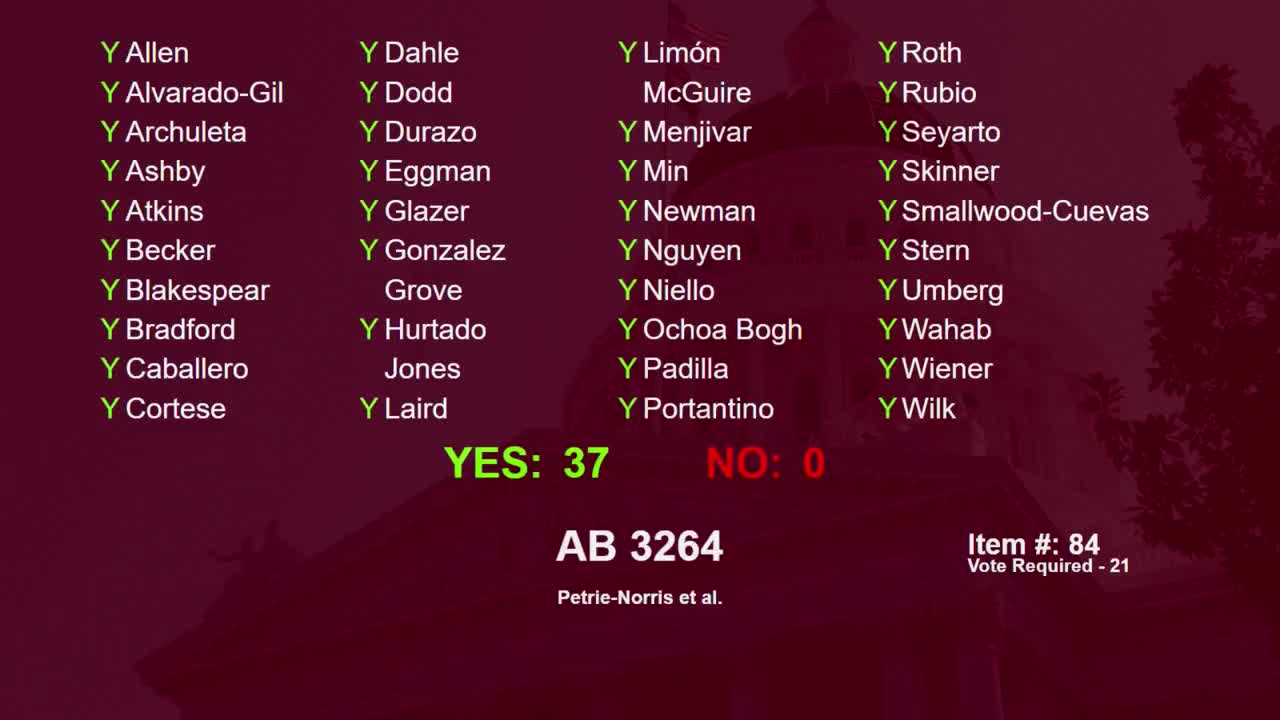 2MIN
Senate Floor
 3MIN
Assembly Floor
 34SEC
Assembly Floor
 22MIN
Assembly Standing Committee on Elections
 11MIN
Senate Floor
 53MIN
Senate Standing Committee on Elections and Constitutional Amendments
Bill Author

Bill Co-Author(s):
