SB 1304: Underground injection control: aquifer exemption.
- Session Year: 2023-2024
- House: Senate
- Latest Version Date: 2024-09-22
Current Status:
Passed
(2024-09-22: Chaptered by Secretary of State. Chapter 467, Statutes of 2024.)
Introduced
In Committee
First Chamber
In Committee
Second Chamber
Enacted
The federal Safe Drinking Water Act regulates certain wells as Class II wells, as defined. Under existing federal law, the authority to regulate Class II wells in California is delegated to the Geologic Energy Management Division in the Department of Conservation. Under existing law, the division implements the Underground Injection Control Program pursuant to this federal delegation. The federal act prohibits certain well activities that affect underground sources of drinking water, unless those sources are located in an exempted aquifer. Existing federal law authorizes a state delegated with the responsibility of regulating Class II wells to propose that an aquifer or a portion of an aquifer be an exempted aquifer and authorizes the United States Environmental Protection Agency (USEPA) to approve the proposal if the aquifer or a portion of the aquifer meets certain criteria. Existing law requires the division, before proposing an aquifer or a portion of an aquifer for exemption, to consult with the State Water Resources Control Board and the appropriate regional water quality control board concerning conformity of the proposal with certain requirements. If the division and the state board concur that the exemption proposal may merit consideration by the USEPA, existing law requires those agencies to provide a public comment period on the proposal and to jointly conduct a public hearing. If, after the review of public comments, those agencies concur that the exemption proposal merits consideration by the USEPA, existing law requires the division to submit the exemption proposal to the USEPA.
This bill would instead require, based on the consultation between the division and the appropriate regional water quality control board and the state board, if the division and the staff of the state board preliminarily concur that the exemption proposal may merit consideration by the USEPA, the division and the staff of the state board to provide a public comment period on the proposal and to jointly conduct the public hearing. The bill would require, following the review of the public comments and only if the division and the staff of the state board concur that the exemption proposal merits consideration for exemption, the staff of the state board to submit a report to the state board evaluating the exemption proposals consistency with the criteria specified in existing law, including an analysis of all potential conduits. The bill would require the report to be made available to the public no fewer than 60 days prior to a meeting before the state board and would provide for a 45-day public comment period. The bill would require the state board to consider, in a public meeting, the report and to determine whether it concurs that the exemption proposal, with any appropriate modifications, complies with legal requirements and merits consideration for exemption. If the state board concurs, the bill would require the division to submit the exemption proposal to the USEPA.
The federal Safe Drinking Water Act regulates certain wells as Class II wells, as defined. Under existing federal law, the authority to regulate Class II wells in California is delegated to the Geologic Energy Management Division in the Department of Conservation. Under existing law, the division implements the Underground Injection Control Program pursuant to this federal delegation. The federal act prohibits certain well activities that affect underground sources of drinking water, unless those sources are located in an exempted aquifer. Existing federal law authorizes a state delegated with the responsibility of regulating Class II wells to propose that an aquifer or a portion of an aquifer be an exempted aquifer and authorizes the United States Environmental Protection Agency (USEPA) to approve the proposal if the aquifer or a portion of the aquifer meets certain criteria. Existing law requires the division, before proposing an aquifer or a portion of an aquifer for exemption, to consult with the State Water Resources Control Board and the appropriate regional water quality control board concerning conformity of the proposal with certain requirements. If the division and the state board concur that the exemption proposal may merit consideration by the USEPA, existing law requires those agencies to provide a public comment period on the proposal and to jointly conduct a public hearing. If, after the review of public comments, those agencies concur that the exemption proposal merits consideration by the USEPA, existing law requires the division to submit the exemption proposal to the USEPA.
This bill would, additionally, require the proposed aquifer exemption to meet the criteria that the injection of fluid will not be in an area identified in the 70th percentile or greater by CalEnviroScreen as at risk for drinking water or groundwater threats. The bill would require the State Water Resources Control Board to conduct an environmental review of the proposed aquifer exemption in accordance with the California Environmental Quality Act (CEQA) and to hold a public hearing or hearings consistent with the public review process requirements of CEQA. If the state board concurs with the aquifer exemption proposal following the environment review, the bill would require the state board, in coordination with the division and the appropriate regional water quality control board, to provide a public comment period and conduct a public hearing. The bill would authorize the state board, after public comments and hearing, if the state board determines that the aquifer exemption proposal meets the required criteria, to submit the exemption proposal to the USEPA. The bill would also make a conforming change.This bill would instead require, based on the consultation between the division and the appropriate regional water quality control board and the state board, if the division and the staff of the state board preliminarily concur that the exemption proposal may merit consideration by the USEPA, the division and the staff of the state board to provide a public comment period on the proposal and to jointly conduct the public hearing. The bill would require, following the review of the public comments and only if the division and the staff of the state board concur that the exemption proposal merits consideration for exemption, the staff of the state board to submit a report to the state board evaluating the exemption proposals consistency with the criteria specified in existing law, including an analysis of all potential conduits. The bill would require the report to be made available to the public no fewer than 60 days prior to a meeting before the state board and would provide for a 45-day public comment period. The bill would require the state board to consider, in a public meeting, the report and to determine whether it concurs that the exemption proposal, with any appropriate modifications, complies with legal requirements and merits consideration for exemption. If the state board concurs, the bill would require the division to submit the exemption proposal to the USEPA.
The federal Safe Drinking Water Act regulates certain wells as Class II wells, as defined. Under existing federal law, the authority to regulate Class II wells in California is delegated to the Geologic Energy Management Division in the Department of Conservation. Under existing law, the division implements the Underground Injection Control Program pursuant to this federal delegation. The federal act prohibits certain well activities that affect underground sources of drinking water, unless those sources are located in an exempted aquifer. Existing federal law authorizes a state delegated with the responsibility of regulating Class II wells to propose that an aquifer or a portion of an aquifer be an exempted aquifer and authorizes the United States Environmental Protection Agency (USEPA) to approve the proposal if the aquifer or a portion of the aquifer meets certain criteria. Existing law requires the division, before proposing an aquifer or a portion of an aquifer for exemption, to consult with the State Water Resources Control Board and the appropriate regional water quality control board concerning conformity of the proposal with certain requirements. If the division and the state board concur that the exemption proposal may merit consideration by the USEPA, existing law requires those agencies to provide a public comment period on the proposal and to jointly conduct a public hearing. If, after the review of public comments, those agencies concur that the exemption proposal merits consideration by the USEPA, existing law requires the division to submit the exemption proposal to the USEPA.
This bill would, additionally, require the proposed aquifer exemption to meet the criteria that the injection of fluid will not be in an area identified in the 70th percentile or greater by CalEnviroScreen as at risk for drinking water or groundwater threats. The bill would require the State Water Resources Control Board to conduct an environmental review of the proposed aquifer exemption in accordance with the California Environmental Quality Act (CEQA) and to hold at least one public hearing during the environmental review. a public hearing or hearings consistent with the public review process requirements of CEQA. If the state board concurs with the aquifer exemption proposal following the environment review, the bill would require the state board, in coordination with the division and the appropriate regional water quality control board, to provide a public comment period and conduct a public hearing. The bill would authorize the state board, after public comments and hearing, if the state board determines that the aquifer exemption proposal meets the required criteria, to submit the exemption proposal to the USEPA. The bill would also make a conforming change.
The federal Safe Drinking Water Act regulates certain wells as Class II wells, as defined. Under existing federal law, the authority to regulate Class II wells in California is delegated to the Geologic Energy Management Division in the Department of Conservation. Under existing law, the division implements the Underground Injection Control Program pursuant to this federal delegation. The federal act prohibits certain well activities that affect underground sources of drinking water, unless those sources are located in an exempted aquifer. Existing federal law authorizes a state delegated with the responsibility of regulating Class II wells to propose that an aquifer or a portion of an aquifer be an exempted aquifer and authorizes the United States Environmental Protection Agency (USEPA) to approve the proposal if the aquifer or a portion of the aquifer meets certain criteria. Existing law requires the division, before proposing an aquifer or a portion of an aquifer for exemption, to consult with the State Water Resources Control Board and the appropriate regional water quality control board concerning conformity of the proposal with certain requirements. If the division and the state board concur that the exemption proposal may merit consideration by the USEPA, existing law requires those agencies to provide a public comment period on the proposal and to jointly conduct a public hearing. If, after the review of public comments, those agencies concur that the exemption proposal merits consideration by the USEPA, existing law requires the division to submit the exemption proposal to the USEPA.
This bill would, additionally, require the proposed aquifer exemption to meet the criteria that the injection of fluid will not be in an area identified by CalEnviroScreen as at risk for drinking water or groundwater threats. The bill would require the State Water Resources Control Board to conduct an environmental review of the proposed aquifer exemption in accordance with the California Environmental Quality Act and to hold at least one public hearing during the environmental review. If the state board concurs with the aquifer exemption proposal following the environment review, the bill would require the state board, in coordination with the division and the appropriate regional water quality control board, to provide a public comment period and conduct a public hearing. The bill would authorize the state board, after public comments and hearing, if the state board determines that the aquifer exemption proposal meets the required criteria, to submit the exemption proposal to the USEPA. The bill would also make a conforming change.
The federal Safe Drinking Water Act regulates certain wells as Class II wells, as defined. Under existing federal law, the authority to regulate Class II wells in California is delegated to the Geologic Energy Management Division in the Department of Conservation. Under existing law, the division implements the Underground Injection Control Program pursuant to this federal delegation. The federal act prohibits certain well activities that affect underground sources of drinking water, unless those sources are located in an exempted aquifer. Existing federal law authorizes a state delegated with the responsibility of regulating Class II wells to propose that an aquifer or a portion of an aquifer be an exempted aquifer and authorizes the United States Environmental Protection Agency (USEPA) to approve the proposal if the aquifer or a portion of the aquifer meets certain criteria. Existing law requires the division, before proposing an aquifer or a portion of an aquifer for exemption, to consult with the State Water Resources Control Board and the appropriate regional water quality control board concerning conformity of the proposal with certain requirements. If the division and the state board concur that the exemption proposal may merit consideration by the USEPA, existing law requires those agencies to provide a public comment period on the proposal and to jointly conduct a public hearing. If, after the review of public comments, those agencies concur that the exemption proposal merits consideration by the USEPA, existing law requires the division to submit the exemption proposal to the USEPA.
This bill would, additionally, require the proposed aquifer exemption to meet the criteria that the injection of fluid will not be in an area identified by CalEnviroScreen as at risk for drinking water or groundwater threats. The bill would require the State Water Resources Control Board to conduct an environmental review of the proposed aquifer exemption in accordance with the California Environmental Quality Act and to hold at least one public hearing during the environmental review. If the state board concurs with the aquifer exemption proposal following the environment review, the bill would require the state board, in coordination with the division and the appropriate regional water quality control board, to provide a public comment period and conduct a public hearing. The bill would authorize the state board, after public comments and hearing, if the state board determines that the aquifer exemption proposal meets the required criteria, to submit the exemption proposal to the USEPA.
Existing law requires the State Oil and Gas Supervisor to supervise the drilling, operation, maintenance, and abandonment of wells and the operation, maintenance, and removal or abandonment of tanks and facilities attendant to oil and gas production, as provided. Existing law also requires an owner or operator of a well or production facility to, among other things, designate an agent, as specified, to receive and accept service of all orders, notices, and processes of the supervisor or a court of law, and further requires every person appointing an agent to notify the supervisor, as specified, of the termination of the agency, and, unless operations are discontinued, to appoint a new agent.This bill would make nonsubstantive changes to the latter provision.Existing law requires the State Oil and Gas Supervisor to supervise the drilling, operation, maintenance, and abandonment of wells and the operation, maintenance, and removal or abandonment of tanks and facilities attendant to oil and gas production, as provided. Existing law also requires an owner or operator of a well or production facility to, among other things, designate an agent, as specified, to receive and accept service of all orders, notices, and processes of the supervisor or a court of law, and further requires every person appointing an agent to notify the supervisor, as specified, of the termination of the agency, and, unless operations are discontinued, to appoint a new agent.
This bill would make nonsubstantive changes to the latter provision.
(a)To ensure the appropriateness of a proposal by the state for an exempted aquifer determination subject to any conditions on the subsequent injection of fluids, and before proposing to the United States Environmental Protection Agency that it exempt an aquifer or portion of an aquifer pursuant to Section 144.7 of Title 40 of the Code of Federal Regulations, the division shall consult with the appropriate regional water quality control board and the state board concerning the conformity of the proposal with all of the following:
(1)The criteria set forth in Section 146.4 of Title 40 of the Code of Federal Regulations.
(2)The injection of fluids will not affect the quality of water that is, or may reasonably be, used for any beneficial use.
(3)The injected fluid will remain in the aquifer or portion of the aquifer that would be exempted.
(b)Based on the consultation pursuant to subdivision (a), if the division and the staff of the state board preliminarily concur that an aquifer or portion of an aquifer may merit consideration for exemption by the United States Environmental Protection Agency, the division and the staff of the state board shall provide a public comment period and, with a minimum of 30 days public notice, and shall jointly conduct a public hearing.
(c)Following review of the public comments pursuant to subdivision (b) and only if the division and the staff of the state board concur that the exemption proposal merits consideration for exemption, the staff of the state board shall submit a report to the state board evaluating the exemption proposals consistency with the criteria set forth in subdivision (a), including an analysis of all potential conduits, that shall be made available to the public no fewer than 60 days prior to a meeting before the state board and subject to a 45-day public comment period.
(d)The state board shall consider, in a public meeting, the report submitted pursuant to subdivision (c) and shall determine whether it concurs that the exemption proposal, with any appropriate modifications, complies with the requirements specified in subdivision (a) and merits consideration for exemption.
(e)If the state board concurs pursuant to subdivision (d), the division shall submit the aquifer exemption proposal to the United States Environmental Protection Agency.
(a)To ensure the appropriateness of a proposal by the state for an exempted aquifer determination subject to any conditions on the subsequent injection of fluids, and prior to before proposing to the United States Environmental Protection Agency that it exempt an aquifer or portion of an aquifer pursuant to Section 144.7 of Title 40 of the Code of Federal Regulations, the division shall consult with the appropriate regional water quality control board and the state board concerning the conformity of the proposal with all of the following:
(1)Criteria The criteria set forth in Section 146.4 of Title 40 of the Code of Federal Regulations.
(2)The injection of fluids will not affect the quality of water that is, or may reasonably be, used for any beneficial use.
(3)The injected fluid will remain in the aquifer or portion of the aquifer that would be exempted.
(b)Based on the consultation pursuant to subdivision (a), if the division and the staff of the state board preliminarily concur that an aquifer or portion of an aquifer may merit consideration for exemption by the United States Environmental Protection Agency, they the division and the staff of the state board shall provide a public comment period and, with a minimum of 30 days days public notice, and shall jointly conduct a public hearing.
(c)Following review of the public comments, comments pursuant to subdivision (b) and only if the division and the staff of the state board concur that the exemption proposal merits consideration for exemption, the division staff of the state board shall submit a report to the state board evaluating the exemption proposals consistency with the criteria set forth in subdivision (a), including an analysis of all potential conduits, that shall be made available to the public no fewer than 60 days prior to a meeting before the state board and subject to a 45-day public comment period.
(d)The state board shall consider, in a public meeting, the report submitted pursuant to subdivision (c) and shall determine whether it concurs that the exemption proposal, with any appropriate modifications, complies with the requirements specified in subdivision (a) and merits consideration for exemption.
(e)If the state board concurs pursuant to subdivision (d), the division shall submit the aquifer exemption proposal to the United States Environmental Protection Agency.
SECTION 1.Section 3131 of the Public Resources Code is amended to read:3131.(a)A proposal by the state for an exempted aquifer pursuant to Section 144.7 of Title 40 of the Code of Federal Regulations shall conform with all of the following:(1)The criteria set forth in Section 146.4 of Title 40 of the Code of Federal Regulations.(2)The injection of fluids will not affect the quality of water that is, or may reasonably be, used for any beneficial use.(3)The injected fluid will remain in the aquifer or portion of the aquifer that would be exempted.(4)The injection of fluids will not be in an area identified in the 70th percentile or greater by the California Communities Environmental Health Screening Tool, also known as CalEnviroScreen, as at risk for drinking water or groundwater threats.(b)If the division proposes an aquifer exemption, all of the following apply:(1)The division shall consult with the appropriate regional water quality control board and the state board.(2)The state board shall conduct an environmental review of the proposal in accordance with the California Environmental Quality Act (Division 13 (commencing with Section 21000)). The state board shall hold a public hearing or hearings consistent with the public review process requirements of that act.(3)If the state board concurs with the aquifer exemption proposal following the completion of the environmental review pursuant to paragraph (2), the state board, in coordination with the division and the appropriate regional water quality control board, shall, with a minimum of 30 days public notice, provide a public comment period and conduct a public hearing.(c)Following the hearing conducted, and a review of the public comments received, pursuant to paragraph (3) of subdivision (b), if the state board finds that the aquifer exemption proposal complies with subdivision (a), the state board may submit the aquifer exemption proposal to the United States Environmental Protection Agency.SEC. 2.Section 13263.5 of the Water Code is amended to read:13263.5.(a)When the regional board issues waste discharge requirements pursuant to Section 13263, or revises waste discharge requirements pursuant to subdivision (g) of Section 25159.17 of the Health and Safety Code, for any injection well into which hazardous waste is discharged, the waste discharge requirements shall be based upon the information contained in the hydrogeological assessment report prepared pursuant to Section 25159.18 of the Health and Safety Code and shall include conditions in the waste discharge requirements to ensure that the waters of the state are not polluted or threatened with pollution.(b)Except as provided in Section 3131 of the Public Resources Code, if the state board applies to the federal Environmental Protection Agency to administer the Underground Injection Control Program pursuant to Part 145 (commencing with Section 145.1) of Subchapter D of Chapter 1 of Title 40 of the Code of Federal Regulations, that application shall not include a request to administer the Underground Injection Control Program for any oil, gas, or geothermal injection wells supervised or regulated by the Division of Oil and Gas pursuant to Section 3106 or 3714 of the Public Resources Code.(a)A proposal by the state for an exempted aquifer pursuant to Section 144.7 of Title 40 of the Code of Federal Regulations shall conform with all of the following:
(1)The criteria set forth in Section 146.4 of Title 40 of the Code of Federal Regulations.
(2)The injection of fluids will not affect the quality of water that is, or may reasonably be, used for any beneficial use.
(3)The injected fluid will remain in the aquifer or portion of the aquifer that would be exempted.
(4)The injection of fluids will not be in an area identified in the 70th percentile or greater by the California Communities Environmental Health Screening Tool, also known as CalEnviroScreen, as at risk for drinking water or groundwater threats.
(b)If the division proposes an aquifer exemption, all of the following apply:
(1)The division shall consult with the appropriate regional water quality control board and the state board.
(2)The state board shall conduct an environmental review of the proposal in accordance with the California Environmental Quality Act (Division 13 (commencing with Section 21000)). In conducting the environmental review, the The state board shall hold at least one public hearing, with a minimum 30 days public notice. a public hearing or hearings consistent with the public review process requirements of that act.
(3)If the state board concurs with the aquifer exemption proposal following the completion of the environmental review pursuant to paragraph (2), the state board, in coordination with the division and the appropriate regional water quality control board, shall, with a minimum of 30 days public notice, provide a public comment period and conduct a public hearing.
(c)Following the hearing conducted, and a review of the public comments received, pursuant to paragraph (3) of subdivision (b), if the state board finds that the aquifer exemption proposal complies with subdivision (a), the state board may submit the aquifer exemption proposal to the United States Environmental Protection Agency.
SEC. 2.Section 13263.5 of the Water Code is amended to read:13263.5.(a)When the regional board issues waste discharge requirements pursuant to Section 13263, or revises waste discharge requirements pursuant to subdivision (g) of Section 25159.17 of the Health and Safety Code, for any injection well into which hazardous waste is discharged, the waste discharge requirements shall be based upon the information contained in the hydrogeological assessment report prepared pursuant to Section 25159.18 of the Health and Safety Code and shall include conditions in the waste discharge requirements to ensure that the waters of the state are not polluted or threatened with pollution.
(b)Except as provided in Section 3131 of the Public Resources Code, if the state board applies to the federal Environmental Protection Agency to administer the Underground Injection Control Program pursuant to Part 145 (commencing with Section 145.1) of Subchapter D of Chapter 1 of Title 40 of the Code of Federal Regulations, that application shall not include a request to administer the Underground Injection Control Program for any oil, gas, or geothermal injection wells supervised or regulated by the Division of Oil and Gas pursuant to Section 3106 or 3714 of the Public Resources Code.
(a)A proposal by the state for an exempted aquifer pursuant to Section 144.7 of Title 40 of the Code of Federal Regulations shall conform with all of the following:
(1)The criteria set forth in Section 146.4 of Title 40 of the Code of Federal Regulations.
(2)The injection of fluids will not affect the quality of water that is, or may reasonably be, used for any beneficial use.
(3)The injected fluid will remain in the aquifer or portion of the aquifer that would be exempted.
(4)The injection of fluids will not be in an area identified by the California Communities Environmental Health Screening Tool, also known as CalEnviroScreen, as at risk for drinking water or groundwater threats.
(b)If the division proposes an aquifer exemption, all of the following apply:
(1)The division shall consult with the appropriate regional water quality control board and the state board.
(2)The state board shall conduct an environmental review of the proposal in accordance with the California Environmental Quality Act (Division 13 (commencing with Section 21000)). In conducting the environmental review, the state board shall hold at least one public hearing, with a minimum 30 days public notice.
(3)If the state board concurs with the aquifer exemption proposal following the completion of the environmental review pursuant to paragraph (2), the state board, in coordination with the division and the appropriate regional water quality control board, shall, with a minimum of 30 days public notice, provide a public comment period and conduct a public hearing.
(c)Following the hearing conducted, and a review of the public comments received, pursuant to paragraph (3) of subdivision (b), if the state board finds that the aquifer exemption proposal complies with subdivision (a), the state board may submit the aquifer exemption proposal to the United States Environmental Protection Agency.
SEC. 2.Section 13263.5 of the Water Code is amended to read:13263.5.(a)When the regional board issues waste discharge requirements pursuant to Section 13263, or revises waste discharge requirements pursuant to subdivision (g) of Section 25159.17 of the Health and Safety Code, for any injection well into which hazardous waste is discharged, the waste discharge requirements shall be based upon the information contained in the hydrogeological assessment report prepared pursuant to Section 25159.18 of the Health and Safety Code and shall include conditions in the waste discharge requirements to ensure that the waters of the state are not polluted or threatened with pollution.
(b)If Except as provided in Section 3131 of the Public Resources Code, if the state board applies to the federal Environmental Protection Agency to administer the Underground Injection Control Program pursuant to Part 145 (commencing with Section 145.1) of Subchapter D of Chapter 1 of Title 40 of the Code of Federal Regulations, that application shall not include a request to administer the Underground Injection Control Program for any oil, gas, or geothermal injection wells supervised or regulated by the Division of Oil and Gas pursuant to Section 3106 or 3714 of the Public Resources Code.
(a)To ensure the appropriateness of a A proposal by the state for an exempted aquifer determination subject to any conditions on the subsequent injection of fluids, and prior to proposing to the United States Environmental Protection Agency that it exempt an aquifer or portion of an aquifer pursuant to Section 144.7 of Title 40 of the Code of Federal Regulations, the division shall consult with the appropriate regional water quality control board and the state board concerning the conformity of the proposal Regulations shall conform with all of the following:
(1)Criteria The criteria set forth in Section 146.4 of Title 40 of the Code of Federal Regulations.
(2)The injection of fluids will not affect the quality of water that is, or may reasonably be, used for any beneficial use.
(3)The injected fluid will remain in the aquifer or portion of the aquifer that would be exempted.
(b)Based on the consultation pursuant to subdivision (a), if the division and the state board concur that an aquifer or portion of an aquifer may merit consideration for exemption by the United States Environmental Protection Agency, they shall provide a public comment period and, with a minimum of 30 days public notice, jointly conduct a public hearing.(4)The injection of fluids will not be in an area identified by the California Communities Environmental Health Screening Tool, also known as CalEnviroScreen, as at risk for drinking water or groundwater threats.
(b)If the division proposes an aquifer exemption, all of the following apply:
(1)The division shall consult with the appropriate regional water quality control board and the state board.
(2)The state board shall conduct an environmental review of the proposal in accordance with the California Environmental Quality Act (Division 13 (commencing with Section 21000)). In conducting the environmental review, the state board shall hold at least one public hearing, with a minimum 30 days public notice.
(3)If the state board concurs with the aquifer exemption proposal following the completion of the environmental review pursuant to paragraph (2), the state board, in coordination with the division and the appropriate regional water quality control board, shall, with a minimum of 30 days public notice, provide a public comment period and conduct a public hearing.
(c)Following the hearing conducted, and a review of the public comments, and only comments received, pursuant to paragraph (3) of subdivision (b), if the division and state board concur finds that the aquifer exemption proposal merits consideration for exemption, the division shall complies with subdivision (a), the state board may submit the aquifer exemption proposal to the United States Environmental Protection Agency.
SECTION 1.Section 3200 of the Public Resources Code is amended to read:3200.An owner or operator of a well or production facility shall designate an agent, giving the agents address, who resides in this state, to receive and accept service of all orders, notices, and processes of the supervisor or a court of law. Every person so appointing an agent shall, within five days after the termination of the agency, notify the supervisor, in writing, of the termination, and, unless operations are discontinued, shall also appoint a new agent.An owner or operator of a well or production facility shall designate an agent, giving his or her the agents address, who resides in this state, to receive and accept service of all orders, notices, and processes of the supervisor or a court of law. Every person so appointing an agent shall, within five days after the termination of the agency, notify the supervisor, in writing, of the termination, and and, unless operations are discontinued, shall also appoint a new agent.
|
Date
|
Status
|
|---|---|
| Sep 22, 2024 | Chaptered by Secretary of State. Chapter 467, Statutes of 2024. |
| Sep 22, 2024 | Approved by the Governor. |
| Sep 10, 2024 | Enrolled and presented to the Governor at 4 p.m. |
| Aug 30, 2024 | Assembly amendments concurred in. (Ayes 29. Noes 10. Page 5732.) Ordered to engrossing and enrolling. |
| Aug 30, 2024 | In Senate. Concurrence in Assembly amendments pending. |
| Aug 29, 2024 | Read third time. Passed. (Ayes 54. Noes 16. Page 6885.) Ordered to the Senate. |
| Aug 20, 2024 | Read second time. Ordered to third reading. |
| Aug 19, 2024 | Read second time and amended. Ordered to second reading. |
| Aug 15, 2024 | From committee: Do pass as amended. (Ayes 10. Noes 3.) (August 15). |
| Aug 7, 2024 | August 7 set for first hearing. Placed on suspense file. |
| Jun 26, 2024 | Read second time and amended. Re-referred to Com. on APPR. |
| Jun 25, 2024 | From committee: Do pass as amended and re-refer to Com. on APPR. (Ayes 8. Noes 2.) (June 24). |
| Jun 3, 2024 | Referred to Com. on NAT. RES. |
| May 22, 2024 | In Assembly. Read first time. Held at Desk. |
| May 21, 2024 | Read third time. Passed. (Ayes 28. Noes 10. Page 4070.) Ordered to the Assembly. |
| May 16, 2024 | Read second time. Ordered to third reading. |
| May 16, 2024 | From committee: Do pass. (Ayes 5. Noes 2. Page 3979.) (May 16). |
| May 14, 2024 | Set for hearing May 16. |
| May 13, 2024 | May 13 hearing: Placed on APPR suspense file. |
| May 3, 2024 | Set for hearing May 13. |
| Apr 25, 2024 | From committee: Do pass and re-refer to Com. on APPR. (Ayes 4. Noes 3. Page 3754.) (April 24). Re-referred to Com. on APPR. |
| Apr 12, 2024 | Set for hearing April 24. |
| Apr 10, 2024 | Read second time and amended. Re-referred to Com. on E.Q. |
| Apr 9, 2024 | From committee: Do pass as amended and re-refer to Com. on E.Q. (Ayes 7. Noes 3. Page 3533.) (April 9). |
| Apr 3, 2024 | Re-referred to Coms. on N.R. & W. and E.Q. |
| Mar 28, 2024 | Set for hearing April 9 in N.R. & W. pending receipt. |
| Mar 18, 2024 | From committee with author's amendments. Read second time and amended. Re-referred to Com. on RLS. |
| Feb 29, 2024 | Referred to Com. on RLS. |
| Feb 16, 2024 | From printer. May be acted upon on or after March 17. |
| Feb 15, 2024 | Introduced. Read first time. To Com. on RLS. for assignment. To print. |
|
Date
|
Description
|
Location
|
Votes
|
|
|---|---|---|---|---|
| Aug 30, 2024 | Unfinished Business SB1304 Limón Concurrence | Senate Floor |
Passed |
|
| Aug 29, 2024 | SB 1304 Limón Senate Third Reading By Hart | Assembly Floor |
Passed |
|
| Aug 15, 2024 | Do pass as amended. | Assembly Standing Committee on Appropriations |
Passed |
|
| Jun 24, 2024 | Do pass as amended and be re-referred to the Committee on [Appropriations] | Assembly Standing Committee on Natural Resources |
Passed |
|
| May 21, 2024 | Senate 3rd Reading SB1304 Limón | Senate Floor |
Passed |
|
| May 16, 2024 | Do pass | Senate Standing Committee on Appropriations |
Passed |
|
| May 13, 2024 | Placed on suspense file | Senate Standing Committee on Appropriations |
Passed |
|
| Apr 24, 2024 | Do pass, but first be re-referred to the Committee on [Appropriations] | Senate Standing Committee on Environmental Quality |
Passed |
|
| Apr 9, 2024 | Do pass as amended, but first amend, and re-refer to the Committee on [Environmental Quality] | Senate Standing Committee on Natural Resources and Water |
Passed |
This list shows positions taken on this bill by organizations on the date displayed, which is linked to the original source.
Positions by individuals are not included.
|
Organization
|
Position
|
Date
|
|---|---|---|
| California Coast Keeper Alliance | * Support | Apr 9, 2024 |
| California Coast Keeper Reliance | * Support | Apr 24, 2024 |
| California Coastal Protection Network | ** Support | |
| California Democratic Party | ** Support | |
| California Environmental Voters | ** Support | |
| California Independent Petroleum Association | * Against | Apr 9, 2024 |
| California Manufacturers & Technology Association | * Against Unless Amend | Jun 25, 2024 |
| Carpinteria Valley Association | ** Support | |
| Central Coast Alliance United for a Sustainable Economy | ** Support | |
| Channel Islands Restoration | ** Support | |
| Citizens Planning Association of Santa Barbara County | ** Support | |
| CleanEarth4Kids | ** Support | |
| Climate First: Replacing Oil & Gas | ** Support | |
| Coastal Fund | ** Support | |
| Coastal Ranches Conservancy | ** Support | |
| Community Environmental Council | ** Support | |
| Community Water Center | ** Support | |
| Environment California | ** Support | |
| Environmental Defense Center | ** Support | |
| Environmental Working Group | ** Support | |
| Families Advocating for Chemical and Toxics Safety | ** Support | |
| Friends Of The Earth | ** Support | |
| Friends of the River | ** Support | |
| Gaviota Coast Conservancy | ** Support | |
| Goleta Coast Audubon Society | ** Support | |
| Heal the Ocean | ** Support | |
| Los Padres ForestWatch | ** Support | |
| Natural Resources Defense Council | ** Support | |
| Restoration Oaks Ranch | ** Support | |
| Santa Barbara Audobon Society | ** Support | |
| Santa Barbara Blueberries | ** Support | |
| Santa Barbara County Action Network | ** Support | |
| Sierra Club California | ** Support | |
| Social Eco Education | ** Support | |
| Solano County Democratic Central Committee | ** Support | |
| Southern Steelhead Coalition | ** Support | |
| Sunflower Alliance | ** Support | |
| Surfrider Foundation, Santa Barbara Chapter | ** Support | |
| The Climate Reality Project, California State Coalition | ** Support | |
| The Climate Reality Project, San Francisco Bay Area Chapter | ** Support | |
| UCSB Environmental Law Club | ** Support | |
| UCSB Gauchos Go Green | ** Support | |
| Western States Petroleum Association | ** Against | |
| Wild Farm Land Foundation | ** Support |
SENATE RULES COMMITTEE Office of Senate Floor Analyses (916) 651-1520 Fax: (916) 327-4478 | SB 1304 |
UNFINISHED BUSINESS
Bill No: SB 1304
Author: Limón (D)
Amended: 8/19/24
Vote: 21
SENATE NATURAL RES. & WATER COMMITTEE: 7-3, 4/9/24
AYES: Min, Allen, Eggman, Laird, Limón, Padilla, Stern
NOES: Seyarto, Dahle, Grove
NO VOTE RECORDED: Hurtado
SENATE ENVIRONMENTAL QUALITY COMMITTEE: 4-3, 4/24/24
AYES: Allen, Gonzalez, Menjivar, Skinner
NOES: Dahle, Hurtado, Nguyen
SENATE APPROPRIATIONS COMMITTEE: 5-2, 5/16/24
AYES: Caballero, Ashby, Becker, Bradford, Wahab
NOES: Jones, Seyarto
SENATE FLOOR: 28-10, 5/21/24
AYES: Archuleta, Ashby, Atkins, Becker, Blakespear, Bradford, Caballero, Cortese, Dodd, Durazo, Eggman, Gonzalez, Laird, Limón, McGuire, Menjivar, Min, Newman, Padilla, Portantino, Roth, Rubio, Skinner, Smallwood-Cuevas, Stern, Umberg, Wahab, Wiener
NOES: Alvarado-Gil, Dahle, Grove, Hurtado, Jones, Nguyen, Niello, Ochoa Bogh, Seyarto, Wilk
NO VOTE RECORDED: Allen, Glazer
ASSEMBLY FLOOR: 54-16, 8/29/24 - See last page for vote
SUBJECT: Underground injection control: aquifer exemption
SOURCE: Author
DIGEST:
This bill modifies the state process for submission of a Class II Underground Injection Control (UIC) program aquifer exemption proposal to the U.S. Environmental Protection Agency (US EPA), including requiring the State Water Resources Control Board (SWRCB) to determine in a public meeting whether a proposed aquifer exemption merits consideration, instituting certain public notice and comment requirements, and requiring an analysis of all conduits, among other provisions.
Assembly Amendments reinstate the Geologic Energy Management Division (CalGEM) as the state entity to submit aquifer exemption proposals to the US EPA, remove new criterium for an aquifer exemption to meet, remove SWRCB’s required environmental review pursuant to the California Environmental Quality Act, clarify the role of SWRCB staff in the approval process, require the preparation of a report to the SWRCB regarding the proposed aquifer exemption, require the conduit analysis, and revise timelines for public transparency, as provided, among other provisions.
ANALYSIS:
Existing federal law:
- Establishes the UIC program pursuant to the Safe Drinking Water Act (SDWA) (Title 40, Code of Federal Regulations (40 CFR), §§144 et seq.). Class II wells are those used for oil and gas production and related activities.
- Authorizes the US EPA to identify and require the protection of underground sources of drinking water (USDWs), and provides for the exemption of certain aquifers from protection (40 CFR §144.7).
- An USDW means an aquifer or its portion which supplies any public water system or which contains a sufficient quantity of groundwater to supply a public water system and currently supplies drinking water for human consumption or contains fewer than 10,000 milligrams per liter total dissolved solids (TDS) and is not an exempted aquifer (40 CFR §144.3).
- An exempt aquifer means an aquifer or its portion that meets the criteria in the definition of a USDW but which has been exempted according to the procedures in 40 CFR §144.7 (40 CFR §144.3).
- Establishes criteria for designating an aquifer or portion thereof as exempt if it does not currently serve as a source of drinking water, cannot now and will not serve as a source of drinking water for specified reasons and has a TDS content of more than 3,000 and less than 10,000 milligrams per liter, as provided (40 CFR §146.4).
- Requires that Class II wells be constructed to prevent migration into USDWs (40 CFR §146.22).
Existing state law:
- Requires CalGEM, the state’s oil and gas well regulator, prior to proposing to the US EPA that it exempt an aquifer or a portion of an aquifer, to consult with SWRCB and any applicable regional water quality control board (regional board) to ensure the proposal conforms with:
- Federal criteria in 40 CFR §146.4.
- The injection of fluids will not affect the quality of water that is, or may reasonably be, used for any beneficial use, as defined.
- The injected fluid will remain in the aquifer or portion of the aquifer that would be exempted.
- Requires CalGEM and SWRCB to provide a public comment period, and, with at least 30 days public notice, conduct a public hearing if CalGEM, with the SWRCB’s concurrence, agrees that an aquifer or portion of an aquifer may merit consideration for exemption.
- Requires CalGEM to submit the aquifer exemption proposal to the US EPA if CalGEM and the SWRCB concur that the exemption proposal merits consideration following review of the public comments (Public Resources Code (PRC) §3131).
This bill modifies the state process for submission of a Class II UIC program aquifer exemption proposal to the US EPA, including requiring the SWRCB to consider in a public meeting whether a proposed aquifer exemption merits consideration, instituting certain public notice and comment requirements, and requiring an analysis of all conduits, among other provisions.
Specifically, this bill:
- Modifies existing state requirements for an aquifer exemption proposal:
- Requires a public hearing to be held on the proposed aquifer exemption if CalGEM and SWRCB staff preliminarily concur that an aquifer or portion of an aquifer may merit consideration by the US EPA.
- Requires SWRCB staff to submit a report to the SWRCB evaluating the exemption proposal’s consistency with certain criteria, including an analysis of all potential conduits, as provided. Requires that the report be made public at least 60 days prior to a meeting before the SWRCB with a 45 day public comment period provided.
- Requires the SWRCB to consider the report in a public meeting. Requires the SWRCB to determine whether it concurs that the exemption proposal, with any applicable modifications, complies with required criteria and merits consideration for exemption.
- Conditions CalGEM’s submittal of the aquifer exemption proposal to the US EPA on SWRCB’s concurrence with the proposal, as provided.
Background
California is a major oil and gas producing state. According to the U.S. Energy Information Administration, the state was 7th and 15th for oil and marketed natural gas production, respectively, among the 50 states. Oil exploration and production in California started in the 19th century. Production of oil was about 123 million barrels in 2023, and continues to decline from the 1985 peak.
Due, in part, to the length of the time the state’s oil and associated gas fields have been in production, most state oil and associated gas production depends upon the use of “enhanced oil recovery” (EOR) methods where heat and/or fluid or other applied pressure is used to facilitate hydrocarbon production from the subsurface. EOR operations generally require the use of injection wells.
CalGEM in the Department of Conservation is the state’s oil and gas regulator. In 1981, CalGEM applied to the US EPA to become the primary regulatory agency for the oil and gas well (“Class II”) portion of the UIC program in California. Class II injection wells primarily consist of oil and gas waste disposal wells and injection wells used for EOR operations.
As part of its primacy application, CalGEM asked to exempt certain aquifers from protection under the SDWA. These “exempt aquifers” were not or could not become USDWs, as defined (40 CFR §146.4). In general, these aquifers were co-located within the then-existing boundaries of an oil and gas field, were hydrocarbon-producing, or were already being used for oil and gas wastewater injection.
In 1982, the US EPA signed a Memorandum of Agreement (MOA) with the Department of Conservation establishing CalGEM’s primacy for the UIC program and, among other provisions, designating certain aquifers as exempt. Under this MOA, the US EPA must approve any additional requests for aquifer exemption status, and no injection is allowed into an aquifer without first obtaining exempt status, among other provisions.
In the primacy agreement, CalGEM pledged to work closely with the SWRCB. A 1988 MOA between CalGEM and SWRCB, recently revised in 2018, requires coordinated efforts between CalGEM, SWRCB, and applicable regional boards on UIC and related programs.
Following revelations that thousands of oil and gas wells had been improperly approved to inject in aquifers that were not exempted, 22 aquifer exemptions in/around the state’s oil and gas fields have been submitted to and approved by the US EPA since 2015. Additional aquifer exemption proposals are in the process of being developed.
(NOTE: Additional information may be found in the policy bill analyses written by the Senate Natural Resources and Water and Senate Environmental Quality Committees.)
FISCAL EFFECT: Appropriation: No Fiscal Com.: Yes Local: No
According to the Assembly floor analysis, the fiscal effect is unknown.
SUPPORT: (Verified 8/20/24)
California Coastal Protection Network
California Democratic Party
California Environmental Voters
Carpinteria Valley Association
Central Coast Alliance United for a Sustainable Economy (CAUSE)
Channel Islands Restoration
Citizens Planning Association of Santa Barbara County
CleanEarth4Kids
Climate First: Replacing Oil & Gas (CFROG)
Coastal Fund
Coastal Ranches Conservancy
Community Environmental Council
Community Water Center
Environment California
Environmental Defense Center
Environmental Working Group
Families Advocating for Chemical and Toxics Safety (FACTS)
Friends of the Earth
Friends of the River
Gaviota Coast Conservancy
Goleta Coast Audubon Society
Heal the Ocean
Los Padres ForestWatch
Natural Resources Defense Council
Restoration Oaks Ranch
Santa Barbara Audubon Society
Santa Barbara Blueberries
Santa Barbara County Action Network
Sierra Club California
Social Eco Education (SEE)
Solano County Democratic Central Committee
Southern Steelhead Coalition
Sunflower Alliance
Surfrider Foundation, Santa Barbara Chapter
The Climate Reality Project, California State Coalition
The Climate Reality Project, San Francisco Bay Area Chapter
UCSB Environmental Law Club
UCSB Gauchos Go Green
Wild Farm Land Foundation
OPPOSITION: (Verified 8/20/24)
Western States Petroleum Association
ARGUMENTS IN SUPPORT: According to the author:
“Underground injection oil wells dispose of toxic waste water from the oil production process back into the ground. The water used in oil production also often comes from underground aquifers that are deemed unsuitable for drinking or public use by the state and the U.S. Environmental Protection Agency (U.S. EPA). Oil companies often seek exemptions from the state and U.S. EPA to inject toxic waste water through aquifers that are used for drinking water, agriculture, and other beneficial uses. Injecting this waste can pose a potential path for the pollution to migrate into aquifers used for drinking water and can potentially cause serious harm to the public, including disadvantaged and vulnerable communities. The specific process of exempting an aquifer for injection […] does not have a determination made publicly by the state.”
SB 1304 “provides the local public and vulnerable populations an opportunity to voice concerns on how their drinking water may be affected by oil and gas production.”
ARGUMENTS IN OPPOSITION: The Western States Petroleum Association (WSPA), writes in opposition:
“SB 1304 adds unnecessary and duplicative requirements that must be met to obtain approval on an aquifer exemption under California and federal law. Currently, the federal Safe Drinking Water Act prohibits certain injection activities that affect underground sources of drinking water unless those sources are located in an exempted aquifer. The state already regulates Class II underground injection wells, requires certain criteria to be met before pursuing an aquifer exemption with US EPA, and has a procedure for California Environmental Quality Act (CEQA) review. This bill duplicates already established processes in place and would add unnecessary work to state agencies and California businesses.”
ASSEMBLY FLOOR: 54-16, 8/29/24
AYES: Addis, Aguiar-Curry, Alvarez, Arambula, Bauer-Kahan, Bennett, Berman, Boerner, Bonta, Bryan, Calderon, Juan Carrillo, Wendy Carrillo, Connolly, Mike Fong, Friedman, Gabriel, Garcia, Haney, Hart, Holden, Irwin, Jackson, Jones-Sawyer, Kalra, Lee, Low, Lowenthal, Maienschein, McCarty, McKinnor, Muratsuchi, Pacheco, Papan, Pellerin, Petrie-Norris, Quirk-Silva, Ramos, Rendon, Reyes, Luz Rivas, Rodriguez, Blanca Rubio, Santiago, Schiavo, Soria, Ting, Valencia, Ward, Weber, Wicks, Wilson, Wood, Robert Rivas
NOES: Alanis, Megan Dahle, Davies, Dixon, Essayli, Flora, Gallagher, Hoover, Lackey, Mathis, Jim Patterson, Joe Patterson, Sanchez, Ta, Waldron, Wallis
NO VOTE RECORDED: Bains, Cervantes, Chen, Gipson, Grayson, Stephanie Nguyen, Ortega, Villapudua, Zbur
Prepared by: Katharine Moore / N.R. & W. / (916) 651-4116
8/29/24 19:39:31
**** END ****
SENATE THIRD READING
STR Bill Id:SB 1304
Author:(Limón)
As Amended Ver:August 19, 2024
Majority vote
SUMMARY
Requires the Division of Geologic Energy Management (CalGEM) and the State Water Resources Control Board (State Water Board) to jointly conduct a public meeting if CalGEM and the staff of the State Water Board preliminarily concur that an aquifer or portion of an aquifer may merit consideration for exemption by the United States Environmental Protection Agency (US EPA).
Major Provisions
- Requires staff of the State Water Board, following review of public comments, to submit a report to the State Water Board evaluating the proposal's consistency with the exemption evaluation criteria, including an analysis of all potential conduits.
- Requires State Water Board's staff evaluation to be made available to the public no fewer than 60 days prior to a hearing before the State Water Board and subject to a 45-day public comment period. Requires the State Water Board to consider, in a public meeting, whether it concurs and determines that the exemption proposal, with any appropriate modifications, complies with the requirements for submitting an exemption request to the US EPA.
- Requires the State Water Board to concur with exemption proposal before CalGEM submits the aquifer exemption proposal to the US EPA.
COMMENTS
Under the federal Safe Drinking Water Act (SDWA), the US EPA delegated primacy authority over oil and gas injection wells to the CalGEM UIC Program. The program is required to prevent the degradation of underground sources of drinking water (aquifers) where there are injection operations. An injection well is used to place fluid underground through layers of sedimentary rock and into rock formations considered impermeable where toxic fluids cannot migrate vertically or horizontally.
The UIC Program processes aquifer exemption applications with the US EPA to remove an aquifer or a portion thereof from protection as an underground source of drinking water under the SDWA. When wastewater or other fluids associated with the extraction of oil or gas are injected into an aquifer, they can change the chemistry of and contaminate that aquifer. For this reason, SDWA criteria for injection specify that these wells cannot be into aquifers where the water quality is currently or may be considered in the future high enough to use as a source for drinking water. Class II wells should only be located in areas where there is not any potential use of the aquifer for drinking water.
Since 2015, twenty-two aquifer exemptions in/around the state's oil and gas fields have been submitted to and approved by the US EPA. There are four aquifer exemption proposals currently pending.
According to the Author
Underground injection oil wells dispose of toxic waste water from the oil production process back into the ground. The water used in oil production also often comes from underground aquifers that are deemed unsuitable for drinking or public use by the state and the US EPA. Oil companies often seek exemptions from the state and US EPA to inject toxic waste water through aquifers that are used for drinking water, agriculture, and other beneficial uses. Injecting this waste can pose a potential path for the pollution to migrate into aquifers used for drinking water and can potentially cause serious harm to the public, including disadvantaged and vulnerable communities. Requiring a higher level of state review provides the local public and vulnerable populations an opportunity to voice concerns on how their drinking water may be affected by oil and gas production.
Arguments in Support
No letters on file for current version of the bill.
Arguments in Opposition
No letters on file for current version of the bill.
FISCAL COMMENTS
Unknown
VOTES
SENATE FLOOR: 28-10-2
YES: Archuleta, Ashby, Atkins, Becker, Blakespear, Bradford, Caballero, Cortese, Dodd, Durazo, Eggman, Gonzalez, Laird, Limón, McGuire, Menjivar, Min, Newman, Padilla, Portantino, Roth, Rubio, Skinner, Smallwood-Cuevas, Stern, Umberg, Wahab, Wiener
NO: Alvarado-Gil, Dahle, Grove, Hurtado, Jones, Nguyen, Niello, Ochoa Bogh, Seyarto, Wilk
ABS, ABST OR NV: Allen, Glazer
ASM NATURAL RESOURCES: 8-2-1
YES: Bryan, Bauer-Kahan, Friedman, Kalra, Muratsuchi, Pellerin, Wicks, Wood
NO: Flora, Hoover
ABS, ABST OR NV: Mathis
ASM APPROPRIATIONS: 10-3-2
YES: Wicks, Arambula, Bryan, Calderon, Wendy Carrillo, Mike Fong, Grayson, Haney, Hart, Pellerin
NO: Sanchez, Dixon, Ta
ABS, ABST OR NV: Jim Patterson, Villapudua
UPDATED
VERSION: August 19, 2024
CONSULTANT: Paige Brokaw / NAT. RES. / (916) 319-2092 FN: 0004164
Date of Hearing: August 7, 2024
ASSEMBLY COMMITTEE ON APPROPRIATIONS
Buffy Wicks, Chair
SBPCA Bill Id:SB 1304
Author:(Limón) – As Amended Ver:June 26, 2024
Policy Committee: | Natural Resources | Vote: | 8 - 2 |
|
| ||
|
|
Urgency: No State Mandated Local Program: No Reimbursable: No
SUMMARY:
This bill requires the State Water Resources Control Board (SWRCB) to conduct an environmental review of a proposed aquifer exemption in accordance with the California Environmental Quality Act (CEQA) and authorizes SWRCB to submit the exemption proposal to the United States Environmental Protection Agency (US EPA).
Specifically, this bill:
- Requires a proposal by the state for an exempted aquifer pursuant to federal regulation to also conform with the requirement that injection of fluids not be in an area ranked in the 70th percentile or greater by the California Communities Environmental Health Screening Tool (CalEnviroScreen) as at risk for drinking water or groundwater threats.
- Requires, if the Division of Geologic Energy Management (CalGEM) in the Department of Conservation proposes an aquifer exemption, all of the following apply:
- Requires CalGEM to consult with the appropriate regional water quality control board and the SWRCB.
- Requires the SWRCB to conduct an environmental review of the proposal in accordance with CEQA including public hearings consistent with the CEQA process.
- Requires the SWRCB, if SWRCB concurs with the aquifer exemption proposal after environmental review, in coordination with CalGEM and the appropriate regional water quality control board, to provide a public comment period and conduct a public hearing after 30-day notice.
- Authorizes the SWRCB, following the hearing and review of public comments, if SWRCB finds that the aquifer exemption proposal complies with specified requirements, to submit the aquifer exemption proposal to the US EPA.
FISCAL EFFECT:
The SWRCB reports costs of $450,000 annually ongoing to administer the aquifer exemption process instead of CalGEM, submit exemption proposals to the US EPA, perform CEQA environmental review, conduct public comment periods and hold public hearings, and evaluate technology and perform well integrity testing, plus develop rules and regulations related to these activities. In addition, SWRCB estimates one-time contracting costs of $500,000 to obtain assistance from other entities with reviewing CEQA issues outside of its areas of expertise, such as for greenhouse gas emissions, noise, traffic, and housing. In the absence of a General Fund allocation, costs could be funded from the Oil, Gas, and Geothermal Administrative Fund.
According to the Legislative Analyst’s Office, the General Fund faces a structural deficit in the tens of billions of dollars over the next several fiscal years.
COMMENTS:
- Purpose. According to the author:
Underground injection oil wells dispose of toxic waste water from the oil production process back into the ground. The water used in oil production also often comes from underground aquifers that are deemed unsuitable for drinking or public use by the state and the US EPA. Oil companies often seek exemptions from the state and US EPA to inject toxic waste water through aquifers that are used for drinking water, agriculture, and other beneficial uses. Injecting this waste can pose a potential path for the pollution to migrate into aquifers used for drinking water and can potentially cause serious harm to the public, including disadvantaged and vulnerable communities. The specific process of exempting an aquifer for injection does not go through a rigorous public environmental review and does not have a determination made publicly by the state.
Requiring a higher level of state review ensures a comprehensive environmental analysis and provides the local public and vulnerable populations an opportunity to voice concerns on how their drinking water may be affected by oil and gas production.
- Background. Under the federal Safe Drinking Water Act (SDWA), the US EPA delegated primacy authority over oil and gas injection wells to the CalGEM Underground Injection Control (UIC) program. The program is required to prevent the degradation of underground sources of drinking water (aquifers) where there are injection operations. An injection well is used to place fluid underground through layers of sedimentary rock and into rock formations considered impermeable where toxic fluids cannot migrate vertically or horizontally.
The UIC program processes aquifer exemption applications with the US EPA to remove an aquifer or a portion thereof from protection as an underground source of drinking water under the SDWA. When wastewater or other fluids associated with the extraction of oil or gas are injected into an aquifer, they can change the chemistry of the aquifer and contaminate it. For this reason, SDWA criteria for injection specify that these wells cannot be into aquifers where the water quality is currently, or may be considered in the future, high enough to use as a source for drinking water.
Since 2015, 22 aquifer exemptions in and around the state’s oil and gas fields have been submitted to and approved by the US EPA. There are four aquifer exemption proposals currently pending.
This bill makes an aquifer exemption a project under CEQA and requires the SWRCB to be the lead agency to conduct environmental review. The SWRCB, along with the appropriate regional water board, must hold at least one hearing allowing the public an opportunity to speak on the exemption proposal. The SWRCB would then make findings pursuant to CEQA and consistent with state aquifer exemption law before approving an exemption to be submitted to the US EPA. The goal is to ensure a more robust environmental review to allow for a deeper understanding of how toxic waste being injected back into the ground can migrate into aquifers that are being used, or that will be used, for drinking water. In addition, the bill’s reference to CalEnviroScreen is to prevent further pollution burden on communities already identified as overly-burdened, both socio-economically and environmentally.
- Prior Legislation. SB 535 (De Leon), Chapter 830, Statutes of 2012, required the state to identify disadvantaged communities for the purpose of prioritizing climate investments.
Analysis Prepared by: Jacqueline Kinney / APPR. / (916) 319-2081
Date of Hearing: June 24, 2024
ASSEMBLY COMMITTEE ON NATURAL RESOURCES
Isaac G. Bryan, Chair
SBPCA Bill Id:SB 1304
Author:(Limón) – As Amended Ver:April 10, 2024
SENATE VOTE: 28-10
SUBJECT: Underground injection control: aquifer exemption
SUMMARY: Requires the State Water Resources Control Board (State Water Board) to conduct an environmental review of a proposed aquifer exemption in accordance with the California Environmental Quality Act (CEQA) and to hold at least one public hearing during the environmental review. Authorizes the State Water Board, after meeting specified conditions, to submit the exemption proposal to the United States Environmental Protection Agency (US EPA).
EXISTING LAW, pursuant to federal law:
- Requires the US EPA to protect as underground sources of drinking water, all aquifers and parts of aquifers which meet the definition of “underground source of drinking water,” except to the extent there is an applicable aquifer. Authorizes the director of the US EPA to identify all aquifers or parts thereof to designate as exempted aquifers using the designated criteria. (40 Code of Federal Regulations (CFR) 144.7)
- Provides that an aquifer or a portion thereof which meets the criteria for an “underground source of drinking water” may be determined to be an “exempted aquifer” if it meets the following criteria: (40 CFR 146.4)
- It does not currently serve as a source of drinking water;
- It cannot now and will not in the future serve as a source of drinking water;
- The total dissolved solids content of the groundwater is more than 3,000 and less than 10,000 milligrams per liter (mg/L) and it is not reasonably expected to supply a public water system; and,
- The areal extent of an aquifer exemption for a Class II enhanced oil recovery or enhanced gas recovery well may be expanded for the exclusive purpose of Class VI injection for geologic sequestration if it meets specified criteria.
- Defines “Class II wells” as those wells which inject fluids that: (40 CFR 144.6)
- Are brought to the surface in connection with natural gas storage operations, or conventional oil or natural gas production and may be commingled with waste waters from gas plants which are an integral part of production operations, unless those waters are classified as a hazardous waste at the time of injection;
- For enhanced recovery of oil or natural gas; and,
- For storage of hydrocarbons which are liquid at standard temperature and pressure.
Persuant to state law:
- Authorizes the Oil and Gas Supervisor of the Division of Geologic Energy Management (CalGEM) in the Department of Conservation to require an operator to implement a monitoring program, designed to detect releases to the soil and water, including both groundwater and surface water, for aboveground oil production tanks and facilities. (Public Resources Code (PRC) 3106)
- Pursuant to the Underground Injection Control (UIC) Program, requires CalGEM to oversee underground injection projects and injection wells. (14 California Code of Regulations 1720.1 – 1748)
- Requires, to ensure the appropriateness of a proposal by the state for an exempted aquifer determination subject to any conditions on the subsequent injection of fluids, and prior to proposing to the US EPA that it exempt an aquifer or portion of an aquifer pursuant to CFR 144.7, CalGEM to consult with the appropriate regional water quality control board and the State Water Board concerning the conformity of the proposal with specified conditions. (PRC 3131)
- Provides that the State Water Board may seek primacy from the US EPA for UIC well classes other than those for wells under the supervision or regulation of CalGEM, as specified. (Water Code 13263.5)
- Pursuant to CEQA: (PRC 21000-21189.70.10)
- Requires lead agency, as defined, to prepare, or cause to be prepared, and certify the completion of an environmental impact report (EIR) on a project that it proposes to carry out or approve that may have a significant effect on the environment or to adopt a negative declaration if it finds that the project will not have that effect.
- Requires a lead agency to prepare a mitigated negative declaration for a project that may have a significant effect on the environment if revisions in the project would avoid or mitigate that effect and there is no substantial evidence that the project, as revised, would have a significant effect on the environment.
- Defines “project” as an activity which may cause either a direct physical change in the environment, or a reasonably foreseeable indirect physical change in the environment, and which is any of the following: an activity directly undertaken by any public agency; an activity undertaken by a person which is supported, in whole or in part, through contracts, grants, subsidies, loans, or other forms of assistance from one or more public agencies; or, an activity that involves the issuance to a person of a lease, permit, license, certificate, or other entitlement for use by one or more public agencies.
THIS BILL:
- Requires a proposal by the state for an exempted aquifer pursuant to CFR 144.7 to additionally conform with the requirement that injection of fluids will not be in an area identified by the California Communities Environmental Health Screening Tool (CalEnviroScreen), as at risk for drinking water or groundwater threats.
- Requires, if CalGEM proposes an aquifer exemption, all of the following apply:
- Requires CalGEM to consult with the appropriate regional water quality control board and the State Water Board.
- Requires the State Water Board to conduct an environmental review of the proposal in accordance with CEQA. In conducting the environmental review, requires the State Water Board to hold at least one public hearing, with a minimum 30 days’ public notice.
- Requires, if the State Water Board concurs with the aquifer exemption proposal following the completion of the environmental review, the State Water Board, in coordination with CalGEM and the appropriate regional water quality control board, to, with a minimum of 30 days’ public notice, provide a public comment period and conduct a public hearing.
- Authorizes the State Water Board, following the hearing conducted, and a review of the public comments received, if the State Water Board finds that the aquifer exemption proposal complies with specified requirements, to submit the aquifer exemption proposal to the US EPA.
FISCAL EFFECT: According to the Senate Appropriations Committee, the State Water Board anticipates unknown, but potentially significant ongoing costs, likely in the millions of dollars annually (General Fund or Oil, Gas, and Geothermal Administrative Fund [OGGAF]) to perform CEQA environmental review for aquifer exemptions, to administer the aquifer exemption process instead of CalGEM and submit aquifer exemption proposals to US EPA, to hold hearings and receive public comment related to this process, to evaluate technology and perform well integrity testing, and to develop rules and regulations related to these activities. CalGEM estimates one-time costs about $1.2 million spread over two years (OGGA) to conduct necessary rulemaking.
COMMENTS:
- Author’s statement:
Underground injection oil wells dispose of toxic waste water from the oil production process back into the ground. The water used in oil production also often comes from underground aquifers that are deemed unsuitable for drinking or public use by the state and the US EPA. Oil companies often seek exemptions from the state and US EPA to inject toxic waste water through aquifers that are used for drinking water, agriculture, and other beneficial uses. Injecting this waste can pose a potential path for the pollution to migrate into aquifers used for drinking water and can potentially cause serious harm to the public, including disadvantaged and vulnerable communities. The specific process of exempting an aquifer for injection does not go through a rigorous public environmental review and does not have a determination made publicly by the state.
Requiring a higher level of state review ensures a comprehensive environmental analysis and provides the local public and vulnerable populations an opportunity to voice concerns on how their drinking water may be affected by oil and gas production.
- Underground Injection Control Program. Under the federal Safe Drinking Water Act (SDWA), the US EPA delegated primacy authority over oil and gas injection wells to the CalGEM UIC Program. The program is required to prevent the degradation of underground sources of drinking water (aquifers) where there are injection operations. An injection well is used to place fluid underground through layers of sedimentary rock and into rock formations considered impermeable where toxic fluids cannot migrate vertically or horizontally.
The UIC Program processes aquifer exemption applications with the US EPA to remove an aquifer or a portion thereof from protection as an underground source of drinking water under the SDWA. When wastewater or other fluids associated with the extraction of oil or gas are injected into an aquifer, they can change the chemistry of and contaminate that aquifer. For this reason, SDWA criteria for injection specify that these wells cannot be into aquifers where the water quality is currently or may be considered in the future high enough to use as a source for drinking water. Class II wells should only be located in areas where there is not any potential use of the aquifer for drinking water.
Since 2015, twenty-two aquifer exemptions in/around the state’s oil and gas fields have been submitted to and approved by the US EPA. There are four aquifer exemption proposals currently pending.
SB 1304 would require the State Water Board to conduct additional environmental review (discussed below) to provide greater opportunity for public input when evaluating possible exemptions. Provided that additional role and public process, the bill gives the State Water Board primacy for aquifer exemption review and submission for Class II wells.
- California Environmental Quality Act. CEQA generally requires state and local government agencies to inform decision makers and the public about the potential environmental impacts of proposed projects, and to reduce those environmental impacts to the extent feasible. A lead agency will usually take the following three steps: (1) determine whether the project falls under a statutory or categorical exemption from CEQA; (2) if the project is not exempt, prepare an initial study to determine whether the project might result in significant environmental effects; and, (3) prepare a negative declaration, mitigated negative declaration, or EIR, depending on the initial study.
CalGEM, with the State Water Boards’ concurrence, proposed an expansion of the boundaries of an exempt aquifer in Arroyo Grande. Litigation brought by the Center for Biological Diversity sought to require environmental review under CEQA prior to the boundary expansion arguing that this recommendation to expand an exempted aquifer constituted “approval” of a “project” under CEQA.
In the case of the Arroyo Grande aquifer expansion CEQA lawsuit, the court denied the petition that CalGEM’s proposal to expand the boundaries of the exempt aquifer was a project and thus subject to CEQA. The court found that CalGEM only made a recommendation, and the US EPA had final approval authority over the aquifer exemption. The court also noted that an environmental review of proposed new injection wells led by the County was suspended pending the outcome of the litigation. The US EPA approved the exempt aquifer expansion for Arroyo Grande in 2019.
This bill would specify that an aquifer exemption is a project under CEQA and require the State Water Board to be the lead agency. During the environmental review, the State Water Board, along with the appropriate regional water board, would be required to hold at least one public hearing allowing the public an opportunity to speak on the exemption proposal. The State Water Board would then make findings pursuant to CEQA and consistent with state aquifer exemption law before approving an exemption to be submitted to the US EPA.
According to the author, the bill makes the exemption proposal a separate project from the oil and gas operation project under CEQA, and argues that ensuring a more robust environmental review of the possibility of aquifer contamination will allow for a deeper understanding of how toxic waste being injected back into the ground can migrate into aquifers that are being used or will be used for drinking water.
CEQA already requires a public hearing as part of the process for the most intensive environmental review required in an EIR. The EIR is reserved for projects that have significant impacts on the environment that cannot be completely mitigated. However, projects that do not have significant impacts, or for which the impacts are fully mitigated, only require a negative declaration or mitigated negative declaration. In those instances, no public comment or hearings are required. It is unclear if the public hearing requirement in the bill would be supplemental to or consistent with the CEQA process.
Further, the state has conducted conduit analyses to assess potential fluid migration where a proposed aquifer exemption area is overlain by beneficial use aquifers. The author may wish to consider whether doing this analysis for exemptions, or making the outcome of the analyses publicly available when they are conducted, is more appropriate than requiring environmental review under CEQA.
- Environmental justice consideration. This bill would prohibit any aquifer exemption in areas identified by CalEnviroScreen. SB 535 (De Leon), Chapter 830, Statutes of 2012, required the state to identify disadvantaged communities for the purpose of prioritizing climate investments, and the Office of Environmental Health Hazard Assessment subsequently developed the CalEnviroScreen, which uses existing environmental, health, and socioeconomic data to determine the extent to which communities across the state are burdened by and vulnerable to pollution. The tool uses such pollution burden indicators as criteria air pollutants, drinking water contamination, pesticides, toxic releases, groundwater, hazardous waste, impaired waters, and solid waste. The tool also considers income, high unemployment, low levels of homeownership, high rent burden, and low levels of educational attainment.
The author’s intent with reference to CalEnviroScreen is to prevent further pollution burden on communities already identified as overly-burdened, socio-economically and environmentally. The Western States Petroleum Association, opposed unless the bill is amended, suggests instead to identify a community as having at least a 90% score under the CalEnviroScreen for drinking water or groundwater threats (in addition to other limiting criteria).
The State Water Board maintains an Aquifer Risk Map, which prioritizes areas where domestic wells and state small water systems may be accessing groundwater that does not meet primary drinking water standards. It also manages the SAFER Dashboard, which is a map illustrative of the current water systems failing the Human Right to Water state policy and the results of the Risk Assessment for California community water systems. The author may wish to work with the State Water Board to ascertain whether referencing these data in addition to or in lieu of CalEnviroScreen would be appropriate.
- Committee amendments. The Committee may wish to consider the following amendments:
- Qualifying the reference to the CalEnviroScreen to reference the top third identified communities most pollution-burdened.
(4) The injection of fluids will not be in an area identified in the 70th percentile or greater by the California Communities Environmental Health Screening Tool, also known as CalEnviroScreen, as at risk for drinking water or groundwater threats.
- Clarifying the public hearing requirement in Sec. 3131 (b)(2) is consistent with the existing public hearing processes under CEQA.
(2) The state board shall conduct an environmental review of the proposal in accordance with the California Environmental Quality Act (Division 13 (commencing with Section 21000)). In conducting the environmental review, the The state board shall hold at least one public hearing or hearings consistent with the public process requirements of CEQA, with a minimum 30 days’ public notice.
REGISTERED SUPPORT / OPPOSITION:
Support
California Climate Reality Coalition
California Coastal Protection Network
California Democratic Party
Carpentaria Valley Association
Central Coast Alliance United for A Sustainable Economy
Channel Islands Restoration
Citizens Planning Association
Climate First: Replacing Oil & Gas
Climate Reality San Francisco Bay Area Chapter
Coastal Ranches Conservancy
Community Water Center
Community Environmental Council
Costal Fund
Environmental Defense Center
Environment California
Environmental Working Group
Facts Families Advocating for Chemical and Toxics Safety
Friends of The Earth
Friends of The River
Heal the Ocean
Los Padres Forestwatch
Natural Resources Defense Council
Santa Barbara Audubon Society
Santa Barbara County Action Network
See
Sierra Club California
Solano County Democratic Central Committee
Southern Steelhead Coalition
Sunflower Alliance
Surfrider Foundation, Santa Barbara Chapter
UCSB Environmental Law Club
Opposition
Western States Petroleum Association
Analysis Prepared by: Paige Brokaw / NAT. RES. /
SENATE RULES COMMITTEE Office of Senate Floor Analyses (916) 651-1520 Fax: (916) 327-4478 | SB 1304 |
THIRD READING
Bill No: SB 1304
Author: Limón (D)
Amended: 4/10/24
Vote: 21
SENATE NATURAL RES. & WATER COMMITTEE: 7-3, 4/9/24
AYES: Min, Allen, Eggman, Laird, Limón, Padilla, Stern
NOES: Seyarto, Dahle, Grove
NO VOTE RECORDED: Hurtado
SENATE ENVIRONMENTAL QUALITY COMMITTEE: 4-3, 4/24/24
AYES: Allen, Gonzalez, Menjivar, Skinner
NOES: Dahle, Hurtado, Nguyen
SENATE APPROPRIATIONS COMMITTEE: 5-2, 5/16/24
AYES: Caballero, Ashby, Becker, Bradford, Wahab
NOES: Jones, Seyarto
SUBJECT: Underground injection control: aquifer exemption
SOURCE: Author
DIGEST:
This bill revises the state process for submission of a Class II Underground Injection Control program aquifer exemption proposal to the U.S. Environmental Protection Agency, including requiring the State Water Resources Control Board to make the submission following an environmental review in accordance with the California Environmental Quality Act, as provided, among other provisions.
ANALYSIS:
Existing federal law:
- Establishes the Underground Injection Control (UIC) program pursuant to the Safe Drinking Water Act (SDWA) (Title 40, Code of Federal Regulations (40 CFR), §§144 et seq.). Class II wells are those used for oil and gas production and related activities.
- Authorizes the US Environmental Protection Agency (US EPA) to identify and requires the protection of underground sources of drinking water (USDWs) and provides for the exemption of certain aquifers from protection (40 CFR §144.7).
- An USDW means an aquifer or its portion which supplies any public water system or which contains a sufficient quantity of groundwater to supply a public water system and currently supplies drinking water for human consumption or contains fewer than 10,000 milligrams per liter total dissolved solids (TDS) and is not an exempted aquifer (40 CFR §144.3).
- An exempt aquifer means an aquifer or its portion that meets the criteria in the definition of a USDW but which has been exempted according to the procedures in 40 CFR §144.7 (40 CFR §144.3).
- Establishes criteria for designating an aquifer or portion thereof as exempt if it does not currently serve as a source of drinking water, cannot now and will not serve as a source of drinking water for specified reasons and has a TDS content of more than 3,000 and less than 10,000 milligrams per liter, as provided (40 CFR §146.4).
- Requires that Class II wells be constructed to prevent migration into USDWs (40 CFR §146.22).
Existing state law:
- Requires the California Geologic Energy Management Division (CalGEM), prior to proposing to the US EPA that it exempt an aquifer or a portion of an aquifer, to consult with the State Water Resources Control Board and applicable regional water quality control board (Water Boards) to ensure the proposal conforms with:
- Federal criteria in 40 CFR §146.4.
- The injection of fluids will not affect the quality of water that is, or may reasonably be, used for any beneficial use, as defined.
- The injected fluid will remain in the aquifer or portion of the aquifer that would be exempted.
- Requires CalGEM and the State Water Resources Control Board (SWRCB) to provide a public comment period, and, with at least 30 days public notice, conduct a public hearing if CalGEM, with the SWRCB’s concurrence, agrees that an aquifer or portion of an aquifer may merit consideration for exemption.
- Requires CalGEM to submit the aquifer exemption proposal to the US EPA if CalGEM and the SWRCB concur that the exemption proposal merits consideration following review of the public comments (Public Resources Code (PRC) §3131).
- Provides that the SWRCB may seek primacy from the US EPA for UIC well classes other than those for wells under the supervision or regulation of CalGEM, as specified (Water Code (WAT) §13263.5).
- Under the California Environmental Quality Act (CEQA), provides for a lead agency to determine whether a project is exempt from CEQA, or if it must do an initial study to determine if a project will have significant effects on the environment. If a project has no effect on the environment or effects that can be mitigated, the lead agency prepares a negative declaration (ND) or mitigated ND (MND). If the project will have significant impacts, the lead agency prepares an environmental impact report (EIR) to evaluate and propose mitigation measures for any effects on the environment, including impacts or likely impacts to land, air, water, minerals, flora, fauna, ambient noise, and historic or aesthetic significance (PRC §§21000 et seq.).
This bill revises the state process for submission of a Class II UIC program aquifer exemption proposal to the US EPA, including requiring the SWRCB to make the submission following an environmental review in accordance with CEQA, as provided, among other provisions.
Specifically, this bill:
- Modifies existing state requirements for an aquifer exemption proposal to additionally exclude the injection of fluids in an area identified by CalEnviroScreen as at risk for drinking water of groundwater threats.
- Requires the SWRCB to conduct an environmental review of the proposal in accordance with CEQA.
- Requires the SWRCB, if it concurs with the aquifer exemption proposal following completion of the CEQA review, to provide a public comment period and conduct a public hearing with a minimum of 30 days’ public notice.
- Authorizes the SWRCB, if it finds the aquifer exemption proposal complies with requirements, to submit the proposal to the US EPA.
- Authorizes the SWRCB to seek to administer the aquifer exemption provisions of the Class II UIC program from the US EPA instead of CalGEM.
Background
California is a major oil and gas producing state. According to the U.S. Energy Information Administration, the state was 7th and 15th for oil and marketed natural gas production, respectively, among the 50 states. Oil exploration and production in California started in the 19th century. Production of oil was about 123 million barrels in 2023, and continues to decline from the 1985 peak.
Due, in part, to the length of the time the state’s oil and associated gas fields have been in production, most state oil and associated gas production depends upon the use of “enhanced oil recovery” (EOR) methods where heat and/or fluid or other applied pressure is used to facilitate hydrocarbon production from the subsurface. EOR operations generally require the use of injection wells.
CalGEM in the Department of Conservation is the state’s oil and gas regulator. In 1981, CalGEM applied to the US EPA to become the primary regulatory agency for the oil and gas well (“Class II”) portion of the UIC program in California. Class II injection wells primarily consist of oil and gas waste disposal wells and injection wells used for EOR operations.
As part of its primacy application, CalGEM asked to exempt certain aquifers from protection under the SDWA. These “exempt aquifers” were not or could not become USDWs, as defined (40 CFR §146.4). In general, these aquifers were co-located within the then-existing boundaries of an oil and gas field, were hydrocarbon-producing, or were already being used for oil and gas wastewater injection.
In 1982, the US EPA signed a Memorandum of Agreement (MOA) with the Department of Conservation establishing CalGEM’s primacy for the UIC program and, among other provisions, designating certain aquifers as exempt. Under this MOA, the US EPA must approve any additional requests for aquifer exemption status, and no injection is allowed into an aquifer without first obtaining exempt status, among other provisions.
In the primacy agreement, CalGEM pledged to work closely with the SWRCB. A 1988 MOA between CalGEM and the SWRCB, recently revised in 2018, requires coordinated efforts between CalGEM, the SWRCB, and applicable regional water quality control boards (regional boards) on UIC and related programs.
Following revelations that thousands of oil and gas wells had been improperly approved to inject in aquifers that were not exempted, 22 aquifer exemptions in/around the state’s oil and gas fields have been submitted to and approved by the US EPA since 2015.
Litigation sought to require environmental review under CEQA prior to the boundary expansion of a certain exempt aquifer, arguing that this constituted “approval” of a “project” under CEQA. The court denied that petition finding that the US EPA had final approval authority over aquifer exemptions, among other findings, and noted that an environmental review of proposed new injection wells led by the local jurisdiction was suspended pending the outcome of the litigation (see Center for Biological Diversity vs California Department of Conservation et al, Superior Court of California, San Luis Obispo County, Case #16CV-0353).
(NOTE: Additional information may be found in the policy bill analyses written by the Senate Natural Resources and Water and Senate Environmental Quality Committees.)
FISCAL EFFECT: Appropriation: No Fiscal Com.: Yes Local: No
According to the Senate Appropriations Committee:
- The State Water Board anticipates unknown, but potentially significant ongoing costs, likely in the millions of dollars annually (General Fund or Oil, Gas, and Geothermal Administrative Fund [OGGAF]) to perform CEQA environmental review for aquifer exemptions, to administer the aquifer exemption process instead of the California Geologic Energy Management Division (CalGEM) and submit aquifer exemption proposals to U.S. EPA, to hold hearings and receive public comment related to this process, to evaluate technology and perform well integrity testing, and to develop rules and regulations related to these activities.
- CalGEM estimates one-time costs about $1.2 million spread over two years (OGGA) to conduct necessary rulemaking.
SUPPORT: (Verified 5/15/24)
California Coastal Protection Network
California Environmental Voters
Carpinteria Valley Association
Central Coast Alliance United for a Sustainable Economy (CAUSE)
Channel Islands Restoration
Citizens Planning Association of Santa Barbara County
CleanEarth4Kids
Climate First: Replacing Oil & Gas (CFROG)
Coastal Fund
Coastal Ranches Conservancy
Community Environmental Council
Community Water Center
Environmental Defense Center
Environmental Working Group
Families Advocating for Chemical and Toxics Safety (FACTS)
Friends of the Earth
Friends of the River
Gaviota Coast Conservancy
Goleta Coast Audubon Society
Heal the Ocean
Los Padres ForestWatch
Natural Resources Defense Council
Restoration Oaks Ranch
Santa Barbara Audubon Society
Santa Barbara Blueberries
Santa Barbara County Action Network
Sierra Club California
Social Eco Education (SEE)
Southern Steelhead Coalition
Sunflower Alliance
Surfrider Foundation, Santa Barbara Chapter
UCSB Environmental Law Club
UCSB Gauchos Go Green
Wild Farm Land Foundation
OPPOSITION: (Verified 5/15/24)
Western States Petroleum Association
ARGUMENTS IN SUPPORT: According to the author:
“Underground injection oil wells dispose of toxic waste water from the oil production process back into the ground. The water used in oil production also often comes from underground aquifers that are deemed unsuitable for drinking or public use by the state and the U.S. Environmental Protection Agency (U.S. EPA). Oil companies often seek exemptions from the state and U.S. EPA to inject toxic waste water through aquifers that are used for drinking water, agriculture, and other beneficial uses. Injecting this waste can pose a potential path for the pollution to migrate into aquifers used for drinking water and can potentially cause serious harm to the public, including disadvantaged and vulnerable communities. The specific process of exempting an aquifer for injection does not go through a rigorous public environmental review and does not have a determination made publicly by the state.”
“SB 1304 establishes requirements for approval of an aquifer exemption for an underground injection well by ensuring an environmental review of a proposal is completed by the State Water Resources Control Board, including a public hearing regarding the proposal where a determination is made pursuant to the California Environmental Quality Act and consistent with state aquifer exemption law, prior to referral to the U. S. EPA. Requiring a higher level of state review ensures a comprehensive environmental analysis and provides the local public and vulnerable populations an opportunity to voice concerns on how their drinking water may be affected by oil and gas production.”
ARGUMENTS IN OPPOSITION: The Western States Petroleum Association (WSPA), writes in opposition:
Argue SB 1304 “adds another duplicative criterion that must be met for an aquifer exemption proposal and requires the [SWRCB] to take additional steps for an aquifer exemption proposal to be approved. These required actions are redundant and not necessary under existing criteria for aquifer exemption proposals already in place.”
WSPA argues that the bill would “expand CEQA review to an application that would not otherwise trigger such review. […] CEQA review for a class II injection project and associated wells is already applied where warranted by CalGEM prior to the physical change of drilling a well.”
Further, WSPA states that “the CEQA review required by SB 1304 could be used to block aquifer exemption proposals even if there is not dispute that the injection ‘will not affect the quality of water that is, or may reasonably be, used for any beneficial use.’ The criterion for the aquifer exemption proposal in Section 3131(a)(2) of the Public Resources Code (PRC) is more robust than the criteria to be identified as ‘at risk’ by CalEnviroScreen.”
Prepared by: Katharine Moore / N.R. & W. / (916) 651-4116
5/17/24 10:09:32
**** END ****
SENATE COMMITTEE ON
Senator Anna Caballero, Chair
2023 - 2024 Regular Session
SB 1304 (Limón) - Underground injection control: aquifer exemption
Version: | Policy Vote: |
Urgency: | Mandate: |
Hearing Date: | Consultant: |
Bill Summary:
This bill would revise the state process for submission of a Class II Underground Injection Control (UIC) program aquifer exemption proposal to the U.S. Environmental Protection Agency (U.S. EPA) including requiring the State Water Resources Control Board (State Water Board) to make the submission following an environmental review in accordance with the California Environmental Quality Act (CEQA), as provided, among other provisions.
Fiscal Impact:
- The State Water Board anticipates unknown, but potentially significant ongoing costs, likely in the millions of dollars annually (General Fund or Oil, Gas, and Geothermal Administrative Fund [OGGAF]) to perform CEQA environmental review for aquifer exemptions, to administer the aquifer exemption process instead of the California Geologic Energy Management Division (CalGEM) and submit aquifer exemption proposals to U.S. EPA, to hold hearings and receive public comment related to this process, to evaluate technology and perform well integrity testing, and to develop rules and regulations related to these activities.
- CalGEM estimates one-time costs about $1.2 million spread over two years (OGGA) to conduct necessary rulemaking.
Background:
Oil and gas production in the state. California is a major oil and gas producing state. According to the U.S. Energy Information Administration, the state was 7th and 15th for oil and marketed natural gas production, respectively, among the 50 states. Oil exploration and production in California started in the 19th century. Production of oil was about 123 million barrels in 2023, and continues to decline from the 1985 peak.
There are approximately 101,250 active, new, and idle oil and gas wells in the state and related production facilities. Of these, about 59,300 are active, and 40,100 are idle. In addition, there are on the order of 131,300 wells that have been plugged-and-abandoned in various manners.
Due, in part, to the length of the time the state’s oil and associated gas fields have been in production, most state oil and associated gas production depends upon the use of “enhanced oil recovery” (EOR) methods where heat and/or fluid or other applied pressure is used to facilitate hydrocarbon production from the subsurface. EOR operations generally require the use of injection wells.
History of CalGEM primacy over oil and gas regulation. Following the enactment of the federal Safe Drinking Water Act (SDWA) in 1974, the U.S. EPA developed the UIC Program in order to protect aquifers that were or could become sources of drinking water from contamination. CalGEM is the state’s oil and gas regulator. In 1981, CalGEM applied to the U.S. EPA to become the primary regulatory agency for the oil and gas well (“Class II”) portion of the UIC program in California. Class II injection wells primarily consist of oil and gas waste disposal wells and injection wells used for EOR operations.
The State Water Board has statutory responsibility to protect the waters of the state and to preserve all present and anticipated beneficial uses of those waters under the state’s Porter-Cologne Water Quality Act and other law. However, state law prohibits the State Water Board from being the state entity to seek primacy from the U.S. EPA for the Class II well class in favor of CalGEM.
As part of its primacy application, CalGEM asked to exempt certain aquifers from protection under the SDWA. These “exempt aquifers” were not or could not become USDWs, as defined. In general, these aquifers were co-located within the then-existing boundaries of an oil and gas field, were hydrocarbon-producing, or were already being used for oil and gas wastewater injection.
In 1982, the U.S. EPA signed a Memorandum of Agreement (MOA) with the Department of Conservation establishing CalGEM’s primacy for the UIC program and, among other provisions, designating certain aquifers as exempt. Under this MOA, the U.S. EPA must approve any additional requests for aquifer exemption status, and no injection is allowed into an aquifer without first obtaining exempt status, among other provisions.
In the primacy agreement, CalGEM pledged to work closely with the State Water Board. A 1988 MOA between CalGEM and the State Water Board, recently revised in 2018, requires coordinated efforts between CalGEM, the State Water Board, and applicable regional water quality control boards (regional boards) on UIC and related programs. The MOA directs the State Water Board to submit concurrence letters to the Division that include conditions to be considered on UIC projects in exempted aquifers, including: requiring groundwater monitoring to ensure injected fluids do no migrate out of the approved injection zone, requiring hydraulic controls, incorporating a buffer zone between the injection zone and the aquifer exemption boundary, and collecting water samples to determine baseline quality.
According to the State Water Board, during its review of UIC projects, staff work to ensure that any potential conditions identified in our final concurrence letter are considered and included in a UIC project approval letter as appropriate. This review step has been identified in a UIC project review checklist agreed upon by the Water Boards and CalGem.
Problems at CalGem. In 2011, a U.S. EPA contractor released the results of an audit of CalGEM’s implementation of the UIC program and found numerous significant problems. According to a Senate Natural Resources and Water Committee analysis (April 9, 2024): “Although not a public part of the review, it subsequently was revealed that questions arose about the status of aquifer exemptions during the audit. Starting in approximately 2015, there were a series of public revelations showing, at best, lax management of the UIC program by CalGEM, particularly with respect to aquifer exemptions. CalGEM staff disregarded CalGEM’s own agreements, guidelines and regulations and regularly approved Class II wells that injected into aquifers that required exemption to be used or where the aquifer’s water quality was unknown. While the boundaries of oil and gas fields had changed or expanded since the original primacy agreement, the aquifers designated as exempt were largely unchanged in size and scope. Thousands of injection wells were improperly approved.”
Following acknowledgement of the permitting errors, CalGEM and the State Water Board reached an agreement with the U.S. EPA to bring the state’s Class II UIC program into compliance – including efforts to seek exempt status for additional aquifers. The 2015 public resources budget trailer bill codified the process for CalGEM to seek the concurrence of the State Water Board and regional boards (Water Boards) in proposing aquifer exemptions to the U.S. EPA, including explicit public comment and hearing requirements (SB 83 (Committee on Budget and Fiscal Review, Chapter 24, Statutes of 2015).
Since 2015, twenty-two aquifer exemptions in/around the state’s oil and gas fields have been submitted to and approved by the US EPA. There are four aquifer exemption proposals currently pending before the U.S. EPA (Lynch Canyon-Lanigan Sands, Sespe, Holser, and Lompoc). The Water Boards have modified locations proposed for exemption, and imposed limitations and/or conditions on the use of future UIC wells and projects in these newly exempted aquifers as warranted. Kern River, Midway Sunset, and Cat Canyon are the last three aquifer exemption proposals that the Water Boards and CalGEM are reviewing in an effort to bring the Class II UIC program into compliance. In addition, the Water Boards are currently reviewing an aquifer exemption for an additional area, and CalGEM may be working with operators to identify potential future areas for aquifer exemptions.
CEQA lawsuit on the Arroyo Grande aquifer expansion. CalGEM, with the Water Boards’ concurrence, proposed an expansion of the boundaries of an exempt aquifer in Arroyo Grande. Litigation brought by the Center for Biological Diversity sought to require environmental review under CEQA prior to the boundary expansion arguing that this recommendation to expand an exempted aquifer constituted “approval” of a “project” under CEQA.
CEQA is California’s premier environmental law, and is designed to (a) make government agencies and the public aware of the environmental impacts of a proposed project, (b) ensure the public can take part in the review process, and (c) identify and implement measures to mitigate or eliminate any negative impact the project may have on the environment. CEQA is enforced by civil lawsuits that can challenge any project’s environmental review.
A project is only subject to CEQA if (1) it involves a public agencies’ discretionary funding or approval that may cause either (2) a direct physical change in the environment or (3) a reasonably foreseeable indirect physical change in the environment.
In the case of the Arroyo Grande aquifer expansion CEQA lawsuit, the court denied the petition that CalGEM’s proposal to expand the boundaries of the exempt aquifer was a project and thus subject to CEQA, since CalGEM only made a recommendation, and the U.S. EPA had final approval authority over aquifer exemptions. The court also noted that an environmental review of proposed new injection wells led by the County was suspended pending the outcome of the litigation. The U.S. EPA approved the exempt aquifer expansion for Arroyo Grande in 2019.
CalEnviroScreen 4.0. In October 2021, the California Environmental Protection Agency (CalEPA) released an updated version of CalEnviroScreen, a geospatial data tools used to drive more equitable decision-making. Developed by CalEPA’s Office of Environmental Health Hazard Assessment (OEHHA), CalEnviroScreen identifies California communities with the highest pollution burdens and vulnerabilities.
Since its initial release in 2013, CalEnviroScreen has helped state, regional and local policymakers prioritize activities and funding to assist communities that are disproportionately impacted by pollution. CalEnviroScreen is used to aid in administering environmental justice grants, promote compliance with environmental laws, prioritize site-cleanup activities and identify opportunities for sustainable development. Areas identified by CalEPA as “disadvantaged communities” based on CalEnviroScreen scores are eligible for a significant share of the California Climate Investments from the state’s Greenhouse Gas Reduction Fund and other benefits from specific Climate Investment programs.
The CalEnviroScreen version 4.0 analyzes the latest data from 21 indicators of environmental, public health and socioeconomic conditions in California’s 8,000 census tracts. These indicators range from air and drinking water contaminants to pesticide use, toxic releases, cleanup sites, low birth weight infants, poverty and unemployment. The drinking water contaminant index in CalEnviroScreen 4.0 is a combination of contaminant data that takes into account the relative concentrations of different contaminants and whether multiple contaminants are present.
Proposed Law:
This bill would revise the state process for submission of a Class II UIC program aquifer exemption proposal to the U.S. EPA including requiring the State Water Board to make the submission following an environmental review in accordance with the CEQA, as provided, among other provisions. Specifically, this bill would:
- Modify existing state requirements for an aquifer exemption proposal to additionally exclude the injection of fluids in an area identified by CalEnviroScreen as at risk for drinking water of groundwater threats.
- Require the State Water Board to conduct an environmental review of the proposal in accordance with CEQA.
- Require the State Water Board, if it concurs with the aquifer exemption proposal following completion of the CEQA review, to provide a public comment period and conduct a public hearing with a minimum of 30 days’ public notice, in coordination with CalGEM and the appropriation regional water board.
- Authorize the State Water Board, if it finds the aquifer exemption proposal complies with requirements, to submit the proposal to the U.S. EPA.
Related Legislation:
SB 1433 (Limón, 2024) authorizes the re-purposing of oil and gas wells for use as gravity based energy storage wells through a pilot program, among other things.
AB 3155 (Friedman, 2024) would make the operator or owner of any oil or gas production facility presumptively, jointly and severally liable for certain ailments in select populations that lived within 3,200 feet of an oil or gas wellhead, as provided.
AB 2716 (Bryan, 2024) would identify low production oil and gas wells within 3,200 feet of a sensitive reception and prohibit their operation as a low-production well for more than 24 months, among other things.
SB 556 (Gonzalez, 2023) would have made the operator or owner of any oil or gas production facility presumptively, jointly and severally liable for certain ailments in select populations that lived within 3,200 feet of an oil or gas wellhead, as provided. This bill was held on Suspense in this committee.
SB 1137 (Gonzalez, Chapter 365, Statutes of 2022) provided for health protection zones around oil and gas wellheads, among other provisions. (Implementation of this bill is pending a November 2024 referendum.)
AB 1882 (Williams, 2016) would have required the State Water Resources Control Board (SWRCB), or the appropriate regional water quality control board (RWQCB) to review and concur with any Underground Injection Control (UIC) project subject to review or approval, and would have allowed the SWRCB, or the appropriate RWQCB to propose additional requirements for a project, including groundwater monitoring. This bill was held on suspense in the Assembly Appropriations Committee.
SB 83 (Committee on Budget and Fiscal Review, Chapter 24, Statutes of 2015) establishes the Underground Injection Control language in statute including the process CalGEM and the Water Boards follow to seek aquifer exemptions, among other provisions.
-- END --
SENATE COMMITTEE ON ENVIRONMENTAL QUALITY
Senator Allen, Chair
2023 - 2024 Regular
Bill No. | SB 1304 | Hearing Date: | 4/24/2024 |
Author: | Limón | ||
Version: | 4/10/2024 | ||
Urgency: | No | Fiscal: | Yes |
Consultant: | Gabrielle Meindl/Brynn Cook | ||
SUBJECT: Underground injection control: aquifer exemption
DIGEST: Revises the state process for submission of a Class II Underground Injection Control (UIC) program aquifer exemption proposal to the U.S. Environmental Protection Agency (U.S. EPA) including requiring the State Water Resources Control Board (State Water Board) to make the submission following an environmental review in accordance with the California Environmental Quality Act (CEQA), as provided, among other provisions.
ANALYSIS:
Existing federal regulation:
- Establishes the UIC program pursuant to the Safe Drinking Water Act (SDWA). (40 CFR §§144 et seq.)
- Authorizes the U.S. EPA to identify and protect underground sources of drinking water (USDWs) and provides for the exemption of certain aquifers from protection. (40 CFR §144.7)
- An USDW means an aquifer or its portion which supplies any public water system or which contains a sufficient quantity of groundwater to supply a public water system and currently supplies drinking water for human consumption, as specified, and is not an exempted aquifer. (40 CFR §144.3)
- An exempt aquifer means an aquifer or its portion that meets the criteria in the definition of USDW but which has been exempted, as specified. (40 CFR §144.3)
- Establishes criteria for designating an aquifer or portion thereof as exempt if it does not currently serve as a source of drinking water, cannot now and will not serve as a source of drinking water for specified reasons and has a total dissolved solids (TDS) content of more than 3,000 and less than 10,000 milligrams per liter, as provided. (40 CFR §146.4)
- Requires that Class II wells be constructed to prevent migration into USDWs. (40 CFR §146.22)
Existing state law:
- Requires the Geologic Energy Management Division (CalGEM) in the Department of Conservation, prior to proposing to the U.S. EPA that it exempt an aquifer or a portion of an aquifer, to consult with the Water Boards to ensure the proposal conforms with:
- Federal criteria in 40 CFR §146.4;
- The injection of fluids will not affect the quality of water that is, or may reasonably be, used for any beneficial use, as defined; and
- The injected fluid will remain in the aquifer or portion of the aquifer that would be exempted. (Public Resources Code (PRC) §3131)
- Requires CalGEM and the State Water Board to provide a public comment period, and, with at least 30 days public notice, conduct a public hearing if CalGEM, with the State Water Board’s concurrence, agrees that an aquifer or portion of an aquifer may merit consideration for exemption. (PRC §3131)
- Requires CalGEM to submit the aquifer exemption proposal to the U.S. EPA if CalGEM and the State Water Board concur that the exemption proposal merits consideration following review of the public comments. (PRC §3131)
- Provides that the State Water Board may seek primacy from the U.S. EPA for UIC well classes other than those for wells under the supervision or regulation of CalGEM, as specified. (Water Code (WC) §13263.5)
- Under CEQA, a lead agency determines whether a project is exempt from CEQA, or if it must do an initial study to determine if a project will have significant effects on the environment. If a project has no effect on the environment or effects that can be mitigated, the lead agency prepares a negative declaration (ND) or mitigated ND (MND). If the project will have significant impacts, the lead agency prepares an environmental impact report (EIR) to evaluate and propose mitigation measures for any effects on the environment, including impacts or likely impacts to land, air, water, minerals, flora, fauna, ambient noise, and historic or aesthetic significance. (Public Resources Code (PRC) §§21000 et seq.)
This bill:
- Modifies existing state requirements for an aquifer exemption proposal to additionally exclude the injection of fluids in an area identified by CalEnviroScreen as at risk for drinking water of groundwater threats.
- Requires the State Water Board to conduct an environmental review of the proposal in accordance with CEQA.
- Requires the State Water Board, if it concurs with the aquifer exemption proposal following completion of the CEQA review, to provide a public comment period and conduct a public hearing with a minimum of 30 days’ public notice, in coordination with CalGEM and the appropriation regional water board.
- Authorizes the State Water Board, if it finds the aquifer exemption proposal complies with requirements, to submit the proposal to the U.S. EPA.
Background
- Oil and gas production in the state. California is a major oil and gas producing state. According to the U.S. Energy Information Administration, the state was 7th and 15th for oil and marketed natural gas production, respectively, among the 50 states. Oil exploration and production in California started in the 19th century. Production of oil was about 123 million barrels in 2023, and continues to decline from the 1985 peak.
There are approximately 101,250 active, new, and idle oil and gas wells in the state and related production facilities. Of these, about 59,300 are active, and 40,100 are idle. In addition, there are on the order of 131,300 wells that have been plugged-and-abandoned in various manners.
Due, in part, to the length of the time the state’s oil and associated gas fields have been in production, most state oil and associated gas production depends upon the use of “enhanced oil recovery” (EOR) methods where heat and/or fluid or other applied pressure is used to facilitate hydrocarbon production from the subsurface. EOR operations generally require the use of injection wells.
- History of CalGEM primacy over oil and gas regulation. Following the enactment of the federal Safe Drinking Water Act (SDWA) in 1974, the U.S. EPA developed the UIC Program in order to protect aquifers that were or could become sources of drinking water from contamination. CalGEM is the state’s oil and gas regulator. In 1981, CalGEM applied to the U.S. EPA to become the primary regulatory agency for the oil and gas well (“Class II”) portion of the UIC program in California. Class II injection wells primarily consist of oil and gas waste disposal wells and injection wells used for EOR operations.
The State Water Board has statutory responsibility to protect the waters of the state and to preserve all present and anticipated beneficial uses of those waters under the state’s Porter-Cologne Water Quality Act and other law. However, state law prohibits the State Water Board from being the state entity to seek primacy from the U.S. EPA for the Class II well class in favor of CalGEM.
As part of its primacy application, CalGEM asked to exempt certain aquifers from protection under the SDWA. These “exempt aquifers” were not or could not become USDWs, as defined. In general, these aquifers were co-located within the then-existing boundaries of an oil and gas field, were hydrocarbon-producing, or were already being used for oil and gas wastewater injection.
In 1982, the U.S. EPA signed a Memorandum of Agreement (MOA) with the Department of Conservation establishing CalGEM’s primacy for the UIC program and, among other provisions, designating certain aquifers as exempt. Under this MOA, the U.S. EPA must approve any additional requests for aquifer exemption status, and no injection is allowed into an aquifer without first obtaining exempt status, among other provisions.
In the primacy agreement, CalGEM pledged to work closely with the State Water Board. A 1988 MOA between CalGEM and the State Water Board, recently revised in 2018, requires coordinated efforts between CalGEM, the State Water Board, and applicable regional water quality control boards (regional boards) on UIC and related programs. The MOA directs the State Water Board to submit concurrence letters to the Division that include conditions to be considered on UIC projects in exempted aquifers, including: requiring groundwater monitoring to ensure injected fluids do no migrate out of the approved injection zone, requiring hydraulic controls, incorporating a buffer zone between the injection zone and the aquifer exemption boundary, and collecting water samples to determine baseline quality.
According to the State Water Board, during its review of UIC projects, staff work to ensure that any potential conditions identified in our final concurrence letter are considered and included in a UIC project approval letter as appropriate. This review step has been identified in a UIC project review checklist agreed upon by the Water Boards and CalGem.
- Problems at CalGem. In 2011, a U.S. EPA contractor released the results of an audit of CalGEM’s implementation of the UIC program and found numerous significant problems. According to a Senate Natural Resources and Water Committee analysis (April 9, 2024): “Although not a public part of the review, it subsequently was revealed that questions arose about the status of aquifer exemptions during the audit. Starting in approximately 2015, there were a series of public revelations showing, at best, lax management of the UIC program by CalGEM, particularly with respect to aquifer exemptions. CalGEM staff disregarded CalGEM’s own agreements, guidelines and regulations and regularly approved Class II wells that injected into aquifers that required exemption to be used or where the aquifer’s water quality was unknown. While the boundaries of oil and gas fields had changed or expanded since the original primacy agreement, the aquifers designated as exempt were largely unchanged in size and scope. Thousands of injection wells were improperly approved.”
Following acknowledgement of the permitting errors, CalGEM and the State Water Board reached an agreement with the U.S. EPA to bring the state’s Class II UIC program into compliance – including efforts to seek exempt status for additional aquifers. The 2015 public resources budget trailer bill codified the process for CalGEM to seek the concurrence of the State Water Board and regional boards (Water Boards) in proposing aquifer exemptions to the U.S. EPA, including explicit public comment and hearing requirements (SB 83 (Committee on Budget and Fiscal Review, Chapter 24, Statutes of 2015).
Since 2015, twenty-two aquifer exemptions in/around the state’s oil and gas fields have been submitted to and approved by the US EPA. There are four aquifer exemption proposals currently pending before the U.S. EPA (Lynch Canyon-Lanigan Sands, Sespe, Holser, and Lompoc). The Water Boards have modified locations proposed for exemption, and imposed limitations and/or conditions on the use of future UIC wells and projects in these newly exempted aquifers as warranted. Kern River, Midway Sunset, and Cat Canyon are the last three aquifer exemption proposals that the Water Boards and CalGEM are reviewing in an effort to bring the Class II UIC program into compliance. In addition, the Water Boards are currently reviewing an aquifer exemption for an additional area, and CalGEM may be working with operators to identify potential future areas for aquifer exemptions.
- CEQA lawsuit on the Arroyo Grande aquifer expansion. CalGEM, with the Water Boards’ concurrence, proposed an expansion of the boundaries of an exempt aquifer in Arroyo Grande. Litigation brought by the Center for Biological Diversity sought to require environmental review under CEQA prior to the boundary expansion arguing that this recommendation to expand an exempted aquifer constituted “approval” of a “project” under CEQA.
CEQA is California’s premier environmental law, and is designed to (a) make government agencies and the public aware of the environmental impacts of a proposed project, (b) ensure the public can take part in the review process, and (c) identify and implement measures to mitigate or eliminate any negative impact the project may have on the environment. CEQA is enforced by civil lawsuits that can challenge any project’s environmental review.
A project is only subject to CEQA if (1) it involves a public agencies’ discretionary funding or approval that may cause either (2) a direct physical change in the environment or (3) a reasonably foreseeable indirect physical change in the environment.
In the case of the Arroyo Grande aquifer expansion CEQA lawsuit, the court denied the petition that CalGEM’s proposal to expand the boundaries of the exempt aquifer was a project and thus subject to CEQA, since CalGEM only made a recommendation, and the U.S. EPA had final approval authority over aquifer exemptions. The court also noted that an environmental review of proposed new injection wells led by the County was suspended pending the outcome of the litigation. The U.S. EPA approved the exempt aquifer expansion for Arroyo Grande in 2019.
- CalEnviroScreen 4.0. In October 2021, the California Environmental Protection Agency (CalEPA) released an updated version of CalEnviroScreen, a geospatial data tools used to drive more equitable decision-making. Developed by CalEPA’s Office of Environmental Health Hazard Assessment (OEHHA), CalEnviroScreen identifies California communities with the highest pollution burdens and vulnerabilities.
Since its initial release in 2013, CalEnviroScreen has helped state, regional and local policymakers prioritize activities and funding to assist communities that are disproportionately impacted by pollution. CalEnviroScreen is used to aid in administering environmental justice grants, promote compliance with environmental laws, prioritize site-cleanup activities and identify opportunities for sustainable development. Areas identified by CalEPA as “disadvantaged communities” based on CalEnviroScreen scores are eligible for a significant share of the California Climate Investments from the state’s Greenhouse Gas Reduction Fund and other benefits from specific Climate Investment programs.
The CalEnviroScreen version 4.0 analyzes the latest data from 21 indicators of environmental, public health and socioeconomic conditions in California’s 8,000 census tracts. These indicators range from air and drinking water contaminants to pesticide use, toxic releases, cleanup sites, low birth weight infants, poverty and unemployment. The drinking water contaminant index in CalEnviroScreen 4.0 is a combination of contaminant data that takes into account the relative concentrations of different contaminants and whether multiple contaminants are present.
Comments
- Purpose of Bill. According to the author, “Underground injection oil wells dispose of toxic waste water from the oil production process back into the ground. The water used in oil production also often comes from underground aquifers that are deemed unsuitable for drinking or public use by the state and the U.S. Environmental Protection Agency (U.S. EPA). Oil companies often seek exemptions from the state and U.S. EPA to inject toxic waste water through aquifers that are used for drinking water, agriculture, and other beneficial uses. Injecting this waste can pose a potential path for the pollution to migrate into aquifers used for drinking water and can potentially cause serious harm to the public, including disadvantaged and vulnerable communities. The specific process of exempting an aquifer for injection does not go through a rigorous public environmental review and does not have a determination made publicly by the state.
“SB 1304 establishes requirements for approval of an aquifer exemption for an underground injection well by ensuring an environmental review of a proposal is completed by the State Water Resources Control Board, including a public hearing regarding the proposal where a determination is made pursuant to the California Environmental Quality Act and consistent with state aquifer exemption law, prior to referral to the U.S. EPA. Requiring a higher level of state review ensures a comprehensive environmental analysis and provides the local public and vulnerable populations an opportunity to voice concerns on how their drinking water may be affected by oil and gas production.”
- This bill is double-referred. This bill is referred to both this Committee and the Senate Natural Resources and Water Committee. Elements of the bill under the Senate Natural Resources and Water Committee’s jurisdiction will be discussed before that Committee and are included here for context and completeness only.
- Granting the State Water Board primacy. This bill seeks to provide control of the aquifer exemption process to the Water Boards. Existing law establishes CalGEM as the lead entity with the Water Boards’ concurrence. This will instead grant the State Water Board with primacy. Federal regulation appears to provide for multiple state agencies to seek primacy for a class of UIC wells and for a state to initiate a revision to an existing program, although the revision does not go into effect until approved by the U.S. EPA.
Should the committee wish to advance this proposal, it may wish to consider directing the author to consult with the U.S. EPA on the process and to amend the bill to clarify a timeline for the submittal of a revised Class II primacy agreement to the US EPA.
- Adding exemption recommendations to CEQA. SB 1304 would specify that the recommendation to approve or disprove an aquifer exemption for an underground injection well is subject to CEQA. This overturns the decision of the court in the Arroyo Grande case, which rejected the petition that alleged that CalGEM’s recommendation on aquifer exemptions for underground injections constituted a ‘project’ and were subject to CEQA.
The bill also specifies that the State Water Board should be the lead agency under CEQA, and adds a specific public hearing requirements to this CEQA process, stating that the Board shall hold at least one public hearing in the environmental review process, and if the outcome of the CEQA case is to recommend the proposed aquifer exemption to the EPA, the Board shall also have a public comment period and a public hearing.
CEQA already requires a public hearing as part of the process for the most intensive environmental review required in an EIR. The EIR is reserved for projects that have significant impacts on the environment that cannot be completely mitigated. Some projects, however, may not have significant impacts, or the project may be able to be adjusted so that any impacts are fully impacted: in these cases, less extensive ND or MND environmental review documents are required, and no public comment or public hearings are required. It is unclear if the public comment and public hearing requirements in the proposed legislation would be supplemental to the CEQA process, regardless of what type of environmental review is appropriate under CEQA and if the project has already been subject to a public hearing and public comment period.
As the bill moves forward, the author may wish to consider how the required public comment and public hearings may overlap with existing CEQA processes.
- Prohibition of areas identified by CalEnviroscreen. As noted in the Senate Natural Resources & Water (SNRW) analysis: “The subsurface in any given location may be composed of multiple layers of varying geology with different properties. While some layers may be conducive to groundwater flow, other are not. For example, in some locations near-surface layers may contain USDWs and deeper layers isolated by impermeable layers from the USDWs may be hydrocarbon bearing. While groundwater flows in the subsurface may be complicated by many different factors, it is not clear that a fluid injection at a depth of several thousand feet will necessarily impact groundwater quality near the surface (discussed further below). There are water supply wells located near oil wells that ought to draw or inject into different layers of the subsurface. As CalGEM sought to bring the state’s UIC program into compliance, among the highest priority improperly permitted UIC wells to review were those near water supply wells. That written, however, the calculation of drinking water and groundwater threats in CalEnviroScreen may average over factors relevant to the specific location.”
As the bill moves forward, the author may wish to further consider how to best use CalEnviroScreen or other readily-available metric to protect frontline communities. - Waste water migration: Cat Canyon Aquifer. Concern has been raised that injecting waste water, produced in the oil production process, back into the ground through layers of sedimentary rock and into rock formations can pose a potential conduit path for the pollution to migrate into aquifers used for drinking water. Research presented in A Review of the Cat Canyon Aquifer Exemption Expansion Application demonstrated this concern within the exemption expansion application for the Cat Canyon Oil Field in the County of Santa Barbara. The report determined that the specific aquifer exemption application did not account for various types of toxic fluid migration that may be possible and capable of causing pollution to enter drinking water. Through nuanced permeability of geologic formations, uncertain flow paths, and unpredictable faults, there are numerous factors that were not accounted for in the application that may lead to toxic waste migration and can potentially cause serious harm to the public, including disadvantaged and vulnerable communities. Further, a Review of Temperature Logs from Cat Canyon Wells for Evidence of Leakage determined a similar leakage issue.
The state remains out-of-compliance with its Class II UIC primacy agreement. In a September 2021 letter to the state, the U.S. EPA noted that the state had made substantial progress in achieving compliance while also recognizing that “since 2012, the state has been aware of oil and gas-related injection into underground formations that are not authorized for such activity.”
DOUBLE REFERRAL:
This measure was heard in Senate Natural Resources and Water Committee on April 9, 2024, and passed out of committee with a vote of 7-3.
Related/Prior Legislation
SB 1433 (Limón, 2024) authorizes the re-purposing of oil and gas wells for use as gravity based energy storage wells through a pilot program, among other things. This bill is pending before this committee.
AB 3155 (Friedman, 2024) would make the operator or owner of any oil or gas production facility presumptively, jointly and severally liable for certain ailments in select populations that lived within 3,200 feet of an oil or gas wellhead, as provided. This bill is pending before the Assembly Natural Resources Committee.
AB 2716 (Bryan, 2024) would identify low production oil and gas wells within 3,200 feet of a sensitive reception and prohibit their operation as a low-production well for more than 24 months, among other things. This bill is pending before the Appropriations Committee.
SB 556 (Gonzalez, 2023) would have made the operator or owner of any oil or gas production facility presumptively, jointly and severally liable for certain ailments in select populations that lived within 3,200 feet of an oil or gas wellhead, as provided. This bill was held on suspense in the Senate Appropriations Committee.
SB 1137 (Gonzalez, Chapter 365, Statutes of 2022) provided for health protection zones around oil and gas wellheads, among other provisions. (Implementation of this bill is pending a November 2024 referendum.)
AB 1882 (Williams, 2016) would have required the State Water Resources Control Board (SWRCB), or the appropriate regional water quality control board (RWQCB) to review and concur with any Underground Injection Control (UIC) project subject to review or approval, and would have allowed the SWRCB, or the appropriate RWQCB to propose additional requirements for a project, including groundwater monitoring. This bill was held on suspense in the Assembly Appropriations Committee.
SB 83 (Committee on Budget and Fiscal Review, Chapter 24, Statutes of 2015) establishes the Underground Injection Control language in statute including the process CalGEM and the Water Boards follow to seek aquifer exemptions, among other provisions.
SOURCE:
Author
SUPPORT:
California Coastal Protection Network
Cleanearth4kids.org
Climate First: Replacing Oil & Gas (CFROG)
Environmental Defense Center
Heal the Ocean
Los Padres Forestwatch
OPPOSITION:
None received
ARGUMENTS IN SUPPORT:
According to the Environmental Defense Center and Santa Barbara County Action Network, “Underground injection wells dispose of toxic waste water from the oil production process back into the ground. The water used in oil production often comes from underground aquifers that are deemed unsuitable for drinking or public use by the state and the U.S. Environmental Protection Agency (U.S. EPA). The injection of toxic waste water into these aquifers can pose a potential path for contamination of aquifers used for drinking water and can cause serious harm to the public. The specific process of exempting an aquifer for injection by the California Geologic Energy Management Division and the State Water Resources Control Board (SWRCB) does not go through a rigorous public environmental review and does not require the SWRCB to make a determination at a public hearing.
“SB 1304 establishes requirements for consideration of an aquifer exemption for an underground injection well by ensuring an environmental review of a proposal is completed by the SWRCB, including a public hearing regarding the proposal where a determination is made pursuant to the California Environmental Quality Act and state aquifer exemption law, prior to referral to the U.S. EPA. This bill also requires that a proposed aquifer exemption be outside an area identified by CalEnviroScreen as impacted by polluted drinking water and groundwater.
Requiring a higher level of state review with an in-depth environmental analysis and public process ensures local communities and vulnerable populations have an opportunity to voice concerns on how their drinking water may be affected by oil and gas production.”
-- END –
SENATE COMMITTEE ON NATURAL RESOURCES AND WATER
Senator Dave Min, Chair
2023 - 2024 Regular
Bill No: SB 1304 Hearing Date: April 9, 2024
Author: | |||
Version: | Amended | ||
Urgency: | Fiscal: | ||
Consultant: | |||
Subject: Underground injection control: aquifer exemption
SUMMARY
This bill would revise the state process for submission of a Class II Underground Injection Control program aquifer exemption proposal to the U.S. Environmental Protection Agency, including requiring the State Water Resources Control Board to make the submission following an environmental review in accordance with the California Environmental Quality Act, as provided, among other provisions.
BACKGROUND AND EXISTING LAW
- California is a major oil and gas producing state. According to the U.S. Energy Information Administration, the state was 7th and 15th for oil and marketed natural gas production, respectively, among the 50 states[1]. Oil exploration and production in California started in the 19th century. Production of oil was about 123 million barrels in 2023[2], and continues to decline from the 1985 peak.
- There are approximately 101,250 active, new[3], and idle oil and gas wells in the state and related production facilities[4]. Of these, about 59,300 are active, and 40,100 are idle. In addition, there are on the order of 131,300 wells that have been plugged-and-abandoned in various manners[5].
- Due, in part, to the length of the time the state’s oil and associated gas fields have been in production, most state oil and associated gas production depends upon the use of “enhanced oil recovery” (EOR) methods where heat and/or fluid or other applied pressure is used to facilitate hydrocarbon production from the subsurface. EOR operations generally require the use of injection wells.
- The federal Safe Drinking Water Act (SDWA) was enacted in 1974 to protect public health by regulating the nation’s public drinking water and its sources. The U.S. Environmental Protection Agency (US EPA) developed the Underground Injection Control (UIC) Program following passage of the SDWA in order to protect aquifers that were or could become sources of drinking water from contamination.
- The Geologic Energy Management Division (CalGEM[6]) in the Department of Conservation is the state’s oil and gas regulator. In 1981, CalGEM applied to the US EPA to become the primary regulatory agency for the oil and gas well (“Class II”) portion of the UIC program in California. Class II injection wells primarily consist of oil and gas waste disposal wells and injection wells used for EOR operations.
- California law prohibits the State Water Resources Control Board (SWRCB) from being the state entity to seek primacy from the US EPA for the Class II well class in favor of CalGEM (Water Code (WAT) §13263.5). The SWRCB has statutory responsibility to protect the waters of the state and to preserve all present and anticipated beneficial uses of those waters under the state’s Porter-Cologne Water Quality Act (WAT §§13000 et seq.) and other law.
- As part of its primacy application, CalGEM asked to exempt certain aquifers from protection under the SDWA. These “exempt aquifers” were not or could not become underground sources of drinking water (USDWs), as defined (see Title 40, Code of Federal Regulations (40 CFR), §146.4). In general, these aquifers were co-located within the then-existing boundaries of an oil and gas field, were hydrocarbon-producing, or were already being used for oil and gas wastewater injection.
- In 1982, the US EPA signed a Memorandum of Agreement (MOA) with the Department of Conservation establishing CalGEM’s primacy for the UIC program and, among other provisions, designating certain aquifers as exempt. Under this MOA, the US EPA must approve any additional requests for aquifer exemption status, and no injection is allowed into an aquifer without first obtaining exempt status, among other provisions.
- In the primacy agreement, CalGEM pledged to work closely with the SWRCB. A 1988 MOA between CalGEM and the SWRCB, recently revised in 2018, requires coordinated efforts between CalGEM, the SWRCB, and applicable regional water quality control boards (regional boards) on UIC and related programs.
- In 2011, a US EPA contractor released the results of an audit of CalGEM’s implementation of the UIC program and found numerous significant problems. Although not a public part of the review, it subsequently was revealed that questions arose about the status of aquifer exemptions during the audit.
- Starting in approximately 2015, there were a series of public revelations showing, at best, lax management of the UIC program by CalGEM, particularly with respect to aquifer exemptions. CalGEM staff disregarded CalGEM’s own agreements, guidelines and regulations and regularly approved Class II wells that injected into aquifers that required an exemption to be used or where the aquifer’s water quality was unknown. While the boundaries of oil and gas fields had changed or expanded since the original primacy agreement, the aquifers designated as exempt were largely unchanged in size and scope. Thousands of injection wells were improperly approved.
- Following acknowledgement of the permitting errors, CalGEM and the SWRCB reached an agreement with the US EPA to bring the state’s Class II UIC program into compliance – including efforts to seek exempt status for additional aquifers. The 2015 public resources budget trailer bill codified the process for CalGEM to seek the concurrence of the SWRCB and regional boards (Water Boards) in proposing aquifer exemptions to the US EPA, including explicit public comment and hearing requirements (SB 83 (Committee on Budget and Fiscal Review, Chapter 24, Statutes of 2015)). CalGEM would develop the proposal working with the operator(s); provide the package to the Water Boards to review; the Water Boards would agree with or propose certain changes to the proposal or limitations to operations; and CalGEM and the Water Boards would seek consensus on the final proposal.
- Since 2015, 22 aquifer exemptions in/around the state’s oil and gas fields have been submitted to and approved by the US EPA. There are four aquifer exemption proposals currently pending before the US EPA (Lynch Canyon-Lanigan Sands, Sespe, Holser, and Lompoc). The Water Boards have modified locations proposed for exemption, and imposed limitations and/or conditions on the use of future UIC wells and projects in these newly exempted aquifers as warranted. Kern River, Midway Sunset, and Cat Canyon are the last three aquifer exemption proposals that the Water Boards and CalGEM are reviewing in an effort to bring the Class II UIC program into compliance. In addition, the Water Boards are currently reviewing an aquifer exemption for an additional area, and CalGEM may be working with operators to identify potential future areas for aquifer exemptions.
- CalGEM, with the Water Boards’ concurrence, proposed an expansion of the boundaries of the exempt aquifer in Arroyo Grande. Litigation sought to require environmental review under the California Environmental Quality Act (CEQA) prior to the boundary expansion, arguing that this constituted “approval” of a “project” under CEQA. The court denied that petition finding that the US EPA had final approval authority over aquifer exemptions, among other findings, and noted that an environmental review of proposed new injection wells led by the County was suspended pending the outcome of the litigation (see Center for Biological Diversity vs California Department of Conservation et al, Superior Court of California, San Luis Obispo County, Case #16CV-0353). The US EPA approved the exempt aquifer expansion for Arroyo Grande in 2019.
Existing federal regulation:
- Establishes the UIC program pursuant to the SDWA (40 CFR §§144 et seq.). Class II wells are those used for oil and gas production and related activities.
- Authorizes the US EPA to identify and requires the protection of USDWs and provides for the exemption of certain aquifers from protection (40 CFR §144.7).
- An USDW means an aquifer or its portion which supplies any public water system or which contains a sufficient quantity of groundwater to supply a public water system and currently supplies drinking water for human consumption or contains fewer than 10,000 milligrams per liter total dissolved solids (TDS) and is not an exempted aquifer (40 CFR §144.3).
- An exempt aquifer means an aquifer or its portion that meets the criteria in the definition of a USDW but which has been exempted according to the procedures in 40 CFR §144.7 (40 CFR §144.3).
- Establishes criteria for designating an aquifer or portion thereof as exempt if it does not currently serve as a source of drinking water, cannot now and will not serve as a source of drinking water for specified reasons and has a TDS content of more than 3,000 and less than 10,000 milligrams per liter, as provided (40 CFR §146.4).
- Requires that Class II wells be constructed to prevent migration into USDWs (40 CFR §146.22).
Existing state law:
- Requires CalGEM, prior to proposing to the US EPA that it exempt an aquifer or a portion of an aquifer, to consult with the Water Boards to ensure the proposal conforms with:
- Federal criteria in 40 CFR §146.4.
- The injection of fluids will not affect the quality of water that is, or may reasonably be, used for any beneficial use, as defined.
- The injected fluid will remain in the aquifer or portion of the aquifer that would be exempted.
- Requires CalGEM and the SWRCB to provide a public comment period, and, with at least 30 days public notice, conduct a public hearing if CalGEM, with the SWRCB’s concurrence, agrees that an aquifer or portion of an aquifer may merit consideration for exemption.
- Requires CalGEM to submit the aquifer exemption proposal to the US EPA if CalGEM and the SWRCB concur that the exemption proposal merits consideration following review of the public comments. (Public Resources Code (PRC) §3131)
- Provides that the SWRCB may seek primacy from the US EPA for UIC well classes other than those for wells under the supervision or regulation of CalGEM, as specified. (WAT §13263.5)
PROPOSED LAW
This bill would revise the state process for submission of a Class II UIC program aquifer exemption proposal to the US EPA, including requiring the SWRCB to make the submission following an environmental review in accordance with CEQA, as provided, among other provisions. Specifically, this bill would:
- Modify existing state requirements for an aquifer exemption proposal to additionally exclude the injection of fluids in an area identified by CalEnviroScreen as at risk for drinking water of groundwater threats.
- Require the SWRCB to conduct an environmental review of the proposal in accordance with CEQA.
- Require the SWRCB, if it concurs with the aquifer exemption proposal following completion of the CEQA review, to provide a public comment period and conduct a public hearing with a minimum of 30 days’ public notice.
- Authorize the SWRCB, if it finds the aquifer exemption proposal complies with requirements, to submit the proposal to the US EPA.
ARGUMENTS IN SUPPORT
According to the author, “Underground injection oil wells dispose of toxic waste water from the oil production process back into the ground. The water used in oil production also often comes from underground aquifers that are deemed unsuitable for drinking or public use by the state and the U.S. Environmental Protection Agency (U.S. EPA). Oil companies often seek exemptions from the state and U.S. EPA to inject toxic waste water through aquifers that are used for drinking water, agriculture, and other beneficial uses. Injecting this waste can pose a potential path for the pollution to migrate into aquifers used for drinking water and can potentially cause serious harm to the public, including disadvantaged and vulnerable communities. The specific process of exempting an aquifer for injection does not go through a rigorous public environmental review and does not have a determination made publicly by the state.”
“SB 1304 establishes requirements for approval of an aquifer exemption for an underground injection well by ensuring an environmental review of a proposal is completed by the State Water Resources Control Board, including a public hearing regarding the proposal where a determination is made pursuant to the California Environmental Quality Act and consistent with state aquifer exemption law, prior to referral to the U. S. EPA. Requiring a higher level of state review ensures a comprehensive environmental analysis and provides the local public and vulnerable populations an opportunity to voice concerns on how their drinking water may be affected by oil and gas production.”
ARGUMENTS IN OPPOSITION
The Western States Petroleum Association (WSPA), writing in opposition, argues that SB 1304 “adds another duplicative criterion that must be met for an aquifer exemption proposal and requires the [SWRCB] to take additional steps for an aquifer exemption proposal to be approved. These required actions are redundant and not necessary under existing criteria for aquifer exemption proposals already in place.”
WSPA argues that the bill would “expand CEQA review to an application that would not otherwise trigger such review. […] CEQA review for a class II injection project and associated wells is already applied where warranted by CalGEM prior to the physical change of drilling a well.”
Further, WSPA states that “the CEQA review required by SB 1304 could be used to block aquifer exemption proposals even if there is not dispute that the injection ‘will not affect the quality of water that is, or may reasonably be, used for any beneficial use.’ The criterion for the aquifer exemption proposal in Section 3131(a)(2) of the Public Resources Code (PRC) is more robust than the criteria to be identified as ‘at risk’ by CalEnviroScreen.”
COMMENTS
This bill is double-referred. This bill has been referred to both this Committee and the Senate Environmental Quality Committee for hearing. Elements of this bill under the jurisdiction of the Senate Environmental Quality Committee, including CEQA, will be discussed before that Committee and are included her for context and completeness only.
This bill seeks to provide control of the aquifer exemption process at the state level to the Water Boards. Existing law establishes CalGEM as the lead entity with the Water Boards’ concurrence. It is a fair point that CalGEM’s decisions on how to proceed on an aquifer exemption, while requiring a public hearing, are not subject to the public vote of a board. In order to provide authority to the SWRCB to approve an aquifer exemption proposal, with the concurrence of CalGEM, a conforming change to the Water Code section restricting the SWRCB’s authority to seek primacy from the US EPA for Class II wells is additionally required. [Amendment #1]
Existing federal regulation appears to provide for multiple state agencies to seek primacy for a class of UIC wells (see 40 CFR §145.23) and for a state to initiate a revision to an existing program, although the revision does not go into effect until approved by the US EPA (40 CFR §145.32).
As the bill moves forward, the author may wish to consult with the US EPA on the process and to amend the bill to clarify a timeline for the submittal of a revised Class II primacy agreement to the US EPA.
Subsurface geology. The subsurface in any given location may be composed of multiple layers of varying geology with different properties. While some layers may be conducive to groundwater flow, other are not. For example, in some locations near-surface layers may contain USDWs and deeper layers isolated by impermeable layers from the USDWs may be hydrocarbon bearing. While groundwater flows in the subsurface may be complicated by many different factors, it is not clear that a fluid injection at a depth of several thousand feet will necessarily impact groundwater quality near the surface (discussed further below). There are water supply wells located near oil wells that ought to draw or inject into different layers of the subsurface. As CalGEM sought to bring the state’s UIC program into compliance, among the highest priority improperly permitted UIC wells to review were those near water supply wells. That written, however, the calculation of drinking water and groundwater threats in CalEnviroScreen may average over factors relevant to the specific location.
As the bill moves forward, the author may wish to further consider how to best use CalEnviroScreen or other readily-available metric to protect frontline communities.
CalGEM’s well regulations seek to protect groundwater. Applicable CalGEM regulations require the use of cementing around the well casing to at least 100 feet above the base of freshwater and require that the well must be designed to “seal off fluids and segregate them for the protection of all oil, gas, and freshwater zones.” (Title 14, California Code of Regulations (14 CCR), §1722.2, §1722.4) Well plugging-and-abandonment and other requirements also are required to identify and protect good quality groundwater (see, for example, 14 CCR §1723, §1723.2, §1724.7). There are additional requirements for oil wells within 500 feet of water supply wells (14 CCR, §1724.10).
However, it is a fair point that an oil well drilled through a USDW may provide a conduit for contamination of the USDW if it is not constructed or maintained in accordance with requirements. Evidence documented in materials provided by the author show that certain existing oil and gas wells in locations with then-proposed aquifer exemptions quite likely did not meet requirements to seal off and segregate different strata and could act as conduits for fluid flow between subsurface layers. Additional materials provided by the author also suggest that active wells in a certain oil and gas field leaked at depths that have the potential to impact near-surface good quality groundwater. Ongoing oversight of CalGEM’s enforcement of its regulations is beyond the scope of this bill, but this highlights the bill’s premise that the presence and operation of wells present risks for surrounding strata including groundwater located therein, and that the Water Boards may weigh these risks differently than CalGEM does.
The state remains out-of-compliance with its Class II UIC primacy agreement. In a September 2021 letter to the state, the US EPA noted that the state had made substantial progress in achieving compliance while also recognizing that “since 2012, the state has been aware of oil and gas-related injection into underground formations that are not authorized for such activity.”
Not all aquifers need aquifer exemptions. Groundwater that does not meet the criteria of an USDW may be injected into by a Class II UIC well without obtaining an aquifer exemption. For example, an aquifer with a TDS concentration of 30,000 milligrams per liter would not need to be exempted. It is worth noting, however, that the US Geological Survey reported that municipalities and water districts have started to consider treating water saltier[7] than 10,000 milligrams per liter in order to produce water suitable for domestic purposes.
Recent related legislation
SB 1433 (Limón, 2024) would authorize the re-purposing of oil and gas wells for use as gravity based energy storage wells through a pilot program, among other things. (This bill is pending before this committee.)
SB 1425 (Gonzalez, 2024) would increase the monthly contribution from certain offshore oil revenues to the Oil Trust Fund to up to $13 million, as provided. (This bill is pending before this committee.)
SB 1087 (Grove, 2024) would require the State Air Resources Board to annually produce an assessment of greenhouse gas emissions associated with the transportation of oil into California, as provided, among other things. (This bill is pending before the Senate Energy, Utilities, and Communication Committee.)
SB 979 (Grove, 2024) would require CalGEM to provide a written response for a denial of a notice of intention to drill or re-drill an oil and gas well. (This bill is pending before this committee.)
SJR 12 (Min, 2024) would ask the federal government to modify federal bankruptcy laws to not allow the discharge of oil and gas well clean-up and decommissioning obligations. (This resolution is pending before this committee.)
AB 3233 (Addis, 2024) would authorize a local jurisdiction to limit or prohibit oil and gas operations or development in its jurisdiction, as provided, among other things. (This bill is pending before the Assembly Natural Resources Committee.)
AB 3155 (Friedman, 2024) would make the operator or owner of any oil or gas production facility presumptively, jointly and severally liable for certain ailments in select populations that live within 3,200 feet of an oil or gas wellhead, as provided. (This bill is pending before the Assembly Judiciary Committee.)
AB 3019 (Bains, 2024) would require CalGEM to make available funding from the Hazardous and Idle-Deserted Well Abatement Fund to a county that meets certain requirements for oil and gas well plugging-and-abandonment and related activities, among other things. (This bill is pending before the Assembly Natural Resources Committee.)
AB 2716 (Bryan, 2024) would identify low production oil and gas wells within 3,200 feet of a sensitive receptor and prohibit their operation as a low-production well for more than 24 months, among other things. (This bill is pending before the Assembly Natural Resources Committee.)
AB 1866 (Hart, 2024) would accelerate the required plugging-and-abandonment of idle and long-term idle oil and gas wells, among other things. (This bill is pending before the Assembly Appropriations Committee.)
SB 704 (Min, Chapter 292, Statutes of 2023) authorizes the California Coastal Commission to seek scientific advice on offshore wind, and revise the coastal-dependent industrial use policies in the Coastal Act of 1976 to bar new or expanded oil and gas development and new or expanded refineries or petrochemical facilities from being considered a coastal-dependent industrial use and authorizes their permitting if all applicable Coastal Act provisions are complied with, among other things.
SB 559 (Min, 2023) would have required the State Lands Commission to pursue the voluntary relinquishment of the state’s tidelands oil and gas leases, and, failing that, required the State Lands Commission to terminate the leases, as provided. (This bill was held on suspense in the Senate Appropriations Committee.)
SB 556 (Gonzalez, 2023) would have made the operator or owner of any oil or gas production facility presumptively, jointly and severally liable for certain ailments in select populations that live within 3,200 feet of an oil or gas wellhead, as provided. (This bill was held on suspense in the Senate Appropriations Committee.)
AB 1167 (W. Carrillo, Chapter 359, Statutes of 2023) requires a person who acquires the right to operate a well or production facility by purchase, transfer, assignment, conveyance, exchange, or other disposition to file with the State Oil and Gas Supervisor an individual indemnity bond for the well or production facility or a blanket indemnity bond for multiple wells or facilities in an amount determined by the supervisor to be sufficient to cover, in full, all costs of plugging and abandonment, decommissioning, and site restoration, with certain exceptions, as provided, among other provisions.
AB 631 (Hart, Chapter 337, Statutes of 2023) enhanced CalGEM’s authority to take certain actions or impose various penalties on oil and gas operators and property owners for violations of the state’s oil and gas conservation laws and regulations, as specified.
SB 1137 (Gonzalez, Chapter 365, Statutes of 2022) provided for health protection zones around oil and gas wellheads, among other provisions. (Implementation of this bill is pending a November 2024 referendum.)
AB 353 (O’Donnell, Chapter 516, Statutes of 2022) removed the $300 million cap on the total amount of money deposited in the Oil Trust Fund in the State Treasury, as provided.
AB 1882 (Williams, 2016) would have required the SWRCB, or the appropriate regional board to review and concur with any UIC project subject to review or approval, and would have allowed the SWRCB, or the appropriate regional board to propose additional requirements for a project, including groundwater monitoring. (This bill was held on suspense in the Assembly Appropriations Committee.)
SB 83 (Committee on Budget and Fiscal Review, Chapter 24, Statutes of 2015) is the public resources budget trailer bill and established the UIC language in statute, including the process CalGEM and the Water Boards follow to seek aquifer exemptions, among other provisions.
AB 356 (Williams, 2015) would have required, prior to submitting a proposal to exempt an aquifer to the US EPA, that CalGEM hold a public hearing and gain concurrence from the SWRCB on the proposal, and would have required groundwater monitoring plans for underground injection projects, among other provisions. (This bill failed on the Assembly floor.)
SB 454 (Allen, 2015) would have prohibited CalGEM from submitting a proposal for an aquifer exemption to the US EPA under the UIC program unless CalGEM and the SWRCB both made specified findings. (This bill failed on the Senate floor.)
SUGGESTED AMENDMENTS
AMENDMENT 1
Please revise Water Code §13263.5 as follows:
13263.5. (a) When the regional board issues waste discharge requirements pursuant to Section 13263, or revises waste discharge requirements pursuant to subdivision (g) of Section 25159.17 of the Health and Safety Code, for any injection well into which hazardous waste is discharged, the waste discharge requirements shall be based upon the information contained in the hydrogeological assessment report prepared pursuant to Section 25159.18 of the Health and Safety Code and shall include conditions in the waste discharge requirements to ensure that the waters of the state are not polluted or threatened with pollution.
(b) If the state board applies to the federal Environmental Protection Agency to administer the Underground Injection Control Program pursuant to Part 145 (commencing with Section 145.1) of Subchapter D of Chapter 1 of Title 40 of the Code of Federal Regulations, that application shall not include a request to administer the Underground Injection Control Program for any oil, gas, or geothermal injection wells supervised or regulated by the Division of Oil and Gas pursuant to Section 3106 or 3714 of the Public Resources Code, except as provided for in section 3131 of the Public Resources Code.
SUPPORT
California Coastal Protection Network
Citizens Planning Association of Santa Barbara County
Climate First: Replacing Oil & Gas (CFROG)
Environmental Defense Center
Heal the Ocean
Los Padres ForestWatch
Santa Barbara County Action Network
OPPOSITION
Western State Petroleum Association
-- END --
Ranking based upon 2022 data. ↑
According to the WellSTAR data dashboard (accessed March 22, 2024) ↑
“Permitted” according to the WellSTAR data dashboard (accessed March 22, 2024) ↑
Active (59,283), idle (40,062), permitted (1,899), plugged-and-abandoned (131,320) according to the WellSTAR data dashboard (accessed March 22, 2024). ↑
Compiled well data obtained from CalGEM’s website by Committee staff and aggregated well information reported by CalGEM in various documents do not always appear to be entirely consistent, even while making allowance for varying reporting periods. ↑
The state’s oil and gas regulator was renamed CalGEM in 2020 and CalGEM is used uniformly herein. ↑
Increasing TDS concentrations are saltier. ↑
Discussed in Hearing
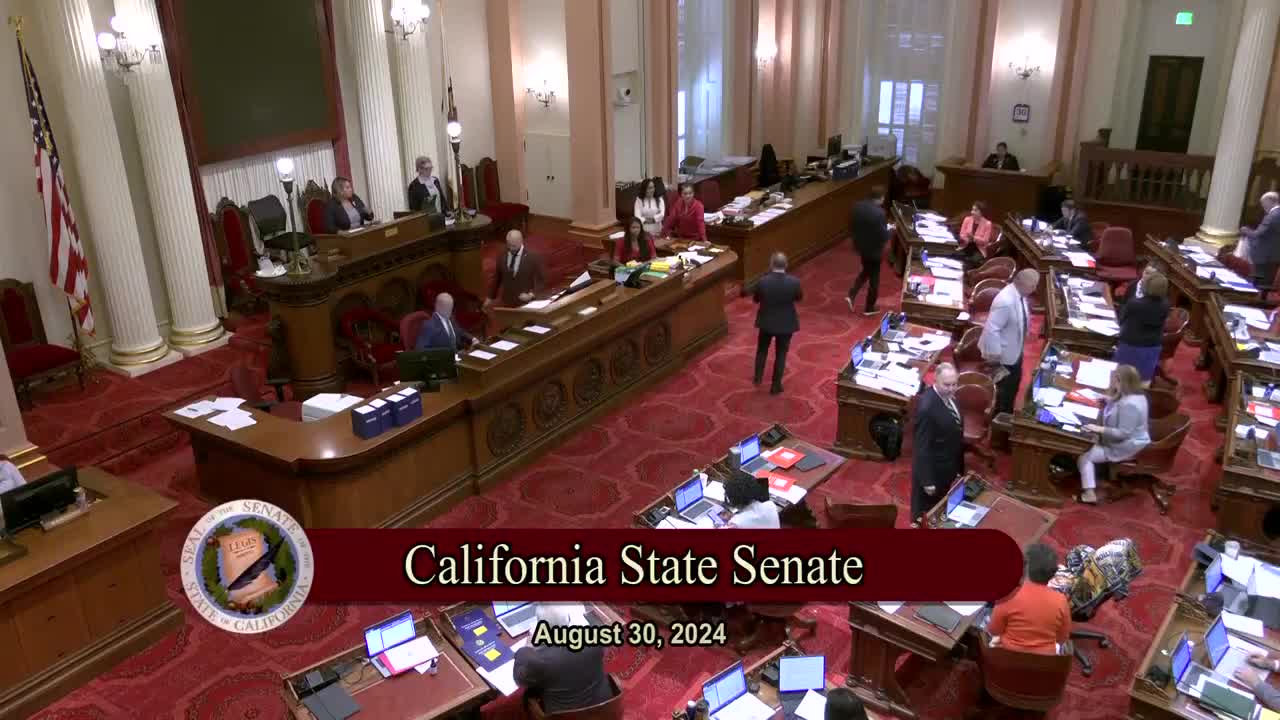 2MIN
Senate Floor
 2MIN
Assembly Floor
 9MIN
Assembly Standing Committee on Natural Resources
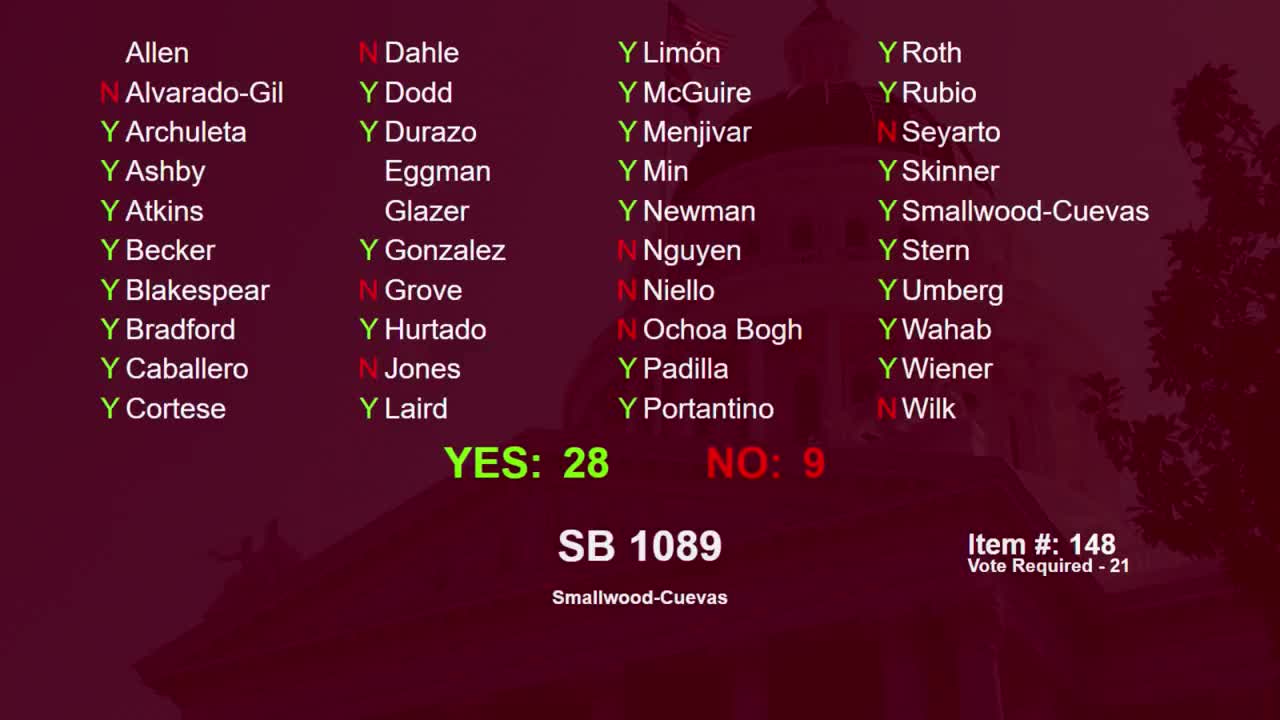 2MIN
Senate Floor
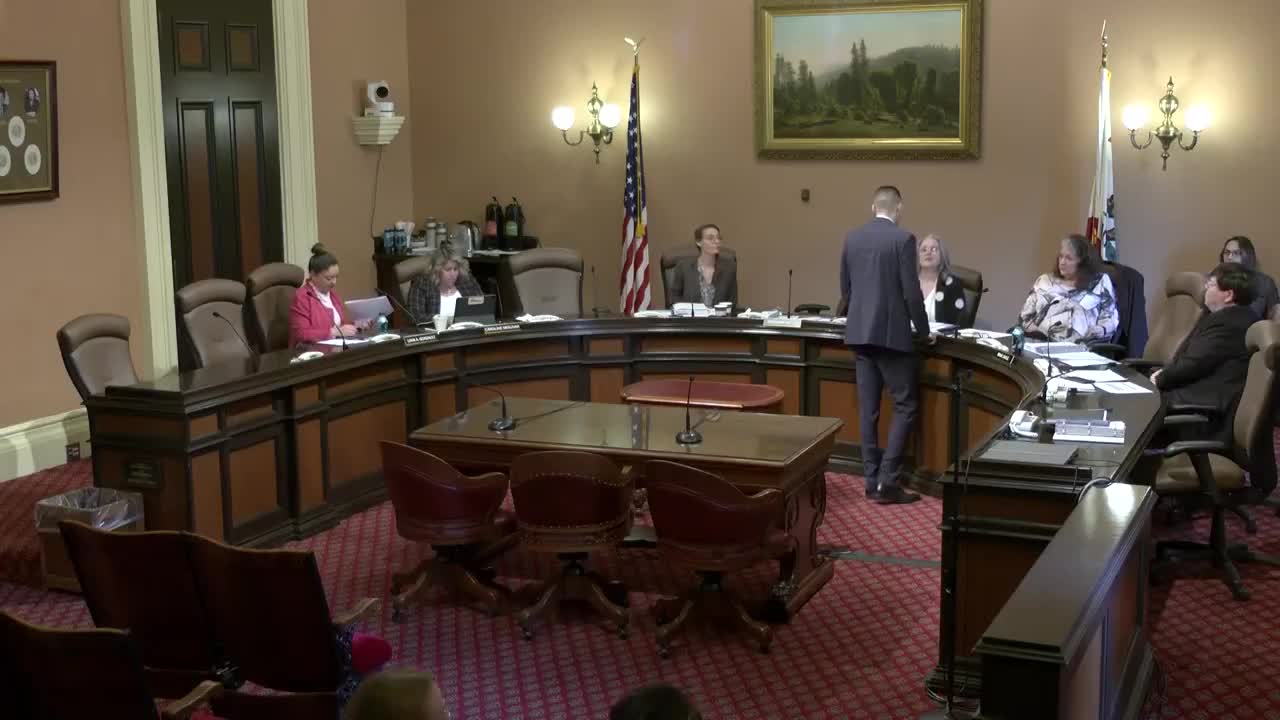 19MIN
Senate Standing Committee on Environmental Quality
 29SEC
Senate Standing Committee on Environmental Quality
 19SEC
Senate Standing Committee on Environmental Quality
25SEC
Senate Standing Committee on Environmental Quality
Bill Author
Bill Co-Author(s):