SB 1315: School accountability: local educational agencies: annual reporting requirements.
- Session Year: 2023-2024
- House: Senate
- Latest Version Date: 2024-09-22
Current Status:
Passed
(2024-09-22: Chaptered by Secretary of State. Chapter 468, Statutes of 2024.)
Introduced
In Committee
First Chamber
In Committee
Second Chamber
Enacted
What does this bill do?
The bill requires the State Department of Education to list and report on all annual reports that local educational agencies—school districts, county offices of education, and charter schools—are required to submit, and to explain the purpose of each. The report must recommend which reports could be combined, shortened, or eliminated to reduce burden, using voluntary input from a diverse mix of local agencies.
The summary is provided by generative AI which can make mistakes. For original language, please view the details in the table below.
Existing law establishes a system of public elementary and secondary schools in this state, and authorizes local educational agencies throughout the state to operate schools and provide instruction to pupils in kindergarten and grades 1 to 12, inclusive. Existing law establishes the State Department of Education, under the administration of the Superintendent of Public Instruction, and assigns to the department numerous duties relating to the financing, governance, and guidance of the public elementary and secondary schools in this state.
This bill would require the department, on or before March 1, 2025, to provide a report to the Superintendent, the Governor, and the Legislature on the number and types of reports that school districts, county offices of education, and charter schools are required to annually submit. The bill would require the report to include, among other things, the purpose of each report and recommendations for which reports can be consolidated, eliminated, or truncated, as provided. The bill would encourage specified committees of the Legislature to, within 30 days of receiving the report from the department, hold a hearing to allow for the Superintendent to present the report. The bill would repeal these provisions on January 1, 2026.
Existing law establishes a system of public elementary and secondary schools in this state, and authorizes local educational agencies throughout the state to operate schools and provide instruction to pupils in kindergarten and grades 1 to 12, inclusive. Existing law establishes the State Department of Education, under the administration of the Superintendent of Public Instruction, and assigns to the department numerous duties relating to the financing, governance, and guidance of the public elementary and secondary schools in this state.
This bill would require the department, on or before March 1, 2025, and every 2 years thereafter, to provide a report to the Superintendent, the Governor, and the Legislature on the number and types of reports that school districts, county offices of education, and charter schools are required to annually submit. The bill would require the report to include, among other things, the purpose of each report and recommendations for which reports can be consolidated, eliminated, or truncated, as provided. The bill would encourage specified committees of the Legislature to, within 30 days of receiving the report from the department, hold a hearing to allow for the Superintendent to present the report. The bill would repeal these provisions on January 1, 2026.
Existing law establishes a system of public elementary and secondary schools in this state, and authorizes local educational agencies throughout the state to operate schools and provide instruction to pupils in kindergarten and grades 1 to 12, inclusive. Existing law establishes the State Department of Education, under the administration of the Superintendent of Public Instruction, and assigns to the department numerous duties relating to the financing, governance, and guidance of the public elementary and secondary schools in this state.
This bill would require the department, on or before March 1, 2025, and every 2 years thereafter, to provide a report to the Superintendent, the Governor, and the Legislature on the number and types of reports that school districts, county offices of education, and charter schools are required to annually submit. The bill would require the report to include, among other things, the purpose of each report and recommendations for which reports can be consolidated to reduce the total number of reports local educational agencies are required to annually complete. consolidated, eliminated, or truncated, as provided. The bill would encourage specified committees of the Legislature to, within 30 days of receiving the report from the department, hold a hearing to allow for the Superintendent to present the report.
Existing law establishes a system of public elementary and secondary schools in this state, and authorizes local educational agencies throughout the state to operate schools and provide instruction to pupils in kindergarten and grades 1 to 12, inclusive. Existing law establishes the State Department of Education, under the administration of the Superintendent of Public Instruction, and assigns to the department numerous duties relating to the financing, governance, and guidance of the public elementary and secondary schools in this state.
This bill would require the department, on or before March 1, 2025, and every 2 years thereafter, to provide a report to the Superintendent, the Governor, and the Legislature on the number and types of reports that school districts, county offices of education, and charter schools are required to annually submit. The bill would require the report to include, among other things, the purpose of each report and recommendations for which reports can be consolidated to reduce the total number of reports local educational agencies are required to annually complete. The bill would require the Superintendent encourage specified committees of the Legislature to, within 30 days of receiving the report from the department, present the report to specified committees and any other relevant subcommittees during legislative budget hearings. hold a hearing to allow for the Superintendent to present the report.
Existing law establishes a system of public elementary and secondary schools in this state, and authorizes local educational agencies throughout the state to operate schools and provide instruction to pupils in kindergarten and grades 1 to 12, inclusive. Existing law establishes the State Department of Education, under the administration of the Superintendent of Public Instruction, and assigns to the department numerous duties relating to the financing, governance, and guidance of the public elementary and secondary schools in this state.
This bill would require the department, on or before March 1, 2025, and every 2 years thereafter, to provide a report to the Superintendent, the Governor, and the Legislature on the number and types of reports that school districts, county offices of education, and charter schools are required to annually submit. The bill would require the report to include, among other things, the purpose of each report and recommendations for which reports can be consolidated to reduce the total number of reports local educational agencies are required to annually complete. The bill would require the Superintendent to, within 30 days of receiving the report from the department, present the report to specified committees and any other relevant subcommittees during legislative budget hearings.
(a)The department shall, on or before March 1, 2025, and in compliance with Section 9795 of the Government Code, provide a report to the Superintendent, the Governor, and the Legislature on the number and types of reports that local educational agencies are required to annually submit. The report shall include all of the following:
(1)Information on each type of report, including if the report is required by a particular program.
(2)The purpose of each report.
(3)Recommendations for both of the following:
(A)Which reports can be consolidated or eliminated to reduce the total number of reports local educational agencies are required to annually complete.
(B)Which reports can be truncated to shorten any reports local educational agencies are required to annually complete.
(C)In determining recommendations pursuant to subparagraphs (A) and (B), the department shall seek voluntary input from a diverse array of local educational agencies that vary in size, type, geographic location, and pupil and staff demographics.
(b)Within 30 days of receiving a report from the department pursuant to subdivision (a), the Assembly and Senate Education committees, the Assembly Committee on Budget, the Senate Committee on Budget and Fiscal Review, and any other relevant subcommittees are encouraged to hold a hearing to allow for the Superintendent to present the report.
(c)For purposes of this section, a local educational agency means a school district, county office of education, or charter school.
(d)It is the intent of the Legislature that the information collected for reports pursuant to this section will help alleviate future burdens and costs on local educational agencies.
(e)This section shall remain in effect only until January 1, 2026, and as of that date is repealed.
(a)Notwithstanding Section 10231.5 of the Government Code, the The department shall, on or before March 1, 2025, and every two years thereafter, in compliance with Section 9795 of the Government Code, provide a report to the Superintendent, the Governor, and the Legislature on the number and types of reports that local educational agencies are required to annually submit. The report shall include all of the following:
(1)Information on each type of report, including if the report is required by a particular program.
(2)The purpose of each report.
(3)Recommendations for both of the following:
(A)Which reports can be consolidated or eliminated to reduce the total number of reports local educational agencies are required to annually complete.
(B)Which reports can be truncated to shorten any reports local educational agencies are required to annually complete.
(C)In determining recommendations pursuant to subparagraphs (A) and (B), the department shall seek voluntary input from a diverse array of local educational agencies that vary in size, type, geographic location, and pupil and staff demographics.
(b)A report required to be submitted pursuant to subdivision (a) shall be submitted in compliance with Section 9795 of the Government Code.(c)(b)Within 30 days of receiving a report from the department pursuant to subdivision (a), the Assembly and Senate Education committees, the Assembly Committee on Budget, the Senate Committee on Budget and Fiscal Review, and any other relevant subcommittees are encouraged to hold a hearing to allow for the Superintendent to present the report.
(d)(c)For purposes of this section, a local educational agency means a school district, county office of education, or charter school.
(e)(d)It is the intent of the Legislature that the information collected for reports pursuant to this section will help alleviate future burdens and costs on local educational agencies.
(e)This section shall remain in effect only until January 1, 2026, and as of that date is repealed.
(a)Notwithstanding Section 10231.5 of the Government Code, the department shall, on or before March 1, 2025, and every two years thereafter, provide a report to the Superintendent, the Governor, and the Legislature on the number and types of reports that local educational agencies are required to annually submit. The report shall include all of the following:
(1)Information on each type of report, including if the report is required by a particular program.
(2)The purpose of each report.
(3)Recommendations for both of the following:
(3)(A)Recommendations for which Which reports can be consolidated or eliminated to reduce the total number of reports local educational agencies are required to annually complete.
(B)Which reports can be truncated to shorten any reports local educational agencies are required to annually complete.
(4)(A)Local educational agency administrative costs for completing each report, including, but not limited to, necessary staffing.(B)(C)In determining administrative costs recommendations pursuant to subparagraph (A), subparagraphs (A) and (B), the department shall seek voluntary input from varying sizes and types a diverse array of local educational agencies. agencies that vary in size, type, geographic location, and pupil and staff demographics.
(b)A report required to be submitted pursuant to subdivision (a) shall be submitted in compliance with Section 9795 of the Government Code.
(c)Within 30 days of receiving a report from the department pursuant to subdivision (a), the Assembly and Senate Education committees, the Assembly Committee on Budget, the Senate Committee on Budget and Fiscal Review, and any other relevant subcommittees are encouraged to hold a hearing to allow for the Superintendent to present the report.
(d)For purposes of this section, a local educational agency means a school district, county office of education, or charter school.
(e)It is the intent of the Legislature that the information collected for reports pursuant to this section will help alleviate future burdens and costs on local educational agencies.
(a)Notwithstanding Section 10231.5 of the Government Code, the department shall, on or before March 1, 2025, and every two years thereafter, provide a report to the Superintendent, the Governor, and the Legislature on the number and types of reports that local educational agencies are required to annually submit. The report shall include all of the following:
(1)Information on each type of report, including if the report is required by a particular program.
(2)The purpose of each report.
(3)Recommendations for which reports can be consolidated to reduce the total number of reports local educational agencies are required to annually complete.
(4)(A)Local educational agency administrative costs for completing each report, including, but not limited to, necessary staffing.
(B)In determining administrative costs pursuant to subparagraph (A), the department shall seek voluntary input from varying sizes and types of local educational agencies.
(b)A report required to be submitted pursuant to subdivision (a) shall be submitted in compliance with Section 9795 of the Government Code.
(c)Within 30 days of receiving a report from the department pursuant to subdivision (a), the Superintendent shall present the report to the Assembly and Senate Education committees, the Assembly Committee on Budget, the Senate Committee on Budget and Fiscal Review, and any other relevant subcommittees during legislative budget hearings. are encouraged to hold a hearing to allow for the Superintendent to present the report.
(d)For purposes of this section, a local educational agency means a school district, county office of education, or charter school.
(a)Notwithstanding Section 10231.5 of the Government Code, the department shall, on or before March 1, 2025, and every two years thereafter, provide a report to the Superintendent, the Governor, and the Legislature on the number and types of reports that local educational agencies are required to annually submit. The report shall include all of the following:
(1)Information on each type of report, including if the report is required by a particular program.
(2)The purpose of each report.
(3)Recommendations for which reports can be consolidated to reduce the total number of reports local educational agencies are required to annually complete.
(4)(A)Local educational agency administrative costs for completing each report, including, but not limited to, necessary staffing.
(B)In determining administrative costs pursuant to subparagraph (A), the department shall seek voluntary input from varying sizes and types of local educational agencies.
(b)A report required to be submitted pursuant to subdivision (a) shall be submitted in compliance with Section 9795 of the Government Code.
(c)Within 30 days of receiving a report from the department pursuant to subdivision (a), the Superintendent shall present the report to the Assembly and Senate Education committees, the Assembly Committee on Budget, the Senate Committee on Budget and Fiscal Review, and any other relevant subcommittees during legislative budget hearings.
(d)For purposes of this section, a local educational agency means a school district, county office of education, or charter school.
|
Date
|
Status
|
|---|---|
| Sep 22, 2024 | Chaptered by Secretary of State. Chapter 468, Statutes of 2024. |
| Sep 22, 2024 | Approved by the Governor. |
| Sep 10, 2024 | Enrolled and presented to the Governor at 4 p.m. |
| Aug 30, 2024 | Assembly amendments concurred in. (Ayes 40. Noes 0. Page 5741.) Ordered to engrossing and enrolling. |
| Aug 30, 2024 | In Senate. Concurrence in Assembly amendments pending. |
| Aug 29, 2024 | Read third time. Passed. (Ayes 76. Noes 0. Page 6886.) Ordered to the Senate. |
| Aug 20, 2024 | Read second time. Ordered to third reading. |
| Aug 19, 2024 | Read second time and amended. Ordered to second reading. |
| Aug 15, 2024 | From committee: Do pass as amended. (Ayes 11. Noes 0.) (August 15). |
| Jul 2, 2024 | July 2 set for first hearing. Placed on suspense file. |
| Jun 17, 2024 | Read second time and amended. Re-referred to Com. on APPR. |
| Jun 13, 2024 | From committee: Do pass as amended and re-refer to Com. on APPR. with recommendation: To consent calendar. (Ayes 7. Noes 0.) (June 12). |
| Jun 3, 2024 | Referred to Com. on ED. |
| May 24, 2024 | In Assembly. Read first time. Held at Desk. |
| May 23, 2024 | Read third time. Passed. (Ayes 37. Noes 0. Page 4182.) Ordered to the Assembly. |
| May 20, 2024 | Ordered to special consent calendar. |
| May 16, 2024 | Read second time. Ordered to third reading. |
| May 16, 2024 | From committee: Do pass. (Ayes 7. Noes 0. Page 3979.) (May 16). |
| May 10, 2024 | Set for hearing May 16. |
| May 6, 2024 | May 6 hearing: Placed on APPR suspense file. |
| Apr 26, 2024 | Set for hearing May 6. |
| Apr 18, 2024 | Read second time and amended. Re-referred to Com. on APPR. |
| Apr 17, 2024 | From committee: Do pass as amended and re-refer to Com. on APPR. (Ayes 7. Noes 0. Page 3659.) (April 17). |
| Apr 4, 2024 | Set for hearing April 17. |
| Feb 29, 2024 | Referred to Com. on ED. |
| Feb 20, 2024 | From printer. May be acted upon on or after March 18. |
| Feb 16, 2024 | Introduced. Read first time. To Com. on RLS. for assignment. To print. |
|
Date
|
Description
|
Location
|
Votes
|
|
|---|---|---|---|---|
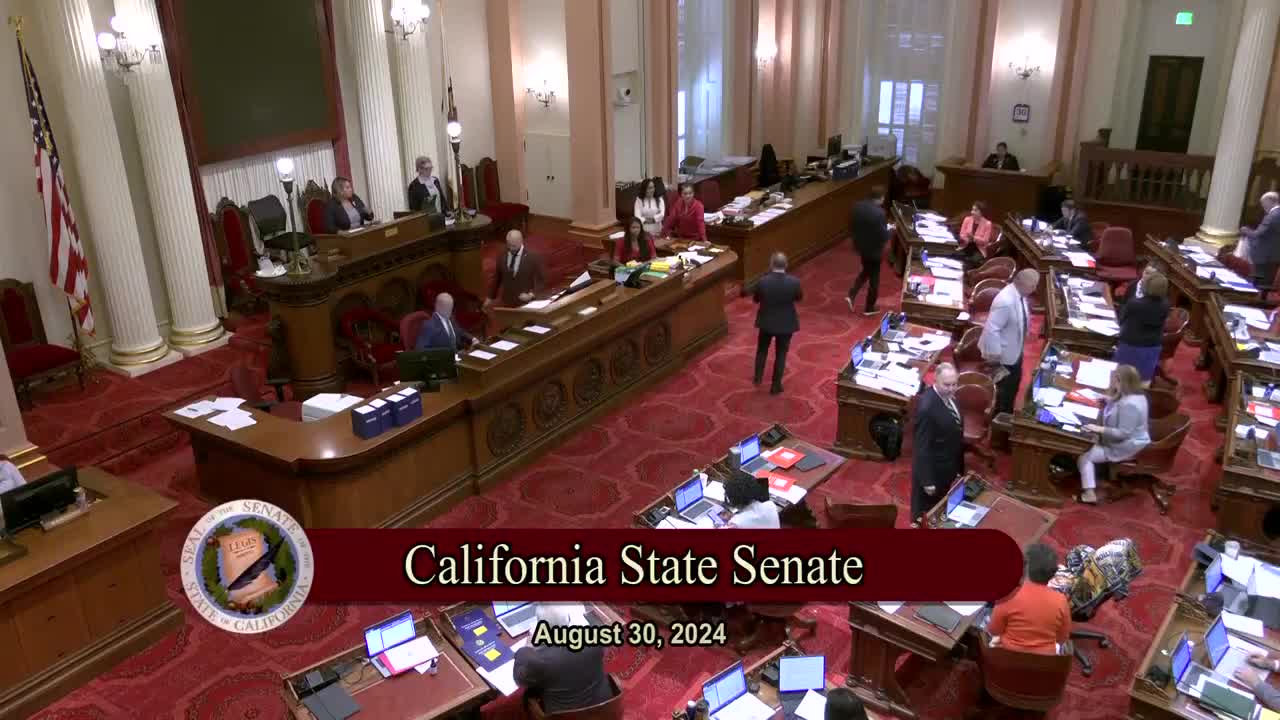
| Aug 30, 2024 | Unfinished Business SB1315 Archuleta Concurrence | Senate Floor |
Passed |
|
| Aug 29, 2024 | SB 1315 Archuleta Senate Third Reading By McCarty | Assembly Floor |
Passed |
|
| Aug 15, 2024 | Do pass as amended. | Assembly Standing Committee on Appropriations |
Passed |
|
| Jun 12, 2024 | Do pass as amended, and be re-referred to the Committee on [Appropriations] with recommendation: To Consent Calendar | Assembly Standing Committee on Education |
Passed |
|
| May 23, 2024 | Special Consent SB1315 Archuleta | Senate Floor |
Passed |
|
| May 16, 2024 | Do pass | Senate Standing Committee on Appropriations |
Passed |
|
| May 6, 2024 | Placed on suspense file | Senate Standing Committee on Appropriations |
Passed |
|
| Apr 17, 2024 | Do pass as amended, but first amend, and re-refer to the Committee on [Appropriations] | Senate Standing Committee on Education |
Passed |
This list shows positions taken on this bill by organizations on the date displayed, which is linked to the original source.
Positions by individuals are not included.
|
Organization
|
Position
|
Date
|
|---|---|---|
| Alameda County Office Of Education | ** Support | |
| Association Of California School Administrators | * Support | Apr 17, 2024 |
| Cabrillo Unified School District | * Support | Apr 17, 2024 |
| California Association Of School Business Officials | ** Support | |
| California Association Of Suburban School Districts | * Support | Apr 17, 2024 |
| California School Boards Association | ** Support | |
| Central Valley Education Coalition | * Support | Apr 17, 2024 |
| Orange County Department Of Education | * Support | Apr 17, 2024 |
| Riverside County Superintendent of Schools | ** Support | |
| Santa Clara County School Boards Association | ** Support | |
| The Small School Districts Association | * Support | Apr 17, 2024 |
| Torrance Unified School District | ** Support |
SENATE RULES COMMITTEE Office of Senate Floor Analyses (916) 651-1520 Fax: (916) 327-4478 | SB 1315 |
UNFINISHED BUSINESS
Bill No: SB 1315
Author: Archuleta (D)
Amended: 8/19/24
Vote: 21
SENATE EDUCATION COMMITTEE: 7-0, 4/17/24
AYES: Newman, Ochoa Bogh, Cortese, Glazer, Gonzalez, Smallwood-Cuevas, Wilk
SENATE APPROPRIATIONS COMMITTEE: 7-0, 5/16/24
AYES: Caballero, Jones, Ashby, Becker, Bradford, Seyarto, Wahab
SENATE FLOOR: 37-0, 5/23/24
AYES: Alvarado-Gil, Ashby, Atkins, Becker, Blakespear, Bradford, Caballero, Cortese, Dahle, Dodd, Durazo, Eggman, Glazer, Gonzalez, Grove, Hurtado, Jones, Laird, Limón, McGuire, Menjivar, Min, Nguyen, Niello, Ochoa Bogh, Padilla, Portantino, Roth, Rubio, Seyarto, Skinner, Smallwood-Cuevas, Stern, Umberg, Wahab, Wiener, Wilk
NO VOTE RECORDED: Allen, Archuleta, Newman
ASSEMBLY FLOOR: 76-0, 8/29/24 - See last page for vote
SUBJECT: School accountability: local educational agencies: annual reporting requirements
SOURCE: California School Boards Association
DIGEST:
This bill requires the California Department of Education (CDE) to conduct a report on the number and types of reports that local educational agencies (LEAs) are required to submit on an annual basis.
Assembly Amendments
(1) expand the CDE report to also include recommendations for which reports can be eliminated or truncated (in addition to which reports can be consolidated); (2) delete the requirement that the CDE report include LEA administrative costs for completing each report; and, (3) reduce the frequency of the CDE report from being biennial to just a one-time report.
ANALYSIS:
Existing law:
- Establishes CDE in state government, and provides that it be administered through:
- The State Board of Education (SBE) which shall be the governing and policy determining body of CDE.
- The Director of Education in whom all executive and administrative functions of CDE are vested and who is the executive officer of SBE. (Education Code (EC) § 33300 and § 33301)
- The State Board of Education (SBE) which shall be the governing and policy determining body of CDE.
- Requires that a Superintendent of Public Instruction (SP) be elected by the qualified electors of the State at each gubernatorial election, and prohibits any SPI from serving more than two terms.
(California Constitution, Article IX, § 2) - Requires LEAs to submit numerous reports (too many to list in this analysis) to CDE on an annual basis.
This bill:
- Requires CDE to conduct a report on the number and types of reports that LEAs are required to submit on an annual basis.
- Requires CDE to provide the report to the SPI, Governor, and Legislature by March 1, 2025.
- Requires the report to include all of the following:
- Information on each type of report, including if the report is required by a particular program.
- The purpose of each report.
- Recommendations for both of the following:
- Which reports can be consolidated or eliminated to reduce the total number of reports LEAs are required to complete annually.
- Which reports can be truncated to shorten any reports LEAs are required to complete annually.
- Which reports can be consolidated or eliminated to reduce the total number of reports LEAs are required to complete annually.
- Information on each type of report, including if the report is required by a particular program.
- Requires CDE, in determining recommendations, to seek voluntary input from a diverse array of LEAs that vary in size, type, geographic location, and demographics of students and staff.
- States legislative intent that the information collected for reports pursuant to this bill will help alleviate future burdens and costs on LEAs.
- Defines LEA to include school districts, county offices of education, and charter schools.
- Sunsets the provisions of this bill on January 1, 2026.
Comments
- Need for the bill. According to the author, “With the state facing a record deficit, it is vital for California to provide oversight on prior legislation to ensure taxpayer dollars are being used responsibly. School districts throughout the state are required to annually produce 170 reports, nearly equivalent to the statutorily required 180 instructional days in the school year. Although beneficial from an informational standpoint, the sheer number of reports can be suffocating for school districts and detracts from their ability to meet the educational needs of students. SB 1315 will help alleviate the administrative costs and burdens placed on school districts – especially important at a time when they are working hard to emerge and recover from the impacts of the pandemic.”
- Are LEAs overwhelmed with reporting requirements? Absolutely. According to the author, LEAs are required to submit 170 reports on an annual basis. A cursory search of the Education Code by committee staff revealed that LEAs are required to report to CDE on an annual basis on numerous programs, activities, student outcomes, and use of grant funds. A small sampling includes the School Accountability Report Card, district budgets, attendance, student and educator demographic data, student assessment data, number of classified staff, estimated number of teacher hires, home-to-school transportation data, kindergarten program type, and updates to Local Control Accountability Plans.
Data collections administered by CDE to gather information about students, schools, and districts that are used for state and federal reporting purposes include but are not limited to:- The California Basic Educational Data System (CBEDS) is an annual data collection administered in October for the purpose of collecting data about schools and districts, as well as some aggregate data on students and staff.
- The California Longitudinal Pupil Achievement Data System is used to maintain individual-level data including student demographics, course data, discipline, assessments, staff assignments, and other data for state and federal reporting.
- The Consolidated Application and Reporting System is a data collection system to apply for Categorical Program Funding and to report on the use of those funds.
- Fiscal and Attendance Data.
- Special Education.
- The California Basic Educational Data System (CBEDS) is an annual data collection administered in October for the purpose of collecting data about schools and districts, as well as some aggregate data on students and staff.
FISCAL EFFECT: Appropriation: No Fiscal Com.: Yes Local: No
According to the Assembly Appropriations Committee, this bill would impose the following costs:
- One-time General Fund costs, potentially in the low hundreds of thousands of dollars, for staff at CDE to collect information and compile a legislative report.
- Potential one-time Proposition 98 General Fund cost pressures to LEAs to report information related to their reports to CDE, although the bill does not require they do so.
SUPPORT: (Verified 8/26/24)
California School Boards Association (Source)
Alameda County Office of Education
California Association of School Business Officials
Riverside County Superintendent of Schools
Santa Clara County School Boards Association
Torrance Unified School District
OPPOSITION: (Verified 8/26/24)
None received
ASSEMBLY FLOOR: 76-0, 8/29/24
Ayes: Addis, Aguiar-Curry, Alanis, Alvarez, Arambula, Bains, Bauer-Kahan, Bennett, Berman, Boerner, Bonta, Bryan, Calderon, Juan Carrillo, Wendy Carrillo, Chen, Connolly, Megan Dahle, Davies, Dixon, Essayli, Flora, Mike Fong, Friedman, Gabriel, Gallagher, Garcia, Gipson, Grayson, Haney, Hart, Holden, Hoover, Irwin, Jackson, Jones-Sawyer, Kalra, Lackey, Lee, Low, Lowenthal, Maienschein, Mathis, McCarty, McKinnor, Muratsuchi, Stephanie Nguyen, Pacheco, Papan, Jim Patterson, Joe Patterson, Pellerin, Petrie-Norris, Quirk-Silva, Ramos, Rendon, Reyes, Luz Rivas, Rodriguez, Blanca Rubio, Sanchez, Santiago, Schiavo, Soria, Ta, Ting, Valencia, Villapudua, Waldron, Wallis, Ward, Weber, Wicks, Wilson, Wood, Robert Rivas
Noes:
No Vote Recorded: Cervantes, Ortega, Zbur
Prepared by: Lynn Lorber / ED. / (916) 651-4105
8/29/24 19:31:34
**** END ****
SENATE THIRD READING
STR Bill Id:SB 1315
Author:(Archuleta)
As Amended Ver:August 19, 2024
Majority vote
SUMMARY
Requires the California Department of Education (CDE) to, on or before March 1, 2025, provide a report to the Superintendent of Public Instruction (SPI) the Governor, and the Legislature on the number and types of reports that local educational agencies (LEAs) are required to annually submit.
Major Provisions
- Requires the CDE to, on or before March 1, 2025, provide a report to the SPI the Governor, and the Legislature on the number and types of reports that LEAs are required to annually submit.
- Requires the report to include all of the following:
- Information on each type of report, including if the report is required by a particular program;
- The purpose of each report;
- Recommendations for:
- Which reports can be consolidated or eliminated to reduce the total number of reports LEAs are required to annually complete; and
- Which reports can be truncated to shorten any reports LEAs are required to annually complete.
- Requires the CDE, in determining recommendations, to seek voluntary input from a diverse array of LEAs that vary in size, type, geographic location, and student and staff demographics.
- Requires that this report required be submitted in compliance with Section 9795 of the Government Code.
- Encourages the Assembly Committee on Budget, the Senate Committee on Budget and Fiscal Review, and any other relevant subcommittees, within 30 days of receiving the report, to hold a hearing to allow the SPI to present the report.
- Sunsets the measure on January 1, 2026.
- Defines, for purposes of the act, a "local educational agency" to mean a school district, county office of education (COE), or charter school.
COMMENTS
The Plandemic: Reporting requirements increase as new programs and initiatives proliferate during the COVID-19 pandemic. The Local Control Funding Formula (LCFF), enacted in 2013, eliminated most categorical programs and their associated applications, plans, reports, data submissions, and compliance monitoring.
Since then, and particularly during the COVID-19 pandemic, a surge in state and federal funding resulted in the proliferation of new programs and initiatives. These programs were accompanied by applications, plans, data submissions, and reports. The state’s multiple measures accountability system has also required more reporting by LEAs to the state.
As was the case prior to LCFF, LEAs report that many reports are duplicative, cumbersome, and often require LEAs to report the same data (which the state already has) over and over. Adding to the frustration some LEA staff feel is the suspicion that not all of the information reported will be reviewed and used by the entities requiring it.
Balancing accountability and evaluation with opportunity costs. State reporting requirements serve important purposes, among them the safeguarding of public funds and the evaluation of policy initiatives.
But according to the California School Boards Association (CSBA), the cumulative impact of mandated state and federal reports, data submissions, and planning documents, draws resources away from critical tasks and responsibilities of LEA staff, especially in California’s smaller districts and COEs. In a 2024 report, Drowning in Documentation, CSBA notes the following effects:
- High price in time, human capital, cost and opportunity cost: Administrators' planning and reporting efforts are so extensive that they cut into time available for instructional leadership, school improvement, school climate and other critical functions.
- Ever-growing burden: While new programs and mandates add to the long list of reporting requirements, state and federal government rarely phase out requirements, even when they become duplicative or are no longer actively reviewed by their respective agencies.
- Too much data to digest: Some districts, particularly smaller ones, lack the time and capacity to use the required data for their own purposes. State agencies often lack the staff capacity to analyze required plans, reports and data submissions or provide constructive feedback and technical assistance to LEAs.
- Disproportionate burden for smaller districts. Large districts might have dozens of staff to meet these requirements. Small to medium districts might have anywhere from a handful to more than a dozen staff available to complete reports, plans, and data submissions. Very small districts might rely on the superintendent, principal or superintendent/principal to meet these requirements, taking time away from their other administrative and educational leadership responsibilities. Alternatively, very small districts may have to hire outside consultants to do this work, consuming valuable resources that could be spent on student support and instruction. A significant amount of public funding is only available through discretionary grants that require additional time for applying, planning, reporting. Smaller and less-resourced districts often cannot take on this additional workload, creating opportunity gaps for students, staff and schools. “With the state facing a record deficit, it is vital for California to provide oversight on prior legislation to ensure taxpayer dollars are being used responsibly. School districts throughout the state are required to annually produce 170 reports, nearly equivalent to the statutorily required 180 instructional days in the school year. Although beneficial from an informational standpoint, the sheer number of reports can be suffocating for school districts and detracts from their ability to meet the educational needs of students. SB 1315 will help alleviate the administrative costs and burdens placed on school districts – especially important at a time when they are working hard to emerge and recover from the impacts of the pandemic.”
A more comprehensive approach. This bill proposes to require the CDE to produce a report and recommendations on reports which could be consolidated. This is a good start, but more could be done to improve reporting processes, starting with the Legislature and the Governor. They may wish to consider the following questions when deciding whether, and how, to establish a new reporting requirement:
Purpose: Why is this information being requested, and how will it be used?
- Audience: Who is going to use this information?
- Value: Of how much value is this information, and what is the opportunity cost?
- Feasibility: Is it possible to get the desired information, even from small LEAs?
- Duplication: Is this information already reported to the state in some other form?
- Duration: How long should this requirement be in effect?
Some elements of a better system could include:
- Guidelines and a process for establishing new reporting requirements, including consideration of the questions above;
- Technological solutions, such as auto-filled template reporting forms;
- Accommodations for small LEAs to reduce the disproportionate burden placed on them;
- Risk-based reporting, similar to the way in which audits are sometimes conducted;
- Auto-repeal of reports, similar to Government Code 10231.5 for state reports; and
- Annual pruning of unnecessary requirements, through the annual omnibus Committee bill.
According to the Author
The author states, "With the state facing a record deficit, it is vital for California to provide oversight on prior legislation to ensure taxpayer dollars are being used responsibly. School districts throughout the state are required to annually produce 170 reports, nearly equivalent to the statutorily required 180 instructional days in the school year. Although beneficial from an informational standpoint, the sheer number of reports can be suffocating for school districts and detracts from their ability to meet the educational needs of students. SB 1315 will help alleviate the administrative costs and burdens placed on school districts – especially important at a time when they are working hard to emerge and recover from the impacts of the pandemic."
Arguments in Support
The California School Boards Association writes, "CSBA believes strongly in the importance of accountability and ensuring students' needs are being met, both from an academic standpoint and from a social-emotional one.
Yet, as district requirements and state mandates continue to grow—from increased mental health needs of students, required compliance with necessary public health protocols due to the pandemic and significant programmatic requirements, including drafting and adopting a district Local Control Accountability Plan (LCAP), implementing the Expanded Learning Opportunities Program (ELOP) and the California Universal Meals Program—many LEAs have limited staff and resources to identify, develop and submit this high number of reports.
The assumption is that each report plays a role in helping inform the state about the status and progress of its public education system. However, this is unclear. Some reports may be obsolete, others duplicative, and some go unreviewed. Ultimately, it is the sheer number and scope of reports that places a significant burden on LEAs – pulling administrative staff away from the day-to-day needs of their students.
By assessing the number, type and scope of reports, this will help to identify where information could be condensed and where some reports could be eliminated – freeing up more time to provide for the needs of California's students. This will also help state lawmakers be informed about what reports are most helpful to policy development while also dispensing with others that may have no further benefit. Lastly, this will help save LEA costs by reducing the financial burdens associated with producing obsolete reports or reports that could be consolidated with others."
Arguments in Opposition
None on file
FISCAL COMMENTS
According to the Assembly Appropriations Committee:
- One-time General Fund costs, potentially in the low hundreds of thousands of dollars, for staff at CDE to collect information and compile a legislative report.
- Potential one-time Proposition 98 General Fund cost pressures to LEAs to report information related to their reports to CDE, although the bill does not require they do so.
VOTES
SENATE FLOOR: 37-0-3
YES: Alvarado-Gil, Ashby, Atkins, Becker, Blakespear, Bradford, Caballero, Cortese, Dahle, Dodd, Durazo, Eggman, Glazer, Gonzalez, Grove, Hurtado, Jones, Laird, Limón, McGuire, Menjivar, Min, Nguyen, Niello, Ochoa Bogh, Padilla, Portantino, Roth, Rubio, Seyarto, Skinner, Smallwood-Cuevas, Stern, Umberg, Wahab, Wiener, Wilk
ABS, ABST OR NV: Allen, Archuleta, Newman
ASM EDUCATION: 7-0-0
YES: Muratsuchi, Addis, Alvarez, Bonta, Flora, Hoover, McCarty
ASM APPROPRIATIONS: 11-0-4
YES: Wicks, Arambula, Bryan, Calderon, Wendy Carrillo, Mike Fong, Grayson, Haney, Hart, Pellerin, Villapudua
ABS, ABST OR NV: Sanchez, Dixon, Jim Patterson, Ta
UPDATED
VERSION: August 19, 2024
CONSULTANT: Tanya Lieberman / ED. / (916) 319-2087 FN: 0003967
Date of Hearing: July 2, 2024
ASSEMBLY COMMITTEE ON APPROPRIATIONS
Buffy Wicks, Chair
SBPCA Bill Id:SB 1315
Author:(Archuleta) – As Amended Ver:June 17, 2024
Policy Committee: | Education | Vote: | 7 - 0 |
|
| ||
|
|
Urgency: No State Mandated Local Program: No Reimbursable: No
SUMMARY:
This bill requires, beginning March 1, 2025, and every two years thereafter, the California Department of Education (CDE) to conduct a report on the number and types of reports that local educational agencies (LEAs) are required to submit on an annual basis.
Specifically, the report is to include the following:
- Information on each type of report, including if the report is required by a particular program.
- The purpose of each report.
- Recommendations for (a) which reports can be consolidated or eliminated to reduce the total number of reports LEAs are required to annually complete and (b) which reports can be truncated to shorten any reports LEAs are required to annually complete.
The bill further encourages the Assembly and Senate Education committees, the Assembly Committee on Budget, the Senate Committee on Budget and Fiscal Review, and any other relevant subcommittees, within 30 days of receiving the aforementioned reports, hold a hearing to allow for the Superintendent of Public Instruction to present the report.
FISCAL EFFECT:
- Ongoing General Fund costs, potentially in the low hundreds of thousands of dollars annually, for staff at CDE to collect information and annually compile a legislative report. CDE indicates it would also need a staff person to create and maintain a database for the information.
- Potential ongoing Proposition 98 General Fund cost pressures to LEAs to report information related to their reports to CDE, although the bill does not require they do so.
According to the Legislative Analyst’s Office, the General Fund faces a structural deficit in the tens of billions of dollars over the next several fiscal years.
COMMENTS:
- Purpose. According to the author:
With the state facing a record deficit, it is vital for California to provide oversight on prior legislation to ensure taxpayer dollars are being used responsibly…SB 1315 will help alleviate the administrative costs and burdens placed on school districts – especially important at a time when they are working hard to emerge and recover from the impacts of the pandemic.
- Background. Current law requires LEAs to report various information to CDE, including information on numerous programs, activities, student outcomes, and use of grant funds. The purpose of these reports is generally for accountability purposes and for program evaluation. However, according to the California School Boards Association, a co-sponsor of this bill, the cumulative impact of required state and federal reports, data submissions, and planning documents comes with high opportunity costs to LEAs, especially smaller LEAs.
This bill requires CDE to provide certain information on these reports and make recommendations to the Legislature on ways reporting requirements could be streamlined.
Analysis Prepared by: Natasha Collins / APPR. / (916) 319-2081
Date of Hearing: June 12, 2024
ASSEMBLY COMMITTEE ON EDUCATION
Al Muratsuchi, Chair
SBPCA Bill Id:SB 1315
Author:(Archuleta) – As Amended Ver:April 18, 2024
SENATE VOTE: 37-0
SUBJECT: School accountability: local educational agencies: annual reporting requirements
SUMMARY: Requires the California Department of Education (CDE) to, on or before March 1, 2025, and every two years thereafter, provide a report to the Superintendent of Public Instruction (SPI) the Governor, and the Legislature on the number and types of reports that local educational agencies (LEAs) are required to annually submit. Specifically, this bill:
- Requires the CDE to, on or before March 1, 2025, and every two years thereafter, provide a report to the SPI the Governor, and the Legislature on the number and types of reports that LEAs are required to annually submit.
- Requires the report to include all of the following:
- Information on each type of report, including if the report is required by a particular program;
- The purpose of each report;
- Recommendations for which reports can be consolidated to reduce the total number of reports LEAs are required to annually complete; and
- LEA administrative costs for completing each report, including, but not limited to, necessary staffing.
- Requires the CDE, in determining administrative costs, to seek voluntary input from varying sizes and types of LEAs.
- Requires that this report required be submitted in compliance with Section 9795 of the Government Code.
- Encourages the Assembly Committee on Budget, the Senate Committee on Budget and Fiscal Review, and any other relevant subcommittees, within 30 days of receiving the report to hold a hearing to allow the SPI to present the report.
- Defines, for purposes of the act, a “local educational agency” to mean a school district, county office of education (COE), or charter school.
EXISTING LAW:
- Requires LEAs to submit numerous reports to the CDE on an annual basis. (Education Code (EC))
- Requires any bill that would require a state agency to submit a report to the Legislature to include a provision that repeals the reporting requirement, or makes the requirement inoperative, no later than a date four years following the date upon which the bill becomes operative, or four years after the due date of any report required every four or more years. (Government Code (GOV) 10231.5)
- Requires the Legislative Counsel, in drafting a bill that would impose a reporting requirement to include a provision that repeals the reporting requirement, or makes the reporting requirement inoperative, four years after the date on which the requirement becomes operative, unless the person requesting the bill or amendment directs the Legislative Counsel to do otherwise. (GOV 10231.5)
FISCAL EFFECT: According to the Senate Appropriations Committee:
- The CDE estimates General Fund costs of $345,000 each year and 3.0 positions to comply with the bill’s new data collection and reporting requirements. This estimate includes the cost of a new data reporting system that would need to be created that would be flexible to adapt to changes in collections from year to year.
- While not explicitly required, LEAs may incur additional, unknown cost pressures to track and report their “administrative costs” associated with completing each annual report and provide that information to the CDE. However, the language as currently drafted lacks clarity, therefore the extent of the costs would depend on how the process for collecting and providing the data to CDE is implemented.
COMMENTS:
Need for the bill. The author states, “With the state facing a record deficit, it is vital for California to provide oversight on prior legislation to ensure taxpayer dollars are being used responsibly. School districts throughout the state are required to annually produce 170 reports, nearly equivalent to the statutorily required 180 instructional days in the school year. Although beneficial from an informational standpoint, the sheer number of reports can be suffocating for school districts and detracts from their ability to meet the educational needs of students. SB 1315 will help alleviate the administrative costs and burdens placed on school districts – especially important at a time when they are working hard to emerge and recover from the impacts of the pandemic.”
The Plandemic: Reporting requirements increase as new programs and initiatives proliferate during the COVID-19 pandemic. The Local Control Funding Formula (LCFF), enacted in 2013, eliminated most categorical programs and their associated applications, plans, reports, data submissions, and compliance monitoring.
Since then, and particularly during the COVID-19 pandemic, a surge in state and federal funding resulted in the proliferation of new programs and initiatives. These programs were accompanied by applications, plans, data submissions, and reports. The state’s multiple measures accountability system has also required more reporting by LEAs to the state.
As was the case prior to LCFF, LEAs report that many reports are duplicative, cumbersome, and often require LEAs to report the same data (which the state already has) over and over. Adding to the frustration some LEA staff feel is the suspicion that not all of the information reported will be reviewed and used by the entities requiring it.
Balancing accountability and evaluation with opportunity costs. State reporting requirements serve important purposes, among them the safeguarding of public funds and the evaluation of policy initiatives.
But according to the California School Boards Association (CSBA), the cumulative impact of mandated state and federal reports, data submissions, and planning documents, draws resources away from critical tasks and responsibilities of LEA staff, especially in California’s smaller districts and COEs. In a 2024 report, Drowning in Documentation, CSBA notes the following effects:
- High price in time, human capital, cost and opportunity cost: Administrators’ planning and reporting efforts are so extensive that they cut into time available for instructional leadership, school improvement, school climate and other critical functions.
- Ever-growing burden: While new programs and mandates add to the long list of reporting requirements, state and federal government rarely phase out requirements, even when they become duplicative or are no longer actively reviewed by their respective agencies.
- Too much data to digest: Some districts, particularly smaller ones, lack the time and capacity to use the required data for their own purposes. State agencies often lack the staff capacity to analyze required plans, reports and data submissions or provide constructive feedback and technical assistance to LEAs.
- Disproportionate burden for smaller districts. Large districts might have dozens of staff to meet these requirements. Small to medium districts might have anywhere from a handful to more than a dozen staff available to complete reports, plans, and data submissions. Very small districts might rely on the superintendent, principal or superintendent/principal to meet these requirements, taking time away from their other administrative and educational leadership responsibilities. Alternatively, very small districts may have to hire outside consultants to do this work, consuming valuable resources that could be spent on student support and instruction. A significant amount of public funding is only available through discretionary grants that require additional time for applying, planning, reporting. Smaller and less-resourced districts often cannot take on this additional workload, creating opportunity gaps for students, staff and schools.
What kinds of information do LEAs send to the state? According to the author, LEAs produce approximately 170 reports per year – nearly one for each day of the school year. LEAs submit numerous sets of data through these and other systems to meet state and federal requirements:
- California Basic Educational Data System
- California Longitudinal Pupil Achievement Data
- Standardized Account Code Structure System
- Principal Apportionment Data Collection System
- Child Nutrition Information Payment System
- The Consolidated Application and Reporting System
- Federal Program Monitoring Reviews
- Fiscal and Attendance Data.
- Every Student Succeeds Act (ESSA) Per-Pupil Expenditures System
- Civil Rights Data Collection
- Special Education
Some of the required plans, applications, and reports LEAs submit to the fall into the following categories:
- Accountability
- Safety and Transportation
- State Block Grants and Special Funds
- Special Education
- Pandemic Recovery programs
- Discretionary Grants
A more comprehensive approach. This bill proposes to require the CDE to produce a report and recommendations on reports which could be consolidated. This is a good start. The Committee may wish to consider that more could be done to improve reporting processes, starting with the Legislature and the Governor. They may wish to consider the following questions when deciding whether, and how, to establish a new reporting requirement:
- Purpose: Why is this information being requested, and how will it be used?
- Audience: Who is going to use this information?
- Value: Of how much value is this information, and what is the opportunity cost?
- Feasibility: Is it possible to get the desired information, even from small LEAs?
- Duplication: Is this information already reported to the state in some other form?
- Duration: How long should this requirement be in effect?
Some elements of a better system could include:
- Guidelines and a process for establishing new reporting requirements, including consideration of the questions above;
- Technological solutions, such as auto-filled template reporting forms;
- Accommodations for small LEAs to reduce the disproportionate burden placed on them;
- Risk-based reporting, similar to the way in which audits are sometimes conducted;
- Auto-repeal of reports, similar to Government Code 10231.5 for state reports; and
- Annual pruning of unnecessary requirements, through the annual omnibus Committee bill.
Single Plan for Student Achievement was an earlier effort to consolidate reporting requirements. Prior to the enactment of the LCFF in 2013, LEAs were required to submit annual plans for many of the dozens of categorical programs they operated. LEAs spent significant staff time complying with duplicative planning and reporting requirements for these programs. They were required to provide some information to the CDE (demographics of students, school codes, staffing information) dozens of times each year.
In response to concerns similar to those expressed by supporters of this measure, SB 374 (O’Connell), Chapter 724, Statutes of 2001, added numerous programs to the Consolidated Application, eliminated the Program Quality Review, and established the Single Plan for Student Achievement (SPSA), which allowed LEAs to meet the reporting requirements for numerous categorical programs through a single plan. The Assembly Education Committee analysis for that bill notes, “Supporters of the bill believe that it will streamline state requirements for local planning and replace ‘process’ requirements with attention towards state standards and accountability for results.”
Arguments in support. The California School Boards Association writes, “CSBA believes strongly in the importance of accountability and ensuring students’ needs are being met, both from an academic standpoint and from a social-emotional one.
Yet, as district requirements and state mandates continue to grow—from increased mental health needs of students, required compliance with necessary public health protocols due to the pandemic and significant programmatic requirements, including drafting and adopting a district Local Control Accountability Plan (LCAP), implementing the Expanded Learning Opportunities Program (ELOP) and the California Universal Meals Program—many LEAs have limited staff and resources to identify, develop and submit this high number of reports.
The assumption is that each report plays a role in helping inform the state about the status and progress of its public education system. However, this is unclear. Some reports may be obsolete, others duplicative, and some go unreviewed. Ultimately, it is the sheer number and scope of reports that places a significant burden on LEAs – pulling administrative staff away from the day-to-day needs of their students.
By assessing the number, type and scope of reports, this will help to identify where information could be condensed and where some reports could be eliminated – freeing up more time to provide for the needs of California’s students. This will also help state lawmakers be informed about what reports are most helpful to policy development while also dispensing with others that may have no further benefit. Lastly, this will help save LEA costs by reducing the financial burdens associated with producing obsolete reports or reports that could be consolidated with others.”
Recommended Committee amendments. Staff recommends that this bill be amended to:
- Strike the requirement that the report include administrative costs for completing the reports.
- Specify that the input on recommendations be sought from a diverse array of LEAs that vary in size, type, geographic location, and pupil and demographics.
- Add “eliminated, or truncated,” before “consolidated” in (a)(3).
- State legislative intent that the information collected for this report will help alleviate future burdens and costs on LEAs.
REGISTERED SUPPORT / OPPOSITION:
Support
Alameda County Office of Education
Association of California School Administrators
California Association of School Business Officials
California School Boards Association
Compton Unified School District
Riverside County Public K-12 School District Superintendents
Riverside County Superintendent of Schools
Santa Clara County School Boards Association
Small School Districts Association
Torrance Unified School District
Opposition
None on file
Analysis Prepared by: Tanya Lieberman / ED. / (916) 319-2087
SENATE RULES COMMITTEE Office of Senate Floor Analyses (916) 651-1520 Fax: (916) 327-4478 | SB 1315 |
THIRD READING
Bill No: SB 1315
Author: Archuleta (D)
Amended: 4/18/24
Vote: 21
SENATE EDUCATION COMMITTEE: 7-0, 4/17/24
AYES: Newman, Ochoa Bogh, Cortese, Glazer, Gonzalez, Smallwood-Cuevas, Wilk
SENATE APPROPRIATIONS COMMITTEE: 7-0, 5/16/24
AYES: Caballero, Jones, Ashby, Becker, Bradford, Seyarto, Wahab
SENATE APPROPRIATIONS COMMITTEE:
SUBJECT: School accountability: local educational agencies: annual reporting requirements
SOURCE: California School Boards Association
DIGEST:
This bill requires the California Department of Education (CDE) to conduct a biennial report on the number and types of reports that local educational agencies (LEAs) are required to submit on an annual basis.
ANALYSIS:
Existing law:
- Establishes CDE in state government, and provides that it be administered through:
- The State Board of Education (SBE) which shall be the governing and policy determining body of CDE.
- The Director of Education in whom all executive and administrative functions of CDE are vested and who is the executive officer of SBE. (Education Code (EC) § 33300 and § 33301)
- The State Board of Education (SBE) which shall be the governing and policy determining body of CDE.
- Requires that a Superintendent of Public Instruction (SP) be elected by the qualified electors of the State at each gubernatorial election, and prohibits any SPI from serving more than two terms.
(California Constitution, Article IX, § 2) - Requires LEAs to submit numerous reports (too many to list in this analysis) to CDE on an annual basis.
This bill:
- Requires CDE to conduct a biennial report on the number and types of reports that LEAs are required to submit on an annual basis.
- Requires CDE to provide the report to the SPI, Governor, and Legislature by March 1, 2025 and every two years thereafter.
- Requires the report to include all of the following:
- Information on each type of report, including if the report is required by a particular program.
- The purpose of each report.
- Recommendations for which reports can be consolidated to reduce the total number of reports LEAs are require to complete annually.
- LEA administrative costs for completing each report, including but not limited to, necessary staffing.
- Information on each type of report, including if the report is required by a particular program.
- Requires CDE, in determining administrative costs to LEAs, to seek voluntary input from LEAs of varying sizes and types.
- Encourages the Assembly and Senate Education committees, the Assembly Committee on Budget, the Senate Committee on Budget and Fiscal Review, and any other relevant subcommittees, within 30 days of receiving a report from CDE, to hold a hearing to allow for the SPI to present the report.
- Defines LEA to include school districts, county offices of education, and charter schools.
Comments
- Need for the bill. According to the author, “With the state facing a record deficit, it is vital for California to provide oversight on prior legislation to ensure taxpayer dollars are being used responsibly. School districts throughout the state are required to annually produce 170 reports, nearly equivalent to the statutorily required 180 instructional days in the school year. Although beneficial from an informational standpoint, the sheer number of reports can be suffocating for school districts and detracts from their ability to meet the educational needs of students. SB 1315 will help alleviate the administrative costs and burdens placed on school districts – especially important at a time when they are working hard to emerge and recover from the impacts of the pandemic.”
- Are LEAs overwhelmed with reporting requirements? Absolutely. According to the author, LEAs are required to submit 170 reports on an annual basis. A cursory search of the Education Code by committee staff revealed that LEAs are required to report to CDE on an annual basis on numerous programs, activities, student outcomes, and use of grant funds. A small sampling includes the School Accountability Report Card, district budgets, attendance, student and educator demographic data, student assessment data, number of classified staff, estimated number of teacher hires, home-to-school transportation data, kindergarten program type, and updates to Local Control Accountability Plans.
Data collections administered by CDE to gather information about students, schools, and districts that are used for state and federal reporting purposes include but are not limited to:- The California Basic Educational Data System (CBEDS) is an annual data collection administered in October for the purpose of collecting data about schools and districts, as well as some aggregate data on students and staff.
- The California Longitudinal Pupil Achievement Data System is used to maintain individual-level data including student demographics, course data, discipline, assessments, staff assignments, and other data for state and federal reporting.
- The Consolidated Application and Reporting System is a data collection system to apply for Categorical Program Funding and to report on the use of those funds.
- Fiscal and Attendance Data.
- Special Education.
- The California Basic Educational Data System (CBEDS) is an annual data collection administered in October for the purpose of collecting data about schools and districts, as well as some aggregate data on students and staff.
FISCAL EFFECT: Appropriation: No Fiscal Com.: Yes Local: No
According to the Senate Appropriations Committee, this bill would impose the following costs:
- The CDE estimates General Fund costs of $345,000 each year and 3.0 positions to comply with the bill’s new data collection and reporting requirements. This estimate includes the cost of a new data reporting system that would need to be created that would be flexible to adapt to changes in collections from year to year.
- While not explicitly required, LEAs may incur additional, unknown cost pressures to track and report their “administrative costs” associated with completing each annual report and provide that information to the CDE. However, the language as currently drafted lacks clarity, therefore the extent of the costs would depend on how the process for collecting and providing the data to CDE is implemented.
SUPPORT: (Verified 5/16/24)
California School Boards Association (source)
Alameda County Office of Education
California Association of School Business Officials
Riverside County Superintendent of Schools
Torrance Unified School District
OPPOSITION: (Verified 5/16/24)
None received
Prepared by: Lynn Lorber / ED. / (916) 651-4105
5/17/24 17:44:23
**** END ****
SENATE COMMITTEE ON APPROPRIATIONS
Senator Anna Caballero, Chair
2023 - 2024 Regular Session
SB 1315 (Archuleta) - School accountability: local educational agencies: annual reporting requirements
Version: April 18, 2024 | Policy Vote: ED. 7 - 0 |
Urgency: No | Mandate: No |
Hearing Date: May 6, 2024 | Consultant: Lenin Del Castillo |
Bill Summary:
This bill requires the California Department of Education (CDE) to conduct a biennial report on the number and types of reports that local educational agencies (LEAs) are required to submit on an annual basis.
Fiscal Impact:
- The CDE estimates General Fund costs of $345,000 each year and 3.0 positions to comply with the bill’s new data collection and reporting requirements. This estimate includes the cost of a new data reporting system that would need to be created that would be flexible to adapt to changes in collections from year to year.
- While not explicitly required, LEAs may incur additional, unknown cost pressures to track and report their “administrative costs” associated with completing each annual report and provide that information to the CDE. However, the language as currently drafted lacks clarity, therefore the extent of the costs would depend on how the process for collecting and providing the data to CDE is implemented.
Background:
Existing law requires LEAs to report to CDE on an annual basis on numerous programs, activities, student outcomes, and use of grant funds. This includes the School Accountability Report Card, district budgets, attendance, student and educator demographic data, student assessment data, number of classified staff, estimated number of teacher hires, home-to-school transportation data, kindergarten program type, and updates to Local Control Accountability Plans.
Existing data collections that are administered by CDE for state and federal reporting purposes include the following:
- The California Basic Educational Data System (CBEDS) is an annual data collection administered in October for the purpose of collecting data about schools and districts, as well as some aggregate data on students and staff.
- The California Longitudinal Pupil Achievement Data System is used to maintain individual-level data including student demographics, course data, discipline, assessments, staff assignments, and other data for state and federal reporting.
- The Consolidated Application and Reporting System is a data collection system to apply for Categorical Program Funding and to report on the use of those funds.
Proposed Law:
This bill requires the CDE to conduct a biennial report on the number and types of reports that LEAs are required to submit on an annual basis. The CDE shall provide the report to the SPI, Governor, and Legislature by March 1, 2025 and every two years thereafter.
This bill requires the report to include all of the following:
- Information on each type of report, including if the report is required by a particular program.
- The purpose of each report.
- Recommendations for which reports can be consolidated to reduce the total number of reports LEAs are require to complete annually.
- LEA administrative costs for completing each report, including but not limited to, necessary staffing.
- Information on each type of report, including if the report is required by a particular program.
This bill requires the CDE, in determining administrative costs to LEAs, to seek voluntary input from LEAs of varying sizes and types.
This bill provide that within 30 days of receiving a report from the CDE, the Assembly and Senate Education committees, the Assembly Committee on Budget, the Senate Committee on Budget and Fiscal Review, and any other relevant subcommittees, are encouraged to hold a hearing to allow for the SPI to present the report.
Staff Comments:
The CDE indicates that the bill could create a reporting requirement and necessitate that LEAs track fiscal costs associated with reporting to the CDE. However, the bill does not define “report” and the extent of the information that the CDE would be required to report. Additionally, the CDE indicates that it is difficult to identify what it would mean to calculate the “administrative costs” for LEAs. For example, it is unclear whether LEAs would report only administrative costs that they are not directly funded for or all administrative costs associated with the reporting.
-- END --
SENATE COMMITTEE ON EDUCATION
Senator Josh Newman, Chair
2023 - 2024 Regular
Bill No: Hearing Date: April 17, 2024
Author: | Archuleta | ||
Version: |
| ||
Urgency: | Fiscal: | ||
Consultant: | |||
Subject: .
SUMMARY
This bill requires the California Department of Education (CDE) to conduct a biennial report on the number and types of reports that local educational agencies (LEAs) are required to submit on an annual basis.
BACKGROUND
Existing law
- Establishes CDE in state government, and provides that it be administered through:
- The State Board of Education (SBE) which shall be the governing and policy determining body of CDE.
- The Director of Education in whom all executive and administrative functions of CDE are vested and who is the executive officer of SBE. (Education Code (EC) § 33300 and § 33301)
- The State Board of Education (SBE) which shall be the governing and policy determining body of CDE.
- Requires that a Superintendent of Public Instruction (SP) be elected by the qualified electors of the State at each gubernatorial election, and prohibits any SPI from serving more than two terms. (California Constitution, Article IX, § 2)
- Requires LEAs to submit numerous reports (too many to list in this analysis) to CDE on an annual basis.
ANALYSIS
This bill:
- Requires CDE to conduct a biennial report on the number and types of reports that LEAs are required to submit on an annual basis.
- Requires CDE to provide the report to the SPI, Governor, and Legislature by March 1, 2025 and every two years thereafter.
- Requires the report to include all of the following:
- Information on each type of report, including if the report is required by a particular program.
- The purpose of each report.
- Recommendations for which reports can be consolidated to reduce the total number of reports LEAs are require to complete annually.
- LEA administrative costs for completing each report, including but not limited to, necessary staffing.
- Information on each type of report, including if the report is required by a particular program.
- Requires CDE, in determining administrative costs to LEAs, to seek voluntary input from LEAs of varying sizes and types.
- Requires the SPI, within 30 days of receiving a report from CDE, to present the report to the Assembly and Senate Education committees, the Assembly Committee on Budget, and the Senate Committee on Budget and Fiscal Review, and any other relevant subcommittees during legislative budget hearings.
- Defines LEA to include school districts, county offices of education, and charter schools.
STAFF COMMENTS
- Need for the bill. According to the author, “With the state facing a record deficit, it is vital for California to provide oversight on prior legislation to ensure taxpayer dollars are being used responsibly. School districts throughout the state are required to annually produce 170 reports, nearly equivalent to the statutorily required 180 instructional days in the school year. Although beneficial from an informational standpoint, the sheer number of reports can be suffocating for school districts and detracts from their ability to meet the educational needs of students. SB 1315 will help alleviate the administrative costs and burdens placed on school districts – especially important at a time when they are working hard to emerge and recover from the impacts of the pandemic.”
- Are LEAs overwhelmed with reporting requirements? Absolutely. According to the author, LEAs are required to submit 170 reports on an annual basis. A cursory search of the Education Code by committee staff revealed that LEAs are required to report to CDE on an annual basis on numerous programs, activities, student outcomes, and use of grant funds. A small sampling includes the School Accountability Report Card, district budgets, attendance, student and educator demographic data, student assessment data, number of classified staff, estimated number of teacher hires, home-to-school transportation data, kindergarten program type, and updates to Local Control Accountability Plans.
Data collections administered by CDE to gather information about students, schools, and districts that are used for state and federal reporting purposes include but are not limited to:- The California Basic Educational Data System (CBEDS) is an annual data collection administered in October for the purpose of collecting data about schools and districts, as well as some aggregate data on students and staff.
- The California Longitudinal Pupil Achievement Data System is used to maintain individual-level data including student demographics, course data, discipline, assessments, staff assignments, and other data for state and federal reporting.
- The Consolidated Application and Reporting System is a data collection system to apply for Categorical Program Funding and to report on the use of those funds.
- Fiscal and Attendance Data.
- Special Education.
- The California Basic Educational Data System (CBEDS) is an annual data collection administered in October for the purpose of collecting data about schools and districts, as well as some aggregate data on students and staff.
- Required legislative hearings. This bill requires the SPI, within 30 days of receiving a report from CDE, to present the report to the Assembly and Senate Education committees, the Assembly Committee on Budget, and the Senate Committee on Budget and Fiscal Review, and any other relevant subcommittees during legislative budget hearings.
Committees should maintain the authority to schedule their own hearings and set their own agendas. Staff recommends an amendment to strike the requirement for certain committees to hold hearings, and instead encourage those hearings to occur.
SUPPORT
California School Boards Association (sponsor)
Alameda County Office of Education
California Association of School Business Officials
Riverside County Superintendent of Schools
Torrance Unified School District
OPPOSITION
None received
-- END --
Discussed in Hearing
 1MIN
Senate Floor
 1MIN
Assembly Floor
 11MIN
Senate Standing Committee on Education
Bill Author
Bill Co-Author(s):