SB 1498: Cannabis and industrial hemp: advertising: civil action.
- Session Year: 2023-2024
- House: Senate
- Latest Version Date: 2024-09-28
Current Status:
Passed
(2024-09-28: Chaptered by Secretary of State. Chapter 899, Statutes of 2024.)
Introduced
In Committee
First Chamber
In Committee
Second Chamber
Enacted
Existing law, the Control, Regulate and Tax Adult Use of Marijuana Act of 2016 (AUMA), an initiative measure, authorizes a person who obtains a state license under AUMA to engage in commercial adult-use cannabis activity pursuant to that license and applicable local ordinances. Existing law, the Medicinal and Adult-Use Cannabis Regulation and Safety Act (MAUCRSA), among other things, consolidates the licensure and regulation of commercial medicinal and adult-use cannabis activities and requires the Department of Cannabis Control to administer its provisions. Under MAUCRSA, the Department of Cannabis Control has sole authority to license and regulate commercial cannabis activity, which MAUCRSA defines to include, among other activities, the sale of cannabis and cannabis products. Existing law requires all civil penalties imposed and collected by a court in actions brought for violations of MAUCRSA to be deposited into the General Fund, except as provided.
Existing law places various advertising and marketing restrictions on licensees, including prohibiting a licensee from publishing or disseminating advertising or marketing that is attractive to children, and from advertising or marketing cannabis or cannabis products in a manner intended to encourage consumption by persons under 21 years of age or on an advertising sign within 1,000 feet of a daycare center, school, or youth center. Existing law also prohibits a licensee from advertising or marketing on a billboard or similar advertising device located on an interstate highway or on a state highway that crosses the California border.
This bill would expand the above-described restrictions to a person engaged in commercial cannabis activity, whether licensed or unlicensed.
Existing law governs the cultivation of industrial hemp in this state and establishes a registration program administered by county agricultural commissioners and the Department of Food and Agriculture for growers of industrial hemp, hemp breeders, and established agricultural research institutions, as defined. The Sherman Food, Drug, and Cosmetic Law, among other things, regulates the labeling of food, beverages, and cosmetics and makes it a crime to distribute in commerce any food, drug, device, or cosmetic if its packaging or labeling does not conform to these provisions. Violation of the Sherman Food, Drug, and Cosmetic Law is a misdemeanor. Existing law imposes various advertising requirements on hemp manufacturers, as defined, including, among other things, prohibiting directly targeting advertising or marketing to children or to persons who are pregnant or breastfeeding.
This bill would instead require a manufacturer, distributor, or seller of industrial hemp to comply with advertising and marketing restrictions similar to those under MAUCRSA as described above. By expanding the scope of a misdemeanor, this bill would impose a state-mandated local program.
This bill would authorize the Attorney General, a city attorney, or a county counsel to bring and maintain an action to redress a violation of the above-described advertising and marketing restrictions. The bill would require the Attorney General, a city attorney, or a county counsel who prevails in an action to be awarded injunctive relief and would authorize them to be awarded reasonable attorneys fees and costs and civil penalties of not more than $5,000 per violation for a licensed cannabis business or an industrial hemp registrant and not more than $30,000 for an unlicensed cannabis business or an unregistered business engaged in the sale of products that contain industrial hemp, as specified. The bill would require civil penalties awarded in an action to be distributed pursuant to existing law provisions referenced above. The bill would prohibit a defendant from being subject to more than one action in connection with the same, or substantially similar, advertising or marketing, except as provided. The bill would prohibit these provisions from being construed to limit or otherwise alter, in any way, any other authority conferred by law upon the Attorney General, the department, or any other state or local officer or agency, as specified.
The California Constitution requires the state to reimburse local agencies and school districts for certain costs mandated by the state. Statutory provisions establish procedures for making that reimbursement.
This bill would provide that no reimbursement is required by this act for a specified reason.
Existing law, the Control, Regulate and Tax Adult Use of Marijuana Act of 2016 (AUMA), an initiative measure, authorizes a person who obtains a state license under AUMA to engage in commercial adult-use cannabis activity pursuant to that license and applicable local ordinances. Existing law, the Medicinal and Adult-Use Cannabis Regulation and Safety Act (MAUCRSA), among other things, consolidates the licensure and regulation of commercial medicinal and adult-use cannabis activities and requires the Department of Cannabis Control to administer its provisions. Under MAUCRSA, the Department of Cannabis Control has sole authority to license and regulate commercial cannabis activity, which MAUCRSA defines to include, among other activities, the sale of cannabis and cannabis products. Existing law requires all civil penalties imposed and collected by a court in actions brought for violations of MAUCRSA to be deposited into the General Fund, except as provided.
Existing law places various advertising and marketing restrictions on licensees, including prohibiting a licensee from publishing or disseminating advertising or marketing that is attractive to children, and from advertising or marketing cannabis or cannabis products in a manner intended to encourage consumption by persons under 21 years of age or on an advertising sign within 1,000 feet of a daycare center, school, or youth center. Existing law also prohibits a licensee from advertising or marketing on a billboard or similar advertising device located on an interstate highway or on a state highway that crosses the California border.
This bill would expand the above-described restrictions to a person engaged in commercial cannabis activity, whether licensed or unlicensed.
Existing law governs the cultivation of industrial hemp in this state and establishes a registration program administered by county agricultural commissioners and the Department of Food and Agriculture for growers of industrial hemp, hemp breeders, and established agricultural research institutions, as defined. The Sherman Food, Drug, and Cosmetic Law, among other things, regulates the labeling of food, beverages, and cosmetics and makes it a crime to distribute in commerce any food, drug, device, or cosmetic if its packaging or labeling does not conform to these provisions. Violation of the Sherman Food, Drug, and Cosmetic Law is a misdemeanor. Existing law imposes various advertising requirements on hemp manufacturers, as defined, including, among other things, prohibiting directly targeting advertising or marketing to children or to persons who are pregnant or breastfeeding.
This bill would instead require a manufacturer, distributor, or seller of industrial hemp to comply with advertising and marketing restrictions similar to those under MAUCRSA as described above. By expanding the scope of a misdemeanor, this bill would impose a state-mandated local program.
This bill would authorize the Attorney General, a district attorney, a city attorney, or a county counsel to bring and maintain an action to redress a violation of the above-described advertising and marketing restrictions. The bill would require the Attorney General, a district attorney, a city attorney, or a county counsel who prevails in an action to be awarded injunctive relief and would authorize them to be awarded reasonable attorneys fees and costs and civil penalties of not more than $5,000 per violation for a licensed cannabis business or an industrial hemp registrant and not more than $30,000 for an unlicensed cannabis business or a an unregistered business engaged in the sale of products that contain industrial hemp, as specified. The bill would require civil penalties awarded in an action to be distributed pursuant to existing law provisions referenced above. The bill would prohibit a defendant from being subject to more than one action in connection with the same, or substantially similar, advertising or marketing, except as provided. The bill would prohibit these provisions from being construed to limit or otherwise alter, in any way, any other authority conferred by law upon the Attorney General, the department, or any other state or local officer or agency, as specified.
The California Constitution requires the state to reimburse local agencies and school districts for certain costs mandated by the state. Statutory provisions establish procedures for making that reimbursement.
This bill would provide that no reimbursement is required by this act for a specified reason.
Existing law, the Control, Regulate and Tax Adult Use of Marijuana Act of 2016 (AUMA), an initiative measure, authorizes a person who obtains a state license under AUMA to engage in commercial adult-use cannabis activity pursuant to that license and applicable local ordinances. Existing law, the Medicinal and Adult-Use Cannabis Regulation and Safety Act (MAUCRSA), among other things, consolidates the licensure and regulation of commercial medicinal and adult-use cannabis activities and requires the Department of Cannabis Control to administer its provisions. Under MAUCRSA, the Department of Cannabis Control has sole authority to license and regulate commercial cannabis activity, which MAUCRSA defines to include, among other activities, the sale of cannabis and cannabis products. Existing law requires all civil penalties imposed and collected by a court in actions brought for violations of MAUCRSA to be deposited into the General Fund, except as provided.
Existing law places various advertising and marketing restrictions on licensees, including prohibiting a licensee from publishing or disseminating advertising or marketing that is attractive to children, and from advertising or marketing cannabis or cannabis products in a manner intended to encourage underage consumption by persons under 21 years of age or on an advertising sign within 1,000 feet of a daycare center, school, or youth center. Existing law also prohibits a licensee from advertising or marketing on a billboard or similar advertising device located on an interstate highway or on a state highway that crosses the California border.
This bill would expand the above-described restrictions to a person engaged in commercial cannabis activity, whether licensed or unlicensed.
Existing law governs the cultivation of industrial hemp in this state and establishes a registration program administered by county agricultural commissioners and the Department of Food and Agriculture for growers of industrial hemp, hemp breeders, and established agricultural research institutions, as defined. The Sherman Food, Drug, and Cosmetic Law, among other things, regulates the labeling of food, beverages, and cosmetics and makes it a crime to distribute in commerce any food, drug, device, or cosmetic if its packaging or labeling does not conform to these provisions. Violation of the Sherman Food, Drug, and Cosmetic Law is a misdemeanor. Existing law imposes various advertising requirements on hemp manufacturers, as defined, including, among other things, prohibiting directly targeting advertising or marketing to children or to persons who are pregnant or breastfeeding.
This bill would instead require a manufacturer, distributor, or seller of industrial hemp to comply with advertising and marketing restrictions similar to those under MAUCRSA as described above. By expanding the scope of a misdemeanor, this bill would impose a state-mandated local program.
This bill would authorize the Attorney General, a district attorney, a city attorney, or a county counsel to bring and maintain an action to redress a violation of the above-described advertising and marketing restrictions. The bill would require the Attorney General, a district attorney, a city attorney, or a county counsel who prevails in an action to be awarded injunctive relief and would authorize them to be awarded reasonable attorneys fees and costs and civil penalties of not more than $5,000 per violation, violation for a licensed cannabis business and not more than $30,000 for an unlicensed cannabis business or a business engaged in the sale of products that contain industrial hemp, as specified. The bill would require civil penalties awarded in an action to be distributed pursuant to existing law provisions referenced above. The bill would prohibit a defendant from being subject to more than one action in connection with the same, or substantially similar, advertising or marketing, except as provided. The bill would prohibit these provisions from being construed to limit or otherwise alter, in any way, any other authority conferred by law upon the Attorney General, the department, or any other state or local officer or agency, as specified.
The California Constitution requires the state to reimburse local agencies and school districts for certain costs mandated by the state. Statutory provisions establish procedures for making that reimbursement.
This bill would provide that no reimbursement is required by this act for a specified reason.
Existing law, the Control, Regulate and Tax Adult Use of Marijuana Act of 2016 (AUMA), an initiative measure, authorizes a person who obtains a state license under AUMA to engage in commercial adult-use cannabis activity pursuant to that license and applicable local ordinances. Existing law, the Medicinal and Adult-Use Cannabis Regulation and Safety Act (MAUCRSA), among other things, consolidates the licensure and regulation of commercial medicinal and adult-use cannabis activities and requires the Department of Cannabis Control to administer its provisions. Under MAUCRSA, the Department of Cannabis Control has sole authority to license and regulate commercial cannabis activity, which MAUCRSA defines to include, among other activities, the sale of cannabis and cannabis products. Existing law requires all civil penalties imposed and collected by a court in actions brought for violations of MAUCRSA to be deposited into the General Fund, except as provided.
Existing law places various advertising and marketing restrictions on licensees, including prohibiting a licensee from publishing or disseminating advertising or marketing that is attractive to children, and from advertising or marketing cannabis or cannabis products in a manner intended to encourage underage consumption or on an advertising sign within 1,000 feet of a daycare center, school, or youth center. Existing law also prohibits a licensee from advertising or marketing on a billboard or similar advertising device located on an interstate highway or on a state highway that crosses the California border.
This bill would authorize a parent or guardian of a minor child the Attorney General, a district attorney, a city attorney, or a county counsel to bring and maintain an action to redress a violation of the above-described advertising and marketing restrictions. The bill would require a plaintiff the Attorney General, a district attorney, a city attorney, or a county counsel who prevails in an action to be awarded injunctive relief and would authorize a prevailing plaintiff them to be awarded reasonable attorneys fees and costs and civil penalties of not more than $5,000 per violation, as specified. The bill would require civil penalties awarded in an action to be distributed 50% to the plaintiff and 50% to the Treasurer for deposit into the General Fund. pursuant to existing law provisions referenced above. The bill would prohibit a defendant from being subject to more than one action in connection with the same, or substantially similar, advertising or marketing, except as provided. The bill would prohibit these provisions from being construed to limit or otherwise alter, in any way, any other authority conferred by law upon the Attorney General, the department, or any other state or local officer or agency, as specified.
Existing law, the Control, Regulate and Tax Adult Use of Marijuana Act of 2016 (AUMA), an initiative measure, authorizes a person who obtains a state license under AUMA to engage in commercial adult-use cannabis activity pursuant to that license and applicable local ordinances. Existing law, the Medicinal and Adult-Use Cannabis Regulation and Safety Act (MAUCRSA), among other things, consolidates the licensure and regulation of commercial medicinal and adult-use cannabis activities and requires the Department of Cannabis Control to administer its provisions. Under MAUCRSA, the Department of Cannabis Control has sole authority to license and regulate commercial cannabis activity, which MAUCRSA defines to include, among other activities, the sale of cannabis and cannabis products.
Existing law places various advertising and marketing restrictions on licensees, including prohibiting a licensee from publishing or disseminating advertising or marketing that is attractive to children, and from advertising or marketing cannabis or cannabis products in a manner intended to encourage underage consumption or on an advertising sign within 1,000 feet of a daycare center, school, or youth center. Existing law also prohibits a licensee from advertising or marketing on a billboard or similar advertising device located on an interstate highway or on a state highway that crosses the California border.
This bill would authorize a parent or guardian of a minor child to bring and maintain an action to redress a violation of the above-described advertising and marketing restrictions. The bill would require a plaintiff who prevails in an action to be awarded injunctive relief and would authorize a prevailing plaintiff to be awarded reasonable attorneys fees and costs and civil penalties of not more than $5,000 per violation, as specified. The bill would require civil penalties awarded in an action to be distributed 50% to the plaintiff and 50% to the Treasurer for deposit into the General Fund. The bill would prohibit a defendant from being subject to more than one action in connection with the same, or substantially similar, advertising or marketing, except as provided. The bill would prohibit these provisions from being construed to limit or otherwise alter, in any way, any authority conferred by law upon the Attorney General, the department, or any other state or local officer or agency, as specified.
Existing law, the Optometry Practice Act, establishes the State Board of Optometry in the Department of Consumer Affairs for the licensure and regulation of the practice of optometry. Existing law authorizes the board to adopt a common seal and establish a permanent office or offices.This bill would, for each additional office established, require the board to notify the appropriate policy committees of the Legislature and update the committees biannually on the continued need for each additional office.Existing law, the Optometry Practice Act, establishes the State Board of Optometry in the Department of Consumer Affairs for the licensure and regulation of the practice of optometry. Existing law authorizes the board to adopt a common seal and establish a permanent office or offices.
This bill would, for each additional office established, require the board to notify the appropriate policy committees of the Legislature and update the committees biannually on the continued need for each additional office.
A person engaged in commercial cannabis activity, whether licensed or unlicensed, shall not do any of the following:
(a)Advertise or market in a manner that is false or untrue in any material particular, or that, irrespective of falsity, directly, or by ambiguity, omission, or inference, or by the addition of irrelevant, scientific, or technical matter, tends to create a misleading impression.
(b)Publish or disseminate advertising or marketing containing any statement concerning a brand or product that is inconsistent with any statement on the labeling thereof.
(c)Publish or disseminate advertising or marketing containing any statement, design, device, or representation which tends to create the impression that the cannabis originated in a particular place or region, unless the label of the advertised product bears an appellation of origin, and such appellation of origin appears in the advertisement.
(d)Advertise or market on a billboard or similar advertising device located on an interstate highway or on a state highway which crosses the California border.
(e)Advertise or market cannabis or cannabis products in a manner intended to encourage persons under 21 years of age to consume cannabis or cannabis products.
(f)Publish or disseminate advertising or marketing that is attractive to children.
(g)Advertise or market cannabis or cannabis products on an advertising sign within 1,000 feet of a daycare center, school providing instruction in kindergarten or any of grades 1 to 12, inclusive, playground, or youth center.
(h)Publish or disseminate advertising or marketing for unlicensed commercial cannabis activity or for licensed commercial cannabis activity while the licensees license is suspended.
SEC. 2.Section 26152.2 is added to the Business and Professions Code, to read:26152.2.(a)The Attorney General, on behalf of the people, a city attorney, or a county counsel may bring and maintain an action to redress a violation of subdivisions (d), (e), (f), and (g) of Section 26152, or subdivision (b) of Section 111926 of the Health and Safety Code.
(b)(1)The Attorney General, a city attorney, or a county counsel who prevails in an action pursuant to this section shall be awarded injunctive relief.
(2)The Attorney General, a city attorney, or a county counsel may also be awarded either or both of the following:
(A)Reasonable attorneys fees and costs.
(B)Civil penalties of not more than five thousand dollars ($5,000) per violation by a licensed cannabis business or an industrial hemp registrant and not more than thirty thousand dollars ($30,000) per violation by an unlicensed cannabis business or an unregistered business engaged in the sale of products that contain industrial hemp.
(3)The remedies provided in this section shall be in addition to any other remedies otherwise provided in any other law.
(c)In determining whether to award reasonable attorneys fees and costs and civil penalties, and in assessing the amount of any civil penalty, the court shall consider factors the court determines to be relevant, including, but not limited to, the following:
(1)The gravity of the violation.
(2)The defendants good faith, or lack thereof.
(3)The defendants history of previous violations.
(d)Civil penalties awarded in an action brought pursuant to this section shall be distributed as described in subdivision (d) of Section 26038.
(e)(1)Except as provided in paragraph (2), a defendant shall not be subject to more than one action pursuant to this section in connection with the same, or substantially similar, advertising or marketing.
(2)This subdivision does not prohibit a subsequent action pursuant to this section to redress a recurring or continuing violation of Section 26152 or of Section 111926 of the Health and Safety Code, after the defendant has previously been found to have engaged in the same violation of Section 26152 or of Section 111926 of the Health and Safety Code or a substantially similar violation. Such an action may be brought and maintained if all of the following conditions are satisfied:
(A)The defendant has previously been found, in an action pursuant to this section, to have violated one or more subdivisions of Section 26152 or subdivision (b) of Section 111926 of the Health and Safety Code.
(B)The defendant subsequently engages in the same advertising or marketing, or substantially similar advertising or marketing, that was previously found to violate Section 26152 or subdivision (b) of Section 111926 of the Health and Safety Code.
(C)The subsequent action is limited to advertising or marketing that occurred after entry of judgment in the prior action.
(f)(1)The causes of action, remedies, and penalties provided by this section are cumulative to each other and to the causes of action, remedies, and penalties available under all other laws of this state.
(2)This section shall not be construed to limit the availability of any cause of action, remedy, or penalty otherwise available under any other law of this state.
(g)(1)This section shall not be construed to limit or otherwise alter, in any way, any other authority conferred by law upon the Attorney General, the department, or any other state or local officer or agency.
(2)An action brought pursuant to this section shall not have preclusive effect upon the Attorney General, the department, or any other state or local officer or agency.
SEC. 3.Section 111926 of the Health and Safety Code is amended to read:111926.(a)A manufacturer, distributor, or seller of an industrial hemp product shall follow packaging, labeling, and advertising laws, including, but not limited to, Chapter 4 (commencing with Section 110290), and federal laws incorporated or applicable in this state, including, but not limited to, Sections 110100, 110340, 110371, 110380, 110382, and 110407 and shall not violate this part.
(b)A manufacturer, distributor, or seller of industrial hemp shall not do any of the following:
(1)Directly target advertising or marketing to children or to persons who are pregnant or breastfeeding.
(2)Advertise or market on a billboard or similar advertising device located on an interstate highway or on a state highway that crosses the California border.
(3)Advertise or market industrial hemp products in a manner intended to encourage persons under 21 years of age to consume industrial hemp products.
(4)Publish or disseminate advertising or marketing that is attractive to children.
(5)Advertise or market industrial hemp products on an advertising sign within 1,000 feet of a daycare center, school providing instruction in kindergarten or any of grades 1 to 12, inclusive, playground, or youth center.
(c)Advertising or marketing placed in broadcast, cable, radio, print, or digital communications shall only be displayed where at least 70 percent of the audience is reasonably expected to be 18 years of age or older, as determined by reliable, up-to-date audience composition data.
(d)A violation of this section shall be subject to the requirements, fines, and penalties of Section 26152.2 of the Business and Professions Code.
SEC. 4.No reimbursement is required by this act pursuant to Section 6 of Article XIIIB of the California Constitution because the only costs that may be incurred by a local agency or school district will be incurred because this act creates a new crime or infraction, eliminates a crime or infraction, or changes the penalty for a crime or infraction, within the meaning of Section 17556 of the Government Code, or changes the definition of a crime within the meaning of Section 6 of Article XIIIB of the California Constitution.
A person engaged in commercial cannabis activity, whether licensed or unlicensed, shall not do any of the following:
(a)Advertise or market in a manner that is false or untrue in any material particular, or that, irrespective of falsity, directly, or by ambiguity, omission, or inference, or by the addition of irrelevant, scientific, or technical matter, tends to create a misleading impression.
(b)Publish or disseminate advertising or marketing containing any statement concerning a brand or product that is inconsistent with any statement on the labeling thereof.
(c)Publish or disseminate advertising or marketing containing any statement, design, device, or representation which tends to create the impression that the cannabis originated in a particular place or region, unless the label of the advertised product bears an appellation of origin, and such appellation of origin appears in the advertisement.
(d)Advertise or market on a billboard or similar advertising device located on an Interstate Highway interstate highway or on a State Highway state highway which crosses the California border.
(e)Advertise or market cannabis or cannabis products in a manner intended to encourage persons under 21 years of age to consume cannabis or cannabis products.
(f)Publish or disseminate advertising or marketing that is attractive to children.
(g)Advertise or market cannabis or cannabis products on an advertising sign within 1,000 feet of a day care daycare center, school providing instruction in kindergarten or any of grades 1 to 12, inclusive, playground, or youth center.
(h)Publish or disseminate advertising or marketing for unlicensed commercial cannabis activity or for licensed commercial cannabis activity while the licensees license is suspended.
SEC. 2.Section 26152.2 is added to the Business and Professions Code, to read:26152.2.(a)The Attorney General, on behalf of the people, a district attorney, a city attorney, or a county counsel may bring and maintain an action to redress a violation of subdivisions (d), (e), (f), and (g) of Section 26152, or subdivision (b) of Section 111926 of the Health and Safety Code.
(b)(1)The Attorney General, a district attorney, a city attorney, or a county counsel who prevails in an action pursuant to this section shall be awarded injunctive relief.
(2)The Attorney General, a district attorney, a city attorney, or a county counsel may also be awarded either or both of the following:
(A)Reasonable attorneys fees and costs.
(B)Civil penalties of not more than five thousand dollars ($5,000) per violation by a licensed cannabis business or an industrial hemp registrant and not more than thirty thousand dollars ($30,000) per violation by an unlicensed cannabis business or a an unregistered business engaged in the sale of products that contain industrial hemp.
(3)The remedies provided in this section shall be in addition to any other remedies otherwise provided in any other law.
(c)In determining whether to award reasonable attorneys fees and costs and civil penalties, and in assessing the amount of any civil penalty, the court shall consider factors the court determines to be relevant, including, but not limited to, the following:
(1)The gravity of the violation.
(2)The defendants good faith, or lack thereof.
(3)The defendants history of previous violations.
(d)Civil penalties awarded in an action brought pursuant to this section shall be distributed as described in subdivision (d) of Section 26038.
(e)(1)Except as provided in paragraph (2), a defendant shall not be subject to more than one action pursuant to this section in connection with the same, or substantially similar, advertising or marketing.
(2)This subdivision does not prohibit a subsequent action pursuant to this section to redress a recurring or continuing violation of Section 26152 or of Section 111926 of the Health and Safety Code, after the defendant has previously been found to have engaged in the same violation of Section 26152 or of Section 111926 of the Health and Safety Code or a substantially similar violation. Such an action may be brought and maintained if all of the following conditions are satisfied:
(A)The defendant has previously been found, in an action pursuant to this section, to have violated one or more subdivisions of Section 26152 or subdivision (b) of Section 111926 of the Health and Safety Code.
(B)The defendant subsequently engages in the same advertising or marketing, or substantially similar advertising or marketing, that was previously found to violate Section 26152 or subdivision (b) of Section 111926 of the Health and Safety Code.
(C)The subsequent action is limited to advertising or marketing that occurred after entry of judgment in the prior action.
(f)(1)The causes of action, remedies, and penalties provided by this section are cumulative to each other and to the causes of action, remedies, and penalties available under all other laws of this state.
(2)This section shall not be construed to limit the availability of any cause of action, remedy, or penalty otherwise available under any other law of this state.
(g)(1)This section shall not be construed to limit or otherwise alter, in any way, any other authority conferred by law upon the Attorney General, the department, or any other state or local officer or agency.
(2)An action brought pursuant to this section shall not have preclusive effect upon the Attorney General, the department, or any other state or local officer or agency.
SEC. 3.Section 111926 of the Health and Safety Code is amended to read:111926.(a)A manufacturer, distributor, or seller of an industrial hemp product shall follow packaging, labeling, and advertising laws, including, but not limited to, Chapter 4 (commencing with Section 110290), and federal laws incorporated or applicable in this state, including, but not limited to, Sections 110100, 110340, 110371, 110380, 110382, and 110407 and shall not violate this part.
(b)A manufacturer, distributor, or seller of industrial hemp shall not do any of the following:
(1)Directly target advertising or marketing to children or to persons who are pregnant or breastfeeding.
(2)Advertise or market on a billboard or similar advertising device located on an interstate highway or on a state highway that crosses the California border.
(3)Advertise or market cannabis or cannabis industrial hemp products in a manner intended to encourage persons under 21 years of age to consume industrial hemp products.
(4)Publish or disseminate advertising or marketing that is attractive to children.
(5)Advertise or market industrial hemp products on an advertising sign within 1,000 feet of a daycare center, school providing instruction in kindergarten or any of grades 1 to 12, inclusive, playground, or youth center.
(c)Advertising or marketing placed in broadcast, cable, radio, print, or digital communications shall only be displayed where at least 70 percent of the audience is reasonably expected to be 18 years of age or older, as determined by reliable, up-to-date audience composition data.
(d)A violation of this section shall be subject to the requirements, fines, and penalties of Section 26152.2 of the Business and Professions Code.
SEC. 4.No reimbursement is required by this act pursuant to Section 6 of Article XIIIB of the California Constitution because the only costs that may be incurred by a local agency or school district will be incurred because this act creates a new crime or infraction, eliminates a crime or infraction, or changes the penalty for a crime or infraction, within the meaning of Section 17556 of the Government Code, or changes the definition of a crime within the meaning of Section 6 of Article XIIIB of the California Constitution.
A licensee person engaged in commercial cannabis activity, whether licensed or unlicensed, shall not do any of the following:
(a)Advertise or market in a manner that is false or untrue in any material particular, or that, irrespective of falsity, directly, or by ambiguity, omission, or inference, or by the addition of irrelevant, scientific, or technical matter, tends to create a misleading impression.
(b)Publish or disseminate advertising or marketing containing any statement concerning a brand or product that is inconsistent with any statement on the labeling thereof.
(c)Publish or disseminate advertising or marketing containing any statement, design, device, or representation which tends to create the impression that the cannabis originated in a particular place or region, unless the label of the advertised product bears an appellation of origin, and such appellation of origin appears in the advertisement.
(d)Advertise or market on a billboard or similar advertising device located on an Interstate Highway or on a State Highway which crosses the California border.
(e)Advertise or market cannabis or cannabis products in a manner intended to encourage persons under 21 years of age to consume cannabis or cannabis products.
(f)Publish or disseminate advertising or marketing that is attractive to children.
(g)Advertise or market cannabis or cannabis products on an advertising sign within 1,000 feet of a day care center, school providing instruction in kindergarten or any grades 1 to 12, inclusive, playground, or youth center.
(h)Publish or disseminate advertising or marketing for unlicensed commercial cannabis activity or for licensed commercial cannabis activity while the licensees license is suspended.
SECTION 1.SEC. 2.Section 26152.2 is added to the Business and Professions Code, to read:26152.2.(a)The Attorney General, on behalf of the people, a district attorney, a city attorney, or a county counsel may bring and maintain an action to redress a violation of subdivisions (d), (e), (f), and (g) of Section 26152. 26152, or subdivision (b) of Section 111926 of the Health and Safety Code.
(b)(1)The Attorney General, a district attorney, a city attorney, or a county counsel who prevails in an action pursuant to this section shall be awarded injunctive relief.
(2)The Attorney General, a district attorney, a city attorney, or a county counsel may also be awarded either or both of the following:
(A)Reasonable attorneys fees and costs.
(B)Civil penalties of not more than five thousand dollars ($5,000) per violation. violation by a licensed cannabis business and not more than thirty thousand dollars ($30,000) per violation by an unlicensed cannabis business or a business engaged in the sale of products that contain industrial hemp.
(3)The remedies provided in this section shall be in addition to any other remedies otherwise provided in any other law.
(c)In determining whether to award reasonable attorneys fees and costs and civil penalties, and in assessing the amount of any civil penalty, the court shall consider factors the court determines to be relevant, including, but not limited to, the following:
(1)The gravity of the violation.
(2)The defendants good faith, or lack thereof.
(3)The defendants history of previous violations.
(d)Civil penalties awarded in an action brought pursuant to this section shall be distributed as described in subdivision (d) of Section 26038.
(e)(1)Except as provided in paragraph (2), a defendant shall not be subject to more than one action pursuant to this section in connection with the same, or substantially similar, advertising or marketing.
(2)This subdivision does not prohibit a subsequent action pursuant to this section to redress a recurring or continuing violation of Section 26152, 26152 or of Section 111926 of the Health and Safety Code, after the defendant has previously been found to have engaged in the same violation of Section 26152 or of Section 111926 of the Health and Safety Code or a substantially similar violation. Such an action may be brought and maintained if all of the following conditions are satisfied:
(A)The defendant has previously been found, in an action pursuant to this section, to have violated one or more subdivisions of Section 26152. 26152 or subdivision (b) of Section 111926 of the Health and Safety Code.
(B)The defendant subsequently engages in the same advertising or marketing, or substantially similar advertising or marketing, that was previously found to violate Section 26152. 26152 or subdivision (b) of Section 111926 of the Health and Safety Code.
(C)The subsequent action is limited to advertising or marketing that occurred after entry of judgment in the prior action.
(f)(1)The causes of action, remedies, and penalties provided by this section are cumulative to each other and to the causes of action, remedies, and penalties available under all other laws of this state.
(2)This section shall not be construed to limit the availability of any cause of action, remedy, or penalty otherwise available under any other law of this state.
(g)(1)This section shall not be construed to limit or otherwise alter, in any way, any other authority conferred by law upon the Attorney General, the department, or any other state or local officer or agency.
(2)An action brought pursuant to this section shall not have preclusive effect upon the Attorney General, the department, or any other state or local officer or agency.
SEC. 3.Section 111926 of the Health and Safety Code is amended to read:111926.(a)A manufacturer, distributor, or seller of an industrial hemp product shall follow packaging, labeling, and advertising laws, including, but not limited to, Chapter 4 (commencing with Section 110290), and federal laws incorporated or applicable in this state, including, but not limited to, Sections 110100, 110340, 110371, 110380, 110382, and 110407 and shall not violate this part.
(b)A hemp manufacturer manufacturer, distributor, or seller of industrial hemp shall not directly do any of the following:
(1)Directly target advertising or marketing to children or to persons who are pregnant or breastfeeding.
(2)Advertise or market on a billboard or similar advertising device located on an interstate highway or on a state highway that crosses the California border.
(3)Advertise or market cannabis or cannabis products in a manner intended to encourage persons under 21 years of age to consume industrial hemp products.
(4)Publish or disseminate advertising or marketing that is attractive to children.
(5)Advertise or market industrial hemp products on an advertising sign within 1,000 feet of a daycare center, school providing instruction in kindergarten or any of grades 1 to 12, inclusive, playground, or youth center.
(c)Advertising or marketing placed in broadcast, cable, radio, print, or digital communications shall only be displayed where at least 70 percent of the audience is reasonably expected to be 18 years of age or older, as determined by reliable, up-to-date audience composition data.
SEC. 4.No reimbursement is required by this act pursuant to Section 6 of Article XIIIB of the California Constitution because the only costs that may be incurred by a local agency or school district will be incurred because this act creates a new crime or infraction, eliminates a crime or infraction, or changes the penalty for a crime or infraction, within the meaning of Section 17556 of the Government Code, or changes the definition of a crime within the meaning of Section 6 of Article XIIIB of the California Constitution.
REVISIONS: HeadingLine 2.(a)A parent or guardian of a minor child The Attorney General, a district attorney, a city attorney, or a county counsel may bring and maintain an action to redress a violation of subdivisions (d), (e), (f), and (g) of Section 26152.
(b)(1)A plaintiff The Attorney General, a district attorney, a city attorney, or a county counsel who prevails in an action pursuant to this section shall be awarded injunctive relief.
(2)Subject to subdivision (c), a prevailing plaintiff The Attorney General, a district attorney, a city attorney, or a county counsel may also be awarded either or both of the following:
(A)Reasonable attorneys fees and costs.
(B)Civil penalties of not more than five thousand dollars ($5,000) per violation.
(3)The remedies provided in this section shall be in addition to any other remedies otherwise provided in any other law.
(c)To award either reasonable attorneys fees and costs or civil penalties, or both, the court shall first find all of the following:(1)It was clearly established, under the law existing at the time of the defendants conduct, that the defendants conduct violated the relevant subdivision or subdivisions of Section 26152.(2)The plaintiff provided the defendant with written notice that the defendants conduct violated the relevant subdivision or subdivisions of Section 26152, and gave the defendant a reasonable opportunity to cure the violation, prior to bringing an action pursuant to this section.(3)The defendant refused to cure the violation.(4)The defendant lacked a reasonable, good faith basis for refusing to cure the violation. (d)(c)In determining whether to award reasonable attorneys fees and costs and civil penalties, and in assessing the amount of any civil penalty, the court shall consider factors the court determines to be relevant, including, but not limited to, the following:
(1)The gravity of the violation.
(2)The defendants good faith, or lack thereof.
(3)The defendants history of previous violations.
(e)(d)Civil penalties awarded in an action brought pursuant to this section shall be distributed 50 percent to the plaintiff and 50 percent to the Treasurer for deposit into the General Fund. as described in subdivision (d) of Section 26038.
(f)(e)(1)Except as provided in paragraph (2), a defendant shall not be subject to more than one action pursuant to this section in connection with the same, or substantially similar, advertising or marketing.
(2)This subdivision does not prohibit a subsequent action pursuant to this section to redress a recurring or continuing violation of Section 26152, after the defendant has previously been found to have engaged in the same violation of Section 26152 or a substantially similar violation. Such an action may be brought and maintained if all of the following conditions are satisfied:
(A)The defendant has previously been found, in an action pursuant to this section, to have violated one or more subdivisions of Section 26152.
(B)The defendant subsequently engages in the same advertising or marketing, or substantially similar advertising or marketing, that was previously found to violate Section 26152.
(C)The subsequent action is limited to advertising or marketing that occurred after entry of judgment in the prior action.
(g)(f)(1)The causes of action, remedies, and penalties provided by this section are cumulative to each other and to the causes of action, remedies, and penalties available under all other laws of this state.
(2)This section shall not be construed to limit the availability of any cause of action, remedy, or penalty otherwise available under any other law of this state.
(h)(g)(1)This section shall not be construed to limit or otherwise alter, in any way, any other authority conferred by law upon the Attorney General, the department, or any other state or local officer or agency.
(2)An action brought pursuant to this section shall not have preclusive effect upon the Attorney General, the department, or any other state or local officer or agency.
(a)A parent or guardian of a minor child may bring and maintain an action to redress a violation of subdivisions (d), (e), (f), and (g) of Section 26152.
(b)(1)A plaintiff who prevails in an action pursuant to this section shall be awarded injunctive relief.
(2)Subject to subdivision (c), a prevailing plaintiff may also be awarded either or both of the following:
(A)Reasonable attorneys fees and costs.
(B)Civil penalties of not more than five thousand dollars ($5,000) per violation.
(c)To award either reasonable attorneys fees and costs or civil penalties, or both, the court shall first find all of the following:
(1)It was clearly established, under the law existing at the time of the defendants conduct, that the defendants conduct violated the relevant subdivision or subdivisions of Section 26152.
(2)The plaintiff provided the defendant with written notice that the defendants conduct violated the relevant subdivision or subdivisions of Section 26152, and gave the defendant a reasonable opportunity to cure the violation, prior to bringing an action pursuant to this section.
(3)The defendant refused to cure the violation.
(4)The defendant lacked a reasonable, good faith basis for refusing to cure the violation.
(d)In determining whether to award reasonable attorneys fees and costs and civil penalties, and in assessing the amount of any civil penalty, the court shall consider factors the court determines to be relevant, including, but not limited to, the following:
(1)The gravity of the violation.
(2)The defendants good faith, or lack thereof.
(3)The defendants history of previous violations.
(e)Civil penalties awarded in an action brought pursuant to this section shall be distributed 50 percent to the plaintiff and 50 percent to the Treasurer for deposit into the General Fund.
(f)(1)Except as provided in paragraph (2), a defendant shall not be subject to more than one action pursuant to this section in connection with the same, or substantially similar, advertising or marketing.
(2)This subdivision does not prohibit a subsequent action pursuant to this section to redress a recurring or continuing violation of Section 26152, after the defendant has previously been found to have engaged in the same violation of Section 26152 or a substantially similar violation. Such an action may be brought and maintained if all of the following conditions are satisfied:
(A)The defendant has previously been found, in an action pursuant to this section, to have violated one or more subdivisions of Section 26152.
(B)The defendant subsequently engages in the same advertising or marketing, or substantially similar advertising marketing, that was previously found to violate Section 26152.
(C)The subsequent action is limited to advertising or marketing that occurred after entry of judgment in the prior action.
(g)(1)The causes of action, remedies, and penalties provided by this section are cumulative to each other and to the causes of action, remedies, and penalties available under all other laws of this state.
(2)This section shall not be construed to limit the availability of any cause of action, remedy, or penalty otherwise available under any other law of this state.
(h)(1)This section shall not be construed to limit or otherwise alter, in any way, any authority conferred by law upon the Attorney General, the department, or any other state or local officer or agency.
(2)An action brought pursuant to this section shall not have preclusive effect upon the Attorney General, the department, or any other state or local officer or agency.
SECTION 1.Section 3026 of the Business and Professions Code is amended to read:3026.(a)The board may adopt and use a common seal and establish a permanent office or offices.(b)For each additional office established, the board shall notify the appropriate policy committees of the Legislature and update the committees biannually on the continued need for each additional office.(a)The board may adopt and use a common seal and establish a permanent office or offices.
(b)For each additional office established, the board shall notify the appropriate policy committees of the Legislature and update the committees biannually on the continued need for each additional office.
|
Date
|
Status
|
|---|---|
| Sep 28, 2024 | Chaptered by Secretary of State. Chapter 899, Statutes of 2024. |
| Sep 28, 2024 | Approved by the Governor. |
| Sep 10, 2024 | Enrolled and presented to the Governor at 4 p.m. |
| Aug 30, 2024 | Assembly amendments concurred in. (Ayes 40. Noes 0. Page 5734.) Ordered to engrossing and enrolling. |
| Aug 30, 2024 | In Senate. Concurrence in Assembly amendments pending. |
| Aug 29, 2024 | Read third time. Passed. (Ayes 76. Noes 0. Page 6887.) Ordered to the Senate. |
| Aug 20, 2024 | Read second time. Ordered to third reading. |
| Aug 19, 2024 | Read second time and amended. Ordered to second reading. |
| Aug 15, 2024 | From committee: Do pass as amended. (Ayes 11. Noes 0.) (August 15). |
| Aug 7, 2024 | August 7 set for first hearing. Placed on suspense file. |
| Jul 2, 2024 | From committee: Do pass and re-refer to Com. on APPR. (Ayes 11. Noes 0.) (July 2). Re-referred to Com. on APPR. |
| Jun 25, 2024 | From committee: Do pass and re-refer to Com. on JUD. (Ayes 18. Noes 0.) (June 25). Re-referred to Com. on JUD. |
| Jun 25, 2024 | Coauthors revised. |
| Jun 17, 2024 | From committee with author's amendments. Read second time and amended. Re-referred to Com. on B. & P. |
| Jun 3, 2024 | Referred to Coms. on B. & P. and JUD. |
| May 22, 2024 | In Assembly. Read first time. Held at Desk. |
| May 21, 2024 | Read third time. Passed. (Ayes 38. Noes 0. Page 4072.) Ordered to the Assembly. |
| May 16, 2024 | Read second time. Ordered to third reading. |
| May 16, 2024 | From committee: Do pass. (Ayes 7. Noes 0. Page 3986.) (May 16). |
| May 14, 2024 | Set for hearing May 16. |
| May 13, 2024 | May 13 hearing: Placed on APPR suspense file. |
| May 3, 2024 | Set for hearing May 13. |
| Apr 30, 2024 | Read second time and amended. Re-referred to Com. on APPR. |
| Apr 29, 2024 | From committee: Do pass as amended and re-refer to Com. on APPR. (Ayes 10. Noes 0. Page 3728.) (April 23). |
| Apr 12, 2024 | Set for hearing April 23. |
| Apr 10, 2024 | Re-referred to Com. on JUD. |
| Apr 8, 2024 | From committee: Do pass and re-refer to Com. on RLS. (Ayes 7. Noes 0. Page 3511.) (April 8). Re-referred to Com. on RLS. |
| Apr 4, 2024 | Set for hearing April 8. |
| Mar 20, 2024 | From committee with author's amendments. Read second time and amended. Re-referred to Com. on B., P. & E. D. |
| Feb 29, 2024 | Referred to Com. on B., P. & E. D. |
| Feb 20, 2024 | From printer. May be acted upon on or after March 18. |
| Feb 16, 2024 | Introduced. Read first time. To Com. on RLS. for assignment. To print. |
|
Date
|
Description
|
Location
|
Votes
|
|
|---|---|---|---|---|
| Aug 30, 2024 | Unfinished Business SB1498 Ashby et al. Concurrence | Senate Floor |
Passed |
|
| Aug 29, 2024 | SB 1498 Ashby Senate Third Reading By Irwin | Assembly Floor |
Passed |
|
| Aug 15, 2024 | Do pass as amended. | Assembly Standing Committee on Appropriations |
Passed |
|
| Jul 2, 2024 | Do pass and be re-referred to the Committee on [Appropriations] | Assembly Standing Committee on Judiciary |
Passed |
|
| Jun 25, 2024 | Do pass and be re-referred to the Committee on [Judiciary] | Assembly Standing Committee on Business and Professions |
Passed |
|
| May 21, 2024 | Senate 3rd Reading SB1498 Ashby | Senate Floor |
Passed |
|
| May 16, 2024 | Do pass | Senate Standing Committee on Appropriations |
Passed |
|
| May 13, 2024 | Placed on suspense file | Senate Standing Committee on Appropriations |
Passed |
|
| Apr 23, 2024 | Do pass as amended, but first amend, and re-refer to the Committee on [Appropriations] | Senate Standing Committee on Judiciary |
Passed |
|
| Apr 8, 2024 | Do pass, but first be re-referred to the Committee on [Rules] | Senate Standing Committee on Business, Professions and Economic Development |
Passed |
This list shows positions taken on this bill by organizations on the date displayed, which is linked to the original source.
Positions by individuals are not included.
|
Organization
|
Position
|
Date
|
|---|---|---|
| California Cannabis Industry Association | * Neutral | Apr 8, 2024 |
| Public Health Institute | ** Support | |
| Ufcw Western States Council | * Neutral | Jun 25, 2024 |
| United Cannabis Business Alliance | * Neutral | Jun 25, 2024 |
| WeedMaps | * Against | Apr 23, 2024 |
| Youth Forward | ** Support |
SENATE RULES COMMITTEE Office of Senate Floor Analyses (916) 651-1520 Fax: (916) 327-4478 | SB 1498 |
UNFINISHED BUSINESS
Bill No: SB 1498
Author: Ashby (D), et al.
Amended: 8/19/24
Vote: 21
SENATE BUS., PROF. & ECON. DEV. COMMITTEE: 7-0, 4/8/24
AYES: Ashby, Nguyen, Alvarado-Gil, Archuleta, Dodd, Menjivar, Niello
NO VOTE RECORDED: Becker, Eggman, Glazer, Roth, Smallwood-Cuevas, Wilk
SENATE JUDICIARY COMMITTEE: 10-0, 4/23/24
AYES: Umberg, Allen, Ashby, Caballero, Durazo, Gonzalez, Laird, Min, Niello, Wahab
NO VOTE RECORDED: Wilk
SENATE APPROPRIATIONS COMMITTEE: 7-0, 5/16/24
AYES: Caballero, Jones, Ashby, Becker, Bradford, Seyarto, Wahab
SENATE FLOOR: 38-0, 5/21/24
AYES: Alvarado-Gil, Archuleta, Ashby, Atkins, Becker, Blakespear, Bradford, Caballero, Cortese, Dahle, Dodd, Durazo, Glazer, Gonzalez, Grove, Hurtado, Jones, Laird, Limón, McGuire, Menjivar, Min, Newman, Nguyen, Niello, Ochoa Bogh, Padilla, Portantino, Roth, Rubio, Seyarto, Skinner, Smallwood-Cuevas, Stern, Umberg, Wahab, Wiener, Wilk
NO VOTE RECORDED: Allen, Eggman
ASSEMBLY FLOOR: 76-0, 8/29/24 - See last page for vote
SUBJECT: Cannabis and industrial hemp: advertising: civil action
SOURCE: Author
DIGEST:
This bill authorizes the Attorney General (AG), a city attorney, a district attorney, or a county counsel to bring a civil action in superior court to redress a violation of specified advertising prohibitions for cannabis, cannabis products, and industrial hemp products, as specified.
Assembly Amendments
add industrial hemp products, remove district attorneys, and make other technical changes.
ANALYSIS:
Existing law:
- Establishes the Medicinal and Adult-Use Cannabis Regulation and Safety Act (MAUCRSA) to regulate the cultivation, distribution, transport, storage, manufacturing, processing, and sale of both medicinal cannabis and adult-use cannabis. (Business and Professions Code (BPC) § 26000)
- Prohibits a licensee from advertising or marketing cannabis or cannabis products in a manner intended to encourage persons under 21 years of age to consume cannabis or cannabis products; publish or disseminate advertising or marketing that is attractive to children; advertise or market on a billboard or similar advertising device located on a highway which crosses the California border; or, advertise or market cannabis or cannabis products within 1,000 feet of a day care center, school providing instruction in kindergarten or any grades 1 to 12, playground, or youth center. (BPC § 26152(d)(e)(f)(g))
- Defines “industrial hemp” as a crop that is limited to types of the plant Cannabis sativa L. having no more than three-tenths of 1 percent THC contained in the dried flowering tops, whether growing or not; the seeds of the plant; the resin extracted from any part of the plant; and every compound, manufacture, salt, derivative, mixture, or preparation of the plant, its seeds or resin produced therefrom. (Health and Safety Code (HSC) § 11018.5(a))
- Exempts industrial hemp from MAUCRSA. (HSC § 11018.5(b))
This bill:
- Adds a prohibition for a manufacturer, distributor, or seller of industrial hemp from doing any of the following:
- Advertising or marketing on a billboard or similar advertising device located on an interstate highway or on a state highway that crosses the California border;
- Advertise or market cannabis or cannabis products in a manner intended to encourage persons under 21 years of age to consume industrial hemp products;
- Publish or disseminate advertising or marketing that is attractive to children; or,
- Advertise or market industrial hemp products on an advertising sign within 1,000 feet of a daycare center, K-12 school, playground, or youth center.
- Permits the AG, on behalf of the people, a city attorney, or a county counsel to bring and maintain an action to redress a violation of advertising prohibitions, including advertising or marketing on a billboard, advertising or marketing cannabis or cannabis products in a manner intended to encourage persons under 21 years of age to consume cannabis or cannabis products, publishing or disseminating advertising or marketing that is attractive to children, or advertising or marketing cannabis or cannabis products on an advertising sign within 1,000 feet of a day care center, K-12 school, playground, or youth center, as specified.
- Mandates that the AG, a city attorney, or county counsel who prevails in an action, pursuant to 2) above be awarded injunctive relief.
- Authorizes the AG, a city attorney, or a county counsel to also be awarded either or both of the following:
- Reasonable attorney’s fees and costs;
- Civil penalties of not more than $5,000 per violation for a licensed cannabis business or an industrial hemp registrant and not more than $30,000 per violation of an unlicensed cannabis business or business engaged in the sale of products that contain industrial hemp.
- Makes the remedies in 4) above, in addition to any other remedies otherwise provided in any other law.
- Requires the court, in determining whether to award reasonable attorney’s fees and costs and civil penalties, and in assessing the amount of any civil penalty, to consider factors the court determines to be relevant, including, but not limited to, the gravity of the violation, the defendant’s good faith, or lack thereof; and the defendant’s history of previous violations.
- Requires civil penalties be awarded as specified under the provisions of MAUCRSA.
- Prohibits subjecting a defendant to more than one action, pursuant to 2) above, in connection with the same, or substantially similar advertising or marketing; however, permits a subsequent action to redress a recurring or continuing advertising violation, after the defendant has previously been found to have engaged in the same advertising violation which may be brought and maintained if all of the following conditions are satisfied:
- The defendant has previously been found to have violated specified advertising prohibitions, as specified.
- The defendant subsequently engages in the same advertising or marketing or substantially similar advertising or marketing that was previously found to be in violation of specified advertising prohibitions.
- The subsequent action is limited to advertising or marketing that occurred after entry of judgement in the prior action.
- States that the causes of action, remedies, and penalties provided are cumulative to each other and to the causes of action, remedies, and penalties available under all other laws of this state.
- States that the provisions of this bill are not to be construed to limit the availability of any cause of action, remedy or penalty otherwise available under any other law of this state.
- States that the provisions of this bill are not to be construed to limit or otherwise alter, in any way, any authority conferred by law upon the AG, the DCC or any other state or local officer or agency.
- States that any action brought pursuant to the provisions of this bill, will not have preclusive effect upon the AG, the DCC or any other state or local officer or agency.
Background
As part of the cannabis framework, there were essential provisions placed into law, which prohibited cannabis licensees from advertising cannabis or cannabis products in any way intended to encourage persons under 21 years of age to consume cannabis or cannabis products. Business and Professions Code 26152, specifically prohibits the following with respect to cannabis or cannabis product advertisement:
- Advertising or marketing on a billboard located on a highway, which crosses the California border.
- Advertising or marketing cannabis or cannabis products in a way intended to encourage persons under 21 years of age to consume cannabis or cannabis products.
- Publishing or disseminating advertising or marketing, which is attractive to children.
- Advertising or marketing cannabis or cannabis products on a sign within 1,000 feet of a day care center, school with kindergarten or grades 1 to 12, playground, or youth center.
Cannabis licensees who violate the above advertising restrictions are subject to disciplinary action from the DCC; however, this bill would allow the AG, a city attorney, or county counsel to bring an action against a licensee who has violated the specific advertising prohibitions noted above.
Supply chains and regulations for industrial hemp and cannabis are kept principally separate in California. Currently, no part of hemp regulation in California is overseen by the DCC, however, testing laboratories issued a licensed by the DCC are also authorized to test hemp products, as specified. Hemp products are specifically prohibited under the provisions of MAUCRSA. Industrial hemp is regulated by the Department of Food and Agriculture related to the cultivation and the Department of Public Health related to provisions of the Sherman Food Drug and Cosmetic law. Advertising restrictions for cannabis products do not currently included industrial hemp products. This bill adds manufacturers, distributors, or sellers of industrial hemp to the same prohibitions on advertising, consistent with those established under existing law for MAUCRSA and would similarly authorize the AG, a city attorney, or a county counsel to bring and maintain and action for a violation of the advertising prohibitions, against both licensed and non-licensed individuals.
FISCAL EFFECT: Appropriation: No Fiscal Com.: Yes Local: Yes
According to the Assembly Committee on Appropriations, this bill will result in costs of an unknown but potentially significant amount to trial courts with the actual court costs depending on the number of violations, the number of enforcement actions, and the amount of court time and resources needed to adjudicate each case. The Department of Justice anticipates no significant fiscal impact. However, if the Attorney General decides to file enforcement actions on behalf of the state, it could result in significant workload and General Fund costs to DOJ and courts. DCC anticipates no significant fiscal impact.
SUPPORT: (Verified 8/19/24)
Public Health Institute
Youth Forward
OPPOSITION: (Verified 8/19/24)
None received
ARGUMENTS IN SUPPORT: Supporters note generally that this bill will create an additional pathway to address those who violate advertising restrictions.
ASSEMBLY FLOOR: 76-0, 8/29/24
AYES: Addis, Aguiar-Curry, Alanis, Alvarez, Arambula, Bains, Bauer-Kahan, Bennett, Berman, Boerner, Bonta, Bryan, Calderon, Juan Carrillo, Wendy Carrillo, Chen, Connolly, Megan Dahle, Davies, Dixon, Essayli, Flora, Mike Fong, Friedman, Gabriel, Gallagher, Garcia, Gipson, Grayson, Haney, Hart, Holden, Hoover, Irwin, Jackson, Jones-Sawyer, Kalra, Lackey, Lee, Low, Lowenthal, Maienschein, Mathis, McCarty, McKinnor, Muratsuchi, Stephanie Nguyen, Pacheco, Papan, Jim Patterson, Joe Patterson, Pellerin, Petrie-Norris, Quirk-Silva, Ramos, Rendon, Reyes, Luz Rivas, Rodriguez, Blanca Rubio, Sanchez, Santiago, Schiavo, Soria, Ta, Ting, Valencia, Villapudua, Waldron, Wallis, Ward, Weber, Wicks, Wilson, Wood, Robert Rivas
NO VOTE RECORDED: Cervantes, Ortega, Zbur
Prepared by: Elissa Silva / B., P. & E.D. / 916-651-4104
8/29/24 20:03:42
SENATE THIRD READING
STR Bill Id:SB 1498
Author:(Ashby)
As Amended Ver:August 19, 2024
Majority vote
SUMMARY
Authorizes state and local prosecutors to bring an action for injunctive relief and civil penalties against individuals engaged in commercial cannabis or industrial hemp activity for violations of laws intended to restrict the advertising and marketing of cannabis and hemp products to minors, and extends those laws to apply to individuals operating without a license or registration.
Major Provisions
- Extends the application of existing prohibitions against specified methods and forms of advertising or marketing by cannabis licensees to also apply to persons engaged in commercial cannabis activity without a license.
- Adds similar prohibitions to the advertising or marketing of industrial hemp products.
- Authorizes the Attorney General, a city attorney, or a county counsel to bring and maintain an action to redress a violation of the following existing prohibitions:
- Advertising or marketing on a billboard or similar advertising device located on an Interstate Highway or on a State Highway which crosses the California border.
- Advertising or marketing cannabis or cannabis products in a manner intended to encourage persons under 21 years of age to consume cannabis or cannabis products.
- Publishing or disseminating advertising or marketing that is attractive to children.
- Advertising or marketing cannabis or cannabis products on an advertising sign within 1,000 feet of a day care center, school providing instruction in kindergarten or any grades one to 12, inclusive, playground, or youth center.
- Provides that the Attorney General, a city attorney, or a county counsel who prevails in an action under the bill shall be awarded injunctive relief.
- Additionally provides that the Attorney General, a city attorney, or a county counsel may also be awarded either or both of the following:
- Reasonable attorney's fees and costs.
- Civil penalties of not more than $5,000 per violation by a licensed cannabis business and not more than $30,000 per violation by an unlicensed cannabis business or a business engaged in the sale of products that contain industrial hemp.
- Provides that the remedies provided under the bill are in addition to any other remedies otherwise provided in any other law and that the bill does not prohibit subsequent actions to redress recurring or continuing violations pursuant to other laws.
- Requires the court to consider specified factors when determining whether to award reasonable attorney's fees and costs and civil penalties, and in assessing the amount of any civil penalty, including the gravity of the violation, the defendant's good faith or lack thereof, and the defendant's history of previous violations.
COMMENTS
Advertising and Marketing of Cannabis Products. Prior to the AUMA being passed by the voters, arguments both for and against the initiative frequently focused on a debate over whether Proposition 64 would adequately protect children from exposure to the cannabis industry. In the official text of Proposition 64, the purpose and intent of the initiative was stated to include an intention to "prohibit the marketing and advertising of nonmedical marijuana to persons younger than 21 years old or near schools or other places where children are present." Proposition 64 included a number of specified safeguards for minors, including:
- Prohibiting consumption of cannabis outside a residence within 1,000 feet of a school, day care center, or youth center while children are present.
- Requiring child-resistant packaging for cannabis products.
- Prohibiting packages and labels from being made to be attractive to children.
- Providing that cannabis products shall not be designed to be appealing to children or easily confused with commercially sold candy or foods that do not contain marijuana.
- Prohibiting cannabis businesses from being located within 600 feet of schools and other areas where children congregate.
- Authorizing a licensing authority to deny a license if there is an unreasonable risk of minors being exposed to cannabis or cannabis products.
- Expressly prohibiting businesses selling recreational cannabis to minors under 21 or employing minors under 21.
The AUMA further required that "any advertising or marketing involving direct, individualized communication or dialogue controlled by the licensee shall utilize a method of age affirmation to verify that the recipient is 21 years of age or older prior to engaging in such communication or dialogue controlled by the licensee."
Additionally, Proposition 64 included a prohibition against advertisers publishing or disseminating "advertising or marketing containing symbols, language, music, gestures, cartoon characters or other content elements known to appeal primarily to persons below the legal age of consumption." This language was heavily simplified when MCRSA and the AUMA were reconciled through the enactment of SB 94. Under MAUCRSA, licensees are instead prohibited more generally from publishing or disseminating "advertising or marketing that is attractive to children." However, similar language was incorporated into regulations previously promulgated by the Bureau of Cannabis Control in rules governing advertisements placed in broadcast, cable, radio, print, and digital communications.
MAUCRSA currently places a series of prohibitions on specified forms of advertising and marketing by individuals and entities licensed by the DCC. Cannabis licensees may not:
- Market in a manner that is false or untrue in any material particular, or that, irrespective of falsity, directly, or by ambiguity, omission, or inference, or by the addition of irrelevant, scientific, or technical matter, tends to create a misleading impression.
- Publish or disseminate advertising or marketing containing any statement concerning a brand or product that is inconsistent with any statement on the labeling thereof.
- Publish or disseminate advertising or marketing containing any statement, design, device, or representation which tends to create the impression that the cannabis originated in a particular place or region, unless the label of the advertised product bears an appellation of origin, and such appellation of origin appears in the advertisement.
- Advertise or market on a billboard or similar advertising device located on an Interstate Highway or on a State Highway which crosses the California border.
- Advertise or market cannabis or cannabis products in a manner intended to encourage persons under 21 years of age to consume cannabis or cannabis products.
- Publish or disseminate advertising or marketing that is attractive to children.
- Advertise or market cannabis or cannabis products on an advertising sign within 1,000 feet of a day care center, school providing instruction in kindergarten or any grades one to 12, inclusive, playground, or youth center.
- Publish or disseminate advertising or marketing while the licensee's license is suspended.
Following the consolidation of the state's cannabis regulators into the DCC in 2021, new regulations were proposed to simplify and streamline rules relating to licensed cannabis activity. These regulations scaled down the number of examples of what types of advertising would be deemed "attractive to children." The specific examples of "toys, inflatables, movie characters, [and] cartoon characters" were replaced with a prohibition against cartoons, depictions of minors, or "any likeness to images, characters, or phrases that are popularly used to advertise to children." The revised regulations also incorporated other prohibition language previously applied only to labeling requirements into the more general advertising restrictions. This includes prohibitions against products containing any imitation of candy packaging or labeling or using the term "candy" or "candies" or variants in spelling such as "kandy" or "kandeez."
While these prohibitions are contained in provisions of the DCC's regulations relating to advertising and marketing, these prohibitions apply to the packaging and labeling of cannabis goods as well. MAUCRSA requires the DCC to promulgate regulations to set standards for the manufacturing, packaging, and labeling of all manufactured cannabis products. The DCC's regulations specifically cross-reference the advertising content restrictions in language prohibiting cannabis goods labeling from containing "content that is, or is designed to be, attractive to individuals under the age of 21." The DCC's regulations further prohibit the selling of "any cannabis product that the Department determines, on a case-by-case basis," to be either "attractive to children" based on the above criteria, or "easily confused with commercially available foods that do not contain cannabis."
The DCC's regulations include a number of additional provisions relating to cannabis advertising. Advertisements placed in broadcast, cable, radio, print, and digital communications may only be displayed after a licensee has obtained reliable up-to-date audience composition data demonstrating that at least 71.6% of the audience viewing the advertising or marketing is reasonably expected to be 21 years of age or older. These advertisements also may not depict images of minors, objects likely to be appealing to minors, or statements regarding free cannabis goods or giveaways.
The DCC's regulations also contain more specific requirements for outdoor advertising of cannabis, including billboards. The DCC requires that all outdoor signs must be affixed to a building or permanent structure. Prior cannabis regulations narrowed the AUMA's prohibition against advertising on a billboard located on a highway to prohibit only advertisements "within a 15-mile radius of the California border." On January 11, 2021, the San Luis Obispo Superior Court entered a summary judgement that this regulation was "clearly inconsistent with the Advertising Placement Statute, expanding the scope of permissible advertising to most of California's State and Interstate Highway system, in direct contravention of the statute." In response, the DCC issued a notice to licensees, informing them that "to comply with the law and regulations, licensees may not place new advertising or marketing on any interstate highway or state highway that crosses the California border."
- The author of this bill intends to enhance the state's enforcement of the advertising and marketing restrictions under MAUCRSA by expressly authorizing the Attorney General or a specified local prosecutor to bring an action for injunctive relief and civil penalties for violations of the prohibitions aimed specifically and preventing the exposure of children to cannabis advertisements. While the DCC can already take action against licensees for such violations, extending enforcement authority to other prosecuting agencies is intended to increase the likelihood that these laws will be adequately enforced. Because the bill would allow for these public prosecutors to be reimbursed for their reasonable attorney's fees and costs in addition to injunctive relief and the collection of civil penalties, there would arguably be a strong incentive for actions to be brought that does not currently exist with the DCC as the only specified enforcement entity.
Enforcement Against Unlicensed Activity. A report published by the Reason Foundation estimates that as much as two-thirds of cannabis sales in California take place on the illicit market. This is consistent with widespread consensus that illicit cannabis continues to proliferate notwithstanding the enactment of MAUCRSA. In addition to unlicensed persons engaging in unlawful cannabis activity, there have also been cases where licensed cannabis businesses run a "back door" operation of illicit cannabis commerce in addition to their licensed activity.
- This bill would expressly provide that unlicensed persons or entities engaged in commercial cannabis activities as defined in MAUCRSA are subject to the same prohibitions regarding advertisement and marketing to minors. While this is arguably the case under current law for purposes of enforcement by the DCC, applying those restrictions to unlicensed activity enable the provisions of this bill empowering public prosecutors to bring enforcement actions to also apply to the illicit market. This bill would therefore both hold the illicit market to the same standards as licensees and provide additional resources for enforcement against unlicensed activity.
Industrial Hemp. Notwithstanding the biological and chemical similarities of cannabis and hemp, hemp products are widely considered "non-cannabis goods" for purposes of MAUCRSA. However, concerns have recently been raised regarding a perceived proliferation of intoxicating hemp products. The California Cannabis Industry Association (CCIA) issued a white paper in October of 2022 titled Pandora's Box: The Dangers of a National, Unregulated, Hemp-Derived Intoxicating Cannabinoid Market. The CCIA report argued that loopholes in the 2018 Farm Bill, which defined industrial hemp as having no more than 0.3% delta-9 THC content by dry weight, inadvertently led to the proliferation of intoxicating hemp products.
In recognition of the rise in industrial hemp products producing a psychoactive effect similar to cannabis, this bill would expand the list of restrictions on the advertising and marketing of industrial hemp products to more closely resemble the existing rules for cannabis products under MAUCRSA. Existing law already prohibits a hemp manufacturer from directly target advertising or marketing to children or to persons who are pregnant or breastfeeding and requires any advertising or marketing in public communications to be displayed only where at least 70% of the audience is reasonably expected to be 18 years of age or older.
This bill would additionally prohibit a manufacturer, distributor, or seller of industrial hemp from engaging in specified activities that are already prohibited for cannabis businesses. This language will create greater regulatory parity between cannabis businesses under MAUCRSA and industrial hemp businesses, including those potentially selling intoxicating products. The same language authorizing the Attorney General or other specified public prosecutors to take action for violations of advertising and marketing restrictions would then be applied to violations of those similar rules for hemp businesses. The bill would therefore arguably serve to further protect minors from exposure to intoxicating products regardless of their classification as cannabis or industrial hemp.
According to the Author
"SB 1498 is a bill that simply seeks to keep our children safe, and ensure Prop 64 is implemented as intended. Current law specifies rules that licensees must adhere to for the advertising of cannabis, including prohibiting advertising that is attractive to children. While illegal, some cannabis operators choose to willfully violate these prohibitions by continuing to advertise content that's attractive to children. This leaves the promise of Proposition 64, to protect youth from exposure to cannabis advertising that is attractive to children, unfulfilled. SB 1498 allows enforcement from the Attorney General, or a City Attorney when a cannabis licensee is in violation of these cannabis advertising laws protecting youth."
Arguments in Support
Public Health Institute (PHI) supports this bill, writing: "AB 1498 will create urgently needed authority for the Attorney General, … a city attorney or a county counsel to bring and maintain an action to redress a violation of these marketing and advertising restrictions on attractiveness to children. It does not create any obligations to do so. This creates an additional pathway to protect our children by holding the subset of producers acting irresponsibly to account."
Arguments in Opposition
None on file.
FISCAL COMMENTS
According to the Assembly Committee on Appropriations, unknown but potentially significant costs to the trial courts depending on the number of violations, the number of enforcement actions, and the amount of court time and resources needed to adjudicate each case; potential workload to the Attorney General based on the number of enforcement actions filed on behalf of the state; the DCC anticipates no significant fiscal impact.
VOTES
SENATE FLOOR: 38-0-2
YES: Alvarado-Gil, Archuleta, Ashby, Atkins, Becker, Blakespear, Bradford, Caballero, Cortese, Dahle, Dodd, Durazo, Glazer, Gonzalez, Grove, Hurtado, Jones, Laird, Limón, McGuire, Menjivar, Min, Newman, Nguyen, Niello, Ochoa Bogh, Padilla, Portantino, Roth, Rubio, Seyarto, Skinner, Smallwood-Cuevas, Stern, Umberg, Wahab, Wiener, Wilk
ABS, ABST OR NV: Allen, Eggman
ASM BUSINESS AND PROFESSIONS: 18-0-0
YES: Berman, Flora, Alanis, Bains, Juan Carrillo, Chen, Dixon, Grayson, Irwin, Jackson, Low, Lowenthal, McKinnor, Stephanie Nguyen, Pellerin, Sanchez, Soria, Zbur
ASM JUDICIARY: 11-0-1
YES: Kalra, Dixon, Bauer-Kahan, Bryan, Connolly, Haney, Maienschein, McKinnor, Pacheco, Joe Patterson, Reyes
ABS, ABST OR NV: Sanchez
ASM APPROPRIATIONS: 11-0-4
YES: Wicks, Arambula, Bryan, Calderon, Wendy Carrillo, Mike Fong, Grayson, Haney, Hart, Pellerin, Villapudua
ABS, ABST OR NV: Sanchez, Dixon, Jim Patterson, Ta
UPDATED
VERSION: August 19, 2024
CONSULTANT: Robert Sumner / B. & P. / (916) 319-3301 FN: 0004046
Date of Hearing: August 7, 2024
ASSEMBLY COMMITTEE ON APPROPRIATIONS
Buffy Wicks, Chair
SBPCA Bill Id:SB 1498
Author:(Ashby) – As Amended Ver:June 17, 2024
Policy Committee: | Business and Professions | Vote: | 18 - 0 |
Judiciary | 11 - 0 | ||
|
|
Urgency: No State Mandated Local Program: Yes Reimbursable: No
SUMMARY:
This bill prohibits a manufacturer, distributor, or seller of industrial hemp from targeting children or pregnant or breastfeeding persons in its advertising or marketing. The bill also authorizes the Attorney General (AG), a district attorney, a city attorney, or a county counsel (collectively, public prosecutors) to bring and maintain an action to redress a violation of a restriction on advertising and marketing aimed at underage, pregnant, or breastfeeding persons.
Specifically, this bill:
- Prohibits a manufacturer, distributor, or seller of industrial hemp from: (a) directly targeting advertising or marketing to children or to persons who are pregnant or breastfeeding; (b) advertising on a billboard or similar advertising device on an interstate highway or state highway that crosses the California border; (c) advertising or marketing cannabis products in a manner to encourage persons under 21 years of age to consume industrial hemp products; (d) publishing or disseminating advertising or marketing that is attractive to children; (e) advertising or marketing industrial hemp products on an advertising sign within 1,000 feet of a school, playground, or youth center.
- Authorizes a public prosecutor to bring and maintain an action to redress a violation of the advertising and marketing restrictions on targeting children or pregnant or breastfeeding persons or those in item 2, above.
- Extends restrictions on advertising and marketing for commercial cannabis licensees to unlicensed persons.
- Requires a public prosecutor who prevails in an action pursuant to the provisions of this bill be awarded injunctive relief and authorizes the prosecutor be awarded reasonable attorney’s fees and costs and civil penalties of not more than $5,000 for a licensed cannabis business and not more than $30,000 for an unlicensed cannabis business or an industrial hemp business, as specified, per violation, in addition to any other remedies otherwise provided in any other law.
- Requires a court, in determining whether to award reasonable attorney’s fees and costs and civil penalties, and in assessing the amount of any civil penalty, to consider factors the court determines to be relevant, as specified.
- Requires civil penalties be distributed pursuant to existing law provisions.
- Prohibits a defendant from being subject to more than one action in connection with the same, or substantially similar, advertising or marketing, except as provided.
FISCAL EFFECT:
- Costs of an unknown but potentially significant amount to trial courts (Trial Court Trust Fund, General Fund). Actual court costs will depend on the number of violations, the number of enforcement actions, and the amount of court time and resources needed to adjudicate each case. Although courts are not funded on the basis of workload, increased pressure on the Trial Court Trust Fund may create a need for increased funding for courts from the General Fund. It generally costs approximately $1,000 to operate a courtroom for one hour. Although courts are not funded on the basis of workload, increased pressure on the Trial Court Trust Fund may create a need for increased funding for courts from the General Fund. The fiscal year 2024-25 state budget provides $37.3 million ongoing General Fund to backfill declining revenue to the Trial Court Trust Fund.
- The Department of Justice anticipates no significant fiscal impact. However, if the Attorney General decides to file enforcement actions on behalf of the state, it could result in significant workload and General Fund costs to DOJ and courts.
- The Department of Cannabis Control (DCC) anticipates no significant fiscal impact.
According to the Legislative Analyst’s Office, the General Fund faces a structural deficit in the tens of billions of dollars over the next several fiscal years.
COMMENTS:
- Purpose. According to the author:
SB 1498 is a bill that simply seeks to keep our children safe, and ensure Prop 64 is implemented as intended. Current law specifies rules that licensees must adhere to for the advertising of cannabis, including prohibiting advertising that is attractive to children. While illegal, some cannabis operators choose to willfully violate these prohibitions by continuing to advertise content that’s attractive to children. This leaves the promise of Proposition 64, to protect youth from exposure to cannabis advertising that is attractive to children, unfulfilled. SB 1498 allows enforcement from the Attorney General, a District Attorney, or a City Attorney when a cannabis licensee is in violation of these cannabis advertising laws protecting youth.
- Background. Proposition 64, the Adult Use of Marijuana Act, included rules to prohibit marketing and sales of cannabis to minors. Proposition 64 explicitly prohibited packaging and labeling that would be attractive to children, providing products that would attract children, and selling cannabis within close proximity to schools and other areas in which children would be present. Subsequently, the Legislature enacted SB 94 (Committee on Budget and Fiscal Review), Chapter 27, Statutes of 2017, which reconciled the medical marijuana regulatory structure and the adult recreational use regulations, and vested licensing authority for various aspects of the cannabis business system with the Bureau of Cannabis Control, the Department of Public Health, and the Department of Food and Agriculture.
According to the author, DCC reports it has received through its complaint portal 130 complaints of cannabis advertising marketed to youth since July 2021, and the number has increased year over year. DCC also reports it has issued only one citation for violating prohibitions on advertising and marketing. The author states DCC’s resource constraints and the nimbleness of violators to quickly take down advertisements, only to resurface somewhere else likely results in many violators going unpunished.
- Policy Concern. The Assembly Judiciary Committee analysis of this bill states a major feature of California’s approach to regulating cannabis following the passage of Proposition 64 has been to move away from criminally sanctioning violations of cannabis laws and towards civil penalty enforcement. Citing concern that criminal enforcement of advertising-related offenses could force relatively low-level violators of cannabis laws to plead guilty to accompanying criminal charges or face financial ruin, thus ensnaring those with little authority in an unlawful cannabis or hemp operation, the Assembly Judiciary Committee strongly urged the author to remove the authority for district attorneys to enforce this bill.
- Related Legislation. AB 1207 (Irwin), of the current legislative session, would have prohibited the manufacture, distribution, or sale of cannabis or cannabis-related products that are attractive to children, among other provisions. This bill was vetoed by the Governor, who stated, in part:
I am concerned that the definition of "attractive to children" used in this bill is overly broad. By prohibiting entire categories of images, this bill would sweep in commonplace designs, and I am not convinced that these additional limits will meaningfully protect children beyond what is required under existing law.
California must continue to refine and advance its regulation of cannabis to protect the health and safety of children. As such, I am directing the Department of Cannabis Control to strengthen and expand existing youth-related cannabis protections - including measures to enhance enforcement of those protections.
Analysis Prepared by: Allegra Kim / APPR. / (916) 319-2081
Date of Hearing: July 2, 2024
ASSEMBLY COMMITTEE ON JUDICIARY
Ash Kalra, Chair
SBPCA Bill Id:SB 1498
Author:(Ashby) – As Amended Ver:June 17, 2024
SENATE VOTE: 38-0
SUBJECT: Cannabis and industrial hemp: advertising: civil action
KEY ISSUE: should civil penalties for violating advertising rules related to cannabis and industrial heMp be enhanced?
SYNOPSIS
Since the voters approved legalized cannabis use by adults with the passage of Proposition 64 in 2016, the Legislature has grappled with how to balance regulating the industry while simultaneously ensuring that this now legal industry can flourish in California and provide economic opportunities to those most impacted by the “War on Drugs.” One critical aspect of this delicate balance was the move to decriminalize violations related to cannabis operations and instead impose a civil enforcement and penalty regime for those who violate the state’s cannabis laws. To this end, the Legislature has opted to vest primary enforcement of cannabis laws with the state’s civil law enforcement authorities: the Attorney General; county counsels; and city attorneys. These public prosecutors can levy civil penalties, which can be significant, on those found to have violated the state’s growing statutory scheme for the licensure and regulation of cannabis operators. One area of existing regulation seeking to fulfill Proposition 64’s promise that cannabis use would only be lawful for adults is that advertisements or other enticements aimed at children are prohibited. However, since the Department of Cannabis Control established a public portal for receiving cannabis related complaints, the Department reports having received over 100 complaints related to advertisements that are aimed at minors.
This measure seeks to bolster the state’s enforcement regime regarding cannabis advertisement only. First, this measure applies many of the same strict advertisement and marketing rules that apply to cannabis to industrial hemp. Second, the measure significantly increases the civil penalties associated with violating the state’s cannabis-related advertisement and marketing rules. The measure would impose civil penalties ranging from five thousand dollars to thirty thousand dollars per violation on persons found liable of breaking the advertising laws. Much like prior cannabis penalty bills heard by this Committee this measure vests enforcement in the Attorney General, county counsels, city attorneys to bring actions seeking these penalties. Troublingly, this measure returns to older iterations of cannabis enforcement laws and additionally vests enforcement authority in district attorneys, thus increasing the risk that prosecutors can seek to leverage the significant civil penalties imposed by this bill in order to seek plea agreements to criminal charges.
This measure is supported by public health and child safety advocates. The proponents of this measure contend more must be done to stop cannabis from being advertised to children. The measure has no known opposition and was approved by the Committee on Business and Professions by a vote of 18 to zero.
SUMMARY: Authorizes the imposition of civil penalties against persons engaged in commercial cannabis activity deemed to have violated the laws restricting the advertisement of cannabis products to minors. Specifically, this bill:
- Clarifies that a person engaged in commercial cannabis activity, whether licensed or unlicensed, is prohibited from doing any of the following:
- Advertising or marketing in a manner that is false or untrue in any material particular, or that, irrespective of falsity, directly, or by ambiguity, omission, or inference, or by the addition of irrelevant, scientific, or technical matter, tends to create a misleading impression;
- Publishing or disseminating advertising or marketing containing any statement concerning a brand or product that is inconsistent with any statement on the labeling thereof;
- Publishing or disseminating advertising or marketing containing any statement, design, device, or representation which tends to create the impression that the cannabis originated in a particular place or region, unless the label of the advertised product bears an appellation of origin, and such appellation of origin appears in the advertisement;
- Advertising or marketing on a billboard or similar advertising device located on an Interstate Highway or on a State Highway which crosses the California border;
- Advertising or marketing cannabis or cannabis products in a manner intended to encourage persons under 21 years of age to consume cannabis or cannabis products;
- Publishing or disseminating advertising or marketing that is attractive to children;
- Advertising or marketing cannabis or cannabis products on an advertising sign within 1,000 feet of a day care center, school providing instruction in kindergarten or any grades 1 to 12, inclusive, playground, or youth center; and
- Publishing or disseminating advertising or marketing for unlicensed commercial cannabis activity or for licensed commercial cannabis activity while the licensee’s license is suspended.
- Prohibits a manufacturer, distributor, or seller of industrial hemp from doing any of the following:
- Directly targeting advertising or marketing to children or to persons who are pregnant or breastfeeding;
- Advertising or marketing on a billboard or similar advertising device located on an interstate highway or on a state highway that crosses the California border;
- Advertising or marketing cannabis or cannabis products in a manner intended to encourage persons under 21 years of age to consume industrial hemp products;
- Publishing or disseminating advertising or marketing that is attractive to children; and
- Advertising or marketing industrial hemp products on an advertising sign within 1,000 feet of a daycare center, school providing instruction in kindergarten or any of grades 1 to 12, inclusive, playground, or youth center.
- Authorizes the imposition of civil penalties and other costs for violating cannabis advertising restrictions provided in 1) and 2) as follows:
- Not more than five thousand dollars ($5,000) per violation by a licensed cannabis business;
- Not more than thirty thousand dollars ($30,000) per violation by an unlicensed cannabis business or a business engaged in the sale of products that contain industrial hemp; and
- Reasonable attorney’s fees and costs.
- Authorizes the Attorney General, on behalf of the people, a district attorney, a city attorney, or a county counsel to seek the civil penalties described in 3).
- Authorizes, in addition to the civil penalties described in 3), an enforcement authority to seek injunctive relief.
- Provides that in determining the level of reasonable attorney’s fees and costs to be awarded pursuant to 3) the court must consider factors that include, but are not limited to, the following:
- The gravity of the violation;
- The defendant’s good faith, or lack thereof; and
- The defendant’s history of previous violations.
- Limits the imposition of more than one action seeking civil penalties pursuant to 3) in connection with the same, or substantially similar, advertising or marketing except when needed to address a recurring or continuing violations, as specified.
- Provides that nothing in this measure infringes on other authorities granted to government officials in existing law.
EXISTING LAW:
- Regulates the cultivation, distribution, transport, storage, manufacturing, processing, and sale of medicinal and adult-use cannabis under the Medicinal and Adult-Use Cannabis Regulation and Safety Act (MAUCRSA) and establishes the Department of Cannabis Control to administer and enforce the act. (Business and Professions Code Sections 26000-26260.)
- Establishes 20 types of cannabis licenses, including subtypes, for cultivation, manufacturing, testing, retail, distribution, and microbusiness and requires each licensee except for testing laboratories to clearly designate whether their license is for adult-use or medicinal cannabis. (Business and Professions Code Section 26050.)
- Establishes various civil penalties for unlicensed commercial cannabis activity, including civil penalties of up to three times the amount of the relevant license fee for each violation. (Business and Professions Code Sections 26038 (a)(1).)
- Specifies that the civil penalties are in addition to criminal penalties that apply to an unlicensed person engaging in commercial cannabis activity. (Business and Professions Code Sections 26038 (g).)
- Clarifies that the civil penalties do not limit, preempt, or otherwise affect any other state or local law, rule, regulation, or ordinance applicable to the conduct relating to commercial cannabis activities. (Business and Professions Code Sections 26038 (h)(1).)
- Specifies that the civil penalties imposed and collected are first used to reimburse the Attorney General, a county counsel, or a city attorney or prosecutor, whichever brought the action, and the remainder is deposited into the General Fund. (Business and Professions Code Sections 26038 (c),(e).)
- Specifies that MAUCRSA does not supersede or limit the authority of a local jurisdiction to adopt and enforce local ordinances to regulate commercial cannabis licensees, including, but not limited to, local zoning and land use requirements, business license requirements, and requirements related to reducing exposure to secondhand smoke, or to completely prohibit the establishment or operation of one or more types of commercial cannabis licensees within the local jurisdiction. (Business and Professions Code Sections 26200 (a)(1).)
- Defines, for the purpose of state cannabis laws, “advertisement” to mean any written or verbal statement, illustration, or depiction which is calculated to induce sales of cannabis or cannabis products, with specified examples and exceptions. (Business and Professions Code Section 26150 (b).)
- Defines, for the purpose of state cannabis laws, “marketing” as any act or process of promoting or selling cannabis or cannabis products, including development of products specifically designed to appeal to certain demographics. (Business and Professions Code Section 26150 (e).)
- Requires that all cannabis related advertisements identify the license number of the licensee responsible for its content, requires any advertising or marketing placed in broadcast, cable, radio, print, and digital communications to only be displayed where at least 71.6 percent of the audience is reasonably expected to be 21 years of age or older, and requires any direct advertising or marketing to verify that the recipient is 21 years of age or older. (Business and Professions Code Section 26151.)
- Prohibits a cannabis licensee from doing any of the following:
- Advertising or marketing in a manner that is false or untrue in any material particular, or that, irrespective of falsity, directly, or by ambiguity, omission, or inference, or by the addition of irrelevant, scientific, or technical matter, tends to create a misleading impression;
- Publishing or disseminating advertising or marketing containing any statement concerning a brand or product that is inconsistent with any statement on its labeling;
- Publishing or disseminating advertising or marketing containing any statement, design, device, or representation which tends to create the impression that the cannabis originated in a particular place or region, unless the label of the advertised product bears an appellation of origin, and such appellation of origin appears in the advertisement;
- Advertising or marketing on a billboard or similar advertising device located on an Interstate Highway or on a State Highway which crosses the California border.
- Advertising or marketing cannabis or cannabis products in a manner intended to encourage persons under 21 years of age to consume cannabis or cannabis products;
- Publishing or disseminating advertising or marketing that is attractive to children;
- Advertising or marketing cannabis or cannabis products on an advertising sign within 1,000 feet of a day care center, school providing instruction in kindergarten or any grades 1 to 12, inclusive, playground, or youth center; and
- Publishing or disseminating advertising or marketing while the licensee’s license is suspended. (Business and Professions Code Section 26152.)
FISCAL EFFECT: As currently in print this bill is keyed fiscal.
COMMENTS: Following the passage of Proposition 64 and the legalization of cannabis products for adult use, the state adopted a comprehensive statutory scheme to regulate cannabis. One area of cannabis regulation focuses on how these products can be marketed, most notably ensuring that cannabis products are not advertised to children. However, the Department of Cannabis Control’s complaint system has received more than 100 complaints about advertisements that target children since the portal went online in recent years. This measure seeks to strengthen the penalties imposed on those who violate the laws related to the advertising of commercial cannabis and industrial hemp. In support of this bill the author states:
SB 1498 is a bill that simply seeks to keep our children safe, and ensure Prop 64 is implemented as intended. Current law specifies rules that licensees must adhere to for the advertising of cannabis, including prohibiting advertising that is attractive to children. While illegal, some cannabis operators choose to willfully violate these prohibitions by continuing to advertise content that’s attractive to children. This leaves the promise of Proposition 64, to protect youth from exposure to cannabis advertising that is attractive to children, unfulfilled. SB 1498 allows enforcement from the Attorney General, a District Attorney, or a City Attorney when a cannabis licensee is in violation of these cannabis advertising laws protecting youth.
The long history of cannabis regulation in California. The use of cannabis in California was first authorized for medical patients, with a valid prescription from a doctor, with the approval of Proposition 215 known as the Compassionate Use Act. In the early years of the permissible use of medical marijuana, there was little oversight or regulation of the practice. In 2003, the Legislature stepped into the fray and enacted the state’s Medical Marijuana Program by passing aptly numbered SB 420 (Vasconcellos) Chap. 875, Stats. 2003. The Medical Marijuana Program provided for a voluntary medical marijuana patient card, which could be used to verify that the patient or their caregiver had state authorization to cultivate, possess, transport, or use medicinal cannabis. Despite the passage of SB 420, the medical marijuana industry still remained largely unregulated. Clinics began to open whereby doctors could prescribe cannabis for a host of conditions, some of which were considered to be generally innocuous. Further, with the adoption of the medical marijuana cards, forgeries began to proliferate throughout the state. Frustrated with the state-level oversight, many local agencies stepped up enforcement against medical marijuana dispensaries and passed several harsh ordinances regulating the medical marijuana industry. The battle between the medical marijuana industry and local governments came to an apex at the California Supreme Court, which held that state law did not expressly or implicitly limit the inherent authority of a local jurisdiction to pass ordinances or enact land use measures to regulate the industry. (Riverside v. Inland Empire Patients (2013) 56 Cal. 4th 729.)
Following the ruling in Inland Empire Patients, the Legislature was once against forced to confront how to regulate the marijuana industry in California. After several attempts, in 2015 the Legislature enacted a comprehensive package of bills to implement the Medical Marijuana Regulation and Safety Act. (AB 243 (Wood) Chap. 668, Stats. 2015, AB 266 (Bonta et al.) Chap 669, Stats. 2018, and SB 643 (McGuire) Chap. 719, Stats. 2015.) These bills established the Bureau of Cannabis Control within the Department of Affairs and, along with the Departments of Public Health and Food and Agriculture, tasked the Bureau with developing a system for regulating the cultivation, manufacture, transportation, testing, distribution, and sale of medicinal cannabis.
The next year, California voters enacted Proposition 64, the Adult Use of Marijuana Act. That Act built upon the existing regulations developed pursuant to the Medical Marijuana Regulation and Safety Act, and retained the Bureau of Cannabis Control as the primary regulator of cannabis in California. Subsequent to the passage of Proposition 64, the Legislature enacted SB 94 (Committee on Budget and Fiscal Review, Chap. 27, Stats. 2017), which reconciled the differences between the medical marijuana regulatory structure and the adult recreational use regulations. SB 94 vested licensing authority for the various aspects of the cannabis business system with the Bureau of Cannabis Control, the Department of Public Health, and the Department of Food and Agriculture. Additionally, other state agencies, including the Department of the Transportation, the Department of Forestry and Fire Protection, and the State Water Resources Control Board, were tasked with participating in various regulatory processes regarding cannabis in those agencies’ area of jurisdiction. Several of the participating agencies have limited enforcement powers of their own to enforce the state’s cannabis regulations. Recognizing the need for a centralized enforcement agency, in 2021, the state merged cannabis oversight into the Department of Cannabis Control. (AB 141 (Committee on Budget) Chap. 70, Stats. 2021.)
A key feature of Proposition 64 was strict rules to prohibit marketing cannabis to minors. An examination of the 2016 General Election Voter Guide highlights that both the proponents and opponents of Proposition 64 focused heavily on the impact that legalizing cannabis would have on children’s ability to access cannabis. (https://vig.cdn.sos.ca.gov/2016/general/en/pdf/complete-vig.pdf.) The proponents of the measure highlighted Proposition 64’s strict limits on sales and advertisements related to cannabis. The measure explicitly prohibited packaging and labeling that would be attractive to children, providing products that would attract children, and selling cannabis within close proximity to schools and other areas in which children would be present. Additionally, Proposition 64 prohibited “advertising or marketing containing symbols, language, music, gestures, cartoon characters or other content elements known to appeal primarily to persons below the legal age of consumption.” (Ibid.) When SB 94 reconciled Proposition 64 with the provisions of the Medical Marijuana Regulation and Safety Act a comprehensive set of cannabis advertisement and marketing regulations were adopted that now precludes a cannabis seller from doing the following:
- Advertising or marketing in a manner that is false or untrue in any material particular, or that, irrespective of falsity, directly, or by ambiguity, omission, or inference, or by the addition of irrelevant, scientific, or technical matter, tends to create a misleading impression;
- Publishing or disseminating advertising or marketing containing any statement concerning a brand or product that is inconsistent with any statement on the labeling thereof;
- Publishing or disseminating advertising or marketing containing any statement, design, device, or representation which tends to create the impression that the cannabis originated in a particular place or region, unless the label of the advertised product bears an appellation of origin, and such appellation of origin appears in the advertisement;
- Advertising or marketing on a billboard or similar advertising device located on an Interstate Highway or on a State Highway which crosses the California border;
- Advertising or marketing cannabis or cannabis products in a manner intended to encourage persons under 21 years of age to consume cannabis or cannabis products;
- Publishing or disseminating advertising or marketing that is attractive to children;
- Advertising or marketing cannabis or cannabis products on an advertising sign within 1,000 feet of a day care center, school providing instruction in kindergarten or any grades 1 to 12, inclusive, playground, or youth center; and
- Publishing or disseminating advertising or marketing while the licensee’s license is suspended.
This bill enhances the enforcement of cannabis marketing restrictions. This measure seeks to enhance the authority for various government entities to seek penalties against commercial cannabis and industrial hemp businesses that violate the state’s strict cannabis advertisement rules. First, recognizing that industrial hemp products are in need of greater regulation, this bill applies many of the existing law’s restrictions on cannabis advertising to industrial hemp. Second, the bill imposes civil penalties ranging from 5,000 to 30,000 dollars on persons who engage in cannabis activity or the sales of industrial hemp who violate the advertisement rules. The bill proposes the higher penalty levels for persons engaged in cannabis activity without a license, as these parties have essentially committed two violations of the law. The bill clarifies that these penalties do not preclude the imposition of other penalties for other violations of the law or otherwise limit public prosecutor’s authorities found elsewhere in statute. Finally, this measure authorizes the Attorney General and county counsels, as well as district attorneys and city attorneys to seek these penalties.
Unlike prior cannabis bills this measure seeks to restore the ability for district attorneys to enforce cannabis laws, despite the risk district attorneys may leverage monetary penalties to force plea agreements to criminal sanctions. One of the major features of California’s approach to regulating cannabis following the passage of Proposition 64 has been to move away from criminally sanctioning violations of cannabis laws and move into the realm of civil penalty enforcement. Although most cannabis related offenses are now non-criminal, a small handful of penalties remain. Furthermore, a cannabis related offense can be linked to other criminal charges.
Recognizing that many law enforcement officials, including district attorneys, vehemently opposed the passage of Proposition 64 (Chris Cadelago, California prosecutors come out swinging against pot legalization, Sacramento Bee (Nov. 3, 2016) available at: https://www.sacbee.com/news/politics-government/capitol-alert/article88331797.html.), in recent years the Legislature has moved to entirely remove district attorneys from enforcing cannabis laws. Advocates feared, and the Legislature agreed, that district attorneys still upset over the passage of Proposition 64 would seek to leverage the relatively high civil penalties imposed under the current civil cannabis enforcement scheme to force relatively low-level violators of cannabis laws to plead guilty to accompanying criminal charges or face financial ruin. In fact, the then-opponents to AB 1138 (Rubio) Chap. 530, Stats. 2021, raised that very concern to this Committee in 2021. As a result of those concerns the author of AB 1138 and this Committee agreed to remove district attorney enforcement from the bill, and that has been the pattern and practice of this Committee for every cannabis-related civil penalty bill in the years since.
Despite this trend, this bill proposes to authorize district attorneys to file civil actions to seek civil penalties for violations of the advertising and marketing provisions of this measure. While it is true that advertising-related offenses are less likely to ensnare those with little authority in an unlawful cannabis or industrial hemp operation, the risk is not zero. Accordingly, should this bill advance the author is strongly urged to remove the authority for district attorneys to enforce this bill. Should such an amendment be taken, it would be entirely in keeping with recent trends in cannabis enforcement, and would significantly lessen the risk that those who previously suffered the worst harms of the “War on Drugs” can once again become targets of overzealous enforcement by those who simply disagree that cannabis should be legal.
ARGUMENTS IN SUPPORT: This measure is supported by public health and youth advocates. In support of this bill Youth Forward writes:
The Medicinal and Adult-Use Cannabis Regulation and Safety Act (MAUCRSA) specifies rules that licensees must adhere to for the advertising of cannabis and cannabis products, including expressly prohibiting cannabis businesses from advertising and marketing in a manner intended to encourage persons under 21 years of age to consume cannabis or cannabis products, and publishing or disseminating advertising or marketing that is attractive to children, among other things.
However, while illegal, some cannabis operators choose to willfully violate prohibitions in current law by developing advertising content that’s attractive to youth in the absence of Department of Cannabis Control (DCC) action. This inaction leaves the promise of Proposition 64, to protect youth from exposure to cannabis advertising that is attractive to children, unfulfilled.
Youth Forward is a Sacramento-based youth development and policy advocacy organization that has been active in the areas of cannabis tax policy and public health since 2017. We are dedicated to supporting legislation that regulates the cannabis industry and protects children and youth safety.
SB 1498 creates an expanded enforcement tool, outside of DCC, by allowing public prosecutors (attorney general, district attorneys, city attorneys, and county counsel) to use the existing right of action against bad actors that violate cannabis advertising laws intended to protect youth.
REGISTERED SUPPORT / OPPOSITION:
Support
Public Health Institute
Youth Forward
Opposition
None on file
Analysis Prepared by: Nicholas Liedtke / JUD. / (916) 319-2334
Date of Hearing: June 25, 2024
ASSEMBLY COMMITTEE ON BUSINESS AND PROFESSIONS
Marc Berman, Chair
SBPCA Bill Id:SB 1498
Author:(Ashby) – As Amended Ver:June 17, 2024
NOTE: This bill is double referred and if passed by this Committee will be re-referred to the Assembly Committee on Judiciary.
SENATE VOTE: 38-0
SUBJECT: Cannabis and industrial hemp: advertising: civil action.
SUMMARY: Authorizes state and local prosecutors to bring an action for injunctive relief and civil penalties against individuals engaged in commercial cannabis activity for violations of laws intended to restrict the advertising and marketing of cannabis products to minors by licensed cannabis businesses, and extends those laws to apply to individuals operating without a license.
EXISTING LAW:
- Enacts the Medicinal and Adult-Use Cannabis Regulation and Safety Act (MAUCRSA) to provide for a comprehensive regulatory framework for the cultivation, distribution, transport, storage, manufacturing, processing, and sale of medicinal and adult-use cannabis. (Business and Professions Code (BPC) §§ 26000 et seq.)
- Establishes the Department of Cannabis Control (DCC) within the Business, Consumer Services, and Housing Agency for purposes of administering MAUCRSA. (BPC § 26010)
- Establishes grounds for disciplinary action against cannabis licensees, including failures to comply with state requirements as well as local laws and ordinances. (BPC § 26030)
- Authorizes the DCC to issue a citation to a licensee or unlicensed person for violating any provision of MAUCRSA, which may include an order of abatement or an administrative fine of up to $5,000 per day of violation by licensees and up to $30,000 per day of violation by unlicensed persons. (BPC § 26031.5)
- Prohibits a person or entity from engaging in commercial cannabis activity without a state license issued by the DCC. (BPC § 26037.5)
- Authorizes the Attorney General or a city or county counsel or city prosecutor to bring an action against persons engaged in unlicensed commercial cannabis activity for civil penalties of up to three times the amount of the license fee per day of violation. (BPC § 26038)
- Authorizes a cannabis licensee to bring an action in superior court against a person engaging in commercial cannabis activity without a license. (BPC § 26038.1)
- Prohibits cannabis and cannabis product packages and labels from being made to be attractive to children. (BPC § 26120)
- Requires the DCC to set packaging and labeling standards for manufactured cannabis products, including a requirement that products not be designed to be appealing to children or easily confused with commercially sold candy or other non-cannabis foods. (BPC § 26130)
- Defines “advertisement” as any written or verbal statement, illustration, or depiction which is calculated to induce sales of cannabis or cannabis products, with specified examples and exceptions. (BPC § 26150(b))
- Defines “marketing” as any act or process of promoting or selling cannabis or cannabis products, including development of products specifically designed to appeal to certain demographics. (BPC § 26150(e))
- Requires that all advertisements identify the license number of the licensee responsible for its content, requires any advertising or marketing placed in broadcast, cable, radio, print, and digital communications to only be displayed where at least 71.6 percent of the audience is reasonably expected to be 21 years of age or older, and requires any direct advertising or marketing to verify that the recipient is 21 years of age or older. (BPC § 26151)
- Prohibits a cannabis licensee from doing any of the following:
- Advertising or marketing in a manner that is false or untrue in any material particular, or that, irrespective of falsity, directly, or by ambiguity, omission, or inference, or by the addition of irrelevant, scientific, or technical matter, tends to create a misleading impression.
- Publishing or disseminating advertising or marketing containing any statement concerning a brand or product that is inconsistent with any statement on its labeling.
- Publishing or disseminating advertising or marketing containing any statement, design, device, or representation which tends to create the impression that the cannabis originated in a particular place or region, unless the label of the advertised product bears an appellation of origin, and such appellation of origin appears in the advertisement.
- Advertising or marketing on a billboard or similar advertising device located on an Interstate Highway or on a State Highway which crosses the California border.
- Advertising or marketing cannabis or cannabis products in a manner intended to encourage persons under 21 years of age to consume cannabis or cannabis products.
- Publishing or disseminating advertising or marketing that is attractive to children.
- Advertising or marketing cannabis or cannabis products on an advertising sign within 1,000 feet of a day care center, school providing instruction in kindergarten or any grades 1 to 12, inclusive, playground, or youth center.
- Publishing or disseminating advertising or marketing while the licensee’s license is suspended.
(BPC § 26152)
- Requires the advertisement and marketing of an integrated cannabis vaporizer to provide specified statements about how to correctly dispose of those products. (BPC § 26152.1)
- Prohibits a cannabis licensee from publishing or disseminating advertising or marketing containing any health-related statement that is untrue or tends to create a misleading impression as to the effects on health of cannabis consumption. (BPC § 26154)
- Exempts from the prohibition against advertising within 1,000 feet of a day care, school, playground, or youth center the placement of advertising signs inside a licensed premises that are not visible by normal unaided vision from a public place, provided that such advertising signs do not advertise cannabis or cannabis products in a manner intended to encourage persons under 21 years of age to consume cannabis or cannabis products. (BPC § 26155)
- Specifies that MAUCRSA does not supersede or limit the authority of a local jurisdiction to adopt and enforce local ordinances regulating commercial cannabis licensees. (BPC § 26200)
- Authorizes the legislative body of a local agency, by ordinance, to make any violation of any ordinance enacted by the local agency subject to an administrative fine or penalty. (Government Code (GOV) § 53069.4)
- Makes a violation of a city or county ordinance a misdemeanor unless it is made an infraction by ordinance and specifies that violations may be prosecuted by local authorities in the name of the people of the State of California, or redressed by civil action. (GOV § 25132)
- Defines “industrial hemp” as a crop that is limited to types of the plant Cannabis sativa L. having no more than three-tenths of 1 percent THC contained in the dried flowering tops, whether growing or not; the seeds of the plant; the resin extracted from any part of the plant; and every compound, manufacture, salt, derivative, mixture, or preparation of the plant, its seeds or resin produced therefrom. (Health and Safety Code (HSC) § 11018.5(a))
- Exempts industrial hemp from MAUCRSA. (HSC § 11018.5(b))
- Establishes a regulatory framework for industrial hemp under the Sherman Food, Drug, and Cosmetic Law administered by the California Department of Public Health, under which manufacturers of products containing industrial hemp are required to obtain a process food registration and comply with good manufacturing practices. (HSC §§ 111920 et seq.)
- Prohibits industrial hemp products from being labeled or advertised with any health-related statement that is untrue in any particular manner as to the health effects of consuming products containing industrial hemp. (HSC § 110407)
- Prohibits hemp manufacturers from directly targeting advertising or marketing to children or to persons who are pregnant or breastfeeding. (HSC § 111926)
- Requires industrial hemp products to meet specified packaging and labeling requirements. (HSC § 111926.3)
- Prohibits inhalable hemp products from being sold to consumers under 21 years of age. (HSC § 111929)
THIS BILL:
- Extends the application of existing prohibitions against specified methods and forms of advertising or marketing by cannabis licensees to also apply to persons engaged in commercial cannabis activity without a license.
- Adds similar prohibitions to the advertising or marketing of industrial hemp products.
- Authorizes the Attorney General, a district attorney, a city attorney, or a county counsel to bring and maintain an action to redress a violation of the following existing prohibitions:
- Advertising or marketing on a billboard or similar advertising device located on an Interstate Highway or on a State Highway which crosses the California border.
- Advertising or marketing cannabis or cannabis products in a manner intended to encourage persons under 21 years of age to consume cannabis or cannabis products.
- Publishing or disseminating advertising or marketing that is attractive to children.
- Advertising or marketing cannabis or cannabis products on an advertising sign within 1,000 feet of a day care center, school providing instruction in kindergarten or any grades 1 to 12, inclusive, playground, or youth center.
- Provides that the Attorney General, a district attorney, a city attorney, or a county counsel who prevails in an action under the bill shall be awarded injunctive relief.
- Additionally provides that the Attorney General, a district attorney, a city attorney, or a county counsel may also be awarded either or both of the following:
- Reasonable attorney’s fees and costs.
- Civil penalties of not more than $5,000 per violation by a licensed cannabis business and not more than $30,000 per violation by an unlicensed cannabis business or a business engaged in the sale of products that contain industrial hemp.
- Provides that the remedies provided under the bill are in addition to any other remedies otherwise provided in any other law and that the bill does not prohibit subsequent actions to redress recurring or continuing violations pursuant to other laws.
- Requires the court to consider specified factors when determining whether to award reasonable attorney’s fees and costs and civil penalties, and in assessing the amount of any civil penalty, including the gravity of the violation, the defendant’s good faith or lack thereof, and the defendant’s history of previous violations.
FISCAL EFFECT: According to the Senate Committee on Appropriations, unknown, potentially significant workload cost pressures to the courts to the extent the bill results in increased actions brought against cannabis licensees engaged in prohibited cannabis advertising and marketing activities; no significant fiscal impact anticipated for the DCC or the Attorney General.
COMMENTS:
Purpose. This bill is sponsored by the author, who is Chair of the Senate Committee on Business, Professions, and Economic Development. According to the author:
“SB 1498 is a bill that simply seeks to keep our children safe, and ensure Prop 64 is implemented as intended. Current law specifies rules that licensees must adhere to for the advertising of cannabis, including prohibiting advertising that is attractive to children. While illegal, some cannabis operators choose to willfully violate these prohibitions by continuing to advertise content that’s attractive to children. This leaves the promise of Proposition 64, to protect youth from exposure to cannabis advertising that is attractive to children, unfulfilled. SB 1498 allows enforcement from the Attorney General, a District Attorney, or a City Attorney when a cannabis licensee is in violation of these cannabis advertising laws protecting youth.”
Background.
Brief History of Cannabis Regulation in California. Consumption of cannabis was first made lawful in California in 1996 when voters approved Proposition 215, or the Compassionate Use Act. Proposition 215 protected qualified patients and caregivers from prosecution relating to the possession and cultivation of cannabis for medicinal purposes, if recommended by a physician. This regulatory scheme was further refined by Senate Bill 420 (Vasconcellos) in 2003, which established the state’s Medical Marijuana Program.
After several years of lawful cannabis cultivation and consumption under state law, a lack of a uniform regulatory framework led to persistent problems across the state. Cannabis’s continued illegality under the federal Controlled Substances Act, which classifies cannabis as a Schedule I drug ineligible for prescription, generated periodic enforcement activities by the United States Department of Justice. Threat of action by the federal government created apprehension within California’s cannabis community.
After several prior attempts to improve the state’s regulation of cannabis, the Legislature passed the Medical Marijuana Regulation and Safety Act—subsequently retitled the Medical Cannabis Regulation and Safety Act (MCRSA)—in 2015. MCRSA established, for the first time, a comprehensive statewide licensing and regulatory framework for the cultivation, manufacture, transportation, testing, distribution, and sale of medicinal cannabis. While entrusting state agencies to promulgate extensive regulations governing the implementation of the state’s cannabis laws, MCRSA fully preserved local control. Under MCRSA, local governments may establish their own ordinances to regulate medicinal cannabis activity. Local jurisdictions could also choose to ban cannabis establishments altogether.
Not long after the Legislature enacted MCRSA, California voters passed Proposition 64, or the Adult Use of Marijuana Act (AUMA). The passage of the AUMA legalized cannabis for non-medicinal adult use in a private home or licensed business; allowed adults 21 and over to possess and give away up to approximately one ounce of cannabis and up to eight grams of concentrate; and permitted the personal cultivation of up to six plants. The proponents of the AUMA sought to make use of much of the regulatory framework and authorities set out by MCRSA while making a few notable changes to the structure still being implemented.
In the spring of 2017, Senate Bill 94 (Committee on Budget and Fiscal Review) was passed by to reconcile the previously distinct systems for the regulation, licensing, and enforcement of legal cannabis that had been established under the respective authorities of MCRSA and the AUMA. The single consolidated system established by the bill—formally referred to as the Medicinal and Adult-Use Cannabis Regulation and Safety Act (MAUCRSA)—created a unified series of cannabis laws. On January 16, 2019, the state’s three cannabis licensing authorities—the Bureau of Cannabis Control, the California Department of Food and Agriculture, and the California Department of Public Health—officially announced that the Office of Administrative Law had approved final cannabis regulations promulgated by the three agencies respectively.
In early 2021, the California Department of Finance released trailer bill language to create a new department with centralized authority for cannabis licensing and enforcement activities. The DCC was created through a consolidation of the three prior licensing authorities’ cannabis programs. As of July 1, 2021, the DCC has been the single entity responsible for administering and enforcing the majority of MAUCRSA. New regulations went into effect on January 1, 2023 to effectuate the organizational consolidation and make other changes to cannabis regulation.
Advertising and Marketing of Cannabis Products. Prior to the AUMA being passed by the voters, arguments both for and against the initiative frequently focused on a debate over whether Proposition 64 would adequately protect children from exposure to the cannabis industry. In the official text of Proposition 64, the purpose and intent of the initiative was stated to include an intention to “prohibit the marketing and advertising of nonmedical marijuana to persons younger than 21 years old or near schools or other places where children are present.” Proposition 64 included a number of specified safeguards for minors, including:
- Prohibiting consumption of cannabis outside a residence within 1,000 feet of a school, day care center, or youth center while children are present.
- Requiring child-resistant packaging for cannabis products.
- Prohibiting packages and labels from being made to be attractive to children.
- Providing that cannabis products shall not be designed to be appealing to children or easily confused with commercially sold candy or foods that do not contain marijuana.
- Prohibiting cannabis businesses from being located within 600 feet of schools and other areas where children congregate.
- Authorizing a licensing authority to deny a license if there is an unreasonable risk of minors being exposed to cannabis or cannabis products.
- Expressly prohibiting businesses selling recreational cannabis to minors under 21 or employing minors under 21.
The AUMA further required that “any advertising or marketing involving direct, individualized communication or dialogue controlled by the licensee shall utilize a method of age affirmation to verify that the recipient is 21 years of age or older prior to engaging in such communication or dialogue controlled by the licensee.”
Additionally, Proposition 64 included a prohibition against advertisers publishing or disseminating “advertising or marketing containing symbols, language, music, gestures, cartoon characters or other content elements known to appeal primarily to persons below the legal age of consumption.” This language was heavily simplified when MCRSA and the AUMA were reconciled through the enactment of SB 94. Under MAUCRSA, licensees are instead prohibited more generally from publishing or disseminating “advertising or marketing that is attractive to children.” However, similar language was incorporated into regulations previously promulgated by the Bureau of Cannabis Control in rules governing advertisements placed in broadcast, cable, radio, print, and digital communications.
MAUCRSA currently places a series of prohibitions on specified forms of advertising and marketing by individuals and entities licensed by the DCC. Cannabis licensees may not do any of the following:
- Advertise or market in a manner that is false or untrue in any material particular, or that, irrespective of falsity, directly, or by ambiguity, omission, or inference, or by the addition of irrelevant, scientific, or technical matter, tends to create a misleading impression.
- Publish or disseminate advertising or marketing containing any statement concerning a brand or product that is inconsistent with any statement on the labeling thereof.
- Publish or disseminate advertising or marketing containing any statement, design, device, or representation which tends to create the impression that the cannabis originated in a particular place or region, unless the label of the advertised product bears an appellation of origin, and such appellation of origin appears in the advertisement.
- Advertise or market on a billboard or similar advertising device located on an Interstate Highway or on a State Highway which crosses the California border.
- Advertise or market cannabis or cannabis products in a manner intended to encourage persons under 21 years of age to consume cannabis or cannabis products.
- Publish or disseminate advertising or marketing that is attractive to children.
- Advertise or market cannabis or cannabis products on an advertising sign within 1,000 feet of a day care center, school providing instruction in kindergarten or any grades 1 to 12, inclusive, playground, or youth center.
- Publish or disseminate advertising or marketing while the licensee’s license is suspended.
Following the consolidation of the state’s cannabis regulators into the DCC in 2021, new regulations were proposed to simplify and streamline rules relating to licensed cannabis activity. These regulations scaled down the number of examples of what types of advertising would be deemed “attractive to children.” The specific examples of “toys, inflatables, movie characters, [and] cartoon characters” were replaced with a prohibition against cartoons, depictions of minors, or “any likeness to images, characters, or phrases that are popularly used to advertise to children.”
The revised regulations also incorporated other prohibition language previously applied only to labeling requirements into the more general advertising restrictions. This includes prohibitions against products containing any imitation of candy packaging or labeling or using the term “candy” or “candies” or variants in spelling such as “kandy” or “kandeez.” The regulations also prohibit the advertising of free cannabis goods or accessories.
While these prohibitions are contained in provisions of the DCC’s regulations relating to advertising and marketing, these prohibitions apply to the packaging and labeling of cannabis goods as well. MAUCRSA requires the DCC to promulgate regulations to set standards for the manufacturing, packaging, and labeling of all manufactured cannabis products. The DCC’s regulations specifically cross-reference the advertising content restrictions in language prohibiting cannabis goods labeling from containing “content that is, or is designed to be, attractive to individuals under the age of 21.” The DCC’s regulations further prohibit the selling of “any cannabis product that the Department determines, on a case-by-case basis,” to be either “attractive to children” based on the above criteria, or “easily confused with commercially available foods that do not contain cannabis.”
The DCC’s regulations include a number of additional provisions relating to cannabis advertising. Advertisements placed in broadcast, cable, radio, print, and digital communications may only be displayed after a licensee has obtained reliable up-to-date audience composition data demonstrating that at least 71.6 percent of the audience viewing the advertising or marketing is reasonably expected to be 21 years of age or older. These advertisements also may not depict images of minors, objects likely to be appealing to minors, or statements regarding free cannabis goods or giveaways.
The DCC’s regulations also contain more specific requirements for outdoor advertising of cannabis, including billboards. The DCC requires that all outdoor signs must be affixed to a building or permanent structure. Prior cannabis regulations narrowed the AUMA’s prohibition against advertising on a billboard located on a highway to prohibit only advertisements “within a 15-mile radius of the California border.” On January 11, 2021, the San Luis Obispo Superior Court entered a summary judgement that this regulation was “clearly inconsistent with the Advertising Placement Statute, expanding the scope of permissible advertising to most of California’s State and Interstate Highway system, in direct contravention of the statute.” In response, the DCC issued a notice to licensees, informing them that “to comply with the law and regulations, licensees may not place new advertising or marketing on any interstate highway or state highway that crosses the California border.”
The author of this bill intends to enhance the state’s enforcement of the advertising and marketing restrictions under MAUCRSA by expressly authorizing the Attorney General or a specified local prosecutor to bring an action for injunctive relief and civil penalties for violations of the prohibitions aimed specifically and preventing the exposure of children to cannabis advertisements. While the DCC can already take action against licensees for such violations, extending enforcement authority to other prosecuting agencies is intended to increase the likelihood that these laws will be adequately enforced. Because the bill would allow for these public prosecutors to be reimbursed for their reasonable attorney’s fees and costs in addition to injunctive relief and the collection of civil penalties, there would arguably be a strong incentive for actions to be brought that does not currently exist with the DCC as the only specified enforcement entity.
Enforcement Against Unlicensed Activity. A report published by the Reason Foundation estimates that as much as two-thirds of cannabis sales in California take place on the illicit market. This is consistent with widespread consensus that illicit cannabis continues to proliferate notwithstanding the enactment of MAUCRSA. In addition to unlicensed persons engaging in unlawful cannabis activity, there have also been cases where licensed cannabis businesses run a “back door” operation of illicit cannabis commerce in addition to their licensed activity.
Because unlicensed cannabis products do not receive state oversight and enforcement of various health and safety requirements, including laboratory testing, consumption of unlicensed cannabis products can pose a significant risk to consumers. In August 2019, the number of emergency department visits related to cannabis vaping products sharply increased, with a total of 2,807 hospitalized cases or deaths reported to federal Centers for Disease Control and Prevention in the United States. It is believed that much of this “vaping crisis” was the result of untested, unlicensed manufactured cannabis products.
Enforcement against the illicit market has attracted significant legislative attention, particularly within the California State Assembly. A task force was recently established through the 2022-23 Budget process to promote communication between state and local entities engaged in the regulation of commercial cannabis activity and facilitate cooperation to enforce applicable state and local laws. Existing law authorizes the DCC to take enforcement action for violations of MAUCRSA and issue a citation of up to $30,000 for unlicensed individuals. This authority allows the DCC to issue a citation to licensees who sell cannabis products that do not comply with MAUCRSA, or to illicit market operators.
This bill would expressly provide that unlicensed persons or entities engaged in commercial cannabis activities are subject to the same prohibitions regarding advertisement and marketing to minors. While this is arguably the case under current law for purposes of enforcement by the DCC, applying those restrictions to unlicensed activity enable the provisions of this bill empowering public prosecutors to bring enforcement actions to also apply to the illicit market. This bill would therefore both hold the illicit market to the same standards as licensees and provide additional resources for enforcement against unlicensed activity.
Industrial Hemp. Botanically speaking, both industrial hemp and what has historically been referred to as marijuana are members of the same plant species, Cannabis sativa. Under California law, the term “cannabis” typically refers to varieties of the species that contain sufficient levels of the cannabinoid THC to produce an intoxicating psychoactive effect, or “high”; this plant and its associated products are regulated by the DCC under MAUCRSA. Hemp, meanwhile, is commonly regarded more as an agricultural plant and has historically been used for products such as paper, textiles, cosmetics, and fabric.
Notwithstanding the biological and chemical similarities of cannabis and hemp, hemp products are widely considered “non-cannabis goods” for purposes of MAUCRSA. However, concerns have recently been raised regarding a perceived proliferation of intoxicating hemp products. The California Cannabis Industry Association (CCIA) issued a white paper in October of 2022 titled Pandora’s Box: The Dangers of a National, Unregulated, Hemp-Derived Intoxicating Cannabinoid Market. The CCIA report argued that loopholes in the 2018 Farm Bill, which defined industrial hemp as having no more than 0.3 percent delta-9 THC content by dry weight, inadvertently led to the proliferation of intoxicating hemp products.
In recognition of the rise in industrial hemp products producing a psychoactive effect similar to cannabis, this bill would expand the list of restrictions on the advertising and marketing of industrial hemp products to more closely resemble the existing rules for cannabis products under MAUCRSA. Existing law already prohibits a hemp manufacturer from directly target advertising or marketing to children or to persons who are pregnant or breastfeeding and requires any advertising or marketing in public communications to be displayed only where at least 70 percent of the audience is reasonably expected to be 18 years of age or older. This bill would additionally prohibit a manufacturer, distributor, or seller of industrial hemp from doing any of the following:
- Advertise or market on a billboard or similar advertising device located on an interstate highway or on a state highway that crosses the California border.
- Advertise or market cannabis or cannabis products in a manner intended to encourage persons under 21 years of age to consume industrial hemp products.
- Publish or disseminate advertising or marketing that is attractive to children.
- Advertise or market industrial hemp products on an advertising sign within 1,000 feet of a daycare center, school providing instruction in kindergarten or any of grades 1 to 12, inclusive, playground, or youth center.
This language will create greater regulatory parity between cannabis businesses under MAUCRSA and industrial hemp businesses, including those potentially selling intoxicating products. The same language authorizing the Attorney General or other specified public prosecutors to take action for violations of advertising and marketing restrictions would then be applied to violations of those similar rules for hemp businesses. The bill would therefore arguably serve to further protect minors from exposure to intoxicating products regardless of their classification as cannabis or industrial hemp.
Current Related Legislation.
SB 820 (Alvarado-Gil) would establish a process for the DCC or a local jurisdiction to seize specified property where commercial cannabis activity is conducted without a license. This bill is pending in the Assembly Committee on Public Safety.
AB 2223 (Aguiar-Curry) would allow for cannabis licensees to manufacture, distribute, or sell products that contain industrial hemp and places additional restrictions on industrial hemp products containing THC or comparable cannabinoids. This bill is pending in the Senate Committee on Business, Professions, and Economic Development.
Prior Related Legislation.
SB 540 (Laird, Chapter 491, Statutes of 2023) required the DCC to regularly reevaluate its regulations and determine whether additional warning labels are necessary to reflect evolving science regarding the risks of cannabis use and to create a brochure that includes steps for safer use of cannabis.
AB 1207 (Irwin) of 2023 would have placed additional restrictions on the advertising, marketing, packaging, and labeling of cannabis and cannabis products. This bill was vetoed by the Governor.
AB 794 (Flora) of 2023 would have required all cannabis advertisements and marketing to include the licensee’s name in addition to the licensee number, and would prohibit a technology platform or an outdoor advertising company from displaying an advertisement unless the advertisement displays that licensee’s name and license number. This bill died in this committee pursuant to Joint Rule 56.
AB 273 (Irwin) of 2021 would have placed numerous restrictions on the content of outdoor advertising by cannabis businesses and required a licensing authority to suspend the license of any licensee who violates those restrictions for one year. This bill failed passage in this committee.
AB 1417 (B. Rubio) of 2019 would have established civil penalties for violating specified cannabis marketing or advertising requirements, and would have specified disbursement procedures for civil penalties. This bill was held under submission on the Senate Appropriations Committee’s suspense file.
AB 2899 (B. Rubio, Chapter 923, Statutes of 2018) prohibits a licensee from publishing or disseminating advertisements or marketing of cannabis and cannabis products while the licensee’s license is suspended.
SB 94 (Committee on Budget and Fiscal Review, Chapter 27, Statutes of 2017) combined AUMA and MCRSA into a unified system for the regulation of cannabis, resulting in MAUCRSA.
ARGUMENTS IN SUPPORT:
Public Health Institute (PHI) supports this bill, writing: “AB 1498 will create urgently needed authority for the Attorney General, a district attorney, a city attorney or a county counsel to bring and maintain an action to redress a violation of these marketing and advertising restrictions on attractiveness to children. It does not create any obligations to do so. This creates an additional pathway to protect our children by holding the subset of producers acting irresponsibly to account.”
ARGUMENTS IN OPPOSITION:
None on file.
REGISTERED SUPPORT:
Public Health Institute
REGISTERED OPPOSITION:
None on file.
Analysis Prepared by: Robert Sumner / B. & P. / (916) 319-3301
SENATE RULES COMMITTEE Office of Senate Floor Analyses (916) 651-1520 Fax: (916) 327-4478 | SB 1498 |
THIRD READING
Bill No: SB 1498
Author: Ashby (D)
Amended: 4/30/24
Vote: 21
SENATE BUS., PROF. & ECON. DEV. COMMITTEE: 7-0, 4/8/24
AYES: Ashby, Nguyen, Alvarado-Gil, Archuleta, Dodd, Menjivar, Niello
NO VOTE RECORDED: Becker, Eggman, Glazer, Roth, Smallwood-Cuevas, Wilk
SENATE JUDICIARY COMMITTEE: 10-0, 4/23/24
AYES: Umberg, Allen, Ashby, Caballero, Durazo, Gonzalez, Laird, Min, Niello, Wahab
NO VOTE RECORDED: Wilk
SENATE APPROPRIATIONS COMMITTEE: 7-0, 5/16/24
AYES: Caballero, Jones, Ashby, Becker, Bradford, Seyarto, Wahab
SUBJECT: Cannabis: advertising: civil action
SOURCE: Author
DIGEST:
This bill authorizes the Attorney General, a city attorney, a district attorney, or a county counsel to bring a civil action in superior court to redress a violation of specified advertising prohibitions for cannabis and cannabis products.
Existing law:
- Establishes the Medicinal and Adult-Use Cannabis Regulation and Safety Act (MAUCRSA) to regulate the cultivation, distribution, transport, storage, manufacturing, processing, and sale of both medicinal cannabis and adult-use cannabis. (Business and Professions Code (BPC) § 26000)
- Establishes the Department of Cannabis Control (DCC) to administer and regulate provisions of MAUCRSA. (BPC § 26010)
- Prohibits a person from engaging in commercial cannabis activity without a state license issued by the DCC, as specified. (BPC § 26037.5)
- Establishes grounds for disciplinary action against cannabis licensees, including failures to comply with state licensing requirements as well as local laws and ordinances. (BPC § 26030)
- Defines “market” and “marketing” to mean any act or process of promoting or selling cannabis or cannabis products including, but not limited to, sponsorship of sporting events, point of sale, advertising, and development of products specifically designed to appeal to certain demographics. (BPC § 26150(e))
- Prohibits a licensee from advertising or marketing cannabis or cannabis products in a manner intended to encourage persons under 21 years of age to consume cannabis or cannabis products; publish or disseminate advertising or marketing that is attractive to children; advertise or market on a billboard or similar advertising device located on a highway which crosses the California border; or, advertise or market cannabis or cannabis products within 1,000 feet of a day care center, school providing instruction in kindergarten or any grades 1 to 12, playground, or youth center. (BPC § 26152(d)(e)(f)(g))
This bill:
- Permits an Attorney General, a district attorney, a city attorney, or a county counsel may bring and maintain an action to redress a violation of advertising prohibitions, including advertising or marketing on a billboard, advertising or marketing cannabis or cannabis products in a manner intended to encourage persons under 21 years of age to consume cannabis or cannabis products, publishing or disseminating advertising or marketing that is attractive to children, or advertising or marketing cannabis or cannabis products on an advertising sign within 1,000 feet of a day care center, K-12 school, playground, or youth center, as specified.
- Mandates that the Attorney General, a district attorney, a city attorney, or county counsel who prevails in an action, pursuant to 1) above is awarded injunctive relief.
- Authorizes the Attorney General, a district attorney, a city attorney, or a county counsel to also be awarded either or both of the following:
- Reasonable attorney’s fees and costs;
- Civil penalties of not more than $5,000 per violation.
- Makes that the remedies in 3) above, addition to any other remedies otherwise provided in any other law.
- Requires the court, in determining whether to award reasonable attorney’s fees and costs and civil penalties and in assessing the amount of any civil penalty, to consider factors the court determines to be relevant, including, but not limited to, the following:
- The gravity of the violation;
- The defendant’s good faith, or lack thereof; and
- The defendant’s history of previous violations.
- Requires civil penalties be awarded as specified under the provisions of MAUCRSA.
- Prohibits subjecting a defendant to more than one action, pursuant to 1) above, in connection with the same, or substantially similar advertising or marketing; however, permits a subsequent action to redress a recurring or continuing advertising violation, after the defendant has previously been found to have engaged in the same advertising violation which may be brought and maintained if all of the following conditions are satisfied:
- The defendant has previously been found under the requirements of this bill to have violated specified advertising prohibitions.
- The defendant subsequently engages in the same advertising or marketing or substantially similar advertising marketing that was previously found under the requirements of this bill to be in violation of specified advertising prohibitions.
- The subsequent action is limited to advertising or marketing that occurred after entry of judgement in the prior action.
- States that the causes of action, remedies, and penalties provided are cumulative to each other and to the causes of action, remedies, and penalties available under all other laws of this state.
- States that the provisions of this bill are not to be construed to limit the availability of any cause of action, remedy or penalty otherwise available under any other law of this state.
- States that the provisions of this bill are not to be construed to limit or otherwise alter, in any way, any authority conferred by law upon the Attorney General (AG), the DCC or any other state or local officer or agency.
- States that any action brought pursuant to the provisions of this bill, will not have preclusive effect upon the AG, the DCC or any other state or local officer or agency.
Background
Language enacted as part of the original MCRSA legislation in 2015 established standards for cannabis packaging and labeling, including specific cautionary statements. Proposition 64 then codified nearly identical language for its own mandated label content, with a handful of minor variations reconciled when SB 94 merged MCRSA and the AUMA into MAUCRSA.
MAUCRSA also authorized the DCC to set its own additional requirements for cannabis packaging and labeling. The DCC’s regulations specifically prohibit the labels of cannabis goods from containing content that is attractive to individuals under the age of 21, using the same criteria as provided in the DCC’s regulations pertaining to advertising restrictions. Current law (BPC § 26120(b)) prohibits packages and labels for cannabis goods from being made attractive to children. However, there is not a current definition of “attractive to children in statute, requiring the DCC to promulgated regulations. Specifically, 4 CCR § 17408 specifies that packaging and labeling content should not:
- Use any depictions or images of minors or anyone under 21 years of age,
- Use any images that are attractive to children, including, but not limited to:
- Cartoons;
- Any likeness to images, characters, or phrases that are popularly used to advertise to children;
- Any imitation of candy packaging or labeling; or
- The terms “candy” or “candies” or variants in spelling such as “kandy” or “kandeez.”
As part of the cannabis framework, there were essential provisions placed into law, which prohibited cannabis licensees from advertising cannabis or cannabis products in any way intended to encourage persons under 21 years of age to consume cannabis or cannabis products. Business and Professions Code Section 26152, specifically prohibits the following with respect to cannabis or cannabis product advertisement:
- Advertising or marketing on a billboard located on a highway, which crosses the California border.
- Advertising or marketing cannabis or cannabis products in a way intended to encourage persons under 21 years of age to consume cannabis or cannabis products.
- Publishing or disseminating advertising or marketing, which is attractive to children.
- Advertising or marketing cannabis or cannabis products on a sign within 1,000 feet of a day care center, school with kindergarten or grades 1 to 12, playground, or youth center.
Cannabis licensees who violate the above advertising restrictions are subject to disciplinary action from the DCC; however, this bill would allow the Attorney General, a district attorney, a city attorney or county counsel to bring an action against a licensee who has violated the specific advertising prohibitions noted above.
According to the DCC, they have issued two citations for violations of specified regulations related to advertising and issued approximately 13 notices to comply for potential violations of both regulations and statute. Because this bill authorizes those outside of the DCC to bring the action, the DCC would not have data as to the number of actions brought against individuals as authorized under the provisions of this bill.
A private right of action allows a private person or persons to enforce their rights under a particular statute. Private rights of action can be express or implied. Express rights explicitly outline in statute how a person or persons can enforce their rights in court, and against whom. Implied rights are rights that a statute may contain, or are assumed to contain, usually based on a previous judicial opinion outlining and confirming the existing right.
FISCAL EFFECT: Appropriation: No Fiscal Com.: Yes Local: No
According to the Senate Appropriations Committee, this bill will result in unknown, potentially significant workload cost pressures to the courts to the extent this bill results in increased actions brought against cannabis licensees engaged in prohibited cannabis advertising and marketing activities.
SUPPORT: (Verified 5/16/24)
Youth Forward
OPPOSITION: (Verified 5/16/24)
None received
ARGUMENTS IN SUPPORT: Youth Forward notes, “However, while illegal, some cannabis operators choose to willfully violate prohibitions in current law by developing advertising content that’s attractive to youth in the absence of DCC action. This inaction leaves the promise of Proposition 64, to protect youth from exposure to cannabis advertising that is attractive to children, unfulfilled.”
Prepared by: Elissa Silva / B., P. & E.D. / 916-651-4104
5/17/24 10:18:37
**** END ****
SENATE COMMITTEE ON
Senator Anna Caballero, Chair
2023 - 2024 Regular Session
SB 1498 (Ashby) - Cannabis: advertising: civil action
Version: | Policy Vote: |
Urgency: | Mandate: |
Hearing Date: | Consultant: |
Bill Summary:
SB 1498 authorizes the Attorney General (AG), a district attorney, a city attorney, or county counsel to bring and maintain an action to redress a violation of specified advertising prohibitions for cannabis and cannabis products.
Fiscal Impact:
- Unknown, potentially significant workload cost pressures to the courts to the extent this bill results in increased actions brought against cannabis licensees engaged in prohibited cannabis advertising and marketing activities (Trial Court Trust Fund, General Fund).
- The Department of Justice and the Department of Cannabis Control (DCC) do not anticipate a significant fiscal impact.
Background:
As part of the legal cannabis framework, there were essential provisions placed into law which prohibited cannabis licensees from advertising cannabis or cannabis products in any way intended to encourage persons under 21 years of age to consume cannabis or cannabis products. Business and Professions Code § 26152, specifically prohibits the following with respect to cannabis or cannabis product advertisement:
- Advertising or marketing on a billboard located on a highway, which crosses the California border.
- Advertising or marketing cannabis or cannabis products in a way intended to encourage persons under 21 years of age to consume cannabis or cannabis products.
- Publishing or disseminating advertising or marketing, which is attractive to children.
- Advertising or marketing cannabis or cannabis products on a sign within 1,000 feet of a day care center, school with kindergarten or grades 1 to 12, playground, or youth center.
Cannabis licensees who violate the above advertising restrictions are subject to disciplinary action from the DCC.
Proposed Law:
- Authorizes the AG, a district attorney, a city attorney, or a county counsel to bring and maintain an action to redress specified violations of cannabis advertising and marketing prohibitions.
- Provides that the attorney or counsel who prevails in an action pursuant to the above be awarded injunctive relief, and may also be awarded reasonable attorney’s fees and civil penalties of up to $5,000 per violation.
- Provides, in determining the award of attorney fees and assessing the amount of any civil penalty, the court to consider factors it determines to be relevant, including but not limited to:
- The gravity of the violation.
- The defendant’s good faith, or lack thereof.
- The defendant’s history of previous violations.
- Provides that civil penalties awarded be deposited into the General Fund (GF), except as specified:
- If an action for civil penalties is brought against a person by the AG on behalf of the people or on behalf of the department or a participating agency, the penalty shall first be used to reimburse the AG and the department or the participating agency for the costs of investigating and prosecuting the action, with the remainder, if any, to be deposited into the GF.
- If the action is brought by a county counsel, the penalty shall first be used to reimburse the county counsel for the costs of bringing the action, with one-half of the remainder, if any, to be paid to the treasurer of the county in which the judgment was entered and one-half deposited into the GF.
- If the action is brought by a city attorney or city prosecutor, the penalty collected shall first be used to reimburse the city attorney or city prosecutor for the costs of bringing the action, with one-half of the remainder, if any, to be paid to the treasurer of the city in which the complaining attorney has jurisdiction and one-half deposited into the GF.
- Provides that a defendant shall not be subject to more than one action pursuant to the above in connection with the same, or substantially similar, advertising or marketing. However, a subsequent action pursuant to this section to redress a recurring or continuing violation, after the defendant has previously been found to have engaged in the same violation is not prohibited. Such an action may be brought and maintained if all of the following conditions are satisfied:
- The defendant has previously been found, in an action pursuant to this section, to have violated one or more subdivisions of Section 26152.
- The defendant subsequently engages in the same advertising or marketing, or substantially similar advertising or marketing that was previously found to violate Section 26152.
- The subsequent action is limited to advertising or marketing that occurred after entry of judgment in the prior action.
- Clarifies that the causes of action, remedies, and penalties provided by this section are cumulative to each other and to the causes of action, remedies, and penalties available under all other laws of this state. It does not limit the availability of any cause of action, remedy, or penalty otherwise available under any other law of this state. It shall not be construed to limit or otherwise alter, in any way, any authority conferred by law upon the AG, the DCC, or any other state or local officer or agency. An action brought pursuant to this section shall not have preclusive effect upon the AG, the DCC, or any other state or local officer or agency.
Related Legislation:
AB 1171 (Blanca Rubio, Chapter 467, Statutes of 2023) authorizes a licensee under the Medicinal and Adult-Use Cannabis Regulation and Safety Act to bring a civil action in superior court against a person engaging in commercial cannabis activities without a license, as specified.
Staff Comments:
It is unknown how many actions would be filed as a result of this bill, but will depend on, among other things, the extent to which the AG, a district attorney, a city attorney, or a county counsel may choose to bring an action against a cannabis licensee engaging in prohibited cannabis advertising and marketing activities. It generally costs about $8,300 to operate a courtroom for one eight-hour day. While the superior courts are not funded on a workload basis, an increase in workload could result in delayed court services and would put pressure on the General Fund to increase the amount appropriated to backfill for trial court operations. For illustrative purposes, the Governor’s 2024-25 state budget proposes $83.1 million ongoing General Fund to continue to backfill the Trial Court Trust Fund for expected revenue declines.
-- END --
Senator Thomas Umberg, Chair
2023-2024 Regular Session
Bill No: SB 1498 (Author:Ashby)
Version: March 20, 2024
Hearing Date: April 23, 2024
Fiscal: Yes
Urgency: No
Consultant: CK
SUBJECT
Cannabis: advertising: private right of action
DIGEST
This bill provides a private right of action for parents or guardians of children to enforce cannabis laws that restrict advertising, namely those that are attractive to children.
EXECUTIVE SUMMARY
In recent years, the Legislature has approved several measures aimed at strengthening civil enforcement of cannabis laws to prevent unlawful practices in the industry. However, due to a lack of state-level enforcement resources, these tools have been underutilized, and the legal cannabis industry continues to struggle in the face of unlawful competition.
The author seeks to complement existing enforcement by empowering parents and guardians of minors to bring actions to redress violations of specific portions of California’s cannabis laws that restrict certain advertising.
The enforcement scheme requires a right to cure as well as an assessment of whether a failure to cure is reasonable. Civil penalties are discretionary and if awarded are split between the plaintiff and the state’s General Fund.
This bill is author-sponsored. It is supported by Youth Forward. No timely opposition was received by the Committee. The bill passed out of the Senate Business, Professions and Economic Development Committee on a 7 to 0 vote.
PROPOSED CHANGES TO THE LAW
Existing law:
- Establishes the Medicinal and Adult-Use Cannabis Regulation and Safety Act (MAUCRSA), which establishes a comprehensive system to control and regulate the cultivation, distribution, transport, storage, manufacturing, processing, and sale of medical cannabis and recreational cannabis for adults aged 21 years and older. (Bus. & Prof. Code § 26000 et seq.)
- Establishes the Department of Cannabis Control (DCC), which has licensing and regulation authority under MAUCRSA, except where the authority is expressly delegated to another agency or department. (Bus. & Prof. Code §§ 26010, 26012.)
- Prohibits a person from engaging in commercial cannabis without a valid license issued by the DCC. (Bus. & Prof. Code § 26037.5.)
- Requires the DCC to make and prescribe reasonable rules and regulations as may be necessary to implement, administer, and enforce its duties, which must be consistent with the purpose and intent of the Control, Regulate and Tax Adult Use of Marijuana Act. (Bus. & Prof. Code § 26013.)
- Prohibits a licensee from engaging in specified conduct, including the following:
- Advertise or market on a billboard or similar advertising device located on an Interstate Highway or on a State Highway which crosses the California border.
- Advertise or market cannabis or cannabis products in a manner intended to encourage persons under 21 years of age to consume cannabis or cannabis products.
- Publish or disseminate advertising or marketing that is attractive to children.
- Advertise or market cannabis or cannabis products on an advertising sign within 1,000 feet of a day care center, school providing instruction in kindergarten or any grades 1 to 12, inclusive, playground, or youth center. (Bus. & Prof. Code § 26152(d)-(g).)
- Subjects those violating state licensing requirements and local laws and ordinances to disciplinary action. (Bus. & Prof. Code § 26030.)
- Defines “market” and “marketing” to mean any act or process of promoting or selling cannabis or cannabis products including, but not limited to, sponsorship of sporting events, point of sale, advertising, and development of products specifically designed to appeal to certain demographics. (Bus. & Prof. Code § 26150(e).)
- Requires all advertisements and marketing to accurately reflect and legibly identify the licensee responsible for its content by adding, at a minimum, the licensee’s number. (Bus. & Prof. Code § 21651(a)(1).)
This bill:
- Authorizes a parent or guardian of a minor child to bring and maintain an action to redress a violation of subdivisions (d), (e), (f), and (g) of Section 26152.
- Provides that a plaintiff who prevails in such an action shall be awarded injunctive relief.
- Provides that a prevailing plaintiff may also be awarded reasonable attorney’s fees and costs and/or civil penalties of not more than $5,000 per violation. However, to award either reasonable attorney’s fees and costs or civil penalties, or both, the court shall first find all of the following:
- It was clearly established, under the law existing at the time of the defendant’s conduct, that the defendant’s conduct violated the relevant subdivision or subdivisions of Section 26152.
- The plaintiff provided the defendant with written notice that the defendant’s conduct violated the relevant subdivision or subdivisions of Section 26152, and gave the defendant a reasonable opportunity to cure the violation, prior to bringing an action pursuant to this section.
- The defendant refused to cure the violation.
- The defendant lacked a reasonable, good faith basis for refusing to cure the violation.
- Requires the court, in determining whether to award reasonable attorney’s fees and costs and civil penalties, and in assessing the amount of any civil penalty, to consider factors the court determines to be relevant, including:
- The gravity of the violation.
- The defendant’s good faith, or lack thereof.
- The defendant’s history of previous violations.
- Requires civil penalties awarded to be distributed 50 percent to the plaintiff and 50 percent to the Treasurer for deposit into the General Fund.
- Provides that a defendant shall not be subject to more than one action pursuant hereto in connection with the same, or substantially similar, advertising or marketing. However, a subsequent action pursuant to this section to redress a recurring or continuing violation of Section 26152, after the defendant has previously been found to have engaged in the same violation is not prohibited. Such an action may be brought and maintained if all of the following conditions are satisfied:
- The defendant has previously been found, in an action pursuant to this section, to have violated one or more subdivisions of Section 26152.
- The defendant subsequently engages in the same advertising or marketing, or substantially similar advertising or marketing, that was previously found to violate Section 26152.
- The subsequent action is limited to advertising or marketing that occurred after entry of judgment in the prior action.
- Clarifies that the causes of action, remedies, and penalties provided by this section are cumulative to each other and to the causes of action, remedies, and penalties available under all other laws of this state. It does not limit the availability of any cause of action, remedy, or penalty otherwise available under any other law of this state. It shall not be construed to limit or otherwise alter, in any way, any authority conferred by law upon the Attorney General, the DCC, or any other state or local officer or agency. An action brought pursuant to this section shall not have preclusive effect upon the Attorney General, the department, or any other state or local officer or agency.
COMMENTS
- Regulation of the cannabis industry
While cannabis remains a Schedule I narcotic under federal law,[1] California has permitted medical cannabis use since 1996.[2] Adult recreational cannabis use was approved by the voters in 2016, pursuant to Proposition 64. [3]
Less than a year later in June 2017, the Legislature passed a budget trailer bill, SB 94 (Committee on Budget and Fiscal Review, Ch. 27, Stats. 2017), that integrated MCRSA with Prop 64 to create the Medical and Adult-Use Cannabis Regulation and Safety Act (MAUCRSA), to streamline and synthesize the licensing and regulatory regimes for medical and recreational cannabis.
In 2021, the DCC was established to centralize and align licensing, compliance and enforcement responsibilities by creating a single point of contact for cannabis applicants, licensees and local governments. The goal was to ultimately simplify and centralize state regulatory efforts; improve coordination, including enforcement; reduce barriers to participation in the legal market; and incentivize greater local participation.
- Under-enforcement of restrictions on advertising cannabis to children
As part of the regulatory scheme, specific restrictions on advertising were put into law with many focused on preventing advertising that was targeted to those under 21 years of age or that intended to encourage use amongst that population. Specifically, Section 26152 of the Business and Professions Code prohibits the following:
- Advertise or market on a billboard or similar advertising device located on an Interstate Highway or on a State Highway which crosses the California border.
- Advertise or market cannabis or cannabis products in a manner intended to encourage persons under 21 years of age to consume cannabis or cannabis products.
- Publish or disseminate advertising or marketing that is attractive to children.
- Advertise or market cannabis or cannabis products on an advertising sign within 1,000 feet of a day care center, school providing instruction in kindergarten or any grades 1 to 12, inclusive, playground, or youth center.
According to the author, DCC reports that it has received 130 complaints via its complaint portal of cannabis advertising marketed to youth since its inception in July 2021. DCC also reports that it has only issued one citation for violating Section 26152.
The author states:
It is presumed that many violators go unpunished due to DCC’s resource constraints and the nimbleness of violators to quickly take down advertisements, only to resurface somewhere else. While we can appreciate [DCC] has finite resources to meet its health and safety mandates under MAUCRSA, not enforcing advertising and marketing laws that are aimed to protect youth is dangerous. This bill works to address this lack of action through a private right of action, without placing additional mandates on [DCC] or creating a new costly program for them to administer.
The author, recognizing that the state’s current budget situation is unlikely to produce significant new investment in enforcement resources, seeks to empower individuals to enforce the law on their own. This bill thus creates a cause of action for a parent or guardian of a minor child to enforce specified provisions of Section 26152, which generally work to restrict advertising to children.
The bill provides for injunctive relief to a prevailing plaintiff. Plaintiffs may be awarded reasonable attorneys’ fees and costs and a civil penalty of no more than $5,000, but only under a series of conditions. The court must first find that it was “clearly established, under the law existing at the time of the defendant’s conduct, that the defendant’s conduct violated the relevant subdivision or subdivisions of Section 26152.” Next, the plaintiff must have provided the defendant with written notice that the defendant was violating the law and allowed a reasonable opportunity to cure the violation before filing the action. The defendant must then refuse to cure the violation. However, the court must also find that the defendant, having failed to cure, did not have a reasonable, good faith basis for refusing to cure the clearly-established violation of law then were put on notice about.
Once each of these conditions is found to have been met, the court is then required to engage in a balancing test of specified factors before determining whether to award fees and costs and civil penalties, and if so, how much. Should any civil penalties be awarded, only half go to the plaintiff, with the other half going into the state’s general fund.
This enforcement mechanism puts a plaintiff seeking to enforce these important laws through a gauntlet that does not guarantee success even when a violation is in fact occurring. In fact, even a successful prosecution of the law through this right of action could end up costing the plaintiff more than the defendant in violation of the law. As the author has pointed out, existing enforcement is hamstrung by “the nimbleness of violators to quickly take down advertisements, only to resurface somewhere else.” By providing a right to cure in these situations, violators can continue this obstructive behavior, leaving individuals to play the proverbial whack-a-mole.
For instance, just last year, AB 1171 (Blanca Rubio, Ch. 467, Stats. 2023) authorized a licensed cannabis business that is harmed by an unlicensed operator to file a civil suit against the unlicensed operator; if the licensed business prevails, it is entitled to recover actual damages or statutory damages of up to $75,000, along with reasonable attorney fees and costs. Additionally, the court can enjoin the unlicensed operator from continuing to engage in unlicensed cannabis activities.
To address the lack of enforcement in this space with an enforcement mechanism that is more nimble, the author has agreed to amendments that limit enforcement to public prosecutors, make clear the penalties are additive to any other existing remedies, and remove subdivision (c) of Section 26152.2 and the reference to it.
Writing in support, Youth Forward states:
[W]hile illegal, some cannabis operators choose to willfully violate prohibitions in current law by developing advertising content that’s attractive to youth in the absence of DCC action. This inaction leaves the promise of Proposition 64, to protect youth from exposure to cannabis advertising that is attractive to children, unfulfilled. . . . SB 1498 creates a new enforcement tool, outside of DCC, that allows parents and guardians of minors to take existing private right of action against bad actors that violate cannabis advertising laws created to protect youth.
SUPPORT
Youth Forward
OPPOSITION
None received
RELATED LEGISLATION
Pending Legislation: None known.
Prior Legislation:
AB 1171 (Blanca Rubio, Ch. 467, Stats. 2023) See Comment 2.
AB 1207 (Irwin, 2023) would have established various requirements for packaging, labeling, advertising and manufacturing cannabis or cannabis related products, as specified. It would have prohibited a manufacturer, distributor, or seller of cannabis or cannabis products from manufacturing, distributing, or selling any cannabis or cannabis related product or any packaging or labeling that is attractive to children. AB 1207 was vetoed by Governor Newsom who stated that the definition of “attractive to children” was overly broad.
AB 1138 (Blanca Rubio, Ch. 530, Stats. 2021) created a civil enforcement action for aiding and abetting unlicensed cannabis activity, with a civil penalty of up to $30,000 per violation.
AB 287 (Quirk, Ch. 264, Stats. 2021) extended the statute of limitations for an action to recover civil penalties for engaging in unlicensed commercial cannabis activity without a license to three years.
SB 94 (Committee on Budget and Fiscal Review, Ch. 27, Stats. 2017) See Comment 1.
PRIOR VOTES:
Senate Business, Professions and Economic Development Committee (Ayes 7, Noes 0)
**************
21 U.S.C. § 812. Drugs designated as Schedule I ostensibly have a high potential for abuse, no currently accepted medical use in treatment in the United States, and a lack of accepted safety for use of the drug or other substance under medical supervision. (Id., § 812(b)(1).) Fentanyl and other opioids, by contrast, are designated as Schedule II. (Id., § 812, Schedule II.) ↑
Compassionate Use Act (Prop. 215), as approved by voters, Gen. Elec. (Nov. 5, 1996). ↑
The Control, Regulate, and Tax Adult Use of Marijuana Act (Prop. 64), as approved by voters, Gen. Elec. (Nov. 8, 2016). ↑
SENATE COMMITTEE ON
BUSINESS, PROFESSIONS AND ECONOMIC DEVELOPMENT
Senator Angelique Ashby, Chair
2023 - 2024 Regular
Bill No: Hearing Date: April 8, 2024
Author: | |||
Version: | March 20, 2024 | ||
Urgency: | No | Fiscal: | Yes |
Consultant: | Elissa Silva | ||
Subject:
SUMMARY:
Authorizes a parent or guardian to bring a civil action in superior court to redress a violation of specified advertising prohibitions for cannabis and cannabis products.
NOTE:
This bill is double-referred to the Senate Committee on Judiciary, second.
Existing law:
- Establishes the Medicinal and Adult-Use Cannabis Regulation and Safety Act (MAUCRSA) to regulate the cultivation, distribution, transport, storage, manufacturing, processing, and sale of both medicinal cannabis and adult-use cannabis. (Business and Professions Code (BPC) § 26000)
- Establishes the Department of Cannabis Control (DCC) to administer and regulate provisions of MAUCRSA. (BPC § 26010)
- Prohibits a person from engaging in commercial cannabis activity without a state license issued by the DCC, as specified. (BPC § 26037.5)
- Requires the DCC to make and prescribe reasonable rules and regulations as may be necessary to implement, administer, and enforce its duties, which must be consistent with the purpose and intent of the Control, Regulate and Tax Adult Use of Marijuana Act. (BPC § 26013)
- Creates 22 total types of cannabis licenses including subtypes for cultivation, manufacturing, testing, retail, distribution, and microbusiness; requires each licensee, except for testing laboratories, to clearly designate whether their license is for adult-use or medicinal cannabis. (BPC § 26050)
- Prohibits an “A-Licensee”, which is defined to mean any person holding a license for cannabis or cannabis products that are intended from adults who are 21 or older, who do not possess a physician’s recommendation or intended for animal use, from selling cannabis or cannabis products to anyone under 21 years of age. (BPC §§ 26001(a), 26140(a))
- Establishes grounds for disciplinary action against cannabis licensees, including failures to comply with state licensing requirements as well as local laws and ordinances. (BPC § 26030)
- Defines “commercial cannabis activity” to include the cultivation, possession, manufacture, distribution, processing, storing, laboratory testing, packaging, labeling, transportation, delivery or sale of cannabis or cannabis products, as specified. (BPC § 26001(m))
- Defines “market” and “marketing” to mean any act or process of promoting or selling cannabis or cannabis products including, but not limited to, sponsorship of sporting events, point of sale, advertising, and development of products specifically designed to appeal to certain demographics. (BPC § 26150(e))
- Requires all advertisements and marketing to accurately reflect and legibly identify the licensee responsible for its content by adding, at a minimum, the licensee’s number. (BPC § 21651(a)(1))
- Prohibits a licensee from advertising or marketing cannabis or cannabis products in a manner intended to encourage persons under 21 years of age to consume cannabis or cannabis products; publish or disseminate advertising or marketing that is attractive to children; advertise or market on a billboard or similar advertising device located on a highway which crosses the California border; or, advertise or market cannabis or cannabis products within 1,000 feet of a day care center, school providing instruction in kindergarten or any grades 1 to 12, playground, or youth center. (BPC § 26152(d)(e)(f)(g))
Existing Regulations.
- Requires any information on a cannabis label be in English, unobstructed and conspicuous so that the consumer can read it. (Title 4 California Code of Regulations (4 CCR) § 17402(a)(b))
- Requires the label for a manufactured cannabis product to include a primary panel which includes the following information in a type size no smaller than 6 point and proportional to the size of the primary panel and container:
- The identity of the product in text size proportional to the most printed matter on the panel;
- The universal symbol; and
- The net weight or volume of the contents of the package, listed in both metric and U.S. customary units. (4 CCR § 17404(a))
- Requires, in addition to the label requirements in 2) above, the primary panel of an edible cannabis product to include the words “cannabis-infused” or “cannabis infused” immediately above the identity of the product in bold type and a text size larger than the text size used for the identity of the product. (4 CCR § 17405)
- Requires the label for a manufactured cannabis product to include an information panel including the following:
- The name of the licensed manufacturer that manufactured the cannabis product and the manufacturer’s contact number or website address;
- The date the cannabis product was packaged for retail sale;
- The following statement:
“GOVERNMENT WARNING: THIS PRODUCT CONTAINS CANNABIS, A SCHEDULE I CONTROLLED SUBSTANCE. KEEP OUT OF REACH OF CHILDREN AND ANIMALS. CANNABIS PRODUCTS MAY ONLY BE POSSESSED OR CONSUMED BY PERSONS 21 YEARS OF AGE OR OLDER UNLESS THE PERSON IS A QUALIFIED PATIENT. THE INTOXICATING EFFECTS OF CANNABIS PRODUCTS MAY BE DELAYED UP TO TWO HOURS. CANNABIS USE WHILE PREGNANT OR BREASTFEEDING MAY BE HARMFUL. CONSUMPTION OF CANNABIS PRODUCTS IMPAIRS YOUR ABILITY TO DRIVE AND OPERATE MACHINERY. PLEASE USE EXTREME CAUTION;”
- The statement FOR MEDICAL USE ONLY if package contains an amount of THC exceeding levels for adult use cannabis;
- A list of product ingredients, as specified;
- For products that contain an ingredient, flavoring, coloring, or an incidental additive that bears or contains a major food allergen, a list of the applicable food allergens;
- The names of any artificial colorings contained in the product;
- For edible cannabis products, the amount, in grams or milligrams of sodium, sugar, carbohydrates and total fat per serving;
- Instructions for use;
- The UID;
- The batch or lot number; and
- The statement “keep refrigerated” or “refrigerate after opening” as applicable. (4 CCR § 17406(a))
- Requires each package for retail sale of cannabis goods be labeled with the cannabinoid on either the primary panel or an informational panel. For manufactured products, cannabinoid contents may be included on the label prior to release to a distributor or it may be added to the label at the distribution premises after issuance of a regulatory compliance test Certificate of Analysis for the batch, as specified. (4 CCR § 17407(a))
- Requires any advertising or marketing that is placed in broadcast, cable, radio, print, and digital communications to only be displayed after a licensee:
- has obtained reliable up-to-date audience composition data demonstrating that at least 71.6% of the audience viewing the advertising or marketing is reasonably expected to be 21 years of age or older;
- does not use any depictions or images of minors or anyone under 21 years of age; and
- does not use any images attractive to children, including but not limited to, cartoons, any likeness to images, characters, or phrases that are popularly used to advertise to children, any imitation of candy packaging or labeling, or the terms “candy” or “candies” or variants in spelling such as “kandy” or “kandeez”. Nor shall advertisements include free cannabis goods or accessories, buy-one get-one promotions, free product with any donation, or contests, sweepstakes, or raffles. (4 CCR § 15040(a))
- Requires a licensee prior to any advertising or marketing involving direct, individualized communication or dialogue, to use age affirmation to verify that the recipient is 21 years of age or older, as specified. (4 CCR § 15041)
This bill:
- Permits a parent or guardian of a minor child to bring and maintain an action to redress a violation of advertising prohibitions, including advertising or marketing on a billboard, advertising or marketing cannabis or cannabis products in a manner intended to encourage persons under 21 years of age to consume cannabis or cannabis products, publishing or disseminating advertising or marketing that is attractive to children, or advertising or marketing cannabis or cannabis products on an advertising sign within 1,000 feet of a day care center, K-12 school, playground, or youth center, as specified.
- Mandates that a plaintiff who prevails in an action, pursuant to 1) above is awarded injunctive relief.
- Authorizes a prevailing plaintiff to also be awarded either or both of the following:
- Reasonable attorney’s fees and costs;
- Civil penalties of not more than $5,000 per violation.
- Requires the court to find all of the following in order to award either reasonable attorney’s fees and costs, or civil penalties:
- It was clearly established, under existing law at the time of the defendant’s conduct, that the conduct violated the prohibitions specified in 1) above.
- The plaintiff provided the defendant with written notice that the defendant’s conduct violated the specified prohibitions in 1) above, and gave the defendant a reasonable opportunity to cure the violation, prior to brining an action.
- The defendant refused to cure the violation.
- The defendant lacked a reasonable, good faith basis for refusing to cure the violation.
- Requires the court, in determining whether to award reasonable attorney’s fees and costs and civil penalties and in assessing the amount of any civil penalty, to consider factors the court determines to be relevant, including, but not limited to, the following:
- The gravity of the violation;
- The defendant’s good faith, or lack thereof; and
- The defendant’s history of previous violations.
- Requires the civil penalties awarded in an action to be distributed 50% to the plaintiff and 50% to the Treasurer for deposit into the General Fund.
- Prohibits subjecting a defendant to more than one action, pursuant to 1) above, in connection with the same, or substantially similar advertising or marketing; however, permits a subsequent action to redress a recurring or continuing advertising violation, after the defendant has previously been found to have engaged in the same advertising violation which may be brought and maintained if all of the following conditions are satisfied:
- The defendant has previously been found under the requirements of this bill to have violated specified advertising prohibitions.
- The defendant subsequently engages in the same advertising or marketing or substantially similar advertising marketing that was previously found under the requirements of this bill to be in violation of specified advertising prohibitions.
- The subsequent action is limited to advertising or marketing that occurred after entry of judgement in the prior action.
- States that the causes of action, remedies, and penalties provided are cumulative to each other and to the causes of action, remedies, and penalties available under all other laws of this state.
- States that the provisions of this bill are not to be construed to limit the availability of any cause of action, remedy or penalty otherwise available under any other law of this state.
- States that the provisions of this bill are not to be construed to limit or otherwise alter, in any way, any authority conferred by law upon the Attorney General (AG), the DCC or any other state or local officer or agency.
- States that any action brought pursuant to the provisions of this bill, will not have preclusive effect upon the AG, the DCC or any other state or local officer or agency.
FISCAL EFFECT:
Unknown. This bill is keyed fiscal by the Legislative Counsel.
COMMENTS:
- Purpose. The Author is the sponsor of this bill. According to the Author, “While illegal, some cannabis operators choose to willfully violate prohibitions in current law by developing advertising content that’s attractive to youth in the absence of DCC action. This inaction leaves the promise of Proposition 64, to protect youth from exposure to cannabis advertising that is attractive to children, unfulfilled. SB 1498 seeks to keep children safe from the intentionally targeted attractive advertising of cannabis products by allowing parents or guardians to take a private right of action if a licensee is violating current law, without limiting the DCC’s authority to also take action against violators of these advertising laws.”
- Background.
Cannabis Regulatory Background. In 2015, Governor Brown signed three bills into law that created a comprehensive state licensing and regulatory framework governing the commercial cultivation, manufacture, retail sale, transport, distribution, delivery, and testing of medical cannabis in California. AB 243 (Wood, Chapter 688, Statutes of 2015), AB 266 (Bonta, Chapter 689, Statutes of 2015), and SB 643 (McGuire, Chapter 719, Statutes of 2015) collectively established the Medical Marijuana Regulation and Safety Act (later renamed to the Medical Cannabis Regulation and Safety Act (MCRSA)), to be administered by a number of state agencies: a Bureau of Cannabis Control (BCC) within the Department of Consumer Affairs; the California Department of Public Health (CDPH); and the California Department of Food and Agriculture (CDFA).
Shortly following the passage of MCRSA, in November 2016, California voters passed Proposition 64, the “Control, Regulate and Tax Adult Use of Marijuana Act” (Prop 64), which decriminalized and legalized adult-use cannabis. Less than a year later in June 2017, the California State Legislature passed a budget trailer bill, SB 94 (Committee on Budget and Fiscal Review, Chapter 27, Statutes of 2017), that integrated MCRSA with Prop 64 to create the Medical and Adult-Use Cannabis Regulation and Safety Act (MAUCRSA), the current regulatory structure for both medicinal and adult-use cannabis.
Beginning in 2018, Prop 64 permitted adults 21 years of age or older to legally grow, possess, and use cannabis for nonmedical purposes, with certain restrictions. Current law, BPC § 26140 specifically prohibits a licensee from selling cannabis or cannabis products to any person under 21 years of age, unless a premises holds a special M-license which is designated for medicinal purposes only.
In 2021, the DCC was established to centralize and align licensing, compliance and enforcement responsibilities by creating a single point of contact for cannabis applicants, licensees and local governments. The goal was to ultimately simplify and centralize state regulatory efforts; improve coordination, including enforcement; reduce barriers to participation in the legal market; and incentivize greater local participation.
Labeling and Packaging Requirements for Cannabis. Language enacted as part of the original MCRSA legislation in 2015 established standards for cannabis packaging and labeling, including specific cautionary statements. Proposition 64 then codified nearly identical language for its own mandated label content, with a handful of minor variations reconciled when SB 94 merged MCRSA and the AUMA into MAUCRSA. Under current law, all cannabis product labels must display the following statement in bold print:
GOVERNMENT WARNING: THIS PRODUCT CONTAINS CANNABIS, A SCHEDULE I CONTROLLED SUBSTANCE. KEEP OUT OF REACH OF CHILDREN AND ANIMALS. CANNABIS PRODUCTS MAY ONLY BE POSSESSED OR CONSUMED BY PERSONS 21 YEARS OF AGE OR OLDER UNLESS THE PERSON IS A QUALIFIED PATIENT. THE INTOXICATING EFFECTS OF CANNABIS PRODUCTS MAY BE DELAYED UP TO TWO HOURS. CANNABIS USE WHILE PREGNANT OR BREASTFEEDING MAY BE HARMFUL. CONSUMPTION OF CANNABIS PRODUCTS IMPAIRS YOUR ABILITY TO DRIVE AND OPERATE MACHINERY. PLEASE USE EXTREME CAUTION.
MAUCRSA also authorized the DCC to set its own additional requirements for cannabis packaging and labeling. The DCC’s regulations specifically prohibit the labels of cannabis goods from containing content that is attractive to individuals under the age of 21, using the same criteria as provided in the DCC’s regulations pertaining to advertising restrictions. Current law (BPC § 26120(b)) prohibits packages and labels for cannabis goods from being made attractive to children. However, there is not a current definition of “attractive to children in statute, requiring the DCC to promulgated regulations. Specifically, 4 CCR § 17408 specifies that packaging and labeling content should not:
- Use any depictions or images of minors or anyone under 21 years of age,
- Use any images that are attractive to children, including, but not limited to:
- Cartoons;
- Any likeness to images, characters, or phrases that are popularly used to advertise to children;
- Any imitation of candy packaging or labeling; or
- The terms “candy” or “candies” or variants in spelling such as “kandy” or “kandeez.”
Advertising Restrictions. As part of the legal cannabis framework, there were essential provisions placed into law, which prohibited cannabis licensees from advertising cannabis or cannabis products in any way intended to encourage persons under 21 years of age to consume cannabis or cannabis products. BPC § 26152, specifically prohibits the following with respect to cannabis or cannabis product advertisement:
- Advertising or marketing on a billboard located on a highway, which crosses the California border.
- Advertising or marketing cannabis or cannabis products in a way intended to encourage persons under 21 years of age to consume cannabis or cannabis products.
- Publishing or disseminating advertising or marketing, which is attractive to children.
- Advertising or marketing cannabis or cannabis products on a sign within 1,000 feet of a day care center, school with kindergarten or grades 1 to 12, playground, or youth center.
Cannabis licensees who violate the above advertising restrictions are subject to disciplinary action from the DCC; however, this bill would allow a parent or guardian to bring an action against a licensee who has violated the specific advertising prohibitions noted above.
However, in addition to those specific advertising restrictions listed above, there are other advertising prohibitions included in BPC § 26152 that would not provide a parent or guardian the opportunity to bring an action in a court, including the following:
- Advertise or market in a manner that is false or untrue in any material particular, or that, irrespective of falsity, directly, or by ambiguity, omission, or inference, or by the addition of irrelevant, scientific, or technical matter, tends to create a misleading impression.
- Advertising or marketing containing any statement concerning a brand or product that is inconsistent with any statement on the labeling thereof.
- Advertising or marketing containing any statement, design, device, or representation, which tends to create the impression that the cannabis originated in a particular place or region, unless the label of the advertised product bears an appellation of origin and such appellation of origin appears in the advertisement.
- Advertising or marketing while the licensee’s license is suspended.
According to the DCC, they have issued two citations for violations of specified regulations related to advertising and issued approximately 13 notices to comply for potential violations of both regulations and statute. Because this bill authorizes private citizens to bring the action, the DCC would not have data as to the number of actions brought against individuals as authorized under the provisions of this bill.
Private Right of Action. A private right of action allows a private person or persons to enforce their rights under a particular statute. Private rights of action can be express or implied. Express rights explicitly outline in statute how a person or persons can enforce their rights in court, and against whom. Implied rights are rights that a statute may contain, or are assumed to contain, usually based on a previous judicial opinion outlining and confirming the existing right. The question as to whether a private right of action should exist in a statute is a common one in the Legislature, about which proponents often argue explicitly providing these statutory rights expands access to justice for private citizens, and opponents are concerned about creating unnecessary lawsuits that will backlog courts and create additional, unnecessary expenses for individuals or business owners.
This bill would create an additional tool for consumers to use to address concerns with licensees or persons who are violating the current advertising restrictions which are meant to protect children from the cannabis influence. Although the DCC has the authority to enforce against licensee’s violating the law, this bill would provide an additional enforcement tool, delegated to parents and guardians to use against licensees who don’t comply with advertising restrictions. This is a new approach to address enforcement challenges with the cannabis market in general. Last year, the Legislature passed, and the Governor signed into law, AB 1171 (Blanca Rubio, Chapter 467, Statutes of 2023), which allowed a cannabis license holder to bring an action in a superior court against a person engaging in commercial cannabis activity without a license. Because this bill and AB 1171 authorize action in a court, it is unknown how many people may be sued under these provisions, as these actions are outside of the DCC’s jurisdiction. The bill does not prohibit any other types of enforcement actions from the DCC, AG or other local entities if an action is brought in a court against a licensee.
- Related Legislation. AB 1171 (Blanca Rubio, Chapter 467, Statutes of 2023) authorizes a licensee under MAUCRSA to bring a civil action in superior court against a person engaging in commercial cannabis activities without a license, as specified.
SB 820 (Alvarado-Gil of 2023) authorizes the DCC or any local jurisdiction to seize specified property where unlicensed commercial cannabis activity is conducted and any vehicles used to conceal or transport cannabis products for a person engaging in unlicensed activities, establishes related notice requirements, and provides for forfeiture proceedings, as specified. (Status: This bill is currently pending in the Assembly Committee on Rules.)
AB 1207 (Irwin of 2023) would have established various requirements for packaging, labeling, advertising and manufacturing cannabis or cannabis related products. (Status: This bill was vetoed by the Governor)
AB 2087 (Petrie-Norris of 2022) would have restated that it is unlawful to dispense or furnish a prescription drug, or advertise the ability to dispense or furnish a prescription drug, without a valid license to do so. Would have provided an undefined private right of action to enforce violations of existing licensing laws specified under the bill and allows the action to be brought by a person, or representative of a person, who receives services that violate the bill, as specified.. (Status: This bill was held in the Assembly Committee on Appropriations)
AB 1138 (Blanca Rubio, Chapter 530, Statutes of 2021) establishes a civil penalty for high-level control persons who knowingly aid and abet unlicensed cannabis activities, as defined, of up to $30,000 per violation, with each day of unlicensed cannabis activity constituting a separate violation. The civil penalty may be sought by city attorneys and prosecutors, and county attorneys, in jurisdictions of 750,000, in addition to the AG.
- Arguments in Support. Youth Forward writes in support, “SB 1498 creates a new enforcement tool, outside of DCC, that allows parents and guardians of minors to take existing private right of action against bad actors that violate cannabis advertising laws created to protect youth.”
SUPPORT AND OPPOSITION:
Support:
Youth Forward
Opposition:
None received
-- END --
Discussed in Hearing
 1MIN
Senate Floor
 2MIN
Assembly Floor
 1MIN
Assembly Standing Committee on Judiciary
 4MIN
Assembly Standing Committee on Business and Professions
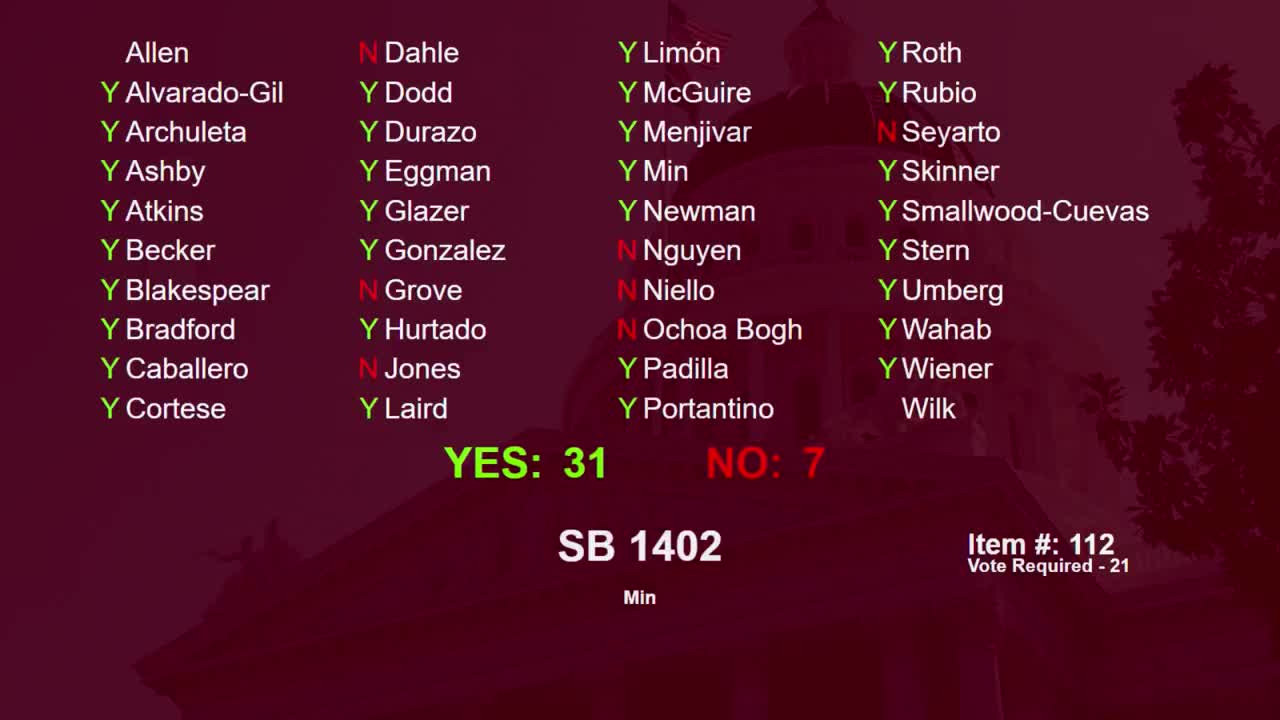 2MIN
Senate Floor
 31SEC
Senate Standing Committee on Judiciary
 11SEC
Senate Standing Committee on Judiciary
3MIN
Senate Standing Committee on Judiciary
Bill Author