SB 1500: Housing: federal waiver: income eligibility.
- Session Year: 2023-2024
- House: Senate
- Latest Version Date: 2024-09-22
Current Status:
Passed
(2024-09-22: Chaptered by Secretary of State. Chapter 491, Statutes of 2024.)
Introduced
In Committee
First Chamber
In Committee
Second Chamber
Enacted
What does this bill do?
In Los Angeles, this bill protects owners and managers of subsidized housing from state penalties when a HUD waiver lets income checks occur after an unhoused person signs a lease, so long as the owner fixes any income ineligibility within 24 months and the local housing authority and continuum of care (local homeless services group) post a plan to rehouse ineligible tenants. It also allows certain formerly homeless tenants who self‑certify very low income to be treated as meeting income rules for up to 24 months if verified, adjusts a unit’s rent limit when verified income is higher, and ends use of the waiver if most deep‑subsidy units go to higher‑income households.
The summary is provided by generative AI which can make mistakes. For original language, please view the details in the table below.
Existing federal law establishes federal housing assistance programs that are administered by the federal Department of Housing and Urban Development (HUD). Existing federal law authorizes HUD to waive regulations promulgated to implement these programs, as provided. Existing law, the Housing Authorities Law, establishes a housing authority in each county and each city, known as the housing authority of the county or city. Upon adoption of a resolution by the governing body of the county or city authorizing the authority to function in it, existing law authorizes an authority to, among other things, prepare, carry out, acquire, lease, and operate housing projects and housing developments for persons of low income, as provided.
Existing law establishes a low-income housing tax credit program through which, in order to promote the provision of affordable low-income housing within and throughout the state, the California Tax Credit Allocation Committee allocates low-income housing tax credits, in modified conformity with certain federal law. Existing law also establishes the Department of Housing and Community Development and requires it to administer various programs regarding housing for persons with specified incomes, including the Joe Serna, Jr. Farmworker Housing Grant Program, which is funded by a continuously appropriated fund, the Multifamily Housing Program, the Infill Incentive Grant Program of 2007, the Infill Incentive Grant Program of 2019, the Transit-Oriented Development Implementation Program, which is funded by a continuously appropriated fund, the Housing for a Healthy California Program, and the Veterans Housing and Homeless Prevention Act of 2014, which is funded by a continuously appropriated fund and which the department administers in collaboration with the California Housing Finance Agency and the Department of Veterans Affairs, as specified.
In the City of Los Angeles and the County of Los Angeles, where HUD has granted a housing authority created pursuant to the Housing Authorities Law, as described above, a waiver effective August 17, 2024, to allow household income verifications to occur after a lease contract is signed for unhoused populations seeking entry into projects pursuant to or in connection with specified federal law, this bill would: (1) prohibit certain state entities from taking any negative actions, as specified, against the owner or management agent if certain conditions are met; and (2) if an agreement between the owner or management agent and certain government entities imposes certain income restrictions, deem the tenant to satisfy certain income requirements if certain conditions are met. By expanding the projects eligible to receive benefits from a continuously appropriated fund, this bill would make an appropriation.
This bill would make legislative findings and declarations as to the necessity of a special statute for the City of Los Angeles and the County of Los Angeles.
Existing federal law establishes federal housing assistance programs that are administered by the federal Department of Housing and Urban Development (HUD). Existing federal law authorizes HUD to waive regulations promulgated to implement these programs, as provided. Existing law, the Housing Authorities Law, establishes a housing authority in each county and each city, known as the housing authority of the county or city. Upon adoption of a resolution by the governing body of the county or city authorizing the authority to function in it, existing law authorizes an authority to, among other things, prepare, carry out, acquire, lease, and operate housing projects and housing developments for persons of low income, as provided.
Existing law establishes a low-income housing tax credit program through which, in order to promote the provision of affordable low-income housing within and throughout the state, the California Tax Credit Allocation Committee allocates low-income housing tax credits, in modified conformity with certain federal law. Existing law also establishes the Department of Housing and Community Development and requires it to administer various programs regarding housing for persons with specified incomes, including the Joe Serna, Jr. Farmworker Housing Grant Program, which is funded by a continuously appropriated fund, the Multifamily Housing Program, the Infill Incentive Grant Program of 2007, the Infill Incentive Grant Program of 2019, the Transit-Oriented Development Implementation Program, which is funded by a continuously appropriated fund, the Housing for a Healthy California Program, and the Veterans Housing and Homeless Prevention Act of 2014, which is funded by a continuously appropriated fund and which the department administers in collaboration with the California Housing Finance Agency and the Department of Veterans Affairs, as specified.
In jurisdictions for which the City of Los Angeles and the County of Los Angeles, where HUD has granted a housing authority created pursuant to the Housing Authorities Law, as described above, a waiver to streamline and reduce barriers to entry effective August 17, 2024, to allow household income verifications to occur after a lease contract is signed for unhoused populations seeking entry into projects pursuant to or in connection with specified federal law, this bill would: (1) prohibit certain state entities from taking any negative actions, as specified, against certain participants in the programs described above unless the participant has not cured the noncompliance within 24 months of discovery of the violation; the owner or management agent if certain conditions are met; and (2) if an agreement between the participant owner or management agent and certain government entities imposes certain income restrictions, deem the tenant to satisfy that income restriction certain income requirements if certain requirements conditions are met. By expanding the projects eligible to receive benefits from a continuously appropriated fund, this bill would make an appropriation.
This bill would make legislative findings and declarations as to the necessity of a special statute for the City of Los Angeles and the County of Los Angeles.
Existing federal law establishes federal housing assistance programs that are administered by the federal Department of Housing and Urban Development (HUD). Existing federal law authorizes HUD to waive regulations promulgated to implement these programs, as provided. Existing law, the Housing Authorities Law, establishes a housing authority in each county and each city, known as the housing authority of the county or city. Upon adoption of a resolution by the governing body of the county or city authorizing the authority to function in it, existing law authorizes an authority to, among other things, prepare, carry out, acquire, lease, and operate housing projects and housing developments for persons of low income, as provided.
Existing law establishes a low-income housing tax credit program through which, in order to promote the provision of affordable low-income housing within and throughout the state, the California Tax Credit Allocation Committee allocates low-income housing tax credits, in modified conformity with certain federal law. Existing law also establishes the Department of Housing and Community Development and requires it to administer various programs regarding housing for persons with specified incomes, including the Joe Serna, Jr. Farmworker Housing Grant Program, which is funded by a continuously appropriated fund, the Multifamily Housing Program, the Infill Incentive Grant Program of 2007, the Infill Incentive Grant Program of 2019, the Transit-Oriented Development Implementation Program, which is funded by a continuously appropriated fund, the Housing for a Healthy California Program, and the Veterans Housing and Homeless Prevention Act of 2014, which is funded by a continuously appropriated fund and which the department administers in collaboration with the California Housing Finance Agency and the Department of Veterans Affairs, as specified.
In jurisdictions for which HUD has granted a housing authority created pursuant to the Housing Authorities Law, as described above, a waiver to streamline and reduce barriers to entry for unhoused populations seeking entry into projects pursuant to or in connection with specified federal law, this bill would: (1) prohibit certain state entities from taking any negative actions, as specified, against certain participants in the programs described above unless the participant has not cured the noncompliance within 24 months of discovery of the violation; and (2) if an agreement between the participant and certain government entities imposes certain income restrictions, deem the tenant to satisfy that income restriction if certain requirements are met. By expanding the projects eligible to receive benefits from a continuously appropriated fund, this bill would make an appropriation.
Existing law establishes a low-income housing tax credit program for which the California Tax Credit Allocation Committee provides procedures and requirements for the allocation, in modified conformity with federal law, of state insurance, personal income, and corporation tax credit amounts to qualified low-income housing projects that have been allocated, or qualify for, a federal low-income housing tax credit, and farmworker housing.This bill would make a nonsubstantive change to the personal income tax credit provisions of the program described above.Existing law establishes a low-income housing tax credit program for which the California Tax Credit Allocation Committee provides procedures and requirements for the allocation, in modified conformity with federal law, of state insurance, personal income, and corporation tax credit amounts to qualified low-income housing projects that have been allocated, or qualify for, a federal low-income housing tax credit, and farmworker housing.
This bill would make a nonsubstantive change to the personal income tax credit provisions of the program described above.
(a)(1)In the City and County of Los Angeles, where the federal Department of Housing and Urban Development has granted an authority, as defined in Section 34203, a waiver effective August 17, 2024, to allow household income verifications to occur after a lease contract is signed for unhoused populations seeking entry into projects pursuant to or in connection with Section 5.110 of Title 24 of the Code of Federal Regulations, if an owner or a management agent leases a subsidized unit to an unhoused person and subsequently learns and verifies that the unhoused person does not meet applicable income requirements, then the committee shall not take any negative actions against the owner or management agent if both of the following conditions are met:
(A)The owner or management agent has cured the noncompliance within 24 months of discovery of the violation.
(B)The local housing authority and continuum of care have developed and posted on their respective internet websites a plan describing how the local housing authority and continuum of care will coordinate with the owner or management agent to move tenants that do not meet applicable income requirements into affordable housing where the tenant is eligible for occupancy within 24 months of discovery of the violation. Income ineligible tenants shall retain their unhoused targeting eligibility.
(2)For purposes of this subdivision, negative actions include, but are not limited to, all of the following:
(A)Issuing negative points on a current or future application.
(B)Filing a Form 8823 with the Internal Revenue Service within six months of discovery of the violation.
(C)Imposing a financial penalty.
(b)If an agreement between the owner or management agent and the authority, the Department of Housing and Community Development, or the committee restricts a unit to a tenant earning no more than 30 percent of the area median income, the tenant shall be deemed to satisfy the income requirements of this program during the 24-month period described in paragraph (1) of subdivision (a) if all of the following conditions are met:
(1)The tenant experienced homelessness prior to moving into the unit. For purposes of this paragraph, homelessness has the same meaning as homeless, as that term is defined in Section 578.3 of Title 24 of the Code of Federal Regulations.
(2)The tenant self-certified household income at no more than 30 percent of the area median income.
(3)A third-party verification shows that the tenant has household income of no more than 50 percent of the area median income, unless the tenant is otherwise eligible pursuant to federal income eligibility requirements.
(4)The tenants income certification is fully verified in accordance with the program rules within 90 days of the date the tenant took possession of the unit.
(5)At least 50 percent of the assisted units restricted to 30 percent area median income are occupied by verified, income-eligible households.
(6)The issuing housing authority and continuum of care, in coordination with other public agencies, coordinate with an owner or a management agent and move a tenant found to have a household income of more than 50 percent of the area median income following third-party verification described in paragraph (3) within 24 months of discovery of the violation to an affordable housing unit for which the tenant is eligible without reliance upon the same waiver described in subdivision (a). Income ineligible tenants shall retain their unhoused targeting eligibility.
(c)(1)This section does not modify any other eligibility requirements attached to assistance provided by the Department of Housing and Community Development.
(2)Tenant self-certified date of birth shall be accepted so long as the agreement between the department and the owner does not impose age-based demographic targeting requirements.
(3)If the conditions described in subdivision (b) are met, absent any rent setting methodology from subsidy programs, a tenant whose adjusted income at move-in exceeded 30 percent area median income shall have an effective rent limit for their unit be redesignated to 50 percent of area median income or, if the tenants verified income is higher than 50 percent of area median income, an effective rent limit for their unit be redesignated to an area median income level commensurate with the income level.
(4)Owner or management agents shall discontinue use of the waiver as described in subdivision (a) in the event that more than 50 percent of the assisted units restricted to 30 percent area median income are occupied by households with adjusted incomes at move-in over 30 percent area median income.
(d)This section shall become inoperative on July 31, 2025, or the final expiration date of a waiver as described in subdivision (a), whichever is later, and, as of January 1 of the following year, is repealed.
SEC. 2.Section 50517.11 is added to the Health and Safety Code, to read:50517.11.(a)(1)In the City and County of Los Angeles, where the federal Department of Housing and Urban Development has granted an authority, as defined in Section 34203, a waiver effective August 17, 2024, to allow household income verifications to occur after a lease contract is signed for unhoused populations seeking entry into projects pursuant to or in connection with Section 5.110 of Title 24 of the Code of Federal Regulations, if an owner or a management agent leases a subsidized unit to an unhoused person and subsequently learns and verifies that the unhoused person does not meet applicable income requirements, then the department shall not take any negative actions against the owner or management agent if both of the following conditions are met:
(A)The owner or management agent has cured the noncompliance within 24 months of discovery of the violation.
(B)The local housing authority and continuum of care have developed and posted on their respective internet websites a plan describing how the local housing authority and continuum of care will coordinate with the owner or management agent to move tenants that do not meet applicable income requirements into affordable housing where the tenant is eligible for occupancy within 24 months of discovery of the violation. Income ineligible tenants shall retain their unhoused targeting eligibility.
(2)For purposes of this subdivision, negative actions include, but are not limited to, both of the following:
(A)Issuing negative points on a current or future application.
(B)Imposing a financial penalty.
(b)If an agreement between the owner or management agent and the authority or the department restricts a unit to a tenant earning no more than 30 percent of the area median income, the tenant shall be deemed to satisfy the income requirements of this program during the 24-month period described in paragraph (1) of subdivision (a) if all of the following conditions are met:
(1)The tenant experienced homelessness prior to moving into the unit. For purposes of this subparagraph, homelessness has the same meaning as homeless, as that term is defined in Section 578.3 of Title 24 of the Code of Federal Regulations.
(2)The tenant self-certified household income at no more than 30 percent of the area median income.
(3)A third-party verification shows that the tenant has household income of no more than 50 percent of the area median income, unless the tenant is otherwise eligible pursuant to federal income eligibility requirements.
(4)The tenants income certification is fully verified in accordance with the program rules within 90 days of the date the tenant took possession of the unit.
(5)At least 50 percent of the assisted units restricted to 30 percent area median income are occupied by verified, income-eligible households.
(6)The issuing housing authority and continuum of care, in coordination with other public agencies, coordinate with an owner or a management agent and move a tenant found to have a household income of more than 50 percent of the area median income following third-party verification described in paragraph (3) within 24 months of discovery of the violation to an affordable housing unit for which the tenant is eligible without reliance upon the same waiver described in subdivision (a). Income ineligible tenants shall retain their unhoused targeting eligibility.
(c)(1)This section does not modify any other eligibility requirements attached to assistance provided by the Department of Housing and Community Development.
(2)Tenant self-certified date of birth shall be accepted so long as the agreement between the department and the owner does not impose age-based demographic targeting requirements.
(3)If the conditions described in subdivision (b) are met, absent any rent setting methodology from subsidy programs, a tenant whose adjusted income at move-in exceeded 30 percent area median income shall have an effective rent limit for their unit be redesignated to 50 percent of area median income or, if the tenants verified income is higher than 50 percent of area median income, an effective rent limit for their unit be redesignated to an area median income level commensurate with the income level.
(4)Owner or management agents shall discontinue use of the waiver as described in subdivision (a) in the event that more than 50 percent of the assisted units restricted to 30 percent area median income are occupied by households with adjusted incomes at move-in over 30 percent area median income.
(d)This section shall become inoperative on July 31, 2025, or the final expiration date of a waiver as described in subdivision (a), whichever is later, and, as of January 1 of the following year, is repealed.
SEC. 3.Section 50675.16 is added to the Health and Safety Code, to read:50675.16.(a)(1)In the City and County of Los Angeles, where the federal Department of Housing and Urban Development has granted an authority, as defined in Section 34203, a waiver effective August 17, 2024, to allow household income verifications to occur after a lease contract is signed for unhoused populations seeking entry into projects pursuant to or in connection with Section 5.110 of Title 24 of the Code of Federal Regulations, if an owner or a management agent leases a subsidized unit to an unhoused person and subsequently learns and verifies that the unhoused person does not meet applicable income requirements, then the department and the California Tax Credit Allocation Committee shall not take any negative actions against the owner or management agent if both of the following conditions are met:
(A)The owner or management agent has cured the noncompliance within 24 months of discovery of the violation.
(B)The local housing authority and continuum of care have developed and posted on their respective internet websites a plan describing how the local housing authority and continuum of care will coordinate with the owner or management agent to move tenants that do not meet applicable income requirements into affordable housing where the tenant is eligible for occupancy within 24 months of discovery of the violation. Income ineligible tenants shall retain their unhoused targeting eligibility.
(2)For purposes of this subdivision, negative actions include, but are not limited to, both of the following:
(A)Issuing negative points on a current or future application.
(B)Imposing a financial penalty.
(b)If an agreement between the owner or management agent and the authority, the department, or the California Tax Credit Allocation Committee restricts a unit to a tenant earning no more than 30 percent of the area median income, the tenant shall be deemed to satisfy the income requirements of this program during the 24-month period described in paragraph (1) of subdivision (a) if all of the following conditions are met:
(1)The tenant experienced homelessness prior to moving into the unit. For purposes of this paragraph, homelessness has the same meaning as homeless, as that term is defined in Section 578.3 of Title 24 of the Code of Federal Regulations.
(2)The tenant self-certified household income at no more than 30 percent of the area median income.
(3)A third-party verification shows that the tenant has household income of no more than 50 percent of the area median income, unless the tenant is otherwise eligible pursuant to federal income eligibility requirements.
(4)The tenants income certification is fully verified in accordance with the program rules within 90 days of the date the tenant took possession of the unit.
(5)At least 50 percent of the assisted units restricted to 30 percent area median income are occupied by verified, income-eligible households.
(6)The issuing housing authority and continuum of care, in coordination with other public agencies, coordinate with an owner or a management agent and move a tenant found to have a household income of more than 50 percent of the area median income following third-party verification described in paragraph (3) within 24 months of discovery of the violation to an affordable housing unit for which the tenant is eligible without reliance upon the same waiver described in subdivision (a). Income ineligible tenants shall retain their unhoused targeting eligibility.
(c)(1)This section does not modify any other eligibility requirements attached to assistance provided by the Department of Housing and Community Development.
(2)Tenant self-certified date of birth shall be accepted so long as the agreement between the department and the owner does not impose age-based demographic targeting requirements.
(3)If the conditions described in subdivision (b) are met, absent any rent setting methodology from subsidy programs, a tenant whose adjusted income at move-in exceeded 30 percent area median income shall have an effective rent limit for their unit be redesignated to 50 percent of area median income or, if the tenants verified income is higher than 50 percent of area median income, an effective rent limit for their unit be redesignated to an area median income level commensurate with the income level.
(4)Owner or management agents shall discontinue use of the waiver as described in subdivision (a) in the event that more than 50 percent of the assisted units restricted to 30 percent area median income are occupied by households with adjusted incomes at move-in over 30 percent area median income.
(d)This section shall become inoperative on July 31, 2025, or the final expiration date of a waiver as described in subdivision (a), whichever is later, and, as of January 1 of the following year, is repealed.
SEC. 4.Section 53545.11 is added to the Health and Safety Code, to read:53545.11.(a)(1)For purposes of the Infill Incentive Grant Program of 2007 established pursuant to Section 53545.13, in the City and County of Los Angeles, where the federal Department of Housing and Urban Development has granted an authority, as defined in Section 34203, a waiver effective August 17, 2024, to allow household income verifications to occur after a lease contract is signed for unhoused populations seeking entry into projects pursuant to or in connection with Section 5.110 of Title 24 of the Code of Federal Regulations, if an owner or a management agent leases a subsidized unit to an unhoused person and subsequently learns and verifies that the unhoused person does not meet applicable income requirements, then the department shall not take any negative actions against the owner or management agent if both of the following conditions are met:
(A)The owner or management agent has cured the noncompliance within 24 months of discovery of the violation.
(B)The local housing authority and continuum of care have developed and posted on their respective internet websites a plan describing how the local housing authority and continuum of care will coordinate with the owner or management agent to move tenants that do not meet applicable income requirements into affordable housing where the tenant is eligible for occupancy within 24 months of discovery of the violation. Income ineligible tenants shall retain their unhoused targeting eligibility.
(2)For purposes of this subdivision, negative actions include, but are not limited to, both of the following:
(A)Issuing negative points on a current or future application.
(B)Imposing a financial penalty.
(b)If an agreement between the owner or management agent and the authority or the department restricts a unit to a tenant earning no more than 30 percent of the area median income, the tenant shall be deemed to satisfy the income requirements of this program during the 24-month period described in paragraph (1) of subdivision (a) if all of the following conditions are met:
(1)The tenant experienced homelessness prior to moving into the unit. For purposes of this paragraph, homelessness has the same meaning as homeless, as that term is defined in Section 578.3 of Title 24 of the Code of Federal Regulations.
(2)The tenant self-certified household income at no more than 30 percent of the area median income.
(3)A third-party verification shows that the tenant has household income of no more than 50 percent of the area median income, unless the tenant is otherwise eligible pursuant to federal income eligibility requirements.
(4)The tenants income certification is fully verified in accordance with the program rules within 90 days of the date the tenant took possession of the unit.
(5)At least 50 percent of the assisted units restricted to 30 percent area median income are occupied by verified, income-eligible households.
(6)The issuing housing authority and continuum of care, in coordination with other public agencies, coordinate with an owner or a management agent and move a tenant found to have a household income of more than 50 percent of the area median income following third-party verification described in paragraph (3) within 24 months of discovery of the violation to an affordable housing unit for which the tenant is eligible without reliance upon the same waiver described in subdivision (a). Income ineligible tenants shall retain their unhoused targeting eligibility.
(c)(1)This section does not modify any other eligibility requirements attached to assistance provided by the Department of Housing and Community Development.
(2)Tenant self-certified date of birth shall be accepted so long as the agreement between the department and the owner does not impose age-based demographic targeting requirements.
(3)If the conditions described in subdivision (b) are met, absent any rent setting methodology from subsidy programs, a tenant whose adjusted income at move-in exceeded 30 percent area median income shall have an effective rent limit for their unit be redesignated to 50 percent of area median income or, if the tenants verified income is higher than 50 percent of area median income, an effective rent limit for their unit be redesignated to an area median income level commensurate with the income level.
(4)Owner or management agents shall discontinue use of the waiver as described in subdivision (a) in the event that more than 50 percent of the assisted units restricted to 30 percent area median income are occupied by households with adjusted incomes at move-in over 30 percent area median income.
(d)This section shall become inoperative on July 31, 2025, or the final expiration date of a waiver as described in subdivision (a), whichever is later, and, as of January 1 of the following year, is repealed.
SEC. 5.Section 53559.4 is added to the Health and Safety Code, to read:53559.4.(a)(1)In the City and County of Los Angeles, where the federal Department of Housing and Urban Development has granted an authority, as defined in Section 34203, a waiver effective August 17, 2024, to allow household income verifications to occur after a lease contract is signed into projects pursuant to or in connection with Section 5.110 of Title 24 of the Code of Federal Regulations, if an owner or a management agent leases a subsidized unit to an unhoused person and subsequently learns and verifies that the unhoused person does not meet applicable income requirements, then the department shall not take any negative actions against the owner or management agent if both of the following conditions are met:
(A)The owner or management agent has cured the noncompliance within 24 months of discovery of the violation.
(B)The local housing authority and continuum of care have developed and posted on their respective internet websites a plan describing how the local housing authority and continuum of care will coordinate with the owner or management agent to move tenants that do not meet applicable income requirements into affordable housing where the tenant is eligible for occupancy within 24 months of discovery of the violation. Income ineligible tenants shall retain their unhoused targeting eligibility.
(2)For purposes of this subdivision, negative actions include, but are not limited to, both of the following:
(A)Issuing negative points on a current or future application.
(B)Imposing a financial penalty.
(b)If an agreement between the owner or management agent and the authority or the department restricts a unit to a tenant earning no more than 30 percent of the area median income, the tenant shall be deemed to satisfy the income requirements of this program during the 24-month period described in paragraph (1) of subdivision (a) if all of the following conditions are met:
(1)The tenant experienced homelessness prior to moving into the unit. For purposes of this paragraph, homelessness has the same meaning as homeless, as that term is defined in Section 578.3 of Title 24 of the Code of Federal Regulations.
(2)The tenant self-certified household income at no more than 30 percent of the area median income.
(3)A third-party verification shows that the tenant has household income of no more than 50 percent of the area median income, unless the tenant is otherwise eligible pursuant to federal income eligibility requirements.
(4)The tenants income certification is fully verified in accordance with the program rules within 90 days of the date the tenant took possession of the unit.
(5)At least 50 percent of the assisted units restricted to 30 percent area median income are occupied by verified, income-eligible households.
(6)The issuing housing authority and continuum of care, in coordination with other public agencies, coordinate with an owner or a management agent and move a tenant found to have a household income of more than 50 percent of the area median income following third-party verification described in paragraph (3) within 24 months of discovery of the violation to an affordable housing unit for which the tenant is eligible without reliance upon the same waiver described in subdivision (a). Income ineligible tenants shall retain their unhoused targeting eligibility.
(c)(1)This section does not modify any other eligibility requirements attached to assistance provided by the Department of Housing and Community Development.
(2)Tenant self-certified date of birth shall be accepted so long as the agreement between the department and the owner does not impose age-based demographic targeting requirements.
(3)If the conditions described in subdivision (b) are met, absent any rent setting methodology from subsidy programs, a tenant whose adjusted income at move-in exceeded 30 percent area median income shall have an effective rent limit for their unit be redesignated to 50 percent of area median income or, if the tenants verified income is higher than 50 percent of area median income, an effective rent limit for their unit be redesignated to an area median income level commensurate with the income level.
(4)Owner or management agents shall discontinue use of the waiver as described in subdivision (a) in the event that more than 50 percent of the assisted units restricted to 30 percent area median income are occupied by households with adjusted incomes at move-in over 30 percent area median income.
(d)This section shall become inoperative on July 31, 2025, or the final expiration date of a waiver as described in subdivision (a), whichever is later, and, as of January 1 of the following year, is repealed.
SEC. 6.Section 53567 is added to the Health and Safety Code, to read:53567.(a)(1)In the City and County of Los Angeles, where the federal Department of Housing and Urban Development has granted an authority, as defined in Section 34203, a waiver effective August 17, 2024, to allow household income verifications to occur after a lease contract is signed for unhoused populations seeking entry into projects pursuant to or in connection with Section 5.110 of Title 24 of the Code of Federal Regulations, if an owner or a management agent leases a subsidized unit to an unhoused person and subsequently learns and verifies that the unhoused person does not meet applicable income requirements, then the department shall not take any negative actions against the owner or management agent if both of the following conditions are met:
(A)The owner or management agent has cured the noncompliance within 24 months of discovery of the violation.
(B)The local housing authority and continuum of care have developed and posted on their respective internet websites a plan describing how the local housing authority and continuum of care will coordinate with the owner or management agent to move tenants that do not meet applicable income requirements into affordable housing where the tenant is eligible for occupancy within 24 months of discovery of the violation. Income ineligible tenants shall retain their unhoused targeting eligibility.
(2)For purposes of this subdivision, negative actions include, but are not limited to, both of the following:
(A)Issuing negative points on a current or future application.
(B)Imposing a financial penalty.
(b)If an agreement between the owner or management agent and the authority or the department restricts a unit to a tenant earning no more than 30 percent of the area median income, the tenant shall be deemed to satisfy the income requirements of this program during the 24-month period described in paragraph (1) of subdivision (a) if all of the following conditions are met:
(1)The tenant experienced homelessness prior to moving into the unit. For purposes of this paragraph, homelessness has the same meaning as homeless, as that term is defined in Section 578.3 of Title 24 of the Code of Federal Regulations.
(2)The tenant self-certified household income at no more than 30 percent of the area median income.
(3)A third-party verification shows that the tenant has household income of no more than 50 percent of the area median income, unless the tenant is otherwise eligible pursuant to federal income eligibility requirements.
(4)The tenants income certification is fully verified in accordance with the program rules within 90 days of the date the tenant took possession of the unit.
(5)At least 50 percent of the assisted units restricted to 30 percent area median income are occupied by verified, income-eligible households.
(6)The issuing housing authority and continuum of care, in coordination with other public agencies, coordinate with an owner or a management agent and move a tenant found to have a household income of more than 50 percent of the area median income following third-party verification described in paragraph (3) within 24 months of discovery of the violation to an affordable housing unit for which the tenant is eligible without reliance upon the same waiver described in subdivision (a). Income ineligible tenants shall retain their unhoused targeting eligibility.
(c)(1)This section does not modify any other eligibility requirements attached to assistance provided by the Department of Housing and Community Development.
(2)Tenant self-certified date of birth shall be accepted so long as the agreement between the department and the owner does not impose age-based demographic targeting requirements.
(3)If the conditions described in subdivision (b) are met, absent any rent setting methodology from subsidy programs, a tenant whose adjusted income at move-in exceeded 30 percent area median income shall have an effective rent limit for their unit be redesignated to 50 percent of area median income or, if the tenants verified income is higher than 50 percent of area median income, an effective rent limit for their unit be redesignated to an area median income level commensurate with the income level.
(4)Owner or management agents shall discontinue use of the waiver as described in subdivision (a) in the event that more than 50 percent of the assisted units restricted to 30 percent area median income are occupied by households with adjusted incomes at move-in over 30 percent area median income.
(d)This section shall become inoperative on July 31, 2025, or the final expiration date of a waiver as described in subdivision (a), whichever is later, and, as of January 1 of the following year, is repealed.
SEC. 7.Section 53601 is added to the Health and Safety Code, to read:53601.(a)(1)In the City and County of Los Angeles, where the federal Department of Housing and Urban Development has granted an authority, as defined in Section 34203, a waiver effective August 17, 2024, to allow household income verifications to occur after a lease contract is signed for unhoused populations seeking entry into projects pursuant to or in connection with Section 5.110 of Title 24 of the Code of Federal Regulations, if an owner or a management agent leases a subsidized unit to an unhoused person and subsequently learns and verifies that the unhoused person does not meet applicable income requirements, then the department shall not take any negative actions against the owner or management agent if both of the following conditions are met:
(A)The owner or management agent has cured the noncompliance within 24 months of discovery of the violation.
(B)The local housing authority and continuum of care have developed and posted on their respective internet websites a plan describing how the local housing authority and continuum of care will coordinate with the owner or management agent to move tenants that do not meet applicable income requirements into affordable housing where the tenant is eligible for occupancy within 24 months of discovery of the violation. Income ineligible tenants shall retain their unhoused targeting eligibility.
(2)For purposes of this subdivision, negative actions include, but are not limited to, both of the following:
(A)Issuing negative points on a current or future application.
(B)Imposing a financial penalty.
(b)If an agreement between the owner or management agent and the authority or the department restricts a unit to a tenant earning no more than 30 percent of the area median income, the tenant shall be deemed to satisfy the income requirements of this program during the 24-month period described in paragraph (1) of subdivision (a) if all of the following conditions are met:
(1)The tenant experienced homelessness prior to moving into the unit. For purposes of this paragraph, homelessness has the same meaning as homeless, as that term is defined in Section 578.3 of Title 24 of the Code of Federal Regulations.
(2)The tenant self-certified household income at no more than 30 percent of the area median income.
(3)A third-party verification shows that the tenant has household income of no more than 50 percent of the area median income, unless the tenant is otherwise eligible pursuant to federal income eligibility requirements.
(4)The tenants income certification is fully verified in accordance with the program rules within 90 days of the date the tenant took possession of the unit.
(5)At least 50 percent of the assisted units restricted to 30 percent area median income are occupied by verified, income-eligible households.
(6)The issuing housing authority and continuum of care, in coordination with other public agencies, coordinate with an owner or a management agent and move a tenant found to have a household income of more than 50 percent of the area median income following third-party verification described in paragraph (3) within 24 months of discovery of the violation to an affordable housing unit for which the tenant is eligible without reliance upon the same waiver described in subdivision (a). Income ineligible tenants shall retain their unhoused targeting eligibility.
(c)(1)This section does not modify any other eligibility requirements attached to assistance provided by the Department of Housing and Community Development.
(2)Tenant self-certified date of birth shall be accepted so long as the agreement between the department and the owner does not impose age-based demographic targeting requirements.
(3)If the conditions described in subdivision (b) are met, absent any rent setting methodology from subsidy programs, a tenant whose adjusted income at move-in exceeded 30 percent area median income shall have an effective rent limit for their unit be redesignated to 50 percent of area median income or, if the tenants verified income is higher than 50 percent of area median income, an effective rent limit for their unit be redesignated to an area median income level commensurate with the income level.
(4)Owner or management agents shall discontinue use of the waiver as described in subdivision (a) in the event that more than 50 percent of the assisted units restricted to 30 percent area median income are occupied by households with adjusted incomes at move-in over 30 percent area median income.
(d)This section shall become inoperative on July 31, 2025, or the final expiration date of a waiver as described in subdivision (a), whichever is later, and, as of January 1 of the following year, is repealed.
SEC. 8.Section 987.011 is added to the Military and Veterans Code, to read:987.011.(a)(1)In the City and County of Los Angeles, where the federal Department of Housing and Urban Development has granted an authority, as defined in Section 34203, a waiver effective August 17, 2024, to allow household income verifications to occur after a lease contract is signed for unhoused populations seeking entry into projects pursuant to or in connection with Section 5.110 of Title 24 of the Code of Federal Regulations, if an owner or a management agent leases a subsidized unit to an unhoused person and subsequently learns and verifies that the unhoused person does not meet applicable income requirements, then the department shall not take any negative actions against the owner or management agent if both of the following conditions are met:
(A)The owner or management agent has cured the noncompliance within 24 months of discovery of the violation.
(B)The local housing authority and continuum of care have developed and posted on their respective internet websites a plan describing how the local housing authority and continuum of care will coordinate with the owner or management agent to move tenants that do not meet applicable income requirements into affordable housing where the tenant is eligible for occupancy within 24 months of discovery of the violation. Income ineligible tenants shall retain their unhoused targeting eligibility.
(2)For purposes of this subdivision, negative actions include, but are not limited to, both of the following:
(A)Issuing negative points on a current or future application.
(B)Imposing a financial penalty.
(b)If an agreement between the owner or management agent and the authority or the departments restricts a unit to a tenant earning no more than 30 percent of the area median income, the tenant shall be deemed to satisfy the income requirements of this program during the 24-month period described in paragraph (1) of subdivision (a) if all of the following conditions are met:
(1)The tenant experienced homelessness prior to moving into the unit. For purposes of this paragraph, homelessness has the same meaning as homeless, as that term is defined in Section 578.3 of Title 24 of the Code of Federal Regulations.
(2)The tenant self-certified household income at no more than 30 percent of the area median income.
(3)A third-party verification shows that the tenant has household income of no more than 50 percent of the area median income, unless the tenant is otherwise eligible pursuant to federal income eligibility requirements.
(4)The tenants income certification is fully verified in accordance with the program rules within 90 days of the date the tenant took possession of the unit.
(5)At least 50 percent of the assisted units restricted to 30 percent area median income are occupied by verified, income-eligible households.
(6)The issuing housing authority and continuum of care, in coordination with other public agencies, coordinate with an owner or a management agent and move a tenant found to have a household income of more than 50 percent of the area median income following third-party verification described in paragraph (3) within 24 months of discovery of the violation to an affordable housing unit for which the tenant is eligible without reliance upon the same waiver described in subdivision (a). Income ineligible tenants shall retain their unhoused targeting eligibility.
(c)(1)This section does not modify any other eligibility requirements attached to assistance provided by the Department of Housing and Community Development.
(2)Tenant self-certified date of birth shall be accepted so long as the agreement between the department and the owner does not impose age-based demographic targeting requirements.
(3)If the conditions described in subdivision (b) are met, absent any rent setting methodology from subsidy programs, a tenant whose adjusted income at move-in exceeded 30 percent area median income shall have an effective rent limit for their unit be redesignated to 50 percent of area median income or, if the tenants verified income is higher than 50 percent of area median income, an effective rent limit for their unit be redesignated to an area median income level commensurate with the income level.
(4)Owner or management agents shall discontinue use of the waiver as described in subdivision (a) in the event that more than 50 percent of the assisted units restricted to 30 percent area median income are occupied by households with adjusted incomes at move-in over 30 percent area median income.
(d)This section shall become inoperative on July 31, 2025, or the final expiration date of a waiver as described in subdivision (a), whichever is later, and, as of January 1 of the following year, is repealed.
SEC. 9.The Legislature finds and declares that a special statute is necessary and that a general statute cannot be made applicable within the meaning of Section 16 of Article IV of the California Constitution because of the unique and significant homelessness issues in the City of Los Angeles and the County of Los Angeles.
(a)(1)In jurisdictions for which the City and County of Los Angeles, where the federal Department of Housing and Urban Development has granted an authority, as defined in Section 34203, a waiver to streamline and reduce barriers to entry effective August 17, 2024, to allow household income verifications to occur after a lease contract is signed for unhoused populations seeking entry into projects pursuant to programs established pursuant to or in connection with Section 5.110 of Title 24 of the Code of Federal Regulations, if a housing credit applicant an owner or a management agent leases a subsidized unit to an unhoused person and subsequently learns and verifies that the unhoused person does not meet applicable income requirements, then both of the following conditions apply: the committee shall not take any negative actions against the owner or management agent if both of the following conditions are met:
(a)(1)The Department of Housing and Community Development and the committee shall not take any negative actions against the housing credit applicant, unless the housing credit applicant has not cured the noncompliance within 24 months of discovery of the violation.(A)The owner or management agent has cured the noncompliance within 24 months of discovery of the violation.
(B)The local housing authority and continuum of care have developed and posted on their respective internet websites a plan describing how the local housing authority and continuum of care will coordinate with the owner or management agent to move tenants that do not meet applicable income requirements into affordable housing where the tenant is eligible for occupancy within 24 months of discovery of the violation. Income ineligible tenants shall retain their unhoused targeting eligibility.
(2)For purposes of this paragraph, subdivision, negative actions include, but are not limited to, all of the following:
(A)Issuing negative points on a current or future application.
(B)Filing a Form 8823 with the Internal Revenue Service. Service within six months of discovery of the violation.
(C)Imposing a financial penalty.
(b)If an agreement between the housing credit applicant owner or management agent and the authority, the Department of Housing and Community Development, or the committee restricts a unit to a tenant earning no more than 30 percent of the area median income, the tenant shall be deemed to satisfy that requirement the income requirements of this program during the 24-month period described in paragraph (1) of subdivision (a) if all of the following conditions are met:
(1)The tenant experienced homelessness prior to moving into the unit. For purposes of this paragraph, homelessness has the same meaning as homeless, as that term is defined in Section 578.3 of Title 24 of the Code of Federal Regulations, as that section read on January 10, 2019. Regulations.
(2)The tenant self-certified household income at no more than 30 percent of the area median income.
(3)A third-party verification shows that the tenant has household income of no more than 50 percent of the area median income. income, unless the tenant is otherwise eligible pursuant to federal income eligibility requirements.
(4)The tenants income certification is fully verified in accordance with the program rules within 90 days of the date the tenant took possession of the unit.
(5)At least 50 percent of the assisted units restricted to 30 percent area median income are occupied by verified, income-eligible households.
(6)The issuing housing authority and continuum of care, in coordination with other public agencies, coordinate with an owner or a management agent and move a tenant found to have a household income of more than 50 percent of the area median income following third-party verification described in paragraph (3) within 24 months of discovery of the violation to an affordable housing unit for which the tenant is eligible without reliance upon the same waiver described in subdivision (a). Income ineligible tenants shall retain their unhoused targeting eligibility.
(c)(1)This section does not modify any other eligibility requirements attached to assistance provided by the Department of Housing and Community Development.
(2)Tenant self-certified date of birth shall be accepted so long as the agreement between the department and the owner does not impose age-based demographic targeting requirements.
(3)If the conditions described in subdivision (b) are met, absent any rent setting methodology from subsidy programs, a tenant whose adjusted income at move-in exceeded 30 percent area median income shall have an effective rent limit for their unit be redesignated to 50 percent of area median income or, if the tenants verified income is higher than 50 percent of area median income, an effective rent limit for their unit be redesignated to an area median income level commensurate with the income level.
(4)Owner or management agents shall discontinue use of the waiver as described in subdivision (a) in the event that more than 50 percent of the assisted units restricted to 30 percent area median income are occupied by households with adjusted incomes at move-in over 30 percent area median income.
(d)This section shall become inoperative on July 31, 2025, or the final expiration date of a waiver as described in subdivision (a), whichever is later, and, as of January 1 of the following year, is repealed.
SEC. 2.Section 50517.11 is added to the Health and Safety Code, to read:50517.11.(a)For purposes of this section, grantee has the same meaning as defined in Section 50517.5.(b)50517.11.(a)(1)In jurisdictions for which the City and County of Los Angeles, where the federal Department of Housing and Urban Development has granted an authority, as defined in Section 34203, a waiver to streamline and reduce barriers to entry effective August 17, 2024, to allow household income verifications to occur after a lease contract is signed for unhoused populations seeking entry into projects pursuant to programs established pursuant to or in connection with Section 5.110 of Title 24 of the Code of Federal Regulations, if a grantee an owner or a management agent leases a subsidized unit to an unhoused person and subsequently learns and verifies that the unhoused person does not meet applicable income requirements, then both of the following conditions apply: the department shall not take any negative actions against the owner or management agent if both of the following conditions are met:
(1)(A)The department shall not take any negative actions against the grantee, unless the grantee has not cured the noncompliance within 24 months of discovery of the violation.(A)The owner or management agent has cured the noncompliance within 24 months of discovery of the violation.
(B)The local housing authority and continuum of care have developed and posted on their respective internet websites a plan describing how the local housing authority and continuum of care will coordinate with the owner or management agent to move tenants that do not meet applicable income requirements into affordable housing where the tenant is eligible for occupancy within 24 months of discovery of the violation. Income ineligible tenants shall retain their unhoused targeting eligibility.
(B)(2)For purposes of this paragraph, subdivision, negative actions include, but are not limited to, both of the following:
(i)(A)Issuing negative points on a current or future application.
(ii)(B)Imposing a financial penalty.
(2)(b)If an agreement between the grantee owner or management agent and the authority or the department restricts a unit to a tenant earning no more than 30 percent of the area median income, the tenant shall be deemed to satisfy that requirement the income requirements of this program during the 24-month period described in paragraph (1) of subdivision (a) if all of the following conditions are met:
(A)(1)The tenant experienced homelessness prior to moving into the unit. For purposes of this subparagraph, homelessness has the same meaning as homeless, as that term is defined in Section 578.3 of Title 24 of the Code of Federal Regulations, as that section read on January 10, 2019. Regulations.
(B)(2)The tenant self-certified household income at no more than 30 percent of the area median income.
(C)(3)A third-party verification shows that the tenant has household income of no more than 50 percent of the area median income. income, unless the tenant is otherwise eligible pursuant to federal income eligibility requirements.
(4)The tenants income certification is fully verified in accordance with the program rules within 90 days of the date the tenant took possession of the unit.
(5)At least 50 percent of the assisted units restricted to 30 percent area median income are occupied by verified, income-eligible households.
(6)The issuing housing authority and continuum of care, in coordination with other public agencies, coordinate with an owner or a management agent and move a tenant found to have a household income of more than 50 percent of the area median income following third-party verification described in paragraph (3) within 24 months of discovery of the violation to an affordable housing unit for which the tenant is eligible without reliance upon the same waiver described in subdivision (a). Income ineligible tenants shall retain their unhoused targeting eligibility.
(c)(1)This section does not modify any other eligibility requirements attached to assistance provided by the Department of Housing and Community Development.
(2)Tenant self-certified date of birth shall be accepted so long as the agreement between the department and the owner does not impose age-based demographic targeting requirements.
(3)If the conditions described in subdivision (b) are met, absent any rent setting methodology from subsidy programs, a tenant whose adjusted income at move-in exceeded 30 percent area median income shall have an effective rent limit for their unit be redesignated to 50 percent of area median income or, if the tenants verified income is higher than 50 percent of area median income, an effective rent limit for their unit be redesignated to an area median income level commensurate with the income level.
(4)Owner or management agents shall discontinue use of the waiver as described in subdivision (a) in the event that more than 50 percent of the assisted units restricted to 30 percent area median income are occupied by households with adjusted incomes at move-in over 30 percent area median income.
(d)This section shall become inoperative on July 31, 2025, or the final expiration date of a waiver as described in subdivision (a), whichever is later, and, as of January 1 of the following year, is repealed.
SEC. 3.Section 50675.16 is added to the Health and Safety Code, to read:50675.16.(a)(1)In jurisdictions for which the City and County of Los Angeles, where the federal Department of Housing and Urban Development has granted an authority, as defined in Section 34203, a waiver to streamline and reduce barriers to entry effective August 17, 2024, to allow household income verifications to occur after a lease contract is signed for unhoused populations seeking entry into projects pursuant to programs established pursuant to or in connection with Section 5.110 of Title 24 of the Code of Federal Regulations, if a sponsor an owner or a management agent leases a subsidized unit to an unhoused person and subsequently learns and verifies that the unhoused person does not meet applicable income requirements, then both of the following conditions apply: the department and the California Tax Credit Allocation Committee shall not take any negative actions against the owner or management agent if both of the following conditions are met:
(a)(1)The department and the California Tax Credit Allocation Committee shall not take any negative actions against the sponsor, unless the sponsor has not cured the noncompliance within 24 months of discovery of the violation.(A)The owner or management agent has cured the noncompliance within 24 months of discovery of the violation.
(B)The local housing authority and continuum of care have developed and posted on their respective internet websites a plan describing how the local housing authority and continuum of care will coordinate with the owner or management agent to move tenants that do not meet applicable income requirements into affordable housing where the tenant is eligible for occupancy within 24 months of discovery of the violation. Income ineligible tenants shall retain their unhoused targeting eligibility.
(2)For purposes of this paragraph, subdivision, negative actions include, but are not limited to, both of the following:
(A)Issuing negative points on a current or future application.
(B)Imposing a financial penalty.
(b)If an agreement between the sponsor owner or management agent and the authority, the department, or the California Tax Credit Allocation Committee restricts a unit to a tenant earning no more than 30 percent of the area median income, the tenant shall be deemed to satisfy that requirement the income requirements of this program during the 24-month period described in paragraph (1) of subdivision (a) if all of the following conditions are met:
(1)The tenant experienced homelessness prior to moving into the unit. For purposes of this paragraph, homelessness has the same meaning as homeless, as that term is defined in Section 578.3 of Title 24 of the Code of Federal Regulations, as that section read on January 10, 2019. Regulations.
(2)The tenant self-certified household income at no more than 30 percent of the area median income.
(3)A third-party verification shows that the tenant has household income of no more than 50 percent of the area median income. income, unless the tenant is otherwise eligible pursuant to federal income eligibility requirements.
(4)The tenants income certification is fully verified in accordance with the program rules within 90 days of the date the tenant took possession of the unit.
(5)At least 50 percent of the assisted units restricted to 30 percent area median income are occupied by verified, income-eligible households.
(6)The issuing housing authority and continuum of care, in coordination with other public agencies, coordinate with an owner or a management agent and move a tenant found to have a household income of more than 50 percent of the area median income following third-party verification described in paragraph (3) within 24 months of discovery of the violation to an affordable housing unit for which the tenant is eligible without reliance upon the same waiver described in subdivision (a). Income ineligible tenants shall retain their unhoused targeting eligibility.
(c)(1)This section does not modify any other eligibility requirements attached to assistance provided by the Department of Housing and Community Development.
(2)Tenant self-certified date of birth shall be accepted so long as the agreement between the department and the owner does not impose age-based demographic targeting requirements.
(3)If the conditions described in subdivision (b) are met, absent any rent setting methodology from subsidy programs, a tenant whose adjusted income at move-in exceeded 30 percent area median income shall have an effective rent limit for their unit be redesignated to 50 percent of area median income or, if the tenants verified income is higher than 50 percent of area median income, an effective rent limit for their unit be redesignated to an area median income level commensurate with the income level.
(4)Owner or management agents shall discontinue use of the waiver as described in subdivision (a) in the event that more than 50 percent of the assisted units restricted to 30 percent area median income are occupied by households with adjusted incomes at move-in over 30 percent area median income.
(d)This section shall become inoperative on July 31, 2025, or the final expiration date of a waiver as described in subdivision (a), whichever is later, and, as of January 1 of the following year, is repealed.
SEC. 4.Section 53545.11 is added to the Health and Safety Code, to read:53545.11.(a)(1)For purposes of the Infill Incentive Grant Program of 2007 established pursuant to Section 53545.13, in jurisdictions for which the City and County of Los Angeles, where the federal Department of Housing and Urban Development has granted an authority, as defined in Section 34203, a waiver to streamline and reduce barriers to entry effective August 17, 2024, to allow household income verifications to occur after a lease contract is signed for unhoused populations seeking entry into projects pursuant to programs established pursuant to or in connection with Section 5.110 of Title 24 of the Code of Federal Regulations, if a developer an owner or a management agent leases a subsidized unit to an unhoused person and subsequently learns and verifies that the unhoused person does not meet applicable income requirements, then both of the following conditions apply: the department shall not take any negative actions against the owner or management agent if both of the following conditions are met:
(a)(1)The department shall not take any negative actions against the developer, unless the developer has not cured the noncompliance within 24 months of discovery of the violation.(A)The owner or management agent has cured the noncompliance within 24 months of discovery of the violation.
(B)The local housing authority and continuum of care have developed and posted on their respective internet websites a plan describing how the local housing authority and continuum of care will coordinate with the owner or management agent to move tenants that do not meet applicable income requirements into affordable housing where the tenant is eligible for occupancy within 24 months of discovery of the violation. Income ineligible tenants shall retain their unhoused targeting eligibility.
(2)For purposes of this paragraph, subdivision, negative actions include, but are not limited to, both of the following:
(A)Issuing negative points on a current or future application.
(B)Imposing a financial penalty.
(b)If an agreement between the developer owner or management agent and the authority or the department restricts a unit to a tenant earning no more than 30 percent of the area median income, the tenant shall be deemed to satisfy that requirement the income requirements of this program during the 24-month period described in paragraph (1) of subdivision (a) if all of the following conditions are met:
(1)The tenant experienced homelessness prior to moving into the unit. For purposes of this paragraph, homelessness has the same meaning as homeless, as that term is defined in Section 578.3 of Title 24 of the Code of Federal Regulations, as that section read on January 10, 2019. Regulations.
(2)The tenant self-certified household income at no more than 30 percent of the area median income.
(3)A third-party verification shows that the tenant has household income of no more than 50 percent of the area median income. income, unless the tenant is otherwise eligible pursuant to federal income eligibility requirements.
(4)The tenants income certification is fully verified in accordance with the program rules within 90 days of the date the tenant took possession of the unit.
(5)At least 50 percent of the assisted units restricted to 30 percent area median income are occupied by verified, income-eligible households.
(6)The issuing housing authority and continuum of care, in coordination with other public agencies, coordinate with an owner or a management agent and move a tenant found to have a household income of more than 50 percent of the area median income following third-party verification described in paragraph (3) within 24 months of discovery of the violation to an affordable housing unit for which the tenant is eligible without reliance upon the same waiver described in subdivision (a). Income ineligible tenants shall retain their unhoused targeting eligibility.
(c)(1)This section does not modify any other eligibility requirements attached to assistance provided by the Department of Housing and Community Development.
(2)Tenant self-certified date of birth shall be accepted so long as the agreement between the department and the owner does not impose age-based demographic targeting requirements.
(3)If the conditions described in subdivision (b) are met, absent any rent setting methodology from subsidy programs, a tenant whose adjusted income at move-in exceeded 30 percent area median income shall have an effective rent limit for their unit be redesignated to 50 percent of area median income or, if the tenants verified income is higher than 50 percent of area median income, an effective rent limit for their unit be redesignated to an area median income level commensurate with the income level.
(4)Owner or management agents shall discontinue use of the waiver as described in subdivision (a) in the event that more than 50 percent of the assisted units restricted to 30 percent area median income are occupied by households with adjusted incomes at move-in over 30 percent area median income.
(d)This section shall become inoperative on July 31, 2025, or the final expiration date of a waiver as described in subdivision (a), whichever is later, and, as of January 1 of the following year, is repealed.
SEC. 5.Section 53559.4 is added to the Health and Safety Code, to read:53559.4.(a)(1)In jurisdictions for which the City and County of Los Angeles, where the federal Department of Housing and Urban Development has granted an authority, as defined in Section 34203, a waiver to streamline and reduce barriers to entry for unhoused populations seeking entry effective August 17, 2024, to allow household income verifications to occur after a lease contract is signed into projects pursuant to programs established pursuant to or in connection with Section 5.110 of Title 24 of the Code of Federal Regulations, if a developer an owner or a management agent leases a subsidized unit to an unhoused person and subsequently learns and verifies that the unhoused person does not meet applicable income requirements, then both of the following conditions apply: the department shall not take any negative actions against the owner or management agent if both of the following conditions are met:
(a)(1)The department shall not take any negative actions against the developer, unless the developer has not cured the noncompliance within 24 months of discovery of the violation.(A)The owner or management agent has cured the noncompliance within 24 months of discovery of the violation.
(B)The local housing authority and continuum of care have developed and posted on their respective internet websites a plan describing how the local housing authority and continuum of care will coordinate with the owner or management agent to move tenants that do not meet applicable income requirements into affordable housing where the tenant is eligible for occupancy within 24 months of discovery of the violation. Income ineligible tenants shall retain their unhoused targeting eligibility.
(2)For purposes of this paragraph, subdivision, negative actions include, but are not limited to, both of the following:
(A)Issuing negative points on a current or future application.
(B)Imposing a financial penalty.
(b)If an agreement between the developer owner or management agent and the authority or the department restricts a unit to a tenant earning no more than 30 percent of the area median income, the tenant shall be deemed to satisfy that requirement the income requirements of this program during the 24-month period described in paragraph (1) of subdivision (a) if all of the following conditions are met:
(1)The tenant experienced homelessness prior to moving into the unit. For purposes of this paragraph, homelessness has the same meaning as homeless, as that term is defined in Section 578.3 of Title 24 of the Code of Federal Regulations, as that section read on January 10, 2019. Regulations.
(2)The tenant self-certified household income at no more than 30 percent of the area median income.
(3)A third-party verification shows that the tenant has household income of no more than 50 percent of the area median income. income, unless the tenant is otherwise eligible pursuant to federal income eligibility requirements.
(4)The tenants income certification is fully verified in accordance with the program rules within 90 days of the date the tenant took possession of the unit.
(5)At least 50 percent of the assisted units restricted to 30 percent area median income are occupied by verified, income-eligible households.
(6)The issuing housing authority and continuum of care, in coordination with other public agencies, coordinate with an owner or a management agent and move a tenant found to have a household income of more than 50 percent of the area median income following third-party verification described in paragraph (3) within 24 months of discovery of the violation to an affordable housing unit for which the tenant is eligible without reliance upon the same waiver described in subdivision (a). Income ineligible tenants shall retain their unhoused targeting eligibility.
(c)(1)This section does not modify any other eligibility requirements attached to assistance provided by the Department of Housing and Community Development.
(2)Tenant self-certified date of birth shall be accepted so long as the agreement between the department and the owner does not impose age-based demographic targeting requirements.
(3)If the conditions described in subdivision (b) are met, absent any rent setting methodology from subsidy programs, a tenant whose adjusted income at move-in exceeded 30 percent area median income shall have an effective rent limit for their unit be redesignated to 50 percent of area median income or, if the tenants verified income is higher than 50 percent of area median income, an effective rent limit for their unit be redesignated to an area median income level commensurate with the income level.
(4)Owner or management agents shall discontinue use of the waiver as described in subdivision (a) in the event that more than 50 percent of the assisted units restricted to 30 percent area median income are occupied by households with adjusted incomes at move-in over 30 percent area median income.
(d)This section shall become inoperative on July 31, 2025, or the final expiration date of a waiver as described in subdivision (a), whichever is later, and, as of January 1 of the following year, is repealed.
SEC. 6.Section 53567 is added to the Health and Safety Code, to read:53567.(a)(1)In jurisdictions for which the City and County of Los Angeles, where the federal Department of Housing and Urban Development has granted an authority, as defined in Section 34203, a waiver to streamline and reduce barriers to entry effective August 17, 2024, to allow household income verifications to occur after a lease contract is signed for unhoused populations seeking entry into projects pursuant to programs established pursuant to or in connection with Section 5.110 of Title 24 of the Code of Federal Regulations, if a developer an owner or a management agent leases a subsidized unit to an unhoused person and subsequently learns and verifies that the unhoused person does not meet applicable income requirements, then both of the following conditions apply: the department shall not take any negative actions against the owner or management agent if both of the following conditions are met:
(a)(1)The department shall not take any negative actions against the developer, unless the developer has not cured the noncompliance within 24 months of discovery of the violation.(A)The owner or management agent has cured the noncompliance within 24 months of discovery of the violation.
(B)The local housing authority and continuum of care have developed and posted on their respective internet websites a plan describing how the local housing authority and continuum of care will coordinate with the owner or management agent to move tenants that do not meet applicable income requirements into affordable housing where the tenant is eligible for occupancy within 24 months of discovery of the violation. Income ineligible tenants shall retain their unhoused targeting eligibility.
(2)For purposes of this paragraph, subdivision, negative actions include, but are not limited to, both of the following:
(A)Issuing negative points on a current or future application.
(B)Imposing a financial penalty.
(b)If an agreement between the developer owner or management agent and the authority or the department restricts a unit to a tenant earning no more than 30 percent of the area median income, the tenant shall be deemed to satisfy that requirement the income requirements of this program during the 24-month period described in paragraph (1) of subdivision (a) if all of the following conditions are met:
(1)The tenant experienced homelessness prior to moving into the unit. For purposes of this paragraph, homelessness has the same meaning as homeless, as that term is defined in Section 578.3 of Title 24 of the Code of Federal Regulations, as that section read on January 10, 2019. Regulations.
(2)The tenant self-certified household income at no more than 30 percent of the area median income.
(3)A third-party verification shows that the tenant has household income of no more than 50 percent of the area median income. income, unless the tenant is otherwise eligible pursuant to federal income eligibility requirements.
(4)The tenants income certification is fully verified in accordance with the program rules within 90 days of the date the tenant took possession of the unit.
(5)At least 50 percent of the assisted units restricted to 30 percent area median income are occupied by verified, income-eligible households.
(6)The issuing housing authority and continuum of care, in coordination with other public agencies, coordinate with an owner or a management agent and move a tenant found to have a household income of more than 50 percent of the area median income following third-party verification described in paragraph (3) within 24 months of discovery of the violation to an affordable housing unit for which the tenant is eligible without reliance upon the same waiver described in subdivision (a). Income ineligible tenants shall retain their unhoused targeting eligibility.
(c)(1)This section does not modify any other eligibility requirements attached to assistance provided by the Department of Housing and Community Development.
(2)Tenant self-certified date of birth shall be accepted so long as the agreement between the department and the owner does not impose age-based demographic targeting requirements.
(3)If the conditions described in subdivision (b) are met, absent any rent setting methodology from subsidy programs, a tenant whose adjusted income at move-in exceeded 30 percent area median income shall have an effective rent limit for their unit be redesignated to 50 percent of area median income or, if the tenants verified income is higher than 50 percent of area median income, an effective rent limit for their unit be redesignated to an area median income level commensurate with the income level.
(4)Owner or management agents shall discontinue use of the waiver as described in subdivision (a) in the event that more than 50 percent of the assisted units restricted to 30 percent area median income are occupied by households with adjusted incomes at move-in over 30 percent area median income.
(d)This section shall become inoperative on July 31, 2025, or the final expiration date of a waiver as described in subdivision (a), whichever is later, and, as of January 1 of the following year, is repealed.
SEC. 7.Section 53601 is added to the Health and Safety Code, to read:53601.(a)(1)In jurisdictions for which the City and County of Los Angeles, where the federal Department of Housing and Urban Development has granted an authority, as defined in Section 34203, a waiver to streamline and reduce barriers to entry effective August 17, 2024, to allow household income verifications to occur after a lease contract is signed for unhoused populations seeking entry into projects pursuant to programs established pursuant to or in connection with Section 5.110 of Title 24 of the Code of Federal Regulations, if a developer an owner or a management agent leases a subsidized unit to an unhoused person and subsequently learns and verifies that the unhoused person does not meet applicable income requirements, then both of the following conditions apply: the department shall not take any negative actions against the owner or management agent if both of the following conditions are met:
(a)(1)The department shall not take any negative actions against the developer, unless the developer has not cured the noncompliance within 24 months of discovery of the violation.(A)The owner or management agent has cured the noncompliance within 24 months of discovery of the violation.
(B)The local housing authority and continuum of care have developed and posted on their respective internet websites a plan describing how the local housing authority and continuum of care will coordinate with the owner or management agent to move tenants that do not meet applicable income requirements into affordable housing where the tenant is eligible for occupancy within 24 months of discovery of the violation. Income ineligible tenants shall retain their unhoused targeting eligibility.
(2)For purposes of this paragraph, subdivision, negative actions include, but are not limited to, both of the following:
(A)Issuing negative points on a current or future application.
(B)Imposing a financial penalty.
(b)If an agreement between the developer owner or management agent and the authority or the department restricts a unit to a tenant earning no more than 30 percent of the area median income, the tenant shall be deemed to satisfy that requirement the income requirements of this program during the 24-month period described in paragraph (1) of subdivision (a) if all of the following conditions are met:
(1)The tenant experienced homelessness prior to moving into the unit. For purposes of this paragraph, homelessness has the same meaning as homeless, as that term is defined in Section 578.3 of Title 24 of the Code of Federal Regulations, as that section read on January 10, 2019. Regulations.
(2)The tenant self-certified household income at no more than 30 percent of the area median income.
(3)A third-party verification shows that the tenant has household income of no more than 50 percent of the area median income. income, unless the tenant is otherwise eligible pursuant to federal income eligibility requirements.
(4)The tenants income certification is fully verified in accordance with the program rules within 90 days of the date the tenant took possession of the unit.
(5)At least 50 percent of the assisted units restricted to 30 percent area median income are occupied by verified, income-eligible households.
(6)The issuing housing authority and continuum of care, in coordination with other public agencies, coordinate with an owner or a management agent and move a tenant found to have a household income of more than 50 percent of the area median income following third-party verification described in paragraph (3) within 24 months of discovery of the violation to an affordable housing unit for which the tenant is eligible without reliance upon the same waiver described in subdivision (a). Income ineligible tenants shall retain their unhoused targeting eligibility.
(c)(1)This section does not modify any other eligibility requirements attached to assistance provided by the Department of Housing and Community Development.
(2)Tenant self-certified date of birth shall be accepted so long as the agreement between the department and the owner does not impose age-based demographic targeting requirements.
(3)If the conditions described in subdivision (b) are met, absent any rent setting methodology from subsidy programs, a tenant whose adjusted income at move-in exceeded 30 percent area median income shall have an effective rent limit for their unit be redesignated to 50 percent of area median income or, if the tenants verified income is higher than 50 percent of area median income, an effective rent limit for their unit be redesignated to an area median income level commensurate with the income level.
(4)Owner or management agents shall discontinue use of the waiver as described in subdivision (a) in the event that more than 50 percent of the assisted units restricted to 30 percent area median income are occupied by households with adjusted incomes at move-in over 30 percent area median income.
(d)This section shall become inoperative on July 31, 2025, or the final expiration date of a waiver as described in subdivision (a), whichever is later, and, as of January 1 of the following year, is repealed.
SEC. 8.Section 987.011 is added to the Military and Veterans Code, to read:987.011.(a)(1)In jurisdictions for which the City and County of Los Angeles, where the federal Department of Housing and Urban Development has granted an authority, as defined in Section 34203, a waiver to streamline and reduce barriers to entry effective August 17, 2024, to allow household income verifications to occur after a lease contract is signed for unhoused populations seeking entry into projects pursuant to programs established pursuant to or in connection with Section 5.110 of Title 24 of the Code of Federal Regulations, if a developer an owner or a management agent leases a subsidized unit to an unhoused person and subsequently learns and verifies that the unhoused person does not meet applicable income requirements, then both of the following conditions apply: the department shall not take any negative actions against the owner or management agent if both of the following conditions are met:
(a)(1)The departments shall not take any negative actions against the developer, unless the developer has not cured the noncompliance within 24 months of discovery of the violation.(A)The owner or management agent has cured the noncompliance within 24 months of discovery of the violation.
(B)The local housing authority and continuum of care have developed and posted on their respective internet websites a plan describing how the local housing authority and continuum of care will coordinate with the owner or management agent to move tenants that do not meet applicable income requirements into affordable housing where the tenant is eligible for occupancy within 24 months of discovery of the violation. Income ineligible tenants shall retain their unhoused targeting eligibility.
(2)For purposes of this paragraph, subdivision, negative actions include, but are not limited to, both of the following:
(A)Issuing negative points on a current or future application.
(B)Imposing a financial penalty.
(b)If an agreement between the developer owner or management agent and the authority or the departments restricts a unit to a tenant earning no more than 30 percent of the area median income, the tenant shall be deemed to satisfy that requirement the income requirements of this program during the 24-month period described in paragraph (1) of subdivision (a) if all of the following conditions are met:
(1)The tenant experienced homelessness prior to moving into the unit. For purposes of this paragraph, homelessness has the same meaning as homeless, as that term is defined in Section 578.3 of Title 24 of the Code of Federal Regulations, as that section read on January 10, 2019. Regulations.
(2)The tenant self-certified household income at no more than 30 percent of the area median income.
(3)A third-party verification shows that the tenant has household income of no more than 50 percent of the area median income. income, unless the tenant is otherwise eligible pursuant to federal income eligibility requirements.
(4)The tenants income certification is fully verified in accordance with the program rules within 90 days of the date the tenant took possession of the unit.
(5)At least 50 percent of the assisted units restricted to 30 percent area median income are occupied by verified, income-eligible households.
(6)The issuing housing authority and continuum of care, in coordination with other public agencies, coordinate with an owner or a management agent and move a tenant found to have a household income of more than 50 percent of the area median income following third-party verification described in paragraph (3) within 24 months of discovery of the violation to an affordable housing unit for which the tenant is eligible without reliance upon the same waiver described in subdivision (a). Income ineligible tenants shall retain their unhoused targeting eligibility.
(c)(1)This section does not modify any other eligibility requirements attached to assistance provided by the Department of Housing and Community Development.
(2)Tenant self-certified date of birth shall be accepted so long as the agreement between the department and the owner does not impose age-based demographic targeting requirements.
(3)If the conditions described in subdivision (b) are met, absent any rent setting methodology from subsidy programs, a tenant whose adjusted income at move-in exceeded 30 percent area median income shall have an effective rent limit for their unit be redesignated to 50 percent of area median income or, if the tenants verified income is higher than 50 percent of area median income, an effective rent limit for their unit be redesignated to an area median income level commensurate with the income level.
(4)Owner or management agents shall discontinue use of the waiver as described in subdivision (a) in the event that more than 50 percent of the assisted units restricted to 30 percent area median income are occupied by households with adjusted incomes at move-in over 30 percent area median income.
(d)This section shall become inoperative on July 31, 2025, or the final expiration date of a waiver as described in subdivision (a), whichever is later, and, as of January 1 of the following year, is repealed.
SEC. 9.The Legislature finds and declares that a special statute is necessary and that a general statute cannot be made applicable within the meaning of Section 16 of Article IV of the California Constitution because of the unique and significant homelessness issues in the City of Los Angeles and the County of Los Angeles.
In jurisdictions for which the federal Department of Housing and Urban Development has granted an authority, as defined in Section 34203, a waiver to streamline and reduce barriers to entry for unhoused populations seeking entry into projects pursuant to programs established pursuant to or in connection with Section 5.110 of Title 24 of the Code of Federal Regulations, if a housing credit applicant leases a unit to an unhoused person and subsequently learns that the unhoused person does not meet applicable income requirements, then both of the following conditions apply:
(a)(1)The Department of Housing and Community Development and the committee shall not take any negative actions against the housing credit applicant, unless the housing credit applicant has not cured the noncompliance within 24 months of discovery of the violation.
(2)For purposes of this paragraph, negative actions include, but are not limited to, all of the following:
(A)Issuing negative points on a current or future application.
(B)Filing a Form 8823 with the Internal Revenue Service.
(C)Imposing a financial penalty.
(b)If an agreement between the housing credit applicant and the authority, the Department of Housing and Community Development, or the committee restricts a unit to a tenant earning no more than 30 percent of the area median income, the tenant shall be deemed to satisfy that requirement if all of the following conditions are met:
(1)The tenant experienced homelessness prior to moving into the unit. For purposes of this paragraph, homelessness has the same meaning as homeless, as that term is defined in Section 578.3 of Title 24 of the Code of Federal Regulations, as that section read on January 10, 2019.
(2)The tenant self-certified household income at no more than 30 percent of the area median income.
(3)A third-party verification shows that the tenant has household income of no more than 60 50 percent of the area median income.
SEC. 2.Section 50517.11 is added to the Health and Safety Code, to read:50517.11.(a)For purposes of this section, grantee has the same meaning as defined in Section 50517.5.
(b)In jurisdictions for which the federal Department of Housing and Urban Development has granted an authority, as defined in Section 34203, a waiver to streamline and reduce barriers to entry for unhoused populations seeking entry into projects pursuant to programs established pursuant to or in connection with Section 5.110 of Title 24 of the Code of Federal Regulations, if a grantee leases a unit to an unhoused person and subsequently learns that the unhoused person does not meet applicable income requirements, then both of the following conditions apply:
(1)(A)The department shall not take any negative actions against the grantee, unless the grantee has not cured the noncompliance within 24 months of discovery of the violation.
(B)For purposes of this paragraph, negative actions include, but are not limited to, both of the following:
(i)Issuing negative points on a current or future application.
(ii)Imposing a financial penalty.
(2)If an agreement between the grantee and the authority or the department restricts a unit to a tenant earning no more than 30 percent of the area median income, the tenant shall be deemed to satisfy that requirement if all of the following conditions are met:
(A)The tenant experienced homelessness prior to moving into the unit. For purposes of this subparagraph, homelessness has the same meaning as homeless, as that term is defined in Section 578.3 of Title 24 of the Code of Federal Regulations, as that section read on January 10, 2019.
(B)The tenant self-certified household income at no more than 30 percent of the area median income.
(C)A third-party verification shows that the tenant has household income of no more than 60 50 percent of the area median income.
SEC. 3.Section 50675.16 is added to the Health and Safety Code, to read:50675.16.In jurisdictions for which the federal Department of Housing and Urban Development has granted an authority, as defined in Section 34203, a waiver to streamline and reduce barriers to entry for unhoused populations seeking entry into projects pursuant to programs established pursuant to or in connection with Section 5.110 of Title 24 of the Code of Federal Regulations, if a sponsor leases a unit to an unhoused person and subsequently learns that the unhoused person does not meet applicable income requirements, then both of the following conditions apply:
(a)(1)The department and the California Tax Credit Allocation Committee shall not take any negative actions against the sponsor, unless the sponsor has not cured the noncompliance within 24 months of discovery of the violation.
(2)For purposes of this paragraph, negative actions include, but are not limited to, both of the following:
(A)Issuing negative points on a current or future application.
(B)Imposing a financial penalty.
(b)If an agreement between the sponsor and the authority, the department, or the California Tax Credit Allocation Committee restricts a unit to a tenant earning no more than 30 percent of the area median income, the tenant shall be deemed to satisfy that requirement if all of the following conditions are met:
(1)The tenant experienced homelessness prior to moving into the unit. For purposes of this paragraph, homelessness has the same meaning as homeless, as that term is defined in Section 578.3 of Title 24 of the Code of Federal Regulations, as that section read on January 10, 2019.
(2)The tenant self-certified household income at no more than 30 percent of the area median income.
(3)A third-party verification shows that the tenant has household income of no more than 60 50 percent of the area median income.
SEC. 4.Section 53545.11 is added to the Health and Safety Code, to read:53545.11.For purposes of the Infill Incentive Grant Program of 2007 established pursuant to Section 53545.13, in jurisdictions for which the federal Department of Housing and Urban Development has granted an authority, as defined in Section 34203, a waiver to streamline and reduce barriers to entry for unhoused populations seeking entry into projects pursuant to programs established pursuant to or in connection with Section 5.110 of Title 24 of the Code of Federal Regulations, if a developer leases a unit to an unhoused person and subsequently learns that the unhoused person does not meet applicable income requirements, then both of the following conditions apply:
(a)(1)The department shall not take any negative actions against the developer, unless the developer has not cured the noncompliance within 24 months of discovery of the violation.
(2)For purposes of this paragraph, negative actions include, but are not limited to, both of the following:
(A)Issuing negative points on a current or future application.
(B)Imposing a financial penalty.
(b)If an agreement between the developer and the authority or the department restricts a unit to a tenant earning no more than 30 percent of the area median income, the tenant shall be deemed to satisfy that requirement if all of the following conditions are met:
(1)The tenant experienced homelessness prior to moving into the unit. For purposes of this paragraph, homelessness has the same meaning as homeless, as that term is defined in Section 578.3 of Title 24 of the Code of Federal Regulations, as that section read on January 10, 2019.
(2)The tenant self-certified household income at no more than 30 percent of the area median income.
(3)A third-party verification shows that the tenant has household income of no more than 60 50 percent of the area median income.
SEC. 5.Section 53559.4 is added to the Health and Safety Code, to read:53559.4.In jurisdictions for which the federal Department of Housing and Urban Development has granted an authority, as defined in Section 34203, a waiver to streamline and reduce barriers to entry for unhoused populations seeking entry into projects pursuant to programs established pursuant to or in connection with Section 5.110 of Title 24 of the Code of Federal Regulations, if a developer leases a unit to an unhoused person and subsequently learns that the unhoused person does not meet applicable income requirements, then both of the following conditions apply:
(a)(1)The department shall not take any negative actions against the developer, unless the developer has not cured the noncompliance within 24 months of discovery of the violation.
(2)For purposes of this paragraph, negative actions include, but are not limited to, both of the following:
(A)Issuing negative points on a current or future application.
(B)Imposing a financial penalty.
(b)If an agreement between the developer and the authority or the department restricts a unit to a tenant earning no more than 30 percent of the area median income, the tenant shall be deemed to satisfy that requirement if all of the following conditions are met:
(1)The tenant experienced homelessness prior to moving into the unit. For purposes of this paragraph, homelessness has the same meaning as homeless, as that term is defined in Section 578.3 of Title 24 of the Code of Federal Regulations, as that section read on January 10, 2019.
(2)The tenant self-certified household income at no more than 30 percent of the area median income.
(3)A third-party verification shows that the tenant has household income of no more than 60 50 percent of the area median income.
SEC. 6.Section 53567 is added to the Health and Safety Code, to read:53567.In jurisdictions for which the federal Department of Housing and Urban Development has granted an authority, as defined in Section 34203, a waiver to streamline and reduce barriers to entry for unhoused populations seeking entry into projects pursuant to programs established pursuant to or in connection with Section 5.110 of Title 24 of the Code of Federal Regulations, if a developer leases a unit to an unhoused person and subsequently learns that the unhoused person does not meet applicable income requirements, then both of the following conditions apply:
(a)(1)The department shall not take any negative actions against the developer, unless the developer has not cured the noncompliance within 24 months of discovery of the violation.
(2)For purposes of this paragraph, negative actions include, but are not limited to, both of the following:
(A)Issuing negative points on a current or future application.
(B)Imposing a financial penalty.
(b)If an agreement between the developer and the authority or the department restricts a unit to a tenant earning no more than 30 percent of the area median income, the tenant shall be deemed to satisfy that requirement if all of the following conditions are met:
(1)The tenant experienced homelessness prior to moving into the unit. For purposes of this paragraph, homelessness has the same meaning as homeless, as that term is defined in Section 578.3 of Title 24 of the Code of Federal Regulations, as that section read on January 10, 2019.
(2)The tenant self-certified household income at no more than 30 percent of the area median income.
(3)A third-party verification shows that the tenant has household income of no more than 60 50 percent of the area median income.
SEC. 7.Section 53601 is added to the Health and Safety Code, to read:53601.In jurisdictions for which the federal Department of Housing and Urban Development has granted an authority, as defined in Section 34203, a waiver to streamline and reduce barriers to entry for unhoused populations seeking entry into projects pursuant to programs established pursuant to or in connection with Section 5.110 of Title 24 of the Code of Federal Regulations, if a developer leases a unit to an unhoused person and subsequently learns that the unhoused person does not meet applicable income requirements, then both of the following conditions apply:
(a)(1)The department shall not take any negative actions against the developer, unless the developer has not cured the noncompliance within 24 months of discovery of the violation.
(2)For purposes of this paragraph, negative actions include, but are not limited to, both of the following:
(A)Issuing negative points on a current or future application.
(B)Imposing a financial penalty.
(b)If an agreement between the developer and the authority or the department restricts a unit to a tenant earning no more than 30 percent of the area median income, the tenant shall be deemed to satisfy that requirement if all of the following conditions are met:
(1)The tenant experienced homelessness prior to moving into the unit. For purposes of this paragraph, homelessness has the same meaning as homeless, as that term is defined in Section 578.3 of Title 24 of the Code of Federal Regulations, as that section read on January 10, 2019.
(2)The tenant self-certified household income at no more than 30 percent of the area median income.
(3)A third-party verification shows that the tenant has household income of no more than 60 50 percent of the area median income.
SEC. 8.Section 987.011 is added to the Military and Veterans Code, to read:987.011.In jurisdictions for which the federal Department of Housing and Urban Development has granted an authority, as defined in Section 34203, a waiver to streamline and reduce barriers to entry for unhoused populations seeking entry into projects pursuant to programs established pursuant to or in connection with Section 5.110 of Title 24 of the Code of Federal Regulations, if a developer leases a unit to an unhoused person and subsequently learns that the unhoused person does not meet applicable income requirements, then both of the following conditions apply:
(a)(1)The departments shall not take any negative actions against the developer, unless the developer has not cured the noncompliance within 24 months of discovery of the violation.
(2)For purposes of this paragraph, negative actions include, but are not limited to, both of the following:
(A)Issuing negative points on a current or future application.
(B)Imposing a financial penalty.
(b)If an agreement between the developer and the authority or the departments restricts a unit to a tenant earning no more than 30 percent of the area median income, the tenant shall be deemed to satisfy that requirement if all of the following conditions are met:
(1)The tenant experienced homelessness prior to moving into the unit. For purposes of this paragraph, homelessness has the same meaning as homeless, as that term is defined in Section 578.3 of Title 24 of the Code of Federal Regulations, as that section read on January 10, 2019.
(2)The tenant self-certified household income at no more than 30 percent of the area median income.
(3)A third-party verification shows that the tenant has household income of no more than 50 percent of the area median income.
In jurisdictions for which the federal Department of Housing and Urban Development has granted an authority, as defined in Section 34203, a waiver to streamline and reduce barriers to entry for unhoused populations seeking entry into projects pursuant to programs established pursuant to or in connection with Section 5.110 of Title 24 of the Code of Federal Regulations, if a housing credit applicant leases a unit to an unhoused person and subsequently learns that the unhoused person does not meet applicable income requirements, then both of the following conditions apply:
(a)(1)The Department of Housing and Community Development and the committee shall not take any negative actions against the housing credit applicant, unless the housing credit applicant has not cured the noncompliance within 24 months of discovery of the violation.
(2)For purposes of this paragraph, negative actions include, but are not limited to, all of the following:
(A)Issuing negative points on a current or future application.
(B)Filing a Form 8823 with the Internal Revenue Service.
(C)Imposing a financial penalty.
(b)If an agreement between the housing credit applicant and the authority, the Department of Housing and Community Development, or the committee restricts a unit to a tenant earning no more than 30 percent of the area median income, the tenant shall be deemed to satisfy that requirement if all of the following conditions are met:
(1)The tenant experienced homelessness prior to moving into the unit.
(2)The tenant self-certified household income at no more than 30 percent of the area median income.
(3)A third-party verification shows that the tenant has household income of no more than 60 percent of the area median income.
SEC. 2.Section 50517.11 is added to the Health and Safety Code, to read:50517.11.(a)For purposes of this section, grantee has the same meaning as defined in Section 50517.5.
(b)In jurisdictions for which the federal Department of Housing and Urban Development has granted an authority, as defined in Section 34203, a waiver to streamline and reduce barriers to entry for unhoused populations seeking entry into projects pursuant to programs established pursuant to or in connection with Section 5.110 of Title 24 of the Code of Federal Regulations, if a grantee leases a unit to an unhoused person and subsequently learns that the unhoused person does not meet applicable income requirements, then both of the following conditions apply:
(1)(A)The department shall not take any negative actions against the grantee, unless the grantee has not cured the noncompliance within 24 months of discovery of the violation.
(B)For purposes of this paragraph, negative actions include, but are not limited to, both of the following:
(i)Issuing negative points on a current or future application.
(ii)Imposing a financial penalty.
(2)If an agreement between the grantee and the authority or the department restricts a unit to a tenant earning no more than 30 percent of the area median income, the tenant shall be deemed to satisfy that requirement if all of the following conditions are met:
(A)The tenant experienced homelessness prior to moving into the unit.
(B)The tenant self-certified household income at no more than 30 percent of the area median income.
(C)A third-party verification shows that the tenant has household income of no more than 60 percent of the area median income.
SEC. 3.Section 50675.16 is added to the Health and Safety Code, to read:50675.16.In jurisdictions for which the federal Department of Housing and Urban Development has granted an authority, as defined in Section 34203, a waiver to streamline and reduce barriers to entry for unhoused populations seeking entry into projects pursuant to programs established pursuant to or in connection with Section 5.110 of Title 24 of the Code of Federal Regulations, if a sponsor leases a unit to an unhoused person and subsequently learns that the unhoused person does not meet applicable income requirements, then both of the following conditions apply:
(a)(1)The department and the California Tax Credit Allocation Committee shall not take any negative actions against the sponsor, unless the sponsor has not cured the noncompliance within 24 months of discovery of the violation.
(2)For purposes of this paragraph, negative actions include, but are not limited to, both of the following:
(A)Issuing negative points on a current or future application.
(B)Imposing a financial penalty.
(b)If an agreement between the sponsor and the authority, the department, or the California Tax Credit Allocation Committee restricts a unit to a tenant earning no more than 30 percent of the area median income, the tenant shall be deemed to satisfy that requirement if all of the following conditions are met:
(1)The tenant experienced homelessness prior to moving into the unit.
(2)The tenant self-certified household income at no more than 30 percent of the area median income.
(3)A third-party verification shows that the tenant has household income of no more than 60 percent of the area median income.
SEC. 4.Section 53545.11 is added to the Health and Safety Code, to read:53545.11.For purposes of the Infill Incentive Grant Program of 2007 established pursuant to Section 53545.13, in jurisdictions for which the federal Department of Housing and Urban Development has granted an authority, as defined in Section 34203, a waiver to streamline and reduce barriers to entry for unhoused populations seeking entry into projects pursuant to programs established pursuant to or in connection with Section 5.110 of Title 24 of the Code of Federal Regulations, if a developer leases a unit to an unhoused person and subsequently learns that the unhoused person does not meet applicable income requirements, then both of the following conditions apply:
(a)(1)The department shall not take any negative actions against the developer, unless the developer has not cured the noncompliance within 24 months of discovery of the violation.
(2)For purposes of this paragraph, negative actions include, but are not limited to, both of the following:
(A)Issuing negative points on a current or future application.
(B)Imposing a financial penalty.
(b)If an agreement between the developer and the authority or the department restricts a unit to a tenant earning no more than 30 percent of the area median income, the tenant shall be deemed to satisfy that requirement if all of the following conditions are met:
(1)The tenant experienced homelessness prior to moving into the unit.
(2)The tenant self-certified household income at no more than 30 percent of the area median income.
(3)A third-party verification shows that the tenant has household income of no more than 60 percent of the area median income.
SEC. 5.Section 53559.4 is added to the Health and Safety Code, to read:53559.4.In jurisdictions for which the federal Department of Housing and Urban Development has granted an authority, as defined in Section 34203, a waiver to streamline and reduce barriers to entry for unhoused populations seeking entry into projects pursuant to programs established pursuant to or in connection with Section 5.110 of Title 24 of the Code of Federal Regulations, if a developer leases a unit to an unhoused person and subsequently learns that the unhoused person does not meet applicable income requirements, then both of the following conditions apply:
(a)(1)The department shall not take any negative actions against the developer, unless the developer has not cured the noncompliance within 24 months of discovery of the violation.
(2)For purposes of this paragraph, negative actions include, but are not limited to, both of the following:
(A)Issuing negative points on a current or future application.
(B)Imposing a financial penalty.
(b)If an agreement between the developer and the authority or the department restricts a unit to a tenant earning no more than 30 percent of the area median income, the tenant shall be deemed to satisfy that requirement if all of the following conditions are met:
(1)The tenant experienced homelessness prior to moving into the unit.
(2)The tenant self-certified household income at no more than 30 percent of the area median income.
(3)A third-party verification shows that the tenant has household income of no more than 60 percent of the area median income.
SEC. 6.Section 53567 is added to the Health and Safety Code, to read:53567.In jurisdictions for which the federal Department of Housing and Urban Development has granted an authority, as defined in Section 34203, a waiver to streamline and reduce barriers to entry for unhoused populations seeking entry into projects pursuant to programs established pursuant to or in connection with Section 5.110 of Title 24 of the Code of Federal Regulations, if a developer leases a unit to an unhoused person and subsequently learns that the unhoused person does not meet applicable income requirements, then both of the following conditions apply:
(a)(1)The department shall not take any negative actions against the developer, unless the developer has not cured the noncompliance within 24 months of discovery of the violation.
(2)For purposes of this paragraph, negative actions include, but are not limited to, both of the following:
(A)Issuing negative points on a current or future application.
(B)Imposing a financial penalty.
(b)If an agreement between the developer and the authority or the department restricts a unit to a tenant earning no more than 30 percent of the area median income, the tenant shall be deemed to satisfy that requirement if all of the following conditions are met:
(1)The tenant experienced homelessness prior to moving into the unit.
(2)The tenant self-certified household income at no more than 30 percent of the area median income.
(3)A third-party verification shows that the tenant has household income of no more than 60 percent of the area median income.
SEC. 7.Section 53601 is added to the Health and Safety Code, to read:53601.In jurisdictions for which the federal Department of Housing and Urban Development has granted an authority, as defined in Section 34203, a waiver to streamline and reduce barriers to entry for unhoused populations seeking entry into projects pursuant to programs established pursuant to or in connection with Section 5.110 of Title 24 of the Code of Federal Regulations, if a developer leases a unit to an unhoused person and subsequently learns that the unhoused person does not meet applicable income requirements, then both of the following conditions apply:
(a)(1)The department shall not take any negative actions against the developer, unless the developer has not cured the noncompliance within 24 months of discovery of the violation.
(2)For purposes of this paragraph, negative actions include, but are not limited to, both of the following:
(A)Issuing negative points on a current or future application.
(B)Imposing a financial penalty.
(b)If an agreement between the developer and the authority or the department restricts a unit to a tenant earning no more than 30 percent of the area median income, the tenant shall be deemed to satisfy that requirement if all of the following conditions are met:
(1)The tenant experienced homelessness prior to moving into the unit.
(2)The tenant self-certified household income at no more than 30 percent of the area median income.
(3)A third-party verification shows that the tenant has household income of no more than 60 percent of the area median income.
SEC. 8.Section 987.011 is added to the Military and Veterans Code, to read:987.011.In jurisdictions for which the federal Department of Housing and Urban Development has granted an authority, as defined in Section 34203, a waiver to streamline and reduce barriers to entry for unhoused populations seeking entry into projects pursuant to programs established pursuant to or in connection with Section 5.110 of Title 24 of the Code of Federal Regulations, if a developer leases a unit to an unhoused person and subsequently learns that the unhoused person does not meet applicable income requirements, then both of the following conditions apply:
(a)(1)The departments shall not take any negative actions against the developer, unless the developer has not cured the noncompliance within 24 months of discovery of the violation.
(2)For purposes of this paragraph, negative actions include, but are not limited to, both of the following:
(A)Issuing negative points on a current or future application.
(B)Imposing a financial penalty.
(b)If an agreement between the developer and the authority or the departments restricts a unit to a tenant earning no more than 30 percent of the area median income, the tenant shall be deemed to satisfy that requirement if all of the following conditions are met:
(1)The tenant experienced homelessness prior to moving into the unit.
(2)The tenant self-certified household income at no more than 30 percent of the area median income.
(3)A third-party verification shows that the tenant has household income of no more than 50 percent of the area median income.
All matter omitted in this version of the bill appears in the bill as introduced in the Senate, February 16, 2024. (JR11)(a)(1)There shall be allowed as a credit against the net tax, defined in Section 17039, a state low-income housing tax credit in an amount equal to the amount determined in pursuant to subdivision (c), computed in accordance with Section 42 of the Internal Revenue Code, relating to low-income housing credit, except as otherwise provided in this section.
(2)Taxpayer, for purposes of this section, means the sole owner in the case of an individual, the partners in the case of a partnership, and the shareholders in the case of an S corporation.
(3)Housing sponsor, for purposes of this section, means the sole owner in the case of an individual, the partnership in the case of a partnership, and the S corporation in the case of an S corporation.
(b)(1)The amount of the credit allocated to any housing sponsor shall be authorized by the California Tax Credit Allocation Committee, or any successor thereof, based on a projects need for the credit for economic feasibility in accordance with the requirements of this section.
(A)The low-income housing project shall be located in California and shall meet either of the following requirements:
(i)Except for projects to provide farmworker housing, as defined in subdivision (h) of Section 50199.7 of the Health and Safety Code, that are allocated credits solely under the set-aside described in subdivision (c) of Section 50199.20 of the Health and Safety Code, the projects housing sponsor has been allocated by the California Tax Credit Allocation Committee a credit for federal income tax purposes under Section 42 of the Internal Revenue Code, relating to low-income housing credit.
(ii)It qualifies for a credit under Section 42(h)(4)(B) of the Internal Revenue Code, relating to special rule where 50 percent or more of building is financed with tax-exempt bonds subject to volume cap.
(B)The California Tax Credit Allocation Committee shall not require fees for the credit under this section in addition to those fees required for applications for the tax credit pursuant to Section 42 of the Internal Revenue Code, relating to low-income housing credit. The committee may require a fee if the application for the credit under this section is submitted in a calendar year after the year the application is submitted for the federal tax credit.
(C)(i)For a project that receives a preliminary reservation of the state low-income housing tax credit, allowed pursuant to subdivision (a), on or after January 1, 2009, the credit shall be allocated to the partners of a partnership owning the project in accordance with the partnership agreement, regardless of how the federal low-income housing tax credit with respect to the project is allocated to the partners, or whether the allocation of the credit under the terms of the agreement has substantial economic effect, within the meaning of Section 704(b) of the Internal Revenue Code, relating to determination of distributive share.
(ii)To the extent the allocation of the credit to a partner under this section lacks substantial economic effect, any loss or deduction otherwise allowable under this part that is attributable to the sale or other disposition of that partners partnership interest made prior to the expiration of the federal credit shall not be allowed in the taxable year in which the sale or other disposition occurs, but shall instead be deferred until and treated as if it occurred in the first taxable year immediately following the taxable year in which the federal credit period expires for the project described in clause (i).
(iii)This subparagraph shall not apply to a project that receives a preliminary reservation of state low-income housing tax credits under the set-aside described in subdivision (c) of Section 50199.20 of the Health and Safety Code unless the project also receives a preliminary reservation of federal low-income housing tax credits.
(2)(A)The California Tax Credit Allocation Committee shall certify to the housing sponsor the amount of tax credit under this section allocated to the housing sponsor for each credit period.
(B)In the case of a partnership or an S corporation, the housing sponsor shall provide a copy of the California Tax Credit Allocation Committee certification to the taxpayer.
(C)(i)A taxpayer shall be eligible to claim the credit commencing in the taxable year the building is placed in service and the federal credit period commences, notwithstanding that the certification pursuant to subparagraph (A) has not been issued by the California Tax Credit Allocation Committee, provided that the housing sponsor has filed a taxpayer certification with the California Tax Credit Allocation Committee and delivered a copy to the taxpayer. The amount of credit claimed by the taxpayer shall not exceed the pro rata share with respect to the amount of credit that the taxpayer purchased or is allocated per the partnership agreement, as applicable, of the lesser of either of the following:
(I)The applicable percentages for each of the four credit years, as specified in subdivision (c), multiplied by the qualified basis of the building set forth in the preliminary reservation.
(II)The amount of credit the project is eligible for as stated in the taxpayer certification.
(ii)The California Tax Credit Allocation Committee may, but is not required to, review the taxpayer certification and other information provided by the housing sponsor to confirm both of the following:
(I)The calculations set forth in the taxpayer certification.
(II)The amount of credits allocated to the project is consistent with applicable California Tax Credit Allocation Committee rules and regulations for the purposes of making the certification required pursuant to subparagraph (A).
(iii)If the California Tax Credit Allocation Committee issues a certification pursuant to subparagraph (A) that is inconsistent with the taxpayer certification upon which a credit has been claimed, the taxpayer shall amend any previously filed tax returns to reflect the credit amount certified by the California Tax Credit Allocation Committee pursuant to subparagraph (A).
(iv)For purposes of this subparagraph, taxpayer certification means a certified statement from the certified public accountant of the housing sponsor. The taxpayer certification shall contain the amount of the credit the project is eligible for, the taxable year the building is placed in service, and the taxable year in which the federal credit period for the building has commenced.
(v)The taxpayer shall, upon request, provide a copy of the taxpayer certification pursuant to clause (iv) or the California Tax Credit Allocation Committees certification pursuant to subparagraph (A), as applicable, to the Franchise Tax Board.
(vi)In the case of a failure to provide a copy of the taxpayer certification pursuant to clause (iv) or the California Tax Credit Allocation Committees certification pursuant to subparagraph (A), if the Franchise Tax Board so requires, no credit under this section shall be allowed for that taxable year until a copy of that certification is provided.
(vii)The changes made to this subparagraph by the act adding this clause shall apply for taxable years beginning on or after January 1, 2023.
(D)All elections made by the taxpayer pursuant to Section 42 of the Internal Revenue Code, relating to low-income housing credit, apply to this section.
(E)(i)Except as described in clause (ii) or (iii), for buildings located in designated difficult development areas (DDAs) or qualified census tracts (QCTs), as defined in Section 42(d)(5)(B) of the Internal Revenue Code, relating to increase in credit for buildings in high-cost areas, credits may be allocated under this section in the amounts prescribed in subdivision (c), provided that the amount of credit allocated under Section 42 of the Internal Revenue Code, relating to low-income housing credit, is computed on 100 percent of the qualified basis of the building.
(ii)Notwithstanding clause (i), the California Tax Credit Allocation Committee may allocate the credit for buildings located in DDAs or QCTs that are restricted to having 50 percent of the buildings occupants be special needs households, as defined in the California Code of Regulations by the California Tax Credit Allocation Committee, or receiving an allocation pursuant to subparagraph (B) of paragraph (1) of subdivision (g), even if the taxpayer receives federal credits pursuant to Section 42(d)(5)(B) of the Internal Revenue Code, relating to increase in credit for buildings in high-cost areas, provided that the credit allowed under this section shall not exceed 30 percent of the eligible basis of the building.
(iii)On and after January 1, 2018, notwithstanding clause (i), the California Tax Credit Allocation Committee may allocate the credit pursuant to paragraph (7) of subdivision (c) even if the taxpayer receives federal credits, pursuant to Section 42(d)(5)(B) of the Internal Revenue Code, relating to increase in credit for buildings in high-cost areas.
(F)(i)The California Tax Credit Allocation Committee may allocate a credit under this section in exchange for a credit allocated pursuant to Section 42(d)(5)(B) of the Internal Revenue Code, relating to increase in credit for buildings in high-cost areas, in amounts up to 30 percent of the eligible basis of a building if the credits allowed under Section 42 of the Internal Revenue Code, relating to low-income housing credit, are reduced by an equivalent amount.
(ii)An equivalent amount shall be determined by the California Tax Credit Allocation Committee based upon the relative amount required to produce an equivalent state tax credit to the taxpayer.
(c)Section 42(b) of the Internal Revenue Code, relating to applicable percentage: 70 percent present value credit for certain new buildings; 30 percent present value credit for certain other buildings, shall be modified as follows:
(1)In the case of any qualified low-income building placed in service by the housing sponsor during 1987, the term applicable percentage means 9 percent for each of the first three years and 3 percent for the fourth year for new buildings (whether or not the building is federally subsidized) and for existing buildings.
(2)In the case of any qualified low-income building that receives an allocation after 1989 and is a new building not federally subsidized, the term applicable percentage means the following:
(A)For each of the first three years, the percentage prescribed by the Secretary of the Treasury for new buildings that are not federally subsidized for the taxable year, determined in accordance with the requirements of Section 42(b)(2) of the Internal Revenue Code, relating to temporary minimum credit rate for nonfederally subsidized new buildings, in lieu of the percentage prescribed in Section 42(b)(1)(A) of the Internal Revenue Code.
(B)For the fourth year, the difference between 30 percent and the sum of the applicable percentages for the first three years.
(3)In the case of any qualified low-income building that is a new building that is federally subsidized and receiving an allocation pursuant to subparagraph (B) of paragraph (1) of subdivision (g), the term applicable percentage means for the first three years, 9 percent of the qualified basis of the building, and for the fourth year, 3 percent of the qualified basis of the building.
(4)In the case of any qualified low-income building that receives an allocation after 1989 pursuant to subparagraph (A) of paragraph (1) of subdivision (g) and that is a new building that is federally subsidized or that is an existing building that is at risk of conversion, the term applicable percentage means the following:
(A)For each of the first three years, the percentage prescribed by the Secretary of the Treasury for new buildings that are federally subsidized for the taxable year.
(B)For the fourth year, the difference between 13 percent and the sum of the applicable percentages for the first three years.
(5)In the case of any qualified low-income building that meets all of the requirements of subparagraphs (A) through (D), inclusive, the term applicable percentage means 30 percent for each of the first three years and 5 percent for the fourth year. A qualified low-income building receiving an allocation under this paragraph is ineligible to also receive an allocation under paragraph (3).
(A)The qualified low-income building is at least 15 years old.
(B)The qualified low-income building is either:
(i)Serving households of very low income or extremely low income such that the average maximum household income as restricted, pursuant to an existing regulatory agreement with a federal, state, county, local, or other governmental agency, is not more than 45 percent of the area median gross income, as determined under Section 42 of the Internal Revenue Code, relating to low-income housing credit, adjusted by household size, and a tax credit regulatory agreement is entered into for a period of not less than 55 years restricting the average targeted household income to no more than 45 percent of the area median income.
(ii)Financed under Section 514 or 521 of the National Housing Act of 1949 (42 U.S.C. Sec. 1485).
(C)The qualified low-income building would have insufficient credits under paragraphs (2) and (3) to complete substantial rehabilitation due to a low appraised value.
(D)The qualified low-income building will complete the substantial rehabilitation in connection with the credit allocation herein.
(6)For purposes of this section, the term at risk of conversion, with respect to an existing property, means a property that satisfies all of the following criteria:
(A)The property is a multifamily rental housing development in which at least 50 percent of the units receive governmental assistance pursuant to any of the following:
(i)New construction, substantial rehabilitation, moderate rehabilitation, property disposition, and loan management set-aside programs, or any other program providing project-based assistance pursuant to Section 8 of the United States Housing Act of 1937, Section 1437f of Title 42 of the United States Code, as amended.
(ii)The Below-Market-Interest-Rate Program pursuant to Section 221(d)(3) of the National Housing Act, Sections 1715l(d)(3) and (5) of Title 12 of the United States Code.
(iii)Section 236 of the National Housing Act, Section 1715z-1 of Title 12 of the United States Code.
(iv)Programs for rent supplement assistance pursuant to Section 101 of the Housing and Urban Development Act of 1965, Section 1701s of Title 12 of the United States Code, as amended.
(v)Programs under Sections 514, 515, 516, 533, and 538 of the Housing Act of 1949 (Public Law 81-171), as amended.
(vi)The low-income housing credit program set forth in Section 42 of the Internal Revenue Code, relating to low-income housing credit, this section, and Sections 12206 and 23610.5.
(vii)Programs for loans or grants administered by the Department of Housing and Community Development.
(viii)Section 202 of the Housing Act of 1959 (12 U.S.C. Sec. 1701q), as amended.
(ix)Section 142(d) of the Internal Revenue Code or its predecessors.
(x)Section 147 of the Internal Revenue Code, as enacted by the Tax Reform Act of 1986 (Public Law 99-514), or as subsequently amended, including as amended by the Tax Cuts and Jobs Act of 2017 (Public Law 115-97) and all amendments enacted prior to the Tax Cuts and Jobs Act of 2017 (Public Law 115-97).
(xi)Title I of the Housing and Community Development Act of 1974, as amended.
(xii)Title II of the Cranston-Gonzalez National Affordable Housing Act of 1990, as amended.
(xiii)Titles IV and V of the McKinney-Vento Homeless Assistance Act of 1987, as amended, including the Department of Housing and Urban Developments Supportive Housing Program, Shelter Plus Care Program, and surplus federal property disposition program.
(xiv)The following assistance provided by counties and cities in exchange for restrictions on the maximum rents that may be charged for units within a multifamily rental housing development and on the maximum tenant income as a condition of eligibility for occupancy of the unit subject to the rent restriction, as reflected by a recorded agreement with a county or city:
(I)Loans or grants provided using tax increment financing pursuant to the Community Redevelopment Law (Part 1 (commencing with Section 33000) of Division 24 of the Health and Safety Code).
(II)Local housing trust funds, as referred to in Section 50843 of the Health and Safety Code.
(III)The sale or lease of public property at or below market rates.
(IV)The granting of density bonuses, or concessions or incentives, including fee waivers, parking variances, or amendments to general plans, zoning, or redevelopment project area plans, pursuant to Chapter 4.3 (commencing with Section 65915) of Division 1 of Title 7 of the Government Code.
(B)As used in subparagraph (A), government assistance shall not include the use of tenant-based housing choice vouchers under subsection (o) of Section 1437f of Title 42 of the United States Code, excluding paragraph (13) relating to project-based assistance. Restrictions shall not include any rent control or rent stabilization ordinance imposed by a county or city.
(C)If the development is subject to restrictions on rent and income levels, 50 percent of the units are also restricted to initial occupancy by lower income households, as defined in Section 50079.5 of the Health and Safety Code.
(D)The restrictions on rent and income levels, excluding any restrictions recorded pursuant to paragraph (2) of subdivision (e) of Section 65863.11 or Section 65863.13 of the Government Code or in connection with interim or acquisition financing, will terminate or the federally insured mortgage or rent subsidy contract on the property is eligible for prepayment or termination any time within five years before or after the date of application to the California Tax Credit Allocation Committee.
(E)The entity acquiring the property enters into a regulatory agreement that requires the property to be operated in accordance with the requirements of Section 42 of the Internal Revenue Code and any further requirements added by the California Tax Credit Allocation Committee to implement the low-income housing tax credit established by Section 42 of the Internal Revenue Code (26 U.S.C. Sec. 42), this section, and Sections 12206 and 23610.5 pursuant to Chapter 3.6 (commencing with Section 50199.4) of Part 1 of Division 31 of the Health and Safety Code.
(F)The property satisfies the requirements of Section 42(e) of the Internal Revenue Code, relating to rehabilitation expenditures treated as separate new building, except that the provisions of Section 42(e)(3)(A)(ii)(I) shall not apply.
(7)On and after January 1, 2018, in the case of any qualified low-income building that is (A) farmworker housing, as defined by paragraph (2) of subdivision (h) of Section 50199.7 of the Health and Safety Code, and (B) is federally subsidized, the term applicable percentage means for each of the first three years, 20 percent of the qualified basis of the building, and for the fourth year, 15 percent of the qualified basis of the building.
(d)The term qualified low-income housing project as defined in Section 42(c)(2) of the Internal Revenue Code, relating to qualified low-income building, is modified by adding the following requirements:
(1)The taxpayer shall be entitled to receive a cash distribution from the operations of the project, after funding required reserves, that, at the election of the taxpayer, is equal to:
(A)An amount not to exceed 8 percent of the lesser of:
(i)The owner equity, which shall include the amount of the capital contributions actually paid to the housing sponsor and shall not include any amounts until they are paid on an investor note.
(ii)Twenty percent of the adjusted basis of the building as of the close of the first taxable year of the credit period.
(B)The amount of the cashflow from those units in the building that are not low-income units. For purposes of computing cashflow under this subparagraph, operating costs shall be allocated to the low-income units using the floor space fraction, as defined in Section 42 of the Internal Revenue Code, relating to low-income housing credit.
(C)Any amount allowed to be distributed under subparagraph (A) that is not available for distribution during the first 5 years of the compliance period may be accumulated and distributed any time during the first 15 years of the compliance period but not thereafter.
(2)The limitation on return shall apply in the aggregate to the partners if the housing sponsor is a partnership and in the aggregate to the shareholders if the housing sponsor is an S corporation.
(3)The housing sponsor shall apply any cash available for distribution in excess of the amount eligible to be distributed under paragraph (1) to reduce the rent on rent-restricted units or to increase the number of rent-restricted units subject to the tests of Section 42(g)(1) of the Internal Revenue Code, relating to in general.
(e)The provisions of Section 42(f) of the Internal Revenue Code, relating to definition and special rules relating to credit period, shall be modified as follows:
(1)The term credit period as defined in Section 42(f)(1) of the Internal Revenue Code, relating to credit period defined, is modified by substituting four taxable years for 10 taxable years.
(2)The special rule for the first taxable year of the credit period under Section 42(f)(2) of the Internal Revenue Code, relating to special rules for 1st year of credit period, shall not apply to the tax credit under this section.
(3)Section 42(f)(3) of the Internal Revenue Code, relating to determination of applicable percentage with respect to increases in qualified basis after 1st year of credit period, is modified to read:
If, as of the close of any taxable year in the compliance period, after the first year of the credit period, the qualified basis of any building exceeds the qualified basis of that building as of the close of the first year of the credit period, the housing sponsor, to the extent of its tax credit allocation, shall be eligible for a credit on the excess in an amount equal to the applicable percentage determined pursuant to subdivision (c) for the four-year period beginning with the taxable year in which the increase in qualified basis occurs.
(f)The provisions of Section 42(h) of the Internal Revenue Code, relating to limitation on aggregate credit allowable with respect to projects located in a state, shall be modified as follows:
(1)Section 42(h)(2) of the Internal Revenue Code, relating to allocated credit amount to apply to all taxable years ending during or after credit allocation year, does not apply and instead the following provisions apply:
The total amount for the four-year credit period of the housing credit dollars allocated in a calendar year to any building shall reduce the aggregate housing credit dollar amount of the California Tax Credit Allocation Committee for the calendar year in which the allocation is made.
(2)Paragraphs (3), (4), (5), (6)(E)(i)(II), (6)(F), (6)(G), (6)(I), (7), and (8) of Section 42(h) of the Internal Revenue Code, relating to limitation on aggregate credit allowable with respect to projects located in a state, do not apply to this section.
(g)The aggregate housing credit dollar amount that may be allocated annually by the California Tax Credit Allocation Committee pursuant to this section, Section 12206, and Section 23610.5 shall be an amount equal to the sum of all the following:
(1)(A)Seventy million dollars ($70,000,000) for the 2001 calendar year, and, for the 2002 calendar year and each calendar year thereafter, seventy million dollars ($70,000,000) increased by the percentage, if any, by which the Consumer Price Index for the preceding calendar year exceeds the Consumer Price Index for the 2001 calendar year. For the purposes of this paragraph, the term Consumer Price Index means the last Consumer Price Index for All Urban Consumers published by the federal Department of Labor.
(B)Five hundred million dollars ($500,000,000) for the 2020 calendar year, and up to five hundred million dollars ($500,000,000) for the 2021 calendar year and every year thereafter. Allocations shall only be available pursuant to this subparagraph in the 2021 calendar year and thereafter if the annual Budget Act, or if any bill providing for appropriations related to the Budget Act, specifies an amount to be available for allocation in that calendar year by the California Tax Credit Allocation Committee, and after the California Tax Credit Allocation Committee and the California Debt Limit Allocation Committee have adopted regulations, rules, or guidelines to align the programs of both committees with the objective of increasing production and containing costs as described in clause (iii). The California Tax Credit Allocation Committee shall accept applications for the 2021 calendar year not sooner than 30 days after these regulations, rules, or guidelines have been adopted. The California Debt Limit Allocation Committee shall not accept applications for the 2021 calendar year for bond allocations for an eligible project under this section prior to issuing, reviewing, and publishing a new tax-exempt private activity bond demand survey. A housing sponsor receiving a nonfederally subsidized allocation under subdivision (c) shall not be eligible for receipt of the housing credit allocated from the increased amount under this subparagraph. Except as provided in clause (vi), a housing sponsor receiving a nonfederally subsidized allocation under subdivision (c) shall remain eligible for receipt of the housing credit allocated from the credit ceiling amount under subparagraph (A).
(i)Eligible projects for allocations under this subparagraph include any new building, as defined in Section 42(i)(4) of the Internal Revenue Code, relating to newly constructed buildings, and the regulations promulgated thereunder, excluding rehabilitation expenditures under Section 42(e) of the Internal Revenue Code, relating to rehabilitation expenditures treated as separate new building, and is federally subsidized. Eligible projects for allocations under this subparagraph also include any retrofitting and repurposing of existing nonresidential structures, including, but not limited to, hotels and motels, that were converted to residential use within the previous five years from the date of the application.
(ii)Notwithstanding any other provision of this section, for allocations pursuant to this subparagraph for the 2020 calendar year, the California Tax Credit Allocation Committee shall consider projects located throughout the state and shall allocate housing credits, subject to the minimum federal requirements as set forth in Sections 42 and 142 of the Internal Revenue Code, the minimum requirements set forth in Sections 5033 and 5190 of the California Debt Limit Allocation Committee regulations, and the minimum set forth in Section 10326 of the Tax Credit Allocation Committee regulations, for projects that can begin construction within 180 days from award, subject to availability of funds.
(iii)(I)Notwithstanding any other provision of this section, for allocations pursuant to this subparagraph for the 2021 calendar year and thereafter, the California Tax Credit Allocation Committee and the California Debt Limit Allocation Committee shall develop and prescribe regulations, rules, or guidelines necessary to implement a new allocation methodology that is aimed at increasing production and containing costs, which would include a scoring system that maximizes the efficient use of public subsidy and benefit created through the private activity bond and low-income housing tax credit programs. The factors for determining the efficient use of public subsidy and benefit shall include, but not be limited to, all of the following:
(ia)The number and size of units developed including local incentives provided to increase density.
(ib)The proximity to amenities, jobs, and public transportation.
(ic)The location of the development.
(id)The delivery of housing affordable to very low and extremely low income households by the development.
(II)The efficient use of public subsidy and benefit criteria specified in this clause shall take into account the total state subsidy provided and prioritize cost containment and increased unit production. These regulations, rules, or guidelines developed pursuant to this subparagraph shall also consider updated definitions for at-risk preservation and new construction.
(III)For bond allocations for the 2021 calendar year to projects eligible for an allocation under this subparagraph, the California Debt Limit Allocation Committee may adopt emergency regulations.
(IV)The California Tax Credit Allocation Committee shall consider amending the regulations establishing a scoring system, as required by this clause, to also grant, for farmworker housing as defined in subdivision (h) of Section 50199.7 of the Health and Safety Code, maximum points to farmworker housing projects under the housing needs category, and an initial five points in the category for site amenities beyond those required as additional thresholds.
(iv)Of the amount available pursuant to this subparagraph, and notwithstanding any other requirement of this section, the California Tax Credit Allocation Committee may allocate up to two hundred million dollars ($200,000,000) for housing financed by the California Housing Finance Agency under its Mixed-Income Program.
(v)(I)For the calendar years of 2024 to 2034, inclusive, of the amount available pursuant to this subparagraph, the lesser of 5 percent of that amount or twenty-five million dollars ($25,000,000) per calendar year shall be set aside for projects to provide farmworker housing, as defined in subdivision (h) of Section 50199.7 of the Health and Safety Code, and administered consistent with the credits available pursuant to paragraph (4).
(II)Any credits pursuant to this clause that remain unallocated following the conclusion of a funding round shall roll over to consecutive subsequent funding rounds in that calendar year with the exception that any credits that remain unallocated prior to the final funding round in that calendar year shall be added back to the aggregate amount of credits that may be allocated pursuant to this subparagraph.
(III)For the 2035 calendar year, and every year thereafter, of the amount available pursuant to this subparagraph, a portion of the amount allocated shall be set aside for projects to provide farmworker housing, as defined in subdivision (h) of Section 50199.7 of the Health and Safety Code. The amount set aside shall be determined by the Legislature upon consideration of the comprehensive strategy, or most recent update thereof, provided by the Department of Housing and Community Development pursuant to subdivision (c) of Section 50408.5 of the Health and Safety Code.
(vi)(I)For any calendar year in which the California Debt Limit Allocation Committee has declared a competition for the award of tax-exempt bond authority for qualified residential rental projects, the California Tax Credit Allocation Committee may allocate some or all of the credits allocated under this subparagraph, except for any credits allocated for housing financed by the California Housing Finance Agency under its Mixed-Income Program, for nonfederally subsidized buildings eligible for credits under Section 42 of the Internal Revenue Code, relating to low-income housing credit, and shall allocate the remainder of these credits for new buildings, as defined in Section 42(i)(4) of the Internal Revenue Code, relating to new buildings, that are federally subsidized and that can begin construction within a reasonable time, as determined by the California Tax Credit Allocation Committee.
(II)For any calendar year in which the California Debt Limit Allocation Committee has not declared a competition for the award of tax-exempt bond authority for qualified residential rental projects, projects receiving an award of credits pursuant to this subparagraph shall begin construction within a reasonable time, as determined by the California Tax Credit Allocation Committee.
(III)Notwithstanding subclauses (I) and (II), if credits available under this subparagraph remain unallocated after the final California Debt Limit Allocation Committee round for qualified residential rental projects in a given calendar year, the California Tax Credit Allocation Committee may allocate some or all of the remaining credits for nonfederally subsidized buildings eligible for credits under Section 42 of the Internal Revenue Code, relating to low-income housing credit.
(2)The unused housing credit ceiling, if any, for the preceding calendar years.
(3)The amount of housing credit ceiling returned in the calendar year. For purposes of this paragraph, the amount of housing credit dollar amount returned in the calendar year equals the housing credit dollar amount previously allocated to any project that does not become a qualified low-income housing project within the period required by this section or to any project with respect to which an allocation is canceled by mutual consent of the California Tax Credit Allocation Committee and the allocation recipient.
(4)Five hundred thousand dollars ($500,000) per calendar year for projects to provide farmworker housing, as defined in subdivision (h) of Section 50199.7 of the Health and Safety Code.
(5)The amount of any unallocated or returned credits under former Sections 17053.14, 23608.2, and 23608.3, as those sections read prior to January 1, 2009, until fully exhausted for projects to provide farmworker housing, as defined in subdivision (h) of Section 50199.7 of the Health and Safety Code.
(h)The term compliance period as defined in Section 42(i)(1) of the Internal Revenue Code, relating to compliance period, is modified to mean, with respect to any building, the period of 30 consecutive taxable years beginning with the first taxable year of the credit period with respect thereto.
(i)Section 42(j) of the Internal Revenue Code, relating to recapture of credit, shall not be applicable and the following requirements of this section shall be set forth in a regulatory agreement between the California Tax Credit Allocation Committee and the housing sponsor, and the regulatory agreement shall be subordinated, when required, to any lien or encumbrance of any banks or other institutional lenders to the project. The regulatory agreement entered into pursuant to subdivision (f) of Section 50199.14 of the Health and Safety Code shall apply, provided that the agreement includes all of the following provisions:
(1)A term not less than the compliance period.
(2)A requirement that the agreement be recorded in the official records of the county in which the qualified low-income housing project is located.
(3)A provision stating which state and local agencies can enforce the regulatory agreement in the event the housing sponsor fails to satisfy any of the requirements of this section.
(4)A provision that the regulatory agreement shall be deemed a contract enforceable by tenants as third-party beneficiaries thereto and that allows individuals, whether prospective, present, or former occupants of the building, who meet the income limitation applicable to the building, the right to enforce the regulatory agreement in any state court.
(5)A provision incorporating the requirements of Section 42 of the Internal Revenue Code, relating to low-income housing credit, as modified by this section.
(6)A requirement that the housing sponsor notify the California Tax Credit Allocation Committee or its designee if there is a determination by the Internal Revenue Service that the project is not in compliance with Section 42(g) of the Internal Revenue Code, relating to qualified low-income housing project.
(7)A requirement that the housing sponsor, as security for the performance of the housing sponsors obligations under the regulatory agreement, assign the housing sponsors interest in rents that it receives from the project, provided that until there is a default under the regulatory agreement, the housing sponsor is entitled to collect and retain the rents.
(8)A provision that the remedies available in the event of a default under the regulatory agreement that is not cured within a reasonable cure period include, but are not limited to, allowing any of the parties designated to enforce the regulatory agreement to collect all rents with respect to the project; taking possession of the project and operating the project in accordance with the regulatory agreement until the enforcer determines the housing sponsor is in a position to operate the project in accordance with the regulatory agreement; applying to any court for specific performance; securing the appointment of a receiver to operate the project; or any other relief as may be appropriate.
(j)(1)The committee shall allocate the housing credit on a regular basis consisting of two or more periods in each calendar year during which applications may be filed and considered. The committee shall establish application filing deadlines, the maximum percentage of federal and state low-income housing tax credit ceiling that may be allocated by the committee in that period, and the approximate date on which allocations shall be made. If the enactment of federal or state law, the adoption of rules or regulations, or other similar events prevent the use of two allocation periods, the committee may reduce the number of periods and adjust the filing deadlines, maximum percentage of credit allocated, and the allocation dates.
(2)The committee shall adopt a qualified allocation plan, as provided in Section 42(m)(1) of the Internal Revenue Code, relating to plans for allocation of credit among projects. In adopting this plan, the committee shall comply with the provisions of Sections 42(m)(1)(B) and 42(m)(1)(C) of the Internal Revenue Code, relating to qualified allocation plan and relating to certain selection criteria must be used, respectively.
(3)Notwithstanding Section 42(m) of the Internal Revenue Code, relating to responsibilities of housing credit agencies, the California Tax Credit Allocation Committee shall allocate housing credits in accordance with the qualified allocation plan and regulations, which shall include the following provisions:
(A)All housing sponsors, as defined by paragraph (3) of subdivision (a), shall demonstrate at the time the application is filed with the committee that the project meets the following threshold requirements:
(i)The housing sponsor shall demonstrate that there is a need and demand for low-income housing in the community or region for which it is proposed.
(ii)The projects proposed financing, including tax credit proceeds, shall be sufficient to complete the project and that the proposed operating income shall be adequate to operate the project for the extended use period.
(iii)The project shall have enforceable financing commitments, either construction or permanent financing, for at least 50 percent of the total estimated financing of the project.
(iv)The housing sponsor shall have and maintain control of the site for the project.
(v)The housing sponsor shall demonstrate that the project complies with all applicable local land use and zoning ordinances.
(vi)The housing sponsor shall demonstrate that the project development team has the experience and the financial capacity to ensure project completion and operation for the extended use period.
(vii)The housing sponsor shall demonstrate the amount of tax credit that is necessary for the financial feasibility of the project and its viability as a qualified low-income housing project throughout the extended use period, taking into account operating expenses, a supportable debt service, reserves, funds set aside for rental subsidies and required equity, and a development fee that does not exceed a specified percentage of the eligible basis of the project prior to inclusion of the development fee in the eligible basis, as determined by the committee.
(B)The committee shall give a preference to those projects satisfying all of the threshold requirements of subparagraph (A) if both of the following apply:
(i)The project serves the lowest income tenants at rents affordable to those tenants.
(ii)The project is obligated to serve qualified tenants for the longest period.
(C)In addition to the provisions of subparagraphs (A) and (B), the committee shall use the following criteria in allocating housing credits:
(i)Projects serving large families in which a substantial number, as defined by the committee, of all residential units are low-income units with three or more bedrooms.
(ii)Projects providing single-room occupancy units serving very low income tenants.
(iii)Existing projects that are at risk of conversion, as defined by paragraph (6) of subdivision (c).
(iv)Projects for which a public agency provides direct or indirect long-term financial support for at least 15 percent of the total project development costs or projects for which the owners equity constitutes at least 30 percent of the total project development costs.
(v)Projects that provide tenant amenities not generally available to residents of low-income housing projects.
(4)For purposes of allocating credits pursuant to this section, the committee shall not give preference to any project by virtue of the date of submission of its application.
(D)Subparagraphs (B) and (C) shall not apply to projects receiving an allocation pursuant to subparagraph (B) of paragraph (1) of subdivision (g).
(k)Section 42(l) of the Internal Revenue Code, relating to certifications and other reports to secretary, shall be modified as follows:
The term secretary shall be replaced by the term Franchise Tax Board.
(l)In the case in which the credit allowed under this section exceeds the net tax, the excess may be carried over to reduce the net tax in the following year, and succeeding years, if necessary, until the credit has been exhausted.
(m)A project that received an allocation of a 1989 federal housing credit dollar amount shall be eligible to receive an allocation of a 1990 state housing credit dollar amount, subject to all of the following conditions:
(1)The project was not placed in service prior to 1990.
(2)To the extent the amendments made to this section by the Statutes of 1990 conflict with any provisions existing in this section prior to those amendments, the prior provisions of law shall prevail.
(3)Notwithstanding paragraph (2), a project applying for an allocation under this subdivision shall be subject to the requirements of paragraph (3) of subdivision (j).
(n)The credit period with respect to an allocation of credit in 1989 by the California Tax Credit Allocation Committee of which any amount is attributable to unallocated credit from 1987 or 1988 shall not begin until after December 31, 1989.
(o)The provisions of Section 11407(a) of Public Law 101-508, relating to the effective date of the extension of the low-income housing credit, apply to calendar years after 1989.
(p)The provisions of Section 11407(c) of Public Law 101-508, relating to election to accelerate credit, shall not apply.
(q)(1)(A)For a project that receives a preliminary reservation under this section beginning on or after January 1, 2016, a taxpayer may elect in its application to the California Tax Credit Allocation Committee to sell all or any portion of any credit allowed, subject to subparagraphs (B) and (C). The taxpayer may, only once, revoke an election to sell pursuant to this subdivision at any time before the California Tax Credit Allocation Committee allocates a final credit amount for the project pursuant to this section, at which point the election shall become irrevocable.
(B)A credit that a taxpayer elects to sell all or a portion of pursuant to this subdivision shall be sold for consideration that is not less than 80 percent of the amount of the credit.
(C)A taxpayer shall not elect to sell all or any portion of any credit pursuant to this subdivision if the taxpayer did not make that election in its application submitted to the California Tax Credit Allocation Committee.
(2)(A)The taxpayer that originally received the credit shall report to the California Tax Credit Allocation Committee within 10 days of the sale of the credit, in the form and manner specified by the California Tax Credit Allocation Committee, all required information regarding the purchase and sale of the credit, including the social security or other taxpayer identification number of the unrelated party or parties to whom the credit has been sold, the face amount of the credit sold, and the amount of consideration received by the taxpayer for the sale of the credit.
(B)The California Tax Credit Allocation Committee shall provide an annual listing to the Franchise Tax Board, in a form and manner agreed upon by the California Tax Credit Allocation Committee and the Franchise Tax Board, of the taxpayers that have sold or purchased a credit pursuant to this subdivision.
(3)A credit may be sold pursuant to this subdivision to more than one unrelated party.
(4)Notwithstanding any other law, the taxpayer that originally received the credit that is sold pursuant to paragraph (1) shall remain solely liable for all obligations and liabilities imposed on the taxpayer by this section with respect to the credit, none of which shall apply to a party to whom the credit has been sold or subsequently transferred. Parties that purchase credits pursuant to paragraph (1) shall be entitled to utilize the purchased credits in the same manner in which the taxpayer that originally received the credit could utilize them.
(5)A taxpayer shall not sell a credit allowed by this section if the taxpayer was allowed the credit on any tax return of the taxpayer.
(r)The California Tax Credit Allocation Committee may prescribe rules, guidelines, or procedures necessary or appropriate to carry out the purposes of this section, including any guidelines regarding the allocation of the credit allowed under this section. Chapter 3.5 (commencing with Section 11340) of Part 1 of Division 3 of Title 2 of the Government Code shall not apply to any rule, guideline, or procedure prescribed by the California Tax Credit Allocation Committee pursuant to this section.
(s)The amendments to this section made by Chapter 1222 of the Statutes of 1993 apply only to taxable years beginning on or after January 1, 1994.
(t)This section shall remain in effect on and after December 1, 1990, for as long as Section 42 of the Internal Revenue Code, relating to low-income housing credit, remains in effect. Any unused credit may continue to be carried forward, as provided in subdivision (l), until the credit has been exhausted.
|
Date
|
Status
|
|---|---|
| Sep 22, 2024 | Chaptered by Secretary of State. Chapter 491, Statutes of 2024. |
| Sep 22, 2024 | Approved by the Governor. |
| Sep 9, 2024 | Enrolled and presented to the Governor at 3 p.m. |
| Aug 29, 2024 | Assembly amendments concurred in. (Ayes 32. Noes 8. Page 5646.) Ordered to engrossing and enrolling. |
| Aug 28, 2024 | In Senate. Concurrence in Assembly amendments pending. |
| Aug 28, 2024 | Read third time. Passed. (Ayes 68. Noes 1. Page 6800.) Ordered to the Senate. |
| Aug 22, 2024 | Ordered to third reading. |
| Aug 22, 2024 | Read third time and amended. |
| Aug 19, 2024 | Read second time. Ordered to third reading. |
| Aug 15, 2024 | From committee: Do pass. (Ayes 11. Noes 1.) (August 15). |
| Aug 7, 2024 | August 7 set for first hearing. Placed on suspense file. |
| Jun 26, 2024 | From committee: Do pass and re-refer to Com. on APPR. (Ayes 9. Noes 0.) (June 25). Re-referred to Com. on APPR. |
| Jun 13, 2024 | Read second time and amended. Re-referred to Com. on M. & V.A. |
| Jun 12, 2024 | From committee: Do pass as amended and re-refer to Com. on M. & V.A. (Ayes 8. Noes 0.) (June 12). |
| Jun 3, 2024 | Referred to Coms. on H. & C.D. and M. & V.A. |
| May 22, 2024 | In Assembly. Read first time. Held at Desk. |
| May 21, 2024 | Read third time. Passed. (Ayes 31. Noes 8. Page 4088.) Ordered to the Assembly. |
| May 16, 2024 | Read second time. Ordered to third reading. |
| May 16, 2024 | From committee: Do pass. (Ayes 5. Noes 2. Page 3986.) (May 16). |
| May 14, 2024 | Set for hearing May 16. |
| May 13, 2024 | May 13 hearing: Placed on APPR suspense file. |
| May 7, 2024 | Set for hearing May 13. |
| May 2, 2024 | May 6 hearing postponed by committee. |
| Apr 26, 2024 | Set for hearing May 6. |
| Apr 23, 2024 | From committee: Do pass and re-refer to Com. on APPR. (Ayes 4. Noes 0. Page 3703.) (April 22). Re-referred to Com. on APPR. |
| Apr 18, 2024 | Set for hearing April 22. |
| Apr 17, 2024 | From committee: Do pass and re-refer to Com. on M. & V.A. (Ayes 8. Noes 2. Page 3633.) (April 16). Re-referred to Com. on M. & V.A. |
| Apr 5, 2024 | Set for hearing April 16. |
| Apr 3, 2024 | Re-referred to Coms. on HOUSING and M. & V.A. |
| Mar 18, 2024 | From committee with author's amendments. Read second time and amended. Re-referred to Com. on RLS. |
| Feb 29, 2024 | Referred to Com. on RLS. |
| Feb 20, 2024 | From printer. May be acted upon on or after March 18. |
| Feb 16, 2024 | Introduced. Read first time. To Com. on RLS. for assignment. To print. |
|
Date
|
Description
|
Location
|
Votes
|
|
|---|---|---|---|---|
| Aug 29, 2024 | Unfinished Business SB1500 Durazo Concurrence | Senate Floor |
Passed |
|
| Aug 28, 2024 | SB 1500 Durazo Senate Third Reading By Jones-Sawyer | Assembly Floor |
Passed |
|
| Aug 15, 2024 | Do pass. | Assembly Standing Committee on Appropriations |
Passed |
|
| Jun 25, 2024 | Do pass and be re-referred to the Committee on [Appropriations] | Assembly Standing Committee on Military and Veterans Affairs |
Passed |
|
| Jun 12, 2024 | Do pass as amended and be re-referred to the Committee on [Military and Veterans Affairs] | Assembly Standing Committee on Housing and Community Development |
Passed |
|
| May 21, 2024 | Senate 3rd Reading SB1500 Durazo | Senate Floor |
Passed |
|
| May 16, 2024 | Do pass | Senate Standing Committee on Appropriations |
Passed |
|
| May 13, 2024 | Placed on suspense file | Senate Standing Committee on Appropriations |
Passed |
|
| Apr 22, 2024 | Do pass, but first be re-referred to the Committee on [Appropriations] | Senate Standing Committee on Military and Veterans Affairs |
Passed |
|
| Apr 16, 2024 | Do pass, but first be re-referred to the Committee on [Military and Veterans Affairs] | Senate Standing Committee on Housing |
Passed |
This list shows positions taken on this bill by organizations on the date displayed, which is linked to the original source.
Positions by individuals are not included.
|
Organization
|
Position
|
Date
|
|---|---|---|
| City Of San Diego | ** Support | |
| Equality California | * Support | Apr 22, 2024 |
| Interim Deputy Mayor of Housing for Los Angeles | * Support | Jun 12, 2024 |
| Los Angeles City Planning | * Support | Apr 16, 2024 |
| Los Angeles Mayor Karen Bass | * Support | Jun 25, 2024 |
| Path | ** Support | |
| San Diego Housing Commission | ** Support | |
| Senior Director of State Affairs | * Support | Jun 12, 2024 |
SENATE RULES COMMITTEE Office of Senate Floor Analyses (916) 651-1520 Fax: (916) 327-4478 | SB 1500 |
UNFINISHED BUSINESS
Bill No: SB 1500
Author: Durazo (D)
Amended: 8/22/24
Vote: 27
SENATE HOUSING COMMITTEE: 8-2, 4/16/24
AYES: Skinner, Blakespear, Caballero, Cortese, Menjivar, Padilla, Umberg, Wahab
NOES: Ochoa Bogh, Seyarto
SENATE MILITARY & VETERANS COMMITTEE: 4-0, 4/22/24
AYES: Archuleta, Alvarado-Gil, Menjivar, Umberg
NO VOTE RECORDED: Grove
SENATE APPROPRIATIONS COMMITTEE: 5-2, 5/16/24
AYES: Caballero, Ashby, Becker, Bradford, Wahab
NOES: Jones, Seyarto
SENATE FLOOR: 31-8, 5/21/24
AYES: Alvarado-Gil, Archuleta, Ashby, Atkins, Becker, Blakespear, Bradford, Caballero, Cortese, Dodd, Durazo, Eggman, Glazer, Gonzalez, Hurtado, Laird, Limón, McGuire, Menjivar, Min, Newman, Padilla, Portantino, Roth, Rubio, Skinner, Smallwood-Cuevas, Stern, Umberg, Wahab, Wiener
NOES: Dahle, Grove, Jones, Nguyen, Niello, Ochoa Bogh, Seyarto, Wilk
NO VOTE RECORDED: Allen
ASSEMBLY FLOOR: 68-1, 8/28/24 - See last page for vote
SUBJECT: Housing: federal waiver: income eligibility
SOURCE: Mayor Karen Bass, City of Los Angeles
DIGEST:
This bill prohibits the Tax Credit Allocation Committee (TCAC) and the Department of Housing and Community Development (HCD) from taking specified punitive actions against affordable housing developments in the City and County of Los Angeles that violate income limit requirements, if certain conditions are met.
Assembly Amendments
do the following:
- Regarding a jurisdictions eligibility to use the provisions of the bill:
- Make the bill specific to the City and County of Los Angeles.
- Specify the effective date of the federal Housing and Urban Development (HUD) waiver as August 17 2024.
- Specify that the prohibition on taking negative action against an owner or management agent that provides a unit to an unhoused person that does not meet income eligibility requirements is dependent on the local housing authority and Continuum of Care (COC) developing and posting a plan on their website describing how they will coordinate with the owner or management agent to move these tenants into an affordable housing unit that the tenant is eligible for within 24 months.
- Regarding placing tenants that do not meet the income eligibility requirements into housing, Assembly amendments add the following criteria for maintaining eligibility:
- Require that third-party verification show that the tenant’s household income is no more than 50 percent of the area median income, unless the tenant is otherwise eligible pursuant to federal income guidelines.
- Require the tenant’s income to be fully verified within 90 days of the tenant taking possession of the unit.
- Require at least 50 percent of the units restricted to 30 percent of AMI to be occupied by verified income eligible households.
- Specify that the provisions of the bill shall become inoperative on July 31, 2025 or upon the expiration of the federal waiver, whichever is later.
ANALYSIS:
Existing law:
- Allows a state low-income housing tax credit (LIHTC) for costs related to construction, rehabilitation, or acquisition of low-income housing. This credit, which mirrors the federal LIHTC, may be used by taxpayers to offset the tax under the Personal Income Tax, the Corporation Tax, and the Insurance Tax laws.
- Establishes the Joe Serna, Jr. Farmworker Housing Grant Program (Serna Program) at HCD to finance the new construction, rehabilitation, and acquisition of owner-occupied and rental units for agricultural workers, with a priority for lower income households.
- Establishes the Multifamily Housing Program (MHP) at HCD to assist the new construction, rehabilitation, and preservation of permanent and transitional rental housing for lower income households through loans to local governments and non- and for-profit developers.
- Establishes the Infill Infrastructure Grant Program (IIG) at HCD to assist in the new construction and rehabilitation of infrastructure that supports higher density affordable and mixed-income housing in locations designated as infill, such as water and sewer extensions.
- Establishes the Infill Infrastructure Grant Program of 2019 (IIG of 2019), which requires HCD, upon appropriation of funds by the Legislature, to establish and administer a grant program to allocate those funds to capital improvement projects that are an integral part of, or necessary to facilitate the development of, a qualifying infill project (QIP) or qualifying infill area (QIA). Establishes that the IIG of 2019 prescribes conditions that the qualifying infill project or qualifying infill area shall meet in order to be awarded, including that the project or area be located in a local jurisdiction that has submitted its annual progress reports and that has adopted a housing element that has been found to be in substantial compliance with specified law.
- Establishes the Transit-Oriented Development Program (TOD) at HCD to provide gap financing for rental housing developments near transit that include affordable units as well as infrastructure improvements necessary for the development of specified housing developments near transit.
- Establishes the Housing for a Healthy California Program (HHCA) at HCD to create supportive housing for individuals who are recipients of, or eligible for, health care provided through Medi-Cal. HHCA provides grants to counties for capital, rental assistance, and operating assistance, or operating reserve grants and capital loans to developers on a competitive basis.
- Establishes the Veterans Housing and Homelessness Prevention Program (VHHPP), administered by HCD in collaboration with the state Department of Veterans Affairs (CDVA) and the California Housing Finance Agency (CalHFA). VHHP focuses on housing for veterans who are homeless, or at risk of homelessness, and are in need of service such as mental health counseling, substance abuse treatment, job training, and physical therapy to address injuries.
This bill:
- Prohibits TCAC from taking negative actions against an owner, that accepts a Housing Choice Voucher (HCV) if housing authority has authority, through a waiver from Department of Housing and Urban Development (HUD) effective August 17, 2024, to allow household income verifications to occur after a lease contract is signed for unhoused persons. If the owner leases a unit to an unhoused person and subsequently learns and verifies that the unhoused person does not meet the income requirement, TCAC shall not take any negative actions against the owner if both of the following conditions are met:
- The owner has cured the noncompliance within 24 months of discovery of the violation; and
- The local housing authority and continuum of care (CoC) have posted on their websites a plan describing how the local housing authority and the CoC will coordinate moving tenants that do not meet income requirements into affordable housing that the tenant is eligible for within 24 months of discovering the violation.
- Prohibits TCAC from taking "negative actions" against a housing credit applicant, grantee, sponsor, or developer who has determined that a tenant does not meet income requirements, unless the applicant has not cured the noncompliance within 24 months. Defines "negative actions" as:
- Issuing negative points on a current or future application;
- Filing a Form 8823 with the Internal Revenue Service (IRS) within six months of the violation; and
- Imposing a financial penalty.
- Applies to the following programs administered by HCD:
Joe Serna, Jr. Farmworker Housing Grant Program (Serna Program);
- Multifamily Housing Program (MHP);
- Infill Infrastructure Grant Program (IIG);
- Infill Infrastructure Grant Program of 2019 (IIG of 2019);
- Transit-Oriented Development Program (TOD);
- Housing for a Healthy California Program (HHCA); and
- Veterans Housing and Homelessness Prevention Program (VHHPP).
- Provides that for units that are restricted to 30% of area median income (AMI), a tenant shall be deemed to have satisfied the income requirement of specified programs during the 24-month period after a leased contract is signed by a tenant, if all of the following conditions are met:
- The tenant experienced homelessness prior to moving into the unit;
- The tenant self-certifies household income at no more than 30% AMI;
- A third-party verification indicates that the tenant's income is no more than 50% of the AMI unless the tenant is otherwise eligible pursuant to federal income eligibility requirements;
- The tenant's income is fully verified within 90 days of the date the tenant took possession of the unit;
- At least 50% of the assisted units restricted to 30% of AMI are occupied by verified, income-eligible households;
- The issuing housing authority and CoC, in coordination with other public agencies, coordinate with an owner or a management agent and move a tenant found to have a household income of more than 50% of AMI within 24 months to an affordable housing unit without reliance on the same waiver.
- No other eligibility requirements required by HCD will be modified by the above requirements.
- Provides that self-certified date of birth from a tenant shall be accepted as long as the agreement between HCD and the owners does not impose age-based demographic targeting requirements.
- Provides that if the conditions are met for income qualification in 4) a)-g), a tenant whose adjusted income at move-in exceeds 30% of AMI shall have an effective rent limit for their unit be re-designated to 50% of AMI, or if the tenant's verified income is higher than 50% of AMI an effective rent limit for their unit shall be re-designated to an AMI commensurate with income the level.
- Requires an owner or management agent to discontinue use of the waiver in the event that more than 50% of the assisted units restricted to 30% of AMI are occupied by households with adjusted incomes at move-in over 30% of AMI.
- Prohibits HCD from taking "negative actions" against a grantee, sponsor, or developer participating in programs outlined in (2) who has determined that a tenant does not meet income requirements, unless the applicant has not cured the noncompliance within 24 months. Defines "negative actions" as:
- Issuing negative points on a current or future application; and
- Imposing a financial penalty.
- Includes a sunset date of July 31, 2015, or the final expiration date of a HUD waiver, whichever is later, and as of July 1 of the following year the statue is repealed.
Background
HUD waiver. In August 2023, HUD granted a waiver to the Housing Authority of the City of Los Angeles, and the Los Angeles County Development Authority, to help expedite housing for individuals experiencing homelessness. This waiver, effective from August 21, 2023 to August 17, 2024, applies to homeless applicants receiving tenant-based assistance or projects with project based-assistance from specified programs administered by the LA housing authorities. Specifically, the waiver provides for income verification to occur for up to 60 days after an individual moves into a housing unit, rather than requiring income verification prior to move-in.
HCD guidance, issued in October 2023, specifies that income self-certification is sufficient for conditional entry into an HCD-assisted unit, but third-party income verification must be completed within 60 days of either the move-in date or the contract for the unit. The memo notes that if the self-certification process results in compliance issues, HCD will provide up to 24 months for the sponsor to make good faith efforts to abate the issue.
The LIHTC Program. TCAC guidance regarding the HUD waiver, issued in October 2023, notes that while the waiver does not specifically apply to the LIHTC Program, many of the projects affected by the waiver also receive LIHTC funding. TCAC is required to monitor LIHTC properties for compliance with requirements such as health and safety standards, rent ceilings and income limits, and tenant qualifications. When TCAC identifies a noncompliance issue, it is required to notify the Internal Revenue Service (IRS) using Form 8823, Low-Income Housing Credit Agencies Report of Noncompliance or Building Disposition. The owner must respond to TCAC within 90 days; TCAC then determines whether the owner was always in compliance, has corrected the noncompliance, or remains out of compliance. TCAC may give the owner up to six months to correct the noncompliance.
Once TCAC has filed a Form 8823, the IRS sends a notification letter to the owner. This letter states that the owner should not include any nonqualified low-income housing units when computing the tax credit under federal tax code, and that noncompliance may result in the capture of previously claimed credits. When the owner resolves the issue, TCAC files a “back in compliance” Form 8823.
TCAC guidance regarding the HUD waiver states that “failure to provide the required verification within the 60-day period noted above will result in an uncorrected Form 8823 submitted to the IRS for ‘inability to determine income eligibility’. If documentation showing eligibility is received after the 60-day period, a corrected Form 8823 will be submitted showing the household in compliance as of the day the documentation was received.”
FISCAL EFFECT: Appropriation: Yes Fiscal Com.: Yes Local: No
According to the Assembly Appropriations Committee:
- HCD estimates ongoing General Fund costs of $994,000 annually for five staff positions to track legal noncompliance for each unit for two years in instances where tenants self-certified under 30% AMI but were over 30% AMI. HCD’s workload for loans may also increase as a result of noncompliance after the 24-month period sunsets or sponsors fail to cure violations as required under the provisions of the bill.
- TCAC estimates costs associated with the bill are absorbable, but notes concerns that the bill’s “24-month” noncompliance correction timing conflicts with federal law.
SUPPORT: (Verified 8/28/24)
Mayor Karen Bass, City of Los Angeles (source)
City of San Diego
PATH (People Assisting the Homeless)
San Diego Housing Commission
OPPOSITION: (Verified 8/28/24)
None received
ASSEMBLY FLOOR: 68-1, 8/28/24
AYES: Addis, Aguiar-Curry, Alanis, Alvarez, Arambula, Bains, Bauer-Kahan, Bennett, Berman, Boerner, Bonta, Bryan, Calderon, Juan Carrillo, Wendy Carrillo, Connolly, Davies, Flora, Mike Fong, Friedman, Gabriel, Gallagher, Garcia, Gipson, Grayson, Haney, Hart, Holden, Irwin, Jackson, Jones-Sawyer, Kalra, Lackey, Lee, Low, Lowenthal, Maienschein, Mathis, McCarty, McKinnor, Muratsuchi, Stephanie Nguyen, Pacheco, Papan, Joe Patterson, Pellerin, Petrie-Norris, Quirk-Silva, Ramos, Rendon, Reyes, Luz Rivas, Rodriguez, Blanca Rubio, Santiago, Schiavo, Soria, Ting, Valencia, Waldron, Wallis, Ward, Weber, Wicks, Wilson, Wood, Zbur, Robert Rivas
NOES: Megan Dahle
NO VOTE RECORDED: Cervantes, Chen, Dixon, Essayli, Hoover, Ortega, Jim Patterson, Sanchez, Ta, Villapudua
Click here to enter text.
Prepared by: Hank Brady / HOUSING / (916) 651-4124
8/28/24 22:58:58
**** END ****
SENATE THIRD READING
STR Bill Id:SB 1500
Author:(Durazo)
As Amended Ver:August 22, 2024
2/3 vote
SUMMARY
Prohibits the Tax Credit Allocation Committee (TCAC) and the Department of Housing and Community Development (HCD) from taking specified punitive actions against affordable housing developments in the City and County of Los Angeles that violate income limit requirements, if certain conditions are met.
Major Provisions
- Prohibits TCAC from taking negative actions against an owner, that accepts a Housing Choice Voucher (HCV) if housing authority has authority, through a waiver from Department of Housing and Urban Development (HUD) effective August 17, 2024, to allow household income verifications to occur after a lease contract is signed for unhoused persons. If the owner leases a unit to an unhoused person and subsequently learns and verifies that the unhoused person does not meet the income requirement, TCAC shall not take any negative actions against the owner if both of the following conditions are met:
- The owner has cured the noncompliance within 24 months of discovery of the violation; and
- The local housing authority and continuum of care (CoC) have posted on their websites a plan describing how the local housing authority and the CoC will coordinate moving tenants that do not meet income requirements into affordable housing that the tenant is eligible for within 24 months of discovering the violation.
- Prohibits TCAC from taking "negative actions" against a housing credit applicant, grantee, sponsor, or developer who has determined that a tenant does not meet income requirements, unless the applicant has not cured the noncompliance within 24 months. Defines "negative actions" as:
- Issuing negative points on a current or future application;
- Filing a Form 8823 with the Internal Revenue Service (IRS) within six months of the violation; and
- Imposing a financial penalty.
- Applies to the following programs administered by HCD:
Joe Serna, Jr. Farmworker Housing Grant Program (Serna Program);
- Multifamily Housing Program (MHP);
- Infill Infrastructure Grant Program (IIG);
- Infill Infrastructure Grant Program of 2019 (IIG of 2019);
- Transit-Oriented Development Program (TOD);
- Housing for a Healthy California Program (HHCA); and
- Veterans Housing and Homelessness Prevention Program (VHHPP).
- Provides that for units that are restricted to 30% of area median income (AMI), a tenant shall be deemed to have satisfied the income requirement of specified programs during the 24-month period after a leased contract is signed by a tenant, if all of the following conditions are met:
- The tenant experienced homelessness prior to moving into the unit;
- The tenant self-certifies household income at no more than 30% AMI;
- A third-party verification indicates that the tenant's income is no more than 50% of the AMI unless the tenant is otherwise eligible pursuant to federal income eligibility requirements;
- The tenant's income is fully verified within 90 days of the date the tenant took possession of the unit;
- At least 50% of the assisted units restricted to 30% of AMI are occupied by verified, income-eligible households;
- The issuing housing authority and CoC, in coordination with other public agencies, coordinate with an owner or a management agent and move a tenant found to have a household income of more than 50% of AMI within 24 months to an affordable housing unit without reliance on the same waiver.
- No other eligibility requirements required by HCD will be modified by the above requirements.
- Provides that self-certified date of birth from a tenant shall be accepted as long as the agreement between HCD and the owners does not impose age-based demographic targeting requirements.
- Provides that if the conditions are met for income qualification in 4) a)-g), a tenant whose adjusted income at move-in exceeds 30% of AMI shall have an effective rent limit for their unit be re-designated to 50% of AMI, or if the tenant's verified income is higher than 50% of AMI an effective rent limit for their unit shall be re-designated to an AMI commensurate with income the level.
- Requires an owner or management agent to discontinue use of the waiver in the event that more than 50% of the assisted units restricted to 30% of AMI are occupied by households with adjusted incomes at move-in over 30% of AMI.
- Prohibits HCD from taking "negative actions" against a grantee, sponsor, or developer participating in programs outlined in (2) who has determined that a tenant does not meet income requirements, unless the applicant has not cured the noncompliance within 24 months. Defines "negative actions" as:
- Issuing negative points on a current or future application; and
- Imposing a financial penalty.
- Includes a sunset date of July 31, 2015, or the final expiration date of a HUD waiver, whichever is later, and as of July 1 of the following year the statue is repealed.
COMMENTS
HUD waiver: In August 2023, HUD granted a waiver to the Housing Authority of the City of Los Angeles, and the Los Angeles County Development Authority, to help expedite housing for individuals experiencing homelessness. Effective from August 21, 2023 to August 17, 2025, the waiver applies to homeless applicants receiving tenant-based assistance or projects with project-based assistance from specified programs administered by the Los Angeles housing authorities. The waiver allows a tenant to self-certify their income and gives the property owner 120 days to verify the tenant's income after move-in.
According to the sponsor, some supportive housing developers awarded project-based vouchers are not willing to accept federal waivers to self-certify income because it could jeopardize funding from HCD or Low-Income Housing Tax Credit (LIHTC). Both HCD and TCAC provided guidance on the impact of the income verification on funding. HCD guidance, issued in October 2023, specifies that income self-certification is sufficient for conditional entry into a unit funded by an HCD loan, but third-party income verification must be completed within 60 days of either the move-in date or the contract for the unit. The memo notes that if the self-certification process results in compliance issues, HCD will provide up to 24 months for the sponsor to make good-faith efforts to abate the issue.
The LIHTC Program: TCAC guidance regarding the HUD waiver, issued in October 2023, notes that while the waiver does not specifically apply to the LIHTC Program, many of the projects affected by the waiver also receive LIHTC funding. TCAC is required to monitor LIHTC properties for compliance with requirements such as health and safety standards, rent ceilings and income limits, and tenant qualifications. When TCAC identifies a noncompliance issue, it is required to notify the Internal Revenue Service (IRS) using Form 8823, Low-Income Housing Credit Agencies Report of Noncompliance or Building Disposition. The owner must respond to TCAC within 90 days; TCAC then determines whether the owner was always in compliance, has corrected the noncompliance, or remains out of compliance. TCAC may give the owner up to six months to correct the noncompliance.
Once TCAC has filed a Form 8823, the IRS sends a notification letter to the owner. This letter states that the owner should not include any nonqualified low-income housing units when computing the tax credit under federal tax code, and that noncompliance may result in the capture of previously claimed credits. When the owner resolves the issue, TCAC files a "back in compliance" Form 8823.
TCAC guidance regarding the HUD waiver states that "failure to provide the required verification within the 60-day period noted above will result in an uncorrected Form 8823 submitted to the IRS for 'inability to determine income eligibility'. If documentation showing eligibility is received after the 60-day period, a corrected Form 8823 will be submitted showing the household in compliance as of the day the documentation was received."
Income verification: Existing law requires proof of income eligibility prior to placing an individual in a 30% AMI housing unit. This bill allows an individual to conditionally lease a unit without this up-front proof, deeming them to have the income requirement if they experienced homelessness prior to moving into the unit; self-certify their household income; a third-party verification demonstrates that they have a household income that does not exceed 50% AMI two years after moving into the unit; a tenant's income is fully verified within 90 days of the date the tenant took possession of the unit; at least 50% of the assisted units restricted to 30% of AMI are occupied by verified, income-eligible households. In addition, the issuing housing authority and CoC, in coordination with other public agencies, coordinate with an owner or a management agent and move a tenant found to have a household income of more than 50% of AMI within 24 months to an affordable housing unit without reliance on the same waiver.
This bill is limited to the City and County of LA, the only jurisdictions with a HUD waiver to allow for verification of unhoused individuals income after a unit has been leased. The bill would prohibit TCAC from filing a form 8823 for six months after discovering a tenant is over-income, if an owner has cured the violation within 24 months and housing authority and CoC of LA city and County have develop and poster on their websites a plan describing how they will coordinate with an owner to move tenants that do not meet the income requirements for affordable housing into units they qualify for with 24 months of discovering a violation. HCD would also be prohibited from taking negative action against an affordable housing development, if a tenant is found to be over-income including imposing negative points on a current application or imposing a financial penalty. If a tenant is over-income, more than 50% of AMI, an owner would be required to identify a new unit for that tenant that allows for an income over 50% AMI. An owner would also be required to ensure that least 50% of the assisted units restricted to 30% of AMI are occupied by verified, income-eligible households.
According to the Author
"Homelessness prevention and bringing unhoused individuals off of the streets are key components of combatting homelessness within the City of Los Angeles. In 2023, the U.S. Department of Housing and Urban Development (HUD) granted several waivers to the City and County of Los Angeles, allowing for greater flexibility to move Angelenos into temporary housing. The guidelines for use of these waivers, including income verification, can be difficult to verify, and if wrong, can cause housing providers to receive penalties. This can create a chilling effect where housing providers are less likely to participate in the utilization of these waivers for fear of incurring penalties. SB 1500 will change statutory guidelines for HCD and TCAC to reduce barriers for individuals experiencing homelessness to connect with housing providers to receive permanent housing."
Arguments in Support
According to the sponsor, "SB 1500 would create a statutory guideline for HCD and TCAC to count a tenant at 30% AMI when the tenant gets a third-party income verification above 30% AMI and below 60% AMI, but was placed in an income-restricted housing unit using HUD waiver authority. This count would only be for the purposes of qualifying a tenant for an income-restricted unit. Additionally, SB 1500 would provide a 24-month cure period for any issues stemming from the use of our HUD waiver."
Arguments in Opposition
None on file.
FISCAL COMMENTS
According to the Assembly Committee on Appropriations:
- HCD estimates ongoing General Fund costs of $994,000 annually for five staff positions to track legal noncompliance for each unit for two years in instances where tenants self-certified under 30% AMI but were over 30% AMI. HCD's workload for loans may also increase as a result of noncompliance after the 24-month period sunsets or sponsors fail to cure violations as required under the provisions of the bill.
- TCAC estimates costs associated with the bill are absorbable, but notes concerns that the bill's "24-month" noncompliance correction timing conflicts with federal law.
According to the Legislative Analyst's Office, the General Fund faces a structural deficit in the tens of billions of dollars over the next several fiscal years.
VOTES
SENATE FLOOR: 31-8-1
YES: Alvarado-Gil, Archuleta, Ashby, Atkins, Becker, Blakespear, Bradford, Caballero, Cortese, Dodd, Durazo, Eggman, Glazer, Gonzalez, Hurtado, Laird, Limón, McGuire, Menjivar, Min, Newman, Padilla, Portantino, Roth, Rubio, Skinner, Smallwood-Cuevas, Stern, Umberg, Wahab, Wiener
NO: Dahle, Grove, Jones, Nguyen, Niello, Ochoa Bogh, Seyarto, Wilk
ABS, ABST OR NV: Allen
ASM HOUSING AND COMMUNITY DEVELOPMENT: 8-0-1
YES: Ward, Joe Patterson, Grayson, Kalra, Lee, Quirk-Silva, Reyes, Haney
ABS, ABST OR NV: Sanchez
ASM MILITARY AND VETERANS AFFAIRS: 9-0-1
YES: Schiavo, Davies, Addis, Lackey, Alvarez, Boerner, Juan Carrillo, Valencia, Villapudua
ABS, ABST OR NV: Mathis
ASM APPROPRIATIONS: 11-1-3
YES: Wicks, Arambula, Bryan, Calderon, Wendy Carrillo, Mike Fong, Grayson, Haney, Hart, Pellerin, Villapudua
NO: Dixon
ABS, ABST OR NV: Sanchez, Jim Patterson, Ta
UPDATED
VERSION: August 22, 2024
CONSULTANT: Lisa Engel / H. & C.D. / (916) 319-2085 FN: 0004581
SENATE THIRD READING
STR Bill Id:SB 1500
Author:(Durazo)
As Amended Ver:June 13, 2024
2/3 vote
SUMMARY
Prohibits the Tax Credit Allocation Committee (TCAC) and the Department of Housing and Community Development (HCD) from taking specified punitive actions against certain projects in the City and County of Los Angeles that violate income limit requirements, unless the participant has failed to cure the noncompliance for 24 months.
Major Provisions
- Applies to jurisdictions – which only includes the City and County of Los Angeles – for which the US Department of Housing and Urban Development (HUD) has provided a waiver to streamline and reduce barriers to entry for unhoused populations seeking entry to projects pursuant to specified programs.
- Applies to the following programs administered by HCD:
- Joe Serna, Jr. Farmworker Housing Grant Program (Serna Program);
- Multifamily Housing Program (MHP);
- Infill Infrastructure Grant Program (IIG);
- Infill Infrastructure Grant Program of 2019 (IIG of 2019);
- Transit-Oriented Development Program (TOD);
- Housing for a Healthy California Program (HHCA); and
- Veterans Housing and Homelessness Prevention Program (VHHPP).
- Provides that for units that are restricted to 30% of area median income (AMI), a tenant shall be deemed to have satisfied the income requirement if:
- The tenant experienced homelessness prior to moving into the unit;
- The tenant self-certifies household income at no more than 30% AMI; and
- A third-party verification indicates that the tenant's income does not exceed 60% AMI.
- Prohibits TCAC from taking "negative actions" against a housing credit applicant, grantee, sponsor, or developer who has determined that a tenant does not meet income requirements, unless the applicant has not cured the noncompliance within 24 months. Defines "negative actions" as:
- Issuing negative points on a current or future application;
- Filing a Form 8823 with the Internal Revenue Service (IRS); and
- Imposing a financial penalty.
- Prohibits HCD from taking "negative actions" against a grantee, sponsor, or developer participating in programs outlined in (2) who has determined that a tenant does not meet income requirements, unless the applicant has not cured the noncompliance within 24 months. Defines "negative actions" as:
- Issuing negative points on a current or future application; and
- Imposing a financial penalty.
COMMENTS
HUD waiver: In August 2023, HUD granted a waiver to the Housing Authority of the City of Los Angeles, and the Los Angeles County Development Authority, to help expedite housing for individuals experiencing homelessness. Effective from August 21, 2023 to August 17, 2024, the waiver applies to homeless applicants receiving tenant-based assistance or projects with project-based assistance from specified programs administered by the Los Angeles housing authorities. The waiver allows a tenant to self-certify their income and gives the property owner 120 days to verify the tenant's income after move-in.
According to the sponsor, some supportive housing developers awarded project-based vouchers would not utilize federal waivers to self-certify income because it could jeopardize funding from HCD or Low-Income Housing Tax Credit (LIHTC). Both HCD and TCAC provided guidance on the impact of the income verification on funding. HCD guidance, issued in October 2023, specifies that income self-certification is sufficient for conditional entry into a unit funded by an HCD loan, but third-party income verification must be completed within 60 days of either the move-in date or the contract for the unit. The memo notes that if the self-certification process results in compliance issues, HCD will provide up to 24 months for the sponsor to make good-faith efforts to abate the issue.
The waiver would have expired in August 2024 but was extended to August 2025.
The LIHTC Program: TCAC guidance regarding the HUD waiver, issued in October 2023, notes that while the waiver does not specifically apply to the LIHTC Program, many of the projects affected by the waiver also receive LIHTC funding. TCAC is required to monitor LIHTC properties for compliance with requirements such as health and safety standards, rent ceilings and income limits, and tenant qualifications. When TCAC identifies a noncompliance issue, it is required to notify the Internal Revenue Service (IRS) using Form 8823, Low-Income Housing Credit Agencies Report of Noncompliance or Building Disposition. The owner must respond to TCAC within 90 days; TCAC then determines whether the owner was always in compliance, has corrected the noncompliance, or remains out of compliance. TCAC may give the owner up to six months to correct the noncompliance.
Once TCAC has filed a Form 8823, the IRS sends a notification letter to the owner. This letter states that the owner should not include any nonqualified low-income housing units when computing the tax credit under federal tax code, and that noncompliance may result in the capture of previously claimed credits. When the owner resolves the issue, TCAC files a "back in compliance" Form 8823.
TCAC guidance regarding the HUD waiver states that "failure to provide the required verification within the 60-day period noted above will result in an uncorrected Form 8823 submitted to the IRS for 'inability to determine income eligibility'. If documentation showing eligibility is received after the 60-day period, a corrected Form 8823 will be submitted showing the household in compliance as of the day the documentation was received."
This bill would prohibit TCAC, when it finds a project to be out of compliance with income limits, from filing a Form 8823 with the IRS unless the owner has not corrected the noncompliance within 24 months. While TCAC guidance indicates it will file a Form 8823 for income violations after 60 days, the Form 8823 instructions require TCAC to file "no later than 45 days after (a) the building was disposed of, or (b) the end of the time allowed the building owner to correct the condition(s) that caused noncompliance." The sponsor indicates that under this bill, that period is extended to 24 months and that therefore TCAC would not be required (and under this bill, would not be allowed) to file a Form 8823 until 45 days after the 24-month period.
TCAC developments have an average income of 60% of AMI. Developers can limit projects to either 20% of 50% of AMI or 40% at 60% of AMI. An individual's income could float up to 60% of AMI, and the project would not receive any negative points from TCAC. It's unlikely that an individual's income would go up that high triggering the filing of a Form 8823, therefore it seems unnecessary to require TCAC to delay filing.
Income verification: Existing law requires proof of income eligibility prior to placing an individual in a 30% AMI housing unit. This bill allows an individual to conditionally lease a unit without this up-front proof, deeming them to have the income requirement if they experienced homelessness prior to moving into the unit; self-certify their household income; and a third-party verification demonstrates that they have a household income that does not exceed 60% AMI two years after moving into the unit. The 60% AMI provision provides flexibility to protect against an individual being evicted because they are making more than 30% AMI when the 24-month period ends. However, this provision also potentially narrows the supply of 30% AMI units. Since the stated purpose of the federal waiver is to expedite the housing placement of individuals experiencing homelessness, the committee may wish to adjust the upper bounds of the income limit from 60% to 50% to provide flexibility, while maintaining a priority for very low income individuals.
Definition of homelessness: One of the conditions a tenant must meet in order to remain eligible for a 30% AMI unit is that "the tenant experienced homelessness prior to moving into the unit." This would potentially enable an individual to qualify if they make 60% AMI and have experienced homelessness at any period in their life. To ensure that this bill remains focused on the population currently experiencing homelessness, as targeted by the HUD waiver, the committee may wish to consider amending this provision to reference the definition of homelessness from the state's Homeless Housing, Assistance, and Prevention (HHAP) program [HSC 50216(i)].
According to the Author
"Homelessness prevention and bringing unhoused individuals off of the streets are key components of combatting homelessness within the City of Los Angeles. In 2023, the U.S. Department of Housing and Urban Development (HUD) granted several waivers to the City and County of Los Angeles, allowing for greater flexibility to move Angelenos into temporary housing. The guidelines for use of these waivers, including income verification, can be difficult to verify, and if wrong, can cause housing providers to receive penalties. This can create a chilling effect where housing providers are less likely to participate in the utilization of these waivers for fear of incurring penalties. SB 1500 will change statutory guidelines for HCD and TCAC to reduce barriers for individuals experiencing homelessness to connect with housing providers to receive permanent housing."
Arguments in Support
According to the sponsor, "SB 1500 would create a statutory guideline for HCD and TCAC to count a tenant at 30% AMI when the tenant gets a third-party income verification above 30% AMI and below 60% AMI, but was placed in an income-restricted housing unit using HUD waiver authority. This count would only be for the purposes of qualifying a tenant for an income-restricted unit. Additionally, SB 1500 would provide a 24-month cure period for any issues stemming from the use of our HUD waiver."
Arguments in Opposition
None on file.
FISCAL COMMENTS
According to the Assembly Committee on Appropriations:
- HCD estimates ongoing General Fund costs of $994,000 annually for five staff positions to track legal noncompliance for each unit for two years in instances where tenants self-certified under 30% AMI but were over 30% AMI. HCD's workload for loans may also increase as a result of noncompliance after the 24-month period sunsets or sponsors fail to cure violations as required under the provisions of the bill.
- TCAC estimates costs associated with the bill are absorbable, but notes concerns that the bill's "24-month" noncompliance correction timing conflicts with federal law.
According to the Legislative Analyst's Office, the General Fund faces a structural deficit in the tens of billions of dollars over the next several fiscal years.
VOTES
SENATE FLOOR: 31-8-1
YES: Alvarado-Gil, Archuleta, Ashby, Atkins, Becker, Blakespear, Bradford, Caballero, Cortese, Dodd, Durazo, Eggman, Glazer, Gonzalez, Hurtado, Laird, Limón, McGuire, Menjivar, Min, Newman, Padilla, Portantino, Roth, Rubio, Skinner, Smallwood-Cuevas, Stern, Umberg, Wahab, Wiener
NO: Dahle, Grove, Jones, Nguyen, Niello, Ochoa Bogh, Seyarto, Wilk
ABS, ABST OR NV: Allen
ASM HOUSING AND COMMUNITY DEVELOPMENT: 8-0-1
YES: Ward, Joe Patterson, Grayson, Kalra, Lee, Quirk-Silva, Reyes, Haney
ABS, ABST OR NV: Sanchez
ASM MILITARY AND VETERANS AFFAIRS: 9-0-1
YES: Schiavo, Davies, Addis, Lackey, Alvarez, Boerner, Juan Carrillo, Valencia, Villapudua
ABS, ABST OR NV: Mathis
ASM APPROPRIATIONS: 11-1-3
YES: Wicks, Arambula, Bryan, Calderon, Wendy Carrillo, Mike Fong, Grayson, Haney, Hart, Pellerin, Villapudua
NO: Dixon
ABS, ABST OR NV: Sanchez, Jim Patterson, Ta
UPDATED
VERSION: June 13, 2024
CONSULTANT: Lisa Engel / H. & C.D. / (916) 319-2085 FN: 0003966
Date of Hearing: August 7, 2024
ASSEMBLY COMMITTEE ON APPROPRIATIONS
Buffy Wicks, Chair
SBPCA Bill Id:SB 1500
Author:(Durazo) – As Amended Ver:June 13, 2024
Policy Committee: | Housing and Community Development | Vote: | 8 - 0 |
Military and Veterans Affairs | 9 - 0 | ||
|
|
Urgency: No State Mandated Local Program: No Reimbursable: No
SUMMARY:
This bill prohibits the Tax Credit Allocation Committee (TCAC) and the Department of Housing and Community Development (HCD) from taking negative actions, as defined, against an applicant under specified housing programs, if the applicant leases a unit to a formerly unhoused person and subsequently learns the unhoused person does not meet applicable income requirements, as specified.
This prohibition applies only if the housing development project is in a jurisdiction for which the U.S. Department of Housing and Urban Development (HUD) has granted a waiver to the housing authority to streamline and reduce barriers to entry for unhoused populations. In California, this includes only the City and the County of Los Angeles.
Specifically, this bill:
- Applies both of the following to any jurisdiction for which HUD has provided a waiver to streamline and reduce barriers to entry for unhoused populations seeking entry to projects pursuant to specified programs:
- TCAC and HCD must not take negative actions against a housing credit applicant, grantee, sponsor, or developer, as applicable, participating in a program pursuant to this bill, if a participant leases a unit to an unhoused person and subsequently learns the tenant does not meet income requirements, unless the participant has not cured the noncompliance within 24 months. The prohibited negative actions include:
- Issuing negative points on a current or future application (applies to both HCD and TCAC).
- Filing Form 8823 with the IRS (applies to TCAC for LIHTC recipients).
- Imposing a financial penalty (applies to both HCD and TCAC).
- A tenant must be deemed to have satisfied the income requirement for units restricted to a tenant earning no more than 30% of area median income (AMI) if (a) the tenant experienced homelessness prior to moving into the unit, (b) the tenant self-certifies household income at no more than 30% AMI, and (c) a third-party verification indicates the tenant’s income does not exceed 50% AMI.
- Applies to the following programs administered by HCD:
- Joe Serna, Jr. Farmworker Housing Grant Program (Serna Program).
- Multifamily Housing Program (MHP).
- Infill Infrastructure Grant Program.
- Infill Infrastructure Grant Program of 2019.
- Transit-Oriented Development Program.
- Housing for a Healthy California Program.
- Veterans Housing and Homelessness Prevention Program (VHHPP).
FISCAL EFFECT:
- HCD estimates ongoing General Fund costs of $994,000 annually for five staff positions to track legal noncompliance for each unit for two years in instances where tenants self-certified under 30% AMI but were over 30% AMI. HCD’s workload for loans may also increase as a result of noncompliance after the 24-month period sunsets or sponsors fail to cure violations as required under the provisions of the bill.
- TCAC estimates costs associated with the bill are absorbable, but notes concerns that the bill’s “24-month” noncompliance correction timing conflicts with federal law.
According to the Legislative Analyst’s Office, the General Fund faces a structural deficit in the tens of billions of dollars over the next several fiscal years.
COMMENTS:
- Purpose. This bill is sponsored by Los Angeles Mayor Karen Bass. According to the author:
Homelessness prevention and bringing unhoused individuals off the streets are key components of combatting homelessness within the City of Los Angeles. In 2023, the U.S. Department of Housing and Urban Development (HUD) granted several waivers to the City and County of Los Angeles, allowing for greater flexibility to move Angelenos into temporary housing. The guidelines for use of these waivers, including income verification, can be difficult to verify, and if wrong, can cause housing providers to receive penalties. This can create a chilling effect where housing providers are less likely to participate in the utilization of these waivers for fear of incurring penalties. [This bill] will change statutory guidelines for HCD and TCAC to reduce barriers for individuals experiencing homelessness to connect with housing providers to receive permanent housing.
- Background. Affordable Housing Funding. Existing federal law provides for a federal low-income housing tax credit (LIHTC) to incentivize private development of affordable rental housing. Existing law establishes a state LIHTC that is generally patterned after the federal program, but requires project developers or housing sponsors to agree to specified terms, including a minimum of 55 years of rent and tenant income restrictions. Existing law designates TCAC as the entity responsible for administering both the federal and state LIHTC programs, including the allocation of tax credits to housing sponsors through a competitive application process.
Existing law establishes numerous programs administered by HCD that provide affordable housing to low-income households, including the Serna program, the MHP, and other programs identified in this bill. Existing federal law establishes federal housing assistance programs administered by HUD.
Existing law, the Housing Authorities Law, creates public housing authorities in each county and city. Public housing authorities are independent public entities almost entirely funded by the federal government. They administer the federal Section 8 Housing Choice Voucher program, which provides rental subsidies for lower-income households, and also occasionally own and manage low-income properties.
HUD waiver: In August 2023, HUD granted a waiver to the Housing Authority of the City of Los Angeles, and the Los Angeles County Development Authority, to expedite housing for individuals experiencing homelessness. Effective from August 21, 2023, to August 17, 2024, the waiver applies to homeless applicants receiving tenant-based assistance or projects with project-based assistance from specified programs administered by the Los Angeles housing authorities. The waiver allows a tenant to self-certify their income and gives the property owner 120 days to verify the tenant’s income after move-in. According to the sponsor, some supportive housing developers awarded project-based vouchers would not utilize the federal waiver to self-certify income because it could jeopardize funding from HCD or LIHTC programs.
Both HCD and TCAC provided guidance on the HUD waiver, including on the impact of the income verification provisions on program funding. HCD guidance specifies that income self-certification is sufficient for conditional entry into a unit funded by an HCD loan, but third-party income verification must be completed within 60 days of either the move-in date or the contract for the unit. The memo notes if the self-certification process results in compliance issues, HCD will provide up to 24 months for the sponsor to make good-faith efforts to abate the issue. This guidance aligns with this bill.
TCAC guidance notes the waiver does not specifically apply to the LIHTC Program, but many of the projects affected by the waiver also receive LIHTC funding. TCAC is required to monitor LIHTC properties for compliance with multiple requirements, including income limits and tenant qualifications. When TCAC identifies a noncompliance issue, it is required to notify the Internal Revenue Service (IRS) using Form 8823, Low-Income Housing Credit Agencies Report of Noncompliance or Building Disposition. The owner must respond to TCAC within 90 days; TCAC then determines whether the owner was always in compliance, has corrected the noncompliance, or remains out of compliance. TCAC may give the owner up to six months to correct the noncompliance.
This bill prohibits TCAC, when it finds a project to be out of compliance with income limits, from filing a Form 8823 with the IRS unless the owner has not corrected the noncompliance within 24 months.
Analysis Prepared by: Jennifer Swenson / APPR. / (916) 319-2081
Date of Hearing: June 25, 2024
ASSEMBLY COMMITTEE ON MILITARY AND VETERANS AFFAIRS
Pilar Schiavo, Chair
SBPCA Bill Id:SB 1500
Author:(Durazo) – As Amended Ver:March 18, 2024
SENATE VOTE: 31-8
SUBJECT: Housing: federal waiver: income eligibility
SUMMARY: Prohibits the Tax Credit Allocation Committee (TCAC) and the Department of Housing and Community Development (HCD) from taking specified punitive actions against certain projects in the City and County of Los Angeles that violate income limit requirements, unless the participant has failed to cure the noncompliance for 24 months. Specifically, this bill:
- Applies to jurisdictions – which only includes the City and County of Los Angeles – for which the US Department of Housing and Urban Development (HUD) has provided a waiver to streamline and reduce barriers to entry for unhoused populations seeking entry to projects pursuant to specified programs.
- Applies to the following programs administered by HCD:
- Joe Serna, Jr. Farmworker Housing Grant Program (Serna Program);
- Multifamily Housing Program (MHP);
- Infill Infrastructure Grant Program (IIG);
- Infill Infrastructure Grant Program of 2019 (IIG of 2019);
- Transit-Oriented Development Program (TOD);
- Housing for a Healthy California Program (HHCA); and
- Veterans Housing and Homelessness Prevention Program (VHHPP).
- Provides that for units that are restricted to 30% of area median income (AMI), a tenant shall be deemed to have satisfied the income requirement if:
- The tenant experienced homelessness prior to moving into the unit;
- The tenant self-certifies household income at no more than 30% AMI; and
- A third-party verification indicates that the tenant’s income does not exceed 50% AMI.
- Prohibits TCAC from taking “negative actions” against a housing credit applicant, grantee, sponsor, or developer who has determined that a tenant does not meet income requirements, unless the applicant has not cured the noncompliance within 24 months. Defines “negative actions” as:
- Issuing negative points on a current or future application;
- Filing a Form 8823 with the Internal Revenue Service (IRS); and
- Imposing a financial penalty.
- Prohibits HCD from taking “negative actions” against a grantee, sponsor, or developer participating in programs outlined in (2) who has determined that a tenant does not meet income requirements, unless the applicant has not cured the noncompliance within 24 months. Defines “negative actions” as:
- Issuing negative points on a current or future application; and
- Imposing a financial penalty.
EXISTING LAW:
- Allows a state low-income housing tax credit (LIHTC) for costs related to construction, rehabilitation, or acquisition of low-income housing. This credit, which mirrors the federal LIHTC, may be used by taxpayers to offset the tax under the Personal Income Tax, the Corporation Tax, and the Insurance Tax laws. (Revenue and Taxation Code Section 12206)
- Establishes the Serna Program at HCD to finance the new construction, rehabilitation, and acquisition of owner-occupied and rental units for agricultural workers, with a priority for lower income households. (Health and Safety Code (HSC) Section 50517.5)
- Establishes MHP at HCD to assist the new construction, rehabilitation, and preservation of permanent and transitional rental housing for lower income households through loans to local governments and non- and for-profit developers. (HSC 50675.1)
- Establishes IIG at HCD to assist in the new construction and rehabilitation of infrastructure that supports higher density affordable and mixed-income housing in locations designated as infill, such as water and sewer extensions. (HSC 53545.13)
- Establishes IIG of 2019, which requires HCD, upon appropriation of funds by the Legislature, to establish and administer a grant program to allocate those funds to capital improvement projects that are an integral part of, or necessary to facilitate the development of, a qualifying infill project (QIP) or qualifying infill area (QIA). Establishes that the IIG of 2019 prescribes conditions that the qualifying infill project or qualifying infill area shall meet in order to be awarded, including that the project or area be located in a local jurisdiction that has submitted its annual progress reports and that has adopted a housing element that has been found to be in substantial compliance with specified law. (HSC 53559)
- Establishes TOD at HCD to provide gap financing for rental housing developments near transit that include affordable units as well as infrastructure improvements necessary for the development of specified housing developments near transit. (HSC 53560)
- Establishes HHCA at HCD to create supportive housing for individuals who are recipients of, or eligible for, health care provided through Medi-Cal. HHCA provides grants to counties for capital, rental assistance, and operating assistance, or operating reserve grants and capital loans to developers on a competitive basis. (HSC 53590)
- Establishes VHHPP, administered by HCD in collaboration with the state Department of Veterans Affairs (CDVA) and the California Housing Finance Agency (CalHFA). VHHP focuses on housing for veterans who are homeless, or at risk of homelessness, and are in need of service such as mental health counseling, substance abuse treatment, job training, and physical therapy to address injuries. (Military and Veterans Code 998.50)
FISCAL EFFECT: According to the Senate Committee on Appropriations:
- HCD estimates ongoing annual costs of approximately $968,000 annually for 5.0 PY of staff to track legal noncompliance for each unit for two years in instances where tenants self-certified income under 30% of area median income (AMI) but third-party verification indicated a higher income. HCD workload may also increase to the extent a project sponsor or grantee fails to cure incidents of noncompliance within the 24 month period specified in the bill. (Various special funds for each respective program that support HCD’s long-term monitoring costs)
- TCAC estimates that costs associated with the bill could be absorbed through its existing long term monitoring for the life of regulatory agreements. (Tax Credit Allocation Fee Account)
COMMENTS: The purpose of this bill is to streamline admissions at state- and federally-funded supportive housing by providing ironclad assurance to their developers that they may take advantage of a federal waiver permitting self-certification of income by prospective tenants without adverse action by the state.
According to the author,
“Homelessness prevention and bringing unhoused individuals off of the streets are key components of combatting homelessness within the City of Los Angeles. In 2023, the U.S. Department of Housing and Urban Development (HUD) granted several waivers to the City and County of Los Angeles, allowing for greater flexibility to move Angelenos into temporary housing. The guidelines for use of these waivers, including income verification, can be difficult to verify, and if wrong, can cause housing providers to receive penalties. This can create a chilling effect where housing providers are less likely to participate in the utilization of these waivers for fear of incurring penalties. SB 1500 will change statutory guidelines for HCD and TCAC to reduce barriers for individuals experiencing homelessness to connect with housing providers to receive permanent housing.”
Self-certification of income and the HUD waiver
In August 2023, HUD granted a waiver to the Housing Authority of the City of Los Angeles, and the Los Angeles County Development Authority, to help expedite housing for individuals experiencing homelessness. Effective from August 21, 2023 to August 17, 2024, the waiver applies to homeless applicants receiving tenant-based assistance or to projects with project-based assistance from specified programs administered by Los Angeles housing authorities. The waiver allows a tenant to self-certify their income and gives the property owner 120 days to verify the tenant’s income after move-in.
According to the sponsor, some supportive housing developers awarded project-based vouchers would not utilize federal waivers to self-certify income because it could jeopardize funding from HCD or LIHTC. Both HCD and TCAC provided guidance on the impact of the income verification on funding. HCD guidance, issued in October 2023, specifies that income self-certification is sufficient for conditional entry into a unit funded by an HCD loan, but third-party income verification must be completed within 60 days of either the move-in date or the contract for the unit. The memo notes that if the self-certification process results in compliance issues, HCD will provide up to 24 months for the sponsor to make good-faith efforts to abate the issue.
The sponsor has asked for an extension of the waiver, which expires in August of 2024.
The LIHTC Program: TCAC guidance regarding the HUD waiver, issued in October 2023, notes that while the waiver does not specifically apply to the LIHTC Program, many of the projects affected by the waiver also receive LIHTC funding. TCAC is required to monitor LIHTC properties for compliance with requirements such as health and safety standards, rent ceilings and income limits, and tenant qualifications. When TCAC identifies a noncompliance issue, it is required to notify the Internal Revenue Service (IRS) using Form 8823, Low-Income Housing Credit Agencies Report of Noncompliance or Building Disposition. The owner must respond to TCAC within 90 days; TCAC then determines whether the owner was always in compliance, has corrected the noncompliance, or remains out of compliance. TCAC may give the owner up to six months to correct the noncompliance.
Once TCAC has filed a Form 8823, the IRS sends a notification letter to the owner. This letter states that the owner should not include any nonqualified low-income housing units when computing the tax credit under federal tax code, and that noncompliance may result in the capture of previously claimed credits. When the owner resolves the issue, TCAC files a “back in compliance” Form 8823.
TCAC guidance regarding the HUD waiver states that “failure to provide the required verification within the 60-day period noted above will result in an uncorrected Form 8823 submitted to the IRS for ‘inability to determine income eligibility’. If documentation showing eligibility is received after the 60-day period, a corrected Form 8823 will be submitted showing the household in compliance as of the day the documentation was received.”
This bill would prohibit TCAC, when it finds a project to be out of compliance with income limits, from filing a Form 8823 with the IRS unless the owner has not corrected the noncompliance within 24 months. While TCAC guidance indicates it will file a Form 8823 for income violations after 60 days, the Form 8823 instructions require TCAC to file “no later than 45 days after (a) the building was disposed of, or (b) the end of the time allowed the building owner to correct the condition(s) that caused noncompliance.” The sponsor indicates that under this bill, that period is extended to 24 months and that therefore TCAC would not be required (and under this bill, would not be allowed) to file a Form 8823 until 45 days after the 24-month period.
TCAC developments have an average income of 60% of AMI. Developers can limit projects to either 20% of 50% of AMI or 40% at 60% of AMI. An individual’s income could float up to 60% of AMI, and the project would not receive any negative points from TCAC. It’s unlikely that an individual’s income would go up that high triggering the filing of a Form 8823, therefore it seems unnecessary to require TCAC to delay filing.
Income verification: Existing law requires proof of income eligibility prior to placing an individual in a 30% AMI housing unit. This bill allows an individual to conditionally lease a unit without this up-front proof, deeming them to have the income requirement if they experienced homelessness prior to moving into the unit; self-certify their household income; and a third-party verification demonstrates that they have a household income that does not exceed 60% AMI two years after moving into the unit. The 60% AMI provision provides flexibility to protect against an individual being evicted because they are making more than 30% AMI when the 24-month period ends. However, this provision also potentially narrows the supply of 30% AMI units. Since the stated purpose of the federal waiver is to expedite the housing placement of individuals experiencing homelessness, the committee may wish to adjust the upper bounds of the income limit from 60% to 50% to provide flexibility, while maintaining a priority for very low income individuals.
Definition of homelessness: One of the conditions a tenant must meet in order to remain eligible for a 30% AMI unit is that “the tenant experienced homelessness prior to moving into the unit.” This would potentially enable an individual to qualify if they make 60% AMI and have experienced homelessness at any period in their life. To ensure that this bill remains focused on the population currently experiencing homelessness, as targeted by the HUD waiver, the committee may wish to consider amending this provision to reference the definition of homelessness from the state’s Homeless Housing, Assistance, and Prevention (HHAP) program [HSC 50216(i)].
Veterans and housing needs
A majority of California’s veterans are considered cost-burdened and pay more than 30 percent of their income towards housing-related costs. Additionally, veterans face higher risks of homelessness than the general population and the homeless point-in-time count for 2023estimated that there are 10,589 veterans experiencing homelessness in California, with 7,436 of those veterans experiencing unsheltered homelessness.
Historically the state has primarily supported veteran housing needs through the CalVet Home Loan Program. Established a century ago in 1921, the CalVet Home Loan program provides financing for qualified veterans to purchase homes, farms, and mobile homes. However, over time, the CalVet Home Loan Program saw a marked decline in demand and, in 2014, the state pivoted to meet the changing needs of the veteran population when California voters approved Proposition 41 at the June 3, 2014 election.
Proposition 41 created the Veterans Housing and Homelessness Prevention Program (VHHPP) and allowed for the issuance of $600 million in bonds to provide funding for multifamily affordable housing, transitional housing, and supportive housing to veterans. To date the VHHPP Program has provided six rounds of funding administered by HCD in collaboration with CalHFA and CalVet, plus one round via the state’s first “Super NOFA” or “Super Notice of Funding Availability” consolidated application round pursuant to AB 434 (Daly, Chapter 192, Statutes of 2020).
HCD’s data summary issued after the final round of VHHP awards, in 2021, shows that $478 million in VHHP awards have been made cumulatively over the six rounds of the program. This was expected to result in a total of 3,058 VHHP housing units for veterans and their families with 2,026 (66 percent) of those reserved for extremely low-income veterans, 813 (27 percent) for very low-income veterans, and the remainder for low-income veterans. Additionally, 80 percent of the housing units developed with VHHP funds are restricted to veterans experiencing homelessness.
VHHP income limits and disability payments
Currently, at least 50 percent of capital development funding for VHHPP-funded developments must be used to subsidize extremely low income (ELI) units. These units are affordable to households making 30 percent or less of AMI. HUD publishes income limits each year outlining what the thresholds are in each county in the state for a variety of household sizes.
Some developers have reported difficulty filling VHHPP units quickly with ELI tenants because veterans receiving disability payments often exceed those income thresholds, depending upon the AMI. A bill last year (AB 1386, Gabriel, Chapter 760, Statutes of 2023)) supported by the Board of Supervisors of Los Angeles and the Los Angeles Homeless Support Services Authority, among others, created a process through which a housing provider could admit a tenant whose income exceeded the AMI threshold, provided they could adequately demonstrate a qualified tenant could not be found, among other requirements.
At last update, CalVet reported that no requests to petition for an exemption under AB 1386 have yet been received, and the petition process is still being worked out by the departments. It is not yet exactly clear how the income threshold exceptions posed by this bill will interact with those established by AB 1386 (found in MVC Secs. 987.003, 987.005 and 987.300.) The AB 1386 exception requires positive demonstration that a qualified tenant could not be found for an ELI-restricted unit, while the self-certification waiver and cure period posed by this bill involve tenants who have been admitted to ELI-restricted units under the erroneous understanding that they are qualified tenants. A question for the committee is whether a petition under AB 1386 should be regarded as a potential cure under the provisions of this bill.
Related legislation
AB 1386 (Gabriel, Chapter , Statutes of 2023) authorized entities referring veterans to housing units funded by the Veterans Housing and Homelessness Prevention Program (VHHP) or certain housing units supported by project-based housing vouchers to refer veterans at certain income levels if units are unable to be filled after 14 days at a lower income threshold.
REGISTERED SUPPORT / OPPOSITION:
Support
Mayor Karen Bass, City of Los Angeles (Sponsor)
Opposition
None on file.
Analysis Prepared by: Christian Burkin / M. & V.A. / (916) 319-3550
Date of Hearing: June 12, 2024
ASSEMBLY COMMITTEE ON HOUSING AND COMMUNITY DEVELOPMENT
Christopher M. Ward, Chair
SBPCA Bill Id:SB 1500
Author:(Durazo) – As Amended Ver:March 18, 2024
SENATE VOTE: 31-8
SUBJECT: Housing: federal waiver: income eligibility
SUMMARY: Prohibits the Tax Credit Allocation Committee (TCAC) and the Department of Housing and Community Development (HCD) from taking specified punitive actions against certain projects in the City and County of Los Angeles that violate income limit requirements, unless the participant has failed to cure the noncompliance for 24 months. Specifically, this bill:
- Applies to jurisdictions – which only includes the City and County of Los Angeles – for which the US Department of Housing and Urban Development (HUD) has provided a waiver to streamline and reduce barriers to entry for unhoused populations seeking entry to projects pursuant to specified programs.
- Applies to the following programs administered by HCD:
- Joe Serna, Jr. Farmworker Housing Grant Program (Serna Program);
- Multifamily Housing Program (MHP);
- Infill Infrastructure Grant Program (IIG);
- Infill Infrastructure Grant Program of 2019 (IIG of 2019);
- Transit-Oriented Development Program (TOD);
- Housing for a Healthy California Program (HHCA); and
- Veterans Housing and Homelessness Prevention Program (VHHPP).
- Provides that for units that are restricted to 30% of area median income (AMI), a tenant shall be deemed to have satisfied the income requirement if:
- The tenant experienced homelessness prior to moving into the unit;
- The tenant self-certifies household income at no more than 30% AMI; and
- A third-party verification indicates that the tenant’s income does not exceed 60% AMI.
- Prohibits TCAC from taking “negative actions” against a housing credit applicant, grantee, sponsor, or developer who has determined that a tenant does not meet income requirements, unless the applicant has not cured the noncompliance within 24 months. Defines “negative actions” as:
- Issuing negative points on a current or future application;
- Filing a Form 8823 with the Internal Revenue Service (IRS); and
- Imposing a financial penalty.
- Prohibits HCD from taking “negative actions” against a grantee, sponsor, or developer participating in programs outlined in (2) who has determined that a tenant does not meet income requirements, unless the applicant has not cured the noncompliance within 24 months. Defines “negative actions” as:
- Issuing negative points on a current or future application; and
- Imposing a financial penalty.
EXISTING LAW:
- Allows a state low-income housing tax credit (LIHTC) for costs related to construction, rehabilitation, or acquisition of low-income housing. This credit, which mirrors the federal LIHTC, may be used by taxpayers to offset the tax under the Personal Income Tax, the Corporation Tax, and the Insurance Tax laws. (Revenue and Taxation Code Section 12206)
- Establishes the Serna Program at HCD to finance the new construction, rehabilitation, and acquisition of owner-occupied and rental units for agricultural workers, with a priority for lower income households. (Health and Safety Code (HSC) Section 50517.5)
- Establishes MHP at HCD to assist the new construction, rehabilitation, and preservation of permanent and transitional rental housing for lower income households through loans to local governments and non- and for-profit developers. (HSC 50675.1)
- Establishes IIG at HCD to assist in the new construction and rehabilitation of infrastructure that supports higher density affordable and mixed-income housing in locations designated as infill, such as water and sewer extensions. (HSC 53545.13)
- Establishes IIG of 2019, which requires HCD, upon appropriation of funds by the Legislature, to establish and administer a grant program to allocate those funds to capital improvement projects that are an integral part of, or necessary to facilitate the development of, a qualifying infill project (QIP) or qualifying infill area (QIA). Establishes that the IIG of 2019 prescribes conditions that the qualifying infill project or qualifying infill area shall meet in order to be awarded, including that the project or area be located in a local jurisdiction that has submitted its annual progress reports and that has adopted a housing element that has been found to be in substantial compliance with specified law. (HSC 53559)
- Establishes TOD at HCD to provide gap financing for rental housing developments near transit that include affordable units as well as infrastructure improvements necessary for the development of specified housing developments near transit. (HSC 53560)
- Establishes HHCA at HCD to create supportive housing for individuals who are recipients of, or eligible for, health care provided through Medi-Cal. HHCA provides grants to counties for capital, rental assistance, and operating assistance, or operating reserve grants and capital loans to developers on a competitive basis. (HSC 53590)
- Establishes VHHPP, administered by HCD in collaboration with the state Department of Veterans Affairs (CDVA) and the California Housing Finance Agency (CalHFA). VHHP focuses on housing for veterans who are homeless, or at risk of homelessness, and are in need of service such as mental health counseling, substance abuse treatment, job training, and physical therapy to address injuries. (Military and Veterans Code 998.50)
FISCAL EFFECT: Unknown
COMMENTS:
Author’s statement: According to the author, “Homelessness prevention and bringing unhoused individuals off of the streets are key components of combatting homelessness within the City of Los Angeles. In 2023, the U.S. Department of Housing and Urban Development (HUD) granted several waivers to the City and County of Los Angeles, allowing for greater flexibility to move Angelenos into temporary housing. The guidelines for use of these waivers, including income verification, can be difficult to verify, and if wrong, can cause housing providers to receive penalties. This can create a chilling effect where housing providers are less likely to participate in the utilization of these waivers for fear of incurring penalties. SB 1500 will change statutory guidelines for HCD and TCAC to reduce barriers for individuals experiencing homelessness to connect with housing providers to receive permanent housing.”
HUD waiver: In August 2023, HUD granted a waiver to the Housing Authority of the City of Los Angeles, and the Los Angeles County Development Authority, to help expedite housing for individuals experiencing homelessness. Effective from August 21, 2023 to August 17, 2024, the waiver applies to homeless applicants receiving tenant-based assistance or projects with project-based assistance from specified programs administered by the Los Angeles housing authorities. The waiver allows a tenant to self-certify their income and gives the property owner 120 days to verify the tenant’s income after move-in.
According to the sponsor, some supportive housing developers awarded project-based vouchers would not utilize federal waivers to self-certify income because it could jeopardize funding from HCD or LIHTC. Both HCD and TCAC provided guidance on the impact of the income verification on funding. HCD guidance, issued in October 2023, specifies that income self-certification is sufficient for conditional entry into a unit funded by an HCD loan, but third-party income verification must be completed within 60 days of either the move-in date or the contract for the unit. The memo notes that if the self-certification process results in compliance issues, HCD will provide up to 24 months for the sponsor to make good-faith efforts to abate the issue.
The sponsor has asked for an extension of the waiver which expiries in August of 2024. The committee may wish to consider adding language to make clear that should the waiver not be extended the provisions of this bill expire.
The LIHTC Program: TCAC guidance regarding the HUD waiver, issued in October 2023, notes that while the waiver does not specifically apply to the LIHTC Program, many of the projects affected by the waiver also receive LIHTC funding. TCAC is required to monitor LIHTC properties for compliance with requirements such as health and safety standards, rent ceilings and income limits, and tenant qualifications. When TCAC identifies a noncompliance issue, it is required to notify the Internal Revenue Service (IRS) using Form 8823, Low-Income Housing Credit Agencies Report of Noncompliance or Building Disposition. The owner must respond to TCAC within 90 days; TCAC then determines whether the owner was always in compliance, has corrected the noncompliance, or remains out of compliance. TCAC may give the owner up to six months to correct the noncompliance.
Once TCAC has filed a Form 8823, the IRS sends a notification letter to the owner. This letter states that the owner should not include any nonqualified low-income housing units when computing the tax credit under federal tax code, and that noncompliance may result in the capture of previously claimed credits. When the owner resolves the issue, TCAC files a “back in compliance” Form 8823.
TCAC guidance regarding the HUD waiver states that “failure to provide the required verification within the 60-day period noted above will result in an uncorrected Form 8823 submitted to the IRS for ‘inability to determine income eligibility’. If documentation showing eligibility is received after the 60-day period, a corrected Form 8823 will be submitted showing the household in compliance as of the day the documentation was received.”
This bill would prohibit TCAC, when it finds a project to be out of compliance with income limits, from filing a Form 8823 with the IRS unless the owner has not corrected the noncompliance within 24 months. While TCAC guidance indicates it will file a Form 8823 for income violations after 60 days, the Form 8823 instructions require TCAC to file “no later than 45 days after (a) the building was disposed of, or (b) the end of the time allowed the building owner to correct the condition(s) that caused noncompliance.” The sponsor indicates that under this bill, that period is extended to 24 months and that therefore TCAC would not be required (and under this bill, would not be allowed) to file a Form 8823 until 45 days after the 24-month period.
TCAC developments have an average income of 60% of AMI. Developers can limit projects to either 20% of 50% of AMI or 40% at 60% of AMI. An individual’s income could float up to 60% of AMI, and the project would not receive any negative points from TCAC. It’s unlikely that an individual’s income would go up that high triggering the filing of a Form 8823, therefore it seems unnecessary to require TCAC to delay filing.
Income verification: Existing law requires proof of income eligibility prior to placing an individual in a 30% AMI housing unit. This bill allows an individual to conditionally lease a unit without this up-front proof, deeming them to have the income requirement if they experienced homelessness prior to moving into the unit; self-certify their household income; and a third-party verification demonstrates that they have a household income that does not exceed 60% AMI two years after moving into the unit. The 60% AMI provision provides flexibility to protect against an individual being evicted because they are making more than 30% AMI when the 24-month period ends. However, this provision also potentially narrows the supply of 30% AMI units. Since the stated purpose of the federal waiver is to expedite the housing placement of individuals experiencing homelessness, the committee may wish to adjust the upper bounds of the income limit from 60% to 50% to provide flexibility, while maintaining a priority for very low income individuals.
Definition of homelessness: One of the conditions a tenant must meet in order to remain eligible for a 30% AMI unit is that “the tenant experienced homelessness prior to moving into the unit.” This would potentially enable an individual to qualify if they make 60% AMI and have experienced homelessness at any period in their life. To ensure that this bill remains focused on the population currently experiencing homelessness, as targeted by the HUD waiver, the committee may wish to consider amending this provision to reference the definition of homelessness from the state’s Homeless Housing, Assistance, and Prevention (HHAP) program [HSC 50216(i)].
Arguments in support: According to the sponsor, “SB 1500 would create a statutory guideline for HCD and TCAC to count a tenant at 30% AMI when the tenant gets a third-party income verification above 30% AMI and below 60% AMI, but was placed in an income-restricted housing unit using HUD waiver authority. This count would only be for the purposes of qualifying a tenant for an income-restricted unit. Additionally, SB 1500 would provide a 24-month cure period for any issues stemming from the use of our HUD waiver.”
Arguments in opposition: None on file.
Committee amendments:
- Allow a unit that is supposed to be provided to a tenant making 30% of AMI to continue to qualify for LIHTC or an HCD loan if a third party determines the tenant’s income is up to 50% rather 60%. Make this change in each section of the bill.
50199.24.
In jurisdictions for which the federal Department of Housing and Urban Development has granted an authority, as defined in Section 34203, a waiver to streamline and reduce barriers to entry for unhoused populations seeking entry into projects pursuant to programs established pursuant to or in connection with Section 5.110 of Title 24 of the Code of Federal Regulations, if a housing credit applicant leases a unit to an unhoused person and subsequently learns that the unhoused person does not meet applicable income requirements, then both of the following conditions apply:
(a) (1) The Department of Housing and Community Development and the committee shall not take any negative actions against the housing credit applicant, unless the housing credit applicant has not cured the noncompliance within 24 months of discovery of the violation.
(2) For purposes of this paragraph, “negative actions” include, but are not limited to, all of the following:
(A) Issuing negative points on a current or future application.
(B) Filing a Form 8823 with the Internal Revenue Service.
(C) Imposing a financial penalty.
(b) If an agreement between the housing credit applicant and the authority, the Department of Housing and Community Development, or the committee restricts a unit to a tenant earning no more than 30 percent of the area median income, the tenant shall be deemed to satisfy that requirement if all of the following conditions are met:
(1) The tenant experienced homelessness prior to moving into the unit.
(2) The tenant self-certified household income at no more than 30 percent of the area median income.
(3) A third-party verification shows that the tenant has household income of no more than 50 60 percent of the area median income.
2) To ensure that this bill focuses on individuals currently experiencing homelessness add the following definition of the homelessness to the bill:
“Homeless” has the same meaning as defined in Section 578.3 of Title 24 of the Code of Federal Regulations, as that section read on January 10, 2019.
3) Make the provisions of this bill inoperable should the waiver not be extended.
Double-referred: This bill was also referred to the Assembly Committee on Military and Veterans Affairs where it will be heard should it pass out of this committee.
REGISTERED SUPPORT / OPPOSITION:
Support
Mayor Karen Bass, City of Los Angeles (Sponsor)
Opposition
None on file.
Analysis Prepared by: Lisa Engel / H. & C.D. / (916) 319-2085
SENATE RULES COMMITTEE Office of Senate Floor Analyses (916) 651-1520 Fax: (916) 327-4478 | SB 1500 |
THIRD READING
Bill No: SB 1500
Author: Durazo (D)
Amended: 3/18/24
Vote: 27
SENATE HOUSING COMMITTEE: 8-2, 4/16/24
AYES: Skinner, Blakespear, Caballero, Cortese, Menjivar, Padilla, Umberg, Wahab
NOES: Ochoa Bogh, Seyarto
SENATE MILITARY & VETERANS COMMITTEE: 4-0, 4/22/24
AYES: Archuleta, Alvarado-Gil, Menjivar, Umberg
NO VOTE RECORDED: Grove
SENATE APPROPRIATIONS COMMITTEE: 5-2, 5/16/24
AYES: Caballero, Ashby, Becker, Bradford, Wahab
NOES: Jones, Seyarto
SUBJECT: Housing: federal waiver: income eligibility
SOURCE: Mayor Karen Bass, City of Los Angeles
DIGEST:
This bill prohibits the Tax Credit Allocation Committee (TCAC) and the state Department of Housing and Community Development (HCD) from taking specified punitive actions against certain projects in the City and County of Los Angeles that violate income limit requirements, unless the participant has failed to cure the noncompliance for 24 months. This bill also provides, for these projects, that a tenant satisfies income requirements if specified conditions are met.
ANALYSIS:
Existing law:
- Allows a state low-income housing tax credit (LIHTC) for costs related to construction, rehabilitation, or acquisition of low-income housing. This credit, which mirrors the federal LIHTC, may be used by taxpayers to offset the tax under the Personal Income Tax, the Corporation Tax, and the Insurance Tax laws.
- Establishes the Joe Serna, Jr. Farmworker Housing Grant Program (Serna Program) at HCD to finance the new construction, rehabilitation, and acquisition of owner-occupied and rental units for agricultural workers, with a priority for lower income households.
- Establishes the Multifamily Housing Program (MHP) at HCD to assist the new construction, rehabilitation, and preservation of permanent and transitional rental housing for lower income households through loans to local governments and non- and for-profit developers.
- Establishes the Infill Infrastructure Grant Program (IIG) at HCD to assist in the new construction and rehabilitation of infrastructure that supports higher density affordable and mixed-income housing in locations designated as infill, such as water and sewer extensions.
- Establishes the Infill Infrastructure Grant Program of 2019 (IIG of 2019), which requires HCD, upon appropriation of funds by the Legislature, to establish and administer a grant program to allocate those funds to capital improvement projects that are an integral part of, or necessary to facilitate the development of, a qualifying infill project (QIP) or qualifying infill area (QIA). Establishes that the IIG of 2019 prescribes conditions that the qualifying infill project or qualifying infill area shall meet in order to be awarded, including that the project or area be located in a local jurisdiction that has submitted its annual progress reports and that has adopted a housing element that has been found to be in substantial compliance with specified law.
- Establishes the Transit-Oriented Development Program (TOD) at HCD to provide gap financing for rental housing developments near transit that include affordable units as well as infrastructure improvements necessary for the development of specified housing developments near transit.
- Establishes the Housing for a Healthy California Program (HHCA) at HCD to create supportive housing for individuals who are recipients of, or eligible for, health care provided through Medi-Cal. HHCA provides grants to counties for capital, rental assistance, and operating assistance, or operating reserve grants and capital loans to developers on a competitive basis.
- Establishes the Veterans Housing and Homelessness Prevention Program (VHHPP), administered by HCD in collaboration with the state Department of Veterans Affairs (CDVA) and the California Housing Finance Agency (CalHFA). VHHP focuses on housing for veterans who are homeless, or at risk of homelessness, and are in need of service such as mental health counseling, substance abuse treatment, job training, and physical therapy to address injuries.
This bill:
- Applies to jurisdictions – which includes only the City and County of Los Angeles – for which the US Department of Housing and Urban Development (HUD) has provided a waiver to streamline and reduce barriers to entry for unhoused populations seeking entry to projects pursuant to specified programs.
- Applies to the following programs administered by HCD:
- Joe Serna, Jr. Farmworker Housing Grant Program (Serna Program)
- Multifamily Housing Program (MHP)
- Infill Infrastructure Grant Program (IIG)
- Infill Infrastructure Grant Program of 2019 (IIG of 2019)
- Transit-Oriented Development Program (TOD)
- Housing for a Healthy California Program (HHCA)
- Veterans Housing and Homelessness Prevention Program (VHHPP)
- Provides that for units that are restricted to 30% of area median income (AMI), a tenant shall be deemed to have satisfied the income requirement if:
- The tenant experienced homelessness prior to moving into the unit;
- The tenant self-certifies household income at no more than 30% AMI; and
- A third-party verification indicates that the tenant’s income does not exceed 60% AMI.
- Prohibits TCAC from taking “negative actions” against a housing credit applicant, grantee, sponsor, or developer who has determined that a tenant does not meet income requirements, unless the applicant has not cured the noncompliance within 24 months. Defines “negative actions” as:
- Issuing negative points on a current or future application.
- Filing a Form 8823 with the Internal Revenue Service (IRS).
- Imposing a financial penalty.
- Prohibits HCD from taking “negative actions” against a grantee, sponsor, or developer participating in programs outlined in (2) who has determined that a tenant does not meet income requirements, unless the applicant has not cured the noncompliance within 24 months. Defines “negative actions” as:
- Issuing negative points on a current or future application.
- Imposing a financial penalty.
Background
HUD waiver. In August 2023, HUD granted a waiver to the Housing Authority of the City of Los Angeles, and the Los Angeles County Development Authority, to help expedite housing for individuals experiencing homelessness. This waiver, effective from August 21, 2023 to August 17, 2024, applies to homeless applicants receiving tenant-based assistance or projects with project based-assistance from specified programs administered by the LA housing authorities. Specifically, the waiver provides for income verification to occur for up to 60 days after an individual moves into a housing unit, rather than requiring income verification prior to move-in.
HCD guidance, issued in October 2023, specifies that income self-certification is sufficient for conditional entry into an HCD-assisted unit, but third-party income verification must be completed within 60 days of either the move-in date or the contract for the unit. The memo notes that if the self-certification process results in compliance issues, HCD will provide up to 24 months for the sponsor to make good faith efforts to abate the issue.
The LIHTC Program. TCAC guidance regarding the HUD waiver, issued in October 2023, notes that while the waiver does not specifically apply to the LIHTC Program, many of the projects affected by the waiver also receive LIHTC funding. TCAC is required to monitor LIHTC properties for compliance with requirements such as health and safety standards, rent ceilings and income limits, and tenant qualifications. When TCAC identifies a noncompliance issue, it is required to notify the Internal Revenue Service (IRS) using Form 8823, Low-Income Housing Credit Agencies Report of Noncompliance or Building Disposition. The owner must respond to TCAC within 90 days; TCAC then determines whether the owner was always in compliance, has corrected the noncompliance, or remains out of compliance. TCAC may give the owner up to six months to correct the noncompliance.
Once TCAC has filed a Form 8823, the IRS sends a notification letter to the owner. This letter states that the owner should not include any nonqualified low-income housing units when computing the tax credit under federal tax code, and that noncompliance may result in the capture of previously claimed credits. When the owner resolves the issue, TCAC files a “back in compliance” Form 8823.
TCAC guidance regarding the HUD waiver states that “failure to provide the required verification within the 60-day period noted above will result in an uncorrected Form 8823 submitted to the IRS for ‘inability to determine income eligibility’. If documentation showing eligibility is received after the 60-day period, a corrected Form 8823 will be submitted showing the household in compliance as of the day the documentation was received.”
This bill would prohibit TCAC, when it finds a project to be out of compliance with income limits, from filing a Form 8823 with the IRS unless the owner has not corrected the noncompliance within 24 months. While TCAC guidance indicates it will file a Form 8823 for income violations after 60 days, the Form 8823 instructions require TCAC to file “no later than 45 days after (a) the building was disposed of, or (b) the end of the time allowed the building owner to correct the condition(s) that caused noncompliance.” The sponsor indicates that under this bill, that period is extended to 24 months and that therefore TCAC would not be required (and under this bill, would not be allowed) to file a Form 8823 until 45 days after the 24 month period.
Comments
- Author’s Statement. According to the author:
“Homelessness prevention and bringing unhoused individuals off of the streets are key components of combatting homelessness within the City of Los Angeles. In 2023, the U.S. Department of Housing and Urban Development (HUD) granted several waivers to the City and County of Los Angeles, allowing for greater flexibility to move Angelenos into temporary housing. The guidelines for use of these waivers, including income verification, can be difficult to verify, and if wrong, can cause housing providers to receive penalties. This can create a chilling effect where housing providers are less likely to participate in the utilization of these waivers for fear of incurring penalties. SB 1500 will change statutory guidelines for The California Department of Housing and Community Development (HCD) and the California Tax Credit Allocation Committee (TCAC) to reduce barriers for individuals experiencing homelessness to connect with housing providers to receive permanent housing.”
- Affordable housing income limits. According to the federal government, housing is “affordable” if it costs a household no more than 30% of the monthly household income for rent and utilities. Most federal and state housing assistance programs set maximum incomes for eligibility to live in subsidized housing, and maximum rents and housing costs that may be charged to eligible residents, usually based on their incomes. HCD publishes annual tables of official federal and state income limits for determining these maximums for a variety of programs. State statutory limits are based on federal limits set, and periodically revised, by HUD. HUD’s limits are based on surveys of local AMI. The commonly used income categories are approximately as follows, subject to variations for household size and other factors:
- Extremely low-income (ELI): 0 to 30% of AMI
- Very low-income (VLI): 30% to 50% of AMI
- Low-income (LI): 50% to 80% of AMI (the term “lower income maybe be used to mean all low-income categories, 0% to 80% of AMI)
- Moderate-income (Mod): 80% to 120% of AMI
- Above moderate-income: (Above Mod): 120% of AMI and above
Most subsidized affordable housing developments are built for families and individuals with incomes of 60% or less of AMI; AMI is set regionally and means different things in different areas of the state.
Los Angeles County, 2023
LI (80% AMI) | VLI (50% AMI) | ELI (30% AMI) | |
2-person household | $80,750 | $50,450 | $30,300 |
4-person household | $100,900 | $63,050 | $37,850 |
- Income limit expansion. Existing law requires proof of income eligibility prior to placing an individual in a 30% AMI housing unit. This bill allows an individual to conditionally lease a unit without this up-front proof, deeming them to have the income requirement if they experienced homelessness prior to moving into the unit; self-certify their household income; and a third-party verification demonstrates that they have household income that does not exceed 60% AMI two years after moving into the unit. The 60% AMI provision provides flexibility to protect against an individual being evicted because they are making more than 30% AMI when the 24-month period ends. However, this provision also potentially narrows the supply of 30% AMI units.
In addition, one of the conditions a tenant must meet in order to remain eligible for a 30% AMI unit is that “the tenant experienced homelessness prior to moving into the unit.” This would potentially enable an individual to qualify if they make 60% AMI and have experienced homelessness at any period in their life.
- 2/3 vote requirement. Because Legislative Counsel has determined that this bill expands the projects eligible to receive benefits from a continuously appropriated fund, this bill requires a 2/3 vote.
FISCAL EFFECT: Appropriation: Yes Fiscal Com.: Yes Local: No
According to the Senate Appropriations Committee:
- HCD estimates ongoing annual costs of approximately $968,000 annually for 5.0 PY of staff to track legal noncompliance for each unit for two years in instances where tenants self-certified income under 30% of area median income (AMI) but third-party verification indicated a higher income. HCD workload may also increase to the extent a project sponsor or grantee fails to cure incidents of noncompliance within the 24 month period specified in the bill. (Various special funds for each respective program that support HCD’s long-term monitoring costs)
- TCAC estimates that costs associated with the bill could be absorbed through its existing long term monitoring for the life of regulatory agreements. (Tax Credit Allocation Fee Account)
SUPPORT: (Verified 5/16/24)
Mayor Karen Bass, City of Los Angeles (source)
OPPOSITION: (Verified 5/16/24)
None received
Prepared by: Erin Riches / HOUSING / (916) 651-4124
5/17/24 11:56:29
**** END ****
SENATE COMMITTEE ON APPROPRIATIONS
Senator Anna Caballero, Chair
2023 - 2024 Regular Session
SB 1500 (Durazo) - Housing: federal waiver: income eligibility
Version: March 18, 2024 | Policy Vote: HOUSING 8 - 2, M.&V.A. 4 - 0 |
Urgency: No | Mandate: No |
Hearing Date: May 13, 2024 | Consultant: Mark McKenzie |
Bill Summary:
SB 1500 would prohibit the Tax Credit Allocation Committee (TCAC) and the state Department of Housing and Community Development (HCD) from taking specified punitive actions against an applicant for financial assistance under specified programs, for projects in the City and County of Los Angeles, if the applicant leases a unit to a formerly unhoused person in violation of income limit requirements, unless the applicant has failed to cure the noncompliance for 24 months.
Fiscal Impact:
- HCD estimates ongoing annual costs of approximately $968,000 annually for 5.0 PY of staff to track legal noncompliance for each unit for two years in instances where tenants self-certified income under 30% of area median income (AMI) but third-party verification indicated a higher income. HCD workload may also increase to the extent a project sponsor or grantee fails to cure incidents of noncompliance within the 24 month period specified in the bill. (Various special funds for each respective program that support HCD’s long-term monitoring costs)
- TCAC estimates that costs associated with the bill could be absorbed through its existing long term monitoring for the life of regulatory agreements. (Tax Credit Allocation Fee Account)
Background:
Existing federal law provides for a federal low-income housing tax credit (LIHTC) to incentivize private development of affordable rental housing. Existing law establishes a state LIHTC that is generally patterned after the federal program, but project developers or housing sponsors that receive a state credit allocation must agree to specified terms, including a minimum of 55 years of rent and tenant income restrictions. Existing law designates TCAC as the entity responsible for administering both the federal and state LIHTC programs, including the allocation of tax credits to housing sponsors through a competitive application process. TCAC must submit an annual report to the Legislature on its activities related to the allocation of tax credits and the projects and units that benefit from those credits.
Existing law establishes numerous programs that are administered by HCD and provide affordable housing to low-income households, including the Joe Serna, Jr. Farmworker Housing Grant Program (Serna Program), the Multifamily Housing Program (MHP), the Infill Infrastructure Grant Program of 2007 (IIG Program), the Infill Infrastructure Grant Program of 2019 (2019 IIG Program), the Transit-Oriented Development Program (TOD Program), and the Housing for a Healthy California Program (HHCA Program). Existing law also establishes the Veterans Housing and Homelessness Prevention Program (VHHPP), which is administered by HCD, in collaboration with the Department of Veterans Affairs (CDVA) and the California Housing Finance Agency (CalHFA), to provide housing for specified veterans who are homeless, or at risk of homelessness.
Existing federal law establishes federal housing assistance programs that are administered by the Department of Housing and Urban Development (HUD). Existing law, the Housing Authorities Law, creates public housing authorities in each county and city. Public housing authorities are independent public entities that are almost entirely funded by the federal government, as they administer the Federal Section 8 Housing Choice Voucher program, which provides rental subsidies for lower-income households, and also acquire, lease, and operate housing projects and housing developments for persons of low-income.
In August 2023, HUD granted a waiver to the Housing Authority of the City of Los Angeles, and the Los Angeles County Development Authority, to help expedite housing for individuals experiencing homelessness. This waiver, effective from August 21, 2023 to August 17, 2024, applies to homeless applicants receiving tenant-based assistance, or projects with project based-assistance, from specified programs administered by the L.A. housing authorities. Specifically, the waiver provides for an applicant’s income verification to occur for up to 60 days after an individual moves into a housing unit, rather than requiring income verification prior to move-in.
HCD guidance, issued in October 2023, specifies that income self-certification is sufficient for conditional entry into an HCD-assisted unit, but third-party income verification must be completed within 60 days of either the move-in date or the contract for the unit. The memo notes that if the self-certification process results in compliance issues, HCD will provide up to 24 months for the sponsor to make good faith efforts to abate the issue.
TCAC guidance regarding the HUD waiver, issued in October 2023, notes that while the waiver does not specifically apply to the LIHTC Program, many of the projects affected by the waiver also receive LIHTC funding. TCAC is required to monitor LIHTC properties for compliance with requirements such as health and safety standards, rent ceilings and income limits, and tenant qualifications. When TCAC identifies a noncompliance issue, it is required to notify the Internal Revenue Service (IRS) using Form 8823, Low-Income Housing Credit Agencies Report of Noncompliance or Building Disposition. The owner must respond to TCAC within 90 days; TCAC then determines whether the owner was always in compliance, has corrected the noncompliance, or remains out of compliance. TCAC may give the owner up to six months to correct the noncompliance.
Once TCAC has filed a Form 8823, the IRS sends a notification letter to the owner indicating that the owner should not include any nonqualified low-income housing units when computing the tax credit under federal tax code, and that noncompliance may result in the capture of previously claimed credits. When the owner resolves the issue, TCAC files a “back in compliance” Form 8823. TCAC guidance regarding the HUD waiver states that “failure to provide the required verification within the 60-day period noted above will result in an uncorrected Form 8823 submitted to the IRS for ‘inability to determine income eligibility’. If documentation showing eligibility is received after the 60-day period, a corrected Form 8823 will be submitted showing the household in compliance as of the day the documentation was received.”
Proposed Law:
SB 1500 would impose certain conditions on state entities administering specified housing programs, if an applicant or grantee leases a unit to an unhoused person and subsequently learns that the unhoused person does not meet applicable income requirements. These requirements would only apply if the housing development project is in a jurisdiction for which HUD has granted a waiver to the housing authority to streamline and reduce barriers to entry for unhoused populations seeking entry into those projects. Specifically, both of the following conditions would apply in those circumstances:
- The state entity administering the respective program (HCD and/or TCAC) must not take negative actions against the project sponsor applicant or grantee, unless the project sponsor has not cured the noncompliance within 24 months of discovery of the violation, including the following:
- Issuing negative points on a current or future application (applies to both HCD and TCAC).
- Filing Form 8823 with the IRS (applies to TCAC for LIHTC recipients)
- Imposing a financial penalty (applies to both HCD and TCAC)
- A tenant must be deemed to satisfy an income requirement for units restricted to tenants earning no more than 30% of the AMI if all of the following conditions are met:
- The tenant experienced homelessness prior to moving into the unit.
- The tenant self-certified household income at no more than 30% of the AMI.
- A third-party verification shows that the tenant has a household income of no more than 60% of AMI (or 50% for tenants of units supported through the VHHPP).
The requirements of this bill would apply to projects supported through the following programs:
- The LIHTC program, administered by TCAC.
- The Serna Program, administered by HCD.
- The MHP, administered by HCD.
- The IIG Program, administered by HCD.
- The 2019 IIG Program, administered by HCD.
- The TOD Program, administered by HCD.
- The HHCA Program, administered by HCD.
- The VHHPP, administered by HCD, in collaboration with CDVA and CalHFA.
Staff Comments:
This bill would only be applicable in a jurisdiction for which HUD has granted a housing authority a waiver to streamline and reduce barriers to entry for unhoused populations seeking entry into projects pursuant to specified programs. The only known jurisdictions in California that have been granted such a waiver are the City of Los Angeles (for the Housing Authority of the City of Los Angeles) and the County of Los Angeles (for the Los Angeles County Development Authority). In addition, the current waiver is effective until August 17, 2024. As such, this bill would only apply to projects in Los Angeles, unless HUD grants additional waivers in the future.
-- END --
SENATE COMMITTEE ON MILITARY AND VETERANS AFFAIRS
Senator Bob Archuleta, Chair
2023 - 2024 Regular
Bill No: SB 1500 Hearing Date: 4/22/24
Author: | Durazo | ||
Version: | 3/18/24 Amended | ||
Urgency: | No | Fiscal: | Yes |
Consultant: | Jenny Callison, Jenny Callison | ||
Subject: Housing: federal waiver: income eligibility
DESCRIPTION
Summary:
Prohibits the Tax Credit Allocation Committee (TCAC) and the state Department of Housing and Community Development (HCD) from taking specified punitive actions against certain projects in the City and County of Los Angeles that violate income limit requirements, unless the participant has failed to cure the noncompliance for 24 months.
Existing law:
- Allows a state low-income housing tax credit (LIHTC) for costs related to construction, rehabilitation, or acquisition of low-income housing. This credit, which mirrors the federal LIHTC, may be used by taxpayers to offset the tax under the Personal Income Tax, the Corporation Tax, and the Insurance Tax laws.
- Establishes the Joe Serna, Jr. Farmworker Housing Grant Program (Serna Program) at HCD to finance the new construction, rehabilitation, and acquisition of owner-occupied and rental units for agricultural workers, with a priority for lower income households.
- Establishes the Multifamily Housing Program (MHP) at HCD to assist the new construction, rehabilitation, and preservation of permanent and transitional rental housing for lower income households through loans to local governments and non- and for-profit developers.
- Establishes the Infill Infrastructure Grant Program (IIG) at HCD to assist in the new construction and rehabilitation of infrastructure that supports higher density affordable and mixed-income housing in locations designated as infill, such as water and sewer extensions.
- Establishes the Infill Infrastructure Grant Program of 2019 (IIG of 2019), which requires HCD, upon appropriation of funds by the Legislature, to establish and administer a grant program to allocate those funds to capital improvement projects that are an integral part of, or necessary to facilitate the development of, a qualifying infill project (QIP) or qualifying infill area (QIA).
- Establishes that the IIG of 2019 prescribes conditions that the qualifying infill project or qualifying infill area shall meet in order to be awarded, including that the project or area be located in a local jurisdiction that has submitted its annual progress reports and that has adopted a housing element that has been found to be in substantial compliance with specified law.
- Establishes the Transit-Oriented Development Program (TOD) at HCD to provide gap financing for rental housing developments near transit that include affordable units as well as infrastructure improvements necessary for the development of specified housing developments near transit.
- Establishes the Housing for a Healthy California Program (HHCA) at HCD to create supportive housing for individuals who are recipients of, or eligible for, health care provided through Medi-Cal. HHCA provides grants to counties for capital, rental assistance, and operating assistance, or operating reserve grants and capital loans to developers on a competitive basis.
- Establishes the Veterans Housing and Homelessness Prevention Program (VHHP), administered by HCD in collaboration with the state Department of Veterans Affairs (CalVet) and the California Housing Finance Agency (CalHFA). VHHP focuses on housing for veterans who are homeless, or at risk of homelessness, and are in need of service such as mental health counseling, substance abuse treatment, job training, and physical therapy to address injuries.
This bill:
- Applies to jurisdictions – which includes only the City and County of Los Angeles – for which the US Department of Housing and Urban Development (HUD) has provided a waiver to streamline and reduce barriers to entry for unhoused populations seeking entry to projects pursuant to specified programs.
- Applies to the following programs administered by HCD:
- Joe Serna, Jr. Farmworker Housing Grant Program (Serna Program)
- Multifamily Housing Program (MHP)
- Infill Infrastructure Grant Program (IIG)
- Infill Infrastructure Grant Program of 2019 (IIG of 2019)
- Transit-Oriented Development Program (TOD)
- Housing for a Healthy California Program (HHCA)
- Veterans Housing and Homelessness Prevention Program (VHHP)
- Provides that for units that are restricted to 30% of area median income (AMI), a tenant shall be deemed to have satisfied the income requirement if:
- The tenant experienced homelessness prior to moving into the unit;
- The tenant self-certifies household income at no more than 30% AMI; and
- A third-party verification indicates that the tenant’s income does not exceed 60% AMI.
- Prohibits TCAC from taking “negative actions” against a housing credit applicant, grantee, sponsor, or developer who has determined that a tenant does not meet income requirements, unless the applicant has not cured the noncompliance within 24 months. Defines “negative actions” as:
- Issuing negative points on a current or future application.
- Filing a Form 8823 with the Internal Revenue Service (IRS).
- Imposing a financial penalty.
- Prohibits HCD from taking “negative actions” against a grantee, sponsor, or developer participating in programs outlined in (2) who has determined that a tenant does not meet income requirements, unless the applicant has not cured the noncompliance within 24 months. Defines “negative actions” as:
- Issuing negative points on a current or future application.
- Imposing a financial penalty.
BACKGROUND
In June of 2014, voters approved Proposition 41, which provided $600 million to fund the Veterans Housing and Homelessness Prevention Program. The VHHP allocates funds for the development of new affordable housing for veterans and their families. The VHHP requires an emphasis on developing housing for veterans who are homeless or have extremely low income.
The VHHP requires the three Agencies (CalVet, HCD, and CalHFA) to develop programs that do the following:
- Leverage public, private, and nonprofit program and fiscal resources
- Prioritize projects that combine housing and supportive services
- Promote public and private partnerships
- Foster innovative financing opportunities
- Ensure that program scoring and/or guidelines advance applicants with experience in combining housing with supportive services for veterans or partnering with experienced developers or service providers in serving veterans.
To be eligible for the VHHP funds, projects must restrict at least 50% of VHHP units to 30% AMI. There is priority for projects with at least 25% (and a minimum of five) VHHP units which qualify as supportive housing, with maximum points for projects with 50% supportive housing units. The development funding available for units is restricted up to 60% AMI.
COMMENT
SB 1500 creates a statutory guideline for HCD and TCAC to count a tenant at 30% AMI when the tenant gets a third-party income verification above 30% AMI and below 60% AMI, but was placed in an income-restricted housing unit using our HUD waiver authority. This count would only be for the purposes of qualifying a tenant for an income-restricted unit.
Additionally, SB 1500 would provide a 24- month cure period for any issues stemming from the use of our HUD waiver. This bill is critical to successful use of the presumptive eligibility waivers, which allow developers and property managers to rely on the income and other eligibility information provided by people experiencing homelessness who are applying for units funded through state funding programs as well as tax credit funded projects.
POSITIONS
Sponsor: Office of Los Angeles Mayor Karen Bass.
Support: Office of Los Angeles Mayor Karen Bass.
Oppose: None on File.
-- END --
SENATE COMMITTEE ON HOUSING
Senator Nancy Skinner, Chair
2023 - 2024 Regular
Bill No: SB 1500 Hearing Date: 4/16/2024
Author: | Durazo | ||
Version: | 3/18/2024 | ||
Urgency: | No | Fiscal: | Yes |
Consultant: | Erin Riches | ||
SUBJECT: Housing: federal waiver: income eligibility
DIGEST: This bill prohibits the Tax Credit Allocation Committee (TCAC) and the state Department of Housing and Community Development (HCD) from taking specified punitive actions against certain projects in the City and County of Los Angeles that violate income limit requirements, unless the participant has failed to cure the noncompliance for 24 months. This bill also provides, for these projects, that a tenant satisfies income requirements if specified conditions are met.
ANALYSIS:
Existing law:
- Allows a state low-income housing tax credit (LIHTC) for costs related to construction, rehabilitation, or acquisition of low-income housing. This credit, which mirrors the federal LIHTC, may be used by taxpayers to offset the tax under the Personal Income Tax, the Corporation Tax, and the Insurance Tax laws.
- Establishes the Joe Serna, Jr. Farmworker Housing Grant Program (Serna Program) at HCD to finance the new construction, rehabilitation, and acquisition of owner-occupied and rental units for agricultural workers, with a priority for lower income households.
- Establishes the Multifamily Housing Program (MHP) at HCD to assist the new construction, rehabilitation, and preservation of permanent and transitional rental housing for lower income households through loans to local governments and non- and for-profit developers.
- Establishes the Infill Infrastructure Grant Program (IIG) at HCD to assist in the new construction and rehabilitation of infrastructure that supports higher density affordable and mixed-income housing in locations designated as infill, such as water and sewer extensions.
- Establishes the Infill Infrastructure Grant Program of 2019 (IIG of 2019), which requires HCD, upon appropriation of funds by the Legislature, to establish and administer a grant program to allocate those funds to capital improvement projects that are an integral part of, or necessary to facilitate the development of, a qualifying infill project (QIP) or qualifying infill area (QIA). Establishes that the IIG of 2019 prescribes conditions that the qualifying infill project or qualifying infill area shall meet in order to be awarded, including that the project or area be located in a local jurisdiction that has submitted its annual progress reports and that has adopted a housing element that has been found to be in substantial compliance with specified law.
- Establishes the Transit-Oriented Development Program (TOD) at HCD to provide gap financing for rental housing developments near transit that include affordable units as well as infrastructure improvements necessary for the development of specified housing developments near transit.
- Establishes the Housing for a Healthy California Program (HHCA) at HCD to create supportive housing for individuals who are recipients of, or eligible for, health care provided through Medi-Cal. HHCA provides grants to counties for capital, rental assistance, and operating assistance, or operating reserve grants and capital loans to developers on a competitive basis.
- Establishes the Veterans Housing and Homelessness Prevention Program (VHHPP), administered by HCD in collaboration with the state Department of Veterans Affairs (CDVA) and the California Housing Finance Agency (CalHFA). VHHP focuses on housing for veterans who are homeless, or at risk of homelessness, and are in need of service such as mental health counseling, substance abuse treatment, job training, and physical therapy to address injuries.
This bill:
- Applies to jurisdictions – which includes only the City and County of Los Angeles – for which the US Department of Housing and Urban Development (HUD) has provided a waiver to streamline and reduce barriers to entry for unhoused populations seeking entry to projects pursuant to specified programs.
- Applies to the following programs administered by HCD:
- Joe Serna, Jr. Farmworker Housing Grant Program (Serna Program)
- Multifamily Housing Program (MHP)
- Infill Infrastructure Grant Program (IIG)
- Infill Infrastructure Grant Program of 2019 (IIG of 2019)
- Transit-Oriented Development Program (TOD)
- Housing for a Healthy California Program (HHCA)
- Veterans Housing and Homelessness Prevention Program (VHHPP)
- Provides that for units that are restricted to 30% of area median income (AMI), a tenant shall be deemed to have satisfied the income requirement if:
- The tenant experienced homelessness prior to moving into the unit;
- The tenant self-certifies household income at no more than 30% AMI; and
- A third-party verification indicates that the tenant’s income does not exceed 60% AMI.
- Prohibits TCAC from taking “negative actions” against a housing credit applicant, grantee, sponsor, or developer who has determined that a tenant does not meet income requirements, unless the applicant has not cured the noncompliance within 24 months. Defines “negative actions” as:
- Issuing negative points on a current or future application.
- Filing a Form 8823 with the Internal Revenue Service (IRS).
- Imposing a financial penalty.
- Prohibits HCD from taking “negative actions” against a grantee, sponsor, or developer participating in programs outlined in (2) who has determined that a tenant does not meet income requirements, unless the applicant has not cured the noncompliance within 24 months. Defines “negative actions” as:
- Issuing negative points on a current or future application.
- Imposing a financial penalty.
COMMENTS:
- Author’s Statement. “Homelessness prevention and bringing unhoused individuals off of the streets are key components of combatting homelessness within the City of Los Angeles. In 2023, the U.S. Department of Housing and Urban Development (HUD) granted several waivers to the City and County of Los Angeles, allowing for greater flexibility to move Angelenos into temporary housing. The guidelines for use of these waivers, including income verification, can be difficult to verify, and if wrong, can cause housing providers to receive penalties. This can create a chilling effect where housing providers are less likely to participate in the utilization of these waivers for fear of incurring penalties. SB 1500 will change statutory guidelines for The California Department of Housing and Community Development (HCD) and the California Tax Credit Allocation Committee (TCAC) to reduce barriers for individuals experiencing homelessness to connect with housing providers to receive permanent housing.”
- HUD waiver. In August 2023, HUD granted a waiver to the Housing Authority of the City of Los Angeles, and the Los Angeles County Development Authority, to help expedite housing for individuals experiencing homelessness. This waiver, effective from August 21, 2023 to August 17, 2024, applies to homeless applicants receiving tenant-based assistance or projects with project based-assistance from specified programs administered by the LA housing authorities. Specifically, the waiver provides for income verification to occur for up to 60 days after an individual moves into a housing unit, rather than requiring income verification prior to move-in.
HCD guidance, issued in October 2023, specifies that income self-certification is sufficient for conditional entry into an HCD-assisted unit, but third-party income verification must be completed within 60 days of either the move-in date or the contract for the unit. The memo notes that if the self-certification process results in compliance issues, HCD will provide up to 24 months for the sponsor to make good faith efforts to abate the issue.
- The LIHTC Program. TCAC guidance regarding the HUD waiver, issued in October 2023, notes that while the waiver does not specifically apply to the LIHTC Program, many of the projects affected by the waiver also receive LIHTC funding. TCAC is required to monitor LIHTC properties for compliance with requirements such as health and safety standards, rent ceilings and income limits, and tenant qualifications. When TCAC identifies a noncompliance issue, it is required to notify the Internal Revenue Service (IRS) using Form 8823, Low-Income Housing Credit Agencies Report of Noncompliance or Building Disposition. The owner must respond to TCAC within 90 days; TCAC then determines whether the owner was always in compliance, has corrected the noncompliance, or remains out of compliance. TCAC may give the owner up to six months to correct the noncompliance.
Once TCAC has filed a Form 8823, the IRS sends a notification letter to the owner. This letter states that the owner should not include any nonqualified low-income housing units when computing the tax credit under federal tax code, and that noncompliance may result in the capture of previously claimed credits. When the owner resolves the issue, TCAC files a “back in compliance” Form 8823.
TCAC guidance regarding the HUD waiver states that “failure to provide the required verification within the 60-day period noted above will result in an uncorrected Form 8823 submitted to the IRS for ‘inability to determine income eligibility’. If documentation showing eligibility is received after the 60-day period, a corrected Form 8823 will be submitted showing the household in compliance as of the day the documentation was received.”
This bill would prohibit TCAC, when it finds a project to be out of compliance with income limits, from filing a Form 8823 with the IRS unless the owner has not corrected the noncompliance within 24 months. While TCAC guidance indicates it will file a Form 8823 for income violations after 60 days, the Form 8823 instructions require TCAC to file “no later than 45 days after (a) the building was disposed of, or (b) the end of the time allowed the building owner to correct the condition(s) that caused noncompliance.” The sponsor indicates that under this bill, that period is extended to 24 months and that therefore TCAC would not be required (and under this bill, would not be allowed) to file a Form 8823 until 45 days after the 24 month period.
- Affordable housing income limits. According to the federal government, housing is “affordable” if it costs a household no more than 30% of the monthly household income for rent and utilities. Most federal and state housing assistance programs set maximum incomes for eligibility to live in subsidized housing, and maximum rents and housing costs that may be charged to eligible residents, usually based on their incomes. HCD publishes annual tables of official federal and state income limits for determining these maximums for a variety of programs. State statutory limits are based on federal limits set, and periodically revised, by HUD. HUD’s limits are based on surveys of local AMI. The commonly used income categories are approximately as follows, subject to variations for household size and other factors:
- Extremely low-income (ELI): 0 to 30% of AMI
- Very low-income (VLI): 30% to 50% of AMI
- Low-income (LI): 50% to 80% of AMI (the term “lower income maybe be used to mean all low-income categories, 0% to 80% of AMI)
- Moderate-income (Mod): 80% to 120% of AMI
- Above moderate-income: (Above Mod): 120% of AMI and above
Most subsidized affordable housing developments are built for families and individuals with incomes of 60% or less of AMI; AMI is set regionally and means different things in different areas of the state.
Los Angeles County, 2023
LI (80% AMI) | VLI (50% AMI) | ELI (30% AMI) | |
2-person household | $80,750 | $50,450 | $30,300 |
4-person household | $100,900 | $63,050 | $37,850 |
- Income limit expansion. Existing law requires proof of income eligibility prior to placing an individual in a 30% AMI housing unit. This bill allows an individual to conditionally lease a unit without this up-front proof, deeming them to have the income requirement if they experienced homelessness prior to moving into the unit; self-certify their household income; and a third-party verification demonstrates that they have household income that does not exceed 60% AMI two years after moving into the unit. The 60% AMI provision provides flexibility to protect against an individual being evicted because they are making more than 30% AMI when the 24-month period ends. However, this provision also potentially narrows the supply of 30% AMI units. Since the stated purpose of the federal waiver is to expedite housing placement of individuals experiencing homelessness, moving forward the author may wish to consider a slightly lower upper threshold.
In addition, one of the conditions a tenant must meet in order to remain eligible for a 30% AMI unit is that “the tenant experienced homelessness prior to moving into the unit.” This would potentially enable an individual to qualify if they make 60% AMI and have experienced homelessness at any period in their life. To ensure that this bill remains focused on the population currently experiencing homelessness, as targeted by the HUD waiver, moving forward the author may wish to consider amending this provision to reference the definition of homelessness from the state’s Homeless Housing, Assistance, and Prevention (HHAP) program [HSC 50216(i)].
- 2/3 vote requirement. Because Legislative Counsel has determined that this bill expands the projects eligible to receive benefits from a continuously appropriated fund, this bill requires a 2/3 vote.
- Next! This bill has also been referred to the Senate Military and Veterans Affairs Committee.
FISCAL EFFECT: Appropriation: Fiscal Com.: Local:
POSITIONS: (Communicated to the committee before noon on Wednesday,
March 10, 2024.)
SUPPORT:
Mayor Karen Bass, City of Los Angeles (Sponsor)
OPPOSITION:
None received.
-- END --
Discussed in Hearing
 2MIN
Senate Floor
 1MIN
Assembly Floor
 5MIN
Assembly Standing Committee on Military and Veterans Affairs
 8MIN
Assembly Standing Committee on Housing and Community Development
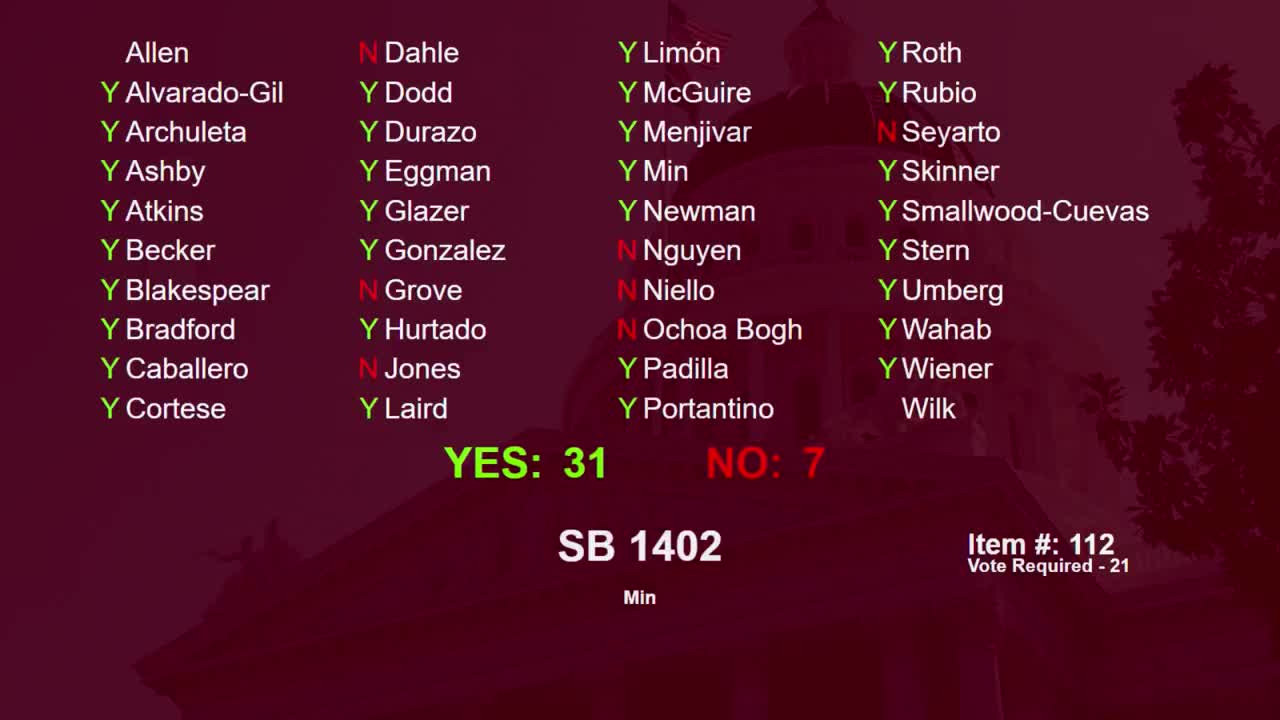 4MIN
Senate Floor
 6MIN
Senate Standing Committee on Military and Veterans Affairs
15MIN
Senate Standing Committee on Military and Veterans Affairs
 1MIN
Senate Standing Committee on Military and Veterans Affairs
Bill Author

Bill Co-Author(s):