SB 1509: Negligent Operator Treatment (NOT) in California Act.
- Session Year: 2023-2024
- House: Senate
- Latest Version Date: 2024-09-03
Current Status:
Failed
(2024-09-22: In Senate. Consideration of Governor's veto pending.)
Introduced
In Committee
First Chamber
In Committee
Second Chamber
Enacted
What does this bill do?
The bill creates a new infraction for drivers who go 26 miles per hour or more over the posted speed limit on roads posted 55 mph or less. A first infraction carries a $100 fine, a second within one year can be fined up to $200, and a third or later within one year up to $250. A first conviction (a guilty finding) adds one point to a driver’s record and a second or later conviction within 36 months adds two points.
The summary is provided by generative AI which can make mistakes. For original language, please view the details in the table below.
Existing law prohibits driving a vehicle upon a highway at a speed greater than is reasonable or prudent. Existing law also prohibits driving a vehicle in excess of an established speed limit. Existing law requires that specified convictions, violations, and traffic-related incidents count as points against a drivers record for purposes of suspension or revocation of the privilege to drive.
This bill, the Negligent Operator Treatment (NOT) in California Act, would, commencing on January 1, 2027, prohibit excessively speeding, defined as driving a vehicle at a speed that exceeds the posted speed limit by 26 miles per hour or more on a highway with a posted speed limit for passenger vehicles of 55 miles per hour or less. The bill would provide that a conviction for excessively speeding is punishable as an infraction and one point shall be assessed against a drivers record for a first violation and 2 points for any subsequent violation that occurs within 3 years after a previous violation for which the driver was convicted.
By creating a new infraction, this bill would impose a state-mandated local program.
The California Constitution requires the state to reimburse local agencies and school districts for certain costs mandated by the state. Statutory provisions establish procedures for making that reimbursement.
This bill would provide that no reimbursement is required by this act for a specified reason.
Existing law prohibits driving a vehicle upon a highway at a speed greater than is reasonable or prudent. Existing law also prohibits driving a vehicle in excess of an established speed limit. Existing law requires that specified convictions, violations, and traffic-related incidents count as points against a drivers record for purposes of suspension or revocation of the privilege to drive, and generally provides that traffic convictions for reckless driving of a motor vehicle result in 2 violation points. drive.
This bill, the Negligent Operator Treatment (NOT) in California Act, would specify that there is a rebuttable presumption that would, commencing on January 1, 2027, prohibit excessively speeding, defined as driving a vehicle at a speed that exceeds the posted speed limit by 26 miles per hour or more on a highway with a posted speed limit for passenger vehicles of 55 miles per hour or less is reckless driving. less. The bill would provide that a conviction of the offense of reckless driving based solely on this rebuttable presumption is punishable as an infraction only. for excessively speeding is punishable as an infraction and one point shall be assessed against a drivers record for a first violation and 2 points for any subsequent violation that occurs within 3 years after a previous violation for which the driver was convicted.
By creating a new infraction, this bill would impose a state-mandated local program.
The California Constitution requires the state to reimburse local agencies and school districts for certain costs mandated by the state. Statutory provisions establish procedures for making that reimbursement.
This bill would provide that no reimbursement is required by this act for a specified reason.
Existing law prescribes various speed limits for the operation of vehicles, and generally prohibits a person from driving a vehicle upon a highway at a speed greater than is reasonable or prudent having due regard for weather, visibility, the traffic on, and the surface and width of, the highway, and in no event at a speed that endangers the safety of persons or property. provides that a person who drives a vehicle upon a highway in willful or wanton disregard for the safety of persons or property is guilty of reckless driving, punishable by specified imprisonment in the county jail or a fine, or both. Existing law requires that specified convictions, violations, and traffic-related incidents count as points against a drivers record for purposes of suspension or revocation of the privilege to drive, and generally provides that traffic convictions involving the safe operation for reckless driving of a motor vehicle result in one violation point. 2 violation points.
This bill, the Negligent Operator Treatment (NOT) in California Act, would specify that a conviction of there is a rebuttable presumption that driving a vehicle at a speed that exceeds the posted speed limit by 26 miles per hour or more on a highway with a posted speed limit for passenger vehicles of 55 miles per hour or less shall be given a value of 2 points. is reckless driving. The bill would provide that a conviction of the offense of reckless driving based solely on this rebuttable presumption is punishable as an infraction only.
Existing law prescribes various speed limits for the operation of vehicles, and generally prohibits a person from driving a vehicle upon a highway at a speed greater than is reasonable or prudent having due regard for weather, visibility, the traffic on, and the surface and width of, the highway, and in no event at a speed that endangers the safety of persons or property. Existing law requires that specified convictions, violations, and traffic-related incidents count as points against a drivers record for purposes of suspension or revocation of the privilege to drive, and generally provides that traffic convictions involving the safe operation of a motor vehicle result in one violation point.
This bill, the Negligent Operator Treatment (NOT) in California Act, would specify that a conviction of driving a vehicle at a speed that exceeds the posted speed limit by 26 miles per hour or more results in 2 violation points. on a highway with a posted speed limit for passenger vehicles of 55 miles per hour or less shall be given a value of 2 points.
Existing law prescribes various speed limits for the operation of vehicles, and generally prohibits a person from driving a vehicle upon a highway at a speed greater than is reasonable or prudent having due regard for weather, visibility, the traffic on, and the surface and width of, the highway, and in no event at a speed that endangers the safety of persons or property. Existing law requires that specified convictions, violations, and traffic-related incidents count as points against a drivers record for purposes of suspension or revocation of the privilege to drive, and generally provides that traffic convictions involving the safe operation of a motor vehicle result in one violation point.
This bill, the Negligent Operator Treatment (NOT) in California Act, would specify that a conviction of driving a vehicle at a speed that exceeds the posted speed limit by 26 miles per hour or more results in 2 violation points.
This act shall be known, and may be cited, as the Negligent Operator Treatment (NOT) in California Act.
SEC. 2.The Legislature finds and declares all of the following:
(a)Ensuring our local streets and highways are protected from excessive speeding is of the highest priority.
(b)Last year, the United States Department of Transportations National Highway Traffic Safety Administration issued findings that showed both of the following:
(1)In 2020, the United States experienced 39,007 motor vehicle traffic crash fatalities, which was the largest number of fatalities since 2007, and an 8-percent increase from the 36,096 fatalities reported in 2019.
(2)In 2021, the United States experienced 42,939 traffic fatalities, which represents a 10-percent increase in fatalities from the 39,007 fatalities reported in 2020.
(c)In 2021, the State of California reported 4,285 traffic fatalities, a 7.6-percent increase from the prior year.
(d)According to the 2021 California Strategic Highway Safety Plan Crash Data Dashboard, all of the following occurred in 2021:
(1)Traffic collisions killed 844 individuals in the County of Los Angeles, accounting for an almost 10-percent increase from the fatalities reported in the prior year.
(2)Traffic collisions resulted in 4,287 serious injuries, accounting for about a 25-percent increase from the serious injuries reported in the prior year.
(3)Traffic collisions in the County of Los Angeles resulting in serious injury to pedestrians were up by almost 28 percent, and serious injury to bicyclists was up by almost 18 percent from the serious injuries reported in the prior year.
(4)Unsafe speed was the primary collision factor in 173 fatal crashes in the County of Los Angeles, a 26-percent increase from the fatalities reported the year before.
(5)Unsafe speed was the primary collision factor in 810 crashes resulting in serious injury, almost a 21-percent increase in serious injuries reported the year prior.
(e)Recent increases in speed-related collisions that result in serious injury or death are a present and growing danger to the public.
(f)Law enforcement at the state and local level must be provided effective statutory changes to maximize their efforts in combating driving at unsafe speeds.
SEC. 3.Section 12810.6 is added to the Vehicle Code, to read:12810.6.(a)A violation point shall be given for a first conviction of subdivision (d) of Section 22349.
(b)Notwithstanding subdivision (f) of Section 12810, a second or subsequent conviction for a violation of subdivision (d) of Section 22349 where the offense occurred within 36 months after another violation of the same subdivision, for which the driver was convicted, shall be given a value of two points.
(c)This section shall become operative on January 1, 2027.
SEC. 4.Section 22349 of the Vehicle Code is amended to read:22349.(a)Except as provided in Section 22356, no person may drive a vehicle upon a highway at a speed greater than 65 miles per hour.
(b)Notwithstanding any other provision of law, no person may drive a vehicle upon a two-lane, undivided highway at a speed greater than 55 miles per hour unless that highway, or portion thereof, has been posted for a higher speed by the Department of Transportation or appropriate local agency upon the basis of an engineering and traffic survey. For purposes of this subdivision, the following apply:
(1)A two-lane, undivided highway is a highway with not more than one through lane of travel in each direction.
(2)Passing lanes may not be considered when determining the number of through lanes.
(c)It is the intent of the Legislature that there be reasonable signing on affected two-lane, undivided highways described in subdivision (b) in continuing the 55 miles-per-hour speed limit, including placing signs at county boundaries to the extent possible, and at other appropriate locations.
(d)This section shall remain in effect only until January 1, 2027, and as of that date is repealed.
SEC. 5.Section 22349 is added to the Vehicle Code, to read:22349.(a)Except as provided in Section 22356, no person may drive a vehicle upon a highway at a speed greater than 65 miles per hour.
(b)Notwithstanding any other provision of law, no person may drive a vehicle upon a two-lane, undivided highway at a speed greater than 55 miles per hour unless that highway, or portion thereof, has been posted for a higher speed by the Department of Transportation or appropriate local agency upon the basis of an engineering and traffic survey. For purposes of this subdivision, the following apply:
(1)A two-lane, undivided highway is a highway with not more than one through lane of travel in each direction.
(2)Passing lanes may not be considered when determining the number of through lanes.
(c)It is the intent of the Legislature that there be reasonable signing on affected two-lane, undivided highways described in subdivision (b) in continuing the 55 miles-per-hour speed limit, including placing signs at county boundaries to the extent possible, and at other appropriate locations.
(d)A person shall not excessively speed on a highway with a posted speed limit of 55 miles per hour or less. For the purposes of this section, excessively speed means driving at a speed that exceeds the posted speed limit by 26 miles per hour or more on a highway with a posted speed limit for passenger vehicles of 55 miles per hour or less.
(1)A violation of this subdivision is punishable as an infraction by a fine of one hundred dollars ($100).
(2)For a second infraction occurring within one year of a prior infraction that resulted in a conviction, a fine not exceeding two hundred dollars ($200).
(3)For a third or subsequent infraction occurring within one year of two or more prior infractions that resulted in convictions, a fine not exceeding two hundred fifty dollars ($250).
(e)This section shall become operative on January 1, 2027.
SEC. 6.No reimbursement is required by this act pursuant to Section 6 of Article XIIIB of the California Constitution because the only costs that may be incurred by a local agency or school district will be incurred because this act creates a new crime or infraction, eliminates a crime or infraction, or changes the penalty for a crime or infraction, within the meaning of Section 17556 of the Government Code, or changes the definition of a crime within the meaning of Section 6 of Article XIIIB of the California Constitution.
This act shall be known, and may be cited, as the Negligent Operator Treatment (NOT) in California Act.
SEC. 2.The Legislature finds and declares all of the following:
(a)Ensuring our local streets and highways are protected from excessive speeding is of the highest priority.
(b)Last year, the United States Department of Transportations National Highway Traffic Safety Administration issued findings that showed both of the following:
(1)In 2020, the United States experienced 39,007 motor vehicle traffic crash fatalities, which was the largest number of fatalities since 2007, and an 8-percent increase from the 36,096 fatalities reported in 2019.
(2)In 2021, the United States experienced 42,939 traffic fatalities, which represents a 10-percent increase in fatalities from the 39,007 fatalities reported in 2020.
(c)In 2021, the State of California reported 4,285 traffic fatalities, a 7.6-percent increase from the prior year.
(d)According to the 2021 California Strategic Highway Safety Plan Crash Data Dashboard, all of the following occurred in 2021:
(1)Traffic collisions killed 844 individuals in the County of Los Angeles, accounting for an almost 10-percent increase from the fatalities reported in the prior year.
(2)Traffic collisions resulted in 4,287 serious injuries, accounting for about a 25-percent increase from the serious injuries reported in the prior year.
(3)Traffic collisions in the County of Los Angeles resulting in serious injury to pedestrians were up by almost 28 percent, and serious injury to bicyclists was up by almost 18 percent from the serious injuries reported in the prior year.
(4)Unsafe speed was the primary collision factor in 173 fatal crashes in the County of Los Angeles, a 26-percent increase from the fatalities reported the year before.
(5)Unsafe speed was the primary collision factor in 810 crashes resulting in serious injury, almost a 21-percent increase in serious injuries reported the year prior.
(e)Recent increases in speed-related collisions that result in serious injury or death are a present and growing danger to the public.
(f)Law enforcement at the state and local level must be provided effective statutory changes to maximize their efforts in combating driving at unsafe speeds.
SEC. 3.Section 23103 of the Vehicle Code is amended to read:23103.(a)A person who drives a vehicle upon a highway in willful or wanton disregard for the safety of persons or property is guilty of reckless driving.(b)A person who drives a vehicle in an offstreet parking facility, as defined in subdivision (c) of Section 12500, in willful or wanton disregard for the safety of persons or property is guilty of reckless driving.(c)Except as otherwise provided in Section 40008, persons convicted of the offense of reckless driving shall be punished by imprisonment in a county jail for not less than five days nor more than 90 days or by a fine of not less than one hundred forty-five dollars ($145) nor more than one thousand dollars ($1,000), or by both that fine and imprisonment, except as provided in Section 23104 or 23105.(d)There is a rebuttable presumption that driving at a speed that exceeds the posted speed limit by 26 miles per hour or more on a highway with a posted speed limit for passenger vehicles of 55 miles per hour or less is reckless driving, as described in subdivision (a). A conviction of the offense of reckless driving pursuant to subdivision (a) based solely upon the rebuttable presumption described in this subdivision is punishable as an infraction only.SEC. 3.Section 12810.6 is added to the Vehicle Code, to read:12810.6.(a)A violation point shall be given for a first conviction of subdivision (d) of Section 22349.
(b)Notwithstanding subdivision (f) of Section 12810, a second or subsequent conviction for a violation of subdivision (d) of Section 22349 where the offense occurred within 36 months after another violation of the same subdivision, for which the driver was convicted, shall be given a value of two points.
(c)This section shall become operative on January 1, 2027.
SEC. 4.Section 22349 of the Vehicle Code is amended to read:22349.(a)Except as provided in Section 22356, no person may drive a vehicle upon a highway at a speed greater than 65 miles per hour.
(b)Notwithstanding any other provision of law, no person may drive a vehicle upon a two-lane, undivided highway at a speed greater than 55 miles per hour unless that highway, or portion thereof, has been posted for a higher speed by the Department of Transportation or appropriate local agency upon the basis of an engineering and traffic survey. For purposes of this subdivision, the following apply:
(1)A two-lane, undivided highway is a highway with not more than one through lane of travel in each direction.
(2)Passing lanes may not be considered when determining the number of through lanes.
(c)It is the intent of the Legislature that there be reasonable signing on affected two-lane, undivided highways described in subdivision (b) in continuing the 55 miles-per-hour speed limit, including placing signs at county boundaries to the extent possible, and at other appropriate locations.
(d)This section shall remain in effect only until January 1, 2027, and as of that date is repealed.
SEC. 5.Section 22349 is added to the Vehicle Code, to read:22349.(a)Except as provided in Section 22356, no person may drive a vehicle upon a highway at a speed greater than 65 miles per hour.
(b)Notwithstanding any other provision of law, no person may drive a vehicle upon a two-lane, undivided highway at a speed greater than 55 miles per hour unless that highway, or portion thereof, has been posted for a higher speed by the Department of Transportation or appropriate local agency upon the basis of an engineering and traffic survey. For purposes of this subdivision, the following apply:
(1)A two-lane, undivided highway is a highway with not more than one through lane of travel in each direction.
(2)Passing lanes may not be considered when determining the number of through lanes.
(c)It is the intent of the Legislature that there be reasonable signing on affected two-lane, undivided highways described in subdivision (b) in continuing the 55 miles-per-hour speed limit, including placing signs at county boundaries to the extent possible, and at other appropriate locations.
(d)A person shall not excessively speed on a highway with a posted speed limit of 55 miles per hour or less. For the purposes of this section, excessively speed means driving at a speed that exceeds the posted speed limit by 26 miles per hour or more on a highway with a posted speed limit for passenger vehicles of 55 miles per hour or less.
(1)A violation of this subdivision is punishable as an infraction by a fine of one hundred dollars ($100).
(2)For a second infraction occurring within one year of a prior infraction that resulted in a conviction, a fine not exceeding two hundred dollars ($200).
(3)For a third or subsequent infraction occurring within one year of two or more prior infractions that resulted in convictions, a fine not exceeding two hundred fifty dollars ($250).
(e)This section shall become operative on January 1, 2027.
SEC. 6.No reimbursement is required by this act pursuant to Section 6 of Article XIIIB of the California Constitution because the only costs that may be incurred by a local agency or school district will be incurred because this act creates a new crime or infraction, eliminates a crime or infraction, or changes the penalty for a crime or infraction, within the meaning of Section 17556 of the Government Code, or changes the definition of a crime within the meaning of Section 6 of Article XIIIB of the California Constitution.
This act shall be known, and may be cited, as the Negligent Operator Treatment (NOT) in California Act.
SEC. 2.The Legislature finds and declares all of the following:
(a)Ensuring our local streets and highways are protected from excessive speeding is of the highest priority.
(b)Last year, the United States Department of Transportations National Highway Traffic Safety Administration issued findings that showed both of the following:
(1)In 2020, the United States experienced 39,007 motor vehicle traffic crash fatalities, which was the largest number of fatalities since 2007, and an 8-percent increase from the 36,096 fatalities reported in 2019.
(2)In 2021, the United States experienced 42,939 traffic fatalities, which represents a 10-percent increase in fatalities from the 39,007 fatalities reported in 2020.
(c)In 2021, the State of California reported 4,285 traffic fatalities, a 7.6-percent increase from the prior year.
(d)According to the 2021 California Strategic Highway Safety Plan Crash Data Dashboard, all of the following occurred in 2021:
(1)Traffic collisions killed 844 individuals in the County of Los Angeles, accounting for an almost 10-percent increase from the fatalities reported in the prior year.
(2)Traffic collisions resulted in 4,287 serious injuries, accounting for about a 25-percent increase from the serious injuries reported in the prior year.
(3)Traffic collisions in the County of Los Angeles resulting in serious injury to pedestrians were up by almost 28 percent, and serious injury to bicyclists was up by almost 18 percent from the serious injuries reported in the prior year.
(4)Unsafe speed was the primary collision factor in 173 fatal crashes in the County of Los Angeles, a 26-percent increase from the fatalities reported the year before.
(5)Unsafe speed was the primary collision factor in 810 crashes resulting in serious injury, almost a 21-percent increase in serious injuries reported the year prior.
(e)Recent increases in speed-related collisions that result in serious injury and or death are a present and growing danger to the public.
(f)Law enforcement at the state and local level must be provided effective statutory changes to maximize their efforts in combating driving at unsafe speeds.
SEC. 3.Section 12810 of the Vehicle Code is amended to read:12810.In determining the violation point count, the following shall apply:(a)A conviction of failure to stop in the event of an accident in violation of Section 20001 or 20002 shall be given a value of two points.(b)A conviction of a violation of Section 23152 or 23153 shall be given a value of two points.(c)A conviction of reckless driving shall be given a value of two points.(d)(1)A conviction of a violation of subdivision (b) of Section 191.5 or subdivision (c) of Section 192 of the Penal Code, or of Section 2800.2 or 2800.3, subdivision (b) of Section 21651, subdivision (b) of Section 22348, subdivision (a) or (c) of Section 23109, Section 23109.1, or Section 31602 of this code, shall be given a value of two points.(2)A conviction of a violation of subdivision (a) or (b) of Section 23140 shall be given a value of two points.(3)A conviction of driving a vehicle at a speed that exceeds the posted speed limit by 26 miles per hour or more on a highway with a posted speed limit for passenger vehicles of 55 miles per hour or less shall be given a value of two points.(e)A conviction of a violation of Section 14601, 14601.1, 14601.2, 14601.3, or 14601.5 shall be given a value of two points.(f)Except as provided in subdivision (i), any other traffic conviction involving the safe operation of a motor vehicle upon the highway shall be given a value of one point.(g)A traffic accident in which the operator is deemed by the department to be responsible shall be given a value of one point.(h)A conviction of a violation of Section 27360 or 27360.5 shall be given a value of one point.(i)(1)A violation of paragraph (1), (2), (3), or (5) of subdivision (b) of Section 40001 shall not result in a violation point count being given to the driver if the driver is not the owner of the vehicle.(2)A conviction of a violation of paragraph (1) or (2) of subdivision (b) of Section 12814.6, subdivision (a) of Section 21116, Section 21207.5, 21708, 21710, 21716, 23120, 24800, or 26707 shall not be given a violation point count.(3)A violation of subdivision (d) of Section 21712 shall not result in a violation point count.(4)A violation of Section 23136 shall not result in a violation point count.(5)A violation of Section 38301, 38301.3, 38301.5, 38304.1, or 38504.1 shall not result in a violation point count.(j)A conviction for only one violation arising from one occasion of arrest or citation shall be counted in determining the violation point count for the purposes of this section.SEC. 3.Section 23103 of the Vehicle Code is amended to read:23103.(a)A person who drives a vehicle upon a highway in willful or wanton disregard for the safety of persons or property is guilty of reckless driving.
(b)A person who drives a vehicle in an offstreet parking facility, as defined in subdivision (c) of Section 12500, in willful or wanton disregard for the safety of persons or property is guilty of reckless driving.
(c)Except as otherwise provided in Section 40008, persons convicted of the offense of reckless driving shall be punished by imprisonment in a county jail for not less than five days nor more than 90 days or by a fine of not less than one hundred forty-five dollars ($145) nor more than one thousand dollars ($1,000), or by both that fine and imprisonment, except as provided in Section 23104 or 23105.
(d)There is a rebuttable presumption that driving at a speed that exceeds the posted speed limit by 26 miles per hour or more on a highway with a posted speed limit for passenger vehicles of 55 miles per hour or less is reckless driving, as described in subdivision (a). A conviction of the offense of reckless driving pursuant to subdivision (a) based solely upon the rebuttable presumption described in this subdivision is punishable as an infraction only.
This act shall be known, and may be cited, as the Negligent Operator Treatment (NOT) in California Act.
SEC. 2.The Legislature finds and declares all of the following:
(a)Ensuring our local streets and highways are protected from excessive speeding is of the highest priority.
(b)Last year, the United States Department of Transportations National Highway Traffic Safety Administration issued findings that showed both of the following:
(1)In 2020, the United States experienced 39,007 motor vehicle traffic crash fatalities, which was the largest number of fatalities since 2007, and an 8-percent increase from the 36,096 fatalities reported in 2019.
(2)In 2021, the United States experienced 42,939 traffic fatalities, which represents a 10-percent increase in fatalities from the 39,007 fatalities reported in 2020.
(c)In 2021, the State of California reported 4,285 traffic fatalities, a 7.6-percent increase from the prior year.
(d)According to the 2021 California Strategic Highway Safety Plan Crash Data Dashboard, all of the following occurred in 2021:
(1)Traffic collisions killed 844 individuals in the County of Los Angeles, accounting for an almost 10-percent increase from the fatalities reported in the prior year.
(2)Traffic collisions resulted in 4,287 serious injuries, accounting for about a 25-percent increase from the serious injuries reported in the prior year.
(3)Traffic collisions in the County of Los Angeles resulting in serious injury to pedestrians were up by almost 28 percent, and serious injury to bicyclists was up by almost 18 percent from the serious injuries reported in the prior year.
(4)Unsafe speed was the primary collision factor in 173 fatal crashes in the County of Los Angeles, a 26-percent increase from the fatalities reported the year before.
(5)Unsafe speed was the primary collision factor in 810 crashes resulting in serious injury, almost a 21-percent increase in serious injuries reported the year prior.
(e)Recent increases in speed-related collisions that result in serious injury and or death are a present and growing danger to the public.
(f)Law enforcement at the state and local level must be provided effective statutory changes to maximize their efforts in combating driving at unsafe speeds.
SEC. 3.Section 12810 of the Vehicle Code is amended to read:12810.In determining the violation point count, the following shall apply:
(a)A conviction of failure to stop in the event of an accident in violation of Section 20001 or 20002 shall be given a value of two points.
(b)A conviction of a violation of Section 23152 or 23153 shall be given a value of two points.
(c)A conviction of reckless driving shall be given a value of two points.
(d)(1)A conviction of a violation of subdivision (b) of Section 191.5 or subdivision (c) of Section 192 of the Penal Code, or of Section 2800.2 or 2800.3, subdivision (b) of Section 21651, subdivision (b) of Section 22348, subdivision (a) or (c) of Section 23109, Section 23109.1, or Section 31602 of this code, shall be given a value of two points.
(2)A conviction of a violation of subdivision (a) or (b) of Section 23140 shall be given a value of two points.
(3)A conviction of driving a vehicle at a speed that exceeds the posted speed limit by 26 miles per hour or more on a highway with a posted speed limit for passenger vehicles of 55 miles per hour or less shall be given a value of two points.
(e)A conviction of a violation of Section 14601, 14601.1, 14601.2, 14601.3, or 14601.5 shall be given a value of two points.
(f)Except as provided in subdivision (i), any other traffic conviction involving the safe operation of a motor vehicle upon the highway shall be given a value of one point.
(g)A traffic accident in which the operator is deemed by the department to be responsible shall be given a value of one point.
(h)A conviction of a violation of Section 27360 or 27360.5 shall be given a value of one point.
(i)(1)A violation of paragraph (1), (2), (3), or (5) of subdivision (b) of Section 40001 shall not result in a violation point count being given to the driver if the driver is not the owner of the vehicle.
(2)A conviction of a violation of paragraph (1) or (2) of subdivision (b) of Section 12814.6, subdivision (a) of Section 21116, Section 21207.5, 21708, 21710, 21716, 23120, 24800, or 26707 shall not be given a violation point count.
(3)A violation of subdivision (d) of Section 21712 shall not result in a violation point count.
(4)A violation of Section 23136 shall not result in a violation point count.
(5)A violation of Section 38301, 38301.3, 38301.5, 38304.1, or 38504.1 shall not result in a violation point count.
(j)A conviction for only one violation arising from one occasion of arrest or citation shall be counted in determining the violation point count for the purposes of this section.
This act shall be known, and may be cited, as the Negligent Operator Treatment (NOT) in California Act.
SEC. 2.The Legislature finds and declares all of the following:
(a)Ensuring our local streets and highways are protected from excessive speeding is of the highest priority.
(b)Last year, the United States Department of Transportations National Highway Traffic Safety Administration issued findings that showed both of the following:
(1)In 2020, the United States experienced 39,007 motor vehicle traffic crash fatalities, which was the largest number of fatalities since 2007, and an 8-percent increase from the 36,096 fatalities reported in 2019.
(2)In 2021, the United States experienced 42,939 traffic fatalities, which represents a 10-percent increase in fatalities from the 39,007 fatalities reported in 2020.
(c)In 2021, the State of California reported 4,285 traffic fatalities, a 7.6-percent increase from the prior year.
(d)According to the 2021 California Strategic Highway Safety Plan Crash Data Dashboard, all of the following occurred in 2021:
(1)Traffic collisions killed 844 individuals in the County of Los Angeles, accounting for an almost 10-percent increase from the fatalities reported in the prior year.
(2)Traffic collisions resulted in 4,287 serious injuries, accounting for about a 25-percent increase from the serious injuries reported in the prior year.
(3)Traffic collisions in the County of Los Angeles resulting in serious injury to pedestrians were up by almost 28 percent, and serious injury to bicyclists was up by almost 18 percent from the serious injuries reported in the prior year.
(4)Unsafe speed was the primary collision factor in 173 fatal crashes in the County of Los Angeles, a 26-percent increase from the fatalities reported the year before.
(5)Unsafe speed was the primary collision factor in 810 crashes resulting in serious injury, almost a 21-percent increase in serious injuries reported the year prior.
(e)Recent increases in speed-related collisions that result in serious injury and or death are a present and growing danger to the public.
(f)Law enforcement at the state and local level must be provided effective statutory changes to maximize their efforts in combating driving at unsafe speeds.
SEC. 3.Section 12810 of the Vehicle Code is amended to read:12810.In determining the violation point count, the following shall apply:
(a)A conviction of failure to stop in the event of an accident in violation of Section 20001 or 20002 shall be given a value of two points.
(b)A conviction of a violation of Section 23152 or 23153 shall be given a value of two points.
(c)A conviction of reckless driving shall be given a value of two points.
(d)(1)A conviction of a violation of subdivision (b) of Section 191.5 or subdivision (c) of Section 192 of the Penal Code, or of Section 2800.2 or 2800.3, subdivision (b) of Section 21651, subdivision (b) of Section 22348, subdivision (a) or (c) of Section 23109, Section 23109.1, or Section 31602 of this code, shall be given a value of two points.
(2)A conviction of a violation of subdivision (a) or (b) of Section 23140 shall be given a value of two points.
(3)A conviction of driving a vehicle at a speed that exceeds the posted speed limit by 26 miles per hour or more shall be given a value of two points.
(e)A conviction of a violation of Section 14601, 14601.1, 14601.2, 14601.3, or 14601.5 shall be given a value of two points.
(f)Except as provided in subdivision (i), any other traffic conviction involving the safe operation of a motor vehicle upon the highway shall be given a value of one point.
(g)A traffic accident in which the operator is deemed by the department to be responsible shall be given a value of one point.
(h)A conviction of a violation of Section 27360 or 27360.5 shall be given a value of one point.
(i)(1)A violation of paragraph (1), (2), (3), or (5) of subdivision (b) of Section 40001 shall not result in a violation point count being given to the driver if the driver is not the owner of the vehicle.
(2)A conviction of a violation of paragraph (1) or (2) of subdivision (b) of Section 12814.6, subdivision (a) of Section 21116, Section 21207.5, 21708, 21710, 21716, 23120, 24800, or 26707 shall not be given a violation point count.
(3)A violation of subdivision (d) of Section 21712 shall not result in a violation point count.
(4)A violation of Section 23136 shall not result in a violation point count.
(5)A violation of Section 38301, 38301.3, 38301.5, 38304.1, or 38504.1 shall not result in a violation point count.
(j)A conviction for only one violation arising from one occasion of arrest or citation shall be counted in determining the violation point count for the purposes of this section.
|
Date
|
Status
|
|---|---|
| Sep 22, 2024 | In Senate. Consideration of Governor's veto pending. |
| Sep 22, 2024 | Vetoed by the Governor. |
| Sep 9, 2024 | Enrolled and presented to the Governor at 3 p.m. |
| Aug 29, 2024 | Assembly amendments concurred in. (Ayes 36. Noes 1. Page 5647.) Ordered to engrossing and enrolling. |
| Aug 28, 2024 | In Senate. Concurrence in Assembly amendments pending. |
| Aug 28, 2024 | Read third time. Passed. (Ayes 76. Noes 0. Page 6707.) Ordered to the Senate. |
| Aug 19, 2024 | Read second time. Ordered to third reading. |
| Aug 15, 2024 | From committee: Do pass. (Ayes 14. Noes 0.) (August 15). |
| Aug 7, 2024 | August 7 set for first hearing. Placed on suspense file. |
| Jul 3, 2024 | Read second time and amended. Re-referred to Com. on APPR. |
| Jul 2, 2024 | From committee: Do pass as amended and re-refer to Com. on APPR. (Ayes 15. Noes 0.) (July 1). |
| Jun 3, 2024 | Referred to Com. on TRANS. |
| May 23, 2024 | In Assembly. Read first time. Held at Desk. |
| May 22, 2024 | Read third time. Passed. (Ayes 28. Noes 1. Page 4145.) Ordered to the Assembly. |
| May 20, 2024 | Read second time. Ordered to third reading. |
| May 16, 2024 | Read second time and amended. Ordered to second reading. |
| May 16, 2024 | From committee: Do pass as amended. (Ayes 5. Noes 1. Page 3986.) (May 16). |
| May 10, 2024 | Set for hearing May 16. |
| Apr 29, 2024 | April 29 hearing: Placed on APPR suspense file. |
| Apr 22, 2024 | Set for hearing April 29. |
| Apr 17, 2024 | Read second time and amended. Re-referred to Com. on APPR. |
| Apr 16, 2024 | From committee: Do pass as amended and re-refer to Com. on APPR. (Ayes 12. Noes 1. Page 3536.) (April 9). |
| Mar 6, 2024 | Set for hearing April 9. |
| Feb 29, 2024 | Referred to Com. on TRANS. |
| Feb 20, 2024 | From printer. May be acted upon on or after March 18. |
| Feb 16, 2024 | Introduced. Read first time. To Com. on RLS. for assignment. To print. |
|
Date
|
Description
|
Location
|
Votes
|
|
|---|---|---|---|---|
| Aug 29, 2024 | Unfinished Business SB1509 Stern et al. Concurrence | Senate Floor |
Passed |
|
| Aug 28, 2024 | SB 1509 Stern Senate Third Reading By Wilson | Assembly Floor |
Passed |
|
| Aug 15, 2024 | Do pass. | Assembly Standing Committee on Appropriations |
Passed |
|
| Jul 1, 2024 | Do pass as amended and be re-referred to the Committee on [Appropriations] | Assembly Standing Committee on Transportation |
Passed |
|
| May 22, 2024 | Senate 3rd Reading SB1509 Stern et al. | Senate Floor |
Passed |
|
| May 16, 2024 | Do pass as amended | Senate Standing Committee on Appropriations |
Passed |
|
| Apr 29, 2024 | Placed on suspense file | Senate Standing Committee on Appropriations |
Passed |
|
| Apr 9, 2024 | Do pass as amended, but first amend, and re-refer to the Committee on [Appropriations] | Senate Standing Committee on Transportation |
Passed |
This list shows positions taken on this bill by organizations on the date displayed, which is linked to the original source.
Positions by individuals are not included.
|
Organization
|
Position
|
Date
|
|---|---|---|
| Active San Gabriel Valley | ** Support | |
| Afscme | * Against Unless Amend | Apr 9, 2024 |
| Alliance For Automotive Innovation | ** Support | |
| America Walks | ** Support | |
| Bicycle Club of Irvine | ** Support | |
| Bike LA | ** Support | |
| Bike Walk Encinitas | ** Support | |
| CalBike | ** Support | |
| California Association Of Highway Patrolmen | ** Support | |
| California Conference Board Of The Amalgamated Transit Union | ** Against | |
| California State Legislative Board of the SMART – Transportation Division | ** Against | |
| Car-Lite Long Beach | ** Support | |
| City Of Los Angeles | ** Support | |
| City of Malibu | ** Support | |
| City Of Merced | ** Support | |
| Conor Lynch Foundation | ** Support | |
| Encinitas Bike Walk | ** Support | |
| Faith for SAFE Streets | ** Support | |
| Faith for Safer Streets | ** Support | |
| Families for Safe Streets San Diego | ** Support | |
| Generic LLC | ** Support | |
| Goleta City Of | ** Support | |
| In Memory of Zachary Cruz | ** Support | |
| Lafayette City Of | ** Support | |
| League Of California Cities | ** Support | |
| Los Angeles Walks | ** Support | |
| Marin County Bicycle Coalition | ** Support | |
| Move LA | ** Support | |
| Move Santa Barbara County | ** Support | |
| National Coalition for Safer Roads | ** Support | |
| Oakland City Of | ** Support | |
| Office of Los Angeles County Supervisor Lindsey P. Horvath | ** Support | |
| Orange County Bicycle Coalition | ** Support | |
| Sacramento Area Bicycle Advocates | ** Support | |
| Santa Monica Safe Streets Alliance | ** Support | |
| Santa Monica Spoke | ** Support | |
| Sierra Express Bicycle Club of Nevada County | ** Support | |
| So Cal Cycling | ** Support | |
| Socal Families for Safe Streets | ** Support | |
| Stockton City Of | ** Support | |
| Street Racing Kills | ** Support | |
| Streets Are For Everyone | ** Support | |
| Streets for All | ** Support | |
| Teamsters | * Support | Jul 1, 2024 |
| Walk San Francisco | ** Support | |
| We Save Lives | ** Support | |
| West Hollywood Bicycle Coalition | ** Support |
SENATE RULES COMMITTEE Office of Senate Floor Analyses (916) 651-1520 Fax: (916) 327-4478 | SB 1509 |
VETO
Bill No: SB 1509
Author: Stern (D), et al.
Enrolled: 9/3/24
Vote: 27
SENATE TRANSPORTATION COMMITTEE: 12-1, 4/9/24
AYES: Cortese, Niello, Allen, Archuleta, Blakespear, Dodd, Gonzalez, Limón, Newman, Portantino, Seyarto, Umberg
NOES: Dahle
NO VOTE RECORDED: Becker, Nguyen
SENATE APPROPRIATIONS COMMITTEE: 5-1, 5/16/24
AYES: Caballero, Ashby, Becker, Bradford, Seyarto
NOES: Jones
NO VOTE RECORDED: Wahab
SENATE FLOOR: 28-1, 5/22/24
AYES: Alvarado-Gil, Atkins, Blakespear, Bradford, Caballero, Cortese, Dodd, Eggman, Glazer, Gonzalez, Hurtado, Laird, Limón, McGuire, Menjivar, Min, Newman, Niello, Padilla, Portantino, Roth, Rubio, Seyarto, Smallwood-Cuevas, Stern, Umberg, Wiener, Wilk
NOES: Jones
NO VOTE RECORDED: Allen, Archuleta, Ashby, Becker, Dahle, Durazo, Grove, Nguyen, Ochoa Bogh, Skinner, Wahab
SENATE FLOOR: 36-1, 8/29/24
AYES: Allen, Alvarado-Gil, Archuleta, Ashby, Atkins, Blakespear, Bradford, Caballero, Cortese, Dahle, Dodd, Durazo, Eggman, Glazer, Gonzalez, Grove, Hurtado, Laird, Limón, McGuire, Menjivar, Newman, Nguyen, Niello, Ochoa Bogh, Padilla, Portantino, Roth, Rubio, Seyarto, Skinner, Smallwood-Cuevas, Stern, Umberg, Wiener, Wilk
NOES: Jones
NO VOTE RECORDED: Becker, Min, Wahab
ASSEMBLY FLOOR: 76-0, 8/28/24 - See last page for vote
SUBJECT: Negligent Operator Treatment (NOT) in California Act
SOURCE: Author
DIGEST:
This bill, beginning January 1, 2027, makes it a violation to exceed the posted speed limit by 26 miles per hour or more on a highway with a posted speed limit for passenger vehicle of 55 miles per hour or less. This bill makes a second violation within 36 months of a first offense to have a negligent operator treatment penalty of two points.
ANALYSIS:
Existing law:
- Authorizes the Department of Motor Vehicles (DMV) to refuse to issue or renew a driver’s license or an applicant who they determine is a negligent or incompetent operator of a motor vehicle. (VEH §12809)
- Authorizes the DMV to take a variety of license control actions, including license suspension and probation, on negligent operators. (VEH §13800, §14250)
- Specifies that a person is presumed to be a negligent operator if their driving record shows a violation point count of four or more points in 12 months, six or more points in 24 months, or eight or more points in 36 months. (VEH §12810.5)
- Requires the DMV to offer potential negligent operators an administrative hearing when an action is taken under these provisions (VEH §1350)
- Prohibits driving a vehicle upon a highway at a speed greater than is reasonable or prudent having due regard for weather, visibility, and traffic. (VEH §22350)
- Prohibits reckless driving, defined as driving a vehicle upon highway or in an off-street parking facility in willful or wanton disregard for the safety of persons or property. (VEH §23103)
- Generally establishes the point value of a traffic conviction involving the safe operation of a motor vehicle upon the highway to be one point. (VEH §12810.5)
- Specifies that each negligent operator point shall be valued at one and one-half times the value for each violation reasonably determined by the DMV to be attributable to the operation of a vehicle requiring a Class A or Class B license or a certificate or endorsement to operate.
- Specifies that certain convictions, including reckless driving, failure to stop in the event of an accident, speeding at 100 mph or greater, speed contests, and driving under the influence shall be given a value of two points.
- Allows courts to dismiss and mask a single one-point conviction within an 18-month period if the offender attends a licensed traffic violator school. (VEH §1808.7 and §41501)
This bill:
- Makes legislative findings and declarations regarding the prevalence of traffic collisions and the contributing role of unsafe speed.
- Establishes, beginning January 1, 2027, a new violation of the vehicle code to be driving at a speed that exceeds the posted speed limit by 26 miles per hour or more on a highway with a posted speed limit for passenger vehicles of 55 miles per hour or less.
- Sets the punishment for this violation to be a fine of $100 for a first infraction, $200 for a second infraction occurring within a year of the first, and $250 for subsequent infractions within a year.
- Specifies that a second violation of this provision within 36 months of a priori violation shall be given a value of two points.
Comments
- Purpose of the bill. According to the author, “As the author of Senate Bill 1509, I am committed to prioritizing road safety and reducing preventable deaths and injuries caused by speeding collisions in California. The horrific statistics of speed-related fatalities and injuries highlight the urgent need for legislative action to address this speeding crisis. SB 1509, also known as the NOT IN CALIFORNIA Act, aims to increase accountability for drivers who exceed the posted speed limit by 26 mph or more. By implementing stricter penalties for speeding violations, we can deter reckless driving and save lives.”
- Speeding kills. Speed is one of the basic risk factors in traffic. Higher driven speeds provide less time to process and react to sudden changes on the roadway and increases the distance required to bring a vehicle to a stop. This decreases the ability for a driver to avoid a potential collision, increasing collision rates. Higher speeds also result in more severe crashes because of the greater forces involved at higher speeds.
Last summer the National Highway and Traffic Safety administration released new data on speeding in 2021 from which they estimated 10 percent of all police-reported traffic crashes were speeding-related. Speeding-related crashes were disproportionally dangerous, accounting for 28% of fatal crashes. Speeding behavior is also becoming more common. Speeding-related fatalities increased by 8% from 2020 to 2021. Speeding-related traffic fatalities are particularly prevalent in California, which suffered the second highest number of speeding-related fatalities of the U.S. states (1,509 or 35% of Californian traffic fatalities).
- Negligent Operator Treatment System (NOTS). The NOTS is a system by which the DMV assigns penalty points for various traffic-law violations and then takes certain licensing actions based on accrued points. Almost all motor vehicle driver licensing agencies have similar systems. These systems identify drivers who are most likely to be involved in crashes and then initiate driver improvement and license control actions to reduce their future crash risk. The existence of point systems and the threat of punishment also act as general deterrents to unsafe driving and the violation of traffic laws.
In California’s NOTS system convictions for minor violations, such as speeding or being at least partially at fault for a collision, result in one point. Convictions for major violations such as drunk driving, speeding at 100 mph or greater, or a hit-and-run result in two points. When someone is convicted of their first one-point violation in an 18-month period traffic courts may dismiss and mask their conviction (so it doesn’t result in a point or increase their insurance premiums) if that individual attends a licensed traffic violator school. Any subsequent convictions in that 18-month period cannot be masked and will result in NOTS points. Two-point convictions cannot be dismissed or masked in this way.
The NOTS system currently has four intervention levels. When a driver first accumulates two points in a year, four points in two years, or six points in three years, they are sent a letter that gives a low-threat general warning to change their behavior to avoid future crashes and more severe licensing actions. If the driver accumulates another point within those time windows, they are then sent a second letter with a more severe warning. A subsequent point will be enough to meet the legal definition of a negligent operator at which point the DMV will schedule a hearing at which license probations and suspension may be imposed. Generally, the next two convictions after this hearing will result in 6 months of license suspension each, though the DMV has discretion to make more severe determinations during the hearing. Further convictions usually result in license revocation.
- Are violation points an effective deterrent? The DMV has conducted multiple evaluations of the negligent operator program, through which points are assessed, all of which have deemed the program successful. A 2004 report by the DMV found that “slightly fewer than 32% of the approximately 484,700 drivers who qualified for a NOTS intervention between June 1, 2000 and December 31, 2001 persisted in their negligent driving behaviors and became eligible for higher-level interventions” beyond the first warning letter. A 2009 report found the program “to be effective in reducing subsequent total crashes and citations of treated drivers.” The report found that the first warning letter resulted in a roughly 5% reduction in crash risk and probation hearings resulted in roughly 15% reduction in crash risk. The system itself cost around $700 per crash it prevented.
While it is clear that the NOTS system is effective and that more severe interventions have a bigger impact on behavior, it is hard to predict the precise impact of modifying the system. Drivers who speed already receive one point and it is unclear that changing a violation to two points will have a large preventative effect on general behavior. A two point conviction will not result in a probation hearing, just a more sternly worded letter, though these points will not be able to be masked by attending traffic violator school resulting in higher insurance premiums. By assessing a violation at two points, the Legislature would effectively be saying that people who engage in this type of speeding are especially likely to be negligent or dangerous and the DMV should more quickly apply their proven corrective actions to their behavior.
- Why 26 mph over? This bill raises the question at what point is speeding so dangerous that it necessitates harsher penalties in order to more effectively correct the behavior. The 26 mph cutoff used in this bill seems to be designed to align with cutoffs for existing traffic tickets. According to the 2024 uniform bail and penalty schedules the fine for speeding up to 15 mph is $234, up to 25 mph is $363, and 26 and over is $486.
From a safety perspective, the impact of speeding by 26 mph varies based on location, driver, road conditions, and vehicle. According to NHSTA speeding-related fatalities are highest on non-interstate roadways. One useful metric to consider when evaluating the risk of speeding is how it alters the amount of time it takes to brake to a halt in the event of something unexpected in the roadway, like a child. Using a basic formula one can calculate that for a vehicle traveling at 25 mph on a flat dry road, with anti-lock brakes, and a 1.5 second reaction time it would take the vehicle about 76 feet and 2.6 seconds for the vehicle to come to a halt. Under those same conditions a vehicle traveling at 50 mph would take 190 feet and 3.8 seconds to come to a halt. When it comes to crashes that extra second can make a huge difference in the risk and severity of a crash. A 2011 analysis by the American Automobile Association suggested that the risk of death for a pedestrian struck by a vehicle increases from about 11% at 25 mph to 75% at 50 mph.
- Why only on slower roads? The egregiousness of speeding behavior is context dependent. In denser settings with pedestrians, cross traffic, and lower speed limits it seems much more difficult to lose track of one’s speed and more likely to face unexpected situations where egregious speed will lead to calamity. On the freeways or expressways it may be easier for a person to lose track of their speed. The bill recognizes this by only applying on highways with posted speed limits of 55 or less.
FISCAL EFFECT: Appropriation: No Fiscal Com.: Yes Local: Yes
According to Assembly Appropriations Committee “The DMV describes the work this bill creates for it as modifications of (1) its core information technology (IT) systems to enable them to receive notification of a new type of conviction and to update offenders' driving records, and (2) DMV's Negligent Operator Treatment System (NOTs) points system to be able to record a second or subsequent violation within 36 months. The DMV contends it "cannot predict the costs to modify the system" because these changes would occur after the department's comprehensive IT modernization effort, known as DXP.
“In any case, it is likely that the DMV will face significant costs to implement this bill, likely in excess of $150,000 in any given year (Motor Vehicle Account (MVA)).
“According to the Legislative Analyst's Office (LAO), the MVA—the main funding source for the DMV and the California Highway Patrol—is expected to fully exhaust its reserves and become insolvent in fiscal year (FY) 2025‑26. The LAO further warns that the MVA, absent corrective action, such as revenue increases or spending reductions, will experience a negative fund balance of $1.4 billion in FY 2028‑29”
SUPPORT: (Verified 8/26/24)
Active San Gabriel Valley
Alliance for Automotive Innovation
America Walks
Bicycle Club of Irvine
Bike LA
Calbike
California Association of Highway Patrolmen
Car-lite Long Beach
City of Los Angeles
City of Malibu
City of Merced
Conor Lynch Foundation
Encinitas Bike Walk
Faith for Safer Streets
Families for Safe Streets San Diego
Generic LLC
Goleta; City of
In Memory of Zachary Cruz
Lafayette; City of
League of California Cities
Los Angeles Walks
Marin County Bicycle Coalition
Move LA
Move Santa Barbara County
National Coalition for Safer Roads
Oakland; City of
Office of Los Angeles County Supervisor Lindsey P. Horvath
Orange County Bicycle Coalition
Sacramento Area Bicycle Advocates
Santa Monica Safe Streets Alliance
Santa Monica Spoke
Sierra Express Bicycle Club of Nevada County
So Cal Cycling
Socal Families for Safe Streets
Stockton; City of
Street Racing Kills
Streets are For Everyone (SAFE) (UNREG)
Streets for All
Walk San Francisco
We Save Lives
West Hollywood Bicycle Coalition
OPPOSITION: (Verified 8/26/24)
California State Legislative Board of Smart – Transportation Division (smart – Td)
GOVERNOR'S VETO MESSAGE:
This bill would create a new violation for driving 26 miles per hour over the posted speed limit on highways with speed limits of 55 miles per hour or less and impose increased penalties for repeat violations.
Under current law, many non-commercial drivers can attend Traffic Violator School to avoid point accumulation, making the application of the proposed two-point penalty less frequent. Moreover, this bill introduces an additional point only if the prior violation is for the exact same offense - excessive speeding - and not for other speeding offenses, such as those under the Basic Speed Law or speeding on highways. Consequently, this bill may have less of an overall deterrent effect than intended.
Implementing this bill would also require the Department of Motor Vehicles (DMV) to modify its information technology systems. The DMV is currently undergoing a comprehensive IT modernization effort, and the additional mandate would disrupt these critical projects. Additionally, this bill provides no cost recovery mechanism to offset the associated costs.
In partnership with the Legislature this year, my Administration has enacted a balanced budget that avoids deep program cuts to vital services and protected investments in education, health care, climate, public safety, housing, and social service programs that millions of Californians rely on. It is important to remain disciplined when considering bills with significant fiscal implications that are not included in the budget, such as this measure.
I encourage the Legislature to consider alternative measures that could effectively deter dangerous speeding without imposing further financial or administrative strain on the DMV.
For these reasons, I cannot sign this bill.
ASSEMBLY FLOOR: 76-0, 8/28/24
AYES: Addis, Aguiar-Curry, Alanis, Alvarez, Arambula, Bains, Bauer-Kahan, Bennett, Berman, Boerner, Bonta, Bryan, Calderon, Juan Carrillo, Wendy Carrillo, Chen, Connolly, Megan Dahle, Davies, Dixon, Flora, Mike Fong, Friedman, Gabriel, Gallagher, Garcia, Gipson, Grayson, Haney, Hart, Holden, Hoover, Irwin, Jackson, Jones-Sawyer, Kalra, Lackey, Lee, Low, Lowenthal, Maienschein, Mathis, McCarty, McKinnor, Muratsuchi, Stephanie Nguyen, Pacheco, Papan, Jim Patterson, Joe Patterson, Pellerin, Petrie-Norris, Quirk-Silva, Ramos, Rendon, Reyes, Luz Rivas, Rodriguez, Blanca Rubio, Sanchez, Santiago, Schiavo, Soria, Ta, Ting, Valencia, Villapudua, Waldron, Wallis, Ward, Weber, Wicks, Wilson, Wood, Zbur, Robert Rivas
NO VOTE RECORDED: Cervantes, Essayli, Ortega
Prepared by: Jacob O'Connor / TRANS. / (916) 651-4121
10/16/24 14:28:01
**** END ****
SENATE RULES COMMITTEE Office of Senate Floor Analyses (916) 651-1520 Fax: (916) 327-4478 | SB 1509 |
UNFINISHED BUSINESS
Bill No: SB 1509
Author: Stern (D), et al.
Amended: 7/3/24
Vote: 21
SENATE TRANSPORTATION COMMITTEE: 12-1, 4/9/24
AYES: Cortese, Niello, Allen, Archuleta, Blakespear, Dodd, Gonzalez, Limón, Newman, Portantino, Seyarto, Umberg
NOES: Dahle
NO VOTE RECORDED: Becker, Nguyen
SENATE APPROPRIATIONS COMMITTEE: 5-1, 5/16/24
AYES: Caballero, Ashby, Becker, Bradford, Seyarto
NOES: Jones
NO VOTE RECORDED: Wahab
SENATE FLOOR: 28-1, 5/22/24
AYES: Alvarado-Gil, Atkins, Blakespear, Bradford, Caballero, Cortese, Dodd, Eggman, Glazer, Gonzalez, Hurtado, Laird, Limón, McGuire, Menjivar, Min, Newman, Niello, Padilla, Portantino, Roth, Rubio, Seyarto, Smallwood-Cuevas, Stern, Umberg, Wiener, Wilk
NOES: Jones
NO VOTE RECORDED: Allen, Archuleta, Ashby, Becker, Dahle, Durazo, Grove, Nguyen, Ochoa Bogh, Skinner, Wahab
ASSEMBLY FLOOR: 76-0, 8/28/24 - See last page for vote
SUBJECT: Negligent Operator Treatment (NOT) in California Act
SOURCE: Author
DIGEST:
This bill, beginning January 1, 2027, makes it a violation to exceed the posted speed limit by 26 miles per hour or more on a highway with a posted speed limit for passenger vehicle of 55 miles per hour or less. This bill makes a second violation within 36 months of a first offense to have a negligent operator treatment penalty of two points.
Assembly Amendments
make the violation established by this bill into its own definition, rather than defining it as reckless driving, and establishes the violation shall only result in two points for a second violation, rather than the first.
ANALYSIS:
Existing law:
- Authorizes the Department of Motor Vehicles (DMV) to refuse to issue or renew a driver’s license or an applicant who they determine is a negligent or incompetent operator of a motor vehicle. (VEH §12809)
- Authorizes the DMV to take a variety of license control actions, including license suspension and probation, on negligent operators. (VEH §13800, §14250)
- Specifies that a person is presumed to be a negligent operator if their driving record shows a violation point count of four or more points in 12 months, six or more points in 24 months, or eight or more points in 36 months. (VEH §12810.5)
- Requires the DMV to offer potential negligent operators an administrative hearing when an action is taken under these provisions (VEH §1350)
- Prohibits driving a vehicle upon a highway at a speed greater than is reasonable or prudent having due regard for weather, visibility, and traffic. (VEH §22350)
- Prohibits reckless driving, defined as driving a vehicle upon highway or in an off-street parking facility in willful or wanton disregard for the safety of persons or property. (VEH §23103)
- Generally establishes the point value of a traffic conviction involving the safe operation of a motor vehicle upon the highway to be one point. (VEH §12810.5)
- Specifies that each negligent operator point shall be valued at one and one-half times the value for each violation reasonably determined by the DMV to be attributable to the operation of a vehicle requiring a Class A or Class B license or a certificate or endorsement to operate.
- Specifies that certain convictions, including reckless driving, failure to stop in the event of an accident, speeding at 100 mph or greater, speed contests, and driving under the influence shall be given a value of two points.
- Allows courts to dismiss and mask a single one-point conviction within an 18-month period if the offender attends a licensed traffic violator school. (VEH §1808.7 and §41501)
This bill:
- Makes legislative findings and declarations regarding the prevalence of traffic collisions and the contributing role of unsafe speed.
- Beginning January 1, 2027, establishes a new violation of the vehicle code to be driving at a speed that exceeds the posted speed limit by 26 miles per hour or more on a highway with a posted speed limit for passenger vehicles of 55 miles per hour or less.
- Sets the punishment for this violation to be a fine of $100 for a first infraction, $200 for a second infraction occurring within a year of the first, and $250 for subsequent infractions within a year.
- Specifies that a second violation of this provision within 36 months of a priori violation shall be given a value of two points.
Comments
- Purpose of the bill. According to the author, “As the author of Senate Bill 1509, I am committed to prioritizing road safety and reducing preventable deaths and injuries caused by speeding collisions in California. The horrific statistics of speed-related fatalities and injuries highlight the urgent need for legislative action to address this speeding crisis. SB 1509, also known as the NOT IN CALIFORNIA Act, aims to increase accountability for drivers who exceed the posted speed limit by 26 mph or more. By implementing stricter penalties for speeding violations, we can deter reckless driving and save lives.”
- Speeding kills. Speed is one of the basic risk factors in traffic. Higher driven speeds provide less time to process and react to sudden changes on the roadway and increases the distance required to bring a vehicle to a stop. This decreases the ability for a driver to avoid a potential collision, increasing collision rates. Higher speeds also result in more severe crashes because of the greater forces involved at higher speeds.
Last summer the National Highway and Traffic Safety administration released new data on speeding in 2021 from which they estimated 10 percent of all police-reported traffic crashes were speeding-related. Speeding-related crashes were disproportionally dangerous, accounting for 28% of fatal crashes. Speeding behavior is also becoming more common. Speeding-related fatalities increased by 8% from 2020 to 2021. Speeding-related traffic fatalities are particularly prevalent in California, which suffered the second highest number of speeding-related fatalities of the U.S. states (1,509 or 35% of Californian traffic fatalities).
- Negligent Operator Treatment System (NOTS). The NOTS is a system by which the DMV assigns penalty points for various traffic-law violations and then takes certain licensing actions based on accrued points. Almost all motor vehicle driver licensing agencies have similar systems. These systems identify drivers who are most likely to be involved in crashes and then initiate driver improvement and license control actions to reduce their future crash risk. The existence of point systems and the threat of punishment also act as general deterrents to unsafe driving and the violation of traffic laws.
In California’s NOTS system convictions for minor violations, such as speeding or being at least partially at fault for a collision, result in one point. Convictions for major violations such as drunk driving, speeding at 100 mph or greater, or a hit-and-run result in two points. When someone is convicted of their first one-point violation in an 18-month period traffic courts may dismiss and mask their conviction (so it doesn’t result in a point or increase their insurance premiums) if that individual attends a licensed traffic violator school. Any subsequent convictions in that 18-month period cannot be masked and will result in NOTS points. Two-point convictions cannot be dismissed or masked in this way.
The NOTS system currently has four intervention levels. When a driver first accumulates two points in a year, four points in two years, or six points in three years, they are sent a letter that gives a low-threat general warning to change their behavior to avoid future crashes and more severe licensing actions. If the driver accumulates another point within those time windows, they are then sent a second letter with a more severe warning. A subsequent point will be enough to meet the legal definition of a negligent operator at which point the DMV will schedule a hearing at which license probations and suspension may be imposed. Generally, the next two convictions after this hearing will result in 6 months of license suspension each, though the DMV has discretion to make more severe determinations during the hearing. Further convictions usually result in license revocation.
- Are violation points an effective deterrent? The DMV has conducted multiple evaluations of the negligent operator program, through which points are assessed, all of which have deemed the program successful. A 2004 report by the DMV found that “slightly fewer than 32% of the approximately 484,700 drivers who qualified for a NOTS intervention between June 1, 2000 and December 31, 2001 persisted in their negligent driving behaviors and became eligible for higher-level interventions” beyond the first warning letter. A 2009 report found the program “to be effective in reducing subsequent total crashes and citations of treated drivers.” The report found that the first warning letter resulted in a roughly 5% reduction in crash risk and probation hearings resulted in roughly 15% reduction in crash risk. The system itself cost around $700 per crash it prevented.
While it is clear that the NOTS system is effective and that more severe interventions have a bigger impact on behavior, it is hard to predict the precise impact of modifying the system. Drivers who speed already receive one point and it is unclear that changing a violation to two points will have a large preventative effect on general behavior. A two point conviction will not result in a probation hearing, just a more sternly worded letter, though these points will not be able to be masked by attending traffic violator school resulting in higher insurance premiums. By assessing a violation at two points, the Legislature would effectively be saying that people who engage in this type of speeding are especially likely to be negligent or dangerous and the DMV should more quickly apply their proven corrective actions to their behavior.
- Why 26 mph over? This bill raises the question at what point is speeding so dangerous that it necessitates harsher penalties in order to more effectively correct the behavior. The 26 mph cutoff used in this bill seems to be designed to align with cutoffs for existing traffic tickets. According to the 2024 uniform bail and penalty schedules the fine for speeding up to 15 mph is $234, up to 25 mph is $363, and 26 and over is $486.
From a safety perspective, the impact of speeding by 26 mph varies based on location, driver, road conditions, and vehicle. According to NHSTA speeding-related fatalities are highest on non-interstate roadways. One useful metric to consider when evaluating the risk of speeding is how it alters the amount of time it takes to brake to a halt in the event of something unexpected in the roadway, like a child. Using a basic formula one can calculate that for a vehicle traveling at 25 mph on a flat dry road, with anti-lock brakes, and a 1.5 second reaction time it would take the vehicle about 76 feet and 2.6 seconds for the vehicle to come to a halt. Under those same conditions a vehicle traveling at 50 mph would take 190 feet and 3.8 seconds to come to a halt. When it comes to crashes that extra second can make a huge difference in the risk and severity of a crash. A 2011 analysis by the American Automobile Association suggested that the risk of death for a pedestrian struck by a vehicle increases from about 11% at 25 mph to 75% at 50 mph.
- Why only on slower roads? The egregiousness of speeding behavior is context dependent. In denser settings with pedestrians, cross traffic, and lower speed limits it seems much more difficult to lose track of one’s speed and more likely to face unexpected situations where egregious speed will lead to calamity. On the freeways or expressways it may be easier for a person to lose track of their speed. The bill recognizes this by only applying on highways with posted speed limits of 55 or less.
FISCAL EFFECT: Appropriation: No Fiscal Com.: Yes Local: Yes
According to Assembly Appropriations Committee “The DMV describes the work this bill creates for it as modifications of (1) its core information technology (IT) systems to enable them to receive notification of a new type of conviction and to update offenders' driving records, and (2) DMV's Negligent Operator Treatment System (NOTs) points system to be able to record a second or subsequent violation within 36 months. The DMV contends it "cannot predict the costs to modify the system" because these changes would occur after the department's comprehensive IT modernization effort, known as DXP.
In any case, it is likely that the DMV will face significant costs to implement this bill, likely in excess of $150,000 in any given year (Motor Vehicle Account (MVA)).
According to the Legislative Analyst's Office (LAO), the MVA—the main funding source for the DMV and the California Highway Patrol—is expected to fully exhaust its reserves and become insolvent in fiscal year (FY) 2025‑26. The LAO further warns that the MVA, absent corrective action, such as revenue increases or spending reductions, will experience a negative fund balance of $1.4 billion in FY 2028‑29”
SUPPORT: (Verified 8/26/24)
Active San Gabriel Valley
Alliance for Automotive Innovation
America Walks
Bicycle Club of Irvine
Bike LA
Calbike
California Association of Highway Patrolmen
Car-lite Long Beach
City of Los Angeles
City of Malibu
City of Merced
Conor Lynch Foundation
Encinitas Bike Walk
Faith for Safer Streets
Families for Safe Streets San Diego
Generic LLC
Goleta; City of
In Memory of Zachary Cruz
Lafayette; City of
League of California Cities
Los Angeles Walks
Marin County Bicycle Coalition
Move LA
Move Santa Barbara County
National Coalition for Safer Roads
Oakland; City of
Office of Los Angeles County Supervisor Lindsey P. Horvath
Orange County Bicycle Coalition
Sacramento Area Bicycle Advocates
Santa Monica Safe Streets Alliance
Santa Monica Spoke
Sierra Express Bicycle Club of Nevada County
So Cal Cycling
Socal Families for Safe Streets
Stockton; City of
Street Racing Kills
Streets are For Everyone (SAFE) (UNREG)
Streets for All
Walk San Francisco
We Save Lives
West Hollywood Bicycle Coalition
OPPOSITION: (Verified 8/26/24)
California State Legislative Board of Smart – Transportation Division (smart – Td)
ASSEMBLY FLOOR: 76-0, 8/28/24
AYES: Addis, Aguiar-Curry, Alanis, Alvarez, Arambula, Bains, Bauer-Kahan, Bennett, Berman, Boerner, Bonta, Bryan, Calderon, Juan Carrillo, Wendy Carrillo, Chen, Connolly, Megan Dahle, Davies, Dixon, Flora, Mike Fong, Friedman, Gabriel, Gallagher, Garcia, Gipson, Grayson, Haney, Hart, Holden, Hoover, Irwin, Jackson, Jones-Sawyer, Kalra, Lackey, Lee, Low, Lowenthal, Maienschein, Mathis, McCarty, McKinnor, Muratsuchi, Stephanie Nguyen, Pacheco, Papan, Jim Patterson, Joe Patterson, Pellerin, Petrie-Norris, Quirk-Silva, Ramos, Rendon, Reyes, Luz Rivas, Rodriguez, Blanca Rubio, Sanchez, Santiago, Schiavo, Soria, Ta, Ting, Valencia, Villapudua, Waldron, Wallis, Ward, Weber, Wicks, Wilson, Wood, Zbur, Robert Rivas
NO VOTE RECORDED: Cervantes, Essayli, Ortega
Prepared by: Jacob O'Connor / TRANS. / (916) 651-4121
8/28/24 22:23:51
**** END ****
SENATE THIRD READING
STR Bill Id:SB 1509
Author:(Stern)
As Amended Ver:July 3, 2024
Majority vote
SUMMARY
Creates a new offense of "excessively speeding" applicable when a person drives at a speed that exceeds the posted speed limit by 26 miles per hour (MPH) or more, on a highway with a posted speed limit for passenger vehicles of 55 MPH or less.
Major Provisions
- Provides that an offense of excessively speeding is an infraction and punishable by the following fines: (1) $100 for a first offense, (2) not more than $200 for a second offense occurring within one year of a prior infraction that resulted in a conviction, and (3) not more than $250 for a third or subsequent offense occurring within one year of two or more prior offenses that resulted in convictions.
- Specifies that a violation point shall be given for a first conviction, and two violation points shall be given for a second or subsequent conviction where the offense occurred within 36 months after another violation, for which the driver was convicted.
COMMENTS
Speeding kills: The speed that a vehicle travels significantly increases the likelihood of death in a collision. According to the National Highway Traffic Safety Administration, a person struck by a vehicle going 20 mph has a 10% chance of dying. That number goes up to 40% for vehicles going 30 mph, and 80% for vehicles going 40 mph.
According to the National Transportation Safety Board (NTSB), from 2005 to 2014, crashes in which a law enforcement officer indicated a vehicle's speed was a factor resulted in 112,580 fatalities, representing 31% of all traffic fatalities. According to the NTSB, 4,407 people in California died in traffic collisions in 2022. Speeding was a factor in 35% of these traffic fatalities.
Projections from the National Highway Traffic Safety Administration estimate more than 4,400 people were killed in motor vehicle crashes throughout California in 2022, or about 12 people every day. Across the state, traffic fatalities increased approximately 7.6% from 3,980 in 2020 to 4,285 in 2021. No doubt, speeding played a role in these fatalities.
Negligent operator points. The DMV can assess points for various driving violations, such as illegal U-turns, interfering with a driver's control of a vehicle, failing to yield the right-of-way to a horseback rider, driving too slowly, driving too fast, failing to signal while turning, crossing a double line, or driving for more than 10 consecutive hours for compensation. Most point assessments are specified in the Vehicle Code, which allows the DMV to assign points if a driver is convicted of a traffic violation involving the safe operation of a motor vehicle.
An individual is considered a negligent operator if they accrue four or more points in 12 months, six in 24 months, or eight in 36 months. Additionally, a minor may receive a 30-day license restriction for two points in 12 months, or a suspension for three points in 12 months. Commercial drivers are allowed to accumulate two additional points, but violations received while using a commercial vehicle carry 1.5 times the standard point count. Except for DUIs, points remain on a driver's record for 36 months.
Points do not accumulate per arrest; the highest point count from multiple convictions determines the assessment. For instance, if a driver is convicted of both speeding and texting while driving, they receive only one point, not one point for each violation.
Individuals with a noncommercial Class C or motorcycle license may attend traffic violator school to prevent points from being added to their license. Commercial license holders may also attend traffic violator school if the violation occurred while driving a noncommercial vehicle.
Finally, insurance providers are informed of traffic violations only when points are assessed. Points can negatively impact insurance rates. Insurance companies must offer a Good Driver Discount policy that provides rates at least 20% lower than the standard rate. However, if a driver has more than one point on their record, this discount is not mandatory.
According to the Author
"As the author of Senate Bill 1509, I am committed to prioritizing road safety and reducing preventable deaths and injuries caused by speeding collisions in California. The horrific statistics of speed-related fatalities and injuries highlight the urgent need for legislative action to address this speeding crisis. SB 1509, also known as the NOT IN CALIFORNIA Act, aims to increase accountability for drivers who exceed the posted speed limit by dangerous speeds. By implementing stricter penalties for speeding violations, we can deter reckless driving and save lives."
Arguments in Support
Streets Are For Everyone, Streets for All, and a coalition of bicycle and pedestrian advocacy groups writing in support of this bill argue, “as it stands, speeding in California only results in a one-point violation unless the driver reaches a speed of 100 mph or higher, collides with a person, or collides with property. The connection between speed and safety is well-established from the perspective of physics and human behavior. Higher speed means less time for drivers to react, increased stopping distance, and a greater risk of injury and death upon impact. The threat of dangerous speeding must be met with appropriate accountability before the loss of life or property. Assigning a reckless driving infraction with two points for this violation will prompt the DMV to notify the driver that they are aware of their unsafe driving behavior, will be monitoring them, and warn the driver that they will be at risk of license probation and or suspension if they continue to violate traffic laws designed to keep people safe.
By designating such driving a reckless driving infraction with a two-point violation, a clear message is sent about the seriousness of speeding and the potential consequences of endangering oneself and others.”
Arguments in Opposition
None on file.
FISCAL COMMENTS
According to Assembly Appropriations Committee:
The DMV describes the work this bill creates for it as modifications of (1) its core information technology (IT) systems to enable them to receive notification of a new type of conviction and to update offenders' driving records, and (2) DMV's Negligent Operator Treatment System (NOTs) points system to be able to record a second or subsequent violation within 36 months. The DMV contends it "cannot predict the costs to modify the system" because these changes would occur after the department's comprehensive IT modernization effort, known as DXP.
In any case, it is likely that the DMV will face significant costs to implement this bill, likely in excess of $150,000 in any given year (Motor Vehicle Account (MVA)).
According to the Legislative Analyst's Office (LAO), the MVA—the main funding source for the DMV and the California Highway Patrol—is expected to fully exhaust its reserves and become insolvent in fiscal year (FY) 2025‑26. The LAO further warns that the MVA, absent corrective action, such as revenue increases or spending reductions, will experience a negative fund balance of $1.4 billion in FY 2028‑29.
VOTES
SENATE FLOOR: 28-1-11
YES: Alvarado-Gil, Atkins, Blakespear, Bradford, Caballero, Cortese, Dodd, Eggman, Glazer, Gonzalez, Hurtado, Laird, Limón, McGuire, Menjivar, Min, Newman, Niello, Padilla, Portantino, Roth, Rubio, Seyarto, Smallwood-Cuevas, Stern, Umberg, Wiener, Wilk
NO: Jones
ABS, ABST OR NV: Allen, Archuleta, Ashby, Becker, Dahle, Durazo, Grove, Nguyen, Ochoa Bogh, Skinner, Wahab
ASM TRANSPORTATION: 15-0-0
YES: Wilson, Davies, Aguiar-Curry, Berman, Juan Carrillo, Hart, Hoover, Jackson, Lowenthal, Papan, Sanchez, Ting, Wallis, Ward, Wicks
ASM APPROPRIATIONS: 14-0-1
YES: Wicks, Sanchez, Arambula, Bryan, Calderon, Wendy Carrillo, Dixon, Mike Fong, Grayson, Haney, Hart, Pellerin, Ta, Villapudua
ABS, ABST OR NV: Jim Patterson
UPDATED
VERSION: July 3, 2024
CONSULTANT: David Sforza / TRANS. / (916) 319-2093 FN: 0003981
SENATE THIRD READING
STR Bill Id:SB 1509
Author:(Stern)
As Amended Ver:July 3, 2024
Majority vote
SUMMARY
Creates a new offense of "excessively speeding" applicable when a person drives at a speed that exceeds the posted speed limit by 26 miles per hour (MPH) or more, on a highway with a posted speed limit for passenger vehicles of 55 MPH or less.
Major Provisions
- Provides that an offense of excessively speeding is an infraction and punishable by the following fines: (1) $100 for a first offense, (2) not more than $200 for a second offense occurring within one year of a prior infraction that resulted in a conviction, and (3) not more than $250 for a third or subsequent offense occurring within one year of two or more prior offenses that resulted in convictions.
- Specifies that a violation point shall be given for a first conviction, and two violation points shall be given for a second or subsequent conviction where the offense occurred within 36 months after another violation, for which the driver was convicted.
COMMENTS
Speeding kills: The speed that a vehicle travels significantly increases the likelihood of death in a collision. According to the National Highway Traffic Safety Administration, a person struck by a vehicle going 20 mph has a 10% chance of dying. That number goes up to 40% for vehicles going 30 mph, and 80% for vehicles going 40 mph.
According to the National Transportation Safety Board (NTSB), from 2005 to 2014, crashes in which a law enforcement officer indicated a vehicle's speed was a factor resulted in 112,580 fatalities, representing 31% of all traffic fatalities. According to the NTSB, 4,407 people in California died in traffic collisions in 2022. Speeding was a factor in 35% of these traffic fatalities.
Projections from the National Highway Traffic Safety Administration estimate more than 4,400 people were killed in motor vehicle crashes throughout California in 2022, or about 12 people every day. Across the state, traffic fatalities increased approximately 7.6% from 3,980 in 2020 to 4,285 in 2021. No doubt, speeding played a role in these fatalities.
Negligent operator points. The DMV can assess points for various driving violations, such as illegal U-turns, interfering with a driver's control of a vehicle, failing to yield the right-of-way to a horseback rider, driving too slowly, driving too fast, failing to signal while turning, crossing a double line, or driving for more than 10 consecutive hours for compensation. Most point assessments are specified in the Vehicle Code, which allows the DMV to assign points if a driver is convicted of a traffic violation involving the safe operation of a motor vehicle.
An individual is considered a negligent operator if they accrue four or more points in 12 months, six in 24 months, or eight in 36 months. Additionally, a minor may receive a 30-day license restriction for two points in 12 months, or a suspension for three points in 12 months. Commercial drivers are allowed to accumulate two additional points, but violations received while using a commercial vehicle carry 1.5 times the standard point count. Except for DUIs, points remain on a driver's record for 36 months.
Points do not accumulate per arrest; the highest point count from multiple convictions determines the assessment. For instance, if a driver is convicted of both speeding and texting while driving, they receive only one point, not one point for each violation.
Individuals with a noncommercial Class C or motorcycle license may attend traffic violator school to prevent points from being added to their license. Commercial license holders may also attend traffic violator school if the violation occurred while driving a noncommercial vehicle.
Finally, insurance providers are informed of traffic violations only when points are assessed. Points can negatively impact insurance rates. Insurance companies must offer a Good Driver Discount policy that provides rates at least 20% lower than the standard rate. However, if a driver has more than one point on their record, this discount is not mandatory.
According to the Author
"As the author of Senate Bill 1509, I am committed to prioritizing road safety and reducing preventable deaths and injuries caused by speeding collisions in California. The horrific statistics of speed-related fatalities and injuries highlight the urgent need for legislative action to address this speeding crisis. SB 1509, also known as the NOT IN CALIFORNIA Act, aims to increase accountability for drivers who exceed the posted speed limit by dangerous speeds. By implementing stricter penalties for speeding violations, we can deter reckless driving and save lives."
Arguments in Support
Streets Are For Everyone, Streets for All, and a coalition of bicycle and pedestrian advocacy groups writing in support of this bill argue, "as it stands, speeding in California only results in a one-point violation unless the driver reaches a speed of 100 mph or higher, collides with a person, or collides with property. The connection between speed and safety is well-established from the perspective of physics and human behavior. Higher speed means less time for drivers to react, increased stopping distance, and a greater risk of injury and death upon impact. The threat of dangerous speeding must be met with appropriate accountability before the loss of life or property. Assigning a reckless driving infraction with two points for this violation will prompt the DMV to notify the driver that they are aware of their unsafe driving behavior, will be monitoring them, and warn the driver that they will be at risk of license probation and or suspension if they continue to violate traffic laws designed to keep people safe.
By designating such driving a reckless driving infraction with a two-point violation, a clear message is sent about the seriousness of speeding and the potential consequences of endangering oneself and others.
Research by the DMV indicates that negligent operator points, coupled with warning letters about their consequences, effectively modify driving behavior. According to a 2009 DMV Report titled "Enhanced Negligent Operator Treatment Evaluation System Program Effectiveness Report," the DMV estimated that their negligent operator program prevented approximately 30,000 crashes from 1976 through 1994. A blind study conducted on two separate groups showed that even changing the way individuals nearing negligent operator status were notified significantly reduced crashes. For fiscal year 2007-2008, the DMV's letters to those accumulating points were estimated to have prevented 1,310 crashes and 15,532 future citations.
Put simply, this bill is unnecessarily punitive and will disparately impact our commercial driver members, especially our school bus drivers - many of whom drive both in a personal and commercial capacity. Although we hope our members never speed, we acknowledge that they can make mistakes, mostly during off hours. A point on a personal license attaches to a commercial license, but with a 1.5x magnifier. Commercial drivers also lack the same ability to mask points through traffic school like pedestrian drivers can. Sometimes a single point is enough to trigger a commercial insurance premium increase, resulting in the termination of our members without much due process. SB 1509 would greatly exacerbate this risk by assessing excessive points on commercial drivers, even if the violation occurred in their personal vehicles, and off work hours. This would certainly result in job terminations.
At the same time, two-point violations are typically reserved for the worst driving conduct, including DUI's or reckless driving above 100 MPH. While we agree that speeding 26 MPH over the limit is unquestionably dangerous, we cannot draw a false equivalence between these behaviors."
Arguments in Opposition
None on file.
FISCAL COMMENTS
According to Assembly Appropriations Committee:
The DMV describes the work this bill creates for it as modifications of (1) its core information technology (IT) systems to enable them to receive notification of a new type of conviction and to update offenders' driving records, and (2) DMV's Negligent Operator Treatment System (NOTs) points system to be able to record a second or subsequent violation within 36 months. The DMV contends it "cannot predict the costs to modify the system" because these changes would occur after the department's comprehensive IT modernization effort, known as DXP.
In any case, it is likely that the DMV will face significant costs to implement this bill, likely in excess of $150,000 in any given year (Motor Vehicle Account (MVA)).
According to the Legislative Analyst's Office (LAO), the MVA—the main funding source for the DMV and the California Highway Patrol—is expected to fully exhaust its reserves and become insolvent in fiscal year (FY) 2025‑26. The LAO further warns that the MVA, absent corrective action, such as revenue increases or spending reductions, will experience a negative fund balance of $1.4 billion in FY 2028‑29.
VOTES
SENATE FLOOR: 28-1-11
YES: Alvarado-Gil, Atkins, Blakespear, Bradford, Caballero, Cortese, Dodd, Eggman, Glazer, Gonzalez, Hurtado, Laird, Limón, McGuire, Menjivar, Min, Newman, Niello, Padilla, Portantino, Roth, Rubio, Seyarto, Smallwood-Cuevas, Stern, Umberg, Wiener, Wilk
NO: Jones
ABS, ABST OR NV: Allen, Archuleta, Ashby, Becker, Dahle, Durazo, Grove, Nguyen, Ochoa Bogh, Skinner, Wahab
ASM TRANSPORTATION: 15-0-0
YES: Wilson, Davies, Aguiar-Curry, Berman, Juan Carrillo, Hart, Hoover, Jackson, Lowenthal, Papan, Sanchez, Ting, Wallis, Ward, Wicks
ASM APPROPRIATIONS: 14-0-1
YES: Wicks, Sanchez, Arambula, Bryan, Calderon, Wendy Carrillo, Dixon, Mike Fong, Grayson, Haney, Hart, Pellerin, Ta, Villapudua
ABS, ABST OR NV: Jim Patterson
UPDATED
VERSION: July 3, 2024
CONSULTANT: David Sforza / TRANS. / (916) 319-2093 FN: 0003981
Date of Hearing: August 7, 2024
ASSEMBLY COMMITTEE ON APPROPRIATIONS
Buffy Wicks, Chair
SBPCA Bill Id:SB 1509
Author:(Stern) – As Amended Ver:July 3, 2024
Policy Committee: | Transportation | Vote: | 15 - 0 |
|
| ||
|
|
Urgency: No State Mandated Local Program: Yes Reimbursable: No
SUMMARY:
This bill creates a new offense of “excessively speeding” applicable when a person drives at a speed that exceeds the posted speed limit by 26 miles per hour (MPH) or more, on a highway with a posted speed limit for passenger vehicles of 55 MPH or less.
The bill provides that an offense of excessively speeding is an infraction and punishable by the following fines: (1) $100 for a first offense, (2) not more than $200 for a second offense occurring within one year of a prior infraction that resulted in a conviction, and (3) not more than $250 for a third or subsequent offense occurring within one year of two or more prior offenses that resulted in convictions.
In addition, the bill specifies that a violation point shall be given for a first conviction, and two violation points shall be given for a second or subsequent conviction where the offense occurred within 36 months after another violation, for which the driver was convicted.
The bill’s provisions take effect January 1, 2027.
FISCAL EFFECT:
The DMV describes the work this bill creates for it as modifications of (1) its core information technology (IT) systems to enable them to receive notification of a new type of conviction and to update offenders’ driving records, and (2) DMV’s Negligent Operator Treatment System (NOTs) points system to be able to record a second or subsequent violation within 36 months. The DMV contends it “cannot predict the costs to modify the system” because these changes would occur after the department’s comprehensive IT modernization effort, known as DXP.
In any case, it is likely that the DMV will face significant costs to implement this bill, likely in excess of $150,000 in any given year (Motor Vehicle Account (MVA)).
According to the Legislative Analyst’s Office (LAO), the MVA—the main funding source for the DMV and the California Highway Patrol—is expected to fully exhaust its reserves and become insolvent in fiscal year (FY) 2025‑26. The LAO further warns that the MVA, absent corrective action, such as revenue increases or spending reductions, will experience a negative fund balance of $1.4 billion in FY 2028‑29.
COMMENTS:
- Purpose. The author observes that California’s roads are increasingly dangerous and deadly and asserts that, “by implementing stricter penalties for speeding violations, we can deter reckless driving and save lives.”
- Background. It is dangerous to be on the road. According to the National Safety Council, vehicle miles traveled dropped 13% in 2020, but the mileage death rate went up 24%. California’s roadways are especially deadly. According to the California Office of Traffic Safety, in 2018, 893 pedestrians were killed on California roadways, a 26% increase from 2014. Additionally, in 2018, more than 14,000 pedestrians were injured. The total number of pedestrian fatalities between 2009 and 2018 was 7,500, representing a pedestrian fatality rate that is almost 25% higher than the national average. Projections from the National Highway Traffic Safety Administration (NHSTA) estimate more than 4,400 people were killed in motor vehicle crashes throughout California in 2022, or about 12 people every day. Early data from NHSTA for 2023 and 2024 estimates a 5% year-over-year increase in traffic fatalities. Across the state, traffic fatalities increased approximately 7.6% from 3,980 in 2020 to 4,285 in 2021.
This bill tries to get at the growing perils of driving by increasing the penalties for excessively speeding. Existing law already makes it illegal to exceed the posted speed limit on a given roadway. This bill targets more extreme speeding in the context of slower roadways; that is, the bill creates the offense of excessive speeding, meaning exceeding by 26 MPH on a roadway with a posted speed limit of 55 MPH or less. This describes considerably fast driving on the roadways most likely to be used by pedestrians, cyclists and other non-vehicular traffic, as well as cross traffic. And the bill provides progressively stiff consequences for repeat offenders: fine amounts increase for first, second and third offenses, as do the negligent operator points DMV is to assign to the driving record of a person convicted of these offenses.
There is ample evidence to show that, in most circumstances, lengthy criminal sentences do not effectively deter crime. However, assignment of negligent driver points by DMV, which is communicated to a driver’s insurance company and may lead to driver license suspension, seems to work, as relayed by the Assembly Transportation Committee analysis of this bill:
According to a 2009 DMV Report titled "Enhanced Negligent Operator Treatment Evaluation System Program Effectiveness Report," the DMV estimated that their negligent operator program prevented approximately 30,000 crashes from 1976 through 1994. A blind study conducted on two separate groups showed that even changing the way individuals nearing negligent operator status were notified significantly reduced crashes. For fiscal year 2007-2008, the DMV's letters to those accumulating points were estimated to have prevented 1,310 crashes and 15,532 future citations.
Given this evidence, there is at least a chance this bill will reduce excessive speeding and its increasingly frequent devastating consequences.
Analysis Prepared by: Jay Dickenson / APPR. / (916) 319-2081
Date of Hearing: July 1, 2024
ASSEMBLY COMMITTEE ON TRANSPORTATION
Lori D. Wilson, Chair
SBPCA Bill Id:SB 1509
Author:(Stern) – As Amended Ver:May 16, 2024
SENATE VOTE: 28-1
SUBJECT: Negligent Operator Treatment (NOT) in California Act
SUMMARY: Creates a rebuttable presumption that driving at a speed that exceeds the posted speed limit by 26 miles per hour (mph) or more on a highway with a posted speed limit for passenger vehicles of 55 mph or less is reckless driving. Specifically, this bill:
- Provides that a conviction of the offense of reckless driving based solely upon the rebuttable presumption is punishable as an infraction only.
EXISTING LAW:
- Authorizes the Department of Motor Vehicles (DMV) to refuse to issue or renew a driver’s license or an applicant who they determine is a negligent or incompetent operator of a motor vehicle. (Vehicle Code (VEH) 12809)
- Authorizes the DMV to take a variety of license control actions, including license suspension and probation, on negligent operators. (VEH 13800, 14250)
- Specifies that a person is presumed to be a negligent operator if their driving record shows a violation point count of four or more points in 12 months, six or more points in 24 months, or eight or more points in 36 months. (VEH 12810.5)
- Requires the DMV to offer potential negligent operators an administrative hearing when an action is taken under these provisions. (VEH 1350)
- Prohibits driving a vehicle upon a highway at a speed greater than is reasonable or prudent having due regard for weather, visibility, and traffic. (VEH 22350)
- Generally establishes the point value of a traffic conviction involving the safe operation of a motor vehicle upon the highway to be one point. (VEH 12810.5)
- Specifies that each negligent operator point shall be valued at one and one-half times the value for each violation reasonably determined by the DMV to be attributable to the operation of a vehicle requiring a Class A or Class B license or a certificate or endorsement to operate.
- Specifies that certain convictions, including failure to stop in the event of an accident, speeding at 100 mph or greater, speed contests, and driving under the influence shall be given a value of two points.
- Allows courts to dismiss a single one-point conviction within an 18-month period if the offender attends a licensed traffic violator school. (VEH 1808.7 and 41501)
- Defines “reckless driving” as a person who drives a vehicle upon a highway in a willful or wanton disregard for safety of persons or property.
- Provides that a person found guilty of “reckless driving” is guilty of a misdemeanor.
FISCAL EFFECT: According to Senate Appropriations Committee, negligible state costs.
COMMENTS:
Speeding kills: The speed that a vehicle travels significantly increases the likelihood of death in a collision. According to the National Highway Traffic Safety Administration, a person struck by a vehicle going 20 mph has a 10% chance of dying. That number goes up to 40% for vehicles going 30 mph, and 80% for vehicles going 40 mph.
According to the National Transportation Safety Board (NTSB), from 2005 to 2014, crashes in which a law enforcement officer indicated a vehicle's speed was a factor resulted in 112,580 fatalities, representing 31% of all traffic fatalities. According to the NTSB, 4,407 people in California died in traffic collisions in 2022. Speeding was a factor in 35% of these traffic fatalities.
Projections from the National Highway Traffic Safety Administration estimate more than 4,400 people were killed in motor vehicle crashes throughout California in 2022, or about 12 people every day. Across the state, traffic fatalities increased approximately 7.6% from 3,980 in 2020 to 4,285 in 2021. No doubt, speeding played a role in these fatalities.
According to the author, "As the author of Senate Bill 1509, I am committed to prioritizing road safety and reducing preventable deaths and injuries caused by speeding collisions in California. The horrific statistics of speed-related fatalities and injuries highlight the urgent need for legislative action to address this speeding crisis. SB 1509, also known as the NOT IN CALIFORNIA Act, aims to increase accountability for drivers who exceed the posted speed limit by dangerous speeds. By implementing stricter penalties for speeding violations, we can deter reckless driving and save lives."
Negligent operator points. The DMV can assess points for various driving violations, such as illegal U-turns, interfering with a driver's control of a vehicle, failing to yield the right-of-way to a horseback rider, driving too slowly, driving too fast, failing to signal while turning, crossing a double line, or driving for more than 10 consecutive hours for compensation. Most point assessments are specified in the Vehicle Code, which allows the DMV to assign points if a driver is convicted of a traffic violation involving the safe operation of a motor vehicle.
An individual is considered a negligent operator if they accrue four or more points in 12 months, six in 24 months, or eight in 36 months. Additionally, a minor may receive a 30-day license restriction for two points in 12 months, or a suspension for three points in 12 months. Commercial drivers are allowed to accumulate two additional points, but violations received while using a commercial vehicle carry 1.5 times the standard point count. Except for DUIs, points remain on a driver's record for 36 months.
Points do not accumulate per arrest; the highest point count from multiple convictions determines the assessment. For instance, if a driver is convicted of both speeding and texting while driving, they receive only one point, not one point for each violation.
Individuals with a noncommercial Class C or motorcycle license may attend traffic violator school to prevent points from being added to their license. Commercial license holders may also attend traffic violator school if the violation occurred while driving a noncommercial vehicle.
Finally, insurance providers are informed of traffic violations only when points are assessed. Points can negatively impact insurance rates. Insurance companies must offer a Good Driver Discount policy that provides rates at least 20% lower than the standard rate. However, if a driver has more than one point on their record, this discount is not mandatory.
Streets Are For Everyone, Streets for All and a coalition of bicycle and pedestrian advocacy groups writing in support of this bill argue “As it stands, speeding in California only results in a one-point violation unless the driver reaches a speed of 100 mph or higher, collides with a person, or collides with property. The connection between speed and safety is well-established from the perspective of physics and human behavior. Higher speed means less time for drivers to react, increased stopping distance, and a greater risk of injury and death upon impact. The threat of dangerous speeding must be met with appropriate accountability before the loss of life or property. Assigning a reckless driving infraction with two points for this violation will prompt the DMV to notify the driver that they are aware of their unsafe driving behavior, will be monitoring them, and warn the driver that they will be at risk of license probation and or suspension if they continue to violate traffic laws designed to keep people safe.
By designating such driving a reckless driving infraction with a two-point violation,, a clear message is sent about the seriousness of speeding and the potential consequences of endangering oneself and others.
Research by the DMV indicates that negligent operator points, coupled with warning letters about their consequences, effectively modify driving behavior. According to a 2009 DMV Report titled "Enhanced Negligent Operator Treatment Evaluation System Program Effectiveness Report," the DMV estimated that their negligent operator program prevented approximately 30,000 crashes from 1976 through 1994. A blind study conducted on two separate groups showed that even changing the way individuals nearing negligent operator status were notified significantly reduced crashes. For fiscal year 2007-2008, the DMV's letters to those accumulating points were estimated to have prevented 1,310 crashes and 15,532 future citations.
Put simply, this bill is unnecessarily punitive and will disparately impact our commercial driver members, especially our school bus drivers - many of whom drive both in a personal and commercial capacity. Although we hope our members never speed, we acknowledge that they can make mistakes, mostly during off hours. A point on a personal license attaches to a commercial license, but with a 1.5x magnifier. Commercial drivers also lack the same ability to mask points through traffic school like pedestrian drivers can. Sometimes a single point is enough to trigger a commercial insurance premium increase, resulting in the termination of our members without much due process. SB 1509 would greatly exacerbate this risk by assessing excessive points on commercial drivers, even if the violation occurred in their personal vehicles, and off work hours. This would certainly result in job terminations.
At the same time, two-point violations are typically reserved for the worst driving conduct, including DUI’s or reckless driving above 100 MPH. While we agree that speeding 26 MPH over the limit is unquestionably dangerous, we cannot draw a false equivalence between these behaviors.”
The California State Legislative Board of SMART- Transportation Division (SMART-TD), opposing this bill, argue “Put simply, this bill is unnecessarily punitive and will disparately impact our commercial driver members, especially our school bus drivers - many of whom drive both in a personal and commercial capacity. Although we hope our members never speed, we acknowledge that they can make mistakes, mostly during off hours. A point on a personal license attaches to a commercial license, but with a 1.5x magnifier. Commercial drivers also lack the same ability to mask points through traffic school like pedestrian drivers can. Sometimes a single point is enough to trigger a commercial insurance premium increase, resulting in the termination of our members without much due process. SB 1509 would greatly exacerbate this risk by assessing excessive points on commercial drivers, even if the violation occurred in their personal vehicles, and off work hours. This would certainly result in job terminations.
At the same time, two-point violations are typically reserved for the worst driving conduct, including DUI’s or reckless driving above 100 MPH. While we agree that speeding 26 MPH over the limit is unquestionably dangerous, we cannot draw a false equivalence between these behaviors.”
Committee Concerns: This bill as introduced had the initial goal of adding two points on a person’s record for going 26 mph over the speed limit in an area with a speed limit of 55 mph our less. In order to avoid DMV costs for programming a new point violation, the author in Senate Appropriations Committee instead decided to redefine an existing 2 point violation, reckless driving, to include these speeding violation.
Unlike traditional speeding or other motor vehicle offenses, reckless driving is a “mens rea” crime. It is not enough to simply show the person is breaking the law. There needs to be proof of “willful and wanton” behavior. Speeding by itself has never been considered “reckless driving” and jury instructions explicitly state that speeding by itself is not evidence of reckless driving.
As a result of reckless driving being a more serious crime, charges have several additional consequences beyond a traditional speeding ticket. A person can have their vehicle towed, sentencing enhancements for other crimes exist if there is a reckless driving charge on your record. While moving violations committed during employment do not result in penalties for your personal insurance, reckless driving charges do. Because reckless driving can be charged as a misdemeanor, a jury trial is permitted.
Reckless driving currently does not have a speed limit component. A person can be reckless driving going the speed limit depending on the circumstances on the road. Even going 15 mph over the speed limit in an area with a high number of pedestrians can be shown to be reckless driving. This bill creates the potential to make it more difficult for law enforcement to prove reckless driving at slower speeds by setting a 26 mph standard and making it an infraction instead of a misdemeanor.
Further, the fine permitted for reckless driving is significantly higher than the fine provided for going 26 mph over the speed limit today. Going 26 mph over the speed limit today results in a $100 base fine ($492 with penalty assessments). Under this bill, that fine would be increased significantly. The base fine would increase to $145 ($680 with penalty assessments).
Two points on a person’s driving record is not a simple notice. A person loses their good driver discount and will see their insurance rates go up at least 20%. The Teamsters and other labor unions have repeatedly mentioned that getting two points on their license may result in termination from employment, regardless of whether the violation occurred on the job. Two points on your license is serious, and is generally reserved for the most dangerous driving offenses, including going 100 mph over the speed limit, sideshows, and driving under the influence. At the same time, repeated driving behavior of going 26 mph over the speed limit may justify two points on your license, especially considering the first point may be removed as a result of attending traffic violator school.
Reckless driving should not be watered down purely to meet DMV programming needs, and two points for a first offense would have serious consequences for merely speeding alone without other factors. Therefore, the committee recommends creating a new offense for “excessive” speeding that would result in similar punishments for speeding today for a first offense while permitting two points to be assessed for subsequent offenses.
DMV information technology (IT) updates are expected to be completed by 2026. Because of the IT updates, several bills requiring IT changes that have passed over the last two years have been delayed until 2027. In order to prevent a wall of work for DMV in 2027, the committee also recommends delaying implementation for this bill until 2028.
The Committee recommends striking the contents of the bill and replacing with the following amendments with a 2028 delayed enactment date:
VEH 22349 (d) A person shall not excessively speed on a highway with a posted speed limit of 55 miles per hour or less.
For the purposes of this section, “excessively speeding” means driving at a speed that exceeds the posted speed limit by 26 miles per hour or more on a highway with a posted speed limit for passenger vehicles of 55 miles per hour or less.
(e)(1) A violation of this section is an infraction by a fine of one hundred dollars ($100).
(2) For a second infraction occurring within one year of a prior infraction that resulted in a conviction, a fine not exceeding two hundred dollars ($200).
(3) For a third or subsequent infraction occurring within one year of two or more prior infractions that resulted in convictions, a fine not exceeding two hundred fifty dollars ($250).
VEH 12810.6
A violation point shall be given for a first conviction of 22349(d) and two violation points shall be given for subsequent violations of 22429(d) within a three year time period.
REGISTERED SUPPORT / OPPOSITION:
Support
Active San Gabriel Valley
Alliance for Automotive Innovation
Bicycle Club of Irvine
Bike LA
Calbike
California Association of Highway Patrolmen
City of Los Angeles
City of Malibu
City of Merced
Conor Lynch Foundation
Encinitas Bike Walk
Faith for Safer Streets
Families for Safe Streets San Diego
Generic LLC
Goleta; City of
In Memory of Zachary Cruz
League of California Cities
Los Angeles Walks
Marin County Bicycle Coalition
Move LA
National Coalition for Safer Roads
Office of Los Angeles County Supervisor Lindsey P. Horvath
Orange County Bicycle Coalition
Santa Monica Safe Streets Alliance
Santa Monica Spoke
So Cal Cycling
So-Cal Families for Safe Streets
Street Racing Kills
Streets are For Everyone
Streets for All
Walk San Francisco
We Save Lives
West Hollywood Bicycle Coalition
Opposition
California Conference Board of the Amalgamated Transit Union
California Teamsters Public Affairs Council
Smart - Transportation Division
Analysis Prepared by: David Sforza / TRANS. / (916) 319-2093
SENATE RULES COMMITTEE Office of Senate Floor Analyses (916) 651-1520 Fax: (916) 327-4478 | SB 1509 |
THIRD READING
Bill No: SB 1509
Author: Stern (D), et al.
Amended: 5/16/24
Vote: 21
SENATE TRANSPORTATION COMMITTEE: 12-1, 4/9/24
AYES: Cortese, Niello, Allen, Archuleta, Blakespear, Dodd, Gonzalez, Limón, Newman, Portantino, Seyarto, Umberg
NOES: Dahle
NO VOTE RECORDED: Becker, Nguyen
SENATE APPROPRIATIONS COMMITTEE: 5-1, 5/16/24
AYES: Caballero, Ashby, Becker, Bradford, Seyarto
NOES: Jones
NO VOTE RECORDED: Wahab
SUBJECT: Negligent Operator Treatment (NOT) in California Act
SOURCE: Streets Are For Everyone
DIGEST:
This bill creates a rebuttable presumption that driving at a speed that exceeds the posted speed limit by 26 miles per hour or more on a highway with a posted speed limit of 55 miles per hour or less is reckless driving.
ANALYSIS:
Existing law:
- Authorizes the Department of Motor Vehicles (DMV) to refuse to issue or renew a driver’s license or an applicant who they determine is a negligent or incompetent operator of a motor vehicle. (VEH §12809)
- Authorizes the DMV to take a variety of license control actions, including license suspension and probation, on negligent operators. (VEH §13800, §14250)
- Specifies that a person is presumed to be a negligent operator if their driving record shows a violation point count of four or more points in 12 months, six or more points in 24 months, or eight or more points in 36 months. (VEH §12810.5)
- Requires the DMV to offer potential negligent operators an administrative hearing when an action is taken under these provisions (VEH §1350)
- Prohibits driving a vehicle upon a highway at a speed greater than is reasonable or prudent having due regard for weather, visibility, and traffic. (VEH §22350)
- Prohibits driving a vehicle above the speed limit and establishes harsher fines for driving a vehicle greater than 100 miles per hour (mph) (VEH §22348)
- Prohibits reckless driving, defined as driving a vehicle upon highway or in an off-street parking facility in willful or wanton disregard for the safety of persons or property. (VEH §23103)
- Establishes the punishment for reckless driving as imprisonment in a county jail for not less than five days nor more than 90 days or by a fine of not less than $145 nor more than $1,000 or by both fine and imprisonment.
- Generally establishes the point value of a traffic conviction involving the safe operation of a motor vehicle upon the highway to be one point. (VEH §12810.5)
- Specifies that each negligent operator point shall be valued at one and one-half times the value for each violation reasonably determined by the DMV to be attributable to the operation of a vehicle requiring a Class A or Class B license or a certificate or endorsement to operate.
- Specifies that certain convictions, including reckless driving, failure to stop in the event of an accident, speeding at 100 mph or greater, speed contests, and driving under the influence shall be given a value of two points.
- Allows courts to dismiss and mask a single one-point conviction within an 18-month period if the offender attends a licensed traffic violator school. (VEH §1808.7 and §41501)
This bill:
- Makes legislative findings and declarations regarding the prevalence of traffic collisions and the contributing role of unsafe speed.
- Creates a rebuttable presumption that driving at a speed that exceeds the posted speed limit by 26 miles per hour or more on a highway with a posted speed limit of 55 miles per hour or less is reckless driving.
- Specifies that a conviction of reckless driving based solely upon the rebuttable presumption is only punishable as an infraction.
Comments
- Purpose of the bill. According to the author, “As the author of Senate Bill 1509, I am committed to prioritizing road safety and reducing preventable deaths and injuries caused by speeding collisions in California. The horrific statistics of speed-related fatalities and injuries highlight the urgent need for legislative action to address this speeding crisis. SB 1509, also known as the NOT IN CALIFORNIA Act, aims to increase accountability for drivers who exceed the posted speed limit by 26 mph or more. By implementing stricter penalties for speeding violations, we can deter reckless driving and save lives.”
- Speeding kills. Speed is one of the basic risk factors in traffic. Higher driven speeds provide less time to process and react to sudden changes on the roadway and increases the distance required to bring a vehicle to a stop. This decreases the ability for a driver to avoid a potential collision, increasing collision rates. Higher speeds also result in more severe crashes because of the greater forces involved at higher speeds. Despite the clear link between speed and collision risk, it is difficult to precisely determine the number of crashes in which excessive speed was the main cause. In addition to speed there often are various other factors involved that play a role in a crash occurring.
Last summer the National Highway and Traffic Safety administration released new data on speeding in 2021 from which they estimated 10 percent of all police-reported traffic crashes were speeding-related. Speeding-related crashes were disproportionally dangerous, accounting for 28% of fatal crashes. Speeding behavior is also becoming more common. Speeding-related fatalities increased by 8% from 2020 to 2021. Speeding-related traffic fatalities are particularly prevalent in California, which suffered the second highest number of speeding-related fatalities of the U.S. states (1,509 or 35% of Californian traffic fatalities).
- Reckless driving. Reckless driving is loosely defined in the vehicle code, but is often enforced based on combinations of dangerous driving behavior such as excessive speeds, swerving between lanes, sudden changes in speed, tailgating, or dangerous maneuvers like donuts. Reckless driving results in a more severe fine than speeding alone, and results in two negligent operator points being assigned to the offender’s license. This bill expands the definition of reckless driving to include a specific type of speeding in order to increase the fine and point penalty for this behavior. Because the bill specifies that a conviction of reckless driving based solely on this speeding behavior may only be punished by an infraction, the potential punishment of jail time will not apply.
- Negligent Operator Treatment System (NOTS). The NOTS is a system by which the DMV assigns penalty points for various traffic-law violations and then takes certain licensing actions based on accrued points. Almost all motor vehicle driver licensing agencies have similar systems. These systems identify drivers who are most likely to be involved in crashes and then initiate driver improvement and license control actions to reduce their future crash risk. The existence of point systems and the threat of punishment also act as general deterrents to unsafe driving and the violation of traffic laws.
In California’s NOTS system convictions for minor violations, such as speeding or being at least partially at fault for a collision, result in one point. Convictions for major violations such as drunk driving, speeding at 100 mph or greater, or a hit-and-run result in two points. When someone is convicted of their first one-point violation in an 18-month period traffic courts may dismiss and mask their conviction (so it doesn’t result in a point or increase their insurance premiums) if that individual attends a licensed traffic violator school. Any subsequent convictions in that 18-month period cannot be masked and will result in NOTS points. Two-point convictions cannot be dismissed or masked in this way.
The NOTS system currently has four intervention levels. When a driver first accumulates two points in a year, four points in two years, or six points in three years, they are sent a letter that gives a low-threat general warning to change their behavior to avoid future crashes and more severe licensing actions. If the driver accumulates another point within those time windows, they are then sent a second letter with a more severe warning. A subsequent point will be enough to meet the legal definition of a negligent operator at which point the DMV will schedule a hearing at which license probations and suspension may be imposed. Generally, the next two convictions after this hearing will result in 6 months of license suspension each, though the DMV has discretion to make more severe determinations during the hearing. Further convictions usually result in license revocation.
- Are violation points an effective deterrent? The DMV has conducted multiple evaluations of the negligent operator program, through which points are assessed, all of which have deemed the program successful. A 2004 report by the DMV found that “slightly fewer than 32% of the approximately 484,700 drivers who qualified for a NOTS intervention between June 1, 2000 and December 31, 2001 persisted in their negligent driving behaviors and became eligible for higher-level interventions” beyond the first warning letter. A 2009 report found the program “to be effective in reducing subsequent total crashes and citations of treated drivers.” The report found that the first warning letter resulted in a roughly 5% reduction in crash risk and probation hearings resulted in roughly 15% reduction in crash risk. The system itself cost around $700 per crash it prevented.
While it is clear that the NOTS system is effective and that more severe interventions have a bigger impact on behavior, it is hard to predict the precise impact of modifying the system. Drivers who speed already receive one point and it is unclear that changing the violation to two points will have a large preventative effect on general behavior. A two point conviction will not result in a probation hearing, just a more sternly worded letter, though these points will not be able to be masked by attending traffic violator school resulting in higher insurance premiums. It seems unlikely that this extra risk will be enough to deter speeding on its own.
However, that is not the primary aim of the NOTS system. The system is designed to correct the behavior of drivers who have already engaged in risky behavior. By adding this type of speeding to the definition of reckless driving and thereby assigning it two NOTS points, the Legislature would effectively be saying that people who engage in this type of speeding are especially likely to be negligent or dangerous and the DMV should more quickly apply their proven corrective actions to their behavior. The Vehicle Code already does this with several other behaviors such as hit-and-runs, driving over 100 mph, and speed racing.
- Why 26 mph over? This bill raises the question at what point is speeding so dangerous that it necessitates harsher penalties in order to more effectively correct the behavior. The 26 mph cutoff used in this bill seems to be designed to align with cutoffs for existing traffic tickets. According to the 2024 uniform bail and penalty schedules the fine for speeding up to 15 mph is $234, up to 25 mph is $363, and 26 and over is $486.
From a safety perspective, the impact of speeding by 26 mph varies based on location, driver, road conditions, and vehicle. According to NHSTA speeding-related fatalities are highest on non-interstate roadways. One useful metric to consider when evaluating the risk of speeding is how it alters the amount of time it takes to brake to a halt in the event of something unexpected in the roadway, like a child. Using a basic formula one can calculate that for a vehicle traveling at 25 mph on a flat dry road, with anti-lock brakes, and a 1.5 second reaction time it would take the vehicle about 76 feet and 2.6 seconds for the vehicle to come to a halt. Under those same conditions a vehicle traveling at 50 mph would take 190 feet and 3.8 seconds to come to a halt. When it comes to crashes that extra second can make a huge difference in the risk and severity of a crash. A 2011 analysis by the American Automobile Association suggested that the risk of death for a pedestrian struck by a vehicle increases from about 11% at 25 mph to 75% at 50 mph.
- Why only on slower roads? The egregiousness of speeding behavior is context dependent. In denser settings with pedestrians, cross traffic, and lower speed limits it seems much more difficult to lose track of one’s speed and more likely to face unexpected situations where egregious speed will lead to calamity. On the freeways or expressways it may be easier for a person to lose track of their speed. The bill recognizes this by only applying on highways with posted speed limits of 55 or less.
- One strike and you’re out? Bus, truck, and other professional drivers have raised concerns about the implication of a two-point reckless driving conviction. California holds these drivers to a higher standard of safety when operating vehicles than the general public. Not only must they undergo additional testing and licensing, but commercial license holders cannot use traffic violator school to “mask” a traffic conviction from insurance companies. Furthermore, if a traffic violation was made while operating a vehicle that requires a commercial license the conviction is valued at one-and-a-half points. For example, under this bill, if a bus driver was driving their bus at 26 mph over the speed limit they would receive three points on their license. To somewhat compensate for this, statute specifies that in the case of these drivers, if the points only accrued while operating their professional vehicle it requires six points for a suspension.
Practically, however, the tolerance is much lower, according to the unions of these workers. Because companies who hire these workers must pay for vehicle insurance, any NOTS point will make a driver less attractive for a company to hire. According to the Amalgamated Transit Union if a bus driver is caught driving their personal vehicle at 26 mph they will be given two points and lose their job. The opponents argue that this is unfairly harsh and that driving 26 mph over the limit is not truly reckless driving and is not comparably dangerous to other two-point violations such as hit-and-runs, driving 100 mph, or a DUI.
FISCAL EFFECT: Appropriation: No Fiscal Com.: Yes Local: No
According to the Senate Appropriations Committee, this bill will have “negligible state costs.”
SUPPORT: (Verified 5/16/24)
Streets Are For Everyone (source)
Streets For All
City of Malibu
League of California Cities
Street Racing Kills
America Walks
We Save Lives
SoCal Families For Safe Streets
Conor Lynch Foundation
California Highway Patrolman Association
Faith For SAFE Streets
Los Angeles Walks
SoCal Cycling
Bike Walk Encinitas
National Coalition for Safer Roads
Bike LA
Orange County Bicycle Coalition
Santa Monica Spoke
West Hollywood Bicycle Coalition
Bicycle Club of Irvine
Marin County Bicycle Coalition
OPPOSITION: (Verified 5/16/24)
California Conference Board of The Amalgamated Transit Union
California Teamsters Public Affairs Council
Smart - Transportation Division (SMART-TD)
Prepared by: Jacob O'Connor / TRANS. / (916) 651-4121
5/18/24 14:06:58
**** END ****
SENATE COMMITTEE ON APPROPRIATIONS
Senator Anna Caballero, Chair
2023 - 2024 Regular Session
SB 1509 (Stern) - Negligent Operator Treatment (NOT) in California Act
Version: April 17, 2024 | Policy Vote: TRANS. 12 - 1 |
Urgency: No | Mandate: No |
Hearing Date: May 16, 2024 | Consultant: Mark McKenzie |
Bill Summary:
SB 1509 would assign two violation points for a conviction of driving at a speed exceeding the posted speed limit by 26 miles per hour (mph) or more if the posted speed limit is 55 mph or less.
*********** ANALYSIS ADDENDUM – SUSPENSE FILE ***********
The following information is revised to reflect amendments
adopted by the committee on May 16, 2024
Fiscal Impact:
- Negligible state costs.
Author Amendments:
Strike out current provisions and instead create a rebuttable presumption that driving a vehicle that exceeds the posted speed limit by 26mph or more when the posted speed limit for passenger vehicles is 55 mph or less is reckless driving. A conviction of reckless driving passed solely on this presumption is punishable as an infraction.
-- END --
SENATE COMMITTEE ON
Senator Anna Caballero, Chair
2023 - 2024 Regular Session
SB 1509 (Stern) - Negligent Operator Treatment (NOT) in California Act
Version: | Policy Vote: |
Urgency: | Mandate: |
Hearing Date: | Consultant: |
Bill Summary:
SB 1509 would assign two violation points for a conviction of driving at a speed exceeding the posted speed limit by 26 miles per hour (mph) or more if the posted speed limit is 55 mph or less.
Fiscal Impact:
- The Department of Motor Vehicles (DMV) indicates that it would incur unknown significant costs to make necessary programming changes prior to January 1, 2025 and build a temporary solution outside of core legacy IT systems that enables the assignment of two violator points to drivers’ records for specified speeding convictions. Staff notes that DMV is currently undertaking a multi-year Enterprise Modernization Project to replace its legacy systems, the Digital eXperience Project (DXP), which will not be completed until 2025-26. See Staff Comments. (Motor Vehicle Account)
Background:
Existing law establishes a “basic speed law” that prohibits a person from driving a vehicle upon a highway at a speed greater than is reasonable or prudent having due regard for weather, visibility, the traffic on, and the surface and width of, the highway, and in no event at a speed which endangers the safety of persons or property. Existing law prescribes enhanced penalties for persons driving at a speed greater than 100 miles per hour as follows: a fine of up to $500 for a first conviction and a court may order a 30 day suspension of driving privileges; a fine of up to $750 for a second violation within three years and a mandatory six month suspension of driving privileges; and a fine of up to $1,000 for a violation within five years of two prior offenses and a mandatory one year suspension of driving privileges.
DMV assigns violation points against a driver’s license for certain traffic offenses to identify an individual as a negligent operator. Violation points vary with the gravity of the offense; for example, a “fix-it” ticket does not count for any violation points, a traffic infraction involving the safe operation of a vehicle, such as most speeding tickets, counts for one violation point, and more serious violations, such as driving while under the influence of alcohol or drugs, and speeding in excess of 100 miles per hour, count for two violation points. DMV may suspend a driver’s license for six months if a person receives four points in one year, six points in two years, or eight points in three years.
Proposed Law:
SB 1509 would enact the Negligent Operator Treatment (NOT) Act, which would require that a conviction of driving a vehicle at a speed that exceeds the posted speed limit by 26 mph or more on a highway with a speed limit for passenger vehicles of 55 mph or less be given a value of two violation points.
Staff Comments:
The DMV is currently reliant on aging legacy IT systems to support its operations. The obsolete technology continues to put the state at risk of major disruptions should these applications fail. The department is currently engaged in a multi-year effort to modernize IT systems and expects this “Enterprise Modernization Project – the Digital eXperience Project” (DXP) to last through fiscal year 2025-26. Implementation of this bill would require DMV to make IT changes to core legacy systems, and require building a temporary solution in advance of the implementation of the modernization efforts in order to allow for the assignment of 2 violator points for the speeding convictions that exceed 26 mph over the speed limit. Programming outside the core legacy systems will be costly and may require the acquisition of new technology and services at significantly high costs.
The DMV would also incur minor and absorbable costs to update handbooks, publications, and its website, and to issue informational memos to courts and law enforcement. Staff notes that SB 1509 does not create a stand-alone infraction for the new speed violation, but instead specifies that such a violation would be given a value of two violation points. The absence of a specific vehicle code violation to reference may create logistical issues, and will require DMV to create a method for the courts to notify the department when a speeding violation has exceeded 26 mph over the speed limit, and assign two violator points for those violations and 1 violator point for all other speeding convictions.
The Motor Vehicle Account (MVA) is the primary funding source for the California Highway Patrol and DMV. The Legislative Analyst’s Office (LAO) recently published a report as part of its analysis of the Governor’s proposed 2024-25 Budget entitled “Insolvency Risks for Environmental and Transportation Special Funds” that includes an evaluation of the MVA. The report notes that between 2018-19 and 2023-24, MVA revenues have increased by $714 million while expenditures have increased by about $1 billion, and since 2021-22, annual expenditures have exceeded yearly revenues, resulting in a structural imbalance. The MVA is expected to fully exhaust its reserves and become insolvent in 2025-26 (Budget Year +1). Specifically, the administration projects expenditures will exceed available resources by roughly $140 million in 2025-26. Absent actions to address the MVA fund condition, approving any new proposals that would increase MVA expenditures would exacerbate the structural imbalance and hasten the insolvency timeline. As such, the LAO recommends that “the Legislature set a high bar for considering approval of any proposals that create additional MVA cost pressures and accelerate the risk of insolvency.” Staff notes that this bill would result in significant one-time MVA expenditures that would make the structural imbalance of the Fund worse.
-- END --
SENATE COMMITTEE ON TRANSPORTATION
Senator Dave Cortese, Chair
2023 - 2024 Regular
Bill No: SB 1509 Hearing Date: 4/9/2024
Author: | Stern | ||
Version: | 2/16/2024 Introduced | ||
Urgency: | No | Fiscal: | Yes |
Consultant: | Jacob O'Connor | ||
SUBJECT: Negligent Operator Treatment (NOT) in California Act
DIGEST: This bill would assign two negligent operator points to a conviction of driving 26 mph or more over the speed limit.
ANALYSIS:
Existing law:
- Authorizes the Department of Motor Vehicles (DMV) to refuse to issue or renew a driver’s license or an applicant who they determine is a negligent or incompetent operator of a motor vehicle. (VEH §12809)
- Authorizes the DMV to take a variety of license control actions, including license suspension and probation, on negligent operators. (VEH §13800, §14250)
- Specifies that a person is presumed to be a negligent operator if their driving record shows a violation point count of four or more points in 12 months, six or more points in 24 months, or eight or more points in 36 months. (VEH §12810.5)
- Requires the DMV to offer potential negligent operators an administrative hearing when an action is taken under these provisions (VEH §1350)
- Prohibits driving a vehicle upon a highway at a speed greater than is reasonable or prudent having due regard for weather, visibility, and traffic. (VEH §22350)
- Prohibits driving a vehicle above the speed limit and establishes harsher fines for driving a vehicle greater than 100 miles per hour (mph) (VEH §22348)
- Generally establishes the point value of a traffic conviction involving the safe operation of a motor vehicle upon the highway to be one point. (VEH §12810.5)
- Specifies that each negligent operator point shall be valued at one and one-half times the value for each violation reasonably determined by the DMV to be attributable to the operation of a vehicle requiring a Class A or Class B license or a certificate or endorsement to operate.
- Specifies that certain convictions, including failure to stop in the event of an accident, speeding at 100 mph or greater, speed contests, and driving under the influence shall be given a value of two points.
- Allows courts to dismiss and mask a single one-point conviction within an 18-month period if the offender attends a licensed traffic violator school. (VEH §1808.7 and §41501)
This bill:
- Makes legislative findings and declarations regarding the prevalence of traffic collisions and the contributing role of unsafe speed.
- Assigns a value of two negligent operator points to a conviction of driving vehicle at a speed that exceeds the posted speed limit by 26 mph or more.
COMMENTS:
- Purpose of bill. According to the author, “As the author of Senate Bill 1509, I am committed to prioritizing road safety and reducing preventable deaths and injuries caused by speeding collisions in California. The horrific statistics of speed-related fatalities and injuries highlight the urgent need for legislative action to address this speeding crisis. SB 1509, also known as the NOT IN CALIFORNIA Act, aims to increase accountability for drivers who exceed the posted speed limit by 26 mph or more. By implementing stricter penalties for speeding violations, we can deter reckless driving and save lives.”
- Speeding kills. Speed is one of the basic risk factors in traffic. Higher driven speeds provide less time to process and react to sudden changes on the roadway and increases the distance required to bring a vehicle to a stop. This decreases the ability for a driver to avoid a potential collision, increasing collision rates. Higher speeds also result in more severe crashes because of the greater forces involved at higher speeds. Despite the clear link between speed and collision risk, it is difficult to precisely determine the number of crashes in which excessive speed was the main cause. In addition to speed there often are various other factors involved that play a role in a crash occurring.
Last summer the National Highway and Traffic Safety administration released new data on speeding in 2021 from which they estimated 10 percent of all police-reported traffic crashes were speeding-related. Speeding-related crashes were disproportionally dangerous, accounting for 28% of fatal crashes. Speeding behavior is also becoming more common. Speeding-related fatalities increased by 8% from 2020 to 2021. Speeding-related traffic fatalities are particularly prevalent in California, which suffered the second highest number of speeding-related fatalities of the U.S. states (1,509 or 35% of Californian traffic fatalities).
- Negligent Operator Treatment System (NOTS). The NOTS is a system by which the DMV assigns penalty points for various traffic-law violations and then takes certain licensing actions based on accrued points. Almost all motor vehicle driver licensing agencies have similar systems. These systems identify drivers who are most likely to be involved in crashes and then initiate driver improvement and license control actions to reduce their future crash risk. The existence of point systems and the threat of punishment also act as general deterrents to unsafe driving and the violation of traffic laws.
In California’s NOTS system convictions for minor violations, such as speeding or being at least partially at fault for a collision, result in one point. Convictions for major violations such as drunk driving, speeding at 100 mph or greater, or a hit-and-run result in two points. When someone is convicted of their first one-point violation in an 18-month period traffic courts may dismiss and mask their conviction (so it doesn’t result in a point or increase their insurance premiums) if that individual attends a licensed traffic violator school. Any subsequent convictions in that 18-month period cannot be masked and will result in NOTS points. Two-point convictions cannot be dismissed or masked in this way.
The NOTS system currently has four intervention levels. When a driver first accumulates two points in a year, four points in two years, or six points in three years they are sent a letter that gives a low-threat general warning to change their behavior to avoid future crashes and more severe licensing actions. If the driver accumulates another point within those time windows they are then sent a second letter with a more severe warning. A subsequent point will be enough to meet the legal definition of a negligent operator at which point the DMV will schedule a hearing at which license probations and suspension may be imposed. Generally the next two convictions after this hearing will result in 6 months of license suspension each, though the DMV has discretion to make more severe determinations during the hearing. Further convictions usually result in license revocation.
- Are violation points an effective deterrent? The DMV has conducted multiple evaluations of the negligent operator program, through which points are assessed, all of which have deemed the program successful. A 2004 report by the DMV found that “slightly fewer than 32% of the approximately 484,700 drivers who qualified for a NOTS intervention between June 1, 2000 and December 31, 2001 persisted in their negligent driving behaviors and became eligible for higher-level interventions” beyond the first warning letter. A 2009 report found the program “to be effective in reducing subsequent total crashes and citations of treated drivers.” The report found that the first warning letter resulted in a roughly 5% reduction in crash risk and probation hearings resulted in roughly 15% reduction in crash risk. The system itself cost around $700 per crash it prevented.
While it is clear that the NOTS system is effective and that more severe interventions have a bigger impact on behavior, it is hard to predict the precise impact of modifying the system. Drivers who speed already receive one point and it is unclear that changing the violation to two points will have a large preventative effect on general behavior. A two point conviction will not result in a probation hearing, just a more sternly worded letter, though these points will not be able to be masked by attending traffic violator school resulting in higher insurance premiums. It seems unlikely that this extra risk will be enough to deter speeding on its own.
However that is not the primary aim of the NOTS system. The system is designed to correct the behavior of drivers who have already engaged in risky behavior. By changing the conviction for driving 26 mph above the speed limit from one point to two the Legislature would effectively be saying that people who engage in this type of speeding are especially likely to be negligent or dangerous and the DMV should more quickly apply their proven corrective actions to their behavior. The Vehicle Code already makes this decision with several other behaviors such as hit-and-runs, driving over 100 mph, reckless driving, and speed racing.
- Why 26? This bill raises the question at what point is speeding so dangerous that it necessitates harsher penalties in order to more effectively correct the behavior. The 26 mph cutoff used in this bill seems to be designed to align with cutoffs for existing traffic tickets. According to the 2024 uniform bail and penalty schedules the fine for speeding up to 15 mph is $234, up to 25 mph is $363, and 26 and over is $486.
From a safety perspective, the impact of speeding by 26 mph varies based on location, driver, road conditions, and vehicle. According to NHSTA speeding-related fatalities are highest on non-interstate roadways. One useful metric to consider when evaluating the risk of speeding is how it alters the amount of time it takes to brake to a halt in the event of something unexpected in the roadway, like a child. Using a basic formula one can calculate that for a vehicle traveling at 25 mph on a flat dry road, with anti-lock brakes, and a 1.5 second reaction time it would take the vehicle about 76 feet and 2.6 seconds for the vehicle to come to a halt. Under those same conditions a vehicle traveling at 50 mph would take 190 feet and 3.8 seconds to come to a halt. When it comes to crashes that extra second can make a huge difference in the risk and severity of a crash. A 2011 analysis by the American Automobile Association suggested that the risk of death for a pedestrian struck by a vehicle increases from about 11% at 25 mph to 75% at 50 mph.
- One strike and you’re out? Bus, truck, and other professional drivers have raised concerns about the implication of a two-point conviction. California holds these drivers to a higher standard of safety when operating vehicles than the general public. Not only must they undergo additional testing and licensing, but commercial license holders cannot use traffic violator school to “mask” a traffic conviction from insurance companies. Furthermore if a traffic violation was made while operating a vehicle that requires a commercial license the conviction is valued at one-and-a-half points. For example, under this bill, if a bus driver was driving their bus at 26 mph over the speed limit they would receive three points on their license. To somewhat compensate for this, statute specifies that in the case of these drivers, if the points only accrued while operating their professional vehicle it requires six points for a suspension.
Practically, however, the tolerance is much lower, according to the unions of these workers. Because companies who hire these workers must pay for vehicle insurance, any NOTS point will make a driver less attractive for a company to hire. According to the Amalgamated Transit Union if a bus driver is caught driving their personal vehicle at 26 mph they will be given two points and lose their job. The opponents argue that this is unfairly harsh and that driving 26 mph over the limit is not comparably dangerous to other two-point violations such as hit-and-runs, driving 100 mph, or a DUI.
The egregiousness of speeding behavior is context dependent. In denser settings with pedestrians, cross traffic, and lower speed limits it seems much more difficult to lose track of one’s speed and more likely to face unexpected situations where egregious speed will lead to calamity. On the freeways or expressways it may be easier for a person to lose track of their speed. The committee may wish to amend the bill so that the two point violation only applies to driving 26 mph or higher on streets with posted speed limits of 40 mph or less.
- No distinct infraction? The other behaviors that result in two point convictions under the law also result from violating distinct statutes beyond the basic speeding law. While driving 26 mph does result in a higher ticket price than other behaviors, this bill does not create a separate statutory infraction for the behavior described under this law. From an enforcement perspective this should work for the CHP or other enforcement group, who mark the posted and traveled speed as a routine part of issuing a speeding citation. Similarly, as there is already a distinct fine schedule for this behavior the traffic courts should be able to implement it. But the DMV may have some implementation issues in their system for adding two points without being able to point to a violation of a specific statute. The author may wish to consider amending the bill to specify that speeding 26 mph or more is a distinct infraction, such as is done with other convictions that result in two NOTS points.
Related Legislation:
AB 47 (Daly, Chapter 603, Statutes of 2019) required the DMV to assess a negligent operator point for a conviction of operating a handheld wireless communications device that occurs within 36 months of a prior conviction for the same offense.
AB 2499 (Portantino, Chapter 599, Statutes of 2010) made several substantial changes to the traffic violator school program including changes to how citations are dismissed by way of traffic violator school attendance.
FISCAL EFFECT: Appropriation: Fiscal Com.: Local:
POSITIONS: (Communicated to the committee before noon on Wednesday,
April 3rd.)
SUPPORT:
California Association of Highway Patrolmen
City of Malibu
Conor Lynch Foundation
In Memory of Zachary Cruz
Office of Los Angeles County Supervisor Lindsey P. Horvath
Socal Families for Safe Streets
Street Racing Kills
OPPOSITION:
Afscme CA
California Conference Board of The Amalgamated Transit Union
California Teamsters Public Affairs Council
Smart - Transportation Division (SMART-TD)
ARGUMENTS IN SUPPORT: According to the California Association of Highway Patrolmen, “In California, there were 1,228 people killed in speed-related traffic collisions in 2020, a 10.8 percent increase from 1,108 in 2019, and a 6.7 percent increase from 1,151 in 2016. In 2021 that number increased again and 1509 Californians lost their lives to speed-related collisions. Dangerous speeding remains a significant concern on our roads as it has continued to result in serious injury and loss of life not only for participants, but for pedestrians, cyclists, commuters and the homeless population. We support SB 1509 which would increase accountability for the most egregious drivers by designating driving 26 mph or higher over the posted speed limit as a two-point offense.
As it stands, speeding in the state of California only results in a one-point violation unless the driver reaches a speed of 100 mph or higher, collides with a person or collides with property. The connection between speed and safety is well-established from the perspectives of physics and human behavior. Higher speed means less time for drivers to react, increased stopping distance and a greater risk of injury and death upon impact. The threat that dangerous speeding presents needs to be met with appropriate accountability before loss of life or property.
Assigning two points for this violation will prompt the DMV to notify the driver that they are aware of their unsafe driving behavior, will be monitoring them, and warns the driver that they will be at risk of license probation and or suspension if they continue to violate traffic laws designed to keep people safe. We believe that designating such violations as a two-point offense sends a clear message about the seriousness of speeding and the potential consequences of endangering oneself and others.”
ARGUMENTS IN OPPOSITION: According to SMART-TD, “The California State Legislative Board of SMART – Transportation Division (SMART-TD) are strongly opposed to SB 1509 by Senator Henry Stem. SB 1509 would make speeding 26 MPH over the speed limit a two-point violation on a drivers' license. Put simply, this bill is unnecessarily punitive and will disparately impact our commercial driver members, especially our school bus drivers - many of whom drive both in a personal and commercial capacity. Although we hope our members never speed, we acknowledge that they can make mistakes, mostly during off hours. A point on a personal license attaches to a commercial license, but with a 1.5x magnifier. Commercial drivers also lack the same ability to mask points through traffic school like pedestrian drivers can. Sometimes a single point is enough to trigger a commercial insurance premium increase, resulting in the termination of our members without much due process. SB 1509 would greatly exacerbate this risk by assessing excessive points on commercial drivers, even if the violation occurred in their personal vehicles, and off work hours. This would certainly result in job terminations.
At the same time, two-point violations are typically reserved for the worst driving conduct, including DUI’s or reckless driving above 100 MPH. While we agree that speeding 26 MPH over the limit is unquestionably dangerous, we cannot draw a false equivalence between these behaviors. Likewise, the legislature has significantly altered speed enforcement laws over the past 5 years, including allowing jurisdictions to lower speed limits outside of the traditional traffic engineering study process. It is very conceivable that in Los Angeles, a person could drive through several different jurisdictions with different speed limits, and not realize they are speeding.
SMART - TD is all for reducing speeding and increasing roadway safety. We favor other ways to reduce speeding such as traffic calming devices which can effectively reduce speed without penalizing drivers. Finally, this misguided legislation will end up disproportionately impacting low-income people of color who lack accessible public transit and frequently commute great distances to communities they can no longer afford to live in. As far as we're concerned, SB 1509 will only turn out to be another profit windfall for the auto insurance industry.”
-- END --
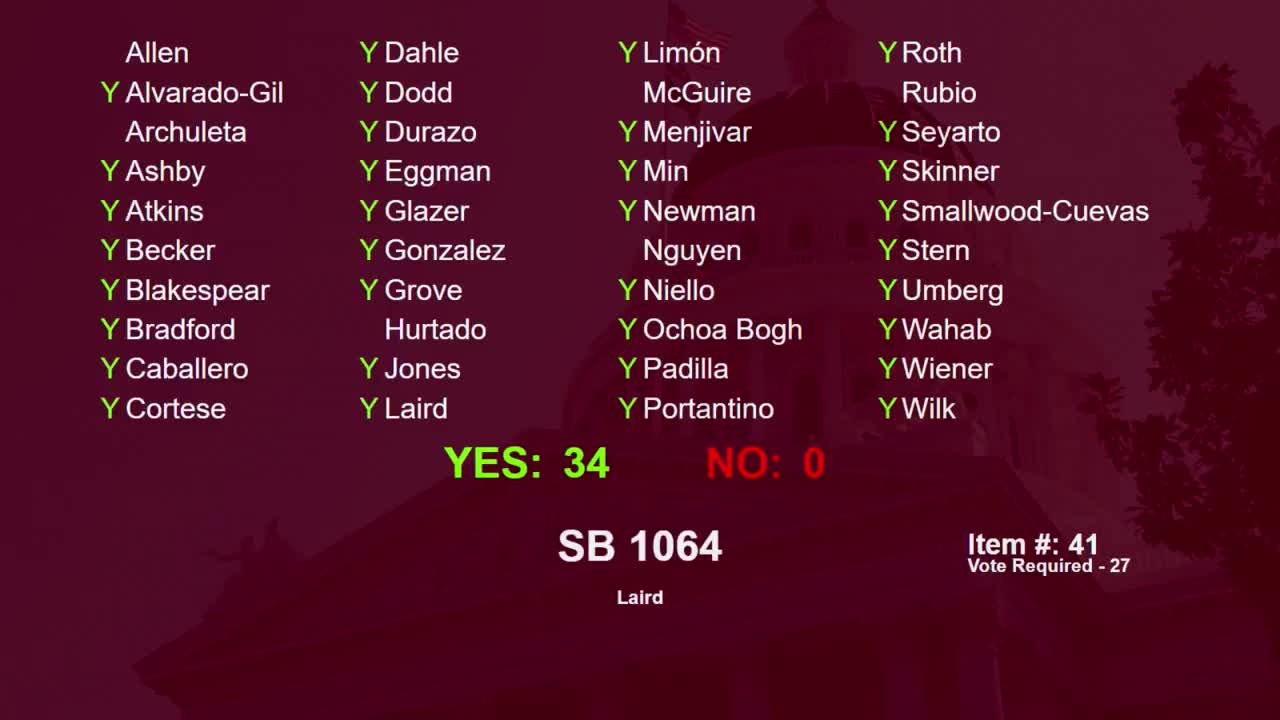
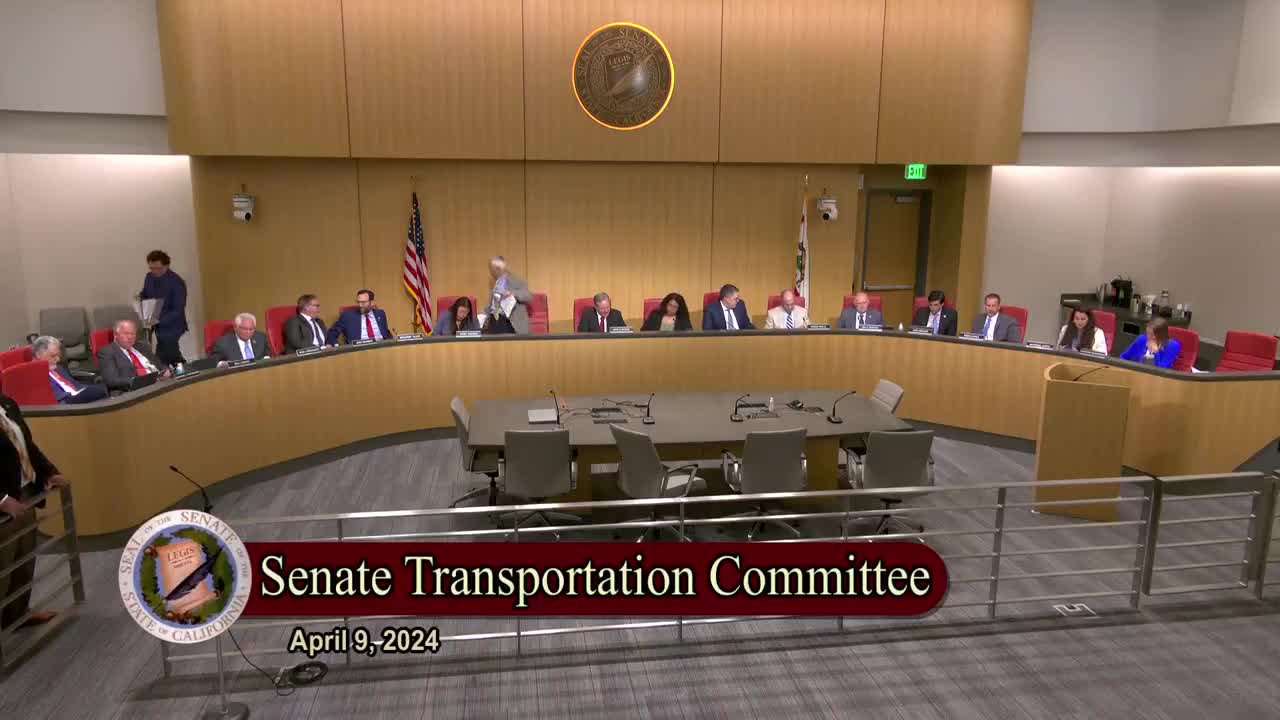
Bill Author

Bill Co-Author(s):