SB 310: Prescribed fire: civil liability: cultural burns.
- Session Year: 2023-2024
- House: Senate
- Latest Version Date: 2024-09-27
Current Status:
Passed
(2024-09-27: Chaptered by Secretary of State. Chapter 666, Statutes of 2024.)
Introduced
In Committee
First Chamber
In Committee
Second Chamber
Enacted
What does this bill do?
The bill lets the Natural Resources Agency and local air districts enter into written agreements with federally recognized California Native American tribes so tribes can carry out cultural burning in their ancestral territories without having to follow certain state permitting or burn‑plan rules. It also says people who follow required steps for prescribed fires — including having a burn boss (a certified fire leader) approve a written plan, getting landowner or tribal approval, and meeting air‑quality permits — won’t be liable for fire‑fighting or related costs, and burns by tribal‑recognized cultural fire practitioners are exempt from some prescription rules, while grossly negligent conduct remains liable.
The summary is provided by generative AI which can make mistakes. For original language, please view the details in the table below.
Existing law provides that no person shall be liable for any fire suppression or other costs otherwise recoverable for a prescribed burn if specified conditions are met, including, among others, that a burn boss, as certified through a certification program developed by the State Fire Marshal, has reviewed and approved a written prescription for the burn, the burn complies with that written prescription, and either the landowner has provided written permission or the governing body of a Native American tribe has given approval, as provided. Existing law exempts cultural burns, as defined, conducted by a cultural fire practitioner, as defined, from those requirements that a person certified as a burn boss review and approve a written prescription and that the burn be conducted in compliance with the written prescription.
This bill would revise and recast those provisions by, among other things, expanding the definition of burn boss to also include a person qualified for specified positions through the National Wildfire Coordinating Group, as provided, and limiting the tribal approval condition to the approval of the governing body of a California Native American tribe. The bill would also revise and recast the definitions of cultural burn and cultural fire practitioner by, among other things, specifying that the definitions only apply to California Native American tribes.
Existing law imposes various permitting requirements and prohibitions related to prescribed burns, as provided.
This bill would authorize the Secretary of the Natural Resources Agency, in consultation with its departments, commissions, boards, conservancies, and other entities, to enter into written agreements with federally recognized California Native American tribes in support of tribal sovereignty with respect to cultural burning in their ancestral territories. The bill would provide that, in deference to tribal sovereignty, the secretary may agree in a written agreement regarding cultural burning that compliance with specified state permitting or regulatory requirements is not required. The bill would authorize local air districts to enter into written agreements with federally recognized California Native American tribes in support of tribal sovereignty with respect to cultural burning in their ancestral territories, as specified. The bill would provide that it does not grant immunity from fire suppression or other specified recoverable costs to any person whose conduct constitutes gross negligence. The bill would repeal these provisions on January 1, 2030.
Existing law provides that no person shall be liable for any fire suppression or other costs otherwise recoverable for a prescribed burn if specified conditions are met, including, among others, that a burn boss, as certified through a certification program developed by the State Fire Marshal, has reviewed and approved a written prescription for the burn, the burn complies with that written prescription, and either the landowner has provided written permission or the governing body of a Native American tribe has given approval, as provided. Existing law exempts cultural burns, as defined, conducted by a cultural fire practioner, practitioner, as defined, from those requirements that a person certified as a burn boss review and approve a written prescription and that the burn be conducted in compliance with the written prescription.
This bill would revise and recast those provisions by, among other things, expanding the definition of burn boss to also include a person qualified for specified positions through the National Wildfire Coordinating Group, as provided, and limiting the tribal approval condition to the approval of the governing body of a California Native American tribe. The bill would also revise and recast the definitions of cultural burn and cultural fire practitioner by, among other things, specifying that the definitions only apply to California Native American tribes.
Existing law imposes various permitting requirements and prohibitions related to prescribed burns, as provided.
This bill would authorize the Secretary of the Natural Resources Agency, with the concurrence of the Secretary for Environmental Protection, in consultation with its departments, commissions, boards, conservancies, and other entities, to enter into written agreements with federally recognized California Native American tribes in support of tribal sovereignty with respect to cultural burning. burning in their ancestral territories. The bill would provide that, in deference to tribal sovereignty, the secretary may agree, with regard to agree in a written agreement regarding cultural burning, burning that compliance with specified state permitting or regulatory requirements is not required. In order to support those agreements, the bill would also require the secretary to convene a cultural burn working group consisting of specified state agencies, California Native American tribes, local air pollution control districts, and local governments, with the goal of determining a framework to enable conditions conducive to cultural burning, as specified. The bill would require the working group to report its findings to the Legislature on or before January 1, 2025. The bill would authorize local air districts to enter into written agreements with federally recognized California Native American tribes in support of tribal sovereignty with respect to cultural burning in their ancestral territories, as specified. The bill would provide that it does not grant immunity from fire suppression or other specified recoverable costs to any person whose conduct constitutes gross negligence. The bill would repeal these provisions on January 1, 2029. 2030.
Existing law provides that no person shall be liable for any fire suppression or other costs otherwise recoverable for a prescribed burn if specified conditions are met, including, among others, that a burn boss, as certified through a certification program developed by the State Fire Marshal, has reviewed and approved a written prescription for the burn, the burn complies with that written prescription, and either the landowner has provided written permission or the governing body of a Native American tribe has given approval, as provided. Existing law exempts cultural burns burns, as defined, conducted by a cultural fire practitioner practioner, as defined, from those requirements that a person certified as a burn boss review and approve a written prescription and that the burn be conducted in compliance with the written prescription. Existing law defines cultural burn and cultural fire practitioner, as provided.
This bill would revise and recast those provisions by, among other things, expanding the definition of burn boss to also include a person qualified for specified positions through the National Wildfire Coordinating Group, as provided, and limiting the tribal approval condition to the approval of the governing body of a California Native American tribe. The bill would also revise and recast the definitions of cultural burn and cultural fire practitioner by, among other things, specifying that the definitions only apply to California Native American tribes.
Existing law imposes various permitting requirements and prohibitions related to prescribed burns, as provided.
This bill would authorize the Secretary of the Natural Resources Agency Agency, with the concurrence of the Secretary for Environmental Protection, to enter into agreements with federally recognized California Native American tribes in support of tribal sovereignty with respect to cultural burning. The bill would provide that, in deference to tribal sovereignty, the secretary may agree, with regard to cultural burning, that compliance with specified state permitting or regulatory requirements is not required. In order to support those agreements, the bill would also require the secretary to convene a cultural burn working group consisting of specified state agencies, California Native American tribes, local air pollution control districts, and local governments, with the goal of determining a framework to enable conditions conducive to cultural burning. burning, as specified. The bill would require the working group to report its findings to the Legislature on or before January 1, 2025. The bill would repeal these provisions on January 1, 2029.
Existing law provides that no person shall be liable for any fire suppression or other costs otherwise recoverable for a prescribed burn if specified conditions are met, including, among others, a burn boss, as certified through a certification program developed by the State Fire Marshal, has reviewed and approved a written prescription for the burn, the burn complies with that written prescription, and either the landowner has provided written permission or the governing body of a Native American tribe has given approval, as provided. Existing law exempts cultural burns conducted by a cultural fire practitioner from those requirements that a person certified as a burn boss review and approve a written prescription and that the burn be conducted in compliance with the written prescription. Existing law defines cultural burn and cultural fire practitioner, as provided.
This bill would revise and recast those provisions by, among other things, expanding the definition of burn boss to also include a person qualified for specified positions through the National Wildfire Coordinating Group, as provided, and limiting the tribal approval condition to the approval of the governing body of a California Native American tribe. The bill would also revise and recast the definitions of cultural burn and cultural fire practitioner by, among other things, specifying that the definitions only apply to California Native American tribes.
Existing law imposes various permitting requirements and prohibitions related to prescribed burns, as provided.
This bill would authorize the Secretary of the Natural Resources Agency to enter into agreements with federally recognized California Native American tribes in support of tribal sovereignty with respect to cultural burning. The bill would provide that, in deference to tribal sovereignty, the secretary may agree agree, with regard to cultural burning, that compliance with specified state permitting or regulatory requirements relating to burning, as provided, is not required. In order to support those agreements, the bill would also require the secretary to convene a cultural burn working group consisting of state agencies, California Native American tribes, and local governments, with the goal of determining a framework to enable conditions conducive to cultural burning. The bill would require the working group to report its findings to the Legislature on or before January 1, 2025. The bill would repeal these provisions on January 1, 2029.
Existing law provides that no person shall be liable for any fire suppression or other costs otherwise recoverable for a prescribed burn if specified conditions are met, including, among others, a burn boss, as certified through a certification program developed by the State Fire Marshal, has reviewed and approved a written prescription for the burn, the burn complies with that written prescription, and either the landowner has provided written permission or the governing body of a Native American tribe has given approval, as provided. Existing law exempts cultural burns conducted by a cultural fire practitioner from those requirements that a person certified as a burn boss review and approve a written prescription and that the burn be conducted in compliance with the written prescription. Existing law defines cultural burn and cultural fire practitioner, as provided.
This bill would revise and recast those provisions by, among other things, expanding the definition of burn boss to also include a person qualified for specified positions through the National Wildfire Coordinating Group, as provided, and limiting the tribal approval condition to the approval of the governing body of a California Native American tribe. The bill would also revise and recast the definitions of cultural burn and cultural fire practitioner by, among other things, specifying that the definitions only apply to California Native American tribes.
Existing law imposes various permitting requirements and prohibitions related to prescribed burns, as provided.
This bill would authorize cultural fire practitioners to obtain approval to burn pursuant to a tribal law, ordinance, regulation, resolution, contract, agreement, or other similar mechanism adopted by a California Native American tribe within its ancestral territory. the Secretary of the Natural Resources Agency to enter into agreements with California Native American tribes in support of tribal sovereignty with respect to cultural burning. The bill would exempt those burns from those permitting requirements and related restrictions. The bill would encourage the California Native American tribe to provide advanced notice of cultural burning approval to the Department of Forestry and Fire Protection or other agency having direct protection responsibility in the area where the cultural burn is located. provide that, in deference to tribal sovereignty, the secretary may agree that compliance with state permitting or regulatory requirements relating to burning, as provided, is not required.
Existing law provides that no person shall be liable for any fire suppression or other costs otherwise recoverable for a prescribed burn if specified conditions are met, including, among others, a burn boss, as certified through a certification program developed by the State Fire Marshal, has reviewed and approved a written prescription for the burn, the burn complies with that written prescription, and either the landowner has provided written permission or the governing body of a Native American tribe has given approval, as provided. Existing law exempts cultural burns conducted by a cultural fire practitioner from those requirements that a person certified as a burn boss review and approve a written prescription and that the burn be conducted in compliance with the written prescription. Existing law defines cultural burn and cultural fire practitioner, as provided.
This bill would revise and recast those provisions by, among other things, expanding the definition of burn boss to also include a person qualified for specified positions through the National Wildfire Coordinating Group, as provided, and limiting the tribal approval condition to the approval of the governing body of a California Native American tribe. The bill would also revise and recast the definitions of cultural burn and cultural fire practitioner by, among other things, specifying that the definitions only apply to California Native American tribes.
Existing law imposes various permitting requirements and prohibitions related to prescribed burns, as provided.
This bill would authorize cultural fire practitioners to obtain approval to burn pursuant to a tribal law, ordinance, regulation, resolution, contract, agreement, or other similar mechanism adopted by a California Native American tribe within its ancestral territory. The bill would exempt those burns from those permitting requirements and related restrictions. The bill would encourage the California Native American tribe to provide advanced notice of cultural burning approval to the Department of Forestry and Fire Protection or other agency having direct protection responsibility in the area where the cultural burn is located.
(a)The Legislature finds and declares that in order to meet fuel management goals, the state must rely on private entities to engage in prescribed burning for public benefit.
(b)Notwithstanding Sections 13009 and 13009.1 of the Health and Safety Code, no person shall be liable for any fire suppression or other costs otherwise recoverable pursuant to Section 13009 or 13009.1 of the Health and Safety Code resulting from a prescribed fire or cultural burn if all of the following conditions are met:
(1)The purpose of the burn is for wildland fire hazard reduction, ecological maintenance and restoration, cultural burning, silviculture, or agriculture.
(2)A burn boss, as defined in paragraph (1) of subdivision (a) of Section 4500 of the Public Resources Code, has reviewed and approved a written prescription for the burn that includes adequate risk mitigation measures.
(3)The burn is conducted in compliance with the written prescription.
(4)The burn is authorized pursuant to Chapter 6 (commencing with Section 4411) or Chapter 7 (commencing with Section 4461) of Part 2 of Division 4 of the Public Resources Code.
(5)The burner has a landowners written permission or the approval of the governing body of a California Native American tribe to burn.
(6)The burn is conducted in compliance with any air quality permit required pursuant to Article 3 (commencing with Section 41850) of Chapter 3 of Part 4 of Division 26 of the Health and Safety Code.
(c)Cultural burns conducted by a cultural fire practitioner are exempt from paragraphs (2) and (3) of subdivision (b).
(d)This section shall not be construed to grant immunity from fire suppression or other costs otherwise recoverable pursuant to Section 13009 or 13009.1 of the Health and Safety Code to any person whose conduct constitutes gross negligence.
(e)Nothing in this section affects the ability of a private or public entity plaintiff to bring a civil action against any defendant.
(f)Cultural burn or cultural burning means the intentional application of fire to land by a California Native American tribe, a tribal organization, or a cultural fire practitioner to achieve cultural goals or objectives, including for sustenance, ceremonial activities, biodiversity, or other benefits.
(g)Cultural fire practitioner means a person recognized by a California Native American tribe or tribal organization with substantial experience in burning to meet cultural goals or objectives, including for sustenance, ceremonial activities, biodiversity, or other benefits.
SEC. 2.Section 4002.4 of the Public Resources Code is amended to read:4002.4.Cultural burn or cultural burning means the intentional application of fire to land by a California Native American tribe, a tribal organization, or a cultural fire practitioner to achieve cultural goals or objectives, including for sustenance, ceremonial activities, biodiversity, or other benefits.
SEC. 3.Section 4002.6 of the Public Resources Code is amended to read:4002.6.Cultural fire practitioner means a person recognized by a California Native American tribe or tribal organization with substantial experience in burning to meet cultural goals or objectives, including for sustenance, ceremonial activities, biodiversity, or other benefits.
SEC. 4.Article 4.5 (commencing with Section 4505) is added to Chapter 7 of Part 2 of Division 4 of the Public Resources Code, to read:4.5.Tribal Sovereignty with Respect to Cultural Burning4505.(a)(1)The Legislature acknowledges that federally recognized California Native American tribes have inherent sovereignty and authority to regulate their members and cultural practices, including, but not limited to, cultural fire practitioners and cultural burning.
(2)The Legislature finds and declares that in order to meet fuel management and wildfire resilience goals of the state and to address the historical wrongs of criminalizing cultural use of fire, the state must work collaboratively with federally recognized California Native American tribes that engage in cultural burning within their ancestral territories.
(b)(1)The Secretary of the Natural Resources Agency, in consultation with its departments, commissions, boards, conservancies, and other entities, may enter into written agreements with federally recognized California Native American tribes in support of tribal sovereignty with respect to cultural burning in their ancestral territories. In deference to tribal sovereignty, the secretary may agree in a written agreement regarding cultural burning that compliance with either of the following is not required:
(A)The state permitting or regulatory requirements in Article 3 (commencing with Section 4491).
(B)The burn plan requirements in subdivision (e) of Section 4500.
(2)The Secretary of the Natural Resources Agency shall consult with federally recognized California Native American tribes on the implementation of paragraph (1).
(3)(A)Local air districts may enter into written agreements with federally recognized California Native American tribes in support of tribal sovereignty with respect to cultural burning in their ancestral territories.
(B)A local air district may agree in a written agreement regarding cultural burning that compliance with its permitting, regulatory, or administrative requirements is not required.
(C)In the event of a disagreement between a local air district and a tribe in developing or implementing an agreement, the Secretary for Environmental Protection shall assist in resolving the disagreement.
(4)The Secretary of the Natural Resources Agency or the local air district shall provide a copy of a final written agreement developed under this subdivision to the Deputy Secretary for Tribal Affairs at the Natural Resources Agency. In addition, a local air district shall provide a copy of a final written agreement developed under this subdivision to the State Air Resources Board.
(c) Nothing in this section provides authorization to enter or burn property without the permission of the landowner.
(d)Any state or local agency operating within a federally recognized California Native American tribes ancestral territory, including a local air district and a regional water quality control board, is highly encouraged to collaboratively work together with federally recognized California Native American tribes to create conditions that support cultural burning.
(e)A cultural burn conducted with an agreement developed under this section shall meet the permit requirements of Section 3333.8 of the Civil Code.
(f)This section does not grant immunity from fire suppression or other costs otherwise recoverable pursuant to Section 13009 or 13009.1 of the Health and Safety Code to any person whose conduct constitutes gross negligence.
(g)An agreement reached under this section shall include a clear description of the area covered by the agreement and an attestation that the area is within the boundaries of the tribes ancestral territory.
(h)This article shall remain in effect only until January 1, 2030, and as of that date is repealed.
(a)The Legislature finds and declares that in order to meet fuel management goals, the state must rely on private entities to engage in prescribed burning for public benefit.
(b)Notwithstanding Sections 13009 and 13009.1 of the Health and Safety Code, no person shall be liable for any fire suppression or other costs otherwise recoverable pursuant to Section 13009 or 13009.1 of the Health and Safety Code resulting from a prescribed burn fire or cultural burn if all of the following conditions are met:
(1)The purpose of the burn is for wildland fire hazard reduction, ecological maintenance and restoration, cultural burning, silviculture, or agriculture.
(2)A burn boss, as defined in paragraph (1) of subdivision (a) of Section 4500 of the Public Resources Code, has reviewed and approved a written prescription for the burn that includes adequate risk mitigation measures.
(3)The burn is conducted in compliance with the written prescription.
(4)The burn is authorized pursuant to Chapter 6 (commencing with Section 4411) or Chapter 7 (commencing with Section 4461) of Part 2 of Division 4 of the Public Resources Code.
(5)The burner has a landowners written permission or the approval of the governing body of a California Native American tribe to burn.
(6)The burn is conducted in compliance with any air quality permit required pursuant to Article 3 (commencing with Section 41850) of Chapter 3 of Part 4 of Division 26 of the Health and Safety Code.
(c)Cultural burns conducted by a cultural fire practitioner are exempt from paragraphs (2) and (3) of subdivision (b).
(d)This section shall not be construed to grant immunity from fire suppression or other costs otherwise recoverable pursuant to Section 13009 or 13009.1 of the Health and Safety Code to any person whose conduct constitutes gross negligence.
(e)Nothing in this section affects the ability of a private or public entity plaintiff to bring a civil action against any defendant.
(f)Cultural burn or cultural burning means the intentional application of fire to land by a California Native American tribe, a tribal organization, or a cultural fire practitioner to achieve cultural goals or objectives, including for sustenance, ceremonial activities, biodiversity, or other benefits.
(g)Cultural fire practitioner means a person recognized by a California Native American tribe or tribal organization with substantial experience in burning to meet cultural goals or objectives, including for sustenance, ceremonial activities, biodiversity, or other benefits.
SEC. 2.Section 4002.4 of the Public Resources Code is amended to read:4002.4.Cultural burn or cultural burning means the intentional application of fire to land by a California Native American tribe, a tribal organization, or a cultural fire practitioner to achieve cultural goals or objectives, including for sustenance, ceremonial activities, biodiversity, or other benefits.
SEC. 3.Section 4002.6 of the Public Resources Code is amended to read:4002.6.Cultural fire practitioner means a person recognized by a California Native American tribe or tribal organization with substantial experience in burning to meet cultural goals or objectives, including for sustenance, ceremonial activities, biodiversity, or other benefits.
SEC. 4.Article 4.5 (commencing with Section 4505) is added to Chapter 7 of Part 2 of Division 4 of the Public Resources Code, to read:4.5.Tribal Sovereignty with Respect to Cultural Burning4505.(a)(1)The Legislature finds and declares acknowledges that federally recognized California Native American tribes retain have inherent sovereignty with respect to cultural burning within their ancestral territories. and authority to regulate their members and cultural practices, including, but not limited to, cultural fire practitioners and cultural burning.
(2)The Legislature finds and declares that in order to meet fuel management and wildfire resilience goals of the state and to address the historical wrongs of criminalizing cultural use of fire, the state must work collaboratively with federally recognized California Native American tribes that engage in cultural burning within their ancestral territories.
(b)(1)The Secretary of the Natural Resources Agency Agency, in consultation with its departments, commissions, boards, conservancies, and other entities, may enter into written agreements with federally recognized California Native American tribes in support of tribal sovereignty with respect to cultural burning. burning in their ancestral territories. In deference to tribal sovereignty, the secretary may agree, with regard to agree in a written agreement regarding cultural burning, burning that compliance with the either of the following is not required:
(A)The state permitting or regulatory requirements in Article 3 (commencing with Section 4491) of this chapter and Article 3 (commencing with Section 41850) of Chapter 3 of Part 4 of Division 26 of the Health and Safety Code is not required. 4491).
(B)The burn plan requirements in subdivision (e) of Section 4500.
(2)The Secretary of the Natural Resources Agency may enter into an agreement with a federally recognized California Native American tribe related to Article 3 (commencing with Section 41850) of Chapter 3 of Part 4 of Division 26 of the Health and Safety Code only with the concurrence of the Secretary for Environmental Protection.(2)The Secretary of the Natural Resources Agency shall consult with federally recognized California Native American tribes on the implementation of paragraph (1).
(3)(A)Local air districts may enter into written agreements with federally recognized California Native American tribes in support of tribal sovereignty with respect to cultural burning in their ancestral territories.
(B)A local air district may agree in a written agreement regarding cultural burning that compliance with its permitting, regulatory, or administrative requirements is not required.
(C)In the event of a disagreement between a local air district and a tribe in developing or implementing an agreement, the Secretary for Environmental Protection shall assist in resolving the disagreement.
(4)The Secretary of the Natural Resources Agency or the local air district shall provide a copy of a final written agreement developed under this subdivision to the Deputy Secretary for Tribal Affairs at the Natural Resources Agency. In addition, a local air district shall provide a copy of a final written agreement developed under this subdivision to the State Air Resources Board.
(c) Nothing in this section provides authorization to enter or burn property without the permission of the landowner.
(d)In order to support the agreements described in subdivision (b), the Secretary of the Natural Resources Agency shall convene a cultural burn working group consisting of, but not limited to, the Secretary of the Natural Resources Agency, the Secretary for Environmental Protection, the State Air Resources Board, the State Water Resources Control Board, the Department of Fish and Wildlife, the Department of Forestry and Fire Protection, the Department of Parks and Recreation, the California Coastal Commission, California Native American tribes, local air pollution control districts, and local governments, with the goal of determining a framework to enable conditions conducive to cultural burning, including consideration of the role of a local air pollution control district in supporting the effort of cultural burning. On or before January 1, 2025, the cultural burn working group shall report to the Legislature on the findings of the workgroup, in compliance with Section 9795 of the Government Code. (e)For purposes of this article, ancestral territory means the area over which a California Native American tribe exercises jurisdiction pursuant to its constitution.(d)Any state or local agency operating within a federally recognized California Native American tribes ancestral territory, including a local air district and a regional water quality control board, is highly encouraged to collaboratively work together with federally recognized California Native American tribes to create conditions that support cultural burning.
(e)A cultural burn conducted with an agreement developed under this section shall meet the permit requirements of Section 3333.8 of the Civil Code.
(f)This section does not grant immunity from fire suppression or other costs otherwise recoverable pursuant to Section 13009 or 13009.1 of the Health and Safety Code to any person whose conduct constitutes gross negligence.
(g)An agreement reached under this section shall include a clear description of the area covered by the agreement and an attestation that the area is within the boundaries of the tribes ancestral territory.
(f)(h)This article shall remain in effect only until January 1, 2029, 2030, and as of that date is repealed.
(a)The Legislature finds and declares that in order to meet fuel management goals, the state must rely on private entities to engage in prescribed burning for public benefit.
(b)Notwithstanding Sections 13009 and 13009.1 of the Health and Safety Code, no person shall be liable for any fire suppression or other costs otherwise recoverable pursuant to Section 13009 or 13009.1 of the Health and Safety Code resulting from a prescribed burn if all of the following conditions are met:
(1)The purpose of the burn is for wildland fire hazard reduction, ecological maintenance and restoration, cultural burning, silviculture, or agriculture.
(2)A burn boss, as defined in paragraph (1) of subdivision (a) of Section 4500 of the Public Resources Code, has reviewed and approved a written prescription for the burn that includes adequate risk mitigation measures.
(3)The burn is conducted in compliance with the written prescription.
(4)The burn is authorized pursuant to Chapter 6 (commencing with Section 4411) or Chapter 7 (commencing with Section 4461) of Part 2 of Division 4 of the Public Resources Code.
(5)The burner has a landowners written permission or the approval of the governing body of a California Native American tribe to burn.
(6)The burn is conducted in compliance with any air quality permit required pursuant to Article 3 (commencing with Section 41850) of Chapter 3 of Part 4 of Division 26 of the Health and Safety Code.
(7)(c)Cultural burns conducted by a cultural fire practitioner are exempt from paragraphs (2) and (3). (3) of subdivision (b).
(c)(d)This section shall not be construed to grant immunity from fire suppression or other costs otherwise recoverable pursuant to Section 13009 or 13009.1 of the Health and Safety Code to any person whose conduct constitutes gross negligence.
(d)(e)Nothing in this section affects the ability of a private or public entity plaintiff to bring a civil action against any defendant.
(e)(f)Cultural burn or cultural burning means the intentional application of fire to land by a California Native American tribes, tribe, a tribal organizations, organization, or a cultural fire practitioners practitioner to achieve cultural goals or objectives, including for sustenance, ceremonial activities, biodiversity, or other benefits.
(f)(g)Cultural fire practitioner means a person recognized by a California Native American tribe or tribal organization with substantial experience in burning to meet cultural goals or objectives, including for sustenance, ceremonial activities, biodiversity, or other benefits.
SEC. 2.Section 4002.4 of the Public Resources Code is amended to read:4002.4.Cultural burn or cultural burning means the intentional application of fire to land by a California Native American tribes, tribe, a tribal organizations, organization, or a cultural fire practitioners practitioner to achieve cultural goals or objectives, including for sustenance, ceremonial activities, biodiversity, or other benefits.
SEC. 3.Section 4002.6 of the Public Resources Code is amended to read:4002.6.Cultural fire practitioner means a person recognized by a California Native American tribe or tribal organization with substantial experience in burning to meet cultural goals or objectives, including for sustenance, ceremonial activities, biodiversity, or other benefits.
SEC. 4.Article 4.5 (commencing with Section 4505) is added to Chapter 7 of Part 2 of Division 4 of the Public Resources Code, to read:4.5.Tribal Sovereignty with Respect to Cultural Burning4505.(a)The Legislature finds and declares that federally recognized California Native American tribes retain sovereignty with respect to cultural burning within their ancestral territories.
(b)(1)The Secretary of the Natural Resources Agency may enter into agreements with federally recognized California Native American tribes in support of tribal sovereignty with respect to cultural burning. In deference to tribal sovereignty, the secretary may agree, with regard to cultural burning, that compliance with the state permitting or regulatory requirements in Article 3 (commencing with Section 4491) of this chapter and Article 3 (commencing with Section 41850) of Chapter 3 of Part 4 of Division 26 of the Health and Safety Code is not required.
(2)The Secretary of the Natural Resources Agency may enter into an agreement with a federally recognized California Native American tribe related to Article 3 (commencing with Section 41850) of Chapter 3 of Part 4 of Division 26 of the Health and Safety Code only with the concurrence of the Secretary of the California Environmental Protection Agency. for Environmental Protection.
(c)Nothing in this section provides authorization to enter or burn property without the permission of the landowner.
(d)In order to support the agreements described in subdivision (b), the Secretary of the Natural Resources Agency shall convene a cultural burn working group consisting of, but not limited to, the Secretary of the Natural Resources Agency, the Secretary of the California Environmental Protection Agency, for Environmental Protection, the State Air Resources Board, the State Water Resources Control Board, the Department of Fish and Wildlife, the Department of Forestry and Fire Protection, the Department of Parks and Recreation, the California Coastal Commission, California Native American tribes, local air pollution control districts, and local governments, with the goal of determining a framework to enable conditions conducive to cultural burning. burning, including consideration of the role of a local air pollution control district in supporting the effort of cultural burning. On or before January 1, 2025, the cultural burn working group shall report to the Legislature on the findings of the workgroup, in compliance with Section 9795 of the Government Code.
(e)For purposes of this article, ancestral territory means the area over which a California Native American tribe exercises jurisdiction pursuant to its constitution.
(f)This article shall remain in effect only until January 1, 2029, and as of that date is repealed.
(a)The Legislature finds and declares that in order to meet fuel management goals, the state must rely on private entities to engage in prescribed burning for public benefit.
(b)Notwithstanding Sections 13009 and 13009.1 of the Health and Safety Code, no person shall be liable for any fire suppression or other costs otherwise recoverable pursuant to Section 13009 or 13009.1 of the Health and Safety Code resulting from a prescribed burn if all of the following conditions are met:
(1)The purpose of the burn is for wildland fire hazard reduction, ecological maintenance and restoration, cultural burning, silviculture, or agriculture.
(2)A burn boss, as defined in paragraph (1) of subdivision (a) of Section 4500 of the Public Resources Code, has reviewed and approved a written prescription for the burn that includes adequate risk mitigation measures.
(3)The burn is conducted in compliance with the written prescription.
(4)The burn is authorized pursuant to Chapter 6 (commencing with Section 4411) or Chapter 7 (commencing with Section 4461) of Part 2 of Division 4 of the Public Resources Code.
(5)The burner has a landowners written permission or the approval of the governing body of a California Native American tribe to burn.
(6)The burn is conducted in compliance with any air quality permit required pursuant to Article 3 (commencing with Section 41850) of Chapter 3 of Part 4 of Division 26 of the Health and Safety Code.
(7)Cultural burns conducted by a cultural fire practitioner are exempt from paragraphs (2) and (3).
(c)This section shall not be construed to grant immunity from fire suppression or other costs otherwise recoverable pursuant to Section 13009 or 13009.1 of the Health and Safety Code to any person whose conduct constitutes gross negligence.
(d)Nothing in this section affects the ability of a private or public entity plaintiff to bring a civil action against any defendant.
(e)Cultural burn means the intentional application of fire to land by California Native American tribes, tribal organizations, or cultural fire practitioners to achieve cultural goals or objectives, including sustenance, ceremonial activities, biodiversity, or other benefits.
(f)Cultural fire practitioner means a person recognized by a California Native American tribe or tribal organization with substantial experience in burning to meet cultural goals or objectives, including sustenance, ceremonial activities, biodiversity, or other benefits.
SEC. 2.Section 4002.4 of the Public Resources Code is amended to read:4002.4.Cultural burn or cultural burning means the intentional application of fire to land by California Native American tribes, tribal organizations, or cultural fire practitioners to achieve cultural goals or objectives, including for sustenance, ceremonial activities, biodiversity, or other benefits.
SEC. 3.Section 4002.6 of the Public Resources Code is amended to read:4002.6.Cultural fire practitioner means a person recognized by a California Native American tribe or tribal organization with substantial experience in burning to meet cultural goals or objectives, including for sustenance, ceremonial activities, biodiversity, or other benefits.
SEC. 4.Article 4.5 (commencing with Section 4505) is added to Chapter 7 of Part 2 of Division 4 of the Public Resources Code, to read:4.5.Tribal Sovereignty with Respect to Cultural Burning4505.(a)The Legislature finds and declares that federally recognized California Native American tribes retain sovereignty with respect to cultural burning within their ancestral territories.
(b)(1)The Secretary of the Natural Resources Agency may enter into agreements with federally recognized California Native American tribes in support of tribal sovereignty with respect to cultural burning. In deference to tribal sovereignty, the secretary may agree agree, with regard to cultural burning, that compliance with the state permitting or regulatory requirements relating to burning is not required. These requirements include, but are not limited to, those in Article 3 (commencing with Section 4491) of this chapter, chapter and Article 3 (commencing with Section 41850) of Chapter 3 of Part 4 of Division 26 of the Health and Safety Code, and the related restrictions for burning under permit in Article 2 (commencing with Section 4421) of Chapter 6 of this part. Code is not required.
(2)The Secretary of the Natural Resources Agency may enter into an agreement with a federally recognized California Native American tribe related to Article 3 (commencing with Section 41850) of Chapter 3 of Part 4 of Division 26 of the Health and Safety Code only with the concurrence of the Secretary of the California Environmental Protection Agency.
(c)Nothing in this section provides authorization to enter or burn property without the permission of the landowner.
(d)In order to support the agreements described in subdivision (b), the Secretary of the Natural Resources Agency shall convene a cultural burn working group consisting of, but not limited to, the Secretary of the Natural Resources Agency, the Secretary of the California Environmental Protection Agency, the State Air Resources Board, the State Water Resources Control Board, the Department of Fish and Wildlife, the Department of Forestry and Fire Protection, the Department of Parks and Recreation, the California Coastal Commission, California Native American tribes, and local governments, with the goal of determining a framework to enable conditions conducive to cultural burning. On or before January 1, 2025, the cultural burn working group shall report to the Legislature on the findings of the workgroup, in compliance with Section 9795 of the Government Code.
(c)(e)For purposes of this article, ancestral territory means the area over which a California Native American tribe exercises jurisdiction pursuant to its constitution.
(f)This article shall remain in effect only until January 1, 2029, and as of that date is repealed.
(a)The Legislature finds and declares that in order to meet fuel management goals, the state must rely on private entities to engage in prescribed burning for public benefit.
(b)Notwithstanding Sections 13009 and 13009.1 of the Health and Safety Code, no person shall be liable for any fire suppression or other costs otherwise recoverable pursuant to Section 13009 or 13009.1 of the Health and Safety Code resulting from a prescribed burn if all of the following conditions are met:
(1)The purpose of the burn is for wildland fire hazard reduction, ecological maintenance and restoration, cultural burning, silviculture, or agriculture.
(2)A burn boss, as defined in paragraph (1) of subdivision (a) of Section 4500 of the Public Resources Code, has reviewed and approved a written prescription for the burn that includes adequate risk mitigation measures.
(3)The burn is conducted in compliance with the written prescription.
(4)The burn is authorized pursuant to Chapter 6 (commencing with Section 4411) or Chapter 7 (commencing with Section 4461) of Part 2 of Division 4 of the Public Resources Code.
(5)The burner has a landowners written permission or the approval of the governing body of a California Native American tribe to burn.
(6)The burn is conducted in compliance with any air quality permit required pursuant to Article 3 (commencing with Section 41850) of Chapter 3 of Part 4 of Division 26 of the Health and Safety Code.
(7)Cultural burns conducted by a cultural fire practitioner are exempt from paragraphs (2) and (3).
(c)This section shall not be construed to grant immunity from fire suppression or other costs otherwise recoverable pursuant to Section 13009 or 13009.1 of the Health and Safety Code to any person whose conduct constitutes gross negligence.
(d)Nothing in this section affects the ability of a private or public entity plaintiff to bring a civil action against any defendant.
(e)Cultural burn means the intentional application of fire to land by California Native American tribes, tribal organizations, or cultural fire practitioners to achieve cultural goals or objectives, including sustenance, ceremonial activities, biodiversity, or other benefits.
(f)Cultural fire practitioner means a person recognized by a California Native American tribe or tribal organization with substantial experience in burning to meet cultural goals or objectives, including sustenance, ceremonial activities, biodiversity, or other benefits.
SEC. 2.Section 4002.4 of the Public Resources Code is amended to read:4002.4.Cultural burn or cultural burning means the intentional application of fire to land by California Native American tribes, tribal organizations, or cultural fire practitioners to achieve cultural goals or objectives, including for sustenance, ceremonial activities, biodiversity, or other benefits.
SEC. 3.Section 4002.6 of the Public Resources Code is amended to read:4002.6.Cultural fire practitioner means a person recognized by a California Native American tribe or tribal organization with substantial experience in burning to meet cultural goals or objectives, including for sustenance, ceremonial activities, biodiversity, or other benefits.
SEC. 4.Article 4.5 (commencing with Section 4505) is added to Chapter 7 of Part 2 of Division 4 of the Public Resources Code, to read:4.5.Cultural Burn Approval 4505.Cultural fire practitioners may obtain approval for a cultural burn pursuant to a tribal law, ordinance, regulation, resolution, contract, agreement, or other similar mechanism adopted by a California Native American tribe within its ancestral territory. If such tribal approval for a cultural burn is obtained, no other permit is required, including pursuant to Article 3 (commencing with Section 4491) of this chapter and Article 3 (commencing with Section 41850) of Chapter 3 of Part 4 of Division 26 of the Health and Safety Code, and the related restrictions for burning under permit in Article 2 (commencing with Section 4421) of Chapter 6 of this part shall not apply to the cultural burn. The California Native American tribe is encouraged to provide advanced notice of cultural burning approval to the department or other agency having direct protection responsibility in the area where the cultural burn is located.4506.For purposes of this article, ancestral territory means the area over which a California Native American tribe exercises jurisdiction pursuant to its constitution.4.5.Tribal Sovereignty with Respect to Cultural Burning4505.(a)The Legislature finds and declares that California Native American tribes retain sovereignty with respect to cultural burning within their ancestral territories.
(b)The Secretary of the Natural Resources Agency may enter into agreements with California Native American tribes in support of tribal sovereignty with respect to cultural burning. In deference to tribal sovereignty, the secretary may agree that compliance with state permitting or regulatory requirements relating to burning is not required. These requirements include, but are not limited to, those in Article 3 (commencing with Section 4491) of this chapter, Article 3 (commencing with Section 41850) of Chapter 3 of Part 4 of Division 26 of the Health and Safety Code, and the related restrictions for burning under permit in Article 2 (commencing with Section 4421) of Chapter 6 of this part.
(c)For purposes of this article, ancestral territory means the area over which a California Native American tribe exercises jurisdiction pursuant to its constitution.
(a)The Legislature finds and declares that in order to meet fuel management goals, the state must rely on private entities to engage in prescribed burning for public benefit.
(b)Notwithstanding Sections 13009 and 13009.1 of the Health and Safety Code, no person shall be liable for any fire suppression or other costs otherwise recoverable pursuant to Section 13009 or 13009.1 of the Health and Safety Code resulting from a prescribed burn if all of the following conditions are met:
(1)The purpose of the burn is for wildland fire hazard reduction, ecological maintenance and restoration, cultural burning, silviculture, or agriculture.
(2)A person certified as a burn boss pursuant to boss, as defined in paragraph (1) of subdivision (a) of Section 4477 4500 of the Public Resources Code Code, has reviewed and approved a written prescription for the burn that includes adequate risk mitigation measures.
(3)The burn is conducted in compliance with the written prescription.
(4)The burn is authorized pursuant to Chapter 6 (commencing with Section 4411) or Chapter 7 (commencing with Section 4461) of Part 2 of Division 4 of the Public Resources Code.
(5)The burner has a landowners written permission or the approval of the governing body of a California Native American Tribe tribe to burn.
(6)The burn is conducted in compliance with any air quality permit required pursuant to Article 3 (commencing with Section 41850) of Chapter 3 of Part 4 of Division 26 of the Health and Safety Code.
(7)Cultural burns conducted by a cultural fire practitioner are exempt from paragraphs (2) and (3).
(c)This section shall not be construed to grant immunity from fire suppression or other costs otherwise recoverable pursuant to Section 13009 or 13009.1 of the Health and Safety Code to any person whose conduct constitutes gross negligence.
(d)Nothing in this section affects the ability of a private or public entity plaintiff to bring a civil action against any defendant.
(e)Cultural burn means the intentional application of fire to land by California Native American tribes, tribal organizations, or cultural fire practitioners to achieve cultural goals or objectives, including subsistence, sustenance, ceremonial activities, biodiversity, or other benefits.
(f)Cultural fire practitioner means a person associated with recognized by a California Native American tribe or tribal organization with substantial experience in burning to meet cultural goals or objectives, including subsistence, sustenance, ceremonial activities, biodiversity, or other benefits.
SEC. 2.Section 4002.4 of the Public Resources Code is amended to read:4002.4.Cultural burn or cultural burning means the intentional application of fire to land by California Native American tribes, tribal organizations, or cultural fire practitioners to achieve cultural goals or objectives, including for subsistence, sustenance, ceremonial activities, biodiversity, or other benefits.
SEC. 3.Section 4002.6 of the Public Resources Code is amended to read:4002.6.Cultural fire practitioner means a person associated with recognized by a California Native American tribe or tribal organization with substantial experience in burning to meet cultural goals or objectives, including for subsistence, sustenance, ceremonial activities, biodiversity, or other benefits.
SEC. 4.Article 4.5 (commencing with Section 4505) is added to Chapter 7 of Part 2 of Division 4 of the Public Resources Code, to read:4.5.Cultural Burn Approval4505.Cultural fire practitioners may obtain approval for a cultural burn pursuant to a tribal law, ordinance, regulation, resolution, contract, agreement, or other similar mechanism adopted by a California Native American tribe within its ancestral territory. If such tribal approval for a cultural burn is obtained, no other permit is required, including pursuant to Article 3 (commencing with Section 4491) of this chapter and Article 3 (commencing with Section 41850) of Chapter 3 of Part 4 of Division 26 of the Health and Safety Code, and the related restrictions for burning under permit in Article 2 (commencing with Section 4421) of Chapter 6 of this part shall not apply to the cultural burn. The California Native American tribe is encouraged to provide advanced notice of cultural burning approval to the department or other agency having direct protection responsibility in the area where the cultural burn is located.
4506.For purposes of this article, ancestral territory means the area over which a California Native American tribe exercises jurisdiction pursuant to its constitution.
|
Date
|
Status
|
|---|---|
| Sep 27, 2024 | Chaptered by Secretary of State. Chapter 666, Statutes of 2024. |
| Sep 27, 2024 | Approved by the Governor. |
| Sep 4, 2024 | Enrolled and presented to the Governor at 4 p.m. |
| Aug 28, 2024 | Assembly amendments concurred in. (Ayes 39. Noes 0. Page 5603.) Ordered to engrossing and enrolling. |
| Aug 26, 2024 | In Senate. Concurrence in Assembly amendments pending. |
| Aug 26, 2024 | Read third time. Passed. (Ayes 77. Noes 0. Page 6522.) Ordered to the Senate. |
| Aug 20, 2024 | Read second time. Ordered to third reading. |
| Aug 19, 2024 | Read second time and amended. Ordered to second reading. |
| Aug 15, 2024 | From committee: Do pass as amended. (Ayes 11. Noes 0.) (August 15). |
| Sep 1, 2023 | September 1 hearing postponed by committee. |
| Aug 23, 2023 | August 23 set for first hearing. Placed on suspense file. |
| Jul 6, 2023 | From committee: Do pass and re-refer to Com. on APPR. (Ayes 10. Noes 0.) (July 5). Re-referred to Com. on APPR. |
| Jun 28, 2023 | Read second time and amended. Re-referred to Com. on JUD. |
| Jun 27, 2023 | From committee: Do pass as amended and re-refer to Com. on JUD. (Ayes 10. Noes 0.) (June 26). |
| Jun 15, 2023 | Referred to Coms. on NAT. RES. and JUD. |
| May 31, 2023 | In Assembly. Read first time. Held at Desk. |
| May 30, 2023 | Read third time. Passed. (Ayes 40. Noes 0. Page 1355.) Ordered to the Assembly. |
| May 18, 2023 | Read second time. Ordered to third reading. |
| May 18, 2023 | From committee: Do pass. (Ayes 7. Noes 0. Page 1164.) (May 18). |
| May 12, 2023 | Set for hearing May 18. |
| May 8, 2023 | May 8 hearing: Placed on APPR suspense file. |
| May 1, 2023 | Set for hearing May 8. |
| Apr 26, 2023 | From committee: Do pass and re-refer to Com. on APPR. (Ayes 11. Noes 0. Page 892.) (April 25). Re-referred to Com. on APPR. |
| Apr 14, 2023 | Set for hearing April 25. |
| Apr 12, 2023 | Read second time and amended. Re-referred to Com. on JUD. |
| Apr 11, 2023 | From committee: Do pass as amended and re-refer to Com. on JUD. (Ayes 11. Noes 0. Page 657.) (April 11). |
| Mar 30, 2023 | From committee with author's amendments. Read second time and amended. Re-referred to Com. on N.R. & W. |
| Mar 23, 2023 | Set for hearing April 11. |
| Feb 15, 2023 | Referred to Coms. on N.R. & W. and JUD. |
| Feb 7, 2023 | From printer. May be acted upon on or after March 9. |
| Feb 6, 2023 | Introduced. Read first time. To Com. on RLS. for assignment. To print. |
|
Date
|
Description
|
Location
|
Votes
|
|
|---|---|---|---|---|
| Aug 28, 2024 | Unfinished Business SB310 Dodd Concurrence | Senate Floor |
Passed |
|
| Aug 26, 2024 | SB 310 Dodd Senate Third Reading By Wood | Assembly Floor |
Passed |
|
| Aug 15, 2024 | Do pass as amended. | Assembly Standing Committee on Appropriations |
Passed |
|
| Jul 5, 2023 | Do pass and be re-referred to the Committee on [Appropriations] | Assembly Standing Committee on Judiciary |
Passed |
|
| Jun 26, 2023 | Do pass as amended and be re-referred to the Committee on [Judiciary] | Assembly Standing Committee on Natural Resources |
Passed |
|
| May 30, 2023 | Senate 3rd Reading SB310 Dodd | Senate Floor |
Passed |
|
| May 18, 2023 | Do pass | Senate Standing Committee on Appropriations |
Passed |
|
| May 8, 2023 | Placed on suspense file | Senate Standing Committee on Appropriations |
Passed |
|
| Apr 25, 2023 | Do pass, but first be re-referred to the Committee on [Appropriations] | Senate Standing Committee on Judiciary |
Passed |
|
| Apr 11, 2023 | Do pass as amended, but first amend, and re-refer to the Committee on [Judiciary] | Senate Standing Committee on Natural Resources and Water |
Passed |
This list shows positions taken on this bill by organizations on the date displayed, which is linked to the original source.
Positions by individuals are not included.
|
Organization
|
Position
|
Date
|
|---|---|---|
| Audubon California | ** Support | |
| California Air Pollution Control Officers Association | ** Against | |
| California Association Of Resource Conservation Districts | ** Support | |
| California Climate and Agriculture Network | ** Support | |
| California Farm Bureau | ** Support | |
| California Native Plant Society | ** Support | |
| California Normal | * Support | Jul 5, 2023 |
| Calwild | ** Support | |
| Central Sierra Environmental Resource Center | ** Support | |
| Clean Water Action | ** Support | |
| Community Alliance With Family Farmers | ** Support | |
| Defenders Of Wildlife | ** Support | |
| Elk Valley Rancheria, California | ** Support | |
| Environmental Defense Fund | ** Support | |
| Equal Rights Advocates | ** Support | |
| Humboldt Redwood Company | ** Support | |
| Idle No More SoCal/Venice | ** Support | |
| Karuk Tribe | ** Support | |
| League To Save Lake Tahoe | ** Support | |
| Mendocino Redwood Company | ** Support | |
| Midpeninsula Regional Open Space District | ** Support | |
| Nature Conservacy | * Support | Jun 26, 2023 |
| Pacific Forest Trust | ** Support | |
| Salmon River Restoration Council | ** Support | |
| Shute, Mihaly & Weinberger LLP | * Support | Jul 5, 2023 |
| Sierra Business Council | ** Support | |
| Sierra Forest Legacy | ** Support | |
| Sierra Nevada Alliance | ** Support | |
| Social Eco Education | ** Support | |
| Sonoma Safe Ag Safe Schools | ** Support | |
| South Coast Air Quality Management District | ** Against | |
| The Climate Center | ** Support | |
| The Fire Restoration Group | ** Support | |
| The Nature Conservancy | ** Support | |
| The Trust For Public Land | ** Support | |
| The Watershed Research and Training Center | ** Support | |
| Trust for Public Land | * Support | Jun 26, 2023 |
| UFCW State's Council | * Support | Jul 5, 2023 |
| Washoe Tribe Of Nevada & California | ** Support |
SENATE RULES COMMITTEE Office of Senate Floor Analyses (916) 651-1520 Fax: (916) 327-4478 | SB 310 |
UNFINISHED BUSINESS
Bill No: SB 310
Author: Dodd (D)
Amended: 8/19/24
Vote: 21
SENATE NATURAL RES. & WATER COMMITTEE: 11-0, 4/11/23
AYES: Min, Seyarto, Allen, Becker, Dahle, Eggman, Grove, Hurtado, Laird, Limón, Padilla
SENATE JUDICIARY COMMITTEE: 11-0, 4/25/23
AYES: Umberg, Wilk, Allen, Ashby, Caballero, Durazo, Laird, Min, Niello, Stern, Wiener
SENATE APPROPRIATIONS COMMITTEE: 7-0, 5/18/23
AYES: Portantino, Jones, Ashby, Bradford, Seyarto, Wahab, Wiener
SENATE FLOOR: 40-0, 5/30/23
AYES: Allen, Alvarado-Gil, Archuleta, Ashby, Atkins, Becker, Blakespear, Bradford, Caballero, Cortese, Dahle, Dodd, Durazo, Eggman, Glazer, Gonzalez, Grove, Hurtado, Jones, Laird, Limón, McGuire, Menjivar, Min, Newman, Nguyen, Niello, Ochoa Bogh, Padilla, Portantino, Roth, Rubio, Seyarto, Skinner, Smallwood-Cuevas, Stern, Umberg, Wahab, Wiener, Wilk
ASSEMBLY FLOOR: 77-0, 8/26/24 - See last page for vote
SUBJECT: Prescribed fire: civil liability: cultural burns
SOURCE: Karuk Tribe
DIGEST:
This bill authorizes the Secretary of the Natural Resources Agency and local air districts to enter into written agreements with federally recognized California Native American Tribes to waive certain state requirements for cultural burns in ancestral territories, as specified, and expands the definition of burn boss for purposes of the qualified immunity provided prescribed fire and cultural burns in California, among other things.
Assembly Amendments
delete the working group to determine a framework to facilitate cultural burning, additionally authorize local air districts, instead of the Secretary, to enter into written agreements with federally recognized California Native American tribes with respect to cultural burning, extend the sunset by 1 year, add legislative acknowledgement that federally recognized California Native American tribes have inherent sovereignty and authority to regulate their members and cultural practices, as provided, and make minor technical and conforming changes.
ANALYSIS:
Existing law:
- Establishes the California Department of Forestry and Fire Prevention (CAL FIRE) in the California Natural Resources Agency. Establishes the Office of the State Fire Marshal within CAL FIRE.
- The California Natural Resources Agency is led by the Secretary of Natural Resources (CNRA secretary). The Director of Forestry and Fire Protection (director) is CAL FIRE’s executive officer. The State Fire Marshal leads the Office of the State Fire Marshal.
- Defines “cultural burn” or “cultural burning” to mean the intentional application of fire to land by California Native American tribes, tribal organizations, or cultural fire practitioners to achieve cultural goals or objectives, including for subsistence, ceremonial activities, biodiversity, or other benefits. (Public Resources Code (PRC) §4002.4)
- Defines “cultural fire practitioner” to mean a person associated with a California Native American tribe or tribal organization with experience in burning to meet cultural goals or objectives, including for subsistence, ceremonial activities, biodiversity, or other benefits. (PRC §4002.6)
- Provides that no person shall be liable for any fire suppression or other costs otherwise recoverable for a prescribed burn if specified conditions are met, including, among others, a burn boss, as certified through a certification program developed by the State Fire Marshal, has reviewed and approved a written prescription for the burn, the burn complies with that written prescription, and either the landowner has provided written permission or the governing body of a Native American tribe has given approval, as provided. Exempts cultural burns conducted by a cultural fire practitioner from those requirements that a person certified as a burn boss review and approve a written prescription and that the burn be conducted in compliance with the written prescription. (Civil Code §3333.8)
- Establishes the Prescribed Fire Liability Pilot Program (Pilot Program), to be administered by CAL FIRE, to increase the pace and scale of the use of prescribed fire and cultural burning and to reduce barriers for conducting prescribed fires and cultural burning. (PRC §4500)
- The Pilot Program requires CAL FIRE to collaborate with cultural fire practitioners and others to establish guidelines governing the Pilot Program, including the payment of claims to support coverage for losses from prescribed fires and cultural burning for which cultural burns conducted by cultural burn practitioners are eligible, as provided.
- Requires the director to appoint a cultural burning liaison to engage with California Native American tribes, tribal organizations, and cultural fire practitioners; advise CAL FIRE on developing increased cultural burning activity; and make recommendations on reducing barriers to cultural burning; among other requirements. (PRC §703)
- Requires the State Fire Marshal to develop a curriculum for a certification program for burn bosses, who possess authority to engage in a prescribed burning operation and to enter into the necessary contracts related to a prescribed burning operation. The curriculum shall provide for the initial certification as well as the continuing education of burn bosses. (PRC §4477(a))
- Requires CAL FIRE to develop a training program for prescribed fire users to certify professionals in any agency or organization as burn bosses. CAL FIRE shall certify these individuals to a common standard. It states the intent of the Legislature that the department use its discretion to ensure that burn bosses are thoroughly qualified to engage in prescribed burning operations prior to issuing certifications. (PRC §4477(b))
- Provides for the creation of prescribed burn agreements and the provisions to be included in such agreements. The law also provides for the contractual apportionment of liability and the purchase of liability insurance. (PRC §§4475 et seq.)
- Defines a “burn boss” as either of the following:
- A person certified pursuant to PRC §4477 to conduct prescribed burning operations and to enter into contracts related to prescribed burning operations; or
- A person qualified for the National Wildfire Coordinating Group position title of “Prescribed Fire Burn Boss Type 1” or “Prescribed Fire Burn Boss Type 2.” (PRC § 4500(a)(1))
- Requires that a person or group, as provided, that owns or controls certain lands in the state responsibility area, obtain permission from CAL FIRE to utilize prescribed burning on these lands, as provided. Authorizes CAL FIRE to issue a burning permit in certain circumstances, as provided. (PRC §§4491 – 4494)
- Provides a state framework for the reasonable regulation of agricultural burning. (Health and Safety Code (HSC) §§41850 – 41866) Prohibits a person from knowingly setting or permitting agricultural burning without a valid permit from the agency designated by the State Air Resources Board to issue permits in that location. (HSC §41852) Requires the State Air Resources Board to determine and designate from meteorological data the days when agricultural burning is prohibited within each air basin. (HSC §41855)
- These statutory provisions underpin state regulations for the smoke management guidelines for agricultural and prescribed burning. (see Title 17 of the California Code of Regulations §§80100 – 80330)
This bill authorizes the CNRA Secretary and local air districts to enter into written agreements with federally recognized California Native American Tribes to waive certain state requirements for cultural burns in ancestral territories, as specified, and expands the definition of burn boss for purposes of the qualified immunity provided prescribed fire and cultural burns in California, among other things. Specifically, this bill:
- Authorizes federally qualified burn bosses to qualify for protection from liability for prescribed fire if certain conditions are met, as provided.
- Revises the definition of cultural burn practitioner in statute to be a person recognized by a California Native American tribe or tribal organization with substantial experience, and make additional technical and conforming changes to law.
- Authorizes the CNRA secretary to enter into written agreements with federally recognized California Native American tribes in support of tribal sovereignty with respect to cultural burning in their ancestral territories. The CNRA secretary may agree that compliance with CAL FIRE burning permits and state and regulatory air requirements, as specified, is not required.
- Authorizes local air districts to enter into written agreements with federally recognized California Native American tribes in support of tribal sovereignty with respect to cultural burning in their ancestral territories. Provides that a local air district may agree in a written agreement regarding cultural burning that compliance with its permitting, regulatory, or administrative requirements is not required.
- Requires the Secretary for the California Environmental Protection Agency to assist in resolving any disagreements between a federally recognized tribe and a local air district
- Requires a copy of a final written agreement to be provided to the Deputy Secretary for Tribal Affairs and to the State Air Resources Board.
- Highly encourages any state or local agency within a federally recognized California Native American tribe’s ancestral territory to collaboratively work together with a federally recognized California Native American tribe to support cultural burning, as provided.
- States that nothing in this bill provides authorization to enter or burn property without the permission of the landowner.
- States that this bill does not grant immunity from fire suppression or other costs, as provided.
- State that the Legislature acknowledges that federally recognized California Native American tribes have inherent sovereignty and authority to regulate their members and cultural practices, including cultural burning, as provided. Make relevant legislative findings and declarations.
- Sunsets 3) – 10) on January 1, 2030.
Background
The risk of high intensity wildland fire can be reduced by the use of low intensity beneficial fire. Regular application of beneficial fire promotes the resiliency and health of forested lands, and is increasingly-recognized as a necessary and important part of forest management in many parts of the state. California’s Strategic Plan for Expanding the Use of Beneficial Fire (Strategic Plan) released in March 2022 defines beneficial fire as a term used to collectively refer to prescribed fire, cultural burning, and fire managed for resource benefits.
The Strategic Plan identifies several key elements critical to the state meeting its beneficial fire goals, including continuing efforts to promote the use of prescribed fire, and the expansion of cultural burning and tribal engagement. The Legislature has passed multiple bills in recent years that recognize the value of and promote cultural burning (see, for example, SB 926 (Dodd, Chapter 606, Statutes of 2022), SB 332 (Dodd, Chapter 600, Statutes of 2021), AB 642 (Friedman, Chapter 375, Statutes of 2021)), and provided $20M in funding to tribes as part of the 2022 budget wildfire package.
According to materials provided by the Karuk Tribe, these efforts are welcome, but “miss the underlying systems of colonialism, racism, and injustice that continue to undermine the full restoration of cultural burning. If cultural burning is going to be part of the solution to California’s wildfire crisis – which it must – state and federal governments must take swift and decisive action to fully recognize and create the conditions that enable exercise of tribal sovereignty in this area.”
Comments
Cultural burning on federal trust lands. Cultural burning on the sovereign lands of federally recognized tribes does not require specific permitting.
[NOTE: Additional information may be found in this bill analyses prepared by the Senate Natural Resources and Water and Senate Judiciary Committees.]
FISCAL EFFECT: Appropriation: No Fiscal Com.: Yes Local: No
According to the Assembly Floor analysis, the fiscal effect is unknown.
SUPPORT: (Verified 8/23/24)
Karuk Tribe (source)
Audubon California
California Association of Resource Conservation Districts
California Climate and Agriculture Network
California Farm Bureau
California Native Plant Society
CalWild
Central Sierra Environmental Resource Center
Clean Water Action
Community Alliance with Family Farmers
Defenders of Wildlife
Elk Valley Rancheria, California
Environmental Defense Fund
Humboldt Redwood Company
Idle No More SoCal/Venice
League to Save Lake Tahoe
Mendocino Redwood Company
Midpeninsula Regional Open Space District
Pacific Forest Trust
Salmon River Restoration Council
Sierra Business Council
Sierra Forest Legacy
Sierra Nevada Alliance
SoCal Eco Education
Sonoma Safe Ag Safe Schools
The Climate Center
The Fire Restoration Group
The Nature Conservancy
The Trust for Public Land
The Watershed Research and Training Center
Washoe Tribe of Nevada & California
OPPOSITION: (Verified 8/23/24)
California Air Pollution Control Officers Association
South Coast Air Quality Management District
ARGUMENTS IN SUPPORT: According to the author, “California Native American Tribes and Tribal people have used fire since time immemorial. Cultural burning enables growth of plants used for food, fiber and medicine, creates habitat for animal species relied on for sustenance, promotes biodiversity, and results in resilient ecosystems. While cultural burning shares some limited similarities with prescribed fire, it is a wholly separate practice governed by Tribal and natural laws. It is an integral part of the cultural practices of Tribes across California. SB 310 would acknowledge that federally recognized California Native American Tribes may regulate cultural burning pursuant to Tribal law, while requiring an agreement with the California Natural Resources Agency to coordinate such activities.”
ARGUMENTS IN OPPOSITION: The California Air Pollution Control Officers Association (CAPCOA) expresses concerns about lack of public notification and smoke modeling requirements to help inform potentially affected areas, among other things that an air quality permit would address. According to CAPCOA, during the period from 2019 – 2021, air districts approved 99% of requested prescribed burns. CAPCOA also writes that through their coordination with CAL FIRE, federal land managers, and Tribes, they are taking steps to streamline the permitting process through outreach and training.
ASSEMBLY FLOOR: 77-0, 8/26/24
AYES: Addis, Aguiar-Curry, Alanis, Alvarez, Arambula, Bains, Bauer-Kahan, Bennett, Berman, Boerner, Bonta, Bryan, Calderon, Juan Carrillo, Wendy Carrillo, Chen, Connolly, Megan Dahle, Davies, Dixon, Essayli, Flora, Mike Fong, Friedman, Gabriel, Gallagher, Garcia, Gipson, Grayson, Haney, Hart, Holden, Hoover, Irwin, Jackson, Jones-Sawyer, Kalra, Lackey, Lee, Low, Lowenthal, Maienschein, Mathis, McCarty, McKinnor, Muratsuchi, Stephanie Nguyen, Pacheco, Papan, Jim Patterson, Joe Patterson, Pellerin, Petrie-Norris, Quirk-Silva, Ramos, Rendon, Reyes, Luz Rivas, Rodriguez, Blanca Rubio, Sanchez, Santiago, Schiavo, Soria, Ta, Ting, Valencia, Villapudua, Waldron, Wallis, Ward, Weber, Wicks, Wilson, Wood, Zbur, Robert Rivas
NO VOTE RECORDED: Cervantes, Ortega
Prepared by: Katharine Moore / N.R. & W. / (916) 651-4116
8/27/24 14:10:59
**** END ****
SENATE THIRD READING
STR Bill Id:SB 310
Author:(Dodd)
As Amended Ver:August 19, 2024
Majority vote
SUMMARY
Authorizes, until January 1, 2030, the Secretary of the Natural Resources Agency (NRA) to enter into agreements with federally recognized California Native American tribes in support of tribal sovereignty with respect to cultural burning.
Major Provisions
- Authorizes, until January 1, 2030, the Secretary of NRA, in consultation with its departments, commissions, boards, conservancies, and other entities, to enter into written agreements with federally recognized California Native American tribes in support of tribal sovereignty with respect to cultural burning in their ancestral territories.
- Authorizes the Secretary, in deference to tribal sovereignty, to agree in a written agreement regarding cultural burning that compliance with state and regulatory air requirements and burn plan requirements are not required.
- Requires the Secretary to consult with federally recognized California Native American tribes on the implementation.
- Authorizes local air districts to enter into written agreements with federally recognized California Native American tribes in support of tribal sovereignty with respect to cultural burning in their ancestral territories. Provides that a local air district may agree in a written agreement regarding cultural burning that compliance with its permitting, regulatory, or administrative requirements is not required.
- Requires the Secretary for the California Environmental Protection Agency to assist in resolving any disagreements between a federally recognized tribe and a local air district.
- Requires a copy of a final written agreement to be provided to the Deputy Secretary for Tribal Affairs and to the State Air Resources Board.
- States that nothing in this bill provides authorization to enter or burn property without the permission of the landowner.
- States that this bill does not grant immunity from fire suppression or other costs.
COMMENTS
California's landscapes are among the most naturally fire-dependent on Earth. One study suggests that prior to 1800, approximately 4.5 million acres of the state burned annually. Native Americans were likely responsible for a significant portion of this acreage. With colonization, many of these practices were significantly reduced or eliminated, fundamentally altering fire scope and intensity across the state.
NRA's April 2022 Natural and Working Lands Climate Smart Strategy prioritizes cultural burning to reduce wildfire risk, increase resilience to future drought, increase carbon sequestration rates, and stabilize carbon storage, and suggests increasing voluntary cultural easements for cultural burns and to ensure Native American tribes have access to natural cultural resources and cultural landscapes.
Cultural burning is the intentional application of fire to land by Native American tribes, tribal organizations, or cultural fire practitioners to achieve cultural goals or objectives, including sustenance, ceremonial activities, maintenance of travel corridors, wildlife habitat improvement, attracting wildlife to a place, water stewardship, pest control, stewardship of cultural plants, conservation/protection, and spiritual reasons.
Under current law, Native American tribes are not required to obtain permits when practicing cultural burns on federally recognized trust lands as defined in 25 United States Code 2201, and under current law, cultural burning is afforded the same liability protections as prescribed burning, and eligibility for those protections is exempt from having burn boss approval and from having written prescription.
This bill authorizes Secretary of NRA to enter into agreements with federal-recognized Native American Tribes with regard to cultural burning on a Tribe's Ancestral lands without required compliance with state permitting or regulatory requirements.
According to the Author
California Native American Tribes and Tribal people have used fire since time immemorial. Cultural burning enables growth of plants used for food, fiber and medicine, creates habitat for animal species relied on for sustenance, promotes biodiversity, and results in resilient ecosystems. While cultural burning shares some limited similarities with prescribed fire, it is a wholly separate practice governed by Tribal and natural laws. It is an integral part of the cultural practices of Tribes across California. SB 310 would acknowledge that federally recognized California Native American Tribes may regulate cultural burning pursuant to Tribal law, while requiring an agreement with the California Natural Resources Agency to coordinate such activities.
Arguments in Support
The California Farm Bureau supports actions reduce statewide wildfire risk. "Cultural burning practices, with the extension of liability protection to these burns created in SB 310, helps the state reach its goals to reduce wildfire fuels."
Arguments in Opposition
The California Air Pollution Control Officers Association (CAPCOA) expresses concerns about lack of public notification and smoke modeling requirements to help inform potentially affected areas, among other things that an air quality permit would address. According to CAPCOA, during the period from 2019 – 2021, air districts approved 99% of requested prescribed burns. CAPCOA also writes that through their coordination with CAL FIRE, federal land managers, and Tribes, they are taking steps to streamline the permitting process through outreach and training.
FISCAL COMMENTS
Unknown
VOTES
SENATE FLOOR: 40-0-0
YES: Allen, Alvarado-Gil, Archuleta, Ashby, Atkins, Becker, Blakespear, Bradford, Caballero, Cortese, Dahle, Dodd, Durazo, Eggman, Glazer, Gonzalez, Grove, Hurtado, Jones, Laird, Limón, McGuire, Menjivar, Min, Newman, Nguyen, Niello, Ochoa Bogh, Padilla, Portantino, Roth, Rubio, Seyarto, Skinner, Smallwood-Cuevas, Stern, Umberg, Wahab, Wiener, Wilk
ASM NATURAL RESOURCES: 10-0-1
YES: Luz Rivas, Flora, Friedman, Hoover, Mathis, Muratsuchi, Pellerin, Ward, Wood, Zbur
ABS, ABST OR NV: Addis
ASM JUDICIARY: 10-0-1
YES: Maienschein, Connolly, Dixon, Haney, Kalra, Pacheco, Papan, Reyes, Sanchez, McKinnor
ABS, ABST OR NV: Essayli
ASM APPROPRIATIONS: 11-0-4
YES: Wicks, Arambula, Bryan, Calderon, Wendy Carrillo, Mike Fong, Grayson, Haney, Hart, Pellerin, Villapudua
ABS, ABST OR NV: Sanchez, Dixon, Jim Patterson, Ta
UPDATED
VERSION: August 19, 2024
CONSULTANT: Paige Brokaw / NAT. RES. / (916) 319-2092 FN: 0004136
Date of Hearing: August 23, 2023
ASSEMBLY COMMITTEE ON APPROPRIATIONS
Chris Holden, Chair
SBPCA Bill Id:SB 310
Author:(Dodd) – As Amended Ver:June 28, 2023
Policy Committee: | Natural Resources | Vote: | 10 - 0 |
Judiciary | 10 - 0 | ||
|
|
Urgency: No State Mandated Local Program: No Reimbursable: No
SUMMARY:
This bill provides a process whereby federally recognized tribal governments and the California Natural Resources Agency (CNRA) can enter into agreements to waive various state regulatory requirements for cultural burns.
Specifically, this bill, among other things:
- Codifies a finding stating that federally recognized California Native American tribes retain sovereignty with respect to cultural burning within their ancestral territories.
- Expands the definition of “burn boss” and revises the definitions of “cultural burn” and “cultural fire practitioner” for purposes of the qualified immunity provided to prescribed burning in California under current law.
- Authorizes, until January 1, 2029, the Secretary of CNRA to enter into agreements with federally recognized California Native American tribes in support of tribal sovereignty with respect to cultural burning. Authorizes the Secretary, in deference to tribal sovereignty, with regard to cultural burning, to agree that compliance with specified state permitting or regulatory requirements is not required.
- Authorizes the Secretary of CNRA to enter into an agreement with a federally recognized California Native American tribe related to agricultural burning only with the concurrence of the Secretary of the California Environmental Protection Agency (CalEPA).
- Requires the Secretary of CNRA, to support the agreements in 3), above, to convene a cultural burn working group consisting of specified entities, with the goal of determining a framework to enable conditions conducive to cultural burning, including consideration of the role of local air pollution control districts in supporting the effort of cultural burning. Requires, on or before January 1, 2025, the working group to report to the Legislature.
FISCAL EFFECT:
1) The Air Resources Board (ARB) estimates ongoing annual costs of approximately $2.3 million (Air Pollution Control Fund) to provide training, coordinate with cultural burners and local air districts, increase air quality monitoring, assess potential air quality impacts, and consult and review agreements with federally recognized tribes, among other things.
2) CNRA estimates ongoing annual costs of at least $1 million (General Fund) for three positions and contract costs to convene and administer the working group, fulfill the reporting requirement, manage legal negotiations, oversee tribal consultations, and coordinate between tribes and public agencies in the development of the agreements.
3) Minor and absorbable costs to the Department of Forestry and Fire Protection (CAL FIRE).
COMMENTS:
1) Purpose. According to the author:
California Native American Tribes and Tribal people have used fire since time immemorial. Cultural burning enables growth of plants used for food, fiber and medicine, creates habitat for animal species relied on for sustenance, promotes biodiversity, and results in resilient ecosystems. While cultural burning shares some limited similarities with prescribed fire, it is a wholly separate practice governed by Tribal and natural laws…SB 310 would acknowledge that federally recognized California Native American Tribes may regulate cultural burning pursuant to Tribal law, while requiring an agreement with the California Natural Resources Agency to coordinate such activities. This Bill also expands the application of the gross liability standard established in Civil Code 3333.8 for fire suppression costs to cultural burns authorized by Native American Tribes, and to prescribed fires with burn plans reviewed by federally qualified burn bosses.
2) Background.
Expanding Prescribed Cultural Burns. California’s Native American tribes have long utilized prescribed fire, the practice of utilizing a controlled application of fire to a landscape, overseen by trained experts, for cultural purposes. In addition to the cultural significance of prescribed fire, the practice creates habitat and assists in the regeneration of certain species of plants and trees. Methodical prescribed burning also reduces surface fuels, decreasing the intensity of future wildfires. To encourage more prescribed burning, the state has certification standards for “burn bosses” and presumes due diligence when a properly permitted burn is conducted by a certified burn boss. Recent legislation provides that a burn boss and a private landowner upon whose property a prescribed burn occurs are immune from liability for any fire suppression or other costs as the result of a prescribed burn unless the burn was conducted in a grossly negligent manner and as long as specified conditions are met – including that, when required, a certified burn boss review and approve a written prescription for the burn. Previous legislation also established a Prescribed Fire Liability Claims Fund to provide $20 million to support coverage for losses from permitted prescribed fires.
Federal and state governments are increasingly partnering with tribal governments to treat forested lands with fire. For example, CNRA’s April 2022 “Natural and Working Lands Climate Smart Strategy” recognizes and prioritizes cultural burning; in Northern California, the Karuk and Yurok tribes have partnered with the US Forest Service to manage land for traditional values and wildfire management; and CAL FIRE is administering a tribal wildfire resilience grants program to provide direct funding to tribal governments to support cultural burning and other traditional forest health practices.
Under current law, Native American tribes are not required to obtain permits when practicing cultural burns on federally recognized trust lands as defined in federal statute. Cultural burning is also afforded the same liability protections as prescribed burning, and cultural burns that are eligible for liability protections are exempt from burn boss approval and written prescription requirement. This bill authorizes the state to enter into agreements with Native American tribes to waive various state regulations when tribes conduct prescribed cultural burns. The bill is not limited to the land a tribe holds in trust from the federal government, but applies to burns conducted on ancestral lands, which are defined as the lands the tribes inhabited before the state was settled. With respect to liability protection, the Kaurk Tribe, which supports this bill, contends:
When SB 332 was passed in 2021, the state had just begun the process of certifying burn bosses; that legislation therefore tied the change in liability standard to use of a state-certified burn boss. While the number of state certified burn bosses is growing, demand still outstrips availability. SB 310 would allow burners to use federally qualified burn bosses as well, and still take advantage of the more protective liability standard. This change should expand the pace and scale of prescribed burn activities.
Writing in support, a coalition of environmental organization states:
Removing impediments to cultural burning is an important first step in righting the terrible injustices that have been inflicted on Tribes and indigenous people by the State, including the elimination of burning to support cultural practices and community safety…The state has much to learn from these original fire practitioners as we seek a healthier relationship with this inevitable element of life in California, and letting sovereign nations practice their fire-tending culture without layers of state bureaucracy is simple, just, and necessary
Concerns and Considerations. This measure is opposed by the California Air Pollution Control Officers Association (CAPCOA) on behalf of its member agencies. CAPCOA argues this bill provides tribes the authority to conduct controlled burns in a manner that could harm downwind communities and that the existing permitting structure should remain in place. CAPCOA also notes this bill does not require cultural burn operations to provide public notification or utilize smoke modeling to help inform potentially affected areas.
According to CAPCOA, during the period from 2019 – 2021, out of the 6,156 total permit applications, air districts approved 6,062 and denied 94 – a nearly 99% prescribed burn permit approval rate. Of the 94 denied applications from this time period, 18% were denied due to fire danger conditions such as red flag days (these denials are the result of burn prohibitions imposed by fire protection agencies), 13% were denied due to the potential to exacerbate existing smoke in the area or potential for significant smoke impacts to local communities, 5% were canceled due to rain, 6% were canceled at the burner’s request, 13% were canceled due to technical issues like duplicate entries or incorrect locations, and 20% were denied due to an incorrect or past date on the application. The reason for cancellation of the small remaining number of burns is unknown. CAPCOA also writes that through their coordination with CAL FIRE, federal land managers, and tribes, they are taking steps to streamline the permitting process through outreach and training.
Non-permitted cultural burning outside of tribal trust lands is not eligible to be classified as an exceptional event under the Clean Air Act, which requires prescribed burns to follow an approved Smoke Management Plan under a federally approved Smoke Management Program. Not excluding a cultural burn from this requirement as an exceptional event could result in the state’s failure to attain the national ambient air quality standards and potential subsequent federal sanctions in the form of transportation funding cuts. In removing cultural burning on ancestral lands from the existing permitting framework, this bill could require other ARB programs to take additional steps to reduce emissions to offset the increased emissions from cultural burning and to avoid exceeding federal ambient air quality standards, to avoid jeopardizing the state’s transportation funding. Increases in activities within other programs could require additional resources and put cost pressures on the APCF and other ARB funding sources to achieve emission reductions needed to offset an increase in emissions from non-permitted cultural burning.
This committee notes that the agreements between CNRA and tribes contemplated by this bill could very well account for many or all of the factors taken into consideration by the current permitting process, including “meteorological conditions, type of vegetation to be treated, estimated emissions, topography, fire suppression techniques and location to the nearest population centers.” And as noted in previous committee analyses, this bill requires the cultural burn working group, which will include representatives from local air districts, to report back to the Legislature regarding the regulatory streamlining program, including any issues that arise from implementation of this bill. Further, this bill is slated to sunset in 2029, which affords the Legislature the opportunity to revisit the regulatory streamlining provisions should they cause undue burdens to downwind communities.
Analysis Prepared by: Nikita Koraddi / APPR. / (916) 319-2081
Date of Hearing: July 5, 2023
ASSEMBLY COMMITTEE ON JUDICIARY
Brian Maienschein, Chair
SBPCA Bill Id:SB 310
Author:(Dodd) – As Amended Ver:June 28, 2023
SENATE VOTE: 40-0
SUBJECT: Prescribed fire: civil liability: cultural burns
KEY ISSUE: should the secretary of natural resources be authorized to enter into agreements with native american tribes to waive various state regulations regarding prescribed cultural burns occurring on tribal lands?
SYNOPSIS
Long before European settlers arrived in this state, California’s Native American tribes intentionally set and managed wildfires for both ecological and cultural purposes. Only once the United States government began setting policies seeking to stop all wildfire were tribes forced to stop this important practice. Indeed, for much of the 20th Century the United States Forest Service’s misguided policy of eliminating virtually all fire from the landscape resulted in an unnatural density of fuels across much of the western United States. These fuels have, among other concerns, led to some of California’s most destructive wildfires in recent years, including the 2018 Camp Fire that killed at least 85 civilians.
Seeking to restore California’s tribes’ right to conduct cultural burns and to restore this state’s forest ecosystem to a more natural balance, this bill would streamline the process whereby California tribes are able to conduct controlled burns. This bill would authorize tribes to enter into agreements with the Natural Resources Agency to conduct cultural burn operations without needed individualized permits for every application of fire to a landscape. This bill will benefit both tribal serenity and the environment.
This measure is supported by a coalition of tribal governments, environmental advocates, and farming and timber operators. The proponents of the bill highlight the benefits of prescribed fire to the natural landscape and the cultural benefits these burns have for California’s Native American tribes. This bill is opposed by the California Air Pollution Control Officers Association as well as the South Coast Air Quality Management District. The air district representatives are concerned that this bill removes too many constraints on controlled burns and may result in public impacts from smoke downwind of these burn operations. This bill was previously heard and approved by the Committee on Natural Resources by a vote of ten to zero.
SUMMARY: Provides a process whereby federally recognized tribal governments and the California Natural Resources Agency can enter into agreements to waive various state regulatory requirements for cultural burns. Specifically, this bill:
- Defines “burn boss” to mean a person certified by the State Fire Marshall as having completed the Department of Forestry and Fire Protection’s burn boss certification program or a person who is qualified for the National Wildfire Coordinating Group’s position title of “Prescribed Fire Burn Boss Type 1” or “Prescribed Fire Burn Boss Type 2.”
- Defines “cultural fire practitioner” to mean a person recognized by a California Native American tribe or tribal organization with substantial experience in burning to meet cultural goals or objectives, including subsistence, ceremonial activities, biodiversity, or other benefits.
- Defines “cultural burn” or “cultural burning” to mean the intentional application of fire to land by California Native American tribes, tribal organizations, or cultural fire practitioners to achieve cultural goals or objectives, including for subsistence, ceremonial activities, biodiversity, or other benefits.
- Defines “ancestral territory” to mean the area over which a California Native American tribe exercises jurisdiction pursuant to its constitution.
- Authorizes the Secretary of Natural Resources to enter into agreements with federally recognized California Native American tribes in support of tribal sovereignty with respect to cultural burning on ancestral territory and agree that, with regard to cultural burning, that compliance with the state permitting or regulatory requirements is not required.
- Provides that the Secretary of the Natural Resources may only enter into an agreement with a federally recognized California Native American tribe related to agricultural burning with the consent of the Secretary of the California Environmental Protection Agency.
- Provides that in furtherance of the agreements specified in 5) and 6) the Secretary of Natural Resources is to convene a cultural burn working group consisting of, but not limited to, the Secretary of Natural Resources, the Secretary of the California Environmental Protection Agency, the State Air Resources Board, the State Water Resources Control Board, the Department of Fish and Wildlife, the Department of Forestry and Fire Protection, the Department of Parks and Recreation, the California Coastal Commission, California Native American tribes, local air pollution control districts, and local governments, with the goal of determining a framework to enable conditions conducive to cultural burning, including consideration of the role of local air pollution control districts in supporting the effort of cultural burning.
- Makes various findings and declarations.
- Provides that the provisions of 4) though 8) are to remain in effect only until January 1, 2029, and as of that date is repealed.
EXISTING LAW:
- Requires the State Fire Marshal to develop a curriculum for a certification program for burn bosses, who possess authority to engage in a prescribed burning operation and to enter into the necessary contracts related to a prescribed burning operation. The curriculum shall provide for the initial certification as well as the continuing education of burn bosses. (Public Resources Code Section 4477 (a).)
- Requires the Department of Forestry and Fire Protection to develop a training program for prescribed fire users to certify professionals in any agency or organization as burn bosses, and that the Department must certify these individuals to a common standard. (Public Resources Code Section 4477 (b).)
- Provides for the creation of prescribed burn agreements and the provisions to be included in such agreements and provides for the contractual apportionment of liability and the purchase of liability insurance. (Public Resources Code Section 4475 et seq.)
- Authorizes a person, firm, or corporation, or a group or combination of persons, firms, corporations, or groups, that owns or controls brush-covered land, forest lands, woodland, grassland, shrubland, or any combination thereof within a state responsibility area to apply to the Department of Forestry and Fire Protection for permission to utilize prescribed burning for specified public purposes. (Public Resources Code Section 4492.)
- Permits the Department of Forestry and Fire Protection to issue to an applicant seeking to conduct a prescribed burn pursuant to 4) a burning permit that specifies the site preparation requirements and required precautions to be exercised prior to and during the burning. (Public Resources Code Section 4494.)
- Provides that the issuance of a prescribed burning permit by the Department of Forestry and Fire Protection does not relieve the permit holder from the duty of exercising due diligence to avoid damage to property of others in conducting the burning of vegetation as authorized by the permit, but that compliance with a permit issued by the Department constitutes prima facie evidence of due diligence. (Public Resources Code Section 4494.)
- Provides that any person who personally or through another willfully, negligently, or in violation of law, sets fire to, allows fire to be set to, or allows a fire kindled or attended by him to escape to, the property of another, whether privately or publicly owned, is liable to the owner of such property for any damages to the property caused by the fire. (Health & Safety Code Section 13007.)
- Provides that any person who allows any fire burning upon his property to escape to the property of another, whether privately or publicly owned, without exercising due diligence to control such fire, is liable to the owner of such property for the damages to the property caused by the fire. (Health & Safety Code Section 13008.)
- Provides that any person who negligently, or in violation of the law, sets a fire, allows a fire to be set, or allows a fire kindled or attended by that person to escape onto any public or private property, is liable for the cost of investigating and making any reports with respect to the fire and other administrative costs. (Health & Safety Code Section 13009.1.)
- Provides that every person is responsible, not only for the result of their willful acts, but also for an injury occasioned to another by the person’s want of ordinary care or skill in the management of their property or person, except so far as the latter has, willfully or by want of ordinary care, brought the injury upon themselves. (Civic Code Section 1714 (a).)
- Provides that no person is liable for any fire suppression or other costs otherwise recoverable, as specified, resulting from a prescribed burn if all of the following conditions are met:
- The purpose of the burn is for wildland fire hazard reduction, ecological maintenance and restoration, cultural burning, silviculture, or agriculture;
- A certified burn boss reviewed and approved a written prescription for the burn that includes adequate risk mitigation measures;
- The burn is conducted in compliance with the written prescription;
- The burn is authorized pursuant to applicable law;
- The burner has a landowner’s written permission or the approval of the governing body of a Native American Tribe to burn;
- The burn is conducted in compliance with any air quality permit required; and
- The person’s conduct did not constitute gross negligence. (Civil Code Section 3333.8.)
FISCAL EFFECT: As currently in print this bill is keyed fiscal.
COMMENTS: California’s Native American tribes have long utilized prescribed fire, the practice of utilizing a controlled application of fire to a landscape overseeing by trained experts, for cultural purposes. In addition to the cultural significance of prescribed fire, the practice creates habitat and assists in the regeneration of certain species of plants and trees. Methodical prescribed burning also reduces surface fuels, decreasing the intensity of future wildfires. To encourage increased prescribed burning, the state has provided for clear certification standards of “burn bosses” and presumes due diligence in conducting such burns when properly permitted. Recent legislation provides that a burn boss and a private landowner upon whose property a burn boss carries out a prescribed burn are immune from liability for any fire suppression or other costs as the result of a prescribed burn, unless the burn was conducted in a grossly negligent manner.
Recognizing the cultural significance and ecological benefits of prescribed fire, this bill would build on prior legislation by authorizing the Secretary of Natural Resources to enter into agreements with Native American tribes to waive various state regulations when tribes are conducting prescribed cultural burns. In support of this bill the author states:
California Native American Tribes and Tribal people have used fire since time immemorial. Cultural burning enables growth of plants used for food, fiber and medicine, creates habitat for animal species relied on for sustenance, promotes biodiversity, and results in resilient ecosystems. While cultural burning shares some limited similarities with prescribed fire, it is a wholly separate practice governed by Tribal and natural laws. It is an integral part of the cultural practices of Tribes across California.
SB 310 would acknowledge that federally recognized California Native American Tribes may regulate cultural burning pursuant to Tribal law, while requiring an agreement with the California Natural Resources Agency to coordinate such activities. This Bill also expands the application of the gross liability standard established in Civil Code 3333.8 for fire suppression costs to cultural burns authorized by Native American Tribes, and to prescribed fires with burn plans reviewed by federally qualified burn bosses.
Prescribed burns are both ecologically beneficial and culturally significant. Prescribed fire is defined as the planned application and confinement of fire to wild land fuels on lands selected in advance to benefit forest management. For much of the last century, seeking to prevent large-scale wildfires, the United States Forest Services implemented the “10am Policy” which focused on the quick suppression of wildland fires. (Diane M. Smith, Sustainability and Wildland Fire- The Origins of Forest Service Wildland Fire Research US Forest Service (May 2017) available at: https://www.fs.usda.gov/sites/default/files/fs_media/fs_document/sustainability-wildlandfire-508.pdf.) Indeed, the founder of the United States Forest Service, Gifford Pinchot, once stated, “The one secret to fighting fires is to discover your fire as soon as possible and fight it as hard as you can and refuse to leave it until the last ember is dead.” (Egan, The Big Burn (2009) p. 71.)
This focus on stopping fire also led state and federal agencies to abandon prescribed fire as a tool for fighting wildfires and spawned the creation of laws that prohibited the application of prescribed fire in most cases, including the use of prescribed fire by Native American tribes for cultural purposes even though Tribes used controlled burns safely for generations. As a result of the focus on fire suppression, forests across the American west built up an unnaturally large amount of vegetation as the natural cycle of low-intensity wildfires was not permitted to reduce fire fuel levels.
After a series of destructive fires in the 1950s and 1960s, scientists began to reexamine the use of prescribed fire as a tool to prevent catastrophic conflagrations. A 1970s study highlighted that prescribed fire is a “natural agent for thinning, pruning, and fuel reduction.” (Ibid.) Despite the evidence of the benefits of prescribed fire, state and federal regulators have been slow to reincorporate prescribed fire into fire-prevention policies. Not until December 2019 did the Board of Forestry and Fire Protection, the regulatory arm of the Department of Forestry and Fire Protection, approve an updated statewide Vegetation Treatment Program that incorporated prescribed fire as a statewide tool for wildfire fuels management. (Board of Forestry and Fire Protection, California Vegetation Treatment Program Final Program Environmental Impact Report (Dec. 2019) available at: https://bof.fire.ca.gov/media/9353/_vol-2-cover-ttlpg-toc.docx.) In conjunction with the Board’s efforts, the Legislature has passed a series of bills in recent years seeking to boost the use of prescribed fire in California. In 2018, the Legislature enacted SB 1260 (Jackson) Chap. 624, Stats. 2018, which directed the Department of Forestry and Fire Protection to establish a program for certifying “burn bosses” to oversee controlled fires. In 2021, the Legislature enacted SB 332 (Dodd) Chap. 600, Stats. 2021, to address the liability concerns related to prescribed fire and AB 642 (Friedman) Chap. 375, Stats. 2021, to authorize Native American tribes to utilized controlled burns for both cultural and resource management purposes.
As a result of these policy changes, a growing number of California Tribes are once again using prescribed fire for ceremonial and ecological purposes. One of the most successful programs has arisen from a partnership between the Nature Conservancy and the Yurok Tribe through the fire-training exchange program, otherwise known as TREX. (Page Buono, Quiet Fire- Indigenous tribes in California and other parts of the U.S. have been rekindling the ancient art of controlled burning, The Nature Conservancy Magazine (Nov. 2020) available at: https://www.nature.org/en-us/magazine/magazine-articles/indigenous-controlled-burns-california/.) The TREX program has not only restored cultural burns to the Yurok Tribe’s territory, but the burns have reduced local fire risk and enhanced the growth of culturally and ecologically important flora in the region.
This bill recognizes that despite the success of tribal prescribed fire programs like TREX, regulatory hurdles still create significant impediments to Native American Tribes seeking to conduct prescribed burns. To lessen these challenges, this bill would authorize Tribes to enter into agreements with the California Natural Resources Agency, the parent agency of the Department of Forestry and Fire Protection, to waive state regulations when a tribe is conducting a cultural burn. The bill also requires the Secretary of Natural Resources to convene a cultural burn working group to establish a framework to enable conditions conducive to cultural burning across California. The working group is also required to report to the Legislature on the impact of the regulatory streamlining provided by the bill. The bill also clarifies the definitions of “cultural burn” and “burn boss” to ensure consistency across the various code sections using the terms, specifically, the Public Resources, Civil, and Health and Safety Codes. Finally, this measure provides that the cultural burn regulatory streamlining provisions of the bill are to sunset in 2029.
Prior efforts to modify liability related to prescribed fires have not exposed Californians to significant risk. When prescribed fires are conducted by professionally trained burn bosses and monitored by trained personnel they are a highly safe and effective means of reducing forest fuel loads. However, if a controlled burned is not properly executed, significant consequences can result. Indeed, in 2022, the National Park Service lost control of a controlled burn in New Mexico and set off the Hermits Peak Calf Canyon Fire that burned over 300,000 acres and damaged or destroyed over 1,500 properties. (Andrew Hay, U.S. stops controlled burns nationwide after New Mexico disaster, Reuters (May 20, 2022) available at: https://www.reuters.com/world/us/us-stops-controlled-burns-nationwide-after-new-mexico-disaster-2022-05-21/.)
The fear that a controlled burn could escape containment and cause damage is what sparked a heated debate in the Legislature regarding what liability standards should be imposed on those seeking to conduct controlled burns. The author of this bill eventually resolved the issue with the passage of the aforementioned SB 332 in 2021 that provided immunity for those conducting prescribed fire so long as a strict set of criteria, including training and permitting requirements, are met. Although that bill has been in effect for a relatively short period of time, there is little evidence of significant liability risk associated with prescribed fire in California. Given that this Committee approved SB 332, it sees no reason to change the liability standards of that bill or the minor reforms to that bill proposed by this measure.
Opposition fears this bill will undermine local air quality regulators. This measure is opposed by the California Air Pollution Control Officers Association on behalf of its member agencies. The opposition believes that this bill provides Native American tribes authority to conduct controlled burns in a manner that would harm downwind communities and argue that the existing permitting structure should remain. The opposition notes that this bill does not require cultural burn operations to provide public notification or utilize smoke modeling to help inform potentially affected areas.
While the opposition’s concerns are certainly valid, several safeguards exist to limit the harm the Air Pollution Control Officers fear. First, Native American tribes have been strong environmental stewards and are unlikely to conduct a controlled burn in an irresponsible manner. Secondly, this bill requires the cultural burn working group to report back to the Legislature regarding the regulatory streamlining program, and amendments recently adopted by the Committee on Natural Resources provide air districts membership on the working group. Should tribes repeatedly burn in a manner that causes harm to downwind communities, the working group should be able to inform the Legislature of such impacts. Finally, because this measure is slated to sunset in 2029, the Legislature will be provided the opportunity to revisit the regulatory streamlining provisions should they cause undue burdens to downwind communities.
It should also be noted that the issue of air quality is outside the jurisdiction of this Committee, which is focused on the liability questions surrounding the agreements between tribes and the Natural Resources Agency. However, the author and proponents of this bill are encouraged to work with all stakeholders to minimize any adverse public impacts of cultural burns. Indeed, the author may wish to consider adding public notice provisions to this bill to ensure that wildfire-weary Californians are not unnecessarily alarmed when smelling smoke from a prescribed fire. Nonetheless, as noted above, the liability risk of this bill is minimal and given that both the Assembly and Senate Committees tasked with overseeing air quality issues have approved this measure without such notice, the Committee see no reason to second guess their expertise and judgment on this issue.
ARGUMENTS IN SUPPORT: This measure is supported by a coalition of tribes, land conservation organization, and wildlife advocates. A coalition letter sent in by several of the bill’s supporters notes:
Our landscape in California evolved with fire, including the cultural fire practiced by indigenous Californians for thousands of years. This practice helped shape and tend the landscape, including restoring flexible new growth in grasses for basket weaving, supporting healthy crops of acorns for food, and reducing the otherwise dangerous build-up of fuels nears communities.
The state has much to learn from these original fire practitioners as we seek a healthier relationship with this inevitable element of life in California, and letting sovereign nations practice their fire-tending culture without layers of state bureaucracy is simple, just, and necessary.
ARGUMENTS IN OPPOSITION: As noted, this bill is opposed by the California Air Pollution Control Officers Association as well as the South Coast Air Quality Management District. In opposition the Air Pollution Control Officers Association writes:
Cultural burns, also described as prescribed fires, are a highly effective tool in reducing wildfire risk. As wildfire events become more common and severe, reliance on this tool to mitigate wildfire risk will also increase. The air districts recognize this and are supporting its use by implementing programs and engaging in discussions that expand the use of prescribed fire on the state’s natural and working lands. During the period from 2019 – 2021, for example, the air districts approved 99% of requested prescribed burns and through our coordination with CalFire, Federal Land Managers, and tribes, are taking steps to streamline the permitting process through outreach and training. Further, the air districts and CAPCOA are actively advocating for prescribed fire at the federal level by engaging with US EPA as it reconsiders the federal PM2.5 National Ambient Air Quality Standards (NAAQS). We are concerned that should the NAAQS be promulgated without consideration of the emissions from prescribed fire, California will be prevented from continuing to use it to mitigate the negative impacts of wildfire and wildfire smoke.
While prescribed fire is a beneficial activity, it must be implemented carefully and judiciously so that its use does not cause adverse impacts on public health or safety. The air districts, in partnership with the California Air Resources Board, CalFire, Federal Land Managers, tribes, and others work closely to ensure that emissions from prescribed fires do not significantly impact downwind communities. The permitting process considers factors provided by tribal, federal, and state land managers which include meteorological conditions, type of vegetation to be treated, estimated emissions, topography, fire suppression techniques and location to the nearest population centers. The permits also include public notification and smoke modeling requirements to help inform potentially affected areas. Should a prescribed burn be implemented without regard to these parameters and proper safeguards, downwind communities may be adversely affected. This may result in immediate health impacts and cause panic and unnecessary calls to fire agencies from community members that may believe a wildfire has started in their vicinity.
REGISTERED SUPPORT / OPPOSITION:
Support
Audubon California
California Association of Resource Conservation Districts
California Climate & Agriculture Network
California Farm Bureau Federation
California Native Plant Society
Central Sierra Environmental Resource Center
Community Alliance With Family Farmers
Defenders of Wildlife
Equal Rights Advocates
Humboldt Redwood Company LLC
Karuk Tribe
Midpeninsula Regional Open Space District
Nature Conservancy - California, the
Pacific Forest Trust
Salmon River Restoration Council
Sierra Forest Legacy
The Trust for Public Land
The Watershed Research and Training Center
Opposition
California Air Pollution Control Officers Association
South Coast Air Quality Management District
Analysis Prepared by: Nicholas Liedtke / JUD. / (916) 319-2334
Date of Hearing: June 26, 2023
ASSEMBLY COMMITTEE ON NATURAL RESOURCES
Luz Rivas, Chair
SBPCA Bill Id:SB 310
Author:(Dodd) – As Amended Ver:April 12, 2023
SENATE VOTE: 40-0
SUBJECT: Prescribed fire: civil liability: cultural burns.
SUMMARY: Authorizes, until January 1, 2029, the Secretary of the Natural Resources Agency (NRA) to enter into agreements with federally recognized California Native American tribes in support of tribal sovereignty with respect to cultural burning. Requires the Secretary of NRA to convene a cultural burn working group consisting of state agencies, California Native American tribes, and local governments, with the goal of determining a framework to enable conditions conducive to cultural burning.
EXISTING LAW:
- Provides that any person who negligently, or in violation of the law, sets a fire, allows a fire to be set, or allows a fire kindled or attended by the person to escape onto any public or private property is liable for the fire suppression costs incurred in fighting the fire and for the cost of providing rescue or emergency medical services, and those costs shall be a charge against that person. (Health and Safety Code 13009)
- Provides that no person shall be liable for any fire suppression or other costs otherwise recoverable resulting from a prescribed burn if the burn is for wildland fire hazard reduction, ecological maintenance and restoration; a burn boss approved the burn; the burner has a landowner’s written permission or the approval of the governing body of a Native American Tribe to burn; and, the burn is conducted in compliance with any air quality permit. (Civil Code (CC) 3333.8 (b))
- Defines “cultural burn” as the intentional application of fire to land by Native American tribes, tribal organizations, or cultural fire practitioners to achieve cultural goals or objectives, including subsistence, ceremonial activities, biodiversity, or other benefits. (CC 3333.8 (e))
- Authorizes burners to benefit from a presumption of due diligence by obtaining and complying with a CAL FIRE burn permit. (Public Resources Code (PRC) 4494(b))
- Establishes the Prescribed Fire Claims Fund to support coverage for losses from prescribed fires and cultural burning by nonpublic entities, such as cultural fire practitioners, private landowners, and nongovernmental entities. Sets the maximum amount the fund can pay for losses arising from any one prescribed fire or cultural burn event at $2 million. For purposes of this paragraph, “losses arising from any one prescribed fire or cultural burn event” means all activities conducted pursuant to any one burn plan and, if required, burn permit. (PRC 4500 (c)(1)(A))
THIS BILL:
- Finds and declares that federally recognized California Native American tribes retain sovereignty with respect to cultural burning within their ancestral territories.
- Authorizes, until January 1, 2029, the Secretary of NRA to enter into agreements with federally recognized California Native American tribes in support of tribal sovereignty with respect to cultural burning. Authorizes the Secretary to agree, with regard to cultural burning, that compliance with the state permitting or regulatory requirements are not required.
- Authorizes the Secretary to enter into an agreement with a federally recognized California Native American tribe only with the concurrence of the Secretary of the California Environmental Protection Agency (CalEPA).
- States that nothing in this bill provides authorization to enter or burn property without the permission of the landowner.
- Requires the secretary of NRA, in order to support the agreement, to convene a cultural burn working group consisting of, but not limited to, the Secretary of NRA, the Secretary of CalEPA, the State Air Resources Board (ARB), the State Water Resources Control Board (SWRCB), the Department of Fish and Wildlife (DFW), the Department of Forestry and Fire Protection (CAL FIRE), the Department of Parks and Recreation (State Parks), the California Coastal Commission, California Native American tribes, and local governments, with the goal of determining a framework to enable conditions conducive to cultural burning.
- Requires, on or before January 1, 2025, the cultural burn working group to report to the Legislature on the findings of the workgroup, in compliance with Section 9795 of the Government Code.
- Defines “ancestral territory” as the area over which a California Native American tribe exercises jurisdiction pursuant to its constitution.
- Makes technical changes.
FISCAL EFFECT: According to the Senate Appropriations Committee, this bill would result in ongoing costs of about $2.3 million annually (Air Pollution Control Fund) for ARB to provide training, coordinate with cultural burners and local air districts, plan other prescribed burns around cultural burning, increase air quality monitoring, assess potential air quality impacts, and review agreements and consult with federally recognized tribes, among other things; ongoing costs of at least $1 million annually (General Fund) for NRA for the working group as well as contract costs for the facilitation and writing of the report; and, unknown, potentially significant costs (General Fund) for CAL FIRE to implement the provisions of this bill.
COMMENTS:
- Author’s statement.
California Native American Tribes and Tribal people have used fire since time immemorial. Cultural burning enables growth of plants used for food, fiber and medicine, creates habitat for animal species relied on for sustenance, promotes biodiversity, and results in resilient ecosystems. While cultural burning shares some limited similarities with prescribed fire, it is a wholly separate practice governed by Tribal and natural laws. It is an integral part of the cultural practices of Tribes across California. SB 310 would acknowledge that federally recognized California Native American Tribes may regulate cultural burning pursuant to Tribal law, while requiring an agreement with the California Natural Resources Agency to coordinate such activities.
- Wildfires. Wildfires in California are continuing to increase in frequency and intensity, resulting in loss of life and damage to public health, property, infrastructure, and ecosystems.
Fire has always been present in California landscapes either occurring by lightning strikes or used by Native American tribes to preserve certain useful plants and prevent larger fires. Low-intensity fires have clear ecological benefits, such as creating habitat and assisting in the regeneration of certain species of plants and trees. Low-intensity fire also reduces surface fuel, which decreases future wildfire intensity.
A century of suppressing low-intensity fires, logging of older growth and more fire-resistant trees, and a significant five-year drought has increased the size and severity of California’s fires. Climate change has also contributed to wildfire risk by reducing humidity and precipitation and increasing temperatures.
- Prescribed burning. California’s landscapes are among the most naturally fire-dependent on Earth. One study suggests that prior to 1800, approximately 4.5 million acres of the state burned annually. Native Americans were likely responsible for a significant portion of this acreage. With colonization, many of these practices were significantly reduced or eliminated, fundamentally altering fire scope and intensity across the state.
Science strongly points to the need to re-establish more frequent fire across a significant part of the state. In significant parts of California, reintroduction of fire in controlled circumstances can limit the scope of catastrophic wildfire and improve ecosystem resilience. In many ecosystems, beneficial fire may be the only restoration tool available.
Prescribed burning is the controlled application of fire to the land to reduce wildfire hazards, clear downed trees, control plant diseases, improve rangeland and wildlife habitats, and restore natural ecosystems. Prescribed fires are typically conducted in compliance with a written prescribed fire plan that outlines the conditions necessary for the burn to be “within prescription.”
Approximately 125,000 acres of wildlands are treated each year in California using prescribed burning, and the rate of treatment is expected to rise as this tool is used more frequently to reduce the risk of catastrophic wildfires. Current estimates indicate that between 10 and 30 million acres in California would benefit from some form of fuel reduction treatment.
In August 2020, California and the US Forest Service (USFS) agreed to scale up vegetation treatment and maintenance to one million acres of federal, state, and private forest and wildlands annually by 2025. Pursuant to the Wildfire and Forest Resilience Action Plan, CAL FIRE will expand its fuels reduction and prescribed fire programs to treat up to 100,000 acres on its 13.3 million acre jurisdiction by 2025, and State Parks and other state agencies will also increase the use of prescribed fire on high-risk state lands.
Various studies and assessments have identified barriers to expanding beneficial fire activities, including insufficient human and other resources, regulatory hurdles, lack of public buy-in, fear of liability and lack of insurance, and for tribes, a lack of access to ancestral territories.
- Liability coverage. Under current law, CAL FIRE has discretion to purchase a third-party liability policy of insurance that provides coverage against loss resulting from a wildland fire sustained by any person or public agency, including the federal government.
SB 332 (Dodd), Chapter 600, Statutes of 2021, modified the liability standards so that no person would be liable for any fire suppression or other costs otherwise recoverable for a prescribed burn if specified conditions are met, including, among others, that the burn be for the purpose of wildland fire hazard reduction, ecological maintenance and restoration, cultural burning, silviculture, or agriculture, and that, when required, a certified burn boss review and approve a written prescription for the burn. The law is intended to assist private prescribed fire practitioners overcome a barrier to conducting prescribed fire, which is the associated liability. Federal and state prescribed fires do not have the same concerns because they are able to self-insure.
Data on the amount of prescribed fire that occurs in California has gaps, because CAL FIRE only requires a burn permit during fire season and not all local air districts track the prescribed fire they permit or report it to the Prescribed Fire Incident Reporting System. Many private entities, such as cultural fire practitioners and nonprofits, have stated that it is impossible to get insurance to cover any damages that could arise if the prescribed fire went out of prescription. Many private entities are unwilling to conduct public purpose burning without insurance or some liability protection.
To support the use of prescribed burns to meet the state’s treated acreage goals, SB 170, Budget Act of 2021, included $20 million (Item 3540-102-0001) to CAL FIRE to establish a Prescribed Fire Liability Pilot Program (program), in consultation with the Department of Insurance and NRA that creates a prescribed fire claims fund to support coverage for losses from permitted prescribed fires by non-public entities, such as Native American tribes, private landowners, and nongovernmental entities.
SB 926 (Dodd), Chapter 606, Statutes of 2022, set parameters to operationalize the $20 million budget appropriation by establishing the Prescribed Fire Liability Claims Fund (Claims Fund) to support coverage for losses from permitted prescribed fires by individuals and specified entities. The Claims Fund will provide up to $2 million in coverage for prescribed fire projects led by a qualified burn boss or cultural practitioner. The Claims Fund is meant to demonstrate that prescribed fire, when carefully planned, resourced, and implemented, is a low-risk land management tool that mitigates the larger, more damaging risks of high-severity wildfires. According to CAL FIRE, the fund will also advance cultural burning, helping Indigenous Californians restore their connection to fire.
- Cultural burning. Cultural burning is the intentional application of fire to land by Native American tribes, tribal organizations, or cultural fire practitioners to achieve cultural goals or objectives, including sustenance, ceremonial activities, maintenance of travel corridors, wildlife habitat improvement, attracting wildlife to a place, water stewardship, pest control, stewardship of cultural plants, conservation/protection, and spiritual reasons.
Cultural burners may consider ecological indicators such as signals from local plant and animal species, as well as astronomical factors, like the position of stars and the moon, when determining whether to burn. These ecological considerations may overlap with those of western land management, but they are, in fact, distinct and based on different concepts of knowledge. While western practices (i.e., through regulatory permits) typically treat knowledge as universal and secular, traditional ecological knowledge is thought to be spiritual and associated with particular people, place, and time.
Many California Native American tribes have long recognized the interdependence between fire and the environment and used cultural burning to maintain and restore environmental health and to promote the growth of resources important to their communities. Whether through natural ignition or cultural burning, fire in our forests encourages fire-resilient species to thrive, reduces the risk of catastrophic fires by decreasing the amount of vegetation that could catch and spread fire, supports diverse ecosystems, and shapes forests that were predominantly open with very large and resilient trees.
In the early 1900s, state and federal policies prohibiting the use of prescribed fire and cultural burning interrupted this tradition of land stewardship with the passage of the 1911 Weeks Act, making cultural burning all but illegal. In 1935, after the federal government created the Civilian Conservation Corps, which put thousands of men to work building fire breaks and fighting fires, among other things, the U.S. Forest Service infamously had the “10 a.m. policy” to put out all forest fires by 10 a.m. the next day. Without regular fires to clear out underbrush, forests quickly became overgrown, creating the conditions for more extreme fires.
The combination of a century of fire exclusion practices that have generated far greater fuel loads, historic timber harvesting methods that removed many of the largest, most fire-resilient trees, and climate change impacts have culminated in far more large, catastrophic wildfires.
Federal and state governments are trying to make up for lost time treating forested lands with fire, but state bureaucracy doesn’t always align with cultural burning.
Tribal leaders and government officials are forging new partnerships. State and federal land managers have hundreds of thousands of acres that need careful burning to reduce the risk of extreme wildfires. Tribes are eager to gain access to those ancestral lands to restore traditional burning.
NRA’s April 2022 Natural and Working Lands Climate Smart Strategy prioritizes cultural burning to reduce wildfire risk, increase resilience to future drought, increase carbon sequestration rates, and stabilize carbon storage, and suggests increasing voluntary cultural easements for cultural burns and to ensure Native American tribes have access to natural cultural resources and cultural landscapes.
In Northern California, the Karuk and Yurok tribes have partnered with the USFS to manage land for traditional values and wildfire management. Studies have shown that the two goals work hand in hand. Local resources are stepping up to help, too. The Cultural Fire Management Council (CFMC) facilitates the practice of cultural burning on the Yurok Reservation and ancestral land by working with individual families and property owners to prepare their land for burning, vegetation management and manual fuels reduction, and demonstration burns for training in burn practices and control management.
Pursuant to the California Wildfire & Forest Resilience Task Force’s Reiliency Action Plan, CAL FIRE established a Tribal Wildfire Resilience grants program to provide direct funding for tribal governments to support cultural burning and other traditional forest health practices. The first round of grants are expected to be announcements sometime in July.
Under current law, Native American tribes are not required to obtain permits when practicing cultural burns on federally recognized trust lands as defined in 25 United States Code 2201, and pursuant to SB 332, cultural burning is afforded the same liability protections as prescribed burning, and eligibility for those protections is exempt from having burn boss approval and from having written prescription.
This bill authorizes Secretary of NRA to enter into agreements with federal-recognized Native American Tribes with regard to cultural burning on a Tribe’s Ancestral lands without required compliance with state permitting or regulatory requirements. In other words, the bill is not limited to the land a tribe holds in trust from the federal government, but to ancestral lands, which are defined as the lands the tribes inhabited before the state was settled.
The land comprising present-day California was controlled by many independent tribal nations prior to colonization, each of which retained complete sovereignty over its affairs. Federal treaties have recognized some of this land as reservation or trust land, but very little of the ancestral tribal lands in California have been formally recognized.
SB 310 would provide cultural burners the liability protections offered in SB 332 but only where they have reached an agreement with the Secretary of NRA for burning on ancestral lands.
Further, the bill only applies to federally-recognized Tribes. There are approximately 110 federally recognized Indian tribes, including several tribes with lands that cross state boundaries. There are also about 81 tribes seeking federal recognition.
- Air quality concerns. While Native American Tribes have well-established ecological knowledge and long-rooted experience with fire, California has changed much since European settlers enforced bans on cultural burning. The state is developed with infrastructure across every county, and has a population greater than 40 million people. Simply put, there are more public health and safety risks with burning today than there were in the 1800s, when the state had far fewer than one million residents (shy of 380,000 in 1860), and not all tribes may have maintained the cultural practice of burning over the years.
The California Air Pollution Control Officers Association (CAPCOA), which represents the 35 local air pollution agencies across the state, have concerns about lack of public notification and smoke modeling requirements to help inform potentially affected areas, among other things that an air quality permit would address. According to CAPCOA, during the period from 2019 – 2021, air districts approved 99% of requested prescribed burns. CAPCOA also writes that through their coordination with CAL FIRE, federal land managers, and Tribes, they are taking steps to streamline the permitting process through outreach and training.
The bill contains a five-year sunset, plus a report to the Legislature from the cultural burn working group, so the Legislature can assess any problems and potential risks resulting from this authority that could be addressed should the sunset be extended.
- Double referral. This bill has been double referred to the Assembly Judiciary Committee.
- Committee amendments. The Committee may wish to consider amending the bill to specifically include the local air quality management districts in the cultural burn working group as follows:
(d) In order to support the agreements described in subdivision (b), the Secretary of the Natural Resources Agency shall convene a cultural burn working group consisting of, but not limited to, the Secretary of the Natural Resources Agency, the Secretary of the California Environmental Protection Agency, the State Air Resources Board, the State Water Resources Control Board, the Department of Fish and Wildlife, the Department of Forestry and Fire Protection, the Department of Parks and Recreation, the California Coastal Commission, California Native American tribes, local air pollution control districts, and local governments, with the goal of determining a framework to enable conditions conducive to cultural burning, including consideration of the role of local air pollution control district in supporting the effort of cultural burning. On or before January 1, 2025, the cultural burn working group shall report to the Legislature on the findings of the workgroup, in compliance with Section 9795 of the Government Code.
REGISTERED SUPPORT / OPPOSITION:
Support
Audubon California
California Climate & Agriculture Network
California Farm Bureau Federation
California Native Plant Society
Central Sierra Environmental Resource Center
Community Alliance With Family Farmers
Defenders of Wildlife
Equal Rights Advocates
Midpeninsula Regional Open Space District
Pacific Forest Trust
Salmon River Restoration Council
Sierra Forest Legacy
The Nature Conservancy
The Trust for Public Land
The Watershed Research and Training Center
Opposition
California Air Pollution Control Officers Association
Analysis Prepared by: Paige Brokaw / NAT. RES. /
SENATE RULES COMMITTEE Office of Senate Floor Analyses (916) 651-1520 Fax: (916) 327-4478 | SB 310 |
THIRD READING
Bill No: SB 310
Author: Dodd (D)
Amended: 4/12/23
Vote: 21
SENATE NATURAL RES. & WATER COMMITTEE: 11-0, 4/11/23
AYES: Min, Seyarto, Allen, Becker, Dahle, Eggman, Grove, Hurtado, Laird, Limón, Padilla
SENATE JUDICIARY COMMITTEE: 11-0, 4/25/23
AYES: Umberg, Wilk, Allen, Ashby, Caballero, Durazo, Laird, Min, Niello, Stern, Wiener
SENATE APPROPRIATIONS COMMITTEE: 7-0, 5/18/23
AYES: Portantino, Jones, Ashby, Bradford, Seyarto, Wahab, Wiener
SUBJECT: Prescribed fire: civil liability: cultural burns
SOURCE: Karuk Tribe
DIGEST:
This bill authorizes the Secretary of the Natural Resources Agency to enter into agreements with certain California Native American Tribes to waive certain state requirements for cultural burns, as specified, and expands the definition of burn boss for purposes of the qualified immunity provided prescribed burning in California, among other things.
ANALYSIS:
Existing law:
- Establishes the California Department of Forestry and Fire Prevention (CAL FIRE) in the California Natural Resources Agency. Establishes the Office of the State Fire Marshal within CAL FIRE.
The California Natural Resources Agency is led by the Secretary of Natural Resources (CNRA secretary). The Director of Forestry and Fire Protection (director) is CAL FIRE’s executive officer. The State Fire Marshal leads the Office of the State Fire Marshal.
- Defines “cultural burn” or “cultural burning” to mean the intentional application of fire to land by California Native American tribes, tribal organizations, or cultural fire practitioners to achieve cultural goals or objectives, including for subsistence, ceremonial activities, biodiversity, or other benefits. (Public Resources Code (PRC) §4002.4)
- Defines “cultural fire practitioner” to mean a person associated with a California Native American tribe or tribal organization with experience in burning to meet cultural goals or objectives, including for subsistence, ceremonial activities, biodiversity, or other benefits. (PRC §4002.6)
- Provides that no person shall be liable for any fire suppression or other costs otherwise recoverable for a prescribed burn if specified conditions are met, including, among others, a burn boss, as certified through a certification program developed by the State Fire Marshal, has reviewed and approved a written prescription for the burn, the burn complies with that written prescription, and either the landowner has provided written permission or the governing body of a Native American tribe has given approval, as provided. Exempts cultural burns conducted by a cultural fire practitioner from those requirements that a person certified as a burn boss review and approve a written prescription and that the burn be conducted in compliance with the written prescription. (Civil Code §3333.8)
- Establishes the Prescribed Fire Liability Pilot Program (Pilot Program), to be administered by CAL FIRE, to increase the pace and scale of the use of prescribed fire and cultural burning and to reduce barriers for conducting prescribed fires and cultural burning. (PRC §4500)
- The Pilot Program requires CAL FIRE to collaborate with cultural fire practitioners and others to establish guidelines governing the Pilot Program, including the payment of claims to support coverage for losses from prescribed fires and cultural burning for which cultural burns conducted by cultural burn practitioners are eligible, as provided.
- Requires the director to appoint a cultural burning liaison to engage with California Native American tribes, tribal organizations, and cultural fire practitioners; advise CAL FIRE on developing increased cultural burning activity; and make recommendations on reducing barriers to cultural burning; among other requirements. (PRC §703)
- Requires the State Fire Marshal to develop a curriculum for a certification program for burn bosses, who possess authority to engage in a prescribed burning operation and to enter into the necessary contracts related to a prescribed burning operation. The curriculum shall provide for the initial certification as well as the continuing education of burn bosses. (PRC §4477(a))
- Requires CAL FIRE to develop a training program for prescribed fire users to certify professionals in any agency or organization as burn bosses. CAL FIRE shall certify these individuals to a common standard. It states the intent of the Legislature that the department use its discretion to ensure that burn bosses are thoroughly qualified to engage in prescribed burning operations prior to issuing certifications. (PRC §4477(b))
- Provides for the creation of prescribed burn agreements and the provisions to be included in such agreements. The law also provides for the contractual apportionment of liability and the purchase of liability insurance. (PRC §§4475 et seq.)
- Defines a “burn boss” as either of the following:
- A person certified pursuant to PRC §4477 to conduct prescribed burning operations and to enter into contracts related to prescribed burning operations; or
- A person qualified for the National Wildfire Coordinating Group position title of “Prescribed Fire Burn Boss Type 1” or “Prescribed Fire Burn Boss Type 2.” (PRC § 4500(a)(1))
- Requires that a person or group, as provided, that owns or controls certain lands in the state responsibility area, obtain permission from CAL FIRE to utilize prescribed burning on these lands, as provided. Authorizes CAL FIRE to issue a burning permit in certain circumstances, as provided. (PRC §§4491 – 4494)
- Provides a state framework for the reasonable regulation of agricultural burning. (Health and Safety Code (HSC) §§41850 – 41866) Prohibits a person from knowingly setting or permitting agricultural burning without a valid permit from the agency designated by the State Air Resources Board to issue permits in that location. (HSC §41852) Requires the State Air Resources Board to determine and designate from meteorological data the days when agricultural burning is prohibited within each air basin. (HSC §41855)
- These statutory provisions underpin state regulations for the smoke management guidelines for agricultural and prescribed burning. (see Title 17 of the California Code of Regulations §§80100 – 80330)
This bill authorizes the CNRA secretary to enter into agreements with certain California Native American Tribes to waive certain state requirements for cultural burns, as specified, and expands the definition of burn boss for purposes of the qualified immunity provided prescribed burning in California.
Specifically, this bill:
- Authorizes federally qualified burn bosses to qualify for protection from liability for prescribed fire if certain conditions are met, as provided.
- Revises the definition of cultural burn practitioner in statute to be a person recognized by a California Native American tribe or tribal organization with substantial experience, and make additional technical and conforming changes to law.
- Authorizes the CNRA secretary to enter into agreements with federally recognized California Native American tribes in support of tribal sovereignty with respect to cultural burning. The CNRA secretary may agree, with regard to cultural burning, that compliance with CAL FIRE burning permits and air district agricultural burning permits, as specified, is not required. Authorizes the CNRA secretary to enter into an agreement on air district permits with a federally recognized California Native American tribe only with the concurrence of the Secretary of the California Environmental Protection Agency.
- Requires the CNRA secretary, in order to support the agreements in 3), to convene a cultural burn working group consisting of, but not limited to, the CNRA secretary, the Secretary of the California Environmental Protection Agency, the State Air Resources Board, the State Water Resources Control Board, the Department of Fish and Wildlife, the Department of Forestry and Fire Protection, the Department of Parks and Recreation, the California Coastal Commission, California Native American tribes, and local governments, with the goal of determining a framework to enable conditions conducive to cultural burning. On or before January 1, 2025, the cultural burn working group shall report to the Legislature on the findings of the workgroup.
- Clarifies that the provisions in 3) and 4) do not provide authorization to enter or burn property without the permission of the landowner.
- Sunsets the provisions in 3), 4) and 5) on January 1, 2029.
Background
The risk of high intensity wildland fire can be reduced by the use of low intensity beneficial fire. Regular application of beneficial fire promotes the resiliency and health of forested lands, and is increasingly-recognized as a necessary and important part of forest management in many parts of the state. California’s Strategic Plan for Expanding the Use of Beneficial Fire (Strategic Plan) released in March 2022 defines beneficial fire as a term used to collectively refer to prescribed fire, cultural burning, and fire managed for resource benefits.
The Strategic Plan identifies several key elements critical to the state meeting its beneficial fire goals, including continuing efforts to promote the use of prescribed fire, and the expansion of cultural burning and tribal engagement.
The Legislature has passed multiple bills in recent years that recognize the value of and promote cultural burning (see, for example, SB 926 (Dodd, Chapter 606, Statutes of 2022), SB 332 (Dodd, Chapter 600, Statutes of 2021), AB 642 (Friedman, Chapter 375, Statutes of 2021)), and provided $20M in funding to tribes as part of the 2022 budget wildfire package.
According to materials provided by the Karuk Tribe, these efforts are welcome, but “miss the underlying systems of colonialism, racism, and injustice that continue to undermine the full restoration of cultural burning. If cultural burning is going to be part of the solution to California’s wildfire crisis – which it must – state and federal governments must take swift and decisive action to fully recognize and create the conditions that enable exercise of tribal sovereignty in this area.”
Comments
Cultural burning on federal trust lands.
Cultural burning on the sovereign lands of federally recognized tribes does not require specific permitting.
Exceptional events and smoke management permits.
In 2019, the US EPA released “Exceptional Events Guidance: Prescribed Fire on Wildland that May Influence Ozone and Particulate Matter Concentrations.” This guidance describes the circumstances that would allow air quality regulators to treat prescribed fire activity as an “exceptional event” not subject to National Ambient Air Quality Standards under the federal Clean Air Act. It is unclear if a cultural burn will always comply with this guidance.
[NOTE: Additional information may be found in this bill analyses prepared by the Senate Natural Resources and Water and Senate Judiciary Committees.]
FISCAL EFFECT: Appropriation: No Fiscal Com.: Yes Local: No
According to the Senate Appropriations Committee:
- The California Air Resources Board (ARB) estimates ongoing costs of about $2.3 million annually (Air Pollution Control Fund [APCF]) to provide training, coordinate with cultural burners and local air districts, plan other prescribed burns around cultural burning, increase air quality monitoring, assess potential air quality impacts, and review agreements and consult with federally recognized tribes, among other things.
- The California Natural Resources Agency (CNRA) estimates ongoing costs of at least $1 million annually (General Fund) for the working group as well as contract costs for the facilitation and writing of the report.
- Unknown, potentially significant costs (General Fund) for the Department of Forestry and Fire Protection (CAL FIRE) to implement the provisions of this bill.
SUPPORT: (Verified 5/18/23)
Karuk Tribe (source)
California Farm Bureau
California Native Plant Society
Defenders of Wildlife
Humboldt Redwood Company
Mendocino Redwood Company
Midpeninsula Regional Open Space District
Pacific Forest Trust
Salmon River Restoration Council
Sierra Forest Legacy
The Watershed Research and Training Center
OPPOSITION: (Verified 5/18/23)
California Air Pollution Control Officers Association
ARGUMENTS IN SUPPORT: According to the author, “California Native American Tribes and Tribal people have used fire since time immemorial. Cultural burning enables growth of plants used for food, fiber and medicine, creates habitat for animal species relied on for sustenance, promotes biodiversity, and results in resilient ecosystems. While cultural burning shares some limited similarities with prescribed fire, it is a wholly separate practice governed by Tribal and natural laws. It is an integral part of the cultural practices of Tribes across California.”
“SB 310 would acknowledge that California Native American Tribes may regulate cultural burning pursuant to Tribal law. If Tribal law authorizes a particular cultural burn, then no additional permits (including from CAL FIRE or local Air Districts) would be required, so long as the authorization is granted to a cultural fire practitioner within the ancestral territory of the authorizing California Native American Tribe. This Bill also expands the application of the gross liability standard established in Civil Code 3333.8 for fire suppression costs to cultural burns authorized by Native American Tribes, and to prescribed fires with burn plans reviewed by federally qualified burn bosses.”
The Karuk Tribe writes that SB 310 “would ensure that cultural burning practices are enabled by the governments that have the most experience and knowledge about these practices – the Tribes themselves. Passage of this bill would be an act of cultural and environmental justice.”
ARGUMENTS IN OPPOSITION: Writing in opposition, the California Air Pollution Control Officers Association writes “While prescribed fire is a beneficial activity, it must be implemented carefully and judiciously so that its use does not cause adverse impacts on public health or safety. The air districts, in partnership with the California Air Resources Board, CalFire, Federal Land Managers, tribes, and others work closely to ensure that emissions from prescribed fires do not significantly impact downwind communities. The permitting process considers factors provided by tribal, federal and state land managers which include meteorological conditions, type of vegetation to be treated, estimated emissions, topography, fire suppression techniques and location to the nearest population centers. The permits also include public notification and smoke modeling requirements to help inform potentially affected areas. Should a prescribed burn be implemented without regard to these parameters and proper safeguards, downwind communities may be adversely affected. This may result in immediate health impacts and cause panic and unnecessary calls to fire agencies from community members that may believe a wildfire has started in their vicinity.
“Regardless, out of respect for tribal sovereignty and in compliance with the United States Constitution regarding tribal sovereignty, the air districts do not require Native American tribes to obtain permits when practicing cultural burns on federally recognized trust lands as defined in 25 USC 2201. Unfortunately, SB 310 would allow cultural burns to be carried out anywhere in the state without regard to the above outlined safety measures if the permission of the landowner has been procured. Additionally, there is no standardized system to document tribal membership. Each tribe has its own standards and maintains its own list which is not available for access by state and local governments. As a result, there is no existing system to document who is a “tribal member” for purposes of this legislation. Further, SB 310 would override local government’s ability to protect public health and safety by shifting authority for making burn decisions to the state. Burn decisions are made using highly localized data often in real time, and it is our concern that without this data, prescribed burn decisions will be based on incomplete knowledge of local conditions which will either slow our ability to implement prescribed fire, or risk jeopardizing public health and safety.”
Prepared by: Katharine Moore / N.R. & W. / (916) 651-4116
5/20/23 12:41:19
**** END ****
SENATE COMMITTEE ON
Senator Anthony Portantino, Chair
2023 - 2024 Regular Session
SB 310 (Dodd) - Prescribed fire: civil liability: cultural burns
Version: | Policy Vote: |
Urgency: | Mandate: |
Hearing Date: | Consultant: |
Bill Summary:
This bill would expand the definition of burn boss and revise the definition of “cultural burn” and “cultural fire practitioner” for purposes of the qualified immunity provided prescribed burning in California. The bill would also provide for agreements that waive regulatory requirements for cultural burns, as specified.
Fiscal Impact:
- The California Air Resources Board (ARB) estimates ongoing costs of about $2.3 million annually (Air Pollution Control Fund [APCF]) to provide training, coordinate with cultural burners and local air districts, plan other prescribed burns around cultural burning, increase air quality monitoring, assess potential air quality impacts, and review agreements and consult with federally recognized tribes, among other things.
- The California Natural Resources Agency (CNRA) estimates ongoing costs of at least $1 million annually (General Fund) for the working group as well as contract costs for the facilitation and writing of the report.
- Unknown, potentially significant costs (General Fund) for the Department of Forestry and Fire Protection (CalFire) to implement the provisions of this bill.
Background:
While wildland fires have always been present in the state, the number of days with extreme fire risk has more than doubled in the last 40 years. This is likely to continue to increase. One of the impacts of climate change in the state is an increase in the frequency and intensity of wildfires. In forested regions, decades of fire suppression, historic logging practices and drought have produced unhealthy forests -- in some forests, the current tree density is up to an order of magnitude greater than the density a century ago. These conditions exacerbate the risk of an extreme wildfire developing when a fire occurs.
Catastrophic and devastating wildfires have occurred repeatedly in the state in recent years. Nine of the twenty largest and seven of the twenty most destructive wildland fires in state history occurred in 2020 and 2021 when almost 7 million total acres burned. The 2020 August Complex Fire in northern California – the largest fire in California’s modern history – burned over 1 million acres by itself, and the 2021 Dixie Fire was almost 1 million acres. Two wildland fires in recent years burned over the crest of the Sierras, which had not been previously observed. In the last several years from wildland fire, tens of thousands of structures – almost entirely homes – have been destroyed, insured losses incurred are in the billions of dollars, prime habitat has been destroyed or damaged, and, tragically, hundreds of lives have been lost. In addition, millions of Californians have been exposed to unhealthy air quality due to the wildfires. Improving the health and resiliency of the state’s wildlands and forests to wildland fire are important to protecting public and environmental health and safety.
However, it is important to recognize that the risk of high intensity wildland fire can be reduced by the use of low intensity beneficial fire. Regular application of beneficial fire promotes the resiliency and health of forested lands, and is increasingly-recognized as a necessary and important part of forest management in many parts of the state. California’s Strategic Plan for Expanding the Use of Beneficial Fire (Strategic Plan) released in March 2022 defines beneficial fire as a term used to collectively refer to prescribed fire, cultural burning, and fire managed for resource benefits. These terms are defined, in part, as follows:
- Prescribed fire is “the intentional application of fire to land for wildland management goals including the prevention of high intensity wildland fires, watershed management, range improvement, vegetation management, forest improvement, wildlife habitat improvement, restoring ecological integrity and resilience, community wildfire protection, carbon resilience, enhancement of cultural important resources, and maintenance of air quality.” Prescribed fires are typically conducted in compliance with a written prescribed fire plan that describes the necessary conditions for the fire.
- Fire managed for resource benefit means “the strategic choice to manage unplanned ignitions to achieve management objectives, such as ecosystem restoration or hazard reduction.” Wilderness areas and national parks are some of the locations where these fires are allowed to occur.
- Cultural burning means “the intentional application of fire to land by California Native American tribes, tribal organizations, or cultural fire practitioners to achieve cultural goals or objectives, including for subsistence, ceremonial activities, biodiversity, or other benefits. Cultural burning can different from prescribed fire in terms of size, seasonality, timing, prepping/planning, and post-fire treatment.”
The Strategic Plan identifies several key elements critical to the state meeting its beneficial fire goals, including continuing efforts to promote the use of prescribed fire, and the expansion of cultural burning and tribal engagement. The Strategic Plan also includes a commitment for a state-financed program to enable tribes and cultural fire practitioners to revitalize cultural burning practices, and explicitly calls for state support for the expansion of cultural burning.
The Legislature has passed multiple bills in recent years that recognize the value of and promote cultural burning (see, for example, SB 926 (Dodd, Chapter 606, Statutes of 2022), SB 332 (Dodd, Chapter 600, Statutes of 2021), AB 642 (Friedman, Chapter 375, Statutes of 2021)), and provided $20M in funding to tribes as part of the 2022 budget wildfire package.
According to materials provided to the Senate Natural Resources Committee by the Karuk Tribe, these efforts are welcome, but “miss the underlying systems of colonialism, racism, and injustice that continue to undermine the full restoration of cultural burning. If cultural burning is going to be part of the solution to California’s wildfire crisis – which it must – state and federal governments must take swift and decisive action to fully recognize and create the conditions that enable exercise of tribal sovereignty in this area.”
The scale of the fuel management problem. Prior to colonization and associated fire suppression activities, as many as 4.5 million acres burned annually in the state. Estimates suggest that on the order of 10 – 30 million acres of the state may benefit from treatment by low-intensity fire, such as cultural burning.
In August 2020, California and the US Forest Service agreed to increase vegetation treatment and maintenance to one million acres annually – 500,000 acres treated each – by 2025. Recent progress suggests that the state is on the order of half-way to its 2025 goal. The Strategic Plan establishes annual targets of 50,000 acres treated by CAL FIRE, and an additional 25,000 acres for state public lands. Cultural fire practitioners and tribes are in the “other lands managers” category with private landowners, nongovernmental organizations, Prescribed Burn Association, and local jurisdictions with a goal of 25,000 acres. CAL FIRE has reached about half of the target acres to be burned annually in the last few years.
Proposed Law:
This bill would expand the definition of burn boss and revise the definition of “cultural burn” and “cultural fire practitioner” for purposes of the qualified immunity provided prescribed burning in California. It also would provide for agreements that waive regulatory requirements for cultural burns. Specifically, this bill would:
- Expand the definition of “burn boss” for purposes of Section 3333.8 to match the definition in the Prescribed Fire Liability Pilot Program.
- Clarify that relevant references are to California Native American tribes for purposes of Section 3333.8.
- Redefine “cultural fire practitioner” to mean a person recognized by a California Native American tribe or tribal organization with substantial experience in burning to meet cultural goals or objectives.
- Authorize the Secretary of the Natural Resources Agency (“the secretary”) to enter into agreements with federally recognized California Native American tribes in support of tribal sovereignty with respect to cultural burning. The secretary may agree, with regard to cultural burning, that compliance with specified state permitting or regulatory requirements is not required. Authorizes the secretary to enter into an agreement with a federally recognized California Native American tribe only with the concurrence of the Secretary of the California Environmental Protection Agency.
- Require the secretary, in order to support the above agreements, to convene a cultural burn working group consisting of, but not limited to, the secretary, the Secretary of the California Environmental Protection Agency, the State Air Resources Board, the State Water Resources Control Board, the Department of Fish and Wildlife, the Department of Forestry and Fire Protection, the Department of Parks and Recreation, the California Coastal Commission, California Native American tribes, and local governments, with the goal of determining a framework to enable conditions conducive to cultural burning. On or before January 1, 2025, the cultural burn working group shall report to the Legislature on the findings of the workgroup.
- Clarify that it does not provide authorization to enter or burn property without the permission of the landowner.
- Sunset this latter provision on January 1, 2029.
Related Legislation:
SB 926 (Dodd, Chapter 606, Statutes of 2022) established the Prescribed Fire Claims Fund.
SB 456 (Laird, Chapter 387, Statutes of 2021) codifies the goals and key actions of the California Wildfire and Forest Resilience Action Plan, including several provisions related to cultural burning, among other things.
SB 332 (Dodd, Chapter 600, Statutes of 2021) provides civil liability protection related to a prescribed burn, including cultural burning, if certain conditions are met, as provided, with exception for gross negligence.
AB 642 (Friedman, Chapter 375, Statutes of 2021) made multiple changes to state law with respect to cultural fire practitioners and cultural burning, including the appointment of a cultural burning liaison at CAL FIRE, among other things.
SB 901 (Dodd, Chapter 626, Statutes of 2018) addresses numerous issues concerning wildfire prevention, response and recovery, including funding for mutual aid, fuel reduction and forestry policies, and wildfire mitigation plans by electric utilities, among other things.
SB 1260 (Jackson, Chapter 624, Statutes of 2018) included multiple provisions to promoted long-term forest health and improve wildfire resiliency, including related to prescribed fire.
Staff Comments:
ARB notes that, in removing cultural burning on ancestral lands from the permitting framework, the bill could require other ARB programs to take additional steps to reduce emissions to offset the increased emissions from cultural burning, otherwise the State’s transportation funding would be at risk for exceedance of federal ambient air quality standards. Increases in activities within other programs could require additional resources and put cost pressures on the APCF and other ARB funding sources to achieve emission reductions needed to offset an increase in emissions from non-permitted cultural burning.
Staff note that it could be more cost effective for CalFire to administer the agreements, as the relationship between the tribes and CalFire is the most important for the implementation of agreements on cultural burns. As currently written, CNRA would be responsible, but CNRA would have to rely on CalFire to implement the work.
-- END --
Senator Thomas Umberg, Chair
2023-2024 Regular Session
Bill No: SB 310 (Author:Dodd)
Version: April 12, 2023
Hearing Date: April 25, 2023
Fiscal: Yes
Urgency: No
Consultant: CK
SUBJECT
Prescribed fire: civil liability: cultural burns
DIGEST
This bill, in relevant part, expands the definition of burn boss and revises the definition of “cultural burn” and “cultural fire practitioner” for purposes of the qualified immunity provided prescribed burning in California. The bill provides for agreements that waive regulatory requirements for cultural burns, as specified.
EXECUTIVE SUMMARY
According to the United States Forest Service, prescribed fires, or prescribed burns or controlled burns, “refer to the controlled application of fire by a team of fire experts under specified weather conditions to restore health to ecosystems that depend on fire.”[1] However, for many years, the predominant fire management policy in California was to suppress all fire. The crucial role of prescribed fires, while predating the colonization of California, has gained renewed attention in recent times after an era of focusing primarily on fire exclusion. The practice creates habitat and assists in the regeneration of certain species of plants and trees. Methodical prescribed burning also reduces surface fuel, decreasing the intensity of future wildfires. The folly of the state’s historical approach to fire prevention is now apparent and prescribed fires are accepted as a necessary part of California’s current strategy.
To encourage increased prescribed burning, the state has provided for clear certification standards of “burn bosses” and presumptions of due diligence in such burns when properly permitted. Recent legislation provides that a burn boss and a private landowner upon whose property a burn boss carries out a prescribed burn are immune from liability for any fire suppression or other costs as the result of a prescribed burn, unless the burn was conducted in a grossly negligent manner.
This bill is sponsored by the Karuk Tribe. It is supported by a coalition of groups, including the Pacific Forest Trust. It is opposed by the California Air Pollution Control Officers Association. This bill passed out of the Senate Natural Resources and Water Committee on a vote of 11 to 0.
PROPOSED CHANGES TO THE LAW
Existing law:
- Requires the State Fire Marshal to develop a curriculum for a certification program for burn bosses, who possess authority to engage in a prescribed burning operation and to enter into the necessary contracts related to a prescribed burning operation. The curriculum shall provide for the initial certification as well as the continuing education of burn bosses. (Pub. Resources Code § 4477(a).)
- Requires the California Department of Forestry and Fire Protection (CAL-FIRE) to develop a training program for prescribed fire users to certify professionals in any agency or organization as burn bosses. CAL-FIRE shall certify these individuals to a common standard. It states the intent of the Legislature that the department use its discretion to ensure that burn bosses are thoroughly qualified to engage in prescribed burning operations prior to issuing certifications. (Pub. Resources Code § 4477(b).)
- Provides for the creation of prescribed burn agreements and the provisions to be included in such agreements. The law also provides for the contractual apportionment of liability and the purchase of liability insurance. (Pub. Resources Code § 4475 et seq.)
- Provides that no person shall be liable for any fire suppression or other costs otherwise recoverable, as specified, resulting from a prescribed burn if all of the following conditions are met:
- the purpose of the burn is for wildland fire hazard reduction, ecological maintenance and restoration, cultural burning, silviculture, or agriculture;
- a person certified as a burn boss pursuant to Section 4477 of the Public Resources Code reviewed and approved a written prescription for the burn that includes adequate risk mitigation measures;
- the burn is conducted in compliance with the written prescription;
- the burn is authorized pursuant to applicable law;
- the burner has a landowner’s written permission or the approval of the governing body of a Native American Tribe to burn;
- the burn is conducted in compliance with any air quality permit required; and
- the person’s conduct did not constitute gross negligence. (Civ Code § 3333.8.)
- Provides that cultural burns conducted by a cultural fire practitioner are exempt from paragraphs (b) and (c) above. It also provides that this statute does not affect the ability of an entity to bring a civil action against any defendant. (Civ Code § 3333.8.)
- Defines “cultural burn” for purposes of Section 3333.8 to mean the intentional application of fire to land by Native American tribes, tribal organizations, or cultural fire practitioners to achieve cultural goals or objectives, including subsistence, ceremonial activities, biodiversity, or other benefits. (Pub. Resources Code § 3333.8)
- Defines “cultural fire practitioner” to mean a person associated with a Native American tribe or tribal organization with experience in burning to meet cultural goals or objectives, including subsistence, ceremonial activities, biodiversity, or other benefits. (Pub. Resources Code § 3333.8)
- Defines “cultural burn” or “cultural burning” to mean the intentional application of fire to land by California Native American tribes, tribal organizations, or cultural fire practitioners to achieve cultural goals or objectives, including for subsistence, ceremonial activities, biodiversity, or other benefits. (Pub. Resources Code § 4002.4)
- Defines “cultural fire practitioner” to mean a person associated with a California Native American tribe or tribal organization with experience in burning to meet cultural goals or objectives, including for subsistence, ceremonial activities, biodiversity, or other benefits. (Pub. Resources Code § 4002.6)
- Defines a “burn boss” as either of the following:
- a person certified pursuant to Section 4477 to conduct prescribed burning operations and to enter into contracts related to prescribed burning operations; or
- a person qualified for the National Wildfire Coordinating Group position title of “Prescribed Fire Burn Boss Type 1” or “Prescribed Fire Burn Boss Type 2.” (Pub. Resources Code § 4500(a)(1).)
- Establishes the Prescribed Fire Liability Pilot Program to be administered by CAL-FIRE, to increase the pace and scale of the use of prescribed fire and cultural burning and to reduce barriers for conducting prescribed fires and cultural burning. (Pub. Resources Code § 4500(b).)
- Authorizes a person, firm, or corporation, or a group or combination of persons, firms, corporations, or groups, that owns or controls brush-covered land, forest lands, woodland, grassland, shrubland, or any combination thereof within a state responsibility area to apply to CAL-FIRE for permission to utilize prescribed burning for specified public purposes. (Pub. Resources Code § 4492.)
- Requires CAL-FIRE, upon receipt of an application, to inspect the land in company with a permit applicant to determine whether a permit shall be granted, to prescribe the manner in which the site for the prescribed burning shall be prepared, and to require any precautions to be taken by the applicant as may be considered reasonable to prevent damage to the property of others by reason of the burning. The precautions shall, if deemed necessary, include the advance preparation of firebreaks and the firefighting equipment and personnel desirable to conduct the prescribed burning. (Pub. Resources Code § 4493.)
- Permits CAL-FIRE to issue to an applicant a burning permit that shall specify the site preparation requirements and required precautions to be exercised prior to and during the burning. The issuance of a permit by the department does not relieve the permit holder from the duty of exercising due diligence to avoid damage to property of others in conducting the burning of vegetation as authorized by the permit. However, compliance with a permit issued pursuant to this article shall constitute prima facie evidence of due diligence. (Pub. Resources Code § 4494.)
- Requires the director to appoint a cultural burning liaison to engage with California Native American tribes, tribal organizations, and cultural fire practitioners; advise CAL FIRE on developing increased cultural burning activity; and make recommendations on reducing barriers to cultural burning; among other requirements. (Pub. Resources Code § 703)
- Provides that any person who personally or through another willfully, negligently, or in violation of law, sets fire to, allows fire to be set to, or allows a fire kindled or attended by that person to escape to, the property of another, whether privately or publicly owned, is liable to the owner of such property for any damages to the property caused by the fire. (Health & Saf. Code § 13007.)
- Provides that any person who allows any fire burning upon their property to escape to the property of another, whether privately or publicly owned, without exercising due diligence to control such fire, is liable to the owner of such property for the damages to the property caused by the fire. (Health & Saf. Code § 13008.)
- Provides that any person who negligently, or in violation of the law, sets a fire, allows a fire to be set, or allows a fire kindled or attended by that person to escape onto any public or private property, is liable for the cost of investigating and making any reports with respect to the fire and other administrative costs. (Health & Saf. Code § 13009.1.)
- Provides that every person is responsible, not only for the result of their willful acts, but also for an injury occasioned to another by the person’s want of ordinary care or skill in the management of their property or person, except so far as the latter has, willfully or by want of ordinary care, brought the injury upon themselves. (Civ. Code § 1714(a).)
This bill:
- Expands the definition of “burn boss” for purposes of Section 3333.8 to match the definition in the Prescribed Fire Liability Pilot Program.
- Clarifies that relevant references are to California Native American tribes for purposes of Section 3333.8.
- Redefines “cultural fire practitioner” to mean a person recognized by a California Native American tribe or tribal organization with substantial experience in burning to meet cultural goals or objectives.
- Authorizes the Secretary of the Natural Resources Agency (“the secretary”) to enter into agreements with federally recognized California Native American tribes in support of tribal sovereignty with respect to cultural burning. The secretary may agree, with regard to cultural burning, that compliance with specified state permitting or regulatory requirements is not required. Authorizes the secretary to enter into an agreement with a federally recognized California Native American tribe only with the concurrence of the Secretary of the California Environmental Protection Agency.
- Requires the secretary, in order to support the above agreements, to convene a cultural burn working group consisting of, but not limited to, the secretary, the Secretary of the California Environmental Protection Agency, the State Air Resources Board, the State Water Resources Control Board, the Department of Fish and Wildlife, the Department of Forestry and Fire Protection, the Department of Parks and Recreation, the California Coastal Commission, California Native American tribes, and local governments, with the goal of determining a framework to enable conditions conducive to cultural burning. On or before January 1, 2025, the cultural burn working group shall report to the Legislature on the findings of the workgroup.
- Clarifies that it does not provide authorization to enter or burn property without the permission of the landowner.
- Sunsets this latter provision on January 1, 2029.
COMMENTS
- Prescribed burning
The Public Resources Code defines “prescribed burning” as the planned application and confinement of fire to wild land fuels on lands selected in advance of that application to achieve any of the following objectives:
- prevention of high-intensity wild land fires through reduction of the volume and continuity of wild land fuels;
- watershed management;
- range improvement;
- vegetation management;
- forest improvement;
- wildlife habitat improvement; and
- air quality maintenance. (Pub. Resources Code § 4464.)
These burns are low-intensity fires that are either intentionally lit or allowed to burn in specified weather conditions according to a preapproved plan, known as a burn plan. The ultimate goal is to reduce the occurrence and intensity of future wildfires. It is widely accepted that prescribed burns are a crucial and underutilized component to addressing the dramatic increase in massive wildfires in California. The Legislature has made clear that prescribed burning and wildland resources management planning serve an important public purpose and “benefit all the [people] of the state.” (Pub. Resources Code § 4462.)
California provides the guidelines for lawful prescribed burns. It also outlines contractual partnerships CAL-FIRE can enter into to carry them out and provides for the permitting, by CAL-FIRE, of certain prescribed burns. SB 1260 (Jackson, Ch. 624, Stats. 2018) sought to increase the use of prescribed burns, in part by encouraging partnerships with “cooperators”:
[H]istorically, the department conducted prescribed burns only utilizing its own personnel and therefore was liable for any damages resulting from the burn. However, to reach the statewide prescribed burn goals identified in the “California Forest Carbon Plan: Managing our Forest Landscapes in a Changing Climate,” to limit the threat of catastrophic wildfire, and to improve forest health, the department may have a smaller role on individual prescribed burns with a cooperator taking more control as authorized . . . . This cooperator control may range from creating the burn plan to being the burn boss and conducting the burn. (Pub. Resources Code § 4475.)
SB 1260 also required the State Fire Marshal to establish a certification program for burn bosses who “possess authority to engage in a prescribed burning operation and to enter into the necessary contracts related to a prescribed burning operation.” The established curriculum must provide for not only the initial certification, but the continuing education of burn bosses. SB 1260 also requires CAL-FIRE to develop a training program for prescribed fire users to certify professionals in any agency or organization as burn bosses. CAL-FIRE is required to certify these individuals to a common standard and to use “its discretion to ensure that burn bosses are thoroughly qualified to engage in prescribed burning operations prior to issuing certifications.”
Various barriers have been cited that limit the utilization of prescribed burning, either privately or through cooperative burns with CAL-FIRE, including a lack of experienced practitioners, the ability to get permits, limited periods during which appropriate conditions exist, air quality concerns, and liability concerns. Recent legislation has sought to address these issues.
- Efforts to expand the use of prescribed fires
AB 642 (Friedman, Ch. 375, Stats. 2021) made multiple changes to state law to enhance wildland fire prevention efforts, including, among other things, incorporating and facilitating cultural burning practices, and requiring the identification of moderate and high fire hazard severity zones in local responsibility areas, as provided.
SB 926 (Dodd, Ch. 606, Stats. 2022) established the Prescribed Fire Liability Pilot Program (pilot program) to increase the pace and scale of prescribed fire and cultural burning, created the Prescribed Fire Claims Fund to support coverage for losses from prescribed fires and cultural burning of up to $2 million per claim, and requires the CAL-FIRE to establish guidelines governing the pilot program, among other things, as provided.
In addition, SB 332 (Dodd, Ch. 600, Stats. 2021) dealt with the historic underutilization of this fire prevention method by addressing liability concerns. Section 3333.8, created by SB 332, provides immunity in connection with prescribed fires when certain conditions were met. The burn must be for specified purposes following applicable law, conducted in compliance with any air quality permits required, and the burner had to have the written permission of the landowner or the approval of the governing body of a Native American Tribe. After concerns about the initial scope of the immunity, the law was limited to covering liability for fire suppression or other costs otherwise recoverable, as specified, resulting from a prescribed burn and did not extend to conduct that constitutes gross negligence.
Two other preconditions of immunity are that a person certified as a burn boss pursuant to Section 4477 of the Public Resources Code had to have reviewed and approved a written prescription for the burn that includes adequate risk mitigation measures and that the burn is conducted in compliance with the written prescription. However, the bill exempted cultural burns conducted by a cultural fire practitioner from these latter requirements. “Cultural burn” is defined to mean the intentional application of fire to land by Native American tribes, tribal organizations, or cultural fire practitioners to achieve cultural goals or objectives, including subsistence, ceremonial activities, biodiversity, or other benefits. “Cultural fire practitioner” means a person associated with a Native American tribe or tribal organization with experience in burning to meet cultural goals or objectives, including subsistence, ceremonial activities, biodiversity, or other benefits.
This bill expands the definition of burn boss for the purposes of Section 3333.8 to align with the definition in the Pilot Program discussed above. The bill also redefines the definition of “cultural fire practitioner” to mean a person recognized by a California Native American tribe or tribal organization with substantial experience in burning to meet cultural goals or objectives, including sustenance, ceremonial activities, biodiversity, or other benefits, and harmonizes the competing definitions of the term in the Public Resources Code.
In order to expand cultural burning even further, the bill also authorizes the Secretary of the Natural Resources Agency to enter into agreements with federally recognized California Native American tribes with respect to cultural burning. The secretary is permitted to agree, with regard to cultural burning, that compliance with state permitting or regulatory requirements involving private prescribed burning and agricultural burning is not required. Dispensing with the latter requirements requires the concurrence of the Secretary of the California Environmental Protection Agency.
To support these agreements, a cultural burn working group will be convened and must include the Secretary of the Natural Resources Agency, the Secretary of the California Environmental Protection Agency, the State Air Resources Board, the State Water Resources Control Board, the Department of Fish and Wildlife, CAL-FIRE, the Department of Parks and Recreation, the California Coastal Commission, California Native American tribes, and local governments. The goal is to create a framework to enable conditions conducive to cultural burning; a report is due to the Legislature by 2025. This section of the bill providing for these agreements and the working group are repealed as of January 1, 2029.
According to the author:
California Native American Tribes and Tribal people have used fire since time immemorial. Cultural burning enables growth of plants used for food, fiber and medicine, creates habitat for animal species relied on for sustenance, promotes biodiversity, and results in resilient ecosystems. While cultural burning shares some limited similarities with prescribed fire, it is a wholly separate practice governed by Tribal and natural laws. It is an integral part of the cultural practices of Tribes across California.
SB 310 would acknowledge the tribal sovereignty of federally recognized California Native American Tribes with respect to cultural burning. In furtherance of that sovereignty, the Secretary of the Natural Resources Agency is authorized to enter into agreements with federally recognized Tribes to coordinate cultural burning activities on their ancestral territories. The Secretary would be permitted to find that CAL FIRE or local Air Districts permits would not be required. This Bill also expands the application of the gross liability standard established in Civil Code 3333.8 for fire suppression costs to cultural burns subject to a Tribal-Natural Resources Agency Agreement, and to prescribed fires with burn plans reviewed by federally qualified burn bosses.
- Stakeholder positions
The California Farm Bureau writes in support:
SB 310 would recognize Tribal sovereignty with respect to cultural burning practices, defined as the intentional application of fire by cultural fire practitioners and Tribes to achieve cultural goals and objectives. Farm Bureau members have been significantly impacted by the devastating wildfires ravaging rural California. Moreover, Farm Bureau members in rural areas often find their homeowners and business insurance policies non-renewed due to wildfire risks. The Governor’s Wildfire and Forest Resilience Task Force (the Taskforce) is working to reduce that risk, statewide. Together with the interagency Safer from Wildfires program, these risk reduction efforts are vital to trying to stabilize California’s admitted insurance market, as it relates to wildfire risk.
Farm Bureau supports the identified actions from the Taskforce to reduce statewide wildfire risk. Cultural burning practices, with the extension of liability protection to these burns created in SB 310, helps the state reach its goals to reduce wildfire fuels.
A coalition of groups, including the California Native Plant Society, write in measured support of the bill:
Recognizing tribal sovereignty with regard to cultural fire raises many complex issues. There is substantial variation in capacity between the fire programs of different tribes and cultural fire practitioners, and the risk associated with practicing fire on different landscapes varies greatly around the state. But it is a moral imperative that the State try to improve the current situation and support tribal efforts to restore their cultural practices and role as fire keepers.
The Karuk Tribe, the sponsor of the bill, explain the impetus for it:
Throughout the late 19th Century . . . California and the United States explicitly criminalized Indigenous practices, in an effort to force Native people to assimilate into settler culture and to “protect” the timber supply on lands stolen from Native people. Native people were shot for burning as late as the 1930s. To this day, cultural burning conducted in a manner respectful of cultural practices and Tribal sovereignty is unjustly criminalized, and may still be classified as arson under state law, potentially a felony offense.
To right this wrong, SB 310 would formally recognize Tribal sovereignty with respect to cultural burning practices.
The California Air Pollution Control Officers Association writes in opposition:
While prescribed fire is a beneficial activity, it must be implemented carefully and judiciously so that its use does not cause adverse impacts on public health or safety. The air districts, in partnership with the California Air Resources Board, CalFire, Federal Land Managers, tribes, and others work closely to ensure that emissions from prescribed fires do not significantly impact downwind communities. The permitting process considers factors provided by tribal, federal and state land managers which include meteorological conditions, type of vegetation to be treated, estimated emissions, topography, fire suppression techniques and location to the nearest population centers. The permits also include public notification and smoke modeling requirements to help inform potentially affected areas. Should a prescribed burn be implemented without regard to these parameters and proper safeguards, downwind communities may be adversely affected. This may result in immediate health impacts and cause panic and unnecessary calls to fire agencies from community members that may believe a wildfire has started in their vicinity.
Regardless, out of respect for tribal sovereignty and in compliance with the United States Constitution regarding tribal sovereignty, the air districts do not require Native American tribes to obtain permits when practicing cultural burns on federally recognized trust lands as defined in 25 USC 2201. Unfortunately, SB 310 would allow cultural burns to be carried out anywhere in the state without regard to the above outlined safety measures if the permission of the landowner has been procured. Additionally, there is no standardized system to document tribal membership. Each tribe has its own standards and maintains its own list which is not available for access by state and local governments. As a result, there is no existing system to document who is a “tribal member” for purposes of this legislation. Further, SB 310 would override local government’s ability to protect public health and safety by shifting authority for making burn decisions to the state. Burn decisions are made using highly localized data often in real time, and it is our concern that without this data, prescribed burn decisions will be based on incomplete knowledge of local conditions which will either slow our ability to implement prescribed fire, or risk jeopardizing public health and safety.
SUPPORT
Karuk Tribe (sponsor)
California Farm Bureau Federation
California Native Plant Society
Defenders of Wildlife
Humboldt Redwood Company
Mendocino Redwood Company
Midpeninsula Regional Open Space District
Pacific Forest Trust
Salmon River Restoration Council
Sierra Forest Legacy
The Watershed Research and Training Center
OPPOSITION
California Air Pollution Control Officers Association
RELATED LEGISLATION
Pending Legislation: SB 675 (Limón, 2023) expands the definition of fire prevention activities to include prescribed grazing, defined as the lawful application of grazing by a specific kind of livestock at a determined season, duration, and intensity. SB 675 is currently in the Senate Appropriations Committee.
Prior Legislation:
SB 926 (Dodd, Ch. 606, Stats. 2022) See Comment 2.
SB 332 (Dodd, Ch. 600, Stats. 2021) See Comment 2.
AB 642 (Friedman, Ch. 375, Stats. 2021) See Comment 2.
SB 1260 (Jackson, Ch. 624, Stats. 2018) See Comment 1.
SB 2585 (Patterson, 2018) would have provided that a property owner and their agent conducting a prescribed burn shall not be liable for damage or injury caused by fire or smoke, unless negligence is proven, when the prescribed burn meets specified conditions. This bill died in the Assembly Natural Resources Committee.
PRIOR VOTES:
Senate Natural Resources and Water Committee (Ayes 11, Noes 0)
**************
Prescribed Fire, United States Forest Service, https://www.fs.usda.gov/managing-land/prescribed-fire. ↑
SENATE COMMITTEE ON NATURAL RESOURCES AND WATER
Senator Dave Min, Chair
2023 - 2024 Regular
Bill No: SB 310 Hearing Date: April 11, 2023
Author: | |||
Version: | Amended | ||
Urgency: | Fiscal: | ||
Consultant: | |||
Subject: Prescribed fire: civil liability: cultural burns
BACKGROUND AND EXISTING LAW
While wildland fires have always been present in the state, the number of days with extreme fire risk has more than doubled in the last 40 years. This is likely to continue to increase. One of the impacts of climate change in the state is an increase in the frequency and intensity of wildfires. In forested regions, decades of fire suppression, historic logging practices and drought have produced unhealthy forests -- in some forests, the current tree density is up to an order of magnitude greater than the density a century ago. These conditions exacerbate the risk of an extreme wildfire developing when a fire occurs.
Catastrophic and devastating wildfires have occurred repeatedly in the state in recent years. Nine of the twenty largest and seven of the twenty most destructive wildland fires in state history occurred in 2020 and 2021 when almost 7 million total acres burned. The 2020 August Complex Fire in northern California – the largest fire in California’s modern history – burned over 1 million acres by itself, and the 2021 Dixie Fire was almost 1 million acres. Two wildland fires in recent years burned over the crest of the Sierras, which had not been previously observed. In the last several years from wildland fire, tens of thousands of structures – almost entirely homes – have been destroyed, insured losses incurred are in the billions of dollars, prime habitat has been destroyed or damaged, and, tragically, hundreds of lives have been lost. In addition, millions of Californians have been exposed to unhealthy air quality due to the wildfires. Improving the health and resiliency of the state’s wildlands and forests to wildland fire are important to protecting public and environmental health and safety.
However, it is important to recognize that the risk of high intensity wildland fire can be reduced by the use of low intensity beneficial fire. Regular application of beneficial fire promotes the resiliency and health of forested lands, and is increasingly-recognized as a necessary and important part of forest management in many parts of the state. California’s Strategic Plan for Expanding the Use of Beneficial Fire (Strategic Plan) released in March 2022 defines beneficial fire as a term used to collectively refer to prescribed fire, cultural burning, and fire managed for resource benefits. These terms are defined, in part, as follows:
- Prescribed fire is “the intentional application of fire to land for wildland management goals including the prevention of high intensity wildland fires, watershed management, range improvement, vegetation management, forest improvement, wildlife habitat improvement, restoring ecological integrity and resilience, community wildfire protection, carbon resilience, enhancement of cultural important resources, and maintenance of air quality.” Prescribed fires are typically conducted in compliance with a written prescribed fire plan that describes the necessary conditions for the fire.
- Fire managed for resource benefit means “the strategic choice to manage unplanned ignitions to achieve management objectives, such as ecosystem restoration or hazard reduction.” Wilderness areas and national parks are some of the locations where these fires are allowed to occur.
- Cultural burning means “the intentional application of fire to land by California Native American tribes, tribal organizations, or cultural fire practitioners to achieve cultural goals or objectives, including for subsistence, ceremonial activities, biodiversity, or other benefits. Cultural burning can different from prescribed fire in terms of size, seasonality, timing, prepping/planning, and post-fire treatment.”
The Strategic Plan identifies several key elements critical to the state meeting its beneficial fire goals, including continuing efforts to promote the use of prescribed fire, and the expansion of cultural burning and tribal engagement. The Strategic Plan also includes a commitment for a state-financed program to enable tribes and cultural fire practitioners to revitalize cultural burning practices, and explicitly calls for state support for the expansion of cultural burning.
The Legislature has passed multiple bills in recent years that recognize the value of and promote cultural burning (see, for example, SB 926 (Dodd, Chapter 606, Statutes of 2022), SB 332 (Dodd, Chapter 600, Statutes of 2021), AB 642 (Friedman, Chapter 375, Statutes of 2021)), and provided $20M in funding to tribes as part of the 2022 budget wildfire package.
According to materials provided by the Karuk Tribe, these efforts are welcome, but “miss the underlying systems of colonialism, racism, and injustice that continue to undermine the full restoration of cultural burning. If cultural burning is going to be part of the solution to California’s wildfire crisis – which it must – state and federal governments must take swift and decisive action to fully recognize and create the conditions that enable exercise of tribal sovereignty in this area.”
Existing law:
- Establishes the California Department of Forestry and Fire Prevention (CAL FIRE) in the California Natural Resources Agency. Establishes the Office of the State Fire Marshal within CAL FIRE.
The California Natural Resources Agency is led by the Secretary of Natural Resources. The Director of Forestry and Fire Protection (director) is CAL FIRE’s executive officer. The State Fire Marshal leads the Office of the State Fire Marshal.
- Defines “cultural burn” or “cultural burning” to mean the intentional application of fire to land by California Native American tribes, tribal organizations, or cultural fire practitioners to achieve cultural goals or objectives, including for subsistence, ceremonial activities, biodiversity, or other benefits. (Public Resources Code (PRC) §4002.4)
- Defines “cultural fire practitioner” to mean a person associated with a California Native American tribe or tribal organization with experience in burning to meet cultural goals or objectives, including for subsistence, ceremonial activities, biodiversity, or other benefits. (PRC §4002.6)
- Provides that no person shall be liable for any fire suppression or other costs otherwise recoverable for a prescribed burn if specified conditions are met, including, among others, a burn boss, as certified through a certification program developed by the State Fire Marshal, has reviewed and approved a written prescription for the burn, the burn complies with that written prescription, and either the landowner has provided written permission or the governing body of a Native American tribe has given approval, as provided. Exempts cultural burns conducted by a cultural fire practitioner from those requirements that a person certified as a burn boss review and approve a written prescription and that the burn be conducted in compliance with the written prescription. (Civil Code §3333.8)
- Establishes the Prescribed Fire Liability Pilot Program, to be administered by CAL FIRE, to increase the pace and scale of the use of prescribed fire and cultural burning and to reduce barriers for conducting prescribed fires and cultural burning. (PRC §4500)
- The Pilot Program requires CAL FIRE to collaborate with cultural fire practitioners and others to establish guidelines governing the Pilot Program, including the payment of claims to support coverage for losses from prescribed fires and cultural burning for which cultural burns conducted by cultural burn practitioners are eligible, as provided.
- Requires the director to appoint a cultural burning liaison to engage with California Native American tribes, tribal organizations, and cultural fire practitioners; advise CAL FIRE on developing increased cultural burning activity; and make recommendations on reducing barriers to cultural burning; among other requirements. (PRC §703)
- Requires the State Fire Marshal to either develop a new, or revise an existing, curriculum for a certification program for fire bosses for both CAL FIRE and private prescribed fire uses. Requires, on or before July 1, 2023, that the State Fire Marshal develop a proposal for a prescribed fire training center. Requires the State Fire Marshal in developing the proposal to ensure that cultural fire practitioners are engaged in the development and ongoing leadership of the prescribed fire training center. (PRC §4477)
- Requires CAL FIRE to engage in recruitment efforts with California Native American Tribes, tribal organizations, and cultural fire practitioners to fill fuel reduction positions. (PRC §4247)
- Requires that a person or group, as provided, that owns or controls certain lands in the state responsibility area, obtain permission from CAL FIRE to utilize prescribed burning on these lands, as provided. Authorizes CAL FIRE to issue a burning permit in certain circumstances, as provided. (PRC §§4491 – 4494)
- Establishes in Article 2 of Chapter 6 of Part 2 of Division 4 of the Public Resources Code a number of prohibited activities related to wildfire, including allowing a fire to escape control or burn onto someone else’s property or burning on a day that burning is prohibited to protect public safety, among other things. (PRC §§4421 – 4446)
- Provides a state framework for the reasonable regulation of agricultural burning. (Health and Safety Code (HSC) §§41850 – 41866) Prohibits a person from knowingly setting or permitting agricultural burning without a valid permit from the agency designated by the State Air Resources Board to issue permits in that location. (HSC §41852) Requires the State Air Resources Board to determine and designate from meteorological data the days when agricultural burning is prohibited within each air basin. (HSC §41855)
- These statutory provisions underpin state regulations for the smoke management guidelines for agricultural and prescribed burning. (see Title 17 of the California Code of Regulations §§80100 – 80330)
PROPOSED LAW
This bill would recognize sovereignty of California Native American tribes over cultural burning within their ancestral territories, and authorize the Secretary of Natural Resources to reach agreements with California Native American tribes to waive state permitting and regulatory requirements related to cultural burning.
Specifically, this bill would:
- Make legislative findings and declarations that California Native American tribes retain sovereignty with respect to cultural burning within their ancestral territories.
- Authorize the Secretary of Natural Resources (CNRA Secretary) to enter into agreements with California Native American tribes in support of tribal sovereignty with respect to cultural burning.
- Authorize the CNRA Secretary to agree that compliance with state permitting or regulatory requirements related to cultural burning is not required. These include, but are not limited to:
- The statutory chapter concerning agricultural burning permits, as specified.
- The statutory article concerning CAL FIRE-issued prescribed burning permits, as specified.
- Burning restrictions included in the statutory article concerning prohibited activities, as specified.
- Define ancestral territories to include the area over which a California Native American tribe exercises jurisdiction pursuant to its constitution.
- Authorize federally qualified burn bosses to qualify for protection from liability for prescribed fire if certain conditions are met, as provided.
- Revise the definition of cultural burn practitioner in statute to be a person recognized by a California Native American tribe or tribal organization with substantial experience, and make additional technical changes to law.
ARGUMENTS IN SUPPORT
According to the author, “California Native American Tribes and Tribal people have used fire since time immemorial. Cultural burning enables growth of plants used for food, fiber and medicine, creates habitat for animal species relied on for sustenance, promotes biodiversity, and results in resilient ecosystems. While cultural burning shares some limited similarities with prescribed fire, it is a wholly separate practice governed by Tribal and natural laws. It is an integral part of the cultural practices of Tribes across California.”
“SB 310 would acknowledge that California Native American Tribes may regulate cultural burning pursuant to Tribal law. If Tribal law authorizes a particular cultural burn, then no additional permits (including from CAL FIRE or local Air Districts) would be required, so long as the authorization is granted to a cultural fire practitioner within the ancestral territory of the authorizing California Native American Tribe. This Bill also expands the application of the gross liability standard established in Civil Code 3333.8 for fire suppression costs to cultural burns authorized by Native American Tribes, and to prescribed fires with burn plans reviewed by federally qualified burn bosses.”
The sponsor echoes the author and writes in reference to cultural burning that “Control over this cultural and ceremonial practice has never been relinquished or ceded.”
The Karuk Tribe continues that SB 310 “would ensure that cultural burning practices are enabled by the governments that have the most experience and knowledge about these practices – the Tribes themselves. Passage of this bill would be an act of cultural and environmental justice.”
ARGUMENTS IN OPPOSITION
None received
COMMENTS
This bill is double-referred. This bill is referred to both this Committee and the Senate Judiciary Committee. Elements of the bill under the Senate Judiciary Committee’s jurisdiction will be discussed before that Committee and are included here for completeness and context only.
Cultural burning is important. Cultural burning is an important practice to California Native American Tribes. California has taken numerous actions in recent years in recognition of the importance of cultural burning, however, as noted by the author, existing state permitting requirements do not respect tribal sovereignty. Materials provided by the author indicate that the scale and scope of cultural burning is often much different and on a considerably smaller scale from a landscape-scale prescribed burn. In addition, the practice of cultural burning may be based upon different factors or a different interpretation of the same factors than those in the western tradition.
That written, the bill is broadly written, and would provide unprecedented authority to the CNRA Secretary to waive any state law or regulatory restriction related to cultural burning – including those not under the Secretary’s jurisdiction. There are no bounds on the Secretary’s discretion. It is a fair point that given the breadth of the state’s statutory and regulatory authority, there may well be additional state-imposed restrictions on cultural burning beyond those explicitly identified in the bill. While some of these may arise through the state’s negotiations with each individual tribe, there is merit in convening regulatory stakeholders and tribes to investigate these potential barriers.
In view of this, the Committee may wish to amend the bill as follows:
- Limit eligible California Native American tribes for the state waiver to federally recognized (at the request of the author).
- Narrow the statutory provisions the CNRA Secretary may waive to CAL FIRE burning permits and air district agricultural burning permits, as specified. Require the concurrence of the CalEPA Secretary in the air district permit waiver.
- Clarify that landowner permission is required to enter or burn property.
- Require the creation of a cultural burn working group of specified membership to discuss how to create conditions conducive to cultural burning with a report back to the Legislature, as provided.
- Add a five year sunset.
The working group is intended to work in parallel to and does not preclude negotiations between individual tribes and the CNRA Secretary. Similarly, while the five year sunset allows for a legislative check-in on how the waivers are working, it does not preclude revisiting the section prior to 2028 should working group efforts or experience warrant.
Cultural burning on federal trust lands. Cultural burning on the sovereign lands of federally recognized tribes does not require specific permitting.
Ancestral lands. The ancestral lands of Native American tribes in California – including both federally recognized and non-federally recognized tribes – appear to encompass the entire land mass of the state. In some instances, the jurisdictions of different tribes may overlap.
Exceptional events and smoke management permits. In 2019, the US EPA released “Exceptional Events Guidance: Prescribed Fire on Wildland that May Influence Ozone and Particulate Matter Concentrations.” This guidance describes the circumstances that would allow air quality regulators to treat prescribed fire activity as an “exceptional event” not subject to National Ambient Air Quality Standards under the federal Clean Air Act. It is unclear if a cultural burn will always comply with this guidance.
Data obtained from the State Air Resources Board’s PFIRS system where most smoke management plans are permitted show that from June 2019 – June 2021 almost 99% (6,062) of the 6,156 total permit applications were approved by air districts.
The scale of the fuel management problem. Prior to colonization and associated fire suppression activities, as many as 4.5 million acres burned annually in the state. Estimates suggest that on the order of 10 – 30 million acres of the state may benefit from treatment by low-intensity fire, such as cultural burning.
In August 2020, California and the US Forest Service agreed to increase vegetation treatment and maintenance to one million acres annually – 500,000 acres treated each – by 2025. Recent progress suggests that the state is on the order of half-way to its 2025 goal. The Strategic Plan establishes annual targets of 50,000 acres treated by CAL FIRE, and an additional 25,000 acres for state public lands. Cultural fire practitioners and tribes are in the “other lands managers” category with private landowners, nongovernmental organizations, Prescribed Burn Association, and local jurisdictions with a goal of 25,000 acres. CAL FIRE has reached about half of the target acres to be burned annually in the last few years.
Recent related legislation
SB 926 (Dodd, Chapter 606, Statutes of 2022) established the Prescribed Fire Claims Fund.
SB 456 (Laird, Chapter 387, Statutes of 2021) codifies the goals and key actions of the California Wildfire and Forest Resilience Action Plan, including several provisions related to cultural burning, among other things.
SB 332 (Dodd, Chapter 600, Statutes of 2021) provides civil liability protection related to a prescribed burn, including cultural burning, if certain conditions are met, as provided, with exception for gross negligence.
AB 642 (Friedman, Chapter 375, Statutes of 2021) made multiple changes to state law with respect to cultural fire practitioners and cultural burning, including the appointment of a cultural burning liaison at CAL FIRE, among other things.
SB 901 (Dodd, Chapter 626, Statutes of 2018) addresses numerous issues concerning wildfire prevention, response and recovery, including funding for mutual aid, fuel reduction and forestry policies, and wildfire mitigation plans by electric utilities, among other things.
SB 1260 (Jackson, Chapter 624, Statutes of 2018) included multiple provisions to promoted long-term forest health and improve wildfire resiliency, including related to prescribed fire.
SUGGESTED AMENDMENTS
AMENDMENT 1
Revise Section 4 of the bill as follows:
4505. (a) The Legislature finds and declares that federally recognized California Native American tribes retain sovereignty with respect to cultural burning within their ancestral territories.
(b)(1) The Secretary of the Natural Resources Agency may enter into agreements with federally recognized California Native American tribes in support of tribal sovereignty with respect to cultural burning. In deference to tribal sovereignty, the secretary may agree that compliance with the following state permitting or regulatory requirements relating to cultural burning is not required. These requirements are include, but are not limited to, those in Article 3 (commencing with Section 4491) of this chapter, and Article 3 (commencing with Section 41850) of Chapter 3 of Part 4 of Division 26 of the Health and Safety Code, and the related restrictions for burning under permit in Article 2 (commencing with Section 4421) of Chapter 6 of this part.
(2) The Secretary of the Natural Resources Agency may enter in an agreement with a federally recognized California Native American tribe related to Article 3 (commencing with Section 41850) of Chapter 3 of Part 4 of Division 26 of the Health and Safety Code only with the concurrence of the Secretary of the California Environmental Protection Agency.
(c) For purposes of this article, “ancestral territory” means the area over which a California Native American tribe exercises jurisdiction pursuant to its constitution.
(d) Nothing in this section provides authorization to enter or burn property without the permission of the landowner.
(e) In order to support the agreements, the Secretary of the Natural Resources Agency shall convene a cultural burn working group consisting of, but not limited to, the Secretary of the Natural Resources Agency, the Secretary of the California Environmental Protection Agency, the State Air Resources Board, the State Water Resources Control Board, the Department of Fish and Wildlife, the Department of Forestry and Fire Protection, the Department of Parks and Recreation, the California Coastal Commission, California Native American tribes, and local governments with the goal to determine a framework to enable conditions conducive to cultural burning. On or by January 1, 2025, the cultural burn working group shall report to the Legislature on the findings of the workgroup.
(f) This section will sunset on January 1, 2029.
SUPPORT
Karuk Tribe (sponsor)
California Farm Bureau
California Native Plant Society
Defenders of Wildlife
Humboldt Redwood Company
Mendocino Redwood Company
Midpeninsula Regional Open Space District
Pacific Forest Trust
Sierra Forest Legacy
The Watershed Research and Training Center
OPPOSITION
None Received
-- END --
Discussed in Hearing
 2MIN
Senate Floor
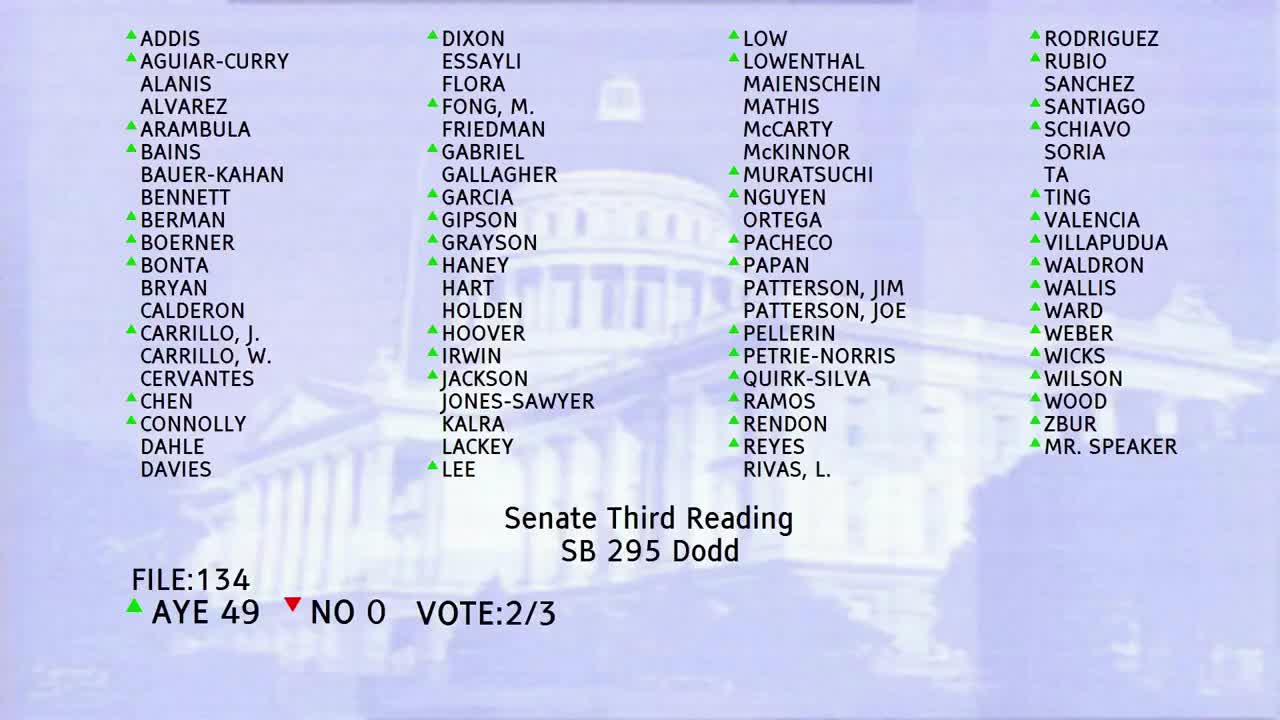 1MIN
Assembly Floor
 12MIN
Assembly Standing Committee on Judiciary
 13MIN
Assembly Standing Committee on Natural Resources
 2MIN
Senate Floor
 7MIN
Senate Standing Committee on Judiciary
 7MIN
Senate Standing Committee on Natural Resources and Water
Bill Author

Bill Co-Author(s):