SB 366: The California Water Plan: long-term supply targets.
- Session Year: 2023-2024
- House: Senate
- Latest Version Date: 2024-09-03
Current Status:
Failed
(2024-09-25: In Senate. Consideration of Governor's veto pending.)
Introduced
In Committee
First Chamber
In Committee
Second Chamber
Enacted
What does this bill do?
The bill changes how the Department of Water Resources updates the California Water Plan, expanding the advisory committee to include tribes, labor, and environmental justice representatives and giving more groups a voice in plan development. It requires the plan to set long‑term water‑supply targets (including a 50‑year planning horizon), hold public workshops, analyze environmental, urban, and agricultural needs, estimate costs and benefits of recommended projects, offer regional water boards a chance to comment, and report findings and recommendations to the Legislature.
The summary is provided by generative AI which can make mistakes. For original language, please view the details in the table below.
Existing law requires the Department of Water Resources to update every 5 years the plan for the orderly and coordinated control, protection, conservation, development, and use of the water resources of the state, which is known as The California Water Plan. Existing law requires the department to include a discussion of various strategies in the plan update, including, but not limited to, strategies relating to the development of new water storage facilities, water conservation, water recycling, desalination, conjunctive use, and water transfers, that may be pursued in order to meet the future needs of the state. Existing law requires the department to establish an advisory committee to assist the department in updating the plan.
This bill would revise and recast certain provisions regarding The California Water Plan to, among other things, require the department to expand the membership of the advisory committee to include tribes, labor, and environmental justice interests. The bill would require the department, as part of the 2033 update to the plan, to update the interim planning target for 2050, as provided. The bill would require the target to consider the identified and future water needs for all beneficial uses and ensure safe drinking water for all Californians, among other things. The bill would require the plan to include specified components, including discussions of environmental needs, urban sector water needs, and agricultural water needs, and a discussion of the estimated costs and benefits of any project type or action that is recommended by the department within the plan that could help achieve the water supply targets. The bill would require the department to report to the Legislature the amendments, supplements, and additions included in the updates of the plan, together with a summary of the departments conclusions and recommendations, in the session in which the updated plan is issued. The bill would also require the department to conduct public workshops to give interested parties an opportunity to comment on the plan.
Under existing law, the State Water Resources Control Board and the 9 California regional water quality control boards regulate water quality. Existing law requires each regional board to formulate and adopt water quality control plans for all areas within the region, as provided.
This bill would require the department to offer the regional water quality control boards opportunities to provide input to assist the department in updating the plan.
Existing law requires the Department of Water Resources to update every 5 years the plan for the orderly and coordinated control, protection, conservation, development, and use of the water resources of the state, which is known as The California Water Plan. Existing law requires the department to include a discussion of various strategies in the plan update, including, but not limited to, strategies relating to the development of new water storage facilities, water conservation, water recycling, desalination, conjunctive use, water transfers, and alternative pricing policies that may be pursued in order to meet the future needs of the state. Existing law requires the department to establish an advisory committee to assist the department in updating the plan.
This bill would revise and recast certain provisions regarding The California Water Plan to, among other things, require the department to expand the membership of the advisory committee to include tribes, labor, and environmental justice interests. The bill would require the department, as part of the 2028 2033 update to the plan, to establish a long-term water supply update the interim planning target for 2050, as provided. The bill would require the target to consider the identified and future water needs for all beneficial uses and ensure safe drinking water for all Californians, among other things. The bill would require the plan to include specified components, including discussions of environmental needs, urban sector water needs, and agricultural water needs, and a discussion of the estimated costs and benefits of any project type or action that is recommended by the department within the plan that could help achieve the water supply targets. The bill would require the department to report to the Legislature amendments, supplements, and additions included in the updates of the plan, together with a summary of the departments conclusions and recommendations, in the session in which the updated plan is issued. The bill would also require the department to conduct public workshops to give interested parties an opportunity to comment on the plan.
Under existing law, the State Water Resources Control Board and the 9 California regional water quality control boards regulate water quality. Existing law requires each regional board to formulate and adopt water quality control plans for all areas within the region, as provided.
This bill would require the department to offer the regional water quality control boards opportunities to provide input to assist the department in updating the plan.
Existing law requires the Department of Water Resources to update every 5 years the plan for the orderly and coordinated control, protection, conservation, development, and use of the water resources of the state, which is known as The California Water Plan. Existing law requires the department to include a discussion of various strategies in the plan update, including, but not limited to, strategies relating to the development of new water storage facilities, water conservation, water recycling, desalination, conjunctive use, water transfers, and alternative pricing policies that may be pursued in order to meet the future needs of the state. Existing law requires the department to establish an advisory committee to assist the department in updating the plan.
This bill would revise and recast certain provisions regarding The California Water Plan to, among other things, require the department to instead establish a stakeholder advisory committee and to expand the membership of the advisory committee to include tribes, labor, and environmental justice interests. The bill would require the department to coordinate with the California Water Commission, the State Water Resources Control Board, other state and federal agencies as appropriate, and the stakeholder advisory committee to develop a comprehensive plan for addressing the states water needs and meeting specified long-term water supply targets established by the bill for purposes of The California Water Plan. department, as part of the 2028 update to the plan, to establish a long-term water supply target for 2050, as provided. The bill would require the plan to provide recommendations and strategies to ensure enough water supply for all designated beneficial uses. target to consider the identified and future water needs for all beneficial uses and ensure safe drinking water for all Californians, among other things. The bill would require the plan to include specified components, including a discussion of various strategies that may be pursued in order to meet the water supply targets, a discussion of discussions of environmental needs, urban sector water needs, and agricultural water needs, and an analysis of the a discussion of the estimated costs and benefits of achieving any project type or action that is recommended by the department within the plan that could help achieve the water supply targets. The bill would require the department to submit report to the Legislature an annual report between updates to the plan that includes progress made toward meeting the water supply targets once established, as specified. amendments, supplements, and additions included in the updates of the plan, together with a summary of the departments conclusions and recommendations, in the session in which the updated plan is issued. The bill would also require the department to conduct public workshops to give interested parties an opportunity to comment on the plan and to post the preliminary draft of the plan on the departments internet website. plan.
Under existing law, the State Water Resources Control Board and the 9 California regional water quality control boards regulate water quality. Existing law requires each regional board to formulate and adopt water quality control plans for all areas within the region, as provided.
This bill would require the department to offer the regional water quality control boards opportunities to provide input to assist the department in updating the plan.
Existing law requires the Department of Water Resources to update every 5 years the plan for the orderly and coordinated control, protection, conservation, development, and use of the water resources of the state, which is known as The California Water Plan. Existing law requires the department to include a discussion of various strategies in the plan update, including, but not limited to, strategies relating to the development of new water storage facilities, water conservation, water recycling, desalination, conjunctive use, water transfers, and alternative pricing policies that may be pursued in order to meet the future needs of the state. Existing law requires the department to establish an advisory committee to assist the department in updating the plan.
This bill would revise and recast certain provisions regarding The California Water Plan to, among other things, require the department to instead establish a stakeholder advisory committee and to expand the membership of the committee to include tribes, labor, and environmental justice interests. The bill would require the department to coordinate with the California Water Commission, the State Water Resources Control Board, other state and federal agencies as appropriate, and the stakeholder advisory committee to develop a comprehensive plan for addressing the states water needs and meeting specified long-term water supply targets established by the bill for purposes of The California Water Plan. The bill would require the plan to provide recommendations and strategies to ensure enough water supply for all designated beneficial uses. The bill would require the plan to include specified components, including a discussion of various strategies that may be pursued in order to meet the water supply targets, a discussion of agricultural water needs, and an analysis of the costs and benefits of achieving the water supply targets. The bill would require the department to submit to the Legislature an annual report between updates to the plan that includes progress made toward meeting the water supply targets once established, as specified. The bill would also require the department to conduct public workshops to give interested parties an opportunity to comment on the plan and to post the preliminary draft of the plan on the departments internet website.
Existing law requires the Department of Water Resources to update every 5 years the plan for the orderly and coordinated control, protection, conservation, development, and use of the water resources of the state, which is known as The California Water Plan. Existing law requires the department to include a discussion of various strategies in the plan update, including, but not limited to, strategies relating to the development of new water storage facilities, water conservation, water recycling, desalination, conjunctive use, water transfers, and alternative pricing policies that may be pursued in order to meet the future needs of the state. Existing law requires the department to establish an advisory committee to assist the department in updating the plan.
This bill would revise and recast certain provisions regarding The California Water Plan to, among other things, require the department to instead establish a stakeholder advisory committee and to expand the membership of the committee to include tribes, labor, and environmental justice interests. The bill would require the department to coordinate with the California Water Commission, the State Water Resources Control Board, other state and federal agencies as appropriate, and the stakeholder advisory committee to develop a comprehensive plan for addressing the states water needs and meeting specified long-term water supply targets established by the bill for purposes of The California Water Plan. The bill would require the plan to provide recommendations and strategies to ensure enough water supply for all designated beneficial uses. The bill would require the plan to include specified components, including a discussion of various strategies that may be pursued in order to meet the water supply targets and an economic analysis. targets, a discussion of agricultural water needs, and an analysis of the costs and benefits of achieving the water supply targets. The bill would require the department to submit to the Legislature an annual report between updates to the plan that includes progress made toward meeting the water supply targets once established, as specified. The bill would also require the department to conduct public workshops to give interested parties an opportunity to comment on the plan and to post the preliminary draft of the plan on the departments internet website.
Existing law requires the Department of Water Resources to update every 5 years the plan for the orderly and coordinated control, protection, conservation, development, and use of the water resources of the state, which is known as The California Water Plan. Existing law requires the department to include a discussion of various strategies in the plan update, including, but not limited to, strategies relating to the development of new water storage facilities, water conservation, water recycling, desalination, conjunctive use, water transfers, and alternative pricing policies that may be pursued in order to meet the future needs of the state. Existing law requires the department to establish an advisory committee to assist the department in updating the plan.
This bill would revise and recast certain provisions regarding The California Water Plan to, among other things, require the department to instead establish a stakeholder advisory committee and to expand the membership of the committee to include tribes, labor, and environmental justice interests. The bill would require the department, in coordination department to coordinate with the California Water Commission, the State Water Resources Control Board, other state and federal agencies as appropriate, and the stakeholder advisory committee to develop a comprehensive plan for addressing the states water needs and meeting specified long-term water supply targets established by the bill for purposes of The The California Water Plan. Plan. The bill would require the plan to provide recommendations and strategies to ensure enough water supply for all beneficial uses. The bill would require the plan to include specified components, including a discussion of various strategies that may be pursued in order to meet the water supply targets and an economic analysis. The bill would require the Director of Water Resources to provide an oral and written report annually to the relevant committees in the Legislature regarding the progress made toward meeting the water supply targets established by the department, department to submit to the Legislature an annual report between updates to the plan that includes progress made toward meeting the water supply targets once established, as specified. The bill would also require the department to conduct public workshops to give interested parties an opportunity to comment on the plan and to post the preliminary draft of the plan on the departments internet website.
Existing law requires the Department of Water Resources to update every 5 years the plan for the orderly and coordinated control, protection, conservation, development, and use of the water resources of the state, which is known as The The California Water Plan. Plan. Existing law requires the department to include a discussion of various strategies in the plan update, including, but not limited to, strategies relating to the development of new water storage facilities, water conservation, water recycling, desalination, conjunctive use, water transfers, and alternative pricing policies that may be pursued in order to meet the future needs of the state. Existing law requires the department to establish an advisory committee to assist the department in updating the plan.
This bill would revise and recast certain provisions regarding The California Water Plan to, among other things, require the department to instead establish a stakeholder advisory committee and to expand the membership of the committee to include tribes, labor, and environmental justice interests. The bill would require the department, in coordination with the California Water Commission, the State Water Resources Control Board, other state and federal agencies as appropriate, and the stakeholder advisory committee to develop a comprehensive plan for addressing the states water needs and meeting specified long-term water supply targets established by the bill for purposes of The California Water Plan. The bill would require the plan to provide recommendations and strategies to ensure enough water supply for all beneficial uses. The bill would require the plan to include specified components, including a discussion of various strategies that may be pursued in order to meet the water supply targets and an economic analysis. The bill would require the Director of Water Resources to provide an oral and written report annually to the relevant committees in the Legislature regarding the progress made toward meeting the water supply targets established by the department, as specified. The bill would also require the department to conduct public workshops to give interested parties an opportunity to comment on the plan and to post the preliminary draft of the plan on the departments internet website.
Existing law requires the Department of Water Resources to update every 5 years the plan for the orderly and coordinated control, protection, conservation, development, and use of the water resources of the state, which is known as the The California Water Plan. Existing law requires the department to include a discussion of various strategies in the plan update, including, but not limited to, strategies relating to the development of new water storage facilities, water conservation, water recycling, desalination, conjunctive use, water transfers, and alternative pricing policies that may be pursued in order to meet the future needs of the state. Existing law requires the department to establish an advisory committee to assist the department in updating the plan.
This bill would revise and recast certain provisions regarding The California Water Plan to, among other things, require the department to instead establish a stakeholder advisory committee, committee and to expand the membership of the committee to include tribes tribes, labor, and environmental justice interests, to prohibit a member of the committee from serving longer than the development of 2 updates, and to require the committee to meet a minimum of 4 times annually. interests. The bill would require the department, in coordination with the California Water Commission, the State Water Resources Control Board, other state and federal agencies as appropriate, and the stakeholder advisory committee to develop a comprehensive plan for addressing the states water needs and meeting specified long-term water supply targets established by the bill for purposes of The California Water Plan. The bill would require the plan to provide recommendations and strategies to ensure enough water supply for all beneficial uses. The bill would require the plan to include specified components, including a discussion of various strategies that may be pursued in order to meet the water supply targets and an economic analysis and a long-term financing plan. The bill would require the department to develop the long-term financing plan, as provided, to meet the water supply targets and include the final financing plan as part of each update. analysis. The bill would require the Director of Water Resources to provide an oral and written report annually to the Legislature, each year by May 1, relevant committees in the Legislature regarding the progress made toward meeting the water supply targets, targets established by the department, as specified. The bill would also require the department to conduct public workshops to give interested parties an opportunity to comment on the plan and to post the preliminary draft of the plan on the departments internet website. The bill would include findings and declarations relating to water supply and climate change.
Existing law requires the Department of Water Resources to update every 5 years the plan for the orderly and coordinated control, protection, conservation, development, and use of the water resources of the state, which is known as the California Water Plan. Existing law requires the department to include a discussion of various strategies in the plan update, including, but not limited to, strategies relating to the development of new water storage facilities, water conservation, water recycling, desalination, conjunctive use, water transfers, and alternative pricing policies that may be pursued in order to meet the future needs of the state. Existing law requires the department to establish an advisory committee to assist the department in updating the plan.
This bill would make legislative findings and declarations and state the intent of the Legislature to enact future legislation that modernizes the California Water Plan, including the establishment of long-term water supply targets.This bill would require the department to instead establish a stakeholder advisory committee, to expand the membership of the committee to include tribes and environmental justice interests, to prohibit a member of the committee from serving longer than the development of 2 updates, and to require the committee to meet a minimum of 4 times annually. The bill would require the department, in coordination with the California Water Commission, the State Water Resources Control Board, other state and federal agencies as appropriate, and the stakeholder advisory committee to develop a comprehensive plan for addressing the states water needs and meeting specified water supply targets established by the bill for purposes of The California Water Plan. The bill would require the plan to provide recommendations and strategies to ensure enough water supply for all beneficial uses. The bill would require the plan to include specified components, including an economic analysis and a long-term financing plan. The bill would require the department to develop the long-term financing plan, as provided, to meet the water supply targets and include the final financing plan as part of each update. The bill would require the Director of Water Resources to provide an oral and written report to the Legislature, each year by May 1, regarding the progress made toward meeting the water supply targets, as specified. The bill would also require the department to conduct public workshops to give interested parties an opportunity to comment on the plan and to post the preliminary draft of the plan on the departments internet website. The bill would include findings and declarations relating to water supply and climate change.
Existing law requires the Department of Water Resources to update every 5 years the plan for the orderly and coordinated control, protection, conservation, development, and use of the water resources of the state, which is known as the California Water Plan. Existing law requires the department to include a discussion of various strategies in the plan update, including, but not limited to, strategies relating to the development of new water storage facilities, water conservation, water recycling, desalination, conjunctive use, water transfers, and alternative pricing policies that may be pursued in order to meet the future needs of the state.
This bill would make legislative findings and declarations and state the intent of the Legislature to enact future legislation that modernizes the California Water Plan, including the establishment of long-term water supply targets.
The Legislature finds and declares all of the following:
(a)To thrive as a state, California needs a reliable supply of water for urban, agricultural, and environmental uses that is resilient to climate change.
(b)Californias existing water usage is highly reliant on capturing snow melt on an annual basis. That water is stored in lakes, reservoirs, and groundwater basins and is then transported around the state for environmental, residential, business, and agricultural use when needed.
(c)California has the most intricate and elaborate system of water conveyance in the world.
(d)Dependent on the extent of drought or flood conditions, the Department of Water Resources has calculated that the volume of water used by people in California for agricultural, urban, and environmental purposes ranges from 60,000,000 acre-feet per year to 90,000,000 acre-feet per year.
(e)Per capita water use has declined over time, thanks to a conservation ethic encouraged by water agencies and other stakeholders, water-saving indoor plumbing fixtures and appliances, better leak detection, and efforts to reduce outdoor water use.
(f)California is experiencing significant impacts of a changing climate on our water supply systems and environment, including fisheries and ecosystems.
(g)According to the Department of Water Resources, hotter and drier weather is estimated to diminish our existing water supply even further and likely by 10 percent.
(h)A 10-percent loss could mean the disappearance of about 6,000,000 acre-feet to 9,000,000 acre-feet of water supply.
(i)Many rivers, lakes, and estuaries are being impacted by declining water quality, including increases in harmful algal blooms.
(j)The California central valley has a groundwater overdraft of 2,000,000 to 3,000,000 acre-feet of water.
(k)Following more than two decades of megadrought in the Colorado Basin, reservoir levels are so low that supply cuts are likely.
(l)Californias precipitation is changing from seasonal snow in the Sierra to periods of substantial rainfall, including from atmospheric rivers.
(m)The shift to drier dry years and wetter wet years makes it imperative that the state of California develop comprehensive wet year strategies that take full advantage of times of abundance, while also ensuring public safety from floods.
(n)California is the nations agricultural powerhouse, accounting for 12 percent of agricultural production in 2021, including more than 70 percent of the nations fruits and nuts.
(o)The agricultural sector produces annual revenues of more than $50 billion, employs more than 420,000 people, and supports large food and beverage processing industries.
(p)The Department of Water Resources describes a statewide capacity in groundwater basins in the range of 1,000,000,000 acre-feet or approximately 20 times the total surface water storage capacity statewide.
(q)California is the home to cutting-edge job-creating industries, such as those in Silicon Valley and southern Californias biotech industry.
(r)Local and regional water suppliers are at the forefront of implementing projects to build resiliency, but need additional support from the state and federal governments through funding and regulatory frameworks that are adapted for the new climate reality.
(s)It is essential for our economy, environment, and well-being that California increases the resilience of the states water supplies.
(t)The implementation of projects to increase the resilience of the states water supplies can also create good jobs for California workers.
(u)Governor Gavin Newsom released Californias Water Supply Strategy: Adapting to a Hotter, Drier Future in August 2022 that began to outline strategies for increasing Californias water supply and streamlining approvals, but California must make a historic change in the states comprehensive water plan and how water is provided for environmental, residential, business, and agricultural uses.
(v)The Sacramento-San Joaquin Delta Reform Act of 2009 establishes a state policy to meet Californias future water needs through the coequal goals for the Delta of increased water supply reliability and Sacramento-San Joaquin Delta ecosystem restoration.
(w)The State Water Resources Control Board and other authorities estimate that over one million Californians lack access to safe and affordable drinking water.
SEC. 2.Section 10004 of the Water Code is repealed.SEC. 3.Section 10004 is added to the Water Code, to read:10004.(a)The department shall develop a comprehensive, strategic plan for the sustainable management and stewardship of Californias water resources. This plan shall be known as The California Water Plan and shall provide an update on the status and trends of Californias water-dependent natural resources, water supplies, and its agricultural, urban, and environmental water demands for a range of plausible future scenarios. The plan also shall include long-term water supply targets and strategies to meet those targets as outlined in this chapter.
(b)The department shall update The California Water Plan on or before December 31, 2028, and every five years thereafter.
(c)To develop the plan, the department, in consultation with the California Water Commission, shall establish an advisory committee, composed of representatives of agricultural and urban water suppliers, local government, business, agriculture, tribes, labor representatives from building and construction trades, environmental justice interests, environmental interests, and other interested parties, to assist and provide input to the department in the updating of The California Water Plan. The department shall consult with the advisory committee and consider recommendations in carrying out this chapter. The department shall provide written notice of meetings of the advisory committee to any interested person or entity that requests the notice. The meetings shall be open to the public.
(d)The department may add members to the advisory committee to carry out the purposes of Section 10004.7. Additional advisory committee members may include those from environmental justice sectors, local water supply agencies, and researchers and experts on climate science, climate science solutions, water storage, water conveyance, and environmental protection.
(e)The department shall release a preliminary draft of The California Water Plan, as updated, upon request, to interested persons and entities throughout the state for their review and comments. The department shall provide these persons and entities an opportunity to present written or oral comments on the preliminary draft. The department shall consider these comments in the preparation of the final publication of The California Water Plan, as updated.
(f)The department shall coordinate with the California Water Commission, the board, other state and federal agencies as appropriate, and the advisory committee to develop the plan. The department shall offer the regional water quality control boards opportunities to provide input to assist the department in updating the plan.
SEC. 4.Section 10004.5 of the Water Code is amended to read:10004.5.(a)As part of the requirement of the department to update The California Water Plan pursuant to subdivision (b) of Section 10004, the department shall include in the plan a discussion of various strategies, including, but not limited to, those relating to the development of new water storage facilities, water conservation, groundwater recharge, water recycling, desalination, conjunctive use, conveyance, stormwater capture, water transfers, and demand management activities that may be pursued in order to meet the future water needs of the state and the water supply targets developed by the department. The department shall also include a discussion of the potential for alternative water pricing policies to change current and projected uses. The department shall include in the plan a discussion of the potential advantages and disadvantages of each strategy and an identification of all federal and state permits, approvals, or entitlements that are anticipated to be required in order to implement the various components of the strategy.
(b)In preparing any update of The California Water Plan, the department shall conduct a series of public workshops to give interested parties an opportunity to comment on the plan. The department shall select workshop locations to maximize geographic distribution, to ensure that regions of the state that have been impacted the most by drought and other weather extremes are included, and to ensure the workshops are accessible to communities with minority populations, communities with low-income populations, or both.
(c)Each update of the plan shall include, at a minimum, all of the following components:
(1)A discussion of environmental needs. The departments discussion shall rely on the best available peer-reviewed scientific information.
(2)A discussion of urban sector water needs.
(3)A discussion of agricultural water needs.
(4)A summary of sources that could finance project types or actions within the various strategies.
(5)A discussion of the estimated costs and benefits of any project type or action that is recommended by the department within the plan that could help achieve the water supply targets. The department shall also consider and incorporate into the discussion, if appropriate, existing studies or planning documents that quantify the costs and impacts to the state if there are inadequate water supplies to meet sustainable demands for all sectors.
(6)A report on the development of regional and local water projects within each hydrologic region of the state undertaken to improve water supplies to meet municipal, agricultural, and environmental water needs and minimize the need to import water from other hydrologic regions.
(d)Notwithstanding Section 10231.5 of the Government Code, the department shall report the amendments, supplements, and additions included in the updates of The California Water Plan, together with a summary of the departments conclusions and recommendations, to the Legislature, in compliance with Section 9795 of the Government Code, in the session in which the updated plan is issued.
SEC. 5.Section 10004.6 of the Water Code is amended to read:10004.6.(a)(1)As part of updating The California Water Plan every five years pursuant to subdivision (b) of Section 10004, the department shall conduct a study to determine the amount of additional water needed to meet the states future water needs and to recommend programs, policies, and facilities to meet those needs.
(2)As part of the 2033 update to The California Water Plan, the department shall update the required planning target pursuant to subdivision (f) for 2050. Subsequent updates of the plan shall include a range of water supply targets that consider future scenarios with a 50-year planning horizon at a watershed scale. The target shall consider the identified and future water needs for all beneficial uses, recognize the impacts of climate change on the states water resources, consider ways to support a sustainable urban sector, agricultural sector, and environment, ensure safe drinking water for all Californians, and reflect statewide, regional, and local planning efforts. In establishing the long-term supply target, the department shall analyze current and future water needs trends, including identifying additional water necessary to sustain public trust resources.
(b)The department shall consult with the advisory committee established pursuant to subdivision (c) of Section 10004 in carrying out this chapter.
(c)On or before December 31, 2027, and one year prior to issuing each successive update to The California Water Plan, the department shall release a preliminary draft of the assumptions and other estimates upon which the study will be based, to interested persons and entities throughout the state for their review and comments. The department shall provide these persons and entities an opportunity to present written or oral comments on the preliminary draft. The department shall consider these documents when adopting the final assumptions and estimates for the study. For the purpose of carrying out this subdivision, the department shall release, at a minimum, assumptions and other estimates relating to all of the following:
(1)Basin hydrology, including annual rainfall, estimated unimpaired streamflow, depletions, and consumptive uses.
(2)Groundwater supplies, including estimates of sustainable yield, supplies necessary to recover overdraft basins, and supplies lost due to pollution and other groundwater contaminants.
(3)Current and projected land use patterns, including the mix of residential, commercial, industrial, agricultural, and undeveloped lands.
(4)Environmental water needs, including regulatory instream flow requirements, nonregulated instream uses, and water needs by wetlands, preserves, refuges, and other managed and unmanaged natural resource lands.
(5)Current and projected population.
(6)Current and projected water use for all of the following:
(A)Interior uses in a single-family dwelling.
(B)Exterior uses in a single-family dwelling.
(C)All uses in a multifamily dwelling.
(D)Commercial uses.
(E)Industrial uses.
(F)Parks and open spaces.
(G)Agricultural water diversion and use.
(7)Opportunities for demand management.
(8)Evapotranspiration rates for major crop types, including estimates of evaporative losses by irrigation practice and the extent to which evaporation reduces transpiration.
(9)Current and projected adoption of urban and agricultural conservation practices.
(10)Current and projected supplies of water provided by water recycling and reuse.
(11)Current and projected water and infrastructure needs of disadvantaged communities, as defined in Section 79505.5, served by public water systems, state small water systems, and individual domestic wells, including, but not limited to, access to safe and affordable drinking water and sanitation, water quality, and water supply. The department may incorporate by reference the State Water Resources Control Boards Drinking Water Needs Assessment or other available relevant assessments or reports.
(12)Climate change impacts by region and resulting water supply trends, including changes in timing and intensity of snowmelt runoff.
(d)The department shall include a discussion of the potential for alternative water pricing policies to change current and projected water uses identified pursuant to paragraph (6) of subdivision (c).
(e)This section does not require the department to update, or prohibit the department from updating, any data necessary to update The California Water Plan pursuant to subdivision (b) of Section 10004.
(f)As part of the 2028 update to the plan, the department shall include an interim planning target of 9,000,000 acre-feet of additional water, water conservation, or water storage capacity to be achieved by 2040. This target may be achieved through the development of new or expanded surface or groundwater storage, conservation efforts, or the development of stormwater capture, graywater, recycled water, or other water supplies.
SEC. 6.Section 10013 of the Water Code is repealed.The Legislature finds and declares all of the following:
(a)To thrive as a state, California needs a reliable supply of water for urban, agricultural, and environmental uses that is resilient to climate change.
(b)Californias existing water usage is highly reliant on capturing snow melt on an annual basis. That water is stored in lakes, reservoirs, and groundwater basins and is then transported around the state for environmental, residential, business, and agricultural use when needed.
(c)California has the most intricate and elaborate system of water conveyance in the world.
(d)Dependent on the extent of drought or flood conditions, the Department of Water Resources has calculated that the volume of water used by people in California for agricultural, urban, and environmental purposes ranges from 60,000,000 acre-feet per year to 90,000,000 acre-feet per year.
(e)Per capita water use has declined over time, thanks to a conservation ethic encouraged by water agencies and other stakeholders, water-saving indoor plumbing fixtures and appliances, better leak detection, and efforts to reduce outdoor water use.
(f)California is experiencing significant impacts of a changing climate on our water supply systems and environment, including fisheries and ecosystems.
(g)According to the Department of Water Resources, hotter and drier weather is estimated to diminish our existing water supply even further and likely by 10 percent.
(h)A 10-percent loss could mean the disappearance of about 6,000,000 acre-feet to 9,000,000 acre-feet of water supply.
(i)Many rivers, lakes, and estuaries are being impacted by declining water quality, including increases in harmful algal blooms.
(j)The California central valley has a groundwater overdraft of 2,000,000 to 3,000,000 acre-feet of water.
(k)Following more than two decades of megadrought in the Colorado Basin, reservoir levels are so low that supply cuts are likely.
(l)Californias precipitation is changing from seasonal snow in the Sierra to periods of substantial rainfall, including from atmospheric rivers.
(m)The shift to drier dry years and wetter wet years makes it imperative that the state of California develop comprehensive wet year strategies that take full advantage of times of abundance, while also ensuring public safety from floods.
(n)California is the nations agricultural powerhouse, accounting for 12 percent of agricultural production in 2021, including more than 70 percent of the nations fruits and nuts.
(o)The agricultural sector produces annual revenues of more than $50 billion, employs more than 420,000 people, and supports large food and beverage processing industries.
(p)The Department of Water Resources describes a statewide capacity in groundwater basins in the range of 1,000,000,000 acre-feet or approximately 20 times the total surface water storage capacity statewide.
(q)California is the home to cutting-edge job-creating industries, such as those in Silicon Valley and southern Californias biotech industry.
(r)Local and regional water suppliers are at the forefront of implementing projects to build resiliency, but need additional support from the state and federal governments through funding and regulatory frameworks that are adapted for the new climate reality.
(s)It is essential for our economy, environment, and well-being that California increases the resilience of the states water supplies.
(t)The implementation of projects to increase the resilience of the states water supplies can also create good jobs for California workers.
(u)Governor Gavin Newsom released Californias Water Supply Strategy: Adapting to a Hotter, Drier Future in August 2022 that began to outline strategies for increasing Californias water supply and streamlining approvals, but California must make a historic change in the states comprehensive water plan and how water is provided for environmental, residential, business, and agricultural uses.
(v)The Sacramento-San Joaquin Delta Reform Act of 2009 establishes a state policy to meet Californias future water needs through the coequal goals for the Delta of increased water supply reliability and Sacramento-San Joaquin Delta ecosystem restoration.
(w)The State Water Resources Control Board and other authorities estimate that over one million Californians lack access to safe and affordable drinking water.
SEC. 2.Section 10004 of the Water Code is repealed.SEC. 3.Section 10004 is added to the Water Code, to read:10004.(a)The department shall develop a comprehensive, strategic plan for the sustainable and equitable management and stewardship of Californias water resources. This plan shall be known as The California Water Plan and shall provide an update on the status and trends of Californias water-dependent natural resources, water supplies, and its agricultural, urban, and environmental water demands for a range of plausible future scenarios. The plan also shall include long-term water supply targets and strategies to meet those targets as outlined in this chapter.
(b)The department shall update The California Water Plan on or before December 31, 2028, and every five years thereafter.
(c)To develop the plan, the department, in consultation with the California Water Commission, shall establish an advisory committee, composed of representatives of agricultural and urban water suppliers, local government, business, agriculture, tribes, labor representatives from building and construction trades, environmental justice interests, environmental interests, and other interested parties, to assist and provide input to the department in the updating of The California Water Plan. The department shall consult with the advisory committee and consider recommendations in carrying out this chapter. The department shall provide written notice of meetings of the advisory committee to any interested person or entity that requests the notice. The meetings shall be open to the public.
(d)The department may add members to the advisory committee to carry out the purposes of Section 10004.7. Additional advisory committee members may include those from environmental justice sectors, local water supply agencies, and researchers and experts on climate science, climate science solutions, water storage, water conveyance, and environmental protection.
(e)The department shall release a preliminary draft of The California Water Plan, as updated, upon request, to interested persons and entities throughout the state for their review and comments. The department shall provide these persons and entities an opportunity to present written or oral comments on the preliminary draft. The department shall consider these comments in the preparation of the final publication of The California Water Plan, as updated.
(f)The department shall coordinate with the California Water Commission, the board, other state and federal agencies as appropriate, and the advisory committee to develop the plan. The department shall offer the regional water quality control boards opportunities to provide input to assist the department in updating the plan.
SEC. 4.Section 10004.5 of the Water Code is amended to read:10004.5.(a)As part of the requirement of the department to update The California Water Plan pursuant to subdivision (b) of Section 10004, the department shall include in the plan a discussion of various strategies, including, but not limited to, those relating to the development of new water storage facilities, water conservation, groundwater recharge, water recycling, desalination, conjunctive use, conveyance, stormwater capture, water transfers, and demand management activities that may be pursued in order to meet the future water needs of the state and the water supply targets developed by the department. The department shall also include a discussion of the potential for alternative water pricing policies to change current and projected uses. The department shall include in the plan a discussion of the potential advantages and disadvantages of each strategy and an identification of all federal and state permits, approvals, or entitlements that are anticipated to be required in order to implement the various components of the strategy.
(b)In preparing any update of The California Water Plan, the department shall conduct a series of public workshops to give interested parties an opportunity to comment on the plan. The department shall select workshop locations to maximize geographic distribution, to ensure that regions of the state that have been impacted the most by drought and other weather extremes are included, and to ensure the workshops are accessible to communities with minority populations, communities with low-income populations, or both.
(c)Each update of the plan shall include, at a minimum, all of the following components:
(1)A discussion of environmental needs. The departments discussion shall rely on the best available peer-reviewed scientific information.
(2)A discussion of urban sector water needs.
(3)A discussion of agricultural water needs.
(4)A summary of sources that could finance project types or actions within the various strategies.
(5)A discussion of the estimated costs and benefits of any project type or action that is recommended by the department within the plan that could help achieve the water supply targets. The department shall also consider and incorporate into the analysis, discussion, if appropriate, existing studies or planning documents that quantify the costs and impacts to the state if there are inadequate water supplies to meet sustainable demands for all sectors.
(6)A report on the development of regional and local water projects within each hydrologic region of the state undertaken to improve water supplies to meet municipal, agricultural, and environmental water needs and minimize the need to import water from other hydrologic regions.
(d)Notwithstanding Section 10231.5 of the Government Code, the department shall report the amendments, supplements, and additions included in the updates of The California Water Plan, together with a summary of the departments conclusions and recommendations, to the Legislature, in compliance with Section 9795 of the Government Code, in the session in which the updated plan is issued.
SEC. 5.Section 10004.6 of the Water Code is amended to read:10004.6.(a)(1)As part of updating The California Water Plan every five years pursuant to subdivision (b) of Section 10004, the department shall conduct a study to determine the amount of additional water needed to meet the states future water needs and to recommend programs, policies, and facilities to meet those needs.
(2)As part of the 2028 2033 update to The California Water Plan, the department shall establish a long-term water supply target update the required planning target pursuant to subdivision (f) for 2050. Subsequent updates of the plan shall include a range of water supply targets that consider future scenarios with a 50-year planning horizon at a watershed scale. The target shall consider the identified and future water needs for all beneficial uses, recognize the impacts of climate change on the states water resources, support a sustainable economy, consider ways to support a sustainable urban sector, agricultural sector, and environment, ensure safe drinking water for all Californians, and reflect statewide, regional, and local planning efforts. In establishing the long-term supply target, the department shall analyze current and future water needs trends, including identifying additional water necessary to sustain public trust resources.
(b)The department shall consult with the advisory committee established pursuant to subdivision (c) of Section 10004 in carrying out this chapter.
(c)On or before December 31, 2027, and one year prior to issuing each successive update to The California Water Plan, the department shall release a preliminary draft of the assumptions and other estimates upon which the study will be based, to interested persons and entities throughout the state for their review and comments. The department shall provide these persons and entities an opportunity to present written or oral comments on the preliminary draft. The department shall consider these documents when adopting the final assumptions and estimates for the study. For the purpose of carrying out this subdivision, the department shall release, at a minimum, assumptions and other estimates relating to all of the following:
(1)Basin hydrology, including annual rainfall, estimated unimpaired streamflow, depletions, and consumptive uses.
(2)Groundwater supplies, including estimates of sustainable yield, supplies necessary to recover overdraft basins, and supplies lost due to pollution and other groundwater contaminants.
(3)Current and projected land use patterns, including the mix of residential, commercial, industrial, agricultural, and undeveloped lands.
(4)Environmental water needs, including regulatory instream flow requirements, nonregulated instream uses, and water needs by wetlands, preserves, refuges, and other managed and unmanaged natural resource lands.
(5)Current and projected population.
(6)Current and projected water use for all of the following:
(A)Interior uses in a single-family dwelling.
(B)Exterior uses in a single-family dwelling.
(C)All uses in a multifamily dwelling.
(D)Commercial uses.
(E)Industrial uses.
(F)Parks and open spaces.
(G)Agricultural water diversion and use.
(7)Opportunities for demand management.
(8)Evapotranspiration rates for major crop types, including estimates of evaporative losses by irrigation practice and the extent to which evaporation reduces transpiration.
(9)Current and projected adoption of urban and agricultural conservation practices.
(10)Current and projected supplies of water provided by water recycling and reuse.
(11)Current and projected water and infrastructure needs of disadvantaged communities, as defined in Section 79505.5, served by public water systems, state small water systems, and individual domestic wells, including, but not limited to, access to safe and affordable drinking water and sanitation, water quality, and water supply. The department may incorporate by reference the State Water Resources Control Boards Drinking Water Needs Assessment or other available relevant assessments or reports.
(12)Climate change impacts by region and resulting water supply trends, including changes in timing and intensity of snowmelt runoff.
(d)The department shall include a discussion of the potential for alternative water pricing policies to change current and projected water uses identified pursuant to paragraph (6) of subdivision (c).
(e)This section does not require the department to update, or prohibit the department from updating, any data necessary to update The California Water Plan pursuant to subdivision (b) of Section 10004.
(f)As part of the 2028 update to the plan, the department shall include an interim planning target of 9,000,000 acre-feet of additional water, water conservation, or water storage capacity to be achieved by 2040. This target may be achieved through the development of new or expanded surface or groundwater storage, conservation efforts, or the development of stormwater capture, graywater, recycled water, or other water supplies.
SEC. 6.Section 10013 of the Water Code is repealed.The Legislature finds and declares all of the following:
(a)To thrive as a state, California needs a reliable supply of water for urban, agricultural, and environmental uses that is resilient to climate change.
(b)Californias existing water usage is highly reliant on capturing the snow melt on an annual basis. That water is stored in lakes, reservoirs, and groundwater basins and is then transported around the state for environmental, residential, business, and agricultural use when needed.
(c)California has the most intricate and elaborate system of water conveyance in the world.
(d)Dependent on the extent of drought or flood conditions, the Department of Water Resources has calculated that the volume of water used by people in California for agricultural, urban, and environmental purposes ranges from 60,000,000 acre-feet per year to 90,000,000 acre-feet per year.
(e)Per capita water use has declined over time, thanks to a conservation ethic encouraged by water agencies and other stakeholders, water-saving indoor plumbing fixtures and appliances, better leak detection, and efforts to reduce outdoor water use.
(f)Water use also has significantly declined in the agricultural sector thanks to proactive steps taken by irrigation districts and farmers, such as installing drip irrigation systems.(g)(f)California is experiencing significant impacts of a changing climate on our water supply systems and environment, including fisheries and ecosystems.
(h)(g)According to the Department of Water Resources, hotter and drier weather is estimated to diminish our existing water supply even further and likely by 10 percent.
(i)(h)A 10-percent loss could mean the disappearance of about 6,000,000 acre-feet to 9,000,000 acre-feet of water supply.
(j)(i)Many rivers, lakes, and estuaries are being impacted by declining water quality, including increases in harmful algal blooms.
(k)(j)The California central valley has a groundwater overdraft of 2,000,000 to 3,000,000 acre-feet of water.
(l)(k)Following more than two decades of megadrought in the Colorado Basin, reservoir levels are so low that supply cuts are likely.
(m)(l)Californias precipitation is changing from seasonal snow in the Sierra to periods of substantial rainfall, including from atmospheric rivers.
(n)(m)The shift to drier dry years and wetter wet years makes it imperative that the state of California develop comprehensive wet year strategies that take full advantage of times of abundance, while also ensuring public safety from floods.
(o)(n)California is the nations agricultural powerhouse, accounting for 12 percent of agricultural production in 2021, including more than 70 percent of the nations fruits and nuts.
(p)(o)The agricultural sector produces annual revenues of more than $50 billion, employs more than 420,000 people, and supports large food and beverage processing industries.
(q)(p)The Department of Water Resources describes a statewide capacity in groundwater basins in the range of 1,000,000,000 acre-feet or approximately 20 times the total surface water storage capacity statewide.
(r)(q)California is the home to cutting-edge job-creating industries, such as those in Silicon Valley and southern Californias biotech industry.
(s)(r)Local and regional water suppliers are at the forefront of implementing projects to build resiliency, but need additional support from the state and federal governments through funding and regulatory frameworks that are adapted for the new climate reality.
(t)(s)It is essential for our economy, environment, and well-being that California increases the resilience of the states water supplies.
(u)(t)The implementation of projects to increase the resilience of the states water supplies can also create good jobs for California workers.
(v)(u)Governor Gavin Newsom released Californias Water Supply Strategy: Adapting to a Hotter, Drier Future in August 2022 that began to outline strategies for increasing Californias water supply and streamlining approvals, but California must make a historic change in the states comprehensive water plan and how water is provided for environmental, residential, business, and agricultural uses.
(w)(v)The Sacramento-San Joaquin Delta Reform Act of 2009 establishes a state policy to meet Californias future water needs through the coequal goals for the Delta of increased water supply reliability and Sacramento-San Joaquin Delta ecosystem restoration.
(x)(w)The State Water Resources Control Board and other authorities estimate that over one million Californians lack access to safe and affordable drinking water.
SEC. 2.Section 10004 of the Water Code is repealed.SEC. 3.Section 10004 is added to the Water Code, to read:10004.(a)The department shall develop a comprehensive plan for addressing the states water needs and meeting the long-term water supply targets established in Section 10004.6, which shall be known as The California Water Plan. The plan shall provide recommendations and strategies to ensure enough water supply for all designated beneficial uses.(b)The department shall coordinate with the California Water Commission, the board, other state and federal agencies as appropriate, and the stakeholder advisory committee outlined in subparagraph (A) of paragraph (3) of subdivision (f) to develop the plan.(c)It is hereby declared that the people of the state have a primary interest in the orderly and coordinated control, protection, conservation, development, and utilization of the water resources of the state by all individuals and entities and that it is the policy of the state that The California Water Plan, with any necessary amendments, supplements, and additions to the plan, is accepted as the master plan that guides the orderly and coordinated control, protection, conservation, development, management, and efficient utilization of the water resources of the state.(d)The department shall update The California Water Plan on or before December 31, 2028, and every five years thereafter. Each update of the plan shall include the following components:(1)(A)A discussion of various strategies, including, but not limited to, those relating to the development of new water storage facilities, water conservation, groundwater recharge, water recycling, desalination, conjunctive use, conveyance, stormwater capture, water transfers, and demand management activities that may be pursued in order to meet the water supply targets developed by the department. The department shall also include a discussion of options to finance projects within the various strategies and the potential for alternative water pricing policies to change current and projected uses. The department shall include in the plan a discussion of the potential advantages and disadvantages of each strategy, how to maximize the strategy for long-term sustainability, how innovation and research can spur the implementation of each strategy, and an identification of all federal and state permits, approvals, or entitlements that may be required in order to implement the various components of the strategy.(B)In carrying out this chapter, a public water system, irrigation district, or wastewater service provider shall not be required to implement a specific strategy or project.(2)A discussion of environmental needs, including regulatory instream flow requirements, nonregulated instream uses, and water needs by wetlands, preserves, refuges, and other managed and unmanaged natural resource lands.(3)A discussion of urban sector water needs, including maintaining tree health, residential and commercial landscapes, single-family and multifamily housing needs, community open green spaces, and a world-class economy.(4)A discussion of agricultural water needs, including maintaining a viable and sustainable food supply, restoring groundwater tables, agricultural water use efficiency, surface water reliability for irrigation purposes, and an assessment of communities that rely directly and indirectly on agricultural activities for their livelihood.(5)An analysis of the costs and benefits of achieving the water supply targets developed by the department or established in statute, including a cost-benefit analysis of various strategies and projects necessary to meet those supply targets. The cost-benefit analysis shall take into account the water needs of the economy and disadvantaged communities, and the environment. The department shall also consider and incorporate into the analysis, if appropriate, existing studies or planning documents that quantify the costs and impacts to the state if it has inadequate water supplies to meet sustainable demands for all sectors.(6)A report on the development of regional and local water projects within each hydrologic region of the state to improve water supplies to meet municipal, agricultural, and environmental water needs, meet the water supply targets, and minimize the need to import water from other hydrologic regions.(e)The declaration set forth in subdivision (c) does not constitute approval for the construction of specific projects or routes for transfer of water, or for financial assistance, by the state without further legislative action, nor shall the declaration be construed as a prohibition of the development of the water resources of the state by any entity.(f)(1)Notwithstanding Section 10231.5 of the Government Code, the department shall report the amendments, supplements, and additions included in the updates of The California Water Plan, together with a summary of the departments conclusions and recommendations, to the Legislature, in compliance with Section 9795 of the Government Code, in the session in which the updated plan is issued.(2)The department shall submit to the Legislature an annual report between updates to the plan that includes progress made toward meeting the water supply targets once established. The report shall include the list of recommended actions that require legislative intervention and those that can be implemented by the department or other state agencies. The written report shall be posted on the departments internet website.(3)(A)The department, in consultation with the California Water Commission, shall establish a stakeholder advisory committee, comprised of representatives of agricultural and urban water suppliers, local government, business, production agriculture, and tribes, labor representatives from building and construction trades, representatives of environmental justice and environmental interests, and other interested parties, to provide substantive input to assist the department in updating The California Water Plan. The department shall consult with and consider recommendations from the advisory committee in carrying out this section. The department shall accept applications for the stakeholder advisory committee before each update and ensure a balanced representation of members. The department shall provide written notice of meetings of the advisory committee to any interested person or entity that requests the notice. The meetings shall be open to the public.(B)The department shall seek out and consider all relevant information from retail and wholesale water agencies, agriculture, business, labor, tribes, environmental and environmental justice communities, and any other communities potentially impacted by the plan and from researchers and experts on climate science, climate science solutions, water storage, water conveyance, and environmental protection.(C)The department may add members to the stakeholder advisory committee to carry out the purposes of Section 10004.7. Additional stakeholder advisory committee members may include those from environmental justice sectors, local water supply agencies, and researchers and experts on climate science, climate science solutions, water storage, water conveyance, and environmental protection.(4)In preparing any update of The California Water Plan, the department shall conduct a series of public workshops to give interested parties an opportunity to comment on the plan. The department shall conduct a portion of these workshops in regions of the state that have been impacted the most by drought and other weather extremes, including, but not limited to, communities with minority populations, communities with low-income populations, or both.(5)The department shall release a preliminary draft of The California Water Plan, as updated, upon request, to interested persons and entities throughout the state for their review and comments. The department shall provide these persons and entities an opportunity to present written or oral comments on the preliminary draft. The department also shall post the preliminary draft on the departments internet website. The department shall consider these comments in the preparation of the final publication of The California Water Plan, as updated.(g)In carrying out this section, the department shall acknowledge state and federal requirements impacting the urban, agricultural, and environmental sectors at the time of the update.(h)Nothing in The California Water Plan shall be construed as a regulatory requirement.SEC. 4.Section 10004.5 of the Water Code is repealed.SEC. 3.Section 10004 is added to the Water Code, to read:10004.(a)The department shall develop a comprehensive, strategic plan for the sustainable and equitable management and stewardship of Californias water resources. This plan shall be known as The California Water Plan and shall provide an update on the status and trends of Californias water-dependent natural resources, water supplies, and its agricultural, urban, and environmental water demands for a range of plausible future scenarios. The plan also shall include long-term water supply targets and strategies to meet those targets as outlined in this chapter.
(b)The department shall update The California Water Plan on or before December 31, 2028, and every five years thereafter.
(c)To develop the plan, the department, in consultation with the California Water Commission, shall establish an advisory committee, composed of representatives of agricultural and urban water suppliers, local government, business, agriculture, tribes, labor representatives from building and construction trades, environmental justice interests, environmental interests, and other interested parties, to assist and provide input to the department in the updating of The California Water Plan. The department shall consult with the advisory committee and consider recommendations in carrying out this chapter. The department shall provide written notice of meetings of the advisory committee to any interested person or entity that requests the notice. The meetings shall be open to the public.
(d)The department may add members to the advisory committee to carry out the purposes of Section 10004.7. Additional advisory committee members may include those from environmental justice sectors, local water supply agencies, and researchers and experts on climate science, climate science solutions, water storage, water conveyance, and environmental protection.
(e)The department shall release a preliminary draft of The California Water Plan, as updated, upon request, to interested persons and entities throughout the state for their review and comments. The department shall provide these persons and entities an opportunity to present written or oral comments on the preliminary draft. The department shall consider these comments in the preparation of the final publication of The California Water Plan, as updated.
(f)The department shall coordinate with the California Water Commission, the board, other state and federal agencies as appropriate, and the advisory committee to develop the plan. The department shall offer the regional water quality control boards opportunities to provide input to assist the department in updating the plan.
SEC. 4.Section 10004.5 of the Water Code is amended to read:10004.5.(a)As part of the requirement of the department to update The California Water Plan pursuant to subdivision (b) of Section 10004, the department shall include in the plan a discussion of various strategies, including, but not limited to, those relating to the development of new water storage facilities, water conservation, groundwater recharge, water recycling, desalination, conjunctive use, and water transfers conveyance, stormwater capture, water transfers, and demand management activities that may be pursued in order to meet the future water needs of the state. state and the water supply targets developed by the department. The department shall also include a discussion of the potential for alternative water pricing policies to change current and projected uses. The department shall include in the plan a discussion of the potential advantages and disadvantages of each strategy and an identification of all federal and state permits, approvals, or entitlements that are anticipated to be required in order to implement the various components of the strategy.
(b)In preparing any update of The California Water Plan, the department shall conduct a series of public workshops to give interested parties an opportunity to comment on the plan. The department shall select workshop locations to maximize geographic distribution, to ensure that regions of the state that have been impacted the most by drought and other weather extremes are included, and to ensure the workshops are accessible to communities with minority populations, communities with low-income populations, or both.
(c)Each update of the plan shall include, at a minimum, all of the following components:
(1)A discussion of environmental needs. The departments discussion shall rely on the best available peer-reviewed scientific information.
(2)A discussion of urban sector water needs.
(3)A discussion of agricultural water needs.
(4)A summary of sources that could finance project types or actions within the various strategies.
(5)A discussion of the estimated costs and benefits of any project type or action that is recommended by the department within the plan that could help achieve the water supply targets. The department shall also consider and incorporate into the analysis, if appropriate, existing studies or planning documents that quantify the costs and impacts to the state if there are inadequate water supplies to meet sustainable demands for all sectors.
(6)A report on the development of regional and local water projects within each hydrologic region of the state undertaken to improve water supplies to meet municipal, agricultural, and environmental water needs and minimize the need to import water from other hydrologic regions.
(d)Notwithstanding Section 10231.5 of the Government Code, the department shall report the amendments, supplements, and additions included in the updates of The California Water Plan, together with a summary of the departments conclusions and recommendations, to the Legislature, in compliance with Section 9795 of the Government Code, in the session in which the updated plan is issued.
SEC. 5.Section 10004.6 of the Water Code is amended to read:10004.6.(a)(1)As part of the 2028 update of The California Water Plan, updating The California Water Plan every five years pursuant to subdivision (b) of Section 10004, the department shall conduct a study to determine the amount of additional water needed to meet the states future water needs and to establish a long-term water supply target for 2050. The target shall ensure sufficient water for all designated recommend programs, policies, and facilities to meet those needs.
(2)As part of the 2028 update to The California Water Plan, the department shall establish a long-term water supply target for 2050. The target shall consider the identified and future water needs for all beneficial uses, recognize the impacts of climate change on the states water resources, support a sustainable economy, agricultural sector, and environment, ensure safe drinking water for all Californians, and reflect statewide, regional, and local planning efforts. In establishing the long-term supply target, the department shall analyze current and future water needs trends, including identifying additional water necessary to sustain public trust resources. On
(b)The department shall consult with the advisory committee established pursuant to subdivision (c) of Section 10004 in carrying out this chapter.
(c)On or before December 31, 2027, and one year prior to issuing each successive update to The California Water Plan, the department shall release a preliminary draft of the assumptions and other estimates upon which the study will be based, to interested persons and entities throughout the state for their review and comments. The department shall provide these persons and entities an opportunity to present written or oral comments on the preliminary draft. The department shall consider these documents when adopting the final assumptions and estimates for the study. For the purpose of carrying out this subdivision, the department shall release, at a minimum, assumptions and other estimates relating to all of the following:
(1)Basin hydrology, including annual rainfall, estimated unimpaired streamflow, depletions, and consumptive uses.
(2)Groundwater supplies, including estimates of sustainable yield, supplies necessary to recover overdraft basins, and supplies lost due to pollution and other groundwater contaminants.
(3)Current and projected land use patterns, including the mix of residential, commercial, industrial, agricultural, and undeveloped lands.
(4)Environmental water needs, including regulatory instream flow requirements requirements, nonregulated instream uses, and water needs by wetlands, preserves, refuges, and other managed and unmanaged natural resource lands.
(5)Opportunities for demand management.(6)(5)Current and projected population.
(7)(6)Current and projected water use for all of the following:
(A)Interior uses in a single-family dwelling.
(B)Exterior uses in a single-family dwelling.
(C)All uses in a multifamily dwelling.
(D)Commercial uses.
(E)Industrial uses.
(F)Parks and open spaces.
(G)Agricultural water diversion and use.
(7)Opportunities for demand management.
(8)Evapotranspiration rates for major crop types, including estimates of evaporative losses by irrigation practice and the extent to which evaporation reduces transpiration.
(9)Current and projected adoption of urban and agricultural conservation practices.
(10)Current and projected supplies of water provided by water recycling and reuse.
(11)Current and projected water and infrastructure needs of disadvantaged communities, as defined in Section 79505.5, served by public water systems, state small water systems, and individual domestic wells, including, but not limited to, access to safe and affordable drinking water and sanitation, water quality, and water supply. The department may incorporate by reference the State Water Resources Control Boards Drinking Water Needs Assessment or other available relevant assessments or reports.
(12)Climate change impacts by region and resulting water supply trends, including changes in timing and intensity of snowmelt runoff.
(b)(d)The department shall include a discussion of the potential for alternative water pricing policies to change current and projected water uses identified pursuant to paragraph (7) (6) of subdivision (a). (c).
(e)This section does not require the department to update, or prohibit the department from updating, any data necessary to update The California Water Plan pursuant to subdivision (b) of Section 10004.
(c)(f)As part of the 2028 update to the plan, the department shall include an interim planning target of 9,000,000 acre-feet of additional water, water conservation, or water storage capacity to be achieved by 2040. This target may be achieved through the development of new or expanded surface or groundwater storage, conservation efforts, or the development of stormwater capture, graywater, recycled water, or other water supplies.
(d)This section does not require or prohibit the department from updating any data necessary to update The California Water Plan pursuant to subdivision (d) of Section 10004.SEC. 6.Section 10005 of the Water Code is repealed.SEC. 7.SEC. 6.Section 10013 of the Water Code is repealed.The Legislature finds and declares all of the following:
(a)To thrive as a state, California needs a reliable supply of water for urban, agricultural, and environmental uses that is resilient to climate change.
(b)Californias existing water usage is highly reliant on capturing the snow melt on an annual basis. That water is stored in lakes, reservoirs, and groundwater basins and is then transported around the state for environmental, residential, business, and agricultural use when needed.
(c)California has the most intricate and elaborate system of water conveyance in the world.
(d)Dependent on the extent of drought or flood conditions, the Department of Water Resources has calculated that the volume of water used by people in California for agricultural, urban, and environmental purposes ranges from 60,000,000 acre-feet per year to 90,000,000 acre-feet per year.
(e)Per capita water use has declined over time, thanks to a conservation ethic encouraged by water agencies and other stakeholders, water-saving indoor plumbing fixtures and appliances, better leak detection, and efforts to reduce outdoor water use.
(f)Water use also has significantly declined in the agricultural sector thanks to proactive steps taken by irrigation districts and farmers, such as installing drip irrigation systems.
(g)California is experiencing significant impacts of a changing climate on our water supply systems and environment, including fisheries and ecosystems.
(h)According to the Department of Water Resources, hotter and drier weather is estimated to diminish our existing water supply even further and likely by 10 percent.
(i)A 10-percent loss could mean the disappearance of about 6,000,000 acre-feet to 9,000,000 acre-feet of water supply.
(j)Many rivers, lakes, and estuaries are being impacted by declining water quality, including increases in harmful algal blooms.
(k)The California central valley has a groundwater overdraft of 2,000,000 to 3,000,000 acre-feet of water.
(l)Following more than two decades of megadrought in the Colorado Basin, reservoir levels are so low that supply cuts are likely.
(m)Californias precipitation is changing from seasonal snow in the Sierra to periods of substantial rainfall, including from atmospheric rivers.
(n)The shift to drier dry years and wetter wet years makes it imperative that the state of California develop comprehensive wet year strategies that take full advantage of times of abundance, while also ensuring public safety from floods.
(o)California is the nations agricultural powerhouse, accounting for 12 percent of agricultural production in 2021, including more than 70 percent of the nations fruits and nuts.
(p)The agricultural sector produces annual revenues of more than $50 billion, employs more than 420,000 people, and supports large food and beverage processing industries.
(q)The Department of Water Resources describes a statewide capacity in groundwater basins in the range of 1,000,000,000 acre-feet or approximately 20 times the total surface water storage capacity statewide.
(r)California is the home to cutting-edge job-creating industries, such as those in Silicon Valley and southern Californias biotech industry.
(s)Local and regional water suppliers are at the forefront of implementing projects to build resiliency, but need additional support from the state and federal governments through funding and regulatory frameworks that are adapted for the new climate reality.
(t)It is essential for our economy, environment, and well-being that California increases the resilience of the states water supplies.
(u)The implementation of projects to increase the resilience of the states water supplies can also create good jobs for California workers.
(v)Governor Gavin Newsom released Californias Water Supply Strategy: Adapting to a Hotter, Drier Future in August 2022 that began to outline strategies for increasing Californias water supply and streamlining approvals, but California must make a historic change in the states comprehensive water plan and how water is provided for environmental, residential, business, and agricultural uses.
(w)The Sacramento-San Joaquin Delta Reform Act of 2009 establishes a state policy to meet Californias future water needs through the coequal goals for the Delta of increased water supply reliability and Sacramento-San Joaquin Delta ecosystem restoration.
(x)The State Water Resources Control Board and other authorities estimate that over one million Californians lack access to safe and affordable drinking water.
SEC. 2.Section 10004 of the Water Code is repealed.SEC. 3.Section 10004 is added to the Water Code, to read:10004.(a)The department shall develop a comprehensive plan for addressing the states water needs and meeting the long-term water supply targets established in Section 10004.6, which shall be known as The California Water Plan. The plan shall provide recommendations and strategies to ensure enough water supply for all designated beneficial uses, including, but not limited to, compliance with Division 35 (commencing with Section 85000). uses.
(b)The department shall coordinate with the California Water Commission, the board, other state and federal agencies as appropriate, and the stakeholder advisory committee outlined in subparagraph (A) of paragraph (3) of subdivision (f) to develop the plan.
(c)It is hereby declared that the people of the state have a primary interest in the orderly and coordinated control, protection, conservation, development, and utilization of the water resources of the state by all individuals and entities and that it is the policy of the state that The California Water Plan, with any necessary amendments, supplements, and additions to the plan, is accepted as the master plan that guides the orderly and coordinated control, protection, conservation, development, management, and efficient utilization of the water resources of the state.
(d)The department shall update The California Water Plan on or before December 31, 2028, and every five years thereafter. Each update of the plan shall include the following components:
(1)(A)A discussion of various strategies, including, but not limited to, those relating to the development of new water storage facilities, water conservation, groundwater recharge, water recycling, desalination, conjunctive use, conveyance, stormwater capture, water transfers, compliance with Division 35 (commencing with Section 85000), and demand management activities that may be pursued in order to meet the water supply targets developed by the department and the coequal goals for the Sacramento-San Joaquin Delta. department. The department shall also include a discussion of options to finance projects within the various strategies and the potential for alternative water pricing policies to change current and projected uses. The department shall include in the plan a discussion of the potential advantages and disadvantages of each strategy, how to maximize the strategy for long-term sustainability, how innovation and research can spur the implementation of each strategy, and an identification of all federal and state permits, approvals, or entitlements that may be required in order to implement the various components of the strategy.
(B)In carrying out this chapter, a public water system, irrigation district, or wastewater service provider shall not be required to implement a specific strategy or project.
(2)A discussion of environmental needs, including regulatory instream flow requirements, nonregulated instream uses, and water needs by wetlands, preserves, refuges, and other managed and unmanaged natural resource lands.
(3)A discussion of urban sector water needs, including maintaining tree health, residential and commercial landscapes, single-family and multifamily housing needs, community open green spaces, and a world-class economy.
(4)A discussion of agricultural water needs, including maintaining a viable and sustainable food supply, restoring groundwater tables, agricultural water use efficiency, surface water reliability for irrigation purposes, and an assessment of communities that rely directly and indirectly on agricultural activities for their livelihood.
(5)An analysis of the costs and benefits of achieving the water supply targets developed by the department or established in statute, including a cost-benefit analysis of various strategies and projects necessary to meet those supply targets. The cost-benefit analysis shall take into account the water needs of the economy and disadvantaged communities, and the water supplies required by regulation to protect the environment. The department shall also consider and incorporate into the analysis, if appropriate, existing studies or planning documents that quantify the costs and impacts to the state if it has inadequate water supplies to meet sustainable demands for all sectors.
(6)A report on the development of regional and local water projects within each hydrologic region of the state to improve water supplies to meet municipal, agricultural, and environmental water needs, meet the water supply targets, and minimize the need to import water from other hydrologic regions.
(e)The declaration set forth in subdivision (c) does not constitute approval for the construction of specific projects or routes for transfer of water, or for financial assistance, by the state without further legislative action, nor shall the declaration be construed as a prohibition of the development of the water resources of the state by any entity.
(f)(1)Notwithstanding Section 10231.5 of the Government Code, the department shall report the amendments, supplements, and additions included in the updates of The California Water Plan, together with a summary of the departments conclusions and recommendations, to the Legislature, in compliance with Section 9795 of the Government Code, in the session in which the updated plan is issued.
(2)The department shall submit to the Legislature an annual report between updates to the plan that includes progress made toward meeting the water supply targets once established. The Legislature may hold a hearing to review and accept public testimony on the report. The report shall include the list of recommended actions that require legislative intervention and those that can be implemented by the department or other state agencies. The written report shall be posted on the departments internet website.
(3)(A)The department, in consultation with the California Water Commission, shall establish a stakeholder advisory committee, comprised of representatives of agricultural and urban water suppliers, local government, business, production agriculture, and tribes, labor representatives from building and construction trades, representatives of environmental justice and environmental interests, and other interested parties, to provide substantive input to assist the department in updating The California Water Plan. The department shall consult with and consider recommendations from the advisory committee in carrying out this section. The department shall accept applications for the stakeholder advisory committee before each update and ensure a balanced representation of members. The department shall provide written notice of meetings of the advisory committee to any interested person or entity that requests the notice. The meetings shall be open to the public.
(B)The department shall seek out and consider all relevant information from retail and wholesale water agencies, agriculture, business, labor, tribes, environmental and environmental justice communities, and any other communities potentially impacted by the plan and from researchers and experts on climate science, climate science solutions, water storage, water conveyance, and environmental protection.
(C)The department may add members to the stakeholder advisory committee to carry out the purposes of Section 10004.7. Additional stakeholder advisory committee members may include those from environmental justice sectors, local water supply agencies, and researchers and experts on climate science, climate science solutions, water storage, water conveyance, and environmental protection.
(4)In preparing any update of The California Water Plan, the department shall conduct a series of public workshops to give interested parties an opportunity to comment on the plan. The department shall conduct a portion of these workshops in regions of the state that have been impacted the most by drought and other weather extremes, including, but not limited to, communities with minority populations, communities with low-income populations, or both.
(5)The department shall release a preliminary draft of The California Water Plan, as updated, upon request, to interested persons and entities throughout the state for their review and comments. The department shall provide these persons and entities an opportunity to present written or oral comments on the preliminary draft. The department also shall post the preliminary draft on the departments internet website. The department shall consider these comments in the preparation of the final publication of The California Water Plan, as updated.
(g)In carrying out this section, the department shall acknowledge state and federal requirements impacting the urban, agricultural, and environmental sectors at the time of the update.
(h)Nothing in The California Water Plan shall be construed as a regulatory requirement.
SEC. 4.Section 10004.5 of the Water Code is repealed.SEC. 5.Section 10004.6 of the Water Code is amended to read:10004.6.(a)As part of the 2028 update of The California Water Plan, the department shall conduct a study to determine the amount of additional water needed to meet the states future water needs and to establish a long-term water supply target for 2050. The target shall ensure sufficient water for all designated beneficial uses, recognize the impacts of climate change on the states water resources, support a sustainable economy, agricultural sector, and environment, ensure safe drinking water for all Californians, and reflect statewide, regional, and local planning efforts. In establishing the long-term supply target, the department shall analyze current and future water trends, including identifying additional water necessary to sustain public trust resources. On or before December 31, 2027, the department shall release a preliminary draft of the assumptions and other estimates upon which the study will be based, to interested persons and entities throughout the state for their review and comments. The department shall provide these persons and entities an opportunity to present written or oral comments on the preliminary draft. The department shall consider these documents when adopting the final assumptions and estimates for the study. For the purpose of carrying out this subdivision, the department shall release, at a minimum, assumptions and other estimates relating to all of the following:
(1)Basin hydrology, including annual rainfall, estimated unimpaired streamflow, depletions, and consumptive uses.
(2)Groundwater supplies, including estimates of sustainable yield, supplies necessary to recover overdraft basins, and supplies lost due to pollution and other groundwater contaminants.
(3)Current and projected land use patterns, including the mix of residential, commercial, industrial, agricultural, and undeveloped lands.
(4)The supplies needed to meet environmental requirements at the time of the update, Environmental water needs, including regulatory instream flow requirements and water needs by wetlands, preserves, refuges, and other managed and unmanaged natural resource lands.
(5)Opportunities for demand management.
(6)Current and projected population.
(7)Current and projected water use for all of the following:
(A)Interior uses in a single-family dwelling.
(B)Exterior uses in a single-family dwelling.
(C)All uses in a multifamily dwelling.
(D)Commercial uses.
(E)Industrial uses.
(F)Parks and open spaces.
(G)Agricultural water diversion and use.
(8)Evapotranspiration rates for major crop types, including estimates of evaporative losses by irrigation practice and the extent to which evaporation reduces transpiration.
(9)Current and projected adoption of urban and agricultural conservation practices.
(10)Current and projected supplies of water provided by water recycling and reuse.
(11)Current and projected water and infrastructure needs of disadvantaged communities, as defined in Section 79505.5, served by public water systems, state small water systems, and individual domestic wells, including, but not limited to, access to safe and affordable drinking water and sanitation, water quality, and water supply. The department may incorporate by reference the State Water Resources Control Boards Drinking Water Needs Assessment or other available relevant assessments or reports.
(12)Climate change impacts by region and resulting water supply trends, including changes in timing and intensity of snowmelt runoff.
(b)The department shall include a discussion of the potential for alternative water pricing policies to change current and projected water uses identified pursuant to paragraph (7) of subdivision (a).
(c)As part of the 2028 update to the plan, the department shall include a water supply an interim planning interim target of 10,000,000 9,000,000 acre-feet of additional water water, water conservation, or water storage capacity to be achieved by 2040 which, in addition to traditional sources of supply, includes water that contributes to that supply through 2040. This target may be achieved through the development of new or expanded surface or groundwater storage, conservation efforts, or the development of stormwater capture, graywater, and recycled water. recycled water, or other water supplies.
(d)This section does not require or prohibit the department from updating any data necessary to update The California Water Plan pursuant to subdivision (d) of Section 10004.
SEC. 6.Section 10005 of the Water Code is repealed.SEC. 7.Section 10013 of the Water Code is repealed.The Legislature finds and declares all of the following:
(a)To thrive as a state, California needs a reliable supply of water for urban, agricultural, and environmental uses that is resilient to climate change.
(b)Californias existing water usage is highly reliant on capturing the snow melt on an annual basis. That water is stored in lakes, reservoirs, and groundwater basins and is then transported around the state for environmental, residential, business, and agricultural use when needed.
(c)California has the most intricate and elaborate system of water conveyance in the world.
(d)Dependent on the extent of drought or flood conditions, the Department of Water Resources has calculated that the volume of water used by people in California for agricultural, urban, and environmental purposes ranges from 60,000,000 acre-feet per year to 90,000,000 acre-feet per year.
(e)Per capita water use has declined over time, thanks to a conservation ethic encouraged by water agencies and other stakeholders, water-saving indoor plumbing fixtures and appliances, better leak detection, and efforts to reduce outdoor water use.
(f)Water use also has significantly declined in the agricultural sector thanks to proactive steps taken by irrigation districts and farmers, such as installing drip irrigation systems.
(g)California is experiencing significant impacts of a changing climate on our water supply systems and environment, including fisheries and ecosystems.
(h)According to the Department of Water Resources, hotter and drier weather is estimated to diminish our existing water supply even further and likely by 10 percent.
(i)A 10-percent loss could mean the disappearance of about 6,000,000 acre-feet to 9,000,000 acre-feet of water supply.
(j)Many rivers, lakes, and estuaries are being impacted by declining water quality, including increases in harmful algal blooms.
(k)The California central valley has a groundwater overdraft of 2,000,000 to 3,000,000 acre-feet of water.
(l)Following more than two decades of megadrought in the Colorado Basin, reservoir levels are so low that supply cuts are likely.
(m)Californias precipitation is changing from seasonal snow in the Sierra to periods of substantial rainfall, including from atmospheric rivers.
(n)The shift to drier dry years and wetter wet years makes it imperative that the state of California develop comprehensive wet year strategies that take full advantage of times of abundance, while also ensuring public safety from floods.
(o)California is the nations agricultural powerhouse, accounting for 12 percent of agricultural production in 2021, including more than 70 percent of the nations fruits and nuts.
(p)The agricultural sector produces annual revenues of more than $50 billion, employs more than 420,000 people, and supports large food and beverage processing industries.
(q)The Department of Water Resources describes a statewide capacity in groundwater basins in the range of 1,000,000,000 acre-feet or approximately 20 times the total surface water storage capacity statewide.
(r)California is the home to cutting-edge job-creating industries, such as those in Silicon Valley and southern Californias biotech industry.
(s)Local and regional water suppliers are at the forefront of implementing projects to build resiliency, but need additional support from the state and federal governments through funding and regulatory frameworks that are adapted for the new climate reality.
(t)It is essential for our economy, environment, and well-being that California increases the resilience of the states water supplies.
(u)The implementation of projects to increase the resilience of the states water supplies can also create good jobs for California workers.
(v)Governor Gavin Newsom released Californias Water Supply Strategy: Adapting to a Hotter, Drier Future in August 2022 that began to outline strategies for increasing Californias water supply and streamlining approvals, but California must make a historic change in the states comprehensive water plan and how water is provided for environmental, residential, business, and agricultural uses.
(w)The Sacramento-San Joaquin Delta Reform Act of 2009 establishes a state policy to meet Californias future water needs through the coequal goals for the Delta of increased water supply reliability and Sacramento-San Joaquin Delta ecosystem restoration.
(x)The State Water Resources Control Board and other authorities estimate that over one million Californians lack access to safe and affordable drinking water.
SEC. 2.Section 10004 of the Water Code is repealed.SEC. 3.Section 10004 is added to the Water Code, to read:10004.(a)The department shall develop a comprehensive plan for addressing the states water needs and meeting the long-term water supply targets established in Section 10004.6, which shall be known as The California Water Plan. The plan shall provide recommendations and strategies to ensure enough water supply for all designated beneficial uses, including, but not limited to, compliance with Division 35 (commencing with Section 85000).
(b)The department shall coordinate with the California Water Commission, the board, other state and federal agencies as appropriate, and the stakeholder advisory committee outlined in subparagraph (A) of paragraph (3) of subdivision (f) to develop the plan.
(c)It is hereby declared that the people of the state have a primary interest in the orderly and coordinated control, protection, conservation, development, and utilization of the water resources of the state by all individuals and entities and that it is the policy of the state that The California Water Plan, with any necessary amendments, supplements, and additions to the plan, is accepted as the master plan that guides the orderly and coordinated control, protection, conservation, development, management, and efficient utilization of the water resources of the state.
(d)The department shall update The California Water Plan on or before December 31, 2028, and every five years thereafter. Each update of the plan shall include the following components:
(1)(A)A discussion of various strategies, including, but not limited to, those relating to the development of new water storage facilities, water conservation, groundwater recharge, water recycling, desalination, conjunctive use, conveyance, stormwater capture, water transfers, compliance with Division 35 (commencing with Section 85000), and demand management activities that may be pursued in order to meet the water supply targets developed by the department and the coequal goals for the Sacramento-San Joaquin Delta. The department shall also include a discussion of options to finance projects within the various strategies and the potential for alternative water pricing policies to change current and projected uses. The department shall include in the plan a discussion of the potential advantages and disadvantages of each strategy, how to maximize the strategy for long-term sustainability, how innovation and research can spur the implementation of each strategy, and an identification of all federal and state permits, approvals, or entitlements that may be required in order to implement the various components of the strategy.
(B)In carrying out this chapter, a public water system, irrigation district, or wastewater service provider shall not be required to implement a specific strategy or project.
(2)A discussion of environmental needs, including requirements for instream flows, freshwater flows, and the needs of managed wetlands to help protect and restore instream designated beneficial uses and the communities and jobs that depend on a healthy environment. The departments discussion shall rely on the best available peer-reviewed scientific information. regulatory instream flow requirements, nonregulated instream uses, and water needs by wetlands, preserves, refuges, and other managed and unmanaged natural resource lands.
(3)A discussion of urban sector water needs, including maintaining tree health, residential and commercial landscapes, single-family and multifamily housing needs, community open green spaces, and a world class world-class economy.
(4)A discussion of agricultural water needs, including maintaining a viable and sustainable food supply, restoring groundwater tables, agricultural water use efficiency, surface water reliability for irrigation purposes, and an assessment of communities that rely directly and indirectly on agricultural activities for their livelihood.
(5)An analysis of the costs and benefits of achieving the water supply targets developed by the department or established in statute, including a cost-benefit analysis of various strategies and projects necessary to meet those supply targets. The cost-benefit analysis shall take into account the water needs of the economy, economy and disadvantaged communities, and the water supplies required by regulation to protect the environment. The department shall also consider and incorporate into the analysis, if appropriate, existing studies or planning documents that quantify the costs and impacts to the state if it has inadequate water supplies to meet sustainable demands for all sectors.
(6)A report on the development of regional and local water projects within each hydrologic region of the state to improve water supplies to meet municipal, agricultural, and environmental water needs, meet the water supply targets, and minimize the need to import water from other hydrologic regions.
(e)The declaration set forth in subdivision (c) does not constitute approval for the construction of specific projects or routes for transfer of water, or for financial assistance, by the state without further legislative action, nor shall the declaration be construed as a prohibition of the development of the water resources of the state by any entity.
(f)(1)Notwithstanding Section 10231.5 of the Government Code, the department shall report the amendments, supplements, and additions included in the updates of The California Water Plan, together with a summary of the departments conclusions and recommendations, to the Legislature, in compliance with Section 9795 of the Government Code, in the session in which the updated plan is issued.
(2)The department shall submit to the Legislature an annual report between updates to the plan that includes progress made toward meeting the water supply targets once established. The Legislature may hold a hearing to review and accept public testimony on the report. The report shall include the list of recommended actions that require legislative intervention and those that can be implemented by the department or other state agencies. The written report shall be posted on the departments internet website.
(3)(A)The department, in consultation with the California Water Commission, shall establish a stakeholder advisory committee, comprised of representatives of agricultural and urban water suppliers, local government, business, production agriculture, and tribes, labor representatives from building and construction trades, representatives of environmental justice and environmental interests, and other interested parties, to provide substantive input to assist the department in updating The California Water Plan. The department shall consult with and consider recommendations from the advisory committee in carrying out this section. The department shall accept applications for the stakeholder advisory committee before each update and ensure a balanced representation of members. The department shall provide written notice of meetings of the advisory committee to any interested person or entity that requests the notice. The meetings shall be open to the public.
(B)The department shall seek out and consider all relevant information from retail and wholesale water agencies, agriculture, business, labor, tribes, environmental and environmental justice communities, and any other communities potentially impacted by the plan and from researchers and experts on climate science, climate science solutions, water storage, water conveyance, and environmental protection.
(C)The department may add members to the stakeholder advisory committee to carry out the purposes of Section 10004.7. Additional stakeholder advisory committee members may include those from environmental justice sectors, local water supply agencies, and researchers and experts on climate science, climate science solutions, water storage, water conveyance, and environmental protection.
(4)In preparing any update of The California Water Plan, the department shall conduct a series of public workshops to give interested parties an opportunity to comment on the plan. The department shall conduct a portion of these workshops in regions of the state that have been impacted the most by drought and other weather extremes, including, but not limited to, communities with minority populations, communities with low-income populations, or both.
(5)The department shall release a preliminary draft of The California Water Plan, as updated, upon request, to interested persons and entities throughout the state for their review and comments. The department shall provide these persons and entities an opportunity to present written or oral comments on the preliminary draft. The department also shall post the preliminary draft on the departments internet website. The department shall consider these comments in the preparation of the final publication of The California Water Plan, as updated.
(g)In carrying out this section, the department shall acknowledge state and federal requirements impacting the urban, agricultural, and environmental sectors at the time of the update.
(h)Nothing in The California Water Plan shall be construed as a regulatory requirement.
SEC. 4.Section 10004.5 of the Water Code is repealed.SEC. 5.Section 10004.6 of the Water Code is amended to read:10004.6.(a)As part of the 2028 update of The California Water Plan, the department shall conduct a study to determine the amount of additional water needed to meet the states future water needs and to establish a long-term water supply target for 2050. The target shall ensure sufficient water for all designated beneficial uses, recognize the impacts of climate change on the states water resources, support a sustainable economy, agricultural sector, and environment, and ensure safe drinking water for all Californians. Californians, and reflect statewide, regional, and local planning efforts. In establishing the long-term supply target, the department shall analyze current and future water trends, including identifying additional water necessary to sustain public trust resources. On or before December 31, 2027, the department shall release a preliminary draft of the assumptions and other estimates upon which the study will be based, to interested persons and entities throughout the state for their review and comments. The department shall provide these persons and entities an opportunity to present written or oral comments on the preliminary draft. The department shall consider these documents when adopting the final assumptions and estimates for the study. For the purpose of carrying out this subdivision, the department shall release, at a minimum, assumptions and other estimates relating to all of the following:
(1)Basin hydrology, including annual rainfall, estimated unimpaired streamflow, depletions, and consumptive uses.
(2)Groundwater supplies, including estimates of sustainable yield, supplies necessary to recover overdraft basins, and supplies lost due to pollution and other groundwater contaminants.
(3)Current and projected land use patterns, including the mix of residential, commercial, industrial, agricultural, and undeveloped lands.
(4)The supplies needed to meet environmental requirements at the time of the update, including regulatory instream flow requirements, nonregulated instream uses, requirements and water needs by wetlands, preserves, refuges, and other managed and unmanaged natural resource lands.
(5)Opportunities for demand management.
(6)Current and projected population.
(7)Current and projected water use for all of the following:
(A)Interior uses in a single-family dwelling.
(B)Exterior uses in a single-family dwelling.
(C)All uses in a multifamily dwelling.
(D)Commercial uses.
(E)Industrial uses.
(F)Parks and open spaces.
(G)Agricultural water diversion and use.
(8)Evapotranspiration rates for major crop types, including estimates of evaporative losses by irrigation practice and the extent to which evaporation reduces transpiration.
(9)Current and projected adoption of urban and agricultural conservation practices.
(10)Current and projected supplies of water provided by water recycling and reuse.
(11)Current and projected water and infrastructure needs of disadvantaged communities, as defined in Section 79505.5, served by public water systems, state small water systems, and individual domestic wells, including, but not limited to, access to safe and affordable drinking water and sanitation, water quality, and water supply. The department may incorporate by reference the State Water Resources Control Boards Drinking Water Needs Assessment or other available relevant assessments or reports.
(12)Climate change impacts by region and resulting water supply trends, including changes in timing and intensity of snowmelt runoff.
(b)The department shall include a discussion of the potential for alternative water pricing policies to change current and projected water uses identified pursuant to paragraph (7) of subdivision (a).
(c)As part of the 2028 update to the plan, the department shall include a water supply planning interim target of 10,000,000 acre-feet of additional water by 2040 which, in addition to traditional sources of supply, includes water that contributes to that supply through conservation efforts, stormwater capture, graywater, and recycled water.
(d)This section does not require or prohibit the department from updating any data necessary to update The California Water Plan pursuant to subdivision (d) of Section 10004.
SEC. 6.Section 10005 of the Water Code is repealed.SEC. 7.Section 10013 of the Water Code is repealed.The Legislature finds and declares all of the following:
(a)To thrive as a state, California needs a reliable supply of water for urban, agricultural, and environmental uses that is resilient to climate change.
(b)Californias existing water usage is highly reliant on capturing the snow melt on an annual basis. That water is stored in lakes, reservoirs, and groundwater basins and is then transported around the state for environmental, residential, business, and agricultural use when needed.
(c)California has the most intricate and elaborate system of water conveyance in the world.
(d)Dependent on the extent of drought or flood conditions, the Department of Water Resources has calculated that the volume of water used by people in California for agricultural, urban, and environmental purposes ranges from 60,000,000 acre-feet per year to 90,000,000 acre-feet per year.
(e)Per capita water use has declined over time, thanks to a conservation ethic encouraged by water agencies and other stakeholders, water-saving indoor plumbing fixtures and appliances, better leak detection, and efforts to reduce outdoor water use.
(f)Water use also has significantly declined in the agricultural sector thanks to proactive steps taken by irrigation districts and farmers, such as installing drip irrigation systems.
(g)California is experiencing significant impacts of a changing climate on our water supply systems and environment, including fisheries and ecosystems.
(h)According to the Department of Water Resources, hotter and drier weather is estimated to diminish our existing water supply even further and likely by 10 percent.
(i)A 10-percent loss could mean the disappearance of about 6,000,000 acre-feet to 9,000,000 acre-feet of water supply.
(j)Many rivers, lakes, and estuaries are being impacted by declining water quality, including increases in harmful algal blooms.
(k)The California central valley has a groundwater overdraft of 2,000,000 to 3,000,000 acre-feet of water.
(l)Following more than two decades of megadrought in the Colorado Basin, reservoir levels are so low that supply cuts are likely.
(m)Californias precipitation is changing from seasonal snow in the Sierra to periods of substantial rainfall, including from atmospheric rivers.
(n)The shift to drier dry years and wetter wet years makes it imperative that the state of California develop comprehensive wet year strategies that take full advantage of times of abundance, while also ensuring public safety from floods.
(o)California is the nations agricultural powerhouse, accounting for 12 percent of agricultural production in 2021, including more than 70 percent of the nations fruits and nuts.
(p)The agricultural sector produces annual revenues of more than $50 billion, employs more than 420,000 people, and supports large food and beverage processing industries.
(q)The Department of Water Resources describes a statewide capacity in groundwater basins in the range of 1,000,000,000 acre-feet or approximately 20 times the total surface water storage capacity statewide.
(r)California is the home to cutting-edge job-creating industries, such as those in Silicon Valley and southern Californias biotech industry.
(s)Local and regional water suppliers are at the forefront of implementing projects to build resiliency, but need additional support from the state and federal governments through funding and regulatory frameworks that are adapted for the new climate reality.
(t)It is essential for our economy, environment, and well-being that California increases the resilience of the states water supplies.
(u)The implementation of projects to increase the resilience of the states water supplies can also create good jobs for California workers.
(v)Governor Gavin Newsom released Californias Water Supply Strategy: Adapting to a Hotter, Drier Future in August 2022 that began to outline strategies for increasing Californias water supply and streamlining approvals, but California must make a historic change in the states comprehensive water plan and how water is provided for environmental, residential, business, and agricultural uses.
(w)The Sacramento-San Joaquin Delta Reform Act of 2009 establishes a state policy to meet Californias future water needs through the coequal goals for the Delta of increased water supply reliability and the Sacramento-San Joaquin Delta ecosystem restoration.
(x)The State Water Resources Control Board and other authorities estimate that over one million Californians lack access to safe and affordable drinking water.
SEC. 2.Section 10004 of the Water Code is repealed.SEC. 3.Section 10004 is added to the Water Code, to read:10004.(a)The department shall develop a comprehensive plan for addressing the states water needs and meeting the long-term water supply targets established in Section 10004.6, which shall be known as The California Water Plan. The plan shall provide recommendations and strategies to ensure enough water supply for all designated beneficial uses, including, but not limited to, compliance with Division 35 (commencing with Section 85000).
(b)The department shall coordinate with the California Water Commission, the board, other state and federal agencies as appropriate, and the stakeholder advisory committee outlined in subparagraph (A) of paragraph (3) of subdivision (f) to develop the plan.
(c)It is hereby declared that the people of the state have a primary interest in the orderly and coordinated control, protection, conservation, development, and utilization of the water resources of the state by all individuals and entities and that it is the policy of the state that The California Water Plan, with any necessary amendments, supplements, and additions to the plan, is accepted as the master plan that guides the orderly and coordinated control, protection, conservation, development, management, and efficient utilization of the water resources of the state.
(d)The department shall update The California Water Plan on or before December 31, 2028, and every five years thereafter. Each update of the plan shall include the following components:
(1)(A)A discussion of various strategies, including, but not limited to, those relating to the development of new surface and groundwater water storage facilities, water conservation, groundwater recharge, water recycling, desalination, conjunctive use, improved regional and statewide conveyance, stormwater capture, water transfers, compliance with Division 35 (commencing with Section 85000), and demand management activities that may be pursued in order to meet the water supply targets developed by the department. department and the coequal goals for the Sacramento-San Joaquin Delta. The department shall also include a discussion of options to finance projects within the various strategies and the potential for alternative water pricing policies to change current and projected uses. The department shall include in the plan a discussion of the potential advantages and disadvantages of each strategy, how to maximize the strategy for long-term sustainability, how innovation and research can spur the implementation of each strategy, and an identification of all federal and state permits, approvals, or entitlements that may be required in order to implement the various components of the strategy.
(B)In carrying out this chapter, a public water system, irrigation district, or wastewater service provider shall not be required to implement a specific strategy or project.
(2)A discussion of environmental needs, including requirements for instream flows, freshwater flows to the Delta and San Francisco Bay, flows, and the needs of managed wetlands to help protect and restore instream designated beneficial uses and the communities and jobs that depend on a healthy Bay-Delta environment. The department may incorporate by reference information developed by the board and the Department of Fish and Wildlife. departments discussion shall rely on the best available peer-reviewed scientific information.
(3)An economic analysis of the costs and impacts to the state if it has inadequate water supplies to meet sustainable demands for all sectors of the economy, human consumption, and the environment in the next 10-, 20-, and 30-year scenarios. The analysis shall include a range of water supply shortfall projections and water supply shortage scenarios for urban, agricultural, environmental and ecosystem water needs. The department may consider existing planning documents, such as water shortage contingency plans, urban water management plans, and agricultural water management plans. The analysis also shall include the impacts of possible rationing for various agricultural, industrial, commercial, and residential customer classes, and the impact on jobs.(3)A discussion of urban sector water needs, including maintaining tree health, residential and commercial landscapes, single-family and multifamily housing needs, community open green spaces, and a world class economy.
(4)A discussion of agricultural water needs, including maintaining a viable and sustainable food supply, restoring groundwater tables, agricultural water use efficiency, surface water reliability for irrigation purposes, and an assessment of communities that rely directly and indirectly on agricultural activities for their livelihood.
(5)An analysis of the costs and benefits of achieving the water supply targets developed by the department or established in statute, including a cost-benefit analysis of various strategies and projects necessary to meet those supply targets. The cost-benefit analysis shall take into account the water needs of the economy, disadvantaged communities, and the environment. The department shall also consider and incorporate into the analysis, if appropriate, existing studies or planning documents that quantify the costs and impacts to the state if it has inadequate water supplies to meet sustainable demands for all sectors.
(4)(6)A report on the development of regional and local water projects within each hydrologic region of the state to improve water supplies to meet municipal, agricultural, and environmental water needs, meet the water supply targets, and minimize the need to import water from other hydrologic regions.
(e)The declaration set forth in subdivision (c) does not constitute approval for the construction of specific projects or routes for transfer of water, or for financial assistance, by the state without further legislative action, nor shall the declaration be construed as a prohibition of the development of the water resources of the state by any entity.
(f)(1)Notwithstanding Section 10231.5 of the Government Code, the department shall report the amendments, supplements, and additions included in the updates of The California Water Plan, together with a summary of the departments conclusions and recommendations, to the Legislature, in compliance with Section 9795 of the Government Code, in the session in which the updated plan is issued.
(2)The department shall submit to the Legislature an annual report between updates to the plan that includes progress made toward meeting the water supply targets once established. The Legislature may hold a hearing to review and accept public testimony on the report. The report shall include the list of recommended actions that require legislative intervention and those that can be implemented by the department or other state agencies. The written report shall be posted on the departments internet website.
(3)(A)The department, in consultation with the California Water Commission, shall establish a stakeholder advisory committee, comprised of representatives of agricultural and urban water suppliers, local government, business, production agriculture, and tribes, labor representatives from building and construction trades, representatives of environmental justice and environmental interests, and other interested parties, to provide substantive input to assist the department in updating The California Water Plan. The department shall consult with and consider recommendations from the advisory committee in carrying out this section. The department shall accept applications for the stakeholder advisory committee before each update and ensure a balanced representation of members. The department shall provide written notice of meetings of the advisory committee to any interested person or entity that requests the notice. The meetings shall be open to the public.
(B)The department also shall seek out and consider all relevant information from retail and wholesale water agencies, agriculture, business, labor, tribes, environmental and environmental justice communities, and any other communities potentially impacted by the plan and from researchers and experts on climate science, climate science solutions, water storage, water conveyance, and environmental protection.
(C)The department may add members to the stakeholder advisory committee to carry out the purposes of Section 10004.7. Additional stakeholder advisory committee members may include those from environmental justice sectors, local water supply agencies, and researchers and experts on climate science, climate science solutions, water storage, water conveyance, and environmental protection.
(4)In preparing any update of The California Water Plan, the department shall conduct a series of public workshops to give interested parties an opportunity to comment on the plan. The department shall conduct a portion of these workshops in regions of the state that have been impacted the most by drought and other weather extremes, including, but not limited to, communities with minority populations, communities with low-income populations, or both.
(5)The department shall release a preliminary draft of The California Water Plan, as updated, upon request, to interested persons and entities throughout the state for their review and comments. The department shall provide these persons and entities an opportunity to present written or oral comments on the preliminary draft. The department also shall post the preliminary draft on the departments internet website. The department shall consider these comments in the preparation of the final publication of The California Water Plan, as updated.
(g)In carrying out this section, the department shall acknowledge state and federal requirements impacting the urban, agricultural, and environmental sectors at the time of the update.
(h)Nothing in The California Water Plan shall be construed as a regulatory requirement.
SEC. 4.Section 10004.5 of the Water Code is repealed.SEC. 5.Section 10004.6 of the Water Code is amended to read:10004.6.(a)As part of the 2028 update of The California Water Plan, the department shall conduct a study to determine the amount of additional water needed to meet the states future water needs and to establish a long-term water supply target for 2050. The target shall ensure sufficient water for all designated beneficial uses, recognize the impacts of climate change on the states water resources, support a sustainable economy economy, agricultural sector, and environment, and ensure safe drinking water for all Californians. In establishing the long-term supply target, the department shall analyze current and future water trends, including identifying additional water necessary to sustain public trust resources. On or before December 31, 2027, the department shall release a preliminary draft of the assumptions and other estimates upon which the study will be based, to interested persons and entities throughout the state for their review and comments. The department shall provide these persons and entities an opportunity to present written or oral comments on the preliminary draft. The department shall consider these documents when adopting the final assumptions and estimates for the study. For the purpose of carrying out this subdivision, the department shall release, at a minimum, assumptions and other estimates relating to all of the following:
(1)Basin hydrology, including annual rainfall, estimated unimpaired streamflow, depletions, and consumptive uses.
(2)Groundwater supplies, including estimates of sustainable yield, supplies necessary to recover overdraft basins, and supplies lost due to pollution and other groundwater contaminants.
(3)Current and projected land use patterns, including the mix of residential, commercial, industrial, agricultural, and undeveloped lands.
(4)Environmental water needs, The supplies needed to meet environmental requirements at the time of the update, including regulatory instream flow requirements, nonregulated instream uses, and water needs by wetlands, preserves, refuges, and other managed and unmanaged natural resource lands.
(5)Opportunities for demand management.
(6)Current and projected population.
(7)Current and projected water use for all of the following:
(A)Interior uses in a single-family dwelling.
(B)Exterior uses in a single-family dwelling.
(C)All uses in a multifamily dwelling.
(D)Commercial uses.
(E)Industrial uses.
(F)Parks and open spaces.
(G)Agricultural water diversion and use.
(8)Evapotranspiration rates for major crop types, including estimates of evaporative losses by irrigation practice and the extent to which evaporation reduces transpiration.
(9)Current and projected adoption of urban and agricultural conservation practices.
(10)Current and projected supplies of water provided by water recycling and reuse.
(11)Current and projected water and infrastructure needs of disadvantaged communities communities, as defined in Section 79505.5, served by public water systems, state small water systems, and individual domestic wells, including, but not limited to, access to safe and affordable drinking water and sanitation, water quality, and water supply. The department may incorporate by reference the State Water Resources Control Boards Drinking Water Needs Assessment or other available relevant assessments or reports.
(12)Climate change impacts by region and resulting water supply trends, including changes in timing and intensity of snowmelt runoff.
(b)The department shall include a discussion of the potential for alternative water pricing policies to change current and projected water uses identified pursuant to paragraph (7) of subdivision (a).
(c)As part of the 2028 update to the plan, the department shall include a water supply planning interim target of 10,000,000 acre-feet of additional water by 2040 which, in addition to traditional sources of supply, includes water that contributes to that supply through conservation efforts, stormwater capture, graywater, and recycled water.
(d)This section does not require or prohibit the department from updating any data necessary to update The California Water Plan pursuant to subdivision (d) of Section 10004.
SEC. 6.Section 10005 of the Water Code is repealed.SEC. 7.Section 10013 of the Water Code is repealed.The Legislature finds and declares all of the following:
(a)To thrive as a state, California needs a reliable supply of water for urban, agricultural, and environmental uses that is resilient to climate change.
(b)Californias existing water usage is highly reliant on capturing the snow melt on an annual basis. That water is stored in lakes, reservoirs, and groundwater basins and is then transported around the state for environmental, residential, business, and agricultural use when needed.
(c)California has the most intricate and elaborate system of water conveyance in the world.
(d)Dependent on the extent of drought or flood conditions, the Department of Water Resources has calculated that the volume of water used by people in California for agricultural, urban, and environmental purposes ranges from 60,000,000 acre-feet per year to 90,000,000 acre-feet per year.
(e)Per capita water use has declined over time, thanks to a conservation ethic encouraged by water agencies and other stakeholders, water-saving indoor plumbing fixtures and appliances, better leak detection, and efforts to reduce outdoor water use.
(f)Water use also has significantly declined in the agricultural sector thanks to proactive steps taken by irrigation districts and farmers, such as installing drip irrigation systems.
(g)California is experiencing significant impacts of a changing climate on our water supply systems and environment, including fisheries and ecosystems.
(h)According to the Department of Water Resources, hotter and drier weather is estimated to diminish our existing water supply even further and likely by 10 percent.
(i)A 10-percent loss could mean the disappearance of about 6,000,000 acre-feet to 9,000,000 acre-feet of water supply.
(j)Many rivers, lakes, and estuaries are being impacted by declining water quality, including increases in harmful algal blooms.
(k)The California Central Valley central valley has a groundwater overdraft of 2,000,000 to 3,000,000 acre-feet of water.
(l)Following more than two decades of megadrought in the Colorado Basin, reservoir levels are so low that supply cuts are likely.
(m)Californias precipitation is changing from seasonal snow in the Sierra to periods of substantial rainfall, including from atmospheric rivers.
(n)The shift to drier dry years and wetter wet years makes it imperative that the state of California develop comprehensive wet year strategies that take full advantage of times of abundance, while also ensuring public safety from floods.
(o)It is imperative that California capture more water from atmospheric rivers and other storms that occur during dry years to ensure the beneficial uses of water in the state, including, but not limited to, water storage and the protection of fish and wildlife and water quality.(p)(o)California is the nations agricultural powerhouse, accounting for 12 percent of agricultural production in 2021, including more than 70 percent of the nations fruits and nuts.
(q)(p)The agricultural sector produces annual revenues of more than $50 billion, employs more than 420,000 people, and supports large food and beverage processing industries.
(r)According to the Department of Water Resources, there is the potential for more than 13,000,000 acre-feet of groundwater recharge annually with more than 25,000,000 acre-feet being possible using existing infrastructure.(s)(q)The Department of Water Resources describes a statewide capacity in groundwater basins in the range of 1,000,000,000 acre-feet or approximately 20 times the total surface water storage capacity statewide.
(t)(r)California is the home to cutting-edge job-creating industries, such as those in Silicon Valley and southern Californias biotech industry.
(u)(s)Local and regional water suppliers are at the forefront of implementing projects to build resiliency, but need additional support from the state and federal governments through funding and regulatory frameworks that are adapted for the new climate reality.
(v)(t)It is essential for our economy, environment, and well-being that California increases the resilience of the states water supplies.
(w)(u)The implementation of projects to increase the resilience of the states water supplies can also create good jobs for California workers.
(x)(v)Governor Gavin Newsom released Californias Water Supply Strategy: Adapting to a Hotter, Drier Future in August 2022 that began to outline strategies for increasing Californias water supply and streamlining approvals, but California must make a historic change in the states comprehensive water plan and how water is provided for environmental, residential, business, and agricultural uses.
(y)(w)The Sacramento-San Joaquin Delta Reform Act of 2009 establishes a state policy to meet Californias future water needs through the coequal goals of increased water supply reliability and the Sacramento-San Joaquin Delta ecosystem restoration.
(z)(x)The State Water Resources Control Board and other authorities estimate that over one million Californians lack access to safe and affordable drinking water.
SEC. 2.Section 10004 of the Water Code is repealed.SEC. 3.Section 10004 is added to the Water Code, to read:10004.(a)The department, in coordination with the California Water Commission, the board, other state and federal agencies as appropriate, and the stakeholder advisory committee outlined in subparagraph (A) of paragraph (3) of subdivision (e) department shall develop a comprehensive plan for addressing the states water needs and meeting the long-term water supply targets established in Section 10004.6, which shall be known as The California Water Plan. The plan shall provide recommendations and strategies to ensure enough water supply for all beneficial uses, including, but not limited to, compliance with Division 35 (commencing with Section 85000).
(b)The department shall coordinate with the California Water Commission, the board, other state and federal agencies as appropriate, and the stakeholder advisory committee outlined in subparagraph (A) of paragraph (3) of subdivision (f) to develop the plan.
(b)(c)It is hereby declared that the people of the state have a primary interest in the orderly and coordinated control, protection, conservation, development, and utilization of the water resources of the state by all individuals and entities and that it is the policy of the state that The California Water Plan, with any necessary amendments, supplements, and additions to the plan, is accepted as the master plan that guides the orderly and coordinated control, protection, conservation, development, management, and efficient utilization of the water resources of the state.
(c)(d)The department shall update The California Water Plan on or before December 31, 2028, and every five years thereafter. Each update of the plan shall include the following components:
(1)(A)A discussion of various strategies, including, but not limited to, those relating to the development of new surface and groundwater storage facilities, water conservation, groundwater recharge, water recycling, desalination, conjunctive use, improved regional and statewide conveyance, stormwater capture, water transfers, compliance with Division 35 (commencing with Section 85000), and demand management activities that may be pursued in order to meet the water supply targets developed by the department. The department shall also include a discussion of options to finance projects within the various strategies and the potential for alternative water pricing policies to change current and projected uses. The department shall include in the plan a discussion of the potential advantages and disadvantages of each strategy, how to maximize the strategy for long-term sustainability, how innovation and research can spur the implementation of each strategy, and an identification of all federal and state permits, approvals, or entitlements that may be required in order to implement the various components of the strategy.
(B)In carrying out this chapter, a public water system, irrigation district, or wastewater service provider shall not be required to implement a specific strategy or project.
(2)A discussion of environmental needs, including instream flows, freshwater flows to the Delta and San Francisco Bay, and the needs of managed wetlands to help protect and restore instream beneficial uses and the communities and jobs that depend on a healthy Bay-Delta environment. The department may incorporate by reference information developed by the board and the Department of Fish and Wildlife.
(2)(3)An economic analysis of the costs and impacts to the state if it has inadequate water supplies to meet current demand sustainable demands for all sectors of the economy economy, human consumption, and the environment in the next 10-, 20-, and 30-year scenarios. The analysis shall include a range of water supply shortfall projections and water supply shortage scenarios for urban, agricultural, environmental and ecosystem water needs, using needs. The department may consider existing planning documents, such as water shortage contingency plans, urban water management plans, and agricultural water management plans. The analysis also shall include the impacts of possible rationing for various agricultural, industrial, commercial, and residential customer classes. classes, and the impact on jobs.
(3)(4)A report on the development of regional and local water projects within each hydrologic region of the state to improve water supplies to meet municipal, agricultural, and environmental water needs, meet the water supply targets, and minimize the need to import water from other hydrologic regions.
(d)(e)The declaration set forth in subdivision (b) (c) does not constitute approval for the construction of specific projects or routes for transfer of water, or for financial assistance, by the state without further legislative action, nor shall the declaration be construed as a prohibition of the development of the water resources of the state by any entity.
(e)(f)(1)Notwithstanding Section 10231.5 of the Government Code, the department shall report the amendments, supplements, and additions included in the updates of The California Water Plan, together with a summary of the departments conclusions and recommendations, to the Legislature, in compliance with Section 9795 of the Government Code, in the session in which the updated plan is issued.
(2)The director shall provide an oral and written report annually to the relevant committees in the Legislature regarding the progress made toward meeting the water supply targets once established by the department. department shall submit to the Legislature an annual report between updates to the plan that includes progress made toward meeting the water supply targets once established. The Legislature may hold a hearing to review and accept public testimony on the report. The report shall include the list of recommended actions that require legislative intervention and those that can be implemented by the department or other state agencies. The written report shall be posted on the departments internet website.
(3)(A)The department, in consultation with the California Water Commission, shall establish a stakeholder advisory committee, comprised of representatives of agricultural and urban water suppliers, local government, business, production agriculture, and tribes, labor, labor representatives from building and construction trades, representatives of environmental justice and environmental interests, and other interested parties, to provide substantiative substantive input to assist the department in updating The California Water Plan. The department shall consult with and consider recommendations from the advisory committee in carrying out this section. The department shall accept applications for the stakeholder advisory committee before each update and ensure a balanced representation of members. The department shall provide written notice of meetings of the advisory committee to any interested person or entity that requests the notice. The meetings shall be open to the public.
(B)The department also shall seek out and consider all relevant information from retail and wholesale water agencies, agriculture, business, labor, tribes, environmental and environmental justice communities, and any other communities potentially impacted by the plan and from researchers and experts on climate science, climate science solutions, water storage, water conveyance, and environmental protection.
(4)In preparing any update of The California Water Plan, the department shall conduct a series of public workshops to give interested parties an opportunity to comment on the plan. The department shall conduct a portion of these workshops in regions of the state that have been impacted the most by drought and other weather extremes, including, but not limited to, communities with minority populations, communities with low-income populations, or both.
(5)The department shall release a preliminary draft of The California Water Plan, as updated, upon request, to interested persons and entities throughout the state for their review and comments. The department shall provide these persons and entities an opportunity to present written or oral comments on the preliminary draft. The department also shall post the preliminary draft on the departments internet website. The department shall consider these comments in the preparation of the final publication of The California Water Plan, as updated.
SEC. 4.Section 10004.5 of the Water Code is repealed.SEC. 5.Section 10004.6 of the Water Code is amended to read:10004.6.(a)As part of the 2028 update of The California Water Plan, the department shall conduct a study to determine the amount of additional water needed to meet the states future water needs and to establish a long-term water supply target for 2050. The target shall ensure sufficient water for all beneficial uses, recognize the impacts of climate change on the states water resources, and support a sustainable economy and environment. environment, and ensure safe drinking water for all Californians. In establishing the long-term supply target, the department shall analyze current and future water trends, including identifying additional water necessary to sustain public trust resources. On or before December 31, 2027, the department shall release a preliminary draft of the assumptions and other estimates upon which the study will be based, to interested persons and entities throughout the state for their review and comments. The department shall provide these persons and entities an opportunity to present written or oral comments on the preliminary draft. The department shall consider these documents when adopting the final assumptions and estimates for the study. For the purpose of carrying out this subdivision, the department shall release, at a minimum, assumptions and other estimates relating to all of the following:
(1)Basin hydrology, including annual rainfall, estimated unimpaired streamflow, depletions, and consumptive uses.
(2)Groundwater supplies, including estimates of sustainable yield, supplies necessary to recover overdraft basins, and supplies lost due to pollution and other groundwater contaminants.
(3)Current and projected land use patterns, including the mix of residential, commercial, industrial, agricultural, and undeveloped lands.
(4)Environmental water needs, including regulatory instream flow requirements, nonregulated instream uses, and water needs by wetlands, preserves, refuges, and other managed and unmanaged natural resource lands.
(5)Opportunities for demand management.
(6)Current and projected population.
(7)Current and projected water use for all of the following:
(A)Interior uses in a single-family dwelling.
(B)Exterior uses in a single-family dwelling.
(C)All uses in a multifamily dwelling.
(D)Commercial uses.
(E)Industrial uses.
(F)Parks and open spaces.
(G)Agricultural water diversion and use.
(8)Evapotranspiration rates for major crop types, including estimates of evaporative losses by irrigation practice and the extent to which evaporation reduces transpiration.
(9)Current and projected adoption of urban and agricultural conservation practices.
(10)Current and projected supplies of water provided by water recycling and reuse.
(11)Current and projected water and infrastructure needs of disadvantaged communities served by public water systems, state small water systems, and individual domestic wells, including, but not limited to, access to safe and affordable drinking water and sanitation, water quality, and water supply. The department may incorporate by reference the State Water Resources Control Boards Drinking Water Needs Assessment or other available assessments or reports.
(11)(12)Climate change impacts by region and resulting water supply trends, including changes in timing and intensity of snowmelt runoff.
(b)The department shall include a discussion of the potential for alternative water pricing policies to change current and projected water uses identified pursuant to paragraph (7) of subdivision (a).
(c)As part of the 2028 update to the plan, the department shall include a water supply planning interim target of 10,000,000 acre-feet of additional water by 2040 which, in addition to traditional sources of supply, includes water that contributes to that supply through conservation efforts, stormwater capture, graywater, and recycled water.
(d)This section does not require or prohibit the department from updating any data necessary to update The California Water Plan pursuant to subdivision (c) (d) of Section 10004.
SEC. 6.Section 10005 of the Water Code is repealed.SEC. 7.Section 10013 of the Water Code is repealed.The Legislature finds and declares all of the following:
(a)To thrive as a state, California needs a reliable supply of water for urban, agricultural, and environmental uses that is resilient to climate change.
(b)Californias existing water usage is highly reliant on capturing the snow melt on an annual basis. That water is stored in lakes, reservoirs, and groundwater basins and is then transported around the state for environmental, residential, business, and agricultural use when needed.
(c)California has the most intricate and elaborate system of water conveyance in the world.
(d)Dependent on the extent of drought or flood conditions, the Department of Water Resources has calculated that the volume of water used by people in California for agricultural, urban, and environmental purposes ranges from 60,000,000 acre-feet per year to 90,000,000 acre-feet per year.
(e)Per capita water use has declined over time, thanks to a conservation ethic encouraged by water agencies and other stakeholders, water-saving indoor plumbing fixtures and appliances, better leak detection, and efforts to reduce outdoor water use.
(f)Water use also has significantly declined in the agricultural sector thanks to proactive steps taken by irrigation districts and farmers, such as installing drip irrigation systems.
(g)California is experiencing significant impacts of a changing climate on our water supply systems and environment, including fisheries and ecosystems.
(h)According to the Department of Water Resources, hotter and drier weather is estimated to diminish our existing water supply even further and likely by 10 percent.
(i)A 10-percent loss could mean the disappearance of about 6,000,000 acre-feet to 9,000,000 acre-feet of water supply.
(j)Many rivers, lakes, and estuaries are being impacted by declining water quality, including increases in harmful algal blooms.
(k)The California Central Valley has a groundwater overdraft of 2,000,000 to 3,000,000 acre-feet of water.
(l)Following more than two decades of megadrought in the Colorado Basin, reservoir levels are so low that supply cuts are likely.
(m)Californias precipitation is changing from seasonal snow in the Sierra to periods of substantial rainfall, including from atmospheric rivers.
(n)The shift to drier dry years and wetter wet years makes it imperative that the state of California develop comprehensive wet year strategies that take full advantage of times of abundance, while also ensuring public safety from floods.
(o)It is imperative that California capture more water from atmospheric rivers and other storms that occur during dry years to help fill groundwater basins and surface storage. ensure the beneficial uses of water in the state, including, but not limited to, water storage and the protection of fish and wildlife and water quality.
(p)California is the nations agricultural powerhouse, accounting for 12 percent of agricultural production in 2021, including more than 70 percent of the nations fruits and nuts.
(q)The agricultural sector produces annual revenues of more than $50 billion, employs more than 420,000 people, and supports large food and beverage processing industries.
(r)According to the Department of Water Resources, there is the potential for more than 13,000,000 acre-feet of groundwater recharge annually with more than 2,5000,000 25,000,000 acre-feet being possible using existing infrastructure.
(s)The Department of Water Resources describes a statewide capacity in groundwater basins in the range of 1,000,000,000 acre-feet or approximately 20 times the total surface water storage capacity statewide.
(t)California is the home to cutting-edge job-creating industries, such as those in Silicon Valley and southern Californias biotech industry.
(u)Local and regional water suppliers are at the forefront of implementing projects to build resiliency, but need additional support from the state and federal governments through funding and regulatory frameworks that are adapted for the new climate reality.
(v)It is essential for our economy, environment, and well-being that California increases the resilience of the states water supplies.
(w)The implementation of projects to increase the resilience of the states water supplies can also create good jobs for California workers.
(x)Governor Gavin Newsom released Californias Water Supply Strategy: Adapting to a Hotter, Drier Future in August 2022 that began to outline strategies for increasing Californias water supply and streamlining approvals, but California must make a historic change in the states comprehensive water plan and how water is provided for environmental, residential, business, and agricultural uses.
(y)The Sacramento-San Joaquin Delta Reform Act of 2009 establishes a state policy to meet Californias future water needs through the coequal goals of increased water supply reliability and the Sacramento-San Joaquin Delta ecosystem restoration.
(z)The State Water Resources Control Board and other authorities estimate that over one million Californians lack access to safe and affordable drinking water.
SEC. 2.Section 10004 of the Water Code is repealed.SEC. 3.Section 10004 is added to the Water Code, to read:10004.(a)The department, in coordination with the California Water Commission, the board, other state and federal agencies as appropriate, and the stakeholder advisory committee outlined in subparagraph (A) of paragraph (3) of subdivision (e) shall develop a comprehensive plan for addressing the states water needs and meeting the long-term water supply targets established in Section 10004.6, which shall be known as The California Water Plan. The plan shall provide recommendations and strategies to ensure enough water supply for all beneficial uses. uses, including, but not limited to, compliance with Division 35 (commencing with 85000).
(b)It is hereby declared that the people of the state have a primary interest in the orderly and coordinated control, protection, conservation, development, and utilization of the water resources of the state by all individuals and entities and that it is the policy of the state that The California Water Plan, with any necessary amendments, supplements, and additions to the plan, is accepted as the master plan that guides the orderly and coordinated control, protection, conservation, development, management, and efficient utilization of the water resources of the state.
(c)The department shall update The California Water Plan on or before December 31, 2028, and every five years thereafter. Each update of the plan shall include the following components:
(1)(A)A discussion of various strategies, including, but not limited to, those relating to the development of new surface and groundwater storage facilities, water conservation, groundwater recharge, water recycling, desalination, conjunctive use, improved regional and statewide conveyance, stormwater capture, water transfers, compliance with Division 35 (commencing with Section 85000), and demand management activities that may be pursued in order to meet the water supply targets developed by the department. The department shall also include a discussion of options to finance projects within the various strategies and the potential for alternative water pricing policies to change current and projected uses. The department shall include in the plan a discussion of the potential advantages and disadvantages of each strategy, how to maximize the strategy for long-term sustainability, how innovation and research can spur the implementation of each strategy, and an identification of all federal and state permits, approvals, or entitlements that may be required in order to implement the various components of the strategy.
(B)In consultation with the advisory committee outlined in subparagraph (A) of paragraph (3) of subdivision (e), the department shall develop and make recommendations for specific actions that shall be taken to streamline those permits and approvals.(C)(B)In carrying out this chapter, a public water system, irrigation district, or wastewater service provider shall not be required to implement a specific strategy or project.
(2)An economic analysis of the costs and impacts to the state if it has inadequate water supplies to meet current demand for all sectors of the economy and environment in the next 10-, 20-, and 30-year scenarios. The analysis shall include a range of water supply shortfall projections and water supply shortage scenarios for urban and agricultural water suppliers using water suppliers urban, agricultural, environmental and ecosystem water needs, using existing planning documents, such as water shortage contingency plans, urban water management plans, and agricultural water management plans. The analysis also shall include the impacts of possible rationing for various agricultural, industrial, commercial, and residential customer classes.
(3)A report on the development of regional and local water projects within each hydrologic region of the state to improve water supplies to meet municipal, agricultural, and environmental water needs, meet the water supply targets, and minimize the need to import water from other hydrologic regions.
(d)The declaration set forth in subdivision (b) does not constitute approval for the construction of specific projects or routes for transfer of water, or for financial assistance, by the state without further legislative action, nor shall the declaration be construed as a prohibition of the development of the water resources of the state by any entity.
(e)(1)Notwithstanding Section 10231.5 of the Government Code, the department shall report the amendments, supplements, and additions included in the updates of The California Water Plan, together with a summary of the departments conclusions and recommendations, to the Legislature, in compliance with Section 9795 of the Government Code, in the session in which the updated plan is issued.
(2)The director shall provide an oral and written report annually to the relevant committees in the Legislature regarding the progress made toward meeting the water supply targets once established by the department. The report shall include the list of recommended actions that require legislative intervention and those that can be implemented by the department or other state agencies. The written report shall be posted on the departments internet website.
(3)(A)The department, in consultation with the California Water Commission, shall establish a stakeholder advisory committee, comprised of representatives of agricultural and urban water suppliers, local government, business, production agriculture, tribes, labor, environmental justice and environmental interests, and other interested parties, to provide substantiative input to assist the department in updating The California Water Plan. The department shall consult with and consider recommendations from the advisory committee in carrying out this section. The department shall accept applications for the stakeholder advisory committee before each update and ensure a balanced representation of members. The department shall provide written notice of meetings of the advisory committee to any interested person or entity that requests the notice. The meetings shall be open to the public.
(B)The department also shall seek out and consider all relevant information from retail and wholesale water agencies, agriculture, business, labor, tribes, environmental and environmental justice communities, and any other communities potentially impacted by the plan and from researchers and experts on climate science, climate science solutions, water storage, water conveyance, and environmental protection.
(4)In preparing any update of The California Water Plan, the department shall conduct a series of public workshops to give interested parties an opportunity to comment on the plan. The department shall conduct a portion of these workshops in regions of the state that have been impacted the most by drought and other weather extremes, including, but not limited to, communities with minority populations, communities with low-income populations, or both.
(5)The department shall release a preliminary draft of The California Water Plan, as updated, upon request, to interested persons and entities throughout the state for their review and comments. The department shall provide these persons and entities an opportunity to present written or oral comments on the preliminary draft. The department also shall post the preliminary draft on the departments internet website. The department shall consider these comments in the preparation of the final publication of The California Water Plan, as updated.
SEC. 4.Section 10004.5 of the Water Code is repealed.SEC. 5.Section 10004.6 of the Water Code is amended to read:10004.6.(a)As part of the 2028 update of The California Water Plan, the department shall conduct a study to determine the amount of water needed to meet the states future water needs and to establish a long-term water supply target for 2050. The target shall ensure sufficient water for all beneficial uses, recognize the impacts of climate change on the states water resources, and support a sustainable economy and environment. In establishing the long-term supply target, the department shall analyze current and future water trends, including identifying additional water necessary to sustain public trust resources. On or before December 31, 2027, the department shall release a preliminary draft of the assumptions and other estimates upon which the study will be based, to interested persons and entities throughout the state for their review and comments. The department shall provide these persons and entities an opportunity to present written or oral comments on the preliminary draft. The department shall consider these documents when adopting the final assumptions and estimates for the study. For the purpose of carrying out this subdivision, the department shall release, at a minimum, assumptions and other estimates relating to all of the following:
(1)Basin hydrology, including annual rainfall, estimated unimpaired streamflow, depletions, and consumptive uses.
(2)Groundwater supplies, including estimates of sustainable yield, supplies necessary to recover overdraft basins, and supplies lost due to pollution and other groundwater contaminants.
(3)Current and projected land use patterns, including the mix of residential, commercial, industrial, agricultural, and undeveloped lands.
(4)Environmental water needs, including regulatory instream flow requirements, nonregulated instream uses, and water needs by wetlands, preserves, refuges, and other managed and unmanaged natural resource lands.
(5)Opportunities for demand management.
(6)Current and projected population.
(7)Current and projected water use for all of the following:
(A)Interior uses in a single-family dwelling.
(B)Exterior uses in a single-family dwelling.
(C)All uses in a multifamily dwelling.
(D)Commercial uses.
(E)Industrial uses.
(F)Parks and open spaces.
(G)Agricultural water diversion and use.
(8)Evapotranspiration rates for major crop types, including estimates of evaporative losses by irrigation practice and the extent to which evaporation reduces transpiration.
(9)Current and projected adoption of urban and agricultural conservation practices.
(10)Current and projected supplies of water provided by water recycling and reuse.
(11)Climate change impacts by region and resulting water supply trends, including changes in timing and intensity of snowmelt runoff.
(b)The department shall include a discussion of the potential for alternative water pricing policies to change current and projected water uses identified pursuant to paragraph (7) of subdivision (a).
(c)As part of the 2028 update to the plan, the department shall include a water supply planning interim target of 10,000,000 acre-feet of water by 2040 which, in addition to traditional sources of supply, includes water that contributes to that supply through conservation efforts, stormwater capture, graywater, and recycled water.
(d)This section does not require or prohibit the department from updating any data necessary to update The California Water Plan pursuant to subdivision (c) of Section 10004.
SEC. 6.Section 10005 of the Water Code is repealed.SEC. 7.Section 10013 of the Water Code is repealed.The Legislature finds and declares all of the following:
(a)To thrive as a state, California needs a reliable supply of water for urban, agricultural, and environmental uses that is resilient to climate change.
(b)Californias existing water usage is highly reliant on capturing the snow melt on an annual basis. That water is stored in lakes, reservoirs, and groundwater basins and is then transported around the state for environmental, residential, business, and agricultural use when needed.
(c)California has the most intricate and elaborate system of water conveyance in the world.
(d)Dependent on the extent of drought or flood conditions, the Department of Water Resources has calculated that the volume of water used by people in California for agricultural, urban, and environmental purposes ranges from 60,000,000 acre-feet per year to 90,000,000 acre-feet per year.
(e)Per capita water use has declined over time, thanks to a conservation ethic encouraged by water agencies and other stakeholders, water-saving indoor plumbing fixtures and appliances, better leak detection, and efforts to reduce outdoor water use.
(f)Water use also has significantly declined in the agricultural sector thanks to proactive steps taken by irrigation districts and farmers, such as installing drip irrigation systems.
(g)California is experiencing significant impacts of a changing climate on our water supply systems. systems and environment, including fisheries and ecosystems.
(h)According to the Department of Water Resources, hotter and drier weather is estimated to diminish our existing water supply even further and likely by 10 percent.
(i)A 10-percent loss could mean the disappearance of about 6,000,000 acre-feet to 9,000,000 acre-feet of water supply.
(j)Many rivers, lakes, and estuaries are being impacted by declining water quality, including increases in harmful algal blooms.
(k)The California central valley Central Valley has a groundwater overdraft of 2,000,000 to 3,000,000 acre-feet of water.
(l)Following more than two decades of megadrought in the Colorado Basin, reservoir levels are so low that supply cuts are likely.
(m)Californias precipitation is changing from seasonal snow in the Sierra to periods of substantial rainfall, including from atmospheric rivers.
(n)The shift to drier dry years and wetter wet years makes it imperative that the state of California develop comprehensive wet year strategies that take full advantage of times of abundance, while also ensuring public safety from floods.
(o)It is imperative that California capture more water from atmospheric rivers and other storms that occur during dry years to help fill groundwater basins and surface storage.
(p)California is the nations agricultural powerhouse, accounting for 12 percent of agricultural production in 2021, including more than 70 percent of the nations fruits and nuts.
(q)The agricultural sector produces annual revenues of more than $50 billion, employs more than 420,000 people, and supports large food and beverage processing industries.
(r)According to the Department of Water Resources, there is the potential for more than 13,000,000 acre-feet of groundwater recharge annually with more than 2,5000,000 acre-feet being possible using existing infrastructure.
(s)The Department of Water Resources describes a statewide capacity in groundwater basins in the range of 1,000,000,000 acre-feet or approximately 20 times the total surface water storage capacity statewide.
(t)California is the home to cutting-edge job-creating industries, such as those in Silicon Valley and southern Californias biotech industry.
(u)Local and regional water suppliers are at the forefront of implementing projects to build resiliency, but need additional support from the state and federal governments through funding and regulatory frameworks that are adapted for the new climate reality.
(v)It is essential for our economy, environment, and well-being that California increases the resilience of the states water supplies.
(w)The implementation of projects to increase the resilience of the states water supplies can also create good jobs for California workers.
(w)(x)Governor Gavin Newsom released Californias Water Supply Strategy: Adapting to a Hotter, Drier Future in August 2022 that began to outline strategies for increasing Californias water supply and streamlining approvals, but California must make a historic change in the states comprehensive water plan and how water is provided for environmental, residential, business, and agricultural uses.
SEC. 2.Section 10004 of the Water Code is repealed.SEC. 3.Section 10004 is added to the Water Code, to read:10004.(a)The department, in coordination with the California Water Commission, the board, other state and federal agencies as appropriate, and the stakeholder advisory committee outlined in subparagraph (A) of paragraph (3) of subdivision (f) (e) shall develop a comprehensive plan for addressing the states water needs and meeting the long-term water supply targets in subdivision (c), established in Section 10004.6, which shall be known as The California Water Plan. The plan shall provide recommendations and strategies to ensure enough water supply for all beneficial uses.
(b)It is hereby declared that the people of the state have a primary interest in the orderly and coordinated control, protection, conservation, development, and utilization of the water resources of the state by all individuals and entities and that it is the policy of the state that The California Water Plan, with any necessary amendments, supplements, and additions to the plan, is accepted as the master plan that guides the orderly and coordinated control, protection, conservation, development, management, and efficient utilization of the water resources of the state.
(c)The department shall include in the plan a water supply planning target of 15,000,000 acre-feet of water by 2050 with an interim target of 10,000,000 acre-feet of water by 2040 to ensure water supply reliability for Californias future economic and environmental sustainability. The target shall include new and expanded supplies, including from the strategies listed in subparagraph (A) of paragraph (1) of subdivision (d). update The California Water Plan on or before December 31, 2028, and every five years thereafter. Each update of the plan shall include the following components:
(d)In addition to the water supply planning targets in subdivision (c), each update of the plan shall include the following components:(1)(A)A discussion of various strategies, including, but not limited to, those relating to the development of new surface and groundwater storage facilities, water conservation, groundwater recharge, water recycling, desalination, conjunctive use, improved regional and statewide conveyance, stormwater capture, and water transfers water transfers, and demand management activities that may be pursued in order to meet the water supply targets in subdivision (c). developed by the department. The department shall also include a discussion of options to finance projects within the various strategies and the potential for alternative water pricing policies to change current and projected uses. The department shall include in the plan a discussion of the potential advantages and disadvantages of each strategy, how to maximize the strategy for long-term sustainability, how innovation and research can spur the implementation of each strategy, and an identification of all federal and state permits, approvals, or entitlements that may be required in order to implement the various components of the strategy.
(B)In consultation with the advisory committee outlined in subparagraph (A) of paragraph (3) of subdivision (f), (e), the department shall develop and make recommendations for specific actions that shall be taken to streamline those permits and approvals.
(C)In carrying out this chapter, a public water system, irrigation district, or wastewater service provider shall not be required to implement a specific strategy or project.
(2)A study to support the water supply targets and to recommend programs, policies, and facilities to achieve those targets with assumptions and estimates as outlined in Section 10004.6.(3)(2)An economic analysis of the costs and impacts to the state if it has inadequate water supplies to meet current demand for all sectors of the economy and environment in the next 10-, 20-, and 30-year scenarios. The analysis shall include a range of water supply shortfall projections and water supply shortage scenarios for urban and agricultural water suppliers using water suppliers existing planning documents, such as water shortage contingency plans, urban water management plans, and agricultural water management plans. The analysis also shall include the impacts of possible rationing for various agricultural, industrial, commercial, and residential customer classes.
(4)(3)A report on the development of regional and local water projects within each hydrologic region of the state to improve water supplies to meet municipal, agricultural, and environmental water needs and needs, meet the water supply targets. targets, and minimize the need to import water from other hydrologic regions.
(5)A long-term financing plan as outlined in Section 10005.(e)(d)The declaration set forth in subdivision (b) does not constitute approval for the construction of specific projects or routes for transfer of water, or for financial assistance, by the state without further legislative action, nor shall the declaration be construed as a prohibition of the development of the water resources of the state by any entity.
(f)(e)(1)The department shall update The California Water Plan on or before December 31, 2028, and every five years thereafter. The Notwithstanding Section 10231.5 of the Government Code, the department shall report the amendments, supplements, and additions included in the updates of The California Water Plan, together with a summary of the departments conclusions and recommendations, to the Legislature, in compliance with Section 9795 of the Government Code, in the session in which the updated plan is issued.
(2)The director shall provide an oral and written report annually to the Legislature, in accordance with Section 9795 of the Government Code, each year by May 1, relevant committees in the Legislature regarding the progress made toward meeting the water supply targets in an informational hearing of the relevant committees. once established by the department. The report shall include the list of recommended actions that require legislative intervention and those that can be implemented by the department or other state agencies. The written report shall be posted on the departments internet website.
(3)(A)The department, in consultation with the California Water Commission, shall establish a stakeholder advisory committee, comprised of representatives of agricultural and urban water suppliers, local government, business, production agriculture, tribes, labor, environmental justice and environmental interests, and other interested parties, to provide substantiative input to assist the department in updating The California Water Plan, including the financing plan outlined in Section 10005. Plan. The department shall consult with and consider recommendations from the advisory committee in carrying out this section. The department shall accept applications for the stakeholder advisory committee before each update and ensure a balanced representation of members. A member of the advisory committee shall not serve for longer than the development of two updates. The advisory committee shall meet a minimum of four times annually. The department shall provide written notice of meetings of the advisory committee to any interested person or entity that requests the notice. The meetings shall be open to the public.
(B)The department also shall seek out and consider all relevant information from retail and wholesale water agencies, agriculture, business, labor, tribes, environmental and environmental justice communities, and any other communities potentially impacted by the plan and from researchers and experts on climate science, climate science solutions, water storage, water conveyance, and environmental protection.
(4)In preparing any update of The California Water Plan, the department shall conduct a series of public workshops to give interested parties an opportunity to comment on the plan. The department shall conduct a portion of these workshops in regions of the state that have been impacted the most by drought and other weather extremes, including, but not limited to, communities with minority populations, communities with low-income populations, or both.
(5)The department shall release a preliminary draft of The California Water Plan, as updated, upon request, to interested persons and entities throughout the state for their review and comments. The department shall provide these persons and entities an opportunity to present written or oral comments on the preliminary draft. The department also shall post the preliminary draft on the departments internet website. The department shall consider these comments in the preparation of the final publication of The California Water Plan, as updated.
SEC. 4.Section 10004.5 of the Water Code is repealed.SEC. 5.Section 10004.6 of the Water Code is amended to read:10004.6.(a)On or before January 1, 2002, and one year before issuing each successive update to The California Water Plan, As part of the 2028 update of The California Water Plan, the department shall conduct a study to determine the amount of water needed to meet the states future water needs and to establish a long-term water supply target for 2050. The target shall ensure sufficient water for all beneficial uses, recognize the impacts of climate change on the states water resources, and support a sustainable economy and environment. In establishing the long-term supply target, the department shall analyze current and future water trends, including identifying additional water necessary to sustain public trust resources. On or before December 31, 2027, the department shall release a preliminary draft of the assumptions and other estimates upon which the study will be based, to interested persons and entities throughout the state for their review and comments. The department shall provide these persons and entities an opportunity to present written or oral comments on the preliminary draft. The department shall consider these documents when adopting the final assumptions and estimates for the study. For the purpose of carrying out this subdivision, the department shall release, at a minimum, assumptions and other estimates relating to all of the following:
(1)Basin hydrology, including annual rainfall, estimated unimpaired streamflow, depletions, and consumptive uses.
(2)Groundwater supplies, including estimates of sustainable yield, supplies necessary to recover overdraft basins, and supplies lost due to pollution and other groundwater contaminants.
(3)Current and projected land use patterns, including the mix of residential, commercial, industrial, agricultural, and undeveloped lands.
(4)Environmental water needs, including regulatory instream flow requirements, nonregulated instream uses, and water needs by wetlands, preserves, refuges, and other managed and unmanaged natural resource lands.
(5)Opportunities for demand management.
(5)(6)Current and projected population.
(6)(7)Current and projected water use for all of the following:
(A)Interior uses in a single-family dwelling.
(B)Exterior uses in a single-family dwelling.
(C)All uses in a multifamily dwelling.
(D)Commercial uses.
(E)Industrial uses.
(F)Parks and open spaces.
(G)Agricultural water diversion and use.
(7)(8)Evapotranspiration rates for major crop types, including estimates of evaporative losses by irrigation practice and the extent to which evaporation reduces transpiration.
(8)(9)Current and projected adoption of urban and agricultural conservation practices.
(9)(10)Current and projected supplies of water provided by water recycling and reuse.
(10)(11)Climate change impacts by region. region and resulting water supply trends, including changes in timing and intensity of snowmelt runoff.
(b)The department shall include a discussion of the potential for alternative water pricing policies to change current and projected water uses identified pursuant to paragraph (7) of subdivision (a).
(c)As part of the 2028 update to the plan, the department shall include a water supply planning interim target of 10,000,000 acre-feet of water by 2040 which, in addition to traditional sources of supply, includes water that contributes to that supply through conservation efforts, stormwater capture, graywater, and recycled water.
(b)(d)This section does not require or prohibit the department from updating any data necessary to update The California Water Plan pursuant to subdivision (f) (c) of Section 10004.
SEC. 6.Section 10005 of the Water Code is repealed.SEC. 7.Section 10005 is added to the Water Code, to read:10005.(a)The department shall develop a long-term financing plan to meet the water supply targets and include the final financing plan as part of each update.(b)The financing plan shall do all of the following:(1)Analyze a variety of financing mechanisms, including use of general fund moneys, general obligation bond fund moneys, and other potential sources of financing to meet the water supply targets in The California Water Plan and provide necessary investments to ensure a water resilient state.(2)Consider the cost-effectiveness of various water supply options and compare those costs to the economic costs of supply shortages on various customer classes and the California economy.(3)Recommend actions to be taken by the department, the board, or other state agencies to streamline access to funding for projects in all areas of the state that will help achieve the water supply targets, including a coordinated application process across state agencies, expedited funding guidelines, and an annual report listing projects funded by state agencies with the resulting acre-feet produced.(c)The California Water Commission shall conduct a series of public workshops to give interested parties an opportunity to comment on the financing plan. The commission shall conduct a portion of these workshops in regions of the state that have been impacted the most by drought or other weather extremes, including, but not limited to, communities with minority populations, communities with low-income populations, or both.(d)The financing plan shall recognize that public water systems, irrigation districts, and wastewater service providers utilize different rate structures and avoid mandates for revising those rates or a specific level of investment from public water systems, irrigation districts, or wastewater service providers.SEC. 8.SEC. 7.Section 10013 of the Water Code is repealed.The Legislature finds and declares all of the following:
(a)To thrive as a state, California needs a reliable supply of water for urban, agricultural, and environmental uses that is resilient to climate change.
(b)Californias existing water usage is highly reliant on capturing the snow melt on an annual basis. That water is stored in lakes, reservoirs, and groundwater basins and is then transported around the state for environmental, residential, business, and agricultural use when needed.
(c)California has the most intricate and elaborate system of water conveyance in the world.
(d)Dependent on the extent of drought or flood conditions, the Department of Water Resources has calculated that the volume of water used by people in California for agricultural, urban, and environmental purposes ranges from 60,000,000 acre-feet per year to 90,000,000 acre-feet per year.
(e)Per capita water use has declined over time, thanks to a conservation ethic encouraged by water agencies and other stakeholders, water-saving indoor plumbing fixtures and appliances, better leak detection, and efforts to reduce outdoor water use.
(f)Water use also has significantly declined in the agricultural sector thanks to proactive steps taken by irrigation districts and farmers, such as installing drip irrigation systems.
(g)California is experiencing significant impacts of a changing climate on our water supply systems.
(h)According to the Department of Water Resources, hotter and drier weather is estimated to diminish our existing water supply even further and likely by 10 percent.
(i)A 10-percent loss could mean the disappearance of about 6,000,000 acre-feet to 9,000,000 acre-feet of water supply.
(j)Many rivers, lakes, and estuaries are being impacted by declining water quality, including increases in harmful algal blooms.
(k)The California central valley has a groundwater overdraft of 2,000,000 to 3,000,000 acre-feet of water.
(l)Following more than two decades of megadrought in the Colorado Basin, reservoir levels are so low that supply cuts are likely.
(m)Californias precipitation is changing from seasonal snow in the Sierra to periods of substantial rainfall, including from atmospheric rivers.
(n)The shift to drier dry years and wetter wet years makes it imperative that the state of California develop comprehensive wet year strategies that take full advantage of times of abundance, while also ensuring public safety from floods.
(o)It is imperative that California capture more water from atmospheric rivers and other storms that occur during dry years to help fill groundwater basins and surface storage.
(p)California is the nations agricultural powerhouse, accounting for 12 percent of agricultural production in 2021, including more than 70 percent of the nations fruits and nuts.
(q)The agricultural sector produces annual revenues of more than $50 billion, employs more than 420,000 people, and supports large food and beverage processing industries.
(r)According to the Department of Water Resources, there is the potential for more than 13,000,000 acre-feet of groundwater recharge annually with more than 2,5000,000 acre-feet being possible using existing infrastructure.
(s)The Department of Water Resources describes a statewide capacity in groundwater basins in the range of 1,000,000,000 acre-feet or approximately 20 times the total surface water storage capacity statewide.
(t)California is the home to cutting-edge job-creating industries, such as those in Silicon Valley and southern Californias biotech industry.
(u)Local and regional water suppliers are at the forefront of implementing projects to build resiliency, but need additional support from the state and federal governments through funding and regulatory frameworks that are adapted for the new climate reality.
(v)It is essential for our economy, environment, and well-being that California increases the resilience of the states water supplies.
(w)Governor Gavin Newsom released Californias Water Supply Strategy: Adapting to a Hotter, Drier Future in August 2022 that began to outline strategies for increasing Californias water supply and streamlining approvals, but California must make a historic change in the states comprehensive water plan and how water is provided for environmental, residential, business, and agricultural uses.
SEC. 2.Section 10004 of the Water Code is repealed.10004.(a)The plan for the orderly and coordinated control, protection, conservation, development, and utilization of the water resources of the state which is set forth and described in Bulletin No. 1 of the State Water Resources Board entitled Water Resources of California, Bulletin No. 2 of the State Water Resources Board entitled, Water Utilization and Requirements of California, and Bulletin No. 3 of the department entitled, The California Water Plan, with any necessary amendments, supplements, and additions to the plan, shall be known as The California Water Plan.(b)(1)The department shall update The California Water Plan on or before December 31, 2003, and every five years thereafter. The department shall report the amendments, supplements, and additions included in the updates of The California Water Plan, together with a summary of the departments conclusions and recommendations, to the Legislature in the session in which the updated plan is issued.(2)The department shall establish an advisory committee, comprised of representatives of agricultural and urban water suppliers, local government, business, production agriculture, and environmental interests, and other interested parties, to assist the department in the updating of The California Water Plan. The department shall consult with the advisory committee in carrying out this section. The department shall provide written notice of meetings of the advisory committee to any interested person or entity that request the notice. The meetings shall be open to the public.(3)The department shall release a preliminary draft of The California Water Plan, as updated, upon request, to interested persons and entities throughout the state for their review and comments. The department shall provide these persons and entities an opportunity to present written or oral comments on the preliminary draft. The department shall consider these comments in the preparation of the final publication of The California Water Plan, as updated.SEC. 3.Section 10004 is added to the Water Code, to read:10004.(a)The department, in coordination with the California Water Commission, the board, other state and federal agencies as appropriate, and the stakeholder advisory committee outlined in subparagraph (A) of paragraph (3) of subdivision (f) shall develop a comprehensive plan for addressing the states water needs and meeting the water supply targets in subdivision (c), which shall be known as The California Water Plan. The plan shall provide recommendations and strategies to ensure enough water supply for all beneficial uses.
(b)It is hereby declared that the people of the state have a primary interest in the orderly and coordinated control, protection, conservation, development, and utilization of the water resources of the state by all individuals and entities and that it is the policy of the state that The California Water Plan, with any necessary amendments, supplements, and additions to the plan, is accepted as the master plan that guides the orderly and coordinated control, protection, conservation, development, management, and efficient utilization of the water resources of the state.
(c)The department shall include in the plan a water supply planning target of 15,000,000 acre-feet of water by 2050 with an interim target of 10,000,000 acre-feet of water by 2040 to ensure water supply reliability for Californias future economic and environmental sustainability. The target shall include new and expanded supplies, including from the strategies listed in subparagraph (A) of paragraph (1) of subdivision (d).
(d)In addition to the water supply planning targets in subdivision (c), each update of the plan shall include the following components:
(1)(A)A discussion of various strategies, including, but not limited to, those relating to the development of new surface and groundwater storage facilities, water conservation, water recycling, desalination, conjunctive use, improved regional and statewide conveyance, stormwater capture, and water transfers that may be pursued in order to meet the water supply targets in subdivision (c). The department shall include in the plan a discussion of the potential advantages and disadvantages of each strategy, how to maximize the strategy for long-term sustainability, how innovation and research can spur the implementation of each strategy, and an identification of all federal and state permits, approvals, or entitlements that may be required in order to implement the various components of the strategy.
(B)In consultation with the advisory committee outlined in subparagraph (A) of paragraph (3) of subdivision (f), the department shall develop and make recommendations for specific actions that shall be taken to streamline those permits and approvals.
(C)In carrying out this chapter, a public water system, irrigation district, or wastewater service provider shall not be required to implement a specific strategy or project.
(2)A study to support the water supply targets and to recommend programs, policies, and facilities to achieve those targets with assumptions and estimates as outlined in Section 10004.6.
(3)An economic analysis of the costs and impacts to the state if it has inadequate water supplies to meet current demand for all sectors of the economy and environment in the next 10-, 20-, and 30-year scenarios. The analysis shall include a range of water supply shortfall projections and water supply shortage scenarios for urban and agricultural water suppliers using water suppliers existing planning documents, such as water shortage contingency plans, urban water management plans, and agricultural water management plans. The analysis also shall include the impacts of possible rationing for various agricultural, industrial, commercial, and residential customer classes.
(4)A report on the development of regional and local water projects within each hydrologic region of the state to improve water supplies to meet municipal, agricultural, and environmental water needs and meet the water supply targets.
(5)A long-term financing plan as outlined in Section 10005.
(e)The declaration set forth in subdivision (b) does not constitute approval for the construction of specific projects or routes for transfer of water, or for financial assistance, by the state without further legislative action, nor shall the declaration be construed as a prohibition of the development of the water resources of the state by any entity.
(f)(1)The department shall update The California Water Plan on or before December 31, 2028, and every five years thereafter. The department shall report the amendments, supplements, and additions included in the updates of The California Water Plan, together with a summary of the departments conclusions and recommendations, to the Legislature, in compliance with Section 9795 of the Government Code, in the session in which the updated plan is issued.
(2)The director shall provide an oral and written report to the Legislature, in accordance with Section 9795 of the Government Code, each year by May 1, regarding the progress made toward meeting the water supply targets in an informational hearing of the relevant committees. The report shall include the list of recommended actions that require legislative intervention and those that can be implemented by the department or other state agencies. The written report shall be posted on the departments internet website.
(3)(A)The department, in consultation with the California Water Commission, shall establish a stakeholder advisory committee, comprised of representatives of agricultural and urban water suppliers, local government, business, production agriculture, tribes, environmental justice and environmental interests, and other interested parties, to provide substantiative input to assist the department in updating The California Water Plan, including the financing plan outlined in Section 10005. The department shall consult with and consider recommendations from the advisory committee in carrying out this section. The department shall accept applications for the stakeholder advisory committee before each update and ensure a balanced representation of members. A member of the advisory committee shall not serve for longer than the development of two updates. The advisory committee shall meet a minimum of four times annually. The department shall provide written notice of meetings of the advisory committee to any interested person or entity that requests the notice. The meetings shall be open to the public.
(B)The department also shall seek out and consider all relevant information from retail and wholesale water agencies, agriculture, business, tribes, environmental and environmental justice communities, and any other communities potentially impacted by the plan and from researchers and experts on climate science, climate science solutions, water storage, water conveyance, and environmental protection.
(4)In preparing any update of The California Water Plan, the department shall conduct a series of public workshops to give interested parties an opportunity to comment on the plan. The department shall conduct a portion of these workshops in regions of the state that have been impacted the most by drought and other weather extremes, including, but not limited to, communities with minority populations, communities with low-income populations, or both.
(5)The department shall release a preliminary draft of The California Water Plan, as updated, upon request, to interested persons and entities throughout the state for their review and comments. The department shall provide these persons and entities an opportunity to present written or oral comments on the preliminary draft. The department also shall post the preliminary draft on the departments internet website. The department shall consider these comments in the preparation of the final publication of The California Water Plan, as updated.
SEC. 4.Section 10004.5 of the Water Code is repealed.10004.5.As part of the requirement of the department to update The California Water Plan pursuant to subdivision (b) of Section 10004, the department shall include in the plan a discussion of various strategies, including, but not limited to, those relating to the development of new water storage facilities, water conservation, water recycling, desalination, conjunctive use, and water transfers that may be pursued in order to meet the future water needs of the state. The department shall also include a discussion of the potential for alternative water pricing policies to change current and projected uses. The department shall include in the plan a discussion of the potential advantages and disadvantages of each strategy and an identification of all federal and state permits, approvals, or entitlements that are anticipated to be required in order to implement the various components of the strategy.SEC. 5.Section 10004.6 of the Water Code is amended to read:10004.6.(a)As part of updating The California Water Plan every five years pursuant to subdivision (b) of Section 10004, the department shall conduct a study to determine the amount of water needed to meet the states future needs and to recommend programs, policies, and facilities to meet those needs.(b)The department shall consult with the advisory committee established pursuant to subdivision (b) of Section 10004 in carrying out this section.(c)10004.6.(a)On or before January 1, 2002, and one year prior to before issuing each successive update to The California Water Plan, the department shall release a preliminary draft of the assumptions and other estimates upon which the study will be based, to interested persons and entities throughout the state for their review and comments. The department shall provide these persons and entities an opportunity to present written or oral comments on the preliminary draft. The department shall consider these documents when adopting the final assumptions and estimates for the study. For the purpose of carrying out this subdivision, the department shall release, at a minimum, assumptions and other estimates relating to all of the following:
(1)Basin hydrology, including annual rainfall, estimated unimpaired streamflow, depletions, and consumptive uses.
(2)Groundwater supplies, including estimates of sustainable yield, supplies necessary to recover overdraft basins, and supplies lost due to pollution and other groundwater contaminants.
(3)Current and projected land use patterns, including the mix of residential, commercial, industrial, agricultural, and undeveloped lands.
(4)Environmental water needs, including regulatory instream flow requirements, nonregulated instream uses, and water needs by wetlands, preserves, refuges, and other managed and unmanaged natural resource lands.
(5)Current and projected population.
(6)Current and projected water use for all of the following:
(A)Interior uses in a single-family dwelling.
(B)Exterior uses in a single-family dwelling.
(C)All uses in a multifamily dwelling.
(D)Commercial uses.
(E)Industrial uses.
(F)Parks and open spaces.
(G)Agricultural water diversion and use.
(7)Evapotranspiration rates for major crop types, including estimates of evaporative losses by irrigation practice and the extent to which evaporation reduces transpiration.
(8)Current and projected adoption of urban and agricultural conservation practices.
(9)Current and projected supplies of water provided by water recycling and reuse.
(d)The department shall include a discussion of the potential for alternative water pricing policies to change current and projected water uses identified pursuant to paragraph (6) of subdivision (c).(10)Climate change impacts by region.
(e)Nothing in this section requires or prohibits
(b)This section does not require or prohibit the department from updating any data necessary to update The California Water Plan pursuant to subdivision (b) (f) of Section 10004.
SEC. 6.Section 10005 of the Water Code is repealed.10005.(a)It is hereby declared that the people of the state have a primary interest in the orderly and coordinated control, protection, conservation, development, and utilization of the water resources of the state by all individuals and entities and that it is the policy of the state that The California Water Plan, with any necessary amendments, supplements, and additions to the plan, is accepted as the master plan which guides the orderly and coordinated control, protection, conservation, development, management and efficient utilization of the water resources of the state.(b)The declaration set forth in subdivision (a) does not constitute approval for the construction of specific projects or routes for transfer of water, or for financial assistance, by the state, without further legislative action, nor shall the declaration be construed as a prohibition of the development of the water resources of the state by any entity.SEC. 7.Section 10005 is added to the Water Code, to read:10005.(a)The department shall develop a long-term financing plan to meet the water supply targets and include the final financing plan as part of each update.
(b)The financing plan shall do all of the following:
(1)Analyze a variety of financing mechanisms, including use of general fund moneys, general obligation bond fund moneys, and other potential sources of financing to meet the water supply targets in The California Water Plan and provide necessary investments to ensure a water resilient state.
(2)Consider the cost-effectiveness of various water supply options and compare those costs to the economic costs of supply shortages on various customer classes and the California economy.
(3)Recommend actions to be taken by the department, the board, or other state agencies to streamline access to funding for projects in all areas of the state that will help achieve the water supply targets, including a coordinated application process across state agencies, expedited funding guidelines, and an annual report listing projects funded by state agencies with the resulting acre-feet produced.
(c)The California Water Commission shall conduct a series of public workshops to give interested parties an opportunity to comment on the financing plan. The commission shall conduct a portion of these workshops in regions of the state that have been impacted the most by drought or other weather extremes, including, but not limited to, communities with minority populations, communities with low-income populations, or both.
(d)The financing plan shall recognize that public water systems, irrigation districts, and wastewater service providers utilize different rate structures and avoid mandates for revising those rates or a specific level of investment from public water systems, irrigation districts, or wastewater service providers.
SEC. 8.Section 10013 of the Water Code is repealed.10013.The department, as a part of the preparation of the departments Bulletin 160-03, shall include in the California Water Plan a report on the development of regional and local water projects within each hydrologic region of the state, as described in the departments Bulletin 160-98, to improve water supplies to meet municipal, agricultural, and environmental water needs and minimize the need to import water from other hydrologic regions. The report shall include, but is not limited to, regional and local water projects that use technologies for desalting brackish groundwater and ocean water, reclaiming water for use within the community generating the water to be reclaimed, the construction of improved potable water treatment facilities so that water from sources determined to be unsuitable can be used, and the construction of dual water systems and brine lines, particularly in connection with new developments and when replacing water piping in developed or redeveloped areas.SECTION 1.The Legislature finds and declares all of the following:(a)To thrive as a state, California needs a reliable supply of water for urban, agricultural, and environmental uses that is completely resilient to climate change.(b)Californias existing water level is highly reliant on capturing the snow melt on an annual basis. That captured water is stored in lakes, reservoirs, and groundwater basins, and is then transported around the state for environmental, residential, business, and agricultural use when needed.(c)California has the most intricate and elaborate system of water conveyance in the world.(d)The volume of water used by people in California for agriculture, urban, and environmental purposes ranges from 60,000,000 to 90,000,000 acre-feet per year.(e)Per-capita water use has declined over time, thanks to water-saving indoor plumbing fixtures and appliances, better leak detection, development of potable and nonpotable water reuse projects, and efforts to reduce outdoor water use.(f)Over the last two years, scientists and water managers have been alarmed by the accelerating impacts of the warming climate on our water supply.(g)Hotter and drier weather is estimated to diminish our existing water supply by 10 percent to 20 percent.(h)A loss of 10 percent of our existing water supply due to hotter and drier conditions could mean the disappearance of about 6,000,000 to 9,000,000 acre-feet of water.(i)For comparisons sake, Californias largest reservoir, the Shasta Reservoir, holds 4,500,000 acre-feet of water.(j)Many rivers, lakes, and estuaries are being impacted by declining water quality, including increases in harmful algae blooms.(k)The California central valley has a groundwater overdraft of 2,000,000 to 3,000,000 acre-feet of water.(l)Following more than two decades of megadrought in the Colorado River Basin, reservoir levels are so low that near-term supply cuts are likely.(m)Californias precipitation is changing from seasonal snow in the Sierra Nevada Mountains to periods of substantial rainfall, including atmospheric rivers.(n)The shift to drier dry years and wetter wet years makes it imperative that the State of California develop comprehensive wet-year strategies that take full advantage of times of abundance, while also ensuring public safety from floods.(o)It is imperative that California capture more water from atmospheric rivers and other storms that occur during dry years to help fill groundwater basins and surface storage.(p)California is the nations agricultural powerhouse, accounting for 12 percent of the nations agricultural production in 2021, including more than 70 percent of the nations fruits and nuts.(q)The agriculture sector produces annual revenues of more than $50 billion, employs more than 420,000 people, and supports large food and beverage processing industries. (r)According to the Department of Water Resources, there is the potential for more than 13,000,000 acre-feet of groundwater recharge annually, with more than 2,500,000 acre-feet being possible using existing infrastructure.(s)The Department of Water Resources describes a statewide capacity in groundwater basins in the range of 1,000,000,000 acre-feet or approximately 20 times the total surface water storage capacity statewide.(t)California is home to cutting-edge, job-creating industries such as those in Silicon Valley and southern Californias biotechnology industry.(u)It is essential for our economy, environment, and well-being that California increases the resilience of the states water supplies.(v)California must make a historic change in how water is provided for environmental, residential, business, and agricultural uses.SEC. 2.It is the intent of the Legislature to enact future legislation that modernizes the California Water Plan, including the establishment of long-term water supply targets.The Legislature finds and declares all of the following:
(a)To thrive as a state, California needs a reliable supply of water for urban, agricultural, and environmental uses that is completely resilient to climate change.
(b)Californias existing water level is highly reliant on capturing the snow melt on an annual basis. That captured water is stored in lakes, reservoirs, and groundwater basins, and is then transported around the state for environmental, residential, business, and agricultural use when needed.
(c)California has the most intricate and elaborate system of water conveyance in the world.
(d)The volume of water used by people in California for agriculture, urban, and environmental purposes ranges from 60,000,000 to 90,000,000 acre-feet per year.
(e)Per-capita water use has declined over time, thanks to water-saving indoor plumbing fixtures and appliances, better leak detection, development of potable and nonpotable water reuse projects, and efforts to reduce outdoor water use.
(f)Over the last two years, scientists and water managers have been alarmed by the accelerating impacts of the warming climate on our water supply.
(g)Hotter and drier weather is estimated to diminish our existing water supply by 10 percent to 20 percent.
(h)A loss of 10 percent of our existing water supply due to hotter and drier conditions could mean the disappearance of about 6,000,000 to 9,000,000 acre-feet of water.
(i)For comparisons sake, Californias largest reservoir, the Shasta Reservoir, holds 4,500,000 acre-feet of water.
(j)Many rivers, lakes, and estuaries are being impacted by declining water quality, including increases in harmful algae blooms.
(k)The California central valley has a groundwater overdraft of 2,000,000 to 3,000,000 acre-feet of water.
(l)Following more than two decades of megadrought in the Colorado River Basin, reservoir levels are so low that near-term supply cuts are likely.
(m)Californias precipitation is changing from seasonal snow in the Sierra Nevada Mountains to periods of substantial rainfall, including atmospheric rivers.
(n)The shift to drier dry years and wetter wet years makes it imperative that the State of California develop comprehensive wet-year strategies that take full advantage of times of abundance, while also ensuring public safety from floods.
(o)It is imperative that California capture more water from atmospheric rivers and other storms that occur during dry years to help fill groundwater basins and surface storage.
(p)California is the nations agricultural powerhouse, accounting for 12 percent of the nations agricultural production in 2021, including more than 70 percent of the nations fruits and nuts.
(q)The agriculture sector produces annual revenues of more than $50 billion, employs more than 420,000 people, and supports large food and beverage processing industries.
(r)According to the Department of Water Resources, there is the potential for more than 13,000,000 acre-feet of groundwater recharge annually, with more than 2,500,000 acre-feet being possible using existing infrastructure.
(s)The Department of Water Resources describes a statewide capacity in groundwater basins in the range of 1,000,000,000 acre-feet or approximately 20 times the total surface water storage capacity statewide.
(t)California is home to cutting-edge, job-creating industries such as those in Silicon Valley and southern Californias biotechnology industry.
(u)It is essential for our economy, environment, and well-being that California increases the resilience of the states water supplies.
(v)California must make a historic change in how water is provided for environmental, residential, business, and agricultural uses.
SEC. 2.It is the intent of the Legislature to enact future legislation that modernizes the California Water Plan, including the establishment of long-term water supply targets.
|
Date
|
Status
|
|---|---|
| Sep 25, 2024 | In Senate. Consideration of Governor's veto pending. |
| Sep 25, 2024 | Vetoed by the Governor. |
| Sep 9, 2024 | Enrolled and presented to the Governor at 3 p.m. |
| Aug 29, 2024 | Assembly amendments concurred in. (Ayes 40. Noes 0. Page 5654.) Ordered to engrossing and enrolling. |
| Aug 26, 2024 | In Senate. Concurrence in Assembly amendments pending. |
| Aug 26, 2024 | Read third time. Passed. (Ayes 68. Noes 0. Page 6543.) Ordered to the Senate. |
| Aug 22, 2024 | Ordered to third reading. |
| Aug 22, 2024 | Read third time and amended. |
| Aug 20, 2024 | Read second time. Ordered to third reading. |
| Aug 19, 2024 | Read second time and amended. Ordered to second reading. |
| Aug 15, 2024 | From committee: Do pass as amended. (Ayes 11. Noes 0.) (August 15). |
| Aug 7, 2024 | August 7 set for first hearing. Placed on suspense file. |
| Jun 26, 2024 | Read second time and amended. Re-referred to Com. on APPR. |
| Jun 25, 2024 | From committee: Do pass as amended and re-refer to Com. on APPR. (Ayes 13. Noes 0.) (June 25). |
| Jun 13, 2024 | From committee with author's amendments. Read second time and amended. Re-referred to Com. on W., P., & W. |
| Apr 8, 2024 | From committee with author's amendments. Read second time and amended. Re-referred to Com. on W., P., & W. |
| Jul 11, 2023 | July 11 set for first hearing canceled at the request of author. |
| Jun 29, 2023 | From committee with author's amendments. Read second time and amended. Re-referred to Com. on W., P., & W. |
| Jun 8, 2023 | Referred to Com. on W., P., & W. |
| Jun 1, 2023 | In Assembly. Read first time. Held at Desk. |
| May 31, 2023 | Read third time. Passed. (Ayes 40. Noes 0. Page 1400.) Ordered to the Assembly. |
| May 23, 2023 | Read second time and amended. Ordered to third reading. |
| May 22, 2023 | From committee: Do pass as amended. (Ayes 7. Noes 0. Page 1167.) (May 18). |
| May 12, 2023 | Set for hearing May 18. |
| May 8, 2023 | May 8 hearing: Placed on APPR suspense file. |
| May 2, 2023 | Set for hearing May 8. |
| Apr 27, 2023 | Read second time and amended. Re-referred to Com. on APPR. |
| Apr 26, 2023 | From committee: Do pass as amended and re-refer to Com. on APPR. (Ayes 11. Noes 0. Page 899.) (April 25). |
| Apr 11, 2023 | Set for hearing April 25. |
| Mar 29, 2023 | Re-referred to Com. on N.R. & W. |
| Mar 22, 2023 | From committee with author's amendments. Read second time and amended. Re-referred to Com. on RLS. |
| Feb 15, 2023 | Referred to Com. on RLS. |
| Feb 9, 2023 | From printer. May be acted upon on or after March 11. |
| Feb 8, 2023 | Introduced. Read first time. To Com. on RLS. for assignment. To print. |
|
Date
|
Description
|
Location
|
Votes
|
|
|---|---|---|---|---|
| Aug 29, 2024 | Unfinished Business SB366 Caballero et al. Concurrence | Senate Floor |
Passed |
|
| Aug 26, 2024 | SB 366 Caballero Senate Third Reading By Blanca Rubio | Assembly Floor |
Passed |
|
| Aug 15, 2024 | Do pass as amended. | Assembly Standing Committee on Appropriations |
Passed |
|
| Jun 25, 2024 | Do pass as amended and be re-referred to the Committee on [Appropriations] | Assembly Standing Committee on Water, Parks, and Wildlife |
Passed |
|
| May 31, 2023 | Senate 3rd Reading SB366 Caballero et al. | Senate Floor |
Passed |
|
| May 18, 2023 | Do pass as amended | Senate Standing Committee on Appropriations |
Passed |
|
| May 8, 2023 | Placed on suspense file | Senate Standing Committee on Appropriations |
Passed |
|
| Apr 25, 2023 | Do pass as amended, but first amend, and re-refer to the Committee on [Appropriations] | Senate Standing Committee on Natural Resources and Water |
Passed |
This list shows positions taken on this bill by organizations on the date displayed, which is linked to the original source.
Positions by individuals are not included.
|
Organization
|
Position
|
Date
|
|---|---|---|
| Murrieta Wildomar Chamber of Commerce | ** Support | |
| Agricultural Council Of California | ** Support | |
| American Muslims for Sustainability | ** Support | |
| Association of California Cities - Orange County | ** Support | |
| Association Of California Egg Farmers | ** Support | |
| Association Of California Water Agencies | ** Support | |
| Bay Area Council | ** Support | |
| Bellflower Somerset Mutual Water Company | ** Support | |
| Black Voice News | ** Support | |
| Brea Chamber of Commerce | ** Support | |
| Building Industry Association of Southern California, Inc. | ** Support | |
| Burbank Water and Power | ** Support | |
| Burbank, City of | ** Support | |
| CalDesal | ** Support | |
| California Alfalfa & Forage Association | ** Support | |
| California Alliance For Golf | ** Support | |
| California Alliance for Jobs | ** Support | |
| California Apple Commission | ** Support | |
| California Association Of Realtors | ** Support | |
| California Association Of Sanitation Agencies | ** Support | |
| California Association Of Wheat Growers | ** Support | |
| California Association Of Winegrape Growers | ** Support | |
| California Bean Shippers Association | ** Support | |
| California Blueberry Association | ** Support | |
| California Blueberry Commission | ** Support | |
| California Building Industry Association | ** Support | |
| California Business Roundtable | ** Support | |
| California Chamber Of Commerce | ** Support | |
| California Citrus Mutual | ** Support | |
| California Cotton Ginners & Growers Association | ** Support | |
| California Council For Environmental & Economic Balance | ** Support | |
| California Farm Bureau | ** Support | |
| California Farm Water Coalition | ** Support | |
| California Fresh Fruit Association | ** Support | |
| California Grain & Feed Association | ** Support | |
| California Hispanic Chamber Of Commerce | ** Support | |
| California Manufacturers & Technology Association | ** Support | |
| California Municipal Utilities Association | ** Support | |
| California Pear Growers Association | ** Support | |
| California Seed Association | ** Support | |
| California Special Districts Association | ** Support | |
| California Sportfishing Protection Alliance | ** Against | |
| California State Association Of Counties | ** Support | |
| California State Council Of Laborers | ** Support | |
| California State Floral Association | ** Support | |
| California Stormwater Quality Association | ** Support | |
| California Walnuts | ** Support | |
| California Warehouse Association | ** Support | |
| California Water Association | ** Support | |
| California Water Research | ** Against | |
| California Women for Agriculture | ** Support | |
| Calleguas Municipal Water District | ** Support | |
| Camrosa Water District | ** Support | |
| Canyon Lake City Of | ** Support | |
| Center For Biological Diversity | ** Against | |
| Citrus Heights Chamber of Commerce | ** Support | |
| City of Canyon Lake | ** Support | |
| City of Corona | ** Support | |
| City Of Hemet | ** Support | |
| City Of Jurupa Valley | ** Support | |
| City of Lake Elsinore | ** Support | |
| City Of Lake Forest | ** Support | |
| City of Murrieta | ** Support | |
| City of Norco | ** Support | |
| City Of Ontario | ** Support | |
| City of Riverside | ** Support | |
| City Of Riverside Public Utilities | ** Support | |
| City of Roseville | ** Support | |
| City of San Bernardino Municipal Water Department | ** Support | |
| City of Santa Rosa | ** Support | |
| City of Shasta Lake | ** Support | |
| Clean Water Action | ** Against | |
| Coachella Valley Water District | ** Support | |
| Coast Action Group | ** Against | |
| Community Water Center | ** Against | |
| Contra Costa Water District | ** Support | |
| County of Riverside | ** Support | |
| Cucamonga Valley Water District | ** Support | |
| Defenders Of Wildlife | ** Against | |
| Desert Water Agency | ** Support | |
| Dublin Chamber of Commerce | ** Support | |
| East Bay Leadership Council | ** Support | |
| Eastern Municipal Water District | ** Support | |
| Economic Development Coalition | ** Support | |
| El Dorado Irrigation District | ** Support | |
| Elsinore Valley Municipal Water District | ** Support | |
| Far West Equipment Dealers Association | ** Support | |
| Folsom Chamber Of Commerce | ** Support | |
| Foothill Conservancy | ** Against | |
| Friant Water Authority | ** Support | |
| Friends of the River | ** Against | |
| Golden Gate Salmon Association | ** Against | |
| Golden State Salmon Association | ** Against | |
| Greater Coachella Valley Chamber of Commerce | ** Support | |
| Greater Riverside Chamber of Commerce | ** Support | |
| Grower-Shipper Association | ** Support | |
| Gualco Group | * Support | Apr 25, 2023 |
| HDR Engineering, Inc | ** Support | |
| Industrial Environmental Association | ** Support | |
| Inland Empire Utilities Agency | ** Support | |
| Irvine Ranch Water District | ** Support | |
| Jurupa Community Services District | ** Support | |
| Jurupa Mountains Discovery Center | ** Support | |
| Kings River Conservation District | ** Support | |
| Kings River Water Association | ** Support | |
| Kp Public Affairs | * Support | Apr 25, 2023 |
| Las Virgenes Municipal Water District | ** Support | |
| League Of California Cities | ** Support | |
| Los Angeles Civil Rights Association | ** Support | |
| Los Angeles County Business Federation | ** Support | |
| Mammoth Lakes Tourism | ** Support | |
| McMullin Area Groundwater Sustainability Agency | ** Support | |
| Mesa Water District | ** Support | |
| Mid-Peninsula Water District | ** Support | |
| Milk Producers Council | ** Support | |
| Modesto Irrigation District | ** Support | |
| Mojave Water Agency | ** Support | |
| Mona Lake Committee | * Against | Jun 25, 2024 |
| Monday Morning Group of Western Riverside County | ** Support | |
| Mono Lake Committee | ** Against | |
| Monte Vista Water District | ** Support | |
| Municipal Water District Of Orange County | ** Support | |
| Murietta, City of | ** Support | |
| National Federation Of Independent Business | ** Support | |
| Natural Resources Defense Council | ** Against | |
| Natural Resources Defense Council (NRDC) | * Against | Apr 25, 2023 |
| North Bay Leadership Council | ** Support | |
| Northern California Water Association | ** Support | |
| Olive Growers Council of California | ** Support | |
| Olivenhain Municipal Water District | ** Support | |
| Orange County Business Council | ** Support | |
| Otay Water District | ** Support | |
| Pacific Coast Renderers Association | ** Support | |
| Pacific Egg and Poultry Association | ** Support | |
| Palmdale Water District | ** Support | |
| Planning And Conservation League | ** Against | |
| Puente Basin Water Agency | ** Support | |
| Rancho California Water District | ** Support | |
| Rebuild Socal Partnership | ** Support | |
| Reef Government Relations | * Support | Apr 25, 2023 |
| Regional Water Authority | ** Support | |
| Restore the Delta | ** Against | |
| Restoring the Stanislaus River | ** Against | |
| Rowland Water District | ** Support | |
| Rubidoux Community Services District | ** Support | |
| Rubio Canon Land And Water Association | ** Support | |
| Sacramento Metropolitan Chamber of Commerce | ** Support | |
| Sacramento River Council | ** Against | |
| San Bernardino Area Chamber of Commerce | ** Support | |
| San Bernardino Municipal Water Department | ** Support | |
| San Bernardino Valley Municipal Water District | ** Support | |
| San Diego County Water Authority | ** Support | |
| San Francisco Baykeeper | ** Against | |
| san gabriel county water district | ** Support | |
| San Gabriel Valley Council Of Governments | ** Support | |
| San Gabriel Valley Economic Partnership | ** Support | |
| San Gabriel Valley Municipal Water District | ** Support | |
| San Gabriel Valley Regional Chamber of Commerce | ** Support | |
| San Jose Chamber of Commerce | ** Support | |
| San Juan Water District | ** Support | |
| Santa Ana Watershed Project Authority | ** Support | |
| Santa Clara Valley Water District | ** Support | |
| Santa Clarita Valley Water Agency | ** Support | |
| Santa Margarita Water District | ** Support | |
| Save California Salmon | ** Against | |
| Shalom International | ** Support | |
| Sierra Club California | ** Against | |
| Solano County Water Agency | ** Support | |
| South San Joaquin Irrigation District | ** Support | |
| South Yuba River Citizens League | ** Against | |
| Southern California Rental Housing Association | ** Support | |
| Southern California Water Coalition | ** Support | |
| Southwest California Legislative Council | ** Support | |
| Southwest Riverside County Association of Realtors | ** Support | |
| Sperantia Foundation | ** Support | |
| State Water Contractors | ** Support | |
| Stockton East Water District | ** Support | |
| Temescal Valley Water District | ** Support | |
| Three Valleys Municipal Water District | ** Support | |
| Townsend Public Affairs | * Support | Apr 25, 2023 |
| Trabuco Canyon Water District | ** Support | |
| Tri County Chamber Alliance | ** Support | |
| Tuolumne River Trust | ** Against | |
| Turlock Irrigation District | ** Support | |
| Union Of Concerned Scientists | ** Against | |
| united ag | ** Support | |
| Upper San Gabriel Valley Municipal Water District | ** Support | |
| Urban Counties of California | ** Support | |
| Valley Ag Water Coalition | ** Support | |
| Valley Center Municipal Water District | ** Support | |
| Valley County Water District | ** Support | |
| Valley Water | ** Support | |
| Walnut Valley Water District | ** Support | |
| Water Climate Trust | ** Against | |
| Water Replenishment District Of Southern California | ** Support | |
| West Basin Municipal Water District | ** Support | |
| West Valley Water District | ** Support | |
| Western Agricultural Processors Association | ** Support | |
| Western Growers Association | ** Support | |
| Western Municipal Water District | ** Support | |
| Western Plant Health | ** Support | |
| Western Water | ** Support | |
| Winnemem Wintu Tribe | ** Against | |
| Yorba Linda Water District | ** Support | |
| Zone 7 Water Agency | ** Support |
SENATE RULES COMMITTEE Office of Senate Floor Analyses (916) 651-1520 Fax: (916) 327-4478 | SB 366 |
VETO
Bill No: SB 366
Author: Caballero (D), et al.
Enrolled: 9/3/24
Vote: 27
SENATE NATURAL RES. & WATER COMMITTEE: 11-0, 4/25/23
AYES: Min, Seyarto, Allen, Dahle, Eggman, Grove, Hurtado, Laird, Limón, Padilla, Stern
SENATE APPROPRIATIONS COMMITTEE: 7-0, 5/18/23
AYES: Portantino, Jones, Ashby, Bradford, Seyarto, Wahab, Wiener
SENATE FLOOR: 40-0, 5/31/23
AYES: Allen, Alvarado-Gil, Archuleta, Ashby, Atkins, Becker, Blakespear, Bradford, Caballero, Cortese, Dahle, Dodd, Durazo, Eggman, Glazer, Gonzalez, Grove, Hurtado, Jones, Laird, Limón, McGuire, Menjivar, Min, Newman, Nguyen, Niello, Ochoa Bogh, Padilla, Portantino, Roth, Rubio, Seyarto, Skinner, Smallwood-Cuevas, Stern, Umberg, Wahab, Wiener, Wilk
SENATE FLOOR: 40-0, 8/29/24
AYES: Allen, Alvarado-Gil, Archuleta, Ashby, Atkins, Becker, Blakespear, Bradford, Caballero, Cortese, Dahle, Dodd, Durazo, Eggman, Glazer, Gonzalez, Grove, Hurtado, Jones, Laird, Limón, McGuire, Menjivar, Min, Newman, Nguyen, Niello, Ochoa Bogh, Padilla, Portantino, Roth, Rubio, Seyarto, Skinner, Smallwood-Cuevas, Stern, Umberg, Wahab, Wiener, Wilk
ASSEMBLY FLOOR: 68-0, 8/26/24 - See last page for vote
SUBJECT: The California Water Plan: long-term supply targets
SOURCE: California Council for Environmental & Economic Balance
California Municipal Utilities Association
California State Association of Counties
DIGEST:
This bill revises and recasts the contents of the California Water Plan, currently updated every five years by the Department of Water Resources (DWR), requires DWR to develop a long-term water supply planning target for 2050, establishes an interim target to develop an additional 9 million acre-feet (AF) of water, and requires that each plan update includes certain specified components.
ANALYSIS:
Existing law:
- States that it is the established policy of the state that the California Water Plan (Water Plan), as amended, is accepted as the master plan which guides the orderly and coordinated development, management, and efficient utilization of the water resources of the state. DWR is required to update the Water Plan every 5 years. (Water Code (Wat. C.) §§10004 et seq.)
- Requires DWR, as a part of updating the Water Plan, among other things, to:
- Establish an advisory committee, comprised of representatives of specified stakeholder groups, to assist DWR in the updating of the Water Plan. (Wat. C. §10004(b)(2))
- Conduct a study to determine the amount of water needed to meet the state’s future needs and to recommend programs, policies, and facilities to meet those needs. (Wat. C. §10004.6(a))
- Include in the plan a discussion of strategies to meet the state’s future water needs.
- Requires DWR, one year before issuing each update to the Water Plan, to release a preliminary draft of the assumptions and other estimates upon which the study will be based, for review and comment. Current law prescribes a broad list of subjects on which DWR is required to release those assumptions and estimates, including topics such as hydrology, groundwater conditions, land use patterns, conservation practices, environmental water needs, demographic projections, etc. (Wat. C. §10004.6(c))
- Requires DWR to conduct a series of noticed hearings with interested persons, organizations, local, state, and federal agencies, and representatives of the diverse geographical areas and interests of the state. (Wat. C. §10005.1)
This bill:
- Requires DWR to develop a comprehensive, strategic plan for the sustainable management and stewardship of California’s water resources that will provide an update on the status and trends of California’s water-dependent natural resources, water supplies, and its agricultural, urban, and environmental water demands.
- Requires DWR to update the Water Plan on or before December 31, 2028, and every five years thereafter.
- Requires DWR to coordinate with the California Water Commission (CWC), State Water Resources Control Board (SWRCB), other state and federal agencies, and the stakeholder advisory committee, which would be expanded by the bill to include representatives of tribes, labor representatives from building and construction trades, and environmental justice interests, to develop the Water Plan.
- Requires DWR to release a preliminary draft of the Water Plan, as updated, upon request, to interested parties for review and comment and requires DWR to consider these comments in preparation of the final publication of the Water Plan, as updated.
- Adds to the list of strategies that DWR is required to discuss when updating the plan to include groundwater recharge, conveyance, stormwater transfer, and demand management activities
- Requires DWR to conduct public workshops when preparing an update to the Water Plan to give interested parties an opportunity to comment on the plan.
- Requires each update to include the following components:
- Discussion of environmental needs, urban sector water needs, and agricultural water needs.
- Summary of sources that could finance project types or actions within the various strategies.
- Discussion of the estimated costs and benefits of any project type or action that is recommended by DWR within the plan that could help achieve the water supply targets.
- A report on the development of regional and local water projects within each hydrologic region of the state undertaken to improve water supplies to meet municipal, agricultural, and environmental water needs and minimize the need to import water from other hydrologic regions.
- Requires the DWR, in addition to the assumptions and estimates DWR is required to release before updating the Water Plan, to also release assumptions and estimates relating to opportunities for demand management, current and projected water and infrastructure needs of disadvantaged communities served by public water systems, state small water systems, and individual domestic wells, and climate change impacts by region and resulting water supply trends, including changes in timing and intensity of snowmelt runoff.
- Requires, as a part of the 2028 update, the DWR to include an interim planning target of 9,000,000 AF of additional water, water conservation, or water storage capacity to be achieved by 2040. Specifies that the target may be achieved through the development of new or expanded surface or groundwater storage, conservation efforts, or the development of stormwater capture, graywater, recycled water, or other water supplies.
- Requires, as a part of the 2033 update, the DWR to update the required planning target and requires subsequent updates to include a range of water supply targets that consider future scenarios with a 50-year planning horizon at a watershed scale. Requires the target to consider the identified and future water needs for all beneficial uses, recognize the impacts of climate change on the state’s resources, consider ways to support a sustainable urban sector, agricultural sector, and environment, ensure safe drinking water for all Californians, and reflect statewide, regional, and local planning efforts. Requires DWR to analyze current and future water trends, including identifying additional water necessary to sustain public trust resources.
Background
- The California Water Plan. The California Water Plan (Water Plan) “is accepted as the master plan which guides the orderly and coordinated control, protection, conservation, development, management and efficient utilization of the water resources of the state.” (Wat. C. §10005(a)). Additionally, this declaration “does not constitute approval for the construction of specific projects or routes for transfer of water, or for financial assistance, by the state, without further legislative action, nor shall [it] be construed as a prohibition of the development of the water resources of the state by any entity.” (Wat. C. §10005(b)).
As a part of updating the Water Plan every five years, DWR is required to include a discussion of various strategies, including those relating to the development of new water storage facilities, water conservation, water recycling, desalination, conjunctive use, and water transfers that may be used to meet future water needs of the state. DWR is also required to conduct a study to determine the amount of water needed to meet the state’s future needs and to recommend programs, policies, and facilities to meet those needs. (Wat. C. §§10004.5, 10004.6). The next update is scheduled for 2028.
- California’s Water Supply Strategy: Adapting to a Hotter Drier Climate. In August 2022, Governor Newsom released this strategy to address a projected 10% decrease in water supply (6–9 million acre-feet (MAF) of water per year) by 2040 due to climate change (DWR estimates a 10% reduction in water supply by 2040). To address this shortfall, the strategy sets various targets to generate new water supply, reduce demand, and develop additional storage by 2040. These targets are incorporated into the 2023 update to the Water Plan and include:
- New supply: 2.4 MAF to be achieved through increased water recycling (1.819 MAF), desalination (84,000 AF, and stormwater capture (500,000 AF)
- Demand reduction: 500,000 AF through increased water conservation.
- Expanded water storage: 4 MAF of surface water and groundwater recharge.
Comments
Purpose of the bill. According to the author, “A reliable and sustainable water supply is critical to every aspect of California's economy and the quality of life for all Californians. While recent storms have been helpful, a combination of factors, including the driest three-year period in 1,200 years, an aging infrastructure, a growing population and economy, antiquated state policies, and climate change, have created a challenge that threatens the survival of some communities and sectors of the economy and jobs. Despite decades of work to improve California's water system, our infrastructure remains inadequate to meet present needs and is woefully unprepared to meet future needs. [This bill] would establish necessary water supply targets to capture and produce enough water for all uses, including communities, agriculture, and the environment, by modernizing the California Water Plan for a 21st century climate. [This bill] would also update the requirement that state agencies develop a plan to achieve set targets, in consultation with local water agencies, wastewater service providers and other stakeholders. This bill is an important part of a comprehensive, long-term water supply solution that will transform water management for generations to come.”
FISCAL EFFECT: Appropriation: No Fiscal Com.: Yes Local: No
According to the Assembly Floor Analysis, citing the Assembly Appropriations Committee, DWR reports it currently spends about $7.8 million annually on developing and updating the California Water Plan, with $3.4 million from the General Fund, about $1.1 million in data and investigations from the State Water Project, and about $3.3 million from various other sources in the form of participation and in-kind work from partner state agencies. DWR reports that new additional costs from this bill include:
- $2 million annually for five years for activities during the five-year California Water Plan update cycle, including to expand investigations and modeling of the state's ten hydrologic regions and to discuss environmental, urban, and agricultural needs.
- $650,000 one time to develop a report on regional and local water projects.
- $1.75 million one time for analysis of future water trends and identification of water to sustain public trust resources.
$2 million one time to analyze current and future needs of disadvantaged and small water system and climate change impacts on a regional level
SUPPORT: (Verified 9/26/24)
California Council for Environmental & Economic Balance (co-source)
California Municipal Utilities Association (co-source)
California State Association of Counties (co-source)
Agricultural Council of California
American Muslims for Sustainability
Association of California Cities - Orange County
Association of California Egg Farmers
Association of California Water Agencies
Bay Area Council
Bellflower Somerset Mutual Water Company
Black Voice News
Brea Chamber of Commerce
Building Industry Association of Southern California, INC.
Burbank Water and Power
CalDesal
California Alfalfa & Forage Association
California Alliance for Golf
California Alliance for Jobs
California Apple Commission
California Association of Realtors
California Association of Sanitation Agencies
California Association of Wheat Growers
California Association of Winegrape Growers
California Bean Shippers Association
California Blueberry Association
California Blueberry Commission
California Building Industry Association
California Business Roundtable
California Chamber of Commerce
California Citrus Mutual
California Cotton Ginners & Growers Association
California Farm Bureau
California Farm Water Coalition
California Fresh Fruit Association
California Grain & Feed Association
California Hispanic Chamber of Commerce
California Manufacturers & Technology Association
California Pear Growers Association
California Seed Association
California Special Districts Association
California State Council of Laborers
California State Floral Association
California Stormwater Quality Association
California Walnuts
California Warehouse Association
California Water Association
California Women for Agriculture
Calleguas Municipal Water District
Camrosa Water District
Citrus Heights Chamber of Commerce
City of Canyon Lake
City of Corona
City of Hemet
City of Jurupa Valley
City of Lake Elsinore
City of Lake Forest
City of Murrieta
City of Norco
City of Ontario
City of Riverside
City of Riverside Public Utilities
City of Roseville
City of San Bernardino Municipal Water Department
City of Santa Rosa
City of Shasta Lake
Coachella Valley Water District
Contra Costa Water District
County of Riverside
Cucamonga Valley Water District
Desert Water Agency
Dublin Chamber of Commerce
East Bay Leadership Council
Eastern Municipal Water District
Economic Development Coalition
El Dorado Irrigation District
Elsinore Valley Municipal Water District
Far West Equipment Dealers Association
Folsom Chamber of Commerce
Friant Water Authority
Greater Coachella Valley Chamber of Commerce
Greater Riverside Chamber of Commerce
Grower-shipper Association
HDR Engineering, INC.
Industrial Environmental Association
Inland Empire Utilities Agency
Irvine Ranch Water District
Jurupa Community Services District
Jurupa Mountains Discovery Center
Kings River Conservation District
Kings River Water Association
Las Virgenes Municipal Water District
League of California Cities
Los Angeles Civil Rights Association
Los Angeles County Business Federation
Mammoth Lakes Tourism
McMullin Area Groundwater Sustainability Agency
Mesa Water District
Mid-peninsula Water District
Milk Producers Council
Modesto Irrigation District
Mojave Water Agency
Monday Morning Group of Western Riverside County
Monte Vista Water District
Municipal Water District of Orange County
Murrieta Wildomar Chamber of Commerce
National Federation of Independent Business
North Bay Leadership Council
Northern California Water Association
Olive Growers Council of California
Olivenhain Municipal Water District
Orange County Business Council
Otay Water District
Pacific Coast Renderers Association
Pacific Egg and Poultry Association
Palmdale Water District
Puente Basin Water Agency
Rancho California Water District
Rebuild Socal Partnership
Regional Water Authority
Rowland Water District
Rubidoux Community Services District
Rubio Canon Land and Water Association
Sacramento Metropolitan Chamber of Commerce
San Bernardino Area Chamber of Commerce
San Bernardino Municipal Water Department
San Bernardino Valley Municipal Water District
San Diego County Water Authority
San Gabriel County Water District
San Gabriel Valley Council of Governments
San Gabriel Valley Economic Partnership
San Gabriel Valley Regional Chamber of Commerce
San Jose Chamber of Commerce
San Juan Water District
Santa Ana Watershed Project Authority
Santa Clarita Valley Water Agency
Santa Margarita Water District
Shalom International
Solano County Water Agency
South San Joaquin Irrigation District
Southern California Rental Housing Association
Southern California Water Coalition
Southwest California Legislative Council
Southwest Riverside County Association of Realtors
Sperantia Foundation
State Water Contractors
Stockton East Water District
Temescal Valley Water District
Three Valleys Municipal Water District
Trabuco Canyon Water District
Tri County Chamber Alliance
Turlock Irrigation District
United Ag
Upper San Gabriel Valley Municipal Water District
Urban Counties of California
Valley Ag Water Coalition
Valley Center Municipal Water District
Valley County Water District
Valley Water
Walnut Valley Water District
Water Replenishment District of Southern California
West Basin Municipal Water District
West Valley Water District
Western Agricultural Processors Association
Western Growers Association
Western Municipal Water District
Western Plant Health
Western Water
Yorba Linda Water District
Zone 7 Water Agency
OPPOSITION: (Verified 9/26/24)
California Sportfishing Protection Alliance
California Water Research
Center for Biological Diversity
Clean Water Action
Coast Action Group
Community Water Center
Defenders of Wildlife
Foothill Conservancy
Friends of The River
Golden State Salmon Association
Mono Lake Committee
Natural Resources Defense Council
Planning and Conservation League
Restore the Delta
Restoring the Stanislaus River
Sacramento River Council
San Francisco Baykeeper
Save California Salmon
Sierra Club California
South Yuba River Citizens League
Tuolumne River Trust
Union of Concerned Scientists
Water Climate Trust
Winnemem Wintu Tribe
ARGUMENTS IN SUPPORT: According to the California Municipal Utilities Association, “There is an urgent need for California to develop aspirational targets that will complement and amplify Governor Newsom’s Water Supply Strategy and extend beyond any single Administration. Given the extreme climate impacts of the 21st century, an expanding economy, a growing population, the anticipated reductions from existing water resources, and the controls on the use of groundwater, California needs to align the state’s water supply strategy and policies with a target that will result in adequate and reliable water supply for all beneficial uses including the environment, agriculture, the economy and all Californians.”
ARGUMENTS IN OPPOSITION: According to the Mono Lake Committee, “by establishing a planning objective for increasing water supply, but not the other water management objectives, this bill is making increasing water supply the primary objective over the other six objectives. These other objectives are:
- Reduced water demand
- Improve operational efficiency and transfers
- Improve flood management
- Improve water quality
- Practice resource stewardship
- People and water
The Mono Lake Committee believes all seven management objectives in Update 2023 are equally important. Creating more equitable and climate-resilient water systems requires an “all of the above” approach. This bill, by drawing special attention to just one objective, inappropriately diminishes the importance of the other six.”
GOVERNOR'S VETO MESSAGE:
I am returning Senate Bill 366 without my signature.
The bill would require the Department of Water Resources (DWR), as part of the 2033 update, to revise the contents of the California Water Plan to, among other provisions, focus on developing a long-term water supply planning target for 2050 to identify and create plans for future water needs of various water sectors. The California Water Plan (Plan), updated every five years, is the state's guidance document for sustainably and equitably managing, developing, and stewarding the state's water resources. My Administration recently released the 2023 Plan to lay out a statewide vision promoting climate resilience across regions, water sectors, and natural and built infrastructure. This Plan update includes clear goals, watershed-based climate resilience planning, and regional and interregional infrastructure modernization strategies.
While I appreciate the author's intent, this bill would create substantial ongoing costs for DWR, the State Water Resources Control Board, and other state agencies and departments to assist in the development of water supply planning targets. A revision to the Plan of this magnitude, that creates such significant costs, must be considered in the context of the annual budget. In partnership with the Legislature this year, my Administration has enacted a balanced budget that avoids deep program cuts to vital services and protected investments in education, health care, climate, public safety, housing, and social service programs that millions of Californians rely on. It is important to remain disciplined when considering bills with significant fiscal implications that are not included in the budget, such as this measure.
For these reasons, I cannot sign this bill.
ASSEMBLY FLOOR: 68-0, 8/26/24
AYES: Addis, Aguiar-Curry, Alanis, Alvarez, Arambula, Bains, Bauer-Kahan, Bennett, Berman, Boerner, Bryan, Calderon, Juan Carrillo, Wendy Carrillo, Chen, Megan Dahle, Davies, Dixon, Essayli, Flora, Mike Fong, Friedman, Gallagher, Garcia, Gipson, Grayson, Haney, Hart, Holden, Hoover, Irwin, Jackson, Jones-Sawyer, Kalra, Lackey, Lee, Low, Lowenthal, Mathis, McCarty, McKinnor, Stephanie Nguyen, Pacheco, Papan, Jim Patterson, Joe Patterson, Pellerin, Petrie-Norris, Quirk-Silva, Luz Rivas, Rodriguez, Blanca Rubio, Sanchez, Santiago, Schiavo, Soria, Ta, Ting, Valencia, Villapudua, Waldron, Wallis, Ward, Weber, Wicks, Wilson, Wood, Robert Rivas
NO VOTE RECORDED: Bonta, Cervantes, Connolly, Gabriel, Maienschein, Muratsuchi, Ortega, Ramos, Rendon, Reyes, Zbur
Prepared by: Genevieve Wong / N.R. & W. / (916) 651-4116
10/9/24 15:34:21
**** END ****
SENATE RULES COMMITTEE Office of Senate Floor Analyses (916) 651-1520 Fax: (916) 327-4478 | SB 366 |
UNFINISHED BUSINESS
Bill No: SB 366
Author: Caballero (D), et al.
Amended: 8/22/24
Vote: 21
SENATE NATURAL RES. & WATER COMMITTEE: 11-0, 4/25/23
AYES: Min, Seyarto, Allen, Dahle, Eggman, Grove, Hurtado, Laird, Limón, Padilla, Stern
SENATE APPROPRIATIONS COMMITTEE: 7-0, 5/18/23
AYES: Portantino, Jones, Ashby, Bradford, Seyarto, Wahab, Wiener
SENATE FLOOR: 40-0, 5/31/23
AYES: Allen, Alvarado-Gil, Archuleta, Ashby, Atkins, Becker, Blakespear, Bradford, Caballero, Cortese, Dahle, Dodd, Durazo, Eggman, Glazer, Gonzalez, Grove, Hurtado, Jones, Laird, Limón, McGuire, Menjivar, Min, Newman, Nguyen, Niello, Ochoa Bogh, Padilla, Portantino, Roth, Rubio, Seyarto, Skinner, Smallwood-Cuevas, Stern, Umberg, Wahab, Wiener, Wilk
ASSEMBLY FLOOR: 68-0, 8/26/24 - See last page for vote
SUBJECT: The California Water Plan: long-term supply targets
SOURCE: California Municipal Utilities Association
California State Association of Counties
California Council for Environmental & Economic Balance
DIGEST:
This bill revises and recasts the contents of the California Water Plan, currently updated every five years by the Department of Water Resources (DWR), requires DWR to develop a long-term water supply planning target for 2050, establishes an interim target to develop an additional 9 million acre-feet (AF) of water, and requires that each plan update includes certain specified components.
Assembly Amendments
revise and recast the provisions of the bill and, among other things, remove references to the Delta Reform Act and the coequal goals for the Sacramento-San Joaquin Delta, remove a cost-benefit analysis of strategies and projects necessary to meet the supply targets, add a discussion of environmental needs, urban sector water needs, and agricultural water needs in the plan, and lowers the interim planning target from 10,000,000 acre-feet to 9,000,000 acre-feet.
ANALYSIS:
Existing law:
- States that it is the established policy of the state that the California Water Plan (Water Plan), as amended, is accepted as the master plan which guides the orderly and coordinated development, management, and efficient utilization of the water resources of the state. DWR is required to update the Water Plan every 5 years. (Water Code (Wat. C.) §§10004 et seq.)
- Requires DWR, as a part of updating the Water Plan, among other things, to:
- Establish an advisory committee, comprised of representatives of specified stakeholder groups, to assist DWR in the updating of the Water Plan. (Wat. C. §10004(b)(2))
- Conduct a study to determine the amount of water needed to meet the state’s future needs and to recommend programs, policies, and facilities to meet those needs. (Wat. C. §10004.6(a))
- Include in the plan a discussion of strategies to meet the state’s future water needs.
- Requires DWR, one year before issuing each update to the Water Plan, to release a preliminary draft of the assumptions and other estimates upon which the study will be based, for review and comment. Current law prescribes a broad list of subjects on which DWR is required to release those assumptions and estimates, including topics such as hydrology, groundwater conditions, land use patterns, conservation practices, environmental water needs, demographic projections, etc. (Wat. C. §10004.6(c))
- Requires DWR to conduct a series of noticed hearings with interested persons, organizations, local, state, and federal agencies, and representatives of the diverse geographical areas and interests of the state. (Wat. C. §10005.1)
This bill:
- Requires DWR to develop a comprehensive, strategic plan for the sustainable management and stewardship of California’s water resources that will provide an update on the status and trends of California’s water-dependent natural resources, water supplies, and its agricultural, urban, and environmental water demands.
- Requires DWR to update the Water Plan on or before December 31, 2028, and every five years thereafter.
- Requires DWR to coordinate with the California Water Commission (CWC), State Water Resources Control Board (SWRCB), other state and federal agencies, and the stakeholder advisory committee, which would be expanded by the bill to include representatives of tribes, labor representatives from building and construction trades, and environmental justice interests, to develop the Water Plan.
- Requires DWR to release a preliminary draft of the Water Plan, as updated, upon request, to interested parties for review and comment and requires DWR to consider these comments in preparation of the final publication of the Water Plan, as updated.
- Adds to the list of strategies that DWR is required to discuss when updating the plan to include groundwater recharge, conveyance, stormwater transfer, and demand management activities
- Requires DWR to conduct public workshops when preparing an update to the Water Plan to give interested parties an opportunity to comment on the plan.
- Requires each update to include the following components:
- Discussion of environmental needs, urban sector water needs, and agricultural water needs.
- Summary of sources that could finance project types or actions within the various strategies.
- Discussion of the estimated costs and benefits of any project type or action that is recommended by DWR within the plan that could help achieve the water supply targets.
- A report on the development of regional and local water projects within each hydrologic region of the state undertaken to improve water supplies to meet municipal, agricultural, and environmental water needs and minimize the need to import water from other hydrologic regions.
- Requires DWR, in addition to the assumptions and estimates DWR is required to release before updating the Water Plan, to also release assumptions and estimates relating to opportunities for demand management, current and projected water and infrastructure needs of disadvantaged communities served by public water systems, state small water systems, and individual domestic wells, and climate change impacts by region and resulting water supply trends, including changes in timing and intensity of snowmelt runoff.
- As a part of the 2028 update, requires DWR to include an interim planning target of 9,000,000 AF of additional water, water conservation, or water storage capacity to be achieved by 2040. Specifies that the target may be achieved through the development of new or expanded surface or groundwater storage, conservation efforts, or the development of stormwater capture, graywater, recycled water, or other water supplies
- As a part of the 2033 update, requires DWR to update the required planning target and requires subsequent updates to include a range of water supply targets that consider future scenarios with a 50-year planning horizon at a watershed scale. Requires the target to consider the identified and future water needs for all beneficial uses, recognize the impacts of climate change on the state’s resources, consider ways to support a sustainable urban sector, agricultural sector, and environment, ensure safe drinking water for all Californians, and reflect statewide, regional, and local planning efforts. Requires DWR to analyze current and future water trends, including identifying additional water necessary to sustain public trust resources.
Background
- The California Water Plan. The California Water Plan (Water Plan) “is accepted as the master plan which guides the orderly and coordinated control, protection, conservation, development, management and efficient utilization of the water resources of the state.” (Wat. C. §10005(a)). Additionally, this declaration “does not constitute approval for the construction of specific projects or routes for transfer of water, or for financial assistance, by the state, without further legislative action, nor shall [it] be construed as a prohibition of the development of the water resources of the state by any entity.” (Wat. C. §10005(b)).
As a part of updating the Water Plan every five years, DWR is required to include a discussion of various strategies, including those relating to the development of new water storage facilities, water conservation, water recycling, desalination, conjunctive use, and water transfers that may be used to meet future water needs of the state. DWR is also required to conduct a study to determine the amount of water needed to meet the state’s future needs and to recommend programs, policies, and facilities to meet those needs. (Wat. C. §§10004.5, 10004.6). The next update is scheduled for 2028.
- California’s Water Supply Strategy: Adapting to a Hotter Drier Climate. In August 2022, Governor Newsom released this strategy to address a projected 10% decrease in water supply (6–9 million acre-feet (MAF) of water per year) by 2040 due to climate change (DWR estimates a 10% reduction in water supply by 2040). To address this shortfall, the strategy sets various targets to generate new water supply, reduce demand, and develop additional storage by 2040. These targets are incorporated into the 2023 update to the Water Plan and include:
- New supply: 2.4 MAF to be achieved through increased water recycling (1.819 MAF), desalination (84,000 AF, and stormwater capture (500,000 AF)
- Demand reduction: 500,000 AF through increased water conservation.
- Expanded water storage: 4 MAF of surface water and groundwater recharge.
Comments
Purpose of the bill. According to the author, “A reliable and sustainable water supply is critical to every aspect of California's economy and the quality of life for all Californians. While recent storms have been helpful, a combination of factors, including the driest three-year period in 1,200 years, an aging infrastructure, a growing population and economy, antiquated state policies, and climate change, have created a challenge that threatens the survival of some communities and sectors of the economy and jobs. Despite decades of work to improve California's water system, our infrastructure remains inadequate to meet present needs and is woefully unprepared to meet future needs. [This bill] would establish necessary water supply targets to capture and produce enough water for all uses, including communities, agriculture, and the environment, by modernizing the California Water Plan for a 21st century climate. [This bill] would also update the requirement that state agencies develop a plan to achieve set targets, in consultation with local water agencies, wastewater service providers and other stakeholders. This bill is an important part of a comprehensive, long-term water supply solution that will transform water management for generations to come.”
FISCAL EFFECT: Appropriation: No Fiscal Com.: Yes Local: No
According to the Assembly Floor Analysis, citing the Assembly Appropriations Committee,
DWR reports it currently spends about $7.8 million annually on developing and updating the California Water Plan, with $3.4 million from the General Fund, about $1.1 million in data and investigations from the State Water Project, and about $3.3 million from various other sources in the form of participation and in-kind work from partner state agencies. DWR reports that new additional costs from this bill include:
- $2 million annually for five years for activities during the five-year California Water Plan update cycle, including to expand investigations and modeling of the state's ten hydrologic regions and to discuss environmental, urban, and agricultural needs.
- $650,000 one time to develop a report on regional and local water projects.
- $1.75 million one time for analysis of future water trends and identification of water to sustain public trust resources.
$2 million one time to analyze current and future needs of disadvantaged and small water system and climate change impacts on a regional level
SUPPORT: (Verified 8/27/24)
California Council for Environmental & Economic Balance (CCEEB) (co-source)
California Municipal Utilities Association (co-source)
California State Association of Counties (co-source)
Agricultural Council of California
American Muslims for Sustainability
Association of California Cities - Orange County
Association of California Egg Farmers
Association of California Water Agencies
Bay Area Council
Bellflower Somerset Mutual Water Company
Black Voice News
Brea Chamber of Commerce
Building Industry Association of Southern California, INC.
Burbank Water and Power
CalDesal
California Alfalfa & Forage Association
California Alliance for Golf
California Alliance for Jobs
California Apple Commission
California Association of Realtors
California Association of Sanitation Agencies
California Association of Wheat Growers
California Association of Winegrape Growers
California Bean Shippers Association
California Blueberry Association
California Blueberry Commission
California Building Industry Association
California Business Roundtable
California Chamber of Commerce
California Citrus Mutual
California Cotton Ginners & Growers Association
California Farm Bureau
California Farm Water Coalition
California Fresh Fruit Association
California Grain & Feed Association
California Hispanic Chamber of Commerce
California Manufacturers & Technology Association
California Pear Growers Association
California Seed Association
California Special Districts Association
California State Council of Laborers
California State Floral Association
California Stormwater Quality Association
California Walnuts
California Warehouse Association
California Water Association
California Women for Agriculture
Calleguas Municipal Water District
Camrosa Water District
Citrus Heights Chamber of Commerce
City of Canyon Lake
City of Corona
City of Hemet
City of Jurupa Valley
City of Lake Elsinore
City of Lake Forest
City of Murrieta
City of Norco
City of Ontario
City of Riverside
City of Riverside Public Utilities
City of Roseville
City of San Bernardino Municipal Water Department
City of Santa Rosa
City of Shasta Lake
Coachella Valley Water District
Contra Costa Water District
County of Riverside
Cucamonga Valley Water District
Desert Water Agency
Dublin Chamber of Commerce
East Bay Leadership Council
Eastern Municipal Water District
Economic Development Coalition
El Dorado Irrigation District
Elsinore Valley Municipal Water District
Far West Equipment Dealers Association
Folsom Chamber of Commerce
Friant Water Authority
Greater Coachella Valley Chamber of Commerce
Greater Riverside Chamber of Commerce
Grower-shipper Association
HDR Engineering, INC.
Industrial Environmental Association
Inland Empire Utilities Agency
Irvine Ranch Water District
Jurupa Community Services District
Jurupa Mountains Discovery Center
Kings River Conservation District
Kings River Water Association
Las Virgenes Municipal Water District
League of California Cities
Los Angeles Civil Rights Association
Los Angeles County Business Federation
Mammoth Lakes Tourism
McMullin Area Groundwater Sustainability Agency
Mesa Water District
Mid-peninsula Water District
Milk Producers Council
Modesto Irrigation District
Mojave Water Agency
Monday Morning Group of Western Riverside County
Monte Vista Water District
Municipal Water District of Orange County
Murrieta Wildomar Chamber of Commerce
National Federation of Independent Business
North Bay Leadership Council
Northern California Water Association
Olive Growers Council of California
Olivenhain Municipal Water District
Orange County Business Council
Otay Water District
Pacific Coast Renderers Association
Pacific Egg and Poultry Association
Palmdale Water District
Puente Basin Water Agency
Rancho California Water District
Rebuild Socal Partnership
Regional Water Authority
Rowland Water District
Rubidoux Community Services District
Rubio Canon Land and Water Association
Sacramento Metropolitan Chamber of Commerce
San Bernardino Area Chamber of Commerce
San Bernardino Municipal Water Department
San Bernardino Valley Municipal Water District
San Diego County Water Authority
San Gabriel County Water District
San Gabriel Valley Council of Governments
San Gabriel Valley Economic Partnership
San Gabriel Valley Regional Chamber of Commerce
San Jose Chamber of Commerce
San Juan Water District
Santa Ana Watershed Project Authority
Santa Clarita Valley Water Agency
Santa Margarita Water District
Shalom International
Solano County Water Agency
South San Joaquin Irrigation District
Southern California Rental Housing Association
Southern California Water Coalition
Southwest California Legislative Council
Southwest Riverside County Association of Realtors
Sperantia Foundation
State Water Contractors
Stockton East Water District
Temescal Valley Water District
Three Valleys Municipal Water District
Trabuco Canyon Water District
Tri County Chamber Alliance
Turlock Irrigation District
United Ag
Upper San Gabriel Valley Municipal Water District
Urban Counties of California
Valley Ag Water Coalition
Valley Center Municipal Water District
Valley County Water District
Valley Water
Walnut Valley Water District
Water Replenishment District of Southern California
West Basin Municipal Water District
West Valley Water District
Western Agricultural Processors Association
Western Growers Association
Western Municipal Water District
Western Plant Health
Western Water
Yorba Linda Water District
Zone 7 Water Agency
OPPOSITION: (Verified 8/27/24)
California Sportfishing Protection Alliance
California Water Research
Center for Biological Diversity
Clean Water Action
Coast Action Group
Community Water Center
Defenders of Wildlife
Foothill Conservancy
Friends of The River
Golden State Salmon Association
Mono Lake Committee
Natural Resources Defense Council
Planning and Conservation League
Restore the Delta
Restoring the Stanislaus River
Sacramento River Council
San Francisco Baykeeper
Save California Salmon
Sierra Club California
South Yuba River Citizens League
Tuolumne River Trust
Union of Concerned Scientists
Water Climate Trust
Winnemem Wintu Tribe
ARGUMENTS IN SUPPORT: According to the California Municipal Utilities Association, “There is an urgent need for California to develop aspirational targets that will complement and amplify Governor Newsom’s Water Supply Strategy and extend beyond any single Administration. Given the extreme climate impacts of the 21st century, an expanding economy, a growing population, the anticipated reductions from existing water resources, and the controls on the use of groundwater, California needs to align the state’s water supply strategy and policies with a target that will result in adequate and reliable water supply for all beneficial uses including the environment, agriculture, the economy and all Californians.”
ARGUMENTS IN OPPOSITION: According to the Mono Lake Committee, “by establishing a planning objective for increasing water supply, but not the other water management objectives, this bill is making increasing water supply the primary objective over the other six objectives. These other objectives are:
- Reduced water demand
- Improve operational efficiency and transfers
- Improve flood management
- Improve water quality
- Practice resource stewardship
- People and water
The Mono Lake Committee believes all seven management objectives in Update 2023 are equally important. Creating more equitable and climate-resilient water systems requires an “all of the above” approach. This bill, by drawing special attention to just one objective, inappropriately diminishes the importance of the other six.”
ASSEMBLY FLOOR: 68-0, 8/26/24
AYES: Addis, Aguiar-Curry, Alanis, Alvarez, Arambula, Bains, Bauer-Kahan, Bennett, Berman, Boerner, Bryan, Calderon, Juan Carrillo, Wendy Carrillo, Chen, Megan Dahle, Davies, Dixon, Essayli, Flora, Mike Fong, Friedman, Gallagher, Garcia, Gipson, Grayson, Haney, Hart, Holden, Hoover, Irwin, Jackson, Jones-Sawyer, Kalra, Lackey, Lee, Low, Lowenthal, Mathis, McCarty, McKinnor, Stephanie Nguyen, Pacheco, Papan, Jim Patterson, Joe Patterson, Pellerin, Petrie-Norris, Quirk-Silva, Luz Rivas, Rodriguez, Blanca Rubio, Sanchez, Santiago, Schiavo, Soria, Ta, Ting, Valencia, Villapudua, Waldron, Wallis, Ward, Weber, Wicks, Wilson, Wood, Robert Rivas
NO VOTE RECORDED: Bonta, Cervantes, Connolly, Gabriel, Maienschein, Muratsuchi, Ortega, Ramos, Rendon, Reyes, Zbur
Prepared by: Genevieve Wong / N.R. & W. / (916) 651-4116
8/29/24 11:20:11
**** END ****
SENATE RULES COMMITTEE Office of Senate Floor Analyses (916) 651-1520 Fax: (916) 327-4478 | SB 366 |
UNFINISHED BUSINESS
Bill No: SB 366
Author: Caballero (D), et al.
Amended: 8/22/24
Vote: 21
SENATE NATURAL RES. & WATER COMMITTEE: 11-0, 4/25/23
AYES: Min, Seyarto, Allen, Dahle, Eggman, Grove, Hurtado, Laird, Limón, Padilla, Stern
SENATE APPROPRIATIONS COMMITTEE: 7-0, 5/18/23
AYES: Portantino, Jones, Ashby, Bradford, Seyarto, Wahab, Wiener
SENATE FLOOR: 40-0, 5/31/23
AYES: Allen, Alvarado-Gil, Archuleta, Ashby, Atkins, Becker, Blakespear, Bradford, Caballero, Cortese, Dahle, Dodd, Durazo, Eggman, Glazer, Gonzalez, Grove, Hurtado, Jones, Laird, Limón, McGuire, Menjivar, Min, Newman, Nguyen, Niello, Ochoa Bogh, Padilla, Portantino, Roth, Rubio, Seyarto, Skinner, Smallwood-Cuevas, Stern, Umberg, Wahab, Wiener, Wilk
SUBJECT: The California Water Plan: long-term supply targets
SOURCE: California Municipal Utilities Association
California State Association of Counties
California Council for Environmental & Economic Balance
DIGEST:
This bill revises and recasts the contents of the California Water Plan, currently updated every five years by the Department of Water Resources (DWR), requires DWR to develop a long-term water supply planning target for 2050, establishes an interim target to develop an additional 9 million acre-feet (AF) of water, and requires that each plan update includes certain specified components.
Assembly Amendments
revise and recast the provisions of the bill and, among other things, remove references to the Delta Reform Act and the coequal goals for the Sacramento-San Joaquin Delta, remove a cost-benefit analysis of strategies and projects necessary to meet the supply targets, add a discussion of environmental needs, urban sector water needs, and agricultural water needs in the plan, and lowers the interim planning target from 10,000,000 acre-feet to 9,000,000 acre-feet.
ANALYSIS:
Existing law:
- States that it is the established policy of the state that the California Water Plan (Water Plan), as amended, is accepted as the master plan which guides the orderly and coordinated development, management, and efficient utilization of the water resources of the state. DWR is required to update the Water Plan every 5 years. (Water Code (Wat. C.) §§10004 et seq.)
- Requires DWR, as a part of updating the Water Plan, among other things, to:
- Establish an advisory committee, comprised of representatives of specified stakeholder groups, to assist DWR in the updating of the Water Plan. (Wat. C. §10004(b)(2))
- Conduct a study to determine the amount of water needed to meet the state’s future needs and to recommend programs, policies, and facilities to meet those needs. (Wat. C. §10004.6(a))
- Include in the plan a discussion of strategies to meet the state’s future water needs.
- Requires DWR, one year before issuing each update to the Water Plan, to release a preliminary draft of the assumptions and other estimates upon which the study will be based, for review and comment. Current law prescribes a broad list of subjects on which DWR is required to release those assumptions and estimates, including topics such as hydrology, groundwater conditions, land use patterns, conservation practices, environmental water needs, demographic projections, etc. (Wat. C. §10004.6(c))
- Requires DWR to conduct a series of noticed hearings with interested persons, organizations, local, state, and federal agencies, and representatives of the diverse geographical areas and interests of the state. (Wat. C. §10005.1)
This bill:
- Requires DWR to develop a comprehensive, strategic plan for the sustainable management and stewardship of California’s water resources that will provide an update on the status and trends of California’s water-dependent natural resources, water supplies, and its agricultural, urban, and environmental water demands.
- Requires DWR to update the Water Plan on or before December 31, 2028, and every five years thereafter.
- Requires DWR to coordinate with the California Water Commission (CWC), State Water Resources Control Board (SWRCB), other state and federal agencies, and the stakeholder advisory committee, which would be expanded by the bill to include representatives of tribes, labor representatives from building and construction trades, and environmental justice interests, to develop the Water Plan.
- Requires DWR to release a preliminary draft of the Water Plan, as updated, upon request, to interested parties for review and comment and requires DWR to consider these comments in preparation of the final publication of the Water Plan, as updated.
- Adds to the list of strategies that DWR is required to discuss when updating the plan to include groundwater recharge, conveyance, stormwater transfer, and demand management activities
- Requires DWR to conduct public workshops when preparing an update to the Water Plan to give interested parties an opportunity to comment on the plan.
- Requires each update to include the following components:
- Discussion of environmental needs, urban sector water needs, and agricultural water needs.
- Summary of sources that could finance project types or actions within the various strategies.
- Discussion of the estimated costs and benefits of any project type or action that is recommended by DWR within the plan that could help achieve the water supply targets.
- A report on the development of regional and local water projects within each hydrologic region of the state undertaken to improve water supplies to meet municipal, agricultural, and environmental water needs and minimize the need to import water from other hydrologic regions.
- Requires DWR, in addition to the assumptions and estimates DWR is required to release before updating the Water Plan, to also release assumptions and estimates relating to opportunities for demand management, current and projected water and infrastructure needs of disadvantaged communities served by public water systems, state small water systems, and individual domestic wells, and climate change impacts by region and resulting water supply trends, including changes in timing and intensity of snowmelt runoff.
- As a part of the 2028 update, requires DWR to include an interim planning target of 9,000,000 AF of additional water, water conservation, or water storage capacity to be achieved by 2040. Specifies that the target may be achieved through the development of new or expanded surface or groundwater storage, conservation efforts, or the development of stormwater capture, graywater, recycled water, or other water supplies
- As a part of the 2033 update, requires DWR to update the required planning target and requires subsequent updates to include a range of water supply targets that consider future scenarios with a 50-year planning horizon at a watershed scale. Requires the target to consider the identified and future water needs for all beneficial uses, recognize the impacts of climate change on the state’s resources, consider ways to support a sustainable urban sector, agricultural sector, and environment, ensure safe drinking water for all Californians, and reflect statewide, regional, and local planning efforts. Requires DWR to analyze current and future water trends, including identifying additional water necessary to sustain public trust resources.
Background
- The California Water Plan. The California Water Plan (Water Plan) “is accepted as the master plan which guides the orderly and coordinated control, protection, conservation, development, management and efficient utilization of the water resources of the state.” (Wat. C. §10005(a)). Additionally, this declaration “does not constitute approval for the construction of specific projects or routes for transfer of water, or for financial assistance, by the state, without further legislative action, nor shall [it] be construed as a prohibition of the development of the water resources of the state by any entity.” (Wat. C. §10005(b)).
As a part of updating the Water Plan every five years, DWR is required to include a discussion of various strategies, including those relating to the development of new water storage facilities, water conservation, water recycling, desalination, conjunctive use, and water transfers that may be used to meet future water needs of the state. DWR is also required to conduct a study to determine the amount of water needed to meet the state’s future needs and to recommend programs, policies, and facilities to meet those needs. (Wat. C. §§10004.5, 10004.6). The next update is scheduled for 2028.
- California’s Water Supply Strategy: Adapting to a Hotter Drier Climate. In August 2022, Governor Newsom released this strategy to address a projected 10% decrease in water supply (6–9 million acre-feet (MAF) of water per year) by 2040 due to climate change (DWR estimates a 10% reduction in water supply by 2040). To address this shortfall, the strategy sets various targets to generate new water supply, reduce demand, and develop additional storage by 2040. These targets are incorporated into the 2023 update to the Water Plan and include:
- New supply: 2.4 MAF to be achieved through increased water recycling (1.819 MAF), desalination (84,000 AF, and stormwater capture (500,000 AF)
- Demand reduction: 500,000 AF through increased water conservation.
- Expanded water storage: 4 MAF of surface water and groundwater recharge.
Comments
Purpose of the bill. According to the author, “A reliable and sustainable water supply is critical to every aspect of California's economy and the quality of life for all Californians. While recent storms have been helpful, a combination of factors, including the driest three-year period in 1,200 years, an aging infrastructure, a growing population and economy, antiquated state policies, and climate change, have created a challenge that threatens the survival of some communities and sectors of the economy and jobs. Despite decades of work to improve California's water system, our infrastructure remains inadequate to meet present needs and is woefully unprepared to meet future needs. [This bill] would establish necessary water supply targets to capture and produce enough water for all uses, including communities, agriculture, and the environment, by modernizing the California Water Plan for a 21st century climate. [This bill] would also update the requirement that state agencies develop a plan to achieve set targets, in consultation with local water agencies, wastewater service providers and other stakeholders. This bill is an important part of a comprehensive, long-term water supply solution that will transform water management for generations to come.”
FISCAL EFFECT: Appropriation: No Fiscal Com.: Yes Local: No
According to the Assembly Appropriations Committee, “DWR reports it currently spends about $7.8 million annually on developing and updating the California Water Plan, with $3.4 million from the General Fund, about $1.1 million in data and investigations from the State Water Project, and about $3.3 million from various other sources in the form of participation and in-kind work from partner state agencies. DWR reports that new additional costs from this bill include:
- $2 million annually for five years for activities during the five-year California Water Plan update cycle, including to expand investigations and modeling of the state’s 10 hydrologic regions and to discuss environmental, urban, and agricultural needs.
- $35 million to $45 million over five years to conduct a cost/benefit analyses of achieving the targets, “including…various strategies and projects necessary to meet those targets,” which would include the three water use sectors (agriculture, urban, and environmental) identified in the bill, the state’s 10 hydrologic regions, and the 10 strategies identified in the bill. DWR states that even a “bare-bones look at projects and strategies within sectors, within regions would easily approach” its estimated costs of $35 million to $45 million.
- $650,000 one time to develop a report on regional and local water projects.
- $150,000 annually to develop a report to the Legislature.
- $2 million one time to assess the regional strategies and needs for the 2050 target study.
- $1.75 million one time for analysis of future water trends and identification of water to sustain public trust resources.
- $2 million one time to analyze current and future needs of disadvantaged and small water system and climate changes impacts on a regional level.
SWRCB reports costs of $4,275,000 annually ongoing for updating all designated beneficial uses for inclusion in the California Water Plan; for new extensive coordination with DWR on water rights, water quality, and drinking water; and for substantial enhancements to water boards’ data systems to meet new data requirements of this bill. SWRCB states that exact funding sources to cover these costs have not been identified but may potentially include some funding from the Waste Discharge Permit Fund, with remaining costs from the General Fund. According to the Legislative Analyst’s Office, the General Fund faces a structural deficit in the tens of billions of dollars over the next several fiscal years.”
SUPPORT: (Verified 8/27/24)
California Council for Environmental & Economic Balance (CCEEB) (co-source)
California Municipal Utilities Association (co-source)
California State Association of Counties (co-source)
Agricultural Council of California
American Muslims for Sustainability
Association of California Cities - Orange County
Association of California Egg Farmers
Association of California Water Agencies
Bay Area Council
Bellflower Somerset Mutual Water Company
Black Voice News
Brea Chamber of Commerce
Building Industry Association of Southern California, INC.
Burbank Water and Power
CalDesal
California Alfalfa & Forage Association
California Alliance for Golf
California Alliance for Jobs
California Apple Commission
California Association of Realtors
California Association of Sanitation Agencies
California Association of Wheat Growers
California Association of Winegrape Growers
California Bean Shippers Association
California Blueberry Association
California Blueberry Commission
California Building Industry Association
California Business Roundtable
California Chamber of Commerce
California Citrus Mutual
California Cotton Ginners & Growers Association
California Farm Bureau
California Farm Water Coalition
California Fresh Fruit Association
California Grain & Feed Association
California Hispanic Chamber of Commerce
California Manufacturers & Technology Association
California Pear Growers Association
California Seed Association
California Special Districts Association
California State Council of Laborers
California State Floral Association
California Stormwater Quality Association
California Walnuts
California Warehouse Association
California Water Association
California Women for Agriculture
Calleguas Municipal Water District
Camrosa Water District
Citrus Heights Chamber of Commerce
City of Canyon Lake
City of Corona
City of Hemet
City of Jurupa Valley
City of Lake Elsinore
City of Lake Forest
City of Murrieta
City of Norco
City of Ontario
City of Riverside
City of Riverside Public Utilities
City of Roseville
City of San Bernardino Municipal Water Department
City of Santa Rosa
City of Shasta Lake
Coachella Valley Water District
Contra Costa Water District
County of Riverside
Cucamonga Valley Water District
Desert Water Agency
Dublin Chamber of Commerce
East Bay Leadership Council
Eastern Municipal Water District
Economic Development Coalition
El Dorado Irrigation District
Elsinore Valley Municipal Water District
Far West Equipment Dealers Association
Folsom Chamber of Commerce
Friant Water Authority
Greater Coachella Valley Chamber of Commerce
Greater Riverside Chamber of Commerce
Grower-shipper Association
HDR Engineering, INC.
Industrial Environmental Association
Inland Empire Utilities Agency
Irvine Ranch Water District
Jurupa Community Services District
Jurupa Mountains Discovery Center
Kings River Conservation District
Kings River Water Association
Las Virgenes Municipal Water District
League of California Cities
Los Angeles Civil Rights Association
Los Angeles County Business Federation
Mammoth Lakes Tourism
McMullin Area Groundwater Sustainability Agency
Mesa Water District
Mid-peninsula Water District
Milk Producers Council
Modesto Irrigation District
Mojave Water Agency
Monday Morning Group of Western Riverside County
Monte Vista Water District
Municipal Water District of Orange County
Murrieta Wildomar Chamber of Commerce
National Federation of Independent Business
North Bay Leadership Council
Northern California Water Association
Olive Growers Council of California
Olivenhain Municipal Water District
Orange County Business Council
Otay Water District
Pacific Coast Renderers Association
Pacific Egg and Poultry Association
Palmdale Water District
Puente Basin Water Agency
Rancho California Water District
Rebuild Socal Partnership
Regional Water Authority
Rowland Water District
Rubidoux Community Services District
Rubio Canon Land and Water Association
Sacramento Metropolitan Chamber of Commerce
San Bernardino Area Chamber of Commerce
San Bernardino Municipal Water Department
San Bernardino Valley Municipal Water District
San Diego County Water Authority
San Gabriel County Water District
San Gabriel Valley Council of Governments
San Gabriel Valley Economic Partnership
San Gabriel Valley Regional Chamber of Commerce
San Jose Chamber of Commerce
San Juan Water District
Santa Ana Watershed Project Authority
Santa Clarita Valley Water Agency
Santa Margarita Water District
Shalom International
Solano County Water Agency
South San Joaquin Irrigation District
Southern California Rental Housing Association
Southern California Water Coalition
Southwest California Legislative Council
Southwest Riverside County Association of Realtors
Sperantia Foundation
State Water Contractors
Stockton East Water District
Temescal Valley Water District
Three Valleys Municipal Water District
Trabuco Canyon Water District
Tri County Chamber Alliance
Turlock Irrigation District
United Ag
Upper San Gabriel Valley Municipal Water District
Urban Counties of California
Valley Ag Water Coalition
Valley Center Municipal Water District
Valley County Water District
Valley Water
Walnut Valley Water District
Water Replenishment District of Southern California
West Basin Municipal Water District
West Valley Water District
Western Agricultural Processors Association
Western Growers Association
Western Municipal Water District
Western Plant Health
Western Water
Yorba Linda Water District
Zone 7 Water Agency
OPPOSITION: (Verified 8/27/24)
California Sportfishing Protection Alliance
California Water Research
Center for Biological Diversity
Clean Water Action
Coast Action Group
Community Water Center
Defenders of Wildlife
Foothill Conservancy
Friends of The River
Golden State Salmon Association
Mono Lake Committee
Natural Resources Defense Council
Planning and Conservation League
Restore the Delta
Restoring the Stanislaus River
Sacramento River Council
San Francisco Baykeeper
Save California Salmon
Sierra Club California
South Yuba River Citizens League
Tuolumne River Trust
Union of Concerned Scientists
Water Climate Trust
Winnemem Wintu Tribe
ARGUMENTS IN SUPPORT: According to the California Municipal Utilities Association, “There is an urgent need for California to develop aspirational targets that will complement and amplify Governor Newsom’s Water Supply Strategy and extend beyond any single Administration. Given the extreme climate impacts of the 21st century, an expanding economy, a growing population, the anticipated reductions from existing water resources, and the controls on the use of groundwater, California needs to align the state’s water supply strategy and policies with a target that will result in adequate and reliable water supply for all beneficial uses including the environment, agriculture, the economy and all Californians.”
ARGUMENTS IN OPPOSITION: According to the Mono Lake Committee, “by establishing a planning objective for increasing water supply, but not the other water management objectives, this bill is making increasing water supply the primary objective over the other six objectives. These other objectives are:
- Reduced water demand
- Improve operational efficiency and transfers
- Improve flood management
- Improve water quality
- Practice resource stewardship
- People and water
The Mono Lake Committee believes all seven management objectives in Update 2023 are equally important. Creating more equitable and climate-resilient water systems requires an “all of the above” approach. This bill, by drawing special attention to just one objective, inappropriately diminishes the importance of the other six.”
ASSEMBLY FLOOR VOTE: 68-0, 8/26/24
Ayes: Addis, Aguiar-Curry, Alanis, Alvarez, Arambula, Bains, Bauer-Kahan, Bennett, Berman, Boerner, Bryan, Calderon, Juan Carrillo, Wendy Carrillo, Chen, Megan Dahle, Davies, Dixon, Essayli, Flora, Mike Fong, Friedman, Gallagher, Garcia, Gipson, Grayson, Haney, Hart, Holden, Hoover, Irwin, Jackson, Jones-Sawyer, Kalra, Lackey, Lee, Low, Lowenthal, Mathis, McCarty, McKinnor, Stephanie Nguyen, Pacheco, Papan, Jim Patterson, Joe Patterson, Pellerin, Petrie-Norris, Quirk-Silva, Luz Rivas, Rodriguez, Blanca Rubio, Sanchez, Santiago, Schiavo, Soria, Ta, Ting, Valencia, Villapudua, Waldron, Wallis, Ward, Weber, Wicks, Wilson, Wood, Robert Rivas
Noes:
No Vote Recorded: Bonta, Cervantes, Connolly, Gabriel, Maienschein, Muratsuchi, Ortega, Ramos, Rendon, Reyes, Zbur
Prepared by: Genevieve Wong / N.R. & W. / (916) 651-4116
8/28/24 13:24:03
**** END ****
SENATE RULES COMMITTEE Office of Senate Floor Analyses (916) 651-1520 Fax: (916) 327-4478 | SB 366 |
UNFINISHED BUSINESS
Bill No: SB 366
Author: Caballero (D), et al.
Amended: 8/22/24
Vote: 21
SENATE NATURAL RES. & WATER COMMITTEE: 11-0, 4/25/23
AYES: Min, Seyarto, Allen, Dahle, Eggman, Grove, Hurtado, Laird, Limón, Padilla, Stern
SENATE APPROPRIATIONS COMMITTEE: 7-0, 5/18/23
AYES: Portantino, Jones, Ashby, Bradford, Seyarto, Wahab, Wiener
SENATE FLOOR: 40-0, 5/31/23
AYES: Allen, Alvarado-Gil, Archuleta, Ashby, Atkins, Becker, Blakespear, Bradford, Caballero, Cortese, Dahle, Dodd, Durazo, Eggman, Glazer, Gonzalez, Grove, Hurtado, Jones, Laird, Limón, McGuire, Menjivar, Min, Newman, Nguyen, Niello, Ochoa Bogh, Padilla, Portantino, Roth, Rubio, Seyarto, Skinner, Smallwood-Cuevas, Stern, Umberg, Wahab, Wiener, Wilk
SUBJECT: The California Water Plan: long-term supply targets
SOURCE: California Municipal Utilities Association
California State Association of Counties
California Council for Environmental & Economic Balance
DIGEST:
This bill revises and recasts the contents of the California Water Plan, currently updated every five years by the Department of Water Resources (DWR), requires DWR to develop a long-term water supply planning target for 2050, establishes an interim target to develop an additional 9 million acre-feet (AF) of water, and requires that each plan update includes certain specified components.
Assembly Amendments
revise and recast the provisions of the bill and, among other things, remove references to the Delta Reform Act and the coequal goals for the Sacramento-San Joaquin Delta, remove a cost-benefit analysis of strategies and projects necessary to meet the supply targets, add a discussion of environmental needs, urban sector water needs, and agricultural water needs in the plan, and lowers the interim planning target from 10,000 acre-feet to 9,000,000 acre-feet.
ANALYSIS:
Existing law:
- States that it is the established policy of the state that the California Water Plan (Water Plan), as amended, is accepted as the master plan which guides the orderly and coordinated development, management, and efficient utilization of the water resources of the state. DWR is required to update the Water Plan every 5 years. (Water Code (Wat. C.) §§10004 et seq.)
- Requires DWR, as a part of updating the Water Plan, among other things, to:
- Establish an advisory committee, comprised of representatives of specified stakeholder groups, to assist DWR in the updating of the Water Plan. (Wat. C. §10004(b)(2))
- Conduct a study to determine the amount of water needed to meet the state’s future needs and to recommend programs, policies, and facilities to meet those needs. (Wat. C. §10004.6(a))
- Include in the plan a discussion of strategies to meet the state’s future water needs.
- Requires DWR, one year before issuing each update to the Water Plan, to release a preliminary draft of the assumptions and other estimates upon which the study will be based, for review and comment. Current law prescribes a broad list of subjects on which DWR is required to release those assumptions and estimates, including topics such as hydrology, groundwater conditions, land use patterns, conservation practices, environmental water needs, demographic projections, etc. (Wat. C. §10004.6(c))
- Requires DWR to conduct a series of noticed hearings with interested persons, organizations, local, state, and federal agencies, and representatives of the diverse geographical areas and interests of the state. (Wat. C. §10005.1)
This bill:
- Requires DWR to develop a comprehensive, strategic plan for the sustainable management and stewardship of California’s water resources that will provide an update on the status and trends of California’s water-dependent natural resources, water supplies, and its agricultural, urban, and environmental water demands.
- Requires DWR to update the Water Plan on or before December 31, 2028, and every five years thereafter.
- Requires DWR to coordinate with the California Water Commission (CWC), State Water Resources Control Board (SWRCB), other state and federal agencies, and the stakeholder advisory committee, which would be expanded by the bill to include representatives of tribes, labor representatives from building and construction trades, and environmental justice interests, to develop the Water Plan.
- Requires DWR to release a preliminary draft of the Water Plan, as updated, upon request, to interested parties for review and comment and requires DWR to consider these comments in preparation of the final publication of the Water Plan, as updated.
- Adds to the list of strategies that DWR is required to discuss when updating the plan to include groundwater recharge, conveyance, stormwater transfer, and demand management activities
- Requires DWR to conduct public workshops when preparing an update to the Water Plan to give interested parties an opportunity to comment on the plan.
- Requires each update to include the following components:
- Discussion of environmental needs, urban sector water needs, and agricultural water needs.
- Summary of sources that could finance project types or actions within the various strategies.
- Discussion of the estimated costs and benefits of any project type or action that is recommended by DWR within the plan that could help achieve the water supply targets.
- A report on the development of regional and local water projects within each hydrologic region of the state undertaken to improve water supplies to meet municipal, agricultural, and environmental water needs and minimize the need to import water from other hydrologic regions.
- Requires DWR, in addition to the assumptions and estimates DWR is required to release before updating the Water Plan, to also release assumptions and estimates relating to opportunities for demand management, current and projected water and infrastructure needs of disadvantaged communities served by public water systems, state small water systems, and individual domestic wells, and climate change impacts by region and resulting water supply trends, including changes in timing and intensity of snowmelt runoff.
- As a part of the 2028 update, requires DWR to include an interim planning target of 9,000,000 AF of additional water, water conservation, or water storage capacity to be achieved by 2040. Specifies that the target may be achieved through the development of new or expanded surface or groundwater storage, conservation efforts, or the development of stormwater capture, graywater, recycled water, or other water supplies
- As a part of the 2033 update, requires DWR to update the required planning target and requires subsequent updates to include a range of water supply targets that consider future scenarios with a 50-year planning horizon at a watershed scale. Requires the target to consider the identified and future water needs for all beneficial uses, recognize the impacts of climate change on the state’s resources, consider ways to support a sustainable urban sector, agricultural sector, and environment, ensure safe drinking water for all Californians, and reflect statewide, regional, and local planning efforts. Requires DWR to analyze current and future water trends, including identifying additional water necessary to sustain public trust resources.
Background
- The California Water Plan. The California Water Plan (Water Plan) “is accepted as the master plan which guides the orderly and coordinated control, protection, conservation, development, management and efficient utilization of the water resources of the state.” (Wat. C. §10005(a)). Additionally, this declaration “does not constitute approval for the construction of specific projects or routes for transfer of water, or for financial assistance, by the state, without further legislative action, nor shall [it] be construed as a prohibition of the development of the water resources of the state by any entity.” (Wat. C. §10005(b)).
As a part of updating the Water Plan every five years, DWR is required to include a discussion of various strategies, including those relating to the development of new water storage facilities, water conservation, water recycling, desalination, conjunctive use, and water transfers that may be used to meet future water needs of the state. DWR is also required to conduct a study to determine the amount of water needed to meet the state’s future needs and to recommend programs, policies, and facilities to meet those needs. (Wat. C. §§10004.5, 10004.6). The next update is scheduled for 2028.
- California’s Water Supply Strategy: Adapting to a Hotter Drier Climate. In August 2022, Governor Newsom released this strategy to address a projected 10% decrease in water supply (6–9 million acre-feet (MAF) of water per year) by 2040 due to climate change (DWR estimates a 10% reduction in water supply by 2040). To address this shortfall, the strategy sets various targets to generate new water supply, reduce demand, and develop additional storage by 2040. These targets are incorporated into the 2023 update to the Water Plan and include:
- New supply: 2.4 MAF to be achieved through increased water recycling (1.819 MAF), desalination (84,000 AF, and stormwater capture (500,000 AF)
- Demand reduction: 500,000 AF through increased water conservation.
- Expanded water storage: 4 MAF of surface water and groundwater recharge.
Comments
Purpose of the bill. According to the author, “A reliable and sustainable water supply is critical to every aspect of California's economy and the quality of life for all Californians. While recent storms have been helpful, a combination of factors, including the driest three-year period in 1,200 years, an aging infrastructure, a growing population and economy, antiquated state policies, and climate change, have created a challenge that threatens the survival of some communities and sectors of the economy and jobs. Despite decades of work to improve California's water system, our infrastructure remains inadequate to meet present needs and is woefully unprepared to meet future needs. [This bill] would establish necessary water supply targets to capture and produce enough water for all uses, including communities, agriculture, and the environment, by modernizing the California Water Plan for a 21st century climate. [This bill] would also update the requirement that state agencies develop a plan to achieve set targets, in consultation with local water agencies, wastewater service providers and other stakeholders. This bill is an important part of a comprehensive, long-term water supply solution that will transform water management for generations to come.”
FISCAL EFFECT: Appropriation: No Fiscal Com.: Yes Local: No
According to the Assembly Appropriations Committee, “DWR reports it currently spends about $7.8 million annually on developing and updating the California Water Plan, with $3.4 million from the General Fund, about $1.1 million in data and investigations from the State Water Project, and about $3.3 million from various other sources in the form of participation and in-kind work from partner state agencies. DWR reports that new additional costs from this bill include:
- $2 million annually for five years for activities during the five-year California Water Plan update cycle, including to expand investigations and modeling of the state’s 10 hydrologic regions and to discuss environmental, urban, and agricultural needs.
- $35 million to $45 million over five years to conduct a cost/benefit analyses of achieving the targets, “including…various strategies and projects necessary to meet those targets,” which would include the three water use sectors (agriculture, urban, and environmental) identified in the bill, the state’s 10 hydrologic regions, and the 10 strategies identified in the bill. DWR states that even a “bare-bones look at projects and strategies within sectors, within regions would easily approach” its estimated costs of $35 million to $45 million.
- $650,000 one time to develop a report on regional and local water projects.
- $150,000 annually to develop a report to the Legislature.
- $2 million one time to assess the regional strategies and needs for the 2050 target study.
- $1.75 million one time for analysis of future water trends and identification of water to sustain public trust resources.
- $2 million one time to analyze current and future needs of disadvantaged and small water system and climate changes impacts on a regional level.
SWRCB reports costs of $4,275,000 annually ongoing for updating all designated beneficial uses for inclusion in the California Water Plan; for new extensive coordination with DWR on water rights, water quality, and drinking water; and for substantial enhancements to water boards’ data systems to meet new data requirements of this bill. SWRCB states that exact funding sources to cover these costs have not been identified but may potentially include some funding from the Waste Discharge Permit Fund, with remaining costs from the General Fund. According to the Legislative Analyst’s Office, the General Fund faces a structural deficit in the tens of billions of dollars over the next several fiscal years.”
SUPPORT: (Verified 8/27/24)
California Council for Environmental & Economic Balance (co-source)
California Municipal Utilities Association (co-source)
California State Association of Counties (co-source)
Agricultural Council of California
American Muslims for Sustainability
Association of California Cities - Orange County
Association of California Egg Farmers
Association of California Water Agencies
Bay Area Council
Bellflower Somerset Mutual Water Company
Brea Chamber of Commerce
Building Industry Association of Southern California, INC.
Burbank Water and Power
CalDesal
California Alfalfa & Forage Association
California Alliance for Golf
California Alliance for Jobs
California Apple Commission
California Association of Realtors
California Association of Sanitation Agencies
California Association of Wheat Growers
California Association of Winegrape Growers
California Bean Shippers Association
California Blueberry Association
California Building Industry Association
California Business Roundtable
California Chamber of Commerce
California Citrus Mutual
California Cotton Ginners & Growers Association
California Farm Bureau
California Fresh Fruit Association
California Grain & Feed Association
California Hispanic Chamber of Commerce
California Manufacturers & Technology Association
California Pear Growers Association
California Seed Association
California Special Districts Association
California State Council of Laborers
California State Floral Association
California Walnuts
California Warehouse Association
California Water Association
California Women for Agriculture
Calleguas Municipal Water District
Camrosa Water District
Canyon Lake, City of
Citrus Heights Chamber of Commerce
City of Canyon Lake
City of Corona
City of Hemet
City of Jurupa Valley
City of Lake Elsinore
City of Lake Forest
City of Murrieta
City of Norco
City of Ontario
City of Riverside
City of Roseville
City of San Bernardino Municipal Water Department
City of Santa Rosa
City of Shasta Lake
Coachella Valley Water District
County of Riverside
Cucamonga Valley Water District
Desert Water Agency
Dublin Chamber of Commerce
East Bay Leadership Council
Eastern Municipal Water District
Economic Development Coalition
El Dorado Irrigation District
Elsinore Valley Municipal Water District
Far West Equipment Dealers Association
Folsom Chamber of Commerce
Friant Water Authority
Greater Coachella Valley Chamber of Commerce
Greater Riverside Chamber of Commerce
Grower-shipper Association
HDR Engineering, INC.
Industrial Environmental Association
Inland Empire Utilities Agency
Irvine Ranch Water District
Jurupa Community Services District
Jurupa Mountains Discovery Center
Kings River Conservation District
Kings River Water Association
Las Virgenes Municipal Water District
League of California Cities
Los Angeles Civil Rights Association
Los Angeles County Business Federation
Mammoth Lakes Tourism
McMullin Area Groundwater Sustainability Agency
Mesa Water District
Mid-peninsula Water District
Milk Producers Council
Modesto Irrigation District
Mojave Water Agency
Monday Morning Group of Western Riverside County
Monte Vista Water District
Municipal Water District of Orange County
Murrieta Wildomar Chamber of Commerce
National Federation of Independent Business
North Bay Leadership Council
Northern California Water Association
Olive Growers Council of California
Olivenhain Municipal Water District
Orange County Business Council
Otay Water District
Pacific Coast Renderers Association
Pacific Egg and Poultry Association
Palmdale Water District
Puente Basin Water Agency
Rancho California Water District
Rebuild Socal Partnership
Regional Water Authority
Rowland Water District
Rubio Canon Land and Water Association
Sacramento Metropolitan Chamber of Commerce
San Bernardino Municipal Water Department
San Bernardino Valley Municipal Water District
San Diego County Water Authority
San Gabriel Valley Council of Governments
San Gabriel Valley Economic Partnership
San Gabriel Valley Regional Chamber of Commerce
San Jose Chamber of Commerce
San Juan Water District
Santa Ana Watershed Project Authority
Santa Clarita Valley Water Agency
Santa Margarita Water District
Shalom International
Solano County Water Agency
South San Joaquin Irrigation District
Southern California Water Coalition
Southwest California Legislative Council
Sperantia Foundation
State Water Contractors
Stockton East Water District
Three Valleys Municipal Water District
Trabuco Canyon Water District
Tri County Chamber Alliance
Turlock Irrigation District
United Ag
Upper San Gabriel Valley Municipal Water District
Valley Ag Water Coalition
Valley Center Municipal Water District
Valley County Water District
Walnut Valley Water District
Water Replenishment District of Southern California
West Basin Municipal Water District
West Valley Water District
Western Growers Association
Western Municipal Water District
Yorba Linda Water District
Zone 7 Water Agency
OPPOSITION: (Verified 8/27/24)
California Sportfishing Protection Alliance
California Water Research
Center for Biological Diversity
Clean Water Action
Coast Action Group
Community Water Center
Defenders of Wildlife
Foothill Conservancy
Friends of The River
Golden State Salmon Association
Mono Lake Committee
Natural Resources Defense Council
Planning and Conservation League
Restore the Delta
Restoring the Stanislaus River
Sacramento River Council
San Francisco Baykeeper
Save California Salmon
Sierra Club California
South Yuba River Citizens League
Tuolumne River Trust
Union of Concerned Scientists
Water Climate Trust
Winnemem Wintu Tribe
ARGUMENTS IN SUPPORT: According to the California Municipal Utilities Association, “There is an urgent need for California to develop aspirational targets that will complement and amplify Governor Newsom’s Water Supply Strategy and extend beyond any single Administration. Given the extreme climate impacts of the 21st century, an expanding economy, a growing population, the anticipated reductions from existing water resources, and the controls on the use of groundwater, California needs to align the state’s water supply strategy and policies with a target that will result in adequate and reliable water supply for all beneficial uses including the environment, agriculture, the economy and all Californians.”
ARGUMENTS IN OPPOSITION: According to the Mono Lake Committee, “by establishing a planning objective for increasing water supply, but not the other water management objectives, this bill is making increasing water supply the primary objective over the other six objectives. These other objectives are:
- Reduced water demand
- Improve operational efficiency and transfers
- Improve flood management
- Improve water quality
- Practice resource stewardship
- People and water
The Mono Lake Committee believes all seven management objectives in Update 2023 are equally important. Creating more equitable and climate-resilient water systems requires an “all of the above” approach. This bill, by drawing special attention to just one objective, inappropriately diminishes the importance of the other six.”
ASSEMBLY FLOOR VOTE: 68-0, 8/26/24
Ayes: Addis, Aguiar-Curry, Alanis, Alvarez, Arambula, Bains, Bauer-Kahan, Bennett, Berman, Boerner, Bryan, Calderon, Juan Carrillo, Wendy Carrillo, Chen, Megan Dahle, Davies, Dixon, Essayli, Flora, Mike Fong, Friedman, Gallagher, Garcia, Gipson, Grayson, Haney, Hart, Holden, Hoover, Irwin, Jackson, Jones-Sawyer, Kalra, Lackey, Lee, Low, Lowenthal, Mathis, McCarty, McKinnor, Stephanie Nguyen, Pacheco, Papan, Jim Patterson, Joe Patterson, Pellerin, Petrie-Norris, Quirk-Silva, Luz Rivas, Rodriguez, Blanca Rubio, Sanchez, Santiago, Schiavo, Soria, Ta, Ting, Valencia, Villapudua, Waldron, Wallis, Ward, Weber, Wicks, Wilson, Wood, Robert Rivas
Noes:
No Vote Recorded: Bonta, Cervantes, Connolly, Gabriel, Maienschein, Muratsuchi, Ortega, Ramos, Rendon, Reyes, Zbur
Prepared by: Genevieve Wong / N.R. & W. / (916) 651-4116
8/27/24 12:23:00
**** END ****
SENATE THIRD READING
STR Bill Id:SB 366
Author:(Caballero)
As Amended Ver:August 22, 2024
Majority vote
SUMMARY
Revises and recasts requirements for the contents of updates to the California Water Plan, requires the Department of Water Resources (DWR) to develop a long-term water supply planning target for 2050, and establishes an interim target of nine million acre-feet (AF) of additional water, water supply, or water storage capacity by 2040.
Major Provisions
- Recasts the California Water Plan as a comprehensive plan for the sustainable and equitable management of California's water resources to address the state's water needs and meet the long-term water supply targets established by this bill.
- Requires DWR to update the California Water Plan by December 31, 2028 and every five years thereafter.
- Requires DWR to consult with the California Water Commission in establishing an advisory committee to provide input on updates to the California Water Plan. Adds tribes, labor representatives from building and construction trades, and environmental justice interests as stakeholders to be represented on the advisory committee.
- Requires DWR to conduct a series of public workshops around the state to provide interested parties an opportunity to comment on updates to the California Water Plan.
- Requires the California Water Plan to include the following components:
- A discussion of environmental needs that relies upon the best available peer-reviewed scientific literature;
- A discussion of urban sector water needs;
- A discussion of agricultural water needs;
- A summary of sources that could finance project types or strategies recommended by the California Water Plan; and
- A discussion of the estimated costs and benefits of any project type or action recommended by the plan that could help achieve the water supply targets.
- Requires DWR to develop estimates and assumptions regarding opportunities for demand management and the water and infrastructure needs of disadvantaged communities when estimating the water necessary to meet the state's future needs as part of updating the California Water Plan.
- Provides that DWR shall include in the 2028 update to the California Water Plan an interim water supply planning target of nine million AF of additional water, water conservation, or water storage capacity to be achieved by 2040.
- Provides that DWR shall update the planning target required by this bill as part of the 2033 update to the California Water Plan. The planning target shall include a range of water supply targets with a 50-year planning horizon, consider the needs of all beneficial uses, and recognize the impacts of climate change on the state's water resources.
COMMENTS
The California Water Plan is "the master plan which guides the orderly and coordinated control, protection, conservation, development, management and efficient utilization of the water resources of the state." As a part of updating the California Water Plan every five years, DWR is required to include a discussion of various strategies, including those relating to the development of new water storage facilities, water conservation, water recycling, desalination, conjunctive use, and water transfers that may be used to meet future water needs of the state. Inclusion of a particular project or strategy does not constitute approval of or state financing for said project or strategy without further legislative action. As part of the update to the California Water Plan, DWR must also conduct a study to determine the amount of water needed to meet the state's future needs and to recommend programs, policies, and facilities to meet those needs. DWR last updated the California Water Plan in 2023.
California's Water Supply Strategy, Adapting to a Hotter, Drier Future. In August 2022, Governor Newsom released this strategy to address a projected 10% decrease in water supply (six million AF to nine million AF of water) by 2040 due to climate change. To address this shortfall, the strategy sets various targets to generate new water supply, reduce demand, and develop additional water storage by 2040. These targets are incorporated into the 2023 update to the California Water Plan and include:
- New supply: 2.4 million AF to be achieved through increased water recycling (1.819 million AF), desalination (84,000 AF), and stormwater capture (500,000 AF).
- Demand reduction: 500,000 AF through increased water conservation.
- Expanded water storage: four million AF of surface water and groundwater storage.
According to the Author
"A reliable and sustainable water supply is critical to every aspect of California's economy and the quality of life for all Californians. While recent storms have been helpful, a combination of factors, including the driest three-year period in 1,200 years, an aging infrastructure, a growing population and economy, antiquated state policies, and climate change, have created a challenge that threatens the survival of some communities and sectors of the economy and jobs. Despite decades of work to improve California's water system, our infrastructure remains inadequate to meet present needs and is woefully unprepared to meet future needs. [This bill] would establish necessary water supply targets to capture and produce enough water for all uses, including communities, agriculture, and the environment, by modernizing the California Water Plan for a 21st century climate. [This bill] would also update the requirement that state agencies develop a plan to achieve set targets, in consultation with local water agencies, wastewater service providers and other stakeholders. This bill is an important part of a comprehensive, long-term water supply solution that will transform water management for generations to come."
Arguments in Support
The California Council for Environmental and Economic Balance (CEEB) is co-sponsor of this bill and asserts that California must take steps to modernize California's water system and make the state more resilient to climate change. CEEB argues that this bill will help with this goal and "modernize the California Water Plan to reflect the state's new climate reality and establish an interim long-term water supply target for 2040 and have [DWR] evaluate and set a 2050 target that, when met, will help ensure sufficient, high-quality water for all beneficial uses into the future." CEEB maintains that this bill will codify some of the Governor's targets in the "California's Water Supply Strategy" released in August 2022.
Arguments in Opposition
The Mono Lake Committee opposes this bill arguing that setting an interim planning target is backwards and that nine million AF of water is not supported by the available evidence. The Mono Lake Committee asserts that using the process to update the California Water Plan is the best way to determine how much water the state needs: "Many things need to be investigated and evaluated before projecting water use trends or likely future hydrology under climate change. Then those projections need to be thoroughly reviewed and verified. Only then can one be reasonable certain that any identified mismatches of supplies and demands are appropriate for planning purposes." Finally, the Mono Lake Committee contends that this bill is premature as the California Water Plan was just updated in 2023 and is not due for another update until 2028.
FISCAL COMMENTS
According to the Assembly Appropriations Committee:
DWR reports it currently spends about $7.8 million annually on developing and updating the California Water Plan, with $3.4 million from the General Fund, about $1.1 million in data and investigations from the State Water Project, and about $3.3 million from various other sources in the form of participation and in-kind work from partner state agencies. DWR reports that new additional costs from this bill include:
- $2 million annually for five years for activities during the five-year California Water Plan update cycle, including to expand investigations and modeling of the state's ten hydrologic regions and to discuss environmental, urban, and agricultural needs.
- $650,000 one time to develop a report on regional and local water projects.
- $1.75 million one time for analysis of future water trends and identification of water to sustain public trust resources.
- $2 million one time to analyze current and future needs of disadvantaged and small water system and climate change impacts on a regional level.
VOTES
SENATE FLOOR: 40-0-0
YES: Allen, Alvarado-Gil, Archuleta, Ashby, Atkins, Becker, Blakespear, Bradford, Caballero, Cortese, Dahle, Dodd, Durazo, Eggman, Glazer, Gonzalez, Grove, Hurtado, Jones, Laird, Limón, McGuire, Menjivar, Min, Newman, Nguyen, Niello, Ochoa Bogh, Padilla, Portantino, Roth, Rubio, Seyarto, Skinner, Smallwood-Cuevas, Stern, Umberg, Wahab, Wiener, Wilk
ASM WATER, PARKS, AND WILDLIFE: 13-0-2
YES: Papan, Addis, Alanis, Alvarez, Bennett, Gallagher, Davies, Garcia, Hart, Luz Rivas, Schiavo, Villapudua, Weber
ABS, ABST OR NV: Mathis, Bonta
ASM APPROPRIATIONS: 11-0-4
YES: Wicks, Arambula, Bryan, Calderon, Wendy Carrillo, Mike Fong, Grayson, Haney, Hart, Pellerin, Villapudua
ABS, ABST OR NV: Sanchez, Dixon, Jim Patterson, Ta
UPDATED
VERSION: August 22, 2024
CONSULTANT: Pablo Garza / W., P., & W. / (916) 319-2096 FN: 0004402
SENATE THIRD READING
STR Bill Id:SB 366
Author:(Caballero)
As Amended Ver:August 19, 2024
Majority vote
SUMMARY
Revises and recasts requirements for the contents of updates to the California Water Plan, requires the Department of Water Resources (DWR) to develop a long-term water supply planning target for 2050, and establishes an interim target of nine million acre-feet (AF) of additional water, water supply, or water storage capacity by 2040.
Major Provisions
- Recasts the California Water Plan as a comprehensive plan for the sustainable and equitable management of California's water resources to address the state's water needs and meet the long-term water supply targets established by this bill.
- Requires DWR to update the California Water Plan by December 31, 2028 and every five years thereafter.
- Requires DWR to consult with the California Water Commission in establishing an advisory committee to provide input on updates to the California Water Plan. Adds tribes, labor representatives from building and construction trades, and environmental justice interests as stakeholders to be represented on the advisory committee.
- Requires DWR to conduct a series of public workshops around the state to provide interested parties an opportunity to comment on updates to the California Water Plan.
- Requires the California Water Plan to include the following components:
- A discussion of environmental needs that relies upon the best available peer-reviewed scientific literature;
- A discussion of urban sector water needs;
- A discussion of agricultural water needs;
- A summary of sources that could finance project types or strategies recommended by the California Water Plan; and
- A discussion of the estimated costs and benefits of any project type or action recommended by the plan that could help achieve the water supply targets.
- Requires DWR to establish a long-term water supply target for 2050 as part of the 2028 update to the California Water Plan. The target shall recognize the impacts of climate change and consider the needs of all beneficial uses.
- Requires DWR to develop estimates and assumptions regarding opportunities for demand management and the water and infrastructure needs of disadvantaged communities when estimating the water necessary to meet the state's future needs as part of updating the California Water Plan.
- Provides that DWR shall include in the 2028 update to the California Water Plan an interim water supply planning target of nine million AF of additional water, water conservation, or water storage capacity to be achieved by 2040.
COMMENTS
The California Water Plan is "the master plan which guides the orderly and coordinated control, protection, conservation, development, management and efficient utilization of the water resources of the state." As a part of updating the California Water Plan every five years, DWR is required to include a discussion of various strategies, including those relating to the development of new water storage facilities, water conservation, water recycling, desalination, conjunctive use, and water transfers that may be used to meet future water needs of the state. Inclusion of a particular project or strategy does not constitute approval of or state financing for said project or strategy without further legislative action. As part of the update to the California Water Plan, DWR must also conduct a study to determine the amount of water needed to meet the state's future needs and to recommend programs, policies, and facilities to meet those needs. DWR last updated the California Water Plan in 2023.
California's Water Supply Strategy, Adapting to a Hotter, Drier Future. In August 2022, Governor Newsom released this strategy to address a projected 10% decrease in water supply (six million AF to nine million AF of water) by 2040 due to climate change. To address this shortfall, the strategy sets various targets to generate new water supply, reduce demand, and develop additional water storage by 2040. These targets are incorporated into the 2023 update to the California Water Plan and include:
- New supply: 2.4 million AF to be achieved through increased water recycling (1.819 million AF), desalination (84,000 AF), and stormwater capture (500,000 AF).
- Demand reduction: 500,000 AF through increased water conservation.
- Expanded water storage: four million AF of surface water and groundwater storage.
According to the Author
"A reliable and sustainable water supply is critical to every aspect of California's economy and the quality of life for all Californians. While recent storms have been helpful, a combination of factors, including the driest three-year period in 1,200 years, an aging infrastructure, a growing population and economy, antiquated state policies, and climate change, have created a challenge that threatens the survival of some communities and sectors of the economy and jobs. Despite decades of work to improve California's water system, our infrastructure remains inadequate to meet present needs and is woefully unprepared to meet future needs. [This bill] would establish necessary water supply targets to capture and produce enough water for all uses, including communities, agriculture, and the environment, by modernizing the California Water Plan for a 21st century climate. [This bill] would also update the requirement that state agencies develop a plan to achieve set targets, in consultation with local water agencies, wastewater service providers and other stakeholders. This bill is an important part of a comprehensive, long-term water supply solution that will transform water management for generations to come."
Arguments in Support
The California Council for Environmental and Economic Balance (CEEB) is co-sponsor of this bill and asserts that California must take steps to modernize California's water system and make the state more resilient to climate change. CEEB argues that this bill will help with this goal and "modernize the California Water Plan to reflect the state's new climate reality and establish an interim long-term water supply target for 2040 and have [DWR] evaluate and set a 2050 target that, when met, will help ensure sufficient, high-quality water for all beneficial uses into the future." CEEB maintains that this bill will codify some of the Governor's targets in the "California's Water Supply Strategy" released in August 2022.
Arguments in Opposition
The Mono Lake Committee opposes this bill arguing that its interim target for developing nine million AF of new water by 2040 is flawed: "setting planning targets in advance of rigorous analysis of current conditions and likely futures is backwards. Many things need to be investigated and evaluated before projecting water use trends or likely future hydrology under climate change." Furthermore, the Mono Lake Committee asserts that the state should focus on water supply reliability rather than questionable targets for new water supply.
FISCAL COMMENTS
According to the Assembly Appropriations Committee:
DWR reports it currently spends about $7.8 million annually on developing and updating the California Water Plan, with $3.4 million from the General Fund, about $1.1 million in data and investigations from the State Water Project, and about $3.3 million from various other sources in the form of participation and in-kind work from partner state agencies. DWR reports that new additional costs from this bill include:
- $2 million annually for five years for activities during the five-year California Water Plan update cycle, including to expand investigations and modeling of the state's ten hydrologic regions and to discuss environmental, urban, and agricultural needs.
- $650,000 one time to develop a report on regional and local water projects.
- $1.75 million one time for analysis of future water trends and identification of water to sustain public trust resources.
- $2 million one time to analyze current and future needs of disadvantaged and small water system and climate change impacts on a regional level.
VOTES
SENATE FLOOR: 40-0-0
YES: Allen, Alvarado-Gil, Archuleta, Ashby, Atkins, Becker, Blakespear, Bradford, Caballero, Cortese, Dahle, Dodd, Durazo, Eggman, Glazer, Gonzalez, Grove, Hurtado, Jones, Laird, Limón, McGuire, Menjivar, Min, Newman, Nguyen, Niello, Ochoa Bogh, Padilla, Portantino, Roth, Rubio, Seyarto, Skinner, Smallwood-Cuevas, Stern, Umberg, Wahab, Wiener, Wilk
ASM WATER, PARKS, AND WILDLIFE: 13-0-2
YES: Papan, Addis, Alanis, Alvarez, Bennett, Gallagher, Davies, Garcia, Hart, Luz Rivas, Schiavo, Villapudua, Weber
ABS, ABST OR NV: Mathis, Bonta
ASM APPROPRIATIONS: 11-0-4
YES: Wicks, Arambula, Bryan, Calderon, Wendy Carrillo, Mike Fong, Grayson, Haney, Hart, Pellerin, Villapudua
ABS, ABST OR NV: Sanchez, Dixon, Jim Patterson, Ta
UPDATED
VERSION: August 19, 2024
CONSULTANT: Pablo Garza / W., P., & W. / (916) 319-2096 FN: 0004109
Date of Hearing: August 7, 2024
ASSEMBLY COMMITTEE ON APPROPRIATIONS
Buffy Wicks, Chair
SBPCA Bill Id:SB 366
Author:(Caballero) – As Amended Ver:June 26, 2024
Policy Committee: | Water, Parks and Wildlife | Vote: | 13 - 0 |
|
| ||
|
|
Urgency: No State Mandated Local Program: No Reimbursable: No
SUMMARY:
This bill revises and recasts requirements for the contents of the existing California Water Plan currently developed and updated every five years by the Department of Water Resources (DWR), requires DWR to develop a long-term water supply planning target for 2050, and establishes an interim planning target by 2040, with coordination by the State Water Resources Control Board (SWRCB).
Specifically, this bill:
- Requires DWR to establish a stakeholder advisory committee and include representatives of tribes, labor, and environmental justice interests.
- Requires DWR to coordinate with the California Water Commission, SWRCB, other state and federal agencies, and the advisory committee to develop the California Water Plan for addressing the state’s water needs and meeting long-term water supply targets.
- Requires the California Water Plan to provide recommendations and strategies to ensure enough water supply for all designated beneficial uses.
- Requires the California Water Plan to include a discussion of various strategies to meet water supply targets, a discussion of agricultural water needs, and an analysis of the costs and benefits of achieving water supply targets.
- Specifies an interim 2040 planning target of nine million acre-feet (AF) of additional water that may be achieved through development of new or expanded surface or groundwater storage, conservation efforts, or development of stormwater capture, graywater, recycled water, o00r other water supplies.
- Requires DWR to submit to the Legislature an annual report between updates to the California Water Plan that includes progress made toward meeting water supply targets.
- Requires DWR to conduct public workshops on the California Water Plan and post the preliminary draft of the plan on the department’s internet website.
- Repeals a requirement for DWR to include a report on the development of local and regional water supplies to meet water needs and reduce reliance on imported water in the 2003 update to the California Water Plan.
FISCAL EFFECT:
DWR reports it currently spends about $7.8 million annually on developing and updating the California Water Plan, with $3.4 million from the General Fund, about $1.1 million in data and investigations from the State Water Project, and about $3.3 million from various other sources in the form of participation and in-kind work from partner state agencies. DWR reports that new additional costs from this bill include:
- $2 million annually for five years for activities during the five-year California Water Plan update cycle, including to expand investigations and modeling of the state’s 10 hydrologic regions and to discuss environmental, urban, and agricultural needs.
- $35 million to $45 million over five years to conduct a cost/benefit analyses of achieving the targets, “including…various strategies and projects necessary to meet those targets,” which would include the three water use sectors (agriculture, urban, and environmental) identified in the bill, the state’s 10 hydrologic regions, and the 10 strategies identified in the bill. DWR states that even a “bare-bones look at projects and strategies within sectors, within regions would easily approach” its estimated costs of $35 million to $45 million.
- $650,000 one time to develop a report on regional and local water projects.
- $150,000 annually to develop a report to the Legislature.
- $2 million one time to assess the regional strategies and needs for the 2050 target study.
- $1.75 million one time for analysis of future water trends and identification of water to sustain public trust resources.
- $2 million one time to analyze current and future needs of disadvantaged and small water system and climate changes impacts on a regional level.
SWRCB reports costs of $4,275,000 annually ongoing for updating all designated beneficial uses for inclusion in the California Water Plan; for new extensive coordination with DWR on water rights, water quality, and drinking water; and for substantial enhancements to water boards’ data systems to meet new data requirements of this bill. SWRCB states that exact funding sources to cover these costs have not been identified but may potentially include some funding from the Waste Discharge Permit Fund, with remaining costs from the General Fund.
According to the Legislative Analyst’s Office, the General Fund faces a structural deficit in the tens of billions of dollars over the next several fiscal years.
COMMENTS:
- Purpose. According to the author:
A reliable and sustainable water supply is critical to every aspect of California’s economy and the quality of life for all Californians. While recent storms have been helpful, a combination of factors, including the driest three-year period in 1,200 years, aging infrastructure, growing population and economy, antiquated state policies, and climate change, have created a challenge that threatens the survival of some communities and sectors of the economy and jobs. Despite decades of work to improve California’s water system, our infrastructure remains inadequate to meet present needs and is woefully unprepared to meet future needs. [This bill] would establish necessary water supply targets to capture and produce enough water for all uses, including communities, agriculture, and the environment, by modernizing the California Water Plan for a 21st century climate. [This bill] would also update the requirement that state agencies develop a plan to achieve set targets, in consultation with local water agencies, wastewater service providers and other stakeholders. This bill is an important part of a comprehensive, long-term water supply solution that will transform water management for generations to come.
- Background. This bill is sponsored by the California Municipal Utilities Association, the California State Association of Counties, and the California Council for Environmental and Economic Balance (CEEB), which commissioned a study by University of California researchers who estimate “total reduction in average water availability in the coming decades will likely range from 4.6 to 9 million acre-feet per year.” CEEB asserts that California must take steps to modernize California’s water system and make the state more resilient to climate change.
In August 2022, Governor Newsom released “California’s Water Supply Strategy: Adapting to a Hotter Drier Climate,” a strategy document to address a projected 10% decrease in water supply (six to nine million AF of water per year) by 2040 due to climate change. To address this shortfall, the strategy includes:
- Creating storage space for up to 4 million AF of water, allowing the state to capitalize on big storms when they do occur and store water for dry periods.
- Recycle and reuse at least 800,000 AF of water per year by 2030, enabling better and safer use of wastewater currently discharged to the ocean.
- Freeing up 500,000 AF of water through more efficient water use and conservation, helping make up for water lost due to climate change.
- Making new water available for use by capturing stormwater and desalinating ocean water and salty water in groundwater basins, diversifying supplies and making the most of high flows during storm events.
According to DWR, the development of the California Water Plan dates back to the late 1800s. The first plan in 1873 covered ideas for water distribution in the state. Subsequent reports were issued through the decades as DWR bulletins. The initial California Water Plan (known as Bulletin 3) was released in 1957 and was intended for “control, protection, conservation, distribution, and utilization of all the waters of California, to meet present and future needs for all beneficial uses and purposes in all areas of the state to the maximum feasible extent.” Bulletin 3 and subsequent updates were mostly technical documents focused on water supply development. Over time, the plans were gradually expanded to reflect rowing conflicts over California’s limited water resources. Since the 1998 update, the California Water Plan has moved from a technical document focused on water supply development to an evaluation of options for addressing significant water issues in California.
DWR released the final version of the 2023 update to the California Water Plan in April 2024. Major themes of the 2023 update are addressing climate urgency, strengthening watershed resilience, and equity. The 2023 update indicates that total “applied” water use (urban, irrigated agriculture, and environmental water) ranged from 64.2 million AF to 90.6 million AF between the years 2016 and 2020. To address the water challenges facing California, the 2023 update outlines seven objectives; 23 recommendations are embedded in these objectives and a total of 74 actions are embedded in the recommendations. The 2023 update incorporates the Governor’s target to close the “evaporative gap.”
Analysis Prepared by: Jacqueline Kinney / APPR. / (916) 319-2081
Date of Hearing: June 25, 2024
ASSEMBLY COMMITTEE ON WATER, PARKS, AND WILDLIFE
Diane Papan, Chair
SBPCA Bill Id:SB 366
Author:(Caballero) – As Amended Ver:June 13, 2024
SENATE VOTE: 40-0
SUBJECT: The California Water Plan: long-term supply targets
SUMMARY: Revises and recasts requirements for the contents of the California Water Plan, requires the Department of Water Resources (DWR) to develop a long-term water supply planning target for 2050, and establishes an interim target to develop an additional 10 million acre-feet (AF) of water by 2040. Specifically, this bill:
- Recasts the California Water Plan as a comprehensive plan for addressing the state’s water needs and meeting the long-term water supply targets established by this bill. Provides that the plan shall include recommendations and strategies to ensure enough water supply for all designated beneficial uses.
- Requires DWR to coordinate with the California Water Commission, the State Water Resources Control Board, other appropriate state and federal agencies, and a stakeholder advisory committee to develop the California Water Plan.
- Requires DWR to update the California Water Plan by December 31, 2028 and to include additional strategies such as groundwater recharge, improved regional and statewide conveyance, stormwater capture, compliance with the Delta Reform Act of 2009, and demand management that can be implemented to achieve the water supply target established by this bill and the coequal goals for the Sacramento-San Joaquin Delta.
- Requires the California Water Plan to include a discussion of options to finance projects to implement the various strategies in the plan, how to maximize the strategy for long-term sustainability, and how innovation and research can spur the implementation of each strategy.
- Clarifies that the California Water Plan shall not require a public water system, irrigation district, or wastewater service provider to implement a specific strategy or project.
- Requires, beginning with the 2028 update, the California Water Plan to include the following components:
- A discussion of strategies that may be pursued to meet the water supply target developed by DWR pursuant to this bill. This section of the plan shall also discuss options to finance the various strategies outlined, discuss the pros and cons of each strategy, and identify the permits, approvals, and entitlements necessary for each strategy;
- A discussion of environmental needs, including regulatory instream flow requirements, nonregulated instream uses, and water needs by wetlands, preserves, refuges, and other managed and unmanaged natural resource lands;
- A discussion of urban sector water needs, including maintaining tree health, residential and commercial landscapes, single-family and multifamily housing needs, community open green spaces, and a world class economy;
- A discussion of agricultural water needs, including maintaining a viable and sustainable food supply, restoring groundwater tables, agricultural water use efficiency, surface water reliability for irrigation purposes, and an assessment of communities that rely directly and indirectly on agricultural activities for their livelihood;
- A cost-benefit analysis of achieving the water supply target required by this bill. The cost-benefit analysis shall take into account the water needs of the economy and disadvantaged communities and the water required by regulation to protect the environment. Provides DWR shall consider and incorporate, if appropriate, existing studies or planning documents that quantify the costs and impacts of inadequate water supplies; and
- A report on the development of regional and local water projects to improve water supplies to meet municipal, agricultural, and environmental water needs, the targets set by this bill, and minimize the need for regions to import water.
- Requires DWR to submit an annual report to the Legislature between updates to the California Water Plan on progress towards meeting the water supply targets required by this bill. The progress report shall include a list of actions that require legislative action and those that can be implemented by DWR.
- Requires DWR to consult with the California Water Commission in establishing the stakeholder advisory committee to provide input on updates to the California Water Plan.
- Adds representatives from tribes, environmental justice interests, and the building and construction trades to the stakeholder advisory committee established by DWR to assist in the update of the California Water Plan and requires DWR to accept applications for the stakeholder advisory committee before each update in order to ensure balanced representation on the stakeholder advisory committee.
- Requires DWR to seek information from water agencies and other stakeholders impacted by the California Water Plan as well as researchers and scientists.
- Requires DWR to conduct a series of public hearings to provide opportunity for comment in regions that have been impacted by drought as part of the process to prepare an update to the California Water Plan.
- Provides that nothing in the California Water Plan shall be construed as a regulatory requirement.
- Requires DWR, as part of the 2028 update to the California Water Plan, to conduct a study to determine the amount of additional water needed to meet the state’s future water needs and to establish a long-term target for 2050. The target shall ensure sufficient water for all beneficial uses, take into account impacts of climate change, be sufficient to support a sustainable economy and environment, and ensure safe drinking water for all Californians.
- Requires DWR, in developing the long-term target, to develop assumptions and estimates relating to:
- The supplies needed to meet environmental requirements at the time of the update;
- Current and projected water and infrastructure needs of disadvantaged communities served by public water systems, state small systems, and individual domestic wells; and
- Climate change impacts by region and resulting water supply trends, including changes in timing and intensity of snowmelt runoff.
- Provides that DWR shall include an interim water supply planning target of 10 million AF of additional water by 2040 in the 2028 update to the California Water Plan.
- Makes findings and declarations regarding the importance of water to California’s communities, economy, and environment and hydrologic challenges posed by climate change.
EXISTING LAW:
- Provides that the California Water Plan is the master plan that guides the orderly and coordinated development, management, and efficient utilization of the water resources of the state. Requires DWR to update the Water Plan every five years (Water Code § 10004 et seq.).
- Requires DWR, as a part of updating the California Water Plan, among other things, to:
- Establish an advisory committee, comprised of representatives of agricultural and urban water suppliers, local government, business, production agriculture, and environmental interests, and other interested parties, to assist DWR in updating the California Water Plan [Water Code § 10004(b)(2)].
- Conduct a study to determine the amount of water needed to meet the state’s future needs and to recommend programs, policies, and facilities to meet those needs [Water Code § 10004.6(a)].
- Include a discussion of strategies to meet the state’s future water needs (Water Code § 10004.5).
- Requires DWR, one year before issuing each update to the California Water Plan, to release a preliminary draft of the assumptions and other estimates upon which the study will be based, to interested persons and entities throughout the state for their review and comments. Prescribes a broad list of subjects on which DWR is required to release those assumptions and estimates, including hydrology, groundwater conditions, land use patterns, conservation practices, environmental water needs, demographic projections, etc. (Water Code § 10004.6(c)].
- Requires DWR to conduct a series of noticed hearings with interested persons, organizations, local, state, and federal agencies, and representatives of the diverse geographical areas and interests of the state (Water Code § 10005.1).
FISCAL EFFECT: Unknown. This bill is keyed fiscal.
COMMENTS:
- Purpose of this bill. According to the author, “A reliable and sustainable water supply is critical to every aspect of California’s economy and the quality of life for all Californians. While recent storms have been helpful, a combination of factors, including the driest three-year period in 1,200 years, aging infrastructure, growing population and economy, antiquated state policies, and climate change, have created a challenge that threatens the survival of some communities and sectors of the economy and jobs. Despite decades of work to improve California’s water system, our infrastructure remains inadequate to meet present needs and is woefully unprepared to meet future needs. [This bill] would establish necessary water supply targets to capture and produce enough water for all uses, including communities, agriculture, and the environment, by modernizing the California Water Plan for a 21st century climate. [This bill] would also update the requirement that state agencies develop a plan to achieve set targets, in consultation with local water agencies, wastewater service providers and other stakeholders. This bill is an important part of a comprehensive, long-term water supply solution that will transform water management for generations to come.”
This bill’s sponsors [the California Municipal Utilities Association, the California State Association of Counties, and the California Council for Environmental and Economic Balance (CEEB)] commissioned a study by UC researchers that estimates “total reduction in average water availability in the coming decades will likely range from 4.6 to 9 million acre-feet per year.” The sponsors assert the targets in this bill are necessary to address this shortfall. The study also notes “perhaps 20-30% of this loss will likely be addressed by ongoing water conservation and supply improvements, being planned and implemented, leaving a 3 – 7.2 million acre-feet/year likely net average difference between statewide water demands and availability.” - Background. The California Water Plan is “the master plan which guides the orderly and coordinated control, protection, conservation, development, management and efficient utilization of the water resources of the state.” As a part of updating the California Water Plan every five years, DWR is required to include a discussion of various strategies, including those relating to the development of new water storage facilities, water conservation, water recycling, desalination, conjunctive use, and water transfers that may be used to meet future water needs of the state. Inclusion of a particular project or strategy does not constitute approval of or state financing for said project or strategy without further legislative action. As part of the update to the California Water Plan, DWR must also conduct a study to determine the amount of water needed to meet the state’s future needs and to recommend programs, policies, and facilities to meet those needs.
According to DWR, the development of the California Water Plan dates back to the late 1800s. The first plan, which covered ideas for water distribution in the state, was put together in 1873. Subsequent reports were issued through the decades as DWR bulletins. The initial California Water Plan (known as Bulletin 3) was released in 1957 and was intended for “control, protection, conservation, distribution, and utilization of all the waters of California, to meet present and future needs for all beneficial uses and purposes in all areas of the state to the maximum feasible extent.” Bulletin 3 and subsequent updates were mostly technical documents focused on water supply development. Over time, the plans were gradually expanded to reflect the growing conflicts over California’s limited water resources. Since the 1998 update, the California Water Plan has moved from a technical document focused on water supply development to an evaluation of options for addressing significant water issues in California.
2023 update. DWR released the final version of the 2023 update to the California Water Plan in April of this year. Major themes of the 2023 update are addressing climate urgency, strengthening watershed resilience, and equity. The 2023 update indicates that total “applied” water use (urban, irrigated agriculture, and environmental water) ranged from 64.2 million AF to 90.6 million AF between the years 2016 and 2020. To address the water challenges facing California, the 2023 update outlines seven objectives; 23 recommendations are embedded in these objectives and a total of 74 actions are embedded in the recommendations. The 2023 update incorporates the Governor’s target to close the “evaporative gap” (see below).
California’s Water Supply Strategy, Adapting to a Hotter, Drier Future. In August 2022, Governor Newsom released this strategy to address a projected 10% decrease in water supply (6 million AF to 9 million AF of water) by 2040 due to climate change. To address this shortfall, the strategy sets various targets to generate new water supply, reduce demand, and develop additional water storage by 2040. Those targets are:
- New supply: 2.4 million AF to be achieved through increased water recycling (1.819 million AF), desalination (84,000 AF), and stormwater capture (500,000 AF).
- Demand reduction: 500,000 AF through increased water conservation.
- Expanded water storage: 4 million AF of surface water and groundwater storage.
In total, the strategy identifies 2.9 million AF of “new” water and 4 million AF of increased storage capacity to “close the evaporative gap;” however, the Governor’s strategy also includes an important caveat that “additional storage capacity does not equate to a similar volume of new water supply.” The distinction between “new water” and expanded storage is important and one that this bill does not make. The expansion of water storage will be necessary to adapt to climate change, but it will only be filled when water is available given hydrologic conditions and must be consistent with existing water rights, water quality standards, and other regulations.
- Arguments in support. CEEB asserts that California must take steps to modernize California’s water system and make the state more resilient to climate change. CEEB argues that this bill will help with this goal and “modernize the California Water Plan to reflect the state’s new climate reality and establish an interim long-term water supply target for 2040 and have [DWR] evaluate and set a 2050 target that, when met, will help ensure sufficient, high-quality water for all beneficial uses into the future.” CEEB maintains that this bill will codify some of the Governor’s targets in the “California’s Water Supply Strategy” released in August 2022.
- Arguments in opposition. The Mono Lake Committee opposes this bill arguing that its interim target for developing 10 million AF of new water by 2040 is flawed and that this bill downplays the other important objectives outlined in the 2023 update to the California Water Plan that will be necessary to adapt to climate change, “all seven management objectives in Update 2023 are equally important. Creating more equitable and climate-resilient water systems requires an ‘all of the above’ approach. This bill, by drawing special attention to just one objective, inappropriately diminishes the importance of the other six. And this issue cannot be addressed by amendment unless the references to water supply planning interim targets are completely amended out of this bill.”
- Suggested committee amendments. The Committee may wish to request that the author consider amendments to address the following issues raised by this bill:
Inclusion of co-equal goals for the Delta in water supply targets? The co-equal goals for the Delta are water supply reliability and protection, restoration, and enhancement of the Delta ecosystem. These goals are not about a specific quantity of water and it is not clear why this bill includes this reference in the context of the water supply targets. The Committee may wish to request that the author take the following amendments to strike references to co-equal goals for the Delta:
Amendment 1
10004. (a) The department shall develop a comprehensive plan for addressing the state’s water needs and meeting the long-term water supply targets established in Section 10004.6, which shall be known as “The California Water Plan.” The plan shall provide recommendations and strategies to ensure enough water supply for all designated beneficial uses, including, but not limited to, compliance with Division 35 (commencing with Section 85000.
Amendment 2
(d)(1)(A) A discussion of various strategies, including, but not limited to, those relating to the development of new water storage facilities, water conservation, groundwater recharge, water recycling, desalination, conjunctive use, conveyance, stormwater capture, water transfers, compliance with Division 35 (commencing with Section 85000), and demand management activities that may be pursued in order to meet the water supply targets developed by the department and the coequal goals for the Sacramento-San Joaquin Delta.
Limitation on analysis of water needs of the environment. Recent amendments narrow the consideration of environmental water needs to only those “required by regulation.” This is in the context of a cost-benefit analysis of the strategies to achieve the target set by this bill. This limiting language would prevent a full accounting of the trade-offs associated with implementing a given strategy. It is not clear why it would be desirable for the California Water Plan to do so. The Committee may wish to request that the author take the following amendment:
Amendment 3
10004. (d)(5) An analysis of the costs and benefits of achieving the water supply targets developed by the department or established in statute, including a cost-benefit analysis of various strategies and projects necessary to meet those supply targets. The cost-benefit analysis shall take into account the water needs of the economy and disadvantaged communities, and the water supplies required by regulation to protect the environment. The department shall also consider and incorporate into the analysis, if appropriate, existing studies or planning documents that quantify the costs and impacts to the state if it has inadequate water supplies to meet sustainable demands for all sectors.
Legislature’s prerogative. This bill includes a provision that the Legislature may hold a hearing a progress report on achieving this bill’s water supply targets. This does not need to be codified given that the Legislature always has the authority to conduct oversight hearings on topics of its choosing. The Committee may wish to request that the author take the following amendment to amend strike the provision permitting the Legislature to hold hearings on the California Water Plan:
Amendment 4
10004(f)(2) The department shall submit to the Legislature an annual report between updates to the plan that includes progress made toward meeting the water supply targets once established. The Legislature may hold a hearing to review and accept public testimony on the report. The report shall include the list of recommended actions that require legislative intervention and those that can be implemented by the department or other state agencies. The written report shall be posted on the department’s internet website.
Discussion of environmental water needs. Similar to discussion under “Amendment 2,” this bill significantly narrows how the California Water Plan is to discuss environmental water needs by only focusing water supply necessary to meet regulatory requirements. In many cases, rivers in California do not have environmental flow requirements (Public Policy Institute of California, 2020). Given this, the myopic approach of only accounting for “environmental requirements” could vastly underestimate environmental water needs. It is unclear why the state would want to do this given the widespread declines of California’s diverse aquatic ecosystems and species. The Committee may wish to request that the author take the following amendments to retain existing law regarding discussion of environmental water needs in the California Water Plan:
Amendment 5
10004.6. (a)(4) Environmental water needsThe supplies needed to meet environmental requirements at the time of the update, including regulatory instream flow requirements, nonregulated instream uses, and water needs by wetlands, preserves, refuges, and other managed and unmanaged natural resource lands.
Interim water supply target. This bill’s interim target of 10 million AF of additional water by 2040 is arbitrary and differs from the Governor’s August 2022 target in that it conflates “new” water, water saved through conservation efforts, and increased storage capacity. In contrast, the Governor’s strategy distinguishes between the three, calling for 2.4 million AF of new water supply, 500,000 AF of conservation, and 4 million AF in new storage capacity (above and below ground). A further consideration regarding these solutions is the cost and feasibility of implementing any or all of these options to address water shortages. It may not be desirable to replace every drop of water lost due to climate change; as the UC researchers note in the analysis procured by this bill’s sponsors: “Some water scarcity is unavoidable for California. The economic, financial, and environmental costs of eliminating all water scarcity would certainly exceed its benefits. Tailoring portfolios of actions can greatly reduce water scarcity costs to economically and environmentally responsible levels.” The Committee may wish to request that the author take the following amendment to reduce the interim target to 9 million AF and clarify that it can be achieved by developing new water supplies, demand management, or development of storage capacity:
Amendment 6
(c) As part of the 2028 update to the plan, the department shall include a an interim water supply planning interim target of 9,000,000 10,000,000 acre-feet of additional water, water conservation, or water storage capacity to be achieved by 2040. which, in addition to traditional sources of supply, includes This target may be achieved through the development of new or expanded surface or groundwater storage, water that contributes to that supply through conservation efforts, or the development of stormwater capture, graywater, and recycled water, or other water supplies.
- Related legislation. SB 659 (Ashby), Chapter 624, Statutes of 2023, requires DWR to develop a groundwater recharge action plan by January 1, 2026, and to develop a planning target for additional groundwater recharge capacity.
ACA 2 (Alanis) of the current legislative session dedicates 3% of the General Fund on an annual basis for water infrastructure and forest maintenance and health projects. ACA 2 died in this Committee.
ACA 13 (Mathis) of 2022 would have dedicated 2% of the General Fund on an annual basis for water infrastructure projects until an additional 5 million AF of water supply capacity was created. ACA 13 died in this Committee.
REGISTERED SUPPORT / OPPOSITION:
Support
California Municipal Utilities Association (co-sponsor)
California State Association of Counties (co-sponsor)
California Council for Environmental & Economic Balance (co-sponsor)
Agricultural Council of California
American Muslims for Sustainability
Association of California Egg Farmers
Association of California Water Agencies
Bay Area Council
Bellflower Somerset Mutual Water Company
Brea Chamber of Commerce
Building Industry Association of Southern California, Inc.
Burbank Water and Power
Burbank, City of
CalDesal
California Alfalfa & Forage Association
California Alliance for Golf
California Apple Commission
California Association of Realtors
California Association of Wheat Growers
California Association of Winegrape Growers
California Bean Shippers Association
California Blueberry Association
California Business Roundtable
California Chamber of Commerce
California Citrus Mutual
California Cotton Ginners & Growers Association
California Council for Environmental & Economic Balance
California Farm Bureau Federation
California Fresh Fruit Association
California Grain & Feed Association
California Hispanic Chamber of Commerce
California Manufacturers and Technology Association
California Municipal Utilities Association
California Pear Growers Association
California Seed Association
California Special Districts Association
California State Association of Counties
California State Floral Association
California Walnuts
California Warehouse Association
California Water Association
California Women for Agriculture
Calleguas Municipal Water District
Camrosa Water District
Canyon Lake, City of
Citrus Heights Chamber of Commerce
Coachella Valley Water District
Corona, City of
Cucamonga Valley Water District
Desert Water Agency
Dublin Chamber of Commerce
East Bay Leadership Council
Eastern Municipal Water District
Economic Development Coalition
El Dorado Irrigation District
Elsinore Valley Municipal Water District
Far West Equipment Dealers Association
Folsom Chamber of Commerce
Friant Water Authority
Greater Coachella Valley Chamber of Commerce
Greater Riverside Chamber of Commerce
Grower-Shipper Association of Central California
HDR Engineering, Inc.
Hemet, City of
Industrial Environmental Association
Inland Empire Utilities Agency
Irvine Ranch Water District
Jurupa Community Services District
Jurupa Valley, City of
Kings River Conservation District
Kings River Water Association
Lake Elsinore, City of
Las Virgenes Municipal Water District
League of California Cities
Los Angeles Civil Rights Association
Los Angeles County Business Federation
Mammoth Lakes Tourism
McMullin Area Groundwater Sustainability Agency
Mesa Water District
Mid-peninsula Water District
Milk Producers Council
Modesto Irrigation District
Monday Morning Group of Western Riverside County
Monte Vista Water District
Municipal Water District of Orange County
Murietta, City of
Murrieta Wildomar Chamber of Commerce
National Federation of Independent Business
Norco, City of
North Bay Leadership Council
Northern California Water Association
Olive Growers Council of California
Olivenhain Municipal Water District
Ontario, City of
Pacific Coast Renderers Association
Pacific Egg and Poultry Association
Palmdale Water District
Puente Basin Water Agency
Rancho California Water District
Rebuild Socal Partnership
Regional Water Authority
Riverside, City of
Riverside, County of
Roseville, City of
Rowland Water District
Rubio Canon Land and Water Association
Sacramento Metropolitan Chamber of Commerce
San Bernardino Municipal Water Department
San Bernardino Valley Municipal Water District
San Gabriel Valley Economic Partnership
San Gabriel Valley Municipal Water District
San Gabriel Valley Regional Chamber of Commerce
San Juan Water District
Santa Ana Watershed Project Authority
Santa Clara Valley Water District
Santa Margarita Water District
Shalom International
Solano County Water Agency
Southern California Rental Housing Association
Southern California Water Coalition
Southwest California Legislative Council
Sperantia
State Water Contractors
Stockton East Water District
Three Valleys Municipal Water District
Trabuco Canyon Water District
Turlock Irrigation District
United Ag
Upper San Gabriel Valley Municipal Water District
Urban Counties of California
Valley Ag Water Coalition
Valley Center Municipal Water District
Valley County Water District
Walnut Valley Water District
Water Replenishment District of Southern California
West Basin Municipal Water District
West Valley Water District
Western Agricultural Processors Association
Western Growers Association
Western Municipal Water District
Western Plant Health Association
Zone 7 Water Agency
Opposition
California Sportfishing Protection Alliance
California Water Research
Center for Biological Diversity
Coast Action Group
Defenders of Wildlife
Foothill Conservancy
Friends of The River
Golden State Salmon Association
Mono Lake Committee
Planning and Conservation League
Restore the Delta
Restoring the Stanislaus River
Sacramento River Council
San Francisco Baykeeper
Save California Salmon
Sierra Club California
South Yuba River Citizens League
Tuolumne River Trust
Water Climate Trust
Winnemem Wintu Tribe
Oppose Unless Amended
Community Water Center
Analysis Prepared by: Pablo Garza / W., P., & W. / (916) 319-2096
Date of Hearing: June 25, 2024
ASSEMBLY COMMITTEE ON WATER, PARKS, AND WILDLIFE
Diane Papan, Chair
SBPCA Bill Id:SB 366
Author:(Caballero) – As Amended Ver:June 13, 2024
SENATE VOTE: 40-0
SUBJECT: The California Water Plan: long-term supply targets
SUMMARY: Revises and recasts requirements for the contents of the California Water Plan, requires the Department of Water Resources (DWR) to develop a long-term water supply planning target for 2050, and establishes an interim target to develop an additional 10 million acre-feet (AF) of water by 2040. Specifically, this bill:
- Recasts the California Water Plan as a comprehensive plan for addressing the state’s water needs and meeting the long-term water supply targets established by this bill. Provides that the plan shall include recommendations and strategies to ensure enough water supply for all designated beneficial uses.
- Requires DWR to coordinate with the California Water Commission, the State Water Resources Control Board, other appropriate state and federal agencies, and a stakeholder advisory committee to develop the California Water Plan.
- Requires DWR to update the California Water Plan by December 31, 2028 and to include additional strategies such as groundwater recharge, improved regional and statewide conveyance, stormwater capture, compliance with the Delta Reform Act of 2009, and demand management that can be implemented to achieve the water supply target established by this bill and the coequal goals for the Sacramento-San Joaquin Delta.
- Requires the California Water Plan to include a discussion of options to finance projects to implement the various strategies in the plan, how to maximize the strategy for long-term sustainability, and how innovation and research can spur the implementation of each strategy.
- Clarifies that the California Water Plan shall not require a public water system, irrigation district, or wastewater service provider to implement a specific strategy or project.
- Requires, beginning with the 2028 update, the California Water Plan to include the following components:
- A discussion of strategies that may be pursued to meet the water supply target developed by DWR pursuant to this bill. This section of the plan shall also discuss options to finance the various strategies outlined, discuss the pros and cons of each strategy, and identify the permits, approvals, and entitlements necessary for each strategy;
- A discussion of environmental needs, including regulatory instream flow requirements, nonregulated instream uses, and water needs by wetlands, preserves, refuges, and other managed and unmanaged natural resource lands;
- A discussion of urban sector water needs, including maintaining tree health, residential and commercial landscapes, single-family and multifamily housing needs, community open green spaces, and a world class economy;
- A discussion of agricultural water needs, including maintaining a viable and sustainable food supply, restoring groundwater tables, agricultural water use efficiency, surface water reliability for irrigation purposes, and an assessment of communities that rely directly and indirectly on agricultural activities for their livelihood;
- A cost-benefit analysis of achieving the water supply target required by this bill. The cost-benefit analysis shall take into account the water needs of the economy and disadvantaged communities and the water required by regulation to protect the environment. Provides DWR shall consider and incorporate, if appropriate, existing studies or planning documents that quantify the costs and impacts of inadequate water supplies; and
- A report on the development of regional and local water projects to improve water supplies to meet municipal, agricultural, and environmental water needs, the targets set by this bill, and minimize the need for regions to import water.
- Requires DWR to submit an annual report to the Legislature between updates to the California Water Plan on progress towards meeting the water supply targets required by this bill. The progress report shall include a list of actions that require legislative action and those that can be implemented by DWR.
- Requires DWR to consult with the California Water Commission in establishing the stakeholder advisory committee to provide input on updates to the California Water Plan.
- Adds representatives from tribes, environmental justice interests, and the building and construction trades to the stakeholder advisory committee established by DWR to assist in the update of the California Water Plan and requires DWR to accept applications for the stakeholder advisory committee before each update in order to ensure balanced representation on the stakeholder advisory committee.
- Requires DWR to seek information from water agencies and other stakeholders impacted by the California Water Plan as well as researchers and scientists.
- Requires DWR to conduct a series of public hearings to provide opportunity for comment in regions that have been impacted by drought as part of the process to prepare an update to the California Water Plan.
- Provides that nothing in the California Water Plan shall be construed as a regulatory requirement.
- Requires DWR, as part of the 2028 update to the California Water Plan, to conduct a study to determine the amount of additional water needed to meet the state’s future water needs and to establish a long-term target for 2050. The target shall ensure sufficient water for all beneficial uses, take into account impacts of climate change, be sufficient to support a sustainable economy and environment, and ensure safe drinking water for all Californians.
- Requires DWR, in developing the long-term target, to develop assumptions and estimates relating to:
- The supplies needed to meet environmental requirements at the time of the update;
- Current and projected water and infrastructure needs of disadvantaged communities served by public water systems, state small systems, and individual domestic wells; and
- Climate change impacts by region and resulting water supply trends, including changes in timing and intensity of snowmelt runoff.
- Provides that DWR shall include an interim water supply planning target of 10 million AF of additional water by 2040 in the 2028 update to the California Water Plan.
- Makes findings and declarations regarding the importance of water to California’s communities, economy, and environment and hydrologic challenges posed by climate change.
EXISTING LAW:
- Provides that the California Water Plan is the master plan that guides the orderly and coordinated development, management, and efficient utilization of the water resources of the state. Requires DWR to update the Water Plan every five years (Water Code § 10004 et seq.).
- Requires DWR, as a part of updating the California Water Plan, among other things, to:
- Establish an advisory committee, comprised of representatives of agricultural and urban water suppliers, local government, business, production agriculture, and environmental interests, and other interested parties, to assist DWR in updating the California Water Plan [Water Code § 10004(b)(2)].
- Conduct a study to determine the amount of water needed to meet the state’s future needs and to recommend programs, policies, and facilities to meet those needs [Water Code § 10004.6(a)].
- Include a discussion of strategies to meet the state’s future water needs (Water Code § 10004.5).
- Requires DWR, one year before issuing each update to the California Water Plan, to release a preliminary draft of the assumptions and other estimates upon which the study will be based, to interested persons and entities throughout the state for their review and comments. Prescribes a broad list of subjects on which DWR is required to release those assumptions and estimates, including hydrology, groundwater conditions, land use patterns, conservation practices, environmental water needs, demographic projections, etc. (Water Code § 10004.6(c)].
- Requires DWR to conduct a series of noticed hearings with interested persons, organizations, local, state, and federal agencies, and representatives of the diverse geographical areas and interests of the state (Water Code § 10005.1).
FISCAL EFFECT: Unknown. This bill is keyed fiscal.
COMMENTS:
- Purpose of this bill. According to the author, “A reliable and sustainable water supply is critical to every aspect of California’s economy and the quality of life for all Californians. While recent storms have been helpful, a combination of factors, including the driest three-year period in 1,200 years, aging infrastructure, growing population and economy, antiquated state policies, and climate change, have created a challenge that threatens the survival of some communities and sectors of the economy and jobs. Despite decades of work to improve California’s water system, our infrastructure remains inadequate to meet present needs and is woefully unprepared to meet future needs. [This bill] would establish necessary water supply targets to capture and produce enough water for all uses, including communities, agriculture, and the environment, by modernizing the California Water Plan for a 21st century climate. [This bill] would also update the requirement that state agencies develop a plan to achieve set targets, in consultation with local water agencies, wastewater service providers and other stakeholders. This bill is an important part of a comprehensive, long-term water supply solution that will transform water management for generations to come.”
This bill’s sponsors [the California Municipal Utilities Association, the California State Association of Counties, and the California Council for Environmental and Economic Balance (CEEB)] commissioned a study by UC researchers that estimates “total reduction in average water availability in the coming decades will likely range from 4.6 to 9 million acre-feet per year.” The sponsors assert the targets in this bill are necessary to address this shortfall. The study also notes “perhaps 20-30% of this loss will likely be addressed by ongoing water conservation and supply improvements, being planned and implemented, leaving a 3 – 7.2 million acre-feet/year likely net average difference between statewide water demands and availability.” - Background. The California Water Plan is “the master plan which guides the orderly and coordinated control, protection, conservation, development, management and efficient utilization of the water resources of the state.” As a part of updating the California Water Plan every five years, DWR is required to include a discussion of various strategies, including those relating to the development of new water storage facilities, water conservation, water recycling, desalination, conjunctive use, and water transfers that may be used to meet future water needs of the state. Inclusion of a particular project or strategy does not constitute approval of or state financing for said project or strategy without further legislative action. As part of the update to the California Water Plan, DWR must also conduct a study to determine the amount of water needed to meet the state’s future needs and to recommend programs, policies, and facilities to meet those needs.
According to DWR, the development of the California Water Plan dates back to the late 1800s. The first plan, which covered ideas for water distribution in the state, was put together in 1873. Subsequent reports were issued through the decades as DWR bulletins. The initial California Water Plan (known as Bulletin 3) was released in 1957 and was intended for “control, protection, conservation, distribution, and utilization of all the waters of California, to meet present and future needs for all beneficial uses and purposes in all areas of the state to the maximum feasible extent.” Bulletin 3 and subsequent updates were mostly technical documents focused on water supply development. Over time, the plans were gradually expanded to reflect the growing conflicts over California’s limited water resources. Since the 1998 update, the California Water Plan has moved from a technical document focused on water supply development to an evaluation of options for addressing significant water issues in California.
2023 update. DWR released the final version of the 2023 update to the California Water Plan in April of this year. Major themes of the 2023 update are addressing climate urgency, strengthening watershed resilience, and equity. The 2023 update indicates that total “applied” water use (urban, irrigated agriculture, and environmental water) ranged from 64.2 million AF to 90.6 million AF between the years 2016 and 2020. To address the water challenges facing California, the 2023 update outlines seven objectives; 23 recommendations are embedded in these objectives and a total of 74 actions are embedded in the recommendations. The 2023 update incorporates the Governor’s target to close the “evaporative gap” (see below).
California’s Water Supply Strategy, Adapting to a Hotter, Drier Future. In August 2022, Governor Newsom released this strategy to address a projected 10% decrease in water supply (6 million AF to 9 million AF of water) by 2040 due to climate change. To address this shortfall, the strategy sets various targets to generate new water supply, reduce demand, and develop additional water storage by 2040. Those targets are:
- New supply: 2.4 million AF to be achieved through increased water recycling (1.819 million AF), desalination (84,000 AF), and stormwater capture (500,000 AF).
- Demand reduction: 500,000 AF through increased water conservation.
- Expanded water storage: 4 million AF of surface water and groundwater storage.
In total, the strategy identifies 2.9 million AF of “new” water and 4 million AF of increased storage capacity to “close the evaporative gap;” however, the Governor’s strategy also includes an important caveat that “additional storage capacity does not equate to a similar volume of new water supply.” The distinction between “new water” and expanded storage is important and one that this bill does not make. The expansion of water storage will be necessary to adapt to climate change, but it will only be filled when water is available given hydrologic conditions and must be consistent with existing water rights, water quality standards, and other regulations.
- Arguments in support. CEEB asserts that California must take steps to modernize California’s water system and make the state more resilient to climate change. CEEB argues that this bill will help with this goal and “modernize the California Water Plan to reflect the state’s new climate reality and establish an interim long-term water supply target for 2040 and have [DWR] evaluate and set a 2050 target that, when met, will help ensure sufficient, high-quality water for all beneficial uses into the future.” CEEB maintains that this bill will codify some of the Governor’s targets in the “California’s Water Supply Strategy” released in August 2022.
- Arguments in opposition. The Mono Lake Committee opposes this bill arguing that its interim target for developing 10 million AF of new water by 2040 is flawed and that this bill downplays the other important objectives outlined in the 2023 update to the California Water Plan that will be necessary to adapt to climate change, “all seven management objectives in Update 2023 are equally important. Creating more equitable and climate-resilient water systems requires an ‘all of the above’ approach. This bill, by drawing special attention to just one objective, inappropriately diminishes the importance of the other six. And this issue cannot be addressed by amendment unless the references to water supply planning interim targets are completely amended out of this bill.”
- Suggested committee amendments. The Committee may wish to request that the author consider amendments to address the following issues raised by this bill:
Inclusion of co-equal goals for the Delta in water supply targets? The co-equal goals for the Delta are water supply reliability and protection, restoration, and enhancement of the Delta ecosystem. These goals are not about a specific quantity of water and it is not clear why this bill includes this reference in the context of the water supply targets. The Committee may wish to request that the author take the following amendments to strike references to co-equal goals for the Delta:
Amendment 1
10004. (a) The department shall develop a comprehensive plan for addressing the state’s water needs and meeting the long-term water supply targets established in Section 10004.6, which shall be known as “The California Water Plan.” The plan shall provide recommendations and strategies to ensure enough water supply for all designated beneficial uses, including, but not limited to, compliance with Division 35 (commencing with Section 85000.
Amendment 2
(d)(1)(A) A discussion of various strategies, including, but not limited to, those relating to the development of new water storage facilities, water conservation, groundwater recharge, water recycling, desalination, conjunctive use, conveyance, stormwater capture, water transfers, compliance with Division 35 (commencing with Section 85000), and demand management activities that may be pursued in order to meet the water supply targets developed by the department and the coequal goals for the Sacramento-San Joaquin Delta.
Limitation on analysis of water needs of the environment. Recent amendments narrow the consideration of environmental water needs to only those “required by regulation.” This is in the context of a cost-benefit analysis of the strategies to achieve the target set by this bill. This limiting language would prevent a full accounting of the trade-offs associated with implementing a given strategy. It is not clear why it would be desirable for the California Water Plan to do so. The Committee may wish to request that the author take the following amendment:
Amendment 3
10004. (d)(5) An analysis of the costs and benefits of achieving the water supply targets developed by the department or established in statute, including a cost-benefit analysis of various strategies and projects necessary to meet those supply targets. The cost-benefit analysis shall take into account the water needs of the economy and disadvantaged communities, and the water supplies required by regulation to protect the environment. The department shall also consider and incorporate into the analysis, if appropriate, existing studies or planning documents that quantify the costs and impacts to the state if it has inadequate water supplies to meet sustainable demands for all sectors.
Legislature’s prerogative. This bill includes a provision that the Legislature may hold a hearing a progress report on achieving this bill’s water supply targets. This does not need to be codified given that the Legislature always has the authority to conduct oversight hearings on topics of its choosing. The Committee may wish to request that the author take the following amendment to amend strike the provision permitting the Legislature to hold hearings on the California Water Plan:
Amendment 4
10004(f)(2) The department shall submit to the Legislature an annual report between updates to the plan that includes progress made toward meeting the water supply targets once established. The Legislature may hold a hearing to review and accept public testimony on the report. The report shall include the list of recommended actions that require legislative intervention and those that can be implemented by the department or other state agencies. The written report shall be posted on the department’s internet website.
Discussion of environmental water needs. Similar to discussion under “Amendment 2,” this bill significantly narrows how the California Water Plan is to discuss environmental water needs by only focusing water supply necessary to meet regulatory requirements. In many cases, rivers in California do not have environmental flow requirements (Public Policy Institute of California, 2020). Given this, the myopic approach of only accounting for “environmental requirements” could vastly underestimate environmental water needs. It is unclear why the state would want to do this given the widespread declines of California’s diverse aquatic ecosystems and species. The Committee may wish to request that the author take the following amendments to retain existing law regarding discussion of environmental water needs in the California Water Plan:
Amendment 5
10004.6. (a)(4) Environmental water needsThe supplies needed to meet environmental requirements at the time of the update, including regulatory instream flow requirements, nonregulated instream uses, and water needs by wetlands, preserves, refuges, and other managed and unmanaged natural resource lands.
Interim water supply target. This bill’s interim target of 10 million AF of additional water by 2040 is arbitrary and differs from the Governor’s August 2022 target in that it conflates “new” water, water saved through conservation efforts, and increased storage capacity. In contrast, the Governor’s strategy distinguishes between the three, calling for 2.4 million AF of new water supply, 500,000 AF of conservation, and 4 million AF in new storage capacity (above and below ground). A further consideration regarding these solutions is the cost and feasibility of implementing any or all of these options to address water shortages. It may not be desirable to replace every drop of water lost due to climate change; as the UC researchers note in the analysis procured by this bill’s sponsors: “Some water scarcity is unavoidable for California. The economic, financial, and environmental costs of eliminating all water scarcity would certainly exceed its benefits. Tailoring portfolios of actions can greatly reduce water scarcity costs to economically and environmentally responsible levels.” The Committee may wish to request that the author take the following amendment to reduce the interim target to 9 million AF and clarify that it can be achieved by developing new water supplies, demand management, or development of storage capacity:
Amendment 6
(c) As part of the 2028 update to the plan, the department shall include a an interim water supply planning interim target of 9,000,000 10,000,000 acre-feet of additional water, water conservation, or water storage capacity to be achieved by 2040. which, in addition to traditional sources of supply, includes This target may be achieved through the development of new or expanded surface or groundwater storage, water that contributes to that supply through conservation efforts, or the development of stormwater capture, graywater, and recycled water, or other water supplies.
- Related legislation. SB 659 (Ashby), Chapter 624, Statutes of 2023, requires DWR to develop a groundwater recharge action plan by January 1, 2026, and to develop a planning target for additional groundwater recharge capacity.
ACA 2 (Alanis) of the current legislative session dedicates 3% of the General Fund on an annual basis for water infrastructure and forest maintenance and health projects. ACA 2 died in this Committee.
ACA 13 (Mathis) of 2022 would have dedicated 2% of the General Fund on an annual basis for water infrastructure projects until an additional 5 million AF of water supply capacity was created. ACA 13 died in this Committee.
REGISTERED SUPPORT / OPPOSITION:
Support
California Municipal Utilities Association (co-sponsor)
California State Association of Counties (co-sponsor)
California Council for Environmental & Economic Balance (co-sponsor)
Agricultural Council of California
Association of California Egg Farmers
Association of California Water Agencies
Bay Area Council
Bellflower Somerset Mutual Water Company
Brea Chamber of Commerce
Building Industry Association of Southern California, Inc.
Burbank Water and Power
Burbank, City of
CalDesal
California Alfalfa & Forage Association
California Alliance for Golf
California Apple Commission
California Association of Realtors
California Association of Wheat Growers
California Association of Winegrape Growers
California Bean Shippers Association
California Blueberry Association
California Business Roundtable
California Chamber of Commerce
California Citrus Mutual
California Cotton Ginners & Growers Association
California Farm Bureau Federation
California Fresh Fruit Association
California Grain & Feed Association
California Hispanic Chamber of Commerce
California Manufacturers and Technology Association
California Pear Growers Association
California Seed Association
California Special Districts Association
California State Floral Association
California Walnuts
California Warehouse Association
California Water Association
California Women for Agriculture
Calleguas Municipal Water District
Camrosa Water District
Canyon Lake, City of
Citrus Heights Chamber of Commerce
City of Corona
Coachella Valley Water District
Corona, City of
Cucamonga Valley Water District
Desert Water Agency
Dublin Chamber of Commerce
East Bay Leadership Council
Eastern Municipal Water District
Economic Development Coalition
El Dorado Irrigation District
Elsinore Valley Municipal Water District
Far West Equipment Dealers Association
Folsom Chamber of Commerce
Friant Water Authority
Greater Coachella Valley Chamber of Commerce
Greater Riverside Chamber of Commerce
Grower-Shipper Association of Central California
HDR Engineering, Inc.
Hemet, City of
Industrial Environmental Association
Inland Empire Utilities Agency
Irvine Ranch Water District
Jurupa Community Services District
Jurupa Valley, City of
Kings River Conservation District
Kings River Water Association
Lake Elsinore, City of
Las Virgenes Municipal Water District
League of California Cities
Los Angeles County Business Federation
Mammoth Lakes Tourism
Mcmullin Area Groundwater Sustainability Agency
Mesa Water District
Mid-peninsula Water District
Milk Producers Council
Modesto Irrigation District
Monday Morning Group of Western Riverside County
Monte Vista Water District
Municipal Water District of Orange County
Murietta, City of
Murrieta Wildomar Chamber of Commerce
National Federation of Independent Business
North Bay Leadership Council
Northern California Water Association
Olive Growers Council of California
Olivenhain Municipal Water District
Ontario, City of
Pacific Coast Renderers Association
Pacific Egg and Poultry Association
Palmdale Water District
Puente Basin Water Agency
Rancho California Water District
Rebuild Socal Partnership
Regional Water Authority
Riverside, City of
Riverside, County of
Roseville, City of
Rowland Water District
Rubio Canon Land and Water Association
Sacramento Metropolitan Chamber of Commerce
San Bernardino Municipal Water Department
San Bernardino Valley Municipal Water District
San Gabriel Valley Economic Partnership
San Gabriel Valley Municipal Water District
San Gabriel Valley Regional Chamber of Commerce
San Juan Water District
Santa Ana Watershed Project Authority
Santa Clara Valley Water District
Santa Margarita Water District
Solano County Water Agency
Southern California Rental Housing Association
Southern California Water Coalition
Southwest California Legislative Council
State Water Contractors
Stockton East Water District
Three Valleys Municipal Water District
Trabuco Canyon Water District
Turlock Irrigation District
United Ag
Urban Counties of California
Valley Ag Water Coalition
Valley Center Municipal Water District
Valley County Water District
Walnut Valley Water District
Water Replenishment District of Southern California
West Basin Municipal Water District
West Valley Water District
Western Agricultural Processors Association
Western Growers Association
Western Municipal Water District
Western Plant Health Association
Zone 7 Water Agency
Opposition
California Sportfishing Protection Alliance
California Water Research
Center for Biological Diversity
Coast Action Group
Defenders of Wildlife
Foothill Conservancy
Friends of The River
Golden State Salmon Association
Mono Lake Committee
Planning and Conservation League
Restore the Delta
Restoring the Stanislaus River
Sacramento River Council
San Francisco Baykeeper
Save California Salmon
Sierra Club California
South Yuba River Citizens League
Tuolumne River Trust
Water Climate Trust
Winnemem Wintu Tribe
Oppose Unless Amended
Community Water Center
Analysis Prepared by: Pablo Garza / W., P., & W. / (916) 319-2096
Date of Hearing: July 11, 2023
ASSEMBLY COMMITTEE ON WATER, PARKS, AND WILDLIFE
Rebecca Bauer-Kahan, Chair
SBPCA Bill Id:SB 366
Author:(Caballero) – As Amended Ver:June 29, 2023
SENATE VOTE: 40-0
SUBJECT: The California Water Plan: long-term supply targets
SUMMARY: Revises and recasts requirements for the contents of updates to the California Water Plan, requires the Department of Water Resources (DWR) to develop a long-term water supply planning target for 2050, and establishes an interim target of 10 million acre-feet (AF) of additional water by 2040. Specifically, this bill:
- Recasts the California Water Plan as a comprehensive plan for addressing the state’s water needs and meeting the long-term water supply targets established by this bill. Provides that the plan shall include recommendations and strategies to ensure enough water supply for all beneficial uses.
- Requires DWR to coordinate with the California Water Commission, the State Water Resources Control Board, other appropriate state and federal agencies, and a stakeholder advisory committee to develop the California Water Plan.
- Requires DWR to update the California Water Plan by December 31, 2028, and to include many of its existing components in the update and cover additional strategies including groundwater recharge, improved regional and statewide conveyance, stormwater capture, compliance with the Delta Reform Act of 2009, and demand management that can be implemented to achieve the water supply target established by this bill.
- Requires the California Water Plan to include a discussion of options to finance projects with the various strategies, a discussion of how to maximize the strategy for long-term sustainability, and how innovation and research can spur the implementation of each strategy.
- Clarifies that the California Water Plan shall not require a public water system, irrigation district, or wastewater service provider to implement a specific strategy or project.
- Requires the California Water Plan to include a discussion of environmental needs, including instream flows, freshwater flows to the Delta and San Francisco Bay, and the needs of managed wetlands.
- Requires the California Water Plan to contain an economic analysis of the costs and impacts to the state if it has inadequate water supplies to meet sustainable demands for all sectors of the economy, human consumption, and the environment over the next 10, 20, and 30 years. Provides that the analysis shall identify impacts of water rationing to various sectors and on jobs.
- Requires DWR to report updates of the California Water Plan along with supporting documents and recommendations to the Legislature.
- Requires DWR to submit an annual report to the Legislature, between updates to the California Water Plan, on progress towards meeting the water supply targets required by this bill. The progress report shall include a list of actions that require legislative action and those that can be implemented by DWR.
- Adds representatives from tribes, environmental justice interests, and the building and construction trades to the stakeholder advisory committee established by DWR to assist in the update of the California Water Plan and requires DWR to accept applications for the stakeholder advisory committee before each update in order to ensure balanced representation on the stakeholder advisory committee.
- Requires DWR to seek information from water agencies and other stakeholders impacted by the California Water Plan as well as researchers and scientists.
- Requires DWR to conduct a series of public hearings to provide opportunity for comment in regions that have been impacted by drought as part of the process to prepare an update to the California Water Plan.
- Requires DWR to conduct a study to determine the amount of additional water needed to meet the state’s future water needs and to establish a long-term target for 2050. The target shall ensure sufficient water for all beneficial uses, take into account impacts of climate change, be sufficient to support a sustainable economy and environment, and ensure safe drinking water for all Californians.
- Requires DWR, in developing the long-term target, to develop assumptions and estimates relating to:
- Current and projected water and infrastructure needs of disadvantaged communities served by public water systems, state small systems, and individual domestic wells; and
- Climate change impacts by region and resulting water supply trends, including changes in timing and intensity of snowmelt runoff.
- Provides that DWR shall include an interim water supply planning target of 10 million AF of additional water by 2040 in the 2028 update to the California Water Plan.
- Makes findings and declarations regarding the importance of water to California’s communities, economy, and environment and hydrologic challenges posed by climate change.
EXISTING LAW:
- Provides that the California Water Plan is the master plan that guides the orderly and coordinated development, management, and efficient utilization of the water resources of the state. DWR is required to update the Water Plan every five years (Water Code § 10004 et seq.).
- Requires DWR, as a part of updating the California Water Plan, among other things, to:
- Establish an advisory committee, comprised of representatives of agricultural and urban water suppliers, local government, business, production agriculture, and environmental interests, and other interested parties, to assist DWR in updating the California Water Plan [Water Code § 10004(b)(2)].
- Conduct a study to determine the amount of water needed to meet the state’s future needs and to recommend programs, policies, and facilities to meet those needs [Water Code § 10004.6(a)].
- Include a discussion of strategies to meet the state’s future water needs (Water Code § 10004.5).
- Requires DWR, one year before issuing each update to the California Water Plan, to release a preliminary draft of the assumptions and other estimates upon which the study will be based, to interested persons and entities throughout the state for their review and comments. Prescribes a broad list of subjects on which DWR is required to release those assumptions and estimates, including hydrology, groundwater conditions, land use patterns, conservation practices, environmental water needs, demographic projections, etc. (Water Code § 10004.6(c)].
- Requires DWR to conduct a series of noticed hearings with interested persons, organizations, local, state, and federal agencies, and representatives of the diverse geographical areas and interests of the state (Water Code § 10005.1).
FISCAL EFFECT: Unknown. This bill is keyed fiscal.
COMMENTS:
- Purpose of this bill. According to the author, “A reliable and sustainable water supply is critical to every aspect of California’s economy and the quality of life for all Californians. While recent storms have been helpful, a combination of factors, including the driest three-year period in 1,200 years, an aging infrastructure, a growing population and economy, antiquated state policies, and climate change, have created a challenge that threatens the survival of some communities and sectors of the economy and jobs. Despite decades of work to improve California’s water system, our infrastructure remains inadequate to meet present needs and is woefully unprepared to meet future needs. [This bill] would establish necessary water supply targets to capture and produce enough water for all uses, including communities, agriculture, and the environment, by modernizing the California Water Plan for a 21st century climate. [This bill] would also update the requirement that state agencies develop a plan to achieve set targets, in consultation with local water agencies, wastewater service providers and other stakeholders. This bill is an important part of a comprehensive, long-term water supply solution that will transform water management for generations to come.”
- Background. The California Water Plan is “the master plan which guides the orderly and coordinated control, protection, conservation, development, management and efficient utilization of the water resources of the state.” As a part of updating the California Water Plan every five years, DWR is required to include a discussion of various strategies, including those relating to the development of new water storage facilities, water conservation, water recycling, desalination, conjunctive use, and water transfers that may be used to meet future water needs of the state. Inclusion of a particular project or strategy does not constitute approval of or state financing for said project or strategy without further legislative action. As part of the update to the California Water Plan, DWR must also conduct a study to determine the amount of water needed to meet the state’s future needs and to recommend programs, policies, and facilities to meet those needs. The plan was last updated in 2018 and the next update is currently underway.
According to DWR’s website, the development of the California Water Plan dates back to the late 1800s. The first plan, which covered ideas for water distribution in the state, was put together in 1873. Subsequent reports were issued through the decades as DWR bulletins. The initial California Water Plan (known as Bulletin 3) was released in 1957 and was intended for “control, protection, conservation, distribution, and utilization of all the waters of California, to meet present and future needs for all beneficial uses and purposes in all areas of the state to the maximum feasible extent.” Bulletin 3 and subsequent updates were mostly technical documents focused on water supply development.
Over time, the plans were gradually expanded to reflect the growing conflicts over California’s limited water resources. Since the 1998 update, the California Water Plan has moved from a technical document focused on water supply development to an evaluation of options for addressing significant water issues in California.
California’s Water Supply Strategy, Adapting to a Hotter, Drier Future. In August 2022, Governor Newsom released this strategy to address a projected 10% decrease in water supply (6 million AF to 9 million AF of water) by 2040 due to climate change. To address this shortfall, the strategy sets various targets to generate new water supply, reduce demand, and develop additional water storage by 2040. Those targets are:
- New supply: 2.4 million AF to be achieved through increased water recycling (1.819 million AF), desalination (84,000 AF), and stormwater capture (500,000 AF).
- Demand reduction: 500,000 AF through increased water conservation.
- Expanded water storage: 4 million AF of surface water and groundwater storage.
In total, the strategy identifies 2.9 million AF of “new” water and 4 million AF of increased storage capacity to “close the evaporative gap;” however, the Governor’s strategy also includes an important caveat that “additional storage capacity does not equate to a similar volume of new water supply.” This is an important caveat because, while expansion of water storage will certainly be necessary to adapt to climate change, it will only be filled when water is available given hydrologic conditions and consistent with existing water rights, water quality standards, and other regulations.
- Arguments in support. The California Council for Environmental and Economic Balance (CEEB) is co-sponsor of this bill and asserts that California must take steps to modernize California’s water system and make the state more resilient to climate change. CEEB argues that this bill will help with this goal and “modernize the California Water Plan to reflect the state’s new climate reality and establish an interim long-term water supply target for 2040 and have [DWR] evaluate and set a 2050 target that, when met, will help ensure sufficient, high-quality water for all beneficial uses into the future.” CEEB maintains that this bill will codify some of the Governor’s targets in the “California’s Water Supply Strategy” released in August 2022.
- Arguments in opposition. The Mono Lake Committee opposes this bill arguing that its interim target for developing 10 million AF of new water by 2040 is flawed: “setting planning targets in advance of rigorous analysis of current conditions and likely futures is backwards. Many things need to be investigated and evaluated before projecting water use trends or likely future hydrology under climate change.” Furthermore, the Mono Lake Committee asserts that the state should focus on water supply reliability rather than questionable targets for new water supply. Finally, the Mono Lake Committee points out that the current California Water Plan is currently being updated and contends that this bill is premature: “at the very least we should wait until the new update is released to see if the bill’s proposed changes are relevant to any flaws” in the current Water Plan approach.
- Suggested committee amendments. The Committee may wish to request that the author consider the following amendments to this bill to address potentially flawed assumptions, allow more time to consider what analyses of California’s water sector are needed to inform planning targets, and eliminate unnecessary language.
Economic analysis of water shortages. This bill requires an economic analysis of the associated costs to the state when there is insufficient water to meet “sustainable demands” for all sectors of the economy, human consumption, and the environment. The approach contemplated for this economic analysis is limited and focuses only on the economic output of the use of water without taking into account the cost of providing water for a particular use or considering important policy questions about whether all beneficial uses are of equal economic importance (e.g., should potable water be used to irrigate turf?). Furthermore, the economic analysis appears to contain an assumption that water shortages always lead to economic pain for all sectors of the economy while data demonstrates this is not the case. For example, during the 2012-16 drought, at the time the state’s most severe on record, California’s annual gross domestic product grew by an average of 4.9% a year (source: Department of Finance). Likewise, unemployment fell steadily over the same period from 11.3% in December 2011 to 5.7% in January 2016 (Source: Employment Development Department). This is not to say there was no economic pain felt in certain sectors during that drought; the economic and job losses to the agricultural sector during that period are well-documented. Nonetheless, to avoid expending state resources on an analysis that may be flawed and to allow more time to consider the appropriate questions that need to be addressed by an economic analysis of the use of water in California, the Committee may wish to request that the author strike the economic analysis requirement from this bill and instead ask DWR to analyze the costs of achieving the targets developed under this bill and a cost-benefit analysis of the projects and strategies needed to achieve them:
Amendment 1 – Amend proposed Water Code § 10004(d)(3) as follows:
10004(d)(3) An analysis of the costs of achieving the water supply targets developed by the department, including a cost-benefit analysis of various strategies and projects necessary to meet those supply targets. The cost-benefit analysis shall take into account the water needs of the economy, disadvantaged communities, and the environment. An economic analysis of the costs and impacts to the state if it has inadequate water supplies to meet sustainable demands for all sectors of the economy, human consumption, and the environment in the next 10-, 20-, and 30-year scenarios. The analysis shall include a range of water supply shortfall projections and water supply shortage scenarios for urban, agricultural, environmental and ecosystem water needs. The department may consider existing planning documents, such as water shortage contingency plans, urban water management plans, and agricultural water management plans. The analysis also shall include the impacts of possible rationing for various agricultural, industrial, commercial, and residential customer classes, and the impact on jobs.
Provision regarding Legislature’s prerogative. This bill requires DWR to submit an annual progress report to the Legislature on progress made towards meeting the water supply targets established by this bill. This includes a provision that the Legislature may hold a hearing on this progress report. This does not need to be codified given that the Legislature always has the authority to conduct oversight hearings on topics of its choosing. The Committee may wish to request that the author make the following amendment:
Amendment 2 – Amend proposed Water Code § 10004(f)(2) as follows:
10004(f)(2) The department shall submit to the Legislature an annual report between updates to the plan that includes progress made toward meeting the water supply targets once established. The Legislature may hold a hearing to review and accept public testimony on the report. The report shall include the list of recommended actions that require legislative intervention and those that can be implemented by the department or other state agencies. The written report shall be posted on the department’s internet website.
Interim target of 10 million AF additional water by 2040. This target appears to be based on the Administration’s “California’s Water Supply Strategy” released in August 2022 that identifies a potential loss of water supply between 6 million AF and 9 million AF by 2040 due to a “thirstier atmosphere, plants, and soils.” However, the interim target of 10 million AF of additional water by 2040 set by this bill is significantly different than the Governor’s target and appears to conflate “additional” water and increased storage capacity. The Governor’s strategy is clear in that it calls for 2.9 million AF of additional water supply to be gained from developing additional sources and increased conservation. The Governor’s strategy also calls for 4 million AF in new storage capacity (above and below ground), but this is in no way guarantees a yield of 4 million AF of additional water in a given year. More importantly it is not clear whether there has been any assessment of the feasibility of developing 10 million AF of additional water. It seems that this is really a question that should be assessed as part of the California Water Plan update. For this reason, the Committee may wish to ask the author to remove the 2040 interim target and allow DWR to determine whether or not an interim target is necessary and feasible:
Amendment 3 – Amend proposed Water Code § 10004.6(c) as follows:
(c) As part of the 2028 update to the plan, the department shall include a an interim water supply planning interim target for of 10,000,000 acre-feet of additional water and above and below ground storage capacity to be achieved by 2040 which, in addition to traditional sources of supply, includes water that contributes to that supply through conservation efforts, stormwater capture, graywater, and recycled water.
- Related legislation. SB 659 (Ashby) of the current legislative session requires DWR to develop a groundwater recharge action plan by January 1, 2026, and to develop a planning target for additional groundwater recharge capacity. SB 659 is also being heard by this Committee at this hearing.
ACA 2 (Alanis) of the current legislative session dedicates 3% of the General Fund on an annual basis for water infrastructure and forest maintenance and health projects. ACA 2 is pending in this Committee.
ACA 13 (Mathis) of the 2021-22 legislative session would have dedicated 2% of the General Fund on an annual basis for water infrastructure projects until an additional 5 million AF of water supply capacity was created. ACA 13 died in this Committee.
REGISTERED SUPPORT / OPPOSITION:
Support
California Municipal Utilities Association (co-sponsor)
California Council for Environmental & Economic Balance (co-sponsor)
California State Association of Counties (co-sponsor)
Association of California Cities - Orange County
Association of California Water Agencies
Bay Area Council
Bellflower Somerset Mutual Water Company
Burbank Water and Power
California Alfalfa & Forage Association
California Apple Commission
California Association of Wheat Growers
California Association of Winegrape Growers
California Bean Shippers Association
California Blueberry Association
California Blueberry Commission
California Building Industry Association
California Chamber of Commerce
California Cotton Ginners & Growers Association
California Farm Bureau
California Fresh Fruit Association
California Grain and Feed Association
California Manufacturers and Technology Association
California Pear Growers Association
California Seed Association
California Special Districts Association
California State Council of Laborers
California State Floral Association
California Warehouse Association
California Water Association
California Women for Agriculture
Calleguas Municipal Water District
City of Corona
City of Riverside
City of Roseville
Coachella Valley Water District
Cucamonga Valley Water District
Desert Water Agency
East Bay Leadership Council
El Dorado Irrigation District
Elsinore Valley Municipal Water District
Folsom Chamber of Commerce
Friant Water Authority
Grower-Shipper Association of Central California
Inland Empire Utilities Agency
Irvine Ranch Water District
Las Virgenes Municipal Water District
McMullin Area Groundwater Sustainability Agency
Mesa Water District
Milk Producers Council
Modesto Irrigation District
Murrieta Wildomar Chamber of Commerce
National Federation of Independent Business
North Bay Leadership Council
Northern California Water Association
Olivenhain Municipal Water District
Orange County Business Council
Pacific Coast Renderers Association
Pacific Egg and Poultry Association
Palmdale Water District
Puente Basin Water Agency
Rancho California Water District
Rebuild Socal Partnership
Rowland Water District
Rubio Cañon Land and Water Association
Sacramento Metropolitan Chamber of Commerce
San Bernardino Valley Municipal Water District
San Diego County Water Authority
San Gabriel Valley Council of Governments
San Juan Water District
Santa Clara Valley Water District
Solano County Water Agency
South San Joaquin Irrigation District
Stockton East Water District
Three Valleys Municipal Water District
Trabuco Canyon Water District
Tri County Chamber Alliance
Turlock Irrigation District
United Ag
Urban Counties of California
Valley Ag Water Coalition
Valley Center Municipal Water District
Walnut Valley Water District
Water Replenishment District of Southern California
West Basin Municipal Water District
Western Agricultural Processors Association
Western Growers Association
Western Plant Health Association
Opposition
Mono Lake Committee
Analysis Prepared by: Pablo Garza / W., P., & W. / (916) 319-2096
Date of Hearing: July 11, 2023
ASSEMBLY COMMITTEE ON WATER, PARKS, AND WILDLIFE
Rebecca Bauer-Kahan, Chair
SBPCA Bill Id:SB 366
Author:(Caballero) – As Amended Ver:June 29, 2023
SENATE VOTE: 40-0
SUBJECT: The California Water Plan: long-term supply targets
SUMMARY: Revises and recasts requirements for the contents of updates to the California Water Plan, requires the Department of Water Resources (DWR) to develop a long-term water supply planning target for 2050, and establishes an interim target of 10 million acre-feet (AF) of additional water by 2040. Specifically, this bill:
- Recasts the California Water Plan as a comprehensive plan for addressing the state’s water needs and meeting the long-term water supply targets established by this bill. Provides that the plan shall include recommendations and strategies to ensure enough water supply for all beneficial uses.
- Requires DWR to coordinate with the California Water Commission, the State Water Resources Control Board, other appropriate state and federal agencies, and a stakeholder advisory committee to develop the California Water Plan.
- Requires DWR to update the California Water Plan by December 31, 2028, and to include many of its existing components in the update and cover additional strategies including groundwater recharge, improved regional and statewide conveyance, stormwater capture, compliance with the Delta Reform Act of 2009, and demand management that can be implemented to achieve the water supply target established by this bill.
- Requires the California Water Plan to include a discussion of options to finance projects with the various strategies, a discussion of how to maximize the strategy for long-term sustainability, and how innovation and research can spur the implementation of each strategy.
- Clarifies that the California Water Plan shall not require a public water system, irrigation district, or wastewater service provider to implement a specific strategy or project.
- Requires the California Water Plan to include a discussion of environmental needs, including instream flows, freshwater flows to the Delta and San Francisco Bay, and the needs of managed wetlands.
- Requires the California Water Plan to contain an economic analysis of the costs and impacts to the state if it has inadequate water supplies to meet sustainable demands for all sectors of the economy, human consumption, and the environment over the next 10, 20, and 30 years. Provides that the analysis shall identify impacts of water rationing to various sectors and on jobs.
- Requires DWR to report updates of the California Water Plan along with supporting documents and recommendations to the Legislature.
- Requires DWR to submit an annual report to the Legislature, between updates to the California Water Plan, on progress towards meeting the water supply targets required by this bill. The progress report shall include a list of actions that require legislative action and those that can be implemented by DWR.
- Adds representatives from tribes, environmental justice interests, and the building and construction trades to the stakeholder advisory committee established by DWR to assist in the update of the California Water Plan and requires DWR to accept applications for the stakeholder advisory committee before each update in order to ensure balanced representation on the stakeholder advisory committee.
- Requires DWR to seek information from water agencies and other stakeholders impacted by the California Water Plan as well as researchers and scientists.
- Requires DWR to conduct a series of public hearings to provide opportunity for comment in regions that have been impacted by drought as part of the process to prepare an update to the California Water Plan.
- Requires DWR to conduct a study to determine the amount of additional water needed to meet the state’s future water needs and to establish a long-term target for 2050. The target shall ensure sufficient water for all beneficial uses, take into account impacts of climate change, be sufficient to support a sustainable economy and environment, and ensure safe drinking water for all Californians.
- Requires DWR, in developing the long-term target, to develop assumptions and estimates relating to:
- Current and projected water and infrastructure needs of disadvantaged communities served by public water systems, state small systems, and individual domestic wells; and
- Climate change impacts by region and resulting water supply trends, including changes in timing and intensity of snowmelt runoff.
- Provides that DWR shall include an interim water supply planning target of 10 million AF of additional water by 2040 in the 2028 update to the California Water Plan.
- Makes findings and declarations regarding the importance of water to California’s communities, economy, and environment and hydrologic challenges posed by climate change.
EXISTING LAW:
- Provides that the California Water Plan is the master plan that guides the orderly and coordinated development, management, and efficient utilization of the water resources of the state. DWR is required to update the Water Plan every five years (Water Code § 10004 et seq.).
- Requires DWR, as a part of updating the California Water Plan, among other things, to:
- Establish an advisory committee, comprised of representatives of agricultural and urban water suppliers, local government, business, production agriculture, and environmental interests, and other interested parties, to assist DWR in updating the California Water Plan [Water Code § 10004(b)(2)].
- Conduct a study to determine the amount of water needed to meet the state’s future needs and to recommend programs, policies, and facilities to meet those needs [Water Code § 10004.6(a)].
- Include a discussion of strategies to meet the state’s future water needs (Water Code § 10004.5).
- Requires DWR, one year before issuing each update to the California Water Plan, to release a preliminary draft of the assumptions and other estimates upon which the study will be based, to interested persons and entities throughout the state for their review and comments. Prescribes a broad list of subjects on which DWR is required to release those assumptions and estimates, including hydrology, groundwater conditions, land use patterns, conservation practices, environmental water needs, demographic projections, etc. (Water Code § 10004.6(c)].
- Requires DWR to conduct a series of noticed hearings with interested persons, organizations, local, state, and federal agencies, and representatives of the diverse geographical areas and interests of the state (Water Code § 10005.1).
FISCAL EFFECT: Unknown. This bill is keyed fiscal.
COMMENTS:
- Purpose of this bill. According to the author, “A reliable and sustainable water supply is critical to every aspect of California’s economy and the quality of life for all Californians. While recent storms have been helpful, a combination of factors, including the driest three-year period in 1,200 years, an aging infrastructure, a growing population and economy, antiquated state policies, and climate change, have created a challenge that threatens the survival of some communities and sectors of the economy and jobs. Despite decades of work to improve California’s water system, our infrastructure remains inadequate to meet present needs and is woefully unprepared to meet future needs. [This bill] would establish necessary water supply targets to capture and produce enough water for all uses, including communities, agriculture, and the environment, by modernizing the California Water Plan for a 21st century climate. [This bill] would also update the requirement that state agencies develop a plan to achieve set targets, in consultation with local water agencies, wastewater service providers and other stakeholders. This bill is an important part of a comprehensive, long-term water supply solution that will transform water management for generations to come.”
- Background. The California Water Plan is “the master plan which guides the orderly and coordinated control, protection, conservation, development, management and efficient utilization of the water resources of the state.” As a part of updating the California Water Plan every five years, DWR is required to include a discussion of various strategies, including those relating to the development of new water storage facilities, water conservation, water recycling, desalination, conjunctive use, and water transfers that may be used to meet future water needs of the state. Inclusion of a particular project or strategy does not constitute approval of or state financing for said project or strategy without further legislative action. As part of the update to the California Water Plan, DWR must also conduct a study to determine the amount of water needed to meet the state’s future needs and to recommend programs, policies, and facilities to meet those needs. The plan was last updated in 2018 and the next update is currently underway.
According to DWR’s website, the development of the California Water Plan dates back to the late 1800s. The first plan, which covered ideas for water distribution in the state, was put together in 1873. Subsequent reports were issued through the decades as DWR bulletins. The initial California Water Plan (known as Bulletin 3) was released in 1957 and was intended for “control, protection, conservation, distribution, and utilization of all the waters of California, to meet present and future needs for all beneficial uses and purposes in all areas of the state to the maximum feasible extent.” Bulletin 3 and subsequent updates were mostly technical documents focused on water supply development.
Over time, the plans were gradually expanded to reflect the growing conflicts over California’s limited water resources. Since the 1998 update, the California Water Plan has moved from a technical document focused on water supply development to an evaluation of options for addressing significant water issues in California.
California’s Water Supply Strategy, Adapting to a Hotter, Drier Future. In August 2022, Governor Newsom released this strategy to address a projected 10% decrease in water supply (6 million AF to 9 million AF of water) by 2040 due to climate change. To address this shortfall, the strategy sets various targets to generate new water supply, reduce demand, and develop additional water storage by 2040. Those targets are:
- New supply: 2.4 million AF to be achieved through increased water recycling (1.819 million AF), desalination (84,000 AF), and stormwater capture (500,000 AF).
- Demand reduction: 500,000 AF through increased water conservation.
- Expanded water storage: 4 million AF of surface water and groundwater storage.
In total, the strategy identifies 2.9 million AF of “new” water and 4 million AF of increased storage capacity to “close the evaporative gap;” however, the Governor’s strategy also includes an important caveat that “additional storage capacity does not equate to a similar volume of new water supply.” This is an important caveat because, while expansion of water storage will certainly be necessary to adapt to climate change, it will only be filled when water is available given hydrologic conditions and consistent with existing water rights, water quality standards, and other regulations.
- Arguments in support. The California Council for Environmental and Economic Balance (CEEB) is co-sponsor of this bill and asserts that California must take steps to modernize California’s water system and make the state more resilient to climate change. CEEB argues that this bill will help with this goal and “modernize the California Water Plan to reflect the state’s new climate reality and establish an interim long-term water supply target for 2040 and have [DWR] evaluate and set a 2050 target that, when met, will help ensure sufficient, high-quality water for all beneficial uses into the future.” CEEB maintains that this bill will codify some of the Governor’s targets in the “California’s Water Supply Strategy” released in August 2022.
- Arguments in opposition. The Mono Lake Committee opposes this bill arguing that its interim target for developing 10 million AF of new water by 2040 is flawed: “setting planning targets in advance of rigorous analysis of current conditions and likely futures is backwards. Many things need to be investigated and evaluated before projecting water use trends or likely future hydrology under climate change.” Furthermore, the Mono Lake Committee asserts that the state should focus on water supply reliability rather than questionable targets for new water supply. Finally, the Mono Lake Committee points out that the current California Water Plan is currently being updated and contends that this bill is premature: “at the very least we should wait until the new update is released to see if the bill’s proposed changes are relevant to any flaws” in the current Water Plan approach.
- Suggested committee amendments. The Committee may wish to request that the author consider the following amendments to this bill to address potentially flawed assumptions, allow more time to consider what analyses of California’s water sector are needed to inform planning targets, and eliminate unnecessary language.
Economic analysis of water shortages. This bill requires an economic analysis of the associated costs to the state when there is insufficient water to meet “sustainable demands” for all sectors of the economy, human consumption, and the environment. The approach contemplated for this economic analysis is limited and focuses only on the economic output of the use of water without taking into account the cost of providing water for a particular use or considering important policy questions about whether all beneficial uses are of equal economic importance (e.g., should potable water be used to irrigate turf?). Furthermore, the economic analysis appears to contain an assumption that water shortages always lead to economic pain for all sectors of the economy while data demonstrates this is not the case. For example, during the 2012-16 drought, at the time the state’s most severe on record, California’s annual gross domestic product grew by an average of 4.9% a year (source: Department of Finance). Likewise, unemployment fell steadily over the same period from 11.3% in December 2011 to 5.7% in January 2016 (Source: Employment Development Department). This is not to say there was no economic pain felt in certain sectors during that drought; the economic and job losses to the agricultural sector during that period are well-documented. Nonetheless, to avoid expending state resources on an analysis that may be flawed and to allow more time to consider the appropriate questions that need to be addressed by an economic analysis of the use of water in California, the Committee may wish to request that the author strike the economic analysis requirement from this bill and instead ask DWR to analyze the costs of achieving the targets developed under this bill and a cost-benefit analysis of the projects and strategies needed to achieve them:
Amendment 1 – Amend proposed Water Code § 10004(d)(3) as follows:
10004(d)(3) An analysis of the costs of achieving the water supply targets developed by the department, including a cost-benefit analysis of various strategies and projects necessary to meet those supply targets. The cost-benefit analysis shall take into account the water needs of the economy, disadvantaged communities, and the environment. An economic analysis of the costs and impacts to the state if it has inadequate water supplies to meet sustainable demands for all sectors of the economy, human consumption, and the environment in the next 10-, 20-, and 30-year scenarios. The analysis shall include a range of water supply shortfall projections and water supply shortage scenarios for urban, agricultural, environmental and ecosystem water needs. The department may consider existing planning documents, such as water shortage contingency plans, urban water management plans, and agricultural water management plans. The analysis also shall include the impacts of possible rationing for various agricultural, industrial, commercial, and residential customer classes, and the impact on jobs.
Provision regarding Legislature’s prerogative. This bill requires DWR to submit an annual progress report to the Legislature on progress made towards meeting the water supply targets established by this bill. This includes a provision that the Legislature may hold a hearing on this progress report. This does not need to be codified given that the Legislature always has the authority to conduct oversight hearings on topics of its choosing. The Committee may wish to request that the author make the following amendment:
Amendment 2 – Amend proposed Water Code § 10004(f)(2) as follows:
10004(f)(2) The department shall submit to the Legislature an annual report between updates to the plan that includes progress made toward meeting the water supply targets once established. The Legislature may hold a hearing to review and accept public testimony on the report. The report shall include the list of recommended actions that require legislative intervention and those that can be implemented by the department or other state agencies. The written report shall be posted on the department’s internet website.
Interim target of 10 million AF additional water by 2040. This target appears to be based on the Administration’s “California’s Water Supply Strategy” released in August 2022 that identifies a potential loss of water supply between 6 million AF and 9 million AF by 2040 due to a “thirstier atmosphere, plants, and soils.” However, the interim target of 10 million AF of additional water by 2040 set by this bill is significantly different than the Governor’s target and appears to conflate “additional” water and increased storage capacity. The Governor’s strategy is clear in that it calls for 2.9 million AF of additional water supply to be gained from developing additional sources and increased conservation. The Governor’s strategy also calls for 4 million AF in new storage capacity (above and below ground), but this is in no way guarantees a yield of 4 million AF of additional water in a given year. More importantly it is not clear whether there has been any assessment of the feasibility of developing 10 million AF of additional water. It seems that this is really a question that should be assessed as part of the California Water Plan update. For this reason, the Committee may wish to ask the author to remove the 2040 interim target and allow DWR to determine whether or not an interim target is necessary and feasible:
Amendment 3 – Amend proposed Water Code § 10004.6(c) as follows:
(c) As part of the 2028 update to the plan, the department shall may include a an interim water supply planning interim target for of 10,000,000 acre-feet of additional water and above and below ground storage capacity to be achieved by 2040 which, in addition to traditional sources of supply, includes water that contributes to that supply through conservation efforts, stormwater capture, graywater, and recycled water.
- Related legislation. SB 659 (Ashby) of the current legislative session requires DWR to develop a groundwater recharge action plan by January 1, 2026, and to develop a planning target for additional groundwater recharge capacity. SB 659 is also being heard by this Committee at this hearing.
ACA 2 (Alanis) of the current legislative session dedicates 3% of the General Fund on an annual basis for water infrastructure and forest maintenance and health projects. ACA 2 is pending in this Committee.
ACA 13 (Mathis) of the 2021-22 legislative session would have dedicated 2% of the General Fund on an annual basis for water infrastructure projects until an additional 5 million AF of water supply capacity was created. ACA 13 died in this Committee.
REGISTERED SUPPORT / OPPOSITION:
Support
California Municipal Utilities Association (co-sponsor)
California Council for Environmental & Economic Balance (co-sponsor)
California State Association of Counties (co-sponsor)
Association of California Cities - Orange County
Association of California Water Agencies
Bay Area Council
Bellflower Somerset Mutual Water Company
Burbank Water and Power
California Alfalfa & Forage Association
California Apple Commission
California Association of Wheat Growers
California Association of Winegrape Growers
California Bean Shippers Association
California Blueberry Association
California Blueberry Commission
California Building Industry Association
California Chamber of Commerce
California Cotton Ginners & Growers Association
California Farm Bureau
California Fresh Fruit Association
California Grain and Feed Association
California Manufacturers and Technology Association
California Pear Growers Association
California Seed Association
California Special Districts Association
California State Council of Laborers
California State Floral Association
California Warehouse Association
California Water Association
California Women for Agriculture
Calleguas Municipal Water District
City of Corona
City of Riverside
City of Roseville
Coachella Valley Water District
Cucamonga Valley Water District
Desert Water Agency
East Bay Leadership Council
El Dorado Irrigation District
Elsinore Valley Municipal Water District
Folsom Chamber of Commerce
Friant Water Authority
Grower-Shipper Association of Central California
Inland Empire Utilities Agency
Irvine Ranch Water District
Las Virgenes Municipal Water District
McMullin Area Groundwater Sustainability Agency
Mesa Water District
Milk Producers Council
Modesto Irrigation District
Murrieta Wildomar Chamber of Commerce
National Federation of Independent Business
North Bay Leadership Council
Northern California Water Association
Olivenhain Municipal Water District
Orange County Business Council
Pacific Coast Renderers Association
Pacific Egg and Poultry Association
Palmdale Water District
Puente Basin Water Agency
Rancho California Water District
Rebuild Socal Partnership
Rowland Water District
Rubio Cañon Land and Water Association
Sacramento Metropolitan Chamber of Commerce
San Bernardino Valley Municipal Water District
San Diego County Water Authority
San Gabriel Valley Council of Governments
San Juan Water District
Santa Clara Valley Water District
Solano County Water Agency
South San Joaquin Irrigation District
Stockton East Water District
Three Valleys Municipal Water District
Trabuco Canyon Water District
Tri County Chamber Alliance
Turlock Irrigation District
United Ag
Urban Counties of California
Valley Ag Water Coalition
Valley Center Municipal Water District
Walnut Valley Water District
Water Replenishment District of Southern California
West Basin Municipal Water District
Western Agricultural Processors Association
Western Growers Association
Western Plant Health Association
Opposition
Mono Lake Committee
Analysis Prepared by: Pablo Garza / W., P., & W. / (916) 319-2096
SENATE RULES COMMITTEE Office of Senate Floor Analyses (916) 651-1520 Fax: (916) 327-4478 | SB 366 |
THIRD READING
Bill No: SB 366
Author: Caballero (D), et al.
Amended: 5/23/23
Vote: 21
SENATE NATURAL RES. & WATER COMMITTEE: 11-0, 4/25/23
AYES: Min, Seyarto, Allen, Dahle, Eggman, Grove, Hurtado, Laird, Limón, Padilla, Stern
SENATE APPROPRIATIONS COMMITTEE: 7-0, 5/18/23
AYES: Portantino, Jones, Ashby, Bradford, Seyarto, Wahab, Wiener
SUBJECT: The California Water Plan: long-term supply targets
SOURCE: California Council for Environmental and Economic Balance
California Municipal Utilities Association
California State Association of Counties
DIGEST:
This bill revises and recasts the California Water Plan (Water Plan) and requires the Water Plan, commencing with the 2028 update, to be a comprehensive plan for addressing the state’s water needs and meeting water specified long-term supply targets.
ANALYSIS:
Existing law:
- States that it is the established policy of the state that the California Water Plan (Water Plan), as amended, is accepted as the master plan which guides the orderly and coordinated development, management, and efficient utilization of the water resources of the state. The Department of Water Resources (DWR) is required to update the Water Plan every five years. (Water Code (Wat. C.) §§10004 et seq.)
- Requires DWR, as a part of updating the Water Plan, among other things, to:
- Establish an advisory committee, comprised of representatives of specified stakeholder groups, to assist DWR in the updating of the Water Plan. (Wat. C. §10004(b)(2))
- Conduct a study to determine the amount of water needed to meet the state’s future needs and to recommend programs, policies, and facilities to meet those needs. (Wat. C. §10004.6(a)
- Include in the plan a discussion of strategies to meet the state’s future water needs, including:
- Those relating to the development of new water storage facilities, water conservation, water recycling, desalination, conjunctive use, and water transfers that may be pursued in order to meet the future water needs of the state. (Wat. C. §10004.5)
- The potential advantages and disadvantages of each strategy and an identification of all federal and state permits, approvals, or entitlements that are anticipated to be required in order to implement the various components of the strategy. (Wat. C. §10004.5)
- Requires DWR, one year before issuing each update to the Water Plan, to release a preliminary draft of the assumptions and other estimates upon which the study will be based, for review and comment. Current law prescribes a broad list of subjects on which DWR is required to release those assumptions and estimates, including topics such as hydrology, groundwater conditions, land use patterns, conservation practices, environmental water needs, demographic projections, etc. (Wat. C. §10004.6(c))
- Requires DWR to conduct a series of noticed hearings with interested persons, organizations, local, state, and federal agencies, and representatives of the diverse geographical areas and interests of the state. (Wat. C. §10005.1)
This bill revises and recasts these provisions and require the Water Plan, commencing with the 2028 update, to be a comprehensive plan for addressing the state’s water needs and meeting water supply targets established by DWR. Specifically, this bill:
- Requires DWR, in coordination with the California Water Commission (CWC), the State Water Resources Control Board (SWRCB), other state and federal agencies, and the stakeholder advisory committee, which would be expanded by this bill to include representatives of tirbes, labor, and environmental justice interests, to develop a comprehensive plan for addressing the state’s water needs and meeting the long-term water supply targets.
- As a part of the 2028 update, requires DWR to conduct a study to determine the amount of water needed to meet the state’s future water needs and to establish a long-term water supply target for 2050. Requires the target to ensure sufficient water for all beneficial uses, recognize the impacts of climate change on the state’s resources, and support a sustainable economy and environment. Requires DWR to analyze current and future water trends, including identifying additional water necessary to sustain public trust resources.
- As a part of the 2028 update, requires DWR to include a water supply planning interim target of 10 MAF of water by 2040, as specified.
- Requires the plan to provide recommendations and strategies to ensure enough water supply for all beneficial uses, including, but not limited to, compliance with the Sacramento-San Joaquin Delta Reform Act.
- Requires each update of the plan to also include:
- In the discussion of strategies, improved regional and statewide conveyance, stormwater capture, compliance with the Sacramento-San Joaquin Delta Reform Act, and demand management activities that may be proposed to meet the water supply targets developed by DWR.
- How to maximize each of the strategies for long-term sustainability and how innovation and research can spur the implementation of each strategy.
- An economic analysis of the costs and impacts to the state if it has inadequate water supplies to meet current demand for all sectors of the economy and environment in the next 10- , 20-, and 30-year scenarios. The economic analysis is required to include a range of water supply shortfall projects and water supply shortage scenarios for urban, agricultural, environmental and ecosystem water needs, using existing planning documents.
- A report on the development of regional and local water projects within each hydrologic region of the state to improve water supplies to meet municipal, agricultural, and environmental water needs, meet the water supply targets, and minimize the need to import water from other hydrologic regions.
- Requires DWR, in addition to the assumptions and estimates DWR is required to release before updating the Water Plan, to also release assumptions and estimates relating to opportunities for demand management and to climate change impacts by region and resulting water supply trends, including changes in timing and intensity of snowmelt runoff.
- Requires the DWR director to provide an oral and written report to the Legislature by May 1 annually regarding the progress made toward meeting the water supply targets at in an informational hearing of the relevant committees.
Background
- The California Water Plan. The Water Plan “is accepted as the master plan which guides the orderly and coordinated control, protection, conservation, development, management and efficient utilization of the water resources of the state.” (Wat. C. §10005(a)). Additionally, this declaration “does not constitute approval for the construction of specific projects or routes for transfer of water, or for financial assistance, by the state, without further legislative action, nor shall [it] be construed as a prohibition of the development of the water resources of the state by any entity.” (Wat. C. §10005(b)).
As a part of updating the Water Plan every five years, DWR is required to include a discussion of various strategies, including those relating to the development of new water storage facilities, water conservation, water recycling, desalination, conjunctive use, and water transfers that may be used to meet future water needs of the state. DWR is also required to conduct a study to determine the amount of water needed to meet the state’s future needs and to recommend programs, policies, and facilities to meet those needs. (Wat. C. §§10004.5, 10004.6). The next update is scheduled for this year.
- California’s Water Supply Strategy: Adapting to a Hotter Drier Climate. In August 2022, Governor Newsom released this strategy to address a projected 10% decrease in water supply (six to nine million acre-feet (MAF) of water per year) by 2040 due to climate change (DWR estimates a 10% reduction in water supply by 2040).
Comments
Purpose of the bill. According to the author, “A reliable and sustainable water supply is critical to every aspect of California’s economy and the quality of life for all Californians. While recent storms have been helpful, a combination of factors, including the driest three-year period in 1,200 years, an aging infrastructure, a growing population and economy, antiquated state policies, and climate change, have created a challenge that threatens the survival of some communities and sectors of the economy and jobs. Despite decades of work to improve California’s water system, our infrastructure remains inadequate to meet present needs and is woefully unprepared to meet future needs. SB 366 would establish necessary water supply targets to capture and produce enough water for all uses, including communities, agriculture, and the environment, by modernizing the California Water Plan for a 21st century climate. SB 366 would also update the requirement that state agencies develop a plan to achieve those targets, in consultation with local water agencies, wastewater service providers and other stakeholders. This bill is an important part of a comprehensive, long-term water supply solution that will transform water management for generations to come.”
Related/Prior Legislation
SB 659 (Ashby, 2023) establishes the California Water Supply Solutions Act of 2023 to, among other things, requires DWR to develop a groundwater recharge action plan by January 1, 2026, that provides actionable recommendations that result in the ability to create an additional groundwater recharge capacity. SB 659 is pending on the Senate Floor.
AB 62 (Mathis,2023) establishes a statewide goal to increase above- and below-ground water storage capacity by a total of 3.7 MAF by the year 2030 and a total of 4.0 MAF by the year 2040. AB 62 was held on suspense in the Assembly Appropriations Committee.
AB 754 (Papan, 2023) requires an urban water management plan, if a reservoir is identified as an existing or planned source of water available to the supplier, to include specified information related to water storage and conservation, including a target water supply storage curve and an automatic conservation plan that would be implemented when the reservoir storage level falls below the target water supply storage curve. AB 754 is pending on the Assembly Floor.
FISCAL EFFECT: Appropriation: No Fiscal Com.: Yes Local: No
According to the Senate Appropriations Committee:
- DWR estimates ongoing costs of about $2 million annually (General Fund) for DWR to expand investigations and modeling of the state’s 10 hydrologic regions, among other things.
- Unknown costs (General Fund or special fund) for the SWRCB to implement the provisions of this bill.
- Unknown, potentially significant cost pressure (General Fund, special fund, or bond funds) for projects and activities to meet goals and implement strategies identified in the Water Plan or by DWR as a result of this bill in order to address the state’s water needs and/or meet water supply targets.
- The CWC estimates that any costs would be minor and absorbable.
SUPPORT: (Verified 5/18/23)
California Council for Environmental and Economic Balance (co-source)
California Municipal Utilities Association (co-source)
California State Association of Counties (co-source)
Association of California Egg Farmers
Association of California Water Agencies
Bay Area Council
Bellflower Somerset Mutual Water Company
Building Industry Association of Southern California, Inc.
Burbank Water and Power
CalChamber
CalDesal
California Alfalfa & Forage Association
California Alliance for Jobs
California Apple Commission
California Association of Sanitation Agencies
California Association of Wheat Growers
California Association of Winegrape Growers
California Bean Shippers Association
California Blueberry Association
California Blueberry Commission
California Building Industry Association
California Cotton Ginners & Growers Association
California Farm Bureau
California Fresh Fruit Association
California Grain and Feed Association
California Hispanic Chambers of Commerce
California Manufacturers and Technology Association
California Pear Growers Association
California Seed Association
California Special Districts Association
California State Floral Association
California Walnuts
California Warehouse Association
California Women for Agriculture
Calleguas Municipal Water District
City of Corona
City of Norco
City of Riverside
City of Riverside Public Utilities
City of Roseville
City of San Bernardino Municipal Water Department
City of Shasta Lake
Coachella Valley Water District
County of Riverside
Cucamonga Valley Water District
Desert Water Agency
East Bay Leadership Council
Eastern Municipal Water District
El Dorado Irrigation District
Elsinore Valley Municipal Water District
Far West Equipment Dealers Association
Folsom Chamber of Commerce
Friant Water Authority
Greater Riverside Chambers of Commerce
Grower-shipper Association of Central California
Inland Empire Utilities Agency
Irvine Ranch Water District
Las Virgenes Municipal Water District
McMullin Area Groundwater Sustainability Agency
Mesa Water District
Milk Producers Council
Modesto Irrigation District
Mojave Water Agency
Monte Vista Water District
Municipal Water District of Orange County
Murrieta Wildomar Chamber of Commerce
National Federation of Independent Business
North Bay Leadership Council
Northern California Water Association
Olive Growers Council of California
Olivenhain Municipal Water District
Orange County Business Council
Otay Water District
Pacific Egg and Poultry Association
Puente Basin Water Agency
Rancho California Water District
Rebuild Socal Partnership
Rowland Water District
Rubio Canon Land and Water Association
Sacramento Metropolitan Chamber of Commerce
San Bernardino Municipal Water Department
San Bernardino Valley Municipal Water District
San Diego County Water Authority
San Gabriel Valley Economic Partnership
San Jose Chamber of Commerce
San Juan Water District
Santa Clarita Valley Water Agency
Santa Margarita Water District
Solano County Water Agency
South San Joaquin Irrigation District
Southern California Water Coalition
Southwest California Legislative Council
Stockton East Water District
Temescal Valley Water District
Three Valleys Municipal Water District
Trabuco Canyon Water District
Tri County Chamber Alliance
Turlock Irrigation District
United Ag
Urban Counties of California
Valley Center Municipal Water District
Walnut Valley Water District
Water Replenishment District of Southern California
Western Agricultural Processors Association
Western Growers Association
Western Municipal Water District
Western Plant Health Association
Yorba Linda Water District
OPPOSITION: (Verified 5/18/23)
Clean Water Action
Community Water Center
Defenders of Wildlife
Friends of the River
Golden Gate Salmon Association
Mono Lake Committee
Natural Resources Defense Council
San Francisco Baykeeper
Sierra Club California
Union of Concerned Scientists
ARGUMENTS IN SUPPORT: According to a coalition letter comprised of various agricultural groups, chambers of commerce, water districts, and local jurisdictions, “There is an urgent need for California to develop targets that will complement and amplify Governor Newsom’s Water Supply Strategy and extend beyond any single Administration. Given the extreme climate impacts of the 21st century, the anticipated reductions from existing water resources, and the controls on the use of groundwater, California needs additional water supply.
“We believe that SB 366 will bring the fundamental changes that are necessary. SB 366 will do the following:
- Transform water management in California taking us from a perpetual state of supply vulnerability to a reliable and sufficient water supply that is adequate for all Californians.
- Preserve the California way of life, supplying water to our homes and communities, habitat and environment, recreation and tourism, and business and economic success.
- Support economic vitality for all businesses, from restaurants to technology companies, and emploers that depend on a reliable water supply.
- Fulfill the generational responsibility to develop a water system that will adapt to changes in the environment and allow the state to thrive now and for future generations.”
ARGUMENTS IN OPPOSITION: Writing in opposition, the Mono Lake Committee identified three main problems. First, relating to the interim target of 10 MAF of water by 2040, the Mono Lake Committee argues that “[s]etting planning targets in advance of a rigorous analysis of current conditions and likely futures is backwards. Many things need to be investigated and evaluated before projecting water use trends or likely future hydrology under climate change. Then those projections need to be thoroughly reviewed and verified. Only then can one be reasonably certain that any identified mismatches of supplies and demands are appropriate for planning purposes.” The letter goes on to state that the 10 MAF target is not supported by documentation.
Second, the letter argues that the “water supply targets are misguided,” and that the “objective should be on increasing water supply reliability.” According to the letter, “focusing on water supply planning targets diminishes the value” of approaches to improving water supply reliability such as rainwater capture and use; stormwater capture and use; residential, commercial, industrial, and institutional conservation; leak detection and repair in conveyance systems; and operational improvements.
Third, the letter argues that this bill is premature as the latest update for the California Water Plan is scheduled for the end of this year. The letter suggests that the Legislature should wait until the new update is released to see if this bill’s proposed changes are relevant to any flaws that may affect the current approach to the Water Plan.
Prepared by: Genevieve Wong / N.R. & W. / (916) 651-4116
5/23/23 13:28:13
**** END ****
SENATE COMMITTEE ON
Senator Anthony Portantino, Chair
2023 - 2024 Regular Session
SB 366 (Caballero) - The California Water Plan: long-term supply targets
Version: | Policy Vote: |
Urgency: | Mandate: |
Hearing Date: | Consultant: |
Bill Summary:
This bill would revise and recast existing law related to the California Water Plan to, among other things, require it to be a comprehensive plan for addressing the state’s water needs and meeting water supply targets, as specified.
*********** ANALYSIS ADDENDUM – SUSPENSE FILE ***********
The following information is revised to reflect amendments
adopted by the committee on May 18, 2023
Fiscal Impact:
- The Department of Water Resources (DWR) estimates ongoing costs of about $2 million annually (General Fund) for DWR to expand investigations and modeling of the state’s ten hydrologic regions, among other things.
- Unknown costs (General Fund or special fund) for the State Water Resources Control Board (SWRCB) to implement the provisions of this bill.
- Unknown, potentially significant cost pressure (General Fund, special fund, or bond funds) for projects and activities to meet goals and implement strategies identified in the Water Plan or by DWR as a result of this bill in order to address the state’s water needs and/or meet water supply targets.
- The California Water Commission (CWC) estimates that any costs would be minor and absorbable.
Committee Amendments:
These amendments would clarify that targets are for planning purposes only, include "demand management" in the plan, and include a financing plan where feasible, among other things.
-- END --
SENATE COMMITTEE ON
Senator Anthony Portantino, Chair
2023 - 2024 Regular Session
SB 366 (Caballero) - The California Water Plan: long-term supply targets
Version: | Policy Vote: |
Urgency: | Mandate: |
Hearing Date: | Consultant: |
Bill Summary:
This bill would revise and recast existing law related to the California Water Plan to, among other things, require it to be a comprehensive plan for addressing the state’s water needs and meeting water supply targets, as specified.
Fiscal Impact:
- The Department of Water Resources (DWR) estimates ongoing costs of about $2 million annually (General Fund) for DWR to expand investigations and modeling of the state’s ten hydrologic regions, among other things.
- Unknown costs (General Fund or special fund) for the State Water Resources Control Board (SWRCB) to implement the provisions of this bill.
- Unknown, potentially significant cost pressure (General Fund, special fund, or bond funds) for projects and activities to meet goals and implement strategies identified in the Water Plan or by DWR as a result of this bill in order to address the state’s water needs and/or meet water supply targets.
- The California Water Commission (CWC) estimates that any costs would be minor and absorbable.
Background:
The California Water Plan (Water Plan) “is accepted as the master plan which guides the orderly and coordinated control, protection, conservation, development, management and efficient utilization of the water resources of the state.” (Water Code §10005(a)). Additionally, this declaration “does not constitute approval for the construction of specific projects or routes for transfer of water, or for financial assistance, by the state, without further legislative action, nor shall [it] be construed as a prohibition of the development of the water resources of the state by any entity.” (Water Code §10005(b)).
As a part of updating the Water Plan every five years, the DWR is required to include a discussion of various strategies, including those relating to the development of new water storage facilities, water conservation, water recycling, desalination, conjunctive use, and water transfers that may be used to meet future water needs of the state. DWR is also required to conduct a study to determine the amount of water needed to meet the state’s future needs and to recommend programs, policies, and facilities to meet those needs. (Water Code §§10004.5, 10004.6). The next update is scheduled for this year.
According to DWR’s website, the development of the Water Plan dates back to the late 1800s. The first plan, which covered ideas for water distribution in the state, was put together in 1873. Subsequent reports (plans) were issued through the decades as DWR bulletins.
The initial Water Plan (known as Bulletin 3) was released in 1957 and was intended for “control, protection, conservation, distribution, and utilization of all the waters of California, to meet present and future needs for all beneficial uses and purposes in all areas of the state to the maximum feasible extent.”
Bulletin 3 and subsequent updates were mostly technical documents focused on water supply development. Over time, the plans were gradually expanded to reflect the growing conflicts over California’s limited water resources.
Since the 1998 update, the Water Plan has moved from a technical document focused on water supply development to an evaluation of options for addressing significant water issues in California.
California’s Water Supply Strategy: Adapting to a Hotter Drier Climate. In August 2022, Governor Newsom released this strategy to address a projected 10% decrease in water supply (6–9 million acre-feet (MAF) of water per year) by 2040 due to climate change.[1] To address this shortfall, the strategy includes:
- Creating storage space for up to 4 MAF of water, allowing the state to capitalize on big storms when they do occur and store water for dry periods.
- Recycle and reuse at least 800,000 acre-feet of water per year by 2030, enabling better and safer use of wastewater currently discharged to the ocean.
- Freeing up 500,000 acre-feet of water through more efficient water use and conservation, helping make up for water lost due to climate change.
- Making new water available for use by capturing stormwater and desalinating ocean water and salty water in groundwater basins, diversifying supplies and making the most of high flows during storm events.
Proposed Law:
This bill would revise and recast existing law related to the California Water Plan to, among other things, require it to be a comprehensive plan for addressing the state’s water needs and meeting water supply targets. Specifically, this bill would:
- Require DWR, in coordination with the California Water Commission (CWC), SWRCB, and other state and federal agencies, and the stakeholder advisory committee, which would be expanded by the bill, to develop a comprehensive plan (“The California Water Plan”) for addressing the state’s water needs and meeting the long-term water supply targets set by the bill.
- Require the Water Plan to be updated on or before December 31, 2028 and every five years thereafter.
- Require DWR, in consultation with CWC, to establish a stakeholder advisory committee, comprised of representatives of agricultural and urban water suppliers, local government, business, production agriculture, tribes, labor, environmental justice and environmental interests, and other interested parties.
- Require DWR to seek out and consider all relevant information for retail and wholesale water agencies, agriculture, business, labor, tribes, environmental and environmental justice communities, and any other communities potentially impacted by the plan and from researchers and experts on climate science, climate science solutions, water storage, water conveyance, and environmental protection.
- Require each update of the plan to include specified information, including a discussion of various strategies that may be pursued in order to meet the water supply targets and an economic analysis.
- Require the DWR director to provide an oral and written report annually to relevant committees in the Legislature regarding the progress made toward meeting the water supply targets established by the department, as specified.
- Require DWR to conduct public workshops to give interested parties an opportunity to comment on the plan and to post the preliminary draft of the plan on the department’s internet website.
- Require DWR to conduct a study to determine the amount of water needed to meet the state’s future water needs and to establish a long-term water supply target for 2050.
- Specify that the target shall ensure sufficient water for all beneficial uses, recognize the impacts of climate change on the state’s water resources, and support a sustainable economy and environment.
- In establishing the long-term supply target, require DWR to analyze current and future water trends, including identifying additional water necessary to sustain public trust resources.
Related Legislation:
AB 638 (Gray, 2019) would have required DWR, in updating the California Water Plan, to identify water storage facilities vulnerable to climate change impacts and the mitigation strategies for anticipated adverse impacts. AB 638 was vetoed by the Governor.
SB 1259 (Pavley, 2014) would have required DWR, when updating the California Water Plan, to release estimated loss of storage capacity behind dams resulting from sedimentation. SB 1256 was held on the Suspense File in the Assembly Appropriations.
AB 2463 (Dickinson, 2014) would have required DWR to partner with Regional Water Authority, certain water suppliers, and other interested agencies to develop a plan for investing in water supplies and other facilities in the Sacramento region, as specified. AB 2463 was held on the Suspense File in the Assembly Appropriations..
SB 846 (Berryhill, 2011) would have required DWR, when updating the California Water Plan, to identify and evaluate tools that would collect, centralize, standardize, and analyze available water information throughout the state in a timely manner and requires DWR to include a discussion of advance data acquisition technologies and outline strategies to utilize that information to improve efficiency of water resource management. SB 846 was held on the Suspense File in the Assembly Appropriations..
AB 1002 (Butler, 2011) would have required DWR to include in the California Water Plan a discussion of strategies relating to stormwater recovery. AB 1002 was not heard in its first policy committee.
AB 1187 (Fong, 2011) would have required DWR, in updating the California Water Plan, to include a specified safe drinking water plan, as specified, and would have required DWR to release assumptions and estimates for current and projected unmet safe drinking water needs. AB 1187 was held on the Suspense File in the Assembly Appropriations.
SB 1469 (Simitian, 2010) would have required DWR, as a part of its update to the California Water Plan, commencing with the 2013 update, to identify the infrastructure needs for the state, by hydrologic region, over the next 30 years, and estimate the expected costs associated with environmental mitigation and restoration projects over the next 30 years, among others. SB 1469 was held on the Suspense File in this committee.
AB 1886 (Yamada, 2010) would have required DWR, in updating the California Water Plan, to include a report on progress toward meeting the goal of reducing reliance on the Delta in meeting California’s future water supply needs. AB 1886 was held on the Suspense File in the Assembly Appropriations.
AB 2270 (Laird, 2008), among other things, would have required DWR to include revised statewide recycling targets in the California Water Plan. AB 2270 was vetoed by the Governor.
SB 672 (Machado, Chapter 320, Statutes of 2001) requires DWR to include in the California Water Plan a report on the development of regional and local water projects within each hydrologic region of the state to improve water supplies to meet municipal, agricultural, and environmental water needs and minimize the need to import water from other hydrologic regions.
-- END --
DWR estimates a 10% reduction in water supply by 2040. ↑
SENATE COMMITTEE ON NATURAL RESOURCES AND WATER
Senator Dave Min, Chair
2023 - 2024 Regular
Bill No: SB 366 Hearing Date: April 25, 2023
Author: | Caballero | ||
Version: | March 22, 2023 Amended | ||
Urgency: | No | Fiscal: | Yes |
Consultant: | Genevieve Wong | ||
Subject: The California Water Plan: long-term supply targets
BACKGROUND AND EXISTING LAW
The California Water Plan
The California Water Plan (Water Plan) “is accepted as the master plan which guides the orderly and coordinated control, protection, conservation, development, management and efficient utilization of the water resources of the state.” (Water Code §10005(a)). Additionally, this declaration “does not constitute approval for the construction of specific projects or routes for transfer of water, or for financial assistance, by the state, without further legislative action, nor shall [it] be construed as a prohibition of the development of the water resources of the state by any entity.” (Water Code §10005(b)).
As a part of updating the Water Plan every five years, the Department of Water Resources (DWR) is required to include a discussion of various strategies, including those relating to the development of new water storage facilities, water conservation, water recycling, desalination, conjunctive use, and water transfers that may be used to meet future water needs of the state. DWR is also required to conduct a study to determine the amount of water needed to meet the state’s future needs and to recommend programs, policies, and facilities to meet those needs. (Water Code §§10004.5, 10004.6). The next update is scheduled for this year.
According to DWR’s website, the development of the Water Plan dates back to the late 1800s. The first plan, which covered ideas for water distribution in the state, was put together in 1873. Subsequent reports (plans) were issued through the decades as DWR bulletins.
The initial Water Plan (known as Bulletin 3) was released in 1957 and was intended for “control, protection, conservation, distribution, and utilization of all the waters of California, to meet present and future needs for all beneficial uses and purposes in all areas of the state to the maximum feasible extent.”
Bulletin 3 and subsequent updates were mostly technical documents focused on water supply development. Over time, the plans were gradually expanded to reflect the growing conflicts over California’s limited water resources.
Since the 1998 update, the Water Plan has moved from a technical document focused on water supply development to an evaluation of options for addressing significant water issues in California.
California’s Water Supply Strategy: Adapting to a Hotter Drier Climate. In August 2022, Governor Newsom released this strategy to address a projected 10% decrease in water supply (6–9 million acre-feet (MAF) of water per year) by 2040 due to climate change.[1] To address this shortfall, the strategy includes:
- Creating storage space for up to 4 MAF of water, allowing the state to capitalize on big storms when they do occur and store water for dry periods.
- Recycle and reuse at least 800,000 acre-feet of water per year by 2030, enabling better and safer use of wastewater currently discharged to the ocean.
- Freeing up 500,000 acre-feet of water through more efficient water use and conservation, helping make up for water lost due to climate change.
- Making new water available for use by capturing stormwater and desalinating ocean water and salty water in groundwater basins, diversifying supplies and making the most of high flows during storm events.
Existing law:
- States that it is the established policy of the state that the Water Plan, as amended, is accepted as the master plan which guides the orderly and coordinated development, management, and efficient utilization of the water resources of the state. DWR is required to update the Water Plan every 5 years. (Water Code (Wat. C.) §§10004 et seq.)
- Provides that the Water Plan is set forth and described in Bulletin No. 1 of the State Water Resources Control Board (SWRCB) entitled “Water Resources of California,” Bulletin No. 2 of SWRCB entitled, “Water Utilization and Requirements of California,” and Bulletin No. 3 of DWR entitled, “The California Water Plan,” with any necessary amendments, supplements, and additions to the plan. (Wat. C. §10004(a))
- Requires DWR, as a part of updating the Water Plan, among other things, to:
- Establish an advisory committee, comprised of representatives of agricultural and urban water suppliers, local government, business, production agriculture, and environmental interests, and other interested parties, to assist DWR in the updating of the Water Plan. (Wat. C. §10004(b)(2))
- Conduct a study to determine the amount of water needed to meet the state’s future needs and to recommend programs, policies, and facilities to meet those needs. (Wat. C. §10004.6(a)
- Include in the plan a discussion of strategies to meet the state’s future water needs, including:
- Those relating to the development of new water storage facilities, water conservation, water recycling, desalination, conjunctive use, and water transfers that may be pursued in order to meet the future water needs of the state. (Wat. C. §10004.5)
- The potential advantages and disadvantages of each strategy and an identification of all federal and state permits, approvals, or entitlements that are anticipated to be required in order to implement the various components of the strategy. (Wat. C. §10004.5)
- Requires DWR, one year before issuing each update to the Water Plan, to release a preliminary draft of the assumptions and other estimates upon which the study will be based, to interested persons and entities throughout the state for their review and comments. Current law prescribes a broad list of subjects on which DWR is required to release those assumptions and estimates. These include topics such as hydrology, groundwater conditions, land use patterns, conservation practices, environmental water needs, demographic projections, etc. (Wat. C. §10004.6(c))
- Requires DWR to conduct a series of noticed hearings with interested persons, organizations, local, state, and federal agencies, and representatives of the diverse geographical areas and interests of the state. (Wat. C. §10005.1)
PROPOSED LAW
This bill would revise and recast these provisions and require the Water Plan, commencing with the 2028 update, to be a comprehensive plan for addressing the state’s water needs and meeting water supply targets established by the bill. Specifically, this bill:
- Requires DWR, in coordination with the California Water Commission (CWC), SWRCB, and other state and federal agencies, and the stakeholder advisory committee, which would be expanded by the bill, to develop a comprehensive plan (“The California Water Plan”) for addressing the state’s water needs and meeting the water supply targets set by the bill. Requires the Water Plan to be updated on or before December 31, 2028.
- Sets a water supply planning target of 10 MAF by 2040 and 15 MAF by 2050 and would require the target to include new and expanded supplies, including from a specific list of strategies.
- Sets a water supply planning target of 10 MAF by 2040 and 15 MAF by 2050 and would require the target to include new and expanded supplies, including from a specific list of strategies.
- Requires DWR, in consultation with CWC, to establish a stakeholder advisory committee, comprised of representatives of agricultural and urban water suppliers, local government, business, production agriculture, tribes, environmental justice and environmental interests, and other interested parties.
- Requires DWR to consult with and consider recommendations from the advisory committee in developing the Water Plan.
- Requires DWR to accept applications for the stakeholder advisory committee before each update and ensure a balanced representation of members.
- Requires DWR to consult with and consider recommendations from the advisory committee in developing the Water Plan.
- Requires DWR to seek out and consider all relevant information for retail and wholesale water agencies, agriculture, business, tribes, environmental and environmental justice communities, and any other communities potentially impacted by the plan and from researchers and experts on climate science, climate science solutions, water storage, water conveyance, and environmental protection.
- Requires the plan to provide recommendations and strategies to ensure enough water supply for all beneficial uses.
- Requires each update of the plan to include:
- A discussion of various strategies, including, but not limited to, those relating to the development of new surface and groundwater storage facilities, water conservation, water recycling, desalination, conjunctive use, improved regional and statewide conveyance, stormwater capture, and water transfers that may be proposed to meet the bill’s water supply targets. Requires the plan to include a discussion of potential advantages and disadvantages of each strategy, how to maximize the strategy for long-term sustainability, how innovation and research can spur the implementation of each strategy, and an identification of all federal and state permits, approvals, or entitlements that may be required to implement the strategy.
- Requires DWR, in consultation with the expanded advisory committee, to develop and make recommendations for specific actions that shall be taken to streamline those permits and approvals.
- Specifies that in carrying out the Water Plan, a public water system, irrigation district, or wastewater service provider is not required to implement a specific strategy or project.
- Requires DWR, in consultation with the expanded advisory committee, to develop and make recommendations for specific actions that shall be taken to streamline those permits and approvals.
- A study to support the water supply targets and to recommend programs, policies, and facilities to achieve those targets with assumptions and estimates, as specified.
- An economic analysis of the costs and impacts to the state if it has inadequate water supplies to meet current demand for all sectors of the economy and environment in the next 10- , 20-, and 30-year scenarios, as specified.
- A report on the development of regional and local water projects within each hydrologic region of the state to improve water supplies to meet municipal, agricultural, and environmental water needs and meet the water supply targets established by the bill.
- A long-term financing plan to meet the water supply targets set by the bill. Requires the financing plan to do all of the following:
- Analyze a variety of financing mechanisms, including use of general fund moneys, general obligation bond fund moneys, and other potential sources of financing to meet the bill’s water supply targets.
- Consider the cost-effectiveness of various water supply options and compare those costs to the economic cost of supply shortages on various customer classes and the California economy.
- Recommend actions to be taken by DWR, SWRCB, or other state agencies to streamline access to funding for projects in all areas of the state that will help achieve water supply targets, as specified.
- A discussion of various strategies, including, but not limited to, those relating to the development of new surface and groundwater storage facilities, water conservation, water recycling, desalination, conjunctive use, improved regional and statewide conveyance, stormwater capture, and water transfers that may be proposed to meet the bill’s water supply targets. Requires the plan to include a discussion of potential advantages and disadvantages of each strategy, how to maximize the strategy for long-term sustainability, how innovation and research can spur the implementation of each strategy, and an identification of all federal and state permits, approvals, or entitlements that may be required to implement the strategy.
- Requires DWR to update the Water Plan every 5 years and to report the amendments, supplements, and additions included in the updates, with a summary of DWR’s conclusions and recommendations, to the Legislature.
- Requires DWR, in addition to the assumptions and estimates DWR is required to release before updating the Water Plan, to also release assumptions and estimates relating to climate change impacts by region.
- Requires DWR to release a preliminary draft of the Water Plan, as updated, upon request to interested persons and entities for review and comments, and requires DWR to post the preliminary draft on its website. Requires DWR to consider these comments in the preparation of the final publication of the Water Plan.
- Requires the DWR director to provide an oral and written report to the Legislature by May 1 annually regarding the progress made toward meeting the water supply targets at in an informational hearing of the relevant committees.
- Declares that the people of the state have a priority interest in the orderly and coordinated control, protection, conservation, development, and utilization of the water resources of the state by all individuals and entities and that it is the policy of the state that the Water Plan is accepted as the master plan that guides the orderly and coordinated control, protection, conservation, development, management, and efficient utilization of the water resources of the state.
- Provides that this declaration does not constitute approval for the construction of specific projects or routes for transfer of water, or for financial assistance, by the state without further legislative action and provides that the declaration shall not be construed as a prohibition of the development of water resources of the state by any entity.
ARGUMENTS IN SUPPORT
According to the author, “A reliable and sustainable water supply is critical to every aspect of California’s economy and the quality of life for all Californians. While recent storms have been helpful, a combination of factors, including the driest three-year period in 1,200 years, an aging infrastructure, a growing population and economy, antiquated state policies, and climate change, have created a challenge that threatens the survival of some communities and sectors of the economy and jobs. Despite decades of work to improve California’s water system, our infrastructure remains inadequate to meet present needs and is woefully unprepared to meet future needs. SB 366 would establish necessary water supply targets to capture and produce enough water for all uses, including communities, agriculture, and the environment, by modernizing the California Water Plan for a 21st century climate. SB 366 would not only establish long-term water supply targets for the state to achieve, but also require a financing plan, and update the requirement that state agencies develop a plan to achieve those targets, in consultation with local water agencies, wastewater service providers and other stakeholders. This bill is an important part of a comprehensive, long-term water supply solution that will transform water management for generations to come.”
Co-sponsor California Municipal Utilities Association (CMUA) writes, “While this year has been marked by flooding and historic snowpack levels, it is clear that these types of wet years are not reliable, and we will need to adapt to hotter, drier conditions. Action is needed to ensure there is enough water for all beneficial uses now and in the future.
“SB 366 will help achieve this goal by establishing in statute long-term water supply targets that the state can work towards as part of the California Water Plan and in partnership with local and regional water agencies and wastewater providers. This bill amplifies the Governor’s recent ‘Water Supply Strategy’ and ensures a water supply target will transcend any single Administration. .. This legislation will move California from a mindset of managing scarcity to a future where there is truly sufficient water for all beneficial uses.”
Supporters of the bill include various local agencies, water agencies, water districts, chambers of commerce, and agricultural groups, among others. Writing in support, the Association of California Water Agencies (ACWA) argues that the “State has been responsible for [the] regular update [to The California Water Plan] since 1957 without any meaningful change to the process or requirements.” According to the letter, SB 366 builds on efforts such as the Governor’s Water Supply Strategy and “would modernize the California Water Plan and include a water supply planning target of 15 [MAF] of water by 2050. The bill stipulates the target shall include new and expanded supplies from the strategies.” Additionally, “ACWA is supportive of an ‘all of the above’ approach to water supply management … .”
ARGUMENTS IN OPPOSITION
In its letter of opposition, the Mono Lake Committee highlights three main issues: (1) the water supply planning target and interim target, (2) the bill focuses on water supply planning targets and gives less consideration to demand management programs and policies, and (3) the necessity of a financing plan for a plan not yet developed.
With regard to the water supply planning target, “setting planning targets in advance of a rigorous analysis of current conditions and likely futures is backwards. Many things need to be investigated and evaluated before projecting water use trends or likely future hydrology under climate change. Then those projections need to be thoroughly reviewed and verified. Only then can one be reasonably certain that any identified mismatches of supplies and demands are appropriate for planning purposes.” Further, the “15 [MAF] target for 2050 is not supported by the documentation provided by [the author’s] office,” which will be discussed in further detail below.
The letter goes on to argue, “by focusing on a water supply planning target, the bill diminishes, and in one case eliminates, consideration of demand management programs and policies.” The letter points out that water conservation programs “don’t increase water supply, they reduce demand. While SB 366 does list conservation as a strategy to be discussed in the revised California Water Plan, it is not clear how conservation would count towards the additional water supply target.” The letter also highlights the removal of DWR’s requirement to “include a discussion of the potential for alternative water pricing policies to change current and projected water uses,” which “have been shown to be very effective at reducing water demand and are well accepted by the public.”
Third, relating to the financing plan, the letter feels that “it is not clear why we need a financing plan for a plan that no one has seen. There have been numerous water resources related plans proposed over the years, all to different levels of acceptance, but none universally embraced.” The writer of the letter feels that it would “be imprudent to spend a lot of effort developing a funding plan for programs and projects elements that may never be accepted by the broader public.” Further, “it is not clear why the state should develop a financing plan when the vast majority of funding for water supply and water quality is provided through local expenditures.” The letter notes that “SB 366 provides no financing principles or other guidance as to how that plan is to be developed. Typically, water supply projects have been funded largely under the beneficiary pays principle, … . Water quality projects try to follow the polluter pays principle, but when the polluter cannot be identified, the state or federal government often steps in” and that “state funding has generally been dedicated to public benefits. It is not clear what financing principles the financing plan proposed by [SB 366] will follow.”
COMMENTS
Current Water Plan versus SB 366’s Water Plan. SB 366 aims to modernize the Water Plan, and revises and recasts its provisions.
Current Water Plan | SB 366 Water Plan | |
SWRCB Bulletins No. 1 and No. 2, and DWR Bulletin No. 3. | Contains references to Bulletins No. 1, 2, and 3, and incorporates all three into “The California Water Plan.” (§10004(a)) | Removes the reference to Bulletins Nos. 1, 2, and 3, and instead calls for a “comprehensive plan” for addressing the state’s water needs and to meet the water supply targets established by the bill. (Proposed §10004(a)) |
“Master Plan” designation | §10005(a) | Proposed §10004(b) |
Not automatic approval for specific projects or financial assistance | §10005(b) | Proposed §10004(e) |
Advisory Committee | Agricultural and urban water suppliers, local government, business, production agriculture, and environmental interests, and other interested parties. (§10004(b)(2)) Requires notice of advisory committee meetings and requires meetings be open to the public. (§10004(b)(2)) No limitations currently imposed on Advisory Committee. | Adds tribes and environmental justice. Same notice requirements. DWR accepts applications for committee before each update. Members cannot serve longer than the development of two updates. Must meet four times annually. (Proposed §10004(f)(3)) |
Preliminary drafts | DWR is required to release preliminary drafts, upon request, for public review and comment. DWR is required to consider the comments in preparing the final Water Plan. (§10004(b)(3)) | Same, but also requires DWR to post a preliminary draft on website. (Proposed §10004(f)(5)
|
Water Supply Planning Targets | Not included. | 15MAF by 2050; 10 MAF by 2040. Requires targets to include new and expanded supplies. (Proposed §10004(c)) |
Updates to the Water Plan | Every five years; Requires DWR to report the amendments, supplements and additions, with a summary of DWR’s conclusions and recommendations, to the Legislature. (§10004(b)(1)) Not included. | Same as current law. (Proposed §10004(f)(1) Plus Public workshops for public comment; emphasis on communities most impacted by drought and other weather extremes. (Proposed §10004(f)(4) DWR director required to give oral and written report by May 1, annually, on progress of meeting water supply targets at informational hearing of “relevant committees.” (Proposed §10004(f)(2) |
Update components | Discussion of various strategies to meet future water needs of the state; including discussion of advantages and disadvantages of each strategy, and identification of permits, approvals, or entitlements required for the strategy. (§10004.5) Discussion of the potential for alternative water pricing policies to change current and projected uses. (§10004.6(d))/(§10004.5) A study to determine the amount of water needed to meet the state’s future needs and recommendations to meet those needs. (§10004.6(a)) A report on development of regional and local water projects within each hydrologic region to improve water supplies and meet water needs and minimize need to import water from other regions. (§10013) | Discussion of various strategies to meet the water supply targets, including a discussion of the advantages and disadvantages of each strategy, how to maximize the strategy for long-term sustainability, how innovation and research can spur the implementation of each strategy, and recommendations for streamlining permits and approvals for those strategies. Not included. A study to support the water supply targets set by the bill and recommendations to achieve those targets. An economic analysis. A report on development of regional and local water projects within each hydrologic region to improve water supplies to meet water needs and meet water supply targets. A long-term financing plan. (Proposed §10004(d)) |
Preliminary draft of assumptions and estimates | §10004.6(c) | Very similar except: Adds current and projected water use for climate change impacts by region. Removes discussion of potential for alternative water pricing policies. (Proposed §10004.6(a)) |
Long-term financing plan | Not included | Proposed §10005 |
*All code section references are to the Water Code
The water supply targets. SB 366 proposes ambitious water supply targets of 15 MAF by 2050. According to information provided by CMUA, the target was developed based on the following reduction estimates:
- Loss of Sierra Snowpack: 45% - 60% reduction by 2050 = 7.65 – 10.2 MAF (Source: “A low to no snow future and its impacts on water resources in the western United States”, Lawrence Berkley Labs, November 2021)
- San Joaquin Valley Shortages: 2.7 MAF/year reduction in groundwater supply by 2040, and 0.4 MAF/year reduction in Delta exports by 2040 due to climate change and increased regulations (Source: “The future of agriculture in the San Joaquin Valley”, PPIC, February 2023)
- Reduction in Sacramento Valley Storage: 0.44 MAF/year by 2050 (Source: “Delta Adapts Water Supply Technical Memo”, Delta Stewardship Council, July 2020)
- Reduction in Colorado River Supply: Total reduction of 2 – 4 MAF/year, impact on California: 1 MAF/year (estimate). (Source: Bureau of Reclamation, January 2023)
Based on these figures, CMUA estimates that California’s total water supply need by 2050 will be between 12.19 – 14.74 MAF.
However, according to the Mono Lake Committee position letter, “The 15 [MAF] target for 2050 is not supported by the documentation … For example, in justifying the 15 MAF target, the backup material cites a study that found that the California Snowpack would be reduced by as much as 10.2 MAF. This finding supports 2/3rds of the proposed 15 MAF target. However, the cited study focused solely on the snowpack, not total precipitation. The study specifically notes that it focuses on snowpack in part because precipitation ‘lacks consensus on whether future conditions in the [Western United States] will be wetter, drier or remain the same.’ In other words, the study offers no opinion on whether California would receive more or less water in the form of precipitation in the future, only that less of it will come in the form of snow.”
In response, the sponsors maintain that the 15 MAF is an aspirational goal based on the state’s current water use and is similar to environmental goals that the Legislature has put into statute such as greenhouse gas emission reduction or carbon neutrality.
Because it is unclear if the 15 MAF, although aspirational, is achievable, it may make more sense to require DWR to establish a long-term water supply target for 2050. Although it is also unknown if the 2040 interim target is achievable, and likely won’t be known until DWR establishes the long-term water supply targets for 2050, the author believes that it is important to keep an aspirational goal for the state to strive towards. The author argues that if, after DWR establishes the long-term supply target for 2050, it becomes apparent that the 2040 interim target is inappropriate, the Legislature can later amend the interim target.
The committee may wish to amend the bill to require DWR to establish the long-term water supply target for 2050, while maintaining the 2040 interim target. (See Amendments, specifically – proposed Section 10004.6(a) and (c); proposed Section 10004(a) [conforming change]; former proposed Section 10004(c) [conforming change]; proposed Section 10004(c)(1)(A) [conforming change]; and former Section 10004(d)(2) [conforming change])
SB 366’s seems to focus more on water supply and infrastructure and less on conservation and demand management. Whether or not intentional, the inclusion of water supply targets, coupled with the development of a financial plan and removal of some provisions relating to demand management, minimizing reliance on imported water, and focusing on supply rather than actual need, appears to set the tone that the revised Water Plan will place a greater emphasis on increasing water supply and the infrastructure necessary to support that increased supply. As pointed out in the Mono Lake Committee letter, while the revised Water Plan does list conservation as a strategy to be discussed, “it is not clear how conservation would count towards the additional water supply target.”
In general, the removed provisions include:
- Requiring DWR to include a report on the development of regional and local water projects within each hydrologic region to improve water supplies and meet municipal, agricultural, and environmental water needs and minimize the need to import water from other hydrologic regions (Wat. C. §10013). SB 366 also requires a report on the development of regional and local water supply projects within each hydrologic region to improve water supplies, but it removes the portion about minimizing the need to import water and replaces it with meeting the water supply targets (proposed Wat. C. §10004(d)(4)). In order to meet the water supply targets, additional or expanded infrastructure will be needed.
- Requiring DWR to conduct a study to determine the amount of water needed to meet the state’s future needs and to recommend programs, policies, and facilities to meet those needs (Wat. C. §10004.6(a)). The revised Water Plan instead requires a study to support the water supply targets and to recommend programs, policies, and facilities to achieve those targets (proposed Wat. C. §10004(d)(2)).
- Requires a discussion of the potential for alternative water pricing policies to change current and projected uses (Wat. C. §§10004.5, 10004.6(d)). However, SB 366’s revised Water Plan does not contain this requirement. According to Mono Lake Committee’s letter, “tiered water rates and budget-based water rates have been shown to be effective at reducing water demand and are well accepted by the public.”
Using the rules of statutory construction, the removal of these provisions could be interpreted to signal a deliberate move by the Legislature to focus less on demand management and matching water usage to available supply and more to increasing supply and infrastructure. However, discussions with the sponsor indicate that this was not the intent and instead sponsors were trying to integrate the water supply targets into the Water Plan.
Committee staff additionally notes that an ambitious goal of 15 MAF sets the stage for needing all of the various strategies, most of them likely requiring additional infrastructure to implement.
The committee may wish to amend the bill to reintegrate these removed provisions into the revised Water Plan and add considerations of demand management activities to the strategies discussed. (See amendments, specifically - proposed Sections 10004(c)(1)(A); 10004(c)(3); 10004.6(a)(5); and 10004.6(b))
The financing plan. SB 366 requires DWR, as a part of the revised Water Plan, to develop a long-term financing plan that would include specified components to meet the water supply targets and include the final financing plan as part of each update. As noted in Mono Lake Committee’s letter, it is not clear the necessity of developing a financing plan for a Water Plan that has yet to be developed. According to proponents of the bill, it is appropriate to develop a financing plan so that the Water Plan can be implemented. However, the revised Water Plan is not yet developed and it is unknown if the revised Water Plan itself will be well received by stakeholder groups or if that plan will require further adjustments to reflect stakeholder concerns, if any. A question arises if it makes sense to require a financial plan for an unknown Water Plan.
The committee may wish to amend the bill to remove the requirement for DWR to develop a long-term financing plan, and to make conforming changes. (See amendments, specifically - former proposed Section 10005; Section 10004(d)(5) [conforming change]; and proposed Section 10004(e)(3)(A) [conforming change]).
The advisory committee. SB 366 expands the current advisory committee to include representatives of tribes and environmental justice communities. Under the current Water Plan, there are no limitations on the advisory committee; however, SB 366 would limit a committee member’s term to two Water Plan updates (10 years) and require the advisory committee to meet four times a year. A question has been raised if the 10 year term limit would limit the ability of experienced members to continue to participate on the committee and if the quarterly meetings is practicable.
The committee and author may wish to amend the bill to remove the term limits and the requirement to meet four times a year. (See Amendments, specifically - proposed Section 10004.6(e)(3)(A))
Reporting to the Legislature. SB 366 requires the DWR director to provide an annual oral and written report to the Legislature, by May 1, on the progress made toward meeting the water supply targets in an informational hearing of the relevant committees. According to the sponsors, the May 1 deadline was chosen to align with the water year, which is from October 1 to September 30. However, the May 1 deadline may not be the best time to require an information hearing due to various legislative deadlines. Additionally, the first quarter of the year is when most committees are planning informational hearings that are relevant to current events and priorities of the Legislature. While water will certainly continue to be a priority, mandating that an information hearing be held during this time period could shift resources and focus away from equally important issues.
Existing law requires the California Public Utilities Commission (CPUC) to prepare an annual report on its activities and performance and the CPUC president to annually appear before the appropriate policy committees of the Legislature to present that annual report. (Public Utilities Code §§321.6, 910). Additionally, the chair of the California Air Resources Board (CARB) is required to annually appear before the Joint Legislative Committee on Climate Change Policies to present an annual information report (Government Code §9147.10(c)). Neither of these requirements have a deadline nor require an informational hearing.
The committee may wish to amend the bill to remove the May 1 deadline and to remove the requirement that the report be given at an informational hearing to provide the policy committees more flexibility on timing and format of receiving the information. (See Amendments, specifically - proposed Section 10004.6(e)(2))
Suggested stakeholder amendments. In its letter, the Mono Lake Committee suggests that the Water Plan be amended to require DWR, in collaboration with the advisory committee and for each region, to:
- Analyze current and likely future water use trends, including identifying any additional water necessary to sustain public trust resources.
- Evaluate likely climate change scenarios and resultant water supply trends, including changes in timing and intensity of snowmelt runoff.
- Identify regional mismatches between likely water supplies and water uses, including both drought and flood effects.
- Identify both supply and demand management strategies, policies, programs, and projects to bridge those mismatches.
- Propose specific plans for each region to bridge those mismatches with a goal towards increasing regional self-reliability.
The committee may wish to amend the bill to incorporate these considerations. (See Amendments, specifically - proposed Sections 10004.6(a) and 10004.6(a)(10))
Author’s amendments. In working with Committee staff to address the various issues discussed in this analysis, the author and sponsors would also like to include amendments relating to labor considerations and to address some stakeholder group concerns that the revised plan does not focus enough on protecting the environment. The committee may wish to amend the bill to include these author’s amendments. (See Amendments, specifically - proposed Section 1, subdivisions (g) and (w) and proposed Section 10004.6(e)(3)(A) and (B))
Related legislation of the current legislative session
SB 659 (Ashby) enacts the California Water Supply Solutions Act of 2023, and requires DWR, by January 1, 2026, to develop a groundwater recharge action plan that would provide actionable recommendations that result in the ability to create an additional groundwater recharge capacity of 10 MAF by December 31, 2035. SB 659 requires the recharge action plan be a part of the 2028 update to the California Water Plan and, commencing with the 2033 update, requires DWR to update the recharge action plan as a part of updating the California Water Plan. SB 659 was heard in this committee on April 11, 2023, and passed out with a vote of 10-0. SB 659 is pending before the Senate Environmental Quality Committee.
AB 62 (Bauer-Kahan) establishes a statewide goal to increase above- and below-ground water storage capacity by a total of 3.7 MAF by the year 2030 and a total of 4.0 MAF by the year 2040.
AB 754 (Papan) requires an urban water management plan, if a reservoir is identified as an existing or planned source of water available to the supplier, to include specified information related to water storage and conservation, including a target water supply storage curve and an automatic conservation plan that would be implemented when the reservoir storage level falls below the target water supply storage curve. AB 754 is pending before the Assembly Water, Parks, and Wildlife Committee.
Previous legislation
AB 638 (Gray, 2019) would have required DWR, in updating the California Water Plan, to identify water storage facilities vulnerable to climate change impacts and the mitigation strategies for anticipated adverse impacts. AB 638 was vetoed by the Governor.
SB 1259 (Pavley, 2014) would have required DWR, when updating the California Water Plan, to release estimated loss of storage capacity behind dams resulting from sedimentation. SB 1256 was held in Assembly Appropriations on suspense.
AB 2463 (Dickinson, 2014) would have required DWR to partner with Regional Water Authority, certain water suppliers, and other interested agencies to develop a plan for investing in water supplies and other facilities in the Sacramento region, as specified. AB 2463 was held in the Assembly Appropriations Committee on suspense.
SB 846 (Berryhill, 2011) would have required DWR, when updating the California Water Plan, to identify and evaluate tools that would collect, centralize, standardize, and analyze available water information throughout the state in a timely manner and requires DWR to include a discussion of advance data acquisition technologies and outline strategies to utilize that information to improve efficiency of water resource management. SB 846 was held in the Assembly Appropriations Committee.
AB 1002 (Butler, 2011) would have required DWR to include in the California Water Plan a discussion of strategies relating to stormwater recovery. AB 1002 was not heard in its first policy committee.
AB 1187 (Fong, 2011) would have required DWR, in updating the California Water Plan, to include a specified safe drinking water plan, as specified, and would have required DWR to release assumptions and estimates for current and projected unmet safe drinking water needs. AB 1187 was held in the Assembly Appropriations Committee on suspense.
SB 1469 (Simitian, 2010) would have required DWR, as a part of its update to the California Water Plan, commencing with the 2013 update, to identify the infrastructure needs for the state, by hydrologic region, over the next 30 years, and estimate the expected costs associated with environmental mitigation and restoration projects over the next 30 years, among others. SB 1469 was held in Senate Appropriations Committee on suspense.
AB 1886 (Yamada, 2010) would have required DWR, in updating the California Water Plan, to include a report on progress toward meeting the goal of reducing reliance on the Delta in meeting California’s future water supply needs. AB 1886 was held in the Assembly Appropriations Committee on suspense.
AB 2270 (Laird, 2008), among other things, would have required DWR to include revised statewide recycling targets in the California Water Plan. AB 2270 was vetoed by the Governor.
SB 672 (Machado, Chapter 320, Statutes of 2001) requires DWR to include in the California Water Plan a report on the development of regional and local water projects within each hydrologic region of the state to improve water supplies to meet municipal, agricultural, and environmental water needs and minimize the need to import water from other hydrologic regions.
SUGGESTED AMENDMENTS
AMENDMENT 1
Amend SB 366 as follows:
SECTION 1. The Legislature find and declares all of the following:
.
.
.
(g) California is experiencing significant impacts of a changing climate on our water supply systems and environment, including fisheries and ecosystems.
.
.
. (w) The implementation of projects to increase the resilience of the state’s water supplies also can create good jobs for California workers.
(w) (x) Governor Gavin Newsom …
.
.
.
SEC. 3. Section 10004 is added to the Water Code, to read:
10004. (a) The department, … shall develop a comprehensive plan for addressing the state’s water needs and meeting the long-term water supply targets in subdivision (c) established in Section 10004.6, which shall be known as “The California Water Plan,” …
.
.
.
(c) The department shall include in the plan a water supply planning target of 15,000,000 acre feet of water by 2050 with an interim target of 10,000,000 acre feet of water by 2040 to ensure water supply reliability for California’s future economic and environmental sustainability. The target shall include new and expanded supplies, including the strategies listed in subparagraph (A) of paragraph (1) of subdivision (d).
(d) (c) In addition to the water supply planning targets in subdivision (c), each The department shall update The California Water Plan on or before December 31, 2028, and every five years thereafter. Each update of the plan shall include the following components:
(1)(A) A discussion of various strategies, including, but not limited to, those relating to the development of new surface and groundwater storage facilities, water conservation, groundwater recharge, water recycling, desalination, conjunctive use, improved regional and statewide conveyance, stormwater capture, and water transfers, and demand management activities that may be pursued in order to meet the water supply targets in subdivision (c) developed by the department. The department shall also include a discussion of options to finance projects within the various strategies and the potential for alternative water pricing policies to change current and projected uses. The department shall include … .
.
.
.
(2) A study to support the water supply targets and to recommend programs, policies, and facilities to achieve those targets with assumptions and estimates as outlined in Section 10004.6.
(3) (2) …
(4) (3) A report on the development of regional and local water projects wthin each hydrologic region of the state to improve water supplies to meet municipal, agricultural, and environmental water needs, and meet the water supply targets, and minimize the need to import water from other hydrologic regions.
(5) A long-term financing plan as outlined in Section 10005.
.
(re-letter as appropriate)
.
.
(f) (e) (1) The department shall update The California Water Plan on or before December 31, 2028, and every five years thereafter. The department shall report the amendments …
(2) The director shall provide an oral and written report annually to the relevant committees in the Legislature, in accordance with Section 97995 of the Government Code, each year by May 1, regarding the process made toward meeting the water supply targets in an informational hearing of the relevant committees once established by the department. … .
(3)(A) The department, in consultation with the California Water Commission shall establish a stakeholder advisory committee, comprised of representatives of agricultural and urban water suppliers,… labor representatives, and other interested parties, to provide substantive input to assist the department in updating The California Water Plan, including the financial plan outlined in Section 10005. … A member of the advisory committee shall not serve for longer than the development of two updates. The advisory committee shall meet a minimum of four times annually. The department shall provide … .
(B) The department also shall seek out and consider all relevant information from retail and wholesale water agencies, agriculture, business, labor, tribes, environmental and environmental justice communities, … .
.
.
.
SEC. 5. Section 10004.6 of the Water Code is amended to read:
10004.6 (a) On or before January 1, 2002, and one year before issuing each successive update to The California Water Plan As part of the 2028 update of the plan, the department shall conduct a study to determine the amount of water needed to meet the state’s future water needs and to establish a long-term water supply target for 2050. The target shall insure sufficient water for all beneficial uses, recognize the impacts of climate change on the state’s water resources, and support a sustainable economy and environment. In establishing the long-term supply target, the department shall analyze current and future water trends, including identifying additional water necessary to sustain public trust resources. On or before December 31, 2027, the department shall release a preliminary draft of the assumptions and other estimates upon which the study will be based … .
.
.
.
(5) Opportunities for demand management.
.
.
(re-letter as appropriate)
.
.
(10) (11) Climate change impacts by region and resultant water supply trends, including changes in timing and intensity of snowmelt runoff.
(b) The department shall include a discussion of the potential for alternative water pricing policies to change current and projected water uses identified pursuant to paragraph (6) of subdivision (a).
(b) (c) As a part of the 2028 update to the plan, the department shall include a water supply planning interim target of 10,000,000 acre feet of water by 2040 which, in addition to traditional sources of supply, includes water that contributes to that supply through conservation efforts, stormwater capture, grey water, and recycled water.
(d) This section does not require or prohibit the department from updating any data necessary to update The California Water Plan pursuant to subdivision (f) (c) of Section 10004.
SEC. 6. Section 10005 of the Water Code is repealed.
SEC. 7. Section 10005 is added to the Water Code to read:
10005. (a) The department shall develop a long-term financing plan to meet the water supply targets and include the final financing plan as part of each update.
.
.
.
(d) The financing plan shall recognize that public water systems, irrigation districts, and … .
SUPPORT
California Council for Environmental & Economic Balance (co-sponsor)
California Municipal Utilities Association (co-sponsor)
California State Association of Counties (co-sponsor)
Association of California Water Agencies (ACWA)
Bay Area Council
Building Industry Association of Southern California, INC.
California Association of Sanitation Agencies
California Building Industry Association
California Hispanic Chambers of Commerce
California Manufacturers and Technology Association
Calleguas Municipal Water District
City of Corona
City of Roseville
City of San Bernardino Municipal Water Department
Coachella Valley Water District
Cucamonga Valley Water District
Desert Water Agency
East Bay Leadership Council
El Dorado Irrigation District
Elsinore Valley Municipal Water District
Greater Riverside Chambers of Commerce
Inland Empire Utilities Agency
Irvine Ranch Water District
Las Virgenes Municipal Water District
Mesa Water District
Mojave Water Agency
Monte Vista Water District
Municipal Water District of Orange County
Norco; City of
North Bay Leadership Council
Northern California Water Association
Orange County Business Council
Palmdale Water District
Puente Basin Water Agency
Rancho California Water District
Rebuild SoCal Partnership
Riverside; City of
Rowland Water District
Rubio Canon Land and Water Association
Sacramento Metropolitan Chamber of Commerce
San Bernardino Valley Municipal Water District
San Diego County Water Authority
San Jose Chamber of Commerce
San Juan Water District
Santa Clarita Valley Water Agency
Santa Margarita Water District
Solano County Water Agency
Southern California Water Coalition
Three Valleys Municipal Water District
Trabuco Canyon Water District
Turlock Irrigation District
Valley Ag Water Coalition
Valley Center Municipal Water District
Walnut Valley Water District
Water Replenishment District of Southern California
Western Growers Association
Western Municipal Water District
OPPOSITION
Clean Water Action
Community Water Center
Defenders of Wildlife
Friends of The River
Golden Gate Salmon Association
Mono Lake Committee
Natural Resources Defense Council (NRDC)
San Francisco Baykeeper
Sierra Club California
Union of Concerned Scientists
-- END --
DWR estimates a 10% reduction in water supply by 2040. ↑
Discussed in Hearing
 55SEC
Senate Floor
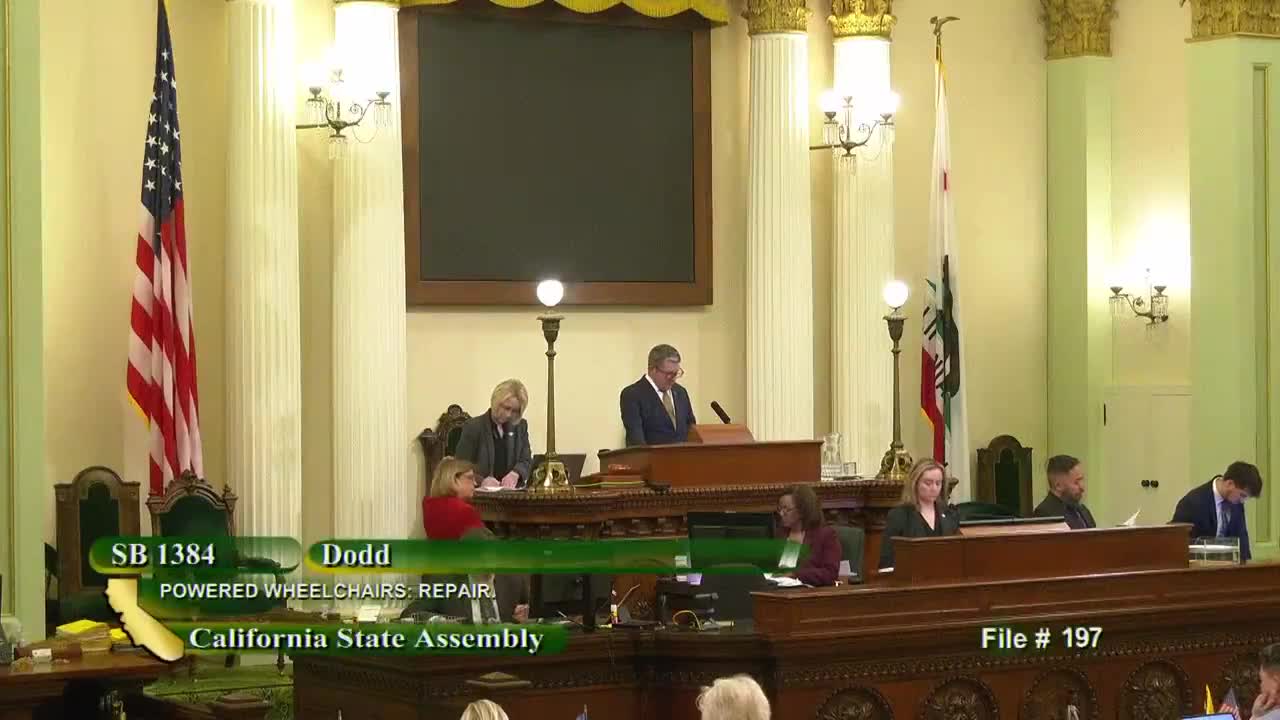 1MIN
Assembly Floor
 1MIN
Assembly Floor
 14MIN
Assembly Standing Committee on Appropriations
 29MIN
Assembly Standing Committee on Water, Parks, and Wildlife
 1MIN
Senate Floor
 35MIN
Senate Standing Committee on Natural Resources and Water
Bill Author
Bill Co-Author(s):