SB 53: Firearms: storage.
- Session Year: 2023-2024
- House: Senate
- Latest Version Date: 2024-09-24
Current Status:
Passed
(2024-09-24: Chaptered by Secretary of State. Chapter 542, Statutes of 2024.)
Introduced
In Committee
First Chamber
In Committee
Second Chamber
Enacted
Existing law generally regulates the possession of firearms, including imposing storage requirements to prevent children from gaining access to firearms.
This bill would, beginning on January 1, 2026, require a person who possesses a firearm in a residence to keep the firearm securely stored when the firearm is not being carried or readily controlled by the person or another lawful authorized user. For purposes of these provisions, a firearm is securely stored if the firearm is maintained within, locked by, or disabled using a certified firearm safety device or secure gun safe that meets specified standards. The bill would make a first and 2nd violation of this offense punishable as an infraction, and a 3rd or subsequent violation punishable as a misdemeanor. The bill would exempt unloaded antique firearms, as defined, or firearms that are permanently inoperable from these provisions. The bill would require the Department of Justice to seek to inform residents about these standards for storage of firearms. By creating a new crime, this bill would impose a state-mandated local program.
Existing law makes it a misdemeanor or a felony if a person keeps a firearm within any premises that are under the persons custody or control and the person knows or reasonably should know that a child is likely to gain access to the firearm without the permission of the childs parent or legal guardian, and the child obtains access to the firearm and causes injury, other than great bodily injury, or death or great bodily injury to the child or any other person, or carries that firearm off-premises, as defined, to a public place or a school. Existing law exempts a person from the above provisions if the person has no reasonable expectation, based on objective facts and circumstances, that a child is likely to be present on the premises.
This bill would remove these exemptions.
The California Constitution requires the state to reimburse local agencies and school districts for certain costs mandated by the state. Statutory provisions establish procedures for making that reimbursement.
This bill would provide that no reimbursement is required by this act for a specified reason.
Existing law generally regulates the possession of firearms, including imposing storage requirements to prevent children from gaining access to firearms.
This bill would, beginning on January 1, 2026, require a person who possesses a firearm in a residence to keep the firearm securely stored when the firearm is not being carried or readily controlled by the person or another lawful authorized user. For purposes of these provisions, a firearm is securely stored if the firearm is maintained within, locked by, or disabled using a certified firearm safety device or secure gun safe that meets specified standards. The bill would make a first and 2nd violation of this offense punishable as an infraction, and a 3rd or subsequent violation punishable as a misdemeanor. The bill would exempt firearms that are unloaded antiques or unloaded antique firearms, as defined, or firearms that are permanently inoperable from these provisions. The bill would require the Department of Justice to seek to inform residents about these standards for storage of firearms. By creating a new crime, this bill would impose a state-mandated local program.
Existing law makes it a misdemeanor or a felony if a person keeps a firearm within any premises that are under the persons custody or control and the person knows or reasonably should know that a child is likely to gain access to the firearm without the permission of the childs parent or legal guardian, and the child obtains access to the firearm and causes injury, other than great bodily injury, or death or great bodily injury to the child or any other person, or carries that firearm off-premises, as defined, to a public place or a school. Existing law exempts a person from the above provisions if the person has no reasonable expectation, based on objective facts and circumstances, that a child is likely to be present on the premises.
This bill would remove these exemptions.
The California Constitution requires the state to reimburse local agencies and school districts for certain costs mandated by the state. Statutory provisions establish procedures for making that reimbursement.
This bill would provide that no reimbursement is required by this act for a specified reason.
Existing law generally regulates the possession of firearms, including imposing storage requirements to prevent children from gaining access to firearms.
This bill would, beginning on January 1, 2026, prohibit the owner or other lawfully authorized user of a firearm from keeping or storing a firearm in a residence owned or controlled by that person unless the firearm is stored in a locked box or safe that is listed on the Department of Justices list of approved firearm safety devices and is properly engaged so that the firearm cannot be accessed by any person other than the owner, as specified. require a person who possesses a firearm in a residence to keep the firearm securely stored when the firearm is not being carried or readily controlled by the person or another lawful authorized user. For purposes of these provisions, a firearm is securely stored if the firearm is maintained within, locked by, or disabled using a certified firearm safety device or secure gun safe that meets specified standards. The bill would make a first and 2nd violation of this offense punishable as an infraction, and a second 3rd or subsequent violation punishable as a misdemeanor. The bill would exempt firearms that are unloaded antiques or permanently inoperable from these provisions. The bill would require the Department of Justice to promptly engage in a public awareness and education campaign seek to inform residents about these standards for storage of firearms. The bill would additionally prohibit a person convicted under these provisions from owning, purchasing, receiving, or possessing a firearm within one year of the conviction, as specified. The bill would make a violation of this provision punishable as a misdemeanor or felony. By creating a new crime, this bill would impose a state-mandated local program.
Existing law requires a firearm that is sold or transferred by a licensed firearms dealer, including a private transfer through a dealer, and any firearm manufactured in this state, to include or be accompanied by a firearm safety device, as specified.This bill would instead require, beginning on January 1, 2026, the firearm to include or be accompanied by a lock box or safe, except as specified.Existing law makes it a misdemeanor or a felony if a person keeps a firearm within any premises that are under the persons custody or control and the person knows or reasonably should know that a child is likely to gain access to the firearm without the permission of the childs parent or legal guardian, and the child obtains access to the firearm and causes injury, other than great bodily injury, or death or great bodily injury to the child or any other person, or carries that firearm off-premises, as defined, to a public place or a school. Existing law exempts a person from the above provisions if the person has no reasonable expectation, based on objective facts and circumstances, that a child is likely to be present on the premises.
This bill would remove these exemptions.
The California Constitution requires the state to reimburse local agencies and school districts for certain costs mandated by the state. Statutory provisions establish procedures for making that reimbursement.
This bill would provide that no reimbursement is required by this act for a specified reason.
Existing law generally regulates the possession of firearms, including imposing storage requirements to prevent children from gaining access to firearms.
This bill would, beginning on July 1, 2025, January 1, 2026, prohibit a person the owner or other lawfully authorized user of a firearm from keeping or storing a firearm in a residence owned or controlled by that person unless the firearm is stored in a locked box or safe that is listed on the Department of Justices list of approved firearms firearm safety devices and is properly engaged so as to render it inaccessible that the firearm cannot be accessed by any person other than the owner, as specified. The bill would make a first violation of this offense punishable as an infraction, and a second or subsequent violation punishable as a misdemeanor. The bill would exempt firearms that are permanently inoperable from these provisions. The bill would require the Department of Justice to promptly engage in a public awareness and education campaign to inform residents about these standards for storage of firearms. The bill would additionally prohibit a person convicted under these provisions from owning, purchasing, receiving, or possessing a firearm within one year of the conviction, as specified. The bill would make a violation of this provision punishable as a misdemeanor or felony. By creating a new crime, this bill would impose a state-mandated local program.
Existing law requires a firearm that is sold or transferred by a licensed firearms dealer, including a private transfer through a dealer, and any firearm manufactured in this state, to include or be accompanied by a firearm safety device, as specified.
This bill would instead require, beginning on January 1, 2026, the firearm to include or be accompanied by a lock box or safe, except as specified.
Existing law makes it a misdemeanor or a felony if a person keeps a firearm within any premises that are under the persons custody or control and the person knows or reasonably should know that a child is likely to gain access to the firearm without the permission of the childs parent or legal guardian, and the child obtains access to the firearm and causes injury, other than great bodily injury, or death or great bodily injury to the child or any other person, or carries that firearm off-premises, as defined, to a public place or a school. Existing law exempts a person from the above provisions if the person has no reasonable expectation, based on objective facts and circumstances, that a child is likely to be present on the premises.
This bill would remove these exemptions.
The California Constitution requires the state to reimburse local agencies and school districts for certain costs mandated by the state. Statutory provisions establish procedures for making that reimbursement.
This bill would provide that no reimbursement is required by this act for a specified reason.
Existing law generally regulates the possession of firearms, including imposing storage requirements to prevent children from gaining access to firearms.
This bill would, beginning on July 1, 2025, prohibit a person from keeping or storing a firearm in a residence owned or controlled by that person unless the firearm is stored in a locked box or safe that is listed on the Department of Justices list of approved firearms safety devices and is properly engaged so as to render it inaccessible by any person other than the owner, as specified. The bill would make a first violation of this offense punishable as an infraction, and a second or subsequent violation punishable as a misdemeanor. The bill would exempt firearms that are permanently inoperable from these provisions. The bill would require the Department of Justice to promptly engage in a public awareness and education campaign to inform residents about these standards for storage of firearms. The bill would additionally prohibit a person convicted under these provisions from owning, purchasing, receiving, or possessing a firearm within one year of the conviction, as specified. The bill would make a violation of this provision punishable as a misdemeanor or felony. By creating a new crime, this bill would impose a state-mandated local program.
The California Constitution requires the state to reimburse local agencies and school districts for certain costs mandated by the state. Statutory provisions establish procedures for making that reimbursement.
This bill would provide that no reimbursement is required by this act for a specified reason.
The Personal Income Tax Law and the Corporation Tax Law allow various credits against the taxes imposed by those laws, including a motion picture credit for taxable years beginning on or after January 1, 2020, to be allocated by the California Film Commission on or after July 1, 2020, and before July 1, 2025, in an amount equal to 20% or 25% of qualified expenditures for the production of a qualified motion picture in this state, with additional credit amounts allowed, including for amounts equal to specified qualified expenditures and qualified wages relating to original photography outside the Los Angeles zone, as specified.This bill would make nonsubstantive changes to the motion picture credit.The Personal Income Tax Law and the Corporation Tax Law allow various credits against the taxes imposed by those laws, including a motion picture credit for taxable years beginning on or after January 1, 2020, to be allocated by the California Film Commission on or after July 1, 2020, and before July 1, 2025, in an amount equal to 20% or 25% of qualified expenditures for the production of a qualified motion picture in this state, with additional credit amounts allowed, including for amounts equal to specified qualified expenditures and qualified wages relating to original photography outside the Los Angeles zone, as specified.
This bill would make nonsubstantive changes to the motion picture credit.
As used in Sections 25105, 25135, and 25145, authorized user means an individual who is not prohibited by state or federal law from possessing, receiving, owning, or purchasing a firearm and who meets either of the following requirements:
(a)The individual is the lawful owner of the firearm.
(b)The individual has been lawfully authorized by the lawful owner of the firearm to access, possess, and use the firearm.
SEC. 2.Section 17060 of the Penal Code is amended to read:17060.(a)As used in Section 25135, residence means any structure intended or used for human habitation, including, but not limited to, houses, condominiums, rooms, motels, hotels, time-shares, and recreational or other vehicles where human habitation occurs.
(b)As used in Sections 27881, 27882, and 27883, residence means any structure intended or used for human habitation, including, but not limited to, houses, condominiums, rooms, motels, hotels, and time-shares, but does not include recreational vehicles or other vehicles where human habitation occurs.
(c)This section shall remain in effect only until January 1, 2026, and as of that date is repealed.
SEC. 3.Section 17060 is added to the Penal Code, to read:17060.(a)(1)As used in Sections 25135 and 25145, residence means a structure intended or used for human habitation, including, but not limited to, houses, condominiums, rooms, motels, hotels, time-shares, and recreational or other vehicles where human habitation occurs.
(2)As used in Sections 27881, 27882, and 27883, residence means a structure intended or used for human habitation, including, but not limited to, houses, condominiums, rooms, motels, hotels, and time-shares, but does not include recreational vehicles or other vehicles where human habitation occurs.
(b)This section shall become operative on January 1, 2026.
SEC. 4.Section 25100 of the Penal Code is amended to read:25100.(a)Except as provided in Section 25105, a person commits the crime of criminal storage of a firearm in the first degree if all of the following conditions are satisfied:
(1)The person keeps any firearm within any premises that are under the persons custody or control.
(2)The person knows or reasonably should know that a child is likely to gain access to the firearm without the permission of the childs parent or legal guardian, or that a person prohibited from possessing a firearm or deadly weapon pursuant to state or federal law is likely to gain access to the firearm.
(3)The child obtains access to the firearm and thereby causes death or great bodily injury to the child or any other person, or the person prohibited from possessing a firearm or deadly weapon pursuant to state or federal law obtains access to the firearm and thereby causes death or great bodily injury to themselves or any other person.
(b)Except as provided in Section 25105, a person commits the crime of criminal storage of a firearm in the second degree if all of the following conditions are satisfied:
(1)The person keeps any firearm within any premises that are under the persons custody or control.
(2)The person knows or reasonably should know that a child is likely to gain access to the firearm without the permission of the childs parent or legal guardian, or that a person prohibited from possessing a firearm or deadly weapon pursuant to state or federal law is likely to gain access to the firearm.
(3)The child obtains access to the firearm and thereby causes injury, other than great bodily injury, to the child or any other person, or carries the firearm either to a public place or in violation of Section 417, or the person prohibited from possessing a firearm or deadly weapon pursuant to state or federal law obtains access to the firearm and thereby causes injury, other than great bodily injury, to themselves or any other person, or carries the firearm either to a public place or in violation of Section 417.
(c)Except as provided in Section 25105, a person commits the crime of criminal storage of a firearm in the third degree if the person keeps any firearm within any premises that are under the persons custody or control and negligently stores or leaves a firearm in a location where the person knows, or reasonably should know, that a child is likely to gain access to the firearm without the permission of the childs parent or legal guardian, unless reasonable action is taken by the person to secure the firearm against access by the child.
(d)This section shall remain in effect only until January 1, 2026, and as of that date is repealed.
SEC. 5.Section 25100 is added to the Penal Code, to read:25100.(a)Except as provided in Section 25105, a person commits the crime of criminal storage of a firearm in the first degree if all of the following conditions are satisfied:
(1)The person keeps any firearm within any premises that are under the persons custody or control.
(2)The person knows or reasonably should know that a child is likely to gain access to the firearm without the permission of the childs parent or legal guardian, or that a person prohibited from possessing a firearm or deadly weapon pursuant to state or federal law is likely to gain access to the firearm.
(3)The child obtains access to the firearm and thereby causes death or great bodily injury to the child or any other person, or the person prohibited from possessing a firearm or deadly weapon pursuant to state or federal law obtains access to the firearm and thereby causes death or great bodily injury to themselves or any other person.
(b)Except as provided in Section 25105, a person commits the crime of criminal storage of a firearm in the second degree if all of the following conditions are satisfied:
(1)The person keeps any firearm within any premises that are under the persons custody or control.
(2)The person knows or reasonably should know that a child is likely to gain access to the firearm without the permission of the childs parent or legal guardian, or that a person prohibited from possessing a firearm or deadly weapon pursuant to state or federal law is likely to gain access to the firearm.
(3)The child obtains access to the firearm and thereby causes injury, other than great bodily injury, to the child or any other person, or carries the firearm either to a public place or in violation of Section 417, or the person prohibited from possessing a firearm or deadly weapon pursuant to state or federal law obtains access to the firearm and thereby causes injury, other than great bodily injury, to themselves or any other person, or carries the firearm either to a public place or in violation of Section 417.
(c)Except as provided in Section 25105, a person commits the crime of criminal storage of a firearm in the third degree if the person keeps any firearm within any premises that are under the persons custody or control and negligently stores or leaves a firearm in a location where the person knows, or reasonably should know, that a child is likely to gain access to the firearm without the permission of the childs parent or legal guardian.
(d)This section shall become operative on January 1, 2026.
SEC. 6.Section 25105 of the Penal Code is amended to read:25105.Section 25100 does not apply whenever any of the following occurs:
(a)The child obtains the firearm as a result of an illegal entry to any premises by any person.
(b)The firearm is kept in a locked container or in a location that a reasonable person would believe to be secure.
(c)The firearm is carried on the person or within close enough proximity thereto that the individual can readily retrieve and use the firearm as if carried on the person.
(d)The firearm is locked with a locking device, as defined in Section 16860, which has rendered the firearm inoperable.
(e)The person is a peace officer or a member of the United States Armed Forces or the National Guard and the child obtains the firearm during, or incidental to, the performance of the persons duties.
(f)The child obtains, or obtains and discharges, the firearm in a lawful act of self-defense or defense of another person.
(g)The person who keeps a firearm on premises that are under the persons custody or control has no reasonable expectation, based on objective facts and circumstances, that a child is likely to be present on the premises.
(h)This section shall remain in effect only until January 1, 2026, and as of that date is repealed.
SEC. 7.Section 25105 is added to the Penal Code, to read:25105.Section 25100 does not apply whenever any of the following occurs:
(a)The child obtains the firearm as a result of an illegal entry to any premises by any person.
(b)The firearm is securely stored, as defined in Section 25145.
(c)The firearm is carried or readily controlled by the lawful owner or another lawful authorized user, as defined in Section 25145.
(d)The person is a peace officer or a member of the United States Armed Forces or the National Guard and the child obtains the firearm during, or incidental to, the performance of the persons duties.
(e)The child obtains, or obtains and discharges, the firearm in a lawful act of self-defense or defense of another person.
(f)This section shall become operative on January 1, 2026.
SEC. 8.Section 25135 of the Penal Code is amended to read:25135.(a)A person who is 18 years of age or older, and who is the owner, lessee, renter, or other legal occupant of a residence, who owns a firearm and who knows or has reason to know that another person also residing therein is prohibited by state or federal law from possessing, receiving, owning, or purchasing a firearm shall not keep in that residence any firearm that they own unless one of the following applies:
(1)The firearm is maintained within a locked container.
(2)The firearm is disabled by a firearm safety device.
(3)The firearm is maintained within a locked gun safe.
(4)The firearm is maintained within a locked trunk.
(5)The firearm is locked with a locking device as described in Section 16860, which has rendered the firearm inoperable.
(6)The firearm is carried on the person or within close enough proximity thereto that the individual can readily retrieve and use the firearm as if carried on the person.
(b)A violation of this section is a misdemeanor.
(c)The provisions of this section are cumulative, and do not restrict the application of any other law. However, an act or omission punishable in different ways by different provisions of law shall not be punished under more than one provision.
(d)This section shall remain in effect only until January 1, 2026, and as of that date is repealed.
SEC. 9.Section 25135 is added to the Penal Code, to read:25135.(a)A person who is 18 years of age or older, and who is the owner, lessee, renter, or other legal occupant of a residence, who owns a firearm and who knows or has reason to know that another person also residing therein is prohibited by state or federal law from possessing, receiving, owning, or purchasing a firearm shall not keep in that residence a firearm unless one of the following applies:
(1)The firearm is securely stored, as defined in Section 25145.
(2)The firearm is carried or readily controlled by the lawful owner or another lawful authorized user, as defined in Section 25145.
(b)A violation of this section is a misdemeanor.
(c)The provisions of this section are cumulative, and do not restrict the application of any other law. However, an act or omission punishable in different ways by different provisions of law shall not be punished under more than one provision.
(d)This section shall become operative on January 1, 2026.
SEC. 10.Section 25145 is added to the Penal Code, to read:25145.(a)Beginning on January 1, 2026, a person shall ensure that any firearm the person possesses in a residence is securely stored whenever the firearm is not being carried or readily controlled by the person or another lawful authorized user.
(b)A firearm is securely stored if it is maintained within, locked by, or disabled using a certified firearm safety device or a secure gun safe.
(c)For purposes of this section and Sections 25105, 25135, 25205, 27882, and 27883, the following terms have the following meanings:
(1)Authorized user has the same meaning as provided in Section 16745.
(2)Certified firearm safety device means any firearm safety device or gun safe that is listed on the Department of Justices roster of tested and approved firearm safety devices certified for sale pursuant to Section 23655.
(3)Readily controlled by a person or another lawful authorized user means either of the following:
(A)The person or other lawful authorized user is carrying the firearm on their person.
(B)The person or other lawful authorized user is within close enough proximity to the firearm to readily prevent unauthorized users from gaining access to the firearm.
(4)Secure gun safe means a gun safe that meets the standards for gun safes adopted pursuant to Section 23650.
(d)(1)Except as provided in paragraph (2), a violation of this section is punishable by a fine of up to two hundred fifty dollars ($250) for a first violation and up to five hundred dollars ($500) for a second violation. A third and any subsequent violation is a misdemeanor.
(2)A person shall not be penalized for violating this section if they secure their firearm using a firearm safety device or gun safe that they reasonably believed to meet the requirements of this section, including a firearm safety device that was certified at the time the individual purchased the device or a safe that met the standards for gun safes adopted pursuant to Section 23650 at the time the individual purchased the safe.
(e)The provisions of this section are cumulative and do not restrict the application of any other law. However, an act or omission punishable in different ways by different provisions of law shall not be punished under more than one provision.
(f)The Department of Justice shall seek to inform residents about the standards of storage of firearms as outlined in this section.
(g)This section does not apply to unloaded antique firearms, as defined in Section 921(a)(16) of Title 18 of the United States Code, or firearms that are permanently inoperable.
SEC. 11.Section 25205 of the Penal Code is amended to read:25205.Section 25200 does not apply if any of the following are true:
(a)The child obtains the firearm as a result of an illegal entry into any premises by any person.
(b)The firearm is kept in a locked container or in a location that a reasonable person would believe to be secure.
(c)The firearm is locked with a locking device, as defined in Section 16860, which has rendered the firearm inoperable.
(d)The firearm is carried on the person within close enough range that the individual can readily retrieve and use the firearm as if carried on the person.
(e)The person is a peace officer or a member of the United States Armed Forces or National Guard and the child obtains the firearm during, or incidental to, the performance of the persons duties.
(f)The child obtains, or obtains and discharges, the firearm in a lawful act of self-defense or defense of another person.
(g)The person who keeps a firearm has no reasonable expectation, based on objective facts and circumstances, that a child is likely to be present on the premises.
(h)This section shall remain in effect only until January 1, 2026, and as of that date is repealed.
SEC. 12.Section 25205 is added to the Penal Code, to read:25205.Section 25200 does not apply if any of the following are true:
(a)The child obtains the firearm as a result of an illegal entry into any premises by any person.
(b)The firearm is securely stored, as defined in Section 25145.
(c)The firearm is carried or readily controlled by the lawful owner or another lawful authorized user, as defined in Section 25145.
(d)The person is a peace officer or a member of the United States Armed Forces or National Guard and the child obtains the firearm during, or incidental to, the performance of the persons duties.
(e)The child obtains, or obtains and discharges, the firearm in a lawful act of self-defense or defense of another person.
(f)This section shall become operative on January 1, 2026.
SEC. 13.Section 27882 of the Penal Code is amended to read:27882.(a)Section 27545 does not apply to the transfer of a firearm if all of the following conditions are satisfied:
(1)The firearm is voluntarily and temporarily transferred to another person who is 18 years of age or older for safekeeping to prevent it from being accessed or used to attempt suicide by the transferor or another person that may gain access to it in the transferors household.
(2)The transferee does not use the firearm for any purpose and, except when transporting the firearm to the transferees residence or when returning it to the transferor, keeps the firearm unloaded and secured in the transferees residence in one of the following ways:
(A)Secured in a locked container.
(B)Disabled by a firearm safety device.
(C)Secured within a locked gun safe.
(D)Locked with a locking device as described in Section 16860 that has rendered the firearm inoperable.
(3)The duration of the loan is limited to that amount of time reasonably necessary to prevent the harm described in paragraph (1).
(b)(1)If a firearm that has been transferred pursuant to this section cannot be returned to the owner because the owner is prohibited from possessing a firearm, the person in possession of the firearm shall deliver the firearm to a law enforcement agency without delay.
(2)Section 27545 does not apply to the transfer of a firearm to a law enforcement agency pursuant to this subdivision. This section does not authorize the possession of a firearm by any person prohibited from possessing a firearm pursuant to any other law.
(c)This section shall remain in effect only until January 1, 2026, and as of that date is repealed.
SEC. 14.Section 27882 is added to the Penal Code, to read:27882.(a)Section 27545 does not apply to the transfer of a firearm if all of the following conditions are satisfied:
(1)The firearm is voluntarily and temporarily transferred to another person who is 18 years of age or older for safekeeping to prevent it from being accessed or used to attempt suicide by the transferor or another person that may gain access to it in the transferors household.
(2)The transferee does not use the firearm for any purpose and, except when transporting the firearm to the transferees residence or when returning it to the transferor, keeps the firearm unloaded and securely stored, as defined in Section 25145, in the transferees residence.
(3)The duration of the loan is limited to that amount of time reasonably necessary to prevent the harm described in paragraph (1).
(4)The individual receiving the firearm is not prohibited by state or federal law from possessing, receiving, owning, or purchasing a firearm.
(b)(1)If a firearm that has been transferred pursuant to this section cannot be returned to the owner because the owner is prohibited from possessing a firearm, the person in possession of the firearm shall deliver the firearm to a law enforcement agency without delay.
(2)Section 27545 does not apply to the transfer of a firearm to a law enforcement agency pursuant to this subdivision. This section does not authorize the possession of a firearm by any person prohibited from possessing a firearm pursuant to any other law.
(c)This section shall become operative on January 1, 2026.
SEC. 15.Section 27883 of the Penal Code is amended to read:27883.Section 27545 does not apply to the loan of a firearm provided all of the following requirements are met:
(a)The firearm being loaned is registered to the person making the loan pursuant to Section 11106.
(b)The firearm being loaned is stored in the receivers place of residence or in an enclosed structure on the receivers private property, which is not zoned for commercial, retail, or industrial activity.
(c)The firearm at all times stays within the receivers place of residence or in an enclosed structure on the receivers private property, which is not zoned for commercial, retail, or industrial activity.
(d)The individual receiving the firearm is not prohibited by state or federal law from possessing, receiving, owning, or purchasing a firearm.
(e)The individual receiving the firearm is 18 years of age or older.
(f)One of the following applies:
(1)The firearm is maintained within a locked container.
(2)The firearm is disabled by a firearm safety device.
(3)The firearm is maintained within a locked gun safe.
(4)The firearm is locked with a locking device, as defined in Section 16860, which has rendered the firearm inoperable.
(g)The loan does not exceed 120 days in duration.
(h)The loan is made without consideration.
(i)There is a written document in a format prescribed by the Department of Justice that explains the obligations imposed by this section that is signed by both the party loaning the firearm for storage and the person receiving the firearm.
(j)Both parties to the loan have signed copies of the written document required by subdivision (i).
(k)This section shall remain in effect only until January 1, 2026, and as of that date is repealed.
SEC. 16.Section 27883 is added to the Penal Code, to read:27883.Section 27545 does not apply to the loan of a firearm provided all of the following requirements are met:
(a)The firearm being loaned is lawfully owned by the person making the loan pursuant to Section 11106.
(b)The firearm being loaned is stored in the receivers place of residence or in an enclosed structure on the receivers private property, which is not zoned for commercial, retail, or industrial activity.
(c)The firearm at all times stays within the receivers place of residence or in an enclosed structure on the receivers private property, which is not zoned for commercial, retail, or industrial activity.
(d)The individual receiving the firearm is not prohibited by state or federal law from possessing, receiving, owning, or purchasing a firearm.
(e)The individual receiving the firearm is 18 years of age or older.
(f)The firearm is unloaded and securely stored, as defined in Section 25145.
(g)The loan does not exceed 120 days in duration.
(h)The loan is made without consideration.
(i)There is a written document in a format prescribed by the Department of Justice that explains the obligations imposed by this section that is signed by both the party loaning the firearm for storage and the person receiving the firearm.
(j)Both parties to the loan have signed copies of the written document required by subdivision (i).
(k)(1)If a firearm that has been transferred pursuant to this section cannot be returned to the owner because the owner is prohibited from possessing a firearm, the person in possession of the firearm shall deliver the firearm to a law enforcement agency without delay.
(2)Section 27545 does not apply to the transfer of a firearm to a law enforcement agency pursuant to this subdivision. This section does not authorize the possession of a firearm by any person prohibited from possessing a firearm pursuant to any other law.
(l)This section shall become operative on January 1, 2026.
SEC. 17.The provisions of this act are severable. If any provision of this act or its application is held invalid, that invalidity shall not affect other provisions or applications that can be given effect without the invalid provision or application.
SEC. 18.No reimbursement is required by this act pursuant to Section 6 of Article XIIIB of the California Constitution because the only costs that may be incurred by a local agency or school district will be incurred because this act creates a new crime or infraction, eliminates a crime or infraction, or changes the penalty for a crime or infraction, within the meaning of Section 17556 of the Government Code, or changes the definition of a crime within the meaning of Section 6 of Article XIIIB of the California Constitution.
As used in Sections 25105, 25135, and 25145, authorized user means an individual who is not prohibited by state or federal law from possessing, receiving, owning, or purchasing a firearm and who meets either of the following requirements:
(a)The individual is the lawful owner of the firearm.
(b)The individual has been lawfully authorized by the lawful owner of the firearm to access, possess, and use the firearm.
SEC. 2.Section 17060 of the Penal Code is amended to read:17060.(a)As used in Section 25135, residence means any structure intended or used for human habitation, including, but not limited to, houses, condominiums, rooms, motels, hotels, time-shares, and recreational or other vehicles where human habitation occurs.
(b)As used in Sections 27881, 27882, and 27883, residence means any structure intended or used for human habitation, including, but not limited to, houses, condominiums, rooms, motels, hotels, and time-shares, but does not include recreational vehicles or other vehicles where human habitation occurs.
(c)This section shall remain in effect only until January 1, 2026, and as of that date is repealed.
SEC. 3.Section 17060 is added to the Penal Code, to read:17060.(a)(1)As used in Sections 25135 and 25145, residence means a structure intended or used for human habitation, including, but not limited to, houses, condominiums, rooms, motels, hotels, time-shares, and recreational or other vehicles where human habitation occurs.
(2)As used in Sections 27881, 27882, and 27883, residence means a structure intended or used for human habitation, including, but not limited to, houses, condominiums, rooms, motels, hotels, and time-shares, but does not include recreational vehicles or other vehicles where human habitation occurs.
(b)This section shall become operative on January 1, 2026.
SEC. 4.Section 25100 of the Penal Code is amended to read:25100.(a)Except as provided in Section 25105, a person commits the crime of criminal storage of a firearm in the first degree if all of the following conditions are satisfied:
(1)The person keeps any firearm within any premises that are under the persons custody or control.
(2)The person knows or reasonably should know that a child is likely to gain access to the firearm without the permission of the childs parent or legal guardian, or that a person prohibited from possessing a firearm or deadly weapon pursuant to state or federal law is likely to gain access to the firearm.
(3)The child obtains access to the firearm and thereby causes death or great bodily injury to the child or any other person, or the person prohibited from possessing a firearm or deadly weapon pursuant to state or federal law obtains access to the firearm and thereby causes death or great bodily injury to themselves or any other person.
(b)Except as provided in Section 25105, a person commits the crime of criminal storage of a firearm in the second degree if all of the following conditions are satisfied:
(1)The person keeps any firearm within any premises that are under the persons custody or control.
(2)The person knows or reasonably should know that a child is likely to gain access to the firearm without the permission of the childs parent or legal guardian, or that a person prohibited from possessing a firearm or deadly weapon pursuant to state or federal law is likely to gain access to the firearm.
(3)The child obtains access to the firearm and thereby causes injury, other than great bodily injury, to the child or any other person, or carries the firearm either to a public place or in violation of Section 417, or the person prohibited from possessing a firearm or deadly weapon pursuant to state or federal law obtains access to the firearm and thereby causes injury, other than great bodily injury, to themselves or any other person, or carries the firearm either to a public place or in violation of Section 417.
(c)Except as provided in Section 25105, a person commits the crime of criminal storage of a firearm in the third degree if the person keeps any firearm within any premises that are under the persons custody or control and negligently stores or leaves a firearm in a location where the person knows, or reasonably should know, that a child is likely to gain access to the firearm without the permission of the childs parent or legal guardian, unless reasonable action is taken by the person to secure the firearm against access by the child.
(d)This section shall remain in effect only until January 1, 2026, and as of that date is repealed.
SEC. 5.Section 25100 is added to the Penal Code, to read:25100.(a)Except as provided in Section 25105, a person commits the crime of criminal storage of a firearm in the first degree if all of the following conditions are satisfied:
(1)The person keeps any firearm within any premises that are under the persons custody or control.
(2)The person knows or reasonably should know that a child is likely to gain access to the firearm without the permission of the childs parent or legal guardian, or that a person prohibited from possessing a firearm or deadly weapon pursuant to state or federal law is likely to gain access to the firearm.
(3)The child obtains access to the firearm and thereby causes death or great bodily injury to the child or any other person, or the person prohibited from possessing a firearm or deadly weapon pursuant to state or federal law obtains access to the firearm and thereby causes death or great bodily injury to themselves or any other person.
(b)Except as provided in Section 25105, a person commits the crime of criminal storage of a firearm in the second degree if all of the following conditions are satisfied:
(1)The person keeps any firearm within any premises that are under the persons custody or control.
(2)The person knows or reasonably should know that a child is likely to gain access to the firearm without the permission of the childs parent or legal guardian, or that a person prohibited from possessing a firearm or deadly weapon pursuant to state or federal law is likely to gain access to the firearm.
(3)The child obtains access to the firearm and thereby causes injury, other than great bodily injury, to the child or any other person, or carries the firearm either to a public place or in violation of Section 417, or the person prohibited from possessing a firearm or deadly weapon pursuant to state or federal law obtains access to the firearm and thereby causes injury, other than great bodily injury, to themselves or any other person, or carries the firearm either to a public place or in violation of Section 417.
(c)Except as provided in Section 25105, a person commits the crime of criminal storage of a firearm in the third degree if the person keeps any firearm within any premises that are under the persons custody or control and negligently stores or leaves a firearm in a location where the person knows, or reasonably should know, that a child is likely to gain access to the firearm without the permission of the childs parent or legal guardian.
(d)This section shall become operative on January 1, 2026.
SEC. 6.Section 25105 of the Penal Code is amended to read:25105.Section 25100 does not apply whenever any of the following occurs:
(a)The child obtains the firearm as a result of an illegal entry to any premises by any person.
(b)The firearm is kept in a locked container or in a location that a reasonable person would believe to be secure.
(c)The firearm is carried on the person or within close enough proximity thereto that the individual can readily retrieve and use the firearm as if carried on the person.
(d)The firearm is locked with a locking device, as defined in Section 16860, which has rendered the firearm inoperable.
(e)The person is a peace officer or a member of the United States Armed Forces or the National Guard and the child obtains the firearm during, or incidental to, the performance of the persons duties.
(f)The child obtains, or obtains and discharges, the firearm in a lawful act of self-defense or defense of another person.
(g)The person who keeps a firearm on premises that are under the persons custody or control has no reasonable expectation, based on objective facts and circumstances, that a child is likely to be present on the premises.
(h)This section shall remain in effect only until January 1, 2026, and as of that date is repealed.
SEC. 7.Section 25105 is added to the Penal Code, to read:25105.Section 25100 does not apply whenever any of the following occurs:
(a)The child obtains the firearm as a result of an illegal entry to any premises by any person.
(b)The firearm is securely stored, as defined in Section 25145.
(c)The firearm is carried or readily controlled by the lawful owner or another lawful authorized user, as defined in Section 25145.
(d)The person is a peace officer or a member of the United States Armed Forces or the National Guard and the child obtains the firearm during, or incidental to, the performance of the persons duties.
(e)The child obtains, or obtains and discharges, the firearm in a lawful act of self-defense or defense of another person.
(f)This section shall become operative on January 1, 2026.
SEC. 8.Section 25135 of the Penal Code is amended to read:25135.(a)A person who is 18 years of age or older, and who is the owner, lessee, renter, or other legal occupant of a residence, who owns a firearm and who knows or has reason to know that another person also residing therein is prohibited by state or federal law from possessing, receiving, owning, or purchasing a firearm shall not keep in that residence any firearm that they own unless one of the following applies:
(1)The firearm is maintained within a locked container.
(2)The firearm is disabled by a firearm safety device.
(3)The firearm is maintained within a locked gun safe.
(4)The firearm is maintained within a locked trunk.
(5)The firearm is locked with a locking device as described in Section 16860, which has rendered the firearm inoperable.
(6)The firearm is carried on the person or within close enough proximity thereto that the individual can readily retrieve and use the firearm as if carried on the person.
(b)A violation of this section is a misdemeanor.
(c)The provisions of this section are cumulative, and do not restrict the application of any other law. However, an act or omission punishable in different ways by different provisions of law shall not be punished under more than one provision.
(d)This section shall remain in effect only until January 1, 2026, and as of that date is repealed.
SEC. 9.Section 25135 is added to the Penal Code, to read:25135.(a)A person who is 18 years of age or older, and who is the owner, lessee, renter, or other legal occupant of a residence, who owns a firearm and who knows or has reason to know that another person also residing therein is prohibited by state or federal law from possessing, receiving, owning, or purchasing a firearm shall not keep in that residence a firearm unless one of the following applies:
(1)The firearm is securely stored, as defined in Section 25145.
(2)The firearm is carried or readily controlled by the lawful owner or another lawful authorized user, as defined in Section 25145.
(b)A violation of this section is a misdemeanor.
(c)The provisions of this section are cumulative, and do not restrict the application of any other law. However, an act or omission punishable in different ways by different provisions of law shall not be punished under more than one provision.
(d)This section shall become operative on January 1, 2026.
SEC. 10.Section 25145 is added to the Penal Code, to read:25145.(a)Beginning on January 1, 2026, a person shall ensure that any firearm the person possesses in a residence is securely stored whenever the firearm is not being carried or readily controlled by the person or another lawful authorized user.
(b)A firearm is securely stored if it is maintained within, locked by, or disabled using a certified firearm safety device or a secure gun safe.
(c)For purposes of this section and Sections 25105, 25135, 25205, 27882, and 27883, the following terms have the following meanings:
(1)Authorized user has the same meaning as provided in Section 16745.
(2)Certified firearm safety device means any firearm safety device or gun safe that is listed on the Department of Justices roster of tested and approved firearm safety devices certified for sale pursuant to Section 23655.
(3)Readily controlled by a person or another lawful authorized user means either of the following:
(A)The person or other lawful authorized user is carrying the firearm on their person.
(B)The person or other lawful authorized user is within close enough proximity to the firearm to readily prevent unauthorized users from gaining access to the firearm.
(4)Secure gun safe means a gun safe that meets the standards for gun safes adopted pursuant to Section 23650.
(d)(1)Except as provided in paragraph (2), a violation of this section is punishable by a fine of up to two hundred fifty dollars ($250) for a first violation and up to five hundred dollars ($500) for a second violation. A third and any subsequent violation is a misdemeanor.
(2)A person shall not be penalized for violating this section if they secure their firearm using a firearm safety device or gun safe that they reasonably believed to meet the requirements of this section, including a firearm safety device that was certified at the time the individual purchased the device or a safe that met the standards for gun safes adopted pursuant to Section 23650 at the time the individual purchased the safe.
(e)The provisions of this section are cumulative and do not restrict the application of any other law. However, an act or omission punishable in different ways by different provisions of law shall not be punished under more than one provision.
(f)The Department of Justice shall seek to inform residents about the standards of storage of firearms as outlined in this section.
(g)This section does not apply to firearms that are unloaded antiques unloaded antique firearms, as defined in Section 921(a)(16) of Title 18 of the United States Code, or firearms that are permanently inoperable.
SEC. 11.Section 25205 of the Penal Code is amended to read:25205.Section 25200 does not apply if any of the following are true:
(a)The child obtains the firearm as a result of an illegal entry into any premises by any person.
(b)The firearm is kept in a locked container or in a location that a reasonable person would believe to be secure.
(c)The firearm is locked with a locking device, as defined in Section 16860, which has rendered the firearm inoperable.
(d)The firearm is carried on the person within close enough range that the individual can readily retrieve and use the firearm as if carried on the person.
(e)The person is a peace officer or a member of the United States Armed Forces or National Guard and the child obtains the firearm during, or incidental to, the performance of the persons duties.
(f)The child obtains, or obtains and discharges, the firearm in a lawful act of self-defense or defense of another person.
(g)The person who keeps a firearm has no reasonable expectation, based on objective facts and circumstances, that a child is likely to be present on the premises.
(h)This section shall remain in effect only until January 1, 2026, and as of that date is repealed.
SEC. 12.Section 25205 is added to the Penal Code, to read:25205.Section 25200 does not apply if any of the following are true:
(a)The child obtains the firearm as a result of an illegal entry into any premises by any person.
(b)The firearm is securely stored, as defined in Section 25145.
(c)The firearm is carried or readily controlled by the lawful owner or another lawful authorized user, as defined in Section 25145.
(d)The person is a peace officer or a member of the United States Armed Forces or National Guard and the child obtains the firearm during, or incidental to, the performance of the persons duties.
(e)The child obtains, or obtains and discharges, the firearm in a lawful act of self-defense or defense of another person.
(f)This section shall become operative on January 1, 2026.
SEC. 13.Section 27882 of the Penal Code is amended to read:27882.(a)Section 27545 does not apply to the transfer of a firearm if all of the following conditions are satisfied:
(1)The firearm is voluntarily and temporarily transferred to another person who is 18 years of age or older for safekeeping to prevent it from being accessed or used to attempt suicide by the transferor or another person that may gain access to it in the transferors household.
(2)The transferee does not use the firearm for any purpose and, except when transporting the firearm to the transferees residence or when returning it to the transferor, keeps the firearm unloaded and secured in the transferees residence in one of the following ways:
(A)Secured in a locked container.
(B)Disabled by a firearm safety device.
(C)Secured within a locked gun safe.
(D)Locked with a locking device as described in Section 16860 that has rendered the firearm inoperable.
(3)The duration of the loan is limited to that amount of time reasonably necessary to prevent the harm described in paragraph (1).
(b)(1)If a firearm that has been transferred pursuant to this section cannot be returned to the owner because the owner is prohibited from possessing a firearm, the person in possession of the firearm shall deliver the firearm to a law enforcement agency without delay.
(2)Section 27545 does not apply to the transfer of a firearm to a law enforcement agency pursuant to this subdivision. This section does not authorize the possession of a firearm by any person prohibited from possessing a firearm pursuant to any other law.
(c)This section shall remain in effect only until January 1, 2026, and as of that date is repealed.
SEC. 14.Section 27882 is added to the Penal Code, to read:27882.(a)Section 27545 does not apply to the transfer of a firearm if all of the following conditions are satisfied:
(1)The firearm is voluntarily and temporarily transferred to another person who is 18 years of age or older for safekeeping to prevent it from being accessed or used to attempt suicide by the transferor or another person that may gain access to it in the transferors household.
(2)The transferee does not use the firearm for any purpose and, except when transporting the firearm to the transferees residence or when returning it to the transferor, keeps the firearm unloaded and securely stored, as defined in Section 25145, in the transferees residence.
(3)The duration of the loan is limited to that amount of time reasonably necessary to prevent the harm described in paragraph (1).
(4)The individual receiving the firearm is not prohibited by state or federal law from possessing, receiving, owning, or purchasing a firearm.
(b)(1)If a firearm that has been transferred pursuant to this section cannot be returned to the owner because the owner is prohibited from possessing a firearm, the person in possession of the firearm shall deliver the firearm to a law enforcement agency without delay.
(2)Section 27545 does not apply to the transfer of a firearm to a law enforcement agency pursuant to this subdivision. This section does not authorize the possession of a firearm by any person prohibited from possessing a firearm pursuant to any other law.
(c)This section shall become operative on January 1, 2026.
SEC. 15.Section 27883 of the Penal Code is amended to read:27883.Section 27545 does not apply to the loan of a firearm provided all of the following requirements are met:
(a)The firearm being loaned is registered to the person making the loan pursuant to Section 11106.
(b)The firearm being loaned is stored in the receivers place of residence or in an enclosed structure on the receivers private property, which is not zoned for commercial, retail, or industrial activity.
(c)The firearm at all times stays within the receivers place of residence or in an enclosed structure on the receivers private property, which is not zoned for commercial, retail, or industrial activity.
(d)The individual receiving the firearm is not prohibited by state or federal law from possessing, receiving, owning, or purchasing a firearm.
(e)The individual receiving the firearm is 18 years of age or older.
(f)One of the following applies:
(1)The firearm is maintained within a locked container.
(2)The firearm is disabled by a firearm safety device.
(3)The firearm is maintained within a locked gun safe.
(4)The firearm is locked with a locking device, as defined in Section 16860, which has rendered the firearm inoperable.
(g)The loan does not exceed 120 days in duration.
(h)The loan is made without consideration.
(i)There is a written document in a format prescribed by the Department of Justice that explains the obligations imposed by this section that is signed by both the party loaning the firearm for storage and the person receiving the firearm.
(j)Both parties to the loan have signed copies of the written document required by subdivision (i).
(k)This section shall remain in effect only until January 1, 2026, and as of that date is repealed.
SEC. 16.Section 27883 is added to the Penal Code, to read:27883.Section 27545 does not apply to the loan of a firearm provided all of the following requirements are met:
(a)The firearm being loaned is lawfully owned by the person making the loan pursuant to Section 11106.
(b)The firearm being loaned is stored in the receivers place of residence or in an enclosed structure on the receivers private property, which is not zoned for commercial, retail, or industrial activity.
(c)The firearm at all times stays within the receivers place of residence or in an enclosed structure on the receivers private property, which is not zoned for commercial, retail, or industrial activity.
(d)The individual receiving the firearm is not prohibited by state or federal law from possessing, receiving, owning, or purchasing a firearm.
(e)The individual receiving the firearm is 18 years of age or older.
(f)The firearm is unloaded and securely stored, as defined in Section 25145.
(g)The loan does not exceed 120 days in duration.
(h)The loan is made without consideration.
(i)There is a written document in a format prescribed by the Department of Justice that explains the obligations imposed by this section that is signed by both the party loaning the firearm for storage and the person receiving the firearm.
(j)Both parties to the loan have signed copies of the written document required by subdivision (i).
(k)(1)If a firearm that has been transferred pursuant to this section cannot be returned to the owner because the owner is prohibited from possessing a firearm, the person in possession of the firearm shall deliver the firearm to a law enforcement agency without delay.
(2)Section 27545 does not apply to the transfer of a firearm to a law enforcement agency pursuant to this subdivision. This section does not authorize the possession of a firearm by any person prohibited from possessing a firearm pursuant to any other law.
(l)This section shall become operative on January 1, 2026.
SEC. 17.The provisions of this act are severable. If any provision of this act or its application is held invalid, that invalidity shall not affect other provisions or applications that can be given effect without the invalid provision or application.
SEC. 18.No reimbursement is required by this act pursuant to Section 6 of Article XIIIB of the California Constitution because the only costs that may be incurred by a local agency or school district will be incurred because this act creates a new crime or infraction, eliminates a crime or infraction, or changes the penalty for a crime or infraction, within the meaning of Section 17556 of the Government Code, or changes the definition of a crime within the meaning of Section 6 of Article XIIIB of the California Constitution.
As used in Sections 25105, 25135, and 25145, authorized user means an individual who is not prohibited by state or federal law from possessing, receiving, owning, or purchasing a firearm and who meets either of the following requirements:
(a)The individual is the lawful owner of the firearm.
(b)The individual has been lawfully authorized by the lawful owner of the firearm to access, possess, and use the firearm.
SEC. 4.SEC. 2.Section 17060 of the Penal Code is amended to read:17060.(a)As used in Section 25135, residence means any structure intended or used for human habitation, including, but not limited to, houses, condominiums, rooms, motels, hotels, time-shares, and recreational or other vehicles where human habitation occurs.
(b)As used in Sections 27881, 27882, and 27883, residence means any structure intended or used for human habitation, including, but not limited to, houses, condominiums, rooms, motels, hotels, and time-shares, but does not include recreational vehicles or other vehicles where human habitation occurs.
(c)This section shall remain in effect only until January 1, 2026, and as of that date is repealed.
SEC. 5.SEC. 3.Section 17060 is added to the Penal Code, to read:17060.(a)As used in Sections 25105, 25135, 25145, and 25205, authorized user means an individual who meets both of the following requirements:(1)The individual is not prohibited by state or federal law from possessing, receiving, owning, or purchasing a firearm.(2)The individual meets one of the following requirements:(A)The individual is allowed to possess a firearm pursuant to an exemption outlined in Section 27545, 29615, or another provision of law.(B)The individual is the owner of the firearm.(b)17060.(a)(1)As used in Section 25135, Sections 25135 and 25145, residence means a structure intended or used for human habitation, including, but not limited to, houses, condominiums, rooms, motels, hotels, time-shares, and recreational or other vehicles where human habitation occurs.
(2)As used in Sections 27881, 27882, and 27883, residence means a structure intended or used for human habitation, including, but not limited to, houses, condominiums, rooms, motels, hotels, and time-shares, but does not include recreational vehicles or other vehicles where human habitation occurs.
(c)As used in Sections 25105, 25135, 25145, 25205, 27882, and 27883, a firearm is securely stored only if both of following conditions apply to that firearm:(1)The firearm is stored in a locked box or safe that is listed on the Department of Justices list of approved firearm safety devices.(2)The approved firearm safety device is properly engaged so that the firearm cannot be accessed by any person other than the owner or other lawfully authorized user.(d)(b)This section shall become operative on January 1, 2026.
SEC. 6.Section 23635 of the Penal Code is amended to read:23635.(a)Any firearm sold or transferred in this state by a licensed firearms dealer, including a private transfer through a dealer, and any firearm manufactured in this state shall include or be accompanied by a firearm safety device that is listed on the Department of Justices roster of approved firearm safety devices and that is identified as appropriate for that firearm by reference to either the manufacturer and model of the firearm, or to the physical characteristics of the firearm that match those listed on the roster for use with the device.(b)The sale or transfer of a firearm shall be exempt from subdivision (a) if both of the following apply:(1)The purchaser or transferee owns a gun safe that meets the standards set forth in Section 23650. Gun safes shall not be required to be tested, and therefore may meet the standards without appearing on the Department of Justice roster.(2)The purchaser or transferee presents an original receipt for purchase of the gun safe, or other proof of purchase or ownership of the gun safe as authorized by the Attorney General, to the firearms dealer. The dealer shall maintain a copy of this receipt or proof of purchase with the dealers record of sales of firearms.(c)The sale or transfer of a firearm shall be exempt from subdivision (a) if all of the following apply:(1)The purchaser or transferee purchases an approved safety device no more than 30 days prior to the day the purchaser or transferee takes possession of the firearm.(2)The purchaser or transferee presents the approved safety device to the firearms dealer when picking up the firearm.(3)The purchaser or transferee presents an original receipt to the firearms dealer, which shows the date of purchase, the name, and the model number of the safety device.(4)The firearms dealer verifies that the requirements in paragraphs (1) to (3), inclusive, have been satisfied.(5)The firearms dealer maintains a copy of the receipt along with the dealers record of sales of firearms.(d)(1)Any long-gun safe commercially sold or transferred in this state, or manufactured in this state for sale in this state, that does not meet the standards for gun safes adopted pursuant to Section 23650 shall be accompanied by the following warning:WARNING: This gun safe does not meet the safety standards for gun safes specified in California Penal Code Section 23650. It does not satisfy the requirements of Penal Code Section 23635, which mandates that all firearms sold in California be accompanied by a firearm safety device or proof of ownership, as required by law, of a gun safe that meets the Section 23650 minimum safety standards developed by the California Attorney General.(2)This warning shall be conspicuously displayed in its entirety on the principal display panel of the gun safes package, on any descriptive materials that accompany the gun safe, and on a label affixed to the front of the gun safe.(3)This warning shall be displayed in both English and Spanish, in conspicuous and legible type in contrast by typography, layout, or color with other printed matter on the package or descriptive materials, in a manner consistent with Part 1500.121 of Title 16 of the Code of Federal Regulations, or successor regulations thereto.(e)Any firearm sold or transferred in this state by a licensed firearms dealer, including a private transfer through a dealer, and any firearm manufactured in this state shall be accompanied by warning language or a label as described in Section 23640.(f)This section shall remain in effect only until January 1, 2026, and as of that date is repealed.SEC. 7.Section 23635 is added to the Penal Code, to read:23635.(a)A firearm sold or transferred in this state by a licensed firearms dealer, including a private transfer through a dealer, and any firearm manufactured in this state shall include or be accompanied by a lock box or safe that is listed on the Department of Justices roster of approved firearms safety devices and that is identified as appropriate for that firearm by reference to either the manufacturer and model of the firearm, or to the physical characteristics of the firearm that match those listed on the roster for use with the device.(b)The sale or transfer of a firearm shall be exempt from subdivision (a) if both of the following apply:(1)The purchaser or transferee owns a lock box or safe that is listed on the Department of Justices roster.(2)The purchaser or transferee presents an original receipt for purchase of a lock box or safe that is listed on the Department of Justices roster, or other proof of purchase or ownership of the gun safe as authorized by the Attorney General, to the firearms dealer. The dealer shall maintain a copy of this receipt or proof of purchase with the dealers record of sales of firearms.(c)Any firearm sold or transferred in this state by a licensed firearms dealer, including a private transfer through a dealer, and any firearm manufactured in this state shall be accompanied by warning language or a label as described in Section 23640.(d)This section shall become operative on January 1, 2026.SEC. 4.Section 25100 of the Penal Code is amended to read:25100.(a)Except as provided in Section 25105, a person commits the crime of criminal storage of a firearm in the first degree if all of the following conditions are satisfied:
(1)The person keeps any firearm within any premises that are under the persons custody or control.
(2)The person knows or reasonably should know that a child is likely to gain access to the firearm without the permission of the childs parent or legal guardian, or that a person prohibited from possessing a firearm or deadly weapon pursuant to state or federal law is likely to gain access to the firearm.
(3)The child obtains access to the firearm and thereby causes death or great bodily injury to the child or any other person, or the person prohibited from possessing a firearm or deadly weapon pursuant to state or federal law obtains access to the firearm and thereby causes death or great bodily injury to themselves or any other person.
(b)Except as provided in Section 25105, a person commits the crime of criminal storage of a firearm in the second degree if all of the following conditions are satisfied:
(1)The person keeps any firearm within any premises that are under the persons custody or control.
(2)The person knows or reasonably should know that a child is likely to gain access to the firearm without the permission of the childs parent or legal guardian, or that a person prohibited from possessing a firearm or deadly weapon pursuant to state or federal law is likely to gain access to the firearm.
(3)The child obtains access to the firearm and thereby causes injury, other than great bodily injury, to the child or any other person, or carries the firearm either to a public place or in violation of Section 417, or the person prohibited from possessing a firearm or deadly weapon pursuant to state or federal law obtains access to the firearm and thereby causes injury, other than great bodily injury, to themselves or any other person, or carries the firearm either to a public place or in violation of Section 417.
(c)Except as provided in Section 25105, a person commits the crime of criminal storage of a firearm in the third degree if the person keeps any firearm within any premises that are under the persons custody or control and negligently stores or leaves a firearm in a location where the person knows, or reasonably should know, that a child is likely to gain access to the firearm without the permission of the childs parent or legal guardian, unless reasonable action is taken by the person to secure the firearm against access by the child.
(d)This section shall remain in effect only until January 1, 2026, and as of that date is repealed.
SEC. 5.Section 25100 is added to the Penal Code, to read:25100.(a)Except as provided in Section 25105, a person commits the crime of criminal storage of a firearm in the first degree if all of the following conditions are satisfied:
(1)The person keeps any firearm within any premises that are under the persons custody or control.
(2)The person knows or reasonably should know that a child is likely to gain access to the firearm without the permission of the childs parent or legal guardian, or that a person prohibited from possessing a firearm or deadly weapon pursuant to state or federal law is likely to gain access to the firearm.
(3)The child obtains access to the firearm and thereby causes death or great bodily injury to the child or any other person, or the person prohibited from possessing a firearm or deadly weapon pursuant to state or federal law obtains access to the firearm and thereby causes death or great bodily injury to themselves or any other person.
(b)Except as provided in Section 25105, a person commits the crime of criminal storage of a firearm in the second degree if all of the following conditions are satisfied:
(1)The person keeps any firearm within any premises that are under the persons custody or control.
(2)The person knows or reasonably should know that a child is likely to gain access to the firearm without the permission of the childs parent or legal guardian, or that a person prohibited from possessing a firearm or deadly weapon pursuant to state or federal law is likely to gain access to the firearm.
(3)The child obtains access to the firearm and thereby causes injury, other than great bodily injury, to the child or any other person, or carries the firearm either to a public place or in violation of Section 417, or the person prohibited from possessing a firearm or deadly weapon pursuant to state or federal law obtains access to the firearm and thereby causes injury, other than great bodily injury, to themselves or any other person, or carries the firearm either to a public place or in violation of Section 417.
(c)Except as provided in Section 25105, a person commits the crime of criminal storage of a firearm in the third degree if the person keeps any firearm within any premises that are under the persons custody or control and negligently stores or leaves a firearm in a location where the person knows, or reasonably should know, that a child is likely to gain access to the firearm without the permission of the childs parent or legal guardian.
(d)This section shall become operative on January 1, 2026.
SEC. 8.SEC. 6.Section 25105 of the Penal Code is amended to read:25105.Section 25100 does not apply whenever any of the following occurs:
(a)The child obtains the firearm as a result of an illegal entry to any premises by any person.
(b)The firearm is kept in a locked container or in a location that a reasonable person would believe to be secure.
(c)The firearm is carried on the person or within close enough proximity thereto that the individual can readily retrieve and use the firearm as if carried on the person.
(d)The firearm is locked with a locking device, as defined in Section 16860, which has rendered the firearm inoperable.
(e)The person is a peace officer or a member of the United States Armed Forces or the National Guard and the child obtains the firearm during, or incidental to, the performance of the persons duties.
(f)The child obtains, or obtains and discharges, the firearm in a lawful act of self-defense or defense of another person.
(g)The person who keeps a firearm on premises that are under the persons custody or control has no reasonable expectation, based on objective facts and circumstances, that a child is likely to be present on the premises.
(h)This section shall remain in effect only until January 1, 2026, and as of that date is repealed.
SEC. 9.SEC. 7.Section 25105 is added to the Penal Code, to read:25105.Section 25100 does not apply whenever any of the following occurs:
(a)The child obtains the firearm as a result of an illegal entry to any premises by any person.
(b)The firearm is securely stored, as defined in Section 17060. 25145.
(c)The firearm is carried on the person or within close enough proximity thereto that the individual can readily retrieve and use the firearm as if carried on the person. or readily controlled by the lawful owner or another lawful authorized user, as defined in Section 25145.
(d)The person is a peace officer or a member of the United States Armed Forces or the National Guard and the child obtains the firearm during, or incidental to, the performance of the persons duties.
(e)The child obtains, or obtains and discharges, the firearm in a lawful act of self-defense or defense of another person.
(f)This section shall become operative on January 1, 2026.
SEC. 10.SEC. 8.Section 25135 of the Penal Code is amended to read:25135.(a)A person who is 18 years of age or older, and who is the owner, lessee, renter, or other legal occupant of a residence, who owns a firearm and who knows or has reason to know that another person also residing therein is prohibited by state or federal law from possessing, receiving, owning, or purchasing a firearm shall not keep in that residence any firearm that they own unless one of the following applies:
(1)The firearm is maintained within a locked container.
(2)The firearm is disabled by a firearm safety device.
(3)The firearm is maintained within a locked gun safe.
(4)The firearm is maintained within a locked trunk.
(5)The firearm is locked with a locking device as described in Section 16860, which has rendered the firearm inoperable.
(6)The firearm is carried on the person or within close enough proximity thereto that the individual can readily retrieve and use the firearm as if carried on the person.
(b)A violation of this section is a misdemeanor.
(c)The provisions of this section are cumulative, and do not restrict the application of any other law. However, an act or omission punishable in different ways by different provisions of law shall not be punished under more than one provision.
(d)This section shall remain in effect only until January 1, 2026, and as of that date is repealed.
SEC. 11.SEC. 9.Section 25135 is added to the Penal Code, to read:25135.(a)A person who is 18 years of age or older, and who is the owner, lessee, renter, or other legal occupant of a residence, who owns a firearm and who knows or has reason to know that another person also residing therein is prohibited by state or federal law from possessing, receiving, owning, or purchasing a firearm shall not keep in that residence a firearm that they own or for which they are an authorized user unless one of the following applies:
(1)The firearm is securely stored, as defined in Section 17060. 25145.
(2)The firearm is carried on the person or within close enough proximity thereto that the individual can readily retrieve and use the firearm as if carried on the person. or readily controlled by the lawful owner or another lawful authorized user, as defined in Section 25145.
(b)A violation of this section is a misdemeanor.
(c)The provisions of this section are cumulative, and do not restrict the application of any other law. However, an act or omission punishable in different ways by different provisions of law shall not be punished under more than one provision.
(d)This section shall become operative on January 1, 2026.
SEC. 12.SEC. 10.Section 25145 is added to the Penal Code, to read:25145.(a)Beginning on January 1, 2026, except when carried by the owner or other lawfully authorized user or within close enough proximity to that person that they can readily retrieve and use the firearm as if carried on their person, the owner or other lawfully authorized user of that firearm shall not keep or store that firearm in any residence owned or controlled by that person, unless the firearm is securely stored, as defined in Section 17060. a person shall ensure that any firearm the person possesses in a residence is securely stored whenever the firearm is not being carried or readily controlled by the person or another lawful authorized user.
(b)A firearm is securely stored if it is maintained within, locked by, or disabled using a certified firearm safety device or a secure gun safe.
(c)For purposes of this section and Sections 25105, 25135, 25205, 27882, and 27883, the following terms have the following meanings:
(1)Authorized user has the same meaning as provided in Section 16745.
(2)Certified firearm safety device means any firearm safety device or gun safe that is listed on the Department of Justices roster of tested and approved firearm safety devices certified for sale pursuant to Section 23655.
(3)Readily controlled by a person or another lawful authorized user means either of the following:
(A)The person or other lawful authorized user is carrying the firearm on their person.
(B)The person or other lawful authorized user is within close enough proximity to the firearm to readily prevent unauthorized users from gaining access to the firearm.
(4)Secure gun safe means a gun safe that meets the standards for gun safes adopted pursuant to Section 23650.
(d)(1)Except as provided in paragraph (2), a violation of this section is punishable by a fine of up to two hundred fifty dollars ($250) for a first violation and up to five hundred dollars ($500) for a second violation. A third and any subsequent violation is a misdemeanor.
(2)A person shall not be penalized for violating this section if they secure their firearm using a firearm safety device or gun safe that they reasonably believed to meet the requirements of this section, including a firearm safety device that was certified at the time the individual purchased the device or a safe that met the standards for gun safes adopted pursuant to Section 23650 at the time the individual purchased the safe.
(b)A first violation of this section shall result in a fine of not more than five hundred dollars ($500). A second or subsequent violation of this section is a misdemeanor.(c)(e)The provisions of this section are cumulative and do not restrict the application of any other law. However, an act or omission punishable in different ways by different provisions of law shall not be punished under more than one provision.
(d)(f)The Department of Justice shall promptly engage in a public awareness and education campaign seek to inform residents about the standards of storage of firearms as outlined in this section.
(e)(g)This section does not apply to firearms that are unloaded antiques or firearms that are permanently inoperable.
SEC. 13.SEC. 11.Section 25205 of the Penal Code is amended to read:25205.Section 25200 does not apply if any of the following are true:
(a)The child obtains the firearm as a result of an illegal entry into any premises by any person.
(b)The firearm is kept in a locked container or in a location that a reasonable person would believe to be secure.
(c)The firearm is locked with a locking device, as defined in Section 16860, which has rendered the firearm inoperable.
(d)The firearm is carried on the person within close enough range that the individual can readily retrieve and use the firearm as if carried on the person.
(e)The person is a peace officer or a member of the United States Armed Forces or National Guard and the child obtains the firearm during, or incidental to, the performance of the persons duties.
(f)The child obtains, or obtains and discharges, the firearm in a lawful act of self-defense or defense of another person.
(g)The person who keeps a firearm has no reasonable expectation, based on objective facts and circumstances, that a child is likely to be present on the premises.
(h)This section shall remain in effect only until January 1, 2026, and as of that date is repealed.
SEC. 14.SEC. 12.Section 25205 is added to the Penal Code, to read:25205.Section 25200 does not apply if any of the following are true:
(a)The child obtains the firearm as a result of an illegal entry into any premises by any person.
(b)The firearm is securely stored, as defined in Section 17060. 25145.
(c)The firearm is locked with a locking device, as defined in Section 16860, which has rendered the firearm inoperable.(c)The firearm is carried or readily controlled by the lawful owner or another lawful authorized user, as defined in Section 25145.
(d)The person is a peace officer or a member of the United States Armed Forces or National Guard and the child obtains the firearm during, or incidental to, the performance of the persons duties.
(e)The child obtains, or obtains and discharges, the firearm in a lawful act of self-defense or defense of another person.
(f)This section shall become operative on January 1, 2026.
SEC. 15.Section 26835 of the Penal Code is amended to read:26835.(a)A licensee shall conspicuously post within the licensed premises the following warnings in block letters not less than one inch in height:(1)FIREARMS MUST BE HANDLED RESPONSIBLY AND SECURELY STORED TO PREVENT ACCESS BY CHILDREN AND OTHER UNAUTHORIZED USERS. CALIFORNIA HAS STRICT LAWS PERTAINING TO FIREARMS, AND YOU MAY BE FINED OR IMPRISONED IF YOU FAIL TO COMPLY WITH THEM. VISIT THE WEBSITE OF THE CALIFORNIA ATTORNEY GENERAL AT HTTPS://OAG.CA.GOV/FIREARMS FOR INFORMATION ON FIREARM LAWS APPLICABLE TO YOU AND HOW YOU CAN COMPLY.(2)IF YOU KEEP A FIREARM WITHIN ANY PREMISES UNDER YOUR CUSTODY OR CONTROL, AND A PERSON UNDER 18 YEARS OF AGE OBTAINS IT AND USES IT, RESULTING IN INJURY OR DEATH, OR CARRIES IT TO A PUBLIC PLACE, YOU MAY BE GUILTY OF A MISDEMEANOR OR A FELONY UNLESS YOU STORED THE FIREARM IN A LOCKED CONTAINER OR LOCKED THE FIREARM WITH A LOCKING DEVICE TO KEEP IT FROM TEMPORARILY FUNCTIONING.(3)CHILDREN MAY BE UNABLE TO DISTINGUISH FIREARMS FROM TOYS AND MAY OPERATE FIREARMS, CAUSING SEVERE INJURIES OR DEATH. IF YOU KEEP A FIREARM WITHIN ANY PREMISES UNDER YOUR CUSTODY OR CONTROL, AND A PERSON UNDER 18 YEARS OF AGE GAINS ACCESS TO THE FIREARM AND CARRIES IT OFF-PREMISES, YOU MAY BE GUILTY OF A MISDEMEANOR, UNLESS YOU STORED THE FIREARM IN A LOCKED CONTAINER, OR LOCKED THE FIREARM WITH A LOCKING DEVICE TO KEEP IT FROM TEMPORARILY FUNCTIONING.(4)YOU MAY BE GUILTY OF A MISDEMEANOR, INCLUDING A SIGNIFICANT FINE OR IMPRISONMENT, IF YOU KEEP A FIREARM WHERE A MINOR IS LIKELY TO ACCESS IT OR IF A MINOR OBTAINS AND IMPROPERLY USES IT, OR CARRIES IT OFF OF THE PREMISES TO A SCHOOL OR SCHOOL-SPONSORED EVENT, UNLESS YOU STORED THE FIREARM IN A LOCKED CONTAINER OR LOCKED THE FIREARM WITH A LOCKING DEVICE.(5)IF YOU NEGLIGENTLY STORE OR LEAVE A FIREARM WITHIN ANY PREMISES UNDER YOUR CUSTODY OR CONTROL WHERE A PERSON UNDER 18 YEARS OF AGE IS LIKELY TO ACCESS IT, YOU MAY BE GUILTY OF A MISDEMEANOR, INCLUDING A SIGNIFICANT FINE, UNLESS YOU STORED THE FIREARM IN A LOCKED CONTAINER OR LOCKED THE FIREARM WITH A LOCKING DEVICE.(6)DISCHARGING FIREARMS IN POORLY VENTILATED AREAS, CLEANING FIREARMS, OR HANDLING AMMUNITION MAY RESULT IN EXPOSURE TO LEAD, A SUBSTANCE KNOWN TO CAUSE BIRTH DEFECTS, REPRODUCTIVE HARM, AND OTHER SERIOUS PHYSICAL INJURY. HAVE ADEQUATE VENTILATION AT ALL TIMES. WASH HANDS THOROUGHLY AFTER EXPOSURE.(7)FEDERAL REGULATIONS PROVIDE THAT IF YOU DO NOT TAKE PHYSICAL POSSESSION OF THE FIREARM THAT YOU ARE ACQUIRING OWNERSHIP OF WITHIN 30 DAYS AFTER YOU COMPLETE THE INITIAL BACKGROUND CHECK PAPERWORK, THEN YOU HAVE TO GO THROUGH THE BACKGROUND CHECK PROCESS A SECOND TIME IN ORDER TO TAKE PHYSICAL POSSESSION OF THAT FIREARM.(8)NO PERSON SHALL MAKE AN APPLICATION TO PURCHASE MORE THAN ONE FIREARM WITHIN ANY 30-DAY PERIOD AND NO DELIVERY SHALL BE MADE TO ANY PERSON WHO HAS MADE AN APPLICATION TO PURCHASE MORE THAN ONE FIREARM WITHIN ANY 30-DAY PERIOD.(9)IF A FIREARM YOU OWN OR POSSESS IS LOST OR STOLEN, YOU MUST REPORT THE LOSS OR THEFT TO A LOCAL LAW ENFORCEMENT AGENCY WHERE THE LOSS OR THEFT OCCURRED WITHIN FIVE DAYS OF THE TIME YOU KNEW OR REASONABLY SHOULD HAVE KNOWN THAT THE FIREARM HAD BEEN LOST OR STOLEN.(b)(1)In addition to the notice required by subdivision (a), a licensee shall post conspicuously within the licensed premises, on a contrasting background and written in block letters not less than one inch in height, an additional notice containing the following statement:WARNING:IF YOU OR A LOVED ONE IS EXPERIENCING DISTRESS OR DEPRESSION OR IS CONTEMPLATING SUICIDE, PLEASE CALL 988 (THE 988 SUICIDE AND CRISIS LIFELINE).ACCESS TO A FIREARM IN THE HOME SIGNIFICANTLY INCREASES THE RISK OF SUICIDE, DEATH, AND INJURY DURING DOMESTIC VIOLENCE DISPUTES, AND UNINTENTIONAL DEATH AND TRAUMATIC INJURY TO CHILDREN, HOUSEHOLD MEMBERS, AND GUESTS.(2)The statement in paragraph (1) shall be posted on the counter of one of the main gun displays or within five feet of the cash register. In the case that posting the statement on the counter of a gun display or within five feet of the cash register is impossible, the licensed dealer shall post the statement conspicuously within the licensed premises. The statement shall not be placed on the floor or the ceiling of the premises.(3)The word WARNING in paragraph (1) shall be on a separate line above the other text in the statement.(4)The sentence IF YOU OR A LOVED ONE IS EXPERIENCING DISTRESS OR DEPRESSION OR IS CONTEMPLATING SUICIDE, PLEASE CALL 988 (THE 988 SUICIDE AND CRISIS LIFELINE). in paragraph (1) shall be on a separate line below WARNING and above the other text in the statement.(c)This section shall remain in effect only until January 1, 2026, and as of that date is repealed.SEC. 16.Section 26835 is added to the Penal Code, to read:26835.(a)A licensee shall conspicuously post within the licensed premises the following warnings in block letters not less than one inch in height:(1)FIREARMS MUST BE HANDLED RESPONSIBLY AND SECURELY STORED TO PREVENT ACCESS BY CHILDREN AND OTHER UNAUTHORIZED USERS. CALIFORNIA HAS STRICT LAWS PERTAINING TO FIREARMS, AND YOU MAY BE FINED OR IMPRISONED IF YOU FAIL TO COMPLY WITH THEM. VISIT THE WEBSITE OF THE CALIFORNIA ATTORNEY GENERAL AT HTTPS://OAG.CA.GOV/FIREARMS FOR INFORMATION ON FIREARM LAWS APPLICABLE TO YOU AND HOW YOU CAN COMPLY.(2)IF YOU KEEP A FIREARM WITHIN ANY PREMISES UNDER YOUR CUSTODY OR CONTROL, AND A PERSON UNDER 18 YEARS OF AGE OBTAINS IT AND USES IT, RESULTING IN INJURY OR DEATH, OR CARRIES IT TO A PUBLIC PLACE, YOU MAY BE GUILTY OF A MISDEMEANOR OR A FELONY UNLESS YOU STORED THE FIREARM IN A LOCK BOX OR SAFE THAT IS LISTED ON THE DEPARTMENT OF JUSTICES ROSTER.(3)CHILDREN MAY BE UNABLE TO DISTINGUISH FIREARMS FROM TOYS AND MAY OPERATE FIREARMS, CAUSING SEVERE INJURIES OR DEATH. IF YOU KEEP A FIREARM WITHIN ANY PREMISES UNDER YOUR CUSTODY OR CONTROL, AND A PERSON UNDER 18 YEARS OF AGE GAINS ACCESS TO THE FIREARM AND CARRIES IT OFF-PREMISES, YOU MAY BE GUILTY OF A MISDEMEANOR, UNLESS YOU STORED THE FIREARM IN A LOCK BOX OR SAFE THAT IS LISTED ON THE DEPARTMENT OF JUSTICES ROSTER.(4)YOU MAY BE GUILTY OF A MISDEMEANOR, INCLUDING A SIGNIFICANT FINE OR IMPRISONMENT, IF YOU KEEP A FIREARM WHERE A MINOR IS LIKELY TO ACCESS IT OR IF A MINOR OBTAINS AND IMPROPERLY USES IT, OR CARRIES IT OFF OF THE PREMISES TO A SCHOOL OR SCHOOL-SPONSORED EVENT, UNLESS YOU STORED THE FIREARM IN A LOCK BOX OR SAFE THAT IS LISTED ON THE DEPARTMENT OF JUSTICES ROSTER.(5)IF YOU NEGLIGENTLY STORE OR LEAVE A FIREARM WITHIN ANY PREMISES UNDER YOUR CUSTODY OR CONTROL WHERE A PERSON UNDER 18 YEARS OF AGE IS LIKELY TO ACCESS IT, YOU MAY BE GUILTY OF A MISDEMEANOR, INCLUDING A SIGNIFICANT FINE, UNLESS YOU STORED THE FIREARM IN A LOCK BOX OR SAFE THAT IS LISTED ON THE DEPARTMENT OF JUSTICES ROSTER.(6)DISCHARGING FIREARMS IN POORLY VENTILATED AREAS, CLEANING FIREARMS, OR HANDLING AMMUNITION MAY RESULT IN EXPOSURE TO LEAD, A SUBSTANCE KNOWN TO CAUSE BIRTH DEFECTS, REPRODUCTIVE HARM, AND OTHER SERIOUS PHYSICAL INJURY. HAVE ADEQUATE VENTILATION AT ALL TIMES. WASH HANDS THOROUGHLY AFTER EXPOSURE.(7)FEDERAL REGULATIONS PROVIDE THAT IF YOU DO NOT TAKE PHYSICAL POSSESSION OF THE FIREARM THAT YOU ARE ACQUIRING OWNERSHIP OF WITHIN 30 DAYS AFTER YOU COMPLETE THE INITIAL BACKGROUND CHECK PAPERWORK, THEN YOU HAVE TO GO THROUGH THE BACKGROUND CHECK PROCESS A SECOND TIME IN ORDER TO TAKE PHYSICAL POSSESSION OF THAT FIREARM.(8)NO PERSON SHALL MAKE AN APPLICATION TO PURCHASE MORE THAN ONE FIREARM WITHIN ANY 30-DAY PERIOD AND NO DELIVERY SHALL BE MADE TO ANY PERSON WHO HAS MADE AN APPLICATION TO PURCHASE MORE THAN ONE FIREARM WITHIN ANY 30-DAY PERIOD.(9)IF A FIREARM YOU OWN OR POSSESS IS LOST OR STOLEN, YOU MUST REPORT THE LOSS OR THEFT TO A LOCAL LAW ENFORCEMENT AGENCY WHERE THE LOSS OR THEFT OCCURRED WITHIN FIVE DAYS OF THE TIME YOU KNEW OR REASONABLY SHOULD HAVE KNOWN THAT THE FIREARM HAD BEEN LOST OR STOLEN.(b)(1)In addition to the notice required by subdivision (a), a licensee shall post conspicuously within the licensed premises, on a contrasting background and written in block letters not less than one inch in height, an additional notice containing the following statement:WARNING:IF YOU OR A LOVED ONE IS EXPERIENCING DISTRESS OR DEPRESSION OR IS CONTEMPLATING SUICIDE, PLEASE CALL 988 (THE 988 SUICIDE AND CRISIS LIFELINE).ACCESS TO A FIREARM IN THE HOME SIGNIFICANTLY INCREASES THE RISK OF SUICIDE, DEATH, AND INJURY DURING DOMESTIC VIOLENCE DISPUTES, AND UNINTENTIONAL DEATH AND TRAUMATIC INJURY TO CHILDREN, HOUSEHOLD MEMBERS, AND GUESTS.(2)The statement in paragraph (1) shall be posted on the counter of one of the main gun displays or within five feet of the cash register. In the case that posting the statement on the counter of a gun display or within five feet of the cash register is impossible, the licensed dealer shall post the statement conspicuously within the licensed premises. The statement shall not be placed on the floor or the ceiling of the premises.(3)The word WARNING in paragraph (1) shall be on a separate line above the other text in the statement.(4)The sentence IF YOU OR A LOVED ONE IS EXPERIENCING DISTRESS OR DEPRESSION OR IS CONTEMPLATING SUICIDE, PLEASE CALL 988 (THE 988 SUICIDE AND CRISIS LIFELINE). in paragraph (1) shall be on a separate line below WARNING and above the other text in the statement.(c)This section shall become operative on January 1, 2026.SEC. 17.SEC. 13.Section 27882 of the Penal Code is amended to read:27882.(a)Section 27545 does not apply to the transfer of a firearm if all of the following conditions are satisfied:
(1)The firearm is voluntarily and temporarily transferred to another person who is 18 years of age or older for safekeeping to prevent it from being accessed or used to attempt suicide by the transferor or another person that may gain access to it in the transferors household.
(2)The transferee does not use the firearm for any purpose and, except when transporting the firearm to the transferees residence or when returning it to the transferor, keeps the firearm unloaded and secured in the transferees residence in one of the following ways:
(A)Secured in a locked container.
(B)Disabled by a firearm safety device.
(C)Secured within a locked gun safe.
(D)Locked with a locking device as described in Section 16860 that has rendered the firearm inoperable.
(3)The duration of the loan is limited to that amount of time reasonably necessary to prevent the harm described in paragraph (1).
(b)(1)If a firearm that has been transferred pursuant to this section cannot be returned to the owner because the owner is prohibited from possessing a firearm, the person in possession of the firearm shall deliver the firearm to a law enforcement agency without delay.
(2)Section 27545 does not apply to the transfer of a firearm to a law enforcement agency pursuant to this subdivision. This section does not authorize the possession of a firearm by any person prohibited from possessing a firearm pursuant to any other law.
(c)This section shall remain in effect only until January 1, 2026, and as of that date is repealed.
SEC. 18.SEC. 14.Section 27882 is added to the Penal Code, to read:27882.(a)Section 27545 does not apply to the transfer of a firearm if all of the following conditions are satisfied:
(1)The firearm is voluntarily and temporarily transferred to another person who is 18 years of age or older for safekeeping to prevent it from being accessed or used to attempt suicide by the transferor or another person that may gain access to it in the transferors household.
(2)The transferee does not use the firearm for any purpose and, except when transporting the firearm to the transferees residence or when returning it to the transferor, keeps the firearm unloaded and securely stored, as defined in Section 17060, 25145, in the transferees residence.
(3)The duration of the loan is limited to that amount of time reasonably necessary to prevent the harm described in paragraph (1).
(4)The individual receiving the firearm is not prohibited by state or federal law from possessing, receiving, owning, or purchasing a firearm.
(b)(1)If a firearm that has been transferred pursuant to this section cannot be returned to the owner because the owner is prohibited from possessing a firearm, the person in possession of the firearm shall deliver the firearm to a law enforcement agency without delay.
(2)Section 27545 does not apply to the transfer of a firearm to a law enforcement agency pursuant to this subdivision. This section does not authorize the possession of a firearm by any person prohibited from possessing a firearm pursuant to any other law.
(c)This section shall become operative on January 1, 2026.
SEC. 19.SEC. 15.Section 27883 of the Penal Code is amended to read:27883.Section 27545 does not apply to the loan of a firearm provided all of the following requirements are met:
(a)The firearm being loaned is registered to the person making the loan pursuant to Section 11106.
(b)The firearm being loaned is stored in the receivers place of residence or in an enclosed structure on the receivers private property, which is not zoned for commercial, retail, or industrial activity.
(c)The firearm at all times stays within the receivers place of residence or in an enclosed structure on the receivers private property, which is not zoned for commercial, retail, or industrial activity.
(d)The individual receiving the firearm is not prohibited by state or federal law from possessing, receiving, owning, or purchasing a firearm.
(e)The individual receiving the firearm is 18 years of age or older.
(f)One of the following applies:
(1)The firearm is maintained within a locked container.
(2)The firearm is disabled by a firearm safety device.
(3)The firearm is maintained within a locked gun safe.
(4)The firearm is locked with a locking device, as defined in Section 16860, which has rendered the firearm inoperable.
(g)The loan does not exceed 120 days in duration.
(h)The loan is made without consideration.
(i)There is a written document in a format prescribed by the Department of Justice that explains the obligations imposed by this section that is signed by both the party loaning the firearm for storage and the person receiving the firearm.
(j)Both parties to the loan have signed copies of the written document required by subdivision (i).
(k)This section shall remain in effect only until January 1, 2026, and as of that date is repealed.
SEC. 20.SEC. 16.Section 27883 is added to the Penal Code, to read:27883.Section 27545 does not apply to the loan of a firearm provided all of the following requirements are met:
(a)The firearm being loaned is listed as being owned lawfully owned by the person making the loan pursuant to Section 11106.
(b)The firearm being loaned is stored in the receivers place of residence or in an enclosed structure on the receivers private property, which is not zoned for commercial, retail, or industrial activity.
(c)The firearm at all times stays within the receivers place of residence or in an enclosed structure on the receivers private property, which is not zoned for commercial, retail, or industrial activity.
(d)The individual receiving the firearm is not prohibited by state or federal law from possessing, receiving, owning, or purchasing a firearm.
(e)The individual receiving the firearm is 18 years of age or older.
(f)The firearm is unloaded and securely stored, as defined in Section 17060. 25145.
(g)The loan does not exceed 120 days in duration.
(h)The loan is made without consideration.
(i)There is a written document in a format prescribed by the Department of Justice that explains the obligations imposed by this section that is signed by both the party loaning the firearm for storage and the person receiving the firearm.
(j)Both parties to the loan have signed copies of the written document required by subdivision (i).
(k)(1)If a firearm that has been transferred pursuant to this section cannot be returned to the owner because the owner is prohibited from possessing a firearm, the person in possession of the firearm shall deliver the firearm to a law enforcement agency without delay.
(2)Section 27545 does not apply to the transfer of a firearm to a law enforcement agency pursuant to this subdivision. This section does not authorize the possession of a firearm by any person prohibited from possessing a firearm pursuant to any other law.
(k)(l)This section shall become operative on January 1, 2026.
SEC. 21.Section 29805 of the Penal Code is amended to read:29805.(a)(1)Except as provided in Section 29855, subdivision (a) of Section 29800, or subdivision (b), any person who has been convicted of a misdemeanor violation of Section 71, 76, 136.1, 136.5, or 140, subdivision (d) of Section 148, subdivision (f) of Section 148.5, Section 171b, paragraph (1) of subdivision (a) of Section 171c, Section 171d, 186.28, 240, 241, 242, 243, 243.4, 244.5, 245, 245.5, 246.3, 247, 273.5, 273.6, 417, 417.6, 422, 422.6, 626.9, 646.9, 830.95, 17500, 17510, 25300, 25800, 30315, or 32625, subdivision (b) or (d) of Section 26100, or Section 27510, or Section 8100, 8101, or 8103 of the Welfare and Institutions Code, any firearm-related offense pursuant to Sections 871.5 and 1001.5 of the Welfare and Institutions Code, Section 487 if the property taken was a firearm, or of the conduct punished in subdivision (c) of Section 27590, and who, within 10 years of the conviction, owns, purchases, receives, or has in possession or under custody or control, any firearm is guilty of a public offense, punishable by imprisonment in a county jail not exceeding one year or in the state prison, by a fine not exceeding one thousand dollars ($1,000), or by both that imprisonment and fine.(2)Any person who has an outstanding warrant for any misdemeanor offense described in this subdivision, and who has knowledge of the outstanding warrant, and who owns, purchases, receives, or has in possession or under custody or control any firearm is guilty of a public offense, punishable by imprisonment in a county jail not exceeding one year or in the state prison, by a fine not exceeding one thousand dollars ($1,000), or by both that imprisonment and fine.(b)Any person who is convicted, on or after January 1, 2019, of a misdemeanor violation of Section 273.5, and who subsequently owns, purchases, receives, or has in possession or under custody or control, any firearm is guilty of a public offense, punishable by imprisonment in a county jail not exceeding one year or in the state prison, by a fine not exceeding one thousand dollars ($1,000), or by both that imprisonment and fine.(c)Any person who is convicted on or after January 1, 2020, of a misdemeanor violation of Section 25100, 25135, or 25200, and who, within 10 years of the conviction owns, purchases, receives, or has in possession or under custody or control, any firearm is guilty of a public offense, punishable by imprisonment in a county jail not exceeding one year or in the state prison, by a fine not exceeding one thousand dollars ($1,000), or by both that fine and imprisonment.(d)Any person who is convicted on or after January 1, 2023, of a misdemeanor violation of Section 273a, subdivision (b) or (c) of Section 368, or subdivision (e) or (f) of Section 29180, and who, within 10 years of the conviction owns, purchases, receives, or has in possession or under custody or control, any firearm is guilty of a public offense, punishable by imprisonment in a county jail not exceeding one year or in the state prison, by a fine not exceeding one thousand dollars ($1,000), or by both that fine and imprisonment.(e)Except as provided in Section 29855 or subdivision (a) of Section 29800, any person who is convicted on or after January 1, 2024, of a misdemeanor violation of this section, and who, within 10 years of the conviction owns, purchases, receives, or has in possession or under custody or control, any firearm is guilty of a public offense, punishable by imprisonment in a county jail not exceeding one year or in the state prison, by a fine not exceeding one thousand dollars ($1,000), or by both that fine and imprisonment.(f)Any person who is convicted on or after January 1, 2024, of a misdemeanor violation of paragraph (5), (6), or (7) of subdivision (c) of Section 25400, paragraph (5), (6), or (7) of subdivision (c) of Section 25850, subdivision (a) of Section 26350, or subdivision (a) of Section 26400, and who, within 10 years of the conviction owns, purchases, receives, or has in possession or under custody or control, any firearm is guilty of a public offense, punishable by imprisonment in a county jail not exceeding one year or in the state prison, by a fine not exceeding one thousand dollars ($1,000), or by both that fine and imprisonment.(g)Any person who is convicted on or after January 1, 2026, of a misdemeanor violation of Section 25145, and who, within one year of the conviction, owns, purchases, receives, or has possession or has custody or control of, any firearm is guilty of a public offense, punishable by imprisonment in a county jail not exceeding one year or in the state prison, by a fine not exceeding one thousand dollars ($1,000), or by both that fine and imprisonment. (h)The court, on forms prescribed by the Department of Justice, shall notify the department of persons subject to this section. However, the prohibition in this section may be reduced, eliminated, or conditioned as provided in Section 29855 or 29860.SEC. 22.SEC. 17.The provisions of this act are severable. If any provision of this act or its application is held invalid, that invalidity shall not affect other provisions or applications that can be given effect without the invalid provision or application.
SEC. 23.SEC. 18.No reimbursement is required by this act pursuant to Section 6 of Article XIIIB of the California Constitution because the only costs that may be incurred by a local agency or school district will be incurred because this act creates a new crime or infraction, eliminates a crime or infraction, or changes the penalty for a crime or infraction, within the meaning of Section 17556 of the Government Code, or changes the definition of a crime within the meaning of Section 6 of Article XIIIB of the California Constitution.
(a)As used in this part, firearm means a device, designed to be used as a weapon, from which is expelled through a barrel, a projectile by the force of an explosion or other form of combustion.
(b)As used in the following provisions, firearm includes the frame or receiver of the weapon, including both a completed frame or receiver, or a firearm precursor part:
(1)Section 136.2.
(2)Section 646.91.
(3)Sections 16515 and 16517.
(4)Section 16550.
(5)Section 16730.
(6)Section 16960.
(7)Section 16990.
(8)Section 17070.
(9)Section 17310.
(10)Sections 18100 to 18500, inclusive.
(11)Section 23690.
(12)Sections 23900 to 23925, inclusive.
(13)Commencing on July 1, 2026, Sections 25250 to 25275, inclusive.
(14)Sections 26500 to 26590, inclusive.
(15)Sections 26600 to 27140, inclusive.
(16)Sections 27200 to 28490, inclusive.
(17)Sections 29010 to 29150, inclusive.
(18)Section 29185.
(19)Sections 29610 to 29750, inclusive.
(20)Sections 29800 to 29905, inclusive.
(21)Sections 30150 to 30165, inclusive.
(22)Section 31615.
(23)Sections 31700 to 31830, inclusive.
(24)Sections 34355 to 34370, inclusive.
(25)Sections 527.6 to 527.9, inclusive, of the Code of Civil Procedure.
(26)Sections 8100 to 8108, inclusive, of the Welfare and Institutions Code.
(27)Section 15657.03 of the Welfare and Institutions Code.
(c)As used in the following provisions, firearm also includes a rocket, rocket propelled projectile launcher, or similar device containing an explosive or incendiary material, whether or not the device is designed for emergency or distress signaling purposes:
(1)Section 16750.
(2)Subdivision (b) of Section 16840.
(3)Section 25400.
(4)Sections 25850 to 26025, inclusive.
(5)Subdivisions (a), (b), and (c) of Section 26030.
(6)Sections 26035 to 26055, inclusive.
(d)As used in the following provisions, firearm does not include an unloaded antique firearm:
(1)Section 16730.
(2)Section 16550.
(3)Section 16960.
(4)Section 17310.
(5)Subdivision (b) of Section 23920.
(6)Sections 25135 and 25145.
(7)Chapter 6 (commencing with Section 26350) of Division 5 of Title 4.
(8)Chapter 7 (commencing with Section 26400) of Division 5 of Title 4.
(9)Sections 26500 to 26588, inclusive.
(10)Sections 26700 to 26915, inclusive.
(11)Section 27510.
(12)Section 27530.
(13)Section 27540.
(14)Section 27545.
(15)Sections 27555 to 27585, inclusive.
(16)Sections 29010 to 29150, inclusive.
(17)Section 29180.
(e)As used in Sections 34005 and 34010, firearm does not include a destructive device.
(f)As used in Sections 17280 and 24680, firearm has the same meaning as in Section 922 of Title 18 of the United States Code.
(g)As used in Sections 29180 to 29184, inclusive, firearm includes the completed frame or receiver of a weapon.
SEC. 2.Section 25105 of the Penal Code is amended to read:25105.Section 25100 does not apply whenever any of the following occurs:(a)The child obtains the firearm as a result of an illegal entry to any premises by any person.(b)The firearm is stored in compliance with Section 25145.(c)The firearm is carried on the person or within close enough proximity thereto that the individual can readily retrieve and use the firearm as if carried on the person.(d)The person is a peace officer or a member of the Armed Forces or the National Guard and the child obtains the firearm during, or incidental to, the performance of the persons duties.(e)The child obtains, or obtains and discharges, the firearm in a lawful act of self-defense or defense of another person.SEC. 3.Section 25135 of the Penal Code is amended to read:25135.(a)A person who is 18 years of age or older, and who is the owner, lessee, renter, or other legal occupant of a residence, who owns a firearm and who knows or has reason to know that another person also residing therein is prohibited by state or federal law from possessing, receiving, owning, or purchasing a firearm shall not keep in that residence any firearm that they own unless one of the following applies:(1)The firearm is stored in compliance with Section 25145.(2)The firearm is carried on the person or within close enough proximity thereto that the individual can readily retrieve and use the firearm as if carried on the person.(b)A violation of this section is a misdemeanor.(c)The provisions of this section are cumulative, and do not restrict the application of any other law. However, an act or omission punishable in different ways by different provisions of law shall not be punished under more than one provision.SEC. 2.Section 16860 of the Penal Code is amended to read:16860.(a)As used in Sections 16850, 25105, and 25205, locking device means a device that is designed to prevent a firearm from functioning and, when applied to the firearm, renders the firearm inoperable.
(b)This section shall remain in effect only until January 1, 2026, and as of that date is repealed.
SEC. 3.Section 16860 is added to the Penal Code, to read:16860.(a)As used in Section 16850, locking device means a device that is designed to prevent a firearm from functioning and, when applied to the firearm, renders the firearm inoperable.
(b)This section shall become operative on January 1, 2026.
SEC. 4.Section 17060 of the Penal Code is amended to read:17060.(a)As used in Section 25135, residence means any structure intended or used for human habitation, including, but not limited to, houses, condominiums, rooms, motels, hotels, time-shares, and recreational or other vehicles where human habitation occurs.
(b)As used in Sections 27881, 27882, and 27883, residence means any structure intended or used for human habitation, including, but not limited to, houses, condominiums, rooms, motels, hotels, and time-shares, but does not include recreational vehicles or other vehicles where human habitation occurs.
(c)This section shall remain in effect only until January 1, 2026, and as of that date is repealed.
SEC. 5.Section 17060 is added to the Penal Code, to read:17060.(a)As used in Sections 25105, 25135, 25145, and 25205, authorized user means an individual who meets both of the following requirements:
(1)The individual is not prohibited by state or federal law from possessing, receiving, owning, or purchasing a firearm.
(2)The individual meets one of the following requirements:
(A)The individual is allowed to possess a firearm pursuant to an exemption outlined in Section 27545, 29615, or another provision of law.
(B)The individual is the owner of the firearm.
(b)(1)As used in Section 25135, residence means a structure intended or used for human habitation, including, but not limited to, houses, condominiums, rooms, motels, hotels, time-shares, and recreational or other vehicles where human habitation occurs.
(2)As used in Sections 27881, 27882, and 27883, residence means a structure intended or used for human habitation, including, but not limited to, houses, condominiums, rooms, motels, hotels, and time-shares, but does not include recreational vehicles or other vehicles where human habitation occurs.
(c)As used in Sections 25105, 25135, 25145, 25205, 27882, and 27883, a firearm is securely stored only if both of following conditions apply to that firearm:
(1)The firearm is stored in a locked box or safe that is listed on the Department of Justices list of approved firearm safety devices.
(2)The approved firearm safety device is properly engaged so that the firearm cannot be accessed by any person other than the owner or other lawfully authorized user.
(d)This section shall become operative on January 1, 2026.
SEC. 6.Section 23635 of the Penal Code is amended to read:23635.(a)Any firearm sold or transferred in this state by a licensed firearms dealer, including a private transfer through a dealer, and any firearm manufactured in this state, state shall include or be accompanied by a firearm safety device that is listed on the Department of Justices roster of approved firearm safety devices and that is identified as appropriate for that firearm by reference to either the manufacturer and model of the firearm, or to the physical characteristics of the firearm that match those listed on the roster for use with the device.
(b)The sale or transfer of a firearm shall be exempt from subdivision (a) if both of the following apply:
(1)The purchaser or transferee owns a gun safe that meets the standards set forth in Section 23650. Gun safes shall not be required to be tested, and therefore may meet the standards without appearing on the Department of Justice roster.
(2)The purchaser or transferee presents an original receipt for purchase of the gun safe, or other proof of purchase or ownership of the gun safe as authorized by the Attorney General, to the firearms dealer. The dealer shall maintain a copy of this receipt or proof of purchase with the dealers record of sales of firearms.
(c)The sale or transfer of a firearm shall be exempt from subdivision (a) if all of the following apply:
(1)The purchaser or transferee purchases an approved safety device no more than 30 days prior to the day the purchaser or transferee takes possession of the firearm.
(2)The purchaser or transferee presents the approved safety device to the firearms dealer when picking up the firearm.
(3)The purchaser or transferee presents an original receipt to the firearms dealer, which shows the date of purchase, the name, and the model number of the safety device.
(4)The firearms dealer verifies that the requirements in paragraphs (1) to (3), inclusive, have been satisfied.
(5)The firearms dealer maintains a copy of the receipt along with the dealers record of sales of firearms.
(d)(1)Any long-gun safe commercially sold or transferred in this state, or manufactured in this state for sale in this state, that does not meet the standards for gun safes adopted pursuant to Section 23650 shall be accompanied by the following warning:
WARNING: This gun safe does not meet the safety standards for gun safes specified in California Penal Code Section 23650. It does not satisfy the requirements of Penal Code Section 23635, which mandates that all firearms sold in California be accompanied by a firearm safety device or proof of ownership, as required by law, of a gun safe that meets the Section 23650 minimum safety standards developed by the California Attorney General.
(2)This warning shall be conspicuously displayed in its entirety on the principal display panel of the gun safes package, on any descriptive materials that accompany the gun safe, and on a label affixed to the front of the gun safe.
(3)This warning shall be displayed in both English and Spanish, in conspicuous and legible type in contrast by typography, layout, or color with other printed matter on the package or descriptive materials, in a manner consistent with Part 1500.121 of Title 16 of the Code of Federal Regulations, or successor regulations thereto.
(e)Any firearm sold or transferred in this state by a licensed firearms dealer, including a private transfer through a dealer, and any firearm manufactured in this state, state shall be accompanied by warning language or a label as described in Section 23640.
(f)This section shall remain in effect only until January 1, 2026, and as of that date is repealed.
SEC. 7.Section 23635 is added to the Penal Code, to read:23635.(a)A firearm sold or transferred in this state by a licensed firearms dealer, including a private transfer through a dealer, and any firearm manufactured in this state shall include or be accompanied by a lock box or safe that is listed on the Department of Justices roster of approved firearms safety devices and that is identified as appropriate for that firearm by reference to either the manufacturer and model of the firearm, or to the physical characteristics of the firearm that match those listed on the roster for use with the device.
(b)The sale or transfer of a firearm shall be exempt from subdivision (a) if both of the following apply:
(1)The purchaser or transferee owns a lock box or safe that is listed on the Department of Justices roster.
(2)The purchaser or transferee presents an original receipt for purchase of a lock box or safe that is listed on the Department of Justices roster, or other proof of purchase or ownership of the gun safe as authorized by the Attorney General, to the firearms dealer. The dealer shall maintain a copy of this receipt or proof of purchase with the dealers record of sales of firearms.
(c)Any firearm sold or transferred in this state by a licensed firearms dealer, including a private transfer through a dealer, and any firearm manufactured in this state shall be accompanied by warning language or a label as described in Section 23640.
(d)This section shall become operative on January 1, 2026.
SEC. 8.Section 25105 of the Penal Code is amended to read:25105.Section 25100 does not apply whenever any of the following occurs:
(a)The child obtains the firearm as a result of an illegal entry to any premises by any person.
(b)The firearm is kept in a locked container or in a location that a reasonable person would believe to be secure.
(c)The firearm is carried on the person or within close enough proximity thereto that the individual can readily retrieve and use the firearm as if carried on the person.
(d)The firearm is locked with a locking device, as defined in Section 16860, which has rendered the firearm inoperable.
(e)The person is a peace officer or a member of the United States Armed Forces or the National Guard and the child obtains the firearm during, or incidental to, the performance of the persons duties.
(f)The child obtains, or obtains and discharges, the firearm in a lawful act of self-defense or defense of another person.
(g)The person who keeps a firearm on premises that are under the persons custody or control has no reasonable expectation, based on objective facts and circumstances, that a child is likely to be present on the premises.
(h)This section shall remain in effect only until January 1, 2026, and as of that date is repealed.
SEC. 9.Section 25105 is added to the Penal Code, to read:25105.Section 25100 does not apply whenever any of the following occurs:
(a)The child obtains the firearm as a result of an illegal entry to any premises by any person.
(b)The firearm is securely stored, as defined in Section 17060.
(c)The firearm is carried on the person or within close enough proximity thereto that the individual can readily retrieve and use the firearm as if carried on the person.
(d)The person is a peace officer or a member of the United States Armed Forces or the National Guard and the child obtains the firearm during, or incidental to, the performance of the persons duties.
(e)The child obtains, or obtains and discharges, the firearm in a lawful act of self-defense or defense of another person.
(f)This section shall become operative on January 1, 2026.
SEC. 10.Section 25135 of the Penal Code is amended to read:25135.(a)A person who is 18 years of age or older, and who is the owner, lessee, renter, or other legal occupant of a residence, who owns a firearm and who knows or has reason to know that another person also residing therein is prohibited by state or federal law from possessing, receiving, owning, or purchasing a firearm shall not keep in that residence any firearm that he or she owns they own unless one of the following applies:
(1)The firearm is maintained within a locked container.
(2)The firearm is disabled by a firearm safety device.
(3)The firearm is maintained within a locked gun safe.
(4)The firearm is maintained within a locked trunk.
(5)The firearm is locked with a locking device as described in Section 16860, which has rendered the firearm inoperable.
(6)The firearm is carried on the person or within close enough proximity thereto that the individual can readily retrieve and use the firearm as if carried on the person.
(b)A violation of this section is a misdemeanor.
(c)The provisions of this section are cumulative, and do not restrict the application of any other law. However, an act or omission punishable in different ways by different provisions of law shall not be punished under more than one provision.
(d)This section shall remain in effect only until January 1, 2026, and as of that date is repealed.
SEC. 11.Section 25135 is added to the Penal Code, to read:25135.(a)A person who is 18 years of age or older, and who is the owner, lessee, renter, or other legal occupant of a residence, who owns a firearm and who knows or has reason to know that another person also residing therein is prohibited by state or federal law from possessing, receiving, owning, or purchasing a firearm shall not keep in that residence a firearm that they own or for which they are an authorized user unless one of the following applies:
(1)The firearm is securely stored, as defined in Section 17060.
(2)The firearm is carried on the person or within close enough proximity thereto that the individual can readily retrieve and use the firearm as if carried on the person.
(b)A violation of this section is a misdemeanor.
(c)The provisions of this section are cumulative, and do not restrict the application of any other law. However, an act or omission punishable in different ways by different provisions of law shall not be punished under more than one provision.
(d)This section shall become operative on January 1, 2026.
SEC. 4.SEC. 12.Section 25145 is added to the Penal Code, to read:25145.(a)Beginning on July 1, 2025, except when carried by or under the control of the owner or other lawfully authorized user, a person shall not keep or store a firearm in any residence owned or controlled by that person, unless the firearm meets both of the following conditions:(1)It is stored in a locked box or safe that is listed on the Department of Justices list of approved firearms safety devices.(2)It is properly engaged so as to render that firearm inaccessible by any person other than the owner or other lawfully authorized user.25145.(a)Beginning on January 1, 2026, except when carried by the owner or other lawfully authorized user or within close enough proximity to that person that they can readily retrieve and use the firearm as if carried on their person, the owner or other lawfully authorized user of that firearm shall not keep or store that firearm in any residence owned or controlled by that person, unless the firearm is securely stored, as defined in Section 17060.
(b)A first violation of this section shall result in a fine of not more than five hundred dollars ($500). A second or subsequent violation of this section is a misdemeanor.
(c)The provisions of this section are cumulative and do not restrict the application of any other law. However, an act or omission punishable in different ways by different provisions of law shall not be punished under more than one provision.
(d)The Department of Justice shall promptly engage in a public awareness and education campaign to inform residents about the standards of storage of firearms as outlined in this section.
(e)This section does not apply to firearms that are permanently inoperable.
SEC. 5.Section 25205 of the Penal Code is amended to read:25205.Section 25200 does not apply if any of the following are true:(a)The child obtains the firearm as a result of an illegal entry into any premises by any person.(b)The firearm is stored in compliance with Section 25145.(c)The firearm is locked with a locking device, as defined in Section 16860, which has rendered the firearm inoperable.(d)The person is a peace officer or a member of the Armed Forces or National Guard and the child obtains the firearm during, or incidental to, the performance of the persons duties.(e)The child obtains, or obtains and discharges, the firearm in a lawful act of self-defense or defense of another person.SEC. 13.Section 25205 of the Penal Code is amended to read:25205.Section 25200 does not apply if any of the following are true:
(a)The child obtains the firearm as a result of an illegal entry into any premises by any person.
(b)The firearm is kept in a locked container or in a location that a reasonable person would believe to be secure.
(c)The firearm is locked with a locking device, as defined in Section 16860, which has rendered the firearm inoperable.
(d)The firearm is carried on the person within close enough range that the individual can readily retrieve and use the firearm as if carried on the person.
(e)The person is a peace officer or a member of the United States Armed Forces or National Guard and the child obtains the firearm during, or incidental to, the performance of the persons duties.
(f)The child obtains, or obtains and discharges, the firearm in a lawful act of self-defense or defense of another person.
(g)The person who keeps a firearm has no reasonable expectation, based on objective facts and circumstances, that a child is likely to be present on the premises.
(h)This section shall remain in effect only until January 1, 2026, and as of that date is repealed.
SEC. 14.Section 25205 is added to the Penal Code, to read:25205.Section 25200 does not apply if any of the following are true:
(a)The child obtains the firearm as a result of an illegal entry into any premises by any person.
(b)The firearm is securely stored, as defined in Section 17060.
(c)The firearm is locked with a locking device, as defined in Section 16860, which has rendered the firearm inoperable.
(d)The person is a peace officer or a member of the United States Armed Forces or National Guard and the child obtains the firearm during, or incidental to, the performance of the persons duties.
(e)The child obtains, or obtains and discharges, the firearm in a lawful act of self-defense or defense of another person.
(f)This section shall become operative on January 1, 2026.
SEC. 15.Section 26835 of the Penal Code is amended to read:26835.(a)A licensee shall conspicuously post within the licensed premises the following warnings in block letters not less than one inch in height:
(1)FIREARMS MUST BE HANDLED RESPONSIBLY AND SECURELY STORED TO PREVENT ACCESS BY CHILDREN AND OTHER UNAUTHORIZED USERS. CALIFORNIA HAS STRICT LAWS PERTAINING TO FIREARMS, AND YOU MAY BE FINED OR IMPRISONED IF YOU FAIL TO COMPLY WITH THEM. VISIT THE WEBSITE OF THE CALIFORNIA ATTORNEY GENERAL AT HTTPS://OAG.CA.GOV/FIREARMS FOR INFORMATION ON FIREARM LAWS APPLICABLE TO YOU AND HOW YOU CAN COMPLY.
(2)IF YOU KEEP A FIREARM WITHIN ANY PREMISES UNDER YOUR CUSTODY OR CONTROL, AND A PERSON UNDER 18 YEARS OF AGE OBTAINS IT AND USES IT, RESULTING IN INJURY OR DEATH, OR CARRIES IT TO A PUBLIC PLACE, YOU MAY BE GUILTY OF A MISDEMEANOR OR A FELONY UNLESS YOU STORED THE FIREARM IN A LOCKED CONTAINER OR LOCKED THE FIREARM WITH A LOCKING DEVICE TO KEEP IT FROM TEMPORARILY FUNCTIONING.
(3)CHILDREN MAY BE UNABLE TO DISTINGUISH FIREARMS FROM TOYS AND MAY OPERATE FIREARMS, CAUSING SEVERE INJURIES OR DEATH. IF YOU KEEP A FIREARM WITHIN ANY PREMISES UNDER YOUR CUSTODY OR CONTROL, AND A PERSON UNDER 18 YEARS OF AGE GAINS ACCESS TO THE FIREARM AND CARRIES IT OFF-PREMISES, YOU MAY BE GUILTY OF A MISDEMEANOR, UNLESS YOU STORED THE FIREARM IN A LOCKED CONTAINER, OR LOCKED THE FIREARM WITH A LOCKING DEVICE TO KEEP IT FROM TEMPORARILY FUNCTIONING.
(4)YOU MAY BE GUILTY OF A MISDEMEANOR, INCLUDING A SIGNIFICANT FINE OR IMPRISONMENT, IF YOU KEEP A FIREARM WHERE A MINOR IS LIKELY TO ACCESS IT OR IF A MINOR OBTAINS AND IMPROPERLY USES IT, OR CARRIES IT OFF OF THE PREMISES TO A SCHOOL OR SCHOOL-SPONSORED EVENT, UNLESS YOU STORED THE FIREARM IN A LOCKED CONTAINER OR LOCKED THE FIREARM WITH A LOCKING DEVICE.
(5)IF YOU NEGLIGENTLY STORE OR LEAVE A FIREARM WITHIN ANY PREMISES UNDER YOUR CUSTODY OR CONTROL WHERE A PERSON UNDER 18 YEARS OF AGE IS LIKELY TO ACCESS IT, YOU MAY BE GUILTY OF A MISDEMEANOR, INCLUDING A SIGNIFICANT FINE, UNLESS YOU STORED THE FIREARM IN A LOCKED CONTAINER OR LOCKED THE FIREARM WITH A LOCKING DEVICE.
(6)DISCHARGING FIREARMS IN POORLY VENTILATED AREAS, CLEANING FIREARMS, OR HANDLING AMMUNITION MAY RESULT IN EXPOSURE TO LEAD, A SUBSTANCE KNOWN TO CAUSE BIRTH DEFECTS, REPRODUCTIVE HARM, AND OTHER SERIOUS PHYSICAL INJURY. HAVE ADEQUATE VENTILATION AT ALL TIMES. WASH HANDS THOROUGHLY AFTER EXPOSURE.
(7)FEDERAL REGULATIONS PROVIDE THAT IF YOU DO NOT TAKE PHYSICAL POSSESSION OF THE FIREARM THAT YOU ARE ACQUIRING OWNERSHIP OF WITHIN 30 DAYS AFTER YOU COMPLETE THE INITIAL BACKGROUND CHECK PAPERWORK, THEN YOU HAVE TO GO THROUGH THE BACKGROUND CHECK PROCESS A SECOND TIME IN ORDER TO TAKE PHYSICAL POSSESSION OF THAT FIREARM.
(8)NO PERSON SHALL MAKE AN APPLICATION TO PURCHASE MORE THAN ONE FIREARM WITHIN ANY 30-DAY PERIOD AND NO DELIVERY SHALL BE MADE TO ANY PERSON WHO HAS MADE AN APPLICATION TO PURCHASE MORE THAN ONE FIREARM WITHIN ANY 30-DAY PERIOD.
(9)IF A FIREARM YOU OWN OR POSSESS IS LOST OR STOLEN, YOU MUST REPORT THE LOSS OR THEFT TO A LOCAL LAW ENFORCEMENT AGENCY WHERE THE LOSS OR THEFT OCCURRED WITHIN FIVE DAYS OF THE TIME YOU KNEW OR REASONABLY SHOULD HAVE KNOWN THAT THE FIREARM HAD BEEN LOST OR STOLEN.
(b)(1)In addition to the notice required by subdivision (a), a licensee shall post conspicuously within the licensed premises, on a contrasting background and written in block letters not less than one inch in height, an additional notice containing the following statement:
WARNING:
IF YOU OR A LOVED ONE IS EXPERIENCING DISTRESS OR DEPRESSION OR IS CONTEMPLATING SUICIDE, PLEASE CALL 988 (THE 988 SUICIDE AND CRISIS LIFELINE).
ACCESS TO A FIREARM IN THE HOME SIGNIFICANTLY INCREASES THE RISK OF SUICIDE, DEATH, AND INJURY DURING DOMESTIC VIOLENCE DISPUTES, AND THE UNINTENTIONAL DEATH AND TRAUMATIC INJURY TO CHILDREN, HOUSEHOLD MEMBERS, AND GUESTS.
(2)The statement in paragraph (1) shall be posted on the counter of one of the main gun displays or within five feet of the cash register. In the case that posting the statement on the counter of a gun display or within five feet of the cash register is impossible, the licensed dealer shall post the statement conspicuously within the licensed premises. The statement shall not be placed on the floor or the ceiling of the premises.
(3)The word WARNING in paragraph (1) shall be on a separate line above the other text in the statement.
(4)The sentence IF YOU OR A LOVED ONE IS EXPERIENCING DISTRESS OR DEPRESSION OR IS CONTEMPLATING SUICIDE, PLEASE CALL 988 (THE 988 SUICIDE AND CRISIS LIFELINE). in paragraph (1) shall be on a separate line below WARNING and above the other text in the statement.
(c)This section shall become operative on January 1, 2024.(c)This section shall remain in effect only until January 1, 2026, and as of that date is repealed.
SEC. 16.Section 26835 is added to the Penal Code, to read:26835.(a)A licensee shall conspicuously post within the licensed premises the following warnings in block letters not less than one inch in height:
(1)FIREARMS MUST BE HANDLED RESPONSIBLY AND SECURELY STORED TO PREVENT ACCESS BY CHILDREN AND OTHER UNAUTHORIZED USERS. CALIFORNIA HAS STRICT LAWS PERTAINING TO FIREARMS, AND YOU MAY BE FINED OR IMPRISONED IF YOU FAIL TO COMPLY WITH THEM. VISIT THE WEBSITE OF THE CALIFORNIA ATTORNEY GENERAL AT HTTPS://OAG.CA.GOV/FIREARMS FOR INFORMATION ON FIREARM LAWS APPLICABLE TO YOU AND HOW YOU CAN COMPLY.
(2)IF YOU KEEP A FIREARM WITHIN ANY PREMISES UNDER YOUR CUSTODY OR CONTROL, AND A PERSON UNDER 18 YEARS OF AGE OBTAINS IT AND USES IT, RESULTING IN INJURY OR DEATH, OR CARRIES IT TO A PUBLIC PLACE, YOU MAY BE GUILTY OF A MISDEMEANOR OR A FELONY UNLESS YOU STORED THE FIREARM IN A LOCK BOX OR SAFE THAT IS LISTED ON THE DEPARTMENT OF JUSTICES ROSTER.
(3)CHILDREN MAY BE UNABLE TO DISTINGUISH FIREARMS FROM TOYS AND MAY OPERATE FIREARMS, CAUSING SEVERE INJURIES OR DEATH. IF YOU KEEP A FIREARM WITHIN ANY PREMISES UNDER YOUR CUSTODY OR CONTROL, AND A PERSON UNDER 18 YEARS OF AGE GAINS ACCESS TO THE FIREARM AND CARRIES IT OFF-PREMISES, YOU MAY BE GUILTY OF A MISDEMEANOR, UNLESS YOU STORED THE FIREARM IN A LOCK BOX OR SAFE THAT IS LISTED ON THE DEPARTMENT OF JUSTICES ROSTER.
(4)YOU MAY BE GUILTY OF A MISDEMEANOR, INCLUDING A SIGNIFICANT FINE OR IMPRISONMENT, IF YOU KEEP A FIREARM WHERE A MINOR IS LIKELY TO ACCESS IT OR IF A MINOR OBTAINS AND IMPROPERLY USES IT, OR CARRIES IT OFF OF THE PREMISES TO A SCHOOL OR SCHOOL-SPONSORED EVENT, UNLESS YOU STORED THE FIREARM IN A LOCK BOX OR SAFE THAT IS LISTED ON THE DEPARTMENT OF JUSTICES ROSTER.
(5)IF YOU NEGLIGENTLY STORE OR LEAVE A FIREARM WITHIN ANY PREMISES UNDER YOUR CUSTODY OR CONTROL WHERE A PERSON UNDER 18 YEARS OF AGE IS LIKELY TO ACCESS IT, YOU MAY BE GUILTY OF A MISDEMEANOR, INCLUDING A SIGNIFICANT FINE, UNLESS YOU STORED THE FIREARM IN A LOCK BOX OR SAFE THAT IS LISTED ON THE DEPARTMENT OF JUSTICES ROSTER.
(6)DISCHARGING FIREARMS IN POORLY VENTILATED AREAS, CLEANING FIREARMS, OR HANDLING AMMUNITION MAY RESULT IN EXPOSURE TO LEAD, A SUBSTANCE KNOWN TO CAUSE BIRTH DEFECTS, REPRODUCTIVE HARM, AND OTHER SERIOUS PHYSICAL INJURY. HAVE ADEQUATE VENTILATION AT ALL TIMES. WASH HANDS THOROUGHLY AFTER EXPOSURE.
(7)FEDERAL REGULATIONS PROVIDE THAT IF YOU DO NOT TAKE PHYSICAL POSSESSION OF THE FIREARM THAT YOU ARE ACQUIRING OWNERSHIP OF WITHIN 30 DAYS AFTER YOU COMPLETE THE INITIAL BACKGROUND CHECK PAPERWORK, THEN YOU HAVE TO GO THROUGH THE BACKGROUND CHECK PROCESS A SECOND TIME IN ORDER TO TAKE PHYSICAL POSSESSION OF THAT FIREARM.
(8)NO PERSON SHALL MAKE AN APPLICATION TO PURCHASE MORE THAN ONE FIREARM WITHIN ANY 30-DAY PERIOD AND NO DELIVERY SHALL BE MADE TO ANY PERSON WHO HAS MADE AN APPLICATION TO PURCHASE MORE THAN ONE FIREARM WITHIN ANY 30-DAY PERIOD.
(9)IF A FIREARM YOU OWN OR POSSESS IS LOST OR STOLEN, YOU MUST REPORT THE LOSS OR THEFT TO A LOCAL LAW ENFORCEMENT AGENCY WHERE THE LOSS OR THEFT OCCURRED WITHIN FIVE DAYS OF THE TIME YOU KNEW OR REASONABLY SHOULD HAVE KNOWN THAT THE FIREARM HAD BEEN LOST OR STOLEN.
(b)(1)In addition to the notice required by subdivision (a), a licensee shall post conspicuously within the licensed premises, on a contrasting background and written in block letters not less than one inch in height, an additional notice containing the following statement:
WARNING:
IF YOU OR A LOVED ONE IS EXPERIENCING DISTRESS OR DEPRESSION OR IS CONTEMPLATING SUICIDE, PLEASE CALL 988 (THE 988 SUICIDE AND CRISIS LIFELINE).
ACCESS TO A FIREARM IN THE HOME SIGNIFICANTLY INCREASES THE RISK OF SUICIDE, DEATH, AND INJURY DURING DOMESTIC VIOLENCE DISPUTES, AND UNINTENTIONAL DEATH AND TRAUMATIC INJURY TO CHILDREN, HOUSEHOLD MEMBERS, AND GUESTS.
(2)The statement in paragraph (1) shall be posted on the counter of one of the main gun displays or within five feet of the cash register. In the case that posting the statement on the counter of a gun display or within five feet of the cash register is impossible, the licensed dealer shall post the statement conspicuously within the licensed premises. The statement shall not be placed on the floor or the ceiling of the premises.
(3)The word WARNING in paragraph (1) shall be on a separate line above the other text in the statement.
(4)The sentence IF YOU OR A LOVED ONE IS EXPERIENCING DISTRESS OR DEPRESSION OR IS CONTEMPLATING SUICIDE, PLEASE CALL 988 (THE 988 SUICIDE AND CRISIS LIFELINE). in paragraph (1) shall be on a separate line below WARNING and above the other text in the statement.
(c)This section shall become operative on January 1, 2026.
SEC. 17.Section 27882 of the Penal Code is amended to read:27882.(a)Section 27545 does not apply to the transfer of a firearm if all of the following conditions are satisfied:
(1)The firearm is voluntarily and temporarily transferred to another person who is 18 years of age or older for safekeeping to prevent it from being accessed or used to attempt suicide by the transferor or another person that may gain access to it in the transferors household.
(2)The transferee does not use the firearm for any purpose and, except when transporting the firearm to the transferees residence or when returning it to the transferor, keeps the firearm unloaded and secured in the transferees residence in one of the following ways:
(A)Secured in a locked container.
(B)Disabled by a firearm safety device.
(C)Secured within a locked gun safe.
(D)Locked with a locking device as described in Section 16860 that has rendered the firearm inoperable.
(3)The duration of the loan is limited to that amount of time reasonably necessary to prevent the harm described in paragraph (1).
(b)(1)If a firearm that has been transferred pursuant to this section cannot be returned to the owner because the owner is prohibited from possessing a firearm, the person in possession of the firearm shall deliver the firearm to a law enforcement agency without delay.
(2)Section 27545 does not apply to the transfer of a firearm to a law enforcement agency pursuant to this subdivision. This section does not authorize the possession of a firearm by any person prohibited from possessing a firearm pursuant to any other law.
(c)This section shall remain in effect only until January 1, 2026, and as of that date is repealed.
SEC. 18.Section 27882 is added to the Penal Code, to read:27882.(a)Section 27545 does not apply to the transfer of a firearm if all of the following conditions are satisfied:
(1)The firearm is voluntarily and temporarily transferred to another person who is 18 years of age or older for safekeeping to prevent it from being accessed or used to attempt suicide by the transferor or another person that may gain access to it in the transferors household.
(2)The transferee does not use the firearm for any purpose and, except when transporting the firearm to the transferees residence or when returning it to the transferor, keeps the firearm unloaded and securely stored, as defined in Section 17060, in the transferees residence.
(3)The duration of the loan is limited to that amount of time reasonably necessary to prevent the harm described in paragraph (1).
(b)(1)If a firearm that has been transferred pursuant to this section cannot be returned to the owner because the owner is prohibited from possessing a firearm, the person in possession of the firearm shall deliver the firearm to a law enforcement agency without delay.
(2)Section 27545 does not apply to the transfer of a firearm to a law enforcement agency pursuant to this subdivision. This section does not authorize the possession of a firearm by any person prohibited from possessing a firearm pursuant to any other law.
(c)This section shall become operative on January 1, 2026.
SEC. 19.Section 27883 of the Penal Code is amended to read:27883.Section 27545 does not apply to the loan of a firearm provided all of the following requirements are met:
(a)The firearm being loaned is registered to the person making the loan pursuant to Section 11106.
(b)The firearm being loaned is stored in the receivers place of residence or in an enclosed structure on the receivers private property, which is not zoned for commercial, retail, or industrial activity.
(c)The firearm at all times stays within the receivers place of residence or in an enclosed structure on the receivers private property, which is not zoned for commercial, retail, or industrial activity.
(d)The individual receiving the firearm is not prohibited by state or federal law from possessing, receiving, owning, or purchasing a firearm.
(e)The individual receiving the firearm is 18 years of age or older.
(f)One of the following applies:
(1)The firearm is maintained within a locked container.
(2)The firearm is disabled by a firearm safety device.
(3)The firearm is maintained within a locked gun safe.
(4)The firearm is locked with a locking device, as defined in Section 16860, which has rendered the firearm inoperable.
(g)The loan does not exceed 120 days in duration.
(h)The loan is made without consideration.
(i)There is a written document in a format prescribed by the Department of Justice that explains the obligations imposed by this section that is signed by both the party loaning the firearm for storage and the person receiving the firearm.
(j)Both parties to the loan have signed copies of the written document required by subdivision (i).
(k)This section shall remain in effect only until January 1, 2026, and as of that date is repealed.
SEC. 20.Section 27883 is added to the Penal Code, to read:27883.Section 27545 does not apply to the loan of a firearm provided all of the following requirements are met:
(a)The firearm being loaned is listed as being owned by the person making the loan pursuant to Section 11106.
(b)The firearm being loaned is stored in the receivers place of residence or in an enclosed structure on the receivers private property, which is not zoned for commercial, retail, or industrial activity.
(c)The firearm at all times stays within the receivers place of residence or in an enclosed structure on the receivers private property, which is not zoned for commercial, retail, or industrial activity.
(d)The individual receiving the firearm is not prohibited by state or federal law from possessing, receiving, owning, or purchasing a firearm.
(e)The individual receiving the firearm is 18 years of age or older.
(f)The firearm is securely stored, as defined in Section 17060.
(g)The loan does not exceed 120 days in duration.
(h)The loan is made without consideration.
(i)There is a written document in a format prescribed by the Department of Justice that explains the obligations imposed by this section that is signed by both the party loaning the firearm for storage and the person receiving the firearm.
(j)Both parties to the loan have signed copies of the written document required by subdivision (i).
(k)This section shall become operative on January 1, 2026.
SEC. 6.SEC. 21.Section 29805 of the Penal Code is amended to read:29805.(a)(1)Except as provided in Section 29855, subdivision (a) of Section 29800, or subdivision (b), any person who has been convicted of a misdemeanor violation of Section 71, 76, 136.1, 136.5, or 140, subdivision (d) of Section 148, subdivision (f) of Section 148.5, Section 171b, paragraph (1) of subdivision (a) of Section 171c, Section 171d, 186.28, 240, 241, 242, 243, 243.4, 244.5, 245, 245.5, 246.3, 247, 273.5, 273.6, 417, 417.6, 422, 422.6, 626.9, 646.9, 830.95, 17500, 17510, 25300, 25800, 30315, or 32625, subdivision (b) or (d) of Section 26100, or Section 27510, or Section 8100, 8101, or 8103 of the Welfare and Institutions Code, any firearm-related offense pursuant to Sections 871.5 and 1001.5 of the Welfare and Institutions Code, Section 487 if the property taken was a firearm, or of the conduct punished in subdivision (c) of Section 27590, and who, within 10 years of the conviction, owns, purchases, receives, or has in possession or under custody or control, any firearm is guilty of a public offense, punishable by imprisonment in a county jail not exceeding one year or in the state prison, by a fine not exceeding one thousand dollars ($1,000), or by both that imprisonment and fine.
(2)Any person who has an outstanding warrant for any misdemeanor offense described in this subdivision, and who has knowledge of the outstanding warrant, and who owns, purchases, receives, or has in possession or under custody or control any firearm is guilty of a public offense, punishable by imprisonment in a county jail not exceeding one year or in the state prison, by a fine not exceeding one thousand dollars ($1,000), or by both that imprisonment and fine.
(b)Any person who is convicted, on or after January 1, 2019, of a misdemeanor violation of Section 273.5, and who subsequently owns, purchases, receives, or has in possession or under custody or control, any firearm is guilty of a public offense, punishable by imprisonment in a county jail not exceeding one year or in the state prison, by a fine not exceeding one thousand dollars ($1,000), or by both that imprisonment and fine.
(c)Any person who is convicted on or after January 1, 2020, of a misdemeanor violation of Section 25100, 25135, or 25200, and who, within 10 years of the conviction owns, purchases, receives, or has in possession or under custody or control, any firearm is guilty of a public offense, punishable by imprisonment in a county jail not exceeding one year or in the state prison, by a fine not exceeding one thousand dollars ($1,000), or by both that fine and imprisonment.
(d)Any person who is convicted on or after January 1, 2023, of a misdemeanor violation of Section 273a, subdivision (b) or (c) of Section 368, or subdivision (e) or (f) of Section 29180, and who, within 10 years of the conviction owns, purchases, receives, or has in possession or under custody or control, any firearm is guilty of a public offense, punishable by imprisonment in a county jail not exceeding one year or in the state prison, by a fine not exceeding one thousand dollars ($1,000), or by both that fine and imprisonment.
(e)Except as provided in Section 29855 or subdivision (a) of Section 29800, any person who is convicted on or after January 1, 2024, of a misdemeanor violation of this section, and who, within 10 years of the conviction owns, purchases, receives, or has in possession or under custody or control, any firearm is guilty of a public offense, punishable by imprisonment in a county jail not exceeding one year or in the state prison, by a fine not exceeding one thousand dollars ($1,000), or by both that fine and imprisonment.
(f)Any person who is convicted on or after January 1, 2024, of a misdemeanor violation of paragraph (5), (6), or (7) of subdivision (c) of Section 25400, paragraph (5), (6), or (7) of subdivision (c) of Section 25850, subdivision (a) of Section 26350, or subdivision (a) of Section 26400, and who, within 10 years of the conviction owns, purchases, receives, or has in possession or under custody or control, any firearm is guilty of a public offense, punishable by imprisonment in a county jail not exceeding one year or in the state prison, by a fine not exceeding one thousand dollars ($1,000), or by both that fine and imprisonment.
(g)Any person who is convicted on or after July 1, 2025, January 1, 2026, of a misdemeanor violation of Section 25145, and who, within one year of the conviction, owns, purchases, receives, or has in possession or under has custody or control, control of, any firearm is guilty of a public offense, punishable by imprisonment in a county jail not exceeding one year or in the state prison, by a fine not exceeding one thousand dollars ($1,000), or by both that fine and imprisonment.
(h)The court, on forms prescribed by the Department of Justice, shall notify the department of persons subject to this section. However, the prohibition in this section may be reduced, eliminated, or conditioned as provided in Section 29855 or 29860.
SEC. 22.The provisions of this act are severable. If any provision of this act or its application is held invalid, that invalidity shall not affect other provisions or applications that can be given effect without the invalid provision or application.
SEC. 7.SEC. 23.No reimbursement is required by this act pursuant to Section 6 of Article XIIIB of the California Constitution because the only costs that may be incurred by a local agency or school district will be incurred because this act creates a new crime or infraction, eliminates a crime or infraction, or changes the penalty for a crime or infraction, within the meaning of Section 17556 of the Government Code, or changes the definition of a crime within the meaning of Section 6 of Article XIIIB of the California Constitution.
(a)As used in this part, firearm means a device, designed to be used as a weapon, from which is expelled through a barrel, a projectile by the force of an explosion or other form of combustion.
(b)As used in the following provisions, firearm includes the frame or receiver of the weapon, including both a completed frame or receiver, or a firearm precursor part:
(1)Section 136.2.
(2)Section 646.91.
(3)Sections 16515 and 16517.
(4)Section 16550.
(5)Section 16730.
(6)Section 16960.
(7)Section 16990.
(8)Section 17070.
(9)Section 17310.
(10)Sections 18100 to 18500, inclusive.
(11)Section 23690.
(12)Sections 23900 to 23925, inclusive.
(13)Commencing on July 1, 2026, Sections 25250 to 25275, inclusive.
(14)Sections 26500 to 26590, inclusive.
(15)Sections 26600 to 27140, inclusive.
(16)Sections 27200 to 28490, inclusive.
(17)Sections 29010 to 29150, inclusive.
(18)Section 29185.
(19)Sections 29610 to 29750, inclusive.
(20)Sections 29800 to 29905, inclusive.
(21)Sections 30150 to 30165, inclusive.
(22)Section 31615.
(23)Sections 31700 to 31830, inclusive.
(24)Sections 34355 to 34370, inclusive.
(25)Sections 527.6 to 527.9, inclusive, of the Code of Civil Procedure.
(26)Sections 8100 to 8108, inclusive, of the Welfare and Institutions Code.
(27)Section 15657.03 of the Welfare and Institutions Code.
(c)As used in the following provisions, firearm also includes a rocket, rocket propelled projectile launcher, or similar device containing an explosive or incendiary material, whether or not the device is designed for emergency or distress signaling purposes:
(1)Section 16750.
(2)Subdivision (b) of Section 16840.
(3)Section 25400.
(4)Sections 25850 to 26025, inclusive.
(5)Subdivisions (a), (b), and (c) of Section 26030.
(6)Sections 26035 to 26055, inclusive.
(d)As used in the following provisions, firearm does not include an unloaded antique firearm:
(1)Section 16730.
(2)Section 16550.
(3)Section 16960.
(4)Section 17310.
(5)Subdivision (b) of Section 23920.
(6)Section 25135.(6)Sections 25135 and 25145.
(7)Chapter 6 (commencing with Section 26350) of Division 5 of Title 4.
(8)Chapter 7 (commencing with Section 26400) of Division 5 of Title 4.
(9)Sections 26500 to 26588, inclusive.
(10)Sections 26700 to 26915, inclusive.
(11)Section 27510.
(12)Section 27530.
(13)Section 27540.
(14)Section 27545.
(15)Sections 27555 to 27585, inclusive.
(16)Sections 29010 to 29150, inclusive.
(17)Section 29180.
(e)As used in Sections 34005 and 34010, firearm does not include a destructive device.
(f)As used in Sections 17280 and 24680, firearm has the same meaning as in Section 922 of Title 18 of the United States Code.
(g)As used in Sections 29180 to 29184, inclusive, firearm includes the completed frame or receiver of a weapon.
SEC. 2.Section 25105 of the Penal Code is amended to read:25105.Section 25100 does not apply whenever any of the following occurs:
(a)The child obtains the firearm as a result of an illegal entry to any premises by any person.
(b)The firearm is kept in a locked container or in a location that a reasonable person would believe to be secure.(b)The firearm is stored in compliance with Section 25145.
(c)The firearm is carried on the person or within close enough proximity thereto that the individual can readily retrieve and use the firearm as if carried on the person.
(d)The firearm is locked with a locking device, as defined in Section 16860, which has rendered the firearm inoperable. (e)(d)The person is a peace officer or a member of the Armed Forces or the National Guard and the child obtains the firearm during, or incidental to, the performance of the persons duties.
(f)(e)The child obtains, or obtains and discharges, the firearm in a lawful act of self-defense or defense of another person.
(g)The person who keeps a firearm on premises that are under the persons custody or control has no reasonable expectation, based on objective facts and circumstances, that a child is likely to be present on the premises.SEC. 3.Section 25135 of the Penal Code is amended to read:25135.(a)A person who is 18 years of age or older, and who is the owner, lessee, renter, or other legal occupant of a residence, who owns a firearm and who knows or has reason to know that another person also residing therein is prohibited by state or federal law from possessing, receiving, owning, or purchasing a firearm shall not keep in that residence any firearm that he or she owns they own unless one of the following applies:
(1)The firearm is maintained within a locked container.(2)The firearm is disabled by a firearm safety device.(3)The firearm is maintained within a locked gun safe.(4)The firearm is maintained within a locked trunk.(5)The firearm is locked with a locking device as described in Section 16860, which has rendered the firearm inoperable.(1)The firearm is stored in compliance with Section 25145.
(6)(2)The firearm is carried on the person or within close enough proximity thereto that the individual can readily retrieve and use the firearm as if carried on the person.
(b)A violation of this section is a misdemeanor.
(c)The provisions of this section are cumulative, and do not restrict the application of any other law. However, an act or omission punishable in different ways by different provisions of law shall not be punished under more than one provision.
SEC. 4.Section 25145 is added to the Penal Code, to read:25145.(a)Beginning on July 1, 2025, except when carried by or under the control of the owner or other lawfully authorized user, a person shall not keep or store a firearm in any residence owned or controlled by that person, unless the firearm meets both of the following conditions:
(1)It is stored in a locked box or safe that is listed on the Department of Justices list of approved firearms safety devices.
(2)It is properly engaged so as to render that firearm inaccessible by any person other than the owner or other lawfully authorized user.
(b)A first violation of this section shall result in a fine of not more than five hundred dollars ($500). A second or subsequent violation of this section is a misdemeanor.
(c)The provisions of this section are cumulative and do not restrict the application of any other law. However, an act or omission punishable in different ways by different provisions of law shall not be punished under more than one provision.
(d)The Department of Justice shall promptly engage in a public awareness and education campaign to inform residents about the standards of storage of firearms as outlined in this section.
(e)This section does not apply to firearms that are permanently inoperable.
SEC. 5.Section 25205 of the Penal Code is amended to read:25205.Section 25200 does not apply if any of the following are true:
(a)The child obtains the firearm as a result of an illegal entry into any premises by any person.
(b)The firearm is kept in a locked container or in a location that a reasonable person would believe to be secure.(b)The firearm is stored in compliance with Section 25145.
(c)The firearm is locked with a locking device, as defined in Section 16860, which has rendered the firearm inoperable.
(d)The firearm is carried on the person within close enough range that the individual can readily retrieve and use the firearm as if carried on the person. (e)(d)The person is a peace officer or a member of the Armed Forces or National Guard and the child obtains the firearm during, or incidental to, the performance of the persons duties.
(f)(e)The child obtains, or obtains and discharges, the firearm in a lawful act of self-defense or defense of another person.
(g)The person who keeps a firearm has no reasonable expectation, based on objective facts and circumstances, that a child is likely to be present on the premises.SEC. 6.Section 29805 of the Penal Code is amended to read:29805.(a)(1)Except as provided in Section 29855, subdivision (a) of Section 29800, or subdivision (b), any person who has been convicted of a misdemeanor violation of Section 71, 76, 136.1, 136.5, or 140, subdivision (d) of Section 148, subdivision (f) of Section 148.5, Section 171b, paragraph (1) of subdivision (a) of Section 171c, Section 171d, 186.28, 240, 241, 242, 243, 243.4, 244.5, 245, 245.5, 246.3, 247, 273.5, 273.6, 417, 417.6, 422, 422.6, 626.9, 646.9, 830.95, 17500, 17510, 25300, 25800, 30315, or 32625, subdivision (b) or (d) of Section 26100, or Section 27510, or Section 8100, 8101, or 8103 of the Welfare and Institutions Code, any firearm-related offense pursuant to Sections 871.5 and 1001.5 of the Welfare and Institutions Code, Section 487 if the property taken was a firearm, or of the conduct punished in subdivision (c) of Section 27590, and who, within 10 years of the conviction, owns, purchases, receives, or has in possession or under custody or control, any firearm is guilty of a public offense, punishable by imprisonment in a county jail not exceeding one year or in the state prison, by a fine not exceeding one thousand dollars ($1,000), or by both that imprisonment and fine.
(2)Any person who has an outstanding warrant for any misdemeanor offense described in this subdivision, and who has knowledge of the outstanding warrant, and who owns, purchases, receives, or has in possession or under custody or control any firearm is guilty of a public offense, punishable by imprisonment in a county jail not exceeding one year or in the state prison, by a fine not exceeding one thousand dollars ($1,000), or by both that imprisonment and fine.
(b)Any person who is convicted, on or after January 1, 2019, of a misdemeanor violation of Section 273.5, and who subsequently owns, purchases, receives, or has in possession or under custody or control, any firearm is guilty of a public offense, punishable by imprisonment in a county jail not exceeding one year or in the state prison, by a fine not exceeding one thousand dollars ($1,000), or by both that imprisonment and fine.
(c)Any person who is convicted on or after January 1, 2020, of a misdemeanor violation of Section 25100, 25135, or 25200, and who, within 10 years of the conviction owns, purchases, receives, or has in possession or under custody or control, any firearm is guilty of a public offense, punishable by imprisonment in a county jail not exceeding one year or in the state prison, by a fine not exceeding one thousand dollars ($1,000), or by both that fine and imprisonment.
(d)Any person who is convicted on or after January 1, 2023, of a misdemeanor violation of Section 273a, subdivision (b) or (c) of Section 368, or subdivision (e) or (f) of Section 29180, and who, within 10 years of the conviction owns, purchases, receives, or has in possession or under custody or control, any firearm is guilty of a public offense, punishable by imprisonment in a county jail not exceeding one year or in the state prison, by a fine not exceeding one thousand dollars ($1,000), or by both that fine and imprisonment.
(e)Except as provided in Section 29855 or subdivision (a) of Section 29800, any person who is convicted on or after January 1, 2024, of a misdemeanor violation of this section, and who, within 10 years of the conviction owns, purchases, receives, or has in possession or under custody or control, any firearm is guilty of a public offense, punishable by imprisonment in a county jail not exceeding one year or in the state prison, by a fine not exceeding one thousand dollars ($1,000), or by both that fine and imprisonment.
(f)Any person who is convicted on or after January 1, 2024, of a misdemeanor violation of paragraph (5), (6), or (7) of subdivision (c) of Section 25400, paragraph (5), (6), or (7) of subdivision (c) of Section 25850, subdivision (a) of Section 26350, or subdivision (a) of Section 26400, and who, within 10 years of the conviction owns, purchases, receives, or has in possession or under custody or control, any firearm is guilty of a public offense, punishable by imprisonment in a county jail not exceeding one year or in the state prison, by a fine not exceeding one thousand dollars ($1,000), or by both that fine and imprisonment.
(g)Any person who is convicted on or after July 1, 2025, of a misdemeanor violation of Section 25145, and who, within one year of the conviction, owns, purchases, receives, or has in possession or under custody or control, any firearm is guilty of a public offense, punishable by imprisonment in a county jail not exceeding one year or in the state prison, by a fine not exceeding one thousand dollars ($1,000), or by both that fine and imprisonment.
(g)(h)The court, on forms prescribed by the Department of Justice, shall notify the department of persons subject to this section. However, the prohibition in this section may be reduced, eliminated, or conditioned as provided in Section 29855 or 29860.
SEC. 7.No reimbursement is required by this act pursuant to Section 6 of Article XIIIB of the California Constitution because the only costs that may be incurred by a local agency or school district will be incurred because this act creates a new crime or infraction, eliminates a crime or infraction, or changes the penalty for a crime or infraction, within the meaning of Section 17556 of the Government Code, or changes the definition of a crime within the meaning of Section 6 of Article XIIIB of the California Constitution.
All matter omitted in this version of the bill appears in the bill as introduced in the Senate, December 5, 2022. (JR11)(a)(1)For taxable years beginning on or after January 1, 2020, there shall be allowed to a qualified taxpayer a credit against the net tax, as defined in Section 17039, subject to a computation and ranking by the California Film Commission in subdivision (g) and the allocation amount categories described in subdivision (i), in an amount equal to 20 percent or 25 percent, whichever is the applicable credit percentage described in paragraph (4), of the qualified expenditures for the production of a qualified motion picture in California. A credit shall not be allowed under this section for any qualified expenditures for the production of a motion picture in California if a credit has been claimed for those same expenditures under Section 17053.85 or 17053.95.
(2)Except as otherwise provided in this section, the credit shall be allowed for the taxable year in which the California Film Commission issues the credit certificate pursuant to subdivision (g) for the qualified motion picture, but in no instance prior to July 1, 2020, and shall be for the applicable percentage of all qualified expenditures paid or incurred by the qualified taxpayer in all taxable years for that qualified motion picture.
(3)(A)The amount of the credit allowed to a qualified taxpayer shall be limited to the amount specified in the credit certificate issued to the qualified taxpayer by the California Film Commission pursuant to subdivision (g).
(B)In determining the amount specified in the credit certificate in subparagraph (A), the California Film Commission shall be limited to the following amounts of qualified expenditures for each qualified motion picture:
(i)In the case of a feature, up to one hundred million dollars ($100,000,000).
(ii)In the case of a miniseries described in clause (ii) of subparagraph (A) of paragraph (18) of subdivision (b), up to one hundred million dollars ($100,000,000).
(iii)In the case of a television series described in clause (iii) or clause (v) of subparagraph (A) of paragraph (18) of subdivision (b), up to one hundred million dollars ($100,000,000) per season.
(iv)In the case of an independent film, up to ten million dollars ($10,000,000).
(4)For purposes of paragraphs (1) and (2), the applicable credit percentage shall be:
(A)Twenty percent of the qualified expenditures attributable to the production of a qualified motion picture in California, including, but not limited to, a feature or a television series that relocated to California that is in its second or subsequent years of receiving a tax credit allocation pursuant to this section, Section 17053.85, or Section 17053.95.
(B)Twenty-five percent of the qualified expenditures attributable to the production of a qualified motion picture in California where the qualified motion picture is a television series that relocated to California in its first year of receiving a tax credit allocation pursuant to this section.
(C)Twenty-five percent of the qualified expenditures attributable to the production of a qualified motion picture that is an independent film.
(D)Additional credits shall be allowed for the production of a qualified motion picture whose applicable credit percentage is determined pursuant to subparagraph (A), in an aggregate amount not to exceed 5 percent of the qualified expenditures under that subparagraph, as follows:
(i)(I)Five percent of qualified expenditures, excluding qualified wages described in subparagraph (E), relating to original photography outside the Los Angeles zone.
(II)For purposes of this clause and subparagraph (E):
(ia)Applicable period means the period that commences with preproduction and ends when original photography concludes. The applicable period includes the time necessary to strike a remote location and return to the Los Angeles zone.
(ib)Los Angeles zone means the area within a circle 30 miles in radius from Beverly Boulevard and La Cienega Boulevard, Los Angeles, California, and includes Agua Dulce, Castaic, including Castaic Lake, Leo Carrillo State Beach, Ontario International Airport, Piru, and Pomona, including the Los Angeles County Fairgrounds. The Metro-Goldwyn-Mayer, Inc. Conejo Ranch property is within the Los Angeles zone.
(ic)Original photography includes principal photography and reshooting original footage.
(id)Qualified expenditures relating to original photography outside the Los Angeles zone means amounts paid or incurred during the applicable period for tangible personal property purchased or leased and used or consumed outside the Los Angeles zone and relating to original photography outside the Los Angeles zone and qualified wages paid for services performed outside the Los Angeles zone and relating to original photography outside the Los Angeles zone.
(ii)Five percent of the qualified expenditures relating to qualified visual effects attributable to the production of a qualified motion picture in California.
(E)(i)Notwithstanding subparagraph (D), an amount equal to 10 percent of qualified wages paid for services performed relating to original photography outside of the Los Angeles zone to qualified individuals who reside in California but outside the Los Angeles zone shall be allowed as an additional credit for the production of a qualified motion picture whose applicable credit percentage is determined pursuant to subparagraph (A).
(ii)Notwithstanding subparagraph (D), an amount equal to 5 percent of qualified wages paid for services performed relating to original photography outside of the Los Angeles zone to qualified individuals who reside in California but outside the Los Angeles zone shall be allowed as an additional credit for the production of a qualified motion picture whose applicable credit percentage is determined pursuant to subparagraph (B) or (C).
(b)For purposes of this section:
(1)Ancillary product means any article for sale to the public that contains a portion of, or any element of, the qualified motion picture.
(2)Budget means an estimate of all expenses paid or incurred during the production period of a qualified motion picture. It shall be the same budget used by the qualified taxpayer and production company for all qualified motion picture purposes.
(3)Clip use means a use of any portion of a motion picture, other than the qualified motion picture, used in the qualified motion picture.
(4)Credit certificate means the certificate issued by the California Film Commission pursuant to subparagraph (D) of paragraph (3) of subdivision (g).
(5)(A)Employee fringe benefits means the amount allowable as a deduction under this part to the qualified taxpayer involved in the production of the qualified motion picture, exclusive of any amounts contributed by employees, for any year during the production period with respect to any of the following:
(i)Employer contributions under any pension, profit-sharing, annuity, or similar plan.
(ii)Employer-provided coverage under any accident or health plan for employees.
(iii)The employers cost of life or disability insurance provided to employees.
(B)Any amount treated as wages under clause (i) of subparagraph (A) of paragraph (21) shall not be taken into account under this paragraph.
(6)Independent film means a motion picture with a minimum budget of one million dollars ($1,000,000) that is produced by a company that is not publicly traded and publicly traded companies do not own, directly or indirectly, more than 25 percent of the producing company.
(7)Jobs ratio means the amount of qualified wages paid to qualified individuals divided by the amount of tax credit, not including any additional credit allowed pursuant to subparagraphs (D) and (E) of paragraph (4) of subdivision (a), as computed by the California Film Commission. For the purposes of the calculation of the jobs ratio only, 70 percent of qualified expenditures for visual effects paid to third-party vendors for work performed in California shall be deemed to be qualified wages paid to a qualified individual.
(8)Licensing means any grant of rights to distribute the qualified motion picture, in whole or in part.
(9)New use means any use of a motion picture in a medium other than the medium for which it was initially created.
(10)Pilot for a new television series means the initial episode produced for a proposed television series.
(11)(A)Postproduction means the final activities in a qualified motion pictures production, including editing, foley recording, automatic dialogue replacement, sound editing, scoring, music track recording by musicians and music editing, beginning and end credits, negative cutting, negative processing and duplication, the addition of sound and visual effects, sound mixing, film-to-tape transfers, encoding, and color correction.
(B)Postproduction does not include the manufacture or shipping of release prints or their equivalent.
(12)Preproduction means the process of preparation for actual physical production which begins after a qualified motion picture has received a firm agreement of financial commitment, or is greenlit, with, for example, the establishment of a dedicated production office, the hiring of key crew members, and includes, but is not limited to, activities that include location scouting and execution of contracts with vendors of equipment and stage space.
(13)Principal photography means the phase of production during which the motion picture is actually shot, as distinguished from preproduction and postproduction.
(14)Production period means the period beginning with preproduction and ending upon completion of postproduction.
(15)Qualified entity means a personal service corporation as defined in Section 269A(b)(1) of the Internal Revenue Code, a payroll services corporation, or any entity receiving qualified wages with respect to services performed by a qualified individual.
(16)Qualified expenditures means amounts paid or incurred for tangible personal property purchased or leased, and used, within this state in the production of a qualified motion picture and payments, including qualified wages, for services performed within this state in the production of a qualified motion picture.
(17)(A)Qualified individual means any individual who performs services during the production period in an activity related to the production of a qualified motion picture.
(B)Qualified individual shall not include either of the following:
(i)Any individual related to the qualified taxpayer as described in subparagraph (A), (B), or (C) of Section 51(i)(1) of the Internal Revenue Code.
(ii)Any 5-percent owner, as defined in Section 416(i)(1)(B) of the Internal Revenue Code, of the qualified taxpayer.
(18)(A)Qualified motion picture means a motion picture that is produced for distribution to the general public, regardless of medium, that is one of the following:
(i)A feature with a minimum production budget of one million dollars ($1,000,000).
(ii)A miniseries consisting of two or more episodes, each longer than 40 minutes of running time, exclusive of commercials, that is produced in California, with a minimum production budget of one million dollars ($1,000,000) per episode.
(iii)A new television series of episodes longer than 40 minutes each of running time, exclusive of commercials, that is produced in California, with a minimum production budget of one million dollars ($1,000,000) per episode.
(iv)An independent film.
(v)A television series that relocated to California.
(vi)A pilot for a new television series that is longer than 40 minutes of running time, exclusive of commercials, that is produced in California, and with a minimum production budget of one million dollars ($1,000,000).
(B)To qualify as a qualified motion picture, all of the following conditions shall be satisfied:
(i)At least 75 percent of the principal photography days occur wholly in California or 75 percent of the production budget is incurred for payment for services performed within the state and the purchase or rental of property used within the state.
(ii)Production of the qualified motion picture is completed within 30 months from the date on which the qualified taxpayers application is approved by the California Film Commission. For purposes of this section, a qualified motion picture is completed when the process of postproduction has been finished.
(iii)The copyright for the motion picture is registered with the United States Copyright Office pursuant to Title 17 of the United States Code.
(iv)Principal photography of the qualified motion picture commences after the date on which the application is approved by the California Film Commission, but no later than 180 days after the date of that approval if the qualified motion picture has a budget with qualified expenditures of less than one hundred million dollars ($100,000,000), and no later than 240 days after the date of that approval in the case of a qualified motion picture with a budget of qualified expenditures with at least one hundred million dollars ($100,000,000), unless death, disability, or disfigurement of the director or of a principal cast member; an act of God, including, but not limited to, fire, flood, earthquake, storm, hurricane, or other natural disaster; terrorist activities; or government sanction has directly prevented a productions ability to begin principal photography within the prescribed 180- or 240-day commencement period.
(C)For the purposes of subparagraph (A), in computing the total wages paid or incurred for the production of a qualified motion picture, all amounts paid or incurred by all persons or entities that share in the costs of the qualified motion picture shall be aggregated.
(D)Qualified motion picture shall not include commercial advertising, music videos, a motion picture produced for private noncommercial use, such as weddings, graduations, or as part of an educational course and made by students, a news program, current events or public events program, talk show, game show, sporting event or activity, awards show, telethon or other production that solicits funds, reality television program, clip-based programming if more than 50 percent of the content is comprised of licensed footage, documentaries, variety programs, daytime dramas, strip shows, one-half hour (air time) episodic television shows, or any production that falls within the recordkeeping requirements of Section 2257 of Title 18 of the United States Code.
(19)(A)Qualified taxpayer means a taxpayer who has paid or incurred qualified expenditures, participated in the Career Readiness requirement in Section 17053.95, and has been issued a credit certificate by the California Film Commission pursuant to subdivision (g).
(B)In the case of any pass-thru entity, the determination of whether a taxpayer is a qualified taxpayer under this section shall be made at the entity level and any credit under this section is not allowed to the pass-thru entity, entity but shall be passed through to the partners or shareholders in accordance with applicable provisions of Part 10 (commencing with Section 17001) or Part 11 (commencing with Section 23001). For purposes of this paragraph, pass-thru entity means any entity taxed as a partnership or S corporation.
(20)Qualified visual effects means visual effects where at least 75 percent or a minimum of ten million dollars ($10,000,000) of the qualified expenditures for the visual effects is are paid or incurred in California.
(21)(A)Qualified wages means all of the following:
(i)Any wages subject to withholding under Division 6 (commencing with Section 13000) of the Unemployment Insurance Code that were paid or incurred by any taxpayer involved in the production of a qualified motion picture with respect to a qualified individual for services performed on the qualified motion picture production within this state.
(ii)The portion of any employee fringe benefits paid or incurred by any taxpayer involved in the production of the qualified motion picture that are properly allocable to qualified wage amounts described in clauses (i), (iii), and (iv).
(iii)Any payments made to a qualified entity for services performed in this state by qualified individuals within the meaning of paragraph (17).
(iv)Remuneration paid to an independent contractor who is a qualified individual for services performed within this state by that qualified individual.
(B)Qualified wages shall not include any of the following:
(i)Expenses, including wages, related to new use, reuse, clip use, licensing, secondary markets, or residual compensation, or the creation of any ancillary product, including, but not limited to, a soundtrack album, toy, game, trailer, or teaser.
(ii)Expenses, including wages, paid or incurred with respect to acquisition, development, turnaround, or any rights thereto.
(iii)Expenses, including wages, related to financing, overhead, marketing, promotion, or distribution of a qualified motion picture.
(iv)Expenses, including wages, paid per person per qualified motion picture for writers, directors, music directors, music composers, music supervisors, producers, and performers, other than background actors with no scripted lines.
(22)Residual compensation means supplemental compensation paid at the time that a motion picture is exhibited through new use, reuse, clip use, or in secondary markets, as distinguished from payments made during production.
(23)Reuse means any use of a qualified motion picture in the same medium for which it was created, following the initial use in that medium.
(24)Secondary markets means media in which a qualified motion picture is exhibited following the initial media in which it is exhibited.
(25)Television series that relocated to California means a television series, without regard to episode length or initial media exhibition, with a minimum production budget of one million dollars ($1,000,000) per episode, that filmed at least 75 percent of principal photography days in its most recent season outside of California or has filmed all seasons outside of California and for which the taxpayer certifies that the credit provided pursuant to this section is the primary reason for relocating to California.
(26)Visual effects means the creation, alteration, or enhancement of images that cannot be captured on a set or location during live action photography and therefore is accomplished in postproduction. It includes, but is not limited to, matte paintings, animation, set extensions, computer-generated objects, characters and environments, compositing (combining two or more elements in a final image), and wire removals. Visual effects does not include fully animated projects, whether created by traditional or digital means.
(c)(1)Notwithstanding any other law, a qualified taxpayer may sell any credit allowed under this section that is attributable to an independent film, as defined in paragraph (6) of subdivision (b), to an unrelated party.
(2)The qualified taxpayer shall report to the Franchise Tax Board prior to the sale of the credit, in the form and manner specified by the Franchise Tax Board, all required information regarding the purchase and sale of the credit, including the social security or other taxpayer identification number of the unrelated party to whom the credit has been sold, the face amount of the credit sold, and the amount of consideration received by the qualified taxpayer for the sale of the credit.
(3)In the case where the credit allowed under this section exceeds the net tax, the excess credit may be carried over to reduce the net tax in the following taxable year, and succeeding eight taxable years, if necessary, until the credit has been exhausted.
(4)A credit shall not be sold pursuant to this subdivision to more than one taxpayer, nor may the credit be resold by the unrelated party to another taxpayer or other party.
(5)A party that has acquired tax credits under this subdivision shall be subject to the requirements of this section.
(6)In no event may a qualified taxpayer assign or sell any tax credit to the extent the tax credit allowed by this section is claimed on any tax return of the qualified taxpayer.
(7)In the event that both the taxpayer originally allocated a credit under this section by the California Film Commission and a taxpayer to whom the credit has been sold both claim the same amount of credit on their tax returns, the Franchise Tax Board may disallow the credit of either taxpayer, so long as the statute of limitations upon assessment remains open.
(8)Chapter 3.5 (commencing with Section 11340) of Part 1 of Division 3 of Title 2 of the Government Code does not apply to any standard, criterion, procedure, determination, rule, notice, or guideline established or issued by the Franchise Tax Board pursuant to this subdivision.
(9)Subdivision (g) of Section 17039 shall not apply to any credit sold pursuant to this subdivision.
(10)For purposes of this subdivision, the unrelated party or parties that purchase a credit pursuant to this subdivision shall be treated as a qualified taxpayer pursuant to paragraph (1) of subdivision (a).
(d)(1)No credit shall be allowed pursuant to this section unless the qualified taxpayer provides the following to the California Film Commission:
(A)Identification of each qualified individual.
(B)The specific start and end dates of production.
(C)The total wages paid.
(D)The total amount of qualified wages paid to qualified individuals.
(E)Aggregate data for individuals whose wages are excluded from qualified wages by clause (iv) of subparagraph (B) of paragraph (21) of subdivision (b), including their gender, ethnic, and racial makeup.
(F)The copyright registration number, as reflected on the certificate of registration issued under the authority of Section 410 of Title 17 of the United States Code, relating to registration of claim and issuance of certificate. The registration number shall be provided on the return claiming the credit.
(G)The total amounts paid or incurred to purchase or lease tangible personal property used in the production of a qualified motion picture.
(H)Information to substantiate its qualified expenditures.
(I)Information required by the California Film Commission under regulations promulgated pursuant to subdivision (g) necessary to verify the amount of credit claimed.
(J)Data regarding the diversity of the workforce employed by the applicant on the qualified motion picture, as described in subdivision (g).
(K)Documentation verifying completion of the Career Readiness requirement.
(L)Documentation verifying that the qualified taxpayer paid a fee as described in subdivision (e).
(2)(A)Based on the information provided in paragraph (1), the California Film Commission shall recompute the jobs ratio previously computed in subdivision (g) and compare this recomputed jobs ratio to the jobs ratio that the qualified taxpayer previously listed on the application submitted pursuant to subdivision (g).
(B)(i)If the California Film Commission determines that the jobs ratio has been reduced by more than 10 percent for a qualified motion picture, the California Film Commission shall reduce the amount of credit allowed by an equal percentage, unless the qualified taxpayer demonstrates, and the California Film Commission determines, that reasonable cause exists for the jobs ratio reduction.
(ii)If the California Film Commission determines that the jobs ratio has been reduced by more than 20 percent for a qualified motion picture, the California Film Commission shall not accept an application described in subdivision (g) from that qualified taxpayer or any member of the qualified taxpayers controlled group for a period of not less than one year from the date of that determination, unless the qualified taxpayer demonstrates, and the California Film Commission determines, that reasonable cause exists for the jobs ratio reduction.
(C)For the purposes of this paragraph, reasonable cause means unforeseen circumstances beyond the control of the qualified taxpayer, such as, but not limited to, the cancellation of a television series prior to the completion of the scheduled number of episodes or other similar circumstances as determined by the California Film Commission in regulations to be adopted pursuant to subdivision (e).
(e)(1)(A)Subject to the Administrative Procedure Act (Chapter 3.5 (commencing with Section 11340) of Part 1 of Division 3 of Title 2 of the Government Code), the California Film Commission shall adopt rules and regulations to implement a pilot Career Pathways Training program including a fee to be paid by the qualified taxpayer, if the qualified taxpayer receives a credit under this section, to fund technical skills training to individuals from underserved communities for entry into film and television industry jobs. The California Film Commission shall (i) identify a not-for-profit fiscal agent with direct relationships to industry skills training programs to manage the funds; and (ii) engage labor-management jointly administered training programs with skills training focused on the entertainment industry to implement the program with California Film Commission approval and oversight. With regard to the Career Readiness requirement in Section 17053.95, the California Film Commission shall identify training and public service opportunities that may include, but not be limited to, hiring interns, public service announcements, and community outreach shall continue. The California Film Commission may prescribe rules and regulations to carry out the purposes of this section, including, subparagraph (D) of paragraph (4) of subdivision (a) and clause (iv) of subparagraph (D) of paragraph (2) of subdivision (g), and including any rules and regulations necessary to establish procedures, processes, requirements, application fee structure, and rules identified in or required to implement this section, including credit and logo requirements and credit allocation procedures over multiple fiscal years where the qualified taxpayer is producing a series of features that will be filmed concurrently.
(B)Notwithstanding any other law, prior to preparing a notice of proposed action pursuant to Section 11346.4 of the Government Code and prior to making any revision to the proposed regulation other than a change that is nonsubstantial or solely grammatical in nature, the Governors Office of Business and Economic Development shall first approve the proposed regulation or proposed change to a proposed regulation regarding allocating the credit pursuant to subdivision (i), computing the jobs ratio as described in subdivisions (d) and (g), and defining reasonable cause pursuant to subparagraph (C) of paragraph (2) of subdivision (d).
(2)(A)Implementation of this section for the 202021 fiscal year is deemed an emergency and necessary for the immediate preservation of the public peace, health, and safety, or general welfare and, therefore, the California Film Commission is hereby authorized to adopt emergency regulations to implement this section during the 202021 fiscal year in accordance with the rulemaking provisions of the Administrative Procedure Act (Chapter 3.5 (commencing with Section 11340) of Part 1 of Division 3 of Title 2 of the Government Code).
(B)Nothing in this paragraph shall be construed to require the Governors Office of Business and Economic Development to approve emergency regulations adopted pursuant to this paragraph.
(3)The California Film Commission shall not be required to prepare an economic impact analysis pursuant to the Administrative Procedure Act (Chapter 3.5 (commencing with Section 11340) of Part 1 of Division 3 of Title 2 of the Government Code) with regard to any rules and regulations adopted pursuant to this subdivision.
(f)If the qualified taxpayer fails to provide the copyright registration number as required in subparagraph (E) of paragraph (1) of subdivision (d), the credit shall be disallowed and assessed and collected under Section 19051 until the procedures are satisfied.
(g)For purposes of this section, the California Film Commission shall do the following:
(1)Subject to the requirements of subparagraphs (A) to (E), inclusive, of paragraph (2), on or after July 1, 2020, and before July 1, 2025, in two or more allocation periods per fiscal year, allocate tax credits to applicants.
(2)(A)Establish a procedure for applicants to file with the California Film Commission a written application, on a form jointly prescribed by the California Film Commission and the Franchise Tax Board for the allocation of the tax credit. The application shall include, but not be limited to, the following information:
(i)The budget for the motion picture production.
(ii)The number of production days.
(iii)A financing plan for the production.
(iv)The diversity of the workforce employed by the applicant, including, but not limited to, the ethnic and racial makeup of the individuals employed by the applicant during the production of the qualified motion picture, to the extent possible.
(v)All members of a combined reporting group, if known at the time of the application.
(vi)Financial information, if available, including, but not limited to, the most recently produced balance sheets, annual statements of profits and losses, audited or unaudited financial statements, summary budget projections or results, or the functional equivalent of these documents of a partnership or owner of a single member limited liability company that is disregarded pursuant to Section 23038. The information provided pursuant to this clause shall be confidential and shall not be subject to public disclosure.
(vii)The names of all partners in a partnership not publicly traded or the names of all members of a limited liability company classified as a partnership not publicly traded for California income tax purposes that have a financial interest in the applicants qualified motion picture. The information provided pursuant to this clause shall be confidential and shall not be subject to public disclosure.
(viii)The amount of qualified wages the applicant expects to pay to qualified individuals.
(ix)The amount of tax credit the applicant computes the qualified motion picture will receive, applying the applicable credit percentages described in paragraph (4) of subdivision (a).
(x)A statement establishing that the tax credit described in this section is a significant factor in the applicants choice of location for the qualified motion picture. The statement shall include information about whether the qualified motion picture is at risk of not being filmed or specify the jurisdiction or jurisdictions in which the qualified motion picture will be located in the absence of the tax credit. The statement shall be signed by an officer or executive of the applicant.
(xi)The applicants written policy against unlawful harassment, including, but not limited to, sexual harassment, which includes procedures for reporting and investigating harassment claims, a phone number for an individual who will be responsible for receiving harassment claims, and a statement that the company will not retaliate against an individual who reports harassment. The applicant shall also indicate how the policy will be distributed to employees and include a summary of education training resources, including the prohibition against, and prevention and correction of, sexual harassment and remedies available.
(xii)The ethnic and racial makeup and gender of individuals whose wages are excluded from qualified wages as set forth in clause (iv) of subparagraph (B) of paragraph (21) of subdivision (b).
(xiii)A summary of the applicants voluntary programs to increase the representation of minorities and women in the job classifications that are not included in qualified wages as set forth in clause (iv) of subparagraph (B) of paragraph (21) of subdivision (b) and information about how these programs are publicized to interested parties. The officer or executive referenced in clause (x) who is signing the statement shall provide additional information about these programs, if needed and upon request, to the California Film Commission.
(xiv)Any other information deemed relevant by the California Film Commission or the Franchise Tax Board.
(B)Establish criteria, consistent with the requirements of this section, for allocating tax credits.
(C)Determine and designate applicants who meet the requirements of this section.
(D)(i)For purposes of allocating the credit amounts subject to the categories described in subdivision (i) in any fiscal year, the California Film Commission shall do all of the following:
(ii)For each allocation date and for each category, list each applicant from highest to lowest according to the jobs ratio as computed by the California Film Commission.
(iii)Subject to the applicable credit percentage, allocate the credit to each applicant according to the highest jobs ratio, working down the list, until the credit amount is exhausted.
(iv)Pursuant to regulations adopted pursuant to subdivision (e), the California Film Commission may increase the jobs ratio by up to 25 percent if a qualified motion picture increases economic activity in California according to criteria developed by the California Film Commission that would include, but not be limited to, such factors as, the amount of the production and postproduction spending in California, the utilization of scoring musicians in California, and other criteria measuring economic impact in California as determined by the California Film Commission.
(v)Notwithstanding any other law, any television series, relocating television series, or any new television series based on a pilot for a new television series that has been approved and issued a credit allocation by the California Film Commission under this section, Section 23698, 17053.95, 23695, 17053.85, or 23685 shall be issued a credit for each subsequent season, for the life of that television series whenever credits are allocated within a fiscal year. The California Film Commission shall limit the amount of credits any recurring television series receives in a subsequent season to no more than the amount reserved in its prior fiscal year Credit Allocation Letter or Letters, or if no amounts were reserved in the prior fiscal year, the most immediate prior fiscal year in which a Credit Allocation Letter or Letters were received. In the event that insufficient tax credits are available to fund all recurring television series pursuant to this clause for any fiscal year or in the event the California Film Commission projects, in collaboration with the Department of Finance, that there will be insufficient tax credits available to fund all recurring television series in either of the subsequent two fiscal years, the California Film Commission shall make the following adjustments in the order given until the shortfall, or any projected shortfall for the two subsequent fiscal years, for recurring television series is eliminated:
(I)Notwithstanding clause (iii) of subparagraph (A) of paragraph (2) of subdivision (i), the California Film Commission may redirect up to 100 percent of the credit amounts allocated to the relocating television series category to recurring television series for that fiscal year until the shortfall or projected shortfall is eliminated.
(II)Notwithstanding clause (iv) of subparagraph (A) of paragraph (2) of subdivision (i), the California Film Commission may redirect up to 100 percent of the credit amounts allocated to a new television series to recurring television series for that fiscal year until the shortfall or projected shortfall is eliminated.
(III)Notwithstanding clause (ii) of subparagraph (A) of paragraph (2) of subdivision (i), the California Film Commission may redirect up to 100 percent of the credit allocations from the features category to the recurring television series category for that fiscal year until the shortfall is eliminated.
(IV)Allocate up to 25 percent of total credit allocations that would otherwise be allocated in the 202425 fiscal year to recurring television series in the current fiscal year until the shortfall is eliminated. Any amounts transferred for allocation in the current fiscal year shall be subtracted from the amount allowed to be allocated in the 202425 fiscal year as specified in subdivision (i). Notwithstanding paragraph (3), the credit allocations that are subtracted from 202425 shall not be certified until July 1, 2025 or later.
(V)The California Film Commission shall consult with the qualified taxpayers who are producing the recurring television series for purposes of negotiating a minimally impactful reduction in the amount of credits awarded to each recurring television series for that fiscal year until the shortfall is eliminated.
(E)Subject to the annual cap and the allocation credit amounts based on categories described in subdivision (i), allocate an aggregate amount of credits under this section and Section 23698, and allocate any carryover of unallocated or unused credits from prior years and Sections 17053.85, 17053.95, 23685, and 23695, and the amount of any credits reduced pursuant to paragraph (2) of subdivision (d).
(3)Certify tax credits allocated to qualified taxpayers.
(A)Establish a verification procedure to update the information in subparagraph (A) of paragraph (2) of subdivision (g), including, but not limited to, all of the following:
(i)The amounts of qualified expenditures paid or incurred by the applicant.
(ii)The diversity of the workforce employed by the applicant.
(iii)The ethnic and racial makeup and gender of individuals whose wages are excluded from qualified wages by clause (iv) of subparagraph (B) of paragraph (21) of subdivision (b).
(B)Establish audit requirements that shall be satisfied before a credit certificate may be issued by the California Film Commission.
(C)(i)Establish a procedure for a qualified taxpayer to report to the California Film Commission, prior to the issuance of a credit certificate, the following information:
(I)If readily available, a list of the states, provinces, or other jurisdictions in which any member of the applicants combined reporting group in the same business unit as the qualified taxpayer that, in the preceding calendar year, has produced a qualified motion picture intended for release in the United States market. For purposes of this clause, qualified motion picture shall not include any episodes of a television series that were complete or in production prior to July 1, 2020.
(II)Whether a qualified motion picture described in subclause (I) was awarded any financial incentive by the state, province, or other jurisdiction that was predicated on the performance of primary principal photography or postproduction in that location.
(ii)The California Film Commission may provide that the report required by this subparagraph be filed in a single report provided on a calendar year basis for those qualified taxpayers that receive multiple credit certificates in a calendar year.
(D)Issue a credit certificate to a qualified taxpayer upon completion of the qualified motion picture reflecting the credit amount allocated after qualified expenditures have been verified and the jobs ratio computed under this section. The amount of credit shown on the credit certificate shall not exceed the amount of credit allocated to that qualified taxpayer pursuant to this section.
(4)Obtain, when possible, the following information from applicants that do not receive an allocation of credit:
(A)Whether the qualified motion picture that was the subject of the application was completed.
(B)If completed, in which state or foreign jurisdiction was the primary principal photography completed.
(C)Whether the applicant received any financial incentives from the state or foreign jurisdiction to make the qualified motion picture in that location.
(5)Provide the Legislative Analysts Office, upon request, any or all application materials or any other materials received from, or submitted by, the applicants, in electronic format when available, including, but not limited to, information provided pursuant to clauses (i) to (xi) inclusive, of subparagraph (A) of paragraph (2) and the diversity workplans provided pursuant to clause (iv) of subparagraph (B) of paragraph (2) of subdivision (k).
(6)The information provided to the California Film Commission pursuant to this section shall constitute confidential tax information for purposes of Article 2 (commencing with Section 19542) of Chapter 7 of Part 10.2.
(7)(A) Notwithstanding any other law, on or after July 1, 2025, the California Film Commission may allocate, pursuant to this section, any previously allocated credits not certified that have not previously been added to credit amounts available for allocation under this section or a successor section or sections.
(B)For purposes of this section, previously allocated credits not certified means either:
(i)Credits allocated under paragraph (1) for which the qualified taxpayer to which the credit amounts were originally allocated has notified the California Film Commission in writing that the qualified taxpayer will not request certification for the allocated credits.
(ii)The difference between the amount of credits allocated under paragraph (1) to a qualified taxpayer and the amount of credits the California Film Commission certified, for that qualified taxpayer. For purposes of calculating the difference, the California Film Commission shall not consider any credit amounts for which the qualified taxpayer notifies the California Film Commission under clause (i).
(8)Notwithstanding any other law, on or after July 1, 2025, the California Film Commission may allocate, pursuant to this section, any credit amounts described in subparagraphs (B) and (E) of paragraph (1) of subdivision (i) that have not previously been added to credit amounts available for allocation under this section or a successor section or sections.
(9)The California Film Commission shall submit a report to the Legislature, on an annual basis beginning January 1, 2022, on aggregate diversity information for the productions allocated tax credits allowed in this section and the diversity of the motion picture production industry in California more generally.
(h)(1)The California Film Commission shall annually provide the Legislative Analysts Office, the Franchise Tax Board, and the California Department of Tax and Fee Administration with a list of qualified taxpayers and the tax credit amounts allocated to each qualified taxpayer by the California Film Commission. The list shall include the names and taxpayer identification numbers, including taxpayer identification numbers of each partner or shareholder, as applicable, of the qualified taxpayer.
(2)(A)Notwithstanding paragraph (6) of subdivision (g), the California Film Commission shall annually post on its internet website and make available for public release the following:
(i)A table which includes all of the following information: a list of qualified taxpayers and the tax credit amounts allocated to each qualified taxpayer by the California Film Commission, the number of production days in California the qualified taxpayer represented in its application would occur, the number of California jobs that the qualified taxpayer represented in its application would be directly created by the production, and the total amount of qualified expenditures expected to be spent by the production.
(ii)A narrative staff summary describing the production of the qualified taxpayer as well as background information regarding the qualified taxpayer contained in the qualified taxpayers application for the credit.
(iii)For qualified taxpayers allocated a credit, the aggregate diversity information collected pursuant to clauses (iv) and (xii) of subparagraph (A) of paragraph (2) of subdivision (g) organized per production and an aggregate compilation describing the voluntary programs collected pursuant to clause (xiii) of subparagraph (A) of paragraph (2) of subdivision (g).
(B)Nothing in this subdivision shall be construed to make the information submitted by an applicant for a tax credit under this section a public record.
(3)The California Film Commission shall provide each city and county in California with an instructional guide that includes, but is not limited to, a review of best practices for facilitating motion picture production in local jurisdictions, resources on hosting and encouraging motion picture production, and the California Film Commissions Model Filming Ordinance. The California Film Commission shall maintain on its internet website a list of initiatives by locality that encourage motion picture production in regions across the state. The list shall be distributed to each approved applicant for the program to highlight local jurisdictions that offer incentives to facilitate film production.
(i)(1)(A)The aggregate amount of credits that may be allocated for a fiscal year pursuant to this section and Section 23698, except as provided in subdivision (k) of this section and subdivision (k) of Section 23698, is three hundred thirty million dollars ($330,000,000), plus any amount described in subparagraph (B), (C), (D), or (E) in credits for the 202021 fiscal year and each fiscal year thereafter, through and including the 202425 fiscal year, except as provided in paragraph (7) of subdivision (g), plus the amount described in subparagraph (F) in credits for the 202122 and 202223 fiscal years.
(B)(i)Subject to clauses (ii) and (iii), the unused allocation credit amount, if any, for the preceding fiscal year.
(ii)The amount of unused credit allocation attributable to independent films shall only be allocated according to clause (i) of subparagraph (A) of paragraph (2).
(iii)The total amount of any unused credit allocation amount that is remaining shall only be allocated pursuant to clause (iv) of subparagraph (A) of paragraph (2).
(C)The amount of previously allocated credits not certified.
(D)The amount of any credits reduced pursuant to paragraph (2) of subdivision (d).
(E)That portion of any unused allocation credit amount, if any, attributable to Section 17053.85, 17053.95, 23685, or 23695 available for that fiscal year in a manner as determined by regulations promulgated by the California Film Commission.
(F)(i)For fiscal years 202122 and 202223, the California Film Commission shall allocate an additional fifteen million dollars ($15,000,000) in credits to be granted exclusively to television series that relocate to California.
(I)Notwithstanding subparagraph (A) of paragraph (2) of this subdivision and clause (v) of subparagraph (D) of paragraph (2) of subdivision (g), the moneys allocated pursuant to this subparagraph shall not be redirected or reallocated.
(II)Notwithstanding paragraph (25) of subdivision (b), for purposes of this subparagraph, a television series that relocated to California means a television series, without regard to episode length or initial media exhibition, with a minimum production budget of one million dollars ($1,000,000) per episode that both filmed at least 75 percent of principal photography days for at least one episode outside of California and has not filmed more than 25 percent of principal photography days for any episode inside of California.
(ii)For fiscal years 202122 and 202223, the California Film Commission shall allocate an additional seventy-five million dollars ($75,000,000) in credits to be granted exclusively to recurring television series.
(2)(A)Notwithstanding the foregoing, and subject to paragraph (4) of this subdivision and changes in allocations pursuant to clause (v) of subparagraph (D) of paragraph (2) of subdivision (g), the California Film Commission shall allocate the credit amounts subject to the following categories:
(i)Independent films with qualified expenditures of ten million dollars ($10,000,000) or less shall be allocated 4.8 percent of the amount specified in paragraph (1). Independent films with qualified expenditures in excess of ten million dollars ($10,000,000) shall be allocated 3.2 percent of the amount specified in paragraph (1). These amounts shall be in addition to any unused allocation credit amount, if any, for the preceding fiscal year as described in subparagraph (B) of paragraph (1).
(ii)Features shall be allocated 35 percent of the amount specified in paragraph (1).
(iii)A relocating television series shall be allocated 17 percent of the amount specified in paragraph (1).
(iv)A new television series, pilots for a new television series, miniseries, and recurring television series shall be allocated 40 percent of the amount specified in paragraph (1), plus any unused allocation credit amount, if any, for the preceding fiscal year as described in subparagraph (B) of paragraph (1).
(B)Within any allocation period for credits to a relocating television series, any unused amount shall be reallocated to the category described in clause (iv) of subparagraph (A) and, if any unused amount remains, reallocated in the next allocation period for credits to a relocating television series.
(C)With respect to a relocating television series issued a credit in a subsequent year pursuant to clause (v) of subparagraph (D) of paragraph (2) of subdivision (g), that subsequent credit amount shall be allowed from the allocation amount described in clause (iv) of subparagraph (A).
(3)Any act that reduces the amount that may be allocated pursuant to paragraph (1) constitutes a change in state taxes for the purpose of increasing revenues within the meaning of Section 3 of Article XIIIA of the California Constitution and may be passed by not less than two-thirds of all Members elected to each of the two houses of the Legislature.
(4)(A) Except as provided in subparagraph (B), a qualified motion picture, as defined in subdivision (k), shall not be eligible for an allocation under subdivisions (a) to (j), inclusive, if it receives a credit under subdivision (k) during that fiscal year.
(B)Notwithstanding any other provision in this section, a recurring television series, as that term is used under subdivision (k), that is no longer eligible for the credit in paragraph (9) of subdivision (k) shall be eligible to apply for an allocation of credits under subdivisions (a) to (j), inclusive.
(j)The California Film Commission shall have the authority to allocate tax credits in accordance with this section and in accordance with any regulations prescribed pursuant to subdivision (e) upon adoption.
(k)(1)For taxable years beginning on or after January 1, 2022, and before January 1, 2032, there shall be allowed to a qualified taxpayer a credit against the net tax, as defined in Section 17039, subject to allocation by the California Film Commission, in an amount equal to 20 percent or 25 percent, whichever is the applicable credit percentage described in paragraph (4) of subdivision (a), as modified by paragraph (3) of this subdivision, of the qualified expenditures paid or incurred during the taxable year by a qualified motion picture produced in the state at a certified studio construction project.
(2)For purposes of this subdivision, the definitions in subdivision (b) shall apply except as otherwise provided in this subdivision.
(A)Certified studio construction project means a construction or renovation project certified by the California Film Commission as having met all of the following criteria:
(i)The project provides for the construction or renovation of one or more soundstages located in the state.
(ii)Actual construction or renovation expenditures are not less than twenty-five million dollars ($25,000,000) of actual construction or renovation expenditures made over not more than five continuous calendar years.
(iii)The construction or renovation of each certified studio construction project is performed in accordance with Section 17053.99.
(iv)The construction or renovation of each certified studio construction project commences pursuant to a foundation permit or a structural building permit for the construction or renovation that is issued after the effective date of the act adopting this subdivision.
(v)The applicant shall not have received a California Competes Grant under Section 12096.6 of the Government Code for wages or investment related to construction of the studio construction project.
(B)Qualified motion picture means a qualified motion picture, as defined in subdivision (b), that meets all of the following requirements:
(i)For each taxable year for which the credit is claimed by the qualified motion picture, films at least 50 percent of its principal photography stage shooting days on a soundstage or soundstages certified as a certified studio construction project, for which certification was issued within the prior 36 months.
(ii)For each taxable year for which the credit is claimed by a qualified motion picture, incurs at least seven million five hundred thousand dollars ($7,500,000) in qualified wages for filming on a soundstage or soundstages certified as a certified studio construction project that are paid or incurred in that taxable year.
(iii)Is produced by a qualified taxpayer that is either of the following:
(I)More than 50 percent owned, directly or indirectly, by the same owner or owners of the soundstage or soundstages that is part of a certified studio construction project on which the production is filmed.
(II)Entered into a contract or lease of 10 years or more with the owner or owners of a certified studio construction project on which the production is filmed.
(iv)Provides a diversity workplan that is approved by the California Film Commission.
(C)For purposes of this subdivision, a qualified taxpayer and a taxpayer include a passthrough entity and a disregarded entity.
(3)(A)The diversity workplan required pursuant to clause (iv) of subparagraph (B) of paragraph (2) shall include all of the following:
(i)A statement of the diversity goals the motion picture will seek to achieve in terms of qualified wages paid by race, ethnicity, and gender.
(ii)A statement of the diversity goals the motion picture will seek to achieve for individuals whose wages are excluded from qualified wages as set forth in clause (iv) of subparagraph (B) of paragraph (21) of subdivision (b), with respect to both compensation and to the representation of diversity in the creative aspects of the motion picture.
(iii)A plan of what strategies the motion picture will employ to achieve the goals in clauses (i) and (ii).
(B)The diversity workplan shall include goals that are broadly reflective of Californias population, in terms of race, ethnicity, and gender.
(C)The California Film Commission shall approve or reject the diversity workplan of an applicant, to the extent allowed by federal and state law.
(D)(i) The California Film Commission shall not certify any tax credit under this subdivision until they have received a final diversity report from the applicant.
(ii)The final diversity report shall calculate and provide evidence for the extent to which the applicant met the diversity goals laid out in their diversity workplan.
(iii)The California Film Commission shall have the authority to audit the final diversity report to determine if the diversity goals set forth in the applicants diversity workplan for the motion picture production were achieved.
(iv)If the California Film Commission determines that the applicant has met or made a good faith effort to meet the diversity goals in its diversity workplan, the applicants credit percentage described in paragraph (1) shall be increased by up to four percentage points as follows:
(I)By two percentage points if the California Film Commission determines that the applicant has met or made a good faith effort to meet the diversity goals with respect to the diversity of the workforce employed by the applicant in its diversity workplan statement.
(II)By two percentage points if the California Film Commission determines that the applicant has met or made a good faith effort to meet the diversity goals with respect to individuals whose wages are excluded from qualified wages as set forth in clause (iv) of subparagraph (B) of paragraph (21) of subdivision (b), in its diversity workplan statement.
(E)The California Film Commission, in consultation with the Governors Office of Business and Economic Development, shall establish guidelines to evaluate diversity workplans as described in this paragraph. The guidelines shall be posted on the California Film Commissions internet website.
(4)The credit allowed under this subdivision shall be administered in accordance with subdivisions (a), (b), (c), (d), (h), and (l), except that paragraph (7) of subdivision (b) shall not apply and paragraph (2) of subdivision (d) shall not apply.
(5)Subparagraph (A) of paragraph (2), subparagraphs (A), (B), and (C) of paragraph (3), and paragraphs (4), (5), and (6) of subdivision (g) shall apply.
(6)A conflict between this subdivision and any other subdivisions in this section shall be reconciled in favor of this subdivision.
(7)The aggregate amount of credit allocated by the California Film Commission pursuant to subdivisions (a) to (j), inclusive, of this section and Section 23698 shall not be reduced by the tax credit allowed pursuant to this subdivision. The amount of credit allowed by this subdivision shall not be limited by subdivision (i).
(8)(A)The credit allocated pursuant to this subdivision shall be allowed for the taxable year in which the California Film Commission issues a credit certificate in accordance with the procedures provided for in subdivision (g) for the qualified motion picture. The California Film Commission shall issue a credit certificate to a qualified taxpayer upon completion of the qualified motion picture reflecting the credit amount allocated after qualified expenditures have been verified.
(B)(i)The California Film Commission, commencing with fiscal year 202122, shall allocate tax credits each year to qualified motion pictures meeting the criteria of this subdivision. The total amount of credits that may be allocated under this subdivision is one hundred fifty million dollars ($150,000,000). A season of a series or feature film may not be allocated more than twelve million dollars ($12,000,000) under this subdivision. Recurring television series receiving an initial allocation under this subdivision shall be allocated for subsequent seasons no more than allowed under this paragraph.
(ii)A qualified motion picture shall not be eligible to receive a credit allocation under this subdivision if that qualified motion picture receives a credit allocation under subdivisions (a) to (j), inclusive for the fiscal year. However, subject to paragraph (4) of subdivision (i), any television series, relocating television series, or any new television series based on a pilot for a new television series that is no longer eligible for a credit under this subdivision pursuant to paragraph (9) may apply to receive an allocation of credits pursuant to subdivisions (a) to (j), inclusive.
(C)In any year the tax credits under this paragraph have been allocated by the California Film Commission, a qualified motion picture or a recurring television series that satisfies the criteria of this subdivision, but have not received an allocation of credits, may apply to receive an allocation of credits pursuant to subdivision (i).
(D)Credits shall be allocated based on the assumption that the motion picture meets the diversity criteria specified in clause (iv) of subparagraph (D) of paragraph (3).
(9)(A)A qualified motion picture meeting the requirements of this subdivision during the first three years after the certified studio construction project is certified by the California Film Commission shall be allowed a credit under this subdivision commencing with its first year of filming in the certified studio construction project facility and for each successive year until the certified studio construction project has reached its fourth year after being certified, as long as the qualified motion picture continues to satisfy the criteria of this subdivision and to the extent the total credit amount the California Film Commission is permitted to allocate pursuant to subparagraph (B) of paragraph (8) has not previously been allocated.
(B)(i)Subject to the allocation of credits under paragraph (8) of this subdivision, if the first year of production of a qualified motion picture occurs in the fourth year after the certified studio construction project is certified by the California Film Commission or any year thereafter, the qualified motion picture shall submit an application subject to the annual cap and the allocation credit amounts based on categories described in subdivision (i), subject to the modifications included in this subparagraph.
(ii)For feature films and new television series, the jobs ratio used to rank qualified motion pictures in subparagraph (D) of paragraph (2) of subdivision (g) shall be equal to the product of the jobs ratio calculated in paragraph (7) of subdivision (b) and 133 percent.
(10)Within six months of the effective date of this subdivision, the California Film Commission shall:
(A)Establish procedures to certify a certified studio construction project.
(B)Establish procedures to verify a qualified motion picture has met the criteria established in this section for filming in a certified studio construction project facility. That procedure shall include a requirement that the qualified motion picture pay 0.5 percent of the approved credit amount to the Career Pathways Training program specified in subdivision (e).
(C)(i)Implementation of this subdivision for the 202122 fiscal year is deemed an emergency and necessary for the immediate preservation of the public peace, health, and safety, or general welfare and, therefore, the California Film Commission is hereby authorized to adopt emergency regulations to implement this subdivision during the 202122 fiscal year in accordance with the rulemaking provisions of the Administrative Procedure Act (Chapter 3.5 (commencing with Section 11340) of Part 1 of Division 3 of Title 2 of the Government Code).
(ii)The California Film Commission shall adopt regulations in order to implement this paragraph.
(11)In the case where the credit allowed by this subdivision exceeds the taxpayers tax liability computed under this part, the excess credit may be carried over to reduce the net tax in the following taxable year, and succeeding eight taxable years, if necessary, until the credit has been exhausted.
(12)Upon completion of construction or renovation of the soundstage or soundstages, the taxpayer shall certify to the California Film Commission that all contractors and subcontractors performing construction work on the soundstage or soundstages were required to use a skilled and trained workforce to perform such work in accordance with subdivision (b) of Section 17053.99.
(13)(A)Upon completion of construction or renovation of the soundstage or soundstages, the soundstage or soundstages shall be continuously operated, maintained, and repaired by any of the following:
(i)A workforce that is paid at least the general prevailing rate of per diem wages for the type of work and geographic area, as determined by the Director of Industrial Relations pursuant to Sections 1773 and 1773.9 of the Labor Code, if such services are performed by a workforce that is employed directly, or indirectly through a motion picture payroll services company, by the owner or affiliate of the owner of the soundstage or lessee of the soundstage described in subclause (II) of clause (iii) of subparagraph (B) of paragraph (2) of this subdivision.
(ii)A skilled and trained workforce as defined in Chapter 2.9 (commencing with Section 2600) of Part 1 of Division 2 of the Public Contract Code, if such services are provided by third-party vendors.
(B)Each year following completion of construction or renovation of the soundstage or soundstages that a qualified motion picture is allocated a tax credit pursuant to this subdivision, the qualified taxpayer shall certify to the California Film Commission both of the following:
(i)The total amount of payments to third-party vendors or qualified wages for operation, maintenance, and repair of the certified soundstage.
(ii)The amount and percentage of the total amount of payments to third-party vendors or qualified wages for operation, maintenance, and repair of the certified soundstage performed by each workforce described in subparagraph (A).
(C)If the percentage paid to workers in clause (i) of subparagraph (A) is certified to be 90 percent of the total amount under clause (i) of subparagraph (B) or greater, the qualified taxpayer shall be entitled to 100 percent of the applicable credit issued under this subdivision for the period. If the percentage paid to workers in clause (i) of subparagraph (A) is certified to be less than 90 percent of the total amount under clause (i) of subparagraph (B) but greater than or equal to 75 percent of the total amount under clause (i) of subparagraph (B), the qualified taxpayer shall be entitled to 50 percent of the applicable credit issued under this subdivision for the period. If the percentage paid to workers in clause (i) of subparagraph (A) is certified to be less than 75 percent of the total amount under clause (i) of subparagraph (B), the qualified taxpayer shall not be entitled to any credit issued under this subdivision for the applicable period.
(l)Section 41 shall not apply to the credits allowed by this section.
SEC. 2.Section 23698 of the Revenue and Taxation Code is amended to read:23698.(a)(1)For taxable years beginning on or after January 1, 2020, there shall be allowed to a qualified taxpayer a credit against the tax, as defined in Section 23036, subject to a computation and ranking by the California Film Commission in subdivision (g) and the allocation amount categories described in subdivision (i), in an amount equal to 20 percent or 25 percent, whichever is the applicable credit percentage described in paragraph (4), of the qualified expenditures for the production of a qualified motion picture in California. A credit shall not be allowed under this section for any qualified expenditures for the production of a motion picture in California if a credit has been claimed for those same expenditures under Section 23685 or 23695.
(2)Except as otherwise provided in this section, the credit shall be allowed for the taxable year in which the California Film Commission issues the credit certificate pursuant to subdivision (g) for the qualified motion picture, but in no instance prior to July 1, 2020, and shall be for the applicable percentage of all qualified expenditures paid or incurred by the qualified taxpayer in all taxable years for that qualified motion picture.
(3)(A)The amount of the credit allowed to a qualified taxpayer shall be limited to the amount specified in the credit certificate issued to the qualified taxpayer by the California Film Commission pursuant to subdivision (g).
(B)In determining the amount specified in the credit certificate in subparagraph (A), the California Film Commission shall be limited to the following amounts of qualified expenditures for each qualified motion picture:
(i)In the case of a feature, up to one hundred million dollars ($100,000,000).
(ii)In the case of a miniseries described in clause (ii) of subparagraph (A) of paragraph (18) of subdivision (b), up to one hundred million dollars ($100,000,000).
(iii)In the case of a television series described in clause (iii) or clause (v) of subparagraph (A) of paragraph (18) of subdivision (b), up to one hundred million dollars ($100,000,000) per season.
(iv)In the case of an independent film, up to ten million dollars ($10,000,000).
(4)For purposes of paragraphs (1) and (2), the applicable credit percentage shall be:
(A)Twenty percent of the qualified expenditures attributable to the production of a qualified motion picture in California, including, but not limited to, a feature or a television series that relocated to California that is in its second or subsequent years of receiving a tax credit allocation pursuant to this section, Section 23685, or Section 23695.
(B)Twenty-five percent of the qualified expenditures attributable to the production of a qualified motion picture in California where the qualified motion picture is a television series that relocated to California in its first year of receiving a tax credit allocation pursuant to this section.
(C)Twenty-five percent of the qualified expenditures attributable to the production of a qualified motion picture that is an independent film.
(D)Additional credits shall be allowed for the production of a qualified motion picture whose applicable credit percentage is determined pursuant to subparagraph (A), in an aggregate amount not to exceed 5 percent of the qualified expenditures under that subparagraph, as follows:
(i)(I)Five percent of qualified expenditures, excluding qualified wages described in subparagraph (E), relating to original photography outside the Los Angeles zone.
(II)For purposes of this clause and subparagraph (E):
(ia)Applicable period means the period that commences with preproduction and ends when original photography concludes. The applicable period includes the time necessary to strike a remote location and return to the Los Angeles zone.
(ib)Los Angeles zone means the area within a circle 30 miles in radius from Beverly Boulevard and La Cienega Boulevard, Los Angeles, California, and includes Agua Dulce, Castaic, including Castaic Lake, Leo Carrillo State Beach, Ontario International Airport, Piru, and Pomona, including the Los Angeles County Fairgrounds. The Metro-Goldwyn-Mayer, Inc. Conejo Ranch property is within the Los Angeles zone.
(ic)Original photography includes principal photography and reshooting original footage.
(id)Qualified expenditures relating to original photography outside the Los Angeles zone means amounts paid or incurred during the applicable period for tangible personal property purchased or leased and used or consumed outside the Los Angeles zone and relating to original photography outside the Los Angeles zone and qualified wages paid for services performed outside the Los Angeles zone and relating to original photography outside the Los Angeles zone.
(ii)Five percent of the qualified expenditures relating to qualified visual effects attributable to the production of a qualified motion picture in California.
(E)(i)Notwithstanding subparagraph (D), an amount equal to 10 percent of qualified wages paid for services performed relating to original photography outside of the Los Angeles zone to qualified individuals who reside in California but outside the Los Angeles zone shall be allowed as an additional credit for the production of a qualified motion picture whose applicable credit percentage is determined pursuant to subparagraph (A).
(ii)Notwithstanding subparagraph (D), an amount equal to 5 percent of qualified wages paid for services performed relating to original photography outside of the Los Angeles zone to qualified individuals who reside in California but outside the Los Angeles zone shall be allowed as an additional credit for the production of a qualified motion picture whose applicable credit percentage is determined pursuant to subparagraph (B) or (C).
(b)For purposes of this section:
(1)Ancillary product means any article for sale to the public that contains a portion of, or any element of, the qualified motion picture.
(2)Budget means an estimate of all expenses paid or incurred during the production period of a qualified motion picture. It shall be the same budget used by the qualified taxpayer and production company for all qualified motion picture purposes.
(3)Clip use means a use of any portion of a motion picture, other than the qualified motion picture, used in the qualified motion picture.
(4)Credit certificate means the certificate issued by the California Film Commission pursuant to subparagraph (D) of paragraph (3) of subdivision (g).
(5)(A)Employee fringe benefits means the amount allowable as a deduction under this part to the qualified taxpayer involved in the production of the qualified motion picture, exclusive of any amounts contributed by employees, for any year during the production period with respect to any of the following:
(i)Employer contributions under any pension, profit-sharing, annuity, or similar plan.
(ii)Employer-provided coverage under any accident or health plan for employees.
(iii)The employers cost of life or disability insurance provided to employees.
(B)Any amount treated as wages under clause (i) of subparagraph (A) of paragraph (21) shall not be taken into account under this paragraph.
(6)Independent film means a motion picture with a minimum budget of one million dollars ($1,000,000) that is produced by a company that is not publicly traded and publicly traded companies do not own, directly or indirectly, more than 25 percent of the producing company.
(7)Jobs ratio means the amount of qualified wages paid to qualified individuals divided by the amount of tax credit, not including any additional credit allowed pursuant to subparagraphs (D) and (E) of paragraph (4) of subdivision (a), as computed by the California Film Commission. For the purposes of the calculation of the jobs ratio only, 70 percent of qualified expenditures for visual effects paid to third-party vendors for work performed in California shall be deemed to be qualified wages paid to a qualified individual.
(8)Licensing means any grant of rights to distribute the qualified motion picture, in whole or in part.
(9)New use means any use of a motion picture in a medium other than the medium for which it was initially created.
(10)Pilot for a new television series means the initial episode produced for a proposed television series.
(11)(A)Postproduction means the final activities in a qualified motion pictures production, including editing, foley recording, automatic dialogue replacement, sound editing, scoring, music track recording by musicians and music editing, beginning and end credits, negative cutting, negative processing and duplication, the addition of sound and visual effects, sound mixing, film-to-tape transfers, encoding, and color correction.
(B)Postproduction does not include the manufacture or shipping of release prints or their equivalent.
(12)Preproduction means the process of preparation for actual physical production which begins after a qualified motion picture has received a firm agreement of financial commitment, or is greenlit, with, for example, the establishment of a dedicated production office, the hiring of key crew members, and includes, but is not limited to, activities that include location scouting and execution of contracts with vendors of equipment and stage space.
(13)Principal photography means the phase of production during which the motion picture is actually shot, as distinguished from preproduction and postproduction.
(14)Production period means the period beginning with preproduction and ending upon completion of postproduction.
(15)Qualified entity means a personal service corporation as defined in Section 269A(b)(1) of the Internal Revenue Code, a payroll services corporation, or any entity receiving qualified wages with respect to services performed by a qualified individual.
(16)Qualified expenditures means amounts paid or incurred for tangible personal property purchased or leased, and used, within this state in the production of a qualified motion picture and payments, including qualified wages, for services performed within this state in the production of a qualified motion picture.
(17)(A)Qualified individual means any individual who performs services during the production period in an activity related to the production of a qualified motion picture.
(B)Qualified individual shall not include either of the following:
(i)Any individual related to the qualified taxpayer as described in subparagraph (A), (B), or (C) of Section 51(i)(1) of the Internal Revenue Code.
(ii)Any 5-percent owner, as defined in Section 416(i)(1)(B) of the Internal Revenue Code, of the qualified taxpayer.
(18)(A)Qualified motion picture means a motion picture that is produced for distribution to the general public, regardless of medium, that is one of the following:
(i)A feature with a minimum production budget of one million dollars ($1,000,000).
(ii)A miniseries consisting of two or more episodes, each longer than 40 minutes of running time, exclusive of commercials, that is produced in California, with a minimum production budget of one million dollars ($1,000,000) per episode.
(iii)A new television series of episodes longer than 40 minutes each of running time, exclusive of commercials, that is produced in California, with a minimum production budget of one million dollars ($1,000,000) per episode.
(iv)An independent film.
(v)A television series that relocated to California.
(vi)A pilot for a new television series that is longer than 40 minutes of running time, exclusive of commercials, that is produced in California, and with a minimum production budget of one million dollars ($1,000,000).
(B)To qualify as a qualified motion picture, all of the following conditions shall be satisfied:
(i)At least 75 percent of the principal photography days occur wholly in California or 75 percent of the production budget is incurred for payment for services performed within the state and the purchase or rental of property used within the state.
(ii)Production of the qualified motion picture is completed within 30 months from the date on which the qualified taxpayers application is approved by the California Film Commission. For purposes of this section, a qualified motion picture is completed when the process of postproduction has been finished.
(iii)The copyright for the motion picture is registered with the United States Copyright Office pursuant to Title 17 of the United States Code.
(iv)Principal photography of the qualified motion picture commences after the date on which the application is approved by the California Film Commission, but no later than 180 days after the date of that approval if the qualified motion picture has a budget with qualified expenditures of less than one hundred million dollars ($100,000,000), and no later than 240 days after the date of that approval in the case of a qualified motion picture with a budget of qualified expenditures with at least one hundred million dollars ($100,000,000), unless death, disability, or disfigurement of the director or of a principal cast member; an act of God, including, but not limited to, fire, flood, earthquake, storm, hurricane, or other natural disaster; terrorist activities; or government sanction has directly prevented a productions ability to begin principal photography within the prescribed 180- or 240-day commencement period.
(C)For the purposes of subparagraph (A), in computing the total wages paid or incurred for the production of a qualified motion picture, all amounts paid or incurred by all persons or entities that share in the costs of the qualified motion picture shall be aggregated.
(D)Qualified motion picture shall not include commercial advertising, music videos, a motion picture produced for private noncommercial use, such as weddings, graduations, or as part of an educational course and made by students, a news program, current events or public events program, talk show, game show, sporting event or activity, awards show, telethon or other production that solicits funds, reality television program, clip-based programming if more than 50 percent of the content is comprised of licensed footage, documentaries, variety programs, daytime dramas, strip shows, one-half hour (air time) episodic television shows, or any production that falls within the recordkeeping requirements of Section 2257 of Title 18 of the United States Code.
(19)(A)Qualified taxpayer means a taxpayer who has paid or incurred qualified expenditures, participated in the Career Readiness requirement in Section 23695 and has been issued a credit certificate by the California Film Commission pursuant to subdivision (g).
(B)(i)In the case of any pass-thru entity, the determination of whether a taxpayer is a qualified taxpayer under this section shall be made at the entity level and any credit under this section is not allowed to the pass-thru entity, entity but shall be passed through to the partners or shareholders in accordance with applicable provisions of Part 10 (commencing with Section 17001) or Part 11 (commencing with Section 23001). For purposes of this paragraph, pass-thru entity means any entity taxed as a partnership or S corporation.
(ii)In the case of an S corporation, the credit allowed under this section shall not be used by an S corporation as a credit against a tax imposed under Chapter 4.5 (commencing with Section 23800) of Part 11 of Division 2.
(20)Qualified visual effects means visual effects where at least 75 percent or a minimum of ten million dollars ($10,000,000) of the qualified expenditures for the visual effects is are paid or incurred in California.
(21)(A)Qualified wages means all of the following:
(i)Any wages subject to withholding under Division 6 (commencing with Section 13000) of the Unemployment Insurance Code that were paid or incurred by any taxpayer involved in the production of a qualified motion picture with respect to a qualified individual for services performed on the qualified motion picture production within this state.
(ii)The portion of any employee fringe benefits paid or incurred by any taxpayer involved in the production of the qualified motion picture that are properly allocable to qualified wage amounts described in clauses (i), (iii), and (iv).
(iii)Any payments made to a qualified entity for services performed in this state by qualified individuals within the meaning of paragraph (17).
(iv)Remuneration paid to an independent contractor who is a qualified individual for services performed within this state by that qualified individual.
(B)Qualified wages shall not include any of the following:
(i)Expenses, including wages, related to new use, reuse, clip use, licensing, secondary markets, or residual compensation, or the creation of any ancillary product, including, but not limited to, a soundtrack album, toy, game, trailer, or teaser.
(ii)Expenses, including wages, paid or incurred with respect to acquisition, development, turnaround, or any rights thereto.
(iii)Expenses, including wages, related to financing, overhead, marketing, promotion, or distribution of a qualified motion picture.
(iv)Expenses, including wages, paid per person per qualified motion picture for writers, directors, music directors, music composers, music supervisors, producers, and performers, other than background actors with no scripted lines.
(22)Residual compensation means supplemental compensation paid at the time that a motion picture is exhibited through new use, reuse, clip use, or in secondary markets, as distinguished from payments made during production.
(23)Reuse means any use of a qualified motion picture in the same medium for which it was created, following the initial use in that medium.
(24)Secondary markets means media in which a qualified motion picture is exhibited following the initial media in which it is exhibited.
(25)Television series that relocated to California means a television series, without regard to episode length or initial media exhibition, with a minimum production budget of one million dollars ($1,000,000) per episode, that filmed at least 75 percent of principal photography days in its most recent season outside of California or has filmed all seasons outside of California and for which the taxpayer certifies that the credit provided pursuant to this section is the primary reason for relocating to California.
(26)Visual effects means the creation, alteration, or enhancement of images that cannot be captured on a set or location during live action photography and therefore is accomplished in postproduction. It includes, but is not limited to, matte paintings, animation, set extensions, computer-generated objects, characters and environments, compositing (combining two or more elements in a final image), and wire removals. Visual effects does not include fully animated projects, whether created by traditional or digital means.
(c)(1)Notwithstanding subdivision (i) of Section 23036, in the case where the credit allowed by this section exceeds the taxpayers tax liability computed under this part, a qualified taxpayer may elect to assign any portion of the credit allowed under this section to one or more affiliated corporations for each taxable year in which the credit is allowed. For purposes of this subdivision, affiliated corporation has the meaning provided in subdivision (b) of Section 25110, as that section was amended by Chapter 881 of the Statutes of 1993, as of the last day of the taxable year in which the credit is allowed, except that 100 percent is substituted for more than 50 percent wherever it appears in the section, and voting common stock is substituted for voting stock wherever it appears in the section.
(2)The election provided in paragraph (1):
(A)May be based on any method selected by the qualified taxpayer that originally receives the credit.
(B)Shall be irrevocable for the taxable year the credit is allowed, once made.
(C)May be changed for any subsequent taxable year if the election to make the assignment is expressly shown on each of the returns of the qualified taxpayer and the qualified taxpayers affiliated corporations that assign and receive the credits.
(D)Shall be reported to the Franchise Tax Board, in the form and manner specified by the Franchise Tax Board, along with all required information regarding the assignment of the credit, including the corporation number, the federal employer identification number, or other taxpayer identification number of the assignee, and the amount of the credit assigned.
(3)(A)Notwithstanding any other law, a qualified taxpayer may sell any credit allowed under this section that is attributable to an independent film, as defined in paragraph (6) of subdivision (b), to an unrelated party.
(B)The qualified taxpayer shall report to the Franchise Tax Board prior to the sale of the credit, in the form and manner specified by the Franchise Tax Board, all required information regarding the purchase and sale of the credit, including the social security or other taxpayer identification number of the unrelated party to whom the credit has been sold, the face amount of the credit sold, and the amount of consideration received by the qualified taxpayer for the sale of the credit.
(4)In the case where the credit allowed under this section exceeds the tax, the excess credit may be carried over to reduce the tax in the following taxable year, and succeeding eight taxable years, if necessary, until the credit has been exhausted.
(5)A credit shall not be sold pursuant to this subdivision to more than one taxpayer, nor may the credit be resold by the unrelated party to another taxpayer or other party.
(6)A party that has been assigned or acquired tax credits under this subdivision shall be subject to the requirements of this section.
(7)In no event may a qualified taxpayer assign or sell any tax credit to the extent the tax credit allowed by this section is claimed on any tax return of the qualified taxpayer.
(8)In the event that both the taxpayer originally allocated a credit under this section by the California Film Commission and a taxpayer to whom the credit has been sold both claim the same amount of credit on their tax returns, the Franchise Tax Board may disallow the credit of either taxpayer, so long as the statute of limitations upon assessment remains open.
(9)Chapter 3.5 (commencing with Section 11340) of Part 1 of Division 3 of Title 2 of the Government Code does not apply to any standard, criterion, procedure, determination, rule, notice, or guideline established or issued by the Franchise Tax Board pursuant to this subdivision.
(10)Subdivision (i) of Section 23036 shall not apply to any credit sold pursuant to this subdivision.
(11)For purposes of this subdivision:
(A)An affiliated corporation or corporations that are assigned a credit pursuant to paragraph (1) shall be treated as a qualified taxpayer pursuant to paragraph (1) of subdivision (a).
(B)The unrelated party or parties that purchase a credit pursuant to paragraphs (3) to (10), inclusive, shall be treated as a qualified taxpayer pursuant to paragraph (1) of subdivision (a).
(d)(1)No credit shall be allowed pursuant to this section unless the qualified taxpayer provides the following to the California Film Commission:
(A)Identification of each qualified individual.
(B)The specific start and end dates of production.
(C)The total wages paid.
(D)The total amount of qualified wages paid to qualified individuals.
(E)Aggregate data for individuals whose wages are excluded from qualified wages by clause (iv) of subparagraph (B) of paragraph (21) of subdivision (b), including their gender, ethnic, and racial makeup.
(F)The copyright registration number, as reflected on the certificate of registration issued under the authority of Section 410 of Title 17 of the United States Code, relating to registration of claim and issuance of certificate. The registration number shall be provided on the return claiming the credit.
(G)The total amounts paid or incurred to purchase or lease tangible personal property used in the production of a qualified motion picture.
(H)Information to substantiate its qualified expenditures.
(I)Information required by the California Film Commission under regulations promulgated pursuant to subdivision (g) necessary to verify the amount of credit claimed.
(J)Data regarding the diversity of the workforce employed by the applicant on the qualified motion picture, as described in subdivision (g).
(K)Documentation verifying completion of the Career Readiness requirement.
(L)Documentation verifying that the qualified taxpayer paid a fee as described in subdivision (e).
(2)(A)Based on the information provided in paragraph (1), the California Film Commission shall recompute the jobs ratio previously computed in subdivision (g) and compare this recomputed jobs ratio to the jobs ratio that the qualified taxpayer previously listed on the application submitted pursuant to subdivision (g).
(B)(i)If the California Film Commission determines that the jobs ratio has been reduced by more than 10 percent for a qualified motion picture, the California Film Commission shall reduce the amount of credit allowed by an equal percentage, unless the qualified taxpayer demonstrates, and the California Film Commission determines, that reasonable cause exists for the jobs ratio reduction.
(ii)If the California Film Commission determines that the jobs ratio has been reduced by more than 20 percent for a qualified motion picture, the California Film Commission shall not accept an application described in subdivision (g) from that qualified taxpayer or any member of the qualified taxpayers controlled group for a period of not less than one year from the date of that determination, unless the qualified taxpayer demonstrates, and the California Film Commission determines, that reasonable cause exists for the jobs ratio reduction.
(C)For the purposes of this paragraph, reasonable cause means unforeseen circumstances beyond the control of the qualified taxpayer, such as, but not limited to, the cancellation of a television series prior to the completion of the scheduled number of episodes or other similar circumstances as determined by the California Film Commission in regulations to be adopted pursuant to subdivision (e).
(e)(1)(A)Subject to the Administrative Procedure Act (Chapter 3.5 (commencing with Section 11340) of Part 1 of Division 3 of Title 2 of the Government Code), the California Film Commission shall adopt rules and regulations to implement a pilot Career Pathways Training program including a fee to be paid by the qualified taxpayer, if the qualified taxpayer receives a credit under this section, to fund technical skills training to individuals from underserved communities for entry into film and television industry jobs. The California Film Commission shall (i) identify a not-for-profit fiscal agent with direct relationships to industry skills training programs to manage the funds; and (ii) engage labor-management jointly administered training programs with skills training focused on the entertainment industry to implement the program with California Film Commission approval and oversight. With regard to the Career Readiness requirement in Section 23695, the California Film Commission shall identify training and public service opportunities that may include, but not be limited to, hiring interns, public service announcements, and community outreach shall continue. The California Film Commission may prescribe rules and regulations to carry out the purposes of this section, including, subparagraph (D) of paragraph (4) of subdivision (a) and clause (iv) of subparagraph (D) of paragraph (2) of subdivision (g), and including any rules and regulations necessary to establish procedures, processes, requirements, application fee structure, and rules identified in or required to implement this section, including credit and logo requirements and credit allocation procedures over multiple fiscal years where the qualified taxpayer is producing a series of features that will be filmed concurrently.
(B)Notwithstanding any other law, prior to preparing a notice of proposed action pursuant to Section 11346.4 of the Government Code and prior to making any revision to the proposed regulation other than a change that is nonsubstantial or solely grammatical in nature, the Governors Office of Business and Economic Development shall first approve the proposed regulation or proposed change to a proposed regulation regarding allocating the credit pursuant to subdivision (i), computing the jobs ratio as described in subdivisions (d) and (g), and defining reasonable cause pursuant to subparagraph (C) of paragraph (2) of subdivision (d).
(2)(A)Implementation of this section for the 202021 fiscal year is deemed an emergency and necessary for the immediate preservation of the public peace, health, and safety, or general welfare and, therefore, the California Film Commission is hereby authorized to adopt emergency regulations to implement this section during the 202021 fiscal year in accordance with the rulemaking provisions of the Administrative Procedure Act (Chapter 3.5 (commencing with Section 11340) of Part 1 of Division 3 of Title 2 of the Government Code).
(B)Nothing in this paragraph shall be construed to require the Governors Office of Business and Economic Development to approve emergency regulations adopted pursuant to this paragraph.
(3)The California Film Commission shall not be required to prepare an economic impact analysis pursuant to the Administrative Procedure Act (Chapter 3.5 (commencing with Section 11340) of Part 1 of Division 3 of Title 2 of the Government Code) with regard to any rules and regulations adopted pursuant to this subdivision.
(f)If the qualified taxpayer fails to provide the copyright registration number as required in subparagraph (E) of paragraph (1) of subdivision (d), the credit shall be disallowed and assessed and collected under Section 19051 until the procedures are satisfied.
(g)For purposes of this section, the California Film Commission shall do the following:
(1)Subject to the requirements of subparagraphs (A) to (E), inclusive, of paragraph (2), on or after July 1, 2020, and before July 1, 2025, in two or more allocation periods per fiscal year, allocate tax credits to applicants.
(2)(A)Establish a procedure for applicants to file with the California Film Commission a written application, on a form jointly prescribed by the California Film Commission and the Franchise Tax Board for the allocation of the tax credit. The application shall include, but not be limited to, the following information:
(i)The budget for the motion picture production.
(ii)The number of production days.
(iii)A financing plan for the production.
(iv)The diversity of the workforce employed by the applicant, including, but not limited to, the ethnic and racial makeup of the individuals employed by the applicant during the production of the qualified motion picture, to the extent possible.
(v)All members of a combined reporting group, if known at the time of the application.
(vi)Financial information, if available, including, but not limited to, the most recently produced balance sheets, annual statements of profits and losses, audited or unaudited financial statements, summary budget projections or results, or the functional equivalent of these documents of a partnership or owner of a single member limited liability company that is disregarded pursuant to Section 23038. The information provided pursuant to this clause shall be confidential and shall not be subject to public disclosure.
(vii)The names of all partners in a partnership not publicly traded or the names of all members of a limited liability company classified as a partnership not publicly traded for California income tax purposes that have a financial interest in the applicants qualified motion picture. The information provided pursuant to this clause shall be confidential and shall not be subject to public disclosure.
(viii)The amount of qualified wages the applicant expects to pay to qualified individuals.
(ix)The amount of tax credit the applicant computes the qualified motion picture will receive, applying the applicable credit percentages described in paragraph (4) of subdivision (a).
(x)A statement establishing that the tax credit described in this section is a significant factor in the applicants choice of location for the qualified motion picture. The statement shall include information about whether the qualified motion picture is at risk of not being filmed or specify the jurisdiction or jurisdictions in which the qualified motion picture will be located in the absence of the tax credit. The statement shall be signed by an officer or executive of the applicant.
(xi)The applicants written policy against unlawful harassment, including, but not limited to, sexual harassment, which includes procedures for reporting and investigating harassment claims, a phone number for an individual who will be responsible for receiving harassment claims, and a statement that the company will not retaliate against an individual who reports harassment. The applicant shall also indicate how the policy will be distributed to employees and include a summary of education training resources, including the prohibition against, and prevention and correction of, sexual harassment and remedies available.
(xii)The ethnic and racial makeup and gender of individuals whose wages are excluded from qualified wages as set forth in clause (iv) of subparagraph (B) of paragraph (21) of subdivision (b).
(xiii)A summary of the applicants voluntary programs to increase the representation of minorities and women in the job classifications that are not included in qualified wages as set forth in clause (iv) of subparagraph (B) of paragraph (21) of subdivision (b) and information about how these programs are publicized to interested parties. The officer or executive referenced in clause (x) who is signing the statement shall provide additional information about these programs, if needed and upon request, to the California Film Commission.
(xiv)Any other information deemed relevant by the California Film Commission or the Franchise Tax Board.
(B)Establish criteria, consistent with the requirements of this section, for allocating tax credits.
(C)Determine and designate applicants who meet the requirements of this section.
(D)(i)For purposes of allocating the credit amounts subject to the categories described in subdivision (i) in any fiscal year, the California Film Commission shall do all of the following:
(ii)For each allocation date and for each category, list each applicant from highest to lowest according to the jobs ratio as computed by the California Film Commission.
(iii)Subject to the applicable credit percentage, allocate the credit to each applicant according to the highest jobs ratio, working down the list, until the credit amount is exhausted.
(iv)Pursuant to regulations adopted pursuant to subdivision (e), the California Film Commission may increase the jobs ratio by up to 25 percent if a qualified motion picture increases economic activity in California according to criteria developed by the California Film Commission that would include, but not be limited to, such factors as, the amount of the production and postproduction spending in California, the utilization of scoring musicians in California, and other criteria measuring economic impact in California as determined by the California Film Commission.
(v)Notwithstanding any other law, any television series, relocating television series, or any new television series based on a pilot for a new television series that has been approved and issued a credit allocation by the California Film Commission under this section, Section 17053.98, 17053.85, 17053.95, 23685, or 23695 shall be issued a credit for each subsequent season, for the life of that television series whenever credits are allocated within a fiscal year. The California Film Commission shall limit the amount of credits any recurring television series receives in a subsequent season to no more than the amount reserved in its prior fiscal year Credit Allocation Letter or Letters, or if no amounts were reserved in the prior fiscal year, the most immediate prior fiscal year in which a Credit Allocation Letter or Letters were received. In the event that insufficient tax credits are available to fund all recurring television series pursuant to this clause for any fiscal year or in the event the California Film Commission projects, in collaboration with the Department of Finance, that there will be insufficient tax credits available to fund all recurring television series in either of the subsequent two fiscal years, the California Film Commission shall make the following adjustments in the order given until the shortfall, or any projected shortfall for the two subsequent fiscal years, for recurring television series is eliminated:
(I)Notwithstanding clause (iii) of subparagraph (A) of paragraph (2) of subdivision (i), the California Film Commission may redirect up to 100 percent of the credit amounts allocated to the relocating television series category to recurring television series for that fiscal year until the shortfall or projected shortfall is eliminated.
(II)Notwithstanding clause (iv) of subparagraph (A) of paragraph (2) of subdivision (i), the California Film Commission may redirect up to 100 percent of the credit amounts allocated to a new television series to recurring television series for that fiscal year until the shortfall or projected shortfall is eliminated.
(III)Notwithstanding clause (ii) of subparagraph (A) of paragraph (2) of subdivision (i), the California Film Commission may redirect up to 100 percent of the credit allocations from the features category to the recurring television series category for that fiscal year until the shortfall is eliminated.
(IV)Allocate up to 25 percent of total credit allocations that would otherwise be allocated in the 202425 fiscal year to recurring television series in the current fiscal year until the shortfall is eliminated. Any amounts transferred for allocation in the current fiscal year shall be subtracted from the amount allowed to be allocated in the 202425 fiscal year as specified in subdivision (i). Notwithstanding paragraph (3), the credit allocations that are subtracted from 202425 shall not be certified until July 1, 2025 or later.
(V)The California Film Commission shall consult with the qualified taxpayers who are producing the recurring television series for purposes of negotiating a minimally impactful reduction in the amount of credits awarded to each recurring television series for that fiscal year until the shortfall is eliminated.
(E)Subject to the annual cap and the allocation credit amounts based on categories described in subdivision (i), allocate an aggregate amount of credits under this section and Section 17053.98, and allocate any carryover of unallocated or unused credits from prior years and Sections 17053.85, 17053.95, 23685, and 23695, and the amount of any credits reduced pursuant to paragraph (2) of subdivision (d).
(3)Certify tax credits allocated to qualified taxpayers.
(A)Establish a verification procedure to update the information in subparagraph (A) of paragraph (2) of subdivision (g), including, but not limited to, all of the following:
(i)The amounts of qualified expenditures paid or incurred by the applicant.
(ii)The diversity of the workforce employed by the applicant.
(iii)The ethnic and racial makeup and gender of individuals whose wages are excluded from qualified wages by clause (iv) of subparagraph (B) of paragraph (21) of subdivision (b).
(B)Establish audit requirements that shall be satisfied before a credit certificate may be issued by the California Film Commission.
(C)(i)Establish a procedure for a qualified taxpayer to report to the California Film Commission, prior to the issuance of a credit certificate, the following information:
(I)If readily available, a list of the states, provinces, or other jurisdictions in which any member of the applicants combined reporting group in the same business unit as the qualified taxpayer that, in the preceding calendar year, has produced a qualified motion picture intended for release in the United States market. For purposes of this clause, qualified motion picture shall not include any episodes of a television series that were complete or in production prior to July 1, 2020.
(II)Whether a qualified motion picture described in subclause (I) was awarded any financial incentive by the state, province, or other jurisdiction that was predicated on the performance of primary principal photography or postproduction in that location.
(ii)The California Film Commission may provide that the report required by this subparagraph be filed in a single report provided on a calendar year basis for those qualified taxpayers that receive multiple credit certificates in a calendar year.
(D)Issue a credit certificate to a qualified taxpayer upon completion of the qualified motion picture reflecting the credit amount allocated after qualified expenditures have been verified and the jobs ratio computed under this section. The amount of credit shown on the credit certificate shall not exceed the amount of credit allocated to that qualified taxpayer pursuant to this section.
(4)Obtain, when possible, the following information from applicants that do not receive an allocation of credit:
(A)Whether the qualified motion picture that was the subject of the application was completed.
(B)If completed, in which state or foreign jurisdiction was the primary principal photography completed.
(C)Whether the applicant received any financial incentives from the state or foreign jurisdiction to make the qualified motion picture in that location.
(5)Provide the Legislative Analysts Office, upon request, any or all application materials or any other materials received from, or submitted by, the applicants, in electronic format when available, including, but not limited to, information provided pursuant to clauses (i) to (xi) inclusive, of subparagraph (A) of paragraph (2) and the diversity workplans provided pursuant to clause (iv) of subparagraph (B) of paragraph (2) of subdivision (k).
(6)The information provided to the California Film Commission pursuant to this section shall constitute confidential tax information for purposes of Article 2 (commencing with Section 19542) of Chapter 7 of Part 10.2.
(7)(A) Notwithstanding any other law, on or after July 1, 2025, the California Film Commission may allocate, pursuant to this section, any previously allocated credits not certified that have not previously been added to credit amounts available for allocation under this section or a successor section or sections.
(B)For purposes of this section, previously allocated credits not certified means either:
(i)Credits allocated under paragraph (1) for which the qualified taxpayer to which the credit amounts were originally allocated has notified the California Film Commission in writing that the qualified taxpayer will not request certification for the allocated credits.
(ii)The difference between the amount of credits allocated under paragraph (1) to a qualified taxpayer and the amount of credits the California Film Commission certified, for that qualified taxpayer. For purposes of calculating the difference, the California Film Commission shall not consider any credit amounts for which the qualified taxpayer notifies the California Film Commission under clause (i).
(8)Notwithstanding any other law, on or after July 1, 2025, the California Film Commission may allocate, pursuant to this section, any credit amounts described in subparagraphs (B) and (E) of paragraph (1) of subdivision (i) that have not previously been added to credit amounts available for allocation under this section or a successor section or sections.
(9)The California Film Commission shall submit a report to the Legislature, on an annual basis beginning January 1, 2022, on aggregate diversity information for the productions allocated tax credits allowed in this section and the diversity of the motion picture production industry in California more generally.
(h)(1)The California Film Commission shall annually provide the Legislative Analysts Office, the Franchise Tax Board, and the California Department of Tax and Fee Administration with a list of qualified taxpayers and the tax credit amounts allocated to each qualified taxpayer by the California Film Commission. The list shall include the names and taxpayer identification numbers, including taxpayer identification numbers of each partner or shareholder, as applicable, of the qualified taxpayer.
(2)(A)Notwithstanding paragraph (6) of subdivision (g), the California Film Commission shall annually post on its internet website and make available for public release the following:
(i)A table which includes all of the following information: a list of qualified taxpayers and the tax credit amounts allocated to each qualified taxpayer by the California Film Commission, the number of production days in California the qualified taxpayer represented in its application would occur, the number of California jobs that the qualified taxpayer represented in its application would be directly created by the production, and the total amount of qualified expenditures expected to be spent by the production.
(ii)A narrative staff summary describing the production of the qualified taxpayer as well as background information regarding the qualified taxpayer contained in the qualified taxpayers application for the credit.
(iii)For qualified taxpayers allocated a credit, the aggregate diversity information collected pursuant to clauses (iv) and (xii) of subparagraph (A) of paragraph (2) of subdivision (g) organized per production and an aggregate compilation describing the voluntary programs collected pursuant to clause (xiii) of subparagraph (A) of paragraph (2) of subdivision (g).
(B)Nothing in this subdivision shall be construed to make the information submitted by an applicant for a tax credit under this section a public record.
(3)The California Film Commission shall provide each city and county in California with an instructional guide that includes, but is not limited to, a review of best practices for facilitating motion picture production in local jurisdictions, resources on hosting and encouraging motion picture production, and the California Film Commissions Model Filming Ordinance. The California Film Commission shall maintain on its internet website a list of initiatives by locality that encourage motion picture production in regions across the state. The list shall be distributed to each approved applicant for the program to highlight local jurisdictions that offer incentives to facilitate film production.
(i)(1)(A)The aggregate amount of credits that may be allocated for a fiscal year pursuant to this section and Section 17053.98, except as provided in subdivision (k) of this section and subdivision (k) of Section 17053.98, is three hundred thirty million dollars ($330,000,000), plus any amount described in subparagraph (B), (C), (D), or (E) in credits for the 202021 fiscal year and each fiscal year thereafter, through and including the 202425 fiscal year, except as provided in paragraph (7) of subdivision (g), plus the amount described in subparagraph (F) in credits for the 202122 and 202223 fiscal years.
(B)(i)Subject to clauses (ii) and (iii), the unused allocation credit amount, if any, for the preceding fiscal year.
(ii)The amount of unused credit allocation attributable to independent films shall only be allocated according to clause (i) of subparagraph (A) of paragraph (2).
(iii)The total amount of any unused credit allocation amount that is remaining shall only be allocated pursuant to clause (iv) of subparagraph (A) of paragraph (2).
(C)The amount of previously allocated credits not certified.
(D)The amount of any credits reduced pursuant to paragraph (2) of subdivision (d).
(E)That portion of any unused allocation credit amount, if any, attributable to Section 17053.85, 17053.95, 23685, or 23695 available for that fiscal year in a manner as determined by regulations promulgated by the California Film Commission.
(F)(i)For fiscal years 202122 and 202223, the California Film Commission shall allocate an additional fifteen million dollars ($15,000,000) in credits to be granted exclusively to television series that relocate to California.
(I)Notwithstanding subparagraph (A) of paragraph (2) of this subdivision and clause (v) of subparagraph (D) of paragraph (2) of subdivision (g), the moneys allocated pursuant to this subparagraph shall not be redirected or reallocated.
(II)Notwithstanding paragraph (25) of subdivision (b), for purposes of this subparagraph, a television series that relocated to California means a television series, without regard to episode length or initial media exhibition, with a minimum production budget of one million dollars ($1,000,000) per episode that both filmed at least 75 percent of principal photography days for at least one episode outside of California and has not filmed more than 25 percent of principal photography days for any episode inside of California.
(ii)For fiscal years 202122 and 2022-23, the California Film Commission shall allocate an additional seventy-five million dollars ($75,000,000) in credits to be granted exclusively to recurring television series.
(2)(A)Notwithstanding the foregoing, and subject to paragraph (4) of this subdivision and changes in allocations pursuant to clause (v) of subparagraph (D) of paragraph (2) of subdivision (g), the California Film Commission shall allocate the credit amounts subject to the following categories:
(i)Independent films with qualified expenditures of ten million dollars ($10,000,000) or less shall be allocated 4.8 percent of the amount specified in paragraph (1). Independent films with qualified expenditures in excess of ten million dollars ($10,000,000) shall be allocated 3.2 percent of the amount specified in paragraph (1). These amounts shall be in addition to any unused allocation credit amount, if any, for the preceding fiscal year as described in subparagraph (B) of paragraph (1).
(ii)Features shall be allocated 35 percent of the amount specified in paragraph (1).
(iii)A relocating television series shall be allocated 17 percent of the amount specified in paragraph (1).
(iv)A new television series, pilots for a new television series, miniseries, and recurring television series shall be allocated 40 percent of the amount specified in paragraph (1), plus any unused allocation credit amount, if any, for the preceding fiscal year as described in subparagraph (B) of paragraph (1).
(B)Within any allocation period for credits to a relocating television series, any unused amount shall be reallocated to the category described in clause (iv) of subparagraph (A) and, if any unused amount remains, reallocated in the next allocation period for credits to a relocating television series.
(C)With respect to a relocating television series issued a credit in a subsequent year pursuant to clause (v) of subparagraph (D) of paragraph (2) of subdivision (g), that subsequent credit amount shall be allowed from the allocation amount described in clause (iv) of subparagraph (A).
(3)Any act that reduces the amount that may be allocated pursuant to paragraph (1) constitutes a change in state taxes for the purpose of increasing revenues within the meaning of Section 3 of Article XIIIA of the California Constitution and may be passed by not less than two-thirds of all Members elected to each of the two houses of the Legislature.
(4)(A)Except as provided in subparagraph (B), a qualified motion picture, as defined in subdivision (k), shall not be eligible for an allocation under subdivisions (a) to (j), inclusive, if it receives a credit under subdivision (k) during that fiscal year.
(B)Notwithstanding any other provision in this section, a recurring television series, as that term is used under subdivision (k), that is no longer eligible for the credit in paragraph (9) of subdivision (k) shall be eligible to apply for an allocation of credits under subdivisions (a) to (j), inclusive.
(j)The California Film Commission shall have the authority to allocate tax credits in accordance with this section and in accordance with any regulations prescribed pursuant to subdivision (e) upon adoption.
(k)(1)For taxable years beginning on or after January 1, 2022, and before January 1, 2032, there shall be allowed to a qualified taxpayer a credit against the tax, as defined in Section 23036, subject to allocation by the California Film Commission, in an amount equal to 20 percent or 25 percent, whichever is the applicable credit percentage described in paragraph (4) of subdivision (a), as modified by paragraph (3) of this subdivision, of the qualified expenditures paid or incurred during the taxable year by a qualified motion picture produced in the state at a certified studio construction project.
(2)For purposes of this subdivision, the definitions in subdivision (b) shall apply except as otherwise provided in this subdivision.
(A)Certified studio construction project means a construction or renovation project certified by the California Film Commission as having met all of the following criteria:
(i)The project provides for the construction or renovation of one or more soundstages located in the state.
(ii)Actual construction or renovation expenditures are not less than twenty-five million dollars ($25,000,000) of actual construction or renovation expenditures made over not more than five continuous calendar years.
(iii)The construction or renovation of each certified studio construction project is performed in accordance with Section 17053.99.
(iv)The construction or renovation of each certified studio construction project commences pursuant to a foundation permit or a structural building permit for the construction or renovation that is issued after the effective date of the act adopting this subdivision.
(v)The applicant shall not have received a California Competes Grant under Section 12096.6 of the Government Code for wages or investment related to construction of the studio construction project.
(B)Qualified motion picture means a qualified motion picture, as defined in subdivision (b), that meets all of the following requirements:
(i)For each taxable year for which the credit is claimed by the qualified motion picture, films at least 50 percent of its principal photography stage shooting days on a soundstage or soundstages certified as a certified studio construction project, for which certification was issued within the prior 36 months.
(ii)For each taxable year for which the credit is claimed by a qualified motion picture, incurs at least seven million five hundred thousand dollars ($7,500,000) in qualified wages for filming on a soundstage or soundstages certified as a certified studio construction project that are paid or incurred in that taxable year.
(iii)Is produced by a qualified taxpayer that is either of the following:
(I)More than 50 percent owned, directly or indirectly, by the same owner or owners of the soundstage or soundstages that is part of a certified studio construction project on which the production is filmed.
(II)Entered into a contract or lease of 10 years or more with the owner or owners of a certified studio construction project on which the production is filmed.
(iv)Provides a diversity workplan that is approved by the California Film Commission.
(C)For purposes of this subdivision, a qualified taxpayer and a taxpayer include a passthrough entity and a disregarded entity.
(3)(A)The diversity workplan required pursuant to clause (iv) of subparagraph (B) of paragraph (2) shall include all of the following:
(i)A statement of the diversity goals the motion picture will seek to achieve in terms of qualified wages paid by race, ethnicity, and gender.
(ii)A statement of the diversity goals the motion picture will seek to achieve for individuals whose wages are excluded from qualified wages as set forth in clause (iv) of subparagraph (B) of paragraph (21) of subdivision (b), with respect to both compensation and to the representation of diversity in the creative aspects of the motion picture.
(iii)A plan of what strategies the motion picture will employ to achieve the goals in clauses (i) and (ii).
(B)The diversity workplan shall include goals that are broadly reflective of Californias population, in terms of race, ethnicity, and gender.
(C)The California Film Commission shall approve or reject the diversity workplan of an applicant, to the extent allowed by federal and state law.
(D)(i)The California Film Commission shall not certify any tax credit under this subdivision until they have received a final diversity report from the applicant.
(ii)The final diversity report shall calculate and provide evidence for the extent to which the applicant met the diversity goals laid out in their diversity workplan.
(iii)The California Film Commission shall have the authority to audit the final diversity report to determine if the diversity goals set forth in the applicants diversity workplan for the motion picture production were achieved.
(iv)If the California Film Commission determines that the applicant has met or made a good faith effort to meet the diversity goals in its diversity workplan, the applicants credit percentage described in paragraph (1) shall be increased by up to four percentage points as follows:
(I)By two percentage points if the California Film Commission determines that the applicant has met or made a good faith effort to meet the diversity goals with respect to the diversity of the workforce employed by the applicant in its diversity workplan statement.
(II)By two percentage points if the California Film Commission determines that the applicant has met or made a good faith effort to meet the diversity goals with respect to individuals whose wages are excluded from qualified wages as set forth in clause (iv) of subparagraph (B) of paragraph (21) of subdivision (b), in its diversity workplan statement.
(E)The California Film Commission, in consultation with the Governors Office of Business and Economic Development, shall establish guidelines to evaluate diversity workplans as described in this paragraph. The guidelines shall be posted on the California Film Commissions internet website.
(4)The credit allowed under this subdivision shall be administered in accordance with subdivisions (a), (b), (c), (d), (h), and (l), except that paragraph (7) of subdivision (b) shall not apply and paragraph (2) of subdivision (d) shall not apply.
(5)Subparagraph (A) of paragraph (2), subparagraphs (A), (B), and (C) of paragraph (3), and paragraphs (4), (5), and (6) of subdivision (g) shall apply.
(6)A conflict between this subdivision and any other subdivisions in this section shall be reconciled in favor of this subdivision.
(7)The aggregate amount of credit allocated by the California Film Commission pursuant to subdivisions (a) to (j), inclusive, of this section and Section 17053.98 shall not be reduced by the tax credit allowed pursuant to this subdivision. The amount of credit allowed by this subdivision shall not be limited by subdivision (i).
(8)(A)The credit allocated pursuant to this subdivision shall be allowed for the taxable year in which the California Film Commission issues a credit certificate in accordance with the procedures provided for in subdivision (g) for the qualified motion picture. The California Film Commission shall issue a credit certificate to a qualified taxpayer upon completion of the qualified motion picture reflecting the credit amount allocated after qualified expenditures have been verified.
(B)(i)The California Film Commission, commencing with fiscal year 202122, shall allocate tax credits each year to qualified motion pictures meeting the criteria of this subdivision. The total amount of credits that may be allocated under this subdivision is one hundred fifty million dollars ($150,000,000). A season of a series or feature film may not be allocated more than twelve million dollars ($12,000,000) under this subdivision. Recurring television series receiving an initial allocation under this subdivision shall be allocated for subsequent seasons no more than allowed under this paragraph.
(ii)A qualified motion picture shall not be eligible to receive a credit allocation under this subdivision if that qualified motion picture receives a credit allocation under subdivisions (a) to (j), inclusive, for the fiscal year. However, subject to paragraph (4) of subdivision (i), any television series, relocating television series, or any new television series based on a pilot for a new television series that is no longer eligible for a credit under this subdivision pursuant to paragraph (9) may apply to receive an allocation of credits pursuant to subdivisions (a) to (j), inclusive.
(C)In any year the tax credits under this paragraph have been allocated by the California Film Commission, a qualified motion picture or a recurring television series that satisfies the criteria of this subdivision, but have not received an allocation of credits, may apply to receive an allocation of credits pursuant to subdivision (i).
(D)Credits shall be allocated based on the assumption that the motion picture meets the diversity criteria specified in clause (iv) of subparagraph (D) of paragraph (3).
(9)(A)A qualified motion picture meeting the requirements of this subdivision during the first three years after the certified studio construction project is certified by the California Film Commission shall be allowed a credit under this subdivision commencing with its first year of filming in the certified studio construction project facility and for each successive year until the certified studio construction project has reached its fourth year after being certified, as long as the qualified motion picture continues to satisfy the criteria of this subdivision and to the extent the total credit amount the California Film Commission is permitted to allocate pursuant to subparagraph (B) of paragraph (8) has not previously been allocated.
(B)(i)Subject to the allocation of credits under paragraph (8) of this subdivision, if the first year of production of a qualified motion picture occurs in the fourth year after the certified studio construction project is certified by the California Film Commission or any year thereafter, the qualified motion picture shall submit an application subject to the annual cap and the allocation credit amounts based on categories described in subdivision (i), subject to the modifications included in this subparagraph.
(ii)For feature films and new television series, the jobs ratio used to rank qualified motion pictures in subparagraph (D) of paragraph (2) of subdivision (g) shall be equal to the product of the jobs ratio calculated in paragraph (7) of subdivision (b) and 133 percent.
(10)Within six months of the effective date of this subdivision, the California Film Commission shall:
(A)Establish procedures to certify a certified studio construction project.
(B)Establish procedures to verify a qualified motion picture has met the criteria established in this section for filming in a certified studio construction project facility. That procedure shall include a requirement that the qualified motion picture pay 0.5 percent of the approved credit amount to the Career Pathways Training program specified in subdivision (e).
(C)(i)Implementation of this subdivision for the 202122 fiscal year is deemed an emergency and necessary for the immediate preservation of the public peace, health, and safety, or general welfare and, therefore, the California Film Commission is hereby authorized to adopt emergency regulations to implement this subdivision during the 202122 fiscal year in accordance with the rulemaking provisions of the Administrative Procedure Act (Chapter 3.5 (commencing with Section 11340) of Part 1 of Division 3 of Title 2 of the Government Code).
(ii)The California Film Commission shall adopt regulations in order to implement this paragraph.
(11)In the case where the credit allowed by this subdivision exceeds the taxpayers tax liability computed under this part, the excess credit may be carried over to reduce the tax in the following taxable year, and succeeding eight taxable years, if necessary, until the credit has been exhausted.
(12)Upon completion of construction or renovation of the soundstage or soundstages, the taxpayer shall certify to the California Film Commission that all contractors and subcontractors performing construction work on the soundstage or soundstages were required to use a skilled and trained workforce to perform such work in accordance with subdivision (b) of Section 17053.99.
(13)(A)Upon completion of construction or renovation of the soundstage or soundstages, the soundstage or soundstages shall be continuously operated, maintained, and repaired by any of the following:
(i)A workforce that is paid at least the general prevailing rate of per diem wages for the type of work and geographic area, as determined by the Director of Industrial Relations pursuant to Sections 1773 and 1773.9 of the Labor Code, if such services are performed by a workforce that is employed directly, or indirectly through a motion picture payroll services company, by the owner or affiliate of the owner of the soundstage or lessee of the soundstage described in subclause (II) of clause (iii) of subparagraph (B) of paragraph (2) of this subdivision.
(ii)A skilled and trained workforce as defined in Chapter 2.9 (commencing with Section 2600) of Part 1 of Division 2 of the Public Contract Code, if such services are provided by third-party vendors.
(B)Each year following completion of construction or renovation of the soundstage or soundstages that a qualified motion picture is allocated a tax credit pursuant to this subdivision, the qualified taxpayer shall certify to the California Film Commission both of the following:
(i)The total amount of payments to third-party vendors or qualified wages for operation, maintenance, and repair of the certified soundstage.
(ii)The amount and percentage of the total amount of payments to third-party vendors or qualified wages for operation, maintenance, and repair of the certified soundstage performed by each workforce described in subparagraph (A).
(C)If the percentage paid to workers in clause (i) of subparagraph (A) is certified to be 90 percent of the total amount under clause (i) of subparagraph (B) or greater, the qualified taxpayer shall be entitled to 100 percent of the applicable credit issued under this subdivision for the period. If the percentage paid to workers in clause (i) of subparagraph (A) is certified to be less than 90 percent of the total amount under clause (i) of subparagraph (B) but greater than or equal to 75 percent of the total amount under clause (i) of subparagraph (B), the qualified taxpayer shall be entitled to 50 percent of the applicable credit issued under this subdivision for the period. If the percentage paid to workers in clause (i) of subparagraph (A) is certified to be less than 75 percent of the total amount under clause (i) of subparagraph (B), the qualified taxpayer shall not be entitled to any credit issued under this subdivision for the applicable period.
(l)Section 41 shall not apply to the credits allowed by this section.
|
Date
|
Status
|
|---|---|
| Sep 24, 2024 | Chaptered by Secretary of State. Chapter 542, Statutes of 2024. |
| Sep 24, 2024 | Approved by the Governor. |
| Sep 3, 2024 | Enrolled and presented to the Governor at 3 p.m. |
| Aug 27, 2024 | Assembly amendments concurred in. (Ayes 29. Noes 11. Page 5510.) Ordered to engrossing and enrolling. |
| Aug 26, 2024 | In Senate. Concurrence in Assembly amendments pending. |
| Aug 26, 2024 | Read third time. Passed. (Ayes 51. Noes 18. Page 6541.) Ordered to the Senate. |
| Aug 22, 2024 | Read third time and amended. (Ayes 40. Noes 16. Page 6451.) |
| Aug 22, 2024 | Ordered to third reading. |
| Aug 20, 2024 | Read second time. Ordered to third reading. |
| Aug 19, 2024 | Read second time and amended. Ordered to second reading. |
| Aug 15, 2024 | From committee: Do pass as amended. (Ayes 11. Noes 3.) (August 15). |
| Aug 7, 2024 | August 7 set for first hearing. Placed on suspense file. |
| Jun 11, 2024 | From committee: Do pass and re-refer to Com. on APPR. (Ayes 6. Noes 2.) (June 11). Re-referred to Com. on APPR. |
| Jun 4, 2024 | June 4 hearing postponed by committee. |
| May 28, 2024 | From committee with author's amendments. Read second time and amended. Re-referred to Com. on PUB. S. |
| Apr 29, 2024 | Referred to Com. on PUB. S. |
| Jan 29, 2024 | In Assembly. Read first time. Held at Desk. |
| Jan 29, 2024 | Read third time. Passed. (Ayes 27. Noes 9. Page 3049.) Ordered to the Assembly. |
| Jan 22, 2024 | Read second time. Ordered to third reading. |
| Jan 18, 2024 | From committee: Do pass. (Ayes 4. Noes 2. Page 3010.) (January 18). |
| Jan 17, 2024 | Set for hearing January 18. |
| Jan 16, 2024 | January 16 hearing: Placed on APPR suspense file. |
| Jan 10, 2024 | Set for hearing January 16. |
| Jan 9, 2024 | From committee: Do pass and re-refer to Com. on APPR. (Ayes 4. Noes 1. Page 2958.) (January 9). Re-referred to Com. on APPR. |
| Jan 4, 2024 | Set for hearing January 9. |
| Jan 3, 2024 | Re-referred to Com. on PUB S. |
| Jan 3, 2024 | From committee with author's amendments. Read second time and amended. Re-referred to Com. on RLS. |
| Jan 18, 2023 | Referred to Com. on RLS. |
| Dec 6, 2022 | From printer. May be acted upon on or after January 5. |
| Dec 5, 2022 | Introduced. Read first time. To Com. on RLS. for assignment. To print. |
|
Date
|
Description
|
Location
|
Votes
|
|
|---|---|---|---|---|
| Aug 27, 2024 | Unfinished Business SB53 Portantino et al. Concurrence | Senate Floor |
Passed |
|
| Aug 26, 2024 | SB 53 Portantino Senate Third Reading By McCarty | Assembly Floor |
Passed |
|
| Aug 22, 2024 | SB 53 Portantino Senate Third Reading By McCarty Amendment Set #1 | Assembly Floor |
Passed |
|
| Aug 15, 2024 | Do pass as amended. | Assembly Standing Committee on Appropriations |
Passed |
|
| Jun 11, 2024 | Do pass and be re-referred to the Committee on [Appropriations] | Assembly Standing Committee on Public Safety |
Passed |
|
| Jan 29, 2024 | Senate 3rd Reading SB53 Portantino | Senate Floor |
Passed |
|
| Jan 18, 2024 | Do pass | Senate Standing Committee on Appropriations |
Passed |
|
| Jan 16, 2024 | Placed on suspense file | Senate Standing Committee on Appropriations |
Passed |
|
| Jan 9, 2024 | Do pass, but first be re-referred to the Committee on [Appropriations] | Senate Standing Committee on Public Safety |
Passed |
This list shows positions taken on this bill by organizations on the date displayed, which is linked to the original source.
Positions by individuals are not included.
|
Organization
|
Position
|
Date
|
|---|---|---|
| Brady Campaign | ** Support | |
| Calaveras County Republican Party | ** Against | |
| California Association Of Highway Patrolmen | ** Against | |
| California Rifle And Pistol Association, Inc. | ** Against | |
| California Waterfowl Association | ** Against | |
| CRP | ** Against | Jun 11, 2024 |
| Delta Waterfowl | * Against | Jun 11, 2024 |
| Everytown for Gun Safety | * Support | Jan 9, 2024 |
| Everytown for Gun Safety Action Fund | ** Support | |
| Giffords Law Center To Prevent Gun Violence | ** Support | |
| Gun Owners Of California Inc | ** Against | |
| Los Angeles Unified School District | ** Support | |
| Moms Demand Action for Gun Sense in America | ** Support | |
| National Rifle Assocation | ** Against | Jun 11, 2024 |
| NRA Institute for Legislative Action | ** Against | |
| Peace Officers Research Association Of California | ** Against | |
| Safari Club International | * Against | Jun 11, 2024 |
| Safari Club International California Chapters | * Against | Jun 11, 2024 |
| Scrubs Addressing the Firearm Epidemic | ** Support | |
| Silicon Valley Alliance for Gun Safety | ** Support | |
| Students Demand Action for Gun Sense in America | ** Support | |
| Women for American Values and Ethics | ** Support |
SENATE RULES COMMITTEE Office of Senate Floor Analyses (916) 651-1520 Fax: (916) 327-4478 | SB 53 |
UNFINISHED BUSINESS
Bill No: SB 53
Author: Portantino (D), et al.
Amended: 8/22/24
Vote: 21
SENATE PUBLIC SAFETY COMMITTEE: 4-1, 1/9/24
AYES: Wahab, Bradford, Skinner, Wiener
NOES: Seyarto
SENATE APPROPRIATIONS COMMITTEE: 4-2, 1/18/24
AYES: Portantino, Bradford, Wahab, Wiener
NOES: Jones, Seyarto
NO VOTE RECORDED: Ashby
SENATE FLOOR: 27-9, 1/29/24
AYES: Allen, Archuleta, Ashby, Atkins, Becker, Blakespear, Bradford, Caballero, Cortese, Durazo, Eggman, Glazer, Laird, Limón, McGuire, Menjivar, Min, Newman, Padilla, Portantino, Rubio, Skinner, Smallwood-Cuevas, Stern, Umberg, Wahab, Wiener
NOES: Dahle, Grove, Jones, Nguyen, Niello, Ochoa Bogh, Roth, Seyarto, Wilk
NO VOTE RECORDED: Alvarado-Gil, Dodd, Gonzalez, Hurtado
ASSEMBLY FLOOR: 40-16, 8/22/24 - See last page for vote
SUBJECT: Firearms: storage
SOURCE: Brady Campaign
DIGEST:
This bill, beginning January 1, 2026, requires a person who possesses a firearm in a residence to keep the firearm securely stored when the firearm is not being carried or readily controlled, as specified, violation of which is punishable as an infraction or misdemeanor, as specified. The bill also removes exemptions to existing child access laws for individuals who have no reasonable expectation that a child is likely to be present on the premises.
Assembly Amendments recast the language of the operative secure storage requirement and delay its implementation to January 1, 2026; modify the responsibility of the Department of Justice (DOJ) to inform California residents about secure storage laws; remove a one-year ban on the possession or purchase of firearms for people who violate the bill’s requirements; remove specified exemptions to existing child access laws.
ANALYSIS:
Existing law:
- Defines “residence” as any structure intended or used for human habitation, including, but not limited to, houses, condominiums, rooms, motels, hotels, time-shares, and recreational or other vehicles where human habitation occurs. (Pen. Code §17060.)
- Requires that any firearm sold or transferred in California by a licensed firearms dealer, including a private transfer through a dealer, and any firearm manufactured in this state, shall include or be accompanied by a DOJ-approved firearm safety device (FSD), subject to exceptions. (Pen. Code § 23635)
- Establishes the crime of criminal storage of a firearm in the first degree, which a person commits if all of the following conditions are satisfied:
- The person keeps any firearm within any premises that are under the person’s custody or control.
- The person knows or reasonably should know that a child is likely to gain access to the firearm without the permission of the child’s parent or legal guardian, or that a person prohibited from possessing a firearm or deadly weapon pursuant to state or federal law is likely to gain access to the firearm.
- The child obtains access to the firearm and thereby causes death or great bodily injury to the child or any other person, or the person prohibited from possessing a firearm or deadly weapon pursuant to state or federal law obtains access to the firearm and thereby causes death or great bodily injury to themselves or any other person. (Pen. Code § 25100(a))
- Establishes the crime of criminal storage of a firearm in the second degree, which a person commits if all of the following conditions are satisfied:
- The person keeps any firearm within any premises that are under the person’s custody or control.
- The person knows or reasonably should know that a child is likely to gain access to the firearm without the permission of the child’s parent or legal guardian, or that a person prohibited from possessing a firearm or deadly weapon pursuant to state or federal law is likely to gain access to the firearm.
- The child obtains access to the firearm and thereby causes injury, other than great bodily injury, to the child or any other person, or carries the firearm either to a public place or in violation of specified provisions of existing law, or the person prohibited from possessing a firearm or deadly weapon pursuant to state or federal law obtains access to the firearm and thereby causes injury, other than great bodily injury, to themselves or any other person, or carries the firearm either to a public place or in violation of existing law, as specified. (Pen. Code § 25100(b))
- Provides that a person commits the crime of criminal storage of a firearm in the third degree if the person keeps any firearm within any premises that are under the person’s custody or control and negligently stores or leaves a firearm in a location where the person knows, or reasonably should know, that a child is likely to gain access to the firearm without the permission of the child’s parent or legal guardian, unless reasonable action is taken by the person to secure the firearm against access by the child. (Pen. Code § 25100(c))
- Provides that criminal storage of a firearm in the first degree is punishable as a wobbler, and that criminal storage of a firearm in the second and third degrees are punishable as misdemeanors. (Pen. Code § 25110)
- Provides that the crimes above are not applicable whenever any of the following occurs:
- The child obtains the firearm as a result of an illegal entry to any premises by any person.
- The firearm is kept in a locked container or in a location that a reasonable person would believe to be secure.
- The firearm is carried on the person or within close enough proximity thereto that the individual can readily retrieve and use the firearm as if carried on the person.
- The firearm is locked with a locking device, as defined, which has rendered the firearm inoperable.
- The person is a peace officer or a member of the Armed Forces or the National Guard and the child obtains the firearm during, or incidental to, the performance of the person’s duties.
- The child obtains, or obtains and discharges, the firearm in a lawful act of self-defense or defense of another person.
- The person who keeps a firearm on premises that are under the person’s custody or control has no reasonable expectation, based on objective facts and circumstances, that a child is likely to be present on the premises. (Pen. Code § 25105)
- Provides that a person who is 18 years of age or older, and who is the owner, lessee, renter, or other legal occupant of a residence, who owns a firearm and who knows or has reason to know that another person also residing therein is prohibited by state or federal law from possessing, receiving, owning, or purchasing a firearm shall not keep in that residence any firearm that he or she owns unless one of the following applies:
- The firearm is maintained within a locked container.
- The firearm is disabled by a firearm safety device.
- The firearm is maintained within a locked gun safe.
- The firearm is maintained within a locked trunk.
- The firearm is locked with a specified locking device which has rendered the firearm inoperable.
- The firearm is carried on the person or within close enough proximity thereto that the individual can readily retrieve and use the firearm as if carried on the person. (Pen. Code § 25135(a).)
- Provides that the above violation is punishable as a misdemeanor. (Pen. Code § 25135(a).)
- Establishes criminal penalties for individuals who keep a firearm within any premises that are under the person’s custody or control, know that a child or prohibited person is likely to gain access to that firearm without permission, and either carries the firearm off-premises or, in the case of the more serious offense, to any public or private preschool, elementary school middle school, high school, or other school-sponsored event, as specified. (Pen. Code § 25200.)
- Provides that the above penalties do not apply if any one of several specified conditions are true. (Pen. Code §25205)
This bill:
- Defines “authorized user” as an individual who is not prohibited by state or federal law from possessing, receiving, owning, or purchasing a firearm and who meets either of the following requirements:
- The individual is the lawful owner of the firearm.
- The individual has been lawfully authorized by the lawful owner of the firearm to access, possess, and use the firearm.
- Removes an exemption to the crime of third degree storage of a firearm for individuals who take reasonable action to secure the firearm(s) against access by the child.
- Removes exemptions to specified criminal storage of a firearm crimes for individuals who have no reasonable expectation, based on objective facts and circumstances, that a child is likely to be present on the premises.
- Conforms certain exemptions to criminal storage of a firearm to the provisions of this bill.
- Provides that a person who is 18 years or older and who is the owner, lessee, renter, or other legal occupant of a residence, who owns a firearm and who knows or has reason to know that another person also residing therein is prohibited by state or federal law from possessing, receiving, owning, or purchasing a firearm shall not keep in that residence a firearm unless the firearm is:
- Securely stored, as defined in this bill
- Carried or readily controlled by the lawful owner or another lawful authorized user, as defined in this bill.
- Beginning January 1, 2026, requires a person to ensure that any firearm the person possesses in a residence is securely stored whenever the firearm is not being carried or readily controlled by the person or another lawful authorized user.
- Provides that a firearm is “securely stored” if it is maintained within, locked by, or disabled using a certified firearm safety device or a secure gun safe.
- Provides that, for the purposes of specified firearm storage laws, the following terms have the following meanings:
- “Authorized user” has the same meaning as provided above.
- “Certified firearm safety device” means any firearm safety device or gun safe that is listed on the Department of Justice’s roster of tested and approved firearm safety devices certified for sale pursuant to existing law
- “Readily controlled” by a person or another lawful authorized user means either of the following:
- The person or other lawful authorized user is carrying the firearm on their person.
- The person or other lawful authorized user is within close enough proximity to the firearm to readily prevent unauthorized users from gaining access to the firearm.
- “Secure gun safe” means a gun safe that meets the standards for gun safes adopted pursuant to existing law
- Provides that a violation of the requirement in (6) above is punishable by an infraction and specified fine for the first and second violation, and as a misdemeanor for a third and subsequent violation.
- Provides that a person shall not be penalized for violating that requirement if they secure their firearm using a firearm safety device or gun safe that they reasonably believed to meet the requirements of this bill, including a firearm safety device that was certified at the time the individual purchased the device or a safe that met the standards for gun safes adopted pursuant to existing law at the time the individual purchased the safe.
- Requires the DOJ to seek to inform residents about the standards of storage of firearms as outlined in this bill.
- Provides that the requirement in (6) above does not apply to unloaded antique firearms or firearms that are permanently inoperable, as specified.
- Includes conforming changes.
Comments
According to the author, “Gun violence is a public health epidemic that requires a multifaceted approach. This bill will further strengthen California's strong system of gun regulations by creating a standard for storage of firearms in all homes in the state to prevent unintentional shootings, mass shootings, gun suicide and gun theft. California has standards regarding access to firearms by minors and prohibited persons, and has prioritized public education and awareness of the importance of safe storage; however, there is no broad requirement for secure storage of firearms by gun owners. SB 53 builds off of existing laws. The reality is that safely storing a firearm should be as automatic as putting on a seat belt and SB 53 is an important step to making that a reality. Safe storage of firearms has a measurable impact on reducing the rate of suicide, in preventing unintentional shootings that result in injury or death, and in preventing gun theft.”
FISCAL EFFECT: Appropriation: No Fiscal Com.: Yes Local: Yes
According to the Assembly Appropriations Committee:
- Costs (General Fund) to DOJ. DOJ reports costs of $294,000 in fiscal year (FY) 2024-25, $828,000 in FY 2025-26, $123,000 in FY 2026-27, and $42,000 annually ongoing thereafter. These costs include increased workload to DOJ’s California Justice Information Services to update databases to reflect the new firearms prohibition, Operations Division and Division of Law Enforcement to purchase firearm safes, and Bureau of Firearms to promulgate regulations, consult on database updates, review and process FSD applications, and obtain deputy attorney general guidance, among other requirements. The above cost estimate for FY 2025-26 includes $347,000 to conduct the public awareness campaign. If DOJ is required to provide notice to each registered firearm owner in the state, DOJ reports additional one-time costs of $3.4 million. DOJ reports it cannot absorb these costs and would require additional funding to fulfill the bill’s requirements.
- Cost pressures (Trial Court Trust Fund, General Fund) of an unknown but potentially significant amount to the courts to adjudicate violations of the criminal offenses and firearms prohibition created by this bill. A defendant charged with a misdemeanor or felony is entitled to a jury trial and, if the defendant is indigent, legal representation provided by the government. Actual court costs will depend on the number of violations and the amount of court time needed to adjudicate each case. The FY 2024-25 state budget provides $37.3 million ongoing General Fund to backfill declining revenue to the Trial Court Trust Fund.
SUPPORT: (Verified 8/26/24)
Brady Campaign (source)
Everytown for Gun Safety Action Fund
Giffords Law Center to Prevent Gun Violence
Los Angeles Unified School District
Moms Demand Action for Gun Sense in America
Scrubs Addressing the Firearm Epidemic
Silicon Valley Alliance for Gun Safety
Students Demand Action for Gun Sense in America
Women for American Values and Ethics
OPPOSITION: (Verified 8/26/24)
Calaveras County Republican Party
California Association of Highway Patrolmen
California Rifle and Pistol Association, Inc.
California Waterfowl Association
Gun Owners of California, Inc.
NRA Institute for Legislative Action
Peace Officers Research Association of California
ASSEMBLY FLOOR: 40-16, 8/22/24
AYES: Alvarez, Arambula, Bennett, Berman, Boerner, Bryan, Juan Carrillo, Wendy Carrillo, Connolly, Friedman, Gabriel, Garcia, Gipson, Grayson, Hart, Jackson, Jones-Sawyer, Kalra, Lee, Lowenthal, Maienschein, McCarty, Muratsuchi, Stephanie Nguyen, Pacheco, Pellerin, Quirk-Silva, Rendon, Reyes, Luz Rivas, Rodriguez, Blanca Rubio, Santiago, Schiavo, Ting, Villapudua, Ward, Wood, Zbur, Robert Rivas
NOES: Alanis, Chen, Megan Dahle, Dixon, Essayli, Flora, Gallagher, Hoover, Lackey, Mathis, Jim Patterson, Joe Patterson, Sanchez, Ta, Waldron, Wallis
NO VOTE RECORDED: Addis, Aguiar-Curry, Bains, Bauer-Kahan, Bonta, Calderon, Cervantes, Davies, Mike Fong, Haney, Holden, Irwin, Low, McKinnor, Ortega, Papan, Petrie-Norris, Ramos, Soria, Valencia, Weber, Wicks, Wilson
Prepared by: Alex Barnett / PUB. S. /
8/27/24 12:22:56
**** END ****
SENATE THIRD READING
STR Bill Id:SB 53
Author:(Portantino)
As Amended Ver:August 22, 2024
Majority vote
SUMMARY
Requires, beginning January 1, 2026, the lawful owner or authorized user of a firearm to keep their firearm securely stored in a residence when the firearm is not being carried on their person or under their control, as specified.
Major Provisions
- Provides a firearm is securely stored if the firearm is stored in a Department of Justice (DOJ) certified locked container, gun safe, or firearm safety device that is properly engaged to prevent children and non-authorized users from accessing or firing the firearm.
- Makes a first violation of illegal storage of a firearm an infraction punishable by up to two hundred fifty dollars ($250), a second by up to five hundred dollars ($500), and a third or subsequent violation as a misdemeanor punishable by up to six months in county jail.
- Requires DOJ to seek to inform residents about the firearms storage provisions in this bill.
- States "authorized user" means an individual who is not prohibited by state or federal law from possessing, receiving, or owning, or purchasing a firearm and who meets either of the following requirements:
- The individual is the lawful owner of the firearm; and,
- The individual has been lawfully authorized by the lawful owner of the firearm to access, possess, and use the firearm.
- Exempts from the above provisions firearms that are unloaded antiques or permanently inoperable.
- Removes exceptions in existing law related to child access to a firearm where there was no reasonable expectation, based on objective facts and circumstances a child is likely to be present on the premises.
- Makes two technical corrections.
COMMENTS
According to the Author
"Gun violence is a public health epidemic that requires a multifaceted approach. This bill will further strengthen California's strong system of gun regulations by creating a standard for storage of firearms in all homes in the state to prevent unintentional shootings, mass shootings, gun suicide and gun theft. California has standards regarding access to firearms by minors and prohibited persons, and has prioritized public education and awareness of the importance of safe storage; however, there is no broad requirement for secure storage of firearms by gun owners. SB 53 builds off of existing laws. The reality is that safely storing a firearm should be as automatic as putting on a seat belt and SB 53 is an important step to making that a reality. Safe storage of firearms has a measurable impact on reducing the rate of suicide, in preventing unintentional shootings that result in injury or death, and in preventing gun theft."
Arguments in Support
According to the Silicon Valley Alliance for Gun Safety, "Numerous research studies have shown that safe store of firearms decreases the incidence of unintentional shootings, gun suicides, and gun theft. Gun violence against another or oneself is often an impulsive act. Having firearms stored in a locked container creates time to reconsider or time for someone to intervene. Silicon Valley Alliance for Gun Safety has been working with our local cities to pass safe storage legislation. Our efforts have been successful in many cities, but we need all cities to adopt this life saving policy. A state law encompassing all Californians has the added advantage of a single, uniform law for all citizens. We know that new laws can only be effective if people are made aware of them. Therefore, we ask for this bill to include financial resources for a systematic public awareness campaign before the law goes into effect."
Arguments in Opposition
According to the Gun Owners of California, "This is not a new issue; storage laws such as this have been introduced across the nation and have, in fact, been declared unconstitutional by the Supreme Court of the United States in Heller v. DC. The California Legislature, however, continues to disregard this decision. Unfortunately, pursuing policies of this nature will only force the State to re-litigate something that has already been decided, which would be a costly endeavor borne yet again by the taxpayers of California. Please note the following quotes which have been pulled directly from the Supreme Court's landmark decisions of Heller v Washington DC and McDonald v Chicago:
- ...the requirement that any lawful firearm in the home be disassembled or bound by a trigger lock makes it impossible for citizens to use arms for the core lawful purpose of self-defense and is hence unconstitutional." Heller v DC
- In sum, we hold that the District's ban on handgun possession in the home violates the Second Amendment, as does its prohibition against rendering any lawful firearm in the home operable for the purpose of immediate self-defense." Heller v DC
- The very enumeration of the right takes out of the hands of government—even the Third Branch of Government—the power to decide on a case-by-case basis whether the right is really worth insisting upon." Heller v. DC
- In Heller, we held that the Second Amendment protects the right to possess a handgun in the home for the purpose of self-defense…We therefore hold that the Due Process Clause of the Fourteenth Amendment incorporates the Second Amendment right recognized in Heller." McDonald v Chicago."
FISCAL COMMENTS
According to the Assembly Appropriations Committee:
- Costs (General Fund) to DOJ. DOJ reports costs of $294,000 in fiscal year (FY) 2024-25, $828,000 in FY 2025-26, $123,000 in FY 2026-27, and $42,000 annually ongoing thereafter. These costs include increased workload to DOJ's California Justice Information Services to update databases to reflect the new firearms prohibition, Operations Division and Division of Law Enforcement to purchase firearm safes, and Bureau of Firearms to promulgate regulations, consult on database updates, review and process FSD applications, and obtain deputy attorney general guidance, among other requirements. The above cost estimate for FY 2025-26 includes $347,000 to conduct the public awareness campaign. If DOJ is required to provide notice to each registered firearm owner in the state, DOJ reports additional one-time costs of $3.4 million. DOJ reports it cannot absorb these costs and would require additional funding to fulfill the bill's requirements.
- Cost pressures (Trial Court Trust Fund, General Fund) of an unknown but potentially significant amount to the courts to adjudicate violations of the criminal offenses and firearms prohibition created by this bill. A defendant charged with a misdemeanor or felony is entitled to a jury trial and, if the defendant is indigent, legal representation provided by the government. Actual court costs will depend on the number of violations and the amount of court time needed to adjudicate each case. The FY 2024-25 state budget provides $37.3 million ongoing General Fund to backfill declining revenue to the Trial Court Trust Fund.
- Costs (local funds, General Fund) to the counties and the California Department of Corrections and Rehabilitation to incarcerate people convicted of the offenses and firearms prohibition created by this bill. Actual incarceration costs will depend on the number of convictions, the length of each sentence, and whether each sentence must be served in county jail or state prison. The average annual cost to incarcerate one person in county jail is approximately $29,000. The Legislative Analyst's Office (LAO) estimates the average annual cost to incarcerate one person in state prison is $133,000. Although county incarceration costs are generally not considered reimbursable state mandates pursuant to Proposition 30 (2012), overcrowding in county jails creates cost pressure on the General Fund because the state has historically granted new funding to counties to offset overcrowding resulting from 2011 public safety realignment.
According to the LAO, the General Fund faces a structural deficit in the tens of billions of dollars over the next several fiscal years.
VOTES
SENATE FLOOR: 27-9-4
YES: Allen, Archuleta, Ashby, Atkins, Becker, Blakespear, Bradford, Caballero, Cortese, Durazo, Eggman, Glazer, Laird, Limón, McGuire, Menjivar, Min, Newman, Padilla, Portantino, Rubio, Skinner, Smallwood-Cuevas, Stern, Umberg, Wahab, Wiener
NO: Dahle, Grove, Jones, Nguyen, Niello, Ochoa Bogh, Roth, Seyarto, Wilk
ABS, ABST OR NV: Alvarado-Gil, Dodd, Gonzalez, Hurtado
ASM PUBLIC SAFETY: 6-2-0
YES: McCarty, Stephanie Nguyen, Reyes, Ting, Wilson, Zbur
NO: Alanis, Lackey
ASM APPROPRIATIONS: 11-3-1
YES: Wicks, Arambula, Bryan, Calderon, Wendy Carrillo, Mike Fong, Grayson, Haney, Hart, Pellerin, Villapudua
NO: Sanchez, Dixon, Ta
ABS, ABST OR NV: Jim Patterson
UPDATED
VERSION: August 22, 2024
CONSULTANT: Kimberly Horiuchi / PUB. S. / (916) 319-3744, Gregory Pagan / PUB. S. / (916) 319-3744 FN: 0004304
SENATE THIRD READING
STR Bill Id:SB 53
Author:(Portantino)
As Amended Ver:August 19, 2024
Majority vote
SUMMARY
Requires, beginning January 1, 2026, the lawful owner or authorized user of a firearm to keep their firearm securely stored in a residence when the firearm is not being carried on their person or under their control, as specified.
Major Provisions
- Provides a firearm is securely stored if the firearm is stored in a Department of Justice (DOJ) certified locked container, gun safe, or firearm safety device that is properly engaged to prevent children and non-authorized users from accessing or firing the firearm.
- Makes a first violation of illegal storage of a firearm an infraction punishable by up to two hundred fifty dollars ($250), a second by up to five hundred dollars ($500), and a third or subsequent violation as a misdemeanor punishable by up to six months in county jail.
- Requires DOJ to seek to inform residents about the firearms storage provisions in this bill.
- States "authorized user" means an individual who is not prohibited by state or federal law from possessing, receiving, or owning, or purchasing a firearm and who meets either of the following requirements:
- The individual is the lawful owner of the firearm; and,
- The individual has been lawfully authorized by the lawful owner of the firearm to access, possess, and use the firearm
- Exempts from the above provisions firearms that are unloaded antiques or permanently inoperable.
- Removes exceptions in existing law related to child access to a firearm where there was no reasonable expectation, based on objective facts and circumstances a child is likely to be present on the premises.
COMMENTS
EXISTING LAW:
- Prohibits the sale, lease or transfer of firearms unless the person has been issued a license by the DOJ, and establishes various exceptions to this prohibition. (Penal Code, Sub Section 26500 et seq.)
- Provides that a firearm dealer may be assessed civil fines or may have their firearms license revoked for any violation of a number of specified prohibitions and requirements, with limited exceptions. (Penal Code, Section 26800.)
- Provides that the business of a firearms dealer may only be conducted in buildings designated in the license as the firearm dealer's business premises, as specified, and that a dealer must display their license on the premises where it can easily be seen. (Penal Code, Sections 26805 & 26810.)
- Requires a dealer to conspicuously post a detailed list of all charges imposed by governmental agencies for processing firearm transfers and all the fees a dealer charges, as specified. (Penal Code, Section 26875.)
- Requires DOJ to solicit input from any reputable association or organization, including any law enforcement association that has as one of its objectives the promotion of firearm safety, in the development of the firearm safety certificate instructional materials. (Penal Code, Section 31630, subd. (c).)
- Requires the firearm safety instruction manual to prominently include the following firearm safety warning: "Firearms must be handled responsibly and securely stored to prevent access by children and other unauthorized users. California has strict laws pertaining to firearms, and you can be fined or imprisoned if you fail to comply with them. Visit the Web site of the California Attorney General at https://oag.ca.gov/firearms for information on firearm laws applicable to you and how you can comply." (Penal Code, Section 31630, subd. (d).)
- Requires DOJ to develop a written, objective firearm-safety-certificate test, in English, Spanish, traditional Chinese, simplified Chinese, Tagalog, Vietnamese, Korean, Dari, and Armenian, and prescribe its content, form, and manner, to be administered by a DOJ-certified instructor. (Penal Code, Section 31640, subd. (a).)
- Requires the firearm safety test to be administered orally if the person taking the test is unable to read. (Penal Code, Section 31640, subd. (b).)
According to the Author
"Gun violence is a public health epidemic that requires a multifaceted approach. This bill will further strengthen California's strong system of gun regulations by creating a standard for storage of firearms in all homes in the state to prevent unintentional shootings, mass shootings, gun suicide and gun theft. California has standards regarding access to firearms by minors and prohibited persons, and has prioritized public education and awareness of the importance of safe storage; however, there is no broad requirement for secure storage of firearms by gun owners. SB 53 builds off of existing laws. The reality is that safely storing a firearm should be as automatic as putting on a seat belt and SB 53 is an important step to making that a reality. Safe storage of firearms has a measurable impact on reducing the rate of suicide, in preventing unintentional shootings that result in injury or death, and in preventing gun theft."
Arguments in Support
According to the Silicon Valley Alliance for Gun Safety, "Numerous research studies have shown that safe store of firearms decreases the incidence of unintentional shootings, gun suicides, and gun theft. Gun violence against another or oneself is often an impulsive act. Having firearms stored in a locked container creates time to reconsider or time for someone to intervene. Silicon Valley Alliance for Gun Safety has been working with our local cities to pass safe storage legislation. Our efforts have been successful in many cities, but we need all cities to adopt this life saving policy. A state law encompassing all Californians has the added advantage of a single, uniform law for all citizens. We know that new laws can only be effective if people are made aware of them. Therefore, we ask for this bill to include financial resources for a systematic public awareness campaign before the law goes into effect."
Arguments in Opposition
According to the Gun Owners of California, "This is not a new issue; storage laws such as this have been introduced across the nation and have, in fact, been declared unconstitutional by the Supreme Court of the United States in Heller v. DC. The California Legislature, however, continues to disregard this decision. Unfortunately, pursuing policies of this nature will only force the State to re-litigate something that has already been decided, which would be a costly endeavor borne yet again by the taxpayers of California. Please note the following quotes which have been pulled directly from the Supreme Court's landmark decisions of Heller v Washington DC and McDonald v Chicago:
- ...the requirement that any lawful firearm in the home be disassembled or bound by a trigger lock makes it impossible for citizens to use arms for the core lawful purpose of self-defense and is hence unconstitutional." Heller v DC
- In sum, we hold that the District's ban on handgun possession in the home violates the Second Amendment, as does its prohibition against rendering any lawful firearm in the home operable for the purpose of immediate self-defense." Heller v DC
- The very enumeration of the right takes out of the hands of government—even the Third Branch of Government—the power to decide on a case-by-case basis whether the right is really worth insisting upon." Heller v. DC
- In Heller, we held that the Second Amendment protects the right to possess a handgun in the home for the purpose of self-defense…We therefore hold that the Due Process Clause of the Fourteenth Amendment incorporates the Second Amendment right recognized in Heller." McDonald v Chicago."
FISCAL COMMENTS
According to the Assembly Appropriations Committee:
- Costs (General Fund) to DOJ of an unknown but potentially significant amount to comply with firearm storage requirements, update databases, and inform residents of firearm storage standards.
- Cost pressures (Trial Court Trust Fund, General Fund) of an unknown but potentially significant amount to the courts to adjudicate misdemeanor cases. A defendant charged with a misdemeanor is entitled to a jury trial and, if the defendant is indigent, legal representation provided by the government. Actual court costs will depend on the number of violations and the amount of court time needed to adjudicate each case. The fiscal year 2024-25 state budget provides $37.3 million ongoing General Fund to backfill declining revenue to the Trial Court Trust Fund.
- Costs (local funds, General Fund) to the counties to incarcerate people convicted of the misdemeanor created by this bill. Actual incarceration costs will depend on the number of convictions and the length of each sentence, and whether each sentence must be served in county jail or state prison. The average annual cost to incarcerate one person in county jail is approximately $29,000. Although county incarceration costs are generally not considered reimbursable state mandates pursuant to Proposition 30 (2012), overcrowding in county jails creates cost pressure on the General Fund because the state has historically granted new funding to counties to offset overcrowding resulting from 2011 public safety realignment.
VOTES
SENATE FLOOR: 27-9-4
YES: Allen, Archuleta, Ashby, Atkins, Becker, Blakespear, Bradford, Caballero, Cortese, Durazo, Eggman, Glazer, Laird, Limón, McGuire, Menjivar, Min, Newman, Padilla, Portantino, Rubio, Skinner, Smallwood-Cuevas, Stern, Umberg, Wahab, Wiener
NO: Dahle, Grove, Jones, Nguyen, Niello, Ochoa Bogh, Roth, Seyarto, Wilk
ABS, ABST OR NV: Alvarado-Gil, Dodd, Gonzalez, Hurtado
ASM PUBLIC SAFETY: 6-2-0
YES: McCarty, Stephanie Nguyen, Reyes, Ting, Wilson, Zbur
NO: Alanis, Lackey
ASM APPROPRIATIONS: 11-3-1
YES: Wicks, Arambula, Bryan, Calderon, Wendy Carrillo, Mike Fong, Grayson, Haney, Hart, Pellerin, Villapudua
NO: Sanchez, Dixon, Ta
ABS, ABST OR NV: Jim Patterson
UPDATED
VERSION: August 19, 2024
CONSULTANT: Gregory Pagan/ Kimberly Horiuchi / PUB. S. / (916) 319-3744 FN: 0004010
Date of Hearing: August 7, 2024
ASSEMBLY COMMITTEE ON APPROPRIATIONS
Buffy Wicks, Chair
SBPCA Bill Id:SB 53
Author:(Portantino) – As Amended Ver:May 28, 2024
Policy Committee: | Public Safety | Vote: | 6 - 2 |
|
| ||
|
|
Urgency: No State Mandated Local Program: Yes Reimbursable: No
SUMMARY:
This bill requires, beginning in 2026, a firearm owner to securely store any firearms in their residence, as defined, unless the owner carries the firearm on their person or within close enough proximity that they can readily retrieve and use the firearm. A violation of this requirement is a criminal offense.
Specifically, among other provisions, this bill:
- Defines “securely stored” to mean a firearm is stored in a locked box or safe on the list of approved firearm safety devices (FSDs) maintained by the Department of Justice (DOJ) and the FSD is properly engaged so the firearm cannot be accessed by any person other than the owner or other lawfully authorized user.
- Punishes a first violation of unlawful storage of a firearm as an infraction punishable by a fine, and a second or subsequent violation as a misdemeanor.
- Prohibits a person convicted of unlawful storage from owning, purchasing, receiving, or possessing a firearm for one year after their conviction, and punishes a violation of this prohibition as an alternative felony-misdemeanor.
- Requires DOJ to conduct a public awareness and education campaign about this bill’s firearms storage provisions.
FISCAL EFFECT:
- Costs (General Fund) to DOJ. DOJ reports costs of $294,000 in fiscal year (FY) 2024-25, $828,000 in FY 2025-26, $123,000 in FY 2026-27, and $42,000 annually ongoing thereafter. These costs include increased workload to DOJ’s California Justice Information Services to update databases to reflect the new firearms prohibition, Operations Division and Division of Law Enforcement to purchase firearm safes, and Bureau of Firearms to promulgate regulations, consult on database updates, review and process FSD applications, and obtain deputy attorney general guidance, among other requirements. The above cost estimate for FY 2025-26 includes $347,000 to conduct the public awareness campaign. If DOJ is required to provide notice to each registered firearm owner in the state, DOJ reports additional one-time costs of $3.4 million. DOJ reports it cannot absorb these costs and would require additional funding to fulfill the bill’s requirements.
- Cost pressures (Trial Court Trust Fund, General Fund) of an unknown but potentially significant amount to the courts to adjudicate violations of the criminal offenses and firearms prohibition created by this bill. A defendant charged with a misdemeanor or felony is entitled to a jury trial and, if the defendant is indigent, legal representation provided by the government. Actual court costs will depend on the number of violations and the amount of court time needed to adjudicate each case. The FY 2024-25 state budget provides $37.3 million ongoing General Fund to backfill declining revenue to the Trial Court Trust Fund.
- Costs (local funds, General Fund) to the counties and the California Department of Corrections and Rehabilitation to incarcerate people convicted of the offenses and firearms prohibition created by this bill. Actual incarceration costs will depend on the number of convictions, the length of each sentence, and whether each sentence must be served in county jail or state prison. The average annual cost to incarcerate one person in county jail is approximately $29,000. The Legislative Analyst’s Office (LAO) estimates the average annual cost to incarcerate one person in state prison is $133,000. Although county incarceration costs are generally not considered reimbursable state mandates pursuant to Proposition 30 (2012), overcrowding in county jails creates cost pressure on the General Fund because the state has historically granted new funding to counties to offset overcrowding resulting from 2011 public safety realignment.
According to the LAO, the General Fund faces a structural deficit in the tens of billions of dollars over the next several fiscal years.
COMMENTS:
- Purpose. According to the author:
California has laws regarding access to firearms by minors and prohibited persons, and has prioritized public education and awareness of the importance of safe storage; however, there is no broad requirement for secure storage of firearms by gun owners with specific standards for how and when they need to be stored. This is a huge gap in the law that is allowing for continued gun suicide, theft, and unintentional shootings…Safe storage of firearms has a measurable impact on reducing the rate of suicide, in preventing unintentional shootings that result in injury or death, and in preventing gun theft.
- Background. Under existing law, generally, each sale or transfer of a firearm in California must include an FSD. An FSD is a device used to secure a firearm so it may be used or accessed only by an authorized user. Common FSDs include firearm cabinets, lock boxes, gun safes, trigger locks, barrel locks, and cable locks. Beyond this point-of-sale requirement, California law does not require a firearm owner to actually use an FSD to secure their firearm in their residence unless the owner lives with a child or a person who is prohibited by law from possessing a firearm.
This bill establishes an affirmative duty for any firearm owner to keep their firearm securely stored in their residence. Under the bill, “securely stored” means a firearm is stored in a DOJ-approved locked box or safe and the FSD is properly engaged so the firearm cannot be accessed by an unauthorized user. A person’s first violation of this requirement is punishable as an infraction; a subsequent violation is punishable as a misdemeanor. If a person is convicted of violating these storage requirements, they are also prohibited from owning or possessing a firearm for one year after their conviction, in addition to their sentence or fine.
As discussed in more detail in the analysis of this bill by the Assembly Committee on Public Safety, it is not clear whether the firearm storage requirements established by this bill are constitutional. This is an area of law that is actively litigated both within the state and nationally. In 2022, the U.S. Supreme Court held that a court should uphold a restriction on someone’s right to bear arms only if there is a tradition of similar regulation in U.S. history. (NYSRPA v. Bruen (2022) 142 S.Ct. 2111.) The Supreme Court refined the Bruen standard somewhat in its recent decision in U.S. v. Rahimi (2024) 602 S.Ct. ____, but the court’s approach to firearms restrictions remains uncertain.
- Support and Opposition. In support of this bill, its sponsor, Brady, writes:
SB 53 will create critical barriers to suicide, unintentional shootings, and theft, by requiring gun owners to store their firearms in a locked box or safe. Importantly, families living in states with both Child Access Protection and safe firearm storage laws were found to have the lowest rates of unsafe firearm storage. Thus, this bill will increase Californians’ safety. [footnote omitted]
In opposition, the National Rifle Association writes:
Existing law already requires firearms to be safely secured if the firearm owner knows or reasonably should know that a minor is likely to gain access. SB 53 ignores the fact that every household is different, however, and will instead impose a strict one-size-fits-all mandate that will restrict individual rights to self-defense in California. The unnecessarily broad mandate to keep firearms in lock boxes and safes as imposed by SB 53 impairs the ability of law-abiding Californians to access their firearms while at home in defense of themselves and their families. The United States Supreme Court has already struck down as invalid similar laws that require firearms to be rendered inaccessible or inoperable.
Analysis Prepared by: Annika Carlson / APPR. / (916) 319-2081
Date of Hearing: June 11, 2024
Counsel: Kimberly Horiuchi
ASSEMBLY COMMITTEE ON PUBLIC SAFETY
Kevin McCarty, Chair
SBPCA Bill Id:SB 53
Author:(Portantino) – As Amended Ver:May 28, 2024
SUMMARY: Prohibits, beginning January 1, 2026, except when carried by or under the control of the owner or other lawfully authorized user, any person from keeping or storing a firearm in a residence owned or controlled by that person unless the firearm is stored in a locked box or safe included on the Department of Justice’s (DOJ) list of approved firearms safety devices, as specified. Specifically, this bill:
- Requires any approved firearms safety device to be properly engaged so that the firearm cannot be accessed by a person other than the owner, as specified.
- Punishes a first violation of illegal storage of a firearm, as specified, as an infraction, and a second or subsequent violation as a misdemeanor punishable by up to six months in county jail.
- Requires DOJ to promptly engage in a public awareness and education campaign to inform residents about the firearms storage provisions in this bill.
- Prohibits a person convicted of unlawful storage, as specified, from owning, purchasing, receiving, or possessing a firearm within one year of the conviction, as specified.
- States “authorized user” means an individual who meets both of the following requirements:
- The individual is not prohibited by state or federal law from possessing, receiving, owning, or purchasing a firearm.
- The individual meets one of the following requirements:
- The individual is allowed to possess a firearm pursuant to an exemption outlined in existing law pertaining to affecting a sale through a lawful firearms dealer, where a firearm is transferred without a dealer.
- The individual is the owner of the firearm.
- The individual is allowed to possess a firearm pursuant to an exemption outlined in existing law pertaining to affecting a sale through a lawful firearms dealer, where a firearm is transferred without a dealer.
- The individual is not prohibited by state or federal law from possessing, receiving, owning, or purchasing a firearm.
- Punishes possession of a firearm where a person is convicted of unlawful storage and is found guilty of possession of a firearm thereafter, by up to one year in county jail or three years in county jail.
- Removes exceptions in existing law related to child access to a firearm where there was no reasonable exceptions a child is likely to be present on the premises.
EXISTING LAW:
- Prohibits the sale, lease or transfer of firearms unless the person has been issued a license by the DOJ, and establishes various exceptions to this prohibition. (Pen. Code, §§ 26500 et seq.)
- Provides that a firearm dealer may be assessed civil fines or may have their firearms license revoked for any violation of a number of specified prohibitions and requirements, with limited exceptions. (Pen. Code, § 26800.)
- Provides that the business of a firearms dealer may only be conducted in buildings designated in the license as the firearm dealer’s business premises, as specified, and that a dealer must display their license on the premises where it can easily be seen. (Pen. Code, §§ 26805 & 26810.)
- Requires a dealer to conspicuously post a detailed list of all charges imposed by governmental agencies for processing firearm transfers and all the fees a dealer charges, as specified. (Pen. Code, § 26875.)
- Requires DOJ to solicit input from any reputable association or organization, including any law enforcement association that has as one of its objectives the promotion of firearm safety, in the development of the firearm safety certificate instructional materials. (Pen. Code, § 31630, subd. (c).)
- Requires the firearm safety instruction manual to prominently include the following firearm safety warning: “Firearms must be handled responsibly and securely stored to prevent access by children and other unauthorized users. California has strict laws pertaining to firearms, and you can be fined or imprisoned if you fail to comply with them. Visit the Web site of the California Attorney General at https://oag.ca.gov/firearms for information on firearm laws applicable to you and how you can comply.” (Pen. Code, § 31630, subd. (d).)
- Requires DOJ to develop a written, objective firearm-safety-certificate test, in English, Spanish, traditional Chinese, simplified Chinese, Tagalog, Vietnamese, Korean, Dari, and Armenian, and prescribe its content, form, and manner, to be administered by a DOJ-certified instructor. (Pen. Code, § 31640, subd. (a).)
- Requires the firearm safety test to be administered orally if the person taking the test is unable to read. (Pen. Code, § 31640, subd. (b).)
FISCAL EFFECT: Unknown.
COMMENTS:
- Author's Statement: According to the author: “Gun violence is a public health epidemic that requires a multifaceted approach. This bill will further strengthen California’s strong system of gun regulations by creating a standard for storage of firearms in all homes in the state to prevent unintentional shootings, mass shootings, gun suicide and gun theft. California has standards regarding access to firearms by minors and prohibited persons, and has prioritized public education and awareness of the importance of safe storage; however, there is no broad requirement for secure storage of firearms by gun owners. SB 53 builds off of existing laws. The reality is that safely storing a firearm should be as automatic as putting on a seat belt and SB 53 is an important step to making that a reality. Safe storage of firearms has a measurable impact on reducing the rate of suicide, in preventing unintentional shootings that result in injury or death, and in preventing gun theft.
- Need for the Bill: According to the author, requiring safe storage for any firearm will help combat the rising tide of gun violence in America, and California specifically. According to a Pew Study in 2021:
“More Americans died of gun-related injuries in 2020 than any other year on record,” according to a new Pew Research Center analysis of federal Centers for Disease Control and Prevention statistics. (The Pew Charitable Trusts funds the center and Stateline.) Of the 45,222 gun-related deaths, 54% were suicides and 43% were homicides, Pew found.[1] A RAND Corporation study in 2020 found child access prevention laws may decrease violent crime, suicide and unintentional injuries and deaths, but more study is needed.”
Additionally, the author states: “California has laws regarding access to firearms by minors and prohibited persons, and has prioritized public education and awareness of the importance of safe storage; however, there is no broad requirement for secure storage of firearms by gun owners with specific standards for how and when they need to be stored. This is a huge gap in the law that is allowing for continued gun suicide, theft, and unintentional shootings. SB 53 builds off of existing laws. The reality is that safely storing a firearm should be as automatic as putting on a seat belt and SB 53 is an important step to making that a reality. Safe storage of firearms has a measurable impact on reducing the rate of suicide, in preventing unintentional shootings that result in injury or death, and in preventing gun theft.”
- Existing Firearms Storage Laws: Both California and federal law require any firearms purchase to include a “firearm safety device” that is approved by the DOJ. While there are several advisements and firearm safety device requirements, there is no requirement that any firearm be stored in a particular manner inside a person’s home unless there are children or an otherwise prohibited person in the home. Since 2005, federal law has required licensed gun dealers to sell every handgun with a secure storage or safety device, but no federal law requires owners to use the devices.
However, local ordinances may require a person to store a firearm in a particular manner, even in a person’s own home. Furthermore, a person may be prosecuted for storage in a place under a person’s custody or control in a way that a person prohibited from possessing a firearm under state or federal law may gain access to it. Additionally, Penal Code section 25100 distinguishes between a first, second, and third degree violations of criminal storage of a firearm:
First degree criminal storage is any person who: (a) keeps any firearm within any premises that are under the person’s custody or control; (b) knows or reasonably should know that a child is likely to gain access to the firearm without the permission of the child’s parent or legal guardian, or that a person prohibited from possessing a firearm or deadly weapon pursuant to state or federal law is likely to gain access to the firearm; or (c) the child obtains access to the firearm and thereby causes death or great bodily injury to the child or any other person, or the person prohibited from possessing a firearm or deadly weapon pursuant to state or federal law obtains access to the firearm and thereby causes death or great bodily injury to themselves or any other person. (Pen. Code, § 25100, subd. (a)(1-3).)
Second degree criminal storage includes any person: (a) who keeps any firearm within any premises that are under the person’s custody or control; (b) knows or reasonably should know that a child is likely to gain access to the firearm without the permission of the child’s parent or legal guardian, or that a person prohibited from possessing a firearm or deadly weapon pursuant to state or federal law is likely to gain access to the firearm; (c) the child obtains access to the firearm and thereby causes injury, other than great bodily injury, to the child or any other person, or carries the firearm either to a public place or who brandishes the firearm at another person; (d) or the person prohibited from possessing a firearm or deadly weapon pursuant to state or federal law obtains access to the firearm and thereby causes injury, other than great bodily injury, to themselves or any other person, or carries the firearm either to a public place or brandishes a weapon at another person. (Pen. Code, § 25100, subd. (b)(1-4).)
Third degree criminal storage requires a person to engage in the following: (a) a person keeps any firearm within any premises that are under the person’s custody or control; (b) knows or reasonably should know that a child is likely to gain access to the firearm without the permission of the child’s parent or legal guardian, or that a person prohibited from possessing a firearm or deadly weapon pursuant to state or federal law is likely to gain access to the firearm; or (c) the child obtains access to the firearm and thereby causes injury, other than great bodily injury, to the child or any other person, or carries the firearm either to a public place or in public, or the person prohibited from possessing a firearm or deadly weapon pursuant to state or federal law obtains access to the firearm and thereby causes injury, other than great bodily injury, to themselves or any other person, or carries the firearm either to a public place or in public. (Pen. Code, § 25100, subd. (c)(1-4).)
According to the DOJ’s explanation of safe storage requirements:
If you decide to keep a firearm in your home you must consider the issue of how to store the firearm in a safe and secure manner. California recognizes the importance of safe storage by requiring that all firearms sold in California be accompanied by a DOJ-approved firearms safety device or proof that the purchaser owns a gun safe that meets regulatory standards established by the Department. There are a variety of safety and storage devices currently available to the public in a wide range of prices. Some devices are locking mechanisms designed to keep the firearm from being loaded or fired, but don't prevent the firearm from being handled or stolen.
There are also locking storage containers that hold the firearm out of sight. For maximum safety you should use both a firearm safety device and a locking storage container to store your unloaded firearm. Two of the most common locking mechanisms are trigger locks and cable locks. Trigger locks are typically two-piece devices that fit around the trigger and trigger guard to prevent access to the trigger. One side has a post that fits into a hole in the other side. They are locked by a key or combination locking mechanism. Cable locks typically work by looping a strong steel cable through the action of the firearm to block the firearm's operation and prevent accidental firing.
However, neither trigger locks nor cable locks are designed to prevent access to the firearm. Smaller lock boxes and larger gun safes are two of the most common types of locking storage containers. One advantage of lock boxes and gun safes is that they are designed to completely prevent unintended handling and removal of a firearm. Lock boxes are generally constructed of sturdy, high-grade metal opened by either a key or combination lock. Gun safes are quite heavy, usually weighing at least 50 pounds. While gun safes are typically the most expensive firearm storage devices, they are generally more reliable and secure.[2] (Emphasis added.)
Penal Code section 25200 specifies various criminal penalties for allowing a child to access a firearm in the home, regardless of whether the firearm was loaded or unloaded. However, if there are no children or anyone otherwise prohibited from possessing a firearm in the home, the law only encourages firearms owners to lock up their weapons.
A person may be sentenced to a misdemeanor and punished by imprisonment in the county jail for up to one year and a fine of up to $1,000, or both if:
- The person keeps a firearm, loaded or unloaded, within any premises that are under the person’s custody or control.
- The person knows or reasonably should know that a child is likely to gain access to that firearm without the permission of the child’s parent or legal guardian, or that a person prohibited from possessing a firearm or deadly weapon pursuant to state or federal law is likely to gain access to the firearm.
- The child or the prohibited person obtains access to that firearm and thereafter carries that firearm off-premises. (Pen. Code, § 25200, subd. (a)(1-3).)
A person may be sentenced to a one year misdemeanor and a fine of up to $5,000 if:
- The person keeps any firearm within any premises that are under the person’s custody or control.
- The person knows or reasonably should know that a child is likely to gain access to the firearm without the permission of the child’s parent or legal guardian, or that a person prohibited from possessing a firearm or deadly weapon pursuant to state or federal law is likely to gain access to the firearm.
- The child or the prohibited person obtains access to the firearm and thereafter carries that firearm off-premises to any public or private preschool, elementary school, middle school, high school, or to any school-sponsored event, activity, or performance, whether occurring on school grounds or elsewhere. (Pen. Code, § 25200, subd. (b)(1-3).)
The DOJ website offers a search engine based on a firearm make and model to determine which safety device is approved by the DOJ.[3] However, the DOJ also regularly updates its approved firearm safety devices as many no longer comply with DOJ regulations. This often creates a lot of uncertainty for firearms owners trying to comply with these provisions.
This bill prohibits any person from keeping or storing a firearm, except as specified, in a residence unless the firearm is stored in a locked box or safe that is included on the DOJ’s list of approved firearms safety devices, as specified.[4] This bill also criminalizes failure to secure a firearm with an approved firearms safety device, except as specified, and states it is punishable as an infraction, and a second or subsequent violation punishable as a misdemeanor punishable by up to six months in county jail.
As explained above, existing criminal storage laws restrict firearm possession in the home when there is a child present or person otherwise prohibited from possessing a firearm. However, this bill states a person must keep a firearm in a DOJ-approved lock box or safe unless it is “carried by or under the control of the owner” or lawfully authorized user. It is not clear pursuant to the terms of this bill whether a person may just keep their firearm on their nightstand or in an easily accessible area at night, but not necessarily “under their control” meaning holding or carrying the gun.
A lack of clarity may result in prosecutions of, perhaps, a person who the victim of a crime and chooses to sleep with a gun or keep a gun nearby for protection, and is later determined to be illegally storing a gun. As explained below, that is precisely the conduct the Second Amendment has been interpreted to protect.
As explained above, Penal Code section 25100, subdivision (a) – first degree criminal storage – prohibits keeping a firearm (whether loaded or unloaded) within any premises that are under a person’s custody or control and knows or reasonably should know that a child (any person under 18) is likely to gain access to the firearm without permission, or a prohibited person is likely to gain access to the firearm, or a child obtains access to the firearm and thereby causes death or great bodily injury to themselves or any other person.
This proposed statute uses the phrase “custody or control” much broader and has, at least in part, been interpreted as any area over which a person owns or has a right to access. (See Chavez v. Glock, Inc. (2012) 207 Cal.App.4th 1283, 1317, fn. 13 [“Under Penal Code section 25100, … a person commits the crime of ‘criminal storage of a firearm’ if he or she ‘keeps any loaded firearm within any premises that are under the person's custody or control,’ ‘knows or reasonably should know that a child is likely to gain access to the firearm without the permission of the child's parent or legal guardian’ and ‘[t]he child obtains access to the firearm and thereby causes death or great bodily injury to the child or any other person.’ However, there is no criminal violation when ‘[t]he firearm is carried on the person or within close enough proximity thereto that the individual can readily retrieve and use the firearm as if carried on the person.” (Emphasis added.)].)
Whether the firearm is “readily retrievable” will be an issue of fact for the jury[5] – but may lead to troubling consequences given the politics of the Second Amendment – a jury may find a person in El Dorado County may have the right to keep their guns in a box on their dresser if they live alone, but someone in San Francisco may not.
Oregon Law: Oregon passed a storage law similar to the proposed statute. It states:
(1)(a) An owner or possessor of a firearm shall, at all times that the firearm is not carried by or under the control of the owner, possessor or authorized person, secure the firearm:
- With an engaged trigger or cable lock;
(B) In a locked container; or
(C) In a gun room.
(b) For purposes of paragraph (a) of this subsection, a firearm is not secured if:
(A) A key or combination to the trigger or cable lock or the container is readily available to a person the owner or possessor has not authorized to carry or control the firearm.
(B) The firearm is a handgun, is left unattended in a vehicle and is within view of persons outside the vehicle. (OR Rev Stat § 166.395 (2021) (Emphasis added.)
However, Oregon’s safe storage requirement does not apply if a gun owner is either alone in their home or with other people allowed to use the gun.[6] This law may face litigation at some point, but Oregon passed, by voter initiative, a restrictive law pertaining to gun permits and magazine capacities. That law has been the subject of considerable protracted litigation and is on appeal to the Ninth Circuit.[7]
Massachusetts Law: Massachusetts also requires safe storage at home. The law states:
“It shall be unlawful to store or keep any firearm, rifle or shotgun including, but not limited to, large capacity weapons, or machine gun in any place unless such weapon is secured in a locked container or equipped with a tamper-resistant mechanical lock or other safety device, properly engaged so as to render such weapon inoperable by any person other than the owner or other lawfully authorized user. It shall be unlawful to store or keep any stun gun in any place unless such weapon is secured in a locked container accessible only to the owner or other lawfully authorized user. For purposes of this section, such weapon shall not be deemed stored or kept if carried by or under the control of the owner or other lawfully authorized user.”[8] (Emphasis added.)
Massachusetts ruled in 2010, before Heller and Bruen, that “the legal obligation to safely secure firearms (in the Massachusetts law) is not unconstitutional ... and that the defendant may face prosecution on this count.” (Commonwealth v. Runyan (2010) 456 Mass. 230 [922 N.E.2d 794].) This statute was re-litigated following Heller, and in 2013, the Massachusetts Supreme Court held:
In addressing the defendant's argument, we agree with his observation that our decision in Commonwealth v. Runyan, 456 Mass. 230, 922 N.E.2d 794 (2010) (Runyan), was limited to whether the storage statute infringed on one's right to possess a firearm for self-defense in the home. Our decision in Runyan did not, however, address whether Heller applied with equal force to circumstances outside the home, nor have we ever specifically held this to be the case. We decline to do so here. Yet, even assuming for the purposes of this analysis only that Heller applied to firearm possession outside the home, our analysis in Runyan, supra at 235-237, leads us to conclude that the storage statute would pass constitutional muster. The storage statute plainly does not bar the defendant from carrying a firearm on his person or under his control without a trigger lock or the need to secure it in a locked container either inside or outside of a motor vehicle.18 See G. L. c. 140, § 131C (a)-(b) (specifically permitting gun owner holding class A license to carry to possess or carry firearm on his person for all lawful purposes). Here, as in Runyan, the storage statute would not infringe on the defendant's Second Amendment right to self-defense because it only imposes storage restrictions where the firearm is not within the gun owner's possession or control.” (Emphasis added.) (Commonwealth v. Reyes (2013) 464 Mass. 245, 257 [982 N.E.2d 504, 513-514].)
The Court ruled that the criminal storage laws do not prevent someone from possessing a firearm, for example, on a nightstand or dresser, assuming it is within the person’s possession or control. That phrase seems to be interpreted more broadly than “carried by or under the control of the owner or other lawfully authorized user.”
- Second Amendment: Any Second Amendment restriction must be consistent with the nation’s historical tradition of firearms regulation. After the Court’s ruling in 2011 in District of Columbia v. Heller (2008) 554 U.S. 570, courts coalesced around a two-step inquiry for analyzing laws that might impact the Second Amendment. (See United States v. McGinnis (5th Cir. 2020) 956 F.3d 747, 753.) First, the court asks whether the conduct at issue fell within the scope of the Second Amendment right. (Id. at 754.) If the conduct falls outside the scope of the Second Amendment, the challenged law is constitutional. (Id.) But if the conduct falls within the scope of the right, a court will consider the second step of the analysis, which applies either intermediate or strict scrutiny. (Id. at 754, 757 [expressly applying means-end scrutiny in 2020].)
The Court in Heller relied heavily on the judicial concept of originalism and considered the intent of the Founding Fathers, for better or worse, in considering whether a person has an individual right to possess a firearm for self-defense. Numerous legal scholars have opined, however, that the Second Amendment at the time of the Framers, “was neither an individual right of self-defense nor a collective right of the statutes, but rather a civic right that guaranteed that citizens would be able to keep and bear those arms needed to meet their legal obligation to participate in a well-regulated militia.”[9]
Originalist critics suggest that this amendment was nothing more than a select services process to ensure any male citizen is prepared to be pressed into military service. Some historians argue if the Second Amendment were truly interpreted in a manner consistent with the Framers’ intent, it would guarantee the right of locals or states to force males to serve in a militia if necessary for defense of the republic.[10]
In McGinnis – decided prior to the Court’s 2022 holding in New York Rifle & Pistol Association v. Bruen (2022) 597 U.S. 1 - upheld 22 U.S.C. § 922, subdivision (g)(8) pertaining to firearms restrictions following domestic violence restraining orders. However, following the Court’s holding in Bruen, the 5th Circuit ruled as obsolete its prior holding regarding domestic violence restraining orders and firearms restrictions. The 5th Circuit, three years later, held:
“Enter N.Y. State Rifle & Pistol Ass'n v. Bruen (2022) 597 U.S. 1. Expounding on Heller, the Supreme Court [in Bruen] held that ‘[w]hen the Second Amendment's plain text covers an individual's conduct, the Constitution presumptively protects that conduct." Bruen, 142 S. Ct. at 2129-30. In that context, the Government bears the burden of "justify[ing] its regulation by demonstrating that it is consistent with the Nation's historical tradition of firearm regulation.’ Put another way, ‘the [G]overnment must affirmatively prove that its firearms regulation is part of the historical tradition that delimits the outer bounds of the right to keep and bear arms.’ In the course of its explication, the Court expressly repudiated the circuit courts' means-end scrutiny—the second step embodied in Emerson and applied in McGinnis. To the extent that the Court did not overtly overrule Emerson and McGinnis—it did not cite those cases but discussed other circuits' similar precedent—Bruen clearly "fundamentally change[d]" our analysis of laws that implicate the Second Amendment rendering our prior precedent obsolete. (Emphasis added.) (United States v. Rahimi (5th Cir. 2023) 61 F.4th 443, 450-451.)
The jurisprudence of the Second Amendment has significantly changed since 2011, but most certainly since 2022. This bill mandates certain storage requirements for a firearm in someone’s home – even if that person lives alone. The U.S. Supreme Court made clear in Heller and Bruen that restrictions on possession of a firearm within a person’s home must meet strict scrutiny. In the context of Second Amendment jurisprudence, the state must “affirmatively prove that its firearms regulation is part of the historical tradition that delimits the outer bounds of the right to keep and bear arms.” (Rahimi, 61 F.4th at 450.)
The inherent right of self-defense has been central to the Second Amendment right. The [D.C. ordinances restricting possession of a handgun even in one’s home] amounts to a prohibition of an entire class of “arms” that is overwhelmingly chosen by American society for that lawful purpose. The prohibition extends, moreover, to the home, where the need for defense of self, family, and property is most acute. Under any of the standards of scrutiny that the United States Supreme Court has applied to enumerated constitutional rights, banning from the home the most preferred firearm in the nation to “keep” and use for protection of one's home and family would fail constitutional muster. (District of Columbia v. Heller (2008) 554 U.S. 570, 628-29.)
In accordance with jurisprudence following Heller and Bruen, on or about May 9, 2024, the 9th Circuit ruled that 18 U.S.C. § 922, subdivision (g)(1) violates the Second Amendment. 18 U.S.C. 922, subdivision (g) prohibits any person sentenced to prison or jail for longer than one year from possessing a firearm. (See United States v. Duarte (9th Cir. May 9, 2024, No. 22-50048) 2024 U.S. App. LEXIS 11323, at *12 [holding 18 U.S.C.S. § 922(g)(1) violated defendant's Second Amendment rights and was unconstitutional to him, a non-violent offender who had served his time in prison and reentered society because he was an American citizen, and thus one of the people whom the Second Amendment protected.].) Specifically, the 9th Circuit invalidated a prior 9th Circuit opinion approving such conduct-based restrictions because the Bruen decision substantially changed the standard for determining if a state statute infringes on the Second Amendment.[11] The Court applied the now accepted test from Bruen:
If the Second Amendment's ‘bare text’ covers the person, his arm, and his conduct, ‘the government must [then] demonstrate that the [challenged] regulation is consistent with this Nation's historical tradition of firearm regulation.’ (Citation omitted.) To meet its burden, the Government must ‘identify a well-established and representative historical analogue’ to the challenged law. As to courts, ‘th[e] historical inquiry that [we] must [now] conduct’ requires ‘reasoning by analogy,’ in which the two ‘central considerations’ will be whether ‘how’ the proffered historical analogue burdened the Second Amendment right, and ‘why’ it did so, are both sufficiently comparable to the challenged regulation. ‘Only if’ the Government proves that its ‘firearm regulation is consistent [in this sense] with th[e] Nation's historical tradition may a court conclude that the individual's conduct falls outside the Second Amendment's 'unqualified command.’” (Emphasis added.) (United States v. Duarte (9th Cir. May 9, 2024, No. 22-50048) at *12-13, citing Bruen, 597 U.S. at 28-29.)
Given the changes to Second Amendment jurisprudence over the past decade, it is unclear whether the U.S. Supreme Court will approve a restriction on personal firearms ownership in one’s own home even where there are no children or otherwise prohibited persons present. However, what the courts have most certainly telegraphed is that possession of a firearm in a home is a right rooted in the bedrock of the Second Amendment.
- Argument in Support: According to the Silicon Valley Alliance for Gun Safety: Numerous research studies have shown that safe store of firearms decreases the incidence of unintentional shootings, gun suicides, and gun theft. Gun violence against another or oneself is often an impulsive act. Having firearms stored in a locked container creates time to reconsider or time for someone to intervene. Silicon Valley Alliance for Gun Safety has been working with our local cities to pass safe storage legislation. Our efforts have been successful in many cities, but we need all cities to adopt this life saving policy. A state law encompassing all Californians has the added advantage of a single, uniform law for all citizens. We know that new laws can only be effective if people are made aware of them. Therefore, we ask for this bill to include financial resources for a systematic public awareness campaign before the law goes into effect.
- Argument in Opposition: According to the Gun Owners of California: “This is not a new issue; storage laws such as this have been introduced across the nation and have, in fact, been declared unconstitutional by the Supreme Court of the United States in Heller v. DC. The California Legislature, however, continues to disregard this decision. Unfortunately, pursuing policies of this nature will only force the State to re-litigate something that has already been decided, which would be a costly endeavor borne yet again by the taxpayers of California. Please note the following quotes which have been pulled directly from the Supreme Court’s landmark decisions of Heller v Washington DC and McDonald v Chicago:
- ...the requirement that any lawful firearm in the home be disassembled or bound by a trigger lock makes it impossible for citizens to use arms for the core lawful purpose of self-defense and is hence unconstitutional.” Heller v DC
- In sum, we hold that the District’s ban on handgun possession in the home violates the Second Amendment, as does its prohibition against rendering any lawful firearm in the home operable for the purpose of immediate self-defense.” Heller v DC
- The very enumeration of the right takes out of the hands of government—even the Third Branch of Government—the power to decide on a case-by-case basis whether the right is really worth insisting upon.” Heller v. DC
- In Heller, we held that the Second Amendment protects the right to possess a handgun in the home for the purpose of self-defense…We therefore hold that the Due Process Clause of the Fourteenth Amendment incorporates the Second Amendment right recognized in Heller.” McDonald v Chicago.”
- Related Legislation:
- AB 3064 (Maienschein) requires certified laboratories that verify compliance with standards for firearms safety devices to, at the manufacturer’s or dealer’s expense, test a FSD and submit a copy of the final test report directly to the DOJ, regardless of whether the device has passed or failed to meet standards, and a prototype of the device that has passed such standards, to be retained by the DOJ. AB 3064 is pending in the Senate.
- SB 2 (Portantino), Chapter 249, Statutes of 2023 restructures and recasts provisions of law related to carrying concealed firearms and concealed carry licenses (CCWs) in response to a recent United States Supreme Court decision invalidating a concealed carry law in New York similar to California’s.
- SB 368 (Portantino), Chapter 251, Statutes of 2023 establishes a process by which firearms can be temporarily transferred to licensed firearm dealers for storage in order to prevent them from being used to attempt suicide.
- Prior Legislation:
- SB 1384 (Min), Chapter 995, Statutes of 2022, among other things, required licensed firearm vendors to ensure that its business premises are monitored by a digital video and audio surveillance system and requires any license vendor to carry a general liability insurance policy providing at least one million dollars of coverage per incident.
- AB 1621 (Gipson), Chapter 76, Statutes of 2022, among other things, updated firearm dealer signage requirements.
- SB 746 (Portantino), Chapter 780, Statutes of 2018, established procedures for return of ammunition that has been seized by law enforcement or has been transferred to a licensed firearms dealer because of a temporary prohibition on ammunition possession and required.
- SB 880 (Hall), Chapter 48, Statutes of 2016, expanded the definition of an assault weapon for purposes of the assault weapon ban and required registration of weapons via California Firearms Application Reporting System (CFARS).
- AB 1135 (Levine) Chapter 40, Statutes of 2016, expanded the definition of an assault weapon for purposes of the assault weapon ban and required registration of weapons via CFARS.
- Proposition 63 of the November 2016 general election, in part, required that every firearm dealer to include on their posted sign a statement informing firearm owners that they must report the theft or loss of their firearm, as specified.
- AB 231 (Ting) Chapter 730, Statutes of 2013, among other things, modified the firearm ownership sign that firearm dealers are required to post to include a statement regarding negligent storage and reporting parameters for lost or stolen firearms.
REGISTERED SUPPORT / OPPOSITION:
Support
Brady California
Brady Campaign
Everytown for Gun Safety Action Fund
Giffords Law Center to Prevent Gun Violence
Los Angeles Unified School District
Safe- Scrubs Addressing the Firearm Epidemic
Silicon Valley Alliance for Gun Safety
Wave
Oppose
California Association of Highway Patrolmen
California Rifle and Pistol Association, INC.
California Waterfowl Association
Gun Owners of California, INC.
Peace Officers Research Association of California (PORAC)
Analysis Prepared by: Kimberly Horiuchi / PUB. S. / (916) 319-3744
Located at https://dailymontanan.com/2022/02/27/gun-storage-safe-is-a-rare-moment-of-agreement-in-gun-control-debate/ [last visited May 22, 2024] ↑
Located at https://oag.ca.gov/firearms/tips. Last visited on May 14, 2024. ↑
See https://oag.ca.gov/firearms/certified-safety-devices/search ↑
See https://oag.ca.gov/firearms/fsdcertlist ↑
There is no CalCRIM instruction for violation of Penal Code section 25100. ↑
Located at https://www.statesmanjournal.com/story/news/2021/09/25/oregon-new-gun-law-goes-into-effect-what-know/5863197001/ [Last visited May 28, 2024]. ↑
Located at https://www.courthousenews.com/judge-rules-oregon-gun-measure-is-unconstitutional/#:~:text=The%20ruling%20prevents%20the%20state,gun%20restrictions%20in%20the%20nation.&text=PORTLAND%2C%20Ore.,it%20violates%20the%20state's%20constitution [last visited May 28, 2024.] ↑
Located at https://malegislature.gov/Laws/GeneralLaws/PartI/TitleXX/Chapter140/Section131L [located at May 28, 2024.] ↑
See Saul Cornell, A well-regulated militia: The Founding Fathers and the Origins of Gun Control in America, New York, Oxford University Press, 2006 p. p. 2-3. ↑
Ibid; See Stephen P. Halbrook, That Every Man Be Armed: The Evolution of a Constitutional Right (Oakland, CA: Independent Institute 1994; See Campbell, The Original Intent of the Second Amendment: What the Debates at the Constitutional Convention and the First Congress Say about the Right to Bear Arms, Oklahoma State University, 2012. ↑
See United States v. Vongxay (9th Cir. 2010) 594 F.3d 1111 [holding the government may restrict a felon’s right to keep and bear arms pursuant to a pre-Heller standard for the Second Amendment.]. ↑
SENATE RULES COMMITTEE Office of Senate Floor Analyses (916) 651-1520 Fax: (916) 327-4478 | SB 53 |
THIRD READING
Bill No: SB 53
Author: Portantino (D)
Amended: 1/3/24
Vote: 21
SENATE PUBLIC SAFETY COMMITTEE: 4-1, 1/9/24
AYES: Wahab, Bradford, Skinner, Wiener
NOES: Seyarto
SENATE APPROPRIATIONS COMMITTEE: 4-2, 1/18/24
AYES: Portantino, Bradford, Wahab, Wiener
NOES: Jones, Seyarto
NO VOTE RECORDED: Ashby
SUBJECT: Firearms: storage
SOURCE: Brady Campaign
DIGEST:
This bill prohibits, beginning July 1, 2025, a person from keeping or storing a firearm in a residence owned or controlled by that person unless the firearm is stored in a Department of Justice (DOJ)-approved locked box or safe. Additionally this bill punishes a violation of this prohibition as an infraction for the first offense and a misdemeanor for a second and subsequent offense, and subjects the violator to a one-year ban on the purchase and possession of a firearm.
ANALYSIS:
Existing law:
- Requires that any firearm sold or transferred in California by a licensed firearms dealer, including a private transfer through a dealer, and any firearm manufactured in this state, shall include or be accompanied by a DOJ-approved firearm safety device (FSD), subject to exceptions. (Pen. Code § 23635)
- Establishes the crime of criminal storage of a firearm in the first degree, which a person commits if all of the following conditions are satisfied:
- The person keeps any firearm within any premises that are under the person’s custody or control.
- The person knows or reasonably should know that a child is likely to gain access to the firearm without the permission of the child’s parent or legal guardian, or that a person prohibited from possessing a firearm or deadly weapon pursuant to state or federal law is likely to gain access to the firearm.
- The child obtains access to the firearm and thereby causes death or great bodily injury to the child or any other person, or the person prohibited from possessing a firearm or deadly weapon pursuant to state or federal law obtains access to the firearm and thereby causes death or great bodily injury to themselves or any other person. (Pen. Code § 25100(a))
- Establishes the crime of criminal storage of a firearm in the second degree, which a person commits if all of the following conditions are satisfied:
- The person keeps any firearm within any premises that are under the person’s custody or control.
- The person knows or reasonably should know that a child is likely to gain access to the firearm without the permission of the child’s parent or legal guardian, or that a person prohibited from possessing a firearm or deadly weapon pursuant to state or federal law is likely to gain access to the firearm.
- The child obtains access to the firearm and thereby causes injury, other than great bodily injury, to the child or any other person, or carries the firearm either to a public place or in violation of specified provisions of existing law, or the person prohibited from possessing a firearm or deadly weapon pursuant to state or federal law obtains access to the firearm and thereby causes injury, other than great bodily injury, to themselves or any other person, or carries the firearm either to a public place or in violation of existing law, as specified. (Pen. Code § 25100(b))
- Provides that a person commits the crime of criminal storage of a firearm in the third degree if the person keeps any firearm within any premises that are under the person’s custody or control and negligently stores or leaves a firearm in a location where the person knows, or reasonably should know, that a child is likely to gain access to the firearm without the permission of the child’s parent or legal guardian, unless reasonable action is taken by the person to secure the firearm against access by the child. (Pen. Code § 25100(c))
- Provides that criminal storage of a firearm in the first degree is punishable as a wobbler, and that criminal storage of a firearm in the second and third degrees are punishable as misdemeanors. (Pen. Code § 25110)
- Provides that the crimes above are not applicable whenever any of the following occurs:
- The child obtains the firearm as a result of an illegal entry to any premises by any person.
- The firearm is kept in a locked container or in a location that a reasonable person would believe to be secure.
- The firearm is carried on the person or within close enough proximity thereto that the individual can readily retrieve and use the firearm as if carried on the person.
- The firearm is locked with a locking device, as defined, which has rendered the firearm inoperable.
- The person is a peace officer or a member of the Armed Forces or the National Guard and the child obtains the firearm during, or incidental to, the performance of the person’s duties.
- The child obtains, or obtains and discharges, the firearm in a lawful act of self-defense or defense of another person.
- The person who keeps a firearm on premises that are under the person’s custody or control has no reasonable expectation, based on objective facts and circumstances, that a child is likely to be present on the premises. (Pen. Code § 25105)
- Provides that a person who is 18 years of age or older, and who is the owner, lessee, renter, or other legal occupant of a residence, who owns a firearm and who knows or has reason to know that another person also residing therein is prohibited by state or federal law from possessing, receiving, owning, or purchasing a firearm shall not keep in that residence any firearm that he or she owns unless one of the following applies:
- The firearm is maintained within a locked container.
- The firearm is disabled by a firearm safety device.
- The firearm is maintained within a locked gun safe.
- The firearm is maintained within a locked trunk.
- The firearm is locked with a specified locking device which has rendered the firearm inoperable.
- The firearm is carried on the person or within close enough proximity thereto that the individual can readily retrieve and use the firearm as if carried on the person. (Pen. Code § 25135(a).)
- Provides that the above violation is punishable as a misdemeanor. (Pen. Code § 25135(a).)
- Establishes criminal penalties for individuals who keep a firearm within any premises that are under the person’s custody or control, know that a child or prohibited person is likely to gain access to that firearm without permission, and either carries the firearm off-premises or, in the case of the more serious offense, to any public or private preschool, elementary school middle school, high school, or other school-sponsored event, as specified. (Pen. Code § 25200.)
- Provides that the above penalties do not apply if any one of several specified conditions are true. (Pen. Code §25205)
- Provides that persons convicted of specified serious or violent misdemeanors are prohibited from possession of firearms for a period of 10 years and that a violation of that prohibition is punishable as a misdemeanor with imprisonment up to one year or as a state prison felony. (Pen. Code § 29805 (a))
- Includes within the list of misdemeanors triggering a 10 year firearm prohibition the crimes of stalking, sexual battery, assault with a deadly weapon, battery with serious bodily injury, brandishing a firearm of deadly weapon, assault with force likely to produce great bodily injury, battery on a peace officer, corporal injury to spouse, cohabitant or fellow parent, child abuse, elder abuse, unsafe storage of a firearm, and threats of bodily injury or death, among other misdemeanors. (Pen. Code § 29805 (a))
This bill:
- Defines firearm, for purposes of its provisions, as including the frame or receiver of the weapon, including both a completed frame or receiver, or a firearm precursor part.
- Strikes various exceptions to the crimes set forth in Penal Code Section 25100 related to safe storage and child access and instead exempts firearms stored in compliance with its provisions.
- Strikes various conditions exempting an individual from the prohibition against possessing a firearm in a residence when they know or should know that a fellow resident is a prohibited person, and instead exempts individuals when the firearm is stored in compliance with the provisions of this bill.
- Strikes various conditions exempting an individual from liability for crimes related to child and prohibited person access in Penal Section 25200, and instead exempts individuals who store their firearms in compliance with the provisions of this bill.
- Provides that beginning July 1, 2025, except when carried by or under the control of the owner or other lawfully authorized user, a person shall not keep or store a firearm in any residence owned or controlled by that person, unless the firearm meets both of the following conditions:
- It is stored in a locked box or safe that is listed on the DOJ’s list of approved safety devices.
- It is properly engaged so as to render that firearm inaccessible by any person other than the owner or other lawfully authorized user.
- Specifies that a first violation of the above prohibition shall result in a fine of not more than $500 (approximately $2,000 with penalty assessments), constituting an infraction, and that a second or subsequent violation of the prohibition is a misdemeanor.
- Specifies that the above prohibition does not apply to firearms that are permanently inoperable.
- States that the provisions relating to the prohibition above are cumulative and do not restrict the application of any other law, as specified.
- Requires the DOJ to promptly engage in a public awareness and education campaign to inform residents about the standards of storage of firearms outlined in this bill.
- Provides that any person who is convicted on or after July 1, 2025 of a misdemeanor violation of the prohibition established by this bill, and who, within one year of the conviction, owns, purchases, receives, or has in possession or under custody or control, any firearm, is guilty of a public offense, punishable as a wobbler, as specified.
FISCAL EFFECT: Appropriation: No Fiscal Com.: Yes Local: Yes
According to the Senate Appropriations Committee:
- This bill could result in unknown, potentially significant workload cost pressures (General Fund and/or Trial Court Trust Fund) to the courts to adjudicate charges brought against defendants who violate the bill’s prohibition. While the superior courts are not funded on a workload basis, an increase in workload could result in delayed court services and pressure to fund additional staff and resources.
- This bill could lead to additional General Fund costs to the Department of Corrections and Rehabilitation to house individuals convicted of a felony for a crime related to the bill’s firearms prohibition. The extent of these costs is unknown and would depend on the number of individuals that are convicted.
- The DOJ will likely incur one-time General Fund costs, potentially in the hundreds of thousands of dollars, to comply with the bill’s requirement to engage in a public awareness and education campaign.
SUPPORT: (Verified 1/18/24)
Brady Campaign (source)
Everytown for Gun Safety Action Fund
Giffords Law Center to Prevent Gun Violence
Moms Demand Action for Gun Sense in America
Students Demand Action for Gun Sense in America
OPPOSITION: (Verified 1/18/24)
California Rifle and Pistol Association, Inc.
Gun Owners of California, Inc.
ARGUMENTS IN SUPPORT: According to the bill’s sponsor, the Brady Campaign:
SB 53 will create critical barriers to suicide, unintentional shootings, and theft, by requiring gun owners to store their firearms in a locked box or safe. Importantly, families living in states with both Child Access Protection and safe firearm storage laws were found to have the lowest rates of unsafe firearm storage. Thus, this bill will increase Californians’ safety.
Nationwide, more than 4.6 million minors live in homes with unsecured guns. A study published by the American Academy of Pediatrics in 2018 found that only one third of a sample of parents who owned guns stored all household firearms locked and unloaded. Another study, released in 2023, found that 92% of guns used in accidental shooting deaths among children had been left unlocked and loaded. Additionally, a 2010 study showed that over 70 percent of children reported knowing the storage location of a household firearm, and that 1 in 5 parents who reported that their child had never handled the household firearm were contradicted by their child. As a result, 70-90 percent of firearms used in unintentional shootings, school shootings and suicides by minors are acquired from home, or from the homes of friends or relatives. Among children, 89 percent of unintentional shooting deaths occur in the home.
Studies show that keeping a gun locked is associated with a protective effect against unintentional firearm injuries in homes with children and teenagers. This finding is bolstered by research from 2018 showing that laws that require safe storage of firearms are associated with a significant reduction in unintentional pediatric firearm injuries. Another study showed that states that have safe storage laws see a 78 percent drop in unintentional shootings committed by children compared to states that do not have any safe storage laws in place.
Tragically, many school shootings are facilitated by kids or teens having access to unsecured guns at home. A 2019 U.S. Department of Homeland Security analysis of targeted school violence shows that 76 percent of attackers who used firearms to commit violence in schools obtained the firearms from their parents’ home or the home of another close relative.10 In half of those cases, the evidence indicated that the firearm was either readily accessible or not secured in a meaningful way. […]
Sadly, the rate of firearm suicides among children under the age of 18 has steadily increased over the recent past. The number of firearm suicides among minors in the United States doubled from 361 deaths in 2008 to 725 deaths in 2018. Moreover, a 2019 study found that in as many as 75 percent of youth firearm suicides for which the gun storage method could be identified, the gun was stored loaded and unlocked. There is a large body of academic research showing that strong safe storage laws are associated with significant reductions in rates of suicide and unintentional firearms deaths and injuries among children and teens. In 2004, the Journal of the American Medical Association published research finding that child access prevention law enactment is associated with a 26 percent annual reduction in self-inflicted firearm injuries among youth and an 8 percent decrease in overall suicide rates among 14-17 year olds, strongly suggesting that when firearms are inaccessible as a result of these laws, minors are not substituting firearms with other methods. Yet, safe storage does not just protect children from gun suicide, adults who stored their firearms safely were also less likely to die by firearm suicide.
ARGUMENTS IN OPPOSITION: According to the Gun Owners of California:
This is not a new issue; storage laws such as this have been introduced across the nation and have, in fact, been declared unconstitutional by the Supreme Court of the United States in Heller v DC. The California Legislature, however, continues to disregard this decision. Unfortunately, pursuing policies of this nature will only force the State to relitigate something that has already been decided, which would be a costly endeavor borne yet again by the taxpayers of California.
Please note the following quotes which have been pulled directly from
the Supreme Court’s landmark decisions of Heller v Washington DC and McDonald v Chicago:
- “...the requirement that any lawful firearm in the home be disassembled or bound by a trigger lock makes it impossible for citizens to use arms for the core lawful purpose of self-defense and is hence unconstitutional.” Heller v DC
- “In sum, we hold that the District’s ban on handgun possession in the home violates the Second Amendment, as does its prohibition against rendering any lawful firearm in the home operable for the purpose of immediate self-defense.” Heller v DC
- “The very enumeration of the right takes out of the hands of government—even the Third Branch of Government—the power to decide on a case-by-case basis whether the right is really worth insisting upon.” Heller v. DC
- “In Heller, we held that the Second Amendment protects the right to possess a handgun in the home for the purpose of self-defense…We therefore hold that the Due Process Clause of the Fourteenth Amendment incorporates the Second Amendment right recognized in Heller.” McDonald v Chicago
Prepared by: Alex Barnett / PUB. S. /
1/22/24 15:22:49
**** END ****
SENATE COMMITTEE ON
Senator Anthony Portantino, Chair
2023 - 2024 Regular Session
SB 53 (Portantino) - Firearms: storage
Version: | Policy Vote: |
Urgency: | Mandate: |
Hearing Date: | Consultant: |
Bill Summary:
This bill, beginning July 1, 2025, would prohibit a person from keeping or storing a firearm in a residence owned or controlled by that person unless the firearm is stored in a Department of Justice (DOJ) approved locked box or safe. This bill provides that a violation of the prohibition would be an infraction for the first offense and a misdemeanor for a second and subsequent offense, and subjects the violator to a 1-year ban on the purchase and possession of a firearm.
Fiscal Impact:
- This bill could result in unknown, potentially significant workload cost pressures (General Fund and/or Trial Court Trust Fund) to the courts to adjudicate charges brought against defendants who violate the bill’s prohibition. While the superior courts are not funded on a workload basis, an increase in workload could result in delayed court services and pressure to fund additional staff and resources.
- This bill could lead to additional General Fund costs to the Department of Corrections and Rehabilitation to house individuals convicted of a felony for a crime related to the bill’s firearms prohibition. The extent of these costs is unknown and would depend on the number of individuals that are convicted.
- The DOJ will likely incur one-time General Fund costs, potentially in the hundreds of thousands of dollars, to comply with the bill’s requirement to engage in a public awareness and education campaign.
Background:
Existing law requires that any firearm sold or transferred in California by a licensed firearms dealer, including a private transfer through a dealer, and any firearm manufactured in this state, shall include or be accompanied by a DOJ-approved firearm safety device (FSD), subject to exceptions. Existing law establishes the crime of criminal storage of a firearm in the first degree, which a person commits if all of specified conditions are satisfied:
- The person keeps any firearm within any premises that are under the person’s custody or control.
- The person knows or reasonably should know that a child is likely to gain access to the firearm without the permission of the child’s parent or legal guardian, or that a person prohibited from possessing a firearm or deadly weapon pursuant to state or federal law is likely to gain access to the firearm.
- The child obtains access to the firearm and thereby causes death or great bodily injury to the child or any other person, or the person prohibited from possessing a firearm or deadly weapon pursuant to state or federal law obtains access to the firearm and thereby causes death or great bodily injury to themselves or any other person.
Existing law establishes the crime of criminal storage of a firearm in the second degree, which a person commits if all of the following conditions are satisfied:
- The person keeps any firearm within any premises that are under the person’s custody or control.
- The person knows or reasonably should know that a child is likely to gain access to the firearm without the permission of the child’s parent or legal guardian, or that a person prohibited from possessing a firearm or deadly weapon pursuant to state or federal law is likely to gain access to the firearm.
- The child obtains access to the firearm and thereby causes injury, other than great bodily injury, to the child or any other person, or carries the firearm either to a public place or in violation of specified provisions of existing law, or the person prohibited from possessing a firearm or deadly weapon pursuant to state or federal law obtains access to the firearm and thereby causes injury, other than great bodily injury, to themselves or any other person, or carries the firearm either to a public place or in violation of existing law, as specified.
Existing law provides that a person commits the crime of criminal storage of a firearm in the third degree” if the person keeps any firearm within any premises that are under the person’s custody or control and negligently stores or leaves a firearm in a location where the person knows, or reasonably should know, that a child is likely to gain access to the firearm without the permission of the child’s parent or legal guardian, unless reasonable action is taken by the person to secure the firearm against access by the child.
Proposed Law:
This bill provides that beginning July 1, 2025, except when carried by or under the control of the owner or other lawfully authorized user, a person shall not keep or store a firearm in any residence owned or controlled by that person, unless the firearm meets both of the following conditions: it is stored in a locked box or safe that is listed on the Department of Justice’s list of approved safety devices; and it is properly engaged so as to render that firearm inaccessible by any person other than the owner or other lawfully authorized user.
This bill specifies that a first violation of this prohibition shall result in a fine of not more than $500, constituting an infraction, and that a second or subsequent violation of the prohibition is a misdemeanor. This bill specifies that it does not apply to firearms that are permanently inoperable. The bill also states that the provisions relating to the prohibition are cumulative and do not restrict the application of any other law, as specified.
This bill requires the Department of Justice to promptly engage in a public awareness and education campaign to inform residents about the standards of storage of firearms outlined in the bill.
This bill provides that any person who is convicted on or after July 1, 2025, of a misdemeanor violation of the prohibition established by this bill, and who, within one year of the conviction, owns, purchases, receives, or has in possession or under custody or control, any firearm, is guilty of a public offense, punishable as a wobbler, as specified.
Related Legislation:
SB 906 (Portantino, Chapter 144, Statutes of 2022) requires local educational agencies to annually provide information to parents about California’s child access prevention laws and laws relating to the safe storage of firearms; requires school officials to report to law enforcement any threat or perceived threat; and requires law enforcement or the school police to conduct an investigation and threat assessment, as specified.
SB 172 (Portantino, Chapter 840, Statutes of 2019) enacted a number of provisions related to firearms storage which included broadening criminal storage crimes, adding criminal storage offenses to those offenses that can trigger a 10-year firearm ban, and creating an exemption to firearm loan requirements for purposes of preventing suicide.
Staff Comments: By prohibiting a person from keeping or storing a firearm in a residence unless it is stored in a DOJ-approved locked box or safe, this bill could result in potentially significant workload cost pressures (General Fund and/or Trial Court Trust Fund) to the courts to adjudicate charges brought against defendants who violate this prohibition. While the superior courts are not funded on a workload basis, an increase in workload could result in delayed court services and put pressure on the General Fund to fund additional staff and resources. Defendants charged with a misdemeanor or felony are entitled to no-cost legal representation and a jury trial. To the extent that 20 new crimes are filed annually statewide and proceed to trail resulting in the use of two days of court time, the General Fund and Trial Court Trust Fund cost pressures could be in the low hundreds of thousands of dollars each year.
-- END --
SENATE COMMITTEE ON PUBLIC SAFETY
Senator Aisha Wahab, Chair
2023 - 2024 Regular
Bill No: SB 53 Hearing Date: January 9, 2024
Author: | Portantino | ||
Version: | January 3, 2024 | ||
Urgency: | No | Fiscal: | No |
Consultant: | AB | ||
Subject: Firearms: storage
HISTORY
Source: Brady Campaign
Prior Legislation: SB 906 (Portantino, Ch. 144, Stats. of 2022)
SB 172 (Portantino, Ch. 840, Stats. Of 2019)
AB 276 (Friedman, original firearm contents removed, Ch. 62, Stats of 2019)
SB 299 (Mendoza, 2017), died in Senate Appropriations
SB 108 (Yee, 2013), died in Assembly Public Safety
AB 231 (Ting, Ch. 730, Stats. of 2013)
SB 363 (Wright, Ch. 758, Stats. of 2013)
Support: Everytown for Gun Safety Action Fund; Giffords Law Center to Prevent Gun Violence; Moms Demand Action for Gun Sense in America; Students Demand Action for Gun Sense in America
Opposition: Gun Owners of California, Inc.
PURPOSE
The purpose of this bill is, beginning July 1, 2025, to prohibit a person from keeping or storing a firearm in a residence owned or controlled by that person unless the firearm is stored in a DOJ-approved locked box or safe. Additionally the bill punishes a violation of this prohibition as an infraction for the first offense and a misdemeanor for a second and subsequent offense, and subjects the violator to a 1-year ban on the purchase and possession of a firearm.
Existing law requires that any firearm sold or transferred in California by a licensed firearms dealer, including a private transfer through a dealer, and any firearm manufactured in this state, shall include or be accompanied by a DOJ-approved firearm safety device (FSD), subject to exceptions. (Pen. Code § 23635.)
Existing law establishes the crime of criminal storage of a firearm in the first degree, which a person commits if all of the following conditions are satisfied:
- The person keeps any firearm within any premises that are under the person’s custody or control.
- The person knows or reasonably should know that a child is likely to gain access to the firearm without the permission of the child’s parent or legal guardian, or that a person prohibited from possessing a firearm or deadly weapon pursuant to state or federal law is likely to gain access to the firearm.
- The child obtains access to the firearm and thereby causes death or great bodily injury to the child or any other person, or the person prohibited from possessing a firearm or deadly weapon pursuant to state or federal law obtains access to the firearm and thereby causes death or great bodily injury to themselves or any other person. (Pen. Code § 25100(a).)
Existing law establishes the crime of criminal storage of a firearm in the second degree, which a person commits if all of the following conditions are satisfied:
- The person keeps any firearm within any premises that are under the person’s custody or control.
- The person knows or reasonably should know that a child is likely to gain access to the firearm without the permission of the child’s parent or legal guardian, or that a person prohibited from possessing a firearm or deadly weapon pursuant to state or federal law is likely to gain access to the firearm.
- The child obtains access to the firearm and thereby causes injury, other than great bodily injury, to the child or any other person, or carries the firearm either to a public place or in violation of specified provisions of existing law, or the person prohibited from possessing a firearm or deadly weapon pursuant to state or federal law obtains access to the firearm and thereby causes injury, other than great bodily injury, to themselves or any other person, or carries the firearm either to a public place or in violation of existing law, as specified. (Pen. Code § 25100(b).)
Existing law provides that a person commits the crime of criminal storage of a firearm in the third degree” if the person keeps any firearm within any premises that are under the person’s custody or control and negligently stores or leaves a firearm in a location where the person knows, or reasonably should know, that a child is likely to gain access to the firearm without the permission of the child’s parent or legal guardian, unless reasonable action is taken by the person to secure the firearm against access by the child. (Pen. Code § 25100(c).)
Existing law provides that criminal storage of a firearm in the first degree is punishable as a wobbler, and that criminal storage of a firearm in the second and third degrees are punishable as misdemeanors (Pen. Code § 25110.)
Existing law provides that the crimes above are not applicable whenever any of the following occurs:
- The child obtains the firearm as a result of an illegal entry to any premises by any person.
- The firearm is kept in a locked container or in a location that a reasonable person would believe to be secure.
- The firearm is carried on the person or within close enough proximity thereto that the individual can readily retrieve and use the firearm as if carried on the person.
- The firearm is locked with a locking device, as defined, which has rendered the firearm inoperable.
- The person is a peace officer or a member of the Armed Forces or the National Guard and the child obtains the firearm during, or incidental to, the performance of the person’s duties.
- The child obtains, or obtains and discharges, the firearm in a lawful act of self-defense or defense of another person.
- The person who keeps a firearm on premises that are under the person’s custody or control has no reasonable expectation, based on objective facts and circumstances, that a child is likely to be present on the premises. (Pen. Code § 25105.)
Existing law provides that a person who is 18 years of age or older, and who is the owner, lessee, renter, or other legal occupant of a residence, who owns a firearm and who knows or has reason to know that another person also residing therein is prohibited by state or federal law from possessing, receiving, owning, or purchasing a firearm shall not keep in that residence any firearm that he or she owns unless one of the following applies:
- The firearm is maintained within a locked container.
- The firearm is disabled by a firearm safety device.
- The firearm is maintained within a locked gun safe.
- The firearm is maintained within a locked trunk.
- The firearm is locked with a specified locking device which has rendered the firearm inoperable.
- The firearm is carried on the person or within close enough proximity thereto that the individual can readily retrieve and use the firearm as if carried on the person. (Pen. Code, § 25135(a).)
Existing law provides that the above violation is punishable as a misdemeanor. (Pen. Code, § 25135(a).)
Existing law establishes criminal penalties for individuals who keep a firearm within any premises that are under the person’s custody or control, know that a child or prohibited person is likely to gain access to that firearm without permission, and either carries the firearm off-premises or, in the case of the more serious offense, to any public or private preschool, elementary school middle school, high school, or other school-sponsored event, as specified. (Pen. Code, § 25200)
Existing law provides that the above penalties do not apply if any one of several specified conditions are true. (Pen. Code, §25205.)
Existing law provides that persons convicted of specified serious or violent misdemeanors are prohibited from possession of firearms for a period of 10 years and that a violation of that prohibition is punishable as a misdemeanor with imprisonment up to one year or as a state prison felony. (Pen. Code, § 29805 (a).)
Existing law includes within the list of misdemeanors triggering a 10 year firearm prohibition the crimes of stalking, sexual battery, assault with a deadly weapon, battery with serious bodily injury, brandishing a firearm of deadly weapon, assault with force likely to produce great bodily injury, battery on a peace officer, corporal injury to spouse, cohabitant or fellow parent, child abuse, elder abuse, unsafe storage of a firearm, and threats of bodily injury or death, among other misdemeanors. (Penal Code, § 29805 (a).)
This bill, for the purposes of its provisions, defines firearm as including the frame or receiver of the weapon, including both a completed frame or receiver, or a firearm precursor part.
This bill strikes various exceptions to the crimes set forth in Penal Code §25100 related to safe storage and child access and instead exempts firearms stored in compliance with its provisions.
This bill strikes various conditions exempting an individual from the prohibition against possessing a firearm in a residence when they know or should know that a fellow resident is a prohibited person, and instead exempts individuals when the firearm is stored in compliance with the provisions of this bill.
This bill strikes various conditions exempting an individual from liability for crimes related to child and prohibited person access in § 25200, and instead exempts individuals who store their firearms in compliance with the provisions of this bill.
This bill provides that beginning July 1, 2025, except when carried by or under the control of the owner or other lawfully authorized user, a person shall not keep or store a firearm in any residence owned or controlled by that person, unless the firearm meets both of the following conditions:
- It is stored in a locked box or safe that is listed on the Department of Justice’s list of approved safety devices.
- It is properly engaged so as to render that firearm inaccessible by any person other than the owner or other lawfully authorized user.
This bill specifies that a first violation of the above prohibition shall result in a fine of not more than $500 (approximately $2,000 with penalty assessments), constituting an infraction, and that a second or subsequent violation of the prohibition is a misdemeanor.
This bill specifies that the above prohibition does not apply to firearms that are permanently inoperable.
This bill states that the provisions relating to the prohibition above are cumulative and do not restrict the application of any other law, as specified.
This bill requires the Department of Justice to promptly engage in a public awareness and education campaign to inform residents about the standards of storage of firearms outlined in the bill.
This bill provides that any person who is convicted on or after July 1, 2025, of a misdemeanor violation of the prohibition established by this bill, and who, within one year of the conviction, owns, purchases, receives, or has in possession or under custody or control, any firearm, is guilty of a public offense, punishable as a wobbler, as specified.
COMMENTS
- Need for This Bill
According to the Author:
Gun violence is a public health epidemic that requires a multifaceted approach. This bill will further strengthen California’s strong system of gun regulations by creating a standard for storage of firearms in all homes in the state to prevent unintentional shootings, mass shootings, gun suicide and gun theft.
California has standards regarding access to firearms by minors and prohibited persons, and has prioritized public education and awareness of the importance of safe storage; however, there is no broad requirement for secure storage of firearms by gun owners. SB 53 builds off of existing laws. The reality is that safely storing a firearm should be as automatic as putting on a seat belt and SB 53 is an important step to making that a reality. Safe storage of firearms has a measurable impact on reducing the rate of suicide, in preventing unintentional shootings that result in injury or death, and in preventing gun theft.
- Existing Safe Firearm Storage Requirements and Penalties
While there is no comprehensive federal law regarding the safe storage of firearms in the home, California law combines criminal penalties for negligent storage that leads to access by a child or prohibited person as well as requirements for firearm dealers regarding the inclusion of safety devices in firearm purchases. Chiefly, California law includes the crimes of criminal storage of a firearm in the first second and third degrees, for which a person is liable if 1) they keep any firearm within any premises under their custody or control, 2) they know or reasonably should know that a child or prohibited person is likely to gain access to the firearm, and 3) for a first degree offense, the child or prohibited person gains access to the firearm and causes death/great bodily injury, or for a second degree offense, causes injury or carries the firearm to a public place or exhibits the weapon in violation of existing law. A person is guilty of criminal storage of a firearm in the third degree if the person negligently stores the firearm or leaves it in a location where they know or reasonably should know that a child is likely to gain access to it, unless they take reasonable action to secure the firearm against access by the child.[1] Existing law also contains several exceptions/defenses to these crimes, including, in relevant part, that the firearm is kept in a locked container or in a location that a reasonable person would believe to be secure, or that the firearm is locked with a specified locking device which has rendered the firearm inoperable.[2]
Additionally, existing law prohibits a person from keeping a firearm in a residence when they know or have reason to know that a co-resident is a prohibited person, unless the firearm is maintained within a locked container, trunk or gun safe, the firearm is disabled by a safety device, or the firearm is locked with a specified locking device, rendering it inoperable.[3] Another prohibition imposes criminal liability on individuals who keep a firearm within premises under their custody or control, know that a child or prohibited person is likely to gain access to the firearm, and where the child or prohibited person ultimately obtains access to the firearm and thereafter carries it off-premises or specifically to any school location or event.[4]
Beyond the criminal penalties that apply when a firearm in the home is negligently stored or is accessed by a child or prohibited person, California law imposes various requirements on firearm dealers regarding firearm safety devices. The central operative statute within this category of provisions provides that all firearms sold or transferred in California by a licensed dealer, including transfers from unlicensed sellers processed through a licensed dealer, must include a firearms safety device (FSD) listed on a roster of approved FSDs maintained by the Department of Justice.[5] Moreover, existing law prohibits anyone, including licensed dealers, from selling non-roster FSDs or FSDs that do not comply with standards set by DOJ.[6] However, the sale or transfer of a firearm does not need to include a firearms safety device if the purchaser or transferee provides proof that they own or have purchased a gun safe that meets specified standards, or that they have purchased an approved FSD within 30 days of the purchase or transfer and present the dealer with the FSD and proof of that purchase when they take possession of the firearm.[7]
- This Bill Establishes an Affirmative Duty to Safely Store a Firearm in a Locked Box or Safe
Although California has a relatively robust penalty scheme and safety device requirements to prevent firearm access by children and prohibited persons, there is no affirmative, standardized statewide requirement that firearm owners safely store their firearms in the home. That is, most existing penalties apply only after the child or prohibited person gains access to the firearm, and those that do not (third degree criminal storage and keeping an unsecured firearm in a residence with a prohibited co-resident) include varying elements and exceptions.[8] Further, existing FSD laws primarily apply to and are enforceable against firearm dealers, not the firearm purchasers/owners themselves. Consequently, the Author seeks to establish “a broad requirement for secure storage of firearms by gun owners […] that will work to prevent unintentional shootings and use, mass shootings, gun suicide, and gun theft.”
Specifically, this bill, beginning July 1, 2025, prohibits a person from keeping or storing a firearm in a residence owned or controlled by that person unless the firearm is stored in a DOJ-approved locked box or safe that is engaged so as to render the firearm inaccessible by any person other than the owner. This appears to place greater responsibility on gun owners than current law, which exempts gun owners from most criminal penalties if they lock their firearms with a locking device or FSD, or if the firearm is merely in a location that the owner believes is secure. The bill exempts permanently inoperable firearms, and makes a first violation of the prohibition punishable as an infraction, but a second or subsequent violation punishable as a misdemeanor.
Two provisions of the bill may warrant additional clarification. First, the bill exempts from its operative prohibition firearms that are carried by or under the control of the owner or “other lawfully authorized user.” Although the term “authorized user” is used in a related provision of existing law regarding FSDs and gun safes,[9] neither that provision nor this bill provide a definition of “authorized user,” leaving it vague as to who is exempt from the prohibition in this bill. The Author has indicated to the Committee that he plans on clarifying the term “authorized user” and addressing other technical issues in a round of future amendments. Another provision of this bill requires the DOJ to “promptly engage in a public awareness and education campaign to inform residents about the standards of storage of firearms as outlined in this section.” It is not entirely clear what is meant by “standards of storage of firearms” – does it simply mean the details of the prohibition established by the bill? Moreover, the DOJ is an agency on which the Legislature places myriad new responsibilities and obligations each year – it would surely benefit from a more explicit timeline for implementing the awareness campaign mandated by this bill. The most sensible approach may be to simply insert language clarifying that the campaign be executed contemporaneously with the effective date of the prohibition. In any event, the Author may wish to add clarity and guidance regarding these issues.
- Firearm Prohibitions for Specified Misdemeanors
Existing state and federal law contains a myriad of prohibitions on the possession and attempted purchase of firearms by certain individuals. Under both state and federal law, all felony convictions lead to a lifetime prohibition.[10] California law goes further and imposes a 10-year prohibition on the possession and purchase of firearms for individuals convicted of numerous misdemeanor offenses that involve either violence or threat of violence.[11] Violation of the ban is itself a misdemeanor. Additionally, a person may be prohibited from possessing a firearm due to a protective order or as a condition of probation. If a person communicates to his or her psychotherapist a serious threat of physical violence against a reasonably-identifiable victim or victims, the person is prohibited from owning or purchasing a firearm for five years, starting from the date the psychotherapist reports to local law enforcement the identity of the person making the threat. If a person is admitted into a facility because that person is a danger to himself, herself, or to others, the person is prohibited from owning or purchasing a firearm for five years.[12] Individuals under domestic violence restraining orders are also subject to a prohibition on firearm possession and purchase for the duration of that court order.[13]
This bill provides that any person who is convicted on or after July 1, 2025 of a misdemeanor violation of the prohibition in this bill (that is, a second or subsequent offense, as the first offense is only an infraction) is prohibited from owning, purchasing or possessing any firearm within 1 year of that conviction, a violation of which is a misdemeanor. This provision is notably different from the other misdemeanors specified in Section 29805 that come with a 10-year ban in that the ban is only one year in duration. However, under recent legislation, a violation of that 1-year ban would still subject the violator to an additional 10-year ban.[14]
- Argument in Support
According to the Brady Campaign, the bill’s sponsor, there is ample evidence that safe storage of firearms saves lives, and SB 53 will contribute to this effort:
SB 53 will create critical barriers to suicide, unintentional shootings, and theft, by requiring gun owners to store their firearms in a locked box or safe. Importantly, families living in states with both Child Access Protection and safe firearm storage laws were found to have the lowest rates of unsafe firearm storage. Thus, this bill will increase Californians’ safety.
Nationwide, more than 4.6 million minors live in homes with unsecured guns. A study published by the American Academy of Pediatrics in 2018 found that only one third of a sample of parents who owned guns stored all household firearms locked and unloaded. Another study, released in 2023, found that 92% of guns used in accidental shooting deaths among children had been left unlocked and loaded. Additionally, a 2010 study showed that over 70 percent of children reported knowing the storage location of a household firearm, and that 1 in 5 parents who reported that their child had never handled the household firearm were contradicted by their child. As a result, 70-90 percent of firearms used in unintentional shootings, school shootings and suicides by minors are acquired from home, or from the homes of friends or relatives. Among children, 89 percent of unintentional shooting deaths occur in the home.
Studies show that keeping a gun locked is associated with a protective effect against unintentional firearm injuries in homes with children and teenagers. This finding is bolstered by research from 2018 showing that laws that require safe storage of firearms are associated with a significant reduction in unintentional pediatric firearm injuries. Another study showed that states that have safe storage laws see a 78 percent drop in unintentional shootings committed by children compared to states that do not have any safe storage laws in place.
Tragically, many school shootings are facilitated by kids or teens having access to unsecured guns at home. A 2019 U.S. Department of Homeland Security analysis of targeted school violence shows that 76 percent of attackers who used firearms to commit violence in schools obtained the firearms from their parents’ home or the home of another close relative.10 In half of those cases, the evidence indicated that the firearm was either readily accessible or not secured in a meaningful way. […]
Sadly, the rate of firearm suicides among children under the age of 18 has steadily increased over the recent past. The number of firearm suicides among minors in the United States doubled from 361 deaths in 2008 to 725 deaths in 2018. Moreover, a 2019 study found that in as many as 75 percent of youth firearm suicides for which the gun storage method could be identified, the gun was stored loaded and unlocked. There is a large body of academic research showing that strong safe storage laws are associated with significant reductions in rates of suicide and unintentional firearms deaths and injuries among children and teens. In 2004, the Journal of the American Medical Association published research finding that child access prevention law enactment is associated with a 26 percent annual reduction in self-inflicted firearm injuries among youth and an 8 percent decrease in overall suicide rates among 14-17 year olds, strongly suggesting that when firearms are inaccessible as a result of these laws, minors are not substituting firearms with other methods. Yet, safe storage does not just protect children from gun suicide, adults who stored their firearms safely were also less likely to die by firearm suicide.
- Argument in Opposition
Gun Owners of California oppose this bill stating:
This is not a new issue; storage laws such as this have been introduced across the nation and have, in fact, been declared unconstitutional by the Supreme Court of the United States in Heller v DC. The California Legislature, however, continues to disregard this decision. Unfortunately, pursuing policies of this nature will only force the State to relitigate something that has already been decided, which would be a costly endeavor borne yet again by the taxpayers of California.
Please note the following quotes which have been pulled directly from the Supreme Court’s landmark decisions of Heller v Washington DC and McDonald v Chicago:
- “...the requirement that any lawful firearm in the home be disassembled or bound by a trigger lock makes it impossible for citizens to use arms for the core lawful purpose of self-defense and is hence unconstitutional.” Heller v DC
- “In sum, we hold that the District’s ban on handgun possession in the home violates the Second Amendment, as does its prohibition against rendering any lawful firearm in the home operable for the purpose of immediate self-defense.” Heller v DC
- “The very enumeration of the right takes out of the hands of government—even the Third Branch of Government—the power to decide on a case-by-case basis whether the right is really worth insisting upon.” Heller v. DC
- “In Heller, we held that the Second Amendment protects the right to possess a handgun in the home for the purpose of self-defense…We therefore hold that the Due Process Clause of the Fourteenth Amendment incorporates the Second Amendment right recognized in Heller.” McDonald v Chicago.
-- END –
Penal Code § 25100, subds. (a)-(c). ↑
Penal Code § 25105, subd. (a), (d). ↑
Penal Code § 25135. ↑
Penal Code §25200. ↑
Penal Code § 23635 (a). ↑
Penal Code § 23660. ↑
Penal Code § 23635 (b), (c). ↑
It is worth briefly noting that several local jurisdictions have enacted more extensive safe storage laws to supplement state requirements, which, in many instances, affirmatively require gun owners to store unattended guns in locked containers or with locking devices, similar to this bill. For the full list of over 40 jurisdictions, see: Communities on the Move: Local Gun Safety Legislation in California | Giffords ↑
Penal Code §23650 ↑
18 U.S.C. § 922(g); Penal Code § 29800 ↑
Penal Code §29805 ↑
Welfare and Institutions Code §§ 8100, 8103. ↑
Penal Code §29825. ↑
See SB 368 (Portantino, Ch. 251, Stats. of 2023), Penal Code §29805 (e). ↑
Discussed in Hearing
 2MIN
Senate Floor
 1MIN
Assembly Floor
 1MIN
Assembly Floor
 37SEC
Assembly Standing Committee on Appropriations
 15MIN
Assembly Standing Committee on Public Safety
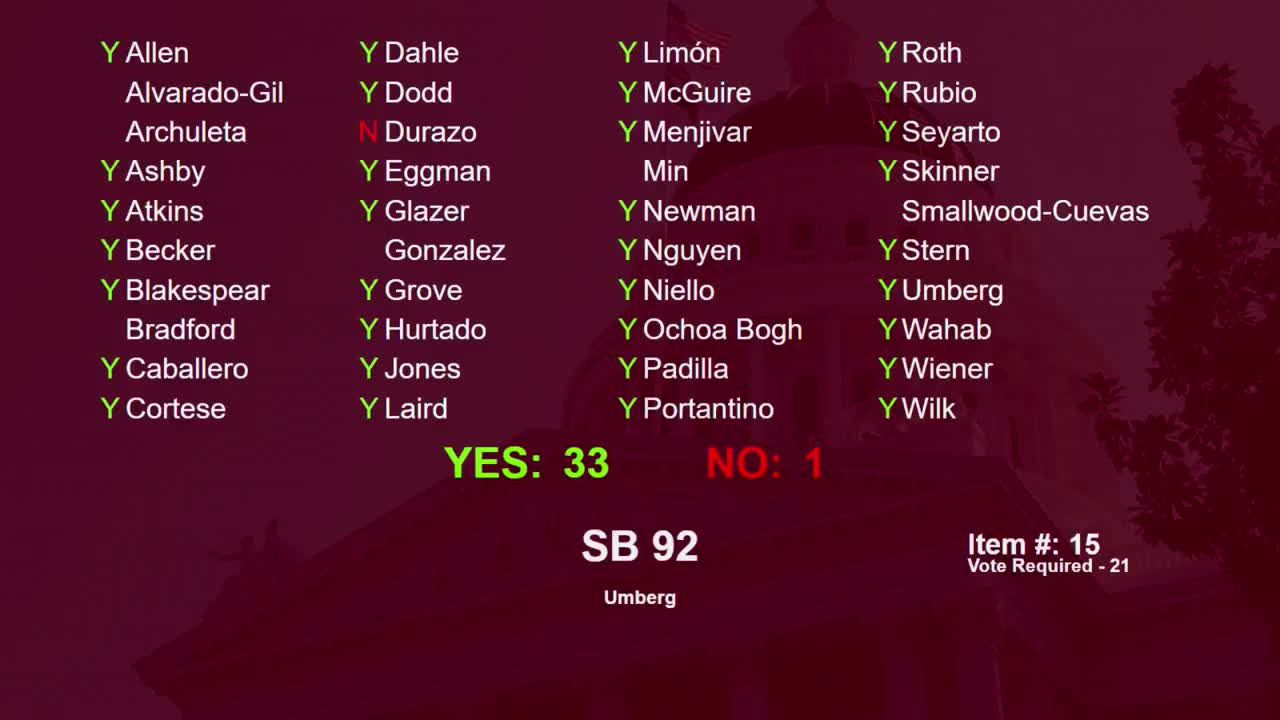 10MIN
Senate Floor
 1MIN
Senate Standing Committee on Appropriations
36SEC
Senate Standing Committee on Appropriations
Bill Author