SB 542: Personal Income Tax Law: Corporation Tax Law: wildfires: exclusions.
- Session Year: 2023-2024
- House: Senate
- Latest Version Date: 2024-08-30
Current Status:
Failed
(2024-09-29: In Senate. Consideration of Governor's veto pending.)
Introduced
In Committee
First Chamber
In Committee
Second Chamber
Enacted
The Personal Income Tax Law and the Corporation Tax Law, in conformity with federal income tax law, generally defines gross income as income from whatever source derived, except as specifically excluded, and provides various exclusions from gross income.
This bill would, for taxable years beginning on or after January 1, 2022, and before January 1, 2027, provide an exclusion from gross income for any qualified taxpayer, as defined, for amounts received in settlement for costs and losses associated with the 2021 Dixie Fire in the Counties of Butte, Plumas, Lassen, Shasta, and Tehama, or the 2022 Mill Fire in the County of Siskiyou, as provided.
Existing law requires a bill authorizing a new tax expenditure to contain, among other things, specific goals, purposes, and objectives the tax expenditure will achieve, detailed performance indicators, and data collection requirements.
This bill would include additional information required for any bill authorizing a new tax expenditure.
The bill would make legislative findings and declarations regarding the public purpose served by this bill.
This bill would declare that it is to take effect immediately as an urgency statute.
The Personal Income Tax Law and the Corporation Tax Law, in conformity with federal income tax law, generally defines gross income as income from whatever source derived, except as specifically excluded, and provides various exclusions from gross income.
This bill would, for taxable years beginning on or after January 1, 2022, and before January 1, 2029, 2027, provide an exclusion from gross income for any qualified taxpayer, as defined, for amounts received in settlement for costs and losses associated with the 2021 Dixie Fire in the Counties of Butte, Plumas, Lassen, Shasta, and Tehama, or the 2022 Mill Fire in the County of Siskiyou, as provided.
Existing law requires a bill authorizing a new tax expenditure to contain, among other things, specific goals, purposes, and objectives the tax expenditure will achieve, detailed performance indicators, and data collection requirements.
This bill would include additional information required for any bill authorizing a new tax expenditure.
The bill would make legislative findings and declarations regarding the public purpose served by this bill.
This bill would declare that it is to take effect immediately as an urgency statute.
The Personal Income Tax Law and the Corporation Tax Law, in conformity with federal income tax law, generally defines gross income as income from whatever source derived, except as specifically excluded, and provides various exclusions from gross income.
This bill would, for taxable years beginning on or after January 1, 2020, 2022, and before January 1, 2028, 2029, provide an exclusion from gross income for any qualified taxpayer, as defined, for amounts received in settlement for costs and losses associated with the 2020 Zogg 2021 Dixie Fire in the Counties of Tehama and Shasta, Butte, Plumas, Lassen, Shasta, and Tehama, or the 2022 Mill Fire in the County of Siskiyou, as provided.
Existing law requires a bill authorizing a new tax expenditure to contain, among other things, specific goals, purposes, and objectives the tax expenditure will achieve, detailed performance indicators, and data collection requirements.
This bill would include additional information required for any bill authorizing a new tax expenditure.
The bill would make legislative findings and declarations regarding the public purpose served by this bill.
This bill would declare that it is to take effect immediately as an urgency statute.
The Personal Income Tax Law and the Corporation Tax Law, in conformity with federal income tax law, generally defines gross income as income from whatever source derived, except as specifically excluded, and provides various exclusions from gross income.
This bill would, for taxable years beginning on or after January 1, 2020, and before January 1, 2028, provide an exclusion from gross income for any qualified taxpayer, as defined, for amounts received in settlement for costs and losses associated with the 2020 Zogg Fire in the Counties of Tehama and Shasta, as provided.
Existing law requires a bill authorizing a new tax expenditure to contain, among other things, specific goals, purposes, and objectives the tax expenditure will achieve, detailed performance indicators, and data collection requirements.
This bill would include additional information required for any bill authorizing a new tax expenditure.
The bill would make legislative findings and declarations regarding the public purpose served by this bill.
This bill would declare that it is to take effect immediately as an urgency statute.
The Personal Income Tax Law and the Corporation Tax Law, in conformity with federal income tax law, generally defines gross income as income from whatever source derived, except as specifically excluded, and provides various exclusions from gross income.
This bill would, for taxable years beginning on or after January 1, 2020, and before January 1, 2028, provide an exclusion from gross income for any qualified taxpayer, as defined, for amounts received in settlement for costs and losses associated with the 2020 Zogg Fire in the Counties of Tehama and Shasta, as provided.
Existing law establishes the continuously appropriated Tax Relief and Refund Account and provides that payments required to be made to taxpayers or other persons from the Personal Income Tax Fund are to be paid from that account.Existing law requires a bill authorizing a new tax expenditure to contain, among other things, specific goals, purposes, and objectives the tax expenditure will achieve, detailed performance indicators, and data collection requirements.
This bill would include additional information required for any bill authorizing a new tax expenditure.
This bill would apply its provisions to taxable years beginning before, on, and after the effective date of this bill. The bill would make legislative findings and declarations regarding the public purpose served by this bill.
This bill would declare that it is to take effect immediately as an urgency statute.
The Personal Income Tax Law and the Corporation Tax Law, in conformity with federal income tax law, generally defines gross income as income from whatever source derived, except as specifically excluded, and provides various exclusions from gross income.
This bill would, for taxable years beginning on or after January 1, 2020, and before January 1, 2028, provide an exclusion from gross income for any qualified taxpayer, as defined, for amounts received in settlement for costs and losses associated with the 2020 Zogg Fire in the County of Counties of Tehama and Shasta, as provided.
Existing law establishes the continuously appropriated Tax Relief and Refund Account and provides that payments required to be made to taxpayers or other persons from the Personal Income Tax Fund are to be paid from that account.
This bill would make an appropriation from the Tax Relief and Refund Account to the Franchise Tax Board in an amount necessary to make payments of refunds made necessary by the above-described exclusion.Existing law requires that any bill that would authorize certain tax expenditures contain, among other things, specific goals, purposes, and objectives that the tax expenditure or exemption will achieve, detailed performance indicators, and data collection requirements.This bill would include additional information required for any bill authorizing a new tax expenditure.
This bill would apply its provisions to taxable years beginning before, on, and after the effective date of this bill. The bill would make legislative findings and declarations regarding the public purpose served by this bill.
This bill would declare that it is to take effect immediately as an urgency statute.
The Personal Income Tax Law and the Corporation Tax Law, in conformity with federal income tax law, generally defines gross income as income from whatever source derived, except as specifically excluded, and provides various exclusions from gross income.
This bill would, for taxable years beginning on or after January 1, 2020, provide an exclusion from gross income for any qualified taxpayer, as defined, for amounts received for costs and losses associated with the 2020 Zogg Fire in the County of Shasta, as provided.
Existing law establishes the continuously appropriated Tax Relief and Refund Account and provides that payments required to be made to taxpayers or other persons from the Personal Income Tax Fund are to be paid from that account.
This bill would make an appropriation from the Tax Relief and Refund Account to the Franchise Tax Board in an amount necessary to make payments of refunds made necessary by the above-described exclusion.
Existing law requires that any bill that would authorize certain tax expenditures contain, among other things, specific goals, purposes, and objectives that the tax expenditure or exemption will achieve, detailed performance indicators, and data collection requirements.
This bill would include additional information required for any bill authorizing a new tax expenditure.
This bill would apply its provisions to taxable years beginning before, on, and after the effective date of this bill. The bill would make legislative findings and declarations regarding the public purpose served by this bill.
This bill would declare that it is to take effect immediately as an urgency statute.
(a)For taxable years beginning on or after January 1, 2022, and before January 1, 2027, gross income does not include any qualified amount received by a qualified taxpayer.
(b)For purposes of this section:
(1)Qualified amount means any amount received in settlement by a qualified taxpayer from a settlement entity in connection with the 2021 Dixie Fire or the 2022 Mill Fire.
(2)Qualified taxpayer means any of the following:
(A)In relation to the 2021 Dixie Fire, the following:
(i)Any taxpayer that owned real property located in the County of Butte, Plumas, Lassen, Shasta, or Tehama during the 2021 Dixie Fire who paid or incurred expenses and received amounts from a settlement arising out of or pursuant to the 2021 Dixie Fire.
(ii)Any taxpayer that resided within the County of Butte, Plumas, Lassen, Shasta, or Tehama during the 2021 Dixie Fire who paid or incurred expenses and received amounts from a settlement arising out of or pursuant to the 2021 Dixie Fire.
(iii)Any taxpayer that had a place of business within the County of Butte, Plumas, Lassen, Shasta, or Tehama during the 2021 Dixie Fire who paid or incurred expenses and received amounts from a settlement arising out of or pursuant to the 2021 Dixie Fire.
(B)In relation to the 2022 Mill Fire, the following:
(i)Any taxpayer that owned real property located in the County of Siskiyou during the 2022 Mill Fire who paid or incurred expenses and received amounts from a settlement arising out of or pursuant to the 2022 Mill Fire.
(ii)Any taxpayer that resided within the County of Siskiyou during the 2022 Mill Fire who paid or incurred expenses and received amounts from a settlement arising out of or pursuant to the 2022 Mill Fire.
(iii)Any taxpayer that had a place of business within the County of Siskiyou during the 2022 Mill Fire who paid or incurred expenses and received amounts from a settlement arising out of or pursuant to the 2022 Mill Fire.
(3)Settlement entity means the following:
(A)In relation to the 2021 Dixie Fire, Pacific Gas and Electric Company or its subsidiary making the settlement payment to a qualified taxpayer.
(B)In relation to the 2022 Mill Fire, Roseburg Forest Products or its subsidiary or agent making the settlement payment to a qualified taxpayer.
(c)The settlement entity shall provide, upon request by the Franchise Tax Board, documentation of the settlement payments in the form and manner requested by the Franchise Tax Board.
(d)(1)For the purpose of complying with Section 41 in regards to the exclusion provided by this section and Section 24309.8, the Legislature finds and declares as follows:
(A)The specific goal, purpose, and objective of the tax exclusion is to provide essential relief to individuals who have suffered injury, loss, inconvenience, and expenses resulting from the devastating 2021 Dixie Fire and 2022 Mill Fire.
(B)The performance indicators for the Legislature to use in determining if the exclusion achieves the stated goal, purpose, and objective shall be the number of qualified taxpayers that excluded qualified amounts from gross income, and the aggregate amount of settlement payments arising out of the 2021 Dixie Fire or the 2022 Mill Fire.
(2)(A)On December 1, 2027, the Franchise Tax Board shall deliver to the Legislature a written report that includes both of the following:
(i)To the extent feasible, the number of qualified taxpayers that excluded qualified amounts from gross income, as a result of the exclusion.
(ii)The aggregate amount of those settlement payments arising out of the 2021 Dixie Fire or the 2022 Mill Fire.
(B)The report required by this paragraph shall be delivered to the Legislature in compliance with Section 9795 of the Government Code.
(C)The disclosure provisions of this subdivision shall be treated as an exception to Section 19542.
(e)This section shall remain in effect only until December 1, 2027, and as of that date is repealed.
SEC. 2.Section 24309.8 is added to the Revenue and Taxation Code, to read:24309.8.(a)For taxable years beginning on or after January 1, 2022, and before January 1, 2027, gross income does not include any qualified amount received by a qualified taxpayer.
(b)For purposes of this section:
(1)Qualified amount means any amount received in settlement by a qualified taxpayer from a settlement entity in connection with the 2021 Dixie Fire or the 2022 Mill Fire.
(2)Qualified taxpayer means either of the following:
(A)In relation to the 2021 Dixie Fire, the following:
(i)Any taxpayer that owned real property located in the County of Butte, Plumas, Lassen, Shasta, or Tehama during the 2021 Dixie Fire that paid or incurred expenses and received amounts from a settlement arising out of or pursuant to the 2021 Dixie Fire.
(ii)Any taxpayer that had a place of business within the County of Butte, Plumas, Lassen, Shasta, or Tehama during the 2021 Dixie Fire that paid or incurred expenses and received amounts from a settlement arising out of or pursuant to the 2021 Dixie Fire.
(B)In relation to the 2022 Mill Fire, the following:
(i)Any taxpayer that owned real property located in the County of Siskiyou during the 2022 Mill Fire who paid or incurred expenses and received amounts from a settlement arising out of or pursuant to the 2022 Mill Fire.
(ii)Any taxpayer that had a place of business within the County of Siskiyou during the 2022 Mill Fire who paid or incurred expenses and received amounts from a settlement arising out of or pursuant to the 2022 Mill Fire.
(3)Settlement entity means the following:
(A)In relation to the 2021 Dixie Fire, Pacific Gas and Electric Company or its subsidiary making the settlement payment to a qualified taxpayer.
(B)In relation to the 2022 Mill Fire, Roseburg Forest Products or its subsidiary or agent making the settlement payment to a qualified taxpayer.
(c)The settlement entity shall provide, upon request by the Franchise Tax Board, documentation of the settlement payments in the form and manner requested by the Franchise Tax Board.
(d)This section shall remain in effect only until December 1, 2027, and as of that date is repealed.
SEC. 3.The Legislature finds and declares that Sections 17139.4 and 24309.8 of the Revenue and Taxation Code, as added by this act, are necessary for the public purpose of preventing undue hardship to taxpayers who reside, or used to reside, in a part of California devastated by fire, and do not constitute a gift of public funds within the meaning of Section 6 of Article XVI of the California Constitution.
SEC. 4.This act is an urgency statute necessary for the immediate preservation of the public peace, health, or safety within the meaning of Article IV of the California Constitution and shall go into immediate effect. The facts constituting the necessity are:
In order to provide essential relief to those persons who have suffered injury, loss, inconvenience, and expenses resulting from the devastating 2021 Dixie Fire and 2022 Mill Fire as soon as possible, it is necessary that this act take effect immediately.
(a)For taxable years beginning on or after January 1, 2022, and before January 1, 2029, 2027, gross income does not include any qualified amount received by a qualified taxpayer.
(b)For purposes of this section:
(1)Qualified amount means any amount received in settlement by a qualified taxpayer from a settlement entity in connection with the 2021 Dixie Fire or the 2022 Mill Fire.
(2)Qualified taxpayer means any of the following:
(A)In relation to the 2021 Dixie Fire, the following:
(i)Any taxpayer that owned real property located in the County of Butte, Plumas, Lassen, Shasta, or Tehama during the 2021 Dixie Fire who paid or incurred expenses and received amounts from a settlement arising out of or pursuant to the 2021 Dixie Fire.
(ii)Any taxpayer that resided within the County of Butte, Plumas, Lassen, Shasta, or Tehama during the 2021 Dixie Fire who paid or incurred expenses and received amounts from a settlement arising out of or pursuant to the 2021 Dixie Fire.
(iii)Any taxpayer that had a place of business within the County of Butte, Plumas, Lassen, Shasta, or Tehama during the 2021 Dixie Fire who paid or incurred expenses and received amounts from a settlement arising out of or pursuant to the 2021 Dixie Fire.
(B)In relation to the 2022 Mill Fire, the following:
(i)Any taxpayer that owned real property located in the County of Siskiyou during the 2022 Mill Fire who paid or incurred expenses and received amounts from a settlement arising out of or pursuant to the 2022 Mill Fire.
(ii)Any taxpayer that resided within the County of Siskiyou during the 2022 Mill Fire who paid or incurred expenses and received amounts from a settlement arising out of or pursuant to the 2022 Mill Fire.
(iii)Any taxpayer that had a place of business within the County of Siskiyou during the 2022 Mill Fire who paid or incurred expenses and received amounts from a settlement arising out of or pursuant to the 2022 Mill Fire.
(3)Settlement entity means the following:
(A)In relation to the 2021 Dixie Fire, Pacific Gas and Electric Company or its subsidiary making the settlement payment to a qualified taxpayer.
(B)In relation to the 2022 Mill Fire, Roseburg Forest Products or its subsidiary or agent making the settlement payment to a qualified taxpayer.
(c)The settlement entity shall provide, upon request by the Franchise Tax Board, documentation of the settlement payments in the form and manner requested by the Franchise Tax Board.
(d)(1)For the purpose of complying with Section 41 in regards to the exclusion provided by this section and Section 24309.8, the Legislature finds and declares as follows:
(A)The specific goal, purpose, and objective of the tax exclusion is to provide essential relief to individuals who have suffered injury, loss, inconvenience, and expenses resulting from the devastating 2021 Dixie Fire and 2022 Mill Fire.
(B)The performance indicators for the Legislature to use in determining if the exclusion achieves the stated goal, purpose, and objective shall be the number of qualified taxpayers that excluded qualified amounts from gross income, and the aggregate amount of settlement payments arising out of the 2021 Dixie Fire or the 2022 Mill Fire.
(2)(A)On December 1, 2028, 2027, the Franchise Tax Board shall deliver to the Legislature a written report that includes both of the following:
(i)To the extent feasible, the number of qualified taxpayers that excluded qualified amounts from gross income, as a result of the exclusion.
(ii)The aggregate amount of those settlement payments arising out of the 2021 Dixie Fire or the 2022 Mill Fire.
(B)The report required by this paragraph shall be delivered to the Legislature in compliance with Section 9795 of the Government Code.
(C)The disclosure provisions of this subdivision shall be treated as an exception to Section 19542.
(e)This section shall remain in effect only until December 1, 2029, 2027, and as of that date is repealed.
SEC. 2.Section 24309.8 is added to the Revenue and Taxation Code, to read:24309.8.(a)For taxable years beginning on or after January 1, 2022, and before January 1, 2029, 2027, gross income does not include any qualified amount received by a qualified taxpayer.
(b)For purposes of this section:
(1)Qualified amount means any amount received in settlement by a qualified taxpayer from a settlement entity in connection with the 2021 Dixie Fire or the 2022 Mill Fire.
(2)Qualified taxpayer means either of the following:
(A)In relation to the 2021 Dixie Fire, the following:
(i)Any taxpayer that owned real property located in the County of Butte, Plumas, Lassen, Shasta, or Tehama during the 2021 Dixie Fire that paid or incurred expenses and received amounts from a settlement arising out of or pursuant to the 2021 Dixie Fire.
(ii)Any taxpayer that had a place of business within the County of Butte, Plumas, Lassen, Shasta, or Tehama during the 2021 Dixie Fire that paid or incurred expenses and received amounts from a settlement arising out of or pursuant to the 2021 Dixie Fire.
(B)In relation to the 2022 Mill Fire, the following:
(i)Any taxpayer that owned real property located in the County of Siskiyou during the 2022 Mill Fire who paid or incurred expenses and received amounts from a settlement arising out of or pursuant to the 2022 Mill Fire.
(ii)Any taxpayer that had a place of business within the County of Siskiyou during the 2022 Mill Fire who paid or incurred expenses and received amounts from a settlement arising out of or pursuant to the 2022 Mill Fire.
(3)Settlement entity means the following:
(A)In relation to the 2021 Dixie Fire, Pacific Gas and Electric Company or its subsidiary making the settlement payment to a qualified taxpayer.
(B)In relation to the 2022 Mill Fire, Roseburg Forest Products or its subsidiary or agent making the settlement payment to a qualified taxpayer.
(c)The settlement entity shall provide, upon request by the Franchise Tax Board, documentation of the settlement payments in the form and manner requested by the Franchise Tax Board.
(d)This section shall remain in effect only until December 1, 2029, 2027, and as of that date is repealed.
SEC. 3.The Legislature finds and declares that Sections 17139.4 and 24309.8 of the Revenue and Taxation Code, as added by this act, are necessary for the public purpose of preventing undue hardship to taxpayers who reside, or used to reside, in a part of California devastated by fire, and do not constitute a gift of public funds within the meaning of Section 6 of Article XVI of the California Constitution.
SEC. 4.This act is an urgency statute necessary for the immediate preservation of the public peace, health, or safety within the meaning of Article IV of the California Constitution and shall go into immediate effect. The facts constituting the necessity are:
In order to provide essential relief to those persons who have suffered injury, loss, inconvenience, and expenses resulting from the devastating 2021 Dixie Fire and 2022 Mill Fire as soon as possible, it is necessary that this act take effect immediately.
(a)For taxable years beginning on or after January 1, 2020, 2022, and before January 1, 2028, 2029, gross income does not include any qualified amount received by a qualified taxpayer.
(b)For purposes of this section:
(1)Qualified amount means any amount received in settlement by a qualified taxpayer from a settlement entity in connection with the 2020 Zogg Fire. 2021 Dixie Fire or the 2022 Mill Fire.
(2)Qualified taxpayer means any of the following:
(A)In relation to the 2021 Dixie Fire, the following:
(A)(i)Any taxpayer that owned real property located in the County of Shasta or the County of Tehama Butte, Plumas, Lassen, Shasta, or Tehama during the 2020 Zogg 2021 Dixie Fire who paid or incurred expenses and received amounts from a settlement arising out of or pursuant to the 2020 Zogg 2021 Dixie Fire.
(B)(ii)Any taxpayer that resided within the County of Shasta or the County of Tehama Butte, Plumas, Lassen, Shasta, or Tehama during the 2020 Zogg 2021 Dixie Fire who paid or incurred expenses and received amounts from a settlement arising out of or pursuant to the 2020 Zogg 2021 Dixie Fire.
(C)(iii)Any taxpayer that had a place of business within the County of Shasta or the County of Tehama Butte, Plumas, Lassen, Shasta, or Tehama during the 2020 Zogg 2021 Dixie Fire who paid or incurred expenses and received amounts from a settlement arising out of or pursuant to the 2020 Zogg 2021 Dixie Fire.
(B)In relation to the 2022 Mill Fire, the following:
(i)Any taxpayer that owned real property located in the County of Siskiyou during the 2022 Mill Fire who paid or incurred expenses and received amounts from a settlement arising out of or pursuant to the 2022 Mill Fire.
(ii)Any taxpayer that resided within the County of Siskiyou during the 2022 Mill Fire who paid or incurred expenses and received amounts from a settlement arising out of or pursuant to the 2022 Mill Fire.
(iii)Any taxpayer that had a place of business within the County of Siskiyou during the 2022 Mill Fire who paid or incurred expenses and received amounts from a settlement arising out of or pursuant to the 2022 Mill Fire.
(3)Settlement entity means the following: Pacific
(A)In relation to the 2021 Dixie Fire, Pacific Gas and Electric Company or its subsidiary making the settlement payment to a qualified taxpayer.
(B)In relation to the 2022 Mill Fire, Roseburg Forest Products or its subsidiary or agent making the settlement payment to a qualified taxpayer.
(c)The settlement entity shall provide, upon request by the Franchise Tax Board, documentation of the settlement payments in the form and manner requested by the Franchise Tax Board.
(d)(1)For the purpose of complying with Section 41 in regards to the exclusion provided by this section and Section 24309.7, 24309.8, the Legislature finds and declares as follows:
(A)The specific goal, purpose, and objective of the tax exclusion is to provide essential relief to individuals who have suffered injury, loss, inconvenience, and expenses resulting from the devastating 2020 Zogg Fire. 2021 Dixie Fire and 2022 Mill Fire.
(B)The performance indicators for the Legislature to use in determining if the exclusion achieves the stated goal, purpose, and objective shall be the number of qualified taxpayers that excluded qualified amounts from gross income, and the aggregate amount of settlement payments arising out of the 2020 Zogg Fire. 2021 Dixie Fire or the 2022 Mill Fire.
(2)(A)On December 1, 2028, the Franchise Tax Board shall deliver to the Legislature a written report that includes both of the following:
(i)To the extent feasible, the number of qualified taxpayers that excluded qualified amounts from gross income, as a result of the exclusion.
(ii)The aggregate amount of those settlement payments arising out of the 2020 Zogg Fire. 2021 Dixie Fire or the 2022 Mill Fire.
(B)The report required by this paragraph shall be delivered to the Legislature in compliance with Section 9795 of the Government Code.
(C)The disclosure provisions of this subdivision shall be treated as an exception to Section 19542.
(e)This section shall remain in effect only until December 1, 2028, 2029, and as of that date is repealed.
SEC. 2.Section 24309.7 is added to the Revenue and Taxation Code, to read:24309.7.SEC. 2.Section 24309.8 is added to the Revenue and Taxation Code, to read:24309.8.(a)For taxable years beginning on or after January 1, 2020, 2022, and before January 1, 2028, 2029, gross income does not include any qualified amount received by a qualified taxpayer.
(b)For purposes of this section:
(1)Qualified amount means any amount received in settlement by a qualified taxpayer from a settlement entity in connection with the 2020 Zogg Fire. 2021 Dixie Fire or the 2022 Mill Fire.
(2)Qualified taxpayer means either of the following:
(A)In relation to the 2021 Dixie Fire, the following:
(A)(i)Any taxpayer that owned real property located in the County of Shasta or the County of Tehama Butte, Plumas, Lassen, Shasta, or Tehama during the 2020 Zogg 2021 Dixie Fire that paid or incurred expenses and received amounts from a settlement arising out of or pursuant to the 2020 Zogg 2021 Dixie Fire.
(B)(ii)Any taxpayer that had a place of business within the County of Shasta or the County of Tehama Butte, Plumas, Lassen, Shasta, or Tehama during the 2020 Zogg 2021 Dixie Fire that paid or incurred expenses and received amounts from a settlement arising out of or pursuant to the 2020 Zogg 2021 Dixie Fire.
(B)In relation to the 2022 Mill Fire, the following:
(i)Any taxpayer that owned real property located in the County of Siskiyou during the 2022 Mill Fire who paid or incurred expenses and received amounts from a settlement arising out of or pursuant to the 2022 Mill Fire.
(ii)Any taxpayer that had a place of business within the County of Siskiyou during the 2022 Mill Fire who paid or incurred expenses and received amounts from a settlement arising out of or pursuant to the 2022 Mill Fire.
(3)Settlement entity means the following: Pacific
(A)In relation to the 2021 Dixie Fire, Pacific Gas and Electric Company or its subsidiary making the settlement payment to a qualified taxpayer.
(B)In relation to the 2022 Mill Fire, Roseburg Forest Products or its subsidiary or agent making the settlement payment to a qualified taxpayer.
(c)The settlement entity shall provide, upon request by the Franchise Tax Board, documentation of the settlement payments in the form and manner requested by the Franchise Tax Board.
(d)This section shall remain in effect only until December 1, 2028, 2029, and as of that date is repealed.
SEC. 3.The Legislature finds and declares that Sections 17139.3 and 24309.7 17139.4 and 24309.8 of the Revenue and Taxation Code, as added by this act, are necessary for the public purpose of preventing undue hardship to taxpayers who reside, or used to reside, in a part of California devastated by wildfires, fire, and do not constitute a gift of public funds within the meaning of Section 6 of Article XVI of the California Constitution.
SEC. 4.This act is an urgency statute necessary for the immediate preservation of the public peace, health, or safety within the meaning of Article IV of the California Constitution and shall go into immediate effect. The facts constituting the necessity are:
In order to provide essential relief to those persons who have suffered injury, loss, inconvenience, and expenses resulting from the devastating 2020 Zogg 2021 Dixie Fire and 2022 Mill Fire as soon as possible, it is necessary that this act take effect immediately.
(a)For taxable years beginning on or after January 1, 2020, and before January 1, 2028, gross income does not include any qualified amount received by a qualified taxpayer.
(b)For purposes of this section:
(1)Qualified amount means any amount received in settlement by a qualified taxpayer from a settlement entity to replace property damaged or destroyed by in connection with the 2020 Zogg Fire.
(2)Qualified taxpayer means any of the following:
(A)Any taxpayer that owned real property located in the County of Shasta or the County of Tehama during the 2020 Zogg Fire who paid and or incurred expenses and received amounts from a settlement arising out of or pursuant to the 2020 Zogg Fire.
(B)Any taxpayer that resided within the County of Shasta or the County of Tehama during the 2020 Zogg Fire who paid and or incurred expenses and received amounts from a settlement arising out of or pursuant to the 2020 Zogg Fire.
(C)Any taxpayer that had a place of business within the County of Shasta or the County of Tehama during the 2020 Zogg Fire who paid and or incurred expenses and received amounts from a settlement arising out of or pursuant to the 2020 Zogg Fire.
(3)Settlement entity means Pacific Gas and Electric Company or its subsidiary making the settlement payment to a qualified taxpayer.
(c)The settlement entity shall provide, upon request by the Franchise Tax Board, documentation of the settlement payments in the form and manner requested by the Franchise Tax Board.
(d)(1)For the purpose of complying with Section 41 in regards to the exclusion provided by this section and Section 24309.7, the Legislature finds and declares as follows:
(A)The specific goal, purpose, and objective of the tax exclusion is to provide essential relief to individuals who have suffered injury, loss, inconvenience, and expenses resulting from the devastating 2020 Zogg Fire.
(B)The performance indicators for the Legislature to use in determining if the exclusion achieves the stated goal, purpose, and objective shall be the number of qualified taxpayers that excluded qualified amounts from gross income, and the aggregate amount of settlement payments arising out of the 2020 Zogg Fire.
(2)(A)On December 1, 2028, the Franchise Tax Board shall deliver to the Legislature a written report that includes both of the following:
(i)The To the extent feasible, the number of qualified taxpayers that excluded qualified amounts from gross income, as a result of the exclusion.
(ii)The aggregate amount of those settlement payments arising out of the 2020 Zogg Fire.
(B)The report required by this paragraph shall be delivered to the Legislature in compliance with Section 9795 of the Government Code.
(C)The disclosure provisions of this subdivision shall be treated as an exception to Section 19542.
(e)This section shall remain in effect only until December 1, 2028, and as of that date is repealed.
SEC. 2.Section 24309.7 is added to the Revenue and Taxation Code, to read:24309.7.(a)For taxable years beginning on or after January 1, 2020, and before January 1, 2028, gross income does not include any qualified amount received by a qualified taxpayer.
(b)For purposes of this section:
(1)Qualified amount means any amount received in settlement by a qualified taxpayer from a settlement entity to replace property damaged or destroyed by in connection with the 2020 Zogg Fire.
(2)Qualified taxpayer means either of the following:
(A)Any taxpayer that owned real property located in the County of Shasta or the County of Tehama during the 2020 Zogg Fire who that paid and or incurred expenses and received amounts from a settlement arising out of or pursuant to the 2020 Zogg Fire.
(B)Any taxpayer that had a place of business within the County of Shasta or the County of Tehama during the 2020 Zogg Fire who that paid and or incurred expenses and received amounts from a settlement arising out of or pursuant to the 2020 Zogg Fire.
(3)Settlement entity means Pacific Gas and Electric Company or its subsidiary making the settlement payment to a qualified taxpayer.
(c)The settlement entity shall provide, upon request by the Franchise Tax Board, documentation of the settlement payments in the form and manner requested by the Franchise Tax Board.
(d)This section shall remain in effect only until December 1, 2028, and as of that date is repealed.
SEC. 3.The Legislature finds and declares that Sections 17139.3 and 24309.7 of the Revenue and Taxation Code, as added by this act, are necessary for the public purpose of preventing undue hardship to taxpayers who reside, or used to reside, in a part of California devastated by wildfires, and do not constitute a gift of public funds within the meaning of Section 6 of Article XVI of the California Constitution.
SEC. 4.This act is an urgency statute necessary for the immediate preservation of the public peace, health, or safety within the meaning of Article IV of the California Constitution and shall go into immediate effect. The facts constituting the necessity are:
In order to provide essential relief to those persons who have suffered injury, loss, inconvenience, and expenses resulting from the devastating 2020 Zogg Fire as soon as possible, it is necessary that this act take effect immediately.
(a)For taxable years beginning on or after January 1, 2020, and before January 1, 2028, gross income does not include any qualified amount received by a qualified taxpayer.
(b)For purposes of this section:
(1)Qualified amount means any amount received in settlement by a qualified taxpayer from a settlement entity to replace property damaged or destroyed by the 2020 Zogg Fire.
(2)Qualified taxpayer means any of the following:
(A)Any taxpayer that owned real property located in the County of Shasta or the County of Tehama during the 2020 Zogg Fire who paid and incurred expenses and received amounts from a settlement arising out of or pursuant to the 2020 Zogg Fire.
(B)Any taxpayer that resided within the County of Shasta or the County of Tehama during the 2020 Zogg Fire who paid and incurred expenses and received amounts from a settlement arising out of or pursuant to the 2020 Zogg Fire.
(C)Any taxpayer that had a place of business within the County of Shasta or the County of Tehama during the 2020 Zogg Fire who paid and incurred expenses and received amounts from a settlement arising out of or pursuant to the 2020 Zogg Fire.
(3)Settlement entity means Pacific Gas and Electric Company or its subsidiary making the settlement payment to a qualified taxpayer.
(c)The settlement entity shall provide, upon request by the Franchise Tax Board, documentation of the settlement payments in the form and manner requested by the Franchise Tax Board.
(d)This section shall apply to taxable years beginning before, on, or after the effective date of the act adding this section. (e)(d)(1)For the purpose of complying with Section 41 in regards to the exclusion provided by this section and Section 24309.7, the Legislature finds and declares as follows:
(A)The specific goal, purpose, and objective of the tax exclusion is to provide essential relief to individuals who have suffered injury, loss, inconvenience, and expenses resulting from the devastating 2020 Zogg Fire.
(B)The performance indicators for the Legislature to use in determining if the exclusion achieves the stated goal, purpose, and objective shall be the number of qualified taxpayers that excluded qualified amounts from gross income, and the aggregate amount of settlement payments arising out of the 2020 Zogg Fire.
(2)(A)On December 1, 2028, the Franchise Tax Board shall deliver to the Legislature a written report that includes both of the following:
(i)The number of qualified taxpayers that excluded qualified amounts from gross income, as a result of the exclusion.
(ii)The aggregate amount of those settlement payments arising out of the 2020 Zogg Fire.
(B)The report required by this paragraph shall be delivered to the Legislature in compliance with Section 9795 of the Government Code.
(C)The disclosure provisions of this subdivision shall be treated as an exception to Section 19542.
(f)(e)This section shall remain in effect only until December 1, 2028, and as of that date is repealed.
SEC. 2.Section 24309.7 is added to the Revenue and Taxation Code, to read:24309.7.(a)For taxable years beginning on or after January 1, 2020, and before January 1, 2028, gross income does not include any qualified amount received by a qualified taxpayer.
(b)For purposes of this section:
(1)Qualified amount means any amount received in settlement by a qualified taxpayer from a settlement entity to replace property damaged or destroyed by the 2020 Zogg Fire.
(2)Qualified taxpayer means either of the following:
(A)Any taxpayer that owned real property located in the County of Shasta or the County of Tehama during the 2020 Zogg Fire who paid and incurred expenses and received amounts from a settlement arising out of or pursuant to the 2020 Zogg Fire.
(B)Any taxpayer that had a place of business within the County of Shasta or the County of Tehama during the 2020 Zogg Fire who paid and incurred expenses and received amounts from a settlement arising out of or pursuant to the 2020 Zogg Fire.
(3)Settlement entity means Pacific Gas and Electric Company or its subsidiary making the settlement payment to a qualified taxpayer.
(c)The settlement entity shall provide, upon request by the Franchise Tax Board, documentation of the settlement payments in the form and manner requested by the Franchise Tax Board.
(d)This section shall apply to taxable years beginning before, on, or after the effective date of the act adding this section. (e)(d)This section shall remain in effect only until December 1, 2028, and as of that date is repealed.
SEC. 3.The Legislature finds and declares that Sections 17139.3 and 24309.7 of the Revenue and Taxation Code, as added by this act, are necessary for the public purpose of preventing undue hardship to taxpayers who reside, or used to reside, in a part of California devastated by wildfires, and do not constitute a gift of public funds within the meaning of Section 6 of Article XVI of the California Constitution.
SEC. 4.This act is an urgency statute necessary for the immediate preservation of the public peace, health, or safety within the meaning of Article IV of the California Constitution and shall go into immediate effect. The facts constituting the necessity are:
In order to provide essential relief to those persons who have suffered injury, loss, inconvenience, and expenses resulting from the devastating 2020 Zogg Fire as soon as possible, it is necessary that this act take effect immediately.
(a)For taxable years beginning on or after January 1, 2020, and before January 1, 2028, gross income does not include any qualified amount received by a qualified taxpayer.
(b)For purposes of this section:
(1)Qualified amount means any amount received in settlement by a qualified taxpayer from a settlement entity to replace property damaged or destroyed by the 2020 Zogg Fire.
(2)Qualified taxpayer means any of the following:
(A)Any taxpayer that owned real property located in the County of Shasta or the County of Tehama during the 2020 Zogg Fire who paid and incurred expenses and received amounts from a settlement arising out of or pursuant to the 2020 Zogg Fire.
(B)Any taxpayer that resided within the County of Shasta or the County of Tehama during the 2020 Zogg Fire who paid and incurred expenses and received amounts from a settlement arising out of or pursuant to the 2020 Zogg Fire.
(C)Any taxpayer that had a place of business within the County of Shasta or the County of Tehama during the 2020 Zogg Fire who paid and incurred expenses and received amounts from a settlement arising out of or pursuant to the 2020 Zogg Fire.
(3)Settlement entity means the entity Pacific Gas and Electric Company or its subsidiary making the settlement payment to a qualified taxpayer.
(c)The settlement entity shall provide, upon request by the Franchise Tax Board, documentation of the settlement payments in the form and manner requested by the Franchise Tax Board.
(d)(1)This section shall apply to taxable years beginning before, on, or after the effective date of the act adding this section.
(2)There is hereby appropriated from the Tax Relief and Refund Account to the Franchise Tax Board an amount necessary to make payments of refunds made necessary by the exclusion provided by this section.(e)(1)For the purpose of complying with Section 41 in regards to the exclusion provided by this section and Section 24309.7, the Legislature finds and declares as follows:
(A)The specific goal, purpose, and objective of the tax exclusion is to provide essential relief to individuals who have suffered injury, loss, inconvenience, and expenses resulting from the devastating 2020 Zogg Fire.
(B)The performance indicators for the Legislature to use in determining if the exclusion achieves the stated goal, purpose, and objective shall be the number of qualified taxpayers that excluded qualified amounts from gross income, and the aggregate amount of settlement payments arising out of the 2020 Zogg Fire.
(2)(A)On December 1, 2028, the Franchise Tax Board shall deliver to the Legislature a written report that includes both of the following:
(i)The number of qualified taxpayers that excluded qualified amounts from gross income, as a result of the exclusion.
(ii)The aggregate amount of those settlement payments arising out of the 2020 Zogg Fire.
(B)The report required by this paragraph shall be delivered to the Legislature in compliance with Section 9795 of the Government Code.
(C)The disclosure provisions of this subdivision shall be treated as an exception to Section 19542.
(f)This section shall remain in effect only until December 1, 2028, and as of that date is repealed.
SEC. 2.Section 24309.7 is added to the Revenue and Taxation Code, to read:24309.7.(a)For taxable years beginning on or after January 1, 2020, and before January 1, 2028, gross income does not include any qualified amount received by a qualified taxpayer.
(b)For purposes of this section:
(1)Qualified amount means any amount received in settlement by a qualified taxpayer from a settlement entity to replace property damaged or destroyed by the 2020 Zogg Fire.
(2)Qualified taxpayer means either of the following:
(A)Any taxpayer that owned real property located in the County of Shasta or the County of Tehama during the 2020 Zogg Fire who paid and incurred expenses and received amounts from a settlement arising out of or pursuant to the 2020 Zogg Fire.
(B)Any taxpayer that had a place of business within the County of Shasta or the County of Tehama during the 2020 Zogg Fire who paid and incurred expenses and received amounts from a settlement arising out of or pursuant to the 2020 Zogg Fire.
(3)Settlement entity means the entity Pacific Gas and Electric Company or its subsidiary making the settlement payment to a qualified taxpayer.
(c)The settlement entity shall provide, upon request by the Franchise Tax Board, documentation of the settlement payments in the form and manner requested by the Franchise Tax Board.
(d)(1)This section shall apply to taxable years beginning before, on, or after the effective date of the act adding this section.
(2)There is hereby appropriated from the Tax Relief and Refund Account to the Franchise Tax Board an amount necessary to make payments of refunds made necessary by the exclusion provided by this section.(e)This section shall remain in effect only until December 1, 2028, and as of that date is repealed.
SEC. 3.The Legislature finds and declares that Sections 17139.3 and 24309.7 of the Revenue and Taxation Code, as added by this act, are necessary for the public purpose of preventing undue hardship to taxpayers who reside, or used to reside, in a part of California devastated by wildfires, and do not constitute a gift of public funds within the meaning of Section 6 of Article XVI of the California Constitution.
SEC. 4.This act is an urgency statute necessary for the immediate preservation of the public peace, health, or safety within the meaning of Article IV of the California Constitution and shall go into immediate effect. The facts constituting the necessity are:
In order to provide essential relief to those persons who have suffered injury, loss, inconvenience, and expenses resulting from the devastating 2020 Zogg Fire as soon as possible, it is necessary that this act take effect immediately.
(a)For taxable years beginning on or after January 1, 2020, gross income does not include any qualified amount received by a qualified taxpayer.
(b)For purposes of this section:
(1)Qualified amount means any amount received in settlement by a qualified taxpayer to replace property damaged or destroyed by the 2020 Zogg Fire.
(2)Qualified taxpayer means any of the following:
(A)Any taxpayer that owned real property located in the County of Shasta during the 2020 Zogg Fire who paid and incurred expenses and received amounts from a settlement arising out of or pursuant to the 2020 Zogg Fire.
(B)Any taxpayer that resided within the County of Shasta during the 2020 Zogg Fire who paid and incurred expenses and received amounts from a settlement arising out of or pursuant to the 2020 Zogg Fire.
(C)Any taxpayer that had a place of business within the County of Shasta during the 2020 Zogg Fire who paid and incurred expenses and received amounts from a settlement arising out of or pursuant to the 2020 Zogg Fire.
(3)Settlement entity means the entity making the settlement payment to a qualified taxpayer.
(c)The settlement entity shall provide, upon request by the Franchise Tax Board, documentation of the settlement payments in the form and manner requested by the Franchise Tax Board.
(d)(1)This section shall apply to taxable years beginning before, on, or after the effective date of the act adding this section.
(2)There is hereby appropriated from the Tax Relief and Refund Account to the Franchise Tax Board an amount necessary to make payments of refunds made necessary by the exclusion provided by this section.
(e)(1)For the purpose of complying with Section 41 in regards to the exclusion provided by this section and Section 24309.7, the Legislature finds and declares as follows:
(A)The specific goal, purpose, and objective of the tax exclusion is to provide essential relief to individuals who have suffered injury, loss, inconvenience, and expenses resulting from the devastating 2020 Zogg Fire.
(B)The performance indicators for the Legislature to use in determining if the exclusion achieves the stated goal, purpose, and objective shall be the number of qualified taxpayers that excluded qualified amounts from gross income, and the aggregate amount of settlement payments arising out of the 2020 Zogg Fire.
(2)(A)On December 1, 2028, the Franchise Tax Board shall deliver to the Legislature a written report that includes both of the following:
(i)The number of qualified taxpayers that excluded qualified amounts from gross income, as a result of the exclusion.
(ii)The aggregate amount of those settlement payments arising out of the 2020 Zogg Fire.
(B)The report required by this paragraph shall be delivered to the Legislature in compliance with Section 9795 of the Government Code.
(C)The disclosure provisions of this subdivision shall be treated as an exception to Section 19542.
(f)This section shall remain in effect only until December 1, 2028, and as of that date is repealed.
SEC. 2.Section 24309.7 is added to the Revenue and Taxation Code, to read:24309.7.(a)For taxable years beginning on or after January 1, 2020, gross income does not include any qualified amount received by a qualified taxpayer.
(b)For purposes of this section:
(1)Qualified amount means any amount received in settlement by a qualified taxpayer to replace property damaged or destroyed by the 2020 Zogg Fire.
(2)Qualified taxpayer means either of the following:
(A)Any taxpayer that owned real property located in the County of Shasta during the 2020 Zogg Fire who paid and incurred expenses and received amounts from a settlement arising out of or pursuant to the 2020 Zogg Fire.
(B)Any taxpayer that had a place of business within the County of Shasta during the 2020 Zogg Fire who paid and incurred expenses and received amounts from a settlement arising out of or pursuant to the 2020 Zogg Fire.
(3)Settlement entity means the entity making the settlement payment to a qualified taxpayer.
(c)The settlement entity shall provide, upon request by the Franchise Tax Board, documentation of the settlement payments in the form and manner requested by the Franchise Tax Board.
(d)(1)This section shall apply to taxable years beginning before, on, or after the effective date of the act adding this section.
(2)There is hereby appropriated from the Tax Relief and Refund Account to the Franchise Tax Board an amount necessary to make payments of refunds made necessary by the exclusion provided by this section.
(e)This section shall remain in effect only until December 1, 2028, and as of that date is repealed.
SEC. 3.The Legislature finds and declares that Sections 17139.3 and 24309.7 of the Revenue and Taxation Code, as added by this act, are necessary for the public purpose of preventing undue hardship to taxpayers who reside, or used to reside, in a part of California devastated by wildfires, and do not constitute a gift of public funds within the meaning of Section 6 of Article XVI of the California Constitution.
SEC. 4.This act is an urgency statute necessary for the immediate preservation of the public peace, health, or safety within the meaning of Article IV of the California Constitution and shall go into immediate effect. The facts constituting the necessity are:
In order to provide essential relief to those persons who have suffered injury, loss, inconvenience, and expenses resulting from the devastating 2020 Zogg Fire as soon as possible, it is necessary that this act take effect immediately.
|
Date
|
Status
|
|---|---|
| Sep 29, 2024 | In Senate. Consideration of Governor's veto pending. |
| Sep 29, 2024 | Vetoed by the Governor. |
| Sep 4, 2024 | Enrolled and presented to the Governor at 4 p.m. |
| Aug 28, 2024 | Assembly amendments concurred in. (Ayes 39. Noes 0. Page 5611.) Ordered to engrossing and enrolling. |
| Aug 27, 2024 | Ordered to special consent calendar. |
| Aug 26, 2024 | In Senate. Concurrence in Assembly amendments pending. |
| Aug 26, 2024 | Read third time. Urgency clause adopted. Passed. (Ayes 77. Noes 0. Page 6516.) Ordered to the Senate. |
| Aug 19, 2024 | Read second time. Ordered to third reading. |
| Aug 15, 2024 | From committee: Do pass. (Ayes 14. Noes 0.) (August 15). |
| Aug 7, 2024 | August 7 set for first hearing. Placed on suspense file. |
| Jul 3, 2024 | Read second time and amended. Re-referred to Com. on APPR. |
| Jul 2, 2024 | From committee: Do pass as amended and re-refer to Com. on APPR. (Ayes 6. Noes 0.) (July 1). |
| Jul 1, 2024 | July 1 set for first hearing. Placed on REV. & TAX. suspense file. |
| Jun 24, 2024 | Re-referred to Com. on REV. & TAX. pursuant to Assembly Rule 96. |
| Feb 5, 2024 | From committee with author's amendments. Read second time and amended. Re-referred to Com. on APPR. |
| Jul 12, 2023 | Read second time and amended. Re-referred to Com. on APPR. |
| Jul 11, 2023 | From committee: Do pass as amended and re-refer to Com. on APPR. (Ayes 10. Noes 0.) (July 10). |
| Jul 10, 2023 | July 10 set for first hearing. Placed on REV. & TAX. suspense file. |
| Jun 26, 2023 | June 26 hearing postponed by committee. |
| Jun 8, 2023 | Referred to Com. on REV. & TAX. |
| May 25, 2023 | In Assembly. Read first time. Held at Desk. |
| May 25, 2023 | Read third time. Urgency clause adopted. Passed. (Ayes 40. Noes 0. Page 1301.) Ordered to the Assembly. |
| May 23, 2023 | Ordered to special consent calendar. |
| May 18, 2023 | Read second time. Ordered to third reading. |
| May 18, 2023 | From committee: Do pass. (Ayes 7. Noes 0. Page 1174.) (May 18). |
| May 12, 2023 | Set for hearing May 18. |
| Apr 17, 2023 | April 17 hearing: Placed on APPR suspense file. |
| Apr 10, 2023 | Set for hearing April 17. |
| Mar 30, 2023 | Read second time and amended. Re-referred to Com. on APPR. |
| Mar 29, 2023 | From committee: Do pass as amended and re-refer to Com. on APPR with recommendation: To consent calendar. (Ayes 8. Noes 0. Page 573.) (March 29). |
| Mar 20, 2023 | From committee with author's amendments. Read second time and amended. Re-referred to Com. on GOV. & F. |
| Mar 14, 2023 | Set for hearing March 29. |
| Feb 22, 2023 | Referred to Com. on GOV. & F. |
| Feb 16, 2023 | From printer. May be acted upon on or after March 18. |
| Feb 15, 2023 | Introduced. Read first time. To Com. on RLS. for assignment. To print. |
|
Date
|
Description
|
Location
|
Votes
|
|
|---|---|---|---|---|
| Aug 28, 2024 | Special Consent SB542 Dahle et al. Urgency Clause | Senate Floor |
Passed |
|
| Aug 26, 2024 | SB 542 Dahle Third Reading Urgency By Gallagher | Assembly Floor |
Passed |
|
| Aug 15, 2024 | Do pass. | Assembly Standing Committee on Appropriations |
Passed |
|
| Jul 1, 2024 | Do pass as amended and be re-referred to the Committee on [Appropriations] | Assembly Standing Committee on Revenue and Taxation |
Passed |
|
| Jul 10, 2023 | Do pass as amended and be re-referred to the Committee on [Appropriations] | Assembly Standing Committee on Revenue and Taxation |
Passed |
|
| May 25, 2023 | Special Consent SB542 Dahle et al. Urgency Clause | Senate Floor |
Passed |
|
| May 18, 2023 | Do pass | Senate Standing Committee on Appropriations |
Passed |
|
| Apr 17, 2023 | Placed on suspense file | Senate Standing Committee on Appropriations |
Passed |
|
| Mar 29, 2023 | Do pass as amended, but first amend, and re-refer to the Committee on [Appropriations] with the recommendation: To Consent Calendar | Senate Standing Committee on Governance and Finance |
Passed |
This list shows positions taken on this bill by organizations on the date displayed, which is linked to the original source.
Positions by individuals are not included.
|
Organization
|
Position
|
Date
|
|---|---|---|
| Butte County Board of Supervisors | * Support | Jul 1, 2024 |
| California Farm Bureau Federation | ** Support | |
| Community of Igo | ** Support | |
| Community of Ono | ** Support |
SENATE RULES COMMITTEE Office of Senate Floor Analyses (916) 651-1520 Fax: (916) 327-4478 | SB 542 |
VETO
Bill No: SB 542
Author: Dahle (R), et al.
Enrolled: 8/30/24
Vote: 27 - Urgency
SENATE GOVERNANCE & FIN. COMMITTEE: 8-0, 3/29/23
AYES: Caballero, Seyarto, Blakespear, Dahle, Durazo, Glazer, Skinner, Wiener
SENATE APPROPRIATIONS COMMITTEE: 7-0, 5/18/23
AYES: Portantino, Jones, Ashby, Bradford, Seyarto, Wahab, Wiener
SENATE FLOOR: 40-0, 5/25/23
AYES: Allen, Alvarado-Gil, Archuleta, Ashby, Atkins, Becker, Blakespear, Bradford, Caballero, Cortese, Dahle, Dodd, Durazo, Eggman, Glazer, Gonzalez, Grove, Hurtado, Jones, Laird, Limón, McGuire, Menjivar, Min, Newman, Nguyen, Niello, Ochoa Bogh, Padilla, Portantino, Roth, Rubio, Seyarto, Skinner, Smallwood-Cuevas, Stern, Umberg, Wahab, Wiener, Wilk
SENATE FLOOR: 39-0, 8/28/24
AYES: Allen, Archuleta, Ashby, Atkins, Becker, Blakespear, Bradford, Caballero, Cortese, Dahle, Dodd, Durazo, Eggman, Glazer, Gonzalez, Grove, Hurtado, Jones, Laird, Limón, McGuire, Menjivar, Min, Newman, Nguyen, Niello, Ochoa Bogh, Padilla, Portantino, Roth, Rubio, Seyarto, Skinner, Smallwood-Cuevas, Stern, Umberg, Wahab, Wiener, Wilk
NO VOTE RECORDED: Alvarado-Gil
ASSEMBLY FLOOR: 77-0, 8/26/24 - See last page for vote
SUBJECT: Personal Income Tax Law: Corporation Tax Law: wildfires: exclusions
SOURCE: Author
DIGEST:
This bill excludes settlement payments made in connection with the 2021 Dixie Fire or the 2022 Mill Fire from gross income for state tax purposes.
ANALYSIS:
Existing law:
- Allows various income tax credits, deductions, exemptions, and exclusions.
- In conformity with federal law, includes as gross income all income from any source, including compensation for services, business income, gains from property, interest, dividends, rents, and royalties, unless specifically excluded.
- Excludes from gross income amounts received as a gift or inheritance, certain compensation for injuries and sickness, qualified scholarships, educational assistance programs, foster care payments, and interest received on certain state or federal obligations.
- Excludes from gross income of amounts received in a settlement, other than punitive damages, which result from personal physical injuries or physical sickness.
- Excludes from gross income payments received as a reimbursement of costs, such as insurance payments to rebuild a destroyed home, but includes amounts resulting from emotional distress when calculating gross income, unless the emotional distress is the result of physical injury or sickness.
- Excludes from gross income disaster victim’s settlement payments to replace property damaged or destroyed by to specific wildfire events, namely: 2015 Butte Fire, 2017 North Bay Fire, 2018 Camp Fire (AB 1249, Gallagher, Chapter 749, Statutes of 2022); 2017 Thomas Fire and 2018 Woolsey Fire (SB 1246 Stern, Chapter 841, Statutes of 2022); and 2019 Kincade Fire, and 2020 Zogg Fire. (SB 131 Committee on Budget and Fiscal Review, Chapter 55, Statutes of 2023).
- Does not specifically exclude from gross income amounts received from previous or future fire settlement payments not specifically identified in statute.
This bill:
- Excludes from gross income under the Personal Income and Corporation Taxes any amount received in settlement by a qualified taxpayer from:
- Pacific Gas and Electric Company or its subsidiary related to the 2021 Dixie Fire.
- Roseburg Forest Products or its subsidiary related to the 2022 Mill Fire.
- Applies beginning on or after January 1, 2022 taxable year and ending before January 1, 2027 taxable year.
- Requires any settlement entity, as defined, to provide to the Franchise Tax Board, upon request, any documentation of the settlement payments in the form and manner requested by the Franchise Tax Board.
- Defines a “qualified taxpayer” as any taxpayer that owned real property located in, resided within, or had a place of business within:
- County of Butte, Plumas, Lassen, Shasta, or Tehama during the 2021 Dixie Fire that paid or incurred expenses and received amounts from a settlement arising out of or pursuant to the 2021 Dixie Fire.
- County of Siskiyou during the 2022 Mill Fire who paid or incurred expenses and received amounts from a settlement arising out of or pursuant to the 2022 Mill Fire.
- Defines a “settlement entity” as:
- In relation to the 2021 Dixie Fire, Pacific Gas and Electric Company or its subsidiary making the settlement payment to a qualified taxpayer.
- In relation to the 2022 Mill Fire, Roseburg Forest Products or its subsidiary or agent making the settlement payment to a qualified taxpayer.
- Makes legislative findings and declarations supporting its purposes, including those to comply with Section 41 of the Revenue and Taxation Code, and that its provisions do not constitute a gift of public funds.
- Contains an urgency clause.
Background
California Fires. Over the last decade, California has experienced increased, intense, and record-breaking wildfires. These fires have resulted in a devastating loss of life and billions of dollars in damage to property and infrastructure. Fires attributed to power lines and electrical equipment comprise nine of California's 20 most destructive fires. According to the California Department of Forestry and Fire Protection (Cal Fire), in 2023 alone, there were 594,971 emergency responses, 7,127 wildfires, 324,917 acres burned, one civilian fatality, three firefighter fatalities, 58 structures destroyed, and 13 structures damaged.
FISCAL EFFECT: Appropriation: No Fiscal Com.: Yes Local: No
According to the Assembly Appropriations Committee:
- General Fund (GF) revenue loss of an unknown, but potentially significant, amount. FTB notes it does not know the amount and timing of settlement payments. However, FTB assumes approximately $2.5 million in GF revenue loss for every $50 million of qualified settlement amounts (applying an average tax rate of 5%). By decreasing Personal Income Tax and Corporate Tax revenue, this bill also likely decreases Proposition 98 GF spending by approximately 40% of the revenue loss (the exact amount depends on the specific amount of the annual Proposition 98 guarantee).
- Costs of an unknown, but likely absorbable, amount to FTB to administer the exclusion and provide the report.
SUPPORT: (Verified 10/7/24)
California Farm Bureau Federation
OPPOSITION: (Verified 10/7/24)
None received
ARGUMENTS IN SUPPORT: According to the author, “Victims of wildfires need to be properly compensated and made whole again after such tragedies. It is difficult to understand the tremendous loss that many have suffered due to wildfires. California needs to do right by these victims and provide immediate relief to those who [are] already struggling financially. This bill would exclude settlement payments awarded to victims of the 2021 Dixie Fire and the 2022 Mill Fire from gross income, meaning those payments would not be subject to income taxes. Victims need as much help as we can give them and this bill would ensure that the settlement payments they receive can all go towards helping their recovery efforts. It would be wrong to tax the payments given to victims that were only necessary because of the negligence of the responsible party. We as a Legislature need to continue to provide for fire victims and this bill does just that.”
GOVERNOR'S VETO MESSAGE:
These bills would enact personal income and corporation tax exclusions for settlement payments related to specific wildfires occurring between 2020 and 2022. I wholeheartedly support the intent of these bills. In 2022, I signed legislation that provided similar tax exclusions for settlement claims resulting from catastrophic wildfires that occurred in the preceding five years. In signing those bills, I stated future measures, like these bills, should be included as part of the annual budget process given the General Fund implications. The following year, the Legislature enacted an income tax exclusion for an additional wildfire in the 2023-24 Budget Act. As such, I strongly encourage the Legislature to include these proposals in next year's budget framework.
In partnership with the Legislature this year, my Administration has enacted a balanced budget that avoids deep program cuts to vital services and protected investments in education, health care, climate, public safety, housing, and social service programs that millions of Californians rely on. It is important to remain disciplined when considering bills with significant fiscal implications that are not included in the budget, such as this measure.
For this reason, I cannot sign these bills.
ASSEMBLY FLOOR: 77-0, 8/26/24
AYES: Addis, Aguiar-Curry, Alanis, Alvarez, Arambula, Bains, Bauer-Kahan, Bennett, Berman, Boerner, Bonta, Bryan, Calderon, Juan Carrillo, Wendy Carrillo, Chen, Connolly, Megan Dahle, Davies, Dixon, Essayli, Flora, Mike Fong, Friedman, Gabriel, Gallagher, Garcia, Gipson, Grayson, Haney, Hart, Holden, Hoover, Irwin, Jackson, Jones-Sawyer, Kalra, Lackey, Lee, Low, Lowenthal, Maienschein, Mathis, McCarty, McKinnor, Muratsuchi, Stephanie Nguyen, Pacheco, Papan, Jim Patterson, Joe Patterson, Pellerin, Petrie-Norris, Quirk-Silva, Ramos, Rendon, Reyes, Luz Rivas, Rodriguez, Blanca Rubio, Sanchez, Santiago, Schiavo, Soria, Ta, Ting, Valencia, Villapudua, Waldron, Wallis, Ward, Weber, Wicks, Wilson, Wood, Zbur, Robert Rivas
NO VOTE RECORDED: Cervantes, Ortega
Prepared by: Haley Summers / REV. & TAX. / (916) 651-4117
10/10/24 9:44:14
SENATE RULES COMMITTEE Office of Senate Floor Analyses (916) 651-1520 Fax: (916) 327-4478 | SB 542 |
UNFINISHED BUSINESS
Bill No: SB 542
Author: Dahle (R), et al.
Amended: 7/3/24
Vote: 27 - Urgency
SENATE GOVERNANCE & FIN. COMMITTEE: 8-0, 3/29/23
AYES: Caballero, Seyarto, Blakespear, Dahle, Durazo, Glazer, Skinner, Wiener
SENATE APPROPRIATIONS COMMITTEE: 7-0, 5/18/23
AYES: Portantino, Jones, Ashby, Bradford, Seyarto, Wahab, Wiener
SENATE FLOOR: 40-0, 5/25/23
AYES: Allen, Alvarado-Gil, Archuleta, Ashby, Atkins, Becker, Blakespear, Bradford, Caballero, Cortese, Dahle, Dodd, Durazo, Eggman, Glazer, Gonzalez, Grove, Hurtado, Jones, Laird, Limón, McGuire, Menjivar, Min, Newman, Nguyen, Niello, Ochoa Bogh, Padilla, Portantino, Roth, Rubio, Seyarto, Skinner, Smallwood-Cuevas, Stern, Umberg, Wahab, Wiener, Wilk
ASSEMBLY FLOOR: 77-0, 8/26/24 - See last page for vote
SUBJECT: Personal Income Tax Law: Corporation Tax Law: wildfires: exclusions
SOURCE: Author
DIGEST:
This bill excludes settlement payments made in connection with the 2021 Dixie Fire or the 2022 Mill Fire from gross income for state tax purposes.
Assembly Amendments
: (1) change the disaster for which the measure’s gross income exclusion applies from the 2021 Zogg Fire to settlement payments made in connection 2021 Dixie Fire or the 2022 Mill Fire; (2) add Butte, Plumas, Lassen, Shasta, and Siskyou counties as counties in which a taxpayer must own property, reside, or has a place of business to qualify for the income exclusion; (3) Specify the “settlement entity” for purposes of the Mill Fire; (4) moves the bill’s provisions to new code sections to reflect enactment of SB 131 (Committee on Budget & Fiscal Review); (5) modifies the last taxable year in which taxpayers can apply the exclusion from January 1, 2029 to January 1, 2027; and (6) make technical and conforming changes.
ANALYSIS:
Existing law:
- Allows various income tax credits, deductions, exemptions, and exclusions.
- In conformity with federal law, includes as gross income all income from any source, including compensation for services, business income, gains from property, interest, dividends, rents, and royalties, unless specifically excluded.
- Excludes from gross income amounts received as a gift or inheritance, certain compensation for injuries and sickness, qualified scholarships, educational assistance programs, foster care payments, and interest received on certain state or federal obligations.
- Excludes from gross income of amounts received in a settlement, other than punitive damages, which result from personal physical injuries or physical sickness.
- Excludes from gross income payments received as a reimbursement of costs, such as insurance payments to rebuild a destroyed home, but includes amounts resulting from emotional distress when calculating gross income, unless the emotional distress is the result of physical injury or sickness.
- Excludes from gross income disaster victim’s settlement payments to replace property damaged or destroyed by to specific wildfire events, namely: 2015 Butte Fire, 2017 North Bay Fire, 2018 Camp Fire (AB 1249, Gallagher, Chapter 749, Statutes of 2022); 2017 Thomas Fire and 2018 Woolsey Fire (SB 1246 Stern, Chapter 841, Statutes of 2022); and 2019 Kincade Fire, and 2020 Zogg Fire. (SB 131 Committee on Budget and Fiscal Review, Chapter 55, Statutes of 2023).
- Does not specifically exclude from gross income amounts received from previous or future fire settlement payments not specifically identified in statute.
This bill:
- Excludes from gross income under the Personal Income and Corporation Taxes any amount received in settlement by a qualified taxpayer from:
- Pacific Gas and Electric Company or its subsidiary related to the 2021 Dixie Fire.
- Roseburg Forest Products or its subsidiary related to the 2022 Mill Fire.
- Applies beginning on or after January 1, 2022 taxable year and ending before January 1, 2027 taxable year.
- Requires any settlement entity, as defined, to provide to the Franchise Tax Board, upon request, any documentation of the settlement payments in the form and manner requested by the Franchise Tax Board.
- Defines a “qualified taxpayer” as any taxpayer that owned real property located in, resided within, or had a place of business within:
- County of Butte, Plumas, Lassen, Shasta, or Tehama during the 2021 Dixie Fire that paid or incurred expenses and received amounts from a settlement arising out of or pursuant to the 2021 Dixie Fire.
- County of Siskiyou during the 2022 Mill Fire who paid or incurred expenses and received amounts from a settlement arising out of or pursuant to the 2022 Mill Fire.
- Defines a “settlement entity” as:
- In relation to the 2021 Dixie Fire, Pacific Gas and Electric Company or its subsidiary making the settlement payment to a qualified taxpayer.
- In relation to the 2022 Mill Fire, Roseburg Forest Products or its subsidiary or agent making the settlement payment to a qualified taxpayer.
- Makes legislative findings and declarations supporting its purposes, including those to comply with Section 41 of the Revenue and Taxation Code, and that its provisions do not constitute a gift of public funds.
- Contains an urgency clause.
Background
California Fires. Over the last decade, California has experienced increased, intense, and record-breaking wildfires. These fires have resulted in a devastating loss of life and billions of dollars in damage to property and infrastructure. Fires attributed to power lines and electrical equipment comprise nine of California's 20 most destructive fires. According to the California Department of Forestry and Fire Protection (Cal Fire), in 2023 alone, there were 594,971 emergency responses, 7,127 wildfires, 324,917 acres burned, one civilian fatality, three firefighter fatalities, 58 structures destroyed, and 13 structures damaged.
FISCAL EFFECT: Appropriation: No Fiscal Com.: Yes Local: No
According to the Assembly Appropriations Committee:
- General Fund (GF) revenue loss of an unknown, but potentially significant, amount. FTB notes it does not know the amount and timing of settlement payments. However, FTB assumes approximately $2.5 million in GF revenue loss for every $50 million of qualified settlement amounts (applying an average tax rate of 5%). By decreasing Personal Income Tax and Corporate Tax revenue, this bill also likely decreases Proposition 98 GF spending by approximately 40% of the revenue loss (the exact amount depends on the specific amount of the annual Proposition 98 guarantee).
- Costs of an unknown, but likely absorbable, amount to FTB to administer the exclusion and provide the report.
SUPPORT: (Verified 8/27/24)
California Farm Bureau Federation
OPPOSITION: (Verified 8/27/24)
None received
ARGUMENTS IN SUPPORT: According to the author, “Victims of wildfires need to be properly compensated and made whole again after such tragedies. It is difficult to understand the tremendous loss that many have suffered due to wildfires. California needs to do right by these victims and provide immediate relief to those who [are] already struggling financially. This bill would exclude settlement payments awarded to victims of the 2021 Dixie Fire and the 2022 Mill Fire from gross income, meaning those payments would not be subject to income taxes. Victims need as much help as we can give them and this bill would ensure that the settlement payments they receive can all go towards helping their recovery efforts. It would be wrong to tax the payments given to victims that were only necessary because of the negligence of the responsible party. We as a Legislature need to continue to provide for fire victims and this bill does just that.”
ASSEMBLY FLOOR: 77-0, 8/26/24
AYES: Addis, Aguiar-Curry, Alanis, Alvarez, Arambula, Bains, Bauer-Kahan, Bennett, Berman, Boerner, Bonta, Bryan, Calderon, Juan Carrillo, Wendy Carrillo, Chen, Connolly, Megan Dahle, Davies, Dixon, Essayli, Flora, Mike Fong, Friedman, Gabriel, Gallagher, Garcia, Gipson, Grayson, Haney, Hart, Holden, Hoover, Irwin, Jackson, Jones-Sawyer, Kalra, Lackey, Lee, Low, Lowenthal, Maienschein, Mathis, McCarty, McKinnor, Muratsuchi, Stephanie Nguyen, Pacheco, Papan, Jim Patterson, Joe Patterson, Pellerin, Petrie-Norris, Quirk-Silva, Ramos, Rendon, Reyes, Luz Rivas, Rodriguez, Blanca Rubio, Sanchez, Santiago, Schiavo, Soria, Ta, Ting, Valencia, Villapudua, Waldron, Wallis, Ward, Weber, Wicks, Wilson, Wood, Zbur, Robert Rivas
NO VOTE RECORDED: Cervantes, Ortega
Prepared by: Haley Summers / REV. & TAX. / (916) 651-4117
8/27/24 14:29:39
**** END ****
SENATE THIRD READING
STR Bill Id:SB 542
Author:(Dahle)
As Amended Ver:July 3, 2024
2/3 vote. Urgency
SUMMARY
Excludes from a "qualified taxpayer's" gross income, under the Personal Income Tax (PIT) Law and the Corporation Tax (CT) Law, "qualified amounts," for a period of five years.
Major Provisions
- Excludes, for taxable years beginning on or after January 1, 2022, and before January 1, 2027, "qualified amounts" from a "qualified taxpayer's" gross income.
- Defines a "qualified amount" as any amount received in settlement by a "qualified taxpayer" from a "settlement entity" in connection with the 2021 Dixie Fire or the 2022 Mill Fire.
- Defines a "qualified taxpayer," in relation to the 2021 Dixie Fire, as a taxpayer that owned real property, or had a place of business, in the County of Butte, Plumas, Lassen, Shasta, or Tehama during the 2021 Dixie Fire, who paid or incurred expenses and received amounts from a settlement arising out of, or pursuant to, the 2021 Dixie Fire. A "qualified taxpayer," under the PIT Law, additionally includes a taxpayer who resided within one of the above listed counties, and who paid or incurred expenses and received amounts from a settlement arising out of, or pursuant to, the 2021 Dixie Fire.
- Defines a "qualified taxpayer," in relation to the 2022 Mill Fire, as a taxpayer that owned real property, or had a place of business, in the county of Siskiyou during the 2022 Mill Fire, who paid or incurred expenses and received amounts from a settlement arising out of, or pursuant to, the 2022 Mill Fire. A "qualified taxpayer," under the PIT Law, additionally includes a taxpayer who resided within Siskiyou County, and who paid or incurred expenses and received amounts from a settlement arising out of, or pursuant to, the 2022 Mill Fire.
COMMENTS
- Dixie and Mill fires: The Dixie Fire began on July 13, 2021 and burned nearly one million acres before full containment. The Mill Fire began on September 2, 2022 and burned nearly 4,000 acres. In April, 2022, a settlement was reached between the Counties of Plumas, Lassen, Tehama, Shasta, and Butte, and PG&E. In December 2022, a settlement was reached between Roseburg Forest Products and victims of the Mill Fire. This bill retroactively authorizes a gross income exclusion to cover the payments required in these settlements.
- Treatment of settlement awards: Generally, federal and state law allow for the exclusion from gross income of amounts received in a settlement, other than for punitive damages, which result from personal physical injuries or physical sickness. Amounts resulting from emotional distress, however, are included when calculating gross income unless the emotional distress is the result of physical injury or sickness. Additionally, federal and state law generally require inclusion of attorney's fees resulting from a settlement in the calculation of gross income. Payments received as a reimbursement of costs are excluded from gross income; however, to the extent that any settlement payment exceeds costs paid or incurred in connection with the event that caused the settlement, those amounts may be taxable income. Therefore, some portions of the disbursements issued from qualifying settlements may be included in gross income. This bill excludes from gross income all amounts received in settlements resulting from the 2021 Dixie Fire or the 2022 Mill Fire.
- This all seems familiar: Last Legislative Session, this Committee heard and approved AB 1249 (Gallagher), Chapter 749, Statutes of 2022, and SB 1246 (Stern), Chapter 841, Statutes of 2022, which authorized a gross income exclusion for amounts received in settlement from specified wildfires.
Upon signing AB 1249 and SB 1246, Governor Newsom included a message related to these bills, stating that, in part, "In signing this bill, I expect that building the associated revenue reduction of over $200 million into the budget framework is equally supported. In the future, measures such as this should be included as part of the Budget Act." Acknowledging the Governor's request, this Legislative Session the Legislature enacted two additional gross income exclusions for settlement amounts related to the 2019 Kincade Fire and the 2020 Zogg Fire by authorizing SB 131 (Committee on Budget and Fiscal Review), Chapter 55, Statutes of 2023.
According to the Author
Victims of wildfires need to be properly compensated and made whole again after such tragedies. It is difficult to understand the tremendous loss that many have suffered due to wildfires. California needs to do right by these victims and provide immediate relief to those who [are] already struggling financially. This bill would exclude settlement payments awarded to victims of the 2021 Dixie Fire and the 2022 Mill Fire from gross income, meaning those payments would not be subject to income taxes. Victims need as much help as we can give them and this bill would ensure that the settlement payments they receive can all go towards helping their recovery efforts. It would be wrong to tax the payments given to victims that were only necessary because of the negligence of the responsible party. We as a Legislature need to continue to provide for fire victims and this bill does just that.
Arguments in Support
Farm Bureau members live and work in rural areas of California which have been significantly impacted by wildfire. In addition to losing homes and businesses, the residents that do not experience total loss face increasing insurance premiums and other challenges to rebuilding their lives. SB 542, as amended, would provide an exclusion from gross income for any qualified taxpayer for amounts received in settlement for costs and losses associated with the 2021 Dixie Fire in the Counties of Butte, Plumas, Lassen, Shasta, and Tehama, or the 2022 Mill Fire in the County of Siskiyou. Because SB 542 would potentially help our impacted members rebuild from disaster, Farm Bureau is pleased to support the bill.
Arguments in Opposition
None on file.
FISCAL COMMENTS
An analysis prepared by the Assembly Appropriations Committee of this bill notes:
- General Fund (GF) revenue loss of an unknown, but potentially significant, amount. [The Franchise Tax Board] (FTB) notes it does not know the amount and timing of settlement payments. However, FTB assumes approximately $2.5 million in GF revenue loss for every $50 million of qualified settlement amounts (applying an average tax rate of 5%). By decreasing PIT and CT revenue, this bill also likely decreases Proposition 98 GF spending by approximately 40% of the revenue loss (the exact amount depends on the specific amount of the annual Proposition 98 guarantee).
- Costs of an unknown, but likely absorbable, amount to FTB to administer the exclusion and provide the report.
VOTES
SENATE FLOOR: 40-0-0
YES: Allen, Alvarado-Gil, Archuleta, Ashby, Atkins, Becker, Blakespear, Bradford, Caballero, Cortese, Dahle, Dodd, Durazo, Eggman, Glazer, Gonzalez, Grove, Hurtado, Jones, Laird, Limón, McGuire, Menjivar, Min, Newman, Nguyen, Niello, Ochoa Bogh, Padilla, Portantino, Roth, Rubio, Seyarto, Skinner, Smallwood-Cuevas, Stern, Umberg, Wahab, Wiener, Wilk
ASM REVENUE AND TAXATION: 6-0-1
YES: Irwin, Ta, Bains, Gipson, Grayson, Luz Rivas
ABS, ABST OR NV: Jim Patterson
ASM APPROPRIATIONS: 14-0-1
YES: Wicks, Sanchez, Arambula, Bryan, Calderon, Wendy Carrillo, Dixon, Mike Fong, Grayson, Haney, Hart, Pellerin, Ta, Villapudua
ABS, ABST OR NV: Jim Patterson
ASM REVENUE AND TAXATION: 10-0-1
YES: Irwin, Wallis, Bains, Grayson, Pacheco, Jim Patterson, Petrie-Norris, Ta, Valencia, Zbur
ABS, ABST OR NV: Luz Rivas
UPDATED
VERSION: July 3, 2024
CONSULTANT: Harrison Bowlby / REV. & TAX. / (916) 319-2098 FN: 0003970
Date of Hearing: August 7, 2024
ASSEMBLY COMMITTEE ON APPROPRIATIONS
Buffy Wicks, Chair
SBPCA Bill Id:SB 542
Author:(Dahle) – As Amended Ver:July 3, 2024
Policy Committee: | Revenue and Taxation | Vote: | (not relevant) |
Revenue and Taxation | 6 - 0 | ||
|
|
Urgency: Yes State Mandated Local Program: No Reimbursable: No
SUMMARY:
This bill excludes from gross income, under the Personal Income Tax (PIT) Law and Corporation Tax (CT) Law, amounts received in a settlement arising out of the 2021 Dixie Fire or the 2022 Mill Fire.
Specifically, this bill:
- For taxable years beginning on or after January 1, 2022, and before January 1, 2027, excludes from gross income an amount received in a settlement by a qualified taxpayer from a settlement entity in connection with the 2021 Dixie Fire or the 2022 Mill Fire. A qualified taxpayer must have owned real property, resided, or had a place of business in certain fire-impacted counties.
- Requires the settlement entity (Pacific Gas and Electric Company (PG&E) for the Dixie Fire and Roseburg Forest Products for the Mill Fire) or its subsidiary to provide, upon request of the Franchise Tax Board (FTB), documentation of the settlement payments in the form and manner requested by FTB.
- Declares the goal and performance indicators of the new exclusion and requires, by December 1, 2027, FTB to provide a report to the Legislature with specified exclusion data
FISCAL EFFECT:
- General Fund (GF) revenue loss of an unknown, but potentially significant, amount. FTB notes it does not know the amount and timing of settlement payments. However, FTB assumes approximately $2.5 million in GF revenue loss for every $50 million of qualified settlement amounts (applying an average tax rate of 5%). By decreasing PIT and CT revenue, this bill also likely decreases Proposition 98 GF spending by approximately 40% of the revenue loss (the exact amount depends on the specific amount of the annual Proposition 98 guarantee).
- Costs of an unknown, but likely absorbable, amount to FTB to administer the exclusion and provide the report.
According to the Legislative Analyst’s Office, the GF faces a structural deficit in the tens of billions of dollars over the next several fiscal years.
COMMENTS:
- Purpose. According to the author, “Victims need as much help as we can give them and this bill would ensure that the settlement payments they receive can all go towards helping their recovery efforts. It would be wrong to tax the payments given to victims that were only necessary because of the negligence of the responsible party.”
- Background.
Treatment of Settlement Funds. Existing federal and state laws generally exclude amounts received in a settlement from gross income. However, exceptions include punitive damages and awards resulting from emotional distress, unless the emotional distress results from physical injury or sickness. Attorney’s fees resulting from a settlement must also be included in the taxpayer’s calculation of gross income under specified circumstances.
The Dixie Fire began on July 13, 2021, and burned nearly one million acres. In April 2022, a related settlement was reached between PG&E and the counties of Plumas, Lassen, Tehama, Shasta, and Butte. The Mill Fire began on September 2, 2022, and burned nearly 4,000 acres. In December 2022, a related settlement was reached between Roseburg Forest Products and the victims of the Mill Fire. This bill retroactively allows a qualified taxpayer that paid or incurred expenses due to these two fires to exclude from gross income amounts received in settlement from the fires’ respective settlement entities.
The New Normal. In 2022, two measures were signed into law to provide a similar income exclusion for specific wildfire victims. AB 1249 (Gallagher), Chapter 749, Statutes of 2022, allowed taxpayers to exclude settlement amounts relating to the 2015 Butte Fire, 2017 North Bay Fires and 2018 Camp Fire. SB 1246 (Stern), Chapter 841, Statutes of 2022, allowed a taxpayer to exclude settlement amounts relating to the 2017 Thomas Fire and 2018 Woolsey Fire. In signing these measures, Governor Newsom included the following signing message:
The Legislature approved these bills with an overwhelming, bipartisan vote. In signing this bill, I expect that building the associated revenue reductions of over $200 million into the budget framework is equally supported. In the future, measures such as this should be included as part of the Budget Act.
Acknowledging the Governor’s message, SB 131 (Committee on Budget and Fiscal Review), Chapter 55, Statutes of 2023, enacted two additional gross income exclusions for settlement amounts related to the 2019 Kincade Fire and 2020 Zogg Fire, provisions initially contained in SB 370 (McGuire) and this bill, respectively. This bill was subsequently amended to relate to the 2021 Dixie Fire and 2022 Mill Fire, but these provisions were not adopted into the Budget Act of 2024.
- Related Legislation. SB 1004 (Wilk) provides a generally applicable gross income exclusion for taxpayers that received payments as part of a settlement related to a wildfire. SB 1004 is pending hearing in this committee.
AB 1973 (Lackey) excludes from gross income, under the Personal Income Tax (PIT) Law and Corporation Tax (CT) Law, amounts received in a settlement arising out of the 2020 Bobcat Fire. AB 1973 is pending hearing in the Senate Appropriations Committee.
Analysis Prepared by: Irene Ho / APPR. / (916) 319-2081
Date of Hearing: July 1, 2024
ASSEMBLY COMMITTEE ON REVENUE AND TAXATION
Jacqui Irwin, Chair
SBPCA Bill Id:SB 542
Author:(Dahle) – As Amended Ver:February 5, 2024
2/3 vote. Urgency. Fiscal committee.
SENATE VOTE: 40-0
SUBJECT: Personal Income Tax Law: Corporation Tax Law: wildfires: exclusions
SUMMARY: Excludes from a "qualified taxpayer's" gross income, under the Personal Income Tax (PIT) Law and the Corporation Tax (CT) Law, "qualified amounts," for a period of seven years. Specifically, this bill:
- Excludes, for taxable years beginning on or after January 1, 2022, and before January 1, 2029, "qualified amounts" from a "qualified taxpayer's" gross income.
- Defines a "qualified amount" as any amount received in settlement by a "qualified taxpayer" from a "settlement entity" in connection with the 2021 Dixie Fire or the 2022 Mill Fire.
- Defines a "qualified taxpayer," in relation to the 2021 Dixie Fire, as a taxpayer that owned real property, or had a place of business, in the County of Butte, Plumas, Lassen, Shasta, or Tehama during the 2021 Dixie Fire, who paid or incurred expenses and received amounts from a settlement arising out of, or pursuant to, the 2021 Dixie Fire. A "qualified taxpayer," under the PIT Law, additionally includes a taxpayer who resided within one of the above listed counties, and who paid or incurred expenses and received amounts from a settlement arising out of, or pursuant to, the 2021 Dixie Fire.
- Defines a "qualified taxpayer," in relation to the 2022 Mill Fire, as a taxpayer that owned real property, or had a place of business, in the county of Siskiyou during the 2022 Mill Fire, who paid or incurred expenses and received amounts from a settlement arising out of, or pursuant to, the 2022 Mill Fire. A "qualified taxpayer," under the PIT Law, additionally includes a taxpayer who resided within Siskiyou County, and who paid or incurred expenses and received amounts from a settlement arising out of, or pursuant to, the 2022 Mill Fire.
- Defines a settlement entity, in relation to the 2021 Dixie Fire, as the Pacific Gas and Electric Company (PG&E), or its subsidiary making the settlement payment to the qualified taxpayer. In relation to the 2022 Mill Fire, the "settlement entity" is defined as Roseburg Forest Products, or its subsidiary or agent making the settlement payment to the qualified taxpayer.
- Finds and declares, for the purposes of complying with Revenue and Taxation Code (R&TC) Section 41, that the specific goal of this tax exclusion is to provide essential relief to individuals who have suffered injury, loss, inconvenience, and expenses resulting from the devastating 2021 Dixie Fire and the 2022 Mill Fire. The performance indicators by which the Legislature may evaluate this exclusion's efficacy are the number of qualified taxpayers that excluded qualified amounts from gross income, and the aggregate amount of settlement payments arising out of the 2021 Dixie Fire or the 2022 Mill Fire.
- Requires the Franchise Tax Board (FTB) to report the number of qualified taxpayers that excluded qualified amounts from gross income, as feasible, and the aggregate amount of settlement payments arising out of the 2021 Dixie Fire or 2022 Mill Fire. This reported information is treated as an exception to the general prohibition on divulging identifying taxpayer information.
- Provides that this bill's provisions remain effective until December 1, 2029, and are repealed as of that date.
- Finds and declares that this bill is necessary for the public purpose of preventing undue hardship to taxpayers who reside, or used to reside, in a part of California devastated by fire, and does not constitute a gift of public funds.
- Takes immediate effect as an urgency measure.
EXISTING FEDERAL LAW:
- Provides that gross income includes all income from whatever source derived, unless specifically excluded. (Internal Revenue Code (IRC) Section 61.)
- Excludes from gross income amounts received as a qualified disaster relief payment, as defined, in presidentially declared disaster areas. (IRC Section 139.)
- Authorizes a deduction equal to the amount of loss attributable to a federally declared disaster, to the extent those amounts are not reimbursed from other sources. (IRC Section 165.)
- Excludes from gross income amounts of damages, other than punitive damages, received in a settlement on account of personal physical injuries or physical sickness. (IRC Section 104.)
EXISTING STATE LAW:
- Conforms, with certain modifications, to the federal treatment of qualified disaster payments, and settlement amounts related to personal physical injuries or sickness. (R&TC Section 17201.)
- Provides a corresponding state disaster loss deduction, mirrored on the federal disaster loss deduction, for disasters in areas of the state for which the Governor has declared a state of emergency. (R&TC Section 17207.14.)
- Excludes from gross income settlement amounts received by qualifying taxpayers resulting from specified wildfires. (R&TC Sections 17138.5, 17138.6, 24309.3, and 24309.1.)
FISCAL EFFECT: The FTB, in its staff analysis of this bill, states "it is assumed that for every $100 million in qualified settlement amounts received, and applying an average tax rate of 5 percent, the estimated revenue loss would be approximately $5 million." Committee staff notes that settlement payments related to these two fires exceed $30 million and, using the FTB's calculation, this bill would cause a revenue loss of at least $1.5 million, thereby qualifying this bill for this Committee's Suspense File.
COMMENTS:
- The author has provided the following statement in support of this bill:
Victims of wildfires need to be properly compensated and made whole again after such tragedies. It is difficult to understand the tremendous loss that many have suffered due to wildfires. California needs to do right by these victims and provide immediate relief to those who [are] already struggling financially. This bill would exclude settlement payments awarded to victims of the 2021 Dixie Fire and the 2022 Mill Fire from gross income, meaning those payments would not be subject to income taxes. Victims need as much help as we can give them and this bill would ensure that the settlement payments they receive can all go towards helping their recovery efforts. It would be wrong to tax the payments given to victims that were only necessary because of the negligence of the responsible party. We as a Legislature need to continue to provide for fire victims and this bill does just that.
- Committee Staff Comments:
- Dixie and Mill fires: The Dixie Fire began on July 13, 2021 and burned nearly one million acres before full containment. The Mill Fire began on September 2, 2022 and burned nearly 4,000 acres. In April, 2022, a settlement was reached between the Counties of Plumas, Lassen, Tehama, Shasta, and Butte, and PG&E. In December 2022, a settlement was reached between Roseburg Forest Products and victims of the Mill Fire. This bill retroactively authorizes a gross income exclusion to cover the payments required in these settlements.
- Treatment of settlement awards: Generally, federal and state law allow for the exclusion from gross income of amounts received in a settlement, other than for punitive damages, which result from personal physical injuries or physical sickness. Amounts resulting from emotional distress, however, are included when calculating gross income unless the emotional distress is the result of physical injury or sickness. Additionally, federal and state law generally require inclusion of attorney's fees resulting from a settlement in the calculation of gross income. Payments received as a reimbursement of costs are excluded from gross income; however, to the extent that any settlement payment exceeds costs paid or incurred in connection with the event that caused the settlement, those amounts may be taxable income. Therefore, some portions of the disbursements issued from qualifying settlements may be included in gross income. This bill excludes from gross income all amounts received in settlements resulting from the 2021 Dixie Fire or the 2022 Mill Fire.
- This all seems familiar: Last Legislative Session, this Committee heard and approved AB 1249 (Gallagher), Chapter 749, Statutes of 2022, and SB 1246 (Stern), Chapter 841, Statutes of 2022, which authorized a gross income exclusion for amounts received in settlement from specified wildfires.
Upon signing AB 1249 and SB 1246, Governor Newsom included a message related to these bills, stating that, in part, "In signing this bill, I expect that building the associated revenue reduction of over $200 million into the budget framework is equally supported. In the future, measures such as this should be included as part of the Budget Act." Acknowledging the Governor's request, this Legislative Session the Legislature enacted two additional gross income exclusions for settlement amounts related to the 2019 Kincade Fire and the 2020 Zogg Fire by authorizing SB 131 (Committee on Budget and Fiscal Review), Chapter 55, Statutes of 2023.
- This bill: As currently drafted, this bill's gross income exclusion is authorized for a period of seven years, in violation of this Committee's rules. The author and Committee may wish to consider amending this bill such that its provisions apply to taxable years beginning on or before January 1, 2027.
- What is a "tax expenditure"? Existing law provides various credits, deductions, exclusions, and exemptions for particular taxpayer groups. In the late 1960s, United States Treasury officials began arguing that these features of the tax law should be referred to as "expenditures" since they are generally enacted to accomplish some governmental purpose and there is a determinable cost associated with each of them (in the form of forgone revenues). This bill would authorize taxpayers to exclude amounts received in settlements related to the 2021 Dixie Fire, or the 2022 Mill Fire, thereby constituting a tax expenditure.
- Committee's tax expenditure policy: SB 1335 (Leno), Chapter 845, Statutes of 2014, added R&TC Section 41, which recognized that the Legislature should apply the same level of review used for government spending programs to tax credits introduced on or after January 1, 2015. AB 263 (Burke), Chapter 743, Statutes of 2019, extended the requirements in R&TC Section 41 to all tax expenditure measures under the PIT Law, the CT Law, and the Sales and Use Tax Law introduced on or after January 1, 2020. A tax expenditure proposal must outline specific goals, purposes, and objectives that the tax expenditure will achieve, along with detailed performance indicators for the Legislature to use when measuring whether the tax expenditure meets those stated goals, purposes, and objectives. In addition to the R&TC Section 41 requirements, this Committee's policy also requires that all tax expenditure proposals contain an appropriate sunset provision to be eligible for a vote[1]. Sunsets are required because eliminating a tax expenditure generally requires a 2/3 vote. These requirements must be satisfied before a bill can receive a vote in this Committee. This bill complies with the requirements of R&TC Section 41, but does not contain an appropriate five-year sunset.
- FTB implementation consideration: The FTB, in its staff analysis of this bill, notes that this bill does not require taxpayers to include Form 4197 – Information on Tax Expenditure Items that captures additional metrics and is used to report on specified exemptions that are not reported on a taxpayer's return. As a result, the data collected may be limited, and the FTB notes that it may be more effective for the Legislative Analyst's Office and/or industry experts to assist the Legislature in evaluating this bill's effectiveness.
- Related legislation:
- AB 1973 (Lackey) would exclude from gross income settlement amounts received by a qualified taxpayer resulting from the 2020 Bobcat Fire. AB 1973 is pending hearing by the Senate Appropriations Committee.
- SB 927 (Dahle) would exclude from gross income qualified amounts received in settlement to replace property damaged or destroyed in a natural disaster declared a state of emergency by the Governor and the President of the United States. SB 927 was held on the Senate Appropriations Committee's Suspense File.
- SB 131 (Committee on Budget and Fiscal Review), Chapter 55, Statutes of 2023, authorized a gross income exclusion for settlement amounts related to the Kincade and Zogg Fires.
- Prior legislation:
- SB 1246 (Stern), Chapter 841, Statutes of 2022, excluded from gross income, under the PIT Law and the CT Law, settlement amounts received by qualifying taxpayers related to the Thomas or Woolsey Fires.
- AB 1249 (Gallagher), Chapter 749, Statutes of 2022, excluded from gross income, under the PIT Law and the CT Law, settlement amounts disbursed from the Fire Victims Trust to qualified taxpayers related to the Butte Fire, North Bay Fires, or the Camp Fire.
- AB 50 (Hill), Chapter 18, Statutes of 2011, required that the 2011 San Bruno natural gas pipeline explosion be treated as a qualifying disaster for the purposes of the disaster relief payment gross income exclusion.
REGISTERED SUPPORT / OPPOSITION:
Support
None on file
Opposition
None on file
Analysis Prepared by: Harrison Bowlby / REV. & TAX. / (916) 319-2098
An "appropriate sunset provision" shall mean five years, except in the case of a tax expenditure measure providing relief to California veterans, in which case "appropriate sunset provision" shall mean 10 years. ↑
Date of Hearing: July 10, 2023
ASSEMBLY COMMITTEE ON REVENUE AND TAXATION
Jacqui Irwin, Chair
SBPCA Bill Id:SB 542
Author:(Dahle) – As Amended Ver:March 30, 2023
2/3 vote. Urgency. Fiscal committee.
SENATE VOTE: 40-0
SUBJECT: Personal Income Tax Law: Corporation Tax Law: wildfires: exclusions
SUMMARY: Excludes from gross income settlement amounts associated with the 2020 Zogg Fire. Specifically, this bill:
- Excludes from gross income, under the Personal Income Tax (PIT) Law and the Corporation Tax (CT) Law, amounts received in settlement by a "qualified taxpayer" that are associated with the 2020 Zogg Fire, for taxable years beginning on or after January 1, 2020, and before January 1, 2028.
- Requires the "settlement entity" to provide, upon request by the Franchise Tax Board (FTB), documentation of the settlement in the form and manner requested by the FTB.
- Defines a "qualified amount" as any amount received in settlement by a "qualified taxpayer" from a "settlement entity" to replace property damaged or destroyed by the 2020 Zogg Fire.
- Defines a "qualified taxpayer," under the PIT Law, as any taxpayer that owned real property in, resided within, or had a place of business within the Counties of Shasta or Tehama during the 2020 Zogg Fire who paid and incurred expenses and received amounts from a settlement arising out of, or pursuant to, the 2020 Zogg Fire.
- Defines a "qualified taxpayer," under the CT Law, as any taxpayer that owned real property located in, or had a place of business within, the Counties of Shasta or Tehama during the 2020 Zogg Fire who paid and incurred expenses and received amounts from a settlement arising out of, or pursuant to, the 2020 Zogg Fire.
- Defines a "settlement entity" as the Pacific Gas and Electric Company (PG&E) or its subsidiary making the settlement payment to the qualified taxpayer.
- Finds and declares, for the purposes of complying with Revenue and Taxation Code (R&TC) Section 41, that the goal of this bill is to provide relief to individuals who have suffered injury, loss, inconvenience, and expenses resulting from the devastating 2020 Zogg Fire.
- Requires that the FTB deliver, on December 1, 2028, a written report to the Legislature that includes the number of qualified taxpayers that excluded amounts from gross income pursuant to this bill, and the aggregate amount of settlement payments arising out of the 2020 Zogg Fire, which may be used to measure whether this bill meets its stated goal. The report is required to be submitted in compliance with existing law and shall be treated as an exception to the unauthorized disclosure of taxpayer information.
- Finds and declares that this bill does not constitute a gift of public funds because it is necessary for the public purpose of preventing undue hardship to taxpayers who reside, or used to reside, in a part of California devastated by wildfires.
- Takes immediate effect as an urgency measure, and finds that this urgency is necessary in order to provide essential relief to those persons who have suffered injury, loss, inconvenience, and expenses resulting from the devastating 2020 Zogg Fire, as soon as possible.
- Repeals the provisions of this bill on December 1, 2028.
EXISTING FEDERAL LAW:
- Provides that gross income includes all income from whatever source derived, unless specifically excluded. (Internal Revenue Code (IRC) Section 61.)
- Excludes from gross income amounts received as a qualified disaster relief payment, as defined, in presidentially declared disaster areas. (IRC Section 139.)
- Authorizes a deduction equal to the amount of loss attributable to a federally declared disaster, to the extent those amounts are not reimbursed from other sources, and allows a taxpayer to elect to take the deduction in the year preceding the disaster. (IRC Section 165.)
- Excludes from gross income amounts of damages, other than punitive damages, received in a settlement on account of personal physical injuries or physical sickness. (IRC Section 104.)
EXISTING STATE LAW:
- Conforms, with certain modifications, to the federal treatment of qualified disaster payments, and settlement amounts related to personal physical injuries or sickness.
- Provides a corresponding state disaster loss deduction and election, mirrored on the federal disaster loss deduction and election, for disasters in areas of the state for which the Governor has declared a state of emergency. (R&TC Section 17207.14.)
- Excludes from gross income settlement amounts received by qualifying taxpayers resulting from specified wildfires. (R&TC Sections 17138.5, 17138.6, 24309.1, and 24309.3.)
FISCAL EFFECT: The FTB, in its staff analysis of this bill, states, at the time of its publication, that litigation was still ongoing related to the Zogg Fire and, without knowing the settlement amount, estimating a revenue impact would be difficult. The FTB also notes that for every $100 million in qualified payments received, the estimated revenue loss would be approximately $5 million. Committee staff notes that if the entire $50 million settlement between the County of Shasta and PG&E is eligible for this bill's exemption, than the revenue loss would be approximately $2.5 million.
COMMENTS:
- The author has submitted the following statement in support of this bill:
Victims of wildfires need to be properly compensated by the responsible party and/or their insurance company. It is difficult to understand the tremendous loss that many have suffered due to wildfires. California needs to do right by these victims and not only improve electrical infrastructure and wildfire preparedness for the future, but also provide immediate relief to those who are already struggling financially. This bill would exclude PG&E settlement payments awarded to victims of the 2020 Zogg Fire from gross income, meaning those payments would not be subject to income taxes. Victims need as much help as we can give them and this bill would ensure that the settlement payments they receive can all go towards helping their recovery efforts. It would be wrong to tax the payments given to victims that were only necessary because of the negligence of PG&E. We as a Legislature need to continue to provide for fire victims and this bill does just that.
- The Communities of Igo and Ono, writing in support of this bill, state, in part:
On behalf of the communities of Igo and Ono, I am pleased to support SB 542 (Dahle), which would exempt any qualified taxpayer, who suffered damage from the Zogg Fire in 2020 and who received amounts from a settlement arising out of that disaster, from paying a state tax liability.
In 2020, the Zogg Fire burned 56,338 acres in southwestern Shasta County and northwestern Tehama County, destroying much of the communities of Igo and Ono, resulting in 4 deaths and the destruction of 204 buildings. In March 2021, investigations concluded the fire began when a grey pine tree fell on power lines belonging to the PG&E. This resulted in a settlement paid to victims of the fire.
- Committee Staff Comments:
- California wildfires: California has seen a sharp increase in the severity and frequency of wildfires in the last two decades. According to the California Department of Forestry and Fire Protection (CalFire), 15 of the 20 most destructive wildfires in California's history have occurred in the last decade. Additionally, 9 of those 20 most destructive wildfires have been attributed to faulty power lines and electrical equipment. While the Zogg Fire is not included on this list, CalFire found that the fire was caused by a pine tree coming into contact with PG&E electrical lines. Earlier this year, the Shasta County District Attorney's Office and PG&E came to a $50 million settlement.
- Treatment of settlement awards: Generally, federal and state law allows for the exclusion from gross income of amounts received in a settlement, other than punitive damages, which result from personal physical injuries or physical sickness. Amounts resulting from emotional distress, however, are included when calculating gross income, unless the emotional distress is the result of physical injury or sickness. Additionally, federal and state law generally require inclusion of attorney's fees resulting from a settlement in the calculation of gross income. Payments received as a reimbursement of costs are excluded from gross income; however, to the extent that any settlement payment exceeds costs paid or incurred in connection with the event that caused the settlement, those amounts may be taxable income. Therefore, some portions of the disbursements issued from qualifying settlements may be included in gross income. This bill excludes all amounts received in settlement resulting from the Zogg Fire when calculating a taxpayer's gross income.
- Tax treatment of federal disaster areas: Federal and state law allow a deduction of losses sustained in federally declared disaster areas. The Zogg Fire was proclaimed as a state emergency and declared a federal disaster. As such, taxpayers may deduct disaster losses associated with the Zogg Fire on their state returns and their federal returns. Generally, higher income taxpayers derive a greater benefit from deductions. This bill excludes from gross income any settlement amounts received by a qualified taxpayer related to the Zogg Fire.
- This all seems familiar: Last Legislative Session, this Committee heard and approved AB 1249 (Gallagher), Chapter 749, Statutes of 2022, and SB 1246 (Stern),
Chapter 841, Statutes of 2022, which authorized gross income exclusions for amounts received in settlement from specified wildfires. AB 1249 was prompted by a previous bill, AB 50 (Hill), Chapter 18, Statutes of 2011, which excluded from gross income amounts of disaster relief payments issued to victims of the San Bruno pipeline explosion. That explosion was not declared a federal disaster, and disaster relief payments received by victims could not be excluded from gross income.
Upon signing AB 1249 and SB 1246, Governor Newsom included a message related to these bills, stating that, in part, "In signing this bill, I expect that building the associated revenue reduction of over $200 million into the budget framework is equally supported. In the future, measures such as this should be included as part of the Budget Act."
The provisions of this bill were included in SB 131 (Committee on Budget and Fiscal Review), the budget trailer bill related to taxation, which passed out of the Legislature earlier this year and is awaiting consideration by the Governor. The author, however, wishes to continue pursuing this bill to ensure the tax relief provisions contained within are enacted should the Governor choose not to sign SB 131 into law.
- Out of conformity: Generally, California conforms, with certain modifications, to the IRC. Conformity promotes taxpayer compliance by reducing confusion and easing the administration of tax law. This bill provides a gross income exclusion for which there is no similar provision in federal statute, thereby bringing California further out of conformity with federal law.
- What is a "tax expenditure"? Existing law provides various credits, deductions, exclusions, and exemptions for particular taxpayer groups. In the late 1960s, United States Treasury officials began arguing that these features of the tax law should be referred to as "expenditures" since they are generally enacted to accomplish some governmental purpose and there is a determinable cost associated with each of them (in the form of forgone revenues). This bill would authorize taxpayers to exclude amounts received in settlements related to the Zogg Fire, thereby constituting a tax expenditure.
- Committee's tax expenditure policy: SB 1335 (Leno), Chapter 845, Statutes of 2014, added R&TC Section 41, which recognized that the Legislature should apply the same level of review used for government spending programs to tax credits introduced on or after January 1, 2015. AB 263 (Burke), Chapter 743, Statutes of 2019, extended the requirements in R&TC Section 41 to all tax expenditure measures under the PIT Law, the CT Law, and the Sales and Use Tax Law introduced on or after January 1, 2020. A tax expenditure proposal must outline specific goals, purposes, and objectives that the tax expenditure will achieve, along with detailed performance indicators for the Legislature to use when measuring whether the tax expenditure meets those stated goals, purposes, and objectives. In addition to the R&TC Section 41 requirements, this Committee's policy also requires that all tax expenditure proposals contain an appropriate sunset provision to be eligible for a vote[1]. Sunsets are required because eliminating a tax expenditure generally requires a 2/3rd vote. These requirements must be satisfied before a bill can receive a vote in this Committee. This bill does not contain an appropriate five-year sunset, but does comply with the requirements of R&TC Section 41. The Committee may wish to apply a five-year sunset to, rather than the eight-year sunset currently in, this bill.
- Suggested committee amendments: This bill contains reporting requirements that do not align with the reporting requirements that are required by SB 131. The author and Committee may wish to align this bill's reporting language with the reporting language in SB 131.
This bill provides that a qualified amount is a settlement amount used to replace property damaged or destroyed by the 2020 Zogg Fire. This provision means taxpayers who spend settlement amounts for purposes that are not excluded from gross income under existing law, such as costs related to emotional distress, would have to include those amounts in gross income. The author and Committee may wish to consider providing that a qualified amount is instead "any amount received in settlement by a qualified taxpayer from a settlement entity in connection with the 2020 Zogg Fire."
To provide the same application for both cash-basis and accrual-basis accounting methods, the author and Committee may wish to replace the phrase "paid and incurred" with the phrase "paid or incurred" throughout this bill.
Under CT Law provisions of this bill, the definition of "qualified taxpayer" refers to a taxpayer "who paid and incurred expenses." The author and Committee may wish to consider replacing the term "who" with "that" on Page 4, Lines 6 and 10.
- Related legislation:
- AB 294 (Petrie-Norris) excludes from gross income settlement amounts received by a qualified taxpayer related to property damaged or destroyed by a California wildfire. AB 294 was held on the Assembly Appropriations Committee's Suspense File.
- SB 370 (McGuire) excludes from gross income settlement amounts received by a qualified taxpayer to replace property damaged or destroyed by the 2019 Kincade Fire. The author has made SB 370 is a two-year bill.
- Prior legislation:
- SB 1246 (Stern), Chapter 841, Statutes of 2022, excluded from gross income, under the PIT Law and the CT Law, settlement amounts received by qualifying taxpayers related to the Thomas or Woolsey Fires.
- AB 1249 (Gallagher), Chapter 749, Statutes of 2022, excluded from gross income, under the PIT Law and the CT Law, settlement amounts disbursed from the Fire Victims Trust to qualified taxpayers related to the Butte Fire, North Bay Fires, or the Camp Fire.
- AB 50 (Hill), Chapter 18, Statutes of 2011, required that the 2011 San Bruno natural gas pipeline explosion be treated as a qualifying disaster for the purposes of the disaster relief payment gross income exclusion.
- Related legislation:
REGISTERED SUPPORT / OPPOSITION:
Support
Community of Igo
Community of Ono
Opposition
None on file
Analysis Prepared by: Harrison Bowlby / REV. & TAX. / (916) 319-2098
An "appropriate sunset provision" shall mean five years, except in the case of a tax expenditure measure providing relief to California veterans, in which case "appropriate sunset provision" shall mean 10 years. ↑
SENATE RULES COMMITTEE Office of Senate Floor Analyses (916) 651-1520 Fax: (916) 327-4478 | SB 542 |
THIRD READING
Bill No: SB 542
Author: Dahle (R), et al.
Amended: 3/30/23
Vote: 27 - Urgency
SENATE GOVERNANCE & FIN. COMMITTEE: 8-0, 3/29/23
AYES: Caballero, Seyarto, Blakespear, Dahle, Durazo, Glazer, Skinner, Wiener
SENATE APPROPRIATIONS COMMITTEE: 7-0, 5/18/23
AYES: Portantino, Jones, Ashby, Bradford, Seyarto, Wahab, Wiener
SUBJECT: Personal Income Tax Law: Corporation Tax Law: wildfires: exclusions
SOURCE: Author
DIGEST:
This bill excludes settlement payments made in connection with the 2020 Zogg Fire from gross income for state tax purposes.
ANALYSIS:
Existing law:
- Allows various income tax credits, deductions, exemptions, and exclusions.
- Includes, in conformity with federal law, as gross income all income from any source, including compensation for services, business income, gains from property, interest, dividends, rents, and royalties, unless specifically excluded.
- Excludes from gross income amounts received as a gift or inheritance, certain compensation for injuries and sickness, qualified scholarships, educational assistance programs, foster care payments, and interest received on certain state or federal obligations.
- Excludes from gross income of amounts received in a settlement, other than punitive damages, which result from personal physical injuries or physical sickness.
- Excludes from gross income payments received as a reimbursement of costs, such as insurance payments to rebuild a destroyed home, but includes amounts resulting from emotional distress when calculating gross income, unless the emotional distress is the result of physical injury or sickness.
- Does not specifically exclude amounts received from a specified fire settlement from gross income.
This bill:
- Excludes from gross income under the Personal Income and Corporation Taxes any amount received in settlement by a qualified taxpayer from Pacific Gas and Electric Company (PG&E) in settlement claims related to the 2020 Zogg Fire from gross income.
- Applies beginning in the 2020 taxable year and ending before the 2028 taxable year.
- Requires any settlement entity, as defined, to provide to the Franchise Tax Board, upon request, any documentation of the settlement payments in the form and manner requested by the Franchise Tax Board.
- Defines a “qualified taxpayer” as a taxpayer that owned real property or resided in either the Counties of Shasta or Tehama and received a settlement payment from PG&E in connection with the 2020 Zogg Fire, and paid or incurred expense related to that fire.
- Makes legislative findings and declarations supporting its purposes, including those to comply with Section 41 of the Revenue and Taxation Code, and that its provisions do not constitute a gift of public funds.
- Contains an urgency clause.
Background
California Fires. Over the last decade, California has experienced increased, intense, and record-breaking wildfires throughout the state. These fires have resulted in devastating loss of life and billions of dollars in damage to property and infrastructure. Fires attributed to power lines and electrical equipment comprise nine of the 20 most destructive fires in California history. According to Cal Fire, in 2022 alone there were over 7,490 incidents and over 362,000 acres of scorched land. In 2021, wildfire destroyed 2.5 million acres. According to CalFire, the Zogg Fire burned 56,338 acres, destroyed 204 structures, resulted in four fatalities and one injury, and was caused by a tree that fell on Pacific Gas and Electric Company’s equipment.
FISCAL EFFECT: Appropriation: No Fiscal Com.: Yes Local: No
According to the Senate Appropriations Committee, the Franchise Tax Board (FTB) estimates that, for every $100 million in qualified payments received, the bill would result in a General Fund revenue loss of $5 million. The department’s administration costs have yet to be determined.
SUPPORT: (Verified 5/18/23)
California Farm Bureau Federation
Residents of Igo and Ono
OPPOSITION: (Verified 5/18/23)
None received
ARGUMENTS IN SUPPORT: According to the author, “Victims of wildfires need to be properly compensated by the responsible party and/or their insurance company. It is difficult to understand the tremendous loss that many have suffered due to wildfires. California needs to do right by these victims and not only improve electrical infrastructure and wildfire preparedness for the future, but also provide immediate relief to those who are already struggling financially. This bill would exclude PG&E settlement payments awarded to victims of the 2020 Zogg Fire from gross income, meaning those payments would not be subject to income taxes. Victims need as much help as we can give them and this bill would ensure that the settlement payments they receive can all go towards helping their recovery efforts. It would be wrong to tax the payments given to victims that were only necessary because of the negligence of PG&E. We as a Legislature need to continue to provide for fire victims and this bill does just that.”
Prepared by: Colin Grinnell / GOV. & F. / (916) 651-4119
5/20/23 13:00:21
SENATE COMMITTEE ON APPROPRIATIONS
Senator Anthony Portantino, Chair
2023 - 2024 Regular Session
SB 542 (Dahle) - Personal Income Tax Law: Corporation Tax Law: wildfires: exclusions
Version: March 30, 2023 | Policy Vote: GOV. & F. 8 - 0 |
Urgency: Yes | Mandate: No |
Hearing Date: April 17, 2023 | Consultant: Robert Ingenito |
Bill Summary:
SB 542 would exclude from taxable income settlement payments made in connection with the 2020 Zogg Fire.
Fiscal Impact:
The Franchise Tax Board (FTB) estimates that, for every $100 million in qualified payments received, the bill would result in a General Fund revenue loss of $5 million. The department’s administration costs have yet to be determined.
Background:
Tax expenditure programs (TEPs) are special tax provisions that reduce the amount of revenues the “basic” tax system would otherwise generate in order to provide (1) benefits to certain groups of taxpayers, and/or (2) incentives to encourage certain types of behavior and activities, such as charitable giving. Specifically, current law provides for, among other things, various income and corporation tax credits and deductions, as well as exemptions from the sales and use tax. The Department of Finance is required to publish a list of TEPs (currently totaling several hundred), which currently exceed $87 billion annually.
Current federal and state laws provide that gross income includes all income from any source, including compensation for services, business income, gains from property, interest, dividends, rents, and royalties, unless specifically excluded. Current federal and state laws do not specifically exclude amounts received from a specified fire settlement from gross income.
Generally, federal and state law allows for the exclusion from gross income of amounts received in a settlement, other than punitive damages, which result from personal physical injuries or physical sickness. Additionally, payments received as a reimbursement of costs, for example paid to rebuild a destroyed home, are excluded from gross income. However, amounts resulting from emotional distress are included when calculating gross income, unless the emotional distress is the result of physical injury or sickness. In some cases, federal and state law require inclusion of attorney's fees resulting from a settlement in the calculation of gross income. To the extent that any settlement payment exceeds costs incurred or paid in connection with the event that caused the settlement, that income may be taxable.
The Zogg Fire burned in southwestern Shasta County and northwestern Tehama County in 2020. Data from the California Department of Forestry and Fire Protection (CAL-FIRE) indicate that the Zogg Fire burned 56,338 acres, destroyed 204 structures, resulted in four fatalities and one injury, and was caused by a tree that fell on Pacific Gas and Electric (PG&E) Company’s equipment.
Proposed Law:
This bill would, among other things, do the following:
- For taxable years 2020 through 2027, exclude from gross income for state tax purposes any amount received in settlement by a qualified taxpayer, as defined, from PG&E related to the 2020 Zogg Fire, as specified.
- Require FTB to report to the Legislature number of qualified taxpayers who received a settlement payment in relation to the Zogg Fire and the aggregate amount of those payments.
Related Legislation:
- SB 370 (McGuire) would provide to qualified taxpayers an exclusion from gross income for amounts received in settlement for claims relating to the 2019 Kincade Fire and allow refunds of tax previously paid on those amounts. This bill is currently in this Committee.
- AB 294 (Petrie-Norris) would provide a qualified taxpayer an exclusion from gross income for amounts received in settlement for a wildfire or natural disaster. This bill is currently pending in the Assembly Revenue and Taxation Committee..
- SB 1246 (Stern, Chapter 841, Statutes of 2022) provides, to qualified taxpayers, an exclusion from gross income for amounts received from Southern California Edison in settlement for claims relating to the 2017 Thomas Fire or the 2018 Woolsey Fire and allows refunds of tax previously paid on those amounts.
- AB 1249 (Gallagher, Chapter 749, Statutes of 2022) provides an exclusion from gross income for amounts received in settlement under the order of the United States Bankruptcy Court for the Northern District of California dated June 20, 2020, case number19-30088, docket number 8053.
Staff Comments:
FTB notes that, in order to calculate a precise revenue estimate for the bill, it would need to know (1) the dollar amounts arising from settlement payouts, and (2) the timing of those payments. The Zogg Fire is currently in litigation; consequently, these data points are unknown. Instead, FTB assumes average tax rate of 5 percent to arrive at the above rule of thumb.
-- END --
SENATE COMMITTEE ON GOVERNANCE AND FINANCE
Senator Anna M. Caballero, Chair
2023 - 2024 Regular
Bill No: | SB 542 | Hearing Date: | 3/29/23 |
Author: | Dahle | Tax Levy: | No |
Version: | 3/20/23 Click here to enter text. | Fiscal: | Yes |
Consultant: | Deitchman | ||
Personal Income Tax Law: Corporation Tax Law: wildfires: exclusions
Excludes settlement payments made in connection with the 2020 Zogg Fire from taxable income.
Background
Tax expenditures. California law allows various income tax credits, deductions, exemptions, and exclusions. The Legislature enacts such tax incentives either to compensate taxpayers for incurring certain expenses, such as child adoption, or to influence certain behavior, such as charitable giving. The Legislature uses tax incentives to encourage taxpayers to do something that they would not otherwise do, but for the tax credit. The Department of Finance is required annually to publish a list of state tax expenditures, currently totaling around $87 billion per year.
Income. Existing federal and state laws provide that gross income includes all income from any source, including compensation for services, business income, gains from property, interest, dividends, rents, and royalties, unless specifically excluded. Existing federal and state laws provide that certain types of income are excluded from gross income, such as amounts received as a gift or inheritance, certain compensation for injuries and sickness, qualified scholarships, educational assistance programs, foster care payments, and interest received on certain state or federal obligations. Current federal and state laws do not specifically exclude from gross income amounts received from a specified fire settlement.
Treatment of settlement awards. Generally, federal and state law allows for the exclusion from gross income of amounts received in a settlement, other than punitive damages, which result from personal physical injuries or physical sickness. Additionally, payments received as a reimbursement of costs, such as those paid to rebuild a destroyed home, are excluded from gross income. However, amounts resulting from emotional distress are included when calculating gross income, unless the emotional distress is the result of physical injury or sickness. In some cases, federal and state law requires inclusion of attorney's fees resulting from a settlement in the calculation of gross income. To the extent that any settlement payment exceeds costs incurred or paid in connection with the event that caused the settlement, that income may be taxable.
California Fires. Over the last decade, California has experienced increased, intense, and record-breaking wildfires throughout the state. These fires have resulted in devastating loss of life and billions of dollars in damage to property and infrastructure. Fires attributed to power lines and electrical equipment comprise nine of the 20 most destructive fires in California history. According to Cal Fire, in 2022 alone there were over 7,490 incidents and over 362,000 million acres of scorched land. In 2021, wildfire destroyed 2.5 million acres. [1]
According to Cal Fire, the Zogg Fire burned 56,338 acres, destroyed 204 structures, resulted in four fatalities and one injury, and was caused by a tree that fell on Pacific Gas and Electric Company’s equipment. Seeking to provide tax relief to those residents and owners impacted by the Zogg Fire, the author wants to exclude settlement payments made in connection with the fire from taxable income.
Proposed Law
Senate Bill 542 excludes from gross income for state tax purposes any amount received in settlement by a qualified taxpayer from Pacific Gas and Electric Company (PG&E) in settlement claims related to the 2020 Zogg Fire. The bill excludes the income for both Personal Income Tax (PIT) and Corporation taxpayers, operative for taxable years beginning on or after January 1, 2020 and before January 1, 2028.
The bill defines a “qualified taxpayer” as a taxpayer that owned real property or resided in either the County of Shasta or Tehama and received a settlement payment in connection with the 2020 Zogg Fire, and paid or incurred expense related to that fire.
The measure requires the qualified taxpayer to provide documentation of the settlement payment received to the Franchise Tax Board (FTB) upon request.
The bill requires FTB to deliver to the Legislature a written report that includes the number of qualified taxpayers who received a settlement payment in relation to the Zogg Fire and the aggregate amount of those payments.
State Revenue Impact
Pending.
Comments
1. Purpose of the bill. According to the author, “Victims of wildfires need to be properly compensated by the responsible party and/or their insurance company. It is difficult to understand the tremendous loss that many have suffered due to wildfires. California needs to do right by these victims and not only improve electrical infrastructure and wildfire preparedness for the future, but also provide immediate relief to those who are already struggling financially. This bill would exclude PG&E settlement payments awarded to victims of the 2020 Zogg Fire from gross income, meaning those payments would not be subject to income taxes. Victims need as much help as we can give them and this bill would ensure that the settlement payments they receive can all go towards helping their recovery efforts. It would be wrong to tax the payments given to victims that were only necessary because of the negligence of PG&E. We as a Legislature need to continue to provide for fire victims and this bill does just that.
2. Revenue loss. Existing tax law provides various credits, deductions, exclusions, and exemptions for certain taxpayers. Since these items are enacted to accomplish some governmental purpose and determined to have a cost — in the form of foregone revenues — state law refers to them as "tax expenditures." This bill would create a new tax expenditure, costing the General Fund in foregone revenue. As a result, the state will have to reduce spending or increase taxes to match the foregone revenue. The Committee may wish to consider whether SB 542 is worth the tradeoff of spending cuts and/or raising taxes.
3. No conformity. The bill creates an income exclusion for income that would not be allowed for federal taxes unless and until Congress acts to enact a similar exclusion. As a result, taxpayers would have to include the same income for federal purposes that they would exclude for state purposes, which can create confusion for taxpayers.
4. Related legislation. SB 370 (McGuire) would allow settlement payments received by victims of the Kincade Fire to be excluded from gross income. The committee will hear SB 370 at its April 12, 2023 hearing. AB 294 (Petrie-Norris) would allow all settlement payments from all future wildfires and other natural disasters in California to be excluded from gross income. AB 294 is currently in the Assembly Revenue and Taxation Committee.
5. Urgency. As an urgency statute, SB 542 must be approved by 2/3 vote of each house of the Legislature. Regular legislation takes effect on the January 1 following its passage, but urgency bills take effect as soon as they are passed, signed, and chaptered.
6. Section 41. Section 41 of the Revenue and Taxation Code requires any bill authorizing a new tax expenditure to contain, among other things, specific goals, purposes, and objectives that the tax expenditure will achieve a detailed performance indicators, along with data collection and reporting requirements (SB 1335, Leno, 2014). To satisfy these requirements, SB 542 states that the FTB shall provide information that includes the number of qualified taxpayers who received a settlement payment in relation to the Zogg Fire and the aggregate amount of those credits.
7. Operative Date. The bill contains conflicting effective dates. In subdivision (a), the measure states that the exclusion shall be operative for taxable years beginning on or after January 1, 2020 and before January 2025. However, the bill states in subdivision (d) that the bill shall be operative for all taxable years before on or after the effective date adding this section. To correct this conflict, the committee may wish to consider amending SB 542 to strike out subdivision (d).
Support and Opposition
(3/24/23)
Support:
California Farm Bureau Federation
Residents of Igo and Ono
Opposition: None submitted.
-- END --
Discussed in Hearing
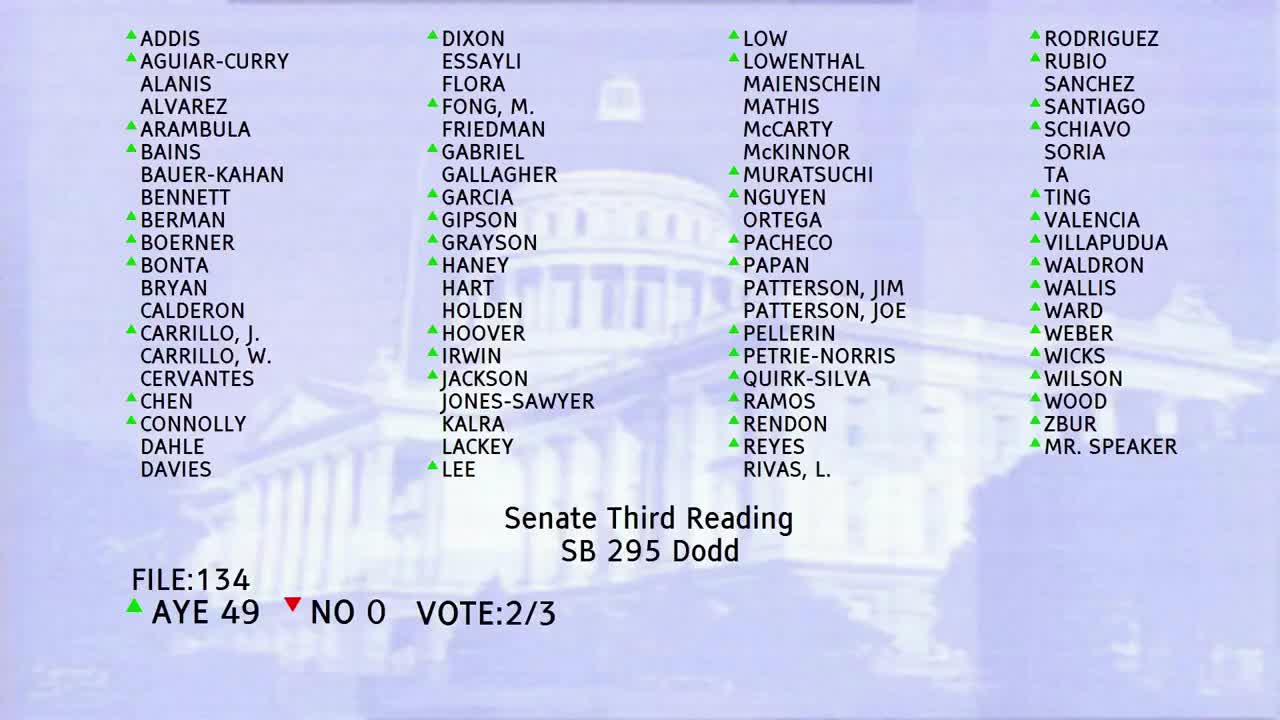 1MIN
Assembly Floor
 2MIN
Assembly Standing Committee on Revenue and Taxation
 2MIN
Assembly Standing Committee on Revenue and Taxation
Bill Author
Bill Co-Author(s):