SB 85: Immigration: case management and social services.
- Session Year: 2023-2024
- House: Senate
- Latest Version Date: 2024-08-29
Current Status:
Failed
(2024-09-28: In Senate. Consideration of Governor's veto pending.)
Introduced
In Committee
First Chamber
In Committee
Second Chamber
Enacted
What does this bill do?
The bill lets California use state money, if appropriated, to extend refugee social services for 90 days when federal Reception and Placement Program (RPP) funds run out, for refugees within their first 12 months in the United States. It says those services include English classes, job training, and case management, allows counties, qualified nonprofit groups, or resettlement agencies authorized under RPP to provide them, and lets the state department allocate, reallocate, and report on the funds.
The summary is provided by generative AI which can make mistakes. For original language, please view the details in the table below.
The federal Reception and Placement Program (RPP) under the United States Department of State is established to serve refugees during their first 3 months after arrival in the United States, through contracts with local resettlement agencies to provide various services using federal funds.
Existing state law requires the State Department of Social Services, after setting aside the necessary state administrative funds, to allocate federal funds appropriated for refugee social services programs to each eligible county or service provider, as defined, based on the number of refugees receiving aid, or who reside, in the eligible county. If an eligible county or service provider that receives funds declines all or part of those funds, or returns unexpended funds, existing law authorizes the department to exercise its discretion to reallocate the declined or returned funds among eligible counties and service providers. Existing law conditions the applicability of the requirements under these provisions on the availability of federal funds.
This bill would make those requirements also applicable if state funds are available subject to an appropriation. Under the bill, if a refugee recipient of refugee social services under RPP completes 90 days of those services and exhausts the federal funds allocated for that recipient, the recipient would be eligible for a 90-day extension of those services using state funds within the first 12 months of arrival in the United States. The bill would require that services covered pursuant to these provisions include (1) English language and employment training and (2) case management services, as specified. The bill would authorize a qualified nonprofit organization, an eligible county, or any office or affiliate of the agencies authorized under RPP to provide these services. The bill would also make conforming changes to related provisions.
If a recipient completes that 90-day extension and seeks additional services, the bill would require the designated case manager to conduct an assessment of the recipients needs and to determine, as specified, whether to grant the recipient an additional extension of those services, at a minimum of 90 days and a maximum of 180 days, for a combined total of no more than 360 days of those services. The bill would also make conforming changes to related provisions.(2)Existing law, subject to an appropriation, establishes the Enhanced Services for Asylees and Vulnerable Noncitizens to provide resettlement services for persons residing in the state and who are granted asylum, as specified, or who are eligible for the above-described refugee social services. Existing law requires the program to provide culturally appropriate and responsive case management services for asylees and vulnerable noncitizens for up to 90 days within the first year following the grant of asylum or after having been deemed eligible for refugee social services.This bill would extend the provision of those case management services for up to 180 days. If a recipient completes 180 days of services and seeks an extension, the bill would require the designated case manager to conduct an assessment of the recipients needs and to determine, as specified, whether to grant the recipient the extension, as described above for the refugee social services, for a total of no more than 360 days of those services.(3)For both sets of the above-described services, the bill would expand the scope of the service, as specified, and would authorize their provision by a qualified nonprofit organization, an office or affiliate of the agencies authorized under RPP, or, in the case of refugee social services, by an eligible county.(1)The federal Reception and Placement Program (RPP) under the United States Department of State is established to serve refugees during their first 3 months after arrival in the United States, through contracts with local resettlement agencies to provide various services using federal funds.
Existing state law requires the State Department of Social Services, after setting aside the necessary state administrative funds, to allocate federal funds appropriated for refugee social services programs to each eligible county or qualified nonprofit organization (QNO), service provider, as defined, based on the number of refugees receiving aid, or who reside, in the eligible county. If an eligible county or QNO service provider that receives funds declines all or part of those funds, or returns unexpended funds, existing law authorizes the department to exercise its discretion to reallocate the declined or returned funds among eligible counties and QNOs. service providers. Existing law conditions the applicability of the requirements under these provisions on the availability of federal funds.
This bill would make those requirements also applicable if state funds are available subject to an appropriation. Under the bill, if a refugee recipient of refugee social services under RPP completes 90 days of those services and exhausts the federal funds allocated for that recipient, the recipient would be eligible for a 90-day extension of those services using state funds within the first 12 months of arrival in the United States.
If a recipient completes that 90-day extension and seeks additional services, the bill would require the designated case manager to conduct an assessment of the recipients needs and to determine, as specified, whether to grant the recipient an additional extension of those services, at a minimum of 90 days and a maximum of 180 days, for a combined total of no more than 360 days of those services. The bill would also make conforming changes to related provisions.
(2)Existing law, subject to an appropriation, establishes the Enhanced Services for Asylees and Vulnerable Noncitizens to provide resettlement services for persons residing in the state and who are granted asylum, as specified, or who are eligible for the above-described refugee social services. Existing law requires the program to provide culturally appropriate and responsive case management services for asylees and vulnerable noncitizens for up to 90 days within the first year following the grant of asylum or after having been deemed eligible for refugee social services.
This bill would extend the provision of those case management services for up to 180 days. If a recipient completes 180 days of services and seeks an extension, the bill would require the designated case manager to conduct an assessment of the recipients needs and to determine, as specified, whether to grant the recipient the extension, as described above for the refugee social services, for a total of no more than 360 days of those services.
(3)For both sets of the above-described services, the bill would expand the scope of the service, as specified, and would authorize their provision by a QNO, qualified nonprofit organization, an office or affiliate of the agencies authorized under RPP, or, in the case of refugee social services, by an eligible county.
(1)The federal Reception and Placement Program (RPP) under the United States Department of State is established to serve refugees during their first 3 months after arrival in the United States, through contracts with local resettlement agencies to provide various services using federal funds.
Existing state law requires the State Department of Social Services, after setting aside the necessary state administrative funds, to allocate federal funds appropriated for refugee social services programs to each eligible county or qualified nonprofit organization (QNO), as defined, based on the number of refugees receiving aid, or who reside, in the eligible county. If an eligible county or QNO that receives funds declines all or part of those funds, or returns unexpended funds, existing law authorizes the department to exercise its discretion to reallocate the declined or returned funds among eligible counties and QNOs. Existing law conditions the applicability of the requirements under these provisions on the availability of federal funds.
This bill would make those requirements also applicable if state funds are available subject to an appropriation. Under the bill, if a refugee recipient of refugee social services under RPP completes 90 days of those services and exhausts the federal funds allocated for that recipient, the recipient would be eligible for a 90-day extension of those services using state funds within the first 12 months of arrival in the United States.
If a recipient completes that 90-day extension and seeks additional services, the bill would require the designated case manager to conduct an assessment of the recipients needs and to determine, as specified, whether to grant the recipient an additional extension of those services, at a minimum of 90 days and a maximum of 180 days, for a combined total of no more than 360 days of those services. The bill would also make conforming changes to related provisions.
(2)Existing law, subject to an appropriation, establishes the Enhanced Services for Asylees and Vulnerable Noncitizens to provide resettlement services for persons residing in the state and who are granted asylum, as specified, or who are eligible for the above-described refugee social services. Existing law requires the program to provide culturally appropriate and responsive case management services for asylees and vulnerable noncitizens for up to 90 days within the first year following the grant of asylum or after having been deemed eligible for refugee social services.
This bill would extend the provision of those case management services for up to 180 days. If a recipient completes 180 days of services and seeks an extension, the bill would require the designated case manager to conduct an assessment of the recipients needs and to determine, as specified, whether to grant the recipient the extension, as described above for the refugee social services, for a total of no more than 360 days of those services.
(3)For both sets of the above-described services, the bill would expand the scope of the service, as specified, and would authorize their provision by a QNO, an office or affiliate of the agencies authorized under RPP, or, in the case of refugee social services, by an eligible county.
(1)The federal Reception and Placement Program (RPP) under the United States Department of State is established to serve refugees during their first 3 months after arrival in the United States, through contracts with local resettlement agencies to provide various services using federal funds.
Existing state law requires the State Department of Social Services, after setting aside the necessary state administrative funds, to allocate federal funds appropriated for refugee social services programs to each eligible county or qualified nonprofit organization (QNO), as defined, based on the number of refugees receiving aid, or who reside, in the eligible county. If an eligible county or QNO that receives funds declines all or part of those funds, or returns unexpended funds, existing law authorizes the department to exercise its discretion to reallocate the declined or returned funds among eligible counties and QNOs. Existing law conditions the applicability of the requirements under these provisions on the availability of federal funds.
This bill would make those requirements also applicable if state funds are available subject to an appropriation. Under the bill, if a refugee recipient of refugee social services under RPP completes 90 days of those services and exhausts the federal funds allocated for that recipient, the recipient would be eligible for a 90-day extension of those services using state funds within the first 12 months of arrival to in the United States.
If a recipient completes that 90-day extension and seeks additional services, the bill would require the designated case manager to conduct an assessment of the recipients needs and to determine, as specified, whether to grant the recipient an additional extension of those services, at a minimum of 90 days and a maximum of 180 days, for a combined total of no more than 360 days of those services. The bill would also make conforming changes to related provisions.
(2)Existing law, subject to an appropriation, establishes the Enhanced Services for Asylees and Vulnerable Noncitizens to provide resettlement services for persons residing in the state and who are granted asylum, as specified, or who are eligible for the above-described refugee social services. Existing law requires the program to provide culturally appropriate and responsive case management services for asylees and vulnerable noncitizens for up to 90 days within the first year following the grant of asylum or after having been deemed eligible for refugee social services.
This bill would extend the provision of those case management services for up to 180 days. If a recipient completes 180 days of services and seeks an extension, the bill would require the designated case manager to conduct an assessment of the recipients needs and to determine, as specified, whether to grant the recipient the extension, as described above for the refugee social services, for a total of no more than 360 days of those services.
(3)For both sets of the above-described services, the bill would expand the scope of the service, as specified, and would authorize their provision by a QNO, an office or affiliate of the agencies authorized under RPP, or, in the case of refugee social services, by an eligible county.
(1)The federal Reception and Placement Program (RPP) under the United States Department of State is established to serve refugees during their first 3 months after arrival in the United States, through contracts with local resettlement agencies to provide various services using federal funds.
Existing state law requires the State Department of Social Services, after setting aside the necessary state administrative funds, to allocate federal funds appropriated for refugee social services programs to each eligible county or qualified nonprofit organization (QNO), as defined, based on the number of refugees receiving aid, or who reside, in the eligible county. If an eligible county or QNO that receives funds declines all or part of those funds, or returns unexpended funds, existing law authorizes the department to exercise its discretion to reallocate the declined or returned funds among eligible counties and QNOs. Existing law conditions the applicability of the requirements under these provisions on the availability of federal funds.
This bill would make those requirements also applicable if state funds are available subject to an appropriation. Under the bill, if a refugee recipient of refugee social services under RPP completes 90 days of those services and exhausts the federal funds allocated for that recipient, the recipient would be eligible for a 90-day extension of those services using state funds within the first 12 months of arrival to the United States.
If a recipient completes that 90-day extension and seeks additional services, the bill would require the designated case manager to conduct an assessment of the recipients needs and to determine, as specified, whether to grant the recipient an additional extension of those services, at a minimum of 90 days and a maximum of 180 days, for a combined total of no more than 360 days of those services. The bill would also make conforming changes to related provisions.
(2)Existing law, subject to an appropriation, establishes the Enhanced Services for Asylees and Vulnerable Noncitizens to provide resettlement services for persons residing in the state and who are granted asylum, as specified, or who are eligible for the above-described refugee social services. Existing law requires the program to provide culturally appropriate and responsive case management services for asylees and vulnerable noncitizens for up to 90 days within the first year following the grant of asylum or after having been deemed eligible for refugee social services.
This bill would extend the provision of those case management services for up to 180 days. If a recipient completes 180 days of services and seeks an extension, the bill would require the designated case manager to conduct an assessment of the recipients needs and to determine, as specified, whether to grant the recipient the extension, as described above for the refugee social services, for a total of no more than 360 days of those services.
(3)For both sets of the above-described services, the bill would expand the scope of the service, as specified, and would authorize their provision by a QNO, an office or affiliate of the agencies authorized under RPP, or, in the case of refugee social services, by an eligible county.
For the purposes of this chapter, the following terms have the following meanings:
(a)Eligible county means a county or city and county designated as impacted using a formula developed by the department based upon the refugee arrivals in the county during the preceding 60-month period for which the department has data.
(b)Qualified nonprofit organization means a nonprofit organization that is exempt from federal income taxation pursuant to Section 501(c)(3) of the Internal Revenue Code and that satisfies any additional eligibility criteria established by the department.
(c)Refugee social services include, but are not limited to, English language and employment training, as funded through federal appropriations, or as funded through state appropriations as described in Section 13282.
(d)Service provider means a qualified nonprofit organization or private for-profit organization selected by the department to administer refugee services.
SEC. 2.Section 13276 of the Welfare and Institutions Code is amended to read:13276.(a)(1)After setting aside the necessary state administrative funds, the department shall allocate appropriated federal funds, or appropriated state funds as described in Section 13282, for refugee social services programs to each eligible county and, if the department exercises its discretion pursuant to subdivision (b), to a service provider, based on the number of refugees receiving aid in the eligible county or the number of refugees that reside in the eligible county. The department may, at its discretion, utilize funding adjustments based on the length of time that the refugees have resided in the United States.
(2)If an eligible county or service provider that receives funds under paragraph (1) declines all or part of those funds, or returns unexpended funds, the department may exercise its discretion to reallocate the declined or returned funds among eligible counties and service providers.
(3)If the federal Office of Refugee Resettlement provides funding in addition to the annual appropriation described in paragraph (1) or designates funding for services to a specific population of eligible individuals, the department may exercise its discretion to allocate those funds among eligible counties and service providers consistent with federal law.
(b)(1)Notwithstanding any other law, and to the extent permitted by federal law, the department may, at its discretion, contract with, or award grants to, service providers for the purpose of administering refugee social services programs within a county. An eligible county providing refugee social services pursuant to this chapter may continue to administer those services while a contractor or grantee is also providing refugee social services pursuant to this chapter within the county. The department shall prioritize funding qualified nonprofit organizations and counties over for-profit organizations, when practicable.
(2)If an eligible county and a service provider are administering refugee social services simultaneously within the same county, the department shall, at its discretion, determine the amount of the funds to be distributed to the eligible county and service provider.
(3)Contracts or grants awarded pursuant to this subdivision shall require reporting, monitoring, or audits of services provided, as determined by the department.
(c)The department shall track and document the funding provided to each type of service provider and the purposes for use of this funding, and report this information to the appropriate fiscal and policy committees of the Legislature on a semiannual basis.
SEC. 3.Section 13277 of the Welfare and Institutions Code is amended to read:13277.(a)The department shall notify each eligible countys board of supervisors of the availability of funds described in subdivision (a) of Section 13276 or in subdivision (b) of Section 13282.
(b)(1)A county administering refugee social services shall designate an agency that is responsible for developing and implementing a plan for the provision of services funded by refugee social services funds.
(2)Until October 1, 1990, paragraph (1) does not apply to any county on whose behalf the department is administering the refugee employment social services funds.
(c)(1)The plan developed pursuant to subdivision (b) shall be in accordance with Sections 13278 and 13279.
(2)The plan developed pursuant to subdivision (b) shall reflect the full intent of this chapter that the funding for, and provision of, refugee social services shall lead to successful self-sufficiency and social integration for all refugee recipients of refugee social services, in accordance with guidelines issued by the department.
(3)Any plan developed pursuant to subdivision (b) shall, at a minimum, meet all of the following requirements:
(A)Each eligible countys board of supervisors shall ensure that the county planning process is designed in such a way as to facilitate refugee participation and public input in that process.
(B)The plan shall include a description of how available funds will be used to provide services to refugees.
(C)The plan shall specifically address how services will be delivered to refugees receiving aid in each county.
(D)The plan shall provide for the priority consideration for funding refugee community-based organizations if they demonstrate the capacity to implement the proposed programs, which capacity shall be comparable to that of other competitors who qualify for funding.
(d)Any plan described in Section 11321.6 that is developed by any county that elects to utilize these funds to pay for any service provided to, or any activity performed on behalf of, any refugee participating in the program authorized by Article 3.2 (commencing with Section 11320) of Chapter 2 shall meet the requirements of Section 13280.
(e)(1)Prior to October 1, 1990, the department shall discontinue administering refugee employment social services funds for a county pursuant to the request of the county.
(2)Commencing October 1, 1990, the department shall discontinue administering refugee employment social services funds on behalf of the county.
SEC. 4.Section 13282 of the Welfare and Institutions Code is amended to read:13282.(a)The requirements established by this chapter shall be applicable only so long as federal funds are available for its purposes, or so long as state funds are available pursuant to subdivision (b).
(b)(1)This subdivision shall be implemented only to the extent that an appropriation of state funds is made in the annual Budget Act or another statute for the purpose of this subdivision.
(2)If a refugee recipient of refugee social services under the federal Reception and Placement Program by the United States Department of State completes 90 days of those services and exhausts the federal funds allocated for that recipient, the recipient shall be eligible for a 90-day extension of refugee social services using state funds within the first 12 months of arrival in the United States.
(3)The refugee social services covered pursuant to this subdivision shall include the services as defined in subdivision (c) of Section 13275 and the case management services described in subdivision (b) of Section 13651.
(4)The refugee social services covered pursuant to this subdivision may be provided by a qualified nonprofit organization, as defined in Section 13275 or as described in Section 13650, including a community-based organization, or by an eligible county, as defined in Section 13275, or by any office or affiliate of the agencies authorized under the federal Reception and Placement Program, as applicable.
For the purposes of this chapter, the following terms have the following meanings:
(a)Eligible county means a county or city and county designated as impacted using a formula developed by the department based upon the refugee arrivals in the county during the preceding 60-month period for which the department has data.
(b)Qualified nonprofit organization means a nonprofit organization that is exempt from federal income taxation pursuant to Section 501(c)(3) of the Internal Revenue Code and that satisfies any additional eligibility criteria established by the department.
(c)Refugee social services include, but are not limited to, English language and employment training, as funded through federal appropriations, or as funded through state appropriations as described in Section 13282.
(d)Service provider means a qualified nonprofit organization or private for-profit organization selected by the department to administer refugee services.
SEC. 2.Section 13276 of the Welfare and Institutions Code is amended to read:13276.(a)(1)After setting aside the necessary state administrative funds, the department shall allocate appropriated federal funds, or appropriated state funds as described in Section 13282, for refugee social services programs to each eligible county and, if the department exercises its discretion pursuant to subdivision (b), to a service provider, based on the number of refugees receiving aid in the eligible county or the number of refugees that reside in the eligible county. The department may, at its discretion, utilize funding adjustments based on the length of time that the refugees have resided in the United States.
(2)If an eligible county or service provider that receives funds under paragraph (1) declines all or part of those funds, or returns unexpended funds, the department may exercise its discretion to reallocate the declined or returned funds among eligible counties and service providers.
(3)If the federal Office of Refugee Resettlement provides funding in addition to the annual appropriation described in paragraph (1) or designates funding for services to a specific population of eligible individuals, the department may exercise its discretion to allocate those funds among eligible counties and service providers consistent with federal law.
(b)(1)Notwithstanding any other law, and to the extent permitted by federal law, the department may, at its discretion, contract with, or award grants to, service providers for the purpose of administering refugee social services programs within a county. An eligible county providing refugee social services pursuant to this chapter may continue to administer those services while a contractor or grantee is also providing refugee social services pursuant to this chapter within the county. The department shall prioritize funding qualified nonprofit organizations and counties over for-profit organizations, when practicable.
(2)If an eligible county and a service provider are administering refugee social services simultaneously within the same county, the department shall, at its discretion, determine the amount of the funds to be distributed to the eligible county and service provider.
(3)Contracts or grants awarded pursuant to this subdivision shall require reporting, monitoring, or audits of services provided, as determined by the department.
(c)The department shall track and document the funding provided to each type of service provider and the purposes for use of this funding, and report this information to the appropriate fiscal and policy staff committees of the Legislature on a semiannual basis.
SEC. 3.Section 13277 of the Welfare and Institutions Code is amended to read:13277.(a)The department shall notify each eligible countys board of supervisors of the availability of funds described in subdivision (a) of Section 13276 or in subdivision (b) of Section 13282.
(b)(1)A county administering refugee social services shall designate an agency that is responsible for developing and implementing a plan for the provision of services funded by refugee social services funds.
(2)Until October 1, 1990, paragraph (1) does not apply to any county on whose behalf the department is administering the refugee employment social services funds.
(c)(1)The plan developed pursuant to subdivision (b) shall be in accordance with Sections 13278 and 13279.
(2)The plan developed pursuant to subdivision (b) shall reflect the full intent of this chapter that the funding for, and provision of, refugee social services shall lead to successful self-sufficiency and social integration for all refugee recipients of refugee social services, in accordance with guidelines issued by the department.
(3)Any plan developed pursuant to subdivision (b) shall, at a minimum, meet all of the following requirements:
(A)Each eligible countys board of supervisors shall ensure that the county planning process is designed in such a way as to facilitate refugee participation and public input in that process.
(B)The plan shall include a description of how available funds will be used to provide services to refugees.
(C)The plan shall specifically address how services will be delivered to refugees receiving aid in each county.
(D)The plan shall provide for the priority consideration for funding refugee community-based organizations if they demonstrate the capacity to implement the proposed programs, which capacity shall be comparable to that of other competitors who qualify for funding.
(d)Any plan described in Section 11321.6 that is developed by any county that elects to utilize these funds to pay for any service provided to, or any activity performed on behalf of, any refugee participating in the program authorized by Article 3.2 (commencing with Section 11320) of Chapter 2 shall meet the requirements of Section 13280.
(e)(1)Prior to October 1, 1990, the department shall discontinue administering refugee employment social services funds for a county pursuant to the request of the county.
(2)Commencing October 1, 1990, the department shall discontinue administering refugee employment social services funds on behalf of the county.
SEC. 4.Section 13282 of the Welfare and Institutions Code is amended to read:13282.(a)The requirements established by this chapter shall be applicable only so long as federal funds are available for its purposes, or so long as state funds are available pursuant to subdivision (b).
(b)(1)This subdivision shall be implemented only to the extent that an appropriation of state funds is made in the annual Budget Act or another statute for the purpose of this subdivision.
(2)If a refugee recipient of refugee social services under the federal Reception and Placement Program by the United States Department of State completes 90 days of those services and exhausts the federal funds allocated for that recipient, the recipient shall be eligible for a 90-day extension of refugee social services using state funds within the first 12 months of arrival in the United States.
(3)(A)If a recipient completes the 90-day extension described in paragraph (2) and seeks additional refugee social services, the designated case manager shall conduct an assessment of the recipients needs and shall determine whether to grant the recipient an additional extension of those services using state funds.(B)The case managers determination in subparagraph (A) shall be on a case-by-case basis and subject to a finding by the case manager that the recipient demonstrates extreme need pursuant to criteria set forth by the department. A finding of extreme need shall be based on the level of need for services as defined in subdivision (c) of Section 13275 or case management services as described in subdivision (b) of Section 13651.(C)An additional extension granted under this paragraph shall be at a minimum 90 days and at a maximum 180 days, resulting in a combined duration of no more than 270 days for the extensions described in paragraph (2) and this paragraph beyond the original 90 days under the federal Reception and Placement Program, for a total of no more than 360 days of those services. If the recipient is approved for the additional extension pursuant to this paragraph, the case manager shall determine the number of extension days granted based on the assessment and on the level of the recipients extreme need.(4)(3)The refugee social services covered pursuant to this subdivision shall include the services as defined in subdivision (c) of Section 13275 and the case management services described in subdivision (b) of Section 13651.
(5)(4)The refugee social services covered pursuant to this subdivision may be provided by a qualified nonprofit organization, as defined in Section 13275 or as described in Section 13650, including a community-based organization, or by an eligible county, as defined in Section 13275, or by any office or affiliate of the agencies authorized under the federal Reception and Placement Program, as applicable.
SEC. 5.Section 13651 of the Welfare and Institutions Code is amended to read:13651.(a)(1)The program shall provide culturally appropriate and responsive case management services for asylees and vulnerable noncitizens for up to 180 days, or as specified in paragraph (2), within the first year following the grant of asylum or after having been deemed eligible for services under Section 13283.(2)(A)If a recipient completes 180 days of case management services pursuant to paragraph (1) and seeks an extension of those services, the designated case manager shall conduct an assessment of the recipients needs and shall determine whether to grant the recipient the extension.(B)The case managers determination in subparagraph (A) shall be on a case-by-case basis and subject to a finding by the case manager that the recipient demonstrates extreme need pursuant to criteria set forth by the department. A finding of extreme need shall be based on the level of need for services as defined in subdivision (c) of Section 13275 or case management services as described in subdivision (b).(C)An additional extension granted under this paragraph shall be at a minimum 90 days and at a maximum 180 days, for a total of no more than 360 days of case management services. If the recipient is approved for the additional extension pursuant to this paragraph, the case manager shall determine the number of extension days granted based on the assessment and on the level of the recipients extreme need.(b)Case management services under the program shall include assistance in identifying and applying for all benefits to which the person is legally entitled, including cultural orientation and integration programs, support in accessing and navigating the public benefits and health care systems, housing assistance, community connection and relationship building, English language instruction, enrollment in an educational program or institution, financial literacy education, employment training, job placement assistance, and professional recredentialing and licensing application assistance.(c)Case management services under the program may be provided by a qualified nonprofit organization, as defined in Section 13275 or as described in Section 13650, including a community-based organization, or by any office or affiliate of the agencies authorized under the federal Reception and Placement Program by the United States Department of State, as applicable.(d)The department shall, in collaboration with service providers, determine outcome metrics to define program success.For the purposes of this chapter, the following terms have the following meanings:
(a)Eligible county means a county or city and county designated as impacted using a formula developed by the department based upon the refugee arrivals in the county during the preceding 60-month period for which the department has data.
(b)Qualified nonprofit organization means a nonprofit organization that is exempt from federal income taxation pursuant to Section 501(c)(3) of the Internal Revenue Code and that satisfies any additional eligibility criteria established by the department.
(c)Refugee social services include, but are not limited to, English language and employment training, as funded through federal appropriations. appropriations, or as funded through state appropriations as described in Section 13282.
(d)Service provider means a qualified nonprofit organization or private for-profit organization selected by the department to administer refugee services.
SEC. 2.Section 13276 of the Welfare and Institutions Code is amended to read:13276.(a)(1) After setting aside the necessary state administrative funds, the department shall allocate appropriated federal funds funds, or appropriated state funds as described in Section 13282, for refugee social services programs to each eligible county and, if the department exercises its discretion pursuant to subdivision (b), to a service provider, based on the number of refugees receiving aid in the eligible county or the number of refugees that reside in the eligible county. The department may, at its discretion, utilize funding adjustments based on the length of time that the refugees have resided in the United States.
(2)If an eligible county or service provider that receives funds under paragraph (1) declines all or part of those funds, or returns unexpended funds, the department may exercise its discretion to reallocate the declined or returned funds among eligible counties and service providers.
(3)If the federal Office of Refugee Resettlement provides funding in addition to the annual appropriation described in paragraph (1) or designates funding for services to a specific population of eligible individuals, the department may exercise its discretion to allocate those funds among eligible counties and service providers consistent with federal law.
(b)(1)Notwithstanding any other law, and to the extent permitted by federal law, the department may, at its discretion, contract with, or award grants to, service providers for the purpose of administering refugee social services programs within a county. An eligible county providing refugee social services pursuant to this chapter may continue to administer those services while a contractor or grantee is also providing refugee social services pursuant to this chapter within the county. The department shall prioritize funding qualified nonprofit organizations and counties over for-profit organizations, when practicable.
(2)If an eligible county and a service provider are administering refugee social services simultaneously within the same county, the department shall, at its discretion, determine the amount of the funds to be distributed to the eligible county and service provider.
(3)Contracts or grants awarded pursuant to this subdivision shall require reporting, monitoring, or audits of services provided, as determined by the department.
(c)The department shall track and document the funding provided to each type of service provider and the purposes for use of this funding, and report this information to the appropriate fiscal and policy staff of the Legislature on a semiannual basis.
SEC. 3.Section 13277 of the Welfare and Institutions Code is amended to read:13277.(a)The department shall notify each eligible countys board of supervisors of the availability of funds described in subdivision (a) of Section 13276 or in subdivision (b) of Section 13282.
(b)(1)A county administering refugee social services shall designate an agency that is responsible for developing and implementing a plan for the provision of services funded by refugee social services funds.
(2)Until October 1, 1990, paragraph (1) does not apply to any county on whose behalf the department is administering the refugee employment social services funds.
(c)(1)The plan developed pursuant to subdivision (b) shall be in accordance with Sections 13278 and 13279.
(2)The plan developed pursuant to subdivision (b) shall reflect the full intent of this chapter that the funding for, and provision of, refugee social services shall lead to successful self-sufficiency and social integration for all refugee recipients of refugee social services, in accordance with guidelines issued by the department.
(3)Any plan developed pursuant to subdivision (b) shall, at a minimum, meet all of the following requirements:
(A)Each eligible countys board of supervisors shall ensure that the county planning process is designed in such a way as to facilitate refugee participation and public input in that process.
(B)The plan shall include a description of how available funds will be used to provide services to refugees.
(C)The plan shall specifically address how services will be delivered to refugees receiving aid in each county.
(D)The plan shall provide for the priority consideration for funding refugee community-based organizations if they demonstrate the capacity to implement the proposed programs, which capacity shall be comparable to that of other competitors who qualify for funding.
(d)Any plan described in Section 11321.6 that is developed by any county that elects to utilize these funds to pay for any service provided to, or any activity performed on behalf of, any refugee participating in the program authorized by Article 3.2 (commencing with Section 11320) of Chapter 2 shall meet the requirements of Section 13280.
(e)(1)Prior to October 1, 1990, the department shall discontinue administering refugee employment social services funds for a county pursuant to the request of the county.
(2)Commencing October 1, 1990, the department shall discontinue administering refugee employment social services funds on behalf of the county.
SEC. 4.Section 13282 of the Welfare and Institutions Code is amended to read:13282.(a)The requirements established by this chapter shall be applicable only so long as federal funds are available for its purposes, or so long as state funds are available pursuant to subdivision (b).
(b)(1)This subdivision shall be implemented only to the extent that an appropriation of state funds is made in the annual Budget Act or another statute for the purpose of this subdivision.
(2)If a refugee recipient of refugee social services under the federal Reception and Placement Program by the United States Department of State completes 90 days of those services and exhausts the federal funds allocated for that recipient, the recipient shall be eligible for a 90-day extension of refugee social services using state funds within the first 12 months of arrival in the United States.
(3)(A)If a recipient completes the 90-day extension described in paragraph (2) and seeks additional refugee social services, the designated case manager shall conduct an assessment of the recipients needs and shall determine whether to grant the recipient an additional extension of those services using state funds.
(B)The case managers determination in subparagraph (A) shall be on a case-by-case basis and subject to a finding by the case manager that the recipient demonstrates extreme need pursuant to criteria set forth by the department. A finding of extreme need shall be based on the level of need for services as defined in subdivision (c) of Section 13275 or case management services as described in subdivision (b) of Section 13651.
(C)An additional extension granted under this paragraph shall be at a minimum 90 days and at a maximum 180 days, resulting in a combined duration of no more than 270 days for the extensions described in paragraph (2) and this paragraph beyond the original 90 days under the federal Reception and Placement Program, for a total of no more than 360 days of those services. If the recipient is approved for the additional extension pursuant to this paragraph, the case manager shall determine the number of extension days granted based on the assessment and on the level of the recipients extreme need.
(4)The refugee social services covered pursuant to this subdivision shall include the services as defined in subdivision (c) of Section 13275 and the case management services described in subdivision (b) of Section 13651.
(5)The refugee social services covered pursuant to this subdivision may be provided by a qualified nonprofit organization, as defined in Section 13275 or as described in Section 13650, including a community-based organization, or by an eligible county, as defined in Section 13275, or by any office or affiliate of the agencies authorized under the federal Reception and Placement Program, as applicable.
SEC. 5.Section 13651 of the Welfare and Institutions Code is amended to read:13651.(a)(1)The program shall provide culturally appropriate and responsive case management services for asylees and vulnerable noncitizens for up to 180 days, or as specified in paragraph (2), within the first year following the grant of asylum or after having been deemed eligible for services under Section 13283.
(2)(A)If a recipient completes 180 days of case management services pursuant to paragraph (1) and seeks an extension of those services, the designated case manager shall conduct an assessment of the recipients needs and shall determine whether to grant the recipient the extension.
(B)The case managers determination in subparagraph (A) shall be on a case-by-case basis and subject to a finding by the case manager that the recipient demonstrates extreme need pursuant to criteria set forth by the department. A finding of extreme need shall be based on the level of need for services as defined in subdivision (c) of Section 13275 or case management services as described in subdivision (b).
(C)An additional extension granted under this paragraph shall be at a minimum 90 days and at a maximum 180 days, for a total of no more than 360 days of case management services. If the recipient is approved for the additional extension pursuant to this paragraph, the case manager shall determine the number of extension days granted based on the assessment and on the level of the recipients extreme need.
(b)Case management services under the program shall include assistance in identifying and applying for all benefits to which the person is legally entitled, including cultural orientation and integration programs, support in accessing and navigating the public benefits and health care systems, housing assistance, community connection and relationship building, English language instruction, enrollment in an educational program or institution, financial literacy education, employment training, job placement assistance, and professional recredentialing and licensing application assistance.
(c)Case management services under the program may be provided by a qualified nonprofit organization, as defined in Section 13275 or as described in Section 13650, including a community-based organization, or by any office or affiliate of the agencies authorized under the federal Reception and Placement Program by the United States Department of State, as applicable.
(d)The department shall, in collaboration with service providers, determine outcome metrics to define program success.
For purposes of this chapter, the following terms have the following meanings:
(a)Eligible county means a county or city and county designated as impacted using a formula developed by the department based upon the refugee arrivals in the county during the preceding 60-month period for which the department has data.
(b)Qualified nonprofit organization means a nonprofit organization that is exempt from federal income taxation pursuant to Section 501(c)(3) of the Internal Revenue Code and that satisfies any additional eligibility criteria established by the department.
(c)Refugee social services include, but are not limited to, English language and employment training, as funded through federal appropriations, or as funded through state appropriations as described in Section 13282.
SEC. 2.Section 13276 of the Welfare and Institutions Code is amended to read:13276.(a)(1) After setting aside the necessary state administrative funds, the department shall allocate appropriated federal funds, or appropriated state funds as described in Section 13282, for refugee social services programs to each eligible county and, if the department exercises its discretion pursuant to subdivision (b), to a qualified nonprofit organization, based on the number of refugees receiving aid in the eligible county or the number of refugees who reside in the eligible county. The department may, at its discretion, utilize funding adjustments based on the length of time that the refugees have resided in the United States.
(2)If an eligible county or qualified nonprofit organization that receives funds under paragraph (1) declines all or part of those funds, or returns unexpended funds, the department may exercise its discretion to reallocate the declined or returned funds among eligible counties and qualified nonprofit organizations.
(3)If the federal Office of Refugee Resettlement provides funding in addition to the annual appropriation described in paragraph (1) or designates funding for services to a specific population of eligible individuals, the department may exercise its discretion to allocate those funds among eligible counties and qualified nonprofit organizations consistent with federal law.
(b)(1) Notwithstanding any other law, and to the extent permitted by federal law, the department may, at its discretion, contract with, or award grants to, qualified nonprofit organizations for the purpose of administering refugee social services programs within a county. An eligible county providing refugee social services pursuant to this chapter may continue to administer those services while a contractor or grantee is also providing refugee social services pursuant to this chapter within the county.
(2)If an eligible county and a qualified nonprofit organization are administering refugee social services simultaneously within the same county, the department shall, at its discretion, determine the amount of the funds to be distributed to the eligible county and qualified nonprofit organization.
(3)Contracts or grants awarded pursuant to under this subdivision shall require reporting, monitoring, or audits of services provided, as determined by the department.
SEC. 3.Section 13277 of the Welfare and Institutions Code is amended to read:13277.(a)The department shall notify each eligible countys board of supervisors of the availability of funds described in subdivision (a) of Section 13276 or in subdivision (b) of Section 13282.
(b)(1)A county administering refugee social services shall designate an agency that is responsible for developing and implementing a plan for the provision of services funded by refugee social services funds.
(2)Until October 1, 1990, paragraph (1) does not apply to any county on whose behalf the department is administering the refugee employment social services funds.
(c)(1)The plan developed pursuant to subdivision (b) shall be in accordance with Sections 13278 and 13279.
(2)The plan developed pursuant to subdivision (b) shall reflect the full intent of this chapter that the funding for, and provision of, refugee social services shall lead to successful self-sufficiency and social integration for all refugee recipients of refugee social services, in accordance with guidelines issued by the department.
(3)Any plan developed pursuant to subdivision (b) shall, at a minimum, meet all of the following requirements:
(A)Each eligible countys board of supervisors shall ensure that the county planning process is designed in such a way as to facilitate refugee participation and public input in that process.
(B)The plan shall include a description of how available funds will be used to provide services to refugees.
(C)The plan shall specifically address how services will be delivered to refugees receiving aid in each county.
(D)The plan shall provide for the priority consideration for funding refugee community-based organizations if they demonstrate the capacity to implement the proposed programs, which capacity shall be comparable to that of other competitors who qualify for funding.
(d)Any plan described in Section 11321.6 that is developed by any county that elects to utilize these funds to pay for any service provided to, or any activity performed on behalf of, any refugee participating in the program authorized by Article 3.2 (commencing with Section 11320) of Chapter 2 shall meet the requirements of Section 13280.
(e)(1)Prior to October 1, 1990, the department shall discontinue administering refugee employment social services funds for a county pursuant to the request of the county.
(2)Commencing October 1, 1990, the department shall discontinue administering refugee employment social services funds on behalf of the county.
SEC. 4.Section 13282 of the Welfare and Institutions Code is amended to read:13282.(a)The requirements established by this chapter shall be applicable only so long as federal funds are available for its purposes, or so long as state funds are available pursuant to subdivision (b).
(b)(1)This subdivision shall be implemented only to the extent that an appropriation of state funds is made in the annual Budget Act or another statute for the purpose of this subdivision.
(2)If a refugee recipient of refugee social services under the federal Reception and Placement Program by the United States Department of State completes 90 days of those services and exhausts the federal funds allocated for that recipient, the recipient shall be eligible for a 90-day extension of refugee social services using state funds within the first 12 months of arrival in the United States.
(3)(A)If a recipient completes the 90-day extension described in paragraph (2) and seeks additional refugee social services, the designated case manager shall conduct an assessment of the recipients needs and shall determine whether to grant the recipient an additional extension of those services using state funds.
(B)The case managers determination in subparagraph (A) shall be on a case-by-case basis and subject to a finding by the case manager that the recipient demonstrates extreme need pursuant to criteria set forth by the department. A finding of extreme need shall be based on the level of need for services as defined in subdivision (c) of Section 13275 or case management services as described in subdivision (b) of Section 13651.
(C)An additional extension granted under this paragraph shall be at a minimum 90 days and at a maximum 180 days, resulting in a combined duration of no more than 270 days for the extensions described in paragraph (2) and this paragraph beyond the original 90 days under the federal Reception and Placement Program, for a total of no more than 360 days of those services. If the recipient is approved for the additional extension pursuant to this paragraph, the case manager shall determine the number of extension days granted based on the assessment and on the level of the recipients extreme need.
(4)The refugee social services covered pursuant to this subdivision shall include the services as defined in subdivision (c) of Section 13275 and the case management services described in subdivision (b) of Section 13651.
(5)The refugee social services covered pursuant to this subdivision may be provided by a qualified nonprofit organization, as defined in Section 13275 or as described in Section 13650, including a community-based organization, or by an eligible county, as defined in Section 13275, or by any office or affiliate of the agencies authorized under the federal Reception and Placement Program, as applicable.
SEC. 5.Section 13651 of the Welfare and Institutions Code is amended to read:13651.(a)(1)The program shall provide culturally appropriate and responsive case management services for asylees and vulnerable noncitizens for up to 180 days, or as specified in paragraph (2), within the first year following the grant of asylum or after having been deemed eligible for services under Section 13283.
(2)(A)If a recipient completes 180 days of case management services pursuant to paragraph (1) and seeks an extension of those services, the designated case manager shall conduct an assessment of the recipients needs and shall determine whether to grant the recipient the extension.
(B)The case managers determination in subparagraph (A) shall be on a case-by-case basis and subject to a finding by the case manager that the recipient demonstrates extreme need pursuant to criteria set forth by the department. A finding of extreme need shall be based on the level of need for services as defined in subdivision (c) of Section 13275 or case management services as described in subdivision (b).
(C)An additional extension granted under this paragraph shall be at a minimum 90 days and at a maximum 180 days, for a total of no more than 360 days of case management services. If the recipient is approved for the additional extension pursuant to this paragraph, the case manager shall determine the number of extension days granted based on the assessment and on the level of the recipients extreme need.
(b)Case management services under the program shall include assistance in identifying and applying for all benefits to which the person is legally entitled, including cultural orientation and integration programs, support in accessing and navigating the public benefits and health care systems, housing assistance, community connection and relationship building, English language instruction, enrollment in an educational program or institution, financial literacy education, employment training, job placement assistance, and professional recredentialing and licensing application assistance.
(c)Case management services under the program may be provided by a qualified nonprofit organization, as defined in Section 13275 or as described in Section 13650, including a community-based organization, or by any office or affiliate of the agencies authorized under the federal Reception and Placement Program by the United States Department of State, as applicable.
(d)The department shall, in collaboration with service providers, determine outcome metrics to define program success.
For the purposes of this chapter, the following terms have the following meanings:
(a)Eligible county means a county or city and county designated as impacted using a formula developed by the department based upon the refugee arrivals in the county during the preceding 60-month period for which the department has data.
(b)Qualified nonprofit organization means a nonprofit organization that is exempt from federal income taxation pursuant to Section 501(c)(3) of the Internal Revenue Code and that satisfies any additional eligibility criteria established by the department.
(c)Refugee social services include, but are not limited to, English language and employment training, as funded through federal appropriations, or as funded through state appropriations as described in Section 13282.
SEC. 2.Section 13276 of the Welfare and Institutions Code is amended to read:13276.(a)(1) After setting aside the necessary state administrative funds, the department shall allocate appropriated federal funds, or appropriated state funds as described in Section 13282, for refugee social services programs to each eligible county and, if the department exercises its discretion pursuant to subdivision (b), to a qualified nonprofit organization, based on the number of refugees receiving aid in the eligible county or the number of refugees who reside in the eligible county. The department may, at its discretion, utilize funding adjustments based on the length of time that the refugees have resided in the United States.
(2)If an eligible county or qualified nonprofit organization that receives funds under paragraph (1) declines all or part of those funds, or returns unexpended funds, the department may exercise its discretion to reallocate the declined or returned funds among eligible counties and qualified nonprofit organizations.
(3)If the federal Office of Refugee Resettlement provides funding in addition to the annual appropriation described in paragraph (1) or designates funding for services to a specific population of eligible individuals, the department may exercise its discretion to allocate those funds among eligible counties and qualified nonprofit organizations consistent with federal law.
(b)(1) Notwithstanding any other law, and to the extent permitted by federal law, the department may, at its discretion, contract with, or award grants to, qualified nonprofit organizations for the purpose of administering refugee social services programs within a county. An eligible county providing refugee social services pursuant to this chapter may continue to administer those services while a contractor or grantee is also providing refugee social services pursuant to this chapter within the county.
(2)If an eligible county and a qualified nonprofit organization are administering refugee social services simultaneously within the same county, the department shall, at its discretion, determine the amount of the funds to be distributed to the eligible county and qualified nonprofit organization.
(3)Contracts or grants awarded pursuant to this subdivision shall require reporting, monitoring, or audits of services provided, as determined by the department.
SEC. 3.Section 13277 of the Welfare and Institutions Code is amended to read:13277.(a)The department shall notify each eligible countys board of supervisors of the availability of funds described in subdivision (a) of Section 13276 or in subdivision (b) of Section 13282.
(b)(1)A county administering refugee social services shall designate an agency that is responsible for developing and implementing a plan for the provision of services funded by refugee social services funds.
(2)Until October 1, 1990, paragraph (1) does not apply to any county on whose behalf the department is administering the refugee employment social services funds.
(c)(1)The plan developed pursuant to subdivision (b) shall be in accordance with Sections 13278 and 13279.
(2)The plan developed pursuant to subdivision (b) shall reflect the full intent of this chapter that the funding for, and provision of, refugee social services shall lead to successful self-sufficiency and social integration for all refugee recipients of refugee social services, in accordance with guidelines issued by the department.
(3)Any plan developed pursuant to subdivision (b) shall, at a minimum, meet all of the following requirements:
(A)Each eligible countys board of supervisors shall ensure that the county planning process is designed in such a way as to facilitate refugee participation and public input in that process.
(B)The plan shall include a description of how available funds will be used to provide services to refugees.
(C)The plan shall specifically address how services will be delivered to refugees receiving aid in each county.
(D)The plan shall provide for the priority consideration for funding refugee community-based organizations if they demonstrate the capacity to implement the proposed programs, which capacity shall be comparable to that of other competitors who qualify for funding.
(d)Any plan described in Section 11321.6 that is developed by any county that elects to utilize these funds to pay for any service provided to, or any activity performed on behalf of, any refugee participating in the program authorized by Article 3.2 (commencing with Section 11320) of Chapter 2 shall meet the requirements of Section 13280.
(e)(1)Prior to October 1, 1990, the department shall discontinue administering refugee employment social services funds for a county pursuant to the request of the county.
(2)Commencing October 1, 1990, the department shall discontinue administering refugee employment social services funds on behalf of the county.
SEC. 4.Section 13282 of the Welfare and Institutions Code is amended to read:13282.(a)The requirements established by this chapter shall be applicable only so long as federal funds are available for its purposes, or so long as state funds are available pursuant to subdivision (b).
(b)(1)This subdivision shall be implemented only to the extent that an appropriation of state funds is made in the annual Budget Act or another statute for the purpose of this subdivision.
(2)If a refugee recipient of refugee social services under the federal Reception and Placement Program by the United States Department of State completes 90 days of those services and exhausts the federal funds allocated for that recipient, the recipient shall be eligible for a 90-day extension of refugee social services using state funds within the first 12 months of arrival to in the United States.
(3)(A)If a recipient completes the 90-day extension described in paragraph (2) and seeks additional refugee social services, the designated case manager shall conduct an assessment of the recipients needs and shall determine whether to grant the recipient an additional extension of those services using state funds.
(B)The case managers determination in subparagraph (A) shall be on a case-by-case basis and subject to a finding by the case manager that the recipient demonstrates extreme need pursuant to criteria set forth by the department. A finding of extreme need shall be based on the level of need for services as defined in subdivision (c) of Section 13275 or case management services as described in subdivision (b) of Section 13651.
(C)An additional extension granted under this paragraph shall be at a minimum 90 days and at a maximum 180 days, resulting in a combined duration of no more than 270 days for the extensions described in paragraph (2) and this paragraph beyond the original 90 days under the federal Reception and Placement Program, for a total of no more than 360 days of those services. If the recipient is approved for the additional extension pursuant to this paragraph, the case manager shall determine the number of extension days granted based on the assessment and on the level of the recipients extreme need.
(4)The refugee social services covered pursuant to this subdivision shall include the services as defined in subdivision (c) of Section 13275 and the case management services described in subdivision (b) of Section 13651.
(5)The refugee social services covered pursuant to this subdivision may be provided by a qualified nonprofit organization, as defined in Section 13275 or as described in Section 13650, including a community-based organization, or by an eligible county, as defined in Section 13275, or by any office or affiliate of the agencies authorized under the federal Reception and Placement Program, as applicable.
SEC. 5.Section 13651 of the Welfare and Institutions Code is amended to read:13651.(a)(1)The program shall provide culturally appropriate and responsive case management services for asylees and vulnerable noncitizens for up to 180 days, or as specified in paragraph (2), within the first year following the grant of asylum or after having been deemed eligible for services under Section 13283.
(2)(A)If a recipient completes 180 days of case management services pursuant to paragraph (1) and seeks an extension of those services, the designated case manager shall conduct an assessment of the recipients needs and shall determine whether to grant the recipient the extension.
(B)The case managers determination in subparagraph (A) shall be on a case-by-case basis and subject to a finding by the case manager that the recipient demonstrates extreme need pursuant to criteria set forth by the department. A finding of extreme need shall be based on the level of need for services as defined in subdivision (c) of Section 13275 or case management services as described in subdivision (b).
(C)An additional extension granted under this paragraph shall be at a minimum 90 days and at a maximum 180 days, for a total of no more than 360 days of case management services. If the recipient is approved for the additional extension pursuant to this paragraph, the case manager shall determine the number of extension days granted based on the assessment and on the level of the recipients extreme need.
(b)Case management services under the program shall include assistance in identifying and applying for all benefits to which the person is legally entitled, including cultural orientation and integration programs, support in accessing and navigating the public benefits and health care systems, housing assistance, community connection and relationship building, English language instruction, enrollment in an educational program or institution, financial literacy education, employment training, job placement assistance, and professional recredentialing and licensing application assistance.
(c)Case management services under the program may be provided by a qualified nonprofit organization, as defined in Section 13275 or as described in Section 13650, including a community-based organization, or by any office or affiliate of the agencies authorized under the federal Reception and Placement Program by the United States Department of State, as applicable.
(d)The department shall, in collaboration with service providers, determine outcome metrics to define program success.
For the purposes of this chapter, the following terms have the following meanings:
(a)Eligible county means a county or city and county designated as impacted using a formula developed by the department based upon the refugee arrivals in the county during the preceding 60-month period for which the department has data.
(b)Qualified nonprofit organization means a nonprofit organization that is exempt from federal income taxation pursuant to Section 501(c)(3) of the Internal Revenue Code and that satisfies any additional eligibility criteria established by the department.
(c)Refugee social services include, but are not limited to, English language and employment training, as funded through federal appropriations. appropriations, or as funded through state appropriations as described in Section 13282.
SEC. 2.Section 13276 of the Welfare and Institutions Code is amended to read:13276.(a)(1) After setting aside the necessary state administrative funds, the department shall allocate appropriated federal funds funds, or appropriated state funds as described in Section 13282, for refugee social services programs to each eligible county and, if the department exercises its discretion pursuant to subdivision (b), to a qualified nonprofit organization, based on the number of refugees receiving aid in the eligible county or the number of refugees that who reside in the eligible county. The department may, at its discretion, utilize funding adjustments based on the length of time that the refugees have resided in the United States.
(2)If an eligible county or qualified nonprofit organization that receives funds under paragraph (1) declines all or part of those funds, or returns unexpended funds, the department may exercise its discretion to reallocate the declined or returned funds among eligible counties and qualified nonprofit organizations.
(3)If the federal Office of Refugee Resettlement provides funding in addition to the annual appropriation described in paragraph (1) or designates funding for services to a specific population of eligible individuals, the department may exercise its discretion to allocate those funds among eligible counties and qualified nonprofit organizations consistent with federal law.
(b)(1) Notwithstanding any other law, and to the extent permitted by federal law, the department may, at its discretion, contract with, or award grants to, qualified nonprofit organizations for the purpose of administering refugee social services programs within a county. An eligible county providing refugee social services pursuant to this chapter may continue to administer those services while a contractor or grantee is also providing refugee social services pursuant to this chapter within the county.
(2)If an eligible county and a qualified nonprofit organization are administering refugee social services simultaneously within the same county, the department shall, at its discretion, determine the amount of the funds to be distributed to the eligible county and qualified nonprofit organization.
(3)Contracts or grants awarded pursuant to this subdivision shall require reporting, monitoring, or audits of services provided, as determined by the department.
SEC. 3.Section 13277 of the Welfare and Institutions Code is amended to read:13277.(a)The department shall notify each eligible countys board of supervisors of the availability of funds described in subdivision (a) of Section 13276. 13276 or in subdivision (b) of Section 13282.
(b)(1)A county administering refugee social services shall designate an agency that is responsible for developing and implementing a plan for the provision of services funded by refugee social services funds.
(2)Until October 1, 1990, paragraph (1) does not apply to any county on whose behalf the department is administering the refugee employment social services funds.
(c)(1)The plan developed pursuant to subdivision (b) shall be in accordance with Sections 13278 and 13279.
(2)The plan developed pursuant to subdivision (b) shall reflect the full intent of this chapter that the funding for, and provision of, refugee social services shall lead to successful self-sufficiency and social integration for all refugee recipients of refugee social services, in accordance with guidelines issued by the department.
(3)Any plan developed pursuant to subdivision (b) shall, at a minimum, meet all of the following requirements:
(A)Each eligible countys board of supervisors shall ensure that the county planning process is designed in such a way as to facilitate refugee participation and public input in that process.
(B)The plan shall include a description of how available funds will be used to provide services to refugees.
(C)The plan shall specifically address how services will be delivered to refugees receiving aid in each county.
(D)The plan shall provide for the priority consideration for funding refugee community-based organizations if they demonstrate the capacity to implement the proposed programs, which capacity shall be comparable to that of other competitors who qualify for funding.
(d)Any plan described in Section 11321.6 that is developed by any county that elects to utilize these funds to pay for any service provided to, or any activity performed on behalf of, any refugee participating in the program authorized by Article 3.2 (commencing with Section 11320) of Chapter 2 shall meet the requirements of Section 13280.
(e)(1)Prior to October 1, 1990, the department shall discontinue administering refugee employment social services funds for a county pursuant to the request of the county.
(2)Commencing October 1, 1990, the department shall discontinue administering refugee employment social services funds on behalf of the county.
SEC. 4.Section 13282 of the Welfare and Institutions Code is amended to read:13282.(a)The requirements established by this chapter shall be applicable only so long as federal funds are available for its purposes. purposes, or so long as state funds are available pursuant to subdivision (b).
(b)(1)This subdivision shall be implemented only to the extent an appropriation of state funds is made in the annual Budget Act or another statute for the purpose of this subdivision.
(2)If a refugee recipient of refugee social services under the federal Reception and Placement Program by the United States Department of State completes 90 days of those services and exhausts the federal funds allocated for that recipient, the recipient shall be eligible for a 90-day extension of refugee social services using state funds within the first 12 months of arrival to the United States.
(3)(A)If a recipient completes the 90-day extension described in paragraph (2) and seeks additional refugee social services, the designated case manager shall conduct an assessment of the recipients needs and shall determine whether to grant the recipient an additional extension of those services using state funds.
(B)The case managers determination in subparagraph (A) shall be on a case-by-case basis and subject to a finding by the case manager that the recipient demonstrates extreme need pursuant to criteria set forth by the department. A finding of extreme need shall be based on the level of need for services as defined in subdivision (c) of Section 13275 or case management services as described in subdivision (b) of Section 13651.
(C)An additional extension granted under this paragraph shall be at a minimum 90 days and at a maximum 180 days, resulting in a combined duration of no more than 270 days for the extensions described in paragraph (2) and this paragraph beyond the original 90 days under the federal Reception and Placement Program, for a total of no more than 360 days of those services. If the recipient is approved for the additional extension pursuant to this paragraph, the case manager shall determine the number of extension days granted based on the assessment and on the level of the recipients extreme need.
(4)The refugee social services covered pursuant to this subdivision shall include the services as defined in subdivision (c) of Section 13275 and the case management services described in subdivision (b) of Section 13651.
(5)The refugee social services covered pursuant to this subdivision may be provided by a qualified nonprofit organization, as defined in Section 13275 or as described in Section 13650, including a community-based organization, or by an eligible county, as defined in Section 13275, or by any office or affiliate of the agencies authorized under the federal Reception and Placement Program, as applicable.
SEC. 5.Section 13651 of the Welfare and Institutions Code is amended to read:13651.(a)(1)The program shall provide culturally appropriate and responsive case management services for asylees and vulnerable noncitizens for up to 90 days 180 days, or as specified in paragraph (2), within the first year following the grant of asylum or after having been deemed eligible for services under Section 13283.
(2)(A)If a recipient completes 180 days of case management services pursuant to paragraph (1) and seeks an extension of those services, the designated case manager shall conduct an assessment of the recipients needs and shall determine whether to grant the recipient the extension.
(B)The case managers determination in subparagraph (A) shall be on a case-by-case basis and subject to a finding by the case manager that the recipient demonstrates extreme need pursuant to criteria set forth by the department. A finding of extreme need shall be based on the level of need for services as defined in subdivision (c) of Section 13275 or case management services as described in subdivision (b).
(C)An additional extension granted under this paragraph shall be at a minimum 90 days and at a maximum 180 days, for a total of no more than 360 days of case management services. If the recipient is approved for the additional extension pursuant to this paragraph, the case manager shall determine the number of extension days granted based on the assessment and on the level of the recipients extreme need.
(b)Case management services under the program shall include assistance in identifying and applying for all benefits to which the person is legally entitled, including cultural orientation and integration programs, support in accessing and navigating the public benefits and health care systems, housing assistance, community connection and relationship building, English language instruction, and enrollment in an educational program or institution, financial literacy education, employment training, job placement assistance, and professional recredentialing and licensing application assistance.
(c)Case management services under the program may be provided by a qualified nonprofit organization, as defined in Section 13275 or as described in Section 13650, including a community-based organization, or by any office or affiliate of the agencies authorized under the federal Reception and Placement Program by the United States Department of State, as applicable.
(c)(d)The department shall, in collaboration with service providers, determine outcome metrics to define program success.
|
Date
|
Status
|
|---|---|
| Sep 28, 2024 | In Senate. Consideration of Governor's veto pending. |
| Sep 28, 2024 | Vetoed by the Governor. |
| Sep 3, 2024 | Enrolled and presented to the Governor at 3 p.m. |
| Aug 27, 2024 | Assembly amendments concurred in. (Ayes 34. Noes 0. Page 5504.) Ordered to engrossing and enrolling. |
| Aug 26, 2024 | In Senate. Concurrence in Assembly amendments pending. |
| Aug 26, 2024 | Read third time. Passed. (Ayes 65. Noes 0. Page 6541.) Ordered to the Senate. |
| Aug 20, 2024 | Read second time. Ordered to third reading. |
| Aug 19, 2024 | Read second time and amended. Ordered to second reading. |
| Aug 15, 2024 | From committee: Do pass as amended. (Ayes 11. Noes 0.) (August 15). |
| Jul 2, 2024 | July 2 set for first hearing. Placed on suspense file. |
| Jun 18, 2024 | Read second time and amended. Re-referred to Com. on APPR. |
| Jun 17, 2024 | From committee: Do pass as amended and re-refer to Com. on APPR. (Ayes 5. Noes 0.) (June 11). |
| Apr 29, 2024 | Referred to Com. on HUM. S. |
| Jan 25, 2024 | In Assembly. Read first time. Held at Desk. |
| Jan 25, 2024 | Read third time. Passed. (Ayes 29. Noes 0. Page 3035.) Ordered to the Assembly. |
| Jan 22, 2024 | Read second time. Ordered to third reading. |
| Jan 18, 2024 | From committee: Do pass. (Ayes 4. Noes 2. Page 3011.) (January 18). |
| Jan 12, 2024 | Set for hearing January 18. |
| May 18, 2023 | May 18 hearing: Held in committee and under submission. |
| May 12, 2023 | Set for hearing May 18. |
| May 8, 2023 | May 8 hearing: Placed on APPR suspense file. |
| May 1, 2023 | Set for hearing May 8. |
| Apr 25, 2023 | From committee: Do pass and re-refer to Com. on APPR. (Ayes 5. Noes 0. Page 876.) (April 24). Re-referred to Com. on APPR. |
| Apr 17, 2023 | From committee with author's amendments. Read second time and amended. Re-referred to Com. on HUMAN S. |
| Mar 13, 2023 | Set for hearing April 24. |
| Feb 23, 2023 | From committee with author's amendments. Read second time and amended. Re-referred to Com. on HUMAN S. |
| Jan 25, 2023 | Referred to Com. on HUMANS S. |
| Jan 17, 2023 | From printer. May be acted upon on or after February 13. |
| Jan 13, 2023 | Introduced. Read first time. To Com. on RLS. for assignment. To print. |
|
Date
|
Description
|
Location
|
Votes
|
|
|---|---|---|---|---|
| Aug 27, 2024 | Unfinished Business SB85 Wiener et al. Concurrence | Senate Floor |
Passed |
|
| Aug 26, 2024 | SB 85 Wiener Senate Third Reading By Pacheco | Assembly Floor |
Passed |
|
| Aug 15, 2024 | Do pass as amended. | Assembly Standing Committee on Appropriations |
Passed |
|
| Jun 11, 2024 | Do pass as amended and be re-referred to the Committee on [Appropriations] | Assembly Standing Committee on Human Services |
Passed |
|
| Jan 25, 2024 | Senate 3rd Reading SB85 Wiener et al. | Senate Floor |
Passed |
|
| Jan 18, 2024 | Do pass | Senate Standing Committee on Appropriations |
Passed |
|
| May 8, 2023 | Placed on suspense file | Senate Standing Committee on Appropriations |
Passed |
|
| Apr 24, 2023 | Do pass, but first be re-referred to the Committee on [Appropriations] | Senate Standing Committee on Human Services |
Passed |
This list shows positions taken on this bill by organizations on the date displayed, which is linked to the original source.
Positions by individuals are not included.
|
Organization
|
Position
|
Date
|
|---|---|---|
| Afghan-American Foundation | ** Support | |
| Afghans for A Better Tomorrow | ** Support | |
| Aguilas | ** Support | |
| Aila Northern California Chapter | ** Support | |
| AJC San Francisco | ** Support | |
| American Jewish Committee San Diego | ** Support | |
| Anti-Defamation League | ** Support | |
| Avan Immigrant Services | ** Support | |
| Bend The Arc: Jewish Action | ** Support | |
| Beth Shir Shalom | ** Support | |
| Board of Supervisors for the City and County of San Francisco | ** Support | |
| CA Welcomes Coalition | ** Support | |
| Cair California | ** Support | |
| California Immigrant Policy Center | ** Support | |
| California Welcomes Coalition | ** Support | |
| California Young Democrats Jewish Caucus | ** Support | |
| Camp Nefesh | ** Support | |
| City Of Los Angeles | ** Support | |
| City of West Hollywood | ** Support | |
| Clue | ** Support | |
| CLUE: Clergy and Laity United for Economic Justice | ** Support | |
| Coalition for Humane Immigrant Rights LA | ** Support | |
| Committee Of Interns and Residents | ** Support | |
| Committee of Interns and Residents - SEIU | ** Support | |
| Congregation Sha'ar Zahav | ** Support | |
| Council on American-Islamic Relations, California | ** Support | |
| Democrats for Israel Los Angeles | ** Support | |
| Democrats for Israel-CA | ** Support | |
| East Bay Refugee and Immigrant Forum | ** Support | |
| Equality California | ** Support | |
| Equity California | ** Support | |
| Esperanza Immigrant Rights Project, Catholic Charities of Los Angeles INC. | ** Support | |
| ETTA | ** Support | |
| Friends Committee On Legislation Of California | ** Support | |
| Global Communication Education & Art | ** Support | |
| Governmental Advocates, Inc. | ** Support | |
| Hadassah | ** Support | |
| Hias | ** Support | |
| Hillel of San Diego | ** Support | |
| Holocaust Museum LA | ** Support | |
| Home for Refugees | ** Support | |
| ikar | ** Support | |
| Interfaith Refugee & Immigration Service | ** Support | |
| International Institute of Los Angeles | ** Support | |
| International Rescue Committee | ** Support | |
| International Rescue Committee, Oakland | ** Support | |
| International Rescue Committee, Sacramento | ** Support | |
| International Rescue Committee, San Diego | ** Support | |
| International Rescue Committee, San Jose | ** Support | |
| International Rescue Committee, Turlock | ** Support | |
| International Rescue Committee- Los Angeles | ** Support | |
| Jewish Center for Justice | ** Support | |
| Jewish Coalition Assisting Refugees & Immigrants LA | ** Support | |
| Jewish Coalition Assisting Refugees and Immigrants - Los Angeles | ** Support | |
| Jewish Community Federation & Endowment Fund | ** Support | |
| Jewish Community Federation and Endowment Fund | ** Support | |
| Jewish Community Relations Council of the Bay Area | ** Support | |
| Jewish Community Relations Council, Sacramento | ** Support | |
| Jewish Community Relations Council, Santa Barbara | ** Support | |
| Jewish Democratic Club of Solano County | ** Support | |
| Jewish Democratic Coalition of the Bay Area | ** Support | |
| Jewish Democrats of San Diego County | ** Support | |
| Jewish Family & Community Services East Bay | ** Support | |
| Jewish Family and Children’s Service of Long Beach and Orange County | ** Support | |
| Jewish Family and Children’s Services of San Francisco Bay Area | ** Support | |
| Jewish Family and Community Services East Bay | * Support | Jun 11, 2024 |
| Jewish Family Service LA | ** Support | |
| Jewish Family Service of San Diego | ** Support | |
| Jewish Family Services of Silicon Valley | ** Support | |
| Jewish Federation of Greater Los Angeles | ** Support | |
| Jewish Federation of Greater Santa Barbara | ** Support | |
| Jewish Federation of the Greater San Gabriel and | ** Support | |
| Jewish Federation Of The Sacramento Region | ** Support | |
| Jewish Free Loan Association | ** Support | |
| Jewish Long Beach | ** Support | |
| Jewish Public Affairs Committee Of California | ** Support | |
| Jewish Silicon Valley | ** Support | |
| JVS-SoCal | ** Support | |
| Kehilla Community Synagogue | ** Support | |
| National Association Of Social Workers, California Chapter | ** Support | |
| National Council of Jewish Women, Greater Long Beach & West Orange County | ** Support | |
| Oasis Legal Services | ** Support | |
| Opening Doors, Inc. | ** Support | |
| Orange County Jewish Coalition for Refugees | ** Support | |
| Oxfam America | ** Support | |
| Peninsula Temple Sholom | ** Support | |
| Pomona Valleys | ** Support | |
| Progressive Zionists of California | ** Support | |
| Project Anar | ** Support | |
| Raoul Wallenberg Jewish Democratic Club | ** Support | |
| Refugee Forum of Los Angeles | ** Support | |
| Refugee Jumpstart Coaching | ** Support | |
| Santa Cruz Welcoming Network | ** Support | |
| SEIU Local 2015 | ** Support | |
| SEIU United Service Workers West | ** Support | |
| The 5ive Pillars Organization | ** Support | |
| The Western Center on Law and Poverty | * Support | Apr 24, 2023 |
| We are All America | ** Support | |
| Women's March Foundation | ** Support |
SENATE RULES COMMITTEE Office of Senate Floor Analyses (916) 651-1520 Fax: (916) 327-4478 | SB 85 |
VETO
Bill No: SB 85
Author: Wiener (D), et al.
Enrolled: 8/29/24
Vote: 27
SENATE HUMAN SERVICES COMMITTEE: 5-0, 4/24/23
AYES: Alvarado-Gil, Ochoa Bogh, Hurtado, Menjivar, Wahab
SENATE APPROPRIATIONS COMMITTEE: 4-2, 1/18/24
AYES: Portantino, Bradford, Wahab, Wiener
NOES: Jones, Seyarto
NO VOTE RECORDED: Ashby
SENATE FLOOR: 29-0, 1/25/24
AYES: Allen, Alvarado-Gil, Archuleta, Ashby, Atkins, Becker, Bradford, Caballero, Dodd, Durazo, Eggman, Glazer, Gonzalez, Hurtado, Laird, Limón, McGuire, Menjivar, Min, Newman, Padilla, Roth, Rubio, Skinner, Smallwood-Cuevas, Umberg, Wahab, Wiener, Wilk
NO VOTE RECORDED: Blakespear, Cortese, Dahle, Grove, Jones, Nguyen, Niello, Ochoa Bogh, Portantino, Seyarto, Stern
SENATE FLOOR: 34-0, 8/27/24
AYES: Allen, Alvarado-Gil, Archuleta, Ashby, Atkins, Becker, Blakespear, Bradford, Caballero, Cortese, Dodd, Durazo, Eggman, Glazer, Gonzalez, Hurtado, Laird, Limón, McGuire, Menjivar, Min, Newman, Ochoa Bogh, Padilla, Portantino, Roth, Rubio, Skinner, Smallwood-Cuevas, Stern, Umberg, Wahab, Wiener, Wilk
NO VOTE RECORDED: Dahle, Grove, Jones, Nguyen, Niello, Seyarto
ASSEMBLY FLOOR: 65-0, 8/26/24 - See last page for vote
SUBJECT: Immigration: case management and social services
SOURCE: California Welcomes Coalition
Coalition for Humane Immigrant Rights LA
HIAS
Jewish Public Affairs Committee of California
DIGEST:
This bill allows state funds, if appropriated, to be used in addition to federal funds for the extension of refugee social services for up to 90 days.
ANALYSIS:
Existing law:
- Requires the California Department of Social Services (CDSS) to allocate federal funds for refugee social services programs to eligible counties, and, if CDSS exercises their discretion, to a qualified nonprofit organization, based on the number of refugees residing or receiving aid in the country. (Welfare and Institutions Code Section (WIC) 13276)
- Defines “eligible county” as a county or city designated as impacted through the use of a formula developed by CDSS based on refugee arrivals in the county during the preceding 60-month period for which CDSS has data. (WIC 13275(a))
- Defines “qualified nonprofit organization” as a nonprofit organization that is exempt from federal income taxation and that satisfies any additional eligibility criteria established by CDSS. (WIC 13275(b))
- Defines “refugee social services” as English language and employment training, as funded through federal appropriations, among others. (WIC 13275(c))
- Requires that CDSS notify each eligible county’s board of supervisors of the funds available for refugee social services programs. (WIC 13277(a))
- Requires that a county administering refugee social services designate an agency responsible for developing and implementing a plan for the provision of services financed by refugee social services funds. (WIC 13277(b)(1))
- Requires that CDSS ensure refugee cash assistance (RCA) is available to noncitizen victims of trafficking, domestic violence, and other serious crimes, as specified. Recipients of RCA aid shall be subject to the same work requirements as other participants with an exemption available if physical or psychological trauma impedes their ability to comply. Further mandates that assistance provided to individuals under this section be paid from state funds if federal funding is unavailable. (WIC 13283)
- Provides that, to the extent allowable by federal law, CDSS partner with a qualified nonprofit organization to administer the federally funded RCA within a county and also allows a county to continue the distribution of refugee aid while in contract with a qualified nonprofit organization to facilitate the benefit. (WIC 13284(a))
- Allows CDSS to contract with or issue grants to qualified nonprofit organizations to administer federal refugee cash assistance within a county and requires these qualified nonprofit organizations to report, monitor, or audit the services provided. (WIC 13284(b))
This bill:
- Provides that, if appropriated, state funds may be used in addition to federal funds for refugee social services.
- Requires the administration of refugee social services and RCA to be implemented only to the extent an appropriation of state funds is made in the annual Budget Act or another statute.
- Requires, if a refugee recipient of refugee social services under the federal Reception and Placement Program by the United States Department of State completes 90 days of those services and exhausts the federal funds allocated for that recipient, the recipient to be eligible for a 90-day extension of refugee social services using state funds within the first 12 months of arrival to the U.S.
- Requires the covered refugee social services to include services such as English language classes, employment training, case management services such as assistance in identifying and applying for all benefits, support in accessing and navigating the public benefits and health care systems, and job placement assistance, among others.
- Authorizes the covered refugee social services to be provided by a qualified nonprofit organization, as defined, including a community-based organization, or by an eligible county, as defined, or by any office or affiliate of the agencies authorized under the federal Reception and Placement Program, as applicable.
Background
Author’s statement. According to the author, “We have a moral obligation to shelter those fleeing conflict in faraway places. The largest resettlement to America in decades has come with the recent wave of refugees from Afghanistan and Ukraine, and they are not getting the help they need to integrate smoothly into our communities. This bill will help them access the healthcare, jobs, and housing they need to build successful new lives here.”
Refugees and Asylees. A refugee is a person outside his or her country of nationality who is unable or unwilling to return to his or her country of nationality because of persecution or a well-founded fear of persecution on account of race, religion, nationality, membership in a particular social group, or political opinion. An asylee is a person who meets the definition of refugee and is already present in the United States or is seeking admission at a port of entry. Refugees are required to apply for Lawful Permanent Resident (“green card”) status one year after being admitted, and asylees may apply for green card status one year after their grant of asylum.
Office of Refugee Resettlement (ORR). At the federal level, refugee benefits and supports are overseen by the Office of Refugee Resettlement (ORR). ORR was created through the Refugee Act of 1980 and provides benefits to the following groups: refugees, asylees, Cuban and Haitian entrants, Special Immigrant Visa holders, Amerasians, and Victims of Trafficking. ORR seeks to provide social services that help refugees become self-sufficient as quickly as possible, including programs focused on supporting mental health, navigating medical assistance, and addressing refugee specific health challenges.
ORR is not responsible for coordinating admissions of refugees, nor are they involved with allocating specific numbers of arrivals to specific cities and resettlement agencies. This is the responsibility of the State Department’s Bureau for Population, Refugees and Migration. ORR is responsible for this population from the date of the refugee’s arrival, when they provide short-term cash and medical assistance, case management services, English as a Foreign Language Classes, job readiness and employment services, among other services.
Refugee Programs Bureau (RPB). In California the RPB, within CDSS, provides state-level leadership and coordination of programs and services to help refugees successfully resettle within California and assist with the integration of other vulnerable populations, including but not limited to: certified human trafficking victims, Afghan and Iraqi Special Immigrant Visa holders, asylees, Cuban and Haitian entrants, and unaccompanied refugee minors. The RPB oversees culturally-sensitive and linguistically-appropriate services that helps clients attain the skills they need to achieve self-sufficiency and successfully integrate. The RPB works to meet their goals by partnering with counties, resettlement agencies, school districts, and community based organizations.
RPB oversees the following programs: the California Newcomer Education and Well-Being Project; the Refugee Resettlement Program, including RCA, Refugee Medical Assistance, and Refugee Support Services; the Refugee School Impact Program; the Repatriation Program; the Services to Older Refugees Program; the Trafficking and Crime Victims Assistance Program; the Unaccompanied Refugee Minors Program; and the Youth Mentoring Project.
Refugee Cash Assistance (RCA). The RCA program is a federally funded benefit, administered by states, that is extended to refugees who enter the United States and are not otherwise eligible for cash aid. In California, the RCA program is facilitated through CDSS, specifically the RPB as part of their Refugee Resettlement Programs. The RCA program provides employment services and other social services designed to assist refugees in becoming self-sufficient members of their communities. Specifically, the funds provided through RCA are meant to assist the refugee in meeting basic needs while allowing them time to resettle and obtain employment. Refugees may receive RCA for up to 8 months, beginning at their date of admission into the United States under the qualifying status, date of final grant of asylum, or date of certification of the ORR as a Victim of Trafficking.
To apply for the benefit, a refugee may access the application online through the benefitscal.com website or in person through local county welfare department. Additionally, in localities designated as refugee-impacted, or those counties with large refugee populations, the county may utilize a County Refugee Coordination (CRCs) to develop strategies for overseeing the funding of their local refugee services. CRCs may also act as the point of contact for recipients of the RCA benefit and assist those who need assistance in regard to their aid.
Related/Prior Legislation
AB 1368 (Calderon, 2022) would have created the Enhanced Services Program for Asylees (ESPA) to provide resettlement services for persons granted political asylum to reside in California and further specifies program requirements, including culturally specific and responsive case management services for up to 90 days. This bill would also have allowed an agency that has been designated by a county to implement social services for refugees to also provide social services for persons granted asylum under the ESPA. The bill was held in the Senate Appropriations Committee.
AB 1461 (Reyes, 2021) would have provided that applicants who have completed their formal application with the appropriate federal agency for status or relief under the federal Violence Against Women Act (VAWA), SIJS, or asylum status are eligible for certain public social services and health care services that are authorized in current law to certain noncitizen survivors of trafficking and serious crimes. The bill was vetoed.
AB 3134 (Reyes, 2020) would have required, upon appropriation in the Budget Act, eight months of RCA benefit payments, to be paid for with state funds. AB 3134 would have also required that the transition from federally funded RCA payments to state-funded RCA payments be seamless and prohibits a requirement that the refugee apply for state-funded RCA. The bill was placed on the Senate’s inactive file.
AB 3133 (Aguiar-Curry, Chapter 189, Statutes of 2020) prohibited local governments from withholding consent to refugee resettlement within their jurisdictions where such withholding will have the purpose or effect of discriminating on the basis of a protected characteristic.
FISCAL EFFECT: Appropriation: No Fiscal Com.: Yes Local: No
According to the Assembly Appropriations Committee:
“The California Department of Social Services (CDSS) estimates ongoing General Fund costs in the low millions to tens of millions of dollars annually for a six-month state-funded extension of refugee services, including case management and cash aid.
“The ESAVN program was established within CDSS through the Budget Act of 2021, which allocated $8 million over three years, until June 30, 2024. The Budget Act of 2024 does not provide funding to continue the program.
“According to the Legislative Analyst’s Office, the General Fund faces a structural deficit in the tens of billions of dollars over the next several fiscal years.”
SUPPORT: (Verified 10/10/24)
California Welcomes Coalition (co-source)
Coalition for Humane Immigrant Rights LA (co-source)
HIAS (co-source)
Jewish Public Affairs Committee of California (co-source)
Afghan-American Foundation
Afghans for a Better Tomorrow
Aguilas
AILA Northern California Chapter
AJC San Francisco
American Jewish Committee San Diego
Anti-Defamation League
AVAN Immigrant Services
Bend the Arc: Jewish Action
Beth Shir Shalom
Board of Supervisors for the City and County Of San Francisco
CAIR California
California Immigrant Policy Center
California Young Democrats Jewish Caucus
Camp Nefesh
City of Los Angeles
City of West Hollywood
CLUE-Clergy and Laity United for Economic Justice
Committee of Interns and Residents - SEIU
Congregation Sha'ar Zahav
Council on American-Islamic Relations, California
Democrats for Israel Los Angeles
Democrats for Israel-CA
East Bay Refugee and Immigrant Forum
Equality California
Esperanza Immigrant Rights Project, Catholic Charities of Los Angeles Inc.
ETTA
Friends Committee On Legislation Of California
Global Communication Education & Art
Hadassah
Hillel of San Diego
Holocaust Museum LA
Home for Refugees
IKAR
Interfaith Refugee & Immigration Service
International Institute of Los Angeles
International Rescue Committee
International Rescue Committee, Los Angeles
International Rescue Committee, Oakland
International Rescue Committee, Sacramento
International Rescue Committee, San Diego
International Rescue Committee, San Jose
International Rescue Committee, Turlock
Jewish Center for Justice
Jewish Coalition Assisting Refugees & Immigrants LA
Jewish Community Federation & Endowment Fund
Jewish Community Federation and Endowment Fund
Jewish Community Relations Council of the Bay Area
Jewish Community Relations Council Sacramento
Jewish Community Relations Council, Santa Barbara
Jewish Democratic Club of Solano County
Jewish Democratic Coalition of the Bay Area
Jewish Democrats of San Diego County
Jewish Family & Community Services East Bay
Jewish Family and Children’s service of Long Beach and Orange County
Jewish Family and Children's Services of San Francisco-Bay Area
Jewish Family Service LA
Jewish Family Service of San Diego
Jewish Family Services of Silicon Valley
Jewish Federation of Great Los Angeles
Jewish Federation of Greater Santa Barbara
Jewish Federation of the Greater San Gabriel and
Pomona Valleys
Jewish Federation of the Sacramento Region
Jewish Free Loan Association
Jewish Long Beach
Jewish Silicon Valley
JVS-SoCal
Kehilla Community Synagogue
National Association of Social Workers, California Chapter
National Council of Jewish Women, Greater Long Beach & West Orange County
Oasis Legal Services
Opening Doors, Inc.
Orange County Jewish Coalition for Refugees
Oxfam America
Peninsula Temple Sholom
Progressive Zionists of California
Project ANAR
Raoul Wallenberg Jewish Democratic Club
Refugee Forum of Los Angeles
Santa Cruz Welcoming Network
SEIU Local 2015
SEIU United Service Workers West
The 5ive Pillars Organization
We Are All America
Women's March Foundation
OPPOSITION: (Verified 10/10/24)
None received
GOVERNOR'S VETO MESSAGE:
I am returning Senate Bill 85 without my signature.
This bill allows the Department of Social Services (DSS) to allocate state funds for refugee social services programs, and extends the duration of services available for refugees, after they have exhausted their federally funded services, by an additional 90 days.
I appreciate the intent of this bill and thank the Legislature for its commitment to assist refugees with resettlement in this state. California is one of the most welcoming states in the nation and works in partnership to support an array of services to help refugees resettle in California. This includes legal services, management of federal funds, technical assistance with local partners, programs for young refugees, expedited professional licensing, and more. The state also supports people seeking humanitarian protections through an immigration process different from federally managed refugee resettlement.
However, providing extended case management services to refugees beyond the three months of services provided by the federal government would create significant, ongoing cost pressures on the state General Fund.
In partnership with the Legislature this year, my Administration has enacted a balanced budget that avoids deep program cuts to vital services and protected investments in education, health care, climate, public safety, housing, and social service programs that millions of Californians rely on. It is important to remain disciplined when considering bills with significant fiscal implications that are not included in the budget, such as this measure.
For this reason, I cannot sign this bill.
ASSEMBLY FLOOR: 65-0, 8/26/24
AYES: Addis, Aguiar-Curry, Alanis, Alvarez, Arambula, Bains, Bauer-Kahan, Bennett, Berman, Boerner, Bonta, Bryan, Calderon, Juan Carrillo, Wendy Carrillo, Connolly, Mike Fong, Friedman, Gabriel, Garcia, Gipson, Grayson, Haney, Hart, Holden, Hoover, Irwin, Jackson, Jones-Sawyer, Kalra, Lee, Low, Lowenthal, Maienschein, Mathis, McCarty, McKinnor, Muratsuchi, Stephanie Nguyen, Pacheco, Papan, Pellerin, Petrie-Norris, Quirk-Silva, Ramos, Rendon, Reyes, Luz Rivas, Rodriguez, Blanca Rubio, Santiago, Schiavo, Soria, Ting, Valencia, Villapudua, Waldron, Wallis, Ward, Weber, Wicks, Wilson, Wood, Zbur, Robert Rivas
NO VOTE RECORDED: Cervantes, Chen, Megan Dahle, Davies, Dixon, Essayli, Flora, Gallagher, Lackey, Ortega, Jim Patterson, Joe Patterson, Sanchez, Ta
Prepared by: Heather Hopkins / HUMAN S. / (916) 651-1524
10/16/24 13:56:00
**** END ****
SENATE RULES COMMITTEE Office of Senate Floor Analyses (916) 651-1520 Fax: (916) 327-4478 | SB 85 |
UNFINISHED BUSINESS
Bill No: SB 85
Author: Wiener (D), et al.
Amended: 8/19/24
Vote: 21
SENATE HUMAN SERVICES COMMITTEE: 5-0, 4/24/23
AYES: Alvarado-Gil, Ochoa Bogh, Hurtado, Menjivar, Wahab
SENATE APPROPRIATIONS COMMITTEE: 4-2, 1/18/24
AYES: Portantino, Bradford, Wahab, Wiener
NOES: Jones, Seyarto
NO VOTE RECORDED: Ashby
SENATE FLOOR: 29-0, 1/25/24
AYES: Allen, Alvarado-Gil, Archuleta, Ashby, Atkins, Becker, Bradford, Caballero, Dodd, Durazo, Eggman, Glazer, Gonzalez, Hurtado, Laird, Limón, McGuire, Menjivar, Min, Newman, Padilla, Roth, Rubio, Skinner, Smallwood-Cuevas, Umberg, Wahab, Wiener, Wilk
NO VOTE RECORDED: Blakespear, Cortese, Dahle, Grove, Jones, Nguyen, Niello, Ochoa Bogh, Portantino, Seyarto, Stern
ASSEMBLY FLOOR: 65-0, 8/26/24 - See last page for vote
SUBJECT: Immigration: case management and social services
SOURCE: California Welcomes Coalition
Coalition for Humane Immigrant Rights LA
HIAS
Jewish Public Affairs Committee of California
DIGEST:
This bill allows state funds, if appropriated, to be used in addition to federal funds for the extension of refugee social services for up to 90 days.
Assembly Amendments
make technical and clarifying changes, deletes expansion of case management services for asylees and vulnerable noncitizens.
ANALYSIS:
Existing law:
- Requires the California Department of Social Services (CDSS) to allocate federal funds for refugee social services programs to eligible counties, and, if CDSS exercises their discretion, to a qualified nonprofit organization, based on the number of refugees residing or receiving aid in the country. (Welfare and Institutions Code Section (WIC) 13276)
- Defines “eligible county” as a county or city designated as impacted through the use of a formula developed by CDSS based on refugee arrivals in the county during the preceding 60-month period for which CDSS has data. (WIC 13275(a))
- Defines “qualified nonprofit organization” as a nonprofit organization that is exempt from federal income taxation and that satisfies any additional eligibility criteria established by CDSS. (WIC 13275(b))
- Defines “refugee social services” as English language and employment training, as funded through federal appropriations, among others. (WIC 13275(c))
- Requires that CDSS notify each eligible county’s board of supervisors of the funds available for refugee social services programs. (WIC 13277(a))
- Requires that a county administering refugee social services designate an agency responsible for developing and implementing a plan for the provision of services financed by refugee social services funds. (WIC 13277(b)(1))
- Requires that CDSS ensure refugee cash assistance (RCA) is available to noncitizen victims of trafficking, domestic violence, and other serious crimes, as specified. Recipients of RCA aid shall be subject to the same work requirements as other participants with an exemption available if physical or psychological trauma impedes their ability to comply. Further mandates that assistance provided to individuals under this section be paid from state funds if federal funding is unavailable. (WIC 13283)
- Provides that, to the extent allowable by federal law, CDSS partner with a qualified nonprofit organization to administer the federally funded RCA within a county and also allows a county to continue the distribution of refugee aid while in contract with a qualified nonprofit organization to facilitate the benefit. (WIC 13284(a))
- Allows CDSS to contract with or issue grants to qualified nonprofit organizations to administer federal refugee cash assistance within a county and requires these qualified nonprofit organizations to report, monitor, or audit the services provided. (WIC 13284(b))
This bill:
- Provides that, if appropriated, state funds may be used in addition to federal funds for refugee social services.
- Requires the administration of refugee social services and RCA to be implemented only to the extent an appropriation of state funds is made in the annual Budget Act or another statute.
- Requires, if a refugee recipient of refugee social services under the federal Reception and Placement Program by the United States Department of State completes 90 days of those services and exhausts the federal funds allocated for that recipient, the recipient to be eligible for a 90-day extension of refugee social services using state funds within the first 12 months of arrival to the U.S.
- Requires the covered refugee social services to include services such as English language classes, employment training, case management services such as assistance in identifying and applying for all benefits, support in accessing and navigating the public benefits and health care systems, and job placement assistance, among others.
- Authorizes the covered refugee social services to be provided by a qualified nonprofit organization, as defined, including a community-based organization, or by an eligible county, as defined, or by any office or affiliate of the agencies authorized under the federal Reception and Placement Program, as applicable.
Background
According to the author, “We have a moral obligation to shelter those fleeing conflict in faraway places. The largest resettlement to America in decades has come with the recent wave of refugees from Afghanistan and Ukraine, and they are not getting the help they need to integrate smoothly into our communities. This bill will help them access the healthcare, jobs, and housing they need to build successful new lives here.”
Refugees and Asylees A refugee is a person outside his or her country of nationality who is unable or unwilling to return to his or her country of nationality because of persecution or a well-founded fear of persecution on account of race, religion, nationality, membership in a particular social group, or political opinion. An asylee is a person who meets the definition of refugee and is already present in the United States or is seeking admission at a port of entry. Refugees are required to apply for Lawful Permanent Resident (“green card”) status one year after being admitted, and asylees may apply for green card status one year after their grant of asylum.
Office of Refugee Resettlement (ORR) At the federal level, refugee benefits and supports are overseen by the Office of Refugee Resettlement (ORR). ORR was created through the Refugee Act of 1980 and provides benefits to the following groups: refugees, asylees, Cuban and Haitian entrants, Special Immigrant Visa holders, Amerasians, and Victims of Trafficking. ORR seeks to provide social services that help refugees become self-sufficient as quickly as possible, including programs focused on supporting mental health, navigating medical assistance, and addressing refugee specific health challenges.
ORR is not responsible for coordinating admissions of refugees, nor are they involved with allocating specific numbers of arrivals to specific cities and resettlement agencies. This is the responsibility of the State Department’s Bureau for Population, Refugees and Migration. ORR is responsible for this population from the date of the refugee’s arrival, when they provide short-term cash and medical assistance, case management services, English as a Foreign Language Classes, job readiness and employment services, among other services.
Refugee Programs Bureau (RPB) In California the RPB, within CDSS, provides state-level leadership and coordination of programs and services to help refugees successfully resettle within California and assist with the integration of other vulnerable populations, including but not limited to: certified human trafficking victims, Afghan and Iraqi Special Immigrant Visa holders, asylees, Cuban and Haitian entrants, and unaccompanied refugee minors. The RPB oversees culturally-sensitive and linguistically-appropriate services that helps clients attain the skills they need to achieve self-sufficiency and successfully integrate. The RPB works to meet their goals by partnering with counties, resettlement agencies, school districts, and community based organizations.
RPB oversees the following programs: the California Newcomer Education and Well-Being Project; the Refugee Resettlement Program, including RCA, Refugee Medical Assistance, and Refugee Support Services; the Refugee School Impact Program; the Repatriation Program; the Services to Older Refugees Program; the Trafficking and Crime Victims Assistance Program; the Unaccompanied Refugee Minors Program; and the Youth Mentoring Project.
Refugee Cash Assistance (RCA) The RCA program is a federally funded benefit, administered by states, that is extended to refugees who enter the United States and are not otherwise eligible for cash aid. In California, the RCA program is facilitated through CDSS, specifically the RPB as part of their Refugee Resettlement Programs. The RCA program provides employment services and other social services designed to assist refugees in becoming self-sufficient members of their communities. Specifically, the funds provided through RCA are meant to assist the refugee in meeting basic needs while allowing them time to resettle and obtain employment. Refugees may receive RCA for up to 8 months, beginning at their date of admission into the United States under the qualifying status, date of final grant of asylum, or date of certification of the ORR as a Victim of Trafficking.
To apply for the benefit, a refugee may access the application online through the benefitscal.com website or in person through local county welfare department. Additionally, in localities designated as refugee-impacted, or those counties with large refugee populations, the county may utilize a County Refugee Coordination (CRCs) to develop strategies for overseeing the funding of their local refugee services. CRCs may also act as the point of contact for recipients of the RCA benefit and assist those who need assistance in regard to their aid.
Related/Prior Legislation
AB 1368 (Calderon, 2022) would have created the Enhanced Services Program for Asylees (ESPA) to provide resettlement services for persons granted political asylum to reside in California and further specifies program requirements, including culturally specific and responsive case management services for up to 90 days. This bill would also have allowed an agency that has been designated by a county to implement social services for refugees to also provide social services for persons granted asylum under the ESPA. The bill was held in the Senate Appropriations Committee.
AB 1461 (Reyes, 2021) would have provided that applicants who have completed their formal application with the appropriate federal agency for status or relief under the federal Violence Against Women Act (VAWA), SIJS, or asylum status are eligible for certain public social services and health care services that are authorized in current law to certain noncitizen survivors of trafficking and serious crimes. The bill was vetoed.
AB 3134 (Reyes, 2020) would have required, upon appropriation in the Budget Act, eight months of RCA benefit payments, to be paid for with state funds. AB 3134 would have also required that the transition from federally funded RCA payments to state-funded RCA payments be seamless and prohibits a requirement that the refugee apply for state-funded RCA. The bill was placed on the Senate’s inactive file.
AB 3133 (Aguiar-Curry, Chapter 189, Statutes of 2020) prohibited local governments from withholding consent to refugee resettlement within their jurisdictions where such withholding will have the purpose or effect of discriminating on the basis of a protected characteristic.
FISCAL EFFECT: Appropriation: No Fiscal Com.: Yes Local: No
According to the Assembly Appropriations Committee:
“The California Department of Social Services (CDSS) estimates ongoing General Fund costs in the low millions to tens of millions of dollars annually for a six-month state-funded extension of refugee services, including case management and cash aid.
“The ESAVN program was established within CDSS through the Budget Act of 2021, which allocated $8 million over three years, until June 30, 2024. The Budget Act of 2024 does not provide funding to continue the program. “
“According to the Legislative Analyst’s Office, the General Fund faces a structural deficit in the tens of billions of dollars over the next several fiscal years.”
SUPPORT: (Verified 8/27/24)
California Welcomes Coalition (co-source)
HIAS (co-source)
Coalition for Humane Immigrant Rights LA (co-source)
Jewish Public Affairs Committee of California (co-source)
Oasis Legal Services
Afghan-American Foundation
Afghans for a Better Tomorrow
AILA Northern California Chapter
AJC San Francisco
American Jewish Committee San Diego
Anti-Defamation League
AVAN Immigrant Services
Bend the Arc: Jewish Action
Beth Shir Shalom
Board of Supervisors for the City and County Of San Francisco
City of Los Angeles
CAIR California
California Immigrant Policy Center
California Young Democrats Jewish Caucus
Camp Nefesh
CLUE-Clergy and Laity United for Economic Justice
City of West Hollywood
Committee of Interns and Residents - SEIU
Congregation Sha'ar Zahav
Council on American-Islamic Relations, California
Democrats for Israel-CA
Democrats for Israel Los Angeles
ETTA
East Bay Refugee and Immigrant Forum
Equality California
Esperanza Immigrant Rights Project, Catholic Charities of Los Angeles Inc.
Global Communication Education & Art
Hadassah
Hillel of San Diego
Holocaust Museum LA
IKAR
Home for Refugees
IKAR
Interfaith Refugee & Immigration Service
International Rescue Committee, Los Angeles
International Rescue Committee, Oakland
International Rescue Committee, Sacramento
International Rescue Committee, San Diego
International Rescue Committee, San Jose
International Rescue Committee, Turlock
International Rescue Committee
Jewish Center for Justice
Jewish Coalition Assisting Refugees & Immigrants LA
Jewish Community Federation & Endowment Fund
Jewish Community Relations Council of the Bay Area
Jewish Family & Community Services East Bay
Jewish Family and Children's Services of San Francisco-Bay Area
Jewish Family Service LA
Jewish Family Service of San Diego
Jewish Family Services of Silicon Valley
Jewish Community Federation and Endowment Fund
Jewish Community Relations Council Sacramento
Jewish Community Relations Council, Santa Barbara
Jewish Democratic Club of Solano County
Jewish Democratic Coalition of the Bay Area
Jewish Democrats of San Diego County
Jewish Federation of the Greater San Gabriel and
Pomona Valleys
Jewish Federation of Great Los Angeles
Jewish Federation of Greater Santa Barbara
Jewish Federation of the Sacramento Region
Jewish Free Loan Association
Jewish Long Beach
Jewish Silicon Valley
Raoul Wallenberg Jewish Democratic Club
Jewish Family and Children’s service of Long Beach and Orange County
JVS-SoCal
Kehilla Community Synagogue
National Association of Social Workers, California Chapter
National Council of Jewish Women, Greater Long Beach & West Orange County
Orange County Jewish Coalition for Refugees
Opening Doors, Inc.
Oxfam America
Peninsula Temple Sholom
Progressive Zionists of California
Project ANAR
Refugee Forum of Los Angeles
Santa Cruz Welcoming Network
SEIU Local 2015
SEIU United Service Workers West
The 5ive Pillars Organization
We Are All America
Women's March Foundation
International Institute of Los Angeles
Friends Committee On Legislation Of California
Aguilas
OPPOSITION: (Verified 8/27/24)
None received
ASSEMBLY FLOOR: 65-0, 8/26/24
AYES: Addis, Aguiar-Curry, Alanis, Alvarez, Arambula, Bains, Bauer-Kahan, Bennett, Berman, Boerner, Bonta, Bryan, Calderon, Juan Carrillo, Wendy Carrillo, Connolly, Mike Fong, Friedman, Gabriel, Garcia, Gipson, Grayson, Haney, Hart, Holden, Hoover, Irwin, Jackson, Jones-Sawyer, Kalra, Lee, Low, Lowenthal, Maienschein, Mathis, McCarty, McKinnor, Muratsuchi, Stephanie Nguyen, Pacheco, Papan, Pellerin, Petrie-Norris, Quirk-Silva, Ramos, Rendon, Reyes, Luz Rivas, Rodriguez, Blanca Rubio, Santiago, Schiavo, Soria, Ting, Valencia, Villapudua, Waldron, Wallis, Ward, Weber, Wicks, Wilson, Wood, Zbur, Robert Rivas
NO VOTE RECORDED: Cervantes, Chen, Megan Dahle, Davies, Dixon, Essayli, Flora, Gallagher, Lackey, Ortega, Jim Patterson, Joe Patterson, Sanchez, Ta
Prepared by: Heather Hopkins / HUMAN S. / (916) 651-1524
8/27/24 12:22:57
**** END ****
SENATE THIRD READING
STR Bill Id:SB 85
Author:(Wiener)
As Amended Ver:August 19, 2024
Majority vote
SUMMARY
Allows state funds, if appropriated, to be used in addition to federal funds for the extension of refugee social services for up to 90 days.
Major Provisions
- Provides that, if appropriated, state funds may be used in addition to federal funds for refugee social services.
- Requires the administration of refugee social services and refugee cash assistance (RCA) to be implemented only to the extent an appropriation of state funds is made in the annual Budget Act or another statute.
- Requires, if a refugee recipient of refugee social services under the federal Reception and Placement Program by the United States (U.S.) Department of State completes 90 days of those services and exhausts the federal funds allocated for that recipient, the recipient to be eligible for a 90-day extension of refugee social services using state funds within the first 12 months of arrival to the U.S.
- Requires the covered refugee social services to include services such as English language classes, employment training, case management services such as assistance in identifying and applying for all benefits, support in accessing and navigating the public benefits and health care systems, and job placement assistance, among others.
- Authorizes the covered refugee social services to be provided by a qualified nonprofit organization, as defined, including a community-based organization, or by an eligible county, as defined, or by any office or affiliate of the agencies authorized under the federal Reception and Placement Program, as applicable.
COMMENTS
Background: Vulnerable Noncitizens in the U.S. are legally characterized as refugees, asylees, and other noncitizens, such as parolees, conditional entrants, temporary protected status, and legally permanent residents (LPRs), among others.
Refugees are individuals who have fled their home countries due to fear of persecution based on factors such as race, religion, nationality, political opinion, or membership in a particular social group. They undergo a vetting process while still in their country of origin or a refugee camp and have a right to international protection and access to state and international aid and assistance. Under the Immigration Nationality Act, the federal government establishes an overall refugee admissions ceiling that is set before the beginning of each federal fiscal year and fluctuates over the years. For example, in 2020 during the Trump Administration it was set to 15,000, the lowest level since 1980, while in 2022 during the current Biden Administration it was raised to 125,000.
The Federal Reception and Placement Program provides resettlement agencies, which are responsible for placing refugees with one of its 350 local affiliates throughout the U.S., a one-time payment per refugee to assist with expenses during a refugee's first 90 days in the U.S. Each refugee approved for admission to the U.S. is sponsored by one of 10 nonprofit resettlement agencies participating in the program under an agreement with the U.S. Department of State that ultimately decides where each refugee will be initially resettled in the U.S.
California Refugee Resettlement Program (RRP) aids eligible refugees, Cuban-Haitian entrants, asylees, certified human trafficking victims and their family members, Special Immigrant Visa holders, and certain Amerasians from Vietnam to successfully resettle in California. The California Department of Social Services (CDSS) Refugee Programs Bureau oversees the RRP statewide and manages the following programs: RCA, Unaccompanied Refugee Minors Program, Trafficking and Crime Victim Assistance Program, Enhanced Services for Asylees and Vulnerable Noncitizens program, and the Repatriation Program. Based on the number of refugees residing in or receiving aid in the U.S., CDSS allocates federal funds from the Reception and Placement Program to eligible counties and qualified nonprofit organizations to deliver program benefits and services. Existing law requires refugee social services to be paid from state funds if federal funding is unavailable. Refugee social services may include, but not be limited to the following:
- RCA is a cash assistance program available up to 12 months from the date of admission to the U.S., date of final grant of asylum, or the date of certification by the Office of Refugee Resettlement as a victim of trafficking;
- Refugee Employment Services, such as job preparation, job placement, and English language classes;
- Refugee Medical Assistance, which provides culturally and linguistically appropriate health assessments and physical examinations, immunizations that will assist in obtaining LPR status (e.g. green card), and other health services.
- California Work Opportunity and Responsibility to Kids (CalWORKs), which provides cash grants and supportive services, such as mental health counseling, substance use disorder treatment, or domestic violence services aimed at helping individuals secure education, training, and employment; and,
- CalFresh, which provides monthly food benefits to purchase eligible food items at authorized retailers, including grocery stores, supermarkets, and farmers' markets.
Certain California counties where large populations of refugees reside are designated as refugee-impacted. These refugee-impacted counties offer additional employment and social services to refugees and may be eligible for special employment services. The Counties of Alameda, Los Angeles, Orange, Sacramento, San Diego, San Francisco, Santa Clara, and Stanislaus are current refugee-impacted counties. Existing law requires each county to develop a plan for implementing refugee social services with refugee participation and public input, which means that each county offers different benefits based on that county's needs. Other counties with refugee programs include Contra Costa, Merced, Riverside, San Joaquin, and Yolo.
This bill requires the administration of refugee social services and RCA to be contingent on the appropriation of state funds through the annual Budget Act or other statutes. This bill further requires refugees who complete 90 days of services upon arrival to the U.S. under the federal Reception and Placement Program and exhaust their federal funds to be eligible for a 90-day extension of state-funded services within their first year in the U.S., which is an already- established practice being codified into statute.
According to the Author
"We have a moral obligation to shelter those fleeing conflict in faraway places. The largest resettlement to America in decades has come with the recent wave of refugees from Afghanistan and Ukraine, and they are not getting the help they need to integrate smoothly into our communities. This bill will help them access the healthcare, jobs, and housing they need to build successful new lives here. The three months of case management currently available to refugees is simply not enough time for them to build the support and structures they need to succeed. The health of our state is incumbent on the success and stability of our residents. Taking care of refugees and asylees better enables them to contribute to our state and triumph in the long term. Extending case management by 90 days, with a possible extension in the cases of the most extreme need, will ensure that California is meeting the long-term needs of those to whom we provide shelter."
Arguments in Support
The Coalition for Humane Immigrant Rights writes, "According to a study conducted by the International Rescue Committee (IRC), refugees who received additional days of case management reported having increased outcomes in relation to health, economic well-being, and safety and social inclusion. Refugees who resettled in states with extended case management reported having higher household incomes in comparison with those who resettled in states that did not provide additional case management. Overall, IRC found that additional days of case management had significant improvements in the quality of life for refugees. As amended, refugees would have access to case management support for 180 days combining the currently existing 90 days of federal case management support with the additional 90 days of state funded case management support that would be created through [this bill]."
Arguments in Opposition
No opposition on file.
FISCAL COMMENTS
According to the Assembly Appropriations Committee on August 15, 2024, the California Department of Social Services (CDSS) estimates ongoing General Fund costs in the low millions to tens of millions of dollars annually for a six-month state-funded extension of refugee services, including case management and cash aid.
According to the Legislative Analyst's Office, the General Fund faces a structural deficit in the tens of billions of dollars over the next several fiscal years.
VOTES
SENATE FLOOR: 29-0-11
YES: Allen, Alvarado-Gil, Archuleta, Ashby, Atkins, Becker, Bradford, Caballero, Dodd, Durazo, Eggman, Glazer, Gonzalez, Hurtado, Laird, Limón, McGuire, Menjivar, Min, Newman, Padilla, Roth, Rubio, Skinner, Smallwood-Cuevas, Umberg, Wahab, Wiener, Wilk
ABS, ABST OR NV: Blakespear, Cortese, Dahle, Grove, Jones, Nguyen, Niello, Ochoa Bogh, Portantino, Seyarto, Stern
ASM HUMAN SERVICES: 5-0-2
YES: Lee, Calderon, Gipson, Jackson, Ortega
ABS, ABST OR NV: Essayli, Mathis
ASM APPROPRIATIONS: 11-0-4
YES: Wicks, Arambula, Bryan, Calderon, Wendy Carrillo, Mike Fong, Grayson, Haney, Hart, Pellerin, Villapudua
ABS, ABST OR NV: Sanchez, Dixon, Jim Patterson, Ta
UPDATED
VERSION: August 19, 2024
CONSULTANT: Bri-Ann Hernández / HUM. S. / (916) 319-2089 FN: 0004133
Date of Hearing: July 2, 2024
ASSEMBLY COMMITTEE ON APPROPRIATIONS
Buffy Wicks, Chair
SBPCA Bill Id:SB 85
Author:(Wiener) – As Amended Ver:June 18, 2024
Policy Committee: | Human Services | Vote: | 5 - 0 |
|
| ||
|
|
Urgency: No State Mandated Local Program: No Reimbursable: No
SUMMARY:
This bill allows state funds, if appropriated by the Legislature, to be used to extend federally funded refugee social services for up to 360 days. This bill also extends the state-funded Enhanced Services for Asylees and Vulnerable Noncitizens (ESAVN) program from 90 days, to 180 days, with possible extensions up to 360 days.
Specifically, this bill:
- Federal Reception and Placement Program (RPP):
- Requires that, if a recipient of refugee social services completes 90 days of services and exhausts their federal fund allocation, the recipient be eligible for a 90-day extension of refugee social services using state funds within the first 12 months of arrival in the United States.
- If a recipient completes the 90-day extension in 1, above, and seeks additional refugee social services:
- Requires the designated case manager to conduct an assessment of the recipient’s needs and to determine, as specified, whether to grant the recipient the extension using state funds. The case manager’s determination must be on a case-by-case basis and subject to a finding of extreme need, as specified.
- Based on the case manager’s finding, allows an additional extension, at a minimum 90 days and at a maximum 180 days, resulting in a duration of no more than 270 days of state-funded extensions, for a federal and state combined total of no more than 360 days of services.
- Requires these extensions be implemented only upon appropriation of state funds in the annual Budget Act or another statute for this purpose.
- ESAVN program:
- Extends the provision of services, from up to 90 days to up to 180 days.
- If a recipient completes 180 days of case management services and seeks an extension of those services, requires the designated case manager to conduct an assessment of the recipient’s needs and to determine, as specified, whether to grant the recipient the extension. The case manager’s determination must be on a case-by-case basis and subject to a finding of extreme need as specified.
- Based on the case manager’s finding, allows an additional extension, at a minimum 90 days and at a maximum 180 days, resulting in a total of no more than 360 days of case management services.
FISCAL EFFECT:
The California Department of Social Services (CDSS) estimates ongoing General Fund costs in the low millions to tens of millions of dollars annually for a six-month state-funded extension of refugee services, including case management and cash aid.
The ESAVN program was established within CDSS through the Budget Act of 2021, which allocated $8 million over three years, until June 30, 2024. The Budget Act of 2024 does not provide funding to continue the program.
According to the Legislative Analyst’s Office, the General Fund faces a structural deficit in the tens of billions of dollars over the next several fiscal years.
COMMENTS:
- Purpose. According to the author:
We have a moral obligation to shelter those fleeing conflict in faraway places. The largest resettlement to America in decades has come with the recent wave of refugees from Afghanistan and Ukraine, and they are not getting the help they need to integrate smoothly into our communities. This bill will help them access the healthcare, jobs, and housing they need to build successful new lives here. The three months of case management currently available to refugees is simply not enough time for them to build the support and structures they need to succeed. Extending case management by 90 days, with a possible extension in the cases of the most extreme need, will ensure that California is meeting the long-term needs of those to whom we provide shelter.
- Background. Vulnerable Noncitizens in the United States are legally characterized as refugees, asylees (also known as asylum seekers), and other noncitizens, such as parolees, conditional entrants, temporary protected status, and legally permanent residents (LPRs), among others.
According to the California Immigrant Data Portal, the U.S. admitted nearly 25,500 refugees in fiscal year (FY) 2022, and about 60,000 in FY 2023. During fiscal years 2012 to 2022, about 9% of refugee arrivals initially resettled in California. According to these trends, if 50,000 refugees are admitted nationwide in a given year, approximately 4,500 would settle in California.
At the federal level, the Office of Refugee Resettlement (ORR) oversees refugee benefits and supports. ORR provides social services to help refugees become self-sufficient as quickly as possible, including programs focused on supporting mental health, navigating medical assistance, and addressing refugee specific health challenges. ORR is responsible for this population from the date of a refugee’s arrival, when they provide short-term cash and medical assistance, case management services, English as a foreign language classes, job readiness and employment services, among other services. The federal RPP serves refugees during their first three months after arrival in the United States, through contracts with local resettlement agencies to provide various services using federal funds.
CDSS provides coordination of programs and services to help refugees successfully resettle within California and assists with the integration of specified vulnerable populations. As part of this role, CDSS is responsible for allocating federal funds for refugee social services programs to each eligible county or qualified nonprofit organization, as defined, based on the number of refugees receiving aid, or who reside, in the eligible county. Existing state law conditions allocation for social services on the availability of federal funds for this purpose.
By allowing state funds to supplement federal funds, this bill provides potential support for refugees beyond the initial federal support period, for up to 360 days, subject to an appropriation of state funds.
CDSS also administers the ESAVN program, a state program to provide culturally appropriate and responsive case management services for asylees and vulnerable noncitizens for up to 90 days within the first year following the grant of asylum, as specified, or after having been deemed eligible for specified refugee social services. Existing law requires the ESAVN program be implemented only to the extent funds are appropriated in the annual state Budget Act.
This bill increases the number of days asylees and vulnerable noncitizens may receive case management services through the ESAVN program, from 90 days to 180 days, with possible extensions totaling up to 360 days.
- Related Legislation. AB 2218 (Santiago), of the current legislative session, extends eligibility for the ESAVN program’s awards and contracts to nonprofit organizations with one year, rather than three years, of experience providing case management services and linguistically and culturally appropriate services. AB 2218 was held on this committee’s suspense file.
Analysis Prepared by: Jennifer Swenson / APPR. / (916) 319-2081
Date of Hearing: June 11, 2024
ASSEMBLY COMMITTEE ON HUMAN SERVICES
Alex Lee, Chair
SBPCA Bill Id:SB 85
Author:(Wiener) – As Amended Ver:April 17, 2023
SENATE VOTE: 29-0
SUBJECT: Immigration: case management and social services
SUMMARY: Allows state funds, if appropriated, to be used in addition to federal funds for the extension of refugee social services up to 360 days. Expands the Enhanced Services for Asylees and Vulnerable Noncitizens (ESAVN) program from 90 days up to 180 days, with additional opportunities for extensions up to 360 days of case management services. Specifically, this bill:
- Strikes the definition of “service provider” and clarifies the definition of “refugee social services” to specify that these services be funded through state appropriations.
- Requires, after setting aside the necessary state administrative funds, the California Department of Social Services (CDSS) to allocate appropriate state funds for refugee social services programs to each eligible county.
- Strikes the use of “service providers” and instead uses “qualified nonprofit organizations.”
- Strikes the requirement that CDSS prioritize funding qualified nonprofit organizations and counties over for-profit organizations, when practicable.
- Strikes the requirement to track and document the funding provided to each type of service provider and the purposes for use of this funding, and report this information to the appropriate fiscal and policy staff of the Legislature on a semiannual basis.
- Requires CDSS to notify each eligible county’s board of supervisors of the availability of appropriated state funds made in the annual Budget Act or another statute for refugee social services and refugee cash assistance (RCA).
- Requires the requirements established for the administration of refugee socials services and RCA to be applicable so long as state funds are available.
- Requires the administration of refugee social services and RCA to be implemented only to the extent an appropriation of state funds is made in the annual Budget Act or another statute.
- Requires, if a refugee recipient of refugee social services under the federal Reception and Placement Program by the United States (U.S.) Department of State completes 90 days of those services and exhausts the federal funds allocated for that recipient, the recipient to be eligible for a 90-day extension of refugee social services using state funds within the first 12 months of arrival to the U.S.
- Requires, if a recipient completes the 90-day extension described in 2) above and seeks additional refugee social services, the designated case manager to conduct an assessment of the recipient’s needs and determine whether to grant the recipient an additional extension of those services using state funds.
- Requires the case manager’s determination in 3) above to be on a case-by-case basis and subject to a finding by a case manager that the recipient demonstrates extreme need pursuant to criteria set forth by CDSS. Requires a finding of extreme need to be based on the level of need for services as defined, or case management services, as described.
- Requires an additional granted extension to be at a minimum 90 days and at a maximum 180 days, resulting in a combined duration of no more than 270 days for the extensions described in 2) and 5) above beyond the original 90 days under the federal Reception and Placement Program, for a total of no more than 360 days of those services. Requires, if the recipient is approved for the additional extension, the case manager to determine the number of extension days granted based on the assessment and on the level of the recipient’s extreme need.
- Requires the covered refugee social services to include services such as English language and employment training, and case management services such as assistance in identifying and applying for all benefits, support in accessing and navigating the public benefits and health care systems, and job placement assistance, among others.
- Authorizes the covered refugee social services to be provided by a qualified nonprofit organization, as defined, including a community-based organization, or by an eligible county, as defined, or by any office or affiliate of the agencies authorized under the federal Reception and Placement Program, as applicable.
- Requires the ESAVN program to provide culturally appropriate and responsive case management services for asylees and vulnerable noncitizens from 90 days up to 180 days, or as specified in 9) through 11) below, within the first year following the grant of asylum or after having been deemed eligible for services.
- Requires, if a recipient of ESAVN completes 180 days of case management services pursuant to 8) above, the designated case manager to conduct an assessment of the recipient’s needs and to determine whether to grant the recipient an extension.
- Requires the case manager’s determination in 9) above to be on a case-by-case basis and subject to a finding by a case manager that the recipient demonstrates extreme need pursuant to criteria set forth by CDSS. Requires a finding of extreme need to be based on the level of need for services as defined, or case management services, as described.
- Requires an additional granted extension for the ESAVN program to be at a minimum 90 days and at a maximum 180 days, for a total of no more than 360 days of case management services. Requires the case manager to determine the number of extension days granted based on the assessment and on the level of the recipient’s extreme need.
- Expands case management services under the ESAVN program to include housing assistance, enrollment in an educational program or institution, and financial literacy education.
- Authorizes case management services under the ESAVN program to be provided by a qualified nonprofit organization, as defined, including a community-based organization, or by any office or affiliate of the agencies authorized under the federal Reception and Placement Program by the U.S. Department of State, as applicable.
EXISTING LAW:
- Makes legislative findings and declarations regarding California hosting a significant proportion of noncitizens, including refugees and asylees, who face integration challenges and lack of access to benefits due to limited case management services, highlighting the importance of state-funded programs like the Trafficking and Crime Victim Assistance Program (TCVAP) and the positive impact of case management support on their ability to access benefits, find employment, and contribute to the economy. (Welfare and Institutions Code [WIC] § 13650(a))
- Defines the following terms for the purposes of administering refugee social services and RCA:
- “Eligible county” means a county or city and county designated as impacted using a formula developed by the department based upon the refugee arrivals in the county during the preceding 60-month period for which CDSS has data;
- “Qualified nonprofit organization” means a nonprofit organization that is exempt from federal income taxation pursuant to Section 501(c)(3) of the Internal Revenue Code and that satisfies any additional eligibility criteria established by CDSS;
- “Refugee social services” include, but are not limited to, English language and employment training, as funded through federal appropriations; and,
- “Service provider” means a qualified nonprofit organization or private for-profit organization selected by CDSS to administer refugee services. (WIC § 13275(a)-(d))
- Requires CDSS to allocate federal funds for refugee social services programs to eligible counties, and, if CDSS exercises their discretion, to a qualified nonprofit organization based on the number of refugees residing or receiving aid in the U.S. (WIC § 13276(a)(1))
- Requires CDSS to notify each eligible county’s board of supervisors of the funds available for refugee social services programs. (WIC § 13277(a))
- Requires a county administering refugee social services to designate an agency responsible for developing and implementing a plan for the provision of services funded by refugee social services funds. (WIC § 13277(b)(1))
- Requires any plan developed for implementing the provision of services funded by the refugee social services funds to meet, at a minimum, the following requirements:
- A county planning process that is designed in such a way as to facilitate refugee participation and public input in that process, as ensured by the eligible county’s board of supervisors;
- A description of how the available funds will be used to provide services to refugees;
- Specify how services will be delivered to refugees receiving aid in each county; and,
- Priority consideration for funding refugee community-based organizations if they demonstrate the capacity to implement the proposed programs, as provided. (WIC § 13277(c)(3))
- Requires refugee social services programs to be available to recipients of RCA and refugees receiving county general assistance in eligible counties. (WIC § 13279)
- Provides that the requirements established for the administration of refugee social services shall only be applicable as long as federal funds are available specifically for this purpose. (WIC § 13282)
- Requires CDSS to ensure that RCA and refugee social services are available to noncitizen victims of trafficking, domestic violence, and other serious crimes, as defined, to the same extent as individuals who are admitted to the U.S. as refugees. Requires recipients of RCA and refugee social services to be subject to the same work requirements as other participants with an exemption available if physical or psychological trauma impedes their ability to comply. Further requires assistance and services provided to individuals under this section be paid from state funds if federal funding is unavailable. (WIC § 13283)
- Authorizes, to the extent permitted by federal law, CDSS to contract with or issue grants to service providers to administer federal RCA within a county and also allows a county to continue administering RCA while a contractor or grantee is also providing RCA. (WIC § 13284(a))
- Requires these services providers to report, monitor, or audit the services provided. (WIC § 13284(b))
- Establishes the ESAVN program to provide resettlement services for persons who are currently residing in California and who are granted asylum by the U.S. Attorney General or the U.S. Secretary of Homeland Security. (WIC § 13650(b))
- Requires grants or contracts awarded to be executed only with nonprofit organizations that meet specified requirements and have at least three years of experience with both of the following:
- Providing case management services, as defined in 16) below; and,
- Providing culturally and linguistically appropriate services. (WIC § 13650(d))
- Requires CDSS to require qualified nonprofit organizations awarded contracts or grants to report, monitor, or audit the services provided, as determined by CDSS. (WIC § 13650(e))
- Requires the ESAVN program to provide culturally appropriate and responsive case management services for asylees and vulnerable noncitizens for up to 90 days within the first year following the grant of asylum or after having been deemed eligible for services. (WIC § 13651(a))
- Requires case management services under the ESAVN program to include assistance in identifying and applying for all benefits to which the person is legally entitled, including cultural orientation and integration programs, support in accessing and navigating the public benefits and health care systems, community connection and relationship building, English language instruction, employment training, job placement assistance, and professional recredentialing and licensing application assistance. (WIC § 13651(b))
- Provides that the ESAVN program shall only be implemented to the extent that funds are appropriated for this purpose in the annual Budget Act. (WIC § 13654)
FISCAL EFFECT: According to the Senate Appropriations Committee on May 5, 2024, “The California Department of Social Services (CDSS) estimates ongoing costs, in the tens of millions (General Fund), for state-funded extension of refugee services.”
COMMENTS:
Background: Vulnerable Noncitizens in the U.S. are legally characterized as refugees, asylees, and other noncitizens, such as parolees, conditional entrants, temporary protected status, and legally permanent residents (LPRs), among others.
Refugees are individuals who have fled their home countries due to fear of persecution based on factors such as race, religion, nationality, political opinion, or membership in a particular social group. They undergo a vetting process while still in their country of origin or a refugee camp and have a right to international protection and access to state and international aid and assistance. Under the Immigration Nationality Act, the federal government establishes an overall refugee admissions ceiling that is set before the beginning of each federal fiscal year and fluctuates over the years. For example, in 2020 during the Trump Administration, it was set to 15,000, the lowest level since 1980, while in 2022 during the current Biden Administration it was raised to 125,000.
Asylees are individuals who have already arrived in the U.S. to seek protection from persecution in their home countries based on the same criteria as refugees and have been granted asylum. Asylum seekers apply for asylum upon arrival or within one year of arrival. Asylees’ legal status is determined through an adjudication process, often involving interviews, hearings, and legal representation. There is no limit to the number of asylum requests the U.S. grants each year. Between 2016 and 2021, the number of asylum claims filed surged from 194,986 to 412,796, with only 36,615 asylees being granted asylum status in 2022. On June 5, 2024, President Biden announced barring migrants who cross the U.S.-Mexico border without seeking an appointment to approach a legal port of entry from receiving asylum, and reduced the minimum time asylum-seekers have to find a lawyer from 24 hours to four hours.
Other noncitizens who may also need protection and support, as defined in state law, include victims of human trafficking, domestic violence, or other serious crimes who are preparing to file or have filed petitions for the T-visa or have filed petitions for or received the U-visa non-immigrant status with the appropriate federal agency.
Federal Reception and Placement Program provides resettlement agencies, which are responsible for placing refugees with one of its 350 local affiliates throughout the U.S., a one-time payment per refugee to assist with expenses during a refugee’s first 90 days in the U.S. Each refugee approved for admission to the U.S. is sponsored by one of 10 nonprofit resettlement agencies participating in the program under an agreement with the U.S. Department of State that ultimately decides where each refugee will be initially resettled in the U.S.
California Refugee Resettlement Program (RRP) aids eligible refugees, Cuban-Haitian entrants, asylees, certified human trafficking victims and their family members, Special Immigrant Visa holders, and certain Amerasians from Vietnam to successfully resettle in California. The CDSS Refugee Programs Bureau oversees the RRP statewide and manages the following programs: RCA, Unaccompanied Refugee Minors Program, TCVAP, ESAVN, and the Repatriation Program. Based on the number of refugees residing in or receiving aid in the U.S., CDSS allocates federal funds from the Reception and Placement Program to eligible counties and qualified nonprofit organizations to deliver program benefits and services. Existing law requires refugee social services to be paid from state funds if federal funding is unavailable. Refugee social services may include, but not be limited to the following:
- RCA is a cash assistance program available up to 12 months from the date of admission to the U.S., date of final grant of asylum, or the date of certification by the Office of Refugee Resettlement as a victim of trafficking;
- Refugee Employment Services, such as job preparation, job placement, and English language classes;
- Refugee Medical Assistance, which provides culturally and linguistically appropriate health assessments and physical examinations, immunizations that will assist in obtaining LPR status (e.g. green card), and other health services.
- California Work Opportunity and Responsibility to Kids (CalWORKs), which provides cash grants and supportive services, such as mental health counseling, substance use disorder, or domestic violence services aimed at helping individuals secure education, training, and employment; and,
- CalFresh, which provides monthly food benefits to purchase eligible food items at authorized retailers, including grocery stores, supermarkets, and farmers’ markets.
Certain California counties where large populations of refugees reside are designated as refugee-impacted. These refugee-impacted counties offer additional employment and social services to refugees and may be eligible for special employment services. The Counties of Alameda, Los Angeles, Orange, Sacramento, San Diego, San Francisco, Santa Clara, and Stanislaus are current refugee-impacted counties. Existing law requires each county to develop a plan for implementing refugee social services with refugee participation and public input, which means that each county offers different benefits based on that county’s needs. Other counties with refugee programs include Contra Costa, Merced, Riverside, San Joaquin, and Yolo.
This bill requires the administration of refugee social services and RCA to be contingent on the appropriation of state funds through the annual Budget Act or other statutes. This bill further requires refugees who complete 90 days of services upon arrival to the U.S. under the federal Reception and Placement Program and exhaust their federal funds to be eligible for a 90-day extension of state-funded services within their first year in the U.S., which is an already- established practice being codified into statute. If additional services are needed after these 90 days, this bill requires a case manager to assess the refugee’s needs to determine eligibility for state-funded extensions based on criteria set by CDSS, which can range from 90 to 180 days, with a total possible duration of services up to 360 days.
Enhanced Services for Asylees and Vulnerable Noncitizens Program. AB 135 (Committee on Budget), Chapter 85, Statutes of 2021, established, subject to an appropriation, the ESAVN program to provide resettlement case management services for persons granted asylum and vulnerable noncitizens of human trafficking, domestic violence, and other serious crimes. Existing law requires the ESAVN program to provide culturally appropriate and linguistically responsive case management services for asylees and vulnerable noncitizens for up to 90 days within the first year following the grant of asylum or after having been deemed a vulnerable noncitizen eligible for services.
In July 2021, the Refugee Programs Bureau awarded $8 million in ESAVN funding to 13 nonprofit organizations across Northern California, the Bay Area, Central Valley, and Southern California, as provided by the Budget Act of 2021, 2022, and 2023. The program was originally set to end on June 30, 2023, but was extended to June 30, 2024. Recipients in San Diego (21%), Fresno (12%), and Merced (13%) received these services. According to a February 2024 program report by the CDSS Refugee Programs Bureau Asylee & Trafficking Unit, from July 2022 to January 2024, 11 out of the 13 funded agencies served 1,828 clients, accounting for 49% of the total 3,768 anticipated caseload. Asylees made up 43% of clients and vulnerable noncitizens comprised 57%. Participants were primarily from Mexico (37%), Afghanistan (20%), and Guatemala (7%). Key services included case management services for public benefits (65%), immigration services (51%), health navigation (42%), and education (41%).
Unlike refugee social services which are partly funded by federal dollars, this bill requires the ESAVN program, which is fully state-funded, to provide culturally appropriate case management services for an additional 90 days, totaling up to 180 days of services within the first year after asylum is granted or eligibility is determined. If a recipient completes this period, this bill requires a case manager to assess their needs to decide on extending services based on extreme need criteria set by CDSS, allowing for extensions between 90 and 180 days, up to a total of 360 days. This bill also requires the program’s case management services to include housing assistance, educational enrollment, and financial literacy education, which can be provided by qualified nonprofit organizations, community-based organizations, or agencies authorized under the federal Reception and Placement Program.
While the ESAVN program is set to end on June 30, 2024, existing law requires CDSS to ensure that RCA and refugee social services are available to noncitizen victims of trafficking, domestic violence, and other serious crimes, as defined, to the same extent as individuals who are admitted to the U.S. as refugees, thereby ensuring continuous service for this population.
Author’s Statement: According to the Author, “We have a moral obligation to shelter those fleeing conflict in faraway places. The largest resettlement to America in decades has come with the recent wave of refugees from Afghanistan and Ukraine, and they are not getting the help they need to integrate smoothly into our communities. This bill will help them access the healthcare, jobs, and housing they need to build successful new lives here. The three months of case management currently available to refugees is simply not enough time for them to build the support and structures they need to succeed. The health of our state is incumbent on the success and stability of our residents. Taking care of refugees and asylees better enables them to contribute to our state and triumph in the long term. Extending case management by 90 days, with a possible extension in the cases of the most extreme need, will ensure that California is meeting the long-term needs of those to whom we provide shelter.”
Equity Implications: By allowing state funds to supplement federal funds, this bill may provide continuity of support for refugees beyond the initial federal support period and promote stability and integration for up to 360 days. This extension aims to benefit individuals who have exhausted federal support within the first 90 days of their arrival, providing them an additional safety net and time to establish themselves in California.
Similarly, this bill increases the number of days asylees and vulnerable noncitizens can receive case management services through the ESAVN program from 90 days to 180 days, with possible extensions totaling up to 360 days. Overall, this bill likely will enhance equity by extending and expanding essential services for refugees, asylees and vulnerable noncitizens, by aiming to ensure they receive the comprehensive support needed to successfully integrate and thrive in California.
Policy Considerations: This bill extends the ESAVN program’s case management services for asylees and vulnerable noncitizens from 90 days to 180 days, with further extension opportunities for up to 360 days. However, after June 30, 2024, the ESAVN program is set to run out of funds unless additional funds are appropriated in the Budget, as specified in WIC § 13654. Additionally, there are provisions in the bill that do not conform to 2023 trailer bill language.
Proposed Committee Amendments: The Committee proposes amendments to address a conflict caused as a result of a budget trailer bill, AB 120, Chapter 43, Statutes of 2023, by reinstating the following provisions as chaptered by AB 120:
- Define “service provider” to mean a qualified nonprofit organization or private for-profit organization selected by CDSS to administer refugee services.
- Strike the use of “qualified nonprofit organizations” and instead use “service provider.”
- Require CDSS to prioritize funding qualified nonprofit organizations and counties over for-profit organizations, when practicable.
- Require CDSS to track and document the funding provided to each type of service provider and the purposes for use of this funding, and report this information to the appropriate fiscal and policy staff of the Legislature on a semiannual basis.
RELATED AND PRIOR LEGISLATION:
AB 2218 (Santiago) of the current legislative session, would have extended eligibility for the ESAVN program’s awards and contracts to nonprofit organizations with one year of experience providing case management services and linguistically and culturally appropriate services. AB 2218 was held on the Assembly Appropriations suspense file.
AB 120 (Committee on Budget), Chapter 43, Statutes of 2023, required CDSS to prioritize funding qualified nonprofit organizations and counties over for-profit organizations and required CDSS to track and document the funding provided to each type of service provider and the purposes for use of the funding, and to report this information to the appropriate fiscal and policy staff of the Legislature on a semiannual basis, among other things.
AB 1368 (Calderon) of 2022, would have established the Enhanced Services Program for Asylees to provide resettlement services for persons granted political asylum to live in this state by the U.S. Attorney General. AB 1368 was held on the Senate Appropriations suspense file.
AB 135 (Committee on Budget), Chapter 85, Statutes of 2021, see comments above.
AB 1461 (Reyes) of 2021, would have provided that applicants who have completed their formal application with the appropriate federal agency for status or relief under the federal Violence Against Women Act, special immigrant juvenile status, or asylum status are eligible for certain public social services and health care services that are authorized in current law to certain noncitizen survivors of trafficking and serious crimes. AB 1461 was vetoed by Governor Newsom.
AB 3134 (Reyes) of 2020, would have required, upon appropriation in the Budget Act, eight months of RCA benefit payments, to be paid for with state funds. AB 3134 would have also required that the transition from federally funded RCA payments to state-funded RCA payments be seamless and would have prohibited a requirement that the refugee apply for state-funded RCA. AB 3134 was placed on the Senate inactive file.
AB 3133 (Aguiar-Curry), Chapter 189, Statutes of 2020, prohibits local governments from withholding consent to refugee resettlement within their jurisdictions where such withholding will have the purpose or effect of discriminating on the basis of a protected characteristic.
REGISTERED SUPPORT / OPPOSITION:
Support
CA Welcomes Coalition (Co-Sponsor)
Coalition for Humane Immigrant Rights (CHIRLA) (Co-Sponsor)
HIAS (Co-Sponsor)
Jewish Public Affairs Committee (Co-Sponsor)
AJC San Francisco
American Jewish Committee (AJC) San Diego
California Immigrant Policy Center
Democrats for Israel - CA
Democrats for Israel Los Angeles
ETTA
Hadassah
Hillel of San Diego
Holocaust Museum LA
IKAR
International Rescue Committee
JCRC Bay Area
Jewish Center for Justice
Jewish Community Federation and Endowment Fund
Jewish Community Relations Council (SACRAMENTO)
Jewish Community Relations Council of the Bay Area
Jewish Community Relations Council, Santa Barbara
Jewish Democratic Club of Marin
Jewish Democratic Club of Solano County
Jewish Democratic Coalition of the Bay Area
Jewish Democrats of San Diego County
Jewish Family & Community Services East Bay
Jewish Family and Children's Service of Long Beach and Orange County
Jewish Family and Children's Services of San Francisco, the Peninsula, Marin and Sonoma Counties
Jewish Family Service of Los Angeles
Jewish Family Service of San Diego
Jewish Family Services of Silicon Valley
Jewish Federation of Greater Los Angeles
Jewish Federation of Greater Santa Barbara
Jewish Federation of the Greater San Gabriel and Pomona Valleys
Jewish Federation of the Sacramento Region
Jewish Free Loan Association
Jewish Long Beach
Jewish Silicon Valley
JVS SoCal
Progressive Zionists of California
Raoul Wallenberg Jewish Democratic Club
San Francisco Board of Supervisors
Opposition
None on file.
Analysis Prepared by: Bri-Ann Hernández / HUM. S. / (916) 319-2089
SENATE RULES COMMITTEE Office of Senate Floor Analyses (916) 651-1520 Fax: (916) 327-4478 | SB 85 |
THIRD READING
Bill No: SB 85
Author: Wiener (D), et al.
Amended: 4/17/23
Vote: 21
SENATE HUMAN SERVICES COMMITTEE: 5-0, 4/24/23
AYES: Alvarado-Gil, Ochoa Bogh, Hurtado, Menjivar, Wahab
SENATE APPROPRIATIONS COMMITTEE: 4-2, 1/18/24
AYES: Portantino, Bradford, Wahab, Wiener
NOES: Jones, Seyarto
NO VOTE RECORDED: Ashby
SUBJECT: Immigration: case management and social services
SOURCE: California Welcomes Coalition
Jewish Public Affairs Committee
DIGEST:
This bill allows state funds, if appropriated, to be used in addition to federal funds for the extension of social service programs to refugees and asylum seekers.
ANALYSIS:
Existing law:
- Requires the California Department of Social Services (CDSS) to allocate federal funds for refugee social services programs to eligible counties, and, if CDSS exercises their discretion, to a qualified nonprofit organization, based on the number of refugees residing or receiving aid in the country. (WIC 13276) 2)
- Requires that CDSS notify each eligible county’s board of supervisors of the funds available for refugee social services programs. (WIC 13277(a))
- Requires that a county administering refugee social services designate an agency responsible for developing and implementing a plan for the provision of services financed by refugee social services funds. (WIC 13277(b)(1))
- Mandates that the plan developed for implanting the provision of services financed by the refugee social services funds meet, at a minimum, the following requirements:
- A county planning process that is designed in such a way as to facilitate refugee participation and public input in that process, as ensured by the eligible county’s board of supervisors;
- A description of how the available funds will be used to provide services to refugees;
- A description of how services will be delivered to refugees receiving aid in each county; and,
- Priority consideration for funding refugee community-based organizations that demonstrate the capacity to implement the proposed programs, as provided. (WIC 13277(d))
- Provides that the requirements established for the administration of refugee social service shall only be applicable as long as federal funds are available specifically for this purpose. (WIC 13282)
- Requires that CDSS ensure refugee cash assistance (RCA) is available to noncitizen victims of trafficking, domestic violence, and other serious crimes, as specified. Recipients of RCA aid shall be subject to the same work requirements as other participants with an exemption available if physical or psychological trauma impedes their ability to comply. Existing law mandates, further, that assistance provided to individuals under this section be paid from state funds if federal funding is unavailable. (WIC 13283)
- Provides that, to the extent allowable by federal law, CDSS partner with a qualified nonprofit organization to administer the federally funded RCA within a county and also allows a county to continue the distribution of refugee aid while in contract with a qualified nonprofit organization to facilitate the benefit. (WIC 13284(a))
- Allows CDSS to contract with or issue grants to qualified nonprofit organizations to administer federal refugee cash assistance within a county and requires these qualified nonprofit organizations to report, monitor, or audit the services provided. (WIC 13284(b))
- Requires the federal funds for refugee social services that are allocated to county welfare departments for Title XX social services be allocated to each county in the same proportion that refugees on aid in each county bear to the total refugees on aid in the state. Existing law provides that the allocation be developed from the caseload statistics from the previous fiscal year of the following programs: time-eligible and time-expired refugees in the Aid to Families with Dependent Children (AFDC) program; General Assistance; the RAC program; and, the Refugee Demonstration Program. (WIC 13008 et seq.)
This bill:
- Provides that, if appropriated, state funds may be used in addition to federal funds for refugee social services.
- Provides that upon completion of 90 days of federal Reception and Placement Program refugee social services, recipients are eligible for an additional 90 days of services using state funds within the first 12 months of their arrival to the United States.
- Provides that if after completing the 90 day extension of services the recipient seeks additional refugee social services, the case manager shall conduct a needs assessment, on a case-by-case basis, to determine whether to grant an extension using state funds including if the recipient has demonstrated extreme need, as specified.
- Requires that the additional extension of services be a minimum of 90 days to a maximum of 180 days, totally no more than 270 days of state funded support services. These are in addition to the 90 day federally funded services, for a total of no more than 360 days of services.
- Provides that the refugee social services may be provided by a qualified nonprofit organization, including a community-based organization, by an eligible county, or by any office or affiliate of the agencies authorized under the federal Reception and Placement Program, as applicable.
- Provides for an extension from 90 to 180 days for culturally appropriate and responsive case management services for asylees and vulnerable noncitizens within the first year following the grant of asylum or after having been deemed eligible for services.
- Provides that upon completion of 180 days of services, the recipient seeks an additional extension, the case manager shall do a needs assessment on a case-by-case basis.
- Provides that the recipient can request an additional extension, for a total of no more than 360 days of services. The case manager shall determine the number of extension days based on a needs assessment.
- Requires that case management services include housing assistance, education, and financial literacy.
Comments
Author’s statement. According to the author, “We have a moral obligation to shelter those fleeing conflict in faraway places. The largest resettlement to America in decades has come with the recent wave of refugees from Afghanistan and Ukraine, and they are not getting the help they need to integrate smoothly into our communities. This bill will help them access the healthcare, jobs, and housing they need to build successful new lives here. The three months of case management currently available to refugees is simply not enough time for them to build the support and structures they need to succeed. Extending case management by 90 days, with a possible extension in the cases of the most extreme need, will ensure that California is meeting the long-term needs of those to whom we provide shelter.”
Refugees and Asylees. A refugee is a person outside his or her country of nationality who is unable or unwilling to return to his or her country of nationality because of persecution or a well-founded fear of persecution on account of race, religion, nationality, membership in a particular social group, or political opinion. An asylee is a person who meets the definition of refugee and is already present in the U.S. or is seeking admission at a port of entry. Refugees are required to apply for Lawful Permanent Resident (“green card”) status one year after being admitted, and asylees may apply for green card status one year after their grant of asylum. According to information provided by the author’s office, the U.S. President Joe Biden’s administration announced it would admit 125,000 refugees under the U.S. Refugee Admissions Program, a massive increase following historic lows under former U.S. President Trump’s administration and COVID-19 pandemic. The federal government only provides funding for 90 days of case management. This means that refugees who are settled in California—17,500 annually based on historic trends that are expected to hold—will have only 90 days to build their lives all over again. They must navigate the American health care system, find housing, secure employment, and establish a community for themselves, all while living in a country that is foreign to them.
Office of Refugee Resettlement (ORR). At the federal level, refugee benefits and supports are overseen by ORR. ORR was created through the Refugee Act of 1980 and provides benefits to the following groups: refugees, asylees, Cuban and Haitian entrants, Special Immigrant Visa holders, Amerasians, and Victims of Trafficking. ORR seeks to provide social services that help refugees become self-sufficient as quickly as possible, including programs focused on supporting mental health, navigating medical assistance, and addressing refugee specific health challenges. ORR is not responsible for coordinating admissions of refugees, nor are they involved with allocating specific numbers of arrivals to specific cities and resettlement agencies. This is the responsibility of the federal Department of State’s Bureau for Population, Refugees and Migration. ORR is responsible for this population from the date of the refugee’s arrival, when they provide short-term cash and medical assistance, case management services, English as a Foreign Language Classes, job readiness and employment services, among other services.
Refugee Programs Bureau (RPB). In California the RPB, within CDSS, provides state-level leadership and coordination of programs and services to help refugees successfully resettle within California and assist with the integration of other vulnerable populations, including but not limited to: certified human trafficking victims, Afghan and Iraqi Special Immigrant Visa holders, asylees, Cuban and Haitian entrants, and unaccompanied refugee minors. The RPB oversees culturally-sensitive and linguistically-appropriate services that helps clients attain the skills they need to achieve self-sufficiency and successfully integrate. The RPB works to meet their goals by partnering with counties, resettlement agencies, school districts, and community based organizations. RPB oversees the following programs: the California Newcomer Education and Well-Being Project; the Refugee Resettlement Program, including RCA, Refugee Medical Assistance, and Refugee Support Services; the Refugee School Impact Program; the Repatriation Program; the Services to Older Refugees Program; the Trafficking and Crime Victims Assistance Program; the Unaccompanied Refugee Minors Program; and the Youth Mentoring Project.
RCA. The RCA program is a federally funded benefit, administered by states, that is extended to refugees who enter the United States and are not otherwise eligible for cash aid. The RCA program is available to refugees, asylees, Cuban/Haitian entrants, Special Immigrant Visa holders, Amerasians and certified victims of human trafficking. In California, the RCA program is facilitated through CDSS, specifically the RPB as part of their Refugee Resettlement Programs. The RCA program provides employment services and other social services designed to assist refugees in becoming self-sufficient members of their communities. Specifically, the funds provided through RCA are meant to assist the refugee in meeting basic needs while allowing them time to resettle and obtain employment. Refugees may receive RCA for up to eight months, beginning at their date of admission into the U.S. under the qualifying status, date of final grant of asylum, or date of certification of the ORR as a Victim of Trafficking.
To apply for the benefit, a refugee may access the application online through the benefitscal.com website or in person through local county welfare department. Additionally, in localities designated as refugee-impacted, or those counties with large refugee populations, the county may utilize a County Refugee Coordination (CRCs) to develop strategies for overseeing the funding of their local refugee services. CRCs may also act as the point of contact for recipients of the RCA benefit and assist those who need assistance in regard to their aid.
This bill allows an extension of refugee services, funded at the state level, upon an appropriation and meeting certain criteria. This would give asylees more of a safety net as they work to create a new life in a new country.
FISCAL EFFECT: Appropriation: No Fiscal Com.: Yes Local: No
According to the Senate Appropriations Committee, CDSS estimates ongoing costs, in the tens of millions (General Fund), for state-funded extension of refugee services.
SUPPORT: (Verified 1/23/24)
California Welcomes Coalition (co-source)
Jewish Public Affairs Committee (co-source)
Afghan-American Foundation
Afghans for aBetter Tomorrow
Aguilas
Aila Northern California Chapter
Anti-defamation League
Avan Immigrant Services
Bend the Arc: Jewish Action
Beth Shir Shalom
CAIR California
California Immigrant Policy Center
California Young Democrats Jewish Caucus
Camp Nefesh
City of West Hollywood
Clergy and Laity United for Economic Justice
Coalition for Humane Immigrant Rights
Committee of Interns and Residents
Congregation Sha'ar Zahav
East Bay Refugee and Immigrant Forum
Equity California
Esperanza Immigrant Rights Project, Catholic Charities of Los Angeles Inc.
Friends Committee on Legislation of California
Global Communication Education & Art
Governmental Advocates, Inc.
Hadassah, the Women's Zionist of America, Inc.
HIAS
Home for Refugees
IKAR
Interfaith Refugee & Immigration Service
International Institute of Los Angeles
International Rescue Committee, Los Angeles
International Rescue Committee, Oakland
International Rescue Committee, Sacramento
International Rescue Committee, San Diego
International Rescue Committee, San Jose
International Rescue Committee, Turlock
JCRC Bay Area
Jewish Center for Justice
Jewish Coalition Assisting Refugees and Immigrants - Los Angeles
Jewish Community Federation and Endowment Fund
Jewish Community Relations Council of Sacramento
Jewish Family and Children's Services of San Francisco, the Peninsula, Marin and Sonoma Counties
Jewish Public Affairs Committee
National Association of Social Workers, California Chapter
Oasis Legal Services
Orange County Jewish Coalition for Refugees
Oxfam America
Peninsula Temple Sholom
Progressive Zionists of California
Project ANAR
Refugee Forum of Los Angeles
Refugee Jumpstart Coaching
Santa Cruz Welcoming Network
SEIU Local 2015
SEIU United Service Workers West
The 5ive Pillars Organization
We Are All America
Women's March Foundation
OPPOSITION: (Verified 1/23/24)
None received
Prepared by: Heather Hopkins / HUMAN S. / (916) 651-1524
1/24/24 13:47:22
**** END ****
SENATE COMMITTEE ON APPROPRIATIONS
Senator Anthony Portantino, Chair
2023 - 2024 Regular Session
SB 85 (Wiener) - Immigration: case management and social services
Version: April 17, 2023 | Policy Vote: HUMAN S. 5 - 0 |
Urgency: No | Mandate: No |
Hearing Date: May 8, 2023 | Consultant: Agnes Lee |
Bill Summary:
SB 85 would extend benefits for refugee social services programs, as specified.
Fiscal Impact:
The California Department of Social Services (CDSS) estimates ongoing costs, in the tens of millions (General Fund), for state-funded extension of refugee services.
Background:
At the federal level, refugee benefits and supports are overseen by the Office of Refugee Resettlement (ORR). ORR seeks to provide social services that help refugees become self-sufficient as quickly as possible, including programs focused on supporting mental health, navigating medical assistance, and addressing refugee specific health challenges. ORR is responsible for this population from the date of the refugee’s arrival, when they provide short-term cash and medical assistance, case management services, English as a Foreign Language Classes, job readiness and employment services, among other services. The federal Reception and Placement Program (RPP) serves refugees during their first 3 months after arrival in the United States, through contracts with local resettlement agencies to provide various services using federal funds.
The CDSS provides coordination of programs and services to help refugees successfully resettle within California and assists with the integration of specified vulnerable populations. As part of this role, CDSS is responsible for allocating federal funds for refugee social services programs to each eligible county or qualified nonprofit organization, as defined, based on the number of refugees receiving aid, or who reside, in the eligible county. Existing state law conditions this allocation for social services on the availability of federal funds for this purpose.
CDSS also administers a state-established program, the Enhanced Services for Asylees and Vulnerable Noncitizens program, to provide culturally appropriate and responsive case management services for asylees and vulnerable noncitizens for up to 90 days within the first year following the grant of asylum, as specified, or after having been deemed eligible for specified refugee social services. Current law requires that this program be implemented only to the extent that funds are appropriated for this purpose in the annual state Budget Act.
Proposed Law:
Specific provisions of the bill would:
- Require that if a refugee recipient of refugee social services under the federal RPP completes 90 days of services and exhausts the federal funds allocated for that recipient, the recipient is eligible for a 90-day extension of refugee social services using state funds within the first 12 months of arrival in the United States. Allow an additional extension, at a minimum 90 days and at a maximum 180 days, resulting in a duration of no more than 270 days of state-funded extensions, for a federal and state combined total of no more than 360 days of services. Require that this provision be implemented only upon appropriation of state funds in the annual Budget Act or another statute for this purpose.
- Extend, for the Enhanced Services for Asylees and Vulnerable Noncitizens program, the provision of services from up to 90 days, to up to 180 days. Allow that if a recipient completes 180 days of case management services and seeks an extension of those services, an additional extension may be granted, at a minimum 90 days and at a maximum 180 days, for a total of no more than 360 days of case management services.
-- END --
SENATE COMMITTEE ON HUMAN SERVICES
Senator Alvarado-Gil, Chair
2023 - 2024 Regular
Bill No: | SB 85 | ||
Author: | Wiener | ||
Version: | April 17, 2023 | Hearing Date: | April 24, 2023 |
Urgency: | No | Fiscal: | Yes |
Consultant: | Heather Hopkins | ||
Subject: Immigration: case management and social services
SUMMARY
This bill would allow state funds, if appropriated, to be used in addition to federal funds for the extension of social service programs to refugees and asylum seekers.
ABSTRACT
Existing Law:
- Requires the California Department of Social Services (CDSS) to allocate federal funds for refugee social services programs to eligible counties, and, if CDSS exercises their discretion, to a qualified nonprofit organization, based on the number of refugees residing or receiving aid in the country. (WIC 13276)
- Defines “eligible county” as a county or city designated as impacted through the use of a formula developed by CDSS based on refugee arrivals in the county during the preceding 60-month period for which CDSS has data. (WIC 13275(a))
- Defines “qualified nonprofit organization” as a nonprofit organization that is exempt from federal income taxation and that satisfies any additional eligibility criteria established by CDSS. (WIC 13275(b))
- Defines “refugee social services” as English language and employment training, as funded through federal appropriations, among others. (WIC 13275(c))
- Requires that CDSS notify each eligible county’s board of supervisors of the funds available for refugee social services programs. (WIC 13277(a))
- Requires that a county administering refugee social services designate an agency responsible for developing and implementing a plan for the provision of services financed by refugee social services funds. (WIC 13277(b)(1))
- Mandates that the plan developed for implanting the provision of services financed by the refugee social services funds meet, at a minimum, the following requirements:
- A county planning process that is designed in such a way as to facilitate refugee participation and public input in that process, as ensured by the eligible county’s board of supervisors;
- A description of how the available funds will be used to provide services to refugees;
- A description of how services will be delivered to refugees receiving aid in each county; and,
- Priority consideration for funding refugee community-based organizations that demonstrate the capacity to implement the proposed programs, as provided. (WIC 13277(d))
- Establishes the federal Temporary Assistance for Needy Families (TANF) program that delivers cash aid and welfare-to-work (WTW) services to eligible families. (42 United States Code (U.S.C.) 601 et seq.)
- Requires that in California, TANF funding for WTW services be administered through the California Work Opportunity and Responsibility to Kids (CalWORKs) program. (WIC 11200 et seq.)
- Provides that the requirements established for the administration of refugee social service shall only be applicable as long as federal funds are available specifically for this purpose. (WIC 13282)
- Requires that CDSS ensure refugee cash assistance (RCA) is available to noncitizen victims of trafficking, domestic violence, and other serious crimes, as specified. Recipients of RCA aid shall be subject to the same work requirements as other participants with an exemption available if physical or psychological trauma impedes their ability to comply. Further mandates that assistance provided to individuals under this section be paid from state funds if federal funding is unavailable. (WIC 13283)
- Provides that, to the extent allowable by federal law, CDSS partner with a qualified nonprofit organization to administer the federally funded RCA within a county and also allows a county to continue the distribution of refugee aid while in contract with a qualified nonprofit organization to facilitate the benefit. (WIC 13284(a))
- Allows CDSS to contract with or issue grants to qualified nonprofit organizations to administer federal refugee cash assistance within a county and requires these qualified nonprofit organizations to report, monitor, or audit the services provided. (WIC 13284(b))
- Exempts a qualified nonprofit organization administering refugee cash assistance through a contract or grant from following the personal services contracting requirements and the Public Contract Code and the State Contracting Manual. (WIC 13285(a))
- Requires the federal funds for Refugee Social Services that are allocated to county welfare departments for Title XX social services be allocated to each county in the same proportion that refugees on aid in each county bear to the total refugees on aid in the state. Provides that the allocation be developed from the caseload statistics from the previous fiscal year of the following programs: time-eligible and time-expired refugees in the Aid to Families with Dependent Children (AFDC) program; General Assistance; the Refugee Cash Assistance Program; and, the Refugee Demonstration Program. (WIC 13008 et seq.)
- Prohibits the federal government from returning to their home countries people whose life or freedom would be threatened because of the person’s race, religion, nationality, membership in a particular social group, or political opinion. (8 U.S.C. 1231(b)(3))
- Provides for the protection of people who have fled persecution on account of race, religion, nationality, political opinion, or membership in a particular social group. (UN General Assembly, Universal Declaration of Human Rights, Dec. 10, 1948, 217A(III), Art. 14)
- Protects all asylum seekers by prohibiting the federal government from returning to their home countries people who have fled persecution on account of race, religion, nationality, political opinion, or membership in a particular social group. (8 U.S.C. Sec. 1101(a)(42)(A))
This Bill:
- Provides that, if appropriated, state funds may be used in addition to federal funds for refugee social services.
- Provides that upon completion of 90 days of federal Reception and Placement Program refugee social services, recipients are eligible for an additional 90 days of services using state funds within the first 12 months of their arrival to the United States.
- Provides that if after completing the 90 day extension of services the recipient seeks additional refugee social services, the case manager shall conduct a needs assessment, on a case-by-case basis, to determine whether to grant an extension using state funds including if the recipient has demonstrated extreme need, as specified.
- Requires that the additional extension of services be a minimum of 90 days to a maximum of 180 days, totally no more than 270 days of state funded support services. These are in addition to the 90 day federally funded services, for a total of no more than 360 days of services.
- Provides that the refugee social services may be provided by a qualified nonprofit organization, including a community-based organization, by an eligible county, or by any office or affiliate of the agencies authorized under the federal Reception and Placement Program, as applicable.
- Provides for an extension from 90 to 180 days for culturally appropriate and responsive case management services for asylees and vulnerable noncitizens within the first year following the grant of asylum or after having been deemed eligible for services.
- Provides that upon completion of 180 days of services, the recipient seeks an additional extension, the case manager shall do a needs assessment on a case-by-case basis.
- Provides that the recipient can request an additional extension, for a total of no more than 360 days of services. The case manager shall determine the number of extension days based on a needs assessment.
- Requires that case management services include housing assistance, education, and financial literacy.
- Provides that these case management services can be provided by a qualified nonprofit organization, or any office or affiliate of the agencies authorized under the federal Reception and Placement Program.
FISCAL IMPACT
This bill has not yet been analyzed by a fiscal committee.
BACKGROUND AND DISCUSSION
Purpose of the Bill:
According to the author, “We have a moral obligation to shelter those fleeing conflict in faraway places. The largest resettlement to America in decades has come with the recent wave of refugees from Afghanistan and Ukraine, and they are not getting the help they need to integrate smoothly into our communities. This bill will help them access the healthcare, jobs, and housing they need to build successful new lives here. The three months of case management currently available to refugees is simply not enough time for them to build the support and structures they need to succeed. Extending case management by 90 days, with a possible extension in the cases of the most extreme need, will ensure that California is meeting the long-term needs of those to whom we provide shelter.
Refugees and Asylees
A refugee is a person outside his or her country of nationality who is unable or unwilling to return to his or her country of nationality because of persecution or a well-founded fear of persecution on account of race, religion, nationality, membership in a particular social group, or political opinion. An asylee is a person who meets the definition of refugee and is already present in the United States or is seeking admission at a port of entry. Refugees are required to apply for Lawful Permanent Resident (“green card”) status one year after being admitted, and asylees may apply for green card status one year after their grant of asylum.
According to information provided by the author’s office, the Biden administration announced it would admit 125,000 refugees under the U.S. Refugee Admissions Program, a massive increase following historic lows under the Trump administration and Covid-19 pandemic. The federal government only provides funding for 90 days of case management. This means that refugees who are settled in California—17,500 annually based on historic trends that are expected to hold—will have only 90 days to build their lives all over again. They must navigate the American health care system, find housing, secure employment, and establish a community for themselves, all while living in a country that is foreign to them.
Office of Refugee Resettlement (ORR)
At the federal level, refugee benefits and supports are overseen by the Office of Refugee Resettlement (ORR). ORR was created through the Refugee Act of 1980 and provides benefits to the following groups: refugees, asylees, Cuban and Haitian entrants, Special Immigrant Visa holders, Amerasians, and Victims of Trafficking. ORR seeks to provide social services that help refugees become self-sufficient as quickly as possible, including programs focused on supporting mental health, navigating medical assistance, and addressing refugee specific health challenges.
ORR is not responsible for coordinating admissions of refugees, nor are they involved with allocating specific numbers of arrivals to specific cities and resettlement agencies. This is the responsibility of the State Department’s Bureau for Population, Refugees and Migration. ORR is responsible for this population from the date of the refugee’s arrival, when they provide short-term cash and medical assistance, case management services, English as a Foreign Language Classes, job readiness and employment services, among other services.
Refugee Programs Bureau (RPB)
In California the RPB, within CDSS, provides state-level leadership and coordination of programs and services to help refugees successfully resettle within California and assist with the integration of other vulnerable populations, including but not limited to: certified human trafficking victims, Afghan and Iraqi Special Immigrant Visa holders, asylees, Cuban and Haitian entrants, and unaccompanied refugee minors. The RPB oversees culturally-sensitive and linguistically-appropriate services that helps clients attain the skills they need to achieve self-sufficiency and successfully integrate. The RPB works to meet their goals by partnering with counties, resettlement agencies, school districts, and community based organizations.
RPB oversees the following programs: the California Newcomer Education and Well-Being Project; the Refugee Resettlement Program, including RCA, Refugee Medical Assistance, and Refugee Support Services; the Refugee School Impact Program; the Repatriation Program; the Services to Older Refugees Program; the Trafficking and Crime Victims Assistance Program; the Unaccompanied Refugee Minors Program; and the Youth Mentoring Project.
Refugee Cash Assistance (RCA)
The RCA program is a federally funded benefit, administered by states, that is extended to refugees who enter the United States and are not otherwise eligible for cash aid. The RCA program is available to refugees, asylees, Cuban/Haitian entrants, Special Immigrant Visa holders, Amerasians and certified victims of human trafficking.
In California, the RCA program is facilitated through CDSS, specifically the RPB as part of their Refugee Resettlement Programs. The RCA program provides employment services and other social services designed to assist refugees in becoming self-sufficient members of their communities. Specifically, the funds provided through RCA are meant to assist the refugee in meeting basic needs while allowing them time to resettle and obtain employment. Refugees may receive RCA for up to 8 months, beginning at their date of admission into the United States under the qualifying status, date of final grant of asylum, or date of certification of the ORR as a Victim of Trafficking.
To apply for the benefit, a refugee may access the application online through the benefitscal.com website or in person through local county welfare department. Additionally, in localities designated as refugee-impacted, or those counties with large refugee populations, the county may utilize a County Refugee Coordination (CRCs) to develop strategies for overseeing the funding of their local refugee services. CRCs may also act as the point of contact for recipients of the RCA benefit and assist those who need assistance in regard to their aid.
This bill would allow an extension of refugee services, funded at the state level, upon an appropriation and meeting certain criteria. This would give asylees more of a safety net as they work to create a new life in a new country.
Related/Prior Legislation:
AB 1368 (Calderon, 2022) would have created the Enhanced Services Program for Asylees (ESPA) to provide resettlement services for persons granted political asylum to reside in California and further specifies program requirements, including culturally specific and responsive case management services for up to 90 days. This bill would also have allowed an agency that has been designated by a county to implement social services for refugees to also provide social services for persons granted asylum under the ESPA. This bill was held in the Senate Appropriations Committee.
AB 1461 (Reyes, 2021) would have provided that applicants who have completed their formal application with the appropriate federal agency for status or relief under the federal Violence Against Women Act (VAWA), SIJS, or asylum status are eligible for certain public social services and health care services that are authorized in current law to certain noncitizen survivors of trafficking and serious crimes. This bill was vetoed.
AB 3134 (Reyes, 2020) would have required, upon appropriation in the Budget Act, eight months of RCA benefit payments, to be paid for with state funds. AB 3134 would have also required that the transition from federally funded RCA payments to state-funded RCA payments be seamless and prohibits a requirement that the refugee apply for state-funded RCA. AB 3134 was placed on the Senate’s inactive file.
AB 3133 (Aguiar-Curry, Chapter 189, Statutes of 2020) prohibits local governments from withholding consent to refugee resettlement within their jurisdictions where such withholding will have the purpose or effect of discriminating on the basis of a protected characteristic.
COMMENTS
In recent years, California has seen waves of refugees and asylum seekers, including those fleeing from war torn Afghanistan and Ukraine. Given the often chaotic and extreme conditions these people are fleeing, they likely would not have had time nor opportunity to prepare for their life in a new country. Allowing, upon appropriation, the possibility for extended services, based on an asylee or refugee’s needs, will likely help people assimilate to their new country.
POSITIONS
Support:
CA Welcomes Coalition (Co Sponsor)
Jewish Public Affairs Committee (Co Sponsor)
Afghan-American Foundation
Afghans for A Better Tomorrow
Aguilas
Aila Northern California Chapter
Anti-defamation League
Avan Immigrant Services
Bend the Arc: Jewish Action
Beth Shir Shalom
Cair California
California Immigrant Policy Center
California Young Democrats Jewish Caucus
Camp Nefesh
City of West Hollywood
Clue (clergy and Laity United for Economic Justice)
Coalition for Humane Immigrant Rights (CHIRLA)
Committee of Interns and Residents/seiu
Congregation Sha'ar Zahav
East Bay Refugee and Immigrant Forum
Equity California
Esperanza Immigrant Rights Project, Catholic Charities of Los Angeles INC.
Friends Committee on Legislation of California
Global Communication Education & Art (GCEA)
Governmental Advocates, INC.
Hadassah, the Women's Zionist of America, INC.
Hias
Home for Refugees
Ikar
Interfaith Refugee & Immigration Service (IRIS)
International Institute of Los Angeles
International Rescue Committee, Oakland
International Rescue Committee, Sacramento
International Rescue Committee, San Diego
International Rescue Committee, San Jose
International Rescue Committee, Turlock
International Rescue Committee- Los Angeles
Jcrc Bay Area
Jewish Center for Justice
Jewish Coalition Assisting Refugees and Immigrants - Los Angeles (JCARI-LA)
Jewish Community Federation and Endowment Fund
Jewish Community Relations Council of Sacramento
Jewish Family and Children's Services of San Francisco, the Peninsula, Marin and Sonoma Counties
National Association of Social Workers, California Chapter
Oasis Legal Services
Orange County Jewish Coalition for Refugees
Oxfam America
Peninsula Temple Sholom
Progressive Zionists of California
Project Anar
Refugee Forum of Los Angeles
Refugee Jumpstart Coaching
Santa Cruz Welcoming Network
Seiu Local 2015
Seiu United Service Workers West
The 5ive Pillars Organization
We are All America
Women's March Foundation
Oppose:
None received
-- END --
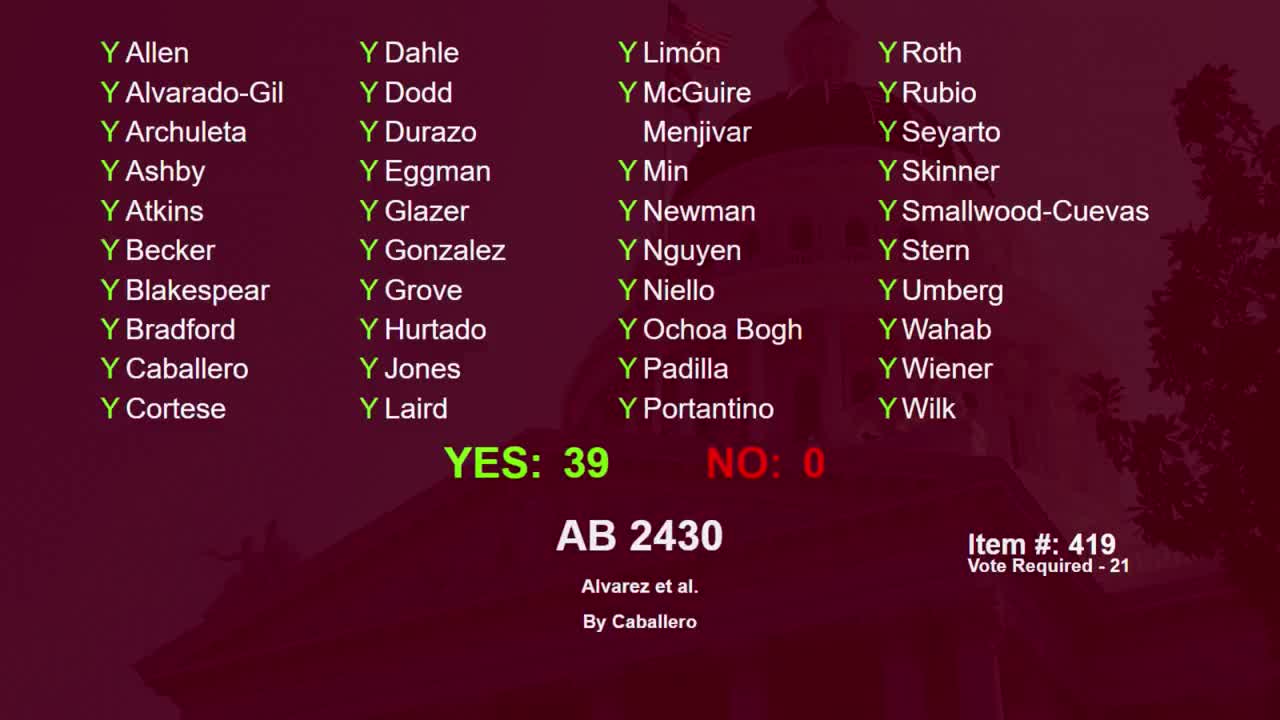
Bill Author