SB 867: Safe Drinking Water, Wildfire Prevention, Drought Preparedness, and Clean Air Bond Act of 2024.
- Session Year: 2023-2024
- House: Senate
- Latest Version Date: 2024-07-03
Current Status:
Passed
(2024-07-03: Chaptered by Secretary of State. Chapter 83, Statutes of 2024.)
Introduced
In Committee
First Chamber
In Committee
Second Chamber
Enacted
The California Drought, Water, Parks, Climate, Coastal Protection, and Outdoor Access For All Act of 2018, approved by the voters as Proposition 68 at the June 5, 2018, statewide primary election, authorizes the issuance of bonds in the amount of $4,100,000,000 pursuant to the State General Obligation Bond Law to finance a drought, water, parks, climate, coastal protection, and outdoor access for all program. Article XVI of the California Constitution requires measures authorizing general obligation bonds to specify the single object or work to be funded by the bonds and further requires a bond act to be approved by a 2/3 vote of each house of the Legislature and a majority of the voters.
This bill would enact the Safe Drinking Water, Wildfire Prevention, Drought Preparedness, and Clean Air Bond Act of 2024, which, if approved by the voters, would authorize the issuance of bonds in the amount of $10,000,000,000 pursuant to the State General Obligation Bond Law to finance projects for safe drinking water, drought, flood, and water resilience, wildfire and forest resilience, coastal resilience, extreme heat mitigation, biodiversity and nature-based climate solutions, climate-smart, sustainable, and resilient farms, ranches, and working lands, park creation and outdoor access, and clean air programs.
This bill would declare that it is to take effect immediately as an urgency statute.
The California Drought, Water, Parks, Climate, Coastal Protection, and Outdoor Access For All Act of 2018, approved by the voters as Proposition 68 at the June 5, 2018, statewide primary election, authorizes the issuance of bonds in the amount of $4,100,000,000 pursuant to the State General Obligation Bond Law to finance a drought, water, parks, climate, coastal protection, and outdoor access for all program. Article XVI of the California Constitution requires measures authorizing general obligation bonds to specify the single object or work to be funded by the bonds and further requires a bond act to be approved by a 2/3 vote of each house of the Legislature and a majority of the voters.
This bill would enact the Drought, Flood, and Water Resilience, Wildfire and Forest Resilience, Coastal Resilience, Extreme Heat Mitigation, Biodiversity and Nature-Based Climate Solutions, Climate Smart Agriculture, Park Creation and Outdoor Access, and Clean Energy Safe Drinking Water, Wildfire Prevention, Drought Preparedness, and Clean Air Bond Act of 2024, which, if approved by the voters, would authorize the issuance of bonds in the amount of $15,500,000,000 $10,000,000,000 pursuant to the State General Obligation Bond Law to finance projects for safe drinking water, drought, flood, and water resilience, wildfire and forest resilience, coastal resilience, extreme heat mitigation, biodiversity and nature-based climate solutions, climate smart agriculture, climate-smart, sustainable, and resilient farms, ranches, and working lands, park creation and outdoor access, and clean energy air programs.
This bill would provide for the submission of these provisions to the voters at the March 5, 2024, statewide primary election.This bill would become operative only if SB 638 of the 202324 Regular Session is enacted and takes effect on or before January 1, 2024.This bill would declare that it is to take effect immediately as an urgency statute.
The California Drought, Water, Parks, Climate, Coastal Protection, and Outdoor Access For All Act of 2018, approved by the voters as Proposition 68 at the June 5, 2018, statewide primary election, authorizes the issuance of bonds in the amount of $4,100,000,000 pursuant to the State General Obligation Bond Law to finance a drought, water, parks, climate, coastal protection, and outdoor access for all program. Article XVI of the California Constitution requires measures authorizing general obligation bonds to specify the single object or work to be funded by the bonds and further requires a bond act to be approved by a 2/3 vote of each house of the Legislature and a majority of the voters.
This bill would enact the Drought, Flood, and Water Resilience, Wildfire and Forest Resilience, Coastal Resilience, Extreme Heat Mitigation, Biodiversity and Nature-Based Climate Solutions, Climate Smart Agriculture, Park Creation and Outdoor Access, and Clean Energy Bond Act of 2024, which, if approved by the voters, would authorize the issuance of bonds in the amount of $15,500,000,000 pursuant to the State General Obligation Bond Law to finance projects for drought, flood, and water resilience, wildfire and forest resilience, coastal resilience, extreme heat mitigation, biodiversity and nature-based climate solutions, climate smart agriculture, park creation and outdoor access, and clean energy programs.
This bill would provide for the submission of these provisions to the voters at an unspecified the March 5, 2024, statewide primary election.
This bill would become operative only if SB 638 of the 202324 Regular Session is enacted and takes effect on or before January 1, 2024.
The California Drought, Water, Parks, Climate, Coastal Protection, and Outdoor Access For All Act of 2018, approved by the voters as Proposition 68 at the June 5, 2018, statewide primary election, authorizes the issuance of bonds in the amount of $4,100,000,000 pursuant to the State General Obligation Bond Law to finance a drought, water, parks, climate, coastal protection, and outdoor access for all program. Article XVI of the California Constitution requires measures authorizing general obligation bonds to specify the single object or work to be funded by the bonds and further requires a bond act to be approved by a 2/3 vote of each house of the Legislature and a majority of the voters.
This bill would enact the Drought, Flood, and Water Resilience, Wildfire and Forest Resilience, Coastal Resilience, Extreme Heat Mitigation, Biodiversity and Nature-Based Climate Solutions, Climate Smart Agriculture, Park Creation and Outdoor Access, and Clean Energy Bond Act of 2024, which, if approved by the voters, would authorize the issuance of bonds in the amount of $15,500,000,000 pursuant to the State General Obligation Bond Law to finance projects for drought, flood, and water resilience, wildfire and forest resilience, coastal resilience, extreme heat mitigation, biodiversity and nature-based climate solutions, climate smart agriculture, park creation and outdoor access, and clean energy programs.
This bill would provide for the submission of these provisions to the voters at an unspecified statewide election.
This bill would become operative only if SB 638 of the 202324 Regular Session is enacted and takes effect on or before January 1, 2024.
The California Drought, Water, Parks, Climate, Coastal Protection, and Outdoor Access For All Act of 2018, approved by the voters as Proposition 68 at the June 5, 2018, statewide primary election, authorizes the issuance of bonds in the amount of $4,100,000,000 pursuant to the State General Obligation Bond Law to finance a drought, water, parks, climate, coastal protection, and outdoor access for all program. Article XVI of the California Constitution requires measures authorizing general obligation bonds to specify the single object or work to be funded by the bonds and further requires a bond act to be approved by a 2/3 vote of each house of the Legislature and a majority of the voters.
This bill would enact the Drought Drought, Flood, and Water Resilience, Wildfire and Forest Resilience, Coastal Resilience, Extreme Heat Mitigation, Biodiversity and Nature-Based Climate Solutions, Climate Smart Agriculture, and Park Creation and Outdoor Access Access, and Clean Energy Bond Act of 2023, 2024, which, if approved by the voters, would authorize the issuance of bonds in an unspecified amount the amount of $15,500,000,000 pursuant to the State General Obligation Bond Law to finance projects for drought drought, flood, and water resilience, wildfire and forest resilience, coastal resilience, extreme heat mitigation, biodiversity and nature-based climate solutions, climate smart agriculture, and park creation and outdoor access access, and clean energy programs.
This bill would provide for the submission of these provisions to the voters at an unspecified statewide election.
The California Drought, Water, Parks, Climate, Coastal Protection, and Outdoor Access For All Act of 2018, approved by the voters as Proposition 68 at the June 5, 2018, statewide primary election, authorizes the issuance of bonds in the amount of $4,100,000,000 pursuant to the State General Obligation Bond Law to finance a drought, water, parks, climate, coastal protection, and outdoor access for all program. Article XVI of the California Constitution requires measures authorizing general obligation bonds to specify the single object or work to be funded by the bonds and further requires a bond act to be approved by a 2/3 vote of each house of the Legislature and a majority of the voters.
This bill would enact the Drought and Water Resilience, Wildfire and Forest Resilience, Coastal Resilience, Extreme Heat Mitigation, Biodiversity and Nature-Based Climate Solutions, Climate Smart Agriculture, and Park Creation and Outdoor Access Bond Act of 2023, which, if approved by the voters, would authorize the issuance of bonds in an unspecified amount pursuant to the State General Obligation Bond Law to finance projects for drought and water resilience, wildfire and forest resilience, coastal resilience, extreme heat mitigation, biodiversity and nature-based climate solutions, climate smart agriculture, and park creation and outdoor access programs.
This bill would provide for the submission of these provisions to the voters at an unspecified statewide election.
The people of California find and declare all of the following:
(a)Every human being has the right to safe, clean, affordable drinking water. California was the first state in the nation to legally declare this right.
(b)More than 60 percent of Californias rivers and streams fail to meet federal clean water standards, and more than 1,000,000 Californians still lack easy access to safe, affordable, and clean drinking water. California must make needed investments to keep toxic pollution out of our water and ensure every person in the state has clean water to drink.
(c)In recent years, California has experienced the deadliest and most destructive wildfires on record. Fifteen of the 20 most destructive wildfires in state history have occurred in the last decade alone, including the deadliest, the 2018 Camp Fire. These wildfires have claimed more than 100 lives, tens of thousands of homes and structures lost, and more than 2,000,000 acres burned.
(d)Californias changing climate creates increased risk of catastrophic wildfires, drought, severe heat events, and sea level rise, as well as impacts to agriculture, water supply and water quality, and the health of the forests, watershed, and wildlife.
(e)These risks and impacts vary by region and can overwhelm the resources of local governments that must cope with severe climate change-related events.
(f)Reducing vulnerability to fire, flood, drought, and other climate change-related events requires a statewide investment to increase climate resilience of communities and natural systems.
(g)Planning, investment, and action to address current and future climate change impacts must be guided by the best available science, including local and traditional knowledge.
(h)Governor Gavin Newsom has issued several reports and executive orders that have created a roadmap to climate resiliency in California that will help guide and direct investments.
(i)Californias Water Supply Strategy Adapting to a Hotter, Drier Future outlines actions needed in order to recycle and reuse at least 800,000 acre-feet of water per year by 2030, make available up to 500,000 acre-feet of water through more efficient water use and conservation, and make new water available for use by capturing stormwater and desalinating brackish water in groundwater basins.
(j)The Water Resilience Portfolio serves as a blueprint for equipping California to cope with more extreme droughts and floods and rising temperatures, while addressing longstanding challenges that include declining fish populations, over-reliance on groundwater and lack of safe drinking water in many communities.
(k)Californias Wildfire and Forest Resilience Action Plan outlines a strategy to increase the pace and scale of forest health projects, strengthen protection of communities, and manage forests, to achieve the states economic and environmental goals and drive innovation and measure progress.
(l)The Extreme Heat Action Plan outlines a strategy to protect communities from rising temperatures in order to accelerate readiness and protection of communities most impacted by extreme heat, including through cooling schools and homes, supporting community resilience centers, and expanding nature-based solutions.
(m)Californias strategy for achieving the first-in-the-nation 30x30 conservation goal is described in the Pathways to 30x30: Accelerating Conservation of Californias Nature report, which outlines a vision to conserve an additional 6,000,000 acres of lands and 500,000 acres of coastal waters needed to reach 30-percent conservation goals by 2030.
(n)Executive Order No. N-82-20 outlines a strategy to expand nature-based solutions across California. The executive order calls for restoring nature and landscape health to deliver on our climate change goals and other critical priorities, including improving public health and safety, securing our food and water supplies, and achieving greater equity across California.
(o)California Salmon Strategy for a Hotter, Drier Future outlines a path to a healthier, thriving salmon population in California, actions state agencies are already taking to stabilize and recover salmon populations, and additional or intensified actions needed in coming years.
(p)Governor Gavin Newsom signed Senate Bill 1 of the 202122 Regular Session (Chapter 236 of the Statutes of 2021) that directed the California Coastal Commission to take sea level rise into account in its planning, policies, and activities, and established a cross-government group tasked with educating the public and advising local, regional, and state government on feasible sea level rise mitigation efforts.
(q)Californias Natural and Working Lands Climate Smart Strategy showcases that sustainable agricultural practices have important implications for equity and public health, and can promote economic resilience, buffer communities from extreme heat, improve air and water quality, and provide local food sources. These outcomes benefit all Californians, and are particularly important for rural, vulnerable communities.
(r)The 2022 Scoping Plan for Achieving Carbon Neutrality focuses on the importance of investing in strategies for reducing Californias dependency on petroleum, including transitioning to clean energy options that address climate change, improve air quality, and support economic growth and clean sector jobs.
(s)Without intervention, the cost of climate change to California is estimated to reach $113,000,000,000 annually by 2050, according to the Natural Resources Agencys Californias Fourth Climate Change Assessment.
(t)The Federal Emergency Management Agency estimates that every dollar spent on resiliency saves $6 in disaster relief. A $10,000,000,000 investment could help avoid $60,000,000,000 in disaster relief.
(u)Providing a source of funding for comprehensive investment in climate resilience in all regions of the state is cost effective and in the public interest. These investments will result in public benefits that will address the most critical statewide needs and priorities for public funding.
(v)The Safe Drinking Water, Wildfire Prevention, Drought Preparedness, and Clean Air Bond Act of 2024 provides a comprehensive and fiscally responsible approach for addressing the varied challenges facing Californias current and future climate impacts.
(w)Investing in water infrastructure will provide jobs, improve resiliency, and reduce local government spending.
(x)Continued investments in Californias parks, trails, natural and working lands, and greening urban areas will help mitigate the impacts of climate change, making cities more livable, and will protect Californias natural resources for future generations.
(y)The expenditure of funds from the Safe Drinking Water, Wildfire Prevention, Drought Preparedness, and Clean Air Bond Act of 2024 will help communities avoid and recover from the impacts of wildfire, flood, drought, or other climate-related events, and help restore and protect natural systems from the impacts of wildfire, flooding, drought, or other climate-related events.
SEC. 2.Division 50 (commencing with Section 90000) is added to the Public Resources Code, to read:50.SAFE DRINKING WATER, WILDFIRE PREVENTION, DROUGHT PREPAREDNESS, AND CLEAN AIR BOND ACT of 20241.General Provisions90000.This division shall be known, and may be cited, as the Safe Drinking Water, Wildfire Prevention, Drought Preparedness, and Clean Air Bond Act of 2024.
90050.(a)In expending funds pursuant to this division, an administering state agency shall give priority to projects that leverage private, federal, and local funding or produce the greatest public benefit.
(b)To the extent practicable, a project funded pursuant to this division shall include signage informing the public that the project received funding from the Safe Drinking Water, Wildfire Prevention, Drought Preparedness, and Clean Air Bond Act of 2024.
(c)Projects funded pursuant to this division shall, where appropriate, include the planning, monitoring, and reporting necessary to ensure successful implementation of this divisions objectives.
90100.For purposes of this division, the following definitions apply:
(a)Committee means the Safe Drinking Water, Wildfire Prevention, Drought Preparedness, and Clean Air Bond Finance Committee created pursuant to Section 95002.
(b)Community has the same meaning as set forth in paragraph (1) of subdivision (a) of Section 65302.10 of the Government Code.
(c)Critical community infrastructure means infrastructure that is necessary to providing vital community and individual functions, including, but not limited to, drinking and wastewater infrastructure, emergency shelters, communication and warning systems, evacuation routes, emergency power and public medical facilities, schools, town halls, hospitals, health clinics, community centers, community nonprofit facilities providing essential services, libraries, homeless shelters, senior and youth centers, childcare facilities, food banks, grocery stores, and parks and recreation sites.
(d)Disadvantaged community means a community with a median household income of less than 80 percent of the area average or less than 80 percent of statewide median household income.
(e)Economically distressed areas has the same meaning as set forth in Section 79702 of the Water Code.
(f)Natural infrastructure has the same meaning as set forth in paragraph (3) of subdivision (c) of Section 71154.
(g)Nonprofit organization means a nonprofit corporation qualified to do business in California and qualified under Section 501(c)(3) of the Internal Revenue Code.
(h)Protection includes those actions necessary to prevent harm or damage to persons, property, or natural, cultural, and historic resources, actions to improve access to public open-space areas, or actions to allow the continued use and enjoyment of property or natural, cultural, and historic resources. Protection includes site monitoring, acquisition, development, restoration, preservation, and interpretation.
(i)(1)Restoration includes the improvement of physical structures or facilities and, in the case of natural systems and landscape features, includes, but is not limited to, any of the following:
(A)The control of erosion.
(B)Stormwater capture, treatment, reuse, and storage, or to otherwise reduce stormwater pollution.
(C)The control and elimination of invasive species and harmful algal blooms.
(D)The planting of native species.
(E)The removal of waste and debris.
(F)Prescribed burning and other fuel hazard reduction measures.
(G)Fencing out threats to existing or restored natural resources.
(H)Improving instream, riparian, floodplain, or wetland habitat conditions.
(I)Other plant and wildlife habitat improvement to increase the natural system value of the property or coastal or ocean resources.
(J)Activities described in subdivision (b) of Section 79737 of the Water Code.
(2)Restoration also includes activities, including the planning, permitting, monitoring, and reporting that are necessary to ensure successful implementation of the restoration objectives.
(j)Severely disadvantaged community means a community with a median household income of less than 60 percent of the area average or less than 60 percent of statewide median household income.
(k)Socially disadvantaged farmer or rancher has the same meaning set forth in Section 512 of the Food and Agricultural Code. This provision shall apply to the extent allowable by law.
(l)State General Obligation Bond Law means the State General Obligation Bond Law (Chapter 4 (commencing with Section 16720) of Part 3 of Division 4 of Title 2 of the Government Code), as it may be amended from time to time.
(m)Structure hardening includes the installation, replacement, or retrofitting of building materials, systems, or assemblies used in the exterior design and construction of existing nonconforming structures with features that are in compliance with Chapter 7A (commencing with Section 701A.1) of Part 2 of Title 24 of the California Code of Regulations, or any appropriate successor regulatory code, with the primary purpose of reducing risk to structures from wildfire or conforming to the low-cost retrofit list, and updates to that list, developed pursuant to paragraph (1) of subdivision (c) of Section 51189 of the Government Code.
(n)Tribe means a federally recognized Native American tribe or a nonfederally recognized Native American tribe listed on the California Tribal Consultation List maintained by the Native American Heritage Commission.
(o)Vulnerable population means a subgroup of population within a region or community that faces a disproportionately heightened risk or increased sensitivity to impacts of climate change and that lacks adequate resources to cope with, adapt to, or recover from such impacts.
(p)Water board means the State Water Resources Control Board.
90105.Funds provided by this division shall not be expended to fulfill any environmental mitigation requirements or compliance obligations imposed by law.
90107.Funds provided by this division shall not be expended to pay the costs of the design, construction, operation, mitigation, or maintenance of isolated Delta conveyance facilities. Those costs shall be the responsibility of the water agencies that benefit from the design, construction, operation, mitigation, or maintenance of those facilities.
90110.An eligible applicant under this division is a public agency, local agency, nonprofit organization, special district, joint powers authority, tribe, public utility, local publicly owned utility, or mutual water company.
90115.The Legislature may enact legislation necessary to implement programs funded by this division.
90120.It is the intent of the Legislature that bond moneys shall not be used for shareholder incentives or profits for shareholders of private corporations.
90130.For grants awarded for projects under this division, the administering agency may provide advanced payments in the amount of 25 percent of the grant award to the recipient, including state-related entities, to initiate the project in a timely manner. The administering agency shall adopt additional requirements for the recipient of the grant regarding the use of the advanced payments to ensure that the moneys are used properly.
90133.For grants awarded for projects under this division, the administering agency may, when awarding a grant, reimburse the grantees indirect costs. When reimbursing a grantee for indirect costs, the administering agency shall apply one of the following rates, as requested by the grantee:
(a)The grantees negotiated indirect cost rate, pursuant to its negotiated indirect cost rate agreement.
(b)The de minimis indirect cost rate specified in Part 200 of Title 2 of the Code of Federal Regulations.
(c)A rate negotiated by the grantee with another state agency within the last five years.
(d)A rate proposed by the grantee in the grantees program application with the administering state agency if the grantee does not have an existing state rate.
90135.(a)The Secretary of the Natural Resources Agency shall publish a list of all program and project expenditures pursuant to this division not less than annually, in written form, and shall post an electronic form of the list on the agencys internet website in a downloadable spreadsheet format. The spreadsheet shall include all of the following information:
(1)Information about the location and footprint of each funded project.
(2)The projects objectives.
(3)The status of the project.
(4)Anticipated outcomes.
(5)The public benefits to be derived from the project, including whether the project has meaningful and direct benefits to vulnerable populations, disadvantaged communities, or severely disadvantaged communities.
(6)The total cost of the project, if known.
(7)The amount of bond funding provided.
(8)Any matching moneys provided for the project by the grant recipient or other partners.
(9)The applicable chapter of this division pursuant to which the recipient received moneys.
(b)The Department of Finance shall provide for an independent audit of expenditures pursuant to this division. If an audit, required by law, of any entity that receives funding authorized by this division is conducted pursuant to state law and reveals any impropriety, the California State Auditor or the Controller may conduct or arrange for a full audit of any or all of the activities funded pursuant to this division. Any audit of a federal Department of Energy or National Aeronautics and Space Administration research and development center pursuant to this section shall be conducted in accordance with the Federal Laboratory Contracting Act (Chapter 7 (commencing with Section 12500) of Part 2 of Division 2 of the Public Contract Code).
(c)A state agency issuing any grant with funding authorized by this division shall require adequate reporting of the expenditures of the funding from the grant.
(d)The costs associated with the publications, audits, statewide bond tracking, cash management, and related oversight activities provided for in this section shall be funded from the proceeds of bonds authorized by this division. These costs shall be shared proportionally by each program funded by this division. Actual costs incurred to administer nongrant programs authorized by this division shall be paid from the proceeds of bonds authorized by this division.
90140.At least 40 percent of the total funds available pursuant to this division shall be allocated for projects that provide meaningful and direct benefits to vulnerable populations or disadvantaged communities. At least 10 percent of the total funds available pursuant to this division shall be allocated for projects that provide meaningful and direct benefits to severely disadvantaged communities.
90150.To the extent feasible, a project whose application includes the use of services of the California Conservation Corps or certified community conservation corps, as defined in Section 14507.5, shall be given preference for receipt of a grant under this division.
90500.(a)The proceeds of bonds issued and sold pursuant to this division, exclusive of refunding bonds issued and sold pursuant to Section 95012, shall be deposited in the Safe Drinking Water, Wildfire Prevention, Drought Preparedness, and Clean Air Fund, which is hereby created in the State Treasury. Moneys in the fund shall be available, upon appropriation by the Legislature, for purposes of this division.
(b)Proceeds of bonds issued and sold pursuant to this division shall be allocated according to the following schedule:
(1)Three billion eight hundred million dollars ($3,800,000,000) for safe drinking water, drought, flood, and water resilience programs, in accordance with Chapter 2 (commencing with Section 91000).
(2)One billion five hundred million dollars ($1,500,000,000) for wildfire and forest resilience programs, in accordance with Chapter 3 (commencing with Section 91500).
(3)One billion two hundred million dollars ($1,200,000,000) for coastal resilience programs, in accordance with Chapter 4 (commencing with Section 92000).
(4)Four hundred fifty million dollars ($450,000,000) for extreme heat mitigation programs, in accordance with Chapter 5 (commencing with Section 92500).
(5)One billion two hundred million dollars ($1,200,000,000) for biodiversity protection and nature-based climate solution programs, in accordance with Chapter 6 (commencing with Section 93000).
(6)Three hundred million dollars ($300,000,000) for climate-smart, sustainable, and resilient farms, ranches, and working lands programs, in accordance with Chapter 7 (commencing with Section 93500).
(7)Seven hundred million dollars ($700,000,000) for park creation and outdoor access programs, in accordance with Chapter 8 (commencing with Section 94000).
(8)Eight hundred fifty million dollars ($850,000,000) for clean air programs, in accordance with Chapter 9 (commencing with Section 94500).
90600.(a)An amount that equals not more than the lesser of 7 percent of the funds or twenty million dollars ($20,000,000) allocated for a grant program pursuant to this division may be used to pay the administrative costs of that program.
(b)(1)Up to 10 percent of the funds available pursuant to each chapter of this division may be allocated for technical assistance to disadvantaged communities, severely disadvantaged communities, or vulnerable populations. The agency administering the moneys shall operate a multidisciplinary technical assistance program for disadvantaged communities, severely disadvantaged communities, or vulnerable populations.
(2)Funds used for providing technical assistance to disadvantaged communities, severely disadvantaged communities, or vulnerable populations may exceed 10 percent of the funds allocated under each chapter of this division if the state agency administering the moneys determines that there is a need for the additional funding.
90610.To the extent practicable, a project that receives moneys pursuant to this division may provide workforce education and training, contractor, and job opportunities for vulnerable populations.
90620.Funds allocated pursuant to this division may be used by the Natural Resources Agency and its departments, boards, and conservancies to collaboratively fund projects at a landscape or multijurisdictional scale to provide multiple benefits.
2.Safe Drinking Water, Drought, Flood, and Water Resilience91000.The sum of three billion eight hundred million dollars ($3,800,000,000) shall be available, upon appropriation by the Legislature, for safe drinking water, drought, flood, and water resilience programs.
91010.Of the funds made available by Section 91000, one billion eight hundred eighty-five million dollars ($1,885,000,000) shall be available, upon appropriation by the Legislature, to protect and increase California water supply and water quality.
91011.(a)Of the funds made available by Section 91010, six hundred ten million dollars ($610,000,000) shall be available, upon appropriation by the Legislature, to the State Water Resources Control Board for grants or loans that improve water quality or help provide clean, safe, and reliable drinking water. Eligible projects include, but are not limited to, any of the following:
(1)Projects that help to provide clean, safe, and reliable drinking water.
(2)Projects that increase water quality monitoring and remediation of perfluoroalkyl and polyfluoroalkyl substances.
(3)Innovative projects to increase the affordability of safe drinking water.
(4)Projects that implement countywide drought and water shortage contingency plans adopted pursuant to Chapter 10 (commencing with Section 10609.40) of Part 2.55 of Division 6 of the Water Code.
(5)Projects that prevent, reduce, or treat the contamination of groundwater that serves as a major source of drinking water for a community.
(6)Projects to consolidate water or wastewater systems or to extend wastewater service to residences currently served by inadequate onsite sewer treatment systems.
(7)Grants for projects and technical and financial assistance to address hexavalent chromium in drinking water.
(8)(A)Tribal water infrastructure projects that provide safe, clean, and reliable drinking water to tribal communities.
(B)Not less than twenty-five million dollars ($25,000,000) shall be allocated to projects described in subparagraph (A).
(b)If there is a responsible party identified to have contributed to contamination of a drinking water well, or system, the water system or public agency responsible for the infrastructure may apply for competitive state grant program funding for a drinking water infrastructure project to address water quality issues. The grant applicant may apply for funding in the amount above and beyond what the responsible party is required to contribute to the infrastructure project.
(c)Reasonable geographic allocation to eligible projects throughout the state shall be considered, including both northern and southern California and inland and coastal regions.
(d)At least 40 percent of the allocation made pursuant to this section shall benefit disadvantaged communities, severely disadvantaged communities, or vulnerable populations.
(e)For severely disadvantaged communities with populations of no more than 500 persons that serve no more than 100 service connections, there shall be no maximum amount per service connection for eligible projects.
91012.(a)Of the funds made available by Section 91010, three hundred eighty-six million two hundred fifty thousand dollars ($386,250,000) shall be available, upon appropriation by the Legislature, to the Department of Water Resources for projects related to groundwater storage, groundwater banking, groundwater recharge, or instream flow projects that support the conjunctive use of groundwater and surface water supplies. Of the funds made available pursuant to this subdivision, a minimum of twenty-five million dollars ($25,000,000) shall be for projects that provide direct benefits to tribal communities.
(b)Of the funds made available by subdivision (a), one hundred ninety-three million one hundred twenty-five thousand dollars ($193,125,000) shall be available for projects that increase groundwater storage, improve the management and operation of groundwater storage, or are for groundwater banking, and support implementation of the Sustainable Groundwater Management Act (Part 2.74 (commencing with Section 10720) of Division 6 of the Water Code).
(c)(1)Of the funds made available by subdivision (a), one hundred ninety-three million one hundred twenty-five thousand dollars ($193,125,000) shall be available for projects that support conjunctive use and groundwater recharge. The projects shall provide the following benefits:
(A)Provide improved regional watershed management.
(B)Address current and projected drought conditions and demonstrate adaptation to climate change for a region.
(C)Provide ecosystem benefits to fish and wildlife and improve stream flow for anadromous fish.
(2)Reasonable geographic allocation to eligible projects throughout the state shall be considered, including both northern and southern California and inland and coastal regions.
91013.Of the funds made available by Section 91010, two hundred million dollars ($200,000,000) shall be available, upon appropriation by the Legislature, to the Department of Conservations Multibenefit Land Repurposing Program for groundwater sustainability projects that reduce groundwater use, repurpose irrigated agricultural land, provide wildlife habitat, improve drought resilience or floodwater management, or support implementation of the Sustainable Groundwater Management Act (Part 2.74 (commencing with Section 10720) of Division 6 of the Water Code).
91014.(a)Of the funds made available by Section 91010, three hundred eighty-six million two hundred fifty thousand dollars ($386,250,000) shall be available, upon appropriation by the Legislature, to the State Water Resources Control Board for grants and projects related to water reuse and recycling, including, but not limited to, the following:
(1)Treatment, storage, conveyance, and distribution facilities for potable and nonpotable recycling projects.
(2)Dedicated distribution infrastructure to serve residential, commercial, agricultural, and industrial end user retrofit projects to allow use of recycled water.
(3)Multiple-benefit recycled water projects that improve water quality.
(b)At least a 50-percent local cost share shall be required for projects funded pursuant to this section. That cost share may be suspended or reduced for disadvantaged communities or severely disadvantaged communities, or prorated for disadvantaged communities or severely disadvantaged communities within a larger service area project. A loan, grant, or other funding received, regardless of funding source, shall qualify as local cost share.
(c)The water board shall adopt modified grant funding requirements for large-scale water recycling or reuse projects, including all of the following requirements:
(1)Ancillary facilities that are part of large-scale water recycling or reuse projects shall be eligible for funding. Ancillary facilities include, but are not limited to, pipelines, extraction wells, injection wells, recharge basins, and nitrogen removal treatment systems, pertinent structures, and connection assemblies.
(2)This section does not preclude the water board from awarding funding to a large-scale water recycling or reuse project for multiple project phases or components, or more than once during the project development period. The water board shall not require user agreements or contracts for water delivery, nor shall full completion of the project be required before the submission of a subsequent grant application, as a condition for award of grant funding.
(3)At least 10 percent of the grant funding shall be awarded for the purpose of planning and design.
(4)Reasonable geographic allocation to eligible projects throughout the state, including both northern and southern California and coastal and inland regions.
91015.Of the funds made available by Section 91010, seventy-five million dollars ($75,000,000) shall be available, upon appropriation by the Legislature, to the California Water Commission for projects under the Water Storage Investment Program. Priority for these funds and any funds returned to the commission shall be to support timely completion of existing approved projects by providing supplemental grants to reflect the increase in costs due to inflation since the original grant applications and any increase in public benefits.
91016.Of the funds made available by Section 91010, sixty-two million five hundred thousand dollars ($62,500,000) shall be available, upon appropriation by the Legislature, for capital investments in brackish desalination, contaminant and salt removal, and salinity management projects to improve California water and drought resilience. Priority shall be given to projects that use new incremental eligible renewable energy resources during operation and reduce greenhouse gas emissions associated with their construction and operation.
91017.Of the funds made available by Section 91010, fifteen million dollars ($15,000,000) shall be available, upon appropriation by the Legislature, to the Department of Water Resources and the State Water Resources Control Board to improve water data management and to implement Section 144 of the Water Code to reactivate existing stream gages and deploy new gages.
91018.Of the funds made available by Section 91010, seventy-five million dollars ($75,000,000) shall be available, upon appropriation by the Legislature, to the Natural Resources Agency and the Department of Water Resources for competitive grants for regional conveyance projects or repairs to existing conveyances. Priority shall be given to projects that provide one or more of the following benefits:
(a)Improvements in regional or interregional water supply or water supply reliability.
(b)Increased groundwater recharge or mitigation of conditions of groundwater overdraft, salinity intrusion, water quality degradation, or subsidence.
(c)Adaptation to the impacts of hydrologic changes.
(d)Improvements in water security from drought, natural disasters, or other events that could interrupt water supplies.
(e)Providing safe drinking water for disadvantaged communities and economically distressed areas.
91019.Of the funds made available by Section 91010, seventy-five million dollars ($75,000,000) shall be available, upon appropriation by the Legislature, to the Department of Water Resources for projects that increase water conservation in agricultural and urban areas.
91020.Of the funds made available by Section 91000, one billion one hundred forty million dollars ($1,140,000,000) shall be available, upon appropriation by the Legislature, to reduce flood risk and improve stormwater management.
91021.Of the funds made available by Section 91020, five hundred fifty million dollars ($550,000,000) shall be available, upon appropriation by the Legislature, to the Natural Resources Agency and its departments, boards, and conservancies for flood management projects. Priority shall be given to projects designed and implemented to achieve both flood safety and ecosystem functions, while providing additional benefits. At least 40 percent of the allocation made pursuant to this section shall benefit disadvantaged communities, severely disadvantaged communities, or vulnerable populations. Funding shall be allocated as follows:
(a)One hundred fifty million dollars ($150,000,000) shall be available for projects in the Sacramento-San Joaquin Delta to improve existing levees to increase flood protection and improve climate resiliency. For purposes of this subdivision, Sacramento-San Joaquin Delta has the same meaning as described in Section 12220 of the Water Code.
(b)One hundred fifty million dollars ($150,000,000) shall be available for projects that implement the Flood Control Subventions Program.
(c)Two hundred fifty million dollars ($250,000,000) shall be available for projects related to the systemwide evaluation, repair, rehabilitation, reconstruction, expansion, or replacement of levees, weirs, bypasses, and facilities of the State Plan of Flood Control.
91022.Of the funds made available by Section 91020, four hundred eighty million dollars ($480,000,000) shall be available, upon appropriation by the Legislature, to the Department of Water Resources for the Dam Safety and Climate Resilience Local Assistance Program for competitive grants for projects that enhance dam safety and reservoir operations and protect public benefits pursuant to Section 6700 of the Water Code.
91023.Of the funds made available by Section 91020, one hundred ten million dollars ($110,000,000) shall be available, upon appropriation by the Legislature, to the State Water Resources Control Board for grants for multiple-benefit urban stormwater management projects. Projects funded pursuant to this section shall address flooding in urbanized areas and provide multiple benefits, with preference given to natural infrastructure projects. Eligible stormwater projects shall include, but are not limited to, stormwater capture and reuse, planning and implementation of low-impact development, restoration of urban streams and watersheds, debris flow mitigation, and increasing permeable surfaces to help reduce flooding.
91030.Of the funds made available by Section 91000, six hundred five million dollars ($605,000,000) shall be available, upon appropriation by the Legislature, to protect and restore rivers, lakes, and streams, and to improve watershed resilience, including the resilience of fish and wildlife within the watershed.
91031.Of the funds made available by Section 91030, one hundred million dollars ($100,000,000) shall be available, upon appropriation by the Legislature, to the Department of Water Resources for projects related to integrated regional water management to improve climate resilience on a watershed basis. The department shall update and revise the guidelines for the integrated regional water management program to address impacts associated with climate risk.
91032.Of the funds made available by Section 91030, three hundred thirty-five million dollars ($335,000,000) shall be available, upon appropriation by the Legislature, for projects that protect and restore rivers, wetlands, streams, lakes, and watersheds, and improve the resilience of fish and wildlife. Projects shall improve climate resilience, water supplies, or water quality. To the extent feasible, preference shall be given to natural infrastructure projects. At least 40 percent of the allocation made pursuant to this section shall benefit disadvantaged communities, severely disadvantaged communities, or vulnerable populations. The funds made available pursuant to this section shall be allocated as follows:
(a)Forty million dollars ($40,000,000) shall be available pursuant to Division 22.8 (commencing with Section 32600) for projects that improve the climate resiliency or the protection of the Los Angeles River Watershed or are consistent with the Lower Los Angeles River Revitalization Plan.
(b)Forty million dollars ($40,000,000) shall be available pursuant to Division 23 (commencing with Section 33000) for projects that improve the climate resiliency or the protection of the Los Angeles River Watershed and are a part of the revitalization plan developed by the Upper Los Angeles River and Tributaries Working Group pursuant to Section 33220 or the Los Angeles River Master Plan.
(c)Fifty million dollars ($50,000,000) shall be available to the Riverine Stewardship Program established pursuant to Section 7049 of the Water Code for projects that improve climate resiliency.
(d)Twenty-five million dollars ($25,000,000) shall be available to the State Coastal Conservancy for the Santa Ana River Conservancy Program.
(e)Twenty-five million dollars ($25,000,000) shall be available for multiple-benefit urban stream and river projects under the Urban Streams Restoration Program established pursuant to Section 7048 of the Water Code that protect and restore riparian habitats, improve climate resilience, enhance natural drainages, protect and restore watersheds, and provide public access.
(f)Twenty-five million dollars ($25,000,000) shall be available to the Natural Resources Agency for projects that improve conditions on wildlife refuges and wetland habitat areas. Projects may include the acquisition and delivery of water from willing sellers and water conveyance rights to achieve compliance with subsection (d) of Section 3406 of the federal Central Valley Project Improvement Act (Title 34 of Public Law 102-575) and the acquisition of water and conveyance rights for the Lower Klamath National Wildlife Refuge.
(g)Ten million dollars ($10,000,000) shall be available to the Wildlife Conservation Board for the Lower American River Conservancy Program.
(h)Twenty-five million dollars ($25,000,000) shall be available to the State Coastal Conservancy to protect and restore watersheds through the Coyote Valley Conservation Program in the County of Santa Clara.
(i)Twenty-five million dollars ($25,000,000) shall be available to the State Coastal Conservancy to protect and restore watersheds through the West Coyote Hills Program.
(j)(1)Fifty million dollars ($50,000,000) shall be available to the water board for loans or grants for projects that will address water quality problems arising in the California-Mexico cross-border rivers and coastal waters. Funds may be made available under this subdivision for water quality projects in the Tijuana River Valley Watershed, as described in the Tijuana River Plan created pursuant to Section 71107, and for projects consistent with the New River Water Quality, Public Health, and River Parkway Development Program, as described in Section 71103.6.
(2)Grants or loans awarded under this subdivision for projects located outside of California shall have a documented water quality benefit to California and its residents.
(3)Funding may be awarded to bilateral financial institutions as a state match pursuant to this subdivision only after federally committed funds have been secured and are available for expenditure on a one-to-one basis.
(k)Twenty million dollars ($20,000,000) shall be available to improve the climate resiliency or for the protection of the Clear Lake Watershed.
91033.(a)Of the funds made available by Section 91030, one hundred seventy million dollars ($170,000,000) shall be available, upon appropriation by the Legislature, to implement the Salton Sea Management Program 10-year Plan, and any subsequent revisions to that plan, or any subsequent plans, to provide air quality, public health, and habitat benefits.
(b)Of the funds made available by subdivision (a), ten million dollars ($10,000,000) shall be available for either of the following:
(1)The creation of a Salton Sea Conservancy.
(2)The Salton Sea Authority.
91040.(a)Of the funds made available by Section 91000, one hundred fifty million dollars ($150,000,000) shall be available, upon appropriation by the Legislature, to the Wildlife Conservation Board for projects pursuant to the guidelines of the Stream Flow Enhancement Program, including the acquisition of water or water rights, acquisition of land that includes water rights or contractual rights to water, and short- or long-term water transfers and leases.
(b)Of the funds made available by subdivision (a), fifty million dollars ($50,000,000) shall be available to the Wildlife Conservation Board for the Habitat Enhancement and Restoration Program for fishery enhancement projects and programs that support reintroducing salmon into cold water habitat in the Sacramento and San Joaquin Rivers watersheds.
91045.Of the funds made available by Section 91000, twenty million dollars ($20,000,000) shall be available, upon appropriation by the Legislature, to the Natural Resources Agency for grants to nature and climate education and research facilities, nonprofit organizations and public institutions, natural history museums, California zoos and aquariums accredited by the Association of Zoos and Aquariums, and geologic heritage sites that serve diverse populations. Grants may be used for buildings, equipment, structures, and exhibit galleries that present collections to promote climate, biodiversity, and cultural literacy. Projects may support species recovery and biodiversity protection in order to advance the states 30x30 conservation goal.
91050.Projects funded pursuant to this chapter shall be consistent with the policies and guidelines established by the Water Resilience Portfolio, Californias Water Supply Strategy, the Central Valley Flood Protection Plan, and the Sustainable Groundwater Management Act (Part 2.74 (commencing with Section 10720) of Division 6 of the Water Code), if applicable.
3.Wildfire and Forest Resilience91500.The sum of one billion five hundred million dollars ($1,500,000,000) shall be available, upon appropriation by the Legislature, for wildfire prevention, including reducing community wildfire risk and restoring the health and resilience of forests and landscapes.
91510.(a)Of the funds made available by Section 91500, one hundred thirty-five million dollars ($135,000,000) shall be available, upon appropriation by the Legislature, to the Office of Emergency Services for a wildfire mitigation grant program. The Office of Emergency Services shall coordinate with the Department of Forestry and Fire Protection in administering these moneys. The grant program shall assist local and state agencies to leverage additional funds, including matching grants from federal agencies. Funds may be used to provide loans, rebates, direct assistance, and matching funds for projects that prevent wildfires, increase resilience, maintain existing wildfire risk reduction projects, reduce the risk of wildfires to communities, or increase home or community hardening. Projects shall benefit disadvantaged communities, severely disadvantaged communities, or vulnerable populations. Eligible projects include, but are not limited to, any of the following:
(1)Grants to local agencies, state agencies, joint powers authorities, nonprofit organizations, resource conservation districts, and tribes for projects that reduce wildfire risks to people and property consistent with an approved community wildfire protection plan.
(2)Grants to local agencies, state agencies, joint powers authorities, tribes, resource conservation districts, fire safe councils, and nonprofit organizations for structure hardening of critical community infrastructure, wildfire smoke mitigation, evacuation centers, including community clean air centers, structure hardening projects that reduce the risk of wildfire for entire neighborhoods and communities, water delivery system improvements for fire suppression purposes for communities in very high or high fire hazard areas, wildfire buffers, and incentives to remove structures that significantly increase hazard risk.
(3)Grants, in coordination with the Public Utilities Commission, to local agencies, state agencies, special districts, joint powers authorities, tribes, and nonprofit organizations for zero-emission backup power, energy storage, and microgrids for critical community infrastructure in order to provide continuity of electrical service, reduced wildfire ignitions, and to safeguard communities from disruption due to deenergization events, wildfire, or air pollution caused by wildfire, extreme heat, or other disaster.
(4)Grants under the Home Hardening Program to retrofit, harden, or create defensible space for homes at high risk of wildfire in order to protect California communities.
(b)The Office of Emergency Services and the Department of Forestry and Fire Protection shall prioritize wildfire mitigation grant funding applications from local agencies based on the Fire Risk Reduction Community list, pursuant to Section 4290.1.
(c)The Office of Emergency Services and the Department of Forestry and Fire Protection shall provide technical assistance to disadvantaged communities, severely disadvantaged communities, or vulnerable populations, including those with access and functional needs, socially disadvantaged farmers or ranchers, and economically distressed areas to ensure the grant program reduces the vulnerability of those most in need.
91520.Of the funds made available by Section 91500, one billion two hundred five million dollars ($1,205,000,000) shall be available, upon appropriation by the Legislature, to the Natural Resources Agency and to its departments, boards, and conservancies for projects and grants to improve local fire prevention capacity, improve forest health and resilience, and reduce the risk of wildfire spreading into populated areas from wildlands. Where appropriate, projects may include activities on lands owned by the United States. The funding made available by this section shall be allocated as follows:
(a)One hundred eighty-five million dollars ($185,000,000) shall be available to the Department of Conservations Regional Forest and Fire Capacity Program to increase regional capacity to prioritize, develop, and implement projects that improve forest health and fire resilience, implement community fire preparedness demonstration projects, facilitate greenhouse gas emissions reductions, and increase carbon sequestration in forests and other landscapes across regions and throughout the state. The funding shall be allocated based, to the extent feasible, on the Wildfire and Forest Resilience Action Plan.
(b)One hundred seventy million dollars ($170,000,000) shall be available to implement regional projects, including, but not limited to, landscape-scale projects developed by forest collaboratives as defined in Section 4810, projects developed by regional entities as defined in Section 4208, and projects that implement strategies developed by state conservancies through block grants and direct appropriations by the Legislature.
(c)One hundred seventy-five million dollars ($175,000,000) shall be available to the Department of Forestry and Fire Protections Forest Health Program for long-term forest health projects, including improved forest management, prescribed fire, prescribed grazing, cultural fire, forest watershed restoration, reforestation, upper watershed, riparian, and mountain meadow restoration, and activities that promote long-term carbon storage and sequestration. Funds may be used for tribal wildfire resilience grants.
(d)One hundred eighty-five million dollars ($185,000,000) shall be available to the Department of Forestry and Fire Protection for local fire prevention grants consistent with Article 2.5 (commencing with Section 4124) of Chapter 1 of Part 2 of Division 4 and for grants to conduct workforce development for fire prevention and wildfire resiliency work. Workforce development grants may include, but are not limited to, the construction of designated housing for wildfire prevention workers.
(e)Twenty-five million dollars ($25,000,000) shall be available to the Department of Forestry and Fire Protection for the creation or expansion of a fire training center.(f)Two hundred million dollars ($200,000,000) shall be available to the Natural Resources Agency and the Department of Parks and Recreation for forest health and watershed improvement projects in forests and other habitats, including, but not limited to, redwoods, conifers, oak woodlands, mountain meadows, chaparral, and coastal forests. Projects shall involve the restoration of natural ecosystem functions in very high, high, and moderate fire hazard areas and may include prescribed fire, cultural fire, environmentally sensitive vegetation management, land protection, science-based fuel reduction, watershed protection, carbon sequestration, protection of older fire-resistant trees, or improved forest health.(g)Fifty million dollars ($50,000,000) shall be available for grants to conduct fuel reduction, structure hardening, create defensible space, reforestation, or targeted acquisitions to improve forest health and fire resilience.(h)Thirty-three million five hundred thousand dollars ($33,500,000) shall be available to the Sierra Nevada Conservancy for watershed improvement, forest health, biomass utilization, chaparral and forest restoration, and workforce development that addresses needs related to this subdivision and is designed to create career pathways for individuals from disadvantaged communities, severely disadvantaged communities, or vulnerable populations.(i)Twenty-five million five hundred thousand dollars ($25,500,000) shall be available to the California Tahoe Conservancy for watershed improvement, forest health, biomass utilization, chaparral and forest restoration, and workforce development that addresses needs related to this subdivision and is designed to create career pathways for individuals from disadvantaged communities, severely disadvantaged communities, or vulnerable populations.(j)Thirty-three million five hundred thousand dollars ($33,500,000) shall be available to the Santa Monica Mountains Conservancy for watershed improvement, wildfire resilience, chaparral and forest restoration, and workforce development that addresses needs related to this subdivision and is designed to create career pathways for individuals from disadvantaged communities, severely disadvantaged communities, or vulnerable populations.(k)Thirty-three million five hundred thousand dollars ($33,500,000) shall be available to the State Coastal Conservancy for watershed improvement, wildfire resilience, chaparral and forest restoration, and workforce development that addresses needs related to this subdivision and is designed to create career pathways for individuals from disadvantaged communities, severely disadvantaged communities, or vulnerable populations.
(l)Thirty-three million five hundred thousand dollars ($33,500,000) shall be available to the San Gabriel and Lower Los Angeles Rivers and Mountains Conservancy for watershed improvement, wildfire resilience, chaparral and forest restoration, and workforce development that addresses needs related to this subdivision and is designed to create career pathways for individuals from disadvantaged communities, severely disadvantaged communities, or vulnerable populations.
(m)Twenty-five million five hundred thousand dollars ($25,500,000) shall be available to the San Diego Rivers Conservancy for watershed improvement, wildfire resilience, chaparral and forest restoration, and workforce development that addresses needs related to this subdivision and is designed to create career pathways for individuals from disadvantaged communities, severely disadvantaged communities, or vulnerable populations.
(n)Fifteen million dollars ($15,000,000) shall be available to the Wildfire Conservancy to improve firefighter health and safety, advance fire attack effectiveness, and promote community resilience and awareness.
(o)Fifteen million dollars ($15,000,000) shall be available to the California Fire Foundation to support vegetation mitigation and fuels reduction projects, public education and outreach, personal protective equipment, specialized firefighting equipment, and firefighter health and safety.
91530.Of the funds made available by Section 91500, fifty million dollars ($50,000,000) shall be available, upon appropriation by the Legislature, to the Department of Conservation or State Energy Resources Conservation and Development Commission for projects in California that provide long-term capital infrastructure to use forest and other vegetative waste removed for wildfire mitigation for noncombustible uses that maximize reductions in greenhouse gas emissions, provide local air quality benefits, and increase local community resilience against climate change impacts.
91535.Of the funds made available by Section 91500, twenty-five million dollars ($25,000,000) shall be available, upon appropriation by the Legislature, to the Department of Forestry and Fire Protection for technologies that improve detection and assessment of new fire ignitions.
91540.(a)Of the funds made available by Section 91500, thirty-five million dollars ($35,000,000) shall be available, upon appropriation by the Legislature, for uses to reduce wildfire risk related to electricity transmission.
(b)The proportion of any asset funded pursuant to this section shall be funded without return on equity for the lifetime of the proportion of that asset that would have otherwise been borne by ratepayers.
(c)The proportion of any projects funded pursuant to this section shall be excluded from the ratebase, and no costs may be collected from ratepayers.
91545.(a)Of the funds made available by Section 91500, fifty million dollars ($50,000,000) shall be available, upon appropriation by the Legislature, to the California Conservation Corps or certified community conservation corps, as defined in Section 14507.5, and nonprofit workforce organizations for demonstrated jobs projects, including either of the following:
(1)Projects to mitigate unemployment and assist the state with the implementation of critical natural resources, transportation, energy, and housing infrastructure to promote climate resilience.
(2)Projects to prepare for, prevent, respond to, and rehabilitate following natural disasters, declared emergencies, or climate-related impacts to communities.
(b)At least 60 percent of the amount available pursuant to subdivision (a) shall be available to certified community conservation corps, as defined in Section 14507.5.
(c)Eligible workforce organizations include nonprofits, local agencies, and joint powers authorities that have programs that provide park and conservation employment training.
(d)The California Conservation Corps may expend the funds made available as grants to certified community conservation corps for purposes specified in this section.
91550.Projects funded pursuant to this chapter shall be consistent with the policies and guidelines established by the California Wildfire and Forest Resilience Action Plan, and by the Natural Resources Agency and the Department of Forestry and Fire Protection, if applicable.
4.Coastal Resilience92000.The sum of one billion two hundred million dollars ($1,200,000,000) shall be available, upon appropriation by the Legislature, to increase coastal and ocean resiliency and to protect coastal lands, waters, communities, natural resources, and urban waterfronts from sea level rise and other climate impacts. Eligible projects include, but are not limited to, projects to restore coastal wetlands and projects to address sea level rise.
92010.(a)Of the funds made available by Section 92000, four hundred fifteen million dollars ($415,000,000) shall be available, upon appropriation by the Legislature, for projects identified by the State Coastal Conservancy for coastal resilience projects and programs, including, but not limited to, grants and expenditures to protect, restore, and increase the resilience of beaches, bays, coastal dunes, wetlands, coastal forests, watersheds, trails, and public access facilities. The funds made available pursuant to this section may be allocated to any of the following:
(1)Grants through the Climate Ready Program pursuant to Section 31113.
(2)Projects to protect coastal lands and restore habitats, including subtidal habitats, wetlands, riparian areas, redwood forests, grasslands, oak woodlands, and other important wildlife habitats, including projects to protect and restore healthy sea otter populations.
(3)Natural infrastructure projects that use existing natural areas to minimize coastal flooding, erosion, and runoff.
(4)Projects to restore coastal land for public uses on surplus land for formerly fossil-fueled powerplants.
(5)Projects for purposes of the San Francisco Bay Area Conservancy Program established pursuant to Chapter 4.5 (commencing with Section 31160) of Division 21.
(6)Lower cost coastal accommodation grants consistent with the Lower Cost Coastal Accommodations Program established pursuant to Section 31412.
(7)Projects that are consistent with the San Francisco Bay Restoration Authority Act (Title 7.25 (commencing with Section 66700) of the Government Code).
(b)Of the funds made available pursuant to subdivision (a), not less than eighty-five million dollars ($85,000,000) shall be available, upon appropriation by the Legislature, for projects that are consistent with the San Francisco Bay Restoration Authority Act (Title 7.25 (commencing with Section 66700) of the Government Code) or the San Francisco Bay Area Conservancy Program established pursuant to Chapter 4.5 (commencing with Section 31160) of Division 21, including, but not limited to, projects that address sea level rise, flood management, and wetland restoration.
92015.Of the funds made available by Section 92000, three hundred fifty million dollars ($350,000,000) shall be available, upon appropriation by the Legislature, to the State Coastal Conservancy for the purpose of coastal and combined flood management projects and activities for developed shoreline areas, including areas with critical community infrastructure, including, but not limited to, transportation and port infrastructure at risk of current flooding and flooding due to sea level rise. Funds shall be allocated to multiple-benefit projects that improve public safety, including shoreline resilience projects designed to address flooding, sea level rise, and shoreline stability that include engineering with nature or nature-based features. These funds shall be available to local agencies as matching funds for federally funded coastal flood risk management and flood risk management projects.
92020.Of the funds made available by Section 92000, one hundred thirty-five million dollars ($135,000,000) shall be available, upon appropriation by the Legislature, for deposit into the California Ocean Protection Trust Fund for grants to increase resilience from the impacts of climate change. Preference shall be given to projects that conserve, protect, and restore marine wildlife and healthy ocean and coastal ecosystems, including, but not limited to, estuarine habitat, kelp forests, eelgrass meadows, and native oyster beds, or that maintain the states system of marine protected areas, and support sustainable fisheries. Funding may be used to purchase and install ocean current mapping infrastructure and new maritime research infrastructure to reduce emissions. The funds made available pursuant to this section may be used to establish a program with acre-based targets to advance habitat recovery projects that will contribute to protecting and restoring kelp forests, eelgrass meadows, and native oyster beds.
92030.Of the funds made available by Section 92000, seventy-five million dollars ($75,000,000) shall be available, upon appropriation by the Legislature, to implement the California Sea Level Rise Mitigation and Adaptation Act of 2021 (Division 20.6.5 (commencing with Section 30970)).
92040.Of the funds made available by Section 92000, fifty million dollars ($50,000,000) shall be available, upon appropriation by the Legislature, to the Department of Parks and Recreation to implement the Sea Level Rise Adaptation Strategy to address the impacts of sea level rise in coastal state parks, support continued access and recreational opportunities, and protect coastal natural and cultural resources.
92050.Of the funds made available by Section 92000, seventy-five million dollars ($75,000,000) shall be available, upon appropriation by the Legislature, to the Natural Resources Agency and the Department of Fish and Wildlife for all of the following:
(a)To protect and restore island ecosystems by mitigating the threat of island invasive species and advancing biosecurity initiatives.
(b)To advance climate-ready fisheries management by expanding opportunities for experimentation and adaptive cooperative management, modernizing electronic fisheries data management systems, and increasing the use of electronic technologies to facilitate more nimble decisionmaking and timely management responses under changing ocean conditions.
(c)To support the restoration and management of kelp ecosystems.
92060.Of the funds made available by Section 92000, seventy-five million dollars ($75,000,000) shall be allocated, upon appropriation by the Legislature, to the State Coastal Conservancy for grants or expenditures to remove outdated or obsolete dams and for related water infrastructure. Projects may also increase climate resilience, enhance sediment supply, improve wildlife and fish passage, and modernize related water infrastructure, including related planning, monitoring, permitting, habitat restoration, and recreational improvements.
92070.Of the funds made available by Section 92000, twenty-five million dollars ($25,000,000) shall be available, upon appropriation by the Legislature, to the Department of Fish and Wildlife for hatchery upgrades and expansions and for new conservation hatcheries that increase fish production and include the latest technologies to support species conservation and reintroduction efforts necessary to support genetically diverse populations of Central Valley Chinook Salmon.
92080.Projects funded pursuant to this chapter shall be consistent with the policies and guidelines established by the California Coastal Commission, the Department of Parks and Recreation, the Ocean Protection Council, the State Lands Commission, the San Francisco Bay Conservation and Development Commission, and the State Coastal Conservancy, if applicable.
5.Extreme Heat Mitigation92500.The sum of four hundred fifty million dollars ($450,000,000) shall be available, upon appropriation by the Legislature, to respond to severe weather and increasing temperatures, and address extreme heat and extreme heat events in communities. Priority shall be given to projects that provide meaningful direct benefits to disadvantaged communities, severely disadvantaged communities, and vulnerable populations.
92510.Of the funds made available by Section 92500, fifty million dollars ($50,000,000) shall be available, upon appropriation by the Legislature, to the Office of Planning and Researchs Extreme Heat and Community Resilience Program to fund projects that reduce the impact of extreme heat, reduce the urban heat island effect, and build community resilience in order to strengthen communities that are vulnerable to the extreme heat impacts of climate change.
92520.Of the funds made available by Section 92500, one hundred fifty million dollars ($150,000,000) shall be available, upon appropriation by the Legislature, to the Strategic Growth Councils Transformative Climate Communities Program established pursuant to Section 75240 for projects that provide local economic, environmental, and health benefits, and improve the resilience of priority populations, as defined by the Transformative Climate Communities Program guidelines.
92530.Of the funds made available by Section 92500, one hundred million dollars ($100,000,000) shall be available, upon appropriation by the Legislature, to the Natural Resources Agency for competitive grants for urban greening. These funds shall support projects that mitigate the urban heat island effect, rising temperatures, and extreme heat impacts. Eligible projects may include, but are not limited to, the creation and expansion of green streets and alleyways, and investments that support an expanded urban greening program that supports the creation of green recreational parks and green schoolyards in park-poor communities.
92540.Of the funds made available by Section 92500, fifty million dollars ($50,000,000) shall be available, upon appropriation by the Legislature, to the Department of Forestry and Fire Protection to protect or augment Californias urban forests pursuant to Section 4799.12. Projects shall contribute to mitigating the urban heat island effect and extreme heat impacts.
92550.(a)Of the funds made available by Section 92500, sixty million dollars ($60,000,000) shall be available, upon appropriation by the Legislature, to the Office of Emergency Services and the Strategic Growth Council for competitive grants for the creation of strategically located community resilience centers across diverse regions of the state at eligible community facilities. These grants shall be awarded to eligible community facilities that model integrated delivery of emergency response services during disruptions, including zero-emission backup power, drinking water, clean air, cooling, food storage, shelter, telecommunications and broadband services, economic assistance, accommodation of pets, and other health protection measures and emergency resources during a disaster, state of emergency, local emergency, or deenergization event. Grants shall be prioritized to proposed centers that demonstrate involvement of community-based organizations and community residents within governance and decisionmaking processes.
(b)The Office of Emergency Services and the Strategic Growth Council shall coordinate with the Department of Food and Agriculture to ensure there is no duplication with funding awarded under Section 92560.
(c)For purposes of this section, the following definitions apply:
(1)Deenergization event means a preventative measure to deenergize all, or a portion, of an electric generation, distribution, or transmission system when the electricity provider reasonably believes there is an imminent and significant risk that strong winds, or other extreme and potentially dangerous weather events, increase the probability of a wildfire.
(2)Eligible community facilities include, but are not limited to, senior and youth centers, park and recreation sites, libraries, health clinics, hospitals, schools, town halls, food banks, homeless shelters, childcare facilities, community centers, community nonprofit facilities providing essential services, places of worship, mobile sites, and fairgrounds.
92560.Of the funds made available by Section 92500, forty million dollars ($40,000,000) shall be available, upon appropriation by the Legislature, to the Department of Food and Agriculture for grants to fairgrounds operated by the network of California fairs for modifications or upgrades that do one or both of the following activities:
(a)Enhance the ability of those facilities to serve as multirole community, staging, and evacuation centers to provide community resilience benefits during a disaster, state of emergency, local emergency, or deenergization event.
(b)Deploy communications and broadband infrastructure at those facilities to improve their capability to serve as multirole community, staging, and evacuation centers and enhance local telecommunications service.
92570.Projects funded pursuant to this chapter shall be consistent with the policies and guidelines established by the Protecting Californians From Extreme Heat: A State Action Plan to Build Community Resilience, and the Office of Planning and Researchs Extreme Heat and Community Resilience Program, if applicable.
6.Protect Biodiversity and Accelerating Nature-Based Climate Solutions93000.The sum of one billion two hundred million dollars ($1,200,000,000) shall be available, upon appropriation by the Legislature, for the protection of Californias biodiversity and to protect nature and restore landscape health to achieve Californias climate change goals.
93010.(a)Of the funds made available by Section 93000, eight hundred seventy million dollars ($870,000,000) shall be available, upon appropriation by the Legislature, to the Wildlife Conservation Board for grant programs to protect and enhance fish and wildlife resources and habitat and achieve the states biodiversity, public access, and conservation goals. Eligible programs include, but are not limited to, any of the following:
(1)Land acquisition.
(2)Habitat enhancement and restoration.
(3)Rangeland, grazing land, and grassland protection.
(4)Inland wetland conservation.
(5)Ecosystem restoration on agricultural lands.
(6)Climate adaptation and resiliency.
(7)Monarch butterfly and pollinator rescue.
(8)Desert conservation.
(9)Oak woodland conservation.
(10)Purposes of reimbursing the General Fund, pursuant to the Natural Heritage Preservation Tax Credit Act of 2000 (Division 28 (commencing with Section 37000)).
(b)Funding made available pursuant to subdivision (a) shall not be used to reduce or offset environmental mitigation or compliance obligations otherwise required, but may be used as part of a funding partnership to enhance, expand, or augment conservation efforts required by mitigation. Nothing in this subdivision authorizes the expenditure of bond funds for voluntary agreements as described in Section 80114.
93020.(a)Of the funds made available by Section 93000, three hundred twenty million dollars ($320,000,000) shall be available, upon appropriation by the Legislature, to reduce the risks of climate change impacts upon communities, fish and wildlife, and natural resources, and increase public access, and shall be allocated in accordance with the following schedule:
(1)Baldwin Hills Conservancy, forty-eight million dollars ($48,000,000).
(2)California Tahoe Conservancy, twenty-nine million dollars ($29,000,000).
(3)Coachella Valley Mountains Conservancy, eleven million dollars ($11,000,000).
(4)Sacramento-San Joaquin Delta Conservancy, twenty-nine million dollars ($29,000,000).
(5)San Diego River Conservancy, forty-eight million dollars ($48,000,000).
(6)San Gabriel and Lower Los Angeles Rivers and Mountains Conservancy, forty-eight million dollars ($48,000,000).
(7)San Joaquin River Conservancy, eleven million dollars ($11,000,000).
(8)Santa Monica Mountains Conservancy, forty-eight million dollars ($48,000,000).
(9)Sierra Nevada Conservancy, forty-eight million dollars ($48,000,000).
(b)Up to 5 percent of the funds made available pursuant to this section may be allocated for community access projects that benefit disadvantaged communities, severely disadvantaged communities, and vulnerable populations and that include, but are not limited to, the following:
(1)Transportation.
(2)Physical activity programming.
(3)Resource interpretation.
(4)Multilingual translation.
(5)Natural science.
(6)Workforce development and career pathways.
(7)Education.
(8)Communication related to water, parks, climate, coastal protection, and other outdoor pursuits.
93030.Of the funds made available by Section 93010, one hundred eighty million dollars ($180,000,000) shall be available, upon appropriation by the Legislature, to the Wildlife Conservation Board for projects to improve habitat connectivity and establish wildlife crossings and corridors, including eighty million dollars ($80,000,000) to establish the San Andreas Corridor Program for the protection and restoration of wildlife corridors along the inner Coast Ranges and the San Andreas Fault.
93040.Of the funds made available by Section 93000, ten million dollars ($10,000,000) shall be available, upon appropriation by the Legislature, to the Natural Resources Agency for the Tribal Nature-Based Solutions Program.
93050.Of the funds made available by Section 93010, twenty two million dollars ($22,000,000) shall be available, upon appropriation of the Legislature, to the Wildlife Conservation Board for projects for climate change adaptation improvements to protect, conserve, and restore the health and resilience of the southern Ballona Creek Watershed.
93060.Projects funded pursuant to this chapter shall be consistent with the policies and guidelines established by the Wildlife Conservation Board, the Pathways to 30x30 strategy, the Natural and Working Lands Climate Smart Strategy, Californias 2022 Scoping Plan for Achieving Carbon Neutrality, and the California Climate Adaptation Strategy, if applicable.
7.Climate Smart, Sustainable, and Resilient Farms, Ranches, and Working lands93500.The sum of three hundred million dollars ($300,000,000) shall be available, upon appropriation by the Legislature, for improving climate resilience and sustainability of agricultural lands.
93510.Of the funds made available by Section 93500, one hundred five million dollars ($105,000,000) shall be available, upon appropriation by the Legislature, to the Department of Food and Agricultures Office of Environmental Farming and Innovation for improvements in climate resilience of agricultural lands and ecosystem health and allocated to eligible projects as follows:
(a)Sixty-five million dollars ($65,000,000) shall be available for grants to promote practices on farms and ranches that improve soil health, or accelerate atmospheric carbon removal or soil carbon sequestration.
(b)Forty million dollars ($40,000,000) shall be available for the State Water Efficiency and Enhancement Program to promote onfarm water use efficiency with a focus on multiple-benefit projects that improve resilience to climate change and save water on California agricultural operations.
(c)Funds allocated pursuant to this section shall be allocated to projects that provide meaningful and direct benefits to socially disadvantaged farmers and ranchers.
93520.Of the funds made available by Section 93500, twenty million dollars ($20,000,000) shall, upon appropriation by the Legislature, be deposited in the Invasive Species Account established pursuant to Section 7706 of the Food and Agricultural Code for purposes of funding invasive species projects and activities recommended by the Invasive Species Council of California. Preference shall be given to projects that restore and protect biodiversity and ecosystem health. Consideration shall be given to geographic equity.
93530.Of the funds made available by Section 93500, fifteen million dollars ($15,000,000) shall be available, upon appropriation by the Legislature, to the Department of Conservation for projects for the protection, restoration, conservation, and enhancement of farmland and rangeland, including, but not limited to, the acquisition of fee title or easements, that improve climate resilience, open-space soil health, atmospheric carbon removal, soil carbon sequestration, erosion control, watershed health, water quality, or water retention. Projects shall provide multiple benefits. In awarding funds for farmland and rangeland projects pursuant to this section, the Department of Conservation shall give preference to projects for small- and medium-sized farms.
93540.Of the funds made available by Section 93500, ninety million dollars ($90,000,000) shall be available, upon appropriation by the Legislature, to the Department of Food and Agriculture for grants that benefit small- and medium-sized farms, socially disadvantaged farmers, beginning farmers or ranchers, and veteran farmers or ranchers, as defined, and increase the sustainability of agricultural infrastructure and facilities that support food systems, and increase market access. Funding made available pursuant to this section shall be allocated as follows:
(a)Twenty million dollars ($20,000,000) shall be available for infrastructure related to certified mobile farmers markets, including, but not limited to, a mobile farmers market vehicle, refrigeration, and other equipment to comply with relevant Health and Safety Code sections and regulations.
(b)Twenty million dollars ($20,000,000) shall be available to develop year-round infrastructure for certified farmers markets, as defined in Section 47004 of the Food and Agricultural Code, fishermens markets, as defined in Section 113780 of the Health and Safety Code, or tribe-operated or native-serving farmers markets, including, but not limited to, all of the following:
(1)All-weather infrastructure such as canopies and shade structures, tables and seating, market stalls, restrooms and hand wash stations, tent weights and tie-downs, produce washing stations, barricades and bollards for traffic management and pedestrian safety, bicycle parking racks, and other equipment.
(2)Facilities for food preparation, cooking demonstrations, and other nutrition education.
(3)Wireless electronic benefits transfer point-of-sale terminals for market managers and producers to process CalFresh transactions.
(4)Wireless electronic benefits transfer point-of-sale terminals for producers to accept the electronic cash value benefit through the program designed to implement the federal WIC Farmers Market Nutrition Act of 1992 (Public Law 102-314) pursuant to Section 123279 of the Health and Safety Code, or equivalent tribal programs.
(5)Other equipment to support the seniors farmers market nutrition program, as described in Section 3007 of Title 7 of the United States Code, or equivalent tribal programs.
(c)Twenty million dollars ($20,000,000) shall be available for urban agriculture projects that create or expand city or suburban community farms or gardens, including community food producers, as defined in Section 113752 of the Health and Safety Code, through in-ground small plot cultivation, raised beds, mushroom growing, rooftop farms, and cultivation of vacant lots and in parks.
(d)Fifteen million dollars ($15,000,000) shall be available for grants for regional farm equipment sharing. Preference shall be given to projects and programs that benefit small- and medium- sized farms and socially disadvantaged farmers and ranchers.
(e)Fifteen million dollars ($15,000,000) shall be available to advance tribes food sovereignty to grow, produce, procure, and distribute foods that reflect Native American culture and traditions and support the development of tribal producers and vendors, including, but not limited to, the following projects:
(1)Irrigation and water infrastructure.
(2)Utility and power infrastructure.
(3)Food processing infrastructure.
93550.(a)Of the funds made available by Section 93500, thirty million dollars ($30,000,000) shall be available, upon appropriation by the Legislature, to the Department of Conservation, in consultation with the California Agricultural Land Equity Task Force at the Strategic Growth Council, to improve land access and tenure for socially disadvantaged farmers or ranchers, tribal producers, and beginning farmers and ranchers.
(b)The Department of Conservation may make low-interest loans to qualified entities, which shall include land trusts, nonprofit organizations, public agencies, farmer cooperatives, tribal governments, or tribal entities, for the purpose of acquiring agricultural lands to transfer or provide long-term leases to socially disadvantaged farmers or ranchers and beginning farmers and ranchers.
(c)Any agricultural land acquired pursuant to this section shall be required to have an agricultural land conservation easement before being leased or transferred, and the department may require additional appropriate resale restrictions, such as affordability provisions, preemptive purchase right, or shared appreciation consistent with the purposes of this subdivision.
(d)The department shall ensure that the proceeds of future resales of land continue to be used for purposes of this chapter.
93560.Of the funds made available by Section 93500, fifteen million dollars ($15,000,000) shall be available, upon appropriation by the Legislature, to the California Vanpool Authority for grants for the deployment of vanpool vehicles, clean technologies, and related facilities, including, but not limited to, charging and alternative fuel infrastructure, for use by low-income agricultural workers.
93570.Of the funds made available by Section 93500, fifteen million dollars ($15,000,000) shall be available, upon appropriation by the Legislature, to the State Department of Education, in consultation with the Department of Food and Agriculture, for purposes of providing grants to public postsecondary educational institutions that are designated as Agricultural Experiment Stations or Agricultural Research Institutes, to develop research farms to improve climate resiliency. Funding provided pursuant to this section shall not exceed one million dollars ($1,000,000) per institution and shall be constructed and maintained with environmentally sustainable infrastructure practices.
93580.Of the funds made available by Section 93500, ten million dollars ($10,000,000) shall be available, upon appropriation by the Legislature, as part of the Farmworker Housing Component of the Low-Income Weatherization Program through the Department of Community Services and Development, to low-income farmworker households for no-cost energy efficiency upgrades designed to reduce greenhouse gas emissions by saving energy. These energy efficiency upgrades shall include, but are not limited to, insulation, central heating and cooling system upgrades, lighting upgrades, and window replacement.
93590.For purposes of this chapter, the following definitions apply:
(a)Beginning farmer or rancher means a farmer or rancher who has not actively operated and managed a farm or ranch with a bona fide insurable interest in a crop or livestock as an owner-operator, landlord, tenant, or sharecropper for more than five crop years, as determined by the United States Secretary of Agriculture and as defined in Section 1502 of Title 7 of the United States Code.
(b)Veteran farmer or rancher means a farmer or rancher who is all of the following:
(1)Has served in the United States Armed Forces, as defined in Section 101 of Title 38 of the United States Code.
(2)Meets either of the following:
(A)Has not operated a farm or ranch.
(B)Has operated a farm or ranch for not more than five years.
(3)Is a veteran, as defined in Section 101 of Title 38 of the United States Code, who first obtained status as a veteran during the most recent five-year period.
(4)Is a beginning veteran farmer or rancher, as that term is used in Section 1502 of Title 7 of the United States Code.
93600.Projects funded pursuant to this chapter shall be consistent with the policies and guidelines established by the Department of Food and Agriculture and the Natural and Working Lands Climate Smart Strategy, if applicable.
8.Park Creation and Outdoor Access94000.The sum of seven hundred million dollars ($700,000,000) shall be available, upon appropriation by the Legislature, for the creation and protection of parks, outdoor access, and educational institutions and facilities.
94010.(a)Of the funds made available by Section 94000, two hundred million dollars ($200,000,000) shall be available, upon appropriation by the Legislature, to the Department of Parks and Recreation for the creation, expansion, and renovation of safe neighborhood parks in park-poor neighborhoods in accordance with the Statewide Park Development and Community Revitalization Act of 2008s competitive grant program described in Chapter 3.3 (commencing with Section 5640) of Division 5.
(b)When administering grants pursuant to subdivision (a), priority shall be given to projects that provide multiple benefits, including, but not limited to, mitigating impacts of extreme heat, sea level rise, or flooding, enhancing stormwater capture, improving air quality, supporting local biodiversity, and other environmental benefits.
(c)Of the amount available pursuant to subdivision (a), not less than 10 percent shall be available for the rehabilitation, repurposing, or substantial improvement of existing park infrastructure that will lead to increased use and enhanced user experiences or increase access, including, but not limited to, for individuals with disabilities, as defined by the federal Americans with Disabilities Act of 1990 (42 U.S.C. Sec. 12101 et seq.).
94020.Of the funds made available by Section 94000, two hundred million dollars ($200,000,000) shall be available, upon appropriation by the Legislature, to the Natural Resources Agency and its departments, boards, and conservancies for the reduction of climate impacts on disadvantaged communities and vulnerable populations and the creation, protection, and expansion of outdoor recreation opportunities. Eligible projects include, but are not limited to, any of the following:
(a)Improvements to city parks, county parks, regional parks, and open-space lands to preserve infrastructure, including natural infrastructure, to promote resilience and adaptation or the promotion and enhancement of natural resources and water conservation and efficiencies on local and regional public park lands and open-space lands.
(b)Funding for park-poor communities experiencing a significant loss of parks or open and recreation space resulting from climate-related infrastructure projects.
(c)Multiple-benefit projects that reduce risks of exposure to toxic or hazardous materials that may increase as a result of wildfires, flooding, sea level rise, or reduced water flows to polluted bodies of water.
(d)Improved public access, including for individuals with disabilities, as defined by the federal Americans with Disabilities Act of 1990 (42 U.S.C. Sec. 12101 et seq.), and outdoor recreation at state parks, city parks, county parks, regional parks, and open-space preserves.
(e)Protection, restoration, and enhancement of the natural resource values of the state park system and projects to expand public access for disadvantaged communities, including, but not limited to, the expansion of lower cost coastal accommodation project development.
(f)Coastal public access infrastructure for disadvantaged communities, including, but not limited to, trails, parking areas, restrooms, bicycle lanes, and transportation improvements, including projects consistent with a public access program pursuant to Section 30610.81.
(g)Projects for the creation and improvement of local parks to correct historic underinvestment in communities identified by the department as park deficient for active recreational infrastructure, including aquatic centers, to encourage youth health, fitness, and recreational pursuits.
94030.Of the funds made available by Section 94000, one hundred million dollars ($100,000,000) shall be available, upon appropriation by the Legislature, to the Natural Resources Agency and its departments, boards, and conservancies for the protection, restoration, and enhancement of the natural resource values of the state park system and for projects to expand recreational opportunities and public access to state and public park nonmotorized trails. Projects may include enhancing and expanding existing trails and creating new trails.
94040.Of the funds made available by Section 94000, one hundred seventy-five million dollars ($175,000,000) shall be available, upon appropriation by the Legislature, to the Department of Parks and Recreation to implement projects to address the departments backlog of deferred maintenance.
94050.Of the funds made available by Section 94000, twenty-five million dollars ($25,000,000) shall be available, upon appropriation by the Legislature, to the Natural Resources Agency for grants to nature and climate education and research facilities, nonprofit organizations and public institutions, natural history museums, California zoos and aquariums accredited by the Association of Zoos and Aquariums, and geologic heritage sites that serve diverse populations. Grants may be used for buildings, equipment, structures, and exhibit galleries that present collections to promote climate, biodiversity, and cultural literacy. Projects may support species recovery and biodiversity protection in order to advance the states 30x30 conservation goal.
94060.Projects funded pursuant to this chapter shall be consistent with the policies and guidelines established by the Natural Resources Agency, the Outdoors for All strategy, and the Pathways to 30x30 strategy, if applicable.
9.Clean Air94500.The sum of eight hundred fifty million dollars ($850,000,000) shall be available, upon appropriation by the Legislature, for clean energy projects.
94510.(a)The proportion of any asset funded pursuant to this section or Section 94520 or 94530 shall be funded without return on equity for the lifetime of the proportion of that asset that would have otherwise been borne by ratepayers.
(b)The proportion of any projects funded pursuant to this section or Section 94520 or 94530 shall be excluded from the ratebase, and no costs may be collected from ratepayers.
(c)It is the intent of the Legislature that bond moneys shall not be used for shareholder incentives or profits for shareholders of private corporations.
94520.(a)Of the funds made available by Section 94500, three hundred twenty-five million dollars ($325,000,000) shall be available, upon appropriation by the Legislature, to the California Infrastructure and Economic Development Bank, the State Energy Resources Conservation and Development Commission, or any other entity chosen by the Legislature, upon appropriation by the Legislature, for the public financing of clean energy transmission projects that are necessary to meet the states clean energy goals to reduce or offset ratepayer costs associated with the public benefits of transmission projects.
(b)Preference may be given to projects under this section that provide multiple benefits, including, but not limited to, reducing the risk of wildfire, reducing reliance on fossil fuel plants in disadvantaged communities, and reducing rate pressure, including reconductoring and other grid-enhancing technologies.
94530.Of the funds made available by Section 94500, fifty million dollars ($50,000,000) shall be available, upon appropriation by the Legislature, to the State Energy Resources Conservation and Development Commission for grants or loans to support the Long-Duration Energy Storage Program. Eligible uses may also include zero-emissions distributed energy backup assets, virtual power plants, and demand side grid support.
94540.(a)Of the funds made available by Section 94500, four hundred seventy-five million dollars ($475,000,000) shall be available, upon appropriation by the Legislature, to the State Energy Resources Conservation and Development Commission to support any of the following activities related to the development of offshore wind generation:
(1)Construction of publicly owned port facilities for manufacturing, assembly, staging, and integration of entitlements and components for offshore wind generation.
(2)Expansion and improvement of public port infrastructure to accommodate vessels involved in the installation, maintenance, and operation of offshore wind generation.
(3)Upgrades to port facilities.
(b)The commission may expend moneys made available pursuant to subdivision (a) consistent with the strategic plan developed pursuant to Section 25991.
(c)The commission shall prioritize projects that can show matching funds or that are located at staging and integration ports that have released a notice of preparation pursuant to the California Environmental Quality Act process on or before February 29, 2024.
10.Fiscal Provisions95000.(a)Bonds in the total amount of ten billion dollars ($10,000,000,000), not including the amount of any refunding bonds issued in accordance with Section 95012, may be issued and sold for carrying out the purposes expressed in this division and to reimburse the General Obligation Bond Expense Revolving Fund pursuant to Section 16724.5 of the Government Code. The bonds, when sold, issued, and delivered, shall be and constitute a valid and binding obligation of the State of California, and the full faith and credit of the State of California is hereby pledged for the punctual payment of both the principal of, and interest on, the bonds as the principal and interest become due and payable.
(b)The Treasurer shall cause the issuance and sell the bonds authorized by the committee pursuant to subdivision (a) in the amount determined by the committee to be necessary or desirable pursuant to Section 95003. The bonds shall be issued and sold upon the terms and conditions specified in a resolution to be adopted by the committee pursuant to Section 16731 of the Government Code.
95001.The bonds authorized by this division shall be prepared, executed, issued, sold, paid, and redeemed as provided in the State General Obligation Bond Law, and all of the provisions of that law, except subdivisions (a) and (b) of Section 16727 of the Government Code, apply to the bonds and to this division and are hereby incorporated in this division as though set forth in full in this division.
95002.(a)Solely for the purpose of authorizing the issuance and sale, pursuant to the State General Obligation Bond Law, of the bonds authorized by this division, the Safe Drinking Water, Wildfire Prevention, Drought Preparedness, and Clean Air Bond Finance Committee is hereby created. For purposes of this division, the Safe Drinking Water, Wildfire Prevention, Drought Preparedness, and Clean Air Bond Finance Committee is the committee, as that term is used in the State General Obligation Bond Law.
(b)The committee consists of the Director of Finance, the Treasurer, the Controller, the Secretary of the Natural Resources Agency, and the Secretary for Environmental Protection. Notwithstanding any other law, any member may designate a representative to act as that member in that members place for all purposes, as though the member were personally present.
(c)The Treasurer shall serve as the chairperson of the committee.
(d)A majority of the committee may act for the committee.
95003.The committee shall by resolution determine whether or not it is necessary or desirable to issue and sell bonds authorized by this division in order to carry out the actions specified in this division and, if so, the amount of bonds to be issued and sold. Successive issues of bonds may be authorized and sold to carry out those actions progressively, and it is not necessary that all of the bonds authorized to be issued be sold at any one time.
95004.For purposes of the State General Obligation Bond Law, board, as defined in Section 16722 of the Government Code, means the Secretary of the Natural Resources Agency.
95005.There shall be collected each year and in the same manner and at the same time as other state revenue is collected, in addition to the ordinary revenues of the state, a sum in an amount required to pay the principal of, and interest on, the bonds becoming due in that year. It is the duty of all officers charged by law with any duty regarding the collection of the revenue to do and perform each and every act that is necessary to collect that additional sum.
95006.Notwithstanding Section 13340 of the Government Code, there is hereby continuously appropriated from the General Fund in the State Treasury, for the purposes of this division, and without regard to fiscal years, an amount that will equal the total of the following:
(a)The sum annually necessary to pay the principal of, and interest on, bonds issued and sold pursuant to this division, as the principal and interest become due and payable.
(b)The sum that is necessary to carry out Section 95009.
95007.The board may request the Pooled Money Investment Board to make a loan from the Pooled Money Investment Account or any other form of interim financing in accordance with Section 16312 of the Government Code, for the purpose of carrying out this division. The amount of the request shall not exceed the amount of the unsold bonds that the committee has, by resolution, authorized to be sold for the purpose of carrying out this division, excluding any refunding bonds authorized pursuant to Section 95012, less any amount loaned and not yet repaid pursuant to this section and any amount withdrawn from the General Fund pursuant to Section 95009 and not yet returned to the General Fund. The board shall execute those documents required by the Pooled Money Investment Board to obtain and repay the loan. Any amounts loaned shall be deposited in the fund to be allocated in accordance with this division.
95008.Notwithstanding any other provision of this division, or of the State General Obligation Bond Law, if the Treasurer sells bonds pursuant to this chapter that include a bond counsel opinion to the effect that the interest on the bonds is excluded from gross income for federal tax purposes under designated conditions or is otherwise entitled to any federal tax advantage, the Treasurer may maintain separate accounts for the bond proceeds invested and for the investment earnings on those proceeds and may use or direct the use of those proceeds or earnings to pay any rebate, penalty, or other payment required under federal law or take any other action with respect to the investment and use of those bond proceeds, as may be required or desirable under federal law in order to maintain the tax-exempt status of those bonds and to obtain any other advantage under federal law on behalf of the funds of this state.
95009.For purposes of carrying out this division, the Director of Finance may authorize the withdrawal from the General Fund of an amount or amounts not to exceed the amount of the unsold bonds that have been authorized by the committee to be sold for the purpose of carrying out this division, excluding refunding bonds authorized pursuant to Section 95012, less any amount loaned pursuant to Section 95007 and not yet repaid and any amount withdrawn from the General Fund pursuant to this section and not yet returned to the General Fund. Any amounts withdrawn shall be deposited in the fund to be allocated in accordance with this division. Any moneys made available under this section shall be returned to the General Fund, with interest at the rate earned by the moneys in the Pooled Money Investment Account, from proceeds received from the sale of bonds for the purpose of carrying out this division.
95010.All moneys deposited in the fund that are derived from premiums and accrued interest on bonds sold pursuant to this division shall be reserved in the fund and shall be available for transfer to the General Fund as a credit to expenditures for bond interest, except that amounts derived from premiums may be reserved and used to pay costs of bond issuance before any transfer to the General Fund.
95011.Pursuant to the State General Obligation Bond Law, the cost of bond issuance shall be paid or reimbursed out of the bond proceeds, including premiums, if any. To the extent the cost of bond issuance is not paid from premiums received from the sale of bonds, these costs shall be allocated proportionally to each program funded through this division by the applicable bond sale.
95012.The bonds issued and sold pursuant to this division may be refunded in accordance with Article 6 (commencing with Section 16780) of Chapter 4 of Part 3 of Division 4 of Title 2 of the Government Code, which is a part of the State General Obligation Bond Law. Approval by the voters of the state for the issuance of the bonds under this division shall include approval of the issuance, sale, or exchange of any bonds issued to refund any bonds originally issued under this division or any previously issued refunding bonds. Any bond refunded with the proceeds of a refunding bond as authorized by this section may be legally defeased to the extent permitted by law in the manner and to the extent set forth in the resolution, as amended from time to time, authorizing that refunded bond.
95013.Notwithstanding Section 16727 of the Government Code, funds provided pursuant to this division may be used for grants and loans to nonprofit organizations to repay financing described in Section 22064 of the Financial Code related to projects that are consistent with the purpose of the respective provisions of this division.
95014.The proceeds from the sale of bonds authorized by this division are not proceeds of taxes as that term is used in Article XIII B of the California Constitution, and the disbursement of these proceeds is not subject to the limitations imposed by that article.
95015.Bonds issued under this division may, whenever practical, be aligned with generally recognized principles and best practices guidelines for financing climate mitigation, adaptation, or resilience projects.
SEC. 3.Section 2 of this act shall take effect upon the approval by the voters of the Safe Drinking Water, Wildfire Prevention, Drought Preparedness, and Clean Air Bond Act of 2024, as set forth in Section 2 of this act.
SEC. 4.The provisions of this act are severable. If any provision of this act or its application is held invalid, that invalidity shall not affect other provisions or applications that can be given effect without the invalid provision or application.
SEC. 5.This act is an urgency statute necessary for the immediate preservation of the public peace, health, or safety within the meaning of Article IV of the California Constitution and shall go into immediate effect. The facts constituting the necessity are:
In order to place the Safe Drinking Water, Wildfire Prevention, Drought Preparedness, and Clean Air Bond Act of 2024 on the November 5, 2024, statewide general election ballot and to expedite the implementation of the projects supported by that bond act for the protection of public health, safety, and the environment, it is necessary for this measure to take effect immediately.
The people of California find and declare all of the following:
(a)Every human being has the right to safe, clean, affordable drinking water. California was the first state in the nation to legally declare this right.
(b)More than 60 percent of Californias rivers and streams fail to meet federal clean water standards, and more than 1,000,000 Californians still lack easy access to safe, affordable, and clean drinking water. California must make needed investments to keep toxic pollution out of our water and ensure every person in the state has clean water to drink.
(c)In recent years, California has experienced the deadliest and most destructive wildfires on record. Fifteen of the 20 most destructive wildfires in state history have occurred in the last decade alone, including the deadliest, the 2018 Camp Fire. These wildfires have claimed more than 100 lives, tens of thousands of homes and structures lost, and more than 2,000,000 acres burned.
(a)(d)Californias changing climate creates increased risk of catastrophic wildfires, drought, severe heat events, and sea level rise, as well as impacts to agriculture, water supply and water quality, and the health of the forests, watershed, and wildlife.
(b)(e)These risks and impacts vary by region and can overwhelm the resources of local governments that must cope with severe climate change-related events.
(c)(f)Reducing vulnerability to fire, flood, drought, and other climate change-related events requires a statewide investment to increase climate resilience of communities and natural systems.
(g)Planning, investment, and action to address current and future climate change impacts must be guided by the best available science, including local and traditional knowledge.
(d)(h)Governor Gavin Newsom has issued several reports and executive orders that have created a roadmap to climate resiliency in California that will help guide and direct investments.
(e)The Californias(i)Californias Water Supply Strategy Adapting to a Hotter, Drier Future outlines actions needed to take in order to recycle and reuse at least 800,000 acre-feet of water per year by 2030, make available up to 500,000 acre-feet of water through more efficient water use and conservation, and make new water available for use by capturing storm water stormwater and desalinating brackish water in groundwater basins.
(f)(j)The Water Resilience Portfolio serves as a blueprint for equipping California to cope with more extreme droughts and floods and rising temperatures, while addressing longstanding challenges that include declining fish populations, over-reliance on groundwater and lack of safe drinking water in many communities.
(g)The Californias(k)Californias Wildfire and Forest Resilience Action Plan outlines a strategy to increase the pace and scale of forest health projects, strengthen protection of communities, and manage forests, to achieve the states economic and environmental goals and drive innovation and measure progress.
(h)(l)The Extreme Heat Action Plan outlines a strategy to protect communities from rising temperatures in order to accelerate readiness and protection of communities most impacted by extreme heat, including through cooling schools and homes, supporting community resilience centers, and expanding nature-based solutions.
(i)(m)Californias strategy for achieving the first-in-the-nation 30x30 conservation goal is described in the Pathways to 30x30: Accelerating Conservation of Californias Nature report, which outlines a vision to conserve an additional 6,000,000 acres of lands and 500,000 acres of coastal waters needed to reach 30 percent. 30-percent conservation goals by 2030.
(j)(n)Executive Order No. N-82-20 outlines a strategy to expand nature-based solutions across California. The executive order calls for restoring nature and landscape health to deliver on our climate change goals and other critical priorities, including improving public health and safety, securing our food and water supplies, and achieving greater equity across California.
(o)California Salmon Strategy for a Hotter, Drier Future outlines a path to a healthier, thriving salmon population in California, actions state agencies are already taking to stabilize and recover salmon populations, and additional or intensified actions needed in coming years.
(k)(p)Governor Gavin Newsom signed Senate Bill 1 of the 202122 Regular Session (Chapter 236 of the Statutes of 2021) that directed the California Coastal Commission to take sea level rise into account in its planning, policies, and activities, and established a cross-government group tasked with educating the public and advising local, regional, and state government on feasible sea level rise mitigation efforts.
(q)Californias Natural and Working Lands Climate Smart Strategy showcases that sustainable agricultural practices have important implications for equity and public health, and can promote economic resilience, buffer communities from extreme heat, improve air and water quality, and provide local food sources. These outcomes benefit all Californians, and are particularly important for rural, vulnerable communities.
(r)The 2022 Scoping Plan for Achieving Carbon Neutrality focuses on the importance of investing in strategies for reducing Californias dependency on petroleum, including transitioning to clean energy options that address climate change, improve air quality, and support economic growth and clean sector jobs.
(s)Without intervention, the cost of climate change to California is estimated to reach $113,000,000,000 annually by 2050, according to the Natural Resources Agencys Californias Fourth Climate Change Assessment.
(t)The Federal Emergency Management Agency estimates that every dollar spent on resiliency saves $6 in disaster relief. A $10,000,000,000 investment could help avoid $60,000,000,000 in disaster relief.
(u)Providing a source of funding for comprehensive investment in climate resilience in all regions of the state is cost effective and in the public interest. These investments will result in public benefits that will address the most critical statewide needs and priorities for public funding.
(v)The Safe Drinking Water, Wildfire Prevention, Drought Preparedness, and Clean Air Bond Act of 2024 provides a comprehensive and fiscally responsible approach for addressing the varied challenges facing Californias current and future climate impacts.
(w)Investing in water infrastructure will provide jobs, improve resiliency, and reduce local government spending.
(x)Continued investments in Californias parks, trails, natural and working lands, and greening urban areas will help mitigate the impacts of climate change, making cities more livable, and will protect Californias natural resources for future generations.
(y)The expenditure of funds from the Safe Drinking Water, Wildfire Prevention, Drought Preparedness, and Clean Air Bond Act of 2024 will help communities avoid and recover from the impacts of wildfire, flood, drought, or other climate-related events, and help restore and protect natural systems from the impacts of wildfire, flooding, drought, or other climate-related events.
SEC. 2.Division 50 (commencing with Section 90000) is added to the Public Resources Code, to read:50.DROUGHT, FLOOD, AND WATER RESILIENCE, WILDFIRE AND FOREST RESILIENCE, COASTAL RESILIENCE, EXTREME HEAT MITIGATION, BIODIVERSITY AND NATURE-BASED CLIMATE SOLUTIONS, CLIMATE SMART AGRICULTURE, PARK CREATION AND OUTDOOR ACCESS, AND CLEAN ENERGY SAFE DRINKING WATER, WILDFIRE PREVENTION, DROUGHT PREPAREDNESS, AND CLEAN AIR BOND ACT of 20241.General Provisions90000.This division shall be known, and may be cited, as the Drought, Flood, and Water Resilience, Wildfire and Forest Resilience, Coastal Resilience, Extreme Heat Mitigation, Biodiversity and Nature-Based Climate Solutions, Climate Smart Agriculture, Park Creation and Outdoor Access, and Clean Energy Safe Drinking Water, Wildfire Prevention, Drought Preparedness, and Clean Air Bond Act of 2024.
90050.(a)In expending funds pursuant to this division, an administering state agency shall give priority to projects that leverage private, federal, and local funding or produce the greatest public benefit.
(b)To the extent practicable, a project funded pursuant to this division shall include signage informing the public that the project received funding from the Safe Drinking Water, Wildfire Prevention, Drought Preparedness, and Clean Air Bond Act of 2024.
(c)Projects funded pursuant to this division shall, where appropriate, include the planning, monitoring, and reporting necessary to ensure successful implementation of this divisions objectives.
90100.For purposes of this division, the following definitions apply:
(a)Committee means the Safe Drinking Water, Wildfire Prevention, Drought Preparedness, and Clean Air Bond Finance Committee created pursuant to Section 95002.
(b)Community has the same meaning as set forth in paragraph (1) of subdivision (a) of Section 65302.10 of the Government Code.
(c)Critical community infrastructure means infrastructure that is necessary to providing vital community and individual functions, including, but not limited to, drinking and wastewater infrastructure, emergency shelters, communication and warning systems, evacuation routes, emergency power and public medical facilities, schools, town halls, hospitals, health clinics, community centers, community nonprofit facilities providing essential services, libraries, homeless shelters, senior and youth centers, childcare facilities, food banks, grocery stores, and parks and recreation sites.
(a)(d)Disadvantaged community means a community with a median household income of less than 80 percent of the area average. average or less than 80 percent of statewide median household income.
(b)(e)Economically distressed areas has the same meaning as set forth in Section 79702 of the Water Code.
(f)Natural infrastructure has the same meaning as set forth in paragraph (3) of subdivision (c) of Section 71154.
(g)Nonprofit organization means a nonprofit corporation qualified to do business in California and qualified under Section 501(c)(3) of the Internal Revenue Code.
(h)Protection includes those actions necessary to prevent harm or damage to persons, property, or natural, cultural, and historic resources, actions to improve access to public open-space areas, or actions to allow the continued use and enjoyment of property or natural, cultural, and historic resources. Protection includes site monitoring, acquisition, development, restoration, preservation, and interpretation.
(i)(1)Restoration includes the improvement of physical structures or facilities and, in the case of natural systems and landscape features, includes, but is not limited to, any of the following:
(A)The control of erosion.
(B)Stormwater capture, treatment, reuse, and storage, or to otherwise reduce stormwater pollution.
(C)The control and elimination of invasive species and harmful algal blooms.
(D)The planting of native species.
(E)The removal of waste and debris.
(F)Prescribed burning and other fuel hazard reduction measures.
(G)Fencing out threats to existing or restored natural resources.
(H)Improving instream, riparian, floodplain, or wetland habitat conditions.
(I)Other plant and wildlife habitat improvement to increase the natural system value of the property or coastal or ocean resources.
(J)Activities described in subdivision (b) of Section 79737 of the Water Code.
(2)Restoration also includes activities, including the planning, permitting, monitoring, and reporting that are necessary to ensure successful implementation of the restoration objectives.
(c)(j)Severely disadvantaged community means a community with a median household income of less than 60 percent of the area average. average or less than 60 percent of statewide median household income.
(d)(k)Socially disadvantaged farmer or rancher has the same meaning set forth in Section 512 of the Food and Agricultural Code. This provision shall apply to the extent allowable by law.
(e)Socially disadvantaged group means a group whose members have been subjected to racial, ethnic, or gender prejudice because of their identity as members of a group without regard to their individual qualities. These groups include all of the following:(1)African Americans.(2)Native Americans.(3)Alaskan Natives.(4)Hispanics.(5)Asian Americans.(6)Native Hawaiians and Pacific Islanders.(7)Women.(l)State General Obligation Bond Law means the State General Obligation Bond Law (Chapter 4 (commencing with Section 16720) of Part 3 of Division 4 of Title 2 of the Government Code), as it may be amended from time to time.
(m)Structure hardening includes the installation, replacement, or retrofitting of building materials, systems, or assemblies used in the exterior design and construction of existing nonconforming structures with features that are in compliance with Chapter 7A (commencing with Section 701A.1) of Part 2 of Title 24 of the California Code of Regulations, or any appropriate successor regulatory code, with the primary purpose of reducing risk to structures from wildfire or conforming to the low-cost retrofit list, and updates to that list, developed pursuant to paragraph (1) of subdivision (c) of Section 51189 of the Government Code.
(f)(n)Tribe means a federally recognized Native American tribe or a nonfederally recognized Native American tribe listed on the California Tribal Consultation List maintained by the Native American Heritage Commission.
(g)(o)Vulnerable population means a subgroup of population within a region or community that faces a disproportionately heightened risk or increased sensitivity to impacts of climate change and that lacks adequate resources to cope with, adapt to, or recover from such impacts.
(p)Water board means the State Water Resources Control Board.
90105.Funds provided by this division shall not be expended to fulfill any environmental mitigation requirements or compliance obligations imposed by law.
90107.Funds provided by this division shall not be expended to pay the costs of the design, construction, operation, mitigation, or maintenance of isolated Delta conveyance facilities. Those costs shall be the responsibility of the water agencies that benefit from the design, construction, operation, mitigation, or maintenance of those facilities.
90110.An eligible applicant under this division is a public agency, local agency, nonprofit organization, special district, joint powers authority, tribe, public utility, local publicly owned utility, or mutual water company.
90115.The Legislature may enact legislation necessary to implement programs funded by this division.
90120.It is the intent of the Legislature that bond moneys shall not be used for shareholder incentives or profits for shareholders of private corporations.
90130.For grants awarded for projects under this division, the administering agency may provide advanced payments in the amount of 25 percent of the grant award to the recipient, including state-related entities, to initiate the project in a timely manner. The administering agency shall adopt additional requirements for the recipient of the grant regarding the use of the advanced payments to ensure that the moneys are used properly.
90133.For grants awarded for projects under this division, the administering agency may, when awarding a grant, reimburse the grantees indirect costs. When reimbursing a grantee for indirect costs, the administering agency shall apply one of the following rates, as requested by the grantee:
(a)The grantees negotiated indirect cost rate, pursuant to its negotiated indirect cost rate agreement.
(b)The de minimis indirect cost rate specified in Part 200 of Title 2 of the Code of Federal Regulations.
(c)A rate negotiated by the grantee with another state agency within the last five years.
(d)A rate proposed by the grantee in the grantees program application with the administering state agency if the grantee does not have an existing state rate.
90135.(a)The Secretary of the Natural Resources Agency shall publish a list of all program and project expenditures pursuant to this division not less than annually, in written form, and shall post an electronic form of the list on the agencys internet website in a downloadable spreadsheet format. The spreadsheet shall include all of the following information:
(1)Information about the location and footprint of each funded project.
(2)The projects objectives.
(3)The status of the project.
(4)Anticipated outcomes.
(5)The public benefits to be derived from the project, including whether the project has meaningful and direct benefits to vulnerable populations, disadvantaged communities, or severely disadvantaged communities.
(6)The total cost of the project, if known.
(7)The amount of bond funding provided.
(8)Any matching moneys provided for the project by the grant recipient or other partners.
(9)The applicable chapter of this division pursuant to which the recipient received moneys.
(b)The Department of Finance shall provide for an independent audit of expenditures pursuant to this division. If an audit, required by law, of any entity that receives funding authorized by this division is conducted pursuant to state law and reveals any impropriety, the California State Auditor or the Controller may conduct or arrange for a full audit of any or all of the activities funded pursuant to this division. Any audit of a federal Department of Energy or National Aeronautics and Space Administration research and development center pursuant to this section shall be conducted in accordance with the Federal Laboratory Contracting Act (Chapter 7 (commencing with Section 12500) of Part 2 of Division 2 of the Public Contract Code).
(c)A state agency issuing any grant with funding authorized by this division shall require adequate reporting of the expenditures of the funding from the grant.
(d)The costs associated with the publications, audits, statewide bond tracking, cash management, and related oversight activities provided for in this section shall be funded from the proceeds of bonds authorized by this division. These costs shall be shared proportionally by each program funded by this division. Actual costs incurred to administer nongrant programs authorized by this division shall be paid from the proceeds of bonds authorized by this division.
90140.At least 40 percent of the total funds available pursuant to this division shall be allocated for projects that provide meaningful and direct benefits to vulnerable populations or disadvantaged communities. At least 10 percent of the total funds available pursuant to this division shall be allocated for projects that provide meaningful and direct benefits to severely disadvantaged communities.
90150.To the extent feasible, a project whose application includes the use of services of the California Conservation Corps or certified community conservation corps, as defined in Section 14507.5, shall be given preference for receipt of a grant under this division.
90500.(a)The proceeds of bonds issued and sold pursuant to this division, exclusive of refunding bonds issued and sold pursuant to Section 95012, shall be deposited in the Drought, Flood, and Water Resilience, Wildfire and Forest Resilience, Coastal Resilience, Extreme Heat Mitigation, Biodiversity and Nature-Based Climate Solutions, Climate Smart Agriculture, Park Creation and Outdoor Access, and Clean Energy Safe Drinking Water, Wildfire Prevention, Drought Preparedness, and Clean Air Fund, which is hereby created in the State Treasury. Moneys in the fund shall be available, upon appropriation by the Legislature, for purposes of this division.
(b)Proceeds of bonds issued and sold pursuant to this division shall be allocated according to the following schedule:
(1)Five billion two hundred million dollars ($5,200,000,000) Three billion eight hundred million dollars ($3,800,000,000) for safe drinking water, drought, flood, and water resilience programs, in accordance with Chapter 2 (commencing with Section 91000).
(2)Three billion dollars ($3,000,000,000) One billion five hundred million dollars ($1,500,000,000) for wildfire and forest resilience programs, in accordance with Chapter 3 (commencing with Section 91500).
(3)Two billion dollars ($2,000,000,000) One billion two hundred million dollars ($1,200,000,000) for coastal resilience programs, in accordance with Chapter 4 (commencing with Section 92000).
(4)Five hundred million dollars ($500,000,000) Four hundred fifty million dollars ($450,000,000) for extreme heat mitigation programs, in accordance with Chapter 5 (commencing with Section 92500).
(5)Two billion dollars ($2,000,000,000) One billion two hundred million dollars ($1,200,000,000) for biodiversity protection and nature-based climate solution programs, in accordance with Chapter 6 (commencing with Section 93000).
(6)Three hundred million dollars ($300,000,000) for climate smart agriculture Three hundred million dollars ($300,000,000) for climate-smart, sustainable, and resilient farms, ranches, and working lands programs, in accordance with Chapter 7 (commencing with Section 93500).
(7)Five hundred million dollars ($500,000,000) Seven hundred million dollars ($700,000,000) for park creation and outdoor access programs, in accordance with Chapter 8 (commencing with Section 94000).
(8)Two billion dollars ($2,000,000,000) Eight hundred fifty million dollars ($850,000,000) for clean energy air programs, in accordance with Chapter 9 (commencing with Section 94500).
90600.(a)An amount that equals not more than 5 the lesser of 7 percent of the funds or twenty million dollars ($20,000,000) allocated for a grant program pursuant to this division may be used to pay the administrative costs of that program.
(b)(1)Up to 10 percent of the funds available pursuant to each chapter of this division may be allocated for technical assistance to disadvantaged communities, severely disadvantaged communities, or vulnerable populations. The agency administering the moneys shall operate a multidisciplinary technical assistance program for disadvantaged communities, severely disadvantaged communities, or vulnerable populations.
(2)Funds used for providing technical assistance to disadvantaged communities, severely disadvantaged communities, or vulnerable populations may exceed 10 percent of the funds allocated under each chapter of this division if the state agency administering the moneys determines that there is a need for the additional funding.
90610.To the extent practicable, a project that receives moneys pursuant to this division shall may provide workforce education and training, contractor, and job opportunities for vulnerable populations or socially disadvantaged groups. populations.
90620.Funds allocated pursuant to this division may be used by the Natural Resources Agency and its departments, boards, and conservancies to collaboratively fund projects at a landscape or multijurisdictional scale to provide multiple benefits.
2.Safe Drinking Water, Drought, Flood, and Water Resilience91000.The sum of five billion two hundred million dollars ($5,200,000,000) three billion eight hundred million dollars ($3,800,000,000) shall be available, upon appropriation by the Legislature, for safe drinking water, drought, flood, and water resilience programs.
91010.Of the funds made available by Section 91000, two billion two hundred fifty million dollars ($2,250,000,000) one billion eight hundred eighty-five million dollars ($1,885,000,000) shall be available, upon appropriation by the Legislature, to protect and increase California water supply and water quality.
91011.(a)Of the funds made available by Section 91010, four hundred million dollars ($400,000,000) six hundred ten million dollars ($610,000,000) shall be available, upon appropriation by the Legislature, to the State Water Resources Control Board for projects grants or loans that improve water quality or help provide clean, safe, and reliable drinking water. Eligible projects include, but are not limited to, any of the following:
(a)Competitive grants for projects(1)Projects that help to provide clean, safe, and reliable drinking water to disadvantaged communities. water.
(b)Competitive grants for projects(2)Projects that increase water quality monitoring and remediation of perfluoroalkyl and polyfluoroalkyl substances.
(c)(3)Innovative projects to increase the affordability of safe drinking water for severely disadvantaged communities. water.
(d)(4)Projects that implement countywide drought and water shortage contingency plans adopted pursuant to Chapter 10 (commencing with Section 10609.40) of Part 2.55 of Division 6 of the Water Code.
(e)Competitive grants or loans for projects(5)Projects that prevent, reduce, or treat the contamination of groundwater that serves as a major source of drinking water for a community.
(6)Projects to consolidate water or wastewater systems or to extend wastewater service to residences currently served by inadequate onsite sewer treatment systems.
(7)Grants for projects and technical and financial assistance to address hexavalent chromium in drinking water.
(8)(A)Tribal water infrastructure projects that provide safe, clean, and reliable drinking water to tribal communities.
(B)Not less than twenty-five million dollars ($25,000,000) shall be allocated to projects described in subparagraph (A).
(b)If there is a responsible party identified to have contributed to contamination of a drinking water well, or system, the water system or public agency responsible for the infrastructure may apply for competitive state grant program funding for a drinking water infrastructure project to address water quality issues. The grant applicant may apply for funding in the amount above and beyond what the responsible party is required to contribute to the infrastructure project.
(c)Reasonable geographic allocation to eligible projects throughout the state shall be considered, including both northern and southern California and inland and coastal regions.
(d)At least 40 percent of the allocation made pursuant to this section shall benefit disadvantaged communities, severely disadvantaged communities, or vulnerable populations.
(e)For severely disadvantaged communities with populations of no more than 500 persons that serve no more than 100 service connections, there shall be no maximum amount per service connection for eligible projects.
91012.(a)Of the funds made available by Section 91010, four hundred million dollars ($400,000,000) three hundred eighty-six million two hundred fifty thousand dollars ($386,250,000) shall be available, upon appropriation by the Legislature, to the Department of Water Resources for projects related to groundwater storage, banking, conjunctive use, recharge, or other groundwater projects that improve water resilience. Projects funded pursuant to this subdivision shall provide multiple benefits, such as improved water quality and supply, improved flood water management, and provision of wildlife habitat. groundwater banking, groundwater recharge, or instream flow projects that support the conjunctive use of groundwater and surface water supplies. Of the funds made available pursuant to this subdivision, a minimum of twenty-five million dollars ($25,000,000) shall be for projects that provide direct benefits to tribal communities.
(b)Of the funds made available by subdivision (a), two hundred million dollars ($200,000,000) one hundred ninety-three million one hundred twenty-five thousand dollars ($193,125,000) shall be available for projects that increase groundwater storage. storage, improve the management and operation of groundwater storage, or are for groundwater banking, and support implementation of the Sustainable Groundwater Management Act (Part 2.74 (commencing with Section 10720) of Division 6 of the Water Code).
(c)(1)Of the funds made available by subdivision (a), two hundred million dollars ($200,000,000) one hundred ninety-three million one hundred twenty-five thousand dollars ($193,125,000) shall be available for projects that support groundwater banking, conjunctive use, recharge, or other groundwater projects that improve water resilience. conjunctive use and groundwater recharge. The projects shall provide the following benefits:
(A)Provide improved regional watershed management.
(B)Address current and projected drought conditions and demonstrate adaptation to climate change for a region.
(C)Provide ecosystem benefits to fish and wildlife and improve stream flow for anadromous fish.
(2)Reasonable geographic allocation to eligible projects throughout the state shall be considered, including both northern and southern California and inland and coastal regions.
91013.Of the funds made available by Section 91010, three hundred million dollars ($300,000,000) two hundred million dollars ($200,000,000) shall be available, upon appropriation by the Legislature, to the Department of Conservations Multibenefit Land Repurposing Program for groundwater sustainability projects that reduce groundwater use, repurpose irrigated agricultural land, provide wildlife habitat, improve drought resilience, improve flood water resilience or floodwater management, and or support implementation of the Sustainable Groundwater Management Act (Part 2.74 (commencing with Section 10720) of Division 6 of the Water Code).
91014.(a)Of the funds made available by Section 91010, three hundred million dollars ($300,000,000) three hundred eighty-six million two hundred fifty thousand dollars ($386,250,000) shall be available, upon appropriation by the Legislature, to the State Water Resources Control Board for grants and projects related to water reuse and recycling. recycling, including, but not limited to, the following:
(1)Treatment, storage, conveyance, and distribution facilities for potable and nonpotable recycling projects.
(2)Dedicated distribution infrastructure to serve residential, commercial, agricultural, and industrial end user retrofit projects to allow use of recycled water.
(3)Multiple-benefit recycled water projects that improve water quality.
(b)At least a 50-percent local cost share shall be required for projects funded pursuant to this section. That cost share may be suspended or reduced for disadvantaged communities or severely disadvantaged communities, or prorated for disadvantaged communities or severely disadvantaged communities within a larger service area project. A loan, grant, or other funding received, regardless of funding source, shall qualify as local cost share.
(c)The water board shall adopt modified grant funding requirements for large-scale water recycling or reuse projects, including all of the following requirements:
(1)Ancillary facilities that are part of large-scale water recycling or reuse projects shall be eligible for funding. Ancillary facilities include, but are not limited to, pipelines, extraction wells, injection wells, recharge basins, and nitrogen removal treatment systems, pertinent structures, and connection assemblies.
(2)This section does not preclude the water board from awarding funding to a large-scale water recycling or reuse project for multiple project phases or components, or more than once during the project development period. The water board shall not require user agreements or contracts for water delivery, nor shall full completion of the project be required before the submission of a subsequent grant application, as a condition for award of grant funding.
(3)At least 10 percent of the grant funding shall be awarded for the purpose of planning and design.
(4)Reasonable geographic allocation to eligible projects throughout the state, including both northern and southern California and coastal and inland regions.
91015.(a)Of the funds made available by Section 91010, one hundred million dollars ($100,000,000) shall be available, upon appropriation by the Legislature, to the Department of Water Resources for capital investments in brackish desalination, seawater desalination, contaminant and salt removal, and salinity management projects to improve California water and drought resilience. Priority shall be given to projects that use renewable energy and reduce greenhouse gas emissions associated with their construction and operation.(b)For seawater desalination projects described in subdivision (a), priority shall be given to projects that do the following:(1)Incorporate measures to minimize the intake of all forms of marine, brackish, and freshwater life in their construction and operation.(2)Incorporate measures to minimize the adverse impacts of outfalls on marine, brackish, and freshwater life in their construction and operation.91016.91015.Of the funds made available by Section 91010, three hundred million dollars ($300,000,000) seventy-five million dollars ($75,000,000) shall be available, upon appropriation by the Legislature, to the California Water Commission for projects under the Water Storage Investment Program. Priority for these funds and any funds returned to the commission shall be to support timely completion of existing approved projects by providing supplemental grants to reflect the increase in costs due to inflation since the original grant applications and any increase in public benefits.
91017.Of the funds made available by Section 91010, one hundred million dollars ($100,000,000) shall be available, upon appropriation by the Legislature, to the Department of Water Resources for projects that increase water conservation in agricultural and urban areas.91016.Of the funds made available by Section 91010, sixty-two million five hundred thousand dollars ($62,500,000) shall be available, upon appropriation by the Legislature, for capital investments in brackish desalination, contaminant and salt removal, and salinity management projects to improve California water and drought resilience. Priority shall be given to projects that use new incremental eligible renewable energy resources during operation and reduce greenhouse gas emissions associated with their construction and operation.
91018.91017.Of the funds made available by Section 91010, one hundred million dollars ($100,000,000) fifteen million dollars ($15,000,000) shall be available, upon appropriation by the Legislature, to the Department of Water Resources and the State Water Resources Control Board to improve water data management and to implement Section 144 of the Water Code to reactivate existing stream gages and deploy new gages.
91019.(a)91018.Of the funds made available by Section 91010, two hundred fifty million dollars ($250,000,000) seventy-five million dollars ($75,000,000) shall be available, upon appropriation by the Legislature, to the Natural Resources Agency and the Department of Water Resources for competitive grants for regional conveyance projects or repairs to existing conveyances. Priority shall be given to projects that provide one or more of the following benefits:
(1)(a)Improvements in regional or interregional water supply or water supply reliability.
(2)(b)Increased groundwater recharge or mitigation of conditions of groundwater overdraft, salinity intrusion, water quality degradation, or subsidence.
(3)(c)Adaptation to the impacts of hydrologic changes.
(4)(d)Improvements in water security from drought, natural disasters, or other events that could interrupt water supplies.
(5)(e)Providing safe drinking water for disadvantaged communities and economically distressed areas.
(b)Of the funds made available by subdivision (a), one hundred million dollars ($100,000,000) shall be available to the Natural Resources Agency for implementation of the settlement agreement to restore the San Joaquin River referenced in Section 2080.2 of the Fish and Game Code and allocated as follows:(1)Fifty million dollars ($50,000,000) shall be available for restoration of capacity of the Friant-Kern Canal that was lost due to subsidence, consistent with the water management goal under the Stipulation of Settlement entered September 13, 2006, in Natural Resources Defense Council v. Rodgers. For the purposes of awarding funding under this paragraph, a cost share from nonstate sources of not less than 50 percent of the total costs of the project shall be required.(2)Fifty million dollars ($50,000,000) shall be available to implement the restoration goal of the Stipulation of Settlement entered September 13, 2006, in Natural Resources Defense Council v. Rodgers, including funding for restoration projects identified in paragraph 11 of the Stipulation of Settlement, and funding to support the work of the Restoration Administrator and Technical Advisory Committee. The Restoration Administrator and Technical Advisory Committee shall use these funds in part to review and provide input regarding the implementation of projects identified in paragraph 11 of the Stipulation of Settlement.91019.Of the funds made available by Section 91010, seventy-five million dollars ($75,000,000) shall be available, upon appropriation by the Legislature, to the Department of Water Resources for projects that increase water conservation in agricultural and urban areas.
91020.Of the funds made available by Section 91000, one billion six hundred fifty million dollars ($1,650,000,000) one billion one hundred forty million dollars ($1,140,000,000) shall be available, upon appropriation by the Legislature, to reduce flood risk and improve stormwater management.
91021.Of the funds made available by Section 91020, one billion dollars ($1,000,000,000) five hundred fifty million dollars ($550,000,000) shall be available, upon appropriation by the Legislature, to the Natural Resources Agency and its departments, boards, and conservancies for flood management projects. Priority shall be given to projects designed and implemented to achieve the objectives of both flood safety and ecosystem functions, while providing additional benefits. At least 40 percent of the allocation made pursuant to this section shall benefit disadvantaged communities communities, severely disadvantaged communities, or vulnerable populations. Eligible projects include, but are not limited to, the following: Funding shall be allocated as follows:
(a)Projects that implement the Central Valley Flood Protection Plan. To the maximum extent feasible, projects shall provide ecosystem benefits and groundwater recharge. The Department of Water Resources shall adopt guidelines and incentives to encourage cost-effective groundwater recharge and ecosystem benefits as part of flood risk reduction and management.(b)Projects that implement the Coastal Watershed Flood Risk Reduction Program.(c)Projects(a)One hundred fifty million dollars ($150,000,000) shall be available for projects in the Sacramento-San Joaquin Delta to improve existing levees to increase flood protection and improve climate resiliency. For purposes of this subdivision, Sacramento-San Joaquin Delta has the same meaning as described in Section 12220 of the Water Code.
(d)Projects(b)One hundred fifty million dollars ($150,000,000) shall be available for projects that implement the Flood Control Subventions Program.
(e)Projects(c)Two hundred fifty million dollars ($250,000,000) shall be available for projects related to the systemwide evaluation, repair, rehabilitation, reconstruction, expansion, or replacement of levees, weirs, bypasses, and facilities of the State Plan of Flood Control.
91022.Of the funds made available by Section 91020, four hundred eighty million dollars ($400,000,000) ($480,000,000) shall be available, upon appropriation by the Legislature, to the Department of Water Resources for the Dam Safety and Climate Resilience Local Assistance Program for competitive grants for projects that enhance dam safety and reservoir operations and protect public benefits. Eligible projects include, but are not limited to, dam safety projects at high hazard dams in poor condition, new spillways and repairs at existing dams to facilitate implementation of Forecast-Informed Reservoir Operations, and reservoir seismic retrofit projects. A grant cost share of at least 50 percent shall be required for projects funded pursuant to this section. benefits pursuant to Section 6700 of the Water Code.
91023.Of the funds made available by Section 91020, two hundred fifty million dollars ($250,000,000) one hundred ten million dollars ($110,000,000) shall be available, upon appropriation by the Legislature, to the State Water Resources Control Board for grants for multibenefit storm water multiple-benefit urban stormwater management projects. Preference shall be given to multibenefit and natural infrastructure projects. Projects funded pursuant to this section shall address flooding in urbanized areas and provide multiple benefits, with preference given to natural infrastructure projects. Eligible stormwater projects shall include, but are not limited to, stormwater capture and reuse, planning and implementation of low-impact development, restoration of urban streams and watersheds, debris flow mitigation, and increasing permeable surfaces to help reduce flooding.
91030.Of the funds made available by Section 91000, one billion dollars ($1,000,000,000) six hundred five million dollars ($605,000,000) shall be available, upon appropriation by the Legislature, to improve watershed resilience and to protect and restore rivers, lakes, and streams. streams, and to improve watershed resilience, including the resilience of fish and wildlife within the watershed.
91031.(a)Of the funds made available by Section 91030, three hundred million dollars ($300,000,000) one hundred million dollars ($100,000,000) shall be available, upon appropriation by the Legislature, to the Department of Water Resources for grants and direct expenditures projects related to integrated regional water management to improve climate resilience on a watershed basis. The department shall update and revise the guidelines for the integrated regional water management program to address impacts associated with climate risk.
(b)The Department of Water Resources shall develop standards and provide technical and financial support for the development of watershed climate risk assessments that do all of the following:(1)Identify watershed scale climate resilience targets related to water supply, water quality, habitat protection and enhancement, flood protection, and other climate resilience targets appropriate for the watershed.(2)Provide investment and implementation plans for projects to achieve the targets in the most cost-effective manner.(3)Include uniform analytic standards to facilitate project selection and performance evaluation.(4)Provide for the deployment of appropriate instrumentation, measurement, and monitoring to allow for evaluation of project effectiveness in achieving progress toward resilience targets.(5)Include consideration of equity and environmental justice needs.(6)Include requirements for adaptive management and refinement in project selection and implementation.(7)Build on and coordinate with existing integrated regional water management plans.(c)The Department of Water Resources may select pilot watersheds to test methods to improve watershed climate resilience and guide the implementation of this section including, but not limited to, both of the following:(1)Development of standard models and analytic approaches that improve climate risk assessment, and project selection and evaluation.(2)Methods to reduce the cost of achieving climate resilience targets and outcomes.(d)(1)The Department of Water Resources shall make grants to public agencies for the implementation of projects identified in watershed climate risk assessments based on both of the following:(A)The severity of the identified climate risk.(B)The potential to reduce that risk in the most cost-effective manner.(2)The Department of Water Resources shall consider the extent the project achieves multiple benefits, addresses equity issues, and provides a model for other watersheds.(3)Existing plans that provide equivalent climate risk assessment may be used as the basis to fund grants that improve regional climate resilience, including conjunctive use projects, groundwater recharge projects, and other projects that provide increased water supply flexibility or other resilience benefits.(e)The Department of Water Resources shall develop guidelines to improve governance of integrated regional water management plans and for program implementation of watershed climate resilience that facilitate multiple benefit projects, allow program funds to be used as matching funds for other funding sources, and require detailed reporting on project outcomes and progress toward achieving climate risk targets.91032.(a)Of the funds made available by Section 91030, six hundred million dollars ($600,000,000) three hundred thirty-five million dollars ($335,000,000) shall be available, upon appropriation by the Legislature, for projects that protect and restore rivers, wetlands, streams, lakes, and watersheds. watersheds, and improve the resilience of fish and wildlife. Projects shall improve climate resilience, water supplies, or water quality. To the extent feasible, preference shall be given to natural infrastructure projects. At least 40 percent of the allocation made pursuant to this section shall benefit disadvantaged communities communities, severely disadvantaged communities, or vulnerable populations. The funds made available pursuant to this section shall be allocated to any of the following: as follows:
(1)Projects that protect and restore rivers, streams, and lakes to improve fish and wildlife habitat.(2)Multibenefit watershed protection or restoration projects that improve climate resilience within the Los Angeles River Watershed and the San Gabriel River Watershed that are implemented pursuant to Section 79508 of the Water Code.(3)Multibenefit urban stream and river parkway projects under the Urban Streams Restoration Program established pursuant to Section 7048 of the Water Code that protect and restore riparian habitats, improve climate resilience, enhance natural drainages, protect and restore watersheds, and provide public access.(4)Projects that are included in the Lake Tahoe Environmental Improvement Program.(b)Of the funds made available by subdivision (a), seventy-five million dollars ($75,000,000)(a)Forty million dollars ($40,000,000) shall be available pursuant to Division 22.8 (commencing with Section 32600) for projects that improve the climate resiliency or the protection of the Los Angeles River Watershed or are consistent with the Lower Los Angeles River Revitalization Plan.
(c)(1)Of the funds made available by subdivision (a), seventy-five million dollars ($75,000,000)(b)Forty million dollars ($40,000,000) shall be available pursuant to Division 23 (commencing with Section 33000) for projects that improve the climate resiliency or the protection of the Los Angeles River Watershed and are a part of the revitalization plan developed by the Upper Los Angeles River and Tributaries Working Group pursuant to Section 33220 or the Los Angeles River Master Plan.
(2)Of the funds made available by paragraph (1), forty million dollars ($40,000,000) shall be allocated for projects that include, but are not limited to, projects that protect or enhance the Los Angeles River, parkway projects that include connectivity to parks and open space in neighboring communities within the San Fernando Valley, including Aliso Creek, and the Tujunga Wash, and projects along the Arroyo Seco waterway.(d)Of the funds made available by subdivision (a), fifty million dollars ($50,000,000)(c)Fifty million dollars ($50,000,000) shall be available to the Riverine Stewardship Program established pursuant to Section 7049 of the Water Code for projects that improve the climate resiliency or for the protection of the San Mateo Creek Watershed in the San Francisco Bay Area. resiliency.
(d)Twenty-five million dollars ($25,000,000) shall be available to the State Coastal Conservancy for the Santa Ana River Conservancy Program.
(e)Twenty-five million dollars ($25,000,000) shall be available for multiple-benefit urban stream and river projects under the Urban Streams Restoration Program established pursuant to Section 7048 of the Water Code that protect and restore riparian habitats, improve climate resilience, enhance natural drainages, protect and restore watersheds, and provide public access.
(f)Twenty-five million dollars ($25,000,000) shall be available to the Natural Resources Agency for projects that improve conditions on wildlife refuges and wetland habitat areas. Projects may include the acquisition and delivery of water from willing sellers and water conveyance rights to achieve compliance with subsection (d) of Section 3406 of the federal Central Valley Project Improvement Act (Title 34 of Public Law 102-575) and the acquisition of water and conveyance rights for the Lower Klamath National Wildlife Refuge.
(g)Ten million dollars ($10,000,000) shall be available to the Wildlife Conservation Board for the Lower American River Conservancy Program.
(h)Twenty-five million dollars ($25,000,000) shall be available to the State Coastal Conservancy to protect and restore watersheds through the Coyote Valley Conservation Program in the County of Santa Clara.
(i)Twenty-five million dollars ($25,000,000) shall be available to the State Coastal Conservancy to protect and restore watersheds through the West Coyote Hills Program.
(j)(1)Fifty million dollars ($50,000,000) shall be available to the water board for loans or grants for projects that will address water quality problems arising in the California-Mexico cross-border rivers and coastal waters. Funds may be made available under this subdivision for water quality projects in the Tijuana River Valley Watershed, as described in the Tijuana River Plan created pursuant to Section 71107, and for projects consistent with the New River Water Quality, Public Health, and River Parkway Development Program, as described in Section 71103.6.
(2)Grants or loans awarded under this subdivision for projects located outside of California shall have a documented water quality benefit to California and its residents.
(3)Funding may be awarded to bilateral financial institutions as a state match pursuant to this subdivision only after federally committed funds have been secured and are available for expenditure on a one-to-one basis.
(k)Twenty million dollars ($20,000,000) shall be available to improve the climate resiliency or for the protection of the Clear Lake Watershed.
91033.(a)Of the funds made available by Section 91030, one hundred seventy million dollars ($100,000,000) ($170,000,000) shall be available, upon appropriation by the Legislature, to implement the Salton Sea Management Program 10-year Plan Plan, and any subsequent revisions to that plan, or any subsequent plans, to provide air quality, public health, and habitat benefits.
(b)Of the funds made available by subdivision (a), ten million dollars ($10,000,000) shall be available for either of the following:
(1)The creation of a Salton Sea Conservancy.
(2)The Salton Sea Authority.
91040.(a)Of the funds made available by Section 91000, three hundred million dollars ($300,000,000) one hundred fifty million dollars ($150,000,000) shall be available, upon appropriation by the Legislature, to the Wildlife Conservation Board for projects pursuant to the guidelines of the Stream Flow Enhancement Program, including the acquisition of water or water rights, acquisition of land that includes water rights or contractual rights to water, and short- or long-term water transfers and leases.
(b)Of the funds made available by subdivision (a), fifty million dollars ($50,000,000) shall be available to the Wildlife Conservation Board for the Habitat Enhancement and Restoration Program for fishery enhancement projects and programs that support reintroducing salmon into cold water habitat in the Sacramento and San Joaquin Rivers watersheds.
91045.Of the funds made available by Section 91000, twenty million dollars ($20,000,000) shall be available, upon appropriation by the Legislature, to the Natural Resources Agency for grants to nature and climate education and research facilities, nonprofit organizations and public institutions, natural history museums, California zoos and aquariums accredited by the Association of Zoos and Aquariums, and geologic heritage sites that serve diverse populations. Grants may be used for buildings, equipment, structures, and exhibit galleries that present collections to promote climate, biodiversity, and cultural literacy. Projects may support species recovery and biodiversity protection in order to advance the states 30x30 conservation goal.
91050.Projects funded pursuant to this chapter shall be consistent with the policies and guidelines established by the Water Resilience Portfolio, Californias Water Supply Strategy, the Central Valley Flood Protection Plan, and the Sustainable Groundwater Management Act (Part 2.74 (commencing with Section 10720) of Division 6 of the Water Code), if applicable.
3.Wildfire and Forest Resilience91500.The sum of three billion dollars ($3,000,000,000) one billion five hundred million dollars ($1,500,000,000) shall be available, upon appropriation by the Legislature, for wildfire prevention, including reducing community wildfire risk and restoring the health and resilience of forests. forests and landscapes.
91510.(a)Of the funds made available by Section 91500, two hundred seventy-five million dollars ($275,000,000) one hundred thirty-five million dollars ($135,000,000) shall be available, upon appropriation by the Legislature, to the Office of Emergency Services for a prehazard wildfire mitigation grant program. The Office of Emergency Services shall coordinate with the Department of Forestry and Fire Protection in administering these moneys. The grant program shall assist local and state agencies to leverage additional funds, including matching grants from federal agencies. Funds may be used to provide loans, rebates, direct assistance, and matching funds for projects that prevent wildfires, increase resilience, maintain existing wildfire risk reduction projects, reduce the risk of wildfires to communities, or increase home or community hardening. Projects shall benefit disadvantaged communities, severely disadvantaged communities, or vulnerable populations. Eligible projects include, but are not limited to, any of the following:
(1)Grants to local agencies, state agencies, joint powers authorities, nonprofit organizations, resource conservation districts, and tribes for projects that reduce wildfire risks to people and property consistent with an approved community wildfire protection plan.
(2)Grants to local agencies, state agencies, joint powers authorities, tribes, resource conservation districts, fire safe councils, and nonprofit organizations for structure hardening of critical community infrastructure, wildfire smoke mitigation, evacuation centers, including community clean air centers, structure hardening projects that reduce the risk of wildfire for entire neighborhoods and communities, water delivery system improvements for fire suppression purposes for communities in very high or high fire hazard severity zones or very high fire hazard severity zones, as designated by the Director of Forestry and Fire Protection pursuant to Article 9 (commencing with Section 4201) of Chapter 1 of Part 2 of Division 4 or by a local agency pursuant to Chapter 6.8 (commencing with Section 51175) of Part 1 of Division 1 of Title 5 of the Government Code, areas, wildfire buffers, and incentives to remove structures that significantly increase hazard risk.
(3)Grants, in coordination with the Public Utilities Commission, to local agencies, state agencies, special districts, joint powers authorities, tribes, and nonprofit organizations for zero-emission backup power, energy storage, and microgrids for critical community infrastructure in order to provide continuity of electrical service, reduced wildfire ignitions, and to safeguard communities from disruption due to public safety power shutoffs, deenergization events, wildfire, or air pollution caused by wildfire, extreme heat, or other disaster.
(4)Grants under the Home Hardening Program to retrofit, harden, or create defensible space for homes at high risk of wildfire in order to protect California communities.
(b)The Office of Emergency Services and the Department of Forestry and Fire Protection shall prioritize prehazard wildfire mitigation grant funding applications from local agencies based on the Fire Risk Reduction Community list, upon development of that list, pursuant to Section 4290.1.
(c)The Office of Emergency Services and the Department of Forestry and Fire Protection shall provide technical assistance to disadvantaged communities, severely disadvantaged communities, or vulnerable populations, including those with access and functional needs, socially disadvantaged farmers or ranchers, and economically distressed areas to ensure the grant program reduces the vulnerability of those most in need.
91520.Of the funds made available by Section 91500, two billion five hundred million dollars ($2,500,000,000) one billion two hundred five million dollars ($1,205,000,000) shall be available, upon appropriation by the Legislature, to the Natural Resources Agency and to its departments, boards, and conservancies for projects and grants to improve local fire prevention capacity, improve forest health and resilience, and reduce the risk of wildfire spreading into populated areas from wildlands. Where appropriate, projects may include activities on lands owned by the United States. The funding made available by this section shall be allocated as follows:
(a)Three hundred million dollars ($300,000,000) One hundred eighty-five million dollars ($185,000,000) shall be available to the Department of Conservations Regional Forest and Fire Capacity Program to increase regional capacity to prioritize, develop, and implement projects that improve forest health and fire resilience, implement community fire preparedness demonstration projects, facilitate greenhouse gas emissions reductions, and increase carbon sequestration in forests and other landscapes across regions and throughout the state. The funding shall be allocated based, to the extent feasible, on the Wildfire and Forest Resilience Action Plan.
(b)Five hundred million dollars ($500,000,000) One hundred seventy million dollars ($170,000,000) shall be available to implement regional strategies, projects, including, but not limited to, strategies landscape-scale projects developed by forest collaboratives as defined in Section 4810 or 4810, projects developed by regional entities as defined in Section 4208 4208, and projects that implement strategies developed by state conservancies through block grants and direct appropriations by the Legislature.
(c)Three hundred million dollars ($300,000,000) One hundred seventy-five million dollars ($175,000,000) shall be available to the Department of Forestry and Fire Protection Protections Forest Health Program for long-term forest health projects, including improved forest management, prescribed fire, prescribed grazing, cultural fire, forest watershed restoration, reforestation, upper watershed, riparian, and mountain meadow restoration, and activities that promote long-term carbon storage and sequestration. Funds may be used for tribal wildfire resilience grants.
(d)Five hundred million dollars ($500,000,000) One hundred eighty-five million dollars ($185,000,000) shall be available to the Department of Forestry and Fire Protection for local fire prevention grants consistent with Article 2.5 (commencing with Section 4124) of Chapter 1 of Part 2 of Division 4 and for grants to conduct workforce development for fire prevention and wildfire resiliency work. Workforce development grants may include, but are not limited to, the construction of designated housing for wildfire prevention workers.
(e)Twenty-five million dollars ($25,000,000) shall be available to the Department of Forestry and Fire Protection for the creation or expansion of a prescribed fire training center consistent with the proposal developed pursuant to Section 4477. fire training center.(f)Five Two hundred million dollars ($500,000,000) ($200,000,000) shall be available for to the Natural Resources Agency and the Department of Parks and Recreation for forest health and watershed improvement projects in forests and other habitats, including, but not limited to, redwoods, conifers, oak woodlands, mountain meadows, chaparral, and coastal forests. Projects shall involve the restoration of natural ecosystem functions in very high and high fire hazard areas and provide multiple benefits, including, but not limited to, prescribed fire, cultural fire, habitat protection, fuel reduction, watershed protection, carbon sequestration, protection of older fire-resistant trees, or improved forest health. The Natural Resources Agency shall give preference to projects that include matching funds or in-kind work, as determined appropriate, from beneficiaries of the watershed that may include, but are not limited to, water districts, public utilities, local agencies, or private users. The Natural Resources Agency shall ensure long-term benefits for projects funded pursuant to this subdivision, including through an ongoing commitment to future maintenance and a commitment to long-term forest resilience that reduces fire risk. high, high, and moderate fire hazard areas and may include prescribed fire, cultural fire, environmentally sensitive vegetation management, land protection, science-based fuel reduction, watershed protection, carbon sequestration, protection of older fire-resistant trees, or improved forest health.(g)One hundred Fifty million dollars ($100,000,000) ($50,000,000) shall be available for grants to conduct fuel reduction, structure hardening, create defensible space, reforestation, and or targeted acquisitions to improve forest health and fire resilience on state-owned lands. resilience.(h)Seventy-five million dollars ($75,000,000) Thirty-three million five hundred thousand dollars ($33,500,000) shall be available to the Sierra Nevada Conservancy for watershed improvement, forest health, biomass utilization, and forest restoration workforce development. At least 50 percent of the funds made available by this subdivision shall be available to the Sierra Nevada Watershed Improvement Program created by Section 33345.1. chaparral and forest restoration, and workforce development that addresses needs related to this subdivision and is designed to create career pathways for individuals from disadvantaged communities, severely disadvantaged communities, or vulnerable populations.(i)Fifty million dollars ($50,000,000) Twenty-five million five hundred thousand dollars ($25,500,000) shall be available to the California Tahoe Conservancy for watershed improvement, forest health, biomass utilization, and forest restoration workforce development. chaparral and forest restoration, and workforce development that addresses needs related to this subdivision and is designed to create career pathways for individuals from disadvantaged communities, severely disadvantaged communities, or vulnerable populations.(j)Seventy-five million dollars ($75,000,000) Thirty-three million five hundred thousand dollars ($33,500,000) shall be available to the Santa Monica Mountains Conservancy for watershed improvement, fire wildfire resilience, chaparral and forest restoration, and restoration workforce development. development that addresses needs related to this subdivision and is designed to create career pathways for individuals from disadvantaged communities, severely disadvantaged communities, or vulnerable populations.(k)Seventy-five million dollars ($75,000,000) Thirty-three million five hundred thousand dollars ($33,500,000) shall be available to the State Coastal Conservancy for watershed improvement, fire wildfire resilience, forest health, and restoration workforce development. chaparral and forest restoration, and workforce development that addresses needs related to this subdivision and is designed to create career pathways for individuals from disadvantaged communities, severely disadvantaged communities, or vulnerable populations.
(l)Thirty-three million five hundred thousand dollars ($33,500,000) shall be available to the San Gabriel and Lower Los Angeles Rivers and Mountains Conservancy for watershed improvement, wildfire resilience, chaparral and forest restoration, and workforce development that addresses needs related to this subdivision and is designed to create career pathways for individuals from disadvantaged communities, severely disadvantaged communities, or vulnerable populations.
(m)Twenty-five million five hundred thousand dollars ($25,500,000) shall be available to the San Diego Rivers Conservancy for watershed improvement, wildfire resilience, chaparral and forest restoration, and workforce development that addresses needs related to this subdivision and is designed to create career pathways for individuals from disadvantaged communities, severely disadvantaged communities, or vulnerable populations.
(n)Fifteen million dollars ($15,000,000) shall be available to the Wildfire Conservancy to improve firefighter health and safety, advance fire attack effectiveness, and promote community resilience and awareness.
(o)Fifteen million dollars ($15,000,000) shall be available to the California Fire Foundation to support vegetation mitigation and fuels reduction projects, public education and outreach, personal protective equipment, specialized firefighting equipment, and firefighter health and safety.
91530.Of the funds made available by Section 91500, one hundred fifty million dollars ($150,000,000) fifty million dollars ($50,000,000) shall be available, upon appropriation by the Legislature, to the State Air Resources Board, in consultation with the Natural Resources Agency and the Department of Forestry and Fire Protection, to incentivize new Department of Conservation or State Energy Resources Conservation and Development Commission for projects in California that provide long-term capital infrastructure to convert use forest and other vegetative waste removed for wildfire mitigation to for noncombustible uses that maximize reductions in greenhouse gas emissions, provide local air quality benefits, and increase local community resilience against climate change impacts.
91540.Of the funds made available by Section 91500, seventy-five million dollars ($75,000,000) shall be available, upon appropriation by the Legislature, to the Department of Forestry and Fire Protection to enhance Californias fire prevention, fuel management, and fire response, as follows:(a)Ten million dollars ($10,000,000) shall be available to improve water quality at the Department of Forestry and Fire Protection facilities to enhance safe human use and consumption.(b)Twenty million dollars ($20,000,000) shall be available to upgrade existing infrastructure and for new Department of Forestry and Fire Protection facilities for suppression and fuel reduction crews.(c)Twenty million dollars ($20,000,000) shall be available for the purchase of Type 3 engines and related equipment to be used for fire suppression and fuel reduction.(d)Five million dollars ($5,000,000) shall be available to enhance the Department of Forestry and Fire Protections communications centers and mobile communications, including the capacity to provide culturally relevant and multilingual communication services.(e)Twenty million dollars ($20,000,000) shall be available to the Department of Forestry and Fire Protection for grants to assist local agencies with equipment for wildland firefighting, fire prevention, and fuel management.91535.Of the funds made available by Section 91500, twenty-five million dollars ($25,000,000) shall be available, upon appropriation by the Legislature, to the Department of Forestry and Fire Protection for technologies that improve detection and assessment of new fire ignitions.
91540.(a)Of the funds made available by Section 91500, thirty-five million dollars ($35,000,000) shall be available, upon appropriation by the Legislature, for uses to reduce wildfire risk related to electricity transmission.
(b)The proportion of any asset funded pursuant to this section shall be funded without return on equity for the lifetime of the proportion of that asset that would have otherwise been borne by ratepayers.
(c)The proportion of any projects funded pursuant to this section shall be excluded from the ratebase, and no costs may be collected from ratepayers.
91545.(a)Of the funds made available by Section 91500, fifty million dollars ($50,000,000) shall be available, upon appropriation by the Legislature, to the California Conservation Corps or certified community conservation corps, as defined in Section 14507.5, and nonprofit workforce organizations for demonstrated jobs projects, including either of the following:
(1)Projects to mitigate unemployment and assist the state with the implementation of critical natural resources, transportation, energy, and housing infrastructure to promote climate resilience.
(2)Projects to prepare for, prevent, respond to, and rehabilitate following natural disasters, declared emergencies, or climate-related impacts to communities.
(b)At least 60 percent of the amount available pursuant to subdivision (a) shall be available to certified community conservation corps, as defined in Section 14507.5.
(c)Eligible workforce organizations include nonprofits, local agencies, and joint powers authorities that have programs that provide park and conservation employment training.
(d)The California Conservation Corps may expend the funds made available as grants to certified community conservation corps for purposes specified in this section.
91550.Projects funded pursuant to this chapter shall be consistent with the policies and guidelines established by the California Wildfire and Forest Resilience Action Plan, and by the Natural Resources Agency and the Department of Forestry and Fire Protection, if applicable.
4.Coastal Resilience92000.The sum of two billion dollars ($2,000,000,000) one billion two hundred million dollars ($1,200,000,000) shall be available, upon appropriation by the Legislature, to increase coastal and ocean resiliency and to protect coastal lands, waters, communities, natural resources, and urban waterfronts from sea level rise and other climate impacts. Eligible projects include, but are not limited to, projects to restore coastal wetlands and projects to address sea level rise.
92010.(a)Of the funds made available by Section 92000, five hundred million dollars ($500,000,000) four hundred fifteen million dollars ($415,000,000) shall be available, upon appropriation by the Legislature, for projects identified by the State Coastal Conservancy for coastal resilience projects and programs identified in the 20232027 Strategic Plan. programs, including, but not limited to, grants and expenditures to protect, restore, and increase the resilience of beaches, bays, coastal dunes, wetlands, coastal forests, watersheds, trails, and public access facilities. The funds made available pursuant to this section may be allocated to any of the following:
(a)(1)Grants through the Climate Ready Program pursuant to Section 31113.
(b)(2)Projects to protect coastal lands and restore habitats, including subtidal habitats, wetlands, riparian areas, redwood forests, grasslands, oak woodlands, and other important wildlife habitats, including projects to protect and restore healthy sea otter populations.
(c)(3)Natural infrastructure projects that use existing natural areas to minimize coastal flooding, erosion, and runoff.
(d)(4)Projects to restore coastal land for public uses on surplus land for formerly fossil-fueled powerplants.
(e)Projects that are consistent with the San Francisco Bay Restoration Authority Act (Title 7.25 (commencing with Section 66700) of the Government Code), including, but not limited to, projects that address sea level rise, flood management, and wetland restoration.(f)(5)Projects for purposes of the San Francisco Bay Area Conservancy Program established pursuant to Chapter 4.5 (commencing with Section 31160) of Division 21.
(g)(6)Lower cost coastal accommodation grants consistent with the Lower Cost Coastal Accommodations Program established pursuant to Section 31412.
(7)Projects that are consistent with the San Francisco Bay Restoration Authority Act (Title 7.25 (commencing with Section 66700) of the Government Code).
(b)Of the funds made available pursuant to subdivision (a), not less than eighty-five million dollars ($85,000,000) shall be available, upon appropriation by the Legislature, for projects that are consistent with the San Francisco Bay Restoration Authority Act (Title 7.25 (commencing with Section 66700) of the Government Code) or the San Francisco Bay Area Conservancy Program established pursuant to Chapter 4.5 (commencing with Section 31160) of Division 21, including, but not limited to, projects that address sea level rise, flood management, and wetland restoration.
92015.Of the funds made available by Section 92000, five hundred million dollars ($500,000,000) three hundred fifty million dollars ($350,000,000) shall be available, upon appropriation by the Legislature, to the State Coastal Conservancy for the purpose of coastal and combined flood management projects and activities for developed shoreline areas, including areas with critical community infrastructure, including including, but not limited to, transportation and port infrastructure at risk of current flooding and flooding due to sea level rise. Funds shall be allocated to multibenefit multiple-benefit projects that improve public safety, including shoreline resilience projects designed to address flooding, sea level rise, and shoreline stability that include engineering with nature or nature-based features. These funds shall be available to local agencies as matching funds for federally funded coastal flood risk management and flood risk management projects.
92020.Of the funds made available by Section 92000, three hundred twenty-five million dollars ($325,000,000) one hundred thirty-five million dollars ($135,000,000) shall be available, upon appropriation by the Legislature, for deposit into the California Ocean Protection Trust Fund for grants to increase resilience from the impacts of climate change. Preference shall be given to projects that conserve, protect, and restore marine wildlife and healthy ocean and coastal ecosystems, including, but not limited to, estuarine habitat, kelp forests, eelgrass meadows, and native oyster beds, or that maintain the states system of marine protected areas, and support sustainable fisheries. Funding may be used to purchase and install ocean current mapping infrastructure and new maritime research infrastructure to reduce emissions. Funding may be used to purchase and install ocean current mapping infrastructure and new maritime research infrastructure to reduce emissions. The funds made available pursuant to this section may be used to establish a program with acre-based targets to advance habitat recovery projects that will contribute to protecting and restoring kelp forests, eelgrass meadows, and native oyster beds.
92030.Of the funds made available by Section 92000, two hundred fifty million dollars ($250,000,000) seventy-five million dollars ($75,000,000) shall be available, upon appropriation by the Legislature, to implement the California Sea Level Rise Mitigation and Adaptation Act of 2021 (Division 20.6.5 (commencing with Section 30970)).
92040.Of the funds made available by Section 92000, two hundred fifty million dollars ($250,000,000) fifty million dollars ($50,000,000) shall be available, upon appropriation by the Legislature, to the Department of Parks and Recreation to implement the Sea Level Rise Adaptation Strategy to address the impacts of sea level rise in coastal state parks, support continued access and recreational opportunities, and protect coastal natural and cultural resources.
92050.Of the funds made available by Section 92000, twenty-five million dollars ($25,000,000) shall be available, upon appropriation by the Legislature, for projects identified by the Natural Resource Agency and the Invasive Species Council of California to implement projects to protect and restore island ecosystems by mitigating the threat of island invasive species and advancing biosecurity initiatives.92060.Of the funds made available by Section 92000, twenty-five million dollars ($25,000,000) shall be available, upon appropriation by the Legislature, for projects identified by the Department of Fish and Wildlife to advance climate-ready fisheries management by expanding opportunities for experimentation and adaptive cooperative management, modernizing electronic fisheries data management systems, and increasing the use of electronic technologies to facilitate more nimble decisionmaking and timely management responses under changing ocean conditions.92070.Of the funds made available by Section 92000, twenty-five million dollars ($25,000,000) shall be available, upon appropriation by the Legislature, for projects identified by the Department of Fish and Wildlife to support the restoration and management of kelp ecosystems. Funds shall be used to support ongoing research, restoration, and monitoring activities of kelp ecosystems and for the implementation of an adaptive kelp management plan.92050.Of the funds made available by Section 92000, seventy-five million dollars ($75,000,000) shall be available, upon appropriation by the Legislature, to the Natural Resources Agency and the Department of Fish and Wildlife for all of the following:
(a)To protect and restore island ecosystems by mitigating the threat of island invasive species and advancing biosecurity initiatives.
(b)To advance climate-ready fisheries management by expanding opportunities for experimentation and adaptive cooperative management, modernizing electronic fisheries data management systems, and increasing the use of electronic technologies to facilitate more nimble decisionmaking and timely management responses under changing ocean conditions.
(c)To support the restoration and management of kelp ecosystems.
92080.92060.Of the funds made available by Section 92000, one hundred million dollars ($100,000,000) seventy-five million dollars ($75,000,000) shall be allocated, upon appropriation by the Legislature, to the State Coastal Conservancy for grants or expenditures to remove or upgrade outdated or obsolete dams and for related water infrastructure. Projects may also install infrastructure to increase climate resilience, enhance sediment supply, improve wildlife and fish passage, and modernize related water infrastructure, including related planning, monitoring, permitting, habitat restoration, and recreational improvements. Funds for planning, monitoring, and implementation of projects pursuant to this section may exceed 10 percent of the funds allocated if the State Coastal Conservancy determines there is a need for the additional funding.
92070.Of the funds made available by Section 92000, twenty-five million dollars ($25,000,000) shall be available, upon appropriation by the Legislature, to the Department of Fish and Wildlife for hatchery upgrades and expansions and for new conservation hatcheries that increase fish production and include the latest technologies to support species conservation and reintroduction efforts necessary to support genetically diverse populations of Central Valley Chinook Salmon.
92090.92080.Projects funded pursuant to this chapter shall be consistent with the policies and guidelines established by the California Coastal Commission, the Department of Parks and Recreation, the Ocean Protection Council, the State Lands Commission, the San Francisco Bay Conservation and Development Commission, and the State Coastal Conservancy, if applicable.
5.Extreme Heat Mitigation92500.The sum of five hundred million dollars ($500,000,000) four hundred fifty million dollars ($450,000,000) shall be available, upon appropriation by the Legislature, to respond to severe weather and increasing temperatures, and address extreme heat and extreme heat events in communities. Priority shall be given to projects that provide meaningful direct benefits to disadvantaged communities, severely disadvantaged communities, and vulnerable populations.
92510.Of the funds made available by Section 92500, one hundred million dollars ($100,000,000) fifty million dollars ($50,000,000) shall be available, upon appropriation by the Legislature, to the Office of Planning and Researchs Extreme Heat and Community Resilience Program to fund projects to that reduce the impact of extreme heat, reduce the urban heat island effect and other extreme heat impacts from climate change. Projects shall benefit disadvantaged communities and vulnerable populations. effect, and build community resilience in order to strengthen communities that are vulnerable to the extreme heat impacts of climate change.
92520.Of the funds made available by Section 92500, one hundred fifty million dollars ($150,000,000) shall be available, upon appropriation by the Legislature, to the Natural Resources Agency to provide funds to state agencies identified in the extreme heat action plan, and any subsequent updates, in order to implement the plan and mitigate the impacts of extreme heat.92530.Of the funds made available by Section 92500, fifty million dollars ($50,000,000) shall be available, upon appropriation by the Legislature, to the Office of Planning and Researchs Adaptation Planning Grant Program for regional climate resilience planning and demonstration projects.92540.92520.Of the funds made available by Section 92500, fifty million dollars ($50,000,000) one hundred fifty million dollars ($150,000,000) shall be available, upon appropriation by the Legislature, to the Strategic Growth Councils Community Resilience Centers Program for the construction or retrofit of facilities to serve as community resilience centers that mitigate the public health impacts of extreme heat and other emergency situations exacerbated by climate change. Projects shall benefit disadvantaged communities and vulnerable populations. Transformative Climate Communities Program established pursuant to Section 75240 for projects that provide local economic, environmental, and health benefits, and improve the resilience of priority populations, as defined by the Transformative Climate Communities Program guidelines.
92550.92530.Of the funds made available by Section 92500, one hundred million dollars ($100,000,000) shall be available, upon appropriation by the Legislature, to the Natural Resources Agency for competitive grants for urban greening. Projects shall benefit disadvantaged communities and vulnerable populations. These funds shall support projects that mitigate the urban heat island effect, rising temperatures, and extreme heat impacts. Eligible projects may include, but are not limited to, the creation and expansion of green streets and alleyways, and investments that support an expanded urban greening program that supports the creation of green recreational parks and green schoolyards in park-poor communities.
92560.92540.Of the funds made available by Section 92500, fifty million dollars ($50,000,000) fifty million dollars ($50,000,000) shall be available, upon appropriation by the Legislature, to the Department of Forestry and Fire Protection to protect or augment Californias urban forests pursuant to Section 4799.12. Projects shall contribute to mitigating the urban heat island effect and extreme heat impacts. Projects shall benefit disadvantaged communities and vulnerable populations.
92550.(a)Of the funds made available by Section 92500, sixty million dollars ($60,000,000) shall be available, upon appropriation by the Legislature, to the Office of Emergency Services and the Strategic Growth Council for competitive grants for the creation of strategically located community resilience centers across diverse regions of the state at eligible community facilities. These grants shall be awarded to eligible community facilities that model integrated delivery of emergency response services during disruptions, including zero-emission backup power, drinking water, clean air, cooling, food storage, shelter, telecommunications and broadband services, economic assistance, accommodation of pets, and other health protection measures and emergency resources during a disaster, state of emergency, local emergency, or deenergization event. Grants shall be prioritized to proposed centers that demonstrate involvement of community-based organizations and community residents within governance and decisionmaking processes.
(b)The Office of Emergency Services and the Strategic Growth Council shall coordinate with the Department of Food and Agriculture to ensure there is no duplication with funding awarded under Section 92560.
(c)For purposes of this section, the following definitions apply:
(1)Deenergization event means a preventative measure to deenergize all, or a portion, of an electric generation, distribution, or transmission system when the electricity provider reasonably believes there is an imminent and significant risk that strong winds, or other extreme and potentially dangerous weather events, increase the probability of a wildfire.
(2)Eligible community facilities include, but are not limited to, senior and youth centers, park and recreation sites, libraries, health clinics, hospitals, schools, town halls, food banks, homeless shelters, childcare facilities, community centers, community nonprofit facilities providing essential services, places of worship, mobile sites, and fairgrounds.
92560.Of the funds made available by Section 92500, forty million dollars ($40,000,000) shall be available, upon appropriation by the Legislature, to the Department of Food and Agriculture for grants to fairgrounds operated by the network of California fairs for modifications or upgrades that do one or both of the following activities:
(a)Enhance the ability of those facilities to serve as multirole community, staging, and evacuation centers to provide community resilience benefits during a disaster, state of emergency, local emergency, or deenergization event.
(b)Deploy communications and broadband infrastructure at those facilities to improve their capability to serve as multirole community, staging, and evacuation centers and enhance local telecommunications service.
92570.(a)At least 10 percent of the funds available pursuant to this chapter shall be allocated for grants that provide outreach and technical assistance that directly benefit disadvantaged communities and vulnerable populations. An eligible applicant is a nonprofit organization, technical assistance provider, or tribe.(b)92570.Projects funded pursuant to this chapter shall be consistent with the policies and guidelines established by the Protecting Californians From Extreme Heat: A State Action Plan to Build Community Resilience, and the Office of Planning and Researchs Extreme Heat and Community Resilience Program, if applicable.
6.Protect Biodiversity and Accelerating Nature-Based Climate Solutions93000.The sum of two billion dollars ($2,000,000,000) one billion two hundred million dollars ($1,200,000,000) shall be available, upon appropriation by the Legislature, for the protection of Californias biodiversity and to protect nature and restore landscape health to achieve Californias climate change goals.
93010.(a)Of the funds made available by Section 93000, one billion dollars ($1,000,000,000) eight hundred seventy million dollars ($870,000,000) shall be available, upon appropriation by the Legislature, to the Wildlife Conservation Board for existing grant programs to protect and enhance fish and wildlife resources and habitat and achieve the states biodiversity biodiversity, public access, and conservation goals. Eligible programs include, but are not limited to, any of the following:
(a)(1)Land acquisition.
(b)(2)Habitat enhancement and restoration.
(c)(3)Rangeland, grazing land, and grassland protection.
(d)(4)Inland wetland conservation.
(e)(5)Ecosystem restoration on agricultural lands.
(f)(6)Climate adaptation and resiliency.
(g)(7)Monarch butterfly and pollinator rescue.
(8)Desert conservation.
(9)Oak woodland conservation.
(h)(10)Purposes of reimbursing the General Fund, pursuant to the Natural Heritage Preservation Tax Credit Act of 2000 (Division 28 (commencing with Section 37000)).
(b)Funding made available pursuant to subdivision (a) shall not be used to reduce or offset environmental mitigation or compliance obligations otherwise required, but may be used as part of a funding partnership to enhance, expand, or augment conservation efforts required by mitigation. Nothing in this subdivision authorizes the expenditure of bond funds for voluntary agreements as described in Section 80114.
93020.(a)Of the funds made available by Section 93000, five hundred million dollars ($500,000,000) three hundred twenty million dollars ($320,000,000) shall be available, upon appropriation by the Legislature, to reduce the risks of climate change impacts upon communities, fish and wildlife, and natural resources resources, and increase public access, and shall be allocated in accordance with the following schedule:
(a)(1)Baldwin Hills Conservancy, fifty million dollars ($50,000,000). forty-eight million dollars ($48,000,000).
(b)(2)California Tahoe Conservancy, fifty million dollars ($50,000,000). twenty-nine million dollars ($29,000,000).
(c)(3)Coachella Valley Mountains Conservancy, twenty-five million dollars ($25,000,000). eleven million dollars ($11,000,000).
(d)(4)Sacramento-San Joaquin Delta Conservancy, fifty million dollars ($50,000,000). twenty-nine million dollars ($29,000,000).
(e)(5)San Diego River Conservancy, seventy-five million dollars ($75,000,000). forty-eight million dollars ($48,000,000).
(f)(6)San Gabriel and Lower Los Angeles Rivers and Mountains Conservancy, seventy-five million dollars ($75,000,000). forty-eight million dollars ($48,000,000).
(g)(7)San Joaquin River Conservancy, twenty-five million dollars ($25,000,000). eleven million dollars ($11,000,000).
(h)(8)Santa Monica Mountains Conservancy, seventy-five million dollars ($75,000,000). forty-eight million dollars ($48,000,000).
(i)(9)Sierra Nevada Conservancy, seventy-five million dollars ($75,000,000). forty-eight million dollars ($48,000,000).
(b)Up to 5 percent of the funds made available pursuant to this section may be allocated for community access projects that benefit disadvantaged communities, severely disadvantaged communities, and vulnerable populations and that include, but are not limited to, the following:
(1)Transportation.
(2)Physical activity programming.
(3)Resource interpretation.
(4)Multilingual translation.
(5)Natural science.
(6)Workforce development and career pathways.
(7)Education.
(8)Communication related to water, parks, climate, coastal protection, and other outdoor pursuits.
93030.(a)Of the funds made available by Section 93000, four hundred million dollars ($400,000,000) shall be available, upon appropriation by the Legislature, to the Natural Resources Agency and its departments, boards, and conservancies to protect and restore biodiversity, expand access to nature, and mitigate and build resilience to climate change using nature-based solutions, whenever possible. Eligible projects shall contribute to the goals established in the Pathways to 30x30 document, and biodiversity strategies established pursuant to Executive Order No. N-82-20. Eligible projects include any of the following:(1)Projects to accelerate regionally led conservation.(2)Strategic land acquisitions and voluntary conservation easements.(3)Projects to enhance or restore the fish and wildlife habitat on public lands and coastal waters.(4)Tribal nature-based solutions.(5)Floodplain and wetland restoration.(6)Projects to improve forest and chaparral habitat.(7)Reintroduction of migratory salmon to historic habitats and climate refugia.(b)Of the funds made available by subdivision (a), two hundred million dollars ($200,000,000) shall be available for projects to improve habitat connectivity.(c)At least 10 percent of the funds made available by this section shall be available to provide grants for the purchase of facilities, equipment, and software and for projects and technical assistance by scientific academic institutions and nonprofits to better map, catalog, and understand the biodiversity in strategic areas of the state to further the purposes of this chapter.93040.Of the funds made available by Section 93000, fifty million dollars ($50,000,000) shall be available, upon appropriation by the Legislature, to the Department of Fish and Wildlife for nature-based solutions that improve the climate resilience of fish and wildlife habitat and improve fish and wildlife passage.93050.Of the funds made available by Section 93000, fifty million dollars ($50,000,000) shall be available, upon appropriation by the Legislature, to the Department of Fish and Wildlife to accredited California zoos and aquariums to advance conservation of Californias species biodiversity to help ensure the viability and recovery of Californias endangered and declining species, including, but not limited to, wildlife health monitoring and biodiversity reserve management.93030.Of the funds made available by Section 93010, one hundred eighty million dollars ($180,000,000) shall be available, upon appropriation by the Legislature, to the Wildlife Conservation Board for projects to improve habitat connectivity and establish wildlife crossings and corridors, including eighty million dollars ($80,000,000) to establish the San Andreas Corridor Program for the protection and restoration of wildlife corridors along the inner Coast Ranges and the San Andreas Fault.
93040.Of the funds made available by Section 93000, ten million dollars ($10,000,000) shall be available, upon appropriation by the Legislature, to the Natural Resources Agency for the Tribal Nature-Based Solutions Program.
93050.Of the funds made available by Section 93010, twenty two million dollars ($22,000,000) shall be available, upon appropriation of the Legislature, to the Wildlife Conservation Board for projects for climate change adaptation improvements to protect, conserve, and restore the health and resilience of the southern Ballona Creek Watershed.
93060.Projects funded pursuant to this chapter shall be consistent with the policies and guidelines established by the Wildlife Conservation Board, the Pathways to 30x30 document, strategy, the Natural and Working Lands Climate Smart Strategy, Californias 2022 Scoping Plan for Achieving Carbon Neutrality, and the California Climate Adaptation Strategy, if applicable.
7.Climate Smart Agriculture for Sustainability and Resiliency Smart, Sustainable, and Resilient Farms, Ranches, and Working lands93500.The sum of three hundred million dollars ($300,000,000) three hundred million dollars ($300,000,000) shall be available, upon appropriation by the Legislature, for improving climate resilience and sustainability of agricultural lands.
93510.Of the funds made available by Section 93500, one hundred fifty million dollars ($150,000,000) one hundred five million dollars ($105,000,000) shall be available, upon appropriation by the Legislature, to the Department of Food and Agricultures Office of Environmental Farming and Innovation for improvements in climate resilience of agricultural lands and ecosystem health and allocated to eligible projects as follows:
(a)(1)Fifty million dollars ($50,000,000) shall be available to the healthy soils grant program to promote practices on farms and ranches that improve soil health, accelerate atmospheric carbon removal or soil carbon sequestration, enhance groundwater recharge, and improve habitat.(2)At least 40 percent of the funds allocated pursuant to this subdivision shall be allocated to projects that provide direct and meaningful benefits to socially disadvantaged farmers and ranchers.(b)(1)Twenty-five million dollars ($25,000,000) shall be available for the State Water Efficiency and Enhancement Program to promote onfarm water use efficiency and reduce emissions of greenhouse gases.(2)At least 40 percent of the funds allocated pursuant to this subdivision shall be allocated to projects that provide direct and meaningful benefits to socially disadvantaged farmers and ranchers.(c)Twenty-five million dollars ($25,000,000) shall be available to the pollinator habitat program.(d)Fifty million dollars ($50,000,000) shall be available to establish the Environmental Farming Incentive Program to address natural resource concerns on agricultural lands. Eligible projects include, but are not limited to, improved water and air quality, conserved groundwater and surface water, improved or created wildlife habitat, wildlife-friendly farming and ranching practices, drought and climate resilience, and other conservation practices.(a)Sixty-five million dollars ($65,000,000) shall be available for grants to promote practices on farms and ranches that improve soil health, or accelerate atmospheric carbon removal or soil carbon sequestration.
(b)Forty million dollars ($40,000,000) shall be available for the State Water Efficiency and Enhancement Program to promote onfarm water use efficiency with a focus on multiple-benefit projects that improve resilience to climate change and save water on California agricultural operations.
(c)Funds allocated pursuant to this section shall be allocated to projects that provide meaningful and direct benefits to socially disadvantaged farmers and ranchers.
93520.Of the funds made available by Section 93500, twenty-five million dollars ($25,000,000) twenty million dollars ($20,000,000) shall, upon appropriation by the Legislature, be deposited in the Invasive Species Account established pursuant to Section 7706 of the Food and Agricultural Code for purposes of funding invasive species projects and activities recommended by the Invasive Species Council of California. Preference shall be given to projects that restore and protect biodiversity and ecosystem health. Consideration shall be given to geographic equity.
93530.Of the funds made available by Section 93500, one hundred twenty-five million dollars ($125,000,000) shall be available, upon appropriation by the Legislature, to the Department of Conservation for projects for the protection, restoration, and enhancement of farmland and rangeland, including, but not limited to, the acquisition of fee title or easements on agricultural lands, and onfarm improvements that provide any of the following benefits:(a)Climate resilience.(b)Soil health.(c)Atmospheric carbon removal.(d)Soil carbon sequestration.(e)Erosion control.(f)Floodwater management.(g)Watershed restoration.(h)Habitat conservation.(i)Water quality.(j)Water retention.93530.Of the funds made available by Section 93500, fifteen million dollars ($15,000,000) shall be available, upon appropriation by the Legislature, to the Department of Conservation for projects for the protection, restoration, conservation, and enhancement of farmland and rangeland, including, but not limited to, the acquisition of fee title or easements, that improve climate resilience, open-space soil health, atmospheric carbon removal, soil carbon sequestration, erosion control, watershed health, water quality, or water retention. Projects shall provide multiple benefits. In awarding funds for farmland and rangeland projects pursuant to this section, the Department of Conservation shall give preference to projects for small- and medium-sized farms.
93540.Of the funds made available by Section 93500, ninety million dollars ($90,000,000) shall be available, upon appropriation by the Legislature, to the Department of Food and Agriculture for grants that benefit small- and medium-sized farms, socially disadvantaged farmers, beginning farmers or ranchers, and veteran farmers or ranchers, as defined, and increase the sustainability of agricultural infrastructure and facilities that support food systems, and increase market access. Funding made available pursuant to this section shall be allocated as follows:
(a)Twenty million dollars ($20,000,000) shall be available for infrastructure related to certified mobile farmers markets, including, but not limited to, a mobile farmers market vehicle, refrigeration, and other equipment to comply with relevant Health and Safety Code sections and regulations.
(b)Twenty million dollars ($20,000,000) shall be available to develop year-round infrastructure for certified farmers markets, as defined in Section 47004 of the Food and Agricultural Code, fishermens markets, as defined in Section 113780 of the Health and Safety Code, or tribe-operated or native-serving farmers markets, including, but not limited to, all of the following:
(1)All-weather infrastructure such as canopies and shade structures, tables and seating, market stalls, restrooms and hand wash stations, tent weights and tie-downs, produce washing stations, barricades and bollards for traffic management and pedestrian safety, bicycle parking racks, and other equipment.
(2)Facilities for food preparation, cooking demonstrations, and other nutrition education.
(3)Wireless electronic benefits transfer point-of-sale terminals for market managers and producers to process CalFresh transactions.
(4)Wireless electronic benefits transfer point-of-sale terminals for producers to accept the electronic cash value benefit through the program designed to implement the federal WIC Farmers Market Nutrition Act of 1992 (Public Law 102-314) pursuant to Section 123279 of the Health and Safety Code, or equivalent tribal programs.
(5)Other equipment to support the seniors farmers market nutrition program, as described in Section 3007 of Title 7 of the United States Code, or equivalent tribal programs.
(c)Twenty million dollars ($20,000,000) shall be available for urban agriculture projects that create or expand city or suburban community farms or gardens, including community food producers, as defined in Section 113752 of the Health and Safety Code, through in-ground small plot cultivation, raised beds, mushroom growing, rooftop farms, and cultivation of vacant lots and in parks.
(d)Fifteen million dollars ($15,000,000) shall be available for grants for regional farm equipment sharing. Preference shall be given to projects and programs that benefit small- and medium- sized farms and socially disadvantaged farmers and ranchers.
(e)Fifteen million dollars ($15,000,000) shall be available to advance tribes food sovereignty to grow, produce, procure, and distribute foods that reflect Native American culture and traditions and support the development of tribal producers and vendors, including, but not limited to, the following projects:
(1)Irrigation and water infrastructure.
(2)Utility and power infrastructure.
(3)Food processing infrastructure.
93550.(a)Of the funds made available by Section 93500, thirty million dollars ($30,000,000) shall be available, upon appropriation by the Legislature, to the Department of Conservation, in consultation with the California Agricultural Land Equity Task Force at the Strategic Growth Council, to improve land access and tenure for socially disadvantaged farmers or ranchers, tribal producers, and beginning farmers and ranchers.
(b)The Department of Conservation may make low-interest loans to qualified entities, which shall include land trusts, nonprofit organizations, public agencies, farmer cooperatives, tribal governments, or tribal entities, for the purpose of acquiring agricultural lands to transfer or provide long-term leases to socially disadvantaged farmers or ranchers and beginning farmers and ranchers.
(c)Any agricultural land acquired pursuant to this section shall be required to have an agricultural land conservation easement before being leased or transferred, and the department may require additional appropriate resale restrictions, such as affordability provisions, preemptive purchase right, or shared appreciation consistent with the purposes of this subdivision.
(d)The department shall ensure that the proceeds of future resales of land continue to be used for purposes of this chapter.
93560.Of the funds made available by Section 93500, fifteen million dollars ($15,000,000) shall be available, upon appropriation by the Legislature, to the California Vanpool Authority for grants for the deployment of vanpool vehicles, clean technologies, and related facilities, including, but not limited to, charging and alternative fuel infrastructure, for use by low-income agricultural workers.
93570.Of the funds made available by Section 93500, fifteen million dollars ($15,000,000) shall be available, upon appropriation by the Legislature, to the State Department of Education, in consultation with the Department of Food and Agriculture, for purposes of providing grants to public postsecondary educational institutions that are designated as Agricultural Experiment Stations or Agricultural Research Institutes, to develop research farms to improve climate resiliency. Funding provided pursuant to this section shall not exceed one million dollars ($1,000,000) per institution and shall be constructed and maintained with environmentally sustainable infrastructure practices.
93580.Of the funds made available by Section 93500, ten million dollars ($10,000,000) shall be available, upon appropriation by the Legislature, as part of the Farmworker Housing Component of the Low-Income Weatherization Program through the Department of Community Services and Development, to low-income farmworker households for no-cost energy efficiency upgrades designed to reduce greenhouse gas emissions by saving energy. These energy efficiency upgrades shall include, but are not limited to, insulation, central heating and cooling system upgrades, lighting upgrades, and window replacement.
93590.For purposes of this chapter, the following definitions apply:
(a)Beginning farmer or rancher means a farmer or rancher who has not actively operated and managed a farm or ranch with a bona fide insurable interest in a crop or livestock as an owner-operator, landlord, tenant, or sharecropper for more than five crop years, as determined by the United States Secretary of Agriculture and as defined in Section 1502 of Title 7 of the United States Code.
(b)Veteran farmer or rancher means a farmer or rancher who is all of the following:
(1)Has served in the United States Armed Forces, as defined in Section 101 of Title 38 of the United States Code.
(2)Meets either of the following:
(A)Has not operated a farm or ranch.
(B)Has operated a farm or ranch for not more than five years.
(3)Is a veteran, as defined in Section 101 of Title 38 of the United States Code, who first obtained status as a veteran during the most recent five-year period.
(4)Is a beginning veteran farmer or rancher, as that term is used in Section 1502 of Title 7 of the United States Code.
93540.93600.Projects funded pursuant to this chapter shall be consistent with the policies and guidelines established by the Department of Food and Agriculture and the Natural and Working Lands Climate Smart Strategy, if applicable.
8.Park Creation and Outdoor Access94000.The sum of five hundred million dollars ($500,000,000) seven hundred million dollars ($700,000,000) shall be available, upon appropriation by the Legislature, for the creation and protection of parks, outdoor access, and educational institutions. institutions and facilities.
94010.(a)Of the funds made available by Section 94000, two hundred million dollars ($200,000,000) shall be available, upon appropriation by the Legislature, to the Department of Parks and Recreation for the creation, expansion, and renovation of safe neighborhood parks in park-poor neighborhoods in accordance with the Statewide Park Development and Community Revitalization Act of 2008s competitive grant program described in Chapter 3.3 (commencing with Section 5640) of Division 5.
(b)When administering grants pursuant to subdivision (a), priority shall be given to projects that provide multiple benefits, including, but not limited to, mitigating impacts of extreme heat, sea level rise, or flooding, enhancing stormwater capture, improving air quality, supporting local biodiversity, and other environmental benefits.
(c)Of the amount available pursuant to subdivision (a), not less than 10 percent shall be available for the rehabilitation, repurposing, or substantial improvement of existing park infrastructure that will lead to increased use and enhanced user experiences or increase access, including, but not limited to, for individuals with disabilities, as defined by the federal Americans with Disabilities Act of 1990 (42 U.S.C. Sec. 12101 et seq.).
94010.94020.Of the funds made available by Section 94000, four hundred million dollars ($400,000,000) two hundred million dollars ($200,000,000) shall be available, upon appropriation by the Legislature, to the Natural Resources Agency and its departments, boards, and conservancies for the reduction of climate impacts on disadvantaged communities and vulnerable populations and the creation, protection, and expansion of outdoor recreation opportunities. Eligible projects include, but are not limited to, any of the following:
(a)Improvements to city parks, county parks, regional parks, and open-space lands to preserve infrastructure, including natural infrastructure, to promote resilience and adaptation or the promotion and enhancement of natural resources and water conservation and efficiencies on local and regional public park lands and open-space lands.
(b)The creation and expansion of safe neighborhood parks in park-poor neighborhoods in accordance with the Statewide Park Development and Community Revitalization Act of 2008s competitive grant program described in Chapter 3.3 (commencing with Section 5640) of Division 5.(b)Funding for park-poor communities experiencing a significant loss of parks or open and recreation space resulting from climate-related infrastructure projects.
(c)Multiple benefit Multiple-benefit projects that reduce risks of exposure to toxic or hazardous materials that may increase as a result of wildfires, flooding, sea level rise, or reduced water flows to polluted bodies of water.
(d)Grants consistent with the California Cultural and Historical Endowment Act, established pursuant to Chapter 13 (commencing with Section 20050) of Part 11 of Division 1 of Title 1 of the Education Code, for projects that protect Californias cultural and historic resources from climate impacts or inform the public about resiliency to climate change.(e)(d)Improved public access, including for individuals with disabilities, as defined by the federal Americans with Disabilities Act of 1990 (42 U.S.C. Sec. 12101 et seq.), and outdoor recreation at state parks, city parks, county parks, regional parks, and open-space preserves.
(e)Protection, restoration, and enhancement of the natural resource values of the state park system and projects to expand public access for disadvantaged communities, including, but not limited to, the expansion of lower cost coastal accommodation project development.
(f)Coastal public access infrastructure for disadvantaged communities, including, but not limited to, trails, parking areas, restrooms, bicycle lanes, and transportation improvements, including projects consistent with a public access program pursuant to Section 30610.81.
(g)Projects for the creation and improvement of local parks to correct historic underinvestment in communities identified by the department as park deficient for active recreational infrastructure, including aquatic centers, to encourage youth health, fitness, and recreational pursuits.
94020.94030.Of the funds made available by Section 94000, one hundred million dollars ($100,000,000) shall be available, upon appropriation by the Legislature, to the Department of Parks and Recreation Natural Resources Agency and its departments, boards, and conservancies for the protection, restoration, and enhancement of the natural resource values of the state park system and projects to expand public access for disadvantaged communities, including, but not limited to, the expansion of lower cost coastal accommodation project development. for projects to expand recreational opportunities and public access to state and public park nonmotorized trails. Projects may include enhancing and expanding existing trails and creating new trails.
94040.Of the funds made available by Section 94000, one hundred seventy-five million dollars ($175,000,000) shall be available, upon appropriation by the Legislature, to the Department of Parks and Recreation to implement projects to address the departments backlog of deferred maintenance.
94050.Of the funds made available by Section 94000, twenty-five million dollars ($25,000,000) shall be available, upon appropriation by the Legislature, to the Natural Resources Agency for grants to nature and climate education and research facilities, nonprofit organizations and public institutions, natural history museums, California zoos and aquariums accredited by the Association of Zoos and Aquariums, and geologic heritage sites that serve diverse populations. Grants may be used for buildings, equipment, structures, and exhibit galleries that present collections to promote climate, biodiversity, and cultural literacy. Projects may support species recovery and biodiversity protection in order to advance the states 30x30 conservation goal.
94030.(a)At least 10 percent of the funds available pursuant to this chapter shall be allocated for grants that provide outreach and technical assistance that directly benefit disadvantaged communities and vulnerable populations. An eligible applicant is a nonprofit organization, technical assistance provider, or tribe.(b)Projects94060.Projects funded pursuant to this chapter shall be consistent with the policies and guidelines established by the Natural Resources Agency and Agency, the Outdoors for All Strategy, strategy, and the Pathways to 30x30 strategy, if applicable.
9.Clean Energy Air94500.The sum of two billion dollars ($2,000,000,000) eight hundred fifty million dollars ($850,000,000) shall be available, upon appropriation by the Legislature, for clean energy projects.
94510.Of the funds made available by Section 94500, five hundred million dollars ($500,000,000) shall be available, upon appropriation by the Legislature, to support the planning and development of new or expanded high-voltage electrical transmission lines that are necessary to meet the states clean energy goals and have been identified by the Independent System Operator as required to achieve the state's policies identified in Section 454.53 of the Public Utilities Code.94520.Of the funds made available by Section 94500, five hundred million dollars ($500,000,000) shall be available, upon appropriation by the Legislature, to the State Energy Resources Conservation and Development Commission, in coordination with the State Air Resources Board, for grants to assist in obtaining, or as a match for, federal grants related to regional hubs in the federal Infrastructure Investment and Jobs Act (Public Law 117-58) and federal Inflation Reduction Act of 2022 (Public Law 117-169).94530.Of the funds made available by Section 94500, five hundred million dollars ($500,000,000) shall be available, upon appropriation by the Legislature, to the State Energy Resources Conservation and Development Commission for zero-emission vehicle charging infrastructure.94540.Of the funds made available by Section 94500, five hundred million dollars ($500,000,000) shall be available, upon appropriation by the Legislature, to the State Energy Resources Conservation and Development Commission for grants to support the Long-Duration Energy Storage Program.94510.(a)The proportion of any asset funded pursuant to this section or Section 94520 or 94530 shall be funded without return on equity for the lifetime of the proportion of that asset that would have otherwise been borne by ratepayers.
(b)The proportion of any projects funded pursuant to this section or Section 94520 or 94530 shall be excluded from the ratebase, and no costs may be collected from ratepayers.
(c)It is the intent of the Legislature that bond moneys shall not be used for shareholder incentives or profits for shareholders of private corporations.
94520.(a)Of the funds made available by Section 94500, three hundred twenty-five million dollars ($325,000,000) shall be available, upon appropriation by the Legislature, to the California Infrastructure and Economic Development Bank, the State Energy Resources Conservation and Development Commission, or any other entity chosen by the Legislature, upon appropriation by the Legislature, for the public financing of clean energy transmission projects that are necessary to meet the states clean energy goals to reduce or offset ratepayer costs associated with the public benefits of transmission projects.
(b)Preference may be given to projects under this section that provide multiple benefits, including, but not limited to, reducing the risk of wildfire, reducing reliance on fossil fuel plants in disadvantaged communities, and reducing rate pressure, including reconductoring and other grid-enhancing technologies.
94530.Of the funds made available by Section 94500, fifty million dollars ($50,000,000) shall be available, upon appropriation by the Legislature, to the State Energy Resources Conservation and Development Commission for grants or loans to support the Long-Duration Energy Storage Program. Eligible uses may also include zero-emissions distributed energy backup assets, virtual power plants, and demand side grid support.
94540.(a)Of the funds made available by Section 94500, four hundred seventy-five million dollars ($475,000,000) shall be available, upon appropriation by the Legislature, to the State Energy Resources Conservation and Development Commission to support any of the following activities related to the development of offshore wind generation:
(1)Construction of publicly owned port facilities for manufacturing, assembly, staging, and integration of entitlements and components for offshore wind generation.
(2)Expansion and improvement of public port infrastructure to accommodate vessels involved in the installation, maintenance, and operation of offshore wind generation.
(3)Upgrades to port facilities.
(b)The commission may expend moneys made available pursuant to subdivision (a) consistent with the strategic plan developed pursuant to Section 25991.
(c)The commission shall prioritize projects that can show matching funds or that are located at staging and integration ports that have released a notice of preparation pursuant to the California Environmental Quality Act process on or before February 29, 2024.
10.Fiscal Provisions95000.(a)Bonds in the total amount of fifteen billion five hundred million dollars ($15,500,000,000), ten billion dollars ($10,000,000,000), not including the amount of any refunding bonds issued in accordance with Section 95012, may be issued and sold for carrying out the purposes expressed in this division and to reimburse the General Obligation Bond Expense Revolving Fund pursuant to Section 16724.5 of the Government Code. The bonds, when sold, issued, and delivered, shall be and constitute a valid and binding obligation of the State of California, and the full faith and credit of the State of California is hereby pledged for the punctual payment of both the principal of, and interest on, the bonds as the principal and interest become due and payable.
(b)The Treasurer shall cause the issuance and sell the bonds authorized by the committee pursuant to subdivision (a) in the amount determined by the committee to be necessary or desirable pursuant to Section 95003. The bonds shall be issued and sold upon the terms and conditions specified in a resolution to be adopted by the committee pursuant to Section 16731 of the Government Code.
95001.The bonds authorized by this division shall be prepared, executed, issued, sold, paid, and redeemed as provided in the State General Obligation Bond Law (Chapter 4 (commencing with Section 16720) of Part 3 of Division 4 of Title 2 of the Government Code), as amended from time to time, Law, and all of the provisions of that law, except subdivisions (a) and (b) of Section 16727 of the Government Code, apply to the bonds and to this division and are hereby incorporated in this division as though set forth in full in this division.
95002.(a)Solely for the purpose of authorizing the issuance and sale, pursuant to the State General Obligation Bond Law (Chapter 4 (commencing with Section 16720) of Part 3 of Division 4 of Title 2 of the Government Code), Law, of the bonds authorized by this division, the Drought, Flood, and Water Resilience, Wildfire and Forest Resilience, Coastal Resilience, Extreme Heat Mitigation, Biodiversity and Nature-Based Climate Solutions, Climate Smart Agriculture, Park Creation and Outdoor Access, and Clean Energy Safe Drinking Water, Wildfire Prevention, Drought Preparedness, and Clean Air Bond Finance Committee is hereby created. For purposes of this division, the Drought, Flood, and Water Resilience, Wildfire and Forest Resilience, Coastal Resilience, Extreme Heat Mitigation, Biodiversity and Nature-Based Climate Solutions, Climate Smart Agriculture, Park Creation and Outdoor Access, and Clean Energy Safe Drinking Water, Wildfire Prevention, Drought Preparedness, and Clean Air Bond Finance Committee is the committee, as that term is used in the State General Obligation Bond Law.
(b)The committee consists of the Director of Finance, the Treasurer, the Controller, and the Secretary of the Natural Resources Agency. Agency, and the Secretary for Environmental Protection. Notwithstanding any other law, any member may designate a representative to act as that member in that members place for all purposes, as though the member were personally present.
(c)The Treasurer shall serve as the chairperson of the committee.
(d)A majority of the committee may act for the committee.
95003.The committee shall by resolution determine whether or not it is necessary or desirable to issue and sell bonds authorized by this division in order to carry out the actions specified in this division and, if so, the amount of bonds to be issued and sold. Successive issues of bonds may be authorized and sold to carry out those actions progressively, and it is not necessary that all of the bonds authorized to be issued be sold at any one time.
95004.For purposes of the State General Obligation Bond Law (Chapter 4 (commencing with Section 16720) of Part 3 of Division 4 of Title 2 of the Government Code), Law, board, as defined in Section 16722 of the Government Code, means the Secretary of the Natural Resources Agency.
95005.There shall be collected each year and in the same manner and at the same time as other state revenue is collected, in addition to the ordinary revenues of the state, a sum in an amount required to pay the principal of, and interest on, the bonds becoming due in that year. It is the duty of all officers charged by law with any duty regarding the collection of the revenue to do and perform each and every act that is necessary to collect that additional sum.
95006.Notwithstanding Section 13340 of the Government Code, there is hereby continuously appropriated from the General Fund in the State Treasury, for the purposes of this division, and without regard to fiscal years, an amount that will equal the total of the following:
(a)The sum annually necessary to pay the principal of, and interest on, bonds issued and sold pursuant to this division, as the principal and interest become due and payable.
(b)The sum that is necessary to carry out Section 95009.
95007.The board may request the Pooled Money Investment Board to make a loan from the Pooled Money Investment Account or any other form of interim financing in accordance with Section 16312 of the Government Code, for the purpose of carrying out this division. The amount of the request shall not exceed the amount of the unsold bonds that the committee has, by resolution, authorized to be sold for the purpose of carrying out this division, excluding any refunding bonds authorized pursuant to Section 95012, less any amount loaned and not yet repaid pursuant to this section and any amount withdrawn from the General Fund pursuant to Section 95009 and not yet returned to the General Fund. The board shall execute those documents required by the Pooled Money Investment Board to obtain and repay the loan. Any amounts loaned shall be deposited in the fund to be allocated in accordance with this division.
95008.Notwithstanding any other provision of this division, or of the State General Obligation Bond Law (Chapter 4 (commencing with Section 16720) of Part 3 of Division 4 of Title 2 of the Government Code), Law, if the Treasurer sells bonds pursuant to this chapter that include a bond counsel opinion to the effect that the interest on the bonds is excluded from gross income for federal tax purposes under designated conditions or is otherwise entitled to any federal tax advantage, the Treasurer may maintain separate accounts for the bond proceeds invested and for the investment earnings on those proceeds and may use or direct the use of those proceeds or earnings to pay any rebate, penalty, or other payment required under federal law or take any other action with respect to the investment and use of those bond proceeds, as may be required or desirable under federal law in order to maintain the tax-exempt status of those bonds and to obtain any other advantage under federal law on behalf of the funds of this state.
95009.For purposes of carrying out this division, the Director of Finance may authorize the withdrawal from the General Fund of an amount or amounts not to exceed the amount of the unsold bonds that have been authorized by the committee to be sold for the purpose of carrying out this division, excluding refunding bonds authorized pursuant to Section 95012, less any amount loaned pursuant to Section 95007 and not yet repaid and any amount withdrawn from the General Fund pursuant to this section and not yet returned to the General Fund. Any amounts withdrawn shall be deposited in the fund to be allocated in accordance with this division. Any moneys made available under this section shall be returned to the General Fund, with interest at the rate earned by the moneys in the Pooled Money Investment Account, from proceeds received from the sale of bonds for the purpose of carrying out this division.
95010.All moneys deposited in the fund that are derived from premiums and accrued interest on bonds sold pursuant to this division shall be reserved in the fund and shall be available for transfer to the General Fund as a credit to expenditures for bond interest, except that amounts derived from premiums may be reserved and used to pay costs of bond issuance before any transfer to the General Fund.
95011.Pursuant to the State General Obligation Bond Law (Chapter 4 (commencing with Section 16720) of Part 3 of Division 4 of Title 2 of the Government Code), Law, the cost of bond issuance shall be paid or reimbursed out of the bond proceeds, including premiums, if any. To the extent the cost of bond issuance is not paid from premiums received from the sale of bonds, these costs shall be allocated proportionally to each program funded through this division by the applicable bond sale.
95012.The bonds issued and sold pursuant to this division may be refunded in accordance with Article 6 (commencing with Section 16780) of Chapter 4 of Part 3 of Division 4 of Title 2 of the Government Code, which is a part of the State General Obligation Bond Law, as amended. Law. Approval by the voters of the state for the issuance of the bonds under this division shall include approval of the issuance, sale, or exchange of any bonds issued to refund any bonds originally issued under this division or any previously issued refunding bonds. Any bond refunded with the proceeds of a refunding bond as authorized by this section may be legally defeased to the extent permitted by law in the manner and to the extent set forth in the resolution, as amended from time to time, authorizing that refunded bond.
95013.Notwithstanding Section 16727 of the Government Code, funds provided pursuant to this division may be used for grants and loans to nonprofit organizations to repay financing described in Section 22064 of the Financial Code related to projects that are consistent with the purpose of the respective provisions of this division.
95014.The proceeds from the sale of bonds authorized by this division are not proceeds of taxes as that term is used in Article XIII B of the California Constitution, and the disbursement of these proceeds is not subject to the limitations imposed by that article.
95015.Bonds issued under this division shall, whenever practical, be aligned with generally recognized principles and best practice guidelines for financing drought, flood, and water resilience, wildfire and forest resilience, coastal resilience, extreme heat mitigation, biodiversity and nature-based climate solutions, climate smart agriculture, park creation and outdoor access, and clean energy projects.95015.Bonds issued under this division may, whenever practical, be aligned with generally recognized principles and best practices guidelines for financing climate mitigation, adaptation, or resilience projects.
SEC. 3.Section 2 of this act shall take effect upon the approval by the voters of the Drought, Flood, and Water Resilience, Wildfire and Forest Resilience, Coastal Resilience, Extreme Heat Mitigation, Biodiversity and Nature-Based Climate Solutions, Climate Smart Agriculture, Park Creation and Outdoor Access, and Clean Energy Safe Drinking Water, Wildfire Prevention, Drought Preparedness, and Clean Air Bond Act of 2024, as set forth in Section 2 of this act.
SEC. 4.(a)Notwithstanding Sections 9040, 9043, 9044, 9061, and 9082 of the Elections Code, or any other law, Section 2 of this act shall be submitted by the Secretary of State to the voters at the March 5, 2024, statewide primary election.(b)The Secretary of State shall include in the ballot pamphlets mailed pursuant to Section 9094 of the Elections Code the information specified in Section 9084 of the Elections Code regarding Section 2 of this act.SEC. 5.SEC. 4.The provisions of this act are severable. If any provision of this act or its application is held invalid, that invalidity shall not affect other provisions or applications that can be given effect without the invalid provision or application.
SEC. 6.This act shall become operative only if Senate Bill 638 of the 202324 Regular Session is enacted and takes effect on or before January 1, 2024.SEC. 5.This act is an urgency statute necessary for the immediate preservation of the public peace, health, or safety within the meaning of Article IV of the California Constitution and shall go into immediate effect. The facts constituting the necessity are:
In order to place the Safe Drinking Water, Wildfire Prevention, Drought Preparedness, and Clean Air Bond Act of 2024 on the November 5, 2024, statewide general election ballot and to expedite the implementation of the projects supported by that bond act for the protection of public health, safety, and the environment, it is necessary for this measure to take effect immediately.
The people of California find and declare all of the following:
(a)Californias changing climate creates increased risk of catastrophic wildfires, drought, severe heat events, and sea level rise, as well as impacts to agriculture, water supply and water quality, and the health of the forests, watershed, and wildlife.
(b)These risks and impacts vary by region and can overwhelm the resources of local governments that must cope with severe climate change-related events.
(c)Reducing vulnerability to fire, flood, drought, and other climate change-related events requires a statewide investment to increase climate resilience of communities and natural systems.
(d)Governor Gavin Newsom has issued several reports and executive orders that have created a roadmap to climate resiliency in California that will help guide and direct investments.
(e)The Californias Water Supply Strategy Adapting to a Hotter, Drier Future outlines actions needed to take in order to recycle and reuse at least 800,000 acre-feet of water per year by 2030, make available up to 500,000 acre-feet of water through more efficient water use and conservation, and make new water available for use by capturing storm water and desalinating brackish water in groundwater basins.
(f)The Water Resilience Portfolio serves as a blueprint for equipping California to cope with more extreme droughts and floods and rising temperatures, while addressing longstanding challenges that include declining fish populations, over-reliance on groundwater and lack of safe drinking water in many communities.
(g)The Californias Wildfire and Forest Resilience Action Plan outlines a strategy to increase the pace and scale of forest health projects, strengthen protection of communities, and manage forests, to achieve the states economic and environmental goals and drive innovation and measure progress.
(h)The Extreme Heat Action Plan outlines a strategy to protect communities from rising temperatures in order to accelerate readiness and protection of communities most impacted by extreme heat, including through cooling schools and homes, supporting community resilience centers, and expanding nature-based solutions.
(i)Californias strategy for achieving the first-in-the-nation 30x30 conservation goal is described in the Pathways to 30x30: Accelerating Conservation of Californias Nature report, which outlines a vision to conserve an additional 6,000,000 acres of lands and 500,000 acres of coastal waters needed to reach 30 percent.
(j)Executive Order No. N-82-20 outlines a strategy to expand nature-based solutions across California. The executive order calls for restoring nature and landscape health to deliver on our climate change goals and other critical priorities, including improving public health and safety, securing our food and water supplies, and achieving greater equity across California.
(k)Governor Gavin Newsom signed Senate Bill 1 of the 202122 Regular Session (Chapter 236 of the Statutes of 2021) that directed the California Coastal Commission to take sea level rise into account in its planning, policies, and activities, and established a cross-government group tasked with educating the public and advising local, regional, and state government on feasible sea level rise mitigation efforts.
SEC. 2.Division 50 (commencing with Section 90000) is added to the Public Resources Code, to read:50.DROUGHT, FLOOD, AND WATER RESILIENCE, WILDFIRE AND FOREST RESILIENCE, COASTAL RESILIENCE, EXTREME HEAT MITIGATION, BIODIVERSITY AND NATURE-BASED CLIMATE SOLUTIONS, CLIMATE SMART AGRICULTURE, PARK CREATION AND OUTDOOR ACCESS, AND CLEAN ENERGY BOND ACT of 20241.General Provisions90000.This division shall be known, and may be cited, as the Drought, Flood, and Water Resilience, Wildfire and Forest Resilience, Coastal Resilience, Extreme Heat Mitigation, Biodiversity and Nature-Based Climate Solutions, Climate Smart Agriculture, Park Creation and Outdoor Access, and Clean Energy Bond Act of 2024.
90100.For purposes of this division, the following definitions apply:
(a)Disadvantaged community means a community with a median household income of less than 80 percent of the area average.
(b)Economically distressed areas has the same meaning set forth in Section 79702 of the Water Code.
(c)Severely disadvantaged community means a community with a median household income of less than 60 percent of the area average.
(d)Socially disadvantaged farmer or rancher has the same meaning set forth in Section 512 of the Food and Agricultural Code.
(e)Socially disadvantaged group means a group whose members have been subjected to racial, ethnic, or gender prejudice because of their identity as members of a group without regard to their individual qualities. These groups include all of the following:
(1)African Americans.
(2)Native Americans.
(3)Alaskan Natives.
(4)Hispanics.
(5)Asian Americans.
(6)Native Hawaiians and Pacific Islanders.
(7)Women.
(e)(f)Tribe means a federally recognized Native American tribe or a nonfederally recognized Native American tribe listed on the California Tribal Consultation List maintained by the Native American Heritage Commission.
(f)(g)Vulnerable population means a subgroup of population within a region or community that faces a disproportionately heightened risk or increased sensitivity to impacts of climate change and that lacks adequate resources to cope with, adapt to, or recover from such impacts.
90500.(a)The proceeds of bonds issued and sold pursuant to this division, exclusive of refunding bonds issued and sold pursuant to Section 95012, shall be deposited in the Drought, Flood, and Water Resilience, Wildfire and Forest Resilience, Coastal Resilience, Extreme Heat Mitigation, Biodiversity and Nature-Based Climate Solutions, Climate Smart Agriculture, Park Creation and Outdoor Access, and Clean Energy Fund, which is hereby created in the State Treasury. Moneys in the fund shall be available, upon appropriation by the Legislature, for purposes of this division.
(b)Proceeds of bonds issued and sold pursuant to this division shall be allocated according to the following schedule:
(1)Five billion two hundred million dollars ($5,200,000,000) for drought, flood, and water resilience programs, in accordance with Chapter 2 (commencing with Section 91000).
(2)Three billion dollars ($3,000,000,000) for wildfire and forest resilience programs, in accordance with Chapter 3 (commencing with Section 91500).
(3)Two billion dollars ($2,000,000,000) for coastal resilience programs, in accordance with Chapter 4 (commencing with Section 92000).
(4)Five hundred million dollars ($500,000,000) for extreme heat mitigation programs, in accordance with Chapter 5 (commencing with Section 92500).
(5)Two billion dollars ($2,000,000,000) for biodiversity protection and nature-based climate solution programs, in accordance with Chapter 6 (commencing with Section 93000).
(6)Three hundred million dollars ($300,000,000) for climate smart agriculture programs, in accordance with Chapter 7 (commencing with Section 93500).
(7)Five hundred million dollars ($500,000,000) for park creation and outdoor access programs, in accordance with Chapter 8 (commencing with Section 94000).
(8)Two billion dollars ($2,000,000,000) for clean energy programs, in accordance with Chapter 9 (commencing with Section 94500).
90600.An amount that equals not more than 5 percent of the funds allocated for a grant program pursuant to this division may be used to pay the administrative costs of that program.
90610.To the extent practicable, a project that receives moneys pursuant to this division shall provide workforce education and training, contractor, and job opportunities for vulnerable populations or socially disadvantaged groups.
2.Drought, Flood, and Water Resilience91000.The sum of five billion two hundred million dollars ($5,200,000,000) shall be available, upon appropriation by the Legislature, for drought, flood, and water resilience programs.
91010.Of the funds made available by Section 91000, two billion two hundred fifty million dollars ($2,250,000,000) shall be available, upon appropriation by the Legislature, to protect and increase California water supply and water quality.
91011.Of the funds made available by Section 91010, four hundred million dollars ($400,000,000) shall be available, upon appropriation by the Legislature, to the State Water Resources Control Board for projects that improve water quality or help provide clean, safe, and reliable drinking water. Eligible projects include, but are not limited to, any of the following:
(a)Competitive grants for projects that help to provide clean, safe, and reliable drinking water to disadvantaged communities.
(b)Competitive grants for projects that increase water quality monitoring and remediation of perfluoroalkyl and polyfluoroalkyl substances.
(c)Innovative projects to increase the affordability of safe drinking water for severely disadvantaged communities.
(d)Projects that implement countywide drought and water shortage contingency plans adopted pursuant to Chapter 10 (commencing with Section 10609.40) of Part 2.55 of Division 6 of the Water Code.
(e)Competitive grants or loans for projects that prevent, reduce, or treat the contamination of groundwater that serves as a major source of drinking water for a community.
91012.(a)Of the funds made available by Section 91010, four hundred million dollars ($400,000,000) shall be available, upon appropriation by the Legislature, to the Department of Water Resources for projects related to groundwater storage, banking, conjunctive use, recharge, or other groundwater projects that improve water resilience. Projects funded pursuant to this subdivision shall provide multiple benefits, such as improved water quality and supply, improved flood water management, and provision of wildlife habitat.
(b)Of the funds made available by subdivision (a), two hundred million dollars ($200,000,000) shall be available for projects that increase groundwater storage.
(c)Of the funds made available by subdivision (a), two hundred million dollars ($200,000,000) shall be available for projects that support groundwater banking, conjunctive use, recharge, or other groundwater projects that improve water resilience.
91013.Of the funds made available by Section 91010, three hundred million dollars ($300,000,000) shall be available, upon appropriation by the Legislature, to the Department of Conservations Multibenefit Land Repurposing Program for groundwater sustainability projects that provide wildlife habitat, drought resilience, improve flood water management, and support implementation of the Sustainable Groundwater Management Act (Part 2.74 (commencing with Section 10720) of Division 6 of the Water Code).
91014.Of the funds made available by Section 91010, three hundred million dollars ($300,000,000) shall be available, upon appropriation by the Legislature, to the State Water Resources Control Board for grants and projects related to water reuse and recycling.
91015.(a)Of the funds made available by Section 91010, one hundred million dollars ($100,000,000) shall be available, upon appropriation by the Legislature, to the Department of Water Resources for competitive grants for projects related to contaminant and salt removal projects, including, but not limited to, groundwater and associated treatment, storage, conveyance, and distribution facilities. capital investments in brackish desalination, seawater desalination, contaminant and salt removal, and salinity management projects to improve California water and drought resilience. Priority shall be given to projects that use renewable energy and reduce greenhouse gas emissions associated with their construction and operation.
(b)For seawater desalination projects described in subdivision (a), priority shall be given to projects that do the following:
(1)Incorporate measures to minimize the intake of all forms of marine, brackish, and freshwater life in their construction and operation.
(2)Incorporate measures to minimize the adverse impacts of outfalls on marine, brackish, and freshwater life in their construction and operation.
91016.Of the funds made available by Section 91010, three hundred million dollars ($300,000,000) shall be available, upon appropriation by the Legislature, to the California Water Commission for projects under the Water Storage Investment Program.
91017.Of the funds made available by Section 91010, one hundred million dollars ($100,000,000) shall be available, upon appropriation by the Legislature, to the Department of Water Resources for projects that increase water conservation in agricultural and urban areas.
91018.Of the funds made available by Section 91010, one hundred million dollars ($100,000,000) shall be available, upon appropriation by the Legislature, to the Department of Water Resources and the State Water Resources Control Board to improve water data management and to implement Section 144 of the Water Code to reactivate existing stream gages and deploy new gages.
91019.(a)Of the funds made available by Section 91010, two hundred fifty million dollars ($250,000,000) shall be available, upon appropriation by the Legislature, to the Natural Resources Agency and the Department of Water Resources for competitive grants for regional conveyance projects or repairs to existing conveyances. Priority shall be given to projects that provide one or more of the following benefits:
(1)Improvements in regional or interregional water supply or water supply reliability.
(2)Increased groundwater recharge or mitigation of conditions of groundwater overdraft, salinity intrusion, water quality degradation, or subsidence.
(3)Adaptation to the impacts of hydrologic changes.
(4)Improvements in water security from drought, natural disasters, or other events that could interrupt water supplies.
(5)Providing safe drinking water for disadvantaged communities and economically distressed areas.
(b)Of the funds made available by subdivision (a), one hundred million dollars ($100,000,000) shall be available to the Natural Resources Agency for implementation of the settlement agreement to restore the San Joaquin River referenced in Section 2080.2 of the Fish and Game Code and allocated as follows:
(1)Fifty million dollars ($50,000,000) shall be available for restoration of capacity of the Friant-Kern Canal that was lost due to subsidence, consistent with the water management goal under the Stipulation of Settlement entered September 13, 2006, in Natural Resources Defense Council v. Rodgers. For the purposes of awarding funding under this paragraph, a cost share from nonstate sources of not less than 50 percent of the total costs of the project shall be required.
(2)Fifty million dollars ($50,000,000) shall be available to implement the restoration goal of the Stipulation of Settlement entered September 13, 2006, in Natural Resources Defense Council v. Rodgers, including funding for restoration projects identified in paragraph 11 of the Stipulation of Settlement, and funding to support the work of the Restoration Administrator and Technical Advisory Committee. The Restoration Administrator and Technical Advisory Committee shall use these funds in part to review and provide input regarding the implementation of projects identified in paragraph 11 of the Stipulation of Settlement.
91020.Of the funds made available by Section 91000, one billion six hundred fifty million dollars ($1,650,000,000) shall be available, upon appropriation by the Legislature, to reduce flood risk and improve stormwater management.
91021.Of the funds made available by Section 91020, one billion dollars ($1,000,000,000) shall be available, upon appropriation by the Legislature, to the Natural Resources Agency and its departments, boards, and conservancies for flood management projects. Priority shall be given to projects designed and implemented to achieve the objectives of both flood safety and ecosystem functions, while providing additional benefits. At least 40 percent of the allocation made pursuant to this section shall benefit disadvantaged communities or vulnerable populations. Eligible projects include, but are not limited to, the following:
(a)Projects that implement the Central Valley Flood Protection Plan. To the maximum extent feasible, projects shall provide ecosystem benefits and groundwater recharge. The Department of Water Resources shall adopt guidelines and incentives to encourage cost-effective groundwater recharge and ecosystem benefits as part of flood risk reduction and management.
(b)Projects that implement the Coastal Watershed Flood Risk Reduction Program.
(c)Projects in the Sacramento-San Joaquin Delta to increase flood protection and climate resiliency.
(d)Projects that implement the Flood Control Subventions Program.
(e)Projects related to the systemwide evaluation, repair, rehabilitation, reconstruction, expansion, or replacement of levees, weirs, bypasses, and facilities of the State Plan of Flood Control.
91022.Of the funds made available by Section 91020, four hundred million dollars ($400,000,000) shall be available, upon appropriation by the Legislature, to the Department of Water Resources for competitive grants for projects that enhance dam safety and reservoir operations and protect public benefits. Eligible projects include, but are not limited to, dam safety projects at high hazard dams in poor condition, new spillways and repairs at existing dams to facilitate implementation of Forecast-Informed Reservoir Operations, and reservoir seismic retrofit projects. A grant cost share of at least 50 percent shall be required for projects funded pursuant to this section.
91023.Of the funds made available by Section 91020, two hundred fifty million dollars ($250,000,000) shall be available, upon appropriation by the Legislature, to the State Water Resources Control Board for grants for multibenefit storm water management projects. Preference shall be given to multibenefit and natural infrastructure projects.
91030.Of the funds made available by Section 91000, one billion dollars ($1,000,000,000) shall be available, upon appropriation by the Legislature, to improve watershed resilience and to protect and restore rivers, lakes, and streams.
91031.(a)Of the funds made available by Section 91030, three hundred million dollars ($300,000,000) shall be available, upon appropriation by the Legislature, to the Department of Water Resources for grants and direct expenditures related to integrated regional water management to improve climate resilience on a watershed basis.
(b)The Department of Water Resources shall develop standards and provide technical and financial support for the development of watershed climate risk assessments that do all of the following:
(1)Identify watershed scale climate resilience targets related to water supply, water quality, habitat protection and enhancement, flood protection, and other climate resilience targets appropriate for the watershed.
(2)Provide investment and implementation plans for projects to achieve the targets in the most cost-effective manner.
(3)Include uniform analytic standards to facilitate project selection and performance evaluation.
(4)Provide for the deployment of appropriate instrumentation, measurement, and monitoring to allow for evaluation of project effectiveness in achieving progress toward resilience targets.
(5)Include consideration of equity and environmental justice needs.
(6)Include requirements for adaptive management and refinement in project selection and implementation.
(7)Build on and coordinate with existing integrated regional water management plans.
(c)The Department of Water Resources may select pilot watersheds to test methods to improve watershed climate resilience and guide the implementation of this section including, but not limited to, both of the following:
(1)Development of standard models and analytic approaches that improve climate risk assessment, and project selection and evaluation.
(2)Methods to reduce the cost of achieving climate resilience targets and outcomes.
(d)(1)The Department of Water Resources shall make grants to public agencies for the implementation of projects identified in watershed climate risk assessments based on both of the following:
(A)The severity of the identified climate risk.
(B)The potential to reduce that risk in the most cost-effective manner.
(2)The Department of Water Resources shall consider the extent the project achieves multiple benefits, addresses equity issues, and provides a model for other watersheds.
(3)Existing plans that provide equivalent climate risk assessment may be used as the basis to fund grants that improve regional climate resilience, including conjunctive use projects, groundwater recharge projects, and other projects that provide increased water supply flexibility or other resilience benefits.
(e)The Department of Water Resources shall develop guidelines to improve governance of integrated regional water management plans and for program implementation of watershed climate resilience that facilitate multiple benefit projects, allow program funds to be used as matching funds for other funding sources, and require detailed reporting on project outcomes and progress toward achieving climate risk targets.
91032.(a)Of the funds made available by Section 91030, six hundred million dollars ($600,000,000) shall be available, upon appropriation by the Legislature, for projects that protect and restore rivers, streams, lakes, and watersheds. Projects shall improve climate resilience, water supplies, or water quality. To the extent feasible, preference shall be given to natural infrastructure projects. At least 40 percent of the allocation made pursuant to this section shall benefit disadvantaged communities or vulnerable populations. The funds made available pursuant to this section shall be allocated to any of the following:
(1)Projects that protect and restore rivers, streams, and lakes to improve fish and wildlife habitat.
(2)Multibenefit watershed protection or restoration projects that improve climate resilience within the Los Angeles River Watershed and the San Gabriel River Watershed that are implemented pursuant to Section 79508 of the Water Code.
(3)Multibenefit urban stream and river parkway projects under the Urban Streams Restoration Program established pursuant to Section 7048 of the Water Code that protect and restore riparian habitats, improve climate resilience, enhance natural drainages, protect and restore watersheds, and provide public access.
(4)Projects that are included in the Lake Tahoe Environmental Improvement Program.
(b)Of the funds made available by subdivision (a), seventy-five million dollars ($75,000,000) shall be available pursuant to Division 22.8 (commencing with Section 32600) for projects that improve the climate resiliency or the protection of the Los Angeles River Watershed or are consistent with the Lower Los Angeles River Revitalization Plan.
(c)(1)Of the funds made available by subdivision (a), seventy-five million dollars ($75,000,000) shall be available pursuant to Division 23 (commencing with Section 33000) for projects that improve the climate resiliency or the protection of the Los Angeles River Watershed and are a part of the revitalization plan developed by the Upper Los Angeles River and Tributaries Working Group pursuant to Section 33220 or the Los Angeles River Master Plan.
(2)Of the funds made available by paragraph (1), forty million dollars ($40,000,000) shall be allocated for projects that include, but are not limited to, projects that protect or enhance the Los Angeles River, parkway projects that include connectivity to parks and open space in neighboring communities within the San Fernando Valley, including Aliso Creek, and the Tujunga Wash, and projects along the Arroyo Seco waterway.
(d)Of the funds made available by subdivision (a), fifty million dollars ($50,000,000) shall be available for projects that improve the climate resiliency or for the protection of the San Mateo Creek Watershed in the San Francisco Bay Area.
91033.Of the funds made available by Section 91030, one hundred million dollars ($100,000,000) shall be available, upon appropriation by the Legislature, to implement the Salton Sea Management Program 10-year Plan to provide air quality, public health, and habitat benefits.
91040.Of the funds made available by Section 91000, three hundred million dollars ($300,000,000) shall be available, upon appropriation by the Legislature, to the Wildlife Conservation Board for projects pursuant to the guidelines of the Stream Flow Enhancement Program, including the acquisition of water or water rights, acquisition of land that includes water rights or contractual rights to water, and short- or long-term water transfers and leases.
91050.Projects funded pursuant to this chapter shall be consistent with the policies and guidelines established by the Water Resilience Portfolio, Californias Water Supply Strategy, the Central Valley Flood Protection Plan, and the Sustainable Groundwater Management Act (Part 2.74 (commencing with Section 10720) of Division 6 of the Water Code), if applicable.
3.Wildfire and Forest Resilience91500.The sum of three billion dollars ($3,000,000,000) shall be available, upon appropriation by the Legislature, for wildfire prevention, including reducing community wildfire risk and restoring the health and resilience of forests.
91510.(a)Of the funds made available by Section 91500, two hundred seventy-five million dollars ($275,000,000) shall be available, upon appropriation by the Legislature, to the Office of Emergency Services for a prehazard mitigation grant program. The Office of Emergency Services shall coordinate with the Department of Forestry and Fire Protection in administering these moneys. The grant program shall assist local and state agencies to leverage additional funds, including matching grants from federal agencies. Funds may be used to provide loans, rebates, direct assistance, and matching funds for projects that prevent wildfires, increase resilience, reduce the risk of wildfires to communities, or increase community hardening. Eligible projects include, but are not limited to, any of the following:
(1)Grants to local agencies, state agencies, joint powers authorities, and tribes for projects that reduce wildfire risks to people and property consistent with an approved community wildfire protection plan.
(2)Grants to local agencies, state agencies, joint powers authorities, tribes, resource conservation districts, fire safe councils, and nonprofit organizations for structure hardening of critical community infrastructure, evacuation centers, structure hardening projects that reduce the risk of wildfire for entire neighborhoods and communities, water delivery system improvements for fire suppression purposes for communities in high fire hazard severity zones or very high fire hazard severity zones, as designated by the Director of Forestry and Fire Protection pursuant to Article 9 (commencing with Section 4201) of Chapter 1 of Part 2 of Division 4 or by a local agency pursuant to Chapter 6.8 (commencing with Section 51175) of Part 1 of Division 1 of Title 5 of the Government Code, wildfire buffers, and incentives to remove structures that significantly increase hazard risk.
(3)Grants, in coordination with the Public Utilities Commission, to local agencies, state agencies, special districts, joint powers authorities, tribes, and nonprofit organizations for zero-emission backup power, energy storage, and microgrids for critical community infrastructure in order to provide continuity of electrical service, reduced wildfire ignitions, and to safeguard communities from disruption due to public safety power shutoffs, wildfire, or air pollution caused by wildfire, extreme heat, or other disaster.
(b)The Office of Emergency Services and the Department of Forestry and Fire Protection shall prioritize prehazard mitigation grant funding applications from local agencies based on the Fire Risk Reduction Community list, upon development of that list, pursuant to Section 4290.1.
(c)The Office of Emergency Services and the Department of Forestry and Fire Protection shall provide technical assistance to disadvantaged communities, severely disadvantaged communities, or vulnerable populations, including those with access and functional needs, socially disadvantaged farmers or ranchers, and economically distressed areas to ensure the grant program reduces the vulnerability of those most in need.
91520.Of the funds made available by Section 91500, two billion five hundred million dollars ($2,500,000,000) shall be available, upon appropriation by the Legislature, to the Natural Resources Agency and to its departments, boards, and conservancies for projects and grants to improve local fire prevention capacity, improve forest health and resilience, and reduce the risk of wildfire spreading into populated areas from wildlands. Where appropriate, projects may include activities on lands owned by the United States. The funding made available by this section shall be allocated as follows:
(a)Three hundred million dollars ($300,000,000) shall be available to the Department of Conservations Regional Forest and Fire Capacity Program to increase regional capacity to prioritize, develop, and implement projects that improve forest health and fire resilience, implement community fire preparedness demonstration projects, facilitate greenhouse gas emissions reductions, and increase carbon sequestration in forests and other landscapes across regions and throughout the state. The funding shall be allocated based, to the extent feasible, on the Wildfire and Forest Resilience Action Plan.
(b)Five hundred million dollars ($500,000,000) shall be available to implement regional strategies, including, but not limited to, strategies developed by forest collaboratives as defined in Section 4810 or regional entities as defined in Section 4208 through block grants and direct appropriations by the Legislature.
(c)Three hundred million dollars ($300,000,000) shall be available to the Department of Forestry and Fire Protection for long-term forest health projects, including improved forest management, prescribed fire, cultural fire, forest watershed restoration, and activities that promote long-term carbon storage and sequestration.
(d)Five hundred million dollars ($500,000,000) shall be available to the Department of Forestry and Fire Protection for local fire prevention grants consistent with Article 2.5 (commencing with Section 4124) of Chapter 1 of Part 2 of Division 4 and for grants to conduct workforce development for fire prevention and wildfire resiliency work.
(e)Twenty-five million dollars ($25,000,000) shall be available to the Department of Forestry and Fire Protection for the creation of a prescribed fire training center consistent with the proposal developed pursuant to Section 4477.
(f)Five hundred million dollars ($500,000,000) shall be available for watershed improvement projects in forests and other habitats, including, but not limited to, redwoods, conifers, oak woodlands, mountain meadows, chaparral, and coastal forests. Projects shall involve the restoration of natural ecosystem functions in very high and high fire hazard areas and provide multiple benefits, including, but not limited to, prescribed fire, cultural fire, habitat protection, fuel reduction, watershed protection, carbon sequestration, protection of older fire-resistant trees, or improved forest health. The Natural Resources Agency shall give preference to projects that include matching funds or in-kind work, as determined appropriate, from beneficiaries of the watershed that may include, but are not limited to, water districts, public utilities, local agencies, or private users. The Natural Resources Agency shall ensure long-term benefits for projects funded pursuant to this subdivision, including through an ongoing commitment to future maintenance and a commitment to long-term forest resilience that reduces fire risk.
(g)One hundred million dollars ($100,000,000) shall be available to conduct fuel reduction, structure hardening, create defensible space, reforestation, and targeted acquisitions to improve forest health and fire resilience on state-owned lands.
(h)Seventy-five million dollars ($75,000,000) shall be available to the Sierra Nevada Conservancy for watershed improvement, forest health, biomass utilization, and forest restoration workforce development. At least 50 percent of the funds made available by this subdivision shall be available to the Sierra Nevada Watershed Improvement Program created by Section 33345.1.
(i)Fifty million dollars ($50,000,000) shall be available to the California Tahoe Conservancy for watershed improvement, forest health, biomass utilization, and forest restoration workforce development.
(j)Seventy-five million dollars ($75,000,000) shall be available to the Santa Monica Mountains Conservancy for watershed improvement, fire resilience, chaparral and forest restoration, and restoration workforce development.
(k)Seventy-five million dollars ($75,000,000) shall be available to the State Coastal Conservancy for watershed improvement, fire resilience, forest health, and restoration workforce development.
91530.Of the funds made available by Section 91500, one hundred fifty million dollars ($150,000,000) shall be available, upon appropriation by the Legislature, to the State Air Resources Board, in consultation with the Natural Resources Agency and the Department of Forestry and Fire Protection, to incentivize new projects in California that provide long-term capital infrastructure to convert forest and other vegetative waste removed for wildfire mitigation to uses that maximize reductions in greenhouse gas emissions, provide local air quality benefits, and increase local community resilience against climate change impacts.
91540.Of the funds made available by Section 91500, seventy-five million dollars ($75,000,000) shall be available, upon appropriation by the Legislature, to the Department of Forestry and Fire Protection to enhance Californias fire prevention, fuel management, and fire response, as follows:
(a)Ten million dollars ($10,000,000) shall be available to improve water quality at the Department of Forestry and Fire Protection facilities to enhance safe human use and consumption.
(b)Twenty million dollars ($20,000,000) shall be available to upgrade existing infrastructure and for new Department of Forestry and Fire Protection facilities for suppression and fuel reduction crews.
(c)Twenty million dollars ($20,000,000) shall be available for the purchase of Type 3 engines and related equipment to be used for fire suppression and fuel reduction.
(d)Five million dollars ($5,000,000) shall be available to enhance the Department of Forestry and Fire Protections communications centers and mobile communications, including the capacity to provide culturally relevant and multilingual communication services.
(e)Twenty million dollars ($20,000,000) shall be available to the Department of Forestry and Fire Protection for grants to assist local agencies with equipment for wildland firefighting, fire prevention, and fuel management.
91550.Projects funded pursuant to this chapter shall be consistent with the policies and guidelines established by the California Wildfire and Forest Resilience Action Plan, and by the Natural Resources Agency and the Department of Forestry and Fire Protection, if applicable.
4.Coastal Resilience92000.The sum of two billion dollars ($2,000,000,000) shall be available, upon appropriation by the Legislature, to increase coastal and ocean resiliency and to protect coastal lands, waters, communities, natural resources, and urban waterfronts from climate impacts. Eligible projects include, but are not limited to, projects to restore coastal wetlands and projects to address sea level rise.
92010.Of the funds made available by Section 92000, five hundred million dollars ($500,000,000) shall be available, upon appropriation by the Legislature, for projects identified by the State Coastal Conservancy for coastal resilience projects and programs identified in the 20232027 Strategic Plan. The funds made available pursuant to this section may be allocated to any of the following:
(a)Grants through the Climate Ready Program pursuant to Section 31113.
(b)Projects to protect coastal lands and restore habitats, including subtidal habitats, wetlands, riparian areas, redwood forests, oak woodlands, and other important wildlife habitats, including projects to protect and restore healthy sea otter populations.
(c)Natural infrastructure projects that use existing natural areas to minimize coastal flooding, erosion, and runoff.
(d)Projects to restore coastal land for public uses on surplus land for formerly fossil-fueled powerplants.
(e)Projects that are consistent with the San Francisco Bay Restoration Authority Act (Title 7.25 (commencing with Section 66700) of the Government Code), including, but not limited to, projects that address sea level rise, flood management, and wetland restoration.
(f)Projects for purposes of the San Francisco Bay Area Conservancy Program established pursuant to Chapter 4.5 (commencing with Section 31160) of Division 21.
(g)Lower cost coastal accommodation grants consistent with the Lower Cost Coastal Accommodations Program established pursuant to Section 31412.
92015.Of the funds made available by Section 92000, five hundred million dollars ($500,000,000) shall be available, upon appropriation by the Legislature, to the State Coastal Conservancy for the purpose of coastal and combined flood management projects and activities for developed shoreline areas, including areas with critical infrastructure, including transportation and port infrastructure at risk of current flooding and flooding due to sea level rise. Funds shall be allocated to multibenefit projects that improve public safety, including shoreline resilience projects designed to address flooding, sea level rise, and shoreline stability that include engineering with nature or nature-based features. These funds shall be available to local agencies as matching funds for federally funded coastal flood risk management and flood risk management projects.
92020.Of the funds made available by Section 92000, three hundred twenty-five million dollars ($325,000,000) shall be available, upon appropriation by the Legislature, for deposit into the California Ocean Protection Trust Fund for grants to increase resilience from the impacts of climate change. Preference shall be given to projects that conserve, protect, and restore marine wildlife and healthy ocean and coastal ecosystems, including, but not limited to, estuarine habitat, kelp forests, eelgrass meadows, native oyster beds, or that maintain the states system of marine protected areas, and support sustainable fisheries. Funding may be used to purchase and install ocean current mapping infrastructure and new maritime research infrastructure to reduce emissions.
92030.Of the funds made available by Section 92000, two hundred fifty million dollars ($250,000,000) shall be available, upon appropriation by the Legislature, to implement the California Sea Level Rise Mitigation and Adaptation Act of 2021 (Division 20.6.5 (commencing with Section 30970)).
92040.Of the funds made available by Section 92000, two hundred fifty million dollars ($250,000,000) shall be available, upon appropriation by the Legislature, to the Department of Parks and Recreation to implement the Sea Level Rise Adaptation Strategy to address the impacts of sea level rise in coastal state parks, support continued access and recreational opportunities, and protect coastal natural and cultural resources.
92050.Of the funds made available by Section 92000, twenty-five million dollars ($25,000,000) shall be available, upon appropriation by the Legislature, for projects identified by the Natural Resource Agency and the Invasive Species Council of California to implement projects to protect and restore island ecosystems by mitigating the threat of island invasive species and advancing biosecurity initiatives.
92060.Of the funds made available by Section 92000, twenty-five million dollars ($25,000,000) shall be available, upon appropriation by the Legislature, for projects identified by the Department of Fish and Wildlife to advance climate-ready fisheries management by expanding opportunities for experimentation and adaptive cooperative management, modernizing electronic fisheries data management systems, and increasing the use of electronic technologies to facilitate more nimble decisionmaking and timely management responses under changing ocean conditions.
92070.Of the funds made available by Section 92000, twenty-five million dollars ($25,000,000) shall be available, upon appropriation by the Legislature, for projects identified by the Department of Fish and Wildlife to support the restoration and management of kelp ecosystems. Funds shall be used to support ongoing research, restoration, and monitoring activities of kelp ecosystems and for the implementation of an adaptive kelp management plan.
92080.Of the funds made available by Section 92000, one hundred million dollars ($100,000,000) shall be allocated, upon appropriation by the Legislature, to the State Coastal Conservancy for grants to remove or upgrade outdated or obsolete dams and water infrastructure. Projects may also install infrastructure to increase climate resilience, enhance sediment supply, improve wildlife and fish passage, and modernize water infrastructure, including related planning, permitting, habitat restoration, and recreational improvements. Funds for planning, monitoring, and implementation of projects pursuant to this section may exceed 10 percent of the funds allocated if the State Coastal Conservancy determines there is a need for the additional funding.
92090.Projects funded pursuant to this chapter shall be consistent with the policies and guidelines established by the California Coastal Commission, the Ocean Protection Council, the State Lands Commission, the San Francisco Bay Conservation and Development Commission, and the State Coastal Conservancy, if applicable.
5.Extreme Heat Mitigation92500.The sum of five hundred million dollars ($500,000,000) shall be available, upon appropriation by the Legislature, to address extreme heat in communities.
92510.Of the funds made available by Section 92500, one hundred million dollars ($100,000,000) shall be available, upon appropriation by the Legislature, to the Office of Planning and Researchs Extreme Heat and Community Resilience Program to fund projects to reduce the urban heat island effect and other extreme heat impacts from climate change. Projects shall benefit disadvantaged communities and vulnerable populations.
92520.Of the funds made available by Section 92500, one hundred fifty million dollars ($150,000,000) shall be available, upon appropriation by the Legislature, to the Natural Resources Agency to provide funds to state agencies identified in the extreme heat action plan, and any subsequent updates, in order to implement the plan and mitigate the impacts of extreme heat.
92530.Of the funds made available by Section 92500, fifty million dollars ($50,000,000) shall be available, upon appropriation by the Legislature, to the Office of Planning and Researchs Adaptation Planning Grant Program for regional climate resilience planning and demonstration projects.
92540.Of the funds made available by Section 92500, fifty million dollars ($50,000,000) shall be available, upon appropriation by the Legislature, to the Strategic Growth Councils Community Resilience Centers Program for the construction or retrofit of facilities to serve as community resilience centers that mitigate the public health impacts of extreme heat and other emergency situations exacerbated by climate change. Projects shall benefit disadvantaged communities and vulnerable populations.
92550.Of the funds made available by Section 92500, one hundred million dollars ($100,000,000) shall be available, upon appropriation by the Legislature, to the Natural Resources Agency for competitive grants for urban greening. Projects shall benefit disadvantaged communities and vulnerable populations. These funds shall support projects that mitigate the urban heat island effect, rising temperatures, and extreme heat impacts. Eligible projects may include, but are not limited to, investments that support an expanded urban greening program that supports the creation of green recreational parks in park-poor communities.
92560.Of the funds made available by Section 92500, fifty million dollars ($50,000,000) shall be available, upon appropriation by the Legislature, to the Department of Forestry and Fire Protection to protect or augment Californias urban forests pursuant to Section 4799.12. Projects shall contribute to mitigating the urban heat island effect and extreme heat impacts. Projects shall benefit disadvantaged communities and vulnerable populations.
92570.(a)At least 10 percent of the funds available pursuant to this chapter shall be allocated for grants that provide outreach and technical assistance that directly benefit disadvantaged communities and vulnerable populations. An eligible applicant is a nonprofit organization, technical assistance provider, or tribe.
(b)Projects funded pursuant to this chapter shall be consistent with the policies and guidelines established by the Protecting Californians From Extreme Heat: A State Action Plan to Build Community Resilience, and the Office of Planning and Researchs Extreme Heat and Community Resilience Program, if applicable.
6.Protect Biodiversity and Accelerating Nature-Based Climate Solutions93000.The sum of two billion dollars ($2,000,000,000) shall be available, upon appropriation by the Legislature, for the protection of Californias biodiversity and to protect nature and restore landscape health to achieve Californias climate change goals.
93010.Of the funds made available by Section 93000, one billion dollars ($1,000,000,000) shall be available, upon appropriation by the Legislature, to the Wildlife Conservation Board for existing grant programs to protect and enhance fish and wildlife habitat and achieve the states biodiversity and conservation goals. Eligible programs include, but are not limited to, any of the following:
(a)Land acquisition.
(b)Habitat enhancement and restoration.
(c)Rangeland, grazing land, and grassland protection.
(d)Inland wetland conservation.
(e)Ecosystem restoration on agricultural lands.
(f)Climate adaptation and resiliency.
(g)Monarch butterfly and pollinator rescue.
(h)Purposes of reimbursing the General Fund, pursuant to the Natural Heritage Preservation Tax Credit Act of 2000 (Division 28 (commencing with Section 37000)).
93020.Of the funds made available by Section 93000, five hundred million dollars ($500,000,000) shall be available, upon appropriation by the Legislature, to reduce the risks of climate change impacts upon communities, fish and wildlife, and natural resources allocated in accordance with the following schedule:
(a)Baldwin Hills Conservancy, fifty million dollars ($50,000,000).
(b)California Tahoe Conservancy, fifty million dollars ($50,000,000).
(c)Coachella Valley Mountains Conservancy, twenty-five million dollars ($25,000,000).
(d)Sacramento-San Joaquin Delta Conservancy, fifty million dollars ($50,000,000).
(e)San Diego River Conservancy, seventy-five million dollars ($75,000,000).
(f)San Gabriel and Lower Los Angeles Rivers and Mountains Conservancy, seventy-five million dollars ($75,000,000).
(g)San Joaquin River Conservancy, twenty-five million dollars ($25,000,000).
(h)Santa Monica Mountains Conservancy, seventy-five million dollars ($75,000,000).
(i)Sierra Nevada Conservancy, seventy-five million dollars ($75,000,000).
93030.(a)Of the funds made available by Section 93000, four hundred million dollars ($400,000,000) shall be available, upon appropriation by the Legislature, to the Natural Resources Agency and its departments, boards, and conservancies to protect and restore biodiversity, expand access to nature, and mitigate and build resilience to climate change using nature-based solutions, whenever possible. Eligible projects shall contribute to the goals established in the Pathways to 30x30 document, and biodiversity strategies established pursuant to Executive Order No. N-82-20. Eligible projects include any of the following:
(1)Projects to accelerate regionally led conservation.
(2)Strategic land acquisitions and voluntary conservation easements.
(3)Projects to enhance or restore the fish and wildlife habitat on public lands and coastal waters.
(4)Tribal nature-based solutions.
(5)Floodplain and wetland restoration.
(6)Projects to improve forest and chaparral habitat.
(7)Reintroduction of migratory salmon to historic habitats and climate refugia.
(b)Of the funds made available by subdivision (a), two hundred million dollars ($200,000,000) shall be available for projects to improve habitat connectivity.
(c)At least 10 percent of the funds made available by this section shall be available to provide grants for the purchase of facilities, equipment, and software and for projects and technical assistance by scientific academic institutions and nonprofits to better map, catalog, and understand the biodiversity in strategic areas of the state to further the purposes of this chapter.
93040.Of the funds made available by Section 93000, fifty million dollars ($50,000,000) shall be available, upon appropriation by the Legislature, to the Department of Fish and Wildlife for nature-based solutions that improve the climate resilience of fish and wildlife habitat and improve fish and wildlife passage.
93050.Of the funds made available by Section 93000, fifty million dollars ($50,000,000) shall be available, upon appropriation by the Legislature, to the Department of Fish and Wildlife to accredited California zoos and aquariums to advance conservation of Californias species biodiversity to help ensure the viability and recovery of Californias endangered and declining species, including, but not limited to, wildlife health monitoring and biodiversity reserve management.
93060.Projects funded pursuant to this chapter shall be consistent with the policies and guidelines established by the Wildlife Conservation Board, the Pathways to 30x30 document, the Natural and Working Lands Climate Smart Strategy, Californias 2022 Scoping Plan for Achieving Carbon Neutrality, and the California Climate Adaptation Strategy, if applicable.
7.Climate Smart Agriculture for Sustainability and Resiliency93500.The sum of three hundred million dollars ($300,000,000) shall be available, upon appropriation by the Legislature, for improving climate resilience of agricultural lands.
93510.Of the funds made available by Section 93500, one hundred fifty million dollars ($150,000,000) shall be available, upon appropriation by the Legislature, to the Department of Food and Agricultures Office of Environmental Farming and Innovation for improvements in climate resilience of agricultural lands and ecosystem health and allocated to eligible projects as follows:
(a)(1)Fifty million dollars ($50,000,000) shall be available to the healthy soils grant program to promote practices on farms and ranches that improve soil health, accelerate atmospheric carbon removal or soil carbon sequestration, enhance groundwater recharge, and improve habitat.
(2)At least 40 percent of the funds allocated pursuant to this subdivision shall be allocated to projects that provide direct and meaningful benefits to socially disadvantaged farmers and ranchers.
(b)(1)Twenty-five million dollars ($25,000,000) shall be available for the State Water Efficiency and Enhancement Program to promote onfarm water use efficiency and reduce emissions of greenhouse gases.
(2)At least 40 percent of the funds allocated pursuant to this subdivision shall be allocated to projects that provide direct and meaningful benefits to socially disadvantaged farmers and ranchers.
(c)Twenty-five million dollars ($25,000,000) shall be available to the pollinator habitat program.
(d)Fifty million dollars ($50,000,000) shall be available to establish the Environmental Farming Incentive Program to address natural resource concerns on agricultural lands. Eligible projects include, but are not limited to, improved water and air quality, conserved groundwater and surface water, improved or created wildlife habitat, wildlife-friendly farming and ranching practices, drought and climate resilience, and other conservation practices.
93520.Of the funds made available by Section 93500, twenty-five million dollars ($25,000,000) shall, upon appropriation by the Legislature, be deposited in the Invasive Species Account established pursuant to Section 7706 of the Food and Agricultural Code for purposes of funding invasive species projects and activities recommended by the Invasive Species Council of California. Preference shall be given to projects that restore and protect biodiversity and ecosystem health.
93530.Of the funds made available by Section 93500, one hundred twenty-five million dollars ($125,000,000) shall be available, upon appropriation by the Legislature, to the Department of Conservation for projects for the protection, restoration, and enhancement of farmland and rangeland, including, but not limited to, the acquisition of fee title or easements on agricultural lands, and onfarm improvements that provide any of the following benefits:
(a)Climate resilience.
(b)Soil health.
(c)Atmospheric carbon removal.
(d)Soil carbon sequestration.
(e)Erosion control.
(f)Floodwater management.
(g)Watershed restoration.
(h)Habitat conservation.
(i)Water quality.
(j)Water retention.
93540.Projects funded pursuant to this chapter shall be consistent with the policies and guidelines established by the Department of Food and Agriculture and the Natural and Working Lands Climate Smart Strategy, if applicable.
8.Park Creation and Outdoor Access94000.The sum of five hundred million dollars ($500,000,000) shall be available, upon appropriation by the Legislature, for the creation and protection of parks, outdoor access, and educational institutions.
94010.Of the funds made available by Section 94000, four hundred million dollars ($400,000,000) shall be available, upon appropriation by the Legislature, to the Natural Resources Agency and its departments, boards, and conservancies for the reduction of climate impacts on disadvantaged communities and vulnerable populations and the creation, protection, and expansion of outdoor recreation opportunities. Eligible projects include, but are not limited to, any of the following:
(a)Improvements to city parks, county parks, regional parks, and open-space lands to preserve infrastructure, including natural infrastructure, to promote resilience and adaptation or the promotion and enhancement of natural resources and water conservation and efficiencies on local and regional public park lands and open-space lands.
(b)The creation and expansion of safe neighborhood parks in park-poor neighborhoods in accordance with the Statewide Park Development and Community Revitalization Act of 2008s competitive grant program described in Chapter 3.3 (commencing with Section 5640) of Division 5.
(c)Multiple benefit projects that reduce risks of exposure to toxic or hazardous materials that may increase as a result of wildfires, flooding, sea level rise, or reduced water flows to polluted bodies of water.
(d)Grants consistent with the California Cultural and Historical Endowment Act, established pursuant to Chapter 13 (commencing with Section 20050) of Part 11 of Division 1 of Title 1 of the Education Code, for projects that protect Californias cultural and historic resources from climate impacts or inform the public about resiliency to climate change.
(e)Improved public access, including for individuals with disabilities, as defined by the federal Americans with Disabilities Act of 1990 (42 U.S.C. Sec. 12101 et seq.), and outdoor recreation at state parks, city parks, county parks, regional parks, and open-space preserves.
94020.Of the funds made available by Section 94000, one hundred million dollars ($100,000,000) shall be available, upon appropriation by the Legislature, to the Department of Parks and Recreation for the protection, restoration, and enhancement of the natural resource values of the state park system and projects to expand public access for disadvantaged communities, including, but not limited to, the expansion of lower cost coastal accommodation project development.
94030.(a)At least 10 percent of the funds available pursuant to this chapter shall be allocated for grants that provide outreach and technical assistance that directly benefit disadvantaged communities and vulnerable populations. An eligible applicant is a nonprofit organization, technical assistance provider, or tribe.
(b)Projects funded pursuant to this chapter shall be consistent with the policies and guidelines established by the Natural Resources Agency and the Outdoors for All Strategy, if applicable.
9.Clean Energy94500.The sum of two billion dollars ($2,000,000,000) shall be available, upon appropriation by the Legislature, for clean energy projects.
94510.Of the funds made available by Section 94500, five hundred million dollars ($500,000,000) shall be available, upon appropriation by the Legislature, to support the planning and development of new or expanded high-voltage electrical transmission lines that are necessary to meet the states clean energy goals and have been identified by the Independent System Operator as required to achieve the state's policies identified in Section 454.53 of the Public Utilities Code.
94520.Of the funds made available by Section 94500, five hundred million dollars ($500,000,000) shall be available, upon appropriation by the Legislature, to the State Energy Resources Conservation and Development Commission, in coordination with the State Air Resources Board, for grants to assist in obtaining, or as a match for, federal grants related to regional hubs in the federal Infrastructure Investment and Jobs Act (Public Law 117-58) and federal Inflation Reduction Act of 2022 (Public Law 117-169).
94530.Of the funds made available by Section 94500, five hundred million dollars ($500,000,000) shall be available, upon appropriation by the Legislature, to the State Energy Resources Conservation and Development Commission for zero-emission vehicle charging infrastructure.
94540.Of the funds made available by Section 94500, five hundred million dollars ($500,000,000) shall be available, upon appropriation by the Legislature, to the State Energy Resources Conservation and Development Commission for grants to support the Long-Duration Energy Storage Program.
10.Fiscal Provisions95000.(a)Bonds in the total amount of fifteen billion five hundred million dollars ($15,500,000,000), not including the amount of any refunding bonds issued in accordance with Section 95012, may be issued and sold for carrying out the purposes expressed in this division and to reimburse the General Obligation Bond Expense Revolving Fund pursuant to Section 16724.5 of the Government Code. The bonds, when sold, issued, and delivered, shall be and constitute a valid and binding obligation of the State of California, and the full faith and credit of the State of California is hereby pledged for the punctual payment of both the principal of, and interest on, the bonds as the principal and interest become due and payable.
(b)The Treasurer shall cause the issuance and sell the bonds authorized by the committee pursuant to subdivision (a) in the amount determined by the committee to be necessary or desirable pursuant to Section 95003. The bonds shall be issued and sold upon the terms and conditions specified in a resolution to be adopted by the committee pursuant to Section 16731 of the Government Code.
95001.The bonds authorized by this division shall be prepared, executed, issued, sold, paid, and redeemed as provided in the State General Obligation Bond Law (Chapter 4 (commencing with Section 16720) of Part 3 of Division 4 of Title 2 of the Government Code), as amended from time to time, and all of the provisions of that law, except subdivisions (a) and (b) of Section 16727 of the Government Code, apply to the bonds and to this division and are hereby incorporated in this division as though set forth in full in this division.
95002.(a)Solely for the purpose of authorizing the issuance and sale, pursuant to the State General Obligation Bond Law (Chapter 4 (commencing with Section 16720) of Part 3 of Division 4 of Title 2 of the Government Code), of the bonds authorized by this division, the Drought, Flood, and Water Resilience, Wildfire and Forest Resilience, Coastal Resilience, Extreme Heat Mitigation, Biodiversity and Nature-Based Climate Solutions, Climate Smart Agriculture, Park Creation and Outdoor Access, and Clean Energy Bond Finance Committee is hereby created. For purposes of this division, the Drought, Flood, and Water Resilience, Wildfire and Forest Resilience, Coastal Resilience, Extreme Heat Mitigation, Biodiversity and Nature-Based Climate Solutions, Climate Smart Agriculture, Park Creation and Outdoor Access, and Clean Energy Bond Finance Committee is the committee, as that term is used in the State General Obligation Bond Law.
(b)The committee consists of the ____. Director of Finance, the Treasurer, the Controller, and the Secretary of the Natural Resources Agency. Notwithstanding any other law, any member may designate a representative to act as that member in that members place for all purposes, as though the member were personally present.
(c)The ____ Treasurer shall serve as the chairperson of the committee.
(d)A majority of the committee may act for the committee.
95003.The committee shall by resolution determine whether or not it is necessary or desirable to issue and sell bonds authorized by this division in order to carry out the actions specified in this division and, if so, the amount of bonds to be issued and sold. Successive issues of bonds may be authorized and sold to carry out those actions progressively, and it is not necessary that all of the bonds authorized to be issued be sold at any one time.
95004.For purposes of the State General Obligation Bond Law (Chapter 4 (commencing with Section 16720) of Part 3 of Division 4 of Title 2 of the Government Code), board, as defined in Section 16722 of the Government Code, means the Secretary of the Natural Resources Agency.
95005.There shall be collected each year and in the same manner and at the same time as other state revenue is collected, in addition to the ordinary revenues of the state, a sum in an amount required to pay the principal of, and interest on, the bonds becoming due in that year. It is the duty of all officers charged by law with any duty regarding the collection of the revenue to do and perform each and every act that is necessary to collect that additional sum.
95006.Notwithstanding Section 13340 of the Government Code, there is hereby continuously appropriated from the General Fund in the State Treasury, for the purposes of this division, and without regard to fiscal years, an amount that will equal the total of the following:
(a)The sum annually necessary to pay the principal of, and interest on, bonds issued and sold pursuant to this division, as the principal and interest become due and payable.
(b)The sum that is necessary to carry out Section 95009.
95007.The board may request the Pooled Money Investment Board to make a loan from the Pooled Money Investment Account or any other form of interim financing in accordance with Section 16312 of the Government Code, for the purpose of carrying out this division. The amount of the request shall not exceed the amount of the unsold bonds that the committee has, by resolution, authorized to be sold for the purpose of carrying out this division, excluding any refunding bonds authorized pursuant to Section 95012, less any amount loaned and not yet repaid pursuant to this section and any amount withdrawn from the General Fund pursuant to Section 95009 and not yet returned to the General Fund. The board shall execute those documents required by the Pooled Money Investment Board to obtain and repay the loan. Any amounts loaned shall be deposited in the fund to be allocated in accordance with this division.
95008.Notwithstanding any other provision of this division, or of the State General Obligation Bond Law (Chapter 4 (commencing with Section 16720) of Part 3 of Division 4 of Title 2 of the Government Code), if the Treasurer sells bonds pursuant to this chapter that include a bond counsel opinion to the effect that the interest on the bonds is excluded from gross income for federal tax purposes under designated conditions or is otherwise entitled to any federal tax advantage, the Treasurer may maintain separate accounts for the bond proceeds invested and for the investment earnings on those proceeds and may use or direct the use of those proceeds or earnings to pay any rebate, penalty, or other payment required under federal law or take any other action with respect to the investment and use of those bond proceeds, as may be required or desirable under federal law in order to maintain the tax-exempt status of those bonds and to obtain any other advantage under federal law on behalf of the funds of this state.
95009.For purposes of carrying out this division, the Director of Finance may authorize the withdrawal from the General Fund of an amount or amounts not to exceed the amount of the unsold bonds that have been authorized by the committee to be sold for the purpose of carrying out this division, excluding refunding bonds authorized pursuant to Section 95012, less any amount loaned pursuant to Section 95007 and not yet repaid and any amount withdrawn from the General Fund pursuant to this section and not yet returned to the General Fund. Any amounts withdrawn shall be deposited in the fund to be allocated in accordance with this division. Any moneys made available under this section shall be returned to the General Fund, with interest at the rate earned by the moneys in the Pooled Money Investment Account, from proceeds received from the sale of bonds for the purpose of carrying out this division.
95010.All moneys deposited in the fund that are derived from premiums and accrued interest on bonds sold pursuant to this division shall be reserved in the fund and shall be available for transfer to the General Fund as a credit to expenditures for bond interest, except that amounts derived from premiums may be reserved and used to pay costs of bond issuance before any transfer to the General Fund.
95011.Pursuant to the State General Obligation Bond Law (Chapter 4 (commencing with Section 16720) of Part 3 of Division 4 of Title 2 of the Government Code), the cost of bond issuance shall be paid or reimbursed out of the bond proceeds, including premiums, if any. To the extent the cost of bond issuance is not paid from premiums received from the sale of bonds, these costs shall be allocated proportionally to each program funded through this division by the applicable bond sale.
95012.The bonds issued and sold pursuant to this division may be refunded in accordance with Article 6 (commencing with Section 16780) of Chapter 4 of Part 3 of Division 4 of Title 2 of the Government Code, which is a part of the State General Obligation Bond Law, as amended. Approval by the voters of the state for the issuance of the bonds under this division shall include approval of the issuance, sale, or exchange of any bonds issued to refund any bonds originally issued under this division or any previously issued refunding bonds. Any bond refunded with the proceeds of a refunding bond as authorized by this section may be legally defeased to the extent permitted by law in the manner and to the extent set forth in the resolution, as amended from time to time, authorizing that refunded bond.
95013.Notwithstanding Section 16727 of the Government Code, funds provided pursuant to this division may be used for grants and loans to nonprofit organizations to repay financing described in Section 22064 of the Financial Code related to projects that are consistent with the purpose of the respective provisions of this division.
95014.The proceeds from the sale of bonds authorized by this division are not proceeds of taxes as that term is used in Article XIII B of the California Constitution, and the disbursement of these proceeds is not subject to the limitations imposed by that article.
95015.Bonds issued under this division shall, whenever practical, be aligned with generally recognized principles and best practice guidelines for financing drought, flood, and water resilience, wildfire and forest resilience, coastal resilience, extreme heat mitigation, biodiversity and nature-based climate solutions, climate smart agriculture, park creation and outdoor access, and clean energy projects.
SEC. 3.Section 2 of this act shall take effect upon the approval by the voters of the Drought, Flood, and Water Resilience, Wildfire and Forest Resilience, Coastal Resilience, Extreme Heat Mitigation, Biodiversity and Nature-Based Climate Solutions, Climate Smart Agriculture, Park Creation and Outdoor Access, and Clean Energy Bond Act of 2024, as set forth in Section 2 of this act.
SEC. 4.(a)Section Notwithstanding Sections 9040, 9043, 9044, 9061, and 9082 of the Elections Code, or any other law, Section 2 of this act shall be submitted by the Secretary of State to the voters at the ____, March 5, 2024, statewide ____ primary election.
(b)The Secretary of State shall include in the ballot pamphlets mailed pursuant to Section 9094 of the Elections Code the information specified in Section 9084 of the Elections Code regarding Section 2 of this act.
SEC. 5.The provisions of this act are severable. If any provision of this act or its application is held invalid, that invalidity shall not affect other provisions or applications that can be given effect without the invalid provision or application.
SEC. 6.This act shall become operative only if Senate Bill 638 of the 202324 Regular Session is enacted and takes effect on or before January 1, 2024.
The people of California find and declare all of the following:
(a)Californias changing climate creates increased risk of catastrophic wildfires, drought, severe heat events, and sea level rise, as well as impacts to agriculture, water supply and water quality, and the health of the forests, watershed, and wildlife.
(b)These risks and impacts vary by region and can overwhelm the resources of local governments that must cope with severe climate change-related events.
(c)Reducing vulnerability to fire, flood, drought, and other climate change-related events requires a statewide investment to increase climate resilience of communities and natural systems.
(d)Governor Gavin Newsom has issued several reports and executive orders that have created a roadmap to climate resiliency in California that will help guide and direct investments.
(e)The Californias Water Supply Strategy Adapting to a Hotter, Drier Future outlines actions needed to take in order to recycle and reuse at least 800,000 acre-feet of water per year by 2030, make available up to 500,000 acre-feet of water through more efficient water use and conservation, and make new water available for use by capturing storm water and desalinating brackish water in groundwater basins.
(f)The Water Resilience Portfolio serves as a blueprint for equipping California to cope with more extreme droughts and floods and rising temperatures, while addressing longstanding challenges that include declining fish populations, over-reliance on groundwater and lack of safe drinking water in many communities.
(g)The Californias Wildfire and Forest Resilience Action Plan outlines a strategy to increase the pace and scale of forest health projects, strengthen protection of communities, and manage forests, to achieve the states economic and environmental goals and drive innovation and measure progress.
(h)The Extreme Heat Action Plan outlines a strategy to protect communities from rising temperatures in order to accelerate readiness and protection of communities most impacted by extreme heat, including through cooling schools and homes, supporting community resilience centers, and expanding nature-based solutions.
(i)Californias strategy for achieving the first-in-the-nation 30x30 conservation goal is described in the Pathways to 30x30: Accelerating Conservation of Californias Nature report, which outlines a vision to conserve an additional 6,000,000 acres of lands and 500,000 acres of coastal waters needed to reach 30 percent.
(j)Executive Order No. N-82-20 outlines a strategy to expand nature-based solutions across California. The executive order calls for restoring nature and landscape health to deliver on our climate change goals and other critical priorities, including improving public health and safety, securing our food and water supplies, and achieving greater equity across California.
(k)Governor Gavin Newsom signed Senate Bill 1 of the 202122 Regular Session (Chapter 236 of the Statutes of 2021) that directed the California Coastal Commission to take sea level rise into account in its planning, policies, and activities, and established a cross-government group tasked with educating the public and advising local, regional, and state government on feasible sea level rise mitigation efforts.
SEC. 2.Division 50 (commencing with Section 90000) is added to the Public Resources Code, to read:50.DROUGHT, FLOOD, AND WATER RESILIENCE, WILDFIRE AND FOREST RESILIENCE, COASTAL RESILIENCE, EXTREME HEAT MITIGATION, BIODIVERSITY AND NATURE-BASED CLIMATE SOLUTIONS, CLIMATE SMART AGRICULTURE, PARK CREATION AND OUTDOOR ACCESS, AND CLEAN ENERGY BOND ACT of 20241.General Provisions90000.This division shall be known, and may be cited, as the Drought, Flood, and Water Resilience, Wildfire and Forest Resilience, Coastal Resilience, Extreme Heat Mitigation, Biodiversity and Nature-Based Climate Solutions, Climate Smart Agriculture, Park Creation and Outdoor Access, and Clean Energy Bond Act of 2024.
90100.For purposes of this division, the following definitions apply:
(a)Disadvantaged community means a community with a median household income of less than 80 percent of the area average.
(b)Economically distressed areas has the same meaning set forth in Section 79702 of the Water Code.
(c)Severely disadvantaged community means a community with a median household income of less than 60 percent of the area average.
(d)Socially disadvantaged farmer or rancher has the same meaning set forth in Section 512 of the Food and Agricultural Code.
(e)Tribe means a federally recognized Native American tribe or a nonfederally recognized Native American tribe listed on the California Tribal Consultation List maintained by the Native American Heritage Commission.
(f)Vulnerable population means a subgroup of population within a region or community that faces a disproportionately heightened risk or increased sensitivity to impacts of climate change and that lacks adequate resources to cope with, adapt to, or recover from such impacts.
90500.(a)The proceeds of bonds issued and sold pursuant to this division, exclusive of refunding bonds issued and sold pursuant to Section 95012, shall be deposited in the Drought, Flood, and Water Resilience, Wildfire and Forest Resilience, Coastal Resilience, Extreme Heat Mitigation, Biodiversity and Nature-Based Climate Solutions, Climate Smart Agriculture, Park Creation and Outdoor Access, and Clean Energy Fund, which is hereby created in the State Treasury. Moneys in the fund shall be available, upon appropriation by the Legislature, for purposes of this division.
(b)Proceeds of bonds issued and sold pursuant to this division shall be allocated according to the following schedule:
(1)Five billion two hundred million dollars ($5,200,000,000) for drought, flood, and water resilience programs, in accordance with Chapter 2 (commencing with Section 91000).
(2)Three billion dollars ($3,000,000,000) for wildfire and forest resilience programs, in accordance with Chapter 3 (commencing with Section 91500).
(3)Two billion dollars ($2,000,000,000) for coastal resilience programs, in accordance with Chapter 4 (commencing with Section 92000).
(4)Five hundred million dollars ($500,000,000) for extreme heat mitigation programs, in accordance with Chapter 5 (commencing with Section 92500).
(5)Two billion dollars ($2,000,000,000) for biodiversity protection and nature-based climate solution programs, in accordance with Chapter 6 (commencing with Section 93000).
(6)Three hundred million dollars ($300,000,000) for climate smart agriculture programs, in accordance with Chapter 7 (commencing with Section 93500).
(7)Five hundred million dollars ($500,000,000) for park creation and outdoor access programs, in accordance with Chapter 8 (commencing with Section 94000).
(8)Two billion dollars ($2,000,000,000) for clean energy programs, in accordance with Chapter 9 (commencing with Section 94500).
90600.An amount that equals not more than 5 percent of the funds allocated for a grant program pursuant to this division may be used to pay the administrative costs of that program.
2.Drought, Flood Flood, and Water Resilience91000.The sum of five billion two hundred million dollars ($5,200,000,000) shall be available, upon appropriation by the Legislature, for drought, flood, and water resilience programs.
91010.Of the funds made available by Section 91000, two billion two hundred fifty million dollars ($2,250,000,000) shall be available, upon appropriation by the Legislature, to protect and increase California water supply and water quality.
91011.Of the funds made available by Section 91010, four hundred million dollars ($400,000,000) shall be available, upon appropriation by the Legislature, to the State Water Resources Control Board for projects that improve water quality or help provide clean, safe, and reliable drinking water. Eligible projects include, but are not limited to, any of the following:
(a)Competitive grants for projects that help to provide clean, safe, and reliable drinking water to disadvantaged communities.
(b)Competitive grants for projects that increase water quality monitoring and remediation of perfluoroalkyl and polyfluoroalkyl substances.
(c)Innovative projects to increase the affordability of safe drinking water for severely disadvantaged communities.
(d)Projects that implement countywide drought and water shortage contingency plans adopted pursuant to Chapter 10 (commencing with Section 10609.40) of Part 2.55 of Division 6 of the Water Code.
(e)Competitive grants or loans for projects that prevent, reduce, or treat the contamination of groundwater that serves as a major source of drinking water for a community.
91012.(a)Of the funds made available by Section 91010, four hundred million dollars ($400,000,000) shall be available, upon appropriation by the Legislature, to the Department of Water Resources for projects related to groundwater storage, banking, conjunctive use, recharge, or other groundwater projects that improve water resilience. Projects funded pursuant to this subdivision shall provide multiple benefits, such as improved water quality and supply, improved flood water management, and provision of wildlife habitat.
(b)Of the funds made available by subdivision (a), two hundred million dollars ($200,000,000) shall be available for projects that increase groundwater storage.
(c)Of the funds made available by subdivision (a), two hundred million dollars ($200,000,000) shall be available for projects that support groundwater banking, conjunctive use, recharge, or other groundwater projects that improve water resilience.
91013.Of the funds made available by Section 91010, three hundred million dollars ($300,000,000) shall be available, upon appropriation by the Legislature, to the Department of Conservations Multibenefit Land Repurposing Program for groundwater sustainability projects that provide wildlife habitat, drought resilience, improve flood water management, and support implementation of the Sustainable Groundwater Management Act (Part 2.74 (commencing with Section 10720) of Division 6 of the Water Code).
91014.Of the funds made available by Section 91010, three hundred million dollars ($300,000,000) shall be available, upon appropriation by the Legislature, to the State Water Resources Control Board for grants and projects related to water reuse and recycling.
91015.Of the funds made available by Section 91010, one hundred million dollars ($100,000,000) shall be available, upon appropriation by the Legislature, to the Department of Water Resources for competitive grants for projects related to contaminant and salt removal projects, including, but not limited to, groundwater and associated treatment, storage, conveyance, and distribution facilities.
91016.Of the funds made available by Section 91010, three hundred million dollars ($300,000,000) shall be available, upon appropriation by the Legislature, to the California Water Commission for projects under the Water Storage Investment Program.
91017.Of the funds made available by Section 91010, one hundred million dollars ($100,000,000) shall be available, upon appropriation by the Legislature, to the Department of Water Resources for projects that increase water conservation in agricultural and urban areas.
91018.Of the funds made available by Section 91010, one hundred million dollars ($100,000,000) shall be available, upon appropriation by the Legislature, to the Department of Water Resources and the State Water Resources Control Board to improve water data management and to implement Section 144 of the Water Code to reactivate existing stream gages and deploy new gages.
91019.(a)Of the funds made available by Section 91010, two hundred fifty million dollars ($250,000,000) shall be available, upon appropriation by the Legislature, to the Natural Resources Agency and the Department of Water Resources for competitive grants for regional conveyance projects or repairs to existing conveyances. Priority shall be given to projects that provide one or more of the following benefits:
(1)Improvements in regional or interregional water supply or water supply reliability.
(2)Increased ground water groundwater recharge or mitigation of conditions of groundwater overdraft, salinity intrusion, water quality degradation, or subsidence.
(3)Adaptation to the impacts of hydrologic changes.
(4)Improvements in water security from drought, natural disasters, or other events that could interrupt water supplies.
(5)Providing safe drinking water for disadvantaged communities and economically distressed areas.
(b)Of the funds made available by subdivision (a), one hundred million dollars ($100,000,000) shall be available to the Natural Resources Agency for implementation of the settlement agreement to restore the San Joaquin River referenced in Section 2080.2 of the Fish and Game Code and allocated as follows:
(1)Fifty million dollars ($50,000,000) shall be available for restoration of capacity of the Friant-Kern Canal that was lost due to subsidence, consistent with the water management goal under the Stipulation of Settlement entered September 13, 2006, in Natural Resources Defense Council v. Rodgers. For the purposes of awarding funding under this paragraph, a cost share from nonstate sources of not less than 50 percent of the total costs of the project shall be required.
(2)Fifty million dollars ($50,000,000) shall be available to implement the restoration goal of the Stipulation of Settlement entered September 13, 2006, in Natural Resources Defense Council v. Rodgers, including funding for restoration projects identified in paragraph 11 of the Stipulation of Settlement, and funding to support the work of the Restoration Administrator and Technical Advisory Committee. The Restoration Administrator and Technical Advisory Committee shall use these funds in part to review and provide input regarding the implementation of projects identified in paragraph 11 of the Stipulation of Settlement.
91020.Of the funds made available by Section 91000, one billion six hundred fifty million dollars ($1,650,000,000) shall be available, upon appropriation by the Legislature, to reduce flood risk and improve stormwater management.
91021.Of the funds made available by Section 91020, one billion dollars ($1,000,000,000) shall be available, upon appropriation by the Legislature, to the Natural Resources Agency and its departments, boards, and conservancies for flood management projects. Priority shall be given to projects designed and implemented to achieve the objectives of both flood safety and ecosystem functions, while providing additional benefits. At least 40 percent of the allocation made pursuant to this section shall benefit disadvantaged communities or vulnerable populations. Eligible projects include, but are not limited to, the following:
(a)Projects that implement the Central Valley Flood Protection Plan. To the maximum extent feasible, projects shall provide ecosystem benefits and groundwater recharge. The Department of Water Resources shall adopt guidelines and incentives to encourage cost-effective groundwater recharge and ecosystem benefits as part of flood risk reduction and management.
(b)Projects that implement the Coastal Watershed Flood Risk Reduction Program.
(c)Projects in the Sacramento-San Joaquin Delta to increase flood protection and climate resiliency.
(d)Projects that implement the Flood Control Subventions Program.
(e)Projects related to the systemwide evaluation, repair, rehabilitation, reconstruction, expansion, or replacement of levees, weirs, bypasses, and facilities of the State Plan of Flood Control.
91022.Of the funds made available by Section 91020, four hundred million dollars ($400,000,000) shall be available, upon appropriation by the Legislature, to the Department of Water Resources for competitive grants for projects that enhance dam safety and reservoir operations and protect public benefits. Eligible projects include, but are not limited to, dam safety projects at high hazard dams in poor condition, new spillways and repairs at existing dams to facilitate implementation of Forecast-Informed Reservoir Operations, and reservoir seismic retrofit projects. A grant cost share of at least 50 percent shall be required for projects funded pursuant to this section.
91023.Of the funds made available by Section 91020, two hundred fifty million dollars ($250,000,000) shall be available, upon appropriation by the Legislature, to the State Water Resources Control Board for grants for multibenefit storm water management projects. Preference shall be given to multibenefit and natural infrastructure projects.
91030.Of the funds made available by Section 91000, one billion dollars ($1,000,000,000) shall be available, upon appropriation by the Legislature, to improve watershed resilience and to protect and restore rivers, lakes, and streams.
91031.(a)Of the funds made available by Section 91030, three hundred million dollars ($300,000,000) shall be available, upon appropriation by the Legislature, to the Department of Water Resources for grants and direct expenditures related to integrated regional water management to improve climate resilience on a watershed basis.
(b)The Department of Water Resources shall develop standards and provide technical and financial support for the development of watershed climate risk assessments that do all of the following:
(1)Identify watershed scale climate resilience targets related to water supply, water quality, habitat protection and enhancement, flood protection, and other climate resilience targets appropriate for the watershed.
(2)Provide investment and implementation plans for projects to achieve the targets in the most cost-effective manner.
(3)Include uniform analytic standards to facilitate project selection and performance evaluation.
(4)Provide for the deployment of appropriate instrumentation, measurement, and monitoring to allow for evaluation of project effectiveness in achieving progress toward resilience targets.
(5)Include consideration of equity and environmental justice needs.
(6)Include requirements for adaptive management and refinement in project selection and implementation.
(7)Build on and coordinate with existing integrated regional water management plans.
(c)The Department of Water Resources may select pilot watersheds to test methods to improve watershed climate resilience and guide the implementation of this section including, but not limited to, both of the following:
(1)Development of standard models and analytic approaches that improve climate risk assessment, and project selection and evaluation.
(2)Methods to reduce the cost of achieving climate resilience targets and outcomes.
(d)(1)The Department of Water Resources shall make grants to public agencies for the implementation of projects identified in watershed climate risk assessments based on both of the following:
(A)The severity of the identified climate risk.
(B)The potential to reduce that risk in the most cost-effective manner.
(2)The Department of Water Resources shall consider the extent the project achieves multiple benefits, addresses equity issues, and provides a model for other watersheds.
(3)Existing plans that provide equivalent climate risk assessment may be used as the basis to fund grants that improve regional climate resilience, including conjunctive use projects, groundwater recharge projects, and other projects that provide increased water supply flexibility or other resilience benefits.
(e)The Department of Water Resources shall develop guidelines to improve governance of integrated regional water management plans and for program implementation of watershed climate resilience that facilitate multiple benefit projects, allow program funds to be used as matching funds for other funding sources, and requires require detailed reporting on project outcomes and progress toward achieving climate risk targets.
91032.(a)Of the funds made available by Section 91030, six hundred million dollars ($600,000,000) shall be available, upon appropriation by the Legislature, for projects that protect and restore rivers, streams, lakes, and watersheds. Projects shall improve climate resilience, water supplies, or water quality. To the extent feasible, preference shall be given to natural infrastructure projects. At least 40 percent of the allocation made pursuant to this section shall benefit disadvantaged communities or vulnerable populations. The funds made available pursuant to this section shall be allocated to any of the following:
(1)Projects that protect and restore rivers, streams, and lakes to improve fish and wildlife habitat.
(2)Multibenefit watershed protection or restoration projects that improve climate resilience within the Los Angeles River Watershed and the San Gabriel River Watershed that are implemented pursuant to Section 79508 of the Water Code.
(3)Multibenefit urban stream and river parkway projects under the Urban Streams Restoration Program established pursuant to Section 7048 of the Water Code that protect and restore riparian habitats, improve climate resilience, enhance natural drainages, protect and restore watersheds, and provide public access.
(4)Projects that are included in the Lake Tahoe Environmental Improvement Program.
(b)Of the funds made available by subdivision (a), seventy-five million dollars ($75,000,000) shall be available pursuant to Division 22.8 (commencing with Section 32600) for projects that improve the climate resiliency or the protection of the Los Angeles River Watershed or are consistent with the Lower Los Angeles River Revitalization Plan.
(c)(1)Of the funds made available by subdivision (a), seventy-five million dollars ($75,000,000) shall be available pursuant to Division 23 (commencing with Section 33000) for projects that improve the climate resiliency or the protection of the Los Angeles River Watershed and are a part of the revitalization plan developed by the Upper Los Angeles River and Tributaries Working Group pursuant to Section 33220 or the Los Angeles River Master Plan.
(2)Of the funds made available by paragraph (1), forty million dollars ($40,000,000) shall be allocated for projects that include, but are not limited to, projects that protect or enhance the Los Angeles River, parkway projects that include connectivity to parks and open space in neighboring communities within the San Fernando Valley, including Aliso Creek, and the Tujunga Wash, and projects along the Arroyo Seco waterway.
(d)Of the funds made available by subdivision (a), fifty million dollars ($50,000,000) shall be available for projects that improve the climate resiliency or for the protection of the San Mateo Creek Watershed in the San Francisco Bay Area.
91033.Of the funds made available by Section 91030, one hundred million dollars ($100,000,000) shall be available, upon appropriation by the Legislature, to implement the Salton Sea Management Program 10-year Plan to provide air quality, public health, and habitat benefits.
91040.Of the funds made available by Section 91000, three hundred million dollars ($300,000,000) shall be available, upon appropriation by the Legislature, to the Wildlife Conservation Board for projects pursuant to the guidelines of the Stream Flow Enhancement Program, including the acquisition of water or water rights, acquisition of land that includes water rights or contractual rights to water, and short- or long-term water transfers and leases.
91050.Projects funded pursuant to this chapter shall be consistent with the policies and guidelines established by the Water Resilience Portfolio, Californias Water Supply Strategy, the Central Valley Flood Protection Plan, and the Sustainable Groundwater Management Act (Part 2.74 (commencing with Section 10720) of Division 6 of the Water Code), if applicable.
3.Wildfire and Forest Resilience91500.The sum of three billion dollars ($3,000,000,000) shall be available, upon appropriation by the Legislature, for wildfire prevention, including reducing community wildfire risk and restoring the health and resilience of forests.
91510.(a)Of the funds made available by Section 91500, two hundred seventy-five million dollars ($275,000,000) shall be available, upon appropriation by the Legislature, to the Office of Emergency Services for a prehazard mitigation grant program. The Office of Emergency Services shall coordinate with the Department of Forestry and Fire Protection in administering these moneys. The grant program shall assist local and state agencies to leverage additional funds, including matching grants from federal agencies. Funds may be used to provide loans, rebates, direct assistance, and matching funds for projects that prevent wildfires, increase resilience, reduce the risk of wildfires to communities, or increase community hardening. Eligible projects include, but are not limited to, any of the following:
(1)Grants to local agencies, state agencies, joint powers authorities, and tribes for projects that reduce wildfire risks to people and property consistent with an approved community wildfire protection plan.
(2)Grants to local agencies, state agencies, joint powers authorities, tribes, resource conservation districts, fire safe councils, and nonprofit organizations for structure hardening of critical community infrastructure, evacuation centers, structure hardening projects that reduce the risk of wildfire for entire neighborhoods and communities, water delivery system improvements for fire suppression purposes for communities in high fire hazard severity zones or very high fire hazard severity zones, as designated by the Director of Forestry and Fire Protection pursuant to Article 9 (commencing with Section 4201) of Chapter 1 of Part 2 of Division 4 or by a local agency pursuant to Chapter 6.8 (commencing with Section 51175) of Part 1 of Division 1 of Title 5 of the Government Code, wildfire buffers, and incentives to remove structures that significantly increase hazard risk.
(3)Grants, in coordination with the Public Utilities Commission, to local agencies, state agencies, special districts, joint powers authorities, tribes, and nonprofit organizations for zero-emission backup power, energy storage, and microgrids for critical community infrastructure in order to provide continuity of electrical service, reduced wildfire ignitions, and to safeguard communities from disruption due to public safety power shutoffs, wildfire, or air pollution caused by wildfire, extreme heat, or other disaster.
(b)The Office of Emergency Services and the Department of Forestry and Fire Protection shall prioritize prehazard mitigation grant funding applications from local agencies based on the Fire Risk Reduction Community list, upon development of that list, pursuant to Section 4290.1.
(c)The Office of Emergency Services and the Department of Forestry and Fire Protection shall provide technical assistance to disadvantaged communities, severely disadvantaged communities, or vulnerable populations, including those with access and functional needs, socially disadvantaged farmers or ranchers, and economically distressed areas to ensure the grant program reduces the vulnerability of those most in need.
91520.Of the funds made available by Section 91500, two billion five hundred million dollars ($2,500,000,000) shall be available, upon appropriation by the Legislature, to the Natural Resources Agency and to its departments, boards, and conservancies for projects and grants to improve local fire prevention capacity, improve forest health and resilience, and reduce the risk of wildfire spreading into populated areas from wildlands. Where appropriate, projects may include activities on lands owned by the United States. The funding made available by this section shall be allocated as follows:
(a)Three hundred million dollars ($300,000,000) shall be available to the Department of Conservations Regional Forest and Fire Capacity Program to increase regional capacity to prioritize, develop, and implement projects that improve forest health and fire resilience, implement community fire preparedness demonstration projects, facilitate greenhouse gas emissions reductions, and increase carbon sequestration in forests and other landscapes across regions and throughout the state. The funding shall be allocated based, to the extent feasible, on the Wildfire and Forest Resilience Action Plan.
(b)Five hundred million dollars ($500,000,000) shall be available to implement regional strategies, including, but not limited to, strategies developed by forest collaboratives as defined in Section 4810 or regional entities as defined in Section 4208 through block grants and direct appropriations by the Legislature.
(c)Three hundred million dollars ($300,000,000) shall be available to the Department of Forestry and Fire Protection for long-term forest health projects, including improved forest management, prescribed fire, cultural fire, forest watershed restoration, and activities that promote long-term carbon storage and sequestration.
(d)Five hundred million dollars ($500,000,000) shall be available to the Department of Forestry and Fire Protection for local fire prevention grants consistent with Article 2.5 (commencing with Section 4124) of Chapter 1 of Part 2 of Division 4 and for grants to conduct workforce development for fire prevention and wildfire resiliency work.
(e)Twenty-five million dollars ($25,000,000) shall be available to the Department of Forestry and Fire Protection for the creation of a prescribed fire training center consistent with the proposal developed pursuant to Section 4477.
(f)Five hundred million dollars ($500,000,000) shall be available for watershed improvement projects in forests and other habitats, including, but not limited to, redwoods, conifers, oak woodlands, mountain meadows, chaparral, and coastal forests. Projects shall involve the restoration of natural ecosystem functions in very high and high fire hazard areas and provide multiple benefits, including, but not limited to, prescribed fire, cultural fire, habitat protection, fuel reduction, watershed protection, carbon sequestration, protection of older fire-resistant trees, or improved forest health. The Natural Resources Agency shall give preference to projects that include matching funds or in-kind work, as determined appropriate, from beneficiaries of the watershed that may include, but are not limited to, water districts, public utilities, local agencies, or private users. The Natural Resources Agency shall ensure long-term benefits for projects funded pursuant to this subdivision, including through an ongoing commitment to future maintenance and a commitment to long-term forest resilience that reduces fire risk.
(g)One hundred million dollars ($100,000,000) shall be available to conduct fuel reduction, structure hardening, create defensible space, reforestation, and targeted acquisitions to improve forest health and fire resilience on state-owned lands.
(h)Seventy-five million dollars ($75,000,000) shall be available to the Sierra Nevada Conservancy for watershed improvement, forest health, biomass utilization, and forest restoration workforce development. At least 50 percent of the funds made available by this subdivision shall be available to the Sierra Nevada Watershed Improvement Program created by Section 33345.1.
(i)Fifty million dollars ($50,000,000) shall be available to the California Tahoe Conservancy for watershed improvement, forest health, biomass utilization, and forest restoration workforce development.
(j)Seventy-five million dollars ($75,000,000) shall be available to the Santa Monica Mountains Conservancy for watershed improvement, fire resilience, chaparral and forest restoration, and restoration workforce development.
(k)Seventy-five million dollars ($75,000,000) shall be available to the State Coastal Conservancy for watershed improvement, fire resilience, forest health, and restoration workforce development.
91530.Of the funds made available by Section 91500, one hundred fifty million dollars ($150,000,000) shall be available, upon appropriation by the Legislature, to the State Air Resources Board, in consultation with the Natural Resources Agency and the Department of Forestry and Fire Protection, to incentivize new projects in California that provide long-term capital infrastructure to convert forest and other vegetative waste removed for wildfire mitigation to uses that maximize reductions in greenhouse gas emissions, provide local air quality benefits, and increase local community resilience against climate change impacts.
91540.Of the funds made available by Section 91500, seventy-five million dollars ($75,000,000) shall be available, upon appropriation by the Legislature, to the Department of Forestry and Fire Protection to enhance Californias fire prevention, fuel management, and fire response, as follows:
(a)Ten million dollars ($10,000,000) shall be available to improve water quality at the Department of Forestry and Fire Protection facilities to enhance safe human use and consumption.
(b)Twenty million dollars ($20,000,000) shall be available to upgrade existing infrastructure and for new Department of Forestry and Fire Protection facilities for suppression and fuel reduction crews.
(c)Twenty million dollars ($20,000,000) shall be available for the purchase of Type 3 engines and related equipment to be used for fire suppression and fuel reduction.
(d)Five million dollars ($5,000,000) shall be available to enhance the Department of Forestry and Fire Protections communications centers and mobile communications, including the capacity to provide culturally relevant and multilingual communication services.
(e)Twenty million dollars ($20,000,000) shall be available to the Department of Forestry and Fire Protection for grants to assist local agencies with equipment for wildland firefighting, fire prevention, and fuel management.
91550.Projects funded pursuant to this chapter shall be consistent with the policies and guidelines established by the California Wildfire and Forest Resilience Action Plan, and by the Natural Resources Agency and the Department of Forestry and Fire Protection, if applicable.
4.Coastal Resilience92000.The sum of two billion dollars ($2,000,000,000) shall be available, upon appropriation by the Legislature, to increase coastal and ocean resiliency and to protect coastal lands, waters, communities, natural resources, and urban waterfronts from climate impacts. Eligible projects include, but are not limited to, projects to restore coastal wetlands and projects to address sea level rise.
92010.Of the funds made available by Section 92000, five hundred million dollars ($500,000,000) shall be available, upon appropriation by the Legislature, for projects identified by the State Coastal Conservancy for coastal resilience projects and programs identified in the 20232027 Strategic Plan. The funds made available pursuant to this section may be allocated to any of the following:
(a)Grants through the Climate Ready Program pursuant to Section 31113.
(b)Projects to protect coastal lands and restore habitats, including subtidal habitats, wetlands, riparian areas, redwood forests, oak woodlands, and other important wildlife habitats, including projects to protect and restore healthy sea otter populations.
(c)Natural infrastructure projects that use existing natural areas to minimize coastal flooding, erosion, and runoff.
(d)Projects to restore coastal land for public uses on surplus land for formerly fossil-fueled powerplants.
(e)Projects that are consistent with the San Francisco Bay Restoration Authority Act (Title 7.25 (commencing with Section 66700) of the Government Code), including, but not limited to, projects that address sea level rise, flood management, and wetland restoration.
(f)Projects for purposes of the San Francisco Bay Area Conservancy Program established pursuant to Chapter 4.5 (commencing with Section 31160) of Division 21.
(g)Lower cost coastal accommodation grants consistent with the Lower Cost Coastal Accommodations Program established pursuant to Section 31412.
92015.Of the funds made available by Section 92000, five hundred million dollars ($500,000,000) shall be available, upon appropriation by the Legislature, to the State Coastal Conservancy for the purpose of coastal and combined flood management projects and activities for developed shoreline areas, including areas with critical infrastructure, including transportation and port infrastructure at risk of current flooding and flooding due to sea level rise. Funds shall be allocated to multibenefit projects that improve public safety, including shoreline resilience projects designed to address flooding, sea level rise, and shoreline stability that include engineering with nature or nature-based features. These funds shall be available to local agencies as matching funds for federally funded coastal flood risk management and flood risk management projects.
92020.Of the funds made available by Section 92000, three hundred twenty-five million dollars ($325,000,000) shall be available, upon appropriation by the Legislature, for deposit into the California Ocean Protection Trust Fund for grants to increase resilience from the impacts of climate change. Preference shall be given to projects that conserve, protect, and restore marine wildlife and healthy ocean and coastal ecosystems, including, but not limited to, estuarine habitat, kelp forests, eelgrass meadows, native oyster beds, or that maintain the states system of marine protected areas, and support sustainable fisheries. Funding may be used to purchase and install ocean current mapping infrastructure and new maritime research infrastructure to reduce emissions.
92030.Of the funds made available by Section 92000, two hundred fifty million dollars ($250,000,000) shall be available, upon appropriation by the Legislature, to implement the California Sea Level Rise Mitigation and Adaptation Act of 2021 (Division 20.6.5 (commencing with Section 30970)).
92040.Of the funds made available by Section 92000, two hundred fifty million dollars ($250,000,000) shall be available, upon appropriation by the Legislature, to the Department of Parks and Recreation to implement the Sea Level Rise Adaptation Strategy to address the impacts of sea level rise in coastal state parks, support continued access and recreational opportunities, and protect coastal natural and cultural resources.
92050.Of the funds made available by Section 92000, twenty-five million dollars ($25,000,000) shall be available, upon appropriation by the Legislature, for projects identified by the Natural Resource Agency and the Invasive Species Council of California to implement projects to protect and restore island ecosystems by mitigating the threat of island invasive species and advancing biosecurity initiatives.
92060.Of the funds made available by Section 92000, twenty-five million dollars ($25,000,000) shall be available, upon appropriation by the Legislature, for projects identified by the Department of Fish and Wildlife to advance climate-ready fisheries management by expanding opportunities for experimentation and adaptive cooperative management, modernizing electronic fisheries data management systems, and increasing the use of electronic technologies to facilitate more nimble decisionmaking and timely management responses under changing ocean conditions.
92070.Of the funds made available by Section 92000, twenty-five million dollars ($25,000,000) shall be available, upon appropriation by the Legislature, for projects identified by the Department of Fish and Wildlife to support the restoration and management of kelp ecosystems. Funds shall be used to support ongoing research, restoration, and monitoring activities of kelp ecosystems and for the implementation of an adaptive kelp management plan.
92080.Of the funds made available by Section 92000, one hundred million dollars ($100,000,000) shall be allocated, upon appropriation by the Legislature, to the State Coastal Conservancy for grants to remove or upgrade outdated or obsolete dams and water infrastructure. Projects may also install infrastructure to increase climate resilience, enhance sediment supply, improve wildlife and fish passage, and modernize water infrastructure, including related planning, permitting, habitat restoration, and recreational improvements. Funds for planning, monitoring, and implementation of projects pursuant to this section may exceed 10 percent of the funds allocated if the State Coastal Conservancy determines there is a need for the additional funding.
92090.Projects funded pursuant to this chapter shall be consistent with the policies and guidelines established by the California Coastal Commission, the Ocean Protection Council, the State Lands Commission, the San Francisco Bay Conservation and Development Commission, and the State Coastal Conservancy, if applicable.
5.Extreme Heat Mitigation92500.The sum of five hundred million dollars ($500,000,000) shall be available, upon appropriation by the Legislature, to address extreme heat in communities.
92510.Of the funds made available by Section 92500, one hundred million dollars ($100,000,000) shall be available, upon appropriation by the Legislature, to the Office of Planning and Researchs Extreme Heat and Community Resilience Program to fund projects to reduce the urban heat island effect and other extreme heat impacts from climate change. Projects shall benefit disadvantaged communities and vulnerable populations.
92520.Of the funds made available by Section 92500, one hundred fifty million dollars ($150,000,000) shall be available, upon appropriation by the Legislature, to the Natural Resources Agency to provide funds to state agencies identified in the extreme heat action plan, and any subsequent updates, in order to implement the plan and mitigate the impacts of extreme heat.
92530.Of the funds made available by Section 92500, fifty million dollars ($50,000,000) shall be available, upon appropriation by the Legislature, to the Office of Planning and Researchs Adaptation Planning Grant Program for regional climate resilience planning and demonstration projects.
92540.Of the funds made available by Section 92500, fifty million dollars ($50,000,000) shall be available, upon appropriation by the Legislature, to the Strategic Growth Councils Community Resilience Centers Program for the construction or retrofit of facilities to serve as community resilience centers that mitigate the public health impacts of extreme heat and other emergency situations exacerbated by climate change. Projects shall benefit disadvantaged communities and vulnerable populations.
92550.Of the funds made available by Section 92500, one hundred million dollars ($100,000,000) shall be available, upon appropriation by the Legislature, to the Natural Resources Agency for competitive grants for urban greening. Projects shall benefit disadvantaged communities and vulnerable populations. These funds shall support projects that mitigate the urban heat island effect, rising temperatures, and extreme heat impacts. Eligible projects may include, but are not limited to, investments that support an expanded urban greening program that supports the creation of green recreational parks in park-poor communities.
92560.Of the funds made available by Section 92500, fifty million dollars ($50,000,000) shall be available, upon appropriation by the Legislature, to the Department of Forestry and Fire Protection to protect or augment Californias urban forests pursuant to Section 4799.12. Projects shall contribute to mitigating the urban heat island effect and extreme heat impacts. Projects shall benefit disadvantaged communities and vulnerable populations.
92570.(a)At least 10 percent of the funds available pursuant to this chapter shall be allocated for grants that provide outreach and technical assistance that directly benefit disadvantaged communities and vulnerable populations. An eligible applicant is a nonprofit organization, technical assistance provider, or tribe.
(b)Projects funded pursuant to this chapter shall be consistent with the policies and guidelines established by the Protecting Californians From Extreme Heat: A State Action Plan to Build Community Resilience, and the Office of Planning and Researchs Extreme Heat and Community Resilience Program, if applicable.
6.Protect Biodiversity and Accelerating Nature-Based Climate Solutions93000.The sum of two billion dollars ($2,000,000,000) shall be available, upon appropriation by the Legislature, for the protection of Californias biodiversity and to protect nature and restore landscape health to achieve Californias climate change goals.
93010.Of the funds made available by Section 93000, one billion dollars ($1,000,000,000) shall be available, upon appropriation by the Legislature, to the Wildlife Conservation Board for existing grant programs to protect and enhance fish and wildlife habitat and achieve the states biodiversity and conservation goals. Eligible programs include, but are not limited to, any of the following:
(a)Land acquisition.
(b)Habitat enhancement and restoration.
(c)Rangeland, grazing land, and grassland protection.
(d)Inland wetland conservation.
(e)Ecosystem restoration on agricultural lands.
(f)Climate adaptation and resiliency.
(g)Monarch butterfly and pollinator rescue.
(h)Purposes of reimbursing the General Fund, pursuant to the Natural Heritage Preservation Tax Credit Act of 2000 (Division 28 (commencing with Section 37000)).
93020.Of the funds made available by Section 93000, five hundred million dollars ($500,000,000) shall be available, upon appropriation by the Legislature, to reduce the risks of climate change impacts upon communities, fish and wildlife, and natural resources allocated in accordance with the following schedule:
(a)Baldwin Hills Conservancy, fifty million dollars ($50,000,000).
(b)California Tahoe Conservancy, fifty million dollars ($50,000,000).
(c)Coachella Valley Mountains Conservancy, twenty-five million dollars ($25,000,000).
(d)Sacramento-San Joaquin Delta Conservancy, fifty million dollars ($50,000,000).
(e)San Diego River Conservancy, seventy-five million dollars ($75,000,000).
(f)San Gabriel and Lower Los Angeles Rivers and Mountains Conservancy, seventy-five million dollars ($75,000,000).
(g)San Joaquin River Conservancy, twenty-five million dollars ($25,000,000).
(h)Santa Monica Mountains Conservancy, seventy-five million dollars ($75,000,000).
(i)Sierra Nevada Conservancy, seventy-five million dollars ($75,000,000).
93030.(a)Of the funds made available by Section 93000, four hundred million dollars ($400,000,000) shall be available, upon appropriation by the Legislature, to the Natural Resources Agency and its departments, boards, and conservancies to protect and restore biodiversity, expand access to nature, and mitigate and build resilience to climate change using nature-based solutions, whenever possible. Eligible projects shall contribute to the goals established in the Pathways to 30x30 document, and biodiversity strategies established pursuant to Executive Order No. N-82-20. Eligible projects include any of the following:
(1)Projects to accelerate regionally led conservation.
(2)Strategic land acquisitions and voluntary conservation easements.
(3)Projects to enhance or restore the fish and wildlife habitat on public lands and coastal waters.
(4)Tribal nature-based solutions.
(5)Floodplain and wetland restoration.
(6)Projects to improve forest and chaparral habitat.
(7)Reintroduction of migratory salmon to historic habitats and climate refugia.
(b)Of the funds made available by subdivision (a), two hundred million dollars ($200,000,000) shall be available for projects to improve habitat connectivity.
(c)At least 10 percent of the funds made available by this section shall be available to provide grants for the purchase of facilities, equipment, and software and for projects and technical assistance by scientific academic institutions and nonprofits to better map, catalog, and understand the biodiversity in strategic areas of the state to further the purposes of this chapter.
93040.Of the funds made available by Section 93000, fifty million dollars ($50,000,000) shall be available, upon appropriation by the Legislature, to the Department of Fish and Wildlife for nature-based solutions that improve the climate resilience of fish and wildlife habitat and improve fish and wildlife passage.
93050.Of the funds made available by Section 93000, fifty million dollars ($50,000,000) shall be available, upon appropriation by the Legislature, to the Department of Fish and Wildlife to accredited California zoos and aquariums to advance conservation of Californias species biodiversity to help ensure the viability and recovery of Californias endangered and declining species, including, but not limited to, wildlife health monitoring and biodiversity reserve management.
93060.Projects funded pursuant to this chapter shall be consistent with the policies and guidelines established by the Wildlife Conservation Board, the Pathways to 30x30 document, the Natural and Working Lands Climate Smart Strategy, Californias 2022 Scoping Plan for Achieving Carbon Neutrality, and the California Climate Adaptation Strategy, if applicable.
7.Climate Smart Agriculture for Sustainability and Resiliency93500.The sum of three hundred million dollars ($300,000,000) shall be available, upon appropriation by the Legislature, for improving climate resilience of agricultural lands.
93510.Of the funds made available by Section 93500, one hundred fifty million dollars ($150,000,000) shall be available, upon appropriation by the Legislature, to the Department of Food and Agricultures Office of Environmental Farming and Innovation for improvements in climate resilience of agricultural lands and ecosystem health and allocated to eligible projects as follows:
(a)(1)Fifty million dollars ($50,000,000) shall be available to the healthy soils grant program to promote practices on farms and ranches that improve soil health, accelerate atmospheric carbon removal or soil carbon sequestration, enhance groundwater recharge, and improve habitat.
(2)At least 40 percent of the funds allocated pursuant to this subdivision shall be allocated to projects that provide direct and meaningful benefits to socially disadvantaged farmers and ranchers.
(b)(1)Twenty-five million dollars ($25,000,000) shall be available for the State Water Efficiency and Enhancement Program to promote onfarm water use efficiency and reduce emissions of greenhouse gases.
(2)At least 40 percent of the funds allocated pursuant to this subdivision shall be allocated to projects that provide direct and meaningful benefits to socially disadvantaged farmers and ranchers.
(c)Twenty-five million dollars ($25,000,000) shall be available to the pollinator habitat program.
(d)Fifty million dollars ($50,000,000) shall be available to establish the Environmental Farming Incentive Program to address natural resource concerns on agricultural lands. Eligible projects include, but are not limited to, improved water and air quality, conserved groundwater and surface water, improved or created wildlife habitat, wildlife-friendly farming and ranching practices, drought and climate resilience, and other conservation practices.
93520.Of the funds made available by Section 93500, twenty-five million dollars ($25,000,000) shall, upon appropriation by the Legislature, be deposited in the Invasive Species Account established pursuant to Section 7706 of the Food and Agricultural Code for purposes of funding invasive species projects and activities recommended by the Invasive Species Council of California. Preference shall be given to projects that restore and protect biodiversity and ecosystem health.
93530.Of the funds made available by Section 93500, one hundred twenty-five million dollars ($125,000,000) shall be available, upon appropriation by the Legislature, to the Department of Conservation for projects for the protection, restoration, and enhancement of farmland and rangeland, including, but not limited to, the acquisition of fee title or easements on agricultural lands, and onfarm improvements that provide any of the following benefits:
(a)Climate resilience.
(b)Soil health.
(c)Atmospheric carbon removal.
(d)Soil carbon sequestration.
(e)Erosion control.
(f)Floodwater management.
(g)Watershed restoration.
(h)Habitat conservation.
(i)Water quality.
(j)Water retention.
93540.Projects funded pursuant to this chapter shall be consistent with the policies and guidelines established by the Department of Food and Agriculture and the Natural and Working Lands Climate Smart Strategy, if applicable.
8.Park Creation and Outdoor Access94000.The sum of five hundred million dollars ($500,000,000) shall be available, upon appropriation by the Legislature, for the creation and protection of parks, outdoor access, and educational institutions.
94010.Of the funds made available by Section 94000, four hundred million dollars ($400,000,000) shall be available, upon appropriation by the Legislature, to the Natural Resources Agency and its departments, boards, and conservancies for the reduction of climate impacts on disadvantaged communities and vulnerable populations and the creation, protection, and expansion of outdoor recreation opportunities. Eligible projects include, but are not limited to, any of the following:
(a)Improvements to city parks, county parks, regional parks, and open-space lands to preserve infrastructure, including natural infrastructure, to promote resilience and adaptation or the promotion and enhancement of natural resources and water conservation and efficiencies on local and regional public park lands and open-space lands.
(b)The creation and expansion of safe neighborhood parks in park-poor neighborhoods in accordance with the Statewide Park Development and Community Revitalization Act of 2008s competitive grant program described in Chapter 3.3 (commencing with Section 5640) of Division 5.
(c)Multiple benefit projects that reduce risks of exposure to toxic or hazardous materials that may increase as a result of wildfires, flooding, sea level rise, or reduced water flows to polluted bodies of water.
(d)Grants consistent with the California Cultural and Historical Endowment Act, established pursuant to Chapter 13 (commencing with Section 20050) of Part 11 of Division 1 of Title 1 of the Education Code, for projects that protect Californias cultural and historic resources from climate impacts or inform the public about resiliency to climate change.
(e)Improved public access, including for individuals with disabilities, as defined by the federal Americans with Disabilities Act of 1990 (42 U.S.C. Sec. 12101 et seq.), and outdoor recreation at state parks, city parks, county parks, regional parks, and open-space preserves.
94020.Of the funds made available by Section 94000, one hundred million dollars ($100,000,000) shall be available, upon appropriation by the Legislature, to the Department of Parks and Recreation for the protection, restoration, and enhancement of the natural resource values of the state park system and projects to expand public access for disadvantaged communities, including, but not limited to, the expansion of lower cost coastal accommodation project development.
94030.(a)At least 10 percent of the funds available pursuant to this chapter shall be allocated for grants that provide outreach and technical assistance that directly benefit disadvantaged communities and vulnerable populations. An eligible applicant is a nonprofit organization, technical assistance provider, or tribe.
(b)Projects funded pursuant to this chapter shall be consistent with the policies and guidelines established by the Natural Resources Agency and the Outdoors for All Strategy, if applicable.
9.Clean Energy94500.The sum of two billion dollars ($2,000,000,000) shall be available, upon appropriation by the Legislature, for clean energy projects.
94510.Of the funds made available by Section 94500, five hundred million dollars ($500,000,000) shall be available, upon appropriation by the Legislature, to support the planning and development of new or expanded high-voltage electrical transmission lines that are necessary to meet the states clean energy goals and have been identified by the Independent System Operator as required to achieve the state's policies identified in Section 454.53 of the Public Utilities Code.
94520.Of the funds made available by Section 94500, five hundred million dollars ($500,000,000) shall be available, upon appropriation by the Legislature, to the State Energy Resources Conservation and Development Commission, in coordination with the State Air Resources Board, for grants to assist in obtaining, or as a match for, federal grants related to regional hubs in the federal Infrastructure Investment and Jobs Act (Public Law 117-58) and federal Inflation Reduction Act of 2022 (Public Law 117-169).
94530.Of the funds made available by Section 94500, five hundred million dollars ($500,000,000) shall be available, upon appropriation by the Legislature, to the State Energy Resources Conservation and Development Commission for zero-emission vehicle charging infrastructure.
94540.Of the funds made available by Section 94500, five hundred million dollars ($500,000,000) shall be available, upon appropriation by the Legislature, to the State Energy Resources Conservation and Development Commission for grants to support the Long-Duration Energy Storage Program.
10.Fiscal Provisions95000.(a)Bonds in the total amount of fifteen billion five hundred million dollars ($15,500,000,000), not including the amount of any refunding bonds issued in accordance with Section 95012, may be issued and sold for carrying out the purposes expressed in this division and to reimburse the General Obligation Bond Expense Revolving Fund pursuant to Section 16724.5 of the Government Code. The bonds, when sold, issued, and delivered, shall be and constitute a valid and binding obligation of the State of California, and the full faith and credit of the State of California is hereby pledged for the punctual payment of both the principal of, and interest on, the bonds as the principal and interest become due and payable.
(b)The Treasurer shall cause the issuance and sell the bonds authorized by the committee pursuant to subdivision (a) in the amount determined by the committee to be necessary or desirable pursuant to Section 95003. The bonds shall be issued and sold upon the terms and conditions specified in a resolution to be adopted by the committee pursuant to Section 16731 of the Government Code.
95001.The bonds authorized by this division shall be prepared, executed, issued, sold, paid, and redeemed as provided in the State General Obligation Bond Law (Chapter 4 (commencing with Section 16720) of Part 3 of Division 4 of Title 2 of the Government Code), as amended from time to time, and all of the provisions of that law, except subdivisions (a) and (b) of Section 16727 of the Government Code, apply to the bonds and to this division and are hereby incorporated in this division as though set forth in full in this division.
95002.(a)Solely for the purpose of authorizing the issuance and sale, pursuant to the State General Obligation Bond Law (Chapter 4 (commencing with Section 16720) of Part 3 of Division 4 of Title 2 of the Government Code), of the bonds authorized by this division, the Drought, Flood, and Water Resilience, Wildfire and Forest Resilience, Coastal Resilience, Extreme Heat Mitigation, Biodiversity and Nature-Based Climate Solutions, Climate Smart Agriculture, Park Creation and Outdoor Access, and Clean Energy Bond Finance Committee is hereby created. For purposes of this division, the Drought, Flood, and Water Resilience, Wildfire and Forest Resilience, Coastal Resilience, Extreme Heat Mitigation, Biodiversity and Nature-Based Climate Solutions, Climate Smart Agriculture, Park Creation and Outdoor Access, and Clean Energy Bond Finance Committee is the committee, as that term is used in the State General Obligation Bond Law.
(b)The committee consists of the ____. Notwithstanding any other law, any member may designate a representative to act as that member in that members place for all purposes, as though the member were personally present.
(c)The ____ shall serve as the chairperson of the committee.
(d)A majority of the committee may act for the committee.
95003.The committee shall by resolution determine whether or not it is necessary or desirable to issue and sell bonds authorized by this division in order to carry out the actions specified in this division and, if so, the amount of bonds to be issued and sold. Successive issues of bonds may be authorized and sold to carry out those actions progressively, and it is not necessary that all of the bonds authorized to be issued be sold at any one time.
95004.For purposes of the State General Obligation Bond Law (Chapter 4 (commencing with Section 16720) of Part 3 of Division 4 of Title 2 of the Government Code), board, as defined in Section 16722 of the Government Code, means the Secretary of the Natural Resources Agency.
95005.There shall be collected each year and in the same manner and at the same time as other state revenue is collected, in addition to the ordinary revenues of the state, a sum in an amount required to pay the principal of, and interest on, the bonds becoming due in that year. It is the duty of all officers charged by law with any duty regarding the collection of the revenue to do and perform each and every act that is necessary to collect that additional sum.
95006.Notwithstanding Section 13340 of the Government Code, there is hereby continuously appropriated from the General Fund in the State Treasury, for the purposes of this division, and without regard to fiscal years, an amount that will equal the total of the following:
(a)The sum annually necessary to pay the principal of, and interest on, bonds issued and sold pursuant to this division, as the principal and interest become due and payable.
(b)The sum that is necessary to carry out Section 95009.
95007.The board may request the Pooled Money Investment Board to make a loan from the Pooled Money Investment Account or any other form of interim financing in accordance with Section 16312 of the Government Code, for the purpose of carrying out this division. The amount of the request shall not exceed the amount of the unsold bonds that the committee has, by resolution, authorized to be sold for the purpose of carrying out this division, excluding any refunding bonds authorized pursuant to Section 95012, less any amount loaned and not yet repaid pursuant to this section and any amount withdrawn from the General Fund pursuant to Section 95009 and not yet returned to the General Fund. The board shall execute those documents required by the Pooled Money Investment Board to obtain and repay the loan. Any amounts loaned shall be deposited in the fund to be allocated in accordance with this division.
95008.Notwithstanding any other provision of this division, or of the State General Obligation Bond Law (Chapter 4 (commencing with Section 16720) of Part 3 of Division 4 of Title 2 of the Government Code), if the Treasurer sells bonds pursuant to this chapter that include a bond counsel opinion to the effect that the interest on the bonds is excluded from gross income for federal tax purposes under designated conditions or is otherwise entitled to any federal tax advantage, the Treasurer may maintain separate accounts for the bond proceeds invested and for the investment earnings on those proceeds and may use or direct the use of those proceeds or earnings to pay any rebate, penalty, or other payment required under federal law or take any other action with respect to the investment and use of those bond proceeds, as may be required or desirable under federal law in order to maintain the tax-exempt status of those bonds and to obtain any other advantage under federal law on behalf of the funds of this state.
95009.For purposes of carrying out this division, the Director of Finance may authorize the withdrawal from the General Fund of an amount or amounts not to exceed the amount of the unsold bonds that have been authorized by the committee to be sold for the purpose of carrying out this division, excluding refunding bonds authorized pursuant to Section 95012, less any amount loaned pursuant to Section 95007 and not yet repaid and any amount withdrawn from the General Fund pursuant to this section and not yet returned to the General Fund. Any amounts withdrawn shall be deposited in the fund to be allocated in accordance with this division. Any moneys made available under this section shall be returned to the General Fund, with interest at the rate earned by the moneys in the Pooled Money Investment Account, from proceeds received from the sale of bonds for the purpose of carrying out this division.
95010.All moneys deposited in the fund that are derived from premiums and accrued interest on bonds sold pursuant to this division shall be reserved in the fund and shall be available for transfer to the General Fund as a credit to expenditures for bond interest, except that amounts derived from premiums may be reserved and used to pay costs of bond issuance before any transfer to the General Fund.
95011.Pursuant to the State General Obligation Bond Law (Chapter 4 (commencing with Section 16720) of Part 3 of Division 4 of Title 2 of the Government Code), the cost of bond issuance shall be paid or reimbursed out of the bond proceeds, including premiums, if any. To the extent the cost of bond issuance is not paid from premiums received from the sale of bonds, these costs shall be allocated proportionally to each program funded through this division by the applicable bond sale.
95012.The bonds issued and sold pursuant to this division may be refunded in accordance with Article 6 (commencing with Section 16780) of Chapter 4 of Part 3 of Division 4 of Title 2 of the Government Code, which is a part of the State General Obligation Bond Law, as amended. Approval by the voters of the state for the issuance of the bonds under this division shall include approval of the issuance, sale, or exchange of any bonds issued to refund any bonds originally issued under this division or any previously issued refunding bonds. Any bond refunded with the proceeds of a refunding bond as authorized by this section may be legally defeased to the extent permitted by law in the manner and to the extent set forth in the resolution, as amended from time to time, authorizing that refunded bond.
95013.Notwithstanding Section 16727 of the Government Code, funds provided pursuant to this division may be used for grants and loans to nonprofit organizations to repay financing described in Section 22064 of the Financial Code related to projects that are consistent with the purpose of the respective provisions of this division.
95014.The proceeds from the sale of bonds authorized by this division are not proceeds of taxes as that term is used in Article XIII B of the California Constitution, and the disbursement of these proceeds is not subject to the limitations imposed by that article.
95015.Bonds issued under this division shall, whenever practical, be aligned with generally recognized principles and best practice guidelines for financing drought, flood, and water resilience, wildfire and forest resilience, coastal resilience, extreme heat mitigation, biodiversity and nature-based climate solutions, climate smart agriculture, park creation and outdoor access, and clean energy projects.
SEC. 3.Section 2 of this act shall take effect upon the approval by the voters of the Drought, Flood, and Water Resilience, Wildfire and Forest Resilience, Coastal Resilience, Extreme Heat Mitigation, Biodiversity and Nature-Based Climate Solutions, Climate Smart Agriculture, Park Creation and Outdoor Access, and Clean Energy Bond Act of 2024, as set forth in Section 2 of this act.
SEC. 4.(a)Section 2 of this act shall be submitted by the Secretary of State to the voters at the ____, statewide ____ election.
(b)The Secretary of State shall include in the ballot pamphlets mailed pursuant to Section 9094 of the Elections Code the information specified in Section 9084 of the Elections Code regarding Section 2 of this act.
SEC. 5.The provisions of this act are severable. If any provision of this act or its application is held invalid, that invalidity shall not affect other provisions or applications that can be given effect without the invalid provision or application.
SEC. 6.This act shall become operative only if Senate Bill 638 of the 202324 Regular Session is enacted and takes effect on or before January 1, 2024.
The people of California find and declare all of the following:
(a)Californias changing climate creates increased risk of catastrophic wildfires, drought, severe heat events, and sea level rise, as well as impacts to agriculture, water supply and water quality, and the health of the forests, watershed, and wildlife.
(b)These risks and impacts vary by region and can overwhelm the resources of local governments that must cope with severe climate change-related events.
(c)Reducing vulnerability to fire, flood, drought, and other climate change-related events requires a statewide investment to increase climate resilience of communities and natural systems.
(d)Governor Gavin Newsom has issued several reports and executive orders that have created a roadmap to climate resiliency in California that will help guide and direct investments.
(e)Governor Gavin Newsom issued the The Californias Water Supply Strategy Adapting to a Hotter, Drier Future that outlines actions needed to take in order to recycle and reuse at least 800,000 acre-feet of water per year by 2030, free up make available up to 500,000 acre-feet of water through more efficient water use and conservation conservation, and make new water available for use by capturing storm water and desalinating ocean water and salty brackish water in groundwater basins.
(f)The Water Resilience Portfolio serves as a blueprint for equipping California to cope with more extreme droughts and floods and rising temperatures, while addressing longstanding challenges that include declining fish populations, over-reliance on groundwater and lack of safe drinking water in many communities.
(f)Governor Gavin Newsom released in January 2021 the(g)The Californias Wildfire and Forest Resilience Action Plan outlines a strategy to increase the pace and scale of forest health projects, strengthen protection of communities, and manage forests, to achieve the states economic and environmental goals and drive innovation and measure progress.
(g)Governor Gavin Newsom released in April 2022 the(h)The Extreme Heat Action Plan outlines a strategy to protect communities from rising temperatures in order to accelerate readiness and protection of communities most impacted by extreme heat, including through cooling schools and homes, supporting community resilience centers, and expanding nature-based solutions.
(h)Governor Gavin Newsom released in April 2021 Californias(i)Californias strategy for achieving the first-in-the-nation 30x30 conservation goal. goal is described in the Pathways to 30x30: Accelerating Conservation of Californias Nature report, which outlines a vision to conserve an additional 6,000,000 acres of lands and 500,000 acres of coastal waters needed to reach 30 percent.
(j)Executive Order No. N-82-20 outlines a strategy to expand nature-based solutions across California. The executive order calls for restoring nature and landscape health to deliver on our climate change goals and other critical priorities, including improving public health and safety, securing our food and water supplies, and achieving greater equity across California.
(i)(k)Governor Gavin Newsom signed Senate Bill 1 of the 202122 Regular Session (Chapter 236 of the Statutes of 2021) that directed the California Coastal Commission to take sea level rise into account in its planning, policies, and activities, and established a cross-government group tasked with educating the public and advising local, regional, and state government on feasible sea level rise mitigation efforts.
SEC. 2.Division 50 (commencing with Section 90000) is added to the Public Resources Code, to read:50.DROUGHT DROUGHT, FLOOD, AND WATER RESILIENCE, WILDFIRE AND FOREST RESILIENCE, COASTAL RESILIENCE, EXTREME HEAT MITIGATION, BIODIVERSITY AND NATURE-BASED CLIMATE SOLUTIONS, CLIMATE SMART AGRICULTURE, AND PARK CREATION AND OUTDOOR ACCESS ACCESS, AND CLEAN ENERGY BOND ACT of 2023 20241.General Provisions90000.This division shall be known, and may be cited, as the Drought Drought, Flood, and Water Resilience, Wildfire and Forest Resilience, Coastal Resilience, Extreme Heat Mitigation, Biodiversity and Nature-Based Climate Solutions, Climate Smart Agriculture, and Park Creation and Outdoor Access Access, and Clean Energy Bond Act of 2023. 2024.
90100.For purposes of this division, the following definitions apply:
(a)Disadvantaged community means a community with a median household income of less than 80 percent of the area average.
(b)Economically distressed areas has the same meaning set forth in Section 79702 of the Water Code.
(c)Severely disadvantaged community means a community with a median household income of less than 60 percent of the area average.
(d)Socially disadvantaged farmer or rancher has the same meaning set forth in Section 512 of the Food and Agricultural Code.
(e)Tribe means a federally recognized Native American tribe or a nonfederally recognized Native American tribe listed on the California Tribal Consultation List maintained by the Native American Heritage Commission.
(f)Vulnerable population means a subgroup of population within a region or community that faces a disproportionately heightened risk or increased sensitivity to impacts of climate change and that lacks adequate resources to cope with, adapt to, or recover from such impacts.
90500.(a)The proceeds of bonds issued and sold pursuant to this division, exclusive of refunding bonds issued and sold pursuant to Section 95012, shall be deposited in the Drought Drought, Flood, and Water Resilience, Wildfire and Forest Resilience, Coastal Resilience, Extreme Heat Mitigation, Biodiversity and Nature-Based Climate Solutions, Climate Smart Agriculture, and Park Creation and Outdoor Access Access, and Clean Energy Fund, which is hereby created in the State Treasury. Moneys in the fund shall be available, upon appropriation by the Legislature, for purposes of this division.
(b)Proceeds of bonds issued and sold pursuant to this division shall be allocated according to the following schedule:
(1)____ dollars ($____) for drought Five billion two hundred million dollars ($5,200,000,000) for drought, flood, and water resilience programs, in accordance with Chapter 2 (commencing with Section 91000).
(2)____ dollars ($____) Three billion dollars ($3,000,000,000) for wildfire and forest resilience programs, in accordance with Chapter 3 (commencing with Section 91500).
(3)____ dollars ($____) Two billion dollars ($2,000,000,000) for coastal resilience programs, in accordance with Chapter 4 (commencing with Section 92000).
(4)____ dollars ($____) Five hundred million dollars ($500,000,000) for extreme heat mitigation programs, in accordance with Chapter 5 (commencing with Section 92500).
(5)____ dollars ($____) Two billion dollars ($2,000,000,000) for biodiversity protection and nature-based climate solution programs, in accordance with Chapter 6 (commencing with Section 93000).
(6)____ dollars ($____) Three hundred million dollars ($300,000,000) for climate smart agriculture programs, in accordance with Chapter 7 (commencing with Section 93500).
(7)____ dollars ($____) Five hundred million dollars ($500,000,000) for park creation and outdoor access programs, in accordance with Chapter 8 (commencing with Section 94000).
(8)Two billion dollars ($2,000,000,000) for clean energy programs, in accordance with Chapter 9 (commencing with Section 94500).
2.Drought Drought, Flood and Water Resilience91000.The sum of ____ dollars ($____) five billion two hundred million dollars ($5,200,000,000) shall be available, upon appropriation by the Legislature, for drought drought, flood, and water resilience programs.
91010.Of the funds made available by Section 91000, ____ dollars ($____) two billion two hundred fifty million dollars ($2,250,000,000) shall be available, upon appropriation by the Legislature, to the protect and increase California water supply and water quality.
91011.Of the funds made available by Section 91010, four hundred million dollars ($400,000,000) shall be available, upon appropriation by the Legislature, to the State Water Resources Control Board for projects that improve water quality or help provide clean, safe, and reliable drinking water. Eligible projects include, but are not limited to, any of the following:
(a)Competitive grants for projects that help to provide clean, safe, and reliable drinking water to disadvantaged communities.
(b)Competitive grants for projects that increase water quality monitoring and remediation of perfluoroalkyl and polyfluoroalkyl substances.
(c)Innovative projects to increase the affordability of safe drinking water for severely disadvantaged communities.
(d)Projects that implement countywide drought and water shortage contingency plans adopted pursuant to Chapter 10 (commencing with Section 10609.40) of Part 2.55 of Division 6 of the Water Code.
(e)Competitive grants or loans for projects that prevent, reduce, or treat the contamination of groundwater that serves as a major source of drinking water for a community.
91012.(a)Of the funds made available by Section 91010, four hundred million dollars ($400,000,000) shall be available, upon appropriation by the Legislature, to the Department of Water Resources for projects related to groundwater storage, banking, conjunctive use, recharge, or other groundwater projects that improve water resilience. Projects funded pursuant to this subdivision shall provide multiple benefits, such as improved water quality and supply, improved flood water management, and provision of wildlife habitat.
(b)Of the funds made available by subdivision (a), two hundred million dollars ($200,000,000) shall be available for projects that increase groundwater storage.
(c)Of the funds made available by subdivision (a), two hundred million dollars ($200,000,000) shall be available for projects that support groundwater banking, conjunctive use, recharge, or other groundwater projects that improve water resilience.
91013.Of the funds made available by Section 91010, three hundred million dollars ($300,000,000) shall be available, upon appropriation by the Legislature, to the Department of Conservations Multibenefit Land Repurposing Program for groundwater sustainability projects that provide wildlife habitat, drought resilience, improve flood water management, and support implementation of the Sustainable Groundwater Management Act (Part 2.74 (commencing with Section 10720) of Division 6 of the Water Code).
91014.Of the funds made available by Section 91010, three hundred million dollars ($300,000,000) shall be available, upon appropriation by the Legislature, to the State Water Resources Control Board for grants and projects related to water reuse and recycling.
91015.Of the funds made available by Section 91010, one hundred million dollars ($100,000,000) shall be available, upon appropriation by the Legislature, to the Department of Water Resources for competitive grants for projects related to contaminant and salt removal projects, including, but not limited to, groundwater and associated treatment, storage, conveyance, and distribution facilities.
91016.Of the funds made available by Section 91010, three hundred million dollars ($300,000,000) shall be available, upon appropriation by the Legislature, to the California Water Commission for projects under the Water Storage Investment Program.
91017.Of the funds made available by Section 91010, one hundred million dollars ($100,000,000) shall be available, upon appropriation by the Legislature, to the Department of Water Resources for projects that increase water conservation in agricultural and urban areas.
91018.Of the funds made available by Section 91010, one hundred million dollars ($100,000,000) shall be available, upon appropriation by the Legislature, to the Department of Water Resources and the State Water Resources Control Board to improve water data management and to implement Section 144 of the Water Code to reactivate existing stream gages and deploy new gages.
91019.(a)Of the funds made available by Section 91010, two hundred fifty million dollars ($250,000,000) shall be available, upon appropriation by the Legislature, to the Natural Resources Agency and the Department of Water Resources for competitive grants for regional conveyance projects or repairs to existing conveyances. Priority shall be given to projects that provide one or more of the following benefits:
(1)Improvements in regional or interregional water supply or water supply reliability.
(2)Increased ground water recharge or mitigation of conditions of groundwater overdraft, salinity intrusion, water quality degradation, or subsidence.
(3)Adaptation to the impacts of hydrologic changes.
(4)Improvements in water security from drought, natural disasters, or other events that could interrupt water supplies.
(5)Providing safe drinking water for disadvantaged communities and economically distressed areas.
(b)Of the funds made available by subdivision (a), one hundred million dollars ($100,000,000) shall be available to the Natural Resources Agency for implementation of the settlement agreement to restore the San Joaquin River referenced in Section 2080.2 of the Fish and Game Code and allocated as follows:
(1)Fifty million dollars ($50,000,000) shall be available for restoration of capacity of the Friant-Kern Canal that was lost due to subsidence, consistent with the water management goal under the Stipulation of Settlement entered September 13, 2006, in Natural Resources Defense Council v. Rodgers. For the purposes of awarding funding under this paragraph, a cost share from nonstate sources of not less than 50 percent of the total costs of the project shall be required.
(2)Fifty million dollars ($50,000,000) shall be available to implement the restoration goal of the Stipulation of Settlement entered September 13, 2006, in Natural Resources Defense Council v. Rodgers, including funding for restoration projects identified in paragraph 11 of the Stipulation of Settlement, and funding to support the work of the Restoration Administrator and Technical Advisory Committee. The Restoration Administrator and Technical Advisory Committee shall use these funds in part to review and provide input regarding the implementation of projects identified in paragraph 11 of the Stipulation of Settlement.
91020.Of the funds made available by Section 91000, ____ dollars ($____) one billion six hundred fifty million dollars ($1,650,000,000) shall be available, upon appropriation by the Legislature, to reduce flood risk and improve stormwater management.
91021.Of the funds made available by Section 91020, one billion dollars ($1,000,000,000) shall be available, upon appropriation by the Legislature, to the Natural Resources Agency and its departments, boards, and conservancies for flood management projects. Priority shall be given to projects designed and implemented to achieve the objectives of both flood safety and ecosystem functions, while providing additional benefits. At least 40 percent of the allocation made pursuant to this section shall benefit disadvantaged communities or vulnerable populations. Eligible projects include, but are not limited to, the following:
(a)Projects that implement the Central Valley Flood Protection Plan. To the maximum extent feasible, projects shall provide ecosystem benefits and groundwater recharge. The Department of Water Resources shall adopt guidelines and incentives to encourage cost-effective groundwater recharge and ecosystem benefits as part of flood risk reduction and management.
(b)Projects that implement the Coastal Watershed Flood Risk Reduction Program.
(c)Projects in the Sacramento-San Joaquin Delta to increase flood protection and climate resiliency.
(d)Projects that implement the Flood Control Subventions Program.
(e)Projects related to the systemwide evaluation, repair, rehabilitation, reconstruction, expansion, or replacement of levees, weirs, bypasses, and facilities of the State Plan of Flood Control.
91022.Of the funds made available by Section 91020, four hundred million dollars ($400,000,000) shall be available, upon appropriation by the Legislature, to the Department of Water Resources for competitive grants for projects that enhance dam safety and reservoir operations and protect public benefits. Eligible projects include, but are not limited to, dam safety projects at high hazard dams in poor condition, new spillways and repairs at existing dams to facilitate implementation of Forecast-Informed Reservoir Operations, and reservoir seismic retrofit projects. A grant cost share of at least 50 percent shall be required for projects funded pursuant to this section.
91023.Of the funds available by Section 91020, two hundred fifty million dollars ($250,000,000) shall be available, upon appropriation by the Legislature, to the State Water Resources Control Board for grants for multibenefit storm water management projects. Preference shall be given to multibenefit and natural infrastructure projects.
91030.Of the funds made available by Section 91000, ____ dollars ($____) one billion dollars ($1,000,000,000) shall be available, upon appropriation by the Legislature, to improve watershed resilience and to protect and restore rivers, lakes, and streams.
91031.(a)Of the funds made available by Section 91030, three hundred million dollars ($300,000,000) shall be available, upon appropriation by the Legislature, to the Department of Water Resources for grants and direct expenditures related to integrated regional water management to improve climate resilience on a watershed basis.
(b)The Department of Water Resources shall develop standards and provide technical and financial support for the development of watershed climate risk assessments that do all of the following:
(1)Identify watershed scale climate resilience targets related to water supply, water quality, habitat protection and enhancement, flood protection, and other climate resilience targets appropriate for the watershed.
(2)Provide investment and implementation plans for projects to achieve the targets in the most cost-effective manner.
(3)Include uniform analytic standards to facilitate project selection and performance evaluation.
(4)Provide for the deployment of appropriate instrumentation, measurement, and monitoring to allow for evaluation of project effectiveness in achieving progress toward resilience targets.
(5)Include consideration of equity and environmental justice needs.
(6)Include requirements for adaptive management and refinement in project selection and implementation.
(7)Build on and coordinate with existing integrated regional water management plans.
(c)The Department of Water Resources may select pilot watersheds to test methods to improve watershed climate resilience and guide the implementation of this section including, but not limited to, both of the following:
(1)Development of standard models and analytic approaches that improve climate risk assessment, and project selection and evaluation.
(2)Methods to reduce the cost of achieving climate resilience targets and outcomes.
(d)(1)The Department of Water Resources shall make grants to public agencies for the implementation of projects identified in watershed climate risk assessments based on both of the following:
(A)The severity of the identified climate risk.
(B)The potential to reduce that risk in the most cost-effective manner.
(2)The Department of Water Resources shall consider the extent the project achieves multiple benefits, addresses equity issues, and provides a model for other watersheds.
(3)Existing plans that provide equivalent climate risk assessment may be used as the basis to fund grants that improve regional climate resilience, including conjunctive use projects, groundwater recharge projects, and other projects that provide increased water supply flexibility or other resilience benefits.
(e)The Department of Water Resources shall develop guidelines to improve governance of integrated regional water management plans and for program implementation of watershed climate resilience that facilitate multiple benefit projects, allow program funds to be used as matching funds for other funding sources, and requires detailed reporting on project outcomes and progress toward achieving climate risk targets.
91032.(a)Of the funds made available by Section 91030, six hundred million dollars ($600,000,000) shall be available, upon appropriation by the Legislature, for projects that protect and restore rivers, streams, lakes, and watersheds. Projects shall improve climate resilience, water supplies, or water quality. To the extent feasible, preference shall be given to natural infrastructure projects. At least 40 percent of the allocation made pursuant to this section shall benefit disadvantaged communities or vulnerable populations. The funds made available pursuant to this section shall be allocated to any of the following:
(1)Projects that protect and restore rivers, streams, and lakes to improve fish and wildlife habitat.
(2)Multibenefit watershed protection or restoration projects that improve climate resilience within the Los Angeles River Watershed and the San Gabriel River Watershed that are implemented pursuant to Section 79508 of the Water Code.
(3)Multibenefit urban stream and river parkway projects under the Urban Streams Restoration Program established pursuant to Section 7048 of the Water Code that protect and restore riparian habitats, improve climate resilience, enhance natural drainages, protect and restore watersheds, and provide public access.
(4)Projects that are included in the Lake Tahoe Environmental Improvement Program.
(b)Of the funds made available by subdivision (a), seventy-five million dollars ($75,000,000) shall be available pursuant to Division 22.8 (commencing with Section 32600) for projects that improve the climate resiliency or the protection of the Los Angeles River Watershed or are consistent with the Lower Los Angeles River Revitalization Plan.
(c)(1)Of the funds made available by subdivision (a), seventy-five million dollars ($75,000,000) shall be available pursuant to Division 23 (commencing with Section 33000) for projects that improve the climate resiliency or the protection of the Los Angeles River Watershed and are a part of the revitalization plan developed by the Upper Los Angeles River and Tributaries Working Group pursuant to Section 33220 or the Los Angeles River Master Plan.
(2)Of the funds made available by paragraph (1), forty million dollars ($40,000,000) shall be allocated for projects that include, but are not limited to, projects that protect or enhance the Los Angeles River, parkway projects that include connectivity to parks and open space in neighboring communities within the San Fernando Valley, including Aliso Creek, and the Tujunga Wash, and projects along the Arroyo Seco waterway.
(d)Of the funds made available by subdivision (a), fifty million dollars ($50,000,000) shall be available for projects that improve the climate resiliency or for the protection of the San Mateo Creek Watershed in the San Francisco Bay Area.
91033.Of the funds made available by Section 91030, one hundred million dollars ($100,000,000) shall be available, upon appropriation by the Legislature, to implement the Salton Sea Management Program 10-year Plan to provide air quality, public health, and habitat benefits.
91040.Of the funds made available by Section 91000, ____ dollars ($____) three hundred million dollars ($300,000,000) shall be available, upon appropriation by the Legislature, to establish a water trust. to the Wildlife Conservation Board for projects pursuant to the guidelines of the Stream Flow Enhancement Program, including the acquisition of water or water rights, acquisition of land that includes water rights or contractual rights to water, and short- or long-term water transfers and leases.
91050.Projects funded pursuant to this chapter shall be consistent with the policies and guidelines established by the Water Resilience Portfolio, Californias Water Supply Strategy, the Central Valley Flood Protection Plan, and the Sustainable Groundwater Management Act (Part 2.74 (commencing with Section 10720) of Division 6 of the Water Code), if applicable.
3.Wildfire and Forest Resilience91500.The sum of ____ dollars ($____) three billion dollars ($3,000,000,000) shall be available, upon appropriation by the Legislature, for wildfire prevention, including reducing community wildfire risk and restoring the health and resilience of forests.
91510.(a)Of the funds made available by Section 91500, two hundred seventy-five million dollars ($275,000,000) shall be available, upon appropriation by the Legislature, to the Office of Emergency Services for a prehazard mitigation grant program. The Office of Emergency Services shall coordinate with the Department of Forestry and Fire Protection in administering these moneys. The grant program shall assist local and state agencies to leverage additional funds, including matching grants from federal agencies. Funds may be used to provide loans, rebates, direct assistance, and matching funds for projects that prevent wildfires, increase resilience, reduce the risk of wildfires to communities, or increase community hardening. Eligible projects include, but are not limited to, any of the following:
(1)Grants to local agencies, state agencies, joint powers authorities, and tribes for projects that reduce wildfire risks to people and property consistent with an approved community wildfire protection plan.
(2)Grants to local agencies, state agencies, joint powers authorities, tribes, resource conservation districts, fire safe councils, and nonprofit organizations for structure hardening of critical community infrastructure, evacuation centers, structure hardening projects that reduce the risk of wildfire for entire neighborhoods and communities, water delivery system improvements for fire suppression purposes for communities in high fire hazard severity zones or very high fire hazard severity zones, as designated by the Director of Forestry and Fire Protection pursuant to Article 9 (commencing with Section 4201) of Chapter 1 of Part 2 of Division 4 or by a local agency pursuant to Chapter 6.8 (commencing with Section 51175) of Part 1 of Division 1 of Title 5 of the Government Code, wildfire buffers, and incentives to remove structures that significantly increase hazard risk.
(3)Grants, in coordination with the Public Utilities Commission, to local agencies, state agencies, special districts, joint powers authorities, tribes, and nonprofit organizations for zero-emission backup power, energy storage, and microgrids for critical community infrastructure in order to provide continuity of electrical service, reduced wildfire ignitions, and to safeguard communities from disruption due to public safety power shutoffs, wildfire, or air pollution caused by wildfire, extreme heat, or other disaster.
(b)The Office of Emergency Services and the Department of Forestry and Fire Protection shall prioritize prehazard mitigation grant funding applications from local agencies based on the Fire Risk Reduction Community list, upon development of that list, pursuant to Section 4290.1.
(c)The Office of Emergency Services and the Department of Forestry and Fire Protection shall provide technical assistance to disadvantaged communities, severely disadvantaged communities, or vulnerable populations, including those with access and functional needs, socially disadvantaged farmers or ranchers, and economically distressed areas to ensure the grant program reduces the vulnerability of those most in need.
91520.Of the funds made available by Section 91500, two billion five hundred million dollars ($2,500,000,000) shall be available, upon appropriation by the Legislature, to the Natural Resources Agency and to its departments, boards, and conservancies for projects and grants to improve local fire prevention capacity, improve forest health and resilience, and reduce the risk of wildfire spreading into populated areas from wildlands. Where appropriate, projects may include activities on lands owned by the United States. The funding made available by this section shall be allocated as follows:
(a)Three hundred million dollars ($300,000,000) shall be available to the Department of Conservations Regional Forest and Fire Capacity Program to increase regional capacity to prioritize, develop, and implement projects that improve forest health and fire resilience, implement community fire preparedness demonstration projects, facilitate greenhouse gas emissions reductions, and increase carbon sequestration in forests and other landscapes across regions and throughout the state. The funding shall be allocated based, to the extent feasible, on the Wildfire and Forest Resilience Action Plan.
(b)Five hundred million dollars ($500,000,000) shall be available to implement regional strategies, including, but not limited to, strategies developed by forest collaboratives as defined in Section 4810 or regional entities as defined in Section 4208 through block grants and direct appropriations by the Legislature.
(c)Three hundred million dollars ($300,000,000) shall be available to the Department of Forestry and Fire Protection for long-term forest health projects, including improved forest management, prescribed fire, cultural fire, forest watershed restoration, and activities that promote long-term carbon storage and sequestration.
(d)Five hundred million dollars ($500,000,000) shall be available to the Department of Forestry and Fire Protection for local fire prevention grants consistent with Article 2.5 (commencing with Section 4124) of Chapter 1 of Part 2 of Division 4 and for grants to conduct workforce development for fire prevention and wildfire resiliency work.
(e)Twenty-five million dollars ($25,000,000) shall be available to the Department of Forestry and Fire Protection for the creation of a prescribed fire training center consistent with the proposal developed pursuant to Section 4477.
(f)Five hundred million dollars ($500,000,000) shall be available for watershed improvement projects in forests and other habitats, including, but not limited to, redwoods, conifers, oak woodlands, mountain meadows, chaparral, and coastal forests. Projects shall involve the restoration of natural ecosystem functions in very high and high fire hazard areas and provide multiple benefits, including, but not limited to, prescribed fire, cultural fire, habitat protection, fuel reduction, watershed protection, carbon sequestration, protection of older fire-resistant trees, or improved forest health. The Natural Resources Agency shall give preference to projects that include matching funds or in-kind work, as determined appropriate, from beneficiaries of the watershed that may include, but are not limited to, water districts, public utilities, local agencies, or private users. The Natural Resources Agency shall ensure long-term benefits for projects funded pursuant to this subdivision, including through an ongoing commitment to future maintenance and a commitment to long-term forest resilience that reduces fire risk.
(g)One hundred million dollars ($100,000,000) shall be available to conduct fuel reduction, structure hardening, create defensible space, reforestation, and targeted acquisitions to improve forest health and fire resilience on state-owned lands.
(h)Seventy-five million dollars ($75,000,000) shall be available to the Sierra Nevada Conservancy for watershed improvement, forest health, biomass utilization, and forest restoration workforce development. At least 50 percent of the funds made available by this subdivision shall be available to the Sierra Nevada Watershed Improvement Program created by Section 33345.1.
(i)Fifty million dollars ($50,000,000) shall be available to the California Tahoe Conservancy for watershed improvement, forest health, biomass utilization, and forest restoration workforce development.
(j)Seventy-five million dollars ($75,000,000) shall be available to the Santa Monica Mountains Conservancy for watershed improvement, fire resilience, chaparral and forest restoration, and restoration workforce development.
(k)Seventy-five million dollars ($75,000,000) shall be available to the State Coastal Conservancy for watershed improvement, fire resilience, forest health, and restoration workforce development.
91530.Of the funds made available by Section 91500, one hundred fifty million dollars ($150,000,000) shall be available, upon appropriation by the Legislature, to the State Air Resources Board, in consultation with the Natural Resources Agency and the Department of Forestry and Fire Protection, to incentivize new projects in California that provide long-term capital infrastructure to convert forest and other vegetative waste removed for wildfire mitigation to uses that maximize reductions in greenhouse gas emissions, provide local air quality benefits, and increase local community resilience against climate change impacts.
91540.Of the funds made available by Section 91500, seventy-five million dollars ($75,000,000) shall be available, upon appropriation by the Legislature, to the Department of Forestry and Fire Protection to enhance Californias fire prevention, fuel management, and fire response, as follows:
(a)Ten million dollars ($10,000,000) shall be available to improve water quality at the Department of Forestry and Fire Protection facilities to enhance safe human use and consumption.
(b)Twenty million dollars ($20,000,000) shall be available to upgrade existing infrastructure and for new Department of Forestry and Fire Protection facilities for suppression and fuel reduction crews.
(c)Twenty million dollars ($20,000,000) shall be available for the purchase of Type 3 engines and related equipment to be used for fire suppression and fuel reduction.
(d)Five million dollars ($5,000,000) shall be available to enhance the Department of Forestry and Fire Protections communications centers and mobile communications, including the capacity to provide culturally relevant and multilingual communication services.
(e)Twenty million dollars ($20,000,000) shall be available to the Department of Forestry and Fire Protection for grants to assist local agencies with equipment for wildland firefighting, fire prevention, and fuel management.
91550.Projects funded pursuant to this chapter shall be consistent with the policies and guidelines established by the California Wildfire and Forest Resilience Action Plan, and by the Natural Resources Agency and the Department of Forestry and Fire Protection, if applicable.
4.Coastal Resilience92000.The sum of ____ dollars ($____) two billion dollars ($2,000,000,000) shall be available, upon appropriation by the Legislature, for the protection of to increase coastal and ocean resiliency and to protect coastal lands, waters, communities, natural resources, and urban waterfronts from climate impacts. Eligible projects include, but are not limited to, projects to restore coastal wetlands and projects to address sea level rise.
92010.Of the funds made available by Section 92000, five hundred million dollars ($500,000,000) shall be available, upon appropriation by the Legislature, for projects identified by the State Coastal Conservancy for coastal resilience projects and programs identified in the 20232027 Strategic Plan. The funds made available pursuant to this section may be allocated to any of the following:
(a)Grants through the Climate Ready Program pursuant to Section 31113.
(b)Projects to protect coastal lands and restore habitats, including subtidal habitats, wetlands, riparian areas, redwood forests, oak woodlands, and other important wildlife habitats, including projects to protect and restore healthy sea otter populations.
(c)Natural infrastructure projects that use existing natural areas to minimize coastal flooding, erosion, and runoff.
(d)Projects to restore coastal land for public uses on surplus land for formerly fossil-fueled powerplants.
(e)Projects that are consistent with the San Francisco Bay Restoration Authority Act (Title 7.25 (commencing with Section 66700) of the Government Code), including, but not limited to, projects that address sea level rise, flood management, and wetland restoration.
(f)Projects for purposes of the San Francisco Bay Area Conservancy Program established pursuant to Chapter 4.5 (commencing with Section 31160) of Division 21.
(g)Lower cost coastal accommodation grants consistent with the Lower Cost Coastal Accommodations Program established pursuant to Section 31412.
92015.Of the funds made available by Section 92000, five hundred million dollars ($500,000,000) shall be available, upon appropriation by the Legislature, to the State Coastal Conservancy for the purpose of coastal and combined flood management projects and activities for developed shoreline areas, including areas with critical infrastructure, including transportation and port infrastructure at risk of current flooding and flooding due to sea level rise. Funds shall be allocated to multibenefit projects that improve public safety, including shoreline resilience projects designed to address flooding, sea level rise, and shoreline stability that include engineering with nature or nature-based features. These funds shall be available to local agencies as matching funds for federally funded coastal flood risk management and flood risk management projects.
92020.Of the funds made available by Section 92000, three hundred twenty-five million dollars ($325,000,000) shall be available, upon appropriation by the Legislature, for deposit into the California Ocean Protection Trust Fund for grants to increase resilience from the impacts of climate change. Preference shall be given to projects that conserve, protect, and restore marine wildlife and healthy ocean and coastal ecosystems, including, but not limited to, estuarine habitat, kelp forests, eelgrass meadows, native oyster beds, or that maintain the states system of marine protected areas, and support sustainable fisheries. Funding may be used to purchase and install ocean current mapping infrastructure and new maritime research infrastructure to reduce emissions.
92030.Of the funds made available by Section 92000, two hundred fifty million dollars ($250,000,000) shall be available, upon appropriation by the Legislature, to implement the California Sea Level Rise Mitigation and Adaptation Act of 2021 (Division 20.6.5 (commencing with Section 30970)).
92040.Of the funds made available by Section 92000, two hundred fifty million dollars ($250,000,000) shall be available, upon appropriation by the Legislature, to the Department of Parks and Recreation to implement the Sea Level Rise Adaptation Strategy to address the impacts of sea level rise in coastal state parks, support continued access and recreational opportunities, and protect coastal natural and cultural resources.
92050.Of the funds made available by Section 92000, twenty-five million dollars ($25,000,000) shall be available, upon appropriation by the Legislature, for projects identified by the Natural Resource Agency and the Invasive Species Council of California to implement projects to protect and restore island ecosystems by mitigating the threat of island invasive species and advancing biosecurity initiatives.
92060.Of the funds made available by Section 92000, twenty-five million dollars ($25,000,000) shall be available, upon appropriation by the Legislature, for projects identified by the Department of Fish and Wildlife to advance climate-ready fisheries management by expanding opportunities for experimentation and adaptive cooperative management, modernizing electronic fisheries data management systems, and increasing the use of electronic technologies to facilitate more nimble decisionmaking and timely management responses under changing ocean conditions.
92070.Of the funds made available by Section 92000, twenty-five million dollars ($25,000,000) shall be available, upon appropriation by the Legislature, for projects identified by the Department of Fish and Wildlife to support the restoration and management of kelp ecosystems. Funds shall be used to support ongoing research, restoration, and monitoring activities of kelp ecosystems and for the implementation of an adaptive kelp management plan.
92080.Of the funds made available by Section 92000, one hundred million dollars ($100,000,000) shall be allocated, upon appropriation by the Legislature, to the State Coastal Conservancy for grants to remove or upgrade outdated or obsolete dams and water infrastructure. Projects may also install infrastructure to increase climate resilience, enhance sediment supply, improve wildlife and fish passage, and modernize water infrastructure, including related planning, permitting, habitat restoration, and recreational improvements. Funds for planning, monitoring, and implementation of projects pursuant to this section may exceed 10 percent of the funds allocated if the State Coastal Conservancy determines there is a need for the additional funding.
92090.Projects funded pursuant to this chapter shall be consistent with the policies and guidelines established by the California Coastal Commission, the Ocean Protection Council, the State Lands Commission, the San Francisco Bay Conservation and Development Commission, and the State Coastal Conservancy, if applicable.
5.Extreme Heat Mitigation92500.The sum of ____ dollars ($____) five hundred million dollars ($500,000,000) shall be available, upon appropriation by the Legislature, to address extreme heat in communities.
92510.Of the funds made available by Section 92500, one hundred million dollars ($100,000,000) shall be available, upon appropriation by the Legislature, to the Office of Planning and Researchs Extreme Heat and Community Resilience Program to fund projects to reduce the urban heat island effect and other extreme heat impacts from climate change. Projects shall benefit disadvantaged communities and vulnerable populations.
92520.Of the funds made available by Section 92500, one hundred fifty million dollars ($150,000,000) shall be available, upon appropriation by the Legislature, to the Natural Resources Agency to provide funds to state agencies identified in the extreme heat action plan, and any subsequent updates, in order to implement the plan and mitigate the impacts of extreme heat.
92530.Of the funds made available by Section 92500, fifty million dollars ($50,000,000) shall be available, upon appropriation by the Legislature, to the Office of Planning and Researchs Adaptation Planning Grant Program for regional climate resilience planning and demonstration projects.
92540.Of the funds made available by Section 92500, fifty million dollars ($50,000,000) shall be available, upon appropriation by the Legislature, to the Strategic Growth Councils Community Resilience Centers Program for the construction or retrofit of facilities to serve as community resilience centers that mitigate the public health impacts of extreme heat and other emergency situations exacerbated by climate change. Projects shall benefit disadvantaged communities and vulnerable populations.
92550.Of the funds made available by Section 92500, one hundred million dollars ($100,000,000) shall be available, upon appropriation by the Legislature, to the Natural Resources Agency for competitive grants for urban greening. Projects shall benefit disadvantaged communities and vulnerable populations. These funds shall support projects that mitigate the urban heat island effect, rising temperatures, and extreme heat impacts. Eligible projects may include, but are not limited to, investments that support an expanded urban greening program that supports the creation of green recreational parks in park-poor communities.
92560.Of the funds made available by Section 92500, fifty million dollars ($50,000,000) shall be available, upon appropriation by the Legislature, to the Department of Forestry and Fire Protection to protect or augment Californias urban forests pursuant to Section 4799.12. Projects shall contribute to mitigating the urban heat island effect and extreme heat impacts. Projects shall benefit disadvantaged communities and vulnerable populations.
92570.(a)At least 10 percent of the funds available pursuant to this chapter shall be allocated for grants that provide outreach and technical assistance that directly benefit disadvantaged communities and vulnerable populations. An eligible applicant is a nonprofit organization, technical assistance provider, or tribe.
(b)Projects funded pursuant to this chapter shall be consistent with the policies and guidelines established by the Protecting Californians From Extreme Heat: A State Action Plan to Build Community Resilience, and the Office of Planning and Researchs Extreme Heat and Community Resilience Program, if applicable.
6.Protect Biodiversity and Accelerating Nature-Based Climate Solutions93000.The sum of ____ dollars ($____) two billion dollars ($2,000,000,000) shall be available, upon appropriation by the Legislature, for the protection of Californias biodiversity and to protect nature and restore landscape health to achieve Californias climate change goals.
93010.Of the funds made available by Section 93000, one billion dollars ($1,000,000,000) shall be available, upon appropriation by the Legislature, to the Wildlife Conservation Board for existing grant programs to protect and enhance fish and wildlife habitat and achieve the states biodiversity and conservation goals. Eligible programs include, but are not limited to, any of the following:
(a)Land acquisition.
(b)Habitat enhancement and restoration.
(c)Rangeland, grazing land, and grassland protection.
(d)Inland wetland conservation.
(e)Ecosystem restoration on agricultural lands.
(f)Climate adaptation and resiliency.
(g)Monarch butterfly and pollinator rescue.
(h)Purposes of reimbursing the General Fund, pursuant to the Natural Heritage Preservation Tax Credit Act of 2000 (Division 28 (commencing with Section 37000)).
93020.Of the funds made available by Section 93000, five hundred million dollars ($500,000,000) shall be available, upon appropriation by the Legislature, to reduce the risks of climate change impacts upon communities, fish and wildlife, and natural resources allocated in accordance with the following schedule:
(a)Baldwin Hills Conservancy, fifty million dollars ($50,000,000).
(b)California Tahoe Conservancy, fifty million dollars ($50,000,000).
(c)Coachella Valley Mountains Conservancy, twenty-five million dollars ($25,000,000).
(d)Sacramento-San Joaquin Delta Conservancy, fifty million dollars ($50,000,000).
(e)San Diego River Conservancy, seventy-five million dollars ($75,000,000).
(f)San Gabriel and Lower Los Angeles Rivers and Mountains Conservancy, seventy-five million dollars ($75,000,000).
(g)San Joaquin River Conservancy, twenty-five million dollars ($25,000,000).
(h)Santa Monica Mountains Conservancy, seventy-five million dollars ($75,000,000).
(i)Sierra Nevada Conservancy, seventy-five million dollars ($75,000,000).
93030.(a)Of the funds made available by Section 93000, four hundred million dollars ($400,000,000) shall be available, upon appropriation by the Legislature, to the Natural Resources Agency and its departments, boards, and conservancies to protect and restore biodiversity, expand access to nature, and mitigate and build resilience to climate change using nature-based solutions, whenever possible. Eligible projects shall contribute to the goals established in the Pathways to 30x30 document, and biodiversity strategies established pursuant to Executive Order No. N-82-20. Eligible projects include any of the following:
(1)Projects to accelerate regionally led conservation.
(2)Strategic land acquisitions and voluntary conservation easements.
(3)Projects to enhance or restore the fish and wildlife habitat on public lands and coastal waters.
(4)Tribal nature-based solutions.
(5)Floodplain and wetland restoration.
(6)Projects to improve forest and chaparral habitat.
(7)Reintroduction of migratory salmon to historic habitats and climate refugia.
(b)Of the funds made available by subdivision (a), two hundred million dollars ($200,000,000) shall be available for projects to improve habitat connectivity.
(c)At least 10 percent of the funds made available by this section shall be available to provide grants for the purchase of facilities, equipment, and software and for projects and technical assistance by scientific academic institutions and nonprofits to better map, catalog, and understand the biodiversity in strategic areas of the state to further the purposes of this chapter.
93040.Of the funds made available by Section 93000, fifty million dollars ($50,000,000) shall be available, upon appropriation by the Legislature, to the Department of Fish and Wildlife for nature-based solutions that improve the climate resilience of fish and wildlife habitat and improve fish and wildlife passage.
93050.Of the funds made available by Section 93000, fifty million dollars ($50,000,000) shall be available, upon appropriation by the Legislature, to the Department of Fish and Wildlife to accredited California zoos and aquariums to advance conservation of Californias species biodiversity to help ensure the viability and recovery of Californias endangered and declining species, including, but not limited to, wildlife health monitoring and biodiversity reserve management.
93060.Projects funded pursuant to this chapter shall be consistent with the policies and guidelines established by the Wildlife Conservation Board, the Pathways to 30x30 document, the Natural and Working Lands Climate Smart Strategy, Californias 2022 Scoping Plan for Achieving Carbon Neutrality, and the California Climate Adaptation Strategy, if applicable.
7.Climate Smart Agriculture for Sustainability and Resiliency93500.The sum of ___ dollars ($___) three hundred million dollars ($300,000,000) shall be available, upon appropriation by the Legislature, for improving climate resilience of agricultural lands.
93510.Of the funds made available by Section 93500, one hundred fifty million dollars ($150,000,000) shall be available, upon appropriation by the Legislature, to the Department of Food and Agricultures Office of Environmental Farming and Innovation for improvements in climate resilience of agricultural lands and ecosystem health and allocated to eligible projects as follows:
(a)(1)Fifty million dollars ($50,000,000) shall be available to the healthy soils grant program to promote practices on farms and ranches that improve soil health, accelerate atmospheric carbon removal or soil carbon sequestration, enhance groundwater recharge, and improve habitat.
(2)At least 40 percent of the funds allocated pursuant to this subdivision shall be allocated to projects that provide direct and meaningful benefits to socially disadvantaged farmers and ranchers.
(b)(1)Twenty-five million dollars ($25,000,000) shall be available for the State Water Efficiency and Enhancement Program to promote onfarm water use efficiency and reduce emissions of greenhouse gases.
(2)At least 40 percent of the funds allocated pursuant to this subdivision shall be allocated to projects that provide direct and meaningful benefits to socially disadvantaged farmers and ranchers.
(c)Twenty-five million dollars ($25,000,000) shall be available to the pollinator habitat program.
(d)Fifty million dollars ($50,000,000) shall be available to establish the Environmental Farming Incentive Program to address natural resource concerns on agricultural lands. Eligible projects include, but are not limited to, improved water and air quality, conserved groundwater and surface water, improved or created wildlife habitat, wildlife-friendly farming and ranching practices, drought and climate resilience, and other conservation practices.
93520.Of the funds made available by Section 93500, twenty-five million dollars ($25,000,000) shall, upon appropriation by the Legislature, be deposited in the Invasive Species Account established pursuant to Section 7706 of the Food and Agricultural Code for purposes of funding invasive species projects and activities recommended by the Invasive Species Council of California. Preference shall be given to projects that restore and protect biodiversity and ecosystem health.
93530.Of the funds made available by Section 93500, one hundred twenty-five million dollars ($125,000,000) shall be available, upon appropriation by the Legislature, to the Department of Conservation for projects for the protection, restoration, and enhancement of farmland and rangeland, including, but not limited to, the acquisition of fee title or easements on agricultural lands, and onfarm improvements that provide any of the following benefits:
(a)Climate resilience.
(b)Soil health.
(c)Atmospheric carbon removal.
(d)Soil carbon sequestration.
(e)Erosion control.
(f)Floodwater management.
(g)Watershed restoration.
(h)Habitat conservation.
(i)Water quality.
(j)Water retention.
93540.Projects funded pursuant to this chapter shall be consistent with the policies and guidelines established by the Department of Food and Agriculture and the Natural and Working Lands Climate Smart Strategy, if applicable.
8.Park Creation and Outdoor Access94000.The sum of ____ dollars ($____) five hundred million dollars ($500,000,000) shall be made available, upon appropriation by the Legislature, for the creation and protection of parks, outdoor access, and educational institutions.
94010.Of the funds made available by Section 94000, four hundred million dollars ($400,000,000) shall be available, upon appropriation by the Legislature, to the Natural Resources Agency and its departments, boards, and conservancies for the reduction of climate impacts on disadvantaged communities and vulnerable populations and the creation, protection, and expansion of outdoor recreation opportunities. Eligible projects include, but are not limited to, any of the following:
(a)Improvements to city parks, county parks, regional parks, and open-space lands to preserve infrastructure, including natural infrastructure, to promote resilience and adaptation or the promotion and enhancement of natural resources and water conservation and efficiencies on local and regional public park lands and open-space lands.
(b)The creation and expansion of safe neighborhood parks in park-poor neighborhoods in accordance with the Statewide Park Development and Community Revitalization Act of 2008s competitive grant program described in Chapter 3.3 (commencing with Section 5640) of Division 5.
(c)Multiple benefit projects that reduce risks of exposure to toxic or hazardous materials that may increase as a result of wildfires, flooding, sea level rise, or reduced water flows to polluted bodies of water.
(d)Grants consistent with the California Cultural and Historical Endowment Act, established pursuant to Chapter 13 (commencing with Section 20050) of Part 11 of Division 1 of Title 1 of the Education Code, for projects that protect Californias cultural and historic resources from climate impacts or inform the public about resiliency to climate change.
(e)Improved public access, including for individuals with disabilities, as defined by the federal Americans with Disabilities Act of 1990 (42 U.S.C. Sec. 12101 et seq.), and outdoor recreation at state parks, city parks, county parks, regional parks, and open-space preserves.
94020.Of the funds made available by Section 94000, one hundred million dollars ($100,000,000) shall be available, upon appropriation by the Legislature, to the Department of Parks and Recreation for the protection, restoration, and enhancement of the natural resource values of the state park system and projects to expand public access for disadvantaged communities, including, but not limited to, the expansion of lower cost coastal accommodation project development.
94030.(a)At least 10 percent of the funds available pursuant to this chapter shall be allocated for grants that provide outreach and technical assistance that directly benefit disadvantaged communities and vulnerable populations. An eligible applicant is a nonprofit organization, technical assistance provider, or tribe.
(b)Projects funded pursuant to this chapter shall be consistent with the policies and guidelines established by the Natural Resources Agency and the Outdoors for All Strategy, if applicable.
9.Clean Energy94500.The sum of two billion dollars ($2,000,000,000) shall be available, upon appropriation by the Legislature, for clean energy projects.
94510.Of the funds made available by Section 94500, five hundred million dollars ($500,000,000) shall be available, upon appropriation by the Legislature, to support the planning and development of new or expanded high-voltage electrical transmission lines that are necessary to meet the states clean energy goals and have been identified by the Independent System Operator as required to achieve the state's policies identified in Section 454.53 of the Public Utilities Code.
94520.Of the funds made available by Section 94500, five hundred million dollars ($500,000,000) shall be available, upon appropriation by the Legislature, to the State Energy Resources Conservation and Development Commission, in coordination with the State Air Resources Board, for grants to assist in obtaining, or as a match for, federal grants related to regional hubs in the federal Infrastructure Investment and Jobs Act (Public Law 117-58) and federal Inflation Reduction Act of 2022 (Public Law 117-169).
94530.Of the funds made available by Section 94500, five hundred million dollars ($500,000,000) shall be available, upon appropriation by the Legislature, to the State Energy Resources Conservation and Development Commission for zero-emission vehicle charging infrastructure.
94540.Of the funds made available by Section 94500, five hundred million dollars ($500,000,000) shall be available, upon appropriation by the Legislature, to the State Energy Resources Conservation and Development Commission for grants to support the Long-Duration Energy Storage Program.
9.10.Fiscal Provisions95000.(a)Bonds in the total amount of ____ dollars ($____), fifteen billion five hundred million dollars ($15,500,000,000), not including the amount of any refunding bonds issued in accordance with Section 95012, may be issued and sold for carrying out the purposes expressed in this division and to reimburse the General Obligation Bond Expense Revolving Fund pursuant to Section 16724.5 of the Government Code. The bonds, when sold, issued, and delivered, shall be and constitute a valid and binding obligation of the State of California, and the full faith and credit of the State of California is hereby pledged for the punctual payment of both the principal of, and interest on, the bonds as the principal and interest become due and payable.
(b)The Treasurer shall cause the issuance and sell the bonds authorized by the committee pursuant to subdivision (a) in the amount determined by the committee to be necessary or desirable pursuant to Section 95003. The bonds shall be issued and sold upon the terms and conditions specified in a resolution to be adopted by the committee pursuant to Section 16731 of the Government Code.
95001.The bonds authorized by this division shall be prepared, executed, issued, sold, paid, and redeemed as provided in the State General Obligation Bond Law (Chapter 4 (commencing with Section 16720) of Part 3 of Division 4 of Title 2 of the Government Code), as amended from time to time, and all of the provisions of that law, except subdivisions (a) and (b) of Section 16727 of the Government Code, apply to the bonds and to this division and are hereby incorporated in this division as though set forth in full in this division.
95002.(a)Solely for the purpose of authorizing the issuance and sale, pursuant to the State General Obligation Bond Law (Chapter 4 (commencing with Section 16720) of Part 3 of Division 4 of Title 2 of the Government Code), of the bonds authorized by this division, the Drought Drought, Flood, and Water Resilience, Wildfire and Forest Resilience, Coastal Resilience, Extreme Heat Mitigation, Biodiversity and Nature-Based Climate Solutions, Climate Smart Agriculture, and Park Creation and Outdoor Access Access, and Clean Energy Bond Finance Committee is hereby created. For purposes of this division, the Drought Drought, Flood, and Water Resilience, Wildfire and Forest Resilience, Coastal Resilience, Extreme Heat Mitigation, Biodiversity and Nature-Based Climate Solutions, Climate Smart Agriculture, and Park Creation and Outdoor Access Access, and Clean Energy Bond Finance Committee is the committee, as that term is used in the State General Obligation Bond Law.
(b)The committee consists of the ____. Notwithstanding any other law, any member may designate a representative to act as that member in that members place for all purposes, as though the member were personally present.
(c)The ____ shall serve as the chairperson of the committee.
(d)A majority of the committee may act for the committee.
95003.The committee shall by resolution determine whether or not it is necessary or desirable to issue and sell bonds authorized by this division in order to carry out the actions specified in this division and, if so, the amount of bonds to be issued and sold. Successive issues of bonds may be authorized and sold to carry out those actions progressively, and it is not necessary that all of the bonds authorized to be issued be sold at any one time.
95004.For purposes of the State General Obligation Bond Law (Chapter 4 (commencing with Section 16720) of Part 3 of Division 4 of Title 2 of the Government Code), board, as defined in Section 16722 of the Government Code, means the Secretary of the Natural Resources Agency.
95005.There shall be collected each year and in the same manner and at the same time as other state revenue is collected, in addition to the ordinary revenues of the state, a sum in an amount required to pay the principal of, and interest on, the bonds becoming due in that year. It is the duty of all officers charged by law with any duty regarding the collection of the revenue to do and perform each and every act that is necessary to collect that additional sum.
95006.Notwithstanding Section 13340 of the Government Code, there is hereby continuously appropriated from the General Fund in the State Treasury, for the purposes of this division, and without regard to fiscal years, an amount that will equal the total of the following:
(a)The sum annually necessary to pay the principal of, and interest on, bonds issued and sold pursuant to this division, as the principal and interest become due and payable.
(b)The sum that is necessary to carry out Section 95009.
95007.The board may request the Pooled Money Investment Board to make a loan from the Pooled Money Investment Account or any other form of interim financing in accordance with Section 16312 of the Government Code, for the purpose of carrying out this division. The amount of the request shall not exceed the amount of the unsold bonds that the committee has, by resolution, authorized to be sold for the purpose of carrying out this division, excluding any refunding bonds authorized pursuant to Section 95012, less any amount loaned and not yet repaid pursuant to this section and any amount withdrawn from the General Fund pursuant to Section 95009 and not yet returned to the General Fund. The board shall execute those documents required by the Pooled Money Investment Board to obtain and repay the loan. Any amounts loaned shall be deposited in the fund to be allocated in accordance with this division.
95008.Notwithstanding any other provision of this division, or of the State General Obligation Bond Law (Chapter 4 (commencing with Section 16720) of Part 3 of Division 4 of Title 2 of the Government Code), if the Treasurer sells bonds pursuant to this chapter that include a bond counsel opinion to the effect that the interest on the bonds is excluded from gross income for federal tax purposes under designated conditions or is otherwise entitled to any federal tax advantage, the Treasurer may maintain separate accounts for the bond proceeds invested and for the investment earnings on those proceeds and may use or direct the use of those proceeds or earnings to pay any rebate, penalty, or other payment required under federal law or take any other action with respect to the investment and use of those bond proceeds, as may be required or desirable under federal law in order to maintain the tax-exempt status of those bonds and to obtain any other advantage under federal law on behalf of the funds of this state.
95009.For purposes of carrying out this division, the Director of Finance may authorize the withdrawal from the General Fund of an amount or amounts not to exceed the amount of the unsold bonds that have been authorized by the committee to be sold for the purpose of carrying out this division, excluding refunding bonds authorized pursuant to Section 95012, less any amount loaned pursuant to Section 95007 and not yet repaid and any amount withdrawn from the General Fund pursuant to this section and not yet returned to the General Fund. Any amounts withdrawn shall be deposited in the fund to be allocated in accordance with this division. Any moneys made available under this section shall be returned to the General Fund, with interest at the rate earned by the moneys in the Pooled Money Investment Account, from proceeds received from the sale of bonds for the purpose of carrying out this division.
95010.All moneys deposited in the fund that are derived from premiums and accrued interest on bonds sold pursuant to this division shall be reserved in the fund and shall be available for transfer to the General Fund as a credit to expenditures for bond interest, except that amounts derived from premiums may be reserved and used to pay costs of bond issuance before any transfer to the General Fund.
95011.Pursuant to the State General Obligation Bond Law (Chapter 4 (commencing with Section 16720) of Part 3 of Division 4 of Title 2 of the Government Code), the cost of bond issuance shall be paid or reimbursed out of the bond proceeds, including premiums, if any. To the extent the cost of bond issuance is not paid from premiums received from the sale of bonds, these costs shall be allocated proportionally to each program funded through this division by the applicable bond sale.
95012.The bonds issued and sold pursuant to this division may be refunded in accordance with Article 6 (commencing with Section 16780) of Chapter 4 of Part 3 of Division 4 of Title 2 of the Government Code, which is a part of the State General Obligation Bond Law, as amended. Approval by the voters of the state for the issuance of the bonds under this division shall include approval of the issuance, sale, or exchange of any bonds issued to refund any bonds originally issued under this division or any previously issued refunding bonds. Any bond refunded with the proceeds of a refunding bond as authorized by this section may be legally defeased to the extent permitted by law in the manner and to the extent set forth in the resolution, as amended from time to time, authorizing that refunded bond.
95013.Notwithstanding Section 16727 of the Government Code, funds provided pursuant to this division may be used for grants and loans to nonprofit organizations to repay financing described in Section 22064 of the Financial Code related to projects that are consistent with the purpose of the respective provisions of this division.
95014.The proceeds from the sale of bonds authorized by this division are not proceeds of taxes as that term is used in Article XIII B of the California Constitution, and the disbursement of these proceeds is not subject to the limitations imposed by that article.
95015.Bonds issued under this division shall, whenever practical, be aligned with generally recognized principles and best practice guidelines for financing drought drought, flood, and water resilience, wildfire and forest resilience, coastal resilience, extreme heat mitigation, biodiversity and nature-based climate solutions, climate smart agriculture, and park creation and outdoor access access, and clean energy projects.
SEC. 3.Section 2 of this act shall take effect upon the approval by the voters of the Drought Drought, Flood, and Water Resilience, Wildfire and Forest Resilience, Coastal Resilience, Extreme Heat Mitigation, Biodiversity and Nature-Based Climate Solutions, Climate Smart Agriculture, and Park Creation and Outdoor Access Access, and Clean Energy Bond Act of 2023, 2024, as set forth in Section 2 of this act.
SEC. 4.(a)Section 2 of this act shall be submitted by the Secretary of State to the voters at the ____, statewide ____ election.
(b)The Secretary of State shall include in the ballot pamphlets mailed pursuant to Section 9094 of the Elections Code the information specified in Section 9084 of the Elections Code regarding Section 2 of this act.
SEC. 5.The provisions of this act are severable. If any provision of this act or its application is held invalid, that invalidity shall not affect other provisions or applications that can be given effect without the invalid provision or application.
The people of California find and declare all of the following:
(a)Californias changing climate creates increased risk of catastrophic wildfires, drought, severe heat events, and sea level rise, as well as impacts to agriculture, water supply and water quality, and the health of the forests, watershed, and wildlife.
(b)These risks and impacts vary by region and can overwhelm the resources of local governments that must cope with severe climate change-related events.
(c)Reducing vulnerability to fire, flood, drought, and other climate change-related events requires a statewide investment to increase climate resilience of communities and natural systems.
(d)Governor Gavin Newsom has issued several reports and executive orders that have created a roadmap to climate resiliency in California that will help guide and direct investments.
(e)Governor Gavin Newsom issued the Californias Water Supply Strategy Adapting to a Hotter, Drier Future that outlines actions needed to take in order to recycle and reuse at least 800,000 acre-feet of water per year by 2030, free up 500,000 acre-feet of water through more efficient water use and conservation and make new water available for use by capturing storm water and desalinating ocean water and salty water in groundwater basins.
(f)Governor Gavin Newsom released in January 2021 the Californias Wildfire and Forest Resilience Action Plan to increase the pace and scale of forest health projects, strengthen protection of communities, and manage forests, to achieve the states economic and environmental goals and drive innovation and measure progress.
(g)Governor Gavin Newsom released in April 2022 the Extreme Heat Action Plan to protect communities from rising temperatures in order to accelerate readiness and protection of communities most impacted by extreme heat, including through cooling schools and homes, supporting community resilience centers, and expanding nature-based solutions.
(h)Governor Gavin Newsom released in April 2021 Californias strategy for achieving the first-in-the-nation 30x30 conservation goal. Pathways to 30x30: Accelerating Conservation of Californias Nature outlines a vision to conserve an additional 6,000,000 acres of lands and 500,000 acres of coastal waters needed to reach 30 percent.
(i)Governor Gavin Newsom signed Senate Bill 1 of the 202122 Regular Session (Chapter 236 of the Statutes of 2021) that directed the California Coastal Commission to take sea level rise into account in its planning, policies, and activities, and established a cross-government group tasked with educating the public and advising local, regional, and state government on feasible sea level rise mitigation efforts.
SEC. 2.Division 50 (commencing with Section 90000) is added to the Public Resources Code, to read:50.DROUGHT AND WATER RESILIENCE, WILDFIRE AND FOREST RESILIENCE, COASTAL RESILIENCE, EXTREME HEAT MITIGATION, BIODIVERSITY AND NATURE-BASED CLIMATE SOLUTIONS, CLIMATE SMART AGRICULTURE, AND PARK CREATION AND OUTDOOR ACCESS BOND ACT of 20231.General Provisions90000.This division shall be known, and may be cited, as the Drought and Water Resilience, Wildfire and Forest Resilience, Coastal Resilience, Extreme Heat Mitigation, Biodiversity and Nature-Based Climate Solutions, Climate Smart Agriculture, and Park Creation and Outdoor Access Bond Act of 2023.
90500.(a)The proceeds of bonds issued and sold pursuant to this division, exclusive of refunding bonds issued and sold pursuant to Section 95012, shall be deposited in the Drought and Water Resilience, Wildfire and Forest Resilience, Coastal Resilience, Extreme Heat Mitigation, Biodiversity and Nature-Based Climate Solutions, Climate Smart Agriculture, and Park Creation and Outdoor Access Fund, which is hereby created in the State Treasury. Moneys in the fund shall be available, upon appropriation by the Legislature, for purposes of this division.
(b)Proceeds of bonds issued and sold pursuant to this division shall be allocated according to the following schedule:
(1)____ dollars ($____) for drought and water resilience programs, in accordance with Chapter 2 (commencing with Section 91000).
(2)____ dollars ($____) for wildfire and forest resilience programs, in accordance with Chapter 3 (commencing with Section 91500).
(3)____ dollars ($____) for coastal resilience programs, in accordance with Chapter 4 (commencing with Section 92000).
(4)____ dollars ($____) for extreme heat mitigation programs, in accordance with Chapter 5 (commencing with Section 92500).
(5)____ dollars ($____) for biodiversity protection and nature-based climate solution programs, in accordance with Chapter 6 (commencing with Section 93000).
(6)____ dollars ($____) for climate smart agriculture programs, in accordance with Chapter 7 (commencing with Section 93500).
(7)____ dollars ($____) for park creation and outdoor access programs, in accordance with Chapter 8 (commencing with Section 94000).
2.Drought and Water Resilience91000.The sum of ____ dollars ($____) shall be available, upon appropriation by the Legislature, for drought and water resilience programs.
91010.Of the funds made available by Section 91000, ____ dollars ($____) shall be available, upon appropriation by the Legislature, to the protect California water supply and water quality.
91020.Of the funds made available by Section 91000, ____ dollars ($____) shall be available, upon appropriation by the Legislature, to reduce flood risk and improve stormwater management.
91030.Of the funds made available by Section 91000, ____ dollars ($____) shall be available, upon appropriation by the Legislature, to improve watershed resilience and to protect and restore rivers, lakes, and streams.
91040.Of the funds made available by Section 91000, ____ dollars ($____) shall be available, upon appropriation by the Legislature, to establish a water trust.
3.Wildfire and Forest Resilience91500.The sum of ____ dollars ($____) shall be available, upon appropriation by the Legislature, for wildfire prevention, including reducing community wildfire risk and restoring the health and resilience of forests.
4.Coastal Resilience92000.The sum of ____ dollars ($____) shall be available, upon appropriation by the Legislature, for the protection of coastal lands, waters, communities, natural resources, and urban waterfronts from climate impacts. Eligible projects include, but are not limited to, projects to restore coastal wetlands and projects to address sea level rise.
5.Extreme Heat Mitigation92500.The sum of ____ dollars ($____) shall be available, upon appropriation by the Legislature, to address extreme heat in communities.
6.Protect Biodiversity and Accelerating Nature-Based Climate Solutions93000.The sum of ____ dollars ($____) shall be available, upon appropriation by the Legislature, for the protection of Californias biodiversity and to protect nature and restore landscape health to achieve Californias climate change goals.
7.Climate Smart Agriculture for Sustainability and Resiliency93500.The sum of ___ dollars ($___) shall be available, upon appropriation by the Legislature, for improving climate resilience of agricultural lands.
8.Park Creation and Outdoor Access94000.The sum of ____ dollars ($____) shall be made available, upon appropriation by the Legislature, for the creation and protection of parks, outdoor access, and educational institutions.
9.Fiscal Provisions95000.(a)Bonds in the total amount of ____ dollars ($____), not including the amount of any refunding bonds issued in accordance with Section 95012, may be issued and sold for carrying out the purposes expressed in this division and to reimburse the General Obligation Bond Expense Revolving Fund pursuant to Section 16724.5 of the Government Code. The bonds, when sold, issued, and delivered, shall be and constitute a valid and binding obligation of the State of California, and the full faith and credit of the State of California is hereby pledged for the punctual payment of both the principal of, and interest on, the bonds as the principal and interest become due and payable.
(b)The Treasurer shall cause the issuance and sell the bonds authorized by the committee pursuant to subdivision (a) in the amount determined by the committee to be necessary or desirable pursuant to Section 95003. The bonds shall be issued and sold upon the terms and conditions specified in a resolution to be adopted by the committee pursuant to Section 16731 of the Government Code.
95001.The bonds authorized by this division shall be prepared, executed, issued, sold, paid, and redeemed as provided in the State General Obligation Bond Law (Chapter 4 (commencing with Section 16720) of Part 3 of Division 4 of Title 2 of the Government Code), as amended from time to time, and all of the provisions of that law, except subdivisions (a) and (b) of Section 16727 of the Government Code, apply to the bonds and to this division and are hereby incorporated in this division as though set forth in full in this division.
95002.(a)Solely for the purpose of authorizing the issuance and sale, pursuant to the State General Obligation Bond Law (Chapter 4 (commencing with Section 16720) of Part 3 of Division 4 of Title 2 of the Government Code), of the bonds authorized by this division, the Drought and Water Resilience, Wildfire and Forest Resilience, Coastal Resilience, Extreme Heat Mitigation, Biodiversity and Nature-Based Climate Solutions, Climate Smart Agriculture, and Park Creation and Outdoor Access Bond Finance Committee is hereby created. For purposes of this division, the Drought and Water Resilience, Wildfire and Forest Resilience, Coastal Resilience, Extreme Heat Mitigation, Biodiversity and Nature-Based Climate Solutions, Climate Smart Agriculture, and Park Creation and Outdoor Access Bond Finance Committee is the committee, as that term is used in the State General Obligation Bond Law.
(b)The committee consists of the ____. Notwithstanding any other law, any member may designate a representative to act as that member in that members place for all purposes, as though the member were personally present.
(c)The ____ shall serve as the chairperson of the committee.
(d)A majority of the committee may act for the committee.
95003.The committee shall by resolution determine whether or not it is necessary or desirable to issue and sell bonds authorized by this division in order to carry out the actions specified in this division and, if so, the amount of bonds to be issued and sold. Successive issues of bonds may be authorized and sold to carry out those actions progressively, and it is not necessary that all of the bonds authorized to be issued be sold at any one time.
95004.For purposes of the State General Obligation Bond Law (Chapter 4 (commencing with Section 16720) of Part 3 of Division 4 of Title 2 of the Government Code), board, as defined in Section 16722 of the Government Code, means the Secretary of the Natural Resources Agency.
95005.There shall be collected each year and in the same manner and at the same time as other state revenue is collected, in addition to the ordinary revenues of the state, a sum in an amount required to pay the principal of, and interest on, the bonds becoming due in that year. It is the duty of all officers charged by law with any duty regarding the collection of the revenue to do and perform each and every act that is necessary to collect that additional sum.
95006.Notwithstanding Section 13340 of the Government Code, there is hereby continuously appropriated from the General Fund in the State Treasury, for the purposes of this division, and without regard to fiscal years, an amount that will equal the total of the following:
(a)The sum annually necessary to pay the principal of, and interest on, bonds issued and sold pursuant to this division, as the principal and interest become due and payable.
(b)The sum that is necessary to carry out Section 95009.
95007.The board may request the Pooled Money Investment Board to make a loan from the Pooled Money Investment Account or any other form of interim financing in accordance with Section 16312 of the Government Code, for the purpose of carrying out this division. The amount of the request shall not exceed the amount of the unsold bonds that the committee has, by resolution, authorized to be sold for the purpose of carrying out this division, excluding any refunding bonds authorized pursuant to Section 95012, less any amount loaned and not yet repaid pursuant to this section and any amount withdrawn from the General Fund pursuant to Section 95009 and not yet returned to the General Fund. The board shall execute those documents required by the Pooled Money Investment Board to obtain and repay the loan. Any amounts loaned shall be deposited in the fund to be allocated in accordance with this division.
95008.Notwithstanding any other provision of this division, or of the State General Obligation Bond Law (Chapter 4 (commencing with Section 16720) of Part 3 of Division 4 of Title 2 of the Government Code), if the Treasurer sells bonds pursuant to this chapter that include a bond counsel opinion to the effect that the interest on the bonds is excluded from gross income for federal tax purposes under designated conditions or is otherwise entitled to any federal tax advantage, the Treasurer may maintain separate accounts for the bond proceeds invested and for the investment earnings on those proceeds and may use or direct the use of those proceeds or earnings to pay any rebate, penalty, or other payment required under federal law or take any other action with respect to the investment and use of those bond proceeds, as may be required or desirable under federal law in order to maintain the tax-exempt status of those bonds and to obtain any other advantage under federal law on behalf of the funds of this state.
95009.For purposes of carrying out this division, the Director of Finance may authorize the withdrawal from the General Fund of an amount or amounts not to exceed the amount of the unsold bonds that have been authorized by the committee to be sold for the purpose of carrying out this division, excluding refunding bonds authorized pursuant to Section 95012, less any amount loaned pursuant to Section 95007 and not yet repaid and any amount withdrawn from the General Fund pursuant to this section and not yet returned to the General Fund. Any amounts withdrawn shall be deposited in the fund to be allocated in accordance with this division. Any moneys made available under this section shall be returned to the General Fund, with interest at the rate earned by the moneys in the Pooled Money Investment Account, from proceeds received from the sale of bonds for the purpose of carrying out this division.
95010.All moneys deposited in the fund that are derived from premiums and accrued interest on bonds sold pursuant to this division shall be reserved in the fund and shall be available for transfer to the General Fund as a credit to expenditures for bond interest, except that amounts derived from premiums may be reserved and used to pay costs of bond issuance before any transfer to the General Fund.
95011.Pursuant to the State General Obligation Bond Law (Chapter 4 (commencing with Section 16720) of Part 3 of Division 4 of Title 2 of the Government Code), the cost of bond issuance shall be paid or reimbursed out of the bond proceeds, including premiums, if any. To the extent the cost of bond issuance is not paid from premiums received from the sale of bonds, these costs shall be allocated proportionally to each program funded through this division by the applicable bond sale.
95012.The bonds issued and sold pursuant to this division may be refunded in accordance with Article 6 (commencing with Section 16780) of Chapter 4 of Part 3 of Division 4 of Title 2 of the Government Code, which is a part of the State General Obligation Bond Law, as amended. Approval by the voters of the state for the issuance of the bonds under this division shall include approval of the issuance, sale, or exchange of any bonds issued to refund any bonds originally issued under this division or any previously issued refunding bonds. Any bond refunded with the proceeds of a refunding bond as authorized by this section may be legally defeased to the extent permitted by law in the manner and to the extent set forth in the resolution, as amended from time to time, authorizing that refunded bond.
95013.Notwithstanding Section 16727 of the Government Code, funds provided pursuant to this division may be used for grants and loans to nonprofit organizations to repay financing described in Section 22064 of the Financial Code related to projects that are consistent with the purpose of the respective provisions of this division.
95014.The proceeds from the sale of bonds authorized by this division are not proceeds of taxes as that term is used in Article XIII B of the California Constitution, and the disbursement of these proceeds is not subject to the limitations imposed by that article.
95015.Bonds issued under this division shall, whenever practical, be aligned with generally recognized principles and best practice guidelines for financing drought and water resilience, wildfire and forest resilience, coastal resilience, extreme heat mitigation, biodiversity and nature-based climate solutions, climate smart agriculture, and park creation and outdoor access projects.
SEC. 3.Section 2 of this act shall take effect upon the approval by the voters of the Drought and Water Resilience, Wildfire and Forest Resilience, Coastal Resilience, Extreme Heat Mitigation, Biodiversity and Nature-Based Climate Solutions, Climate Smart Agriculture, and Park Creation and Outdoor Access Bond Act of 2023, as set forth in Section 2 of this act.
SEC. 4.(a)Section 2 of this act shall be submitted by the Secretary of State to the voters at the ____, statewide ____ election.
(b)The Secretary of State shall include in the ballot pamphlets mailed pursuant to Section 9094 of the Elections Code the information specified in Section 9084 of the Elections Code regarding Section 2 of this act.
SEC. 5.The provisions of this act are severable. If any provision of this act or its application is held invalid, that invalidity shall not affect other provisions or applications that can be given effect without the invalid provision or application.
|
Date
|
Status
|
|---|---|
| Jul 3, 2024 | Chaptered by Secretary of State. Chapter 83, Statutes of 2024. |
| Jul 3, 2024 | Approved by the Governor. |
| Jul 3, 2024 | Enrolled and presented to the Governor at 7:30 p.m. |
| Jul 3, 2024 | Urgency clause adopted. |
| Jul 3, 2024 | Assembly amendments concurred in. (Ayes 33. Noes 6. Page 4925.) Ordered to engrossing and enrolling. |
| Jul 3, 2024 | In Senate. Concurrence in Assembly amendments pending. |
| Jul 3, 2024 | Read third time. Urgency clause adopted. Passed. (Ayes 66. Noes 6. Page 6157.) Ordered to the Senate. |
| Jul 1, 2024 | Withdrawn from committee. |
| Jul 1, 2024 | Ordered to third reading. |
| Jul 1, 2024 | Joint Rule 62(a) suspended. |
| Jul 1, 2024 | Assembly Rule 96 suspended. (Ayes 54. Noes 15. Page 6107.) |
| Jun 29, 2024 | From committee with author's amendments. Read second time and amended. Re-referred to Com. on NAT. RES. |
| Jul 6, 2023 | July 10 hearing postponed by committee. |
| Jun 22, 2023 | Read second time and amended. Re-referred to Com. on NAT. RES. |
| Jun 21, 2023 | From committee: Do pass as amended and re-refer to Com. on NAT. RES. (Ayes 11. Noes 2.) (June 20). |
| Jun 15, 2023 | Referred to Coms. on W., P., & W. and NAT. RES. |
| Jun 1, 2023 | In Assembly. Read first time. Held at Desk. |
| May 31, 2023 | Read third time. Passed. (Ayes 33. Noes 5. Page 1397.) Ordered to the Assembly. |
| May 22, 2023 | Read second time. Ordered to third reading. |
| May 18, 2023 | Read second time and amended. Ordered to second reading. |
| May 18, 2023 | From committee: Do pass as amended. (Ayes 5. Noes 1. Page 1186.) (May 18). |
| May 12, 2023 | Set for hearing May 18. |
| May 8, 2023 | May 8 hearing: Placed on APPR suspense file. |
| May 1, 2023 | Set for hearing May 8. |
| Apr 27, 2023 | From committee: Do pass and re-refer to Com. on APPR. (Ayes 6. Noes 1. Page 939.) (April 26). Re-referred to Com. on APPR. |
| Apr 19, 2023 | From committee with author's amendments. Read second time and amended. Re-referred to Com. on GOV. & F. |
| Apr 13, 2023 | Set for hearing April 26. |
| Mar 28, 2023 | From committee: Do pass and re-refer to Com. on GOV. & F. (Ayes 8. Noes 0. Page 547.) (March 28). Re-referred to Com. on GOV. & F. |
| Mar 7, 2023 | Set for hearing March 28. |
| Mar 1, 2023 | Referred to Coms. on N.R. & W. and GOV. & F. |
| Feb 21, 2023 | From printer. May be acted upon on or after March 20. |
| Feb 17, 2023 | Introduced. Read first time. To Com. on RLS. for assignment. To print. |
|
Date
|
Description
|
Location
|
Votes
|
|
|---|---|---|---|---|
| Jul 3, 2024 | SB 867 Allen Third Reading Urgency By Garcia | Assembly Floor |
Passed |
|
| Jul 3, 2024 | W/O REF. TO FILE SB867 Allen | Senate Floor |
Passed |
|
| Jun 20, 2023 | Do pass as amended and be re-referred to the Committee on [Natural Resources] | Assembly Standing Committee on Water, Parks, and Wildlife |
Passed |
|
| May 31, 2023 | Senate 3rd Reading SB867 Allen et al. | Senate Floor |
Passed |
|
| May 18, 2023 | Do pass as amended | Senate Standing Committee on Appropriations |
Passed |
|
| May 8, 2023 | Placed on suspense file | Senate Standing Committee on Appropriations |
Passed |
|
| Apr 26, 2023 | Do pass, but first be re-referred to the Committee on [Appropriations] | Senate Standing Committee on Governance and Finance |
Passed |
|
| Mar 28, 2023 | Do pass, but first be re-referred to the Committee on [Governance and Finance] | Senate Standing Committee on Natural Resources and Water |
Passed |
This list shows positions taken on this bill by organizations on the date displayed, which is linked to the original source.
Positions by individuals are not included.
|
Organization
|
Position
|
Date
|
|---|---|---|
| 350 Bay Area Action | ** Support | |
| 350 Humboldt | ** Support | |
| 350 Ventura County Climate Hub | ** Support | |
| 450 Members of California Park & Recreation Society | ** Support | |
| Access Fund | ** Support | |
| Active San Gabriel Valley | ** Support | |
| Agricultural Institute of Marin | ** Support | |
| Allensworth Progressive Association | ** Support | |
| Almond Alliance | ** Support | |
| American Clean Power California | ** Support | |
| American Farmland Trust | ** Support | |
| Angelenos for Trees | ** Support | |
| Asociacin de Gente Unida por el Agua | ** Support | |
| Association Of California Water Agencies | * Support | Jun 20, 2023 |
| Audubon California | ** Support | |
| Azul | ** Support | |
| Azul and Latino Outdoors | * Support | Jul 2, 2024 |
| Ban SUP | ** Support | |
| Big Sur Land Trust | * Support | Jul 2, 2024 |
| Bolsa Chica Land Trust | * Support | Jul 2, 2024 |
| Cal DeSal | * Support | Jun 20, 2023 |
| California Academy Of Sciences | * Support | Jul 2, 2024 |
| California Association Of Local Conservation Corps | * Support | Jul 2, 2024 |
| California Association Of Port Authorities | ** Support | |
| California Association of Resource Conservation Districts | * Support | Jul 2, 2024 |
| California Builders Alliance | ** Support | |
| California Certified Organic Farmers | ** Support | |
| California Climate & Agriculture Network | ** Support | |
| California Coastal Protection Network | ** Support | |
| California Coastkeeper Alliance | ** Support | |
| California Council Of Land Trusts | * Support | Jul 2, 2024 |
| California Environmental Voters | ** Support | |
| California Fairs Alliance | * Support | Jul 2, 2024 |
| California Forward | ** Support | |
| California Habitat Conservation Planning Coalition | * Support | Jul 2, 2024 |
| California Institute for Biodiversity | ** Support | |
| California Invasive Plant Council | * Support | Jul 2, 2024 |
| California Mountain Biking Coalition | ** Support | |
| California Municipal Utilities Association | ** Support | |
| California Native Plant Society | ** Support | |
| California Native Plant Society, Alta Peak Chapter | ** Support | |
| California Nurses for Environmental Health and Justice | ** Support | |
| California Park & Recreation Society | ** Support | |
| California Professional Firefighters | * Support | Jul 2, 2024 |
| California State Parks Foundation | * Support | Jul 2, 2024 |
| California Stormwater Quality Association | * Support | Jul 2, 2024 |
| California Tahoe Alliance | * Support | Jun 20, 2023 |
| California Trout | ** Support | |
| California Wind Energy Association | ** Support | |
| Californians for Pesticide Reform | ** Support | |
| Calleguas Municipal Water District | ** Support | |
| CALSTART | * Support | Apr 26, 2023 |
| CalVans | * Support | Jul 2, 2024 |
| Calwild | ** Support | |
| Canopy | ** Support | |
| Canopy Offshore Wind, LLC | RWE | ** Support | |
| Carbon Cycle Institute | ** Support | |
| Carmichael Water District | ** Support | |
| Catholic Charities of Stockton | ** Support | |
| Center For Environmental Health | ** Support | |
| Center For Food Safety | ** Support | |
| Central California Environmental Justice Network | ** Support | |
| Central Valley Partnership | ** Support | |
| Citizens Committee to Complete the Refuge | ** Support | |
| City of Agoura Hills | ** Support | |
| City Of Anaheim | ** Support | |
| City Of Coachella | * For If Amend | Apr 26, 2023 |
| City Of Huron | ** Support | |
| City Of Jurupa Valley | ** Support | |
| City of Oakland, Department of Parks, Recreation and Youth Development | ** Support | |
| City of Riverside | ** Support | |
| City Of Sacramento | * Support | Jul 2, 2024 |
| City of Santa Rosa | ** Support | |
| Clean Water Action | ** Support | |
| Climate 911 | ** Support | |
| Climate Action Campaign at the Humboldt UU Fellowship | ** Support | |
| Climate Health Now | ** Support | |
| Climate Resolve | ** Support | |
| Coastal Corridor Alliance | ** Support | |
| Coastal Policy Solutions | ** Support | |
| Community Alliance With Family Farmers | ** Support | |
| Community Water Center | ** Support | |
| Community Water Center Action Fund | ** Support | |
| concerned off-road bicyclists association | ** Support | |
| County of Los Angeles Department of Parks and Recreation | ** Support | |
| County of Monterey | ** Support | |
| County Of San Diego | * Support | Jul 2, 2024 |
| Courage California | ** Support | |
| Defenders Of Wildlife | ** Support | |
| Delta Counties Coalition | * Support | Jul 2, 2024 |
| Delta Sculling Center | ** Support | |
| Dolores Huerta Foundation | * Indeterminate | Jul 2, 2024 |
| Ducks Unlimited, Inc. | ** Support | |
| East Bay Regional Park District | * Support | Jul 2, 2024 |
| Eastern Municipal Water District | * Support | Jun 20, 2023 |
| Electric Vehicle Charging Association | * Support | Jun 20, 2023 |
| Elk Grove Water District/Florin Resource Conservation District | ** Support | |
| Endangered Habitats League | ** Support | |
| Environment California | * Support | Jul 2, 2024 |
| Environmental Center of San Diego | ** Support | |
| Environmental Defense Fund | ** Support | |
| Environmental Protection Information Center | ** Support | |
| Equinor | ** Support | |
| Equinor | * Support | Jul 2, 2024 |
| Escondido Neighbors United | ** Support | |
| Extinction Rebellion San Francisco Bay Area | ** Support | |
| Food and Farm Resilience Coalition | * Support | Jul 2, 2024 |
| Food Solutions Action | * Indeterminate | Apr 26, 2023 |
| Foothill Municipal Water District | ** Support | |
| ForEverGreen Forestry | ** Support | |
| Fresnans Against Fracking | ** Support | |
| Friends of Harbors, Beaches, and Parks | ** Support | |
| Friends of the River | ** Support | |
| Gaviota Coast Conservancy | ** Support | |
| Golden Gate Bird Alliance | ** Support | |
| Golden Gate Salmon Association | ** Support | |
| Golden State Wind | ** Support | |
| Greater Los Angeles Zoo Association | * Support | Jun 20, 2023 |
| Growing Together – Bay Area | ** Support | |
| Habitable Designs | ** Support | |
| Health Care Without Harm | ** Support | |
| Helix Water District | ** Support | |
| Hidden Valley Lake Community Services District | ** Support | |
| Hills for Everyone | ** Support | |
| Humboldt Bay Harbor, Recreation, and Conservation District | ** Support | |
| IBEW 569 | ** Support | |
| Indian Wells Valley Water District | ** Support | |
| Invenergy | Even Keel Wind | ** Support | |
| Irvine Ranch Water District | * Support | Jul 2, 2024 |
| Land Trust Of Santa Cruz County | ** Support | |
| Las Virgenes Municipal Water District | * Support | Jun 20, 2023 |
| Latino Outdoors | ** Support | |
| League Of California Cities | * For If Amend | Jul 2, 2024 |
| League To Save Lake Tahoe | ** Support | |
| Lighthouse Public Affairs | * For If Amend | Apr 26, 2023 |
| Little Manila Rising | ** Support | |
| Living Classroom | ** Support | |
| Los Angeles Climate Reality Project | ** Support | |
| Los Angeles County Regional Parks and Open Space District | ** Support | |
| Los Angeles County Sanitation Districts | * For If Amend | Jun 20, 2023 |
| Los Angeles Neighborhood Land Trust | ** Support | |
| Marin Conservation League | ** Support | |
| Mesa Water District | * Support | Jun 20, 2023 |
| Midpeninsula Regional Open Space District | ** Support | |
| Mojave Desert Land Trust | ** Support | |
| Mono Lake Committee | ** Support | |
| Monte Vista Water District | ** Support | |
| Monterey Bay Aquarium | ** Support | |
| monterey bay central labor council | ** Support | |
| Monterey Peninsula Water Management District | ** Support | |
| Mother Lode Land Trust | ** Support | |
| Mount Shasta Bioregional Ecology Center | ** Support | |
| Mountain Area Preservation | ** Support | |
| Mountains Recreation Conservation Authority | * Support | Jul 2, 2024 |
| Move California | ** Support | |
| Napa Climate Now | ** Support | |
| National Parks Conservation Association | ** Support | |
| Natural History Museum Of Los Angeles County | * Support | Jul 2, 2024 |
| Natural Resources Defense Council | ** Support | |
| Natural Resources Defense Council (NRDC) | * Support | Jul 2, 2024 |
| Nature Conservancy | * Support | Jul 2, 2024 |
| Niemela Pappas And Associates | ** Support | Apr 26, 2023 |
| Northern California Regional Land Trust | ** Support | |
| Ocean Conservancy | ** Support | |
| Ocean Defenders Alliance | ** Support | |
| Oceana | ** Support | |
| Oceantic Network | ** Support | |
| Offshore Wind California | ** Support | |
| Oswit Land Trust | ** Support | |
| Outdoor Alliance | ** Support | |
| Outward Bound Adventures | * Support | Jul 2, 2024 |
| Pacific Coast Land Design, Inc. | ** Support | |
| Pacific Forest Trust | ** Support | |
| Pacifica Climate Committee | ** Support | |
| Peninsula Open Space Trust | * Support | Jul 2, 2024 |
| People for Ponto | ** Support | |
| PeopleforBikes | ** Support | |
| Pesticide Action Network | ** Support | |
| Pew Charitable Trusts The | * Support | Jul 2, 2024 |
| Pico Rivera City Of | * For If Amend | Apr 26, 2023 |
| Placer County Water Agency | * Support | Jul 2, 2024 |
| Planning And Conservation League | ** Support | |
| Point Blue Conservation Science | ** Support | |
| Port of Hueneme | ** Support | |
| Port of Long Beach | ** Support | |
| Port of San Diego | * Support | Jul 2, 2024 |
| Port of San Francisco | ** Support | |
| Power in Nature Coalition | * Support | Jul 2, 2024 |
| Professional Engineers In California Government | ** Support | |
| Regional Water Authority | * Support | Jul 2, 2024 |
| Reinvent South Stockton Coalition | ** Support | |
| Resource Renewal Institute | ** Support | |
| Resources Legacy Fund | ** Support | |
| Restore the Delta | * Support | Jul 2, 2024 |
| Rivers & Lands Conservancy | ** Support | |
| Riverside County Board of Supervisors | * Support | Jul 2, 2024 |
| Riverside County Regional Park & Open Space District | ** Support | |
| Roots of Change | ** Support | |
| RWE | * Support | Jul 2, 2024 |
| Sacramento Area Sewer District | * Support | Jul 2, 2024 |
| Sacramento Regional Builders Exchange | ** Support | |
| San Bernardino County Regional Parks | ** Support | |
| San Diego Audubon Society | ** Support | |
| San Diego County Water Authority | ** Support | |
| San Diego Green Infrastructure Consortium | ** Support | |
| San Diego Zoo Wildlife Alliance | * Support | Jul 2, 2024 |
| San Joaquin Community Foundation | ** Support | |
| San Juan Water District | ** Support | |
| San Mateo City County Association of Governments | * Indeterminate | Apr 26, 2023 |
| San Ynez Band of Chumash Indians and the Sycuan Tribe | * For If Amend | Jun 20, 2023 |
| Santa Ana Watershed Project Authority | * Indeterminate | Apr 26, 2023 |
| Santa Clara Valley Open Space Authority | * Support | Jul 2, 2024 |
| Santa Clara Valley Water District | * Support | Jul 2, 2024 |
| Santa Cruz Climate Action Network | ** Support | |
| Santa Margarita Water District | * Support | Jun 20, 2023 |
| Save The Bay | ** Support | |
| Save the Redwoods League | * Support | Jul 2, 2024 |
| Sempervirens Fund | * Support | Jul 2, 2024 |
| Sequoia Riverlands Trust | ** Support | |
| Serrano Water District | * Indeterminate | Apr 26, 2023 |
| Shaw Yonder Antwih Schmelzer & Lange | * Indeterminate | Apr 26, 2023 |
| Sierra Business Council | ** Support | |
| Sierra CAMP | ** Support | |
| Sierra County Land Trust | ** Support | |
| Sierra Forest Legacy | * Support | Jul 2, 2024 |
| Sierra Institute for Community and Environment | ** Support | |
| Sierra Nevada Alliance | ** Support | |
| Siskiyou Crest Coalition | ** Support | |
| SoCal 350 Climate Action | ** Support | |
| Social Eco Education | ** Support | |
| Sonoma County Regional Parks | ** Support | |
| Sonoma Land Trust | ** Support | |
| Sonoma Water | * Support | Jul 2, 2024 |
| South Yuba River Citizens League | ** Support | |
| SPUR | ** Support | |
| ST Forward | ** Support | |
| State Water Contractors | * Support | Jun 20, 2023 |
| Supervisor Dawn Roe, San Bernardino County Board of Supervisors | ** Support | |
| Supervisor Kathleen K. Haff, Chair, Tuolumne County Board of Supervisors | ** Support | |
| Sustain Tahoe | ** Support | |
| Sustainable Agriculture Education | ** Support | |
| Sustainable Claremont | ** Support | |
| Sweetwater Authority Retail Water Supplier | * Support | Jun 20, 2023 |
| Tahoe City Public Utility District | ** Support | |
| The Climate Center | ** Support | |
| The Conservation Fund | * Support | Jul 2, 2024 |
| The Conservation Lands Foundation | ** Support | |
| The Escondido Creek Conservancy | ** Support | |
| The Leap Institute | ** Support | |
| The Pew Charitable Trusts | ** Support | |
| The Sierra Fund | ** Support | |
| The Tree Pledge | ** Support | |
| The Trust For Public Land | * Support | Jun 20, 2023 |
| The Wildlands Conservancy | * Support | Jun 20, 2023 |
| Three Valleys Municipal Water District | ** Support | |
| TOGETHER Bay Area | ** Support | |
| Transform | ** Support | |
| Tri-County Water Authority | ** Support | |
| Trout Unlimited | ** Support | |
| Trust for Public Land | ** Support | |
| Tuolomne River Trust | ** Support | |
| Tuolumne County Water Agency | ** Support | |
| Union Of Concerned Scientists | * Support | Jul 2, 2024 |
| United Water Conservation District | * Support | Jun 20, 2023 |
| Upper San Gabriel Valley Municipal Water District | ** Support | |
| Urban & Environmental Policy Institute, Occidental College | ** Support | |
| Urban Counties of California | ** Support | |
| Valley Eco | ** Support | |
| Ventura County Board of Supervisors | * Support | Jul 2, 2024 |
| Vineyard Offshore | ** Support | |
| Vote Solar | ** Support | |
| Water Bond Coalition | * Support | Jun 20, 2023 |
| Water Reuse California | * Support | Jun 20, 2023 |
| West Basin Municipal Water District | * Support | Jun 20, 2023 |
| Westchester-Playa Democratic Club | ** Support | |
| Western Fairs Association | * Support | Jul 2, 2024 |
| Western United Dairies | ** Support | |
| Westlands Water District | * Support | Jul 2, 2024 |
| Wildcoast | ** Support | |
| Wildlife Conservation Network | ** Support | |
| Winter Wildlands Alliance | ** Support | |
| Yuba Water Agency | * Support | Jul 2, 2024 |
| ZEV2030 | ** Support | |
| 350 Conejo / San Fernando Valley | ** Support |
SENATE RULES COMMITTEE Office of Senate Floor Analyses (916) 651-1520 Fax: (916) 327-4478 | SB 867 |
UNFINISHED BUSINESS
Bill No: SB 867
Author: Allen (D), Becker (D), Garcia (D), Gonzalez (D), Limón (D), Portantino (D), Stern (D) and Wilson (D), et al.
Amended: 6/29/24
Vote: 27 - Urgency
PRIOR VOTES NOT RELEVANT
ASSEMBLY FLOOR: Not available
SUBJECT: Safe Drinking Water, Wildfire Prevention, Drought Preparedness, and Clean Air Bond Act of 2024
SOURCE: Author
DIGEST:
This bill enacts the Safe Drinking Water, Wildfire Prevention, Drought Preparedness, and Clean Air Bond Act of 2024, which authorizes a $10 billion bond to be placed before the state’s voters for approval, as provided.
Assembly Amendments
reduce the bond act amount to $10 billion, revised the name of the bond act, revised the amounts allocated between chapters and individual items in the bond act, and added an urgency, among other provisions.
ANALYSIS:
Existing law:
- Authorizes, pursuant to Section One of Article XVI of the California Constitution and the State General Obligation Bond Law, the issuance of general obligation bonds.
- Authorizes the Legislature to place general obligation bonds on the ballot for specific purposes with a two-thirds vote of the Assembly and Senate.
This bill enacts the Safe Drinking Water, Wildfire Prevention, Drought Preparedness and Clean Air Bond Act of 2024 (bond act), which authorizes a $10 billion bond to be placed before the state’s voters for approval, as provided. Specifically, this bill:
- Establishes the bond act. The bond act is organized into ten chapters, and, if approved by voters, authorizes $10 billion in general obligation bonds for its purposes.
- Creates in Chapter 1, the Safe Drinking Water, Wildfire Prevention, Drought Preparedness, and Clean Air Fund in the State Treasury. Provides that moneys in the Fund are available to the Legislature to appropriate for the following purposes:
- $3.8 billion for safe drinking water, drought, flood, and water resilience programs.
- $1.5 billion for wildfire and forest resilience programs.
- $1.2 billion for coastal resilience programs.
- $450 million for extreme heat mitigation programs.
- $1.2 billion for biodiversity protection and nature-based climate solution programs.
- $300 million for climate-smart, sustainable, and resilient farms, ranches, and working lands programs.
- $700 million for park creation and outdoor access programs.
- $850 million for clean air programs.
- Authorizes, of the $3.8 billion for safe drinking water, drought, flood, and water resilience programs, the following allocations, as provided (Chapter 2):
- $1.885 billion to protect and increase state water supply and water quality, including $610 million to the State Water Resources Control Board (SWRCB) for grants or loans that improve water quality or help provide clean, safe, and reliable drinking water; $386.25 million to the Department of Water Resources (DWR) for projects related to groundwater storage, banking or recharge; $200 million to the Department of Conservation’s (DoC’s) Multibenefit Land Repurposing program for groundwater sustainability projects; $386.25 million to SWRCB for grants and projects related to water reuse and recycling; $75 million to the California Water Commission for projects under the Water Storage Investment Program; $62.5 million for capital investments in brackish desalination, contaminant and salt removal, and salinity management; $15 million to SWRCB and DWR to improve water data management and stream gages; $75 million to the California Natural Resources Agency (CNRA) and DWR for regional conveyance projects or repairs; and $75 million to DWR for projects that increase water conservation.
- $1.14 billion to reduce flood risk and improve stormwater management, including $550 million to CNRA, its departments, boards and conservancies for flood management projects; $480 million to DWR for the Dam Safety and Climate Resilience Local Assistance Program; and $110 million to SWRCB for grants for urban storm water management projects.
- $605 million to protect and restore rivers, lakes, and streams, and to improve watershed resilience, including $100 million to DWR for integrated regional water management projects; $335 million for projects that protect and restore rivers, wetlands and watersheds, and improve the resilience of fish and wildlife; and $170 million to implement the Salton Sea Management Program 10-year plan.
- $150 million to the Wildlife Conservation Board (WCB) for projects pursuant to the guidelines of the Stream Flow Enhancement Program.
- $20 million to CNRA for grants to certain specified institutions, such as natural history museums, that serve diverse populations.
- Authorizes, of the $1.5 billion for wildfire prevention, including reducing community wildfire risk and restoring the health and resilience of forests and landscapes, the following allocations, as provided (Chapter 3):
- $135 million to the Office of Emergency Services (CalOES) for a wildfire mitigation grant program.
- $1.205 billion to CNRA, its departments, boards and conservancies for projects and grants to improve local fire prevention capacity, improve forest health and resilience, and reduce the risk of wildfire spread, including to the DoC’s Regional Forest and Fire Capacity Program; the Department of Forestry and Fire Protection (CAL FIRE) for certain programs; CNRA and the Department of Parks and Recreation (State Parks) for forest health and watershed improvements projects; multiple state conservancies for watershed improvement and wildfire resilience; the Wildfire Conservancy and California Fire Foundation to improve firefighter health and safety, among other things.
- $50 million to the DoC or the State Energy Resources Conservation and Development Commission (California Energy Commission (CEC)) for projects that provide capital infrastructure to use forest waste.
- $25 million to CAL FIRE for wildfire ignition detection technology.
- $35 million to reduce wildfire risk related to electricity transmission.
- Requires that bond moneys not be used for shareholder incentives or return on shareholder equity and without return on equity for portions that would have otherwise been borne by ratepayers.
- $50 million to the California Conservation Corps, certified community conservation corps or other nonprofit workforce organization for projects to prepare for natural disasters or promote climate resilience, among others.
- Authorizes, of the $1.2 billion to increase coastal and ocean resiliency, the following allocations, as provided (Chapter 4):
- $415 million to the State Coastal Conservancy (SCC) for coastal resilience projects and programs.
- $350 million to SCC for coastal and combined flood management projects and activities.
- $135 million to the California Ocean Protection Trust Fund for grants to increase resilience from the impacts of climate change, including for the restoration of kelp forests and eelgrass meadows, among others.
- $75 million to implement the California Sea Level Rise Mitigation and Adaptation Act of 2021.
- $50 million to State Parks to implement its Sea Level Rise Adaptation Strategy.
- $75 million to CNRA and the California Department of Fish and Wildlife (CDFW) to implement certain fish and wildlife-related projects.
- $75 million to SCC for the removal of outdated or obsolete dams.
- $25 million to CDFW for hatchery upgrades and expansions.
- Authorizes, of the $450 million for extreme heat mitigation, the following allocations, as provided (Chapter 5):
- $50 million to the Office of Planning and Research’s Extreme Heat and Community Resilience Program.
- $150 million to the Strategic Growth Council’s (SGC’s) Transformative Climate Communities program.
- $100 million to CNRA for competitive grants for urban greening.
- $50 million to CAL FIRE to protect or augment California’s urban forests.
- $60 million to CalOES and SGC for competitive grants for the creation of strategically located community resilience centers.
- $40 million to the California Department of Food and Agriculture (CDFA) for grants to fairgrounds that enhance the ability of those facilities to provide community resilience benefits during a disaster.
- Authorizes, of the $1.2 billion for biodiversity protection and nature-based climate programs, the following allocations, as provided (Chapter 6):
- $870 million to the WCB for grant programs to protect and enhance fish and wildlife resources, among others, including $22 million for Ballona Creek watershed projects and $180 million to improve habitat connectivity.
- $320 million to reduce the risks of climate change impacts to state conservancies.
- $10 million to CNRA for the tribal nature-based solutions program.
- Authorizes, of the $300 million for improving the climate resilience and sustainability of agricultural lands, the following allocations, as provided (Chapter 7):
- $105 million to CDFA’s Office of Environmental Farming and Innovation.
- $20 million for invasive species projects.
- $15 million to DoC for the protection and restoration of farmland and rangelands.
- $90 million to CDFA for grants that benefit certain farmers and ranchers and increase the sustainability of agricultural infrastructure and facilities, and market access.
- $30 million to DoC for land access and tenure for socially disadvantaged farmers and ranchers.
- $15 million for vanpool vehicles for use by low-income agricultural workers.
- $15 million to the State Department of Education for grants to public postsecondary educational institutions for research farms.
- $10 million to low-income farmworker households for climate-friendly energy efficiency upgrades.
- Authorizes, of the $700 million for park creation and outdoor access, the following allocations, as provided (Chapter 8):
- $200 million to State Parks for the creation, expansion, and renovation of safe neighborhood parks.
- $200 million to CNRA and its departments, boards, and conservancies for the reduction of climate impacts, and for the creation, protection and expansion of outdoor recreation opportunities.
- $100 million to CNRA and its departments, boards, and conservancies for the protection, restoration, and enhancement of the natural resource values of the state park system, and public access.
- $175 million to State Parks for deferred maintenance projects.
- $25 million to CNRA for grants to certain specified institutions, such as natural history museums, that serve diverse populations.
- Authorizes, of the $850 million for clean air, the following allocations, as provided (Chapter 9):
- $325 million to the California Infrastructure and Economic Development Bank, CEC, or other organization for the public financing of clean energy transmission projects to meet the state’s clean energy goals.
- $50 million to CEC for grants or loans to support the Long-Duration Energy Storage Program.
- $475 million to CEC to support certain activities related to offshore wind generation, including the expansion and improvement of port infrastructure.
- Prohibits the use of bond funds for shareholder incentives or return on shareholder equity. Prioritizes multiple benefit projects.
- Incorporates numerous standard provisions in general obligation bond law, either explicitly or by reference, with some modifications (Chapter 10).
- Requires the bond act to take effect upon the approval of the voters, as provided. Requires at least 40% of the total funds be allocated to projects that benefit vulnerable populations or disadvantaged communities. Prioritizes disadvantaged communities, severely disadvantaged communities, and vulnerable populations, among others, for various programs. Provides preference to project applications that use the California Conservation Corps or local corps. Authorizes advance payments of up to 25% of the grant award. Caps administrative costs. Requires publication of expenditures not less than annually. Provides for an independent audit of expenditures. Provides that the bond act provisions are severable. Justifies the urgency measure in order for the bond act to be placed on the November 5, 2024 statewide general election ballot.
FISCAL EFFECT: Appropriation: No Fiscal Com.: Yes Local: No
SUPPORT: (Verified 7/1/24)
350 Bay Area Action
350 Conejo / San Fernando Valley
350 Humboldt
350 Ventura County Climate Hub
Access Fund
Active San Gabriel Valley
Agricultural Institute of Marin
Allensworth Progressive Association
Almond Alliance
American Clean Power – California
American Farmland Trust
Angelenos for Trees
Asociación de Gente Unida por el Agua
Audubon California
Azul
Ban SUP
California Association of Port Authorities
California Certified Organic Farmers
California Climate & Agriculture Network
California Coastal Protection Network
California Coastkeeper Alliance
California Environmental Voters
California Forward
California Institute for Biodiversity
California Mountain Biking Coalition
California Native Plant Society
California Native Plant Society, Alta Peak Chapter
California Trout
California Wind Energy Association
Californians for Pesticide Reform
California Nurses for Environmental Health and Justice
CalWild
Canopy
Canopy Offshore Wind, LLC | RWE
Carbon Cycle Institute
Catholic Charities of Stockton
Center for Environmental Health
Center for Food Safety
Central California Environmental Justice Network
Central Valley Partnership
Citizens Committee to Complete the Refuge
City of Huron
City of Oakland, Department of Parks, Recreation and Youth Development
Clean Water Action
Climate 911
Climate Action Campaign at the Humboldt UU Fellowship
Climate Health Now
Climate Resolve
Coastal Corridor Alliance
Coastal Policy Solutions
Community Alliance with Family Farmers
Community Water Center
Community Water Center Action Fund
Concerned Off-Road Bicyclists Association
County of Monterey
Courage California
Defenders of Wildlife
Delta Sculling Center
Ducks Unlimited, Inc.
Endangered Habitats League
Environmental Center of San Diego
Environmental Defense Fund
Environmental Protection Information Center
Equinor
Escondido Neighbors United
Extinction Rebellion San Francisco Bay Area
ForEverGreen Forestry
Fresnans against Fracking
Friends of Harbors, Beaches, and Parks
Friends of the River
Gaviota Coast Conservancy
Golden Gate Bird Alliance
Golden Gate Salmon Association
Golden State Wind
Growing Together – Bay Area
Habitable Designs
Health Care Without Harm
Hills for Everyone
Humboldt Bay Harbor Recreation and Conservation District
IBEW 569
Invenergy | Even Keel Wind
Land Trust of Santa Cruz County
Latino Outdoors
League to Save Lake Tahoe
Little Manila Rising
Living Classroom
Los Angeles Climate Reality Project
Los Angeles Neighborhood Land Trust
Marin Conservation League
Midpeninsula Regional Open Space District
Mojave Desert Land Trust
Mono Lake Committee
Monterey Bay Aquarium
Monterey Bay Central Labor Council
Mother Lode Land Trust
Mount Shasta Bioregional Ecology Center
Mountain Area Preservation
Move California
Napa Climate NOW
National Parks Conservation Association
Natural Resources Defense Council
Northern California Regional Land Trust
Ocean Conservancy
Ocean Defenders Alliance
Oceana
Oceantic Network
Offshore Wind California
Oswit Land Trust
Outdoor Alliance
Pacific Coast Land Design, Inc.
Pacific Forest Trust
Pacifica Climate Committee
People for Ponto
Pesticide Action Network
Planning and Conservation League
Point Blue Conservation Science
Port of Hueneme
Port of Long Beach
Port of San Francisco
Professional Engineers in California Government
Reinvent South Stockton Coalition
Resource Renewal Institute
Resources Legacy Fund
Roots of Change
San Diego Audubon Society
San Diego County Water Authority
San Diego Green Infrastructure Consortium
San Joaquin Community Foundation
Santa Cruz Climate Action Network
Save The Bay
Social Eco Education
Sequoia Riverlands Trust
Sierra Business Council
Sierra CAMP
Sierra County Land Trust
Sierra Institute for Community and Environment
Sierra Nevada Alliance
Siskiyou Crest Coalition
SoCal 350 Climate Action
Sonoma Land Trust
South Yuba River Citizens League
SPUR
ST Forward
Sustain Tahoe
Sustainable Agriculture Education
Sustainable Claremont
The Climate Center
The Conservation Lands Foundation
The Escondido Creek Conservancy
The LEAP Institute
The Pew Charitable Trusts
The Sierra Fund
The Tree Pledge
TOGETHER Bay Area
Transform
Trout Unlimited
Trust for Public Land
Tuolomne River Trust
Upper San Gabriel Valley Municipal Water District
Urban & Environmental Policy Institute, Occidental College
Urban Counties of California
Valley Eco
Vineyard Offshore
Vote Solar
Western United Dairies
WILDCOAST
Wildlife Conservation Network
Winter Wildlands Alliance
ZEV2030
OPPOSITION: (Verified 7/1/24)
None received
ARGUMENTS IN SUPPORT: According to the author, “SB 867 will provide the necessary investment to help our state become more resilient to climate change. If passed by the voters, this bond will provide funding for concrete on-the-ground measures that will help reduce the severity, frequency, and impacts of climate-related natural disasters including fires, drought, flood, extreme heat, and mudslides. According to California’s 4th Climate Assessment, the cost of climate change for California alone could be more than $113 billion annually by 2050.”
“SB 867 proposes a general obligation bond to inject much needed revenue to address these impacts. The measure proposes to fund projects to reduce fire risk and restore already damaged areas; restore and protect impacted wetlands, watersheds, waterways, coastal resources, and fish and wildlife populations; reduce impacts in local communities and on vulnerable populations; and improve the resiliency of the state’s water supplies and agricultural lands.”
Prepared by: Katharine Moore / N.R. & W. / (916) 651-4116
7/3/24 18:55:37
**** END ****
SENATE THIRD READING
STR Bill Id:SB 867
Author:(Allen, et al.)
As Amended Ver:June 29, 2024
2/3 vote. Urgency
SUMMARY
Places the $10 billion Safe Drinking Water, Wildfire Prevention, Drought Preparedness, and Clean Air Bond Act of 2024 on the November 5, 2024 General Election ballot.
Major Provisions
- Allocates $3.8 billion for safe drinking water, drought, flood, and water resilience programs, including the following:
- $610 million to the State Water Resources Control Board (State Water Board) for grants or loans that improve water quality or help provide clean and reliable drinking water;
- $386 million to the Department of Water Resources (DWR) for groundwater storage, groundwater recharge, or conjunctive use projects;
- $200 million to the Department of Conservation (DOC) for the Multibenefit Land Repurposing Program;
- $386 million to the State Water Board for water reuse and recycling;
- $150 million for projects in the Sacramento-San Joaquin Delta to improve existing levees;
- $150 million for the Flood Control Subventions Program;
- $250 million for repair, rehabilitation, reconstruction, expansion, or replacement of facilities of the State Plan of Flood Control;
- $480 million to DWR for the Dam Safety and Climate Resilience Local Assistance Program;
- $110 million to the State Water Board for multiple-benefit urban stormwater management projects;
- $100 million to DWR for integrated regional water management;
- $335 million for projects that protect and restore rivers, wetlands, streams, lakes, and watersheds and improve the resilience of fish and wildlife;
- $170 million to implement the Salton Sea Management Program; and
- $150 million to the Wildlife Conservation Board (WCB) for the Streamflow Enhancement Program.
- Allocates $1.5 billion for wildfire and forest resilience programs, including the following:
- $135 million to the Office of Emergency Services for a wildfire mitigation grant program;
- $185 million to DOC for the Regional Forest and Fire Capacity Program;
- $170 million for regional projects developed by forest collaboratives, regional entities, or state conservancies to improve forest health and reduce the risk of wildfire;
- $175 million to the Department of Forestry and Fire Protection (CalFire) for long-term forest health projects;
- $185 million to CalFire for local fire prevention grants; and
- $200 million to the Natural Resources Agency and Department of Parks and Recreation (State Parks) for forest health and watershed improvement projects.
- Allocates $1.2 billion to protect coastal lands, waters, communities, natural resources, and urban water fronts from sea level rise and other climate impacts, including the following:
- $415 million to the State Coastal Conservancy for coastal resilience projects and programs;
- $250 million to the State Coastal Conservancy for coastal and combined flood management projects and activities for developed shoreline areas; and
- $135 million to the Ocean Protection Trust Fund to increase resilience from the impacts of climate change.
- Allocates $450 million to address extreme heat and extreme heat events in communities, including the following:
- $150 million to the Strategic Growth Council for the Transformative Climate Communities Program; and
- $100 million to the Natural Resources Agency for urban greening.
- Allocates $1.2 billion to protect California's biodiversity and implement nature-based climate solutions, including the following:
- $870 million to WCB to protect and enhance fish and wildlife resources and habitat;
- $320 million to state conservancies to reduce the risks of climate change impacts upon communities, fish and wildlife, and natural resources, and increase public access; and
- $180 million to WCB for projects that improve habitat connectivity and establish wildlife crossings and corridors.
- Allocates $300 million to improve climate resilience and sustainability of agricultural lands, including:
- $105 million to the Department of Food and Agriculture's Office of Environmental Farming and Innovation for soil improvement and on-farm water efficiency projects; and
- $90 million to the Department of Food and Agriculture for grants to small- and medium-sized farms, socially disadvantaged farmers, beginning ranchers or farmers, and veteran ranchers and farmers to increase the sustainability of agricultural infrastructure and market access.
- Allocates $700 million for the creation of parks and outdoor access, including the following:
- $200 million to State Parks for the Statewide Park Development and Community Revitalization program;
- $200 million to the Natural Resources Agency and its departments, boards, and conservancies to reduce climate impacts on disadvantaged communities (DACs) and vulnerable populations and to expand outdoor recreation opportunities;
- $100 million to the Natural Resources Agency and its departments, boards, and conservancies for the protection and enhancement of the natural resource values of state parks and to expand access to public trails; and
- $175 million to State Parks for projects to address deferred maintenance.
- Allocates $850 million for clean energy projects, including:
- $325 million for the public financing of clean energy transmission projects that are necessary to meet the state's clean energy goals; and
- $475 million to the State Energy Resources Conservation and Development Commission to facilitate the development of offshore wind generation.
- Requires at least 40% of the total funds available pursuant to this bond measure to be allocated for projects that provide meaningful and direct benefits to vulnerable populations or DACs, and requires at least 10% of the total funds available pursuant to this bond measure to be allocated for projects that provide meaningful and direct benefits to severely disadvantaged communities.
- Defines DAC as a community with a median household income of less than 80% of the area average or less than 80% of statewide median household income.
- Defines "vulnerable population" as a subgroup of population within a region or community that faces a disproportionately heightened risk or increased sensitivity to impacts of climate change and lacks adequate resources to cope with, adapt to, or recover from such impacts.
- Provides that bonds authorized pursuant to this bond measure shall be prepared, executed, issued, sold, paid, and redeemed consistent with the General Obligation Bond Law except provisions that require bond funds to only be used to fund or provide grants or loans for capital outlay projects.
- Places this bond measure on the November 5, 2024, statewide general election ballot.
COMMENTS
Cost of climate change. California's Fourth Climate Change Assessment found that the costs to adapt to the impacts of climate change will be incredibly high. Specifically, the report found it could soon cost Californians $200 million a year in increased energy bills to keep homes air conditioned; $3 billion from the effects of a long drought on agriculture; and, $18 billion to replace buildings inundated by rising seas. It also underscored the loss of life from heat waves, which could add more than 11,000 heat-related deaths a year by 2050 in California, and carry an estimated $50 billion annual price tag. Investing in greenhouse gas emissions reductions and climate resiliency are critical to protecting public health and the environment for current and future Californians.
General obligation bonds. General obligation bonds are debt that is secured by the General Fund; the debt service on bonds issued by the state must be paid on an annual basis. Fully paying off a bond issue can take decades (sometimes 30+ years). Bonds issued by the State of California are able to obtain favorable financing because interest on these bonds is tax exempt (i.e., investors are willing to offer lower financing rates because they do not pay income tax on gains from their investment). Per the California Constitution, voters must approve general obligation bonds in excess of $300,000.
Previous natural resource and water bonds. Since 2000, California voters have authorized the state to take on more than $19.6 billion in General Obligation bond debt to fund various water, natural resource, and flood protection programs (out of more than $30 billion of all voter-authorized bonds). Administered by a number of state departments, agencies, boards, and conservancies, bond proceeds are expended on various capital outlay projects, and are also disbursed to federal, state, local, and non-profit entities in the form of grants, contracts, and loans.
According to the state's Bond Accountability website, roughly $145 million from Proposition 68 (2018), $26 million from Proposition 1 (2014), $3.6 million from Proposition 84 (2006), and $29 million from Proposition 1E (2006) are uncommitted to a specific grantee or project at this time. If voters approved this bond measure, funding would not likely be appropriated and available until after January 2025. Bond funding is typically appropriated over multiple fiscal years.
According to the Author
This bond measure will provide the necessary investment to help our state become more resilient to climate change. If passed by the voters, this bond will provide funding for concrete on-the-ground measures that will help reduce the severity, frequency, and impacts of climate-related natural disasters including fires, drought, flood, extreme heat, and mudslides.
The wildfire season is becoming longer and more intense each year due to hotter temperatures and wide scale tree death resulting from prolonged drought. This phenomenon has led to the worst fires on record. Over the 13 months starting in October of 2017 the state endured four massive fires that caused 118 deaths, burned 700,000 acres, and destroyed 27,000 properties. In 2020 and 2021, California saw the highest and second-highest number of acres burned (a record-breaking 4.3 million acres in 2020 and 2.5 million in 2021). In California, frequent coastal flooding exacerbated by sea-level rise is expected to threaten nearly half a million people, $100 billion in property, and 3500 miles of roads within the next 80 years. The number of hazardous sites, like wastewater plants, which are susceptible to 100-year flood events is expected to increase by nearly 2.5 times over a similar period, drastically increasing the risk of pollutant disasters if adaptation measures are not taken. Droughts are an expected feature of California's arid climate, but the three-year period between 2020 and fall 2022 was the driest since record keeping began in 1895. This winter's rain and snow will provide a brief respite but is not expected to be enough to pull the entire state out of our multi-year drought, which has been exacerbated by exceptionally high temperatures. In fact, the last seven years have been hottest years on record.
This bond measure will inject much needed revenue to address these impacts. The measure proposes to fund projects to reduce fire risk and restore already damaged areas; restore and protect impacted wetlands, watersheds, waterways, coastal resources, and fish and wildlife populations; reduce impacts in local communities and on vulnerable populations; and, improve the resiliency of the state's water supplies and agricultural lands.
Arguments in Support
A coalition of environmental groups write, "The cuts in this year's budget clearly demonstrate that California needs a climate bond and accompanying disciplined investment plan as a down payment to address the growing challenges in managing natural resources for the benefit of all Californians. [This bond measure] offers a multifaceted approach to deliver funding to programs that will increase California's resilience related to climate impacts on drought and water, wildfire and forests, and coasts, as well as mitigate extreme heat, increase deployment of nature-based climate solutions and climate-smart agricultural practices, and create new parks and open spaces. This [bond measure] will drive historic investments to protect California's people, species, lands, waters, and coasts from the increasingly severe impacts of climate change."
Arguments in Opposition
The Howard Jarvis Taxpayers Association states that bonds almost double (and, in many cases, have more than doubled) the cost of projects in nominal terms and these bonds will be paid by people decades from now that did not even get to vote for their authorization. Due to inflation, interest rates are higher than they have been in decades. With a more realistic rate, these bonds would add more than $17 billion in interest over 30 years for a total (principal and interest) cost of more than $32 billion.
FISCAL COMMENTS
- Bond costs. Total principal and interest costs of approximately $19.3 billion to pay off the bonds ($10 billion in principal and $9.3 billion in interest), with average annual debt service payments of $650 million (General Fund), when all bonds are sold, and assuming a 30-year maturity and an interest rate of 5.0%.
- Administrative costs. This bond measure would allow for up to 7.0% of the bond allocation to any entity to be used for administrative costs. Over the lifetime of the bond and contingent upon future appropriations in the budget, roughly $700 million of the bond funds could be used for administration.
- Ballot costs. One-time Secretary of State costs, likely in the range of $738,000 to $984,000 (General Fund), for printing and mailing costs to place the measure on the ballot in the November 2024 statewide election.
VOTES
SENATE FLOOR: 33-5-2
YES: Allen, Alvarado-Gil, Archuleta, Ashby, Atkins, Becker, Blakespear, Bradford, Caballero, Cortese, Dodd, Durazo, Eggman, Glazer, Gonzalez, Hurtado, Laird, Limón, McGuire, Menjivar, Min, Newman, Ochoa Bogh, Padilla, Portantino, Roth, Rubio, Skinner, Smallwood-Cuevas, Stern, Umberg, Wahab, Wiener
NO: Dahle, Grove, Jones, Nguyen, Seyarto
ABS, ABST OR NV: Niello, Wilk
ASM WATER, PARKS, AND WILDLIFE: 11-2-2
YES: Bauer-Kahan, Bennett, Friedman, Hart, Kalra, Pellerin, Blanca Rubio, Schiavo, Villapudua, Ward, Weber
NO: Mathis, Megan Dahle
ABS, ABST OR NV: Alanis, Davies
UPDATED
VERSION: June 29, 2024
CONSULTANT: Pablo Garza / W., P., & W. / (916) 319-2096 FN: 0003692
Date of Hearing: June 20, 2023
ASSEMBLY COMMITTEE ON WATER, PARKS, AND WILDLIFE
Rebecca Bauer-Kahan, Chair
SBPCA Bill Id:SB 867
Author:(Allen) – As Amended Ver:May 18, 2023
SENATE VOTE: 33-5
SUBJECT: Drought, Flood, and Water Resilience, Wildfire and Forest Resilience, Coastal Resilience, Extreme Heat Mitigation, Biodiversity and Nature-Based Climate Solutions, Climate Smart Agriculture, Park Creation and Outdoor Access, and Clean Energy Bond Act of 2024
SUMMARY: Authorizes a $15.5 billion climate resilience bond to be placed before voters at an unspecified election. Specifically, this bill:
- Authorizes $5.2 billion, upon appropriation by the Legislature, for drought, flood, and water resilience programs as follows:
- $400 million to the State Water Resources Control Board (State Water Board) for projects that improve water quality or help provide clean, safe, and reliable drinking water;
- $400 million to the Department of Water Resources (DWR) for groundwater projects that improve water resilience, including recharge, storage, banking, and conjunctive use;
- $300 million to Department of Conservation’s (DOC) Multibenefit Land Repurposing Program;
- $300 million to the State Water Board for water reuse and recycling grants;
- $100 million to DWR for contaminant and salt removal projects;
- $300 million to the California Water Commission for projects under the Water Storage Investment Program (established by Proposition 1);
- $100 million to DWR for projects that increase water conservation;
- $100 million to DWR and the State Water Board for water data management, reactivation of existing stream gages, and deployment of new stream gages;
- $150 million to the California Natural Resources Agency (CNRA) and DWR for competitive grants for regional conveyance projects or repairs to existing conveyances;
- $100 million to CNRA for implementation of San Joaquin River settlement agreement, as specified;
- $1 billion to CNRA and its departments, boards, and conservancies for flood management projects. At least 40% of these funds shall benefit disadvantaged communities (DAC) or vulnerable populations;
- $400 million to DWR for competitive grants that enhance dam safety and reservoir operations;
- $250 million to the State Water Board for storm water management projects;
- $300 million to DWR for integrated regional water management;
- $600 million for projects that protect and restore rivers, streams, lakes, and watersheds. At least 40% of these funds shall benefit DACs or vulnerable populations;
- $100 million to implement the Salton Sea Management Program 10-year Plan; and
- $300 million to the Wildlife Conservation Board (WCB) for the Stream Flow Enhancement Program.
- Authorizes $3 billion, upon appropriation by the Legislature, for wildfire and forest resilience programs as follows:
- $275 million to the Office of Emergency Services (OES) for a prehazard mitigation grant program;
- $300 million to DOC for the Regional Forest and Fire Capacity Program;
- $500 million for forest collaboratives or regional entities through block grants and direct appropriations by the Legislature;
- $300 million to the Department of Forestry and Fire Protection (CalFire) for long-term forest health projects;
- $500 million to CalFire for local fire prevention grants;
- $25 million to CalFire for the creation of a prescribed fire training center;
- $500 million to CNRA for watershed improvement projects in forests and other habitats;
- $100 million to improve forest health and fire resilience on state-owned lands;
- $75 million to the Sierra Nevada Conservancy for watershed improvement, forest health, biomass utilization, and forest restoration workforce development;
- $50 million to the California Tahoe Conservancy for watershed improvement, forest health, biomass utilization, and forest restoration workforce development;
- $75 million to the Santa Monica Mountains Conservancy for watershed improvement, forest health, biomass utilization, and forest restoration workforce development;
- $75 million to the State Coastal Conservancy for watershed improvement, forest health, biomass utilization, and forest restoration workforce development;
- $150 million to the Air Resources Board to incentivize long-term capital infrastructure to convert forest and other vegetative waste removed for wildfire mitigation to other uses that have climate benefits; and
- $75 million to CalFire for enhancing fire prevention, fuel management, and fire response.
- Authorizes $2 billion, upon appropriation by the Legislature, for coastal resilience programs as follows:
- $500 million to the State Coastal Conservancy for coastal resilience projects and programs identified by its 2023—2027 Strategic Plan;
- $500 million to the State Coastal Conservancy for coastal and combined flood management projects;
- $325 million to Ocean Protection Council to increase resilience from the impacts of climate change;
- $250 million to implement the Sea Level Rise Mitigation and Adaptation Act of 2021;
- $250 million to the Department of Parks and Recreation (State Parks) for implementation of the Sea Level Rise Adaptation Strategy to address impacts of sea level rise in coastal state parks;
- $25 million for projects identified by CNRA and the Invasive Species Council of California to protect and restore island ecosystems;
- $25 million to the Department of Fish and Wildlife (DFW) for the advancement of climate-ready fisheries management;
- $25 million to DFW for the restoration and management of kelp ecosystems; and
- $100 million to the State Coastal Conservancy to remove or upgrade outdated or obsolete dams and water infrastructure.
- Authorizes $500 million, upon appropriation by the Legislature, for extreme heat mitigation programs as follows:
- $100 million to the Office of Planning and Research’s (OPR) Extreme Heat and Community Resilience Program for projects that reduce urban heat island effect and other extreme heat impacts;
- $150 million to CNRA for implementation of the extreme heat action plan to mitigate impacts of extreme heat;
- $50 million to OPR for regional climate resilience planning and demonstration projects;
- $50 million to the Strategic Growth Council for its Community Resilience Centers Program to construct or retrofit facilities to serve as community resilience centers;
- $100 million to CNRA for competitive grants for urban greening; and
- $50 million to CalFire for urban forestry.
- Authorizes $2 billion, upon appropriation by the Legislature, for biodiversity protection and nature-based climate solution programs as follows:
- $1 billion to WCB for the protection and enhancement of fish and wildlife habitat and achievement of the state’s biodiversity and conservation goals;
- $500 million to state conservancies to reduce the risks of climate change impacts upon communities, fish and wildlife, and natural resources in accordance with the following:
- $50 million to the Baldwin Hills Conservancy;
- $50 million to the California Tahoe Conservancy;
- $25 million to the Coachella Valley Mountains Conservancy;
- $50 million to the Sacramento-San Joaquin Delta Conservancy;
- $75 million to the San Diego River Conservancy;
- $75 million to the San Gabriel and Lower Los Angeles Rivers and Mountains Conservancy;
- $25 million to the San Joaquin River Conservancy;
- $75 million to the Santa Monica Mountains Conservancy; and
- $75 million to the Sierra Nevada Conservancy.
- $200 million to CNRA and its departments, boards, and conservancies to protect and restore biodiversity, expand access to nature, and mitigate climate change using nature-based solutions;
- $200 million to CNRA and its departments, boards, and conservancies for projects to improve habitat connectivity;
- $50 million to DFW for nature-based solutions to improve resilience of fish and wildlife; and
- $50 million to DFW for accredited California zoos and aquariums to advance biodiversity conservation and recovery of California’s endangered and declining species.
- Authorizes $300 million, upon appropriation by the Legislature, for climate smart agriculture programs as follows:
- $50 million to the Department of Food and Agriculture (CDFA) for the healthy soils program;
- $25 million to CDFA for the State Water Efficiency and Enhancement Program;
- $25 million to CDFA for the pollinator habitat program;
- $50 million to CDFA for the Environmental Farming Incentive Program;
- $25 million for invasive species projects recommended by the Invasive Species Council of California; and
- $125 million to DOC for the protection and restoration of farmland and rangeland.
- Authorizes $500 million, upon appropriation by the Legislature, for park creation and outdoor access programs as follows:
- $400 million to CNRA and its departments, boards, and conservancies for the reduction of climate impacts on DACs and vulnerable populations and the creation, protection, and expansion of outdoor recreation opportunities; and
- $100 million to State Parks for the protection, enhancement, and restoration of natural resource values in the state park system and to expand public access for DACs.
- Authorizes $2 billion, upon appropriation by the Legislature, for clean energy programs as follows:
- $500 million to support the planning and development of high-voltage electrical transmission lines to meet the state’s clean energy goals;
- $500 million to the State Energy Resources Conservation and Development Commission (Energy Commission) to assist in obtaining federal funds related to regional hubs in the Infrastructure Investment and Jobs Act and the Inflation Reduction Act of 2022;
- $500 million to the Energy Commission for zero-emission vehicle charging infrastructure; and
- $500 million to the Energy Commission for grants to support the Long-Duration Energy Storage Program.
- Defines various terms for the purposes of this bill, including:
- DAC as a community with a median household income of less than 80% of the area average;
- “Severely disadvantaged community” (SDAC) as a community with a median household income of less than 60% of the area average; and
- “Vulnerable population” as a subgroup within a region or community that faces a disproportionately heightened risk or increased sensitivity to impacts of climate change and that lacks resources to cope with those impacts.
- Provides that bonds authorized pursuant to the Act shall be prepared, executed, issued, sold, paid, and redeemed consistent with the General Obligation Bond Law except provisions that require bond funds to only be used to fund or provide grants or loans for capital outlay projects.
- Double-joins this bill to SB 638 (Eggman) so that it only takes effect if SB 638 does as well.
EXISTING LAW:
- Provides that the Legislature cannot authorize the sale of general obligation bonds in excess of $300,000 without a two-third’s vote of the Legislature and the approval of a majority of the voters at primary or general election (California Constitution, Article XVI, § 1).
- Specifies the procedure to authorize, issue, prepare, and sell general obligation bonds and places limits on the use of bond funds under the General Obligation Bond Law (Government Code, § 16720 et seq.).
- Defines DAC as a community with an annual median household income that is less than 80% of the statewide annual median average [Water Code § 79505.5 and Public Resources Code §§ 80002(e), 75005(g)].
FISCAL EFFECT: Unknown. This bill is keyed fiscal.
COMMENTS:
- Purpose of this bill. According to the author:
[This bill] will provide the necessary investment to help our state become more resilient to climate change. If passed by the voters, this bond will provide funding for concrete on-the-ground measures that will help reduce the severity, frequency, and impacts of climate-related natural disasters including fires, drought, flood, extreme heat, and mudslides. According to California’s 4th Climate Assessment, the cost of climate change for California alone could be more than $113 billion annually by 2050. The wildfire season is becoming longer and more intense each year due to hotter temperatures and wide scale tree death resulting from prolonged drought. This phenomenon has led to the worst fires on record. Over the 13 months starting in October of 2017 the state endured four massive fires that caused 118 deaths, burned 700,000 acres, and destroyed 27,000 properties. In 2020 and 2021, California saw the highest and second-highest number of acres burned (a record-breaking 4.3 million acres in 2020 and 2.5 million in 2021). In California, frequent coastal flooding exacerbated by sea-level rise is expected to threaten nearly half a million people, $100 billion in property, and 3500 miles of roads within the next 80 years. The number of hazardous sites, like wastewater plants, which are susceptible to 100-year flood events is expected to increase by nearly 2.5 times over a similar period, drastically increasing the risk of pollutant disasters if adaptation measures are not taken. Droughts are an expected feature of California’s arid climate, but the three-year period between 2020 and fall 2022 was the driest since record keeping began in 1895. This winter’s rain and snow will provide a brief respite but is not expected to be enough to pull the entire state out of our multi-year drought, which has been exacerbated by exceptionally high temperatures. In fact, the last seven years have been hottest years on record. [This bill] proposes a general obligation bond to inject much needed revenue to address these impacts.
- Background. California is increasingly experiencing the impacts of climate change. These impacts include sea level rise, increased severity and frequency of wildfires, changes in precipitation that increase the risk of both drought and flooding, and increases in temperatures that can affect air quality, public health, and habitat. California’s experience with its wildfire season over the past decade is one jarring example of this phenomenon. The 2020 wildfire season was the largest on record with nearly 10,000 fires that burned more than 4.2 million acres or over 4% of California’s land mass. This is after California had recently broken wildfire records in 2018 with 1.8 million acres burned and in 2017 with 1.3 million acres burned.
Likewise, California experienced its worst drought on record from 2012 through 2016 and just ended a three-year drought (2020–22) this winter that was nearly as severe as the previous drought. Research published in 2020 suggests that both of these droughts are part of a larger “megadrought” that began in 2000 and that is the second worst the Southwestern United States has experienced in the last 1200 years. This research estimates that 46% of this megadrought’s severity is due to climate change, making what would have been a moderate drought a severe one.
Fourth Climate Change Assessment (Assessment). Led by state agencies and completed in 2018, the Assessment includes over 44 peer-reviewed technical reports that examine specific aspects of climate change in California. Among the Assessment’s findings is that California is one of the most “climate-challenged” regions of North America and must actively plan and implement strategies to prepare for and adapt to extreme events and shifts from previously “normal” averages. The report stated that climate change impacts are here, including the following impacts: 1) temperatures are warming, heat waves are more frequent, and precipitation has become increasingly variable; 2) glaciers in the Sierra Nevada have lost an average of 70% of their area since the start of the 20th century; and 3) the sea level along the central and southern California coast has risen more than 5.9 inches over the 20th century. The Assessment projects that climate change impacts could result in direct economic costs exceeding $100 billion annually by 2050. Human mortality due to high temperatures is the single largest projected cost at approximately $50 billion annually. A “megaflood” in the Central Valley would not be an annual cost, but climate change will increase the likelihood of such an event and it could cost up to $750 billion in damages. Similarly, sealevel rise could lead to as much as $18 billion in damages. The increased likelihood and severity of a 100-year storm hitting the coast combined with sea level rise could result in costs of $30 billion.
Investment need? The Assessment indicates that costs of climate change impacts to California will be exorbitant; however, while it offers some ideas about adaptation strategies, it does not discuss the investment needed to implement these strategies and make California more climate resilient. The Safe Guarding California Plan, 2018 Update goes into greater detail about strategies for climate resilience by sector and level of government; nevertheless, it also provides little insight into the investment needed to achieve climate resiliency. The Pathways to 30x30 California report shows that roughly 24% of California is already protected and identifies a need to protect an additional six million acres of land and 500,000 acres of coastal waters in order to achieve the 30% protected goal, but the report does not estimate the cost of this effort.
Other reports, not specifically looking at climate change impacts, do identify investment need. The Central Valley Flood Protection Plan, 2022 Update identifies an investment need of $25 billion to $30 billion over the next 30 years; this includes an annual need of $315 million to $390 million for routine activities. For drinking water, the State Water Board completed an update to its Drinking Water Needs Assessment in 2022. The “Drought Infrastructure Cost Assessment” identifies a statewide need of between $1.2 billion and $4.8 billion to make small water systems more resilient to drought. This is on top of a $2.3 billion to $9.1 billion capital investment need identified by the 2021 Drinking Water Needs Assessment to ensure that small and at risk public water systems are providing safe and reliable drinking water to their customers.
General obligation bonds. General obligation bonds are debt that is secured by the General Fund; the debt service on bonds issued by the state must be paid on an annual basis. Fully paying off a bond issue can take decades (sometimes 30+ years). Bonds issued by the State of California are able to obtain favorable financing because interest on these bonds is tax exempt (i.e., investors are willing to offer lower financing rates because they do not pay income tax on gains from their investment).
Per the California Constitution, voters must approve general obligation bonds in excess of $300,000. There are two pathways to the ballot for general obligation bonds that exceed this $300,000 threshold: 1) through an act of the Legislature; and, 2) via the citizens’ initiative process.
What can bonds be used for? Typically, general obligation bonds are used to pay for the public benefits derived from planning, constructing, and renovating infrastructure including dams, bridges, prisons, parks, schools, and buildings. The General Obligation Bond Law provides that bonds can only be used to pay for or provide grants or loans for the construction or acquisition of “capital assets” and defines “capital assets” as “tangible physical property with an expected useful life of 15 years or more,” major maintenance necessary between 5 to 15 years to extend the useful life of a “capital asset,” or equipment with an expected useful life greater than 2 years [Government Code, Section 16727(a) and (b)]. Because of these restrictions on the use of bond funds, and others in federal law governing tax exempt bonds, the state typically uses bonds to pay for projects that provide benefits over many years as opposed to paying for ongoing operations and maintenance costs. While this bill exempts itself from Government Code, Section 16727(a) and (b) of the General Obligation Bond Law (as have previous water and natural resource bonds), in practice, bond funds are only used for purposes that have long-term, public benefits.
Previous natural resource and water bonds. Since the mid-1990’s, California voters have authorized the state to take on more than $30 billion in general obligation bond debt to fund various water, natural resource, and flood protection programs:
Year | # | Ballot Title | Amount | Election Result | Type |
2018 | 3 | Authorizes Bonds to Fund Projects for Water Supply and Quality, Watershed, Fish, Wildlife, Water Conveyances, and Groundwater Sustainability and Storage. | $8.9 billion | Fail | citizen’s initiative |
2018 | 68 | Authorizes Bonds Funding Parks, Natural Resources Protection, Climate Adaptation, Water Quality and Supply, and Flood Protection. | $4 billion | Pass | legislative |
2014 | 1 | Water Bond. Funding For Water Quality, Supply, Treatment, And Storage Projects. | $7.1 billion | Pass | legislative |
2006 | 1E | Disaster Preparedness and Flood Prevention Bond Act of 2006. | $4.1 billion | Pass | legislative |
2006 | 84 | Water Quality, Safety and Supply, Flood Control, Natural Resource Protection, Park Improvements. | $5.4 billion | Pass | citizen’s initiative |
2002 | 40 | The California Clean Water, Clean Air, Safe Neighborhood Parks, and Coastal Protection Act of 2002. | $2.6 billion | Pass | legislative |
2002 | 50 | Water Quality, Supply and Safe Drinking Water Projects. Coastal Wetlands Purchase and Protection. | $3.4 billion | Pass | citizen’s initiative |
2000 | 12 | Safe Neighborhood Parks, Clean Water, Clean Air, and Coastal Protection Bond Act of 2000. | $2.1 billion | Pass | legislative |
2000 | 13 | Safe Drinking Water, Clean Water, Watershed Protection, and Flood Protection Bond Act. | $2 billion | Pass | legislative |
1996 | 204 | Safe, Clean, Reliable Water Supply Act | $1 billion | Pass | legislative |
How much is left? According to CNRA’s bond accountability web site (www.bondaccountability.resources.ca.gov), approximately $40 million from Proposition 1 and $145.4 million of Proposition 68 remain uncommitted. This does not necessarily mean all of the other bond funds have been expended as the majority of grant programs operate on a reimbursement basis so that a grant recipient does not receive the public funding until it has completed the work in the grant agreement, but it is important that the vast majority of the funds allocated by the previous two resources and water bonds are committed to projects at this point. The Treasurer’s Office reports monthly on bond balances and this gives some more insight into how much of the bond allocation has actually been spent; according to the May 2023 “Authorized and Outstanding General Obligation Bonds” document, $4.75 billion from Proposition 1 and $3 billion from Proposition 68 remain “unissued.”
Definitions of DAC and SDAC. There has been debate about the appropriate definition of a DAC for many years. The state uses two definitions to help target resources and services to those areas most in need. One definition is based on CalEnviroScreen (Health and Safety Code § 39711) that uses environmental, health, and socioeconomic information to produce a score for every census tract in the state; under CalEnviroScreen the 20% most-impacted census tracts based on this scoring are deemed DACs. The other definition of DAC is strictly income-based and can be found in Water Code § 79505.5 and Public Resources Code §§ 80002(e) and 75005(g). Under these code sections, a DAC is a community with a median household income less than 80% of the statewide average and an SDAC is a community with a median household income less than 60% of the statewide average. This latter definition applies to more areas of the state and is the definition used in most previous water/natural resource bonds. This bill modifies this definition of DAC and SDAC to be a community with a median household income that is 80% or 60%, respectively, of the area (rather than “statewide”) average.
- Proposed committee amendments. The Committee may wish to request that the author take the following amendments to give policy direction to prioritize funding for projects that benefit “socially disadvantaged groups,” ensure funding can go to water desalination projects, specify which election this bill will go before voters, and address technical issues:
Amendment 1 – Public Resources Code, Section 90602 as follows:
90602. To the extent practicable, a project that receives moneys pursuant to this division shall provide workforce education and training, contractor, and job opportunities for vulnerable populations or socially disadvantaged groups.
Amendment 2 – Add definition of “socially disadvantaged group” to Public Resources Code, Section 90000 as follows:
(e) “Socially disadvantaged group” means a group whose members have been subjected to racial, ethnic, or gender prejudice because of their identity as members of a group without regard to their individual qualities. These groups include all of the following:
(1) African Americans.
(2) Native Americans.
(3) Alaskan Natives.
(4) Hispanics.
(5) Asian Americans.
(6) Native Hawaiians and Pacific Islanders.
(7) Women.
Amendment 3 – Amend Public Resources Code, Section 91015 as follows:
91015. (a) Of the funds made available by Section 91010, one hundred million dollars ($100,000,000) shall be available, upon appropriation by the Legislature, to the Department of Water Resources for competitive grants for projects related to contaminant and salt removal projects, including, but not limited to, groundwater and associated treatment, storage, conveyance, and distribution facilities. capital investments in brackish desalination, seawater desalination, contaminant and salt removal, and salinity management projects to improve California water and drought resilience. Priority shall be given to projects that use renewable energy and reduce greenhouse gas emissions associated with their construction and operation.
(b) For ocean desalination projects, priority shall be given to projects that do the following:
(1) Incorporate measures to minimize the intake of all forms of marine, brackish, and freshwater life in their construction and operation.
(2) Incorporate measures to minimize the adverse impacts of outfalls on marine, brackish, and freshwater life in their construction and operation.
Amendment 4 – Amend Public Resources Code, Section 95002 (b) as follows:
(b) The committee consists of the Director of Finance, the Treasurer, the Controller, and the Secretary of the Natural Resources Agency____. Notwithstanding any other law, any member may designate a representative to act as that member in that member’s place for all purposes, as though the member were personally present.
Amendment 5 – Amend Public Resources Code, Section 95002 (c) as follows:
(c) The ____ Treasurer shall serve as chairperson of the committee.
Amendment 5 – Amend Section 4 of this bill as follows:
(a) Section 2 of this act shall be submitted by the Secretary of State to the voters at the March 5, 2024____, statewide primary ____ election.
- Dual-referral. This bill is also referred to the Assembly Natural Resources Committee.
- Related legislation. SB 638 (Eggman) of the current legislative session places a $6 billion flood protection general obligation bond before voters on the November 5, 2024 General Election ballot. SB 638 is pending in this Committee.
AB 1567 (Garcia) of the current legislative session places a $15,995,000,000 climate resilience general obligation bond before voters on the March 5, 2024 Primary Election ballot. AB 1567 is pending in the Senate Natural Resources and Water Committee.
AB 305 (Villapudua) of the current legislative session places a $4.5 billion flood protection and dam safety improvement general obligation bond before the voters on the November 5, 2024 General Election. AB 305 is pending in the Senate Natural Resources and Water Committee.
AB 2387 (E. Garcia) of 2022 would have placed a $7.4 billion climate resilience bond on the November 8, 2022 General Election ballot. AB 2387 died in the Assembly Natural Resources Committee.
AB 897 (Mullin) of 2021 would have established requirements for the formation of regional climate networks and delineate a process for setting standards for regional adaptation actions plans developed by regional climate networks. AB 897 died in the Senate Appropriations Committee.
AB 1500 (E. Garcia) of 2021 would have placed a $7.1 billion climate resilience bond on the June 7, 2022 Primary Election ballot. AB 1500 died in the Assembly Rules Committee.
SB 45 (Portantino) of 2021 would have placed a $5.6 billion climate resilience bond on the November 8, 2022, General Election ballot. SB 45 was amended to address a different issue in 2022 and enacted into law as Chapter 445, Statutes of 2022.
AB 3256 (E. Garcia) of 2020 would have placed a $6.98 billion climate resilience bond on the November 3, 2020, General Election ballot. AB 3256 died in the Assembly Rules Committee.
AB 1298 (Mullin) of 2019 would have placed a climate resilience bond on the November 3, 2020 General Election ballot. A total amount was not specified. AB 1298 died in this committee.
SB 45 (Allen) of 2019 would have placed a $5.5 billion climate resilience bond on the November 3, 2020 General Election ballot. SB 45 died in the Assembly.
REGISTERED SUPPORT / OPPOSITION:
Support
California Institute for Biodiversity
California Invasive Plant Council
California Trout
City of Agoura Hills
Outward Bound Adventures
Pacific Forest Trust
The Conservation Fund
The Nature Conservancy
The Wildlands Conservancy
Trout Unlimited
Westchester/Playa Democratic Club
Opposition
None on file
Analysis Prepared by: Pablo Garza / W., P., & W. / (916) 319-2096
SENATE RULES COMMITTEE Office of Senate Floor Analyses (916) 651-1520 Fax: (916) 327-4478 | SB 867 |
THIRD READING
Bill No: SB 867
Author: Allen (D), Becker (D), Portantino (D) and Stern (D), et al.
Amended: 5/18/23
Vote: 27
SENATE NATURAL RES. & WATER COMMITTEE: 8-0, 3/28/23
AYES: Min, Allen, Becker, Eggman, Hurtado, Laird, Limón, Padilla
NO VOTE RECORDED: Seyarto, Dahle, Grove
SENATE GOVERNANCE & FIN. COMMITTEE: 6-1, 4/26/23
AYES: Caballero, Blakespear, Durazo, Glazer, Skinner, Wiener
NOES: Seyarto
NO VOTE RECORDED: Dahle
SENATE APPROPRIATIONS COMMITTEE: 5-1, 5/18/23
AYES: Portantino, Ashby, Bradford, Wahab, Wiener
NOES: Jones
NO VOTE RECORDED: Seyarto
SUBJECT: Drought, Flood, and Water Resilience, Wildfire and Forest Resilience, Coastal Resilience, Extreme Heat Mitigation, Biodiversity and Nature-Based Climate Solutions, Climate Smart Agriculture, Park Creation and Outdoor Access, and Clean Energy Bond Act of 2024
SOURCE: Author
DIGEST:
This bill enacts the Drought, Flood, and Water Resilience, Wildfire, and Forest Resilience, Coastal Resilience, Extreme Heat Mitigation, Biodiversity, and Nature-Based Climate Solutions, Climate Smart Agriculture, Park Creation and Outdoor Access, and Clean Energy Bond Act of 2024, which authorizes a $15.5 billion bond to be placed before voters at an unspecified future election.
ANALYSIS:
Existing law:
- Authorizes, pursuant to Section One of Article XVI of the California Constitution and the State General Obligation Bond Law, the issuance of general obligation bonds.
- Authorizes the Legislature to place general obligation bonds on the ballot for specific purposes with a two-thirds vote of the Assembly and Senate.
This bill enacts the Drought, Flood, and Water Resilience, Wildfire, and Forest Resilience, Coastal Resilience, Extreme Heat Mitigation, Biodiversity, and Nature-Based Climate Solutions, Climate Smart Agriculture, Park Creation and Outdoor Access, and Clean Energy Bond Act of 2024 (bond act), which authorizes a $15.5 billion bond to be placed before voters at an unspecified future election for approval. Specifically, this bill:
- Establishes the bond act. The bond act is organized into ten chapters, and, if approved by voters, authorizes $15.5 billion in general obligation bonds for its purposes.
- Creates, in Chapter 1, the Drought, Flood, and Water Resilience, Wildfire, and Forest Resilience, Coastal Resilience, Extreme Heat Mitigation, Biodiversity, and Nature-Based Climate Solutions, Climate Smart Agriculture, Park Creation and Outdoor Access, and Clean Energy Fund in the State Treasury. The measure then provides that moneys in the Fund are available to the Legislature to appropriate for the following purposes:
- $5.2 billion for drought, flood, and water resilience programs.
- $3 billion for wildfire and forest resilience programs.
- $2 billion for coastal resilience programs.
- $500 million for extreme heat mitigation programs.
- $2 billion for biodiversity protection and nature-based climate solution programs.
- $300 million for climate smart agriculture programs.
- $500 million for park creation and outdoor access programs.
- $2 billion for clean energy programs.
- Authorizes, of the $5.2 billion for drought, flood, and water resilience programs, the following allocations, as provided (Chapter 2):
- $2.25 billion to protect and increase water supply and quality, specifically:\
- $400 million to the State Water Resources Control Board (SWRCB) for projects that improve water quality or help provide drinking water.
- $400 million to the Department of Water Resources (DWR) for groundwater storage, banking, conjunctive use, recharge, or other groundwater projects.
- $300 million for the Department of Conservation’s (DOC’s) Multibenefit Land Repurpose program.
- $300 million to SWRCB for grants for water recycling projects.
- $300 million to the California Water Commission for the Water Storage Improvement Program.
- $250 million to DWR and the California Natural Resources Agency (CNRA) for competitive grants for regional water conveyance, including repairs, as specified, including $100 million for the San Joaquin River; $50 million for the Friant-Kern Canal; and $50 million for a certain Stipulation of Settlement.
- $100 million to DWR for competitive grants for contaminant and salt removal projects.
- $100 million to DWR for water conservation in agricultural and urban areas.
- $100 million to DWR and SWRCB for improved water data management, including reactivating existing and deploying new water data gauges.
- $1.65 billion for flood risk and stormwater:
- $1 billion to CNRA and its departments, boards, and commissions for flood management projects.
- $400 million to DWR for competitive grants for dam safety and reservoir projects.
- $250 million to SWRCB for multibenefit stormwater management projects.
- $1 billion for watershed resilience:
- $600 million for projects to restore rivers, streams, lakes and watersheds, including $75 million for climate resiliency and protection of the LA River Watershed or are consistent with the Lower LA River Revitalization Plan, $75 million for climate resiliency and protection of the LA River Watershed and part of a specified revitalization plan for the Upper LA River Revitalization Plan, and $50 million for the San Mateo Creek Watershed.
- $300 million to DWR for grants and direct expenditures for integrated regional water management to improve climate resilience on a watershed basis.
- $100 million to implement the Salton Sea Management Program 10-year Plan.
- $300 million to the Wildlife Conservation Board (WCB) for projects pursuant to the guidelines of the Stream Flow Enhancement Program.
- $2.25 billion to protect and increase water supply and quality, specifically:\
- Authorizes, of the $3 billion for wildfire prevention, the following allocations, as provided (Chapter 3):
- $275 million to the Office of Emergency Services (OES) for a pre-hazard mitigation grant programs.
- $2.5 billion to the CNRA and its departments, boards, and commissions to improve local fire prevention capacity, improve forest health and resilience, and reduce risk of wildfire spreading from wildlands into populated areas.
- $150 million to the California Air Resources Board (CARB) for incentives for projects that provide long-term capital infrastructure to convert forests and vegetative waste.
- $75 million to the Department of Forestry and Fire Protection (CAL FIRE) to enhance fire prevention, fuel management, and fire response.
- Authorizes, of the $2 billion to increase coastal and ocean resiliency, the following allocations, as provided (Chapter 4):
- $500 million to the State Coastal Conservancy (SCC) for projects identified in its 2023-27 Strategic Plan.
- $500 million to the SCC for coastal and combined flood management projects and activities for developed shoreline areas.
- $325 million for deposit into the California Ocean Protection Trust Fund for grants to increase resilience from climate change.
- $250 million to implement the California Sea Level Rise Mitigation and Adaptation Act of 2021.
- $250 million to the Department of Parks and Recreation (State Parks) to implement the Sea Level Rise Adaptation Strategy.
- $100 million to the SCC for dam removal or upgrades.
- $25 million for projects identified by the CNRA and the Invasive Species Council of California.
- $25 million to the California Department of Fish and Wildlife (CDFW) to advance climate-ready fisheries management.
- $25 million to CDFW for projects to support kelp ecosystems.
- Authorizes, of the $500 million for extreme heat mitigation, the following allocations, as provided (Chapter 5):
- $150 million to the CNRA to provide funds to state agencies identified in the extreme heat action plan.
- $100 million to the CNRA for urban greening projects.
- $100 million to the Governor’s Office of Planning and Research (OPR) for its Extreme Heat and Community Resilience Program to fund projects to reduce urban heat island effect and other extreme heat impacts.
- $50 million to OPR’s Adaptation Planning Grant Program for regional climate resilience planning and demonstration projects.
- $50 million to the Strategic Growth Council’s Community Resilience Centers Program for construction or retrofit of facilities to serve as community resilience centers.
- $50 million to the CAL FIRE to protect and augment urban forests.
- Authorizes, of the $2 billion for biodiversity and nature-based climate solutions, the following allocations, as provided (Chapter 6):
- $1 billion to WCB existing grant programs to protect and enhance fish and wildlife habitat and achieve the state’s biodiversity and conservation goals.
- $500 million to specified conservancies to reduce the risks of climate change impacts upon communities, fish and wildlife, and natural resources.
- $400 million to the CNRA and its departments, boards, and commissions to protect and restore biodiversity, expand access to nature, and mitigate and build resilience to climate change using nature-based solutions, $200 million of which is available for projects that improve habitat connectivity.
- $50 million to CDFW for nature-based solutions that improve the climate resilience of fish and wildlife habitat and improve fish and wildlife passage.
- $50 million to CDFW to advance conservation of California’s species biodiversity.
- Authorizes, of the $300 million for improving climate resilience of agricultural lands, the following allocations, as provided (Chapter 7):
- $150 million to the Department of Food and Agriculture’s Office of Environmental Farming and Innovation for improvements in climate resilience of agricultural lands.
- $125 million to the DOC for projects for the protection, restoration, and enhancement of farmland and rangeland.
- $25 million to be deposited in the Invasive Species Account for funding projects recommended by the Invasive Species Council of California.
- Authorizes, of the $500 million for the creation and protection of parks, outdoor access, and educational institutions, the following allocations, as provided (Chapter 8):
- $400 million to the CNRA and its departments, boards, and commissions for the reduction of climate impacts on disadvantaged communities and vulnerable populations and the creation, protection, and expansion of outdoor recreation opportunities.
- $100 million to State Parks for the protection, restoration, and enhancement of the natural resource values of the state park system and projects to expand public access for disadvantaged communities.
- Authorizes, of the $2 billion for clean energy, the following allocations, as provided (Chapter 9):
- $500 million for transmission to support the planning and development of new or expanded high-voltage electrical transmission lines that are necessary to meet the state’s clean energy goals.
- $500 million to the State Energy Resources Conservation and Development Commission, (California Energy Commission (CEC)) in coordination with CARB, for grants to assist in obtaining, or as a match for, certain federal grants.
- $500 million for charging infrastructure to the CEC for zero-emission vehicle charging infrastructure.
- Provides $500 million to the CEC for grants to support the Long-Duration Energy Storage Program.
- Incorporates numerous standard provisions in general obligation bond law, either explicitly or by reference, with some modifications (Chapter 10).
- Prioritizes disadvantaged communities, severely disadvantaged communities, and vulnerable populations, among others, for various programs. Makes several legislative findings and declarations to support its purposes. Provides that the bond act provisions are severable. Includes contingent enactment language preventing this bond act from going into effect unless SB 638 (Eggman, 2022) also is enacted and takes effect by January 1, 2024.
[NOTE: Additional information about this bond act may be found in the bill analyses prepared by the Senate Natural Resources and Water, and Senate Governance and Finance Committees.]
FISCAL EFFECT: Appropriation: No Fiscal Com.: Yes Local: No
According to the Senate Appropriations Committee,
- Bond costs: Total principal and interest costs of approximately $26.1 billion to pay off the bonds ($15.5 billion in principal and $10.6 billion in interest), with average annual debt service payments of $869 million (General Fund), when all bonds are sold, and assuming a 30-year maturity and an interest rate of 3.75% (approximately the rate secured by the Treasurer for new 30-year bonds at the most recent sale). If interest rates increase to 5% in the near future, annual debt service would be approximately $1 billion (General Fund) and total principal and interest costs over the repayment period would be approximately $30.2 billion.
- Administrative costs: The bill would allow for up to 5 percent of the bond allocation to any entity to be used for administrative costs, except when necessary in specified situations related to disadvantaged communities, where up to 10 percent could be used. Over the lifetime of the bond and contingent upon future appropriations in the budget, roughly $775 million of the bond funds could be used for administration.
- Ballot costs: One-time Secretary of State (SOS) costs, likely in the range of $738,000 to $984,000 (General Fund), for printing and mailing costs to place the measure on the ballot in the November 2024 statewide election.
SUPPORT: (Verified 5/18/23
California Builders Alliance
California Environmental Voters
California Institute for Biodiversity
California Invasive Plant Council
California Municipal Utilities Association
California Park & Recreation Society
California Trout
City of Agoura Hills
County of Los Angeles Department of Parks and Recreation
Las Virgenes Municipal Water District
Los Angeles County Regional Parks and Open Space District
Outward Bound Adventures
Pacific Forest Trust
PeopleForBikes
Sacramento Regional Builders Exchange
Sierra Business Council
Sonoma County Regional Parks
Tahoe City Public Utility District
The Conservation Fund
The Nature Conservancy
The Wildlands Conservancy
Trout Unlimited
OPPOSITION: (Verified 5/18/23)
None received
ARGUMENTS IN SUPPORT: According to the author, “SB 867 will provide the necessary investment to help our state become more resilient to climate change. If passed by the voters, this bond will provide funding for concrete on-the-ground measures that will help reduce the severity, frequency, and impacts of climate-related natural disasters including fires, drought, flood, extreme heat, and mudslides. According to California’s 4th Climate Assessment, the cost of climate change for California alone could be more than $113 billion annually by 2050.”
“The wildfire season is becoming longer and more intense each year due to hotter temperatures and wide scale tree death resulting from prolonged drought. This phenomenon has led to the worst fires on record. Over the 13 months starting in October of 2017 the state endured four massive fires that caused 118 deaths, burned 700,000 acres, and destroyed 27,000 properties. In 2020 and 2021, California saw the highest and second-highest number of acres burned (a record-breaking 4.3 million acres in 2020 and 2.5 million in 2021). In California, frequent coastal flooding exacerbated by sea-level rise is expected to threaten nearly half a million people, $100 billion in property, and 3500 miles of roads within the next 80 years. The number of hazardous sites, like wastewater plants, which are susceptible to 100-year flood events is expected to increase by nearly 2.5 times over a similar period, drastically increasing the risk of pollutant disasters if adaptation measures are not taken. Droughts are an expected feature of California’s arid climate, but the three-year period between 2020 and fall 2022 was the driest since record keeping began in 1895. This winter’s rain and snow will provide a brief respite but is not expected to be enough to pull the entire state out of our multi-year drought, which has been exacerbated by exceptionally high temperatures. In fact, the last seven years have been hottest years on record.”
“SB 867 proposes a general obligation bond to inject much needed revenue to address these impacts. The measure proposes to fund projects to reduce fire risk and restore already damaged areas; restore and protect impacted wetlands, watersheds, waterways, coastal resources, and fish and wildlife populations; reduce impacts in local communities and on vulnerable populations; and improve the resiliency of the state’s water supplies and agricultural lands.”
Prepared by: Katharine Moore / N.R. & W. / (916) 651-4116
5/23/23 13:10:36
**** END ****
SENATE COMMITTEE ON
Senator Anthony Portantino, Chair
2023 - 2024 Regular Session
SB 867 (Allen) - Drought, Flood, and Water Resilience, Wildfire and Forest Resilience, Coastal Resilience, Extreme Heat Mitigation, Biodiversity and Nature-Based Climate Solutions, Climate Smart Agriculture, Park Creation and Outdoor Access, and Clean Energy Bond Act of 2024
Version: | Policy Vote: |
Urgency: | Mandate: |
Hearing Date: | Consultant: |
Bill Summary:
This bill would enact the Drought, Flood, and Water Resilience, Wildfire, and Forest Resilience, Coastal Resilience, Extreme Heat Mitigation, Biodiversity, and Nature-Based Climate Solutions, Climate Smart Agriculture, Park Creation and Outdoor Access, and Clean Energy Bond Act of 2024, which authorizes a $15.5 billion bond to be placed before voters at an unspecified future election.
*********** ANALYSIS ADDENDUM – SUSPENSE FILE ***********
The following information is revised to reflect amendments
adopted by the committee on May 18, 2023
Fiscal Impact:
- Bond costs: Total principal and interest costs of approximately $26.1 billion to pay off the bonds ($15.5 billion in principal and $10.6 billion in interest), with average annual debt service payments of $869 million (General Fund), when all bonds are sold, and assuming a 30-year maturity and an interest rate of 3.75% (approximately the rate secured by the Treasurer for new 30-year bonds at the most recent sale). If interest rates increase to 5% in the near future, annual debt service would be approximately $1 billion (General Fund) and total principal and interest costs over the repayment period would be approximately $30.2 billion.
- Administrative costs: The bill would allow for up to 5 percent of the bond allocation to any entity to be used for administrative costs, except when necessary in specified situations related to disadvantaged communities, where up to 10 percent could be used. Over the lifetime of the bond and contingent upon future appropriations in the budget, roughly $775 million of the bond funds could be used for administration.
- Ballot costs: One-time Secretary of State (SOS) costs, likely in the range of $738,000 to $984,000 (General Fund), for printing and mailing costs to place the measure on the ballot in the November 2024 statewide election.
Author Amendments:
These amendments would add typical bond provisions in order to allow up to 5% of proceeds be used for program administration, among other things.
Committee Amendments:
These amendments would make enactment of this bill contingent upon the passage of another bond measure, SB 638 (Eggman, 2023).
-- END --
SENATE COMMITTEE ON APPROPRIATIONS
Senator Anthony Portantino, Chair
2023 - 2024 Regular Session
SB 867 (Allen) - Drought, Flood, and Water Resilience, Wildfire and Forest Resilience, Coastal Resilience, Extreme Heat Mitigation, Biodiversity and Nature-Based Climate Solutions, Climate Smart Agriculture, Park Creation and Outdoor Access, and Clean Energy Bond Act of 2024
Version: April 19, 2023 | Policy Vote: N.R.& W. 8-0, GOV. & F. 6-1 |
Urgency: No | Mandate: No |
Hearing Date: May 8, 2023 | Consultant: Ashley Ames |
Bill Summary:
This bill would enact the Drought, Flood, and Water Resilience, Wildfire, and Forest Resilience, Coastal Resilience, Extreme Heat Mitigation, Biodiversity, and Nature-Based Climate Solutions, Climate Smart Agriculture, Park Creation and Outdoor Access, and Clean Energy Bond Act of 2024, which authorizes a $15.5 billion bond to be placed before voters at an unspecified future election.
Fiscal Impact:
- Bond costs: Total principal and interest costs of approximately $26.1 billion to pay off the bonds ($15.5 billion in principal and $10.6 billion in interest), with average annual debt service payments of $869 million (General Fund), when all bonds are sold, and assuming a 30-year maturity and an interest rate of 3.75% (approximately the rate secured by the Treasurer for new 30-year bonds at the most recent sale). If interest rates increase to 5% in the near future, annual debt service would be approximately $1 billion (General Fund) and total principal and interest costs over the repayment period would be approximately $30.2 billion.
- Ballot costs: One-time Secretary of State (SOS) costs, likely in the range of $738,000 to $984,000 (General Fund), for printing and mailing costs to place the measure on the ballot in the November 2024 statewide election.
Background:
$31 Billion in General Obligation Bonds Approved in Prior Two Decades for Environmental Purposes. Since 2000, voters have approved about $31 billion in general obligation bonds in statewide elections to pay for different types of natural resources and environmental protection-related projects. The two most recent such bonds were (1) Proposition 1 in 2014, which provided $7.5 billion primarily for water supply infrastructure, water quality improvements, and habitat restoration activities; and (2) Proposition 68 in 2018, which provided $4.1 billion primarily for state and local parks and habitat conservation and restoration activities.
Most Bond Funding Has Been Committed or Appropriated for Projects. Almost 90 percent of Proposition 1 funding has been appropriated, with most of that committed to specific projects.
Proposed Law:
Senate Bill 867 would enact the Drought, Flood, and Water Resilience, Wildfire, and Forest Resilience, Coastal Resilience, Extreme Heat Mitigation, Biodiversity, and Nature-Based Climate Solutions, Climate Smart Agriculture, Park Creation and Outdoor Access, and Clean Energy Bond Act of 2024, which authorizes a $15.5 billion bond to be placed before voters at an unspecified future election.
The bill creates the Drought, Flood, and Water Resilience, Wildfire, and Forest Resilience, Coastal Resilience, Extreme Heat Mitigation, Biodiversity, and Nature-Based Climate Solutions, Climate Smart Agriculture, Park Creation and Outdoor Access, and Clean Energy Fund in the State Treasury. The measure then provides that moneys in the Fund are available to the Legislature to appropriate for the following purposes:
- $5.2 billion for drought and flood:
- $2.25 to protect and increase water supply and quality, specifically:
- $400 million to the State Water Resources Control Board (SWRCB) for projects that improve water quality or drinking water, $200 million groundwater storage, as specified.
- $400 million to the Department of Water Resources (DWR) for groundwater storage, banking, conjunctive use, recharge, or other projects, as specified.
- $300 million for the Department of Conservation’s Multi-benefit Land Repurpose program, and to implement the Strategic Groundwater Management Act, as specified.
- $300 million to SWRCB for grants for water recycling projects.
- $300 million to the California Water Commission for the Water Storage Improvement Program. $250 million to DWR and the Natural Resources Agency (NRA) for competitive grants for regional water conveyance, including repairs, as specified, including $100 million for the San Joaquin River; $50 million for the Friant-Kern Canal; and $50 million for a specific Stipulation of Settlement, as specified
- $100 million to DWR for competitive grants for contaminant and salt removal projects.
- $100 million to DWR for water conservation in agricultural and urban areas.
- $100 million to DWR and SWRCB for improved water data management, including reactivating existing and deploying new water data gauges.
- $1.65 billion for flood risk and stormwater:
- $1 billion to NRA and its departments, boards, and commissions for flood management, as specified.
- $400 million to DWR for competitive grants for dam safety and reservoir projects, as specified.
- $250 to SWRCB for multi-benefit stormwater management projects.
- $1 billion for watershed resilience:
- $600 million for projects to restore rivers, streams, lakes and watersheds, as specified, including $75 million for climate resiliency and protection of the LA River Watershed and consistent with the Lower LA River Revitalization Plan, $75 million for climate resiliency and protection of the LA River Watershed and part of a specified revitalization plan for the Upper LA River Revitalization Plan, and $50 million for the San Mateo Creek Watershed.
- $300 million to DWR for grants and direct expenditures for integrated regional water management to improve climate resilience on a watershed basis, as specified.
- $100 million to implement the Salton Sea Management Program 10-year Plan.
- $300 million to the Wildlife Conservation Board for projects pursuant to the guidelines of the Stream Flow Enhancement Program, as specified.
- $2.25 to protect and increase water supply and quality, specifically:
- $3 billion for wildfire prevention:
- $2.5 billion to the NRA and its departments, boards, and commissions to improve local fire prevention capacity, improve forest health and resilience, and reduce risk of wildfire spreading from wildlands into populated areas, as specified. $275 million to the Office of Emergency Services (OES) for a pre-hazard mitigation grant programs, as specified.
- $150 million to the California Air Resources Board for incentives for projects that provide long-term capital infrastructure to convert forests and vegetative waste, as specified.
- $75 million to the Department of Forestry and Fire Protection to enhance fire prevention, fuel management, and fire response, as specified.
- $2 billion to increase coastal and ocean resiliency:
- $500 million to the California Coastal Conservancy (CCC) for projects identified in its 2023-27 Strategic Plan, as specified.
- $500 million to the CCC for coastal and combined flood management projects and activities for developed shoreline areas, as specified.
- $325 million for deposit into the California Ocean Protection Trust Fund for grants to increase resilience from climate change, as specified.
- $250 million to implement the California Sea Level Rise Mitigation and Adaptation Act of 2021.
- $250 million to the Department of Parks and Recreation to implement the Sea Level Rise Adaptation Strategy.
- $100 million to the CCC for dam removal or upgrades, as specified.
- $25 million for projects identified by the NRA and the Invasive Species Council of California, as specified.
- $25 million to the Department of Fish and Wildlife (DFW) to advance fisheries management by expanding opportunities for experimentation and adaptive cooperative management, modernizing electronic fisheries data management systems, and increasing the use of electronic technologies, as specified.
- $25 million to DFW for projects to support kelp ecosystems, as specified.
- $500 million for extreme heat mitigation:
- $150 million to the NRA to provide funds to state agencies identified in the extreme heat action plan.$100 million to the NRA for urban greening projects, as specified.
- $100 million to the Governor’s Office of Planning and Research (OPR) for its Extreme Heat and Community Resilience Program to fund projects to reduce urban heat island effect and other extreme heat impacts.
- $50 million to OPR’s Adaptation Planning Grant Program for regional climate resilience planning and demonstration projects.
- $50 million to the Strategic Growth Council’s Community Resilience Centers Program for construction or retrofit of facilities to serve as community resilience centers.
- $50 million to the Department of Forestry and Fire Protection to protect and augment urban forests, as specified.
- $2 billion for biodiversity and nature-backed climate solutions:
- $1 billion to WCB existing grant programs to protect and enhance fish and wildlife habitat and achieve the state’s biodiversity and conservation goals, as specified.
- $500 million to specified conservancies to reduce the risks of climate change impacts upon communities, fish and wildlife, and natural resources, as specified.
- $400 million to the NRA and its departments, boards, and commissions to protect and restore biodiversity, expand access to nature, and mitigate and build resilience to climate change using nature-based solutions, as specified, $200 million of which is available for projects that improve habitat connectivity.
- $50 million to DFW for nature-based solutions that improve the climate resilience of fish and wildlife habitat and improve fish and wildlife passage.
- $50 million to DFW for accredited California zoos and aquariums to advance conservation of California’s species biodiversity to help ensure the viability and recovery of California’s endangered and declining species.
- $300 million for improving climate resilience of agricultural lands:
- $150 million to the Department of Food and Agriculture’s Office of Environmental Farming and Innovation for improvements in climate resilience of agricultural lands, as specified.
- $125 million to the Department of Conservation for projects for the protection, restoration, and enhancement of farmland and rangeland, as specified.
- $25 million to be deposited in the Invasive Species Account for funding projects recommended by the Invasive Species Council of California, as specified.
- $500 million for the creation and protection of parks, outdoor access, and educational institutions:
- $400 million to the NRA and its departments, boards, and commissions for the reduction of climate impacts on disadvantaged communities and vulnerable populations and the creation, protection, and expansion of outdoor recreation opportunities, as specified.
- $100 million to the Department of Parks and Recreation for the protection, restoration, and enhancement of the natural resource values of the state park system and projects to expand public access for disadvantaged communities, as specified.
- $2 billion for clean energy:
- $500 million for transmission to support the planning and development of new or expanded high-voltage electrical transmission lines that are necessary to meet the state’s clean energy goals and have been identified by the Independent System Operator as specified.
- $500 million to the State Energy Resources Conservation and Development Commission, in coordination with the State Air Resources Board, for grants to assist in obtaining, or as a match for, federal grants related to regional hubs in the federal Infrastructure Investment and Jobs Act.
- $500 million for charging infrastructure to the State Energy Resources. Conservation and Development Commission for zero-emission vehicle charging infrastructure.
- $500 million to the State Energy Resources Conservation and Development Commission for grants to support the Long-Duration Energy Storage Program.
The bill would also incorporate standard provisions in GO bond law, either explicitly or by reference, with some modifications. The measure creates the Drought, Flood, and Water Resilience, Wildfire, and Forest Resilience, Coastal Resilience, Extreme Heat Mitigation, Biodiversity, and Nature-Based Climate Solutions, Climate Smart Agriculture, Park Creation and Outdoor Access, and Clean Energy Bond Act Finance Committee, with an unspecified composition and chair. SB 867 charges the committee with determining whether it is necessary or desirable to issue bonds, and if so, the amount of bonds to be issued and sold. The measure defines several terms, includes a severability clause, and makes several legislative findings and declarations supporting its purposes.
Related Legislation:
In addition to SB 867’s proposed $15.5 billion, four other bills seek to place authorizations for GO bonds before voters:
- SB 28 (Glazer) proposes $15.5 for preschool, K-12, CSU, and UC facilities.
- SB 834 (Portantino) proposes $25 billion for home ownership and construction.
- SB 638 (Eggman) proposes $6 billion for flood control efforts.
- AB 1567 (E. Garcia) proposes $15.1 billion in general obligation bonds for safe drinking water, wildfire prevention, drought preparation, flood protection, extreme heat mitigation, and workforce development programs.
SB 45 (Portantino, 2021) would have enacted the Wildfire Prevention, Safe Drinking Water, Drought Preparation, and Flood Protection Bond Act of 2022, authorizing $5.51 billion in general obligation bonds for wildfire prevention, safe drinking water, drought preparation, flood protection, and related topics with voter approval. (This bill was amended into a different topic area and subsequently chaptered.)
SB 45 (Allen, 2019) would have enacted the Wildfire Prevention, Safe Drinking Water, Drought Preparation, and Flood Protection Bond Act of 2020, authorizing $5.51 billion in general obligation bonds for wildfire prevention, safe drinking water, drought preparation, and flood protection, as provided. (This bill was held at the Assembly Desk.)
SB 5 (De León, Chapter 852, Statutes of 2017) enacted the California Drought, Water, Parks, Climate, Coastal Protection, and Outdoor Access for All Act of 2018, authorizing $4.1 billion in general obligation bonds for drought, water, parks, climate, coastal protection, and outdoor access for all projects, as provided. (This bill became Proposition 68 and was passed by voters in June 2018.)
AB 1471 (Rendon, Atkins, and Gomez, Chapter 188, Statutes of 2014) enacted the Water Quality, Supply, and Infrastructure Improvement Act of 2014, which authorized $7.545 billion in general obligation bond funding for water-related projects and programs with voter approval. (This bill became Proposition 1 and was passed by voters in November 2014.)
AB 140 (Nunez/Perata, Chapter 33, Statutes of 2006) enacted the Disaster Preparedness and Flood Prevention Bond Act of 2006, which authorized approximately $4.1 billion in general obligation bond funding for various flood management programs with voter approval. (This bill became Proposition 1E and was passed by voters in November 2006.)
Staff Comments:
The SOS indicates that printing and mailing costs associated with placing a measure on the statewide ballot are about $123,000 per page based on the average for the last three elections and depending on the length of the ballot. The fiscal estimates noted above reflect the addition of 6-8 pages in the Voter Information Guide. Actual costs would depend upon the length of the title and summary, analysis by the Legislative Analyst’s Office, proponent and opponent arguments, and text of the proposal.
-- END --
SENATE COMMITTEE ON GOVERNANCE AND FINANCE
Senator Anna M. Caballero, Chair
2023 - 2024 Regular
Bill No: | SB 867 | Hearing Date: | 4/26/23 |
Author: | Allen | Tax Levy: | No |
Version: | 4/19/23 | Fiscal: | Yes |
Consultant: | Grinnell | ||
Drought, Flood, and Water Resilience, Wildfire and Forest Resilience, Coastal Resilience, Extreme Heat Mitigation, Biodiversity and Nature-Based Climate Solutions, Climate Smart Agriculture, Park Creation and Outdoor Access, and Clean Energy Bond Act of 2024
Enacts the Drought, Flood, and Water Resilience, Wildfire, and Forest Resilience, Coastal Resilience, Extreme Heat Mitigation, Biodiversity, and Nature-Based Climate Solutions, Climate Smart Agriculture, Park Creation and Outdoor Access, and Clean Energy Bond Act of 2024.
Background
When public agencies issue bonds, they essentially borrow money from investors, who provide cash in exchange for the agencies’ commitment to repay the principal amount of the bond plus interest in the future. Bonds are usually either revenue bonds, which repay investors out of revenue generated from the project the agency buys with bond proceeds or from a specific dedicated revenue source, or general obligation (GO) bonds, which the public agency pays out of general revenues and are guaranteed by its full faith and credit.
State general obligation bonds. Section One of Article XVI of the California Constitution and the state’s General Obligation Bond Law guide the issuance of the state’s GO debt. The Constitution allows the Legislature to place GO bonds on the ballot for specific purposes with a two-thirds vote of the Assembly and Senate. Voters also can place bonds on the ballot by initiative, as they have for parks, water projects, high-speed rail, and stem cell research, among others. Either way, GO bonds must be ratified by majority vote of the state’s electorate. Unlike local GO bonds, approval by the state’s electorate does not automatically trigger an increased tax to repay the bond. The Constitution commits the state to repay investors from general revenues above all other claims, except payments to public education.
California voters approved $38.4 billion of GO bonds between 1974 and 1999, which increased significantly to $112 billion between 2000 and 2010, then decreased to slightly less than $28 billion between 2010 and 2018. In 2020, voters approved Proposition 14, which authorized $5.5 billion state bonds for stem cell and other medical research.
Bond acts have standard provisions that authorize the State Treasurer to sell a specified amount of bonds, and generally include several uniform provisions that:
- Establish the state’s obligation to repay them, and pledge its full faith and credit to repayment;
- Set forth issuance procedures, and link the bond act to the state’s General Obligation Bond Law;
- Designate a finance committee with specified membership, chaired by the State Treasurer;
- Charge the committee with determining whether it is “necessary or desirable” to issue the bonds; and
- Add other mechanisms necessary for the State Treasurer and the Department of Finance (DOF) to implement the bond act, including allowing the board to request a loan from the Pooled Money Investment Board to advance funds for bond-funded programs prior to the bond sale, among others.
In bond acts, the Legislature generally:
- Sets forth categories of projects eligible for bond funds, such as library construction or school facility modernization;
- Chooses an administrative agency to award the funds, such as the State Librarian or the State Allocation Board;
- Details the criteria to guide the administrative agency’s funding in each category;
- Enacts enforcement and audit provisions; and
- Provides for an election to approve the bond act.
Should the voters approve the bond act, the Legislature generally appropriates funds to the chosen agencies to fund projects consistent with the criteria, generally as part of the Budget Act. However, some bond acts do not require direct legislative appropriation, such as school facility bonds. DOF surveys agencies to determine the need for bond funds based on a project’s readiness, and then asks the State Treasurer to sell bonds necessary to fund those projects. After the bond sale, DOF determines which bond acts and agencies receive bond proceeds.
In recent years, the Legislature has enacted, and voters approved, several bonds for parks and natural resources purposes:
- Safe Neighborhood Parks, Clean Water, Clean Air, and Coastal Protection Act of 2000, which authorized $2.1 billion in bonds, approved by voters as Proposition 12 (AB 18, Villaraigosa); and
- California Clean Water, Clean Air, Safe Neighborhood Parks, and Coastal Protection Act of 2002, which authorized $2.6 billion in bonds, approved by voters as Proposition 40 (AB 1602, Keeley).
In addition, voters approved an initiative measure:
- The Water Security, Clean Drinking Water, Coastal and Beach Protection Act of 2002 (Proposition 50)
- The Safe Drinking Water, Water Quality and Supply, Flood Control, River and Coastal Protection Bond Act of 2006, which authorized $5.4 billion in bonds (Proposition 84).
According to the State Treasurer, almost all of the Proposition 12 and 40 bonds have been sold. However, $946 million from Proposition 84 has not yet been issued. Voters also enacted Proposition 1E of 2006, which authorized the sale of $4.09 billion in GO bonds for flood control, almost all of which has been sold (AB 140, Nunez, 2006).
Additionally, the Legislature enacted, and voters approved, Proposition 1, which authorized $7.1 billion in new bonds for water quality and supply infrastructure (AB 1471, Rendon, 2014), and the $4 billion California Drought, Water, Parks, Climate, Coastal Protection, and Outdoor Access for All Act of 2018, as mentioned above (SB 5, De Leon, 2017).
Seeking additional funds to invest in climate change mitigation and resiliency, the author wants to propose to voters a GO bond that funds various projects to reduce the severity, frequency, and impacts of climate-related events.
Proposed Law
Senate Bill 867 enacts the Drought, Flood, and Water Resilience, Wildfire, and Forest Resilience, Coastal Resilience, Extreme Heat Mitigation, Biodiversity, and Nature-Based Climate Solutions, Climate Smart Agriculture, Park Creation and Outdoor Access, and Clean Energy Bond Act of 2024, which authorizes a $15.5 billion bond to be placed before voters at an unspecified future election.
The bill creates the Drought, Flood, and Water Resilience, Wildfire, and Forest Resilience, Coastal Resilience, Extreme Heat Mitigation, Biodiversity, and Nature-Based Climate Solutions, Climate Smart Agriculture, Park Creation and Outdoor Access, and Clean Energy Fund in the State Treasury. The measure then provides that moneys in the Fund are available to the Legislature to appropriate for the following purposes:
- $5.2 billion for drought and flood:
- $2.25 to protect and increase water supply and quality, specifically:
- $400 million to the State Water Resources Control Board (SWRCB) for projects that improve water quality or drinking water, $200 million groundwater storage, as specified.
- $400 million to the Department of Water Resources (DWR) for groundwater storage, banking, conjunctive use, recharge, or other projects, as specified.
- $300 million for the Department of Conservation’s Multi-benefit Land Repurpose program, and to implement the Strategic Groundwater Management Act, as specified.
- $300 million to SWRCB for grants for water recycling projects.
- $300 million to the California Water Commission for the Water Storage Improvement Program. $250 million to DWR and the Natural Resources Agency (NRA) for competitive grants for regional water conveyance, including repairs, as specified, including $100 million for the San Joaquin River; $50 million for the Friant-Kern Canal; and $50 million for a specific Stipulation of Settlement, as specified
- $100 million to DWR for competitive grants for contaminant and salt removal projects.
- $100 million to DWR for water conservation in agricultural and urban areas.
- $100 million to DWR and SWRCB for improved water data management, including reactivating existing and deploying new water data gauges.
- $1.65 billion for flood risk and stormwater:
- $1 billion to NRA and its departments, boards, and commissions for flood management, as specified.
- $400 million to DWR for competitive grants for dam safety and reservoir projects, as specified.
- $250 to SWRCB for multi-benefit stormwater management projects.
- $1 billion for watershed resilience:
- $600 million for projects to restore rivers, streams, lakes and watersheds, as specified, including $75 million for climate resiliency and protection of the LA River Watershed and consistent with the Lower LA River Revitalization Plan, $75 million for climate resiliency and protection of the LA River Watershed and part of a specified revitalization plan for the Upper LA River Revitalization Plan, and $50 million for the San Mateo Creek Watershed.
- $300 million to DWR for grants and direct expenditures for integrated regional water management to improve climate resilience on a watershed basis, as specified.
- $100 million to implement the Salton Sea Management Program 10-year Plan.
- $300 million to the Wildlife Conservation Board for projects pursuant to the guidelines of the Stream Flow Enhancement Program, as specified.
- $2.25 to protect and increase water supply and quality, specifically:
- $3 billion for wildfire prevention:
- $2.5 billion to the NRA and its departments, boards, and commissions to improve local fire prevention capacity, improve forest health and resilience, and reduce risk of wildfire spreading from wildlands into populated areas, as specified. $275 million to the Office of Emergency Services (OES) for a pre-hazard mitigation grant programs, as specified.
- $150 million to the California Air Resources Board for incentives for projects that provide long-term capital infrastructure to convert forests and vegetative waste, as specified.
- $75 million to the Department of Forestry and Fire Protection to enhance fire prevention, fuel management, and fire response, as specified.
- $2 billion to increase coastal and ocean resiliency:
- $500 million to the California Coastal Conservancy (CCC) for projects identified in its 2023-27 Strategic Plan, as specified.
- $500 million to the CCC for coastal and combined flood management projects and activities for developed shoreline areas, as specified.
- $325 million for deposit into the California Ocean Protection Trust Fund for grants to increase resilience from climate change, as specified.
- $250 million to implement the California Sea Level Rise Mitigation and Adaptation Act of 2021.
- $250 million to the Department of Parks and Recreation to implement the Sea Level Rise Adaptation Strategy.
- $100 million to the CCC for dam removal or upgrades, as specified.
- $25 million for projects identified by the NRA and the Invasive Species Council of California, as specified.
- $25 million to the Department of Fish and Wildlife (DFW) to advance fisheries management by expanding opportunities for experimentation and adaptive cooperative management, modernizing electronic fisheries data management systems, and increasing the use of electronic technologies, as specified.
- $25 million to DFW for projects to support kelp ecosystems, as specified.
- $500 million for extreme heat mitigation:
- $150 million to the NRA to provide funds to state agencies identified in the extreme heat action plan.$100 million to the NRA for urban greening projects, as specified.
- $100 million to the Governor’s Office of Planning and Research (OPR) for its Extreme Heat and Community Resilience Program to fund projects to reduce urban heat island effect and other extreme heat impacts.
- $50 million to OPR’s Adaptation Planning Grant Program for regional climate resilience planning and demonstration projects.
- $50 million to the Strategic Growth Council’s Community Resilience Centers Program for construction or retrofit of facilities to serve as community resilience centers.
- $50 million to the Department of Forestry and Fire Protection to protect and augment urban forests, as specified.
- $2 billion for biodiversity and nature-backed climate solutions:
- $1 billion to WCB existing grant programs to protect and enhance fish and wildlife habitat and achieve the state’s biodiversity and conservation goals, as specified.
- $500 million to specified conservancies to reduce the risks of climate change impacts upon communities, fish and wildlife, and natural resources, as specified.
- $400 million to the NRA and its departments, boards, and commissions to protect and restore biodiversity, expand access to nature, and mitigate and build resilience to climate change using nature-based solutions, as specified, $200 million of which is available for projects that improve habitat connectivity.
- $50 million to DFW for nature-based solutions that improve the climate resilience of fish and wildlife habitat and improve fish and wildlife passage.
- $50 million to DFW for accredited California zoos and aquariums to advance conservation of California’s species biodiversity to help ensure the viability and recovery of California’s endangered and declining species.
- $300 million for improving climate resilience of agricultural lands:
- $150 million to the Department of Food and Agriculture’s Office of Environmental Farming and Innovation for improvements in climate resilience of agricultural lands, as specified.
- $125 million to the Department of Conservation for projects for the protection, restoration, and enhancement of farmland and rangeland, as specified.
- $25 million to be deposited in the Invasive Species Account for funding projects recommended by the Invasive Species Council of California, as specified.
- $500 million for the creation and protection of parks, outdoor access, and educational institutions:
- $400 million to the NRA and its departments, boards, and commissions for the reduction of climate impacts on disadvantaged communities and vulnerable populations and the creation, protection, and expansion of outdoor recreation opportunities, as specified.
- $100 million to the Department of Parks and Recreation for the protection, restoration, and enhancement of the natural resource values of the state park system and projects to expand public access for disadvantaged communities, as specified.
- $2 billion for clean energy:
- $500 million for transmission to support the planning and development of new or expanded high-voltage electrical transmission lines that are necessary to meet the state’s clean energy goals and have been identified by the Independent System Operator as specified.
- $500 million to the State Energy Resources Conservation and Development Commission, in coordination with the State Air Resources Board, for grants to assist in obtaining, or as a match for, federal grants related to regional hubs in the federal Infrastructure Investment and Jobs Act.
- $500 million for charging infrastructure to the State Energy Resources. Conservation and Development Commission for zero-emission vehicle charging infrastructure.
- $500 million to the State Energy Resources Conservation and Development Commission for grants to support the Long-Duration Energy Storage Program.
The bill also incorporates standard provisions in GO bond law, either explicitly or by reference, with some modifications. The measure creates the Drought, Flood, and Water Resilience, Wildfire, and Forest Resilience, Coastal Resilience, Extreme Heat Mitigation, Biodiversity, and Nature-Based Climate Solutions, Climate Smart Agriculture, Park Creation and Outdoor Access, and Clean Energy Bond Act Finance Committee, with an unspecified composition and chair. SB 867 charges the committee with determining whether it is necessary or desirable to issue bonds, and if so, the amount of bonds to be issued and sold. The measure defines several terms, includes a severability clause, and makes several legislative findings and declarations supporting its purposes.
State Revenue Impact
No estimate.
Comments
1. Purpose of the bill. According to the author, “SB 867 will provide the necessary investment to help our state become more resilient to climate change. If passed by the voters, this bond will provide funding for concrete on-the-ground measures that will help reduce the severity, frequency, and impacts of climate-related natural disasters including fires, drought, flood, extreme heat, and mudslides. According to California’s 4th Climate Assessment, the cost of climate change for California alone could be more than $113 billion annually by 2050. The wildfire season is becoming longer and more intense each year due to hotter temperatures and wide scale tree death resulting from prolonged drought. This phenomenon has led to the worst fires on record. Over the 13 months starting in October of 2017 the state endured four massive fires that caused 118 deaths, burned 700,000 acres, and destroyed 27,000 properties. In 2020 and 2021, California saw the highest and second-highest number of acres burned (a record-breaking 4.3 million acres in 2020 and 2.5 million in 2021). In California, frequent coastal flooding exacerbated by sea-level rise is expected to threaten nearly half a million people, $100 billion in property, and 3500 miles of roads within the next 80 years. The number of hazardous sites, like wastewater plants, which are susceptible to 100-year flood events is expected to increase by nearly 2.5 times over a similar period, drastically increasing the risk of pollutant disasters if adaptation measures are not taken. Droughts are an expected feature of California’s arid climate, but the three-year period between 2020 and fall 2022 was the driest since record keeping began in 1895. This winter’s rain and snow will provide a brief respite but is not expected to be enough to pull the entire state out of our multi-year drought, which has been exacerbated by exceptionally high temperatures. In fact, the last seven years have been hottest years on record. SB 867 proposes a general obligation bond to inject much needed revenue to address these impacts. The measure proposes to fund projects to reduce fire risk and restore already damaged areas; restore and protect impacted wetlands, watersheds, waterways, coastal resources, and fish and wildlife populations; reduce impacts in local communities and on vulnerable populations; and improve the resiliency of the state’s water supplies and agricultural lands.”
2. Sixteen tons. Setting the right amount of state GO debt is difficult; both the State Treasurer and the Legislative Analyst’s Office (LAO) state that there is no correct level. Instead, experts suggest that states should look at three criteria: affordability, comparability, and optimality.[1]
California currently has $67.9 billion of GO and $8.1 billion of lease revenue debt outstanding, which is affordable. The Governor’s 2021 Five-Year Infrastructure Plan estimates the Debt Service Ratio, or the ratio between debt service and general fund revenues, as 2.68% in 2021-22, 2.84% in 2022-23, and between 2.67% and 2.7% for the next three fiscal years. Annual expenditures on debt service have grown from $2.9 billion in 2000-01 to $5.8 billion in 2025-26. Additionally, all but 1.4% in outstanding debt is paid at a fixed rate of interest. While debt service is currently a small part of the State’s Budget, every dollar spent on debt service reduces the funding that is available for other priorities.
California’s comparability to other states is less favorable, but has improved significantly in recent years. The State Treasurer’s 2022 Debt Affordability Report (DAR), issued last October, contains the following information:
Debt Ratios Of 10 Most Populous States, Ranked By Ratio Of Debt To Personal Income | ||||
State | Moody’s/ S&P/ | Debt to personal income(b) | Debt per capita(b) | Debt as a % |
Texas | Aaa/AAA/AAA | 1.1% | $682 | 1% |
North Carolina | Aaa/AAA/AAA | 1.2% | $686 | 1.1% |
Florida | Aaa/AA/AAA | 1.2% | $756 | 1.3% |
Michigan | Aa1/AA/AA+ | 1.5% | $833 | 1.5% |
Georgia | Aaa/AAA/AAA | 2% | $1,087 | 1.7% |
Pennsylvania | Aa3/A+/AA+ | 2.5% | $1,616 | 2.5% |
Ohio | Aa1/AA+/AA- | 3% | $1,718 | 2.7% |
California Illinois | Aa2/AA-/AA Baa1BBB+-/BBB+ | 3.2% 4.4% | $2,458 $2,958 | 2.9% 4% |
New York | Aa1/AA+/AA+ | 5.1% | $3,871 | 4.1% |
Moody’s Median All States | 2.1% | $1,179 | 2.1% | |
Median For The 10 Most Populous States | 2.25% | $1,352 | 2.1% | |
(a) Moody’s, Standard & Poor’s, and Fitch Ratings as of August, 2022 (b) Figures as reported by Moody’s in its 2022 State Debt Medians Report based on 2021 fiscal data, except for California, which reflect fiscal 2020. (c) State GDP numbers have a one-year lag. | ||||
Determining optimality, or whether government is investing in the quantity and quality of public capital desired by residents, and financing the appropriate share with debt, is more difficult. LAO recommends that the Legislature consider the Governor’s annual Five-Year Infrastructure Plan as a starting point to developing a coordinated approach to infrastructure funding, and establish a committee to focus on statewide infrastructure.
3. The good news. Ratings issued from the three major credit rating agencies often inform investors and the public regarding the state’s creditworthiness, and assess any investment risk from investing in California GO bonds. Rating agencies Fitch, Standard and Poor’s, and Moody’s have praised California’s deep and diverse economy, recent balanced and on-time budgets, reduced budget deficits, and improved reserves and liquidity. However, the agencies also state that California faces challenges: a highly volatile revenue system, constitutionally-imposed governance restrictions, high housing costs that threaten economic growth, and minimal prefunding of retiree health care benefits, among others. Once considered an outlier, the “credit spread” between California bonds and other states as measured by the benchmark 30-year Municipal Market Data Index has tightened significantly in the last ten years; credit spreads represent the difference in yield between two bonds of similar maturity but different credit quality. The DAR notes that California’s credit spread has declined from a high of more than 150 basis points at the end of 2009 to as narrow as four basis points in September 2018, and was 24 points in June 2022.
4. The bad news. California has a distinct problem: of the $156.4 billion in GO bonds that voters have authorized, around $27 billion hasn’t been issued yet. Among others, the state hasn’t issued more than $5.2 billion from the Stem Cell Research Bond approved in 2020, $5 billion from the 2014 water bond, and $4.6 billion to fund high speed rail. According to the Treasurer, the state has issued an average of $7.9 billion of GO bonds annually. The Treasurer expects similar issuance amounts in future years. While the state has made great progress reducing the amount of authorized, unissued bonds in recent years, many bond-funded projects have not yet received required approvals. Market appetite and debt service payments limit the amount of GO bonds the state can sell. As a result, projects with voter-approved bond authority, as well as any new GO bond-funded projects, may have to wait to receive the necessary cash.
5. Rates. In March 2020, in response to the COVID-19 pandemic, the Federal Open Markets Committee cut the federal funds rate twice, setting the range between zero and 0.25%. One year later, in response to rising inflation, the Committee began a series of rate increases, with a current range of 4.75% to 5%. Changes in the federal funds rate has broad effects on the economy, including for states when issuing GO bonds; higher interest rates mean that borrowers pay more when borrowing the same amount of debt, all else equal. The conflict in Ukraine, the lingering impacts from the COVID-19 pandemic, and other trends have caused market fluctuations in interest rates for governments issuing tax-exempt debt. According to the DAR, until October 2021, tax-exempt rates lagged and remained low through the end of December; however, starting in January 2022, tax-exempt interest rates began to rise sharply, snapped back briefly in May and early June, but those gains reversed very quickly. Data from the state’s last four bond sales demonstrates these fluctuations:
- Bond sales between March 2020 and 2021 generally had all-in interest costs just above 2%, and yields between 0.06% and 2.58% depending on duration.
- The March 2022 sale of $2.3 billion in bonds had an all-in true interest cost of 3.09%, and yields ranging from .94% to 3.29%.
- The September 2022 sale of $2.3 billion in bonds had an all-in true interest cost of 3.93%, and yields ranging from 2.34% to 4.3%.
- The April 2023 sale of $2.6 billion in bonds had an all-in true interest cost of 3.63%, and yields ranging between 2.21% to 3.98%.
Given recent fluctuations in interest rates, it’s unclear what the true cost to the state’s General Fund will be when currently authorized, or any newly approved, bonds are sold. For example, a $15.5 billion bond with a 30-year maturity issued at a 2% interest rate would have a total debt service of $20.7 billion, or $692 million per year. The same bond issued at a 4% interest rate has a total debt service of $26.9 billion, or $896 million per year, assuming the same inflation rate and yield.
6. Future attractions. In addition to SB 867’s proposed $15.5 billion for climate resiliency, three other Senate Bills seek to place authorizations for GO bonds before voters:
- SB 28 (Glazer) proposes $15.5 billion for preschool, K-12, CSU, and UC facilities. The Committee on Education approved the bill by a vote of 7 to 0 on March 22, and by the Governance & Finance Committee by a vote of 6 to 1 at its April 19th hearing.
- SB 638 (Eggman) proposes $6 billion general obligation bond before voters in the November 2024, general election to finance flood control efforts. The Natural Resources Committee approved the bill by a vote of 9 to 0 on March 28th, and the Governance & Finance Committee by a vote of 7 to 1 at its April 19th hearing.
- SB 834 (Portantino) proposes $25 billion for home ownership and construction. The Committee on Housing approved the bill by a vote of 8 to 2 at its April 18th hearing, and the Governance & Finance Committee will consider the measure at its April 26th hearing.
7. Incoming! The Committee on Natural Resources approved SB 867 by a vote of 8 to 0 on March 28th. The Governance and Finance Committee is hearing the bill as the committee of second reference
Support and Opposition
(4/21/23)
Support: 450 Members of California Park & Recreation Society
California Environmental Voters (formerly Clcv)
California Institute for Biodiversity
California Invasive Plant Council
California Municipal Utilities Association
California Park & Recreation Society
California Trout
Conservation Fund; the
County of Los Angeles Department of Parks and Recreation
Las Virgenes Municipal Water District
Outward Bound Adventures
Pacific Forest Trust
People for Bikes
Sierra Business Council
Tahoe City Public Utility District
The Nature Conservancy
The Wildlands Conservancy
Trout Unlimited
Opposition: None submitted.
-- END --
Robert Wassmer and Ronald Fisher “Debt Burdens of California State and Local Governments: Past, Present and Future.” As requested and supported by the California Debt and Investment Advisory Commission. July 2011. ↑
SENATE COMMITTEE ON NATURAL RESOURCES AND WATER
Senator Dave Min, Chair
2023 - 2024 Regular
Bill No: SB Hearing Date: March 28, 2023
Author: | Allen | ||
Version: | February 17, 2023 Introduced | ||
Urgency: | No | Fiscal: | Yes |
Consultant: | Katharine Moore | ||
Subject: Drought and Water Resilience, Wildfire and Forest Resilience, Coastal Resilience, Extreme Heat Mitigation, Biodiversity and Nature-Based Climate Solutions, Climate Smart Agriculture, and Park Creation and Outdoor Access Bond Act of 2023
BACKGROUND AND EXISTING LAW
- According to July 2022 polling by the Public Policy Institute of California, Californians are most likely to name water supply and drought, followed by wildfires and climate change, as the most important environmental issues the state faces. In the same poll, overwhelming majorities raise concerns about water supply and protecting the condition of the state’s oceans and beaches.
- The fiscal year 2021/2022 (FY 2021/22) and FY 2022/23 budget packages included $27 billion, according to the Legislative Analyst’s Office (LAO), for numerous activities related to mitigating and addressing climate change, as well as protecting and restoring natural resources and the environment. Additional agreements for future budget years would have provided funding on the order of $40.2 billion over five years. The source of most of this funding was the state’s General Fund, and represented a significant augmentation of General Fund dedicated to natural resources and climate compared to previous budgets.
- The state’s fiscal outlook has declined since the FY 2022/23 budget passed. Given the projected decline in revenues to the State’s General Fund, the Governor’s January 2023 budget proposed $5.5 billion in “General Fund solutions” – both cuts and funding delays – from these programs. Proposed spending reductions vary between different programs. Coastal resilience program funding is reduced by almost half. Wildfire and forest resilience-related reductions are on the order of only a few percent.
- The LAO notes that significant needs to address climate change, natural resources, and the environment remain. When presenting the January 2023 budget, Governor Newsom noted that a resources bond could help address some of the funding needs in these areas.
- California voters have approved seven resources-related bonds since 2000 (Propositions 12 (2000), 40 (2002), 50 (2002), 84 (2006), 1E (2006), 1 (2014), and 68 (2018)). Bonds can be placed on the ballot by citizen’s initiative and by the Legislature. Bonds are often used to finance public capital outlay projects to help spread the cost over the years when the proposed projects provide services. State voters have approved general obligation bonds for a variety of purposes including, for example, education, housing, high-speed rail, correctional facilities, and veterans.
- Most recently, in June 2018 California voters approved Proposition 68, the California Drought, Water, Parks, Climate, Coastal Protection, and Outdoor Access for All Act of 2018, which authorized the issuance of general obligation bonds totaling $4.1 billion to finance drought, water, parks, climate, coastal protection, and outdoor access for all programs.
- Existing law authorizes, pursuant to Section One of Article XVI of the California Constitution and the State General Obligation Bond Law, the issuance of general obligation bonds.
- Existing law further authorizes the Legislature to place general obligation bonds on the ballot for specific purposes with a two-thirds vote of the Assembly and Senate.
PROPOSED LAW
This bill would enact the Drought and Water Resilience, Wildfire and Forest Resilience, Coastal Resilience, Extreme Heat Mitigation, Biodiversity and Nature-Based Climate Solutions, Climate Smart Agriculture, and Park Creation and Outdoor Access Bond Act of 2023 (Act), which, if approved by the voters, would authorize the issuance of bonds in an unspecified amount pursuant to the State General Obligation Bond Law to finance projects for drought and water resilience, wildfire and forest resilience, coastal resilience, extreme heat mitigation, biodiversity and nature-based climate solutions, climate smart agriculture, and park creation and outdoor access programs. The Act is organized as follows:
Chapter 1. General Provisions
Chapter 2. Drought and Water Resilience
Chapter 3. Wildfire and Forest Resilience
Chapter 4. Coastal Resilience
Chapter 5. Extreme Heat Mitigation
Chapter 6. Protect Biodiversity and Accelerating Nature-Based Climate Solutions
Chapter 7. Climate Smart Agriculture for Sustainability and Resiliency
Chapter 8. Park Creation and Outdoor Access
Chapter 9. Fiscal Provisions
Chapter 1. General Provisions includes findings that motivate the need for the bond and provides the framework for the bond.
Chapters 2 – 8 establish different categories for bond expenditures, as provided.
Chapter 9. Fiscal Provisions establishes how the bonds are to be issued and the funds managed, including, among other requirements:
- All of the provisions of the State General Obligation Bond Law would apply to this Act and the associated bond, except:
- The expenditure of bond funds would not be limited to the costs of construction of acquisition of capital assets, as defined in the State General Obligation Bond Law.
- The use of bond funds to make grants or loans would not be limited to funding the cost of construction or acquisition of capital assets.
- Funds authorized by the Act could be used for grants and loans to nonprofit organizations to repay financing related to projects that are consistent with the purpose of the relevant provisions of the Act.
ARGUMENTS IN SUPPORT
According to the author, “SB 867 will provide the necessary investment to help our state become more resilient to climate change. If passed by the voters, this bond will provide funding for concrete on-the-ground measures that will help reduce the severity, frequency, and impacts of climate-related natural disasters including fires, drought, flood, extreme heat, and mudslides. According to California’s 4th Climate Assessment, the cost of climate change for California alone could be more than $113 billion annually by 2050.”
“The wildfire season is becoming longer and more intense each year due to hotter temperatures and wide scale tree death resulting from prolonged drought. This phenomenon has led to the worst fires on record. Over the 13 months starting in October of 2017 the state endured four massive fires that caused 118 deaths, burned 700,000 acres, and destroyed 27,000 properties. In 2020 and 2021, California saw the highest and second-highest number of acres burned (a record-breaking 4.3 million acres in 2020 and 2.5 million in 2021). In California, frequent coastal flooding exacerbated by sea-level rise is expected to threaten nearly half a million people, $100 billion in property, and 3500 miles of roads within the next 80 years. The number of hazardous sites, like wastewater plants, which are susceptible to 100-year flood events is expected to increase by nearly 2.5 times over a similar period, drastically increasing the risk of pollutant disasters if adaptation measures are not taken. Droughts are an expected feature of California’s arid climate, but the three-year period between 2020 and fall 2022 was the driest since record keeping began in 1895. This winter’s rain and snow will provide a brief respite but is not expected to be enough to pull the entire state out of our multi-year drought, which has been exacerbated by exceptionally high temperatures. In fact, the last seven years have been hottest years on record.”
“SB 867 proposes a general obligation bond to inject much needed revenue to address these impacts. The measure proposes to fund projects to reduce fire risk and restore already damaged areas; restore and protect impacted wetlands, watersheds, waterways, coastal resources, and fish and wildlife populations; reduce impacts in local communities and on vulnerable populations; and improve the resiliency of the state’s water supplies and agricultural lands.”
ARGUMENTS IN OPPOSITION
None received
COMMENTS
This bill is double-referred. This bill is double-referred to the Senate Governance and Finance Committee. Elements of the bill, such as the provisions of Chapter 9, in the jurisdiction of the Senate Governance and Finance Committee will be discussed before that Committee and are included here for completeness and context only.
This bill is a work-in-progress. The current language in the bill is closer to a structural framework for a bond than a bond ready to be voted onto a statewide election ballot by the Legislature. In addition to designating funding amounts, eligible projects in each chapter, and the statewide election ballot the bond will be placed upon, the Committee may wish to direct the author to consider the following as the bill moves forward:
- Alignment with existing state plans. Existing state plans identify numerous priority activities for funding to provide resiliency related to climate change and natural resources. These include, for example, the California Wildfire and Forest Resilience Action Plan, Safeguarding California, Pathways to 30x30: Accelerating Conservation of California’s Nature, and the Extreme Heat Action Plan, among others. Many of the priority activities are appropriate for bond financing. The bill should reflect these already-identified state priorities, and utilize existing state programs, as feasible.
- Balance priorities. In view of the overwhelming need for funding in the categories identified in the bond chapters, the author should give consideration to providing an appropriate balance of priorities across all chapter categories to optimize the benefits of the bond statewide. Further, consideration should be taken to ensure that the guidelines for various programs do not inadvertently undermine existing state policy.
- Sufficient detail. Funding categories should be described in sufficient detail to ensure that the type of projects the author desires to fund are both eligible for funding and prioritized. Additionally, the state entities to receive the funding should be identified. For example, the principal state entity with jurisdiction and existing programs for coastal projects funded by grants is the State Coastal Conservancy. Therefore, consideration should be given in Chapter 4 to designating the State Coastal Conservancy given its expertise.
- Provide opportunities to leverage other sources of funding. Consideration should be given to providing opportunities to leverage private, federal and local funding to produce the greatest public benefit consistent with the over-arching goals of the bond.
- Ensuring equity. Consideration should be given to ensuring meaningful benefits to, for example, disadvantaged communities, low-income communities, economically distressed areas, and vulnerable populations. Consideration should be given to include, for example, provisions providing technical assistance and capacity building, outreach, and advance payments, among others, consistent with the funding method. This may also be another opportunity to coordinate with or utilize existing state programs, as applicable.
- Accountability. Consideration should be given to of appropriate mechanisms to provide for public input, transparency, and oversight to incorporate into the bond to help ensure accountability in implementation.
The Committee may wish to direct Committee staff to continue working with the author’s office as the bill moves forward. The Committee may further wish to re-hear the bill when its language is more fully realized.
Overwhelming need. Two recent Committee legislative oversight hearings on the 30x30 initiative and implementation of the California Wildfire and Forest Resilience Action Plan, identified funding constraints as obstacles to achieving the goals of those efforts. The author’s statement notes the expected costs of climate change to the state exceeding $100 billion annually. The Winter 2022/23 atmospheric river storms are already estimated to have caused billions of dollars in cumulative damages, including from flooding in Tulare Lake and Pajaro. Advance preparation is cost effective - according to the LAO in a recent publication, the Federal Emergency Management Agency reports that $1 spent in various types of pre-disaster mitigation activities avoids public and private losses of $6 total.
Amendments requested. Two coalition letters made up of different groups ask for amendments to provide $40 million for the Santa Ana River Conservancy, and to provide $6.1 billion for various water supply and water quality projects, respectively.
Existing resources bonds are mostly expended or encumbered. There is approximately $281 million remaining of the $4.1 billion authorized under Proposition 68 in 2018. Similarly there is approximately $40 million remaining of the $7.545 billion authorized under Proposition 1 in 2014.
Recent related legislation
SB 638 (Eggman, 2023) would enact the Climate Resiliency and Flood Protection Act of 2024, authorizing $6 billion in general obligation bonds for primarily flood protection-related activities with voter approval. (This bill is pending before this Committee.)
AB 1567 (E. Garcia, 2023) would enact the Safe Drinking Water, Wildfire Prevention, Drought Preparation, Flood Protection, Extreme Heat Mitigation, and Workforce Development Bond Act of 2023, authorizing $15.1 billion in general obligation bonds for safe drinking water, wildfire prevention, drought preparation, flood protection, extreme heat mitigation, and workforce development programs. (This bill is pending before the Assembly Water Parks and Wildlife Committee.)
SB 45 (Portantino, 2021) would have enacted the Wildfire Prevention, Safe Drinking Water, Drought Preparation, and Flood Protection Bond Act of 2022, authorizing $5.51 billion in general obligation bonds for wildfire prevention, safe drinking water, drought preparation, flood protection, and related topics with voter approval. (This bill was amended into a different topic area and subsequently chaptered.)
SB 45 (Allen, 2019) would have enacted the Wildfire Prevention, Safe Drinking Water, Drought Preparation, and Flood Protection Bond Act of 2020, authorizing $5.51 billion in general obligation bonds for wildfire prevention, safe drinking water, drought preparation, and flood protection, as provided. (This bill was held at the Assembly Desk.)
SB 5 (De León, Chapter 852, Statutes of 2017) enacted the California Drought, Water, Parks, Climate, Coastal Protection, and Outdoor Access for All Act of 2018, authorizing $4.1 billion in general obligation bonds for drought, water, parks, climate, coastal protection, and outdoor access for all projects, as provided. (This bill became Proposition 68 and was passed by voters in June 2018.)
AB 1471 (Rendon, Atkins, and Gomez, Chapter 188, Statutes of 2014) enacted the Water Quality, Supply, and Infrastructure Improvement Act of 2014, which authorized $7.545 billion in general obligation bond funding for water-related projects and programs with voter approval. (This bill became Proposition 1 and was passed by voters in November 2014.)
SUGGESTED AMENDMENTS: none
SUPPORT
Association of California Water Agencies (if amended)
California Institute for Biodiversity
California Invasive Plant Council
California Municipal Utilities Association
California Trout
Calleguas Municipal Water District (if amended)
Carmichael Water District (if amended)
City of Anaheim (if amended)
City of Jurupa Valley (if amended)
City of Riverside (if amended)
City of Santa Rosa (if amended)
County of Riverside (if amended)
Elk Grove Water District/Florin Resource Conservation District (if amended)
Foothill Municipal Water District (if amended)
Helix Water District (if amended)
Hidden Valley Lake Community Services District (if amended)
Indian Wells Valley Water District (if amended)
Las Virgenes Municipal Water District (if amended)
Mesa Water District (if amended)
Monte Vista Water District (if amended)
Monterey Peninsula Water Management District (if amended)
Outward Bound Adventures
Pacific Forest Trust
Rivers & Lands Conservancy (if amended)
Riverside County Regional Park & Open Space District (if amended)
San Bernardino County Regional Parks (if amended)
San Juan Water District (if amended)
Santa Ana Watershed Project Authority (if amended)
Supervisor Dawn Roe, San Bernardino County Board of Supervisors (if amended)
Supervisor Kathleen K. Haff, Chair, Tuolumne County Board of Supervisors (if amended)
The Conservation Fund
The Nature Conservancy
The Wildlands Conservancy
Three Valleys Municipal Water District (if amended)
Tri-County Water Authority (if amended)
Trout Unlimited
Tuolumne County Water Agency (if amended)
OPPOSITION
None Received
-- END --
Discussed in Hearing
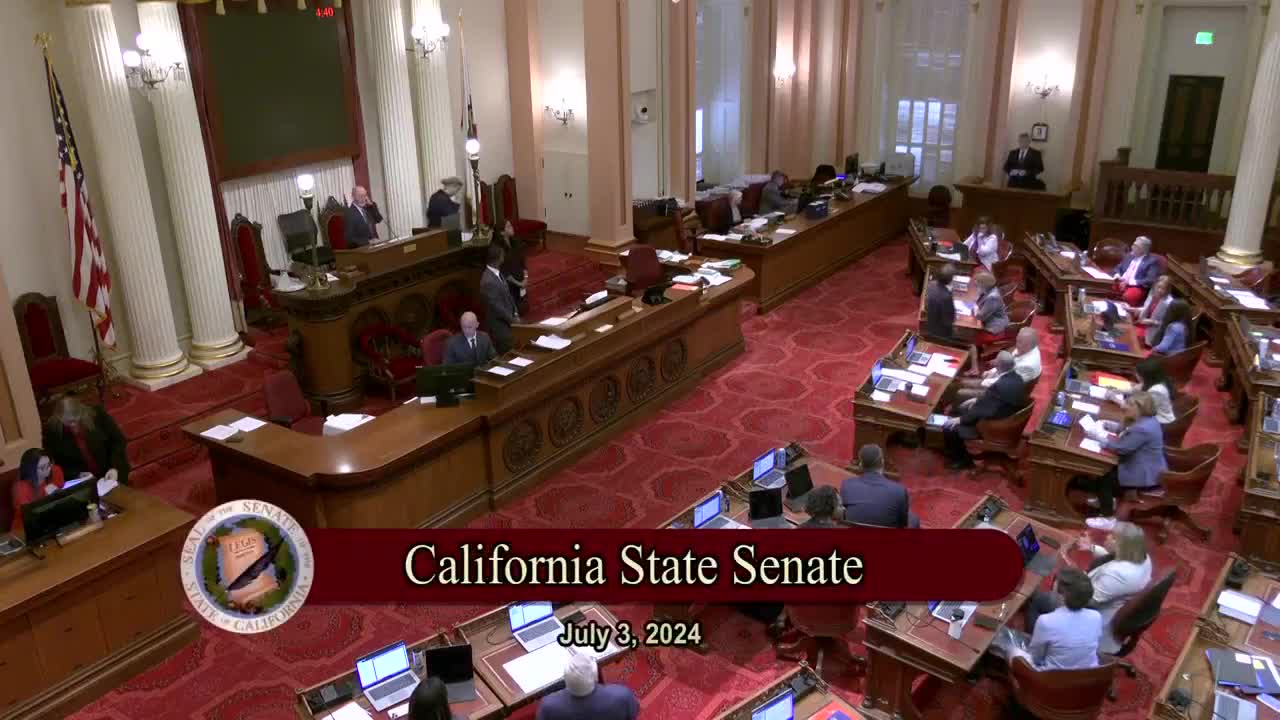 17MIN
Senate Floor
 6MIN
Assembly Floor
 1H
Assembly Standing Committee on Natural Resources
 19MIN
Assembly Standing Committee on Water, Parks, and Wildlife
 7MIN
Senate Floor
 23MIN
Senate Standing Committee on Governance and Finance
Bill Author








Bill Co-Author(s):