SB 905: Crimes: theft from a vehicle.
- Session Year: 2023-2024
- House: Senate
- Latest Version Date: 2024-08-16
Current Status:
Passed
(2024-08-16: Chaptered by Secretary of State. Chapter 170, Statutes of 2024.)
Introduced
In Committee
First Chamber
In Committee
Second Chamber
Enacted
What does this bill do?
The bill creates two new crimes: one for forcibly entering a vehicle (by using tools, electronic devices, or force) with the intent to steal or commit any felony, punishable as a misdemeanor or felony, and one for possessing items taken from vehicles with the intent to sell or trade them when the total value is over $950. The possession crime applies even if the person did not do the original theft, allows counting together similar stolen items from the past two years to reach the $950 threshold, and is also punishable as a misdemeanor or felony.
The summary is provided by generative AI which can make mistakes. For original language, please view the details in the table below.
Existing law defines the crime of burglary to include entering a vehicle when the doors are locked with the intent to commit grand or petit larceny or a felony. Existing law makes the burglary of a vehicle punishable as a misdemeanor or a felony.
This bill would make forcibly entering a vehicle, as defined, with the intent to commit a theft or a felony therein a crime punishable by imprisonment in a county jail for a period not to exceed one year or imprisonment in a county jail for 16 months, or 2 or 3 years. By creating a new crime, this bill would impose a state-mandated local program.
Existing law prohibits the taking of the personal property of another, as specified, prohibits removing any part of a vehicle without the consent of the owner, and prohibits the possession or receipt of stolen property, as specified. A violation of these prohibitions is punishable as either a misdemeanor or a felony.
This bill would make it a crime for a person to unlawfully possess property that was acquired through one or more acts of theft from a vehicle, unlawful entry of a vehicle, burglary of a locked vehicle, or vehicle tampering, if the property is not possessed for personal use and the person has the intent to sell or exchange the property, or the intent to act with another person to sell or exchange the property, and the value of the possessed property exceeds $950. The bill would, for the purpose of determining the value, allow the aggregation of the value of other illegally obtained property possessed by the person within the past 2 years. The bill would make this crime punishable as a misdemeanor or a felony. By creating a new crime, this bill would impose a state-mandated local program.
The California Constitution requires the state to reimburse local agencies and school districts for certain costs mandated by the state. Statutory provisions establish procedures for making that reimbursement.
This bill would provide that no reimbursement is required by this act for a specified reason.
Existing law defines the crime of burglary to include entering a vehicle when the doors are locked with the intent to commit grand or petit larceny or a felony. Existing law makes the burglary of a vehicle punishable as a misdemeanor or a felony.
This bill would make forcibly entering a vehicle, as defined, with the intent to commit a theft or a felony therein a crime punishable by imprisonment in a county jail for a period not to exceed one year or imprisonment in a county jail for 16 months, or 2 or 3 years. By creating a new crime, this bill would impose a state-mandated local program.
Existing law prohibits the taking of the personal property of another, as specified, prohibits removing any part of a vehicle without the consent of the owner, and prohibits the possession or receipt of stolen property, as specified. A violation of these prohibitions is punishable as either a misdemeanor or a felony.
This bill would make it a crime for a person to unlawfully possess property that was acquired through one or more acts of theft from a vehicle, unlawful entry of a vehicle, burglary of a locked vehicle, or vehicle tampering, if the property is not possessed for personal use and the person has the intent to sell or exchange the property, or the intent to act with another person to sell or exchange the property, and the value of the possessed property exceeds $950. The bill would, for the purpose of determining the value, allow the aggregation of the value of other illegally obtained property possessed by the person within the past 2 years. The bill would make this crime punishable as a misdemeanor or a felony. By creating a new crime, this bill would impose a state-mandated local program.
The bill would make these changes inoperative if a specified initiative is approved by the voters.The California Constitution requires the state to reimburse local agencies and school districts for certain costs mandated by the state. Statutory provisions establish procedures for making that reimbursement.
This bill would provide that no reimbursement is required by this act for a specified reason.
This bill would declare that it is to take effect immediately as an urgency statute.Existing law defines the crime of burglary to include entering a vehicle when the doors are locked with the intent to commit grand or petit larceny or a felony. Existing law makes the burglary of a vehicle punishable as a misdemeanor or a felony.
This bill would make forcibly entering a vehicle, as defined, with the intent to commit a theft or a felony therein a crime punishable by imprisonment in a county jail for a period not to exceed one year or imprisonment in a county jail for 16 months, or 2 or 3 years. By creating a new crime, this bill would impose a state-mandated local program.
Existing law prohibits the taking of the personal property of another, as specified, prohibits removing any part of a vehicle without the consent of the owner, and prohibits the possession or receipt of stolen property, as specified. A violation of these prohibitions is punishable as either a misdemeanor or a felony.
This bill would make it a crime for a person to unlawfully possess property that was acquired through one or more acts of theft from a vehicle, unlawful entry of a vehicle, burglary of a locked vehicle, or vehicle tampering, if the property is not possessed for personal use and the person has the intent to sell or exchange the property, or the intent to act with another person to sell or exchange the property, and the value of the possessed property exceeds $950. The bill would, for the purpose of determining the value, allow the aggregation of the value of other illegally obtained property possessed by the person within the past ____ 2 years. The bill would make this crime punishable as a misdemeanor or a felony. By creating a new crime, this bill would impose a state-mandated local program.
The bill would make these changes inoperative if a specified initiative is approved by the voters.
The California Constitution requires the state to reimburse local agencies and school districts for certain costs mandated by the state. Statutory provisions establish procedures for making that reimbursement.
This bill would provide that no reimbursement is required by this act for a specified reason.
This bill would declare that it is to take effect immediately as an urgency statute.
Existing law defines the crime of burglary to include entering a vehicle when the doors are locked with the intent to commit grand or petit larceny or a felony. Existing law makes the burglary of a vehicle punishable as a misdemeanor or a felony.
This bill would make forcibly entering a vehicle, as defined, with the intent to commit a theft or a felony therein a crime punishable by imprisonment in a county jail for a period not to exceed one year or imprisonment in a county jail for 16 months, or 2 or 3 years. By creating a new crime, this bill would impose a state-mandated local program.
Existing law prohibits the taking of the personal property of another, as specified, prohibits removing any part of a vehicle without the consent of the owner, and prohibits the possession or receipt of stolen property, as specified. A violation of these prohibitions is punishable as either a misdemeanor or a felony.
This bill would make it a crime for a person to unlawfully possess property that was acquired through one or more acts of theft from a vehicle, unlawful entry of a vehicle, burglary of a locked vehicle, or vehicle tampering, if the property is not possessed for personal use and the person has the intent to sell or exchange the property, or the intent to act with another person to sell or exchange the property, and the value of the possessed property exceeds $950. The bill would, for the purpose of determining the value, allow the aggregation of the value of other illegally obtained property possessed by the person within the past ____ years. The bill would make this crime punishable as a misdemeanor or a felony. By creating a new crime, this bill would impose a state-mandated local program.
The California Constitution requires the state to reimburse local agencies and school districts for certain costs mandated by the state. Statutory provisions establish procedures for making that reimbursement.
This bill would provide that no reimbursement is required by this act for a specified reason.
Existing law defines the crime of burglary to include entering a vehicle when the doors are locked with the intent to commit grand or petit larceny or a felony. Existing law makes the burglary of a vehicle punishable as a misdemeanor or a felony.
This bill would make forcibly entering a vehicle, as defined, with the intent to commit a theft therein a crime punishable by imprisonment in a county jail for a period not to exceed one year or imprisonment in a county jail for 16 months, or 2 or 3 years. By creating a new crime, this bill would impose a state-mandated local program.
The California Constitution requires the state to reimburse local agencies and school districts for certain costs mandated by the state. Statutory provisions establish procedures for making that reimbursement.
This bill would provide that no reimbursement is required by this act for a specified reason.
(a)A person who forcibly enters a vehicle, as defined in Section 670 of the Vehicle Code, with the intent to commit a theft or any felony therein is guilty of unlawful entry of a vehicle.
(b)Unlawful entry of a vehicle is punishable by imprisonment in a county jail for a period not to exceed one year or imprisonment pursuant to subdivision (h) of Section 1170.
(c)As used in this section, forcible entry of a vehicle means the entry of a vehicle accomplished through any of the following means: the use of a tool or device that manipulates the locking mechanism, including, without limitation, a slim jim or other lockout tool, a shaved key, jiggler key, or lock pick, or an electronic device such as a signal extender, or force that damages the exterior of the vehicle, including, but not limited to, breaking a window, cutting a convertible top, punching a lock, or prying open a door.
(d)A person may not be convicted both pursuant to this section and pursuant to Section 459.
SEC. 2.Section 496.5 is added to the Penal Code, to read:496.5.(a)A person who unlawfully possesses property that was acquired through one or more acts of theft from a vehicle, unlawful entry of a vehicle, burglary of a locked vehicle, or vehicle tampering as defined in Section 10852 of the Vehicle Code, whether or not the person committed the act of theft, burglary, or vehicle tampering, is guilty of automotive property theft for resale when both of the following apply:
(1)The property is not possessed for personal use and the person has the intent to sell or exchange the property for value, or the intent to act in concert with one or more persons to sell or exchange the property for value.
(2)The value of the possessed property exceeds nine hundred fifty dollars ($950). For purposes of determining the value of the property, the property described in paragraph (1) can be considered in the aggregate with any of the following:
(A)Any other such property possessed by the person with such intent within the last two years.
(B)Any property possessed by another person acting in concert with the first person to sell or exchange the property for value, when that property was acquired through one or more acts of theft from a vehicle, unlawful entry of a vehicle, burglary of a locked vehicle, or vehicle tampering as defined in Section 10852 of the Vehicle Code, regardless of the identity of the person committing the acts of theft, burglary, or vehicle tampering.
(b)For the purpose of determining, in any proceeding, whether the defendant had the intent to sell or exchange the property for value, the trier of fact may consider any competent evidence, including, but not limited to, the following:
(1)Whether the defendant has in the past two years sold or exchanged for value any property acquired through theft from a vehicle, burglary of a locked vehicle, or vehicle tampering as defined in Section 10852 of the Vehicle Code, or through any related offenses, including any conduct that occurred in other jurisdictions, if relevant to demonstrate a fact other than the defendants disposition to commit the act, as provided by subdivision (b) of Section 1101 of the Evidence Code.
(2)Whether the property involved in the offense is of a type or quantity that would not normally be purchased for personal use or consumption, including use or consumption by ones immediate family.
(c)A violation of subdivision (a) is punishable by imprisonment in the county jail for up to one year or pursuant to subdivision (h) of Section 1170.
(d)This section does not preclude or prohibit prosecution under any other law.
SEC. 3.No reimbursement is required by this act pursuant to Section 6 of Article XIIIB of the California Constitution because the only costs that may be incurred by a local agency or school district will be incurred because this act creates a new crime or infraction, eliminates a crime or infraction, or changes the penalty for a crime or infraction, within the meaning of Section 17556 of the Government Code, or changes the definition of a crime within the meaning of Section 6 of Article XIIIB of the California Constitution.
(a)A person who forcibly enters a vehicle, as defined in Section 670 of the Vehicle Code, with the intent to commit a theft or any felony therein is guilty of unlawful entry of a vehicle.
(b)Unlawful entry of a vehicle is punishable by imprisonment in a county jail for a period not to exceed one year or imprisonment pursuant to subdivision (h) of Section 1170.
(c)As used in this section, forcible entry of a vehicle means the entry of a vehicle accomplished through any of the following means: the use of a tool or device that manipulates the locking mechanism, including, without limitation, a slim jim or other lockout tool, a shaved key, jiggler key, or lock pick, or an electronic device such as a signal extender, or force that damages the exterior of the vehicle, including, but not limited to, breaking a window, cutting a convertible top, punching a lock, or prying open a door.
(d)A person may not be convicted both pursuant to this section and pursuant to Section 459.
(e)If the proposed initiative measure titled The Homelessness, Drug Addiction, and Theft Reduction Act (Initiative 23-0017A1) is approved by the voters at the statewide general election on November 5, 2024, this section shall become inoperative on the fifth day after the Secretary of State files the statement of the vote for the election, and shall be repealed on January 1, 2025. SEC. 2.Section 496.5 is added to the Penal Code, to read:496.5.(a)A person who unlawfully possesses property that was acquired through one or more acts of theft from a vehicle, unlawful entry of a vehicle, burglary of a locked vehicle, or vehicle tampering as defined in Section 10852 of the Vehicle Code, whether or not the person committed the act of theft, burglary, or vehicle tampering, is guilty of automotive property theft for resale when both of the following apply:
(1)The property is not possessed for personal use and the person has the intent to sell or exchange the property for value, or the intent to act in concert with one or more persons to sell or exchange the property for value.
(2)The value of the possessed property exceeds nine hundred fifty dollars ($950). For purposes of determining the value of the property, the property described in paragraph (1) can be considered in the aggregate with any of the following:
(A)Any other such property possessed by the person with such intent within the last two years.
(B)Any property possessed by another person acting in concert with the first person to sell or exchange the property for value, when that property was acquired through one or more acts of theft from a vehicle, unlawful entry of a vehicle, burglary of a locked vehicle, or vehicle tampering as defined in Section 10852 of the Vehicle Code, regardless of the identity of the person committing the acts of theft, burglary, or vehicle tampering.
(b)For the purpose of determining, in any proceeding, whether the defendant had the intent to sell or exchange the property for value, the trier of fact may consider any competent evidence, including, but not limited to, the following:
(1)Whether the defendant has in the past two years sold or exchanged for value any property acquired through theft from a vehicle, burglary of a locked vehicle, or vehicle tampering as defined in Section 10852 of the Vehicle Code, or through any related offenses, including any conduct that occurred in other jurisdictions, if relevant to demonstrate a fact other than the defendants disposition to commit the act, as provided by subdivision (b) of Section 1101 of the Evidence Code.
(2)Whether the property involved in the offense is of a type or quantity that would not normally be purchased for personal use or consumption, including use or consumption by ones immediate family.
(c)A violation of subdivision (a) is punishable by imprisonment in the county jail for up to one year or pursuant to subdivision (h) of Section 1170.
(d)This section does not preclude or prohibit prosecution under any other law.
(e)If the proposed initiative measure titled The Homelessness, Drug Addiction, and Theft Reduction Act (Initiative 23-0017A1) is approved by the voters at the statewide general election on November 5, 2024, this section shall become inoperative on the fifth day after the Secretary of State files the statement of the vote for the election, and shall be repealed on January 1, 2025. SEC. 3.No reimbursement is required by this act pursuant to Section 6 of Article XIIIB of the California Constitution because the only costs that may be incurred by a local agency or school district will be incurred because this act creates a new crime or infraction, eliminates a crime or infraction, or changes the penalty for a crime or infraction, within the meaning of Section 17556 of the Government Code, or changes the definition of a crime within the meaning of Section 6 of Article XIIIB of the California Constitution.
SEC. 4.This act is an urgency statute necessary for the immediate preservation of the public peace, health, or safety within the meaning of Article IV of the California Constitution and shall go into immediate effect. The facts constituting the necessity are:To address the increase in community-based crime and retail theft and to provide broader public safety, it is necessary that this act take effect immediately. REVISIONS: HeadingLine 7.(a)A person who forcibly enters a vehicle, as defined in Section 670 of the Vehicle Code, with the intent to commit a theft or any felony therein is guilty of unlawful entry of a vehicle.
(b)Unlawful entry of a vehicle is punishable by imprisonment in a county jail for a period not to exceed one year or imprisonment pursuant to subdivision (h) of Section 1170.
(c)As used in this section, forcible entry of a vehicle means the entry of a vehicle accomplished through any of the following means: the use of a tool or device that manipulates the locking mechanism, including, without limitation, a slim jim or other lockout tool, a shaved key, jiggler key, or lock pick, or an electronic device such as a signal extender, or force that damages the exterior of the vehicle, including, but not limited to, breaking a window, cutting a convertible top, punching a lock, or prying open a door.
(d)A person may not be convicted both pursuant to this section and pursuant to Section 459.
(e)If the proposed initiative measure titled The Homelessness, Drug Addiction, and Theft Reduction Act (Initiative 23-0017A1) is approved by the voters at the statewide general election on November 5, 2024, this section shall become inoperative on the fifth day after the Secretary of State files the statement of the vote for the election, and shall be repealed on January 1, 2025.
SEC. 2.Section 496.5 is added to the Penal Code, to read:496.5.(a)A person who unlawfully possesses property that was acquired through one or more acts of theft from a vehicle, unlawful entry of a vehicle, burglary of a locked vehicle, or vehicle tampering as defined in Section 10852 of the Vehicle Code, whether or not the person committed the act of theft, burglary, or vehicle tampering, is guilty of automotive property theft for resale when both of the following apply:
(1)The property is not possessed for personal use and the person has the intent to sell or exchange the property for value, or the intent to act in concert with one or more persons to sell or exchange the property for value.
(2)The value of the possessed property exceeds nine hundred fifty dollars ($950). For purposes of determining the value of the property, the property described in paragraph (1) can be considered in the aggregate with any of the following:
(A)Any other such property possessed by the person with such intent within the last ____ two years.
(B)Any property possessed by another person acting in concert with the first person to sell or exchange the property for value, when that property was acquired through one or more acts of theft from a vehicle, unlawful entry of a vehicle, burglary of a locked vehicle, or vehicle tampering as defined in Section 10852 of the Vehicle Code, regardless of the identity of the person committing the acts of theft, burglary, or vehicle tampering.
(b)For the purpose of determining, in any proceeding, whether the defendant had the intent to sell or exchange the property for value, the trier of fact may consider any competent evidence, including, but not limited to, the following:
(1)Whether the defendant has in the past ____ two years sold or exchanged for value any property acquired through theft from a vehicle, burglary of a locked vehicle, or vehicle tampering as defined in Section 10852 of the Vehicle Code, or through any related offenses, including any conduct that occurred in other jurisdictions, if relevant to demonstrate a fact other than the defendants disposition to commit the act, as provided by subdivision (b) of Section 1101 of the Evidence Code.
(2)Whether the property involved in the offense is of a type or quantity that would not normally be purchased for personal use or consumption, including use or consumption by ones immediate family.
(c)A violation of subdivision (a) is punishable by imprisonment in the county jail for up to one year or pursuant to subdivision (h) of Section 1170.
(d)This section does not preclude or prohibit prosecution under any other law.
(e)If the proposed initiative measure titled The Homelessness, Drug Addiction, and Theft Reduction Act (Initiative 23-0017A1) is approved by the voters at the statewide general election on November 5, 2024, this section shall become inoperative on the fifth day after the Secretary of State files the statement of the vote for the election, and shall be repealed on January 1, 2025.
SEC. 3.No reimbursement is required by this act pursuant to Section 6 of Article XIIIB of the California Constitution because the only costs that may be incurred by a local agency or school district will be incurred because this act creates a new crime or infraction, eliminates a crime or infraction, or changes the penalty for a crime or infraction, within the meaning of Section 17556 of the Government Code, or changes the definition of a crime within the meaning of Section 6 of Article XIIIB of the California Constitution.
SEC. 4.This act is an urgency statute necessary for the immediate preservation of the public peace, health, or safety within the meaning of Article IV of the California Constitution and shall go into immediate effect. The facts constituting the necessity are:
To address the increase in community-based crime and retail theft and to provide broader public safety, it is necessary that this act take effect immediately.
(a)A person who forcibly enters a vehicle, as defined in Section 670 of the Vehicle Code, with the intent to commit a theft or any felony therein is guilty of unlawful entry of a vehicle.
(b)Unlawful entry of a vehicle is punishable by imprisonment in a county jail for a period not to exceed one year or imprisonment pursuant to subdivision (h) of Section 1170.
(c)As used in this section, forcible entry of a vehicle means the entry of a vehicle accomplished through any of the following means: the use of a tool or device that manipulates the locking mechanism, including, without limitation, a slim jim or other lockout tool, a shaved key, jiggler key, or lock pick, or an electronic device such as a signal extender, or force that damages the exterior of the vehicle, including, but not limited to, breaking a window, cutting a convertible top, punching a lock, or prying open a door.
(d)A person may not be convicted both pursuant to this section and pursuant to Section 459.
SEC. 2.Section 496.5 is added to the Penal Code, to read:496.5.(a)A person who unlawfully possesses property that was acquired through one or more acts of theft from a vehicle, unlawful entry of a vehicle, burglary of a locked vehicle, or vehicle tampering as defined in Section 10852 of the Vehicle Code, whether or not the person committed the act of theft, burglary, or vehicle tampering, is guilty of automotive property theft for resale when all both of the following apply:
(1)The property is not possessed for personal use and the person has the intent to sell or exchange the property for value, or the intent to act in concert with one or more persons to sell or exchange the property for value.
(2)The value of the possessed property exceeds nine hundred fifty dollars ($950). For purposes of determining the value of the property, the property described in paragraph (1) can be considered in the aggregate with any of the following:
(A)Any other such property possessed by the person with such intent within the last ____ years.
(B)Any property possessed by another person acting in concert with the first person to sell or exchange the property for value, when that property was acquired through one or more acts of theft from a vehicle, unlawful entry of a vehicle, burglary of a locked vehicle, or vehicle tampering as defined in Section 10852 of the Vehicle Code, regardless of the identity of the person committing the acts of theft, burglary, or vehicle tampering.
(b)For the purpose of determining, in any proceeding, whether the defendant had the intent to sell or exchange the property for value, the trier of fact may consider any competent evidence, including, but not limited to, the following:
(1)Whether the defendant has in the past ____ years sold or exchanged for value any property acquired through theft from a vehicle, burglary of a locked vehicle, or vehicle tampering as defined in Section 10852 of the Vehicle Code, or through any related offenses, including any conduct that occurred in other jurisdictions, if relevant to demonstrate a fact other than the defendants disposition to commit the act, as provided by subdivision (b) of Section 1101 of the Evidence Code.
(2)Whether the property involved in the offense is of a type or quantity that would not normally be purchased for personal use or consumption, including use or consumption by ones immediate family.
(c)A violation of subdivision (a) is punishable by imprisonment in the county jail for up to one year or pursuant to subdivision (h) of Section 1170.
(d)This section does not preclude or prohibit prosecution under any other law.
SEC. 3.No reimbursement is required by this act pursuant to Section 6 of Article XIIIB of the California Constitution because the only costs that may be incurred by a local agency or school district will be incurred because this act creates a new crime or infraction, eliminates a crime or infraction, or changes the penalty for a crime or infraction, within the meaning of Section 17556 of the Government Code, or changes the definition of a crime within the meaning of Section 6 of Article XIIIB of the California Constitution.
REVISIONS: HeadingLines 2, 5, 6, 7, and 10.(a)A person who forcibly enters a vehicle, as defined in Section 670 of the Vehicle Code, with the intent to commit a theft or any felony therein is guilty of unlawful entry of a vehicle.
(b)Unlawful entry of a vehicle is punishable by imprisonment in a county jail for a period not to exceed one year or imprisonment pursuant to subdivision (h) of Section 1170.
(c)As used in this section, forcible entry of a vehicle means the entry of a vehicle accomplished through either of the following means: any of the following means: the use of a tool or device that manipulates the locking mechanism, including, without limitation, a slim jim or other lockout tool, a shaved key, jiggler key, or lock pick, or an electronic device such as a signal extender, or force that damages the exterior of the vehicle, including, but not limited to, breaking a window, cutting a convertible top, punching a lock, or prying open a door.
(1)Force that damages the exterior of the vehicle, including, but not limited to, breaking a window, cutting a convertible top, punching a lock, or prying open a door.(2)Use of a tool or device that manipulates the locking mechanism, including, without limitation, a slim jim or other lockout tool, a shaved key, jiggler key, or lock pick, or an electronic device such as a signal extender.(d)A person may not be convicted both pursuant to this section and pursuant to Section 459.
SEC. 2.Section 496.5 is added to the Penal Code, to read:496.5.(a)A person who unlawfully possesses property that was acquired through one or more acts of theft from a vehicle, unlawful entry of a vehicle, burglary of a locked vehicle, or vehicle tampering as defined in Section 10852 of the Vehicle Code, whether or not the person committed the act of theft, burglary, or vehicle tampering, is guilty of automotive property theft for resale when all of the following apply:
(1)The property is not possessed for personal use and the person has the intent to sell or exchange the property for value, or the intent to act in concert with one or more persons to sell or exchange the property for value.
(2)The value of the possessed property exceeds nine hundred fifty dollars ($950). For purposes of determining the value of the property, the property described in paragraph (1) can be considered in the aggregate with any of the following:
(A)Any other such property possessed by the person with such intent within the last ____ years.
(B)Any property possessed by another person acting in concert with the first person to sell or exchange the property for value, when that property was acquired through one or more acts of theft from a vehicle, unlawful entry of a vehicle, burglary of a locked vehicle, or vehicle tampering as defined in Section 10852 of the Vehicle Code, regardless of the identity of the person committing the acts of theft, burglary, or vehicle tampering.
(b)For the purpose of determining, in any proceeding, whether the defendant had the intent to sell or exchange the property for value, the trier of fact may consider any competent evidence, including, but not limited to, the following:
(1)Whether the defendant has in the past ____ years sold or exchanged for value any property acquired through theft from a vehicle, burglary of a locked vehicle, or vehicle tampering as defined in Section 10852 of the Vehicle Code, or through any related offenses, including any conduct that occurred in other jurisdictions, if relevant to demonstrate a fact other than the defendants disposition to commit the act, as provided by subdivision (b) of Section 1101 of the Evidence Code.
(2)Whether the property involved in the offense is of a type or quantity that would not normally be purchased for personal use or consumption, including use or consumption by ones immediate family.
(c)A violation of subdivision (a) is punishable by imprisonment in the county jail for up to one year or pursuant to subdivision (h) of Section 1170.
(d)This section does not preclude or prohibit prosecution under any other law.
SEC. 3.No reimbursement is required by this act pursuant to Section 6 of Article XIIIB of the California Constitution because the only costs that may be incurred by a local agency or school district will be incurred because this act creates a new crime or infraction, eliminates a crime or infraction, or changes the penalty for a crime or infraction, within the meaning of Section 17556 of the Government Code, or changes the definition of a crime within the meaning of Section 6 of Article XIIIB of the California Constitution.
(a)A person who forcibly enters a vehicle, as defined in Section 670 of the Vehicle Code, with the intent to commit a theft therein is guilty of unlawful entry of a vehicle.
(b)Unlawful entry of a vehicle is punishable by imprisonment in a county jail for a period not to exceed one year or imprisonment pursuant to subdivision (h) of Section 1170.
(c)As used in this section, forcible entry of a vehicle means the entry of a vehicle accomplished through either of the following means:
(1)Force that damages the exterior of the vehicle, including, but not limited to, breaking a window, cutting a convertible top, punching a lock, or prying open a door.
(2)Use of a tool or device that manipulates the locking mechanism, including, without limitation, a slim jim or other lockout tool, a shaved key, jiggler key, or lock pick, or an electronic device such as a signal extender.
(d)No A person may not be convicted both pursuant to this section and pursuant to Section 459.
SEC. 2.Section 496.5 is added to the Penal Code, to read:496.5.(a)A person who unlawfully possesses property that was acquired through one or more acts of theft from a vehicle, unlawful entry of a vehicle, burglary of a locked vehicle, or vehicle tampering as defined in Section 10852 of the Vehicle Code, whether or not the person committed the act of theft, burglary, or vehicle tampering, is guilty of automotive property theft for resale when all of the following apply:
(1)The property is not possessed for personal use and the person has the intent to sell or exchange the property for value, or the intent to act in concert with one or more persons to sell or exchange the property for value.
(2)The value of the possessed property exceeds nine hundred fifty dollars ($950). For purposes of determining the value of the property, the property described in paragraph (1) can be considered in the aggregate with any of the following:
(A)Any other such property possessed by the person with such intent within the last ____ years.
(B)Any property possessed by another person acting in concert with the first person to sell or exchange the property for value, when that property was acquired through one or more acts of theft from a vehicle, unlawful entry of a vehicle, burglary of a locked vehicle, or vehicle tampering as defined in Section 10852 of the Vehicle Code, regardless of the identity of the person committing the acts of theft, burglary, or vehicle tampering.
(b)For the purpose of determining, in any proceeding, whether the defendant had the intent to sell or exchange the property for value, the trier of fact may consider any competent evidence, including, but not limited to, the following:
(1)Whether the defendant has in the past ____ years sold or exchanged for value any property acquired through theft from a vehicle, burglary of a locked vehicle, or vehicle tampering as defined in Section 10852 of the Vehicle Code, or through any related offenses, including any conduct that occurred in other jurisdictions, if relevant to demonstrate a fact other than the defendants disposition to commit the act, as provided by subdivision (b) of Section 1101 of the Evidence Code.
(2)Whether the property involved in the offense is of a type or quantity that would not normally be purchased for personal use or consumption, including use or consumption by ones immediate family.
(c)A violation of subdivision (a) is punishable by imprisonment in the county jail for up to one year or pursuant to subdivision (h) of Section 1170.
SEC. 2.SEC. 3.No reimbursement is required by this act pursuant to Section 6 of Article XIIIB of the California Constitution because the only costs that may be incurred by a local agency or school district will be incurred because this act creates a new crime or infraction, eliminates a crime or infraction, or changes the penalty for a crime or infraction, within the meaning of Section 17556 of the Government Code, or changes the definition of a crime within the meaning of Section 6 of Article XIIIB of the California Constitution.
(a)A person who forcibly enters a vehicle, as defined in Section 670 of the Vehicle Code, with the intent to commit a theft therein is guilty of unlawful entry of a vehicle.
(b)Unlawful entry of a vehicle is punishable by imprisonment in a county jail for a period not to exceed one year or imprisonment pursuant to subdivision (h) of Section 1170.
(c)As used in this section, forcible entry of a vehicle means the entry of a vehicle accomplished through either of the following means:
(1)Force that damages the exterior of the vehicle, including, but not limited to, breaking a window, cutting a convertible top, punching a lock, or prying open a door.
(2)Use of a tool or device that manipulates the locking mechanism, including, without limitation, a slim jim or other lockout tool, a shaved key, jiggler key, or lock pick, or an electronic device such as a signal extender.
(d)No person may be convicted both pursuant to this section and pursuant to Section 459.
SEC. 2.No reimbursement is required by this act pursuant to Section 6 of Article XIIIB of the California Constitution because the only costs that may be incurred by a local agency or school district will be incurred because this act creates a new crime or infraction, eliminates a crime or infraction, or changes the penalty for a crime or infraction, within the meaning of Section 17556 of the Government Code, or changes the definition of a crime within the meaning of Section 6 of Article XIIIB of the California Constitution.
|
Date
|
Status
|
|---|---|
| Aug 16, 2024 | Chaptered by Secretary of State. Chapter 170, Statutes of 2024. |
| Aug 16, 2024 | Approved by the Governor. |
| Aug 15, 2024 | Enrolled and presented to the Governor at 11:45 a.m. |
| Aug 12, 2024 | Assembly amendments concurred in. (Ayes 37. Noes 0. Page 5037.) Ordered to engrossing and enrolling. |
| Aug 8, 2024 | In Senate. Concurrence in Assembly amendments pending. |
| Aug 8, 2024 | Read third time. Passed. (Ayes 64. Noes 2. Page 6243.) Ordered to the Senate. |
| Aug 7, 2024 | Coauthors revised. |
| Jul 1, 2024 | Read third time and amended. |
| Jul 1, 2024 | Ordered to third reading. |
| Jul 1, 2024 | Assembly Rule 69 suspended. (Ayes 54. Noes 15. Page 6106.) |
| Jun 24, 2024 | Read second time. Ordered to third reading. |
| Jun 20, 2024 | Read second time and amended. Ordered to second reading. |
| Jun 19, 2024 | From committee: Do pass as amended. (Ayes 9. Noes 4.) (June 19). |
| Jun 11, 2024 | From committee: Do pass and re-refer to Com. on APPR. (Ayes 8. Noes 0.) (June 11). Re-referred to Com. on APPR. |
| Jun 11, 2024 | Coauthors revised. |
| May 28, 2024 | Referred to Com. on PUB. S. |
| May 23, 2024 | In Assembly. Read first time. Held at Desk. |
| May 22, 2024 | Read third time. Passed. (Ayes 38. Noes 0. Page 4137.) Ordered to the Assembly. |
| May 20, 2024 | Read second time. Ordered to third reading. |
| May 16, 2024 | Read second time and amended. Ordered to second reading. |
| May 16, 2024 | From committee: Do pass as amended. (Ayes 7. Noes 0. Page 3963.) (May 16). |
| May 10, 2024 | Set for hearing May 16. |
| May 6, 2024 | May 6 hearing: Placed on APPR suspense file. |
| Apr 26, 2024 | Set for hearing May 6. |
| Apr 4, 2024 | Read second time and amended. Re-referred to Com. on APPR. |
| Apr 3, 2024 | From committee: Do pass as amended and re-refer to Com. on APPR. (Ayes 5. Noes 0. Page 3449.) (April 2). |
| Mar 18, 2024 | From committee with author's amendments. Read second time and amended. Re-referred to Com. on PUB S. |
| Mar 12, 2024 | Set for hearing April 2. |
| Feb 14, 2024 | Referred to Com. on PUB S. |
| Jan 5, 2024 | From printer. May be acted upon on or after February 4. |
| Jan 4, 2024 | Introduced. Read first time. To Com. on RLS. for assignment. To print. |
|
Date
|
Description
|
Location
|
Votes
|
|
|---|---|---|---|---|
| Aug 12, 2024 | Unfinished Business SB905 Wiener et al. Concurrence | Senate Floor |
Passed |
|
| Aug 8, 2024 | SB 905 Wiener Senate Third Reading By Zbur | Assembly Floor |
Passed |
|
| Jun 19, 2024 | Do pass as amended. | Assembly Standing Committee on Appropriations |
Passed |
|
| Jun 11, 2024 | Do pass and be re-referred to the Committee on [Appropriations] | Assembly Standing Committee on Public Safety |
Passed |
|
| May 22, 2024 | Senate 3rd Reading SB905 Wiener et al. | Senate Floor |
Passed |
|
| May 16, 2024 | Do pass as amended | Senate Standing Committee on Appropriations |
Passed |
|
| May 6, 2024 | Placed on suspense file | Senate Standing Committee on Appropriations |
Passed |
|
| Apr 2, 2024 | Do pass as amended, but first amend, and re-refer to the Committee on [Appropriations] | Senate Standing Committee on Public Safety |
Passed |
This list shows positions taken on this bill by organizations on the date displayed, which is linked to the original source.
Positions by individuals are not included.
|
Organization
|
Position
|
Date
|
|---|---|---|
| America First Policy Institute - California | ** Support | |
| Arcadia Police Officers' Association | ** Support | |
| Bay Area Council | ** Support | |
| Burbank Police Officers' Association | ** Support | |
| California Association Of Highway Patrolmen | ** Support | |
| California Coalition of School Safety Professionals | ** Support | |
| California Contract Cities Association | ** Support | |
| California District Attorneys Association | ** Support | |
| California Hispanic Chamber Of Commerce | ** Support | |
| California Narcotic Officers' Association | ** Support | |
| California Police Chiefs Association | ** Support | |
| California Public Defenders Association | ** Against | |
| California Reserve Peace Officers Association | ** Support | |
| California Retailers Association | ** Support | |
| California State Sheriffs' Association | * For If Amend | Jun 22, 2024 |
| California Statewide Law Enforcement Association | ** Support | |
| California Travel Association | ** Support | |
| City and County of San Francisco, Board of Supervisors | ** Support | |
| city of carlsbad | ** Support | |
| City of Emeryville | ** Support | |
| City of La Verne | ** Support | |
| City of Norwalk | ** Support | |
| City of Oakland Mayor Sheng Thao | ** Support | |
| City of Pico Rivera | ** Support | |
| City of Santa Clarita | ** Support | |
| City Of Tustin | ** Support | |
| CLAREMONT POLICE OFFICERS ASSOCIATION | ** Support | |
| Corona Police Officers Association | ** Support | |
| Culver City Police Officers' Association | ** Support | |
| Deputy Sheriffs Association of Monterey County | ** Support | |
| Fullerton Police Officers' Association | ** Support | |
| League Of California Cities | * Support | Jun 11, 2024 |
| Los Angeles County District Attorney'S Office | ** Support | |
| Los Angeles County Sheriff'S Department | * Support | Jun 11, 2024 |
| Los Angeles School Police Management Association | ** Support | |
| los angeles school police officers association | ** Support | |
| Marin County | * Support | Apr 2, 2024 |
| Mayor of City & County of San Francisco London Breed | ** Support | |
| Murrieta Police Officers' Association | ** Support | |
| Newport Beach Police Association | ** Support | |
| Novato Police Officers Association | ** Support | |
| Palos Verdes Police Officers Association | ** Support | |
| Peace Officers Research Association Of California | ** Support | |
| PLACER COUNTY DEPUTY SHERIFFS ASSOCIATION | ** Support | |
| Pomona Police Officers' Association | ** Support | |
| Riverside County District Attorney's Office | * Support | Apr 2, 2024 |
| RIVERSIDE POLICE OFFICERS ASSOCIATION | ** Support | |
| Riverside Sheriffs' Association | ** Support | |
| San Francisco Board of Supervisors | ** Support | |
| San Francisco POA | * Support | Apr 2, 2024 |
| San Francisco Police Department | * Support | Jun 11, 2024 |
| Santa Ana Police Officers Association | ** Support | |
| Sheriff Robert Luna | * Support | Jun 11, 2024 |
| Tri-Valley Cities of Dublin, Livermore, Pleasanton, San Ramon and the Town of Danville | ** Support | |
| Upland Police Officers Association | ** Support |
SENATE RULES COMMITTEE Office of Senate Floor Analyses (916) 651-1520 Fax: (916) 327-4478 | SB 905 |
UNFINISHED BUSINESS
Bill No: SB 905
Author: Wiener (D), et al.
Amended: 7/1/24
Vote: 21
SENATE PUBLIC SAFETY COMMITTEE: 5-0, 4/2/24
AYES: Wahab, Seyarto, Bradford, Skinner, Wiener
SENATE APPROPRIATIONS COMMITTEE: 7-0, 5/16/24
AYES: Caballero, Jones, Ashby, Becker, Bradford, Seyarto, Wahab
SENATE FLOOR: 38-0, 5/22/24
AYES: Alvarado-Gil, Ashby, Atkins, Becker, Blakespear, Bradford, Caballero, Cortese, Dahle, Dodd, Durazo, Eggman, Glazer, Gonzalez, Grove, Hurtado, Jones, Laird, Limón, McGuire, Menjivar, Min, Newman, Nguyen, Niello, Ochoa Bogh, Padilla, Portantino, Roth, Rubio, Seyarto, Skinner, Smallwood-Cuevas, Stern, Umberg, Wahab, Wiener, Wilk
NO VOTE RECORDED: Allen, Archuleta
ASSEMBLY FLOOR: 64-2, 8/8/24 - See last page for vote
SUBJECT: Crimes: theft from a vehicle
SOURCE: Mayor of City & County of San Francisco London Breed
DIGEST:
This bill creates the new crime of forcibly entering a vehicle with the intent to commit theft or any other felony and the new crime of unlawfully possessing property acquired through theft from a vehicle with intent to sell where the value of the property possessed exceeds $950.
Assembly Amendments
specify that for the new crime of unlawfully possessing property acquired through theft from a vehicle with intent to sell, the period of time that may be considered for intent and prior acts is two years.
ANALYSIS:
Existing law:
- States that that any person who enters any house, room, apartment,…shop, warehouse, store,… outhouse or other building, tent, vessel, … vehicle …when the doors are locked, aircraft … or mine … with the intent to commit grand or petit larceny or any other felony is guilty or burglary. (Pen. Code, § 459, emphasis added.)
- States that burglary of an inhabited dwelling is first degree burglary, and that all other kinds of burglary are of the second degree. (Pen. Code, § 460.)
- Provides that the punishment for first degree burglary is imprisonment in the state prison for two, four, or six years. (Pen. Code, § 461, subd. (a).)
- Provides that the punishment for second degree burglary is either confinement of up to one year in the county jail, or confinement in the county jail for 16 months, two, or three years pursuant to criminal justice realignment. (Pen. Code, §§ 18, subd. (a), 461, subd. (b), 1170, subd. (h).)
- Prohibits the possession or receipt of stolen property knowing the property to be stolen and punishes a person guilty of this offense by imprisonment in county jail for not more than one year, or 16 months, or 2 or 3 years. If the value of the property does not exceed $950, the person shall be punished by imprisonment in county jail not exceeding one year, except as specified. (Pen. Code, § 496.)
- Provides that no person shall willfully injure or tamper with any vehicle or the contents thereof or break or remove any part of a vehicle without the consent of the owner. (Veh. Code, § 10852.)
- Provides that the punishment for vehicle tampering is confinement of up to six months in the county jail, a fine not to exceed $1,000, or both. (Veh. Code, §§ 42002, 40000.9.)
This bill:
- Creates a new crime for forcibly entering a vehicle with the intent to commit a theft or any felony therein.
- Specifies that “forcible entry of a vehicle” means entry of a vehicle accomplished through any of the following means: the use of a tool or device that manipulates the locking mechanism, including, without limitation, a slim jim or other lockout tool, a shaved key, jiggler key, or lock pick, or an electronic device such as a signal extender, or force that damages the exterior of the vehicle, including, but not limited to, breaking a window, cutting a convertible top, punching a lock, or prying open a door.
- Specifies the punishment for forcibly entering a vehicle with the intent to commit a theft is either a misdemeanor or a felony. The punishment for the misdemeanor is specified as confinement in the county jail not exceeding one year. The punishment for the felony is specified as confinement in the county jail for 16 months, 2 years, or 3 years.
- Provides that a person may not be convicted of both unlawful entry of a vehicle and burglary.
- Creates a new crime for unlawfully possessing property that was acquired through one or more acts of theft from a vehicle, unlawful entry of a vehicle, burglary of a locked vehicle, or vehicle tampering, whether or not the person committed the act of theft, burglary or vehicle tampering.
- Specifies that the person is guilty of the offense when all of the following apply:
- The property is not possessed for personal use and the person has the intent to sell or exchange the property for value, or the intent to act in concert with one or more persons to sell or exchange the property for value;
- The value of the possessed property exceeds $950.
- Provides that for purposes of determining the value of the property, the property currently possessed can be considered in the aggregate with any of the following:
- Any other such property possessed by the person with such intent within the last two years;
- Any property possessed by another person acting in concert with the first person to sell or exchange the property for value, when that property was acquired through one or more acts of theft from a vehicle, unlawful entry of a vehicle, burglary of a locked vehicle, or vehicle tampering, regardless of the identity of the person committing the acts of theft, burglary, or vehicle tampering.
- States that for the purpose of determining, in any proceeding, whether the defendant had the intent to sell or exchange the property for value, the trier of fact may consider any competent evidence, including, but not limited to, the following:
- Whether the defendant has in the past two years sold or exchanged for value any property acquired through the theft from a vehicle, burglary of a locked vehicle, or vehicle tampering, or through any related offenses, including any conduct that occurred in other jurisdictions, if relevant to demonstrate a fact other than the defendant’s disposition to commit the act as provided in Section 1101 of the Evidence Code; and,
- Whether the property involved in the offense is of a type or quantity that would not normally be purchased for personal use or consumption, including use or consumption by one’s immediate family.
- Specifies that a violation of unlawfully possessing property acquired through theft of a vehicle is punishable by imprisonment in the county jail for up to one year or 16 months, or 2 or 3 years in county jail.
Comments
According to the author of this bill:
Senate Bill 905 closes the “locked door loophole”, a nonsensical barrier to holding auto burglars accountable. Under current law, the fact that a car window was broken is insufficient to convict a suspect of auto burglary—prosecutors must prove that the door was locked, which requires victims to be physically present in court to testify as such. This requirement can sabotage clear cases of guilt, particularly for situations where someone if visiting a city for tourism and is unable to return just to testify that they locked their car door. SB 905 instead eliminates this gratuitous hurdle, this legislation makes forcible entry sufficient to prove the crime of auto burglary and makes California safer for everyone.
As amended, the bill will also address the problem of organized resale of goods stolen from cars. Auto burglars seek valuable items such as laptops, cameras, and cell phones and then resell them. Under the bill, individuals could be prosecuted for holding more than $950 of stolen goods intended for resale, whether those goods were stolen in one or multiple incidents, and whether the individual played the role of thief, middleman, or seller.
FISCAL EFFECT: Appropriation: No Fiscal Com.: Yes Local: Yes
According to the Assembly Committee on Appropriations:
- Costs (Trial Court Trust Fund, General Fund) to the courts of an unknown but potentially significant amount to adjudicate cases of the new offenses created by this bill. A defendant charged with a misdemeanor or felony is entitled to a jury trial and, if the defendant is indigent, legal representation provided by the government. Actual court costs will depend on the number of cases filed and the amount of court time and resources needed to adjudicate each case. It generally costs approximately $1,000 to operate a courtroom for one hour. Although courts are not funded on the basis of workload, increased pressure on the Trial Court Trust Fund may create a need for increased funding for courts from the General Fund. The Governor’s 2024-25 budget proposes $83.1 million ongoing from the General Fund to backfill declining revenue to the Trial Court Trust Fund.
- Costs (local funds, General Fund) of an unknown but potentially significant amount to the counties and the California Department of Corrections and Rehabilitation to incarcerate people convicted of the offenses created by this bill. Actual incarceration costs will depend on the number of convictions, the length of each sentence, and whether each sentence must be served in county jail or state prison. The average annual cost to incarcerate one person in county jail is approximately $29,000. The Legislative Analyst’s Office (LAO) estimates the average annual cost to incarcerate one person in state prison is $133,000. Although county incarceration costs are generally not considered reimbursable state mandates pursuant to Proposition 30 (2012), overcrowding in county jails creates cost pressure on the General Fund because the state has historically granted new funding to counties to offset overcrowding resulting from 2011 public safety realignment.
According to the LAO, the General Fund faces a structural deficit in the tens of billions of dollars over the next several fiscal years.
SUPPORT: (Verified 7/3/24)
Mayor of City & County of San Francisco London Breed (source)
America First Policy Institute - California
Arcadia Police Officers' Association
Bay Area Council
Burbank Police Officers' Association
California Association of Highway Patrolmen
California Coalition of School Safety Professionals
California Contract Cities Association
California District Attorneys Association
California Hispanic Chamber of Commerce
California Narcotic Officers' Association
California Police Chiefs Association
California Reserve Peace Officers Association
California Retailers Association
California Statewide Law Enforcement Association
California Travel Association (CALTRAVEL)
City and County of San Francisco, Board of Supervisors
City of Carlsbad
City of Emeryville
City of La Verne
City of Norwalk
City of Oakland Mayor Sheng Thao
City of Pico Rivera
City of Santa Clarita
City of Tustin
Claremont Police Officers Association
Corona Police Officers Association
Culver City Police Officers' Association
Deputy Sheriffs' Association of Monterey County
Fullerton Police Officers' Association
Los Angeles County District Attorney's Office
Los Angeles School Police Management Association
Los Angeles School Police Officers Association
Murrieta Police Officers' Association
Newport Beach Police Association
Novato Police Officers Association
Palos Verdes Police Officers Association
Peace Officers Research Association of California (PORAC)
Placer County Deputy Sheriffs' Association
Pomona Police Officers' Association
Riverside Police Officers Association
Riverside Sheriffs' Association
San Francisco Board of Supervisors
Santa Ana Police Officers Association
Tri-valley Cities of Dublin, Livermore, Pleasanton, San Ramon, and Town of Danville
Upland Police Officers Association
OPPOSITION: (Verified 7/3/24)
California Public Defenders Association
ASSEMBLY FLOOR: 64-2, 8/8/24
AYES: Addis, Aguiar-Curry, Alanis, Arambula, Bains, Bennett, Berman, Boerner, Calderon, Juan Carrillo, Cervantes, Chen, Connolly, Megan Dahle, Davies, Dixon, Essayli, Flora, Mike Fong, Friedman, Gabriel, Gallagher, Gipson, Grayson, Haney, Hart, Holden, Hoover, Irwin, Jackson, Lackey, Lee, Low, Lowenthal, Maienschein, Mathis, McCarty, Muratsuchi, Stephanie Nguyen, Ortega, Pacheco, Papan, Jim Patterson, Joe Patterson, Pellerin, Quirk-Silva, Ramos, Rendon, Reyes, Rodriguez, Blanca Rubio, Sanchez, Santiago, Schiavo, Soria, Ta, Ting, Villapudua, Waldron, Wallis, Wilson, Wood, Zbur, Robert Rivas
NOES: Bryan, McKinnor
NO VOTE RECORDED: Alvarez, Bauer-Kahan, Bonta, Wendy Carrillo, Garcia, Jones-Sawyer, Kalra, Petrie-Norris, Luz Rivas, Valencia, Ward, Weber, Wicks
Prepared by: Stella Choe / PUB. S. /
8/9/24 16:38:02
**** END ****
SENATE THIRD READING
STR Bill Id:SB 905
Author:(Wiener)
As Amended Ver:July 1, 2024
Majority vote
SUMMARY
Creates a new alternate felony-misdemeanor for any person who forcibly enters a vehicle, with the intent to commit a theft or any felony therein.
Major Provisions
- States any person who forcibly enters a vehicle, as defined, with the intent to commit a theft or a felony therein is guilty of a crime punishable by imprisonment in a county jail for a period not to exceed one year or imprisonment in a county jail for 16 months, two, or three years.
- Defines "forcible entry of a vehicle" as the entry of a vehicle accomplished through any of the following means: the use of a tool or device that manipulates the locking mechanism, including, without limitation, a slim jim or other lockout tool, a shaved key, jiggler key, or lock pick, or an electronic device such as a signal extender, or force that damages the exterior of the vehicle, including, but not limited to, breaking a window, cutting a convertible top, punching a lock, or prying open a door.
- Creates a new alternate felony-misdemeanor punishable by either one year in county jail or a sentence of 16 months, two years, or three years in county jail for a person to unlawfully possess property that was acquired through one or more acts of theft from a vehicle, unlawful entry of a vehicle, burglary of a locked vehicle, or vehicle tampering, if:
- The property is not possessed for personal use and the person has the intent to sell or exchange the property, or the intent to act with another person to sell or exchange the property; and
- The value of the possessed property exceeds $950, as specified.
- States in determining the value of the property, any unlawfully possessed property may be considered in aggregation with any of the following:
- Any other property for which a person intended to unlawfully possess or unlawfully possessed within the last two years;
- Any property possessed by another person acting in concert with the first person to sell or exchange the property for value, when that property was acquired through one or more acts of theft from a vehicle, unlawful entry of a vehicle, burglary of a locked vehicle, or vehicle tampering regardless of the identity of the person committing the acts of theft, burglary, or vehicle tampering.
COMMENTS
According to the Author
"Senate Bill 905 closes the 'locked door loophole,' a nonsensical barrier to holding auto burglars accountable. Under current law, the fact that a car window was broken is insufficient to convict a suspect of auto burglary—prosecutors must prove that the door was locked, which requires victims to be physically present in court to testify as such. This requirement can sabotage clear cases of guilt, particularly for situations where someone if visiting a city for tourism and is unable to return just to testify that they locked their car door. SB 905 instead eliminates this gratuitous hurdle, this legislation makes forcible entry sufficient to prove the crime of auto burglary and makes California safer for everyone. SB 905 also address the problem of organized resale of goods stolen from cars. Auto burglars seek valuable items such as laptops, cameras, and cell phones and then resell them. Under the bill, individuals could be prosecuted for holding more than $950 of stolen goods intended for resale, whether those goods were stolen in one or multiple incidents, and whether the individual played the role of thief, middleman, or seller."
Arguments in Support
According to League of California Cities: "According to the U.S. Census Bureau, from January to October 2021 San Francisco lead the nation in automobile burglaries, and in 2018 lead the state in property crime with a rate double the rest of the state. The State of California has seen around a 33% increase in auto-burglaries in its major cities, with just San Francisco alone reporting over 16,500 vehicle burglaries in 2023. These burglaries vary greatly across different neighborhoods in the city, with the highest concentrations in neighborhoods that attract tourist activity such as North Beach, Pier 39, Lombard Street, and others have been growing since 2019. Under existing law there are loopholes and barriers to securing arrests and convictions for the crime of auto-burglary, such as the "locked door" clause.
"Current law requires the prosecution to prove beyond a reasonable doubt the vehicle's doors were locked, the fact that an individual's windows were broken do not prove this fact. Often it is required for a victim to come testify that their doors were all locked, which places an undue burden on the victim, especially if they are tourists visiting the state and now must return to testify. Prosecutors currently face high barriers to succeed in securing convictions for these offenses which has contributed to the high rate of reported incidents in California's major cities."
Arguments in Opposition
According to California Public Defenders Association: "We appreciate the author's willingness to work with us and to ameliorate some of the harsh immigration consequences by amending proposed new Penal section 465. We are additionally seeking these amendments to proposed new section 465.5 to mitigate the effect on our noncitizen communities. (Internal emphasis removed).
"496.5. (a) A person who unlawfully possesses property that was acquired through one or more acts of theft from a vehicle, unlawful entry of a vehicle, burglary of a locked vehicle, or vehicle tampering as defined in Section 10852 of the Vehicle Code, whether or not the person committed the act of theft, burglary, or vehicle tampering, is guilty of automotive property theft for resale when both of the following apply: 1) The property is not possessed for personal use and the person has the intent to sell or exchange the property for value, or the intent to act in concert with one or more persons to sell or exchange the property for value, or the intent to deprive the owner temporarily of the benefit of the property. …. (e). A negotiated plea to Penal Code Section 372.5(e) shall be punishable by imprisonment in the county jail for up to one year or pursuant to subdivision (h) of Section 1170."
"We are also asking that this language be added. Add PC 372.5(e) (e) Notwithstanding Section 372, if a defendant is sentenced for a violation of Section 370 based on a disposition negotiated between the defendant and the prosecution, a term of which includes the dismissal of one or more charges that allege conduct under Section 496.5, public nuisance is punishable by imprisonment in the county jail for up to one year or pursuant to subdivision (h) of Section 117
"SB 905 does two things. First, it adds Penal Code section 465 to create the crime of unlawful entry of a vehicle. The bill also adds Penal Code section 496.5 to create the crime of automotive property theft for resale. Both of these crimes are presently and adequately punished under current law in Penal Code sections 459 and 496 and the new statutes are unnecessary.
UNLAWFUL ENTRY UNNECESSARY
"It has been said that new section 465 eliminates the "loophole" in Penal Code section 459, which requires that a vehicle be locked in order for a person to be found guilty of vehicle burglary.
"This requirement is hardly a "loophole." All crimes consist of what are called elements – those are the factors that must be proven by the prosecution in order to obtain a conviction for a particular offense. No "element" is a loophole; it is an essential part of the definition of a particular crime. It is true that for a person to be found guilty of auto burglary the car must have been locked. But if it is not locked, the person does not walk away free. If the property stolen from an unlocked vehicle is worth less than $950, the crime is petty theft. If the property value exceeds $950, then the crime is grand theft, which can be prosecuted as a felony. If the car is locked, of course, then the crime is vehicle burglary, which is an alternate felony/misdemeanor. In all cases, a court must order a convicted person to pay restitution for the value of any property stolen or any damage caused. Whether or not a car is locked for the burglary statute to apply is most often proven by the direct testimony of a victim or witness who testifies that the person locked the car when they left it. Vehicle locking, however, can also be proven through circumstantial evidence. Indeed, the very issue this section is intended to rectify, the fact that a forcible entry was made, is circumstantial proof that a vehicle was locked, evidence that can lead to an auto burglary conviction. SB 905 creates the new crime of forcible entry of a vehicle.
"One has to note, though, that if a person simply opens an unlocked car door or enters through an open window, then this crime would not apply – just as the crime of auto burglary would not apply if the car were not locked. Thus, this bill does not eliminate the locking "loophole.' In addition, under current law if a person damages a vehicle (locked or not) then the person could be guilty of vandalism (Penal Code section 594), which is a felony if the amount of damage is $400 or more. Or the person could be guilty of auto tampering in violation of Vehicle Code section 10852, a misdemeanor. The element that a vehicle be "locked" in Penal Code section 459 is necessary to distinguish the less serious offense of simple theft from the more serious offense of burglary. Existing law adequately punishes those who steal from or damage cars, even though those cars be unlocked. The punishment is equivalent to the punishment found in this bill.
ADMISSION OF ANCIENT PRIOR CRIMES IS UNJUST
"New section 496.5 has the same punishment as the existing crime of receiving stolen property in violation of Penal Code section 496. It appears that a main purpose of the new law is to allow aggregation of prior instances to come up with a value of stolen property greater than $950. As presently drafted, this look-back does not contain a time limit. A person who has been charged, convicted and punished for prior crimes should not once again have to face those prior charges in a new case. The same type of prior evidence is also allowed when relevant to show the person's intent to sell or exchange the property for value. Again, there is no temporal limitation. Although there is purported limitation that the evidence cannot be used to demonstrate criminal propensity, it is well known that prosecutors introduce these prior instances in front of the jury to dirty up the defendant. A classic example of this is gang evidence – which prosecutors put in front of juries to prejudice the jurors. Prior crimes evidence is extremely prejudicial and should not be allowed. This bill opens the floodgates to an unending stream of very prejudicial prior crimes evidence."
FISCAL COMMENTS
According to the Assembly Appropriations Committee:
- Costs (Trial Court Trust Fund, General Fund) to the courts of an unknown but potentially significant amount to adjudicate cases of the new offenses created by this bill. A defendant charged with a misdemeanor or felony is entitled to a jury trial and, if the defendant is indigent, legal representation provided by the government. Actual court costs will depend on the number of cases filed and the amount of court time and resources needed to adjudicate each case. It generally costs approximately $1,000 to operate a courtroom for one hour. Although courts are not funded on the basis of workload, increased pressure on the Trial Court Trust Fund may create a need for increased funding for courts from the General Fund. The Governor's 2024-25 budget proposes $83.1 million ongoing from the General Fund to backfill declining revenue to the Trial Court Trust Fund.
- Costs (local funds, General Fund) of an unknown but potentially significant amount to the counties and the California Department of Corrections and Rehabilitation to incarcerate people convicted of the offenses created by this bill. Actual incarceration costs will depend on the number of convictions, the length of each sentence, and whether each sentence must be served in county jail or state prison. The average annual cost to incarcerate one person in county jail is approximately $29,000. The Legislative Analyst's Office (LAO) estimates the average annual cost to incarcerate one person in state prison is $133,000. Although county incarceration costs are generally not considered reimbursable state mandates pursuant to Proposition 30 (2012), overcrowding in county jails creates cost pressure on the General Fund because the state has historically granted new funding to counties to offset overcrowding resulting from 2011 public safety realignment.
According to the LAO, the General Fund faces a structural deficit in the tens of billions of dollars over the next several fiscal years.
VOTES
SENATE FLOOR: 38-0-2
YES: Alvarado-Gil, Ashby, Atkins, Becker, Blakespear, Bradford, Caballero, Cortese, Dahle, Dodd, Durazo, Eggman, Glazer, Gonzalez, Grove, Hurtado, Jones, Laird, Limón, McGuire, Menjivar, Min, Newman, Nguyen, Niello, Ochoa Bogh, Padilla, Portantino, Roth, Rubio, Seyarto, Skinner, Smallwood-Cuevas, Stern, Umberg, Wahab, Wiener, Wilk
ABS, ABST OR NV: Allen, Archuleta
ASM PUBLIC SAFETY: 8-0-0
YES: McCarty, Alanis, Lackey, Stephanie Nguyen, Reyes, Ting, Wilson, Zbur
ASM APPROPRIATIONS: 9-4-2
YES: Wicks, Arambula, Calderon, Berman, Mike Fong, Haney, Hart, Pellerin, Aguiar-Curry
NO: Sanchez, Dixon, Jim Patterson, Ta
ABS, ABST OR NV: Bryan, Grayson
UPDATED
VERSION: July 1, 2024
CONSULTANT: Kimberly Horiuchi / PUB. S. / (916) 319-3744 FN: 0003676
SENATE THIRD READING
STR Bill Id:SB 905
Author:(Wiener)
As Amended Ver:May 16, 2024
Majority vote
SUMMARY
Creates a new alternate felony-misdemeanor for any person who forcibly enters a vehicle, with the intent to commit a theft or any felony therein.
Major Provisions
- States any person who forcibly enters a vehicle, as defined, with the intent to commit a theft or a felony therein is guilty of a crime punishable by imprisonment in a county jail for a period not to exceed one year or imprisonment in a county jail for 16 months, two, or three years.
- Defines "forcible entry of a vehicle" as the entry of a vehicle accomplished through any of the following means: the use of a tool or device that manipulates the locking mechanism, including, without limitation, a slim jim or other lockout tool, a shaved key, jiggler key, or lock pick, or an electronic device such as a signal extender, or force that damages the exterior of the vehicle, including, but not limited to, breaking a window, cutting a convertible top, punching a lock, or prying open a door.
- Creates a new alternate felony-misdemeanor punishable by either one year in county jail or a sentence of 16 months, two years, or three years in county jail for a person to unlawfully possess property that was acquired through one or more acts of theft from a vehicle, unlawful entry of a vehicle, burglary of a locked vehicle, or vehicle tampering, if:
- The property is not possessed for personal use and the person has the intent to sell or exchange the property, or the intent to act with another person to sell or exchange the property; and
- The value of the possessed property exceeds $950, as specified.
- States in determining the value of the property, any unlawfully possessed property may be considered in aggregation with any of the following:
- Any other property for which a person intended to unlawfully possess or unlawfully possessed within the last two years;
- Any property possessed by another person acting in concert with the first person to sell or exchange the property for value, when that property was acquired through one or more acts of theft from a vehicle, unlawful entry of a vehicle, burglary of a locked vehicle, or vehicle tampering regardless of the identity of the person committing the acts of theft, burglary, or vehicle tampering.
COMMENTS
According to the Author
"Senate Bill 905 closes the 'locked door loophole,' a nonsensical barrier to holding auto burglars accountable. Under current law, the fact that a car window was broken is insufficient to convict a suspect of auto burglary—prosecutors must prove that the door was locked, which requires victims to be physically present in court to testify as such. This requirement can sabotage clear cases of guilt, particularly for situations where someone if visiting a city for tourism and is unable to return just to testify that they locked their car door. SB 905 instead eliminates this gratuitous hurdle, this legislation makes forcible entry sufficient to prove the crime of auto burglary and makes California safer for everyone. SB 905 also address the problem of organized resale of goods stolen from cars. Auto burglars seek valuable items such as laptops, cameras, and cell phones and then resell them. Under the bill, individuals could be prosecuted for holding more than $950 of stolen goods intended for resale, whether those goods were stolen in one or multiple incidents, and whether the individual played the role of thief, middleman, or seller."
Arguments in Support
According to League of California Cities: "According to the U.S. Census Bureau, from January to October 2021 San Francisco lead the nation in automobile burglaries, and in 2018 lead the state in property crime with a rate double the rest of the state. The State of California has seen around a 33% increase in auto-burglaries in its major cities, with just San Francisco alone reporting over 16,500 vehicle burglaries in 2023. These burglaries vary greatly across different neighborhoods in the city, with the highest concentrations in neighborhoods that attract tourist activity such as North Beach, Pier 39, Lombard Street, and others have been growing since 2019. Under existing law there are loopholes and barriers to securing arrests and convictions for the crime of auto-burglary, such as the "locked door" clause.
"Current law requires the prosecution to prove beyond a reasonable doubt the vehicle's doors were locked, the fact that an individual's windows were broken do not prove this fact. Often it is required for a victim to come testify that their doors were all locked, which places an undue burden on the victim, especially if they are tourists visiting the state and now must return to testify. Prosecutors currently face high barriers to succeed in securing convictions for these offenses which has contributed to the high rate of reported incidents in California's major cities."
Arguments in Opposition
According to California Public Defenders Association: "We appreciate the author's willingness to work with us and to ameliorate some of the harsh immigration consequences by amending proposed new Penal section 465. We are additionally seeking these amendments to proposed new section 465.5 to mitigate the effect on our noncitizen communities. (Internal emphasis removed).
"496.5. (a) A person who unlawfully possesses property that was acquired through one or more acts of theft from a vehicle, unlawful entry of a vehicle, burglary of a locked vehicle, or vehicle tampering as defined in Section 10852 of the Vehicle Code, whether or not the person committed the act of theft, burglary, or vehicle tampering, is guilty of automotive property theft for resale when both of the following apply: 1) The property is not possessed for personal use and the person has the intent to sell or exchange the property for value, or the intent to act in concert with one or more persons to sell or exchange the property for value, or the intent to deprive the owner temporarily of the benefit of the property. …. (e). A negotiated plea to Penal Code Section 372.5(e) shall be punishable by imprisonment in the county jail for up to one year or pursuant to subdivision (h) of Section 1170."
"We are also asking that this language be added. Add PC 372.5(e) (e) Notwithstanding Section 372, if a defendant is sentenced for a violation of Section 370 based on a disposition negotiated between the defendant and the prosecution, a term of which includes the dismissal of one or more charges that allege conduct under Section 496.5, public nuisance is punishable by imprisonment in the county jail for up to one year or pursuant to subdivision (h) of Section 117
"SB 905 does two things. First, it adds Penal Code section 465 to create the crime of unlawful entry of a vehicle. The bill also adds Penal Code section 496.5 to create the crime of automotive property theft for resale. Both of these crimes are presently and adequately punished under current law in Penal Code sections 459 and 496 and the new statutes are unnecessary.
UNLAWFUL ENTRY UNNECESSARY
"It has been said that new section 465 eliminates the "loophole" in Penal Code section 459, which requires that a vehicle be locked in order for a person to be found guilty of vehicle burglary.
"This requirement is hardly a "loophole." All crimes consist of what are called elements – those are the factors that must be proven by the prosecution in order to obtain a conviction for a particular offense. No "element" is a loophole; it is an essential part of the definition of a particular crime. It is true that for a person to be found guilty of auto burglary the car must have been locked. But if it is not locked, the person does not walk away free. If the property stolen from an unlocked vehicle is worth less than $950, the crime is petty theft. If the property value exceeds $950, then the crime is grand theft, which can be prosecuted as a felony. If the car is locked, of course, then the crime is vehicle burglary, which is an alternate felony/misdemeanor. In all cases, a court must order a convicted person to pay restitution for the value of any property stolen or any damage caused. Whether or not a car is locked for the burglary statute to apply is most often proven by the direct testimony of a victim or witness who testifies that the person locked the car when they left it. Vehicle locking, however, can also be proven through circumstantial evidence. Indeed, the very issue this section is intended to rectify, the fact that a forcible entry was made, is circumstantial proof that a vehicle was locked, evidence that can lead to an auto burglary conviction. SB 905 creates the new crime of forcible entry of a vehicle.
"One has to note, though, that if a person simply opens an unlocked car door or enters through an open window, then this crime would not apply – just as the crime of auto burglary would not apply if the car were not locked. Thus, this bill does not eliminate the locking "loophole.' In addition, under current law if a person damages a vehicle (locked or not) then the person could be guilty of vandalism (Penal Code section 594), which is a felony if the amount of damage is $400 or more. Or the person could be guilty of auto tampering in violation of Vehicle Code section 10852, a misdemeanor. The element that a vehicle be "locked" in Penal Code section 459 is necessary to distinguish the less serious offense of simple theft from the more serious offense of burglary. Existing law adequately punishes those who steal from or damage cars, even though those cars be unlocked. The punishment is equivalent to the punishment found in this bill.
ADMISSION OF ANCIENT PRIOR CRIMES IS UNJUST
"New section 496.5 has the same punishment as the existing crime of receiving stolen property in violation of Penal Code section 496. It appears that a main purpose of the new law is to allow aggregation of prior instances to come up with a value of stolen property greater than $950. As presently drafted, this look-back does not contain a time limit. A person who has been charged, convicted and punished for prior crimes should not once again have to face those prior charges in a new case. The same type of prior evidence is also allowed when relevant to show the person's intent to sell or exchange the property for value. Again, there is no temporal limitation. Although there is purported limitation that the evidence cannot be used to demonstrate criminal propensity, it is well known that prosecutors introduce these prior instances in front of the jury to dirty up the defendant. A classic example of this is gang evidence – which prosecutors put in front of juries to prejudice the jurors. Prior crimes evidence is extremely prejudicial and should not be allowed. This bill opens the floodgates to an unending stream of very prejudicial prior crimes evidence."
FISCAL COMMENTS
According to the Assembly Appropriations Committee:
- Costs (Trial Court Trust Fund, General Fund) to the courts of an unknown but potentially significant amount to adjudicate cases of the new offenses created by this bill. A defendant charged with a misdemeanor or felony is entitled to a jury trial and, if the defendant is indigent, legal representation provided by the government. Actual court costs will depend on the number of cases filed and the amount of court time and resources needed to adjudicate each case. It generally costs approximately $1,000 to operate a courtroom for one hour. Although courts are not funded on the basis of workload, increased pressure on the Trial Court Trust Fund may create a need for increased funding for courts from the General Fund. The Governor's 2024-25 budget proposes $83.1 million ongoing from the General Fund to backfill declining revenue to the Trial Court Trust Fund.
- Costs (local funds, General Fund) of an unknown but potentially significant amount to the counties and the California Department of Corrections and Rehabilitation to incarcerate people convicted of the offenses created by this bill. Actual incarceration costs will depend on the number of convictions, the length of each sentence, and whether each sentence must be served in county jail or state prison. The average annual cost to incarcerate one person in county jail is approximately $29,000. The Legislative Analyst's Office (LAO) estimates the average annual cost to incarcerate one person in state prison is $133,000. Although county incarceration costs are generally not considered reimbursable state mandates pursuant to Proposition 30 (2012), overcrowding in county jails creates cost pressure on the General Fund because the state has historically granted new funding to counties to offset overcrowding resulting from 2011 public safety realignment.
According to the LAO, the General Fund faces a structural deficit in the tens of billions of dollars over the next several fiscal years.
VOTES
SENATE FLOOR: 38-0-2
YES: Alvarado-Gil, Ashby, Atkins, Becker, Blakespear, Bradford, Caballero, Cortese, Dahle, Dodd, Durazo, Eggman, Glazer, Gonzalez, Grove, Hurtado, Jones, Laird, Limón, McGuire, Menjivar, Min, Newman, Nguyen, Niello, Ochoa Bogh, Padilla, Portantino, Roth, Rubio, Seyarto, Skinner, Smallwood-Cuevas, Stern, Umberg, Wahab, Wiener, Wilk
ABS, ABST OR NV: Allen, Archuleta
ASM PUBLIC SAFETY: 8-0-0
YES: McCarty, Alanis, Lackey, Stephanie Nguyen, Reyes, Ting, Wilson, Zbur
ASM APPROPRIATIONS: 9-4-2
YES: Wicks, Arambula, Calderon, Berman, Mike Fong, Haney, Hart, Pellerin, Aguiar-Curry
NO: Sanchez, Dixon, Jim Patterson, Ta
ABS, ABST OR NV: Bryan, Grayson
UPDATED
VERSION: May 16, 2024
CONSULTANT: Kimberly Horiuchi / PUB. S. / (916) 319-3744 FN: 0003552
Date of Hearing: June 19, 2024
ASSEMBLY COMMITTEE ON APPROPRIATIONS
Buffy Wicks, Chair
SBPCA Bill Id:SB 905
Author:(Wiener) – As Amended Ver:May 16, 2024
Policy Committee: | Public Safety | Vote: | 8 - 0 |
|
| ||
|
|
Urgency: No State Mandated Local Program: Yes Reimbursable: No
SUMMARY:
This bill creates two new alternate felony-misdemeanor (“wobbler”) offenses pertaining to forcible entry of a vehicle and possession of property stolen from a vehicle.
Specifically, this bill:
- Makes it a crime for any person to forcibly enter a vehicle, as specified, with the intent to commit a theft or a felony therein.
- Makes it a crime for a person to unlawfully possess property that was acquired through one or more acts of theft from a vehicle, unlawful entry of a vehicle, burglary of a locked vehicle, or vehicle tampering, if the value of the property exceeds $950 and the property is not possessed for personal use and the person has the intent to sell or exchange the property, or the intent to act with another person to sell or exchange the property.
FISCAL EFFECT:
- Costs (Trial Court Trust Fund, General Fund) to the courts of an unknown but potentially significant amount to adjudicate cases of the new offenses created by this bill. A defendant charged with a misdemeanor or felony is entitled to a jury trial and, if the defendant is indigent, legal representation provided by the government. Actual court costs will depend on the number of cases filed and the amount of court time and resources needed to adjudicate each case. It generally costs approximately $1,000 to operate a courtroom for one hour. Although courts are not funded on the basis of workload, increased pressure on the Trial Court Trust Fund may create a need for increased funding for courts from the General Fund. The Governor’s 2024-25 budget proposes $83.1 million ongoing from the General Fund to backfill declining revenue to the Trial Court Trust Fund.
- Costs (local funds, General Fund) of an unknown but potentially significant amount to the counties and the California Department of Corrections and Rehabilitation to incarcerate people convicted of the offenses created by this bill. Actual incarceration costs will depend on the number of convictions, the length of each sentence, and whether each sentence must be served in county jail or state prison. The average annual cost to incarcerate one person in county jail is approximately $29,000. The Legislative Analyst’s Office (LAO) estimates the average annual cost to incarcerate one person in state prison is $133,000. Although county incarceration costs are generally not considered reimbursable state mandates pursuant to Proposition 30 (2012), overcrowding in county jails creates cost pressure on the General Fund because the state has historically granted new funding to counties to offset overcrowding resulting from 2011 public safety realignment.
According to the LAO, the General Fund faces a structural deficit in the tens of billions of dollars over the next several fiscal years.
COMMENTS:
- Purpose. According to the author:
[T]his legislation makes forcible entry sufficient to prove the crime of auto burglary and makes California safer for everyone. SB 905 also address the problem of organized resale of goods stolen from cars. Auto burglars seek valuable items such as laptops, cameras, and cell phones and then resell them. Under the bill, individuals could be prosecuted for holding more than $950 of stolen goods intended for resale, whether those goods were stolen in one or multiple incidents, and whether the individual played the role of thief, middleman, or seller.
- Background. This bill creates two new wobbler offenses pertaining to theft from vehicles. A wobbler may be charged as a misdemeanor or a felony at the discretion of a prosecutor. The first offense created by this bill is similar to the existing crime of auto burglary. According to proponents of the bill, the offense created by this bill, unlike auto burglary, does not require a prosecutor to prove that a vehicle was locked in order to obtain a conviction if someone steals from the vehicle. The second offense created by this bill makes it unlawful for a person to possess property that was stolen from a vehicle. Both of the offenses created by this bill carry the same penalties. A misdemeanor conviction is punishable by up to one year in county jail. A felony conviction is punishable by 16 months, two years, or three years in county jail. If a defendant has certain prior convictions, a felony conviction is punishable by a term in state prison.
- Proposed Amendments. This bill has been proposed to be amended to contain an urgency clause, allowing the bill’s provisions to take effect immediately upon approval of the Governor. Amendments have also been proposed to add an inoperability clause stating that its provisions will become inoperative if the proposed initiative measure titled “The Homelessness, Drug Addiction, and Theft Reduction Act” (Initiative 23-0017A1) is approved by the voters at the statewide general election on November 5, 2024.
Additionally, when the bill was in the Assembly Committee on Public Safety, the author and that committee agreed to amendments to specify: (1) that the value of a defendant’s unlawfully possessed property may be aggregated with any other such property possessed by the defendant with the requisite intent within the previous two years; and (2) that for the purpose of determining whether a defendant had the intent to sell or exchange the property for value, the court may consider evidence about whether the defendant has sold or exchanged any other property acquired from theft of a vehicle within the previous two years. These changes have also been proposed to be amended into the bill in this committee.
Analysis Prepared by: Annika Carlson / APPR. / (916) 319-2081
Date of Hearing: June 11, 2024
Counsel: Kimberly Horiuchi
ASSEMBLY COMMITTEE ON PUBLIC SAFETY
Kevin McCarty, Chair
SBPCA Bill Id:SB 905
Author:(Wiener) – As Amended Ver:May 16, 2024
As Proposed to be Amendment in Committee
SUMMARY: Creates a new alternate felony-misdemeanor for any person who forcibly enters a vehicle, with the intent to commit a theft or any felony therein. Specifically, this bill:
- States any person who forcibly enters a vehicle, as defined, with the intent to commit a theft or a felony therein is guilty of a crime punishable by imprisonment in a county jail for a period not to exceed one year or imprisonment in a county jail for 16 months, two, or three years.
- Defines “forcible entry of a vehicle” as the entry of a vehicle accomplished through any of the following means: the use of a tool or device that manipulates the locking mechanism, including, without limitation, a slim jim or other lockout tool, a shaved key, jiggler key, or lock pick, or an electronic device such as a signal extender, or force that damages the exterior of the vehicle, including, but not limited to, breaking a window, cutting a convertible top, punching a lock, or prying open a door.
- Creates a new alternate felony-misdemeanor punishable by either one year in county jail or a sentence of 16 months, two years, or three years in county jail for a person to unlawfully possess property that was acquired through one or more acts of theft from a vehicle, unlawful entry of a vehicle, burglary of a locked vehicle, or vehicle tampering, if:
- The property is not possessed for personal use and the person has the intent to sell or exchange the property, or the intent to act with another person to sell or exchange the property; and
- The value of the possessed property exceeds $950, as specified.
- States in determining the value of the property, any unlawfully possessed property may be considered in aggregation with any of the following:
- Any other property for which a person intended to unlawfully possess or unlawfully possessed within the last two years;
- Any property possessed by another person acting in concert with the first person to sell or exchange the property for value, when that property was acquired through one or more acts of theft from a vehicle, unlawful entry of a vehicle, burglary of a locked vehicle, or vehicle tampering regardless of the identity of the person committing the acts of theft, burglary, or vehicle tampering.
- Any other property for which a person intended to unlawfully possess or unlawfully possessed within the last two years;
- Provides that for the purpose of determining, in any proceeding, whether the defendant had the intent to sell or exchange the property for value, the trier of fact may consider any competent evidence, including, but not limited to, the following:
- Whether the defendant has in the past two years sold or exchanged for value any property acquired through theft from a vehicle, burglary of a locked vehicle, or vehicle tampering, or through any related offenses, including any conduct that occurred in other jurisdictions, if relevant to demonstrate a fact other than the defendant’s disposition to commit the act.
- Whether the property involved in the offense is of a type or quantity that would not normally be purchased for personal use or consumption, including use or consumption by one’s immediate family.
- Whether the defendant has in the past two years sold or exchanged for value any property acquired through theft from a vehicle, burglary of a locked vehicle, or vehicle tampering, or through any related offenses, including any conduct that occurred in other jurisdictions, if relevant to demonstrate a fact other than the defendant’s disposition to commit the act.
- States if the proposed initiative measure titled “The Homelessness, Drug Addiction, and Theft Reduction Act” (Initiative 23-0017A1) is approved by the voters at the statewide general election on November 5, 2024, this bill shall become inoperative on the date that the Secretary of State certifies that the initiative was approved by the voters, and shall be repealed on January 1, 2025.
- Adds an urgency clause to take effect immediately based on the need address the increase in community-based crime, including retail theft and to provide broader public safety.
EXISTING LAW:
- States that any person who enters any house, room, apartment,…shop, warehouse, store,… outhouse or other building, tent, vessel, … vehicle …when the doors are locked, aircraft … or mine … with the intent to commit grand or petit larceny or any other felony is guilty or burglary. (Pen. Code, § 459 [emphasis added].)
- States that burglary of an inhabited dwelling is first degree burglary, and that all other kinds of burglary are of the second degree. (Pen. Code, § 460.)
- Provides that the punishment for first degree burglary is imprisonment in the state prison for two, four, or six years. (Pen. Code, § 461, subd. (a).)
- Provides that the punishment for second degree burglary is either confinement of up to one year in the county jail, or confinement in the county jail for 16 months, two, or three years pursuant to criminal justice realignment. (Pen. Code, §§ 18, subd. (a), 461, subd. (b), 1170, subd. (h).)
- Provides that no person shall willfully injure or tamper with any vehicle or the contents thereof or break or remove any part of a vehicle without the consent of the owner. (Veh. Code, § 10852.)
- Provides that the punishment for vehicle tampering is confinement of up to six months in the county jail, a fine not to exceed $1,000, or both. (Veh. Code, §§ 42002, 40000.9.)
FISCAL EFFECT: Unknown.
COMMENTS:
- Author's Statement: According to the author, "Senate Bill 905 closes the ‘locked door loophole,’ a nonsensical barrier to holding auto burglars accountable. Under current law, the fact that a car window was broken is insufficient to convict a suspect of auto burglary—prosecutors must prove that the door was locked, which requires victims to be physically present in court to testify as such. This requirement can sabotage clear cases of guilt, particularly for situations where someone if visiting a city for tourism and is unable to return just to testify that they locked their car door. SB 905 instead eliminates this gratuitous hurdle, this legislation makes forcible entry sufficient to prove the crime of auto burglary and makes California safer for everyone. SB 905 also address the problem of organized resale of goods stolen from cars. Auto burglars seek valuable items such as laptops, cameras, and cell phones and then resell them. Under the bill, individuals could be prosecuted for holding more than $950 of stolen goods intended for resale, whether those goods were stolen in one or multiple incidents, and whether the individual played the role of thief, middleman, or seller.
- Automobile Burglary: In order to convict a person pursuant to the current auto burglary statute, Penal Code section 459, the prosecutor must prove: (a) the defendant entered a locked vehicle; and (b) they intended to commit theft (or any other felony) when the defendant entered the locked vehicle. (See CALCRIM No. 1700, see also People v. Teamer (1993) 20 Cal.App.4th 1454, 1457–1461.)
The common law element of “breaking” has never been an essential element of statutory burglary in California. The only exception is auto burglary, which requires the doors of a vehicle be locked. In fact, that is the key element of auto burglary. While locked doors is an element, forced entry or use of burglary tools is not. (In re James B. (2003) 109 Cal.App.4th 862, 868.)
The element of “locked doors” has been interpreted to mean that the defendant must unlawfully alter the vehicle’s locked state in some manner. (In re James B., supra, 109 Cal.App.4th at p. 868.) On one end of the spectrum this could be accomplished by unlocking the vehicle without consent of the owner. At the opposite end, auto burglary could be committed by smashing a window. (Ibid.)
Some prosecutors argue that, particularly in cases where a victim is unavailable, such as with tourists who cannot return to court, while there may be concrete evidence of a break in, it may prove difficult to establish that a vehicle was locked. And yet, convictions have been upheld based on circumstantial evidence to prove the requisite element of locking. For example, in People v. Rivera (2003) 109 Cal.App.4th 1241, the court upheld a conviction where there was evidence of forced entry even though there was no evidence that the doors were locked or sealed. Circumstantial evidence that the car’s doors were locked was based on the car’s windows being broken. (Id. at pp. 1244-1245.) - Multiple Convictions: This creates a new crime of unlawful entry of a vehicle with intent to steal, it does not repeal the current auto burglary statute, Penal Code section 459. Having two statutes involving similar conduct presents the possibility of double convictions for a single entry into a car. For example, when there is evidence that a person breaks into a locked car in a forcible manner, (i.e. smashing a window), if this bill is enacted, the prosecutor is likely able to establish the elements for both crimes. Convictions for two crimes for a singular act raises some concerns.
The concern is best illustrated with the crimes of theft and receiving stolen property. Common law principles prohibit dual convictions for both stealing and receiving the same property. This rule is based on the notion that a person who has stolen property cannot buy or receive that property from themselves. (People v. Ceja (2010) 49 Cal.4th 1, 4-5, citing People v. Allen (1999) 21 Cal.4th 846, 850.) The Legislature codified this rule in 1992. (People v. Ceja, supra, 49 Cal.4th at p. 3.) Penal Code section 496 was amended to state, “No person may be convicted pursuant to this section and of the theft of the same property.” (Pen. Code, §496, subd. (a).)
Similarly to the language contained in the receiving stolen property statute, this bill specifies that a person cannot be convicted of both this new crime and of auto burglary based on the act of breaking into a single car. A prosecutor will have discretion to charge a defendant with both crimes and will be able to present alternative theories of liability; however, the defendant may only be convicted of one crime or the other. - Aggregation: In addition to creating a new auto burglary crime, this bill creates a new alternate felony-misdemeanor for the crime of “unlawfully possessed property” acquired through theft or burglary, even if the person possessing the property is not the person who stole it. Additionally, this bill proposes to allow aggregation for multiple alleged thefts occurring within two years and even when the property is in the possession of a third party alleged to have acted in concert. As a general matter, aggregation requires a showing of a common plan or scheme. This bill allows a prosecutor to charge any person with an alternate misdemeanor-felony for “unlawful possession of property acquired through theft” by aggregation with any other property if: (a) the defendant is in possession of any other unlawfully possessed property with intent to sell or exchange the property within an unspecified period of time; or (b) the alleged unlawfully possessed property in the possession of another who acted in concert with the defendant with the intent to sell or exchange.
Aggregation means a prosecutor may examine several smaller thefts as part of a common plan or scheme in order to aggregate the total value of a theft and increase the penalty. Petty theft means any theft with a value less than $950. (Pen. Code, § 484.) Grand theft is any theft where the value of the item(s) stolen is $950 or greater. (Pen. Code, § 487, subd. (a).) Grand theft is an alternate misdemeanor-felony; petty theft is a misdemeanor.
Aggregation under the current law works like this: if a person were steal beauty products for resale at multiple drug stores, each individual theft may be small, i.e., less than $50, but if a prosecutor is able to prove a common plan or scheme behind all the thefts, they may be aggregated so as to charge a felony or impose a greater sentence. (People v. Bailey (1961) 55 Cal.2d 514, 518-519.)
Several recent cases involving theft by false pretenses have held that where as part of a single plan a defendant makes false representations and receives various sums from the victim the receipts may be cumulated to constitute but one offense of grand theft. (People v. Robertson, 167 Cal.App.2d 571, 576-577 [fraudulent charge accounts]… The test applied in these cases in determining if there were separate offenses or one offense is whether the evidence discloses one general intent or separate and distinct intents. The same rule has been followed in larceny and embezzlement cases, and it has been held that where a number of takings, each less than $ 200 but aggregating more than that sum, are all motivated by one intention, one general impulse, and one plan, the offense is grand theft.[1] (People v. Bailey (1961) 55 Cal.2d 514, 518-519.)
The defendant in Bailey made a single fraudulent misrepresentation about her household income that caused her to receive a stream of welfare payments. (Id. at pp. 515–516.) While each individual payment fell below the felony threshold, the aggregated total constituted grand theft. (Id. at p. 518.) The Supreme Court concluded that the payments could be aggregated because “the evidence established that there was only one intention, one general impulse, and one plan.” (Id. at p. 519; see also CALCRIM No. 1802 [Theft: As Part of Overall Plan].)
The California Supreme Court addressed the Bailey rule in People v. Whitmer (2014) 59 Cal.4th 733. In Whitmer, the defendant arranged for the fraudulent sale of 20 motorcycles, motorized dirt bikes, all-terrain vehicles, and similar recreational vehicles. The defendant was convicted of multiple thefts. (Id. at pp. 735-736.) The defendant appealed, arguing that under Bailey, he should have been convicted of a single theft. The Supreme Court distinguished the facts in Whitmer from what occurred in Bailey, and found that multiple theft convictions were appropriate because each count of theft was based on a separate and distinct fraudulent act. (Whitmer, supra. at p. 740.)
The court in Whitmer pointed out that Bailey concerned a single fraudulent act followed by a series of payments. In a concurring opinion, Justice Liu distinguished acts committed with a common scheme from acts committed as part of a single impulse. (Whitmer, supra, at p. 748, concur. opn. J. Liu.) Justice Liu went on to state that “. . ., separate and distinct takings do not fall under Bailey's aggregation rule simply because, as here, they were all done the same way. But neither does the mere fact that multiple takings are separate and distinct entail a finding of multiple thefts in every case. If the takings were committed pursuant to a single intention, impulse, and plan, then under Bailey they amount to only one theft.”
Courts are split as to whether aggregation is allowable where there are multiple victims, even where there is evidence of a single plan or intent. In People v. Columbia Research Corp. (1980) 103 Cal.App.3d Supp. 33, the court applied Bailey and approved aggregation where the defendant was charged with grand theft based on a series of petty thefts that occurred over a 10-month period, pursuant to a single plan and intent, and involved different victims. (Id. at p. 40.) In People v. Garcia (1990) 224 Cal.App.3d 297, the defendant filed fraudulent bonds at different times involving different victims and allowed one charge per victim. (Id. at pp. 308-309.)
- Deterrence: Several statistical studies conducted over the past ten years have shown there is little connection between a threat of prosecution and incarceration and a decrease in crime. (See Steve Aos and Elizabeth Drake, Washington Institute for Public Policy, November 2013, Prison, Police and Programs: Evidence-Based Options that Reduce Crime and Save Money; National Research Council (2014), The Growth of Incarceration in the United States: Exploring Causes and Consequences Committee on Causes and Consequences of High Rates of Incarceration, J. Travis, B. Western, and S. Redburn.) In a February 2014 report, the Little Hoover Commission (LHC) determined incarceration rates did not reduce crime. Rather, the LHC proposed several evidence based options to reduce crime including addressing underlying criminogenic needs such as poverty, homeless, mental health issues and substance and alcohol abuse disorders.
- County Jail Impact: In January 2010, a 9th Circuit three-judge panel issued a ruling ordering the State of California to reduce its prison population to 137.5% of design capacity because overcrowding was the primary reason CDCR was unable to provide inmates with constitutionally adequate healthcare. (Coleman/Plata v. Schwarzenegger (2010) No. Civ S-90-0520 LKK JFM P/NO. C01-1351 THE.) The United State Supreme Court upheld the decision, declaring that “without a reduction in overcrowding, there will be no efficacious remedy for the unconstitutional care of the sick and mentally ill” inmates in California’s prisons. (Brown v. Plata (2011) 131 S.Ct. 1910, 1939; 179 L.Ed.2d 969, 999.)
AB 109, The Criminal Justice Realignment Act, was implemented in 2011 in response to prison overcrowding. In part, it shifted to county jails the responsibility for incarcerating lower-level offenders previously incarcerated in state prison. (Pen. Code, § 1170, subd. (h).) This, however, increased the pressure on county jails to house larger populations and to make difficult decisions about how to manage their growing jail populations. These pressures manifest differently by county based on a number of factors including jail capacity and whether the county jail system is operating under a court-mandated population cap. Such caps have been in place in some counties long before Brown v. Plata addressed state prison overcrowding. (Sarah Lawrence, Court-Ordered Population Caps in California County Jails (Dec. 2014).)[2]
Recently, CalMatters published an article explaining that jails are facing increasing death rates even as the population may be declining in the short term. As the article explains, most of the people who died were pre-trial inmates – meaning they have not been convicted of a crime, but could not afford to post cash bail. Aside from natural causes, the two major causes of death for inmates in county jail were suicide, followed by overdoses, particularly fentanyl.[3]
The Board of State and Community Corrections (“BSCC”) have repeatedly warned about failures in the county jails and refusal by locals to adhere to required state standards. Until recently, BSCC was not even notified about deaths inside the county-run lockups. Nor was the pandemic the driving factor: California in 2022 had the smallest share of deaths due to natural causes in the past four decades. A surge in overdoses drove the trend of increasing deaths. And almost every person who died was waiting to be tried. A previous CalMatters investigation found that three-quarters of those held in county jails had not been convicted or sentenced, with many awaiting trial more than three years. (Duara and Kimelman, “California jails are holding thousands fewer people but far more people are dying in them,” Cal Matters (March 25, 2024).)[4]
- Immigration Consequences: A conviction of the new crime created by this bill poses potential immigration consequences for noncitizen defendants. A theft offense is an aggravated felony for immigration purposes if a one-year sentence is imposed. (8 USC § 1101(a)(43)(G) & (U).) Thus, if a term of one-year or more is imposed for this new offense, it will be a theft-related “aggravated felony” for immigration purposes. This triggers a host of immigration consequences, including deportability. (8 USC § 1227(a)(2)(A)(iii).) By contrast, a Ninth Circuit case has held that auto burglary under Penal Code section 459 is not a theft-related aggravated felony because it is an indivisible statute which can be violated by entering the locked vehicle with the intent to commit theft or any felony. (Rendon v. Holder (9th Cir. 2014) 764 F.3d 1077, 1084.)
The new theft offense created by this bill may be considered a crime of moral turpitude for immigration purposes which can pose consequences for noncitizen defendants. (United States v. Esparza-Ponce (9th Cir. 1999) 193 F.3d 1133, 1136 [theft is a crime of moral turpitude for immigration purposes].) Among other possible consequences, a crime of moral turpitude can render a noncitizen inadmissible (8 USC § 1182(a)(2)(A)(i)(I)) or deportable (8 USC § 1227(a)(2)(A)(i) & (ii)).
However, in the 2010 U.S. Supreme Court case of Kentucky v. Padilla, the Court ruled that criminal defense lawyers must advise their clients of the potential immigration consequences of a criminal conviction. Failure to advise a client on the immigration consequences of a criminal conviction could constitute ineffective assistance of counsel under the Sixth Amendment. (Kentucky v. Padilla (2010) 559 U.S. 356.) In California, a defendant may seek to withdraw a plea if a defendant did not know and understand the immigration consequences of their crimes. (See Pen. Code, § 1473.7.)
- Proposed Amendments: This bill is being amended in this committee to specify: (a) a two year look back period wherein a person may be aggregated based on another theft; (b) the terms of this bill will become inoperative if the voters approve the pending retail theft initiative; and (c) adds an urgency clause to the bill.
The pending initiative on retail crime includes massive criminal penalties on low level offenses like petty theft and drugs that may have a catastrophic impact on California’s criminal justice system and countless underserved communities. These types of initiatives in the past, specifically the three strikes initiative in 1994, disseminated communities of color, resulted in oppressive and gravely dangerous prison conditions, and cost the State hundreds of millions, even billions of dollars in litigation changes. For its part, Proposition 47 has generated hundreds of millions of dollars for public safety and social services programs – all of which would be eliminated in favor of longer prison sentences if the initiative were to pass.
- Argument in Support: According to League of California Cities: “According to the U.S. Census Bureau, from January to October 2021 San Francisco lead the nation in automobile burglaries, and in 2018 lead the state in property crime with a rate double the rest of the state. The State of California has seen around a 33% increase in auto-burglaries in its major cities, with just San Francisco alone reporting over 16,500 vehicle burglaries in 2023. These burglaries vary greatly across different neighborhoods in the city, with the highest concentrations in neighborhoods that attract tourist activity such as North Beach, Pier 39, Lombard Street, and others have been growing since 2019. Under existing law there are loopholes and barriers to securing arrests and convictions for the crime of auto-burglary, such as the “locked door” clause.
Current law requires the prosecution to prove beyond a reasonable doubt the vehicle’s doors were locked, the fact that an individual’s windows were broken do not prove this fact. Often it is required for a victim to come testify that their doors were all locked, which places an undue burden on the victim, especially if they are tourists visiting the state and now must return to testify. Prosecutors currently face high barriers to succeed in securing convictions for these offenses which has contributed to the high rate of reported incidents in California’s major cities.”
- Argument in Opposition: According to California Public Defenders Association: “We appreciate the author’s willingness to work with us and to ameliorate some of the harsh immigration consequences by amending proposed new Penal section 465. We are additionally seeking these amendments to proposed new section 465.5 to mitigate the effect on our noncitizen communities. (Internal emphasis removed).
496.5. (a) A person who unlawfully possesses property that was acquired through one or more acts of theft from a vehicle, unlawful entry of a vehicle, burglary of a locked vehicle, or vehicle tampering as defined in Section 10852 of the Vehicle Code, whether or not the person committed the act of theft, burglary, or vehicle tampering, is guilty of automotive property theft for resale when both of the following apply: (1) The property is not possessed for personal use and the person has the intent to sell or exchange the property for value, or the intent to act in concert with one or more persons to sell or exchange the property for value, or the intent to deprive the owner temporarily of the benefit of the property. …. (e). A negotiated plea to Penal Code § 372.5(e) shall be punishable by imprisonment in the county jail for up to one year or pursuant to subdivision (h) of Section 1170.”
We are also asking that this language be added. Add PC 372.5(e) (e) Notwithstanding Section 372, if a defendant is sentenced for a violation of Section 370 based on a disposition negotiated between the defendant and the prosecution, a term of which includes the dismissal of one or more charges that allege conduct under Section 496.5, public nuisance is punishable by imprisonment in the county jail for up to one year or pursuant to subdivision (h) of Section 1170
SB 905 does two things. First, it adds Penal Code section 465 to create the crime of unlawful entry of a vehicle. The bill also adds Penal Code section 496.5 to create the crime of automotive property theft for resale. Both of these crimes are presently and adequately punished under current law in Penal Code sections 459 and 496 and the new statutes are unnecessary.
UNLAWFUL ENTRY UNNECESSARY
It has been said that new section 465 eliminates the “loophole” in Penal Code section 459, which requires that a vehicle be locked in order for a person to be found guilty of vehicle burglary.
This requirement is hardly a “loophole.” All crimes consist of what are called elements – those are the factors that must be proven by the prosecution in order to obtain a conviction for a particular offense. No “element” is a loophole; it is an essential part of the definition of a particular crime. It is true that for a person to be found guilty of auto burglary the car must have been locked. But if it is not locked, the person does not walk away free. If the property stolen from an unlocked vehicle is worth less than $950, the crime is petty theft. If the property value exceeds $950, then the crime is grand theft, which can be prosecuted as a felony. If the car is locked, of course, then the crime is vehicle burglary, which is an alternate felony/misdemeanor. In all cases, a court must order a convicted person to pay restitution for the value of any property stolen or any damage caused. Whether or not a car is locked for the burglary statute to apply is most often proven by the direct testimony of a victim or witness who testifies that the person locked the car when they left it. Vehicle locking, however, can also be proven through circumstantial evidence. Indeed, the very issue this section is intended to rectify, the fact that a forcible entry was made, is circumstantial proof that a vehicle was locked, evidence that can lead to an auto burglary conviction. SB 905 creates the new crime of forcible entry of a vehicle.
One has to note, though, that if a person simply opens an unlocked car door or enters through an open window, then this crime would not apply – just as the crime of auto burglary would not apply if the car were not locked. Thus, this bill does not eliminate the locking “loophole.’ In addition, under current law if a person damages a vehicle (locked or not) then the person could be guilty of vandalism (Penal Code section 594), which is a felony if the amount of damage is $400 or more. Or the person could be guilty of auto tampering in violation of Vehicle Code section 10852, a misdemeanor. The element that a vehicle be “locked” in Penal Code section 459 is necessary to distinguish the less serious offense of simple theft from the more serious offense of burglary. Existing law adequately punishes those who steal from or damage cars, even though those cars be unlocked. The punishment is equivalent to the punishment found in this bill.
ADMISSION OF ANCIENT PRIOR CRIMES IS UNJUST
New section 496.5 has the same punishment as the existing crime of receiving stolen property in violation of Penal Code section 496. It appears that a main purpose of the new law is to allow aggregation of prior instances to come up with a value of stolen property greater than $950. As presently drafted, this look-back does not contain a time limit. A person who has been charged, convicted and punished for prior crimes should not once again have to face those prior charges in a new case. The same type of prior evidence is also allowed when relevant to show the person’s intent to sell or exchange the property for value. Again, there is no temporal limitation. Although there is purported limitation that the evidence cannot be used to demonstrate criminal propensity, it is well known that prosecutors introduce these prior instances in front of the jury to dirty up the defendant. A classic example of this is gang evidence – which prosecutors put in front of juries to prejudice the jurors. Prior crimes evidence is extremely prejudicial and should not be allowed. This bill opens the floodgates to an unending stream of very prejudicial prior crimes evidence.”
- Related Legislation:
- AB 1794 (McCarty) states the standard for aggregating multiple thefts to charge grand theft, and establishes CAL-Fast Pass Program, authorizing district attorney’s offices to operate a program allowing retailers to submit details of alleged retail theft directly to the district attorney through an online portal to determine whether to further investigate and file charges. AB 1794 is pending hearing in the Senate.
- AB 2943 (Zbur), among other things, clarifies the law on aggregating theft offenses and creates the new offense of “criminal deprivation of a retail business opportunity,” relating to receipt of stolen property. AB 2943 is pending hearing in the Senate Committee on Public Safety.
- AB 1794 (McCarty) states the standard for aggregating multiple thefts to charge grand theft, and establishes CAL-Fast Pass Program, authorizing district attorney’s offices to operate a program allowing retailers to submit details of alleged retail theft directly to the district attorney through an online portal to determine whether to further investigate and file charges. AB 1794 is pending hearing in the Senate.
- Prior Legislation:
- AB 1921 (Diep), of the 2019-2020 Legislative Session, would have created an alternate felony-misdemeanor for forcibly entering a vehicle with the intent to commit a theft therein.
- AB 395 (Lackey), of the 2021-2022 Legislative Session, would have created an alternate felony-misdemeanor for forcibly entering a vehicle with the intent to commit a theft therein. AB 395 was held on the Appropriations suspense file.
- SB 23 (Weiner) of the 2019-2020 Legislative Session, would have would have created an alternate felony-misdemeanor for forcibly entering a vehicle with the intent to commit a theft therein. SB 23 was held on the Appropriations suspense file.
REGISTERED SUPPORT / OPPOSITION:
Support
America First Policy Institute - California
Arcadia Police Officers' Association
Bay Area Council
Burbank Police Officers' Association
California Association of Highway Patrolmen
California Coalition of School Safety Professionals
California Contract Cities Association
California District Attorneys Association
California Downtown Association
California Hispanic Chamber of Commerce
California Narcotic Officers' Association
California Police Chiefs Association
California Reserve Peace Officers Association
California Retailers Association
California State Sheriffs' Association
California Statewide Law Enforcement Association
California Travel Association (CALTRAVEL)
Chief Probation Officers' of California (CPOC)
City and County of San Francisco, Board of Supervisors
City of Carlsbad
City of La Verne
City of Norwalk
City of Oakland Mayor Sheng Thao
City of Pico Rivera
City of Santa Clarita
City of Union City
Claremont Police Officers Association
Corona Police Officers Association
Culver City Police Officers' Association
Deputy Sheriffs' Association of Monterey County
Downtown Santa Monica
Emeryville; City of
Fullerton Police Officers' Association
League of California Cities
Los Angeles County Division, League of California Cities
Los Angeles County Sheriff's Department
Los Angeles School Police Management Association
Los Angeles School Police Officers Association
Mayor of City & County of San Francisco London Breed
Mayor Todd Gloria, City of San Diego
Murrieta Police Officers' Association
Newport Beach Police Association
Norwalk; City of
Novato Police Officers Association
Palos Verdes Police Officers Association
Peace Officers Research Association of California (PORAC)
Placer County Deputy Sheriffs' Association
Pomona Police Officers' Association
Riverside Police Officers Association
Riverside Sheriffs' Association
San Francisco Board of Supervisors
Santa Ana Police Officers Association
Santa Clarita; City of
Tri-valley Cities of Dublin, Livermore, Pleasanton, San Ramon, and Town of Danville
Tustin, City of
Upland Police Officers Association
Opposition
California Public Defenders Association
Analysis Prepared by: Kimberly Horiuchi / PUB. S. / (916) 319-3744
See People v. Yachimowicz (1943) 57 Cal.App.2d 375, 381 [larceny]; People v. Dillon (1934) 1 Cal.App.2d 224, 228-229 [larceny].) ↑
Located at https://law.stanford.edu/search-sls/?q_as=california%20county%20jails [last visited March 26, 2024]. ↑
See recent article about Los Angeles County Sheriff’s Deputy Michael Meiser smuggling drugs into Los Angeles County Jail. KTLA 5, “Los Angeles County deputy accused of smuggling heroin into jail,” May 7, 2024, located at https://ktla.com/news/local-news/los-angeles-county-deputy-accused-of-smuggling-heroin-into-jail/#:~:text=A%20Los%20Angeles%20County%20deputy,Department's%20Internal%20Criminal%20Investigations%20Bureau [last visited May 20, 2024]. ↑
Located at https://calmatters.org/justice/2024/03/death-in-california-jails/ [last visited March 16, 2024.] ↑
SENATE RULES COMMITTEE Office of Senate Floor Analyses (916) 651-1520 Fax: (916) 327-4478 | SB 905 |
THIRD READING
Bill No: SB 905
Author: Wiener (D), et al.
Amended: 5/16/24
Vote: 21
SENATE PUBLIC SAFETY COMMITTEE: 5-0, 4/2/24
AYES: Wahab, Seyarto, Bradford, Skinner, Wiener
SENATE APPROPRIATIONS COMMITTEE: 7-0, 5/16/24
AYES: Caballero, Jones, Ashby, Becker, Bradford, Seyarto, Wahab
SUBJECT: Crimes: theft from a vehicle
SOURCE: San Francisco Mayor London Breed
DIGEST:
Creates the new crime of forcibly entering a vehicle with the intent to commit theft or any other felony and the new crime of unlawfully possessing property acquired through theft from a vehicle with intent to sell where the value of the property possessed exceeds $950.
ANALYSIS:
Existing law:
- States that that any person who enters any house, room, apartment,…shop, warehouse, store,… outhouse or other building, tent, vessel, … vehicle …when the doors are locked, aircraft … or mine … with the intent to commit grand or petit larceny or any other felony is guilty or burglary. (Pen. Code, § 459, emphasis added.)
- States that burglary of an inhabited dwelling is first degree burglary, and that all other kinds of burglary are of the second degree. (Pen. Code, § 460.)
- Provides that the punishment for first degree burglary is imprisonment in the state prison for two, four, or six years. (Pen. Code, § 461, subd. (a).)
- Provides that the punishment for second degree burglary is either confinement of up to one year in the county jail, or confinement in the county jail for 16 months, two, or three years pursuant to criminal justice realignment. (Pen. Code, §§ 18, subd. (a), 461, subd. (b), 1170, subd. (h).)
- Prohibits the possession or receipt of stolen property knowing the property to be stolen and punishes a person guilty of this offense by imprisonment in county jail for not more than one year, or 16 months, or 2 or 3 years. If the value of the property does not exceed $950, the person shall be punished by imprisonment in county jail not exceeding one year, except as specified. (Pen. Code, § 496.)
- Provides that no person shall willfully injure or tamper with any vehicle or the contents thereof or break or remove any part of a vehicle without the consent of the owner. (Veh. Code, § 10852.)
- Provides that the punishment for vehicle tampering is confinement of up to six months in the county jail, a fine not to exceed $1,000, or both. (Veh. Code, §§ 42002, 40000.9.)
This bill:
- Creates a new crime for forcibly entering a vehicle with the intent to commit a theft or any felony therein.
- Specifies that “forcible entry of a vehicle” means entry of a vehicle accomplished through any of the following means: the use of a tool or device that manipulates the locking mechanism, including, without limitation, a slim jim or other lockout tool, a shaved key, jiggler key, or lock pick, or an electronic device such as a signal extender, or force that damages the exterior of the vehicle, including, but not limited to, breaking a window, cutting a convertible top, punching a lock, or prying open a door.
- Specifies the punishment for forcibly entering a vehicle with the intent to commit a theft is either a misdemeanor or a felony. The punishment for the misdemeanor is specified as confinement in the county jail not exceeding one year. The punishment for the felony is specified as confinement in the county jail for 16 months, 2 years, or 3 years.
- Provides that a person may not be convicted of both unlawful entry of a vehicle and burglary.
- Creates a new crime for unlawfully possessing property that was acquired through one or more acts of theft from a vehicle, unlawful entry of a vehicle, burglary of a locked vehicle, or vehicle tampering, whether or not the person committed the act of theft, burglary or vehicle tampering.
- Specifies that the person is guilty of the offense when all of the following apply:
- The property is not possessed for personal use and the person has the intent to sell or exchange the property for value, or the intent to act in concert with one or more persons to sell or exchange the property for value;
- The value of the possessed property exceeds $950.
- Provides that for purposes of determining the value of the property, the property currently possessed can be considered in the aggregate with any of the following:
- Any other such property possessed by the person with such intent within the last unspecified amount of years;
- Any property possessed by another person acting in concert with the first person to sell or exchange the property for value, when that property was acquired through one or more acts of theft from a vehicle, unlawful entry of a vehicle, burglary of a locked vehicle, or vehicle tampering, regardless of the identity of the person committing the acts of theft, burglary, or vehicle tampering.
- States that for the purpose of determining, in any proceeding, whether the defendant had the intent to sell or exchange the property for value, the trier of fact may consider any competent evidence, including, but not limited to, the following:
- Whether the defendant has in the past unspecified amount of years sold or exchanged for value any property acquired through the theft from a vehicle, burglary of a locked vehicle, or vehicle tampering, or through any related offenses, including any conduct that occurred in other jurisdictions, if relevant to demonstrate a fact other than the defendant’s disposition to commit the act as provided in Section 1101 of the Evidence Code; and,
- Whether the property involved in the offense is of a type or quantity that would not normally be purchased for personal use or consumption, including use or consumption by one’s immediate family.
- Specifies that a violation of unlawfully possessing property acquired through theft of a vehicle is punishable by imprisonment in the county jail for up to one year or 16 months, or 2 or 3 years in county jail.
Comments
According to the author:
Senate Bill 905 closes the “locked door loophole”, a nonsensical barrier to holding auto burglars accountable. Under current law, the fact that a car window was broken is insufficient to convict a suspect of auto burglary—prosecutors must prove that the door was locked, which requires victims to be physically present in court to testify as such. This requirement can sabotage clear cases of guilt, particularly for situations where someone if visiting a city for tourism and is unable to return just to testify that they locked their car door. SB 905 instead eliminates this gratuitous hurdle, this legislation makes forcible entry sufficient to prove the crime of auto burglary and makes California safer for everyone.
As amended, the bill will also address the problem of organized resale of goods stolen from cars. Auto burglars seek valuable items such as laptops, cameras, and cell phones and then resell them. Under the bill, individuals could be prosecuted for holding more than $950 of stolen goods intended for resale, whether those goods were stolen in one or multiple incidents, and whether the individual played the role of thief, middleman, or seller.
FISCAL EFFECT: Appropriation: No Fiscal Com.: Yes Local: Yes
According to the Senate Appropriations Committee:
- Trial court cost pressure. Unknown, potentially significant cost pressure to the state-funded trial court system (Trial Court Trust Fund, General Fund) to adjudicate charges brought against defendants who are charged with unlawful entry of a vehicle or possession of property. While the courts are not funded on a workload basis, an increase in workload could result in delayed court services and would put pressure on the General Fund to fund additional staff and resources. For example, the 2021‑22 budget included $90 million one‑time General Fund to address case backlogs—with $30 million specifically for certain criminal case backlogs and $60 million for backlogs across all case types. The Governor’s 2024-25 state budget proposes $83.1 million ongoing General Fund to continue to backfill the Trial Court Trust Fund for expected revenue declines.
- State incarceration costs. Unknown, potentially significant ongoing costs (General Fund) to the Department of Corrections and Rehabilitation (CDCR) for new or longer commitments to state prison for persons with specified prior convictions who are found guilty of either crime established by this bill.
- County incarceration cost pressure. Unknown, potentially significant ongoing cost pressure (General Fund, various funds) to provide funds to counties for increased incarceration costs. Although new crimes are not considered reimbursable state mandates, overcrowding in county jails creates cost pressure on the General Fund because the state has historically granted new funding to counties to offset overcrowding caused by the Realignment Act.
SUPPORT: (Verified 5/16/2024)
Mayor of City & County of San Francisco London Breed (source)
America First Policy Institute - California
Arcadia Police Officers' Association
Bay Area Council
Burbank Police Officers' Association
California Association of Highway Patrolmen
California Coalition of School Safety Professionals
California Contract Cities Association
California District Attorneys Association
California Hispanic Chamber of Commerce
California Narcotic Officers' Association
California Police Chiefs Association
California Reserve Peace Officers Association
California Retailers Association
California State Sheriffs' Association
California Statewide Law Enforcement Association
California Travel Association (CALTRAVEL)
City and County of San Francisco, Board of Supervisors
City of Carlsbad
City of Emeryville
City of La Verne
City of Norwalk
City of Pico Rivera
City of Santa Clarita
Claremont Police Officers Association
Corona Police Officers Association
Culver City Police Officers' Association
Deputy Sheriffs' Association of Monterey County
Fullerton Police Officers' Association
League of California Cities
Los Angeles School Police Management Association
Los Angeles School Police Officers Association
Murrieta Police Officers' Association
Newport Beach Police Association
Novato Police Officers Association
Palos Verdes Police Officers Association
Peace Officers Research Association of California (PORAC)
Placer County Deputy Sheriffs' Association
Pomona Police Officers' Association
Riverside Police Officers Association
Riverside Sheriffs' Association
San Francisco Board of Supervisors
Santa Ana Police Officers Association
Santa Clarita; City of
Tri-valley Cities of Dublin, Livermore, Pleasanton, San Ramon, and Town of Danville
Upland Police Officers Association
OPPOSITION: (Verified 5/16/2024)
California Public Defenders Association
Prepared by: Stella Choe / PUB. S. /
5/17/24 11:56:19
**** END ****
SENATE COMMITTEE ON
Senator Anna Caballero, Chair
2023 - 2024 Regular Session
SB 905 (Wiener) - Crimes: theft from a vehicle
Version: | Policy Vote: |
Urgency: | Mandate: |
Hearing Date: | Consultant: |
Bill Summary:
This bill would create the new crimes of (1) forcibly entering a vehicle with the intent to commit a theft or a felony, and (2) unlawfully possessing property acquired through theft from a vehicle with intent to sell, as specified.
*********** ANALYSIS ADDENDUM – SUSPENSE FILE ***********
The following information is revised to reflect amendments
adopted by the committee on May 16, 2024
Fiscal Impact:
- Trial court cost pressure. Unknown, potentially significant cost pressure to the state-funded trial court system (Trial Court Trust Fund, General Fund) to adjudicate charges brought against defendants who are charged with unlawful entry of a vehicle or possession of property. While the courts are not funded on a workload basis, an increase in workload could result in delayed court services and would put pressure on the General Fund to fund additional staff and resources. For example, the 2021‑22 budget included $90 million one‑time General Fund to address case backlogs—with $30 million specifically for certain criminal case backlogs and $60 million for backlogs across all case types. The Governor’s 2024-25 state budget proposes $83.1 million ongoing General Fund to continue to backfill the Trial Court Trust Fund for expected revenue declines.
- State incarceration costs. Unknown, potentially significant ongoing costs (General Fund) to the Department of Corrections and Rehabilitation (CDCR) for new or longer commitments to state prison for persons with specified prior convictions who are found guilty of either crime established by this bill.
- County incarceration cost pressure. Unknown, potentially significant ongoing cost pressure (General Fund, various funds) to provide funds to counties for increased incarceration costs. Although new crimes are not considered reimbursable state mandates, overcrowding in county jails creates cost pressure on the General Fund because the state has historically granted new funding to counties to offset overcrowding caused by the Realignment Act.
Committee Amendments:
Committee amendments would add a coauthor.
-- END --
SENATE COMMITTEE ON
Senator Anna Caballero, Chair
2023 - 2024 Regular Session
SB 905 (Wiener) - Crimes: theft from a vehicle
Version: | Policy Vote: |
Urgency: | Mandate: |
Hearing Date: | Consultant: |
Bill Summary:
This bill would create the new crimes of (1) forcibly entering a vehicle with the intent to commit a theft or a felony, and (2) unlawfully possessing property acquired through theft from a vehicle with intent to sell, as specified.
Fiscal Impact:
- Trial court cost pressure. Unknown, potentially significant cost pressure to the state-funded trial court system (Trial Court Trust Fund, General Fund) to adjudicate charges brought against defendants who are charged with unlawful entry of a vehicle or possession of property. While the courts are not funded on a workload basis, an increase in workload could result in delayed court services and would put pressure on the General Fund to fund additional staff and resources. For example, the 2021‑22 budget included $90 million one‑time General Fund to address case backlogs—with $30 million specifically for certain criminal case backlogs and $60 million for backlogs across all case types. The Governor’s 2024-25 state budget proposes $83.1 million ongoing General Fund to continue to backfill the Trial Court Trust Fund for expected revenue declines.
- State incarceration costs. Unknown, potentially significant ongoing costs (General Fund) to the Department of Corrections and Rehabilitation (CDCR) for new or longer commitments to state prison for persons with specified prior convictions who are found guilty of either crime established by this bill.
- County incarceration cost pressure. Unknown, potentially significant ongoing cost pressure (General Fund, various funds) to provide funds to counties for increased incarceration costs. Although new crimes are not considered reimbursable state mandates, overcrowding in county jails creates cost pressure on the General Fund because the state has historically granted new funding to counties to offset overcrowding caused by the Realignment Act.
Background:
Burglary is generally defined as entry into a structure or container (i.e., home, boat, business, vehicle, etc.) with the intent to commit theft or a felony therein. Auto burglary, however, requires proof the vehicle was locked. If a trier of fact does not find sufficient evidence the owner or user of a vehicle locked the door, the defendant may not be convicted of auto burglary. However, a conviction for auto burglary does not require direct testimony from the owner or user of the vehicle to prove the vehicle was locked. A trier of fact may convict on circumstantial evidence such as a broken window or damaged lock to prove a vehicle was, in fact, locked. If a suspect broke the window, it is reasonable to assume the suspect did so because the door was locked and the suspect could not otherwise gain entry without breaking the window. Auto burglary is not considered a serious or violent felony pursuant to Penal Code section 1192.7, subdivision (c) or 667.5, subdivision (c) and is not sentenced as a strike. However, homicide committed during the commission of a first- or second-degree auto burglary is a special circumstance for which a defendant may be sentenced to life without parole or death. (Pen. Code, § 190.2, subd. (a)(17)(g).) Auto burglary is defined as second degree burglary. (Pen. Code, § 460, subd. (b).)
Proposed Law:
This bill would create two new specific intent crimes. The first is forcible entry into a vehicle with intent to commit a theft or a felony. Intent to commit theft could be proven by a variety of circumstances including opening and searching through the glove box.
The second is possession of property obtained through theft from a vehicle with intent to sell or exchange the property for value. Intent to sell could be proven by having multiple items in one’s possession or packaged in a manner that indicates that the items are not for personal use. This bill specifies that intent to sell could be proven in specified ways including whether the defendant has in the past sold or exchanged for value any property acquired through theft of a vehicle, including conduct that occurred in other jurisdictions, if relevant to demonstrate a fact other than the defendant’s disposition to commit the act, and whether the property involved is a type or quantity that would not normally be purchased for personal use or consumption, including use or consumption by one’s immediate family.
Specifically, this bill would:
- Create a new crime for forcibly entering a vehicle with the intent to commit a theft therein.
- Specify the punishment for forcibly entering a vehicle with the intent to commit a theft is either a misdemeanor or a felony. The punishment for the misdemeanor is specified as confinement in the county jail not exceeding one year. The punishment for the felony is specified as confinement in the county jail for 16 months, 2 years, or 3 years.
- Provide that a person may not be convicted of both unlawful entry of a vehicle and burglary.
- Create a new crime for unlawfully possessing property that was acquired through one or more acts of theft from a vehicle, unlawful entry of a vehicle, burglary of a locked vehicle, or vehicle tampering, whether or not the person committed the act of theft, burglary or vehicle tampering.
- Specify that the person is guilty of the offense when all of the following apply:
- The property is not possessed for personal use and the person has the intent to sell or exchange the property for value, or the intent to act in concert with one or more persons to sell or exchange the property for value;
- The value of the possessed property exceeds $950.
- Specify that a violation of unlawfully possessing property acquired through theft of a vehicle is punishable by imprisonment in the county jail for up to one year or 16 months, or 2 or 3 years in county jail.
- Specify that the person is guilty of the offense when all of the following apply:
Related Legislation:
AB 395 (Lackey, 2021) would have created an alternate felony-misdemeanor for forcibly entering a vehicle with the intent to commit a theft therein.
AB 1921 (Diep, 2020) was substantially identical to AB 395 and was never heard in the Assembly Committee on Public Safety.
SB 23 (Weiner, 2020) 2020 was substantially identical to AB 395 and was held on the Suspense File in the Assembly Appropriations Committee.
Staff Comments:
The fiscal impact of this bill cannot be known with certainty, as the actual impact will be dependent on numerous factors, including, but not limited to, judicial and prosecutorial discretion, the criminal history of the defendant, and the factors unique to each case.
As unlawful entry of or theft from a vehicle could be punishable as a felony with the potential for incarceration, certain rights to the defendants are attached to the proceedings, including the right to a jury trial and the right to counsel (at public expense if the defendants are unable to afford the costs of representation) which could lead to lengthier and more complex court proceedings with attendant workload and resource costs to the court. An eight hour court day costs approximately $8,300 in staff in workload. If the bill results in 12 or more days spent in court, trial court costs could be in the hundreds of thousands of dollars. Although courts are not funded on the basis of workload, increased pressure on the Trial Court Trust Fund and staff workload may create a need for increased funding for courts from the General Fund to perform existing duties.
While it is unknown how many people would be charged with unlawful entry of a vehicle or possession of property, there are reports that car break-ins and smash-and-grab incidents have spiked since the pandemic, with San Francisco having one of the highest car break-in rates of any major American city. During the first half of 2023, there were roughly 11,000 car break-ins in San Francisco. Only 86 felony auto burglary cases resulted, half of which ended in a conviction. (KQED, Car Break-Ins Could Become Easier to Prosecute Under New California Bill. Accessed 5/2/2024 via https://www.kqed.org/news/11965720/car-break-ins-could-become-easier-to-prosecute-under-new-california-bill) Extrapolating data from six months in one city, while imprecise, can offer a very rough sense of the picture statewide on an annual basis. In one year, if there were more than 20,000 break-ins and thefts in San Francisco alone, statewide statistics could easily be in the hundreds of thousands, which--even if only a tiny fraction of these occurrences result in criminal cases and, of those, an even smaller subset is convicted—could lead to significant numbers of trials and inmates.
Admittedly, this illustration is back-of-the-envelope and fairly speculative, but even if actual cases and convictions are lower by orders of magnitude, costs would still meet the Suspense threshold. If convicted of a crime in this bill, individuals with prior convictions would go to state prison. According to the Legislative Analyst’s Office (LAO), the state saves roughly $15,000 per year each time one fewer person needs to be housed in a prison. Therefore, this bill would meet the threshold for Suspense if it results in at least five admissions to state prison.
When taking into account the total costs of incarceration, including fixed costs for staffing and infrastructure in addition to the marginal cost of each inmate, the average annual per capita cost to confine a person in state prison is over $100,000. That’s because there are many other types of costs—including most staffing costs—that are only saved when capacity is reduced. Specifically, when a whole prison is deactivated, the state can save several tens of thousands of dollars per capita annually in addition to the population‑driven savings.
Since 2021, the administration has deactivated: (1) two state‑owned prisons—the Deuel Vocational Institution (DVI) in Tracy and the California Correctional Center in Susanville, (2) eight yards at various state‑owned prisons, and (3) the California City Correctional Facility—a leased prison that was operated by CDCR staff. CDCR estimates that these deactivations resulted in ongoing General Fund savings totaling about $620 million annually. Deactivation also allowed the state to avoid funding infrastructure repairs that would otherwise have been needed to continue operating these facilities. For example, with the deactivation of DVI in Tracy, the state was able to avoid a water‑treatment project—estimated in 2018 to cost $32 million—that would have been necessary to comply with drinking water standards. The administration currently plans to deactivate Chuckawalla Valley State Prison (CVSP) in Blythe by March 2025.
The Governor’s 2024-25 budget proposes a $493 million decrease in CDCR funding, largely as a result of previous capacity reductions and the planned deactivation of a prison in March 2025. The LAO believes the state could deactivate around five additional prisons that collectively cost nearly $1 billion should they continue operating. As such, the LAO has recommended that the Legislature direct CDCR to begin planning to reduce capacity by deactivating prisons. The addition of new crimes may delay prison closures and the cost savings associated with them.
Those convicted and not committed to state prison would be incarcerated in a county jail. County jails are increasingly overcrowded since the enactment of the Public Safety Realignment Act of 2011 (Realignment Act). Jail overcrowding has resulted in additional state funding for new jail space, court-mandated population caps and increased rates of inmate violence and death. Although new crimes are not considered reimbursable state mandates, overcrowding in county jails creates cost pressure on the General Fund because the state has historically granted new funding to counties to offset overcrowding caused by the Realignment Act.
-- END --
SENATE COMMITTEE ON PUBLIC SAFETY
Senator Aisha Wahab, Chair
2023 - 2024 Regular
Bill No: SB 905 Hearing Date: April 2, 2024
Author: | Wiener | ||
Version: | March 18, 2024 | ||
Urgency: | No | Fiscal: | Yes |
Consultant: | SC | ||
Subject: Crimes: theft from a vehicle
HISTORY
Source: San Francisco Mayor London Breed
Prior Legislation: AB 395 (Lackey), held in Assem. Approps., 2022
SB 23 (Wiener), held in Assem. Approps., 2019
SB 916 (Wiener), held in Sen. Approps., 2018
AB 476 (Kukykendall), failed Assem. Public Safety, 1997
Support: Arcadia Police Officers Assoc.; Bay Area Council; Board of Supervisors of the City and County of San Francisco; Burbank Police Officers Assoc.; California Assoc. of Highway Patrolmen; California Coalition of School Safety Professionals; California District Attorneys Association; California Hispanic Chamber of Commerce; California Narcotics Officers’ Assoc.; California Police Chiefs Assoc.; California Reserve Police Officers Assoc.; California Retailers Association; California State Sheriffs’ Assoc.; California Statewide Law Enforcement Association; California Travel Assoc.; City of Carlsbad; City of Santa Clarita; Claremont Police Officers Assoc.; Corona Police Officers Assoc.; Culver City Police Officers Assoc.; Deputy Sheriffs’ Association of Tri-Cities of Dublin, Livermore, Pleasanton, and Town of Danville; Fullerton Police Officers Assoc.; League of California Cities; Los Angeles School Police Management Assoc.; Los Angeles Schools Police Assoc.; Monterey County Deputy Sheriffs Assoc.; Murrieta Police Officers Assoc.; Newport Beach Police Assoc.; Novato Police Officers Assoc.; Palos Verdes Police Officers Assoc.; Peace Officers Research Assoc. of California; Placer County Deputy Sheriffs Assoc.; Pomona Police Officers Assoc.; Riverside Police Officers Assoc.; Riverside Sheriffs’ Assoc.; Santa Ana Police Officers Assoc.; Tri-Valley Cities Coalition; Upland Police Officers Assoc.
Opposition: California Public Defenders Association
PURPOSE
The purpose of this bill is to: (1) create the new crime of forcibly entering a vehicle with the intent to commit theft and (2) create the new crime of unlawfully possessing property acquired through theft from a vehicle with intent to sell where the value of the property possessed exceeds $950.
Existing law states that that any person who enters any house, room, apartment,…shop, warehouse, store,… outhouse or other building, tent, vessel, … vehicle …when the doors are locked, aircraft … or mine … with the intent to commit grand or petit larceny or any other felony is guilty or burglary. (Pen. Code, § 459, emphasis added.)
Existing law states that burglary of an inhabited dwelling is first degree burglary, and that all other kinds of burglary are of the second degree. (Pen. Code, § 460.)
Existing law provides that the punishment for first degree burglary is imprisonment in the state prison for two, four, or six years. (Pen. Code, § 461, subd. (a).)
Existing law provides that the punishment for second degree burglary is either confinement of up to one year in the county jail, or confinement in the county jail for 16 months, two, or three years pursuant to criminal justice realignment. (Pen. Code, §§ 18, subd. (a), 461, subd. (b), 1170, subd. (h).)
Existing law prohibits the possession or receipt of stolen property knowing the property to be stolen and punishes a person guilty of this offense by imprisonment in county jail for not more than one year, or 16 months, or 2 or 3 years. If the value of the property does not exceed $950, the person shall be punished by imprisonment in county jail not exceeding one year, except as specified. (Pen. Code, § 496.)
Existing law provides that no person shall willfully injure or tamper with any vehicle or the contents thereof or break or remove any part of a vehicle without the consent of the owner. (Veh. Code, § 10852.)
Existing law provides that the punishment for vehicle tampering is confinement of up to six months in the county jail, a fine not to exceed $1,000, or both. (Veh. Code, §§ 42002, 40000.9.)
This bill creates a new crime for forcibly entering a vehicle with the intent to commit a theft therein.
This bill specifies the punishment for forcibly entering a vehicle with the intent to commit a theft is either a misdemeanor or a felony. The punishment for the misdemeanor is specified as confinement in the county jail not exceeding one year. The punishment for the felony is specified as confinement in the county jail for 16 months, 2 years, or 3 years.
This bill provides that a person may not be convicted of both unlawful entry of a vehicle and burglary.
This bill creates a new crime for unlawfully possessing property that was acquired through one or more acts of theft from a vehicle, unlawful entry of a vehicle, burglary of a locked vehicle, or vehicle tampering, whether or not the person committed the act of theft, burglary or vehicle tampering.
This bill specifies that the person is guilty of the offense when all of the following apply:
- The property is not possessed for personal use and the person has the intent to sell or exchange the property for value, or the intent to act in concert with one or more persons to sell or exchange the property for value;
- The value of the possessed property exceeds $950.
This bill provides that for purposes of determining the value of the property, the property currently possessed can be considered in the aggregate with any of the following:
- Any other such property possessed by the person with such intent within the last unspecified amount of years;
- Any property possessed by another person acting in concert with the first person to sell or exchange the property for value, when that property was acquired through one or more acts of theft from a vehicle, unlawful entry of a vehicle, burglary of a locked vehicle, or vehicle tampering, regardless of the identity of the person committing the acts of theft, burglary, or vehicle tampering.
This bill states that for the purpose of determining, in any proceeding, whether the defendant had the intent to sell or exchange the property for value, the trier of fact may consider any competent evidence, including, but not limited to, the following:
- Whether the defendant has in the past unspecified amount of years sold or exchanged for value any property acquired through the theft from a vehicle, burglary of a locked vehicle, or vehicle tampering, or through any related offenses, including any conduct that occurred in other jurisdictions, if relevant to demonstrate a fact other than the defendant’s disposition to commit the act as provided in Section 1101 of the Evidence Code; and,
- Whether the property involved in the offense is of a type or quantity that would not normally be purchased for personal use or consumption, including use or consumption by one’s immediate family.
This bill specifies that a violation of unlawfully possessing property acquired through theft of a vehicle is punishable by imprisonment in the county jail for up to one year or 16 months, or 2 or 3 years in county jail.
COMMENTS
- Need for This Bill
According to the author of this bill:
Senate Bill 905 closes the “locked door loophole”, a nonsensical barrier to holding auto burglars accountable. Under current law, the fact that a car window was broken is insufficient to convict a suspect of auto burglary—prosecutors must prove that the door was locked, which requires victims to be physically present in court to testify as such. This requirement can sabotage clear cases of guilt, particularly for situations where someone if visiting a city for tourism and is unable to return just to testify that they locked their car door. SB 905 instead eliminates this gratuitous hurdle, this legislation makes forcible entry sufficient to prove the crime of auto burglary and makes California safer for everyone.
As amended, the bill will also address the problem of organized resale of goods stolen from cars. Auto burglars seek valuable items such as laptops, cameras, and cell phones and then resell them. Under the bill, individuals could be prosecuted for holding more than $950 of stolen goods intended for resale, whether those goods were stolen in one or multiple incidents, and whether the individual played the role of thief, middleman, or seller.
- Proof of Locked Vehicle for Auto Burglary Prosecutions
Enacted in 1872, the burglary statute initially covered entries into houses, rooms, apartments, tenements, shops, warehouses, stores, mills, barns, stables, tents, vessels, or railroad cars. In 1913, mines were added to the protected list.
In 1947, the Legislature expanded the burglary statute to cover entries into trailer coaches, aircraft, and vehicles when the doors are locked. “The requirement of locking as an element of vehicular burglary has been interpreted to mean ‘that where a defendant 'used no pressure,' 'broke no seal,' and 'disengaged no mechanism that could reasonably be called a lock,' he is not guilty of auto burglary.’” (In re James B. (2003) 109 Cal. App. 4th 862, 868, citing In re Young K. (1996) 49 Cal.App.4th 861, 864 864.) Case law emphasizes that when the vehicle is secured such that entry must occur by force, the vehicle is locked within the meaning of the statute. “Therefore, ‘[auto burglary] is only accomplished by altering the vehicle's physical condition; at worst, by smashing a window, at best, by illegally unlocking it. These extremes, as well as other possible types of forcible entries, necessarily involve unlawfully altering the vehicle's locked state.’” (Id., citing People v. Mooney (1983) 145 Cal. App. 3d 502, 505.) Courts have emphasized that a vehicle’s secured status which requires forced entry is the heart of the auto burglary statute. The court in People v. Massie emphasized forced entry was key in jury instructions given to the jury in trial: “[i]f you find…that all the doors of the semi-trailer were secured with metal seals…and that the application of some force was required to break the seal to permit entry to the interior of the vehicle through the door, then such vehicle was locked within the meaning of the law.” (People v. Massie (1966) 241 Cal. App. 2d 812, 817, emphasis added.)
Circumstantial evidence can be used to prove that a vehicle was locked at the time that an alleged burglary occurred. Convictions have been upheld in cases where there was evidence of forced entry even though there was no direct evidence that the doors were locked or sealed. In People v. Rivera, the court found there was substantial circumstantial evidence that the car’s doors were locked based on the car’s windows being broken and testimony that the window was not broken 6-8 hours prior. (People v. Rivera (2003) 109 Cal. App. 4th 1241, 1245.)
However, this is a question of fact for a jury that the prosecution must prove. In People v. Malcolm, the court found that a locked car with an unlocked front wing lock satisfied the statute where there were signs of forced entry. (People v. Malcom (1975) 47 Cal. App. 3d 217, 223.) Inversely, the courts have affirmed dismissals of cases where the car was locked but no force was used. The Woods court concluded that “a reasonable interpretation of the statute where the entry occurs through a window deliberately left open, requires some evidence of forced entry before the prosecution's burden of proof is satisfied.” (People v. Woods (1980) 112 Cal. App. 3d 226, 230.)
- Creation of Unlawful Entry of Vehicle as Separate Crime from Burglary to Avoid Felony Murder and Death Penalty Implications
Penal Code section 189 provides, in pertinent part: "All murder…which is committed in the perpetration of, or attempt to perpetrate, arson, rape, robbery, burglary, mayhem, or [lewd acts with a minor], is murder of the first degree…" (Italics added.) This statute imposes strict liability for deaths committed in the course of one of the enumerated felonies whether the killing was caused intentionally, negligently, or merely accidentally. (People v. Cantrell (1973) 8 Cal.3d 672, 688.) Courts have ruled that the crime of burglary of a vehicle may be used as a basis for the felony murder doctrine. (People v. Fuller (1978) 86 Cal. App. 3d 619; People v. Thongvilay (1998) 62 Cal. App. 4th 71.)
Furthermore, Penal Code section 190.2 specifically articulates that second degree burglary of a vehicle can be used as a basis for special circumstances that trigger the death penalty.
This bill would create a new crime of forcibly entering a vehicle instead of expanding the crime of second degree burglary of a vehicle. This new crime has not been ruled inherently dangerous by appellate courts, and has not been listed as the crime of burglary that can trigger both the felony murder doctrine and special circumstances. By creating an entirely new offense, this new crime is not burglary and therefore the Legislature is expressly indicating that it should not be used as the basis for strike enhancements, felony murder or special circumstances.
- Specific Intent Element
This bill creates two new specific intent crimes. The first is forcible entry into a vehicle with intent to commit theft. Intent to commit theft could be proven by a variety of circumstances including opening and searching through the glove box.
The second is possession of property obtained through theft from a vehicle with intent to sell or exchange the property for value. Intent to sell could be proven by having multiple items in one’s possession or packaged in a manner that indicates that the items are not for personal use. This bill specifies that intent to sell could be proven in specified ways including whether the defendant has in the past sold or exchanged for value any property acquired through theft of a vehicle, including conduct that occurred in other jurisdictions, if relevant to demonstrate a fact other than the defendant’s disposition to commit the act, and whether the property involved is a type or quantity that would not normally be purchased for personal use or consumption, including use or consumption by one’s immediate family.
Generally, a person’s prior conduct is not admissible to prove that the person had the propensity to commit the crime charged. (Evid. Code, § 1101, sub. (a).) The rationale for this rule is that such evidence could unfairly prejudice the defendant by pushing jurors to accepting guilt in the present case when the evidence does not prove this beyond a reasonable doubt. The exception to the rule is that prior conduct may be admissible when relevant to prove a fact other than the defendant’s disposition to commit such an act, such as motive, opportunity, intent, knowledge, etc. (Evid. Code, § 1101, subd. (b).)
As discussed above, this bill expressly authorizes the use of the defendant’s past conduct to prove intent to sell for the crime of possession of property obtained through theft from a vehicle with intent to sell. The bill, as currently amended on March 18, 2024, contains a blank on the past number of years during which the past conduct must have occurred that could be considered under its provisions. While prior bad conduct may be admissible under subdivision (b) of Evidence Code section 1101, the court may still choose to exclude this evidence as being more prejudicial than probative pursuant to Evidence Code section 352. A consideration in determining whether prior conduct has high probative value is temporal proximity, with recent acts having greater probative value while distant acts generally have less probative value.
- Prohibition on Dual Convictions
Under existing law, a person may be not convicted for both possession or sale or stolen property and theft of the same property. (Pen. Code, §496, subd. (a).) This rule is based on the notion that a person who has stolen property cannot buy or receive that property from himself. (People v. Ceja (2010) 49 Cal.4th 1, 4-5, citing People v. Allen (1999) 21 Cal.4th 846, 850.)
When two statutes involving similar conduct presents the possibility of double convictions for a single act, convictions under both sections raises fairness concerns. For example, when there is evidence that a person breaks into a locked car in a forcible manner, (i.e. smashing a window), if this bill is enacted, the prosecutor really has established the elements for both crimes. This bill specifies that for the crime of unlawful entry into a vehicle, the defendant may not be convicted of both the new crime and burglary. A prosecutor will have discretion to charge a defendant with both crimes and will be able to present alternative theories of liability; however, the defendant may only be convicted of one crime or the other.
This bill also creates a new crime of unlawfully possessing property acquired through theft and other related offenses. This crime is similar to receiving stolen property and thus may need to specify that a person convicted of the new offense may not also be convicted of the underlying theft or of receiving stolen property of the same property.
- Potential Immigration Consequences
A criminal conviction can have adverse immigration consequences for noncitizens, such as inadmissibility, ineligibility for citizenship, deportation, or detention. Federal laws provide grounds for inadmissibility with include crimes involving moral turpitude (CIMT), controlled substance offenses, prostitution, among other offenses. (8 U.S.C. § 1227(a)(2).) Grounds for deportability include CIMT, aggravated felonies, controlled substance offenses, domestic violence, among other offenses. (8 U.S.C. § 1227 (a)(2).) Additionally, for purposes of the Deferred Action on Childhood Arrivals, a single felony offense is a bar to eligibility, as well as any misdemeanor that involves domestic violence, sexual abuse, burglary, unlawful possession of a firearm, drug trafficking or driving under the influence, regardless of the sentence imposed. (8 C.F.R. § 236.22.)
Generally, a CIMT involves deceit, intent to defraud, intent to commit theft or inflicting great bodily harm. An aggravated felony includes crimes such as murder, rape, sexual abuse of a minor, trafficking of a controlled substance, firearms offenses, money laundering, a crime of violence where the term of imprisonment imposed is 1 year or more, a theft offense or burglary offense for which the term of imprisonment imposed is 1 year or more. (8 USC § 1101(a)(43).) The term aggravated felony does not necessarily only apply to felonies; a crime that is punishable by a term of 365 days or more may qualify as an aggravated felony. In 2013,
California changed the maximum term of imprisonment for misdemeanor offenses to 364 days in order to avoid misdemeanors from being classified as an aggravated felony. (SB 1310 (Lara), Ch. 174, Stats. 2013.)
Receipt of stolen property is an aggravated felony if the sentence imposed is a term of imprisonment of at least one year. (Alvarez-Barajas v. Gonzalez (9th Cir. 2005) 418 F.3d 1050.) Burglary, as defined in Penal Code section 459, is not an aggravated felony because the elements of the state crime do not match the elements of the federal crime of burglary which requires an unlicensed entry. (Descamps v. U.S. (2013) 570 U.S. 254.) Additionally, because Penal Code section 459 states that the requisite intent is the intent to commit larceny or any felony, burglary under state law does not meet the definition of a CIMT because a conviction would not show which intent applies.
This bill creates two new theft-related crimes with penalties that can result in more than a one year term of imprisonment. The crime of automotive theft for resale is similar to the existing crime of being in receipt of stolen property and the crime of unlawful entry of a vehicle is similar to auto burglary. Any potential immigration consequences that result from a conviction under any of these new crimes will depend on the class of crime, the sentence imposed as well as any specific information included in the record, and whether the defendant’s criminal history.
- Renewed Efforts to Combat Property Crimes
“The Homelessness, Drug Addition, and Theft Reduction Act” is a new initiative that would make specific changes to laws enacted by Proposition 47. Specifically, the initiative would reenact felony sentencing for petty theft with two prior thefts, allow multiple petty thefts to be aggregated to meet the $950 threshold without a showing that the acts were connected, and create new enhancements depending on the amount of property stolen or damaged. The initiative would also increase penalties for certain drug crimes, mandate treatment for certain offenders, and require courts to warn people convicted of drug distribution that they may be charged with murder in the future if someone dies after taking an illegal drug provided by that person. (https://ballotpedia.org/California_Drug_and_Theft_Crime_Penalties_and_Treatment-Mandated_Felonies_Initiative_(2024) [as of Mar. 21, 2024].) The initiative is supported by various law enforcement, public officials, district attorneys, and retail corporations. (Id.) To qualify for the November 2024 ballot, the law requires 546,651 valid signatures by June 27, 2024; as of January 25, 2024, the campaign had notified the Secretary of State that 25% of the required signatures had been collected. (Id.)
On January 9, 2024, Governor Newsom called for legislation to crack down on large scale property crimes committed by organized groups who profit from resale of stolen goods. (https://www.gov.ca.gov/2024/01/09/property-crime-framework/ [as of Mar. 21, 2024).) The proposals include: 1) creating new penalties targeting those engaged in retail theft to resell, and those that resell the stolen property; 2) clarifying existing arrest authority so that police can arrest suspects of retail theft, even if they didn’t witness the crime in progress; 3) clarifying that theft amounts may be aggregated to reach the grand theft threshold; 4) creating new penalties for professional auto burglary, increasing penalties for the possession of items stolen from a vehicle with intent to resell, regardless of whether the vehicle was locked; 5) eliminating the sunset date for the organized retail crime statute; and 6) increasing penalties for large-scale resellers of stolen goods.
Both houses of the Legislature have announced legislative packages that include parts of the Governor’s proposals. (See https://www.latimes.com/california/story/2024-02-26/senate-leaders-respond-to-states-fentanyl-crisis-and-organized-retail-theft-problem-with-new-legislation [as of Mar. 1, 2024) and https://www.latimes.com/california/story/2024-02-15/democratic-lawmakers-introduce-legislation-to-target-organized-retail-theft-online-resellers#:~:text=If%20passed%2C%20the%20bill%20would,if%20there%20were%20separate%20victims [as of Mar. 21, 2024].)
- Argument in Support
According to Bay Area Council:
Under current law, convicting someone suspected of an auto break-in involves a multitude of steps. One of the most cumbersome burdens-of-proof is known as the “locked door loophole.” This requires prosecutors to prove that the vehicle was locked prior to the invasion, not just that the person entered the vehicle without permission. Victims therefore have to physically testify in court to prove that their car was locked at the time of the break-in. Many victims of auto break-ins are visitors and are not able to travel to appear in court. This requirement is also redundant considering that proof of invasion such as a broken window and a damaged car is more than sufficient evidence of an auto break-in. SB 905 would eliminate this loophole and make cases of auto break-ins far easier to prosecute, resulting in safer cities.
Auto break-ins have been a long-standing issue throughout the Bay Area, which experiences this crime at a disproportionately high rate as compared to many of its peer cities. SFPD reported nearly 20,000 incidents involving auto break-ins in 2023 alone. Similarly, 2023 auto-break-ins in Oakland were the highest they have been in more than a decade, with nearly 15,000 incidents reported in 2023 – a 44% increase compared to 2022. A fraction of these break-ins resulted in convictions. Despite recent efforts to combat auto break-ins, many improvements are still necessary to promote safety. SB 905 would make prosecuting these criminals much easier and therefore help prevent future and repeat offenses.
- Argument in Opposition
According to the California Public Defenders Association:
Whether or not a car is locked for the burglary statute to apply is most often proven by the direct testimony of a victim or witness who testifies that the person locked the car when they left it. Vehicle locking, however, can also be proven through circumstantial evidence. Indeed, the very issue this section is intended to rectify, the fact a forcible entry was made, is circumstantial proof that a vehicle was locked, evidence that can lead to an auto burglary conviction.
SB 905 creates the new crime of forcible entry of a vehicle. One has to note, though, that if a person simply opens an unlocked car door or enters through an open window, then this crime would not apply – just as the crime of auto burglary would not apply if the car were not locked. Thus, this bill does not eliminate the locking “loophole.’
In addition, under current law if a person damages a vehicle (locked or not) then the person could be guilty of vandalism (Penal Code section 594), which is a felony if the amount of damage is $400 or more. Or the person could be guilty of auto tampering in violation of Vehicle Code section 10852, a misdemeanor.
The element that a vehicle be “locked” in Penal Code section 459 is necessary to distinguish the less serious offense of simple theft from the more serious offense of burglary. Existing law adequately punishes those who steal from or damage cars, even though those cars be unlocked. The punishment is equivalent to the punishment found in this bill. New section 496.5 has the same punishment as the existing crime of receiving stolen property in violation of Penal Code section 496.
The new crime adds more elements than 496 and will be more difficult to prove, ultimately ending up with the same punishment as exists under current law. It appears a main purpose of the new law is to allow aggregation of prior instances to come up with a value of stolen property greater than $950. As presently drafted, this look-back does not contain a time limit. A person who has been charged, convicted and punished for prior crimes should not once again have to face those prior charges in a new case.
-- END –
Discussed in Hearing
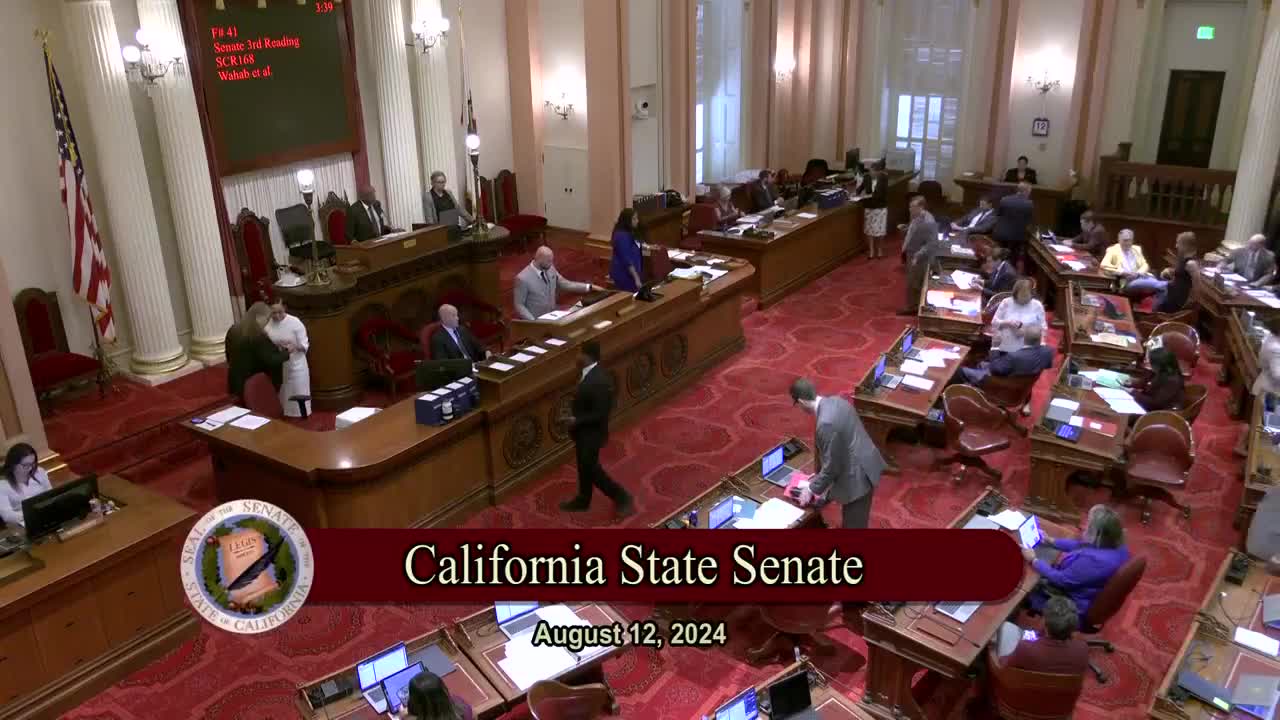 5MIN
Senate Floor
 2MIN
Assembly Floor
 42SEC
Assembly Floor
 7MIN
Assembly Standing Committee on Appropriations
 10MIN
Assembly Standing Committee on Public Safety
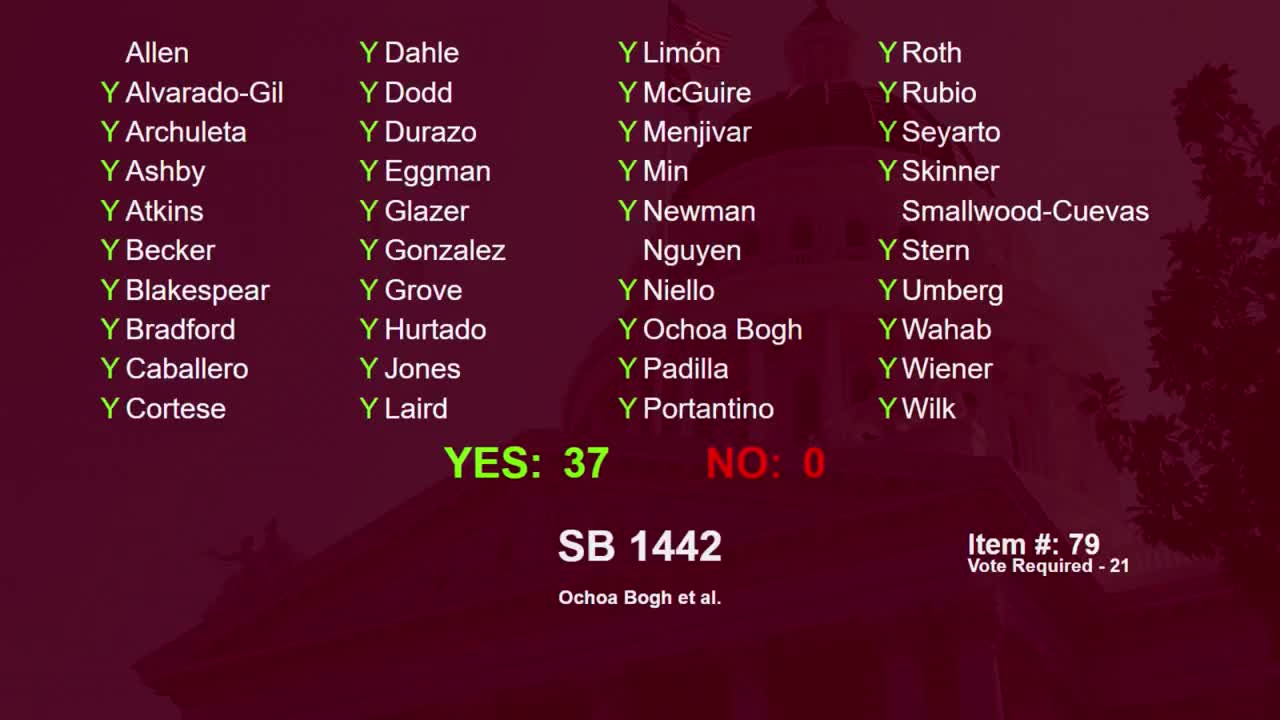 4MIN
Senate Floor
 6MIN
Senate Standing Committee on Public Safety
Bill Author

Bill Co-Author(s):