SB 965: Firearms.
- Session Year: 2023-2024
- House: Senate
- Latest Version Date: 2024-09-24
Current Status:
Passed
(2024-09-24: Chaptered by Secretary of State. Chapter 546, Statutes of 2024.)
Introduced
In Committee
First Chamber
In Committee
Second Chamber
Enacted
What does this bill do?
The bill requires the California Department of Justice to expand its annual firearms report to include detailed inspection data for licensed gun dealers and ammunition vendors and information about DOJ staffing for those inspections. For each inspection the report must list the business name, license number, address, hours spent, any violations and how they were resolved, reinspection and prior inspection dates, counts and outcomes of background checks, numbers of crime guns traced to the dealer, and reports of lost or stolen items, and it must also show changes to the handgun safety roster (how many guns were added, removed, or denied and why). The report due in 2025 must cover data from 2020–2024, and each later report must cover the prior year.
The summary is provided by generative AI which can make mistakes. For original language, please view the details in the table below.
Existing law, commencing January 1, 2024, requires the Department of Justice to conduct inspections of specified licensed firearms dealers at least once every 3 years, to ensure compliance with applicable laws and regulations. Previous law authorized the department to conduct such inspections. Existing law requires the department to maintain specified records regarding these inspections and to make those records available upon request. Existing law also authorizes the department to inspect licensed ammunition vendors.
Existing law requires the department to maintain a list of all handguns that have been tested and certified not to be unsafe handguns, as defined. Existing law prohibits the sale of a handgun not on the roster, except as specifically exempted.
Existing law requires the department to annually prepare and submit a report to the Legislature analyzing and summarizing specified data received from law enforcement agencies regarding firearms that have been stolen, lost, found, or recovered, have been used in a crime or suspected of having been used in a crime, or are under observation. Existing law requires the department to make this report available to the public.
This bill would require the department to include in this report information about department staffing for conducting inspections of firearms dealers and ammunition vendors, detailed information about each such inspection conducted, including violations and the resolution of those violations, and specified information about the roster of handguns, including information about handguns added to, removed from, or denied addition to, the roster. The bill would require the report due on July 1, 2025, to include this data from January 1, 2020, to December 31, 2024, inclusive, and each annual report thereafter, to include the data from the previous year.
Existing law, commencing January 1, 2024, requires the Department of Justice to conduct inspections of specified licensed firearms dealers at least once every 3 years, to ensure compliance with applicable laws and regulations. Previous law authorized the department to conduct such inspections. Existing law requires the department to maintain specified records regarding these inspections and to make those records available upon request. Existing law also authorizes the department to inspect licensed ammunition vendors.
Existing law requires the department to maintain a list of all handguns that have been tested and certified not to be unsafe handguns, as defined. Existing law prohibits the sale of a handgun not on the roster, except as specifically exempted.
Existing law requires the department to annually prepare and submit a report to the Legislature analyzing and summarizing specified data received from law enforcement agencies regarding firearms that have been stolen, lost, found, or recovered, have been used in a crime or suspected of having been used in a crime, or are under observation. Existing law requires the department to make this report available to the public.
This bill would require the department, by no later than August 15, 2025, and annually thereafter, to submit a report to the Legislature including, as specified, department to include in this report information about department staffing for conducting inspections of firearms dealers and ammunition vendors, detailed information about each such inspection conducted, including violations and the resolution of those violations, and specified information about the roster of handguns, including information about handguns added to, removed from, or denied addition to, the roster. The bill would require the report due on July 1, 2025, to include this data from January 1, 2020, to December 31, 2024, inclusive, and each annual report thereafter, to include the data from the previous year.
Existing law, commencing January 1, 2024, requires the Department of Justice to conduct inspections of specified licensed firearms dealers at least once every 3 years, to ensure compliance with applicable laws and regulations. Previous law authorized the department to conduct such inspections. Existing law requires the department to maintain specified records regarding these inspections and to make those records available upon request. Existing law also authorizes the department to inspect licensed ammunition vendors.
Existing law requires the department to maintain a list of all handguns that have been tested and certified not to be unsafe handguns, as defined. Existing law prohibits the sale of a handgun not on the roster, except as specifically exempted.
This bill would require the department, by no later than August 15, 2025, and annually thereafter, to submit a report to the Legislature including, as specified, information about department staffing for conducting inspections of firearms dealers and ammunition vendors, detailed information about each such inspection conducted, including violations and the resolution of those violations, and specified information about the roster of handguns, including information about handguns added to, removed from, or denied addition to, the roster.
(a)In addition to the requirements of Section 11108.2 that apply to a law enforcement agencys duty to report to the Department of Justice the recovery of a firearm, a law enforcement agency described in Section 11108.2 shall, and any other law enforcement agency or agent, including but not limited to a federal or tribal law enforcement agency or agent, may, report to the department in a manner determined by the Attorney General in consultation with the Bureau of Alcohol, Tobacco, Firearms and Explosives all available information necessary to identify and trace the history of all recovered firearms that are illegally possessed, have been used in a crime, or are suspected of having been used in a crime, within seven calendar days of obtaining the information.
(b)When the department receives information from a law enforcement agency pursuant to subdivision (a), it shall promptly forward this information to the National Tracing Center of the federal Bureau of Alcohol, Tobacco, Firearms and Explosives to the extent practicable.
(c)In implementing this section, the Attorney General shall ensure to the maximum extent practical that both of the following apply:
(1)The information provided to the federal Bureau of Alcohol, Tobacco, Firearms and Explosives enables that agency to trace the ownership of the firearm described in subdivision (a).
(2)Law enforcement agencies can report all relevant information without being unduly burdened by this reporting function.
(d)Information collected pursuant to this section shall be maintained by the department for a period of not less than 10 years, and shall be available, under guidelines set forth by the Attorney General, for academic and policy research purposes.
(e)The department shall, on an ongoing basis, analyze the information collected pursuant to this section for patterns and trends relating to recovered firearms that have been illegally possessed, used in a crime, or suspected to have been used in a crime, including the leading sources and origins of those firearms.
(f)(1)The department shall, by no later than July 1, 2023, and annually thereafter, prepare and submit a report to the Legislature summarizing the analysis completed pursuant to subdivisions (e) and (g). This report shall be submitted in compliance with Section 9795 of the Government Code.
(2)The report shall, without limitation and to the extent possible, include all of the following:
(A)The total number of firearms recovered in the state.
(B)The number of firearms recovered, disaggregated by county and by city.
(C)The number of firearms recovered, disaggregated by the firearms dealer where the most recent sale or transfer of the firearm occurred. This shall include the full name and address of the firearms dealer.
(D)The number of firearms recovered, disaggregated by manufacturer.
(E)The total number of unserialized firearms recovered in the state.
(F)The number of unserialized firearms recovered, disaggregated by county and by city.
(3)The department shall make the report described in this subdivision available to the public.
(g)The report described in subdivision (f) shall also contain all of the following information from the applicable time period described in subdivision (h):
(1)The departments staffing levels for conducting firearms dealer inspections pursuant to Section 26720 and ammunition vendor inspections pursuant to Section 30345, to include both allocated positions and filled positions.
(2)The number of firearms dealer inspections conducted and, for each inspection, all of the following information:
(A)The name of the dealer.
(B)The dealers license number.
(C)The business address of the dealer.
(D)The number of hours spent to complete the inspection.
(E)A list of violations identified through the inspection, whether those violations were subsequently resolved and, if so, the date they were resolved, and any fines or penalties assessed.
(F)The date of reinspection, if applicable, and any violations identified during reinspection.
(G)The dates of any prior inspections.
(H)The number of Dealers Record of Sale (DROS) background checks submitted by the dealer during the one-year period prior to the inspection, and the outcome of those background checks.
(I)The total number of firearms used in crimes that were traced back to the dealer during the one-year period prior to the inspection, and the percentage of total sales by the dealer in the same period of time that the traced firearms represent.
(J)The number of firearms that the dealer reported or discovered lost or stolen during the one-year period prior to the inspection.
(3)The number of ammunition vendor inspections conducted and, for each inspection, all of the following information:
(A)The name of the vendor.
(B)The vendors license number.
(C)The business address of the vendor.
(D)The number of hours spent to complete the inspection.
(E)A list of violations identified through the inspection, whether those violations were subsequently resolved and, if so, the date they were resolved, and any fines or penalties assessed.
(F)The date of reinspection, if applicable, and any violations identified during reinspection.
(G)The dates of any prior inspections.
(H)The number of ammunition purchaser background checks submitted by the vendor during the one-year period prior to the inspection, and the outcome of those background checks.
(I)The amount of ammunition that the vendor reported or discovered lost or stolen during the one-year period prior to the inspection.
(4)All of the following information regarding the roster of handguns that have been determined not to be unsafe handguns, as described in Section 32015:
(A)The total number of handguns on the roster.
(B)The number of handguns added to the roster during the applicable time period.
(C)The number of handguns removed from the roster during the applicable time period, including the reasons for removal.
(D)The number of handguns that were denied approval to be listed on the roster during the applicable time period, including the reasons for denial.
(h)The report described in subdivision (f) that is due by no later that July 1, 2025, shall include the data described in subdivision (g) from January 1, 2020, to December 31, 2024, inclusive. Each annual report thereafter shall include the data described in subdivision (g) from the previous year.
(i)The Attorney General may issue regulations to further the purposes of this section.
(a)In addition to the requirements of Section 11108.2 that apply to a law enforcement agencys duty to report to the Department of Justice the recovery of a firearm, a law enforcement agency described in Section 11108.2 shall, and any other law enforcement agency or agent, including but not limited to a federal or tribal law enforcement agency or agent, may, report to the department in a manner determined by the Attorney General in consultation with the Bureau of Alcohol, Tobacco, Firearms and Explosives all available information necessary to identify and trace the history of all recovered firearms that are illegally possessed, have been used in a crime, or are suspected of having been used in a crime, within seven calendar days of obtaining the information.
(b)When the department receives information from a law enforcement agency pursuant to subdivision (a), it shall promptly forward this information to the National Tracing Center of the federal Bureau of Alcohol, Tobacco, Firearms and Explosives to the extent practicable.
(c)In implementing this section, the Attorney General shall ensure to the maximum extent practical that both of the following apply:
(1)The information provided to the federal Bureau of Alcohol, Tobacco, Firearms and Explosives enables that agency to trace the ownership of the firearm described in subdivision (a).
(2)Law enforcement agencies can report all relevant information without being unduly burdened by this reporting function.
(d)Information collected pursuant to this section shall be maintained by the department for a period of not less than 10 years, and shall be available, under guidelines set forth by the Attorney General, for academic and policy research purposes.
(e)The department shall, on an ongoing basis, analyze the information collected pursuant to this section for patterns and trends relating to recovered firearms that have been illegally possessed, used in a crime, or suspected to have been used in a crime, including the leading sources and origins of those firearms.
(f)(1)The department shall, by no later than July 1, 2023, and annually thereafter, prepare and submit a report to the Legislature summarizing the analysis completed pursuant to subdivision (e). subdivisions (e) and (g). This report shall be submitted in compliance with Section 9795 of the Government Code.
(2)The report shall, without limitation and to the extent possible, include all of the following:
(A)The total number of firearms recovered in the state.
(B)The number of firearms recovered, disaggregated by county and by city.
(C)The number of firearms recovered, disaggregated by the firearms dealer where the most recent sale or transfer of the firearm occurred. This shall include the full name and address of the firearms dealer.
(D)The number of firearms recovered, disaggregated by manufacturer.
(E)The total number of unserialized firearms recovered in the state.
(F)The number of unserialized firearms recovered, disaggregated by county and by city.
(3)The department shall make the report described in this subdivision available to the public.
(g)The report described in subdivision (f) shall also contain all of the following information from the applicable time period described in subdivision (h):
(1)The departments staffing levels for conducting firearms dealer inspections pursuant to Section 26720 and ammunition vendor inspections pursuant to Section 30345, to include both allocated positions and filled positions.
(2)The number of firearms dealer inspections conducted and, for each inspection, all of the following information:
(A)The name of the dealer.
(B)The dealers license number.
(C)The business address of the dealer.
(D)The number of hours spent to complete the inspection.
(E)A list of violations identified through the inspection, whether those violations were subsequently resolved and, if so, the date they were resolved, and any fines or penalties assessed.
(F)The date of reinspection, if applicable, and any violations identified during reinspection.
(G)The dates of any prior inspections.
(H)The number of Dealers Record of Sale (DROS) background checks submitted by the dealer during the one-year period prior to the inspection, and the outcome of those background checks.
(I)The total number of firearms used in crimes that were traced back to the dealer during the one-year period prior to the inspection, and the percentage of total sales by the dealer in the same period of time that the traced firearms represent.
(J)The number of firearms that the dealer reported or discovered lost or stolen during the one-year period prior to the inspection.
(3)The number of ammunition vendor inspections conducted and, for each inspection, all of the following information:
(A)The name of the vendor.
(B)The vendors license number.
(C)The business address of the vendor.
(D)The number of hours spent to complete the inspection.
(E)A list of violations identified through the inspection, whether those violations were subsequently resolved and, if so, the date they were resolved, and any fines or penalties assessed.
(F)The date of reinspection, if applicable, and any violations identified during reinspection.
(G)The dates of any prior inspections.
(H)The number of ammunition purchaser background checks submitted by the vendor during the one-year period prior to the inspection, and the outcome of those background checks.
(I)The amount of ammunition that the vendor reported or discovered lost or stolen during the one-year period prior to the inspection.
(4)All of the following information regarding the roster of handguns that have been determined not to be unsafe handguns, as described in Section 32015:
(A)The total number of handguns on the roster.
(B)The number of handguns added to the roster during the applicable time period.
(C)The number of handguns removed from the roster during the applicable time period, including the reasons for removal.
(D)The number of handguns that were denied approval to be listed on the roster during the applicable time period, including the reasons for denial.
(h)The report described in subdivision (f) that is due by no later that July 1, 2025, shall include the data described in subdivision (g) from January 1, 2020, to December 31, 2024, inclusive. Each annual report thereafter shall include the data described in subdivision (g) from the previous year.
(g)(i)The Attorney General may issue regulations to further the purposes of this section.
SECTION 1.Section 26730 is added to the Penal Code, to read:26730.(a)The Department of Justice shall, by no later than August 15, 2025, prepare and submit a report to the Legislature containing and summarizing all of the information described in subdivision (c) from January 1, 2020, to December 31, 2024, inclusive.(b)The department shall annually thereafter, by August 15 of each year, prepare and submit a report to the Legislature containing and summarizing all of the information described in subdivision (c) from the previous calendar year.(c)The reports described in subdivisions (a) and (b) shall contain all of the following information from the applicable time period:(1)The departments staffing levels for conducting firearms dealer inspections pursuant to Section 26720 and ammunition vendor inspections pursuant to Section 30345, to include both allocated positions and filled positions.(2)The number of firearms dealer inspections conducted and, for each inspection, all of the following information:(A)The name of the dealer.(B)The dealers license number.(C)The business address of the dealer.(D)The number of hours spent to complete the inspection.(E)A list of violations identified through the inspection, whether those violations were subsequently resolved and, if so, the date they were resolved, and any fines or penalties assessed.(F)The date of reinspection, if applicable, and any violations identified during reinspection.(G)The dates of any prior inspections.(H)The number of DROS background checks submitted by the dealer during the one-year period prior to the inspection, and the outcome of those background checks.(I)The total number of firearms used in crimes that were traced back to the dealer during the one-year period prior to the inspection, and the percentage of total sales by the dealer in the same period of time that the traced firearms represent.(J)The number of firearms that the dealer reported or discovered lost or stolen during the one-year period prior to the inspection.(3)The number of ammunition vendor inspections conducted and, for each inspection, all of the following information:(A)The name of the vendor.(B)The vendors license number.(C)The business address of the vendor.(D)The number of hours spent to complete the inspection.(E)A list of violations identified through the inspection, whether those violations were subsequently resolved and, if so, the date they were resolved, and any fines or penalties assessed.(F)The date of reinspection, if applicable, and any violations identified during reinspection.(G)The dates of any prior inspections.(H)The number of ammunition purchaser background checks submitted by the vendor during the one-year period prior to the inspection, and the outcome of those background checks.(I)The amount of ammunition that the vendor reported or discovered lost or stolen during the one-year period prior to the inspection.(4)All of the following information regarding the roster of handguns that have been determined not to be unsafe handguns, described in Section 32015:(A)The total number of handguns on the roster.(B)The number of handguns added to the roster during the applicable time period.(C)The number of handguns removed from the roster during the applicable time period, including the reasons for removal.(D)The number of handguns that were denied approval to be listed on the roster during the applicable time period, including the reasons for denial.(d)The reports required by subdivisions (a) and (b) shall be submitted in compliance with Section 9795 of the Government Code.(a)The Department of Justice shall, by no later than August 15, 2025, prepare and submit a report to the Legislature containing and summarizing all of the information described in subdivision (c) from January 1, 2020, to December 31, 2024, inclusive.
(b)The department shall annually thereafter, by August 15 of each year, prepare and submit a report to the Legislature containing and summarizing all of the information described in subdivision (c) from the previous calendar year.
(c)The reports described in subdivisions (a) and (b) shall contain all of the following information from the applicable time period:
(1)The departments staffing levels for conducting firearms dealer inspections pursuant to Section 26720 and ammunition vendor inspections pursuant to Section 30345, to include both allocated positions and filled positions.
(2)The number of firearms dealer inspections conducted and, for each inspection, all of the following information:
(A)The name of the dealer.
(B)The dealers license number.
(C)The business address of the dealer.
(D)The number of hours spent to complete the inspection.
(E)A list of violations identified through the inspection, whether those violations were subsequently resolved and, if so, the date they were resolved, and any fines or penalties assessed.
(F)The date of reinspection, if applicable, and any violations identified during reinspection.
(G)The dates of any prior inspections.
(H)The number of DROS background checks submitted by the dealer during the one-year period prior to the inspection, and the outcome of those background checks.
(I)The total number of firearms used in crimes that were traced back to the dealer during the one-year period prior to the inspection, and the percentage of total sales by the dealer in the same period of time that the traced firearms represent.
(J)The number of firearms that the dealer reported or discovered lost or stolen during the one-year period prior to the inspection.
(3)The number of ammunition vendor inspections conducted and, for each inspection, all of the following information:
(A)The name of the vendor.
(B)The vendors license number.
(C)The business address of the vendor.
(D)The number of hours spent to complete the inspection.
(E)A list of violations identified through the inspection, whether those violations were subsequently resolved and, if so, the date they were resolved, and any fines or penalties assessed.
(F)The date of reinspection, if applicable, and any violations identified during reinspection.
(G)The dates of any prior inspections.
(H)The number of ammunition purchaser background checks submitted by the vendor during the one-year period prior to the inspection, and the outcome of those background checks.
(I)The amount of ammunition that the vendor reported or discovered lost or stolen during the one-year period prior to the inspection.
(4)All of the following information regarding the roster of handguns that have been determined not to be unsafe handguns, described in Section 32015:
(A)The total number of handguns on the roster.
(B)The number of handguns added to the roster during the applicable time period.
(C)The number of handguns removed from the roster during the applicable time period, including the reasons for removal.
(D)The number of handguns that were denied approval to be listed on the roster during the applicable time period, including the reasons for denial.
(d)The reports required by subdivisions (a) and (b) shall be submitted in compliance with Section 9795 of the Government Code.
|
Date
|
Status
|
|---|---|
| Sep 24, 2024 | Chaptered by Secretary of State. Chapter 546, Statutes of 2024. |
| Sep 24, 2024 | Approved by the Governor. |
| Sep 4, 2024 | Enrolled and presented to the Governor at 4 p.m. |
| Aug 29, 2024 | In Senate. Ordered to engrossing and enrolling. |
| Aug 28, 2024 | Read third time. Passed. (Ayes 73. Noes 0. Page 6697.) Ordered to the Senate. |
| Aug 19, 2024 | Read second time. Ordered to third reading. |
| Aug 15, 2024 | From committee: Do pass. (Ayes 14. Noes 0.) (August 15). |
| Aug 7, 2024 | August 7 set for first hearing. Placed on suspense file. |
| Jun 18, 2024 | From committee: Do pass and re-refer to Com. on APPR. with recommendation: To consent calendar. (Ayes 7. Noes 0.) (June 18). Re-referred to Com. on APPR. |
| Jun 3, 2024 | Referred to Com. on PUB. S. |
| May 24, 2024 | In Assembly. Read first time. Held at Desk. |
| May 24, 2024 | Read third time. Passed. (Ayes 38. Noes 0. Page 4208.) Ordered to the Assembly. |
| May 22, 2024 | Ordered to special consent calendar. |
| May 20, 2024 | Read second time. Ordered to third reading. |
| May 16, 2024 | Read second time and amended. Ordered to second reading. |
| May 16, 2024 | From committee: Do pass as amended. (Ayes 7. Noes 0. Page 3965.) (May 16). |
| May 10, 2024 | Set for hearing May 16. |
| Apr 15, 2024 | April 15 hearing: Placed on APPR suspense file. |
| Apr 5, 2024 | Set for hearing April 15. |
| Mar 12, 2024 | From committee: Do pass and re-refer to Com. on APPR. (Ayes 5. Noes 0. Page 3283.) (March 12). Re-referred to Com. on APPR. |
| Feb 23, 2024 | Set for hearing March 12. |
| Feb 14, 2024 | Referred to Com. on PUB S. |
| Jan 25, 2024 | From printer. May be acted upon on or after February 24. |
| Jan 24, 2024 | Introduced. Read first time. To Com. on RLS. for assignment. To print. |
|
Date
|
Description
|
Location
|
Votes
|
|
|---|---|---|---|---|
| Aug 28, 2024 | SB 965 Min Senate Third Reading By McCarty | Assembly Floor |
Passed |
|
| Aug 15, 2024 | Do pass. | Assembly Standing Committee on Appropriations |
Passed |
|
| Jun 18, 2024 | Do pass and be re-referred to the Committee on [Appropriations] with recommendation: To Consent Calendar | Assembly Standing Committee on Public Safety |
Passed |
|
| May 24, 2024 | Special Consent SB965 Min | Senate Floor |
Passed |
|
| May 16, 2024 | Do pass as amended | Senate Standing Committee on Appropriations |
Passed |
|
| Apr 15, 2024 | Placed on suspense file | Senate Standing Committee on Appropriations |
Passed |
|
| Mar 12, 2024 | Do pass, but first be re-referred to the Committee on [Appropriations] | Senate Standing Committee on Public Safety |
Passed |
This list shows positions taken on this bill by organizations on the date displayed, which is linked to the original source.
Positions by individuals are not included.
|
Organization
|
Position
|
Date
|
|---|---|---|
| Brady California | ** Support | |
| Brady United Against Gun Violence | ** Support | |
| Everytown for Gun Safety | * Support | Mar 12, 2024 |
| Everytown for Gun Safety Action Fund | ** Support | |
| Giffords Law Center To Prevent Gun Violence | ** Support | |
| Moms Demand Action | * Support | Mar 12, 2024 |
| Moms Demand Action for Gun Sense in America | * Support | Mar 12, 2024 |
| San Diegans For Gun Violence Prevention | ** Support |
SENATE THIRD READING
STR Bill Id:SB 965
Author:(Min)
As Amended Ver:May 16, 2024
Majority vote
SUMMARY
Requires the Department of Justice (DOJ) to add additional information to an existing report requirement analyzing and summarizing specified data received from law enforcement agencies pertaining to firearms that have been stolen, lost, found, or recovered, have been used in a crime or suspected of having been used in a crime.
Major Provisions
- Requires that the above annual report contain the following additional information:
- DOJ staffing levels for conducting firearm dealer and ammunition vendor inspections, including both allocated and filled positions;
- The total number of firearm dealer inspections conducted, the number of hours spent to complete the inspection, and specified information gathered during those inspections;
- A list of violations identified through the inspection, whether those violations were subsequently resolved and, if so, the date they were resolved, and any fines or penalties assessed;
- The number of Dealer Record of Sale (DROS) background checks submitted in the one- year period prior to the inspection, and the outcome of those background checks;
- The total number of firearms used in crimes that were traced back to the dealer during the one-year period prior to the inspection, and the percentage of total sales by the dealer in the same period of time that the traced firearms represent;
- The number of firearms that the dealer reported or discovered lost or stolen during the one year prior to the inspection;
- The total number of ammunition vendors inspections conducted, the number of hours spent to complete the inspection, and other specified information gathered during those inspections;
- The number of ammunition vendor background checks submitted in the one- year period prior to the inspection, and the outcome of those background checks; and,
- The amount of ammunition that the dealer reported or discovered lost or stolen during the one year prior to the inspection.
- Requires the DOJ roster of handguns that are determined to be not unsafe handguns to contain the following information:
- The total number of handguns on the roster, the number of handguns added to the roster in the applicable time period, the number of handguns removed from the roster during the applicable time period, including the reasons for removal.
- The number of handguns that were denied approval to be listed on the roster during the applicable time period, including the reasons for denial.
- Requires DOJ to add the data to the report by July 1st, 2025, with the first report containing data from January 1, 2020 to December 31, 2024.
- Requires subsequent reports be made annually by July 1 of each year.
COMMENTS
According to the Author
"Nearly all gun violence in this country stems from guns that were originally purchased from legal outlets. Gun dealers play an essential role in preventing gun violence, but without inspections, authorities cannot enforce compliance with regulations and potentially prevent illegal sales. California has worked to develop a strong system of gun dealer standards and oversight. However, there is little to no information about the inspections conducted by the State. This measure will close the information gap and provide transparency about the process to better understand the frequency, outcome, and implications of these critical inspections."
Arguments in Support
Arguments in Opposition
None.
FISCAL COMMENTS
According to the Assembly Appropriations Committee, "DOJ reports costs (General Fund) of $107,000 in fiscal year 2024-25 and $165,000 in fiscal year 2025-26 and ongoing for additional staffing. DOJ anticipates needing one assistant position in its Bureau of Firearms (BOF) to collect and maintain dealer inspection data, consult with DOJ's Research Services program, and review and confirm annual report data for the crime gun report. DOJ also anticipates staffing costs for overtime hours for existing staff in BOF's Handgun Roster and Laboratory Unit to compile the data required by this bill, and for attorney consultation.
"According to the Legislative Analyst's Office, the General Fund faces a structural deficit in the tens of billions of dollars over the next several fiscal years."
VOTES
SENATE FLOOR: 38-0-2
YES: Alvarado-Gil, Ashby, Atkins, Becker, Blakespear, Bradford, Caballero, Cortese, Dahle, Dodd, Durazo, Eggman, Glazer, Gonzalez, Grove, Hurtado, Jones, Laird, Limón, McGuire, Menjivar, Min, Newman, Nguyen, Niello, Ochoa Bogh, Padilla, Portantino, Roth, Rubio, Seyarto, Skinner, Smallwood-Cuevas, Stern, Umberg, Wahab, Wiener, Wilk
ABS, ABST OR NV: Allen, Archuleta
ASM PUBLIC SAFETY: 7-0-1
YES: McCarty, Alanis, Lackey, Stephanie Nguyen, Reyes, Ting, Zbur
ABS, ABST OR NV: Wilson
ASM APPROPRIATIONS: 14-0-1
YES: Wicks, Sanchez, Arambula, Bryan, Calderon, Wendy Carrillo, Dixon, Mike Fong, Grayson, Haney, Hart, Pellerin, Ta, Villapudua
ABS, ABST OR NV: Jim Patterson
UPDATED
VERSION: May 16, 2024
CONSULTANT: Gregory Pagan / PUB. S. / (916) 319-3744 FN: 0003998
Date of Hearing: August 7, 2024
ASSEMBLY COMMITTEE ON APPROPRIATIONS
Buffy Wicks, Chair
SBPCA Bill Id:SB 965
Author:(Min) – As Amended Ver:May 16, 2024
Policy Committee: | Public Safety | Vote: | 7 - 0 |
|
| ||
|
|
Urgency: No State Mandated Local Program: No Reimbursable: No
SUMMARY:
This bill requires the Department of Justice (DOJ) to include additional information in its annual report to the Legislature about crime guns and include additional information in its roster of handguns determined to be not unsafe (“handgun roster”).
To its crime gun report, DOJ must add, among other data points, information about the department’s staffing for conducting firearm dealer and ammunition vendor inspections, details about the inspections conducted by DOJ and their outcomes, information about firearms background checks processed by the department, and information about the number of crime guns traced back to particular firearms dealers.
To its handgun roster, DOJ must add information about changes made to the roster each year, including the reasons any firearms were denied approval to be added to the handgun roster.
FISCAL EFFECT:
DOJ reports costs (General Fund) of $107,000 in fiscal year 2024-25 and $165,000 in fiscal year 2025-26 and ongoing for additional staffing. DOJ anticipates needing one assistant position in its Bureau of Firearms (BOF) to collect and maintain dealer inspection data, consult with DOJ’s Research Services program, and review and confirm annual report data for the crime gun report. DOJ also anticipates staffing costs for overtime hours for existing staff in BOF’s Handgun Roster and Laboratory Unit to compile the data required by this bill, and for attorney consultation.
According to the Legislative Analyst’s Office, the General Fund faces a structural deficit in the tens of billions of dollars over the next several fiscal years.
COMMENTS:
- Purpose. This bill is sponsored by Brady and Brady California. According to the author:
Nearly all gun violence in this country stems from guns that were originally purchased from legal outlets. Gun dealers play an essential role in preventing gun violence, but without inspections, authorities cannot enforce compliance with regulations and potentially prevent illegal sales. California has worked to develop a strong system of gun dealer standards and oversight. However, there is little to no information about the inspections conducted by the State. This measure will close the information gap and provide transparency about the process to better understand the frequency, outcome, and implications of these critical inspections.
- Background. “Crime guns” refers colloquially to firearms that are recovered by law enforcement and were illegally possessed, used in a crime, or suspected of being used in a crime. Existing law requires law enforcement agencies to report information about crime guns to DOJ, and requires DOJ to maintain that information in its Automated Firearms System, along with other statewide data about firearms sales and ownership.
In 2021, the Legislature enacted AB 1911 (McCarty), Chapter 683, Statutes of 2021, which required DOJ to report annually to the Legislature about crime guns, including specific data about crime guns recovered in the state and analysis of related patterns and trends. DOJ released its first report pursuant to AB 1911 in June 2023. Among other findings, DOJ reported that:
76,135 (13.94%) of the serialized crime guns entered in AFS [from 2010 to 2022] could be associated with a total of 1,929 distinct California firearm dealers. While all the identified dealers sold or transferred at least one firearm that was later recovered as a crime gun, 344 dealers were associated with only one crime gun and 82 dealers were associated with roughly half of all crime guns (38,230 firearms). The highest number of crime guns associated with one dealer was 1,652.
This bill adds additional data points that must be included in DOJ’s annual crime gun report beginning in 2025, including information about inspections of firearms and ammunition dealers conducted by DOJ. The bill also requires DOJ to make public additional information about changes to DOJ’s handgun roster, which is a list of handguns that have been approved by DOJ for commercial sale in California.
Analysis Prepared by: Annika Carlson / APPR. / (916) 319-2081
Date of Hearing: June 18, 2024
Chief Counsel: Gregory Pagan
ASSEMBLY COMMITTEE ON PUBLIC SAFETY
Kevin McCarty, Chair
SBPCA Bill Id:SB 965
Author:(Min) – As Amended Ver:May 16, 2024
SUMMARY: Requires the Department of Justice (DOJ) to add additional information to an existing report requirement analyzing and summarizing specified data received from law enforcement agencies pertaining to firearms that have been stolen, lost, found, or recovered, have been used in a crime or suspected of having been used in a crime. Specifically, this bill:
- Requires that the above annual report contain the following additional information:
- DOJ staffing levels for conducting firearm dealer and ammunition vendor inspections, including both allocated and filled positions;
- The total number of firearm dealer inspections conducted, the number of hours spent to complete the inspection, and specified information gathered during those inspections;
- A list of violations identified through the inspection, whether those violations were subsequently resolved and, if so, the date they were resolved, and any fines or penalties assessed;
- The number of Dealer Record of Sale (DROS) background checks submitted in the one- year period prior to the inspection, and the outcome of those background checks;
- The total number of firearms used in crimes that were traced back to the dealer during the one-year period prior to the inspection, and the percentage of total sales by the dealer in the same period of time that the traced firearms represent;
- The number of firearms that the dealer reported or discovered lost or stolen during the one year prior to the inspection;
- The total number of ammunition vendors inspections conducted, the number of hours spent to complete the inspection, and other specified information gathered during those inspections;
- The number of ammunition vendor background checks submitted in the one- year period prior to the inspection, and the outcome of those background checks; and,
- The amount of ammunition that the dealer reported or discovered lost or stolen during the one year prior to the inspection.
- DOJ staffing levels for conducting firearm dealer and ammunition vendor inspections, including both allocated and filled positions;
- Requires the DOJ roster of handguns that are determined to be not unsafe handguns to contain the following information:
- The total number of handguns on the roster, the number of handguns added to the roster in the applicable time period, the number of handguns removed from the roster during the applicable time period, including the reasons for removal.
- The number of handguns that were denied approval to be listed on the roster during the applicable time period, including the reasons for denial.
- The total number of handguns on the roster, the number of handguns added to the roster in the applicable time period, the number of handguns removed from the roster during the applicable time period, including the reasons for removal.
- Requires DOJ to add the data to the report by July 1st, 2025, with the first report containing data from January 1st 2020 to December 31st 2024.
- Requires subsequent reports be made annually by July 1st of each year.
EXISTING LAW:
- Requires the DOJ, by no later than July 1, 2023, and annually thereafter, prepare and submit to the Legislature. The report shall, without limitation to the extent possible include all of the following:
- The total number of firearms recovered in the state;
- The number of firearms recovered, disaggregated by county and by city;
- The number of firearms recovered, disaggregated by the firearms dealer where the most recent sale or transfer of the firearm occurred. This shall include the full name and address of the firearms dealer;
- The number of firearms recovered, disaggregated by the manufacturer; and,
- The total number of un-serialized firearms recovered, disaggregated by county and by the city. (Pen. Code, § 11108.3, subd. (f).
- The total number of firearms recovered in the state;
- The DOJ shall make the above report available to the public, and may issue regulations to further the purpose of the report.
- Requires a person to hold a firearm dealer’s license in order to sell, lease, or transfer a firearm. (Pen. Code, § 26500.)
- Provides that the duly constituted licensing authority of a city, county, or a city and county shall accept applications for, and may grant licenses permitting licensees to sell firearms at retail within the city, county, or city and county. (Pen. Code, § 26705, subd. (a).)
- Requires a firearms dealer or licensee to meet all the following requirements:
- Have a valid federal firearms license;
- Have any regulatory or business license, or licenses, required by local government;
- Have a valid seller’s permit issued by the State Board of Equalization;
- Have a certificate of eligibility issued by the DOJ, as specified;
- Have a license issued in a specified format granted by the local licensing authority; and,
- Be recorded in the DOJ’s centralized list of licensees. (Pen. Code, § 26700.)
- Requires DOJ to keep a centralized list of all persons licensed to sell, lease or transfer firearms at retail. (Pen. Code, § 26715.)
- Provides that a license to sell firearms is subject to forfeiture for any violation of a number of specified prohibitions and requirements, with limited exceptions. (Pen. Code, §26800, subd. (a).)
- Provides that the DOJ may assess specified civil fines against a licensee for any breach of a prohibition or requirement that subjects the licensee to forfeiture of their license to sell firearms. (Pen. Code § 26800, subd. (b).)
FISCAL EFFECT: Unknown
COMMENTS:
- Author's Statement: According to the author, "Nearly all gun violence in this country stems from guns that were originally purchased from legal outlets. Gun dealers play an essential role in preventing gun violence, but without inspections, authorities cannot enforce compliance with regulations and potentially prevent illegal sales. California has worked to develop a strong system of gun dealer standards and oversight. However, there is little to no information about the inspections conducted by the State. This measure will close the information gap and provide transparency about the process to better understand the frequency, outcome, and implications of these critical inspections.
- Firearms Dealers and Licensing: Federal law requires firearms dealers to obtain a license (also known as a “federal firearms license,” or “FFL”) through the Bureau of Alcohol, Tobacco, Firearms and Explosives (ATF). According to the ATF, as of December 2021, there were 1,907 FFLs issued for firearms dealers and pawnbrokers in California, and a total of 9,167 FFLs in the state (Bureau of Alcohol, Tobacco, Firearms and Explosives). An FFL is necessary but not sufficient for obtaining a firearms dealer license in California. Additional requirements include any business license required by local government, a seller’s permit issued by the California Department of Tax and Fee Administration, a seller’s license issued by the local licensing authority of a local government, a certificate of eligibility (COE) issued by the DOJ (verifying that a background check has taken place), and being recorded on the DOJ’s centralized list of firearms dealers (Penal Code §26700). In California, only individuals that have obtained a valid license through the DOJ may lawfully sell, lease or transfer firearms within the state, subject to limited exceptions (Penal Code §26500).
Firearm dealers in California are subject to numerous state and federal laws that they must abide by in order to remain in operation. Such laws specify the manner in which firearm dealers must keep their records, deliver a firearm, secure and store their inventory, obtain security measures, and impose numerous other requirements. Firearm dealers who do not comply with such laws have been linked to a greater likelihood that firearms from their inventory will be recovered in a crime. A recent report from Brady United Against Gun Violence cites data from the Bureau of Alcohol, Tobacco, Firearms and Explosives (ATF) highlighting that when ATF inspected the 1% of gun dealers that supplied almost 60% of crime guns nationwide, it found that 75% of these dealers had violated federal law, including significant recordkeeping violations and participation in sales to potential gun traffickers and prohibited persons. In comparison, when ATF inspected a random sample of dealers, the number that were found to be noncompliant dropped to 37% (Brady United Against Gun Violence).
Licensed firearms dealers in California are subject to inspections by both the state and federal government. FFLs are subject to random inspections by ATF officials to ensure compliance with federal, state and local laws and regulations, educate licensees on specific requirements associated with those laws, and review records that FFLs are required to maintain. In addition, federal inspectors conduct a complete physical inventory of a licensee’s firearms and evaluate the licensee’s internal controls and security measures. In 2023, the latest year for which there is comprehensive data was compiled by ATF, that agency conducted 9,047 inspections nationwide (Bureau of Alcohol Tobacco, Firearms and Explosives).
Existing California law requires the DOJ to conduct inspections of licensed firearms dealers every three years to ensure compliance with applicable state law related to firearm dealers. Data collected in these inspections is currently used within the department for compliance efforts. This bill would take the internal data collected in these inspections and make it public by submitting it in a report to the Legislature.
- DOJ Annual Firearms Report to the Legislature: AB 1191 (McCarty, Chapter 683, Statutes of 2021). In 2021, the passage of AB 1191 required the DOJ to submit an annual report to the Legislature beginning in 2023 relating to firearms recovered in California by the state (Penal Code § 11108.3 (f)). This would bill require the DOJ to submit the report required by Penal Code section 11108.3 (f) with specified new data by July 1st 2025.
- Related Legislation: AB 1191 (McCarty), Chapter 683, Statutes of 2021 required DOJ, to analyze information reported by law enforcement agencies regarding the history of a recovered firearm that is illegally possessed, has been used in a crime, or is suspected of having been used in a crime, and required DOJ to submit a report to the Legislature summarizing the analysis, as specified.
REGISTERED SUPPORT / OPPOSITION:
Support
Brady California
Brady Campaign
Brady United Against Gun Violence
Everytown for Gun Safety Action Fund
Giffords Law Center to Prevent Gun Violence
San Diegans for Gun Violence Prevention
Opposition
None
Analysis Prepared by: Gregory Pagan / PUB. S. / (916) 319-3744
SENATE RULES COMMITTEE Office of Senate Floor Analyses (916) 651-1520 Fax: (916) 327-4478 | SB 965 |
THIRD READING
Bill No: SB 965
Author: Min (D)
Amended: 5/16/24
Vote: 21
SENATE PUBLIC SAFETY COMMITTEE: 5-0, 3/12/24
AYES: Wahab, Seyarto, Bradford, Skinner, Wiener
SENATE APPROPRIATIONS COMMITTEE: 7-0, 5/16/24
AYES: Caballero, Jones, Ashby, Becker, Bradford, Seyarto, Wahab
SUBJECT: Firearms
SOURCE: Brady United Against Gun Violence
DIGEST:
This bill requires the Department of Justice (DOJ) to add data about firearm dealer inspections, ammunition vendor inspections, DOJ inspection staff levels, and the not unsafe handgun roster to an already existing DOJ report pertaining to illegal firearms recovered by the state.
ANALYSIS:
Existing law:
- Requires a person to hold a firearm dealer’s license in order to sell, lease, or transfer a firearm. (Penal Code, § 26500.)
- Provides that the duly constituted licensing authority of a city, county, or a city and county shall accept applications for, and may grant licenses permitting licensees to sell firearms at retail within the city, county, or city and county. (Penal Code, § 26705, (a).)
- Requires a firearms dealer or licensee to meet all the following requirements:
- Have a valid federal firearms license;
- Have any regulatory or business license, or licenses, required by local government;
- Have a valid seller’s permit issued by the State Board of Equalization;
- Have a certificate of eligibility issued by the DOJ, as specified;
- Have a license issued in a specified format granted by the local licensing authority; and,
- Be recorded in the DOJ’s centralized list of licensees. (Penal Code, § 26700.)
- Requires DOJ to keep a centralized list of all persons licensed to sell, lease or transfer firearms at retail. (Penal Code § 26715.)
- Provides that a license to sell firearms is subject to forfeiture for any violation of a number of specified prohibitions and requirements, with limited exceptions. (Penal Code §26800(a).)
- Provides that the DOJ may assess specified civil fines against a licensee for any breach of a prohibition or requirement that subjects the licensee to forfeiture of their license to sell firearms. (Penal Code § 26800(b).)
- Requires firearms dealers to secure their inventory in a secure facility on the business premises with trigger locks, or within a locked, fireproof safe or vault when the licensee is not open for business. (Penal Code, § 26890.)
- Requires licensed dealers to maintain and make available to law enforcement or the DOJ a firearm transaction record, as specified. (Pen. Code, §§ 26900, 28100.)
- Authorizes the DOJ to inspect firearms dealers every three years, as specified, in order to ensure compliance with only specified statutes. (Penal Code, § 26720, (a).)
- Requires the DOJ to maintain and make available upon request the number of inspections conducted and the amount of fees collected, as specified, exempted jurisdictions, number of dealers removed from the centralized list of licensees, and the number of dealers found to have violated specified provisions of law with knowledge or with gross negligence. (Penal Code, § 26725.)
- Provides that the DOJ shall prescribe the form of the register and the record of electronic transfer of firearms (also known as the Dealer’s Record of Sale, or DROS). (Penal Code, § 28155.)
- Requires the DROS to include the following information, among other things:
- Date and time of sale;
- Make of firearm;
- Serial number or any assigned identification number or mark;
- Caliber;
- Type of firearm;
- Barrel length;
- Full name, date of birth, and purchaser’s address;
- Purchaser’s phone number;
- Purchaser’s gender;
- All of the purchaser’s legal names or aliases;
- Yes or no answer to questions inquiring whether the purchaser is prohibited from possessing a firearm;
- Signature of purchaser;
- Right thumbprint of the purchaser; and,
- A statement of the penalties for signing a fictitious name or address, knowingly furnishing any incorrect information, or knowingly omitting any information required to be provided for the register. (Penal Code, § 28160.)
- Provides that the dealer or salesperson must ensure all required information has been obtained and be informed that incomplete information will delay sales. (Penal Code, § 28175.)
- Makes it a misdemeanor for a person to furnish a fictitious name or address, or knowingly furnish incorrect information, or knowingly omit any information on the DROS forms. (Penal Code, § 28250, (a).)
- Prohibits selling, leasing, or transferring firearms without a certificate of eligibility issued by the DOJ. (Penal Code §26710)
- Requires DOJ to maintain a roster of handguns determined not to be unsafe by a certified testing laboratory to be eligible for sale in California. The roster must include, for each firearm, the manufacturer, model number, and model name. (Penal Code § 32015)
- Provides that a person in this state who manufactures or causes to be manufactured, imports into the state for sale, keeps for sale, offers or exposes for sale, gives, or lends an unsafe handgun shall be guilty of a misdemeanor. (Penal Code § 32000 (a)(1).)
- Provides that the failure to report to the DOJ the sale or transfer of an unsafe handgun, as specified, may be subject to a civil penalty, and that in addition to any criminal penalty, the unlawful sale or transfer of an unsafe handgun obtained pursuant to specified provisions may be subject to a civil penalty, as specified. (Penal Code § 32000(a)(2), (3).)
- Allows DOJ to inspect ammunition vendors and to ensure compliance with applicable federal and state law (Penal Code § 30345)
- Requires the DOJ to submit a report to the legislature that includes information relating to firearms recovered in the state (Penal Code § 11108.3 (f))
This bill:
- Requires the DOJ to add new data to an already existing report pertaining to the recovery of firearms by DOJ. This new data pertains to:
- DOJ staffing levels for conducting firearm dealer and ammunition vendor inspections, including both allocated and filled positions;
- The total number of firearm dealer inspections conducted and specified information gathered during those inspections;
- Total number of ammunition vendor inspections conductions and specified information gathered during those inspections;
- Specified information regarding the DOJ’s not unsafe handgun roster.
- Requires DOJ to add the data to the report by July 1st, 2025, with the first report containing data from January 1st 2020 to December 31st 2024.
- Requires subsequent reports be made annually by July 1st of each year.
Comments
Firearm Dealer Licensing and Inspection. Federal law requires firearms dealers to obtain a license (also known as a “federal firearms license,” or “FFL”) through the Bureau of Alcohol, Tobacco, Firearms and Explosives (ATF). According to the ATF, as of December 2021, there were 1,907 FFLs issued for firearms dealers and pawnbrokers in California, and a total of 9,167 FFLs in the state (Bureau of Alcohol, Tobacco, Firearms and Explosives). An FFL is necessary but not sufficient for obtaining a firearms dealer license in California. Additional requirements include any business license required by local government, a seller’s permit issued by the California Department of Tax and Fee Administration, a seller’s license issued by the local licensing authority of a local government, a certificate of eligibility (COE) issued by the DOJ (verifying that a background check has taken place), and being recorded on the DOJ’s centralized list of firearms dealers (Penal Code §26700). In California, only individuals that have obtained a valid license through the DOJ may lawfully sell, lease or transfer firearms within the state, subject to limited exceptions (Penal Code §26500).
Firearm dealers in California are subject to numerous state and federal laws that they must abide by in order to remain in operation. Such laws specify the manner in which firearm dealers must keep their records, deliver a firearm, secure and store their inventory, obtain security measures, and impose numerous other requirements. Firearm dealers who do not comply with such laws have been linked to a greater likelihood that firearms from their inventory will be recovered in a crime. A recent report from Brady United Against Gun Violence cites data from the Bureau of Alcohol, Tobacco, Firearms and Explosives (ATF) highlighting that when ATF inspected the 1% of gun dealers that supplied almost 60% of crime guns nationwide, it found that 75% of these dealers had violated federal law, including significant recordkeeping violations and participation in sales to potential gun traffickers and prohibited persons. In comparison, when ATF inspected a random sample of dealers, the number that were found to be noncompliant dropped to 37% (Brady United Against Gun Violence).
Licensed firearms dealers in California are subject to inspections by both the state and federal government. FFLs are subject to random inspections by ATF officials to ensure compliance with federal, state and local laws and regulations, educate licensees on specific requirements associated with those laws, and review records that FFLs are required to maintain. In addition, federal inspectors conduct a complete physical inventory of a licensee’s firearms and evaluate the licensee’s internal controls and security measures. In 2023, the latest year for which there is comprehensive data was compiled by ATF, that agency conducted 9,047 inspections nationwide (Bureau of Alcohol Tobacco, Firearms and Explosives).
Existing California law requires the DOJ to conduct inspections of licensed firearms dealers every three years to ensure compliance with applicable state law related to firearm dealers. Data collected in these inspections is currently used within the department for compliance efforts. This bill would take the internal data collected in these inspections and make it public by submitting it in a report to the Legislature.
California’s Unsafe Handgun Law. In 1999, the Legislature passed SB 15 (Polanco, Chapter 248, Statutes of 1999), also known as the Unsafe Handgun Act (UHA), which made it a misdemeanor for any person in California to manufacture, import for sale, offer for sale, give, or lend any unsafe handgun, with certain specific exceptions. SB 15 defined an "unsafe handgun" as a handgun that (1) does not meet a specified “drop safety” test, (2) does not meet specified firing tests, and (3) does not have a requisite safety device (Penal Code §§ 31900, 31905, 31910). The law also required DOJ to compile and publish a roster listing all of the handguns and concealable firearms that they deem “not unsafe” and which are certified for sale in the state (Penal Code §32015). A subsequent reform, enacted in 2003, added new design safety requirements for semiautomatic pistols (SB 489 Scott, Chapter 500, Statutes of 2003).
In 2023, SB 452 (Blakespear, Chapter 253, Statutes of 2023) created a separate and distinct restriction on the sale or transfer of any semiautomatic pistol by a licensed gun dealer unless the pistol has been verified as a “microstamping-enabled pistol”, divorcing the microstamping requirement from the not unsafe handgun roster process. As of March 5, 2024, 18 new handguns have been added to the DOJ’s list and seven have been removed in 2024 alone. The 18 newly added handguns now may be sold, manufactured, etc., within California unless such sale, manufacture, etc., is otherwise prohibited under California law (Office of The Attorney General).
This bill requires the DOJ to include information regarding the number of handguns on the roster, number of handguns added and removed during the specified time period, and how many handguns were denied approval to the roster. Because microstamping requirements were recently removed from the roster process, the author may benefit from adding information regarding the updated microstamping requirements to this bill’s annual report.
DOJ Report Pursuant to AB 1191 (McCarty, Chapter 683, Statutes of 2021) In 2021, the passage of AB 1191 required the DOJ to submit an annual report to the Legislature beginning in 2023 relating to firearms recovered in California by the state (Penal Code § 11108.3 (f)). This bill requires the DOJ to submit the report required by Penal Code section 11108.3 (f) with specified new data by July 1st 2025.
FISCAL EFFECT: Appropriation: No Fiscal Com.: Yes Local: No
According to the Senate Appropriations Committee:
- DOJ estimates annual costs of approximately $175,000 and 1.0 PY of staff to collect and maintain inspection data, compile data on the handgun roster, and internally review and confirm annual report data prior to submission to the Legislature. (General Fund)
SUPPORT: (Verified 5/15/24)
Brady United Against Gun Violence (source)
Brady California
Everytown for Gun Safety Action Fund
Gifford’s Law Center to Prevent Gun Violence
San Diegans for Gun Violence Prevention
OPPOSITION: (Verified 5/15/24)
None received
ARGUMENTS IN SUPPORT:
According to Brady United Against Gun Violence:
[…] This bill will strengthen oversight of firearms and ammunition dealers by requiring (not merely authorizing) the California Department of Justice to inspect ammunition dealers and requiring annual reports to the Legislature regarding the Department’s inspections of both firearm dealers and ammunition dealers. Federally licensed firearms dealers (FFLs) play a critical role in preventing the proliferation of illegal guns across the nation, yet they operate with minimal federal oversight. California has stepped in to fill some gaps regarding oversight, including by requiring that the Department of Justice inspect FFLs and authorizing inspections of ammunition dealers.
[…]This bill will complement this framework by requiring the Department of Justice to provide annual reports concerning its inspections, which two will provide transparency about the inspections to the public and communities and allow the Legislature and state to assess their effectiveness as well as the Department’s resources to conduct them. Almost all guns enter circulation through the legal market: built by licensed manufacturers and sold by FFLs. Illegal guns begin as legal firearms, initially sold by FFLs, that are subsequently funneled into an illegal market. Gun dealers play the critical role of gatekeepers, including by using the Brady Background Check System to confirm the eligibility of potential gun purchasers, and their conduct has a direct bearing on whether guns are diverted to the illegal market or made available to individuals who would harm themselves or others.
The harmful consequences of negligent, irresponsible, or illegal conduct by gun dealers are immense, especially for communities of color that bear the heaviest burdens of gun violence. […] Appropriate conduct by gun dealers and their employees is critical to keeping guns out of disproportionately impacted communities.
[…] Inspections are a key way to identify where these actions, inactions, or other failures are occurring, and to ensure FFLs are held responsible for remedying their issues, held to account, or where necessary because of egregious violation, their licenses are revoked. […] However, we have little to no information about the inspections conducted by the State. This bill will close that information gap and provide crucial transparency on the inspections to better understand the frequency, outcome, and implications of the inspections.
Prepared by: John Duncan / PUB. S. /
5/20/24 18:52:16
**** END ****
SENATE COMMITTEE ON APPROPRIATIONS
Senator Anna Caballero, Chair
2023 - 2024 Regular Session
SB 965 (Min) - Firearms
Version: January 24, 2024 | Policy Vote: PUB. S. 5 - 0 |
Urgency: No | Mandate: No |
Hearing Date: May 16, 2024 | Consultant: Mark McKenzie |
Bill Summary:
SB 965 would require the Department of Justice (DOJ) to submit an annual report to the Legislature containing information on firearm dealer and ammunition vendor inspections conducted by the department, staffing levels for conducting those inspections, and information on the roster of handguns certified for sale, as specified.
*********** ANALYSIS ADDENDUM – SUSPENSE FILE ***********
The following information is revised to reflect amendments
adopted by the committee on May 16, 2024
Fiscal Impact:
- DOJ estimates annual costs of approximately $175,000 and 1.0 PY of staff to collect and maintain inspection data, compile data on the handgun roster, and internally review and confirm annual report data prior to submission to the Legislature. (General Fund)
Author Amendments:
Require DOJ to include the information specified in the bill in an existing DOJ annual report on patterns and trends relating to recovered firearms, rather than requiring that information to be submitted to the Legislature in a separate, stand-alone report.
-- END --
SENATE COMMITTEE ON APPROPRIATIONS
Senator Anna Caballero, Chair
2023 - 2024 Regular Session
SB 965 (Min) - Firearms
Version: January 24, 2024 | Policy Vote: PUB. S. 5 - 0 |
Urgency: No | Mandate: No |
Hearing Date: April 15, 2024 | Consultant: Mark McKenzie |
Bill Summary:
SB 965 would require the Department of Justice (DOJ) to submit an annual report to the Legislature containing information on firearm dealer and ammunition vendor inspections conducted by the department, staffing levels for conducting those inspections, and information on the roster of handguns certified for sale, as specified.
Fiscal Impact:
- DOJ estimates annual costs of approximately $175,000 and 1.0 PY of staff to collect and maintain inspection data, compile data on the handgun roster, and internally review and confirm annual report data prior to submission to the Legislature. (General Fund)
Background:
Federal law requires firearms dealers to obtain a license (also known as a “federal firearms license,” or “FFL”) through the Bureau of Alcohol, Tobacco, Firearms and Explosives (ATF). An FFL is necessary but not sufficient for obtaining a firearms dealer license in California. Additional requirements include any business license required by local government, a seller’s permit issued by the California Department of Tax and Fee Administration, a seller’s license issued by the local licensing authority of a local government, a certificate of eligibility (COE) issued by the DOJ (verifying that a background check has taken place), and being recorded on the DOJ’s centralized list of firearms dealers. In California, only individuals that have obtained a valid license through the DOJ may lawfully sell, lease or transfer firearms within the state, subject to limited exceptions.
Licensed firearms dealers in California are subject to inspections by both the state and federal government. In addition to federal inspections conducted by ATF, existing state law requires the DOJ to conduct inspections of licensed firearms dealers every three years to ensure compliance with applicable state laws and regulations. Existing law requires the DOJ to maintain and make available upon request the number of inspections conducted and the amount of fees collected, exempted jurisdictions, the number of dealers removed from the centralized list of licensees, and the number of dealers found to have violated state laws with knowledge or gross negligence. Existing law also authorizes the DOJ to inspect ammunition vendors to ensure compliance with applicable federal and state laws.
Existing law, the Unsafe Handgun Act (UHA), makes it a misdemeanor to manufacture, import for sale, offer for sale, give, or lend any unsafe handgun, with specified exceptions. An “unsafe handgun” is defined as a handgun that: (1) does not meet a specified “drop safety” test; (2) does not meet specified firing tests; and (3) does not have a requisite safety device. The UHA requires the DOJ to compile and publish a roster listing of all handguns and concealable firearms determined not to be unsafe by a certified testing laboratory, and which are certified for sale in the state. The roster must include the manufacturer, model number, and model name for each firearm.
Existing law requires the DOJ to submit an annual report to the Legislature relating to firearms recovered in California, including information on the number of firearms recovered by law enforcement, disaggregated by the firearms dealer where the most recent sale or transfer of the firearm occurred.
Proposed Law:
SB 965 would require DOJ to submit a report to the Legislature by August 15, 2025 summarizing the information described below covering the period from January 1, 2020 through December 31, 2024, and submit an annual report annually thereafter summarizing the information described below from the previous calendar year. The reports must contain the following information:
- DOJ staffing levels for conducting firearms dealer and ammunition vendor inspections, including both allocated positions and filled positions.
- The number of firearms dealer inspections conducted and specified information and data for each inspection.
- The number of ammunition vendor inspections conducted and specified information and data for each inspection.
- The following information regarding the roster of handguns that have been determined not to be unsafe handguns, as specified:
- The total number of handguns on the roster.
- The number of handguns added to the roster.
- The number of handguns removed from the roster and the reasons for removal.
- The number of handguns that were denied approval to be listed on the roster and the reasons for denial.
Related Legislation:
AB 1420 (Berman), Ch. 225/2023, expanded DOJ’s inspection authority over licensed firearm dealers and required it to maintain information on the number of dealers found to have violated state laws with knowledge or gross negligence.
SB 452 (Blakespear), Ch. 253/2023, prohibits, commencing January 1, 2028, licensed firearm dealers from selling, offering, exchanging, giving or transferring a semiautomatic pistol unless the pistol has been verified as a microstamping-enabled pistol, as specified. The bill would also make it a crime for a person to modify a microstamping-enabled pistol and establish several DOJ regulatory requirements related to the bill’s microstamping provisions.
AB 228 (Rodriguez), Ch. 138/2022, required the DOJ to inspect firearm dealers every three years to ensure compliance with specified firearms laws.
Staff Comments:
This bill would impose enhanced annual reporting requirements on the DOJ related to its inspection staffing levels, information related to inspections of firearms dealers and ammunition vendors, and specified information about the roster of “not unsafe” handguns. DOJ estimates the need for 1.0 PY of new staff in the Division of Law Enforcement, Bureau of Firearms, at a cost of approximately $107,000 in 2024-25 and $165,000 annually thereafter, to meet the annual reporting requirements in the bill, including the collection and maintenance of inspection data and consulting with the Research Services to review and confirm report data prior to submission to the Legislature. The DOJ’s Bureau of Firearms would also incur minor costs in 2024-25 for overtime hours from existing staff to compile data related to the total number of handguns on the roster of handguns, including handguns added, removed, and denied, as well as the reason for denial. Lastly, DOJ would incur minor ongoing Deputy Attorney General consultant costs, beginning in 2024-25.
-- END --
SENATE COMMITTEE ON PUBLIC SAFETY
Senator Aisha Wahab, Chair
2023 - 2024 Regular
Bill No: SB 965 Hearing Date: March 12, 2024
Author: | Min | ||
Version: | January 24, 2024 | ||
Urgency: | No | Fiscal: | Yes |
Consultant: | JD | ||
Subject: Firearms
HISTORY
Source: Brady United Against Gun Violence
Prior Legislation: AB 1420 (Berman, Ch. 225, Stats. of 2023)
AB 228 (Rodriguez, Ch. 138, Stats. of 2022)
SB 452 (Blakespear, Ch. 253, Stats. of 2023)
Support: Brady California; Everytown for Gun Safety Action Fund; Moms Demand Action for Gun Sense in America; Students Demand Action for Gun Sense in America; San Diegans for Gun Violence Prevention
Opposition: None known
PURPOSE
The purpose of this bill is to require the Department of Justice (DOJ) to submit an annual report to the Legislature beginning no later than August 15, 2025 containing information related to firearm dealer and ammunition vendor inspections conducted by the department.
Existing law requires a person to hold a firearm dealer’s license in order to sell, lease, or transfer a firearm. (Penal Code, § 26500.)
Existing law provides that the duly constituted licensing authority of a city, county, or a city and county shall accept applications for, and may grant licenses permitting licensees to sell firearms at retail within the city, county, or city and county. (Penal Code, § 26705, (a).)
Existing law requires a firearms dealer or licensee to meet all the following requirements:
- Have a valid federal firearms license;
- Have any regulatory or business license, or licenses, required by local government;
- Have a valid seller’s permit issued by the State Board of Equalization;
- Have a certificate of eligibility issued by the DOJ, as specified;
- Have a license issued in a specified format granted by the local licensing authority; and,
- Be recorded in the DOJ’s centralized list of licensees. (Penal Code, § 26700.)
Existing law requires DOJ to keep a centralized list of all persons licensed to sell, lease or transfer firearms at retail. (Penal Code § 26715.)
Existing law provides that a license to sell firearms is subject to forfeiture for any violation of a number of specified prohibitions and requirements, with limited exceptions. (Penal Code §26800(a).)
Existing law provides that the DOJ may assess specified civil fines against a licensee for any breach of a prohibition or requirement that subjects the licensee to forfeiture of their license to sell firearms. (Penal Code § 26800(b).)
Existing law requires firearms dealers to secure their inventory in a secure facility on the business premises with trigger locks, or within a locked, fireproof safe or vault when the licensee is not open for business. (Penal Code, § 26890.)
Existing law requires licensed dealers to maintain and make available to law enforcement or the DOJ a firearm transaction record, as specified. (Pen. Code, §§ 26900, 28100.)
Existing law authorizes the DOJ to inspect firearms dealers every three years, as specified, in order to ensure compliance with only specified statutes. (Penal Code, § 26720, (a).)
Existing law requires the DOJ to maintain and make available upon request the number of inspections conducted and the amount of fees collected, as specified, exempted jurisdictions, number of dealers removed from the centralized list of licensees, and the number of dealers found to have violated specified provisions of law with knowledge or with gross negligence. (Penal Code, § 26725.)
Existing law provides that the DOJ shall prescribe the form of the register and the record of electronic transfer of firearms (also known as the Dealer’s Record of Sale, or DROS). (Penal Code, § 28155.)
Existing law requires the DROS to include the following information, among other things:
- Date and time of sale;
- Make of firearm;
- Serial number or any assigned identification number or mark;
- Caliber;
- Type of firearm;
- Barrel length;
- Full name, date of birth, and purchaser’s address;
- Purchaser’s phone number;
- Purchaser’s gender;
- All of the purchaser’s legal names or aliases;
- Yes or no answer to questions inquiring whether the purchaser is prohibited from possessing a firearm;
- Signature of purchaser;
- Right thumbprint of the purchaser; and,
- A statement of the penalties for signing a fictitious name or address, knowingly furnishing any incorrect information, or knowingly omitting any information required to be provided for the register. (Penal Code, § 28160.)
Existing law provides that the dealer or salesperson must ensure all required information has been obtained and be informed that incomplete information will delay sales. (Penal Code, § 28175.)
Existing law makes it a misdemeanor for a person to furnish a fictitious name or address, or knowingly furnish incorrect information, or knowingly omit any information on the DROS forms. (Penal Code, § 28250, (a).)
Existing law prohibits selling, leasing, or transferring firearms without a certificate of eligibility issued by the DOJ. (Penal Code §26710)
Existing Law requires DOJ to maintain a roster of handguns determined not to be unsafe by a certified testing laboratory to be eligible for sale in California. The roster must include, for each firearm, the manufacturer, model number, and model name. (Penal Code § 32015)
Existing law provides that a person in this state who manufactures or causes to be manufactured, imports into the state for sale, keeps for sale, offers or exposes for sale, gives, or lends an unsafe handgun shall be guilty of a misdemeanor. (Penal Code § 32000 (a)(1).)
Existing law provides that the failure to report to the DOJ the sale or transfer of an unsafe handgun, as specified, may be subject to a civil penalty, and that in addition to any criminal penalty, the unlawful sale or transfer of an unsafe handgun obtained pursuant to specified provisions of existing law may be subject to a civil penalty, as specified. (Penal Code § 32000(a)(2), (3).)
Existing law allows DOJ to inspect ammunition vendors and to ensure compliance with applicable federal and state law (Penal Code § 30345)
Existing law requires the DOJ to submit a report to the legislature that includes information relating to firearms recovered in the state (Penal Code § 11108.3 (f))
This bill requires the DOJ to submit a report no later than August 15, 2025, containing departmental data relating to firearm dealer and ammunition vendor inspections, DOJ inspection staffing levels, and the Handguns Certified for Sale roster from January 1, 2020, to December 31, 2024.
This bill requires subsequent reports be made annually by August 15th of each year.
This bill requires DOJ to include in their report data relating to:
- DOJ staffing levels for conducting firearm dealer and ammunition vendor inspections, including both allocated and filled positions;
- The total number of firearm dealer inspections conducted and specified information gathered during those inspections;
- Total number of ammunition vendor inspections conductions and specified information gathered during those inspections;
- Specified information regarding the DOJ’s not unsafe handgun roster.
COMMENTS
- Need for This Bill
According to the author of this bill:
Nearly all gun violence in this country stems from guns that were originally purchased from legal outlets. Gun dealers play an essential role in preventing gun violence, but without inspections, authorities cannot enforce compliance with regulations and potentially prevent illegal sales. California has worked to develop a strong system of gun dealer standards and oversight. However, there is little to no information about the inspections conducted by the State. This measure will close the information gap and provide transparency about the process to better understand the frequency, outcome, and implications of these critical inspections.
- Firearm Dealer Licensing and Inspection
Federal law requires firearms dealers to obtain a license (also known as a “federal firearms license,” or “FFL”) through the Bureau of Alcohol, Tobacco, Firearms and Explosives (ATF). According to the ATF, as of December 2021, there were 1,907 FFLs issued for firearms dealers and pawnbrokers in California, and a total of 9,167 FFLs in the state.[1] An FFL is necessary but not sufficient for obtaining a firearms dealer license in California. Additional requirements include any business license required by local government, a seller’s permit issued by the California Department of Tax and Fee Administration, a seller’s license issued by the local licensing authority of a local government, a certificate of eligibility (COE) issued by the DOJ (verifying that a background check has taken place), and being recorded on the DOJ’s centralized list of firearms dealers.[2] In California, only individuals that have obtained a valid license through the DOJ may lawfully sell, lease or transfer firearms within the state, subject to limited exceptions.[3]
Firearm dealers in California are subject to numerous state and federal laws that they must abide by in order to remain in operation. Such laws specify the manner in which firearm dealers must keep their records, deliver a firearm, secure and store their inventory, obtain security measures, and impose numerous other requirements. Firearm dealers who do not comply with such laws have been linked to a greater likelihood that firearms from their inventory will be recovered in a crime. A recent report from Brady United Against Gun Violence cites data from the Bureau of Alcohol, Tobacco, Firearms and Explosives (ATF) highlighting that when ATF inspected the 1% of gun dealers that supplied almost 60% of crime guns nationwide, it found that 75% of these dealers had violated federal law, including significant recordkeeping violations and participation in sales to potential gun traffickers and prohibited persons. In comparison, when ATF inspected a random sample of dealers, the number that were found to be noncompliant dropped to 37%.[4]
Licensed firearms dealers in California are subject to inspections by both the state and federal government. FFLs are subject to random inspections by ATF officials to ensure compliance with federal, state and local laws and regulations, educate licensees on specific requirements associated with those laws, and review records that FFLs are required to maintain. In addition, federal inspectors conduct a complete physical inventory of a licensee’s firearms and evaluate the licensee’s internal controls and security measures. In 2023, the latest year for which there is comprehensive data was compiled by ATF, that agency conducted 9,047 inspections nationwide.[5]
Existing California law requires the DOJ to conduct inspections of licensed firearms dealers every three years to ensure compliance with applicable state law related to firearm dealers. Data collected in these inspections is currently used within the department for compliance efforts. This bill would take the internal data collected in these inspections and make it public by submitting it in a report to the Legislature.
- California’s Unsafe Handgun Law
In 1999, the Legislature passed SB 15 (Polanco, Ch. 248, Stats. of 1999), also known as the Unsafe Handgun Act (UHA), which made it a misdemeanor for any person in California to manufacture, import for sale, offer for sale, give, or lend any unsafe handgun, with certain specific exceptions. SB 15 defined an "unsafe handgun" as a handgun that (1) does not meet a specified “drop safety” test, (2) does not meet specified firing tests, and (3) does not have a requisite safety device.[6] The law also required DOJ to compile and publish a roster listing all of the handguns and concealable firearms that they deem “not unsafe” and which are certified for sale in the state.[7]A subsequent reform, enacted in 2003, added new design safety requirements for semiautomatic pistols.[8]
In 2023, SB 452 (Blakespear) created a separate and distinct restriction on the sale or transfer of any semiautomatic pistol by a licensed gun dealer unless the pistol has been verified as a “microstamping-enabled pistol”, divorcing the microstamping requirement from the not unsafe handgun roster process. As of March 5, 2024, 18 new handguns have been added to the DOJ’s list and seven have been removed in 2024 alone. The 18 newly added handguns now may be sold, manufactured, etc., within California unless such sale, manufacture, etc., is otherwise prohibited under California law.[9]
This bill requires the DOJ to include information regarding the number of handguns on the roster, number of handguns added and removed during the specified time period, and how many handguns were denied approval to the roster. Because microstamping requirements were recently removed from the roster process, the author may benefit from adding information regarding the updated microstamping requirements to this bill’s annual report.
- DOJ Report Pursuant to AB 1191 (McCarty, Ch. 683, Stats. of 2021)
In 2021, the passage of AB 1191 required the DOJ to submit an annual report to the Legislature beginning in 2023 relating to firearms recovered in California. Within the required information is a data point relating to the number of firearms recovered by law enforcement, disaggregated by the firearms dealer where the most recent sale or transfer of the firearm occurred (Penal Code § 11108.3 (f)(2)(C)).
This bill requires the DOJ to submit an annual report including a similar data point regarding the total number of firearms used in crimes that were traced back to the dealer during the one-year period prior to the inspection. This could lead to duplicative reporting within separate reports provided by the same entity. The Author may wish to consider combining the report required by this bill with the existing report already required by Penal Code § 11108.3 (f).
- Argument in Support
According to Brady United Against Gun Violence:
[…] This bill will strengthen oversight of firearms and ammunition dealers by requiring (not merely authorizing) the California Department of Justice to inspect ammunition dealers and requiring annual reports to the Legislature regarding the Department’s inspections of both firearm dealers and ammunition dealers. Federally licensed firearms dealers (FFLs) play a critical role in preventing the proliferation of illegal guns across the nation, yet they operate with minimal federal oversight. California has stepped in to fill some gaps regarding oversight, including by requiring that the Department of Justice inspect FFLs and authorizing inspections of ammunition dealers.
[…]This bill will complement this framework by requiring the Department of Justice to provide annual reports concerning its inspections, which two will provide transparency about the inspections to the public and communities and allow the Legislature and state to assess their effectiveness as well as the Department’s resources to conduct them. Almost all guns enter circulation through the legal market: built by licensed manufacturers and sold by FFLs. Illegal guns begin as legal firearms, initially sold by FFLs, that are subsequently funneled into an illegal market. Gun dealers play the critical role of gatekeepers, including by using the Brady Background Check System to confirm the eligibility of potential gun purchasers, and their conduct has a direct bearing on whether guns are diverted to the illegal market or made available to individuals who would harm themselves or others.
The harmful consequences of negligent, irresponsible, or illegal conduct by gun dealers are immense, especially for communities of color that bear the heaviest burdens of gun violence. […] Appropriate conduct by gun dealers and their employees is critical to keeping guns out of disproportionately impacted communities.
[…] Inspections are a key way to identify where these actions, inactions, or other failures are occurring, and to ensure FFLs are held responsible for remedying their issues, held to account, or where necessary because of egregious violation, their licenses are revoked. […] However, we have little to no information about the inspections conducted by the State. This bill will close that information gap and provide crucial transparency on the inspections to better understand the frequency, outcome, and implications of the inspections.
-- END –
“Report of Active Firearms Licenses – License Type by State Statistics.” Bureau of Alcohol, Tobacco, Firearms and Explosives. Posted 10 December 2021. https://www.atf.gov/firearms/docs/undefined/ffltypebystate12-10-2021pdf/download ↑
Penal Code §26700 ↑
Penal Code §26500; see Penal Code §§27850 et. seq. for exceptions related to private party transfer. ↑
4 Brady United Against Gun Violence. A California Case Study: Government Agencies Should Screen Firearms Vendors. ↑
“Firearms Compliance Inspections.” Bureau of Alcohol Tobacco, Firearms and Explosives. https://www.atf.gov/firearms/compliance-inspections ; “Firearm Compliance Inspection Results.” Bureau of Alcohol Tobacco, Firearms and Explosives. https://www.atf.gov/firearms/firearms-compliance-inspection-results ↑
Penal Code §§ 31900, 31905, 31910 ↑
Penal Code §32015 ↑
SB 489 (Scott, Ch. 500, Stats. of 2003) requires that for a new semiautomatic center-fire pistol firearm to be added to the roster it has to be equipped with a chamber load indicator and a magazine disconnect (if it has a detachable magazine). ↑
Discussed in Hearing
View Older Hearings
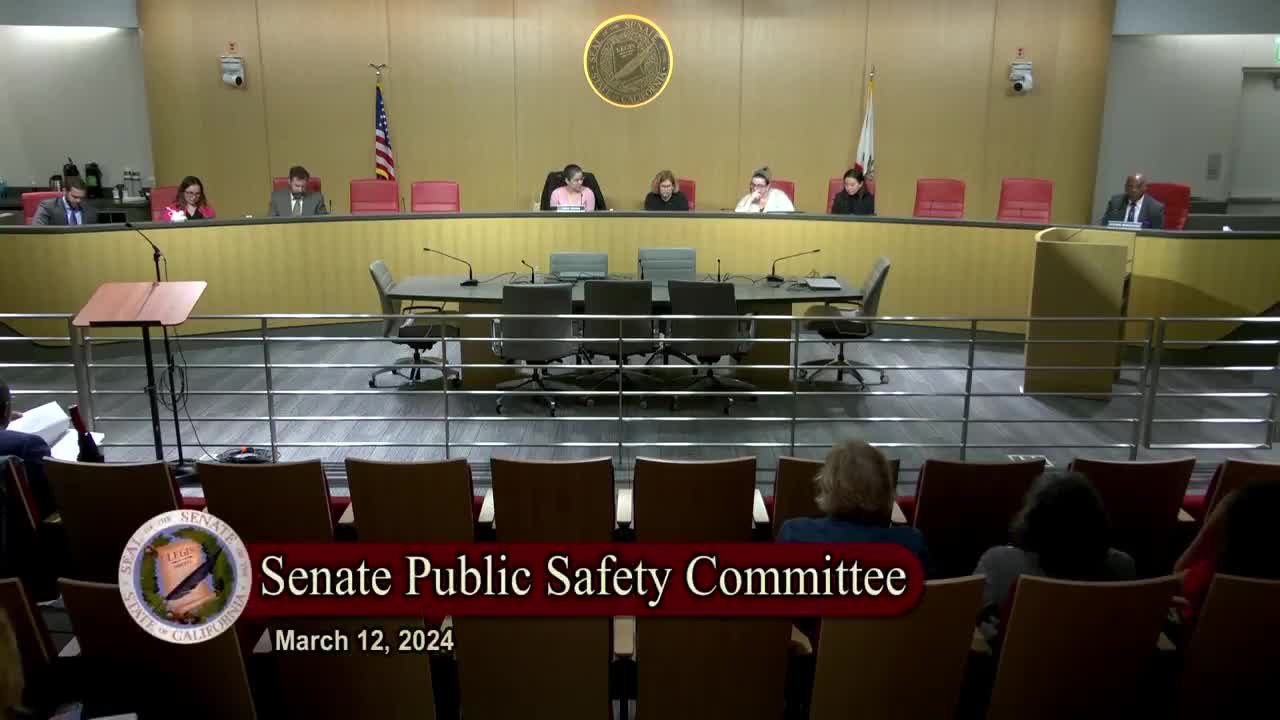
Bill Author

Bill Co-Author(s):