SB 971: Community colleges: exemption from nonresident tuition fee: resident of a region impacted by war or regional conflict.
- Session Year: 2023-2024
- House: Senate
- Latest Version Date: 2024-08-29
Current Status:
Failed
(2024-09-28: In Senate. Consideration of Governor's veto pending.)
Introduced
In Committee
First Chamber
In Committee
Second Chamber
Enacted
Existing law establishes the California Community Colleges, under the administration of the Board of Governors of the California Community Colleges, as one of the segments of public postsecondary education in this state. Existing law establishes community college districts throughout the state and authorizes them to operate campuses and provide instruction to students. Existing law authorizes community college districts to admit nonresident students, and requires that nonresident students be charged a nonresident tuition fee unless an exemption applies. Existing law includes among these exemptions any nonresident who is both a citizen and resident of a foreign country if the nonresident has demonstrated a financial need, as specified.
This bill would additionally exempt from the nonresident tuition fee a nonresident, low-income student who: (1) is a resident of a region impacted by war or other regional conflict, as defined, (2) registers for lower division courses at a community college in either the Glendale Community College District or the Contra Costa Community College District, and (3) has indicated that they have sought residency in California in an effort to find relief from identified conflicts in their nation of origin. The bill would, in any academic year, prohibit more than 75 full-time equivalent students at a community college district from being exempted from payment of the nonresident tuition fee pursuant to this exemption.
The bill would require the governing boards of the community colleges that choose to use this exemption to adopt one uniform policy to determine a students residence classification, establish procedures for an appeal and review of the residence classification, and determine whether a student is low income. The bill would require the governing boards of the community colleges that choose to use this exemption, on or before January 1, 2029, to jointly submit a report to the Legislature that includes, but is not limited to, the demographics, attendance rate, and class completion rate of nonresident students who receive the exemption described above.
This bill would make these provisions inoperative on January 1, 2029.
Existing law establishes the California Community Colleges, under the administration of the Board of Governors of the California Community Colleges, as one of the segments of public postsecondary education in this state. Existing law establishes community college districts throughout the state and authorizes them to operate campuses and provide instruction to students. Existing law authorizes community college districts to admit nonresident students, and requires that nonresident students be charged a nonresident tuition fee unless an exemption applies. Existing law includes among these exemptions any nonresident who is both a citizen and resident of a foreign country if the nonresident has demonstrated a financial need, as specified.
This bill would additionally exempt from the nonresident tuition fee a nonresident, low-income student who: (1) is a resident of a region impacted by war or other regional conflict, as defined, (2) registers for lower division courses at a community college in either the Glendale Community College or 2 other community colleges selected by the Chancellor of the California Community Colleges, one in the Central Valley/Mother Lode Region and one in the North/Far North Region, District or the Contra Costa Community College District, and (3) has indicated that they have sought residency in California in an effort to find relief from identified conflicts in their nation of origin. The bill would, in any academic year, prohibit more than 150 75 full-time equivalent students at a community college from being exempted from payment of the nonresident tuition fee pursuant to this exemption.
The bill would require the governing boards of the community colleges that choose to use this exemption to adopt one uniform policy to determine a students residence classification, establish procedures for an appeal and review of the residence classification, and determine whether a student is low income. The bill would require the governing boards of the community colleges that choose to use this exemption, on or before January 1, 2029, to jointly submit a report to the Legislature that includes, but is not limited to, the demographics, attendance rate, and class completion rate of nonresident students who receive the exemption described above.
This bill would make these provisions inoperative on January 1, 2029.
Existing law establishes the California Community Colleges, under the administration of the Board of Governors of the California Community Colleges, as one of the segments of public postsecondary education in this state. Existing law establishes community college districts throughout the state and authorizes them to operate campuses and provide instruction to students. Existing law authorizes community college districts to admit nonresident students, and requires that nonresident students be charged a nonresident tuition fee unless an exemption applies. Existing law includes among these exemptions any nonresident who is both a citizen and resident of a foreign country if the nonresident has demonstrated a financial need, as specified.
This bill would additionally exempt from the nonresident tuition fee a nonresident, low-income student who: (1) is a resident of a region impacted by war or other regional conflict, as defined, (2) registers for lower division courses at a community college, Glendale Community College or 2 other community colleges selected by the Chancellor of the California Community Colleges, one in the Central Valley/Mother Lode Region and one in the North/Far North Region, and (3) has indicated that they have sought residency in California in an effort to find relief from identified conflicts in their nation of origin. The bill would, in any academic year, prohibit more than 150 full-time equivalent students at a community college from being exempted from payment of the nonresident tuition fee pursuant to this exemption.
The bill would require the governing boards of the community colleges that choose to use this exemption to adopt one uniform policy to determine a students residence classification, establish procedures for an appeal and review of the residence classification, and determine whether a student is low income. The bill would require the governing boards of the community colleges that choose to use this exemption, on or before January 1, 2029, to jointly submit a report to the Legislature that includes, but is not limited to, the demographics, attendance rate, and class completion rate of nonresident students who receive the exemption described above.
This bill would make these provisions inoperative on January 1, 2029.
Existing law establishes the California Community Colleges, under the administration of the Board of Governors of the California Community Colleges, as one of the segments of public postsecondary education in this state. Existing law establishes community college districts throughout the state and authorizes them to operate campuses and provide instruction to students. Existing law authorizes community college districts to admit nonresident students, and requires that nonresident students be charged a nonresident tuition fee unless an exemption applies. Existing law includes among these exemptions any nonresident who is both a citizen and resident of a foreign country if the nonresident has demonstrated a financial need, as specified.
This bill would additionally exempt from the nonresident tuition fee a nonresident, low-income student who: (1) is a resident of a region impacted by war or other regional conflict, as specified, defined, (2) registers for lower division courses at a community college, and (3) has indicated that they have sought residency in California in an effort to find relief from identified conflicts in their nation of origin. The bill would, in any academic year, prohibit more than 150 full-time equivalent students at a community college from being exempted from payment of the nonresident tuition fee pursuant to this exemption.
The bill would require the governing boards of the community colleges that choose to use this exemption to adopt one uniform policy to determine a students residence classification, establish procedures for an appeal and review of the residence classification, and determine whether a student is low income. The bill would require the governing boards of the community colleges that choose to use this exemption, on or before January 1, 2029, to jointly submit a report to the Legislature that includes, but is not limited to, the demographics, attendance rate, and class completion rate of nonresident students who receive the exemption described above.
Existing law establishes the California Community Colleges, under the administration of the Board of Governors of the California Community Colleges, as one of the segments of public postsecondary education in this state. Existing law establishes community college districts throughout the state and authorizes them to operate campuses and provide instruction to students. Existing law authorizes community college districts to admit nonresident students, and requires that nonresident students be charged a nonresident tuition fee unless an exemption applies. Existing law includes among these exemptions any nonresident who is both a citizen and resident of a foreign country if the nonresident has demonstrated a financial need, as specified.
This bill would additionally exempt from the nonresident tuition fee a nonresident, low-income student who: (1) is a resident of a region impacted by war or other regional conflict, as specified, (2) registers for lower division courses at a community college, and (3) has indicated that they have sought residency in California in an effort to find relief from identified conflicts in their nation of origin. The bill would, in any academic year, prohibit more than 150 full-time equivalent students at a community college from being exempted from payment of the nonresident tuition fee pursuant to this exemption.
The bill would require the governing boards of the community colleges that choose to use this exemption to adopt one uniform policy to determine a students residence classification, establish procedures for an appeal and review of the residence classification, and determine whether a student is low income. The bill would require the governing boards of the community colleges that choose to use this exemption, on or before January 1, 2029, to jointly submit a report to the Legislature that includes, but is not limited to, the demographics, attendance rate, and class completion rate of nonresident students who receive the exemption described above.
(a)The Legislature finds and declares all of the following:
(1)California continues to be a global economic leader that strives to promote democratic values and support humanitarian efforts.
(2)Increased educational access can help drive economic growth and create new job opportunities in Californias communities.
(3)California has a history of supporting immigrant communities in their efforts to achieve the American dream and go on to be contributors to our diverse economies and build upon Californias inclusive culture.
(4)California has recognized the impact of global conflicts, including passing a resolution in support of ethnic Armenians in Artsakh, and providing support for Ukraine.
(5)Ongoing conflicts and war have an impact on those residing in those regions, often leading individuals to immigrate for safety and to better support oneself and ones family. These conditions often leave those immigrating with financial hardships and the inability to participate in the educational opportunities needed to avoid poverty.
(6)Reducing the cost of higher education for low-income individuals, first-generation college students, students from historically marginalized communities, and those immigrants impacted by global and regional conflicts reduces the inequities those students face in obtaining a college education and improves their economic mobility.
(7)Community colleges play a crucial role in Californias workforce development by providing affordable, accessible, and high-quality education and training opportunities to students across the state, including a wide range of career and technical education programs, and transfer programs for students who wish to continue their education at four-year universities.
(8)Career and technical education programs in California offer students the opportunity to earn industry-recognized certifications and credentials, leading to higher paying jobs and greater job security, while helping address the skills gap that exists in many industries and providing employers with a pipeline of skilled workers.
(9)As a hub of technological innovation and the worlds fifth largest economy, California requires a workforce with a solid understanding of education in science, technology, engineering, and mathematics, which plays a crucial role in driving innovation, economic growth, and social progress.
(b)It is the intent of the Legislature to increase the pathways by which nonresident students who have fled areas impacted by war or ongoing conflict, and who might otherwise experience financial hardships, can attend California community colleges.
SEC. 2.Section 76140 of the Education Code, as amended by Section 1.5 of Chapter 512 of the Statutes of 2022, is amended to read:76140.(a)A community college district may admit, and shall charge a tuition fee to, nonresident students, except that a community college district may exempt from all or parts of the fee any person described in paragraph (1), (2), (3), (6), or (8) and shall exempt from all of the fee any person described in paragraph (4), (5), or (7):
(1)All nonresidents who enroll for six or fewer units. Exemptions made pursuant to this paragraph shall not be made on an individual basis. A nonresident student exempted pursuant to paragraph (8) is not exempted pursuant to this paragraph.
(2)Any nonresident who is both a citizen and resident of a foreign country, if the nonresident has demonstrated a financial need for the exemption. Not more than 10 percent of the nonresident foreign students attending any community college district may be so exempted. Exemptions made pursuant to this paragraph may be made on an individual basis.
(3)(A)A student who, as of August 29, 2005, was enrolled, or admitted with an intention to enroll, in the fall term of the 200506 academic year in a regionally accredited institution of higher education in Alabama, Louisiana, or Mississippi, and who could not continue the students attendance at that institution as a direct consequence of damage sustained by that institution as a result of Hurricane Katrina.
(B)The chancellor shall develop guidelines for the implementation of this paragraph. These guidelines shall include standards for appropriate documentation of student eligibility to the extent feasible.
(C)This paragraph shall apply only to the 200506 academic year.
(4)A special part-time student, other than a person excluded from the term immigrant, for purposes of the federal Immigration and Nationality Act (8 U.S.C. Sec. 1101), pursuant to paragraph (15) of subsection (a) of Section 1101 of Title 8 of the United States Code, admitted pursuant to Section 76001, 76003, or 76004.
(5)A nonresident student who is a United States citizen who resides in a foreign country, if that nonresident meets all of the following requirements:
(A)Demonstrates a financial need for the exemption.
(B)Has a parent or guardian who has been deported or was permitted to depart voluntarily under the federal Immigration and Nationality Act in accordance with Section 1229c of Title 8 of the United States Code. The student shall provide documents from the United States Citizenship and Immigration Services evidencing the deportation or voluntary departure of the students parent or guardian.
(C)Moved abroad as a result of the deportation or voluntary departure specified in subparagraph (B).
(D)Lived in California immediately before moving abroad. The student shall provide information and evidence that demonstrates the student previously lived in California.
(E)Attended a public or private secondary school, as described in Sections 52 and 53, in the state for three or more years. The student shall provide documents that demonstrate the students secondary school attendance.
(F)Upon enrollment, the student will be in the students first academic year as a matriculated student in California public higher education, as that term is defined in subdivision (a) of Section 66010, will be living in California, and will file an affidavit with the institution stating that the student intends to establish residency in California as soon as possible.
(6)(A)A student who attends Lake Tahoe Community College and who has residence, pursuant to subparagraph (B), in one of the following communities in Nevada:
(i)Incline Village.
(ii)Kingsbury.
(iii)Round Hill.
(iv)Skyland.
(v)Stateline.
(vi)Zephyr Cove.
(B)Residence shall be determined pursuant to Article 5 (commencing with Section 68060) of Chapter 1 of Part 41 of Division 5. A person shall have residence in one of the communities listed in subparagraph (A) if the person has lived in the community for more than one year immediately before seeking the fee exemption pursuant to this paragraph.
(C)The governing board of the Lake Tahoe Community College District shall adopt rules and regulations for determining a students residence classification and for establishing procedures for an appeal and review of the residence classification. No more than 200 students shall be exempted from payment of a nonresident tuition fee under this paragraph in any academic year.
(7)(A)A nonresident student who enrolls in a credit English as a second language (ESL) course at a California Community College and who is any of the following:
(i)A recent immigrant, as defined in Section 1101(a)(15) of Title 8 of the United States Code.
(ii)A recent refugee, as defined in Section 1101(a)(42) of Title 8 of the United States Code.
(iii)A person who has been granted asylum by the United States, as defined in Section 1158 of Title 8 of the United States Code.
(B)This exemption shall apply only to individuals who, upon entering the United States, settled in California and who have resided in California for less than one year.
(C)This exemption shall apply only to the tuition fee for credit ESL courses.
(8)(A)A student who meets all of the following criteria:
(i)Is a nonresident, low-income student who was a resident of a region impacted by war or other regional conflict.
(ii)Registers for lower division courses at a community college in either the Glendale Community College District or the Contra Costa Community College District.
(iii)Has indicated that they have sought residency in California in an effort to find relief from identified conflicts in their nation of origin.
(B)The chancellor shall develop guidelines for the implementation of subparagraph (A). The guidelines shall include standards for appropriate documentation of student eligibility, to the extent feasible.
(C)The governing boards of the community colleges described in clause (ii) of subparagraph (A) that choose to use the exemption pursuant to this paragraph shall adopt one uniform policy that accomplishes all of the following:
(i)Determines a students residence classification.
(ii)Establishes procedures for an appeal and review of the residence classification.
(iii)Determines whether a student is low income.
(D)No more than 75 full-time equivalent students (FTES) at each community college district shall be exempted from payment of a nonresident tuition fee under this paragraph in any academic year.
(E)On or before January 1, 2029, the governing boards of the community colleges described in clause (ii) of subparagraph (A) that choose to use the exemption pursuant to this paragraph shall jointly submit a report to the Legislature in compliance with Section 9795 of the Government Code that includes, but is not limited to, the demographics, attendance rate, and class completion rate of students receiving an exemption pursuant to this paragraph.
(F)For purposes of this paragraph, region impacted by war or other regional conflict means a region that is identified and assigned a travel advisory level by the Bureau of Consular Affairs in the United States Department of State due to armed conflict or military action in that region.
(b)A community college district may contract with a state, a county contiguous to California, the federal government, or a foreign country, or an agency thereof, for payment of all or a part of a nonresident students tuition fee.
(c)Nonresident students shall not be reported as FTES for state apportionment purposes, except as provided by subdivision (j) or another statute, in which case a nonresident tuition fee shall not be charged.
(d)The nonresident tuition fee shall be set by the governing board of each community college district not later than March 1 of each year for the succeeding fiscal year. The governing board of each community college district shall provide nonresident students with notice of nonresident tuition fee changes during the spring term before the fall term in which the change will take effect. Nonresident tuition fee increases shall be gradual, moderate, and predictable. The fee may be paid in installments, as determined by the governing board of the district.
(e)(1)The fee established by the governing board of a community college district pursuant to subdivision (d) shall represent for nonresident students enrolled in 30 semester units or 45 quarter units of credit per fiscal year one or more of the following:
(A)The amount that was expended by the community college district for the expense of education as defined by the California Community Colleges Budget and Accounting Manual in the preceding fiscal year increased by the projected percent increase in the United States Consumer Price Index as determined by the Department of Finance for the current fiscal year and succeeding fiscal year and divided by the FTES (including nonresident students) attending in the community college district in the preceding fiscal year. However, if for the community college districts preceding fiscal year FTES of all students attending in the community college district in noncredit courses is equal to, or greater than, 10 percent of the community college districts total FTES attending in the community college district, the community college district may substitute the data for expense of education in grades 13 and 14 and FTES in grades 13 and 14 attending in the community college district.
(B)The expense of education in the preceding fiscal year of all community college districts increased by the projected percent increase in the United States Consumer Price Index as determined by the Department of Finance for the fiscal year and succeeding fiscal year and divided by the FTES (including nonresident students) attending all community college districts during the preceding fiscal year. However, if the amount calculated under this paragraph for the succeeding fiscal year is less than the amount established for the current fiscal year or for any of the past four fiscal years, the community college district may set the nonresident tuition fee at the greater of the current or any of the past four-year amounts.
(C)An amount not to exceed the fee established by the governing board of any contiguous community college district.
(D)An amount not to exceed the amount that was expended by the community college district for the expense of education, but in no case less than the statewide average as set forth in subparagraph (B).
(E)An amount no greater than the average of the nonresident tuition fees of public community colleges of no less than 12 states that are comparable to California in cost of living. The determination of comparable states shall be based on a composite cost-of-living index as determined by the United States Department of Labor or a cooperating government agency.
(2)The additional revenue generated by the increased nonresident tuition permitted under the amendments made to this subdivision during the 200910 Regular Session shall be used to expand and enhance services to resident students. The admission of nonresident students shall not come at the expense of resident enrollment.
(f)The governing board of each community college district also shall adopt a tuition fee per unit of credit for nonresident students enrolled in more or less than 15 units of credit per term by dividing the fee determined in subdivision (e) by 30 for colleges operating on the semester system and 45 for colleges operating on the quarter system and rounding to the nearest whole dollar. The same rate shall be uniformly charged to nonresident students attending any terms or sessions maintained by the community college. The rate charged shall be the rate established for the fiscal year in which the term or session ends.
(g)Any loss in community college district revenue generated by the nonresident tuition fee shall not be offset by additional state funding.
(h)Any community college district that has fewer than 1,500 FTES and whose boundary is within 10 miles of another state that either (1) has a reciprocity agreement with California governing student attendance and fees, or (2) participates in the Western Undergraduate Exchange, may exempt students from that state, or may exempt students from those states that participate in the Western Undergraduate Exchange, from the mandatory fee requirement described in subdivision (a) for nonresident students.
(i)Any community college district that has more than 1,500, but fewer than 3,001, FTES and whose boundary is within 10 miles of another state that either (1) has a reciprocity agreement with California governing student attendance and fees, or (2) participates in the Western Undergraduate Exchange, may, in any one fiscal year, exempt up to 100 FTES from that state or from states that participate in the Western Undergraduate Exchange from the mandatory fee requirement described in subdivision (a) for nonresident students.
(j)The attendance of nonresident students who are exempted pursuant to subdivision (h) or (i), or pursuant to paragraph (3), (4), (5), or (6) of subdivision (a), from the mandatory fee requirement described in subdivision (a) for nonresident students may be reported as resident FTES for state apportionment purposes. Any nonresident student reported as resident FTES for state apportionment purposes who is exempt pursuant to paragraph (6) of subdivision (a), or pursuant to subdivision (h) or (i), shall pay a per-unit fee that is one and one-half times the amount of the fee established for residents pursuant to Section 76300. That fee shall be included in the FTES adjustments described in Section 76300 for purposes of computing apportionments.
(k)This section shall remain in effect only until January 1, 2029, and as of that date is repealed.
SEC. 3.Section 76140 of the Education Code, as amended by Section 3 of Chapter 796 of the Statutes of 2023, is amended to read:76140.(a)A community college district may admit, and shall charge a tuition fee to, nonresident students, except that a community college district may exempt from all or parts of the fee any person described in paragraph (1), (2), (3), (6), (8), or (9) and shall exempt from all of the fee any person described in paragraph (4), (5), or (7):
(1)All nonresidents who enroll for six or fewer units. Exemptions made pursuant to this paragraph shall not be made on an individual basis.
(2)Any nonresident who is both a citizen and resident of a foreign country, if the nonresident has demonstrated a financial need for the exemption. Not more than 10 percent of the nonresident foreign students attending any community college district may be so exempted. Exemptions made pursuant to this paragraph may be made on an individual basis. A nonresident student exempted pursuant to paragraph (8) or (9) is not exempted pursuant to this paragraph.
(3)(A)A student who, as of August 29, 2005, was enrolled, or admitted with an intention to enroll, in the fall term of the 200506 academic year in a regionally accredited institution of higher education in Alabama, Louisiana, or Mississippi, and who could not continue the students attendance at that institution as a direct consequence of damage sustained by that institution as a result of Hurricane Katrina.
(B)The chancellor shall develop guidelines for the implementation of this paragraph. These guidelines shall include standards for appropriate documentation of student eligibility to the extent feasible.
(C)This paragraph shall apply only to the 200506 academic year.
(4)A special part-time student, other than a person excluded from the term immigrant, for purposes of the federal Immigration and Nationality Act (8 U.S.C. Sec. 1101), pursuant to paragraph (15) of subsection (a) of Section 1101 of Title 8 of the United States Code, admitted pursuant to Section 76001, 76003, or 76004.
(5)A nonresident student who is a United States citizen who resides in a foreign country, if that nonresident meets all of the following requirements:
(A)Demonstrates a financial need for the exemption.
(B)Has a parent or guardian who has been deported or was permitted to depart voluntarily under the federal Immigration and Nationality Act in accordance with Section 1229c of Title 8 of the United States Code. The student shall provide documents from the United States Citizenship and Immigration Services evidencing the deportation or voluntary departure of the students parent or guardian.
(C)Moved abroad as a result of the deportation or voluntary departure specified in subparagraph (B).
(D)Lived in California immediately before moving abroad. The student shall provide information and evidence that demonstrates the student previously lived in California.
(E)Attended a public or private secondary school, as described in Sections 52 and 53, in the state for three or more years. The student shall provide documents that demonstrate the students secondary school attendance.
(F)Upon enrollment, the student will be in the students first academic year as a matriculated student in California public higher education, as that term is defined in subdivision (a) of Section 66010, will be living in California, and will file an affidavit with the institution stating that the student intends to establish residency in California as soon as possible.
(6)(A)A student who attends Lake Tahoe Community College and who has residence, pursuant to subparagraph (B), in one of the following communities in Nevada:
(i)Incline Village.
(ii)Kingsbury.
(iii)Round Hill.
(iv)Skyland.
(v)Stateline.
(vi)Zephyr Cove.
(B)Residence shall be determined pursuant to Article 5 (commencing with Section 68060) of Chapter 1 of Part 41 of Division 5. A person shall have residence in one of the communities listed in subparagraph (A) if the person has lived in the community for more than one year immediately before seeking the fee exemption pursuant to this paragraph.
(C)The governing board of the Lake Tahoe Community College District shall adopt rules and regulations for determining a students residence classification and for establishing procedures for an appeal and review of the residence classification. No more than 200 students shall be exempted from payment of a nonresident tuition fee under this paragraph in any academic year.
(7)(A)A nonresident student who enrolls in a credit English as a second language (ESL) course at a California Community College and who is any of the following:
(i)A recent immigrant, as defined in Section 1101(a)(15) of Title 8 of the United States Code.
(ii)A recent refugee, as defined in Section 1101(a)(42) of Title 8 of the United States Code.
(iii)A person who has been granted asylum by the United States, as defined in Section 1158 of Title 8 of the United States Code.
(B)This exemption shall apply only to individuals who, upon entering the United States, settled in California and who have resided in California for less than one year.
(C)This exemption shall apply only to the tuition fee for credit ESL courses.
(8)(A)A student who meets all of the following criteria:
(i)Is a nonresident, low-income student who is a resident of Mexico.
(ii)Registers for lower division courses at Cuyamaca College, Grossmont College, Imperial Valley College, MiraCosta College, Palomar College, San Diego City College, San Diego Mesa College, San Diego Miramar College, or Southwestern College.
(iii)Has residence within 45 miles of the California-Mexico border for at least one year immediately before seeking the fee exemption pursuant to this paragraph.
(B)(i)The governing boards of the community colleges described in clause (ii) of subparagraph (A) that choose to use the exemption pursuant to this paragraph shall adopt one uniform policy that accomplishes all of the following:
(I)Determines a students residence classification.
(II)Establishes procedures for an appeal and review of the residence classification.
(III)Determines whether a student is low income.
(ii)As a condition of its students receiving an exemption pursuant to this paragraph, the governing boards of the community colleges described in clause (ii) of subparagraph (A) that choose to use the exemption pursuant to this paragraph shall collaborate with each other to ensure the adoption of the uniform policy pursuant to clause (i).
(C)No more than 150 full-time equivalent students (FTES) at each community college described in clause (ii) of subparagraph (A) shall be exempted from payment of a nonresident tuition fee under this paragraph in any academic year.
(D)On or before January 1, 2028, the governing boards of the community colleges described in clause (ii) of subparagraph (A) that choose to use the exemption pursuant to this paragraph shall jointly submit a report to the Legislature in compliance with Section 9795 of the Government Code that includes, but is not limited to, the demographics, attendance rate, and class completion rate of students receiving an exemption pursuant to this paragraph.
(9)(A)A student who meets all of the following criteria:
(i)Is a nonresident, low-income student who was a resident of a region impacted by war or other regional conflict.
(ii)Registers for lower division courses at a community college in either the Glendale Community College District or the Contra Costa Community College District.
(iii)Has indicated that they have sought residency in California in an effort to find relief from identified conflicts in their nation of origin.
(B)The chancellor shall develop guidelines for the implementation of subparagraph (A). The guidelines shall include standards for appropriate documentation of student eligibility, to the extent feasible.
(C)The governing boards of the community colleges described in clause (ii) of subparagraph (A) that choose to use the exemption pursuant to this paragraph shall adopt one uniform policy that accomplishes all of the following:
(i)Determines a students residence classification.
(ii)Establishes procedures for an appeal and review of the residence classification.
(iii)Determines whether a student is low income.
(D)No more than 75 FTES at each community college district shall be exempted from payment of a nonresident tuition fee under this paragraph in any academic year.
(E)On or before January 1, 2029, the governing boards of the community colleges described in clause (ii) of subparagraph (A) that choose to use the exemption pursuant to this paragraph shall jointly submit a report to the Legislature in compliance with Section 9795 of the Government Code that includes, but is not limited to, the demographics, attendance rate, and class completion rate of students receiving an exemption pursuant to this paragraph.
(F)For purposes of this paragraph, region impacted by war or other regional conflict means a region that is identified and assigned a travel advisory level by the Bureau of Consular Affairs in the United States Department of State due to armed conflict or military action in that region.
(b)A community college district may contract with a state, a county contiguous to California, the federal government, or a foreign country, or an agency thereof, for payment of all or a part of a nonresident students tuition fee.
(c)Nonresident students shall not be reported as FTES for state apportionment purposes, except as provided by subdivision (j) or another statute, in which case a nonresident tuition fee shall not be charged.
(d)The nonresident tuition fee shall be set by the governing board of each community college district not later than March 1 of each year for the succeeding fiscal year. The governing board of each community college district shall provide nonresident students with notice of nonresident tuition fee changes during the spring term before the fall term in which the change will take effect. Nonresident tuition fee increases shall be gradual, moderate, and predictable. The fee may be paid in installments, as determined by the governing board of the district.
(e)(1)The fee established by the governing board of a community college district pursuant to subdivision (d) shall represent for nonresident students enrolled in 30 semester units or 45 quarter units of credit per fiscal year one or more of the following:
(A)The amount that was expended by the community college district for the expense of education as defined by the California Community Colleges Budget and Accounting Manual in the preceding fiscal year increased by the projected percent increase in the United States Consumer Price Index as determined by the Department of Finance for the current fiscal year and succeeding fiscal year and divided by the FTES (including nonresident students) attending in the community college district in the preceding fiscal year. However, if for the community college districts preceding fiscal year FTES of all students attending in the community college district in noncredit courses is equal to, or greater than, 10 percent of the community college districts total FTES attending in the community college district, the community college district may substitute the data for expense of education in grades 13 and 14 and FTES in grades 13 and 14 attending in the community college district.
(B)The expense of education in the preceding fiscal year of all community college districts increased by the projected percent increase in the United States Consumer Price Index as determined by the Department of Finance for the fiscal year and succeeding fiscal year and divided by the FTES (including nonresident students) attending all community college districts during the preceding fiscal year. However, if the amount calculated under this paragraph for the succeeding fiscal year is less than the amount established for the current fiscal year or for any of the past four fiscal years, the community college district may set the nonresident tuition fee at the greater of the current or any of the past four-year amounts.
(C)An amount not to exceed the fee established by the governing board of any contiguous community college district.
(D)An amount not to exceed the amount that was expended by the community college district for the expense of education, but in no case less than the statewide average as set forth in subparagraph (B).
(E)An amount no greater than the average of the nonresident tuition fees of public community colleges of no less than 12 states that are comparable to California in cost of living. The determination of comparable states shall be based on a composite cost-of-living index as determined by the United States Department of Labor or a cooperating government agency.
(2)The additional revenue generated by the increased nonresident tuition permitted under the amendments made to this subdivision during the 200910 Regular Session shall be used to expand and enhance services to resident students. The admission of nonresident students shall not come at the expense of resident enrollment.
(f)The governing board of each community college district also shall adopt a tuition fee per unit of credit for nonresident students enrolled in more or less than 15 units of credit per term by dividing the fee determined in subdivision (e) by 30 for colleges operating on the semester system and 45 for colleges operating on the quarter system and rounding to the nearest whole dollar. The same rate shall be uniformly charged to nonresident students attending any terms or sessions maintained by the community college. The rate charged shall be the rate established for the fiscal year in which the term or session ends.
(g)Any loss in community college district revenue generated by the nonresident tuition fee shall not be offset by additional state funding.
(h)Any community college district that has fewer than 1,500 FTES and whose boundary is within 10 miles of another state that either (1) has a reciprocity agreement with California governing student attendance and fees, or (2) participates in the Western Undergraduate Exchange, may exempt students from that state, or may exempt students from those states that participate in the Western Undergraduate Exchange, from the mandatory fee requirement described in subdivision (a) for nonresident students.
(i)Any community college district that has more than 1,500, but fewer than 3,001, FTES and whose boundary is within 10 miles of another state that either (1) has a reciprocity agreement with California governing student attendance and fees, or (2) participates in the Western Undergraduate Exchange, may, in any one fiscal year, exempt up to 100 FTES from that state or from states that participate in the Western Undergraduate Exchange from the mandatory fee requirement described in subdivision (a) for nonresident students.
(j)The attendance of nonresident students who are exempted pursuant to subdivision (h) or (i), or pursuant to paragraph (3), (4), (5), (6), or (8) of subdivision (a), from the mandatory fee requirement described in subdivision (a) for nonresident students may be reported as resident FTES for state apportionment purposes. Any nonresident student reported as resident FTES for state apportionment purposes who is exempt pursuant to paragraph (6) of subdivision (a), or pursuant to subdivision (h) or (i), shall pay a per-unit fee that is one and one-half times the amount of the fee established for residents pursuant to Section 76300. That fee shall be included in the FTES adjustments described in Section 76300 for purposes of computing apportionments.
(k)This section shall become inoperative on July 1, 2028, and, as of January 1, 2029, is repealed, unless a later enacted statute, that becomes operative on or before January 1, 2029, deletes or extends the dates on which it becomes inoperative and is repealed.
SEC. 4.Section 76140 of the Education Code, as added by Section 4 of Chapter 796 of the Statutes of 2023, is amended to read:76140.(a)A community college district may admit, and shall charge a tuition fee to, nonresident students, except that a community college district may exempt from all or parts of the fee any person described in paragraph (1), (2), (3), (6), or (8) and shall exempt from all of the fee any person described in paragraph (4), (5), or (7):
(1)All nonresidents who enroll for six or fewer units. Exemptions made pursuant to this paragraph shall not be made on an individual basis. A nonresident student exempted pursuant to paragraph (8) is not exempted pursuant to this paragraph.
(2)Any nonresident who is both a citizen and resident of a foreign country, if the nonresident has demonstrated a financial need for the exemption. Not more than 10 percent of the nonresident foreign students attending any community college district may be so exempted. Exemptions made pursuant to this paragraph may be made on an individual basis.
(3)(A)A student who, as of August 29, 2005, was enrolled, or admitted with an intention to enroll, in the fall term of the 200506 academic year in a regionally accredited institution of higher education in Alabama, Louisiana, or Mississippi, and who could not continue the students attendance at that institution as a direct consequence of damage sustained by that institution as a result of Hurricane Katrina.
(B)The chancellor shall develop guidelines for the implementation of this paragraph. These guidelines shall include standards for appropriate documentation of student eligibility to the extent feasible.
(C)This paragraph shall apply only to the 200506 academic year.
(4)A special part-time student, other than a person excluded from the term immigrant, for purposes of the federal Immigration and Nationality Act (8 U.S.C. Sec. 1101), pursuant to paragraph (15) of subsection (a) of Section 1101 of Title 8 of the United States Code, admitted pursuant to Section 76001, 76003, or 76004.
(5)A nonresident student who is a United States citizen who resides in a foreign country, if that nonresident meets all of the following requirements:
(A)Demonstrates a financial need for the exemption.
(B)Has a parent or guardian who has been deported or was permitted to depart voluntarily under the federal Immigration and Nationality Act in accordance with Section 1229c of Title 8 of the United States Code. The student shall provide documents from the United States Citizenship and Immigration Services evidencing the deportation or voluntary departure of the students parent or guardian.
(C)Moved abroad as a result of the deportation or voluntary departure specified in subparagraph (B).
(D)Lived in California immediately before moving abroad. The student shall provide information and evidence that demonstrates the student previously lived in California.
(E)Attended a public or private secondary school, as described in Sections 52 and 53, in the state for three or more years. The student shall provide documents that demonstrate the students secondary school attendance.
(F)Upon enrollment, the student will be in the students first academic year as a matriculated student in California public higher education, as that term is defined in subdivision (a) of Section 66010, will be living in California, and will file an affidavit with the institution stating that the student intends to establish residency in California as soon as possible.
(6)(A)A student who attends Lake Tahoe Community College and who has residence, pursuant to subparagraph (B), in one of the following communities in Nevada:
(i)Incline Village.
(ii)Kingsbury.
(iii)Round Hill.
(iv)Skyland.
(v)Stateline.
(vi)Zephyr Cove.
(B)Residence shall be determined pursuant to Article 5 (commencing with Section 68060) of Chapter 1 of Part 41 of Division 5. A person shall have residence in one of the communities listed in subparagraph (A) if the person has lived in the community for more than one year immediately before seeking the fee exemption pursuant to this paragraph.
(C)The governing board of the Lake Tahoe Community College District shall adopt rules and regulations for determining a students residence classification and for establishing procedures for an appeal and review of the residence classification. No more than 200 students shall be exempted from payment of a nonresident tuition fee under this paragraph in any academic year.
(7)(A)A nonresident student who enrolls in a credit English as a second language (ESL) course at a California Community College and who is any of the following:
(i)A recent immigrant, as defined in Section 1101(a)(15) of Title 8 of the United States Code.
(ii)A recent refugee, as defined in Section 1101(a)(42) of Title 8 of the United States Code.
(iii)A person who has been granted asylum by the United States, as defined in Section 1158 of Title 8 of the United States Code.
(B)This exemption shall apply only to individuals who, upon entering the United States, settled in California and who have resided in California for less than one year.
(C)This exemption shall apply only to the tuition fee for credit ESL courses.
(8)(A)A student who meets all of the following criteria:
(i)Is a nonresident, low-income student who was a resident of a region impacted by war or other regional conflict.
(ii)Registers for lower division courses at a community college in either the Glendale Community College District or the Contra Costa Community College District.
(iii)Has indicated that they have sought residency in California in an effort to find relief from identified conflicts in their nation of origin.
(B)The chancellor shall develop guidelines for the implementation of subparagraph (A). The guidelines shall include standards for appropriate documentation of student eligibility, to the extent feasible.
(C)The governing boards of the community colleges described in clause (ii) of subparagraph (A) that choose to use the exemption pursuant to this paragraph shall adopt one uniform policy that accomplishes all of the following:
(i)Determines a students residence classification.
(ii)Establishes procedures for an appeal and review of the residence classification.
(iii)Determines whether a student is low income.
(D)No more than 75 full-time equivalent students (FTES) at each community college district shall be exempted from payment of a nonresident tuition fee under this paragraph in any academic year.
(E)On or before January 1, 2029, the governing boards of the community colleges described in clause (ii) of subparagraph (A) that choose to use the exemption pursuant to this paragraph shall jointly submit a report to the Legislature in compliance with Section 9795 of the Government Code that includes, but is not limited to, the demographics, attendance rate, and class completion rate of students receiving an exemption pursuant to this paragraph.
(F)For purposes of this paragraph, region impacted by war or other regional conflict means a region that is identified and assigned a travel advisory level by the Bureau of Consular Affairs in the United States Department of State due to armed conflict or military action in that region.
(b)A community college district may contract with a state, a county contiguous to California, the federal government, or a foreign country, or an agency thereof, for payment of all or a part of a nonresident students tuition fee.
(c)Nonresident students shall not be reported as FTES for state apportionment purposes, except as provided by subdivision (j) or another statute, in which case a nonresident tuition fee shall not be charged.
(d)The nonresident tuition fee shall be set by the governing board of each community college district not later than March 1 of each year for the succeeding fiscal year. The governing board of each community college district shall provide nonresident students with notice of nonresident tuition fee changes during the spring term before the fall term in which the change will take effect. Nonresident tuition fee increases shall be gradual, moderate, and predictable. The fee may be paid in installments, as determined by the governing board of the district.
(e)(1)The fee established by the governing board of a community college district pursuant to subdivision (d) shall represent for nonresident students enrolled in 30 semester units or 45 quarter units of credit per fiscal year one or more of the following:
(A)The amount that was expended by the community college district for the expense of education as defined by the California Community Colleges Budget and Accounting Manual in the preceding fiscal year increased by the projected percent increase in the United States Consumer Price Index as determined by the Department of Finance for the current fiscal year and succeeding fiscal year and divided by the FTES (including nonresident students) attending in the community college district in the preceding fiscal year. However, if for the community college districts preceding fiscal year FTES of all students attending in the community college district in noncredit courses is equal to, or greater than, 10 percent of the community college districts total FTES attending in the community college district, the community college district may substitute the data for expense of education in grades 13 and 14 and FTES in grades 13 and 14 attending in the community college district.
(B)The expense of education in the preceding fiscal year of all community college districts increased by the projected percent increase in the United States Consumer Price Index as determined by the Department of Finance for the fiscal year and succeeding fiscal year and divided by the FTES (including nonresident students) attending all community college districts during the preceding fiscal year. However, if the amount calculated under this paragraph for the succeeding fiscal year is less than the amount established for the current fiscal year or for any of the past four fiscal years, the community college district may set the nonresident tuition fee at the greater of the current or any of the past four-year amounts.
(C)An amount not to exceed the fee established by the governing board of any contiguous community college district.
(D)An amount not to exceed the amount that was expended by the community college district for the expense of education, but in no case less than the statewide average as set forth in subparagraph (B).
(E)An amount no greater than the average of the nonresident tuition fees of public community colleges of no less than 12 states that are comparable to California in cost of living. The determination of comparable states shall be based on a composite cost-of-living index as determined by the United States Department of Labor or a cooperating government agency.
(2)The additional revenue generated by the increased nonresident tuition permitted under the amendments made to this subdivision during the 200910 Regular Session shall be used to expand and enhance services to resident students. The admission of nonresident students shall not come at the expense of resident enrollment.
(f)The governing board of each community college district also shall adopt a tuition fee per unit of credit for nonresident students enrolled in more or less than 15 units of credit per term by dividing the fee determined in subdivision (e) by 30 for colleges operating on the semester system and 45 for colleges operating on the quarter system and rounding to the nearest whole dollar. The same rate shall be uniformly charged to nonresident students attending any terms or sessions maintained by the community college. The rate charged shall be the rate established for the fiscal year in which the term or session ends.
(g)Any loss in community college district revenue generated by the nonresident tuition fee shall not be offset by additional state funding.
(h)Any community college district that has fewer than 1,500 FTES and whose boundary is within 10 miles of another state that either (1) has a reciprocity agreement with California governing student attendance and fees, or (2) participates in the Western Undergraduate Exchange, may exempt students from that state, or may exempt students from those states that participate in the Western Undergraduate Exchange, from the mandatory fee requirement described in subdivision (a) for nonresident students.
(i)Any community college district that has more than 1,500, but fewer than 3,001, FTES and whose boundary is within 10 miles of another state that either (1) has a reciprocity agreement with California governing student attendance and fees, or (2) participates in the Western Undergraduate Exchange, may, in any one fiscal year, exempt up to 100 FTES from that state or from states that participate in the Western Undergraduate Exchange from the mandatory fee requirement described in subdivision (a) for nonresident students.
(j)The attendance of nonresident students who are exempted pursuant to subdivision (h) or (i), or pursuant to paragraph (3), (4), (5), or (6) of subdivision (a), from the mandatory fee requirement described in subdivision (a) for nonresident students may be reported as resident FTES for state apportionment purposes. Any nonresident student reported as resident FTES for state apportionment purposes who is exempt pursuant to paragraph (6) of subdivision (a), or pursuant to subdivision (h) or (i), shall pay a per-unit fee that is one and one-half times the amount of the fee established for residents pursuant to Section 76300. That fee shall be included in the FTES adjustments described in Section 76300 for purposes of computing apportionments.
(k)This section shall become operative on July 1, 2028.
(l)This section shall remain in effect only until January 1, 2029, and as of that date is repealed.
SEC. 5.Section 76140 is added to the Education Code, to read:76140.(a)A community college district may admit, and shall charge a tuition fee to, nonresident students, except that a community college district may exempt from all or parts of the fee any person described in paragraph (1), (2), (3), or (6), and shall exempt from all of the fee any person described in paragraph (4), (5), or (7):
(1)All nonresidents who enroll for six or fewer units. Exemptions made pursuant to this paragraph shall not be made on an individual basis.
(2)Any nonresident who is both a citizen and resident of a foreign country, if the nonresident has demonstrated a financial need for the exemption. Not more than 10 percent of the nonresident foreign students attending any community college district may be so exempted. Exemptions made pursuant to this paragraph may be made on an individual basis.
(3)(A)A student who, as of August 29, 2005, was enrolled, or admitted with an intention to enroll, in the fall term of the 200506 academic year in a regionally accredited institution of higher education in Alabama, Louisiana, or Mississippi, and who could not continue the students attendance at that institution as a direct consequence of damage sustained by that institution as a result of Hurricane Katrina.
(B)The chancellor shall develop guidelines for the implementation of this paragraph. These guidelines shall include standards for appropriate documentation of student eligibility to the extent feasible.
(C)This paragraph shall apply only to the 200506 academic year.
(4)A special part-time student, other than a person excluded from the term immigrant, for purposes of the federal Immigration and Nationality Act (8 U.S.C. Sec. 1101), pursuant to paragraph (15) of subsection (a) of Section 1101 of Title 8 of the United States Code, admitted pursuant to Section 76001, 76003, or 76004.
(5)A nonresident student who is a United States citizen who resides in a foreign country, if that nonresident meets all of the following requirements:
(A)Demonstrates a financial need for the exemption.
(B)Has a parent or guardian who has been deported or was permitted to depart voluntarily under the federal Immigration and Nationality Act in accordance with Section 1229c of Title 8 of the United States Code. The student shall provide documents from the United States Citizenship and Immigration Services evidencing the deportation or voluntary departure of the students parent or guardian.
(C)Moved abroad as a result of the deportation or voluntary departure specified in subparagraph (B).
(D)Lived in California immediately before moving abroad. The student shall provide information and evidence that demonstrates the student previously lived in California.
(E)Attended a public or private secondary school, as described in Sections 52 and 53, in the state for three or more years. The student shall provide documents that demonstrate the students secondary school attendance.
(F)Upon enrollment, the student will be in the students first academic year as a matriculated student in California public higher education, as that term is defined in subdivision (a) of Section 66010, will be living in California, and will file an affidavit with the institution stating that the student intends to establish residency in California as soon as possible.
(6)(A)A student who attends Lake Tahoe Community College and who has residence, pursuant to subparagraph (B), in one of the following communities in Nevada:
(i)Incline Village.
(ii)Kingsbury.
(iii)Round Hill.
(iv)Skyland.
(v)Stateline.
(vi)Zephyr Cove.
(B)Residence shall be determined pursuant to Article 5 (commencing with Section 68060) of Chapter 1 of Part 41 of Division 5. A person shall have residence in one of the communities listed in subparagraph (A) if the person has lived in the community for more than one year immediately before seeking the fee exemption pursuant to this paragraph.
(C)The governing board of the Lake Tahoe Community College District shall adopt rules and regulations for determining a students residence classification and for establishing procedures for an appeal and review of the residence classification. No more than 200 students shall be exempted from payment of a nonresident tuition fee under this paragraph in any academic year.
(7)(A)A nonresident student who enrolls in a credit English as a second language (ESL) course at a California Community College and who is any of the following:
(i)A recent immigrant, as defined in Section 1101(a)(15) of Title 8 of the United States Code.
(ii)A recent refugee, as defined in Section 1101(a)(42) of Title 8 of the United States Code.
(iii)A person who has been granted asylum by the United States, as defined in Section 1158 of Title 8 of the United States Code.
(B)This exemption shall apply only to individuals who, upon entering the United States, settled in California and who have resided in California for less than one year.
(C)This exemption shall apply only to the tuition fee for credit ESL courses.
(b)A community college district may contract with a state, a county contiguous to California, the federal government, or a foreign country, or an agency thereof, for payment of all or a part of a nonresident students tuition fee.
(c)Nonresident students shall not be reported as full-time equivalent students (FTES) for state apportionment purposes, except as provided by subdivision (j) or another statute, in which case a nonresident tuition fee shall not be charged.
(d)The nonresident tuition fee shall be set by the governing board of each community college district not later than March 1 of each year for the succeeding fiscal year. The governing board of each community college district shall provide nonresident students with notice of nonresident tuition fee changes during the spring term before the fall term in which the change will take effect. Nonresident tuition fee increases shall be gradual, moderate, and predictable. The fee may be paid in installments, as determined by the governing board of the district.
(e)(1)The fee established by the governing board of a community college district pursuant to subdivision (d) shall represent for nonresident students enrolled in 30 semester units or 45 quarter units of credit per fiscal year one or more of the following:
(A)The amount that was expended by the community college district for the expense of education as defined by the California Community Colleges Budget and Accounting Manual in the preceding fiscal year increased by the projected percent increase in the United States Consumer Price Index as determined by the Department of Finance for the current fiscal year and succeeding fiscal year and divided by the FTES (including nonresident students) attending in the community college district in the preceding fiscal year. However, if for the community college districts preceding fiscal year FTES of all students attending in the community college district in noncredit courses is equal to, or greater than, 10 percent of the community college districts total FTES attending in the community college district, the community college district may substitute the data for expense of education in grades 13 and 14 and FTES in grades 13 and 14 attending in the community college district.
(B)The expense of education in the preceding fiscal year of all community college districts increased by the projected percent increase in the United States Consumer Price Index as determined by the Department of Finance for the fiscal year and succeeding fiscal year and divided by the FTES (including nonresident students) attending all community college districts during the preceding fiscal year. However, if the amount calculated under this paragraph for the succeeding fiscal year is less than the amount established for the current fiscal year or for any of the past four fiscal years, the community college district may set the nonresident tuition fee at the greater of the current or any of the past four-year amounts.
(C)An amount not to exceed the fee established by the governing board of any contiguous community college district.
(D)An amount not to exceed the amount that was expended by the community college district for the expense of education, but in no case less than the statewide average as set forth in subparagraph (B).
(E)An amount no greater than the average of the nonresident tuition fees of public community colleges of no less than 12 states that are comparable to California in cost of living. The determination of comparable states shall be based on a composite cost-of-living index as determined by the United States Department of Labor or a cooperating government agency.
(2)The additional revenue generated by the increased nonresident tuition permitted under the amendments made to this subdivision during the 200910 Regular Session shall be used to expand and enhance services to resident students. The admission of nonresident students shall not come at the expense of resident enrollment.
(f)The governing board of each community college district also shall adopt a tuition fee per unit of credit for nonresident students enrolled in more or less than 15 units of credit per term by dividing the fee determined in subdivision (e) by 30 for colleges operating on the semester system and 45 for colleges operating on the quarter system and rounding to the nearest whole dollar. The same rate shall be uniformly charged to nonresident students attending any terms or sessions maintained by the community college. The rate charged shall be the rate established for the fiscal year in which the term or session ends.
(g)Any loss in community college district revenue generated by the nonresident tuition fee shall not be offset by additional state funding.
(h)Any community college district that has fewer than 1,500 FTES and whose boundary is within 10 miles of another state that either (1) has a reciprocity agreement with California governing student attendance and fees, or (2) participates in the Western Undergraduate Exchange, may exempt students from that state, or may exempt students from those states that participate in the Western Undergraduate Exchange, from the mandatory fee requirement described in subdivision (a) for nonresident students.
(i)Any community college district that has more than 1,500, but fewer than 3,001, FTES and whose boundary is within 10 miles of another state that either (1) has a reciprocity agreement with California governing student attendance and fees, or (2) participates in the Western Undergraduate Exchange, may, in any one fiscal year, exempt up to 100 FTES from that state or from states that participate in the Western Undergraduate Exchange from the mandatory fee requirement described in subdivision (a) for nonresident students.
(j)The attendance of nonresident students who are exempted pursuant to subdivision (h) or (i), or pursuant to paragraph (3), (4), (5), or (6) of subdivision (a), from the mandatory fee requirement described in subdivision (a) for nonresident students may be reported as resident FTES for state apportionment purposes. Any nonresident student reported as resident FTES for state apportionment purposes who is exempt pursuant to paragraph (6) of subdivision (a), or pursuant to subdivision (h) or (i), shall pay a per-unit fee that is one and one-half times the amount of the fee established for residents pursuant to Section 76300. That fee shall be included in the FTES adjustments described in Section 76300 for purposes of computing apportionments.
(k)This section shall become operative on January 1, 2029.
SEC. 6.(a)As described in Section 6 of Chapter 796 of the Statutes of 2023, Sections 3 and 4 of this act shall not become operative unless the Board of Governors of the California Community Colleges enters into an attendance agreement, on behalf of a community college that chooses to use the exemption pursuant to paragraph (8) of subdivision (a) of Section 76140 of the Education Code, as amended by Section 3 of Chapter 796 of the Statutes of 2023, with a nationally or internationally accredited university located in the State of Baja California, Mexico, that provides reciprocal rights to California residents attending a university in the State of Baja California that reasonably conforms to the benefits conferred upon residents of Mexico pursuant to paragraph (8) of subdivision (a) of Section 76140 of the Education Code, as amended by Section 3 of Chapter 796 of the Statutes of 2023.
(b)As used in this section, community college means a community college described in clause (ii) of subparagraph (A) of paragraph (8) of subdivision (a) of Section 76140 of the Education Code, as amended by Section 3 of Chapter 796 of the Statutes of 2023.
(a)The Legislature finds and declares all of the following:
(1)California continues to be a global economic leader that strives to promote democratic values and support humanitarian efforts.
(2)Increased educational access can help drive economic growth and create new job opportunities in Californias communities.
(3)California has a history of supporting immigrant communities in their efforts to achieve the American dream and go on to be contributors to our diverse economies and build upon Californias inclusive culture.
(4)California has recognized the impact of global conflicts, including passing a resolution in support of ethnic Armenians in Artsakh, and providing support for Ukraine.
(5)Ongoing conflicts and war have an impact on those residing in those regions, often leading individuals to immigrate for safety and to better support oneself and ones family. These conditions often leave those immigrating with financial hardships and the inability to participate in the educational opportunities needed to avoid poverty.
(6)Reducing the cost of higher education for low-income individuals, first-generation college students, students from historically marginalized communities, and those immigrants impacted by global and regional conflicts reduces the inequities those students face in obtaining a college education and improves their economic mobility.
(7)Community colleges play a crucial role in Californias workforce development by providing affordable, accessible, and high-quality education and training opportunities to students across the state, including a wide range of career and technical education programs, and transfer programs for students who wish to continue their education at four-year universities.
(8)Career and technical education programs in California offer students the opportunity to earn industry-recognized certifications and credentials, leading to higher paying jobs and greater job security, while helping address the skills gap that exists in many industries and providing employers with a pipeline of skilled workers.
(9)As a hub of technological innovation and the worlds fifth largest economy, California requires a workforce with a solid understanding of education in science, technology, engineering, and mathematics, which plays a crucial role in driving innovation, economic growth, and social progress.
(b)It is the intent of the Legislature to increase the pathways by which nonresident students who have fled areas impacted by war or ongoing conflict, and who might otherwise experience financial hardships, can attend California community colleges.
SEC. 2.Section 76140 of the Education Code, as amended by Section 1.5 of Chapter 512 of the Statutes of 2022, is amended to read:76140.(a)A community college district may admit, and shall charge a tuition fee to, nonresident students, except that a community college district may exempt from all or parts of the fee any person described in paragraph (1), (2), (3), (6), or (8) and shall exempt from all of the fee any person described in paragraph (4), (5), or (7):
(1)All nonresidents who enroll for six or fewer units. Exemptions made pursuant to this paragraph shall not be made on an individual basis. A nonresident student exempted pursuant to paragraph (8) is not exempted pursuant to this paragraph.
(2)Any nonresident who is both a citizen and resident of a foreign country, if the nonresident has demonstrated a financial need for the exemption. Not more than 10 percent of the nonresident foreign students attending any community college district may be so exempted. Exemptions made pursuant to this paragraph may be made on an individual basis.
(3)(A)A student who, as of August 29, 2005, was enrolled, or admitted with an intention to enroll, in the fall term of the 200506 academic year in a regionally accredited institution of higher education in Alabama, Louisiana, or Mississippi, and who could not continue the students attendance at that institution as a direct consequence of damage sustained by that institution as a result of Hurricane Katrina.
(B)The chancellor shall develop guidelines for the implementation of this paragraph. These guidelines shall include standards for appropriate documentation of student eligibility to the extent feasible.
(C)This paragraph shall apply only to the 200506 academic year.
(4)A special part-time student, other than a person excluded from the term immigrant, for purposes of the federal Immigration and Nationality Act (8 U.S.C. Sec. 1101), pursuant to paragraph (15) of subsection (a) of Section 1101 of Title 8 of the United States Code, admitted pursuant to Section 76001, 76003, or 76004.
(5)A nonresident student who is a United States citizen who resides in a foreign country, if that nonresident meets all of the following requirements:
(A)Demonstrates a financial need for the exemption.
(B)Has a parent or guardian who has been deported or was permitted to depart voluntarily under the federal Immigration and Nationality Act in accordance with Section 1229c of Title 8 of the United States Code. The student shall provide documents from the United States Citizenship and Immigration Services evidencing the deportation or voluntary departure of the students parent or guardian.
(C)Moved abroad as a result of the deportation or voluntary departure specified in subparagraph (B).
(D)Lived in California immediately before moving abroad. The student shall provide information and evidence that demonstrates the student previously lived in California.
(E)Attended a public or private secondary school, as described in Sections 52 and 53, in the state for three or more years. The student shall provide documents that demonstrate the students secondary school attendance.
(F)Upon enrollment, the student will be in the students first academic year as a matriculated student in California public higher education, as that term is defined in subdivision (a) of Section 66010, will be living in California, and will file an affidavit with the institution stating that the student intends to establish residency in California as soon as possible.
(6)(A)A student who attends Lake Tahoe Community College and who has residence, pursuant to subparagraph (B), in one of the following communities in Nevada:
(i)Incline Village.
(ii)Kingsbury.
(iii)Round Hill.
(iv)Skyland.
(v)Stateline.
(vi)Zephyr Cove.
(B)Residence shall be determined pursuant to Article 5 (commencing with Section 68060) of Chapter 1 of Part 41 of Division 5. A person shall have residence in one of the communities listed in subparagraph (A) if the person has lived in the community for more than one year immediately before seeking the fee exemption pursuant to this paragraph.
(C)The governing board of the Lake Tahoe Community College District shall adopt rules and regulations for determining a students residence classification and for establishing procedures for an appeal and review of the residence classification. No more than 200 students shall be exempted from payment of a nonresident tuition fee under this paragraph in any academic year.
(7)(A)A nonresident student who enrolls in a credit English as a second language (ESL) course at a California Community College and who is any of the following:
(i)A recent immigrant, as defined in Section 1101(a)(15) of Title 8 of the United States Code.
(ii)A recent refugee, as defined in Section 1101(a)(42) of Title 8 of the United States Code.
(iii)A person who has been granted asylum by the United States, as defined in Section 1158 of Title 8 of the United States Code.
(B)This exemption shall apply only to individuals who, upon entering the United States, settled in California and who have resided in California for less than one year.
(C)This exemption shall apply only to the tuition fee for credit ESL courses.
(8)(A)A student who meets all of the following criteria:
(i)Is a nonresident, low-income student who was a resident of a region impacted by war or other regional conflict.
(ii)Registers for lower division courses at a community college in either the Glendale Community College or two other community colleges selected by the chancellor, one in the Central Valley/Mother Lode Region and one in the North/Far North Region. District or the Contra Costa Community College District.
(iii)Has indicated that they have sought residency in California in an effort to find relief from identified conflicts in their nation of origin.
(B)The chancellor shall develop guidelines for the implementation of subparagraph (A). The guidelines shall include standards for appropriate documentation of student eligibility, to the extent feasible.
(C)The governing boards of the community colleges described in clause (ii) of subparagraph (A) that choose to use the exemption pursuant to this paragraph shall adopt one uniform policy that accomplishes all of the following:
(i)Determines a students residence classification.
(ii)Establishes procedures for an appeal and review of the residence classification.
(iii)Determines whether a student is low income.
(D)No more than 150 75 full-time equivalent students (FTES) at each community college shall be exempted from payment of a nonresident tuition fee under this paragraph in any academic year.
(E)On or before January 1, 2029, the governing boards of the community colleges described in clause (ii) of subparagraph (A) that choose to use the exemption pursuant to this paragraph shall jointly submit a report to the Legislature in compliance with Section 9795 of the Government Code that includes, but is not limited to, the demographics, attendance rate, and class completion rate of students receiving an exemption pursuant to this paragraph.
(F)For purposes of this paragraph, region impacted by war or other regional conflict means a region that is identified and assigned a travel advisory level by the Bureau of Consular Affairs in the United States Department of State due to armed conflict or military action in that region.
(b)A community college district may contract with a state, a county contiguous to California, the federal government, or a foreign country, or an agency thereof, for payment of all or a part of a nonresident students tuition fee.
(c)Nonresident students shall not be reported as FTES for state apportionment purposes, except as provided by subdivision (j) or another statute, in which case a nonresident tuition fee shall not be charged.
(d)The nonresident tuition fee shall be set by the governing board of each community college district not later than March 1 of each year for the succeeding fiscal year. The governing board of each community college district shall provide nonresident students with notice of nonresident tuition fee changes during the spring term before the fall term in which the change will take effect. Nonresident tuition fee increases shall be gradual, moderate, and predictable. The fee may be paid in installments, as determined by the governing board of the district.
(e)(1)The fee established by the governing board of a community college district pursuant to subdivision (d) shall represent for nonresident students enrolled in 30 semester units or 45 quarter units of credit per fiscal year one or more of the following:
(A)The amount that was expended by the community college district for the expense of education as defined by the California Community Colleges Budget and Accounting Manual in the preceding fiscal year increased by the projected percent increase in the United States Consumer Price Index as determined by the Department of Finance for the current fiscal year and succeeding fiscal year and divided by the FTES (including nonresident students) attending in the community college district in the preceding fiscal year. However, if for the community college districts preceding fiscal year FTES of all students attending in the community college district in noncredit courses is equal to, or greater than, 10 percent of the community college districts total FTES attending in the community college district, the community college district may substitute the data for expense of education in grades 13 and 14 and FTES in grades 13 and 14 attending in the community college district.
(B)The expense of education in the preceding fiscal year of all community college districts increased by the projected percent increase in the United States Consumer Price Index as determined by the Department of Finance for the fiscal year and succeeding fiscal year and divided by the FTES (including nonresident students) attending all community college districts during the preceding fiscal year. However, if the amount calculated under this paragraph for the succeeding fiscal year is less than the amount established for the current fiscal year or for any of the past four fiscal years, the community college district may set the nonresident tuition fee at the greater of the current or any of the past four-year amounts.
(C)An amount not to exceed the fee established by the governing board of any contiguous community college district.
(D)An amount not to exceed the amount that was expended by the community college district for the expense of education, but in no case less than the statewide average as set forth in subparagraph (B).
(E)An amount no greater than the average of the nonresident tuition fees of public community colleges of no less than 12 states that are comparable to California in cost of living. The determination of comparable states shall be based on a composite cost-of-living index as determined by the United States Department of Labor or a cooperating government agency.
(2)The additional revenue generated by the increased nonresident tuition permitted under the amendments made to this subdivision during the 200910 Regular Session shall be used to expand and enhance services to resident students. The admission of nonresident students shall not come at the expense of resident enrollment.
(f)The governing board of each community college district also shall adopt a tuition fee per unit of credit for nonresident students enrolled in more or less than 15 units of credit per term by dividing the fee determined in subdivision (e) by 30 for colleges operating on the semester system and 45 for colleges operating on the quarter system and rounding to the nearest whole dollar. The same rate shall be uniformly charged to nonresident students attending any terms or sessions maintained by the community college. The rate charged shall be the rate established for the fiscal year in which the term or session ends.
(g)Any loss in community college district revenue generated by the nonresident tuition fee shall not be offset by additional state funding.
(h)Any community college district that has fewer than 1,500 FTES and whose boundary is within 10 miles of another state that either (1) has a reciprocity agreement with California governing student attendance and fees, or (2) participates in the Western Undergraduate Exchange, may exempt students from that state, or may exempt students from those states that participate in the Western Undergraduate Exchange, from the mandatory fee requirement described in subdivision (a) for nonresident students.
(i)Any community college district that has more than 1,500, but fewer than 3,001, FTES and whose boundary is within 10 miles of another state that either (1) has a reciprocity agreement with California governing student attendance and fees, or (2) participates in the Western Undergraduate Exchange, may, in any one fiscal year, exempt up to 100 FTES from that state or from states that participate in the Western Undergraduate Exchange from the mandatory fee requirement described in subdivision (a) for nonresident students.
(j)The attendance of nonresident students who are exempted pursuant to subdivision (h) or (i), or pursuant to paragraph (3), (4), (5), (6), or (8) or (6) of subdivision (a), from the mandatory fee requirement described in subdivision (a) for nonresident students may be reported as resident FTES for state apportionment purposes. Any nonresident student reported as resident FTES for state apportionment purposes who is exempt pursuant to paragraph (6) of subdivision (a), or pursuant to subdivision (h) or (i), shall pay a per-unit fee that is one and one-half times the amount of the fee established for residents pursuant to Section 76300. That fee shall be included in the FTES adjustments described in Section 76300 for purposes of computing apportionments.
(k)This section shall remain in effect only until January 1, 2029, and as of that date is repealed.
SEC. 3.Section 76140 of the Education Code, as amended by Section 3 of Chapter 796 of the Statutes of 2023, is amended to read:76140.(a)A community college district may admit, and shall charge a tuition fee to, nonresident students, except that a community college district may exempt from all or parts of the fee any person described in paragraph (1), (2), (3), (6), (8), or (9) and shall exempt from all of the fee any person described in paragraph (4), (5), or (7):
(1)All nonresidents who enroll for six or fewer units. Exemptions made pursuant to this paragraph shall not be made on an individual basis.
(2)Any nonresident who is both a citizen and resident of a foreign country, if the nonresident has demonstrated a financial need for the exemption. Not more than 10 percent of the nonresident foreign students attending any community college district may be so exempted. Exemptions made pursuant to this paragraph may be made on an individual basis. A nonresident student exempted pursuant to paragraph (8) or (9) is not exempted pursuant to this paragraph.
(3)(A)A student who, as of August 29, 2005, was enrolled, or admitted with an intention to enroll, in the fall term of the 200506 academic year in a regionally accredited institution of higher education in Alabama, Louisiana, or Mississippi, and who could not continue the students attendance at that institution as a direct consequence of damage sustained by that institution as a result of Hurricane Katrina.
(B)The chancellor shall develop guidelines for the implementation of this paragraph. These guidelines shall include standards for appropriate documentation of student eligibility to the extent feasible.
(C)This paragraph shall apply only to the 200506 academic year.
(4)A special part-time student, other than a person excluded from the term immigrant, for purposes of the federal Immigration and Nationality Act (8 U.S.C. Sec. 1101), pursuant to paragraph (15) of subsection (a) of Section 1101 of Title 8 of the United States Code, admitted pursuant to Section 76001, 76003, or 76004.
(5)A nonresident student who is a United States citizen who resides in a foreign country, if that nonresident meets all of the following requirements:
(A)Demonstrates a financial need for the exemption.
(B)Has a parent or guardian who has been deported or was permitted to depart voluntarily under the federal Immigration and Nationality Act in accordance with Section 1229c of Title 8 of the United States Code. The student shall provide documents from the United States Citizenship and Immigration Services evidencing the deportation or voluntary departure of the students parent or guardian.
(C)Moved abroad as a result of the deportation or voluntary departure specified in subparagraph (B).
(D)Lived in California immediately before moving abroad. The student shall provide information and evidence that demonstrates the student previously lived in California.
(E)Attended a public or private secondary school, as described in Sections 52 and 53, in the state for three or more years. The student shall provide documents that demonstrate the students secondary school attendance.
(F)Upon enrollment, the student will be in the students first academic year as a matriculated student in California public higher education, as that term is defined in subdivision (a) of Section 66010, will be living in California, and will file an affidavit with the institution stating that the student intends to establish residency in California as soon as possible.
(6)(A)A student who attends Lake Tahoe Community College and who has residence, pursuant to subparagraph (B), in one of the following communities in Nevada:
(i)Incline Village.
(ii)Kingsbury.
(iii)Round Hill.
(iv)Skyland.
(v)Stateline.
(vi)Zephyr Cove.
(B)Residence shall be determined pursuant to Article 5 (commencing with Section 68060) of Chapter 1 of Part 41 of Division 5. A person shall have residence in one of the communities listed in subparagraph (A) if the person has lived in the community for more than one year immediately before seeking the fee exemption pursuant to this paragraph.
(C)The governing board of the Lake Tahoe Community College District shall adopt rules and regulations for determining a students residence classification and for establishing procedures for an appeal and review of the residence classification. No more than 200 students shall be exempted from payment of a nonresident tuition fee under this paragraph in any academic year.
(7)(A)A nonresident student who enrolls in a credit English as a second language (ESL) course at a California Community College and who is any of the following:
(i)A recent immigrant, as defined in Section 1101(a)(15) of Title 8 of the United States Code.
(ii)A recent refugee, as defined in Section 1101(a)(42) of Title 8 of the United States Code.
(iii)A person who has been granted asylum by the United States, as defined in Section 1158 of Title 8 of the United States Code.
(B)This exemption shall apply only to individuals who, upon entering the United States, settled in California and who have resided in California for less than one year.
(C)This exemption shall apply only to the tuition fee for credit ESL courses.
(8)(A)A student who meets all of the following criteria:
(i)Is a nonresident, low-income student who is a resident of Mexico.
(ii)Registers for lower division courses at Cuyamaca College, Grossmont College, Imperial Valley College, MiraCosta College, Palomar College, San Diego City College, San Diego Mesa College, San Diego Miramar College, or Southwestern College.
(iii)Has residence within 45 miles of the California-Mexico border for at least one year immediately before seeking the fee exemption pursuant to this paragraph.
(B)(i)The governing boards of the community colleges described in clause (ii) of subparagraph (A) that choose to use the exemption pursuant to this paragraph shall adopt one uniform policy that accomplishes all of the following:
(I)Determines a students residence classification.
(II)Establishes procedures for an appeal and review of the residence classification.
(III)Determines whether a student is low income.
(ii)As a condition of its students receiving an exemption pursuant to this paragraph, the governing boards of the community colleges described in clause (ii) of subparagraph (A) that choose to use the exemption pursuant to this paragraph shall collaborate with each other to ensure the adoption of the uniform policy pursuant to clause (i).
(C)No more than 150 full-time equivalent students (FTES) at each community college described in clause (ii) of subparagraph (A) shall be exempted from payment of a nonresident tuition fee under this paragraph in any academic year.
(D)On or before January 1, 2028, the governing boards of the community colleges described in clause (ii) of subparagraph (A) that choose to use the exemption pursuant to this paragraph shall jointly submit a report to the Legislature in compliance with Section 9795 of the Government Code that includes, but is not limited to, the demographics, attendance rate, and class completion rate of students receiving an exemption pursuant to this paragraph.
(9)(A)A student who meets all of the following criteria:
(i)Is a nonresident, low-income student who was a resident of a region impacted by war or other regional conflict.
(ii)Registers for lower division courses at a community college in either the Glendale Community College or two other community colleges selected by the chancellor, one in the Central Valley/Mother Lode Region and one in the North/Far North Region. District or the Contra Costa Community College District.
(iii)Has indicated that they have sought residency in California in an effort to find relief from identified conflicts in their nation of origin.
(B)The chancellor shall develop guidelines for the implementation of subparagraph (A). The guidelines shall include standards for appropriate documentation of student eligibility, to the extent feasible.
(C)The governing boards of the community colleges described in clause (ii) of subparagraph (A) that choose to use the exemption pursuant to this paragraph shall adopt one uniform policy that accomplishes all of the following:
(i)Determines a students residence classification.
(ii)Establishes procedures for an appeal and review of the residence classification.
(iii)Determines whether a student is low income.
(D)No more than 150 75 FTES at each community college shall be exempted from payment of a nonresident tuition fee under this paragraph in any academic year.
(E)On or before January 1, 2029, the governing boards of the community colleges described in clause (ii) of subparagraph (A) that choose to use the exemption pursuant to this paragraph shall jointly submit a report to the Legislature in compliance with Section 9795 of the Government Code that includes, but is not limited to, the demographics, attendance rate, and class completion rate of students receiving an exemption pursuant to this paragraph.
(F)For purposes of this paragraph, region impacted by war or other regional conflict means a region that is identified and assigned a travel advisory level by the Bureau of Consular Affairs in the United States Department of State due to armed conflict or military action in that region.
(b)A community college district may contract with a state, a county contiguous to California, the federal government, or a foreign country, or an agency thereof, for payment of all or a part of a nonresident students tuition fee.
(c)Nonresident students shall not be reported as FTES for state apportionment purposes, except as provided by subdivision (j) or another statute, in which case a nonresident tuition fee shall not be charged.
(d)The nonresident tuition fee shall be set by the governing board of each community college district not later than March 1 of each year for the succeeding fiscal year. The governing board of each community college district shall provide nonresident students with notice of nonresident tuition fee changes during the spring term before the fall term in which the change will take effect. Nonresident tuition fee increases shall be gradual, moderate, and predictable. The fee may be paid in installments, as determined by the governing board of the district.
(e)(1)The fee established by the governing board of a community college district pursuant to subdivision (d) shall represent for nonresident students enrolled in 30 semester units or 45 quarter units of credit per fiscal year one or more of the following:
(A)The amount that was expended by the community college district for the expense of education as defined by the California Community Colleges Budget and Accounting Manual in the preceding fiscal year increased by the projected percent increase in the United States Consumer Price Index as determined by the Department of Finance for the current fiscal year and succeeding fiscal year and divided by the FTES (including nonresident students) attending in the community college district in the preceding fiscal year. However, if for the community college districts preceding fiscal year FTES of all students attending in the community college district in noncredit courses is equal to, or greater than, 10 percent of the community college districts total FTES attending in the community college district, the community college district may substitute the data for expense of education in grades 13 and 14 and FTES in grades 13 and 14 attending in the community college district.
(B)The expense of education in the preceding fiscal year of all community college districts increased by the projected percent increase in the United States Consumer Price Index as determined by the Department of Finance for the fiscal year and succeeding fiscal year and divided by the FTES (including nonresident students) attending all community college districts during the preceding fiscal year. However, if the amount calculated under this paragraph for the succeeding fiscal year is less than the amount established for the current fiscal year or for any of the past four fiscal years, the community college district may set the nonresident tuition fee at the greater of the current or any of the past four-year amounts.
(C)An amount not to exceed the fee established by the governing board of any contiguous community college district.
(D)An amount not to exceed the amount that was expended by the community college district for the expense of education, but in no case less than the statewide average as set forth in subparagraph (B).
(E)An amount no greater than the average of the nonresident tuition fees of public community colleges of no less than 12 states that are comparable to California in cost of living. The determination of comparable states shall be based on a composite cost-of-living index as determined by the United States Department of Labor or a cooperating government agency.
(2)The additional revenue generated by the increased nonresident tuition permitted under the amendments made to this subdivision during the 200910 Regular Session shall be used to expand and enhance services to resident students. The admission of nonresident students shall not come at the expense of resident enrollment.
(f)The governing board of each community college district also shall adopt a tuition fee per unit of credit for nonresident students enrolled in more or less than 15 units of credit per term by dividing the fee determined in subdivision (e) by 30 for colleges operating on the semester system and 45 for colleges operating on the quarter system and rounding to the nearest whole dollar. The same rate shall be uniformly charged to nonresident students attending any terms or sessions maintained by the community college. The rate charged shall be the rate established for the fiscal year in which the term or session ends.
(g)Any loss in community college district revenue generated by the nonresident tuition fee shall not be offset by additional state funding.
(h)Any community college district that has fewer than 1,500 FTES and whose boundary is within 10 miles of another state that either (1) has a reciprocity agreement with California governing student attendance and fees, or (2) participates in the Western Undergraduate Exchange, may exempt students from that state, or may exempt students from those states that participate in the Western Undergraduate Exchange, from the mandatory fee requirement described in subdivision (a) for nonresident students.
(i)Any community college district that has more than 1,500, but fewer than 3,001, FTES and whose boundary is within 10 miles of another state that either (1) has a reciprocity agreement with California governing student attendance and fees, or (2) participates in the Western Undergraduate Exchange, may, in any one fiscal year, exempt up to 100 FTES from that state or from states that participate in the Western Undergraduate Exchange from the mandatory fee requirement described in subdivision (a) for nonresident students.
(j)The attendance of nonresident students who are exempted pursuant to subdivision (h) or (i), or pursuant to paragraph (3), (4), (5), (6), (8), or (9) or (8) of subdivision (a), from the mandatory fee requirement described in subdivision (a) for nonresident students may be reported as resident FTES for state apportionment purposes. Any nonresident student reported as resident FTES for state apportionment purposes who is exempt pursuant to paragraph (6) of subdivision (a), or pursuant to subdivision (h) or (i), shall pay a per-unit fee that is one and one-half times the amount of the fee established for residents pursuant to Section 76300. That fee shall be included in the FTES adjustments described in Section 76300 for purposes of computing apportionments.
(k)This section shall become inoperative on July 1, 2028, and, as of January 1, 2029, is repealed, unless a later enacted statute, that becomes operative on or before January 1, 2029, deletes or extends the dates on which it becomes inoperative and is repealed.
SEC. 4.Section 76140 of the Education Code, as added by Section 4 of Chapter 796 of the Statutes of 2023, is amended to read:76140.(a)A community college district may admit, and shall charge a tuition fee to, nonresident students, except that a community college district may exempt from all or parts of the fee any person described in paragraph (1), (2), (3), (6), or (8) and shall exempt from all of the fee any person described in paragraph (4), (5), or (7):
(1)All nonresidents who enroll for six or fewer units. Exemptions made pursuant to this paragraph shall not be made on an individual basis. A nonresident student exempted pursuant to paragraph (8) is not exempted pursuant to this paragraph.
(2)Any nonresident who is both a citizen and resident of a foreign country, if the nonresident has demonstrated a financial need for the exemption. Not more than 10 percent of the nonresident foreign students attending any community college district may be so exempted. Exemptions made pursuant to this paragraph may be made on an individual basis.
(3)(A)A student who, as of August 29, 2005, was enrolled, or admitted with an intention to enroll, in the fall term of the 200506 academic year in a regionally accredited institution of higher education in Alabama, Louisiana, or Mississippi, and who could not continue the students attendance at that institution as a direct consequence of damage sustained by that institution as a result of Hurricane Katrina.
(B)The chancellor shall develop guidelines for the implementation of this paragraph. These guidelines shall include standards for appropriate documentation of student eligibility to the extent feasible.
(C)This paragraph shall apply only to the 200506 academic year.
(4)A special part-time student, other than a person excluded from the term immigrant, for purposes of the federal Immigration and Nationality Act (8 U.S.C. Sec. 1101), pursuant to paragraph (15) of subsection (a) of Section 1101 of Title 8 of the United States Code, admitted pursuant to Section 76001, 76003, or 76004.
(5)A nonresident student who is a United States citizen who resides in a foreign country, if that nonresident meets all of the following requirements:
(A)Demonstrates a financial need for the exemption.
(B)Has a parent or guardian who has been deported or was permitted to depart voluntarily under the federal Immigration and Nationality Act in accordance with Section 1229c of Title 8 of the United States Code. The student shall provide documents from the United States Citizenship and Immigration Services evidencing the deportation or voluntary departure of the students parent or guardian.
(C)Moved abroad as a result of the deportation or voluntary departure specified in subparagraph (B).
(D)Lived in California immediately before moving abroad. The student shall provide information and evidence that demonstrates the student previously lived in California.
(E)Attended a public or private secondary school, as described in Sections 52 and 53, in the state for three or more years. The student shall provide documents that demonstrate the students secondary school attendance.
(F)Upon enrollment, the student will be in the students first academic year as a matriculated student in California public higher education, as that term is defined in subdivision (a) of Section 66010, will be living in California, and will file an affidavit with the institution stating that the student intends to establish residency in California as soon as possible.
(6)(A)A student who attends Lake Tahoe Community College and who has residence, pursuant to subparagraph (B), in one of the following communities in Nevada:
(i)Incline Village.
(ii)Kingsbury.
(iii)Round Hill.
(iv)Skyland.
(v)Stateline.
(vi)Zephyr Cove.
(B)Residence shall be determined pursuant to Article 5 (commencing with Section 68060) of Chapter 1 of Part 41 of Division 5. A person shall have residence in one of the communities listed in subparagraph (A) if the person has lived in the community for more than one year immediately before seeking the fee exemption pursuant to this paragraph.
(C)The governing board of the Lake Tahoe Community College District shall adopt rules and regulations for determining a students residence classification and for establishing procedures for an appeal and review of the residence classification. No more than 200 students shall be exempted from payment of a nonresident tuition fee under this paragraph in any academic year.
(7)(A)A nonresident student who enrolls in a credit English as a second language (ESL) course at a California Community College and who is any of the following:
(i)A recent immigrant, as defined in Section 1101(a)(15) of Title 8 of the United States Code.
(ii)A recent refugee, as defined in Section 1101(a)(42) of Title 8 of the United States Code.
(iii)A person who has been granted asylum by the United States, as defined in Section 1158 of Title 8 of the United States Code.
(B)This exemption shall apply only to individuals who, upon entering the United States, settled in California and who have resided in California for less than one year.
(C)This exemption shall apply only to the tuition fee for credit ESL courses.
(8)(A)A student who meets all of the following criteria:
(i)Is a nonresident, low-income student who was a resident of a region impacted by war or other regional conflict.
(ii)Registers for lower division courses at a community college in either the Glendale Community College or two other community colleges selected by the chancellor, one in the Central Valley/Mother Lode Region and one in the North/Far North Region. District or the Contra Costa Community College District.
(iii)Has indicated that they have sought residency in California in an effort to find relief from identified conflicts in their nation of origin.
(B)The chancellor shall develop guidelines for the implementation of subparagraph (A). The guidelines shall include standards for appropriate documentation of student eligibility, to the extent feasible.
(C)The governing boards of the community colleges described in clause (ii) of subparagraph (A) that choose to use the exemption pursuant to this paragraph shall adopt one uniform policy that accomplishes all of the following:
(i)Determines a students residence classification.
(ii)Establishes procedures for an appeal and review of the residence classification.
(iii)Determines whether a student is low income.
(D)No more than 150 75 full-time equivalent students (FTES) at each community college shall be exempted from payment of a nonresident tuition fee under this paragraph in any academic year.
(E)On or before January 1, 2029, the governing boards of the community colleges described in clause (ii) of subparagraph (A) that choose to use the exemption pursuant to this paragraph shall jointly submit a report to the Legislature in compliance with Section 9795 of the Government Code that includes, but is not limited to, the demographics, attendance rate, and class completion rate of students receiving an exemption pursuant to this paragraph.
(F)For purposes of this paragraph, region impacted by war or other regional conflict means a region that is identified and assigned a travel advisory level by the Bureau of Consular Affairs in the United States Department of State due to armed conflict or military action in that region.
(b)A community college district may contract with a state, a county contiguous to California, the federal government, or a foreign country, or an agency thereof, for payment of all or a part of a nonresident students tuition fee.
(c)Nonresident students shall not be reported as FTES for state apportionment purposes, except as provided by subdivision (j) or another statute, in which case a nonresident tuition fee shall not be charged.
(d)The nonresident tuition fee shall be set by the governing board of each community college district not later than March 1 of each year for the succeeding fiscal year. The governing board of each community college district shall provide nonresident students with notice of nonresident tuition fee changes during the spring term before the fall term in which the change will take effect. Nonresident tuition fee increases shall be gradual, moderate, and predictable. The fee may be paid in installments, as determined by the governing board of the district.
(e)(1)The fee established by the governing board of a community college district pursuant to subdivision (d) shall represent for nonresident students enrolled in 30 semester units or 45 quarter units of credit per fiscal year one or more of the following:
(A)The amount that was expended by the community college district for the expense of education as defined by the California Community Colleges Budget and Accounting Manual in the preceding fiscal year increased by the projected percent increase in the United States Consumer Price Index as determined by the Department of Finance for the current fiscal year and succeeding fiscal year and divided by the FTES (including nonresident students) attending in the community college district in the preceding fiscal year. However, if for the community college districts preceding fiscal year FTES of all students attending in the community college district in noncredit courses is equal to, or greater than, 10 percent of the community college districts total FTES attending in the community college district, the community college district may substitute the data for expense of education in grades 13 and 14 and FTES in grades 13 and 14 attending in the community college district.
(B)The expense of education in the preceding fiscal year of all community college districts increased by the projected percent increase in the United States Consumer Price Index as determined by the Department of Finance for the fiscal year and succeeding fiscal year and divided by the FTES (including nonresident students) attending all community college districts during the preceding fiscal year. However, if the amount calculated under this paragraph for the succeeding fiscal year is less than the amount established for the current fiscal year or for any of the past four fiscal years, the community college district may set the nonresident tuition fee at the greater of the current or any of the past four-year amounts.
(C)An amount not to exceed the fee established by the governing board of any contiguous community college district.
(D)An amount not to exceed the amount that was expended by the community college district for the expense of education, but in no case less than the statewide average as set forth in subparagraph (B).
(E)An amount no greater than the average of the nonresident tuition fees of public community colleges of no less than 12 states that are comparable to California in cost of living. The determination of comparable states shall be based on a composite cost-of-living index as determined by the United States Department of Labor or a cooperating government agency.
(2)The additional revenue generated by the increased nonresident tuition permitted under the amendments made to this subdivision during the 200910 Regular Session shall be used to expand and enhance services to resident students. The admission of nonresident students shall not come at the expense of resident enrollment.
(f)The governing board of each community college district also shall adopt a tuition fee per unit of credit for nonresident students enrolled in more or less than 15 units of credit per term by dividing the fee determined in subdivision (e) by 30 for colleges operating on the semester system and 45 for colleges operating on the quarter system and rounding to the nearest whole dollar. The same rate shall be uniformly charged to nonresident students attending any terms or sessions maintained by the community college. The rate charged shall be the rate established for the fiscal year in which the term or session ends.
(g)Any loss in community college district revenue generated by the nonresident tuition fee shall not be offset by additional state funding.
(h)Any community college district that has fewer than 1,500 FTES and whose boundary is within 10 miles of another state that either (1) has a reciprocity agreement with California governing student attendance and fees, or (2) participates in the Western Undergraduate Exchange, may exempt students from that state, or may exempt students from those states that participate in the Western Undergraduate Exchange, from the mandatory fee requirement described in subdivision (a) for nonresident students.
(i)Any community college district that has more than 1,500, but fewer than 3,001, FTES and whose boundary is within 10 miles of another state that either (1) has a reciprocity agreement with California governing student attendance and fees, or (2) participates in the Western Undergraduate Exchange, may, in any one fiscal year, exempt up to 100 FTES from that state or from states that participate in the Western Undergraduate Exchange from the mandatory fee requirement described in subdivision (a) for nonresident students.
(j)The attendance of nonresident students who are exempted pursuant to subdivision (h) or (i), or pursuant to paragraph (3), (4), (5), (6), or (8) or (6) of subdivision (a), from the mandatory fee requirement described in subdivision (a) for nonresident students may be reported as resident FTES for state apportionment purposes. Any nonresident student reported as resident FTES for state apportionment purposes who is exempt pursuant to paragraph (6) of subdivision (a), or pursuant to subdivision (h) or (i), shall pay a per-unit fee that is one and one-half times the amount of the fee established for residents pursuant to Section 76300. That fee shall be included in the FTES adjustments described in Section 76300 for purposes of computing apportionments.
(k)This section shall become operative on July 1, 2028.
(l)This section shall remain in effect only until January 1, 2029, and as of that date is repealed.
SEC. 5.Section 76140 is added to the Education Code, to read:76140.(a)A community college district may admit, and shall charge a tuition fee to, nonresident students, except that a community college district may exempt from all or parts of the fee any person described in paragraph (1), (2), (3), or (6), and shall exempt from all of the fee any person described in paragraph (4), (5), or (7):
(1)All nonresidents who enroll for six or fewer units. Exemptions made pursuant to this paragraph shall not be made on an individual basis.
(2)Any nonresident who is both a citizen and resident of a foreign country, if the nonresident has demonstrated a financial need for the exemption. Not more than 10 percent of the nonresident foreign students attending any community college district may be so exempted. Exemptions made pursuant to this paragraph may be made on an individual basis.
(3)(A)A student who, as of August 29, 2005, was enrolled, or admitted with an intention to enroll, in the fall term of the 200506 academic year in a regionally accredited institution of higher education in Alabama, Louisiana, or Mississippi, and who could not continue the students attendance at that institution as a direct consequence of damage sustained by that institution as a result of Hurricane Katrina.
(B)The chancellor shall develop guidelines for the implementation of this paragraph. These guidelines shall include standards for appropriate documentation of student eligibility to the extent feasible.
(C)This paragraph shall apply only to the 200506 academic year.
(4)A special part-time student, other than a person excluded from the term immigrant, for purposes of the federal Immigration and Nationality Act (8 U.S.C. Sec. 1101), pursuant to paragraph (15) of subsection (a) of Section 1101 of Title 8 of the United States Code, admitted pursuant to Section 76001, 76003, or 76004.
(5)A nonresident student who is a United States citizen who resides in a foreign country, if that nonresident meets all of the following requirements:
(A)Demonstrates a financial need for the exemption.
(B)Has a parent or guardian who has been deported or was permitted to depart voluntarily under the federal Immigration and Nationality Act in accordance with Section 1229c of Title 8 of the United States Code. The student shall provide documents from the United States Citizenship and Immigration Services evidencing the deportation or voluntary departure of the students parent or guardian.
(C)Moved abroad as a result of the deportation or voluntary departure specified in subparagraph (B).
(D)Lived in California immediately before moving abroad. The student shall provide information and evidence that demonstrates the student previously lived in California.
(E)Attended a public or private secondary school, as described in Sections 52 and 53, in the state for three or more years. The student shall provide documents that demonstrate the students secondary school attendance.
(F)Upon enrollment, the student will be in the students first academic year as a matriculated student in California public higher education, as that term is defined in subdivision (a) of Section 66010, will be living in California, and will file an affidavit with the institution stating that the student intends to establish residency in California as soon as possible.
(6)(A)A student who attends Lake Tahoe Community College and who has residence, pursuant to subparagraph (B), in one of the following communities in Nevada:
(i)Incline Village.
(ii)Kingsbury.
(iii)Round Hill.
(iv)Skyland.
(v)Stateline.
(vi)Zephyr Cove.
(B)Residence shall be determined pursuant to Article 5 (commencing with Section 68060) of Chapter 1 of Part 41 of Division 5. A person shall have residence in one of the communities listed in subparagraph (A) if the person has lived in the community for more than one year immediately before seeking the fee exemption pursuant to this paragraph.
(C)The governing board of the Lake Tahoe Community College District shall adopt rules and regulations for determining a students residence classification and for establishing procedures for an appeal and review of the residence classification. No more than 200 students shall be exempted from payment of a nonresident tuition fee under this paragraph in any academic year.
(7)(A)A nonresident student who enrolls in a credit English as a second language (ESL) course at a California Community College and who is any of the following:
(i)A recent immigrant, as defined in Section 1101(a)(15) of Title 8 of the United States Code.
(ii)A recent refugee, as defined in Section 1101(a)(42) of Title 8 of the United States Code.
(iii)A person who has been granted asylum by the United States, as defined in Section 1158 of Title 8 of the United States Code.
(B)This exemption shall apply only to individuals who, upon entering the United States, settled in California and who have resided in California for less than one year.
(C)This exemption shall apply only to the tuition fee for credit ESL courses.
(b)A community college district may contract with a state, a county contiguous to California, the federal government, or a foreign country, or an agency thereof, for payment of all or a part of a nonresident students tuition fee.
(c)Nonresident students shall not be reported as full-time equivalent students (FTES) for state apportionment purposes, except as provided by subdivision (j) or another statute, in which case a nonresident tuition fee shall not be charged.
(d)The nonresident tuition fee shall be set by the governing board of each community college district not later than March 1 of each year for the succeeding fiscal year. The governing board of each community college district shall provide nonresident students with notice of nonresident tuition fee changes during the spring term before the fall term in which the change will take effect. Nonresident tuition fee increases shall be gradual, moderate, and predictable. The fee may be paid in installments, as determined by the governing board of the district.
(e)(1)The fee established by the governing board of a community college district pursuant to subdivision (d) shall represent for nonresident students enrolled in 30 semester units or 45 quarter units of credit per fiscal year one or more of the following:
(A)The amount that was expended by the community college district for the expense of education as defined by the California Community Colleges Budget and Accounting Manual in the preceding fiscal year increased by the projected percent increase in the United States Consumer Price Index as determined by the Department of Finance for the current fiscal year and succeeding fiscal year and divided by the FTES (including nonresident students) attending in the community college district in the preceding fiscal year. However, if for the community college districts preceding fiscal year FTES of all students attending in the community college district in noncredit courses is equal to, or greater than, 10 percent of the community college districts total FTES attending in the community college district, the community college district may substitute the data for expense of education in grades 13 and 14 and FTES in grades 13 and 14 attending in the community college district.
(B)The expense of education in the preceding fiscal year of all community college districts increased by the projected percent increase in the United States Consumer Price Index as determined by the Department of Finance for the fiscal year and succeeding fiscal year and divided by the FTES (including nonresident students) attending all community college districts during the preceding fiscal year. However, if the amount calculated under this paragraph for the succeeding fiscal year is less than the amount established for the current fiscal year or for any of the past four fiscal years, the community college district may set the nonresident tuition fee at the greater of the current or any of the past four-year amounts.
(C)An amount not to exceed the fee established by the governing board of any contiguous community college district.
(D)An amount not to exceed the amount that was expended by the community college district for the expense of education, but in no case less than the statewide average as set forth in subparagraph (B).
(E)An amount no greater than the average of the nonresident tuition fees of public community colleges of no less than 12 states that are comparable to California in cost of living. The determination of comparable states shall be based on a composite cost-of-living index as determined by the United States Department of Labor or a cooperating government agency.
(2)The additional revenue generated by the increased nonresident tuition permitted under the amendments made to this subdivision during the 200910 Regular Session shall be used to expand and enhance services to resident students. The admission of nonresident students shall not come at the expense of resident enrollment.
(f)The governing board of each community college district also shall adopt a tuition fee per unit of credit for nonresident students enrolled in more or less than 15 units of credit per term by dividing the fee determined in subdivision (e) by 30 for colleges operating on the semester system and 45 for colleges operating on the quarter system and rounding to the nearest whole dollar. The same rate shall be uniformly charged to nonresident students attending any terms or sessions maintained by the community college. The rate charged shall be the rate established for the fiscal year in which the term or session ends.
(g)Any loss in community college district revenue generated by the nonresident tuition fee shall not be offset by additional state funding.
(h)Any community college district that has fewer than 1,500 FTES and whose boundary is within 10 miles of another state that either (1) has a reciprocity agreement with California governing student attendance and fees, or (2) participates in the Western Undergraduate Exchange, may exempt students from that state, or may exempt students from those states that participate in the Western Undergraduate Exchange, from the mandatory fee requirement described in subdivision (a) for nonresident students.
(i)Any community college district that has more than 1,500, but fewer than 3,001, FTES and whose boundary is within 10 miles of another state that either (1) has a reciprocity agreement with California governing student attendance and fees, or (2) participates in the Western Undergraduate Exchange, may, in any one fiscal year, exempt up to 100 FTES from that state or from states that participate in the Western Undergraduate Exchange from the mandatory fee requirement described in subdivision (a) for nonresident students.
(j)The attendance of nonresident students who are exempted pursuant to subdivision (h) or (i), or pursuant to paragraph (3), (4), (5), or (6) of subdivision (a), from the mandatory fee requirement described in subdivision (a) for nonresident students may be reported as resident FTES for state apportionment purposes. Any nonresident student reported as resident FTES for state apportionment purposes who is exempt pursuant to paragraph (6) of subdivision (a), or pursuant to subdivision (h) or (i), shall pay a per-unit fee that is one and one-half times the amount of the fee established for residents pursuant to Section 76300. That fee shall be included in the FTES adjustments described in Section 76300 for purposes of computing apportionments.
(k)This section shall become operative on January 1, 2029.
SEC. 6.(a)As described in Section 6 of Chapter 796 of the Statutes of 2023, Sections 3 and 4 of this act shall not become operative unless the Board of Governors of the California Community Colleges enters into an attendance agreement, on behalf of a community college that chooses to use the exemption pursuant to paragraph (8) of subdivision (a) of Section 76140 of the Education Code, as amended by Section 3 of Chapter 796 of the Statutes of 2023, with a nationally or internationally accredited university located in the State of Baja California, Mexico, that provides reciprocal rights to California residents attending a university in the State of Baja California that reasonably conforms to the benefits conferred upon residents of Mexico pursuant to paragraph (8) of subdivision (a) of Section 76140 of the Education Code, as amended by Section 3 of Chapter 796 of the Statutes of 2023.
(b)As used in this section, community college means a community college described in clause (ii) of subparagraph (A) of paragraph (8) of subdivision (a) of Section 76140 of the Education Code, as amended by Section 3 of Chapter 796 of the Statutes of 2023.
(a)The Legislature finds and declares all of the following:
(1)California continues to be a global economic leader that strives to promote democratic values and support humanitarian efforts.
(2)Increased educational access can help drive economic growth and create new job opportunities in Californias communities.
(3)California has a history of supporting immigrant communities in their efforts to achieve the American dream and go on to be contributors to our diverse economies and build upon Californias inclusive culture.
(4)California has recognized the impact of global conflicts, including passing a resolution in support of ethnic Armenians in Artsakh, and providing support for Ukraine.
(5)Ongoing conflicts and war have an impact on those residing in those regions, often leading individuals to immigrate for safety and to better support oneself and ones family. These conditions often leave those immigrating with financial hardships and the inability to participate in the educational opportunities needed to avoid poverty.
(6)Reducing the cost of higher education for low-income individuals, first-generation college students, students from historically marginalized communities, and those immigrants impacted by global and regional conflicts reduces the inequities those students face in obtaining a college education and improves their economic mobility.
(7)Community colleges play a crucial role in Californias workforce development by providing affordable, accessible, and high-quality education and training opportunities to students across the state, including a wide range of career and technical education programs, and transfer programs for students who wish to continue their education at four-year universities.
(8)Career and technical education programs in California offer students the opportunity to earn industry-recognized certifications and credentials, leading to higher paying jobs and greater job security, while helping address the skills gap that exists in many industries and providing employers with a pipeline of skilled workers.
(9)As a hub of technological innovation and the worlds fifth largest economy, California requires a workforce with a solid understanding of education in science, technology, engineering, and mathematics, which plays a crucial role in driving innovation, economic growth, and social progress.
(b)It is the intent of the Legislature to increase the pathways by which nonresident students who have fled areas impacted by war or ongoing conflict, and who might otherwise experience financial hardships, can attend California community colleges.
SEC. 2.Section 76140 of the Education Code, as amended by Section 1.5 of Chapter 512 of the Statutes of 2022, is amended to read:76140.(a)A community college district may admit, and shall charge a tuition fee to, nonresident students, except that a community college district may exempt from all or parts of the fee any person described in paragraph (1), (2), (3), (6), or (8) and shall exempt from all of the fee any person described in paragraph (4), (5), or (7):
(1)All nonresidents who enroll for six or fewer units. Exemptions made pursuant to this paragraph shall not be made on an individual basis. A nonresident student exempted pursuant to paragraph (8) is not exempted pursuant to this paragraph.
(2)Any nonresident who is both a citizen and resident of a foreign country, if the nonresident has demonstrated a financial need for the exemption. Not more than 10 percent of the nonresident foreign students attending any community college district may be so exempted. Exemptions made pursuant to this paragraph may be made on an individual basis.
(3)(A)A student who, as of August 29, 2005, was enrolled, or admitted with an intention to enroll, in the fall term of the 200506 academic year in a regionally accredited institution of higher education in Alabama, Louisiana, or Mississippi, and who could not continue the students attendance at that institution as a direct consequence of damage sustained by that institution as a result of Hurricane Katrina.
(B)The chancellor shall develop guidelines for the implementation of this paragraph. These guidelines shall include standards for appropriate documentation of student eligibility to the extent feasible.
(C)This paragraph shall apply only to the 200506 academic year.
(4)A special part-time student, other than a person excluded from the term immigrant, for purposes of the federal Immigration and Nationality Act (8 U.S.C. Sec. 1101), pursuant to paragraph (15) of subsection (a) of Section 1101 of Title 8 of the United States Code, admitted pursuant to Section 76001, 76003, or 76004.
(5)A nonresident student who is a United States citizen who resides in a foreign country, if that nonresident meets all of the following requirements:
(A)Demonstrates a financial need for the exemption.
(B)Has a parent or guardian who has been deported or was permitted to depart voluntarily under the federal Immigration and Nationality Act in accordance with Section 1229c of Title 8 of the United States Code. The student shall provide documents from the United States Citizenship and Immigration Services evidencing the deportation or voluntary departure of the students parent or guardian.
(C)Moved abroad as a result of the deportation or voluntary departure specified in subparagraph (B).
(D)Lived in California immediately before moving abroad. The student shall provide information and evidence that demonstrates the student previously lived in California.
(E)Attended a public or private secondary school, as described in Sections 52 and 53, in the state for three or more years. The student shall provide documents that demonstrate the students secondary school attendance.
(F)Upon enrollment, the student will be in the students first academic year as a matriculated student in California public higher education, as that term is defined in subdivision (a) of Section 66010, will be living in California, and will file an affidavit with the institution stating that the student intends to establish residency in California as soon as possible.
(6)(A)A student who attends Lake Tahoe Community College and who has residence, pursuant to subparagraph (B), in one of the following communities in Nevada:
(i)Incline Village.
(ii)Kingsbury.
(iii)Round Hill.
(iv)Skyland.
(v)Stateline.
(vi)Zephyr Cove.
(B)Residence shall be determined pursuant to Article 5 (commencing with Section 68060) of Chapter 1 of Part 41 of Division 5. A person shall have residence in one of the communities listed in subparagraph (A) if the person has lived in the community for more than one year immediately before seeking the fee exemption pursuant to this paragraph.
(C)The governing board of the Lake Tahoe Community College District shall adopt rules and regulations for determining a students residence classification and for establishing procedures for an appeal and review of the residence classification. No more than 200 students shall be exempted from payment of a nonresident tuition fee under this paragraph in any academic year.
(7)(A)A nonresident student who enrolls in a credit English as a second language (ESL) course at a California Community College and who is any of the following:
(i)A recent immigrant, as defined in Section 1101(a)(15) of Title 8 of the United States Code.
(ii)A recent refugee, as defined in Section 1101(a)(42) of Title 8 of the United States Code.
(iii)A person who has been granted asylum by the United States, as defined in Section 1158 of Title 8 of the United States Code.
(B)This exemption shall apply only to individuals who, upon entering the United States, settled in California and who have resided in California for less than one year.
(C)This exemption shall apply only to the tuition fee for credit ESL courses.
(8)(A)A student who meets all of the following criteria:
(i)Is a nonresident, low-income student who was a resident of a region impacted by war or other regional conflict.
(ii)Registers for lower division courses at a community college. Glendale Community College or two other community colleges selected by the chancellor, one in the Central Valley/Mother Lode Region and one in the North/Far North Region.
(iii)Has indicated that they have sought residency in California in an effort to find relief from identified conflicts in their nation of origin.
(B)The chancellor shall develop guidelines for the implementation of subparagraph (A). The guidelines shall include standards for appropriate documentation of student eligibility, to the extent feasible.
(C)The governing boards of the community colleges described in clause (ii) of subparagraph (A) that choose to use the exemption pursuant to this paragraph shall adopt one uniform policy that accomplishes all of the following:
(i)Determines a students residence classification.
(ii)Establishes procedures for an appeal and review of the residence classification.
(iii)Determines whether a student is low income.
(D)No more than 150 full-time equivalent students (FTES) at each community college shall be exempted from payment of a nonresident tuition fee under this paragraph in any academic year.
(E)On or before January 1, 2029, the governing boards of the community colleges described in clause (ii) of subparagraph (A) that choose to use the exemption pursuant to this paragraph shall jointly submit a report to the Legislature in compliance with Section 9795 of the Government Code that includes, but is not limited to, the demographics, attendance rate, and class completion rate of students receiving an exemption pursuant to this paragraph.
(F)For purposes of this paragraph, region impacted by war or other regional conflict means a region that is identified and assigned a travel advisory level by the Bureau of Consular Affairs in the United States Department of State due to armed conflict or military action in that region.
(b)A community college district may contract with a state, a county contiguous to California, the federal government, or a foreign country, or an agency thereof, for payment of all or a part of a nonresident students tuition fee.
(c)Nonresident students shall not be reported as FTES for state apportionment purposes, except as provided by subdivision (j) or another statute, in which case a nonresident tuition fee shall not be charged.
(d)The nonresident tuition fee shall be set by the governing board of each community college district not later than March 1 of each year for the succeeding fiscal year. The governing board of each community college district shall provide nonresident students with notice of nonresident tuition fee changes during the spring term before the fall term in which the change will take effect. Nonresident tuition fee increases shall be gradual, moderate, and predictable. The fee may be paid in installments, as determined by the governing board of the district.
(e)(1)The fee established by the governing board of a community college district pursuant to subdivision (d) shall represent for nonresident students enrolled in 30 semester units or 45 quarter units of credit per fiscal year one or more of the following:
(A)The amount that was expended by the community college district for the expense of education as defined by the California Community Colleges Budget and Accounting Manual in the preceding fiscal year increased by the projected percent increase in the United States Consumer Price Index as determined by the Department of Finance for the current fiscal year and succeeding fiscal year and divided by the FTES (including nonresident students) attending in the community college district in the preceding fiscal year. However, if for the community college districts preceding fiscal year FTES of all students attending in the community college district in noncredit courses is equal to, or greater than, 10 percent of the community college districts total FTES attending in the community college district, the community college district may substitute the data for expense of education in grades 13 and 14 and FTES in grades 13 and 14 attending in the community college district.
(B)The expense of education in the preceding fiscal year of all community college districts increased by the projected percent increase in the United States Consumer Price Index as determined by the Department of Finance for the fiscal year and succeeding fiscal year and divided by the FTES (including nonresident students) attending all community college districts during the preceding fiscal year. However, if the amount calculated under this paragraph for the succeeding fiscal year is less than the amount established for the current fiscal year or for any of the past four fiscal years, the community college district may set the nonresident tuition fee at the greater of the current or any of the past four-year amounts.
(C)An amount not to exceed the fee established by the governing board of any contiguous community college district.
(D)An amount not to exceed the amount that was expended by the community college district for the expense of education, but in no case less than the statewide average as set forth in subparagraph (B).
(E)An amount no greater than the average of the nonresident tuition fees of public community colleges of no less than 12 states that are comparable to California in cost of living. The determination of comparable states shall be based on a composite cost-of-living index as determined by the United States Department of Labor or a cooperating government agency.
(2)The additional revenue generated by the increased nonresident tuition permitted under the amendments made to this subdivision during the 200910 Regular Session shall be used to expand and enhance services to resident students. The admission of nonresident students shall not come at the expense of resident enrollment.
(f)The governing board of each community college district also shall adopt a tuition fee per unit of credit for nonresident students enrolled in more or less than 15 units of credit per term by dividing the fee determined in subdivision (e) by 30 for colleges operating on the semester system and 45 for colleges operating on the quarter system and rounding to the nearest whole dollar. The same rate shall be uniformly charged to nonresident students attending any terms or sessions maintained by the community college. The rate charged shall be the rate established for the fiscal year in which the term or session ends.
(g)Any loss in community college district revenue generated by the nonresident tuition fee shall not be offset by additional state funding.
(h)Any community college district that has fewer than 1,500 FTES and whose boundary is within 10 miles of another state that either (1) has a reciprocity agreement with California governing student attendance and fees, or (2) participates in the Western Undergraduate Exchange, may exempt students from that state, or may exempt students from those states that participate in the Western Undergraduate Exchange, from the mandatory fee requirement described in subdivision (a) for nonresident students.
(i)Any community college district that has more than 1,500, but fewer than 3,001, FTES and whose boundary is within 10 miles of another state that either (1) has a reciprocity agreement with California governing student attendance and fees, or (2) participates in the Western Undergraduate Exchange, may, in any one fiscal year, exempt up to 100 FTES from that state or from states that participate in the Western Undergraduate Exchange from the mandatory fee requirement described in subdivision (a) for nonresident students.
(j)The attendance of nonresident students who are exempted pursuant to subdivision (h) or (i), or pursuant to paragraph (3), (4), (5), (6), or (8) of subdivision (a), from the mandatory fee requirement described in subdivision (a) for nonresident students may be reported as resident FTES for state apportionment purposes. Any nonresident student reported as resident FTES for state apportionment purposes who is exempt pursuant to paragraph (6) of subdivision (a), or pursuant to subdivision (h) or (i), shall pay a per-unit fee that is one and one-half times the amount of the fee established for residents pursuant to Section 76300. That fee shall be included in the FTES adjustments described in Section 76300 for purposes of computing apportionments.
(k)This section shall remain in effect only until January 1, 2029, and as of that date is repealed.
SEC. 3.Section 76140 of the Education Code, as amended by Section 3 of Chapter 796 of the Statutes of 2023, is amended to read:76140.(a)A community college district may admit, and shall charge a tuition fee to, nonresident students, except that a community college district may exempt from all or parts of the fee any person described in paragraph (1), (2), (3), (6), (8), or (9) and shall exempt from all of the fee any person described in paragraph (4), (5), or (7):
(1)All nonresidents who enroll for six or fewer units. Exemptions made pursuant to this paragraph shall not be made on an individual basis.
(2)Any nonresident who is both a citizen and resident of a foreign country, if the nonresident has demonstrated a financial need for the exemption. Not more than 10 percent of the nonresident foreign students attending any community college district may be so exempted. Exemptions made pursuant to this paragraph may be made on an individual basis. A nonresident student exempted pursuant to paragraph (8) or (9) is not exempted pursuant to this paragraph.
(3)(A)A student who, as of August 29, 2005, was enrolled, or admitted with an intention to enroll, in the fall term of the 200506 academic year in a regionally accredited institution of higher education in Alabama, Louisiana, or Mississippi, and who could not continue the students attendance at that institution as a direct consequence of damage sustained by that institution as a result of Hurricane Katrina.
(B)The chancellor shall develop guidelines for the implementation of this paragraph. These guidelines shall include standards for appropriate documentation of student eligibility to the extent feasible.
(C)This paragraph shall apply only to the 200506 academic year.
(4)A special part-time student, other than a person excluded from the term immigrant, for purposes of the federal Immigration and Nationality Act (8 U.S.C. Sec. 1101), pursuant to paragraph (15) of subsection (a) of Section 1101 of Title 8 of the United States Code, admitted pursuant to Section 76001, 76003, or 76004.
(5)A nonresident student who is a United States citizen who resides in a foreign country, if that nonresident meets all of the following requirements:
(A)Demonstrates a financial need for the exemption.
(B)Has a parent or guardian who has been deported or was permitted to depart voluntarily under the federal Immigration and Nationality Act in accordance with Section 1229c of Title 8 of the United States Code. The student shall provide documents from the United States Citizenship and Immigration Services evidencing the deportation or voluntary departure of the students parent or guardian.
(C)Moved abroad as a result of the deportation or voluntary departure specified in subparagraph (B).
(D)Lived in California immediately before moving abroad. The student shall provide information and evidence that demonstrates the student previously lived in California.
(E)Attended a public or private secondary school, as described in Sections 52 and 53, in the state for three or more years. The student shall provide documents that demonstrate the students secondary school attendance.
(F)Upon enrollment, the student will be in the students first academic year as a matriculated student in California public higher education, as that term is defined in subdivision (a) of Section 66010, will be living in California, and will file an affidavit with the institution stating that the student intends to establish residency in California as soon as possible.
(6)(A)A student who attends Lake Tahoe Community College and who has residence, pursuant to subparagraph (B), in one of the following communities in Nevada:
(i)Incline Village.
(ii)Kingsbury.
(iii)Round Hill.
(iv)Skyland.
(v)Stateline.
(vi)Zephyr Cove.
(B)Residence shall be determined pursuant to Article 5 (commencing with Section 68060) of Chapter 1 of Part 41 of Division 5. A person shall have residence in one of the communities listed in subparagraph (A) if the person has lived in the community for more than one year immediately before seeking the fee exemption pursuant to this paragraph.
(C)The governing board of the Lake Tahoe Community College District shall adopt rules and regulations for determining a students residence classification and for establishing procedures for an appeal and review of the residence classification. No more than 200 students shall be exempted from payment of a nonresident tuition fee under this paragraph in any academic year.
(7)(A)A nonresident student who enrolls in a credit English as a second language (ESL) course at a California Community College and who is any of the following:
(i)A recent immigrant, as defined in Section 1101(a)(15) of Title 8 of the United States Code.
(ii)A recent refugee, as defined in Section 1101(a)(42) of Title 8 of the United States Code.
(iii)A person who has been granted asylum by the United States, as defined in Section 1158 of Title 8 of the United States Code.
(B)This exemption shall apply only to individuals who, upon entering the United States, settled in California and who have resided in California for less than one year.
(C)This exemption shall apply only to the tuition fee for credit ESL courses.
(8)(A)A student who meets all of the following criteria:
(i)Is a nonresident, low-income student who is a resident of Mexico.
(ii)Registers for lower division courses at Cuyamaca College, Grossmont College, Imperial Valley College, MiraCosta College, Palomar College, San Diego City College, San Diego Mesa College, San Diego Miramar College, or Southwestern College.
(iii)Has residence within 45 miles of the California-Mexico border for at least one year immediately before seeking the fee exemption pursuant to this paragraph.
(B)(i)The governing boards of the community colleges described in clause (ii) of subparagraph (A) that choose to use the exemption pursuant to this paragraph shall adopt one uniform policy that accomplishes all of the following:
(I)Determines a students residence classification.
(II)Establishes procedures for an appeal and review of the residence classification.
(III)Determines whether a student is low income.
(ii)As a condition of its students receiving an exemption pursuant to this paragraph, the governing boards of the community colleges described in clause (ii) of subparagraph (A) that choose to use the exemption pursuant to this paragraph shall collaborate with each other to ensure the adoption of the uniform policy pursuant to clause (i).
(C)No more than 150 full-time equivalent students (FTES) at each community college described in clause (ii) of subparagraph (A) shall be exempted from payment of a nonresident tuition fee under this paragraph in any academic year.
(D)On or before January 1, 2028, the governing boards of the community colleges described in clause (ii) of subparagraph (A) that choose to use the exemption pursuant to this paragraph shall jointly submit a report to the Legislature in compliance with Section 9795 of the Government Code that includes, but is not limited to, the demographics, attendance rate, and class completion rate of students receiving an exemption pursuant to this paragraph.
(9)(A)A student who meets all of the following criteria:
(i)Is a nonresident, low-income student who was a resident of a region impacted by war or other regional conflict.
(ii)Registers for lower division courses at community college. Glendale Community College or two other community colleges selected by the chancellor, one in the Central Valley/Mother Lode Region and one in the North/Far North Region.
(iii)Has indicated that they have sought residency in California in an effort to find relief from identified conflicts in their nation of origin.
(B)The chancellor shall develop guidelines for the implementation of subparagraph (A). The guidelines shall include standards for appropriate documentation of student eligibility, to the extent feasible.
(C)The governing boards of the community colleges described in clause (ii) of subparagraph (A) that choose to use the exemption pursuant to this paragraph shall adopt one uniform policy that accomplishes all of the following:
(i)Determines a students residence classification.
(ii)Establishes procedures for an appeal and review of the residence classification.
(iii)Determines whether a student is low income.
(D)No more than 150 FTES at each community college shall be exempted from payment of a nonresident tuition fee under this paragraph in any academic year.
(E)On or before January 1, 2029, the governing boards of the community colleges described in clause (ii) of subparagraph (A) that choose to use the exemption pursuant to this paragraph shall jointly submit a report to the Legislature in compliance with Section 9795 of the Government Code that includes, but is not limited to, the demographics, attendance rate, and class completion rate of students receiving an exemption pursuant to this paragraph.
(F)For purposes of this paragraph, region impacted by war or other regional conflict means a region that is identified and assigned a travel advisory level by the Bureau of Consular Affairs in the United States Department of State due to armed conflict or military action in that region.
(b)A community college district may contract with a state, a county contiguous to California, the federal government, or a foreign country, or an agency thereof, for payment of all or a part of a nonresident students tuition fee.
(c)Nonresident students shall not be reported as FTES for state apportionment purposes, except as provided by subdivision (j) or another statute, in which case a nonresident tuition fee shall not be charged.
(d)The nonresident tuition fee shall be set by the governing board of each community college district not later than March 1 of each year for the succeeding fiscal year. The governing board of each community college district shall provide nonresident students with notice of nonresident tuition fee changes during the spring term before the fall term in which the change will take effect. Nonresident tuition fee increases shall be gradual, moderate, and predictable. The fee may be paid in installments, as determined by the governing board of the district.
(e)(1)The fee established by the governing board of a community college district pursuant to subdivision (d) shall represent for nonresident students enrolled in 30 semester units or 45 quarter units of credit per fiscal year one or more of the following:
(A)The amount that was expended by the community college district for the expense of education as defined by the California Community Colleges Budget and Accounting Manual in the preceding fiscal year increased by the projected percent increase in the United States Consumer Price Index as determined by the Department of Finance for the current fiscal year and succeeding fiscal year and divided by the FTES (including nonresident students) attending in the community college district in the preceding fiscal year. However, if for the community college districts preceding fiscal year FTES of all students attending in the community college district in noncredit courses is equal to, or greater than, 10 percent of the community college districts total FTES attending in the community college district, the community college district may substitute the data for expense of education in grades 13 and 14 and FTES in grades 13 and 14 attending in the community college district.
(B)The expense of education in the preceding fiscal year of all community college districts increased by the projected percent increase in the United States Consumer Price Index as determined by the Department of Finance for the fiscal year and succeeding fiscal year and divided by the FTES (including nonresident students) attending all community college districts during the preceding fiscal year. However, if the amount calculated under this paragraph for the succeeding fiscal year is less than the amount established for the current fiscal year or for any of the past four fiscal years, the community college district may set the nonresident tuition fee at the greater of the current or any of the past four-year amounts.
(C)An amount not to exceed the fee established by the governing board of any contiguous community college district.
(D)An amount not to exceed the amount that was expended by the community college district for the expense of education, but in no case less than the statewide average as set forth in subparagraph (B).
(E)An amount no greater than the average of the nonresident tuition fees of public community colleges of no less than 12 states that are comparable to California in cost of living. The determination of comparable states shall be based on a composite cost-of-living index as determined by the United States Department of Labor or a cooperating government agency.
(2)The additional revenue generated by the increased nonresident tuition permitted under the amendments made to this subdivision during the 200910 Regular Session shall be used to expand and enhance services to resident students. The admission of nonresident students shall not come at the expense of resident enrollment.
(f)The governing board of each community college district also shall adopt a tuition fee per unit of credit for nonresident students enrolled in more or less than 15 units of credit per term by dividing the fee determined in subdivision (e) by 30 for colleges operating on the semester system and 45 for colleges operating on the quarter system and rounding to the nearest whole dollar. The same rate shall be uniformly charged to nonresident students attending any terms or sessions maintained by the community college. The rate charged shall be the rate established for the fiscal year in which the term or session ends.
(g)Any loss in community college district revenue generated by the nonresident tuition fee shall not be offset by additional state funding.
(h)Any community college district that has fewer than 1,500 FTES and whose boundary is within 10 miles of another state that either (1) has a reciprocity agreement with California governing student attendance and fees, or (2) participates in the Western Undergraduate Exchange, may exempt students from that state, or may exempt students from those states that participate in the Western Undergraduate Exchange, from the mandatory fee requirement described in subdivision (a) for nonresident students.
(i)Any community college district that has more than 1,500, but fewer than 3,001, FTES and whose boundary is within 10 miles of another state that either (1) has a reciprocity agreement with California governing student attendance and fees, or (2) participates in the Western Undergraduate Exchange, may, in any one fiscal year, exempt up to 100 FTES from that state or from states that participate in the Western Undergraduate Exchange from the mandatory fee requirement described in subdivision (a) for nonresident students.
(j)The attendance of nonresident students who are exempted pursuant to subdivision (h) or (i), or pursuant to paragraph (3), (4), (5), (6), (8), or (9) of subdivision (a), from the mandatory fee requirement described in subdivision (a) for nonresident students may be reported as resident FTES for state apportionment purposes. Any nonresident student reported as resident FTES for state apportionment purposes who is exempt pursuant to paragraph (6) of subdivision (a), or pursuant to subdivision (h) or (i), shall pay a per-unit fee that is one and one-half times the amount of the fee established for residents pursuant to Section 76300. That fee shall be included in the FTES adjustments described in Section 76300 for purposes of computing apportionments.
(k)This section shall become inoperative on July 1, 2028, and, as of January 1, 2029, is repealed, unless a later enacted statute, that becomes operative on or before January 1, 2029, deletes or extends the dates on which it becomes inoperative and is repealed.
SEC. 4.Section 76140 of the Education Code, as added by Section 4 of Chapter 796 of the Statutes of 2023, is amended to read:76140.(a)A community college district may admit, and shall charge a tuition fee to, nonresident students, except that a community college district may exempt from all or parts of the fee any person described in paragraph (1), (2), (3), (6), or (8) and shall exempt from all of the fee any person described in paragraph (4), (5), or (7):
(1)All nonresidents who enroll for six or fewer units. Exemptions made pursuant to this paragraph shall not be made on an individual basis. A nonresident student exempted pursuant to paragraph (8) is not exempted pursuant to this paragraph.
(2)Any nonresident who is both a citizen and resident of a foreign country, if the nonresident has demonstrated a financial need for the exemption. Not more than 10 percent of the nonresident foreign students attending any community college district may be so exempted. Exemptions made pursuant to this paragraph may be made on an individual basis.
(3)(A)A student who, as of August 29, 2005, was enrolled, or admitted with an intention to enroll, in the fall term of the 200506 academic year in a regionally accredited institution of higher education in Alabama, Louisiana, or Mississippi, and who could not continue the students attendance at that institution as a direct consequence of damage sustained by that institution as a result of Hurricane Katrina.
(B)The chancellor shall develop guidelines for the implementation of this paragraph. These guidelines shall include standards for appropriate documentation of student eligibility to the extent feasible.
(C)This paragraph shall apply only to the 200506 academic year.
(4)A special part-time student, other than a person excluded from the term immigrant, for purposes of the federal Immigration and Nationality Act (8 U.S.C. Sec. 1101), pursuant to paragraph (15) of subsection (a) of Section 1101 of Title 8 of the United States Code, admitted pursuant to Section 76001, 76003, or 76004.
(5)A nonresident student who is a United States citizen who resides in a foreign country, if that nonresident meets all of the following requirements:
(A)Demonstrates a financial need for the exemption.
(B)Has a parent or guardian who has been deported or was permitted to depart voluntarily under the federal Immigration and Nationality Act in accordance with Section 1229c of Title 8 of the United States Code. The student shall provide documents from the United States Citizenship and Immigration Services evidencing the deportation or voluntary departure of the students parent or guardian.
(C)Moved abroad as a result of the deportation or voluntary departure specified in subparagraph (B).
(D)Lived in California immediately before moving abroad. The student shall provide information and evidence that demonstrates the student previously lived in California.
(E)Attended a public or private secondary school, as described in Sections 52 and 53, in the state for three or more years. The student shall provide documents that demonstrate the students secondary school attendance.
(F)Upon enrollment, the student will be in the students first academic year as a matriculated student in California public higher education, as that term is defined in subdivision (a) of Section 66010, will be living in California, and will file an affidavit with the institution stating that the student intends to establish residency in California as soon as possible.
(6)(A)A student who attends Lake Tahoe Community College and who has residence, pursuant to subparagraph (B), in one of the following communities in Nevada:
(i)Incline Village.
(ii)Kingsbury.
(iii)Round Hill.
(iv)Skyland.
(v)Stateline.
(vi)Zephyr Cove.
(B)Residence shall be determined pursuant to Article 5 (commencing with Section 68060) of Chapter 1 of Part 41 of Division 5. A person shall have residence in one of the communities listed in subparagraph (A) if the person has lived in the community for more than one year immediately before seeking the fee exemption pursuant to this paragraph.
(C)The governing board of the Lake Tahoe Community College District shall adopt rules and regulations for determining a students residence classification and for establishing procedures for an appeal and review of the residence classification. No more than 200 students shall be exempted from payment of a nonresident tuition fee under this paragraph in any academic year.
(7)(A)A nonresident student who enrolls in a credit English as a second language (ESL) course at a California Community College and who is any of the following:
(i)A recent immigrant, as defined in Section 1101(a)(15) of Title 8 of the United States Code.
(ii)A recent refugee, as defined in Section 1101(a)(42) of Title 8 of the United States Code.
(iii)A person who has been granted asylum by the United States, as defined in Section 1158 of Title 8 of the United States Code.
(B)This exemption shall apply only to individuals who, upon entering the United States, settled in California and who have resided in California for less than one year.
(C)This exemption shall apply only to the tuition fee for credit ESL courses.
(8)(A)A student who meets all of the following criteria:
(i)Is a nonresident, low-income student who was a resident of a region impacted by war or other regional conflict.
(ii)Registers for lower division courses at a community college. Glendale Community College or two other community colleges selected by the chancellor, one in the Central Valley/Mother Lode Region and one in the North/Far North Region.
(iii)Has indicated that they have sought residency in California in an effort to find relief from identified conflicts in their nation of origin.
(B)The chancellor shall develop guidelines for the implementation of subparagraph (A). The guidelines shall include standards for appropriate documentation of student eligibility, to the extent feasible.
(C)The governing boards of the community colleges described in clause (ii) of subparagraph (A) that choose to use the exemption pursuant to this paragraph shall adopt one uniform policy that accomplishes all of the following:
(i)Determines a students residence classification.
(ii)Establishes procedures for an appeal and review of the residence classification.
(iii)Determines whether a student is low income.
(D)No more than 150 full-time equivalent students (FTES) at each community college shall be exempted from payment of a nonresident tuition fee under this paragraph in any academic year.
(E)On or before January 1, 2029, the governing boards of the community colleges described in clause (ii) of subparagraph (A) that choose to use the exemption pursuant to this paragraph shall jointly submit a report to the Legislature in compliance with Section 9795 of the Government Code that includes, but is not limited to, the demographics, attendance rate, and class completion rate of students receiving an exemption pursuant to this paragraph.
(F)For purposes of this paragraph, region impacted by war or other regional conflict means a region that is identified and assigned a travel advisory level by the Bureau of Consular Affairs in the United States Department of State due to armed conflict or military action in that region.
(b)A community college district may contract with a state, a county contiguous to California, the federal government, or a foreign country, or an agency thereof, for payment of all or a part of a nonresident students tuition fee.
(c)Nonresident students shall not be reported as FTES for state apportionment purposes, except as provided by subdivision (j) or another statute, in which case a nonresident tuition fee shall not be charged.
(d)The nonresident tuition fee shall be set by the governing board of each community college district not later than March 1 of each year for the succeeding fiscal year. The governing board of each community college district shall provide nonresident students with notice of nonresident tuition fee changes during the spring term before the fall term in which the change will take effect. Nonresident tuition fee increases shall be gradual, moderate, and predictable. The fee may be paid in installments, as determined by the governing board of the district.
(e)(1)The fee established by the governing board of a community college district pursuant to subdivision (d) shall represent for nonresident students enrolled in 30 semester units or 45 quarter units of credit per fiscal year one or more of the following:
(A)The amount that was expended by the community college district for the expense of education as defined by the California Community Colleges Budget and Accounting Manual in the preceding fiscal year increased by the projected percent increase in the United States Consumer Price Index as determined by the Department of Finance for the current fiscal year and succeeding fiscal year and divided by the FTES (including nonresident students) attending in the community college district in the preceding fiscal year. However, if for the community college districts preceding fiscal year FTES of all students attending in the community college district in noncredit courses is equal to, or greater than, 10 percent of the community college districts total FTES attending in the community college district, the community college district may substitute the data for expense of education in grades 13 and 14 and FTES in grades 13 and 14 attending in the community college district.
(B)The expense of education in the preceding fiscal year of all community college districts increased by the projected percent increase in the United States Consumer Price Index as determined by the Department of Finance for the fiscal year and succeeding fiscal year and divided by the FTES (including nonresident students) attending all community college districts during the preceding fiscal year. However, if the amount calculated under this paragraph for the succeeding fiscal year is less than the amount established for the current fiscal year or for any of the past four fiscal years, the community college district may set the nonresident tuition fee at the greater of the current or any of the past four-year amounts.
(C)An amount not to exceed the fee established by the governing board of any contiguous community college district.
(D)An amount not to exceed the amount that was expended by the community college district for the expense of education, but in no case less than the statewide average as set forth in subparagraph (B).
(E)An amount no greater than the average of the nonresident tuition fees of public community colleges of no less than 12 states that are comparable to California in cost of living. The determination of comparable states shall be based on a composite cost-of-living index as determined by the United States Department of Labor or a cooperating government agency.
(2)The additional revenue generated by the increased nonresident tuition permitted under the amendments made to this subdivision during the 200910 Regular Session shall be used to expand and enhance services to resident students. The admission of nonresident students shall not come at the expense of resident enrollment.
(f)The governing board of each community college district also shall adopt a tuition fee per unit of credit for nonresident students enrolled in more or less than 15 units of credit per term by dividing the fee determined in subdivision (e) by 30 for colleges operating on the semester system and 45 for colleges operating on the quarter system and rounding to the nearest whole dollar. The same rate shall be uniformly charged to nonresident students attending any terms or sessions maintained by the community college. The rate charged shall be the rate established for the fiscal year in which the term or session ends.
(g)Any loss in community college district revenue generated by the nonresident tuition fee shall not be offset by additional state funding.
(h)Any community college district that has fewer than 1,500 FTES and whose boundary is within 10 miles of another state that either (1) has a reciprocity agreement with California governing student attendance and fees, or (2) participates in the Western Undergraduate Exchange, may exempt students from that state, or may exempt students from those states that participate in the Western Undergraduate Exchange, from the mandatory fee requirement described in subdivision (a) for nonresident students.
(i)Any community college district that has more than 1,500, but fewer than 3,001, FTES and whose boundary is within 10 miles of another state that either (1) has a reciprocity agreement with California governing student attendance and fees, or (2) participates in the Western Undergraduate Exchange, may, in any one fiscal year, exempt up to 100 FTES from that state or from states that participate in the Western Undergraduate Exchange from the mandatory fee requirement described in subdivision (a) for nonresident students.
(j)The attendance of nonresident students who are exempted pursuant to subdivision (h) or (i), or pursuant to paragraph (3), (4), (5), (6), or (8) of subdivision (a), from the mandatory fee requirement described in subdivision (a) for nonresident students may be reported as resident FTES for state apportionment purposes. Any nonresident student reported as resident FTES for state apportionment purposes who is exempt pursuant to paragraph (6) of subdivision (a), or pursuant to subdivision (h) or (i), shall pay a per-unit fee that is one and one-half times the amount of the fee established for residents pursuant to Section 76300. That fee shall be included in the FTES adjustments described in Section 76300 for purposes of computing apportionments.
(k)This section shall become operative on July 1, 2028.
(l)This section shall remain in effect only until January 1, 2029, and as of that date is repealed.
SEC. 5.Section 76140 is added to the Education Code, to read:76140.(a)A community college district may admit, and shall charge a tuition fee to, nonresident students, except that a community college district may exempt from all or parts of the fee any person described in paragraph (1), (2), (3), or (6), and shall exempt from all of the fee any person described in paragraph (4), (5), or (7):
(1)All nonresidents who enroll for six or fewer units. Exemptions made pursuant to this paragraph shall not be made on an individual basis.
(2)Any nonresident who is both a citizen and resident of a foreign country, if the nonresident has demonstrated a financial need for the exemption. Not more than 10 percent of the nonresident foreign students attending any community college district may be so exempted. Exemptions made pursuant to this paragraph may be made on an individual basis.
(3)(A)A student who, as of August 29, 2005, was enrolled, or admitted with an intention to enroll, in the fall term of the 200506 academic year in a regionally accredited institution of higher education in Alabama, Louisiana, or Mississippi, and who could not continue the students attendance at that institution as a direct consequence of damage sustained by that institution as a result of Hurricane Katrina.
(B)The chancellor shall develop guidelines for the implementation of this paragraph. These guidelines shall include standards for appropriate documentation of student eligibility to the extent feasible.
(C)This paragraph shall apply only to the 200506 academic year.
(4)A special part-time student, other than a person excluded from the term immigrant, for purposes of the federal Immigration and Nationality Act (8 U.S.C. Sec. 1101), pursuant to paragraph (15) of subsection (a) of Section 1101 of Title 8 of the United States Code, admitted pursuant to Section 76001, 76003, or 76004.
(5)A nonresident student who is a United States citizen who resides in a foreign country, if that nonresident meets all of the following requirements:
(A)Demonstrates a financial need for the exemption.
(B)Has a parent or guardian who has been deported or was permitted to depart voluntarily under the federal Immigration and Nationality Act in accordance with Section 1229c of Title 8 of the United States Code. The student shall provide documents from the United States Citizenship and Immigration Services evidencing the deportation or voluntary departure of the students parent or guardian.
(C)Moved abroad as a result of the deportation or voluntary departure specified in subparagraph (B).
(D)Lived in California immediately before moving abroad. The student shall provide information and evidence that demonstrates the student previously lived in California.
(E)Attended a public or private secondary school, as described in Sections 52 and 53, in the state for three or more years. The student shall provide documents that demonstrate the students secondary school attendance.
(F)Upon enrollment, the student will be in the students first academic year as a matriculated student in California public higher education, as that term is defined in subdivision (a) of Section 66010, will be living in California, and will file an affidavit with the institution stating that the student intends to establish residency in California as soon as possible.
(6)(A)A student who attends Lake Tahoe Community College and who has residence, pursuant to subparagraph (B), in one of the following communities in Nevada:
(i)Incline Village.
(ii)Kingsbury.
(iii)Round Hill.
(iv)Skyland.
(v)Stateline.
(vi)Zephyr Cove.
(B)Residence shall be determined pursuant to Article 5 (commencing with Section 68060) of Chapter 1 of Part 41 of Division 5. A person shall have residence in one of the communities listed in subparagraph (A) if the person has lived in the community for more than one year immediately before seeking the fee exemption pursuant to this paragraph.
(C)The governing board of the Lake Tahoe Community College District shall adopt rules and regulations for determining a students residence classification and for establishing procedures for an appeal and review of the residence classification. No more than 200 students shall be exempted from payment of a nonresident tuition fee under this paragraph in any academic year.
(7)(A)A nonresident student who enrolls in a credit English as a second language (ESL) course at a California Community College and who is any of the following:
(i)A recent immigrant, as defined in Section 1101(a)(15) of Title 8 of the United States Code.
(ii)A recent refugee, as defined in Section 1101(a)(42) of Title 8 of the United States Code.
(iii)A person who has been granted asylum by the United States, as defined in Section 1158 of Title 8 of the United States Code.
(B)This exemption shall apply only to individuals who, upon entering the United States, settled in California and who have resided in California for less than one year.
(C)This exemption shall apply only to the tuition fee for credit ESL courses.
(b)A community college district may contract with a state, a county contiguous to California, the federal government, or a foreign country, or an agency thereof, for payment of all or a part of a nonresident students tuition fee.
(c)Nonresident students shall not be reported as full-time equivalent students (FTES) for state apportionment purposes, except as provided by subdivision (j) or another statute, in which case a nonresident tuition fee shall not be charged.
(d)The nonresident tuition fee shall be set by the governing board of each community college district not later than March 1 of each year for the succeeding fiscal year. The governing board of each community college district shall provide nonresident students with notice of nonresident tuition fee changes during the spring term before the fall term in which the change will take effect. Nonresident tuition fee increases shall be gradual, moderate, and predictable. The fee may be paid in installments, as determined by the governing board of the district.
(e)(1)The fee established by the governing board of a community college district pursuant to subdivision (d) shall represent for nonresident students enrolled in 30 semester units or 45 quarter units of credit per fiscal year one or more of the following:
(A)The amount that was expended by the community college district for the expense of education as defined by the California Community Colleges Budget and Accounting Manual in the preceding fiscal year increased by the projected percent increase in the United States Consumer Price Index as determined by the Department of Finance for the current fiscal year and succeeding fiscal year and divided by the FTES (including nonresident students) attending in the community college district in the preceding fiscal year. However, if for the community college districts preceding fiscal year FTES of all students attending in the community college district in noncredit courses is equal to, or greater than, 10 percent of the community college districts total FTES attending in the community college district, the community college district may substitute the data for expense of education in grades 13 and 14 and FTES in grades 13 and 14 attending in the community college district.
(B)The expense of education in the preceding fiscal year of all community college districts increased by the projected percent increase in the United States Consumer Price Index as determined by the Department of Finance for the fiscal year and succeeding fiscal year and divided by the FTES (including nonresident students) attending all community college districts during the preceding fiscal year. However, if the amount calculated under this paragraph for the succeeding fiscal year is less than the amount established for the current fiscal year or for any of the past four fiscal years, the community college district may set the nonresident tuition fee at the greater of the current or any of the past four-year amounts.
(C)An amount not to exceed the fee established by the governing board of any contiguous community college district.
(D)An amount not to exceed the amount that was expended by the community college district for the expense of education, but in no case less than the statewide average as set forth in subparagraph (B).
(E)An amount no greater than the average of the nonresident tuition fees of public community colleges of no less than 12 states that are comparable to California in cost of living. The determination of comparable states shall be based on a composite cost-of-living index as determined by the United States Department of Labor or a cooperating government agency.
(2)The additional revenue generated by the increased nonresident tuition permitted under the amendments made to this subdivision during the 200910 Regular Session shall be used to expand and enhance services to resident students. The admission of nonresident students shall not come at the expense of resident enrollment.
(f)The governing board of each community college district also shall adopt a tuition fee per unit of credit for nonresident students enrolled in more or less than 15 units of credit per term by dividing the fee determined in subdivision (e) by 30 for colleges operating on the semester system and 45 for colleges operating on the quarter system and rounding to the nearest whole dollar. The same rate shall be uniformly charged to nonresident students attending any terms or sessions maintained by the community college. The rate charged shall be the rate established for the fiscal year in which the term or session ends.
(g)Any loss in community college district revenue generated by the nonresident tuition fee shall not be offset by additional state funding.
(h)Any community college district that has fewer than 1,500 FTES and whose boundary is within 10 miles of another state that either (1) has a reciprocity agreement with California governing student attendance and fees, or (2) participates in the Western Undergraduate Exchange, may exempt students from that state, or may exempt students from those states that participate in the Western Undergraduate Exchange, from the mandatory fee requirement described in subdivision (a) for nonresident students.
(i)Any community college district that has more than 1,500, but fewer than 3,001, FTES and whose boundary is within 10 miles of another state that either (1) has a reciprocity agreement with California governing student attendance and fees, or (2) participates in the Western Undergraduate Exchange, may, in any one fiscal year, exempt up to 100 FTES from that state or from states that participate in the Western Undergraduate Exchange from the mandatory fee requirement described in subdivision (a) for nonresident students.
(j)The attendance of nonresident students who are exempted pursuant to subdivision (h) or (i), or pursuant to paragraph (3), (4), (5), or (6) of subdivision (a), from the mandatory fee requirement described in subdivision (a) for nonresident students may be reported as resident FTES for state apportionment purposes. Any nonresident student reported as resident FTES for state apportionment purposes who is exempt pursuant to paragraph (6) of subdivision (a), or pursuant to subdivision (h) or (i), shall pay a per-unit fee that is one and one-half times the amount of the fee established for residents pursuant to Section 76300. That fee shall be included in the FTES adjustments described in Section 76300 for purposes of computing apportionments.
(k)This section shall become operative on January 1, 2029.
SEC. 5.SEC. 6.(a)As described in Section 6 of Chapter 796 of the Statutes of 2023, Sections 3 and 4 of this act shall not become operative unless the Board of Governors of the California Community Colleges enters into an attendance agreement, on behalf of a community college that chooses to use the exemption pursuant to paragraph (8) of subdivision (a) of Section 76140 of the Education Code, as amended by Section 3 of Chapter 796 of the Statutes of 2023, with a nationally or internationally accredited university located in the State of Baja California, Mexico, that provides reciprocal rights to California residents attending a university in the State of Baja California that reasonably conforms to the benefits conferred upon residents of Mexico pursuant to paragraph (8) of subdivision (a) of Section 76140 of the Education Code, as amended by Section 3 of Chapter 796 of the Statutes of 2023.
(b)As used in this section, community college means a community college described in clause (ii) of subparagraph (A) of paragraph (8) of subdivision (a) of Section 76140 of the Education Code, as amended by Section 3 of Chapter 796 of the Statutes of 2023.
(a)The Legislature finds and declares all of the following:
(1)California continues to be a global economic leader that strives to promote democratic values and support humanitarian efforts.
(2)Increased educational access can help drive economic growth and create new job opportunities in Californias communities.
(3)California has a history of supporting immigrant communities in their efforts to achieve the American dream and go on to be contributors to our diverse economies and build upon Californias inclusive culture.
(4)California has recognized the impact of global conflicts, including passing a resolution in support of ethnic Armenians in Artsakh, and providing support for Ukraine.
(5)Ongoing conflicts and war have an impact on those residing in those regions, often leading individuals to immigrate for safety and to better support oneself and ones family. These conditions often leave those immigrating with financial hardships and the inability to participate in the educational opportunities needed to avoid poverty.
(6)Reducing the cost of higher education for low-income individuals, first-generation college students, students from historically marginalized communities, and those immigrants impacted by global and regional conflicts reduces the inequities those students face in obtaining a college education and improves their economic mobility.
(7)Community colleges play a crucial role in Californias workforce development by providing affordable, accessible, and high-quality education and training opportunities to students across the state, including a wide range of career and technical education programs, and transfer programs for students who wish to continue their education at four-year universities.
(8)Career and technical education programs in California offer students the opportunity to earn industry-recognized certifications and credentials, leading to higher paying jobs and greater job security, while helping address the skills gap that exists in many industries and providing employers with a pipeline of skilled workers.
(9)As a hub of technological innovation and the worlds fifth largest economy, California requires a workforce with a solid understanding of education in science, technology, engineering, and mathematics, which plays a crucial role in driving innovation, economic growth, and social progress.
(b)It is the intent of the Legislature to increase the pathways by which nonresident students who have fled areas impacted by war or ongoing conflict, and who might otherwise experience financial hardships, can attend California community colleges.
SEC. 2.Section 76140 of the Education Code, as amended by Section 1.5 of Chapter 512 of the Statutes of 2022, is amended to read:76140.(a)A community college district may admit, and shall charge a tuition fee to, nonresident students, except that a community college district may exempt from all or parts of the fee any person described in paragraph (1), (2), (3), (6), or (8) and shall exempt from all of the fee any person described in paragraph (4), (5), or (7):
(1)All nonresidents who enroll for six or fewer units. Exemptions made pursuant to this paragraph shall not be made on an individual basis. A nonresident student exempted pursuant to paragraph (8) is not exempted pursuant to this paragraph.
(2)Any nonresident who is both a citizen and resident of a foreign country, if the nonresident has demonstrated a financial need for the exemption. Not more than 10 percent of the nonresident foreign students attending any community college district may be so exempted. Exemptions made pursuant to this paragraph may be made on an individual basis.
(3)(A)A student who, as of August 29, 2005, was enrolled, or admitted with an intention to enroll, in the fall term of the 200506 academic year in a regionally accredited institution of higher education in Alabama, Louisiana, or Mississippi, and who could not continue the students attendance at that institution as a direct consequence of damage sustained by that institution as a result of Hurricane Katrina.
(B)The chancellor shall develop guidelines for the implementation of this paragraph. These guidelines shall include standards for appropriate documentation of student eligibility to the extent feasible.
(C)This paragraph shall apply only to the 200506 academic year.
(4)A special part-time student, other than a person excluded from the term immigrant, for purposes of the federal Immigration and Nationality Act (8 U.S.C. Sec. 1101), pursuant to paragraph (15) of subsection (a) of Section 1101 of Title 8 of the United States Code, admitted pursuant to Section 76001, 76003, or 76004.
(5)A nonresident student who is a United States citizen who resides in a foreign country, if that nonresident meets all of the following requirements:
(A)Demonstrates a financial need for the exemption.
(B)Has a parent or guardian who has been deported or was permitted to depart voluntarily under the federal Immigration and Nationality Act in accordance with Section 1229c of Title 8 of the United States Code. The student shall provide documents from the United States Citizenship and Immigration Services evidencing the deportation or voluntary departure of the students parent or guardian.
(C)Moved abroad as a result of the deportation or voluntary departure specified in subparagraph (B).
(D)Lived in California immediately before moving abroad. The student shall provide information and evidence that demonstrates the student previously lived in California.
(E)Attended a public or private secondary school, as described in Sections 52 and 53, in the state for three or more years. The student shall provide documents that demonstrate the students secondary school attendance.
(F)Upon enrollment, the student will be in the students first academic year as a matriculated student in California public higher education, as that term is defined in subdivision (a) of Section 66010, will be living in California, and will file an affidavit with the institution stating that the student intends to establish residency in California as soon as possible.
(6)(A)A student who attends Lake Tahoe Community College and who has residence, pursuant to subparagraph (B), in one of the following communities in Nevada:
(i)Incline Village.
(ii)Kingsbury.
(iii)Round Hill.
(iv)Skyland.
(v)Stateline.
(vi)Zephyr Cove.
(B)Residence shall be determined pursuant to Article 5 (commencing with Section 68060) of Chapter 1 of Part 41 of Division 5. A person shall have residence in one of the communities listed in subparagraph (A) if the person has lived in the community for more than one year immediately before seeking the fee exemption pursuant to this paragraph.
(C)The governing board of the Lake Tahoe Community College District shall adopt rules and regulations for determining a students residence classification and for establishing procedures for an appeal and review of the residence classification. No more than 200 students shall be exempted from payment of a nonresident tuition fee under this paragraph in any academic year.
(7)(A)A nonresident student who enrolls in a credit English as a second language (ESL) course at a California Community College and who is any of the following:
(i)A recent immigrant, as defined in Section 1101(a)(15) of Title 8 of the United States Code.
(ii)A recent refugee, as defined in Section 1101(a)(42) of Title 8 of the United States Code.
(iii)A person who has been granted asylum by the United States, as defined in Section 1158 of Title 8 of the United States Code.
(B)This exemption shall apply only to individuals who, upon entering the United States, settled in California and who have resided in California for less than one year.
(C)This exemption shall apply only to the tuition fee for credit ESL courses.
(8)(A)A student who meets all of the following criteria:
(i)Is a nonresident, low-income student who was a resident of a region impacted by war or other regional conflict as identified by the chancellor. conflict.
(ii)Registers for lower division courses at a community college.
(iii)Has indicated that they have sought residency in California in an effort to find relief from identified conflicts in their nation of origin.
(B)The chancellor shall develop guidelines for the implementation of subparagraph (A). The guidelines shall include standards for appropriate documentation of student eligibility, to the extent feasible.
(C)The governing boards of the community colleges that choose to use the exemption pursuant to this paragraph shall adopt one uniform policy that accomplishes all of the following:
(i)Determines a students residence classification.
(ii)Establishes procedures for an appeal and review of the residence classification.
(iii)Determines whether a student is low income.
(D)No more than 150 full-time equivalent students (FTES) at each community college shall be exempted from payment of a nonresident tuition fee under this paragraph in any academic year.
(E)On or before January 1, 2029, the governing boards of the community colleges that choose to use the exemption pursuant to this paragraph shall jointly submit a report to the Legislature in compliance with Section 9795 of the Government Code that includes, but is not limited to, the demographics, attendance rate, and class completion rate of students receiving an exemption pursuant to this paragraph.
(F)For purposes of this paragraph, region impacted by war or other regional conflict means a region that is identified and assigned a travel advisory level by the Bureau of Consular Affairs in the United States Department of State due to armed conflict or military action in that region.
(b)A community college district may contract with a state, a county contiguous to California, the federal government, or a foreign country, or an agency thereof, for payment of all or a part of a nonresident students tuition fee.
(c)Nonresident students shall not be reported as FTES for state apportionment purposes, except as provided by subdivision (j) or another statute, in which case a nonresident tuition fee shall not be charged.
(d)The nonresident tuition fee shall be set by the governing board of each community college district not later than March 1 of each year for the succeeding fiscal year. The governing board of each community college district shall provide nonresident students with notice of nonresident tuition fee changes during the spring term before the fall term in which the change will take effect. Nonresident tuition fee increases shall be gradual, moderate, and predictable. The fee may be paid in installments, as determined by the governing board of the district.
(e)(1)The fee established by the governing board of a community college district pursuant to subdivision (d) shall represent for nonresident students enrolled in 30 semester units or 45 quarter units of credit per fiscal year one or more of the following:
(A)The amount that was expended by the community college district for the expense of education as defined by the California Community Colleges Budget and Accounting Manual in the preceding fiscal year increased by the projected percent increase in the United States Consumer Price Index as determined by the Department of Finance for the current fiscal year and succeeding fiscal year and divided by the FTES (including nonresident students) attending in the community college district in the preceding fiscal year. However, if for the community college districts preceding fiscal year FTES of all students attending in the community college district in noncredit courses is equal to, or greater than, 10 percent of the community college districts total FTES attending in the community college district, the community college district may substitute the data for expense of education in grades 13 and 14 and FTES in grades 13 and 14 attending in the community college district.
(B)The expense of education in the preceding fiscal year of all community college districts increased by the projected percent increase in the United States Consumer Price Index as determined by the Department of Finance for the fiscal year and succeeding fiscal year and divided by the FTES (including nonresident students) attending all community college districts during the preceding fiscal year. However, if the amount calculated under this paragraph for the succeeding fiscal year is less than the amount established for the current fiscal year or for any of the past four fiscal years, the community college district may set the nonresident tuition fee at the greater of the current or any of the past four-year amounts.
(C)An amount not to exceed the fee established by the governing board of any contiguous community college district.
(D)An amount not to exceed the amount that was expended by the community college district for the expense of education, but in no case less than the statewide average as set forth in subparagraph (B).
(E)An amount no greater than the average of the nonresident tuition fees of public community colleges of no less than 12 states that are comparable to California in cost of living. The determination of comparable states shall be based on a composite cost-of-living index as determined by the United States Department of Labor or a cooperating government agency.
(2)The additional revenue generated by the increased nonresident tuition permitted under the amendments made to this subdivision during the 200910 Regular Session shall be used to expand and enhance services to resident students. The admission of nonresident students shall not come at the expense of resident enrollment.
(f)The governing board of each community college district also shall adopt a tuition fee per unit of credit for nonresident students enrolled in more or less than 15 units of credit per term by dividing the fee determined in subdivision (e) by 30 for colleges operating on the semester system and 45 for colleges operating on the quarter system and rounding to the nearest whole dollar. The same rate shall be uniformly charged to nonresident students attending any terms or sessions maintained by the community college. The rate charged shall be the rate established for the fiscal year in which the term or session ends.
(g)Any loss in community college district revenue generated by the nonresident tuition fee shall not be offset by additional state funding.
(h)Any community college district that has fewer than 1,500 FTES and whose boundary is within 10 miles of another state that either (1) has a reciprocity agreement with California governing student attendance and fees, or (2) participates in the Western Undergraduate Exchange, may exempt students from that state, or may exempt students from those states that participate in the Western Undergraduate Exchange, from the mandatory fee requirement described in subdivision (a) for nonresident students.
(i)Any community college district that has more than 1,500, but fewer than 3,001, FTES and whose boundary is within 10 miles of another state that either (1) has a reciprocity agreement with California governing student attendance and fees, or (2) participates in the Western Undergraduate Exchange, may, in any one fiscal year, exempt up to 100 FTES from that state or from states that participate in the Western Undergraduate Exchange from the mandatory fee requirement described in subdivision (a) for nonresident students.
(j)The attendance of nonresident students who are exempted pursuant to subdivision (h) or (i), or pursuant to paragraph (3), (4), (5), (6), or (8) of subdivision (a), from the mandatory fee requirement described in subdivision (a) for nonresident students may be reported as resident FTES for state apportionment purposes. Any nonresident student reported as resident FTES for state apportionment purposes who is exempt pursuant to paragraph (6) of subdivision (a), or pursuant to subdivision (h) or (i), shall pay a per-unit fee that is one and one-half times the amount of the fee established for residents pursuant to Section 76300. That fee shall be included in the FTES adjustments described in Section 76300 for purposes of computing apportionments.
SEC. 3.Section 76140 of the Education Code, as amended by Section 3 of Chapter 796 of the Statutes of 2023, is amended to read:76140.(a)A community college district may admit, and shall charge a tuition fee to, nonresident students, except that a community college district may exempt from all or parts of the fee any person described in paragraph (1), (2), (3), (6), (8), or (9) and shall exempt from all of the fee any person described in paragraph (4), (5), or (7):
(1)All nonresidents who enroll for six or fewer units. Exemptions made pursuant to this paragraph shall not be made on an individual basis.
(2)Any nonresident who is both a citizen and resident of a foreign country, if the nonresident has demonstrated a financial need for the exemption. Not more than 10 percent of the nonresident foreign students attending any community college district may be so exempted. Exemptions made pursuant to this paragraph may be made on an individual basis. A nonresident student exempted pursuant to paragraph (8) or (9) is not exempted pursuant to this paragraph.
(3)(A)A student who, as of August 29, 2005, was enrolled, or admitted with an intention to enroll, in the fall term of the 200506 academic year in a regionally accredited institution of higher education in Alabama, Louisiana, or Mississippi, and who could not continue the students attendance at that institution as a direct consequence of damage sustained by that institution as a result of Hurricane Katrina.
(B)The chancellor shall develop guidelines for the implementation of this paragraph. These guidelines shall include standards for appropriate documentation of student eligibility to the extent feasible.
(C)This paragraph shall apply only to the 200506 academic year.
(4)A special part-time student, other than a person excluded from the term immigrant, for purposes of the federal Immigration and Nationality Act (8 U.S.C. Sec. 1101), pursuant to paragraph (15) of subsection (a) of Section 1101 of Title 8 of the United States Code, admitted pursuant to Section 76001, 76003, or 76004.
(5)A nonresident student who is a United States citizen who resides in a foreign country, if that nonresident meets all of the following requirements:
(A)Demonstrates a financial need for the exemption.
(B)Has a parent or guardian who has been deported or was permitted to depart voluntarily under the federal Immigration and Nationality Act in accordance with Section 1229c of Title 8 of the United States Code. The student shall provide documents from the United States Citizenship and Immigration Services evidencing the deportation or voluntary departure of the students parent or guardian.
(C)Moved abroad as a result of the deportation or voluntary departure specified in subparagraph (B).
(D)Lived in California immediately before moving abroad. The student shall provide information and evidence that demonstrates the student previously lived in California.
(E)Attended a public or private secondary school, as described in Sections 52 and 53, in the state for three or more years. The student shall provide documents that demonstrate the students secondary school attendance.
(F)Upon enrollment, the student will be in the students first academic year as a matriculated student in California public higher education, as that term is defined in subdivision (a) of Section 66010, will be living in California, and will file an affidavit with the institution stating that the student intends to establish residency in California as soon as possible.
(6)(A)A student who attends Lake Tahoe Community College and who has residence, pursuant to subparagraph (B), in one of the following communities in Nevada:
(i)Incline Village.
(ii)Kingsbury.
(iii)Round Hill.
(iv)Skyland.
(v)Stateline.
(vi)Zephyr Cove.
(B)Residence shall be determined pursuant to Article 5 (commencing with Section 68060) of Chapter 1 of Part 41 of Division 5. A person shall have residence in one of the communities listed in subparagraph (A) if the person has lived in the community for more than one year immediately before seeking the fee exemption pursuant to this paragraph.
(C)The governing board of the Lake Tahoe Community College District shall adopt rules and regulations for determining a students residence classification and for establishing procedures for an appeal and review of the residence classification. No more than 200 students shall be exempted from payment of a nonresident tuition fee under this paragraph in any academic year.
(7)(A)A nonresident student who enrolls in a credit English as a second language (ESL) course at a California Community College and who is any of the following:
(i)A recent immigrant, as defined in Section 1101(a)(15) of Title 8 of the United States Code.
(ii)A recent refugee, as defined in Section 1101(a)(42) of Title 8 of the United States Code.
(iii)A person who has been granted asylum by the United States, as defined in Section 1158 of Title 8 of the United States Code.
(B)This exemption shall apply only to individuals who, upon entering the United States, settled in California and who have resided in California for less than one year.
(C)This exemption shall apply only to the tuition fee for credit ESL courses.
(8)(A)A student who meets all of the following criteria:
(i)Is a nonresident, low-income student who is a resident of Mexico.
(ii)Registers for lower division courses at Cuyamaca College, Grossmont College, Imperial Valley College, MiraCosta College, Palomar College, San Diego City College, San Diego Mesa College, San Diego Miramar College, or Southwestern College.
(iii)Has residence within 45 miles of the California-Mexico border for at least one year immediately before seeking the fee exemption pursuant to this paragraph.
(B)(i)The governing boards of the community colleges described in clause (ii) of subparagraph (A) that choose to use the exemption pursuant to this paragraph shall adopt one uniform policy that accomplishes all of the following:
(I)Determines a students residence classification.
(II)Establishes procedures for an appeal and review of the residence classification.
(III)Determines whether a student is low income.
(ii)As a condition of its students receiving an exemption pursuant to this paragraph, the governing boards of the community colleges described in clause (ii) of subparagraph (A) that choose to use the exemption pursuant to this paragraph shall collaborate with each other to ensure the adoption of the uniform policy pursuant to clause (i).
(C)No more than 150 full-time equivalent students (FTES) at each community college described in clause (ii) of subparagraph (A) shall be exempted from payment of a nonresident tuition fee under this paragraph in any academic year.
(D)On or before January 1, 2028, the governing boards of the community colleges described in clause (ii) of subparagraph (A) that choose to use the exemption pursuant to this paragraph shall jointly submit a report to the Legislature in compliance with Section 9795 of the Government Code that includes, but is not limited to, the demographics, attendance rate, and class completion rate of students receiving an exemption pursuant to this paragraph.
(9)(A)A student who meets all of the following criteria:
(i)Is a nonresident, low-income student who was a resident of a region impacted by war or other regional conflict as identified by the chancellor. conflict.
(ii)Registers for lower division courses at community college.
(iii)Has indicated that they have sought residency in California in an effort to find relief from identified conflicts in their nation of origin.
(B)The chancellor shall develop guidelines for the implementation of subparagraph (A). The guidelines shall include standards for appropriate documentation of student eligibility, to the extent feasible.
(C)The governing boards of the community colleges that choose to use the exemption pursuant to this paragraph shall adopt one uniform policy that accomplishes all of the following:
(i)Determines a students residence classification.
(ii)Establishes procedures for an appeal and review of the residence classification.
(iii)Determines whether a student is low income.
(D)No more than 150 FTES at each community college shall be exempted from payment of a nonresident tuition fee under this paragraph in any academic year.
(E)On or before January 1, 2029, the governing boards of the community colleges that choose to use the exemption pursuant to this paragraph shall jointly submit a report to the Legislature in compliance with Section 9795 of the Government Code that includes, but is not limited to, the demographics, attendance rate, and class completion rate of students receiving an exemption pursuant to this paragraph.
(F)For purposes of this paragraph, region impacted by war or other regional conflict means a region that is identified and assigned a travel advisory level by the Bureau of Consular Affairs in the United States Department of State due to armed conflict or military action in that region.
(b)A community college district may contract with a state, a county contiguous to California, the federal government, or a foreign country, or an agency thereof, for payment of all or a part of a nonresident students tuition fee.
(c)Nonresident students shall not be reported as FTES for state apportionment purposes, except as provided by subdivision (j) or another statute, in which case a nonresident tuition fee shall not be charged.
(d)The nonresident tuition fee shall be set by the governing board of each community college district not later than March 1 of each year for the succeeding fiscal year. The governing board of each community college district shall provide nonresident students with notice of nonresident tuition fee changes during the spring term before the fall term in which the change will take effect. Nonresident tuition fee increases shall be gradual, moderate, and predictable. The fee may be paid in installments, as determined by the governing board of the district.
(e)(1)The fee established by the governing board of a community college district pursuant to subdivision (d) shall represent for nonresident students enrolled in 30 semester units or 45 quarter units of credit per fiscal year one or more of the following:
(A)The amount that was expended by the community college district for the expense of education as defined by the California Community Colleges Budget and Accounting Manual in the preceding fiscal year increased by the projected percent increase in the United States Consumer Price Index as determined by the Department of Finance for the current fiscal year and succeeding fiscal year and divided by the FTES (including nonresident students) attending in the community college district in the preceding fiscal year. However, if for the community college districts preceding fiscal year FTES of all students attending in the community college district in noncredit courses is equal to, or greater than, 10 percent of the community college districts total FTES attending in the community college district, the community college district may substitute the data for expense of education in grades 13 and 14 and FTES in grades 13 and 14 attending in the community college district.
(B)The expense of education in the preceding fiscal year of all community college districts increased by the projected percent increase in the United States Consumer Price Index as determined by the Department of Finance for the fiscal year and succeeding fiscal year and divided by the FTES (including nonresident students) attending all community college districts during the preceding fiscal year. However, if the amount calculated under this paragraph for the succeeding fiscal year is less than the amount established for the current fiscal year or for any of the past four fiscal years, the community college district may set the nonresident tuition fee at the greater of the current or any of the past four-year amounts.
(C)An amount not to exceed the fee established by the governing board of any contiguous community college district.
(D)An amount not to exceed the amount that was expended by the community college district for the expense of education, but in no case less than the statewide average as set forth in subparagraph (B).
(E)An amount no greater than the average of the nonresident tuition fees of public community colleges of no less than 12 states that are comparable to California in cost of living. The determination of comparable states shall be based on a composite cost-of-living index as determined by the United States Department of Labor or a cooperating government agency.
(2)The additional revenue generated by the increased nonresident tuition permitted under the amendments made to this subdivision during the 200910 Regular Session shall be used to expand and enhance services to resident students. The admission of nonresident students shall not come at the expense of resident enrollment.
(f)The governing board of each community college district also shall adopt a tuition fee per unit of credit for nonresident students enrolled in more or less than 15 units of credit per term by dividing the fee determined in subdivision (e) by 30 for colleges operating on the semester system and 45 for colleges operating on the quarter system and rounding to the nearest whole dollar. The same rate shall be uniformly charged to nonresident students attending any terms or sessions maintained by the community college. The rate charged shall be the rate established for the fiscal year in which the term or session ends.
(g)Any loss in community college district revenue generated by the nonresident tuition fee shall not be offset by additional state funding.
(h)Any community college district that has fewer than 1,500 FTES and whose boundary is within 10 miles of another state that either (1) has a reciprocity agreement with California governing student attendance and fees, or (2) participates in the Western Undergraduate Exchange, may exempt students from that state, or may exempt students from those states that participate in the Western Undergraduate Exchange, from the mandatory fee requirement described in subdivision (a) for nonresident students.
(i)Any community college district that has more than 1,500, but fewer than 3,001, FTES and whose boundary is within 10 miles of another state that either (1) has a reciprocity agreement with California governing student attendance and fees, or (2) participates in the Western Undergraduate Exchange, may, in any one fiscal year, exempt up to 100 FTES from that state or from states that participate in the Western Undergraduate Exchange from the mandatory fee requirement described in subdivision (a) for nonresident students.
(j)The attendance of nonresident students who are exempted pursuant to subdivision (h) or (i), or pursuant to paragraph (3), (4), (5), (6), (8), or (9) of subdivision (a), from the mandatory fee requirement described in subdivision (a) for nonresident students may be reported as resident FTES for state apportionment purposes. Any nonresident student reported as resident FTES for state apportionment purposes who is exempt pursuant to paragraph (6) of subdivision (a), or pursuant to subdivision (h) or (i), shall pay a per-unit fee that is one and one-half times the amount of the fee established for residents pursuant to Section 76300. That fee shall be included in the FTES adjustments described in Section 76300 for purposes of computing apportionments.
(k)This section shall become inoperative on July 1, 2028, and, as of January 1, 2029, is repealed, unless a later enacted statute, that becomes operative on or before January 1, 2029, deletes or extends the dates on which it becomes inoperative and is repealed.
SEC. 4.Section 76140 of the Education Code, as added by Section 4 of Chapter 796 of the Statutes of 2023, is amended to read:76140.(a)A community college district may admit, and shall charge a tuition fee to, nonresident students, except that a community college district may exempt from all or parts of the fee any person described in paragraph (1), (2), (3), (6), or (8) and shall exempt from all of the fee any person described in paragraph (4), (5), or (7):
(1)All nonresidents who enroll for six or fewer units. Exemptions made pursuant to this paragraph shall not be made on an individual basis. A nonresident student exempted pursuant to paragraph (8) is not exempted pursuant to this paragraph.
(2)Any nonresident who is both a citizen and resident of a foreign country, if the nonresident has demonstrated a financial need for the exemption. Not more than 10 percent of the nonresident foreign students attending any community college district may be so exempted. Exemptions made pursuant to this paragraph may be made on an individual basis.
(3)(A)A student who, as of August 29, 2005, was enrolled, or admitted with an intention to enroll, in the fall term of the 200506 academic year in a regionally accredited institution of higher education in Alabama, Louisiana, or Mississippi, and who could not continue the students attendance at that institution as a direct consequence of damage sustained by that institution as a result of Hurricane Katrina.
(B)The chancellor shall develop guidelines for the implementation of this paragraph. These guidelines shall include standards for appropriate documentation of student eligibility to the extent feasible.
(C)This paragraph shall apply only to the 200506 academic year.
(4)A special part-time student, other than a person excluded from the term immigrant, for purposes of the federal Immigration and Nationality Act (8 U.S.C. Sec. 1101), pursuant to paragraph (15) of subsection (a) of Section 1101 of Title 8 of the United States Code, admitted pursuant to Section 76001, 76003, or 76004.
(5)A nonresident student who is a United States citizen who resides in a foreign country, if that nonresident meets all of the following requirements:
(A)Demonstrates a financial need for the exemption.
(B)Has a parent or guardian who has been deported or was permitted to depart voluntarily under the federal Immigration and Nationality Act in accordance with Section 1229c of Title 8 of the United States Code. The student shall provide documents from the United States Citizenship and Immigration Services evidencing the deportation or voluntary departure of the students parent or guardian.
(C)Moved abroad as a result of the deportation or voluntary departure specified in subparagraph (B).
(D)Lived in California immediately before moving abroad. The student shall provide information and evidence that demonstrates the student previously lived in California.
(E)Attended a public or private secondary school, as described in Sections 52 and 53, in the state for three or more years. The student shall provide documents that demonstrate the students secondary school attendance.
(F)Upon enrollment, the student will be in the students first academic year as a matriculated student in California public higher education, as that term is defined in subdivision (a) of Section 66010, will be living in California, and will file an affidavit with the institution stating that the student intends to establish residency in California as soon as possible.
(6)(A)A student who attends Lake Tahoe Community College and who has residence, pursuant to subparagraph (B), in one of the following communities in Nevada:
(i)Incline Village.
(ii)Kingsbury.
(iii)Round Hill.
(iv)Skyland.
(v)Stateline.
(vi)Zephyr Cove.
(B)Residence shall be determined pursuant to Article 5 (commencing with Section 68060) of Chapter 1 of Part 41 of Division 5. A person shall have residence in one of the communities listed in subparagraph (A) if the person has lived in the community for more than one year immediately before seeking the fee exemption pursuant to this paragraph.
(C)The governing board of the Lake Tahoe Community College District shall adopt rules and regulations for determining a students residence classification and for establishing procedures for an appeal and review of the residence classification. No more than 200 students shall be exempted from payment of a nonresident tuition fee under this paragraph in any academic year.
(7)(A)A nonresident student who enrolls in a credit English as a second language (ESL) course at a California Community College and who is any of the following:
(i)A recent immigrant, as defined in Section 1101(a)(15) of Title 8 of the United States Code.
(ii)A recent refugee, as defined in Section 1101(a)(42) of Title 8 of the United States Code.
(iii)A person who has been granted asylum by the United States, as defined in Section 1158 of Title 8 of the United States Code.
(B)This exemption shall apply only to individuals who, upon entering the United States, settled in California and who have resided in California for less than one year.
(C)This exemption shall apply only to the tuition fee for credit ESL courses.
(8)(A)A student who meets all of the following criteria:
(i)Is a nonresident, low-income student who was a resident of a region impacted by war or other regional conflict as identified by the chancellor. conflict.
(ii)Registers for lower division courses at a community college.
(iii)Has indicated that they have sought residency in California in an effort to find relief from identified conflicts in their nation of origin.
(B)The chancellor shall develop guidelines for the implementation of subparagraph (A). The guidelines shall include standards for appropriate documentation of student eligibility, to the extent feasible.
(C)The governing boards of the community colleges that choose to use the exemption pursuant to this paragraph shall adopt one uniform policy that accomplishes all of the following:
(i)Determines a students residence classification.
(ii)Establishes procedures for an appeal and review of the residence classification.
(iii)Determines whether a student is low income.
(D)No more than 150 full-time equivalent students (FTES) at each community college shall be exempted from payment of a nonresident tuition fee under this paragraph in any academic year.
(E)On or before January 1, 2029, the governing boards of the community colleges that choose to use the exemption pursuant to this paragraph shall jointly submit a report to the Legislature in compliance with Section 9795 of the Government Code that includes, but is not limited to, the demographics, attendance rate, and class completion rate of students receiving an exemption pursuant to this paragraph.
(F)For purposes of this paragraph, region impacted by war or other regional conflict means a region that is identified and assigned a travel advisory level by the Bureau of Consular Affairs in the United States Department of State due to armed conflict or military action in that region.
(b)A community college district may contract with a state, a county contiguous to California, the federal government, or a foreign country, or an agency thereof, for payment of all or a part of a nonresident students tuition fee.
(c)Nonresident students shall not be reported as FTES for state apportionment purposes, except as provided by subdivision (j) or another statute, in which case a nonresident tuition fee shall not be charged.
(d)The nonresident tuition fee shall be set by the governing board of each community college district not later than March 1 of each year for the succeeding fiscal year. The governing board of each community college district shall provide nonresident students with notice of nonresident tuition fee changes during the spring term before the fall term in which the change will take effect. Nonresident tuition fee increases shall be gradual, moderate, and predictable. The fee may be paid in installments, as determined by the governing board of the district.
(e)(1)The fee established by the governing board of a community college district pursuant to subdivision (d) shall represent for nonresident students enrolled in 30 semester units or 45 quarter units of credit per fiscal year one or more of the following:
(A)The amount that was expended by the community college district for the expense of education as defined by the California Community Colleges Budget and Accounting Manual in the preceding fiscal year increased by the projected percent increase in the United States Consumer Price Index as determined by the Department of Finance for the current fiscal year and succeeding fiscal year and divided by the FTES (including nonresident students) attending in the community college district in the preceding fiscal year. However, if for the community college districts preceding fiscal year FTES of all students attending in the community college district in noncredit courses is equal to, or greater than, 10 percent of the community college districts total FTES attending in the community college district, the community college district may substitute the data for expense of education in grades 13 and 14 and FTES in grades 13 and 14 attending in the community college district.
(B)The expense of education in the preceding fiscal year of all community college districts increased by the projected percent increase in the United States Consumer Price Index as determined by the Department of Finance for the fiscal year and succeeding fiscal year and divided by the FTES (including nonresident students) attending all community college districts during the preceding fiscal year. However, if the amount calculated under this paragraph for the succeeding fiscal year is less than the amount established for the current fiscal year or for any of the past four fiscal years, the community college district may set the nonresident tuition fee at the greater of the current or any of the past four-year amounts.
(C)An amount not to exceed the fee established by the governing board of any contiguous community college district.
(D)An amount not to exceed the amount that was expended by the community college district for the expense of education, but in no case less than the statewide average as set forth in subparagraph (B).
(E)An amount no greater than the average of the nonresident tuition fees of public community colleges of no less than 12 states that are comparable to California in cost of living. The determination of comparable states shall be based on a composite cost-of-living index as determined by the United States Department of Labor or a cooperating government agency.
(2)The additional revenue generated by the increased nonresident tuition permitted under the amendments made to this subdivision during the 200910 Regular Session shall be used to expand and enhance services to resident students. The admission of nonresident students shall not come at the expense of resident enrollment.
(f)The governing board of each community college district also shall adopt a tuition fee per unit of credit for nonresident students enrolled in more or less than 15 units of credit per term by dividing the fee determined in subdivision (e) by 30 for colleges operating on the semester system and 45 for colleges operating on the quarter system and rounding to the nearest whole dollar. The same rate shall be uniformly charged to nonresident students attending any terms or sessions maintained by the community college. The rate charged shall be the rate established for the fiscal year in which the term or session ends.
(g)Any loss in community college district revenue generated by the nonresident tuition fee shall not be offset by additional state funding.
(h)Any community college district that has fewer than 1,500 FTES and whose boundary is within 10 miles of another state that either (1) has a reciprocity agreement with California governing student attendance and fees, or (2) participates in the Western Undergraduate Exchange, may exempt students from that state, or may exempt students from those states that participate in the Western Undergraduate Exchange, from the mandatory fee requirement described in subdivision (a) for nonresident students.
(i)Any community college district that has more than 1,500, but fewer than 3,001, FTES and whose boundary is within 10 miles of another state that either (1) has a reciprocity agreement with California governing student attendance and fees, or (2) participates in the Western Undergraduate Exchange, may, in any one fiscal year, exempt up to 100 FTES from that state or from states that participate in the Western Undergraduate Exchange from the mandatory fee requirement described in subdivision (a) for nonresident students.
(j)The attendance of nonresident students who are exempted pursuant to subdivision (h) or (i), or pursuant to paragraph (3), (4), (5), (6), or (8) of subdivision (a), from the mandatory fee requirement described in subdivision (a) for nonresident students may be reported as resident FTES for state apportionment purposes. Any nonresident student reported as resident FTES for state apportionment purposes who is exempt pursuant to paragraph (6) of subdivision (a), or pursuant to subdivision (h) or (i), shall pay a per-unit fee that is one and one-half times the amount of the fee established for residents pursuant to Section 76300. That fee shall be included in the FTES adjustments described in Section 76300 for purposes of computing apportionments.
(k)This section shall become operative on July 1, 2028.
SEC. 5.(a)As described in Section 6 of Chapter 796 of the Statutes of 2023, Sections 4 and 5 3 and 4 shall not become operative unless the Board of Governors of the California Community Colleges enters into an attendance agreement, on behalf of a community college that chooses to use the exemption pursuant to paragraph (8) of subdivision (a) of Section 76140 of the Education Code, as amended by Section 3 of Chapter 796 of the Statutes of 2023, with a nationally or internationally accredited university located in the State of Baja California, Mexico, that provides reciprocal rights to California residents attending a university in the State of Baja California that reasonably conforms to the benefits conferred upon residents of Mexico pursuant to paragraph (8) of subdivision (a) of Section 76140 of the Education Code, as amended by Section 3 of Chapter 796 of the Statutes of 2023.
(b)As used in this section, community college means a community college described in clause (ii) of subparagraph (A) of paragraph (8) of subdivision (a) of Section 76140 of the Education Code, as amended by Section 3 of Chapter 796 of the Statutes of 2023.
(a)The Legislature finds and declares all of the following:
(1)California continues to be a global economic leader that strives to promote democratic values and support humanitarian efforts.
(2)Increased educational access can help drive economic growth and create new job opportunities in Californias communities.
(3)California has a history of supporting immigrant communities in their efforts to achieve the American dream and go on to be contributors to our diverse economies and build upon Californias inclusive culture.
(4)California has recognized the impact of global conflicts, including passing a resolution in support of ethnic Armenians in Artsakh, and providing support for Ukraine.
(5)Ongoing conflicts and war have an impact on those residing in those regions, often leading individuals to immigrate for safety and to better support oneself and ones family. These conditions often leave those immigrating with financial hardships and the inability to participate in the educational opportunities needed to avoid poverty.
(6)Reducing the cost of higher education for low-income individuals, first-generation college students, students from historically marginalized communities, and those immigrants impacted by global and regional conflicts reduces the inequities those students face in obtaining a college education and improves their economic mobility.
(7)Community colleges play a crucial role in Californias workforce development by providing affordable, accessible, and high-quality education and training opportunities to students across the state, including a wide range of career and technical education programs, and transfer programs for students who wish to continue their education at four-year universities.
(8)Career and technical education programs in California offer students the opportunity to earn industry-recognized certifications and credentials, leading to higher paying jobs and greater job security, while helping address the skills gap that exists in many industries and providing employers with a pipeline of skilled workers.
(9)As a hub of technological innovation and the worlds fifth largest economy, California requires a workforce with a solid understanding of education in science, technology, engineering, and mathematics, which plays a crucial role in driving innovation, economic growth, and social progress.
(b)It is the intent of the Legislature to increase the pathways by which nonresident students who have fled areas impacted by war or ongoing conflict, and who might otherwise experience financial hardships, can attend California community colleges.
SEC. 2.Section 76140 of the Education Code, as amended by Section 1.5 of Chapter 512 of the Statutes of 2022, is amended to read:76140.(a)A community college district may admit, and shall charge a tuition fee to, nonresident students, except that a community college district may exempt from all or parts of the fee any person described in paragraph (1), (2), (3), or (6), or (8) and shall exempt from all of the fee any person described in paragraph (4), (5), or (7):
(1)All nonresidents who enroll for six or fewer units. Exemptions made pursuant to this paragraph shall not be made on an individual basis. A nonresident student exempted pursuant to paragraph (8) is not exempted pursuant to this paragraph.
(2)Any nonresident who is both a citizen and resident of a foreign country, if the nonresident has demonstrated a financial need for the exemption. Not more than 10 percent of the nonresident foreign students attending any community college district may be so exempted. Exemptions made pursuant to this paragraph may be made on an individual basis.
(3)(A)A student who, as of August 29, 2005, was enrolled, or admitted with an intention to enroll, in the fall term of the 200506 academic year in a regionally accredited institution of higher education in Alabama, Louisiana, or Mississippi, and who could not continue the students attendance at that institution as a direct consequence of damage sustained by that institution as a result of Hurricane Katrina.
(B)The chancellor shall develop guidelines for the implementation of this paragraph. These guidelines shall include standards for appropriate documentation of student eligibility to the extent feasible.
(C)This paragraph shall apply only to the 200506 academic year.
(4)A special part-time student, other than a person excluded from the term immigrant, for purposes of the federal Immigration and Nationality Act (8 U.S.C. Sec. 1101), pursuant to paragraph (15) of subsection (a) of Section 1101 of Title 8 of the United States Code, admitted pursuant to Section 76001, 76003, or 76004.
(5)A nonresident student who is a United States citizen who resides in a foreign country, if that nonresident meets all of the following requirements:
(A)Demonstrates a financial need for the exemption.
(B)Has a parent or guardian who has been deported or was permitted to depart voluntarily under the federal Immigration and Nationality Act in accordance with Section 1229c of Title 8 of the United States Code. The student shall provide documents from the United States Citizenship and Immigration Services evidencing the deportation or voluntary departure of the students parent or guardian.
(C)Moved abroad as a result of the deportation or voluntary departure specified in subparagraph (B).
(D)Lived in California immediately before moving abroad. The student shall provide information and evidence that demonstrates the student previously lived in California.
(E)Attended a public or private secondary school, as described in Sections 52 and 53, in the state for three or more years. The student shall provide documents that demonstrate the students secondary school attendance.
(F)Upon enrollment, the student will be in the students first academic year as a matriculated student in California public higher education, as that term is defined in subdivision (a) of Section 66010, will be living in California, and will file an affidavit with the institution stating that the student intends to establish residency in California as soon as possible.
(6)(A)A student who attends Lake Tahoe Community College and who has residence, pursuant to subparagraph (B), in one of the following communities in Nevada:
(i)Incline Village.
(ii)Kingsbury.
(iii)Round Hill.
(iv)Skyland.
(v)Stateline.
(vi)Zephyr Cove.
(B)Residence shall be determined pursuant to Article 5 (commencing with Section 68060) of Chapter 1 of Part 41 of Division 5. A person shall have residence in one of the communities listed in subparagraph (A) if the person has lived in the community for more than one year immediately before seeking the fee exemption pursuant to this paragraph.
(C)The governing board of the Lake Tahoe Community College District shall adopt rules and regulations for determining a students residence classification and for establishing procedures for an appeal and review of the residence classification. No more than 200 students shall be exempted from payment of a nonresident tuition fee under this paragraph in any academic year.
(7)(A)A nonresident student who enrolls in a credit English as a second language (ESL) course at a California Community College and who is any of the following:
(i)A recent immigrant, as defined in Section 1101(a)(15) of Title 8 of the United States Code.
(ii)A recent refugee, as defined in Section 1101(a)(42) of Title 8 of the United States Code.
(iii)A person who has been granted asylum by the United States, as defined in Section 1158 of Title 8 of the United States Code.
(B)This exemption shall apply only to individuals who, upon entering the United States, settled in California and who have resided in California for less than one year.
(C)This exemption shall apply only to the tuition fee for credit ESL courses.
(8)(A)A student who meets all of the following criteria:
(i)Is a nonresident, low-income student who was a resident of a region impacted by war or other regional conflict as identified by the chancellor.
(ii)Registers for lower division courses at a community college.
(iii)Has indicated that they have sought residency in California in an effort to find relief from identified conflicts in their nation of origin.
(B)The chancellor shall develop guidelines for the implementation of subparagraph (A). The guidelines shall include standards for appropriate documentation of student eligibility, to the extent feasible.
(C)The governing boards of the community colleges that choose to use the exemption pursuant to this paragraph shall adopt one uniform policy that accomplishes all of the following:
(i)Determines a students residence classification.
(ii)Establishes procedures for an appeal and review of the residence classification.
(iii)Determines whether a student is low income.
(D)No more than 150 full-time equivalent students (FTES) at each community college shall be exempted from payment of a nonresident tuition fee under this paragraph in any academic year.
(E)On or before January 1, 2029, the governing boards of the community colleges that choose to use the exemption pursuant to this paragraph shall jointly submit a report to the Legislature in compliance with Section 9795 of the Government Code that includes, but is not limited to, the demographics, attendance rate, and class completion rate of students receiving an exemption pursuant to this paragraph.
(b)A community college district may contract with a state, a county contiguous to California, the federal government, or a foreign country, or an agency thereof, for payment of all or a part of a nonresident students tuition fee.
(c)Nonresident students shall not be reported as FTES for state apportionment purposes, except as provided by subdivision (j) or another statute, in which case a nonresident tuition fee shall not be charged.
(d)The nonresident tuition fee shall be set by the governing board of each community college district not later than March 1 of each year for the succeeding fiscal year. The governing board of each community college district shall provide nonresident students with notice of nonresident tuition fee changes during the spring term before the fall term in which the change will take effect. Nonresident tuition fee increases shall be gradual, moderate, and predictable. The fee may be paid in installments, as determined by the governing board of the district.
(e)(1)The fee established by the governing board of a community college district pursuant to subdivision (d) shall represent for nonresident students enrolled in 30 semester units or 45 quarter units of credit per fiscal year one or more of the following:
(A)The amount that was expended by the community college district for the expense of education as defined by the California Community Colleges Budget and Accounting Manual in the preceding fiscal year increased by the projected percent increase in the United States Consumer Price Index as determined by the Department of Finance for the current fiscal year and succeeding fiscal year and divided by the FTES (including nonresident students) attending in the community college district in the preceding fiscal year. However, if for the community college districts preceding fiscal year FTES of all students attending in the community college district in noncredit courses is equal to, or greater than, 10 percent of the community college districts total FTES attending in the community college district, the community college district may substitute the data for expense of education in grades 13 and 14 and FTES in grades 13 and 14 attending in the community college district.
(B)The expense of education in the preceding fiscal year of all community college districts increased by the projected percent increase in the United States Consumer Price Index as determined by the Department of Finance for the fiscal year and succeeding fiscal year and divided by the FTES (including nonresident students) attending all community college districts during the preceding fiscal year. However, if the amount calculated under this paragraph for the succeeding fiscal year is less than the amount established for the current fiscal year or for any of the past four fiscal years, the community college district may set the nonresident tuition fee at the greater of the current or any of the past four-year amounts.
(C)An amount not to exceed the fee established by the governing board of any contiguous community college district.
(D)An amount not to exceed the amount that was expended by the community college district for the expense of education, but in no case less than the statewide average as set forth in subparagraph (B).
(E)An amount no greater than the average of the nonresident tuition fees of public community colleges of no less than 12 states that are comparable to California in cost of living. The determination of comparable states shall be based on a composite cost-of-living index as determined by the United States Department of Labor or a cooperating government agency.
(2)The additional revenue generated by the increased nonresident tuition permitted under the amendments made to this subdivision during the 200910 Regular Session shall be used to expand and enhance services to resident students. The admission of nonresident students shall not come at the expense of resident enrollment.
(f)The governing board of each community college district also shall adopt a tuition fee per unit of credit for nonresident students enrolled in more or less than 15 units of credit per term by dividing the fee determined in subdivision (e) by 30 for colleges operating on the semester system and 45 for colleges operating on the quarter system and rounding to the nearest whole dollar. The same rate shall be uniformly charged to nonresident students attending any terms or sessions maintained by the community college. The rate charged shall be the rate established for the fiscal year in which the term or session ends.
(g)Any loss in community college district revenue generated by the nonresident tuition fee shall not be offset by additional state funding.
(h)Any community college district that has fewer than 1,500 FTES and whose boundary is within 10 miles of another state that either (1) has a reciprocity agreement with California governing student attendance and fees, or (2) participates in the Western Undergraduate Exchange, may exempt students from that state, or may exempt students from those states that participate in the Western Undergraduate Exchange, from the mandatory fee requirement described in subdivision (a) for nonresident students.
(i)Any community college district that has more than 1,500, but fewer than 3,001, FTES and whose boundary is within 10 miles of another state that either (1) has a reciprocity agreement with California governing student attendance and fees, or (2) participates in the Western Undergraduate Exchange, may, in any one fiscal year, exempt up to 100 FTES from that state or from states that participate in the Western Undergraduate Exchange from the mandatory fee requirement described in subdivision (a) for nonresident students.
(j)The attendance of nonresident students who are exempted pursuant to subdivision (h) or (i), or pursuant to paragraph (3), (4), (5), or (6) (6), or (8) of subdivision (a), from the mandatory fee requirement described in subdivision (a) for nonresident students may be reported as resident FTES for state apportionment purposes. Any nonresident student reported as resident FTES for state apportionment purposes who is exempt pursuant to paragraph (6) of subdivision (a), or pursuant to subdivision (h) or (i), shall pay a per-unit fee that is one and one-half times the amount of the fee established for residents pursuant to Section 76300. That fee shall be included in the FTES adjustments described in Section 76300 for purposes of computing apportionments.
SEC. 3.Section 76140 of the Education Code, as amended by Section 3 of Chapter 796 of the Statutes of 2023, is amended to read:76140.(a)A community college district may admit, and shall charge a tuition fee to, nonresident students, except that a community college district may exempt from all or parts of the fee any person described in paragraph (1), (2), (3), (6), or (8) (8), or (9) and shall exempt from all of the fee any person described in paragraph (4), (5), or (7):
(1)All nonresidents who enroll for six or fewer units. Exemptions made pursuant to this paragraph shall not be made on an individual basis.
(2)Any nonresident who is both a citizen and resident of a foreign country, if the nonresident has demonstrated a financial need for the exemption. Not more than 10 percent of the nonresident foreign students attending any community college district may be so exempted. Exemptions made pursuant to this paragraph may be made on an individual basis. A nonresident student exempted pursuant to paragraph (8) or (9) is not exempted pursuant to this paragraph.
(3)(A)A student who, as of August 29, 2005, was enrolled, or admitted with an intention to enroll, in the fall term of the 200506 academic year in a regionally accredited institution of higher education in Alabama, Louisiana, or Mississippi, and who could not continue the students attendance at that institution as a direct consequence of damage sustained by that institution as a result of Hurricane Katrina.
(B)The chancellor shall develop guidelines for the implementation of this paragraph. These guidelines shall include standards for appropriate documentation of student eligibility to the extent feasible.
(C)This paragraph shall apply only to the 200506 academic year.
(4)A special part-time student, other than a person excluded from the term immigrant, for purposes of the federal Immigration and Nationality Act (8 U.S.C. Sec. 1101), pursuant to paragraph (15) of subsection (a) of Section 1101 of Title 8 of the United States Code, admitted pursuant to Section 76001, 76003, or 76004.
(5)A nonresident student who is a United States citizen who resides in a foreign country, if that nonresident meets all of the following requirements:
(A)Demonstrates a financial need for the exemption.
(B)Has a parent or guardian who has been deported or was permitted to depart voluntarily under the federal Immigration and Nationality Act in accordance with Section 1229c of Title 8 of the United States Code. The student shall provide documents from the United States Citizenship and Immigration Services evidencing the deportation or voluntary departure of the students parent or guardian.
(C)Moved abroad as a result of the deportation or voluntary departure specified in subparagraph (B).
(D)Lived in California immediately before moving abroad. The student shall provide information and evidence that demonstrates the student previously lived in California.
(E)Attended a public or private secondary school, as described in Sections 52 and 53, in the state for three or more years. The student shall provide documents that demonstrate the students secondary school attendance.
(F)Upon enrollment, the student will be in the students first academic year as a matriculated student in California public higher education, as that term is defined in subdivision (a) of Section 66010, will be living in California, and will file an affidavit with the institution stating that the student intends to establish residency in California as soon as possible.
(6)(A)A student who attends Lake Tahoe Community College and who has residence, pursuant to subparagraph (B), in one of the following communities in Nevada:
(i)Incline Village.
(ii)Kingsbury.
(iii)Round Hill.
(iv)Skyland.
(v)Stateline.
(vi)Zephyr Cove.
(B)Residence shall be determined pursuant to Article 5 (commencing with Section 68060) of Chapter 1 of Part 41 of Division 5. A person shall have residence in one of the communities listed in subparagraph (A) if the person has lived in the community for more than one year immediately before seeking the fee exemption pursuant to this paragraph.
(C)The governing board of the Lake Tahoe Community College District shall adopt rules and regulations for determining a students residence classification and for establishing procedures for an appeal and review of the residence classification. No more than 200 students shall be exempted from payment of a nonresident tuition fee under this paragraph in any academic year.
(7)(A)A nonresident student who enrolls in a credit English as a second language (ESL) course at a California Community College and who is any of the following:
(i)A recent immigrant, as defined in Section 1101(a)(15) of Title 8 of the United States Code.
(ii)A recent refugee, as defined in Section 1101(a)(42) of Title 8 of the United States Code.
(iii)A person who has been granted asylum by the United States, as defined in Section 1158 of Title 8 of the United States Code.
(B)This exemption shall apply only to individuals who, upon entering the United States, settled in California and who have resided in California for less than one year.
(C)This exemption shall apply only to the tuition fee for credit ESL courses.
(8)(A)A student who meets all of the following criteria:
(i)Is a nonresident, low-income student who is a resident of Mexico.
(ii)Registers for lower division courses at Cuyamaca College, Grossmont College, Imperial Valley College, MiraCosta College, Palomar College, San Diego City College, San Diego Mesa College, San Diego Miramar College, or Southwestern College.
(iii)Has residence within 45 miles of the California-Mexico border for at least one year immediately before seeking the fee exemption pursuant to this paragraph.
(B)(i)The governing boards of the community colleges described in clause (ii) of subparagraph (A) that choose to use the exemption pursuant to this paragraph shall adopt one uniform policy that accomplishes all of the following:
(I)Determines a students residence classification.
(II)Establishes procedures for an appeal and review of the residence classification.
(III)Determines whether a student is low income.
(ii)As a condition of its students receiving an exemption pursuant to this paragraph, the governing boards of the community colleges described in clause (ii) of subparagraph (A) that choose to use the exemption pursuant to this paragraph shall collaborate with each other to ensure the adoption of the uniform policy pursuant to clause (i).
(C)No more than 150 full-time equivalent students (FTES) at each community college described in clause (ii) of subparagraph (A) shall be exempted from payment of a nonresident tuition fee under this paragraph in any academic year.
(D)On or before January 1, 2028, the governing boards of the community colleges described in clause (ii) of subparagraph (A) that choose to use the exemption pursuant to this paragraph shall jointly submit a report to the Legislature in compliance with Section 9795 of the Government Code that includes, but is not limited to, the demographics, attendance rate, and class completion rate of students receiving an exemption pursuant to this paragraph.
(9)(A)A student who meets all of the following criteria:
(i)Is a nonresident, low-income student who was a resident of a region impacted by war or other regional conflict as identified by the chancellor.
(ii)Registers for lower division courses at community college.
(iii)Has indicated that they have sought residency in California in an effort to find relief from identified conflicts in their nation of origin.
(B)The chancellor shall develop guidelines for the implementation of subparagraph (A). The guidelines shall include standards for appropriate documentation of student eligibility, to the extent feasible.
(C)The governing boards of the community colleges that choose to use the exemption pursuant to this paragraph shall adopt one uniform policy that accomplishes all of the following:
(i)Determines a students residence classification.
(ii)Establishes procedures for an appeal and review of the residence classification.
(iii)Determines whether a student is low income.
(D)No more than 150 FTES at each community college shall be exempted from payment of a nonresident tuition fee under this paragraph in any academic year.
(E)On or before January 1, 2029, the governing boards of the community colleges that choose to use the exemption pursuant to this paragraph shall jointly submit a report to the Legislature in compliance with Section 9795 of the Government Code that includes, but is not limited to, the demographics, attendance rate, and class completion rate of students receiving an exemption pursuant to this paragraph.
(b)A community college district may contract with a state, a county contiguous to California, the federal government, or a foreign country, or an agency thereof, for payment of all or a part of a nonresident students tuition fee.
(c)Nonresident students shall not be reported as FTES for state apportionment purposes, except as provided by subdivision (j) or another statute, in which case a nonresident tuition fee shall not be charged.
(d)The nonresident tuition fee shall be set by the governing board of each community college district not later than March 1 of each year for the succeeding fiscal year. The governing board of each community college district shall provide nonresident students with notice of nonresident tuition fee changes during the spring term before the fall term in which the change will take effect. Nonresident tuition fee increases shall be gradual, moderate, and predictable. The fee may be paid in installments, as determined by the governing board of the district.
(e)(1)The fee established by the governing board of a community college district pursuant to subdivision (d) shall represent for nonresident students enrolled in 30 semester units or 45 quarter units of credit per fiscal year one or more of the following:
(A)The amount that was expended by the community college district for the expense of education as defined by the California Community Colleges Budget and Accounting Manual in the preceding fiscal year increased by the projected percent increase in the United States Consumer Price Index as determined by the Department of Finance for the current fiscal year and succeeding fiscal year and divided by the FTES (including nonresident students) attending in the community college district in the preceding fiscal year. However, if for the community college districts preceding fiscal year FTES of all students attending in the community college district in noncredit courses is equal to, or greater than, 10 percent of the community college districts total FTES attending in the community college district, the community college district may substitute the data for expense of education in grades 13 and 14 and FTES in grades 13 and 14 attending in the community college district.
(B)The expense of education in the preceding fiscal year of all community college districts increased by the projected percent increase in the United States Consumer Price Index as determined by the Department of Finance for the fiscal year and succeeding fiscal year and divided by the FTES (including nonresident students) attending all community college districts during the preceding fiscal year. However, if the amount calculated under this paragraph for the succeeding fiscal year is less than the amount established for the current fiscal year or for any of the past four fiscal years, the community college district may set the nonresident tuition fee at the greater of the current or any of the past four-year amounts.
(C)An amount not to exceed the fee established by the governing board of any contiguous community college district.
(D)An amount not to exceed the amount that was expended by the community college district for the expense of education, but in no case less than the statewide average as set forth in subparagraph (B).
(E)An amount no greater than the average of the nonresident tuition fees of public community colleges of no less than 12 states that are comparable to California in cost of living. The determination of comparable states shall be based on a composite cost-of-living index as determined by the United States Department of Labor or a cooperating government agency.
(2)The additional revenue generated by the increased nonresident tuition permitted under the amendments made to this subdivision during the 200910 Regular Session shall be used to expand and enhance services to resident students. The admission of nonresident students shall not come at the expense of resident enrollment.
(f)The governing board of each community college district also shall adopt a tuition fee per unit of credit for nonresident students enrolled in more or less than 15 units of credit per term by dividing the fee determined in subdivision (e) by 30 for colleges operating on the semester system and 45 for colleges operating on the quarter system and rounding to the nearest whole dollar. The same rate shall be uniformly charged to nonresident students attending any terms or sessions maintained by the community college. The rate charged shall be the rate established for the fiscal year in which the term or session ends.
(g)Any loss in community college district revenue generated by the nonresident tuition fee shall not be offset by additional state funding.
(h)Any community college district that has fewer than 1,500 FTES and whose boundary is within 10 miles of another state that either (1) has a reciprocity agreement with California governing student attendance and fees, or (2) participates in the Western Undergraduate Exchange, may exempt students from that state, or may exempt students from those states that participate in the Western Undergraduate Exchange, from the mandatory fee requirement described in subdivision (a) for nonresident students.
(i)Any community college district that has more than 1,500, but fewer than 3,001, FTES and whose boundary is within 10 miles of another state that either (1) has a reciprocity agreement with California governing student attendance and fees, or (2) participates in the Western Undergraduate Exchange, may, in any one fiscal year, exempt up to 100 FTES from that state or from states that participate in the Western Undergraduate Exchange from the mandatory fee requirement described in subdivision (a) for nonresident students.
(j)The attendance of nonresident students who are exempted pursuant to subdivision (h) or (i), or pursuant to paragraph (3), (4), (5), (6), or (8) (8), or (9) of subdivision (a), from the mandatory fee requirement described in subdivision (a) for nonresident students may be reported as resident FTES for state apportionment purposes. Any nonresident student reported as resident FTES for state apportionment purposes who is exempt pursuant to paragraph (6) of subdivision (a), or pursuant to subdivision (h) or (i), shall pay a per-unit fee that is one and one-half times the amount of the fee established for residents pursuant to Section 76300. That fee shall be included in the FTES adjustments described in Section 76300 for purposes of computing apportionments.
(k)This section shall become inoperative on July 1, 2028, and, as of January 1, 2029, is repealed, unless a later enacted statute, that becomes operative on or before January 1, 2029, deletes or extends the dates on which it becomes inoperative and is repealed.
SEC. 4.Section 76140 of the Education Code, as added by Section 4 of Chapter 796 of the Statutes of 2023, is amended to read:76140.(a)A community college district may admit, and shall charge a tuition fee to, nonresident students, except that a community college district may exempt from all or parts of the fee any person described in paragraph (1), (2), (3), or (6), or (8) and shall exempt from all of the fee any person described in paragraph (4), (5), or (7):
(1)All nonresidents who enroll for six or fewer units. Exemptions made pursuant to this paragraph shall not be made on an individual basis. A nonresident student exempted pursuant to paragraph (8) is not exempted pursuant to this paragraph.
(2)Any nonresident who is both a citizen and resident of a foreign country, if the nonresident has demonstrated a financial need for the exemption. Not more than 10 percent of the nonresident foreign students attending any community college district may be so exempted. Exemptions made pursuant to this paragraph may be made on an individual basis.
(3)(A)A student who, as of August 29, 2005, was enrolled, or admitted with an intention to enroll, in the fall term of the 200506 academic year in a regionally accredited institution of higher education in Alabama, Louisiana, or Mississippi, and who could not continue the students attendance at that institution as a direct consequence of damage sustained by that institution as a result of Hurricane Katrina.
(B)The chancellor shall develop guidelines for the implementation of this paragraph. These guidelines shall include standards for appropriate documentation of student eligibility to the extent feasible.
(C)This paragraph shall apply only to the 200506 academic year.
(4)A special part-time student, other than a person excluded from the term immigrant, for purposes of the federal Immigration and Nationality Act (8 U.S.C. Sec. 1101), pursuant to paragraph (15) of subsection (a) of Section 1101 of Title 8 of the United States Code, admitted pursuant to Section 76001, 76003, or 76004.
(5)A nonresident student who is a United States citizen who resides in a foreign country, if that nonresident meets all of the following requirements:
(A)Demonstrates a financial need for the exemption.
(B)Has a parent or guardian who has been deported or was permitted to depart voluntarily under the federal Immigration and Nationality Act in accordance with Section 1229c of Title 8 of the United States Code. The student shall provide documents from the United States Citizenship and Immigration Services evidencing the deportation or voluntary departure of the students parent or guardian.
(C)Moved abroad as a result of the deportation or voluntary departure specified in subparagraph (B).
(D)Lived in California immediately before moving abroad. The student shall provide information and evidence that demonstrates the student previously lived in California.
(E)Attended a public or private secondary school, as described in Sections 52 and 53, in the state for three or more years. The student shall provide documents that demonstrate the students secondary school attendance.
(F)Upon enrollment, the student will be in the students first academic year as a matriculated student in California public higher education, as that term is defined in subdivision (a) of Section 66010, will be living in California, and will file an affidavit with the institution stating that the student intends to establish residency in California as soon as possible.
(6)(A)A student who attends Lake Tahoe Community College and who has residence, pursuant to subparagraph (B), in one of the following communities in Nevada:
(i)Incline Village.
(ii)Kingsbury.
(iii)Round Hill.
(iv)Skyland.
(v)Stateline.
(vi)Zephyr Cove.
(B)Residence shall be determined pursuant to Article 5 (commencing with Section 68060) of Chapter 1 of Part 41 of Division 5. A person shall have residence in one of the communities listed in subparagraph (A) if the person has lived in the community for more than one year immediately before seeking the fee exemption pursuant to this paragraph.
(C)The governing board of the Lake Tahoe Community College District shall adopt rules and regulations for determining a students residence classification and for establishing procedures for an appeal and review of the residence classification. No more than 200 students shall be exempted from payment of a nonresident tuition fee under this paragraph in any academic year.
(7)(A)A nonresident student who enrolls in a credit English as a second language (ESL) course at a California Community College and who is any of the following:
(i)A recent immigrant, as defined in Section 1101(a)(15) of Title 8 of the United States Code.
(ii)A recent refugee, as defined in Section 1101(a)(42) of Title 8 of the United States Code.
(iii)A person who has been granted asylum by the United States, as defined in Section 1158 of Title 8 of the United States Code.
(B)This exemption shall apply only to individuals who, upon entering the United States, settled in California and who have resided in California for less than one year.
(C)This exemption shall apply only to the tuition fee for credit ESL courses.
(8)(A)A student who meets all of the following criteria:
(i)Is a nonresident, low-income student who was a resident of a region impacted by war or other regional conflict as identified by the chancellor.
(ii)Registers for lower division courses at a community college.
(iii)Has indicated that they have sought residency in California in an effort to find relief from identified conflicts in their nation of origin.
(B)The chancellor shall develop guidelines for the implementation of subparagraph (A). The guidelines shall include standards for appropriate documentation of student eligibility, to the extent feasible.
(C)The governing boards of the community colleges that choose to use the exemption pursuant to this paragraph shall adopt one uniform policy that accomplishes all of the following:
(i)Determines a students residence classification.
(ii)Establishes procedures for an appeal and review of the residence classification.
(iii)Determines whether a student is low income.
(D)No more than 150 full-time equivalent students (FTES) at each community college shall be exempted from payment of a nonresident tuition fee under this paragraph in any academic year.
(E)On or before January 1, 2029, the governing boards of the community colleges that choose to use the exemption pursuant to this paragraph shall jointly submit a report to the Legislature in compliance with Section 9795 of the Government Code that includes, but is not limited to, the demographics, attendance rate, and class completion rate of students receiving an exemption pursuant to this paragraph.
(b)A community college district may contract with a state, a county contiguous to California, the federal government, or a foreign country, or an agency thereof, for payment of all or a part of a nonresident students tuition fee.
(c)Nonresident students shall not be reported as FTES for state apportionment purposes, except as provided by subdivision (j) or another statute, in which case a nonresident tuition fee shall not be charged.
(d)The nonresident tuition fee shall be set by the governing board of each community college district not later than March 1 of each year for the succeeding fiscal year. The governing board of each community college district shall provide nonresident students with notice of nonresident tuition fee changes during the spring term before the fall term in which the change will take effect. Nonresident tuition fee increases shall be gradual, moderate, and predictable. The fee may be paid in installments, as determined by the governing board of the district.
(e)(1)The fee established by the governing board of a community college district pursuant to subdivision (d) shall represent for nonresident students enrolled in 30 semester units or 45 quarter units of credit per fiscal year one or more of the following:
(A)The amount that was expended by the community college district for the expense of education as defined by the California Community Colleges Budget and Accounting Manual in the preceding fiscal year increased by the projected percent increase in the United States Consumer Price Index as determined by the Department of Finance for the current fiscal year and succeeding fiscal year and divided by the FTES (including nonresident students) attending in the community college district in the preceding fiscal year. However, if for the community college districts preceding fiscal year FTES of all students attending in the community college district in noncredit courses is equal to, or greater than, 10 percent of the community college districts total FTES attending in the community college district, the community college district may substitute the data for expense of education in grades 13 and 14 and FTES in grades 13 and 14 attending in the community college district.
(B)The expense of education in the preceding fiscal year of all community college districts increased by the projected percent increase in the United States Consumer Price Index as determined by the Department of Finance for the fiscal year and succeeding fiscal year and divided by the FTES (including nonresident students) attending all community college districts during the preceding fiscal year. However, if the amount calculated under this paragraph for the succeeding fiscal year is less than the amount established for the current fiscal year or for any of the past four fiscal years, the community college district may set the nonresident tuition fee at the greater of the current or any of the past four-year amounts.
(C)An amount not to exceed the fee established by the governing board of any contiguous community college district.
(D)An amount not to exceed the amount that was expended by the community college district for the expense of education, but in no case less than the statewide average as set forth in subparagraph (B).
(E)An amount no greater than the average of the nonresident tuition fees of public community colleges of no less than 12 states that are comparable to California in cost of living. The determination of comparable states shall be based on a composite cost-of-living index as determined by the United States Department of Labor or a cooperating government agency.
(2)The additional revenue generated by the increased nonresident tuition permitted under the amendments made to this subdivision during the 200910 Regular Session shall be used to expand and enhance services to resident students. The admission of nonresident students shall not come at the expense of resident enrollment.
(f)The governing board of each community college district also shall adopt a tuition fee per unit of credit for nonresident students enrolled in more or less than 15 units of credit per term by dividing the fee determined in subdivision (e) by 30 for colleges operating on the semester system and 45 for colleges operating on the quarter system and rounding to the nearest whole dollar. The same rate shall be uniformly charged to nonresident students attending any terms or sessions maintained by the community college. The rate charged shall be the rate established for the fiscal year in which the term or session ends.
(g)Any loss in community college district revenue generated by the nonresident tuition fee shall not be offset by additional state funding.
(h)Any community college district that has fewer than 1,500 FTES and whose boundary is within 10 miles of another state that either (1) has a reciprocity agreement with California governing student attendance and fees, or (2) participates in the Western Undergraduate Exchange, may exempt students from that state, or may exempt students from those states that participate in the Western Undergraduate Exchange, from the mandatory fee requirement described in subdivision (a) for nonresident students.
(i)Any community college district that has more than 1,500, but fewer than 3,001, FTES and whose boundary is within 10 miles of another state that either (1) has a reciprocity agreement with California governing student attendance and fees, or (2) participates in the Western Undergraduate Exchange, may, in any one fiscal year, exempt up to 100 FTES from that state or from states that participate in the Western Undergraduate Exchange from the mandatory fee requirement described in subdivision (a) for nonresident students.
(j)The attendance of nonresident students who are exempted pursuant to subdivision (h) or (i), or pursuant to paragraph (3), (4), (5), or (6) (6), or (8) of subdivision (a), from the mandatory fee requirement described in subdivision (a) for nonresident students may be reported as resident FTES for state apportionment purposes. Any nonresident student reported as resident FTES for state apportionment purposes who is exempt pursuant to paragraph (6) of subdivision (a), or pursuant to subdivision (h) or (i), shall pay a per-unit fee that is one and one-half times the amount of the fee established for residents pursuant to Section 76300. That fee shall be included in the FTES adjustments described in Section 76300 for purposes of computing apportionments.
(k)This section shall become operative on July 1, 2028.
SEC. 5.(a)As described in Section 6 of Chapter 796 of the Statutes of 2023, Sections 4 and 5 shall not become operative unless the Board of Governors of the California Community Colleges enters into an attendance agreement, on behalf of a community college that chooses to use the exemption pursuant to paragraph (8) of subdivision (a) of Section 76140 of the Education Code, as amended by Section 3 of Chapter 796 of the Statutes of 2023, with a nationally or internationally accredited university located in the State of Baja California, Mexico, that provides reciprocal rights to California residents attending a university in the State of Baja California that reasonably conforms to the benefits conferred upon residents of Mexico pursuant to paragraph (8) of subdivision (a) of Section 76140 of the Education Code, as amended by Section 3 of Chapter 796 of the Statutes of 2023.
(b)As used in this section, community college means a community college described in clause (ii) of subparagraph (A) of paragraph (8) of subdivision (a) of Section 76140 of the Education Code, as amended by Section 3 of Chapter 796 of the Statutes of 2023.
|
Date
|
Status
|
|---|---|
| Sep 28, 2024 | In Senate. Consideration of Governor's veto pending. |
| Sep 28, 2024 | Vetoed by the Governor. |
| Sep 3, 2024 | Enrolled and presented to the Governor at 3 p.m. |
| Aug 27, 2024 | Assembly amendments concurred in. (Ayes 35. Noes 3. Page 5506.) Ordered to engrossing and enrolling. |
| Aug 26, 2024 | In Senate. Concurrence in Assembly amendments pending. |
| Aug 26, 2024 | Read third time. Passed. (Ayes 73. Noes 0. Page 6549.) Ordered to the Senate. |
| Aug 22, 2024 | Read third time and amended. |
| Aug 22, 2024 | Ordered to third reading. |
| Aug 20, 2024 | Read second time. Ordered to third reading. |
| Aug 19, 2024 | Read second time and amended. Ordered to second reading. |
| Aug 15, 2024 | From committee: Do pass as amended. (Ayes 11. Noes 1.) (August 15). |
| Aug 7, 2024 | August 7 set for first hearing. Placed on suspense file. |
| Jun 19, 2024 | From committee: Do pass and re-refer to Com. on APPR. (Ayes 8. Noes 0.) (June 18). Re-referred to Com. on APPR. |
| May 28, 2024 | Referred to Com. on HIGHER ED. |
| May 22, 2024 | In Assembly. Read first time. Held at Desk. |
| May 21, 2024 | Read third time. Passed. (Ayes 33. Noes 4. Page 4075.) Ordered to the Assembly. |
| May 20, 2024 | Read second time. Ordered to third reading. |
| May 16, 2024 | Read second time and amended. Ordered to second reading. |
| May 16, 2024 | From committee: Do pass as amended. (Ayes 5. Noes 2. Page 3966.) (May 16). |
| May 10, 2024 | Set for hearing May 16. |
| Apr 8, 2024 | April 8 hearing: Placed on APPR suspense file. |
| Mar 28, 2024 | Set for hearing April 8. |
| Mar 21, 2024 | Read second time and amended. Re-referred to Com. on APPR. |
| Mar 20, 2024 | From committee: Do pass as amended and re-refer to Com. on APPR. (Ayes 7. Noes 0. Page 3377.) (March 20). |
| Mar 1, 2024 | Set for hearing March 20. |
| Feb 14, 2024 | Referred to Com. on ED. |
| Jan 26, 2024 | From printer. May be acted upon on or after February 25. |
| Jan 25, 2024 | Introduced. Read first time. To Com. on RLS. for assignment. To print. |
|
Date
|
Description
|
Location
|
Votes
|
|
|---|---|---|---|---|
| Aug 27, 2024 | Unfinished Business SB971 Portantino Concurrence | Senate Floor |
Passed |
|
| Aug 26, 2024 | SB 971 Portantino Senate Third Reading By Mike Fong | Assembly Floor |
Passed |
|
| Aug 15, 2024 | Do pass as amended. | Assembly Standing Committee on Appropriations |
Passed |
|
| Jun 18, 2024 | Do pass and be re-referred to the Committee on [Appropriations] | Assembly Standing Committee on Higher Education |
Passed |
|
| May 21, 2024 | Senate 3rd Reading SB971 Portantino | Senate Floor |
Passed |
|
| May 16, 2024 | Do pass as amended | Senate Standing Committee on Appropriations |
Passed |
|
| Apr 8, 2024 | Placed on suspense file | Senate Standing Committee on Appropriations |
Passed |
|
| Mar 20, 2024 | Do pass as amended, but first amend, and re-refer to the Committee on [Appropriations] | Senate Standing Committee on Education |
Passed |
This list shows positions taken on this bill by organizations on the date displayed, which is linked to the original source.
Positions by individuals are not included.
|
Organization
|
Position
|
Date
|
|---|---|---|
| California Community College Independent Faculty Union | * Support | Jun 19, 2024 |
| California Immigrant Policy Center | ** Support | |
| CFT | * Support | Jun 19, 2024 |
| Faculty Association Of California Community Colleges | ** Support | |
| Glendale Community College | ** Support | |
| San Jose-Evergreen Community College District | ** Support |
SENATE RULES COMMITTEE Office of Senate Floor Analyses (916) 651-1520 Fax: (916) 327-4478 | SB 971 |
VETO
Bill No: SB 971
Author: Portantino (D)
Enrolled: 8/29/24
Vote: 27
SENATE EDUCATION COMMITTEE: 7-0, 3/20/24
AYES: Newman, Ochoa Bogh, Cortese, Glazer, Gonzalez, Smallwood-Cuevas, Wilk
SENATE APPROPRIATIONS COMMITTEE: 5-2, 5/16/24
AYES: Caballero, Ashby, Becker, Bradford, Wahab
NOES: Jones, Seyarto
SENATE FLOOR: 33-4, 5/21/24
AYES: Alvarado-Gil, Archuleta, Ashby, Atkins, Becker, Blakespear, Bradford, Caballero, Cortese, Dodd, Durazo, Eggman, Glazer, Gonzalez, Hurtado, Laird, Limón, McGuire, Menjivar, Min, Newman, Ochoa Bogh, Padilla, Portantino, Roth, Rubio, Skinner, Smallwood-Cuevas, Stern, Umberg, Wahab, Wiener, Wilk
NOES: Dahle, Jones, Niello, Seyarto
NO VOTE RECORDED: Allen, Grove, Nguyen
SENATE FLOOR: 35-3, 8/27/24
AYES: Allen, Alvarado-Gil, Archuleta, Ashby, Atkins, Becker, Blakespear, Bradford, Caballero, Cortese, Dahle, Dodd, Durazo, Eggman, Glazer, Gonzalez, Hurtado, Laird, Limón, McGuire, Menjivar, Min, Newman, Ochoa Bogh, Padilla, Portantino, Roth, Rubio, Skinner, Smallwood-Cuevas, Stern, Umberg, Wahab, Wiener, Wilk
NOES: Jones, Niello, Seyarto
NO VOTE RECORDED: Grove, Nguyen
ASSEMBLY FLOOR: 73-0, 8/26/24 - See last page for vote
SUBJECT: Community colleges: exemption from nonresident tuition fee: resident of a region impacted by war or regional conflict
SOURCE: Glendale Community College
DIGEST:
This bill allows Glendale Community College District or the Contra Costa Community College District to exempt from nonresident tuition fees a low-income student who is a resident of a region impacted by war or regional conflict and limits the number of students who may be exempted in any given academic year to no more than 75 full-time equivalent students at a community college.
ANALYSIS:
Existing law:
- Authorizes a community college district to admit non-resident students and requires that these students be charged a tuition fee that is twice the amount of the fee established for in-state resident students, with certain specified exemptions including any nonresident who is both a citizen and resident of a foreign county with demonstrated financial need. State statute prescribes a formula for calculating non-resident fees. State law requires the non-resident tuition fee be increased to a level that is three times the amount of the fee established for in-state resident students. (Education Code (EC) § 76140)
- Provides for approximately 35 exemptions, some that are mandatory, from nonresident tuition fees or exceptions to residency classification for students enrolling at a California Community College (CCC).
(See the Senate Education Committee analysis for the complete list and citations.)
This bill:
- Allows a Glendale Community College and Contra Costa Community College District to exempt from nonresident tuition fees a student who meets all of the following criteria:
- Is a nonresident, low-income student who was a resident of a region impacted by war or other regional conflict. This bill defines, “region impacted by war or other regional conflict,” to mean a region that is identified and assigned a travel advisory level by the Bureau of Consular Affairs in the United States Department of State due to armed conflict or military action in that region.
- Registers for lower division courses at a community college in either the Glendale Community College District or the Contra Costa Community College District.
- Has indicated that they have sought residency in California in an effort to find relief from conflict in an eligible nation of origin.
- Requires that the chancellor develop guidelines for the implementation of the exemption established in the bill and include standards for appropriate documentation of student eligibility, to the extent feasible.
- Requires that the governing board of Glendale Community College District and Contra Costa Community College District to use the exemption established by the bill adopt one uniform policy that accomplishes all of the following:
- Determines a student’s residence classification.
- Establishes procedures for an appeal and review of the residence classification.
- Determines whether a student is low-income.
- Prohibits in any academic year more than 75 full-time equivalent students at a community college from benefiting from the exemption established by the bill.
- Requires, by January 1, 2029, the governing boards of Glendale Community College District and Contra Costa Community College District to use the exemption established by the bill to submit jointly a report to the Legislature, as specified, that includes demographics, attendance rate, and class completion rate of students receiving the exemption.
- Allows Glendale Community College District and Contra Costa Community College District to claim state apportionment funding for nonresident students eligible for the exemption established by the bill.
- Sunsets the bill’s provisions on January 1, 2029.
- States various findings and declarations relative to California’s global standing as an economic leader that strives to promote democratic causes and support humanitarian efforts and that California has recognized the impact of global conflicts, including passing a resolution in support of ethnic Armenians in Artsakh and providing support for Ukraine.
Comments
- Need for the bill. According to the author, “There are a growing number of regional conflicts throughout the world causing large scale displacements. The United Nations High Commissioner for Refugees has expressed growing concern for “refugee-like” situations, defined as groups of persons who are outside their country or territory of origin and who face protection risks similar to those of refugees, but for whom refugee status has, for practical or other reasons, not been ascertained. This includes a large number of Armenians displaced from Artsakh, which totaled more than 91,000 individuals even prior to the escalations in the conflict in 2023. California is home to the largest diaspora of Armenian people outside of Armenia and will continue to see immigration of individuals seeking safety and community. Similar displacements have been seen in Ukraine. The United Nations indicates that over 6 million individuals have sought refugee status. The author further asserts, “California has a strong, recent history of supporting and welcoming immigrants. Far too many young people have been forcibly uprooted from their homeland and reside in California, where they strengthen our state and contribute positively to our economy. Helping young people attain a higher education degree is the sensible and nurturing thing to do.”
- Things to consider. Existing law prohibits CCC from applying nonresident fees to various groups impacted by tragic events. These policies are structured around predetermined categories, like special visa holders from Iraq and Afghanistan or individuals with refugee status, or specific events, such as students impacted by the September 11 attack. Current law, as detailed in the background of this analysis, includes over 35 various categories of nonresident tuition fee exemptions. Tuition costs pose a barrier for many individuals with financial hardship. Concerns have been raised regarding the proliferation of measures in recent years that have broadened eligibility for nonresident tuition fee exemptions, leading to unintended consequences in implementation and determining who qualifies for what. It is likely that future legislation allowing or mandating districts to exempt other groups of students will follow suit. The legislature may wish to consider whether group-by-group exemptions for nonresident tuition fees is an appropriate remedy, or is a more comprehensive solution, like one based on financial need, warranted.
- Is it possible to use current exemptions for these students? Individuals impacted by war or conflict may already qualify for one or more of the many existing exemption categories (over 35) designed for residents of a foreign country or for those with temporary protected status holders, asylees, or asylum seekers. Without this bill, it is likely that students who meet the characteristics described in the bill could receive benefits from an existing exemption.
- Resident and Nonresident Tuition Fees. Resident tuition fees for CCC are $46 per credit. A full course load is defined as between 12 and 15 credits per semester, equating to tuition fees annually of between $1,104 and $1,380, respectively. Nonresident tuition fees average about $346 per credit. A full course load is defined as between 12 and 15 credits per semester, equating to tuition fees annually of between $10,104 and $10,380, respectively. This bill would allow colleges to charge the eligible students the lower resident tuition rate.
FISCAL EFFECT: Appropriation: No Fiscal Com.: Yes Local: No
According to the Assembly Appropriations Committee analysis:
- Ongoing Proposition 98 General Fund costs in the low millions of dollars each year to provide state apportionment funding to the three CCCs for students enrolled at the CCCs as a result of this bill’s exemption. This estimate assumes that the three community colleges would claim 150 full-time equivalent students at the 2023-24 academic year apportionment rate of $5,238. However, costs will ultimately depend on the number of students receiving the exemption.
- Ongoing Proposition 98 General Fund costs, of an unknown, but potentially significant amount, to the extent students attending institutions at a resident tuition fee rate as a result of this bill results in forgone nonresident tuition fee revenue. For a full-time student, CCC nonresident tuition fee is $14,160 and resident tuition fee is $1,380.
- One-time Proposition 98 General Fund costs of between $15,000 and $23,000 for each of the three CCCs participating in the exemption to develop a uniform policy and submit a report regarding the exemption.
- One-time General fund costs to the CCC Chancellor’s Office of between $38,000 and $120,000 for various administrative activities, including the development of guidelines and regulatory changes.
SUPPORT: (Verified 10/03/24)
Glendale Community College (source)
California Immigrant Policy Center
Faculty Association of California Community Colleges
San Jose-Evergreen Community College District
OPPOSITION: (Verified 10/03/24)
1 individual
GOVERNOR'S VETO MESSAGE:
This bill allows Glendale Community College District and the Contra Costa Community College District to exempt up to 75 full-time equivalent, low-income students from nonresident tuition fees who are residents of a region impacted by war or regional conflict.
I appreciate the author's commitment to college affordability for individuals living in his district. However, this bill creates both Proposition 98 General Fund and non-Proposition 98 General Fund costs that were not accounted for in the 2024 Budget Act and could generate potentially significant future cost pressures. Notably, individuals impacted by war or conflict may already qualify for one or more of the existing exemption categories.
In partnership with the Legislature this year, my Administration has enacted a balanced budget that avoids deep program cuts to vital services and protected investments in education, health care, climate, public safety, housing, and social service programs that millions of Californians rely on. It is important to remain disciplined when considering bills with significant fiscal implications that are not included in the budget, such as this measure.
For these reasons, I cannot sign this bill.
ASSEMBLY FLOOR: 73-0, 8/26/24
AYES: Addis, Aguiar-Curry, Alanis, Alvarez, Arambula, Bains, Bauer-Kahan, Bennett, Berman, Boerner, Bonta, Bryan, Calderon, Juan Carrillo, Wendy Carrillo, Chen, Connolly, Megan Dahle, Davies, Essayli, Flora, Mike Fong, Friedman, Gabriel, Garcia, Gipson, Grayson, Haney, Hart, Holden, Hoover, Irwin, Jackson, Jones-Sawyer, Kalra, Lackey, Lee, Low, Lowenthal, Maienschein, Mathis, McCarty, McKinnor, Muratsuchi, Stephanie Nguyen, Pacheco, Papan, Jim Patterson, Joe Patterson, Pellerin, Petrie-Norris, Quirk-Silva, Ramos, Rendon, Reyes, Luz Rivas, Rodriguez, Blanca Rubio, Santiago, Schiavo, Soria, Ting, Valencia, Villapudua, Waldron, Wallis, Ward, Weber, Wicks, Wilson, Wood, Zbur, Robert Rivas
NO VOTE RECORDED: Cervantes, Dixon, Gallagher, Ortega, Sanchez, Ta
Prepared by: Olgalilia Ramirez / ED. / (916) 651-4105
10/16/24 14:13:35
**** END ****
SENATE RULES COMMITTEE Office of Senate Floor Analyses (916) 651-1520 Fax: (916) 327-4478 | SB 971 |
UNFINISHED BUSINESS
Bill No: SB 971
Author: Portantino (D)
Amended: 8/22/24
Vote: 21
SENATE EDUCATION COMMITTEE: 7-0, 3/20/24
AYES: Newman, Ochoa Bogh, Cortese, Glazer, Gonzalez, Smallwood-Cuevas, Wilk
SENATE APPROPRIATIONS COMMITTEE: 5-2, 5/16/24
AYES: Caballero, Ashby, Becker, Bradford, Wahab
NOES: Jones, Seyarto
SENATE FLOOR: 33-4, 5/21/24
AYES: Alvarado-Gil, Archuleta, Ashby, Atkins, Becker, Blakespear, Bradford, Caballero, Cortese, Dodd, Durazo, Eggman, Glazer, Gonzalez, Hurtado, Laird, Limón, McGuire, Menjivar, Min, Newman, Ochoa Bogh, Padilla, Portantino, Roth, Rubio, Skinner, Smallwood-Cuevas, Stern, Umberg, Wahab, Wiener, Wilk
NOES: Dahle, Jones, Niello, Seyarto
NO VOTE RECORDED: Allen, Grove, Nguyen
ASSEMBLY FLOOR: 73-0, 8/26/24 - See last page for vote
SUBJECT: Community colleges: exemption from nonresident tuition fee: resident of a region impacted by war or regional conflict
SOURCE: Glendale Community College
DIGEST:
This bill allows Glendale Community College District or the Contra Costa Community College District to exempt from nonresident tuition fees a low-income student who is a resident of a region impacted by war or regional conflict and limits the number of students who may be exempted in any given academic year to no more than 75 full-time equivalent students at a community college.
Assembly Amendments
reduce the number of full-time equivalent students who may benefit from the tuition exemption to 75, and identify one other community college district authorized to grant the exemption.
ANALYSIS:
Existing law:
- Authorizes a community college district to admit non-resident students and requires that these students be charged a tuition fee that is twice the amount of the fee established for in-state resident students, with certain specified exemptions including any nonresident who is both a citizen and resident of a foreign county with demonstrated financial need. State statute prescribes a formula for calculating non-resident fees. State law requires the non-resident tuition fee be increased to a level that is three times the amount of the fee established for in-state resident students. (Education Code (EC) § 76140)
- Provides for approximately 35 exemptions, some that are mandatory, from nonresident tuition fees or exceptions to residency classification for students enrolling at a California Community College (CCC).
(See the Senate Education Committee analysis for the complete list and citations.)
This bill:
- Allows a Glendale Community College and Contra Costa Community College District to exempt from nonresident tuition fees a student who meets all of the following criteria:
- Is a nonresident, low-income student who was a resident of a region impacted by war or other regional conflict. This bill defines, “region impacted by war or other regional conflict,” to mean a region that is identified and assigned a travel advisory level by the Bureau of Consular Affairs in the United States Department of State due to armed conflict or military action in that region.
- Registers for lower division courses at a community college in either the Glendale Community College District or the Contra Costa Community College District.
- Has indicated that they have sought residency in California in an effort to find relief from conflict in an eligible nation of origin.
- Requires that the chancellor develop guidelines for the implementation of the exemption established in the bill and include standards for appropriate documentation of student eligibility, to the extent feasible.
- Requires that the governing board of Glendale Community College District and Contra Costa Community College District to use the exemption established by the bill adopt one uniform policy that accomplishes all of the following:
- Determines a student’s residence classification.
- Establishes procedures for an appeal and review of the residence classification.
- Determines whether a student is low-income.
- Prohibits in any academic year more than 75 full-time equivalent students at a community college from benefiting from the exemption established by the bill.
- Requires, by January 1, 2029, the governing boards of Glendale Community College District and Contra Costa Community College District to use the exemption established by the bill to submit jointly a report to the Legislature, as specified, that includes demographics, attendance rate, and class completion rate of students receiving the exemption.
- Allows Glendale Community College District and Contra Costa Community College District to claim state apportionment funding for nonresident students eligible for the exemption established by the bill.
- Sunsets the bill’s provisions on January 1, 2029.
- States various findings and declarations relative to California’s global standing as an economic leader that strives to promote democratic causes and support humanitarian efforts and that California has recognized the impact of global conflicts, including passing a resolution in support of ethnic Armenians in Artsakh and providing support for Ukraine.
Comments
- Need for the bill. According to the author, “There are a growing number of regional conflicts throughout the world causing large scale displacements. The United Nations High Commissioner for Refugees has expressed growing concern for “refugee-like” situations, defined as groups of persons who are outside their country or territory of origin and who face protection risks similar to those of refugees, but for whom refugee status has, for practical or other reasons, not been ascertained. This includes a large number of Armenians displaced from Artsakh, which totaled more than 91,000 individuals even prior to the escalations in the conflict in 2023. California is home to the largest diaspora of Armenian people outside of Armenia and will continue to see immigration of individuals seeking safety and community. Similar displacements have been seen in Ukraine. The United Nations indicates that over 6 million individuals have sought refugee status. The author further asserts, “California has a strong, recent history of supporting and welcoming immigrants. Far too many young people have been forcibly uprooted from their homeland and reside in California, where they strengthen our state and contribute positively to our economy. Helping young people attain a higher education degree is the sensible and nurturing thing to do.”
- Things to consider. Existing law prohibits CCC from applying nonresident fees to various groups impacted by tragic events. These policies are structured around predetermined categories, like special visa holders from Iraq and Afghanistan or individuals with refugee status, or specific events, such as students impacted by the September 11 attack. Current law, as detailed in the background of this analysis, includes over 35 various categories of nonresident tuition fee exemptions. Tuition costs pose a barrier for many individuals with financial hardship. Concerns have been raised regarding the proliferation of measures in recent years that have broadened eligibility for nonresident tuition fee exemptions, leading to unintended consequences in implementation and determining who qualifies for what. It is likely that future legislation allowing or mandating districts to exempt other groups of students will follow suit. The legislature may wish to consider whether group-by-group exemptions for nonresident tuition fees is an appropriate remedy, or is a more comprehensive solution, like one based on financial need, warranted.
- Is it possible to use current exemptions for these students? Individuals impacted by war or conflict may already qualify for one or more of the many existing exemption categories (over 35) designed for residents of a foreign country or for those with temporary protected status holders, asylees, or asylum seekers. Without this bill, it is likely that students who meet the characteristics described in the bill could receive benefits from an existing exemption.
- Resident and Nonresident Tuition Fees. Resident tuition fees for CCC are $46 per credit. A full course load is defined as between 12 and 15 credits per semester, equating to tuition fees annually of between $1,104 and $1,380, respectively. Nonresident tuition fees average about $346 per credit. A full course load is defined as between 12 and 15 credits per semester, equating to tuition fees annually of between $10,104 and $10,380, respectively. This bill would allow colleges to charge the eligible students the lower resident tuition rate.
FISCAL EFFECT: Appropriation: No Fiscal Com.: Yes Local: No
According to the Assembly Appropriations Committee analysis, this bill would have the following fiscal impact:
- Ongoing Proposition 98 General Fund costs in the low millions of dollars each year to provide state apportionment funding to the three CCCs for students enrolled at the CCCs as a result of this bill’s exemption. This estimate assumes that the three community colleges would claim 150 full-time equivalent students at the 2023-24 academic year apportionment rate of $5,238. However, costs will ultimately depend on the number of students receiving the exemption.
- Ongoing Proposition 98 General Fund costs, of an unknown, but potentially significant amount, to the extent students attending institutions at a resident tuition fee rate as a result of this bill results in forgone nonresident tuition fee revenue. For a full-time student, CCC nonresident tuition fee is $14,160 and resident tuition fee is $1,380.
- One-time Proposition 98 General Fund costs of between $15,000 and $23,000 for each of the three CCCs participating in the exemption to develop a uniform policy and submit a report regarding the exemption.
- One-time General fund costs to the CCC Chancellor’s Office of between $38,000 and $120,000 for various administrative activities, including the development of guidelines and regulatory changes.
SUPPORT: (Verified 8/27/24)
Glendale Community College (source)
California Immigrant Policy Center
Faculty Association of California Community Colleges
San Jose-Evergreen Community College District
OPPOSITION: (Verified 8/27/24)
1 individual
ASSEMBLY FLOOR: 73-0, 8/26/24
AYES: Addis, Aguiar-Curry, Alanis, Alvarez, Arambula, Bains, Bauer-Kahan, Bennett, Berman, Boerner, Bonta, Bryan, Calderon, Juan Carrillo, Wendy Carrillo, Chen, Connolly, Megan Dahle, Davies, Essayli, Flora, Mike Fong, Friedman, Gabriel, Garcia, Gipson, Grayson, Haney, Hart, Holden, Hoover, Irwin, Jackson, Jones-Sawyer, Kalra, Lackey, Lee, Low, Lowenthal, Maienschein, Mathis, McCarty, McKinnor, Muratsuchi, Stephanie Nguyen, Pacheco, Papan, Jim Patterson, Joe Patterson, Pellerin, Petrie-Norris, Quirk-Silva, Ramos, Rendon, Reyes, Luz Rivas, Rodriguez, Blanca Rubio, Santiago, Schiavo, Soria, Ting, Valencia, Villapudua, Waldron, Wallis, Ward, Weber, Wicks, Wilson, Wood, Zbur, Robert Rivas
NO VOTE RECORDED: Cervantes, Dixon, Gallagher, Ortega, Sanchez, Ta
Prepared by: Olgalilia Ramirez / ED. / (916) 651-4105
8/27/24 12:23:12
**** END ****
SENATE THIRD READING
STR Bill Id:SB 971
Author:(Portantino)
As Amended Ver:August 22, 2024
Majority vote
SUMMARY
Allows Glendale Community College District (GCCD) or the Contra Costa Community College District (CCCCD) to exempt from nonresident tuition fees a low-income student who is a resident of a region impacted by war or regional conflict and limits the number of students who may be exempted in any given academic year to no more than 75 full-time equivalent students at a community college.
Major Provisions
- Allows GCCD or CCCCD to exempt from nonresident tuition fees a student who meets all of the following criteria:
- Is a nonresident, low-income student who was a resident of a region impacted by war or other regional conflict that the chancellor has identified;
- Registers for lower division courses at GCCD or CCCCD; and,
- Has indicated that they have sought residency in California in an effort to find relief from identified conflicts in their nation of origin.
- Requires that the chancellor develop guidelines for the implementation of the exemption established in the bill and include standards for appropriate documentation of student eligibility, to the extent feasible.
- Requires that the governing boards of GCCD and CCCCD that elect to use the exemption established by the bill adopt one uniform policy that accomplishes all of the following:
- Determines a student's residence classification;
- Establishes procedures for an appeal and review of the residence classification; and,
- Determines whether a student is low-income.
- Prohibits in any academic year more than 75 full-time equivalent students at a community college district from benefiting from the exemption established by the bill
- Requires, by January 1, 2029, the governing boards of GCCD and CCCCD to submit jointly a report to the Legislature, as specified, that includes demographics, attendance rate, and class completion rate of students receiving the exemption.
- Sunsets the bill's provisions on January 1, 2029.
- States various findings and declarations relative to California's global standing as an economic leader that strives to promote democratic causes and support humanitarian efforts and that California has recognized the impact of global conflicts, including passing a resolution in support of ethnic Armenians in Artsakh and providing support for Ukraine
COMMENTS
Background. Existing law prohibits CCC from applying nonresident fees to various groups impacted by tragic events. These policies are structured around predetermined categories, like special visa holders from Iraq and Afghanistan or individuals with refugee status, or specific events, such as students impacted by the September 11 attack. As detailed in the Existing Law section of this analysis, includes over 35 various categories of nonresident tuition fee exemptions. Tuition costs pose a barrier for many individuals with financial hardship. Committee staff notes that the CCC Chancellor's Office is currently engaging in a review of all nonresident tuition exemption statutes to determine to what extent they overlap or duplicate each other.
Questions have been raised regarding the proliferation of measures in recent years that have broadened eligibility for nonresident tuition fee exemptions, leading to unintended consequences in implementation and determining who qualifies for what. It is likely that future legislation allowing or mandating districts to exempt other groups of students will follow suit.
Is it possible to use current exemptions for these students? Individuals impacted by war or conflict may already qualify for one or more of the many existing exemption categories (over 35) designed for residents of a foreign country or for those with temporary protected status holders, asylees, or asylum seekers. Without this bill, it is likely that students who meet the characteristics described in the bill could receive benefits from an existing exemption.
Resident and Nonresident Tuition Fees. Resident tuition fees for CCC are $46 per credit. A full course load is defined as between 12 and 15 credits per semester, equating to tuition fees annually of between $1,104 and $1,380, respectively. Nonresident tuition fees average about $346 per credit. A full course load is defined as between 12 and 15 credits per semester, equating to tuition fees annually of between $10,104 and $10,380, respectively. This bill would allow colleges to charge the eligible students the lower resident tuition rate.
According to the Author
According to the author, "There are a growing number of regional conflicts throughout the world causing large scale displacements. The United Nations High Commissioner for Refugees has expressed growing concern for 'refugee-like' situations, defined as groups of persons who are outside their country or territory of origin and who face protection risks similar to those of refugees, but for whom refugee status has, for practical or other reasons, not been ascertained. This includes a large number of Armenians displaced from Artsakh, which totaled more than 91,000 individuals even prior to the escalations in the conflict in 2023. California is home to the largest diaspora of Armenian people outside of Armenia and will continue to see immigration of individuals seeking safety and community. Similar displacements have been seen in Ukraine. The United Nations indicates that over 6 million individuals have sought refugee status…California has a strong, recent history of supporting and welcoming immigrants. Far too many young people have been forcibly uprooted from their homeland and reside in California, where they strengthen our state and contribute positively to our economy. Helping young people attain a higher education degree is the sensible and nurturing thing to do."
Arguments in Support
Glendale Community College District wrote in support of this bill, noting that "At [GCC], we have seen an enormous influx in recent immigrants from these regions seeking higher education as a way to better their lives and the lives of their families. These increases are what led to our sponsorship of SB 971, as a way of creating an educational pathway for students from conflict and war-torn regions and making a statement that we support them and their belonging here in our community."
"Many individuals have sought safe haven in California, where they have turned to education to improve their lives and become full participants in our communities. While here in Glendale those displaced by conflict tend to be from Europe, many colleagues have expressed that they see similarly displaced communities from Africa and the Middle East. These individuals travel across continents and often through multiple countries to find peace, safety, and opportunity. Just this week a young student described how she had to flee Ukraine to Sweden, because the embassies in Ukraine are not open, preventing her from attaining travel documents in her home country. The process just to get to California took over six months…SB 971 will help provide educational assistance to these individuals by removing such a significant financial barrier and make higher education more accessible.
Arguments in Opposition
None on file.
FISCAL COMMENTS
According to the Assembly Committee on Appropriations:
- Ongoing Proposition 98 General Fund costs, of an unknown, but potentially significant amount, to the extent students attending institutions at a resident tuition fee rate as a result of this bill results in forgone nonresident tuition fee revenue. For a full-time student, CCC nonresident tuition fee is $14,160 and resident tuition fee is $1,380.
- One-time Proposition 98 General Fund costs of between $10,000 and $15,000 for each of the participating districts in the exemption to develop a uniform policy and submit a report regarding the exemption.
- One-time General fund costs to the CCC Chancellor's Office in the low tens of thousands of dollars for various administrative activities, including the development of guidelines and regulatory changes.
VOTES
SENATE FLOOR: 33-4-3
YES: Alvarado-Gil, Archuleta, Ashby, Atkins, Becker, Blakespear, Bradford, Caballero, Cortese, Dodd, Durazo, Eggman, Glazer, Gonzalez, Hurtado, Laird, Limón, McGuire, Menjivar, Min, Newman, Ochoa Bogh, Padilla, Portantino, Roth, Rubio, Skinner, Smallwood-Cuevas, Stern, Umberg, Wahab, Wiener, Wilk
NO: Dahle, Jones, Niello, Seyarto
ABS, ABST OR NV: Allen, Grove, Nguyen
ASM HIGHER EDUCATION: 8-0-3
YES: Mike Fong, Arambula, Boerner, Essayli, Irwin, Jackson, Muratsuchi, Quirk-Silva
ABS, ABST OR NV: Ta, Chen, Low
ASM APPROPRIATIONS: 11-1-3
YES: Wicks, Arambula, Bryan, Calderon, Wendy Carrillo, Mike Fong, Grayson, Haney, Hart, Pellerin, Villapudua
NO: Dixon
ABS, ABST OR NV: Sanchez, Jim Patterson, Ta
UPDATED
VERSION: August 22, 2024
CONSULTANT: Kevin J. Powers / HIGHER ED. / (916) 319-3960 FN: 0004389
SENATE THIRD READING
STR Bill Id:SB 971
Author:(Portantino)
As Amended Ver:August 19, 2024
Majority vote
SUMMARY
Allows Glendale Community College District (GCCD) or the Contra Costa Community College District (CCCCD) to exempt from nonresident tuition fees a low-income student who is a resident of a region impacted by war or regional conflict and limits the number of students who may be exempted in any given academic year to no more than 75 full-time equivalent students at a community college.
Major Provisions
- Allows GCCD or CCCCD to exempt from nonresident tuition fees a student who meets all of the following criteria:
- Is a nonresident, low-income student who was a resident of a region impacted by war or other regional conflict that the chancellor has identified;
- Registers for lower division courses at GCCD or CCCCD; and,
- Has indicated that they have sought residency in California in an effort to find relief from identified conflicts in their nation of origin.
- Requires that the chancellor develop guidelines for the implementation of the exemption established in the bill and include standards for appropriate documentation of student eligibility, to the extent feasible.
- Requires that the governing boards of GCCD and CCCCD that elect to use the exemption established by the bill adopt one uniform policy that accomplishes all of the following:
- Determines a student's residence classification;
- Establishes procedures for an appeal and review of the residence classification; and,
- Determines whether a student is low-income.
- Prohibits in any academic year more than 75 full-time equivalent students at a community college from benefiting from the exemption established by the bill.
- Requires, by January 1, 2029, the governing boards of GCCD and CCCCD to submit jointly a report to the Legislature, as specified, that includes demographics, attendance rate, and class completion rate of students receiving the exemption.
- Sunsets the bill's provisions on January 1, 2029.
- States various findings and declarations relative to California's global standing as an economic leader that strives to promote democratic causes and support humanitarian efforts and that California has recognized the impact of global conflicts, including passing a resolution in support of ethnic Armenians in Artsakh and providing support for Ukraine.
COMMENTS
Background. Existing law prohibits CCC from applying nonresident fees to various groups impacted by tragic events. These policies are structured around predetermined categories, like special visa holders from Iraq and Afghanistan or individuals with refugee status, or specific events, such as students impacted by the September 11 attack. As detailed in the Existing Law section of this analysis, includes over 35 various categories of nonresident tuition fee exemptions. Tuition costs pose a barrier for many individuals with financial hardship. Committee staff notes that the CCC Chancellor's Office is currently engaging in a review of all nonresident tuition exemption statutes to determine to what extent they overlap or duplicate each other.
Questions have been raised regarding the proliferation of measures in recent years that have broadened eligibility for nonresident tuition fee exemptions, leading to unintended consequences in implementation and determining who qualifies for what. It is likely that future legislation allowing or mandating districts to exempt other groups of students will follow suit.
Is it possible to use current exemptions for these students? Individuals impacted by war or conflict may already qualify for one or more of the many existing exemption categories (over 35) designed for residents of a foreign country or for those with temporary protected status holders, asylees, or asylum seekers. Without this bill, it is likely that students who meet the characteristics described in the bill could receive benefits from an existing exemption.
Resident and Nonresident Tuition Fees. Resident tuition fees for CCC are $46 per credit. A full course load is defined as between 12 and 15 credits per semester, equating to tuition fees annually of between $1,104 and $1,380, respectively. Nonresident tuition fees average about $346 per credit. A full course load is defined as between 12 and 15 credits per semester, equating to tuition fees annually of between $10,104 and $10,380, respectively. This bill would allow colleges to charge the eligible students the lower resident tuition rate.
According to the Author
According to the author, "There are a growing number of regional conflicts throughout the world causing large scale displacements. The United Nations High Commissioner for Refugees has expressed growing concern for 'refugee-like' situations, defined as groups of persons who are outside their country or territory of origin and who face protection risks similar to those of refugees, but for whom refugee status has, for practical or other reasons, not been ascertained. This includes a large number of Armenians displaced from Artsakh, which totaled more than 91,000 individuals even prior to the escalations in the conflict in 2023. California is home to the largest diaspora of Armenian people outside of Armenia and will continue to see immigration of individuals seeking safety and community. Similar displacements have been seen in Ukraine. The United Nations indicates that over 6 million individuals have sought refugee status…California has a strong, recent history of supporting and welcoming immigrants. Far too many young people have been forcibly uprooted from their homeland and reside in California, where they strengthen our state and contribute positively to our economy. Helping young people attain a higher education degree is the sensible and nurturing thing to do."
Arguments in Support
Glendale Community College District wrote in support of this bill, noting that "At [GCC], we have seen an enormous influx in recent immigrants from these regions seeking higher education as a way to better their lives and the lives of their families. These increases are what led to our sponsorship of SB 971, as a way of creating an educational pathway for students from conflict and war-torn regions and making a statement that we support them and their belonging here in our community."
"Many individuals have sought safe haven in California, where they have turned to education to improve their lives and become full participants in our communities. While here in Glendale those displaced by conflict tend to be from Europe, many colleagues have expressed that they see similarly displaced communities from Africa and the Middle East. These individuals travel across continents and often through multiple countries to find peace, safety, and opportunity. Just this week a young student described how she had to flee Ukraine to Sweden, because the embassies in Ukraine are not open, preventing her from attaining travel documents in her home country. The process just to get to California took over six months…SB 971 will help provide educational assistance to these individuals by removing such a significant financial barrier and make higher education more accessible.
Arguments in Opposition
None on file.
FISCAL COMMENTS
According to the Assembly Committee on Appropriations:
- Ongoing Proposition 98 General Fund costs, of an unknown, but potentially significant amount, to the extent students attending institutions at a resident tuition fee rate as a result of this bill results in forgone nonresident tuition fee revenue. For a full-time student, CCC nonresident tuition fee is $14,160 and resident tuition fee is $1,380.
- One-time Proposition 98 General Fund costs of between $10,000 and $15,000 for each of the participating districts in the exemption to develop a uniform policy and submit a report regarding the exemption.
- One-time General fund costs to the CCC Chancellor's Office in the low tens of thousands of dollars for various administrative activities, including the development of guidelines and regulatory changes.
VOTES
SENATE FLOOR: 33-4-3
YES: Alvarado-Gil, Archuleta, Ashby, Atkins, Becker, Blakespear, Bradford, Caballero, Cortese, Dodd, Durazo, Eggman, Glazer, Gonzalez, Hurtado, Laird, Limón, McGuire, Menjivar, Min, Newman, Ochoa Bogh, Padilla, Portantino, Roth, Rubio, Skinner, Smallwood-Cuevas, Stern, Umberg, Wahab, Wiener, Wilk
NO: Dahle, Jones, Niello, Seyarto
ABS, ABST OR NV: Allen, Grove, Nguyen
ASM HIGHER EDUCATION: 8-0-3
YES: Mike Fong, Arambula, Boerner, Essayli, Irwin, Jackson, Muratsuchi, Quirk-Silva
ABS, ABST OR NV: Ta, Chen, Low
ASM APPROPRIATIONS: 11-1-3
YES: Wicks, Arambula, Bryan, Calderon, Wendy Carrillo, Mike Fong, Grayson, Haney, Hart, Pellerin, Villapudua
NO: Dixon
ABS, ABST OR NV: Sanchez, Jim Patterson, Ta
UPDATED
VERSION: August 19, 2024
CONSULTANT: Kevin J. Powers / HIGHER ED. / (916) 319-3960 FN: 0004102
Date of Hearing: August 7, 2024
ASSEMBLY COMMITTEE ON APPROPRIATIONS
Buffy Wicks, Chair
SBPCA Bill Id:SB 971
Author:(Portantino) – As Amended Ver:May 16, 2024
Policy Committee: | Higher Education | Vote: | 8 - 0 |
|
| ||
|
|
Urgency: No State Mandated Local Program: No Reimbursable: No
SUMMARY:
This bill authorizes three California Community Colleges (CCCs) to exempt from the nonresident tuition fees a nonresident, low-income student whose nation of origin is in a region impacted by war or other regional conflict. The bill also allows these CCCs to claim apportionment funding from the state for serving these students. The bill repeals its provisions January 1, 2029.
Specifically, this bill:
- Exempts from the nonresident tuition fee a nonresident, low-income student who is a resident of a region impacted by war or other regional conflict, registers for lower-division courses a Glendale Community College or two other CCCs selected by the CCC Chancellor, one in the Central Valley/Mother Lode Region and one in the North/Far North Region, and has indicated that they have sought residency in California in an effort to find relief from conflicts in their nation of origin.
- Limits the number of student to no more than 150 full-time equivalent students at a CCC from being exempted in any academic year.
- Requires the CCC Chancellor’s Office to develop guidelines for the implementation of this exemption.
- Requires the governing boards of eligible CCCs that choose to use the exemption collectively to adopt one uniform policy related to determine a student’s residence classification and other standards and to jointly submit a report to the Legislature that includes the demographics, attendance rate, and class completion rate of students receiving an exemption due to this bill.
- Defines “region impacted by war or other regional conflict” as a region that is identified and assigned a travel advisory level by the Bureau of Consular Affairs in the United States Department of State due to armed conflict or military action in that region.
- Allows a CCC to claim state apportionment funding for nonresident students eligible for the exemption established by the bill.
FISCAL EFFECT:
- Ongoing Proposition 98 General Fund costs in the low millions of dollars each year to provide state apportionment funding to the three CCCs for students enrolled at the CCCs as a result of this bill’s exemption.
This estimate assumes that the three community colleges would claim 150 full-time equivalent students at the 2023-24 academic year apportionment rate of $5,238. However, costs will ultimately depend on the number of students receiving the exemption.
- Ongoing Proposition 98 General Fund costs, of an unknown, but potentially significant amount, to the extent students attending institutions at a resident tuition fee rate as a result of this bill results in forgone nonresident tuition fee revenue. For a full-time student, CCC nonresident tuition fee is $14,160 and resident tuition fee is $1,380.
- One-time Proposition 98 General Fund costs of between $15,000 and $23,000 for each of the three CCCs participating in the exemption to develop a uniform policy and submit a report regarding the exemption.
- One-time General fund costs to the CCC Chancellor’s Office of between $38,000 and $120,000 for various administrative activities, including the development of guidelines and regulatory changes.
COMMENTS:
- Purpose. According to the author:
There are a growing number of regional conflicts throughout the world causing large scale displacements…This includes a large number of Armenians displaced from Artsakh, which totaled more than 91,000 individuals even prior to the escalations in the conflict in 2023. California is home to the largest diaspora of Armenian people outside of Armenia and will continue to see immigration of individuals seeking safety and community. Similar displacements have been seen in Ukraine…Far too many young people have been forcibly uprooted from their homeland and reside in California, where they strengthen our state and contribute positively to our economy. Helping young people attain a higher education degree is the sensible and nurturing thing to do
- Background. Nonresident students pay significantly more in tuition fees than resident students to attend California’s public colleges and universities, including CCCs. Resident tuition fees for CCCs are $46 per credit. This equates to annual tuition fees of between $1,104 and $1,380 for a full course load of between 12 and 15 credits per semester. Nonresident tuition fees average about $346 per credit which equates to annual tuition fees of between $10,104 and $10,380 for a full course load. Current law authorizes a CCC to utilize more than 30 nonresident tuition fee exemptions. According to the CCC Chancellor’s Office, the exemption provided by this bill may overlap with several existing nonresident tuition fee exemptions.
The state awards Proposition 98 General Fund grants, known as “state apportionment funding,” to CCCs based on the number of students a CCC serves annually. The 2023-24 academic year state apportionment rate is $5,238 per student attending a CCC full time. Of the various nonresident tuition fee exemptions available to CCCs students, the vast majority do not provide state apportionment funding to the CCCs that utilize them.
This bill allows three CCCs, until January 1, 2029, to charge resident tuition fees to certain nonresidents and requires the CCCs serving the students to receive apportionment funding.
- Related Legislation. AB 3015 (Ramos) requires a public institution of higher education to provide resident tuition rates to a student who (a) is a member of a federally recognized Indian tribe in California whose tribal land lies across the state border of California and Arizona, Nevada, or Oregon and (b) resides in one of the aforementioned bordering states. The bill is pending in the Senate Appropriations Committee.
Analysis Prepared by: Natasha Collins / APPR. / (916) 319-2081
Date of Hearing: June 18, 2024
ASSEMBLY COMMITTEE ON HIGHER EDUCATION
Mike Fong, Chair
SBPCA Bill Id:SB 971
Author:(Portantino) – As Amended Ver:May 16, 2024
SENATE VOTE: 33-4
SUBJECT: Community colleges: exemption from nonresident tuition fee: resident of a region impacted by war or regional conflict
SUMMARY: Allows Glendale Community College (GCC) and two other colleges selected by the California Community College (CCC) Chancellor to exempt from nonresident tuition fees a low-income student who is a resident of a region impacted by war or regional conflict and limits the number of students who may be exempted in any given academic year to no more than 150 full-time equivalent students at a community college. Specifically, this bill:
- Allows a GCC and two other community colleges selected by the CCC Chancellor in the Central Valley Mother Lode Region and in the Far North Region, to exempt from nonresident tuition fees a student who meets all of the following criteria:
- Is a nonresident, low-income student who was a resident of a region impacted by war or other regional conflict that the chancellor has identified;
- Registers for lower division courses at GCC or two other community colleges selected by the chancellor, one in the Central Valley/Mother Lode Region and one in the North/Far North Region; and,
- Has indicated that they have sought residency in California in an effort to find relief from identified conflicts in their nation of origin.
- Requires that the chancellor develop guidelines for the implementation of the exemption established in the bill and include standards for appropriate documentation of student eligibility, to the extent feasible.
- Requires that the governing board of GCC College and of the selected colleges that elect to use the exemption established by the bill adopt one uniform policy that accomplishes all of the following:
- Determines a student’s residence classification;
- Establishes procedures for an appeal and review of the residence classification; and,
- Determines whether a student is low-income.
- Prohibits in any academic year more than 150 full-time equivalent students at a community college from benefiting from the exemption established by the bill.
- Requires, by January 1, 2029, the governing boards of GCC and of the selected community colleges that choose to use the exemption established by the bill to submit jointly a report to the Legislature, as specified, that includes demographics, attendance rate, and class completion rate of students receiving the exemption.
- Allows GCC and the selected community colleges to claim state apportionment funding for nonresident students eligible for the exemption established by the bill.
- Sunsets the bill’s provisions on January 1, 2029.
- States various findings and declarations relative to California’s global standing as an economic leader that strives to promote democratic causes and support humanitarian efforts and that California has recognized the impact of global conflicts, including passing a resolution in support of ethnic Armenians in Artsakh and providing support for Ukraine.
EXISTING LAW:
- Authorizes a community college district to admit non-resident students and requires that these students be charged a tuition fee that is twice the amount of the fee established for in-state resident students, with certain specified exemptions including any nonresident who is both a citizen and resident of a foreign county with demonstrated financial need. State statute prescribes a formula for calculating non-resident fees. State law requires the non-resident tuition fee be increased to a level that is three times the amount of the fee established for in-state resident students. (Education Code (EDC) Secton 76140)
- Provides for various exemptions, some that are mandatory, from nonresident tuition fees or exceptions to residency classification for students enrolling at a California Community College (CCC), including all of the following:
- All nonresidents who enroll for six or fewer units. (EDC Section 76140 (a)(1))
- Any nonresident who is both a citizen and resident of a foreign country, if the nonresident has demonstrated a financial need for the exemption. (EDC Section 76140 (a)(2))
- A student who, as of August 29, 2005, was enrolled, or admitted with an intention to enroll, in the fall term of the 2005-06 academic year in a regionally accredited institution of higher education in Alabama, Louisiana, or Mississippi, but could not attend due to Hurricane Katrina. (EDC Section 76140 (a)(3))
- A special part-time student, other than a person excluded from the term “immigrant” for purposes of the federal Immigration and Nationality Act. (EDC Section 76140 (a)(4))
- A nonresident student who is a United States citizen who resides in a foreign country due to parent or guardian deportation or voluntary departure. (EDC Section 76140 (a)(5))
- A student who attends Lake Tahoe Community College and who has residence within specified counties in close proximately to the California and Nevada state boundary. (EDC Section 76140 (a)(6))
- A nonresident, low-income student who is a resident of México (MX), registers for lower division courses at specified community colleges near the California-México border, as defined, and has residence within 45 miles of the California- México border. (EDC Section 76140 (a)(8))
- A nonresident student who enrolls in a credit English as a second language course at a CCC. (EDC Section 76140 (a)(7))
- Community College disqualifying a nonresident tuition fee, for the time a student living in the district resided out of the state, if the change was due to a job transfer, and the transfer was made at the request of the student's employer or the employer of the student's spouse. (EDC Section 76143 (1))
- A student who was a member of the Armed Forces station in California on active duty for more than one year immediately prior to being discharged. (EDC Section 68075.5)
- A special visa holder from Iraq and Afghanistan or refugee. (EDC Section 68075.6)
- A student who meets the definition of “covered individual” under federal law and is eligible for federal GI benefits. (EDC Section 68075.7)
- A student who has three or more years of full-time attendance in a public school, college, or adult school, has earned a high school diploma or associate degree or completed transfer requirements, and filed an affidavit confirming the student’s eligibility for the exemption. (EDC Section 68130.5)
- Dependents of any individual killed in the September 11, 2001, terrorist attacks on the World Trade Center in New York City, the Pentagon building in Washington, D.C., or the crash of United Airlines Flight 93 in southwestern Pennsylvania. (EDC Sections 68121 & 76300)
- Students enrolled in noncredit courses. (EDC Section 76380)
- Students enrolled in apprenticeship courses. (EDC Section 76350)
- Any surviving spouse or surviving child of a deceased person who was killed in the performance of active law enforcement or active fire suppression and prevention duties. (EDC Section 68120)
- Any surviving spouse or child of a licensed physician, licensed nurse, or first responder, who died of COVID-19 during the COVID-19 state of emergency in California. (EDC Section 68120.3)
- Students who have been granted a T or U Visa. (EDC Section 68122 (a))
- A student under the age of 18 who remains in California after his or her parent previously established California residency but left the state. (EDC Section 68070)
- A student who has been entirely self-supporting and actually present in California for more than one year immediately preceding the residence determination date, with the intention of becoming a resident. (EDC Section 68071)
- A student who is under the care of any adult, other than a parent, for a period of at least 2 years, provided that the adult has lived in California during the year immediately prior to the residence determination date. (EDC Section 68073)
- A student who is a natural or adopted child, stepchild, or spouse who is a dependent of a member of the Armed Forces stationed in California on active duty. (EDC Section 68074)
- A student who is a member of the Armed Forces stationed in California, except a member of the Armed Forces assigned for educational purposes to a state-supported institution of higher education. (EDC Section 68075)
- A student who has not been an adult resident of California for more than one year and is the dependent child of a California resident parent. (EDC Section 68076)
- A student who is a graduate of any school located in California that is operated by the United States Bureau of Indian Affairs. (EDC Section 68077)
- A student holding a valid credential authorizing service in a public school and is employed by a school district in a full-time position requiring certification qualifications. (EDC Section 68078)
- A student who is a minor and resides with either his father or mother in a district or territory not in a district. (EDC Section 68080)
- A student who is enrolled in a state government legislative, executive, or judicial fellowship program administered by the state or the California State University. (EDC Section 68081)
- A Native American student if the student is also attending a school administered by the Bureau of Indian Affairs located within the community college district. (EDC Section 68082)
- Team USA student athlete who trains in the state. (EDC Section 68083)
- A student who has a parent who is a federal civil service employee. (EDC Section 68084)
- Students enrolled in career development and college preparation or noncredit courses. (EDC Section 68086)
- A student who has been hired by a California public agency as a peace officer and has enrolled in police academy training courses. (EDC Section 76140.5)
- A student who lives with a parent who meets the requirements for agricultural laborers, or the student meets the requirements for an agricultural laborer. (EDC Section 68100)
- A student who is a full-time employee of an institution or state agency or a student who is the child or spouse of a full-time employee of an institution or state agency. (EDC Section 68079)
- A student who is 19 years of age or under, is currently a dependent or ward of the state through California’s child welfare system, or was served by California’s child welfare system and is no longer being served either due to emancipation or aging out of the system. (EDC Section 68085)
FISCAL EFFECT: According to the Senate Committee on Appropriations, this bill would have the following fiscal impact:
- This bill could result in Proposition 98 General Fund costs in the low millions of dollars each year as a result of the bill’s exemption. This estimate assumes the three community colleges would claim 150 full-time equivalent students (FTES), which is the maximum number allowed pursuant to this bill, at the 2023-24 Student Centered Funding Formula (SCFF) credit apportionment rate of $5,238. However, the exact cost will depend on how many FTES at each college will claim state apportionment each year. There could also be one-time Proposition 98 General Fund costs of between $15,000 and $23,000 for each of the colleges to develop a uniform policy and report specified data regarding the nonresident tuition exemption.
- The Chancellor’s Office estimates one-time General Fund costs of between $38,000 and $120,000 for various administrative activities, including the development of guidelines and regulatory changes.
COMMENTS: Purpose. According to the author, “There are a growing number of regional conflicts throughout the world causing large scale displacements. The United Nations High Commissioner for Refugees has expressed growing concern for ‘refugee-like’ situations, defined as groups of persons who are outside their country or territory of origin and who face protection risks similar to those of refugees, but for whom refugee status has, for practical or other reasons, not been ascertained. This includes a large number of Armenians displaced from Artsakh, which totaled more than 91,000 individuals even prior to the escalations in the conflict in 2023. California is home to the largest diaspora of Armenian people outside of Armenia and will continue to see immigration of individuals seeking safety and community. Similar displacements have been seen in Ukraine. The United Nations indicates that over 6 million individuals have sought refugee status…California has a strong, recent history of supporting and welcoming immigrants. Far too many young people have been forcibly uprooted from their homeland and reside in California, where they strengthen our state and contribute positively to our economy. Helping young people attain a higher education degree is the sensible and nurturing thing to do.”
Background. Existing law prohibits CCC from applying nonresident fees to various groups impacted by tragic events. These policies are structured around predetermined categories, like special visa holders from Iraq and Afghanistan or individuals with refugee status, or specific events, such as students impacted by the September 11 attack. As detailed in the Existing Law section of this analysis, includes over 35 various categories of nonresident tuition fee exemptions. Tuition costs pose a barrier for many individuals with financial hardship. Committee staff notes that the CCC Chancellor’s Office is currently engaging in a review of all nonresident tuition exemption statutes to determine to what extent they overlap or duplicate each other.
Questions have been raised regarding the proliferation of measures in recent years that have broadened eligibility for nonresident tuition fee exemptions, leading to unintended consequences in implementation and determining who qualifies for what. It is likely that future legislation allowing or mandating districts to exempt other groups of students will follow suit.
This Committee may wish to consider whether group-by-group exemptions for nonresident tuition fees is an appropriate remedy, or is a more comprehensive solution, like one based on financial need, warranted.
Is it possible to use current exemptions for these students? Individuals impacted by war or conflict may already qualify for one or more of the many existing exemption categories (over 35) designed for residents of a foreign country or for those with temporary protected status holders, asylees, or asylum seekers. Without this bill, it is likely that students who meet the characteristics described in the bill could receive benefits from an existing exemption.
Resident and Nonresident Tuition Fees. Resident tuition fees for CCC are $46 per credit. A full course load is defined as between 12 and 15 credits per semester, equating to tuition fees annually of between $1,104 and $1,380, respectively. Nonresident tuition fees average about $346 per credit. A full course load is defined as between 12 and 15 credits per semester, equating to tuition fees annually of between $10,104 and $10,380, respectively. This bill would allow colleges to charge the eligible students the lower resident tuition rate.
Arguments in support. Glendale Community College District wrote in support of this bill, noting that “At [GCC], we have seen an enormous influx in recent immigrants from these regions seeking higher education as a way to better their lives and the lives of their families. These increases are what led to our sponsorship of SB 971, as a way of creating an educational pathway for students from conflict and war-torn regions and making a statement that we support them and their belonging here in our community.”
“Many individuals have sought safe haven in California, where they have turned to education to improve their lives and become full participants in our communities. While here in Glendale those displaced by conflict tend to be from Europe, many colleagues have expressed that they see similarly displaced communities from Africa and the Middle East. These individuals travel across continents and often through multiple countries to find peace, safety, and opportunity. Just this week a young student described how she had to flee Ukraine to Sweden, because the embassies in Ukraine are not open, preventing her from attaining travel documents in her home country. The process just to get to California took over six months…SB 971 will help provide educational assistance to these individuals by removing such a significant financial barrier and make higher education more accessible.
REGISTERED SUPPORT / OPPOSITION:
Support
California Immigrant Policy Center
CFT- a Union of Educators & Classified Professionals, AFT, AFL-CIO
Faculty Association of California Community Colleges
Glendale Community College District
San Jose-evergreen Community College District
Opposition
None on file.
Analysis Prepared by: Kevin J. Powers / HIGHER ED. / (916) 319-3960
SENATE RULES COMMITTEE Office of Senate Floor Analyses (916) 651-1520 Fax: (916) 327-4478 | SB 971 |
THIRD READING
Bill No: SB 971
Author: Portantino (D)
Amended: 5/16/24
Vote: 21
SENATE EDUCATION COMMITTEE: 7-0, 3/20/24
AYES: Newman, Ochoa Bogh, Cortese, Glazer, Gonzalez, Smallwood-Cuevas, Wilk
SENATE APPROPRIATIONS COMMITTEE: 5-2, 5/16/24
AYES: Caballero, Ashby, Becker, Bradford, Wahab
NOES: Jones, Seyarto
SUBJECT: Community colleges: exemption from nonresident tuition fee: resident of a region impacted by war or regional conflict
SOURCE: Glendale Community College
DIGEST:
This bill allows Glendale Community College and two other colleges selected by the Community College Chancellor to exempt from nonresident tuition fees a low-income student who is a resident of a region impacted by war or regional conflict and limits the number of students who may be exempted in any given academic year to no more than 150 full-time equivalent students at a community college.
ANALYSIS:
Existing law:
- Authorizes a community college district to admit non-resident students and requires that these students be charged a tuition fee that is twice the amount of the fee established for in-state resident students, with certain specified exemptions including any nonresident who is both a citizen and resident of a foreign county with demonstrated financial need. State statute prescribes a formula for calculating non-resident fees. State law requires the non-resident tuition fee be increased to a level that is three times the amount of the fee established for in-state resident students. (Education Code (EC) § 76140)
- Provides for approximately 35 exemptions, some that are mandatory, from nonresident tuition fees or exceptions to residency classification for students enrolling at a California Community College (CCC).
(See the Senate Education Committee analysis for the complete list and citations.)
This bill:
- Allows a Glendale Community College and two other community colleges selected by the Chancellor in the Central Valley Mother Lode Region and in the Far North Region, to exempt from nonresident tuition fees a student who meets all of the following criteria:
- Is a nonresident, low-income student who was a resident of a region
impacted by war or other regional conflict that the chancellor has
identified.
- Registers for lower division courses at Glendale Community College
or two other community colleges selected by the chancellor, one in the Central Valley/Mother Lode Region and one in the North/Far North Region.
- Has indicated that they have sought residency in California in an
effort to find relief from identified conflicts in their nation of origin.
- Requires that the chancellor develop guidelines for the implementation of the exemption established in the bill and include standards for appropriate documentation of student eligibility, to the extent feasible.
- Requires that the governing board of Glendale Community College and of the selected colleges that elect to use the exemption established by the bill adopt one uniform policy that accomplishes all of the following:
- Determines a student’s residence classification.
- Establishes procedures for an appeal and review of the residence
classification.
- Determines whether a student is low-income.
- Prohibits in any academic year more than 150 full-time equivalent students at a community college from benefiting from the exemption established by the bill.
- Requires, by January 1, 2029, the governing boards of Glendale Community College and of the selected community colleges that choose to use the exemption established by the bill to submit jointly a report to the Legislature, as specified, that includes demographics, attendance rate, and class completion rate of students receiving the exemption.
- Allows Glendale Community College and the selected community colleges to claim state apportionment funding for nonresident students eligible for the exemption established by the bill.
- Sunsets the bill’s provisions on January 1, 2029.
- States various findings and declarations relative to California’s global standing as an economic leader that strives to promote democratic causes and support humanitarian efforts and that California has recognized the impact of global conflicts, including passing a resolution in support of ethnic Armenians in Artsakh and providing support for Ukraine.
Comments
- Need for the bill. According to the author:
There are a growing number of regional conflicts throughout the world causing large scale displacements. The United Nations High Commissioner for Refugees has expressed growing concern for “refugee-like” situations, defined as groups of persons who are outside their country or territory of origin and who face protection risks similar to those of refugees, but for whom refugee status has, for practical or other reasons, not been ascertained. This includes a large number of Armenians displaced from Artsakh, which totaled more than 91,000 individuals even prior to the escalations in the conflict in 2023. California is home to the largest diaspora of Armenian people outside of Armenia and will continue to see immigration of individuals seeking safety and community. Similar displacements have been seen in Ukraine. The United Nations indicates that over 6 million individuals have sought refugee status. The author further asserts, “California has a strong, recent history of supporting and welcoming immigrants. Far too many young people have been forcibly uprooted from their homeland and reside in California, where they strengthen our state and contribute positively to our economy. Helping young people attain a higher education degree is the sensible and nurturing thing to do.”
- Things to consider. Existing law prohibits CCC from applying nonresident fees to various groups impacted by tragic events. These policies are structured around predetermined categories, like special visa holders from Iraq and Afghanistan or individuals with refugee status, or specific events, such as students impacted by the September 11 attack. Current law, as detailed in the background of this analysis, includes over 35 various categories of nonresident tuition fee exemptions. Tuition costs pose a barrier for many individuals with financial hardship. Concerns have been raised regarding the proliferation of measures in recent years that have broadened eligibility for nonresident tuition fee exemptions, leading to unintended consequences in implementation and determining who qualifies for what. It is likely that future legislation allowing or mandating districts to exempt other groups of students will follow suit. The legislature may wish to consider whether group-by-group exemptions for nonresident tuition fees is an appropriate remedy, or is a more comprehensive solution, like one based on financial need, warranted.
- Is it possible to use current exemptions for these students? Individuals impacted by war or conflict may already qualify for one or more of the many existing exemption categories (over 35) designed for residents of a foreign country or for those with temporary protected status holders, asylees, or asylum seekers. Without this bill, it is likely that students who meet the characteristics described in the bill could receive benefits from an existing exemption.
- Resident and Nonresident Tuition Fees. Resident tuition fees for CCC are $46 per credit. A full course load is defined as between 12 and 15 credits per semester, equating to tuition fees annually of between $1,104 and $1,380, respectively. Nonresident tuition fees average about $346 per credit. A full course load is defined as between 12 and 15 credits per semester, equating to tuition fees annually of between $10,104 and $10,380, respectively. This bill would allow colleges to charge the eligible students the lower resident tuition rate.
FISCAL EFFECT: Appropriation: No Fiscal Com.: Yes Local: No
According to the Senate Appropriations Committee analysis, this bill would have the following fiscal impact:
- This bill could result in Proposition 98 General Fund costs in the low millions of dollars each year as a result of the bill’s exemption. This estimate assumes the three community colleges would claim 150 full-time equivalent students (FTES), which is the maximum number allowed pursuant to this bill, at the 2023-24 Student Centered Funding Formula (SCFF) credit apportionment rate of $5,238. However, the exact cost will depend on how many FTES at each college will claim state apportionment each year. There could also be one-time Proposition 98 General Fund costs of between $15,000 and $23,000 for each of the colleges to develop a uniform policy and report specified data regarding the nonresident tuition exemption.
- The Chancellor’s Office estimates one-time General Fund costs of between $38,000 and $120,000 for various administrative activities, including the development of guidelines and regulatory changes.
SUPPORT: (Verified 5/16/24)
Glendale Community College (Sponsor)
California Immigrant Policy Center
Faculty Association of California Community Colleges
San Jose-Evergreen Community College District
OPPOSITION: (Verified 5/16/24)
Prepared by: Olgalilia Ramirez / ED. / (916) 651-4105
5/17/24 10:09:13
**** END ****
SENATE COMMITTEE ON APPROPRIATIONS
Senator Anna Caballero, Chair
2023 - 2024 Regular Session
SB 971 (Portantino) - Community colleges: exemption from nonresident tuition fee: resident of a region impacted by war or regional conflict
Version: March 21, 2024 | Policy Vote: ED. 7 - 0 |
Urgency: No | Mandate: No |
Hearing Date: May 16, 2024 | Consultant: Lenin Del Castillo |
Bill Summary:
This bill allows a community college district to exempt low-income students who are residents of a region impacted by war or regional conflict, as specified, from nonresident tuition fees.
*********** ANALYSIS ADDENDUM – SUSPENSE FILE ***********
The following information is revised to reflect amendments
adopted by the committee on May 16, 2024
Fiscal Impact:
- This bill could result in Proposition 98 General Fund costs in the low millions of dollars each year as a result of the bill’s exemption. This estimate assumes that the three community colleges would claim 150 full-time equivalent students (FTES), which is the maximum number allowed pursuant to this bill, at the 2023-24 Student Centered Funding Formula (SCFF) credit apportionment rate of $5,238. However, the exact cost will depend on how many FTES at each college will claim state apportionment each year. There could also be one-time Proposition 98 General Fund costs of between $15,000 and $23,000 for each of the colleges to develop a uniform policy and report specified data regarding the nonresident tuition exemption.
- The Chancellor’s Office estimates one-time General Fund costs of between $38,000 and $120,000 for various administrative activities, including the development of guidelines and regulatory changes.
Committee Amendments:
Limit the bill’s exemption to the Glendale Community College and two additional community colleges located in the northern and central regions of the state to be selected by the Chancellor’s Office. The amendments would also provide a sunset date of January 1, 2029.
-- END --
SENATE COMMITTEE ON APPROPRIATIONS
Senator Anna Caballero, Chair
2023 - 2024 Regular Session
SB 971 (Portantino) - Community colleges: exemption from nonresident tuition fee: resident of a region impacted by war or regional conflict
Version: March 21, 2024 | Policy Vote: ED. 7 - 0 |
Urgency: No | Mandate: No |
Hearing Date: April 8, 2024 | Consultant: Lenin Del Castillo |
Bill Summary:
This bill allows a community college district to exempt low-income students who are residents of a region impacted by war or regional conflict, as specified, from nonresident tuition fees.
Fiscal Impact:
- The Chancellor’s Offices estimates Proposition 98 General Fund costs of up to $90.3 million as a result of the bill’s exemption. This estimate assumes that all of the 115 community colleges claim 150 full-time equivalent students (FTES), which is the maximum number allowed pursuant to this bill, at the 2023-24 Student Centered Funding Formula (SCFF) credit apportionment rate of $5,238. However, the exact cost will depend on the number of community colleges that provide the nonresident tuition exemption and how many FTES at each college will claim state apportionment each year.
- The Chancellor’s Office also estimates one-time Proposition 98 General costs of between $1.1 million and $1.7 million for the community college districts to develop a uniform policy and report specified data regarding the nonresident tuition exemption. This estimate assumes these costs to be between $15,000 and $23,000 per district.
- The Chancellor’s Office estimates one-time General Fund costs of between $38,000 and $120,000 for various administrative activities, including the development of guidelines and regulatory changes.
Background:
Existing law establishes the California Community Colleges, under the administration of the Board of Governors, as one of the segments of public postsecondary education in this state. It further requires community college districts to charge students an enrollment fee of $46 per unit per semester.
Existing law authorizes a community college district to admit non-resident students and requires that these students be charged a tuition fee that is twice the amount of the fee established for in-state resident students, with certain specified exemptions including any nonresident who is both a citizen and resident of a foreign county with demonstrated financial need. State statute prescribes a formula for calculating non-resident fees and requires it to be increased to a level that is three times the amount of the fee established for in-state resident students.
Existing law provides for various exemptions, some that are mandatory, from nonresident tuition fees or exceptions to residency classification for students enrolling at a California Community College (CCC), including all nonresidents who enroll for six or fewer units and any nonresident who is both a citizen and resident of a foreign country, if the nonresident has demonstrated a financial need for the exemption.
Proposed Law:
This bill allows a community college district to exempt from nonresident tuition fees a student who meets all of the following criteria:
- Is a nonresident, low-income student who was a resident of a region impacted by war or other regional conflict.
- Registers for lower division courses at a community college.
- Has indicated that they have sought residency in California in an effort to find relief from identified conflicts in their nation of origin.
This bill defines “region impacted by war or other regional conflict” as a region that is identified and assigned a travel advisory level by the Bureau of Consular Affairs in the United States Department of State due to armed conflict or military action in that region.
This bill requires that the Chancellor develop guidelines for the implementation of the exemption established and include standards for appropriate documentation of student eligibility, to the extent feasible. It also requires that the governing board of a community college district that elects to use the exemption established by the bill adopt one uniform policy that accomplishes all of the following: determines a student’s residence classification; establishes procedures for an appeal and review of the residence classification; and determines whether a student is low-income.
This bill prohibits in any academic year more than 150 full-time equivalent students at a community college from benefiting from the exemption established by the bill. It also allows a community college district to claim state apportionment funding for nonresident students eligible for the exemption established by the bill.
This bill requires, by January 1, 2029, the governing boards of the community colleges that choose to use the exemption established by the bill to submit jointly a report to the Legislature, as specified, that includes demographics, attendance rate, and class completion rate of students receiving the exemption.
Related Legislation:
SB 916 (Seyarto, 2024) would waive tuition fees for dependents of service injured veterans and Medal honor recipients attending a public postsecondary educational institution who are enrolled in a degree applicable extended education course. SB 916 is pending in the Senate Education Committee.
AB 3015 (Ramos, 2024) would entitle a student to resident classification only for the purpose of determining tuition and fees if the student is a member of a federally recognized Indian tribe, as specified. AB 3015 is pending in the Assembly Higher Education Committee.
SB 629 (Cortese, 2023) would have authorized a community college district’s governing board to adopt a policy that uses local unrestricted general funds to provide fee waivers to students with the greatest financial need, as specified. This bill was held on the Suspense File in this Committee.
Staff Comments:
This bill expands the overall number and category of individuals that a community college district may choose to exempt from nonresident tuition fees. However, it limits the number of students who could benefit from the exemption to no more than 150 FTES at a community college and also allows them to claim state apportionment funding for those students. Resident tuition fees for the community colleges are $46 per credit. This equates to annual tuition fees of between $1,104 and $1,380 for a full course load of between 12 and 15 credits per semester. Nonresident tuition fees average about $346 per credit which equates to annual tuition fees of between $10,104 and $10,380 for a full course load. This bill would allow community colleges to charge the eligible students the lower resident tuition rate.
-- END --
SENATE COMMITTEE ON EDUCATION
Senator Josh Newman, Chair
2023 - 2024 Regular
Bill No: SB 971 Hearing Date: March 20, 2024
Author: | Portantino | ||
Version: | January 25, 2024 | ||
Urgency: | No | Fiscal: | Yes |
Consultant: | Olgalilia Ramirez | ||
Subject: Community colleges: exemption from nonresident tuition fee: resident of a region impacted by war or regional conflict.
SUMMARY
This bill allows a community college district to exempt from nonresident tuition fees a low-income student who is a resident of a region impacted by war or regional conflict and limits the number of students who may be exempted in any given academic year to no more than 150 full-time equivalent students at a community college.
BACKGROUND
Existing law:
- Authorizes a community college district to admit non-resident students and requires that these students be charged a tuition fee that is twice the amount of the fee established for in-state resident students, with certain specified exemptions including any nonresident who is both a citizen and resident of a foreign county with demonstrated financial need. State statute prescribes a formula for calculating non-resident fees. State law requires the non-resident tuition fee be increased to a level that is three times the amount of the fee established for in-state resident students. (Education Code (EC) § 76140)
- Provides for various exemptions, some that are mandatory, from nonresident tuition fees or exceptions to residency classification for students enrolling at a California Community College (CCC), including all of the following:
- All nonresidents who enroll for six or fewer units. (EC § 76140 (a)(1))
- Any nonresident who is both a citizen and resident of a foreign country, if the nonresident has demonstrated a financial need for the exemption. (76140 (a)(2))
- A student who, as of August 29, 2005, was enrolled, or admitted with an intention to enroll, in the fall term of the 2005-06 academic year in a regionally accredited institution of higher education in Alabama, Louisiana, or Mississippi, but could not attend due to Hurricane Katrina. (EC § 76140 (a)(3))
- A special part-time student, other than a person excluded from the term “immigrant” for purposes of the federal Immigration and Nationality Act. (EC § 76140 (a)(4))
- A nonresident student who is a United States citizen who resides in a foreign country due to parent or guardian deportation or voluntary departure. (EC § 76140 (a)(5))
- A student who attends Lake Tahoe Community College and who has residence within specified counties in close proximately to the California and Nevada state boundary. (EC § 76140 (a)(6))
- A nonresident, low-income student who is a resident of México (MX), registers for lower division courses at specified community colleges near the California-México border, as defined, and has residence within 45 miles of the California-México border. (EC § 76140 (a)(8))
- A nonresident student who enrolls in a credit English as a second language course at a CCC. (EC § 76140 (a)(7))
- Community College disqualifying a nonresident tuition fee, for the time a student living in the district resided out of the state, if the change was due to a job transfer, and the transfer was made at the request of the student's employer or the employer of the student's spouse. (EC § 76143 (1))
- A student who was a member of the Armed Forces station in California on active duty for more than one year immediately prior to being discharged. (EC § 68075.5)
- A special visa holder from Iraq and Afghanistan or refugee. (EC § 68075.6)
- A student who meets the definition of “covered individual” under federal law and is eligible for federal GI benefits. (EC § 68075.7)
- A student who has three or more years of full-time attendance in a public school, college, or adult school, has earned a high school diploma or associate degree or completed transfer requirements, and filed an affidavit confirming the student’s eligibility for the exemption. (EC § 68130.5)
- Dependents of any individual killed in the September 11, 2001, terrorist attacks on the World Trade Center in New York City, the Pentagon building in Washington, D.C., or the crash of United Airlines Flight 93 in southwestern Pennsylvania. (EC § 68121, 76300)
- Students enrolled in noncredit courses. (EC § 76380)
- Students enrolled in apprenticeship courses. (EC § 76350)
- Any surviving spouse or surviving child of a deceased person who was killed in the performance of active law enforcement or active fire suppression and prevention duties. (EC § 68120)
- Any surviving spouse or child of a licensed physician, licensed nurse, or first responder, who died of COVID-19 during the COVID-19 state of emergency in California. (EC § 68120.3)
- Students who have been granted a T or U Visa. (EC § 68122 (a))
- A student under the age of 18 who remains in California after his or her parent previously established California residency but left the state. (EC § 68070)
- A student who has been entirely self-supporting and actually present in California for more than one year immediately preceding the residence determination date, with the intention of becoming a resident. (EC § 68071)
- A student who is under the care of any adult, other than a parent, for a period of at least 2 years, provided that the adult has lived in California during the year immediately prior to the residence determination date. (EC § 68073)
- A student who is a natural or adopted child, stepchild, or spouse who is a dependent of a member of the Armed Forces stationed in California on active duty. (EC § 68074)
- A student who is a member of the Armed Forces stationed in California, except a member of the Armed Forces assigned for educational purposes to a state-supported institution of higher education. (EC § 68075)
- A student who has not been an adult resident of California for more than one year and is the dependent child of a California resident parent. (EC § 68076)
- A student who is a graduate of any school located in California that is operated by the United States Bureau of Indian Affairs. (EC § 68077)
- A student holding a valid credential authorizing service in a public school and is employed by a school district in a full-time position requiring certification qualifications. (EC § 68078)
- A student who is a minor and resides with either his father or mother in a district or territory not in a district. (EC § 68080)
- A student who is enrolled in a state government legislative, executive, or judicial fellowship program administered by the state or the California State University. (EC § 68081)
- A Native American student if the student is also attending a school administered by the Bureau of Indian Affairs located within the community college district. (EC § 68082)
- Team USA student athlete who trains in the state. (EC § 68083)
- A student who has a parent who is a federal civil service employee. (EC § 68084)
- Students enrolled in career development and college preparation or noncredit courses. (EC § 68086)
- A student who has been hired by a California public agency as a peace officer and has enrolled in police academy training courses. (EC § 76140.5)
- A student who lives with a parent who meets the requirements for agricultural laborers, or the student meets the requirements for an agricultural laborer. (EC § 68100)
- A student who is a full-time employee of an institution or state agency or a student who is the child or spouse of a full-time employee of an institution or state agency. (EC § 68079)
- A student who is 19 years of age or under, is currently a dependent or ward of the state through California’s child welfare system, or was served by California’s child welfare system and is no longer being served either due to emancipation or aging out of the system. (EC § 68085)
ANALYSIS
This bill:
- Allows a community college district to exempt from nonresident tuition fees a student who meets all of the following criteria:
- Is a nonresident, low-income student who was a resident of a region
impacted by war or other regional conflict that the chancellor has
identified.
- Registers for lower division courses at a community college.
- Has indicated that they have sought residency in California in an effort to
find relief from identified conflicts in their nation of origin.
- Requires that the chancellor develop guidelines for the implementation of the exemption established in the bill and include standards for appropriate documentation of student eligibility, to the extent feasible.
- Requires that the governing board of a community college district that elects to use the exemption established by the bill adopt one uniform policy that accomplishes all of the following:
- Determines a student’s residence classification.
- Establishes procedures for an appeal and review of the residence
classification.
- Determines whether a student is low-income.
- Prohibits in any academic year more than 150 full-time equivalent students at a community college from benefiting from the exemption established by the bill.
- Requires, by January 1, 2029, the governing boards of the community colleges that choose to use the exemption established by the bill to submit jointly a report to the Legislature, as specified, that includes demographics, attendance rate, and class completion rate of students receiving the exemption.
- Allows a community college district to claim state apportionment funding for nonresident students eligible for the exemption established by the bill.
- States various findings and declarations relative to California’s global standing as an economic leader that strives to promote democratic causes and support humanitarian efforts and that California has recognized the impact of global conflicts, including passing a resolution in support of ethnic Armenians in Artsakh and providing support for Ukraine.
STAFF COMMENTS
- Need for the bill. According to the author, there are a growing number of regional conflicts throughout the world causing large scale displacements. The United Nations High Commissioner for Refugees has expressed growing concern for “refugee-like” situations, defined as groups of persons who are outside their country or territory of origin and who face protection risks similar to those of refugees, but for whom refugee status has, for practical or other reasons, not been ascertained. This includes a large number of Armenians displaced from Artsakh, which totaled more than 91,000 individuals even prior to the escalations in the conflict in 2023. California is home to the largest diaspora of Armenian people outside of Armenia and will continue to see immigration of individuals seeking safety and community. Similar displacements have been seen in Ukraine. The United Nations indicates that over 6 million individuals have sought refugee status. The author further asserts, “California has a strong, recent history of supporting and welcoming immigrants. Far too many young people have been forcibly uprooted from their homeland and reside in California, where they strengthen our state and contribute positively to our economy. Helping young people attain a higher education degree is the sensible and nurturing thing to do.”
- Things to consider. Existing law prohibits CCC from applying nonresident fees to various groups impacted by tragic events. These policies are structured around predetermined categories, like special visa holders from Iraq and Afghanistan or individuals with refugee status, or specific events, such as students impacted by the September 11 attack. This bill’s provisions assign the responsibility of identifying areas impacted by war or other regional conflicts to the Community College Chancellor. It is not clear what constitutes a regional conflict, which can result in disagreements over which groups should benefit from the proposed exemption. The lack of clarity in identifying regional conflicts can lead to ambiguity in the law and potential disputes. Additionally, current law, as detailed in the background of this analysis, includes over 35 various categories of nonresident tuition fee exemptions. Tuition costs pose a barrier for many individuals with financial hardship. Concerns have been raised regarding the proliferation of measures in recent years that have broadened eligibility for nonresident tuition fee exemptions, leading to unintended consequences in implementation and determining who qualifies for what. It is likely that future legislation allowing or mandating districts to exempt other groups of students will follow suit.
The committee may wish to consider all of the following:
- Is it appropriate to assign the CCC Chancellor the task of identifying areas impacted by war or other regional conflicts?
- What are the broader policy implications of establishing numerous exemption programs?
- Are group-by-group exemptions for nonresident tuition fees an appropriate remedy, or is a more comprehensive solution, like one based on financial need, warranted?
- Is it possible to use current exemptions for these students? Individuals impacted by war or conflict may already qualify for one or more of the many existing exemption categories (over 35) designed for residents of a foreign country or for those with temporary protected status holders, asylees, or asylum seekers (see background section of this analysis). Without this bill, it is likely that students who meet the characteristics described in the bill could receive benefits from an existing exemption.
- Modeled after “good neighbor” exemptions. This bill expands the overall number and category of individuals that a community college district may choose to exempt from nonresident tuition fees. The nonresident tuition fee proposed in this bill is modeled after the good neighbor policy between neighboring colleges in California and Nevada and California and Baja California, Mexico. Unlike this bill, the good neighbor agreements include reciprocity to pay resident tuition fees for California and Nevada students and California and Baja California students within close proximity to the state boundary or border, respectively. Proximity to the state is not a factor in determining eligibility for the proposed exemption. Like the good neighbor policies, this bill limits the number of students who could benefit from the exemption and allows community college districts to claim state apportionment funding for those students.
- Resident and Nonresident Tuition Fees. Resident tuition fees for CCC are $46 per credit. A full course load is defined as between 12 and 15 credits per semester, equating to tuition fees annually of between $1,104 and $1,380, respectively. Nonresident tuition fees average about $346 per credit. A full course load is defined as between 12 and 15 credits per semester, equating to tuition fees annually of between $10,104 and $10,380, respectively. This bill would allow colleges to charge the eligible students the lower resident tuition rate.
- Amendment. As mentioned in comment 2) of this analysis, the lack of clarity in identifying regional conflicts can lead to ambiguity in the law and potential disputes. Additionally, it seems inappropriate to assign the CCC Chancellor the task of identifying areas impacted by war or other regional conflicts. For these reasons staff recommends that the bill be amended to shift responsibility from the Chancellor and instead establish a clear definition for impacted regions as follows:
"Regions impacted by war or other regional conflict" means regions that are identified and assigned a travel advisory level by the United States Department of State's Bureau of Consular Affairs due to armed conflict or military action in that region.”
- Related legislation.
SB 916 (Seyarto, 2024) would waive tuition fees for dependents of service injured veterans, Medal honor recipients and their children attending a public postsecondary educational institutions who are enrolled in a degree applicable extended education course. SB 916 is scheduled to be heard in this committee on March 20, 2024.
AB 3015 (Ramos, 2024) would entitle a student to resident classification only for the purpose of determining tuition and fees if the student is a member of a federally recognized Indian tribe, as defined, whose triable land lies across the state border of California and Arizona, Nevada or Oregon, and the student has a residence in the boarding state. AB 3015 has been referred to the Assembly Higher Education Committee.
SB 629 (Cortese, 2023) would have authorized a community college district’s governing board to adopt a policy that uses local unrestricted general funds to provide fee waivers to students with the greatest financial need, when other fee waivers are not provided to those students if the district complies with specified requirements. This bill was held in the Senate Education Appropriations Committee.
SUPPORT
Glendale Community College (sponsor)
California Immigrant Policy Center
Faculty Association of California Community Colleges
OPPOSITION
None received
-- END --
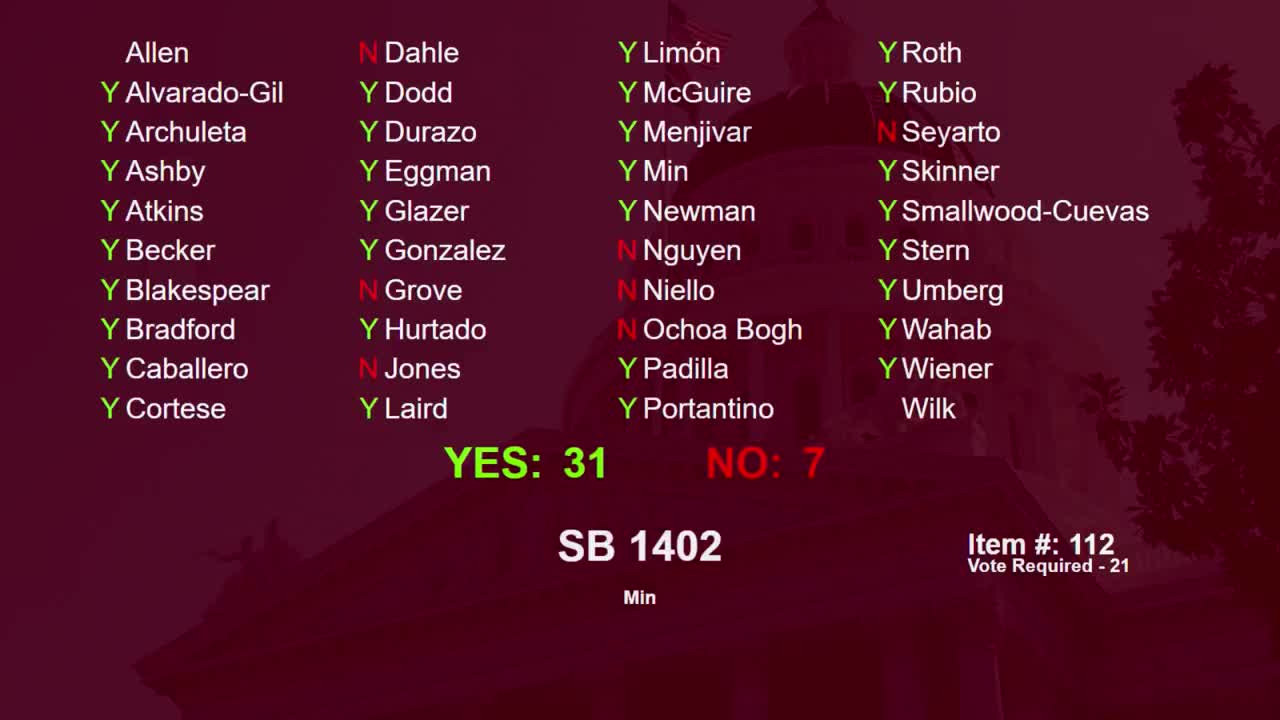
Bill Author

Bill Co-Author(s):