SB 977: County of San Luis Obispo Redistricting Commission.
- Session Year: 2023-2024
- House: Senate
- Latest Version Date: 2024-09-22
Current Status:
Passed
(2024-09-22: Chaptered by Secretary of State. Chapter 450, Statutes of 2024.)
Introduced
In Committee
First Chamber
In Committee
Second Chamber
Enacted
What does this bill do?
This bill gives the job of drawing supervisorial district lines in San Luis Obispo County to a new independent Citizens Redistricting Commission. The commission will have 11 members chosen to reflect the county’s political and geographic diversity and must meet qualifications meant to ensure impartiality and legal knowledge. It must follow federal and state rules (including equal population and the Voting Rights Act), hold multiple public hearings with outreach and translation, make its data public, and enforce conflict‑of‑interest and conduct limits for members.
The summary is provided by generative AI which can make mistakes. For original language, please view the details in the table below.
Existing law requires the board of supervisors of each county, following each decennial federal census, and using that census as a basis, to adjust the boundaries of any or all of the supervisorial districts of the county so that the districts are as nearly equal in population as possible and comply with applicable federal law, and specifies the procedures the board of supervisors must follow in adjusting those boundaries. Existing law establishes redistricting commissions in certain counties, and charges them with adjusting the supervisorial district boundaries for those counties.
This bill would establish the Citizens Redistricting Commission in the County of San Luis Obispo, which would be charged with adjusting the boundary lines of the districts of the Board of Supervisors of the County of San Luis Obispo in accordance with specified criteria. The commission would consist of 11 members who meet specified qualifications. The bill would require each commission member to attend all public hearings and meetings of the commission to the greatest extent practicable, and would create specified procedures by which the commission may remove a member for substantial neglect of duty, gross misconduct of office, inability to discharge the duties of the office, or if it is later discovered that the commission member did not meet the required qualifications at the time of appointment or no longer meets those qualifications while serving on the commission. The bill would provide that if the commission is unable to act because it does not have 7 voting members to constitute a quorum, then the county elections official must fill the vacancies to bring the commission to 7 voting members, as specified. By increasing the duties on local officials, the bill would impose a state-mandated local program.
This bill would make legislative findings and declarations as to the necessity of a special statute for the County of San Luis Obispo.
The California Constitution requires the state to reimburse local agencies and school districts for certain costs mandated by the state. Statutory provisions establish procedures for making that reimbursement.
This bill would provide that, if the Commission on State Mandates determines that the bill contains costs mandated by the state, reimbursement for those costs shall be made pursuant to the statutory provisions noted above.
Existing law requires the board of supervisors of each county, following each decennial federal census, and using that census as a basis, to adjust the boundaries of any or all of the supervisorial districts of the county so that the districts are as nearly equal in population as possible and comply with applicable federal law, and specifies the procedures the board of supervisors must follow in adjusting those boundaries. Existing law establishes redistricting commissions in certain counties, and charges them with adjusting the supervisorial district boundaries for those counties.
This bill would establish the Citizens Redistricting Commission in the County of San Luis Obispo, which would be charged with adjusting the boundary lines of the districts of the Board of Supervisors of the County of San Luis Obispo in accordance with specified criteria. The commission would consist of 11 members who meet specified qualifications. The bill would require each commission member to attend all public hearings and meetings of the commission, except as specified, commission to the greatest extent practicable, and would create specified procedures by which the commission may remove a member for substantial neglect of duty, gross misconduct of office, inability to discharge the duties of the office, or if it is later discovered that the commission member did not meet the required qualifications at the time of appointment or no longer meets those qualifications while serving on the commission. The bill would provide that if the commission is unable to act because it does not have 7 voting members to constitute a quorum, then the county elections official must fill the vacancies to bring the commission to 7 voting members, as specified. By increasing the duties on local officials, the bill would impose a state-mandated local program.
This bill would make legislative findings and declarations as to the necessity of a special statute for the County of San Luis Obispo.
The California Constitution requires the state to reimburse local agencies and school districts for certain costs mandated by the state. Statutory provisions establish procedures for making that reimbursement.
This bill would provide that, if the Commission on State Mandates determines that the bill contains costs mandated by the state, reimbursement for those costs shall be made pursuant to the statutory provisions noted above.
Existing law requires the board of supervisors of each county, following each decennial federal census, and using that census as a basis, to adjust the boundaries of any or all of the supervisorial districts of the county so that the districts are as nearly equal in population as possible and comply with applicable federal law, and specifies the procedures the board of supervisors must follow in adjusting those boundaries. Existing law establishes redistricting commissions in certain counties, and charges them with adjusting the supervisorial district boundaries for those counties.
This bill would establish the Citizens Redistricting Commission in the County of San Luis Obispo, which would be charged with adjusting the boundary lines of the districts of the Board of Supervisors of the County of San Luis Obispo in accordance with specified criteria. The commission would consist of 11 members who meet specified qualifications. The bill would require each commission member to attend all public hearings and meetings of the commission, except as specified, and would create specified procedures by which the commission may remove a member for substantial neglect of duty, gross misconduct of office, inability to discharge the duties of the office, or if it is later discovered that the commission member did not meet the required qualifications at the time of appointment or no longer meets those qualifications while serving on the commission. The bill would provide that if the commission is unable to act because it does not have 7 voting members to constitute a quorum, then the county elections official must fill the vacancies to bring the commission to 7 voting members, as specified. By increasing the duties on local officials, the bill would impose a state-mandated local program.
This bill would make legislative findings and declarations as to the necessity of a special statute for the County of San Luis Obispo.
The California Constitution requires the state to reimburse local agencies and school districts for certain costs mandated by the state. Statutory provisions establish procedures for making that reimbursement.
This bill would provide that, if the Commission on State Mandates determines that the bill contains costs mandated by the state, reimbursement for those costs shall be made pursuant to the statutory provisions noted above.
Existing law requires the board of supervisors of each county, following each decennial federal census, and using that census as a basis, to adjust the boundaries of any or all of the supervisorial districts of the county so that the districts are as nearly equal in population as possible and comply with applicable federal law, and specifies the procedures the board of supervisors must follow in adjusting those boundaries. Existing law establishes redistricting commissions in certain counties, and charges them with adjusting the supervisorial district boundaries for those counties.
This bill would establish the Citizens Redistricting Commission in the County of San Luis Obispo, which would be charged with adjusting the boundary lines of the districts of the Board of Supervisors of the County of San Luis Obispo in accordance with specified criteria. The commission would consist of 11 voting members and 2 nonvoting, alternate members who meet specified qualifications. The bill would require each commission member to attend all public hearings and meetings of the commission, except as specified, and would create specified procedures by which the commission may remove a member for substantial neglect of duty, gross misconduct of office, inability to discharge the duties of the office, or if it is later discovered that the commission member did not meet the required qualifications at the time of appointment or no longer meets those qualifications while serving on the commission. The bill would provide that if the commission is unable to act because it does not have 7 voting members to constitute a quorum, then the county elections official must fill the vacancies to bring the commission to 7 voting members, as specified. By increasing the duties on local officials, the bill would impose a state-mandated local program.
This bill would make legislative findings and declarations as to the necessity of a special statute for the County of San Luis Obispo.
The California Constitution requires the state to reimburse local agencies and school districts for certain costs mandated by the state. Statutory provisions establish procedures for making that reimbursement.
This bill would provide that, if the Commission on State Mandates determines that the bill contains costs mandated by the state, reimbursement for those costs shall be made pursuant to the statutory provisions noted above.
Existing law requires the board of supervisors of each county, following each decennial federal census, and using that census as a basis, to adjust the boundaries of any or all of the supervisorial districts of the county so that the districts are as nearly equal in population as possible and comply with applicable federal law, and specifies the procedures the board of supervisors must follow in adjusting those boundaries. Existing law establishes redistricting commissions in certain counties, and charges them with adjusting the supervisorial district boundaries for those counties.
This bill would state the intent of the Legislature to establish an independent redistricting commission in the County of San Luis Obispo.This bill would establish the Citizens Redistricting Commission in the County of San Luis Obispo, which would be charged with adjusting the boundary lines of the districts of the Board of Supervisors of the County of San Luis Obispo in accordance with specified criteria. The commission would consist of 11 voting members and 2 nonvoting, alternate members who meet specified qualifications. The bill would require each commission member to attend all public hearings and meetings of the commission, except as specified, and would create specified procedures by which the commission may remove a member for substantial neglect of duty, gross misconduct of office, inability to discharge the duties of the office, or if it is later discovered that the commission member did not meet the required qualifications at the time of appointment or no longer meets those qualifications while serving on the commission. The bill would provide that if the commission is unable to act because it does not have 7 voting members to constitute a quorum, then the county elections official must fill the vacancies to bring the commission to 7 voting members, as specified. By increasing the duties on local officials, the bill would impose a state-mandated local program.
This bill would make legislative findings and declarations as to the necessity of a special statute for the County of San Luis Obispo.
The California Constitution requires the state to reimburse local agencies and school districts for certain costs mandated by the state. Statutory provisions establish procedures for making that reimbursement.
This bill would provide that, if the Commission on State Mandates determines that the bill contains costs mandated by the state, reimbursement for those costs shall be made pursuant to the statutory provisions noted above.
Existing law requires the board of supervisors of each county, following each decennial federal census, and using that census as a basis, to adjust the boundaries of any or all of the supervisorial districts of the county so that the districts are as nearly equal in population as possible and comply with applicable federal law, and specifies the procedures the board of supervisors must follow in adjusting those boundaries. Existing law establishes redistricting commissions in certain counties, and charges them with adjusting the supervisorial district boundaries for those counties.
This bill would state the intent of the Legislature to establish an independent redistricting commission in the County of San Luis Obispo.
As used in this chapter, the following terms have the following meanings:
(a)Board means the Board of Supervisors of the County of San Luis Obispo.
(b)Commission means the Citizens Redistricting Commission in the County of San Luis Obispo established pursuant to Section 21521.
21521.There is, in the County of San Luis Obispo, a Citizens Redistricting Commission. In the year following the year in which the decennial federal census is taken, the commission shall adjust the boundary lines of the supervisorial districts of the board in accordance with this chapter.
21522.(a)The commission shall be created no later than December 31, 2030, and in each year ending in the number zero thereafter.
(b)The selection process is designed to produce a commission that is independent from the influence of the board and reasonably representative of the countys diversity.
(c)The commission shall consist of 11 members. The political party preferences of the commission members, as shown on the members most recent affidavits of registration, shall be as proportional as possible to the total number of voters who are registered with each political party in the County of San Luis Obispo, or who decline to state or do not indicate a party preference, as determined by registration at the most recent statewide election. However, the political party or no party preferences of the commission members are not required to be exactly the same as the proportion of political party and no party preferences among the registered voters of the county. At least one commission member shall reside in each of the five existing supervisorial districts of the board.
(d)Each commission member shall meet all of the following qualifications:
(1)Be a resident of the County of San Luis Obispo.
(2)Be a voter who has been continuously registered in the County of San Luis Obispo with the same political party or no party preference and who has not changed their political party or no party preference for five or more years immediately preceding the date of their appointment to the commission.
(3)Have voted in at least one of the last three statewide elections immediately preceding their application to be a member of the commission.
(4)Be subject to and meet the conditions set forth in subdivisions (c) and (d) of Section 23003.
(5)Possess experience that demonstrates analytical skills relevant to the redistricting process and voting rights, and possess an ability to comprehend and apply the applicable state and federal legal requirements.
(6)Possess experience that demonstrates an ability to be impartial.
(7)Possess experience that demonstrates an appreciation for the diverse demographics and geography of the County of San Luis Obispo.
(e)An interested person meeting the qualifications specified in subdivision (d) may submit an application to the county elections official to be considered for membership on the commission. The county elections official shall review the applications and eliminate applicants who do not meet the specified qualifications.
(f)(1)From the pool of qualified applicants, the county elections official shall select up to 60 qualified applicants, taking into account the requirements described in subdivision (c). The county elections official shall make public the names of up to 60 qualified applicants for at least 30 days. The county elections official shall not communicate with a member of the board, or an agent for a member of the board, about any matter related to the nomination process or applicants before the publication of the list of the up to 60 qualified applicants.
(2)During the period described in paragraph (1), the county elections official may eliminate any of the previously selected applicants if the county elections official becomes aware that the applicant does not meet the qualifications specified in subdivision (d).
(g)(1)After complying with the requirements of subdivision (f), the county elections official shall create a subpool for each of the five existing supervisorial districts of the board.
(2)At a regularly scheduled meeting of the board, the clerk of the board or designee of the County of San Luis Obispo shall conduct a random drawing to select one commissioner from each of the five subpools established by the county elections official.
(h)(1)The five commissioners selected under subdivision (g), at a separate public meeting, shall review the remaining names of applicants, interview the finalists for appointment, allow public comment, and appoint six additional members to the commission, without respect to the subpools.
(2)In order to be appointed, an applicant must receive the vote of at least three of the five selected commissioners.
(3)The six additional commissioners shall be chosen based on relevant experience, analytical skills, and ability to be impartial, and to ensure that the commission reflects the countys diversity, including racial, ethnic, geographic, and gender diversity. However, formulas or specific ratios shall not be applied for this purpose. The five selected commissioners shall also consider political party preference, selecting applicants so that the political party preference of the members of the commission complies with subdivision (c).
21523.(a)A commission member shall apply this chapter in a manner that is impartial and that reinforces public confidence in the integrity of the redistricting process.
(b)The term of office of each member of the commission expires upon the appointment of the first member of the succeeding commission.
(c)Seven members of the commission shall constitute a quorum. Seven or more affirmative votes shall be required for any official action.
(d)To the greatest extent practicable, each commission member shall be present for all public hearings and internal meetings of the commission.
(e)(1)The commission shall require a consultant, before delivering advice to the commission or a commission member, to disclose to the commission potential or actual conflicts of interest.
(2)For the purposes of this subdivision, consultant means a person, whether or not compensated, retained to advise the commission or a commission member regarding the redistricting process.
(f)(1)Except as permitted by paragraph (2), commissioners shall not communicate with any individual or organization regarding redistricting matters outside of a public meeting.
(2)This subdivision does not do either of the following:
(A)Restrict the commission from communicating with the staff of the legislative body of the local jurisdiction regarding administrative matters of the commission.
(B)Restrict a commissioner from directly communicating with another commissioner, commission staff, legal counsel, or consultants retained by the commission.
(g)(1)The commission shall create bylaws or other rules of procedure for the purpose of conducting orderly meetings and communication.
(2)The bylaws shall include provisions to address both of the following:
(A)How the commission will fill a vacancy following the resignation or removal of a commission member.
(B)The process for the commission to remove a commission member that is consistent with Section 21526.
(h)Each commission member shall be a designated employee for purposes of the conflict of interest code adopted by the County of San Luis Obispo pursuant to Article 3 (commencing with Section 87300) of Chapter 7 of Title 9 of the Government Code.
21524.(a)The commission shall establish single-member supervisorial districts for the board pursuant to a mapping process using the following criteria as set forth in the following order of priority:
(1)(A)Districts shall comply with the United States Constitution and each district shall have a reasonably equal population with other districts for the board, except where deviation is required to comply with the federal Voting Rights Act of 1965 (52 U.S.C. Sec. 10101 et seq.) or allowable by law.
(B)Population equality shall be based on the total population of residents of the county as determined by the most recent federal decennial census for which the redistricting data described in Public Law 94-171 are available.
(C)Notwithstanding subparagraph (B), an incarcerated person, as that term is used in Section 21003, shall not be counted towards the countys population, except for an incarcerated person whose last known place of residence may be assigned to a census block in the county, if information about the last known place of residence for incarcerated persons is included in the computerized database for redistricting that is developed in accordance with subdivision (b) of Section 8253 of the Government Code, and that database is made publicly available.
(2)Districts shall comply with the federal Voting Rights Act of 1965 (52 U.S.C. Sec. 10101 et seq.).
(3)The commission shall adopt election district boundaries using the criteria set forth in Section 21130.
(b)The commission shall comply with the Ralph M. Brown Act (Chapter 9 (commencing with Section 54950) of Part 1 of Division 2 of Title 5 of the Government Code).
(c)Before the commission draws a map, the commission shall conduct at least five public hearings, to take place over a period of no fewer than 30 days, with at least one public hearing held in each supervisorial district.
(d)In the event any state or local health order prohibits large gatherings, the commission may modify the location of the hearings, including through the use of virtual hearings that use technology to permit remote viewing and participation, to the extent required to comply with public health requirements. If the commission modifies the location of a hearing, it shall provide opportunities to view and listen to proceedings by video, to listen to proceedings by phone, and to provide public comment by phone and in writing with no limitation on the number of commenters. The commission shall, to the greatest extent practicable, provide an opportunity for in-person participation for at least one hearing in each supervisorial district. Methods for providing in-person participation may include setting up multiple rooms with audiovisual connections to the hearing, allowing community members to make appointments to make public comment, providing personal protective equipment, or holding hearings in outdoor spaces.
(e)After the commission draws a draft map, the commission shall do both of the following:
(1)Post the map for public comment on the website of the County of San Luis Obispo.
(2)Conduct at least three public hearings to take place over a period of no fewer than 30 days.
(f)The commission shall establish and make available to the public a calendar of all public hearings described in subdivisions (c) and (e). Hearings shall be scheduled at various times and days of the week to accommodate a variety of work schedules and to reach as large an audience as possible.
(g)Notwithstanding Section 54954.2 of the Government Code, the commission shall post the agenda for the public hearings described in subdivisions (c) and (e) at least seven days before the hearings. The agenda for a meeting required by subdivision (e) shall include a copy of the draft map.
(h)(1)The commission shall arrange for the live translation of a hearing held pursuant to this chapter in an applicable language if a request for translation is made at least 72 hours before the hearing.
(2)For purposes of this section, an applicable language means a language for which the number of residents of the County of San Luis Obispo who are members of a language minority is greater than or equal to 3 percent of the total voting age residents of the county.
(i)The commission shall take steps to encourage county residents to participate in the redistricting public review process. These steps may include:
(1)Providing information through media, social media, and public service announcements.
(2)Coordinating with community organizations.
(3)Posting information on the website of the County of San Luis Obispo that explains the redistricting process and includes a notice of each public hearing and the procedures for testifying during a hearing or submitting written testimony directly to the commission.
(j)The commission shall ensure that all outreach materials, public notifications, agendas, and content on its website, including instructions for testifying and submitting written public testimony, are translated in all applicable languages.
(k)The board shall take all steps necessary to ensure that a complete and accurate computerized database is available for redistricting, and that procedures are in place to provide to the public ready access to redistricting data and computer software equivalent to what is available to the commission members.
(l)The board shall provide for reasonable funding and staffing for the commission.
(m)All records of the commission relating to redistricting, and all data considered by the commission in drawing a draft map or the final map, are public records.
(n)(1)The commission shall adopt a redistricting plan adjusting the boundaries of the supervisorial districts and shall file the plan with the county elections official by the map adoption deadline set forth in subdivision (a) of Section 21140. The commission shall not release a draft map before the date set forth in paragraph (3) of subdivision (f) of Section 21160.
(2)The plan shall be subject to referendum in the same manner as ordinances.
(3)The commission shall issue, with the final map, a report that explains the basis on which the commission made its decisions in achieving compliance with the criteria described in subdivision (a).
21525.A commission member shall not do any of the following:
(a)While serving on the commission, endorse, work for, volunteer for, or make a campaign contribution to a candidate for an elective office of the County of San Luis Obispo.
(b)Be a candidate for an elective office of the County of San Luis Obispo if either of the following is true:
(1)Less than five years has elapsed since the date of the members appointment to the commission.
(2)The election for that office will be conducted using district boundaries that were adopted by the commission on which the member served, and those district boundaries have not been subsequently readopted by a commission after the end of the members term on the commission.
(c)For four years commencing with the date of the persons appointment to the commission:
(1)Accept employment as a staff member of, or consultant to, an elected official or candidate for elective office of the County of San Luis Obispo.
(2)Receive a noncompetitively bid contract with the County of San Luis Obispo.
(3)Register as a lobbyist for the County of San Luis Obispo.
(d)For two years commencing with the date of the persons appointment to the commission, accept an appointment to an office of the County of San Luis Obispo.
21526.(a)The commission may only remove a commission member for substantial neglect of duty, gross misconduct in office, causing the commission to be unable to discharge its duties with seven affirmative votes, or if it is later discovered that the commission member did not meet the required qualifications, as set forth in subdivision (d) of Section 21522, at the time of appointment or if the commission member no longer meets those required qualifications while serving on the commission.
(1)A commission member who is subject to removal shall not vote on their own removal.
(b)Prior to removal pursuant to subdivision (a), a commission member is entitled to receive all of the following from the commission:
(1)The reasons for their proposed removal, in writing.
(2)At least one weeks written notice of the public meeting where the commission will vote on their proposed removal.
(3)The opportunity to respond to or rebut the reasons for their removal in writing and at the public meeting described in paragraph (2).
(c)The commission may employ legal counsel in seeking removal of a commission member pursuant to this section.
(d)The decision of the commission to remove a member pursuant to this section is final, nonappealable, and is not subject to judicial review.
21527.If the commission is unable to act because it has fewer than seven voting commission members, within one month of such determination that the commission cannot act, the county elections official shall select a replacement from the pool of remaining qualified candidates from the initial commission member selection process. To the greatest extent practicable, the newly selected commission member shall have the same political party preference as the commission member who vacated their position.
SEC. 2.The Legislature finds and declares that a special statute is necessary and that a general statute cannot be made applicable within the meaning of Section 16 of Article IV of the California Constitution because of the unique circumstances facing the County of San Luis Obispo.
SEC. 3.If the Commission on State Mandates determines that this act contains costs mandated by the state, reimbursement to local agencies and school districts for those costs shall be made pursuant to Part 7 (commencing with Section 17500) of Division 4 of Title 2 of the Government Code.
As used in this chapter, the following terms have the following meanings:
(a)Board means the Board of Supervisors of the County of San Luis Obispo.
(b)Commission means the Citizens Redistricting Commission in the County of San Luis Obispo established pursuant to Section 21521.
21521.There is, in the County of San Luis Obispo, a Citizens Redistricting Commission. In the year following the year in which the decennial federal census is taken, the commission shall adjust the boundary lines of the supervisorial districts of the board in accordance with this chapter.
21522.(a)The commission shall be created no later than December 31, 2030, and in each year ending in the number zero thereafter.
(b)The selection process is designed to produce a commission that is independent from the influence of the board and reasonably representative of the countys diversity.
(c)The commission shall consist of 11 members. The political party preferences of the commission members, as shown on the members most recent affidavits of registration, shall be as proportional as possible to the total number of voters who are registered with each political party in the County of San Luis Obispo, or who decline to state or do not indicate a party preference, as determined by registration at the most recent statewide election. However, the political party or no party preferences of the commission members are not required to be exactly the same as the proportion of political party and no party preferences among the registered voters of the county. At least one commission member shall reside in each of the five existing supervisorial districts of the board.
(d)Each commission member shall meet all of the following qualifications:
(1)Be a resident of the County of San Luis Obispo.
(2)Be a voter who has been continuously registered in the County of San Luis Obispo with the same political party or no party preference and who has not changed their political party or no party preference for five or more years immediately preceding the date of their appointment to the commission.
(3)Have voted in at least one of the last three statewide elections immediately preceding their application to be a member of the commission.
(4)Be subject to and meet the conditions set forth in subdivisions (c) and (d) of Section 23003.
(5)Possess experience that demonstrates analytical skills relevant to the redistricting process and voting rights, and possess an ability to comprehend and apply the applicable state and federal legal requirements.
(6)Possess experience that demonstrates an ability to be impartial.
(7)Possess experience that demonstrates an appreciation for the diverse demographics and geography of the County of San Luis Obispo.
(e)An interested person meeting the qualifications specified in subdivision (d) may submit an application to the county elections official to be considered for membership on the commission. The county elections official shall review the applications and eliminate applicants who do not meet the specified qualifications.
(f)(1)From the pool of qualified applicants, the county elections official shall select up to 60 qualified applicants, taking into account the requirements described in subdivision (c). The county elections official shall make public the names of up to 60 qualified applicants for at least 30 days. The county elections official shall not communicate with a member of the board, or an agent for a member of the board, about any matter related to the nomination process or applicants before the publication of the list of the up to 60 qualified applicants.
(2)During the period described in paragraph (1), the county elections official may eliminate any of the previously selected applicants if the county elections official becomes aware that the applicant does not meet the qualifications specified in subdivision (d).
(g)(1)After complying with the requirements of subdivision (f), the county elections official shall create a subpool for each of the five existing supervisorial districts of the board.
(2)At a regularly scheduled meeting of the board, the clerk of the board or designee of the County of San Luis Obispo shall conduct a random drawing to select one commissioner from each of the five subpools established by the county elections official.
(h)(1)The five commissioners selected under subdivision (g), at a separate public meeting, shall review the remaining names of applicants, interview the finalists for appointment, allow public comment, and appoint six additional members to the commission, without respect to the subpools.
(2)In order to be appointed, an applicant must receive the vote of at least three of the five selected commissioners.
(3)The six additional commissioners shall be chosen based on relevant experience, analytical skills, and ability to be impartial, and to ensure that the commission reflects the countys diversity, including racial, ethnic, geographic, and gender diversity. However, formulas or specific ratios shall not be applied for this purpose. The five selected commissioners shall also consider political party preference, selecting applicants so that the political party preference of the members of the commission complies with subdivision (c).
21523.(a)A commission member shall apply this chapter in a manner that is impartial and that reinforces public confidence in the integrity of the redistricting process.
(b)The term of office of each member of the commission expires upon the appointment of the first member of the succeeding commission.
(c)Seven members of the commission shall constitute a quorum. Seven or more affirmative votes shall be required for any official action.
(d)Each To the greatest extent practicable, each commission member shall be present for all public hearings and internal meetings of the commission. Except in emergency situations, a commission member who misses an excessive number of public hearings and meetings may be subject to removal from the commission pursuant to Section 21526. For the purposes of this subdivision a commission member misses an excessive number of public hearings and meetings by missing a significant number of meetings such that it interferes with the commissions work and the commission members ability to meaningfully participate in discussions and deliberation.
(e)(1)The commission shall require a consultant, before delivering advice to the commission or a commission member, to disclose to the commission potential or actual conflicts of interest.
(2)For the purposes of this subdivision, consultant means a person, whether or not compensated, retained to advise the commission or a commission member regarding the redistricting process.
(f)Commissioners (1)Except as permitted by paragraph (2), commissioners shall not communicate with any individual or organization regarding redistricting matters outside of a public meeting. have ex parte communications about district lines and the drawing of maps with third parties, including members of the public, incumbent elected officials, candidates, or political staff. For the purposes of this subdivision, ex parte communications are communications that occur outside of the open public meeting, hearing, and outreach process.
(2)This subdivision does not do either of the following:
(A)Restrict the commission from communicating with the staff of the legislative body of the local jurisdiction regarding administrative matters of the commission.
(B)Restrict a commissioner from directly communicating with another commissioner, commission staff, legal counsel, or consultants retained by the commission.
(g)(1)The commission shall create bylaws or other rules of procedure for the purpose of conducting orderly meetings and communication.
(2)The bylaws shall include provisions to address how the committee both of the following: will
(A)How the commission will fill a vacancy following the resignation or removal of a commission member. member.
(B)The process for the commission to remove a commission member that is consistent with Section 21526.
(h)Each commission member shall be a designated employee for purposes of the conflict of interest code adopted by the County of San Luis Obispo pursuant to Article 3 (commencing with Section 87300) of Chapter 7 of Title 9 of the Government Code.
21524.(a)The commission shall establish single-member supervisorial districts for the board pursuant to a mapping process using the following criteria as set forth in the following order of priority:
(1)(A)Districts shall comply with the United States Constitution and each district shall have a reasonably equal population with other districts for the board, except where deviation is required to comply with the federal Voting Rights Act of 1965 (52 U.S.C. Sec. 10101 et seq.) or allowable by law.
(B)Population equality shall be based on the total population of residents of the county as determined by the most recent federal decennial census for which the redistricting data described in Public Law 94-171 are available.
(C)Notwithstanding subparagraph (B), an incarcerated person, as that term is used in Section 21003, shall not be counted towards the countys population, except for an incarcerated person whose last known place of residence may be assigned to a census block in the county, if information about the last known place of residence for incarcerated persons is included in the computerized database for redistricting that is developed in accordance with subdivision (b) of Section 8253 of the Government Code, and that database is made publicly available.
(2)Districts shall comply with the federal Voting Rights Act of 1965 (52 U.S.C. Sec. 10101 et seq.).
(3)The commission shall adopt election district boundaries using the criteria set forth in Section 21130.
(b)The commission shall comply with the Ralph M. Brown Act (Chapter 9 (commencing with Section 54950) of Part 1 of Division 2 of Title 5 of the Government Code).
(c)Before the commission draws a map, the commission shall conduct at least five public hearings, to take place over a period of no fewer than 30 days, with at least one public hearing held in each supervisorial district.
(d)In the event any state or local health order prohibits large gatherings, the commission may modify the location of the hearings, including through the use of virtual hearings that use technology to permit remote viewing and participation, to the extent required to comply with public health requirements. If the commission modifies the location of a hearing, it shall provide opportunities to view and listen to proceedings by video, to listen to proceedings by phone, and to provide public comment by phone and in writing with no limitation on the number of commenters. The commission shall, to the greatest extent practicable, provide an opportunity for in-person participation for at least one hearing in each supervisorial district. Methods for providing in-person participation may include setting up multiple rooms with audiovisual connections to the hearing, allowing community members to make appointments to make public comment, providing personal protective equipment, or holding hearings in outdoor spaces.
(e)After the commission draws a draft map, the commission shall do both of the following:
(1)Post the map for public comment on the website of the County of San Luis Obispo.
(2)Conduct at least three public hearings to take place over a period of no fewer than 30 days.
(f)The commission shall establish and make available to the public a calendar of all public hearings described in subdivisions (c) and (e). Hearings shall be scheduled at various times and days of the week to accommodate a variety of work schedules and to reach as large an audience as possible.
(g)Notwithstanding Section 54954.2 of the Government Code, the commission shall post the agenda for the public hearings described in subdivisions (c) and (e) at least seven days before the hearings. The agenda for a meeting required by subdivision (e) shall include a copy of the draft map.
(h)(1)The commission shall arrange for the live translation of a hearing held pursuant to this chapter in an applicable language if a request for translation is made at least 72 hours before the hearing.
(2)For purposes of this section, an applicable language means a language for which the number of residents of the County of San Luis Obispo who are members of a language minority is greater than or equal to 3 percent of the total voting age residents of the county.
(i)The commission shall take steps to encourage county residents to participate in the redistricting public review process. These steps may include:
(1)Providing information through media, social media, and public service announcements.
(2)Coordinating with community organizations.
(3)Posting information on the website of the County of San Luis Obispo that explains the redistricting process and includes a notice of each public hearing and the procedures for testifying during a hearing or submitting written testimony directly to the commission.
(j)The commission shall ensure that all outreach materials, public notifications, agenda, agendas, and content on its website, including instructions for testifying and submitting written public testimony, are translated in all applicable languages.
(k)The board shall take all steps necessary to ensure that a complete and accurate computerized database is available for redistricting, and that procedures are in place to provide to the public ready access to redistricting data and computer software equivalent to what is available to the commission members.
(l)The board shall provide for reasonable funding and staffing for the commission.
(m)All records of the commission relating to redistricting, and all data considered by the commission in drawing a draft map or the final map, are public records.
(n)(1)The commission shall adopt a redistricting plan adjusting the boundaries of the supervisorial districts and shall file the plan with the county elections official by the map adoption deadline set forth in subdivision (a) of Section 21140. The commission shall not release a draft map before the date set forth in paragraph (3) of subdivision (f) of Section 21160.
(2)The plan shall be subject to referendum in the same manner as ordinances.
(3)The commission shall issue, with the final map, a report that explains the basis on which the commission made its decisions in achieving compliance with the criteria described in subdivision (a).
21525.A commission member shall not do any of the following:
(a)While serving on the commission, endorse, work for, volunteer for, or make a campaign contribution to a candidate for an elective office of the County of San Luis Obispo.
(b)Be a candidate for an elective office of the County of San Luis Obispo if any either of the following is true:
(1)Less than five years has elapsed since the date of the members appointment to the commission.
(2)The election for that office will be conducted using district boundaries that were adopted by the commission on which the member served, and those district boundaries have not been subsequently readopted by a commission after the end of the members term on the commission.
(3)The election for that office will be conducted using district boundaries that were adopted by a legislative body pursuant to a recommendation by the commission on which the member served, and those district boundaries have not been subsequently readopted by a legislative body pursuant to a recommendation by a commission after the end of the members term on the commission.(c)For four years commencing with the date of the persons appointment to the commission:
(1)Accept employment as a staff member of, or consultant to, an elected official or candidate for elective office of the County of San Luis Obispo.
(2)Receive a noncompetitively bid contract with the County of San Luis Obispo.
(3)Register as a lobbyist for the County of San Luis Obispo.
(d)For two years commencing with the date of the persons appointment to the commission, accept an appointment to an office of the County of San Luis Obispo.
21526.(a)The commission may only remove a commission member for substantial neglect of duty, gross misconduct in office, causing the commission to be unable to discharge its duties with seven affirmative votes, or if it is later discovered that the commission member did not meet the required qualifications, as set forth in subdivision (d) of Section 21522, at the time of appointment or if the commission member no longer meets those required qualifications while serving on the commission. At least two affirmative votes to remove a member shall be from commission members of one political party, and at least two affirmative votes to remove a member shall be from commission members of one other political party.
(1)A commission member who is subject to removal shall not vote on their own removal.
(b)Prior to removal pursuant to subdivision (a), a commission member is entitled to receive all of the following from the commission:
(1)The reasons for their proposed removal, in writing.
(2)At least one weeks written notice of the public meeting where the commission will vote on their proposed removal.
(3)The opportunity to respond to or rebut the reasons for their removal in writing and at the public meeting described in paragraph (2).
(c)The commission may employ legal counsel in seeking removal of a commission member pursuant to this section.
(d)The decision of the commission to remove a member pursuant to this section is final, nonappealable, and is not subject to judicial review.
21527.If the commission is unable to act because it has fewer than seven voting commission members, within one month of such determination that the commission cannot act, the county elections official shall select a replacement from the pool of remaining qualified candidates from the initial commission member selection process. The To the greatest extent practicable, the newly selected commission member shall have the same political party preference as the commission member who vacated their position.
SEC. 2.The Legislature finds and declares that a special statute is necessary and that a general statute cannot be made applicable within the meaning of Section 16 of Article IV of the California Constitution because of the unique circumstances facing the County of San Luis Obispo.
SEC. 3.If the Commission on State Mandates determines that this act contains costs mandated by the state, reimbursement to local agencies and school districts for those costs shall be made pursuant to Part 7 (commencing with Section 17500) of Division 4 of Title 2 of the Government Code.
As used in this chapter, the following terms have the following meanings:
(a)Board means the Board of Supervisors of the County of San Luis Obispo.
(b)Commission means the Citizens Redistricting Commission in the County of San Luis Obispo established pursuant to Section 21521.
21521.There is, in the County of San Luis Obispo, a Citizens Redistricting Commission. In the year following the year in which the decennial federal census is taken, the commission shall adjust the boundary lines of the supervisorial districts of the board in accordance with this chapter.
21522.(a)The commission shall be created no later than December 31, 2030, and in each year ending in the number zero thereafter.
(b)The selection process is designed to produce a commission that is independent from the influence of the board and reasonably representative of the countys diversity.
(c)The commission shall consist of 11 members. The political party preferences of the commission members, as shown on the members most recent affidavits of registration, shall be as proportional as possible to the total number of voters who are registered with each political party in the County of San Luis Obispo, or who decline to state or do not indicate a party preference, as determined by registration at the most recent statewide election. However, the political party or no party preferences of the commission members are not required to be exactly the same as the proportion of political party and no party preferences among the registered voters of the county. At least one commission member shall reside in each of the five existing supervisorial districts of the board.
(d)Each commission member shall meet all of the following qualifications:
(1)Be a resident of the County of San Luis Obispo.
(2)Be a voter who has been continuously registered in the County of San Luis Obispo with the same political party or no party preference and who has not changed their political party or no party preference for five or more years immediately preceding the date of their appointment to the commission.
(3)Have voted in at least one of the last three statewide elections immediately preceding their application to be a member of the commission.
(4)Be subject to and meet the conditions set forth in subdivisions (c) and (d) of Section 23003.
(5)Possess experience that demonstrates analytical skills relevant to the redistricting process and voting rights, and possess an ability to comprehend and apply the applicable state and federal legal requirements.
(6)Possess experience that demonstrates an ability to be impartial.
(7)Possess experience that demonstrates an appreciation for the diverse demographics and geography of the County of San Luis Obispo.
(e)An interested person meeting the qualifications specified in subdivision (d) may submit an application to the county elections official to be considered for membership on the commission. The county elections official shall review the applications and eliminate applicants who do not meet the specified qualifications.
(f)(1)From the pool of qualified applicants, the county elections official shall select up to 60 qualified applicants, taking into account the requirements described in subdivision (c). The county elections official shall make public the names of up to 60 qualified applicants for at least 30 days. The county elections official shall not communicate with a member of the board, or an agent for a member of the board, about any matter related to the nomination process or applicants before the publication of the list of the up to 60 qualified applicants.
(2)During the period described in paragraph (1), the county elections official may eliminate any of the previously selected applicants if the county elections official becomes aware that the applicant does not meet the qualifications specified in subdivision (d).
(g)(1)After complying with the requirements of subdivision (f), the county elections official shall create a subpool for each of the five existing supervisorial districts of the board.
(2)At a regularly scheduled meeting of the board, the clerk of the board or designee of the County of San Luis Obispo shall conduct a random drawing to select one commissioner from each of the five subpools established by the county elections official.
(h)(1)The five commissioners selected under subdivision (g), at a separate public meeting, shall review the remaining names of applicants, interview the finalists for appointment, allow public comment, and appoint six additional members to the commission, without respect to the subpools.
(2)In order to be appointed, an applicant must receive the vote of at least three of the five selected commissioners.
(3)The six additional commissioners shall be chosen based on relevant experience, analytical skills, and ability to be impartial, and to ensure that the commission reflects the countys diversity, including racial, ethnic, geographic, and gender diversity. However, formulas or specific ratios shall not be applied for this purpose. The five selected commissioners shall also consider political party preference, selecting applicants so that the political party preference of the members of the commission complies with subdivision (c).
21523.(a)A commission member shall apply this chapter in a manner that is impartial and that reinforces public confidence in the integrity of the redistricting process.
(b)The term of office of each member of the commission expires upon the appointment of the first member of the succeeding commission.
(c)Seven members of the commission shall constitute a quorum. Seven or more affirmative votes shall be required for any official action.
(d)Each commission member shall be present for all public hearings and internal meetings of the commission. Except in emergency situations, a commission member who misses an excessive number of public hearings and meetings may be subject to removal from the commission pursuant to Section 21526. For the purposes of this subdivision a commission member misses an excessive number of public hearings and meetings by missing a significant number of meetings such that it interferes with the commissions work and the commission members ability to meaningfully participate in discussions and deliberation.
(e)(1)The commission shall require a consultant, before delivering advice to the commission or a commission member, to disclose to the commission potential or actual conflicts of interest.
(2)For the purposes of this subdivision, consultant means a person, whether or not compensated, retained to advise the commission or a commission member regarding the redistricting process.
(f)Commissioners shall not have ex parte communications about district lines and the drawing of maps with third parties, including members of the public, incumbent elected officials, candidates, or political staff. For the purposes of this subdivision, ex parte communications are communications that occur outside of the open public meeting, hearing, and outreach process.
(g)(1)The commission shall create bylaws or other rules of procedure for the purpose of conducting orderly meetings and communication.
(2)The bylaws shall include provisions to address how the committee will fill a vacancy following the resignation or removal of a commission member.
(h)Each commission member shall be a designated employee for purposes of the conflict of interest code adopted by the County of San Luis Obispo pursuant to Article 3 (commencing with Section 87300) of Chapter 7 of Title 9 of the Government Code.
21524.(a)The commission shall establish single-member supervisorial districts for the board pursuant to a mapping process using the following criteria as set forth in the following order of priority:
(1)(A)Districts shall comply with the United States Constitution and each district shall have a reasonably equal population with other districts for the board, except where deviation is required to comply with the federal Voting Rights Act of 1965 (52 U.S.C. Sec. 10101 et seq.) or allowable by law.
(B)Population equality shall be based on the total population of residents of the county as determined by the most recent federal decennial census for which the redistricting data described in Public Law 94-171 are available.
(C)Notwithstanding subparagraph (B), an incarcerated person, as that term is used in Section 21003, shall not be counted towards the countys population, except for an incarcerated person whose last known place of residence may be assigned to a census block in the county, if information about the last known place of residence for incarcerated persons is included in the computerized database for redistricting that is developed in accordance with subdivision (b) of Section 8253 of the Government Code, and that database is made publicly available.
(2)Districts shall comply with the federal Voting Rights Act of 1965 (52 U.S.C. Sec. 10101 et seq.).
(3)The commission shall adopt election district boundaries using the criteria set forth in subdivisions (c) to (e), inclusive, of Section 21130.
(b)The commission shall comply with the Ralph M. Brown Act (Chapter 9 (commencing with Section 54950) of Part 1 of Division 2 of Title 5 of the Government Code).
(c)Before the commission draws a map, the commission shall conduct at least five public hearings, to take place over a period of no fewer than 30 days, with at least one public hearing held in each supervisorial district.
(d)In the event any state or local health order prohibits large gatherings, the commission may modify the location of the hearings, including through the use of virtual hearings that use technology to permit remote viewing and participation, to the extent required to comply with public health requirements. If the commission modifies the location of a hearing, it shall provide opportunities to view and listen to proceedings by video, to listen to proceedings by phone, and to provide public comment by phone and in writing with no limitation on the number of commenters. The commission shall, to the greatest extent practicable, provide an opportunity for in-person participation for at least one hearing in each supervisorial district. Methods for providing in-person participation may include setting up multiple rooms with audiovisual connections to the hearing, allowing community members to make appointments to make public comment, providing personal protective equipment, or holding hearings in outdoor spaces.
(e)After the commission draws a draft map, the commission shall do both of the following:
(1)Post the map for public comment on the website of the County of San Luis Obispo.
(2)Conduct at least three public hearings to take place over a period of no fewer than 30 days.
(f)The commission shall establish and make available to the public a calendar of all public hearings described in subdivisions (c) and (e). Hearings shall be scheduled at various times and days of the week to accommodate a variety of work schedules and to reach as large an audience as possible.
(g)Notwithstanding Section 54954.2 of the Government Code, the commission shall post the agenda for the public hearings described in subdivisions (c) and (e) at least seven days before the hearings. The agenda for a meeting required by subdivision (e) shall include a copy of the draft map.
(h)(1)The commission shall arrange for the live translation of a hearing held pursuant to this chapter in an applicable language if a request for translation is made at least 72 hours before the hearing.
(2)For purposes of this section, an applicable language means a language for which the number of residents of the County of San Luis Obispo who are members of a language minority is greater than or equal to 3 percent of the total voting age residents of the county.
(i)The commission shall take steps to encourage county residents to participate in the redistricting public review process. These steps may include:
(1)Providing information through media, social media, and public service announcements.
(2)Coordinating with community organizations.
(3)Posting information on the website of the County of San Luis Obispo that explains the redistricting process and includes a notice of each public hearing and the procedures for testifying during a hearing or submitting written testimony directly to the commission.
(j)The commission shall ensure that all outreach materials, public notifications, agenda, and content on its website, including instructions for testifying and submitting written public testimony, are translated in all applicable languages.
(k)The board shall take all steps necessary to ensure that a complete and accurate computerized database is available for redistricting, and that procedures are in place to provide to the public ready access to redistricting data and computer software equivalent to what is available to the commission members.
(l)The board shall provide for reasonable funding and staffing for the commission.
(m)All records of the commission relating to redistricting, and all data considered by the commission in drawing a draft map or the final map, are public records.
(n)(1)The commission shall adopt a redistricting plan adjusting the boundaries of the supervisorial districts and shall file the plan with the county elections official by the map adoption deadline set forth in subdivision (a) of Section 21140. The commission shall not release a draft map before the date set forth in paragraph (3) of subdivision (f) of Section 21160.
(2)The plan shall be subject to referendum in the same manner as ordinances.
(3)The commission shall issue, with the final map, a report that explains the basis on which the commission made its decisions in achieving compliance with the criteria described in subdivision (a).
21525.A commission member shall not do any of the following:
(a)While serving on the commission, endorse, work for, volunteer for, or make a campaign contribution to a candidate for an elective office of the County of San Luis Obispo.
(b)Be a candidate for an elective office of the County of San Luis Obispo if any of the following is true:
(1)Less than five years has elapsed since the date of the members appointment to the commission.
(2)The election for that office will be conducted using district boundaries that were adopted by the commission on which the member served, and those district boundaries have not been subsequently readopted by a commission after the end of the members term on the commission.
(3)The election for that office will be conducted using district boundaries that were adopted by a legislative body pursuant to a recommendation by the commission on which the member served, and those district boundaries have not been subsequently readopted by a legislative body pursuant to a recommendation by a commission after the end of the members term on the commission.
(c)For four years commencing with the date of the persons appointment to the commission:
(1)Accept employment as a staff member of, or consultant to, an elected official or candidate for elective office of the County of San Luis Obispo.
(2)Receive a noncompetitively bid contract with the County of San Luis Obispo.
(3)Register as a lobbyist for the County of San Luis Obispo.
(d)For two years commencing with the date of the persons appointment to the commission, accept an appointment to an office of the County of San Luis Obispo.
21526.(a)The commission may only remove a commission member for substantial neglect of duty, gross misconduct in office, causing the commission to be unable to discharge its duties with seven affirmative votes, or if it is later discovered that the commission member did not meet the required qualifications, as set forth in subdivision (d) of Section 21522, at the time of appointment or if the commission member no longer meets those required qualifications while serving on the commission. At least two affirmative votes to remove a member shall be from commission members of one political party, and at least two affirmative votes to remove a member shall be from commission members of one other political party.
(1)A commission member who is subject to removal shall not vote on their own removal.
(b)Prior to removal pursuant to subdivision (a), a commission member is entitled to receive all of the following from the commission:
(1)The reasons for their proposed removal, in writing.
(2)At least one weeks written notice of the public meeting where the commission will vote on their proposed removal.
(3)The opportunity to respond to or rebut the reasons for their removal in writing and at the public meeting described in paragraph (2).
(c)The commission may employ legal counsel in seeking removal of a commission member pursuant to this section.
(d)The decision of the commission to remove a member pursuant to this section is final, nonappealable, and is not subject to judicial review.
21527.If the commission is unable to act because it has fewer than seven voting commission members, within one month of such determination that the commission cannot act, the county elections official shall select a replacement from the pool of remaining qualified candidates from the initial commission member selection process. The newly selected commission member shall have the same political party preference as the commission member who vacated their position.
SEC. 2.The Legislature finds and declares that a special statute is necessary and that a general statute cannot be made applicable within the meaning of Section 16 of Article IV of the California Constitution because of the unique circumstances facing the County of San Luis Obispo.
SEC. 3.If the Commission on State Mandates determines that this act contains costs mandated by the state, reimbursement to local agencies and school districts for those costs shall be made pursuant to Part 7 (commencing with Section 17500) of Division 4 of Title 2 of the Government Code.
As used in this chapter, the following terms have the following meanings:
(a)Board means the Board of Supervisors of the County of San Luis Obispo.
(b)Commission means the Citizens Redistricting Commission in the County of San Luis Obispo established pursuant to Section 21521.
21521.There is, in the County of San Luis Obispo, a Citizens Redistricting Commission. In the year following the year in which the decennial federal census is taken, the commission shall adjust the boundary lines of the supervisorial districts of the board in accordance with this chapter.
21522.(a)The commission shall be created no later than December 31, 2030, and in each year ending in the number zero thereafter.
(b)The selection process is designed to produce a commission that is independent from the influence of the board and reasonably representative of the countys diversity.
(c)The commission shall consist of 11 members and two alternate, nonvoting members. members. The political party preferences of the commission members, as shown on the members most recent affidavits of registration, shall be as proportional as possible to the total number of voters who are registered with each political party in the County of San Luis Obispo, or who decline to state or do not indicate a party preference, as determined by registration at the most recent statewide election. However, the political party or no party preferences of the commission members are not required to be exactly the same as the proportion of political party and no party preferences among the registered voters of the county. At least one commission member shall reside in each of the five existing supervisorial districts of the board.
(d)Each commission member shall meet all of the following qualifications:
(1)Be a resident of the County of San Luis Obispo.
(2)Be a voter who has been continuously registered in the County of San Luis Obispo with the same political party or no party preference and who has not changed their political party or no party preference for five or more years immediately preceding the date of their appointment to the commission.
(3)Have voted in at least one of the last three statewide elections immediately preceding their application to be a member of the commission.
(4)Be subject to and meet the conditions set forth in subdivisions (c) and (d) of Section 23003.
(5)Possess experience that demonstrates analytical skills relevant to the redistricting process and voting rights, and possess an ability to comprehend and apply the applicable state and federal legal requirements.
(6)Possess experience that demonstrates an ability to be impartial.
(7)Possess experience that demonstrates an appreciation for the diverse demographics and geography of the County of San Luis Obispo.
(e)An interested person meeting the qualifications specified in subdivision (d) may submit an application to the county elections official to be considered for membership on the commission. The county elections official shall review the applications and eliminate applicants who do not meet the specified qualifications.
(f)(1)From the pool of qualified applicants, the county elections official shall select up to 60 qualified applicants, taking into account the requirements described in subdivision (c). The county elections official shall make public the names of up to 60 qualified applicants for at least 30 days. The county elections official shall not communicate with a member of the board, or an agent for a member of the board, about any matter related to the nomination process or applicants before the publication of the list of the up to 60 qualified applicants.
(2)During the period described in paragraph (1), the county elections official may eliminate any of the previously selected applicants if the county elections official becomes aware that the applicant does not meet the qualifications specified in subdivision (d).
(g)(1)After complying with the requirements of subdivision (f), the county elections official shall create a subpool for each of the five existing supervisorial districts of the board.
(2)At a regularly scheduled meeting of the board, the Clerk clerk of the Board board or designee of the County of San Luis Obispo shall conduct a random drawing to select one commissioner from each of the five subpools established by the county elections official.
(h)(1)The five commissioners selected under subdivision (g), at a separate public meeting, shall review the remaining names in the subpools of applicants, interview the finalists for appointment, allow public comment, and appoint six additional members and two non-voting alternates to the commission. commission, without respect to the subpools.
(2)In order to be appointed, an applicant must receive the vote of at least three of the five selected commissioners.
(3)In appointing the six additional commissioners, the five selected commissioners shall select one applicant from each of the existing five subpools reflecting the five existing supervisorial districts, and one at large, based on the criteria in paragraph (4).
(4)(3)The six additional commissioners and two non-voting alternates shall be chosen based on relevant experience, analytical skills, and ability to be impartial, and to ensure that the commission reflects the countys diversity, including racial, ethnic, geographic, and gender diversity. However, formulas or specific ratios shall not be applied for this purpose. The five selected commissioners shall also consider political party preference, selecting applicants so that the political party preference of the members of the commission complies with subdivision (c).
21523.(a)(1)A commission member shall apply this chapter in a manner that is impartial and that reinforces public confidence in the integrity of the redistricting process.
(2)Each alternate commission member may attend commission meetings, other than closed session meetings as permitted by the Ralph M. Brown Act (Chapter 9 (commencing with Section 54950) of Part 1 of Division 2 of Title 5 of the Government Code). Unless subsequently appointed to serve on the commission as a voting member, an alternate commission member shall not vote in commission meetings or hearings.
(b)The term of office of each member of the commission expires upon the appointment of the first member of the succeeding commission.
(c)Seven members of the commission shall constitute a quorum. Seven or more affirmative votes shall be required for any official action.
(d)Each commission member shall be present for all public hearings and internal meetings of the commission. Except in emergency situations, a commission member who misses an excessive number of public hearings and meetings may be subject to removal from the commission pursuant to Section 21526. For the purposes of this subdivision a commission member misses an excessive number of public hearings and meetings by missing a significant number of meetings such that it interferes with the commissions work and the commission members ability to meaningfully participate in discussions and deliberation.
(e)(1)The commission shall require a consultant, before delivering advice to the commission or a commission member, to disclose to the commission potential or actual conflicts of interest.
(2)For the purposes of this subdivision, consultant means a person, whether or not compensated, retained to advise the commission or a commission member regarding the redistricting process.
(f)Commissioners shall not have ex parte communications about district lines and the drawing of maps with third parties, including members of the public, incumbent elected officials, candidates, or political staff. For the purposes of this subdivision, ex parte communications are communications that occur outside of the open public meeting, hearing, and outreach process.
(g)The (1)The commission may shall create bylaws or other rules of procedure for the purpose of conducting orderly meetings and communication.
(2)The bylaws shall include provisions to address how the committee will fill a vacancy following the resignation or removal of a commission member.
(h)Each commission member shall be a designated employee for purposes of the conflict of interest code adopted by the County of San Luis Obispo pursuant to Article 3 (commencing with Section 87300) of Chapter 7 of Title 9 of the Government Code Code.
21524.(a)The commission shall establish single-member supervisorial districts for the board pursuant to a mapping process using the following criteria as set forth in the following order of priority:
(1)(A)Districts shall comply with the United States Constitution and each district shall have a reasonably equal population with other districts for the board, except where deviation is required to comply with the federal Voting Rights Act of 1965 (52 U.S.C. Sec. 10101 et seq.) or allowable by law.
(B)Population equality shall be based on the total population of residents of the county as determined by the most recent federal decennial census for which the redistricting data described in Public Law 94-171 are available.
(C)Notwithstanding subparagraph (B), an incarcerated person, as that term is used in Section 21003, shall not be counted towards the countys population, except for an incarcerated person whose last known place of residence may be assigned to a census block in the county, if information about the last known place of residence for incarcerated persons is included in the computerized database for redistricting that is developed in accordance with subdivision (b) of Section 8253 of the Government Code, and that database is made publicly available.
(2)Districts shall comply with the federal Voting Rights Act of 1965 (52 U.S.C. Sec. 10101 et seq.).
(3)The commission shall adopt election district boundaries using the criteria set forth in subdivisions (c) to (e), inclusive, of Section 21130.
(b)The commission shall comply with the Ralph M. Brown Act (Chapter 9 (commencing with Section 54950) of Part 1 of Division 2 of Title 5 of the Government Code).
(c)Before the commission draws a map, the commission shall conduct at least five public hearings, to take place over a period of no fewer than 30 days, with at least one public hearing held in each supervisorial district.
(d)In the event any state or local health order prohibits large gatherings, the commission may modify the location of the hearings, including through the use of virtual hearings that use technology to permit remote viewing and participation, to the extent required to comply with public health requirements. If the commission modifies the location of a hearing, it shall provide opportunities to view and listen to proceedings by video, to listen to proceedings by phone, and to provide public comment by phone and in writing with no limitation on the number of commenters. The commission shall, to the greatest extent practicable, provide an opportunity for in-person participation for at least one hearing in each supervisorial district. Methods for providing in-person participation may include setting up multiple rooms with audiovisual connections to the hearing, allowing community members to make appointments to make public comment, providing personal protective equipment, or holding hearings in outdoor spaces.
(e)After the commission draws a draft map, the commission shall do both of the following:
(1)Post the map for public comment on the website of the County of San Luis Obispo.
(2)Conduct at least three public hearings to take place over a period of no fewer than 30 days.
(f)The commission shall establish and make available to the public a calendar of all public hearings described in subdivisions (c) and (e). Hearings shall be scheduled at various times and days of the week to accommodate a variety of work schedules and to reach as large an audience as possible.
(g)Notwithstanding Section 54954.2 of the Government Code, the commission shall post the agenda for the public hearings described in subdivisions (c) and (e) at least seven days before the hearings. The agenda for a meeting required by subdivision (e) shall include a copy of the draft map.
(h)(1)The commission shall arrange for the live translation of a hearing held pursuant to this chapter in an applicable language if a request for translation is made at least 72 hours before the hearing.
(2)For purposes of this section, an applicable language means a language for which the number of residents of the County of San Luis Obispo who are members of a language minority is greater than or equal to 3 percent of the total voting age residents of the county.
(i)The commission shall take steps to encourage county residents to participate in the redistricting public review process. These steps may include:
(1)Providing information through media, social media, and public service announcements.
(2)Coordinating with community organizations.
(3)Posting information on the website of the County of San Luis Obispo that explains the redistricting process and includes a notice of each public hearing and the procedures for testifying during a hearing or submitting written testimony directly to the commission.
(j)The commission shall ensure that all outreach materials, public notifications, agenda, and content on its website, including instructions for testifying and submitting written public testimony, are translated in all applicable languages.
(k)The board shall take all steps necessary to ensure that a complete and accurate computerized database is available for redistricting, and that procedures are in place to provide to the public ready access to redistricting data and computer software equivalent to what is available to the commission members.
(l)The board shall provide for reasonable funding and staffing for the commission.
(m)All records of the commission relating to redistricting, and all data considered by the commission in drawing a draft map or the final map, are public records.
(n)(1)The commission shall adopt a redistricting plan adjusting the boundaries of the supervisorial districts and shall file the plan with the county elections official by the map adoption deadline set forth in subdivision (a) of Section 21140. The commission shall not release a draft map before the date set forth in paragraph (3) of subdivision (f) of Section 21160.
(2)The plan shall be subject to referendum in the same manner as ordinances.
(3)The commission shall issue, with the final map, a report that explains the basis on which the commission made its decisions in achieving compliance with the criteria described in subdivision (a).
21525.A commission member shall not do any of the following:
(a)While serving on the commission, endorse, work for, volunteer for, or make a campaign contribution to a candidate for an elective office of the County of San Luis Obispo.
(b)Be a candidate for an elective office of the County of San Luis Obispo if any of the following is true:
(1)Less than five years has elapsed since the date of the members appointment to the commission.
(2)The election for that office will be conducted using district boundaries that were adopted by the commission on which the member served, and those district boundaries have not been subsequently readopted by a commission after the end of the members term on the commission.
(3)The election for that office will be conducted using district boundaries that were adopted by a legislative body pursuant to a recommendation by the commission on which the member served, and those district boundaries have not been subsequently readopted by a legislative body pursuant to a recommendation by a commission after the end of the members term on the commission.
(c)For four years commencing with the date of the persons appointment to the commission:
(1)Accept employment as a staff member of, or consultant to, an elected official or candidate for elective office of the County of San Luis Obispo.
(2)Receive a noncompetitively bid contract with the County of San Luis Obispo.
(3)Register as a lobbyist for the County of San Luis Obispo.
(d)For two years commencing with the date of the persons appointment to the commission, accept an appointment to an office of the County of San Luis Obispo.
21526.(a)The commission may only remove a commission member for substantial neglect of duty, gross misconduct in office, causing the commission to be unable to discharge its duties with seven affirmative votes, or if it is later discovered that the commission member did not meet the required qualifications, as set forth in subdivision (d) of Section 21522, at the time of appointment or if the commission member no longer meets those required qualifications while serving on the commission. At least two affirmative votes to remove a member shall be from commission members of one political party, and at least two affirmative votes to remove a member shall be from commission members of one other political party.
(1)A commission member or alternate commission member who is subject to removal shall not vote on their own removal.
(b)Prior to removal pursuant to subdivision (a), a commission member is entitled to receive all of the following from the commission:
(1)The reasons for their proposed removal, in writing.
(2)At least one weeks written notice of the public meeting where the commission will vote on their proposed removal.
(3)The opportunity to respond to or rebut the reasons for their removal in writing and at the public meeting described in paragraph (2).
(c)The commission may employ legal counsel in seeking removal of a commission member pursuant to this section.
(d)The decision of the commission to remove a member pursuant to this section is final, nonappealable, and is not subject to judicial review.
21527.If a commission member resigns or is removed pursuant to Section 21526, the chair of the commission shall select one alternate commissioner to fill the vacancy as a voting member. The alternate member who is appointed to fill the vacancy shall have the same political party preference as the commission member who vacated their position.21528.21527.If the commission is unable to act because it has fewer than seven voting commission members, within one month of such determination that the commission cannot act, the county elections official shall select a replacement from the pool of remaining qualified candidates from the initial commission member selection process. The newly selected commission member shall have the same political party preference as the commission member who vacated their position.
SEC. 2.The Legislature finds and declares that a special statute is necessary and that a general statute cannot be made applicable within the meaning of Section 16 of Article IV of the California Constitution because of the unique circumstances facing the County of San Luis Obispo.
SEC. 3.If the Commission on State Mandates determines that this act contains costs mandated by the state, reimbursement to local agencies and school districts for those costs shall be made pursuant to Part 7 (commencing with Section 17500) of Division 4 of Title 2 of the Government Code.
As used in this chapter, the following terms have the following meanings:
(a)Board means the Board of Supervisors of the County of San Luis Obispo.
(b)Commission means the Citizens Redistricting Commission in the County of San Luis Obispo established pursuant to Section 21521.
21521.There is, in the County of San Luis Obispo, a Citizens Redistricting Commission. In the year following the year in which the decennial federal census is taken, the commission shall adjust the boundary lines of the supervisorial districts of the board in accordance with this chapter.
21522.(a)The commission shall be created no later than December 31, 2030, and in each year ending in the number zero thereafter.
(b)The selection process is designed to produce a commission that is independent from the influence of the board and reasonably representative of the countys diversity.
(c)The commission shall consist of 11 members and two alternate, nonvoting members. The political party preferences of the commission members, as shown on the members most recent affidavits of registration, shall be as proportional as possible to the total number of voters who are registered with each political party in the County of San Luis Obispo, or who decline to state or do not indicate a party preference, as determined by registration at the most recent statewide election. However, the political party or no party preferences of the commission members are not required to be exactly the same as the proportion of political party and no party preferences among the registered voters of the county. At least one commission member shall reside in each of the five existing supervisorial districts of the board.
(d)Each commission member shall meet all of the following qualifications:
(1)Be a resident of the County of San Luis Obispo.
(2)Be a voter who has been continuously registered in the County of San Luis Obispo with the same political party or no party preference and who has not changed their political party or no party preference for five or more years immediately preceding the date of their appointment to the commission.
(3)Have voted in at least one of the last three statewide elections immediately preceding their application to be a member of the commission.
(4)Be subject to and meet the conditions set forth in subdivisions (c) and (d) of Section 23003.
(5)Possess experience that demonstrates analytical skills relevant to the redistricting process and voting rights, and possess an ability to comprehend and apply the applicable state and federal legal requirements.
(6)Possess experience that demonstrates an ability to be impartial.
(7)Possess experience that demonstrates an appreciation for the diverse demographics and geography of the County of San Luis Obispo.
(e)An interested person meeting the qualifications specified in subdivision (d) may submit an application to the county elections official to be considered for membership on the commission. The county elections official shall review the applications and eliminate applicants who do not meet the specified qualifications.
(f)(1)From the pool of qualified applicants, the county elections official shall select up to 60 qualified applicants, taking into account the requirements described in subdivision (c). The county elections official shall make public the names of up to 60 qualified applicants for at least 30 days. The county elections official shall not communicate with a member of the board, or an agent for a member of the board, about any matter related to the nomination process or applicants before the publication of the list of the up to 60 qualified applicants.
(2)During the period described in paragraph (1), the county elections official may eliminate any of the previously selected applicants if the county elections official becomes aware that the applicant does not meet the qualifications specified in subdivision (d).
(g)(1)After complying with the requirements of subdivision (f), the county elections official shall create a subpool for each of the five existing supervisorial districts of the board.
(2)At a regularly scheduled meeting of the board, the Clerk of the Board or designee of the County of San Luis Obispo shall conduct a random drawing to select one commissioner from each of the five subpools established by the county elections official.
(h)(1)The five commissioners selected under subdivision (g), at a separate public meeting, shall review the remaining names in the subpools of applicants, interview the finalists for appointment, allow public comment, and appoint six additional members and two non-voting alternates to the commission.
(2)In order to be appointed, an applicant must receive the vote of at least three of the five selected commissioners.
(3)In appointing the six additional commissioners, the five selected commissioners shall select one applicant from each of the existing five subpools reflecting the five existing supervisorial districts, and one at large, based on the criteria in paragraph (4).
(4)The six additional commissioners and two non-voting alternates shall be chosen based on relevant experience, analytical skills, and ability to be impartial, and to ensure that the commission reflects the countys diversity, including racial, ethnic, geographic, and gender diversity. However, formulas or specific ratios shall not be applied for this purpose. The five selected commissioners shall also consider political party preference, selecting applicants so that the political party preference of the members of the commission complies with subdivision (c).
21523.(a)(1)A commission member shall apply this chapter in a manner that is impartial and that reinforces public confidence in the integrity of the redistricting process.
(2)Each alternate commission member may attend commission meetings, other than closed session meetings as permitted by the Ralph M. Brown Act (Chapter 9 (commencing with Section 54950) of Part 1 of Division 2 of Title 5 of the Government Code). Unless subsequently appointed to serve on the commission as a voting member, an alternate commission member shall not vote in commission meetings or hearings.
(b)The term of office of each member of the commission expires upon the appointment of the first member of the succeeding commission.
(c)Seven members of the commission shall constitute a quorum. Seven or more affirmative votes shall be required for any official action.
(d)Each commission member shall be present for all public hearings and internal meetings of the commission. Except in emergency situations, a commission member who misses an excessive number of public hearings and meetings may be subject to removal from commission pursuant to Section 21526. For the purposes of this subdivision a commission member misses an excessive number of public hearings and meetings by missing a significant number of meetings such that it interferes with the commissions work and the commission members ability to meaningfully participate in discussions and deliberation.
(e)(1)The commission shall require a consultant, before delivering advice to the commission or a commission member, to disclose to the commission potential or actual conflicts of interest.
(2)For the purposes of this subdivision, consultant means a person, whether or not compensated, retained to advise the commission or a commission member regarding the redistricting process.
(f)Commissioners shall not have ex parte communications about district lines and the drawing of maps with third parties, including members of the public, incumbent elected officials, candidates, or political staff. For the purposes of this subdivision, ex parte communications are communications that occur outside of the open public meeting, hearing, and outreach process.
(g)The commission may create bylaws or other rules of procedure for the purpose of conducting orderly meetings and communication.
(h)Each commission member shall be a designated employee for purposes of the conflict of interest code adopted by the County of San Luis Obispo pursuant to Article 3 (commencing with Section 87300) of Chapter 7 of Title 9 of the Government Code
21524.(a)The commission shall establish single-member supervisorial districts for the board pursuant to a mapping process using the following criteria as set forth in the following order of priority:
(1)(A)Districts shall comply with the United States Constitution and each district shall have a reasonably equal population with other districts for the board, except where deviation is required to comply with the federal Voting Rights Act of 1965 (52 U.S.C. Sec. 10101 et seq.) or allowable by law.
(B)Population equality shall be based on the total population of residents of the county as determined by the most recent federal decennial census for which the redistricting data described in Public Law 94-171 are available.
(C)Notwithstanding subparagraph (B), an incarcerated person, as that term is used in Section 21003, shall not be counted towards the countys population, except for an incarcerated person whose last known place of residence may be assigned to a census block in the county, if information about the last known place of residence for incarcerated persons is included in the computerized database for redistricting that is developed in accordance with subdivision (b) of Section 8253 of the Government Code, and that database is made publicly available.
(2)Districts shall comply with the federal Voting Rights Act of 1965 (52 U.S.C. Sec. 10101 et seq.).
(3)The commission shall adopt election district boundaries using the criteria set forth in subdivisions (c) to (e), inclusive, of Section 21130.
(b)The commission shall comply with the Ralph M. Brown Act (Chapter 9 (commencing with Section 54950) of Part 1 of Division 2 of Title 5 of the Government Code).
(c)Before the commission draws a map, the commission shall conduct at least five public hearings, to take place over a period of no fewer than 30 days, with at least one public hearing held in each supervisorial district.
(d)In the event any state or local health order prohibits large gatherings, the commission may modify the location of the hearings, including through the use of virtual hearings that use technology to permit remote viewing and participation, to the extent required to comply with public health requirements. If the commission modifies the location of a hearing, it shall provide opportunities to view and listen to proceedings by video, to listen to proceedings by phone, and to provide public comment by phone and in writing with no limitation on the number of commenters. The commission shall, to the greatest extent practicable, provide an opportunity for in-person participation for at least one hearing in each supervisorial district. Methods for providing in-person participation may include setting up multiple rooms with audiovisual connections to the hearing, allowing community members to make appointments to make public comment, providing personal protective equipment, or holding hearings in outdoor spaces.
(e)After the commission draws a draft map, the commission shall do both of the following:
(1)Post the map for public comment on the website of the County of San Luis Obispo.
(2)Conduct at least three public hearings to take place over a period of no fewer than 30 days.
(f)The commission shall establish and make available to the public a calendar of all public hearings described in subdivisions (c) and (e). Hearings shall be scheduled at various times and days of the week to accommodate a variety of work schedules and to reach as large an audience as possible.
(g)Notwithstanding Section 54954.2 of the Government Code, the commission shall post the agenda for the public hearings described in subdivisions (c) and (e) at least seven days before the hearings. The agenda for a meeting required by subdivision (e) shall include a copy of the draft map.
(h)(1)The commission shall arrange for the live translation of a hearing held pursuant to this chapter in an applicable language if a request for translation is made at least 72 hours before the hearing.
(2)For purposes of this section, an applicable language means a language for which the number of residents of the County of San Luis Obispo who are members of a language minority is greater than or equal to 3 percent of the total voting age residents of the county.
(i)The commission shall take steps to encourage county residents to participate in the redistricting public review process. These steps may include:
(1)Providing information through media, social media, and public service announcements.
(2)Coordinating with community organizations.
(3)Posting information on the website of the County of San Luis Obispo that explains the redistricting process and includes a notice of each public hearing and the procedures for testifying during a hearing or submitting written testimony directly to the commission.
(j)The commission shall ensure that all outreach materials, public notifications, agenda, and content on its website, including instructions for testifying and submitting written public testimony, are translated in all applicable languages.
(k)The board shall take all steps necessary to ensure that a complete and accurate computerized database is available for redistricting, and that procedures are in place to provide to the public ready access to redistricting data and computer software equivalent to what is available to the commission members.
(l)The board shall provide for reasonable funding and staffing for the commission.
(m)All records of the commission relating to redistricting, and all data considered by the commission in drawing a draft map or the final map, are public records.
(n)(1)The commission shall adopt a redistricting plan adjusting the boundaries of the supervisorial districts and shall file the plan with the county elections official by the map adoption deadline set forth in subdivision (a) of Section 21140. The commission shall not release a draft map before the date set forth in paragraph (3) of subdivision (f) of Section 21160.
(2)The plan shall be subject to referendum in the same manner as ordinances.
(3)The commission shall issue, with the final map, a report that explains the basis on which the commission made its decisions in achieving compliance with the criteria described in subdivision (a).
21525.A commission member shall not do any of the following:
(a)While serving on the commission, endorse, work for, volunteer for, or make a campaign contribution to a candidate for an elective office of the County of San Luis Obispo.
(b)Be a candidate for an elective office of the County of San Luis Obispo if any of the following is true:
(1)Less than five years has elapsed since the date of the members appointment to the commission.
(2)The election for that office will be conducted using district boundaries that were adopted by the commission on which the member served, and those district boundaries have not been subsequently readopted by a commission after the end of the members term on the commission.
(3)The election for that office will be conducted using district boundaries that were adopted by a legislative body pursuant to a recommendation by the commission on which the member served, and those district boundaries have not been subsequently readopted by a legislative body pursuant to a recommendation by a commission after the end of the members term on the commission.
(c)For four years commencing with the date of the persons appointment to the commission:
(1)Accept employment as a staff member of, or consultant to, an elected official or candidate for elective office of the County of San Luis Obispo.
(2)Receive a noncompetitively bid contract with the County of San Luis Obispo.
(3)Register as a lobbyist for the County of San Luis Obispo.
(d)For two years commencing with the date of the persons appointment to the commission, accept an appointment to an office of the County of San Luis Obispo.
21526.(a)The commission may only remove a commission member for substantial neglect of duty, gross misconduct in office, causing the commission to be unable to discharge its duties with seven affirmative votes, or if it is later discovered that the commission member did not meet the required qualifications, as set forth in subdivision (d) of Section 21522, at the time of appointment or if the commission member no longer meets those required qualifications while serving on the commission. At least two affirmative votes to remove a member shall be from commission members of one political party, and at least two affirmative votes to remove a member shall be from commission members of one other political party.
(1)A commission member or alternate commission member who is subject to removal shall not vote on their own removal.
(b)Prior to removal pursuant to subdivision (a), a commission member is entitled to receive all of the following from the commission:
(1)The reasons for their proposed removal, in writing.
(2)At least one weeks written notice of the public meeting where the commission will vote on their proposed removal.
(3)The opportunity to respond to or rebut the reasons for their removal in writing and at the public meeting described in paragraph (2).
(c)The commission may employ legal counsel in seeking removal of a commission member pursuant to this section.
(d)The decision of the commission to remove a member pursuant to this section is final, nonappealable, and is not subject to judicial review.
21527.If a commission member resigns or is removed pursuant to Section 21526, the chair of the commission shall select one alternate commissioner to fill the vacancy as a voting member. The alternate member who is appointed to fill the vacancy shall have the same political party preference as the commission member who vacated their position.
21528.If the commission is unable to act because it has fewer than seven voting commission members, within one month of such determination that the commission cannot act, the county elections official shall select a replacement from the pool of remaining qualified candidates from the initial commission member selection process. The newly selected commission member shall have the same political party preference as the commission member who vacated their position.
SEC. 2.The Legislature finds and declares that a special statute is necessary and that a general statute cannot be made applicable within the meaning of Section 16 of Article IV of the California Constitution because of the unique circumstances facing the County of San Luis Obispo.
SEC. 3.If the Commission on State Mandates determines that this act contains costs mandated by the state, reimbursement to local agencies and school districts for those costs shall be made pursuant to Part 7 (commencing with Section 17500) of Division 4 of Title 2 of the Government Code.
SECTION 1.It is the intent of the Legislature to enact legislation establishing an independent redistricting commission in the County of San Luis Obispo.It is the intent of the Legislature to enact legislation establishing an independent redistricting commission in the County of San Luis Obispo.
|
Date
|
Status
|
|---|---|
| Sep 22, 2024 | Chaptered by Secretary of State. Chapter 450, Statutes of 2024. |
| Sep 22, 2024 | Approved by the Governor. |
| Sep 3, 2024 | Enrolled and presented to the Governor at 3 p.m. |
| Aug 27, 2024 | Assembly amendments concurred in. (Ayes 31. Noes 9. Page 5511.) Ordered to engrossing and enrolling. |
| Aug 26, 2024 | In Senate. Concurrence in Assembly amendments pending. |
| Aug 26, 2024 | Read third time. Passed. (Ayes 60. Noes 15. Page 6545.) Ordered to the Senate. |
| Aug 19, 2024 | Read second time. Ordered to third reading. |
| Aug 15, 2024 | From committee: Do pass. (Ayes 11. Noes 3.) (August 15). |
| Aug 7, 2024 | August 7 set for first hearing. Placed on suspense file. |
| Jun 26, 2024 | From committee: Do pass and re-refer to Com. on APPR. (Ayes 6. Noes 0.) (June 26). Re-referred to Com. on APPR. |
| Jun 13, 2024 | Read second time and amended. Re-referred to Com. on L. GOV. |
| Jun 12, 2024 | From committee: Do pass as amended and re-refer to Com. on L. GOV. (Ayes 6. Noes 2.) (June 12). |
| May 28, 2024 | Referred to Coms. on ELECTIONS and L. GOV. |
| May 22, 2024 | In Assembly. Read first time. Held at Desk. |
| May 21, 2024 | Read third time. Passed. (Ayes 31. Noes 8. Page 4075.) Ordered to the Assembly. |
| May 20, 2024 | Read second time. Ordered to third reading. |
| May 16, 2024 | Read second time and amended. Ordered to second reading. |
| May 16, 2024 | From committee: Do pass as amended. (Ayes 5. Noes 2. Page 3966.) (May 16). |
| May 10, 2024 | Set for hearing May 16. |
| May 6, 2024 | May 6 hearing: Placed on APPR suspense file. |
| Apr 26, 2024 | Set for hearing May 6. |
| Apr 23, 2024 | Read second time and amended. Re-referred to Com. on APPR. |
| Apr 22, 2024 | From committee: Do pass as amended and re-refer to Com. on APPR. (Ayes 5. Noes 2. Page 3663.) (April 17). |
| Apr 16, 2024 | From committee: Do pass and re-refer to Com. on L. GOV. (Ayes 6. Noes 1. Page 3630.) (April 16). Re-referred to Com. on L. GOV. |
| Apr 10, 2024 | Set for hearing April 17 in L. GOV. pending receipt. |
| Apr 5, 2024 | Set for hearing April 16. |
| Apr 3, 2024 | Re-referred to Coms. on E. & C.A. and L. GOV. |
| Mar 20, 2024 | From committee with author's amendments. Read second time and amended. Re-referred to Com. on RLS. |
| Feb 14, 2024 | Referred to Com. on RLS. |
| Jan 30, 2024 | From printer. May be acted upon on or after February 29. |
| Jan 29, 2024 | Introduced. Read first time. To Com. on RLS. for assignment. To print. |
|
Date
|
Description
|
Location
|
Votes
|
|
|---|---|---|---|---|
| Aug 27, 2024 | Unfinished Business SB977 Laird et al. Concurrence | Senate Floor |
Passed |
|
| Aug 26, 2024 | SB 977 Laird Senate Third Reading By Addis | Assembly Floor |
Passed |
|
| Aug 15, 2024 | Do pass. | Assembly Standing Committee on Appropriations |
Passed |
|
| Jun 26, 2024 | Do pass and be re-referred to the Committee on [Appropriations] | Assembly Standing Committee on Local Government |
Passed |
|
| Jun 12, 2024 | Do pass as amended and be re-referred to the Committee on [Local Government] | Assembly Standing Committee on Elections |
Passed |
|
| May 21, 2024 | Senate 3rd Reading SB977 Laird et al. | Senate Floor |
Passed |
|
| May 16, 2024 | Do pass as amended | Senate Standing Committee on Appropriations |
Passed |
|
| May 6, 2024 | Placed on suspense file | Senate Standing Committee on Appropriations |
Passed |
|
| Apr 17, 2024 | Do pass as amended, but first amend, and re-refer to the Committee on [Appropriations] | Senate Standing Committee on Local Government |
Passed |
|
| Apr 16, 2024 | Do pass, but first be re-referred to the Committee on [Local Government] | Senate Standing Committee on Elections and Constitutional Amendments |
Passed |
This list shows positions taken on this bill by organizations on the date displayed, which is linked to the original source.
Positions by individuals are not included.
|
Organization
|
Position
|
Date
|
|---|---|---|
| American Federation Of State, County, And Municipal Employees, Afl-Cio | ** Support | |
| California Common Cause | ** Support | |
| California State Association Of Counties | * Support | Apr 16, 2024 |
| League Of Women Voters Of California | ** Support | |
| San Luis Obispo County Board of Supervisors | ** Support |
SENATE RULES COMMITTEE Office of Senate Floor Analyses (916) 651-1520 Fax: (916) 327-4478 | SB 977 |
UNFINISHED BUSINESS
Bill No: SB 977
Author: Laird (D), et al.
Amended: 6/13/24
Vote: 21
SENATE ELECTIONS & C.A. COMMITTEE: 6-1, 4/16/24
AYES: Blakespear, Allen, Menjivar, Newman, Portantino, Umberg
NOES: Nguyen
SENATE LOCAL GOVERNMENT COMMITTEE: 5-2, 4/17/24
AYES: Durazo, Glazer, Skinner, Wahab, Wiener
NOES: Seyarto, Dahle
SENATE APPROPRIATIONS COMMITTEE: 5-2, 5/16/24
AYES: Caballero, Ashby, Becker, Bradford, Wahab
NOES: Jones, Seyarto
SENATE FLOOR: 31-8, 5/21/24
AYES: Alvarado-Gil, Archuleta, Ashby, Atkins, Becker, Blakespear, Bradford, Caballero, Cortese, Dodd, Durazo, Eggman, Glazer, Gonzalez, Hurtado, Laird, Limón, McGuire, Menjivar, Min, Newman, Padilla, Portantino, Roth, Rubio, Skinner, Smallwood-Cuevas, Stern, Umberg, Wahab, Wiener
NOES: Dahle, Grove, Jones, Nguyen, Niello, Ochoa Bogh, Seyarto, Wilk
NO VOTE RECORDED: Allen
ASSEMBLY FLOOR: 60-15, 8/26/24 - See last page for vote
SUBJECT: County of San Luis Obispo Redistricting Commission
SOURCE: San Luis Obispo County Board of Supervisors
DIGEST:
This bill establishes the Citizens Redistricting Commission in the County of San Luis Obispo (CRCCSLO) and tasks it with adjusting the boundary lines of the supervisorial districts in the County of San Luis Obispo, as specified.
Assembly Amendments
made various changes to the duties of CRCCSLO commission members.
ANALYSIS:
Existing law:
- Requires the board of supervisors of each county, following each federal decennial census, to adopt boundaries for all of the supervisorial districts of the county so that the supervisorial districts are substantially equal in population as required by the United States Constitution.
- Requires population equality to be based on the total population of residents of the county as determined by the most recent federal decennial census for which the redistricting data are available, as specified.
- Requires each board of supervisors to adopt supervisorial district boundaries that comply with the United States Constitution, the California Constitution, and the federal Voting Rights Act of 1965 (VRA).
- Requires each board of supervisors to adopt supervisorial district boundaries using a specified criteria and procedures.
- Authorizes a county, general law city, school district, community college district, or a special district to establish an independent redistricting commission, an advisory redistricting commission, or a hybrid redistricting commission by resolution, ordinance, or charter amendment, subject to certain conditions.
- Defines an “advisory redistricting commission” to mean a body that recommends to a legislative body placement of the district boundaries for that legislative body. Defines a “hybrid redistricting commission” to mean a body that recommends to a legislative body two or more maps for the placement of the district boundaries for that legislative body, where the legislative body must adopt one of those maps without modification, except as may be required to comply with state or federal law. Defines an “independent redistricting commission” to mean a body, other than a legislative body, that is empowered to adopt the district boundaries of a legislative body.
- Establishes a procedure for a government of a county to adopt a charter by a majority vote of its electors. Provides counties, generally, greater autonomy over county affairs that have adopted charters. Provides that counties that have adopted charters are subject to statutes that relate to apportioning population of governing body districts.
- Establishes the California Citizens Redistricting Commission, as specified. Establishes redistricting commissions in Fresno, Kern, Los Angeles, Orange, Riverside, Sacramento, and San Diego counties, and charges each commission with adjusting districts of supervisorial districts after each decennial federal census, as specified.
This bill:
- Establishes an 11-member CRCCSLO and tasks it with adjusting the boundary lines of the supervisorial districts in the County of San Luis Obispo, as specified.
- Provides that the political party preferences of the commission members, as shown on the members’ most recent affidavits of registration, shall be as proportional as possible to the total number of voters who are registered with each political party in the County of San Luis Obispo, or who decline to state or do not indicate a party preference, as determined by registration at the most recent statewide election. Provides that the political party or no party preferences of the commission members are not required to be exactly the same as the proportion of political party and no party preferences among the registered voters of the county. Requires at least one commission member reside in each of the five existing supervisorial districts of the board.
- Requires each commission member meet specific qualifications to serve on the CRCCSLO, as specified. Imposes prohibitions on commission members while serving and following service on the CRCCSLO, as specified.
- Provides that interested individuals may submit an application to the county elections official to be considered for membership on the commission, as specified. Requires the county elections official to review the applications and eliminate applicants who do not meet the specified qualifications, as specified.
- Provides, from the pool of qualified applicants, the county elections official shall select up to 60 qualified applicants, as specified. Requires the county elections official to publicize the names of up to 60 qualified applicants for at least 30 days. Requires the county elections official to not communicate with a member of the county board, or an agent for a member of the county board, about any matter related to the nomination process or applicants before the publication of the list of the 60 qualified applicants.
- Provides that after the time period when the qualified applicants are public, the county elections official shall create a subpool for each of the five existing supervisorial districts. Requires the Clerk of the Board or designee of the County of San Luis Obispo to conduct a random drawing to select one commissioner from each of the five subpools established by the county elections official at a regularly scheduled meeting of the board. Provides that the five commissioners selected, at a separate public meeting, shall review the remaining names of applicants, interview the finalists for appointment, allow public comment, and appoint six additional members to the commission, as specified.
- Prescribes various requirements for commission members and the CRCCSLO, as specified. Provides that seven members of the commission constitutes a quorum and at least seven affirmative votes are required for any official action. Requires the CRCCSLO to create bylaws or other rules of procedure for conducting orderly meetings as well as communication, and provide provisions on how to address vacancies following the resignation or removal of a commissioner.
- Requires various outreach and meeting requirements before the drafting of a map and following the creation of a draft map, as specified.
- Requires the board to take all steps necessary to ensure that a complete and accurate computerized database is available for redistricting, and that procedures are in place to provide to the public ready access to redistricting data and computer software equivalent to what is available to the commission members. Requires the board to provide for reasonable funding and staffing for the CRCCSLO.
- Requires the CRCCSLO to adopt a redistricting plan adjusting the boundaries of the supervisorial districts and shall file the plan with the county elections official no later than 204 days before the county’s next regularly scheduled election occurring after January 1 in each year ending in the number two, as specified. Provides that the plan shall be subject to referendum in the same manner as ordinances. Requires the CRCCSLO to issue, with the final map, a report that explains the basis on which the CRCCSLO made its decisions in achieving compliance with the criteria prescribed by this bill.
- Provides that the CRCCSLO may only remove a commission member for substantial neglect of duty, gross misconduct in office, causing the commission to be unable to discharge its duties with seven affirmative votes. Provides that the CRCCSLO may also remove a commission member if it is later discovered that the commission member did not meet the required qualifications at the time of appointment or if the commission member no longer meets the required qualifications while serving on the commission. Provides that a commission member who is subject to removal shall not vote on their own removal.
- Provides that prior to their removal, a commission member is entitled to receive all of the following from the commission:
- The reasons for their proposed removal, in writing.
- At least one week’s written notice of the public meeting where the commission will vote on their proposed removal.
- The opportunity to respond to or rebut the reasons for their removal in writing and at the public meeting, as specified.
- Provides that the commission may employ legal counsel in seeking removal of a commission member. Provides that the decision of the commission to remove a member is final, nonappealable, and is not subject to judicial review.
- Provides that if the commission is unable to act because it has fewer than seven voting commission members, within one month of such determination that the commission cannot act, the county elections official shall select a replacement from the pool of remaining qualified candidates from the initial commission member selection process. Provides, to the greatest extent practicable, the selected commission member shall have the same political party preference as the commission member who vacated their position.
Background
California Citizens Redistricting Commission. In 2008, voters approved Proposition 11, creating the California Citizens Redistricting Commission (CCRC), and gave it the responsibility for establishing district lines for the Assembly, Senate, and Board of Equalization. In 2010, the voters approved Proposition 20 and gave the CCRC the responsibility for establishing lines for California’s districts for the United States House of Representatives, and made other changes to the procedures and criteria to be used by the CCRC. The CCRC consists of 14 registered voters, including five Democrats, five Republicans, and four others, all of whom are chosen according to procedures specified in Proposition 11.
Local Redistricting. Prior to 2017, counties and general law cities were able to create advisory redistricting commissions, but were not able to create independent commissions with the authority to establish district boundaries. Instead, the authority to establish district boundaries for a local jurisdiction was generally held by the governing body of that jurisdiction. Charter cities are able to establish independent redistricting commissions that have the authority to establish district boundaries because the California Constitution gives charter cities broad authority over the conduct of city elections and over the manner for which municipal officers are elected. As a result, a number of California charter cities established redistricting commissions to adjust city council districts following each decennial census. Counties and general law cities did not have that authority in the absence of express statutory authorization.
Legislative Authority for County Redistricting Commissions. The Legislature has created independent redistricting commissions for seven counties: Fresno, Kern, Los Angeles, Orange, Riverside, Sacramento, and San Diego.
The Legislature also authorized (but did not require) counties and general law cities to establish redistricting commissions. SB 1108 (Allen, Chapter 784, Statutes of 2016) authorized two different types of commissions: independent commissions and advisory commissions. SB 1108 generally provided cities and counties with the discretion to determine the structure and membership of an advisory or independent redistricting commission. However, it did establish minimum qualifications for commission membership. While SB 1108 imposed few restrictions and requirements on advisory commissions, it did subject members of independent commissions to extensive eligibility requirements and post-service restrictions.
Legislative Authority for Other Local Entities. SB 1018 (Allen, Chapter 462, Statutes of 2018) extended the authority to adopt redistricting commissions to school districts, community college districts, and special districts. The bill also relaxed some of the eligibility requirements for members of independent commissions and eased one of the post-service restrictions on those members in an effort to expand the pool of individuals who are available to serve on such commissions. SB 1018 also allowed for the creation of hybrid commissions, subject to the same restrictions and requirements as independent commissions.
Redistricting in San Luis Obispo. San Luis Obispo County Citizens for Good Government sued San Luis Obispo County in early January 2022 over the recent Board-approved district boundaries that were drawn after the 2020 Census. The San Luis Obispo County League of Women Voters subsequently intervened in the lawsuit. In March of 2023, a settlement was reached, requiring San Luis Obispo County to set aside the adopted map and reconsider alternative maps from the redistricting process, one of which was later adopted.
Political Party Preferences. If chaptered, the CRCCSLO makeup will be required, as shown on the members’ most recent affidavits of registration, to be as proportional as possible to the total number of voters who are registered with each political party preference in San Luis Obispo County, as determined by registration at the most recent statewide election.
If no party preference is shown on a voter registration affidavit, then the county election official designates the voter’s party preference as “Unknown” and is treated as a “No Party Preference” voter. If the July 5, 2024 Report of Registration is used to calculate the potential party preference composition of the CRCCSLO, Democrats would have 4 or 5 members, Republicans would have 3 or 4 members, No Party Preference voters would have 2 or 3 members when combining Unknown and No Party Preference voters, and each of the remaining party preferences (American Independent, Green, Libertarian, and Peace and Freedom) would have 0 or 1 member.
Comments
Author’s Statement. According to the author, Senate Bill 977 creates an independent citizens redistricting commission in San Luis Obispo. San Luis Obispo County requested I author this legislation, after litigation was settled over the most recent redistricting process. There has been a thorough public process at the local level to produce a thoughtful proposal that is reflecting of the Community’s wishes, which is encapsulated in Senate Bill 977. This bill ensures that future redistricting processes in San Luis Obispo are conducted through a neutral, non-partisan process.
FISCAL EFFECT: Appropriation: No Fiscal Com.: Yes Local: Yes
According to the Assembly Appropriations Committee:
By requiring San Luis Obispo County to provide funding and staffing for the creation and operation of the Commission, including specified duties for the county elections official and clerk of the board, this bill may create a state-mandated local program. If the Commission on State Mandates (CSM) determines the provisions of this bill create a new program or impose a higher level of service for which the state must reimburse local costs, the county could claim reimbursement from the state. The magnitude of these costs is unknown, but at least in the hundreds of thousands of dollars every ten years (General Fund (GF)).
For reference, the CSM adopted a statewide cost estimate of $1.2 million one-time GF to reimburse Los Angeles County for costs related SB 958 (Lara, Chapter 781, Statutes of 2016), which established the Citizens Redistricting Commission for Los Angeles County.
According to the Legislative Analyst’s Office, the GF faces a structural deficit in the tens of billions of dollars over the next several fiscal years.
SUPPORT: (Verified 8/26/24)
San Luis Obispo County Board of Supervisors (source)
American Federation of State, County, and Municipal Employees, AFL-CIO
California Common Cause
League of Women Voters of California
OPPOSITION: (Verified 8/26/24)
ASSEMBLY FLOOR: 60-15, 8/26/24
AYES: Addis, Aguiar-Curry, Alvarez, Arambula, Bains, Bauer-Kahan, Bennett, Berman, Boerner, Bonta, Bryan, Calderon, Juan Carrillo, Wendy Carrillo, Connolly, Mike Fong, Friedman, Gabriel, Garcia, Gipson, Grayson, Haney, Hart, Holden, Irwin, Jackson, Jones-Sawyer, Kalra, Lee, Low, Lowenthal, Maienschein, McCarty, McKinnor, Muratsuchi, Stephanie Nguyen, Pacheco, Papan, Pellerin, Petrie-Norris, Quirk-Silva, Ramos, Rendon, Reyes, Luz Rivas, Rodriguez, Blanca Rubio, Santiago, Schiavo, Soria, Ting, Valencia, Villapudua, Ward, Weber, Wicks, Wilson, Wood, Zbur, Robert Rivas
NOES: Alanis, Megan Dahle, Davies, Dixon, Essayli, Gallagher, Hoover, Lackey, Mathis, Jim Patterson, Joe Patterson, Sanchez, Ta, Waldron, Wallis
NO VOTE RECORDED: Cervantes, Chen, Flora, Ortega
Prepared by: Scott Matsumoto / E. & C.A. / (916) 651-4106
8/27/24 13:17:21
**** END ****
SENATE THIRD READING
STR Bill Id:SB 977
Author:(Laird)
As Amended Ver:June 13, 2024
Majority vote
SUMMARY
Creates a Citizens Redistricting Commission (Commission) in San Luis Obispo County.
Major Provisions
- Provides for the creation of the Commission, and tasks it with adjusting the boundary lines of the county's supervisorial districts in the year following the year in which the decennial federal census is taken. Requires the Commission to consist of 11 members and two non-voting alternates, and to be created no later than December 31 in each year ending in the number zero.
- Requires the political party preferences of commissioners to be as proportional as possible to the political party registrations of voters in the county, as specified. Requires at least one commissioner to reside in each of the existing supervisorial districts.
- Outlines the selection process, terms, and conduct for Commission members, including prohibiting a Commission member from communicating with any individual or organization regarding redistricting matters outside of a public meeting.
COMMENTS
"Redistricting" is the process by which the boundaries of districts of a governmental body are adjusted. Redistricting generally occurs at the beginning of each decade following the decennial federal census, when new district lines are adopted based on the census data so that the populations of each district of a governmental body are roughly equal.
The authority to establish district boundaries for a local jurisdiction generally is held by the governing body. Prior to 2017, state law generally permitted a county or a city to create an advisory redistricting commission (described in state law at the time as a "committee" of residents of the jurisdiction), but did not expressly permit local jurisdictions to create commissions that had the authority to establish district boundaries. In 2016, the Legislature passed and the Governor signed SB 1108 (Allen), Chapter 784, Statutes of 2016, which permits a county or a general law city to establish a redistricting commission, subject to certain conditions. SB 1018 (Allen), Chapter 462, Statutes of 2018, built upon SB 1108 by allowing all local governmental entities to establish redistricting commissions, and by modifying some of the rules governing local redistricting commissions.
Separately, the Legislature has enacted a number of bills to require specified counties to establish redistricting commissions. SB 958 (Lara), Chapter 781, Statutes of 2016, required the establishment of a Citizens Redistricting Commission in Los Angeles County. Similarly, AB 801 (Weber), Chapter 711, Statutes of 2017, required the establishment of a Citizens Redistricting Commission in San Diego County. These commissions were in place for redistricting following the 2020 federal decennial census, and drew the district lines for those counties' supervisorial districts.
Since the 2020 redistricting process, the Legislature has enacted bills to create redistricting commissions in Riverside County (AB 1307 (Cervantes), Chapter 403, Statutes of 2022), Fresno County (AB 2030 (Arambula), Chapter 407, Statutes of 2022), Kern County (AB 2494 (Salas), Chapter 411, Statutes of 2022), Orange County (AB 34 (Valencia), Chapter 315, Statutes of 2023), and Sacramento County (SB 314 (Ashby), Chapter 389, Statutes of 2023). All of those commissions will be created for the next redistricting process following the 2030 census.
SB 977 differs from the requirements on other commissions in several ways. One significant difference is that it requires the appointment of 11 commissioners, instead of the 14-member commissions that have been created in prior redistricting commission bills. SB 977 additionally requires just five commissioners to be chosen at random from the screened pool of applicants, with those five commissioners appointing the remaining six commissioners. Other county redistricting commissions provide for eight commissioners to be chosen at random from the screened pool of applicants.
Please see the policy committee analysis for a full discussion of this bill.
According to the Author
"Senate Bill 977 creates an independent citizens redistricting commission in San Luis Obispo. San Luis Obispo County requested I author this legislation, after litigation was settled over the most recent redistricting process. There has been a thorough public process at the local level to produce a thoughtful proposal that is reflecting of the Community's wishes, which is encapsulated in Senate Bill 977. This bill ensures that future redistricting processes in San Luis Obispo are conducted through a neutral, non-partisan process."
Arguments in Support
The sponsor of this bill, the County of San Luis Obispo, writes in support, "SB 977 establishes an 11-person Citizens' Independent Redistricting Commission (Commission) for San Luis Obispo County. This Commission will be tasked with establishing future supervisorial districts every 10 years in a transparent process that will be public and non-partisan. The Commission's structure is reflective of local stakeholder engagement and input gathered by county staff over months. The Commission will be comprised of county residents who are not elected officials, lobbyists, candidates, campaign donors, or their close family members. The Commission will be tasked with providing an open and transparent process to enable full public participation…SB 977 builds on our organizational values, and by passing SB 977, California will continue to promote transparency and non-partisanship in the redistricting process."
Arguments in Opposition
None received.
FISCAL COMMENTS
According to the Assembly Appropriations Committee, by requiring San Luis Obispo County to provide funding and staffing for the creation and operation of the Commission, including specified duties for the county elections official and clerk of the board, this bill may create a state-mandated local program. If the Commission on State Mandates (CSM) determines the provisions of this bill create a new program or impose a higher level of service for which the state must reimburse local costs, the county could claim reimbursement from the state. The magnitude of these costs is unknown, but at least in the hundreds of thousands of dollars every ten years (General Fund (GF)).
For reference, the CSM adopted a statewide cost estimate of $1.2 million one-time GF to reimburse Los Angeles County for costs related SB 958 (Lara), Chapter 781, Statutes of 2016, which established the Citizens Redistricting Commission for Los Angeles County.
According to the Legislative Analyst's Office, the GF faces a structural deficit in the tens of billions of dollars over the next several fiscal years.
VOTES
SENATE FLOOR: 31-8-1
YES: Alvarado-Gil, Archuleta, Ashby, Atkins, Becker, Blakespear, Bradford, Caballero, Cortese, Dodd, Durazo, Eggman, Glazer, Gonzalez, Hurtado, Laird, Limón, McGuire, Menjivar, Min, Newman, Padilla, Portantino, Roth, Rubio, Skinner, Smallwood-Cuevas, Stern, Umberg, Wahab, Wiener
NO: Dahle, Grove, Jones, Nguyen, Niello, Ochoa Bogh, Seyarto, Wilk
ABS, ABST OR NV: Allen
ASM ELECTIONS: 6-2-0
YES: Pellerin, Bennett, Berman, Cervantes, Low, Weber
NO: Lackey, Essayli
ASM LOCAL GOVERNMENT: 6-0-3
YES: Juan Carrillo, Haney, Kalra, Pacheco, Ward, Wilson
ABS, ABST OR NV: Waldron, Essayli, Ramos
ASM APPROPRIATIONS: 11-3-1
YES: Wicks, Arambula, Bryan, Calderon, Wendy Carrillo, Mike Fong, Grayson, Haney, Hart, Pellerin, Villapudua
NO: Sanchez, Dixon, Ta
ABS, ABST OR NV: Jim Patterson
UPDATED
VERSION: June 13, 2024
CONSULTANT: Ethan Jones / ELECTIONS / (916) 319-2094 FN: 0003928
Date of Hearing: August 7, 2024
ASSEMBLY COMMITTEE ON APPROPRIATIONS
Buffy Wicks, Chair
SBPCA Bill Id:SB 977
Author:(Laird) – As Amended Ver:June 13, 2024
Policy Committee: | Elections | Vote: | 6 - 2 |
Local Government | 6 - 0 | ||
|
|
Urgency: No State Mandated Local Program: Yes Reimbursable: Yes
SUMMARY:
This bill establishes the Citizens Redistricting Commission (Commission) in the County of San Luis Obispo.
Specifically, this bill:
- Requires establishment of the Commission, no later than December 31, 2030, with 11 members who meet specified qualifications, to adjust the boundaries of the county’s supervisorial districts after every decennial census.
- Outlines the selection process, terms, and conduct for Commission members, such as requiring the political party preferences of the commissioners to be as proportional as possible to the total number of county voters registered with each party, or who decline to state or do not indicate a party preference.
FISCAL EFFECT:
By requiring San Luis Obispo County to provide funding and staffing for the creation and operation of the Commission, including specified duties for the county elections official and clerk of the board, this bill may create a state-mandated local program. If the Commission on State Mandates (CSM) determines the provisions of this bill create a new program or impose a higher level of service for which the state must reimburse local costs, the county could claim reimbursement from the state. The magnitude of these costs is unknown, but at least in the hundreds of thousands of dollars every ten years (General Fund (GF)).
For reference, the CSM adopted a statewide cost estimate of $1.2 million one-time GF to reimburse Los Angeles County for costs related SB 958 (Lara), Chapter 781, Statutes of 2016, which established the Citizens Redistricting Commission for Los Angeles County.
According to the Legislative Analyst’s Office, the GF faces a structural deficit in the tens of billions of dollars over the next several fiscal years.
COMMENTS:
- Purpose. According to the author:
San Luis Obispo County requested I author this legislation, after litigation was settled over the most recent redistricting process. There has been a thorough public process at the local level to produce a thoughtful proposal that is reflecting of the Community’s wishes, which is encapsulated in [SB 977].
This bill ensures that future redistricting processes in San Luis Obispo are conducted through a neutral, non-partisan process.
This bill is sponsored by the County of San Luis Obispo and supported by voter empowerment groups and a labor organization.
- Local Redistricting Commissions. Prior to 2017, counties and general law cities were able to create advisory redistricting commissions, but were not able to create independent redistricting commissions (IRCs) with the authority to establish district boundaries. Instead, the authority to establish district boundaries for a local jurisdiction was generally held by the governing body of that jurisdiction. SB 1108 (Allen), Chapter 784, Statutes of 2016, permitted a county or a general law city to establish an IRC, subject to certain conditions. Legislation has also been enacted to require specific counties to establish IRCs – the counties of Los Angeles and San Diego had commissions in place for redistricting following the 2020 decennial census and the counties of Riverside, Fresno, Kern, Orange, and Sacramento have commissions in place for redistricting following the 2030 decennial census. This bill adds San Luis Obispo County to that list for 2030.
AB 764 (Bryan), Chapter 343, Statutes of 2023, the FAIR Maps Act of 2023, made various changes to existing law governing local redistricting generally, applicable to jurisdictions voluntarily establishing their own IRCs. Thus, the statutes creating county-specific IRCs are broadly similar, but there are slight variations between certain provisions. The Assembly Elections Committee’s analysis of this bill outlines the various differences between this bill and other IRC legislation. Notably, this bill creates an 11-member IRC instead of the standard 14-member IRC. This bill requires the random selection of just five commissioners from a screened pool of applicants to appoint the remaining six commissioners, whereas other IRCs randomly select eight commissioners to appoint the remaining six commissioners. Additionally, this bill specifies that up to 60 applicants be included in the pool from which the initial commissioners are chose, whereas other IRCs specify a minimum number of 60 applicants in that pool. As further noted in the Assembly Elections Committee’s analysis of this bill, “The ability for the Commission to reflect [proportional] registration figures could be limited based on the results of the random drawing to select the first five commissioners.”
- Related Legislation. AB 1807 revises operating procedures of the County of Riverside’s IRC to require the commission to adjust district boundaries in accordance with criteria set by the FAIR Maps Act of 2023 and better conform with procedures enacted in more recent county-specific IRCs. AB 1807 is pending hearing in the Senate Appropriations Committee.
AB 1248 (Bryan) requires a city or county with over 300,000 residents or a school district or community college district with over 500,000 residents to establish an IRC. AB 1248 was vetoed by Governor Newsom, who stated, “While I share the author’s goal of ensuring community control over the redistricting process, this bill creates a state-reimbursable mandate in the tens of millions and should therefore be considered in the annual budget process.”
Analysis Prepared by: Irene Ho / APPR. / (916) 319-2081
Date of Hearing: June 26, 2024
ASSEMBLY COMMITTEE ON LOCAL GOVERNMENT
Juan Carrillo, Chair
SBPCA Bill Id:SB 977
Author:(Laird) – As Amended Ver:June 13, 2024
SENATE VOTE: 31-8
SUBJECT: County of San Luis Obispo Redistricting Commission
SUMMARY: Creates a Citizens Redistricting Commission (Commission) in San Luis Obispo County. Specifically, this bill:
- Provides for the creation of the Commission, and tasks it with adjusting the boundary lines of the county's supervisorial districts in the year following the year in which the decennial federal census is taken. Requires the San Luis Obispo County Board of Supervisors (board) to provide reasonable funding and staffing for the Commission, to ensure that a computerized redistricting database is available, and to ensure that the public has access to redistricting data and computer software equivalent to what is available to the commissioners.
- Requires the Commission to consist of 11 members, and to be created no later than December 31 in each year ending in the number zero.
- Requires the political party preferences of commissioners to be as proportional as possible to the political party registrations of voters in the county, as specified. Requires at least one commissioner to reside in each of the existing supervisorial districts.
- Requires each commissioner to meet all of the following qualifications:
- Be a county resident who was continuously registered to vote in the county with the same party preference for at least five years immediately preceding the person’s appointment;
- Have voted in at least one of the last three statewide elections before the person’s application;
- Possess experience that demonstrates analytical skills relevant to redistricting and voting rights, and possess an ability to comprehend and apply applicable legal requirements;
- Possess experience that demonstrates an ability to be impartial; and,
- Possess experience that demonstrates an appreciation for the diverse demographics and geography of the county.
- Be a county resident who was continuously registered to vote in the county with the same party preference for at least five years immediately preceding the person’s appointment;
- Prohibits a person from being a commissioner if the person or a family member of the person was elected or appointed to, or was a candidate for, a San Luis Obispo County elective office in the eight years preceding the person’s application.
- Prohibits a person from being a commissioner if the person or the person’s spouse did any of the following in the eight years preceding the person’s application, or if a family member of the person other than the person’s spouse did any of the following in the four years preceding the person’s application:
- Served as an officer or employee of, or paid consultant to, a campaign committee for a candidate for San Luis Obispo County elective office.
- Served as an officer or employee of, or paid consultant to, a political party or as an elected or appointed member of a political party central committee.
- Served as a staff member or a consultant to, or who has contracted with, a currently serving San Luis Obispo County elected officer.
- Been registered to lobby for San Luis Obispo County.
- Contributed $500 or more in a year to any candidate for a San Luis Obispo County elective office. Permits San Luis Obispo County to adjust this amount for inflation, as specified.
- Requires the county elections official to review commissioner applications and eliminate applicants who do not meet the qualifications. Requires the elections official to select up to 60 qualified applicants and to publicize their names for at least 30 days. Permits the elections official, during this period, to eliminate any applicant if the official becomes aware that the applicant does not meet the qualifications. Prohibits the elections official from communicating with a member of the board or their agent about the nomination process or applicants before the publication of up to 60 qualified applicants.
- Requires the elections official to create a sub-pool of applicants for each of the five existing supervisorial districts. Requires the clerk of the board, or their designee, to conduct a random drawing to select one commissioner from each of the five sub-pools.
- Requires the five selected commissioners to appoint six additional members from the remaining applicants. Requires these appointees to be chosen based on relevant experience, analytical skills, and ability to be impartial, and to ensure that the Commission reflects the county's diversity, as specified. Requires the five commissioners to select applicants so that the political party preferences of the members of the Commission are as proportional as possible to the registered voters in the county. Requires an applicant to receive the vote of at least three of the five selected commissioners to be appointed.
- Requires commissioners to apply the requirements of this bill in a manner that is impartial and that reinforces public confidence in the integrity of the redistricting process.
- Provides that the term of office of each member of the Commission expires upon the appointment of the first member of the succeeding Commission.
- Provides that seven members of the Commission constitute a quorum and requires seven or more affirmative votes for any official action.
- Requires each commissioner to be present for all the Commission’s public hearings and internal meetings to the greatest extent practicable.
- Requires a consultant to the Commission to disclose any potential or actual conflicts of interest before delivering advice to the Commission or a commissioner.
- Prohibits commissioners from communicating with any individual or organization regarding redistricting matters outside of a public meeting. Provides that this provision does not restrict the Commission from communicating with the staff of the legislative body of the local jurisdiction regarding administrative matters of the Commission, or restrict a commissioner from directly communicating with another commissioner, Commission staff, legal counsel, or consultants retained by the Commission.
- Requires the Commission to create bylaws or other rules of procedure to conduct orderly meetings and communication. Requires the bylaws to include provisions to address how the Commission will fill a vacancy following the resignation or removal of a commissioner, and to address the process for the Commission to remove a commissioner, as specified.
- Requires each commissioner to be a designated employee for the conflict of interest code adopted by the county, as specified, thereby requiring members to file statements of economic interests and to comply with specified state laws regarding conflicts of interests and limits on gifts and honoraria.
- Requires the Commission to establish single-member supervisorial districts under a mapping process using the following criteria as outlined in the following order of priority:
- Requires districts to comply with the United States (US) Constitution and requires each district to have a reasonably equal population with other districts for the board, except where the deviation is required to comply with the federal Voting Rights Act (VRA) or allowable by law. Provides that population equality shall be based on the total population of residents in the county as determined by the most recent federal decennial census for which redistricting data are available, as specified. Provides that an incarcerated person shall not be counted towards the county’s population except for an incarcerated person whose last known place of residence can be assigned to a census block in the county if information about the last known place of residence for incarcerated persons is included in a specified computerized database for redistricting;
- Requires districts to comply with the VRA;
- Requires the Commission to adopt district boundaries using the criteria that applies generally to county redistricting in the state.
- Requires districts to comply with the United States (US) Constitution and requires each district to have a reasonably equal population with other districts for the board, except where the deviation is required to comply with the federal Voting Rights Act (VRA) or allowable by law. Provides that population equality shall be based on the total population of residents in the county as determined by the most recent federal decennial census for which redistricting data are available, as specified. Provides that an incarcerated person shall not be counted towards the county’s population except for an incarcerated person whose last known place of residence can be assigned to a census block in the county if information about the last known place of residence for incarcerated persons is included in a specified computerized database for redistricting;
- Requires the Commission to comply with the Ralph M. Brown Act (the state's open meetings law).
- Permits the Commission to modify the location and means of participation in public hearings if a government health order prohibits large gatherings, as specified.
- Requires the Commission, prior to drawing a draft map, to conduct at least five public hearings, to take place no fewer than 30 days, with at least one hearing in each supervisorial district.
- Requires the Commission, after drawing a draft map, to do both of the following:
- Post the map for public comment on the county’s website; and,
- Conduct at least three public hearings over no fewer than 30 days.
- Post the map for public comment on the county’s website; and,
- Requires the Commission to make a calendar of all public hearings publicly available, and to post the agenda for the hearings at least seven days before the hearings. Requires the agenda for a meeting conducted after the Commission has drawn a draft map to include a copy of that map. Requires hearings to be scheduled at various times and days of the week.
- Defines an "applicable language," as a language for which the number of residents of the county who are members of a language minority is greater than or equal to three percent of the total voting-age residents of the county. Requires the Commission to arrange for the live translation of a hearing into an applicable language if a request is made at least 72 hours before the hearing. Requires the Commission to ensure that all outreach materials, public notifications, agendas, and content on its website, including instructions for testifying and submitting written public testimony, are translated into all applicable languages.
- Requires the Commission to take steps to encourage county residents to participate in the redistricting process, as specified.
- Provides that all records of the Commission relating to redistricting, and all data considered by the Commission in drawing a draft map or the final map, are public records.
- Makes the Commission subject to restrictions on the release of draft maps and deadlines for the adoption of final maps that are generally applicable to county redistricting. Provides that the adopted map is subject to referendum.
- Requires the Commission to issue, with the final map, a report that explains how it made its decisions in achieving compliance with the required criteria.
- Prohibits a commissioner from doing any of the following:
- While serving on the Commission, endorsing, working for, volunteering for, or making a campaign contribution to a candidate for an elective office of San Luis Obispo County.
- Being a candidate for an elective office of San Luis Obispo County if either of the following is true:
- Less than five years have elapsed since the commissioner’s appointment.
- The election for that office will be conducted using district boundaries that were adopted by the Commission on which the member served, and those district boundaries have not been subsequently readopted by a Commission after the end of the member’s term on the Commission.
- Less than five years have elapsed since the commissioner’s appointment.
- For four years from the commissioner’s appointment:
- Accepting employment as a staff member of, or consultant to, an elected official or candidate for elective office of San Luis Obispo County.
- Receiving a noncompetitively bid contract with San Luis Obispo County.
- Registering as a lobbyist for San Luis Obispo County.
- Accepting employment as a staff member of, or consultant to, an elected official or candidate for elective office of San Luis Obispo County.
- While serving on the Commission, endorsing, working for, volunteering for, or making a campaign contribution to a candidate for an elective office of San Luis Obispo County.
- Provides that the Commission may remove a commissioner only for substantial neglect of duty, gross misconduct in office, causing the Commission to be unable to discharge its duties with seven affirmative votes, or if it is later discovered that the commissioner did not meet the required qualifications at the time of appointment or no longer meets those qualifications, as specified.
- Prohibits a commissioner who is subject to removal from voting on their removal.
- Provides that a commissioner is entitled to receive all of the following from the Commission before their removal:
- The reasons for their proposed removal, are in writing.
- At least one week’s written notice of the public meeting where the Commission will vote on their proposed removal.
- The opportunity to respond to or rebut the reasons for their removal in writing and at the public meeting where the Commission will vote on their proposed removal.
- The reasons for their proposed removal, are in writing.
- Permits the Commission to employ legal counsel in seeking the removal of a commissioner.
- Provides that the decision of the Commission to remove a member is final, non-appealable, and not subject to judicial review.
- Prohibits a commissioner who is subject to removal from voting on their removal.
- Requires the county elections official, if the Commission is unable to act because it has fewer than seven voting commissioners, to select a replacement from the pool of remaining qualified candidates from the initial commissioner selection process within one month of the determination that the Commission cannot act. Requires, to the greatest extent practicable, that the newly elected commissioner have the same political party preference as the commissioner who vacated their position.
- Makes findings and declarations that a special law is necessary because of the unique circumstances facing San Luis Obispo County.
EXISTING LAW:
- Requires the board of supervisors of each county, following each federal decennial census, to adopt boundaries for all of the supervisorial districts of the county so that the supervisorial districts are substantially equal in population as required by the US Constitution, as specified. [Elections Code (EC) §§ 21500 et seq.]
- Authorizes a local jurisdiction, including a county, to establish an independent, hybrid, or advisory redistricting commission by resolution, ordinance, or charter amendment, subject to certain conditions. [EC §§ 23000 et seq.]
- Establishes a procedure for a government of a county to adopt a charter by a majority vote of its electors voting on the question. Generally provides greater autonomy over county affairs to counties that have adopted charters. [California Constitution Article XI, §§ 3, 4]
- Provides that charter counties are subject to statutes that relate to apportioning the population of governing body districts. [California Constitution Article XI, § 4(a)]
- Establishes Citizens Redistricting Commissions in Fresno, Kern, Los Angeles, Orange, Riverside, Sacramento, and San Diego counties, and charges the commissions with adjusting the boundaries of supervisorial districts after each decennial federal census, as specified. [EC §§ 21530-21535, 21540-21546, 21550-21553, 21560-21565, 21570-21575, 21580-21588, 21590-21595)]
FISCAL EFFECT: According to the Senate Appropriations Committee, “By requiring San Luis Obispo County to create and operate a redistricting commission as specified, this bill creates a state-mandated local program. To the extent the Commission on State Mandates determines that the provisions of this bill create a new program or impose a higher level of service on San Luis Obispo County, the County could claim reimbursement of those costs (General Fund). The magnitude of these costs is unknown, but minimally in the hundreds of thousands of dollars on a decennial basis.”
COMMENTS:
- Bill Summary. This bill creates a Commission to adjust county supervisorial district boundaries within San Luis Obispo County and requires the Board of Supervisors to fund and staff the Commission, ensure access to redistricting data, and provide computer software for public use. This bill outlines the selection process for commissioners, who must meet specific qualifications to ensure Commission diversity, the responsibilities of the commissioners, and what the commissioners cannot do. This bill establishes that the Commission, formed every decade, must comply with specific legal criteria, such as holding public hearings before finalizing district maps. Commissioners must adhere to conflict of interest laws, cannot run for office or work for the county for a set period after their term, and must encourage public participation. This bill also mandates transparency and public access to all redistricting records.
This bill establishes that the Commission and commissioners may adjust public hearing logistics if health orders restrict large gatherings. Additionally, the Commission can remove a commissioner for substantial neglect, gross misconduct, or disqualification with seven affirmative votes. The removed commissioner is entitled to written reasons, notice of the public meetings, and the opportunity to respond.
This bill requires consultants to disclose conflicts of interest before advising the Commission. This bill also establishes that all records and data related to redistricting are public records and that the Commission is subject to general county redistricting rules and deadlines, and the adopted map is subject to referendum.
This bill explains that special law provisions are necessary due to unique circumstances in San Luis Obispo County.
This bill is sponsored by the San Luis Obispo County Board of Supervisors.
- Author’s Statement. According to the author, “Senate Bill 977 creates an independent citizens redistricting commission in San Luis Obispo. San Luis Obispo County requested I author this legislation after litigation was settled over the most recent redistricting process. There has been a thorough public process at the local level to produce a thoughtful proposal that reflects the Community’s wishes, which is encapsulated in Senate Bill 977.
“This bill ensures that future redistricting processes in San Luis Obispo are conducted through a neutral, non-partisan process.”
- Redistricting Overview. “Redistricting” is the process by which the boundaries of districts of a governmental body are adjusted. Redistricting generally occurs at the beginning of each decade following the decennial federal census, when new district lines are adopted based on the census data so that the populations of each district of a governmental body are roughly equal. Over the course of the decade, districts can become significantly unequal in population due to differential growth rates in various locations of a jurisdiction. Redistricting is the way this inequality is corrected.
- California Citizens Redistricting Commission. Proposition 11, which was approved by the voters at the 2008 statewide general election, created the California Citizens Redistricting Commission (CCRC) and gave it the responsibility for establishing district lines for the Assembly, Senate, and Board of Equalization (BOE). Proposition 11 also modified the criteria to be used when drawing district lines. Two years later, California voters approved Proposition 20, which gave the CCRC the responsibility for establishing lines for California's congressional districts, and made other changes to the procedures and criteria to be used by the CCRC. The CCRC consists of 14 registered voters, including five Democrats, five Republicans, and four others, all of whom are chosen according to procedures specified in Proposition 11. The CCRC adopted district lines for the Legislature, Congress, and the BOE in 2011 following the release of 2010 census data, and again in 2021 following the release of 2020 census data.
- Local Redistricting Commissions and Previous Legislation. Prior to 2017, state law generally permitted a county or a city to create an advisory redistricting commission (described in state law at the time as a "committee" of residents of the jurisdiction), but did not expressly permit local jurisdictions to create commissions that had the authority to establish district boundaries. Instead, the authority to establish district boundaries for a local jurisdiction generally was held by the governing body. While charter cities could establish redistricting commissions that had the authority to establish district boundaries, charter counties did not have that authority in the absence of express statutory authorization.
In 2016, however, the Legislature passed and the Governor signed SB 1108 (Allen), Chapter 784, Statutes of 2016, which permits a county or a general law city to establish a redistricting commission, subject to certain conditions. SB 1018 (Allen), Chapter 462, Statutes of 2018, built upon SB 1108 by allowing all local governmental entities to establish redistricting commissions, and by modifying some of the rules governing local redistricting commissions.
Separately, the Legislature has enacted several bills to require specified counties to establish redistricting commissions. SB 958 (Lara), Chapter 781, Statutes of 2016, required the establishment of a Citizens Redistricting Commission in Los Angeles County. Similarly, AB 801 (Weber), Chapter 711, Statutes of 2017, required the establishment of a Citizens Redistricting Commission in San Diego County. These commissions were in place for redistricting following the 2020 federal decennial census and drew the district lines for those counties’ supervisorial districts.
Since the 2020 redistricting process, the Legislature has enacted bills to create redistricting commissions in Riverside County (AB 1307 (Cervantes), Chapter 403, Statutes of 2022), Fresno County (AB 2030 (Arambula), Chapter 407, Statutes of 2022), Kern County (AB 2494 (Salas), Chapter 411, Statutes of 2022), Orange County (AB 34 (Valencia), Chapter 315, Statutes of 2023), and Sacramento County (SB 314 (Ashby), Chapter 389, Statutes of 2023). All of those commissions will be created for the next redistricting process following the 2030 census.
SB 977 differs from the requirements on other commissions in several ways. One significant difference is that it requires the appointment of 11 commissioners, instead of the 14-member commissions that have been created in prior redistricting commission bills. SB 977 additionally requires just five commissioners to be chosen at random from the screened pool of applicants, with those five commissioners appointing the remaining six commissioners. Other county redistricting commissions provide for eight commissioners to be chosen at random from the screened pool of applicants. Other differences between SB 977 and previously enacted commissions include the following:
- SB 977 requires the entity that screens the applicants to the Commission (in this case, the county elections official) to select up to 60 qualified applicant names to be included in the pool from which commissioners are chosen, but does not specify a minimum number of names in that pool, meaning that as few as 11 applicants could be included in the pool. Other county commission legislation requires that 60 applicant names be included in the pool from which commissioners are chosen.
- The first five members of the Commission, when choosing the remaining commissioners, must conduct interviews and allow for public comment in a public meeting. Other Commissions have not included these requirements.
- Prior to drawing a map, the Commission must conduct five public hearings to take place over a period of no fewer than 30 days. Other commissions require seven public hearings in the same time frame.
- The Commission must arrange for a live translation of a public hearing if the request for translation is made at least 72 hours before the hearing. Other commissions allow someone to request a translation with only having to provide a 24-hour notice.
- Local Control. SB 977 requires the creation of an independent redistricting commission (IRC) in San Luis Obispo County to draw the boundaries for supervisorial districts, beginning after the 2030 census. However, counties can already establish redistricting commissions by ordinance under SB 1108—and local voters may do so through their initiative power. Given that this bill is sponsored by the affected county, a question may be raised about the need for this bill, and whether redistricting in San Luis Obispo County is a decision best made by the Legislature, or local voters and their elected officials.
- 2021 San Luis Obispo County Redistricting. The authority to establish district boundaries for a local jurisdiction generally is held by the governing body of that jurisdiction. In January 2021, the San Luis Obispo County Board of Supervisors directed staff to establish a County Staff Advisory Committee to draw multiple supervisorial district maps and to present those to the Board of Supervisors for their consideration. The Advisory Committee presented the Board of Supervisors with three different maps, and the Board held four public hearings before adopting a map in December 2021. The map adopted by the Board was not one of the maps prepared by the Advisory Committee, but instead was prepared and submitted by a county resident.
In January 2022, the County was sued over the validity of the map but the Court allowed the adopted map to be used in the 2022 election cycle. However, the Court also found the Petitioners “established a reasonable probability of prevailing” on a claim that the map that was adopted violated a provision of state law that prohibited the adoption of supervisorial district boundaries “for the purpose of favoring or discriminating against a political party.” In January 2023, the Board entered into settlement negotiations with the Petitioners and reached an agreement in March 2023. In April 2023, the Board repealed the map that it had adopted in December 2021 and instead adopted a new map. That new map was used in this year’s primary election for three supervisorial districts. - Translations of Redistricting Hearings and Materials. This bill requires the Commission to arrange for the live translation of its hearings upon request into “applicable languages,” defined to mean any language for which the number of residents in San Luis Obispo County who are members of a language minority is greater than or equal to 3% of the total voting age residents in the county. Additionally, this bill requires the Commission to ensure that all outreach materials, public notifications, agendas, and content on its website, including instructions for testifying and submitting written public testimony, are translated into all applicable languages. Based on the most recently available data from the US Census Bureau, it appears that Spanish is likely the only language that currently would be considered an “applicable language” in San Luis Obispo County. Requiring hearings and materials to be translated may make the redistricting process in San Luis Obispo County more accessible to voters who are members of language minority groups.
- Partisan Make Up. This bill requires the political party preferences of the commissioners to be as proportional as possible to the total number of voters who are registered with each political party in San Luis Obispo County or who decline to state or do not indicate a party preference, as determined by registration at the most recent statewide election. According to the most recent voter registration figures from the Secretary of State, 38.58% of registered voters in San Luis Obispo County are registered as Democrats, 34.87% are registered as Republicans, 18.20% are registered as having No Party Preference, and the remaining 8.35% of voters are registered with another party or are registered with a political body that is attempting to qualify as a political party. While this bill provides that "the political party or no party preferences of the commission members are not required to be the same as the proportion of political party or no party preferences among the registered voters of the county," to reflect these registration figures, an 11-member commission might be expected to have four or five Democrats, three or four Republicans, two members registered as having no party preference, and one member registered with other political parties or bodies. The ability of the Commission to reflect those registration figures could be limited based on the results of the random drawing to select the first five commissioners.
- Arguments in Support. The San Luis Obispo County Board of Supervisors, the sponsor of this bill, writes, “SB 977 establishes an 11-person Citizens’ Independent Redistricting Commission (Commission) for San Luis Obispo County. This Commission will be tasked with establishing future supervisorial districts every 10 years in a transparent process that will be public and non-partisan. The Commission’s structure is reflective of local stakeholder engagement and input gathered by county staff over months.
“The Commission will be comprised of county residents who are not elected officials, lobbyists, candidates, campaign donors, or their close family members. The Commission will be tasked with providing an open and transparent process to enable full public participation. The members will be selected through an application and selection process, where they will be subject to the criteria and qualifications outlined in the ordinance after an extensive outreach campaign.
“SB 977 builds on our organizational values, and by passing SB 977, California will continue to promote transparency and non-partisanship in the redistricting process.”
- Arguments in Opposition. None on file.
- Double-Referral. This bill was double-referred to the Elections Committee, where it passed on a 6-0 vote on June 12, 2024.
REGISTERED SUPPORT / OPPOSITION:
Support
San Luis Obispo County Board of Supervisors (SPONSOR)
American Federation of State, County and Municipal Employees, Afl-cio
California Common CAUSE
County of San Luis Obispo
League of Women Voters of California
San Francisco Board of Supervisors
Opposition`
None on file.
Analysis Prepared by: Claire Norton / L. GOV. / (916) 319-3958
Date of Hearing: June 12, 2024
ASSEMBLY COMMITTEE ON ELECTIONS
Gail Pellerin, Chair
SBPCA Bill Id:SB 977
Author:(Laird) – As Amended Ver:May 16, 2024
AS PROPOSED TO BE AMENDED
SENATE VOTE: 31-8
SUBJECT: County of San Luis Obispo Redistricting Commission.
SUMMARY: Creates a Citizens Redistricting Commission (Commission) in San Luis Obispo County. Specifically, this bill:
- Provides for the creation of the Commission, and tasks it with adjusting the boundary lines of the county's supervisorial districts in the year following the year in which the decennial federal census is taken. Requires the San Luis Obispo County Board of Supervisors (board) to provide reasonable funding and staffing for the Commission, to ensure that a computerized redistricting database is available, and to ensure that the public has access to redistricting data and computer software equivalent to what is available to the commissioners.
- Requires the Commission to consist of 11 members, and to be created no later than December 31 in each year ending in the number zero.
- Requires the political party preferences of commissioners to be as proportional as possible to the political party registrations of voters in the county, as specified. Requires at least one commissioner to reside in each of the existing supervisorial districts.
- Requires each commissioner to meet all of the following qualifications:
- Be a county resident who was continuously registered to vote in the county with the same party preference for at least five years immediately preceding the person’s appointment;
- Have voted in at least one of the last three statewide elections before the person’s application;
- Possess experience that demonstrates analytical skills relevant to redistricting and voting rights, and possess an ability to comprehend and apply applicable legal requirements;
- Possess experience that demonstrates an ability to be impartial; and,
- Possess experience that demonstrates an appreciation for the diverse demographics and geography of the county.
- Be a county resident who was continuously registered to vote in the county with the same party preference for at least five years immediately preceding the person’s appointment;
- Prohibits a person from being a commissioner if the person or a family member of the person was elected or appointed to, or was a candidate for, a San Luis Obispo County elective office in the eight years preceding the person’s application.
- Prohibits a person from being a commissioner if the person or the person’s spouse did any of the following in the eight years preceding the person’s application, or if a family member of the person other than the person’s spouse did any of the following in the four years preceding the person’s application:
- Served as an officer or employee of, or paid consultant to, a campaign committee for a candidate for San Luis Obispo County elective office.
- Served as an officer or employee of, or paid consultant to, a political party or as an elected or appointed member of a political party central committee.
- Served as a staff member or a consultant to, or who has contracted with, a currently serving San Luis Obispo County elected officer.
- Been registered to lobby San Luis Obispo County.
- Contributed $500 or more in a year to any candidate for a San Luis Obispo County elective office. Permits San Luis Obispo County to adjust this amount for inflation, as specified.
- Requires the county elections official to review commissioner applications and eliminate applicants who do not meet the qualifications. Requires the elections official to select up to 60 qualified applicants and to publicize their names for at least 30 days. Permits the elections official, during this period, to eliminate any applicant if the official becomes aware that the applicant does not meet the qualifications. Prohibits the elections official from communicating with a member of the board or their agent about the nomination process or applicants before the publication of the up to 60 qualified applicants.
- Requires the elections official to create a subpool of applicants for each of the five existing supervisorial districts. Requires the clerk of the board, or their designee, to conduct a random drawing to select one commissioner from each of the five subpools.
- Requires the five selected commissioners to appoint six additional members from the remaining applicants. Requires these appointees to be chosen based on relevant experience, analytical skills, and ability to be impartial, and to ensure that the Commission reflects the county's diversity, as specified. Requires the five commissioners to select applicants so that the political party preferences of the members of the Commission are as proportional as possible to the registered voters in the county. Requires an applicant to receive the vote of at least three of the five selected commissioners in order to be appointed.
- Requires commissioners to apply the requirements of this bill in a manner that is impartial and that reinforces public confidence in the integrity of the redistricting process.
- Provides that the term of office of each member of the Commission expires upon the appointment of the first member of the succeeding Commission.
- Provides that seven members of the Commission constitute a quorum and requires seven or more affirmative votes for any official action.
- Requires each commissioner to be present for all the Commission’s public hearings and internal meetings to the greatest extent practicable.
- Requires a consultant to the Commission to disclose any potential or actual conflicts of interest before delivering advice to the Commission or a commissioner.
- Prohibits commissioners from communicating with any individual or organization regarding redistricting matters outside of a public meeting. Provides that this provision does not restrict the Commission from communicating with the staff of the legislative body of the local jurisdiction regarding administrative matters of the Commission, or restrict a commissioner from directly communicating with another commissioner, Commission staff, legal counsel, or consultants retained by the Commission.
- Requires the Commission to create bylaws or other rules of procedure for the purpose of conducting orderly meetings and communication. Requires the bylaws to include provisions to address how the Commission will fill a vacancy following the resignation or removal of a commissioner, and to address the process for the Commission to remove a commissioner, as specified.
- Requires each commissioner to be a designated employee for the purposes of the conflict of interest code adopted by the county, as specified, thereby requiring members to file statements of economic interests and to comply with specified state laws regarding conflicts of interests and limits on gifts and honoraria.
- Requires the Commission to establish single-member supervisorial districts pursuant to a mapping process using the following criteria as set forth in the following order of priority:
- Requires districts to comply with the United States (US) Constitution and requires each district to have a reasonably equal population with other districts for the board, except where deviation is required to comply with the federal Voting Rights Act (VRA) or allowable by law. Provides that population equality shall be based on the total population of residents in the county as determined by the most recent federal decennial census for which redistricting data are available, as specified. Provides that an incarcerated person shall not be counted towards the county’s population except for an incarcerated person whose last known place of residence can be assigned to a census block in the county, if information about the last known place of residence for incarcerated persons is included in a specified computerized database for redistricting;
- Requires districts to comply with the VRA;
- Requires the Commission to adopt district boundaries using the criteria that applies generally to county redistricting in the state.
- Requires districts to comply with the United States (US) Constitution and requires each district to have a reasonably equal population with other districts for the board, except where deviation is required to comply with the federal Voting Rights Act (VRA) or allowable by law. Provides that population equality shall be based on the total population of residents in the county as determined by the most recent federal decennial census for which redistricting data are available, as specified. Provides that an incarcerated person shall not be counted towards the county’s population except for an incarcerated person whose last known place of residence can be assigned to a census block in the county, if information about the last known place of residence for incarcerated persons is included in a specified computerized database for redistricting;
- Requires the Commission to comply with the Ralph M. Brown Act (the state's open meetings law).
- Permits the Commission to modify the location and means of participation in public hearings if a government health order prohibits large gatherings, as specified.
- Requires the Commission, prior to drawing a draft map, to conduct at least five public hearings, to take place over a period of no fewer than 30 days, with at least one hearing in each supervisorial district.
- Requires the Commission, after drawing a draft map, to do both of the following:
- Post the map for public comment on county’s website; and,
- Conduct at least three public hearings over a period of no fewer than 30 days.
- Post the map for public comment on county’s website; and,
- Requires the Commission to make a calendar of all public hearings publicly available, and to post the agenda for the hearings at least seven days before the hearings. Requires the agenda for a meeting conducted after the Commission has drawn a draft map to include a copy of that map. Requires hearings to be scheduled at various times and days of the week.
- Defines an "applicable language," as a language for which the number of residents of the county who are members of a language minority is greater than or equal to three percent of the total voting age residents of the county. Requires the Commission to arrange for the live translation of a hearing into an applicable language if a request is made at least 72 hours before the hearing. Requires the Commission to ensure that all outreach materials, public notifications, agendas, and content on its website, including instructions for testifying and submitting written public testimony, are translated into all applicable languages.
- Requires the Commission to take steps to encourage county residents to participate in the redistricting process, as specified.
- Provides that all records of the Commission relating to redistricting, and all data considered by the Commission in drawing a draft map or the final map, are public records.
- Makes the Commission subject to restrictions on the release of draft maps and deadlines for the adoption of final maps that are generally applicable to county redistricting. Provides that the adopted map is subject to referendum.
- Requires the Commission to issue, with the final map, a report that explains how it made its decisions in achieving compliance with the required criteria.
- Prohibits a commissioner from doing any of the following:
- While serving on the Commission, endorsing, working for, volunteering for, or making a campaign contribution to a candidate for an elective office of San Luis Obispo County.
- Being a candidate for an elective office of San Luis Obispo County if either of the following is true:
- Less than five years has elapsed since the commissioner’s appointment.
- The election for that office will be conducted using district boundaries that were adopted by the Commission on which the member served, and those district boundaries have not been subsequently readopted by a Commission after the end of the member’s term on the Commission.
- Less than five years has elapsed since the commissioner’s appointment.
- For a period of four years from the commissioner’s appointment:
- Accepting employment as a staff member of, or consultant to, an elected official or candidate for elective office of San Luis Obispo County.
- Receiving a noncompetitively bid contract with San Luis Obispo County.
- Registering as a lobbyist for San Luis Obispo County.
- Accepting employment as a staff member of, or consultant to, an elected official or candidate for elective office of San Luis Obispo County.
- While serving on the Commission, endorsing, working for, volunteering for, or making a campaign contribution to a candidate for an elective office of San Luis Obispo County.
- Provides that the Commission may remove a commissioner only for substantial neglect of duty, gross misconduct in office, causing the Commission to be unable to discharge its duties with seven affirmative votes, or if it is later discovered that the commissioner did not meet the required qualifications at the time of appointment or no longer meets those qualifications, as specified.
- Prohibits a commissioner who is subject to removal from voting on their own removal.
- Provides that a commissioner is entitled to receive all of the following from the Commission prior to their removal from the Commission:
- The reasons for their proposed removal, in writing.
- At least one week’s written notice of the public meeting where the Commission will vote on their proposed removal.
- The opportunity to respond to or rebut the reasons for their removal in writing and at the public meeting where the Commission will vote on their proposed removal.
- The reasons for their proposed removal, in writing.
- Permits the Commission to employ legal counsel in seeking removal of a commissioner.
- Provides that the decision of the Commission to remove a member is final, nonappealable, and not subject to judicial review.
- Prohibits a commissioner who is subject to removal from voting on their own removal.
- Requires the county elections official, if the Commission is unable to act because it has fewer than seven voting commissioners, to select a replacement from the pool of remaining qualified candidates from the initial commissioner selection process within one month of the determination that the Commission cannot act. Requires, to the greatest extent practicable, that the newly selected commissioner have the same political party preference as the commissioner who vacated their position.
- Makes findings and declarations that a special law is necessary because of the unique circumstances facing San Luis Obispo County.
EXISTING LAW:
- Requires the board of supervisors of each county, following each federal decennial census, to adopt boundaries for all of the supervisorial districts of the county so that the supervisorial districts are substantially equal in population as required by the US Constitution, as specified. (Elections Code §§21500 et seq.)
- Authorizes a local jurisdiction, including a county, to establish an independent, hybrid, or advisory redistricting commission by resolution, ordinance, or charter amendment, subject to certain conditions. (Elections Code §§23000 et seq.)
- Establishes a procedure for a government of a county to adopt a charter by a majority vote of its electors voting on the question. Generally provides greater autonomy over county affairs to counties that have adopted charters. (California Constitution Article XI, §§3, 4)
- Provides that charter counties are subject to statutes that relate to apportioning population of governing body districts. (California Constitution Article XI, §4(a))
- Establishes Citizens Redistricting Commissions in Fresno, Kern, Los Angeles, Orange, Riverside, Sacramento, and San Diego counties, and charges the commissions with adjusting the boundaries of supervisorial districts after each decennial federal census, as specified. (Elections Code §§21530-21535, 21540-21546, 21550-21553, 21560-21565, 21570-21575, 21580-21588, 21590-21595)
FISCAL EFFECT: According to the Senate Appropriations Committee, by requiring San Luis Obispo County to create and operate a redistricting commission as specified, this bill creates a state-mandated local program. To the extent the Commission on State Mandates determines that the provisions of this bill create a new program or impose a higher level of service on San Luis Obispo County, the County could claim reimbursement of those costs (General Fund). The magnitude of these costs is unknown, but minimally in the hundreds of thousands of dollars on a decennial basis.
COMMENTS:
- Proposed Amendments: Based on discussions between the author and sponsor of this bill and committee staff, the author is proposing various amendments to this bill as author’s amendments to address potential ambiguities and avoid unintended complications in the operations of the Commission. This committee analysis reflects those proposed author’s amendments. The proposed amendments are as follows:
- Commissioner Attendance at Hearings and Meetings: The current version of the bill requires commissioners to be present for all public hearings and internal meetings of the Commission, and expressly provides that a commissioner may be removed from the Commission for missing an excessive number of public hearings and meetings. To address potential ambiguities, the author’s amendments instead would require commissioners to be present for all public hearings and internal meetings to the greatest extent practicable.
- Ex Parte Communications: The current version of this bill prohibits commissioners from having ex parte communications about district lines and the drawing of maps with third parties. To more closely align with similar restrictions that already exist in state law, the author proposes to amend the language on page 5, lines 35-40 as follows:
(f) (1) Commissioners shall nothave ex parte communications about district lines and the drawing of maps with third parties, including members of the public, incumbent elected officials, candidates, or political staff. For the purposes of this subdivision, “ex parte communications” are communications that occur outside of the open public meeting, hearing, and outreach process.communicate with any individual or organization regarding redistricting matters outside of a public meeting.
(2) This subdivision does not do either of the following:
(A) Restrict the commission from communicating with the staff of the legislative body of the local jurisdiction regarding administrative matters of the commission.
(B) Restrict a commissioner from directly communicating with another commissioner, commission staff, legal counsel, or consultants retained by the commission.
- Removal of Commissioners: As currently drafted, this bill prohibits a commissioner from being removed from the Commission unless at least two votes for removal are from commissioners of one political party, and at least two votes for removal are from commissioners of another political party. Depending on the makeup of the Commission, however, it may be impossible to meet such a vote requirement. Accordingly, the author’s amendments delete that requirement, and instead require the Commission’s bylaws to include provisions to address the process for removal of a commissioner that are consistent with the requirements of this bill.
- Commissioner Restrictions: This bill contains language that prohibits commissioners from running for office if the election for the office will be conducted using district boundaries that were adopted by a legislative body based on a recommendation by the commission on which the member served. This language, however, is not relevant to independent redistricting commissions that adopt district boundaries without needing the approval of another legislative body, like the commission proposed by this bill. Accordingly, the author’s amendments delete the language on page 9, lines 19-24 of the bill.
- Vacancies Causing a Lack of a Quorum: This bill contains a procedure for the county elections official to select a replacement commissioner if there are a sufficient number of vacancies on the Commission such that it does not have a quorum to conduct business. That procedure requires the new commissioner who is selected by the elections official to have the same political party preference as the commissioner who vacated their position. Depending on the makeup of the Commission, however, it may not be possible for the elections official to comply with that requirement. Accordingly, the author’s amendments make that restriction applicable to the greatest extent practicable.
- Technical Amendments: The author’s amendments make the following technical corrections:
On page 6, line 5 of the bill, strike out “committee” and insert “commission”.
On page 8, line 20 of the bill, strike out “agenda,” and insert “agendas,”.
- Purpose of the Bill: According to the author:
Senate Bill 977 creates an independent citizens redistricting commission in San Luis Obispo. San Luis Obispo County requested I author this legislation, after litigation was settled over the most recent redistricting process. There has been a thorough public process at the local level to produce a thoughtful proposal that is reflecting of the Community’s wishes, which is encapsulated in Senate Bill 977.
This bill ensures that future redistricting processes in San Luis Obispo are conducted through a neutral, non-partisan process.
- Redistricting Overview: “Redistricting” is the process by which the boundaries of districts of a governmental body are adjusted. Redistricting generally occurs at the beginning of each decade following the decennial federal census, when new district lines are adopted based on the census data so that the populations of each district of a governmental body are roughly equal. Over the course of the decade, districts can become significantly unequal in population due to differential growth rates in various locations of a jurisdiction. Redistricting is the way this inequality is corrected.
- California Citizens Redistricting Commission: Proposition 11, which was approved by the voters at the 2008 statewide general election, created the California Citizens Redistricting Commission (CCRC), and gave it the responsibility for establishing district lines for Assembly, Senate, and Board of Equalization (BOE). Proposition 11 also modified the criteria to be used when drawing district lines. Two years later, California voters approved Proposition 20, which gave the CCRC the responsibility for establishing lines for California's congressional districts, and made other changes to the procedures and criteria to be used by the CCRC. The CCRC consists of 14 registered voters, including five Democrats, five Republicans, and four others, all of whom are chosen according to procedures specified in Proposition 11. The CCRC adopted district lines for the Legislature, Congress, and the BOE in 2011 following the release of 2010 census data, and again in 2021 following the release of 2020 census data.
- Local Redistricting Commissions and Previous Legislation: Prior to 2017, state law generally permitted a county or a city to create an advisory redistricting commission (described in state law at the time as a "committee" of residents of the jurisdiction), but did not expressly permit local jurisdictions to create commissions that had the authority to establish district boundaries. Instead, the authority to establish district boundaries for a local jurisdiction generally was held by the governing body. While charter cities could establish redistricting commissions that had the authority to establish district boundaries, charter counties did not have that authority in the absence of express statutory authorization.
In 2016, however, the Legislature passed and the Governor signed SB 1108 (Allen), Chapter 784, Statutes of 2016, which permits a county or a general law city to establish a redistricting commission, subject to certain conditions. SB 1018 (Allen), Chapter 462, Statutes of 2018, built upon SB 1108 by allowing all local governmental entities to establish redistricting commissions, and by modifying some of the rules governing local redistricting commissions.
Separately, the Legislature has enacted a number of bills to require specified counties to establish redistricting commissions. SB 958 (Lara), Chapter 781, Statutes of 2016, required the establishment of a Citizens Redistricting Commission in Los Angeles County. Similarly, AB 801 (Weber), Chapter 711, Statutes of 2017, required the establishment of a Citizens Redistricting Commission in San Diego County. These commissions were in place for redistricting following the 2020 federal decennial census, and drew the district lines for those counties’ supervisorial districts.
Since the 2020 redistricting process, the Legislature has enacted bills to create redistricting commissions in Riverside County (AB 1307 (Cervantes), Chapter 403, Statutes of 2022), Fresno County (AB 2030 (Arambula), Chapter 407, Statutes of 2022), Kern County (AB 2494 (Salas), Chapter 411, Statutes of 2022), Orange County (AB 34 (Valencia), Chapter 315, Statutes of 2023), and Sacramento County (SB 314 (Ashby), Chapter 389, Statutes of 2023). All of those commissions will be created for the next redistricting process following the 2030 census.
SB 977 differs from the requirements on other commissions in several ways. One significant difference is that it requires the appointment of 11 commissioners, instead of the 14-member commissions that have been created in prior redistricting commission bills. SB 977 additionally requires just five commissioners to be chosen at random from the screened pool of applicants, with those five commissioners appointing the remaining six commissioners. Other county redistricting commissions provide for eight commissioners to be chosen at random from the screened pool of applicants. Other differences between SB 977 and previously enacted commissions include the following:
- SB 977 requires the entity that screens the applicants to the Commission (in this case, the county elections official) to select up to 60 qualified applicant names to be included in the pool from which commissioners are chosen, but does not specify a minimum number of names in that pool, meaning that as few as 11 applicants could be included in the pool. Other county commission legislation requires that 60 applicant names be included in the pool from which commissioners are chosen.
- The first five members of the Commission, when choosing the remaining commissioners, must conduct interviews and allow for public comment in a public meeting. Other Commissions have not included these requirements.
- Prior to drawing a map, the Commission must conduct five public hearings to take place over a period of no fewer than 30 days. Other commissions require seven public hearings in the same time frame.
- The Commission must arrange for a live translation of a public hearing if the request for translation is made at least 72 hours before the hearing. Other commissions allow someone to request a translation with only having to provide a 24 hour notice.
- Local Control: SB 977 requires the creation of an independent redistricting commission (IRC) in San Luis Obispo County to draw the boundaries for supervisorial districts, beginning after the 2030 census. However, counties can already establish redistricting commissions by ordinance under SB 1108—and local voters may do so through their initiative power. Given that this bill is sponsored by the affected county, a question may be raised about the need for this bill, and whether redistricting in San Luis Obispo County is a decision best made by the Legislature, or local voters and their elected officials.
- 2021 San Luis Obispo County Redistricting: The authority to establish district boundaries for a local jurisdiction generally is held by the governing body of that jurisdiction. In January 2021, the San Luis Obispo County Board of Supervisors directed staff to establish a County Staff Advisory Committee to draw multiple supervisorial district maps and to present those to the Board of Supervisors for their consideration. The Advisory Committee presented the Board of Supervisors with three different maps, and the Board held four public hearings before adopting a map in December 2021. The map adopted by the Board was not one of the maps prepared by the Advisory Committee, but instead was prepared and submitted by a county resident.
In January 2022, the County was sued over the validity of the map but the Court allowed the adopted map to be used in the 2022 election cycle. However, the Court also found the Petitioners “established a reasonable probability of prevailing” on a claim that the map that was adopted violated a provision of state law that prohibited the adoption of supervisorial district boundaries “for the purpose of favoring or discriminating against a political party.” In January 2023, the Board entered into settlement negotiations with the Petitioners and reached an agreement in March 2023. In April 2023, the Board repealed the map that it had adopted in December 2021, and instead adopted a new map. That new map was used in this year’s primary election for three supervisorial districts. - Translations of Redistricting Hearings and Materials: This bill requires the Commission to arrange for the live translation of its hearings upon request into “applicable languages,” defined to mean any language for which the number of residents in San Luis Obispo County who are members of a language minority is greater than or equal to 3% of the total voting age residents in the county. Additionally, this bill requires the Commission to ensure that all outreach materials, public notifications, agendas, and content on its website, including instructions for testifying and submitting written public testimony, are translated into all applicable languages. Based on the most recently available data from the US Census Bureau, it appears that Spanish is likely the only language that currently would be considered an “applicable language” in San Luis Obispo County. Requiring hearings and materials to be translated may make the redistricting process in San Luis Obispo County more accessible to voters who are members of language minority groups.
- Partisan Make Up: This bill requires the political party preferences of the commissioners to be as proportional as possible to the total number of voters who are registered with each political party in San Luis Obispo County or who decline to state or do not indicate a party preference, as determined by registration at the most recent statewide election. According to the most recent voter registration figures from the Secretary of State, 38.58% of registered voters in San Luis Obispo County are registered as Democrats, 34.87% are registered as Republicans, 18.20% are registered as having No Party Preference, and the remaining 8.35% of voters are registered with another party or are registered with a political body that is attempting to qualify as a political party. While this bill provides that "the political party or no party preferences of the commission members are not required to be exactly the same as the proportion of political party or no party preferences among the registered voters of the county," in order to reflect these registration figures, an 11-member commission might be expected to have four or five Democrats, three or four Republicans, two members registered as having no party preference, and one member registered with other political parties or bodies. The ability for the Commission to reflect those registration figures could be limited based on the results of the random drawing to select the first five commissioners.
- Arguments in Support: The sponsor of this bill, the County of San Luis Obispo, writes in support:
SB 977 establishes an 11-person Citizens’ Independent Redistricting Commission (Commission) for San Luis Obispo County. This Commission will be tasked with establishing future supervisorial districts every 10 years in a transparent process that will be public and non-partisan. The Commission’s structure is reflective of local stakeholder engagement and input gathered by county staff over months. The Commission will be comprised of county residents who are not elected officials, lobbyists, candidates, campaign donors, or their close family members. The Commission will be tasked with providing an open and transparent process to enable full public participation…SB 977 builds on our organizational values, and by passing SB 977, California will continue to promote transparency and non-partisanship in the redistricting process.
- Previous Legislation: SB 139 (Allen) of 2019 would have required a county with a population of 400,000 or more to establish an IRC to adopt the county supervisorial districts after each federal decennial census, as specified. Governor Newsom vetoed SB 139 stating, “While I agree these commissions can be an important tool in preventing gerrymandering, local jurisdictions are already authorized to establish independent, advisory or hybrid redistricting commissions. Moreover, this measure constitutes a clear mandate for which the state may be required to reimburse counties pursuant to the California Constitution and should therefore be considered in the annual budget process.”
AB 1248 (Bryan) of 2023 would have required a county or city with more than 300,000 residents, or a school district or community college district with more than 500,000 residents, to establish an IRC to adopt district boundaries after each federal decennial census. Governor Newsom vetoed AB 1248 stating “While I share the author's goal of ensuring community control over the redistricting process, this bill creates a state-reimbursable mandate in the tens of millions and should therefore be considered in the annual budget process.”
As detailed above, this is the sixth bill since 2022 that has sought to require a specified county to create an IRC for future redistricting processes. The five bills preceding this one all were signed by the Governor, even though the two bills identified above that sought to address the issue in a more comprehensive manner both were vetoed due to cost concerns. To the extent that the Legislature supports the broader use of IRCs for local redistricting, this bill once again raises the question whether the Legislature should require most or all counties to establish IRCs, instead of the current approach of one-off legislation for individual counties. - Double Referral: This bill has been double referred to the Assembly Local Government Committee.
REGISTERED SUPPORT / OPPOSITION:
Support
County of San Luis Obispo (Sponsor)
American Federation of State, County, and Municipal Employees
California Common Cause
League of Women Voters of California
Opposition
None on file.
Analysis Prepared by: Ethan Jones / ELECTIONS / (916) 319-2094
SENATE RULES COMMITTEE Office of Senate Floor Analyses (916) 651-1520 Fax: (916) 327-4478 | SB 977 |
THIRD READING
Bill No: SB 977
Author: Laird (D), et al.
Amended: 5/16/24
Vote: 21
SENATE ELECTIONS & C.A. COMMITTEE: 6-1, 4/16/24
AYES: Blakespear, Allen, Menjivar, Newman, Portantino, Umberg
NOES: Nguyen
SENATE LOCAL GOVERNMENT COMMITTEE: 5-2, 4/17/24
AYES: Durazo, Glazer, Skinner, Wahab, Wiener
NOES: Seyarto, Dahle
SENATE APPROPRIATIONS COMMITTEE: 5-2, 5/16/24
AYES: Caballero, Ashby, Becker, Bradford, Wahab
NOES: Jones, Seyarto
SUBJECT: County of San Luis Obispo Redistricting Commission
SOURCE: San Luis Obispo County Board of Supervisors
DIGEST:
This bill establishes the Citizens Redistricting Commission in the County of San Luis Obispo (CRCCSLO) and tasks it with adjusting the boundary lines of the supervisorial districts in the County of San Luis Obispo, as specified.
ANALYSIS:
Existing law:
- Requires the board of supervisors of each county, following each federal decennial census, to adopt boundaries for all of the supervisorial districts of the county so that the supervisorial districts are substantially equal in population as required by the United States Constitution.
- Requires population equality to be based on the total population of residents of the county as determined by the most recent federal decennial census for which the redistricting data are available, as specified.
- Requires each board of supervisors to adopt supervisorial district boundaries that comply with the United States Constitution, the California Constitution, and the federal Voting Rights Act of 1965 (VRA).
- Requires each board of supervisors to adopt supervisorial district boundaries using a specified criteria and procedures.
- Authorizes a county, general law city, school district, community college district, or a special district to establish an independent redistricting commission, an advisory redistricting commission, or a hybrid redistricting commission by resolution, ordinance, or charter amendment, subject to certain conditions.
- Defines an “advisory redistricting commission” to mean a body that recommends to a legislative body placement of the district boundaries for that legislative body. Defines a “hybrid redistricting commission” to mean a body that recommends to a legislative body two or more maps for the placement of the district boundaries for that legislative body, where the legislative body must adopt one of those maps without modification, except as may be required to comply with state or federal law. Defines an “independent redistricting commission” to mean a body, other than a legislative body, that is empowered to adopt the district boundaries of a legislative body.
- Establishes a procedure for a government of a county to adopt a charter by a majority vote of its electors. Provides counties, generally, greater autonomy over county affairs that have adopted charters. Provides that counties that have adopted charters are subject to statutes that relate to apportioning population of governing body districts.
- Establishes the California Citizens Redistricting Commission, as specified. Establishes redistricting commissions in Fresno, Kern, Los Angeles, Orange, Riverside, Sacramento, and San Diego counties, and charges each commission with adjusting districts of supervisorial districts after each decennial federal census, as specified.
This bill:
- Establishes an 11-member CRCCSLO and tasks it with adjusting the boundary lines of the supervisorial districts in the County of San Luis Obispo, as specified.
- Provides that the political party preferences of the commission members, as shown on the members’ most recent affidavits of registration, shall be as proportional as possible to the total number of voters who are registered with each political party in the County of San Luis Obispo, or who decline to state or do not indicate a party preference, as determined by registration at the most recent statewide election. Provides that the political party or no party preferences of the commission members are not required to be exactly the same as the proportion of political party and no party preferences among the registered voters of the county. Requires at least one commission member reside in each of the five existing supervisorial districts of the board.
- Requires each commission member meet specific qualifications to serve on the CRCCSLO, as specified. Imposes prohibitions on commission members while serving and following service on the CRCCSLO, as specified.
- Provides that interested individuals may submit an application to the county elections official to be considered for membership on the commission, as specified. Requires the county elections official to review the applications and eliminate applicants who do not meet the specified qualifications, as specified.
- Provides, from the pool of qualified applicants, the county elections official shall select up to 60 qualified applicants, as specified. Requires the county elections official to publicize the names of up to 60 qualified applicants for at least 30 days. Requires the county elections official to not communicate with a member of the county board, or an agent for a member of the county board, about any matter related to the nomination process or applicants before the publication of the list of the 60 qualified applicants.
- Provides that after the time period when the qualified applicants are public, the county elections official shall create a subpool for each of the five existing supervisorial districts. Requires the Clerk of the Board or designee of the County of San Luis Obispo to conduct a random drawing to select one commissioner from each of the five subpools established by the county elections official at a regularly scheduled meeting of the board. Provides that the five commissioners selected, at a separate public meeting, shall review the remaining names of applicants, interview the finalists for appointment, allow public comment, and appoint six additional members to the commission, as specified.
- Prescribes various requirements for commission members and the CRCCSLO, as specified. Provides that seven members of the commission constitutes a quorum and at least seven affirmative votes are required for any official action. Requires the CRCCSLO to create bylaws or other rules of procedure for conducting orderly meetings as well as communication, and providing provisions on how to addressing vacancies following the resignation or removal of a commissioner.
- Requires various outreach and meeting requirements before the drafting of a map and following the creation of a draft map, as specified.
- Requires the board to take all steps necessary to ensure that a complete and accurate computerized database is available for redistricting, and that procedures are in place to provide to the public ready access to redistricting data and computer software equivalent to what is available to the commission members. Requires the board to provide for reasonable funding and staffing for the CRCCSLO.
- Requires the CRCCSLO to adopt a redistricting plan adjusting the boundaries of the supervisorial districts and shall file the plan with the county elections official no later than 204 days before the county’s next regularly scheduled election occurring after January 1 in each year ending in the number two, as specified. Provides that the plan shall be subject to referendum in the same manner as ordinances. Requires the CRCCSLO to issue, with the final map, a report that explains the basis on which the CRCCSLO made its decisions in achieving compliance with the criteria prescribed by this bill.
- Provides that the CRCCSLO may only remove a commission member for substantial neglect of duty, gross misconduct in office, causing the commission to be unable to discharge its duties with seven affirmative votes. Provides that the CRCCSLO may also remove a commission member if it is later discovered that the commission member did not meet the required qualifications at the time of appointment or if the commission member no longer meets the required qualifications while serving on the commission. Provides that at least two affirmative votes to remove a member shall be from commission members of one political party, and at least two affirmative votes to remove a member shall be from commission members of one other political party. Provides that a commission member who is subject to removal shall not vote on their own removal.
- Provides that prior to their removal, a commission member is entitled to receive all of the following from the commission:
- The reasons for their proposed removal, in writing.
- At least one week’s written notice of the public meeting where the commission will vote on their proposed removal.
- The opportunity to respond to or rebut the reasons for their removal in writing and at the public meeting, as specified.
- Provides that the commission may employ legal counsel in seeking removal of a commission member. Provides that the decision of the commission to remove a member is final, nonappealable, and is not subject to judicial review.
- Provides that if the commission is unable to act because it has fewer than seven voting commission members, within one month of such determination that the commission cannot act, the county elections official shall select a replacement from the pool of remaining qualified candidates from the initial commission member selection process. Provides that the selected commission member have the same political party preference as the commission member who vacated their position.
Background
California Citizens Redistricting Commission. In 2008, voters approved Proposition 11, creating the California Citizens Redistricting Commission (CCRC), and gave it the responsibility for establishing district lines for the Assembly, Senate, and Board of Equalization. In 2010, the voters approved Proposition 20 and gave the CCRC the responsibility for establishing lines for California’s districts for the United States House of Representatives, and made other changes to the procedures and criteria to be used by the CCRC. The CCRC consists of 14 registered voters, including five Democrats, five Republicans, and four others, all of whom are chosen according to procedures specified in Proposition 11.
Local Redistricting. Prior to 2017, counties and general law cities were able to create advisory redistricting commissions, but were not able to create independent commissions with the authority to establish district boundaries. Instead, the authority to establish district boundaries for a local jurisdiction was generally held by the governing body of that jurisdiction. Charter cities are able to establish independent redistricting commissions that have the authority to establish district boundaries because the California Constitution gives charter cities broad authority over the conduct of city elections and over the manner for which municipal officers are elected. As a result, a number of California charter cities established redistricting commissions to adjust city council districts following each decennial census. Counties and general law cities did not have that authority in the absence of express statutory authorization.
Legislative Authority for County Redistricting Commissions. The Legislature has created independent redistricting commissions for seven counties: Fresno, Kern, Los Angeles, Orange, Riverside, Sacramento, and San Diego.
The Legislature also authorized (but did not require) counties and general law cities to establish redistricting commissions. SB 1108 (Allen, Chapter 784, Statutes of 2016) authorized two different types of commissions: independent commissions and advisory commissions. SB 1108 generally provided cities and counties with the discretion to determine the structure and membership of an advisory or independent redistricting commission. However, it did establish minimum qualifications for commission membership. While SB 1108 imposed few restrictions and requirements on advisory commissions, it did subject members of independent commissions to extensive eligibility requirements and post-service restrictions.
Legislative Authority for Other Local Entities. SB 1018 (Allen, Chapter 462, Statutes of 2018), extended the authority to adopt redistricting commissions to school districts, community college districts, and special districts. The bill also relaxed some of the eligibility requirements for members of independent commissions and eased one of the post-service restrictions on those members in an effort to expand the pool of individuals who are available to serve on such commissions. SB 1018 also allowed for the creation of hybrid commissions, subject to the same restrictions and requirements as independent commissions.
Redistricting in San Luis Obispo. San Luis Obispo County Citizens for Good Government sued San Luis Obispo County in early January 2022 over the recent Board-approved district boundaries that were drawn after the 2020 Census. The San Luis Obispo County League of Women Voters subsequently intervened in the lawsuit. In March of 2023, a settlement was reached, requiring San Luis Obispo County to set aside the adopted map and reconsider alternative maps from the redistricting process, one of which was later adopted.
Political Party Preferences. If chaptered, the CRCCSLO makeup will be required, as shown on the members’ most recent affidavits of registration, to be as proportional as possible to the total number of voters who are registered with each political party preference in San Luis Obispo County, as determined by registration at the most recent statewide election.
If no party preference is shown on a voter registration affidavit, then the county election official designates the voter’s party preference as “Unknown” and is treated as a “No Party Preference” voter. If the February 20, 2024 Report of Registration is used to calculate the potential party preference composition of the CRCCSLO, Democrats would have 4 or 5 members, Republicans would have 3 or 4 members, No Party Preference voters would have 2 or 3 members when only using No Party Preference voters and when combining Unknown and No Party Preference voters, and each of the remaining party preferences (American Independent, Green, Libertarian, and Peace and Freedom) would have between 0 and 1 member.
Comments
According to the author:
Senate Bill 977 creates an independent citizens redistricting commission in San Luis Obispo. San Luis Obispo County requested I author this legislation, after litigation was settled over the most recent redistricting process. There has been a thorough public process at the local level to produce a thoughtful proposal that is reflecting of the Community’s wishes, which is encapsulated in Senate Bill 977. This bill ensures that future redistricting processes in San Luis Obispo are conducted through a neutral, non-partisan process.
FISCAL EFFECT: Appropriation: No Fiscal Com.: Yes Local: Yes
According to the Senate Appropriations Committee:
By requiring San Luis Obispo County to create and operate a redistricting commission as specified, this bill creates a state-mandated local program. To the extent the Commission on State Mandates determines that the provisions of this bill create a new program or impose a higher level of service on San Luis Obispo County, the County could claim reimbursement of those costs (General Fund). The magnitude of these costs is unknown, but minimally in the hundreds of thousands of dollars on a decennial basis.
SUPPORT: (Verified 5/16/24)
San Luis Obispo County Board of Supervisors (source)
American Federation of State, County, and Municipal Employees
OPPOSITION: (Verified 5/16/24)
Prepared by: Scott Matsumoto / E. & C.A. / (916) 651-4106
5/18/24 16:20:43
**** END ****
SENATE COMMITTEE ON
Senator Anna Caballero, Chair
2023 - 2024 Regular Session
SB 977 (Laird) - County of San Luis Obispo Redistricting Commission
Version: | Policy Vote: |
Urgency: | Mandate: |
Hearing Date: | Consultant: |
Bill Summary:
SB 977 would establish the Citizens Redistricting Commission in the County of San Luis Obispo (CRCCSLO) and tasks it with adjusting the boundary lines of the supervisorial districts in the County of San Luis Obispo, as specified.
*********** ANALYSIS ADDENDUM – SUSPENSE FILE ***********
The following information is revised to reflect amendments
adopted by the committee on May 16, 2024
Fiscal Impact:
By requiring San Luis Obispo County to create and operate a redistricting commission as specified, this bill creates a state-mandated local program. To the extent the Commission on State Mandates determines that the provisions of this bill create a new program or impose a higher level of service on San Luis Obispo County, the County could claim reimbursement of those costs (General Fund). The magnitude of these costs is unknown, but minimally in the hundreds of thousands of dollars on a decennial basis.
Author Amendments:
Clarify inclusion of all of Elections Code Section 21130, with respect to FAIR MAPS.
-- END --
SENATE COMMITTEE ON
Senator Anna Caballero, Chair
2023 - 2024 Regular Session
SB 977 (Laird) - County of San Luis Obispo Redistricting Commission
Version: | Policy Vote: |
Urgency: | Mandate: |
Hearing Date: | Consultant: |
Bill Summary:
SB 977 would establish the Citizens Redistricting Commission in the County of San Luis Obispo (CRCCSLO) and tasks it with adjusting the boundary lines of the supervisorial districts in the County of San Luis Obispo, as specified.
Fiscal Impact:
By requiring San Luis Obispo County to create and operate a redistricting commission as specified, this bill creates a state-mandated local program. To the extent the Commission on State Mandates determines that the provisions of this bill create a new program or impose a higher level of service on San Luis Obispo County, the County could claim reimbursement of those costs (General Fund). The magnitude of these costs is unknown, but minimally in the hundreds of thousands of dollars on a decennial basis.
Background:
In 2008, California voters approved Proposition 11, which amended the California Constitution to transfer the power to redraw electoral district boundaries for seats in Legislature to an independent 14-member citizen’s redistricting commission. Current law requires the board of supervisors of each county, following the census every 10 years, to adjust the boundaries of any or all of the supervisorial districts of the county so that the districts are as nearly equal in populations as possible and comply with the applicable provisions of the federal Voting Rights Act. The Board must adopt supervisorial district boundaries using specified criteria:
Until recently, state law allowed a county board of supervisors to appoint an advisory committee to study and make recommendations on changes to supervisorial boundaries. However, because the Constitution specifically says that “Charter counties are subject to statutes that relate to apportioning population of governing body districts,” charter counties couldn’t create citizens redistricting commissions to redraw supervisorial districts until state law was amended to specifically authorize them to do so. In 2016, with the passage of SB 1108, the Legislature repealed the authorization to appoint advisory committees and instead allowed a county or general law city to establish a commission to either change the boundaries of the districts or recommend to the governing body changes to the boundaries of the districts.
Because counties couldn’t independently establish redistricting commissions until the passage of SB 1108, the Legislature statutorily authorized redistricting commissions in two counties: San Diego and Los Angeles. In 2012, at the request of San Diego County officials, the Legislature established a redistricting commission in San Diego County and charged it with adjusting the boundaries of supervisorial districts after each decennial federal census (SB 1331, 2012).
In 2016, the Legislature established a redistricting commission for Los Angeles County (SB 958). The Los Angeles County redistricting commission comprises 14 members. The redistricting commission must be constituted after each census and adjust the boundaries in accordance with specified parameters
In 2018, the Legislature reformed the San Diego County Commission in SB 1108 to import many of the same requirements as SB 958 created for Los Angeles County (AB 801). Both the Los Angeles and San Diego Commissions approved final maps for their respective counties in December, 2021.
In 2018, voters in the County of Santa Barbara approved a local ordinance, Measure G2018, placed on the ballot by the Santa Barbara County board of supervisors, which established the County of Santa Barbara Citizens’ Independent Redistricting Commission. The commission is comprised of eleven commissioners and charged with redrawing county supervisorial district lines after the 2020 census using specified criteria.
Overall, the following counties have established independent redistricting commissions: Los Angeles, Santa Barbara, San Diego, San Francisco, Sacramento, Riverside, Fresno and Kern.
Proposed Law:
This bill, among other things, would do the following:
- Establish CRCCSLO (including eligibility criteria) and task it with adjusting the boundary lines of the supervisorial districts in the County of San Luis Obispo, as specified.
- Require CRCCSLO, following the creation of a draft map, to post the map for public comment on the county’s website and conduct at least three public hearings to take place over a period of no fewer than 30 days. Require CRCCSLO to establish and make available to the public a calendar of all public hearings. Provide that hearings shall be scheduled at various times and days of the week, as specified.
- Require CRCCSLO to post the agenda for a public hearing at least seven days before the hearing, as specified.
- Require that all steps necessary be taken to ensure that a complete and accurate computerized database is available for redistricting, and that procedures are in place to provide to the public ready access to redistricting data and computer software equivalent to what is available to the commission members. Require reasonable funding and staffing be provided for CRCCSLO, as specified.
- Require CRCCSLO to adopt a redistricting plan adjusting the boundaries of the supervisorial districts and shall file the plan with the county elections official no later than 204 days before the county’s next regularly scheduled election occurring after January 1 in each year ending in the number two. Provide that the plan shall be subject to referendum in the same manner as ordinances. Require CRCCSLO to issue, with the final map, a report that explains the basis on which the CRCCSLO made its decisions in achieving compliance with the criteria prescribed by this bill.
- Impose prohibitions on commission members while serving on the CRCCSLO and following service to the CRCCSLO, as specified.
Related Legislation:
- AB 1248 (Bryan) of 2023 would have required a county or city with more than 300,000 residents, or a school district or community college district with more than 500,000 residents, to establish an independent redistricting commission to adopt district boundaries after each federal decennial census, as specified. The bill was vetoed by the Governor.
- SB 52 (Durazo) of 2023 would have required an independent redistricting commission for charter cities with a population of at least 2,500,000 people to adjust the district boundaries for the city council, as specified. The bill was vetoed by the Governor.
- SB 314 (Ashby), Chapter 389, Statutes of 2023, created a Citizens Redistricting Commission in Sacramento County, as specified.
- AB 34 (Valencia), Chapter 315, Statutes of 2023, created a Citizens Redistricting Commission in the County of Orange, as specified.
- AB 1307 (Cervantes), Chapter 403, Statutes of 2022, created a Citizens Redistricting Commission in Riverside County, as specified.
- AB 2030 (Arambula), Chapter 407, Statutes of 2022, created a Citizens Redistricting Commission in Fresno County, as specified.
- AB 2494 (Salas), Chapter 411, Statutes of 2022, created a Citizens Redistricting Commission in Kern County, as specified.
- AB 849 (Bonta), Chapter 557, Statutes of 2019, revised and standardized redistricting criteria, procedures, and requirements that counties and cities must follow when they adopt or adjust the boundaries of electoral districts used to elect members of the jurisdictions’ governing bodies. AB 1276 (Bonta), Chapter 90, Statutes of 2020, made a number of technical and clarifying changes to law governing local government redistricting that were inadvertently left out of AB 849 (Bonta).
- SB 139 (Allen) of 2019 would have required a county with a population of 400,000 or more to establish an independent redistricting commission to adopt the county supervisorial districts after each federal decennial census. SB 139 was vetoed by the Governor.
- SB 1018 (Allen), Chapter 462, Statutes of 2018, extended the authority to adopt redistricting commissions to school districts, community college districts, and special districts, relaxed some requirements for members of independent commissions, and allowed for hybrid commissions.
- AB 801 (Weber), Chapter 711, Statutes of 2017, revised the membership of the County of San Diego’s Citizens Redistricting Commission to a 14-member commission charged with adjusting the boundary lines of the districts of the Board of Supervisors.
- SB 958 (Lara), Chapter 781, Statutes of 2016, established an independent Citizens Redistricting Commission in the County of Los Angeles to adjust the boundary lines of the districts of the county’s Board of Supervisors.
- SB 1108 (Allen), Chapter 784, Statutes of 2016, authorized a county or a general law city to establish a redistricting commission.
- SB 1331 (Kehoe), Chapter 508, Statutes of 2012, established an Independent Redistricting Commission in the County of San Diego and stipulated, among other things, that only retired state or federal judges were eligible to serve on the commission.
-- END --
SENATE COMMITTEE ON
ELECTIONS AND CONSTITUTIONAL AMENDMENTS
Senator Catherine Blakespear, Chair
2023 - 2024 Regular
Bill No: 977 Hearing Date: 4/16/24
Author: | Laird | ||
Version: |
| ||
Urgency: | Fiscal: | ||
Consultant: | |||
Subject:
DIGEST
This bill establishes the Citizens Redistricting Commission in the County of San Luis Obispo (CRCCSLO) and tasks it with adjusting the boundary lines of the supervisorial districts in the County of San Luis Obispo, as specified.
ANALYSIS
Existing law:
- Requires the board of supervisors of each county, following each federal decennial census, to adopt boundaries for all of the supervisorial districts of the county so that the supervisorial districts are substantially equal in population as required by the United States Constitution.
- Requires population equality to be based on the total population of residents of the county as determined by the most recent federal decennial census for which the redistricting data are available, as specified.
- Requires each Board of supervisors to adopt supervisorial district boundaries that comply with the United States Constitution, the California Constitution, and the federal Voting Rights Act of 1965 (VRA).
- Requires each board of supervisors to adopt supervisorial district boundaries using a specified criteria and procedures.
- Authorizes a county, general law city, school district, community college district, or a special district to establish an independent redistricting commission, an advisory redistricting commission, or a hybrid redistricting commission by resolution, ordinance, or charter amendment, subject to certain conditions.
- Defines an “advisory redistricting commission” to mean a body that recommends to a legislative body placement of the district boundaries for that legislative body. Defines a “hybrid redistricting commission” to mean a body that recommends to a legislative body two or more maps for the placement of the district boundaries for that legislative body, where the legislative body must adopt one of those maps without modification, except as may be required to comply with state or federal law. Defines an “independent redistricting commission” to mean a body, other than a legislative body, that is empowered to adopt the district boundaries of a legislative body.
- Establishes a procedure for a government of a county to adopt a charter by a majority vote of its electors. Provides counties, generally, greater autonomy over county affairs that have adopted charters.
- Provides that counties that have adopted charters are subject to statutes that relate to apportioning population of governing body districts.
- Establishes the California Citizens Redistricting Commission, as specified. Establishes a Citizens Redistricting Commission in Fresno, Kern, Los Angeles, Orange, Riverside, and Sacramento counties, and an Independent Redistricting Commission in San Diego County, and charges each commission with adjusting districts of supervisorial districts after each decennial federal census, as specified.
This bill:
- Establishes the CRCCSLO and tasks it with adjusting the boundary lines of the supervisorial districts in the County of San Luis Obispo, as specified.
- Requires the CRCCSLO be created no later than December 31, 2030, and in each year ending in the number zero thereafter.
- Requires the CRCCSLO consist of 11 members and two alternate, nonvoting members.
- Provides that the political party preferences of the commission members, as shown on the members’ most recent affidavits of registration, shall be as proportional as possible to the total number of voters who are registered with each political party in the County of San Luis Obispo, or who decline to state or do not indicate a party preference, as determined by registration at the most recent statewide election. Provides that the political party or no party preferences of the commission members are not required to be exactly the same as the proportion of political party and no party preferences among the registered voters of the county. Requires at least one commission member reside in each of the five existing supervisorial districts of the board.
- Requires each commission member to meet all of the following qualifications:
- Be a resident of the County of San Luis Obispo.
- Be a voter who has been continuously registered in the County of San Luis Obispo with the same political party or no party preference and who has not changed their political party or no party preference for five or more years immediately preceding the date of their appointment to the commission.
- Have voted in at least one of the last three statewide elections immediately preceding their application to be a member of the commission.
- Be subject to and meet the specific conditions relating to potential conflicts of interest, employment, and political involvement, as specified.
- Possess experience that demonstrates analytical skills relevant to the redistricting process and voting rights, and an ability to comprehend and apply the applicable state and federal legal requirements.
- Possess experience that demonstrates an ability to be impartial.
- Possess experience that demonstrates an appreciation for the diverse demographics and geography of the County of San Luis Obispo.
- Provides that interested individuals may submit an application to the county elections official to be considered for membership on the commission, as specified. Requires the county elections official to review the applications and eliminate applicants who do not meet the specified qualifications, as specified.
- Provides, from the pool of qualified applicants, the county elections official shall select up to 60 qualified applicants, as specified. Requires the county elections official to publicize the names of up to 60 qualified applicants for at least 30 days. Requires the county elections official to not communicate with a member of the county board, or an agent for a member of the county board, about any matter related to the nomination process or applicants before the publication of the list of the 60 qualified applicants.
- Provides that after the time period when the qualified applicants are public, the county elections official shall create a subpool for each of the five existing supervisorial districts of the board. Requires the Clerk of the Board or designee of the County of San Luis Obispo to conduct a random drawing to select one commissioner from each of the five subpools established by the county elections official at a regularly scheduled meeting of the board. Provides that the five commissioners selected, at a separate public meeting, shall review the remaining names in the subpools of applicants, interview the finalists for appointment, allow public comment, and appoint six additional members and two non-voting alternates to the commission, as specified. Provides, in appointing the six additional commissioners, the five selected commissioners shall select one applicant from each of the existing five subpools reflecting the five existing supervisorial districts, and one at large, as specified.
- Prescribes various requirements for commission members and the CRCCSLO, as specified. Provides that seven members of the commission constitutes a quorum and at least seven affirmative votes are required for any official action. Provides that the CRCCSLO may create bylaws or other rules of procedure for the purpose of conducting orderly meetings and communication.
- Requires the CRCCSLO, following the creation of a draft map, to post the map for public comment on the county’s website and conduct at least three public hearings to take place over a period of no fewer than 30 days. Requires the CRCCSLO to establish and make available to the public a calendar of all public hearings. Provides that hearings shall be scheduled at various times and days of the week to accommodate a variety of work schedules and to reach as large an audience as possible.
- Requires the CRCCSLO to post the agenda for a public hearing at least seven days before the hearing, as specified. Provides various accessibility requirements to encourage participation, as specified.
- Requires the board to take all steps necessary to ensure that a complete and accurate computerized database is available for redistricting, and that procedures are in place to provide to the public ready access to redistricting data and computer software equivalent to what is available to the commission members. Requires the board to provide for reasonable funding and staffing for the CRCCSLO.
- Requires the CRCCSLO to adopt a redistricting plan adjusting the boundaries of the supervisorial districts and shall file the plan with the county elections official no later than 204 days before the county’s next regularly scheduled election occurring after January 1 in each year ending in the number two. Provides that the plan shall be subject to referendum in the same manner as ordinances. Requires the CRCCSLO to issue, with the final map, a report that explains the basis on which the CRCCSLO made its decisions in achieving compliance with the criteria prescribed by this bill.
- Imposes prohibitions on commission members while serving on the CRCCSLO and following service to the CRCCSLO, as specified.
- Provides that the CRCCSLO may only remove a commission member for substantial neglect of duty, gross misconduct in office, causing the commission to be unable to discharge its duties with seven affirmative votes. Provides that the CRCCSLO may also remove a commission member if it is later discovered that the commission member did not meet the required qualifications at the time of appointment or if the commission member no longer meets the required qualifications while serving on the commission. Provides that at least two affirmative votes to remove a member shall be from commission members of one political party, and at least two affirmative votes to remove a member shall be from commission members of one other political party. Provides that a commission member or alternate commission member who is subject to removal shall not vote on their own removal.
- Provides that prior to their removal, a commission member is entitled to receive all of the following from the commission:
- The reasons for their proposed removal, in writing.
- At least one week’s written notice of the public meeting where the commission will vote on their proposed removal.
- The opportunity to respond to or rebut the reasons for their removal in writing and at the public meeting, as specified.
- Provides that the commission may employ legal counsel in seeking removal of a commission member. Provides that the decision of the commission to remove a member is final, nonappealable, and is not subject to judicial review.
- Provides that if a commission member resigns or is removed, the chair of the commission shall select one alternate commissioner to fill the vacancy as a voting member. Provides that the alternate member who is appointed to fill the vacancy shall have the same political party preference as the commission member who vacated their position.
- Provides that if the commission is unable to act because it has fewer than seven voting commission members, within one month of such determination that the commission cannot act, the county elections official shall select a replacement from the pool of remaining qualified candidates from the initial commission member selection process. Provides that the selected commission member have the same political party preference as the commission member who vacated their position.
BACKGROUND
California Citizens Redistricting Commission. In 2008, voters approved Proposition 11, creating the California Citizens Redistricting Commission (CCRC), and gave it the responsibility for establishing district lines for the Assembly, Senate, and Board of Equalization. In 2010, the voters approved Proposition 20 and gave the CCRC the responsibility for establishing lines for California's districts for the United States House of Representatives, and made other changes to the procedures and criteria to be used by the CCRC. The CCRC consists of 14 registered voters, including five Democrats, five Republicans, and four others, all of whom are chosen according to procedures specified in Proposition 11.
Local Redistricting. Prior to 2017, counties and general law cities were able to create advisory redistricting commissions, but were not able to create independent commissions with the authority to establish district boundaries. Instead, the authority to establish district boundaries for a local jurisdiction was generally held by the governing body of that jurisdiction. Charter cities are able to establish independent redistricting commissions that have the authority to establish district boundaries because the California Constitution gives charter cities broad authority over the conduct of city elections and over the manner for which municipal officers are elected. As a result, a number of California charter cities established redistricting commissions to adjust city council districts following each decennial census. Counties and general law cities did not have that authority in the absence of express statutory authorization.
Legislative Authority for County Redistricting Commissions. The Legislature has created independent redistricting commissions for seven counties: Fresno, Kern, Los Angeles, Orange County, Riverside, Sacramento, and San Diego.
The Legislature also authorized (but did not require) counties and general law cities to establish redistricting commissions. SB 1108 (Allen), Chapter 784, Statutes of 2016, authorized two different types of commissions: independent commissions and advisory commissions. SB 1108 generally provided cities and counties with the discretion to determine the structure and membership of an advisory or independent redistricting commission. However, it did establish minimum qualifications for commission membership. While SB 1108 imposed few restrictions and requirements on advisory commissions, it did subject members of independent commissions to extensive eligibility requirements and post-service restrictions.
Legislative Authority for Other Local Entities. SB 1018 (Allen), Chapter 462, Statutes of 2018, extended the authority to adopt redistricting commissions to school districts, community college districts, and special districts. The bill also relaxed some of the eligibility requirements for members of independent commissions and eased one of the post-service restrictions on those members in an effort to expand the pool of individuals who are available to serve on such commissions. SB 1018 also allowed for the creation of hybrid commissions, subject to the same restrictions and requirements as independent commissions.
Redistricting in San Luis Obispo. San Luis Obispo County Citizens for Good Government sued San Luis Obispo County in early January 2022 over the recent Board-approved district boundaries that were drawn after the 2020 Census. The San Luis Obispo County League of Women Voters subsequently intervened in the lawsuit. In March of 2023, a settlement was reached, requiring San Luis Obispo County to set aside the adopted map and reconsider alternative maps from the redistricting process, one of which was later adopted.
Political Party Preferences. If chaptered, the CRCCSLO makeup will be required, as shown on the members’ most recent affidavits of registration, to be as proportional as possible to the total number of voters who are registered with each political party preference in Orange County, as determined by registration at the most recent statewide election. According to the February 20, 2024 Report of Registration, the Secretary of State reported the following for San Luis Obispo County:
Party Preference | Registered Voters (Total: 177,009) |
Democratic | 68,289 (38.58%) |
Republican | 61,721 (34.87%) |
American Independent | 8,209 (4.64%) |
Green | 1,038 (0.59%) |
Libertarian | 2,612 (1.48%) |
Peace and Freedom | 687 (0.39%) |
Unknown | 1,106 (0.62%) |
Other | 1,136 (0.64%) |
No Party Preference | 32,211 (18.20%) |
If no party preference is shown on a voter registration affidavit, then the county election official designates the voter’s party preference as “Unknown” and is treated as a “No Party Preference” voter. If you take these numbers into consideration and use them to calculate the potential commission party preference composition, Democrats would have 4 or 5 members, Republicans would have 3 or 4 members, No Party Preference voters would have 2 or 3 members when only using No Party Preference voters and when combining Unknown and No Party preferences, and the remaining party preferences between 0 and 1 member.
COMMENTS
- According to the author: Senate Bill 977 creates an independent citizens redistricting commission in San Luis Obispo. San Luis Obispo County requested I author this legislation, after litigation was settled over the most recent redistricting process. There has been a thorough public process at the local level to produce a thoughtful proposal that is reflecting of the Community’s wishes, which is encapsulated in Senate Bill 977. This bill ensures that future redistricting processes in San Luis Obispo are conducted through a neutral, non-partisan process.
- Double Referral. If approved by this committee, SB 977 will be referred to the Committee on Local Government for further consideration.
- Alternates – Suggested Amendment. In addition to the 11 commission members, SB 977 requires two non-voting alternates. However, if an alternate was needed to fill a vacancy, they might not live in the same district or have the same party preference as the person they are replacing. This has the potential to create an imbalance in representation.
The bill also allows requires the CRCCSLO to create bylaws or other rules of procedure for the purpose of conducting orderly meetings and communication. Committee staff recommends amending the bill to include provisions in the bylaws to address how the committee will fill a vacancy following the resignation or removal of a commission member. If the author agrees to this amendment, the amendment will be processed in the Committee on Local Government.
- Argument in Support. In a letter supporting SB 977, Supervisor Dawn Ortiz-Legg, on behalf of the County of San Luis Obispo Board of Supervisors, stated, in part, the following:
The Commission will be comprised of county residents who are not elected officials, lobbyists, candidates, campaign donors, or their close family members. The commission will be tasked with providing an open and transparent process to enable full public participation. The members will be selected through an application and selection process, where they would be subject to the criteria and qualifications outlined in the ordinance after an extensive outreach campaign.
Senate Bill 977 builds on our organizational values, and by passing SB 977, California will continue to promote transparency and non-partisanship in the redistricting process.
RELATED/PRIOR LEGISLATION
AB 1248 (Bryan) of 2023 would have required a county or city with more than 300,000 residents, or a school district or community college district with more than 500,000 residents, to establish an independent redistricting commission to adopt district boundaries after each federal decennial census, as specified. AB 1248 was vetoed by Governor Newsom who raised fiscal concerns with the measure.
SB 52 (Durazo) of 2023 would have required an independent redistricting commission for charter cities with a population of at least 2,500,000 people to adjust the district boundaries for the city council, as specified. SB 52 was vetoed by Governor Newsom. Governor Newsom’s veto message stated the following: “While I agree with the goal of the author's proposal, this bill is contingent on the enactment of Assembly Bill 1248, which I have vetoed.”
SB 314 (Ashby), Chapter 389, Statutes of 2023, created a Citizens Redistricting Commission in Sacramento County, as specified.
AB 34 (Valencia), Chapter 315, Statutes of 2023, created a Citizens Redistricting Commission in the County of Orange, as specified.
AB 1307 (Cervantes), Chapter 403, Statutes of 2022, created a Citizens Redistricting Commission in Riverside County, as specified.
AB 2030 (Arambula), Chapter 407, Statutes of 2022, created a Citizens Redistricting Commission in Fresno County, as specified.
AB 2494 (Salas), Chapter 411, Statutes of 2022, created a Citizens Redistricting Commission in Kern County, as specified.
AB 849 (Bonta), Chapter 557, Statutes of 2019, revised and standardized redistricting criteria, procedures, and requirements that counties and cities must follow when they adopt or adjust the boundaries of electoral districts used to elect members of the jurisdictions’ governing bodies. AB 1276 (Bonta), Chapter 90, Statutes of 2020, made a number of technical and clarifying changes to law governing local government redistricting that were inadvertently left out of AB 849 (Bonta).
SB 139 (Allen) of 2019 would have required a county with a population of 400,000 or more to establish an independent redistricting commission to adopt the county supervisorial districts after each federal decennial census. SB 139 was vetoed by the Governor with the following message:
This bill requires a county with more than 400,000 residents to establish an independent redistricting commission tasked with adopting the county's supervisorial districts following each federal decennial census.
While I agree these commissions can be an important tool in preventing gerrymandering, local jurisdictions are already authorized to establish independent, advisory or hybrid redistricting commissions. Moreover, this measure constitutes a clear mandate for which the state may be required to reimburse counties pursuant to the California Constitution and should therefore be considered in the annual budget process.
SB 1018 (Allen), Chapter 462, Statutes of 2018, extended the authority to adopt redistricting commissions to school districts, community college districts, and special districts, relaxed some requirements for members of independent commissions, and allowed for hybrid commissions.
AB 801 (Weber), Chapter 711, Statutes of 2017, revised the membership of the County of San Diego’s Citizens Redistricting Commission to a 14-member commission charged with adjusting the boundary lines of the districts of the Board of Supervisors.
SB 958 (Lara), Chapter 781, Statutes of 2016, established an independent Citizens Redistricting Commission in the County of Los Angeles to adjust the boundary lines of the districts of the county’s Board of Supervisors.
SB 1108 (Allen), Chapter 784, Statutes of 2016, authorized a county or a general law city to establish a redistricting commission.
SB 1331 (Kehoe), Chapter 508, Statutes of 2012, established an Independent Redistricting Commission in the County of San Diego and stipulated, among other things, that only retired state or federal judges were eligible to serve on the commission.
POSITIONS
Sponsor: San Luis Obispo County Board of Supervisors
Support: American Federation of State, County, and Municipal Employees, AFL-CIO
Oppose: None received.
-- END --
SENATE COMMITTEE ON LOCAL GOVERNMENT
Senator María Elena Durazo, Chair
2023 - 2024 Regular
Bill No: | SB 977 | Hearing Date: | 4/17/24 |
Author: | Laird | Fiscal: | Yes |
Version: | 3/20/24 | Consultant: | Vargas |
County of San Luis Obispo Redistricting Commission
Creates the Citizens’ Redistricting Commission of San Luis Obispo County and tasks it with adjusting the boundary lines of San Luis Obispo supervisorial districts.
Background
State law requires each county board of supervisors, following each decennial federal census to adjust the counties supervisorial district boundaries to ensure the districts are as nearly equal in population as possible and comply with the federal Voting Rights Act (VRA). Each Board of Supervisors must adopt supervisorial district boundaries that meet the following criteria in the following order of priority:
- To the extent practicable, are geographically contiguous;
- To the extent practicable, respect the geographic integrity of any local neighborhood or local community of interest;
- To the extent practicable, respect the geographic integrity of a city or census designated place;
- Are easily identifiable and understandable by residents. To the extent practicable, they should be bounded by natural and artificial barriers, by streets, or by the boundaries of the county;
- To the extent practicable, and where it does not conflict with the criteria listed above, are drawn to encourage geographical compactness in a manner that nearby areas of population are not bypassed in favor of more distant populations; and
- Do not favor or discriminate against a political party.
A board of supervisors must hold at least four public hearings to allow for public input regarding the composition of one or more supervisorial districts.
Redistricting Commissions. In 2008, California voters approved Proposition 11, which amended the California Constitution to transfer the power to redraw electoral district boundaries for congressional and state legislative seats to an independent 14-member citizen’s redistricting commission.
Previously, state law allowed a county board of supervisors to appoint an advisory committee to study and make recommendations on changes to supervisorial boundaries (SB 407, Bradley, 1970). However, because the California Constitution specifically says “charter counties are subject to statutes that relate to apportioning population of governing body districts,” charter counties couldn’t create citizens redistricting commissions to redraw supervisorial districts until state law was amended to specifically authorize them to do so. In 2016, the Legislature repealed the authorization to appoint advisory committees and instead allowed a charter and general law county or general law city to establish a commission to either change the boundaries of the districts or recommend to the governing body changes to the boundaries of the districts (SB 1108, Allen, 2016).
SB 1108 also established criteria for disqualifying members from serving on the Commission. A person is precluded from being a Commission member if they or any family member has been elected or appointed to, or been a candidate for, an elective office of the local jurisdiction in the eight years preceding the person’s application. The measure also disqualifies a person if they or their spouse, within eight years of applying to be on the Commission has:
- Served as an officer of, employee of, or paid consultant to, a campaign committee or a candidate for elective office of the local jurisdiction;
- Served as an officer of, employee of, or paid consultant to, a political party or as an elected or appointed member of a political party central committee;
- Served as a staff member or a consultant to, or who has contracted with, a currently serving elected officer of the local jurisdiction;
- Has been registered to lobby the local jurisdiction; or
- Contributed $500 or more in a year to any candidate for an elective office of the local jurisdiction. The local jurisdiction may adjust this amount by the cumulative change in the California Consumer Price Index, or its successor, in every year ending in zero.
Similarly, a person may not serve on the commission if a family member who is not their spouse meets any of the above criteria within the four years prior to applying to be on the Commission.
Individual county redistricting commissions. Because counties couldn’t independently establish redistricting commissions until the passage of SB 1108, the Legislature statutorily authorized redistricting commissions in two counties: San Diego and Los Angeles. In 2012, at the request of San Diego County officials, the Legislature established a redistricting commission in San Diego County and charged it with adjusting the boundaries of supervisorial districts after each decennial federal census (SB 1331, Kehoe, 2012).
In 2016, the Legislature established a redistricting commission for Los Angeles County (SB 958, Lara, 2016). The Los Angeles County redistricting commission comprises 14 members—one each, chosen at random, from the eight planning areas in Los Angeles County and six additional members chosen by the initial eight members. The final commission membership must reflect the political party membership in the county as a whole. To be eligible to sit on the commission, a person must meet a number of qualifications, such as having consistent voting registration across recent elections and possessing experience demonstrating their analytical ability and impartiality. SB 958 also imposed requirements on commissioners intended to mitigate conflicts of interest. The redistricting commission must be constituted after each census and adjust the boundaries in accordance with the following parameters in order of priority:
- Comply with the United States Constitution;
- Have reasonably equal population among the districts, except where deviation is required to comply with the federal VRA or allowable by law;
- Comply with the federal VRA;
- Are geographically contiguous;
- Respect the geographic integrity of any city, county, city and county, local neighborhood, or local community of interest, in a manner that minimizes their division to the extent possible without violating other specified criteria; and
- To the extent practicable, and where it does not conflict with other specified criteria, be drawn to encourage geographical compactness so nearby areas of population are not bypassed for more distant populations.
In 2018, the Legislature reformed the San Diego County Commission to more closely mirror the structure of the Los Angeles County Commission (AB 801, Weber). Both the Los Angeles and San Diego Commissions approved final maps in their respective counties in December 2021.
After, in 2022 the counties of Kern, Fresno, and Riverside all created a Redistricting Commission. In 2024, the counties of Orange and Sacramento created one as well.
San Luis Obispo County. In January 2021, San Luis Obispo County Board of Supervisors directed staff to establish a County Staff Advisory Committee to draw maps for the supervisorial districts. The Advisory board presented the County with three different maps and the Board held four public hearings before adopting a map in December 2021. In January 2022, the County was sued over the validity of the map but the Court allowed the adopted map to be used in the 2022 election cycle. However, the Court also found the Petitioner’s “established a reasonable probability of prevailing on their claim” that the Board should have considered evidence on the record on the political demographics and the effects when it approved the adopted map. In January 2023, the Board entered into settlement negotiations with the Petitioners and reached an agreement in March 2023.
The author wants to create an independent redistricting commission in San Luis Obispo County to draw lines for its supervisorial districts.
Proposed Law
Senate Bill 977 creates the Citizens’ Redistricting Commission of San Luis Obispo County (the Commission), and tasks it with adjusting the boundary lines of San Luis Obispo County’s supervisorial districts in the year following the year in which the decennial federal census is taken. Under the bill, the Commission must be created no later than December 31, 2030, and in each year ending in the number zero thereafter.
Membership. SB 977 requires the Commission to consist of 11 members, with two non-voting alternates. The political party preferences – including those who decline to state a political party preference – of the members must be as proportional as possible to voter registrations in San Luis Obispo County. The measure requires at least one Commission member to reside in each of the five existing supervisorial districts of the board. The bill states that in selecting the Commission membership, the goal is to produce a commission independent from the influence of the San Luis Obispo County Board of Supervisors and be reasonably representative of the county’s diversity.
SB 977 sets the following qualifications for membership on the Commission:
- Be a resident of San Luis Obispo County;
- Be a voter who has been continuously registered in San Luis Obispo County with the same political party or no party preference and who has not changed political party affiliation for five or more years immediately preceding the date of their appointment to the Commission;
- Has voted in at least one of the last three statewide elections immediately preceding their application to be a member of the Commission;
- Possess experience that demonstrates analytical skills relevant to the redistricting process and voting rights, and possess an ability to comprehend and apply the applicable state and federal legal requirements;
- Possess experience that demonstrates an ability to be impartial; and
- Possess experience that demonstrates an appreciation for the diverse demographics and geography of San Luis Obispo County.
SB 977 disqualifies specific persons from serving on the commission based on the standards set that apply to other voluntary commissions in current law by referencing SB 1108’s criteria.
Application and selection. Under the bill, people interested in serving on the Commission who meet the qualifications specified above may submit an application to the county elections official. The county elections official must review the applications and eliminate applicants who do not meet the specified qualifications. The county elections official then selects up to 60 qualified applicants, taking into account the relevant requirements, and makes their names public for at least 30 days. The county elections official cannot communicate with a member of the board, or an agent for a member of the board, about any matter related to the nomination process or the applicants before publishing the list of the 60 most qualified applicants. During the 30 days names are public, the county elections official may eliminate any of the previously selected applicants if the official becomes aware the applicant does not meet the above qualifications. The county elections official then creates a sub-pool for each of the five existing supervisorial districts in San Luis Obispo County.
The Clerk of the Board or a designee from the San Luis Obispo County conducts a random drawing at a regularly scheduled meeting of the Board of Supervisors, to select one commissioner from each of the five sub-pools established by the county elections official. At a separate public meeting, the five chosen commissioners review the remaining names in the sub-pools of applications, interview the finalists for appointment, and allow for public comment. They appoint six additional members and two non-voting alternates to the Commission. In order to be appointed, an applicant must receive votes from at least three of the five selected commissioners. The five selected commissioners select one applicant from each of the existing five sub-pools and one at-large. The additional six commissioners and two non-voting alternates should be chosen based on relevant experience, analytical skills, and ability to be impartial; and ensure the Commission reflects the county’s diversity, including racial, ethnic, geographic, and gender diversity, provided formulas or specific ratios are not applied for this purpose. During the selection, the five members must consider political party preference, selecting applicants so the political party preferences of the members of the Commission are as proportional as possible to the registered voters in the county.
Commission members must implement the bill in a manner that is impartial, and reinforces public confidence in the integrity of the redistricting process. SB 977 states the term of office of each member of the Commission expires upon the appointment of the first member of the succeeding commission.
Commission process. Under SB 977, seven members of the Commission constitute a quorum, and seven or more affirmative votes are required for any official action. The Commission must require any consultant it retains to disclose actual or potential conflicts of interest before delivering advice to the Commission, which it must weigh when determining whether to retain the consultant. Each Commission member is a designated employee for purposes of the conflict of interest code adopted by San Luis Obispo County. Each commission member must be present for all public hearings and internal meetings, and other than emergency situations, the Commission may remove a member who misses an excessive number of public hearings.
SB 977 requires the Commission to comply with the Ralph M. Brown Act (Brown Act), and conduct at least five public hearings, to take place over a period of no fewer than 30 days, with at least one public hearing held in each supervisorial district. Alternates may attend Commission meetings, except closed session meetings under the Brown Act.
The Commission may change a hearing location if a state or local health order prohibits large gatherings and may use virtual hearings that permit remote viewing and participation to the extent required to comply with public health requirements. If the Commission modifies the location of a hearing, it must provide opportunities to view and listen to proceedings by video, to listen to proceedings by phone, and to provide public comment by phone and in writing with no limitation on the number of commenters. Additionally, the Commission must provide an opportunity for in-person participation during at least one hearing in each supervisorial district.
Under the bill, the Commission must establish and make available to the public a calendar of all public hearings, and schedule hearings at various times and days of the week to accommodate a variety of work schedules and to reach as large an audience as possible. The Commission must post the agenda for the public hearings at least seven days before the hearings. The Commission must arrange for the live translation of a hearing in an “applicable language” if a request for translation is made at least 72 hours before the hearing.
SB 977 directs the Commission to encourage county residents to participate in the redistricting public review process, including by:
- Providing information through media, social media, and public service announcements;
- Coordinating with community organizations; and
- Posting information on San Luis Obispo County’s website that explains the redistricting process and includes a notice of each public hearing and the procedures for testifying during a hearing or submitting written testimony directly to the Commission.
The Commission must ensure all outreach materials, public notifications, agendas, and content on its internet website, including instructions for testifying and submitting written public testimony, are translated in all applicable languages. The Commission must also take all steps necessary to ensure a complete and accurate computerized database is available for redistricting, and procedures are in place to provide the public ready access to redistricting data and computer software equivalent to what is available to the Commission members. The measure requires the San Luis Obispo County Board of Supervisors to provide reasonable funding and staffing for the Commission. The bill also provides all Commission records relating to redistricting, and all data considered by the Commission in drawing a draft map or the final map, are public records.
Establishing districts. SB 977 requires the Commission to establish single-member supervisorial districts for the board pursuant to a mapping process using the same criteria set for Los Angeles County. After drawing the draft maps, the Commission must post the maps for public comment on San Luis Obispo County’s website, and conduct at least three public hearings to take place over a period of no fewer than 30 days.
The Commission must adopt a redistricting plan and file it with the county elections official by the map adoption deadline set by current law for county supervisorial maps, and the Commission cannot release a draft map before the date set forth in existing law for county supervisorial draft maps to be released. The Commission must also include with the final map, a report that explains the basis on which the Commission made its decisions in achieving compliance with the criteria required by law. The bill provides the redistricting plan is subject to referendum in the same manner as ordinances are.
Other provisions. SB 977 prohibits a Commission member from endorsing, working or volunteering for, or making a campaign contribution to, a candidate for an elective office of the San Luis Obispo County. The measure also precludes a member from being a candidate for an elective office in San Luis Obispo County if:
- Less than five years has elapsed since the date of the member’s appointment to the Commission;
- The election for that office will be conducted using district boundaries that were adopted by the Commission on which the member served, and those district boundaries have not been subsequently readopted by a Commission after the end of the member’s term on the Commission; or
- The election for that office will be conducted using district boundaries that were adopted by a legislative body pursuant to a recommendation by the Commission on which the member served, and those district boundaries have not been subsequently readopted by a legislative body pursuant to a recommendation by a Commission after the end of the member’s term on the Commission.
Commission members cannot accept employment as a staff member of, or consultant to, an elected official or candidate for elective office of San Luis Obispo County, or register as a lobbyist for San Luis Obispo County, for four years after appointment to the Commission. Commission members cannot accept an appointment to an office in San Luis Obispo County for two years after appointment to the Commission.
SB 977 contains a process for Commission members to be removed for substantial neglect of duty, gross misconduct in office, causing the Commission to be unable to discharge its duties, or not meeting the required qualifications at the time of appointment or if the Commission member no longer meets the required qualifications while serving on the Commission. Commission members can be removed with seven votes, at least two of which must be cast by Commission members of one political party, and at least two from Commission members of one other political party. Commission members or alternate Commission member cannot vote on their own removal.
Prior to removal, the Commission must provide to any member subject to removal:
- The reasons for their proposed removal, in writing;
- At least one week’s written notice of the public meeting where the Commission will vote on their proposed removal; and
- The opportunity to respond to or rebut the reasons for their removal in writing and at the public meeting
The Commission may employ legal counsel in seeking removal of a member and any decision to remove a member is final, non-appealable, and not subject to judicial review. If a member resigns or is removed, its chair must choose one alternate commissioner to fill the vacancy, so long as the alternate has the same political party preference as the member who vacated their position.
If the Commission finds itself with fewer than seven voting members, the county elections official selects a replacement from the pool of remaining qualified applicants from the initial selection process. The newly selected commission member shall be of the same political party affiliation as the member who vacated.
The bill defines several terms, and makes findings and declarations that a special law is necessary because of the unique circumstances facing San Luis Obispo County
Comments
1. Purpose of the bill. According to the author, “Senate Bill 977 creates an independent citizens redistricting commission in San Luis Obispo. San Luis Obispo County requested I author this legislation, after litigation was settled over the most recent redistricting process. There has been a thorough public process at the local level to produce a thoughtful proposal that is reflecting of the Community’s wishes, which is encapsulated in Senate Bill 977.
“This bill ensures that future redistricting processes in San Luis Obispo are conducted through a neutral, non-partisan process.”
2. Home rule. SB 977 requires the creation of an independent redistricting commission in San Luis Obispo County to draw the boundaries for supervisorial districts, beginning after the 2030 census. However, counties can already establish redistricting commissions by ordinance under SB 1108—and local voters may do so through their initiative power. For example, Santa Barbara County, a neighboring county to San Luis Obispo, adopted an independent redistricting commission by ordinance in 2018. The measure has been drafted in part based on the Santa Barbara County ordinance, given the similarities in population. The Committee may wish to consider the need for this bill and whether redistricting in San Luis Obispo County is a decision best made by the Legislature, or local voters and their elected officials.
3. Status quo? SB 977 differs from the requirements on other commissions in several ways. One significant difference is that it requires the appointment of 11 commission members, with two members from each existing supervisorial district and one at-large from anywhere in the county. Previous commissions have had a larger membership with more at-large members: generally one member from each existing supervisorial district and nine at-large members. SB 977, by its own terms, is intended to ensure impartiality and enhance public confidence in the redistricting process. But by requiring two members to come from each of the existing districts, SB 977 may create the perception of bias towards recreating those existing districts because each district is represented equally except for one. The bill already requires the six additional members to ensure the commission reflects the county’s diversity including racial, ethnic, geographic and gender diversity. However, by requiring to commission members come from each district, the bill puts geography above other measures of diversity. To ensure fairer representation, the Committee may wish to consider amending the bill to change how the commission makeup is chosen to instead require one member from each existing district and six at-large members.
4. Two alternate or not alternate? Currently SB 977 requires the Commission to choose two non-voting alternates from the pool of applicants. Across all the different counties that have made a redistricting commission, only one other imposes a similar requirement – Orange County. Specifying the method by which alternates must be appointed increases certainty, but reduces flexibility to adapt to the unique situations that might arise for a given county. The Committee may wish to consider amending SB 977 to strike that requirement and specify that the San Luis County Redistricting Commission bylaws must address the replacement requirements.
5. Not carbon copy. In addition to the two differences listed above, other differences among SB 977 and previously enacted commissions include that:
- The county elections official selects up to 60 qualified applicant names to be made public meaning as little as 11 applicants can be identified as meeting the criteria; other Commissions select 60 applicant names to be made public;
- The first five members of the Commission, when choosing the remaining commissioners, must conduct interviews and allow for public comment in a public meeting; other Commissions have not included these requirements;
- An applicant must also receive the vote of at least three of the first five selected members to be seated on the commission; other commissions the initial eight members appoint the remaining at-large commission members;
- Prior to drawing a map, the Commission must conduct five public hearings to take place over a period of no fewer than 30 days; other commission require seven public hearings in the same time frame; and
- The Commission must arrange for a live translation of the public review hearing if the request for translation is made at least 72 hours before the hearing; other commissions allow someone to request a translation with only having to provide a 24 hour notice.
6. Two strikes. SB 977 is the sixth bill in the last three years to create an independent redistricting commission in a specific county (Sacramento, Orange, Fresno, Kern, Riverside, San Diego, Los Angeles). These bills followed two previous efforts to do so in 2012 and 2016, raising the question of whether all counties above a certain population threshold should have an independent commission. However, SB 139 (Allen, 2019) and SB 1248 (Bryan, 2023), which would have required a county with a population of 300,000 or more and 400,000 or more, respectively to establish an independent redistricting commission to adopt the county supervisorial districts, were vetoed by Governor Newsom. Although San Luis Obispo County would not have been subject to those bills’ provisions because its current population is below those thresholds, SB 977 again raises the question whether the Legislature should require most or all counties to establish independent redistricting commissions, instead of the current approach of one-off legislation for individual counties.
7. Mandate. The California Constitution requires the state to reimburse local governments for the costs of new or expanded state mandated local programs. Because SB 977 imposes additional duties on local officials, Legislative Counsel says that it imposes a new state mandate. The bill requires the state to reimburse local agencies if the Commission on State Mandates determines that the bill imposes a reimbursable mandate.
8. Special legislation. The California Constitution prohibits special legislation when a general law can apply (Article IV, §16). SB 977 finds and declares that legislation that applies only to San Luis Obispo County is needed due to the unique circumstances facing the County of San Luis Obispo.
9. Double-referral. The Senate Rules Committee has ordered a double-referral of SB 977: first to the Senate Elections & Constitutional Amendments Committee, which has jurisdiction over election procedures, and then to the Senate Local Government Committee which has policy jurisdiction over county governance. SB 977 is set for hearing in the Senate Elections & Constitutional Amendments Committee on April 16th. If the measure advances, the Committee on Local Government will hear the bill as the committee of second reference.
Support and Opposition
(4/12/24)
Support: American Federation of State, County and Municipal Employees
County of San Luis Obispo
Opposition: None submitted.
-- END --
Discussed in Hearing
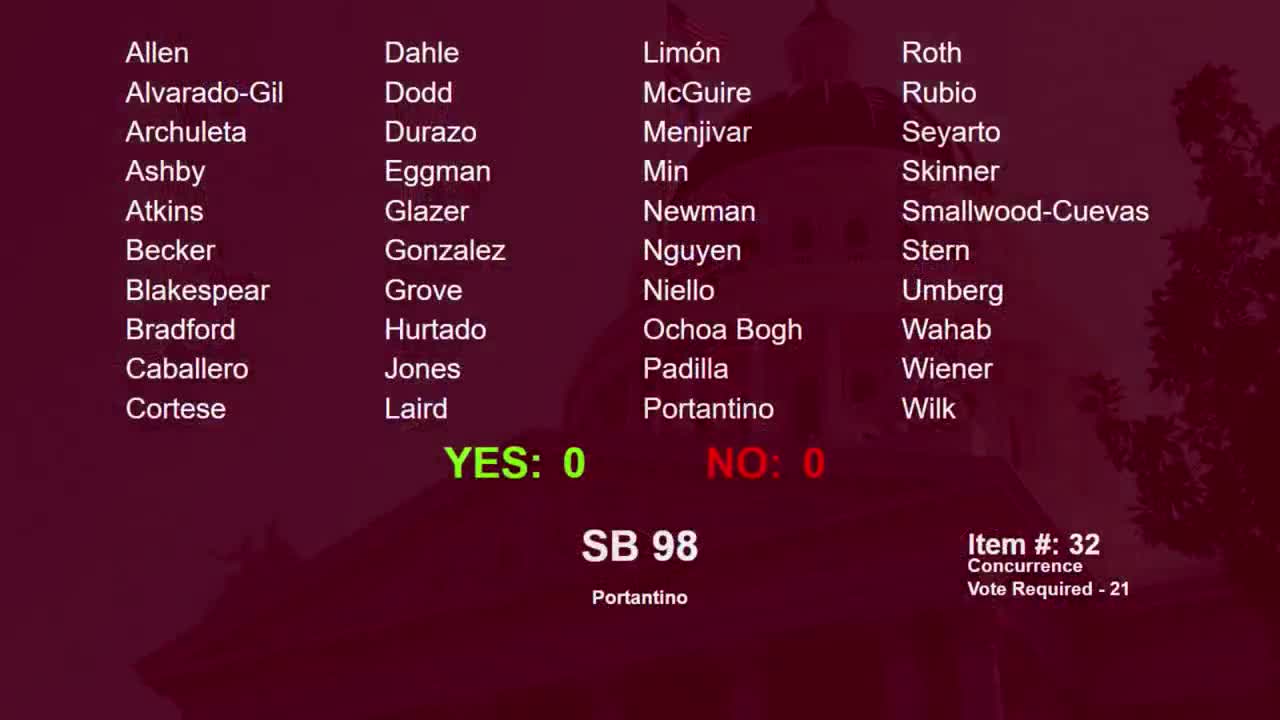 2MIN
Senate Floor
 2MIN
Assembly Floor
 5MIN
Assembly Standing Committee on Local Government
 12MIN
Assembly Standing Committee on Elections
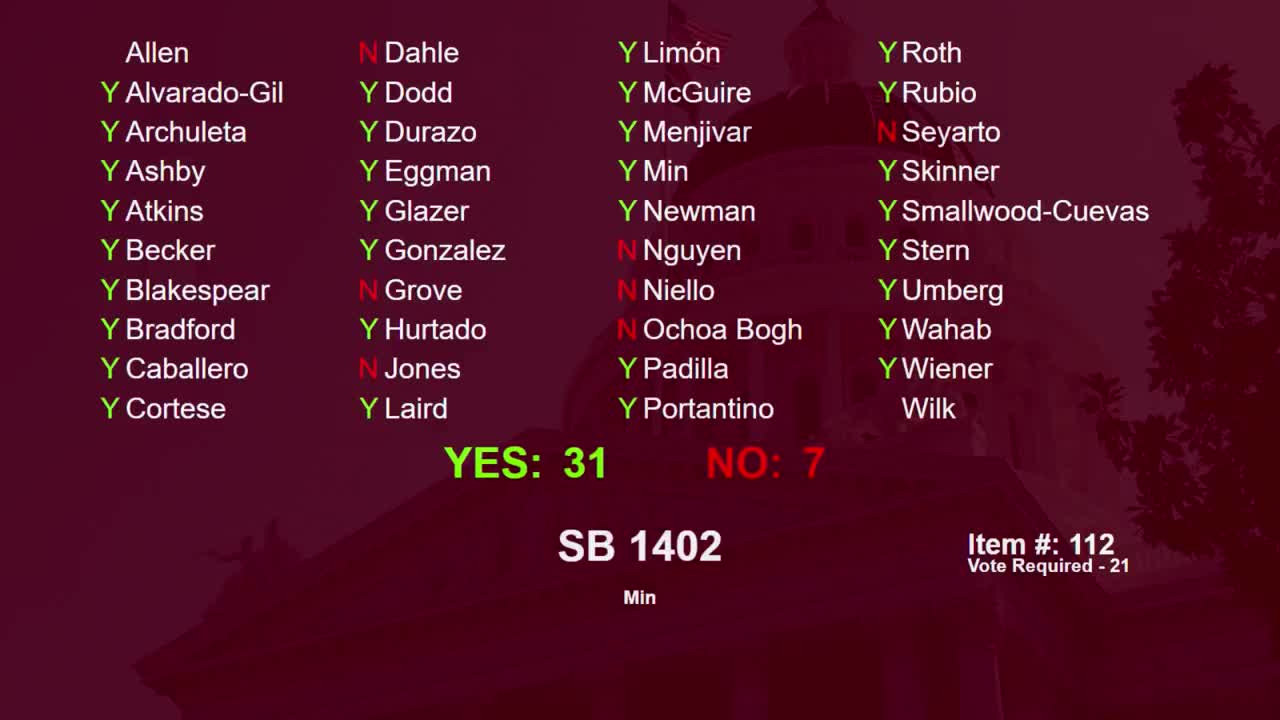 3MIN
Senate Floor
 10MIN
Senate Standing Committee on Local Government
 7MIN
Senate Standing Committee on Elections and Constitutional Amendments
Bill Author

Bill Co-Author(s):
