SCR 168: Women’s Equality Day.
- Session Year: 2023-2024
- House: Senate
- Latest Version Date: 2024-08-28
Current Status:
Passed
(2024-08-28: Chaptered by Secretary of State. Res. Chapter 186, Statutes of 2024.)
Introduced
In Committee
First Chamber
In Committee
Second Chamber
Enacted
What does this bill do?
This resolution recognizes August 26, 2024 as Women’s Equality Day in California and honors the day’s historic importance to women’s rights. It cites milestones like the 19th Amendment (the law that gave women the right to vote), the Civil Rights Act and Title IX, and notes ongoing problems such as unequal pay, lack of affordable childcare, and workplace harassment.
The summary is provided by generative AI which can make mistakes. For original language, please view the details in the table below.
This measure would recognize August 26, 2024, as Womens Equality Day and its historic importance to womens rights, including the battle to attain those rights in the past, present, and future.
This measure would recognize August 26, 2024, as Womens Equality Day and its historic importance to womens rights, including the battle to attain those rights in the past, present, and future.
This measure would recognize August 26, 2024, as Womens Equality Day and its historic importance to womens rights, including the battle to attain those rights in the past, present, and future.
WHEREAS, The first womens rights convention on July 19, 1848, was called by Elizabeth Cady Stanton and Lucretia Mott to win equal rights for women and expand the role of women in society, and it was then that the fight for womens rights came together as an organized effort; and
WHEREAS, In 1851, abolitionist and womens rights activist Sojourner Truth, whose first language was Dutch, delivered her most renowned extemporaneous speech at the Ohio Womens Rights Convention in Akron, the first complete transcription of which was titled On Womans Rights, and which was later altered and titled Aint I a Woman?; and
WHEREAS, The addition of the Nineteenth Amendment to the United States Constitution on August 26, 1920, secured for women the right to vote, with full enfranchisement of African American, Asian American, Hispanic American, and Native American women to take nearly an additional 50 years to be realized; and
WHEREAS, The passage of the federal Civil Rights Act of 1964 barred employment discrimination against women; and
WHEREAS, The enactment of Title IX of the federal Education Amendments of 1972 guaranteed equal opportunity for women in all aspects of education; and
WHEREAS, Many women have planned, organized, lectured, written, marched, lobbied, canvassed voters, staged parades, become candidates for political office, argued court cases, and more, in order to irrevocably change for the better the world of todays women and girls; and
WHEREAS, Despite the many efforts of policymakers and advocates, both women and men, toward ensuring equality for women, gender inequality persists in many areas, as evidenced by the ongoing struggle for fair pay and equal job opportunities, job training opportunities, access to childcare, family friendly workplaces, and against poverty, especially among women and children; and
WHEREAS, Despite important steps to achieve equal access in the workplace and equal access to educational opportunities, women face barriers in education and employment that are not experienced at the same magnitude by men, including, the presence of historical male privilege and gender bias; sex discrimination, harassment, and sexual violence in the workplace and on campus; the complications of having caregiving duties in the unpaid economy; and being undervalued for their work in the paid economy; and
WHEREAS, Women are critical to a strong and vibrant California economy and play a pivotal role in spurring economic growth in California; and
WHEREAS, Women comprise almost one-half of the workforce in our state and are primary income earners in many households; and
WHEREAS, The lack of affordable, quality childcare and affordable housing makes it difficult for women to provide safe and secure environments for their families; and
WHEREAS, Womens earnings are still far too low compared to mens in California, and women are disproportionately employed in jobs that pay the minimum wage; and
WHEREAS, Women are also disproportionately disadvantaged by the stresses of poverty and the constraints of the social services system; and
WHEREAS, Ensuring the economic security of all California women and their families will benefit people in all communities who count on public policies to meet their basic needs, earn a decent living, and care for their families; and
WHEREAS, The women of the United States have designated August 26 as a symbol of the continued fight for equal rights; and
WHEREAS, The United States Congress recognizes that August 26 of each year is designated as Womens Equality Day and the President of the United States annually issues a proclamation commemorating August 26, 1920, as the day when the women of the United States were first given the right to vote and recognizes that same date in 1970 when a nationwide demonstration for womens rights took place; now, therefore, be it
Resolved by the Senate of the State of California, the Assembly thereof concurring, That upon the anniversary of the Nineteenth Amendment to the United States Constitution, the Legislature recognizes August 26, 2024, as Womens Equality Day and its historic importance to womens rights, including the battle to attain those rights in the past, present, and future; and be it further
Resolved, That the Secretary of the Senate transmit copies of this resolution to the author for appropriate distribution.
|
Date
|
Status
|
|---|---|
| Aug 28, 2024 | Chaptered by Secretary of State. Res. Chapter 186, Statutes of 2024. |
| Aug 28, 2024 | Enrolled and filed with the Secretary of State at 2 p.m. |
| Aug 22, 2024 | In Senate. Ordered to engrossing and enrolling. |
| Aug 22, 2024 | Read. Adopted. (Ayes 57. Noes 0. Page 6457.) Ordered to the Senate. |
| Aug 15, 2024 | From committee: Be adopted. Ordered to consent calendar. (Ayes 7. Noes 0.) (August 15). |
| Aug 15, 2024 | Referred to Com. on RLS. |
| Aug 12, 2024 | In Assembly. Held at Desk. |
| Aug 12, 2024 | Read. Adopted. (Ayes 38. Noes 0. Page 5028.) Ordered to the Assembly. |
| Aug 7, 2024 | From committee: Ordered to third reading. |
| Jul 3, 2024 | Introduced. Referred to Com. on RLS. |
|
Date
|
Description
|
Location
|
Votes
|
|
|---|---|---|---|---|
| Aug 22, 2024 | SCR 168 Wahab Consent Calendar Second Day Regular Session | Assembly Floor |
Passed |
|
| Aug 15, 2024 | Be adopted. To Consent Calendar. | Assembly Standing Committee on Rules |
Passed |
|
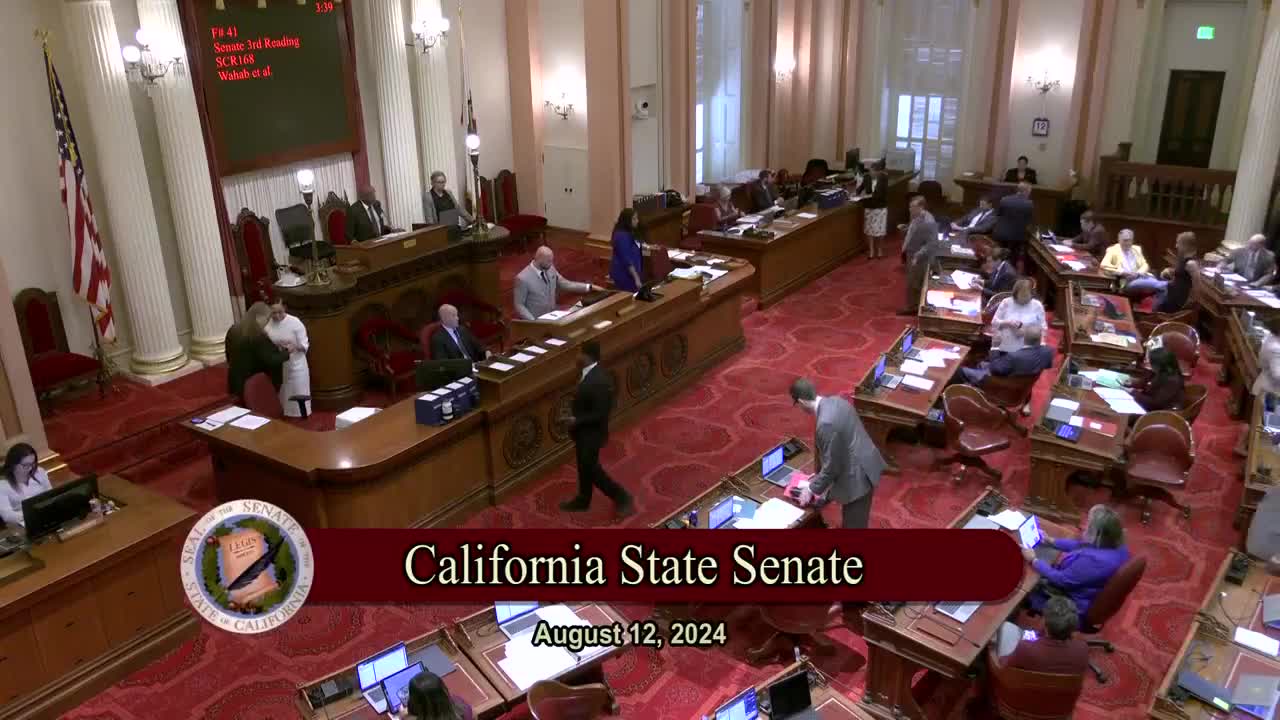
| Aug 12, 2024 | Senate 3rd Reading SCR168 Wahab et al. | Senate Floor |
Passed |
This list shows positions taken on this bill by organizations on the date displayed, which is linked to the original source.
Positions by individuals are not included.
|
Organization
|
Position
|
Date
|
|---|---|---|
| California Legislative Women Caucus | ** Support |
Date of Hearing: August 15, 2024
ASSEMBLY COMMITTEE ON RULES
Blanca Pacheco, Chair
SBPCA Bill Id:SCR 168
Author:(Wahab) – As Introduced Ver:
SENATE VOTE:
SUBJECT: Women’s Equality Day.
SUMMARY: Recognizes August 26, 2024, as Women’s Equality Day and its historic importance to women’s rights, including the battle to attain those rights in the past, present, and future. Specifically, this resolution makes the following legislative findings:
- The first women’s rights convention on July 19, 1848, was called by Elizabeth Cady Stanton and Lucretia Mott to win equal rights for women and expand the role of women in society, and it was then that the fight for women’s rights came together as an organized effort.
- The addition of the Nineteenth Amendment to the United States Constitution on August 26, 1920, secured for women the right to vote, with full enfranchisement of African American, Asian American, Hispanic American, and Native American women to take nearly an additional 50 years to be realized.
- The passage of the federal Civil Rights Act of 1964 barred employment discrimination against women. And, the enactment of Title IX of the federal Education Amendments of 1972 guaranteed equal opportunity for women in all aspects of education.
- Many women have planned, organized, lectured, written, marched, lobbied, canvassed voters, staged parades, become candidates for political office, argued court cases, and more, in order to irrevocably change for the better the world of today’s women and girls.
- Despite the many efforts of policymakers and advocates, both women and men, toward ensuring equality for women, gender inequality persists in many areas, as evidenced by the ongoing struggle for fair pay and equal job opportunities, job training opportunities, access to childcare, family friendly workplaces, and against poverty, especially among women and children.
- And, despite important steps to achieve equal access in the workplace and equal access to educational opportunities, women face barriers in education and employment that are not experienced at the same magnitude by men, including, the presence of historical male privilege and gender bias; sex discrimination, harassment, and sexual violence in the workplace and on campus; the complications of having caregiving duties in the unpaid economy; and being undervalued for their work in the paid economy.
- Women are critical to a strong and vibrant California economy and play a pivotal role in spurring economic growth in California. Women’s earnings are still far too low compared to men’s in California, and women are disproportionately employed in jobs that pay the minimum wage. Women are also disproportionately disadvantaged by the stresses of poverty and the constraints of the social services system.
- Ensuring the economic security of all California women and their families will benefit people in all communities who count on public policies to meet their basic needs, earn a decent living, and care for their families.
- The women of the United States have designated August 26 as a symbol of the continued fight for equal rights.
FISCAL EFFECT: This resolution is keyed non-fiscal by Legislative Counsel.
REGISTERED SUPPORT / OPPOSITION:
Support
None on file
Opposition
None on file
Analysis Prepared by: Michael Erke / RLS. / (916) 319-2800
SENATE RULES COMMITTEE Office of Senate Floor Analyses (916) 651-1520 Fax: (916) 327-4478 | SCR 168 |
THIRD READING
Bill No: SCR 168
Author: Wahab (D), et al.
Introduced: 7/3/24
Vote: 21
SOURCE: California Legislative Women’s Caucus
DIGEST:
This bill recognizes August 26, 2024, as Women’s Equality Day and its historic importance to women’s rights, including the battle to attain those rights in the past, present, and future.
ANALYSIS: This resolution makes the following legislative findings:
- The first women’s rights convention on July 19, 1848, was called by Elizabeth Cady Stanton and Lucretia Mott to win equal rights for women and expand the role of women in society, and it was then that the fight for women’s rights came together as an organized effort.
- The addition of the Nineteenth Amendment to the United States Constitution on August 26, 1920, secured for women the right to vote, with full enfranchisement of African American, Asian American, Hispanic American, and Native American women to take nearly an additional 50 years to be realized.
- The passage of the federal Civil Rights Act of 1964 barred employment discrimination against women. The enactment of Title IX of the federal Education Amendments of 1972 guaranteed equal opportunity for women in all aspects of education; and
- Women comprise almost one-half of the workforce in our state and are primary income earners in many households.
- The United States Congress recognizes that August 26 of each year is designated as Women’s Equality Day and the President of the United States annually issues a proclamation commemorating August 26, 1920, as the day when the women of the United States were first given the right to vote and recognizes that same date in 1970 when a nationwide demonstration for women’s rights took place.
This resolution recognizes, upon the anniversary of the Nineteenth Amendment to the United States Constitution, August 26, 2024, as Women’s Equality Day and its historic importance to women’s rights, including the battle to attain those rights in the past, present, and future.
Related/Prior Legislation
SR 49 (Leyva, 2021) – Read and adopted September 1, 2021, recognized August 26, 2021, as Women’s Equality Day.
FISCAL EFFECT: Appropriation: No Fiscal Com.: No Local: No
SUPPORT: (Verified 8/5/24)
California Legislative Women’s Caucus (source)
OPPOSITION: (Verified 8/5/24)
None received
Prepared by: Russell Manning / SFA / (916) 651-1520
8/7/24 14:34:51
**** END ****