AB 1032: Courts: court interpreters.
- Session Year: 2023-2024
- House: Assembly
- Latest Version Date: 2023-10-08
Current Status:
Passed
(2023-10-08: Chaptered by Secretary of State - Chapter 556, Statutes of 2023.)
Introduced
In Committee
First Chamber
In Committee
Second Chamber
Enacted
(1)The Trial Court Interpreter Employment and Labor Relations Act (the act) establishes procedures governing the employment and compensation of certified and registered trial court interpreters and court interpreters pro tempore employed by the courts. Existing law requires trial courts to appoint trial court employees, rather than independent contractors to perform interpretation of court proceedings, as specified. Existing law permits a court to appoint an independent contractor for interpretation in specified circumstances, including when an interpreter is paid directly by the parties to the proceeding.
The bill, beginning January 1, 2025, would authorize an interpreter that is certified or registered and paid directly by the parties in a proceeding to be appointed under these provisions.
(2)The act establishes an employee classification entitled court interpreter pro tempore and requires employees in this classification to work under specified conditions, including being paid on a per diem basis for work performed, unless a memorandum of understanding or agreement with a recognized employee organization provides otherwise. Existing law requires a court to offer to employ an interpreter as a court interpreter pro tempore that meets specified criteria and specifies how the court is required to accept and process applications for court interpreters pro tempore.
Beginning January 1, 2025, this bill would instead rename a court interpreter pro tempore as an intermittent, part-time interpreter and would make conforming changes. The bill, on January 1, 2025, would eliminate the requirement that a court offer to employ as a court interpreter an interpreter who meets the specified criteria requiring the hiring of court interpreters and the provisions regarding the acceptance and processing of applications for court interpreters pro tempore. The bill would also authorize courts to hire registered or nonregistered interpreters as employees to perform relay interpretation, as defined, but only if the trial court has employed an interpreter of the same language pair.
(3)Existing law creates the regional court interpreter employment relations committee for the purposes of developing regional terms and conditions of employment for court interpreters and for collective bargaining with recognized employee organizations, as specified. Existing law authorizes trial courts to employ certified and registered interpreters to perform spoken language interpretation for the trial courts in full-time or part-time court interpreter positions created by the trial courts with the authorization of the regional committee and subject to meet and confer in good faith. Existing law provides an order of priority for applicants that courts are required to adhere to when hiring interpreters, except as specified.
Beginning January 1, 2025, this bill would remove the requirement for the authorization of the regional committee and meet and confer provisions when a court seeks to employ an interpreter for full-time, part-time, or intermittent, part-time interpreter positions created by the court. The bill, beginning January 1, 2025, would modify the prioritization for court interpreters who have previously performed work for that trial court. The bill would authorize trial courts to set additional local compensation, as defined, for interpreters.
(4)Existing law provides for a regional transition period, defined as January 1, 2003, to July 1, 2005, except to the extent that a region may have a memorandum of understanding at an earlier point, regarding the employment of interpreters pursuant to the provisions of the act.
This bill would remove various references to the transition period and various compliance deadlines related to the transition period. The bill would update obsolete cross-references and make other technical changes.
(5)The California Constitution vests the judicial power of the state in the Supreme Court, courts of appeal, and superior courts, and establishes the Judicial Council to, among other things, adopt rules of court and perform functions prescribed by statute.
This bill would require the Judicial Council to conduct a court interpreter workforce study and provide recommendations to the Legislature on or before January 1, 2026, regarding court interpreter availability and the future court interpreter workforce. The bill would require the Judicial Council to work in collaboration with key stakeholder groups, as specified.
(1)The Trial Court Interpreter Employment and Labor Relations Act (the act) establishes procedures governing the employment and compensation of certified and registered trial court interpreters and court interpreters pro tempore employed by the courts. Existing law requires trial courts to appoint trial court employees, rather than independent contractors to perform interpretation of court proceedings, as specified. Existing law permits a court to appoint an independent contractor for interpretation in specified circumstances, including when an interpreter who is not registered or certified is appointed on a temporary basis. is paid directly by the parties to the proceeding.
The bill bill, beginning January 1, 2025, would authorize an interpreter that is certified or registered and paid directly by the parties in a civil proceeding to be appointed under these provisions.
(2)Existing law further permits the appointment of an independent contractor on a day-to-day basis to perform spoken language interpretation services in specified circumstances, including when the trial court has assigned all available employees and independent contractors in accordance with specified provisions, unless otherwise provided in a memorandum of understanding or agreement with a recognized employee organization. Existing law requires that employees and independent contractors appointed under specified provisions of the act be given priority for assignments over independent contractors appointed as a result of these provisions. The bill would additionally require that employees and independent contractors appointed under those specified provisions be given priority for court locations.(3)(2)The act establishes an employee classification entitled court interpreter pro tempore and requires employees in this classification to work under specified conditions, including being paid on a per diem basis for work performed, unless a memorandum of understanding or agreement with a recognized employee organization provides otherwise. Existing law requires a court to offer to employ an interpreter as a court interpreter pro tempore that meets specified criteria and specifies how the court is required to accept and process applications for court interpreters pro tempore.
ThisBeginning January 1, 2025, this bill would instead rename a court interpreter pro tempore as an intermittent, part-time interpreter and would make conforming changes. The bill would additionally require that an intermittent, part-time interpreter be appointed on a 1/2 day or full day per diem basis, as needed. The bill bill, on January 1, 2025, would eliminate the requirement that a court offer to employ as a court interpreter an interpreter who meets the specified criteria requiring the hiring of court interpreters and the provisions regarding the acceptance and processing of applications for court interpreters pro tempore. The bill would also authorize courts to hire registered or nonregistered interpreters for languages of lesser diffusion as employees to perform relay interpretation, as defined. defined, but only if the trial court has employed an interpreter of the same language pair.
(4)(3)Existing law creates the regional court interpreter employment relations committee for the purposes of developing regional terms and conditions of employment for court interpreters and for collective bargaining with recognized employee organizations, as specified. Existing law authorizes trial courts to employ certified and registered interpreters to perform spoken language interpretation for the trial courts in full-time or part-time court interpreter positions created by the trial courts with the authorization of the regional committee and subject to meet and confer in good faith. Existing law provides an order of priority for applicants that courts are required to adhere to when hiring interpreters. interpreters, except as specified.
ThisBeginning January 1, 2025, this bill would remove the requirement for the authorization of the regional committee and meet and confer provisions when a court seeks to employ an interpreter for full-time, part-time, or intermittent, part-time interpreter positions created by the court. The bill bill, beginning January 1, 2025, would modify the prioritization for court interpreters who have previously performed work for that trial court. The bill would authorize trial courts to incentivize recruitment and retention of court interpreter employees by offering, among other things, cost-of-living adjustments and bonuses. set additional local compensation, as defined, for interpreters.
(5)Existing law requires the regional court interpreter employment relations committee to meet and confer in good faith regarding wages, hours, and other terms and conditions of employment. Existing law provides that if representatives of the regional court interpreter employment relations committee and the recognized employee organization fail to reach agreement, the regional court interpreter employment relations committee and the recognized employee organization together may agree upon the appointment of a mediator mutually agreeable to the parties, as specified. The bill, instead, would require the parties to engage in binding mediation or factfinding through the California State Mediation and Conciliation Service. (6)(4)Existing law provides for a regional transition period, defined as January 1, 2003, to July 1, 2005, except to the extent that a region may have a memorandum of understanding at an earlier point, regarding the employment of interpreters pursuant to the provisions of the act.
This bill would remove various references to the transition period and various compliance deadlines related to the transition period. The bill would update obsolete cross-references and make other technical changes.
(5)The California Constitution vests the judicial power of the state in the Supreme Court, courts of appeal, and superior courts, and establishes the Judicial Council to, among other things, adopt rules of court and perform functions prescribed by statute.
This bill would require the Judicial Council to conduct a court interpreter workforce study and provide recommendations to the Legislature on or before January 1, 2026, regarding court interpreter availability and the future court interpreter workforce. The bill would require the Judicial Council to work in collaboration with key stakeholder groups, as specified.
(1)The Trial Court Interpreter Employment and Labor Relations Act (the act) establishes procedures governing the employment and compensation of certified and registered trial court interpreters and court interpreters pro tempore employed by the courts. Existing law requires trial courts to appoint trial court employees, rather than independent contractors to perform interpretation of court proceedings, as specified. Existing law permits a court to appoint an independent contractor for interpretation in specified circumstances, including when an interpreter who is not registered or certified is appointed on a temporary basis.
This bill would instead authorize the appointment of an independent contractor under these provisions who is an interpreter of a language of lesser diffusion and is appointed on a temporary basis. The bill would also permit
The bill would authorize an interpreter that is certified or registered and paid directly by the parties in a civil proceeding to be appointed under these provisions.
(2)Existing law further permits the appointment of an independent contractor on a day-to-day basis to perform spoken language interpretation services in specified circumstances, including when the trial court has assigned all available employees and independent contractors in accordance with specified provisions, unless otherwise provided in a memorandum of understanding or agreement with a recognized employee organization. Existing law requires that employees and independent contractors appointed under specified provisions of the act be given priority for assignments over independent contractors appointed as a result of these provisions.
The bill would additionally require that employees and independent contractors appointed under those specified provisions be given priority for court locations.
(3)The act establishes an employee classification entitled court interpreter pro tempore and requires employees in this classification to work under specified conditions, including being paid on a per diem basis for work performed, unless a memorandum of understanding or agreement with a recognized employee organization provides otherwise. Existing law requires a court to offer to employ an interpreter as a court interpreter pro tempore that meets specified criteria and specifies how the court is required to accept and process applications for court interpreters pro tempore.
This bill would instead rename a court interpreter pro tempore as an intermittent, part-time interpreter and would make conforming changes. The bill would additionally require that a court interpreter pro tempore an intermittent, part-time interpreter be appointed on a 1/2 day or full day per diem basis, as needed. The bill would eliminate the requirement that a court offer to employ as a court interpreter an interpreter who meets the specified criteria requiring the hiring of court interpreters and the provisions regarding the acceptance and processing of applications for court interpreters pro tempore. The bill would also authorize courts to hire interpreters for languages of lesser diffusion to perform relay interpretation, as defined.
(4)Existing law creates the regional court interpreter employment relations committee for the purposes of developing regional terms and conditions of employment for court interpreters and for collective bargaining with recognized employee organizations, as specified. Existing law authorizes trial courts to employ certified and registered interpreters to perform spoken language interpretation for the trial courts in full-time or part-time court interpreter positions created by the trial courts with the authorization of the regional committee and subject to meet and confer in good faith. Existing law provides an order of priority for applicants that courts are required to adhere to when hiring interpreters.
This bill would remove the requirement for the authorization of the regional committee and meet and confer provisions when a court seeks to employ an interpreter for full-time, part-time, or pro tempore intermittent, part-time interpreter positions created by the court. The bill would modify the prioritization for court interpreters who have previously performed work for that trial court. The bill would authorize trial courts to incentivize recruitment and retention of court interpreter employees by offering, among other things, cost-of-living adjustments and bonuses.
(5)Existing law requires the regional court interpreter employment relations committee to meet and confer in good faith regarding wages, hours, and other terms and conditions of employment. Existing law provides that if representatives of the regional court interpreter employment relations committee and the recognized employee organization fail to reach agreement, the regional court interpreter employment relations committee and the recognized employee organization together may agree upon the appointment of a mediator mutually agreeable to the parties, as specified.
The bill, instead, would require the parties to engage in binding mediation or factfinding through the California State Mediation and Conciliation Service.
(6)Existing law provides for a regional transition period, defined as January 1, 2003, to July 1, 2005, except to the extent that a region may have a memorandum of understanding at an earlier point, regarding the employment of interpreters pursuant to the provisions of the act.
This bill would remove various references to the transition period and various compliance deadlines related to the transition period. The bill would update obsolete cross-references and make other technical changes.
(1)The Trial Court Interpreter Employment and Labor Relations Act (the act) establishes procedures governing the employment and compensation of certified and registered trial court interpreters and court interpreters pro tempore employed by the courts. Existing law requires trial courts to appoint trial court employees, rather than independent contractors to perform interpretation of court proceedings, as specified. Existing law permits a court to appoint an independent contractor for interpretation in specified circumstances, including when an interpreter who is not registered or certified is appointed on a temporary basis.
This bill would instead authorize the appointment of an independent contractor under these provisions who is not registered or certified in a an interpreter of a language of lesser diffusion and is appointed on a temporary basis. The bill would also permit an interpreter that is certified or registered and paid directly by the parties in a civil proceeding to be appointed under these provisions.
(2)Existing law further permits the appointment of an independent contractor on a day-to-day basis to perform spoken language interpretation services in specified circumstances, including when the trial court has assigned all available employees and independent contractors in accordance with specified provisions, unless otherwise provided in a memorandum of understanding or agreement with a recognized employee organization. Existing law requires that employees and independent contractors appointed under specified provisions of the act be given priority for assignments over independent contractors appointed as a result of these provisions.
The bill would additionally require that employees and independent contractors appointed under those specified provisions be given priority for court locations.
(3)The act establishes an employee classification entitled court interpreter pro tempore and requires employees in this classification to work under specified conditions, including being paid on a per diem basis for work performed, unless a memorandum of understanding or agreement with a recognized employee organization provides otherwise. Existing law requires a court to offer to employ an interpreter as a court interpreter pro tempore that meets specified criteria, including having provided services to the trial court for a minimum number of days. criteria and specifies how the court is required to accept and process applications for court interpreters pro tempore.
This bill would additionally require that a court interpreter pro tempore be appointed on a 1/2 day or full day per diem basis, as needed. The bill would eliminate the requirement pertaining to the number of days that an interpreter is required to have worked in order to be qualified to be offered employment under these provisions. that a court offer to employ as a court interpreter an interpreter who meets the specified criteria requiring the hiring of court interpreters and the provisions regarding the acceptance and processing of applications for court interpreters pro tempore. The bill would also authorize courts to hire interpreters for languages of lesser diffusion to perform relay interpretation, as defined.
(4)Existing law creates the regional court interpreter employment relations committee for the purposes of developing regional terms and conditions of employment for court interpreters and for collective bargaining with recognized employee organizations, as specified. Existing law authorizes trial courts to employ certified and registered interpreters to perform spoken language interpretation for the trial courts in full-time or part-time court interpreter positions created by the trial courts with the authorization of the regional committee and subject to meet and confer in good faith. Existing law provides an order of priority for applicants that courts are required to adhere to when hiring interpreters.
This bill would remove the requirement for the authorization of the regional committee and meet and confer provisions when a court seeks to employ an interpreter for full-time, part-time, or pro tempore positions created by the court. The bill would modify the prioritization for court interpreters who have previously performed work for that trial court. The bill would authorize trial courts to incentivize recruitment and retention of court interpreter employees by offering, among other things, cost-of-living adjustments and bonuses.
(5)Existing law requires the regional court interpreter employment relations committee to meet and confer in good faith regarding wages, hours, and other terms and conditions of employment. Existing law provides that if representatives of the regional court interpreter employment relations committee and the recognized employee organization fail to reach agreement, the regional court interpreter employment relations committee and the recognized employee organization together may agree upon the appointment of a mediator mutually agreeable to the parties, as specified.
The bill, instead, would require the parties to engage in binding mediation or factfinding through the California State Mediation and Conciliation Service.
(6)Existing law provides for a regional transition period, defined as January 1, 2003, to July 1, 2005, except to the extent that a region may have a memorandum of understanding at an earlier point, regarding the employment of interpreters pursuant to the provisions of the act.
This bill would remove various references to the transition period and various compliance deadlines related to the transition period. The bill would update obsolete cross-references and make other technical changes.
(1)The Trial Court Interpreter Employment and Labor Relations Act (the act) establishes procedures governing the employment and compensation of certified and registered trial court interpreters and court interpreters pro tempore employed by the courts. Existing law requires trial courts to appoint trial court employees, rather than independent contractors to perform interpretation of court proceedings, as specified. Existing law permits a court to appoint an independent contractor for interpretation in specified circumstances, including when an interpreter who is not registered or certified is appointed on a temporary basis.
This bill would instead authorize the appointment of an independent contractor under these provisions who is not registered or certified in a language of lesser diffusion and is appointed on a temporary basis. The bill would also permit an interpreter that is certified or registered and paid directly by the parties in a civil proceeding to be appointed under these provisions.
(2)Existing law further permits the appointment of an independent contractor on a day-to-day basis to perform spoken language interpretation services in specified circumstances, including when the trial court has assigned all available employees and independent contractors in accordance with specified provisions, unless otherwise provided in a memorandum of understanding or agreement with a recognized employee organization. Existing law requires that employees and independent contractors appointed under specified provisions of the act be given priority for assignments over independent contractors appointed as a result of these provisions.
The bill would additionally require that employees and independent contractors appointed under those specified provisions be given priority for court locations.
(3)The act establishes an employee classification entitled court interpreter pro tempore and requires employees in this classification to work under specified conditions, including being paid on a per diem basis for work performed, unless a memorandum of understanding or agreement with a recognized employee organization provides otherwise. Existing law requires a court to offer to employ an interpreter as a court interpreter pro tempore that meets specified criteria, including having provided services to the trial court for a minimum number of days.
This bill would additionally require that a court interpreter pro tempore be appointed on a 1/2 day or full day per diem basis, as needed. The bill would eliminate the requirement pertaining to the number of days that an interpreter is required to have worked in order to be qualified to be offered employment under these provisions. The bill would also authorize courts to hire interpreters for languages of lesser diffusion to perform relay interpretation, as defined.
(4)Existing law creates the regional court interpreter employment relations committee for the purposes of developing regional terms and conditions of employment for court interpreters and for collective bargaining with recognized employee organizations, as specified. Existing law authorizes trial courts to employ certified and registered interpreters to perform spoken language interpretation for the trial courts in full-time or part-time court interpreter positions created by the trial courts with the authorization of the regional committee and subject to meet and confer in good faith. Existing law provides an order of priority for applicants that courts are required to adhere to when hiring interpreters.
This bill would remove the requirement for the authorization of the regional committee and meet and confer provisions when a court seeks to employ an interpreter for full-time, part-time, or pro tempore positions created by the court. The bill would modify the prioritization for court interpreters who have previously performed work for that trial court. The bill would authorize trial courts to incentivize recruitment, employment, recruitment and retention of court interpreter employees by offering, among other things, cost-of-living adjustments and bonuses.
(5)Existing law requires the regional court interpreter employment relations committee to meet and confer in good faith regarding wages, hours, and other terms and conditions of employment. Existing law provides that if representatives of the regional court interpreter employment relations committee and the recognized employee organization fail to reach agreement, the regional court interpreter employment relations committee and the recognized employee organization together may agree upon the appointment of a mediator mutually agreeable to the parties, as specified.
The bill, instead, would require the parties to engage in binding arbitration or fact finding mediation mediation or factfinding through the California State Mediation and Conciliation Service.
(6)Existing law provides for a regional transition period, defined as January 1, 2003, to July 1, 2005, except to the extent that a region may have a memorandum of understanding at an earlier point, regarding the employment of interpreters pursuant to the provisions of the act.
This bill would remove various references to the transition period and various compliance deadlines related to the transition period. The bill would update obsolete cross-references and make other technical changes.
(1)The Trial Court Interpreter Employment and Labor Relations Act (the act) establishes procedures governing the employment and compensation of certified and registered trial court interpreters and court interpreters pro tempore employed by the courts. Existing law requires trial courts to appoint trial court employees, rather than independent contractors to perform interpretation of court proceedings, as specified. Existing law permits a court to appoint an independent contractor for interpretation in specified circumstances, including when an interpreter who is not registered or certified is appointed on a temporary basis.
This bill would instead authorize the appointment of an independent contractor under these provisions who is not registered in a language of lesser diffusion and is appointed on a temporary basis. The bill would also permit an interpreter that is certified or registered and paid directly by the parties in a civil proceeding to be appointed under these provisions.
(2)Existing law further permits the appointment of an independent contractor on a day-to-day basis to perform spoken language interpretation services in specified circumstances, including when the trial court has assigned all available employees and independent contractors in accordance with specified provisions, unless otherwise provided in a memorandum of understanding or agreement with a recognized employee organization. Existing law requires that employees and independent contractors appointed under specified provisions of the act be given priority for assignments over independent contractors appointed as a result of these provisions.
This bill would repeal those provisions.The bill would additionally require that employees and independent contractors appointed under those specified provisions be given priority for court locations.
(3)The act establishes an employee classification entitled court interpreter pro tempore and requires employees in this classification to work under specified conditions, including being paid on a per diem basis for work performed, unless a memorandum of understanding or agreement with a recognized employee organization provides otherwise. Existing law requires a court to offer to employ an interpreter as a court interpreter pro tempore that meets specified criteria, including having provided services to the trial court for a minimum number of days.
This bill would additionally require that a court interpreter pro tempore be appointed on a 1/2 day or full day per diem basis, as needed. The bill would eliminate the requirement pertaining to the number of days that an interpreter is required to have worked in order to be qualified to be offered employment under these provisions. The bill would also authorize courts to hire interpreters for languages of lesser diffusion to perform relay interpretation, as defined.
(4)Existing law creates the regional court interpreter employment relations committee for the purposes of developing regional terms and conditions of employment for court interpreters and for collective bargaining with recognized employee organizations, as specified. Existing law authorizes trial courts to employ certified and registered interpreters to perform spoken language interpretation for the trial courts in full-time or part-time court interpreter positions created by the trial courts with the authorization of the regional committee and subject to meet and confer in good faith. Existing law provides an order of priority for applicants that courts are required to adhere to when hiring interpreters.
This bill would remove the requirement for the authorization of the regional committee and meet and confer provisions when a court seeks to employ an interpreter for full-time, part-time, or pro tempore positions created by the court. The bill would modify the prioritization for court interpreters who have previously performed work for that trial court. The bill would authorize trial courts to incentivize recruitment, employment, and retention of court interpreter employees by offering, among other things, cost-of-living adjustments and bonuses.
(5)Existing law requires the regional court interpreter employment relations committee to meet and confer in good faith regarding wages, hours, and other terms and conditions of employment. Existing law provides that if representatives of the regional court interpreter employment relations committee and the recognized employee organization fail to reach agreement, the regional court interpreter employment relations committee and the recognized employee organization together may agree upon the appointment of a mediator mutually agreeable to the parties, as specified.
The bill, instead, would require the parties to engage in binding arbitration or fact finding mediation through the California State Mediation and Conciliation Service.
(6)Existing law provides for a regional transition period, defined as January 1, 2003, to July 1, 2005, except to the extent that a region may have a memorandum of understanding at an earlier point, regarding the employment of interpreters pursuant to the provisions of the act.
This bill would remove various references to the transition period and various compliance deadlines related to the transition period. The bill would additionally repeal provisions relating to regulations to be adopted by the regional court interpreter employment relations committee by April 1, 2003. The bill would update obsolete cross-references and make other technical changes.
(1)The Trial Court Interpreter Employment and Labor Relations Act (the act) establishes procedures governing the employment and compensation of certified and registered trial court interpreters and court interpreters pro tempore employed by the courts. Existing law requires trial courts to appoint trial court employees, rather than independent contractors to perform interpretation of court proceedings, as specified. Existing law permits a court to appoint an independent contractor for interpretation in specified circumstances, including when an interpreter who is not registered or certified is appointed on a temporary basis.
This bill would instead authorize the appointment of an independent contractor under these provisions who is not registered in a language of lesser diffusion and is appointed on a temporary basis. The bill would also permit an interpreter that is certified or registered and paid directly by the parties in a civil proceeding to be appointed under these provisions.
(2)Existing law further permits the appointment of an independent contractor on a day-to-day basis to perform spoken language interpretation services in specified circumstances, including when the trial court has assigned all available employees and independent contractors in accordance with specified provisions, unless otherwise provided in a memorandum of understanding or agreement with a recognized employee organization.
This bill would repeal those provisions.
(3)The act establishes an employee classification entitled court interpreter pro tempore and requires employees in this classification to work under specified conditions, including being paid on a per diem basis for work performed, unless a memorandum of understanding or agreement with a recognized employee organization provides otherwise. Existing law requires a court to offer to employ an interpreter as a court interpreter pro tempore that meets specified criteria, including having provided services to the trial court for a minimum number of days.
This bill would additionally require that a court interpreter pro tempore be appointed on a 1/2 day or full day per diem basis, as needed. The bill would eliminate the requirement pertaining to the number of days that an interpreter is required to have worked in order to be qualified to be offered employment under these provisions. The bill would also authorize courts to hire interpreters for languages of lesser diffusion to perform relay interpretation, as defined.
(4)Existing law creates the regional court interpreter employment relations committee for the purposes of developing regional terms and conditions of employment for court interpreters and for collective bargaining with recognized employee organizations, as specified. Existing law authorizes trial courts to employ certified and registered interpreters to perform spoken language interpretation for the trial courts in full-time or part-time court interpreter positions created by the trial courts with the authorization of the regional committee and subject to meet and confer in good faith. Existing law provides an order of priority for applicants that courts are required to adhere to when hiring interpreters.
This bill would remove the requirement for the authorization of the regional committee and meet and confer provisions when a court seeks to employ an interpreter for full-time, part-time, or pro tempore positions created by the court. The bill would modify the prioritization for court interpreters who have previously performed work for that trial court.
(5)Existing law requires the regional court interpreter employment relations committee to meet and confer in good faith regarding wages, hours, and other terms and conditions of employment. Existing law provides that if representatives of the regional court interpreter employment relations committee and the recognized employee organization fail to reach agreement, the regional court interpreter employment relations committee and the recognized employee organization together may agree upon the appointment of a mediator mutually agreeable to the parties, as specified.
The bill, instead, would require the parties to engage in binding arbitration or fact finding mediation through the California State Mediation and Conciliation Service.
(6)Existing law provides for a regional transition period, defined as January 1, 2003, to July 1, 2005, except to the extent that a region may have a memorandum of understanding at an earlier point, regarding the employment of interpreters pursuant to the provisions of the act.
This bill would remove various references to the transition period and various compliance deadlines related to the transition period. The bill would additionally repeal provisions relating to regulations to be adopted by the regional court interpreter employment relations committee by April 1, 2003. The bill would update obsolete cross-references and make other technical changes.
For purposes of this chapter, the following definitions shall apply:
(a)Certified interpreter and registered interpreter have the same meanings as in Article 4 (commencing with Section 68560) of Chapter 2. This chapter does not apply to sign language interpreters.
(b)Cross-assign and cross-assignment refer to the appointment of a court interpreter employed by a trial court to perform spoken language interpretation services in another trial court, pursuant to Section 71810.
(c)Employee organization means a labor organization that has as one of its purposes representing employees in their relations with the trial courts.
(d)Mediation means effort by an impartial third party to assist in reconciling a dispute regarding wages, hours, and other terms and conditions of employment between representatives of the trial court or regional court interpreter committee and the recognized employee organization through interpretation, suggestion, and advice.
(e)Meet and confer in good faith means that a trial court or regional court interpreter committee or those representatives it may designate, and representatives of a recognized employee organization, shall have the mutual obligation personally to meet and confer promptly upon request by either party and continue for a reasonable period of time in order to exchange freely information, opinions, and proposals, and to endeavor to reach agreement on matters within the scope of representation. The process shall include adequate time for the resolution of impasses where specific procedures for resolution are contained in this chapter, or when the procedures are used by mutual consent.
(f)Personnel rules, personnel policies, procedures, and plans, and rules and regulations mean policies, procedures, plans, rules, or regulations adopted by a trial court or its designee pertaining to conditions of employment of trial court employees, subject to meet and confer in good faith.
(g)Recognized employee organization means an employee organization that has been formally acknowledged to represent the court interpreters employed by the trial courts in a region, pursuant to this chapter.
(h)Regional court interpreter employment relations committee means the committee established pursuant to Section 71807.
(i)Regional transition period means the period from January 1, 2003, to July 1, 2005, inclusive, except that the transition period for the region may be terminated earlier by a memorandum of understanding or agreement between the regional court interpreter employment relations committee and a recognized employee organization.
(j)Transfer means transfer within the trial court as defined in the trial courts personnel policies, procedures, and plans, subject to meet and confer in good faith.
(k)Trial court means the superior court in each county.
(l)This section shall remain in effect only until January 1, 2025, and as of that date is repealed.
SEC. 2.Section 71801 is added to the Government Code, to read:71801.For purposes of this chapter, the following definitions shall apply:
(a)Certified interpreter and registered interpreter have the same meanings as in Article 4 (commencing with Section 68560) of Chapter 2. This chapter does not apply to sign language interpreters.
(b)Court proceedings has the same meaning as subdivision (a) of Section 68560.5.
(c)Cross-assign and cross-assignment refer to the appointment of a court interpreter employed by a trial court to perform spoken language interpretation services in another trial court, pursuant to Section 71810.
(d)Employee organization means a labor organization that has as one of its purposes representing employees in their relations with the trial courts.
(e)Intermittent, part-time interpreter is a court interpreter who works as an intermittent employee on a day-by-day basis as described in Section 71803.
(f)Local compensation means any amounts paid to employee interpreters by an individual trial court that are not paid pursuant to the regional memorandum of understanding and are not calculated on an hourly basis.
(g)Mediation means effort by an impartial third party to assist in reconciling a dispute regarding wages, hours, and other terms and conditions of employment between representatives of the trial court or regional court interpreter committee and the recognized employee organization through interpretation, suggestion, and advice.
(h)Meet and confer in good faith means that a trial court or regional court interpreter committee or those representatives it may designate, and representatives of a recognized employee organization, shall have the mutual obligation personally to meet and confer promptly upon request by either party and continue for a reasonable period of time in order to exchange freely information, opinions, and proposals, and to endeavor to reach agreement on matters within the scope of representation. The process shall include adequate time for the resolution of impasses where specific procedures for resolution are contained in this chapter, or when the procedures are used by mutual consent.
(i)Personnel rules, personnel policies, procedures, and plans, and rules and regulations mean policies, procedures, plans, rules, or regulations adopted by a trial court or its designee pertaining to conditions of employment of trial court employees, subject to meet and confer in good faith.
(j)Recognized employee organization means an employee organization that has been formally acknowledged to represent the court interpreters employed by the trial courts in a region, pursuant to this chapter.
(k)Regional court interpreter employment relations committee means the committee established pursuant to Section 71807.
(l)Regional transition period means the period from January 1, 2003, to July 1, 2005, inclusive, except that the transition period for the region may be terminated earlier by a memorandum of understanding or agreement between the regional court interpreter employment relations committee and a recognized employee organization.
(m)Relay interpreting is the process by which two interpreters with different language pairs work in tandem to communicate between the target language and English.
(n)Transfer means transfer within the trial court as defined in the trial courts personnel policies, procedures, and plans, subject to meet and confer in good faith.
(o)Trial court means the superior court in each county.
(p)This section shall become operative on January 1, 2025.
SEC. 3.Section 71802 of the Government Code is amended to read:71802.(a)On and after July 1, 2003, trial courts shall appoint trial court employees, rather than independent contractors, to perform spoken language interpretation of trial court proceedings. An interpreter may be an employee of the trial court or an employee of another trial court on cross-assignment.
(b)Notwithstanding subdivision (a), a trial court may appoint an independent contractor to perform spoken language interpretation of trial court proceedings if one or more of the following circumstances exists:
(1)An interpreter who is not registered or certified is appointed on a temporary basis pursuant to Rule 984.2 of the California Rules of Court.
(2)The interpreter is over 60 years of age on January 1, 2003, or the sum of the interpreters age in years on January 1, 2003, and the number of years the interpreter has provided services to the trial courts as an independent contractor prior to January 1, 2003, is equal to or greater than 70, the interpreter has provided services to the trial courts as an independent contractor prior to January 1, 2003, and the interpreter requests in writing prior to June 1, 2003, the opportunity to perform services for the trial court as an independent contractor rather than as an employee.
(3)The interpreter is paid directly by the parties to the proceeding.
(4)The interpreter has performed services for the trial courts as an independent contractor prior to January 1, 2003, the interpreter notifies the trial court in writing prior to June 1, 2003, that the interpreter is precluded from accepting employment because of the terms of an employment contract with a public agency or the terms of a public employee retirement program, the interpreter provides supporting documentation, and the interpreter requests in writing the opportunity to perform services for the trial court as an independent contractor rather than an employee.
(c)Notwithstanding subdivisions (a) and (b), and unless otherwise provided in a memorandum of understanding or agreement with a recognized employee organization, a trial court may also appoint an independent contractor on a day-to-day basis to perform spoken language interpretation of trial court proceedings if all of the following circumstances exist:
(1)The trial court has assigned all the available employees and independent contractors appointed pursuant to paragraphs (2) and (4) of subdivision (b) in the same language pair and has need for additional interpreters. Employees and independent contractors who are appointed pursuant to paragraphs (2) and (4) of subdivision (b) shall be given priority for assignments over independent contractors who are appointed pursuant to this subdivision.
(2)The interpreter has not previously been appointed as an independent contractor by the same trial court on more than 100 court days or parts of court days during the same calendar year, except that the trial court may continue to appoint an independent contractor on a day-to-day basis to complete a single court proceeding, if the trial court determines that the use of the same interpreter to complete that proceeding is necessary to provide continuity. An interpreter who has been appointed by a trial court as an independent contractor pursuant to this subdivision on more than 45 court days or parts of court days during the same calendar year shall be entitled to apply for employment by that trial court as a court interpreter pro tempore and the trial court may not refuse to offer employment to the interpreter, except for cause. For purposes of this section, for cause means a fair and honest cause or reason regulated by good faith on the part of the party exercising the power.
(3)The trial court does not provide independent contractors appointed pursuant to this subdivision with lesser duties or more favorable working conditions than those to which a court interpreter pro tempore employed by that trial court would be subject for the purpose of discouraging interpreters from applying for pro tempore employment with the trial court. The trial court is not required to apply the employee training, disciplinary, supervisory, and evaluation procedures of the trial court to any independent contractor.
(d)Only registered and certified interpreters may be hired by a trial court as employees to perform spoken language interpretation of trial court proceedings. Interpreters who are not certified or registered may be assigned to provide services as independent contractors only when certified and registered interpreters are unavailable and the good cause and qualification procedures and guidelines adopted by the Judicial Council pursuant to subdivision (c) of Section 68561 have been followed.
(e)A trial court that has appointed independent contractors pursuant to paragraph (1) of subdivision (b) or to subdivision (c) for a language pair on more than 60 court days or parts of court days in the prior 180 days shall provide public notice that the court is accepting applications for the position of court interpreter pro tempore for that language pair and shall offer employment to qualified applicants.
(f)Unless the parties to the dispute agree upon other procedures after the dispute arises, or other procedures are provided in a memorandum of understanding or agreement with a recognized employee organization, disputes concerning a violation of this section shall be submitted for binding arbitration to the California State Mediation and Conciliation Service.
(g)This section shall remain in effect only until January 1, 2025, and as of that date is repealed.
SEC. 4.Section 71802 is added to the Government Code, to read:71802.(a)Trial courts shall appoint trial court employees, rather than independent contractors, to perform spoken language interpretation of trial court proceedings. An interpreter shall be an employee of the trial court or an employee of another trial court on cross-assignment.
(b)Notwithstanding subdivision (a), a trial court may appoint an independent contractor to perform spoken language interpretation of trial court proceedings if one or more of the following circumstances exists:
(1)An interpreter who is not registered or certified is appointed on a temporary basis pursuant to Rule 2.893 of the California Rules of Court.
(2)The interpreter is over 60 years of age on January 1, 2003, or the sum of the interpreters age in years on January 1, 2003, and the number of years the interpreter has provided services to the trial courts as an independent contractor prior to January 1, 2003, is equal to or greater than 70, the interpreter has provided services to the trial courts as an independent contractor prior to January 1, 2003, and the interpreter requests in writing prior to June 1, 2003, the opportunity to perform services for the trial court as an independent contractor rather than as an employee.
(3)The interpreter is certified or registered and paid directly by the parties in the proceeding.
(4)The interpreter has performed services for the trial courts as an independent contractor prior to January 1, 2003, the interpreter notifies the trial court in writing prior to June 1, 2003, that the interpreter is precluded from accepting employment because of the terms of an employment contract with a public agency or the terms of a public employee retirement program, the interpreter provides supporting documentation, and the interpreter requests in writing the opportunity to perform services for the trial court as an independent contractor rather than an employee.
(c)Notwithstanding subdivisions (a) and (b), and unless otherwise provided in a memorandum of understanding or agreement with a recognized employee organization, a trial court may also appoint an independent contractor on a day-to-day basis to perform spoken language interpretation of trial court proceedings if all of the following circumstances exist:
(1)The trial court has assigned all the available employees and independent contractors appointed pursuant to paragraphs (2) and (4) of subdivision (b) in the same language pair and has need for additional interpreters. Employees and independent contractors who are appointed pursuant to paragraphs (2) and (4) of subdivision (b) shall be given priority for assignments over independent contractors who are appointed pursuant to this subdivision.
(2)The interpreter has not previously been appointed as an independent contractor by the same trial court on more than 100 court days or parts of court days during the same calendar year, except that the trial court may continue to appoint an independent contractor on a day-to-day basis to complete a single court proceeding, if the trial court determines that the use of the same interpreter to complete that proceeding is necessary to provide continuity. An interpreter who has been appointed by a trial court as an independent contractor pursuant to this subdivision on more than 45 court days or parts of court days during the same calendar year shall be entitled to apply for employment by that trial court as an intermittent, part-time interpreter and the trial court shall not refuse to offer employment to the interpreter, except for cause. For purposes of this section, for cause means a fair and honest cause or reason regulated by good faith on the part of the party exercising the power.
(3)The trial court does not provide an independent contractor appointed pursuant to this subdivision with lesser duties or more favorable working conditions than those to which a court interpreter employed by that trial court would be subject for the purpose of discouraging an interpreter from applying for employment with the trial court. The trial court is not required to apply the employee training, disciplinary, supervisory, and evaluation procedures of the trial court to any independent contractor.
(d)Only a registered and certified interpreter may be hired by a trial court as an employee to perform spoken language interpretation of trial court proceedings, except for relay interpreting as described herein. An interpreter who is not certified or registered may be assigned to provide services as an independent contractor only when a certified and registered interpreter is unavailable and the good cause and qualification procedures and guidelines adopted by the Judicial Council pursuant to subdivision (c) of Section 68561 have been followed. If interpretation can be provided through relay interpreting, trial courts may hire a registered or nonregistered relay interpreter as an employee only if the trial court has employed an interpreter of the same second language pair. Unless the judicial officer determines there is a necessity, an interpreter who is not certified in Spanish shall not be assigned to provide services as an independent contractor in Spanish for more than 45 court days or parts of court days within a calendar year, and, for other languages, no more than 75 court days or parts of court days within a calendar year.
(e)A trial court that has appointed independent contractors pursuant to paragraph (1) of subdivision (b) or to subdivision (c) for a language pair on more than 60 court days or parts of court days in the prior 180 days shall provide public notice that the court is accepting applications for the position of intermittent, part-time interpreter for that language pair and shall offer employment to qualified applicants.
(f)Unless the parties to the dispute agree upon other procedures after the dispute arises, or other procedures are provided in a memorandum of understanding or agreement with a recognized employee organization, disputes concerning a violation of this section shall be submitted for binding arbitration to the California State Mediation and Conciliation Service.
(g)This section shall become operative on January 1, 2025.
SEC. 5.Section 71803 of the Government Code is amended to read:71803.(a)In each trial court, there shall be a new employee classification entitled court interpreter pro tempore to perform simultaneous and consecutive interpretation and sight translation in spoken languages for the trial courts. Unless otherwise provided in a memorandum of understanding or agreement with a recognized employee organization, all of the following applies to employees in this classification:
(1)They shall be appointed by the trial court to perform work on an as needed basis.
(2)They shall be paid on a per diem basis for work performed.
(3)They are not required to receive health, pension, or paid leave benefits.
(b)Court interpreters pro tempore may accept appointments to provide services in other trial courts pursuant to Section 71810.
(c)Unless otherwise provided in a memorandum of understanding or agreement with a recognized employee organization, no rules and regulations or personnel rules shall limit the number of hours or days court interpreters pro tempore are permitted to work.
(d)This section shall remain in effect only until January 1, 2025, and as of that date is repealed.
SEC. 6.Section 71803 is added to the Government Code, to read:71803.(a)In each trial court, there shall be an employee classification entitled intermittent, part-time interpreter to perform simultaneous and consecutive interpretation and sight translation in spoken languages for the trial courts. Unless otherwise provided in a memorandum of understanding or agreement with a recognized employee organization, all of the following applies to employees in this classification:
(1)They shall be appointed by the trial court to perform work on an as needed basis.
(2)They shall be paid on a per diem basis for work performed.
(3)They are not required to receive health, pension, or paid leave benefits.
(b)Intermittent, part-time interpreters may accept appointments to provide services in other trial courts pursuant to Section 71810.
(c)A trial court may hire registered or nonregistered interpreters as employees to perform relay interpretation.
(d)Unless otherwise provided in a memorandum of understanding or agreement with a recognized employee organization, no rules and regulations or personnel rules shall limit the number of hours or days intermittent, part-time interpreters are permitted to work.
(e)This section shall become operative on January 1, 2025.
SEC. 7.Section 71804 of the Government Code is amended to read:71804.(a)Each trial court shall offer to employ as a court interpreter pro tempore each interpreter who meets all of the following criteria:
(1)The interpreter is certified or registered.
(2)The interpreter has provided services to the same trial court as an independent contractor on at least either:
(A)Thirty court days or parts of court days in both calendar year 2001 and calendar year 2002.
(B)Sixty court days or parts of court days in calendar year 2002.
(3)The interpreter has applied for the position of court interpreter pro tempore prior to July 1, 2003, and has complied with reasonable requirements for submitting an application and providing documentation.
(4)The interpreters application is not rejected by the trial court for cause.
(b)Each trial court shall begin accepting applications for court interpreters pro tempore by no later than May 1, 2003. Court interpreters who qualify for employment pursuant to this section shall receive offers of employment within 30 days after an application is submitted. Applicants shall have at least 15 days to accept or reject an offer of employment. The hiring process for applicants who accept the offer of employment shall be completed within 30 days after acceptance, but the trial court need not set employment to commence prior to July 1, 2003.
(c)For purposes of this section, for cause means a fair and honest cause or reason regulated by good faith on the part of the party exercising the power.
(d)Unless the parties to a dispute agree upon other procedures after the dispute arises, or other procedures are provided in a memorandum of understanding or agreement with a recognized employee organization, disputes about whether this section has been violated during the regional transition period shall be resolved by binding arbitration through the California State Mediation and Conciliation Service.
(e)This section shall remain in effect only until January 1, 2025, and as of that date is repealed.
SEC. 8.Section 71804.5 of the Government Code is amended to read:71804.5.(a)After a trial court has considered applications under Section 71804, the trial court may hire additional court interpreters pro tempore pursuant to the personnel rules of the trial court.
(b)A court interpreter pro tempore may not be an employee of more than one trial court, but may accept appointments to provide services to more than one trial court through cross-assignments.
(c)This section shall remain in effect only until January 1, 2025, and as of that date is repealed.
SEC. 9.Section 71804.5 is added to the Government Code, to read:71804.5.(a)An intermittent, part-time interpreter may not be an employee of more than one trial court, but may accept appointments to provide services to more than one trial court through cross-assignments.
(b)This section shall become operative on January 1, 2025.
SEC. 10.Section 71805 of the Government Code is amended to read:71805.(a)Until the conclusion of the regional transition period, all interpreters who are employed by a trial court shall be classified as court interpreters pro tempore, except as provided in Section 71828, unless otherwise provided in a memorandum of understanding or agreement with a recognized employee organization.
(b)This chapter does not require trial courts to alter their past practices regarding the assignment of interpreters. If an interpreter had a regular assignment for the trial court as an independent contractor prior to the effective date of this chapter, nothing in this chapter shall prohibit the trial court from continuing to appoint the same interpreter to the same assignment as a court interpreter pro tempore during the regional transition period.
(c)During the regional transition period, the existing statewide per diem pay rate may not be reduced, and the existing statewide compensation policies set by the Judicial Council shall be maintained, unless otherwise provided in a memorandum of understanding or agreement with a recognized employee organization. The per diem pay rate and compensation policies shall apply to court interpreters pro tempore.
(d)Court interpreters pro tempore are not subject to disciplinary action during the regional transition period, except for cause.
(e)For purposes of this section, for cause means a fair and honest cause or reason regulated by good faith on the part of the party exercising the power.
(f)During the regional transition period, a trial court may not retaliate or threaten to retaliate against a court interpreter or applicant for interpreter employment because of the individuals membership in an interpreter association or employee organization, participation in any grievance, complaint, or meet and confer activities, or exercise of rights under this chapter, including by changing past practices regarding assignments, refusing to offer work to an interpreter, altering working conditions, or otherwise coercing, harassing, or discriminating against an applicant or interpreter.
(g)Unless the parties to a dispute agree upon other procedures after the dispute arises, or other procedures are provided in a memorandum of understanding or agreement with a recognized employee organization, disputes about whether this section has been violated shall be resolved by binding arbitration through the California State Mediation and Conciliation Service.
(h)This section shall remain in effect only until January 1, 2025, and as of that date is repealed.
SEC. 11.Section 71806 of the Government Code is amended to read:71806.(a)At the conclusion of the regional transition period, trial courts in the region may employ certified and registered interpreters to perform spoken language interpretation for the trial courts in full-time or part-time court interpreter positions created by the trial courts with the authorization of the regional committee and subject to meet and confer in good faith. The courts may also continue to employ court interpreters pro tempore.
(b)For purposes of hiring interpreters for positions other than court interpreters pro tempore, unless otherwise provided in a memorandum of understanding or agreement with a recognized employee organization, trial courts shall consider applicants in the following order of priority:
(1)Court interpreters pro tempore in the same language who have performed work for that trial court for at least 150 court days or parts of court days during each of the past five years, including time spent performing work for the trial court as an independent contractor.
(2)Court interpreters pro tempore in the same language who have performed work for that trial court for at least 60 court days or parts of court days in each of the past five years, including time spent performing work for the trial court as an independent contractor.
(3)Court interpreters pro tempore in the same language who have performed work for that trial court for at least 60 court days or parts of court days in at least two of the past four years, including time spent as an independent contractor.
(4)Other applicants.
(c)A trial court may not reject an applicant in favor of an applicant with lower priority except for cause.
(d)For purposes of this section, for cause means a fair and honest cause or reason regulated by good faith on the part of the party exercising the power.
(e)Applicants may be required to provide sufficient documentation to establish that they are entitled to priority in hiring. Trial courts shall make their records of past assignments available to interpreters for purposes of obtaining that documentation.
(f)Unless the parties to a dispute agree upon other procedures after the dispute arises, or other procedures are provided in a memorandum of understanding or agreement with a recognized employee organization, disputes about whether this section has been violated shall be resolved by binding arbitration through the California State Mediation and Conciliation Service.
(g)Subdivision (b) shall become inoperative on January 1, 2007, unless otherwise provided by a memorandum of understanding or agreement with a recognized employee organization, and on and after that time hiring shall be in accordance with the personnel rules of the trial court.
(h)This section shall remain in effect only until January 1, 2025, and as of that date is repealed.
SEC. 12.Section 71806 is added to the Government Code, to read:71806.(a)Trial courts in the region may employ certified and registered interpreters to perform spoken language interpretation for the trial courts in full-time, part-time, or intermittent, part-time interpreter positions created by the trial courts.
(b)For purposes of hiring interpreters for full-time or part-time positions, unless otherwise provided in a memorandum of understanding or agreement with a recognized employee organization, trial courts shall consider applicants, who shall be eligible for full-time or part-time positions, in the following order of priority:
(1)Intermittent, part-time interpreters in the same language who have performed work for that trial court for at least 150 court days or parts of court days during any calendar year, including time spent performing work for the trial court as an independent contractor.
(2)Intermittent, part-time interpreters in the same language who have performed work for that trial court for at least 60 court days or parts of court days during any calendar year, including time spent performing work for the trial court as an independent contractor.
(3)Other applicants.
(c)A trial court may not reject an applicant in favor of an applicant with lower priority except for cause.
(d)For purposes of this section, for cause means a fair and honest cause or reason regulated by good faith on the part of the party exercising the power.
(e)Applicants may be required to provide sufficient documentation to establish that they are entitled to priority in hiring. Trial courts shall make their records of past assignments available to interpreters for the purpose of obtaining that documentation.
(f)Unless the parties to a dispute agree upon other procedures after the dispute arises, or other procedures are provided in a memorandum of understanding or agreement with a recognized employee organization, disputes about whether this section has been violated shall be resolved by binding arbitration through the California State Mediation and Conciliation Service.
(g)This section shall become operative on January 1, 2025.
SEC. 13.Section 71808 of the Government Code is amended to read:71808.(a)The regional court interpreter employment relations committee shall set terms and conditions of employment for court interpreters within the region, subject to meet and confer in good faith. These terms and conditions of employment, when adopted by the regional committee, shall be binding on the trial courts within the region. Compensation shall be uniform throughout the region. Unless otherwise provided in a memorandum of understanding or agreement with a recognized employee organization, other terms and conditions of employment shall be uniform throughout the region, except that health and welfare and pension benefits may be the same as those provided to other employees of the same trial court.
(b)This section shall remain in effect only until January 1, 2025, and as of that date is repealed.
SEC. 14.Section 71808 is added to the Government Code, to read:71808.(a)The regional court interpreter employment relations committee shall set terms and conditions of employment for court interpreters within the region, including, but not limited to, hourly rates of pay, subject to meet and confer in good faith. These terms and conditions of employment, when adopted by the regional committee, shall be binding on the trial courts within the region. Hourly rates of pay shall be uniform throughout the region. Unless otherwise provided in a memorandum of understanding or agreement with a recognized employee organization, other terms and conditions of employment shall be uniform throughout the region, except that health and welfare and pension benefits may be the same as those provided to other employees of the same trial court.
(b)Trial courts may set additional local compensation, subject to meet and confer in good faith between the trial court and the recognized employee organization. An agreement establishing local compensation shall be between the trial court and the recognized employee organization, and shall not modify the terms of a regional memorandum of understanding or agreement between the regional court interpreter employment relations committee and the recognized employee organization.
(c)This section shall become operative on January 1, 2025.
SEC. 15.Section 71812.5 of the Government Code is amended to read:71812.5.(a)Court interpreters employed by the trial courts shall be permitted to engage in outside employment or enterprises, except where that activity would violate the professional conduct requirements set forth in Rule 2.893 of the California Rules of Court, would interfere with the employees performance of their duties for the trial courts, or would be incompatible, inconsistent, or in conflict with the duties performed by the employee for the trial courts.
(b)Unless the parties consent, an interpreter may not be appointed by the trial court to interpret in a proceeding after having previously interpreted on behalf of one of the parties, rather than on behalf of the court, in that same matter. An interpreter shall disclose that type of prior involvement to the trial court.
(c)An interpreter employed by a trial court is prohibited from doing any of the following:
(1)Receiving or accepting, directly or indirectly, a gift, including money, service, gratuity, favor, entertainment, hospitality, loan, or any other thing of value from anyone who is doing or seeking to do business of any kind with the trial court or whose activities are regulated or controlled in any way by the trial court, under circumstances from which it reasonably could be inferred that the gift was intended to influence the employee in the performance of their official duties or was intended as a reward for official action of the employee.
(2)Using confidential information acquired by virtue of trial court employment for the employees private gain or advantage, or for the private gain or advantage of another, or to the employers detriment.
(3)Using trial court facilities, equipment, or supplies for personal gain or advantage or for the private gain or advantage of another.
(4)Using the prestige or influence of trial court office or employment for personal gain or advantage or advantage of another.
(5)Using the trial courts electronic mail facilities to communicate or promote personal causes or gain.
SEC. 16.Section 71828 of the Government Code is amended to read:71828.(a)This chapter does not apply to trial courts in Solano and Ventura Counties. Labor and employment relations for court interpreters employed by trial courts in Solano and Ventura Counties shall remain subject to the Trial Court Employment Protection and Governance Act (Chapter 7 (commencing with Section 71600)), and nothing in this chapter shall be construed to affect the application of that act to court interpreters employed by those counties.
(b)If an interpreter employed by a trial court in a different county accepts a temporary appointment to perform services for a trial court in Solano or Ventura County, the interpreter shall be treated for purposes of compensation, employee benefits, seniority, and discipline and grievance procedures, as having performed the services in the trial court in which the interpreter is employed.
(c)If an interpreter employed by a trial court in Solano or Ventura County accepts a temporary appointment to perform services for another trial court, the interpreter shall be treated for purposes of compensation, employee benefits, seniority, and discipline and grievance procedures, as having performed the services in the trial court in which the interpreter is employed.
(d)This chapter also does not apply to court interpreters who have been continuously employed by a trial court in any county beginning prior to September 1, 2002, and who are covered by a memorandum of understanding or agreement entered into pursuant to the Trial Court Employment Protection and Governance Act (Chapter 7 (commencing with Section 71600)), and to future employees hired in the same positions as replacements for those employees. For any other certified or registered interpreters hired by trial courts as employees prior to December 31, 2002, the trial courts may not change existing job classifications and may not reduce their wages and benefits during the regional transition period or during the term of an existing contract, whichever is longer.
(e)This section shall remain in effect only until January 1, 2025, and as of that date is repealed.
SEC. 17.Section 71828 is added to the Government Code, to read:71828.(a)This chapter does not apply to trial courts in Solano and Ventura Counties. Labor and employment relations for court interpreters employed by trial courts in Solano and Ventura Counties shall remain subject to the Trial Court Employment Protection and Governance Act (Chapter 7 (commencing with Section 71600)), and nothing in this chapter shall be construed to affect the application of that act to court interpreters employed by those counties.
(b)If an interpreter employed by a trial court in a different county accepts a temporary appointment to perform services for a trial court in Solano or Ventura County, the interpreter shall be treated for purposes of compensation, employee benefits, seniority, and discipline and grievance procedures, as having performed the services in the trial court in which the interpreter is employed.
(c)If an interpreter employed by a trial court in Solano or Ventura County accepts a temporary appointment to perform services for another trial court, the interpreter shall be treated for purposes of compensation, employee benefits, seniority, and discipline and grievance procedures, as having performed the services in the trial court in which the interpreter is employed.
(d)This chapter also does not apply to court interpreters who have been continuously employed by a trial court in any county beginning prior to September 1, 2002, and who are covered by a memorandum of understanding or agreement entered into pursuant to the Trial Court Employment Protection and Governance Act (Chapter 7 (commencing with Section 71600)), and to future employees hired in the same positions as replacements for those employees unless the position has remained vacant for one year or more. For any other certified or registered interpreters hired by trial courts as employees prior to December 31, 2002, the trial courts may not change existing job classifications and may not reduce their wages and benefits during the regional transition period or during the term of an existing contract, whichever is longer.
(e)This section shall become operative on January 1, 2025.
SEC. 18.Section 71829 of the Government Code is amended to read:71829.(a)The trial courts shall provide to the Judicial Council on or before March 1, 2003, a list of certified and registered court interpreters appointed by the trial courts as independent contractors between January 1, 2002, and January 1, 2003, including the number of court days or parts of court days those interpreters have been appointed by each trial court during that year and each of the prior four years. The Judicial Council shall provide this list to registered employee organizations.
(b)This section shall remain in effect only until January 1, 2025, and as of that date is repealed.
SEC. 19.Chapter 7.7 (commencing with Section 71900) is added to Title 8 of the Government Code, to read:7.7.Judicial Council Court Interpreter Workforce Study71900.(a)On or before January 1, 2026, the Judicial Council shall conduct a court interpreter workforce study and provide recommendations to the Legislature regarding court interpreter availability and the future court interpreter workforce.
(b)The Judicial Council shall work in collaboration with key stakeholder groups, including exclusively recognized employee organizations representing court interpreters and trade associations representing independent court interpreters.
(c)The report to be submitted pursuant to this section shall be submitted in compliance with Section 9795.
For purposes of this chapter, the following definitions shall apply:
(a)Certified interpreter and registered interpreter have the same meanings as in Article 4 (commencing with Section 68560) of Chapter 2. This chapter does not apply to sign language interpreters.
(b)Cross-assign and cross-assignment refer to the appointment of a court interpreter employed by a trial court to perform spoken language interpretation services in another trial court, pursuant to Section 71810.
(c)Employee organization means a labor organization that has as one of its purposes representing employees in their relations with the trial courts.
(d)Mediation means effort by an impartial third party to assist in reconciling a dispute regarding wages, hours, and other terms and conditions of employment between representatives of the trial court or regional court interpreter committee and the recognized employee organization through interpretation, suggestion, and advice.
(e)Meet and confer in good faith means that a trial court or regional court interpreter committee or those representatives it may designate, and representatives of a recognized employee organization, shall have the mutual obligation personally to meet and confer promptly upon request by either party and continue for a reasonable period of time in order to exchange freely information, opinions, and proposals, and to endeavor to reach agreement on matters within the scope of representation. The process shall include adequate time for the resolution of impasses where specific procedures for resolution are contained in this chapter, or when the procedures are used by mutual consent.
(f)Personnel rules, personnel policies, procedures, and plans, and rules and regulations mean policies, procedures, plans, rules, or regulations adopted by a trial court or its designee pertaining to conditions of employment of trial court employees, subject to meet and confer in good faith.
(g)Recognized employee organization means an employee organization that has been formally acknowledged to represent the court interpreters employed by the trial courts in a region, pursuant to this chapter.
(h)Regional court interpreter employment relations committee means the committee established pursuant to Section 71807.
(i)Regional transition period means the period from January 1, 2003, to July 1, 2005, inclusive, except that the transition period for the region may be terminated earlier by a memorandum of understanding or agreement between the regional court interpreter employment relations committee and a recognized employee organization.
(j)Transfer means transfer within the trial court as defined in the trial courts personnel policies, procedures, and plans, subject to meet and confer in good faith.
(k)Trial court means the superior court in each county.
(l)This section shall remain in effect only until January 1, 2025, and as of that date is repealed.
SEC. 2.Section 71801 is added to the Government Code, to read:71801.For purposes of this chapter, the following definitions shall apply:
(a)Certified interpreter and registered interpreter have the same meanings as in Article 4 (commencing with Section 68560) of Chapter 2. This chapter does not apply to sign language interpreters.
(b)Court proceedings has the same meaning as subdivision (a) of Section 68560.5.
(c)Cross-assign and cross-assignment refer to the appointment of a court interpreter employed by a trial court to perform spoken language interpretation services in another trial court, pursuant to Section 71810.
(d)Employee organization means a labor organization that has as one of its purposes representing employees in their relations with the trial courts.
(e)Intermittent, part-time interpreter is a court interpreter who works as an intermittent employee on a day-by-day basis as described in Section 71803.
(f)Local compensation means any amounts paid to employee interpreters by an individual trial court that are not paid pursuant to the regional memorandum of understanding and are not calculated on an hourly basis.
(g)Mediation means effort by an impartial third party to assist in reconciling a dispute regarding wages, hours, and other terms and conditions of employment between representatives of the trial court or regional court interpreter committee and the recognized employee organization through interpretation, suggestion, and advice.
(h)Meet and confer in good faith means that a trial court or regional court interpreter committee or those representatives it may designate, and representatives of a recognized employee organization, shall have the mutual obligation personally to meet and confer promptly upon request by either party and continue for a reasonable period of time in order to exchange freely information, opinions, and proposals, and to endeavor to reach agreement on matters within the scope of representation. The process shall include adequate time for the resolution of impasses where specific procedures for resolution are contained in this chapter, or when the procedures are used by mutual consent.
(i)Personnel rules, personnel policies, procedures, and plans, and rules and regulations mean policies, procedures, plans, rules, or regulations adopted by a trial court or its designee pertaining to conditions of employment of trial court employees, subject to meet and confer in good faith.
(j)Recognized employee organization means an employee organization that has been formally acknowledged to represent the court interpreters employed by the trial courts in a region, pursuant to this chapter.
(k)Regional court interpreter employment relations committee means the committee established pursuant to Section 71807.
(l)Regional transition period means the period from January 1, 2003, to July 1, 2005, inclusive, except that the transition period for the region may be terminated earlier by a memorandum of understanding or agreement between the regional court interpreter employment relations committee and a recognized employee organization.
(m)Relay interpreting is the process by which two interpreters with different language pairs work in tandem to communicate between the target language and English.
(n)Transfer means transfer within the trial court as defined in the trial courts personnel policies, procedures, and plans, subject to meet and confer in good faith.
(o)Trial court means the superior court in each county.
(p)This section shall become operative on January 1, 2025.
SEC. 3.Section 71802 of the Government Code is amended to read:71802.(a)On and after July 1, 2003, trial courts shall appoint trial court employees, rather than independent contractors, to perform spoken language interpretation of trial court proceedings. An interpreter may be an employee of the trial court or an employee of another trial court on cross-assignment.
(b)Notwithstanding subdivision (a), a trial court may appoint an independent contractor to perform spoken language interpretation of trial court proceedings if one or more of the following circumstances exists:
(1)An interpreter who is not registered or certified is appointed on a temporary basis pursuant to Rule 984.2 of the California Rules of Court.
(2)The interpreter is over 60 years of age on January 1, 2003, or the sum of the interpreters age in years on January 1, 2003, and the number of years the interpreter has provided services to the trial courts as an independent contractor prior to January 1, 2003, is equal to or greater than 70, the interpreter has provided services to the trial courts as an independent contractor prior to January 1, 2003, and the interpreter requests in writing prior to June 1, 2003, the opportunity to perform services for the trial court as an independent contractor rather than as an employee.
(3)The interpreter is paid directly by the parties to the proceeding.
(4)The interpreter has performed services for the trial courts as an independent contractor prior to January 1, 2003, the interpreter notifies the trial court in writing prior to June 1, 2003, that the interpreter is precluded from accepting employment because of the terms of an employment contract with a public agency or the terms of a public employee retirement program, the interpreter provides supporting documentation, and the interpreter requests in writing the opportunity to perform services for the trial court as an independent contractor rather than an employee.
(c)Notwithstanding subdivisions (a) and (b), and unless otherwise provided in a memorandum of understanding or agreement with a recognized employee organization, a trial court may also appoint an independent contractor on a day-to-day basis to perform spoken language interpretation of trial court proceedings if all of the following circumstances exist:
(1)The trial court has assigned all the available employees and independent contractors appointed pursuant to paragraphs (2) and (4) of subdivision (b) in the same language pair and has need for additional interpreters. Employees and independent contractors who are appointed pursuant to paragraphs (2) and (4) of subdivision (b) shall be given priority for assignments over independent contractors who are appointed pursuant to this subdivision.
(2)The interpreter has not previously been appointed as an independent contractor by the same trial court on more than 100 court days or parts of court days during the same calendar year, except that the trial court may continue to appoint an independent contractor on a day-to-day basis to complete a single court proceeding, if the trial court determines that the use of the same interpreter to complete that proceeding is necessary to provide continuity. An interpreter who has been appointed by a trial court as an independent contractor pursuant to this subdivision on more than 45 court days or parts of court days during the same calendar year shall be entitled to apply for employment by that trial court as a court interpreter pro tempore and the trial court may not refuse to offer employment to the interpreter, except for cause. For purposes of this section, for cause means a fair and honest cause or reason regulated by good faith on the part of the party exercising the power.
(3)The trial court does not provide independent contractors appointed pursuant to this subdivision with lesser duties or more favorable working conditions than those to which a court interpreter pro tempore employed by that trial court would be subject for the purpose of discouraging interpreters from applying for pro tempore employment with the trial court. The trial court is not required to apply the employee training, disciplinary, supervisory, and evaluation procedures of the trial court to any independent contractor.
(d)Only registered and certified interpreters may be hired by a trial court as employees to perform spoken language interpretation of trial court proceedings. Interpreters who are not certified or registered may be assigned to provide services as independent contractors only when certified and registered interpreters are unavailable and the good cause and qualification procedures and guidelines adopted by the Judicial Council pursuant to subdivision (c) of Section 68561 have been followed.
(e)A trial court that has appointed independent contractors pursuant to paragraph (1) of subdivision (b) or to subdivision (c) for a language pair on more than 60 court days or parts of court days in the prior 180 days shall provide public notice that the court is accepting applications for the position of court interpreter pro tempore for that language pair and shall offer employment to qualified applicants.
(f)Unless the parties to the dispute agree upon other procedures after the dispute arises, or other procedures are provided in a memorandum of understanding or agreement with a recognized employee organization, disputes concerning a violation of this section shall be submitted for binding arbitration to the California State Mediation and Conciliation Service.
(g)This section shall remain in effect only until January 1, 2025, and as of that date is repealed.
SEC. 4.Section 71802 is added to the Government Code, to read:71802.(a)Trial courts shall appoint trial court employees, rather than independent contractors, to perform spoken language interpretation of trial court proceedings. An interpreter shall be an employee of the trial court or an employee of another trial court on cross-assignment.
(b)Notwithstanding subdivision (a), a trial court may appoint an independent contractor to perform spoken language interpretation of trial court proceedings if one or more of the following circumstances exists:
(1)An interpreter who is not registered or certified is appointed on a temporary basis pursuant to Rule 2.893 of the California Rules of Court.
(2)The interpreter is over 60 years of age on January 1, 2003, or the sum of the interpreters age in years on January 1, 2003, and the number of years the interpreter has provided services to the trial courts as an independent contractor prior to January 1, 2003, is equal to or greater than 70, the interpreter has provided services to the trial courts as an independent contractor prior to January 1, 2003, and the interpreter requests in writing prior to June 1, 2003, the opportunity to perform services for the trial court as an independent contractor rather than as an employee.
(3)The interpreter is certified or registered and paid directly by the parties in the proceeding.
(4)The interpreter has performed services for the trial courts as an independent contractor prior to January 1, 2003, the interpreter notifies the trial court in writing prior to June 1, 2003, that the interpreter is precluded from accepting employment because of the terms of an employment contract with a public agency or the terms of a public employee retirement program, the interpreter provides supporting documentation, and the interpreter requests in writing the opportunity to perform services for the trial court as an independent contractor rather than an employee.
(c)Notwithstanding subdivisions (a) and (b), and unless otherwise provided in a memorandum of understanding or agreement with a recognized employee organization, a trial court may also appoint an independent contractor on a day-to-day basis to perform spoken language interpretation of trial court proceedings if all of the following circumstances exist:
(1)The trial court has assigned all the available employees and independent contractors appointed pursuant to paragraphs (2) and (4) of subdivision (b) in the same language pair and has need for additional interpreters. Employees and independent contractors who are appointed pursuant to paragraphs (2) and (4) of subdivision (b) shall be given priority for assignments over independent contractors who are appointed pursuant to this subdivision.
(2)The interpreter has not previously been appointed as an independent contractor by the same trial court on more than 100 court days or parts of court days during the same calendar year, except that the trial court may continue to appoint an independent contractor on a day-to-day basis to complete a single court proceeding, if the trial court determines that the use of the same interpreter to complete that proceeding is necessary to provide continuity. An interpreter who has been appointed by a trial court as an independent contractor pursuant to this subdivision on more than 45 court days or parts of court days during the same calendar year shall be entitled to apply for employment by that trial court as an intermittent, part-time interpreter and the trial court shall not refuse to offer employment to the interpreter, except for cause. For purposes of this section, for cause means a fair and honest cause or reason regulated by good faith on the part of the party exercising the power.
(3)The trial court does not provide an independent contractor appointed pursuant to this subdivision with lesser duties or more favorable working conditions than those to which a court interpreter employed by that trial court would be subject for the purpose of discouraging an interpreter from applying for employment with the trial court. The trial court is not required to apply the employee training, disciplinary, supervisory, and evaluation procedures of the trial court to any independent contractor.
(d)Only a registered and certified interpreter may be hired by a trial court as an employee to perform spoken language interpretation of trial court proceedings, except for relay interpreting as described herein. An interpreter who is not certified or registered may be assigned to provide services as an independent contractor only when a certified and registered interpreter is unavailable and the good cause and qualification procedures and guidelines adopted by the Judicial Council pursuant to subdivision (c) of Section 68561 have been followed. If interpretation can be provided through relay interpreting, trial courts may hire a registered or nonregistered relay interpreter as an employee only if the trial court has employed an interpreter of the same second language pair. Unless the judicial officer determines there is a necessity, an interpreter who is not certified in Spanish shall not be assigned to provide services as an independent contractor in Spanish for more than 45 court days or parts of court days within a calendar year, and, for other languages, no more than 75 court days or parts of court days within a calendar year.
(e)A trial court that has appointed independent contractors pursuant to paragraph (1) of subdivision (b) or to subdivision (c) for a language pair on more than 60 court days or parts of court days in the prior 180 days shall provide public notice that the court is accepting applications for the position of intermittent, part-time interpreter for that language pair and shall offer employment to qualified applicants.
(f)Unless the parties to the dispute agree upon other procedures after the dispute arises, or other procedures are provided in a memorandum of understanding or agreement with a recognized employee organization, disputes concerning a violation of this section shall be submitted for binding arbitration to the California State Mediation and Conciliation Service.
(g)This section shall become operative on January 1, 2025.
SEC. 5.Section 71803 of the Government Code is amended to read:71803.(a)In each trial court, there shall be a new employee classification entitled court interpreter pro tempore to perform simultaneous and consecutive interpretation and sight translation in spoken languages for the trial courts. Unless otherwise provided in a memorandum of understanding or agreement with a recognized employee organization, all of the following applies to employees in this classification:
(1)They shall be appointed by the trial court to perform work on an as needed basis.
(2)They shall be paid on a per diem basis for work performed.
(3)They are not required to receive health, pension, or paid leave benefits.
(b)Court interpreters pro tempore may accept appointments to provide services in other trial courts pursuant to Section 71810.
(c)Unless otherwise provided in a memorandum of understanding or agreement with a recognized employee organization, no rules and regulations or personnel rules shall limit the number of hours or days court interpreters pro tempore are permitted to work.
(d)This section shall remain in effect only until January 1, 2025, and as of that date is repealed.
SEC. 6.Section 71803 is added to the Government Code, to read:71803.(a)In each trial court, there shall be an employee classification entitled intermittent, part-time interpreter to perform simultaneous and consecutive interpretation and sight translation in spoken languages for the trial courts. Unless otherwise provided in a memorandum of understanding or agreement with a recognized employee organization, all of the following applies to employees in this classification:
(1)They shall be appointed by the trial court to perform work on an as needed basis.
(2)They shall be paid on a per diem basis for work performed.
(3)They are not required to receive health, pension, or paid leave benefits.
(b)Intermittent, part-time interpreters may accept appointments to provide services in other trial courts pursuant to Section 71810.
(c)A trial court may hire registered or nonregistered interpreters as employees to perform relay interpretation.
(d)Unless otherwise provided in a memorandum of understanding or agreement with a recognized employee organization, no rules and regulations or personnel rules shall limit the number of hours or days intermittent, part-time interpreters are permitted to work.
(e)This section shall become operative on January 1, 2025.
SEC. 7.Section 71804 of the Government Code is amended to read:71804.(a)Each trial court shall offer to employ as a court interpreter pro tempore each interpreter who meets all of the following criteria:
(1)The interpreter is certified or registered.
(2)The interpreter has provided services to the same trial court as an independent contractor on at least either:
(A)Thirty court days or parts of court days in both calendar year 2001 and calendar year 2002.
(B)Sixty court days or parts of court days in calendar year 2002.
(3)The interpreter has applied for the position of court interpreter pro tempore prior to July 1, 2003, and has complied with reasonable requirements for submitting an application and providing documentation.
(4)The interpreters application is not rejected by the trial court for cause.
(b)Each trial court shall begin accepting applications for court interpreters pro tempore by no later than May 1, 2003. Court interpreters who qualify for employment pursuant to this section shall receive offers of employment within 30 days after an application is submitted. Applicants shall have at least 15 days to accept or reject an offer of employment. The hiring process for applicants who accept the offer of employment shall be completed within 30 days after acceptance, but the trial court need not set employment to commence prior to July 1, 2003.
(c)For purposes of this section, for cause means a fair and honest cause or reason regulated by good faith on the part of the party exercising the power.
(d)Unless the parties to a dispute agree upon other procedures after the dispute arises, or other procedures are provided in a memorandum of understanding or agreement with a recognized employee organization, disputes about whether this section has been violated during the regional transition period shall be resolved by binding arbitration through the California State Mediation and Conciliation Service.
(e)This section shall remain in effect only until January 1, 2025, and as of that date is repealed.
SEC. 8.Section 71804.5 of the Government Code is amended to read:71804.5.(a)After a trial court has considered applications under Section 71804, the trial court may hire additional court interpreters pro tempore pursuant to the personnel rules of the trial court.
(b)A court interpreter pro tempore may not be an employee of more than one trial court, but may accept appointments to provide services to more than one trial court through cross-assignments.
(c)This section shall remain in effect only until January 1, 2025, and as of that date is repealed.
SEC. 9.Section 71804.5 is added to the Government Code, to read:71804.5.(a)An intermittent, part-time interpreter may not be an employee of more than one trial court, but may accept appointments to provide services to more than one trial court through cross-assignments.
(b)This section shall become operative on January 1, 2025.
SEC. 10.Section 71805 of the Government Code is amended to read:71805.(a)Until the conclusion of the regional transition period, all interpreters who are employed by a trial court shall be classified as court interpreters pro tempore, except as provided in Section 71828, unless otherwise provided in a memorandum of understanding or agreement with a recognized employee organization.
(b)This chapter does not require trial courts to alter their past practices regarding the assignment of interpreters. If an interpreter had a regular assignment for the trial court as an independent contractor prior to the effective date of this chapter, nothing in this chapter shall prohibit the trial court from continuing to appoint the same interpreter to the same assignment as a court interpreter pro tempore during the regional transition period.
(c)During the regional transition period, the existing statewide per diem pay rate may not be reduced, and the existing statewide compensation policies set by the Judicial Council shall be maintained, unless otherwise provided in a memorandum of understanding or agreement with a recognized employee organization. The per diem pay rate and compensation policies shall apply to court interpreters pro tempore.
(d)Court interpreters pro tempore are not subject to disciplinary action during the regional transition period, except for cause.
(e)For purposes of this section, for cause means a fair and honest cause or reason regulated by good faith on the part of the party exercising the power.
(f)During the regional transition period, a trial court may not retaliate or threaten to retaliate against a court interpreter or applicant for interpreter employment because of the individuals membership in an interpreter association or employee organization, participation in any grievance, complaint, or meet and confer activities, or exercise of rights under this chapter, including by changing past practices regarding assignments, refusing to offer work to an interpreter, altering working conditions, or otherwise coercing, harassing, or discriminating against an applicant or interpreter.
(g)Unless the parties to a dispute agree upon other procedures after the dispute arises, or other procedures are provided in a memorandum of understanding or agreement with a recognized employee organization, disputes about whether this section has been violated shall be resolved by binding arbitration through the California State Mediation and Conciliation Service.
(h)This section shall remain in effect only until January 1, 2025, and as of that date is repealed.
SEC. 11.Section 71806 of the Government Code is amended to read:71806.(a)At the conclusion of the regional transition period, trial courts in the region may employ certified and registered interpreters to perform spoken language interpretation for the trial courts in full-time or part-time court interpreter positions created by the trial courts with the authorization of the regional committee and subject to meet and confer in good faith. The courts may also continue to employ court interpreters pro tempore.
(b)For purposes of hiring interpreters for positions other than court interpreters pro tempore, unless otherwise provided in a memorandum of understanding or agreement with a recognized employee organization, trial courts shall consider applicants in the following order of priority:
(1)Court interpreters pro tempore in the same language who have performed work for that trial court for at least 150 court days or parts of court days during each of the past five years, including time spent performing work for the trial court as an independent contractor.
(2)Court interpreters pro tempore in the same language who have performed work for that trial court for at least 60 court days or parts of court days in each of the past five years, including time spent performing work for the trial court as an independent contractor.
(3)Court interpreters pro tempore in the same language who have performed work for that trial court for at least 60 court days or parts of court days in at least two of the past four years, including time spent as an independent contractor.
(4)Other applicants.
(c)A trial court may not reject an applicant in favor of an applicant with lower priority except for cause.
(d)For purposes of this section, for cause means a fair and honest cause or reason regulated by good faith on the part of the party exercising the power.
(e)Applicants may be required to provide sufficient documentation to establish that they are entitled to priority in hiring. Trial courts shall make their records of past assignments available to interpreters for purposes of obtaining that documentation.
(f)Unless the parties to a dispute agree upon other procedures after the dispute arises, or other procedures are provided in a memorandum of understanding or agreement with a recognized employee organization, disputes about whether this section has been violated shall be resolved by binding arbitration through the California State Mediation and Conciliation Service.
(g)Subdivision (b) shall become inoperative on January 1, 2007, unless otherwise provided by a memorandum of understanding or agreement with a recognized employee organization, and on and after that time hiring shall be in accordance with the personnel rules of the trial court.
(h)This section shall remain in effect only until January 1, 2025, and as of that date is repealed.
SEC. 12.Section 71806 is added to the Government Code, to read:71806.(a)Trial courts in the region may employ certified and registered interpreters to perform spoken language interpretation for the trial courts in full-time, part-time, or intermittent, part-time interpreter positions created by the trial courts.
(b)For purposes of hiring interpreters for full-time or part-time positions, unless otherwise provided in a memorandum of understanding or agreement with a recognized employee organization, trial courts shall consider applicants, who shall be eligible for full-time or part-time positions, in the following order of priority:
(1)Intermittent, part-time interpreters in the same language who have performed work for that trial court for at least 150 court days or parts of court days during any calendar year, including time spent performing work for the trial court as an independent contractor.
(2)Intermittent, part-time interpreters in the same language who have performed work for that trial court for at least 60 court days or parts of court days during any calendar year, including time spent performing work for the trial court as an independent contractor.
(3)Other applicants.
(c)A trial court may not reject an applicant in favor of an applicant with lower priority except for cause.
(d)For purposes of this section, for cause means a fair and honest cause or reason regulated by good faith on the part of the party exercising the power.
(e)Applicants may be required to provide sufficient documentation to establish that they are entitled to priority in hiring. Trial courts shall make their records of past assignments available to interpreters for the purpose of obtaining that documentation.
(f)Unless the parties to a dispute agree upon other procedures after the dispute arises, or other procedures are provided in a memorandum of understanding or agreement with a recognized employee organization, disputes about whether this section has been violated shall be resolved by binding arbitration through the California State Mediation and Conciliation Service.
(g)This section shall become operative on January 1, 2025.
SEC. 13.Section 71808 of the Government Code is amended to read:71808.(a)The regional court interpreter employment relations committee shall set terms and conditions of employment for court interpreters within the region, subject to meet and confer in good faith. These terms and conditions of employment, when adopted by the regional committee, shall be binding on the trial courts within the region. Compensation shall be uniform throughout the region. Unless otherwise provided in a memorandum of understanding or agreement with a recognized employee organization, other terms and conditions of employment shall be uniform throughout the region, except that health and welfare and pension benefits may be the same as those provided to other employees of the same trial court.
(b)This section shall remain in effect only until January 1, 2025, and as of that date is repealed.
SEC. 14.Section 71808 is added to the Government Code, to read:71808.(a)The regional court interpreter employment relations committee shall set terms and conditions of employment for court interpreters within the region, including, but not limited to, hourly rates of pay, subject to meet and confer in good faith. These terms and conditions of employment, when adopted by the regional committee, shall be binding on the trial courts within the region. Hourly rates of pay shall be uniform throughout the region. Unless otherwise provided in a memorandum of understanding or agreement with a recognized employee organization, other terms and conditions of employment shall be uniform throughout the region, except that health and welfare and pension benefits may be the same as those provided to other employees of the same trial court.
(b)Trial courts may set additional local compensation, subject to meet and confer in good faith between the trial court and the recognized employee organization. An agreement establishing local compensation shall be between the trial court and the recognized employee organization, and shall not modify the terms of a regional memorandum of understanding or agreement between the regional court interpreter employment relations committee and the recognized employee organization.
(c)This section shall become operative on January 1, 2025.
SEC. 15.Section 71812.5 of the Government Code is amended to read:71812.5.(a)Court interpreters employed by the trial courts shall be permitted to engage in outside employment or enterprises, except where that activity would violate the professional conduct requirements set forth in Rule 984.4 2.893 of the California Rules of Court, would interfere with the employees performance of his or her their duties for the trial courts, or would be incompatible, inconsistent, or in conflict with the duties performed by the employee for the trial courts.
(b)Unless the parties consent, an interpreter may not be appointed by the trial court to interpret in a proceeding after having previously interpreted on behalf of one of the parties, rather than on behalf of the court, in that same matter. An interpreter shall disclose that type of prior involvement to the trial court.
(c)An interpreter employed by a trial court is prohibited from doing any of the following:
(1)Receiving or accepting, directly or indirectly, a gift, including money, service, gratuity, favor, entertainment, hospitality, loan, or any other thing of value from anyone who is doing or seeking to do business of any kind with the trial court or whose activities are regulated or controlled in any way by the trial court, under circumstances from which it reasonably could be inferred that the gift was intended to influence the employee in the performance of his or her their official duties or was intended as a reward for official action of the employee.
(2)Using confidential information acquired by virtue of trial court employment for the employees private gain or advantage, or for the private gain or advantage of another, or to the employers detriment.
(3)Using trial court facilities, equipment, or supplies for personal gain or advantage or for the private gain or advantage of another.
(4)Using the prestige or influence of trial court office or employment for personal gain or advantage or advantage of another.
(5)Using the trial courts electronic mail facilities to communicate or promote personal causes or gain.
SEC. 16.Section 71828 of the Government Code is amended to read:71828.(a)This chapter does not apply to trial courts in Solano and Ventura Counties. Labor and employment relations for court interpreters employed by trial courts in Solano and Ventura Counties shall remain subject to the Trial Court Employment Protection and Governance Act (Chapter 7 (commencing with Section 71600)), and nothing in this chapter shall be construed to affect the application of that act to court interpreters employed by those counties.
(b)If an interpreter employed by a trial court in a different county accepts a temporary appointment to perform services for a trial court in Solano or Ventura County, the interpreter shall be treated for purposes of compensation, employee benefits, seniority, and discipline and grievance procedures, as having performed the services in the trial court in which the interpreter is employed.
(c)If an interpreter employed by a trial court in Solano or Ventura County accepts a temporary appointment to perform services for another trial court, the interpreter shall be treated for purposes of compensation, employee benefits, seniority, and discipline and grievance procedures, as having performed the services in the trial court in which the interpreter is employed.
(d)This chapter also does not apply to court interpreters who have been continuously employed by a trial court in any county beginning prior to September 1, 2002, and who are covered by a memorandum of understanding or agreement entered into pursuant to the Trial Court Employment Protection and Governance Act (Chapter 7 (commencing with Section 71600)), and to future employees hired in the same positions as replacements for those employees. For any other certified or registered interpreters hired by trial courts as employees prior to December 31, 2002, the trial courts may not change existing job classifications and may not reduce their wages and benefits during the regional transition period or during the term of an existing contract, whichever is longer.
(e)This section shall remain in effect only until January 1, 2025, and as of that date is repealed.
SEC. 17.Section 71828 is added to the Government Code, to read:71828.(a)This chapter does not apply to trial courts in Solano and Ventura Counties. Labor and employment relations for court interpreters employed by trial courts in Solano and Ventura Counties shall remain subject to the Trial Court Employment Protection and Governance Act (Chapter 7 (commencing with Section 71600)), and nothing in this chapter shall be construed to affect the application of that act to court interpreters employed by those counties.
(b)If an interpreter employed by a trial court in a different county accepts a temporary appointment to perform services for a trial court in Solano or Ventura County, the interpreter shall be treated for purposes of compensation, employee benefits, seniority, and discipline and grievance procedures, as having performed the services in the trial court in which the interpreter is employed.
(c)If an interpreter employed by a trial court in Solano or Ventura County accepts a temporary appointment to perform services for another trial court, the interpreter shall be treated for purposes of compensation, employee benefits, seniority, and discipline and grievance procedures, as having performed the services in the trial court in which the interpreter is employed.
(d)This chapter also does not apply to court interpreters who have been continuously employed by a trial court in any county beginning prior to September 1, 2002, and who are covered by a memorandum of understanding or agreement entered into pursuant to the Trial Court Employment Protection and Governance Act (Chapter 7 (commencing with Section 71600)), and to future employees hired in the same positions as replacements for those employees unless the position has remained vacant for one year or more. For any other certified or registered interpreters hired by trial courts as employees prior to December 31, 2002, the trial courts may not change existing job classifications and may not reduce their wages and benefits during the regional transition period or during the term of an existing contract, whichever is longer.
(e)This section shall become operative on January 1, 2025.
SEC. 18.Section 71829 of the Government Code is amended to read:71829.(a)The trial courts shall provide to the Judicial Council on or before March 1, 2003, a list of certified and registered court interpreters appointed by the trial courts as independent contractors between January 1, 2002, and January 1, 2003, including the number of court days or parts of court days those interpreters have been appointed by each trial court during that year and each of the prior four years. The Judicial Council shall provide this list to registered employee organizations.
(b)This section shall remain in effect only until January 1, 2025, and as of that date is repealed.
SEC. 19.Chapter 7.7 (commencing with Section 71900) is added to Title 8 of the Government Code, to read:7.7.Judicial Council Court Interpreter Workforce Study71900.(a)On or before January 1, 2026, the Judicial Council shall conduct a court interpreter workforce study and provide recommendations to the Legislature regarding court interpreter availability and the future court interpreter workforce.
(b)The Judicial Council shall work in collaboration with key stakeholder groups, including exclusively recognized employee organizations representing court interpreters and trade associations representing independent court interpreters.
(c)The report to be submitted pursuant to this section shall be submitted in compliance with Section 9795.
All matter omitted in this version of the bill appears in the bill as amended in the Senate, September 1, 2023. (JR11)For purposes of this chapter, the following definitions shall apply:
(a)Certified interpreter and registered interpreter have the same meanings as in Article 4 (commencing with Section 68560) of Chapter 2. This chapter does not apply to sign language interpreters.
(b)Court proceedings has the same meaning as subdivision (a) of Section 68560.5.
(c)Cross-assign and cross-assignment refer to the appointment of a court interpreter employed by a trial court to perform spoken language interpretation services in another trial court, pursuant to Section 71810.
(d)Employee organization means a labor organization that has as one of its purposes representing employees in their relations with the trial courts.
(e)Interpreter pro tempore Intermittent, part-time interpreter is a court interpreter who works as an intermittent employee on a day-by-day basis as described in Section 71803.
(f)Language of lesser diffusion means a language for which there is no bilingual interpreting examination (BIE) or oral proficiency examination (OPE).
(g)Mediation means effort by an impartial third party to assist in reconciling a dispute regarding wages, hours, and other terms and conditions of employment between representatives of the trial court or regional court interpreter committee and the recognized employee organization through interpretation, suggestion, and advice.
(h)Meet and confer in good faith means that a trial court or regional court interpreter committee or those representatives it may designate, and representatives of a recognized employee organization, shall have the mutual obligation personally to meet and confer promptly upon request by either party and continue for a reasonable period of time in order to exchange freely information, opinions, and proposals, and to endeavor to reach agreement on matters within the scope of representation. The process shall include adequate time for the resolution of impasses where specific procedures for resolution are contained in this chapter, or when the procedures are used by mutual consent.
(i)Personnel rules, personnel policies, procedures, and plans, and rules and regulations mean policies, procedures, plans, rules, or regulations adopted by a trial court or its designee pertaining to conditions of employment of trial court employees, subject to meet and confer in good faith.
(j)Recognized employee organization means an employee organization that has been formally acknowledged to represent the court interpreters employed by the trial courts in a region, pursuant to this chapter.
(k)Regional court interpreter employment relations committee means the committee established pursuant to Section 71807.
(l)Regional transition period means the period from January 1, 2003, to July 1, 2005, inclusive, except that the transition period for the region may be terminated earlier by a memorandum of understanding or agreement between the regional court interpreter employment relations committee and a recognized employee organization.
(m)Relay interpreting is interpretation wherein an additional interpreter of a registered or certified language is needed to communicate between the language of lesser diffusion and English.(m)Relay interpreting is interpretation wherein an interpreter for a language in which there is not an existing certification process is used to interpret into another language in which there is an interpreter who is registered or certified that then interprets into English.
(n)Transfer means transfer within the trial court as defined in the trial courts personnel policies, procedures, and plans, subject to meet and confer in good faith.
(o)Trial court means the superior court in each county.
SEC. 2.Section 71802 of the Government Code is amended to read:71802.(a)Trial courts shall appoint trial court employees, rather than independent contractors, to perform spoken language interpretation of trial court proceedings. An interpreter shall be an employee of the trial court or an employee of another trial court on cross-assignment.
(b)Notwithstanding subdivision (a), a trial court may appoint an independent contractor to perform spoken language interpretation of trial court proceedings if one or more of the following circumstances exists:
(1)An interpreter of a language of lesser diffusion who is not registered or not certified is appointed on a temporary basis pursuant to Rule 2.893 of the California Rules of Court.
(2)The interpreter is over 60 years of age on January 1, 2003, or the sum of the interpreters age in years on January 1, 2003, and the number of years the interpreter has provided services to the trial courts as an independent contractor prior to January 1, 2003, is equal to or greater than 70, the interpreter has provided services to the trial courts as an independent contractor prior to January 1, 2003, and the interpreter requests in writing prior to June 1, 2003, the opportunity to perform services for the trial court as an independent contractor rather than as an employee.
(3)The interpreter is certified or registered and paid directly by the parties in a civil proceeding.
(4)The interpreter has performed services for the trial courts as an independent contractor prior to January 1, 2003, the interpreter notifies the trial court in writing prior to June 1, 2003, that the interpreter is precluded from accepting employment because of the terms of an employment contract with a public agency or the terms of a public employee retirement program, the interpreter provides supporting documentation, and the interpreter requests in writing the opportunity to perform services for the trial court as an independent contractor rather than an employee.
(c)Notwithstanding subdivisions (a) and (b), and unless otherwise provided in a memorandum of understanding or agreement with a recognized employee organization, a trial court may also appoint an independent contractor on a day-to-day basis to perform spoken language interpretation of trial court proceedings if all of the following circumstances exist:
(1)The trial court has assigned all the available employees and independent contractors appointed pursuant to paragraphs (2) and (4) of subdivision (b) in the same language pair and has need for additional interpreters. Employees and independent contractors who are appointed pursuant to paragraphs (2) and (4) of subdivision (b) shall be given priority for assignments and court locations over independent contractors who are appointed pursuant to this subdivision.
(2)The interpreter has not previously been appointed as an independent contractor by the same trial court on more than 100 court days or parts of court days during the same calendar year, except that the trial court may continue to appoint an independent contractor on a day-to-day basis to complete a single court proceeding, if the trial court determines that the use of the same interpreter to complete that proceeding is necessary to provide continuity. An interpreter who has been appointed by a trial court as an independent contractor pursuant to this subdivision on more than 45 court days or parts of court days during the same calendar year shall be entitled to apply for employment by that trial court as a court interpreter pro tempore an intermittent, part-time interpreter and the trial court shall not refuse to offer employment to the interpreter, except for cause. A court shall process any application within a reasonable time period. For purposes of this section, for cause means a fair and honest cause or reason regulated by good faith on the part of the party exercising the power.
(3)The trial court does not provide independent contractors appointed pursuant to this subdivision with lesser duties or more favorable working conditions than those of a court interpreter employed by that trial court. court that may have the effect of discouraging interpreter employment. The trial court is not required to apply the employee training, disciplinary, supervisory, and evaluation procedures of the trial court to any independent contractor. Trial courts shall not offer premiums to independent contractors unless the same offer has been made to pro tempore employees or part-time and full-time employees on cross-assignment. A trial court shall not adopt a policy to offer premiums to independent contractors unless the trial court also has a policy to offer premiums for intermittent, part-time interpreter employees and part-time and full-time employees on cross-assignment.
(d)Only registered and certified interpreters may be hired by a trial court as employees to perform spoken language interpretation of trial court proceedings. Interpreters who are not certified or registered may be assigned to provide services as independent contractors only when certified and registered interpreters are unavailable and the good cause and qualification procedures and guidelines adopted by the Judicial Council pursuant to subdivision (c) of Section 68561 have been followed. Interpreters who are not certified in languages for which there is a BIE shall not be assigned to provide services as independent contractors in those languages for more than 45 court days or parts of court days within a calendar year. If interpretation can be provided through relay, trial courts may hire an interpreter of language of lesser diffusion as an employee interpreter only if the trial court has employed a certified interpreter of the same second language pair. Interpreters who are not certified or registered shall not be assigned to provide services in Spanish as an independent contractor for more than 45 days or parts of court days within a calendar year and no more than 75 court days or parts of court days in other languages if the court can demonstrate a need.
(e)A trial court that has appointed independent contractors pursuant to paragraph (1) of subdivision (b) or to subdivision (c) for a language pair on more than 60 court days or parts of court days in the prior 180 days shall provide public notice that the court is accepting applications for the position of court interpreter pro tempore intermittent, part-time interpreter for that language pair and shall offer employment to qualified applicants.
(f)Unless the parties to the dispute agree upon other procedures after the dispute arises, or other procedures are provided in a memorandum of understanding or agreement with a recognized employee organization, disputes concerning a violation of this section shall be submitted for binding arbitration to the California State Mediation and Conciliation Service.
SEC. 3.Section 71803 of the Government Code is amended to read:71803.(a)In each trial court, there shall be an employee classification entitled court interpreter pro tempore intermittent, part-time interpreter to perform simultaneous and consecutive interpretation and sight translation in spoken languages for the trial courts. Unless otherwise provided in a memorandum of understanding or agreement with a recognized employee organization, all of the following applies to employees in this classification:
(1)They shall be appointed by the trial court to perform work on an as needed basis.
(2)They shall be appointed on a one-half day or full day per diem basis as needed.
(3)They shall be paid on a per diem basis for work performed.
(4)They are not required to receive health, pension, or paid leave benefits.
(b)Court interpreters pro tempore Intermittent, part-time interpreters may accept appointments to provide services in other trial courts pursuant to Section 71810.
(c)A trial court may hire employees as interpreters of languages of lesser diffusion to perform relay interpretation.
(d)Unless otherwise provided in a memorandum of understanding or agreement with a recognized employee organization, no rules and regulations or personnel rules shall limit the number of hours or days court interpreters pro tempore intermittent, part-time interpreters are permitted to work.
SEC. 4.Section 71804 of the Government Code is repealed.SEC. 5.Section 71804.5 of the Government Code is amended to read:71804.5.A court interpreter pro tempore An intermittent, part-time interpreter may not be an employee of more than one trial court, but may accept appointments to provide services to more than one trial court through cross-assignments.
SEC. 6.Section 71805 of the Government Code is amended to read:71805.(a)Contractor per diem rates and other compensation policies shall also apply to court interpreters pro tempore. intermittent, part-time interpreters. Per diem rate and compensation policies shall be a separate article within the memorandum of understanding and shall be bargained at a higher rate than that of regular full-time and part-time.
(b)A trial court may not retaliate or threaten to retaliate against a court interpreter or applicant for interpreter employment because of the individuals membership in an interpreter association or employee organization, participation in any grievance, complaint, or meet and confer activities, or exercise of rights under this chapter, including by changing past practices regarding assignments, refusing to offer work to an interpreter, altering working conditions, or otherwise coercing, harassing, or discriminating against an applicant or interpreter.
(c)Unless the parties to a dispute agree upon other procedures after the dispute arises, or other procedures are provided in a memorandum of understanding or agreement with a recognized employee organization, disputes about whether this section has been violated shall be resolved by binding arbitration through the California State Mediation and Conciliation Service.
SEC. 7.Section 71806 of the Government Code is amended to read:71806.(a)Trial courts in the region may employ certified and registered interpreters to perform spoken language interpretation for the trial courts in full-time, part-time, or pro tempore court intermittent, part-time interpreter positions created by the trial courts.
(b)For purposes of hiring interpreters for full-time or part-time positions, unless otherwise provided in a memorandum of understanding or agreement with a recognized employee organization, trial courts shall consider applicants, who shall be eligible for full-time or part-time positions, in the following order of priority:
(1)Court interpreters pro tempore Intermittent, part-time interpreters in the same language who have performed work for that trial court for at least 150 court days or parts of court days during any calendar year, including time spent performing work for the trial court as an independent contractor.
(2)Court interpreters pro tempore Intermittent, part-time interpreters in the same language who have performed work for that trial court for at least 60 court days or parts of court days during any calendar year, including time spent performing work for the trial court as an independent contractor.
(3)Other applicants.
(c)A trial court may not reject an applicant in favor of an applicant with lower priority except for cause.
(d)For purposes of this section, for cause means a fair and honest cause or reason regulated by good faith on the part of the party exercising the power.
(e)Applicants may be required to provide sufficient documentation to establish that they are entitled to priority in hiring. Trial courts shall make their records of past assignments available to interpreters for the purpose of obtaining that documentation.
(f)Unless the parties to a dispute agree upon other procedures after the dispute arises, or other procedures are provided in a memorandum of understanding or agreement with a recognized employee organization, disputes about whether this section has been violated shall be resolved by binding arbitration through the California State Mediation and Conciliation Service.
SEC. 8.Section 71808 of the Government Code is amended to read:71808.The regional court interpreter employment relations committee shall set terms and conditions of employment for court interpreters within the region, subject to meet and confer in good faith. These terms and conditions of employment, when adopted by the regional committee, shall be binding on the trial courts within the region. Compensation shall be uniform throughout the region. Unless otherwise provided in a memorandum of understanding or agreement with a recognized employee organization, other terms and conditions of employment shall be uniform throughout the region, except that health and welfare and pension benefits may be the same as those provided to other employees of the same trial court. Trial Individual trial courts may incentivize recruitment and retention of court interpreter employees by offering at the local trial court any of the following: cost-of-living adjustments, bonuses, stipends, or any other additional benefits. Unless otherwise stated, interpreters shall be included in bonuses extended to all other bargaining units of the local court. benefits, and interpreters may be included in bonuses extended to any other court employee unit given outside of collective bargaining.
SEC. 9.Section 71812.5 of the Government Code is amended to read:71812.5.(a)Court interpreters employed by the trial courts shall be permitted to engage in outside employment or enterprises, except where that activity would violate the professional conduct requirements set forth in Rule 2.893 of the California Rules of Court, would interfere with the employees performance of their duties for the trial courts, or would be incompatible, inconsistent, or in conflict with the duties performed by the employee for the trial courts.
(b)Unless the parties consent, an interpreter may not be appointed by the trial court to interpret in a proceeding after having previously interpreted on behalf of one of the parties, rather than on behalf of the court, in that same matter. An interpreter shall disclose that type of prior involvement to the trial court.
(c)An interpreter employed by a trial court is prohibited from doing any of the following:
(1)Receiving or accepting, directly or indirectly, a gift, including money, service, gratuity, favor, entertainment, hospitality, loan, or any other thing of value from anyone who is doing or seeking to do business of any kind with the trial court or whose activities are regulated or controlled in any way by the trial court, under circumstances from which it reasonably could be inferred that the gift was intended to influence the employee in the performance of their official duties or was intended as a reward for official action of the employee.
(2)Using confidential information acquired by virtue of trial court employment for the employees private gain or advantage, or for the private gain or advantage of another, or to the employers detriment.
(3)Using trial court facilities, equipment, or supplies for personal gain or advantage or for the private gain or advantage of another.
(4)Using the prestige or influence of trial court office or employment for personal gain or advantage or advantage of another.
(5)Using the trial courts electronic mail facilities to communicate or promote personal causes or gain.
SEC. 10.Section 71816 of the Government Code is amended to read:71816.(a)The scope of representation shall include all matters relating to employment conditions and employer-employee relations, including, but not limited to, wages, hours, and other terms and conditions of employment. However, the scope of representation may not include consideration of the merits, necessity, or organization of any service or activity provided by law or executive order.
(b)In view of the unique and special responsibilities of the trial courts in the administration of justice, decisions regarding any of the following matters may not be included within the scope of representation:
(1)The merits and administration of the trial court system.
(2)Consolidation and merger of trial courts and support staff.
(3)Automation, including, but not limited to, fax filing, electronic recording, and implementation of information systems.
(4)Design, construction, and location of court facilities.
(5)Delivery of court services.
(6)Hours of operation of the trial courts and trial court system.
(c)The impact from matters in subdivision (b) shall be included within the scope of representation as those matters affect wages, hours, and terms and conditions of employment of court interpreters. The regional court interpreter employment relations committee shall be required to meet and confer in good faith with respect to that impact.
(d)The trial courts have the right to determine assignments and transfers of court interpreters, provided that the process, procedures, and criteria for assignments and transfers are included within the scope of representation.
SEC. 11.Section 71820 of the Government Code is amended to read:71820.If after a reasonable period of time, representatives of the regional court interpreter employment relations committee and the recognized employee organization fail to reach agreement, the regional court interpreter employment relations committee and the recognized employee organization together shall engage in either binding mediation or factfinding through the California State Mediation and Conciliation Service. Factfinding shall be modeled to the process outlined in Section 3505.4. Costs, if any, shall be divided one-half to the trial courts within the region and one-half to the recognized employee organization.
SEC. 12.Section 71828 of the Government Code is amended to read:71828.(a)This chapter does not apply to trial courts in Solano and Ventura Counties. Labor and employment relations for court interpreters employed by trial courts in Solano and Ventura Counties shall remain subject to the Trial Court Employment Protection and Governance Act (Chapter 7 (commencing with Section 71600)), and nothing in this chapter shall be construed to affect the application of that act to court interpreters employed by those counties.
(b)If an interpreter employed by a trial court in a different county accepts a temporary appointment to perform services for a trial court in Solano or Ventura County, the interpreter shall be treated for purposes of compensation, employee benefits, seniority, and discipline and grievance procedures, as having performed the services in the trial court in which the interpreter is employed.
(c)If an interpreter employed by a trial court in Solano or Ventura County accepts a temporary appointment to perform services for another trial court, the interpreter shall be treated for purposes of compensation, employee benefits, seniority, and discipline and grievance procedures, as having performed the services in the trial court in which the interpreter is employed.
(d)This chapter also does not apply to court interpreters who have been continuously employed by a trial court in any county beginning prior to September 1, 2002, and who are covered by a memorandum of understanding or agreement entered into pursuant to the Trial Court Employment Protection and Governance Act (Chapter 7 (commencing with Section 71600)), and to future employees hired in the same positions as replacements for those employees unless the position has remained vacant for one year or more. For any other certified or registered interpreters hired by trial courts as employees prior to December 31, 2002, the trial courts may not change existing job classifications and may not reduce their wages and benefits during the regional transition period or during the term of an existing contract, whichever is longer.
SEC. 13.Section 71829 of the Government Code is repealed.For purposes of this chapter, the following definitions shall apply:
(a)Certified interpreter and registered interpreter have the same meanings as in Article 4 (commencing with Section 68560) of Chapter 2. This chapter does not apply to sign language interpreters.
(b)Court proceedings has the same meaning as subdivision (a) of Section 68560.5.
(c)Cross-assign and cross-assignment refer to the appointment of a court interpreter employed by a trial court to perform spoken language interpretation services in another trial court, pursuant to Section 71810.
(d)Employee organization means a labor organization that has as one of its purposes representing employees in their relations with the trial courts.
(e)Interpreter pro tempore is a court interpreter who works as an intermittent employee on a day-by-day basis as described in Section 71803.
(f)Languages Language of lesser diffusion are registered languages that do not have a bilingual interpreting exam (BIE). means a language for which there is no bilingual interpreting examination (BIE) or oral proficiency examination (OPE).
(g)Mediation means effort by an impartial third party to assist in reconciling a dispute regarding wages, hours, and other terms and conditions of employment between representatives of the trial court or regional court interpreter committee and the recognized employee organization through interpretation, suggestion, and advice.
(h)Meet and confer in good faith means that a trial court or regional court interpreter committee or those representatives it may designate, and representatives of a recognized employee organization, shall have the mutual obligation personally to meet and confer promptly upon request by either party and continue for a reasonable period of time in order to exchange freely information, opinions, and proposals, and to endeavor to reach agreement on matters within the scope of representation. The process shall include adequate time for the resolution of impasses where specific procedures for resolution are contained in this chapter, or when the procedures are used by mutual consent.
(i)Personnel rules, personnel policies, procedures, and plans, and rules and regulations mean policies, procedures, plans, rules, or regulations adopted by a trial court or its designee pertaining to conditions of employment of trial court employees, subject to meet and confer in good faith.
(j)Recognized employee organization means an employee organization that has been formally acknowledged to represent the court interpreters employed by the trial courts in a region, pursuant to this chapter.
(k)Regional court interpreter employment relations committee means the committee established pursuant to Section 71807.
(l)Regional transition period means the period from January 1, 2003, to July 1, 2005, inclusive, except that the transition period for the region may be terminated earlier by a memorandum of understanding or agreement between the regional court interpreter employment relations committee and a recognized employee organization.
(m)Relay interpreting is interpretation wherein an additional interpreter of a registered or certified language is needed to communicate between the language of lesser diffusion and English.
(n)Transfer means transfer within the trial court as defined in the trial courts personnel policies, procedures, and plans, subject to meet and confer in good faith.
(o)Trial court means the superior court in each county.
SEC. 2.Section 71802 of the Government Code is amended to read:71802.(a)Trial courts shall appoint trial court employees, rather than independent contractors, to perform spoken language interpretation of trial court proceedings. An interpreter shall be an employee of the trial court or an employee of another trial court on cross-assignment.
(b)Notwithstanding subdivision (a), a trial court may appoint an independent contractor to perform spoken language interpretation of trial court proceedings if one or more of the following circumstances exists:
(1)An interpreter who is not registered or certified in a language of lesser diffusion of a language of lesser diffusion is appointed on a temporary basis pursuant to Rule 2.893 of the California Rules of Court.
(2)The interpreter is over 60 years of age on January 1, 2003, or the sum of the interpreters age in years on January 1, 2003, and the number of years the interpreter has provided services to the trial courts as an independent contractor prior to January 1, 2003, is equal to or greater than 70, the interpreter has provided services to the trial courts as an independent contractor prior to January 1, 2003, and the interpreter requests in writing prior to June 1, 2003, the opportunity to perform services for the trial court as an independent contractor rather than as an employee.
(3)The interpreter is certified or registered and paid directly by the parties in a civil proceeding.
(4)The interpreter has performed services for the trial courts as an independent contractor prior to January 1, 2003, the interpreter notifies the trial court in writing prior to June 1, 2003, that the interpreter is precluded from accepting employment because of the terms of an employment contract with a public agency or the terms of a public employee retirement program, the interpreter provides supporting documentation, and the interpreter requests in writing the opportunity to perform services for the trial court as an independent contractor rather than an employee.
(c)Notwithstanding subdivisions (a) and (b), and unless otherwise provided in a memorandum of understanding or agreement with a recognized employee organization, a trial court may also appoint an independent contractor on a day-to-day basis to perform spoken language interpretation of trial court proceedings if all of the following circumstances exist:
(1)The trial court has assigned all the available employees and independent contractors appointed pursuant to paragraphs (2) and (4) of subdivision (b) in the same language pair and has need for additional interpreters. Employees and independent contractors who are appointed pursuant to paragraphs (2) and (4) of subdivision (b) shall be given priority for assignments and court locations over independent contractors who are appointed pursuant to this subdivision.
(2)The interpreter has not previously been appointed as an independent contractor by the same trial court on more than 100 court days or parts of court days during the same calendar year, except that the trial court may continue to appoint an independent contractor on a day-to-day basis to complete a single court proceeding, if the trial court determines that the use of the same interpreter to complete that proceeding is necessary to provide continuity. An interpreter who has been appointed by a trial court as an independent contractor pursuant to this subdivision on more than 45 court days or parts of court days during the same calendar year shall be entitled to apply for employment by that trial court as a court interpreter pro tempore and the trial court shall not refuse to offer employment to the interpreter, except for cause. For purposes of this section, for cause means a fair and honest cause or reason regulated by good faith on the part of the party exercising the power.
(3)The trial court does not provide independent contractors appointed pursuant to this subdivision with lesser duties or more favorable working conditions than those of a court interpreter employed by that trial court. The trial court is not required to apply the employee training, disciplinary, supervisory, and evaluation procedures of the trial court to any independent contractor. Trial courts shall not offer premiums to independent contractors unless the same offer has been made to pro tempore employees or part-time and full-time employees on cross-assignment.
(d)Only registered and certified interpreters may be hired by a trial court as employees to perform spoken language interpretation of trial court proceedings. Interpreters who are not certified or registered may be assigned to provide services as independent contractors only when certified and registered interpreters are unavailable and the good cause and qualification procedures and guidelines adopted by the Judicial Council pursuant to subdivision (c) of Section 68561 have been followed. If interpretation can be provided through relay, trial courts may hire as employees interpreters of languages of lesser diffusion only if the trial court has employed a certified interpreter of the same second language pair. Interpreters who are not certified or registered in languages for which there is a BIE shall not be assigned to provide services as independent contractors in those languages for more than 45 court days or parts of court days within a calendar year.
(e)A trial court that has appointed independent contractors pursuant to paragraph (1) of subdivision (b) or to subdivision (c) for a language pair on more than 60 court days or parts of court days in the prior 180 days shall provide public notice that the court is accepting applications for the position of court interpreter pro tempore for that language pair and shall offer employment to qualified applicants.
(f)Unless the parties to the dispute agree upon other procedures after the dispute arises, or other procedures are provided in a memorandum of understanding or agreement with a recognized employee organization, disputes concerning a violation of this section shall be submitted for binding arbitration to the California State Mediation and Conciliation Service.
SEC. 3.Section 71803 of the Government Code is amended to read:71803.(a)In each trial court, there shall be an employee classification entitled court interpreter pro tempore to perform simultaneous and consecutive interpretation and sight translation in spoken languages for the trial courts. Unless otherwise provided in a memorandum of understanding or agreement with a recognized employee organization, all of the following applies to employees in this classification:
(1)They shall be appointed by the trial court to perform work on an as needed basis.
(2)They shall be appointed on a one-half day or full day per diem basis as needed.
(3)They shall be paid on a per diem basis for work performed.
(4)They are not required to receive health, pension, or paid leave benefits.
(b)Court interpreters pro tempore may accept appointments to provide services in other trial courts pursuant to Section 71810.
(c)A trial court may hire employees as interpreters of languages of lesser diffusion to perform relay interpretation.
(c)(d)Unless otherwise provided in a memorandum of understanding or agreement with a recognized employee organization, no rules and regulations or personnel rules shall limit the number of hours or days court interpreters pro tempore are permitted to work.
SEC. 4.Section 71804 of the Government Code is amended to read:71804.(a)Each trial court shall employ as a court interpreter each person who meets all of the following criteria:(1)The interpreter is certified or registered.(2)The interpreter has applied for the position of court interpreter, whether permanent full time, permanent part time, or pro tempore, and has complied with reasonable requirements for submitting an application and providing documentation.(3)The interpreters application is not rejected by the trial court for cause.(b)A trial court may hire as employees interpreters of languages of lesser diffusion to perform relay interpretation.(c)Each trial court shall accept and process applications for court interpreters pro tempore Court interpreters who qualify for employment pursuant to this section shall receive offers of employment within 30 days after an application is submitted.Applicants shall have at least 15 days to accept or reject an offer of employment. The hiring process for applicants who accept the offer of employment shall be completed within 30 days after acceptance.(d)For purposes of this section, for cause means a fair and honest cause or reason regulated by good faith on the part of the party exercising the power.(e)Unless the parties to a dispute agree upon other procedures after the dispute arises, or other procedures are provided in a memorandum of understanding or agreement with a recognized employee organization, disputes about whether this section has been violated shall be resolved by binding arbitration through the California State Mediation and Conciliation Service.SEC. 4.Section 71804 of the Government Code is repealed.71804.(a)Each trial court shall offer to employ as a court interpreter pro tempore each interpreter who meets all of the following criteria:(1)The interpreter is certified or registered.(2)The interpreter has provided services to the same trial court as an independent contractor on at least either:(A)Thirty court days or parts of court days in both calendar year 2001 and calendar year 2002.(B)Sixty court days or parts of court days in calendar year 2002.(3)The interpreter has applied for the position of court interpreter pro tempore prior to July 1, 2003, and has complied with reasonable requirements for submitting an application and providing documentation.(4)The interpreters application is not rejected by the trial court for cause.(b)Each trial court shall begin accepting applications for court interpreters pro tempore by no later than May 1, 2003. Court interpreters who qualify for employment pursuant to this section shall receive offers of employment within 30 days after an application is submitted. Applicants shall have at least 15 days to accept or reject an offer of employment. The hiring process for applicants who accept the offer of employment shall be completed within 30 days after acceptance, but the trial court need not set employment to commence prior to July 1, 2003.(c)For purposes of this section, for cause means a fair and honest cause or reason regulated by good faith on the part of the party exercising the power.(d)Unless the parties to a dispute agree upon other procedures after the dispute arises, or other procedures are provided in a memorandum of understanding or agreement with a recognized employee organization, disputes about whether this section has been violated during the regional transition period shall be resolved by binding arbitration through the California State Mediation and Conciliation Service.SEC. 5.Section 71804.5 of the Government Code is amended to read:71804.5.A court interpreter pro tempore may not be an employee of more than one trial court, but may accept appointments to provide services to more than one trial court through cross-assignments.
SEC. 6.Section 71805 of the Government Code is amended to read:71805.(a)The existing statewide per diem pay rate may not be reduced, and the existing statewide compensation policies set by the Judicial Council shall be maintained, and will be made part of, the current memorandum of understanding or agreement with a recognized employee organization. The per diem pay rate and Contractor per diem rates and other compensation policies shall also apply to court interpreters pro tempore. Per diem rate and compensation policies shall be a separate article within the memorandum of understanding and shall be bargained at a higher rate than that of regular full-time and part-time.
(b)A trial court may not retaliate or threaten to retaliate against a court interpreter or applicant for interpreter employment because of the individuals membership in an interpreter association or employee organization, participation in any grievance, complaint, or meet and confer activities, or exercise of rights under this chapter, including by changing past practices regarding assignments, refusing to offer work to an interpreter, altering working conditions, or otherwise coercing, harassing, or discriminating against an applicant or interpreter.
(c)Unless the parties to a dispute agree upon other procedures after the dispute arises, or other procedures are provided in a memorandum of understanding or agreement with a recognized employee organization, disputes about whether this section has been violated shall be resolved by binding arbitration through the California State Mediation and Conciliation Service.
SEC. 7.Section 71806 of the Government Code is amended to read:71806.(a)Trial courts in the region may employ certified and registered interpreters to perform spoken language interpretation for the trial courts in full-time, part-time, or pro tempore court interpreter positions created by the trial courts.
(b)For purposes of hiring interpreters for full-time or part-time positions, unless otherwise provided in a memorandum of understanding or agreement with a recognized employee organization, trial courts shall consider applicants, who shall be eligible for full-time or part-time positions, in the following order of priority:
(1)Court interpreters pro tempore in the same language who have performed work for that trial court for at least 150 court days or parts of court days during any calendar year, including time spent performing work for the trial court as an independent contractor.
(2)Court interpreters pro tempore in the same language who have performed work for that trial court for at least 60 court days or parts of court days during any calendar year, including time spent performing work for the trial court as an independent contractor.
(3)Other applicants.
(c)A trial court may not reject an applicant in favor of an applicant with lower priority except for cause.
(d)For purposes of this section, for cause means a fair and honest cause or reason regulated by good faith on the part of the party exercising the power.
(e)Applicants may be required to provide sufficient documentation to establish that they are entitled to priority in hiring. Trial courts shall make their records of past assignments available to interpreters for the purpose of obtaining that documentation.
(e)(f)Unless the parties to a dispute agree upon other procedures after the dispute arises, or other procedures are provided in a memorandum of understanding or agreement with a recognized employee organization, disputes about whether this section has been violated shall be resolved by binding arbitration through the California State Mediation and Conciliation Service.
SEC. 8.Section 71808 of the Government Code is amended to read:71808.The regional court interpreter employment relations committee shall set terms and conditions of employment for court interpreters within the region, subject to meet and confer in good faith. These terms and conditions of employment, when adopted by the regional committee, shall be binding on the trial courts within the region. Compensation shall be uniform throughout the region. Unless otherwise provided in a memorandum of understanding or agreement with a recognized employee organization, other terms and conditions of employment shall be uniform throughout the region, except that health and welfare and pension benefits may be the same as those provided to other employees of the same trial court. Trial courts may incentivize recruitment and retention of court interpreter employees by offering at the local trial court any of the following: cost-of-living adjustments, bonuses, stipends, or any other additional benefits. Unless otherwise stated, interpreters shall be included in bonuses extended to all other bargaining units of the local court.
SEC. 9.Section 71812.5 of the Government Code is amended to read:71812.5.(a)Court interpreters employed by the trial courts shall be permitted to engage in outside employment or enterprises, except where that activity would violate the professional conduct requirements set forth in Rule 2.893 of the California Rules of Court, would interfere with the employees performance of their duties for the trial courts, or would be incompatible, inconsistent, or in conflict with the duties performed by the employee for the trial courts.
(b)Unless the parties consent, an interpreter may not be appointed by the trial court to interpret in a proceeding after having previously interpreted on behalf of one of the parties, rather than on behalf of the court, in that same matter. An interpreter shall disclose that type of prior involvement to the trial court.
(c)An interpreter employed by a trial court is prohibited from doing any of the following:
(1)Receiving or accepting, directly or indirectly, a gift, including money, service, gratuity, favor, entertainment, hospitality, loan, or any other thing of value from anyone who is doing or seeking to do business of any kind with the trial court or whose activities are regulated or controlled in any way by the trial court, under circumstances from which it reasonably could be inferred that the gift was intended to influence the employee in the performance of their official duties or was intended as a reward for official action of the employee.
(2)Using confidential information acquired by virtue of trial court employment for the employees private gain or advantage, or for the private gain or advantage of another, or to the employers detriment.
(3)Using trial court facilities, equipment, or supplies for personal gain or advantage or for the private gain or advantage of another.
(4)Using the prestige or influence of trial court office or employment for personal gain or advantage or advantage of another.
(5)Using the trial courts electronic mail facilities to communicate or promote personal causes or gain.
SEC. 10.Section 71816 of the Government Code is amended to read:71816.(a)The scope of representation shall include all matters relating to employment conditions and employer-employee relations, including, but not limited to, wages, hours, and other terms and conditions of employment. However, the scope of representation may not include consideration of the merits, necessity, or organization of any service or activity provided by law or executive order.
(b)In view of the unique and special responsibilities of the trial courts in the administration of justice, decisions regarding any of the following matters may not be included within the scope of representation:
(1)The merits and administration of the trial court system.
(2)Consolidation and merger of trial courts and support staff.
(3)Automation, including, but not limited to, fax filing, electronic recording, and implementation of information systems.
(4)Design, construction, and location of court facilities.
(5)Delivery of court services.
(6)Hours of operation of the trial courts and trial court system.
(c)The impact from matters in subdivision (b) shall be included within the scope of representation as those matters affect wages, hours, and terms and conditions of employment of court interpreters. The regional court interpreter employment relations committee shall be required to meet and confer in good faith with respect to that impact.
(d)The trial courts have the right to determine assignments and transfers of court interpreters, provided that the process, procedures, and criteria for assignments and transfers are included within the scope of representation.
SEC. 11.Section 71820 of the Government Code is amended to read:71820.If after a reasonable period of time, representatives of the regional court interpreter employment relations committee and the recognized employee organization fail to reach agreement, the regional court interpreter employment relations committee and the recognized employee organization together shall engage in either binding mediation or factfinding through the California State Mediation and Conciliation Service. Factfinding shall be modeled to the process outlined in Section 3505.4. Costs, if any, shall be divided one-half to the trial courts within the region and one-half to the recognized employee organization.
SEC. 12.Section 71828 of the Government Code is amended to read:71828.(a)This chapter does not apply to trial courts in Solano and Ventura Counties. Labor and employment relations for court interpreters employed by trial courts in Solano and Ventura Counties shall remain subject to the Trial Court Employment Protection and Governance Act (Chapter 7 (commencing with Section 71600)), and nothing in this chapter shall be construed to affect the application of that act to court interpreters employed by those counties.
(b)If an interpreter employed by a trial court in a different county accepts a temporary appointment to perform services for a trial court in Solano or Ventura County, the interpreter shall be treated for purposes of compensation, employee benefits, seniority, and discipline and grievance procedures, as having performed the services in the trial court in which the interpreter is employed.
(c)If an interpreter employed by a trial court in Solano or Ventura County accepts a temporary appointment to perform services for another trial court, the interpreter shall be treated for purposes of compensation, employee benefits, seniority, and discipline and grievance procedures, as having performed the services in the trial court in which the interpreter is employed.
(d)This chapter also does not apply to court interpreters who have been continuously employed by a trial court in any county beginning prior to September 1, 2002, and who are covered by a memorandum of understanding or agreement entered into pursuant to the Trial Court Employment Protection and Governance Act (Chapter 7 (commencing with Section 71600)), and to future employees hired in the same positions as replacements for those employees unless the position has remained vacant for one year or more. For any other certified or registered interpreters hired by trial courts as employees prior to December 31, 2002, the trial courts may not change existing job classifications and may not reduce their wages and benefits during the regional transition period or during the term of an existing contract, whichever is longer.
SEC. 13.Section 71829 of the Government Code is repealed.For purposes of this chapter, the following definitions shall apply:
(a)Certified interpreter and registered interpreter have the same meanings as in Article 4 (commencing with Section 68560) of Chapter 2. This chapter does not apply to sign language interpreters.
(b)Court proceedings has the same meaning as subdivision (a) of Section 68560.5.
(c)Cross-assign and cross-assignment refer to the appointment of a court interpreter employed by a trial court to perform spoken language interpretation services in another trial court, pursuant to Section 71810.
(d)Employee organization means a labor organization that has as one of its purposes representing employees in their relations with the trial courts.
(e)Interpreter pro tempore is a court interpreter who works as an intermittent employee on a day-by-day basis as described in Section 71803.
(f)Languages of lesser diffusion are registered languages that do not have a bilingual interpreting exam (BIE).
(g)Mediation means effort by an impartial third party to assist in reconciling a dispute regarding wages, hours, and other terms and conditions of employment between representatives of the trial court or regional court interpreter committee and the recognized employee organization through interpretation, suggestion, and advice.
(h)Meet and confer in good faith means that a trial court or regional court interpreter committee or those representatives it may designate, and representatives of a recognized employee organization, shall have the mutual obligation personally to meet and confer promptly upon request by either party and continue for a reasonable period of time in order to exchange freely information, opinions, and proposals, and to endeavor to reach agreement on matters within the scope of representation. The process shall include adequate time for the resolution of impasses where specific procedures for resolution are contained in this chapter, or when the procedures are used by mutual consent.
(i)Personnel rules, personnel policies, procedures, and plans, and rules and regulations mean policies, procedures, plans, rules, or regulations adopted by a trial court or its designee pertaining to conditions of employment of trial court employees, subject to meet and confer in good faith.
(j)Recognized employee organization means an employee organization that has been formally acknowledged to represent the court interpreters employed by the trial courts in a region, pursuant to this chapter.
(k)Regional court interpreter employment relations committee means the committee established pursuant to Section 71807.
(l)Regional transition period means the period from January 1, 2003, to July 1, 2005, inclusive, except that the transition period for the region may be terminated earlier by a memorandum of understanding or agreement between the regional court interpreter employment relations committee and a recognized employee organization.
(m)Relay interpreting is interpretation wherein an additional interpreter of a registered or certified language is needed to communicate between the language of lesser diffusion and English.
(n)Transfer means transfer within the trial court as defined in the trial courts personnel policies, procedures, and plans, subject to meet and confer in good faith.
(o)Trial court means the superior court in each county.
SEC. 2.Section 71802 of the Government Code is amended to read:71802.(a)Trial courts shall appoint trial court employees, rather than independent contractors, to perform spoken language interpretation of trial court proceedings. An interpreter shall be an employee of the trial court or an employee of another trial court on cross-assignment.
(b)Notwithstanding subdivision (a), a trial court may appoint an independent contractor to perform spoken language interpretation of trial court proceedings if one or more of the following circumstances exists:
(1)An interpreter who is not registered or certified in a language of lesser diffusion is appointed on a temporary basis pursuant to Rule 2.893 of the California Rules of Court.
(2)The interpreter is over 60 years of age on January 1, 2003, or the sum of the interpreters age in years on January 1, 2003, and the number of years the interpreter has provided services to the trial courts as an independent contractor prior to January 1, 2003, is equal to or greater than 70, the interpreter has provided services to the trial courts as an independent contractor prior to January 1, 2003, and the interpreter requests in writing prior to June 1, 2003, the opportunity to perform services for the trial court as an independent contractor rather than as an employee.
(3)The interpreter is certified or registered and paid directly by the parties in a civil proceeding.
(4)The interpreter has performed services for the trial courts as an independent contractor prior to January 1, 2003, the interpreter notifies the trial court in writing prior to June 1, 2003, that the interpreter is precluded from accepting employment because of the terms of an employment contract with a public agency or the terms of a public employee retirement program, the interpreter provides supporting documentation, and the interpreter requests in writing the opportunity to perform services for the trial court as an independent contractor rather than an employee.
(c)Notwithstanding subdivisions (a) and (b), and unless otherwise provided in a memorandum of understanding or agreement with a recognized employee organization, a trial court may also appoint an independent contractor on a day-to-day basis to perform spoken language interpretation of trial court proceedings if all of the following circumstances exist:
(1)The trial court has assigned all the available employees and independent contractors appointed pursuant to paragraphs (2) and (4) of subdivision (b) in the same language pair and has need for additional interpreters. Employees and independent contractors who are appointed pursuant to paragraphs (2) and (4) of subdivision (b) shall be given priority for assignments and court locations over independent contractors who are appointed pursuant to this subdivision.
(2)The interpreter has not previously been appointed as an independent contractor by the same trial court on more than 100 court days or parts of court days during the same calendar year, except that the trial court may continue to appoint an independent contractor on a day-to-day basis to complete a single court proceeding, if the trial court determines that the use of the same interpreter to complete that proceeding is necessary to provide continuity. An interpreter who has been appointed by a trial court as an independent contractor pursuant to this subdivision on more than 45 court days or parts of court days during the same calendar year shall be entitled to apply for employment by that trial court as a court interpreter pro tempore and the trial court shall not refuse to offer employment to the interpreter, except for cause. For purposes of this section, for cause means a fair and honest cause or reason regulated by good faith on the part of the party exercising the power.
(3)The trial court does not provide independent contractors appointed pursuant to this subdivision with lesser duties or more favorable working conditions than those of a court interpreter employed by that trial court. The trial court is not required to apply the employee training, disciplinary, supervisory, and evaluation procedures of the trial court to any independent contractor. Trial courts shall not offer premium premiums to independent contractors unless the same offer has been made to pro tempore employees or part-time and full-time employees on cross-assignment.
(d)Only registered and certified interpreters may be hired by a trial court as employees to perform spoken language interpretation of trial court proceedings. Interpreters who are not certified or registered may be assigned to provide services as independent contractors only when certified and registered interpreters are unavailable and the good cause and qualification procedures and guidelines adopted by the Judicial Council pursuant to subdivision (c) of Section 68561 have been followed. If interpretation can be provided through relay, trial courts may hire as employees interpreters of languages of lesser diffusion only if the trial court has employed a certified interpreter of the same second language pair. Interpreters who are not certified or registered shall not be assigned to provide services as independent contractors for more than 45 court days or parts of court days within a calendar year.
(e)A trial court that has appointed independent contractors pursuant to paragraph (1) of subdivision (b) or to subdivision (c) for a language pair on more than 60 court days or parts of court days in the prior 180 days shall provide public notice that the court is accepting applications for the position of court interpreter pro tempore for that language pair and shall offer employment to qualified applicants.
(f)Unless the parties to the dispute agree upon other procedures after the dispute arises, or other procedures are provided in a memorandum of understanding or agreement with a recognized employee organization, disputes concerning a violation of this section shall be submitted for binding arbitration to the California State Mediation and Conciliation Service.
SEC. 3.Section 71803 of the Government Code is amended to read:71803.(a)In each trial court, there shall be an employee classification entitled court interpreter pro tempore to perform simultaneous and consecutive interpretation and sight translation in spoken languages for the trial courts. Unless otherwise provided in a memorandum of understanding or agreement with a recognized employee organization, all of the following applies to employees in this classification:
(1)They shall be appointed by the trial court to perform work on an as needed basis.
(2)They shall be appointed on a one-half day or full day per diem basis as needed.
(3)They shall be paid on a per diem basis for work performed.
(4)They are not required to receive health, pension, or paid leave benefits.
(b)Court interpreters pro tempore may accept appointments to provide services in other trial courts pursuant to Section 71810.
(c)Unless otherwise provided in a memorandum of understanding or agreement with a recognized employee organization, no rules and regulations or personnel rules shall limit the number of hours or days court interpreters pro tempore are permitted to work.
SEC. 4.Section 71804 of the Government Code is amended to read:71804.(a)Each trial court shall employ as a court interpreter each person who meets all of the following criteria:
(1)The interpreter is certified or registered.
(2)The interpreter has applied for the position of court interpreter, whether permanent full time, permanent part time, or pro tempore, and has complied with reasonable requirements for submitting an application and providing documentation.
(3)The interpreters application is not rejected by the trial court for cause.
(b)A trial court may hire as employees interpreters of languages of lesser diffusion to perform relay interpretation.
(c)Each trial court shall accept and process applications for court interpreters pro tempore Court interpreters who qualify for employment pursuant to this section shall receive offers of employment within 30 days after an application is submitted. Applicants shall have at least 15 days to accept or reject an offer of employment. The hiring process for applicants who accept the offer of employment shall be completed within 30 days after acceptance.
(d)For purposes of this section, for cause means a fair and honest cause or reason regulated by good faith on the part of the party exercising the power.
(e)Unless the parties to a dispute agree upon other procedures after the dispute arises, or other procedures are provided in a memorandum of understanding or agreement with a recognized employee organization, disputes about whether this section has been violated shall be resolved by binding arbitration through the California State Mediation and Conciliation Service.
SEC. 5.Section 71804.5 of the Government Code is amended to read:71804.5.A court interpreter pro tempore may not be an employee of more than one trial court, but may accept appointments to provide services to more than one trial court through cross-assignments.
SEC. 6.Section 71805 of the Government Code is amended to read:71805.(a)During the regional transition period, the The existing statewide per diem pay rate may not be reduced, and the existing statewide compensation policies set by the Judicial Council shall be maintained, unless otherwise provided in, and will be made part of, the current memorandum of understanding or agreement with a recognized employee organization. The per diem pay rate and compensation policies shall apply to court interpreters pro tempore. Per diem rate and compensation policies shall be a separate article within the memorandum of understanding and shall be bargained at a higher rate than that of regular full-time and part-time.
(b)During the regional transition period, a A trial court may not retaliate or threaten to retaliate against a court interpreter or applicant for interpreter employment because of the individuals membership in an interpreter association or employee organization, participation in any grievance, complaint, or meet and confer activities, or exercise of rights under this chapter, including by changing past practices regarding assignments, refusing to offer work to an interpreter, altering working conditions, or otherwise coercing, harassing, or discriminating against an applicant or interpreter.
(c)Unless the parties to a dispute agree upon other procedures after the dispute arises, or other procedures are provided in a memorandum of understanding or agreement with a recognized employee organization, disputes about whether this section has been violated shall be resolved by binding arbitration through the California State Mediation and Conciliation Service.
SEC. 7.Section 71806 of the Government Code is amended to read:71806.(a)Trial courts in the region may employ certified and registered interpreters to perform spoken language interpretation for the trial courts in full-time, part-time, or pro tempore court interpreter positions created by the trial courts.
(b)For purposes of hiring interpreters for full-time or part-time positions, unless otherwise provided in a memorandum of understanding or agreement with a recognized employee organization, trial courts shall consider applicants, who shall be eligible for full-time or part-time positions, in the following order of priority:
(1)Court interpreters pro tempore in the same language who have performed work for that trial court for at least 150 court days or parts of court days during any calendar year, including time spent performing work for the trial court as an independent contractor.
(2)Court interpreters pro tempore in the same language who have performed work for that trial court for at least 60 court days or parts of court days during any calendar year, including time spent performing work for the trial court as an independent contractor.
(3)Other applicants.
(c)A trial court may not reject an applicant in favor of an applicant with lower priority except for cause.
(d)For purposes of this section, for cause means a fair and honest cause or reason regulated by good faith on the part of the party exercising the power.
(e)Unless the parties to a dispute agree upon other procedures after the dispute arises, or other procedures are provided in a memorandum of understanding or agreement with a recognized employee organization, disputes about whether this section has been violated shall be resolved by binding arbitration through the California State Mediation and Conciliation Service.
SEC. 8.Section 71808 of the Government Code is amended to read:71808.The regional court interpreter employment relations committee shall set terms and conditions of employment for court interpreters within the region, subject to meet and confer in good faith. These terms and conditions of employment, when adopted by the regional committee, shall be binding on the trial courts within the region. Compensation shall be uniform throughout the region. Unless otherwise provided in a memorandum of understanding or agreement with a recognized employee organization, other terms and conditions of employment shall be uniform throughout the region, except that health and welfare and pension benefits may be the same as those provided to other employees of the same trial court. Trial courts may incentivize recruitment, employment, recruitment and retention of court interpreter employees by offering at the local trial court any of the following: cost-of-living adjustments, bonuses, stipends, or any other additional benefits. Unless otherwise stated, interpreters shall be included in bonuses extended to all other bargaining units of the local court.
SEC. 9.Section 71812.5 of the Government Code is amended to read:71812.5.(a)Court interpreters employed by the trial courts shall be permitted to engage in outside employment or enterprises, except where that activity would violate the professional conduct requirements set forth in Rule 2.893 of the California Rules of Court, would interfere with the employees performance of their duties for the trial courts, or would be incompatible, inconsistent, or in conflict with the duties performed by the employee for the trial courts.
(b)Unless the parties consent, an interpreter may not be appointed by the trial court to interpret in a proceeding after having previously interpreted on behalf of one of the parties, rather than on behalf of the court, in that same matter. An interpreter shall disclose that type of prior involvement to the trial court.
(c)An interpreter employed by a trial court is prohibited from doing any of the following:
(1)Receiving or accepting, directly or indirectly, a gift, including money, service, gratuity, favor, entertainment, hospitality, loan, or any other thing of value from anyone who is doing or seeking to do business of any kind with the trial court or whose activities are regulated or controlled in any way by the trial court, under circumstances from which it reasonably could be inferred that the gift was intended to influence the employee in the performance of their official duties or was intended as a reward for official action of the employee.
(2)Using confidential information acquired by virtue of trial court employment for the employees private gain or advantage, or for the private gain or advantage of another, or to the employers detriment.
(3)Using trial court facilities, equipment, or supplies for personal gain or advantage or for the private gain or advantage of another.
(4)Using the prestige or influence of trial court office or employment for personal gain or advantage or advantage of another.
(5)Using the trial courts electronic mail facilities to communicate or promote personal causes or gain.
SEC. 10.Section 71816 of the Government Code is amended to read:71816.(a)The scope of representation shall include all matters relating to employment conditions and employer-employee relations, including, but not limited to, wages, hours, and other terms and conditions of employment. However, the scope of representation may not include consideration of the merits, necessity, or organization of any service or activity provided by law or executive order.
(b)In view of the unique and special responsibilities of the trial courts in the administration of justice, decisions regarding any of the following matters may not be included within the scope of representation:
(1)The merits and administration of the trial court system.
(2)Consolidation and merger of trial courts and support staff.
(3)Automation, including, but not limited to, fax filing, electronic recording, and implementation of information systems.
(4)Design, construction, and location of court facilities.
(5)Delivery of court services.
(6)Hours of operation of the trial courts and trial court system.
(c)The impact from matters in subdivision (b) shall be included within the scope of representation as those matters affect wages, hours, and terms and conditions of employment of court interpreters. The regional court interpreter employment relations committee shall be required to meet and confer in good faith with respect to that impact.
(d)The trial courts have the right to determine assignments and transfers of court interpreters, provided that the process, procedures, and criteria for assignments and transfers are included within the scope of representation.
SEC. 11.Section 71820 of the Government Code is amended to read:71820.If after a reasonable period of time, representatives of the regional court interpreter employment relations committee and the recognized employee organization fail to reach agreement, the regional court interpreter employment relations committee and the recognized employee organization together shall engage in either binding arbitration mediation or factfinding mediation through the California State Mediation and Conciliation Service, as mutually decided upon by the regional court interpreter employment relations committee and the recognized employee organization. Service. Factfinding shall be modeled to the process outlined in Section 3505.4. Costs, if any, shall be divided one-half to the trial courts within the region and one-half to the recognized employee organization.
SEC. 12.Section 71828 of the Government Code is amended to read:71828.(a)This chapter does not apply to trial courts in Solano and Ventura Counties. Labor and employment relations for court interpreters employed by trial courts in Solano and Ventura Counties shall remain subject to the Trial Court Employment Protection and Governance Act (Chapter 7 (commencing with Section 71600)), and nothing in this chapter shall be construed to affect the application of that act to court interpreters employed by those counties.
(b)If an interpreter employed by a trial court in a different county accepts a temporary appointment to perform services for a trial court in Solano or Ventura County, the interpreter shall be treated for purposes of compensation, employee benefits, seniority, and discipline and grievance procedures, as having performed the services in the trial court in which the interpreter is employed.
(c)If an interpreter employed by a trial court in Solano or Ventura County accepts a temporary appointment to perform services for another trial court, the interpreter shall be treated for purposes of compensation, employee benefits, seniority, and discipline and grievance procedures, as having performed the services in the trial court in which the interpreter is employed.
(d)This chapter also does not apply to court interpreters who have been continuously employed by a trial court in any county beginning prior to September 1, 2002, and who are covered by a memorandum of understanding or agreement entered into pursuant to the Trial Court Employment Protection and Governance Act (Chapter 7 (commencing with Section 71600)), and to future employees hired in the same positions as replacements for those employees unless the position has remained vacant for one year or more. For any other certified or registered interpreters hired by trial courts as employees prior to December 31, 2002, the trial courts may not change existing job classifications and may not reduce their wages and benefits during the regional transition period or during the term of an existing contract, whichever is longer.
SEC. 13.Section 71829 of the Government Code is repealed.For purposes of this chapter, the following definitions shall apply:
(a)Certified interpreter and registered interpreter have the same meanings as in Article 4 (commencing with Section 68560) of Chapter 2. This chapter does not apply to sign language interpreters.
(b)Court proceedings has the same meaning as subdivision (a) of Section 68560.5.
(c)Cross-assign and cross-assignment refer to the appointment of a court interpreter employed by a trial court to perform spoken language interpretation services in another trial court, pursuant to Section 71810.
(d)Employee organization means a labor organization that has as one of its purposes representing employees in their relations with the trial courts.
(e)Interpreter pro tempore is a court interpreter who works as an intermittent employee on a day-by-day basis as described in Section 71803.
(f)Languages of lesser diffusion are registered languages that do not have a bilingual interpreting exam (BIE).
(g)Mediation means effort by an impartial third party to assist in reconciling a dispute regarding wages, hours, and other terms and conditions of employment between representatives of the trial court or regional court interpreter committee and the recognized employee organization through interpretation, suggestion, and advice.
(h)Meet and confer in good faith means that a trial court or regional court interpreter committee or those representatives it may designate, and representatives of a recognized employee organization, shall have the mutual obligation personally to meet and confer promptly upon request by either party and continue for a reasonable period of time in order to exchange freely information, opinions, and proposals, and to endeavor to reach agreement on matters within the scope of representation. The process shall include adequate time for the resolution of impasses where specific procedures for resolution are contained in this chapter, or when the procedures are used by mutual consent.
(i)Personnel rules, personnel policies, procedures, and plans, and rules and regulations mean policies, procedures, plans, rules, or regulations adopted by a trial court or its designee pertaining to conditions of employment of trial court employees, subject to meet and confer in good faith.
(j)Recognized employee organization means an employee organization that has been formally acknowledged to represent the court interpreters employed by the trial courts in a region, pursuant to this chapter.
(k)Regional court interpreter employment relations committee means the committee established pursuant to Section 71807.
(l)Regional transition period means the period from January 1, 2003, to July 1, 2005, inclusive, except that the transition period for the region may be terminated earlier by a memorandum of understanding or agreement between the regional court interpreter employment relations committee and a recognized employee organization.
(m)Relay interpreting is interpretation wherein an additional interpreter of a registered or certified language is needed to communicate between the language of lesser diffusion and English.
(n)Transfer means transfer within the trial court as defined in the trial courts personnel policies, procedures, and plans, subject to meet and confer in good faith.
(o)Trial court means the superior court in each county.
SEC. 2.Section 71802 of the Government Code is amended to read:71802.(a)Trial courts shall appoint trial court employees, rather than independent contractors, to perform spoken language interpretation of trial court proceedings. An interpreter shall be an employee of the trial court or an employee of another trial court on cross-assignment.
(b)Notwithstanding subdivision (a), a trial court may appoint an independent contractor to perform spoken language interpretation of trial court proceedings if one or more of the following circumstances exists:
(1)An interpreter who is not registered in a language of lesser diffusion is appointed on a temporary basis pursuant to Rule 2.893 of the California Rules of Court.
(2)The interpreter is over 60 years of age on January 1, 2003, or the sum of the interpreters age in years on January 1, 2003, and the number of years the interpreter has provided services to the trial courts as an independent contractor prior to January 1, 2003, is equal to or greater than 70, the interpreter has provided services to the trial courts as an independent contractor prior to January 1, 2003, and the interpreter requests in writing prior to June 1, 2003, the opportunity to perform services for the trial court as an independent contractor rather than as an employee.
(3)The interpreter is certified or registered and paid directly by the parties in a civil proceeding.
(4)The interpreter has performed services for the trial courts as an independent contractor prior to January 1, 2003, the interpreter notifies the trial court in writing prior to June 1, 2003, that the interpreter is precluded from accepting employment because of the terms of an employment contract with a public agency or the terms of a public employee retirement program, the interpreter provides supporting documentation, and the interpreter requests in writing the opportunity to perform services for the trial court as an independent contractor rather than an employee.
(c)Notwithstanding subdivisions (a) and (b), and unless otherwise provided in a memorandum of understanding or agreement with a recognized employee organization, a trial court may also appoint an independent contractor on a day-to-day basis to perform spoken language interpretation of trial court proceedings if all of the following circumstances exist:
(1)The trial court has assigned all the available employees and independent contractors appointed pursuant to paragraphs (2) and (4) of subdivision (b) in the same language pair and has need for additional interpreters. Employees and independent contractors who are appointed pursuant to paragraphs (2) and (4) of subdivision (b) shall be given priority for assignments and court locations over independent contractors who are appointed pursuant to this subdivision.
(2)The interpreter has not previously been appointed as an independent contractor by the same trial court on more than 100 court days or parts of court days during the same calendar year, except that the trial court may continue to appoint an independent contractor on a day-to-day basis to complete a single court proceeding, if the trial court determines that the use of the same interpreter to complete that proceeding is necessary to provide continuity. An interpreter who has been appointed by a trial court as an independent contractor pursuant to this subdivision on more than 45 court days or parts of court days during the same calendar year shall be entitled to apply for employment by that trial court as a court interpreter pro tempore and the trial court shall not refuse to offer employment to the interpreter, except for cause. For purposes of this section, for cause means a fair and honest cause or reason regulated by good faith on the part of the party exercising the power.
(3)The trial court does not provide independent contractors appointed pursuant to this subdivision with lesser duties or more favorable working conditions than those of a court interpreter employed by that trial court. The trial court is not required to apply the employee training, disciplinary, supervisory, and evaluation procedures of the trial court to any independent contractor. Trial courts shall not offer premium to independent contractors unless the same offer has been made to pro tempore employees or part-time and full-time employees on cross-assignment.
(c)(d)Only registered and certified interpreters may be hired by a trial court as employees to perform spoken language interpretation of trial court proceedings. Interpreters who are not certified or registered may be assigned to provide services as independent contractors only when certified and registered interpreters are unavailable and the good cause and qualification procedures and guidelines adopted by the Judicial Council pursuant to subdivision (c) of Section 68561 have been followed. If interpretation can be provided through relay, trial courts may hire as employees interpreters of languages of lesser diffusion. diffusion only if the trial court has employed a certified interpreter of the same second language pair. Interpreters who are not certified or registered shall not be assigned to provide services as independent contractors for more than 45 court days or parts of court days within a calendar year.
(d)(e)A trial court that has appointed independent contractors pursuant to paragraph (1) of subdivision (b) or to subdivision (c) for a language pair on more than 60 court days or parts of court days in the prior 180 days shall provide public notice that the court is accepting applications for the position of court interpreter pro tempore for that language pair and shall offer employment to qualified applicants.
(e)(f)Unless the parties to the dispute agree upon other procedures after the dispute arises, or other procedures are provided in a memorandum of understanding or agreement with a recognized employee organization, disputes concerning a violation of this section shall be submitted for binding arbitration to the California State Mediation and Conciliation Service.
SEC. 3.Section 71803 of the Government Code is amended to read:71803.(a)In each trial court, there shall be an employee classification entitled court interpreter pro tempore to perform simultaneous and consecutive interpretation and sight translation in spoken languages for the trial courts. Unless otherwise provided in a memorandum of understanding or agreement with a recognized employee organization, all of the following applies to employees in this classification:
(1)They shall be appointed by the trial court to perform work on an as needed basis.
(2)They shall be appointed on a one-half day or full day per diem basis as needed.
(3)They shall be paid on a per diem basis for work performed.
(4)They are not required to receive health, pension, or paid leave benefits.
(b)Court interpreters pro tempore may accept appointments to provide services in other trial courts pursuant to Section 71810.
(c)Unless otherwise provided in a memorandum of understanding or agreement with a recognized employee organization, no rules and regulations or personnel rules shall limit the number of hours or days court interpreters pro tempore are permitted to work.
SEC. 4.Section 71804 of the Government Code is amended to read:71804.(a)Each trial court shall employ as a court interpreter each person who meets all of the following criteria:
(1)The interpreter is certified or registered.
(2)The interpreter has applied for the position of court interpreter, whether permanent full time, permanent part time, or pro tempore, and has complied with reasonable requirements for submitting an application and providing documentation.
(3)The interpreters application is not rejected by the trial court for cause.
(b)A trial court may hire as employees interpreters of languages of lesser diffusion to perform relay interpretation.
(c)Each trial court shall accept and process applications for court interpreters pro tempore Court interpreters who qualify for employment pursuant to this section shall receive offers of employment within 30 days after an application is submitted. Applicants shall have at least 15 days to accept or reject an offer of employment. The hiring process for applicants who accept the offer of employment shall be completed within 30 days after acceptance.
(d)For purposes of this section, for cause means a fair and honest cause or reason regulated by good faith on the part of the party exercising the power.
(e)Unless the parties to a dispute agree upon other procedures after the dispute arises, or other procedures are provided in a memorandum of understanding or agreement with a recognized employee organization, disputes about whether this section has been violated shall be resolved by binding arbitration through the California State Mediation and Conciliation Service.
SEC. 5.Section 71804.5 of the Government Code is amended to read:71804.5.A court interpreter pro tempore may not be an employee of more than one trial court, but may accept appointments to provide services to more than one trial court through cross-assignments.
SEC. 6.Section 71805 of the Government Code is amended to read:71805.(a)During the regional transition period, the existing statewide per diem pay rate may not be reduced, and the existing statewide compensation policies set by the Judicial Council shall be maintained, unless otherwise provided in, and will be made part of, the current memorandum of understanding or agreement with a recognized employee organization. The per diem pay rate and compensation policies shall apply to court interpreters pro tempore. Per diem rate and compensation policies shall be a separate article within the memorandum of understanding and shall be bargained at a higher rate than that of regular full-time and part-time.
(b)During the regional transition period, a trial court may not retaliate or threaten to retaliate against a court interpreter or applicant for interpreter employment because of the individuals membership in an interpreter association or employee organization, participation in any grievance, complaint, or meet and confer activities, or exercise of rights under this chapter, including by changing past practices regarding assignments, refusing to offer work to an interpreter, altering working conditions, or otherwise coercing, harassing, or discriminating against an applicant or interpreter.
(c)Unless the parties to a dispute agree upon other procedures after the dispute arises, or other procedures are provided in a memorandum of understanding or agreement with a recognized employee organization, disputes about whether this section has been violated shall be resolved by binding arbitration through the California State Mediation and Conciliation Service.
SEC. 7.Section 71806 of the Government Code is amended to read:71806.(a)Trial courts in the region may employ certified and registered interpreters to perform spoken language interpretation for the trial courts in full-time, part-time, or pro tempore court interpreter positions created by the trial courts.
(b)For purposes of hiring interpreters for full-time or part-time positions, unless otherwise provided in a memorandum of understanding or agreement with a recognized employee organization, trial courts shall consider applicants, who shall be eligible for full-time or part-time positions, in the following order of priority:
(1)Court interpreters pro tempore in the same language who have performed work for that trial court for at least 150 court days or parts of court days during any calendar year, including time spent performing work for the trial court as an independent contractor.
(2)Court interpreters pro tempore in the same language who have performed work for that trial court for at least 60 court days or parts of court days during any calendar year, including time spent performing work for the trial court as an independent contractor.
(3)Other applicants.
(c)A trial court may not reject an applicant in favor of an applicant with lower priority except for cause.
(d)For purposes of this section, for cause means a fair and honest cause or reason regulated by good faith on the part of the party exercising the power.
(e)Unless the parties to a dispute agree upon other procedures after the dispute arises, or other procedures are provided in a memorandum of understanding or agreement with a recognized employee organization, disputes about whether this section has been violated shall be resolved by binding arbitration through the California State Mediation and Conciliation Service.
SEC. 8.Section 71808 of the Government Code is amended to read:71808.The regional court interpreter employment relations committee shall set terms and conditions of employment for court interpreters within the region, subject to meet and confer in good faith. These terms and conditions of employment, when adopted by the regional committee, shall be binding on the trial courts within the region. Compensation shall be uniform throughout the region. Unless otherwise provided in a memorandum of understanding or agreement with a recognized employee organization, other terms and conditions of employment shall be uniform throughout the region, except that health and welfare and pension benefits may be the same as those provided to other employees of the same trial court. Trial courts may incentivize recruitment, employment, and retention of court interpreter employees by offering at the local trial court any of the following: cost-of-living adjustments, bonuses, stipends, or any other additional benefits. Unless otherwise stated, interpreters shall be included in bonuses extended to all other bargaining units of the local court.
SEC. 8.SEC. 9.Section 71812.5 of the Government Code is amended to read:71812.5.(a)Court interpreters employed by the trial courts shall be permitted to engage in outside employment or enterprises, except where that activity would violate the professional conduct requirements set forth in Rule 2.893 of the California Rules of Court, would interfere with the employees performance of their duties for the trial courts, or would be incompatible, inconsistent, or in conflict with the duties performed by the employee for the trial courts.
(b)Unless the parties consent, an interpreter may not be appointed by the trial court to interpret in a proceeding after having previously interpreted on behalf of one of the parties, rather than on behalf of the court, in that same matter. An interpreter shall disclose that type of prior involvement to the trial court.
(c)An interpreter employed by a trial court is prohibited from doing any of the following:
(1)Receiving or accepting, directly or indirectly, a gift, including money, service, gratuity, favor, entertainment, hospitality, loan, or any other thing of value from anyone who is doing or seeking to do business of any kind with the trial court or whose activities are regulated or controlled in any way by the trial court, under circumstances from which it reasonably could be inferred that the gift was intended to influence the employee in the performance of their official duties or was intended as a reward for official action of the employee.
(2)Using confidential information acquired by virtue of trial court employment for the employees private gain or advantage, or for the private gain or advantage of another, or to the employers detriment.
(3)Using trial court facilities, equipment, or supplies for personal gain or advantage or for the private gain or advantage of another.
(4)Using the prestige or influence of trial court office or employment for personal gain or advantage or advantage of another.
(5)Using the trial courts electronic mail facilities to communicate or promote personal causes or gain.
SEC. 9.SEC. 10.Section 71816 of the Government Code is amended to read:71816.(a)The scope of representation shall include all matters relating to employment conditions and employer-employee relations, including, but not limited to, wages, hours, and other terms and conditions of employment. However, the scope of representation may not include consideration of the merits, necessity, or organization of any service or activity provided by law or executive order.
(b)In view of the unique and special responsibilities of the trial courts in the administration of justice, decisions regarding any of the following matters may not be included within the scope of representation:
(1)The merits and administration of the trial court system.
(2)Consolidation and merger of trial courts and support staff.
(3)Automation, including, but not limited to, fax filing, electronic recording, and implementation of information systems.
(4)Design, construction, and location of court facilities.
(5)Delivery of court services.
(6)Hours of operation of the trial courts and trial court system.
(c)The impact from matters in subdivision (b) shall be included within the scope of representation as those matters affect wages, hours, and terms and conditions of employment of court interpreters. The regional court interpreter employment relations committee shall be required to meet and confer in good faith with respect to that impact.
(d)The trial courts have the right to determine assignments and transfers of court interpreters, provided that the process, procedures, and criteria for assignments and transfers are included within the scope of representation.
SEC. 10.SEC. 11.Section 71820 of the Government Code is amended to read:71820.If after a reasonable period of time, representatives of the regional court interpreter employment relations committee and the recognized employee organization fail to reach agreement, the regional court interpreter employment relations committee and the recognized employee organization together shall engage in either binding arbitration or factfinding mediation through the California State Mediation and Conciliation Service. Service, as mutually decided upon by the regional court interpreter employment relations committee and the recognized employee organization. Costs, if any, shall be divided one-half to the trial courts within the region and one-half to the recognized employee organization.
SEC. 11.Section 71823 of the Government Code is repealed.SEC. 12.Section 71828 of the Government Code is amended to read:71828.(a)This chapter does not apply to trial courts in Solano and Ventura Counties. Labor and employment relations for court interpreters employed by trial courts in Solano and Ventura Counties shall remain subject to the Trial Court Employment Protection and Governance Act (Chapter 7 (commencing with Section 71600)), and nothing in this chapter shall be construed to affect the application of that act to court interpreters employed by those counties.
(b)If an interpreter employed by a trial court in a different county accepts a temporary appointment to perform services for a trial court in Solano or Ventura County, the interpreter shall be treated for purposes of compensation, employee benefits, seniority, and discipline and grievance procedures, as having performed the services in the trial court in which the interpreter is employed.
(c)If an interpreter employed by a trial court in Solano or Ventura County accepts a temporary appointment to perform services for another trial court, the interpreter shall be treated for purposes of compensation, employee benefits, seniority, and discipline and grievance procedures, as having performed the services in the trial court in which the interpreter is employed.
(d)This chapter also does not apply to court interpreters who have been continuously employed by a trial court in any county beginning prior to September 1, 2002, and who are covered by a memorandum of understanding or agreement entered into pursuant to the Trial Court Employment Protection and Governance Act (Chapter 7 (commencing with Section 71600)), and to future employees hired in the same positions as replacements for those employees unless the position has remained vacant for one year or more. For any other certified or registered interpreters hired by trial courts as employees prior to December 31, 2002, the trial courts may not change existing job classifications and may not reduce their wages and benefits during the regional transition period or during the term of an existing contract, whichever is longer.
SEC. 13.Section 71829 of the Government Code is repealed.For purposes of this chapter, the following definitions shall apply:
(a)Certified interpreter and registered interpreter have the same meanings as in Article 4 (commencing with Section 68560) of Chapter 2. This chapter does not apply to sign language interpreters.
(b)Court proceedings has the same meaning as subdivision (a) of Section 68560.5.
(b)(c)Cross-assign and cross-assignment refer to the appointment of a court interpreter employed by a trial court to perform spoken language interpretation services in another trial court, pursuant to Section 71810.
(c)(d)Employee organization means a labor organization that has as one of its purposes representing employees in their relations with the trial courts.
(e)Interpreter pro tempore is a court interpreter who works as an intermittent employee on a day-by-day basis as described in Section 71803.
(f)Languages of lesser diffusion are registered languages that do not have a bilingual interpreting exam (BIE).
(d)(g)Mediation means effort by an impartial third party to assist in reconciling a dispute regarding wages, hours, and other terms and conditions of employment between representatives of the trial court or regional court interpreter committee and the recognized employee organization through interpretation, suggestion, and advice.
(e)(h)Meet and confer in good faith means that a trial court or regional court interpreter committee or those representatives it may designate, and representatives of a recognized employee organization, shall have the mutual obligation personally to meet and confer promptly upon request by either party and continue for a reasonable period of time in order to exchange freely information, opinions, and proposals, and to endeavor to reach agreement on matters within the scope of representation. The process shall include adequate time for the resolution of impasses where specific procedures for resolution are contained in this chapter, or when the procedures are used by mutual consent.
(f)(i)Personnel rules, personnel policies, procedures, and plans, and rules and regulations mean policies, procedures, plans, rules, or regulations adopted by a trial court or its designee pertaining to conditions of employment of trial court employees, subject to meet and confer in good faith.
(g)(j)Recognized employee organization means an employee organization that has been formally acknowledged to represent the court interpreters employed by the trial courts in a region, pursuant to this chapter.
(h)(k)Regional court interpreter employment relations committee means the committee established pursuant to Section 71807.
(i)(l)Regional transition period means the period from January 1, 2003, to July 1, 2005, inclusive, except that the transition period for the region may be terminated earlier by a memorandum of understanding or agreement between the regional court interpreter employment relations committee and a recognized employee organization.
(m)Relay interpreting is interpretation wherein an additional interpreter of a registered or certified language is needed to communicate between the language of lesser diffusion and English.
(j)(n)Transfer means transfer within the trial court as defined in the trial courts personnel policies, procedures, and plans, subject to meet and confer in good faith.
(k)(o)Trial court means the superior court in each county.
SEC. 2.Section 71802 of the Government Code is amended to read:71802.(a)On and after July 1, 2003, trial Trial courts shall appoint trial court employees, rather than independent contractors, to perform spoken language interpretation of trial court proceedings. An interpreter may shall be an employee of the trial court or an employee of another trial court on cross-assignment.
(b)Notwithstanding subdivision (a), a trial court may appoint an independent contractor to perform spoken language interpretation of trial court proceedings if one or more of the following circumstances exists:
(1)An interpreter who is not registered or certified in a language of lesser diffusion is appointed on a temporary basis pursuant to Rule 984.2 2.893 of the California Rules of Court.
(2)The interpreter is over 60 years of age on January 1, 2003, or the sum of the interpreters age in years on January 1, 2003, and the number of years the interpreter has provided services to the trial courts as an independent contractor prior to January 1, 2003, is equal to or greater than 70, the interpreter has provided services to the trial courts as an independent contractor prior to January 1, 2003, and the interpreter requests in writing prior to June 1, 2003, the opportunity to perform services for the trial court as an independent contractor rather than as an employee.
(3)The interpreter is certified or registered and paid directly by the parties to the in a civil proceeding.
(4)The interpreter has performed services for the trial courts as an independent contractor prior to January 1, 2003, the interpreter notifies the trial court in writing prior to June 1, 2003, that the interpreter is precluded from accepting employment because of the terms of an employment contract with a public agency or the terms of a public employee retirement program, the interpreter provides supporting documentation, and the interpreter requests in writing the opportunity to perform services for the trial court as an independent contractor rather than an employee.
(c)Notwithstanding subdivisions (a) and (b), and unless otherwise provided in a memorandum of understanding or agreement with a recognized employee organization, a trial court may also appoint an independent contractor on a day-to-day basis to perform spoken language interpretation of trial court proceedings if all of the following circumstances exist:(1)The trial court has assigned all the available employees and independent contractors appointed pursuant to paragraphs (2) and (4) of subdivision (b) in the same language pair and has need for additional interpreters. Employees and independent contractors who are appointed pursuant to paragraphs (2) and (4) of subdivision (b) shall be given priority for assignments over independent contractors who are appointed pursuant to this subdivision.(2)The interpreter has not previously been appointed as an independent contractor by the same trial court on more than 100 court days or parts of court days during the same calendar year, except that the trial court may continue to appoint an independent contractor on a day-to-day basis to complete a single court proceeding, if the trial court determines that the use of the same interpreter to complete that proceeding is necessary to provide continuity. An interpreter who has been appointed by a trial court as an independent contractor pursuant to this subdivision on more than 45 court days or parts of court days during the same calendar year shall be entitled to apply for employment by that trial court as a court interpreter pro tempore and the trial court may not refuse to offer employment to the interpreter, except for cause. For purposes of this section, for cause means a fair and honest cause or reason regulated by good faith on the part of the party exercising the power.(3)The trial court does not provide independent contractors appointed pursuant to this subdivision with lesser duties or more favorable working conditions than those to which a court interpreter pro tempore employed by that trial court would be subject for the purpose of discouraging interpreters from applying for pro tempore employment with the trial court. The trial court is not required to apply the employee training, disciplinary, supervisory, and evaluation procedures of the trial court to any independent contractor.(d)(c)Only registered and certified interpreters may be hired by a trial court as employees to perform spoken language interpretation of trial court proceedings. Interpreters who are not certified or registered may be assigned to provide services as independent contractors only when certified and registered interpreters are unavailable and the good cause and qualification procedures and guidelines adopted by the Judicial Council pursuant to subdivision (c) of Section 68561 have been followed. If interpretation can be provided through relay, trial courts may hire as employees interpreters of languages of lesser diffusion.
(e)(d)A trial court that has appointed independent contractors pursuant to paragraph (1) of subdivision (b) or to subdivision (c) for a language pair on more than 60 court days or parts of court days in the prior 180 days shall provide public notice that the court is accepting applications for the position of court interpreter pro tempore for that language pair and shall offer employment to qualified applicants.
(f)(e)Unless the parties to the dispute agree upon other procedures after the dispute arises, or other procedures are provided in a memorandum of understanding or agreement with a recognized employee organization, disputes concerning a violation of this section shall be submitted for binding arbitration to the California State Mediation and Conciliation Service.
SEC. 3.Section 71803 of the Government Code is amended to read:71803.(a)In each trial court, there shall be a new an employee classification entitled court interpreter pro tempore to perform simultaneous and consecutive interpretation and sight translation in spoken languages for the trial courts. Unless otherwise provided in a memorandum of understanding or agreement with a recognized employee organization, all of the following applies to employees in this classification:
(1)They shall be appointed by the trial court to perform work on an as needed basis.
(2)They shall be appointed on a one-half day or full day per diem basis as needed.
(2)(3)They shall be paid on a per diem basis for work performed.
(3)(4)They are not required to receive health, pension, or paid leave benefits.
(b)Court interpreters pro tempore may accept appointments to provide services in other trial courts pursuant to Section 71810.
(c)Unless otherwise provided in a memorandum of understanding or agreement with a recognized employee organization, no rules and regulations or personnel rules shall limit the number of hours or days court interpreters pro tempore are permitted to work.
SEC. 4.Section 71804 of the Government Code is amended to read:71804.(a)Each trial court shall offer to employ as a court interpreter pro tempore each interpreter each person who meets all of the following criteria:
(1)The interpreter is certified or registered.
(2)The interpreter has provided services to the same trial court as an independent contractor on at least either:(A)Thirty court days or parts of court days in both calendar year 2001 and calendar year 2002.(B)Sixty court days or parts of court days in calendar year 2002.(3)(2)The interpreter has applied for the position of court interpreter pro tempore prior to July 1, 2003, interpreter, whether permanent full time, permanent part time, or pro tempore, and has complied with reasonable requirements for submitting an application and providing documentation.
(4)(3)The interpreters application is not rejected by the trial court for cause.
(b)A trial court may hire as employees interpreters of languages of lesser diffusion to perform relay interpretation.
(b)(c)Each trial court shall begin accepting accept and process applications for court interpreters pro tempore by no later than May 1, 2003. Court interpreters who qualify for employment pursuant to this section shall receive offers of employment within 30 days after an application is submitted. Applicants shall have at least 15 days to accept or reject an offer of employment. The hiring process for applicants who accept the offer of employment shall be completed within 30 days after acceptance, but the trial court need not set employment to commence prior to July 1, 2003. acceptance.
(c)(d)For purposes of this section, for cause means a fair and honest cause or reason regulated by good faith on the part of the party exercising the power.
(d)(e)Unless the parties to a dispute agree upon other procedures after the dispute arises, or other procedures are provided in a memorandum of understanding or agreement with a recognized employee organization, disputes about whether this section has been violated during the regional transition period shall be resolved by binding arbitration through the California State Mediation and Conciliation Service.
SEC. 5.Section 71804.5 of the Government Code is amended to read:71804.5.(a)After a trial court has considered applications under Section 71804, the trial court may hire additional court interpreters pro tempore pursuant to the personnel rules of the trial court.(b)71804.5.A court interpreter pro tempore may not be an employee of more than one trial court, but may accept appointments to provide services to more than one trial court through cross-assignments.
SEC. 6.Section 71805 of the Government Code is amended to read:71805.(a)Until the conclusion of the regional transition period, all interpreters who are employed by a trial court shall be classified as court interpreters pro tempore, except as provided in Section 71828, unless otherwise provided in a memorandum of understanding or agreement with a recognized employee organization.(b)This chapter does not require trial courts to alter their past practices regarding the assignment of interpreters. If an interpreter had a regular assignment for the trial court as an independent contractor prior to the effective date of this chapter, nothing in this chapter shall prohibit the trial court from continuing to appoint the same interpreter to the same assignment as a court interpreter pro tempore during the regional transition period.(c)71805.(a)During the regional transition period, the existing statewide per diem pay rate may not be reduced, and the existing statewide compensation policies set by the Judicial Council shall be maintained, unless otherwise provided in a in, and will be made part of, the current memorandum of understanding or agreement with a recognized employee organization. The per diem pay rate and compensation policies shall apply to court interpreters pro tempore. Per diem rate and compensation policies shall be a separate article within the memorandum of understanding and shall be bargained at a higher rate than that of regular full-time and part-time.
(f)(b)During the regional transition period, a trial court may not retaliate or threaten to retaliate against a court interpreter or applicant for interpreter employment because of the individuals membership in an interpreter association or employee organization, participation in any grievance, complaint, or meet and confer activities, or exercise of rights under this chapter, including by changing past practices regarding assignments, refusing to offer work to an interpreter, altering working conditions, or otherwise coercing, harassing, or discriminating against an applicant or interpreter.
(g)(c)Unless the parties to a dispute agree upon other procedures after the dispute arises, or other procedures are provided in a memorandum of understanding or agreement with a recognized employee organization, disputes about whether this section has been violated shall be resolved by binding arbitration through the California State Mediation and Conciliation Service.
SEC. 7.Section 71806 of the Government Code is amended to read:71806.(a)At the conclusion of the regional transition period, trial Trial courts in the region may employ certified and registered interpreters to perform spoken language interpretation for the trial courts in full-time or part-time court full-time, part-time, or pro tempore court interpreter positions created by the trial courts with the authorization of the regional committee and subject to meet and confer in good faith. The courts may also continue to employ court interpreters pro tempore. courts.
(b)For purposes of hiring interpreters for positions other than court interpreters pro tempore, full-time or part-time positions, unless otherwise provided in a memorandum of understanding or agreement with a recognized employee organization, trial courts shall consider applicants applicants, who shall be eligible for full-time or part-time positions, in the following order of priority:
(1)Court interpreters pro tempore in the same language who have performed work for that trial court for at least 150 court days or parts of court days during each of the past five years, any calendar year, including time spent performing work for the trial court as an independent contractor.
(2)Court interpreters pro tempore in the same language who have performed work for that trial court for at least 60 court days or parts of court days in each of the past five years, during any calendar year, including time spent performing work for the trial court as an independent contractor.
(3)Court interpreters pro tempore in the same language who have performed work for that trial court for at least 60 court days or parts of court days in at least two of the past four years, including time spent as an independent contractor.(4)(3)Other applicants.
(c)A trial court may not reject an applicant in favor of an applicant with lower priority except for cause.
(d)For purposes of this section, for cause means a fair and honest cause or reason regulated by good faith on the part of the party exercising the power.
(e)Applicants may be required to provide sufficient documentation to establish that they are entitled to priority in hiring. Trial courts shall make their records of past assignments available to interpreters for purposes of obtaining that documentation.(f)(e)Unless the parties to a dispute agree upon other procedures after the dispute arises, or other procedures are provided in a memorandum of understanding or agreement with a recognized employee organization, disputes about whether this section has been violated shall be resolved by binding arbitration through the California State Mediation and Conciliation Service.
(g)Subdivision (b) shall become inoperative on January 1, 2007, unless otherwise provided by a memorandum of understanding or agreement with a recognized employee organization, and on and after that time hiring shall be in accordance with the personnel rules of the trial court.SEC. 8.Section 71812.5 of the Government Code is amended to read:71812.5.(a)Court interpreters employed by the trial courts shall be permitted to engage in outside employment or enterprises, except where that activity would violate the professional conduct requirements set forth in Rule 984.4 2.893 of the California Rules of Court, would interfere with the employees performance of his or her their duties for the trial courts, or would be incompatible, inconsistent, or in conflict with the duties performed by the employee for the trial courts.
(b)Unless the parties consent, an interpreter may not be appointed by the trial court to interpret in a proceeding after having previously interpreted on behalf of one of the parties, rather than on behalf of the court, in that same matter. An interpreter shall disclose that type of prior involvement to the trial court.
(c)An interpreter employed by a trial court is prohibited from doing any of the following:
(1)Receiving or accepting, directly or indirectly, a gift, including money, service, gratuity, favor, entertainment, hospitality, loan, or any other thing of value from anyone who is doing or seeking to do business of any kind with the trial court or whose activities are regulated or controlled in any way by the trial court, under circumstances from which it reasonably could be inferred that the gift was intended to influence the employee in the performance of his or her their official duties or was intended as a reward for official action of the employee.
(2)Using confidential information acquired by virtue of trial court employment for the employees private gain or advantage, or for the private gain or advantage of another, or to the employers detriment.
(3)Using trial court facilities, equipment, or supplies for personal gain or advantage or for the private gain or advantage of another.
(4)Using the prestige or influence of trial court office or employment for personal gain or advantage or advantage of another.
(5)Using the trial courts electronic mail facilities to communicate or promote personal causes or gain.
SEC. 9.Section 71816 of the Government Code is amended to read:71816.(a)The scope of representation shall include all matters relating to employment conditions and employer-employee relations, including, but not limited to, wages, hours, and other terms and conditions of employment. However, the scope of representation may not include consideration of the merits, necessity, or organization of any service or activity provided by law or executive order.
(b)In view of the unique and special responsibilities of the trial courts in the administration of justice, decisions regarding any of the following matters may not be included within the scope of representation:
(1)The merits and administration of the trial court system.
(2)Coordination, consolidation, Consolidation and merger of trial courts and support staff.
(3)Automation, including, but not limited to, fax filing, electronic recording, and implementation of information systems.
(4)Design, construction, and location of court facilities.
(5)Delivery of court services.
(6)Hours of operation of the trial courts and trial court system.
(c)The impact from matters in subdivision (b) shall be included within the scope of representation as those matters affect wages, hours, and terms and conditions of employment of court interpreters. The regional court interpreter employment relations committee shall be required to meet and confer in good faith with respect to that impact.
(d)The trial courts have the right to determine assignments and transfers of court interpreters, provided that the process, procedures, and criteria for assignments and transfers are included within the scope of representation.
SEC. 10.Section 71820 of the Government Code is amended to read:71820.If after a reasonable period of time, representatives of the regional court interpreter employment relations committee and the recognized employee organization fail to reach agreement, the regional court interpreter employment relations committee and the recognized employee organization together may agree upon the appointment of a mediator mutually agreeable to the parties. Costs of mediation, if any, shall be divided one-half to the trial courts within the region and one-half to the recognized employee organization. shall engage in binding arbitration or factfinding mediation through the California State Mediation and Conciliation Service.
SEC. 11.Section 71823 of the Government Code is repealed.71823.(a)On or before April 1, 2003, the regional court interpreter employment relations committee shall adopt reasonable rules and regulations for the administration of employer-employee relations under this chapter, which shall be binding on the trial courts within the region. These rules shall include provisions for all of the following:(1)Verification that an organization represents employees of the trial courts within the applicable region.(2)Verification of the official status of employee organization officers and representatives.(3)Registration of employee organizations and recognition of these organizations as representatives of interpreters employed by the trial courts in the region.(4)Establishment of a single, regional bargaining unit of all court interpreters employed by the trial courts in the region, including court interpreters pro tempore.(5)Recognition of an employee organization as the exclusive representative of all court interpreters employed by the trial courts in the region, subject to the right of a court interpreter to represent himself or herself, as provided in Section 71813, upon either of the following:(A)Presentation of a petition or cards with the signatures of 50 percent plus one of the court interpreters employed by the trial courts in the region during the payroll period immediately prior to the presentation of the cards or petition, including court interpreters pro tempore, regardless of whether they have been appointed to interpret during that payroll period, if they have worked for the trial courts as independent contractors or employees for at least 15 days in the six months prior to the filing of the petition or cards with those signatures having been obtained within one year prior to presentation of the petition or cards. A signature shall be valid even if the interpreter was not yet an employee at the time the petition or card was signed if the interpreter had previously performed work for the trial courts as an independent contractor, provided that the signature was obtained no more than 90 days before the interpreter became an employee. The results of a request for recognition under this provision shall be certified within 10 days after presentation of the cards or petition.(B)Receipt by the employee organization of 50 percent plus one of the votes cast at a secret ballot representation election conducted by mail. A representation election shall be held within 30 days after presentation of a 30-percent or greater showing of interest from employees eligible to vote in the representation election by means of a petition or cards supported by signatures obtained within one year prior to the presentation of the petitions or cards. A signature shall be valid even if the interpreter was not yet an employee at the time the petition or card was signed if the interpreter had previously performed work for the trial courts as an independent contractor, provided that the signature was obtained no more than 90 days before the interpreter became an employee. All certified and registered interpreters employed by the trial courts in the payroll period immediately prior to the election, including court interpreters pro tempore, shall be eligible to vote in the election, regardless of whether they have been appointed to interpret during that payroll period, so long as they have worked for the trial courts as independent contractors or employees for at least 15 days in the six months prior to the filing of the petition or cards. A list of eligible voters shall be provided to the employee organization within 10 days after submission of the petition or cards. Certification of the results of a representation election shall occur within 30 days after the election is concluded.(6)Procedures for the resolution of disputes involving wages, hours, and other terms and conditions of employment.(7)Access of employee organization officers and representatives to work locations.(8)Use of official bulletin boards and other means of communication by employee organizations.(9)Furnishing nonconfidential information pertaining to employment relations to an employee organization.(10)Revocation of recognition of an employee organization formally recognized as majority representative pursuant to a vote of the employees by a majority vote of the employees only after a period of not less than 12 months following the date of recognition. A vote shall be requested by a petition or cards signed by at least 30 percent of the employees within the bargaining unit, with those signatures having been obtained within one year prior to presentation of the petition or cards.(11)Any other matters that are necessary to carry out the purposes of this chapter.(b)If there is a recognized employee organization in the region, the regional court interpreter employment relations committee may amend the reasonable rules and regulations adopted pursuant to subdivision (a) by adopting reasonable rules and regulations, after meeting and conferring in good faith, for the administration of employer-employee relations under this chapter, which shall be binding on the trial courts within the region.(c)Interpreters and recognized employee organizations shall be able to challenge a rule or regulation of the regional court interpreter employment relations committee or a trial court as a violation of this chapter.SEC. 12.Section 71828 of the Government Code is amended to read:71828.(a)This chapter does not apply to trial courts in Solano and Ventura Counties. Labor and employment relations for court interpreters employed by trial courts in Solano and Ventura Counties shall remain subject to the Trial Court Employment Protection and Governance Act (Chapter 7 (commencing with Section 71600)), and nothing in this chapter shall be construed to affect the application of that act to court interpreters employed by those counties.
(b)If an interpreter employed by a trial court in a different county accepts a temporary appointment to perform services for a trial court in Solano or Ventura County, the interpreter shall be treated for purposes of compensation, employee benefits, seniority, and discipline and grievance procedures, as having performed the services in the trial court in which the interpreter is employed.
(c)If an interpreter employed by a trial court in Solano or Ventura County accepts a temporary appointment to perform services for another trial court, the interpreter shall be treated for purposes of compensation, employee benefits, seniority, and discipline and grievance procedures, as having performed the services in the trial court in which the interpreter is employed.
(d)This chapter also does not apply to court interpreters who have been continuously employed by a trial court in any county beginning prior to September 1, 2002, and who are covered by a memorandum of understanding or agreement entered into pursuant to the Trial Court Employment Protection and Governance Act (Chapter 7 (commencing with Section 71600)), and to future employees hired in the same positions as replacements for those employees. For any other certified or registered interpreters hired by trial courts as employees prior to December 31, 2002, the trial courts may not change existing job classifications and may not reduce their wages and benefits during the regional transition period or during the term of an existing contract, whichever is longer.SEC. 13.Section 71829 of the Government Code is repealed.71829.The trial courts shall provide to the Judicial Council on or before March 1, 2003, a list of certified and registered court interpreters appointed by the trial courts as independent contractors between January 1, 2002, and January 1, 2003, including the number of court days or parts of court days those interpreters have been appointed by each trial court during that year and each of the prior four years. The Judicial Council shall provide this list to registered employee organizations.|
Date
|
Status
|
|---|---|
| Oct 8, 2023 | Chaptered by Secretary of State - Chapter 556, Statutes of 2023. |
| Oct 8, 2023 | Approved by the Governor. |
| Sep 21, 2023 | Enrolled and presented to the Governor at 3:30 p.m. |
| Sep 14, 2023 | Senate amendments concurred in. To Engrossing and Enrolling. (Ayes 65. Noes 15. Page 3536.). |
| Sep 13, 2023 | In Assembly. Concurrence in Senate amendments pending. |
| Sep 13, 2023 | Read third time. Passed. Ordered to the Assembly. (Ayes 31. Noes 8. Page 2726.). |
| Sep 11, 2023 | Read second time. Ordered to third reading. |
| Sep 8, 2023 | Read third time and amended. Ordered to second reading. |
| Sep 5, 2023 | Read second time. Ordered to third reading. |
| Sep 1, 2023 | Read second time and amended. Ordered returned to second reading. |
| Sep 1, 2023 | From committee: Amend, and do pass as amended. (Ayes 5. Noes 2.) (September 1). |
| Aug 14, 2023 | In committee: Referred to APPR suspense file. |
| Jul 13, 2023 | Read second time and amended. Re-referred to Com. on APPR. |
| Jul 12, 2023 | From committee: Amend, and do pass as amended and re-refer to Com. on APPR. (Ayes 9. Noes 2.) (July 11). |
| Jul 3, 2023 | From committee chair, with author's amendments: Amend, and re-refer to committee. Read second time, amended, and re-referred to Com. on JUD. |
| Jun 20, 2023 | From committee chair, with author's amendments: Amend, and re-refer to committee. Read second time, amended, and re-referred to Com. on JUD. |
| Jun 7, 2023 | Referred to Com. on JUD. |
| May 31, 2023 | In Senate. Read first time. To Com. on RLS. for assignment. |
| May 30, 2023 | Read third time. Passed. Ordered to the Senate. (Ayes 61. Noes 16. Page 1888.) |
| May 18, 2023 | Read second time. Ordered to third reading. |
| May 18, 2023 | From committee: Do pass. (Ayes 11. Noes 4.) (May 18). |
| May 10, 2023 | In committee: Set, first hearing. Referred to APPR. suspense file. |
| May 3, 2023 | In committee: Hearing postponed by committee. |
| Apr 26, 2023 | In committee: Hearing postponed by committee. |
| Apr 12, 2023 | From committee: Do pass and re-refer to Com. on APPR. (Ayes 5. Noes 2.) (April 12). Re-referred to Com. on APPR. |
| Mar 2, 2023 | Referred to Com. on P.E. & R. |
| Feb 16, 2023 | From printer. May be heard in committee March 18. |
| Feb 15, 2023 | Read first time. To print. |
|
Date
|
Description
|
Location
|
Votes
|
|
|---|---|---|---|---|
| Sep 14, 2023 | AB 1032 Pacheco Concurrence in Senate Amendments | Assembly Floor |
Passed |
|
| Sep 13, 2023 | Assembly 3rd Reading AB1032 Pacheco et al. By Umberg | Senate Floor |
Passed |
|
| Sep 1, 2023 | Do pass as amended | Senate Standing Committee on Appropriations |
Passed |
|
| Aug 14, 2023 | Placed on suspense file | Senate Standing Committee on Appropriations |
Passed |
|
| Jul 11, 2023 | Do pass as amended, but first amend, and re-refer to the Committee on [Appropriations] | Senate Standing Committee on Judiciary |
Passed |
|
| May 30, 2023 | AB 1032 Pacheco Assembly Third Reading | Assembly Floor |
Passed |
|
| May 18, 2023 | Do pass. | Assembly Standing Committee on Appropriations |
Passed |
|
| Apr 12, 2023 | Do pass and be re-referred to the Committee on [Appropriations] | Assembly Standing Committee on Public Employment and Retirement |
Passed |
This list shows positions taken on this bill by organizations on the date displayed, which is linked to the original source.
Positions by individuals are not included.
|
Organization
|
Position
|
Date
|
|---|---|---|
| California Association Of Code Enforcement Officers | * Support | Jul 11, 2023 |
| California Building Officials | * Support | Jul 11, 2023 |
| California Federation of Interpreters | ** Support | |
| California Federation Of Interpreters, Local 39000 | ** Support | |
| Casa De La Cultura Maya | ** Support | |
| Centro Cultural Techantit | ** Support | |
| Coalition of Working California Interpreters | ** Against | |
| Communications Workers of America, District 9 | ** Support | |
| County Welfare Directors Association | * Against | Jul 11, 2023 |
| Judicial Council of California | ** Support | |
| Los Angeles County Public Defenders Union, Local 148 | ** Support | |
| Los Angeles District Attorneys Office | ** Support | |
| Mundo Maya Foundation | ** Support | |
| San Joaquin Superior Court | * Support | Apr 12, 2023 |
| SEIU California | * Support | Apr 12, 2023 |
| Several individuals | ** Against |
CONCURRENCE IN SENATE AMENDMENTS
CSA1 Bill Id:AB 1032
Author:(Pacheco)
As Amended Ver:September 8, 2023
Majority vote
SUMMARY
Makes various changes to the Trial Court Interpreter Employment and Labor Relations Act (TCIELRA), a statutory framework governing employer-employee relations between trial courts and court interpreters, as provided.
Senate Amendments
- Revise the definition of "relay interpreting" to mean the process by which two interpreters with different language pairs work in tandem to community between the target language and English; and, maintain other applicable terms and definitions.
- Clarify provisions relating to an interpreter that is certified or registered and paid directly by the parties in a proceeding to be appointed.
- Remove provisions relating to court interpreter pro tempore and appointment on a half-day or full-day per diem basis, and instead, rename court interpreter pro tempore as an intermittent, part-time interpreter and make conforming changes for these purposes.
- Remove provisions relating to interpretation of "language of lesser diffusion," including the definition of this phrase, and instead, include provisions that refer to "spoken language interpretation" and/or "same language pair" relating to trial court interpreter employees, and independent contractor-interpreters, where applicable; and, authorize a trial court to hire interpreters as employees and appoint independent contractors to perform relay interpretation or spoken language interpretation, as defined and applicable, subject to certain requirements, conditions, or limitations.
- Revise by clarifying provisions relating to hiring prioritization for court interpreters who have previously performed work for a trial court, as provided; clarify provisions relating to their terms and conditions of employment; authorize trial courts to set additional local compensation, as defined; and, make changes to provisions relating to the regional transition period.
- Clarify that the regional court interpreter employment relations committee must set the terms and conditions of employment for court interpreters within the region, as provided, subject to the meet and confer in good faith collective bargaining process; and, provide that an agreement establishing local compensation must be between the trial court and recognized employee organization, and must not modify the terms of the regional memorandum of understanding or agreement between the regional court interpreter employment relations committee and the recognized employee organization.
- Modify and realign certain provisions relating to the resolution of disputes, binding arbitration, and the State Mediation and Conciliation Service.
- Clarify existing law provisions relating to the applicability of the TCIELRA to court interpreters employed by a trial court prior to a certain date, and whom are covered by a memorandum of understanding pursuant to the Trial Court Employment and Protection and Governance Act; and, establish that the provisions of this bill do not apply to trial courts in Solano and Ventura counties; however, an interpreter employed by a trial court in a different county who accepts temporary assignment to another must be treated as having performed the services in the trial court in which the interpreter is employed for purposes of compensation, employee benefits, seniority, and the discipline and grievance process, as provided.
- Add the Judicial Council Court Interpreter Workforce Study, which requires the Judicial Council to conduct a court interpreter workforce study and provide recommendations to the Legislature on or before January 1, 2026, regarding court interpreter available and the future court interpreter workforce, and to work in collaboration with key stakeholder groups, including exclusively recognized employee organizations representing court interpreters, and trade associations representing independent court interpreters.
- Provide for the repeal or applicability of various provisions as of January 1, 2025, and make conforming changes for these purposes.
- Make other changes for these purposes.
COMMENTS
- Background
The first of California's public sector bargaining laws was enacted in 1961. Known as the "George Brown Act" or "Brown Act," this act originally covered all public employers and recognized employees' right to participate and be represented by employee organizations. It also granted those organizations the right to meet and confer with the employer on matters affecting employment relations prior to action being taken on such matters.
The breadth of that act was reduced over time as subsequent statutes nearly removed all employees from coverage and separate statutes were enacted covering the various areas of the public sector employment in California, including court interpreters. Upon effectuation of the TCIELRA in 2002, court interpreters would have a statute of their own governing their employer-employee relations, which continues to exist today.
2) This Bill
Since the effectuation of the TCIELRA in 2002, some court rules have changed, various needs to ensure adequate and appropriate provision of services to the public in courts have materialized, as well as the need for increased clarity in the law regarding court interpreters and their employment relations. This bill makes various changes for these purposes.
3) Equity Solutions and Maximizing Benefits for Underserved and Marginalized Communities
Pursuant to House Resolution (HR) 39 (Gipson, 2021), to continue the Assembly's commitment to investing in equity solutions and maximizing benefits for underserved and marginalized communities, legislative analyses of the Assembly must discuss the equity impact that a bill will, or may, have on such communities, if any.
This bill does not present a particular focus towards addressing equity in relation to maximizing benefits for underserved or marginalized communities as articulated in HR 39. However, under a broader context, the author asserts that, "[b]y incentivizing and retaining more court interpreters as employees, court interpreters will be more readily available for people who need them. These communities are often underserved and need the interpreter services in order to have a fair trial. This bill will help court interpreter availability for those in need."
According to the Author
"[This bill] aims to incentivize greater recruitment and retention of court interpreters as employees instead of independent contractors. It would allow court interpreters to receive bonuses and other incentives other court employees receive and help facilitate cross-assignments. Court interpreters are vital to the judicial system, serving people in over 30 different languages. [This bill] will help the courts function at a higher level and better serve their communities. Court interpreters are crucial for parties to understand and express themselves in their native language."
Arguments in Support
The California Federation of Interpreters, Local 39000 states in part that, "[t]ogether the California Constitution, California law, and Federal Civil Rights laws require a court reporter to be provided to court users in all case types at no cost. Absences of a certified court interpreter undermines the ability of individuals to meaningfully participate in their court appearance and jeopardizes their due process rights, and other legal protections. The United States Department of Justice recently reiterated this principle when it settled a federal civil rights complaint against North Carolina's court system.
"[This bill] contains a number of key changes to the Interpreter Act, including an improved ability to hire and convert independent contractor positions into employee slots, sharing of interpreter employees between neighboring counties, and the ability to offer bonuses to interpreters separate and apart from other court employees, or in conjunction with broader incentives offered to other court employees," and "…will strengthen the court interpreter employee workforce in California and increase language access to our courts and access to justice for communities who speak languages other than English."
Arguments in Opposition
An individual states in part that, "[this bill] will not help increase access to competent and ethical interpreter services; will weaken language access standards and quality, and create an unlimited number of as-needed positions with no guarantee of hours or benefits. These positions will not attract skilled professionals and will degrade our pay, and will allow courts to hire completely untested relay interpreters on an ongoing basis to serve court users who speak indigenous languages, setting a lower standard of quality for these vulnerable linguistic communities and bad precedent for language access policy."
FISCAL COMMENTS
The Senate Appropriations Committee states that this bill would result in the following:
- Unknown costs to the extent this bill impacts the hiring and contracting practices of the courts. Unknown court workload cost pressures due to delayed hearings and continuances resulting in additional court time to the extent eligible court reporters are unavailable (Trial Court Trust Fund, General Fund).
- Ongoing annual costs of approximately $20,000 to the Public Employment Relations Board for unfair practice charges (General Fund).
VOTES:
ASM PUBLIC EMPLOYMENT AND RETIREMENT: 5-2-0
YES: McKinnor, Addis, Haney, Stephanie Nguyen, Schiavo
NO: Lackey, Vince Fong
ASM APPROPRIATIONS: 11-4-1
YES: Holden, Bryan, Calderon, Wendy Carrillo, Mike Fong, Hart, Lowenthal, Papan, Pellerin, Weber, Ortega
NO: Megan Dahle, Dixon, Mathis, Sanchez
ABS, ABST OR NV: Robert Rivas
ASSEMBLY FLOOR: 61-16-3
YES: Addis, Aguiar-Curry, Alvarez, Arambula, Bains, Bauer-Kahan, Bennett, Berman, Boerner, Bonta, Bryan, Calderon, Juan Carrillo, Wendy Carrillo, Cervantes, Connolly, Mike Fong, Friedman, Gabriel, Garcia, Gipson, Grayson, Haney, Hart, Holden, Irwin, Jackson, Jones‑Sawyer, Kalra, Lee, Low, Lowenthal, Maienschein, McCarty, McKinnor, Stephanie Nguyen, Ortega, Pacheco, Papan, Pellerin, Petrie-Norris, Quirk-Silva, Ramos, Reyes, Luz Rivas, Robert Rivas, Rodriguez, Blanca Rubio, Santiago, Schiavo, Soria, Ting, Valencia, Villapudua, Ward, Weber, Wicks, Wilson, Wood, Zbur, Rendon
NO: Chen, Megan Dahle, Davies, Dixon, Essayli, Flora, Vince Fong, Gallagher, Hoover, Lackey, Mathis, Jim Patterson, Joe Patterson, Sanchez, Ta, Wallis
ABS, ABST OR NV: Alanis, Muratsuchi, Waldron
SENATE FLOOR: 31-8-1
YES: Allen, Alvarado-Gil, Archuleta, Ashby, Atkins, Becker, Blakespear, Bradford, Cortese, Dodd, Durazo, Eggman, Glazer, Gonzalez, Hurtado, Laird, Limón, McGuire, Menjivar, Min, Newman, Padilla, Portantino, Roth, Rubio, Skinner, Smallwood-Cuevas, Stern, Umberg, Wahab, Wiener
NO: Dahle, Grove, Jones, Nguyen, Niello, Ochoa Bogh, Seyarto, Wilk
ABS, ABST OR NV: Caballero
UPDATED
VERSION: September 8, 2023
CONSULTANT: Michael Bolden / P. E. & R. / (916) 319-3957 FN: 0002431
SENATE RULES COMMITTEE Office of Senate Floor Analyses (916) 651-1520 Fax: (916) 327-4478 | AB 1032 |
THIRD READING
Bill No: AB 1032
Author: Pacheco (D), et al.
Amended: 9/8/23 in Senate
Vote: 21
SENATE JUDICIARY COMMITTEE: 9-2, 7/11/23
AYES: Umberg, Allen, Ashby, Caballero, Durazo, Laird, Min, Stern, Wiener
NOES: Wilk, Niello
SENATE APPROPRIATIONS COMMITTEE: 5-2, 9/1/23
AYES: Portantino, Ashby, Bradford, Wahab, Wiener
NOES: Jones, Seyarto
ASSEMBLY FLOOR: 61-16, 5/30/23 - See last page for vote
SUBJECT: Courts: court interpreters
SOURCE: California Federation of Interpreters
DIGEST:
This bill modifies the Trial Court Interpreter Employment and Labor Relations Act (TCIELRA), the statutory framework governing employer-employee relations between trial courts and court interpreters, to update the framework to encourage courts to hire interpreters as employees rather than relying on independent contractors.
Senate Floor Amendments of 9/8/23 make most of the bill’s provisions effective January 1, 2025; add, delete, and modify certain definitions; modify the circumstances under which a trial court may appoint an independent contractor to perform interpretation and the priority given for assignments; remove provisions relating to the benefits required to be provided to employees; modify when a trial court may hire an employee to perform interpretation via relay and assign a non-certified Spanish speaker to provide services as an independent contractor in Spanish; repeal provisions relating to per diem rates and policies during the implementation period for TCIELRA; modify provisions allowing a trial court to set additional local compensation for interpreters, as provided; remove the bill’s changes to the existing negotiation procedures; and require Judicial Council, on or before January 1, 2026, to conduct a workforce study and provide recommendations to the Legislature regarding court interpreter availability and the future court interpreter workforce.
ANALYSIS:
Existing law:
- Establishes TCIELRA, which provides for public employer-employee relations between trial courts and court interpreters. (Gov. Code, tit. 8, ch. 7.5, §§ 71800 et seq.)
- Defines the following relevant terms for TCIELRA:
- “Certified interpreter” and “registered interpreter” are persons who hold a valid certificate as a certified court interpreter issued by an approved entity and who interpret a language not designated by the Judicial council who have been qualified the court pursuant to specified procedures, respectively; the terms do not include sign language interpreters. (Gov. Code, §§ 71801(a), 68561, 68566.)
- “Cross-assignment” and “cross-assign” refer to the appointment of a court interpreter employed by a trial court to perform spoken language interpretation services in another trial court. (Gov. Code, § 71801(b).)
- “Trial court” means the superior court in each county. (Gov. Code, § 71801(k).)
- Provides a framework for the trial courts to appoint trial court employees to perform spoken language interpretation, including on cross-assignment, and for the appointment of independent contractors and court interpreters pro tempore to perform spoken language interpretation under specified circumstances; and for the terms and conditions of employment of court interpreters and for collective bargaining agreements and negotiations. (Gov. Code, §§ 71803-71829.)
- Establishes rules and procedures for the appointment of certified and registered interpreters, and for when and how a noncertified or nonregistered interpreter may be appointed. (Cal. Rules of Ct., r. 2.893.)
This bill:
- Adds the following definitions to TCIELRA:
- “Court proceedings” is a civil, criminal, or juvenile proceeding, or a deposition in a civil case filed in a court of record.
- “Intermittent, part-time interpreter” is a court interpreter who works as an intermittent employee on a day-to-day basis.
- “Local compensation” means any amounts paid to employee interpreters by an individual trial court that are not paid pursuant to the regional memorandum of understanding and are not calculated on an hourly basis.
- “Relay interpreting” is a process by which two interpreters with different language pairs work in tandem to communicate between the target language and English.
- Renames the existing “interpreter pro tempore” employee classification as “intermittent, part-time interpreter,” and updates the term throughout TCIELRA.
- Provides that the circumstances in which a trial court may appoint an independent contractor to perform spoken language interpretation include (a) when an interpreter who is not registered or certified in that language, and has been appointed on a temporary basis pursuant to Rule 2.893 of the California Rules of Court; or (b) the interpreter is certified or registered and paid directly by the parties in the proceeding.
- Permits a trial court to hire as employees registered or nonregistered relay interpreters, only if the trial court has employed an interpreter of the same second language pair. Unless the judicial officer determines there is a necessity, an interpreter who is not certified in Spanish shall not be assigned to provide services as an independent contractor in Spanish for more than 45 days or parts of court days within a calendar year, and, for other languages, no more than 75 court days or parts of court days within a calendar year.
- Permits a trial court to hire registered or nonregistered interpreters as employees to perform relay interpretation.
- Provides that an intermittent, part-time interpreter may not be an employee of more than one trial court, but may accept appointments to provide services to more than one trial court through cross-assignments.
- Modifies the order of priority for applicants who are eligible for full-time or part-time employee positions, as follows:
- First priority is given to intermittent, part-time interpreters in the same language who have performed work for that trial court for at least 150 court days or parts of court days during any calendar year.
- Second priority is given to intermittent, part-time interpreters in the same language who have performed work for that trial court for at least 60 court days or parts of court days during any calendar year.
- Lowest priority is given to all other applicants.
- Specifies that the regional court interpreter employment committee shall set terms including, but not limited to, hourly rates of pay, which must be uniform throughout the region.
- Permits, notwithstanding 8), an individual trial court to set additional local compensation, subject to meet and confer in good faith between the trial court and the recognized employee organization. An agreement establishing local compensation between the trial court and the recognized employee organization, and shall not modify the terms of a regional memorandum of understanding or agreement between the regional court interpreter employment relations committee and the recognized employee organization.
- Imposes the requirements of TCIELRA on court interpreter vacancies to fill a court interpreter position that existed prior to the implementation of TCIELRA if the position has remained vacant for one year or longer.
- Deletes references and repeals provisions relating to the regional consolidation period that took place between January 1, 2003, to July 1, 2005, and makes other nonsubstantive and conforming changes.
- Provides that 1)-11) take effect on January 1, 2025.
- Requires Judicial Council, on or before January 1, 2026, to conduct a court interpreter workforce study and provide recommendations to the Legislature regarding court interpreter availability and the future court interpreter workforce. Additionally:
- The Judicial Council shall work in collaboration with key stakeholder groups, including exclusively recognized employee organizations representing court interpreters and trade associations representing independent court interpreters.
- The report shall be submitted in compliance with Government Code section 9795.
Comments
Language access in an essential component of a fair justice system. All the process and protections are meaningless if a participant in a proceeding cannot understand what is being said. To that end, both federal and State law recognize the importance of providing interpreter services in court proceedings.
In the early 2000s, the state enacted TCIELRA and moved from a system wherein court interpretation services were primarily provided by independent contractors to one that prioritized hiring interpreters as court employees. This system was intended to provide better job security and benefits for the interpreters, as well as to provide more certainty for the courts vis-à-vis the availability of interpretation services for ongoing proceedings. According to the author and sponsor, however, courts have recently drifted away from the mandate to hire employees and have resumed relying on independent contractors, even providing independent contractors incentives not available to employees.
This bill is intended to modernize the existing laws regarding court interpreters as employees and update the framework for employee-interpreters that was put in place nearly 18 years ago, with the changes to take effect on January 1, 2025. Among other things, this bill authorizes courts to hire relay interpreters, provided that certain conditions are met; provides that open court interpreter positions will be subject to TCIELRA if they have been open for a year or more; and permits individual trial courts to set additional compensation for court interpreters, as specified. This bill also modifies the order of priority for applicants for full-time and part-time court interpreter positions and renames the “interpreter pro tempore” employee position as “intermittent, part-time interpreter,” to avoid confusion with the “court reporter pro tempore” designation for independent contractor-reporters. Finally, this bill requires the Judicial Council to conduct a court interpreter workforce study and provide recommendations to the Legislature by January 1, 2026, which will provide guidance to the Legislature on how to improve access to court interpretation services going forward.
FISCAL EFFECT: Appropriation: No Fiscal Com.: Yes Local: No
According to the Senate Appropriations Committee:
- Unknown costs to the extent this bill impacts the hiring and contracting practices of the courts. Unknown court workload cost pressures due to delayed hearings and continuances resulting in additional court time to the extent eligible court [interpreters] are unavailable (Trial Court Trust Fund, General Fund).
- Ongoing annual costs of approximately $20,000 to the Public Employment Relations Board (PERB) for unfair practice charges (General Fund).
SUPPORT: (Verified 9/12/23)
California Federation of Interpreters (source)
Casa De La Cultura Maya
Centro Cultural Techantit
Communications Workers of America, District 9
Judicial Council of California
Los Angeles County Public Defenders Union, Local 148
Los Angeles District Attorney’s Office
Mundo Maya Foundation
Approximately 750 individuals
OPPOSITION: (Verified 9/12/23)
Coalition of Working California Interpreters
Several individuals
ARGUMENTS IN SUPPORT: According to the California Federation of Interpreters:
Until 2001, the overwhelming majority of California's court [interpreters] were freelancers and not employees of the court. This independent contractor status both undermined the courts’ ability to ensure court [interpreters] were available for court users, but also denied these workers traditional collective bargaining rights. In order to convert the court interpreter workforce into an employee model, the California Legislature passed a bill in 2001 to enshrine collective bargaining rights into statute and to construct a statewide system to ensure that court [interpreters] would be hired by courts throughout California.
Over the years this statute has paid dividends including an expanded employee workforce in almost every county in the state. However, in recent years, with changing dynamics, courts have begun to reverse court and hire a growing percentage of independent contractors. As a result, it has become more difficult to ensure that an interpreter will always be available in a courtroom when someone is in need of language services. Independent contractors cannot be required to wait around all day in a courthouse. Some of the Court Interpreter Act provisions have become outdated and need to be updated to assist courts in recruiting, retaining, and growing the employee interpreter workforce.
AB 1032 contains a number of key changes to the Interpreter Act, including an improved ability to hire and convert independent contractor positions into employee slots, sharing of interpreter employees between neighboring counties, and the ability to offer bonuses to interpreters separate and apart from other court employees, or in conjunction with broader incentives offered to other court employees.
ARGUMENTS IN OPPOSITION: According to the Coalition of Working California Court Interpreters:
AB 1032 is a hodgepodge of misguided provisions that lacks a clear purpose. The bill would not increase the availability of qualified interpreters to the courts. It would leave more interpreters without benefits, erode our bargaining power and degrade language access standards. In short, it would do harm to both linguistic minorities and to our livelihoods…
Overall, AB 1032 fails to address the fundamental cause of the courts problem with recruiting and retaining enough fully qualified, certified and registered interpreters. It ignores underlying realities in the marketplace for skilled legal interpreters, including demand in other sectors and a history of disparate treatment and depressed court interpreter wages for both staff and contractors.
ASSEMBLY FLOOR: 61-16, 5/30/23
AYES: Addis, Aguiar-Curry, Alvarez, Arambula, Bains, Bauer-Kahan, Bennett, Berman, Boerner, Bonta, Bryan, Calderon, Juan Carrillo, Wendy Carrillo, Cervantes, Connolly, Mike Fong, Friedman, Gabriel, Garcia, Gipson, Grayson, Haney, Hart, Holden, Irwin, Jackson, Jones-Sawyer, Kalra, Lee, Low, Lowenthal, Maienschein, McCarty, McKinnor, Stephanie Nguyen, Ortega, Pacheco, Papan, Pellerin, Petrie-Norris, Quirk-Silva, Ramos, Reyes, Luz Rivas, Robert Rivas, Rodriguez, Blanca Rubio, Santiago, Schiavo, Soria, Ting, Valencia, Villapudua, Ward, Weber, Wicks, Wilson, Wood, Zbur, Rendon
NOES: Chen, Megan Dahle, Davies, Dixon, Essayli, Flora, Vince Fong, Gallagher, Hoover, Lackey, Mathis, Jim Patterson, Joe Patterson, Sanchez, Ta, Wallis
NO VOTE RECORDED: Alanis, Muratsuchi, Waldron
Prepared by: Allison Whitt Meredith / JUD. / (916) 651-4113
9/12/23 19:16:17
**** END ****
SENATE COMMITTEE ON
Senator Anthony Portantino, Chair
2023 - 2024 Regular Session
AB 1032 (Pacheco) - Courts: court interpreters
Version: | Policy Vote: |
Urgency: | Mandate: |
Hearing Date: | Consultant: |
Bill Summary:
AB 1032 would make various changes to the Trial Court Interpreter Employment and Labor Relations Act, the statutory framework that governs employer-employee relations between trial courts and court interpreters, as provided.
*********** ANALYSIS ADDENDUM – SUSPENSE FILE ***********
The following information is revised to reflect amendments
adopted by the committee on September 1, 2023
Fiscal Impact:
- Unknown costs to the extent this bill impacts the hiring and contracting practices of the courts. Unknown court workload cost pressures due to delayed hearings and continuances resulting in additional court time to the extent eligible court reporters are unavailable (Trial Court Trust Fund, General Fund).
- Ongoing annual costs of approximately $20,000 to the Public Employment Relations Board (PERB) for unfair practice charges (General Fund).
Author Amendments:
- Rename a court interpreter pro tempore as an intermittent, part-time interpreter and would make conforming changes.
- Redefine the term “relay interpreting” to mean interpretation wherein an interpreter for a language in which there is not an existing certification process is used to interpret into another language in which there is an interpreter who is registered or certified that then interprets into English.
- Provide that trial court shall not adopt a policy to offer premiums to independent contractors unless the trial court also has a policy to offer premiums for intermittent, part-time interpreter employees and part-time and full-time employees on cross-assignment.
- Provide that if interpretation can be done through relay, trial courts may hire an interpreter of language of lesser diffusion as an employee interpreter only if the trial court has employed a certified interpreter of the same second language pair.
- Prohibit the court from assigning interpreters who are not certified or registered from providing services in Spanish as an independent contractor for more than 45 days (or parts of courts days) within one calendar year.
- Prohibit the court from assigning interpreters who are not certified or registered from providing services in other languages for more than 75 courts days (or parts of courts days), as specified.
- Authorize, rather than require, courts to include interpreters in bonuses that are extended to any other court employee unit given outside of collective bargaining.
-- END --
SENATE COMMITTEE ON
Senator Anthony Portantino, Chair
2023 - 2024 Regular Session
AB 1032 (Pacheco) - Courts: court interpreters
Version: | Policy Vote: |
Urgency: | Mandate: |
Hearing Date: | Consultant: |
Bill Summary:
AB 1032 would make various changes to the Trial Court Interpreter Employment and Labor Relations Act (TCIELRA), the statutory framework that governs employer-employee relations between trial courts and court interpreters, as provided.
Fiscal Impact:
- The Judicial Council (JCC) reports unquantifiable but significant costs due to higher wages and benefits for full-time employees as opposed to independent contractors, as well increased costs due to matching bonus incentive programs and per diem rates. Unknown court workload cost pressures due to delayed hearings and continuances resulting in additional court time to the extent eligible court reporters are unavailable (Trial Court Trust Fund, General Fund). See Staff Comments for additional detail.
- Ongoing annual costs of approximately $20,000 to the Public Employment Relations Board (PERB) for unfair practice charges (General Fund).
Background:
Language access in an essential component of a fair justice system. All the process and protections are meaningless if a participant in a proceeding cannot understand what is being said. To that end, both federal and State law recognize the importance of providing interpreter services in court proceedings. In the early 2000s, the State moved from a system wherein court interpretation services were primarily provided by independent contractors to one that prioritized hiring interpreters as court employees. This system was intended to provide better job security and benefits for the interpreters, as well as to provide more certainty for the courts vis-à-vis the availability of interpretation services for ongoing proceedings.
Proposed Law:
- Clarifies that the circumstances in which a trial court may appoint an independent contractor to perform spoken language interpretation include when the interpreter is needed for a language of lesser diffusion but is not registered or certified in that language, and has been appointed on a temporary basis, and the interpreter is certified or registered and paid directly by the parties in a civil proceeding.
- Clarifies that priority for assignments in specified instances for employees and certain independent contractors includes priority for court locations.
- Prohibits a trial court form offering premiums to independent contractors unless the same offer has been made to pro tempore employees or part-time and full-time employees on cross-assignment.
- Permits a trial court to hire as employees interpreters of language of lesser diffusion if interpretation can be provided through relay only if the trial court has interpreted a certified interpreter of the same language pair.
- Provides that interpreters who are not certified or registered shall not be assigned to provide services as independent contractors for more than 45 court days or parts of court days within a calendar year.
- Specifies that court interpreters pro tempore may be appointed on a one-half day or full day per diem as needed.
- Modifies the court interpreter hiring requirements, requiring a court to employ as a court interpreter each person who meets specified criteria.
- Permits a trial court to hire as employees interpreters of languages of lesser diffusion to perform relay interpretation.
- Requires a trial court to make offers of employment to court interpreters who qualify for employment within 30 days after an application is submitted.
- Eliminates a trial court’s ability to hire additional court reporters pro tempore after it has considered applications, as specified.
- Provides that the existing statewide per diem pay rate may not be reduced, and the existing statewide compensation policies set by the Judicial Council shall be maintained and made part of the current memorandum of understanding or agreement with a recognized employee organization.
- Requires that per diem rate and compensation policies for court interpreters pro tempore be a separate article within a memorandum of understanding and be bargained for at a higher rate than that of regular full-time and part-time interpreters.
- Provides that a trial court may not retaliate or threaten to retaliate against a court interpreter or applicant for interpreter employment because of their membership in an interpreter association or employee organization, participation in any grievance, complaint, or meet and confer activities, or exercise of any rights under TCIELRA, including by changing past practices regarding assignments, refusing to offer work to an interpreter, altering working conditions, or otherwise coercing, harassing, or discriminating against an applicant or interpreter.
- Modifies the order of priority for applicants who are eligible for full-time or part-time positions, as specified.
- Removes the provisions authorizing trial courts to require an applicant to provide sufficient documentation to establish that they are entitled to priority in hiring and requiring trial courts to make their records of past assignments available to interpreters for the purposes of obtaining that documentation.
- Permits a trial court to incentivize recruitment and retention of court interpreter employees by offering at the local trial court any of the following: cost-of-living adjustments, bonuses, stipends, or any other additional benefits; and provides that, unless otherwise stated, interpreters shall be included in bonuses extended to all other bargaining units of the local court.
- Requires, when the regional court interpreter employment relations committee and the recognized employee organization fail to reach an agreement, the parties to engage in binding mediation or factfinding through the California State Mediation and Conciliation Service, pursuant to specified processes.
Related Legislation:
- AB 432 (Fong, 2023) establishes the California Court Interpreter Workforce Pilot Program, which would be administered by the Judicial Council to develop training and increase the number of eligible applicants for employment as court interpreters, until January 1, 2030. AB 432 is currently in the Senate Judiciary Committee.
- AB 101 (Skinner, Ch. 12, Stats. 2023) among other things, established the California Court Interpreter Workforce Pilot Program in the substantially same form as set forth in AB 432 (Fong, 2023).
- SB 1155 (Hueso, Ch. 852, Stats. 2018) deleted the provision excluding small claims proceedings from the definition of a court proceeding for purposes of the requirement to use certified court interpreters, thereby extending that requirement to small claims proceedings.
- AB 1657 (Gomez, Ch. 721, Stats. 2014) stated that it is imperative that courts provide interpreters to all parties who require one, and set forth the requirement that Judicial Council reimburse trial courts for interpreter services provided in civil actions.
Staff Comments:
The JCC reports that AB 1032 will significantly impact the ability for courts to hire independent contractor interpreters and provide sufficient coverage for interpretation in courts throughout the state. Current contractor rates are set under JCC policy. Employee rates vary by court. JCC reports that in Contra Costa County the average salary and benefits for an interpreter in 2022-23 was $137,962 annually, or approximately $531 per day. Per JCC policy, the contractor rate for a certified interpreter is $350 per day, and $220 per day for provisionally qualified interpreters. As noted above, the increased costs incurred due to AB 1032 will vary county to county. Additional costs to the courts may result from the provisions of AB 1032 that require interpreters to be included in bonuses extended to all other bargaining units of the local court and require increased per diems for interpreters pro tempore.
The JCC reports that the courts continue to struggle to find sufficient court interpreters to cover their dockets. Currently, courts can hire provisionally qualified interpreters who have not yet passed the Bilingual Interpreting Exam for 100 days during a calendar year. This bill lowers that ceiling to 45 days. This reduction will have significant impact on languages outside of Spanish where certified interpreters are not widely available. Without an interpreter available, court may experience delays, postponements, and continuances that increase overall court time. Although courts are not funded on the basis of workload, increased pressure on the trial courts and staff may create a need for increased funding for courts from the General Fund (GF) to perform existing duties.
-- END --
Senator Thomas Umberg, Chair
2023-2024 Regular Session
Bill No: AB 1032 (Author:Pacheco)
Version: July 3, 2023
Hearing Date: July 11, 2023
Fiscal: Yes
Urgency: No
Consultant: AWM
SUBJECT
Courts: court interpreters
DIGEST
This bill modifies the Trial Court Interpreter Employment and Labor Relations Act (TCIELRA), a statutory framework governing employer-employee relations between trial courts and court interpreters, as provided.
EXECUTIVE SUMMARY
Language access in an essential component of a fair justice system. All the process and protections are meaningless if a participant in a proceeding cannot understand what is being said. To that end, both federal and State law recognize the importance of providing interpreter services in court proceedings.
In the early 2000s, the State moved from a system wherein court interpretation services were primarily provided by independent contractors to one that prioritized hiring interpreters as court employees. This system was intended to provide better job security and benefits for the interpreters, as well as to provide more certainty for the courts vis-à-vis the availability of interpretation services for ongoing proceedings. According to the author and sponsor, however, courts have recently drifted away from the mandate to hire employees and have resumed relying on independent contractors, even providing independent contractors incentives not available to employees.
This bill is intended to modernize the existing laws regarding court interpreters as employees and update the framework for employee-interpreters that was put in place nearly 18 years ago. Among other things, the bill increases the ability of courts to hire translators of languages of lesser diffusion—such as languages indigenous to Mexico, which are increasingly spoken by litigants in California—and clarifies what types of bonuses and premiums employee-interpreters may, or must, receive from the courts when other court employees or independent contractor-interpreters receive the same bonuses or premiums. The author has agreed to amend the bill to remove certain obsolete provisions and clarify when a court may hire an interpreter who speaks a language of lesser diffusion who can translate by relay interpretation.
This bill is sponsored by the California Federation of Interpreters and is supported by the Communications Workers of America, District 9. This bill is opposed by the California Coalition of Working Interpreters, the Judicial Council of California, and approximately eight individuals.
PROPOSED CHANGES TO THE LAW
Existing law:
- Establishes the TCIELRA, which provides for public employer-employee relations between trial courts and court interpreters. (Gov. Code, tit. 8, ch. 7.5, §§ 71800 et seq.)
- Defines the following relevant terms for the TCIELRA:
- “Certified interpreter” and “registered interpreter” are persons who hold a valid certificate as a certified court reporter issued by an approved entity and who interpret a language not designated by the Judicial council who have been qualified the court pursuant to specified procedures, respectively; the terms do not include sign language interpreters. (Gov. Code, §§ 71801(a), 68561, 68566.)
- “Cross-assignment” and “cross-assign” refer to the appointment of a court interpreter employed by a trial court to perform spoken language interpretation services in another trial court. (Gov. Code, § 71801(b).)
- “Trial court” means the superior court in each county. (Gov. Code, § 71801(k).)
- Provides a framework for the trial courts to appoint trial court employees to perform spoken language interpretation, including on cross-assignment, and for the appointment of independent contractors and court interpreters pro tempore to perform spoken language interpretation under specified circumstances; and for the terms and conditions of employment of court interpreters and for collective bargaining agreements and negotiations. (Gov. Code, §§ 71803-71829.)
- Establishes rules and procedures for the appointment of certified and registered interpreters, and for when and how a noncertified or nonregistered interpreter may be appointed. (Cal. Rules of Ct., r. 2.893.)
This bill:
- Adds the following definitions to TCIELRA:
- “Court proceedings” is a civil, criminal, or juvenile proceeding, or a deposition in a civil case filed in a court of record.
- “Interpreter pro tempore” is a court interpreter who works as an intermittent employee on a day-to-day basis.
- “Languages of lesser diffusion” are registered languages that do not have a bilingual interpreting exam (BIE).
- “Relay interpreting” is interpretation wherein an additional interpreter of a registered or certified language is needed to communicate between the language of lesser diffusion and English.
- Clarifies that the circumstances in which a trial court may appoint an independent contractor to perform spoken language interpretation include (1) when the interpreter is needed for a language of lesser diffusion but is not registered or certified in that language, and has been appointed on a temporary basis pursuant to the California Rules of Court; and (2) the interpreter is certified or registered and paid directly by the parties in a civil proceeding.
- Clarifies that priority for assignments in specified instances for employees and certain independent contractors includes priority for court locations.
- Prohibits a trial court form offering premiums to independent contractors unless the same offer has been made to pro tempore employees or part-time and full-time employees on cross-assignment.
- Permits a trial court to hire as employees interpreters of language of lesser diffusion if interpretation can be provided through relay only if the trial court has interpreted a certified interpreter of the same language pair.
- Provides that interpreters who are not certified or registered shall not be assigned to provide services as independent contractors for more than 45 court days or parts of court days within a calendar year.
- Specifies that court interpreters pro tempore may be appointed on a one-half day or full day per diem as needed.
- Modifies the court interpreter hiring requirements, requiring a court to employ as a court interpreter each person who meets all of the following criteria:
- The interpreter is certified or registered.
- The interpreter has applied for the position, whether permanent full time, permanent part time, or pro tempore, and has complied with reasonable requirements for submitting an application and providing documentation.
- The interpreter’s application is not rejected by the trial court for cause.
- Permits a trial court to hire as employees interpreters of languages of lesser diffusion to perform relay interpretation.
- Requires a trial court to make offers of employment to court interpreters who qualify for employment within 30 days after an application is submitted.
- Eliminates a trial court’s ability to hire additional court reporters pro tempore after it has considered applications under 7).
- Provides that the existing statewide per diem pay rate may not be reduced, and the existing statewide compensation policies set by the Judicial Council shall be maintained and made part of the current memorandum of understanding or agreement with a recognized employee organization.
- Requires that per diem rate and compensation policies for court interpreters pro tempore be a separate article within a memorandum of understanding and be bargained for at a higher rate than that of regular full-time and part-time interpreters.
- Provides that a trial court may not retaliate or threaten to retaliate against a court interpreter or applicant for interpreter employment because of their membership in an interpreter association or employee organization, participation in any grievance, complaint, or meet and confer activities, or exercise of any rights under TCIELRA, including by changing past practices regarding assignments, refusing to offer work to an interpreter, altering working conditions, or otherwise coercing, harassing, or discriminating against an applicant or interpreter.
- Modifies the order of priority for applicants who are eligible for full-time or part-time positions, as follows:
- First priority is given to court interpreters pro tempore in the same language who have performed work for that trial court for at least 150 court days or parts of court days during any calendar year.
- Second priority is given to court interpreters in the same language who have performed work for that trial court for at least 60 court days or parts of court days during any calendar year.
- Lowest priority is given to all other applicants.
- Removes the provisions authorizing trial courts to require an applicant to provide sufficient documentation to establish that they are entitled to priority in hiring and requiring trial courts to make their records of past assignments available to interpreters for the purposes of obtaining that documentation.
- Permits a trial court to incentivize recruitment and retention of court interpreter employees by offering at the local trial court any of the following: cost-of-living adjustments, bonuses, stipends, or any other additional benefits; and provides that, unless otherwise stated, interpreters shall be included in bonuses extended to all other bargaining units of the local court.
- Requires, when the regional court interpreter employment relations committee and the recognized employee organization fail to reach an agreement, the parties to engage in binding mediation or factfinding through the California State Mediation and Conciliation Service, pursuant to specified processes.
- Deletes references and provisions relating to the regional consolidation period that took place between January 1, 2003 to July 1, 2005, and makes other nonsubstantive and conforming changes.
COMMENTS
- Author’s comment
According to the author:
AB 1032 aims to incentivize greater recruitment and retention of court interpreters as employees instead of independent contractors. It would allow court interpreters to receive bonuses and other incentives other court employees receive and help facilitate cross-assignments. Court interpreters are vital to the judicial system, serving people in over 30 different languages. AB 1032 will help the courts function at a higher level and better serve their communities. Court interpreters are crucial for parties to understand and express themselves in their native language.
2. Court interpreters are essential for access to justice in California
Court interpreters “are vital to ensuring access and fairness in the trial courts.”[1] Without interpreters, litigants, witnesses, and other court users would be unable to understand the proceedings and effectively represent their interests. At the federal level, Title VI of the Civil Rights Act of 1964[2] is interpreted to prohibit practices that result in denying meaningful access to the courts by people who are limited English Proficient.[3]
According to the Judicial Council, California’s trial courts reported over 4.4 million interpretations between fiscal year 2014-2015 and fiscal year 2017-2018.[4] Spanish accounted for over 90 percent of the interpretations, followed by Vietnamese (1.47 percent).[5] The remaining languages in the top ten most interpreted languages are American Sign Language (ASL), Mandarin, Cantonese, Korean, Punjabi, Russian, Arabic, and Tagalog; Hmong and Eastern Armenian are close behind.[6] Since 2014, several indigenous Mexican languages have entered the top 30 most interpreted languages, including Mixteco, Mixteco Alto, Mixteco Bajo, and Triqui.[7] The Judicial Council provides certification for ASL and 15 spoken languages[8] and offers a written exam and oral proficiency exam to allow individuals to be registered interpreters in 70 languages.[9]
In recognition of the State’s linguistic diversity, the Legislature in 2014 passed AB 1657 (Gomez, Ch. 721, Stats. 2014), which expressly authorized trial courts to provide court interpreter services in civil actions, free of charge to the litigants, and required the Judicial Council to reimburse the trial courts for those services.[10] The bill also set forth an order of priority of case types in which interpreter services must be provided, in the event that a trial court does not have sufficient interpreters to provide for interpretations services in all civil cases.[11] The bill further clarified that the provision of interpretation services in civil matters must not result in a reduction in staffing or compromise the quality of interpretation in other matters in which interpreters are statutorily required to be provided, such as criminal cases.[12]
3. This bill updates TCIELRA to reflect the nature of court interpreting now that the regional transition period is complete
In 2002, the Legislature enacted TCIELRA, which established procedures by which the trial courts would make an orderly transition from relying on independent contractors for interpretation services to using employees for interpretation services.[13] TCIELRA built in a two-year “regional transition period” for the courts to put in place procedures for hiring, and to hire, court interpreters,[14] and included a number of provisions to ensure that the court interpreters who had been providing interpretation services most frequently as independent contractors were given the first choice of being hired as employees.[15] The regional transition period ended July 1, 2005.[16]
Despite the statutorily mandated preference for hiring interpreters as employees to provide interpretation services, independent contractors continue to perform a significant portion of the interpretation services in court. According to Judicial Council, expenditures for independent contractors comprise between one-fifth and one-quarter of their total interpreter expenditures (with a dip in 2020-2021 that coincided with the COVID-19 related reduction in cases).[17] The sponsor of the bill, the California Federation of Interpreters, reports that some counties use contractors in above 60 percent of cases, even for the major languages.
This bill is intended to update TCIELRA to reflect issues currently facing trial courts and interpreters, such improving access to interpretation services for languages of lesser diffusion; shortening the amount of a time an independent contractor-interpreter must have worked for a court before obtaining priority for an employee position; and providing a path to resolve disputes through binding mediation with the California Public Employment Relations Board (PERB)’s State Mediation & Conciliation Service. The bill also clarifies that courts may offer bonuses to employee-interpreters that are currently made available to other court employees, while making clear that the court may not offer premiums to independent contractor-interpreters that are not also made available to employee-interpreters. Additionally, the bill removes references to the long-expired regional transition period and provisions relating to the intra-transitional period hiring process.
A companion measure to this bill, which implements the California Court Interpreter Workforce Pilot Program and allocates $6.8 million to encourage individuals to become court interpreters, was recently passed through the budget.[18]
The Judicial Council of California submitted opposition to this bill for the first time in this Committee; their comments are set forth in part below in Part 7. The sponsor of the bill, the California Federation of Interpreters (CFI) provided the following response:
The proposed/recent amendments from the author and sponsor address the bulk of the concerns around the need for flexibility in hiring independent contractors. CFI recognizes the need to fill gaps in access, but also recognizes there are ways to better utilize employees to cover language access needs.
It is also important to point out that local courts themselves have claimed that the Interpreter Act itself is a barrier to providing special bonuses to court interpreters outside of the bargaining process. For example, after COVID restrictions, multiple courts on their own initiated special gift cards for all court personnel but excluded court interpreters claiming that the statute bars such action. AB 1032 allows for the courts themselves to initiate across the board bonuses, which is not needed to be discussed in “regional” bargaining.
As set forth below, the author has agreed to amend the bill in response to some of the Judicial Council’s additional concerns. The author and sponsor have also pledged to continue working with the Judicial Council and the other opposition if and when this bill is passed to the Senate Appropriations Committee.[19]
5. Amendments
The author has agreed to amend the bill to clarify certain provisions, ensure that languages of lesser diffusion are better served, and eliminate provisions that do not make sense in the post-transition period context. The amendments are as follows:
Amendment 1
At page 4, replace the existing Section 71801(f) with:
“Language of lesser diffusion” means a language for which there is no bilingual interpreting examination (BIE) or oral proficiency examination (OPE).
Amendment 2
At page 5, replace the existing Section 71802(b)(1) with:
“An interpreter of a language of lesser diffusion is appointed on a temporary basis pursuant to Rule 2.893 of the California Rules of Court.”
Amendment 3
On page 7, delete line 20 beginning with “If interpretation can be” and lines 21-26, inclusive, and insert:
“Interpreters who are not certified in a language for which there is a BIE shall not be assigned to provide services as independent contractors in those languages for more than 45 court days or parts of court days within a calendar year.”
Amendment 4
On page 8, in Section 71803, add a new subdivision (b) that reads “A trial court may hire as employees interpreters of lesser diffusion to perform relay interpretation.”
Amendment 4
In Section 4 of the bill, delete the amendments and repeal Section 71804.
Amendment 5
On page 9, replace the existing Section 71805(a) with: “Contractor per diem pay rates and other compensation policies shall also apply to court interpreters pro tempore. Per diem rate and compensation policies shall be a separate article within the memorandum of understanding and shall be bargained at a higher rate than that of regular full-time and part-time.”
Amendment 6
On page 10, add a new subdivision (e) that reads “Applicants may be required to provide sufficient documentation to establish that they are entitled to priority in hiring. Trial courts shall make their records of past assignments available to interpreters for purpose of obtaining that documentation.”
6. Arguments in support
According to the California Federation of Interpreters, the bill’s sponsor:
Until 2001, the overwhelming majority of California's court reporters were freelancers and not employees of the court. This independent contractor status both undermined the courts’ ability to ensure court reporters were available for court users, but also denied these workers traditional collective bargaining rights. In order to convert the court interpreter workforce into an employee model, the California Legislature passed a bill in 2001 to enshrine collective bargaining rights into statute and to construct a statewide system to ensure that court reporters would be hired by courts throughout California.
Over the years this statute has paid dividends including an expanded employee workforce in almost every county in the state. However, in recent years, with changing dynamics, courts have begun to reverse court and hire a growing percentage of independent contractors. As a result, it has become more difficult to ensure that an interpreter will always be available in a courtroom when someone is in need of language services. Independent contractors cannot be required to wait around all day in a courthouse. Some of the Court Interpreter Act provisions have become outdated and need to be updated to assist courts in recruiting, retaining, and growing the employee interpreter workforce.
AB 1032 contains a number of key changes to the Interpreter Act, including an improved ability to hire and convert independent contractor positions into employee slots, sharing of interpreter employees between neighboring counties, and the ability to offer bonuses to interpreters separate and apart from other court employees, or in conjunction with broader incentives offered to other court employees.
7. Arguments in opposition
According to the Coalition of Working California Court Interpreters:
Overall, AB 1032 fails to address the fundamental cause of the courts’ problem with recruiting and retaining enough fully qualified, certified and registered interpreters. It ignores underlying realities in the marketplace for skilled legal interpreters, including demand in other sectors and a history of disparate treatment and depressed court interpreter wages for both staff and contractors. Judges, lawyers, court reporters and clerks in state courts earn pay comparable to, if not higher than, their federal counterparts. Only interpreters are subject to a gaping disparity between state and federal wages. California courts pay us 40% less than our counterparts in federal courts. Lowering language access standards for indigenous populations and eroding access to jobs with adequate pay, hours and benefits would only exacerbate long-term job vacancies across the state and daily shortages that leave litigants unserved and cases unheard.
This state of affairs begs the question of whether the trial courts’ decades-long disparate treatment of interpreters in pay and professional recognition is rooted in the broader systemic discrimination against linguistic minorities, based on national origin. AB 1032 would only create additional pretexts to further erode language access and due process in the trial courts:
- The Judicial Council has long sought to lower certification standards rather than pay professional interpreters fair wages that reflect the skills, knowledge and experience required to provide meaningful language access – even though the Legislature has consistently provided funds to improve and expand language services.
- The courts are currently expanding the use of ad hoc remote interpreting without appropriate technology, restrictions or protocols, and we regularly experience the damaging impact this has on access and interpreter performance.
- Courts are increasingly using remote interpreters from out of state and even abroad, particularly for languages of lesser diffusion, including indigenous languages.
SUPPORT
California Federation of Interpreters (sponsor)
Communications Workers of America, District 9
OPPOSITION
Coalition of Working California Interpreters
Judicial Council of California
Approximately eight individuals
RELATED LEGISLATION
Pending Legislation: AB 432 (Fong, 2023) establishes the California Court Interpreter Workforce Pilot Program, which would be administered by the Judicial Council to develop training and increase the number of eligible applicants for employment as court interpreters, until January 1, 2030. AB 432 is pending before this Committee.
Prior Legislation:
AB 101 (Skinner, Ch. 12, Stats. 2023) among other things, established the California Court Interpreter Workforce Pilot Program in the substantially same form as set forth in AB 432 (Fong, 2023).
SB 1155 (Hueso, Ch. 852, Stats. 2018) deleted the provision excluding small claims proceedings from the definition of a court proceeding for purposes of the requirement to use certified court interpreters, thereby extending that requirement to small claims proceedings.
AB 1657 (Gomez, Ch. 721, Stats. 2014) stated that it is imperative that courts provide interpreters to all parties who require one, and set forth the requirement that Judicial Council reimburse trial courts for interpreter services provided in civil actions.
PRIOR VOTES:
Assembly Floor (Ayes 61, Noes 16)
Assembly Appropriations Committee (Ayes 11, Noes 4)
Assembly Public Employment and Retirement Committee (Ayes 5, Noes 2)
**************
SB 371 (Escutia, Ch. 1047, Stats. 2002). ↑
42 U.S.C. §§ 2000d et seq. ↑
E.g., Exec. Order No. 13166, 65 Fed.Reg. 50121 (Aug. 11, 2000). ↑
Judicial Council of California, 2020 Language Need and Interpreter Use Study (Mar. 2022), p. 2. ↑
Ibid. ↑
Id. at p. 25. ↑
Id. at p. 38. ↑
The 15 certified spoken languages are Arabic, Eastern Armenian, Western Armenian, Cantonese, Farsi, Japanese, Khmer, Korean, Mandarin, Portuguese, Punjabi, Russian, Spanish, Tagalog, and Vietnamese. (Judicial Council of California, Trial Court Interpreters Program Expenditure Report for Fiscal Year 2020-21 (May 2022), p. 3, fn. 5. ↑
Ibid. ↑
Evid. Code, § 756. ↑
Id., § 756(b). ↑
Id., § 756(f), (g).) ↑
SB 371 (Escutia, Ch. 1047, Stats. 2002); Gov. Code, § 71802. ↑
Gov. Code, § 71801(l). ↑
Id., §§ 71804-71806. ↑
Id., § 71801(l). ↑
Judicial Council of California, Trial Court Interpreters Program Expenditure Report for Fiscal Year 2021-2022 (Jun. 2023), p. 6. ↑
See AB 101 (Skinner, Ch. 12, Stats. 2023). ↑
The California Coalition of Working Interpreters, writing in opposition, argues that the bill does not get at the real problem: that the California courts underpay interpreters as compared to the federal courts. According to the Judicial Council’s latest report on expenditures for interpreters in the trial courts, federal courts pay $566 for a full day and $320 for a half day for a certified interpreter. (Trial Court Interpreters Program Expenditure Report for Fiscal Year 2021-2022, supra, at p. 5.) The report did not include the average salary for employee-interpreters, but the California Coalition of Working Interpreters states that interpreters in state courts are paid 40 percent less than their federal counterparts. ↑
ASSEMBLY THIRD READING
ATR Bill Id:AB 1032
Author:(Pacheco)
As Introduced Ver:February 15, 2023
Majority vote
SUMMARY
Makes changes to the Trial Court Interpreter Employment and Labor Relations Act (TCIELRA), also commonly referred to as the Court Interpreter Act, which is a statutory framework governing employer-employee relations between trial courts and court interpreters.
Major Provisions
- Authorize the appointment of an independent contractor who is not registered in a language of lesser diffusion and is appointed on a temporary basis.
- Permits a court interpreter who is certified or registered and directly paid by the parties in a civil proceeding to be appointed.
- Repeal provisions relating to appointment of an independent contract on a day-to-day basis to perform spoken language interpretation services in specified circumstances, including when a trial court has assigned all available employees and independent contractors in accordance with specified provisions, unless otherwise provided in a memorandum of understanding (MOU) or agreement with the recognized employee organization.
- Require that a court interpreter pro tempore be appointed on a half day or full day per diem basis, as needed; eliminate the requirement relating to the number of days that an interpreter is required to have worked to be qualified and offered employment; and, authorize courts to hire interpreters for languages of lesser diffusion to perform relay interpretation, as defined.
- Remove the requirement for the authorization of the regional committee and meet and confer provisions when a court seeks to employ an interpreter for full-time, part-time, or pro tempore positions created by the court, and modifies the prioritization for court interpreters who have previously performed work for that trial court.
- Remove provisions that permit representatives of the regional court interpreter employment relations committee and recognized employee organization fail to reach agreement to mutually agree to the appointment of a mediator and the sharing of costs, to instead, require the parties to engage in binding arbitration or fact finding mediation through the California State Mediation and Conciliation Service (SMCS).
- Remove various references to the transition period and various compliance deadlines related to the transition period, and those relating to regulations to be adopted by the regional court interpreter employment relations committee by a date certain.
- Update obsolete cross-references.
COMMENTS
- Brief Background Regarding the Court Interpreter Act
The first of California's public sector bargaining laws was enacted in 1961. Known as the "George Brown Act" or "Brown Act," this act originally covered all public employers and recognized employees' right to participate and be represented by employee organizations. It also granted those organizations the right to meet and confer with the employer on matters affecting employment relations prior to action being taken on such matters.
Over time, the breadth of the Brown Act was reduced as subsequent statutes removed all employees from coverage in favor of separate statutes that were enacted covering the various segments of public sector employment in California recognizing the uniqueness of each California governmental sector (i.e., state, local, education, higher education, etc.), their responsibilities, and the uniqueness of their needs and the needs of their respective employees. Upon effectuation of the TCIELRA in 2002, court interpreters would have a statute of their own governing their employer-employee relations, which continues to exist today.
- Equity Solutions and Maximizing Benefits for Underserved and Marginalized Communities
Pursuant to House Resolution (HR) 39 (Gipson, 2021), to continue the Assembly's commitment to investing in equity solutions and maximizing benefits for underserved and marginalized communities, legislative analyses of the Assembly must discuss the equity impact that a bill will, or may, have on such communities, if any.
This bill does not present a particular focus towards addressing equity in relation to maximizing benefits for underserved or marginalized communities as articulated in HR 39. However, under a broader context, the author states that, "[b]y incentivizing and retaining more court interpreters as employees, court interpreters will be more readily available for people who need them. These communities are often underserved and need the interpreter services in order to have a fair trial. This bill will help court interpreter availability for those in need."
- Please see the policy committee analysis for a full discussion of this bill.
According to the Author
"This bill aims to incentivize greater recruitment and retention of court interpreters as employees instead of independent contractors. It would allow court interpreters to receive bonuses and other incentives other court employees receive and help facilitate cross-assignments. Court interpreters are vital to the judicial system, serving people in over 30 different languages. [This bill] will help the courts function at a higher level and better serve their communities. Court interpreters are crucial for parties to understand and express themselves in their native language."
Arguments in Support
The California Federation of Interpreters, Local 39000 states in part that, "[t]ogether the California Constitution, California law, and Federal Civil Rights laws require a court reporter to be provided to court users in all case types at no cost. Absences of a certified court interpreter undermines the ability of individuals to meaningfully participate in their court appearance and jeopardizes their due process rights, and other legal protections. The United States Department of Justice recently reiterated this principle when it settled a federal civil rights complaint against North Carolina's court system.
"Until 2001, the overwhelming majority of California's court reporters were freelancers and not employees of the court. This independent contractor status both undermined the courts' ability to ensure court reporters were available for court users, but also denied these workers traditional collective bargaining rights. Over the years this statute has paid dividends including an expanded employee workforce in almost every county in the state. However, in recent years, with changing dynamics, courts have begun to reverse [course] and hire a growing percentage of independent contractors. As a result, it has become more difficult to ensure that an interpreter will always be available in a courtroom when someone is in need of language services. Independent contractors cannot be required to wait around all day in a courthouse. Some of the Court Interpreter Act provisions have become outdated and need to be updated to assist courts in recruiting, retaining, and growing the employee interpreter workforce.
"[This bill] contains a number of key changes to the Interpreter Act, including an improved ability to hire and convert independent contractor positions into employee slots, sharing of interpreter employees between neighboring counties, and the ability to offer bonuses to interpreters separate and apart from other court employees, or in conjunction with broader incentives offered to other court employees," and "…will strengthen the court interpreter employee workforce in California and increase language access to our courts and access to justice for communities who speak languages other than English."
Arguments in Opposition
None.
FISCAL COMMENTS
According to the Assembly Appropriations Committee, this bill would result in the following:
- Ongoing General Fund costs to the Public Employment Relations Board of about $18,894 for representation petitions of newly converted or hired employees of the courts.
- Unknown, but likely significant, impacts on trial courts' interpreter hiring practices, which could result in costs to the Trial Court Trust Fund, according to the Judicial Council of California. Currently 56% of court interpreters work as independent contractors and 44% of court interpreters are employees of the court.
VOTES
ASM PUBLIC EMPLOYMENT AND RETIREMENT: 5-2-0
YES: McKinnor, Addis, Haney, Stephanie Nguyen, Schiavo
NO: Lackey, Vince Fong
ASM APPROPRIATIONS: 11-4-1
YES: Holden, Bryan, Calderon, Wendy Carrillo, Mike Fong, Hart, Lowenthal, Papan, Pellerin, Weber, Ortega
NO: Megan Dahle, Dixon, Mathis, Sanchez
ABS, ABST OR NV: Robert Rivas
UPDATED
VERSION: February 15, 2023
CONSULTANT: Michael Bolden / P. E. & R. / (916) 319-3957 FN: 0000525
Date of Hearing: May 10, 2023
ASSEMBLY COMMITTEE ON APPROPRIATIONS
Chris Holden, Chair
ABPCA Bill Id:AB 1032
Author:(Pacheco) – As Introduced Ver:February 15, 2023
Policy Committee: | Public Employment and Retirement | Vote: | 5 - 2 |
|
| ||
|
|
Urgency: No State Mandated Local Program: No Reimbursable: No
SUMMARY:
This bill makes various changes to the Trial Court Interpreter Employment and Labor Relations Act (TCIELRA), the statute governing employer-employee relations between trial courts and court interpreters. Specifically, among other provisions, this bill limits the ability of a trial court to use independent contractors beyond current restrictions, provides for the conversion of independent contractor positions into employee positions, requires the hiring of certificated and registered interpreters, eliminates the ability for courts to provisionally qualify interpreters, and allows the sharing of interpreters between neighboring counties.
FISCAL EFFECT:
- Ongoing General Fund costs to the Public Employment Relations Board (PERB) of about $18,894 for representation petitions of newly converted or hired employees of the courts.
- Unknown, but likely significant, impacts on trial courts’ interpreter hiring practices, which could result in costs to the Trial Court Trust Fund, according to the Judicial Council of California. Currently 56% of court interpreters work as independent contractors and 44% of court interpreters are employees of the court.
COMMENTS:
1) Purpose. According to the author:
This bill aims to incentivize greater recruitment and retention of court interpreters as employees instead of independent contractors. It would allow court interpreters to receive bonuses and other incentives other court employees receive and help facilitate cross-assignments. Court interpreters are vital to the judicial system, serving people in over 30 different languages. This bill will help the courts function at a higher level and better serve their communities. Court interpreters are crucial for parties to understand and express themselves in their native language.
This bill is sponsored by the California Federation of Interpreters Local 39000 TNG-CWA, a statewide union representing interpreter employees at the state’s courthouses.
- Background. According to the judicial council, spoken language court interpreters interpret in civil or criminal court proceedings for witnesses or defendants who speak or understand little or no English. American Sign Language interpreters interpret for all parties who are deaf or hard of hearing in all proceedings. In California the Judicial Council certifies and registers court interpreters. To become a “certified court interpreter” a person must pass the Bilingual Interpreter Exam or the required exam for American Sign Language and fulfill the corresponding Judicial Council requirements. “Registered interpreters” are those interpreters of spoken languages for which there is no state-certifying exam person. These interpreters must take an oral proficiency exam, an English only written exam, and a bilingual oral interpreting exam.
State and federal law require a court interpreter to be provide to court users at no cost. Before 2002, the majority of California’s court interpreters were independent contractors. SB 371 (Escutia), Chapter 1047, Statutes of 2002, enacted the TCIELRA to convert court reporters from independent contractors to employees of the court, therefore enshrining collective bargaining rights for court reporters. Recently, however, courts have begun to rely more on independent contractors.
This bill makes various changes to TCIELRA to limit trials court’s use of independent contractors, among other provisions.
PERB is a quasi-judicial state agency that oversees public sector collective bargaining in California. Its major functions involve the evaluation and adjudication of unfair practice charges filed, and the administration of the collective bargaining process through which employees select organizations to represent them in their labor relations with their employer.
This bill implicates PERB to the extent courts will have more employees than they currently do as a result of this bill. These employees, to the extent they select organizations to represent them in their labor relations with their employer, would be under the purview of PERB.
Analysis Prepared by: Natasha Collins / APPR. / (916) 319-2081
Date of Hearing: April 12, 2023
ASSEMBLY COMMITTEE ON PUBLIC EMPLOYMENT AND RETIREMENT
Tina S. McKinnor, Chair
ABPCA Bill Id:AB 1032 (
Author:Pacheco) – As Introduced Ver:February 15, 2023
SUBJECT: Courts: court interpreters
SUMMARY: Makes changes to the Trial Court Interpreter Employment and Labor Relations Act (TCIELRA), a statutory framework governing employer-employee relations between trial courts and court interpreters, as provided. Specifically, this bill:
- Authorizes the appointment of an independent contractor, as provided, who is not registered in a language of lesser diffusion and is appointed on a temporary basis.
- Permits a court interpreter who is certified or registered and directly paid by the parties in a civil proceeding to be appointed, as provided.
- Repeals provisions relating to appointment of an independent contract on a day-to-day basis to perform spoken language interpretation services in specified circumstances, including when a trial court has assigned all available employees and independent contractors in accordance with specified provisions, unless otherwise provided in a memorandum of understanding (MOU) or agreement with the recognized employee organization.
- Requires that a court interpreter pro tempore be appointed on a half day or full day per diem basis, as needed; eliminates the requirement relating to the number of days that an interpreter is required to have worked to be qualified and offered employment; and, authorizes courts to hire interpreters for languages of lesser diffusion to perform relay interpretation, as defined.
- Removes the requirement for the authorization of the regional committee and meet and confer provisions when a court seeks to employ an interpreter for full-time, part-time, or pro tempore positions created by the court, and modifies the prioritization for court interpreters who have previously performed work for that trial court.
- Removes provisions that permit representatives of the regional court interpreter employment relations committee and recognized employee organization fail to reach agreement to mutually agree to the appointment of a mediator and the sharing of costs, to instead, require the parties to engage in binding arbitration or fact finding mediation through the California State Mediation and Conciliation Service (SMCS).
- Removes various references to the transition period and various compliance deadlines related to the transition period, and those relating to regulations to be adopted by the regional court interpreter employment relations committee by a date certain.
- Updates obsolete cross-references.
- Makes other technical changes for these purposes.
- Adds and defines the following terms:
- “Court proceedings” to mean a civil, criminal, juvenile proceeding, or a deposition in a civil case filed in a court of record.[1]
- “Interpreter pro tempore” to mean a court interpreter who works as an intermittent employee on a day-by-day basis, as provided.
- “Languages of lesser diffusion” as registered languages that do not have a bilingual interpreting exam (BIE).
- “Relay interpreting” as the interpretation wherein an additional interpreter of a registered or certified language is needed to communicate between the language of lesser diffusion and English.
EXISTNG LAW:
- Governs collective bargaining in the private sector under the federal National Labor Relations Act (NLRA), but leaves it to the states to regulate collective bargaining in their respective public sectors.[2]
While the NLRA and the decisions of its National Labor Relations Board (NLRB) often provide persuasive precedent in interpreting state collective bargaining law, public employees have no collective bargaining rights absent specific statutory authority establishing those rights.
- Provides several statutory frameworks under California law to provide public employees collective bargaining rights, govern public employer-employee relations, and limit labor strife and economic disruption in the public sector through a reasonable method of resolving disputes regarding wages, hours and other terms and conditions of employment between public employers and recognized public employee organizations or their exclusive representatives. These include the TCIELRA, which provides for public employer-employee relations between trials courts and court interpreters, as specified, excluding sign language interpreters.[3]
- Establishes the Public Employment Relations Board (PERB), a quasi-judicial administrative agency charged with administering certain statutory frameworks governing employer-employee relations, resolving disputes, and enforcing the statutory duties and rights of public agency employers and employee organizations, but provides the City and County of Los Angeles a local alternative to PERB oversight.[4]
FISCAL EFFECT: Unknown. This bill is flagged as fiscal by Legislative Counsel.
COMMENTS: Information provided by the author states that, “[f]or many years, courts have had to rely on independent contractor court interpreters. In 2001, Senate Bill 371 (Escutia) established the TCIELRA to establish an interpreter employee workforce that would help with language access. Unfortunately, Senate Bill 371 did not go far enough in helping recruit and incentivize courts to hire court interpreters as employees rather than independent contractors.
“The court interpreters that were hired under this as employees are now getting ready to retire since its implementation in 2003. The issue remains that there are not enough court interpreters being hired to replace them. As a result, courts have once again become reliant on independent contractors. Around 40 percent of assignments are completed by independent contractors for any given year[,] with some regions of California having as high as 68 percent of assignments being completed by independent contractors, as recorded in fiscal year 2017-18.[5]”
In addition, “[c]ourts are currently not hiring court interpreters and relying heavily on independent contractors who are not required to be available on an all-day basis in courthouses. They also do not receive benefits like employees do. [Moreover], current employees are not likely to receive a raise. The current law does not permit court interpreters to receive bonuses and other incentives like other court employees receive. As a result, courts are having a difficult time finding and retaining court interpreters. In some places[,] courts are losing up to a third of their staff to retirement, making it more difficult for courts to find interpreters. With the increase in relying on independent contractors, it means that a court interpreter will not always be available when needed, compared to if they were an employee of the court.”
For these purposes, the author states that, “t[his bill] aims to incentivize greater recruitment and retention of court interpreters as employees instead of independent contractors. It would allow court interpreters to receive bonuses and other incentives other court employees receive and help facilitate cross-assignments. Court interpreters are vital to the judicial system, serving people in over 30 different languages. [This bill] will help the courts function at a higher level and better serve their communities. Court interpreters are crucial for parties to understand and express themselves in their native language.”
- Brief History of the TCIELRA
The first of California’s public sector bargaining laws was enacted in 1961. Known as the “George Brown Act” or “Brown Act,” this act originally covered all public employers and recognized employees’ right to participate and be represented by employee organizations. It also granted those organizations the right to meet and confer with the employer on matters affecting employment relations prior to action being taken on such matters.
The breadth of that Brown Act was reduced over time as subsequent statutes nearly removed all employees from coverage and separate statutes were enacted covering the various areas of the public sector employment in California, including court interpreters. Upon effectuation of the TCIELRA in 2002, court interpreters would have a statute of their own governing their employer-employee relations, which continues to exist today.
- The State Mediation and Conciliation Service
Among other things, this bill amends the TCIELRA with respect to mediation if the parties reach an impasse in negotiations, from permissive arbitration to mandatory binding arbitration or factfinding mediation.
Within the jurisdiction of the PERB, the SMCS provides mediation, arbitration, and other neutral services to the state’s labor-management community. Core services provided by the SMCS’ mediators of public contract disputes involve working with parties to reach agreements in collective bargaining when the parties are at impasse or pre-impasse. SMCS mediators also provides mediators for grievance disputes, representation, and card check elections, which are provided at no cost to the parties.
The SMCS maintains a list of qualified private arbitrators and handles requests from labor and management parties for arbitration lists. Upon mutual request by labor and management, for a nominal fee, the SMCS provides a list of arbitrators with experience in labor relations.
- This Bill
Since the effectuation of the TCIELRA in 2002, some court rules have changed, as well the need for increased clarity in the law regarding court interpreters and their employment relations. This bill makes several changes for these purposes.
- Equity Solutions and Maximizing Benefits for Underserved and Marginalized Communities
Pursuant to House Resolution (HR) 39 (Gipson, 2021), to continue the Assembly’s commitment to investing in equity solutions and maximizing benefits for underserved and marginalized communities, legislative analyses of the Assembly must discuss the equity impact that a bill will, or may, have on such communities, if any.
This bill does not present a particular focus towards addressing equity in relation to maximizing benefits for underserved or marginalized communities as articulated in HR 39. However, under a broader context, the author states that, “[b]y incentivizing and retaining more court interpreters as employees, court interpreters will be more readily available for people who need them. These communities are often underserved and need the interpreter services in order to have a fair trial. This bill will help court interpreter availability for those in need.”
- Prior or Related Legislation
Chapter 257, Statutes of 2003 (Senate Bill 818, Escutia) made technical, nonsubstantive, and other changes as a clean-up bill to the TCIELRA.
Chapter 1047, Statutes 2002 (Senate Bill 371, Escutia) established the TCIELRA which sets forth provisions and procedures governing the employment and compensation of certified and registered trial court interpreters, and court interpreters pro tempore, employed by the trial courts, as specified.
- Comments by Supporters
The California Federation of Interpreters, Local 39000 states in part that, “[t]ogether the California Constitution, California law, and Federal Civil Rights laws require a court reporter to be provided to court users in all case types at no cost. Absences of a certified court interpreter undermines the ability of individuals to meaningfully participate in their court appearance and jeopardizes their due process rights, and other legal protections. The United States Department of Justice recently reiterated this principle when it settled a federal civil rights complaint against North Carolina's court system.
“Until 2001, the overwhelming majority of California's court reporters were freelancers and not employees of the court. This independent contractor status both undermined the courts’ ability to ensure court reporters were available for court users, but also denied these workers traditional collective bargaining rights. Over the years this statute has paid dividends including an expanded employee workforce in almost every county in the state. However, in recent years, with changing dynamics, courts have begun to reverse [course] and hire a growing percentage of independent contractors. As a result, it has become more difficult to ensure that an interpreter will always be available in a courtroom when someone is in need of language services. Independent contractors cannot be required to wait around all day in a courthouse. Some of the Court Interpreter Act provisions have become outdated and need to be updated to assist courts in recruiting, retaining, and growing the employee interpreter workforce.
“[This bill] contains a number of key changes to the Interpreter Act, including an improved ability to hire and convert independent contractor positions into employee slots, sharing of interpreter employees between neighboring counties, and the ability to offer bonuses to interpreters separate and apart from other court employees, or in conjunction with broader incentives offered to other court employees,” and “…will strengthen the court interpreter employee workforce in California and increase language access to our courts and access to justice for communities who speak languages other than English.”
REGISTERED SUPPORT / OPPOSITION:
Support
California Federation of Interpreters, Local 39000
Opposition
None on file.
Analysis Prepared by: Michael Bolden / P. E. & R. / (916) 319-3957
The definition of “court proceeding” in Section 68560.5 (a) of the Government (Gov.) Code is incorporated by reference in this bill. ↑
Sections 151 et seq., Title 29, United States Code. ↑
Sections 71800 et seq. of the Gov. Code. ↑
Section 3541 of the Gov. Code. ↑
“2020 Language Need and Interpreter Use Study.” Judicial Council of California, May 15, 2020. ↑
Discussed in Hearing
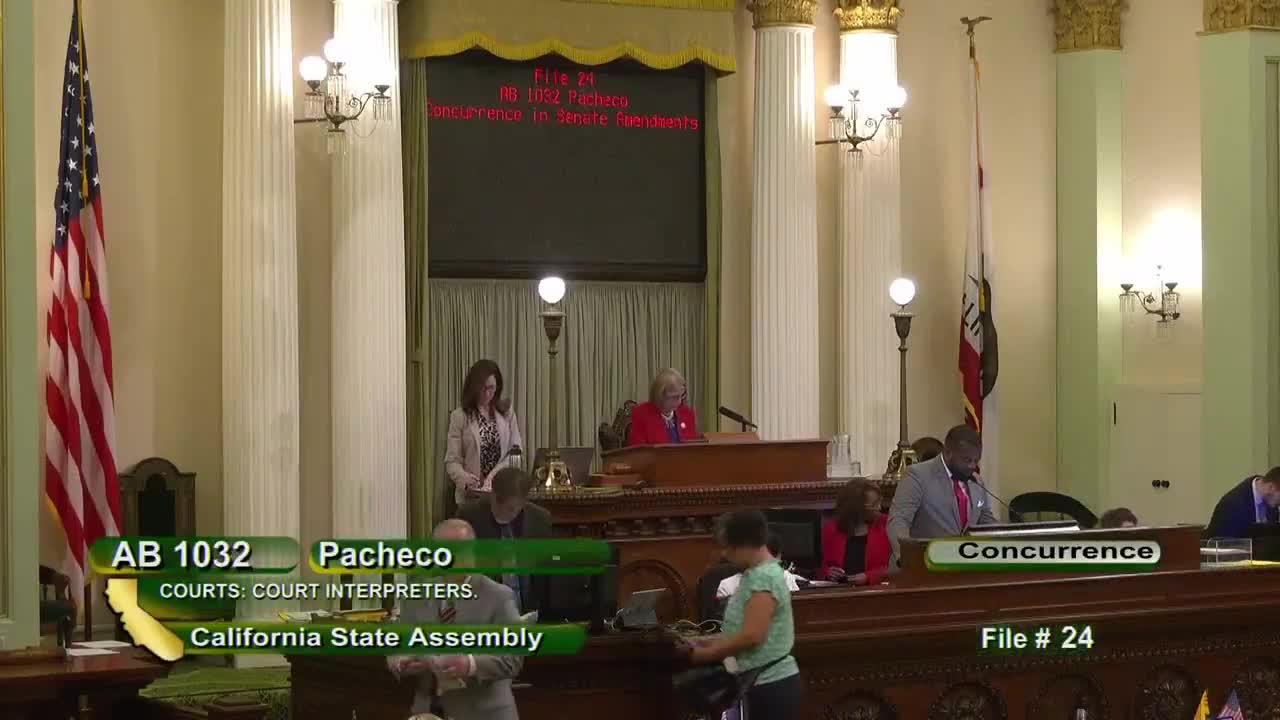 1MIN
Assembly Floor
 3MIN
Senate Floor
 1MIN
Senate Standing Committee on Appropriations
 18MIN
Senate Standing Committee on Judiciary
 1MIN
Assembly Floor
 8MIN
Assembly Standing Committee on Public Employment and Retirement
Bill Author


