AB 1122: Commercial harbor craft: equipment.
- Session Year: 2023-2024
- House: Assembly
- Latest Version Date: 2024-09-04
Current Status:
Failed
(2024-09-29: Vetoed by Governor.)
Introduced
In Committee
First Chamber
In Committee
Second Chamber
Enacted
What does this bill do?
The bill requires diesel particulate filters added to certain commercial harbor vessels to include a manufacturer‑installed override or bypass system that lets the vessel maintain safe propulsion in an emergency and that records each use. Owners must report uses to the filter maker and the State Air Resources Board and keep records. The bill also delays the deadline to install or retrofit engines until the vessel’s next U.S. Coast Guard inspection or 30 months, whichever is sooner.
The summary is provided by generative AI which can make mistakes. For original language, please view the details in the table below.
Existing law generally regulates the operation of vessels and associated equipment used, to be used, or carried in vessels used on waters subject to the jurisdiction of the state. Existing regulations require the installation of a new engine or the retrofit of an existing engine in certain harbor craft to reduce emissions of air pollutants, as specified.
This bill would require a diesel particulate filter that is retrofitted onto the engine of certain commercial harbor craft to include an override or bypass safety system that ensures that the commercial harbor craft can maintain a safe level of propulsion in the event of an emergency situation, as specified. The bill would require the manufacturer of an override or bypass safety system to design, install, and provide certain documentation regarding the override or bypass safety system, as specified. The bill would require the owner or operator of a commercial harbor craft that uses an override or bypass safety system to report the use and retain records regarding the use, as specified. This bill would delay the regulatory requirement to install a new engine or retrofit an existing engine in certain harbor craft, as specified.
Existing law generally regulates the operation of vessels and associated equipment used, to be used, or carried in vessels used on waters subject to the jurisdiction of the state. Existing regulations require the installation of a new engine or the retrofit of an existing engine in certain harbor craft to reduce emissions of air pollutants, as specified.
This bill would require any equipment installed, or modification to accommodate that equipment, that could limit engine power or operational ability of specified commercial harbor craft, to be approved by at least one authorized classification society, as defined, and not void any existing warranty provided by the manufacturer of the engine or propulsion system. The bill would require aftermarket equipment that could limit a harbor crafts engine power to include an override or bypass feature that ensures the vessel can be operated at full power. The bill would require the owner or operator to report the use of the override or bypass feature during operation, as specified.This bill would require a diesel particulate filter that is retrofitted onto the engine of certain commercial harbor craft to include an override or bypass safety system that ensures that the commercial harbor craft can maintain a safe level of propulsion in the event of an emergency situation, as specified. The bill would require the manufacturer of an override or bypass safety system to design, install, and provide certain documentation regarding the override or bypass safety system, as specified. The bill would require the owner or operator of a commercial harbor craft that uses an override or bypass safety system to report the use and retain records regarding the use, as specified. This bill would delay the regulatory requirement to install a new engine or retrofit an existing engine in certain harbor craft, as specified.
Existing law generally regulates the operation of vessels and associated equipment used, to be used, or carried in vessels used on waters subject to the jurisdiction of the state.
This bill would require any equipment installed, or modification to accommodate that equipment, that could limit engine power or operational ability of specified commercial harbor craft, to be approved for use with the harbor crafts propulsion system, as specified, by at least one authorized classification society, as defined, and not void any existing warranty. warranty provided by the manufacturer of the engine or propulsion system. The bill would require aftermarket equipment that could limit a harbor crafts engine power or operational ability to include an automatic override or bypass feature that ensures the safe operation of the harbor craft is not affected. vessel can be operated at full power. The bill would require the owner or operator to report a vessels loss of power the use of the override or bypass feature during operation, as specified.
Existing law generally regulates the operation of vessels and associated equipment used, to be used, or carried in vessels used on waters subject to the jurisdiction of the state.
This bill would require any equipment installed, or modification to accommodate that equipment, that could limit engine power or operational ability of specified commercial harbor craft, to be approved for use with the harbor crafts propulsion system, as specified, and not void any existing warranty. The bill would require aftermarket equipment that could limit a harbor crafts engine power or operational ability to include an automatic override or bypass feature that ensures the safe operation of the harbor craft is not affected. The bill would require the owner or operator to report a vessels loss of power during operation, as specified.
Existing law establishes the Medi-Cal program, which is administered by the State Department of Health Care Services and under which qualified low-income individuals receive health care services. The Medi-Cal program is, in part, governed and funded by federal Medicaid program provisions.Existing law generally requires an applicant that currently is not enrolled in the Medi-Cal program, a provider applying for continued enrollment, or a provider not currently enrolled at a location where the provider intends to provide services, goods, supplies, or merchandise to a Medi-Cal beneficiary, to submit a complete application package for enrollment, continuing enrollment, or enrollment at a new location or a change in location, as specified.Existing law requires an applicant or provider, for new or continued enrollment in the Medi-Cal program, to disclose all information as required in federal Medicaid regulations and any other information required by the department, as specified.This bill would require the Director of Health Care Services to develop a process to allow an applicant or provider to submit an alternative type of primary, authoritative source documentation to meet the requirement of submitting the above-described information. The bill would require the department to document each case of an applicant or provider submitting an alternative type of primary, authoritative source documentation, as specified. The bill would condition implementation of these provisions on lack of conflict with federal law or regulation, federal financial participation not being jeopardized, and receipt of any necessary federal approvals.Existing law authorizes the department to make unannounced visits to an applicant or provider for the purpose of determining whether enrollment, continued enrollment, or certification is warranted, or as necessary for the administration of the Medi-Cal program. Existing law requires, at the time of the visit, the applicant or provider to demonstrate an established place of business appropriate and adequate for the services billed or claimed to the Medi-Cal program, as specified.This bill would authorize the applicant or provider to submit its application for enrollment up to 30 days before having an established place of business and have its application considered by the department, to the extent not in conflict with federal law.Existing law establishes the Medi-Cal program, which is administered by the State Department of Health Care Services and under which qualified low-income individuals receive health care services. The Medi-Cal program is, in part, governed and funded by federal Medicaid program provisions.
Existing law generally requires an applicant that currently is not enrolled in the Medi-Cal program, a provider applying for continued enrollment, or a provider not currently enrolled at a location where the provider intends to provide services, goods, supplies, or merchandise to a Medi-Cal beneficiary, to submit a complete application package for enrollment, continuing enrollment, or enrollment at a new location or a change in location, as specified.
Existing law requires an applicant or provider, for new or continued enrollment in the Medi-Cal program, to disclose all information as required in federal Medicaid regulations and any other information required by the department, as specified.
This bill would authorize an applicant or provider to submit any primary authoritative source documentation as proof of the above-described information, and would require the Director of Health Care Services to reasonably accept alternative formats and sources of that documentation so long as it is verified as authentic and comes from a primary source.This bill would require the Director of Health Care Services to develop a process to allow an applicant or provider to submit an alternative type of primary, authoritative source documentation to meet the requirement of submitting the above-described information. The bill would require the department to document each case of an applicant or provider submitting an alternative type of primary, authoritative source documentation, as specified. The bill would condition implementation of these provisions on lack of conflict with federal law or regulation, federal financial participation not being jeopardized, and receipt of any necessary federal approvals.
Existing law authorizes the department to make unannounced visits to an applicant or provider for the purpose of determining whether enrollment, continued enrollment, or certification is warranted, or as necessary for the administration of the Medi-Cal program. Existing law requires, at the time of the visit, the applicant or provider to demonstrate an established place of business appropriate and adequate for the services billed or claimed to the Medi-Cal program, as specified.
This bill would authorize the applicant or provider to submit its application for enrollment up to 30 days before having an established place of business and have its application considered by the department. department, to the extent not in conflict with federal law.
If the department exercises its authority to conduct background checks, preenrollment inspections, or unannounced visits, existing law requires that the applicant or provider receive notice, from the department, after the conclusion of the background check, preenrollment inspection, or unannounced visit of either (1) the applicant or provider being granted provisional provider status for a period of 12 months, or (2) discrepancies or failure to meet program requirements having been found to exist during the preenrollment period.Existing law requires that the notice identify the discrepancies or failures, and whether remediation can be made or not, and if so, the time period within which remediation must be accomplished. Under existing law, failure to remediate discrepancies and failures, or notification that remediation is not available, results in denial of the application by operation of law. Existing law authorizes the applicant or provider to reapply by submitting a new application package that is reviewed de novo.Under this bill, if the department fails to provide notice of a remediation period for discrepancies or areas of noncompliance that are reasonably remediable within a 30-day period, a denial of the application would not be effective and the provider would be authorized to give notice to the department that the deficiencies have been remedied within this period of time. The bill would require the department to consider the newly submitted information and proceed with consideration of the enrollment.Under the bill, these provisions would be implemented to the extent not in conflict with federal law.Existing law establishes the Medi-Cal program, which is administered by the State Department of Health Care Services and under which qualified low-income individuals receive health care services. The Medi-Cal program is, in part, governed and funded by federal Medicaid program provisions.
Existing law generally requires an applicant that currently is not enrolled in the Medi-Cal program, a provider applying for continued enrollment, or a provider not currently enrolled at a location where the provider intends to provide services, goods, supplies, or merchandise to a Medi-Cal beneficiary, to submit a complete application package for enrollment, continuing enrollment, or enrollment at a new location or a change in location, as specified. Existing law authorizes the applicant or provider whose application has been denied to appeal the denial in accordance with certain procedures.
This bill would make a technical, nonsubstantive change to one of those provisions.Existing law requires an applicant or provider, for new or continued enrollment in the Medi-Cal program, to disclose all information as required in federal Medicaid regulations and any other information required by the department, as specified.
This bill would authorize an applicant or provider to submit any primary authoritative source documentation as proof of the above-described information, and would require the Director of Health Care Services to reasonably accept alternative formats and sources of that documentation so long as it is verified as authentic and comes from a primary source.
Existing law authorizes the department to make unannounced visits to an applicant or provider for the purpose of determining whether enrollment, continued enrollment, or certification is warranted, or as necessary for the administration of the Medi-Cal program. Existing law requires, at the time of the visit, the applicant or provider to demonstrate an established place of business appropriate and adequate for the services billed or claimed to the Medi-Cal program, as specified.
This bill would authorize the applicant or provider to submit its application for enrollment up to 30 days before having an established place of business and have its application considered by the department.
If the department exercises its authority to conduct background checks, preenrollment inspections, or unannounced visits, existing law requires that the applicant or provider receive notice, from the department, after the conclusion of the background check, preenrollment inspection, or unannounced visit of either (1) the applicant or provider being granted provisional provider status for a period of 12 months, or (2) discrepancies or failure to meet program requirements having been found to exist during the preenrollment period.
Existing law requires that the notice identify the discrepancies or failures, and whether remediation can be made or not, and if so, the time period within which remediation must be accomplished. Under existing law, failure to remediate discrepancies and failures, or notification that remediation is not available, results in denial of the application by operation of law. Existing law authorizes the applicant or provider to reapply by submitting a new application package that is reviewed de novo.
Under this bill, if the department fails to provide notice of a remediation period for discrepancies or areas of noncompliance that are reasonably remediable within a 30-day period, a denial of the application would not be effective and the provider would be authorized to give notice to the department that the deficiencies have been remedied within this period of time. The bill would require the department to consider the newly submitted information and proceed with consideration of the enrollment.
Under the bill, these provisions would be implemented to the extent not in conflict with federal law.
Existing law establishes the Medi-Cal program, which is administered by the State Department of Health Care Services and under which qualified low-income individuals receive health care services. The Medi-Cal program is, in part, governed and funded by federal Medicaid program provisions.
Existing law generally requires an applicant that currently is not enrolled in the Medi-Cal program, a provider applying for continued enrollment, or a provider not currently enrolled at a location where the provider intends to provide services, goods, supplies, or merchandise to a Medi-Cal beneficiary, to submit a complete application package for enrollment, continuing enrollment, or enrollment at a new location or a change in location, as specified. Existing law authorizes the applicant or provider whose application has been denied to appeal the denial in accordance with certain procedures.
This bill would make a technical, nonsubstantive change to one of those provisions.
The Legislature finds and declares all of the following:
(a)Californias natural beauty and 1,100 miles of coastline is a treasured asset that must be protected for the enjoyment of all Californians and to support the employees and businesses that serve tourist spending, which exceeds $130 billion annually.
(b)Moreover, the substantial economic activity generated by the domestic maritime transportation industry in California, exceeding $12.2 billion, ranks it fourth among all states.
(c)Engines and propulsion systems on marine vessels are critical to the protection of mariners and the environment and to the safe transportation of goods. Propulsion systems serve as the only protection against wind, tides, currents, and waves.
(d)Mariners operate vessels in all conditions, including the increasingly powerful atmospheric rivers impacting California.
(e)The safe operation of vessels in open water is essential for protecting mariners that are involved in constructing clean energy wind farms off the coast of California.
(f)Even partial power loss on a vessel can result in catastrophic environmental damage due to the inability to guide ships and tankers safely to port.
(g)Escorting these vessels safely to and from port or conducting rescues in the open ocean is essential to protecting the environment, wildlife, and access to our coast.
(h)During the 2020 port backlog, tankers waiting at West Coast ports contained over 20,000,000 barrels of petroleum products on a single day.
(i)Modern New Panamax ships can carry over 3,000,000 gallons of fuel.
(j)It is essential that California ensures that mariners are not put at risk when equipment fails since rescue could be hours away, even under calm weather.
(k)The National Institute for Occupational Safety and Health concluded that working in a marine environment is five times more likely to lead to a job-related fatality compared to the overall United States workforce.
(l)Vessel classification societies evaluate the seaworthiness, maintenance, and compliance with safety regulations of all vessels to ensure insurance policies can be issued.
(m)Vessel owners are not allowed to obtain insurance for mariners or for environmental protection without the prior approval of any proposed vessel modification by a United States Coast Guard-authorized vessel classification society.
SEC. 2.Section 654.4 is added to the Harbors and Navigation Code, to read:654.4.(a)For purposes of this section, the following definitions apply:
(1)(A)Commercial harbor craft means a vessel regulated under Section 93118.5 of Title 17 of the California Code of Regulations and that is certified under Subchapter C, E, I, M, or T of Chapter 1 of Title 46 of the Code of Federal Regulations.
(B)Commercial harbor craft does not include a pilot vessel used for transporting a maritime pilot in furtherance of their official duties.
(2)Diesel particulate filter means an emission control technology that reduces diesel particulate matter emissions in engine exhaust gases by trapping the particles in a flow filter substrate and periodically removes the collected particles by either physical action or by burning off the particles in a process called regeneration.
(3)Emergency situation includes, but is not limited to, any time a commercial harbor craft vessel loses engine power or propulsion.
(4)Pilot vessel means a vessel designed and used for the transfer and transport of maritime pilots to and from oceangoing vessels while those vessels are underway, at anchor, or at dock.
(b)A diesel particulate filter retrofitted onto the engine of a commercial harbor craft shall include an override or bypass safety system that ensures that the commercial harbor craft can maintain a safe level of propulsion in the event of an emergency situation. The override or bypass safety system shall be designed so that the diesel particulate filters operation may resume immediately after the emergency situation has ended.
(c)The override or bypass safety system shall be designed and installed by its manufacturer as part of the diesel particulate filter.
(d)The override or bypass safety system shall be equipped by its manufacturer with an electric monitoring and tracking system to track each time the override or bypass safety system is used. The manufacturer shall provide written materials to the commercial harbor craft owner or operator regarding both of the following:
(1)The safe and proper use of the override or bypass safety system during an emergency situation.
(2)How to document and report each use of the override or bypass safety system to its manufacturer.
(e)If a commercial harbor craft loses engine power or propulsion during an emergency situation, the owner or operator of the commercial harbor craft may activate the override or bypass safety system.
(f)Within 30 calendar days of the use of an override or bypass safety system, the owner or operator of the commercial harbor craft shall report to the manufacturer of the override or bypass safety system and the State Air Resources Board all of the following:
(1)The emergency situation that triggered the use of the override or bypass safety system.
(2)The operational time that the override or bypass safety system was in use.
(3)When the override or bypass safety system was deactivated.
(4)How using the override or bypass safety system mitigated the emergency situation.
(g)The owner or operator of a commercial harbor craft shall maintain a record of information regarding the use of the override or bypass safety system, including the information reported pursuant to subdivision (f). This information shall be made available to the State Air Resources Board upon request.
(h)Following the expiration of an exemption granted pursuant to Section 93118.5 of Title 17 of the California Code of Regulations, if applicable, a commercial harbor craft, subject to inspection pursuant to Section 137.300 of Title 46 of the Code of Federal Regulations and authorized to install a new engine or retrofit an existing engine pursuant to Section 2299.5 of Title 13 or Section 93118.5 of Title 17 of the California Code of Regulations, as those sections were amended in 2022, is not required to comply with the requirement to install a new engine or retrofit an existing engine pursuant to Section 2299.5 of Title 13 or Section 93118.5 of Title 17 of the California Code of Regulations until its next inspection by the United States Coast Guard or third-party organization certification under Section 139.115 of Title 46 of the Code of Federal Regulations or until 30 months from the otherwise operative date of compliance, whichever is sooner.
The Legislature finds and declares all of the following:
(a)Californias natural beauty and 1,100 miles of coastline is a treasured asset that must be protected for the enjoyment of all Californians and to support the employees and businesses that serve tourist spending, which exceeds $130 billion annually.
(b)Moreover, the substantial economic activity generated by the domestic maritime transportation industry in California, exceeding $12.2 billion, ranks it fourth among all states.
(c)Engines and propulsion systems on marine vessels are critical to the protection of mariners and the environment and to the safe transportation of goods. Propulsion systems serve as the only protection against wind, tides, currents, and waves.
(d)Mariners operate vessels in all conditions, including the increasingly powerful atmospheric rivers impacting California.
(e)The safe operation of vessels in open water is essential for protecting mariners that are involved in constructing clean energy wind farms off the coast of California.
(f)Even partial power loss on a vessel can result in catastrophic environmental damage due to the inability to guide ships and tankers safely to port.
(g)Escorting these vessels safely to and from port or conducting rescues in the open ocean is essential to protecting the environment, wildlife, and access to our coast.
(h)During the 2020 port backlog, tankers waiting at West Coast ports contained over 20,000,000 barrels of petroleum products on a single day.
(i)Modern New Panamax ships can carry over 3,000,000 gallons of fuel.
(j)It is essential that California ensures that mariners are not put at risk when equipment fails since rescue could be hours away, even under calm weather.
(k)The National Institute for Occupational Safety and Health concluded that working in a marine environment is five times more likely to lead to a job-related fatality compared to the overall United States workforce.
(l)Vessel classification societies evaluate the seaworthiness, maintenance, and compliance with safety regulations of all vessels to ensure insurance policies can be issued.
(m)Vessel owners are not allowed to obtain insurance for mariners or for environmental protection without the prior approval of any proposed vessel modification by a United States Coast Guard-authorized vessel classification society.
SEC. 2.Section 654.4 is added to the Harbors and Navigation Code, to read:654.4.(a)For purposes of this section, the following definitions apply:
(1)(A)Commercial harbor craft means a vessel regulated under Section 93118.5 of Title 17 of the California Code of Regulations and that is certified under Subchapter C, E, I, M, or T of Chapter 1 of Title 46 of the Code of Federal Regulations.
(B)Commercial harbor craft does not include a pilot vessel used for transporting a maritime pilot in furtherance of their official duties.
(2)Diesel particulate filter means an emission control technology that reduces diesel particulate matter emissions in engine exhaust gases by trapping the particles in a flow filter substrate and periodically removes the collected particles by either physical action or by burning off the particles in a process called regeneration.
(3)Emergency situation includes, but is not limited to, any time a commercial harbor craft vessel loses engine power or propulsion.
(4)Pilot vessel means a vessel designed and used for the transfer and transport of maritime pilots to and from oceangoing vessels while those vessels are underway, at anchor, or at dock.
(b)A diesel particulate filter retrofitted onto the engine of a commercial harbor craft shall include an override or bypass safety system that ensures that the commercial harbor craft can maintain a safe level of propulsion in the event of an emergency situation. The override or bypass safety system shall be designed so that the diesel particulate filters operation may resume immediately after the emergency situation has ended.
(c)The override or bypass safety system shall be designed and installed by its manufacturer as part of the diesel particulate filter.
(d)The override or bypass safety system shall be equipped by its manufacturer with an electric monitoring and tracking system to track each time the override or bypass safety system is used. The manufacturer shall provide written materials to the commercial harbor craft owner or operator regarding both of the following:
(1)The safe and proper use of the override or bypass safety system during an emergency situation.
(2)How to document and report each use of the override or bypass safety system to its manufacturer.
(e)If a commercial harbor craft loses engine power or propulsion during an emergency situation, the owner or operator of the commercial harbor craft may activate the override or bypass safety system.
(f)Within 30 calendar days of the use of an override or bypass safety system, the owner or operator of the commercial harbor craft shall report to the manufacturer of the override or bypass safety system and the State Air Resources Board all of the following:
(1)The emergency situation that triggered the use of the override or bypass safety system.
(2)The operational time that the override or bypass safety system was in use.
(3)When the override or bypass safety system was deactivated.
(4)How using the override or bypass safety system mitigated the emergency situation.
(g)The owner or operator of a commercial harbor craft shall maintain a record of information regarding the use of the override or bypass safety system, including the information reported pursuant to subdivision (f). This information shall be made available to the State Air Resources Board upon request.
(h)A Following the expiration of an exemption granted pursuant to Section 93118.5 of Title 17 of the California Code of Regulations, if applicable, a commercial harbor craft, subject to inspection pursuant to Section 137.300 of Title 46 of the Code of Federal Regulations and authorized to install a new engine or retrofit an existing engine pursuant to Section 2299.5 of Title 13 or Section 93118.5 of Title 17 of the California Code of Regulations, as those sections were amended in 2022, is not required to comply with the requirement to install a new engine or retrofit an existing engine pursuant to Section 2299.5 of Title 13 or Section 93118.5 of Title 17 of the California Code of Regulations until its next inspection by the United States Coast Guard or third-party organization certification under Section 139.115 of Title 46 of the Code of Federal Regulations. Regulations or until 30 months from the otherwise operative date of compliance, whichever is sooner.
The Legislature finds and declares all of the following:
(a)Californias natural beauty and 1,100 miles of coastline is a treasured asset that must be protected for the enjoyment of all Californians and to support the employees and businesses that serve tourist spending that spending, which exceeds $130 billion annually.
(b)Moreover, the substantial economic activity generated by the domestic maritime transportation industry in California, exceeding $12.2 billion, ranks it fourth among all states.
(c)Engines and propulsion systems on marine vessels are critical to the protection of mariners and the environment and to the safe transport transportation of goods. Propulsion systems serve as the only protection against wind, tides, currents, and waves.
(d)Mariners operate vessels in all conditions, including the increasingly powerful atmospheric rivers impacting California.
(e)The safe operation of vessels in open water is essential for protecting mariners that are involved in constructing clean energy wind farms off the coast of California.
(f)Even partial power loss on a vessel can result in catastrophic environmental damage due to the inability to guide ships and tankers safely to port.
(g)Escorting these vessels safely to and from port or conducting rescues in the open ocean is essential to protecting the environment, wildlife, and access to our coast.
(h)During the 2020 port backlog, tankers waiting at West Coast ports contained over 20,000,000 barrels of petroleum products on a single day.
(i)Modern New Panamax ships can carry over 3,000,000 gallons of fuel.
(j)It is essential that California ensures that mariners are not put at risk when equipment fails since rescue could be hours away, even under calm weather.
(k)The National Institute for Occupational Safety and Health concluded that working in a marine environment is five times more likely to lead to a job-related fatality compared to the overall United States workforce.
(l)Vessel classification societies evaluate the seaworthiness, maintenance, and compliance with safety regulations of all vessels to ensure insurance policies can be issued.
(m)Vessel owners are not allowed to obtain insurance for mariners or for environmental protection without the prior approval of any proposed vessel modification by a United States Coast Guard-authorized vessel classification society.
SEC. 2.Section 654.4 is added to the Harbors and Navigation Code, to read:654.4.(a)For purposes of this section, the following definitions apply:
(1)Authorized classification society has the same meaning as provided in Section 8.100 of Title 46 of the Code of Federal Regulations.(1)(A)Commercial harbor craft means a vessel regulated under Section 93118.5 of Title 17 of the California Code of Regulations and that is certified under Subchapter C, E, I, M, or T of Chapter 1 of Title 46 of the Code of Federal Regulations.
(B)Commercial harbor craft does not include a pilot vessel used for transporting a maritime pilot in furtherance of their official duties.
(2)Diesel particulate filter means an emission control technology that reduces diesel particulate matter emissions in engine exhaust gases by trapping the particles in a flow filter substrate and periodically removes the collected particles by either physical action or by burning off the particles in a process called regeneration.
(3)Emergency situation includes, but is not limited to, any time a commercial harbor craft vessel loses engine power or propulsion.
(2)(4)Pilot vessel means a vessel designed and used for the transfer and transport of maritime pilots to and from oceangoing vessels while those vessels are underway, at anchor, or at dock.
(b)(1)Except as provided in paragraph (2), this section applies to a vessel regulated under either Section 2299.5 of Title 13 of the California Code of Regulations or Section 93118.5 of Title 17 of the California Code of Regulations, and that is certified under Subchapter C, E, I, M, or T of Chapter 1 of Title 46 of the Code of Federal Regulations.(2)This section does not apply to a pilot vessel used for transporting a maritime pilot in furtherance of their official duties.(c)Any equipment that could limit engine power or operational ability of a vessel that is installed on a commercial harbor craft, or any modifications to a vessel to accommodate that equipment, shall be approved by at least one authorized classification society, meet all applicable United States Coast Guard regulations, and not void any existing warranty provided by the manufacturer of the engine or propulsion system.(d)Any aftermarket equipment that could limit the engine power of a vessel shall include an override or bypass feature that ensures the vessel can be operated at full power, regardless of the operational status of the installed equipment.(e)If a vessel loses engine power or propulsion during operation, the owner or operator of the vessel may activate the override or bypass feature. The owner or operator shall report the use of the override or bypass feature as soon as possible or concurrently with applicable United States Coast Guard reporting requirements and to any state agency requiring reporting of the use of the override or bypass system.(b)A diesel particulate filter retrofitted onto the engine of a commercial harbor craft shall include an override or bypass safety system that ensures that the commercial harbor craft can maintain a safe level of propulsion in the event of an emergency situation. The override or bypass safety system shall be designed so that the diesel particulate filters operation may resume immediately after the emergency situation has ended.
(c)The override or bypass safety system shall be designed and installed by its manufacturer as part of the diesel particulate filter.
(d)The override or bypass safety system shall be equipped by its manufacturer with an electric monitoring and tracking system to track each time the override or bypass safety system is used. The manufacturer shall provide written materials to the commercial harbor craft owner or operator regarding both of the following:
(1)The safe and proper use of the override or bypass safety system during an emergency situation.
(2)How to document and report each use of the override or bypass safety system to its manufacturer.
(e)If a commercial harbor craft loses engine power or propulsion during an emergency situation, the owner or operator of the commercial harbor craft may activate the override or bypass safety system.
(f)Within 30 calendar days of the use of an override or bypass safety system, the owner or operator of the commercial harbor craft shall report to the manufacturer of the override or bypass safety system all of the following:
(1)The emergency situation that triggered the use of the override or bypass safety system.
(2)The operational time that the override or bypass safety system was in use.
(3)When the override or bypass safety system was deactivated.
(4)How using the override or bypass safety system mitigated the emergency situation.
(g)The owner or operator of a commercial harbor craft shall maintain a record of information regarding the use of the override or bypass safety system, including the information reported pursuant to subdivision (f). This information shall be made available to the State Air Resources Board upon request.
(h)A commercial harbor craft, subject to inspection pursuant to Section 137.300 of Title 46 of the Code of Federal Regulations and authorized to install a new engine or retrofit an existing engine pursuant to Section 2299.5 of Title 13 or Section 93118.5 of Title 17 of the California Code of Regulations, as those sections were amended in 2022, is not required to comply with the requirement to install a new engine or retrofit an existing engine pursuant to Section 2299.5 of Title 13 or Section 93118.5 of Title 17 of the California Code of Regulations until its next inspection by the United States Coast Guard or third-party organization certification under Section 139.115 of Title 46 of the Code of Federal Regulations.
The Legislature finds and declares as follows: all of the following:
(a)Californias natural beauty and 1,100 miles of coastline is a treasured asset that must be protected for the enjoyment of all Californians and to support the employees and businesses that serve tourist spending that exceeds $130 billion annually.
(b)Moreover, the substantial economic activity generated by the domestic maritime transportation industry in California, exceeding $12.2 billion, ranks it fourth among all states.
(c)Engines and propulsion systems on marine vessels are critical to the protection of mariners and the environment and the safe transport of goods. Propulsion systems serve as the only protection against wind, tides, currents, and waves.
(d)Mariners operate vessels in all conditions, including the increasingly powerful atmospheric rivers impacting California.
(e)The safe operation of vessels in open water is essential for protecting mariners that are involved in constructing clean energy wind farms off the coast of California.
(f)Even partial power loss on a vessel can result in catastrophic environmental damage due to the inability to guide ships and tankers safely to port.
(g)Escorting these vessels safely to and from port or conducting rescues in the open ocean is essential to protecting the environment, wildlife, and access to our coast.
(h)During the 2020 port backlog, tankers waiting at West Coast ports contained over 20,000,000 barrels of petroleum products on a single day.
(i)Modern New Panamax ships can carry over 3,000,000 gallons of fuel.
(j)It is essential that California ensures that mariners are not put at risk when equipment fails since rescue could be hours away, even under calm weather.
(k)The National Institute for Occupational Safety and Health concluded that working in a marine environment is five times more likely to lead to a job-related fatality compared to the overall United States workforce.
(l)Vessel classification societies evaluate the seaworthiness, maintenance, and compliance with safety regulations of all vessels to ensure insurance policies can be issued.
(m)Vessel owners are not allowed to obtain insurance for mariners or for environmental protection without the prior approval of any proposed vessel modification by a United States Coast Guard-authorized vessel classification society.
SEC. 2.Section 654.4 is added to the Harbors and Navigation Code, to read:654.4.(a)For purposes of this section, the following definitions apply:
(1)Authorized classification society has the same meaning as provided in Section 8.100 of Title 46 of the Code of Federal Regulations.
(2)Pilot vessel means a vessel designed and used for the transfer and transport of maritime pilots to and from oceangoing vessels while those vessels are underway, at anchor, or at dock.
(b)(1)Except as provided in paragraph (2), this section shall apply applies to a vessel regulated under either Section 2299.5 of Title 13 of the California Code of Regulations or Section 93118.5 of Title 17 of the California Code of Regulations, and that is certified under Subchapter C, E, I, M, or T of Chapter 1 of Title 46 of the Code of Federal Regulations.
(2)This section shall does not apply to a pilot vessel used for transporting a maritime pilot in furtherance of their official duties.
(c)Any equipment that could limit engine power or operational ability of a vessel that is installed on a commercial harbor craft, or any modifications to a vessel to accommodate that equipment, shall be approved by at least one authorized classification society and the manufacturer of the engine or propulsion system, as necessary, to society, meet all applicable United States Coast Guard regulations regulations, and to not void any existing warranty. warranty provided by the manufacturer of the engine or propulsion system.
(d)Any aftermarket equipment that could limit the engine power or operational ability of a vessel shall include an automatic override or bypass feature that ensures the safe operation of the harbor craft is not affected, vessel can be operated at full power, regardless of the operational status of the installed equipment.
(e)If a vessel loses engine power or propulsion during operation, the owner or operator of the vessel may activate the override or bypass feature. The owner or operator shall report the use of the automatic override or bypass feature as soon as possible or concurrently with applicable United States Coast Guard reporting requirements and to any state agency requiring reporting of the use of the override or bypass system.
The Legislature finds and declares as follows:
(a)Californias natural beauty and 1,100 miles of coastline is a treasured asset that must be protected for the enjoyment of all Californians and to support the employees and businesses that serve tourist spending that exceeds $130 billion annually.
(b)Moreover, the substantial economic activity generated by the domestic maritime transportation industry in California, exceeding $12.2 billion, ranks it fourth among all states.
(c)Engines and propulsion systems on marine vessels are critical to the protection of mariners and the environment and the safe transport of goods. Propulsion systems serve as the only protection against wind, tides, currents, and waves.
(d)Mariners operate vessels in all conditions, including the increasingly powerful atmospheric rivers impacting California.
(e)The safe operation of vessels in open water is essential for protecting mariners that are involved in constructing clean energy wind farms off the coast of California.
(f)Even partial power loss on a vessel can result in catastrophic environmental damage due to the inability to guide ships and tankers safely to port.
(g)Escorting these vessels safely to and from port or conducting rescues in the open ocean is essential to protecting the environment, wildlife, and access to our coast.
(h)During the 2020 port backlog, tankers waiting at West Coast ports contained over 20,000,000 barrels of petroleum products on a single day.
(i)Modern New Panamax ships can carry over 3,000,000 gallons of fuel.
(j)It is essential that California ensures that mariners are not put at risk when equipment fails since rescue could be hours away, even under calm weather.
(k)The National Institute for Occupational Safety and Health concluded that working in a marine environment is five times more likely to lead to a job-related fatality compared to the overall United States workforce.
(l)Vessel classification societies evaluate the seaworthiness, maintenance, and compliance with safety regulations of all vessels to ensure insurance policies can be issued.
(m)Vessel owners are not allowed to obtain insurance for mariners or for environmental protection without the prior approval of any proposed vessel modification by a United States Coast Guard-authorized vessel classification society.
SEC. 2.Section 654.4 is added to the Harbors and Navigation Code, to read:654.4.(a)For purposes of this section, the following definitions apply:
(1)Authorized classification society has the same meaning as provided in Section 8.100 of Title 46 of the Code of Federal Regulations.
(2)Pilot vessel means a vessel designed and used for the transfer and transport of maritime pilots to and from oceangoing vessels while those vessels are underway, at anchor, or at dock.
(b)(1)Except as provided in paragraph (2), this section shall apply to a vessel regulated under either Section 2299.5 of Title 13 of the California Code of Regulations or Section 93118.5 of Title 17 of the California Code of Regulations, and that is certified under Subchapter C, E, I, M, or T of Chapter 1 of Title 46 of the Code of Federal Regulations.
(2)This section shall not apply to a pilot vessel used for transporting a maritime pilot in furtherance of their official duties.
(c)Any equipment that could limit engine power or operational ability of a vessel that is installed on a commercial harbor craft, or any modifications to a vessel to accommodate that equipment, shall be approved by at least one authorized classification society and the manufacturer of the engine or propulsion system, as necessary, to meet applicable United States Coast Guard regulations and to not void any existing warranty.
(d)Any aftermarket equipment that could limit engine power or operational ability of a vessel shall include an automatic override or bypass feature that ensures the safe operation of the harbor craft is not affected, regardless of the operational status of the installed equipment.
(e)If a vessel loses power during operation, the owner or operator of the vessel shall report the use of the automatic override or bypass as soon as possible or concurrently with applicable United States Coast Guard reporting requirements and to any state agency requiring reporting of the use of the override or bypass system.
All matter omitted in this version of the bill appears in the bill as amended in the Assembly, April 20, 2023. (JR11)(a)(1)Whether or not regulations for certification are adopted under Section 14043.15, in order to be enrolled as a provider, or for enrollment as a provider to continue, an applicant or provider may be required to sign a provider agreement and shall disclose all information as required in federal Medicaid regulations and any other information required by the department. Applicants, providers, and persons with an ownership or control interest, as defined in federal Medicaid regulations, shall submit their date of birth and their social security number or numbers to the department, to the full extent allowed under federal law. Corporations with an ownership or control interest, as defined in federal Medicaid regulations, shall submit their taxpayer identification number and all business address locations and post office box addresses.
(2)An applicant or provider shall be entitled to submit any primary authoritative source documentation as proof of required information under paragraph (1), and the director shall reasonably accept alternative formats and sources of that documentation so long as it is verified as authentic and comes from a primary source, and to the extent not in conflict with federal law.(2)(A)The director shall develop a process to allow an applicant or provider to submit an alternative type of primary, authoritative source documentation to meet the requirement of submitting information under paragraph (1).
(B)As part of the process developed pursuant to subparagraph (A), the department shall document each case of an applicant or provider submitting an alternative type of primary, authoritative source documentation, including recording the source documentation submitted and the rationale for accepting alternative types of source documentation.
(C)Subparagraphs (A) and (B) shall be implemented only to the extent that all of the following conditions are met:
(i)Implementation is not in conflict with federal law or regulation.
(ii)Federal financial participation is not jeopardized.
(iii)Any necessary federal approvals have been obtained.
(3)The director may designate the form of a provider agreement by provider type. Failure to disclose the required information, or the disclosure of false information, shall result in denial of the application for enrollment or shall make the provider subject to temporary suspension from the Medi-Cal program, which shall include temporary deactivation of the providers number or numbers, including all business addresses used by the provider to obtain reimbursement from the Medi-Cal program.
(b)The director shall notify the provider of the temporary suspension and deactivation of the providers number or numbers, including all business addresses used by the provider, and the effective date thereof. Notwithstanding Section 100171 of the Health and Safety Code and Section 14123, proceedings after the imposition of sanctions provided for in subdivision (a) shall be in accordance with Section 14043.65.
SEC. 2.Section 14043.26 of the Welfare and Institutions Code is amended to read:14043.26.(a)(1)On and after January 1, 2004, an applicant that currently is not enrolled in the Medi-Cal program, or a provider applying for continued enrollment, upon written notification from the department that enrollment for continued participation of all providers in a specific provider of service category or subgroup of that category to which the provider belongs will occur, or, except as provided in subdivisions (b) and (e), a provider not currently enrolled at a location where the provider intends to provide services, goods, supplies, or merchandise to a Medi-Cal beneficiary, shall submit a complete application package for enrollment, continuing enrollment, or enrollment at a new location or a change in location.(2)Clinics licensed by the department pursuant to Chapter 1 (commencing with Section 1200) of Division 2 of the Health and Safety Code and certified by the department to participate in the Medi-Cal program shall not be subject to this section.(3)Health facilities licensed by the department pursuant to Chapter 2 (commencing with Section 1250) of Division 2 of the Health and Safety Code and certified by the department to participate in the Medi-Cal program shall not be subject to this section.(4)Adult day health care providers licensed pursuant to Chapter 3.3 (commencing with Section 1570) of Division 2 of the Health and Safety Code and certified by the department to participate in the Medi-Cal program shall not be subject to this section.(5)Home health agencies licensed pursuant to Chapter 8 (commencing with Section 1725) of Division 2 of the Health and Safety Code and certified by the department to participate in the Medi-Cal program shall not be subject to this section.(6)Hospices licensed pursuant to Chapter 8.5 (commencing with Section 1745) of Division 2 of the Health and Safety Code and certified by the department to participate in the Medi-Cal program shall not be subject to this section.(b)A physician and surgeon licensed by the Medical Board of California or the Osteopathic Medical Board of California, or a dentist licensed by the Dental Board of California, practicing as an individual physician practice or as an individual dentist practice, as defined in Section 14043.1, who is enrolled and in good standing in the Medi-Cal program, and who is changing locations of that individual physician practice or individual dentist practice within the same county, shall be eligible to continue enrollment at the new location by filing a change of location form to be developed by the department. The form shall comply with all minimum federal requirements related to Medicaid provider enrollment. Filing this form shall be in lieu of submitting a complete application package pursuant to subdivision (a).(c)(1)Except as provided in paragraph (2), within 30 days after receiving an application package submitted pursuant to subdivision (a), the department shall provide written notice that the application package has been received and, if applicable, that there is a moratorium on the enrollment of providers in the specific provider of service category or subgroup of the category to which the applicant or provider belongs. This moratorium shall bar further processing of the application package.(2)Within 15 days after receiving an application package from a physician, or a group of physicians, licensed by the Medical Board of California or the Osteopathic Medical Board of California, or a change of location form pursuant to subdivision (b), the department shall provide written notice that the application package or the change of location form has been received.(d)(1)If the application package submitted pursuant to subdivision (a) is from an applicant or provider who meets the criteria listed in paragraph (2), the applicant or provider shall be considered a preferred provider and shall be granted preferred provisional provider status pursuant to this section and for a period of no longer than 18 months, effective from the date on the notice from the department. The ability to request consideration as a preferred provider and the criteria necessary for the consideration shall be publicized to all applicants and providers. An applicant or provider who desires consideration as a preferred provider pursuant to this subdivision shall request consideration from the department by making a notation to that effect on the application package, by cover letter, or by other means identified by the department in a provider bulletin. Request for consideration as a preferred provider shall be made with each application package submitted in order for the department to grant the consideration. An applicant or provider who requests consideration as a preferred provider shall be notified within 60 days whether the applicant or provider meets or does not meet the criteria listed in paragraph (2). If an applicant or provider is notified that the applicant or provider does not meet the criteria for a preferred provider, the application package submitted shall be processed in accordance with the remainder of this section.(2)To be considered a preferred provider, the applicant or provider shall meet all of the following criteria:(A)Hold a current license as a physician and surgeon issued by the Medical Board of California or the Osteopathic Medical Board of California, which license shall not have been revoked, whether stayed or not, suspended, placed on probation, or subject to other limitation.(B)Be a current faculty member of a teaching hospital or a childrens hospital, as defined in Section 10727, accredited by the Joint Commission or the American Osteopathic Association, or be credentialed by a health care service plan that is licensed under the Knox-Keene Health Care Service Plan Act of 1975 (Chapter 2.2 (commencing with Section 1340) of Division 2 of the Health and Safety Code) or county organized health system, or be a current member in good standing of a group that is credentialed by a health care service plan that is licensed under the Knox-Keene Act.(C)Have full, current, unrevoked, and unsuspended privileges at a Joint Commission or American Osteopathic Association accredited general acute care hospital.(D)Not have any adverse entries in the federal Healthcare Integrity and Protection Data Bank.(3)The department may recognize other providers as qualifying as preferred providers if criteria similar to those set forth in paragraph (2) are identified for the other providers. The department shall consult with interested parties and appropriate stakeholders to identify similar criteria for other providers so that they may be considered as preferred providers.(e)(1)If a Medi-Cal applicant meets the criteria listed in paragraph (2), the applicant shall be enrolled in the Medi-Cal program after submission and review of a short form application to be developed by the department. The form shall comply with all minimum federal requirements related to Medicaid provider enrollment. The department shall notify the applicant that the department has received the application within 15 days of receipt of the application. The department shall enroll the applicant or notify the applicant that the applicant does not meet the criteria listed in paragraph (2) within 90 days of receipt of the application.(2)Notwithstanding any other provision of law, an applicant or provider who meets all of the following criteria shall be eligible for enrollment in the Medi-Cal program pursuant to this subdivision, after submission and review of a short form application:(A)The applicants or providers practice is based in one or more of the following: a general acute care hospital, a rural general acute care hospital, or an acute psychiatric hospital, as defined in subdivisions (a) and (b) of Section 1250 of the Health and Safety Code.(B)The applicant or provider holds a current, unrevoked, or unsuspended license as a physician and surgeon issued by the Medical Board of California or the Osteopathic Medical Board of California. An applicant or provider shall not be in compliance with this subparagraph if a license revocation has been stayed, the licensee has been placed on probation, or the license is subject to any other limitation.(C)The applicant or provider does not have an adverse entry in the federal Healthcare Integrity and Protection Data Bank.(3)An applicant shall be granted provisional provider status under this subdivision for a period of 12 months.(f)Except as provided in subdivision (g), within 180 days after receiving an application package submitted pursuant to subdivision (a), or from the date of the notice to an applicant or provider that the applicant or provider does not qualify as a preferred provider under subdivision (d), the department shall give written notice to the applicant or provider that any of the following applies, or shall on the 181st day grant the applicant or provider provisional provider status pursuant to this section for a period no longer than 12 months, effective from the 181st day:(1)The applicant or provider is being granted provisional provider status for a period of 12 months, effective from the date on the notice.(2)The application package is incomplete. The notice shall identify additional information or documentation that is needed to complete the application package.(3)The department is exercising its authority under Section 14043.37, 14043.4, or 14043.7, and is conducting background checks, preenrollment inspections, or unannounced visits.(4)The application package is denied for any of the following reasons:(A)Pursuant to Section 14043.2 or 14043.36.(B)For lack of a license necessary to perform the health care services or to provide the goods, supplies, or merchandise directly or indirectly to a Medi-Cal beneficiary, within the applicable provider of service category or subgroup of that category.(C)The period of time during which an applicant or provider has been barred from reapplying has not passed.(D)For other stated reasons authorized by law.(E)For failing to submit fingerprints as required by federal Medicaid regulations.(F)For failing to pay an application fee as required by federal Medicaid regulations.(5)The application package is withdrawn by request of the applicant or provider and the departments review is canceled pursuant to subdivision (n).(g)Notwithstanding subdivision (f), within 90 days after receiving an application package submitted pursuant to subdivision (a) from a physician or physician group licensed by the Medical Board of California or the Osteopathic Medical Board of California, or from the date of the notice to that physician or physician group that does not qualify as a preferred provider under subdivision (d), or within 90 days after receiving a change of location form submitted pursuant to subdivision (b), the department shall give written notice to the applicant or provider that either paragraph (1), (2), (3), (4), or (5) of subdivision (f) applies, or shall on the 91st day grant the applicant or provider provisional provider status pursuant to this section for a period no longer than 12 months, effective from the 91st day.(h)(1)If the application package that was noticed as incomplete under paragraph (2) of subdivision (f) is resubmitted with all requested information and documentation, and received by the department within 60 days of the date on the notice, the department shall, within 60 days of the resubmission, send a notice that any of the following applies:(A)The applicant or provider is being granted provisional provider status for a period of 12 months, effective from the date on the notice.(B)The application package is denied for any other reasons provided for in paragraph (4) of subdivision (f).(C)The department is exercising its authority under Section 14043.37, 14043.4, or 14043.7 to conduct background checks, preenrollment inspections, or unannounced visits.(D)The application package is withdrawn by request of the applicant or provider and the departments review is canceled pursuant to subdivision (n).(2)(A)If the application package that was noticed as incomplete under paragraph (2) of subdivision (f) is not resubmitted with all requested information and documentation and received by the department within 60 days of the date on the notice, the application package shall be denied by operation of law. The applicant or provider may reapply by submitting a new application package that shall be reviewed de novo.(B)If the failure to resubmit is by a currently enrolled provider as defined in Section 14043.1, including providers applying for continued enrollment, the failure may make the provider also subject to deactivation of the providers number and all of the business addresses used by the provider to provide services, goods, supplies, or merchandise to Medi-Cal beneficiaries.(C)Notwithstanding subparagraph (A), if the notice of an incomplete application package included a request for information or documentation related to grounds for denial under Section 14043.2 or 14043.36, the applicant or provider shall not reapply for enrollment or continued enrollment in the Medi-Cal program or for participation in any health care program administered by the department or its agents or contractors for a period of three years.(i)(1)If the department exercises its authority under Section 14043.37, 14043.4, or 14043.7 to conduct background checks, preenrollment inspections, or unannounced visits, the applicant or provider shall receive notice, from the department, after the conclusion of the background check, preenrollment inspection, or unannounced visit of either of the following:(A)The applicant or provider is granted provisional provider status for a period of 12 months, effective from the date on the notice.(B)Discrepancies or failure to meet program requirements, as prescribed by the department, have been found to exist during the preenrollment period.(2)(A)(i)The notice shall identify the discrepancies or failures, and whether remediation can be made or not, and if so, the time period within which remediation must be accomplished. Failure to remediate discrepancies and failures as prescribed by the department, or notification that remediation is not available, shall result in denial of the application by operation of law. The applicant or provider may reapply by submitting a new application package that shall be reviewed de novo.(ii)To the extent not in conflict with federal law, if the department fails to provide notice of a remediation period for discrepancies or areas of noncompliance that are reasonably remediable within a 30-day period, a denial of the application shall not be effective, the provider may give notice to the department that the deficiencies have been remedied within this period of time, and the department shall consider the newly submitted information and proceed with consideration of the enrollment.(B)If the failure to remediate is by a currently enrolled provider as defined in Section 14043.1, including providers applying for continued enrollment, the failure may make the provider also subject to deactivation of the providers number and all of the business addresses used by the provider to provide services, goods, supplies, or merchandise to Medi-Cal beneficiaries.(C)Notwithstanding subparagraph (A), if the discrepancies or failure to meet program requirements, as prescribed by the director, included in the notice were related to grounds for denial under Section 14043.2 or 14043.36, the applicant or provider shall not reapply for three years.(j)If provisional provider status or preferred provisional provider status is granted pursuant to this section, a provider number shall be used by the provider for each business address for which an application package has been approved. This provider number shall be used exclusively for the locations for which it was approved, unless the practice of the providers profession or delivery of services, goods, supplies, or merchandise is such that services, goods, supplies, or merchandise are rendered or delivered at locations other than the providers business address and this practice or delivery of services, goods, supplies, or merchandise has been disclosed in the application package approved by the department when the provisional provider status or preferred provisional provider status was granted.(k)Except for providers subject to subdivision (c) of Section 14043.47, a provider currently enrolled in the Medi-Cal program at one or more locations who has submitted an application package for enrollment at a new location or a change in location pursuant to subdivision (a), or filed a change of location form pursuant to subdivision (b), may submit claims for services, goods, supplies, or merchandise rendered at the new location until the application package or change of location form is approved or denied under this section, and shall not be subject, during that period, to deactivation, or be subject to any delay or nonpayment of claims as a result of billing for services rendered at the new location as herein authorized. However, the provider shall be considered during that period to have been granted provisional provider status or preferred provisional provider status and be subject to termination of that status pursuant to Section 14043.27. A provider that is subject to subdivision (c) of Section 14043.47 may come within the scope of this subdivision upon submitting documentation in the application package that identifies the physician providing supervision for every three locations. If a provider submits claims for services rendered at a new location before the application for that location is received by the department, the department may deny the claim.(l)An applicant or a provider whose application for enrollment, continued enrollment, or a new location or change in location, has been denied pursuant to this section, may appeal the denial in accordance with Section 14043.65.(m)(1)Upon receipt of a complete and accurate claim for an individual nurse provider, the department shall adjudicate the claim within an average of 30 days.(2)During the budget proceedings of the 200607 fiscal year, and each fiscal year thereafter, the department shall provide data to the Legislature specifying the timeframe under which it has processed and approved the provider applications submitted by individual nurse providers.(3)For purposes of this subdivision, individual nurse providers are providers authorized under certain home- and community-based waivers and under the state plan to provide nursing services to Medi-Cal recipients in the recipients own homes rather than in institutional settings.(n)(1)Except as provided in paragraph (2), an applicant or provider may request to withdraw an application package submitted pursuant to this section at any time, at which point the departments review shall be canceled.(2)The departments review shall not be canceled if, at the time the applicant or provider requests to withdraw the application package, the department has already initiated its review under Section 14043.37, 14043.4, or 14043.7.SEC. 3.SEC. 2.Section 14043.7 of the Welfare and Institutions Code is amended to read:14043.7.(a)The department may make unannounced visits to an applicant or to a provider for the purpose of determining whether enrollment, continued enrollment, or certification is warranted, or as necessary for the administration of the Medi-Cal program. If an unannounced site visit is conducted by the department for any enrolled provider, the provider shall permit access to any and all of their provider locations. If a provider fails to permit access for any site visit, the application shall be denied and the provider shall be subject to deactivation. At the time of the visit, the applicant or provider shall be required to demonstrate an established place of business appropriate and adequate for the services billed or claimed to the Medi-Cal program, as relevant to the applicants or providers scope of practice, as indicated by, but not limited to, the following:
(1)Being open and available to the general public.
(2)Having regularly established and posted business hours.
(3)Having adequate supplies in stock on the premises.
(4)Meeting all local laws and ordinances regarding business licensing and operations.
(5)Having the necessary equipment and facilities to carry out day-to-day business for the applicants or providers practice.
(b)To the extent not in conflict with federal law, the applicant or provider may submit its application for enrollment up to 30 days before having an established place of business and have its application considered by the department.
(c)An unannounced visit pursuant to subdivision (a) shall be prohibited with respect to clinics licensed under Section 1204 of the Health and Safety Code, clinics exempt from licensure under Section 1206 of the Health and Safety Code, health facilities licensed under Chapter 2 (commencing with Section 1250) of Division 2 of the Health and Safety Code, and natural persons licensed or certified under Division 2 (commencing with Section 500) of the Business and Professions Code, the Osteopathic Initiative Act, or the Chiropractic Initiative Act, unless the department has reason to believe that the provider will defraud or abuse the Medi-Cal program or lacks the organizational or administrative capacity to provide services under the program.
(d)(1)Failure to remediate significant discrepancies in information provided to the department by the provider or significant discrepancies that are discovered as a result of an announced or unannounced visit to a provider, for purposes of enrollment, continued enrollment, or certification pursuant to subdivision (a) shall make the provider subject to temporary suspension from the Medi-Cal program, which shall include temporary deactivation of the providers number, including all business addresses used by the provider to obtain reimbursement from the Medi-Cal program. The director shall notify in writing the provider of the temporary suspension and deactivation of provider numbers, which shall take effect 15 days from the date of the notification. Notwithstanding Section 100171 of the Health and Safety Code, proceedings after the imposition of sanctions in this subdivision shall be in accordance with Section 14043.65.
(2)A notice of temporary suspension issued pursuant to paragraph (1) shall include the following:
(A)A list of discrepancies required to be remediated.
(B)The timeframe in which a provider may demonstrate to the department that the discrepancies identified pursuant to subparagraph (A) have been remediated. The timeframe in which a provider may remediate discrepancies shall not be less than 60 days from the date the notice of temporary suspension is issued.
(3)If a provider who has received a notice of temporary suspension pursuant to paragraph (1) demonstrates to the department that the discrepancies identified pursuant to subparagraph (A) of paragraph (2) have been remediated and meets the standards of participation within the timeframe specified in subparagraph (B) of paragraph (2), the department shall lift the temporary suspension and shall notify the provider that the temporary suspension has been lifted and that the provider is eligible to receive Medi-Cal reimbursement for services provided after the date the temporary suspension was lifted.
(4)If a provider has received a site visit pursuant to this section that results in a notice of temporary suspension pursuant to paragraph (1), and the provider fails to remediate the discrepancies identified pursuant to subparagraph (A) of paragraph (2) within the timeframe specified in subparagraph (B) of paragraph (2), the department shall send the provider a notice stating that the provider will be removed from enrollment as a provider in the Medi-Cal program by operation of law based on failure to remediate the discrepancies identified in the notice of temporary suspension.
(a)(1)Whether or not regulations for certification are adopted under Section 14043.15, in order to be enrolled as a provider, or for enrollment as a provider to continue, an applicant or provider may be required to sign a provider agreement and shall disclose all information as required in federal Medicaid regulations and any other information required by the department. Applicants, providers, and persons with an ownership or control interest, as defined in federal Medicaid regulations, shall submit their date of birth and their social security number or numbers to the department, to the full extent allowed under federal law. Corporations with an ownership or control interest, as defined in federal Medicaid regulations, shall submit their taxpayer identification number and all business address locations and post office box addresses. The
(2)An applicant or provider shall be entitled to submit any primary authoritative source documentation as proof of required information under paragraph (1), and the director shall reasonably accept alternative formats and sources of that documentation so long as it is verified as authentic and comes from a primary source, and to the extent not in conflict with federal law.
(3)The director may designate the form of a provider agreement by provider type. Failure to disclose the required information, or the disclosure of false information, shall result in denial of the application for enrollment or shall make the provider subject to temporary suspension from the Medi-Cal program, which shall include temporary deactivation of the providers number or numbers, including all business addresses used by the provider to obtain reimbursement from the Medi-Cal program.
(b)The director shall notify the provider of the temporary suspension and deactivation of the providers number or numbers, including all business addresses used by the provider, and the effective date thereof. Notwithstanding Section 100171 of the Health and Safety Code and Section 14123, proceedings after the imposition of sanctions provided for in subdivision (a) shall be in accordance with Section 14043.65.
SECTION 1.SEC. 2.Section 14043.26 of the Welfare and Institutions Code is amended to read:14043.26.(a)(1)On and after January 1, 2004, an applicant that currently is not enrolled in the Medi-Cal program, or a provider applying for continued enrollment, upon written notification from the department that enrollment for continued participation of all providers in a specific provider of service category or subgroup of that category to which the provider belongs will occur, or, except as provided in subdivisions (b) and (e), a provider not currently enrolled at a location where the provider intends to provide services, goods, supplies, or merchandise to a Medi-Cal beneficiary, shall submit a complete application package for enrollment, continuing enrollment, or enrollment at a new location or a change in location.
(2)Clinics licensed by the department pursuant to Chapter 1 (commencing with Section 1200) of Division 2 of the Health and Safety Code and certified by the department to participate in the Medi-Cal program shall not be subject to this section.
(3)Health facilities licensed by the department pursuant to Chapter 2 (commencing with Section 1250) of Division 2 of the Health and Safety Code and certified by the department to participate in the Medi-Cal program shall not be subject to this section.
(4)Adult day health care providers licensed pursuant to Chapter 3.3 (commencing with Section 1570) of Division 2 of the Health and Safety Code and certified by the department to participate in the Medi-Cal program shall not be subject to this section.
(5)Home health agencies licensed pursuant to Chapter 8 (commencing with Section 1725) of Division 2 of the Health and Safety Code and certified by the department to participate in the Medi-Cal program shall not be subject to this section.
(6)Hospices licensed pursuant to Chapter 8.5 (commencing with Section 1745) of Division 2 of the Health and Safety Code and certified by the department to participate in the Medi-Cal program shall not be subject to this section.
(b)A physician and surgeon licensed by the Medical Board of California or the Osteopathic Medical Board of California, or a dentist licensed by the Dental Board of California, practicing as an individual physician practice or as an individual dentist practice, as defined in Section 14043.1, who is enrolled and in good standing in the Medi-Cal program, and who is changing locations of that individual physician practice or individual dentist practice within the same county, shall be eligible to continue enrollment at the new location by filing a change of location form to be developed by the department. The form shall comply with all minimum federal requirements related to Medicaid provider enrollment. Filing this form shall be in lieu of submitting a complete application package pursuant to subdivision (a).
(c)(1)Except as provided in paragraph (2), within 30 days after receiving an application package submitted pursuant to subdivision (a), the department shall provide written notice that the application package has been received and, if applicable, that there is a moratorium on the enrollment of providers in the specific provider of service category or subgroup of the category to which the applicant or provider belongs. This moratorium shall bar further processing of the application package.
(2)Within 15 days after receiving an application package from a physician, or a group of physicians, licensed by the Medical Board of California or the Osteopathic Medical Board of California, or a change of location form pursuant to subdivision (b), the department shall provide written notice that the application package or the change of location form has been received.
(d)(1)If the application package submitted pursuant to subdivision (a) is from an applicant or provider who meets the criteria listed in paragraph (2), the applicant or provider shall be considered a preferred provider and shall be granted preferred provisional provider status pursuant to this section and for a period of no longer than 18 months, effective from the date on the notice from the department. The ability to request consideration as a preferred provider and the criteria necessary for the consideration shall be publicized to all applicants and providers. An applicant or provider who desires consideration as a preferred provider pursuant to this subdivision shall request consideration from the department by making a notation to that effect on the application package, by cover letter, or by other means identified by the department in a provider bulletin. Request for consideration as a preferred provider shall be made with each application package submitted in order for the department to grant the consideration. An applicant or provider who requests consideration as a preferred provider shall be notified within 60 days whether the applicant or provider meets or does not meet the criteria listed in paragraph (2). If an applicant or provider is notified that the applicant or provider does not meet the criteria for a preferred provider, the application package submitted shall be processed in accordance with the remainder of this section.
(2)To be considered a preferred provider, the applicant or provider shall meet all of the following criteria:
(A)Hold a current license as a physician and surgeon issued by the Medical Board of California or the Osteopathic Medical Board of California, which license shall not have been revoked, whether stayed or not, suspended, placed on probation, or subject to other limitation.
(B)Be a current faculty member of a teaching hospital or a childrens hospital, as defined in Section 10727, accredited by the Joint Commission or the American Osteopathic Association, or be credentialed by a health care service plan that is licensed under the Knox-Keene Health Care Service Plan Act of 1975 (Chapter 2.2 (commencing with Section 1340) of Division 2 of the Health and Safety Code) or county organized health system, or be a current member in good standing of a group that is credentialed by a health care service plan that is licensed under the Knox-Keene Act.
(C)Have full, current, unrevoked, and unsuspended privileges at a Joint Commission or American Osteopathic Association accredited general acute care hospital.
(D)Not have any adverse entries in the federal Healthcare Integrity and Protection Data Bank.
(3)The department may recognize other providers as qualifying as preferred providers if criteria similar to those set forth in paragraph (2) are identified for the other providers. The department shall consult with interested parties and appropriate stakeholders to identify similar criteria for other providers so that they may be considered as preferred providers.
(e)(1)If a Medi-Cal applicant meets the criteria listed in paragraph (2), the applicant shall be enrolled in the Medi-Cal program after submission and review of a short form application to be developed by the department. The form shall comply with all minimum federal requirements related to Medicaid provider enrollment. The department shall notify the applicant that the department has received the application within 15 days of receipt of the application. The department shall enroll the applicant or notify the applicant that the applicant does not meet the criteria listed in paragraph (2) within 90 days of receipt of the application.
(2)Notwithstanding any other provision of law, an applicant or provider who meets all of the following criteria shall be eligible for enrollment in the Medi-Cal program pursuant to this subdivision, after submission and review of a short form application:
(A)The applicants or providers practice is based in one or more of the following: a general acute care hospital, a rural general acute care hospital, or an acute psychiatric hospital, as defined in subdivisions (a) and (b) of Section 1250 of the Health and Safety Code.
(B)The applicant or provider holds a current, unrevoked, or unsuspended license as a physician and surgeon issued by the Medical Board of California or the Osteopathic Medical Board of California. An applicant or provider shall not be in compliance with this subparagraph if a license revocation has been stayed, the licensee has been placed on probation, or the license is subject to any other limitation.
(C)The applicant or provider does not have an adverse entry in the federal Healthcare Integrity and Protection Data Bank.
(3)An applicant shall be granted provisional provider status under this subdivision for a period of 12 months.
(f)Except as provided in subdivision (g), within 180 days after receiving an application package submitted pursuant to subdivision (a), or from the date of the notice to an applicant or provider that the applicant or provider does not qualify as a preferred provider under subdivision (d), the department shall give written notice to the applicant or provider that any of the following applies, or shall on the 181st day grant the applicant or provider provisional provider status pursuant to this section for a period no longer than 12 months, effective from the 181st day:
(1)The applicant or provider is being granted provisional provider status for a period of 12 months, effective from the date on the notice.
(2)The application package is incomplete. The notice shall identify additional information or documentation that is needed to complete the application package.
(3)The department is exercising its authority under Section 14043.37, 14043.4, or 14043.7, and is conducting background checks, preenrollment inspections, or unannounced visits.
(4)The application package is denied for any of the following reasons:
(A)Pursuant to Section 14043.2 or 14043.36.
(B)For lack of a license necessary to perform the health care services or to provide the goods, supplies, or merchandise directly or indirectly to a Medi-Cal beneficiary, within the applicable provider of service category or subgroup of that category.
(C)The period of time during which an applicant or provider has been barred from reapplying has not passed.
(D)For other stated reasons authorized by law.
(E)For failing to submit fingerprints as required by federal Medicaid regulations.
(F)For failing to pay an application fee as required by federal Medicaid regulations.
(5)The application package is withdrawn by request of the applicant or provider and the departments review is canceled pursuant to subdivision (n).
(g)Notwithstanding subdivision (f), within 90 days after receiving an application package submitted pursuant to subdivision (a) from a physician or physician group licensed by the Medical Board of California or the Osteopathic Medical Board of California, or from the date of the notice to that physician or physician group that does not qualify as a preferred provider under subdivision (d), or within 90 days after receiving a change of location form submitted pursuant to subdivision (b), the department shall give written notice to the applicant or provider that either paragraph (1), (2), (3), (4), or (5) of subdivision (f) applies, or shall on the 91st day grant the applicant or provider provisional provider status pursuant to this section for a period no longer than 12 months, effective from the 91st day.
(h)(1)If the application package that was noticed as incomplete under paragraph (2) of subdivision (f) is resubmitted with all requested information and documentation, and received by the department within 60 days of the date on the notice, the department shall, within 60 days of the resubmission, send a notice that any of the following applies:
(A)The applicant or provider is being granted provisional provider status for a period of 12 months, effective from the date on the notice.
(B)The application package is denied for any other reasons provided for in paragraph (4) of subdivision (f).
(C)The department is exercising its authority under Section 14043.37, 14043.4, or 14043.7 to conduct background checks, preenrollment inspections, or unannounced visits.
(D)The application package is withdrawn by request of the applicant or provider and the departments review is canceled pursuant to subdivision (n).
(2)(A)If the application package that was noticed as incomplete under paragraph (2) of subdivision (f) is not resubmitted with all requested information and documentation and received by the department within 60 days of the date on the notice, the application package shall be denied by operation of law. The applicant or provider may reapply by submitting a new application package that shall be reviewed de novo.
(B)If the failure to resubmit is by a currently enrolled provider as defined in Section 14043.1, including providers applying for continued enrollment, the failure may make the provider also subject to deactivation of the providers number and all of the business addresses used by the provider to provide services, goods, supplies, or merchandise to Medi-Cal beneficiaries.
(C)Notwithstanding subparagraph (A), if the notice of an incomplete application package included a request for information or documentation related to grounds for denial under Section 14043.2 or 14043.36, the applicant or provider shall not reapply for enrollment or continued enrollment in the Medi-Cal program or for participation in any health care program administered by the department or its agents or contractors for a period of three years.
(i)(1)If the department exercises its authority under Section 14043.37, 14043.4, or 14043.7 to conduct background checks, preenrollment inspections, or unannounced visits, the applicant or provider shall receive notice, from the department, after the conclusion of the background check, preenrollment inspection, or unannounced visit of either of the following:
(A)The applicant or provider is granted provisional provider status for a period of 12 months, effective from the date on the notice.
(B)Discrepancies or failure to meet program requirements, as prescribed by the department, have been found to exist during the preenrollment period.
(2)(A)(i)The notice shall identify the discrepancies or failures, and whether remediation can be made or not, and if so, the time period within which remediation must be accomplished. Failure to remediate discrepancies and failures as prescribed by the department, or notification that remediation is not available, shall result in denial of the application by operation of law. The applicant or provider may reapply by submitting a new application package that shall be reviewed de novo.
(ii)To the extent not in conflict with federal law, if the department fails to provide notice of a remediation period for discrepancies or areas of noncompliance that are reasonably remediable within a 30-day period, a denial of the application shall not be effective, the provider may give notice to the department that the deficiencies have been remedied within this period of time, and the department shall consider the newly submitted information and proceed with consideration of the enrollment.
(B)If the failure to remediate is by a currently enrolled provider as defined in Section 14043.1, including providers applying for continued enrollment, the failure may make the provider also subject to deactivation of the providers number and all of the business addresses used by the provider to provide services, goods, supplies, or merchandise to Medi-Cal beneficiaries.
(C)Notwithstanding subparagraph (A), if the discrepancies or failure to meet program requirements, as prescribed by the director, included in the notice were related to grounds for denial under Section 14043.2 or 14043.36, the applicant or provider shall not reapply for three years.
(j)If provisional provider status or preferred provisional provider status is granted pursuant to this section, a provider number shall be used by the provider for each business address for which an application package has been approved. This provider number shall be used exclusively for the locations for which it was approved, unless the practice of the providers profession or delivery of services, goods, supplies, or merchandise is such that services, goods, supplies, or merchandise are rendered or delivered at locations other than the providers business address and this practice or delivery of services, goods, supplies, or merchandise has been disclosed in the application package approved by the department when the provisional provider status or preferred provisional provider status was granted.
(k)Except for providers subject to subdivision (c) of Section 14043.47, a provider currently enrolled in the Medi-Cal program at one or more locations who has submitted an application package for enrollment at a new location or a change in location pursuant to subdivision (a), or filed a change of location form pursuant to subdivision (b), may submit claims for services, goods, supplies, or merchandise rendered at the new location until the application package or change of location form is approved or denied under this section, and shall not be subject, during that period, to deactivation, or be subject to any delay or nonpayment of claims as a result of billing for services rendered at the new location as herein authorized. However, the provider shall be considered during that period to have been granted provisional provider status or preferred provisional provider status and be subject to termination of that status pursuant to Section 14043.27. A provider that is subject to subdivision (c) of Section 14043.47 may come within the scope of this subdivision upon submitting documentation in the application package that identifies the physician providing supervision for every three locations. If a provider submits claims for services rendered at a new location before the application for that location is received by the department, the department may deny the claim.
(l)An applicant or a provider whose application for enrollment, continued enrollment, or a new location or change in location, has been denied pursuant to this section, may appeal the denial in accordance with Section 14043.65.
(m)(1)Upon receipt of a complete and accurate claim for an individual nurse provider, the department shall adjudicate the claim within an average of 30 days.
(2)During the budget proceedings of the 200607 fiscal year, and each fiscal year thereafter, the department shall provide data to the Legislature specifying the timeframe under which it has processed and approved the provider applications submitted by individual nurse providers.
(3)For purposes of this subdivision, individual nurse providers are providers authorized under certain home- and community-based waivers and under the state plan to provide nursing services to Medi-Cal recipients in the recipients own homes rather than in institutional settings.
(n)(1)Except as provided in paragraph (2), an applicant or provider may request to withdraw an application package submitted pursuant to this section at any time, at which point the departments review shall be canceled.
(2)The departments review shall not be canceled if, at the time the applicant or provider requests to withdraw the application package, the department has already initiated its review under Section 14043.37, 14043.4, or 14043.7.
SEC. 3.Section 14043.7 of the Welfare and Institutions Code is amended to read:14043.7.(a)The department may make unannounced visits to an applicant or to a provider for the purpose of determining whether enrollment, continued enrollment, or certification is warranted, or as necessary for the administration of the Medi-Cal program. If an unannounced site visit is conducted by the department for any enrolled provider, the provider shall permit access to any and all of their provider locations. If a provider fails to permit access for any site visit, the application shall be denied and the provider shall be subject to deactivation. At the time of the visit, the applicant or provider shall be required to demonstrate an established place of business appropriate and adequate for the services billed or claimed to the Medi-Cal program, as relevant to his or her the applicants or providers scope of practice, as indicated by, but not limited to, the following:
(1)Being open and available to the general public.
(2)Having regularly established and posted business hours.
(3)Having adequate supplies in stock on the premises.
(4)Meeting all local laws and ordinances regarding business licensing and operations.
(5)Having the necessary equipment and facilities to carry out day-to-day business for his or her the applicants or providers practice.
(b)To the extent not in conflict with federal law, the applicant or provider may submit its application for enrollment up to 30 days before having an established place of business and have its application considered by the department.
(b)(c)An unannounced visit pursuant to subdivision (a) shall be prohibited with respect to clinics licensed under Section 1204 of the Health and Safety Code, clinics exempt from licensure under Section 1206 of the Health and Safety Code, health facilities licensed under Chapter 2 (commencing with Section 1250) of Division 2 of the Health and Safety Code, and natural persons licensed or certified under Division 2 (commencing with Section 500) of the Business and Professions Code, the Osteopathic Initiative Act, or the Chiropractic Initiative Act, unless the department has reason to believe that the provider will defraud or abuse the Medi-Cal program or lacks the organizational or administrative capacity to provide services under the program.
(c)(d)(1)Failure to remediate significant discrepancies in information provided to the department by the provider or significant discrepancies that are discovered as a result of an announced or unannounced visit to a provider, for purposes of enrollment, continued enrollment, or certification pursuant to subdivision (a) shall make the provider subject to temporary suspension from the Medi-Cal program, which shall include temporary deactivation of the providers number, including all business addresses used by the provider to obtain reimbursement from the Medi-Cal program. The director shall notify in writing the provider of the temporary suspension and deactivation of provider numbers, which shall take effect 15 days from the date of the notification. Notwithstanding Section 100171 of the Health and Safety Code, proceedings after the imposition of sanctions in this subdivision shall be in accordance with Section 14043.65.
(2)A notice of temporary suspension issued pursuant to paragraph (1) shall include the following:
(A)A list of discrepancies required to be remediated.
(B)The timeframe in which a provider may demonstrate to the department that the discrepancies identified pursuant to subparagraph (A) have been remediated. The timeframe in which a provider may remediate discrepancies shall not be less than 60 days from the date the notice of temporary suspension is issued.
(3)If a provider who has received a notice of temporary suspension pursuant to paragraph (1) demonstrates to the department that the discrepancies identified pursuant to subparagraph (A) of paragraph (2) have been remediated and meets the standards of participation within the timeframe specified in subparagraph (B) of paragraph (2), the department shall lift the temporary suspension and shall notify the provider that the temporary suspension has been lifted and that he or she the provider is eligible to receive Medi-Cal reimbursement for services provided after the date the temporary suspension was lifted.
(4)If a provider has received a site visit pursuant to this section that results in a notice of temporary suspension pursuant to paragraph (1), and the provider fails to remediate the discrepancies identified pursuant to subparagraph (A) of paragraph (2) within the timeframe specified in subparagraph (B) of paragraph (2), the department shall send the provider a notice stating that the provider will be removed from enrollment as a provider in the Medi-Cal program by operation of law based on failure to remediate the discrepancies identified in the notice of temporary suspension.
(a)(1)On and after January 1, 2004, an applicant that currently is not enrolled in the Medi-Cal program, or a provider applying for continued enrollment, upon written notification from the department that enrollment for continued participation of all providers in a specific provider of service category or subgroup of that category to which the provider belongs will occur, or, except as provided in subdivisions (b) and (e), a provider not currently enrolled at a location where the provider intends to provide services, goods, supplies, or merchandise to a Medi-Cal beneficiary, shall submit a complete application package for enrollment, continuing enrollment, or enrollment at a new location or a change in location.
(2)Clinics licensed by the department pursuant to Chapter 1 (commencing with Section 1200) of Division 2 of the Health and Safety Code and certified by the department to participate in the Medi-Cal program shall not be subject to this section.
(3)Health facilities licensed by the department pursuant to Chapter 2 (commencing with Section 1250) of Division 2 of the Health and Safety Code and certified by the department to participate in the Medi-Cal program shall not be subject to this section.
(4)Adult day health care providers licensed pursuant to Chapter 3.3 (commencing with Section 1570) of Division 2 of the Health and Safety Code and certified by the department to participate in the Medi-Cal program shall not be subject to this section.
(5)Home health agencies licensed pursuant to Chapter 8 (commencing with Section 1725) of Division 2 of the Health and Safety Code and certified by the department to participate in the Medi-Cal program shall not be subject to this section.
(6)Hospices licensed pursuant to Chapter 8.5 (commencing with Section 1745) of Division 2 of the Health and Safety Code and certified by the department to participate in the Medi-Cal program shall not be subject to this section.
(b)A physician and surgeon licensed by the Medical Board of California or the Osteopathic Medical Board of California, or a dentist licensed by the Dental Board of California, practicing as an individual physician practice or as an individual dentist practice, as defined in Section 14043.1, who is enrolled and in good standing in the Medi-Cal program, and who is changing locations of that individual physician practice or individual dentist practice within the same county, shall be eligible to continue enrollment at the new location by filing a change of location form to be developed by the department. The form shall comply with all minimum federal requirements related to Medicaid provider enrollment. Filing this form shall be in lieu of submitting a complete application package pursuant to subdivision (a).
(c)(1)Except as provided in paragraph (2), within 30 days after receiving an application package submitted pursuant to subdivision (a), the department shall provide written notice that the application package has been received and, if applicable, that there is a moratorium on the enrollment of providers in the specific provider of service category or subgroup of the category to which the applicant or provider belongs. This moratorium shall bar further processing of the application package.
(2)Within 15 days after receiving an application package from a physician, or a group of physicians, licensed by the Medical Board of California or the Osteopathic Medical Board of California, or a change of location form pursuant to subdivision (b), the department shall provide written notice that the application package or the change of location form has been received.
(d)(1)If the application package submitted pursuant to subdivision (a) is from an applicant or provider who meets the criteria listed in paragraph (2), the applicant or provider shall be considered a preferred provider and shall be granted preferred provisional provider status pursuant to this section and for a period of no longer than 18 months, effective from the date on the notice from the department. The ability to request consideration as a preferred provider and the criteria necessary for the consideration shall be publicized to all applicants and providers. An applicant or provider who desires consideration as a preferred provider pursuant to this subdivision shall request consideration from the department by making a notation to that effect on the application package, by cover letter, or by other means identified by the department in a provider bulletin. Request for consideration as a preferred provider shall be made with each application package submitted in order for the department to grant the consideration. An applicant or provider who requests consideration as a preferred provider shall be notified within 60 days whether the applicant or provider meets or does not meet the criteria listed in paragraph (2). If an applicant or provider is notified that the applicant or provider does not meet the criteria for a preferred provider, the application package submitted shall be processed in accordance with the remainder of this section.
(2)To be considered a preferred provider, the applicant or provider shall meet all of the following criteria:
(A)Hold a current license as a physician and surgeon issued by the Medical Board of California or the Osteopathic Medical Board of California, which license shall not have been revoked, whether stayed or not, suspended, placed on probation, or subject to other limitation.
(B)Be a current faculty member of a teaching hospital or a childrens hospital, as defined in Section 10727, accredited by the Joint Commission or the American Osteopathic Association, or be credentialed by a health care service plan that is licensed under the Knox-Keene Health Care Service Plan Act of 1975 (Chapter 2.2 (commencing with Section 1340) of Division 2 of the Health and Safety Code) or county organized health system, or be a current member in good standing of a group that is credentialed by a health care service plan that is licensed under the Knox-Keene Act.
(C)Have full, current, unrevoked, and unsuspended privileges at a Joint Commission or American Osteopathic Association accredited general acute care hospital.
(D)Not have any adverse entries in the federal Healthcare Integrity and Protection Data Bank.
(3)The department may recognize other providers as qualifying as preferred providers if criteria similar to those set forth in paragraph (2) are identified for the other providers. The department shall consult with interested parties and appropriate stakeholders to identify similar criteria for other providers so that they may be considered as preferred providers.
(e)(1)If a Medi-Cal applicant meets the criteria listed in paragraph (2), the applicant shall be enrolled in the Medi-Cal program after submission and review of a short form application to be developed by the department. The form shall comply with all minimum federal requirements related to Medicaid provider enrollment. The department shall notify the applicant that the department has received the application within 15 days of receipt of the application. The department shall enroll the applicant or notify the applicant that the applicant does not meet the criteria listed in paragraph (2) within 90 days of receipt of the application.
(2)Notwithstanding any other provision of law, an applicant or provider who meets all of the following criteria shall be eligible for enrollment in the Medi-Cal program pursuant to this subdivision, after submission and review of a short form application:
(A)The applicants or providers practice is based in one or more of the following: a general acute care hospital, a rural general acute care hospital, or an acute psychiatric hospital, as defined in subdivisions (a) and (b) of Section 1250 of the Health and Safety Code.
(B)The applicant or provider holds a current, unrevoked, or unsuspended license as a physician and surgeon issued by the Medical Board of California or the Osteopathic Medical Board of California. An applicant or provider shall not be in compliance with this subparagraph if a license revocation has been stayed, the licensee has been placed on probation, or the license is subject to any other limitation.
(C)The applicant or provider does not have an adverse entry in the federal Healthcare Integrity and Protection Data Bank.
(3)An applicant shall be granted provisional provider status under this subdivision for a period of 12 months.
(f)Except as provided in subdivision (g), within 180 days after receiving an application package submitted pursuant to subdivision (a), or from the date of the notice to an applicant or provider that the applicant or provider does not qualify as a preferred provider under subdivision (d), the department shall give written notice to the applicant or provider that any of the following applies, or shall on the 181st day grant the applicant or provider provisional provider status pursuant to this section for a period no longer than 12 months, effective from the 181st day:
(1)The applicant or provider is being granted provisional provider status for a period of 12 months, effective from the date on the notice.
(2)The application package is incomplete. The notice shall identify additional information or documentation that is needed to complete the application package.
(3)The department is exercising its authority under Section 14043.37, 14043.4, or 14043.7, and is conducting background checks, preenrollment inspections, or unannounced visits.
(4)The application package is denied for any of the following reasons:
(A)Pursuant to Section 14043.2 or 14043.36.
(B)For lack of a license necessary to perform the health care services or to provide the goods, supplies, or merchandise directly or indirectly to a Medi-Cal beneficiary, within the applicable provider of service category or subgroup of that category.
(C)The period of time during which an applicant or provider has been barred from reapplying has not passed.
(D)For other stated reasons authorized by law.
(E)For failing to submit fingerprints as required by federal Medicaid regulations.
(F)For failing to pay an application fee as required by federal Medicaid regulations.
(5)The application package is withdrawn by request of the applicant or provider and the departments review is canceled pursuant to subdivision (n).
(g)Notwithstanding subdivision (f), within 90 days after receiving an application package submitted pursuant to subdivision (a) from a physician or physician group licensed by the Medical Board of California or the Osteopathic Medical Board of California, or from the date of the notice to that physician or physician group that does not qualify as a preferred provider under subdivision (d), or within 90 days after receiving a change of location form submitted pursuant to subdivision (b), the department shall give written notice to the applicant or provider that either paragraph (1), (2), (3), (4), or (5) of subdivision (f) applies, or shall on the 91st day grant the applicant or provider provisional provider status pursuant to this section for a period no longer than 12 months, effective from the 91st day.
(h)(1)If the application package that was noticed as incomplete under paragraph (2) of subdivision (f) is resubmitted with all requested information and documentation, and received by the department within 60 days of the date on the notice, the department shall, within 60 days of the resubmission, send a notice that any of the following applies:
(A)The applicant or provider is being granted provisional provider status for a period of 12 months, effective from the date on the notice.
(B)The application package is denied for any other reasons provided for in paragraph (4) of subdivision (f).
(C)The department is exercising its authority under Section 14043.37, 14043.4, or 14043.7 to conduct background checks, preenrollment inspections, or unannounced visits.
(D)The application package is withdrawn by request of the applicant or provider and the departments review is canceled pursuant to subdivision (n).
(2)(A)If the application package that was noticed as incomplete under paragraph (2) of subdivision (f) is not resubmitted with all requested information and documentation and received by the department within 60 days of the date on the notice, the application package shall be denied by operation of law. The applicant or provider may reapply by submitting a new application package that shall be reviewed de novo.
(B)If the failure to resubmit is by a currently enrolled provider as defined in Section 14043.1, including providers applying for continued enrollment, the failure may make the provider also subject to deactivation of the providers number and all of the business addresses used by the provider to provide services, goods, supplies, or merchandise to Medi-Cal beneficiaries.
(C)Notwithstanding subparagraph (A), if the notice of an incomplete application package included a request for information or documentation related to grounds for denial under Section 14043.2 or 14043.36, the applicant or provider shall not reapply for enrollment or continued enrollment in the Medi-Cal program or for participation in any health care program administered by the department or its agents or contractors for a period of three years.
(i)(1)If the department exercises its authority under Section 14043.37, 14043.4, or 14043.7 to conduct background checks, preenrollment inspections, or unannounced visits, the applicant or provider shall receive notice, from the department, after the conclusion of the background check, preenrollment inspection, or unannounced visit of either of the following:
(A)The applicant or provider is granted provisional provider status for a period of 12 months, effective from the date on the notice.
(B)Discrepancies or failure to meet program requirements, as prescribed by the department, have been found to exist during the preenrollment period.
(2)(A)The notice shall identify the discrepancies or failures, and whether remediation can be made or not, and if so, the time period within which remediation must be accomplished. Failure to remediate discrepancies and failures as prescribed by the department, or notification that remediation is not available, shall result in denial of the application by operation of law. The applicant or provider may reapply by submitting a new application package that shall be reviewed de novo.
(B)If the failure to remediate is by a currently enrolled provider as defined in Section 14043.1, including providers applying for continued enrollment, the failure may make the provider also subject to deactivation of the providers number and all of the business addresses used by the provider to provide services, goods, supplies, or merchandise to Medi-Cal beneficiaries.
(C)Notwithstanding subparagraph (A), if the discrepancies or failure to meet program requirements, as prescribed by the director, included in the notice were related to grounds for denial under Section 14043.2 or 14043.36, the applicant or provider shall not reapply for three years.
(j)If provisional provider status or preferred provisional provider status is granted pursuant to this section, a provider number shall be used by the provider for each business address for which an application package has been approved. This provider number shall be used exclusively for the locations for which it was approved, unless the practice of the providers profession or delivery of services, goods, supplies, or merchandise is such that services, goods, supplies, or merchandise are rendered or delivered at locations other than the providers business address and this practice or delivery of services, goods, supplies, or merchandise has been disclosed in the application package approved by the department when the provisional provider status or preferred provisional provider status was granted.
(k)Except for providers subject to subdivision (c) of Section 14043.47, a provider currently enrolled in the Medi-Cal program at one or more locations who has submitted an application package for enrollment at a new location or a change in location pursuant to subdivision (a), or filed a change of location form pursuant to subdivision (b), may submit claims for services, goods, supplies, or merchandise rendered at the new location until the application package or change of location form is approved or denied under this section, and shall not be subject, during that period, to deactivation, or be subject to any delay or nonpayment of claims as a result of billing for services rendered at the new location as herein authorized. However, the provider shall be considered during that period to have been granted provisional provider status or preferred provisional provider status and be subject to termination of that status pursuant to Section 14043.27. A provider that is subject to subdivision (c) of Section 14043.47 may come within the scope of this subdivision upon submitting documentation in the application package that identifies the physician providing supervision for every three locations. If a provider submits claims for services rendered at a new location before the application for that location is received by the department, the department may deny the claim.
(l)An applicant or a provider whose application for enrollment, continued enrollment, or a new location or change in location location, has been denied pursuant to this section, may appeal the denial in accordance with Section 14043.65.
(m)(1)Upon receipt of a complete and accurate claim for an individual nurse provider, the department shall adjudicate the claim within an average of 30 days.
(2)During the budget proceedings of the 200607 fiscal year, and each fiscal year thereafter, the department shall provide data to the Legislature specifying the timeframe under which it has processed and approved the provider applications submitted by individual nurse providers.
(3)For purposes of this subdivision, individual nurse providers are providers authorized under certain home- and community-based waivers and under the state plan to provide nursing services to Medi-Cal recipients in the recipients own homes rather than in institutional settings.
(n)(1)Except as provided in paragraph (2), an applicant or provider may request to withdraw an application package submitted pursuant to this section at any time, at which point the departments review shall be canceled.
(2)The departments review shall not be canceled if, at the time the applicant or provider requests to withdraw the application package, the department has already initiated its review under Section 14043.37, 14043.4, or 14043.7.
|
Date
|
Status
|
|---|---|
| Sep 29, 2024 | Vetoed by Governor. |
| Sep 11, 2024 | Enrolled and presented to the Governor at 4 p.m. |
| Aug 30, 2024 | Senate amendments concurred in. To Engrossing and Enrolling. (Ayes 69. Noes 0.). |
| Aug 29, 2024 | From committee: That the Senate amendments be concurred in. (Ayes 13. Noes 0.) (August 29). |
| Aug 27, 2024 | Re-referred to Com. on TRANS. pursuant to Assembly Rule 77.2. |
| Aug 27, 2024 | Joint Rule 62(a) suspended. |
| Aug 26, 2024 | In Assembly. Concurrence in Senate amendments pending. May be considered on or after August 28 pursuant to Assembly Rule 77. |
| Aug 26, 2024 | Read third time. Passed. Ordered to the Assembly. (Ayes 38. Noes 1.). |
| Aug 19, 2024 | Read second time. Ordered to third reading. |
| Aug 15, 2024 | From committee: Do pass. (Ayes 7. Noes 0.) (August 15). |
| Aug 5, 2024 | In committee: Referred to APPR suspense file. |
| Jul 3, 2024 | Read second time and amended. Re-referred to Com. on APPR. |
| Jul 3, 2024 | From committee: Amend, and do pass as amended and re-refer to Com. on APPR. (Ayes 7. Noes 0.) (July 3). |
| Jun 12, 2024 | From committee: Do pass and re-refer to Com. on E.Q. (Ayes 14. Noes 0.) (June 11). Re-referred to Com. on E.Q. |
| May 29, 2024 | From committee chair, with author's amendments: Amend, and re-refer to committee. Read second time, amended, and re-referred to Com. on TRANS. |
| May 20, 2024 | In committee: Set, first hearing. Hearing canceled at the request of author. |
| May 8, 2024 | Re-referred to Coms. on TRANS. and E.Q. |
| May 1, 2024 | From committee chair, with author's amendments: Amend, and re-refer to committee. Read second time, amended, and re-referred to Com. on RLS. |
| Sep 14, 2023 | Read second time. Ordered to third reading. |
| Sep 14, 2023 | Re-referred to Com. on RLS pursuant to Senate Rule 29.10(c). |
| Sep 13, 2023 | Joint Rule 61(a)(13) suspended. (Page 2763.) |
| Sep 13, 2023 | Read third time and amended. Ordered to second reading. |
| Sep 13, 2023 | Ordered to third reading. |
| Sep 13, 2023 | In Senate. Held at Desk. |
| Sep 13, 2023 | Action rescinded whereby the bill was read third time, passed, and to Assembly. |
| Sep 13, 2023 | Ordered to the Senate. |
| Sep 13, 2023 | Withdrawn from Engrossing and Enrolling. |
| Sep 12, 2023 | In Assembly. Ordered to Engrossing and Enrolling. |
| Sep 12, 2023 | Read third time. Passed. Ordered to the Assembly. (Ayes 39. Noes 0. Page 2688.). |
| Sep 8, 2023 | Ordered to special consent calendar. |
| Sep 5, 2023 | Read second time. Ordered to third reading. |
| Sep 1, 2023 | From committee: Do pass. (Ayes 7. Noes 0.) (September 1). |
| Aug 14, 2023 | In committee: Referred to APPR suspense file. |
| Jul 6, 2023 | From committee: Do pass and re-refer to Com. on APPR with recommendation: To Consent Calendar. (Ayes 12. Noes 0.) (July 5). Re-referred to Com. on APPR. |
| Jun 7, 2023 | Referred to Com. on HEALTH. |
| May 26, 2023 | In Senate. Read first time. To Com. on RLS. for assignment. |
| May 25, 2023 | Read third time. Passed. Ordered to the Senate. (Ayes 77. Noes 0. Page 1761.) |
| May 18, 2023 | Read second time. Ordered to third reading. |
| May 18, 2023 | Joint Rule 62(a), file notice suspended. (Page 1580.) |
| May 18, 2023 | From committee: Do pass. (Ayes 15. Noes 0.) (May 18). |
| May 17, 2023 | In committee: Set, first hearing. Referred to APPR. suspense file. |
| Apr 24, 2023 | Re-referred to Com. on APPR. |
| Apr 20, 2023 | Read second time and amended. |
| Apr 19, 2023 | From committee: Amend, and do pass as amended and re-refer to Com. on APPR. (Ayes 15. Noes 0.) (April 18). |
| Mar 13, 2023 | Re-referred to Com. on HEALTH. |
| Mar 9, 2023 | Referred to Com. on HEALTH. |
| Mar 9, 2023 | From committee chair, with author's amendments: Amend, and re-refer to Com. on HEALTH. Read second time and amended. |
| Feb 16, 2023 | From printer. May be heard in committee March 18. |
| Feb 15, 2023 | Read first time. To print. |
|
Date
|
Description
|
Location
|
Votes
|
|
|---|---|---|---|---|
| Aug 30, 2024 | AB 1122 Bains Concurrence in Senate Amendments | Assembly Floor |
Passed |
|
| Aug 29, 2024 | With recommendation: That Senate amendments be concurred in. | Assembly Standing Committee on Transportation |
Passed |
|
| Aug 26, 2024 | Assembly 3rd Reading AB1122 Bains et al. By Archuleta | Senate Floor |
Passed |
|
| Aug 15, 2024 | Do pass | Senate Standing Committee on Appropriations |
Passed |
|
| Aug 5, 2024 | Placed on suspense file | Senate Standing Committee on Appropriations |
Passed |
|
| Jul 3, 2024 | Do pass as amended, but first amend, and re-refer to the Committee on [Appropriations] | Senate Standing Committee on Environmental Quality |
Passed |
|
| Jun 11, 2024 | Do pass, but first be re-referred to the Committee on [Environmental Quality] | Senate Standing Committee on Transportation |
Passed |
|
| Sep 12, 2023 | Special Consent AB1122 Bains By Alvarado-Gil | Senate Floor |
Passed |
|
| Sep 1, 2023 | Do pass | Senate Standing Committee on Appropriations |
Passed |
|
| Aug 14, 2023 | Placed on suspense file | Senate Standing Committee on Appropriations |
Passed |
|
| Jul 5, 2023 | Do pass, but first be re-referred to the Committee on [Appropriations] with the recommendation: To Consent Calendar | Senate Standing Committee on Health |
Passed |
|
| May 25, 2023 | AB 1122 Bains Assembly Third Reading | Assembly Floor |
Passed |
|
| May 18, 2023 | Do pass. | Assembly Standing Committee on Appropriations |
Passed |
|
| Apr 18, 2023 | Do pass as amended and be re-referred to the Committee on [Appropriations] | Assembly Standing Committee on Health |
Passed |
This list shows positions taken on this bill by organizations on the date displayed, which is linked to the original source.
Positions by individuals are not included.
|
Organization
|
Position
|
Date
|
|---|---|---|
| American Waterways Operators | ** Support | |
| California Academy Of Family Physicians | ** Support | |
| California Environmental Voters | * Neutral | Jun 11, 2024 |
| California Labor Federation, Afl-Cio | ** Support | |
| California Medical Association | * Support | Apr 18, 2023 |
| Coalition For Clean Air | * Against | Jul 3, 2024 |
| Crowley Maritime Corporation | * Support | Jul 3, 2024 |
| Dredging Contractors of America | ** Support | |
| Earth Justice | * Against | Jul 3, 2024 |
| Elliott Bay Design Group | ** Support | |
| HF Sinclair | * Support | Jun 11, 2024 |
| Inland Boatman's Union | ** Support | |
| International Organization of Masters, and Mates & Pilots , the Inlandboatmen’s Union , and Marine Engineers Beneficial Association | ** Support | |
| International Organization of Masters, Mates, and Pilots | ** Support | |
| International Organization of Masters, Mates, and Pilots - MMP | * Support | Jul 3, 2024 |
| Junior Philanthropist Foundation | * Support | Jun 11, 2024 |
| Kirby Offshore Marine | ** Support | |
| Marine Engineers Beneficial Association | ** Support | |
| marine recreation association | ** Support | |
| Maritime Executive | * Support | Jun 11, 2024 |
| Maritime Professional | * Support | Jun 11, 2024 |
| National Health Law Program | ** Support | |
| Pacific Environment | ** Against | |
| Pacific Merchant Shipping Association | ** Support | |
| Pediatric Associates | ** Support | |
| PMSA | * Support | Jul 3, 2024 |
| R.e. Staite Engineering, INC. | ** Support | |
| Seabulk | ** Support | |
| The Jankovich Company | ** Support | |
| Union Of Concerned Scientists | * Against | Jul 3, 2024 |
| Vane Brothers companies | * Support | Jun 11, 2024 |
| Vane Line Bunkering | ** Support | |
| Weintraub Tobin | * Support | Apr 18, 2023 |
| WESTAR MARINE SERVICES | ** Support | |
| western center on law & poverty | ** Support |
GOVERNOR'S VETO
GV Bill Id:AB 1122
Author:(Bains)
As Enrolled Ver:September 4, 2024
2/3 vote
SUMMARY
Requires any diesel particulate filter (DPF) installed on a commercial harbor craft (CHC) to be equipped with an emergency bypass system and delays the compliance dates for towing vessel CHCs to replace or retrofit their engines until their next regularly scheduled inspection by the U.S. Coast Guard (USCG).
Senate Amendments
- Requires any DPF retrofitted onto the engine of a CHC to include an override or bypass safety system that ensures the CHC can maintain a safe level of propulsion in the event of an emergency situation. This system shall be:
- Designed and installed by its manufacturer as part of the DPF;
- Designed so that the DPF's operation may resume immediately after the emergency situation has ended; and,
- Equipped with an electric monitoring and tracking system to track each time the bypass system is used.
- Authorizes the owner or operator of the CHC to activate the override or bypass safety system during an emergency situation. Within 30 days of the system's use they shall report to the manufacturer of the system and to the California Air Resources Board (CARB):
- The emergency situation that triggered the use of the system;
- The operational time that the override or bypass system was in use;
- When the override or bypass system was deactivated; and,
- How using the system mitigated the emergency situation.
- Requires the owner and operator of the CHC to maintain a record regarding the use of the system that shall be made available to CARB upon request.
- Exempts towing vessels that are CHCs from having to comply with requirements to install a new engine or retrofit an existing engine pursuant to CARB's CHC rules until the vessel's next inspection by the USCG or an authorized classification society or until 30 months from the otherwise operative date of compliance, whichever is sooner.
Governor's Veto Message
This bill would make multiple changes to the California Air Resources Board 's (CARB) Commercial Harbor Craft (CHC) regulation, including the delay of certain compliance dates and an override system for diesel particulate filter devices with a detailed monitoring, tracking, and reporting system.
In 2020, I issued Executive Order (EO) N-79-20 which directed CARB, among other things, to develop strategies to transition to 100 percent zero-emission off-road vehicles and equipment by 2035, where feasible. Pursuant to this EO, CARB amended the CHC regulation to accelerate emission reductions while providing safe, feasible, and flexible compliance options for affected vessels. Unfortunately, this bill undermines this balance and jeopardizes our clean air goals.
While I recognize the challenges and concerns of adopting new technologies and approaches, Californians deserve and benefit from clean air and from the avoidance of greenhouse gas emissions that contribute to our rapidly changing climate. With that, I encourage operators of the affected vessels to work towards meeting the CHC regulations, and if there are insurmountable challenges, to continue to work with CARB to explore additional and alternative compliance pathways.
COMMENTS
The transportation sector is responsible for about 40% of GHG), 80% of nitrous oxides (NOX), and 90% of diesel particulate matter emissions (DPM) in California. Vessels make up a relatively small portion of the transportation sector's GHG emissions, about 3%. However, the diesel engines used by vessels contribute a high proportion of other toxic air contaminants, such as NOx and DPM that can increase the risk of developing lung cancer and other health problems. A 2021 CARB emissions inventory of ocean-going vessels found that vessels were responsible for about 20% of statewide NOX emissions and estimated that this would grow to 30% by 2037, unless action was taken to reduce emissions. There is no similar inventory for CHC, but CARB has reported that CHC emissions at the Port of Los Angeles and the Port of Long Beach were the second-largest contributor of near-source cancer risk in 2016 and would become the largest source of seaport emissions at those ports by 2023.
The U.S. Environmental Protection Agency (EPA) has established nationwide emissions standards for vessel engines that have become more stringent as emission control technologies have improved. The EPA established Tier 1 and Tier 2 standards in 1999 and Tier 3 and Tier 4 emissions standards in 2008. Their stringency generally requires engines to utilize after-treatment technologies. For example, DPFs are installed on engine exhaust systems and use a porous ceramic material or metallic filter to physically trap DPM and remove it from the exhaust stream. After DPM is collected by the filter, it is reduced to ash during filter regeneration. DPFs verified by EPA and CARB are effective at reducing PM emissions by 85 to 90% or more.
CARB Clean Harbor Craft Rules. CHCs include any private, commercial, government, or military marine vessel that does not otherwise meet the definition of ocean-going vessels. This includes ferries, barges, tugboats, crew and supply vessels, research vessels, commercial fishing vessels, and research vessels. CHCs are a vital part of California's economy and are essential to moving cargo and people throughout its various ports, harbors, and marinas. These vessels are predominantly powered by diesel engines that emit significant amounts of harmful pollutants.
In 2008, CARB adopted initial CHC regulations, which established new and in-use engine emissions limits for engines on certain CHC vessels. These regulations reduced NOx and PM emissions by requiring in-use CHCs to meet Tier 1 - 3 marine engine standards. The initial CHC regulation was amended in 2010 and was updated again in 2022. The regulation currently requires upgrading most CHC engines to Tier 4 engines with DPF filters. The oldest engines must upgrade between 2024-2026. After that different classes of vessels must upgrade beginning with tugboats and ferries, followed by excursion vessels and commercial passenger fishing vessels, then dredges, barges, and workboats. The final upgrade requirements phase in by 2033.
CARB estimated that the new rule would further reduce statewide emissions by approximately 1,560 tons of DPM, 33,110 tons of NOx, and 375,490 metric tons of GHGs. Based on these emissions reductions, CARB estimates reducing 501 premature deaths, 153 hospital admissions, and 224 emergency room visits over the implementation period. This would save the state $4.95 billion in healthcare costs. Because these emissions are localized in the ports, the benefits would be concentrated in nearby disadvantaged communities.
Vessel engine safety. While the EPA and CARB are responsible for evaluating the emissions of engines, it is the task for the U.S. Coast Guard and their authorized classification societies to evaluate vessels for safety. The USCG preapproves several types of equipment for safety including fire detection systems, life rings, and radar systems. However, it does not pre-approve vessel engines. Instead, vessel engine types, locations, and features are regulated under broader Coast Guard regulations and standards for safe vessel design. This is because an engine that may be suitable in one vessel design may be unsuitable in another, such as an engine that would be dangerously heavy in a smaller vessel. The USCG is required to approve and inspect (once they have been installed) retrofits and engine replacements, such as those required under the CHC regulations, to ensure safety.
If a vessel engine loses power, it will not be able to steer and can crash into other vessels or structures to disastrous result. Because engine performance and safety are so critical, the USCG sent a letter to CARB while the new CHC regulations were being drafted raising concerns about the DPF requirements. The initial CHC regulations adopted by CARB make no allowance for override systems for vessel DPFs. However, after continued discussions with USCG, CARB sent another letter at the end of last year acknowledging the unique safety concerns and committed to issuing an executive order that would allow for the installation of an emergency bypass on a vessel's DPF. The Coast Guard replied in a letter thanking CARB for the "outstanding working relationship" and stated that the proposed order would address their concerns.
Allowing versus requiring a bypass system. This bill uses the criteria laid out in CARB's letter to require all DPFs retrofitted onto a vessel be equipped with a bypass system. This goes further than the Coast Guard's letter requested or the proposed executive order, which would allow, rather than require, vessel owner/operators to install a bypass. Requiring, rather than allowing, such a safety feature may be premature given the lack of evidence of risk for vessel DPFs. The downside to requiring a bypass system is that it will increase the cost of DPFs and that it will likely delay implementation of the regulations as manufacturers will have to develop entirely new systems and have them approved by CARB. The advantage is that it could potentially prevent a disaster in the event of a DPF failure.
Implementation delays. Also, this bill prohibits CARB regulations from requiring installation of a DPF on a towing vessel until its regularly scheduled Coast Guard dry-dock inspection. For most vessels, this could delay implementation of the requirement by up to two and a half years and up to five years for the small portion of vessels not regularly exposed to salt water. Industry advocates argue this is necessary to save time and costs, as retrofitting an engine requires dry-docking, which is time when the boat is not generating revenue and its crew is not being paid for their work.
Delaying installation is not the only way to align these schedules. Any major retrofit of an engine requires a final inspection by the Coast Guard for approval. A vessel owner or operator could arrange for the vessel inspection to be done during the same period as the engine inspection. Delays in repowers/retrofits would result in a significant loss of emission reductions and associated health benefits for communities statewide and especially those near ports.
Compliance extensions. CARB's CHC rules include numerous extensions for vessels compliance. For example, if a vessel had no space in which to install an engine that could safely house a DPF away from a wooden hull, the owner could apply for an E3 extension and not be subject to the rule for two years. Vessels are eligible for unlimited E3 extensions until December 31, 2034. While these extensions are renewable they are not full exemptions, so the owner and operator must verify that no new DPFs have been approved in the intervening time that can be safely installed. There are also extensions in the event that dry-dock space is not available to perform the retrofit. These extensions are designed to address the safety and scheduling concerns raised by the industry, but require reapplying for extensions and CARB approval for the extensions. This bill would give the towing vessel industry more certainty in planning their upgrades by removing CARB's discretion and instead requiring certain delays
Committee comments. CARB has addressed the primary concerns this bill seeks to remedy. On November 12, 2023, CARB committed to releasing an Executive Order that allows for the installation of an override systems for DPFs and CARB intends to post the EO on their website by September 30, 2024.
This bill also would result in delays in installation of DPFs and thus a loss of emission reductions and associated health benefits. The loss of air quality benefits for impacted communities and could jeopardize the state's attainment of federal National Ambient Air Quality Standards, which could result in federal sanctions and the loss of billions in federal transportation funding. Under the Clean Air Act, CARB must seek a waiver from the US EPA to enforce their regulations. Enactment of this bill would require CARB to amend the CHC regulation for which the US EPA is considering a waiver. As a result, this would delay and possibly jeopardize the waiver approval needed to enforce these regulations.
According to the Author
"I share CARB's goal to reduce air pollution from California's ports. But as a doctor, I also took the Hippocratic Oath to do no harm. Sometimes, we have to have enough common sense to realize when the medicine is worse than the illness. Endangering the lives of mariners, increasing the chance of oil spills off our coasts, and hiking the price of food and basic necessities by disrupting trade in our ports is not the right medicine. CARB is coming at this problem in reverse. The board adopted broken and dangerous requirements, and now it is working backward to fix the problems it created. That is the wrong strategy and it leaves the safety of mariners hanging in the balance. This is a problem of the state's own making, and the Legislature must act to ensure that CARB adequately prioritizes the safety of those who keep our ports and waterways flowing."
Arguments in Support
"AB 1122 responds to the safety concerns raised by requiring a federal safety review process that is standard in the industry to protect mariners, vessels, and the marine environment. This safeguard ensures that any change to a propulsion system is compatible with vessels and does not undermine federally required safety and performance standards. It also requires any add-on devices that could jeopardize the propulsion system of a vessel to contain an override or bypass features to ensure vessels can maintain power and maneuverability in the event of an equipment malfunction or regeneration."
Arguments in Opposition
"AB 1122 would delay certain requirements for towing CHCs under the regulation adopted by the California Air Resources Board in 2021 following years of public process with significant involvement by industry, CHC operators, and other stakeholders. AB 1122 would also require diesel particulate filters (DPF) on certain CHCs to include an override safety system with reporting requirements for operation in this mode. These and many other provisions allowing for safety, extensions, and technology readiness are already included in the CHC regulation, but this legislation would limit the CARB's discretion to implement this critical clean air rule."
FISCAL COMMENTS
According to the Senate Appropriations Committee, "CARB reports total ongoing costs of approximately $2.4 million annually for 11.0 PY of staff to develop and adopt amendments to the CHC regulations, including IT and administrative staff to support this workload. Staff notes that it is unclear that CARB would require this level of staffing to update the CHC regulations pursuant to the bill's requirements, and that the resources would likely only be required on a temporary basis (Certification and Compliance Fund)."
VOTES
ASM HEALTH: 15-0-0
YES: Wood, Waldron, Aguiar-Curry, Arambula, Boerner Horvath, Wendy Carrillo, Flora, Vince Fong, Maienschein, McCarty, Joe Patterson, Rodriguez, Santiago, Villapudua, Weber
ASM APPROPRIATIONS: 15-0-1
YES: Holden, Megan Dahle, Bryan, Calderon, Wendy Carrillo, Dixon, Mike Fong, Hart, Lowenthal, Mathis, Papan, Pellerin, Sanchez, Weber, Ortega
ABS, ABST OR NV: Robert Rivas
ASSEMBLY FLOOR: 77-0-3
YES: Addis, Alanis, Alvarez, Arambula, Bains, Bauer-Kahan, Bennett, Berman, Boerner, Bonta, Bryan, Calderon, Juan Carrillo, Wendy Carrillo, Cervantes, Chen, Connolly, Megan Dahle, Davies, Dixon, Essayli, Flora, Mike Fong, Vince Fong, Friedman, Gabriel, Gallagher, Garcia, Gipson, Grayson, Haney, Hart, Holden, Hoover, Irwin, Jackson, Jones-Sawyer, Kalra, Lackey, Lee, Low, Lowenthal, Maienschein, McCarty, McKinnor, Muratsuchi, Stephanie Nguyen, Ortega, Pacheco, Jim Patterson, Joe Patterson, Pellerin, Petrie-Norris, Quirk-Silva, Ramos, Reyes, Luz Rivas, Robert Rivas, Rodriguez, Blanca Rubio, Sanchez, Santiago, Schiavo, Soria, Ta, Ting, Valencia, Villapudua, Waldron, Wallis, Ward, Weber, Wicks, Wilson, Wood, Zbur, Rendon
ABS, ABST OR NV: Aguiar-Curry, Mathis, Papan
SENATE FLOOR: 39-1-0
YES: Allen, Alvarado-Gil, Archuleta, Ashby, Atkins, Becker, Blakespear, Bradford, Caballero, Cortese, Dahle, Dodd, Durazo, Eggman, Glazer, Gonzalez, Grove, Hurtado, Jones, Laird, Limón, McGuire, Menjivar, Min, Newman, Nguyen, Niello, Ochoa Bogh, Padilla, Portantino, Roth, Rubio, Seyarto, Skinner, Smallwood-Cuevas, Umberg, Wahab, Wiener, Wilk
NO: Stern
ASM TRANSPORTATION: 13-0-2
YES: Davies, Aguiar-Curry, Berman, Juan Carrillo, Hoover, Jackson, Lowenthal, Papan, Sanchez, Ting, Wallis, Ward, Wicks
ABS, ABST OR NV: Wilson, Hart
SENATE FLOOR: 39-0-1
YES: Allen, Alvarado-Gil, Archuleta, Ashby, Atkins, Becker, Blakespear, Bradford, Cortese, Dahle, Dodd, Durazo, Eggman, Glazer, Gonzalez, Grove, Hurtado, Jones, Laird, Limón, McGuire, Menjivar, Min, Newman, Nguyen, Niello, Ochoa Bogh, Padilla, Portantino, Roth, Rubio, Seyarto, Skinner, Smallwood-Cuevas, Stern, Umberg, Wahab, Wiener, Wilk
ABS, ABST OR NV: Caballero
ASSEMBLY FLOOR: 69-0-10
YES: Aguiar-Curry, Alanis, Alvarez, Arambula, Bains, Bauer-Kahan, Bennett, Berman, Boerner, Calderon, Juan Carrillo, Wendy Carrillo, Chen, Connolly, Megan Dahle, Davies, Dixon, Essayli, Flora, Mike Fong, Gabriel, Gallagher, Garcia, Gipson, Grayson, Haney, Holden, Hoover, Irwin, Jackson, Jones-Sawyer, Kalra, Lackey, Lee, Low, Lowenthal, Maienschein, Mathis, McCarty, McKinnor, Stephanie Nguyen, Pacheco, Papan, Jim Patterson, Joe Patterson, Pellerin, Petrie-Norris, Quirk-Silva, Ramos, Reyes, Luz Rivas, Rodriguez, Blanca Rubio, Sanchez, Santiago, Schiavo, Soria, Ta, Ting, Valencia, Villapudua, Waldron, Wallis, Ward, Weber, Wicks, Wilson, Wood, Robert Rivas
ABS, ABST OR NV: Addis, Bonta, Bryan, Cervantes, Friedman, Hart, Muratsuchi, Ortega, Rendon, Zbur
UPDATED
VERSION: September 4, 2024
CONSULTANT: Aaron Kurz / TRANS. / (916) 319-2093 FN: 0005167
CONCURRENCE IN SENATE AMENDMENTS
CSA2 Bill Id:AB 1122
Author:(Bains)
As Amended Ver:July 3, 2024
Majority vote
SUMMARY
Original Committee of Reference: Assembly Committee on Health
Senate Amendments
Current Committee Recommendation: Concur
- Requires any DPF retrofitted onto the engine of a CHC to include an override or bypass safety system that ensures the CHC can maintain a safe level of propulsion in the event of an emergency situation. This system shall be:
- Designed and installed by its manufacturer as part of the DPF;
- Designed so that the DPF's operation may resume immediately after the emergency situation has ended; and,
- Equipped with an electric monitoring and tracking system to track each time the bypass system is used.
- Authorizes the owner or operator of the CHC to activate the override or bypass safety system during an emergency situation. Within 30 days of the system's use they shall report to the manufacturer of the system and to the California Air Resources Board (CARB):
- The emergency situation that triggered the use of the system;
- The operational time that the override or bypass system was in use;
- When the override or bypass system was deactivated; and,
- How using the system mitigated the emergency situation.
- Requires the owner and operator of the CHC to maintain a record regarding the use of the system that shall be made available to CARB upon request.
- Exempts towing vessels that are CHCs from having to comply with requirements to install a new engine or retrofit an existing engine pursuant to CARB's CHC rules until the vessel's next inspection by the USCG or an authorized classification society or until 30 months from the otherwise operative date of compliance, whichever is sooner.
COMMENTS
The transportation sector is responsible for about 40% of GHG), 80% of nitrous oxides (NOX), and 90% of diesel particulate matter emissions (DPM) in California. Vessels make up a relatively small portion of the transportation sector's GHG emissions, about 3%. However, the diesel engines used by vessels contribute a high proportion of other toxic air contaminants, such as NOx and DPM that can increase the risk of developing lung cancer and other health problems. A 2021 CARB emissions inventory of ocean-going vessels found that vessels were responsible for about 20% of statewide NOX emissions and estimated that this would grow to 30% by 2037, unless action was taken to reduce emissions. There is no similar inventory for CHC, but CARB has reported that CHC emissions at the Port of Los Angeles and the Port of Long Beach were the second-largest contributor of near-source cancer risk in 2016 and would become the largest source of seaport emissions at those ports by 2023.
The U.S. Environmental Protection Agency (EPA) has established nationwide emissions standards for vessel engines that have become more stringent as emission control technologies have improved. The EPA established Tier 1 and Tier 2 standards in 1999 and Tier 3 and Tier 4 emissions standards in 2008. Their stringency generally requires engines to utilize after-treatment technologies. For example, DPFs are installed on engine exhaust systems and use a porous ceramic material or metallic filter to physically trap DPM and remove it from the exhaust stream. After DPM is collected by the filter, it is reduced to ash during filter regeneration. DPFs verified by EPA and CARB are effective at reducing PM emissions by 85 to 90% or more.
CARB Clean Harbor Craft Rules. CHCs include any private, commercial, government, or military marine vessel that does not otherwise meet the definition of ocean-going vessels. This includes ferries, barges, tugboats, crew and supply vessels, research vessels, commercial fishing vessels, and research vessels. CHCs are a vital part of California's economy and are essential to moving cargo and people throughout its various ports, harbors, and marinas. These vessels are predominantly powered by diesel engines that emit significant amounts of harmful pollutants.
In 2008, CARB adopted initial CHC regulations, which established new and in-use engine emissions limits for engines on certain CHC vessels. These regulations reduced NOx and PM emissions by requiring in-use CHCs to meet Tier 1 - 3 marine engine standards. The initial CHC regulation was amended in 2010 and was updated again in 2022. The regulation currently requires upgrading most CHC engines to Tier 4 engines with DPF filters. The oldest engines must upgrade between 2024-2026. After that different classes of vessels must upgrade beginning with tugboats and ferries, followed by excursion vessels and commercial passenger fishing vessels, then dredges, barges, and workboats. The final upgrade requirements phase in by 2033.
CARB estimated that the new rule would further reduce statewide emissions by approximately 1,560 tons of DPM, 33,110 tons of NOx, and 375,490 metric tons of GHGs. Based on these emissions reductions, CARB estimates reducing 501 premature deaths, 153 hospital admissions, and 224 emergency room visits over the implementation period. This would save the state $4.95 billion in healthcare costs. Because these emissions are localized in the ports, the benefits would be concentrated in nearby disadvantaged communities.
Vessel engine safety. While the EPA and CARB are responsible for evaluating the emissions of engines, it is the task for the U.S. Coast Guard and their authorized classification societies to evaluate vessels for safety. The USCG preapproves several types of equipment for safety including fire detection systems, life rings, and radar systems. However, it does not pre-approve vessel engines. Instead, vessel engine types, locations, and features are regulated under broader Coast Guard regulations and standards for safe vessel design. This is because an engine that may be suitable in one vessel design may be unsuitable in another, such as an engine that would be dangerously heavy in a smaller vessel. The USCG is required to approve and inspect (once they have been installed) retrofits and engine replacements, such as those required under the CHC regulations, to ensure safety.
If a vessel engine loses power, it will not be able to steer and can crash into other vessels or structures to disastrous result. Because engine performance and safety are so critical, the USCG sent a letter to CARB while the new CHC regulations were being drafted raising concerns about the DPF requirements. The initial CHC regulations adopted by CARB make no allowance for override systems for vessel DPFs. However, after continued discussions with USCG, CARB sent another letter at the end of last year acknowledging the unique safety concerns and committed to issuing an executive order that would allow for the installation of an emergency bypass on a vessel's DPF. The Coast Guard replied in a letter thanking CARB for the "outstanding working relationship" and stated that the proposed order would address their concerns.
Allowing versus requiring a bypass system. This bill uses the criteria laid out in CARB's letter to require all DPFs retrofitted onto a vessel be equipped with a bypass system. This goes further than the Coast Guard's letter requested or the proposed executive order, which would allow, rather than require, vessel owner/operators to install a bypass. Requiring, rather than allowing, such a safety feature may be premature given the lack of evidence of risk for vessel DPFs. The downside to requiring a bypass system is that it will increase the cost of DPFs and that it will likely delay implementation of the regulations as manufacturers will have to develop entirely new systems and have them approved by CARB. The advantage is that it could potentially prevent a disaster in the event of a DPF failure.
Implementation delays. Also, this bill prohibits CARB regulations from requiring installation of a DPF on a towing vessel until its regularly scheduled Coast Guard dry-dock inspection. For most vessels, this could delay implementation of the requirement by up to two and a half years and up to five years for the small portion of vessels not regularly exposed to salt water. Industry advocates argue this is necessary to save time and costs, as retrofitting an engine requires dry-docking, which is time when the boat is not generating revenue and its crew is not being paid for their work.
Delaying installation is not the only way to align these schedules. Any major retrofit of an engine requires a final inspection by the Coast Guard for approval. A vessel owner or operator could arrange for the vessel inspection to be done during the same period as the engine inspection. Delays in repowers/retrofits would result in a significant loss of emission reductions and associated health benefits for communities statewide and especially those near ports.
Compliance extensions. CARB's CHC rules include numerous extensions for vessels compliance. For example, if a vessel had no space in which to install an engine that could safely house a DPF away from a wooden hull, the owner could apply for an E3 extension and not be subject to the rule for two years. Vessels are eligible for unlimited E3 extensions until December 31, 2034. While these extensions are renewable they are not full exemptions, so the owner and operator must verify that no new DPFs have been approved in the intervening time that can be safely installed. There are also extensions in the event that dry-dock space is not available to perform the retrofit. These extensions are designed to address the safety and scheduling concerns raised by the industry, but require reapplying for extensions and CARB approval for the extensions. This bill would give the towing vessel industry more certainty in planning their upgrades by removing CARB's discretion and instead requiring certain delays.
Committee comments. CARB has addressed the primary concerns this bill seeks to remedy. On November 12, 2023, CARB committed to releasing an Executive Order that allows for the installation of an override systems for DPFs and CARB intends to post the EO on their website by September 30, 2024.
This bill also would result in delays in installation of DPFs and thus a loss of emission reductions and associated health benefits. The loss of air quality benefits for impacted communities and could jeopardize the state's attainment of federal National Ambient Air Quality Standards, which could result in federal sanctions and the loss of billions in federal transportation funding. Under the Clean Air Act, CARB must seek a waiver from the US EPA to enforce their regulations. Enactment of this bill would require CARB to amend the CHC regulation for which the US EPA is considering a waiver. As a result, this would delay and possibly jeopardize the waiver approval needed to enforce these regulations.
According to the Author
"I share CARB's goal to reduce air pollution from California's ports. But as a doctor, I also took the Hippocratic Oath to do no harm. Sometimes, we have to have enough common sense to realize when the medicine is worse than the illness. Endangering the lives of mariners, increasing the chance of oil spills off our coasts, and hiking the price of food and basic necessities by disrupting trade in our ports is not the right medicine. CARB is coming at this problem in reverse. The board adopted broken and dangerous requirements, and now it is working backward to fix the problems it created. That is the wrong strategy and it leaves the safety of mariners hanging in the balance. This is a problem of the state's own making, and the Legislature must act to ensure that CARB adequately prioritizes the safety of those who keep our ports and waterways flowing."
Arguments in Support
"AB 1122 responds to the safety concerns raised by requiring a federal safety review process that is standard in the industry to protect mariners, vessels, and the marine environment. This safeguard ensures that any change to a propulsion system is compatible with vessels and does not undermine federally required safety and performance standards. It also requires any add-on devices that could jeopardize the propulsion system of a vessel to contain an override or bypass features to ensure vessels can maintain power and maneuverability in the event of an equipment malfunction or regeneration."
Arguments in Opposition
"AB 1122 would delay certain requirements for towing CHCs under the regulation adopted by the California Air Resources Board in 2021 following years of public process with significant involvement by industry, CHC operators, and other stakeholders. AB 1122 would also require diesel particulate filters (DPF) on certain CHCs to include an override safety system with reporting requirements for operation in this mode. These and many other provisions allowing for safety, extensions, and technology readiness are already included in the CHC regulation, but this legislation would limit the CARB's discretion to implement this critical clean air rule.
FISCAL COMMENTS
According to the Senate Appropriations Committee, "CARB reports total ongoing costs of approximately $2.4 million annually for 11.0 PY of staff to develop and adopt amendments to the CHC regulations, including IT and administrative staff to support this workload. Staff notes that it is unclear that CARB would require this level of staffing to update the CHC regulations pursuant to the bill's requirements, and that the resources would likely only be required on a temporary basis (Certification and Compliance Fund)."
VOTES
ASM HEALTH: 15-0-0
YES: Wood, Waldron, Aguiar-Curry, Arambula, Boerner Horvath, Wendy Carrillo, Flora, Vince Fong, Maienschein, McCarty, Joe Patterson, Rodriguez, Santiago, Villapudua, Weber
ASM APPROPRIATIONS: 15-0-1
YES: Holden, Megan Dahle, Bryan, Calderon, Wendy Carrillo, Dixon, Mike Fong, Hart, Lowenthal, Mathis, Papan, Pellerin, Sanchez, Weber, Ortega
ABS, ABST OR NV: Robert Rivas
ASSEMBLY FLOOR: 77-0-3
YES: Addis, Alanis, Alvarez, Arambula, Bains, Bauer-Kahan, Bennett, Berman, Boerner, Bonta, Bryan, Calderon, Juan Carrillo, Wendy Carrillo, Cervantes, Chen, Connolly, Megan Dahle, Davies, Dixon, Essayli, Flora, Mike Fong, Vince Fong, Friedman, Gabriel, Gallagher, Garcia, Gipson, Grayson, Haney, Hart, Holden, Hoover, Irwin, Jackson, Jones-Sawyer, Kalra, Lackey, Lee, Low, Lowenthal, Maienschein, McCarty, McKinnor, Muratsuchi, Stephanie Nguyen, Ortega, Pacheco, Jim Patterson, Joe Patterson, Pellerin, Petrie-Norris, Quirk-Silva, Ramos, Reyes, Luz Rivas, Robert Rivas, Rodriguez, Blanca Rubio, Sanchez, Santiago, Schiavo, Soria, Ta, Ting, Valencia, Villapudua, Waldron, Wallis, Ward, Weber, Wicks, Wilson, Wood, Zbur, Rendon
ABS, ABST OR NV: Aguiar-Curry, Mathis, Papan
SENATE FLOOR: 39-1-0
YES: Allen, Alvarado-Gil, Archuleta, Ashby, Atkins, Becker, Blakespear, Bradford, Caballero, Cortese, Dahle, Dodd, Durazo, Eggman, Glazer, Gonzalez, Grove, Hurtado, Jones, Laird, Limón, McGuire, Menjivar, Min, Newman, Nguyen, Niello, Ochoa Bogh, Padilla, Portantino, Roth, Rubio, Seyarto, Skinner, Smallwood-Cuevas, Umberg, Wahab, Wiener, Wilk
NO: Stern
ASM TRANSPORTATION: 13-0-2
YES: Davies, Aguiar-Curry, Berman, Juan Carrillo, Hoover, Jackson, Lowenthal, Papan, Sanchez, Ting, Wallis, Ward, Wicks
ABS, ABST OR NV: Wilson, Hart
SENATE FLOOR: 39-0-1
YES: Allen, Alvarado-Gil, Archuleta, Ashby, Atkins, Becker, Blakespear, Bradford, Cortese, Dahle, Dodd, Durazo, Eggman, Glazer, Gonzalez, Grove, Hurtado, Jones, Laird, Limón, McGuire, Menjivar, Min, Newman, Nguyen, Niello, Ochoa Bogh, Padilla, Portantino, Roth, Rubio, Seyarto, Skinner, Smallwood-Cuevas, Stern, Umberg, Wahab, Wiener, Wilk
ABS, ABST OR NV: Caballero
UPDATED
VERSION: July 3, 2024
CONSULTANT: Aaron Kurz / TRANS. / (916) 319-2093 FN: 0005005
SENATE RULES COMMITTEE Office of Senate Floor Analyses (916) 651-1520 Fax: (916) 327-4478 | AB 1122 |
THIRD READING
Bill No: AB 1122
Author: Bains (D), et al.
Amended: 7/3/24 in Senate
Vote: 21
SENATE HEALTH COMMITTEE: 12-0, 7/5/23
AYES: Eggman, Nguyen, Glazer, Gonzalez, Grove, Hurtado, Limón, Menjivar, Roth, Rubio, Wahab, Wiener
SENATE APPROPRIATIONS COMMITTEE: 7-0, 9/1/23
AYES: Portantino, Jones, Ashby, Bradford, Seyarto, Wahab, Wiener
SENATE FLOOR: 39-0, 9/12/23
AYES: Allen, Alvarado-Gil, Archuleta, Ashby, Atkins, Becker, Blakespear, Bradford, Cortese, Dahle, Dodd, Durazo, Eggman, Glazer, Gonzalez, Grove, Hurtado, Jones, Laird, Limón, McGuire, Menjivar, Min, Newman, Nguyen, Niello, Ochoa Bogh, Padilla, Portantino, Roth, Rubio, Seyarto, Skinner, Smallwood-Cuevas, Stern, Umberg, Wahab, Wiener, Wilk
NO VOTE RECORDED: Caballero
SENATE TRANSPORTATION COMMITTEE: 14-0, 6/11/24
AYES: Cortese, Niello, Allen, Archuleta, Becker, Blakespear, Dahle, Dodd, Limón, Newman, Nguyen, Portantino, Seyarto, Umberg
NO VOTE RECORDED: Gonzalez
SENATE ENVIRONMENTAL QUALITY COMMITTEE: 7-0, 7/3/24
AYES: Allen, Dahle, Gonzalez, Hurtado, Menjivar, Nguyen, Skinner
SENATE APPROPRIATIONS COMMITTEE: 7-0, 8/15/24
AYES: Caballero, Jones, Ashby, Becker, Bradford, Seyarto, Wahab
ASSEMBLY FLOOR: 77-0, 5/25/23 - See last page for vote
SUBJECT: Commercial harbor craft: equipment
SOURCE: American Waterways Operators
DIGEST:
This bill requires any diesel particulate filter installed on a commercial harbor craft (CHC) to be equipped with an emergency bypass system. This bill also delays the compliance dates for towing vessel CHCs to replace or retrofit their engines until their next regularly scheduled inspection by the Coast Guard or an authorized classification society.
ANALYSIS:
Existing federal law:
- Authorizes the Commandant of the Coast Guard to carry out regulatory and enforcement aspects of marine safety including the inspecting and certifying of vessels and approval of safety equipment, materials, and instillations. (46 Code of Federal Regulations (CFR) Chapter 1)
- Establishes a process to recognize authorized classification societies to perform and delegate vessel inspection and certification. (46 CFR Chapter 1 Part 8)
- Requires vessels to undergo a dry-dock and internal structure examination at least once every five, depending on exposure to salt water.
Existing state law:
- Establishes the Air Resources Board (CARB) as the air pollution control agency in California and requires CARB, among other things, to control emissions from a wide array of mobile sources and coordinate, encourage, and review the efforts of all levels of government as they affect air quality. (Health and Safety Code (HSC) §39500 et seq.)
- Authorizes CARB to adopt standards and regulations for off-road and non-vehicular engine categories, including marine vessels. (HSC §43013)
- Through regulation, requires all commercial harbor crafts (CHCs) to use renewable diesel fuel and to upgrade engines to higher tiers over several years, as specified by model year and engine type. This requirement excludes ocean-going vessels except for tugboats, towboats, dredges, petrochemical tank barges, and articulated tug barges. (17 CCR §93118.5)
This bill:
- Defines, for the purposes of this legislation:
- “Pilot vessel” as a vessel designed and used for the transfer and transport of maritime pilots to and from oceangoing vessels while those vessels are underway, at anchor, or at dock;
- “Commercial harbor craft” as vessels regulated under CARB’s CHC rules and are either uninspected vessels, load line vessels, cargo and miscellaneous vessels, towing vessels, or small passenger vessels, certified under the Code of Federal Regulations, except for pilot vessels.
- “Diesel particulate filter” (DPF) as an emission control technology that reduces diesel particulate matter emissions in engine exhaust gases by trapping the particles in a flow filter substrate and periodically removes the collected particles by either physical action or by burning off the particles in a process called regeneration; and
- “Emergency situation” as including, but not limited to, any time a commercial harbor craft vessel loses engine power or propulsion.
- Requires any DPF retrofitted onto the engine of a CHC to include an override or bypass safety system that ensures the CHC can maintain a safe level of propulsion in the event of an emergency situation. This system shall be:
- Designed and installed by its manufacturer as part of the DPF.
- Designed so that the DPF’s operation may resume immediately after the emergency situation has ended.
- Equipped with an electric monitoring and tracking system to track each time the system is used.
- Requires the DPF manufacturer to provide written materials to the CHC owner or operator regarding the safe and proper use of the system.
- Authorizes the owner or operator of the CHC to activate the override or bypass safety system during an emergency situation. Within 30 days of the system’s use they shall report to the manufacturer of the system and to CARB:
- The emergency situation that triggered the use of the system;
- The operational time that the override or bypass system was in use;
- When the override or bypass system was deactivated; and
- How using the system mitigated the emergency situation.
- Requires the owner and operator of the CHC to maintain a record regarding the use of the system that shall be made available to CARB upon request.
- Exempts towing vessels that are CHCs from having to comply with requirements to install a new engine or retrofit an existing engine pursuant to CARB’s CHC rules until the vessel’s next inspection by the USCG or an authorized classification society or until 30 months from the otherwise operative date of compliance, whichever is sooner.
Comments
- Purpose of the bill. According to the author, “I share CARB’s goal to reduce air pollution from California’s ports. But as a doctor, I also took the Hippocratic Oath to do no harm. Sometimes, we have to have enough common sense to realize when the medicine is worse than the illness. Endangering the lives of mariners, increasing the chance of oil spills off our coasts, and hiking the price of food and basic necessities by disrupting trade in our ports is not the right medicine. CARB is coming at this problem in reverse. The board adopted broken and dangerous requirements, and now it is working backward to fix the problems it created. That is the wrong strategy and it leaves the safety of mariners hanging in the balance. This is a problem of the state’s own making, and the Legislature must act to ensure that CARB adequately prioritizes the safety of those who keep our ports and waterways flowing.”
- Vessels and pollution emissions. According to CARB, the transportation sector is responsible for about 40 percent of greenhouse gas (GHG), 80 percent of nitrous oxides (NOX), and 90 percent of diesel particulate matter emissions (DPM) in California. Vessels make up a relatively small portion of the transportation sector’s GHG emissions, about 3%. However, the diesel engines used by vessels contribute a high proportion other toxic air contaminants, such as NOx and DPM, that can increase the risk of developing lung cancer and other health problems. A 2021 CARB emissions inventory of ocean-going vessels found that they were responsible for about 20% of statewide NOX emissions and that this would grow to 30% by 2037, unless regulatory action was taken to improve emissions. There is no similar inventory for commercial harbor craft (CHC), but CARB has reported that CHC emissions at the Port of Los Aneles and the Port of Long Beach were the second-largest contributor of near-source cancer risk in 2016 and would become the largest source of seaport emissions at those ports by 2023.
- Vessel engine tiers. The U.S. Environmental Protection Agency (EPA) has established nationwide emissions standards for vessel engines that have become more stringent over time as emission control technologies have improved. These standards are split up into tiers based on stringency and are required for vessels made after certain dates. Tier 1 and Tier 2 standards were established in 1999. In 2008, the EPA introduced Tier 3 and Tier 4 emissions standards. These standards were phased in for vessels made from 2008 to 2017 and later. Their stringency generally requires engines to utilize after treatment technologies capable of removing pollutants from the exhaust gas stream. These technologies include exhaust gas recirculation, chemical treatment of the exhaust with catalysts that destroy the particles, or the installation of DPFs.
- Diesel particulate filters. DPFs are installed on engine exhaust systems and use a porous ceramic material or metallic filter to physically trap DPM and remove it from the exhaust stream. After DPM is collected by the filter, it is reduced to ash during filter regeneration. Regeneration occurs when the filter element reaches a high enough temperature to burn up DPM, usually around 1,100 °F. DPFs verified by EPA and CARB are typically effective at reducing emissions of PM by 85 to 90 percent or more.
- Clean harbor craft rules. CHCs include any private, commercial, government, or military marine vessel that does not otherwise meet the definition of ocean-going vessels. This includes vessels such as ferries, barges, tugboats, crew and supply vessels, research vessels, commercial fishing vessels, and research vessels. CHCs are a vital part of California’s economy and are essential to moving cargo and people throughout its various ports, harbors, and marinas. These vessels are reliable and operationally efficient but are predominantly powered by diesel engines that emit significant amounts of harmful pollutants.
In 2008 CARB adopted initial CHC regulations, which established new and in-use engine emissions limits for engines on certain CHC vessels. These regulations reduced NOx and PM emissions by requiring in-use CHCs to meet Tier 1 - 3 marine engine standards. The initial CHC regulation was amended in 2010 and was updated again in 2022. The regulation currently requires upgrading most CHC engines to Tier 4 engines with DPF filters. The oldest engines must upgrade between 2024-2026. After that different classes of vessels must upgrade beginning with tugboats and ferries, followed by excursion vessels and commercial passenger fishing vessels, then dredges, barges, and workboats. The final upgrade requirements phase in by 2033.
- CHC rules costs and benefits. According to the Standardized Regulatory Impact Assessment of these updated rules, the cost of compliance for the industry is estimated to be approximately $2.1 billion during the implementation period of 2023-2038. The cost for an individual business will depend on the type and number of vessels they have, but CARB modeled the cost to a “typical business” as be $38 million and ranging between approximately $25,000 and $2.8 million per year, which is 0.7 percent of their average annual revenue.
CARB estimated that the new rule would further reduce statewide emissions by approximately 1,560 tons of DPM, 33,110 tons of NOx, and 375,490 metric tons of GHGs. Based on these emissions reductions, CARB estimates reducing 501 premature deaths, 153 hospital admissions, and 224 emergency room visits over the implementation period. This would save the state $4.95 billion in healthcare costs. Because these emissions are localized in the ports, the benefits would be concentrated in nearby disadvantaged communitites.
- Vessel engine safety. While the EPA and CARB are responsible for evaluating the emissions of engines, it is the task for the Coast Guard and their authorized classification societies to evaluate vessels for safety. The Coast Guard preapproves several types of equipment for safety including fire detection systems, life rings, and radar systems. However, the Coast Guard does not pre-approve vessel engines. Instead, vessel engine types, locations, and features are regulated under broader Coast Guard regulations and standards for safe vessel design. This is because an engine that may be suitable in one vessel design may be unsuitable in another, such as an engine that would be dangerously heavy in a smaller vessel. Retrofits and engine replacements, such as those required under the CHC regulations, must be approved by the Coast Guard and the vessel must be inspected by the Coast Guard once they have been installed.
- DPFs and vessel engines. DPFs, if not properly installed and maintained, can cause issues in engines such as backpressure and fires. Concerns about the safety of DPFs have been raised by stakeholders in the past for CARB regulations on heavy-duty vehicles. In response to those concerns, CARB performed an investigation of the fire and other risks of DPF filters. The investigation found that these filters do not increase the risk of truck or bus fires. There are millions of filter-equipped trucks and buses operating on the nation’s roads and driving every day without incident. The three incidents CARB staff identified involving filters involved filters that were uniquely constructed with metal rather than ceramic filter cores, were impacted by engine component malfunctions, and were not operated properly.
Regardless, even a small risk on a vessel can result in a catastrophe much larger than a truck on the road. If a vessel catches fire, there is no place to escape to. If the engine loses power, the vessel will not be able to steer and can crash into other vessels or structures to disastrous result. Because engine performance and safety are so critical, the Coast Guard sent a letter to CARB while the new CHC regulations were being drafted raising concerns about the DPF requirements. The initial CHC regulations adopted by CARB make no allowance for override systems for vessel DPFs. However, after continued discussions with the Coast Guard, CARB sent another letter at the end of last year acknowledging the unique safety concerns and committing to an executive order that would allow for the instillation of an emergency bypass on a vessel’s DPF. The Coast Guard replied in a letter thanking CARB for the “outstanding working relationship” and agreeing that the proposed order would address their concerns.
This bill uses the criteria laid out in CARB’s letter to require all DPFs retrofitted onto a vessel be equipped with a bypass system. This goes further than the Coast Guard’s letter requested or the proposed executive order, which would have simply allowed vessel owner/operators the option to install a bypass if they wished. Requiring, rather than just allowing, such a safety feature may be premature given the lack of evidence of risk for vessel DPFs, but is broadly responsive to Coast Guard safety concerns. The downside to requiring such a bypass system is that it will increase the cost of DPFs and that it will likely delay implementation of the regulations as manufacturers will have to develop entirely new systems and have them approved by CARB. The advantage is that it could potentially prevent a disaster in the event of a DPF failure.
- Running on ship time. The second major provision of this bill would prohibit CARB regulations from requiring installation of a DPF on a towing vessel until its regularly scheduled Coast Guard dry-dock inspection. For most vessels, this could delay implementation of the requirement by up to two and a half years and up to five years for the small portion of vessels not regularly exposed to salt water. Industry advocates argue this is necessary to save time and costs, as retrofitting an engine requires dry-docking, which is time when the boat is not generating revenue and its crew is not being paid for their work. Aligning these two dry-dock-requiring events reduces the downtime of the vessels.
Delaying implementation of the rules is not the only way to align these schedules. Any major retrofit of an engine requires a final inspection by the Coast Guard for approval. A vessel owner or operator could arrange for the vessel inspection to be done during the same period as the engine inspection. This earlier inspection would result in some loss to the owner/operator, as vessels will have been more recently taken out of the water from their prior inspection. This would also require a more rapid transition to cleaner engines, forcing owner/operators to bear those financial costs sooner. This bill makes the case that the financial benefit of delayed implementation is a higher priority due to the importance of vessels to Californian economy than the air quality health benefits that would accrue from an earlier implementation. It tries to strike a balance by focusing this delay on a subset of the industry. For example, this delay would not apply to ferries or passenger vessels, which make up a disproportionate amount of vessel emissions. Tugboats, the main class of vessels that would benefit from this bill, account for about 20% of all CHC emissions.
- The extension proving the rule. CARB’s CHC rules have numerous extensions included for vessels that cannot be equipped with cleaner engines and filters. If no such option exists, for example if a vessel had no space in which to install an engine that could safely house a DPF away from a wooden hull, the owner could apply for a so-called E3 extension and not be subject to the rule for that vessel for two years. These extensions are renewable, but are not full exceptions, so that the owner and operator must verify that no new DPFs have been approved in the intervening time that can be safely installed. There are also extensions built into the rule in the event that dry-dock space is not available to perform the retrofit. These extensions are designed to address the safety and scheduling concerns raised by the industry but require reapplying for extensions and CARB approval for the extensions. This bill would give the towing vessel industry more certainty in planning their upgrades by removing CARB’s discretion and instead requiring certain delays.
FISCAL EFFECT: Appropriation: No Fiscal Com.: Yes Local: No
According to the Senate Appropriations Committee, “CARB reports total ongoing costs of approximately $2.4 million annually for 11.0 PY of staff to develop and adopt amendments to the CHC regulations, including IT and administrative staff to support this workload. Staff notes that it is unclear that CARB would require this level of staffing to update the CHC regulations pursuant to the bill’s requirements, and that the resources would likely only be required on a temporary basis. (Certification and Compliance Fund)”
SUPPORT: (Verified 8/14/24)
American Waterways Operators (source)
California Labor Federation, Afl-cio
Dredging Contractors of America
Elliott Bay Design Group
Inland Boatman's Union
International Organization of Masters, and Mates & Pilots (MMP), the Inlandboatmen’s Union (IBU), and Marine Engineers Beneficial Association (MEBA)
International Organization of Masters, Mates, and Pilots
Kirby Offshore Marine
Marine Engineers' Beneficial Association
Marine Recreation Association
National Health Law Program
Pacific Merchant Shipping Association
R.e. Staite Engineering, INC.
Seabulk
The Jankovich Company
Vane Line Bunkering
Westar Marine Services
OPPOSITION: (Verified 8/14/24)
Pacific Environment
ARGUMENTS IN SUPPORT: According to the American Waterways Operators “DPFs have a history of catching fire on trucks and buses, where they have been in use much longer than on commercial harbor craft, where they have yet to be thoroughly tested. A fire from a DPF turns mariners into firefighters, and if they fail at that task, life raft occupants. Moreover, a DPF regeneration robs an engine of its horsepower, and at the wrong time, such as while escorting a tanker, that can spell an environmental disaster. One need only look at the Francis Scott Key Bride incident in Baltimore or near the Verrazzano-Narrows Bridge in New York to see what sort of disasters and near misses that can occur when a vessel loses power, even momentarily. As California seeks to expand its renewable energy production through offshore wind farms, there will be more equipment and men and women on the water that are further away from assistance and rescue personnel.
AB 1122 seeks to prevent similar disasters and risks to loss of life by mandating that safety comes first and the proper vetting process is done by vessel class societies and that DPF regenerations can be done when vessels have completed their work and are safely at the dock. Additionally, there are stringent reporting requirements in the bill to ensure that any bypass or override systems are not abused.”
ARGUMENTS IN OPPOSITION: According to Pacific Environment “If adopted, AB 1122 would require inclusion of an override or bypass feature for aftermarket equipment. As proposed, Section (h) in AB 1122 allows operators to not comply with the requirement to install a new engine or retrofit an existing one until its next inspection by the United States Coast Guard.
These requirements are unnecessary because CARB is already going through an executive order (EO) process. As proposed, Section (h) is not part of the Executive Order, and we have concerns that operators could abuse that to delay their transition and urge the committee to set safeguards to ensure the speedy transition of dirty diesel engines to cleaner engines. The CHC rule as adopted provides a feasible pathway towards low- or zero-emission harbor craft and does not mandate installation of any equipment that would limit engine power or operational ability of harbor craft. The rule also allows for renewable compliance extensions for various circumstances that may prevent regulated parties from complying, such as the absence of CARB-verified diesel particulate filter (DPF) systems.”
ASSEMBLY FLOOR: 77-0, 5/25/23
AYES: Addis, Alanis, Alvarez, Arambula, Bains, Bauer-Kahan, Bennett, Berman, Boerner, Bonta, Bryan, Calderon, Juan Carrillo, Wendy Carrillo, Cervantes, Chen, Connolly, Megan Dahle, Davies, Dixon, Essayli, Flora, Mike Fong, Vince Fong, Friedman, Gabriel, Gallagher, Garcia, Gipson, Grayson, Haney, Hart, Holden, Hoover, Irwin, Jackson, Jones-Sawyer, Kalra, Lackey, Lee, Low, Lowenthal, Maienschein, McCarty, McKinnor, Muratsuchi, Stephanie Nguyen, Ortega, Pacheco, Jim Patterson, Joe Patterson, Pellerin, Petrie-Norris, Quirk-Silva, Ramos, Reyes, Luz Rivas, Robert Rivas, Rodriguez, Blanca Rubio, Sanchez, Santiago, Schiavo, Soria, Ta, Ting, Valencia, Villapudua, Waldron, Wallis, Ward, Weber, Wicks, Wilson, Wood, Zbur, Rendon
NO VOTE RECORDED: Aguiar-Curry, Mathis, Papan
Prepared by: Jacob O'Connor / TRANS. / (916) 651-4121
8/16/24 12:47:28
**** END ****
SENATE COMMITTEE ON APPROPRIATIONS
Senator Anna Caballero, Chair
2023 - 2024 Regular Session
AB 1122 (Bains) - Commercial harbor craft: equipment
Version: July 3, 2024 | Policy Vote: HEALTH 12 - 0, TRANS. 14 - 0, E.Q. 7 - 0 |
Urgency: No | Mandate: No |
Hearing Date: August 5, 2024 | Consultant: Mark McKenzie |
Bill Summary:
AB 1122 would require a diesel particulate filter (DPF) installed on certain commercial harbor craft (CHC) to include an override or bypass safety system, and require the owner or operator of a CHC to report specified information to the DPF manufacturer and the California Air Resources Board (CARB) and to maintain a record regarding the use of an override or bypass safety system, as specified. The bill would also delay the regulatory requirement for certain CHCs to install a new engine or retrofit an existing engine, as specified.
Fiscal Impact:
- CARB reports total ongoing costs of approximately $2.4 million annually for 11.0 PY of staff to develop and adopt amendments to the CHC regulations, including IT and administrative staff to support this workload. Staff notes that it is unclear that CARB would require this level of staffing to update the CHC regulations pursuant to the bill’s requirements, and that the resources would likely only be required on a temporary basis. See Staff Comments. (Certification and Compliance Fund)
Background:
CHCs include any private, commercial, government, or military marine vessel that does not otherwise meet the definition of ocean-going vessels. This includes vessels such as ferries, barges, tugboats, crew and supply vessels, research vessels, commercial fishing vessels, and research vessels. CHCs are a vital part of California’s economy and are essential to moving cargo and people throughout its various ports, harbors, and marinas. These vessels are reliable and operationally efficient but are predominantly powered by diesel engines that emit significant amounts of harmful pollutants.
Existing law establishes CARB as the air pollution control agency in California, and requires CARB to control emissions from a wide array of mobile sources and coordinate, encourage, and review the efforts of all levels of government as they affect air quality. Among those efforts, CARB adopted initial CHC regulations in 2008, which established new and in-use engine emissions limits for both auxiliary and propulsion diesel engines on certain CHC categories. These regulations reduced NOx and PM emissions by requiring in-use CHCs to meet Tier 1 - 3 marine engine standards. The initial CHC Regulation was amended in 2010 to include requirements for additional CHC categories, accelerated turnover to Tier 2 or Tier 3 standards, and required usage of CARB-approved diesel or alternative fuel. In 2022 the regulations were updated to:
- Require all CHC to use renewable diesel beginning 2023.
- Require Pre-Tier 1 and Tier 1 engines on most vessels to upgrade to Tier 4 engines between by 2024-2026, depending on engine model year.
- Require Tier 2, 3, and 4 engines on tugboats and ferries to upgrade to Tier 4 + DPF engines by 2025-2030, deepening on model year.
- Require Tier 2, 3, and 4 engines on research vessels, excursion vessels, and commercial passenger fishing vessels to upgrade to Tier 4 + DPF engines by 2027-2031, deepening on model year.
- Require Tier 2, 3, and 4 engines on dredges, barges, workboats, and supply vessels to upgrade to Tier 4 + DPF engines by 2029-2032, deepening on model year.
- Require Pre-Tier 1 and Tier 1 engines on commercial fishing vessels to upgrade to Tier 3 engines between by 2031-2033, depending on engine model year.
A key feature of these regulations that goes beyond EPA regulations is the requirement for in-use vessels to replace or retrofit engines before their normal end of life. The emissions standards are stricter for most CHCs than the Tier 4 standards established by the federal Environmental Protection Agency, requiring the instillation of diesel particulate filters (DPFs) on most vessels. In addition to the up-front costs of these new engines and pollution control technologies, the owners of the vessels will also have to bear lost revenue from the time it takes to install these technologies and the people who normally crew the vessels will not be able to work during that time.
Unlike other recent CARB regulations decarbonizing the transportation sector, the CHC regulations do not offer outright exemptions. Rather, when flexible compliance is necessary, the CHC regulations provide for extensions or delays. For example, if insufficient electrical infrastructure, lack of certified DPFs, or assorted manufacturer delays make it impossible for a vessel operator to comply with the CHC regulations, that operator can seek a 1-2 year (or even up to a single 10-year, in one instance) delay for compliance. This means that even in cases where it is not feasible for a vessel to comply today, the situation will need to be reassessed in the near future in case technology becomes available. However, this also means that full-sector CHC regulation compliance may be reached over the span of several years, not immediately.
Proposed Law:
AB 1122 would require any DPF retrofitted onto the engine of a CHC to include an override or bypass safety system that ensures the CHC can maintain a safe level of propulsion in the event of an emergency situation, and that is designed so the DPF’s operation can immediately resume after the emergency situation has ended, as specified. The bill would also do the following:
- Require the override or bypass system to be designed and installed by its manufacturer as part of the DPF, and equipped with an electric monitoring and tracking system to track each time the system is used. The DPF manufacturer must provide written materials to the CHC owner or operator regarding the safe and proper use of the system and how to document and report its use.
- Authorize the owner or operator of a CHC to activate the override or bypass safety system if engine power or propulsion is lost during an emergency situation.
- Require the CHC owner or operator, within 30 days of using an override or bypass system, to report all of the following to the manufacturer and CARB:
- The emergency situation that triggered the use of the system.
- The operational time that the override or bypass system was in use.
- When the override or bypass system was deactivated.
- How using the system mitigated the emergency situation.
- Require the CHC owner or operator to maintain a record of information regarding the use of the override or bypass safety system, and make the information available to CARB upon request.
- Exempt specified towing vessels that are CHCs, following the expiration of an existing regulatory exemption, from compliance with the existing regulatory requirement to install a new engine or retrofit an existing engine until the vessel’s next inspection by the U.S. Coast Guard or an authorized classification society, or until 30 months from the otherwise operative date of compliance, whichever is sooner.
Related Legislation:
AB 1296 (Grayson), which is currently pending in this Committee, would prohibit a state regulation from requiring or compelling the San Francisco Bar Pilots to replace a pilot station boat, which is a type of CHC, unless the regulation authorizes the replacement of a boat upon reaching the end of its useful service life, as determined by CARB in consultation with the board and board-approved accredited marine surveyor.
Staff Comments:
CARB notes that this bill would require an update of the CHC regulations to account for revised compliance deadlines and necessary data reporting for CHCs. CARB reports that workload associated with this bill would require 11.0 PY of permanent staff, at an annual cost of approximately $2.4 million. This would include the following: 8.0 PY of staff to develop and adopt amendments to the CHC regulations to include additional reporting requirements and to identify and align the inspection schedules of regulated entities; 2.0 PY of IT staff for maintenance and operations of existing database systems utilized for CHC regulations; and 1.0 PY of staff for administrative and fiscal support for the implementation and maintenance of other requested resources. It is unclear that this level of new staff resources would be necessary to develop and adopt amendments to the CHC regulations as a result of the bill’s requirements, or whether these resources would be required on a permanent basis. Staff notes that any requests for additional resources would be evaluated through the annual budget process, should the bill be enacted.
Staff notes that an earlier version of this bill, which was approved by this Committee last year, included provisions that would have required the Department of Health Care Services to develop a process to allow Medi-Cal provider applicants to submit alternative documentation to meet specified application requirements. The bill was gutted and amended on the Senate Floor late last year and referred to Senate Rules Committee. The bill was subsequently amended on May 1 of this year to include provisions requiring diesel particulate filters installed on CHC to be equipped with an emergency bypass system, as specified, and re-referred to the Senate Transportation and Senate Environmental Quality Committees.
-- END --
SENATE COMMITTEE ON ENVIRONMENTAL QUALITY
Senator Allen, Chair
2023 - 2024 Regular
Bill No. | AB 1122 | Hearing Date: | 7/3/2024 |
Author: | Bains | ||
Version: | 5/29/2024 | ||
Urgency: | No | Fiscal: | Yes |
Consultant: | Eric Walters | ||
SUBJECT: Commercial harbor craft: equipment
DIGEST: This bill would require any diesel particulate filter installed on a commercial harbor craft (CHC), as defined, to be equipped with an emergency bypass system. This bill also delays the compliance dates for towing vessel CHCs to replace or retrofit their engines until their next regularly scheduled inspection by the Coast Guard or an authorized classification society.
ANALYSIS:
Existing federal law:
- Establishes the United States Coast Guard (USCG) as a branch of the armed services. (14 U.S. Code §101)
- Authorizes the Commandant of the Coast Guard to carry out regulatory and enforcement aspects of marine safety including the inspecting and certifying of vessels and approval of safety equipment, materials, and installations. (46 Code of Federal Regulations (CFR) Chapter 1)
- Establishes a process to recognize authorized classification societies that the Coast Guard may authorize to perform and delegate vessel inspection and certification functions. (46 CFR Chapter 1 Part 8)
- Requires vessels to undergo a dry-dock and internal structure examination at least once every five or two and a half years, depending on exposure to salt water.
Existing state law:
- Establishes the California Air Resources Board (CARB) as the air pollution control agency in California and requires CARB, among other things, to control emissions from a wide array of mobile sources and coordinate, encourage, and review the efforts of all levels of government as they affect air quality. (Health and Safety Code (HSC) §39500 et seq.)
- Authorizes CARB to adopt standards and regulations for off-road and non-vehicular engine categories, including marine vessels. (HSC §43013)
- Through regulation, requires all commercial harbor crafts (CHCs) to use renewable diesel fuel and to upgrade engines to higher tiers over several years, as specified by model year and engine type. This requirement excludes ocean-going vessels except for tugboats, towboats, dredges, petrochemical tank barges, and articulated tug barges. (17 CCR §93118.5)
This bill:
- Defines, for the purposes of this legislation:
- “Pilot vessel” as a vessel designed and used for the transfer and transport of maritime pilots to and from oceangoing vessels while those vessels are underway, at anchor, or at dock;
- “Commercial harbor craft” as vessels regulated under CARB’s CHC rules and are either uninspected vessels, load line vessels, cargo and miscellaneous vessels, towing vessels, or small passenger vessels, certified under the Code of Federal Regulations, except for pilot vessels.
- “Diesel particulate filter” (DPF) as an emission control technology that reduces diesel particulate matter emissions in engine exhaust gases by trapping the particles in a flow filter substrate and periodically removes the collected particles by either physical action or by burning off the particles in a process called regeneration; and
- “Emergency situation” as including, but not limited to, any time a commercial harbor craft vessel loses engine power or propulsion.
- Requires any DPF retrofitted onto the engine of a CHC to include an override or bypass safety system that ensures the CHC can maintain a safe level of propulsion in the event of an emergency situation. This system shall be designed so that the DPF’s operation may resume immediately after the emergency situation has ended.
- Requires the override or bypass system to be designed and installed by its manufacturer as part of the DPF.
- Requires the system to be equipped with an electric monitoring and tracking system to track each time the system is used.
- Requires the DPF manufacturer to provide written materials to the CHC owner or operator regarding the safe and proper use of the system and how to document and report its use.
- Authorizes the owner or operator of the CHC to activate the override or bypass safety system during an emergency situation. Within 30 days of the system’s use they must report to the manufacturer of the system:
- The emergency situation that triggered the use of the system;
- The operational time that the override or bypass system was in use;
- When the override or bypass system was deactivated; and
- How using the system mitigated the emergency situation.
- Requires the owner and operator of the CHC to maintain a record regarding the use of the system that must be made available to CARB upon request.
- Exempts towing vessels that are CHCs from having to comply with requirements to install a new engine or retrofit an existing engine pursuant to CARB’s CHC rules until the vessel’s next inspection by the USCG or an authorized classification society.
Background
- Vessels and air pollution. According to CARB, the transportation sector is responsible for about 40 percent of greenhouse gas (GHG), 80 percent of nitrous oxides (NOX), and 90 percent of diesel particulate matter emissions (DPM) in California. Broadly implementing zero-emission and pollution reduction technologies in the transportation sector is necessary to improve public health and help prevent climate change. The largest source of transportation emissions, particularly GHGs, is on-road motor vehicles but this will change as the state transitions its fleets to zero-emission vehicles.
Vessels make up a relatively small portion of the transportation sector’s GHG emissions, about 3 percent. However, the diesel engines used by vessels contribute a high proportion of other toxic air contaminants, such as NOx and DPM, that can increase the risk of developing lung cancer and other health problems. A 2021 CARB emissions inventory of ocean-going vessels found that they were responsible for about 20 percent of statewide NOX emissions and that this would grow to 30 percent by 2037 unless regulatory action was taken to improve emissions. There is no similar inventory for commercial harbor craft (CHC), which are a smaller segment of the overall vessel population, but CARB has reported that CHC emissions at the Port of Los Angeles and the Port of Long Beach were the second-largest contributor of near-source cancer risk in 2016 and would become the largest source of seaport emissions at those ports by 2023. - Commercial harbor craft. CHCs include any private, commercial, government, or military marine vessel that does not otherwise meet the definition of ocean-going vessels. This includes vessels such as ferries, barges, tugboats, crew and supply vessels, research vessels, commercial fishing vessels, and research vessels. CHCs are a vital part of California’s economy and are essential to moving cargo and people throughout its various ports, harbors, and marinas. These vessels are reliable and operationally efficient but are predominantly powered by diesel engines that emit significant amounts of harmful pollutants.
In 2008, CARB adopted initial CHC regulations, which established new and in-use engine emissions limits for both auxiliary and propulsion diesel engines on certain categories of CHC. These regulations reduced NOx and particulate matter (PM) emissions by requiring in-use CHCs to meet certain engine standards. The regulation was further amended in 2010 to encompass more types of CHCs and accelerate turnover. The initial CHC Regulation was amended in 2010 to include requirements for additional CHC categories, accelerated turnover to Tier 2 or Tier 3 standards, and required usage of CARB-approved diesel or alternative fuel.
Building upon the initial regulations and based on CARB’s Community Air Protection Blueprint strategies for AB 617 and actions outlined in the State Implementation Plan, CARB proposed in 2018 to further strengthen the CHC regulations. In 2022 the regulations were updated again to: - Require all CHCs to use renewable diesel beginning in 2023.
- Require Pre-Tier 1 and Tier 1 engines on most vessels to upgrade to Tier 4 engines between by 2024-2026, depending on engine model year.
- Require Tier 2, 3, and 4 engines on tugboats and ferries to upgrade to Tier 4 + DPF engines by 2025-2030, deepening on model year.
- Require Tier 2, 3, and 4 engines on research vessels, excursion vessels, and commercial passenger fishing vessels to upgrade to Tier 4 + DPF engines by 2027-2031, deepening on model year.
- Require Tier 2, 3, and 4 engines on dredges, barges, workboats, and supply vessels to upgrade to Tier 4 + DPF engines by 2029-2032, deepening on model year.
- Require Pre-Tier 1 and Tier 1 engines on commercial fishing vessels to upgrade to Tier 3 engines between by 2031-2033, depending on engine model year.
A key feature of these regulations that goes beyond EPA regulations is the requirement for in-use vessels to replace or retrofit engines before their normal end of life. In addition to the up-front costs of these new engines and pollution control technologies, the owners of the vessels will also have to bear lost revenue from the time it takes to install these technologies, and the people who normally crew the vessels will not be able to work during that time. The emissions standards are stricter for most CHCs than the Tier 4 standards established by the EPA, requiring the installation of DPFs on most vessels.
Not all CHCs are regulated, even with the latest amendments to the regulation. Prior to the 2022 update, ferries, excursion vessels, crew & supply vessels, barges under 400’, dredges, and tug & tugboats were the only regulated categories. The 2022 update added charter fishing boats, all barges, pilot vessels, research vessels, work boats, and certain temporary replacements. Left unregulated are commercial fishing vessels, historic vessels, military/Coast Guard vessels, and recreational vessels. Ocean-going vessels are not part of the CHC regulation but are covered by their own set of regulations.
- CHC rules costs and benefits. According to the Standardized Regulatory Impact Assessment of these updated rules, the cost of compliance for the industry is estimated to be approximately $2.1 billion during the implementation period of 2023-2038. This estimate comes from capital costs, labor and installation costs, operational costs, loss of use costs, and fuel savings. The cost for an individual business will depend on the type and number of vessels they have, but CARB modeled a “typical business” in order to assess the impact. The total amortized costs for this typical business are estimated to be $38 million and range between approximately $25,000 and $2.8 million per year. Comparing these costs to the annual revenue of a typical business in the water transportation industry, which is $375 million, the maximum amortized costs for this typical business is 0.7 percent of the average annual revenue for businesses in the industry.
CARB estimated that the new rule would further reduce statewide emissions by approximately 1,560 tons of DPM, 33,110 tons of NOx, and 375,490 metric tons of GHGs. Based on these emissions reductions, CARB estimates reducing 501 premature deaths, 153 hospital admissions, and 224 emergency room visits over the implementation period. This would save the state $4.95 billion in healthcare costs. Because these emissions are localized in the ports, the benefits would be concentrated in nearby communities, many of which are disadvantaged. CARB also estimates that these rules will result in unquantified financial benefits to associated businesses like CHC engine manufacturers, Californian shipyards, and design, engineering, and construction firms. - Diesel Particulate Filters. DPFs are installed on engine exhaust systems and use a porous ceramic material or metallic filter to physically trap DPM and remove it from the exhaust stream. After DPM is collected by the filter, it is reduced to ash during filter regeneration. Regeneration occurs when the filter element reaches a high enough temperature to burn up DPM, usually around 1,100 °F. DPFs verified by EPA and CARB are typically effective at reducing emissions of PM by 85 to 90 percent or more.
In addition to regeneration, a DPF must be periodically cleaned to remove noncombustible materials and ash. Cleaning of DPFs is typically required every 6 to 12 months. The cleaning process involves manually removing the filter element from the vehicle and placing it in a cleaning station designed for this purpose. Inadequate cleaning and regeneration can lead to clogging of the filter, leading to a buildup of pressure in the engine and eventual catastrophic failure. According to the EPA, a backpressure monitoring system should always be used with a DPF and periodic inspection of the monitoring system should be performed to confirm proper operation. - DPFs and engines. DPFs, if not properly installed and maintained, can cause issues in engines such as backpressure and fires. Concerns about the safety of DPFs have been raised by stakeholders in the past for CARB regulations on heavy-duty vehicles. In response to those concerns, CARB performed an investigation of the fire and other risks of DPF filters. The investigation found that these filters do not increase the risk of truck or bus fires.
There are millions of filter-equipped trucks and buses operating on the nation’s roads and driving every day without incident. The three incidents CARB staff identified involving filters involved filters that were uniquely constructed with metal rather than ceramic filter cores, were impacted by engine component malfunctions and were not operated properly. In addition to national requirements, CARB has established strict verification procedures designed to ensure the reliability and safety of each retrofit application. - Drydocks. A drydock is a narrow basin or vessel that can be flooded to allow a load to be floated in and then drained to allow that load to come to rest on a dry platform. Drydocks are used for the construction, maintenance, and repair of ships, boats, and other watercraft. The type of retrofits required of many vessels under the CHC regulations will require drydock time, potentially an extended stay.
There are notable constraints on California’s drydock capacity, which may complicate CHC implementation. It is not immediately obvious how much drydock capacity exists for any given vessel size, but according to this bill’s supporters, it is limited. As a result, lengthy waits may be necessary before vessel inspections and retrofits can be conducted.
Comments
- Purpose of Bill. According to the author, “AB 1122 is a reasonable and modest approach to ensure the implementation of the 2022 CHC Amendments occurs in a manner that achieves significant emissions reductions at our ports while prioritizing the safety of mariners and the marine environment. The bill ensures that vessel operators spearheading the deployment of new retrofit engine technologies have an emergency safety bypass system available in the event that propulsion is lost while on the water. The bill also aligns retrofit deadlines with the existing US Coast Guard inspection schedule to minimize lost income for the crews that depend on these vessels for their livelihoods.”
- Coast Guard & CARB coordination. Vessels operating in the state’s waterways have higher stakes for safety and reliability than trucks and other land-based vehicles, which can often simply pull over. If a CHC catches fire, there is no place to escape. If the engine loses power, the vessel will not be able to steer and can crash into other vessels or structures to disastrous results. Because engine performance and safety are so critical, the Coast Guard sent a letter to CARB while the new CHC regulations were being drafted raising concerns about the DPF requirements. Their letter raised a variety of concerns including the potential for fire risk and the possibility of allowing the installation of a bypass system on DPFs if the owner/operator requests one. CARB responded, acknowledging some of the Coast Guard’s concerns and committed to further dialogue, but pushing back against an override system saying, “CARB staff has not received data showing that retrofit DPFs have caused the operation of a diesel engine to shut down. Therefore, at this time, it remains a CARB policy that DPF manufacturers shall not use bypass systems of any type on their aftertreatment strategies.”
The initial CHC regulations adopted by CARB make no allowance for override systems for vessel DPFs. However, last year, after continued discussions with the Coast Guard, CARB sent another letter acknowledging the unique safety concerns regarding vessels and committing to an executive order that would allow for the installation of an emergency bypass on a vessel’s DPF. The Coast Guard replied in a letter thanking CARB for the “outstanding working relationship” and agreeing that the proposed order would address their concerns, though they did raise the concern that in some specific vessel types, a DPF may still not be feasible or safe. - Potentially and partially redundant with forthcoming executive order. In CARB’s most recent published letter to the USCG (dated November 13, 2023), they committed to “…includ[ing] in a DPF verification Executive Order that a safety system may be installed on a DPF on a marine vessel engine…” under specified conditions. Those conditions largely mirror the language adopted in the bill in the Senate Transportation Committee: certain direct involvement and communication between the DPF manufacturer, the vessel operator, and CARB, and specified tracking and reporting regarding the usage of the bypass function.
Notably, that Executive Order has not yet been issued as of this writing. Even if it had been, the author and sponsors of this measure would still likely pursue legislation to provide greater certainty and permanence than an Executive Order would allow.
One piece of the potential Executive Order described in the November 13, 2023 letter that is absent from AB 1122 is reporting to CARB whenever the bypass of a DPF is used. Rather, AB 1122 requires specified information to be reported to the bypass manufacturer within 30 days, but only for it to be maintained in a record that must be made available to CARB upon request. However, consolidated information will be important for understanding the degree to which these DPF bypasses are being used. Will they be only used briefly in the event of an emergency, as the author and sponsors claim? Or will they be used extensively?
To provide a clear, comprehensive picture of the extent of DPF bypass usage, the committee may wish to amend the bill to add CARB to who must be alerted within 30 days every time the DPF bypass is used. - Extensions upon extensions. It is notable that the CHC regulations, unlike other recent CARB regulations decarbonizing the transportation sector, do not offer outright exemptions. Rather, when flexible compliance is necessary, the CHC regulations provide for extensions or delays. For example, if insufficient electrical infrastructure, lack of certified DPFs, or assorted manufacturer delays make it impossible for a vessel operator to comply with the CHC regulations, that operator can seek a 1-2 year (or even up to a single 10-year, in one instance) delay for compliance. This means that even in cases where it is not feasible for a vessel to comply today, the situation will need to be reassessed in the near future in case technology becomes available. However, this also means that full-sector CHC regulation compliance may be reached over the span of several years, not immediately.
As described in the background, vessel owners seeking drydock access face long waits even today. It seems likely that, as CARB’s CHC regulations come into force, even more vessels will be seeking lengthy drydock stays for engine retrofits and/or DPF installation in the future. The weeks or months spent in a drydock both delay other vessels from using the space and mean no wages for many of the workers whose livelihood relies on the vessel being in operation.
Subdivision (h) of this bill attempts to remedy this situation by allowing specified vessels to not comply with the requirement to install or retrofit a new engine until their next scheduled drydock inspection. The stated intent of this language is to allow a single drydock visit to feed two birds with one scone, so to speak, and fulfill both the USCG exam and CARB CHC regulation requirements at once to minimize downtime.
However, as drafted, this may introduce unintended problems. As noted above, under a number of circumstances, regulated entities may be eligible for 1-, 2-, or even a 10-year extension. What would happen if a vessel should have another 10 years to comply with the CHC regulations, but AB 1122 requires it to be compliant once it has its next scheduled drydock inspection?
The committee may wish to consider amending subdivision (h) to clarify that the further extension to synchronize CHC compliance with scheduled drydock time takes effect after any applicable extensions provided by the CHC regulations are exhausted.
Moreover, under existing federal regulations, vessels that spend at least six months of the year in saltwater (which is the vast majority of CHCs in the state) must be inspected for damage and leakage, among other things, in a drydock twice every five years. However, vessels that operate primarily in freshwater may not need inspections more regularly than once every five years. Although it may affect relatively few vessels, holding freshwater-operating vessels to the same timeline saltwater-operating vessels are on could be a way to prevent the most significant implementation delays.
To strike a balance between accommodating drydock scheduling conflicts and preventing excessive delays, the committee may wish to amend subdivision (h) to—in the absence of any other extensions granted pursuant to the CHC regulations—require compliance by either the next scheduled drydock inspection or 30 months, whichever is sooner. - Is this necessary? It bears repeating that CARB’s CHC regulations will not require anyone to use equipment that is not thoroughly tested and found to be safe. No DPFs for CHC are currently available for use today, though several are going through the verification process today. In the roughly 9,000 combined hours of DPF testing on CHCs done so far, there have been no documented safety issues caused by them. The CHC regulations contain an extension—which is renewable repeatedly—for the explicit reason that no verified DPFs are yet available. Even once DPFs do pass the verification process, the USCG will still maintain ultimate discretion for only authorizing vessels to operate that are found to be sufficiently safe and reliable. In short, with or without this bill it seems exceedingly unlikely that a vessel operating on California’s waterways would face issues while using a verified DPF. Nevertheless, “exceedingly unlikely,” is not impossible.
The stakes are indeed high for vessels in California’s waterways. Without reliable equipment providing consistent power, their crews may find themselves in dangerous situations and at risk of costly mishaps. However, without aggressive efforts to clean up emissions from the sector, the communities living near California’s most trafficked waterways will also face a dangerous situation: that of rampant air pollution. If, through careful consideration, a DPF bypass can be installed and used infrequently enough that it prevents the former while still mitigating the latter, then perhaps there is value in doing so. California must work quickly to reach its air pollution and GHG reduction goals, but—as always—must ensure those goals are not met by sacrificing safety. - Committee amendments. Staff recommends the committee adopt the amendments outlined in comments 3 and 4 above.
DOUBLE REFERRAL:
This measure was heard in Senate Transportation Committee on June 11, 2024, and passed out of committee with a vote of 14-0.
Related/Prior Legislation
AB 1296 (Grayson, 2024) provides an extension for CHC regulation compliance for three boats operated by the San Francisco bar pilots. AB 1296 is also before this committee today.
SOURCE:
American Waterways Operators
SUPPORT:
American Waterways Operators
California Labor Federation, Afl-cio
Elliott Bay Design Group
Inland Boatman's Union
International Organization of Masters, Mates, and Pilots
Kirby Offshore Marine
Marine Engineers' Beneficial Association
Pacific Merchant Shipping Association
R.e. Staite Engineering, INC.
Seabulk
The Jankovich Company
Vane Line Bunkering
Westar Marine Services
OPPOSITION:
None received
Positions reflect letters received by noon one week prior to the hearing.
-- END --
SENATE COMMITTEE ON TRANSPORTATION
Senator Dave Cortese, Chair
2023 - 2024 Regular
Bill No: Hearing Date: 6/11/2024
Author: | Bains | ||
Version: | 5/29/2024 Amended | ||
Urgency: | No | Fiscal: | Yes |
Consultant: | Jacob O'Connor | ||
SUBJECT:
DIGEST: This bill would require any diesel particulate filter installed on a commercial harbor craft (CHC) to be equipped with an emergency bypass system. This bill also delays the compliance dates for towing vessel CHCs to replace or retrofit their engines until their next regularly scheduled inspection by the Coast Guard or a authorized classification society.
ANALYSIS:
Existing federal law:
- Establishes the United States Coast Guard (USCG) as a branch of the armed services. (14 U.S. Code §101)
- Authorizes the Commandant of the Coast Guard to carry out regulatory and enforcement aspects of marine safety including the inspecting and certifying of vessels and approval of safety equipment, materials, and instillations. (46 Code of Federal Regulations (CFR) Chapter 1)
- Establishes a process to recognize authorized classification societies that the Coast Guard may authorize to perform and delegate vessel inspection and certification functions. (46 CFR Chapter 1 Part 8)
- Requires vessels to undergo a dry-dock and internal structure examination at least once every five or two and a half years, depending on exposure to salt water.
Existing state law:
- Establishes the Air Resources Board (CARB) as the air pollution control agency in California and requires CARB, among other things, to control emissions from a wide array of mobile sources and coordinate, encourage, and review the efforts of all levels of government as they affect air quality. (Health and Safety Code (HSC) §39500 et seq.)
- Authorizes CARB to adopt standards and regulations for off-road and non-vehicular engine categories, including marine vessels. (HSC §43013)
- Through regulation, requires all commercial harbor crafts (CHCs) to use renewable diesel fuel and to upgrade engines to higher tiers over several years, as specified by model year and engine type. This requirement excludes ocean-going vessels except for tugboats, towboats, dredges, petrochemical tank barges, and articulated tug barges. (17 CCR §93118.5)
This bill:
- Defines, for the purposes of this legislation:
- “Pilot vessel” as a vessel designed and used for the transfer and transport of maritime pilots to and from oceangoing vessels while those vessels are underway, at anchor, or at dock;
- “Commercial harbor craft” as vessels regulated under CARB’s CHC rules and are either uninspected vessels, load line vessels, cargo and miscellaneous vessels, towing vessels, or small passenger vessels, certified under the Code of Federal Regulations, except for pilot vessels.
- “Diesel particulate filter” (DPF) as an emission control technology that reduces diesel particulate matter emissions in engine exhaust gases by trapping the particles in a flow filter substrate and periodically removes the collected particles by either physical action or by burning off the particles in a process called regeneration; and
- “Emergency situation” as including, but not limited to, any time a commercial harbor craft vessel loses engine power or propulsion.
- Requires any DPF retrofitted onto the engine of a CHC to include an override or bypass safety system that ensures the CHC can maintain a safe level of propulsion in the event of an emergency situation. This system shall be designed so that the DPF’s operation may resume immediately after the emergency situation has ended.
- Requires the override or bypass system to be designed and installed by its manufacturer as part of the DPF.
- Requires the system to be equipped with an electric monitoring and tracking system to track each time the system is used.
- Requires the DPF manufacturer to provide written materials to the CHC owner or operator regarding the safe and proper use of the system and how to document and report its use.
- Authorizes the owner or operator of the CHC to activate the override or bypass safety system during an emergency situation. Within 30 days of the system’s use they shall report to the manufacturer of the system:
- The emergency situation that triggered the use of the system;
- The operational time that the override or bypass system was in use;
- When the override or bypass system was deactivated; and
- How using the system mitigated the emergency situation.
- Requires the owner and operator of the CHC to maintain a record regarding the use of the system that shall be made available to CARB upon request.
- Exempts towing vessels that are CHCs from having to comply with requirements to install a new engine or retrofit an existing engine pursuant to CARB’s CHC rules until the vessel’s next inspection by the USCG or an authorized classification society.
COMMENTS:
- Purpose of bill. According to the author, “I share CARB’s goal to reduce air pollution from California’s ports. But as a doctor, I also took the Hippocratic Oath to do no harm. Sometimes, we have to have enough common sense to realize when the medicine is worse than the illness. Endangering the lives of mariners, increasing the chance of oil spills off our coasts, and hiking the price of food and basic necessities by disrupting trade in our ports is not the right medicine. CARB is coming at this problem in reverse. The board adopted broken and dangerous requirements, and now it is working backward to fix the problems it created. That is the wrong strategy and it leaves the safety of mariners hanging in the balance. This is a problem of the state’s own making, and the Legislature must act to ensure that CARB adequately prioritizes the safety of those who keep our ports and waterways flowing.”
- Vessels and pollution emissions. According to CARB, the transportation sector is responsible for about 40 percent of greenhouse gas (GHG), 80 percent of nitrous oxides (NOX), and 90 percent of diesel particulate matter emissions (DPM) in California. Broadly implementing zero-emission and pollution reduction technologies in the transportation sector is necessary to improve public health and help prevent climate change. The largest source of transportation emissions, particularly GHGs, is on-road motor vehicles but this will change as the state transitions its fleets to zero-emission vehicles.
Vessels make up a relatively small portion of the transportation sector’s GHG emissions, about 3%. However, the diesel engines used by vessels contribute a high proportion other toxic air contaminants, such as NOx and DPM, that can increase the risk of developing lung cancer and other health problems. A 2021 CARB emissions inventory of ocean-going vessels found that they were responsible for about 20% of statewide NOX emissions and that this would grow to 30% by 2037, unless regulatory action was taken to improve emissions. There is no similar inventory for commercial harbor craft (CHC), which are a smaller segment of the overall vessel population, but CARB has reported that CHC emissions at the Port of Los Aneles and the Port of Long Beach were the second-largest contributor of near-source cancer risk in 2016 and would become the largest source of seaport emissions at those ports by 2023.
- Vessel engine tiers. The U.S. Environmental Protection Agency (EPA) has established nationwide emissions standards for vessel engines that have become more stringent over time as emission control technologies have improved. These standards are split up into tiers based on stringency and are required for vessels made after certain dates. Tier 1 and Tier 2 standards were established in 1999. Tier 1 standards only applied to vessels built in 2004 or later and only limited emissions of NOx, with exact limits varying based on engine power and speed. Tier 2 standards, applied to later model years, required about a 20% reduction in NOX compared to the Tier 1 standards and limited emissions of DPM and carbon monoxide. In order to achieve those reductions Tier 2 engines use in-engine pollutant controls that limit pollutant formation during the fuel combustion process, such as optimizing injection timing, cooling, and advanced electronic controls to improve efficiency. In 2008, the EPA introduced Tier 3 and Tier 4 emissions standards. These standards were phased in for vessels made from 2008 to 2017 and later. Their stringency generally requires engines to utilize after treatment technologies capable of removing pollutants from the exhaust gas stream. These technologies include exhaust gas recirculation, chemical treatment of the exhaust with catalysts that destroy the particles, or the installation of DPFs.
- Diesel particulate filters. DPFs are installed on engine exhaust systems and use a porous ceramic material or metallic filter to physically trap DPM and remove it from the exhaust stream. After DPM is collected by the filter, it is reduced to ash during filter regeneration. Regeneration occurs when the filter element reaches a high enough temperature to burn up DPM, usually around 1,100 °F. DPFs verified by EPA and CARB are typically effective at reducing emissions of PM by 85 to 90 percent or more.
In addition to regeneration, a DPF must be periodically cleaned to remove noncombustible materials and ash. Cleaning of DPFs is typically required every 6 to 12 months. The cleaning process involves manually removing the filter element from the vehicle and placing it in a cleaning station designed for this purpose. Inadequate cleaning and regeneration can lead to clogging of the filter, leading to a buildup of pressure in the engine and eventual catastrophic failure. According to the EPA, a backpressure monitoring system should always be used with a DPF and periodic inspection of the monitoring system should be performed to confirm proper operation.
- Clean harbor craft rules. CHCs include any private, commercial, government, or military marine vessel that does not otherwise meet the definition of ocean-going vessels. This includes vessels such as ferries, barges, tugboats, crew and supply vessels, research vessels, commercial fishing vessels, and research vessels. CHCs are a vital part of California’s economy and are essential to moving cargo and people throughout its various ports, harbors, and marinas. These vessels are reliable and operationally efficient but are predominantly powered by diesel engines that emit significant amounts of harmful pollutants.
In 2008 CARB adopted initial CHC regulations, which established new and in-use engine emissions limits for both auxiliary and propulsion diesel engines on certain CHC categories. These regulations reduced NOx and PM emissions by requiring in-use CHCs to meet Tier 1 - 3 marine engine standards. The initial CHC Regulation was amended in 2010 to include requirements for additional CHC categories, accelerated turnover to Tier 2 or Tier 3 standards, and required usage of CARB approved diesel or alternative fuel. In 2022 the regulations were updated again to:
- Require all CHC to use renewable diesel beginning 2023.
- Require Pre-Tier 1 and Tier 1 engines on most vessels to upgrade to Tier 4 engines between by 2024-2026, depending on engine model year.
- Require Tier 2, 3, and 4 engines on tugboats and ferries to upgrade to Tier 4 + DPF engines by 2025-2030, deepening on model year.
- Require Tier 2, 3, and 4 engines on research vessels, excursion vessels, and commercial passenger fishing vessels to upgrade to Tier 4 + DPF engines by 2027-2031, deepening on model year.
- Require Tier 2, 3, and 4 engines on dredges, barges, workboats, and supply vessels to upgrade to Tier 4 + DPF engines by 2029-2032, deepening on model year.
- Require Pre-Tier 1 and Tier 1 engines on commercial fishing vessels to upgrade to Tier 3 engines between by 2031-2033, depending on engine model year.
A key feature of these regulations that goes beyond EPA regulations is the requirement for in-use vessels to replace or retrofit engines before their normal end of life. In addition to the up-front costs of these new engines and pollution control technologies, the owners of the vessels will also have to bear lost revenue from the time it takes to install these technologies and the people who normally crew the vessels will not be able to work during that time. The emissions standards are stricter for most CHC than the Tier 4 standards established by the EPA, requiring the instillation of DPFs on most vessels.
- CHC rules costs and benefits. According to the Standardized Regulatory Impact Assessment of these updated rules, the cost of compliance for the industry is estimated to be approximately $2.1 billion during the implementation period of 2023-2038. This estimate comes from capital costs, labor and installation costs, operational costs, loss of use costs, and fuel savings. The cost for an individual business will depend on the type and number of vessels they have, but CARB modeled a “typical business” in order to assess the impact. The total amortized costs for this typical business is estimated to be $38 million and ranges between approximately $25,000 and $2.8 million per year. Comparing these costs to the annual revenue of a typical business in the water transportation industry, which is $375 million, the maximum amortized costs for this typical business is 0.7 percent of the average annual revenue for businesses in the industry.
CARB estimated that the new rule would further reduce statewide emissions by approximately 1,560 tons of DPM, 33,110 tons of NOx, and 375,490 metric tons of GHGs. Based on these emissions reductions, CARB estimates reducing 501 premature deaths, 153 hospital admissions, and 224 emergency room visits over the implementation period. This is would save the state $4.95 billion in healthcare costs. Because these emissions are localized in the ports, the benefits would be concentrated in nearby communities, many of which are disadvantaged. CARB also estimates that these rules will result in unquantified financial benefits to associated businesses like CHC engine manufacturers, Californian shipyards, and design, engineering, and construction firms.
- Vessel engine safety. While the EPA and CARB are responsible for evaluating the emissions of engines, it is the task for the Coast Guard and their authorized classification societies to evaluate vessels for safety. The Coast Guard preapproves several types of equipment for safety including fire detection systems, life rings, and radar systems. However, the Coast Guard does not pre-approve vessel engines. Instead, vessel engine types, locations, and features are regulated under broader Coast Guard regulations and standards for safe vessel design. This is because an engine that may be suitable in one vessel design may be unsuitable in another, such as an engine that would be dangerously heavy in a smaller vessel. Retrofits and engine replacements, such as those required under the CHC regulations, must be approved by the Coast Guard and the vessel must be inspected by the Coast Guard once they have been installed.
- DPFs and vessel engines. DPFs, if not properly installed and maintained, can cause issues in engines such as backpressure and fires. Concerns about the safety of DPFs have been raised by stakeholders in the past for CARB regulations on heavy-duty vehicles. In response to those concerns, CARB performed an investigation of the fire and other risks of DPF filters. The investigation found that these filters do not increase the risk of truck or bus fires. There are millions of filter-equipped trucks and buses operating on the nation’s roads and driving every day without incident. The three incidents CARB staff identified involving filters involved filters that were uniquely constructed with metal rather than ceramic filter cores, were impacted by engine component malfunctions, and were not operated properly. In addition to national requirements, CARB has established strict verification procedures designed to ensure the reliability and safety of each retrofit application.
Regardless, even a small risk on a vessel can result in a catastrophe much larger than a truck on the road. If a vessel catches fire, there is no place to escape to. If the engine loses power, the vessel will not be able to steer and can crash into other vessels or structures to disastrous result. Because engine performance and safety are so critical, the Coast Guard sent a letter to CARB while the new CHC regulations were being drafted raising concerns about the DPF requirements. Their letter raised a variety of concerns including the potential for a fire risk and the possibility of allowing instillation of a bypass system on DPFs if the owner/operator requests one. CARB responded, acknowledging some of the Coast Guard’s concerns and committed to further dialogue, but pushing back against an override system saying, “CARB staff has not received data showing that retrofit DPFs have caused the operation of a diesel engine to shut down. Therefore, at this time, it remains a CARB policy that DPF manufacturers shall not use by-pass systems of any type on their aftertreatment strategies.”
The initial CHC regulations adopted by CARB make no allowance for override systems for vessel DPFs. However, last year, after continued discussions with the Coast Guard, CARB sent another letter acknowledging the unique safety concerns regarding vessels and committing to an executive order that would allow for the instillation of an emergency bypass on a vessel’s DPF. The Coast Guard replied in a letter thanking CARB for the “outstanding working relationship” and agreeing that the proposed order would address their concerns, though they did raise the concern that in some specific vessel types a DPF may still not be feasible or safe.
This bill uses the criteria laid out in CARB’s letter to require all DPFs retrofitted onto a vessel be equipped with a bypass system. This goes further than the Coast Guard’s letter requested or the proposed executive order, which would have simply allowed vessel owner/operators the option to install a bypass if they wished. Requiring, rather than just allowing, such a safety feature may be premature given the lack of evidence of risk for vessel DPFs, but is broadly responsive to Coast Guard safety concerns. The downside to requiring such a bypass system is that it will increase the cost of DPFs and that it will likely delay implementation of the regulations as manufacturers will have to develop entirely new systems and have them approved by CARB. The advantage is that it could potentially prevent a disaster in the event of a DPF failure.
- Running on ship time. The second major provision of this bill would prohibit CARB regulations from requiring installation of a DPF on a towing vessel until its regularly scheduled Coast Guard dry-dock inspection. For most vessels, this could delay implementation of the requirement by up to two and a half years and up to five years for the small portion of vessels not regularly exposed to salt water. Industry advocates argue this is necessary to save time and costs, as retrofitting an engine requires dry-docking, which is time when the boat is not generating revenue and its crew is not being paid for their work. Aligning these two dry-dock-requiring events reduces the downtime of the vessels.
Delaying implementation of the rules is not the only way to align these schedules. Any major retrofit of an engine requires a final inspection by the Coast Guard for approval. A vessel owner or operator could arrange for the vessel inspection to be done during the same period as the engine inspection. This earlier inspection would result in some loss to the owner/operator, as vessels will have been more recently taken out of the water from their prior inspection. This would also require a more rapid transition to cleaner engines, forcing owner/operators to bear those financial costs sooner. This bill makes the case that the financial benefit of delayed implementation is a higher priority due to the importance of vessels to Californian economy than the air quality health benefits that would accrue from an earlier implementation. It tries to strike a balance by focusing this delay on a subset of the industry. For example, this delay would not apply to ferries or passenger vessels, which make up a disproportionate amount of vessel emissions. Tugboats, the main class of vessels that would benefit from this bill, account for about 20% of all CHC emissions.
- The extension proving the rule. CARB’s CHC rules have numerous etensions included for vessels that cannot be equipped with cleaner engines and filters. If no such option exists, for example if a vessel had no space in which to install an engine that could safely house a DPF away from a wooden hull, the owner could apply for a so-called E3 extension and not be subject to the rule for that vessel for two years. These extensions are renewable, but are not full exceptions, so that the owner and operator must verify that no new DPFs have been approved in the intervening time that can be safely installed. There are also extensions built into the rule in the event that dry-dock space is not available to perform the retrofit. These extensions are designed to address the safety and scheduling concerns raised by the industry but require reapplying for extensions and CARB approval for the extensions. This bill would give the towing vessel industry more certainty in planning their upgrades by removing CARB’s discretion and instead requiring certain delays.
- Why these vessels? This bill applies broadly to most vessels regulated as CHCs, but not to all of them. In particular, pilot vessels are explicitly excluded and passenger vessels (ferries) are not included in this bill. Selecting certain classes of vessels creates a tradeoff between the asserted safety benefit of a DPF override and the potential delays in the emissions benefits of the current CHC rulemaking. While ferries may not be required to include a bypass system under this bill, they likely will be allowed to do so under the executive order CARB described in its letter to the USCG. Further exemptions may be appropriate to address concerns from specific industries about the needs and costs of installing DPF overrides. The author may wish to continue to work with members of the industry and other stakeholders to consider the merits of including or excluding certain classes of vessels in the requirements of this bill.
Related Legislation:
AB 1954 (Garcia, Chapter 585, Statutes of 2023) required any state regulations seeking to require the procurement of medium- and heavy-duty zero-emission vehicles to authorize public agency utilities to purchase replacements for traditional utility- specialized vehicles that are at the end of life, when needed to maintain reliable service and respond to major foreseeable events.
SB 793 (Lara, 2013) would have exempted vessels, under limited circumstances, from CARB’s regulations concerning vessels at port. The bill was held in the Senate Appropriations Committee.
FISCAL EFFECT: Appropriation: No Fiscal Com.: Yes Local: No
POSITIONS: (Communicated to the committee before noon on Wednesday,
June 5, 2024.)
SUPPORT:
American Waterways Operators (sponsor)
California Labor Federation, Afl-cio
Elliott Bay Design Group
Kirby Offshore Marine
International Organization of Masters Mates and Pilots
Inlandboatsmen’s Union
Pacific Merchant Shipping Association
R.e. Staite Engineering, INC.
Seabulk
The Jankovich Company
Vane Line Bunkering
Westar Marine Services
OPPOSITION:
None Received
-- END --
SENATE COMMITTEE ON TRANSPORTATION
Senator Dave Cortese, Chair
2023 - 2024 Regular
Bill No: AB 1122 Hearing Date: 6/11/2024
Author: | Bains | ||
Version: | 5/29/2024 Amended | ||
Urgency: | No | Fiscal: | Yes |
Consultant: | Jacob O'Connor | ||
SUBJECT: Commercial harbor craft: equipment
DIGEST: This bill would require any diesel particulate filter installed on a commercial harbor craft (CHC) to be equipped with an emergency bypass system. This bill also delays the compliance dates for towing vessel CHCs to replace or retrofit their engines until their next regularly scheduled inspection by the Coast Guard or a authorized classification society.
ANALYSIS:
Existing federal law:
- Establishes the United States Coast Guard (USCG) as a branch of the armed services. (14 U.S. Code §101)
- Authorizes the Commandant of the Coast Guard to carry out regulatory and enforcement aspects of marine safety including the inspecting and certifying of vessels and approval of safety equipment, materials, and instillations. (46 Code of Federal Regulations (CFR) Chapter 1)
- Establishes a process to recognize authorized classification societies that the Coast Guard may authorize to perform and delegate vessel inspection and certification functions. (46 CFR Chapter 1 Part 8)
- Requires vessels to undergo a dry-dock and internal structure examination at least once every five or two and a half years, depending on exposure to salt water.
Existing state law:
- Establishes the Air Resources Board (CARB) as the air pollution control agency in California and requires CARB, among other things, to control emissions from a wide array of mobile sources and coordinate, encourage, and review the efforts of all levels of government as they affect air quality. (Health and Safety Code (HSC) §39500 et seq.)
- Authorizes CARB to adopt standards and regulations for off-road and non-vehicular engine categories, including marine vessels. (HSC §43013)
- Through regulation, requires all commercial harbor crafts (CHCs) to use renewable diesel fuel and to upgrade engines to higher tiers over several years, as specified by model year and engine type. This requirement excludes ocean-going vessels except for tugboats, towboats, dredges, petrochemical tank barges, and articulated tug barges. (17 CCR §93118.5)
This bill:
- Defines, for the purposes of this legislation:
- “Pilot vessel” as a vessel designed and used for the transfer and transport of maritime pilots to and from oceangoing vessels while those vessels are underway, at anchor, or at dock;
- “Commercial harbor craft” as vessels regulated under CARB’s CHC rules and are either uninspected vessels, load line vessels, cargo and miscellaneous vessels, towing vessels, or small passenger vessels, certified under the Code of Federal Regulations, except for pilot vessels.
- “Diesel particulate filter” (DPF) as an emission control technology that reduces diesel particulate matter emissions in engine exhaust gases by trapping the particles in a flow filter substrate and periodically removes the collected particles by either physical action or by burning off the particles in a process called regeneration; and
- “Emergency situation” as including, but not limited to, any time a commercial harbor craft vessel loses engine power or propulsion.
- Requires any DPF retrofitted onto the engine of a CHC to include an override or bypass safety system that ensures the CHC can maintain a safe level of propulsion in the event of an emergency situation. This system shall be designed so that the DPF’s operation may resume immediately after the emergency situation has ended.
- Requires the override or bypass system to be designed and installed by its manufacturer as part of the DPF.
- Requires the system to be equipped with an electric monitoring and tracking system to track each time the system is used.
- Requires the DPF manufacturer to provide written materials to the CHC owner or operator regarding the safe and proper use of the system and how to document and report its use.
- Authorizes the owner or operator of the CHC to activate the override or bypass safety system during an emergency situation. Within 30 days of the system’s use they shall report to the manufacturer of the system:
- The emergency situation that triggered the use of the system;
- The operational time that the override or bypass system was in use;
- When the override or bypass system was deactivated; and
- How using the system mitigated the emergency situation.
- Requires the owner and operator of the CHC to maintain a record regarding the use of the system that shall be made available to CARB upon request.
- Exempts towing vessels that are CHCs from having to comply with requirements to install a new engine or retrofit an existing engine pursuant to CARB’s CHC rules until the vessel’s next inspection by the USCG or an authorized classification society.
COMMENTS:
- Purpose of bill. According to the author, “I share CARB’s goal to reduce air pollution from California’s ports. But as a doctor, I also took the Hippocratic Oath to do no harm. Sometimes, we have to have enough common sense to realize when the medicine is worse than the illness. Endangering the lives of mariners, increasing the chance of oil spills off our coasts, and hiking the price of food and basic necessities by disrupting trade in our ports is not the right medicine. CARB is coming at this problem in reverse. The board adopted broken and dangerous requirements, and now it is working backward to fix the problems it created. That is the wrong strategy and it leaves the safety of mariners hanging in the balance. This is a problem of the state’s own making, and the Legislature must act to ensure that CARB adequately prioritizes the safety of those who keep our ports and waterways flowing.”
- Vessels and pollution emissions. According to CARB, the transportation sector is responsible for about 40 percent of greenhouse gas (GHG), 80 percent of nitrous oxides (NOX), and 90 percent of diesel particulate matter emissions (DPM) in California. Broadly implementing zero-emission and pollution reduction technologies in the transportation sector is necessary to improve public health and help prevent climate change. The largest source of transportation emissions, particularly GHGs, is on-road motor vehicles but this will change as the state transitions its fleets to zero-emission vehicles.
Vessels make up a relatively small portion of the transportation sector’s GHG emissions, about 3%. However, the diesel engines used by vessels contribute a high proportion other toxic air contaminants, such as NOx and DPM, that can increase the risk of developing lung cancer and other health problems. A 2021 CARB emissions inventory of ocean-going vessels found that they were responsible for about 20% of statewide NOX emissions and that this would grow to 30% by 2037, unless regulatory action was taken to improve emissions. There is no similar inventory for commercial harbor craft (CHC), which are a smaller segment of the overall vessel population, but CARB has reported that CHC emissions at the Port of Los Aneles and the Port of Long Beach were the second-largest contributor of near-source cancer risk in 2016 and would become the largest source of seaport emissions at those ports by 2023.
- Vessel engine tiers. The U.S. Environmental Protection Agency (EPA) has established nationwide emissions standards for vessel engines that have become more stringent over time as emission control technologies have improved. These standards are split up into tiers based on stringency and are required for vessels made after certain dates. Tier 1 and Tier 2 standards were established in 1999. Tier 1 standards only applied to vessels built in 2004 or later and only limited emissions of NOx, with exact limits varying based on engine power and speed. Tier 2 standards, applied to later model years, required about a 20% reduction in NOX compared to the Tier 1 standards and limited emissions of DPM and carbon monoxide. In order to achieve those reductions Tier 2 engines use in-engine pollutant controls that limit pollutant formation during the fuel combustion process, such as optimizing injection timing, cooling, and advanced electronic controls to improve efficiency. In 2008, the EPA introduced Tier 3 and Tier 4 emissions standards. These standards were phased in for vessels made from 2008 to 2017 and later. Their stringency generally requires engines to utilize after treatment technologies capable of removing pollutants from the exhaust gas stream. These technologies include exhaust gas recirculation, chemical treatment of the exhaust with catalysts that destroy the particles, or the installation of DPFs.
- Diesel particulate filters. DPFs are installed on engine exhaust systems and use a porous ceramic material or metallic filter to physically trap DPM and remove it from the exhaust stream. After DPM is collected by the filter, it is reduced to ash during filter regeneration. Regeneration occurs when the filter element reaches a high enough temperature to burn up DPM, usually around 1,100 °F. DPFs verified by EPA and CARB are typically effective at reducing emissions of PM by 85 to 90 percent or more.
In addition to regeneration, a DPF must be periodically cleaned to remove noncombustible materials and ash. Cleaning of DPFs is typically required every 6 to 12 months. The cleaning process involves manually removing the filter element from the vehicle and placing it in a cleaning station designed for this purpose. Inadequate cleaning and regeneration can lead to clogging of the filter, leading to a buildup of pressure in the engine and eventual catastrophic failure. According to the EPA, a backpressure monitoring system should always be used with a DPF and periodic inspection of the monitoring system should be performed to confirm proper operation.
- Clean harbor craft rules. CHCs include any private, commercial, government, or military marine vessel that does not otherwise meet the definition of ocean-going vessels. This includes vessels such as ferries, barges, tugboats, crew and supply vessels, research vessels, commercial fishing vessels, and research vessels. CHCs are a vital part of California’s economy and are essential to moving cargo and people throughout its various ports, harbors, and marinas. These vessels are reliable and operationally efficient but are predominantly powered by diesel engines that emit significant amounts of harmful pollutants.
In 2008 CARB adopted initial CHC regulations, which established new and in-use engine emissions limits for both auxiliary and propulsion diesel engines on certain CHC categories. These regulations reduced NOx and PM emissions by requiring in-use CHCs to meet Tier 1 - 3 marine engine standards. The initial CHC Regulation was amended in 2010 to include requirements for additional CHC categories, accelerated turnover to Tier 2 or Tier 3 standards, and required usage of CARB approved diesel or alternative fuel. In 2022 the regulations were updated again to:
- Require all CHC to use renewable diesel beginning 2023.
- Require Pre-Tier 1 and Tier 1 engines on most vessels to upgrade to Tier 4 engines between by 2024-2026, depending on engine model year.
- Require Tier 2, 3, and 4 engines on tugboats and ferries to upgrade to Tier 4 + DPF engines by 2025-2030, deepening on model year.
- Require Tier 2, 3, and 4 engines on research vessels, excursion vessels, and commercial passenger fishing vessels to upgrade to Tier 4 + DPF engines by 2027-2031, deepening on model year.
- Require Tier 2, 3, and 4 engines on dredges, barges, workboats, and supply vessels to upgrade to Tier 4 + DPF engines by 2029-2032, deepening on model year.
- Require Pre-Tier 1 and Tier 1 engines on commercial fishing vessels to upgrade to Tier 3 engines between by 2031-2033, depending on engine model year.
A key feature of these regulations that goes beyond EPA regulations is the requirement for in-use vessels to replace or retrofit engines before their normal end of life. In addition to the up-front costs of these new engines and pollution control technologies, the owners of the vessels will also have to bear lost revenue from the time it takes to install these technologies and the people who normally crew the vessels will not be able to work during that time. The emissions standards are stricter for most CHC than the Tier 4 standards established by the EPA, requiring the instillation of DPFs on most vessels.
- CHC rules costs and benefits. According to the Standardized Regulatory Impact Assessment of these updated rules, the cost of compliance for the industry is estimated to be approximately $2.1 billion during the implementation period of 2023-2038. This estimate comes from capital costs, labor and installation costs, operational costs, loss of use costs, and fuel savings. The cost for an individual business will depend on the type and number of vessels they have, but CARB modeled a “typical business” in order to assess the impact. The total amortized costs for this typical business is estimated to be $38 million and ranges between approximately $25,000 and $2.8 million per year. Comparing these costs to the annual revenue of a typical business in the water transportation industry, which is $375 million, the maximum amortized costs for this typical business is 0.7 percent of the average annual revenue for businesses in the industry.
CARB estimated that the new rule would further reduce statewide emissions by approximately 1,560 tons of DPM, 33,110 tons of NOx, and 375,490 metric tons of GHGs. Based on these emissions reductions, CARB estimates reducing 501 premature deaths, 153 hospital admissions, and 224 emergency room visits over the implementation period. This is would save the state $4.95 billion in healthcare costs. Because these emissions are localized in the ports, the benefits would be concentrated in nearby communities, many of which are disadvantaged. CARB also estimates that these rules will result in unquantified financial benefits to associated businesses like CHC engine manufacturers, Californian shipyards, and design, engineering, and construction firms.
- Vessel engine safety. While the EPA and CARB are responsible for evaluating the emissions of engines, it is the task for the Coast Guard and their authorized classification societies to evaluate vessels for safety. The Coast Guard preapproves several types of equipment for safety including fire detection systems, life rings, and radar systems. However, the Coast Guard does not pre-approve vessel engines. Instead, vessel engine types, locations, and features are regulated under broader Coast Guard regulations and standards for safe vessel design. This is because an engine that may be suitable in one vessel design may be unsuitable in another, such as an engine that would be dangerously heavy in a smaller vessel. Retrofits and engine replacements, such as those required under the CHC regulations, must be approved by the Coast Guard and the vessel must be inspected by the Coast Guard once they have been installed.
- DPFs and vessel engines. DPFs, if not properly installed and maintained, can cause issues in engines such as backpressure and fires. Concerns about the safety of DPFs have been raised by stakeholders in the past for CARB regulations on heavy-duty vehicles. In response to those concerns, CARB performed an investigation of the fire and other risks of DPF filters. The investigation found that these filters do not increase the risk of truck or bus fires. There are millions of filter-equipped trucks and buses operating on the nation’s roads and driving every day without incident. The three incidents CARB staff identified involving filters involved filters that were uniquely constructed with metal rather than ceramic filter cores, were impacted by engine component malfunctions, and were not operated properly. In addition to national requirements, CARB has established strict verification procedures designed to ensure the reliability and safety of each retrofit application.
Regardless, even a small risk on a vessel can result in a catastrophe much larger than a truck on the road. If a vessel catches fire, there is no place to escape to. If the engine loses power, the vessel will not be able to steer and can crash into other vessels or structures to disastrous result. Because engine performance and safety are so critical, the Coast Guard sent a letter to CARB while the new CHC regulations were being drafted raising concerns about the DPF requirements. Their letter raised a variety of concerns including the potential for a fire risk and the possibility of allowing instillation of a bypass system on DPFs if the owner/operator requests one. CARB responded, acknowledging some of the Coast Guard’s concerns and committed to further dialogue, but pushing back against an override system saying, “CARB staff has not received data showing that retrofit DPFs have caused the operation of a diesel engine to shut down. Therefore, at this time, it remains a CARB policy that DPF manufacturers shall not use by-pass systems of any type on their aftertreatment strategies.”
The initial CHC regulations adopted by CARB make no allowance for override systems for vessel DPFs. However, last year, after continued discussions with the Coast Guard, CARB sent another letter acknowledging the unique safety concerns regarding vessels and committing to an executive order that would allow for the instillation of an emergency bypass on a vessel’s DPF. The Coast Guard replied in a letter thanking CARB for the “outstanding working relationship” and agreeing that the proposed order would address their concerns, though they did raise the concern that in some specific vessel types a DPF may still not be feasible or safe.
This bill uses the criteria laid out in CARB’s letter to require all DPFs retrofitted onto a vessel be equipped with a bypass system. This goes further than the Coast Guard’s letter requested or the proposed executive order, which would have simply allowed vessel owner/operators the option to install a bypass if they wished. Requiring, rather than just allowing, such a safety feature may be premature given the lack of evidence of risk for vessel DPFs, but is broadly responsive to Coast Guard safety concerns. The downside to requiring such a bypass system is that it will increase the cost of DPFs and that it will likely delay implementation of the regulations as manufacturers will have to develop entirely new systems and have them approved by CARB. The advantage is that it could potentially prevent a disaster in the event of a DPF failure.
- Running on ship time. The second major provision of this bill would prohibit CARB regulations from requiring installation of a DPF on a towing vessel until its regularly scheduled Coast Guard dry-dock inspection. For most vessels, this could delay implementation of the requirement by up to two and a half years and up to five years for the small portion of vessels not regularly exposed to salt water. Industry advocates argue this is necessary to save time and costs, as retrofitting an engine requires dry-docking, which is time when the boat is not generating revenue and its crew is not being paid for their work. Aligning these two dry-dock-requiring events reduces the downtime of the vessels.
Delaying implementation of the rules is not the only way to align these schedules. Any major retrofit of an engine requires a final inspection by the Coast Guard for approval. A vessel owner or operator could arrange for the vessel inspection to be done during the same period as the engine inspection. This earlier inspection would result in some loss to the owner/operator, as vessels will have been more recently taken out of the water from their prior inspection. This would also require a more rapid transition to cleaner engines, forcing owner/operators to bear those financial costs sooner. This bill makes the case that the financial benefit of delayed implementation is a higher priority due to the importance of vessels to Californian economy than the air quality health benefits that would accrue from an earlier implementation. It tries to strike a balance by focusing this delay on a subset of the industry. For example, this delay would not apply to ferries or passenger vessels, which make up a disproportionate amount of vessel emissions. Tugboats, the main class of vessels that would benefit from this bill, account for about 20% of all CHC emissions.
- The extension proving the rule. CARB’s CHC rules have numerous etensions included for vessels that cannot be equipped with cleaner engines and filters. If no such option exists, for example if a vessel had no space in which to install an engine that could safely house a DPF away from a wooden hull, the owner could apply for a so-called E3 extension and not be subject to the rule for that vessel for two years. These extensions are renewable, but are not full exceptions, so that the owner and operator must verify that no new DPFs have been approved in the intervening time that can be safely installed. There are also extensions built into the rule in the event that dry-dock space is not available to perform the retrofit. These extensions are designed to address the safety and scheduling concerns raised by the industry but require reapplying for extensions and CARB approval for the extensions. This bill would give the towing vessel industry more certainty in planning their upgrades by removing CARB’s discretion and instead requiring certain delays.
- Why these vessels? This bill applies broadly to most vessels regulated as CHCs, but not to all of them. In particular, pilot vessels are explicitly excluded and passenger vessels (ferries) are not included in this bill. Selecting certain classes of vessels creates a tradeoff between the asserted safety benefit of a DPF override and the potential delays in the emissions benefits of the current CHC rulemaking. While ferries may not be required to include a bypass system under this bill, they likely will be allowed to do so under the executive order CARB described in its letter to the USCG. Further exemptions may be appropriate to address concerns from specific industries about the needs and costs of installing DPF overrides. The author may wish to continue to work with members of the industry and other stakeholders to consider the merits of including or excluding certain classes of vessels in the requirements of this bill.
Related Legislation:
AB 1954 (Garcia, Chapter 585, Statutes of 2023) required any state regulations seeking to require the procurement of medium- and heavy-duty zero-emission vehicles to authorize public agency utilities to purchase replacements for traditional utility- specialized vehicles that are at the end of life, when needed to maintain reliable service and respond to major foreseeable events.
SB 793 (Lara, 2013) would have exempted vessels, under limited circumstances, from CARB’s regulations concerning vessels at port. The bill was held in the Senate Appropriations Committee.
FISCAL EFFECT: Appropriation: Fiscal Com.: Local:
POSITIONS: (Communicated to the committee before noon on Wednesday,
June 5, 2024.)
SUPPORT:
American Waterways Operators (sponsor)
California Labor Federation, Afl-cio
Elliott Bay Design Group
Kirby Offshore Marine
Pacific Merchant Shipping Association
R.e. Staite Engineering, INC.
Seabulk
The Jankovich Company
Vane Line Bunkering
Westar Marine Services
OPPOSITION:
None Received
-- END --
SENATE RULES COMMITTEE Office of Senate Floor Analyses (916) 651-1520 Fax: (916) 327-4478 | AB 1122 |
THIRD READING
Bill No: AB 1122
Author: Bains (D)
Amended: 4/20/23 in Assembly
Vote: 21
SENATE HEALTH COMMITTEE: 12-0, 7/5/23
AYES: Eggman, Nguyen, Glazer, Gonzalez, Grove, Hurtado, Limón, Menjivar, Roth, Rubio, Wahab, Wiener
SENATE APPROPRIATIONS COMMITTEE: 7-0, 9/1/23
AYES: Portantino, Jones, Ashby, Bradford, Seyarto, Wahab, Wiener
ASSEMBLY FLOOR: 77-0, 5/25/23 - See last page for vote
SUBJECT: Medi-Cal provider applications
SOURCE: Pediatric Associates
DIGEST:
This bill requires the Department of Health Care Services to develop a process to allow Medi-Cal provider applicants to submit an alternative type of primary, authoritative source documentation to meet the documentation requirements of a provider application. Authorizes provider applicants to submit Medi-Cal provider applications 30 days before having an established place of business.
ANALYSIS:
Existing law:
- Establishes the Medi-Cal program, administered by the Department of Health Care Services (DHCS), under which low-income individuals are eligible for medical coverage. [WIC §14000, et seq.]
- Establishes rules and procedures for the enrollment of providers in the Medi-Cal program. Requires new providers, providers applying for continued enrollment, or providers wishing to provide services at a new or different location to submit a complete application package to enroll, continue enrollment, or enroll at a new or different location. [WIC §14043.26]
- Requires applicants, providers, and persons with an ownership or control interest to submit their birth dates and social security numbers to DHCS. Requires corporations with an ownership or control interest to submit their taxpayer identification number and all business address locations and post office box addresses. [WIC §14043.26]
- Requires a provider applicant to demonstrate an established place of business appropriate and adequate for the services billed or claimed to the Medi-Cal program, indicated by, but not limited to, the following:
a) Being open and available to the general public;
b) Having regularly established and posted business hours;
c) Having adequate supplies in stock on the premises;
d) Meeting all local laws and ordinances regarding business licensing and
operations; and,
e) Having the necessary equipment and facilities to carry out day-to-day
business for the practice. [WIC §14043.7]
This bill:
- Requires DHCS to develop a process to allow an applicant or provider to submit an alternative type of primary, authoritative source documentation to meet the documentation requirements of the application.
- Requires DHCS to document each submission of alternative documentation, including recording the source documentation submitted and the rationale for accepting alternative types of source documentation.
- Conditions 1) and 2) above, on there being no conflict with federal law or regulation, continued federal financial participation, and the receipt of any necessary federal approvals.
- Authorizes an applicant or provider to submit its enrollment application up to 30 days prior to having an established place of business in order for DHCS to consider the application to the extent not in conflict with federal law.
Comments
- Author’s statement. According to the author, as a physician from Kern County, she is acutely aware of the lack of Medi-Cal providers in the state and the adverse impact this has on our vulnerable populations. Currently, many providers are being discouraged from qualifying to receive Medi-Cal reimbursement due to the friction of the current application process. By streamlining the provider enrollment system, we can dramatically expand access to care for the millions of Californians who are Medi-Cal beneficiaries. This bill is a right step in the direction to provide healthcare to our most at-need communities.
- Medi-Cal provider shortages. California has been experiencing a healthcare workforce shortage that has only gotten worse in recent years. According to a 2017 study by the Healthforce Center at UC San Francisco, only two regions in California have a sufficient number of primary care doctors. As Medi-Cal provider rates are generally the lowest compared to Medicare and private insurance, the provider shortage is felt more acutely in the Medi-Cal program. A 2017 California Health Care Foundation (CHCF) report on physician participation in Medi-Cal found that the increase in the number of full-time equivalent (FTE) physicians participating in Medi-Cal did not keep pace with the growth of Medi-Cal enrollment, so the ratios of FTE physicians per 100,000 Medi-Cal enrollees with full-scope benefits decreased between 2013 and 2015. For both primary care and non-primary care physicians, the ratios of FTE physicians per 100,000 Medi-Cal enrollees with full-scope benefits fell below national and state recommendations. The most common reasons cited by physicians for limiting the number of Medi-Cal patients served is the provider reimbursement rates and administrative hassles and delays in payments from the Medi-Cal program.
A 2021 report published by CHCF based on the 2017-2018 California Health Interview Survey conducted by the UC Los Angeles Center for Health Policy Research, found that even after controlling for socioeconomic factors or health status, adults in Medi-Cal were still more likely than those with employer sponsored insurance to report no usual source of care, being told a doctor wouldn’t accept their health insurance, having trouble finding a specialist that would see them, having had no doctor visit in the last year, and having had more than one ER visit in the last year. These numbers have likely worsened in recent years due to providers retiring or leaving the healthcare workforce due to burnout, particularly during the COVID-19 pandemic. A 2022 follow-up report by the California State Auditor on access to children’s preventive services in Medi-Cal found that DHCS has failed its obligation to ensure that there are enough Medi-Cal providers to allow adequate access to children's health care services. The report stated that without a targeted effort by DHCS to increase the number of Medi‑Cal providers in underserved areas, children in Medi‑Cal will likely continue to face limited access to care.
- Medi-Cal provider enrollment process. According to DHCS, the ability to identify and reject potentially fraudulent providers from admission into the Medi-Cal program is the first component of any anti-fraud program. An applicant or provider seeking to provide services in the Medi-Cal program must submit a complete application package for enrollment, continuing enrollment, enrollment at a new location, or a change in location. While reviewing an application and supporting documents, DHCS may conduct a background check of an applicant or provider for the purpose of verifying information. This review may also include an unannounced on-site inspection, a review of business records, and data searches to ensure that the applicant or provider meets enrollment criteria. Notification requirements and timeframes for DHCS application processing vary depending upon the type of provider. For example, for physicians and physician groups, DHCS acknowledges receipt within 15 days and notifies of the results of the application within 90 days. Results can include 1) approved for enrollment as a provisional provider; 2) incomplete and additional information is required; 3) referred for a comprehensive review and background check; 4) denied; or 5) withdrawn by request of the applicant or provider. For applications from provider types other than physicians or physician groups, DHCS acknowledges receipt within 30 days and gives results within 180 days. Applicants who are notified that additional information is required have 60 days to provide that information.
Some improvements have been made since the implementation of the electronic Provider Application and Validation for Enrollment (PAVE) system to automate portions of the provider enrollment process and to monitor ongoing provider compliance with the enrollment requirements. However, as recently as 2019, DHCS requested 23 additional positions to clear a backlog of approximately 19,000 provider applications. This bill would require DHCS to develop a process to allow for alternative type of primary, authoritative source documentation to meet the documentation requirements of the application and to allow applicants to apply 30 days before formally establishing a place of business in hopes of avoiding delays in application approvals after a new or additional place of business is open.
FISCAL EFFECT: Appropriation: No Fiscal Com.: Yes Local: No
According to the Senate Appropriations Committee, DHCS estimates one-time system costs of $240,000 in 2023-24 to update the PAVE system; and costs of $1,709,000 in 2024-25 and $1,610,000 in 2025-26 and ongoing thereafter for staffing resources (50 percent General Fund, 50 percent federal funds).
SUPPORT: (Verified 8/22/23)
Pediatric Associates (source)
California Academy of Family Physicians
National Health Law Program
Western Center on Law & Poverty
OPPOSITION: (Verified 8/22/23)
None received
ARGUMENTS IN SUPPORT: Sponsors Pediatric Associates state that allowing providers to apply 30 days prior to having an established place of business will streamline their enrollment process, avoid lapses in billing, and create less barriers to treating Medi-Cal beneficiaries. They also say allowing for alternative sources of authentic and verifiable documentation will give providers the flexibility they need in submitting applications. The California Academy of Family Physicians states that the current application process for enrolling in Medi-Cal can be tedious and prevents many providers from enrolling in the program.
ASSEMBLY FLOOR: 77-0, 5/25/23
AYES: Addis, Alanis, Alvarez, Arambula, Bains, Bauer-Kahan, Bennett, Berman, Boerner, Bonta, Bryan, Calderon, Juan Carrillo, Wendy Carrillo, Cervantes, Chen, Connolly, Megan Dahle, Davies, Dixon, Essayli, Flora, Mike Fong, Vince Fong, Friedman, Gabriel, Gallagher, Garcia, Gipson, Grayson, Haney, Hart, Holden, Hoover, Irwin, Jackson, Jones-Sawyer, Kalra, Lackey, Lee, Low, Lowenthal, Maienschein, McCarty, McKinnor, Muratsuchi, Stephanie Nguyen, Ortega, Pacheco, Jim Patterson, Joe Patterson, Pellerin, Petrie-Norris, Quirk-Silva, Ramos, Reyes, Luz Rivas, Robert Rivas, Rodriguez, Blanca Rubio, Sanchez, Santiago, Schiavo, Soria, Ta, Ting, Valencia, Villapudua, Waldron, Wallis, Ward, Weber, Wicks, Wilson, Wood, Zbur, Rendon
NO VOTE RECORDED: Aguiar-Curry, Mathis, Papan
Prepared by: Jen Flory / HEALTH / (916) 651-4111
9/5/23 10:01:18
SENATE COMMITTEE ON
Senator Anthony Portantino, Chair
2023 - 2024 Regular Session
AB 1122 (Bains) - Medi-Cal provider applications
Version: | Policy Vote: |
Urgency: | Mandate: |
Hearing Date: August 14, 2023 | Consultant: |
Bill Summary:
AB 1122 would require the Department of Health Care Services (DHCS) to develop a process to allow Medi-Cal provider applicants to submit an alternative type of primary, authoritative source documentation to meet the documentation requirements of a provider application.
Fiscal Impact:
The DHCS estimates one-time system costs of $240,000 in 2023-24 to update the PAVE system; and costs of $1,709,000 in 2024-25 and $1,610,000 in 2025-26 and ongoing thereafter for staffing resources (50 percent General Fund, 50 percent federal funds).
Background:
The Medi-Cal program, administered by the DHCS, provides medical coverage to low-income individuals. Current law establishes rules and procedures for the enrollment of providers in the Medi-Cal program. An applicant or provider seeking to provide services in the Medi-Cal program must submit a complete application package for enrollment, continuing enrollment, enrollment at a new location, or a change in location. While reviewing an application and supporting documents, DHCS may conduct a background check of an applicant or provider for the purpose of verifying information. This review may also include an unannounced on-site inspection, a review of business records, and data searches to ensure that the applicant or provider meets enrollment criteria.
Notification requirements and timeframes for DHCS application processing vary depending upon the type of provider. For example, for physicians and physician groups, DHCS acknowledges receipt within 15 days and notifies of the results of the application within 90 days. Results can include 1) approved for enrollment as a provisional provider; 2) incomplete and additional information is required; 3) referred for a comprehensive review and background check; 4) denied; or 5) withdrawn by request of the applicant or provider. For applications from provider types other than physicians or physician groups, DHCS acknowledges receipt within 30 days and gives results within 180 days. Applicants who are notified that additional information is required have 60 days to provide that information.
Proposed Law:
Specific provisions of the bill would:
- Require DHCS to develop a process to allow an applicant or provider to submit an alternative type of primary, authoritative source documentation to meet the documentation requirements of the application, as specified.
- Authorize an applicant or provider to submit its enrollment application up to 30 days prior to having an established place of business in order for DHCS to consider the application to the extent not in conflict with federal law.
-- END --
SENATE COMMITTEE ON HEALTH
Senator Dr. Susan Talamantes Eggman, Chair
BILL NO: AB 1122
AUTHOR: | Bains | ||
VERSION: | April 20, 2023 | ||
HEARING DATE: | July 5, 2023 | ||
CONSULTANT: | Jen Flory | ||
SUBJECT: Medi-Cal provider applications
SUMMARY:
Requires the Department of Health Care Services to develop a process to allow Medi-Cal provider applicants to submit an alternative type of primary, authoritative source documentation to meet the documentation requirements of a provider application. Authorizes provider applicants to submit Medi-Cal provider applications 30 days before having an established place of business.
Existing law:
- Establishes the Medi-Cal program, administered by the Department of Health Care Services (DHCS), under which low-income individuals are eligible for medical coverage. [WIC §14000, et seq.]
- Establishes rules and procedures for the enrollment of providers in the Medi-Cal program. Requires new providers, providers applying for continued enrollment, or providers wishing to provide services at a new or different location to submit a complete application package to enroll, continue enrollment, or enroll at a new or different location. [WIC §14043.26]
- Requires applicants, providers, and persons with an ownership or control interest to submit their birth dates and social security numbers to DHCS. Requires corporations with an ownership or control interest to submit their taxpayer identification number and all business address locations and post office box addresses. [WIC §14043.26]
- Requires a provider applicant to demonstrate an established place of business appropriate and adequate for the services billed or claimed to the Medi-Cal program, indicated by, but not limited to, the following:
a) Being open and available to the general public;
b) Having regularly established and posted business hours;
c) Having adequate supplies in stock on the premises;
d) Meeting all local laws and ordinances regarding business licensing and operations; and,
e) Having the necessary equipment and facilities to carry out day-to-day business for the practice. [WIC §14043.7]
This bill:
- Requires DHCS to develop a process to allow an applicant or provider to submit an alternative type of primary, authoritative source documentation to meet the documentation requirements of the application.
- Requires DHCS to document each submission of alternative documentation, including recording the source documentation submitted and the rationale for accepting alternative types of source documentation.
- Conditions 1) and 2) above, on there being no conflict with federal law or regulation, continued federal financial participation, and the receipt of any necessary federal approvals.
- Authorizes an applicant or provider to submit its enrollment application up to 30 days prior to having an established place of business in order for DHCS to consider the application to the extent not in conflict with federal law.
FISCAL EFFECT:
According to the Assembly Appropriations Committee, this bill has costs of an unknown amount, likely exceeding $150,000, to DHCS (General Fund and federal funds).
PRIOR VOTES:
Assembly Floor: | 77 - 0 |
Assembly Appropriations Committee: | 15 - 0 |
Assembly Health Committee: | 15 - 0 |
COMMENTS:
- Author’s statement. According to the author, as a physician from Kern County, she is acutely aware of the lack of Medi-Cal providers in the state and the adverse impact this has on our vulnerable populations. Currently, many providers are being discouraged from qualifying to receive Medi-Cal reimbursement due to the friction of the current application process. By streamlining the provider enrollment system, we can dramatically expand access to care for the millions of Californians who are Medi-Cal beneficiaries. This bill is a right step in the direction to provide healthcare to our most at-need communities.
- Medi-Cal provider shortages. California has been experiencing a healthcare workforce shortage that has only gotten worse in recent years. According to a 2017 study by the Healthforce Center at UC San Francisco, only two regions in California have a sufficient number of primary care doctors. As Medi-Cal provider rates are generally the lowest compared to Medicare and private insurance, the provider shortage is felt more acutely in the Medi-Cal program. A 2017 California Health Care Foundation (CHCF) report on physician participation in Medi-Cal found that the increase in the number of full-time equivalent (FTE) physicians participating in Medi-Cal did not keep pace with the growth of Medi-Cal enrollment, so the ratios of FTE physicians per 100,000 Medi-Cal enrollees with full-scope benefits decreased between 2013 and 2015. For both primary care and non-primary care physicians, the ratios of FTE physicians per 100,000 Medi-Cal enrollees with full-scope benefits fell below national and state recommendations. The most common reasons cited by physicians for limiting the number of Medi-Cal patients served is the provider reimbursement rates and administrative hassles and delays in payments from the Medi-Cal program.
A 2021 report published by CHCF based on the 2017-2018 California Health Interview Survey conducted by the UC Los Angeles Center for Health Policy Research, found that even after controlling for socioeconomic factors or health status, adults in Medi-Cal were still more likely than those with employer sponsored insurance to report no usual source of care, being told a doctor wouldn’t accept their health insurance, having trouble finding a specialist that would see them, having had no doctor visit in the last year, and having had more than one ER visit in the last year. These numbers have likely worsened in recent years due to providers retiring or leaving the healthcare workforce due to burnout, particularly during the COVID-19 pandemic. A 2022 follow-up report by the California State Auditor on access to children’s preventive services in Medi-Cal found that DHCS has failed its obligation to ensure that there are enough Medi-Cal providers to allow adequate access to children's health
care services. The report stated that without a targeted effort by DHCS to increase the number of Medi‑Cal providers in underserved areas, children in Medi‑Cal will likely continue to face limited access to care.
- Medi-Cal provider enrollment process. According to DHCS, the ability to identify and reject potentially fraudulent providers from admission into the Medi-Cal program is the first component of any anti-fraud program. An applicant or provider seeking to provide services in the Medi-Cal program must submit a complete application package for enrollment, continuing enrollment, enrollment at a new location, or a change in location. While reviewing an application and supporting documents, DHCS may conduct a background check of an applicant or provider for the purpose of verifying information. This review may also include an unannounced on-site inspection, a review of business records, and data searches to ensure that the applicant or provider meets enrollment criteria. Notification requirements and timeframes for DHCS application processing vary depending upon the type of provider. For example, for physicians and physician groups, DHCS acknowledges receipt within 15 days and notifies of the results of the application within 90 days. Results can include 1) approved for enrollment as a provisional provider; 2) incomplete and additional information is required; 3) referred for a comprehensive review and background check; 4) denied; or 5) withdrawn by request of the applicant or provider. For applications from provider types other than physicians or physician groups, DHCS acknowledges receipt within 30 days and gives results within 180 days. Applicants who are notified that additional information is required have 60 days to provide that information.
Some improvements have been made since the implementation of the electronic Provider Application and Validation for Enrollment (PAVE) system to automate portions of the provider enrollment process and to monitor ongoing provider compliance with the enrollment requirements. However, as recently as 2019, DHCS requested 23 additional positions to clear a backlog of approximately 19,000 provider applications. This bill would require DHCS to develop a process to allow for alternative type of primary, authoritative source documentation to meet the documentation requirements of the application and to allow applicants to apply 30 days before formally establishing a place of business in hopes of avoiding delays in application approvals after a new or additional place of business is open.
- Related legislation. AB 564 (Villapudua) requires DHCS to allow providers to submit electronic signatures for claims or remittances under the Medi-Cal program, unless prohibited under federal law. AB 564 is pending in the Senate Health Committee.
- Prior legislation. SB 1315 (Monning, Chapter 844, Statutes of 2014) requires DHCS to include in a notice of temporary suspension issued to a health care provider a list of discrepancies required to be remediated and the timeframe in which the provider can demonstrate such remediation that is at least 60 days from the date of the notice.
SB 1529 (Alquist, Chapter 797, Statutes of 2012) revises screening, enrollment, disenrollment, suspensions, and other sanctions for fee-for service Medi-Cal providers and suppliers to conform to the federal Affordable Care Act.
SB 857 (Speier, Chapter 601, Statutes of 2003) made numerous changes to the Medi-Cal program intended to address provider fraud, including establishing new Medi-Cal application requirements for new providers, existing providers at new locations, and providers applying for continued enrollment.
SB 1418 (Johannessen of 2002) would have required DHCS to approve or deny a provider’s application for enrollment or certification within 120 days after receiving the completed application and to notify the applicant, as specified, if the application is incomplete. Would have also required DHCS, to pay the applicant’s reasonable costs of appeal, including reasonable attorney’s fees, if an applicant prevails in an appeal of a denial of a provider certification or enrollment application. SB 1418 was vetoed by Governor Davis who wrote “this bill threatens the fiscal integrity of the Medi-Cal program by allowing applicants to access Medi-Cal funds before the in-depth enrollment review process is adequately completed” and that in order to meet the required timelines, DHCS “would require an additional 30 staff for onsite review and 10 for provider appeals at a cost of $4 million ($2 million General Fund) which is not budgeted.”
- Support. Sponsors Pediatric Associates state that allowing providers to apply 30 days prior to having an established place of business will streamline their enrollment process, avoid lapses in billing, and create less barriers to treating Medi-Cal beneficiaries. They also say allowing for alternative sources of authentic and verifiable documentation will give providers the flexibility they need in submitting applications. The California Academy of Family Physicians states that the current application process for enrolling in Medi-Cal can be tedious and prevents many providers from enrolling in the program.
SUPPORT AND OPPOSITION:
Support: Pediatric Associates (sponsor)
California Academy of Family Physicians
National Health Law Program
Western Center on Law & Poverty
Oppose: None received.
-- END --
ASSEMBLY THIRD READING
ATR Bill Id:AB 1122
Author:(Bains)
As Amended Ver:April 20, 2023
Majority vote
SUMMARY
Creates, for purposes of provider enrollment in Medi-Cal, new flexibilities for providers applying for new or continued enrollment, including the ability to submit alternative source documentation and the ability to submit an application for enrollment up to 30 days before having an established place of business.
Major Provisions
COMMENTS
- Medi-Cal Provider Enrollment. State law governing Medi-Cal and federal law and regulations contain provisions to address fraud. An applicant or provider seeking to provide services in the Medi-Cal program must submit a complete application package for enrollment, continuing enrollment, enrollment at a new location or a change in location. The Department of Health Care Services' (DHCS) Provider Enrollment Division is responsible for the enrollment and re-enrollment of most health care providers in the Medi-Cal program. DHCS indicates its review of a provider's application package is a complex process that requires assessment of many elements of the application, including a review of the required supporting documentation, to determine eligibility for enrollment into the Medi-Cal program. DHCS may conduct a background check of an applicant or provider for the purpose of verifying information. This review may also include an unannounced on-site inspection, a review of business records, and data searches to ensure that the applicant or provider meets enrollment criteria. [California Code of Regulations (CCR), Title 22, Sections 51000 to 51000.75] establishes additional specificity on the enrollment process.
- Application Processing Timeframes. Existing law establishes notification requirements and timeframes for DHCS application processing that vary depending upon the type of provider. For example, for physicians and physician groups, DHCS acknowledges receipt within 15 days. For applications from provider types other than physicians or physician groups, DHCS acknowledges receipt within 30 days. Physician and physician group applicants are notified in writing of one of the five actions listed below, within 90 days of receipt of an application. Notification of DHCS action to applicants other than a physician or physician group (such as psychologists, physician assistants, nurse practitioners, or podiatrists) remains at 180 days.
DHCS notifies the enrolled provider or applicant that their application is one of the following:- Approved for enrollment as a provisional provider;
- Incomplete and additional information is required;
- Referred for a comprehensive review and background check;
- Denied (with the reason(s) for denial); or,
- Withdrawn by request of the applicant or provider.
Existing law also creates a streamlined processes for certain "preferred providers," who have specified affiliations and a license in good standing, to grant provisional Medi-Cal provider status for up to18 months. It allows applicants meeting certain criteria, including certain hospital-based physicians, to be granted provisional provider status for up to 12 months after submission and review of a short form application. If providers meet certain conditions and remain in good standing at the end of the "provisional provider" period, the provider is enrolled in the Medi-Cal program without designation as a provisional provider.
- Changes in Recent Years. In November 2016, DHCS began implementation of the Provider Application and Validation for Enrollment (PAVE) system. PAVE is a Commercial Off-the-Shelf software that automates DHCS' Medi-Cal provider enrollment processes and serves as the enterprise platform for provider enrollment activities. PAVE provides a secure, web-based portal for providers to submit their applications and update their information. PAVE is also used by DHCS to establish and monitor ongoing provider compliance with enrollment requirements. DHCS indicates PAVE has been well-received by the provider community, as it has facilitated enrollment and participation in Medi-Cal and has contributed to the increased number of participating providers.
DHCS indicates business rules within the application have also resulted in a decreased number of deficient applications being submitted, improving the average processing time significantly.
- Recent Budget Change Proposals. In 2019, DHCS submitted and the Legislature approved an April 1 Budget Change Proposal requesting two-year limited-term funding equivalent to 23 positions and associated expenditure authority. DHCS indicated resources were needed to address an increase in workload due to an increase in provider enrollment applications, including applications from Drug Medi-Cal and Medi-Cal managed care health plan providers. In addition, these positions were to be used to address a backlog at that time of approximately 19,000 applications. The request was funded at $3.2 million ($795,000 General Fund (GF)) for fiscal year (FY) 2019-20 and $2.9 million ($744,000 GF) for FY 2020-21.
In 2021, DHCS requested and received one-year limited-term contract funding in the amount of $7.1 million ($1.8 million GF) for fiscal year 2021-22 for enhancements to the PAVE system, including for adding Medi-Cal Dental providers, Family Planning, Access, Care, and Treatment providers, and Diabetes Prevention Program providers to PAVE.
- Established Place of Business. State regulations [CCR Title 22, Section 51000.60] require an applicant or provider to have an "established place of business" appropriate and adequate for the services billed to Medi-Cal, as relevant to their scope of practice or type of business. This bill would allow an applicant or provider to submit an application for enrollment up to 30 days before having an established place of business and have its application considered by DHCS.
Although the established place of business requirement assists DHCS in identifying potential program fraud, DHCS has recently announced exemptions from this requirement, as of March 29, 2023, for two classes of providers: i) remote service providers who offer mental health services exclusively through telehealth; and, ii) transportation providers located in California. This bill would not change the requirement but would allow applications to begin the process prior to having an established place of business.
According to the Author
Many providers are discouraged from enrolling in Medi-Cal by the friction of the current application process. The author asserts streamlining the provider enrollment process can dramatically expand access to care to Medi-Cal beneficiaries. The author notes this bill is author-sponsored, based on their professional experience as a physician from Kern County and acute awareness that a lack of Medi-Cal providers adversely effects vulnerable populations.
Arguments in Support
National Health Law Program and Western Center on Law and Poverty support this bill. Supporters note the difficulty providers face in enrolling in fee-for-service Medi-Cal, which they indicate sometimes results in Medi-Cal managed care providers billing individuals in traditional, fee-for-service Medi-Cal. Supporters indicate this bill would ease the provider enrollment process and encourage more Medi-Cal providers to enroll.
Arguments in Opposition
There is no known opposition.
FISCAL COMMENTS
According to the Assembly Appropriations Committee, costs of an unknown amount, likely exceeding $150,000, to DHCS (General Fund and federal funds).
VOTES
ASM HEALTH: 15-0-0
YES: Wood, Waldron, Aguiar-Curry, Arambula, Boerner Horvath, Wendy Carrillo, Flora, Vince Fong, Maienschein, McCarty, Joe Patterson, Rodriguez, Santiago, Villapudua, Weber
ASM APPROPRIATIONS: 15-0-1
YES: Holden, Megan Dahle, Bryan, Calderon, Wendy Carrillo, Dixon, Mike Fong, Hart, Lowenthal, Mathis, Papan, Pellerin, Sanchez, Weber, Ortega
ABS, ABST OR NV: Robert Rivas
UPDATED
VERSION: April 20, 2023
CONSULTANT: Lisa Murawski / HEALTH / (916) 319-2097 FN: 0000796
Date of Hearing: May 17, 2023
ASSEMBLY COMMITTEE ON APPROPRIATIONS
Chris Holden, Chair
ABPCA Bill Id:AB 1122
Author:(Bains) – As Amended Ver:April 20, 2023
Policy Committee: | Health | Vote: | 15 - 0 |
|
| ||
|
|
Urgency: No State Mandated Local Program: No Reimbursable: No
SUMMARY:
Existing law requires a person who is applying to be a Medi-Cal provider, or to continue to be enrolled as a provider, to submit to the Department of Health Care Services (DHCS) a complete application package for enrollment, continuing enrollment, or enrollment at a new location. This bill requires DHCS to develop a process to allow an applicant or provider to submit an alternative type of primary, authoritative source documentation to meet the requirement of submitting required information. The bill specifies that it is to be implemented only if it is not in conflict with federal law, any necessary federal approvals are obtained, and federal financial participation is not jeopardized.
FISCAL EFFECT:
Costs of an unknown amount, likely exceeding $150,000, to DHCS (General Fund and federal funds).
COMMENTS:
- Purpose. The author states they introduced this bill based on their professional experience as a physician from Kern County and acute awareness that a lack of Medi-Cal providers adversely effects vulnerable populations. The author asserts many providers are discouraged from enrolling in Medi-Cal by the friction of the current application process, and streamlining the provider enrollment process can dramatically expand access to care to Medi-Cal beneficiaries.
- Background.
Medi-Cal Provider Enrollment. To prevent fraud, an applicant or provider seeking to provide services in the Medi-Cal program must submit a complete application package for enrollment, continuing enrollment, enrollment at a new location or a change in location. DHCS indicates its review of a provider’s application package is a complex process that requires assessment of many elements of the application, including a review of the required supporting documentation, to determine eligibility for enrollment into the Medi-Cal program. DHCS may conduct a background check of an applicant or provider for the purpose of verifying information. This review may also include an unannounced on-site inspection, a review of business records, and data searches to ensure that the applicant or provider meets enrollment criteria.
Notification requirements and timeframes for DHCS application processing vary depending upon the type of provider. For example, for physicians and physician groups, DHCS acknowledges receipt within 15 days. For applications from provider types other than physicians or physician groups, DHCS acknowledges receipt within 30 days. Physician and physician group applicants are notified in writing, within 90 days of receipt, of one of the following actions: (a) approved for enrollment as a provisional provider; (b) incomplete and additional information is required; (c) referred for a comprehensive review and background check; (d) denied (with the reason(s) for denial); or (e) withdrawn by request of the applicant or provider.
Notification of DHCS action to applicants other than a physician or physician group (such as psychologists, physician assistants, nurse practitioners, or podiatrists) remains at 180 days.
Recent Changes to the Provider Enrollment Process. In November 2016, DHCS began implementation of the Provider Application and Validation for Enrollment (PAVE) system. PAVE is a commercial, off-the-shelf software that automates DHCS’ Medi-Cal provider enrollment processes and serves as the enterprise platform for provider enrollment activities. PAVE is also used by DHCS to establish and monitor ongoing provider compliance with enrollment requirements. DHCS indicates PAVE has been well-received by the provider community, as it has facilitated enrollment and participation in Medi-Cal and has contributed to the increased number of participating providers. DHCS indicates business rules within the application have also resulted in a decreased number of deficient applications being submitted, improving the average processing time significantly.
Analysis Prepared by: Allegra Kim / APPR. / (916) 319-2081
Date of Hearing: April 18, 2023
ASSEMBLY COMMITTEE ON HEALTH
Jim Wood, Chair
ABPCA Bill Id:AB 1122
Author:(Bains) – As Amended Ver:March 9, 2023
SUBJECT: Medi-Cal provider applications.
SUMMARY: Creates, for purposes of provider enrollment in Medi-Cal, new flexibilities and rights for providers applying for new or continued enrollment in the Medi-Cal program. Specifically, this bill:
- Allows an applicant or provider to submit any primary authoritative source documentation as proof of required information, and requires the Department of Health Care Services (DHCS) to reasonably accept alternative formats and sources of that documentation so long as it is verified as authentic and comes from a primary source, and to the extent not in conflict with federal law.
- Allows a provider, to the extent not in conflict with federal law, if DHCS fails to provide notice of a remediation period for discrepancies or areas of noncompliance that are reasonably remediable within a 30-day period, to give notice to DHCS that the deficiencies have been remedied within this period of time. Prohibits, in this case, DHCS from denying the application on this basis and requires DHCS to consider the newly submitted information and proceed with consideration of the enrollment.
- Allows an applicant or provider to submit its application for enrollment up to 30 days before having an established place of business and have its application considered by DHCS.
EXISTING LAW:
- Establishes the Medi-Cal Program, administered by DHCS, to provide comprehensive health benefits to low-income individuals who meet specified eligibility criteria. [Welfare and Institutions Code (WIC) § 14000 et seq.]
- Establishes requirements, processes, and timelines for the enrollment of providers in the Medi-Cal program. Requires, with limited exceptions, a provider not currently enrolled in the Medi-Cal program, a provider applying for continued enrollment, or a provider not currently enrolled at a location where the provider intends to provide goods or services to a Medi-Cal beneficiary, to submit a complete application package for enrollment, continuing enrollment, or enrollment at a new location or a change in location. [WIC § 14043.26]
- Requires DHCS to acknowledge an application package has been received within 15 or 30 days, depending on the type of provider. [WIC § 14043.26 (c)]
- Creates streamlined processes for “preferred providers,” as specified, to grant provisional Medi-Cal provider status for up to 18 months, and allows applicants meeting certain criteria, including certain hospital-based physicians, to be granted provisional provider status for up to 12 months after submission and review of a short form application. [WIC § 14043.26 (d) and (e)]
- Requires DHCS, within 180 days after receiving an application package submitted by a provider, or from the date of the notice to an applicant or provider that the applicant or provider does not qualify as a preferred provider, to give written notice to the applicant or provider that any of the following applies, or on the 181st day grant the applicant or provider provisional provider status for a period no longer than 12 months, effective from the 181st day:
- The applicant or provider is being granted provisional provider status for a period of 12 months, effective from the date on the notice;
- The application package is incomplete, with the notice identifying additional information or documentation that is needed to complete the application package;
- DHCS is conducting background checks, pre-enrollment inspections, or unannounced visits;
- The application package is denied for specified reasons; or,
- The application package is withdrawn by request of the applicant or provider. [WIC § 14043.26 (f)]
- Requires DHCS, within 90 days after receiving an application package from a physician or physician group, to give written notice to the applicant or provider that the criteria in 5) a) through e) above applies, or to grant the applicant on the 91st day provisional provider status for a period no longer than 12 months, effective from the 91st day. [WIC § 14043.26 (g)]
- Requires, if an application package that was noticed as incomplete is not resubmitted with all requested information and documentation and received by the department within 60 days of the date on the notice, the application package to be denied by operation of law. Permits an applicant or provider to reapply by submitting a new application package to be reviewed de novo. [WIC § 14043.26 (h)(2))]
- Authorizes DHCS to require an applicant or provider to sign a provider agreement and disclose all information as required in federal Medicaid regulations and any other information required by DHCS, and provides that failure to disclose the required information, or the disclosure of false information, results in one of the following:
- Denial of the application; or,
- Makes the provider subject to temporary suspension from the Medi-Cal program, which includes temporary deactivation of the provider’s number or numbers, including all business addresses used by the provider to obtain reimbursement from the Medi-Cal program. [WIC § 14043.2]
- Requires applicants or providers to have an established place of business appropriate and adequate for the services billed or claimed to the Medi-Cal program as relevant to their scope of practice or type of business. [California Code of Regulations (CCR), Title 22, § 51000.60]
FISCAL EFFECT: Unknown. This bill has not yet been analyzed by a fiscal committee.
COMMENTS:
- PURPOSE OF THIS BILL. According to the author, many providers are discouraged from enrolling in Medi-Cal by the friction of the current application process. The author asserts streamlining the provider enrollment process can dramatically expand access to care to Medi-Cal beneficiaries. The author notes this bill is author-sponsored, based on their professional experience as a physician from Kern County and acute awareness that a lack of Medi-Cal providers adversely effects vulnerable populations.
- BACKGROUND.
- Medi-Cal Provider Enrollment. State law governing Medi-Cal and federal law and regulations contain provisions to address fraud. An applicant or provider seeking to provide services in the Medi-Cal program must submit a complete application package for enrollment, continuing enrollment, enrollment at a new location or a change in location. DHCS’ Provider Enrollment Division is responsible for the enrollment and re-enrollment of most health care providers in the Medi-Cal program. DHCS indicates its review of a provider’s application package is a complex process that requires assessment of many elements of the application, including a review of the required supporting documentation, to determine eligibility for enrollment into the Medi-Cal program. DHCS may conduct a background check of an applicant or provider for the purpose of verifying information. This review may also include an unannounced on-site inspection, a review of business records, and data searches to ensure that the applicant or provider meets enrollment criteria. CCR, Title 22, § 51000 to 51000.75 establishes additional specificity on the enrollment process.
- Application Processing Timeframes. Existing law establishes notification requirements and timeframes for DHCS application processing that vary depending upon the type of provider. For example, for physicians and physician groups, DHCS acknowledges receipt within 15 days. For applications from provider types other than physicians or physician groups, DHCS acknowledges receipt within 30 days. Physician and physician group applicants are notified in writing of one of the five actions listed below, within 90 days of receipt of an application. Notification of DHCS action to applicants other than a physician or physician group (such as psychologists, physician assistants, nurse practitioners, or podiatrists) remains at 180 days.
DHCS notifies the enrolled provider or applicant that their application is one of the following:- Approved for enrollment as a provisional provider;
- Incomplete and additional information is required;
- Referred for a comprehensive review and background check;
- Denied (with the reason(s) for denial); or,
- Withdrawn by request of the applicant or provider.
- Medi-Cal Provider Enrollment. State law governing Medi-Cal and federal law and regulations contain provisions to address fraud. An applicant or provider seeking to provide services in the Medi-Cal program must submit a complete application package for enrollment, continuing enrollment, enrollment at a new location or a change in location. DHCS’ Provider Enrollment Division is responsible for the enrollment and re-enrollment of most health care providers in the Medi-Cal program. DHCS indicates its review of a provider’s application package is a complex process that requires assessment of many elements of the application, including a review of the required supporting documentation, to determine eligibility for enrollment into the Medi-Cal program. DHCS may conduct a background check of an applicant or provider for the purpose of verifying information. This review may also include an unannounced on-site inspection, a review of business records, and data searches to ensure that the applicant or provider meets enrollment criteria. CCR, Title 22, § 51000 to 51000.75 establishes additional specificity on the enrollment process.
Existing law also creates a streamlined processes for certain “preferred providers,” who have specified affiliations and a license in good standing, to grant provisional Medi-Cal provider status for up to18 months. It allows applicants meeting certain criteria, including certain hospital-based physicians, to be granted provisional provider status for up to 12 months after submission and review of a short form application. If providers meet certain conditions and remain in good standing at the end of the “provisional provider” period, the provider is enrolled in the Medi-Cal program without designation as a provisional provider.
- Changes in Recent Years. In November 2016, DHCS began implementation of the Provider Application and Validation for Enrollment (PAVE) system. PAVE is a Commercial Off-the-Shelf software that automates DHCS’ Medi-Cal provider enrollment processes and serves as the enterprise platform for provider enrollment activities. PAVE provides a secure, web-based portal for providers to submit their applications and update their information. PAVE is also used by DHCS to establish and monitor ongoing provider compliance with enrollment requirements. DHCS indicates PAVE has been well-received by the provider community, as it has facilitated enrollment and participation in Medi-Cal and has contributed to the increased number of participating providers.
DHCS indicates business rules within the application have also resulted in a decreased number of deficient applications being submitted, improving the average processing time significantly. - Recent Budget Change Proposals. In 2019, DHCS submitted and the Legislature approved an April 1 Budget Change Proposal requesting two-year limited-term funding equivalent to 23 positions and associated expenditure authority. DHCS indicated resources were needed to address an increase in workload due to an increase in provider enrollment applications, including applications from Drug Medi-Cal and Medi-Cal managed care health plan providers. In addition, these positions were to be used to address a backlog at that time of approximately 19,000 applications. The request was funded at $3.2 million ($795,000 General Fund (GF)) for fiscal year (FY) 2019-20 and $2.9 million ($744,000 GF) for FY 2020-21.
In 2021, DHCS requested and received one-year limited-term contract funding in the amount of $7.1 million ($1.8 million GF) for fiscal year 2021-22 for enhancements to the PAVE system, including for adding Medi-Cal Dental providers, Family Planning, Access, Care, and Treatment (Family PACT) providers, and Diabetes Prevention Program providers to PAVE. - COVID-19 Flexibilities Ending. Effective March 29, 2023, DHCS has discontinued certain provider enrollment flexibilities authorized by waivers of federal law during the COVID-19 pandemic. Providers who were temporarily and provisionally enrolled under these flexibilities who wish to remain enrolled in fee-for-service (FFS) Medi-Cal following the discontinuation of the flexibilities are required to submit a complete application for their provider type and meet all program requirements if they have not already done so. Providers will have 90 days to submit an application for enrollment via PAVE. Providers who have not submitted an application by June 27, 2023 (90 days after bulletin effective date) will have their temporary enrollment deactivated effective June 28, 2023.
- Established Place of Business. State regulations (CCR Title 22, § 51000.60) require an applicant or provider to have an “established place of business” appropriate and adequate for the services billed to Medi-Cal, as relevant to their scope of practice or type of business. This bill would allow an applicant or provider to submit an application for enrollment up to 30 days before having an established place of business and have its application considered by DHCS.
Although the established place of business requirement assists DHCS in identifying potential program fraud, DHCS has recently announced exemptions from this requirement, as of March 29, 2023, for two classes of providers: i) remote service providers who offer mental health services exclusively through telehealth; and, ii) transportation providers located in California. This bill would not change the requirement but would allow applications to begin the process prior to having an established place of business. - Remediating Deficiencies in Applications. Current law allows DHCS to give written notice that an application package is incomplete and requires the notice to identify additional information or documentation that is needed to complete the application package. If an application package that was noticed as incomplete is not resubmitted with all requested information and documentation and received by DHCS within 60 days of the date on the notice, current law requires the application package to be denied by operation of law and permits the applicant or provider to reapply by submitting a new application package that shall be reviewed “de novo” (beginning with a new application).
- Changes in Recent Years. In November 2016, DHCS began implementation of the Provider Application and Validation for Enrollment (PAVE) system. PAVE is a Commercial Off-the-Shelf software that automates DHCS’ Medi-Cal provider enrollment processes and serves as the enterprise platform for provider enrollment activities. PAVE provides a secure, web-based portal for providers to submit their applications and update their information. PAVE is also used by DHCS to establish and monitor ongoing provider compliance with enrollment requirements. DHCS indicates PAVE has been well-received by the provider community, as it has facilitated enrollment and participation in Medi-Cal and has contributed to the increased number of participating providers.
- PREVIOUS LEGISLATION.
- AB 1524 (Chiu) of 2019 would have shortened DHCS’s approval timeline for provider enrollment of student health centers at institutes of higher education for the Medi-Cal and Family PACT, from 180 to 30 days, and required DHCS to grant provisional provider status on the 31st day of a Medi-Cal application. AB 1524 was held on the Suspense File of the Assembly Appropriations Committee.
- SB 299 (Monning), Chapter 271, Statutes of 2015, exempts health care providers submitting a Medi-Cal provider application package to DHCS from the current notarization requirements if the provider enrolls electronically, clarifies DHCS is required to collect an application fee for continued enrollment, conforms state law to federal regulation by requiring DHCS to designate a provider or applicant as a “high” categorical risk if DHCS lifted a temporary moratorium within the previous six months for the particular provider type submitting the application, and deleted various obsolete provisions of law.
- SB 1529 (Alquist), Chapter 797, Statutes of 2012, revises screening, enrollment, disenrollment, suspensions, and other sanctions for FFS Medi-Cal providers and suppliers to conform to the requirements of the Patient Protection and Affordable Care Act (Public Law 111-148), as amended by the Health Care and Education Reconciliation Act of 2010 (Public Law 111- 152) (collectively known as the Affordable Care Act or ACA).
- SB 857 (Speier), Chapter 601, Statutes of 2003, made numerous changes to the Medi-Cal program intended to address provider fraud, including establishing new Medi-Cal application requirements for new providers, existing providers at new locations, and providers applying for continued enrollment.
- AMENDMENTS. Following conversations with committee staff, the author has agreed to amend this bill as follows:
- Submitting Documents in Alternative Formats. The provision allowing an applicant or provider to submit any primary authoritative source documentation as proof of required information has the potential to be problematic. It allows providers to decide in which formats they wish to submit documentation to substantiate their applications, which could lead to inefficient administration and increase program risk. Additionally, because it is framed as a right of the enrolled provider or applicant, it limits DHCS’s abilities to define requirements. In the interest of fairness, program integrity, and preventing waste, fraud and abuse, the state should uniformly describe requirements and apply rules.
However, the author asserts there could be unique instances where legitimate providers have particular business scenarios that make it impossible to comply with the letter of the requirement, but they could provide documentation of a similar level of authenticity that demonstrates program compliance in a slightly different way. Authorizing DHCS to handle these unique scenarios in a flexible manner could allow DHCS to prescribe the process and level of flexibility the state can accept, to welcome legitimate providers while ensuring program integrity. In addition, conditioning implementation on federal approval and ensuring federal matching funds are not jeopardized will ensure the state does not run afoul of federal rules nor put the state GF at risk.
Amendments will authorize DHCS to develop a standard process to allow an applicant or provider to submit an alternative type of primary authoritative source documentation, specify record-keeping requirements, and condition implementation on availability of federal financial participation and any necessary federal approvals.
- Remediating Deficiencies. Current law requires DHCS to identify any discrepancies or failures found as a result of background checks, preenrollment inspections, or unannounced visits, and whether remediation can be made or not, and if so, the time period within which remediation must be accomplished. Despite this current-law requirement to provide notice of a remediation time period for discrepancies or areas of noncompliance, this bill specifies certain provisions that apply if DHCS fails to provide notice of a remediation time period. Instead of establishing contingencies in case DHCS does not act consistent with current law, the author may wish to work with DHCS to ensure remediation time periods are being provided pursuant to DHCS’s obligations under current law. Therefore, amendments will strike this provision of this bill. As this bill moves forward, in order to address concerns around the rigidity of the current-law requirement that a failure to remediate within a specified time period leads to an application denial by operation of law, the author could explore establishing flexibility to allow DHCS to extend time periods for new providers to remediate deficiencies for good cause. This approach would seem to pose limited risk and could improve efficiency for providers and the department in certain cases.
- POLICY COMMENT. In addition to the amendments listed above, to assure program integrity, the Committee recommends the author seek technical assistance from DHCS on any additional requirements that may be needed.
REGISTERED SUPPORT / OPPOSITION:
Support
Western Center on Law & Poverty
Opposition
None on file.
Analysis Prepared by: Lisa Murawski / HEALTH / (916) 319-2097
Discussed in Hearing
 1MIN
Assembly Floor
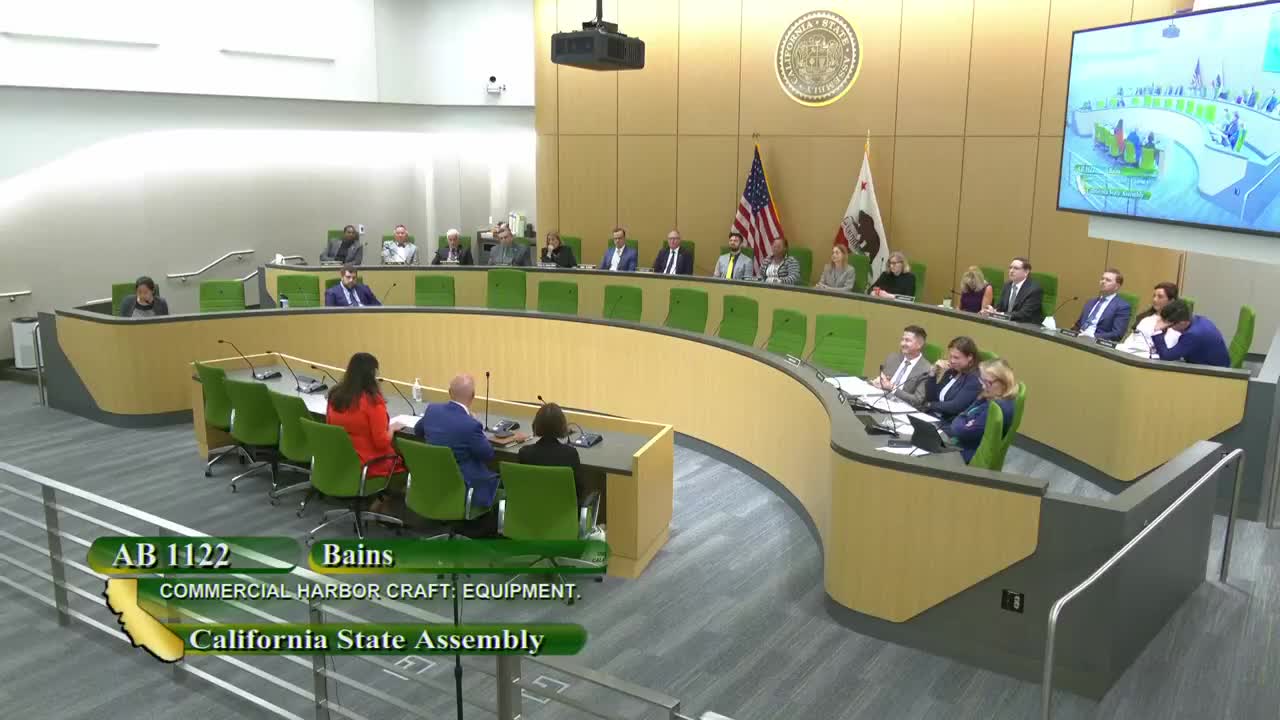 14MIN
Assembly Standing Committee on Transportation
 3MIN
Senate Floor
 18MIN
Senate Standing Committee on Environmental Quality
 20MIN
Senate Standing Committee on Transportation
 49SEC
Senate Standing Committee on Appropriations
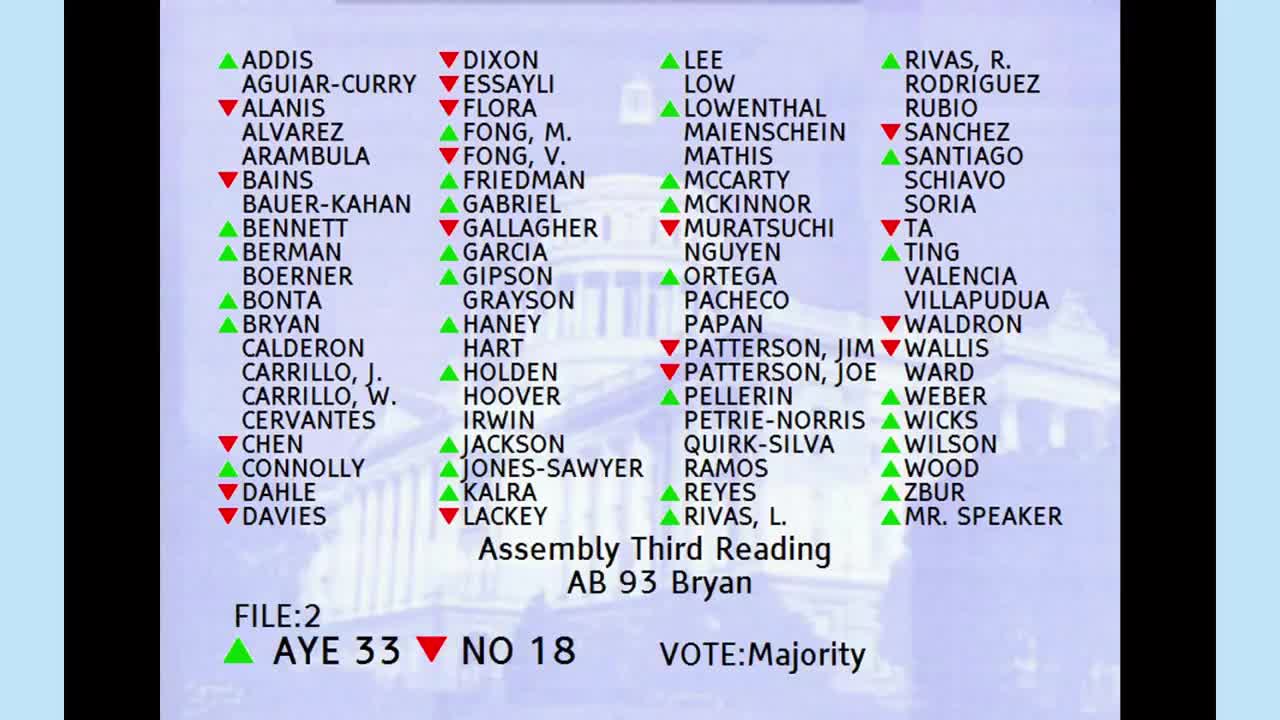 1MIN
Assembly Floor
 8MIN
Assembly Standing Committee on Health
Bill Author