AB 1172: Integrated energy policy report: fusion energy.
- Session Year: 2023-2024
- House: Assembly
- Latest Version Date: 2023-10-07
Current Status:
Passed
(2023-10-07: Chaptered by Secretary of State - Chapter 360, Statutes of 2023.)
Introduced
In Committee
First Chamber
In Committee
Second Chamber
Enacted
What does this bill do?
The bill directs the California Energy Commission to include in its 2027 integrated energy policy report an assessment of whether fusion energy could contribute to California’s power supply. The assessment must identify the regulatory and policy changes needed to deploy fusion (including aneutronic and deuterium‑tritium approaches), list available state and federal funding or investment options, and provide a definition of aneutronic fusion.
The summary is provided by generative AI which can make mistakes. For original language, please view the details in the table below.
Existing law requires the State Energy Resources Conservation and Development Commission to undertake various actions in furtherance of meeting the states clean energy and pollution reduction objectives. Existing law prohibits the commission from certifying a nuclear fission thermal powerplant, except for specified powerplants, and provides that a nuclear fission thermal powerplant, except for those specified powerplants, is not a permitted land use in California, unless certain conditions are met regarding, among other things, the existence of technology for the construction and operation of nuclear fuel rod reprocessing plants and of demonstrated technology or means for the disposal of high-level nuclear waste, as specified.
Existing law requires the commission, beginning November 1, 2003, and biennially thereafter, to adopt an integrated energy policy report that contains an overview of major energy trends and issues facing the state, presents policy recommendations based on an in-depth and integrated analysis of the most current and pressing energy issues facing the state, and includes an assessment and forecast of system reliability and the need for resource additions, efficiency, and conservation, as specified. Existing law also requires the commission, beginning November 1, 2004, and biennially thereafter, to prepare an energy policy review to update analyses from the integrated energy policy report or to raise energy issues that have emerged since the release of the integrated energy policy report, as specified.
This bill would require the commission, as part of the 2027 edition of the integrated energy policy report, to include an assessment of the potential for fusion energy to contribute to Californias power supply, as specified.
Existing law requires the State Energy Resources Conservation and Development Commission to undertake various actions in furtherance of meeting the states clean energy and pollution reduction objectives. Existing law prohibits the commission from certifying a nuclear fission thermal powerplant, except for specified powerplants, and provides that a nuclear fission thermal powerplant, except for those specified powerplants, is not a permitted land use in California, unless certain conditions are met regarding regarding, among other things, the existence of technology for the construction and operation of nuclear fuel rod processing reprocessing plants and of demonstrated technology or means for the disposal of high-level nuclear waste, as specified.
Existing law requires the commission, beginning November 1, 2003, and biennially thereafter, to adopt an integrated energy policy report that contains an overview of major energy trends and issues facing the state, presents policy recommendations based on an in-depth and integrated analysis of the most current and pressing energy issues facing the state, and includes an assessment and forecast of system reliability and the need for resource additions, efficiency, and conservation, as specified. Existing law also requires the commission, beginning November 1, 2004, and biennially thereafter, to prepare an energy policy review to update analyses from the integrated energy policy report or to raise energy issues that have emerged since the release of the integrated energy policy report, as specified.
This bill would require the commission, as part of the 2025 2027 edition of the integrated energy policy report, to include an assessment of the potential for fusion energy to contribute to Californias power supply, as specified.
Existing law requires the State Energy Resources Conservation and Development Commission to undertake various actions in furtherance of meeting the states clean energy and pollution reduction objectives. Existing law prohibits the commission from certifying a nuclear fission thermal powerplant, except for specified powerplants, and provides that a nuclear fission thermal powerplant, except for those specified powerplants, is not a permitted land use in California, unless certain conditions are met regarding the existence of technology for the construction and operation of nuclear fuel rod processing plants and of demonstrated technology or means for the disposal of high-level nuclear waste, as specified.
Existing law requires the commission, beginning November 1, 2003, and biennially thereafter, to adopt an integrated energy policy report that contains an overview of major energy trends and issues facing the state, presents policy recommendations based on an in-depth and integrated analysis of the most current and pressing energy issues facing the state, and includes an assessment and forecast of system reliability and the need for resource additions, efficiency, and conservation, as specified. Existing law also requires the commission, beginning November 1, 2004, and biennially thereafter, to prepare an energy policy review to update analyses from the integrated energy policy report or to raise energy issues that have emerged since the release of the integrated energy policy report, as specified.
This bill would require the commission, as part of the 2025 edition of the integrated energy policy report, to include an assessment of the potential for fusion energy to contribute to Californias power supply, as specified.
Existing law requires the State Energy Resources Conservation and Development Commission to undertake various actions in furtherance of meeting the states clean energy and pollution reduction objectives. Existing law prohibits the commission from certifying a nuclear fission thermal powerplant, except for specified powerplants, and provides that a nuclear fission thermal powerplant, except for those specified powerplants, is not a permitted land use in California, unless certain conditions are met regarding the existence of technology for the construction and operation of nuclear fuel rod processing plants and of demonstrated technology or means for the disposal of high-level nuclear waste, as specified.
Existing law requires the commission, beginning November 1, 2003, and biennially thereafter, to adopt an integrated energy policy report that contains an overview of major energy trends and issues facing the state, presents policy recommendations based on an in-depth and integrated analysis of the most current and pressing energy issues facing the state, and includes an assessment and forecast of system reliability and the need for resource additions, efficiency, and conservation, as specified. Existing law also requires the commission, beginning November 1, 2004, and biennially thereafter, to prepare an energy policy review to update analyses from the integrated energy policy report or to raise energy issues that have emerged since the release of the integrated energy policy report, as specified.
This bill would require the commission, as part of the 2025 edition of the integrated energy policy report, to evaluate fusion, fusion energy, aneutronic fusion, experimental fusion devices, and fusion power plant production, include an assessment of the potential for fusion energy to contribute to Californias power supply, as specified.
Existing law requires the State Energy Resources Conservation and Development Commission to undertake various actions in furtherance of meeting the states clean energy and pollution reduction objectives. Existing law prohibits the commission from certifying a nuclear fission thermal powerplant, except for specified powerplants, and provides that a nuclear fission thermal powerplant, except for those specified powerplants, is not a permitted land use in California, unless certain conditions are met regarding the existence of technology for the construction and operation of nuclear fuel rod processing plants and of demonstrated technology or means for the disposal of high-level nuclear waste, as specified.
Existing law requires the commission, beginning November 1, 2003, and biennially thereafter, to adopt an integrated energy policy report that contains an overview of major energy trends and issues facing the state, presents policy recommendations based on an in-depth and integrated analysis of the most current and pressing energy issues facing the state, and includes an assessment and forecast of system reliability and the need for resource additions, efficiency, and conservation, as specified. Existing law also requires the commission, beginning November 1, 2004, and biennially thereafter, to prepare an energy policy review to update analyses from the integrated energy policy report or to raise energy issues that have emerged since the release of the integrated energy policy report, as specified.
This bill would require the commission, in consultation with the Public Utilities Commission, Independent System Operator, Federal Energy Regulatory Commission, and other relevant stakeholders, to submit a study to the Legislature, on or before June 1, 2025, analyzing the feasibility of using commercially viable nuclear fusion to advance Californias progress towards its statutory renewable energy and climate mandates, commission, as part of the 2025 edition of the integrated energy policy report, to evaluate fusion, fusion energy, aneutronic fusion, experimental fusion devices, and fusion power plant production, as specified.
Existing law requires the State Energy Resources Conservation and Development Commission to undertake various actions in furtherance of meeting the states clean energy and pollution reduction objectives. Existing law prohibits the commission from certifying a nuclear fission thermal powerplant, except for specified powerplants, and provides that a nuclear fission thermal powerplant, except for those specified powerplants, is not a permitted land use in California, unless certain conditions are met regarding the existence of technology for the construction and operation of nuclear fuel rod processing plants and of demonstrated technology or means for the disposal of high-level nuclear waste, as specified.
This bill would require the commission, in consultation with the Public Utilities Commission, Independent System Operator, Federal Energy Regulatory Commission, and other relevant stakeholders, to submit a study to the Legislature, on or before June 1, 2025, analyzing the feasibility of using commercially viable nuclear fusion to advance Californias progress towards its statutory renewable energy and climate mandates, as specified.
The Legislature finds and declares all of the following:
(a)According to the 2021 SB 100 Joint Agency Report published by the State Energy Resources Conservation and Development Commission pursuant to the 100 Percent Clean Energy Act of 2018 (Chapter 312 of the Statutes of 2018), to reach the target of requiring renewable energy and zero-carbon resources to supply 100 percent of electric retail sales to end-use customers by 2045 while electrifying other sectors to meet the states economywide climate goals, California may need to roughly triple its current electrical grid capacity.
(b)In March 2022, the administration of President Joseph Biden hosted the first ever summit on fusion energy and the United States Department of Energy launched an agencywide initiative to accelerate the viability of commercial fusion energy in coordination with the private sector.
(c)The United States Department of Energy will distribute $50,000,000 through two funding opportunities that will support foundational science and technology research.
(d)Fusion energy can advance Californias progress towards its statutory renewable energy and climate mandates.
(e)Fusion energy development presents an opportunity to further promote Californias workforce development within the renewable energy sector.
(f)In order to further current federal regulatory activity around fusion energy, it is important to define fusion energy in state law and distinguish the technology from nuclear fission.
(g)Substantial technical progress and private investment is being made in multiple fusion energy pathways and with diverse fuels, including, but not limited to, deuterium-tritium, hydrogen-boron, and deuterium-helium-3.
SEC. 2.Section 25302.4 is added to the Public Resources Code, to read:25302.4.(a)For purposes of this section, the following definitions apply:
(1)Fusion means a reaction in which at least one heavier, more stable nucleus is produced from at least one lighter, less stable nucleus, typically through high temperatures and pressures, and emitting energy as a result.
(2)Fusion energy means the product of fusion reactions inside a fusion device and used to generate electricity or other commercially usable forms of energy.
(b)As part of the 2027 edition of the integrated energy policy report, the commission shall include an assessment of the potential for fusion energy to contribute to Californias power supply, including both of the following:
(1)Identification of the necessary regulatory and policy actions required to deploy fusion energy, including aneutronic fusion and deuterium and tritium reactions, within Californias energy system.
(2)Identification of state and federal investments available for fusion energy development and deployment.
(c)For purposes of the assessment described in subdivision (b), the commission shall define aneutronic fusion.
(d)This section shall remain in effect only until January 1, 2029, and as of that date is repealed.
The Legislature finds and declares all of the following:
(a)According to the 2021 SB 100 Joint Agency Report published by the State Energy Resources Conservation and Development Commission pursuant to the 100 Percent Clean Energy Act of 2018 (Chapter 312 of the Statutes of 2018), to reach the target of requiring renewable energy and zero-carbon resources to supply 100 percent of electric retail sales to end-use customers by 2045 while electrifying other sectors to meet the states economywide climate goals, California may need to roughly triple its current electrical grid capacity.
(b)In March 2022, the administration of President Joseph Biden hosted the first ever summit on fusion energy and the United States Department of Energy launched an agencywide initiative to accelerate the viability of commercial fusion energy in coordination with the private sector.
(c)The United States Department of Energy will distribute $50,000,000 through two funding opportunities that will support foundational science and technology research.
(d)Fusion energy can advance Californias progress towards its statutory renewable energy and climate mandates.
(e)Fusion energy development presents an opportunity to further promote Californias workforce development within the renewable energy sector.
(f)In order to further current federal regulatory activity around fusion energy, it is important to define fusion energy in state law and distinguish the technology from nuclear fission.
(g)Substantial technical progress and private investment is being made in multiple fusion energy pathways and with diverse fuels, including, but not limited to, deuterium-tritium, hydrogen-boron, and deuterium-helium-3.
SEC. 2.Section 25302.4 is added to the Public Resources Code, to read:25302.4.(a)For purposes of this section, the following definitions apply:
(1)Fusion means a reaction in which at least one heavier, more stable nucleus is produced from at least one lighter, less stable nucleus, typically through high temperatures and pressures, and emitting energy as a result.
(2)Fusion energy means the product of fusion reactions inside a fusion device and used to generate electricity or other commercially usable forms of energy.
(3)Fusion power plant means a facility where a fusion device serves as the principal source of energy production that is capable of converting fusion energy into electricity for consumption, and that is interconnected with a utilitys electrical grid for the purpose of transporting net electricity produced.(b)As part of the 2025 2027 edition of the integrated energy policy report, the commission shall include an assessment of the potential for fusion energy to contribute to Californias power supply. The assessment shall include, but not be limited to, all supply, including both of the following:
(1)Identifying Identification of the necessary regulatory and policy actions required to deploy fusion energy energy, including aneutronic fusion and deuterium and tritium reactions, within Californias energy system.
(2)Identifying the regulatory actions required to bring fusion power plants online, and providing recommendations to address potential obstacles.(3)Analyzing the steps needed to create a skilled and trained fusion energy workforce.(4)Identifying(2)Identification of state and federal investments available for fusion energy development and deployment.
(5)Analyzing the scalability, costs, and realistic timelines for bringing fusion energy, including aneutronic fusion and deuterium and tritium reactions, to market in California.(c)For purposes of the assessment described in subdivision (b), the commission shall define aneutronic fusion.
(d)This section shall remain in effect only until January 1, 2026, 2029, and as of that date is repealed.
The Legislature finds and declares all of the following:
(a)According to the 2021 SB 100 Joint Agency Report published by the State Energy Resources Conservation and Development Commission pursuant to the 100 Percent Clean Energy Act of 2018 (Chapter 312 of the Statutes of 2018), to reach the target of requiring renewable energy and zero-carbon resources to supply 100 percent of electric retail sales to end-use customers by 2045 while electrifying other sectors to meet the states economy-wide economywide climate goals, California may need to roughly triple its current electrical grid capacity.
(b)In March 2022, the administration of President Joseph Biden hosted the first ever summit on fusion energy and the United States Department of Energy launched an agencywide initiative to accelerate the viability of commercial fusion energy in coordination with the private sector.
(c)The United States Department of Energy will distribute $50,000,000 through two funding opportunities that will support foundational science and technology research.
(d)Fusion energy can advance Californias progress towards its statutory renewable energy and climate mandates.
(e)Fusion energy development presents an opportunity to further promote Californias workforce development within the renewable energy sector.
(f)In order to further current federal regulatory activity around fusion energy, it is important to define fusion energy in state law and distinguish the technology from nuclear fission.
(g)Substantial technical progress and private investment is being made in multiple fusion energy pathways and with diverse fuels, including, but not limited to, deuterium-tritium, hydrogen-boron, and deuterium-helium-3.
SEC. 2.Section 25302.4 is added to the Public Resources Code, to read:25302.4.(a)For purposes of this section, the following definitions apply:
(1)Aneutronic fusion means fusion energy that uses fuel that does not qualify as byproduct material, as defined in Section 30.4 of Title 10 of the Code of Federal Regulations, and for which the primary fusion reaction is aneutronic, which means that neutrons carry no more than 1 percent of the total energy released and the outputs of the primary fusion reaction do not qualify as byproduct material.(2)(1)Fusion means a reaction in which at least one heavier, more stable nucleus is produced from two at least one lighter, less stable nuclei, nucleus, typically through high temperatures and pressures, and emitting energy as a result.
(3)(2)Fusion energy means the product of fusion reactions inside a fusion device and used to generate electricity or other commercially usable forms of energy.
(4)(3)Fusion power plant means a facility where a fusion device serves as the principal source of energy production that is capable of converting fusion energy into electricity for consumption, and that is interconnected with a utilitys electrical grid for the purpose of transporting net electricity produced.
(b)As part of the 2025 edition of the integrated energy policy report, the commission shall include an assessment of the potential for fusion energy to contribute to Californias power supply. The assessment shall include, but not be limited to, all of the following:
(1)Identifying necessary regulatory actions required to deploy fusion energy within Californias energy system.
(2)Identifying the regulatory actions required to bring fusion power plants online, and providing recommendations to address potential obstacles.
(3)Analyzing the steps needed to create a skilled and trained fusion energy workforce.
(4)Identifying state and federal investments available for fusion energy development and deployment.
(5)Analyzing the scalability, costs, and realistic timelines for bringing fusion energy, including aneutronic fusion, fusion and deuterium and tritium reactions, to market in California.
(c)For purposes of the assessment described in subdivision (b), the commission shall define aneutronic fusion.
(c)(d)This section shall remain in effect only until January 1, 2026, and as of that date is repealed.
The Legislature finds and declares all of the following:
(a)According to the 2021 SB 100 Joint Agency Report published by the State Energy Resources Conservation and Development Commission pursuant to the 100 Percent Clean Energy Act of 2018 (Chapter 312 of the Statutes of 2018), to reach the target of requiring renewable energy and zero-carbon resources to supply 100 percent of electric retail sales to end-use customers by 2045 while electrifying other sectors to meet the states economy-wide climate goals, California may need to roughly triple its current electrical grid capacity.
(b)In March 2022, the administration of President Joseph Biden hosted the first ever summit on fusion energy and the United States Department of Energy launched an agencywide initiative to accelerate the viability of commercial fusion energy in coordination with the private sector.
(c)The United States Department of Energy will distribute $50,000,000 through two funding opportunities that will support foundational science and technology research.
(d)Fusion energy can advance Californias progress towards its statutory renewable energy and climate mandates.
(e)Fusion energy development presents an opportunity to further promote Californias workforce development within the renewable energy sector.
(f)In order to further current federal regulatory activity around fusion energy, it is important to define fusion energy in state law and distinguish the technology from nuclear fission.
SEC. 2.Section 25302.4 is added to the Public Resources Code, to read:25302.4.(a)For purposes of this section, the following definitions apply:
(1)Aneutronic fusion means fusion energy that uses fuel that does not qualify as byproduct material, as defined in Section 30.4 of Title 10 of the Code of Federal Regulations, and for which the primary fusion reaction is aneutronic, which means that neutrons carry no more than 1 percent of the total energy released and the outputs of the primary fusion reaction do not qualify as byproduct material.
(2)Experimental fusion device means a device designed to support the design, development, and deployment of commercial fusion power plants, used for research and experiments to advance and reach milestones necessary for the development of a fusion power plant, and not interconnected with a utilitys electrical grid for the purpose of transporting net electricity produced.(3)(2)Fusion means a reaction in which at least one heavier, more stable nucleus is produced from two lighter, less stable nuclei, typically through high temperatures and pressures, and emitting energy as a result.
(4)(3)Fusion energy means the product of fusion reactions inside a fusion device and used to generate electricity or other commercially usable forms of energy.
(5)(4)Fusion power plant means a facility where a fusion device serves as the principal source of energy production that is capable of converting fusion energy into electricity for consumption, and that is interconnected with a utilitys electrical grid for the purpose of transporting net electricity produced.
(b)As part of the 2025 edition of the integrated energy policy report, the commission shall evaluate fusion, fusion energy, aneutronic fusion, experimental fusion devices, and fusion power plant production, including by doing include an assessment of the potential for fusion energy to contribute to Californias power supply. The assessment shall include, but not be limited to, all of the following:
(1)Identifying necessary regulatory actions required to deploy fusion energy within Californias energy system.
(2)Identifying the regulatory actions required to bring fusion power plants online, and providing recommendations to address potential obstacles.
(3)Analyzing the steps needed to create a skilled and trained fusion energy workforce.
(4)Identifying state and federal investments available for fusion energy development and deployment.
(5)Analyzing the scalability, costs, and realistic timelines for bringing fusion energy, including aneutronic fusion, to market in California.
(c)This section shall remain in effect only until January 1, 2026, and as of that date is repealed.
The Legislature finds and declares all of the following:
(a)California has set ambitious targets to reduce the effects of climate change by reducing greenhouse gas emissions 40 percent below 1990 levels by 2030 and 80 percent below 1990 levels by 2050.(a)According to the 2021 SB 100 Joint Agency Report published by the State Energy Resources Conservation and Development Commission pursuant to the 100 Percent Clean Energy Act of 2018 (Chapter 312 of the Statutes of 2018), to reach the target of requiring renewable energy and zero-carbon resources to supply 100 percent of electric retail sales to end-use customers by 2045 while electrifying other sectors to meet the states economy-wide climate goals, California may need to roughly triple its current electrical grid capacity.
(b)In March 2022, the administration of President Joseph Biden hosted the first ever summit on fusion energy and the United States Department of Energy launched an agencywide initiative to accelerate the viability of commercial fusion energy in coordination with the private sector.
(c)The United States Department of Energy will distribute $50,000,000 through two funding opportunities that will support foundational science and technology research.
(d)Advanced clean fusion Fusion energy can advance Californias progress towards its statutory renewable energy and climate mandates.
(e)Advanced clean fusion Fusion energy development presents an opportunity to further promote Californias workforce development within the renewable energy sector.
(f)In order to further current federal regulatory activity around fusion energy, it is important to define fusion energy in state law and distinguish the technology from nuclear fission.
SEC. 2.Chapter 16 (commencing with Section 25993) is added to Division 15 of the Public Resources Code, to read:16.Advanced Clean Fusion Energy25993.(a)On or before June 1, 2025, the commission, in consultation with the Public Utilities Commission, Independent System Operator, Federal Energy Regulatory Commission, and other relevant stakeholders, shall submit a study to the Legislature analyzing the feasibility of using commercially viable nuclear fusion to advance Californias progress towards its statutory renewable energy and climate mandates.(b)The study submitted pursuant to subdivision (a) shall do all of the following:(1)Identify necessary regulatory actions upon advanced clean fusion energy becoming commercially viable.(2)Identify the regulatory obstacles that may arise during nuclear fusion implementation and provide recommendations to address those obstacles.(3)Analyze the steps needed to create a skilled and trained advanced clean fusion energy workforce.(4)Identify state and federal investments available for advanced clean fusion energy.25994.(a)(a)A study to be submitted pursuant to section 25993 shall be submitted in compliance with Section 9795 of the Government Code.(b)Pursuant to Section 10231.5 of the Government Code, this chapter is repealed on January 1, 2029.SEC. 2.Section 25302.4 is added to the Public Resources Code, to read:25302.4.(a)For purposes of this section, the following definitions apply:
(1)Aneutronic fusion means fusion energy that uses fuel that does not qualify as byproduct material, as defined in Section 30.4 of Title 10 of the Code of Federal Regulations, and for which the primary fusion reaction is aneutronic, which means that neutrons carry no more than 1 percent of the total energy released and the outputs of the primary fusion reaction do not qualify as byproduct material.
(2)Experimental fusion device means a device designed to support the design, development, and deployment of commercial fusion power plants, used for research and experiments to advance and reach milestones necessary for the development of a fusion power plant, and not interconnected with a utilitys electrical grid for the purpose of transporting net electricity produced.
(3)Fusion means a reaction in which at least one heavier, more stable nucleus is produced from two lighter, less stable nuclei, typically through high temperatures and pressures, and emitting energy as a result.
(4)Fusion energy means the product of fusion reactions inside a fusion device and used to generate electricity or other commercially usable forms of energy.
(5)Fusion power plant means a facility where a fusion device serves as the principal source of energy production that is capable of converting fusion energy into electricity for consumption, and that is interconnected with a utilitys electrical grid for the purpose of transporting net electricity produced.
(b)As part of the 2025 edition of the integrated energy policy report, the commission shall evaluate fusion, fusion energy, aneutronic fusion, experimental fusion devices, and fusion power plant production, including by doing all of the following:
(1)Identifying necessary regulatory actions required to deploy fusion energy within Californias energy system.
(2)Identifying the regulatory actions required to bring fusion power plants online, and providing recommendations to address potential obstacles.
(3)Analyzing the steps needed to create a skilled and trained fusion energy workforce.
(4)Identifying state and federal investments available for fusion energy development and deployment.
(c)This section shall remain in effect only until January 1, 2026, and as of that date is repealed.
The Legislature finds and declares all of the following:
(a)California has set ambitious targets to reduce the effects of climate change by reducing greenhouse gas emissions 40 percent below 1990 levels by 2030 and 80 percent below 1990 levels by 2050.
(b)In March 2022, the administration of President Joseph Biden hosted the first ever summit on fusion energy and the United States Department of Energy launched an agencywide initiative to accelerate the viability of commercial fusion energy in coordination with the private sector.
(c)The United States Department of Energy will distribute $50,000,000 through two funding opportunities that will support foundational science and technology research.
(d)Advanced clean fusion energy can advance Californias progress towards its statutory renewable energy and climate mandates.
(e)Advanced clean fusion energy development presents an opportunity to further promote Californias workforce development within the renewable energy sector.
SEC. 2.Chapter 16 (commencing with Section 25993) is added to Division 15 of the Public Resources Code, to read:16.Advanced Clean Fusion Energy25993.(a)On or before June 1, 2025, the commission, in consultation with the Public Utilities Commission, Independent System Operator, Federal Energy Regulatory Commission, and other relevant stakeholders, shall submit a study to the Legislature analyzing the feasibility of using commercially viable nuclear fusion to advance Californias progress towards its statutory renewable energy and climate mandates.
(b)The study submitted pursuant to subdivision (a) shall do all of the following:
(1)Identify necessary regulatory actions upon advanced clean fusion energy becoming commercially viable.
(2)Identify the regulatory obstacles that may arise during nuclear fusion implementation and provide recommendations to address those obstacles.
(3)Analyze the steps needed to create a skilled and trained advanced clean fusion energy workforce.
(4)Identify state and federal investments available for advanced clean fusion energy.
25994.(a)(a)A study to be submitted pursuant to section 25993 shall be submitted in compliance with Section 9795 of the Government Code.
(b)Pursuant to Section 10231.5 of the Government Code, this chapter is repealed on January 1, 2029.
|
Date
|
Status
|
|---|---|
| Oct 7, 2023 | Chaptered by Secretary of State - Chapter 360, Statutes of 2023. |
| Oct 7, 2023 | Approved by the Governor. |
| Sep 21, 2023 | Enrolled and presented to the Governor at 3:30 p.m. |
| Sep 14, 2023 | Senate amendments concurred in. To Engrossing and Enrolling. (Ayes 80. Noes 0. Page 3551.). |
| Sep 13, 2023 | In Assembly. Concurrence in Senate amendments pending. |
| Sep 13, 2023 | Read third time. Passed. Ordered to the Assembly. (Ayes 39. Noes 0. Page 2767.). |
| Sep 8, 2023 | Ordered to special consent calendar. |
| Sep 5, 2023 | Read second time. Ordered to third reading. |
| Sep 1, 2023 | Read second time and amended. Ordered returned to second reading. |
| Sep 1, 2023 | From committee: Amend, and do pass as amended. (Ayes 7. Noes 0.) (September 1). |
| Jul 10, 2023 | In committee: Referred to APPR. suspense file. |
| Jun 27, 2023 | Read second time and amended. Re-referred to Com. on APPR. |
| Jun 26, 2023 | From committee: Amend, and do pass as amended and re-refer to Com. on APPR. (Ayes 16. Noes 0.) (June 20). |
| Jun 7, 2023 | Referred to Com. on E., U. & C. |
| May 26, 2023 | In Senate. Read first time. To Com. on RLS. for assignment. |
| May 25, 2023 | Read third time. Passed. Ordered to the Senate. (Ayes 77. Noes 0. Page 1763.) |
| May 18, 2023 | Read second time. Ordered to third reading. |
| May 18, 2023 | Joint Rule 62(a), file notice suspended. (Page 1580.) |
| May 18, 2023 | From committee: Do pass. (Ayes 15. Noes 0.) (May 18). |
| May 17, 2023 | In committee: Set, first hearing. Referred to APPR. suspense file. |
| May 3, 2023 | In committee: Hearing postponed by committee. |
| Apr 26, 2023 | In committee: Hearing postponed by committee. |
| Apr 18, 2023 | Re-referred to Com. on APPR. |
| Apr 17, 2023 | Read second time and amended. |
| Apr 13, 2023 | From committee: Amend, and do pass as amended and re-refer to Com. on APPR. with recommendation: To Consent Calendar. (Ayes 15. Noes 0.) (April 12). |
| Apr 3, 2023 | Re-referred to Com. on U. & E. |
| Mar 30, 2023 | From committee chair, with author's amendments: Amend, and re-refer to Com. on U. & E. Read second time and amended. |
| Mar 28, 2023 | From committee: Do pass and re-refer to Com. on U. & E. with recommendation: To Consent Calendar. (Ayes 11. Noes 0.) (March 27). Re-referred to Com. on U. & E. |
| Mar 2, 2023 | Referred to Coms. on NAT. RES. and U. & E. |
| Feb 17, 2023 | From printer. May be heard in committee March 19. |
| Feb 16, 2023 | Read first time. To print. |
|
Date
|
Description
|
Location
|
Votes
|
|
|---|---|---|---|---|
| Sep 14, 2023 | AB 1172 Calderon Concurrence in Senate Amendments | Assembly Floor |
Passed |
|
| Sep 13, 2023 | Special Consent AB1172 Calderon By Newman | Senate Floor |
Passed |
|
| Sep 1, 2023 | Do pass as amended | Senate Standing Committee on Appropriations |
Passed |
|
| Jul 10, 2023 | Placed on suspense file | Senate Standing Committee on Appropriations |
Passed |
|
| Jun 20, 2023 | Do pass as amended, but first amend, and re-refer to the Committee on [Appropriations] | Senate Standing Committee on Energy, Utilities and Communications |
Passed |
|
| May 25, 2023 | AB 1172 Calderon Assembly Third Reading | Assembly Floor |
Passed |
|
| May 18, 2023 | Do pass. | Assembly Standing Committee on Appropriations |
Passed |
|
| Apr 12, 2023 | Do pass as amended, and be re-referred to the Committee on [Appropriations] with recommendation: To Consent Calendar | Assembly Standing Committee on Utilities and Energy |
Passed |
|
| Mar 27, 2023 | Favorable With Committee Substitute (Post-Secondary Education Subcommittee) | Assembly Standing Committee on Natural Resources |
Passed |
This list shows positions taken on this bill by organizations on the date displayed, which is linked to the original source.
Positions by individuals are not included.
|
Organization
|
Position
|
Date
|
|---|---|---|
| Clean Power Campaign | ** Support | |
| Commonwealth Fusion Systems | ** Support | |
| FissionTransition | ** Against | |
| Fusion Industry Association | ** Support | |
| Fusion Is Tomorrow's Energy | ** Support | |
| Fusion is Tomorrow’s Energy | ** Support | |
| Tae Technologies | ** Support |
CONCURRENCE IN SENATE AMENDMENTS
CSA1 Bill Id:AB 1172
Author:(Calderon)
As Amended Ver:September 1, 2023
Majority vote
SUMMARY
Requires the California Energy Commission (CEC) to evaluate various fusion technologies and to analyze the feasibility of using nuclear fusion in the state as part of its 2027 integrated energy policy report (IEPR).
Senate Amendments
Revise definitions, limit the scope of the CEC evaluation, and move the evaluation from 2025 IEPR to the 2027 IEPR.
COMMENTS
There are two fundamental ways to release energy from nuclear reactions: fission and fusion of atomic nuclei. Nuclear fission is a nuclear reaction or a radioactive decay process in which the atomic nucleus splits into lighter nuclei, releasing some combination of particles and energy. Nuclear fusion is a reaction in which multiple atomic nuclei combine to form a combination of new atomic nuclei and subatomic particles with the resulting mass difference manifesting as either an absorption or release of energy. Electricity generating technologies based on fission are commercially available, whereas fusion is still in the stages of research and development.
A fusion reaction occurs when atomic nuclei, such as hydrogen and its isotopes (deuterium and tritium), are forced together (using some combination of extremely high temperature, pressure, or velocity to overcome the electrostatic force) until they fuse into a nuclei of a heavier element. The fusion process releases a combination of particles and kinetic energy proportional to the difference in mass. There are multiple fusion methods that are currently being pursued for use in a commercial reactor system.
To generate commercial energy from fusion, the released energy would be converted to heat, which in turn is converted to electricity via a conventional generator cycle. Although the fusion reaction does not produce significant or long-lived radioactive byproducts, the high-energy particles irradiate the surrounding reactor vessel and associated components. The irradiated material could pose potential disposal problems similar to those for the irradiated fission reactor vessel. The reasons fusion continues to be actively pursued is that unlike nuclear fission, there are less waste products, no risk of a nuclear melt down, and fusion power provides more energy for a given weight of fuel than any fuel-consuming energy source currently in use.
The aim of the controlled fusion research program is to achieve "ignition," which occurs when enough fusion reactions take place for the process to become self-sustaining, with fresh fuel then being added to continue it. Once ignition is achieved, there is net energy yield – about four times as much as with nuclear fission. According to the Massachusetts Institute of Technology, the amount of power produced increases with the square of the pressure, so doubling the pressure leads to a fourfold increase in energy production.
The world's most powerful laser fusion facility, the National Ignition Facility (NIF) at Lawrence Livermore National Laboratory, was completed in March 2009. Using its 192 laser beams, NIF is able to deliver more than 60 times the energy of any previous laser system to its target. In December 2022, a team at NIF conducted the first controlled fusion experiment in history to reach the ignition milestone, meaning it produced more energy from fusion than the laser energy used to drive it.
According to the Author
California's commitment to creating climate resiliency policies has positioned the state as a leader in the renewable energy industry. To reach carbon neutrality by 2045 and an exacerbated need for electricity, the state must continue investing in existing and promising renewable clean energy sources. There have been several millstones highlighting the promising progress of the nuclear fusion industry. Active stakeholders are on the path to creating commercially variable reactors that can safely generate clean energy to power cities and municipalities. AB 1172 is an effort to analyze how California can safely integrate fusion energy technology as a renewable energy source. Identifying regulatory requirements and adoption hurdles is critical to deploying clean fusion energy and meeting our climate goals.
Arguments in Support
According to the Clean Power Campaign, by including nuclear fusion in the CEC's IEPR, California can start further analysis as to how this promising new technology might help solve our pressing energy needs, alongside the other leading clean energy nations also studying this technology. It is critical that California considers each and every clean, safe energy source as we rapidly approach a high electrification future if we want to reach our clean energy goals
According to TAE Technologies, AB 1172 can further clarify historical confusion between fusion energy and nuclear fission by establishing fusion and key technical concepts associated with it in California statute, as a first step in supporting fusion's role within a clean, abundant energy portfolio to power the state. It can help support broad public awareness and understanding of fusion now, to ensure it can meet communities' needs in the years to come.
Arguments in Opposition
According to Fission Transition, it's unwise to gamble $50 million researching a technology with such remote prospects. Moreover, with the confusing statement "it is important to define fusion energy in state law and distinguish the technology from nuclear fission," AB 1172 appears to be less about examining the possibilities of nuclear fusion than limiting those of nuclear fission - a well-understood, carbon-free technology which is already generating 9% of California's power.
FISCAL COMMENTS
According to the Senate Appropriations Committee, one-time costs of about $200,000 each year for two years (Energy Resources Program Account [ERPA] or another fund) for the CEC for additional staff resources as part of the 2026 and 2027 IEPR cycle. Staff note that, while ERPA is the primary operating account of the CEC, it might not be the best option to fund bill implementation given its ongoing structural deficit.
VOTES:
ASM NATURAL RESOURCES: 11-0-0
YES: Luz Rivas, Flora, Addis, Friedman, Hoover, Mathis, Muratsuchi, Pellerin, Ward, Wood, Zbur
ASM UTILITIES AND ENERGY: 15-0-0
YES: Garcia, Calderon, Wendy Carrillo, Chen, Connolly, Dixon, Holden, Mathis, McKinnor, Muratsuchi, Reyes, Santiago, Schiavo, Ting, Wallis
ASM APPROPRIATIONS: 15-0-1
YES: Holden, Megan Dahle, Bryan, Calderon, Wendy Carrillo, Dixon, Mike Fong, Hart, Lowenthal, Mathis, Papan, Pellerin, Sanchez, Weber, Ortega
ABS, ABST OR NV: Robert Rivas
ASSEMBLY FLOOR: 77-0-3
YES: Addis, Alanis, Alvarez, Arambula, Bains, Bauer-Kahan, Bennett, Berman, Boerner, Bonta, Bryan, Calderon, Juan Carrillo, Wendy Carrillo, Cervantes, Chen, Connolly, Megan Dahle, Davies, Dixon, Essayli, Flora, Mike Fong, Vince Fong, Friedman, Gabriel, Gallagher, Garcia, Gipson, Grayson, Haney, Hart, Holden, Hoover, Irwin, Jackson, Jones‑Sawyer, Kalra, Lackey, Lee, Low, Lowenthal, Maienschein, McCarty, McKinnor, Muratsuchi, Stephanie Nguyen, Ortega, Pacheco, Jim Patterson, Joe Patterson, Pellerin, Petrie‑Norris, Quirk-Silva, Ramos, Reyes, Luz Rivas, Robert Rivas, Rodriguez, Blanca Rubio, Sanchez, Santiago, Schiavo, Soria, Ta, Ting, Valencia, Villapudua, Waldron, Wallis, Ward, Weber, Wicks, Wilson, Wood, Zbur, Rendon
ABS, ABST OR NV: Aguiar-Curry, Mathis, Papan
SENATE FLOOR: 39-0-1
YES: Allen, Alvarado-Gil, Archuleta, Ashby, Atkins, Becker, Blakespear, Bradford, Cortese, Dahle, Dodd, Durazo, Eggman, Glazer, Gonzalez, Grove, Hurtado, Jones, Laird, Limón, McGuire, Menjivar, Min, Newman, Nguyen, Niello, Ochoa Bogh, Padilla, Portantino, Roth, Rubio, Seyarto, Skinner, Smallwood-Cuevas, Stern, Umberg, Wahab, Wiener, Wilk
ABS, ABST OR NV: Caballero
UPDATED
VERSION: September 1, 2023
CONSULTANT: Lawrence Lingbloom / NAT. RES. / (916) 319-2092 FN: 0001985
SENATE RULES COMMITTEE Office of Senate Floor Analyses (916) 651-1520 Fax: (916) 327-4478 | AB 1172 |
THIRD READING
Bill No: AB 1172
Author: Calderon (D)
Amended: 9/1/23 in Senate
Vote: 21
SENATE ENERGY, U. & C. COMMITTEE: 16-0, 6/20/23
AYES: Bradford, Dahle, Ashby, Caballero, Dodd, Durazo, Eggman, Gonzalez, Grove, McGuire, Min, Newman, Rubio, Seyarto, Stern, Wilk
NO VOTE RECORDED: Becker, Skinner
SENATE APPROPRIATIONS COMMITTEE: 7-0, 9/1/23
AYES: Portantino, Jones, Ashby, Bradford, Seyarto, Wahab, Wiener
ASSEMBLY FLOOR: 77-0, 5/25/23 - See last page for vote
SUBJECT: Integrated energy policy report: fusion energy
SOURCE: Author
DIGEST:
This bill requires the California Energy Commission (CEC) as part of its 2027 integrated energy policy report (IEPR) to include an assessment of the potential for fusion energy to contribute to California’s power supply.
ANALYSIS:
Existing law:
- Declares the policy of the state to encourage the use of nuclear energy, wherever feasible, recognizing that such use has the potential of providing direct economic benefit to the public, while helping to conserve limited fossil fuel resources and promoting clean air. (Public Resources Code §800)
- Prohibits any nuclear fission thermal powerplant from being permitted in the state until the federal government approves technologies to reprocess the spent nuclear fuel rods, and the CEC reports to the Legislature affirmative findings of that federal action. (Public Resources Code §25524.1)
- Requires the CEC to conduct assessments and forecasts of all aspects of energy industry supply, production, transportation, delivery and distribution, demand, and prices and use these assessments and forecasts to develop and evaluate energy policies and programs that conserve resources, protect the environment, ensure energy reliability, enhance the state’s economy, and protect public health and safety. (Public Resources Code §§25000, et seq.)
- Requires the CEC to adopt the IEPR every two years, which must contain an overview of major energy trends and issues facing the state, including, but not limited to, supply, demand, pricing, reliability, efficiency, and impacts on public health and safety, the economy, resources, and the environment. (Public Resources Code §§25300-25327)
- Requires the CEC to incorporate firm zero-carbon resources into the IEPR in a timely fashion. (Public Resources Code §25305.5)
This bill:
- Requires the CEC, as part of the 2027 edition of the IEPR, to include an assessment of the potential for fusion energy to contribute to California’s power supply. Requires the assessment to include:
- Identification of necessary regulatory and policy actions required to deploy fusion energy within California’s energy system.
- Identification of state and federal investments available for fusion energy development and deployment.
- Requires the CEC to define “aneutronic fusion.”
- Repeals the bill from the statutes by January 1, 2029.
Background
Integrated Energy Policy Report (IEPR). The IEPR provides a cohesive approach to identifying and solving the state’s pressing energy needs and issues. The report, which is crafted in collaboration with a range of stakeholders, develops and implements energy plans and policies. SB 1389 (Bowen and Sher, Chapter 568, Statutes of 2002) required the CEC to conduct assessments and forecasts of all aspects of energy industry supply, production, transportation, delivery and distribution, demand, and prices. The CEC is then required to use these assessments and forecasts to develop energy policies that conserve resources, protect the environment, ensure energy reliability, enhance the state's economy, and protect public health and safety. The CEC adopts an IEPR every two years and an update every other year.
Nuclear energy. There are two fundamental ways to release energy from nuclear reactions: fission and fusion of atomic nuclei. Nuclear fission is a process where the atomic nucleus splits apart; nuclear fusion is where atomic nuclei combine (or fuse) together. Both processes are theorized to generate energy. In nuclear fission, the process often yields some combination of particles and energy, often with radioactive decay. In nuclear fusion, the process can manifest as either an absorption or release of energy, sometimes with radioactive decay.
Nuclear fission electricity generation is commercially available today, such as the Diablo Canyon Nuclear Powerplant. Generally, in fission-based electricity generation the atomic splitting releases heat and energy which is used to boil water; the water produces steam, which turns a turbine to generate electricity.
Electricity generation based on fusion has yet to become commercially viable, and is still in research and development. There are multiple fusion methods that are currently being pursued for use in a commercial reactor system. Similar to fission, the released energy from a fusion process would be converted to heat, which in turn is converted to electricity via a conventional generator cycle. Although the fusion reaction theoretically does not produce significant or long-lived radioactive byproducts, the high-energy particles irradiate the surrounding reactor vessel and associated components. The irradiated material could pose potential disposal problems similar to those for the irradiated fission reactor vessel. Nuclear fusion continues to be actively pursued, unlike nuclear fission, is there are less waste products, no risk of a nuclear melt down, and fusion power provides more energy for a given weight of fuel than any fuel-consuming energy source currently in use.
The aim of any controlled fusion process is to achieve “ignition,” which occurs when enough fusion reactions take place for the process to become self-sustaining, with fresh fuel then being added to continue it. Once ignition is achieved, there is net energy yield – about four times as much as with nuclear fission. According to the Massachusetts Institute of Technology, the amount of power produced increases with the square of the pressure, so doubling the pressure leads to a fourfold increase in energy production.
Technological “breakthrough.” The world's most powerful laser fusion facility, the National Ignition Facility (NIF) at Lawrence Livermore National Laboratory, was completed in March 2009. Using its 192 laser beams, NIF is able to deliver more than 60 times the energy of any previous laser system to its target. In December 2022, a team at NIF conducted the first controlled fusion experiment in history to reach the ignition milestone, meaning it achieved a net energy gain, producing more energy from fusion than the laser energy used to drive it. Andrew Sowder, senior technical executive at the Electric Power Research Institute (EPRI) was quoted in POWER Magazine describing the ignition milestone as akin to getting the first man in orbit. “You’re not to the moon yet, but you’ve shown you can get the person in space. This is kind of a first step.”
Comments
Fusion energy is nascent technology. Multiple reports have stated that commercially available nuclear fusion technology may be decades away. Determining the potential of fusion energy as a meaningful source of electricity requires a leap ahead of the current stage of research and demonstration, to consider cost and scale. At this stage, cost is astronomical and scale is tiny. It is likely that the CEC will be challenged to predict the extent and timing of the significant innovations needed to achieve commercial viability. The sponsor of the bill, TAE Technologies, contends their technology to be on the cusp of becoming commercially available, and, therefore, aligned well with the timing of the 2027 IEPR reporting requirement in this bill. However, it is possible there may not be much more information than what may be available today, and, as a result, there may be little for the CEC to report. This bill includes reference to “aneutronic fusion” in order to distinguish the use of hydrogen and boron, in particular, from systems more typically discussed which use deuterium and tritium reactions and may result in additional neutrons. The bill appropriately requires the CEC to define “aneutronic fusion” for purposes of the required assessment.
FISCAL EFFECT: Appropriation: No Fiscal Com.: Yes Local: No
According to the Senate Appropriations Committee, one-time costs of about $200,000 each year for two years (Energy Resources Program Account [ERPA] or another fund) for the CEC for additional staff resources as part of the 2026 and 2027 IEPR cycle. Staff note that, while ERPA is the primary operating account of the CEC, it might not be the best option to fund bill implementation given its ongoing structural deficit.
SUPPORT: (Verified 9/1/23)
Clean Power Campaign
Commonwealth Fusion Systems
Fusion Industry Association
Fusion is Tomorrow’s Energy
TAE Technologies
OPPOSITION: (Verified 9/1/23)
Fission Transition
ARGUMENTS IN SUPPORT: According to the author:
California’s commitment to creating climate resiliency policies has positioned the state as a leader in the renewable energy industry. To reach carbon neutrality by 2045 and an exacerbated need for electricity, the state must continue investing in existing and promising renewable clean energy sources. There have been several millstones highlighting the promising progress of the nuclear fusion industry. Active stakeholders are on the path to creating commercially variable reactors that can safely generate clean energy to power cities and municipalities. AB 1172 is an effort to analyze how California can safely integrate fusion energy technology as a renewable energy source. Identifying regulatory requirements and adoption hurdles is critical to deploying clean fusion energy and meeting our climate goals.
ARGUMENTS IN OPPOSITION: In opposition to this bill, Fission Transition argues that researching nuclear fusion is unwise as it is unlikely to contribute significant electricity to the electrical grid in the near future. Fission Transition contends this bill “may be less about examining the possibilities of nuclear fusion than limiting those of nuclear fission.”
ASSEMBLY FLOOR: 77-0, 5/25/23
AYES: Addis, Alanis, Alvarez, Arambula, Bains, Bauer-Kahan, Bennett, Berman, Boerner, Bonta, Bryan, Calderon, Juan Carrillo, Wendy Carrillo, Cervantes, Chen, Connolly, Megan Dahle, Davies, Dixon, Essayli, Flora, Mike Fong, Vince Fong, Friedman, Gabriel, Gallagher, Garcia, Gipson, Grayson, Haney, Hart, Holden, Hoover, Irwin, Jackson, Jones-Sawyer, Kalra, Lackey, Lee, Low, Lowenthal, Maienschein, McCarty, McKinnor, Muratsuchi, Stephanie Nguyen, Ortega, Pacheco, Jim Patterson, Joe Patterson, Pellerin, Petrie-Norris, Quirk-Silva, Ramos, Reyes, Luz Rivas, Robert Rivas, Rodriguez, Blanca Rubio, Sanchez, Santiago, Schiavo, Soria, Ta, Ting, Valencia, Villapudua, Waldron, Wallis, Ward, Weber, Wicks, Wilson, Wood, Zbur, Rendon
NO VOTE RECORDED: Aguiar-Curry, Mathis, Papan
Prepared by: Nidia Bautista / E., U. & C. / (916) 651-4107
9/2/23 16:44:13
**** END ****
SENATE COMMITTEE ON
Senator Anthony Portantino, Chair
2023 - 2024 Regular Session
AB 1172 (Calderon) - Integrated energy policy report: fusion energy
Version: | Policy Vote: |
Urgency: | Mandate: |
Hearing Date: | Consultant: |
Bill Summary:
This bill would require the California Energy Commission (CEC), as part of its 2025 integrated energy policy report (IEPR), to include an assessment of the potential for fusion energy to contribute to California’s power supply.
*********** ANALYSIS ADDENDUM – SUSPENSE FILE ***********
The following information is revised to reflect amendments
adopted by the committee on September 1, 2023
Fiscal Impact:
- One-time costs of about $200,000 each year for two years (Energy Resources Program Account [ERPA] or another fund) for the CEC for additional staff resources as part of the 2026 and 2027 IEPR cycle. Staff note that, while ERPA is the primary operating account of the CEC, it might not be the best option to fund bill implementation given its ongoing structural deficit.
Author Amendments:
These amendments would delay the requirement until the 2027 IEPR and clarify the assessment.
-- END --
SENATE COMMITTEE ON APPROPRIATIONS
Senator Anthony Portantino, Chair
2023 - 2024 Regular Session
AB 1172 (Calderon) - Integrated energy policy report: fusion energy
Version: June 27, 2023 | Policy Vote: E., U. & C. 16 - 0 |
Urgency: No | Mandate: No |
Hearing Date: July 10, 2023 | Consultant: Ashley Ames |
Bill Summary:
This bill would require the California Energy Commission (CEC), as part of its 2025 integrated energy policy report (IEPR), to include an assessment of the potential for fusion energy to contribute to California’s power supply.
Fiscal Impact:
- The CEC estimates one-time costs of about $200,000 each year for two years (Energy Resources Program Account [ERPA] or another fund) for additional staff resources as part of the 2024 and 2025 IEPR cycle. Staff note that, while ERPA is the primary operating account of the CEC, it might not be the best option to fund bill implementation given its ongoing structural deficit.
Background:
Integrated Energy Policy Report (IEPR). The IEPR provides a cohesive approach to identifying and solving the state’s pressing energy needs and issues. The report, which is crafted in collaboration with a range of stakeholders, develops and implements energy plans and policies. SB 1389 (Bowen and Sher, Chapter 568, Statutes of 2002) required the CEC to conduct assessments and forecasts of all aspects of energy industry supply, production, transportation, delivery and distribution, demand, and prices. The CEC is then required to use these assessments and forecasts to develop energy policies that conserve resources, protect the environment, ensure energy reliability, enhance the state's economy, and protect public health and safety.” The CEC adopts an IEPR every two years and an update every other year.
Nuclear energy. There are two fundamental ways to release energy from nuclear reactions: fission and fusion of atomic nuclei. Nuclear fission is a process where the atomic nucleus splits apart; nuclear fusion is where atomic nuclei combine (or fuse) together. Both processes are theorized to generate energy. In nuclear fission, the process often yields some combination of particles and energy, often with radioactive decay. In nuclear fusion, the process can manifest as either an absorption or release of energy, sometimes with radioactive decay.
Nuclear fission electricity generation is commercially available today, such as the Diablo Canyon Nuclear Powerplant. Very generally, for fission-based electricity generation, the atomic splitting releases heat and energy which is used to boil water; the water produces steam, which turns a turbine to generate electricity.
Electricity generation based on fusion has yet to become commercially viable, and is still in research and development. There are multiple fusion methods that are currently being pursued for use in a commercial reactor system. Similar to fission, the released energy from a fusion process would be converted to heat, which in turn is converted to electricity via a conventional generator cycle. Although the fusion reaction theoretically does not produce significant or long-lived radioactive byproducts, the high-energy particles irradiate the surrounding reactor vessel and associated components. The irradiated material could pose potential disposal problems similar to those for the irradiated fission reactor vessel. Nuclear fusion continues to be actively pursued, unlike nuclear fission, is there are less waste products, no risk of a nuclear melt down, and fusion power provides more energy for a given weight of fuel than any fuel-consuming energy source currently in use.
The aim of any controlled fusion process is to achieve “ignition,” which occurs when enough fusion reactions take place for the process to become self-sustaining, with fresh fuel then being added to continue it. Once ignition is achieved, there is net energy yield – about four times as much as with nuclear fission. According to the Massachusetts Institute of Technology, the amount of power produced increases with the square of the pressure, so doubling the pressure leads to a fourfold increase in energy production.
Technological “breakthrough.” The world's most powerful laser fusion facility, the National Ignition Facility (NIF) at Lawrence Livermore National Laboratory, was completed in March 2009. Using its 192 laser beams, NIF is able to deliver more than 60 times the energy of any previous laser system to its target. In December 2022, a team at NIF conducted the first controlled fusion experiment in history to reach the ignition milestone, meaning it achieved a net energy gain, producing more energy from fusion than the laser energy used to drive it. Andrew Sowder, senior technical executive at the Electric Power Research Institute (EPRI) was quoted in POWER Magazine describing the ignition milestone as akin to getting the first man in orbit. “You’re not to the moon yet, but you’ve shown you can get the person in space. This is kind of a first step.”
Proposed Law:
This bill would require the CEC, as part of its IEPR, to include an assessment of the potential for fusion energy to contribute to California’s power supply. The bill would require that the assessment include:
- Identifying necessary regulatory actions required to deploy fusion energy within California’s energy system.
- Identifying the regulatory actions required to bring fusion power plants online.
- Analyzing steps needed to create a skilled and trained fusion energy workforce.
- Identifying state and federal investments available for fusion energy development and deployment.
- Analyzing the scalability, costs, and realistic timelines for bringing fusion energy, including aneutronic fusion and deuterium and tritium reactions, to market in California.
The bill would also require the CEC to define “aneutronic fusion” and sunset its provisions on January 1, 2026.
Staff Comments:
The CEC’s main funding source, ERPA, has a significant structural deficit. ERPA was established to provide funds for ongoing energy programs and energy projects, including the operations of the CEC. ERPA is supported by a statutory surcharge on electricity consumption. According to the CEC, as building and appliance energy efficiency and the increase of behind-the-meter solar produce customer savings and flatten statewide electricity consumption, ERPA revenues have decreased, and the costs have been borne by fewer and fewer customers. Even as revenues drop, ERPA is repeatedly tapped to support new programs and must cover increases in employee compensation and benefit contributions.
The CEC’s building and appliance standards have led to decreased energy consumption and reduced ratepayer bills, saving California consumers well over $100 billion over the last 40 years. However, these electricity reductions and consumer savings also reduce ERPA revenues. The CEC’s standards continue to save Californians more money than they pay through the ERPA surcharge. In addition, behind-the-meter rooftop solar, wind, and non-utility generation are exempt from the ERPA surcharge. As behind-the-meter capacity grows, ERPA revenues decline correspondingly.
The surcharge generated approximately $69.1 million in 2020-21 and currently costs the average household about $2.13 annually (larger customers pay the same rate but pay more based on volume). Despite CEC efforts to reduce ERPA spending by more than $37 million over four years, a structural deficit remains and ERPA’s fund balance is projected to be in the red in 2024-25. As part of the 2022-23 budget, the Legislature passed trailer bill language that raised the statutory cap on the ERPA surcharge, tied the statutory cap to the Consumer Price Index, and extended the surcharge to behind-the-meter electricity consumption.
-- END --
SENATE COMMITTEE ON ENERGY, UTILITIES AND COMMUNICATIONS
Senator Steven Bradford, Chair
2023 - 2024 Regular
Bill No: AB 1172 Hearing Date: 6/20/2023
Author: | Calderon | ||
Version: | 4/17/2023 Amended | ||
Urgency: | No | Fiscal: | Yes |
Consultant: | Nidia Bautista | ||
SUBJECT: Integrated energy policy report: fusion energy
DIGEST: This bill requires the California Energy Commission (CEC) as part of its 2025 integrated energy policy report (IEPR) to include an assessment of the potential for fusion energy to contribute to California’s power supply.
ANALYSIS:
Existing law:
- Declares the policy of the state to encourage the use of nuclear energy, wherever feasible, recognizing that such use has the potential of providing direct economic benefit to the public, while helping to conserve limited fossil fuel resources and promoting clean air. (Public Resources Code §800)
- Prohibits any nuclear fission thermal powerplant from being permitted in the state until the federal government approves technologies to reprocess the spent nuclear fuel rods, and the CEC reports to the Legislature affirmative findings of that federal action. (Public Resources Code §25524.1)
- Requires the CEC to conduct assessments and forecasts of all aspects of energy industry supply, production, transportation, delivery and distribution, demand, and prices and use these assessments and forecasts to develop and evaluate energy policies and programs that conserve resources, protect the environment, ensure energy reliability, enhance the state’s economy, and protect public health and safety. (Public Resources Code §§25000, et seq.)
- Requires the CEC to adopt the IEPR every two years, which must contain an overview of major energy trends and issues facing the state, including, but not limited to, supply, demand, pricing, reliability, efficiency, and impacts on public health and safety, the economy, resources, and the environment. (Public Resources Code §§25300-25327)
- Requires the CEC to incorporate firm zero-carbon resources into the IEPR in a timely fashion. (Public Resources Code §25305.5)
This bill:
- Requires the CEC, as part of the 2025 edition of the IEPR, to include an assessment of the potential for fusion energy to contribute to California’s power supply. Requires the assessment to include:
- Identifying necessary regulatory actions required to deploy fusion energy within California’s energy system.
- Identifying the regulatory actions required to bring fusion power plants online.
- Analyzing steps needed to create a skilled and trained fusion energy workforce.
- Identifying state and federal investments available for fusion energy, including aneutronic fusion, to market in California.
- Defines “aneutronic fusion” to mean fusion energy that uses fuel that does not qualify as a byproduct material, as defined in the Code of Federal Regulations, and for which the primary fusion is aneutronic, meaning it does not carry more than one percent of the total energy released and the outputs of the primary fusion reaction do not qualify as byproduct material.
Background
Integrated Energy Policy Report (IEPR). The IEPR provides a cohesive approach to identifying and solving the state’s pressing energy needs and issues. The report, which is crafted in collaboration with a range of stakeholders, develops and implements energy plans and policies. SB 1389 (Bowen and Sher, Chapter 568, Statutes of 2002) required the CEC to conduct assessments and forecasts of all aspects of energy industry supply, production, transportation, delivery and distribution, demand, and prices. The CEC is then required to use these assessments and forecasts to develop energy policies that conserve resources, protect the environment, ensure energy reliability, enhance the state's economy, and protect public health and safety.” The CEC adopts an IEPR every two years and an update every other year.
Nuclear energy. There are two fundamental ways to release energy from nuclear reactions: fission and fusion of atomic nuclei. Nuclear fission is a process where the atomic nucleus splits apart; nuclear fusion is where atomic nuclei combine (or fuse) together. Both processes are theorized to generate energy. In nuclear fission, the process often yields some combination of particles and energy, often with radioactive decay. In nuclear fusion, the process can manifest as either an absorption or release of energy, sometimes with radioactive decay.
Nuclear fission electricity generation is commercially available today, such as the Diablo Canyon Nuclear Powerplant. Very generally, for fission-based electricity generation, the atomic splitting releases heat and energy which is used to boil water; the water produces steam, which turns a turbine to generate electricity.
Electricity generation based on fusion has yet to become commercially viable, and is still in research and development. There are multiple fusion methods that are currently being pursued for use in a commercial reactor system. Similar to fission, the released energy from a fusion process would be converted to heat, which in turn is converted to electricity via a conventional generator cycle. Although the fusion reaction theoretically does not produce significant or long-lived radioactive byproducts, the high-energy particles irradiate the surrounding reactor vessel and associated components. The irradiated material could pose potential disposal problems similar to those for the irradiated fission reactor vessel. Nuclear fusion continues to be actively pursued, unlike nuclear fission, is there are less waste products, no risk of a nuclear melt down, and fusion power provides more energy for a given weight of fuel than any fuel-consuming energy source currently in use.
The aim of any controlled fusion process is to achieve “ignition,” which occurs when enough fusion reactions take place for the process to become self-sustaining, with fresh fuel then being added to continue it. Once ignition is achieved, there is net energy yield – about four times as much as with nuclear fission. According to the Massachusetts Institute of Technology, the amount of power produced increases with the square of the pressure, so doubling the pressure leads to a fourfold increase in energy production.
Technological “breakthrough.” The world's most powerful laser fusion facility, the National Ignition Facility (NIF) at Lawrence Livermore National Laboratory, was completed in March 2009. Using its 192 laser beams, NIF is able to deliver more than 60 times the energy of any previous laser system to its target. In December 2022, a team at NIF conducted the first controlled fusion experiment in history to reach the ignition milestone, meaning it achieved a net energy gain, producing more energy from fusion than the laser energy used to drive it. Andrew Sowder, senior technical executive at the Electric Power Research Institute (EPRI) was quoted in POWER Magazine describing the ignition milestone as akin to getting the first man in orbit. “You’re not to the moon yet, but you’ve shown you can get the person in space. This is kind of a first step.”
Comments
Fusion energy is nascent technology. Multiple reports have stated that commercially available nuclear fusion technology may be decades away. Determining the potential of fusion energy as a meaningful source of electricity requires a leap ahead of the current stage of research and demonstration, to consider cost and scale. At this stage, cost is astronomical and scale is tiny. It is likely that the CEC will be challenged to predict the extent and timing of the significant innovations needed to achieve commercial viability. However, the sponsor of the bill, TAE Technologies, says they believe their technology to be on cusp of becoming commercially available, and, therefore, aligned well with the timing of the 2025 IEPR reporting requirement in this bill. However, it is possible there may not be much more information than what may be available today, and, as a result, there may little for the CEC to report.
Need for amendments. This bill includes a definition for “aneutronic fusion” in order to distinguish the use of hydrogen and boron, in particular, from systems more typically discussed which use tritium and may result in additional neutrons. TAE Technologies, argues that the definition is a needed to ensure the CEC considers their form of fusion technology which they feel is too often overlooked. However, they acknowledge that a regulatory framework for fusion energy is still in development at the federal level. Commonwealth Fusion Systems writes in support, if amended, of this bill that the definition for aneutronic fusion should be removed. They propose amendments that will include the aneutronic process without including the definition in statute. Given that there are nearly three dozen groups worldwide conducting research into fusion energy it may be premature to codify a definition which may be developed as part the federal regulatory framework. As such, the author and committee may wish to amend this bill to delete the definition of “aneutronic fusion,” ensure the “fusion energy” definition encompasses the varied processes, and defer to the CEC to define the term “aneutronic fusion” for the purposes of the assessment.
FISCAL EFFECT: Appropriation: No Fiscal Com.: Yes Local: No
SUPPORT:
Clean Power Campaign
Commonwealth Fusion Systems
Fusion Industry Association
Fusion is Tomorrow’s Energy
TAE Technologies
OPPOSITION:
None received
ARGUMENTS IN SUPPORT: According to the author:
California’s commitment to creating climate resiliency policies has positioned the state as a leader in the renewable energy industry. To reach carbon neutrality by 2045 and an exacerbated need for electricity, the state must continue investing in existing and promising renewable clean energy sources. There have been several millstones highlighting the promising progress of the nuclear fusion industry. Active stakeholders are on the path to creating commercially variable reactors that can safely generate clean energy to power cities and municipalities. AB 1172 is an effort to analyze how California can safely integrate fusion energy technology as a renewable energy source. Identifying regulatory requirements and adoption hurdles is critical to deploying clean fusion energy and meeting our climate goals.
-- END --
ASSEMBLY THIRD READING
ATR Bill Id:AB 1172
Author:(Calderon)
As Amended Ver:April 17, 2023
Majority vote
SUMMARY
Requires the California Energy Commission (CEC) to evaluate as part of its 2025 integrated energy policy report (IEPR) various fusion technologies, as defined, and to analyze the feasibility of using nuclear fusion in the state.
Major Provisions
- Requires the CEC, as part of the 2025 IEPR, to assess the potential for fusion energy to contribute to California's power supply, as specified.
- Establishes related definitions and findings.
- Sunsets January 1, 2026.
COMMENTS
There are two fundamental ways to release energy from nuclear reactions: fission and fusion of atomic nuclei. Nuclear fission is a nuclear reaction or a radioactive decay process in which the atomic nucleus splits into lighter nuclei, releasing some combination of particles and energy. Nuclear fusion is a reaction in which multiple atomic nuclei combine to form a combination of new atomic nuclei and subatomic particles with the resulting mass difference manifesting as either an absorption or release of energy. Electricity generating technologies based on fission are commercially available, whereas fusion is still in the stages of research and development.
A fusion reaction occurs when atomic nuclei, such as hydrogen and its isotopes (deuterium and tritium), are forced together (using some combination of extremely high temperature, pressure, or velocity to overcome the electrostatic force) until they fuse into a nuclei of a heavier element. The fusion process releases a combination of particles and kinetic energy proportional to the difference in mass. There are multiple fusion methods that are currently being pursued for use in a commercial reactor system.
To generate commercial energy from fusion, the released energy would be converted to heat, which in turn is converted to electricity via a conventional generator cycle. Although the fusion reaction does not produce significant or long-lived radioactive byproducts, the high-energy particles irradiate the surrounding reactor vessel and associated components. The irradiated material could pose potential disposal problems similar to those for the irradiated fission reactor vessel. The reasons fusion continues to be actively pursued is that unlike nuclear fission, there are less waste products, no risk of a nuclear melt down, and fusion power provides more energy for a given weight of fuel than any fuel-consuming energy source currently in use.
The aim of the controlled fusion research program is to achieve "ignition," which occurs when enough fusion reactions take place for the process to become self-sustaining, with fresh fuel then being added to continue it. Once ignition is achieved, there is net energy yield – about four times as much as with nuclear fission. According to the Massachusetts Institute of Technology, the amount of power produced increases with the square of the pressure, so doubling the pressure leads to a fourfold increase in energy production.
The world's most powerful laser fusion facility, the National Ignition Facility (NIF) at Lawrence Livermore National Laboratory, was completed in March 2009. Using its 192 laser beams, NIF is able to deliver more than 60 times the energy of any previous laser system to its target. In December 2022, a team at NIF conducted the first controlled fusion experiment in history to reach the ignition milestone, meaning it produced more energy from fusion than the laser energy used to drive it.
According to the Author
There have been several milestones highlighting the promising progress of the nuclear fusion industry. Active stakeholders are on the path to creating commercially variable reactors that can safely generate clean energy to power cities and municipalities. AB 1172 is an effort to analyze how California can safely integrate fusion energy technology as a renewable energy source. Identifying regulatory requirements and adoption hurdles is critical to deploying clean fusion energy and meeting our climate goals.
Arguments in Support
According to the Clean Power Campaign, by including nuclear fusion in the CEC's IEPR, California can start further analysis as to how this promising new technology might help solve our pressing energy needs, alongside the other leading clean energy nations also studying this technology. It is critical that California considers each and every clean, safe energy source as we rapidly approach a high electrification future if we want to reach our clean energy goals
According to TAE Technologies, AB 1172 can further clarify historical confusion between fusion energy and nuclear fission by establishing fusion and key technical concepts associated with it in California statute, as a first step in supporting fusion's role within a clean, abundant energy portfolio to power the state. It can help support broad public awareness and understanding of fusion now, to ensure it can meet communities' needs in the years to come.
Arguments in Opposition
None received.
FISCAL COMMENTS
According to the Assembly Appropriations Committee, the CEC anticipates costs for each of two years of approximately $200,000, either for a staff position or for a consultant contract, to conduct the assessment required by this bill (Energy Resources Programs Account).
VOTES
ASM NATURAL RESOURCES: 11-0-0
YES: Luz Rivas, Flora, Addis, Friedman, Hoover, Mathis, Muratsuchi, Pellerin, Ward, Wood, Zbur
ASM UTILITIES AND ENERGY: 15-0-0
YES: Garcia, Calderon, Wendy Carrillo, Chen, Connolly, Dixon, Holden, Mathis, McKinnor, Muratsuchi, Reyes, Santiago, Schiavo, Ting, Wallis
ASM APPROPRIATIONS: 15-0-1
YES: Holden, Megan Dahle, Bryan, Calderon, Wendy Carrillo, Dixon, Mike Fong, Hart, Lowenthal, Mathis, Papan, Pellerin, Sanchez, Weber, Ortega
ABS, ABST OR NV: Robert Rivas
UPDATED
VERSION: April 17, 2023
CONSULTANT: Lawrence Lingbloom / NAT. RES. / (916) 319-2092 FN: 0000442
Date of Hearing: May 17, 2023
ASSEMBLY COMMITTEE ON APPROPRIATIONS
Chris Holden, Chair
ABPCA Bill Id:AB 1172
Author:(Calderon) – As Amended Ver:April 17, 2023
Policy Committee: | Natural Resources | Vote: | 11 - 0 |
Utilities and Energy | 15 - 0 | ||
|
|
Urgency: No State Mandated Local Program: No Reimbursable: No
SUMMARY:
This bill provides definitions in statute for fusion energy and related terms and tasks the California Energy Commission (CEC) with including in the 2025 edition of CEC’s integrated energy policy report (IEPR) an assessment of the potential for fusion energy to contribute to California’s power supply.
FISCAL EFFECT:
CEC anticipates costs for each of two years of approximately $200,000, either for a staff position or for a consultant contract, to conduct the assessment required by this bill (Energy Resources Programs Account).
COMMENTS:
Background and Purpose. Nuclear energy is released from the nucleus of an atom. According to the International Atomic Energy Agency (IAEA), this source of energy can be produced from fission—when nuclei of atoms are split apart—and from fusion—when nuclei fuse together.
Industrial and commercial use of nuclear fission to produce energy is common enough. It is the process used to create energy and, subsequently, electricity, at powerplants operating in California and around the world.
Since 1976, state law has allowed the permitting of new nuclear power plants in the state only if the CEC determines that the federal government has identified and approved a demonstrated technology for both the construction and operation of nuclear fuel rod reprocessing plants and the permanent disposal of high-level nuclear waste. These conditions, in effect, create a moratorium on the construction of new nuclear power plants in California as neither has been met.
Nuclear fusion, like nuclear fission, releases energy. Again, according to the IAEA, for nuclei to fuse, they:
need to collide with each other at extremely high temperatures…The high temperature provides them with enough energy to overcome their mutual electrical repulsion. Once the nuclei come within a very close range of each other, the attractive nuclear force between them will outweigh the electrical repulsion and allow them to fuse. For this to happen, the nuclei must be confined within a small space to increase the chances of collision.
The IAEA explains the appeal of nuclear fusion this way:
if nuclear fusion can be replicated on earth at an industrial scale, it could provide virtually limitless clean, safe, and affordable energy to meet the world’s demand….Fusion fuel is plentiful and easily accessible: deuterium can be extracted inexpensively from seawater, and tritium can potentially be produced from the reaction of fusion generated neutrons with naturally abundant lithium. These fuel supplies would last for millions of years. Future fusion reactors are also intrinsically safe and are not expected to produce high activity or long-lived nuclear waste…there is no risk of a runaway reaction and meltdown; fusion can only occur under strict operational conditions, outside of which (in the case of an accident or system failure, for example), the plasma will naturally terminate, lose its energy very quickly and extinguish before any sustained damage is done to the reactor.
Importantly, nuclear fusion — just like fission — does not emit carbon dioxide or other greenhouse gases into the atmosphere, so it could be a long-term source of low-carbon electricity from the second half of this century onwards.
Interest in nuclear fusion, and public awareness of it, have grown recently because, in December 2022, the National Ignition Facility (NIF) at Lawrence Livermore National Laboratory conducted the first controlled fusion experiment in history to produce more energy from fusion than the laser energy used to drive it. According to the author:
There have been several millstones highlighting the promising progress of the nuclear fusion industry. Active stakeholders are on the path to creating commercially variable reactors that can safely generate clean energy to power cities and municipalities. AB 1172 is an effort to analyze how California can safely integrate fusion.
Analysis Prepared by: Jay Dickenson / APPR. / (916) 319-2081
Date of Hearing: April 12, 2023
ASSEMBLY COMMITTEE ON UTILITIES AND ENERGY
Eduardo Garcia, Chair
ABPCA Bill Id:AB 1172 (
Author:Calderon) – As Amended Ver:March 30, 2023
SUBJECT: Integrated energy policy report: fusion energy
SUMMARY: Requires the California Energy Commission (CEC) to evaluate as part of its 2025 integrated energy policy report (IEPR) various fusion technologies, as defined, and to analyze the feasibility of using nuclear fusion in the state.
EXISTING LAW:
- Declares the policy of the state to encourage the use of nuclear energy, wherever feasible, recognizing that such use has the potential of providing direct economic benefit to the public, while helping to conserve limited fossil fuel resources and promoting clean air.
(Public Resources Code § 800)
- Prohibits any nuclear fission thermal powerplant from being permitted in the state until the federal government approves technologies to reprocess the spent nuclear fuel rods, and the CEC reports to the Legislature affirmative findings of that federal action. (Public Resources Code § 25524.1)
- Requires the CEC to conduct assessments and forecasts of all aspects of energy industry supply, production, transportation, delivery and distribution, demand, and prices and use these assessments and forecasts to develop and evaluate energy policies and programs that conserve resources, protect the environment, ensure energy reliability, enhance the state’s economy, and protect public health and safety. (Public Resources Code §§ 25000, et seq)
- Requires the CEC to adopt the IEPR every two years, which must contain an overview of major energy trends and issues facing the state, including, but not limited to, supply, demand, pricing, reliability, efficiency, and impacts on public health and safety, the economy, resources, and the environment. (Public Resources Code §§ 25300-25327)
- Requires the CEC to incorporate firm zero-carbon resources into the IPER in a timely fashion. (Public Resources Code § 25305.5)
FISCAL EFFECT: Unknown. This bill is keyed fiscal and will be referred to the Assembly Committee on Appropriations for its review.
BACKGROUND:
Nuclear Energy – There are two fundamental ways to release energy from nuclear reactions: fission and fusion of atomic nuclei. Nuclear fission is a process where the atomic nucleus splits apart; nuclear fusion is where atomic nuclei combine (or fuse) together. Both processes are theorized to generate energy. In nuclear fission, the process often yields some combination of particles and energy, often with radioactive decay. In nuclear fusion, the process can manifest as either an absorption or release of energy, sometimes with radioactive decay. Electricity generation based on fission is commercially available today, such as the Diablo Canyon Nuclear Powerplant. Electricity generation based on fusion has yet to become commercially viable, and is still in research and development.
Very generally, for fission-based electricity generation, the atomic splitting releases heat and energy which is used to boil water; the water produces steam, which turns a turbine to generate electricity.
There are multiple fusion methods that are currently being pursued for use in a commercial reactor system. Similar to fission, the released energy from a fusion process would be converted to heat, which in turn is converted to electricity via a conventional generator cycle. Although the fusion reaction theoretically does not produce significant or long-lived radioactive byproducts, the high-energy particles irradiate the surrounding reactor vessel and associated components. The irradiated material could pose potential disposal problems similar to those for the irradiated fission reactor vessel. The reasons fusion continues to be actively pursued is that unlike nuclear fission, there are less waste products, no risk of a nuclear melt down, and fusion power provides more energy for a given weight of fuel than any fuel-consuming energy source currently in use.
The aim of any controlled fusion process is to achieve “ignition,” which occurs when enough fusion reactions take place for the process to become self-sustaining, with fresh fuel then being added to continue it. Once ignition is achieved, there is net energy yield – about four times as much as with nuclear fission. According to the Massachusetts Institute of Technology, the amount of power produced increases with the square of the pressure, so doubling the pressure leads to a fourfold increase in energy production.
The world's most powerful laser fusion facility, the National Ignition Facility (NIF) at Lawrence Livermore National Laboratory, was completed in March 2009. Using its 192 laser beams, NIF is able to deliver more than 60 times the energy of any previous laser system to its target. In December 2022, a team at NIF conducted the first controlled fusion experiment in history to reach the ignition milestone, meaning it produced more energy from fusion than the laser energy used to drive it.
COMMENTS:
- Author’s Statement. According to the author, “California’s commitment to creating climate resiliency policies has positioned the state as a leader in the renewable energy industry. With the goal of reaching carbon neutrality by 2045 and an exacerbated need for electricity, the state must continue investing in existing and promising renewable clean energy sources. There have been several millstones highlighting the promising progress of the nuclear fusion industry. Active stakeholders are on the path to creating commercially variable reactors that can safely generate clean energy to power cities and municipalities. AB 1172 is an effort to analyze how California can safely integrate fusion energy technology as a renewable energy source. Identifying regulatory requirements and adoption hurdles is critical to deploying clean fusion energy and meeting our climate goals.”
- The Readiness of Fusion. While an assessment of the potential of nuclear fusion is a plausible assignment for the CEC, it is hard to imagine how the CEC, or anyone, could evaluate commercial viability at this stage. Determining the potential of fusion energy as a meaningful source of electricity requires a leap ahead of the current stage of research and demonstration, to consider cost and scale. At this stage, cost is astronomical and scale is tiny. It is not clear how the CEC will be able to predict the extent and timing of the significant innovations needed to achieve commercial viability. As a result, it is important that any CEC evaluation into the feasibility of nuclear fusion consider the cost, scale, and timelines associated with bringing the process online. The author and committee may wish to consider an amendment to the CEC analysis to evaluate these real barriers to development, along with making minor, clarifying changes to the language.
- Double Referral. This bill was previously heard in the Assembly Committee on Natural Resources on March 27th, 2023, where it passed 11-0-0.
REGISTERED SUPPORT / OPPOSITION:
Support
Fusion Industry Association
Fusion Is Tomorrow's Energy
TAE Technologies
Opposition
None on file
Analysis Prepared by: Laura Shybut / U. & E. / (916) 319-2083
Date of Hearing: March 27, 2023
ASSEMBLY COMMITTEE ON NATURAL RESOURCES
Luz Rivas, Chair
ABPCA Bill Id:AB 1172 (
Author:Calderon) – As Introduced Ver:February 16, 2023
SUBJECT: Nuclear fusion
SUMMARY: Requires the California Energy Commission (CEC) to submit a study to the Legislature analyzing the feasibility of using commercially viable nuclear fusion to advance California’s progress towards its statutory renewable energy and climate mandates.
EXISTING LAW:
- Requires the CEC to conduct assessments and forecasts of all aspects of energy industry supply, production, transportation, delivery and distribution, demand, and prices and use these assessments and forecasts to develop and evaluate energy policies and programs that conserve resources, protect the environment, ensure energy reliability, enhance the state’s economy, and protect public health and safety. (Public Resources Code (PRC) § 25000, et seq)
- Requires the CEC to adopt the integrated energy policy report (IEPR) every two years, which must contain an overview of major energy trends and issues facing the state, including, but not limited to, supply, demand, pricing, reliability, efficiency, and impacts on public health and safety, the economy, resources, and the environment. (PRC § 25300-25328)
THIS BILL:
- Requires the CEC, on or before June 1, 2025, to submit a study to the Legislature analyzing the feasibility of using commercially viable nuclear fusion to advance California’s progress towards its statutory renewable energy and climate mandates.
- Requires the study to do all of the following:
- Identify necessary regulatory actions upon advanced clean fusion energy becoming commercially viable.
- Identify the regulatory obstacles that may arise during nuclear fusion implementation and provide recommendations to address those obstacles.
- Analyze the steps needed to create a skilled and trained advanced clean fusion energy workforce.
- Identify state and federal investments available for advanced clean fusion energy.
- Makes related findings and declarations.
FISCAL EFFECT: Unknown
COMMENTS:
- Background. There are two fundamental ways to release energy from nuclear reactions: fission and fusion of atomic nuclei. Nuclear fission is a nuclear reaction or a radioactive decay process in which the atomic nucleus splits into lighter nuclei, releasing some combination of particles and energy. Nuclear fusion is a reaction in which multiple atomic nuclei combine to form a combination of new atomic nuclei and subatomic particles with the resulting mass difference manifesting as either an absorption or release of energy. Electricity generating technologies based on fission are commercially available, whereas fusion is still in the stages of research and development.
A fusion reaction occurs when atomic nuclei, such as hydrogen and its isotopes (deuterium and tritium), are forced together (using some combination of extremely high temperature, pressure, or velocity to overcome the electrostatic force) until they fuse into a nuclei of a heavier element. The fusion process releases a combination of particles and kinetic energy proportional to the difference in mass. There are multiple fusion methods that are currently being pursued for use in a commercial reactor system.
To generate commercial energy from fusion, the released energy would be converted to heat, which in turn is converted to electricity via a conventional generator cycle. Although the fusion reaction does not produce significant or long-lived radioactive byproducts, the high-energy particles irradiate the surrounding reactor vessel and associated components. The irradiated material could pose potential disposal problems similar to those for the irradiated fission reactor vessel. The reasons fusion continues to be actively pursued is that unlike nuclear fission, there are less waste products, no risk of a nuclear melt down, and fusion power provides more energy for a given weight of fuel than any fuel-consuming energy source currently in use.
The aim of the controlled fusion research program is to achieve “ignition,” which occurs when enough fusion reactions take place for the process to become self-sustaining, with fresh fuel then being added to continue it. Once ignition is achieved, there is net energy yield – about four times as much as with nuclear fission. According to the Massachusetts Institute of Technology, the amount of power produced increases with the square of the pressure, so doubling the pressure leads to a fourfold increase in energy production.
The world's most powerful laser fusion facility, the National Ignition Facility (NIF) at Lawrence Livermore National Laboratory, was completed in March 2009. Using its 192 laser beams, NIF is able to deliver more than 60 times the energy of any previous laser system to its target. In December 2022, a team at NIF conducted the first controlled fusion experiment in history to reach the ignition milestone, meaning it produced more energy from fusion than the laser energy used to drive it.
- Author’s statement:
California’s commitment to creating climate resiliency policies has positioned the state as a leader in the renewable energy industry. With the goal of reaching carbon neutrality by 2045 and an exacerbated need for electricity, the state must continue investing in existing and promising renewable clean energy sources.
There have been several milestones highlighting the promising progress of the nuclear fusion industry. Active stakeholders are on the path to creating commercially variable reactors that can safely generate clean energy to power cities and municipalities. AB 1172 is an effort to analyze how California can safely integrate fusion energy technology as a renewable energy source. Identifying regulatory requirements and adoption hurdles is critical to deploying clean fusion energy and meeting our climate goals.
- Is nuclear fusion at a stage where commercial viability can be evaluated? While an assessment of the state and potential of nuclear fusion is a plausible assignment for the CEC, perhaps as a component of the next IEPR, it’s hard to imagine how the CEC, or anyone, could evaluate commercial viability at this stage. Determining the potential of fusion energy as a meaningful source of electricity requires a leap ahead of the current stage of research and demonstration, to consider cost and scale. At this stage, cost is astronomical and scale is tiny. It’s not clear how the CEC will be able to predict the extent and timing of the significant innovations needed to achieve commercial viability.
- Double referral. This bill has been double referred to the Utilities and Energy Committee.
REGISTERED SUPPORT / OPPOSITION:
Support
TAE Technologies (sponsor)
Fusion Industry Association
Fusion Is Tomorrow's Energy
Opposition
None on file
Analysis Prepared by: Lawrence Lingbloom / NAT. RES. /
Discussed in Hearing
 44SEC
Assembly Floor
 8MIN
Senate Standing Committee on Energy, Utilities and Communications
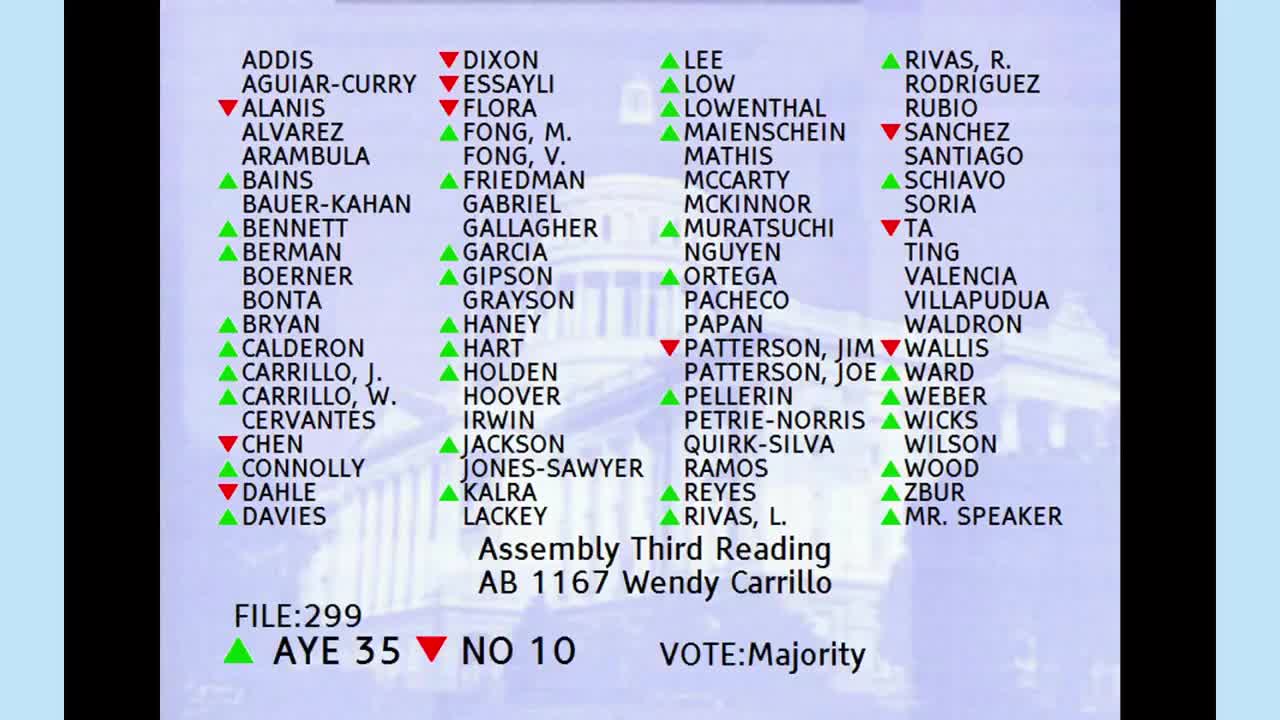 3MIN
Assembly Floor
Bill Author

Bill Co-Author(s):