AB 1204: Contractors: contracts: restrictions.
- Session Year: 2023-2024
- House: Assembly
- Latest Version Date: 2023-10-08
Current Status:
Passed
(2023-10-08: Chaptered by Secretary of State - Chapter 568, Statutes of 2023.)
Introduced
In Committee
First Chamber
In Committee
Second Chamber
Enacted
What does this bill do?
A specialty contractor (a contractor licensed for a specific trade) may not hire more than one subcontractor in the same license classification to work on the same single project unless the subcontractor treats its workers as employees rather than independent contractors, or the specialty contractor is a signatory to a bona fide collective bargaining agreement that covers the work and addresses subcontracting. Violating this rule may result in disciplinary action by the Contractors State License Board.
The summary is provided by generative AI which can make mistakes. For original language, please view the details in the table below.
Existing law, the Contractors State License Law, defines and regulates the activities of contractors and provides for their licensure, regulation, and discipline by the Contractors State License Board within the Department of Consumer Affairs. Existing law classifies the contracting business to include general engineering contracting, general building contracting, residential remodeling contracting, and specialty contracting. Existing law authorizes the issuance of contractors licenses to individual owners, partnerships, corporations, and limited liability companies, and authorizes those persons and entities to qualify for a license by the appearance of specified individuals. Existing law prohibits contractors from performing specified acts and provides that a violation of those acts may constitute a cause for disciplinary action.
This bill would prohibit a specialty contractor, as defined, from entering into a contract for the performance of work on the same single project or undertaking with more than one subcontractor in the same license classification unless the subcontractor employs persons who are classified as employees to perform work in that license classification on the single project or undertaking or the specialty contractor is a signatory to a bona fide collective bargaining agreement, as specified. The bill would provide that a violation of this provision constitutes a cause for disciplinary action.
Existing law, the Contractors State License Law, defines and regulates the activities of contractors and provides for their licensure, regulation, and discipline by the Contractors State License Board within the Department of Consumer Affairs. Existing law classifies the contracting business to include general engineering contracting, general building contracting, residential remodeling contracting, and specialty contracting. Existing law authorizes the issuance of contractors licenses to individual owners, partnerships, corporations, and limited liability companies, and authorizes those persons and entities to qualify for a license by the appearance of specified individuals. Existing law prohibits contractors from performing specified acts and a violation may constitute a cause for disciplinary action.
This bill would prohibit a contractor specialty contractor, as defined, from entering into a contract for the performance of work on the same jobsite single project or undertaking with 2 or more subcontractors than one subcontractor in the same license classification unless the subcontractor employs individuals persons who are classified as employees to perform work in that license classification. classification on the single project or undertaking or the specialty contractor is a signatory to a bona fide collective bargaining agreement, as specified. The bill would provide that a violation of this provision constitutes a cause for disciplinary action.
Existing law, the Contractors State License Law, defines and regulates the activities of contractors and provides for their licensure, regulation, and discipline by the Contractors State License Board within the Department of Consumer Affairs. Existing law classifies the contracting business to include general engineering contracting, general building contracting, residential remodeling contracting, and specialty contracting. Existing law authorizes the issuance of contractors licenses to individual owners, partnerships, corporations, and limited liability companies, and authorizes those persons and entities to qualify for a license by the appearance of specified individuals. Existing law prohibits contractors from performing specified acts and a violation may constitute a cause for disciplinary action.
This bill would prohibit a contractor from entering into a contract for the performance of work on the same jobsite with 2 or more subcontractors in the same license classification unless the subcontractor employs individuals who are classified to perform work in that license classification. The bill would provide that a violation of this provision constitutes a cause for disciplinary action.
(a)A specialty contractor shall not enter into a contract for the performance of work on the same single project or undertaking with more than one subcontractor in the same license classification as the specialty contractor offering the contract, unless either of the following requirements are satisfied:
(1)The subcontractor employs persons who are classified as employees to perform work in that license classification on the single project or undertaking.
(2)The specialty contractor is a signatory to a bona fide collective bargaining agreement that covers the type of work being performed on the single project or undertaking and addresses the issue of subcontracting or subletting.
(b)A violation of subdivision (a) shall constitute a cause for disciplinary action.
(c)For purposes of this section, the following definitions shall apply:
(1)Employs persons who are classified as employees means the subcontractor classifies the individuals as employees rather than as independent contractors for purposes of the Labor Code.
(2)Specialty contractor has the same meaning as in Section 7058.
(a)A specialty contractor shall not enter into a contract for the performance of work on the same jobsite single project or undertaking with two or moresubcontractors than one subcontractor in the same license classification, classification as the specialty contractor offering the contract, unless the either of the following requirements are satisfied:
(1)The subcontractor employs persons who are classified as employees to perform work in that license classification. classification on the single project or undertaking.
(2)The specialty contractor is a signatory to a bona fide collective bargaining agreement that covers the type of work being performed on the single project or undertaking and addresses the issue of subcontracting or subletting.
(b)A violation of subdivision (a) shall constitute a cause for disciplinary action.
(c)For purposes of this section, the following definitions shall apply:
(1)Employs persons who are classified as employees means the subcontractor classifies the individuals as employees rather than as independent contractors for purposes of the Labor Code.
(2)Specialty contractor has the same meaning as in Section 7058.
(a) A contractor shall not enter into a contract for the performance of work on the same jobsite with two or more subcontractors in the same license classification, unless the subcontractor employs persons who are classified as employees to perform work in that license classification.
(b)A violation of subdivision (a) shall constitute a cause for disciplinary action.
|
Date
|
Status
|
|---|---|
| Oct 8, 2023 | Chaptered by Secretary of State - Chapter 568, Statutes of 2023. |
| Oct 8, 2023 | Approved by the Governor. |
| Sep 12, 2023 | Enrolled and presented to the Governor at 2 p.m. |
| Sep 5, 2023 | In Assembly. Ordered to Engrossing and Enrolling. |
| Sep 5, 2023 | Read third time. Passed. Ordered to the Assembly. (Ayes 32. Noes 1. Page 2369.). |
| Aug 22, 2023 | Read second time. Ordered to third reading. |
| Aug 21, 2023 | From committee: Be ordered to second reading pursuant to Senate Rule 28.8. |
| Jul 12, 2023 | From committee: Do pass and re-refer to Com. on APPR. (Ayes 5. Noes 0.) (July 12). Re-referred to Com. on APPR. |
| Jun 19, 2023 | From committee: Do pass and re-refer to Com. on L., P.E. & R. (Ayes 9. Noes 1.) (June 19). Re-referred to Com. on L., P.E. & R. |
| May 31, 2023 | Referred to Coms. on B., P. & E. D. and L., P.E. & R. |
| May 23, 2023 | In Senate. Read first time. To Com. on RLS. for assignment. |
| May 22, 2023 | Read third time. Passed. Ordered to the Senate. (Ayes 71. Noes 2. Page 1696.) |
| May 11, 2023 | Read second time. Ordered to third reading. |
| May 10, 2023 | From committee: Do pass. (Ayes 13. Noes 1.) (May 10). |
| May 1, 2023 | Re-referred to Com. on APPR. |
| Apr 27, 2023 | Read second time and amended. |
| Apr 26, 2023 | From committee: Amend, and do pass as amended and re-refer to Com. on APPR. (Ayes 15. Noes 1.) (April 25). |
| Apr 18, 2023 | In committee: Hearing postponed by committee. |
| Apr 4, 2023 | In committee: Set, first hearing. Hearing canceled at the request of author. |
| Mar 2, 2023 | Referred to Com. on B. & P. |
| Feb 17, 2023 | From printer. May be heard in committee March 19. |
| Feb 16, 2023 | Read first time. To print. |
|
Date
|
Description
|
Location
|
Votes
|
|
|---|---|---|---|---|
| Sep 5, 2023 | Assembly 3rd Reading AB1204 Holden By Cortese | Senate Floor |
Passed |
|
| Jul 12, 2023 | Do pass, but first be re-referred to the Committee on [Appropriations] | Senate Standing Committee on Labor, Public Employment and Retirement |
Passed |
|
| Jun 19, 2023 | Do pass, but first be re-referred to the Committee on [Labor, Public Employment and Retirement ] | Senate Standing Committee on Business, Professions and Economic Development |
Passed |
|
| May 22, 2023 | AB 1204 Holden Assembly Third Reading | Assembly Floor |
Passed |
|
| May 10, 2023 | Do pass. | Assembly Standing Committee on Appropriations |
Passed |
|
| Apr 25, 2023 | Do pass as amended and be re-referred to the Committee on [Appropriations] | Assembly Standing Committee on Business and Professions |
Passed |
This list shows positions taken on this bill by organizations on the date displayed, which is linked to the original source.
Positions by individuals are not included.
|
Organization
|
Position
|
Date
|
|---|---|---|
| Air Conditioning Sheet Metal Association | ** Support | |
| California Legislative Conference Of Plumbing, Heating & Piping Industry | ** Support | |
| California State Council Of Laborers | ** Support | |
| District Council 16, Painters and Allied Trades | ** Support | |
| District Council Of Iron Workers Of The State Of California And Vicinity | ** Support | |
| Finishing Contractors Association Of Southern California | ** Support | |
| National Electrical Contractors Association | ** Support | |
| Northern California Allied Trades | ** Support | |
| Southern California Glass Management Association | ** Support | |
| State Building and Construction Trades Council of California | ** Support | |
| Western Painting and Coating Contractors Association | ** Support |
SENATE RULES COMMITTEE Office of Senate Floor Analyses (916) 651-1520 Fax: (916) 327-4478 | AB 1204 |
THIRD READING
Bill No: AB 1204
Author: Holden (D)
Amended: 4/27/23 in Assembly
Vote: 21
SENATE BUS., PROF. & ECON. DEV. COMMITTEE: 9-1, 6/19/23
AYES: Roth, Alvarado-Gil, Archuleta, Ashby, Dodd, Eggman, Glazer, Smallwood-Cuevas, Wahab
NOES: Wilk
NO VOTE RECORDED: Nguyen, Becker, Niello
SENATE LABOR, PUB. EMP. & RET. COMMITTEE: 5-0, 7/12/23
AYES: Cortese, Wilk, Durazo, Laird, Smallwood-Cuevas
SENATE APPROPRIATIONS COMMITTEE: Senate Rule 28.8
ASSEMBLY FLOOR: 71-2, 5/22/23 - See last page for vote
SUBJECT: Contractors: contracts: restrictions
SOURCE: State Building and Construction Trades Council of California
DIGEST:
This bill prohibits a licensed specialty contractor from subcontracting with two or more contractors in the same classification, on the same jobsite, unless the subcontractor has employees who perform the work in the relevant classification, as specified.
ANALYSIS:
Existing law:
- Establishes the CSLB within the Department of Consumer Affairs (DCA) to license and regulate contractors and home improvement salespersons. (Business and Professions Code (BPC) § 7000 et seq.)
- Requires as a condition of initial licensure, reinstatement, reactivation, renewal or continued maintenance of a license, a current and valid certificate of workers compensation insurance or certification of Self-Insurance, as specified, unless the applicant or licensee meets both of the following conditions:
- Has no employees and filed a statement with the CSLB certifying that they do not employ any person in any manner, as specified; and,
- Does not hold a C-8 (concrete), C-20 (air heating and air conditioning), C-22 (asbestos abatement), C-39 (roofing contractor license), D-49 (tree), and a C-61 (specialty) and sunsets these exemptions on January 1, 2026. (BPC § 7125 (a)(b))
- Requires a private employer to secure the payment of workers’ compensation either through workers’ compensation insurance or self-insurance. (LAB §§ 3700-3709.5)
- Specifies that any person who holds a valid state contractor’s license, and who willingly and knowingly enters into a contract with any person to perform services for which a license is required as an independent contractor, and that person does not meet the burden of proof of independent contractor status or hold a valid state contractor’s license, to a civil penalty in the amount of two hundred dollars ($200) per person so contracted with for each day of the contract. (LAB § 1021.5)
This bill:
- Prohibits a specialty contractor from entering into a contract for performance of work on the same single project or undertaking with more than one subcontractor in the same license classification as the specialty contractor offering the contract, unless either of the following apply:
- The subcontractor employs persons who are classified as employees to perform work in that license classification on the single project or undertaking; or,
- The specialty contractor is a signatory to a bona fide collective bargaining agreement that covers the type of work being performed on the single project or undertaking and addresses the issue of subcontracting or subletting.
- Makes a violation of 1) above a cause for disciplinary action.
- Defines the following for purposes of this bill:
- “Employs persons who are classified as employees” to mean the subcontractor classifies the individuals as employees rather than independent contractors for purposes of the Labor Code.
- “Specialty contractor” to mean the same as defined in existing law in BPC § 7058.
Background
The CSLB licenses and regulates approximately 289,000 licensees in 45 licensing classifications and 2 certifications, and registers approximately 25,000 Home Improvement Salespersons. Each licensing classification specifies the type of contracting work permitted in that classification. To obtain licensure in each classification, applicants are required to take and pass both a trade examination and a law and business examination. Licensees may not perform work outside of a classification without having the appropriate license to do so, unless they are a “B” general contractor who is able to take a prime contract or subcontract for projects involving other trades as long as framing and carpentry (the C5 trade) is not counted among those other trades.
There are four main licensure classifications under the CSLB:
(B-2) Residential Remodeling Contractor
This bill specifically pertains to those contractors who hold one of the (C) specialty classifications, which are outlined below.
C-2 - Insulation and Acoustical Contractor
C-4 - Boiler, Hot Water Heating and Steam Fitting Contractor
C-5 - Framing and Rough Carpentry Contractor
C-6 - Cabinet, Millwork and Finish Carpentry Contractor
C-7 - Low Voltage Systems Contractor
C-12 - Earthwork and Paving Contractors
C-15 - Flooring and Floor Covering Contractors
C-16 - Fire Protection Contractor
C-20 - Warm-Air Heating, Ventilating and Air-Conditioning Contractor
C-21 - Building Moving/Demolition Contractor
C-22 - Asbestos Abatement Contractor
C-23 - Ornamental Metal Contractor
C-28 - Lock and Security Equipment Contractor
C-31 - Construction Zone Traffic Control Contractor
C-32 - Parking and Highway Improvement Contractor
C-33 - Painting and Decorating Contractor
C-35 - Lathing and Plastering Contractor
C-38 - Refrigeration Contractor
C-42 - Sanitation System Contractor
C-47 - General Manufactured Housing Contractor
C-50 - Reinforcing Steel Contractor
C-51 - Structural Steel Contractor
C-53 - Swimming Pool Contractor
C-54 - Ceramic and Mosaic Tile Contractor
C-55 - Water Conditioning Contractor
C-57 - Well Drilling Contractor
Currently, as a condition of initial licensure and to maintain and active license, all license classifications are required to have on file with the CSLB, a current and valid Certificate of Workers’ Compensation Insurance or Certification of Self-Insurance in the applicant’s or licensee’s business name, unless they qualify for an exemption by certifying to the CSLB that they do not have any employees, or the licensee does not hold a C-8, C-20, C-22, C-61, D-49 or C-39 designation. (BPC § 7125(b)). As a result of SB 216 (Dodd, Chapter 978, Statutes of 2022), effective July 1, 2026, all license classifications will be required to have a Certificate of Workers’ Compensation Insurance on file with the CSLB, unless they are a specific joint venture. Under current law, failure to maintain workers' compensation insurance coverage results in a license being suspended and any work performed while the license is suspended is considered unlicensed and disciplinary action can be taken against a licensee. BPC § 7126 specifically states that any licensee or agent thereof, who violates the workers compensation requirements, under existing law, is additionally guilty of a misdemeanor. Further, under current law, (LAB §§ 3700, 3700.5) all employers in this state are required to obtain workers’ compensation. Workers' compensation insurance provides basic benefits, including medical care, temporary disability benefits, permanent disability benefits, supplemental job displacement benefits and a return-to-work supplement, and death benefits.
Concerns have been raised by stakeholders that licensed specialty contractors (C-classifications), may not be properly utilizing employees and instead subcontract with other specialty contractors to avoid having “employees” which would require those licensees to abide by current workers’ compensation insurance requirements for employers among other requirements for employers with employees. This bill would prohibit any specialty contractor from using two or more subcontractors in the same license classification for work at the same jobsite, unless the subcontractor has employees.
FISCAL EFFECT: Appropriation: No Fiscal Com.: Yes Local: No
SUPPORT: (Verified 8/22/23)
State Building and Construction Trades Council of California (source)
Air Conditioning Sheet Metal Association
California Legislative Conference of Plumbing, Heating & Piping Industry
California State Council of Laborers
District Council of Iron Workers of The State of California and Vicinity
District Council 16, Painters and Allied Trades
Finishing Contractors Association of Southern California
National Electrical Contractors Association
Northern California Allied Trades
Southern California Glass Management Association
Western Painting and Coating Contractors Association
OPPOSITION: (Verified 8/22/23)
None received
ARGUMENTS IN SUPPORT: Supporters note generally that AB1204 will help solve the problem of misclassification of employees and close a loophole in state contracting law that allows unscrupulous specialty contractors to misclassify their employees.
ASSEMBLY FLOOR: 71-2, 5/22/23
AYES: Addis, Aguiar-Curry, Alanis, Alvarez, Arambula, Bains, Bauer-Kahan, Bennett, Berman, Boerner, Bonta, Bryan, Calderon, Juan Carrillo, Wendy Carrillo, Cervantes, Connolly, Megan Dahle, Davies, Flora, Mike Fong, Friedman, Gabriel, Garcia, Gipson, Grayson, Haney, Hart, Holden, Hoover, Irwin, Jackson, Jones-Sawyer, Kalra, Lee, Low, Lowenthal, Maienschein, McCarty, McKinnor, Muratsuchi, Stephanie Nguyen, Ortega, Pacheco, Papan, Joe Patterson, Pellerin, Petrie-Norris, Ramos, Reyes, Luz Rivas, Robert Rivas, Rodriguez, Blanca Rubio, Sanchez, Santiago, Schiavo, Soria, Ta, Ting, Valencia, Villapudua, Waldron, Wallis, Ward, Weber, Wicks, Wilson, Wood, Zbur, Rendon
NOES: Essayli, Vince Fong
NO VOTE RECORDED: Chen, Dixon, Gallagher, Lackey, Mathis, Jim Patterson, Quirk-Silva
Prepared by: Elissa Silva / B., P. & E.D. / 916-651-4104
8/23/23 14:48:43
**** END ****
SENATE COMMITTEE ON LABOR, PUBLIC EMPLOYMENT AND RETIREMENT
Senator Dave Cortese, Chair
2023 - 2024 Regular
Bill No: AB 1204 Hearing Date: July 12, 2023
Author: | Holden | ||
Version: | April 27, 2023 | ||
Urgency: | No | Fiscal: | Yes |
Consultant: | Alma Perez-Schwab | ||
SUBJECT: Contractors: contracts: restrictions
KEY ISSUE
Should the Legislature prohibit a licensed specialty contractor from subcontracting with more than one contractor in the same license classification, on the same single project or undertaking, unless the subcontractor has employees who perform the work in the relevant classification or the specialty contractor is a signatory to a bona fide collective bargaining agreement, as specified?
ANALYSIS
Existing law:
- Establishes the California State Licensing Board (CSLB), within the Department of Consumer Affairs (DCA), to license and regulate contractors and home improvement salespersons. (Business and Professions Code (BPC) §7000 et seq.)
- Requires a licensed contractor to include their license number in all construction contracts, subcontractors’ calls for bid, and all forms of advertising, as specified. (BPC §7030.5)
- Specifies the following branches of contracting:
- General engineering contracting;
- General building contracting and Residential remodeling contracting.
- Specialty contracting (BPC §7055)
- Permits a general building contractor to take a prime contract or a subcontract for a framing or carpentry project, but prohibits a general building contractor from taking a prime contract for any project involving trades other than framing or carpentry unless the prime contract requires at least two unrelated building trades or crafts other than framing or carpentry, or unless the general building contractor holds the appropriate license classification or subcontracts with an appropriately licensed contractor to perform the work, as specified. (BPC §7057(b))
- Defines a specialty contractor as a contractor whose operations involve the performance of construction work requiring special skill and whose principal contracting business involves the use of specialized building trades or crafts. (BPC §7057.5(a))
- Specifies that a specialty contractor includes a contractor whose operations include 1) the business of servicing or testing fire extinguishing systems; 2) a contractor whose operations are concerned with the installation and laying of carpets, linoleum, and resilient floor covering; and, 3) a contractor whose operations are concerned with preparing or removing roadway construction zones, lane closures, flagging, or traffic diversions on roadways, including, but not limited to, public streets, highways, or any public conveyance. (BPC §7057.5(b)(c)(d))
- Requires as a condition of initial licensure, reinstatement, reactivation, renewal or continued maintenance of a license, a current and valid certificate of workers compensation insurance or certification of Self-Insurance, as specified. (BPC §7125 (a)(b))
- Requires a private employer to secure the payment of workers’ compensation either through workers’ compensation insurance or self-insurance. (LAB §§3700-3709.5)
- Provides that for purposes of the Labor Code and the Unemployment Insurance Code, where another definition of “employee” is not otherwise specified, and for the wage orders of the Industrial Welfare Commission (IWC), a person providing labor or services for remuneration shall be considered an employee unless the hiring entity satisfies the 3-part ABC test (per Dynamex):
- The person is free from the control and direction of the hiring entity in connection with the performance of the work, both under the contract for the performance of the work and in fact.
- The person performs work that is outside the usual course of the hiring entity’s business.
- The person is customarily engaged in an independently established trade, occupation, or business of the same nature as that involved in the work performed.
(Labor Code §2775)
- Specifies that any person who holds a valid state contractor’s license, and who willingly and knowingly enters into a contract with any person to perform services for which a license is required as an independent contractor, and that person does not meet the burden of proof of independent contractor status or hold a valid state contractor’s license, to a civil penalty in the amount of two hundred dollars ($200) per person so contracted with for each day of the contract. (Labor Code §1021.5)
- Establishes the Division of Labor Standards and Enforcement (DLSE), within the Department of Industrial Relations and under the direction of the Labor Commissioner, and empowers the LC with ensuring a just day’s pay in every workplace and promotes economic justice through robust enforcement of labor laws. (Labor Code §79-107)
- Authorizes the Labor Commissioner (LC), if upon inspection or investigation, determines that any person is employing workers in violation of the workers’ compensation requirements above, to issue a citation to the person in violation, as specified.
This bill:
- Prohibits a specialty contractor from entering into a contract for performance of work on the same single project or undertaking with more than one subcontractor in the same license classification as the specialty contractor offering the contract, unless either of the following requirements are satisfied:
- The subcontractor employs persons who are classified as employees to perform work in that license classification on the single project or undertaking; or,
- The specialty contractor is a signatory to a bona fide collective bargaining agreement that covers the type of work being performed on the single project or undertaking and addresses the issue of subcontracting or subletting.
- Makes a violation of the above provisions a cause for disciplinary action.
- Defines the following for purposes of this bill:
- “Employs persons who are classified as employees” to mean the subcontractor classifies the individuals as employees rather than independent contractors for purposes of the Labor Code.
- “Specialty contractor” to mean the same as defined in existing law in BPC §7058.
COMMENTS
1. Background: Dynamex and AB 5
The employer-employee relationship is at the core of the rights and obligations found within Labor Code. Being classified as an employee is essential to trigger most of the employer mandates and worker protections found within existing law. California’s wage and hour laws (e.g., minimum wage, overtime, meal periods and rest breaks, etc.), workplace safety laws, and retaliation laws protect employees, but not independent contractors. Additionally, employees can go to state agencies such as the Labor Commissioner’s office to seek enforcement of these laws, whereas independent contractors must resolve their disputes or enforce their rights under their contracts through other means.
For several decades, the employer-employee relationship was put under pressure due to the increased use of independent contractors and the misclassification of employees. For employers lawfully using the independent contractor model, they trade control over the working conditions for being released from many of the primary obligations of being an employer, including paying overtime, remitting payroll taxes, securing workers’ compensation coverage, and ensuring a healthy and safe work environment. Unfortunately, this model created incentives for employers to misclassify employees as independent contractors. In 2017, California’s Employment Development Department Tax Audit Program conducted 7,937 audits and investigations, resulting in assessments totaling $249,981,712, and identified nearly half a million unreported employees.[1]
The issue culminated with a 2018 Supreme Court decision, Dynamex Operations West, Inc. v. Superior Court (2018) 4 Cal.5th 903. Under Dynamex, the test for whether a worker is an independent contractor or an employee was simplified to a three-prong test:
(A) The worker is free from the control and direction of the hirer in connection with the performance of the work, both under the contract for the performance of such work and in fact;
(B) The worker performs work that is outside the usual course of the hiring entity’s business; and
(C) The worker is customarily engaged in an independently established trade, occupation, or business of the same nature as the work performed for the hiring entity.
In 2019, AB 5 (Gonzalez, Chapter 296, Statutes of 2019) codified the Dynamex decision requiring that employers prove that their workers can meet the ABC test in order to be lawfully classified as independent contractors, and exempted from the test certain professions and business-to-business relationships. AB 5 also provided specified industrial categories where the long-standing Borello test would remain the standard for determining who is an employee. Under Borello, in S. G. Borello & Sons, Inc. v Dept. of Industrial Relations (1989) 48 Cal.3d 341, the California Supreme Court created an 11 point “economic realities” test on whether someone could lawfully be considered an independent contractor.
Although field activity suspended in 2020 due to the COVID-19 pandemic, various enforcement efforts continued including the EDD Audit Program which conducted 2,097 audits and investigations, leading to $74.5 million in assessments and the discovery of 31,287 misclassified workers.[2]
2. Background: Contractors State License Board
The Contractors State License Board (CSLB) is the entity responsible for the implementation and enforcement of the Contractors’ State License Law regulating both the licensure and practice, and discipline, of individuals operating in the construction industry. Existing law requires that all businesses and individuals who construct or alter any building, highway, road, parking facility, railroad, excavation, or other structure in California must be licensed by the CSLB if the total cost, including both labor and materials, of one or more contracts on the project is $500 or more.
As noted by the Senate Business and Professions Committee analysis of this bill, “The CSLB licenses and regulates approximately 289,000 licensees in 45 licensing classifications and 2 certifications, and registers approximately 25,000 Home Improvement Salespersons. Each licensing classification specifies the type of contracting work permitted in that classification. To obtain licensure in each classification, applicants are required to take and pass both a trade examination and a law and business examination. Licensees may not perform work outside of a classification without having the appropriate license to do so, unless they are a “B” general contractor who is able to take a prime contract or subcontract for projects involving other trades as long as framing and carpentry (the C5 trade) is not counted among those other trades.”
There are four main licensure classifications under the CSLB: General Engineering Contractor; General Building Contractor and (B-2) Residential Remodeling Contractor; and Specialty Contractors. Under the specialty classification, there are 42 specialty contractor classifications including, among others, the following types of contractors: concrete, drywall, carpentry, electrical, flooring, landscaping, roofing, sheet metal, and solar.
3. Need for this bill?
The author and proponents of the measure raise concerns that licensed specialty contractors may not be properly utilizing employees and instead subcontracting with other specialty contractors to avoid having “employees.” As noted above, being classified as an employee is essential to trigger most of the employer mandates and worker protections found within existing labor law, including the requirement that they secure workers’ compensation and contribute to the unemployment insurance program on behalf of their employees.
This bill would prohibit any specialty contractor from using more than one subcontractor in the same license classification as the specialty contractor for work at the same single project or undertaking, unless the subcontractor has workers classified as employees. The author and sponsor contend that this prohibition will deter contractors from misclassifying employees as independent contractors and from hiring subcontractors instead of employees.
According to the author, “The issue of employees being misclassified as independent contractors remains an ongoing problem in the construction industry. Contractors who choose to ignore our labor laws continue to prevent their employees from receiving well-deserved wages and benefits. [This bill] would lead to safer workplaces where workers are not misclassified.”
4. Proponent Arguments:
According to the sponsors of the measure, the State Building and Construction Trades Council of California, “Despite the best efforts of the Labor Commissioner, the labor movement, and high-road contractors who follow the law, the issue of employees being misclassified as independent contractors remains an ongoing problem in the construction industry. There are scores of examples of a Contractor State License Board-licensed contractor winning a bid on a project and not hiring journeyworkers or apprentices to perform the work and instead hiring independent contractors. These independent contractors are used because they can underbid the work at the expense of law-abiding contractors. These low-road contractors do not follow worker protections required by law which allows them to have the lowest bid.
With several independent contractors working for and getting direction from someone who has no employees and therefore no responsibility for their health and safety, California’s strong labor laws are not enforced equitably among all the contractors on a given project. They are less likely to participate in job site safety meetings and often do not keep the same hours as the law-abiding, high-road contractors on the job. Common certifications like first aid, CPR, and OSHA 10 often required by contractors to maintain a safe and affordable workers’ compensation policy are virtually non-existent among those who aren’t required to carry workers’ compensation as independent contractors.
By limiting the number of independent contractors performing the same scope of work under a single subcontract, AB1204 will help solve the problem of misclassification of employees. It will also lead to getting accurate certified payroll reports and decrease the likelihood a project is abandoned. The bill would lead to safer workplaces where workers are not misclassified. This bill will not affect subcontracting between legitimate subcontractors who properly classify themselves as employers and their workers as employees.”
5. Opponent Arguments:
None received.
6. Double Referral:
This bill was double referred to Senate Business, Professions & Economic Development and Labor, Public Employment and Retirement Committees.
7. Prior Legislation:
AB 336 (Cervantes and Megan Dahle, 2023) would require a contractor licensee, at the time of renewal, to certify on a license renewal form the three workers’ compensation classification codes for which the highest estimated payroll is reporter, as specified. AB 336 is pending in Senate Appropriations Committee.
SB 216 (Dodd, Chapter 978, Statutes of 2022) expands the license classifications required to have a certificate of workers’ compensation insurance on file with the CSLB to include a Concrete contractor (C-8), a Warm-Air Heating, Ventilating and Air-Conditioning contractor (C-20,) and a Tree Service contractor (D-49) until January 1, 2025; and, beginning January 1, 2025, extends that requirement to include all licensure classifications under the jurisdiction of the CSLB.
SB 1064 (Newman, Chapter 190, Statutes of 2022) requires structural pest control companies to provide proof of workers’ compensation for company registration with or licensure by the California Structural Pest Control Board.
AB 2705 (Holden, Chapter 323, Statutes of 2018) subjected an unlicensed person acting as a contractor to the existing criminal penalties that apply to licensed contractors for not securing the required workers’ compensation, and made this crime subject to the same two-year statute of limitations as for licensees.
AB 5 (Gonzalez, Chapter 296, Statutes of 2019) codified the decision of the California Supreme Court in Dynamex Operations West, Inc. v. Superior Court of Los Angeles (2018) requiring that employers prove that their workers can meet a 3 part ‘ABC’ test in order to be lawfully classified as independent contractors, and exempted from the test certain professions and business-to-business relationships.
SUPPORT
State Building and Construction Trades Council of California (Sponsor)
Air Conditioning Sheet Metal Association
California Legislative Conference of Plumbing, Heating & Piping Industry
California State Council of Laborers
District Council of Iron Workers of The State of California and Vicinity
Finishing Contractors Association of Southern California
National Electrical Contractors Association (NECA)
Northern California Allied Trades
Painters and Allied Trades, District Council 16
Southern California Glass Management Association (SCGMA)
Western Painting and Coating Contractors Association
OPPOSITION
None received
-- END --
Employment Development Department 2018 Annual Report on Fraud Deterrence and Detection Activities, https://edd.ca.gov/About_EDD/pdf/Fraud_Deterrence_and_Detection_Activities_2018.pdf. ↑
Joint Enforcement Strike Force On the Underground Economy, Employment Development Department, (April 1, 2022) https://edd.ca.gov/siteassets/files/payroll_taxes/pdf/jesfreport2020.pdf ↑
SENATE COMMITTEE ON
BUSINESS, PROFESSIONS AND ECONOMIC DEVELOPMENT
Senator Richard Roth, Chair
2023 - 2024 Regular
Bill No: AB 1204 Hearing Date: June 19, 2023
Author: | Holden | ||
Version: |
| ||
Urgency: | Fiscal: | ||
Consultant: | |||
Subject: Contractors: contracts: restrictions
SUMMARY:
Prohibits a licensed specialty contractor from subcontracting with two or more contractors in the same classification, on the same jobsite, unless the subcontractor has employees who perform the work in the relevant classification, as specified.
NOTE:
Double-referral to Senate Committee on Labor, Public Employment and Retirement, second.
Existing law:
- Establishes the CSLB within the Department of Consumer Affairs (DCA) to license and regulate contractors and home improvement salespersons. (Business and Professions Code (BPC) § 7000 et seq.)
- Requires the CSLB in consultation with the Director of DCA to appoint a Registrar of contractors (registrar) and sunsets the CSLB and its authority to appoint a Registrar on January 1, 2024, as specified. (BPC § 7011)
- Requires a licensed contractor to include their license number in all construction contracts, subcontractors’ calls for bid, and all forms of advertising, as specified. (BPC § 7030.5)
- Specifies the following branches of contracting:
- General engineering contracting;
- General building contracting and Residential remodeling contracting.
- Specialty contracting (BPC § 7055)
- States that a general building contractor is a contractor whose principal contracting business is in connection with any structure built, being built, or to be built, for the support, shelter, and enclosure of persons, animals, chattels, or movable property of any kind, requiring in its construction the use of at least two unrelated building trades or crafts, or to do or superintend the whole or any part thereof. (BPC § 7057(a))
- Permits a general building contractor to take a prime contract or a subcontract for a framing or carpentry project, but prohibits a general building contractor from taking a prime contract for any project involving trades other than framing or carpentry unless the prime contract requires at least two unrelated building trades or crafts other than framing or carpentry, or unless the general building contractor holds the appropriate license classification or subcontracts with an appropriately licensed contractor to perform the work, as specified. (BPC § 7057(b))
- Prohibits a general building contractor from taking a subcontract involving trades other than framing or carpentry, unless the subcontract requires at least two unrelated trades or crafts other than framing or carpentry, or unless the general building contractor holds the appropriate license classification. Framing or carpentry cannot be calculated the two unrelated trades necessary in order for the general building contractor to be able to take a prime contract or subcontract for a project involving other trades. (BPC § 7057(b))
- Prohibits a general building contractor from contracting for any project that includes a fire protection system as specified, or the “C-57” Well Drilling classification, unless the general building contractor holds the appropriate license classification, or subcontracts with the appropriately licensed contractor. (BPC§ 7057(c))
- Defines a specialty contractor as a contractor whose operations involve the performance of construction work requiring special skill and whose principal contracting business involves the use of specialized building trades or crafts. (BPC § 7057.5(a))
- Specifies that a specialty contractor includes a contractor whose operations include 1) the business of servicing or testing fire extinguishing systems; 2) a contractor whose operations are concerned with the installation and laying of carpets, linoleum, and resilient floor covering; and, 3) a contractor whose operations are concerned with preparing or removing roadway construction zones, lane closures, flagging, or traffic diversions on roadways, including, but not limited to, public streets, highways, or any public conveyance. (BPC § 7057.5(b)(c)(d))
- Authorizes the CSLB to adopt reasonably necessary rules and regulations to effect the classification of contractors in a manner consistent with established usage and procedure as found in the construction business, and may limit the field and scope of operations of a licensed contractor to those in which he or she is classified and qualified to engage, as specified. (BPC § 7059)
- Prohibits a licensee from using any business name that indicates that the licensee is qualified to perform work in classifications other than those issued for that license, or any business name that is incompatible with the type of business entity licensed. (BPC 7059.1)
- Requires as a condition of initial licensure, reinstatement, reactivation, renewal or continued maintenance of a license, a current and valid certificate of workers compensation insurance or certification of Self-Insurance, as specified, unless the applicant or licensee meets both of the following conditions:
- Has no employees and filed a statement with the CSLB certifying that they do not employ any person in any manner, as specified; and,
- Does not hold a C-8 (concrete), C-20 (air heating and air conditioning), C-22 (asbestos abatement), C-39 (roofing contractor license), D-49 (tree), and a C-61 (specialty) and sunsets these exemptions on January 1, 2026. (BPC § 7125 (a)(b))
- Defines a “specialty contractor” as a contractor whose operations involve the performance of construction work requiring special skill and whose principal contracting business involves the use of specialized building trades or crafts. (BPC § 7058(a))
- States that a specialty contractor includes a contractor whose operations include the business of servicing or testing fire extinguishing systems. (BPC § 7058(b))
- States that a specialty contractor includes a contractor whose operations are concerned with the installation and laying of carpets, linoleum, and resilient floor covering. (BPC § 7058(c))
- States that a specialty contractor includes a contractor whose operations are concerned with preparing or removing roadway construction zones, lane closures, flagging, or traffic diversions on roadways, including, but not limited to, public streets, highways, or any public conveyance. (BPC § 7058(d))
- Requires a private employer to secure the payment of workers’ compensation either through workers’ compensation insurance or self-insurance. (LAB §§ 3700-3709.5)
- Specifies that any person who holds a valid state contractor’s license, and who willingly and knowingly enters into a contract with any person to perform services for which a license is required as an independent contractor, and that person does not meet the burden of proof of independent contractor status or hold a valid state contractor’s license, to a civil penalty in the amount of two hundred dollars ($200) per person so contracted with for each day of the contract. (LAB § 1021.5)
- Authorizes the Labor Commissioner (LC), if upon inspection or investigation, determines that any person is employing workers in violation of the workers’ compensation requirements in 20) above, to issue a citation to the person in violation, as specified.
Current Regulations:
- Requires all licensed contractors to be classified by the Registrar as a specialty contractor, a general engineering contractor, or a general building contractor. (Title 16, California Code of Regulations (CCR) § 830(a))
- Prohibits contractors licensed in one classification from contracting in the field of any other classification unless they are also licensed in that classification or are permitted to do so as specified in 3) below. (16, CCR § 830(b))
- Specifies that work in other classifications is “incidental and supplemental” to the work for which a specialty contractor is licensed if that work is essential to accomplish the work in which the contractor is classified. A specialty contractor may use subcontractors to complete the incidental and supplemental work, or he may use his own employees to do so. (CRR, 16 § 801)
This bill:
- Prohibits a specialty contractor from entering into a contract for performance of work on the same single project or undertaking with more than one subcontractor in the same license classification as the specialty contractor offering the contract, unless either of the following apply:
- The subcontractor employs persons who are classified as employees to perform work in that license classification on the single project or undertaking; or,
- The specialty contractor is a signatory to a bona fide collective bargaining agreement that covers the type of work being performed on the single project or undertaking and addresses the issue of subcontracting or subletting.
- Makes a violation of 1) above a cause for disciplinary action.
- Defines the following for purposes of this bill:
- “Employs persons who are classified as employees” to mean the subcontractor classifies the individuals as employees rather than independent contractors for purposes of the Labor Code.
- “Specialty contractor” to mean the same as defined in existing law in BPC § 7058.
FISCAL EFFECT:
According to the Assembly Appropriations Committee, this bill will result in minor and absorbable costs to CSLB.
COMMENTS:
- Purpose. The State Building and Construction Trades Council of California is the sponsor of this bill. According to the author, “Despite the best efforts of the Labor Commissioner, the labor movement, and high-road contractors who follow the law, the issue of employees being misclassified as independent contractors remains an ongoing problem in the construction industry. There are scores of examples of a Contractor State License Board-licensed contractor winning a bid on a project and not hiring journey workers or apprentices to perform the work and instead hiring independent contractors. These independent contractors are used because they can underbid the work at the expense of law-abiding contractors. These low-road contractors do not follow worker protections required by law which allows them to have the lowest bid.
With several independent contractors working for and getting direction from someone who has no employees and therefore no responsibility for their health and safety, California’s strong labor laws are not enforced equitably among all the contractors on a given project. They are less likely to participate in job site safety meetings and often do not keep the same hours as the law-abiding, high-road contractors on the job. Common certifications like first aid, CPR, and OSHA 10 often required by contractors to maintain a safe and affordable workers’ compensation policy are virtually non-existent among those who aren’t required to carry workers’ compensation as independent contractors.”
By limiting the number of independent contractors performing the same scope of work under a single subcontract, [This bill] will help solve the problem of misclassification of employees. It will also lead to getting accurate certified payroll reports and decrease the likelihood a project is abandoned. The bill would lead to safer workplaces where workers are not misclassified. This bill will not affect subcontracting between legitimate subcontractors who properly classify themselves as employers and their workers as employees.”
- Background.
Contractors and CSLB. The CSLB is responsible for the implementation and enforcement of the Contractors’ State License Law (the laws and regulations related to the licensure, practice and discipline of the construction industry in California). All businesses and individuals who construct or alter, or offer to construct or alter, any building, highway, road, parking facility, railroad, excavation, or other structure in California must be licensed by the CSLB if the total cost, including both labor and materials, of one or more contracts on the project is $500 or more.
The CSLB licenses and regulates approximately 289,000 licensees in 45 licensing classifications and 2 certifications, and registers approximately 25,000 Home Improvement Salespersons. Each licensing classification specifies the type of contracting work permitted in that classification. To obtain licensure in each classification, applicants are required to take and pass both a trade examination and a law and business examination. Licensees may not perform work outside of a classification without having the appropriate license to do so, unless they are a “B” general contractor who is able to take a prime contract or subcontract for projects involving other trades as long as framing and carpentry (the C5 trade) is not counted among those other trades.
There are four main licensure classifications under the CSLB:
(B-2) Residential Remodeling Contractor
Under the (C) specialty classification, there are 42 specialty contractor classifications. Certain license holders are eligible to additionally obtain an asbestos or hazardous substance removal certification issued by CSLB. This bill specifically pertains to those contractors who hold one of the (C) specialty classifications, which are outlined below.
C-2 - Insulation and Acoustical Contractor
C-4 - Boiler, Hot Water Heating and Steam Fitting Contractor
C-5 - Framing and Rough Carpentry Contractor
C-6 - Cabinet, Millwork and Finish Carpentry Contractor
C-7 - Low Voltage Systems Contractor
C-12 - Earthwork and Paving Contractors
C-15 - Flooring and Floor Covering Contractors
C-16 - Fire Protection Contractor
C-20 - Warm-Air Heating, Ventilating and Air-Conditioning Contractor
C-21 - Building Moving/Demolition Contractor
C-22 - Asbestos Abatement Contractor
C-23 - Ornamental Metal Contractor
C-28 - Lock and Security Equipment Contractor
C-31 - Construction Zone Traffic Control Contractor
C-32 - Parking and Highway Improvement Contractor
C-33 - Painting and Decorating Contractor
C-35 - Lathing and Plastering Contractor
C-38 - Refrigeration Contractor
C-42 - Sanitation System Contractor
C-47 - General Manufactured Housing Contractor
C-50 - Reinforcing Steel Contractor
C-51 - Structural Steel Contractor
C-53 - Swimming Pool Contractor
C-54 - Ceramic and Mosaic Tile Contractor
C-55 - Water Conditioning Contractor
C-57 - Well Drilling Contractor
Currently, as a condition of initial licensure and to maintain and active license, all license classifications are required to have on file with the CSLB, a current and valid Certificate of Workers’ Compensation Insurance or Certification of Self-Insurance in the applicant’s or licensee’s business name, unless they qualify for an exemption by certifying to the CSLB that they do not have any employees, or the licensee does not hold a C-8, C-20, C-22, C-61, D-49 or C-39 designation. (BPC § 7125(b)). As a result of SB 216 (Dodd, Chapter 978, Statutes of 2022), effective July 1, 2026, all license classifications will be required to have a Certificate of Workers’ Compensation Insurance on file with the CSLB, unless they are a specific joint venture. Under current law, failure to maintain workers' compensation insurance coverage results in a license being suspended and any work performed while the license is suspended is considered unlicensed and disciplinary action can be taken against a licensee. BPC § 7126 specifically states that any licensee or agent thereof, who violates the workers compensation requirements, under existing law, is additionally guilty of a misdemeanor. Further, under current law, (LAB §§ 3700, 3700.5) all employers in this state are required to obtain workers’ compensation. Workers' compensation insurance provides basic benefits, including medical care, temporary disability benefits, permanent disability benefits, supplemental job displacement benefits and a return-to-work supplement, and death benefits.
Concerns have been raised by stakeholders that licensed specialty contractors (C-classifications), may not be properly utilizing employees and instead subcontract with other specialty contractors to avoid having “employees” which would require those licensees to abide by current workers’ compensation insurance requirements for employers among other requirements for employers with employees. This bill would prohibit any specialty contractor from using two or more subcontractors in the same license classification for work at the same jobsite, unless the subcontractor has employees. The author and sponsor contend that this prohibition will deter contractors from misclassifying employees as independent contractors and from hiring subcontractors instead of employees. To date, the CSLB notes that it has not received specific complaints related to the provisions of this bill.
- Related Legislation. AB 336 ( Cervantes and Megan Dahle of 2023) requires a contractor licensee, at the time of renewal, to certify on a license renewal form the three workers’ compensation classification codes for which the highest estimated payroll is reporter, as specified. (Status: This bill is currently pending in the Senate Committee on Appropriations)
SB 216 (Dodd, Chapter 978, Statutes of 2022) expands the license classifications required to have a certificate of workers’ compensation insurance on file with the CSLB to include a Concrete contractor (C-8), a Warm-Air Heating, Ventilating and Air-Conditioning contractor (C-20,) and a Tree Service contractor (D-49) until January 1, 2025; and, beginning January 1, 2025, extends that requirement to include all licensure classifications under the jurisdiction of the CSLB.
SB 1064 (Newman, Chapter 190, Statutes of 2022) requires structural pest control companies to provide proof of workers’ compensation for company registration with or licensure by the California Structural Pest Control Board.
AB 2705 (Holden, Chapter 323, Statutes of 2018) subjected an unlicensed person acting as a contractor to the existing criminal penalties that apply to licensed contractors for not securing the required workers’ compensation, and made this crime subject to the same two-year statute of limitations as for licensees.
AB 996 (Cunningham and Brough of 2018) would have required the CSLB to adopt an enhancement feature on its Internet Web site to allow consumers to monitor the status and progress of a workers’ compensation certification, as specified, and view the time elapsed from when the CSLB received the certification until a final disposition has been approved. (Status: This bill was held in the Senate Committee on Appropriations).
AB 2219 (Knight, Chapter 389, Statutes of 2012) deleted the sunset date, thereby extending indefinitely the law requiring roofing contractors who hold a C-39 classification to maintain workers' compensation insurance, whether or not they have employees, and makes additional changes to law regarding C-39 contractors.
AB 878 (Berryhill, Chapter 686, Statutes of 2011) required a workers' compensation insurer to report to the CSLB a licensed contractor whose insurance policy it cancels, as specified.
AB 397 (Monning, Chapter 546, Statutes of 2011) required a licensed contractor with an exemption for workers' compensation insurance to recertify the exemption upon license renewal or provide proof of workers' compensation insurance coverage.
AB 2305 (Knight, Chapter 423, Statutes of 2010) extended the sunset date, from January 1, 2011 to January 1, 2014, on the law requiring a roofing contractor to obtain and maintain workers' compensation insurance, even if he or she had no employees, and extended the parallel sunset date requiring the Department of Insurance to report on this effect.
AB 881 (Emmerson and Sharon Runner, Chapter 38, Statutes of 2006) required all licensed roofers to have workers compensation insurance, authorized the Registrar to remove the roofing classification from a contractor license for failure to maintain workers’ compensation insurance, and required insurers who issue workers compensation policies to roofing contractors to perform annual audits of these policyholders.
- Arguments in Support. State Building and Construction Trades Council of California writes in support and notes, “By limiting the number of independent contractors performing the same scope of work under a single subcontract, AB1204 will help solve the problem of misclassification of employees. It will also lead to getting accurate certified payroll reports and decrease the likelihood a project is abandoned. The bill would lead to safer workplaces where workers are not misclassified. This bill will not affect subcontracting between legitimate subcontractors who properly classify themselves as employers and their workers as employees.”
Air Conditioning Sheet Metal Association California, Legislative Conference of the Plumbing, Heating and Piping Industry, Finishing Contractors Association of Southern California, National Electrical Contractors Association, Northern California Allied Trades, Southern California Glass Management Association, and Western Painting and Coating Contractors Association write in support and note, “AB 1204 closes a loophole in state contracting law that allows unscrupulous specialty contractors to misclassify their employees by forcing them to obtain a contractor’s license and hiring them as “subcontractors” and then paying them as independent contractors. This allows these unscrupulous contactors to circumvent requirements to provide workers’ compensation insurance, worker safety protections, state mandated worker benefits and payroll taxes. This practice undercuts high-road subcontractors who follow the law, placing them at a competitive disadvantage.”
District Council of Iron Workers of California, California Council of Laborers writes in support, “By limiting the number of independent contractors performing the same scope of work under a single subcontract, AB 1204 will help solve the ongoing problem of misclassification. It will also lead to getting accurate certified payroll reports on public works projects, decrease the likelihood a project is abandoned, and will lead to safer workplaces.”
- Policy Question: Is this bill too broad? As currently drafted, this bill would apply to all types of construction related projects, including those that might be smaller, residential projects. Anyone can hire a licensed contractor in any one of the licensing classifications for the appropriate project. A consumer does not need to hire (B) general contractor or (B-2) residential remodeling contractor if they only want work done for which a specialty contractor license applies. This bill would likely capture smaller, residential contracting work that might be done by small, sole proprietor, specialty contractors. Should this bill be limited to large-scale construction projects instead?
SUPPORT AND OPPOSITION:
Support:
State Building and Construction Trades Council of California (Sponsor)
Air Conditioning Sheet Metal Association
California Legislative Conference of Plumbing, Heating & Piping Industry
California State Council of Laborers
District Council of Iron Workers of The State of California and Vicinity
District Council 16, Painters and Allied Trades
Finishing Contractors Association of Southern California
National Electrical Contractors Association
Northern California Allied Trades
Southern California Glass Management Association
Western Painting and Coating Contractors Association
Opposition:
None received
-- END --
ASSEMBLY THIRD READING
ATR Bill Id:AB 1204
Author:(Holden)
As Amended Ver:April 27, 2023
Majority vote
SUMMARY
Prohibits a specialty contractor from entering into a contract for the performance of work on a single project or undertaking with more than one subcontractor in the same license classification as the specialty contractor offering the contract, unless specified conditions are met.
Major Provisions
- Prohibits a specialty contractor from entering into a contract for the performance of work on the same single project or undertaking with more than one subcontractor in the same license classification as the specialty contractor offering the contract, unless either of the following requirements is satisfied:
- The subcontractor employs persons who are classified as employees to perform work in that license classification on the single project or undertaking.
- The specialty contractor is signatory to a bona fide collective bargaining agreement that covers the type of work being performed on the single project or undertaking and addresses the issue of subcontracting or subletting.
- Specifies that a violation is cause for disciplinary action.
- Specifies that "specialty contractor" has the same meaning as in Business and Professions Code (BPC) Section 7058.
- Specifies that "employs persons who are classified as employees" means the subcontractor classifies the individuals as employees rather than as independent contractors for purposes of the Labor Code.
COMMENTS
Contractor licensees contract with consumers for construction, repair work, and the like. Construction work is inherently dangerous, and employers are subject to a number of state requirements on employee safety. In addition, injured or killed employees are entitled to workers' compensation. However, the author and sponsor report that some contractors either misclassify employees as independent contractors or contract with subcontractors, both of which are done to avoid having to carry workers' compensation insurance or pay payroll taxes.
This bill would prohibit a specialty contractor from entering into a contract for the performance of work on a single project or undertaking with more than one subcontractor in the same license classification as the specialty contractor offering the contract, unless exempt, as specified. The author and sponsor contend that this prohibition will deter contractors from misclassifying employees as independent contractors and from hiring subcontractors instead of employees.
According to the Author
According to the author: "The issue of employees being misclassified as independent contractors remains an ongoing problem in the construction industry. Contractors who choose to ignore our labor laws continue to prevent their employees from receiving well-deserved wages and benefits. [This bill] would lead to safer workplaces where workers are not misclassified."
Arguments in Support
According to the State Building and Construction Trades Council of California, the sponsor of this bill:
By limiting the number of independent contractors performing the same scope of work under a single subcontract, [This bill] will help solve the problem of misclassification of employees. It will also lead to getting accurate certified payroll reports and decrease the likelihood a project is abandoned. The bill would lead to safer workplaces where workers are not misclassified. This bill will not affect subcontracting between legitimate subcontractors who properly classify themselves as employers and their workers as employees.
Arguments in Opposition
None on file.
FISCAL COMMENTS
According to the Assembly Appropriations Committee, this bill would result in minor and absorbable costs to the Contractors State Licensing Board.
VOTES
ASM BUSINESS AND PROFESSIONS: 15-1-2
YES: Berman, Flora, Alanis, Alvarez, Bonta, Gipson, Grayson, Irwin, Jackson, Lee, Lowenthal, McKinnor, Stephanie Nguyen, Joe Patterson, Ting
NO: Dixon
ABS, ABST OR NV: Chen, McCarty
ASM APPROPRIATIONS: 13-1-2
YES: Holden, Megan Dahle, Bryan, Calderon, Wendy Carrillo, Mike Fong, Addis, Lowenthal, Papan, Pellerin, Robert Rivas, Weber, Wilson
NO: Dixon
ABS, ABST OR NV: Mathis, Sanchez
UPDATED
VERSION: April 27, 2023
CONSULTANT: Kaitlin Curry / B. & P. / (916) 319-3301 FN: 0000348
Date of Hearing: May 10, 2023
ASSEMBLY COMMITTEE ON APPROPRIATIONS
Chris Holden, Chair
ABPCA Bill Id:AB 1204
Author:(Holden) – As Amended Ver:April 27, 2023
Policy Committee: | Business and Professions | Vote: | 15 - 1 |
|
| ||
|
|
Urgency: No State Mandated Local Program: No Reimbursable: No
SUMMARY:
This bill prohibits a specialty contractor from contracting with more than one subcontractor in the same license classification as the specialty contractor offering the contract for the performance of work on the same single project or undertaking unless, a) the subcontractor has employees who perform work in that license classification, or b) the specialty contractor is a signatory to a bona fide collective bargaining agreement that covers the type of work being performed and addresses the issue of subcontracting. The bill specifies a violation of this provision is cause for disciplinary action.
FISCAL EFFECT:
Minor and absorbable costs to the Contractors State Licensing Board.
COMMENTS:
- Purpose. According to the author:
The issue of employees being misclassified as independent contractors remains an ongoing problem in the construction industry. Contractors who choose to ignore our labor laws continue to prevent their employees from receiving well-deserved wages and benefits. [This bill] would lead to safer workplaces where workers are not misclassified.
This bill is sponsored by the State Building and Construction Trades Council of California.
- Background. Contractor licensees contract with consumers for construction, repair work, and the like. Construction work is inherently dangerous, and employers are subject to a number of state requirements on employee safety. In addition, injured or killed employees are entitled to workers’ compensation. However, the author and sponsor report that some contractors either misclassify employees as independent contractors or contract with subcontractors, both of which are done to avoid having to carry workers’ compensation insurance or pay payroll taxes.
This bill would prohibit a specialty contractor from using more than one subcontractor in the same license classification as the specialty contractor offering the contract for work on the same single project, unless the subcontractor has employees or is a signatory to a collective bargaining agreement that covers the type of work being performed. The author and sponsor contend that this prohibition will deter contractors from misclassifying employees as independent contractors and from hiring subcontractors instead of employees.
- Prior Legislation. SB 459 (Corbett), Chapter 706, Statutes of 2011, in part, prohibited willful misclassification, as defined, of individuals as independent contractors.
Analysis Prepared by: Jennifer Swenson / APPR. / (916) 319-2081
Date of Hearing: April 25, 2023
ASSEMBLY COMMITTEE ON BUSINESS AND PROFESSIONS
Marc Berman, Chair
ABPCA Bill Id:AB 1204
Author:(Holden) – As Introduced Ver:February 16, 2023
SUBJECT: Contractors: contracts: restrictions.
SUMMARY: Prohibits a contractor from contracting with two or more subcontractors in the same license classification for the same work at the same jobsite, unless the subcontractor has employees who perform work in that license classification.
EXISTING LAW:
- Defines “compensation” as compensation under the state system of workers’ compensation and includes every benefit or payment conferred by this division upon an injured employee, or in the event of the employee’s death, upon their dependents, without regard to negligence. (Labor Code (LAB) § 3207)
- Requires a private employer to secure the payment of workers’ compensation either through workers’ compensation insurance or self-insurance. (LAB §§ 3700-3709.5)
- Specifies that any person who holds a valid state contractor’s license, and who willingly and knowingly enters into a contract with any person to perform services for which a license is required as an independent contractor, and that person does not meet the burden of proof of independent contractor status or hold a valid state contractor’s license, to a civil penalty in the amount of two hundred dollars ($200) per person so contracted with for each day of the contract. (LAB § 1021.5)
- Authorizes the Labor Commissioner to issue a citation to any person, upon inspection or investigation, found to be unlawfully employing workers. (LAB § 1022)
- States that it is the intent of the Legislature to provide for the prompt and effective enforcement of labor laws relating to the construction industry. (LAB § 1024)
- Specifies that there is a rebuttable presumption affecting the burden of proof that a worker performing services for which a contractor’s license is required, or who is performing such services for a person who is required to obtain such a license, is an employee rather than an independent contractor. (LAB § 2750.5)
- Specifies that proof of independent contractor status includes satisfactory proof of the following factors:
- That the individual has the right to control and discretion as to the manner of performance of the contract for services in that the result of the work and not the means by which it is accomplished is the primary factor bargained for.
- That the individual is customarily engaged in an independently established business.
- That the individual’s independent contractor status is bona fide and not a subterfuge to avoid employee status. A bona fide independent contractor status is further evidenced by the presence of cumulative factors such as substantial investment other than personal services in the business, holding out to be in business for oneself, bargaining for a contract to complete a specific project for compensation by project rather than by time, control over the time and place the work is performed, supplying the tools or instrumentalities used in the work other than tools and instrumentalities normally and customarily provided by employees, hiring employees, performing work that is not ordinarily in the course of the principal’s work, performing work that requires a particular skill, holding a license pursuant to the Business and Professions Code, the intent by the parties that the work relationship is of an independent contractor status, or that the relationship is not severable or terminable at will by the principal but gives rise to an action for breach of contract.
- Requires any person performing any function or activity for which a license is required to hold a valid contractors’ license as a condition of having independent contractor status.
(LAB § 2750.5)
- Establishes the Contractors State License Board (CSLB or board) within the Department of Consumer Affairs (DCA) to license and regulate contractors and home improvement salespersons. (Business and Professions Code (BPC) §§ 7000-7191)
- Requires as a condition of initial licensure, reinstatement, reactivation, renewal or continued maintenance of a license, that an applicant or licensee have on file at all times a current and valid Certificate of Workers’ Compensation Insurance or Certification of Self-Insurance in the applicant’s or licensee’s business name. (BPC § 7125)
- Exempts, until January 1, 2026, any applicant or licensee from the requirement to have on file at all times a current and valid Certificate of Workers’ Compensation Insurance or Certification of Self-Insurance if they meet both of the following conditions:
- Has no employees and files a statement with the CSLB certifying that they do not employ any person in any manner so as to become subject to the workers’ compensation laws or California; and
- Does not hold a C-8 (Concrete), C-20 (Heating, Ventilating, and Air Conditioning), C-22 (Asbestos Abatement), C-39 (Roofing), or D-49 (Tree Service) license, as specified.
- Has no employees and files a statement with the CSLB certifying that they do not employ any person in any manner so as to become subject to the workers’ compensation laws or California; and
(BPC § 7125(a)(b))
THIS BILL:
- Prohibits a contractor from entering into a contract for the performance of work on the same jobsite with two or more subcontractors in the same license classification, unless the subcontractor employs persons who are classified as employees to perform work in that license classification.
- Specifies that a violation constitutes a cause for disciplinary action.
FISCAL EFFECT: Unknown. This bill is keyed fiscal by Legislative Counsel.
COMMENTS:
Purpose. This bill is sponsored by the State Building and Construction Trades Council of California. According to the author: “The issue of employees being misclassified as independent contractors remains an ongoing problem in the construction industry. Contractors who choose to ignore our labor laws continue to prevent their employees from receiving well-deserved wages and benefits. [This bill] would lead to safer workplaces where workers are not misclassified.”
Background.
Contractors and the CSLB. The board was established in 1929 to regulate the construction industry in California and to protect consumers from unscrupulous contractors.[1] It is responsible for implementing and enforcing the Contractors State License Law and related regulations pertaining to the licensure, practice, and discipline of the construction industry in California. Notably, the law requires, in part, that any person or business that constructs or alters, or offers to construct or alter, any building, highway, road, parking facility, railroad, excavation, or other structure in California be licensed by CSLB if the total cost of labor and materials for one or more contracts on the project is $500 or more.[2]
CSLB issues licenses to sole proprietors and legal business entities such as a partnership, corporation, limited liability company, or joint venture.[3] Every license is required to have a qualifying individual (also referred to as a “qualifier”) who is the person listed in CSLB records that satisfies the experience and examination requirements for a license.[4]
CSLB issues four (4) license types: “A” General Engineering Contractor; “B” General Building Contractor; “B-2” Residential Remodeling Contractor; and “C” Specialty Contractor of which there are 42 specialty contractor classifications (e.g., electrical, drywall, painting, plumbing, roofing, and fencing).[5] Certain license holders are eligible to additionally obtain an asbestos or hazardous substance removal certification issued by CSLB.[6] As of March 1, 2023, there are 285,179 licensed contractors and 27,904 registered home improvement salespersons.
Employment Status. Contractor licenees contract with consumers for construction, repair work, and the like. Construction work is inherently dangerous, and employers are subject to a number of state requiremetns on employee safety. In addition, injured or killed employees are entitled to workers’ compensation. However, the author and sponsor report that some contractors either misclassify employees as independent contractors or contract with subcontractors, both of which are done to avoid having to carry workers’ compensation insurance or pay payroll taxes.
This bill would prohibit any contractor from using two or more subcontractors in the same license classification for work at the same jobsite, unless the subcontractor has employees. The author and sponsor contend that this prohibition will deter contractors from misclassifying employees as independent contractors and from hiring subcontractors instead of employees.
Current Related Legislation.
AB 334 (Rubio) would specify that for a public entity that has entered a contract with an independent contractor to perform one phase of a project and seeks to enter into a subsequent contract with that independent contractor for a later phase of the same project, the independent contractor who meets specified requirements is not an officer for purposes of being subject to the prohibition on being financially interested in a contract. Pending in the Assembly Appropriations Committee.
AB 1121 (Haney) would require awarding authorities to submit to the Department of Industrial Relations’ electronic project registration database a list of contractors with specified information that are ineligible to bid on or be awarded a public works contract, or to perform work as a subcontractor on a public works project, pursuant to local debarment or suspension processes. Pending in the Assembly Appropriations Committee.
Prior Related Legislation.
SB 459 (Corbett), Chapter 706, Statutes of 2011, in part, prohibited willful misclassification, as defined, of individuals as independent contractors.
AB 276 (Koretz), Chapter 329, Statutes of 2003, as it relates to this bill, increased the penalty for a violation of the independent contractor's licensing law from $100 to $200 per employee per each day of employment.
ARGUMENTS IN SUPPORT:
According to the State Building and Construction Trades Council of California, the sponsor of this bill:
Despite the best efforts of the Labor Commissioner, the labor movement, and high-road contractors who follow the law, the issue of employees being misclassified as independent contractors remains an ongoing problem in the construction industry. There are scores of examples of a Contractor State License Board-licensed contractor winning a bid on a project and not hiring journeyworkers or apprentices to perform the work and instead hiring independent contractors. These independent contractors are used because they can underbid the work at the expense of law-abiding contractors. These low-road contractors do not follow worker protections required by law which allows them to have the lowest bid.
With several independent contractors working for and getting direction from someone who has no employees and therefore no responsibility for their health and safety, California’s strong labor laws are not enforced equitably among all the contractors on a given project. They are less likely to participate in job site safety meetings and often do not keep the same hours as the law-abiding, high-road contractors on the job. Common certifications like first aid, CPR, and OSHA 10 often required by contractors to maintain a safe and affordable workers’ compensation policy are virtually non-existent among those who aren’t required to carry workers’ compensation as independent contractors.
By limiting the number of independent contractors performing the same scope of work under a single subcontract, [This bill] will help solve the problem of misclassification of employees. It will also lead to getting accurate certified payroll reports and decrease the likelihood a project is abandoned. The bill would lead to safer workplaces where workers are not misclassified. This bill will not affect subcontracting between legitimate subcontractors who properly classify themselves as employers and their workers as employees.
ARGUMENTS IN OPPOSITION:
None on file.
POLICY ISSUE(S) FOR CONSIDERATION:
Need for this bill. Beginning January 1, 2026, all contractors, including independent contractors, will be required to have workers’ compensation insurance regardless of whether they have any employees. The usefulness of this bill may be reduced to the extent that contractor licensees regularly subcontract with independent contractors instead of hiring employees entitled to workers’ compensation.
Breadth of this bill. This bill currently applies to all contractor license types, including general contractors who typically oversee projects and coordinate subcontractors and specialty contractors who specialize in a particular skill or trade and are usually hired for a single job.[7] Limiting a general contractor’s ability to hire subcontractors may affect residential remodels. Rather than a general contractor contracting with subcontractors for work, homeowners may have to individually contract with subcontractors whenever two or more subcontractors within the same license classification are needed (unless the subcontractor has employees). Additionally, limiting a general contractor’s ability to hire subcontractors may disadvantage businesses that are small and legitimately do not have employees and businesses that specialize in a particular skill or trade. For example, a small business that specializes in exterior painting may be overlooked for a larger business that offers both exterior and interior painting.
Undefined terms. It is unclear whether the term “jobsite” is intended to mean an entire construction site or, if there are multiple buildings or structures, if each building or structure is considered its own jobsite.
Public Works Projects. It is unclear whether this bill would apply to public works projects, which involve the construction, alteration, demolition, installation, or repair work paid in whole or in part out of public funds, or if the application of this bill is limited to residential and commerical projects.[8] Public works contractors are required to register with the Department of Industrial Relations, carry workers’ compensation insurance for employees, and only use subcontractors who are registered public works contractors.[9] Public works contractors and subcontractors are required to submit certified payroll records to the Labor Commissioner, unless exempt, as specified.[10] Anyone working on a public works project must be paid a prevailing wage as determined by the Department of Industrial Relations.[11]
AMENDMENTS:
The author proposes to amend this bill as follows to apply only to specialty contractors, as defined; futher limit the number of subcontractors in the same license classificiation as the speciality contractor that a specialty contractor can contract with; exempt speciality contractors that are signatories to bona fide collective bargaining agreements, as specified; and clarify the terms “jobsite” and “classified as employees.”
On page 2 of the bill, after line 2:
7035. (a) A specialty contractor shall not enter into a contract for the performance of work on the same jobsite single project or undertaking with two or more than one subcontractorssubcontractor in the same license classification as the specialty contractor offering the contract, unless either of the following requirements is satisfied:
(1) theThe subcontractor employs persons who are classified as employees to perform work in that license classification on the single project or undertaking.
(2) The specialty contractor is signatory to a bona fide collective bargaining agreement that covers the type of work being performed on the single project or undertaking and addresses the issue of subcontracting or subletting.
(b) A violation of subdivision (a) shall constitute a cause for disciplinary action.
(c) For purposes of this section:
(1) “Specialty contractor” has the same meaning as in Section 7058.
(2) “Employs persons who are classified as employees” means the subcontractor classifies the individuals as employees rather than as independent contractors for purposes of the Labor Code.
REGISTERED SUPPORT:
State Building and Construction Trades Council of CA (sponsor)
California State Council of Laborers
District Council of Iron Workers of The State of California and Vicinity
REGISTERED OPPOSITION:
None on file.
Analysis Prepared by: Kaitlin Curry / B. & P. / (916) 319-3301
Contractors State License Board. (n.d.). History and Background. Contractors State License Board. Retrieved April 2, 2023, from https://www.cslb.ca.gov/About_Us/History_and_BackGround.aspx ↑
BPC § 7027.2 ↑
Contractors State License Board. (2018, December). Contractors State License Board Sunset Review. Contractors State License Board. Retrieved April 2, 2023, from https://www.cslb.ca.gov/Resources/Reports/Sunset/SunsetReviewReport2018.pdf ↑
Ibid. ↑
Contractors State License Board. (n.d.). CSLB Licensing Classifications. Contractors State License Board. Retrieved April 2, 2023, from https://www.cslb.ca.gov/About_Us/Library/Licensing_Classifications/ ↑
Ibid. ↑
Contractors State License Board. (n.d.). What kind of contractor do you need? Contractors State License Board. Retrieved April 21, 2023, from https://www.cslb.ca.gov/Consumers/Public_Works/What_Kind_of_Contractor_Do_You_Need.aspx ↑
Department of Industrial Relations. (n.d.). Frequently asked questions on public works. Department of Industrial Relations. Retrieved April 21, 2023, from https://www.dir.ca.gov/public-works/publicworkssb854faq.html ↑
Ibid. ↑
Ibid. ↑
Ibid. ↑
Discussed in Hearing
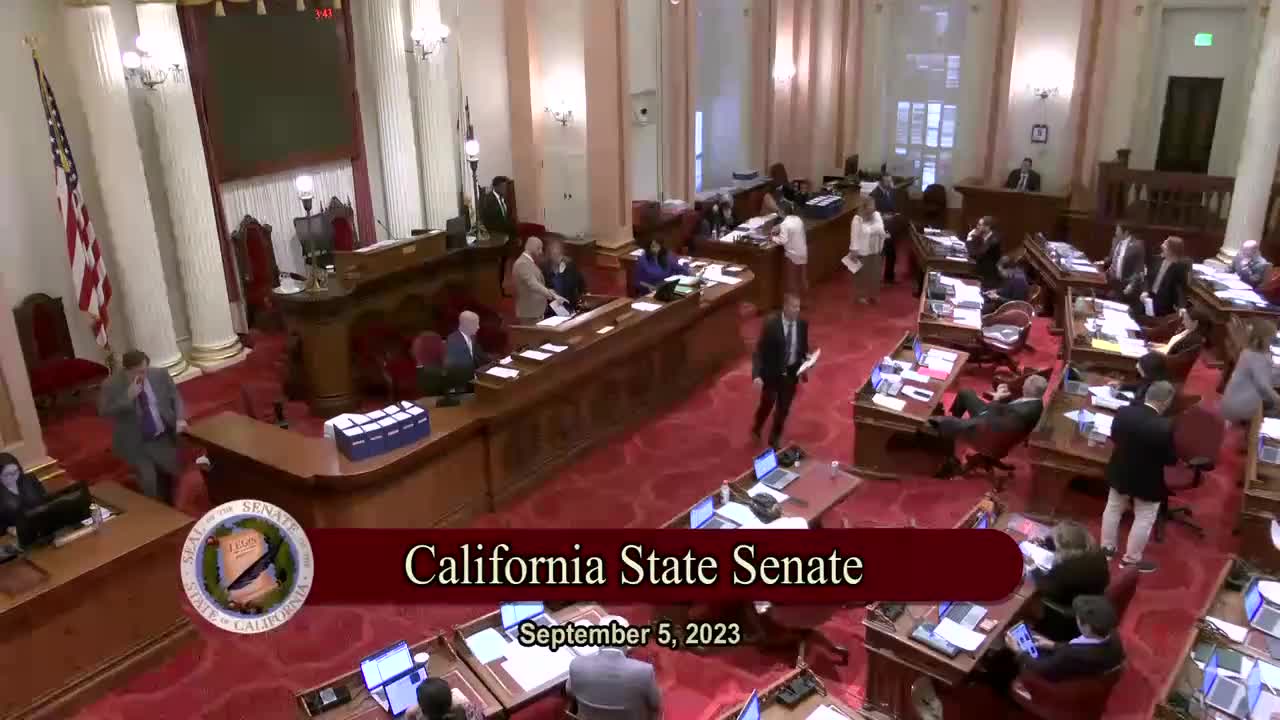 2MIN
Senate Floor
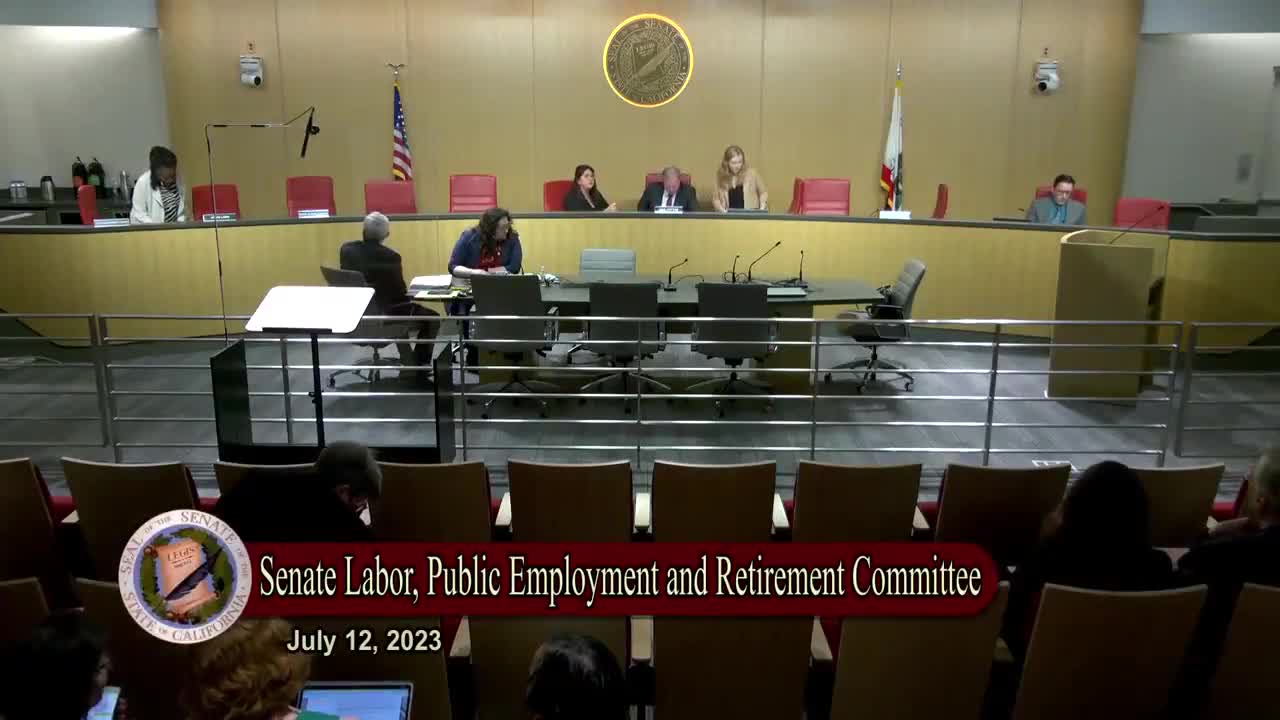 6MIN
Senate Standing Committee on Labor, Public Employment and Retirement
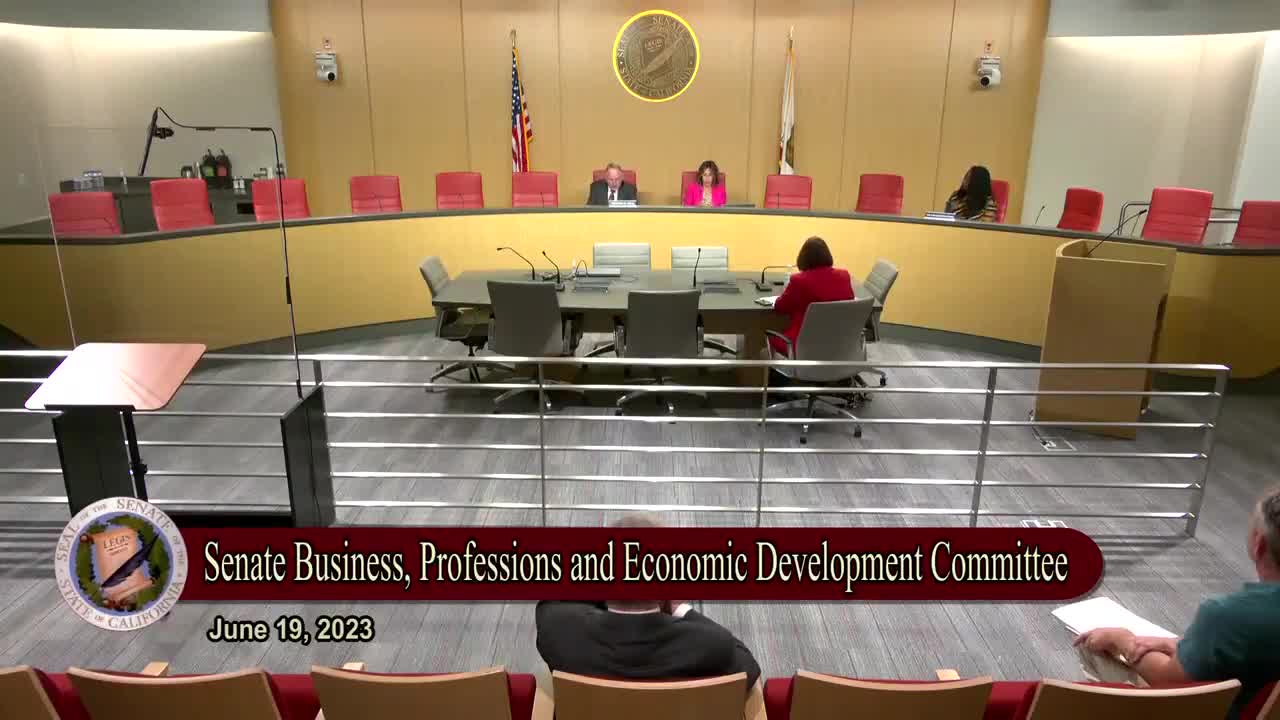 12MIN
Senate Standing Committee on Business, Professions and Economic Development
 1MIN
Assembly Floor
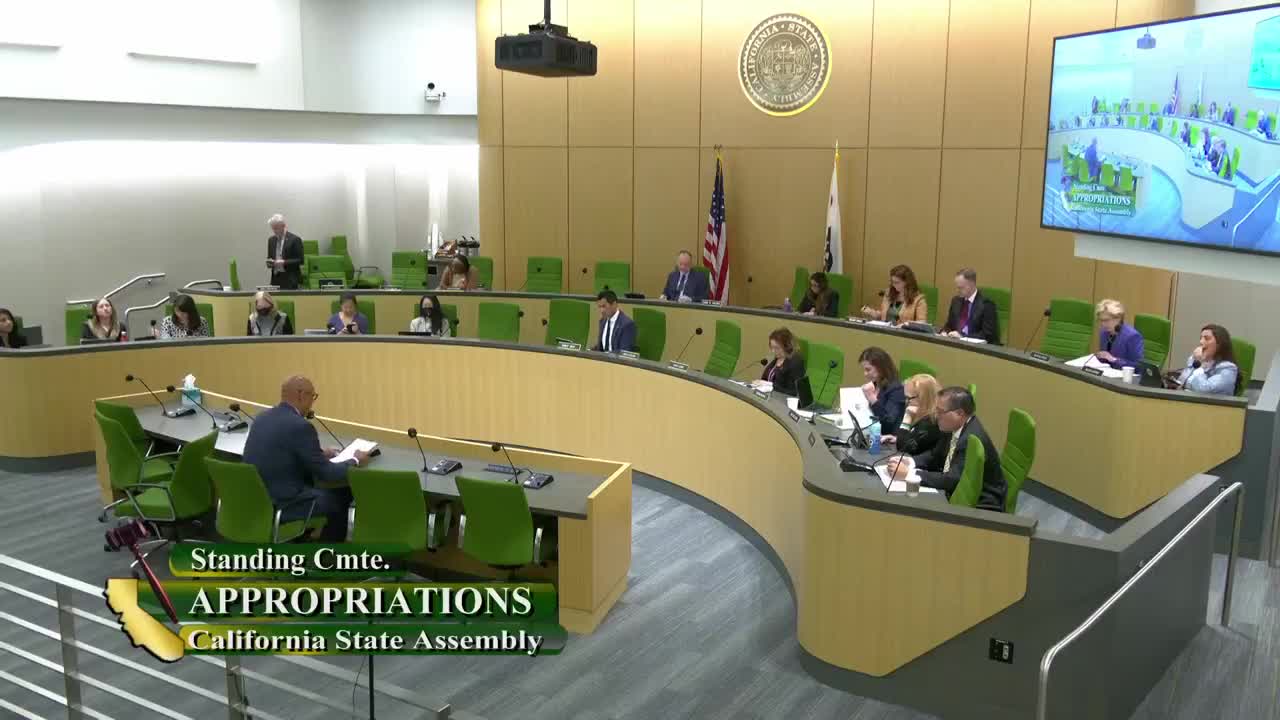 2MIN
Assembly Standing Committee on Appropriations
 11MIN
Assembly Standing Committee on Business and Professions
Bill Author

Bill Co-Author(s):