AB 1207: Cannabis: labeling and advertising.
- Session Year: 2023-2024
- House: Assembly
- Latest Version Date: 2023-09-18
Current Status:
Failed
(2024-02-01: Consideration of Governor's veto stricken from file.)
Introduced
In Committee
First Chamber
In Committee
Second Chamber
Enacted
The Control, Regulate and Tax Adult Use of Marijuana Act (AUMA), an initiative measure approved as Proposition 64 at the November 8, 2016, statewide general election, authorizes a person who obtains a state license under AUMA to engage in commercial adult-use cannabis activity pursuant to that license and applicable local ordinances. The Medicinal and Adult-Use Cannabis Regulation and Safety Act (MAUCRSA), among other things, consolidates the licensure and regulation of commercial medicinal and adult-use cannabis activities, including retail commercial cannabis activity. MAUCRSA places specified requirements on the packaging of cannabis and cannabis products. MAUCRSA prohibits a licensee from engaging in specified advertising or marketing activities, including, among others, advertising or marketing in a manner that is false or untrue or tends to create a misleading impression.
AUMA authorizes the Legislature to amend by majority vote certain provisions of the act to implement specified substantive provisions, provided that the amendments are consistent with and further the purposes and intent of AUMA.
This bill would implement provisions of AUMA by prohibiting the sale, distribution, or manufacture of cannabis, cannabis products, packaging, or labeling that are attractive to children, as defined. The bill would require the adoption of emergency regulations to implement these provisions.
This bill would incorporate additional changes to Section 26001 of the Business and Professions Code proposed by AB 152 and SB 152 to be operative only if this bill and AB 152 or SB 152 are enacted and this bill is enacted last.
The Control, Regulate and Tax Adult Use of Marijuana Act (AUMA), an initiative measure approved as Proposition 64 at the November 8, 2016, statewide general election, authorizes a person who obtains a state license under AUMA to engage in commercial adult-use cannabis activity pursuant to that license and applicable local ordinances. The Medicinal and Adult-Use Cannabis Regulation and Safety Act (MAUCRSA), among other things, consolidates the licensure and regulation of commercial medicinal and adult-use cannabis activities, including retail commercial cannabis activity. MAUCRSA places specified requirements on the packaging of cannabis and cannabis products. MAUCRSA prohibits a licensee from engaging in specified advertising or marketing activities, including, among others, advertising or marketing in a manner that is false or untrue or tends to create a misleading impression.
AUMA authorizes the Legislature to amend by majority vote certain provisions of the act to implement specified substantive provisions, provided that the amendments are consistent with and further the purposes and intent of AUMA.
This bill would implement provisions of AUMA by prohibiting the sale, distribution, or manufacture of cannabis, cannabis products, packaging, or labeling that are attractive to children, as defined, and by prohibiting the advertisement and marketing of cannabis or cannabis products in ways that are attractive to children. defined. The bill would require the adoption of emergency regulations to implement these provisions.
This bill would incorporate additional changes to Section 26001 of the Business and Professions Code proposed by AB 152 and SB 152 to be operative only if this bill and AB 152 or SB 152 are enacted and this bill is enacted last.
The Control, Regulate and Tax Adult Use of Marijuana Act (AUMA), an initiative measure approved as Proposition 64 at the November 8, 2016, statewide general election, authorizes a person who obtains a state license under AUMA to engage in commercial adult-use cannabis activity pursuant to that license and applicable local ordinances. The Medicinal and Adult-Use Cannabis Regulation and Safety Act (MAUCRSA), among other things, consolidates the licensure and regulation of commercial medicinal and adult-use cannabis activities, including retail commercial cannabis activity. MAUCRSA places specified requirements on the packaging of cannabis and cannabis products. MAUCRSA prohibits a licensee from engaging in specified advertising or marketing activities, including, among others, advertising or marketing in a manner that is false or untrue or tends to create a misleading impression.
AUMA authorizes the Legislature to amend by majority vote certain provisions of the act to implement specified substantive provisions, provided that the amendments are consistent with and further the purposes and intent of AUMA.
This bill would implement provisions of AUMA by prohibiting the sale sale, distribution, or manufacture of cannabis or cannabis products cannabis, cannabis products, packaging, or labeling that are attractive to children, as defined, and by prohibiting the advertisement and marketing of cannabis or cannabis products in a way that is ways that are attractive to children. The bill would require the adoption of emergency regulations to implement these provisions.
The Control, Regulate and Tax Adult Use of Marijuana Act (AUMA), an initiative measure approved as Proposition 64 at the November 8, 2016, statewide general election, authorizes a person who obtains a state license under AUMA to engage in commercial adult-use cannabis activity pursuant to that license and applicable local ordinances. The Medicinal and Adult-Use Cannabis Regulation and Safety Act (MAUCRSA), among other things, consolidates the licensure and regulation of commercial medicinal and adult-use cannabis activities, including retail commercial cannabis activity. MAUCRSA places specified requirements on the packaging of cannabis and cannabis products. MAUCRSA prohibits a licensee from engaging in specified advertising or marketing activities, including, among others, advertising or marketing in a manner that is false or untrue or tends to create a misleading impression.
AUMA authorizes the Legislature to amend by majority vote certain provisions of the act to implement specified substantive provisions, provided that the amendments are consistent with and further the purposes and intent of AUMA.
This bill would implement provisions of AUMA by prohibiting the sale or manufacture of cannabis or cannabis products that are attractive to children, as defined, and by prohibiting the advertisement and marketing of cannabis or cannabis products in a way that is attractive to children. The bill would implement AUMA by prohibiting cannabis or cannabis products intended for use by inhalation or combustion from containing any natural or synthetic flavors or descriptors of flavors. The bill would require the adoption of emergency regulations to implement these provisions.
The Control, Regulate and Tax Adult Use of Marijuana Act (AUMA), an initiative measure approved as Proposition 64 at the November 8, 2016, statewide general election, authorizes a person who obtains a state license under AUMA to engage in commercial adult-use cannabis activity pursuant to that license and applicable local ordinances. The Medicinal and Adult-Use Cannabis Regulation and Safety Act (MAUCRSA), among other things, consolidates the licensure and regulation of commercial medicinal and adult-use cannabis activities, including retail commercial cannabis activity. MAUCRSA places specified requirements on the packaging of cannabis and cannabis products. MAUCRSA prohibits a licensee from engaging in specified advertising or marketing activities, including, among others, advertising or marketing in a manner that is false or untrue or tends to create a misleading impression.
AUMA authorizes the Legislature to amend by majority vote certain provisions of the act to implement specified substantive provisions, provided that the amendments are consistent with and further the purposes and intent of AUMA.
This bill would implement provisions of AUMA by prohibiting the sale or manufacture of cannabis or cannabis products that are attractive to children, as defined, and by prohibiting the advertisement and marketing of cannabis or cannabis products in a way that is attractive to children. The bill would implement AUMA by prohibiting the appearance of a flavor or descriptor of flavor in greater than 8-point font on the package or label of an edible cannabis product and prohibiting cannabis or cannabis products intended for use by inhalation or combustion from containing any natural or synthetic flavors or descriptors of flavors. The bill would also implement AUMA by requiring that edible cannabis products be composed only of physically separated individual doses and that beverages not exceed one dose per container. The bill would require the adoption of emergency regulations to implement these provisions.
This bill would state the intent of the Legislature to enact legislation relating to cannabis labeling and advertising.The Control, Regulate and Tax Adult Use of Marijuana Act (AUMA), an initiative measure approved as Proposition 64 at the November 8, 2016, statewide general election, authorizes a person who obtains a state license under AUMA to engage in commercial adult-use cannabis activity pursuant to that license and applicable local ordinances. The Medicinal and Adult-Use Cannabis Regulation and Safety Act (MAUCRSA), among other things, consolidates the licensure and regulation of commercial medicinal and adult-use cannabis activities, including retail commercial cannabis activity. MAUCRSA places specified requirements on the packaging of cannabis and cannabis products. MAUCRSA prohibits a licensee from engaging in specified advertising or marketing activities, including, among others, advertising or marketing in a manner that is false or untrue or tends to create a misleading impression.
AUMA authorizes the Legislature to amend by majority vote certain provisions of the act to implement specified substantive provisions, provided that the amendments are consistent with and further the purposes and intent of AUMA.
This bill would implement provisions of AUMA by prohibiting the sale or manufacture of cannabis or cannabis products that are attractive to children, as defined, and by prohibiting the advertisement and marketing of cannabis or cannabis products in a way that is attractive to children. The bill would implement AUMA by prohibiting the appearance of a flavor or descriptor of flavor in greater than 8-point font on the package or label of an edible cannabis product and prohibiting cannabis or cannabis products intended for use by inhalation or combustion from containing any natural or synthetic flavors or descriptors of flavors. The bill would also implement AUMA by requiring that edible cannabis products be composed only of physically separated individual doses and that beverages not exceed one dose per container. The bill would require the adoption of emergency regulations to implement these provisions.
This bill would state the intent of the Legislature to enact legislation relating to cannabis labeling and advertising.
The Control, Regulate and Tax Adult Use of Marijuana Act (AUMA), an initiative measure approved as Proposition 64 at the November 8, 2016, statewide general election, authorizes a person who obtains a state license under AUMA to engage in commercial adult-use cannabis activity pursuant to that license and applicable local ordinances. The Medicinal and Adult-Use Cannabis Regulation and Safety Act (MAUCRSA), among other things, consolidates the licensure and regulation of commercial medicinal and adult-use cannabis activities, including retail commercial cannabis activity. MAUCRSA places specified requirements on the packaging of cannabis and cannabis products. MAUCRSA prohibits a licensee from engaging in specified advertising or marketing activities, including, among others, advertising or marketing in a manner that is false or untrue or tends to create a misleading impression.
This bill would state the intent of the Legislature to enact legislation relating to cannabis labeling and advertising.
For purposes of this division, the following definitions apply:
(a)A-license means a state license issued under this division for cannabis or cannabis products that are intended for adults who are 21 years of age and older and who do not possess a physicians recommendation, or are intended for use on, or consumption by, animals.
(b)A-licensee means any person holding a license under this division for cannabis or cannabis products that are intended for adults who are 21 years of age and older and who do not possess a physicians recommendation, or are intended for use on, or consumption by, animals.
(c)Animal does not include a food animal as defined in Section 4825.1 or livestock as defined in Section 14205 of the Food and Agricultural Code.
(d)Applicant means an owner applying for a state license pursuant to this division.
(e)Attractive to children means any of the following:
(1)Use of images that are attractive to children, including, but not limited to, images of any of the following, except as part of required health warnings:
(A)Cartoons, toys, or robots.
(B)Any real or fictional humans.
(C)Any fictional animals or creatures.
(D)Fruits or vegetables, except when used to accurately describe ingredients or flavors contained in a product.
(2)Any likeness to images, characters, or phrases that are popularly used to advertise to children.
(3)Any imitation of candy packaging or labeling, or other packaging and labeling of cereals, sweets, chips, or other food products typically marketed to children.
(4)The terms candy or candies or variants in spelling such as kandy or kandee.
(5)Brand names or close imitations of brand names of candies, cereals, sweets, chips, or other food products typically marketed to children.
(6)Any other image or packaging that is easily confused with commercially available foods that do not contain cannabis and are typically marketed to children.
(7)Anything else that the department determines in regulation to be attractive to children.
(8)Anything else that is attractive to children in light of all relevant facts and circumstances.
(f)Batch means a specific quantity of homogeneous cannabis or cannabis product that is one of the following types:
(1)Harvest batch. Harvest batch means a specifically identified quantity of dried flower or trim, leaves, and other cannabis plant matter that is harvested at the same time, and, if applicable, cultivated using the same pesticides and other agricultural chemicals.
(2)Manufactured cannabis batch. Manufactured cannabis batch means either of the following:
(A)An amount of cannabis concentrate or extract that is produced in one production cycle using the same extraction methods and standard operating procedures.
(B)An amount of a type of manufactured cannabis produced in one production cycle using the same formulation and standard operating procedures.
(g)Cannabis means all parts of the plant Cannabis sativa Linnaeus, Cannabis indica, or Cannabis ruderalis, whether growing or not; the seeds thereof; the resin, whether crude or purified, extracted from any part of the plant; and every compound, manufacture, salt, derivative, mixture, or preparation of the plant, its seeds, or resin. Cannabis also means the separated resin, whether crude or purified, obtained from cannabis. Cannabis does not include the mature stalks of the plant, fiber produced from the stalks, oil or cake made from the seeds of the plant, any other compound, manufacture, salt, derivative, mixture, or preparation of the mature stalks (except the resin extracted therefrom), fiber, oil, or cake, or the sterilized seed of the plant which is incapable of germination. For the purpose of this division, cannabis does not mean industrial hemp as defined by Section 11018.5 of the Health and Safety Code.
(h)Cannabis accessories has the same meaning as in Section 11018.2 of the Health and Safety Code.
(i)Cannabis beverage means a form of edible cannabis product that is intended to be consumed in its final state as a beverage.
(j)Cannabis concentrate means cannabis that has undergone a process to concentrate one or more active cannabinoids, thereby increasing the products potency. Resin from glandular trichomes from a cannabis plant is a concentrate for purposes of this division. A cannabis concentrate is not considered food, as defined by Section 109935 of the Health and Safety Code, a processed pet food, as defined by Section 113025 of the Health and Safety Code, or a drug, as defined by Section 109925 of the Health and Safety Code.
(k)Cannabis products has the same meaning as in Section 11018.1 of the Health and Safety Code, and includes cannabis products intended for use on, or consumption by, an animal. Cannabis products are not considered food, as defined by Section 109935 of the Health and Safety Code, a drug, as defined by Section 109925 of the Health and Safety Code, or a cosmetic, as defined by Section 109900 of the Health and Safety Code.
(l)Child resistant means designed or constructed to be significantly difficult for children under five years of age to open, and not difficult for normal adults to use properly.
(m)Commercial cannabis activity includes the cultivation, possession, manufacture, distribution, processing, storing, laboratory testing, packaging, labeling, transportation, delivery, or sale of cannabis and cannabis products as provided for in this division, or acting as a cannabis event organizer for temporary cannabis events.
(n)Cultivation means any activity involving the planting, growing, harvesting, drying, curing, grading, or trimming of cannabis.
(o)Cultivation site means a location where cannabis is planted, grown, harvested, dried, cured, graded, or trimmed, or a location where any combination of those activities occurs.
(p)Customer means a natural person 21 years of age or older or a natural person 18 years of age or older who possesses a physicians recommendation, or a primary caregiver.
(q)Daycare center has the same meaning as in Section 1596.76 of the Health and Safety Code.
(r)Delivery means the commercial transfer of cannabis or cannabis products to a customer. Delivery also includes the use by a retailer of any technology platform.
(s)Department means the Department of Cannabis Control within the Business, Consumer Services, and Housing Agency.
(t)Director means the Director of the Department of Cannabis Control.
(u)Distribution means the procurement, sale, and transport of cannabis and cannabis products between licensees.
(v)Distributor means a licensee that is authorized to engage in the distribution of cannabis and cannabis products.
(w)Dried flower means all dead cannabis that has been harvested, dried, cured, or otherwise processed, excluding leaves and stems.
(x)Edible cannabis product means a cannabis product that is intended to be used, in whole or in part, for human or animal consumption, including, but not limited to, chewing gum, but excluding products set forth in Division 15 (commencing with Section 32501) of the Food and Agricultural Code. An edible cannabis product is not considered food, as defined by Section 109935 of the Health and Safety Code, a processed pet food, as defined by Section 113025 of the Health and Safety Code, or a drug, as defined by Section 109925 of the Health and Safety Code.
(y)Fund means the Cannabis Control Fund established pursuant to Section 26210.
(z)Kind means applicable type or designation regarding a particular cannabis variant, origin, or product type, including, but not limited to, strain name, trademark, or production area designation.
(aa)Labeling means any label or other written, printed, or graphic matter upon a cannabis product, upon its container or wrapper, or that accompanies any cannabis product.
(ab)Labor peace agreement means an agreement between a licensee and any bona fide labor organization that, at a minimum, protects the states proprietary interests by prohibiting labor organizations and members from engaging in picketing, work stoppages, boycotts, and any other economic interference with the applicants business. This agreement means that the applicant has agreed not to disrupt efforts by the bona fide labor organization to communicate with, and attempt to organize and represent, the applicants employees. The agreement shall provide a bona fide labor organization access at reasonable times to areas in which the applicants employees work, for the purpose of meeting with employees to discuss their right to representation, employment rights under state law, and terms and conditions of employment. This type of agreement shall not mandate a particular method of election or certification of the bona fide labor organization.
(ac)License means a state license issued under this division, and includes both an A-license and an M-license, as well as a testing laboratory license.
(ad)Licensee means any person holding a license under this division, regardless of whether the license held is an A-license or an M-license, and includes the holder of a testing laboratory license.
(ae)Licensing authority means the department and any state agency currently or formerly responsible for the issuance, renewal, or reinstatement of the license, or the state agency authorized to take disciplinary action against the licensee.
(af)Live plants means living cannabis flowers and plants, including seeds, immature plants, and vegetative stage plants.
(ag)Local jurisdiction means a city, county, or city and county.
(ah)Lot means a batch or a specifically identified portion of a batch.
(ai)M-license means a state license issued under this division for commercial cannabis activity involving medicinal cannabis.
(aj)M-licensee means any person holding a license under this division for commercial cannabis activity involving medicinal cannabis.
(ak)Manufacture means to compound, blend, extract, infuse, package, label, or otherwise make or prepare a cannabis product.
(al)(1)Medicinal cannabis or medicinal cannabis product means cannabis or a cannabis product, respectively, intended to be sold or donated for use pursuant to the Compassionate Use Act of 1996 (Proposition 215), found in Section 11362.5 of the Health and Safety Code, by a medicinal cannabis patient in California who possesses a physicians recommendation, or in compliance with any compassionate use, equity, or other similar program administered by a local jurisdiction.
(2)The amendments made to this subdivision by the act adding this paragraph shall become operative upon completion of the necessary changes to the track and trace program in order to implement the act adding this paragraph, as determined by the Department of Food and Agriculture, or on March 1, 2020, whichever occurs first.
(am)Microbusiness means a licensee that is authorized to engage in cultivation of cannabis on an area less than 10,000 square feet and to act as a licensed distributor, Level 1 manufacturer, and retailer under this division, provided such licensee can demonstrate compliance with all requirements imposed by this division on licensed cultivators, distributors, Level 1 manufacturers, and retailers to the extent the licensee engages in such activities.
(an)Nursery means a licensee that produces only clones, immature plants, seeds, and other agricultural products used specifically for the propagation and cultivation of cannabis.
(ao)Operation means any act for which licensure is required under the provisions of this division, or any commercial transfer of cannabis or cannabis products.
(ap)Owner means any of the following:
(1)A person with an aggregate ownership interest of 20 percent or more in the person applying for a license or a licensee, unless the interest is solely a security, lien, or encumbrance.
(2)The chief executive officer of a nonprofit or other entity.
(3)A member of the board of directors of a nonprofit.
(4)An individual who will be participating in the direction, control, or management of the person applying for a license.
(aq)Package means any container or receptacle used for holding cannabis or cannabis products.
(ar)Person includes any individual, firm, partnership, joint venture, association, corporation, limited liability company, estate, trust, business trust, receiver, syndicate, or any other group or combination acting as a unit, and the plural as well as the singular.
(as)Physicians recommendation means a recommendation by a physician and surgeon that a patient use cannabis provided in accordance with the Compassionate Use Act of 1996 (Proposition 215), found in Section 11362.5 of the Health and Safety Code.
(at)Premises means the designated structure or structures and land specified in the application that is owned, leased, or otherwise held under the control of the applicant or licensee where the commercial cannabis activity will be or is conducted. The premises shall be a contiguous area and shall only be occupied by one licensee.
(au)Primary caregiver has the same meaning as in Section 11362.7 of the Health and Safety Code.
(av)Purchaser means the customer who is engaged in a transaction with a licensee for purposes of obtaining cannabis or cannabis products.
(aw)Retailer means a person authorized to engage in the retail sale and delivery of cannabis or cannabis products to customers.
(ax)Sell, sale, and to sell include any transaction whereby, for any consideration, title to cannabis or cannabis products is transferred from one person to another, and includes the delivery of cannabis or cannabis products pursuant to an order placed for the purchase of the same and soliciting or receiving an order for the same, but does not include the return of cannabis or cannabis products by a licensee to the licensee from whom the cannabis or cannabis product was purchased.
(ay)Testing laboratory means a laboratory, facility, or entity in the state that offers or performs tests of cannabis or cannabis products and that is both of the following:
(1)Accredited by an accrediting body that is independent from all other persons involved in commercial cannabis activity in the state.
(2)Licensed by the department.
(az)Unique identifier means an alphanumeric code or designation issued pursuant to the track and trace program established by the department and used for reference to a specific plant on a licensed premises and any cannabis or cannabis product derived or manufactured from that plant.
(ba)Youth center has the same meaning as in Section 11353.1 of the Health and Safety Code.
SEC. 1.5.Section 26001 of the Business and Professions Code is amended to read:26001.For purposes of this division, the following definitions apply:
(a)A-license means a state license issued under this division for cannabis or cannabis products that are intended for adults who are 21 years of age and older and who do not possess a physicians recommendation, or are intended for use on, or consumption by, animals.
(b)A-licensee means any person holding a license under this division for cannabis or cannabis products that are intended for adults who are 21 years of age and older and who do not possess a physicians recommendation, or are intended for use on, or consumption by, animals.
(c)Animal does not include a food animal as defined in Section 4825.1 or livestock as defined in Section 14205 of the Food and Agricultural Code.
(d)Applicant means an owner applying for a state license pursuant to this division.
(e)Attractive to children means any of the following:
(1)Use of images that are attractive to children, including, but not limited to, images of any of the following, except as part of required health warnings:
(A)Cartoons, toys, or robots.
(B)Any real or fictional humans.
(C)Any fictional animals or creatures.
(D)Fruits or vegetables, except when used to accurately describe ingredients or flavors contained in a product.
(2)Any likeness to images, characters, or phrases that are popularly used to advertise to children.
(3)Any imitation of candy packaging or labeling, or other packaging and labeling of cereals, sweets, chips, or other food products typically marketed to children.
(4)The terms candy or candies or variants in spelling such as kandy or kandee.
(5)Brand names or close imitations of brand names of candies, cereals, sweets, chips, or other food products typically marketed to children.
(6)Any other image or packaging that is easily confused with commercially available foods that do not contain cannabis and are typically marketed to children.
(7)Anything else that the department determines in regulation to be attractive to children.
(8)Anything else that is attractive to children in light of all relevant facts and circumstances.
(f)Batch means a specific quantity of homogeneous cannabis or cannabis product that is one of the following types:
(1)Harvest batch. Harvest batch means a specifically identified quantity of dried flower or trim, leaves, and other cannabis plant matter that is harvested at the same time, and, if applicable, cultivated using the same pesticides and other agricultural chemicals.
(2)Manufactured cannabis batch. Manufactured cannabis batch means either of the following:
(A)An amount of cannabis concentrate or extract that is produced in one production cycle using the same extraction methods and standard operating procedures.
(B)An amount of a type of manufactured cannabis produced in one production cycle using the same formulation and standard operating procedures.
(g)Cannabis means all parts of the plant Cannabis sativa Linnaeus, Cannabis indica, or Cannabis ruderalis, whether growing or not; the seeds thereof; the resin, whether crude or purified, extracted from any part of the plant; and every compound, manufacture, salt, derivative, mixture, or preparation of the plant, its seeds, or resin. Cannabis also means the separated resin, whether crude or purified, obtained from cannabis. Cannabis does not include the mature stalks of the plant, fiber produced from the stalks, oil or cake made from the seeds of the plant, any other compound, manufacture, salt, derivative, mixture, or preparation of the mature stalks (except the resin extracted therefrom), fiber, oil, or cake, or the sterilized seed of the plant which is incapable of germination. For the purpose of this division, cannabis does not mean industrial hemp as defined by Section 11018.5 of the Health and Safety Code.
(h)Cannabis accessories has the same meaning as in Section 11018.2 of the Health and Safety Code.
(i)Cannabis beverage means a form of edible cannabis product that is intended to be consumed in its final state as a beverage.
(j)Cannabis concentrate means cannabis that has undergone a process to concentrate one or more active cannabinoids, thereby increasing the products potency. Resin from glandular trichomes from a cannabis plant is a concentrate for purposes of this division. A cannabis concentrate is not considered food, as defined by Section 109935 of the Health and Safety Code, a processed pet food, as defined by Section 113025 of the Health and Safety Code, or a drug, as defined by Section 109925 of the Health and Safety Code.
(k)Cannabis event organizer means a person authorized to plan and organize temporary cannabis events as authorized in Section 26200.
(l)Cannabis products has the same meaning as in Section 11018.1 of the Health and Safety Code, and includes cannabis products intended for use on, or consumption by, an animal. Cannabis products are not considered food, as defined by Section 109935 of the Health and Safety Code, a drug, as defined by Section 109925 of the Health and Safety Code, or a cosmetic, as defined by Section 109900 of the Health and Safety Code.
(m)Child resistant means designed or constructed to be significantly difficult for children under five years of age to open, and not difficult for normal adults to use properly.
(n)Commercial cannabis activity includes the cultivation, possession, manufacture, distribution, processing, storing, laboratory testing, packaging, labeling, transportation, delivery, or sale of cannabis and cannabis products as provided for in this division, or acting as a cannabis event organizer for temporary cannabis events.
(o)Cultivation means any activity involving the planting, growing, harvesting, drying, curing, grading, or trimming of cannabis.
(p)Cultivation site means a location where cannabis is planted, grown, harvested, dried, cured, graded, or trimmed, or a location where any combination of those activities occurs.
(q)Customer means a natural person 21 years of age or older or a natural person 18 years of age or older who possesses a physicians recommendation, or a primary caregiver.
(r)Daycare center has the same meaning as in Section 1596.76 of the Health and Safety Code.
(s)Delivery means the commercial transfer of cannabis or cannabis products to a customer. Delivery also includes the use by a retailer of any technology platform.
(t)Department means the Department of Cannabis Control within the Business, Consumer Services, and Housing Agency.
(u)Director means the Director of the Department of Cannabis Control.
(v)Distribution means the procurement, sale, and transport of cannabis and cannabis products between licensees.
(w)Distributor means a licensee that is authorized to engage in the distribution of cannabis and cannabis products.
(x)Dried flower means all dead cannabis that has been harvested, dried, cured, or otherwise processed, excluding leaves and stems.
(y)Edible cannabis product means a cannabis product that is intended to be used, in whole or in part, for human or animal consumption, including, but not limited to, chewing gum, but excluding products set forth in Division 15 (commencing with Section 32501) of the Food and Agricultural Code. An edible cannabis product is not considered food, as defined by Section 109935 of the Health and Safety Code, a processed pet food, as defined by Section 113025 of the Health and Safety Code, or a drug, as defined by Section 109925 of the Health and Safety Code.
(z)Fund means the Cannabis Control Fund established pursuant to Section 26210.
(aa)Kind means applicable type or designation regarding a particular cannabis variant, origin, or product type, including, but not limited to, strain name, trademark, or production area designation.
(ab)Labeling means any label or other written, printed, or graphic matter upon a cannabis product, upon its container or wrapper, or that accompanies any cannabis product.
(ac)Labor peace agreement means an agreement between a licensee and any bona fide labor organization that, at a minimum, protects the states proprietary interests by prohibiting labor organizations and members from engaging in picketing, work stoppages, boycotts, and any other economic interference with the applicants business. This agreement means that the applicant has agreed not to disrupt efforts by the bona fide labor organization to communicate with, and attempt to organize and represent, the applicants employees. The agreement shall provide a bona fide labor organization access at reasonable times to areas in which the applicants employees work, for the purpose of meeting with employees to discuss their right to representation, employment rights under state law, and terms and conditions of employment. This type of agreement shall not mandate a particular method of election or certification of the bona fide labor organization.
(ad)License means a state license issued under this division, and includes both an A-license and an M-license, as well as a testing laboratory license.
(ae)Licensee means any person holding a license under this division, regardless of whether the license held is an A-license or an M-license, and includes the holder of a testing laboratory license.
(af)Licensing authority means the department and any state agency currently or formerly responsible for the issuance, renewal, or reinstatement of the license, or the state agency authorized to take disciplinary action against the licensee.
(ag)Live plants means living cannabis flowers and plants, including seeds, immature plants, and vegetative stage plants.
(ah)Local jurisdiction means a city, county, or city and county.
(ai)Lot means a batch or a specifically identified portion of a batch.
(aj)M-license means a state license issued under this division for commercial cannabis activity involving medicinal cannabis.
(ak)M-licensee means any person holding a license under this division for commercial cannabis activity involving medicinal cannabis.
(al)Manufacture means to compound, blend, extract, infuse, package, label, or otherwise make or prepare a cannabis product.
(am)(1)Medicinal cannabis or medicinal cannabis product means cannabis or a cannabis product, respectively, intended to be sold or donated for use pursuant to the Compassionate Use Act of 1996 (Proposition 215), found in Section 11362.5 of the Health and Safety Code, by a medicinal cannabis patient in California who possesses a physicians recommendation, or in compliance with any compassionate use, equity, or other similar program administered by a local jurisdiction.
(2)The amendments made to this subdivision by the act adding this paragraph shall become operative upon completion of the necessary changes to the track and trace program in order to implement the act adding this paragraph, as determined by the Department of Food and Agriculture, or on March 1, 2020, whichever occurs first.
(an)Microbusiness means a licensee that is authorized to engage in cultivation of cannabis on an area less than 10,000 square feet and to act as a licensed distributor, Level 1 manufacturer, and retailer under this division, provided such licensee can demonstrate compliance with all requirements imposed by this division on licensed cultivators, distributors, Level 1 manufacturers, and retailers to the extent the licensee engages in such activities.
(ao)Nursery means a licensee that produces only clones, immature plants, seeds, and other agricultural products used specifically for the propagation and cultivation of cannabis.
(ap)Operation means any act for which licensure is required under the provisions of this division, or any commercial transfer of cannabis or cannabis products.
(aq)Owner means any of the following:
(1)A person with an aggregate ownership interest of 20 percent or more in the person applying for a license or a licensee, unless the interest is solely a security, lien, or encumbrance.
(2)The chief executive officer of a nonprofit or other entity.
(3)A member of the board of directors of a nonprofit.
(4)An individual who will be participating in the direction, control, or management of the person applying for a license.
(ar)Package means any container or receptacle used for holding cannabis or cannabis products.
(as)Person includes any individual, firm, partnership, joint venture, association, corporation, limited liability company, estate, trust, business trust, receiver, syndicate, or any other group or combination acting as a unit, and the plural as well as the singular.
(at)Physicians recommendation means a recommendation by a physician and surgeon that a patient use cannabis provided in accordance with the Compassionate Use Act of 1996 (Proposition 215), found in Section 11362.5 of the Health and Safety Code.
(au)Premises means the designated structure or structures and land specified in the application that is owned, leased, or otherwise held under the control of the applicant or licensee where the commercial cannabis activity will be or is conducted. The premises shall be a contiguous area and shall only be occupied by one licensee.
(av)Primary caregiver has the same meaning as in Section 11362.7 of the Health and Safety Code.
(aw)Processor means a person authorized to engage in only trimming, drying, curing, grading, packaging, and labeling of cannabis and nonmanufactured cannabis products.
(ax)Purchaser means the customer who is engaged in a transaction with a licensee for purposes of obtaining cannabis or cannabis products.
(ay)Retailer means a person authorized to engage in the retail sale and delivery of cannabis or cannabis products to customers.
(az)Sell, sale, and to sell include any transaction whereby, for any consideration, title to cannabis or cannabis products is transferred from one person to another, and includes the delivery of cannabis or cannabis products pursuant to an order placed for the purchase of the same and soliciting or receiving an order for the same, but does not include the return of cannabis or cannabis products by a licensee to the licensee from whom the cannabis or cannabis product was purchased.
(ba)Testing laboratory means a laboratory, facility, or entity in the state that offers or performs tests of cannabis or cannabis products and that is both of the following:
(1)Accredited by an accrediting body that is independent from all other persons involved in commercial cannabis activity in the state.
(2)Licensed by the department.
(bb)Unique identifier means an alphanumeric code or designation issued pursuant to the track and trace program established by the department and used for reference to a specific plant on a licensed premises and any cannabis or cannabis product derived or manufactured from that plant.
(bc)Youth center has the same meaning as in Section 11353.1 of the Health and Safety Code.
SEC. 2.Section 26120 of the Business and Professions Code, as amended by Section 1.5 of Chapter 390 of the Statutes of 2022, is amended to read:26120.(a)Prior to delivery or sale at a retailer, cannabis and cannabis products shall be labeled and placed in a tamper-evident, child-resistant package, and shall include a unique identifier for the purposes of identifying and tracking cannabis and cannabis products. If the cannabis or cannabis product contains multiple servings, the package shall also be resealable.
(b)(1)Cannabis, cannabis products, packages, and labels shall not be made to be attractive to children. A manufacturer, distributor, or seller of cannabis or cannabis products shall not manufacture, distribute, or sell any cannabis or cannabis product, or any packaging or labeling, that is attractive to children.
(2)Notwithstanding any other law, the department shall adopt emergency regulations in accordance with Chapter 3.5 (commencing with Section 11340) of Part 1 of Division 3 of Title 2 of the Government Code to implement this subdivision. The provisions of Section 26013 shall be applicable to emergency regulations adopted or readopted pursuant to this subdivision. The emergency regulations authorized by this subdivision shall be deemed an emergency and necessary for the immediate preservation of public peace, health, safety, or general welfare.
(c)All cannabis and cannabis product labels and inserts shall include the following information prominently displayed in a clear and legible fashion in accordance with the requirements, including font size, prescribed by the department:
(1)The following statements, in bold print:
(A)For cannabis: GOVERNMENT WARNING: THIS PACKAGE CONTAINS CANNABIS, A SCHEDULE I CONTROLLED SUBSTANCE. KEEP OUT OF REACH OF CHILDREN AND ANIMALS. CANNABIS MAY ONLY BE POSSESSED OR CONSUMED BY PERSONS 21 YEARS OF AGE OR OLDER UNLESS THE PERSON IS A QUALIFIED PATIENT. CANNABIS USE WHILE PREGNANT OR BREASTFEEDING MAY BE HARMFUL. CONSUMPTION OF CANNABIS IMPAIRS YOUR ABILITY TO DRIVE AND OPERATE MACHINERY. PLEASE USE EXTREME CAUTION.
(B)For cannabis products: GOVERNMENT WARNING: THIS PRODUCT CONTAINS CANNABIS, A SCHEDULE I CONTROLLED SUBSTANCE. KEEP OUT OF REACH OF CHILDREN AND ANIMALS. CANNABIS PRODUCTS MAY ONLY BE POSSESSED OR CONSUMED BY PERSONS 21 YEARS OF AGE OR OLDER UNLESS THE PERSON IS A QUALIFIED PATIENT. THE INTOXICATING EFFECTS OF CANNABIS PRODUCTS MAY BE DELAYED UP TO TWO HOURS. CANNABIS USE WHILE PREGNANT OR BREASTFEEDING MAY BE HARMFUL. CONSUMPTION OF CANNABIS PRODUCTS IMPAIRS YOUR ABILITY TO DRIVE AND OPERATE MACHINERY. PLEASE USE EXTREME CAUTION.
(2)For packages containing only dried flower, the net weight of cannabis in the package.
(3)Identification of the type of cannabis or cannabis product and the date of packaging.
(4)The appellation of origin, if any.
(5)List of pharmacologically active ingredients, including, but not limited to, tetrahydrocannabinol (THC), cannabidiol (CBD), and other cannabinoid content, the THC and other cannabinoid amount in milligrams per serving, servings per package, and the THC and other cannabinoid amount in milligrams for the package total.
(6)A warning if nuts or other known allergens are used.
(7)Information associated with the unique identifier issued by the department.
(8)For a medicinal cannabis product sold at a retailer, the statement FOR MEDICAL USE ONLY.
(9)Any other requirement set by the department.
(d)Only generic food names may be used to describe the ingredients in edible cannabis products.
(e)Cannabis beverages may be packaged in containers that are clear or any color.
(f)In the event the Attorney General determines that cannabis is no longer a Schedule I controlled substance under federal law, the label prescribed in subdivision (c) shall no longer require a statement that cannabis is a Schedule I controlled substance.
(g)This section shall remain in effect only until July 1, 2024, and as of that date is repealed.
SEC. 3.Section 26120 of the Business and Professions Code, as added by Section 2.5 of Chapter 390 of the Statutes of 2022, is amended to read:26120.(a)Prior to delivery or sale at a retailer, cannabis and cannabis products shall be labeled and placed in a tamper-evident, child-resistant package and shall include a unique identifier for the purposes of identifying and tracking cannabis and cannabis products. If the cannabis or cannabis product contains multiple servings, the package shall also be resealable.
(b)(1)Cannabis, cannabis products, packages, and labels shall not be made to be attractive to children. A manufacturer, distributor, or seller of cannabis or cannabis products shall not manufacture, distribute, or sell any cannabis or cannabis product, or any packaging or labeling, that is attractive to children.
(2)Notwithstanding any other law, the department shall adopt emergency regulations in accordance with Chapter 3.5 (commencing with Section 11340) of Part 1 of Division 3 of Title 2 of the Government Code to implement this subdivision. The provisions of Section 26013 shall be applicable to emergency regulations adopted or readopted pursuant to this subdivision. The emergency regulations authorized by this subdivision shall be deemed an emergency and necessary for the immediate preservation of public peace, health, safety, or general welfare.
(c)All cannabis and cannabis product labels and inserts shall include the following information prominently displayed in a clear and legible fashion in accordance with the requirements, including font size, prescribed by the department:
(1)The following statements, in bold print:
(A)For cannabis: GOVERNMENT WARNING: THIS PACKAGE CONTAINS CANNABIS, A SCHEDULE I CONTROLLED SUBSTANCE. KEEP OUT OF REACH OF CHILDREN AND ANIMALS. CANNABIS MAY ONLY BE POSSESSED OR CONSUMED BY PERSONS 21 YEARS OF AGE OR OLDER UNLESS THE PERSON IS A QUALIFIED PATIENT. CANNABIS USE WHILE PREGNANT OR BREASTFEEDING MAY BE HARMFUL. CONSUMPTION OF CANNABIS IMPAIRS YOUR ABILITY TO DRIVE AND OPERATE MACHINERY. PLEASE USE EXTREME CAUTION.
(B)For cannabis products: GOVERNMENT WARNING: THIS PRODUCT CONTAINS CANNABIS, A SCHEDULE I CONTROLLED SUBSTANCE. KEEP OUT OF REACH OF CHILDREN AND ANIMALS. CANNABIS PRODUCTS MAY ONLY BE POSSESSED OR CONSUMED BY PERSONS 21 YEARS OF AGE OR OLDER UNLESS THE PERSON IS A QUALIFIED PATIENT. THE INTOXICATING EFFECTS OF CANNABIS PRODUCTS MAY BE DELAYED UP TO TWO HOURS. CANNABIS USE WHILE PREGNANT OR BREASTFEEDING MAY BE HARMFUL. CONSUMPTION OF CANNABIS PRODUCTS IMPAIRS YOUR ABILITY TO DRIVE AND OPERATE MACHINERY. PLEASE USE EXTREME CAUTION.
(2)For packages containing only dried flower, the net weight of cannabis in the package.
(3)Identification of the type of cannabis or cannabis product and the date of packaging.
(4)The appellation of origin, if any.
(5)List of pharmacologically active ingredients, including, but not limited to, tetrahydrocannabinol (THC), cannabidiol (CBD), and other cannabinoid content, the THC and other cannabinoid amount in milligrams per serving, servings per package, and the THC and other cannabinoid amount in milligrams for the package total.
(6)A warning if nuts or other known allergens are used.
(7)Information associated with the unique identifier issued by the department.
(8)For a medicinal cannabis product sold at a retailer, the statement FOR MEDICAL USE ONLY.
(9)Any other requirement set by the department.
(d)Only generic food names may be used to describe the ingredients in edible cannabis products.
(e)Cannabis beverages may be packaged in containers that are clear or any color.
(f)The package and label of a cannabis cartridge and an integrated cannabis vaporizer shall not indicate that the cannabis cartridge or integrated cannabis vaporizer is disposable nor imply that it may be thrown in the trash or recycling streams.
(g)In the event the Attorney General determines that cannabis is no longer a Schedule I controlled substance under federal law, the label prescribed in subdivision (c) shall no longer require a statement that cannabis is a Schedule I controlled substance.
(h)This section shall become operative on July 1, 2024.
SEC. 4.(a)Section 1.5 of this bill incorporates amendments to Section 26001 of the Business and Professions Code proposed by this bill and Assembly Bill 152. That section of this bill shall only become operative if (1) both bills are enacted and become effective on or before January 1, 2024, (2) each bill amends Section 26001 of the Business and Professions Code, and (3) this bill is enacted after Assembly Bill 152, in which case Section 26001 of the Business and Professions Code, as amended by Assembly Bill 152, shall remain operative only until the operative date of this bill, at which time Section 1.5 of this bill shall become operative, and Section 1 of this bill shall not become operative.
(b)Section 1.5 of this bill incorporates amendments to Section 26001 of the Business and Professions Code proposed by this bill and Senate Bill 152. That section shall only become operative if (1) both bills are enacted and become effective on or before January 1, 2024, (2) each bill amends Section 26001 of the Business and Professions Code, and (3) this bill is enacted after Senate Bill 152, in which case Section 26001 of the Business and Professions Code, as amended by Senate Bill 152, shall remain operative only until the operative date of this bill, at which time Section 1.5 of this bill shall become operative, and Section 1 of this bill shall not become operative.
For purposes of this division, the following definitions apply:
(a)A-license means a state license issued under this division for cannabis or cannabis products that are intended for adults who are 21 years of age and older and who do not possess a physicians recommendation, or are intended for use on, or consumption by, animals.
(b)A-licensee means any person holding a license under this division for cannabis or cannabis products that are intended for adults who are 21 years of age and older and who do not possess a physicians recommendation, or are intended for use on, or consumption by, animals.
(c)Animal does not include a food animal as defined in Section 4825.1 or livestock as defined in Section 14205 of the Food and Agricultural Code.
(d)Applicant means an owner applying for a state license pursuant to this division.
(e)Attractive to children means any of the following:
(1)Use of images that are attractive to children, including, but not limited to, images of any of the following, except as part of required health warnings:
(A)Cartoons, toys, or robots.
(B)Any real or fictional humans.
(C)Any fictional animals or creatures.
(D)Fruits or vegetables, except when used to accurately describe ingredients or flavors contained in a product.
(2)Any likeness to images, characters, or phrases that are popularly used to advertise to children.
(3)Any imitation of candy packaging or labeling, or other packaging and labeling of cereals, sweets, chips, or other food products typically marketed to children.
(4)The terms candy or candies or variants in spelling such as kandy or kandee.
(5)Brand names or close imitations of brand names of candies, cereals, sweets, chips, or other food products typically marketed to children.
(6)Any other image or packaging that is easily confused with commercially available foods that do not contain cannabis and are typically marketed to children.
(7)Anything else that the department determines in regulation to be attractive to children.
(8)Anything else that is attractive to children in light of all relevant facts and circumstances.
(f)Batch means a specific quantity of homogeneous cannabis or cannabis product that is one of the following types:
(1)Harvest batch. Harvest batch means a specifically identified quantity of dried flower or trim, leaves, and other cannabis plant matter that is harvested at the same time, and, if applicable, cultivated using the same pesticides and other agricultural chemicals.
(2)Manufactured cannabis batch. Manufactured cannabis batch means either of the following:
(A)An amount of cannabis concentrate or extract that is produced in one production cycle using the same extraction methods and standard operating procedures.
(B)An amount of a type of manufactured cannabis produced in one production cycle using the same formulation and standard operating procedures.
(g)Cannabis means all parts of the plant Cannabis sativa Linnaeus, Cannabis indica, or Cannabis ruderalis, whether growing or not; the seeds thereof; the resin, whether crude or purified, extracted from any part of the plant; and every compound, manufacture, salt, derivative, mixture, or preparation of the plant, its seeds, or resin. Cannabis also means the separated resin, whether crude or purified, obtained from cannabis. Cannabis does not include the mature stalks of the plant, fiber produced from the stalks, oil or cake made from the seeds of the plant, any other compound, manufacture, salt, derivative, mixture, or preparation of the mature stalks (except the resin extracted therefrom), fiber, oil, or cake, or the sterilized seed of the plant which is incapable of germination. For the purpose of this division, cannabis does not mean industrial hemp as defined by Section 11018.5 of the Health and Safety Code.
(h)Cannabis accessories has the same meaning as in Section 11018.2 of the Health and Safety Code.
(i)Cannabis beverage means a form of edible cannabis product that is intended to be consumed in its final state as a beverage.
(j)Cannabis concentrate means cannabis that has undergone a process to concentrate one or more active cannabinoids, thereby increasing the products potency. Resin from glandular trichomes from a cannabis plant is a concentrate for purposes of this division. A cannabis concentrate is not considered food, as defined by Section 109935 of the Health and Safety Code, a processed pet food, as defined by Section 113025 of the Health and Safety Code, or a drug, as defined by Section 109925 of the Health and Safety Code.
(k)Cannabis products has the same meaning as in Section 11018.1 of the Health and Safety Code, and includes cannabis products intended for use on, or consumption by, an animal. Cannabis products are not considered food, as defined by Section 109935 of the Health and Safety Code, a drug, as defined by Section 109925 of the Health and Safety Code, or a cosmetic, as defined by Section 109900 of the Health and Safety Code.
(l)Child resistant means designed or constructed to be significantly difficult for children under five years of age to open, and not difficult for normal adults to use properly.
(m)Commercial cannabis activity includes the cultivation, possession, manufacture, distribution, processing, storing, laboratory testing, packaging, labeling, transportation, delivery, or sale of cannabis and cannabis products as provided for in this division, or acting as a cannabis event organizer for temporary cannabis events.
(n)Cultivation means any activity involving the planting, growing, harvesting, drying, curing, grading, or trimming of cannabis.
(o)Cultivation site means a location where cannabis is planted, grown, harvested, dried, cured, graded, or trimmed, or a location where any combination of those activities occurs.
(p)Customer means a natural person 21 years of age or older or a natural person 18 years of age or older who possesses a physicians recommendation, or a primary caregiver.
(q)Daycare center has the same meaning as in Section 1596.76 of the Health and Safety Code.
(r)Delivery means the commercial transfer of cannabis or cannabis products to a customer. Delivery also includes the use by a retailer of any technology platform.
(s)Department means the Department of Cannabis Control within the Business, Consumer Services, and Housing Agency.
(t)Director means the Director of the Department of Cannabis Control.
(u)Distribution means the procurement, sale, and transport of cannabis and cannabis products between licensees.
(v)Distributor means a licensee that is authorized to engage in the distribution of cannabis and cannabis products.
(w)Dried flower means all dead cannabis that has been harvested, dried, cured, or otherwise processed, excluding leaves and stems.
(x)Edible cannabis product means a cannabis product that is intended to be used, in whole or in part, for human or animal consumption, including, but not limited to, chewing gum, but excluding products set forth in Division 15 (commencing with Section 32501) of the Food and Agricultural Code. An edible cannabis product is not considered food, as defined by Section 109935 of the Health and Safety Code, a processed pet food, as defined by Section 113025 of the Health and Safety Code, or a drug, as defined by Section 109925 of the Health and Safety Code.
(y)Fund means the Cannabis Control Fund established pursuant to Section 26210.
(z)Kind means applicable type or designation regarding a particular cannabis variant, origin, or product type, including, but not limited to, strain name, trademark, or production area designation.
(aa)Labeling means any label or other written, printed, or graphic matter upon a cannabis product, upon its container or wrapper, or that accompanies any cannabis product.
(ab)Labor peace agreement means an agreement between a licensee and any bona fide labor organization that, at a minimum, protects the states proprietary interests by prohibiting labor organizations and members from engaging in picketing, work stoppages, boycotts, and any other economic interference with the applicants business. This agreement means that the applicant has agreed not to disrupt efforts by the bona fide labor organization to communicate with, and attempt to organize and represent, the applicants employees. The agreement shall provide a bona fide labor organization access at reasonable times to areas in which the applicants employees work, for the purpose of meeting with employees to discuss their right to representation, employment rights under state law, and terms and conditions of employment. This type of agreement shall not mandate a particular method of election or certification of the bona fide labor organization.
(ac)License means a state license issued under this division, and includes both an A-license and an M-license, as well as a testing laboratory license.
(ad)Licensee means any person holding a license under this division, regardless of whether the license held is an A-license or an M-license, and includes the holder of a testing laboratory license.
(ae)Licensing authority means the department and any state agency currently or formerly responsible for the issuance, renewal, or reinstatement of the license, or the state agency authorized to take disciplinary action against the licensee.
(af)Live plants means living cannabis flowers and plants, including seeds, immature plants, and vegetative stage plants.
(ag)Local jurisdiction means a city, county, or city and county.
(ah)Lot means a batch or a specifically identified portion of a batch.
(ai)M-license means a state license issued under this division for commercial cannabis activity involving medicinal cannabis.
(aj)M-licensee means any person holding a license under this division for commercial cannabis activity involving medicinal cannabis.
(ak)Manufacture means to compound, blend, extract, infuse, package, label, or otherwise make or prepare a cannabis product.
(al)(1)Medicinal cannabis or medicinal cannabis product means cannabis or a cannabis product, respectively, intended to be sold or donated for use pursuant to the Compassionate Use Act of 1996 (Proposition 215), found in Section 11362.5 of the Health and Safety Code, by a medicinal cannabis patient in California who possesses a physicians recommendation, or in compliance with any compassionate use, equity, or other similar program administered by a local jurisdiction.
(2)The amendments made to this subdivision by the act adding this paragraph shall become operative upon completion of the necessary changes to the track and trace program in order to implement the act adding this paragraph, as determined by the Department of Food and Agriculture, or on March 1, 2020, whichever occurs first.
(am)Microbusiness means a licensee that is authorized to engage in cultivation of cannabis on an area less than 10,000 square feet and to act as a licensed distributor, Level 1 manufacturer, and retailer under this division, provided such licensee can demonstrate compliance with all requirements imposed by this division on licensed cultivators, distributors, Level 1 manufacturers, and retailers to the extent the licensee engages in such activities.
(an)Nursery means a licensee that produces only clones, immature plants, seeds, and other agricultural products used specifically for the propagation and cultivation of cannabis.
(ao)Operation means any act for which licensure is required under the provisions of this division, or any commercial transfer of cannabis or cannabis products.
(ap)Owner means any of the following:
(1)A person with an aggregate ownership interest of 20 percent or more in the person applying for a license or a licensee, unless the interest is solely a security, lien, or encumbrance.
(2)The chief executive officer of a nonprofit or other entity.
(3)A member of the board of directors of a nonprofit.
(4)An individual who will be participating in the direction, control, or management of the person applying for a license.
(aq)Package means any container or receptacle used for holding cannabis or cannabis products.
(ar)Person includes any individual, firm, partnership, joint venture, association, corporation, limited liability company, estate, trust, business trust, receiver, syndicate, or any other group or combination acting as a unit, and the plural as well as the singular.
(as)Physicians recommendation means a recommendation by a physician and surgeon that a patient use cannabis provided in accordance with the Compassionate Use Act of 1996 (Proposition 215), found in Section 11362.5 of the Health and Safety Code.
(at)Premises means the designated structure or structures and land specified in the application that is owned, leased, or otherwise held under the control of the applicant or licensee where the commercial cannabis activity will be or is conducted. The premises shall be a contiguous area and shall only be occupied by one licensee.
(au)Primary caregiver has the same meaning as in Section 11362.7 of the Health and Safety Code.
(av)Purchaser means the customer who is engaged in a transaction with a licensee for purposes of obtaining cannabis or cannabis products.
(aw)Retailer means a person authorized to engage in the retail sale and delivery of cannabis or cannabis products to customers.
(ax)Sell, sale, and to sell include any transaction whereby, for any consideration, title to cannabis or cannabis products is transferred from one person to another, and includes the delivery of cannabis or cannabis products pursuant to an order placed for the purchase of the same and soliciting or receiving an order for the same, but does not include the return of cannabis or cannabis products by a licensee to the licensee from whom the cannabis or cannabis product was purchased.
(ay)Testing laboratory means a laboratory, facility, or entity in the state that offers or performs tests of cannabis or cannabis products and that is both of the following:
(1)Accredited by an accrediting body that is independent from all other persons involved in commercial cannabis activity in the state.
(2)Licensed by the department.
(az)Unique identifier means an alphanumeric code or designation issued pursuant to the track and trace program established by the department and used for reference to a specific plant on a licensed premises and any cannabis or cannabis product derived or manufactured from that plant.
(ba)Youth center has the same meaning as in Section 11353.1 of the Health and Safety Code.
SEC. 1.5.Section 26001 of the Business and Professions Code is amended to read:26001.For purposes of this division, the following definitions apply:
(a)A-license means a state license issued under this division for cannabis or cannabis products that are intended for adults who are 21 years of age and older and who do not possess a physicians recommendation, or are intended for use on, or consumption by, animals.
(b)A-licensee means any person holding a license under this division for cannabis or cannabis products that are intended for adults who are 21 years of age and older and who do not possess a physicians recommendation, or are intended for use on, or consumption by, animals.
(c)Animal does not include a food animal as defined in Section 4825.1 or livestock as defined in Section 14205 of the Food and Agricultural Code.
(d)Applicant means an owner applying for a state license pursuant to this division.
(e)Attractive to children means any of the following:
(1)Use of images that are attractive to children, including, but not limited to, images of any of the following, except as part of required health warnings:
(A)Cartoons, toys, or robots.
(B)Any real or fictional humans.
(C)Any fictional animals or creatures.
(D)Fruits or vegetables, except when used to accurately describe ingredients or flavors contained in a product.
(2)Any likeness to images, characters, or phrases that are popularly used to advertise to children.
(3)Any imitation of candy packaging or labeling, or other packaging and labeling of cereals, sweets, chips, or other food products typically marketed to children.
(4)The terms candy or candies or variants in spelling such as kandy or kandee.
(5)Brand names or close imitations of brand names of candies, cereals, sweets, chips, or other food products typically marketed to children.
(6)Any other image or packaging that is easily confused with commercially available foods that do not contain cannabis and are typically marketed to children.
(7)Anything else that the department determines in regulation to be attractive to children.
(8)Anything else that is attractive to children in light of all relevant facts and circumstances.
(e)(f)Batch means a specific quantity of homogeneous cannabis or cannabis product that is one of the following types:
(1)Harvest batch. Harvest batch means a specifically identified quantity of dried flower or trim, leaves, and other cannabis plant matter that is harvested at the same time, and, if applicable, cultivated using the same pesticides and other agricultural chemicals.
(2)Manufactured cannabis batch. Manufactured cannabis batch means either of the following:
(A)An amount of cannabis concentrate or extract that is produced in one production cycle using the same extraction methods and standard operating procedures.
(B)An amount of a type of manufactured cannabis produced in one production cycle using the same formulation and standard operating procedures.
(f)(g)Cannabis means all parts of the plant Cannabis sativa Linnaeus, Cannabis indica, or Cannabis ruderalis, whether growing or not; the seeds thereof; the resin, whether crude or purified, extracted from any part of the plant; and every compound, manufacture, salt, derivative, mixture, or preparation of the plant, its seeds, or resin. Cannabis also means the separated resin, whether crude or purified, obtained from cannabis. Cannabis does not include the mature stalks of the plant, fiber produced from the stalks, oil or cake made from the seeds of the plant, any other compound, manufacture, salt, derivative, mixture, or preparation of the mature stalks (except the resin extracted therefrom), fiber, oil, or cake, or the sterilized seed of the plant which is incapable of germination. For the purpose of this division, cannabis does not mean industrial hemp as defined by Section 11018.5 of the Health and Safety Code.
(g)(h)Cannabis accessories has the same meaning as in Section 11018.2 of the Health and Safety Code.
(h)(i)Cannabis beverage means a form of edible cannabis product that is intended to be consumed in its final state as a beverage.
(i)(j)Cannabis concentrate means cannabis that has undergone a process to concentrate one or more active cannabinoids, thereby increasing the products potency. Resin from glandular trichomes from a cannabis plant is a concentrate for purposes of this division. A cannabis concentrate is not considered food, as defined by Section 109935 of the Health and Safety Code, a processed pet food, as defined by Section 113025 of the Health and Safety Code, or a drug, as defined by Section 109925 of the Health and Safety Code.
(k)Cannabis event organizer means a person authorized to plan and organize temporary cannabis events as authorized in Section 26200.
(j)(l)Cannabis products has the same meaning as in Section 11018.1 of the Health and Safety Code, and includes cannabis products intended for use on, or consumption by, an animal. Cannabis products are not considered food, as defined by Section 109935 of the Health and Safety Code, a drug, as defined by Section 109925 of the Health and Safety Code, or a cosmetic, as defined by Section 109900 of the Health and Safety Code.
(k)(m)Child resistant means designed or constructed to be significantly difficult for children under five years of age to open, and not difficult for normal adults to use properly.
(l)(n)Commercial cannabis activity includes the cultivation, possession, manufacture, distribution, processing, storing, laboratory testing, packaging, labeling, transportation, delivery, or sale of cannabis and cannabis products as provided for in this division, or acting as a cannabis event organizer for temporary cannabis events.
(m)(o)Cultivation means any activity involving the planting, growing, harvesting, drying, curing, grading, or trimming of cannabis.
(n)(p)Cultivation site means a location where cannabis is planted, grown, harvested, dried, cured, graded, or trimmed, or a location where any combination of those activities occurs.
(o)(q)Customer means a natural person 21 years of age or older or a natural person 18 years of age or older who possesses a physicians recommendation, or a primary caregiver.
(p)(r)Daycare center has the same meaning as in Section 1596.76 of the Health and Safety Code.
(q)(s)Delivery means the commercial transfer of cannabis or cannabis products to a customer. Delivery also includes the use by a retailer of any technology platform.
(r)(t)Department means the Department of Cannabis Control within the Business, Consumer Services, and Housing Agency.
(s)(u)Director means the Director of the Department of Cannabis Control.
(t)(v)Distribution means the procurement, sale, and transport of cannabis and cannabis products between licensees.
(u)(w)Distributor means a licensee that is authorized to engage in the distribution of cannabis and cannabis products.
(v)(x)Dried flower means all dead cannabis that has been harvested, dried, cured, or otherwise processed, excluding leaves and stems.
(w)(y)Edible cannabis product means a cannabis product that is intended to be used, in whole or in part, for human or animal consumption, including, but not limited to, chewing gum, but excluding products set forth in Division 15 (commencing with Section 32501) of the Food and Agricultural Code. An edible cannabis product is not considered food, as defined by Section 109935 of the Health and Safety Code, a processed pet food, as defined by Section 113025 of the Health and Safety Code, or a drug, as defined by Section 109925 of the Health and Safety Code.
(x)(z)Fund means the Cannabis Control Fund established pursuant to Section 26210.
(y)(aa)Kind means applicable type or designation regarding a particular cannabis variant, origin, or product type, including, but not limited to, strain name, trademark, or production area designation.
(z)(ab)Labeling means any label or other written, printed, or graphic matter upon a cannabis product, upon its container or wrapper, or that accompanies any cannabis product.
(aa)(ac)Labor peace agreement means an agreement between a licensee and any bona fide labor organization that, at a minimum, protects the states proprietary interests by prohibiting labor organizations and members from engaging in picketing, work stoppages, boycotts, and any other economic interference with the applicants business. This agreement means that the applicant has agreed not to disrupt efforts by the bona fide labor organization to communicate with, and attempt to organize and represent, the applicants employees. The agreement shall provide a bona fide labor organization access at reasonable times to areas in which the applicants employees work, for the purpose of meeting with employees to discuss their right to representation, employment rights under state law, and terms and conditions of employment. This type of agreement shall not mandate a particular method of election or certification of the bona fide labor organization.
(ab)(ad)License means a state license issued under this division, and includes both an A-license and an M-license, as well as a testing laboratory license.
(ac)(ae)Licensee means any person holding a license under this division, regardless of whether the license held is an A-license or an M-license, and includes the holder of a testing laboratory license.
(ad)(af)Licensing authority means the department and any state agency currently or formerly responsible for the issuance, renewal, or reinstatement of the license, or the state agency authorized to take disciplinary action against the licensee.
(ae)(ag)Live plants means living cannabis flowers and plants, including seeds, immature plants, and vegetative stage plants.
(af)(ah)Local jurisdiction means a city, county, or city and county.
(ag)(ai)Lot means a batch or a specifically identified portion of a batch.
(ah)(aj)M-license means a state license issued under this division for commercial cannabis activity involving medicinal cannabis.
(ai)(ak)M-licensee means any person holding a license under this division for commercial cannabis activity involving medicinal cannabis.
(aj)(al)Manufacture means to compound, blend, extract, infuse, package, label, or otherwise make or prepare a cannabis product.
(ak)(am)(1)Medicinal cannabis or medicinal cannabis product means cannabis or a cannabis product, respectively, intended to be sold or donated for use pursuant to the Compassionate Use Act of 1996 (Proposition 215), found in Section 11362.5 of the Health and Safety Code, by a medicinal cannabis patient in California who possesses a physicians recommendation, or in compliance with any compassionate use, equity, or other similar program administered by a local jurisdiction.
(2)The amendments made to this subdivision by the act adding this paragraph shall become operative upon completion of the necessary changes to the track and trace program in order to implement the act adding this paragraph, as determined by the Department of Food and Agriculture, or on March 1, 2020, whichever occurs first.
(al)(an)Microbusiness means a licensee that is authorized to engage in cultivation of cannabis on an area less than 10,000 square feet and to act as a licensed distributor, Level 1 manufacturer, and retailer under this division, provided such licensee can demonstrate compliance with all requirements imposed by this division on licensed cultivators, distributors, Level 1 manufacturers, and retailers to the extent the licensee engages in such activities.
(am)(ao)Nursery means a licensee that produces only clones, immature plants, seeds, and other agricultural products used specifically for the propagation and cultivation of cannabis.
(an)(ap)Operation means any act for which licensure is required under the provisions of this division, or any commercial transfer of cannabis or cannabis products.
(ao)(aq)Owner means any of the following:
(1)A person with an aggregate ownership interest of 20 percent or more in the person applying for a license or a licensee, unless the interest is solely a security, lien, or encumbrance.
(2)The chief executive officer of a nonprofit or other entity.
(3)A member of the board of directors of a nonprofit.
(4)An individual who will be participating in the direction, control, or management of the person applying for a license.
(ap)(ar)Package means any container or receptacle used for holding cannabis or cannabis products.
(aq)(as)Person includes any individual, firm, partnership, joint venture, association, corporation, limited liability company, estate, trust, business trust, receiver, syndicate, or any other group or combination acting as a unit, and the plural as well as the singular.
(ar)(at)Physicians recommendation means a recommendation by a physician and surgeon that a patient use cannabis provided in accordance with the Compassionate Use Act of 1996 (Proposition 215), found at in Section 11362.5 of the Health and Safety Code.
(as)(au)Premises means the designated structure or structures and land specified in the application that is owned, leased, or otherwise held under the control of the applicant or licensee where the commercial cannabis activity will be or is conducted. The premises shall be a contiguous area and shall only be occupied by one licensee.
(at)(av)Primary caregiver has the same meaning as in Section 11362.7 of the Health and Safety Code.
(aw)Processor means a person authorized to engage in only trimming, drying, curing, grading, packaging, and labeling of cannabis and nonmanufactured cannabis products.
(au)(ax)Purchaser means the customer who is engaged in a transaction with a licensee for purposes of obtaining cannabis or cannabis products.
(av)(ay)Retailer means a person authorized to engage in the retail sale and delivery of cannabis or cannabis products to customers.
(aw)(az)Sell, sale, and to sell include any transaction whereby, for any consideration, title to cannabis or cannabis products is transferred from one person to another, and includes the delivery of cannabis or cannabis products pursuant to an order placed for the purchase of the same and soliciting or receiving an order for the same, but does not include the return of cannabis or cannabis products by a licensee to the licensee from whom the cannabis or cannabis product was purchased.
(ax)(ba)Testing laboratory means a laboratory, facility, or entity in the state that offers or performs tests of cannabis or cannabis products and that is both of the following:
(1)Accredited by an accrediting body that is independent from all other persons involved in commercial cannabis activity in the state.
(2)Licensed by the department.
(ay)(bb)Unique identifier means an alphanumeric code or designation issued pursuant to the track and trace program established by the department and used for reference to a specific plant on a licensed premises and any cannabis or cannabis product derived or manufactured from that plant.
(az)(bc)Youth center has the same meaning as in Section 11353.1 of the Health and Safety Code.
SEC. 2.Section 26120 of the Business and Professions Code, as amended by Section 1.5 of Chapter 390 of the Statutes of 2022, is amended to read:26120.(a)Prior to delivery or sale at a retailer, cannabis and cannabis products shall be labeled and placed in a tamper-evident, child-resistant package, and shall include a unique identifier for the purposes of identifying and tracking cannabis and cannabis products. If the cannabis or cannabis product contains multiple servings, the package shall also be resealable.
(b)(1)Cannabis, cannabis products, packages, and labels shall not be made to be attractive to children. A manufacturer, distributor, or seller of cannabis or cannabis products shall not manufacture, distribute, or sell any cannabis or cannabis product, or any packaging or labeling, that is attractive to children.
(2)Notwithstanding any other law, the department shall adopt emergency regulations in accordance with Chapter 3.5 (commencing with Section 11340) of Part 1 of Division 3 of Title 2 of the Government Code to implement this subdivision. The provisions of Section 26013 shall be applicable to emergency regulations adopted or readopted pursuant to this subdivision. The emergency regulations authorized by this subdivision shall be deemed an emergency and necessary for the immediate preservation of public peace, health, safety, or general welfare.
(c)All cannabis and cannabis product labels and inserts shall include the following information prominently displayed in a clear and legible fashion in accordance with the requirements, including font size, prescribed by the department:
(1)The following statements, in bold print:
(A)For cannabis: GOVERNMENT WARNING: THIS PACKAGE CONTAINS CANNABIS, A SCHEDULE I CONTROLLED SUBSTANCE. KEEP OUT OF REACH OF CHILDREN AND ANIMALS. CANNABIS MAY ONLY BE POSSESSED OR CONSUMED BY PERSONS 21 YEARS OF AGE OR OLDER UNLESS THE PERSON IS A QUALIFIED PATIENT. CANNABIS USE WHILE PREGNANT OR BREASTFEEDING MAY BE HARMFUL. CONSUMPTION OF CANNABIS IMPAIRS YOUR ABILITY TO DRIVE AND OPERATE MACHINERY. PLEASE USE EXTREME CAUTION.
(B)For cannabis products: GOVERNMENT WARNING: THIS PRODUCT CONTAINS CANNABIS, A SCHEDULE I CONTROLLED SUBSTANCE. KEEP OUT OF REACH OF CHILDREN AND ANIMALS. CANNABIS PRODUCTS MAY ONLY BE POSSESSED OR CONSUMED BY PERSONS 21 YEARS OF AGE OR OLDER UNLESS THE PERSON IS A QUALIFIED PATIENT. THE INTOXICATING EFFECTS OF CANNABIS PRODUCTS MAY BE DELAYED UP TO TWO HOURS. CANNABIS USE WHILE PREGNANT OR BREASTFEEDING MAY BE HARMFUL. CONSUMPTION OF CANNABIS PRODUCTS IMPAIRS YOUR ABILITY TO DRIVE AND OPERATE MACHINERY. PLEASE USE EXTREME CAUTION.
(2)For packages containing only dried flower, the net weight of cannabis in the package.
(3)Identification of the type of cannabis or cannabis product and the date of packaging.
(4)The appellation of origin, if any.
(5)List of pharmacologically active ingredients, including, but not limited to, tetrahydrocannabinol (THC), cannabidiol (CBD), and other cannabinoid content, the THC and other cannabinoid amount in milligrams per serving, servings per package, and the THC and other cannabinoid amount in milligrams for the package total.
(6)A warning if nuts or other known allergens are used.
(7)Information associated with the unique identifier issued by the department.
(8)For a medicinal cannabis product sold at a retailer, the statement FOR MEDICAL USE ONLY.
(9)Any other requirement set by the department.
(d)Only generic food names may be used to describe the ingredients in edible cannabis products.
(e)Cannabis beverages may be packaged in containers that are clear or any color.
(f)In the event the Attorney General determines that cannabis is no longer a Schedule I controlled substance under federal law, the label prescribed in subdivision (c) shall no longer require a statement that cannabis is a Schedule I controlled substance.
(g)This section shall remain in effect only until July 1, 2024, and as of that date is repealed.
SEC. 3.Section 26120 of the Business and Professions Code, as added by Section 2.5 of Chapter 390 of the Statutes of 2022, is amended to read:26120.(a)Prior to delivery or sale at a retailer, cannabis and cannabis products shall be labeled and placed in a tamper-evident, child-resistant package and shall include a unique identifier for the purposes of identifying and tracking cannabis and cannabis products. If the cannabis or cannabis product contains multiple servings, the package shall also be resealable.
(b)(1)Cannabis, cannabis products, packages, and labels shall not be made to be attractive to children. A manufacturer, distributor, or seller of cannabis or cannabis products shall not manufacture, distribute, or sell any cannabis or cannabis product, or any packaging or labeling, that is attractive to children.
(2)Notwithstanding any other law, the department shall adopt emergency regulations in accordance with Chapter 3.5 (commencing with Section 11340) of Part 1 of Division 3 of Title 2 of the Government Code to implement this subdivision. The provisions of Section 26013 shall be applicable to emergency regulations adopted or readopted pursuant to this subdivision. The emergency regulations authorized by this subdivision shall be deemed an emergency and necessary for the immediate preservation of public peace, health, safety, or general welfare.
(c)All cannabis and cannabis product labels and inserts shall include the following information prominently displayed in a clear and legible fashion in accordance with the requirements, including font size, prescribed by the department:
(1)The following statements, in bold print:
(A)For cannabis: GOVERNMENT WARNING: THIS PACKAGE CONTAINS CANNABIS, A SCHEDULE I CONTROLLED SUBSTANCE. KEEP OUT OF REACH OF CHILDREN AND ANIMALS. CANNABIS MAY ONLY BE POSSESSED OR CONSUMED BY PERSONS 21 YEARS OF AGE OR OLDER UNLESS THE PERSON IS A QUALIFIED PATIENT. CANNABIS USE WHILE PREGNANT OR BREASTFEEDING MAY BE HARMFUL. CONSUMPTION OF CANNABIS IMPAIRS YOUR ABILITY TO DRIVE AND OPERATE MACHINERY. PLEASE USE EXTREME CAUTION.
(B)For cannabis products: GOVERNMENT WARNING: THIS PRODUCT CONTAINS CANNABIS, A SCHEDULE I CONTROLLED SUBSTANCE. KEEP OUT OF REACH OF CHILDREN AND ANIMALS. CANNABIS PRODUCTS MAY ONLY BE POSSESSED OR CONSUMED BY PERSONS 21 YEARS OF AGE OR OLDER UNLESS THE PERSON IS A QUALIFIED PATIENT. THE INTOXICATING EFFECTS OF CANNABIS PRODUCTS MAY BE DELAYED UP TO TWO HOURS. CANNABIS USE WHILE PREGNANT OR BREASTFEEDING MAY BE HARMFUL. CONSUMPTION OF CANNABIS PRODUCTS IMPAIRS YOUR ABILITY TO DRIVE AND OPERATE MACHINERY. PLEASE USE EXTREME CAUTION.
(2)For packages containing only dried flower, the net weight of cannabis in the package.
(3)Identification of the type of cannabis or cannabis product and the date of packaging.
(4)The appellation of origin, if any.
(5)List of pharmacologically active ingredients, including, but not limited to, tetrahydrocannabinol (THC), cannabidiol (CBD), and other cannabinoid content, the THC and other cannabinoid amount in milligrams per serving, servings per package, and the THC and other cannabinoid amount in milligrams for the package total.
(6)A warning if nuts or other known allergens are used.
(7)Information associated with the unique identifier issued by the department.
(8)For a medicinal cannabis product sold at a retailer, the statement FOR MEDICAL USE ONLY.
(9)Any other requirement set by the department.
(d)Only generic food names may be used to describe the ingredients in edible cannabis products.
(e)Cannabis beverages may be packaged in containers that are clear or any color.
(f)The package and label of a cannabis cartridge and an integrated cannabis vaporizer shall not indicate that the cannabis cartridge or integrated cannabis vaporizer is disposable nor imply that it may be thrown in the trash or recycling streams.
(g)In the event the Attorney General determines that cannabis is no longer a Schedule I controlled substance under federal law, the label prescribed in subdivision (c) shall no longer require a statement that cannabis is a Schedule I controlled substance.
(h)This section shall become operative on July 1, 2024.
SEC. 4.Section 26157 is added to the Business and Professions Code, to read:26157.(a)An advertiser of cannabis or a cannabis products shall not advertise or market in ways that are attractive to children.(b)Notwithstanding any other law, the department shall adopt emergency regulations in accordance with Chapter 3.5 (commencing with Section 11340) of Part 1 of Division 3 of Title 2 of the Government Code to implement this section.SEC. 4.(a)Section 1.5 of this bill incorporates amendments to Section 26001 of the Business and Professions Code proposed by this bill and Assembly Bill 152. That section of this bill shall only become operative if (1) both bills are enacted and become effective on or before January 1, 2024, (2) each bill amends Section 26001 of the Business and Professions Code, and (3) this bill is enacted after Assembly Bill 152, in which case Section 26001 of the Business and Professions Code, as amended by Assembly Bill 152, shall remain operative only until the operative date of this bill, at which time Section 1.5 of this bill shall become operative, and Section 1 of this bill shall not become operative.
(b)Section 1.5 of this bill incorporates amendments to Section 26001 of the Business and Professions Code proposed by this bill and Senate Bill 152. That section shall only become operative if (1) both bills are enacted and become effective on or before January 1, 2024, (2) each bill amends Section 26001 of the Business and Professions Code, and (3) this bill is enacted after Senate Bill 152, in which case Section 26001 of the Business and Professions Code, as amended by Senate Bill 152, shall remain operative only until the operative date of this bill, at which time Section 1.5 of this bill shall become operative, and Section 1 of this bill shall not become operative.
For purposes of this division, the following definitions apply:
(a)A-license means a state license issued under this division for cannabis or cannabis products that are intended for adults who are 21 years of age and older and who do not possess a physicians recommendation, or are intended for use on, or consumption by, animals.
(b)A-licensee means any person holding a license under this division for cannabis or cannabis products that are intended for adults who are 21 years of age and older and who do not possess a physicians recommendation, or are intended for use on, or consumption by, animals.
(c)Animal does not include a food animal as defined in Section 4825.1 or livestock as defined in Section 14205 of the Food and Agricultural Code.
(d)Applicant means an owner applying for a state license pursuant to this division.
(e)Attractive to children means any of the following:
(1)Use of images that are attractive to children, including, but not limited to, images of any of the following: following, except as part of required health warnings:
(A)Cartoons, toys, or robots.
(B)Any real or fictional humans.
(C)Any fictional animals or creatures.
(D)Fruits or vegetables, except when used to accurately describe ingredients or flavors contained in a product.
(2)Any likeness to images, characters, or phrases that are popularly used to advertise to children.
(3)Any imitation of candy packaging or labeling, or other packaging and labeling of cereals, sweets, chips, or other food products typically marketed to children.
(4)The terms candy or candies or variants in spelling such as kandy or kandee.
(5)Brand names or close imitations of brand names of candies, cereals, sweets, chips, or other food products typically marketed to children.
(6)Any other image or packaging that is easily confused with commercially available foods that do not contain cannabis and are typically marketed to children.
(7)Anything else that the department determines in regulation to be attractive to children.
(8)Anything else that is attractive to children in light of all relevant facts and circumstances.
(f)Batch means a specific quantity of homogeneous cannabis or cannabis product that is one of the following types:
(1)Harvest batch. Harvest batch means a specifically identified quantity of dried flower or trim, leaves, and other cannabis plant matter that is harvested at the same time, and, if applicable, cultivated using the same pesticides and other agricultural chemicals.
(2)Manufactured cannabis batch. Manufactured cannabis batch means either of the following:
(A)An amount of cannabis concentrate or extract that is produced in one production cycle using the same extraction methods and standard operating procedures.
(B)An amount of a type of manufactured cannabis produced in one production cycle using the same formulation and standard operating procedures.
(g)Cannabis means all parts of the plant Cannabis sativa Linnaeus, Cannabis indica, or Cannabis ruderalis, whether growing or not; the seeds thereof; the resin, whether crude or purified, extracted from any part of the plant; and every compound, manufacture, salt, derivative, mixture, or preparation of the plant, its seeds, or resin. Cannabis also means the separated resin, whether crude or purified, obtained from cannabis. Cannabis does not include the mature stalks of the plant, fiber produced from the stalks, oil or cake made from the seeds of the plant, any other compound, manufacture, salt, derivative, mixture, or preparation of the mature stalks (except the resin extracted therefrom), fiber, oil, or cake, or the sterilized seed of the plant which is incapable of germination. For the purpose of this division, cannabis does not mean industrial hemp as defined by Section 11018.5 of the Health and Safety Code.
(h)Cannabis accessories has the same meaning as in Section 11018.2 of the Health and Safety Code.
(i)Cannabis beverage means a form of edible cannabis product that is intended to be consumed in its final state as a beverage.
(j)Cannabis concentrate means cannabis that has undergone a process to concentrate one or more active cannabinoids, thereby increasing the products potency. Resin from glandular trichomes from a cannabis plant is a concentrate for purposes of this division. A cannabis concentrate is not considered food, as defined by Section 109935 of the Health and Safety Code, a processed pet food, as defined by Section 113025 of the Health and Safety Code, or a drug, as defined by Section 109925 of the Health and Safety Code.
(k)Cannabis products has the same meaning as in Section 11018.1 of the Health and Safety Code, and includes cannabis products intended for use on, or consumption by, an animal. Cannabis products are not considered food, as defined by Section 109935 of the Health and Safety Code, a drug, as defined by Section 109925 of the Health and Safety Code, or a cosmetic, as defined by Section 109900 of the Health and Safety Code.
(l)Child resistant means designed or constructed to be significantly difficult for children under five years of age to open, and not difficult for normal adults to use properly.
(m)Commercial cannabis activity includes the cultivation, possession, manufacture, distribution, processing, storing, laboratory testing, packaging, labeling, transportation, delivery, or sale of cannabis and cannabis products as provided for in this division, or acting as a cannabis event organizer for temporary cannabis events.
(n)Cultivation means any activity involving the planting, growing, harvesting, drying, curing, grading, or trimming of cannabis.
(o)Cultivation site means a location where cannabis is planted, grown, harvested, dried, cured, graded, or trimmed, or a location where any combination of those activities occurs.
(p)Customer means a natural person 21 years of age or older or a natural person 18 years of age or older who possesses a physicians recommendation, or a primary caregiver.
(q)Daycare center has the same meaning as in Section 1596.76 of the Health and Safety Code.
(r)Delivery means the commercial transfer of cannabis or cannabis products to a customer. Delivery also includes the use by a retailer of any technology platform.
(s)Department means the Department of Cannabis Control within the Business, Consumer Services, and Housing Agency.
(t)Director means the Director of the Department of Cannabis Control.
(u)Distribution means the procurement, sale, and transport of cannabis and cannabis products between licensees.
(v)Distributor means a licensee that is authorized to engage in the distribution of cannabis and cannabis products.
(w)Dried flower means all dead cannabis that has been harvested, dried, cured, or otherwise processed, excluding leaves and stems.
(x)Edible cannabis product means a cannabis product that is intended to be used, in whole or in part, for human or animal consumption, including, but not limited to, chewing gum, but excluding products set forth in Division 15 (commencing with Section 32501) of the Food and Agricultural Code. An edible cannabis product is not considered food, as defined by Section 109935 of the Health and Safety Code, a processed pet food, as defined by Section 113025 of the Health and Safety Code, or a drug, as defined by Section 109925 of the Health and Safety Code.
(y)Fund means the Cannabis Control Fund established pursuant to Section 26210.
(z)Kind means applicable type or designation regarding a particular cannabis variant, origin, or product type, including, but not limited to, strain name, trademark, or production area designation.
(aa)Labeling means any label or other written, printed, or graphic matter upon a cannabis product, upon its container or wrapper, or that accompanies any cannabis product.
(ab)Labor peace agreement means an agreement between a licensee and any bona fide labor organization that, at a minimum, protects the states proprietary interests by prohibiting labor organizations and members from engaging in picketing, work stoppages, boycotts, and any other economic interference with the applicants business. This agreement means that the applicant has agreed not to disrupt efforts by the bona fide labor organization to communicate with, and attempt to organize and represent, the applicants employees. The agreement shall provide a bona fide labor organization access at reasonable times to areas in which the applicants employees work, for the purpose of meeting with employees to discuss their right to representation, employment rights under state law, and terms and conditions of employment. This type of agreement shall not mandate a particular method of election or certification of the bona fide labor organization.
(ac)License means a state license issued under this division, and includes both an A-license and an M-license, as well as a testing laboratory license.
(ad)Licensee means any person holding a license under this division, regardless of whether the license held is an A-license or an M-license, and includes the holder of a testing laboratory license.
(ae)Licensing authority means the department and any state agency currently or formerly responsible for the issuance, renewal, or reinstatement of the license, or the state agency authorized to take disciplinary action against the licensee.
(af)Live plants means living cannabis flowers and plants, including seeds, immature plants, and vegetative stage plants.
(ag)Local jurisdiction means a city, county, or city and county.
(ah)Lot means a batch or a specifically identified portion of a batch.
(ai)M-license means a state license issued under this division for commercial cannabis activity involving medicinal cannabis.
(aj)M-licensee means any person holding a license under this division for commercial cannabis activity involving medicinal cannabis.
(ak)Manufacture means to compound, blend, extract, infuse, package, label, or otherwise make or prepare a cannabis product.
(al)(1)Medicinal cannabis or medicinal cannabis product means cannabis or a cannabis product, respectively, intended to be sold or donated for use pursuant to the Compassionate Use Act of 1996 (Proposition 215), found in Section 11362.5 of the Health and Safety Code, by a medicinal cannabis patient in California who possesses a physicians recommendation, or in compliance with any compassionate use, equity, or other similar program administered by a local jurisdiction.
(2)The amendments made to this subdivision by the act adding this paragraph shall become operative upon completion of the necessary changes to the track and trace program in order to implement the act adding this paragraph, as determined by the Department of Food and Agriculture, or on March 1, 2020, whichever occurs first.
(am)Microbusiness means a licensee that is authorized to engage in cultivation of cannabis on an area less than 10,000 square feet and to act as a licensed distributor, Level 1 manufacturer, and retailer under this division, provided such licensee can demonstrate compliance with all requirements imposed by this division on licensed cultivators, distributors, Level 1 manufacturers, and retailers to the extent the licensee engages in such activities.
(an)Nursery means a licensee that produces only clones, immature plants, seeds, and other agricultural products used specifically for the propagation and cultivation of cannabis.
(ao)Operation means any act for which licensure is required under the provisions of this division, or any commercial transfer of cannabis or cannabis products.
(ap)Owner means any of the following:
(1)A person with an aggregate ownership interest of 20 percent or more in the person applying for a license or a licensee, unless the interest is solely a security, lien, or encumbrance.
(2)The chief executive officer of a nonprofit or other entity.
(3)A member of the board of directors of a nonprofit.
(4)An individual who will be participating in the direction, control, or management of the person applying for a license.
(aq)Package means any container or receptacle used for holding cannabis or cannabis products.
(ar)Person includes any individual, firm, partnership, joint venture, association, corporation, limited liability company, estate, trust, business trust, receiver, syndicate, or any other group or combination acting as a unit, and the plural as well as the singular.
(as)Physicians recommendation means a recommendation by a physician and surgeon that a patient use cannabis provided in accordance with the Compassionate Use Act of 1996 (Proposition 215), found in Section 11362.5 of the Health and Safety Code.
(at)Premises means the designated structure or structures and land specified in the application that is owned, leased, or otherwise held under the control of the applicant or licensee where the commercial cannabis activity will be or is conducted. The premises shall be a contiguous area and shall only be occupied by one licensee.
(au)Primary caregiver has the same meaning as in Section 11362.7 of the Health and Safety Code.
(av)Purchaser means the customer who is engaged in a transaction with a licensee for purposes of obtaining cannabis or cannabis products.
(aw)Retailer means a person authorized to engage in the retail sale and delivery of cannabis or cannabis products to customers.
(ax)Sell, sale, and to sell include any transaction whereby, for any consideration, title to cannabis or cannabis products is transferred from one person to another, and includes the delivery of cannabis or cannabis products pursuant to an order placed for the purchase of the same and soliciting or receiving an order for the same, but does not include the return of cannabis or cannabis products by a licensee to the licensee from whom the cannabis or cannabis product was purchased.
(ay)Testing laboratory means a laboratory, facility, or entity in the state that offers or performs tests of cannabis or cannabis products and that is both of the following:
(1)Accredited by an accrediting body that is independent from all other persons involved in commercial cannabis activity in the state.
(2)Licensed by the department.
(az)Unique identifier means an alphanumeric code or designation issued pursuant to the track and trace program established by the department and used for reference to a specific plant on a licensed premises and any cannabis or cannabis product derived or manufactured from that plant.
(ba)Youth center has the same meaning as in Section 11353.1 of the Health and Safety Code.
SEC. 2.Section 26120 of the Business and Professions Code, as amended by Section 1.5 of Chapter 390 of the Statutes of 2022, is amended to read:26120.(a)Prior to delivery or sale at a retailer, cannabis and cannabis products shall be labeled and placed in a tamper-evident, child-resistant package, and shall include a unique identifier for the purposes of identifying and tracking cannabis and cannabis products. If the cannabis or cannabis product contains multiple servings, the package shall also be resealable.
(b)Packages (1)Cannabis, cannabis products, packages, and labels shall not be made to be attractive to children. A manufacturer, distributor, or seller of cannabis or cannabis products shall not manufacture, distribute, or sell any cannabis or cannabis product, or any packaging or labeling, that is attractive to children.
(2)Notwithstanding any other law, the department shall adopt emergency regulations in accordance with Chapter 3.5 (commencing with Section 11340) of Part 1 of Division 3 of Title 2 of the Government Code to implement this subdivision. The provisions of Section 26013 shall be applicable to emergency regulations adopted or readopted pursuant to this subdivision. The emergency regulations authorized by this subdivision shall be deemed an emergency and necessary for the immediate preservation of public peace, health, safety, or general welfare.
(c)All cannabis and cannabis product labels and inserts shall include the following information prominently displayed in a clear and legible fashion in accordance with the requirements, including font size, prescribed by the department:
(1)The following statements, in bold print:
(A)For cannabis: GOVERNMENT WARNING: THIS PACKAGE CONTAINS CANNABIS, A SCHEDULE I CONTROLLED SUBSTANCE. KEEP OUT OF REACH OF CHILDREN AND ANIMALS. CANNABIS MAY ONLY BE POSSESSED OR CONSUMED BY PERSONS 21 YEARS OF AGE OR OLDER UNLESS THE PERSON IS A QUALIFIED PATIENT. CANNABIS USE WHILE PREGNANT OR BREASTFEEDING MAY BE HARMFUL. CONSUMPTION OF CANNABIS IMPAIRS YOUR ABILITY TO DRIVE AND OPERATE MACHINERY. PLEASE USE EXTREME CAUTION.
(B)For cannabis products: GOVERNMENT WARNING: THIS PRODUCT CONTAINS CANNABIS, A SCHEDULE I CONTROLLED SUBSTANCE. KEEP OUT OF REACH OF CHILDREN AND ANIMALS. CANNABIS PRODUCTS MAY ONLY BE POSSESSED OR CONSUMED BY PERSONS 21 YEARS OF AGE OR OLDER UNLESS THE PERSON IS A QUALIFIED PATIENT. THE INTOXICATING EFFECTS OF CANNABIS PRODUCTS MAY BE DELAYED UP TO TWO HOURS. CANNABIS USE WHILE PREGNANT OR BREASTFEEDING MAY BE HARMFUL. CONSUMPTION OF CANNABIS PRODUCTS IMPAIRS YOUR ABILITY TO DRIVE AND OPERATE MACHINERY. PLEASE USE EXTREME CAUTION.
(2)For packages containing only dried flower, the net weight of cannabis in the package.
(3)Identification of the type of cannabis or cannabis product and the date of packaging.
(4)The appellation of origin, if any.
(5)List of pharmacologically active ingredients, including, but not limited to, tetrahydrocannabinol (THC), cannabidiol (CBD), and other cannabinoid content, the THC and other cannabinoid amount in milligrams per serving, servings per package, and the THC and other cannabinoid amount in milligrams for the package total.
(6)A warning if nuts or other known allergens are used.
(7)Information associated with the unique identifier issued by the department.
(8)For a medicinal cannabis product sold at a retailer, the statement FOR MEDICAL USE ONLY.
(9)Any other requirement set by the department.
(d)Only generic food names may be used to describe the ingredients in edible cannabis products.
(e)Cannabis beverages may be packaged in containers that are clear or any color.
(f)In the event the Attorney General determines that cannabis is no longer a Schedule I controlled substance under federal law, the label prescribed in subdivision (c) shall no longer require a statement that cannabis is a Schedule I controlled substance.
(g)(1)A manufacturer, distributor, or seller of cannabis or cannabis products shall not manufacture, distribute, or sell any cannabis or cannabis product that is attractive to children.(2)Notwithstanding any other law, the department shall adopt emergency regulations in accordance with Chapter 3.5 (commencing with Section 11340) of Part 1 of Division 3 of Title 2 of the Government Code to implement this subdivision. (h)(g)This section shall remain in effect only until July 1, 2024, and as of that date is repealed.
SEC. 3.Section 26120 of the Business and Professions Code, as added by Section 2.5 of Chapter 390 of the Statutes of 2022, is amended to read:26120.(a)Prior to delivery or sale at a retailer, cannabis and cannabis products shall be labeled and placed in a tamper-evident, child-resistant package and shall include a unique identifier for the purposes of identifying and tracking cannabis and cannabis products. If the cannabis or cannabis product contains multiple servings, the package shall also be resealable.
(b)Packages (1)Cannabis, cannabis products, packages, and labels shall not be made to be attractive to children. A manufacturer, distributor, or seller of cannabis or cannabis products shall not manufacture, distribute, or sell any cannabis or cannabis product, or any packaging or labeling, that is attractive to children.
(2)Notwithstanding any other law, the department shall adopt emergency regulations in accordance with Chapter 3.5 (commencing with Section 11340) of Part 1 of Division 3 of Title 2 of the Government Code to implement this subdivision. The provisions of Section 26013 shall be applicable to emergency regulations adopted or readopted pursuant to this subdivision. The emergency regulations authorized by this subdivision shall be deemed an emergency and necessary for the immediate preservation of public peace, health, safety, or general welfare.
(c)All cannabis and cannabis product labels and inserts shall include the following information prominently displayed in a clear and legible fashion in accordance with the requirements, including font size, prescribed by the department:
(1)The following statements, in bold print:
(A)For cannabis: GOVERNMENT WARNING: THIS PACKAGE CONTAINS CANNABIS, A SCHEDULE I CONTROLLED SUBSTANCE. KEEP OUT OF REACH OF CHILDREN AND ANIMALS. CANNABIS MAY ONLY BE POSSESSED OR CONSUMED BY PERSONS 21 YEARS OF AGE OR OLDER UNLESS THE PERSON IS A QUALIFIED PATIENT. CANNABIS USE WHILE PREGNANT OR BREASTFEEDING MAY BE HARMFUL. CONSUMPTION OF CANNABIS IMPAIRS YOUR ABILITY TO DRIVE AND OPERATE MACHINERY. PLEASE USE EXTREME CAUTION.
(B)For cannabis products: GOVERNMENT WARNING: THIS PRODUCT CONTAINS CANNABIS, A SCHEDULE I CONTROLLED SUBSTANCE. KEEP OUT OF REACH OF CHILDREN AND ANIMALS. CANNABIS PRODUCTS MAY ONLY BE POSSESSED OR CONSUMED BY PERSONS 21 YEARS OF AGE OR OLDER UNLESS THE PERSON IS A QUALIFIED PATIENT. THE INTOXICATING EFFECTS OF CANNABIS PRODUCTS MAY BE DELAYED UP TO TWO HOURS. CANNABIS USE WHILE PREGNANT OR BREASTFEEDING MAY BE HARMFUL. CONSUMPTION OF CANNABIS PRODUCTS IMPAIRS YOUR ABILITY TO DRIVE AND OPERATE MACHINERY. PLEASE USE EXTREME CAUTION.
(2)For packages containing only dried flower, the net weight of cannabis in the package.
(3)Identification of the type of cannabis or cannabis product and the date of packaging.
(4)The appellation of origin, if any.
(5)List of pharmacologically active ingredients, including, but not limited to, tetrahydrocannabinol (THC), cannabidiol (CBD), and other cannabinoid content, the THC and other cannabinoid amount in milligrams per serving, servings per package, and the THC and other cannabinoid amount in milligrams for the package total.
(6)A warning if nuts or other known allergens are used.
(7)Information associated with the unique identifier issued by the department.
(8)For a medicinal cannabis product sold at a retailer, the statement FOR MEDICAL USE ONLY.
(9)Any other requirement set by the department.
(d)Only generic food names may be used to describe the ingredients in edible cannabis products.
(e)Cannabis beverages may be packaged in containers that are clear or any color.
(f)The package and label of a cannabis cartridge and an integrated cannabis vaporizer shall not indicate that the cannabis cartridge or integrated cannabis vaporizer is disposable nor imply that it may be thrown in the trash or recycling streams.
(g)In the event the Attorney General determines that cannabis is no longer a Schedule I controlled substance under federal law, the label prescribed in subdivision (c) shall no longer require a statement that cannabis is a Schedule I controlled substance.
(h)(1)A manufacturer, distributor, or seller of cannabis or cannabis products shall not manufacture, distribute, or sell any cannabis or cannabis product that is attractive to children. (2)Notwithstanding any other law, the department shall adopt emergency regulations in accordance with Chapter 3.5 (commencing with Section 11340) of Part 1 of Division 3 of Title 2 of the Government Code to implement this subdivision. (i)(h)This section shall become operative on July 1, 2024.
SEC. 4.Section 26157 is added to the Business and Professions Code, to read:26157.(a)An advertiser of cannabis or a cannabis products shall not advertise or market in ways that are attractive to children.
(b)Notwithstanding any other law, the department shall adopt emergency regulations in accordance with Chapter 3.5 (commencing with Section 11340) of Part 1 of Division 3 of Title 2 of the Government Code to implement this section.
For purposes of this division, the following definitions apply:
(a)A-license means a state license issued under this division for cannabis or cannabis products that are intended for adults who are 21 years of age and older and who do not possess a physicians recommendation, or are intended for use on, or consumption by, animals.
(b)A-licensee means any person holding a license under this division for cannabis or cannabis products that are intended for adults who are 21 years of age and older and who do not possess a physicians recommendation, or are intended for use on, or consumption by, animals.
(c)Animal does not include a food animal as defined in Section 4825.1 or livestock as defined in Section 14205 of the Food and Agricultural Code.
(d)Applicant means an owner applying for a state license pursuant to this division.
(e)Attractive to children means any of the following:
(1)Use of images that are attractive to children, including, but not limited to, any of the following:
(A)Cartoons, toys, or robots.
(B)Any real or fictional humans.
(C)Any fictional animals or creatures.
(D)Fruits or vegetables, except when used to accurately describe ingredients or flavors contained in a product.
(2)Any likeness to images, characters, or phrases that are popularly used to advertise to children.
(3)Any imitation of candy packaging or labeling, or other packaging and labeling of cereals, sweets, chips, or other food products typically marketed to children.
(4)The terms candy or candies or variants in spelling such as kandy or kandee.
(5)Brand names or close imitations of brand names of candies, cereals, sweets, chips, or other food products typically marketed to children.
(6)Any other image or packaging that is easily confused with commercially available foods that do not contain cannabis and are typically marketed to children.
(f)Batch means a specific quantity of homogeneous cannabis or cannabis product that is one of the following types:
(1)Harvest batch. Harvest batch means a specifically identified quantity of dried flower or trim, leaves, and other cannabis plant matter that is harvested at the same time, and, if applicable, cultivated using the same pesticides and other agricultural chemicals.
(2)Manufactured cannabis batch. Manufactured cannabis batch means either of the following:
(A)An amount of cannabis concentrate or extract that is produced in one production cycle using the same extraction methods and standard operating procedures.
(B)An amount of a type of manufactured cannabis produced in one production cycle using the same formulation and standard operating procedures.
(g)Cannabis means all parts of the plant Cannabis sativa Linnaeus, Cannabis indica, or Cannabis ruderalis, whether growing or not; the seeds thereof; the resin, whether crude or purified, extracted from any part of the plant; and every compound, manufacture, salt, derivative, mixture, or preparation of the plant, its seeds, or resin. Cannabis also means the separated resin, whether crude or purified, obtained from cannabis. Cannabis does not include the mature stalks of the plant, fiber produced from the stalks, oil or cake made from the seeds of the plant, any other compound, manufacture, salt, derivative, mixture, or preparation of the mature stalks (except the resin extracted therefrom), fiber, oil, or cake, or the sterilized seed of the plant which is incapable of germination. For the purpose of this division, cannabis does not mean industrial hemp as defined by Section 11018.5 of the Health and Safety Code.
(h)Cannabis accessories has the same meaning as in Section 11018.2 of the Health and Safety Code.
(i)Cannabis beverage means a form of edible cannabis product that is intended to be consumed in its final state as a beverage.
(j)Cannabis concentrate means cannabis that has undergone a process to concentrate one or more active cannabinoids, thereby increasing the products potency. Resin from glandular trichomes from a cannabis plant is a concentrate for purposes of this division. A cannabis concentrate is not considered food, as defined by Section 109935 of the Health and Safety Code, a processed pet food, as defined by Section 113025 of the Health and Safety Code, or a drug, as defined by Section 109925 of the Health and Safety Code.
(k)Cannabis products has the same meaning as in Section 11018.1 of the Health and Safety Code, and includes cannabis products intended for use on, or consumption by, an animal. Cannabis products are not considered food, as defined by Section 109935 of the Health and Safety Code, a drug, as defined by Section 109925 of the Health and Safety Code, or a cosmetic, as defined by Section 109900 of the Health and Safety Code.
(l)Child resistant means designed or constructed to be significantly difficult for children under five years of age to open, and not difficult for normal adults to use properly.
(m)Commercial cannabis activity includes the cultivation, possession, manufacture, distribution, processing, storing, laboratory testing, packaging, labeling, transportation, delivery, or sale of cannabis and cannabis products as provided for in this division, or acting as a cannabis event organizer for temporary cannabis events.
(n)Cultivation means any activity involving the planting, growing, harvesting, drying, curing, grading, or trimming of cannabis.
(o)Cultivation site means a location where cannabis is planted, grown, harvested, dried, cured, graded, or trimmed, or a location where any combination of those activities occurs.
(p)Customer means a natural person 21 years of age or older or a natural person 18 years of age or older who possesses a physicians recommendation, or a primary caregiver.
(q)Daycare center has the same meaning as in Section 1596.76 of the Health and Safety Code.
(r)Delivery means the commercial transfer of cannabis or cannabis products to a customer. Delivery also includes the use by a retailer of any technology platform.
(s)Department means the Department of Cannabis Control within the Business, Consumer Services, and Housing Agency.
(t)Director means the Director of the Department of Cannabis Control.
(u)Distribution means the procurement, sale, and transport of cannabis and cannabis products between licensees.
(v)Distributor means a licensee that is authorized to engage in the distribution of cannabis and cannabis products.
(w)Dried flower means all dead cannabis that has been harvested, dried, cured, or otherwise processed, excluding leaves and stems.
(x)Edible cannabis product means a cannabis product that is intended to be used, in whole or in part, for human or animal consumption, including, but not limited to, chewing gum, but excluding products set forth in Division 15 (commencing with Section 32501) of the Food and Agricultural Code. An edible cannabis product is not considered food, as defined by Section 109935 of the Health and Safety Code, a processed pet food, as defined by Section 113025 of the Health and Safety Code, or a drug, as defined by Section 109925 of the Health and Safety Code.
(y)Fund means the Cannabis Control Fund established pursuant to Section 26210.
(z)Kind means applicable type or designation regarding a particular cannabis variant, origin, or product type, including, but not limited to, strain name, trademark, or production area designation.
(aa)Labeling means any label or other written, printed, or graphic matter upon a cannabis product, upon its container or wrapper, or that accompanies any cannabis product.
(ab)Labor peace agreement means an agreement between a licensee and any bona fide labor organization that, at a minimum, protects the states proprietary interests by prohibiting labor organizations and members from engaging in picketing, work stoppages, boycotts, and any other economic interference with the applicants business. This agreement means that the applicant has agreed not to disrupt efforts by the bona fide labor organization to communicate with, and attempt to organize and represent, the applicants employees. The agreement shall provide a bona fide labor organization access at reasonable times to areas in which the applicants employees work, for the purpose of meeting with employees to discuss their right to representation, employment rights under state law, and terms and conditions of employment. This type of agreement shall not mandate a particular method of election or certification of the bona fide labor organization.
(ac)License means a state license issued under this division, and includes both an A-license and an M-license, as well as a testing laboratory license.
(ad)Licensee means any person holding a license under this division, regardless of whether the license held is an A-license or an M-license, and includes the holder of a testing laboratory license.
(ae)Licensing authority means the department and any state agency currently or formerly responsible for the issuance, renewal, or reinstatement of the license, or the state agency authorized to take disciplinary action against the licensee.
(af)Live plants means living cannabis flowers and plants, including seeds, immature plants, and vegetative stage plants.
(ag)Local jurisdiction means a city, county, or city and county.
(ah)Lot means a batch or a specifically identified portion of a batch.
(ai)M-license means a state license issued under this division for commercial cannabis activity involving medicinal cannabis.
(aj)M-licensee means any person holding a license under this division for commercial cannabis activity involving medicinal cannabis.
(ak)Manufacture means to compound, blend, extract, infuse, package, label, or otherwise make or prepare a cannabis product.
(al)(1)Medicinal cannabis or medicinal cannabis product means cannabis or a cannabis product, respectively, intended to be sold or donated for use pursuant to the Compassionate Use Act of 1996 (Proposition 215), found in Section 11362.5 of the Health and Safety Code, by a medicinal cannabis patient in California who possesses a physicians recommendation, or in compliance with any compassionate use, equity, or other similar program administered by a local jurisdiction.
(2)The amendments made to this subdivision by the act adding this paragraph shall become operative upon completion of the necessary changes to the track and trace program in order to implement the act adding this paragraph, as determined by the Department of Food and Agriculture, or on March 1, 2020, whichever occurs first.
(am)Microbusiness means a licensee that is authorized to engage in cultivation of cannabis on an area less than 10,000 square feet and to act as a licensed distributor, Level 1 manufacturer, and retailer under this division, provided such licensee can demonstrate compliance with all requirements imposed by this division on licensed cultivators, distributors, Level 1 manufacturers, and retailers to the extent the licensee engages in such activities.
(an)Nursery means a licensee that produces only clones, immature plants, seeds, and other agricultural products used specifically for the propagation and cultivation of cannabis.
(ao)Operation means any act for which licensure is required under the provisions of this division, or any commercial transfer of cannabis or cannabis products.
(ap)Owner means any of the following:
(1)A person with an aggregate ownership interest of 20 percent or more in the person applying for a license or a licensee, unless the interest is solely a security, lien, or encumbrance.
(2)The chief executive officer of a nonprofit or other entity.
(3)A member of the board of directors of a nonprofit.
(4)An individual who will be participating in the direction, control, or management of the person applying for a license.
(aq)Package means any container or receptacle used for holding cannabis or cannabis products.
(ar)Person includes any individual, firm, partnership, joint venture, association, corporation, limited liability company, estate, trust, business trust, receiver, syndicate, or any other group or combination acting as a unit, and the plural as well as the singular.
(as)Physicians recommendation means a recommendation by a physician and surgeon that a patient use cannabis provided in accordance with the Compassionate Use Act of 1996 (Proposition 215), found in Section 11362.5 of the Health and Safety Code.
(at)Premises means the designated structure or structures and land specified in the application that is owned, leased, or otherwise held under the control of the applicant or licensee where the commercial cannabis activity will be or is conducted. The premises shall be a contiguous area and shall only be occupied by one licensee.
(au)Primary caregiver has the same meaning as in Section 11362.7 of the Health and Safety Code.
(av)Purchaser means the customer who is engaged in a transaction with a licensee for purposes of obtaining cannabis or cannabis products.
(aw)Retailer means a person authorized to engage in the retail sale and delivery of cannabis or cannabis products to customers.
(ax)Sell, sale, and to sell include any transaction whereby, for any consideration, title to cannabis or cannabis products is transferred from one person to another, and includes the delivery of cannabis or cannabis products pursuant to an order placed for the purchase of the same and soliciting or receiving an order for the same, but does not include the return of cannabis or cannabis products by a licensee to the licensee from whom the cannabis or cannabis product was purchased.
(ay)Testing laboratory means a laboratory, facility, or entity in the state that offers or performs tests of cannabis or cannabis products and that is both of the following:
(1)Accredited by an accrediting body that is independent from all other persons involved in commercial cannabis activity in the state.
(2)Licensed by the department.
(az)Unique identifier means an alphanumeric code or designation issued pursuant to the track and trace program established by the department and used for reference to a specific plant on a licensed premises and any cannabis or cannabis product derived or manufactured from that plant.
(ba)Youth center has the same meaning as in Section 11353.1 of the Health and Safety Code.
SEC. 2.Section 26120 of the Business and Professions Code, as amended by Section 1.5 of Chapter 390 of the Statutes of 2022, is amended to read:26120.(a)Prior to delivery or sale at a retailer, cannabis and cannabis products shall be labeled and placed in a tamper-evident, child-resistant package, and shall include a unique identifier for the purposes of identifying and tracking cannabis and cannabis products. If the cannabis or cannabis product contains multiple servings, the package shall also be resealable.
(b)Packages and labels shall not be made to be attractive to children.
(c)All cannabis and cannabis product labels and inserts shall include the following information prominently displayed in a clear and legible fashion in accordance with the requirements, including font size, prescribed by the department:
(1)The following statements, in bold print:
(A)For cannabis: GOVERNMENT WARNING: THIS PACKAGE CONTAINS CANNABIS, A SCHEDULE I CONTROLLED SUBSTANCE. KEEP OUT OF REACH OF CHILDREN AND ANIMALS. CANNABIS MAY ONLY BE POSSESSED OR CONSUMED BY PERSONS 21 YEARS OF AGE OR OLDER UNLESS THE PERSON IS A QUALIFIED PATIENT. CANNABIS USE WHILE PREGNANT OR BREASTFEEDING MAY BE HARMFUL. CONSUMPTION OF CANNABIS IMPAIRS YOUR ABILITY TO DRIVE AND OPERATE MACHINERY. PLEASE USE EXTREME CAUTION.
(B)For cannabis products: GOVERNMENT WARNING: THIS PRODUCT CONTAINS CANNABIS, A SCHEDULE I CONTROLLED SUBSTANCE. KEEP OUT OF REACH OF CHILDREN AND ANIMALS. CANNABIS PRODUCTS MAY ONLY BE POSSESSED OR CONSUMED BY PERSONS 21 YEARS OF AGE OR OLDER UNLESS THE PERSON IS A QUALIFIED PATIENT. THE INTOXICATING EFFECTS OF CANNABIS PRODUCTS MAY BE DELAYED UP TO TWO HOURS. CANNABIS USE WHILE PREGNANT OR BREASTFEEDING MAY BE HARMFUL. CONSUMPTION OF CANNABIS PRODUCTS IMPAIRS YOUR ABILITY TO DRIVE AND OPERATE MACHINERY. PLEASE USE EXTREME CAUTION.
(2)For packages containing only dried flower, the net weight of cannabis in the package.
(3)Identification of the type of cannabis or cannabis product and the date of packaging.
(4)The appellation of origin, if any.
(5)List of pharmacologically active ingredients, including, but not limited to, tetrahydrocannabinol (THC), cannabidiol (CBD), and other cannabinoid content, the THC and other cannabinoid amount in milligrams per serving, servings per package, and the THC and other cannabinoid amount in milligrams for the package total.
(6)A warning if nuts or other known allergens are used.
(7)Information associated with the unique identifier issued by the department.
(8)For a medicinal cannabis product sold at a retailer, the statement FOR MEDICAL USE ONLY.
(9)Any other requirement set by the department.
(d)Only generic food names may be used to describe the ingredients in edible cannabis products.
(e)Cannabis beverages may be packaged in containers that are clear or any color.
(f)In the event the Attorney General determines that cannabis is no longer a Schedule I controlled substance under federal law, the label prescribed in subdivision (c) shall no longer require a statement that cannabis is a Schedule I controlled substance.
(g)(1)A manufacturer, distributor, or seller of cannabis or cannabis products shall not manufacture, distribute, or sell any cannabis or cannabis product that is attractive to children.
(2)Notwithstanding any other law, the department shall adopt emergency regulations in accordance with Chapter 3.5 (commencing with Section 11340) of Part 1 of Division 3 of Title 2 of the Government Code to implement this subdivision.
(h)This section shall remain in effect only until July 1, 2024, and as of that date is repealed.
SEC. 3.Section 26120 of the Business and Professions Code, as added by Section 2.5 of Chapter 390 of the Statutes of 2022, is amended to read:26120.(a)Prior to delivery or sale at a retailer, cannabis and cannabis products shall be labeled and placed in a tamper-evident, child-resistant package and shall include a unique identifier for the purposes of identifying and tracking cannabis and cannabis products. If the cannabis or cannabis product contains multiple servings, the package shall also be resealable.
(b)Packages and labels shall not be made to be attractive to children.
(c)All cannabis and cannabis product labels and inserts shall include the following information prominently displayed in a clear and legible fashion in accordance with the requirements, including font size, prescribed by the department:
(1)The following statements, in bold print:
(A)For cannabis: GOVERNMENT WARNING: THIS PACKAGE CONTAINS CANNABIS, A SCHEDULE I CONTROLLED SUBSTANCE. KEEP OUT OF REACH OF CHILDREN AND ANIMALS. CANNABIS MAY ONLY BE POSSESSED OR CONSUMED BY PERSONS 21 YEARS OF AGE OR OLDER UNLESS THE PERSON IS A QUALIFIED PATIENT. CANNABIS USE WHILE PREGNANT OR BREASTFEEDING MAY BE HARMFUL. CONSUMPTION OF CANNABIS IMPAIRS YOUR ABILITY TO DRIVE AND OPERATE MACHINERY. PLEASE USE EXTREME CAUTION.
(B)For cannabis products: GOVERNMENT WARNING: THIS PRODUCT CONTAINS CANNABIS, A SCHEDULE I CONTROLLED SUBSTANCE. KEEP OUT OF REACH OF CHILDREN AND ANIMALS. CANNABIS PRODUCTS MAY ONLY BE POSSESSED OR CONSUMED BY PERSONS 21 YEARS OF AGE OR OLDER UNLESS THE PERSON IS A QUALIFIED PATIENT. THE INTOXICATING EFFECTS OF CANNABIS PRODUCTS MAY BE DELAYED UP TO TWO HOURS. CANNABIS USE WHILE PREGNANT OR BREASTFEEDING MAY BE HARMFUL. CONSUMPTION OF CANNABIS PRODUCTS IMPAIRS YOUR ABILITY TO DRIVE AND OPERATE MACHINERY. PLEASE USE EXTREME CAUTION.
(2)For packages containing only dried flower, the net weight of cannabis in the package.
(3)Identification of the type of cannabis or cannabis product and the date of packaging.
(4)The appellation of origin, if any.
(5)List of pharmacologically active ingredients, including, but not limited to, tetrahydrocannabinol (THC), cannabidiol (CBD), and other cannabinoid content, the THC and other cannabinoid amount in milligrams per serving, servings per package, and the THC and other cannabinoid amount in milligrams for the package total.
(6)A warning if nuts or other known allergens are used.
(7)Information associated with the unique identifier issued by the department.
(8)For a medicinal cannabis product sold at a retailer, the statement FOR MEDICAL USE ONLY.
(9)Any other requirement set by the department.
(d)Only generic food names may be used to describe the ingredients in edible cannabis products.
(e)Cannabis beverages may be packaged in containers that are clear or any color.
(f)The package and label of a cannabis cartridge and an integrated cannabis vaporizer shall not indicate that the cannabis cartridge or integrated cannabis vaporizer is disposable nor imply that it may be thrown in the trash or recycling streams.
(g)In the event the Attorney General determines that cannabis is no longer a Schedule I controlled substance under federal law, the label prescribed in subdivision (c) shall no longer require a statement that cannabis is a Schedule I controlled substance.
(h)(1)A manufacturer, distributor, or seller of cannabis or cannabis products shall not manufacture, distribute, or sell any cannabis or cannabis product that is attractive to children.
(2)Notwithstanding any other law, the department shall adopt emergency regulations in accordance with Chapter 3.5 (commencing with Section 11340) of Part 1 of Division 3 of Title 2 of the Government Code to implement this subdivision.
(i)This section shall become operative on July 1, 2024.
SEC. 4.Section 26133 is added to the Business and Professions Code, to read:26133.(a)Cannabis or cannabis products intended for use by inhalation or combustion, including accessories intended to be used as part of cannabis cartridges and integrated cannabis vaporizers, shall not contain any artificial, synthetic, or natural flavoring or any descriptor of flavor that would imply to a reasonable consumer that the product or accessory contains flavors other than the natural flavor or aroma of cannabis, including, but not limited to, menthol, mint, mango, strawberry, grape, orange, clove, cinnamon, pineapple, vanilla, coconut, licorice, cocoa, chocolate, cherry, coffee, popcorn, and bubblegum.(b)Notwithstanding any other law, the department shall adopt emergency regulations in accordance with Chapter 3.5 (commencing with Section 11340) of Part 1 of Division 3 of Title 2 of the Government Code to implement this section.SEC. 5.SEC. 4.Section 26157 is added to the Business and Professions Code, to read:26157.(a)An advertiser of cannabis or a cannabis products shall not advertise or market in ways that are attractive to children.
(b)Notwithstanding any other law, the department shall adopt emergency regulations in accordance with Chapter 3.5 (commencing with Section 11340) of Part 1 of Division 3 of Title 2 of the Government Code to implement this section.
For purposes of this division, the following definitions apply:
(a)A-license means a state license issued under this division for cannabis or cannabis products that are intended for adults who are 21 years of age and older and who do not possess a physicians recommendation, or are intended for use on, or consumption by, animals.
(b)A-licensee means any person holding a license under this division for cannabis or cannabis products that are intended for adults who are 21 years of age and older and who do not possess a physicians recommendation, or are intended for use on, or consumption by, animals.
(c)Animal does not include a food animal as defined in Section 4825.1 or livestock as defined in Section 14205 of the Food and Agricultural Code.
(d)Applicant means an owner applying for a state license pursuant to this division.
(e)Attractive to children means any of the following:
(1)Use of images that are attractive to children, including, but not limited to, any of the following:
(A)Cartoons, toys, or robots.
(B)Humans, animals, or any other real or fictional animate creature.(B)Any real or fictional humans.
(C)Any fictional animals or creatures.
(C)(D)Fruits or vegetables. vegetables, except when used to accurately describe ingredients or flavors contained in a product.
(2)Any likeness to images, characters, or phrases that are popularly used to advertise to children.
(3)Any imitation of candy packaging or labeling, or other packaging and labeling of cereals, sweets, chips, or other food products typically marketed to children.
(4)The terms candy or candies or variants in spelling such as kandy or kandee.
(5)Brand names or close imitations of brand names of candies, cereals, sweets, chips, or other food products typically marketed to children.
(6)Any other image or packaging that is easily confused with commercially available foods that do not contain cannabis and are typically marketed to children.
(f)Batch means a specific quantity of homogeneous cannabis or cannabis product that is one of the following types:
(1)Harvest batch. Harvest batch means a specifically identified quantity of dried flower or trim, leaves, and other cannabis plant matter that is harvested at the same time, and, if applicable, cultivated using the same pesticides and other agricultural chemicals.
(2)Manufactured cannabis batch. Manufactured cannabis batch means either of the following:
(A)An amount of cannabis concentrate or extract that is produced in one production cycle using the same extraction methods and standard operating procedures.
(B)An amount of a type of manufactured cannabis produced in one production cycle using the same formulation and standard operating procedures.
(g)Cannabis means all parts of the plant Cannabis sativa Linnaeus, Cannabis indica, or Cannabis ruderalis, whether growing or not; the seeds thereof; the resin, whether crude or purified, extracted from any part of the plant; and every compound, manufacture, salt, derivative, mixture, or preparation of the plant, its seeds, or resin. Cannabis also means the separated resin, whether crude or purified, obtained from cannabis. Cannabis does not include the mature stalks of the plant, fiber produced from the stalks, oil or cake made from the seeds of the plant, any other compound, manufacture, salt, derivative, mixture, or preparation of the mature stalks (except the resin extracted therefrom), fiber, oil, or cake, or the sterilized seed of the plant which is incapable of germination. For the purpose of this division, cannabis does not mean industrial hemp as defined by Section 11018.5 of the Health and Safety Code.
(h)Cannabis accessories has the same meaning as in Section 11018.2 of the Health and Safety Code.
(i)Cannabis beverage means a form of edible cannabis product that is intended to be consumed in its final state as a beverage.
(j)Cannabis concentrate means cannabis that has undergone a process to concentrate one or more active cannabinoids, thereby increasing the products potency. Resin from glandular trichomes from a cannabis plant is a concentrate for purposes of this division. A cannabis concentrate is not considered food, as defined by Section 109935 of the Health and Safety Code, a processed pet food, as defined by Section 113025 of the Health and Safety Code, or a drug, as defined by Section 109925 of the Health and Safety Code.
(k)Cannabis products has the same meaning as in Section 11018.1 of the Health and Safety Code, and includes cannabis products intended for use on, or consumption by, an animal. Cannabis products are not considered food, as defined by Section 109935 of the Health and Safety Code, a drug, as defined by Section 109925 of the Health and Safety Code, or a cosmetic, as defined by Section 109900 of the Health and Safety Code.
(l)Child resistant means designed or constructed to be significantly difficult for children under five years of age to open, and not difficult for normal adults to use properly.
(m)Commercial cannabis activity includes the cultivation, possession, manufacture, distribution, processing, storing, laboratory testing, packaging, labeling, transportation, delivery, or sale of cannabis and cannabis products as provided for in this division, or acting as a cannabis event organizer for temporary cannabis events.
(n)Cultivation means any activity involving the planting, growing, harvesting, drying, curing, grading, or trimming of cannabis.
(o)Cultivation site means a location where cannabis is planted, grown, harvested, dried, cured, graded, or trimmed, or a location where any combination of those activities occurs.
(p)Customer means a natural person 21 years of age or older or a natural person 18 years of age or older who possesses a physicians recommendation, or a primary caregiver.
(q)Daycare center has the same meaning as in Section 1596.76 of the Health and Safety Code.
(r)Delivery means the commercial transfer of cannabis or cannabis products to a customer. Delivery also includes the use by a retailer of any technology platform.
(s)Department means the Department of Cannabis Control within the Business, Consumer Services, and Housing Agency.
(t)Director means the Director of the Department of Cannabis Control.
(u)Distribution means the procurement, sale, and transport of cannabis and cannabis products between licensees.
(v)Distributor means a licensee that is authorized to engage in the distribution of cannabis and cannabis products.
(w)Dried flower means all dead cannabis that has been harvested, dried, cured, or otherwise processed, excluding leaves and stems.
(x)Edible cannabis product means a cannabis product that is intended to be used, in whole or in part, for human or animal consumption, including, but not limited to, chewing gum, but excluding products set forth in Division 15 (commencing with Section 32501) of the Food and Agricultural Code. An edible cannabis product is not considered food, as defined by Section 109935 of the Health and Safety Code, a processed pet food, as defined by Section 113025 of the Health and Safety Code, or a drug, as defined by Section 109925 of the Health and Safety Code.
(y)Fund means the Cannabis Control Fund established pursuant to Section 26210.
(z)Kind means applicable type or designation regarding a particular cannabis variant, origin, or product type, including, but not limited to, strain name, trademark, or production area designation.
(aa)Labeling means any label or other written, printed, or graphic matter upon a cannabis product, upon its container or wrapper, or that accompanies any cannabis product.
(ab)Labor peace agreement means an agreement between a licensee and any bona fide labor organization that, at a minimum, protects the states proprietary interests by prohibiting labor organizations and members from engaging in picketing, work stoppages, boycotts, and any other economic interference with the applicants business. This agreement means that the applicant has agreed not to disrupt efforts by the bona fide labor organization to communicate with, and attempt to organize and represent, the applicants employees. The agreement shall provide a bona fide labor organization access at reasonable times to areas in which the applicants employees work, for the purpose of meeting with employees to discuss their right to representation, employment rights under state law, and terms and conditions of employment. This type of agreement shall not mandate a particular method of election or certification of the bona fide labor organization.
(ac)License means a state license issued under this division, and includes both an A-license and an M-license, as well as a testing laboratory license.
(ad)Licensee means any person holding a license under this division, regardless of whether the license held is an A-license or an M-license, and includes the holder of a testing laboratory license.
(ae)Licensing authority means the department and any state agency currently or formerly responsible for the issuance, renewal, or reinstatement of the license, or the state agency authorized to take disciplinary action against the licensee.
(af)Live plants means living cannabis flowers and plants, including seeds, immature plants, and vegetative stage plants.
(ag)Local jurisdiction means a city, county, or city and county.
(ah)Lot means a batch or a specifically identified portion of a batch.
(ai)M-license means a state license issued under this division for commercial cannabis activity involving medicinal cannabis.
(aj)M-licensee means any person holding a license under this division for commercial cannabis activity involving medicinal cannabis.
(ak)Manufacture means to compound, blend, extract, infuse, package, label, or otherwise make or prepare a cannabis product.
(al)(1)Medicinal cannabis or medicinal cannabis product means cannabis or a cannabis product, respectively, intended to be sold or donated for use pursuant to the Compassionate Use Act of 1996 (Proposition 215), found in Section 11362.5 of the Health and Safety Code, by a medicinal cannabis patient in California who possesses a physicians recommendation, or in compliance with any compassionate use, equity, or other similar program administered by a local jurisdiction.
(2)The amendments made to this subdivision by the act adding this paragraph shall become operative upon completion of the necessary changes to the track and trace program in order to implement the act adding this paragraph, as determined by the Department of Food and Agriculture, or on March 1, 2020, whichever occurs first.
(am)Microbusiness means a licensee that is authorized to engage in cultivation of cannabis on an area less than 10,000 square feet and to act as a licensed distributor, Level 1 manufacturer, and retailer under this division, provided such licensee can demonstrate compliance with all requirements imposed by this division on licensed cultivators, distributors, Level 1 manufacturers, and retailers to the extent the licensee engages in such activities.
(an)Nursery means a licensee that produces only clones, immature plants, seeds, and other agricultural products used specifically for the propagation and cultivation of cannabis.
(ao)Operation means any act for which licensure is required under the provisions of this division, or any commercial transfer of cannabis or cannabis products.
(ap)Owner means any of the following:
(1)A person with an aggregate ownership interest of 20 percent or more in the person applying for a license or a licensee, unless the interest is solely a security, lien, or encumbrance.
(2)The chief executive officer of a nonprofit or other entity.
(3)A member of the board of directors of a nonprofit.
(4)An individual who will be participating in the direction, control, or management of the person applying for a license.
(aq)Package means any container or receptacle used for holding cannabis or cannabis products.
(ar)Person includes any individual, firm, partnership, joint venture, association, corporation, limited liability company, estate, trust, business trust, receiver, syndicate, or any other group or combination acting as a unit, and the plural as well as the singular.
(as)Physicians recommendation means a recommendation by a physician and surgeon that a patient use cannabis provided in accordance with the Compassionate Use Act of 1996 (Proposition 215), found at in Section 11362.5 of the Health and Safety Code.
(at)Premises means the designated structure or structures and land specified in the application that is owned, leased, or otherwise held under the control of the applicant or licensee where the commercial cannabis activity will be or is conducted. The premises shall be a contiguous area and shall only be occupied by one licensee.
(au)Primary caregiver has the same meaning as in Section 11362.7 of the Health and Safety Code.
(av)Purchaser means the customer who is engaged in a transaction with a licensee for purposes of obtaining cannabis or cannabis products.
(aw)Retailer means a person authorized to engage in the retail sale and delivery of cannabis or cannabis products to customers.
(ax)Sell, sale, and to sell include any transaction whereby, for any consideration, title to cannabis or cannabis products is transferred from one person to another, and includes the delivery of cannabis or cannabis products pursuant to an order placed for the purchase of the same and soliciting or receiving an order for the same, but does not include the return of cannabis or cannabis products by a licensee to the licensee from whom the cannabis or cannabis product was purchased.
(ay)Testing laboratory means a laboratory, facility, or entity in the state that offers or performs tests of cannabis or cannabis products and that is both of the following:
(1)Accredited by an accrediting body that is independent from all other persons involved in commercial cannabis activity in the state.
(2)Licensed by the department.
(az)Unique identifier means an alphanumeric code or designation issued pursuant to the track and trace program established by the department and used for reference to a specific plant on a licensed premises and any cannabis or cannabis product derived or manufactured from that plant.
(ba)Youth center has the same meaning as in Section 11353.1 of the Health and Safety Code.
SEC. 2.Section 26120 of the Business and Professions Code, as amended by Section 1.5 of Chapter 390 of the Statutes of 2022, is amended to read:26120.(a)Prior to delivery or sale at a retailer, cannabis and cannabis products shall be labeled and placed in a tamper-evident, child-resistant package, and shall include a unique identifier for the purposes of identifying and tracking cannabis and cannabis products. If the cannabis or cannabis product contains multiple servings, the package shall also be resealable.
(b)Packages and labels shall not be made to be attractive to children.
(c)All cannabis and cannabis product labels and inserts shall include the following information prominently displayed in a clear and legible fashion in accordance with the requirements, including font size, prescribed by the department:
(1)The following statements, in bold print:
(A)For cannabis: GOVERNMENT WARNING: THIS PACKAGE CONTAINS CANNABIS, A SCHEDULE I CONTROLLED SUBSTANCE. KEEP OUT OF REACH OF CHILDREN AND ANIMALS. CANNABIS MAY ONLY BE POSSESSED OR CONSUMED BY PERSONS 21 YEARS OF AGE OR OLDER UNLESS THE PERSON IS A QUALIFIED PATIENT. CANNABIS USE WHILE PREGNANT OR BREASTFEEDING MAY BE HARMFUL. CONSUMPTION OF CANNABIS IMPAIRS YOUR ABILITY TO DRIVE AND OPERATE MACHINERY. PLEASE USE EXTREME CAUTION.
(B)For cannabis products: GOVERNMENT WARNING: THIS PRODUCT CONTAINS CANNABIS, A SCHEDULE I CONTROLLED SUBSTANCE. KEEP OUT OF REACH OF CHILDREN AND ANIMALS. CANNABIS PRODUCTS MAY ONLY BE POSSESSED OR CONSUMED BY PERSONS 21 YEARS OF AGE OR OLDER UNLESS THE PERSON IS A QUALIFIED PATIENT. THE INTOXICATING EFFECTS OF CANNABIS PRODUCTS MAY BE DELAYED UP TO TWO HOURS. CANNABIS USE WHILE PREGNANT OR BREASTFEEDING MAY BE HARMFUL. CONSUMPTION OF CANNABIS PRODUCTS IMPAIRS YOUR ABILITY TO DRIVE AND OPERATE MACHINERY. PLEASE USE EXTREME CAUTION.
(2)For packages containing only dried flower, the net weight of cannabis in the package.
(3)Identification of the type of cannabis or cannabis product and the date of packaging.
(4)The appellation of origin, if any.
(5)List of pharmacologically active ingredients, including, but not limited to, tetrahydrocannabinol (THC), cannabidiol (CBD), and other cannabinoid content, the THC and other cannabinoid amount in milligrams per serving, servings per package, and the THC and other cannabinoid amount in milligrams for the package total.
(6)A warning if nuts or other known allergens are used.
(7)Information associated with the unique identifier issued by the department.
(8)For a medicinal cannabis product sold at a retailer, the statement FOR MEDICAL USE ONLY.
(9)Any other requirement set by the department.
(d)Only generic food names may be used to describe the ingredients in edible cannabis products.
(e)Cannabis beverages may be packaged in containers that are clear or any color.
(f)In the event the Attorney General determines that cannabis is no longer a Schedule I controlled substance under federal law, the label prescribed in subdivision (c) shall no longer require a statement that cannabis is a Schedule I controlled substance.
(g)(1)A manufacturer, distributor, or seller of cannabis or cannabis products shall not manufacture, distribute, or sell any cannabis or cannabis product that is attractive to children.
(2)The name of any flavor or descriptor of flavor shall not appear on the package or label of an edible cannabis product in greater than eight-point font if it would imply to a reasonable consumer that the edible cannabis product contains any artificial, synthetic, or natural flavoring other than the natural flavor or aroma of cannabis.(3)(2)Notwithstanding any other law, the department shall adopt emergency regulations in accordance with Chapter 3.5 (commencing with Section 11340) of Part 1 of Division 3 of Title 2 of the Government Code to implement this subdivision.
(h)This section shall remain in effect only until July 1, 2024, and as of that date is repealed.
SEC. 3.Section 26120 of the Business and Professions Code, as added by Section 2.5 of Chapter 390 of the Statutes of 2022, is amended to read:26120.(a)Prior to delivery or sale at a retailer, cannabis and cannabis products shall be labeled and placed in a tamper-evident, child-resistant package and shall include a unique identifier for the purposes of identifying and tracking cannabis and cannabis products. If the cannabis or cannabis product contains multiple servings, the package shall also be resealable.
(b)Packages and labels shall not be made to be attractive to children.
(c)All cannabis and cannabis product labels and inserts shall include the following information prominently displayed in a clear and legible fashion in accordance with the requirements, including font size, prescribed by the department:
(1)The following statements, in bold print:
(A)For cannabis: GOVERNMENT WARNING: THIS PACKAGE CONTAINS CANNABIS, A SCHEDULE I CONTROLLED SUBSTANCE. KEEP OUT OF REACH OF CHILDREN AND ANIMALS. CANNABIS MAY ONLY BE POSSESSED OR CONSUMED BY PERSONS 21 YEARS OF AGE OR OLDER UNLESS THE PERSON IS A QUALIFIED PATIENT. CANNABIS USE WHILE PREGNANT OR BREASTFEEDING MAY BE HARMFUL. CONSUMPTION OF CANNABIS IMPAIRS YOUR ABILITY TO DRIVE AND OPERATE MACHINERY. PLEASE USE EXTREME CAUTION.
(B)For cannabis products: GOVERNMENT WARNING: THIS PRODUCT CONTAINS CANNABIS, A SCHEDULE I CONTROLLED SUBSTANCE. KEEP OUT OF REACH OF CHILDREN AND ANIMALS. CANNABIS PRODUCTS MAY ONLY BE POSSESSED OR CONSUMED BY PERSONS 21 YEARS OF AGE OR OLDER UNLESS THE PERSON IS A QUALIFIED PATIENT. THE INTOXICATING EFFECTS OF CANNABIS PRODUCTS MAY BE DELAYED UP TO TWO HOURS. CANNABIS USE WHILE PREGNANT OR BREASTFEEDING MAY BE HARMFUL. CONSUMPTION OF CANNABIS PRODUCTS IMPAIRS YOUR ABILITY TO DRIVE AND OPERATE MACHINERY. PLEASE USE EXTREME CAUTION.
(2)For packages containing only dried flower, the net weight of cannabis in the package.
(3)Identification of the type of cannabis or cannabis product and the date of packaging.
(4)The appellation of origin, if any.
(5)List of pharmacologically active ingredients, including, but not limited to, tetrahydrocannabinol (THC), cannabidiol (CBD), and other cannabinoid content, the THC and other cannabinoid amount in milligrams per serving, servings per package, and the THC and other cannabinoid amount in milligrams for the package total.
(6)A warning if nuts or other known allergens are used.
(7)Information associated with the unique identifier issued by the department.
(8)For a medicinal cannabis product sold at a retailer, the statement FOR MEDICAL USE ONLY.
(9)Any other requirement set by the department.
(d)Only generic food names may be used to describe the ingredients in edible cannabis products.
(e)Cannabis beverages may be packaged in containers that are clear or any color.
(f)The package and label of a cannabis cartridge and an integrated cannabis vaporizer shall not indicate that the cannabis cartridge or integrated cannabis vaporizer is disposable nor imply that it may be thrown in the trash or recycling streams.
(g)In the event the Attorney General determines that cannabis is no longer a Schedule I controlled substance under federal law, the label prescribed in subdivision (c) shall no longer require a statement that cannabis is a Schedule I controlled substance.
(h)(1)A manufacturer, distributor, or seller of cannabis or cannabis products shall not manufacture, distribute, or sell any cannabis or cannabis product that is attractive to children.
(2)The name of any flavor or descriptor of flavor shall not appear on the package or label of an edible cannabis product in greater than eight-point font if it would imply to a reasonable consumer that the edible cannabis product contains any artificial, synthetic, or natural flavoring other than the natural flavor or aroma of cannabis. (3)(2)Notwithstanding any other law, the department shall adopt emergency regulations in accordance with Chapter 3.5 (commencing with Section 11340) of Part 1 of Division 3 of Title 2 of the Government Code to implement this subdivision.
(i)This section shall become operative on July 1, 2024.
SEC. 4.Section 26130 of the Business and Professions Code is amended to read:26130.(a)The department shall promulgate regulations governing the licensing of cannabis manufacturers and standards for the manufacturing, packaging, and labeling of all manufactured cannabis products. Licenses to be issued are as follows:(1)Manufacturing Level 1, for sites that manufacture cannabis products using nonvolatile solvents, or no solvents.(2)Manufacturing Level 2, for sites that manufacture cannabis products using volatile solvents.(b)For purposes of this section, volatile solvents shall have the same meaning as in paragraph (3) of subdivision (b) of Section 11362.3 of the Health and Safety Code, unless otherwise provided by law or regulation.(c)Edible cannabis products shall:(1)Not be designed to be appealing to children or easily confused with commercially sold candy or foods that do not contain cannabis.(2)(A)Be composed only of fully physically separated individual doses. Beverages shall not exceed one dose per container.(B)Be free of any natural or artificial coloring if the edible cannabis product is a hard candy or gummy.(C)Notwithstanding any other law, the department shall adopt emergency regulations in accordance with Chapter 3.5 (commencing with Section 11340) of Part 1 of Division 3 of Title 2 of the Government Code to implement this paragraph.(3)Be produced and sold with a standardized concentration of cannabinoids not to exceed 10 milligrams tetrahydrocannabinol (THC) per serving.(4)Be homogenized to ensure uniform disbursement of cannabinoids throughout the product.(5)Be manufactured and sold under sanitation standards established by the department that are similar to the standards for preparation, storage, handling, and sale of food products.(6)Be provided to customers with sufficient information to enable the informed consumption of the product, including the potential effects of the cannabis product and directions as to how to consume the cannabis product, as necessary.(7)Be marked with a universal symbol, as determined by the department through regulation.(d)Cannabis, including concentrated cannabis, included in a cannabis product manufactured in compliance with law is not considered an adulterant under state law.(e)(1)If the cannabis product is intended for therapeutic effect or health supplementation use on, or for consumption by, an animal, the cannabis product shall also conform with any additional relevant standards, including, but not limited to, an alternative standardized concentration, established by the department through regulations.(2)The department shall promulgate regulations for animal product standards no later than July 1, 2025. Cannabis products shall not be marketed or sold for use on, or consumption by, animals before these regulations for animal standards take effect.SEC. 5.SEC. 4.Section 26133 is added to the Business and Professions Code, to read:26133.(a)Cannabis or cannabis products intended for use by inhalation or combustion, including accessories intended to be used as part of cannabis cartridges and integrated cannabis vaporizers, shall not contain any artificial, synthetic, or natural flavoring or any descriptor of flavor that would imply to a reasonable consumer that the product or accessory contains flavors other than the natural flavor or aroma of cannabis, including, but not limited to, menthol, mint, mango, strawberry, grape, orange, clove, cinnamon, pineapple, vanilla, coconut, licorice, cocoa, chocolate, cherry, coffee, popcorn, and bubblegum.
(b)Notwithstanding any other law, the department shall adopt emergency regulations in accordance with Chapter 3.5 (commencing with Section 11340) of Part 1 of Division 3 of Title 2 of the Government Code to implement this section.
SEC. 6.SEC. 5.Section 26157 is added to the Business and Professions Code, to read:26157.(a)An advertiser of cannabis or a cannabis products shall not advertise or market in ways that are attractive to children.
(b)Notwithstanding any other law, the department shall adopt emergency regulations in accordance with Chapter 3.5 (commencing with Section 11340) of Part 1 of Division 3 of Title 2 of the Government Code to implement this section.
For purposes of this division, the following definitions apply:
(a)A-license means a state license issued under this division for cannabis or cannabis products that are intended for adults who are 21 years of age and older and who do not possess a physicians recommendation, or are intended for use on, or consumption by, animals.
(b)A-licensee means any person holding a license under this division for cannabis or cannabis products that are intended for adults who are 21 years of age and older and who do not possess a physicians recommendation, or are intended for use on, or consumption by, animals.
(c)Animal does not include a food animal as defined in Section 4825.1 or livestock as defined in Section 14205 of the Food and Agricultural Code.
(d)Applicant means an owner applying for a state license pursuant to this division.
(e)Attractive to children means any of the following:
(1)Use of images that are attractive to children, including, but not limited to, any of the following:
(A)Cartoons, toys, or robots.
(B)Humans, animals, or any other real or fictional animate creature.
(C)Fruits or vegetables.
(2)Any likeness to images, characters, or phrases that are popularly used to advertise to children.
(3)Any imitation of candy packaging or labeling, or other packaging and labeling of cereals, sweets, chips, or other food products typically marketed to children.
(4)The terms candy or candies or variants in spelling such as kandy or kandee.
(5)Brand names or close imitations of brand names of candies, cereals, sweets, chips, or other food products typically marketed to children.
(6)Any other image or packaging that is easily confused with commercially available foods that do not contain cannabis and are typically marketed to children.
(e)(f)Batch means a specific quantity of homogeneous cannabis or cannabis product that is one of the following types:
(1)Harvest batch. Harvest batch means a specifically identified quantity of dried flower or trim, leaves, and other cannabis plant matter that is harvested at the same time, and, if applicable, cultivated using the same pesticides and other agricultural chemicals.
(2)Manufactured cannabis batch. Manufactured cannabis batch means either of the following:
(A)An amount of cannabis concentrate or extract that is produced in one production cycle using the same extraction methods and standard operating procedures.
(B)An amount of a type of manufactured cannabis produced in one production cycle using the same formulation and standard operating procedures.
(f)(g)Cannabis means all parts of the plant Cannabis sativa Linnaeus, Cannabis indica, or Cannabis ruderalis, whether growing or not; the seeds thereof; the resin, whether crude or purified, extracted from any part of the plant; and every compound, manufacture, salt, derivative, mixture, or preparation of the plant, its seeds, or resin. Cannabis also means the separated resin, whether crude or purified, obtained from cannabis. Cannabis does not include the mature stalks of the plant, fiber produced from the stalks, oil or cake made from the seeds of the plant, any other compound, manufacture, salt, derivative, mixture, or preparation of the mature stalks (except the resin extracted therefrom), fiber, oil, or cake, or the sterilized seed of the plant which is incapable of germination. For the purpose of this division, cannabis does not mean industrial hemp as defined by Section 11018.5 of the Health and Safety Code.
(g)(h)Cannabis accessories has the same meaning as in Section 11018.2 of the Health and Safety Code.
(h)(i)Cannabis beverage means a form of edible cannabis product that is intended to be consumed in its final state as a beverage.
(i)(j)Cannabis concentrate means cannabis that has undergone a process to concentrate one or more active cannabinoids, thereby increasing the products potency. Resin from glandular trichomes from a cannabis plant is a concentrate for purposes of this division. A cannabis concentrate is not considered food, as defined by Section 109935 of the Health and Safety Code, a processed pet food, as defined by Section 113025 of the Health and Safety Code, or a drug, as defined by Section 109925 of the Health and Safety Code.
(j)(k)Cannabis products has the same meaning as in Section 11018.1 of the Health and Safety Code, and includes cannabis products intended for use on, or consumption by, an animal. Cannabis products are not considered food, as defined by Section 109935 of the Health and Safety Code, a drug, as defined by Section 109925 of the Health and Safety Code, or a cosmetic, as defined by Section 109900 of the Health and Safety Code.
(k)(l)Child resistant means designed or constructed to be significantly difficult for children under five years of age to open, and not difficult for normal adults to use properly.
(l)(m)Commercial cannabis activity includes the cultivation, possession, manufacture, distribution, processing, storing, laboratory testing, packaging, labeling, transportation, delivery, or sale of cannabis and cannabis products as provided for in this division, or acting as a cannabis event organizer for temporary cannabis events.
(m)(n)Cultivation means any activity involving the planting, growing, harvesting, drying, curing, grading, or trimming of cannabis.
(n)(o)Cultivation site means a location where cannabis is planted, grown, harvested, dried, cured, graded, or trimmed, or a location where any combination of those activities occurs.
(o)(p)Customer means a natural person 21 years of age or older or a natural person 18 years of age or older who possesses a physicians recommendation, or a primary caregiver.
(p)(q)Daycare center has the same meaning as in Section 1596.76 of the Health and Safety Code.
(q)(r)Delivery means the commercial transfer of cannabis or cannabis products to a customer. Delivery also includes the use by a retailer of any technology platform.
(r)(s)Department means the Department of Cannabis Control within the Business, Consumer Services, and Housing Agency.
(s)(t)Director means the Director of the Department of Cannabis Control.
(t)(u)Distribution means the procurement, sale, and transport of cannabis and cannabis products between licensees.
(u)(v)Distributor means a licensee that is authorized to engage in the distribution of cannabis and cannabis products.
(v)(w)Dried flower means all dead cannabis that has been harvested, dried, cured, or otherwise processed, excluding leaves and stems.
(w)(x)Edible cannabis product means a cannabis product that is intended to be used, in whole or in part, for human or animal consumption, including, but not limited to, chewing gum, but excluding products set forth in Division 15 (commencing with Section 32501) of the Food and Agricultural Code. An edible cannabis product is not considered food, as defined by Section 109935 of the Health and Safety Code, a processed pet food, as defined by Section 113025 of the Health and Safety Code, or a drug, as defined by Section 109925 of the Health and Safety Code.
(x)(y)Fund means the Cannabis Control Fund established pursuant to Section 26210.
(y)(z)Kind means applicable type or designation regarding a particular cannabis variant, origin, or product type, including, but not limited to, strain name, trademark, or production area designation.
(z)(aa)Labeling means any label or other written, printed, or graphic matter upon a cannabis product, upon its container or wrapper, or that accompanies any cannabis product.
(aa)(ab)Labor peace agreement means an agreement between a licensee and any bona fide labor organization that, at a minimum, protects the states proprietary interests by prohibiting labor organizations and members from engaging in picketing, work stoppages, boycotts, and any other economic interference with the applicants business. This agreement means that the applicant has agreed not to disrupt efforts by the bona fide labor organization to communicate with, and attempt to organize and represent, the applicants employees. The agreement shall provide a bona fide labor organization access at reasonable times to areas in which the applicants employees work, for the purpose of meeting with employees to discuss their right to representation, employment rights under state law, and terms and conditions of employment. This type of agreement shall not mandate a particular method of election or certification of the bona fide labor organization.
(ab)(ac)License means a state license issued under this division, and includes both an A-license and an M-license, as well as a testing laboratory license.
(ac)(ad)Licensee means any person holding a license under this division, regardless of whether the license held is an A-license or an M-license, and includes the holder of a testing laboratory license.
(ad)(ae)Licensing authority means the department and any state agency currently or formerly responsible for the issuance, renewal, or reinstatement of the license, or the state agency authorized to take disciplinary action against the licensee.
(ae)(af)Live plants means living cannabis flowers and plants, including seeds, immature plants, and vegetative stage plants.
(af)(ag)Local jurisdiction means a city, county, or city and county.
(ag)(ah)Lot means a batch or a specifically identified portion of a batch.
(ah)(ai)M-license means a state license issued under this division for commercial cannabis activity involving medicinal cannabis.
(ai)(aj)M-licensee means any person holding a license under this division for commercial cannabis activity involving medicinal cannabis.
(aj)(ak)Manufacture means to compound, blend, extract, infuse, package, label, or otherwise make or prepare a cannabis product.
(ak)(al)(1)Medicinal cannabis or medicinal cannabis product means cannabis or a cannabis product, respectively, intended to be sold or donated for use pursuant to the Compassionate Use Act of 1996 (Proposition 215), found in Section 11362.5 of the Health and Safety Code, by a medicinal cannabis patient in California who possesses a physicians recommendation, or in compliance with any compassionate use, equity, or other similar program administered by a local jurisdiction.
(2)The amendments made to this subdivision by the act adding this paragraph shall become operative upon completion of the necessary changes to the track and trace program in order to implement the act adding this paragraph, as determined by the Department of Food and Agriculture, or on March 1, 2020, whichever occurs first.
(al)(am)Microbusiness means a licensee that is authorized to engage in cultivation of cannabis on an area less than 10,000 square feet and to act as a licensed distributor, Level 1 manufacturer, and retailer under this division, provided such licensee can demonstrate compliance with all requirements imposed by this division on licensed cultivators, distributors, Level 1 manufacturers, and retailers to the extent the licensee engages in such activities.
(am)(an)Nursery means a licensee that produces only clones, immature plants, seeds, and other agricultural products used specifically for the propagation and cultivation of cannabis.
(an)(ao)Operation means any act for which licensure is required under the provisions of this division, or any commercial transfer of cannabis or cannabis products.
(ao)(ap)Owner means any of the following:
(1)A person with an aggregate ownership interest of 20 percent or more in the person applying for a license or a licensee, unless the interest is solely a security, lien, or encumbrance.
(2)The chief executive officer of a nonprofit or other entity.
(3)A member of the board of directors of a nonprofit.
(4)An individual who will be participating in the direction, control, or management of the person applying for a license.
(ap)(aq)Package means any container or receptacle used for holding cannabis or cannabis products.
(aq)(ar)Person includes any individual, firm, partnership, joint venture, association, corporation, limited liability company, estate, trust, business trust, receiver, syndicate, or any other group or combination acting as a unit, and the plural as well as the singular.
(ar)(as)Physicians recommendation means a recommendation by a physician and surgeon that a patient use cannabis provided in accordance with the Compassionate Use Act of 1996 (Proposition 215), found at Section 11362.5 of the Health and Safety Code.
(as)(at)Premises means the designated structure or structures and land specified in the application that is owned, leased, or otherwise held under the control of the applicant or licensee where the commercial cannabis activity will be or is conducted. The premises shall be a contiguous area and shall only be occupied by one licensee.
(at)(au)Primary caregiver has the same meaning as in Section 11362.7 of the Health and Safety Code.
(au)(av)Purchaser means the customer who is engaged in a transaction with a licensee for purposes of obtaining cannabis or cannabis products.
(av)(aw)Retailer means a person authorized to engage in the retail sale and delivery of cannabis or cannabis products to customers.
(aw)(ax)Sell, sale, and to sell include any transaction whereby, for any consideration, title to cannabis or cannabis products is transferred from one person to another, and includes the delivery of cannabis or cannabis products pursuant to an order placed for the purchase of the same and soliciting or receiving an order for the same, but does not include the return of cannabis or cannabis products by a licensee to the licensee from whom the cannabis or cannabis product was purchased.
(ax)(ay)Testing laboratory means a laboratory, facility, or entity in the state that offers or performs tests of cannabis or cannabis products and that is both of the following:
(1)Accredited by an accrediting body that is independent from all other persons involved in commercial cannabis activity in the state.
(2)Licensed by the department.
(ay)(az)Unique identifier means an alphanumeric code or designation issued pursuant to the track and trace program established by the department and used for reference to a specific plant on a licensed premises and any cannabis or cannabis product derived or manufactured from that plant.
(az)(ba)Youth center has the same meaning as in Section 11353.1 of the Health and Safety Code.
SEC. 2.Section 26120 of the Business and Professions Code, as amended by Chapter 390 of the Statutes of 2022, is amended to read:26120.(a)Prior to delivery or sale at a retailer, cannabis and cannabis products shall be labeled and placed in a tamper-evident, child-resistant package, and shall include a unique identifier for the purposes of identifying and tracking cannabis and cannabis products. If the cannabis or cannabis product contains multiple servings, the package shall also be resealable.
(b)Packages and labels shall not be made to be attractive to children.
(c)All cannabis and cannabis product labels and inserts shall include the following information prominently displayed in a clear and legible fashion in accordance with the requirements, including font size, prescribed by the department:
(1)The following statements, in bold print:
(A)For cannabis: GOVERNMENT WARNING: THIS PACKAGE CONTAINS CANNABIS, A SCHEDULE I CONTROLLED SUBSTANCE. KEEP OUT OF REACH OF CHILDREN AND ANIMALS. CANNABIS MAY ONLY BE POSSESSED OR CONSUMED BY PERSONS 21 YEARS OF AGE OR OLDER UNLESS THE PERSON IS A QUALIFIED PATIENT. CANNABIS USE WHILE PREGNANT OR BREASTFEEDING MAY BE HARMFUL. CONSUMPTION OF CANNABIS IMPAIRS YOUR ABILITY TO DRIVE AND OPERATE MACHINERY. PLEASE USE EXTREME CAUTION.
(B)For cannabis products: GOVERNMENT WARNING: THIS PRODUCT CONTAINS CANNABIS, A SCHEDULE I CONTROLLED SUBSTANCE. KEEP OUT OF REACH OF CHILDREN AND ANIMALS. CANNABIS PRODUCTS MAY ONLY BE POSSESSED OR CONSUMED BY PERSONS 21 YEARS OF AGE OR OLDER UNLESS THE PERSON IS A QUALIFIED PATIENT. THE INTOXICATING EFFECTS OF CANNABIS PRODUCTS MAY BE DELAYED UP TO TWO HOURS. CANNABIS USE WHILE PREGNANT OR BREASTFEEDING MAY BE HARMFUL. CONSUMPTION OF CANNABIS PRODUCTS IMPAIRS YOUR ABILITY TO DRIVE AND OPERATE MACHINERY. PLEASE USE EXTREME CAUTION.
(2)For packages containing only dried flower, the net weight of cannabis in the package.
(3)Identification of the type of cannabis or cannabis product and the date of packaging.
(4)The appellation of origin, if any.
(5)List of pharmacologically active ingredients, including, but not limited to, tetrahydrocannabinol (THC), cannabidiol (CBD), and other cannabinoid content, the THC and other cannabinoid amount in milligrams per serving, servings per package, and the THC and other cannabinoid amount in milligrams for the package total.
(6)A warning if nuts or other known allergens are used.
(7)Information associated with the unique identifier issued by the department.
(8)For a medicinal cannabis product sold at a retailer, the statement FOR MEDICAL USE ONLY.
(9)Any other requirement set by the department.
(d)Only generic food names may be used to describe the ingredients in edible cannabis products.
(e)Cannabis beverages may be packaged in containers that are clear or any color.
(f)In the event the Attorney General determines that cannabis is no longer a Schedule I controlled substance under federal law, the label prescribed in subdivision (c) shall no longer require a statement that cannabis is a Schedule I controlled substance.
(g)(1)A manufacturer, distributor, or seller of cannabis or cannabis products shall not manufacture, distribute, or sell any cannabis or cannabis product that is attractive to children.
(2)The name of any flavor or descriptor of flavor shall not appear on the package or label of an edible cannabis product in greater than eight-point font if it would imply to a reasonable consumer that the edible cannabis product contains any artificial, synthetic, or natural flavoring other than the natural flavor or aroma of cannabis.
(3)Notwithstanding any other law, the department shall adopt emergency regulations in accordance with Chapter 3.5 (commencing with Section 11340) of Part 1 of Division 3 of Title 2 of the Government Code to implement this subdivision.
(g)(h)This section shall remain in effect only until July 1, 2024, and as of that date is repealed.
SEC. 3.Section 26120 of the Business and Professions Code, as added by Chapter 390 of the Statutes of 2022, is amended to read:26120.(a)Prior to delivery or sale at a retailer, cannabis and cannabis products shall be labeled and placed in a tamper-evident, child-resistant package and shall include a unique identifier for the purposes of identifying and tracking cannabis and cannabis products. If the cannabis or cannabis product contains multiple servings, the package shall also be resealable.
(b)Packages and labels shall not be made to be attractive to children.
(c)All cannabis and cannabis product labels and inserts shall include the following information prominently displayed in a clear and legible fashion in accordance with the requirements, including font size, prescribed by the department:
(1)The following statements, in bold print:
(A)For cannabis: GOVERNMENT WARNING: THIS PACKAGE CONTAINS CANNABIS, A SCHEDULE I CONTROLLED SUBSTANCE. KEEP OUT OF REACH OF CHILDREN AND ANIMALS. CANNABIS MAY ONLY BE POSSESSED OR CONSUMED BY PERSONS 21 YEARS OF AGE OR OLDER UNLESS THE PERSON IS A QUALIFIED PATIENT. CANNABIS USE WHILE PREGNANT OR BREASTFEEDING MAY BE HARMFUL. CONSUMPTION OF CANNABIS IMPAIRS YOUR ABILITY TO DRIVE AND OPERATE MACHINERY. PLEASE USE EXTREME CAUTION.
(B)For cannabis products: GOVERNMENT WARNING: THIS PRODUCT CONTAINS CANNABIS, A SCHEDULE I CONTROLLED SUBSTANCE. KEEP OUT OF REACH OF CHILDREN AND ANIMALS. CANNABIS PRODUCTS MAY ONLY BE POSSESSED OR CONSUMED BY PERSONS 21 YEARS OF AGE OR OLDER UNLESS THE PERSON IS A QUALIFIED PATIENT. THE INTOXICATING EFFECTS OF CANNABIS PRODUCTS MAY BE DELAYED UP TO TWO HOURS. CANNABIS USE WHILE PREGNANT OR BREASTFEEDING MAY BE HARMFUL. CONSUMPTION OF CANNABIS PRODUCTS IMPAIRS YOUR ABILITY TO DRIVE AND OPERATE MACHINERY. PLEASE USE EXTREME CAUTION.
(2)For packages containing only dried flower, the net weight of cannabis in the package.
(3)Identification of the type of cannabis or cannabis product and the date of packaging.
(4)The appellation of origin, if any.
(5)List of pharmacologically active ingredients, including, but not limited to, tetrahydrocannabinol (THC), cannabidiol (CBD), and other cannabinoid content, the THC and other cannabinoid amount in milligrams per serving, servings per package, and the THC and other cannabinoid amount in milligrams for the package total.
(6)A warning if nuts or other known allergens are used.
(7)Information associated with the unique identifier issued by the department.
(8)For a medicinal cannabis product sold at a retailer, the statement FOR MEDICAL USE ONLY.
(9)Any other requirement set by the department.
(d)Only generic food names may be used to describe the ingredients in edible cannabis products.
(e)Cannabis beverages may be packaged in containers that are clear or any color.
(f)The package and label of a cannabis cartridge and an integrated cannabis vaporizer shall not indicate that the cannabis cartridge or integrated cannabis vaporizer is disposable nor imply that it may be thrown in the trash or recycling streams.
(g)In the event the Attorney General determines that cannabis is no longer a Schedule I controlled substance under federal law, the label prescribed in subdivision (c) shall no longer require a statement that cannabis is a Schedule I controlled substance.
(h)(1)A manufacturer, distributor, or seller of cannabis or cannabis products shall not manufacture, distribute, or sell any cannabis or cannabis product that is attractive to children.
(2)The name of any flavor or descriptor of flavor shall not appear on the package or label of an edible cannabis product in greater than eight-point font if it would imply to a reasonable consumer that the edible cannabis product contains any artificial, synthetic, or natural flavoring other than the natural flavor or aroma of cannabis.
(3)Notwithstanding any other law, the department shall adopt emergency regulations in accordance with Chapter 3.5 (commencing with Section 11340) of Part 1 of Division 3 of Title 2 of the Government Code to implement this subdivision.
(h)(i)This section shall become operative on July 1, 2024.
SEC. 4.Section 26130 of the Business and Professions Code is amended to read:26130.(a)The department shall promulgate regulations governing the licensing of cannabis manufacturers and standards for the manufacturing, packaging, and labeling of all manufactured cannabis products. Licenses to be issued are as follows:
(1)Manufacturing Level 1, for sites that manufacture cannabis products using nonvolatile solvents, or no solvents.
(2)Manufacturing Level 2, for sites that manufacture cannabis products using volatile solvents.
(b)For purposes of this section, volatile solvents shall have the same meaning as in paragraph (3) of subdivision (b) of Section 11362.3 of the Health and Safety Code, unless otherwise provided by law or regulation.
(c)Edible cannabis products shall be: shall:
(1)Not be designed to be appealing to children or easily confused with commercially sold candy or foods that do not contain cannabis.
(2)(A)Be composed only of fully physically separated individual doses. Beverages shall not exceed one dose per container.
(B)Be free of any natural or artificial coloring if the edible cannabis product is a hard candy or gummy.
(C)Notwithstanding any other law, the department shall adopt emergency regulations in accordance with Chapter 3.5 (commencing with Section 11340) of Part 1 of Division 3 of Title 2 of the Government Code to implement this paragraph.
(2)Produced(3)Be produced and sold with a standardized concentration of cannabinoids not to exceed 10 milligrams tetrahydrocannabinol (THC) per serving.
(3)Delineated or scored into standardized serving sizes if the cannabis product contains more than one serving and is an edible cannabis product in solid form.(4)Homogenized Be homogenized to ensure uniform disbursement of cannabinoids throughout the product.
(5)Manufactured Be manufactured and sold under sanitation standards established by the department that are similar to the standards for preparation, storage, handling, and sale of food products.
(6)Provided Be provided to customers with sufficient information to enable the informed consumption of the product, including the potential effects of the cannabis product and directions as to how to consume the cannabis product, as necessary.
(7)Marked Be marked with a universal symbol, as determined by the department through regulation.
(d)Cannabis, including concentrated cannabis, included in a cannabis product manufactured in compliance with law is not considered an adulterant under state law.
(e)(1)If the cannabis product is intended for therapeutic effect or health supplementation use on, or for consumption by, an animal, the cannabis product shall also conform with any additional relevant standards, including, but not limited to, an alternative standardized concentration, established by the department through regulations.
(2)The department shall promulgate regulations for animal product standards no later than July 1, 2025. Cannabis products shall not be marketed or sold for use on, or consumption by, animals before these regulations for animal standards take effect.
SEC. 5.Section 26133 is added to the Business and Professions Code, to read:26133.(a)Cannabis or cannabis products intended for use by inhalation or combustion, including accessories intended to be used as part of cannabis cartridges and integrated cannabis vaporizers, shall not contain any artificial, synthetic, or natural flavoring or any descriptor of flavor that would imply to a reasonable consumer that the product or accessory contains flavors other than the natural flavor or aroma of cannabis, including, but not limited to, menthol, mint, mango, strawberry, grape, orange, clove, cinnamon, pineapple, vanilla, coconut, licorice, cocoa, chocolate, cherry, coffee, popcorn, and bubblegum.
(b)Notwithstanding any other law, the department shall adopt emergency regulations in accordance with Chapter 3.5 (commencing with Section 11340) of Part 1 of Division 3 of Title 2 of the Government Code to implement this section.
SEC. 6.Section 26157 is added to the Business and Professions Code, to read:26157.(a)An advertiser of cannabis or a cannabis products shall not advertise or market in ways that are attractive to children.
(b)Notwithstanding any other law, the department shall adopt emergency regulations in accordance with Chapter 3.5 (commencing with Section 11340) of Part 1 of Division 3 of Title 2 of the Government Code to implement this section.
SECTION 1.It is the intent of the Legislature to enact legislation relating to cannabis labeling and advertising.It is the intent of the Legislature to enact legislation relating to cannabis labeling and advertising.
|
Date
|
Status
|
|---|---|
| Feb 1, 2024 | Consideration of Governor's veto stricken from file. |
| Jan 3, 2024 | Consideration of Governor's veto pending. |
| Oct 8, 2023 | Vetoed by Governor. |
| Sep 21, 2023 | Enrolled and presented to the Governor at 3:30 p.m. |
| Sep 14, 2023 | Senate amendments concurred in. To Engrossing and Enrolling. (Ayes 63. Noes 0. Page 3602.). |
| Sep 14, 2023 | In Assembly. Concurrence in Senate amendments pending. |
| Sep 14, 2023 | Read third time. Passed. Ordered to the Assembly. (Ayes 23. Noes 10. Page 2790.). |
| Sep 11, 2023 | Read second time. Ordered to third reading. |
| Sep 8, 2023 | Read third time and amended. Ordered to second reading. |
| Sep 5, 2023 | Read second time. Ordered to third reading. |
| Sep 1, 2023 | Read second time and amended. Ordered returned to second reading. |
| Sep 1, 2023 | From committee: Amend, and do pass as amended. (Ayes 5. Noes 1.) (September 1). |
| Aug 21, 2023 | In committee: Referred to APPR suspense file. |
| Jul 5, 2023 | Read second time and amended. Re-referred to Com. on APPR. |
| Jul 3, 2023 | From committee: Amend, and do pass as amended and re-refer to Com. on APPR. (Ayes 8. Noes 2.) (July 3). |
| Jun 7, 2023 | Referred to Com. on B., P. & E. D. |
| May 26, 2023 | In Senate. Read first time. To Com. on RLS. for assignment. |
| May 25, 2023 | Read third time. Passed. Ordered to the Senate. (Ayes 61. Noes 0. Page 1765.) |
| May 18, 2023 | Read second time. Ordered to third reading. |
| May 18, 2023 | Joint Rule 62(a), file notice suspended. (Page 1580.) |
| May 18, 2023 | From committee: Do pass. (Ayes 12. Noes 0.) (May 18). |
| May 17, 2023 | In committee: Set, first hearing. Referred to APPR. suspense file. |
| May 3, 2023 | In committee: Hearing postponed by committee. |
| Apr 20, 2023 | Re-referred to Com. on APPR. |
| Apr 19, 2023 | Read second time and amended. |
| Apr 18, 2023 | From committee: Amend, and do pass as amended and re-refer to Com. on APPR. (Ayes 13. Noes 0.) (April 18). |
| Mar 20, 2023 | Re-referred to Com. on B. & P. |
| Mar 16, 2023 | Referred to Com. on B. & P. |
| Mar 16, 2023 | From committee chair, with author's amendments: Amend, and re-refer to Com. on B. & P. Read second time and amended. |
| Feb 17, 2023 | From printer. May be heard in committee March 19. |
| Feb 16, 2023 | Read first time. To print. |
|
Date
|
Description
|
Location
|
Votes
|
|
|---|---|---|---|---|
| Sep 14, 2023 | AB 1207 Irwin Concurrence in Senate Amendments | Assembly Floor |
Passed |
|
| Sep 14, 2023 | Assembly 3rd Reading AB1207 Irwin et al. By Ashby | Senate Floor |
Passed |
|
| Sep 1, 2023 | Do pass as amended | Senate Standing Committee on Appropriations |
Passed |
|
| Aug 21, 2023 | Placed on suspense file | Senate Standing Committee on Appropriations |
Passed |
|
| Jul 3, 2023 | Do pass as amended, but first amend, and re-refer to the Committee on [Appropriations] | Senate Standing Committee on Business, Professions and Economic Development |
Passed |
|
| May 25, 2023 | AB 1207 Irwin Assembly Third Reading | Assembly Floor |
Passed |
|
| May 18, 2023 | Do pass. | Assembly Standing Committee on Appropriations |
Passed |
|
| Apr 18, 2023 | Do pass as amended and be re-referred to the Committee on [Appropriations] | Assembly Standing Committee on Business and Professions |
Passed |
This list shows positions taken on this bill by organizations on the date displayed, which is linked to the original source.
Positions by individuals are not included.
|
Organization
|
Position
|
Date
|
|---|---|---|
| ALG Strategies | * Against | Jul 3, 2023 |
| American Academy Of Pediatrics, California | ** Support | |
| Angeles Emeralds | * For If Amend | Jul 3, 2023 |
| Bay Area Community Resources | ** Support | |
| Be the Influence | ** Support | |
| Big Sur Farmers Association | ** Against | |
| Cadre | ** Against | |
| California Cannabis Industry Association | ** Against | |
| California Cannabis Manufacturers Association | * Against | Jul 3, 2023 |
| California Chapter of the American College of Emergency Physicians | ** Support | |
| California minority alliance | * For If Amend | Jul 3, 2023 |
| California NORML | ** Against | |
| California Society Of Addiction Medicine | ** Support | |
| California State Parent Teacher Association | ** Support | |
| Cannabis Distribution Association | ** Against | |
| Cannabis Equity Policy Council | ** Against | |
| Charles Abbott Associates | ** Support | |
| city of carlsbad | ** Support | |
| City Of Chula Vista | ** Support | |
| City of Encinitas | ** Support | |
| City of San Marcos | ** Support | |
| City of Solana Beach | ** Support | |
| Claybourne | ** Against | |
| Coachella valley cannabis alliance network | * For If Amend | Jul 3, 2023 |
| Coalition for Health Educators | * Support | Jul 3, 2023 |
| Coastal Communities Drug-Free Coalition | ** Support | |
| Coastal Communities PTA | * Support | Jul 3, 2023 |
| County Health Executive's Association of California | * Support | Jul 3, 2023 |
| County Health Executives Association Of California | ** Support | |
| County Of Los Angeles | * Support | Jul 3, 2023 |
| County of Los Angeles Board of Supervisors | ** Support | |
| County of Marin | ** Support | |
| County Of San Diego | ** Support | |
| County of Santa Barbara | ** Support | |
| Cresco Labs | ** Against | |
| Department of Healthcare Services | ** Support | Apr 18, 2023 |
| Eden Enterprises | * Against | Apr 18, 2023 |
| Equity Policy Council, | ** Against | |
| Fighting Back Santa Maria Valley | ** Support | |
| Future Leaders Of America | ** Support | |
| Galactic Farms | * Against | Jul 3, 2023 |
| Gelato | ** Against | |
| Good Samaritan Shelter | ** Support | |
| Green Werx | ** Against | |
| Helpline Youth Counseling | ** Support | |
| Helpline Youth Counseling, INC. | ** Support | |
| Hermosa Coalition for Drug Free Kids | ** Support | |
| Hermosa Coalition for Drug Free Kids | * Support | Jul 3, 2023 |
| High Seas | ** Against | |
| High Truths on Drugs and Addiction | ** Support | |
| Humboldt County Growers Alliance | ** Against | |
| Institute for Public Strategies | ** Support | |
| Jeeter | ** Against | |
| K Street Consulting | * Neutral | Jul 3, 2023 |
| Kiva Confections | * Against | Jul 3, 2023 |
| Long Beach Collectives Association | * For If Amend | Jul 3, 2023 |
| Marin Healthy Youth Partnerships | ** Support | |
| Marin Healthy Youth Partnerships | * Support | Jul 3, 2023 |
| Marin Healthy Youth Partnerships | * Support | Apr 18, 2023 |
| Marin Residents for Public Health Cannabis Policies | ** Support | |
| Marine Residence for Public Health Cannabis Policy | * Support | Jul 3, 2023 |
| Mendocino Cannabis Alliance | ** Against | |
| Moms Strong | ** Support | |
| Morland Consulting | ** Against | |
| Nabis | * Against | Jul 3, 2023 |
| National Asian Pacific American Families Against Substance Abuse | ** Support | |
| Nevada County Cannabis Alliance | ** Against | |
| north coastal prevention coalition | ** Support | |
| North Coastal Prevention Coalition | * Support | Jul 3, 2023 |
| Numerous individuals | ** Support | |
| Origins Council | ** Against | |
| Pacific Stone | ** Against | |
| Parent Company | * Against | Jul 3, 2023 |
| Perrin Family Farm | * Against | Jul 3, 2023 |
| Prop 64 Advisory Group | ** Support | Apr 18, 2023 |
| Public Health Advocates | ** Support | |
| Public Health Institute | ** Support | |
| Pueblo y Salud, Inc. | ** Support | |
| Safelaunch | ** Support | |
| San Diego Regional Chamber Of Commerce | ** Against | |
| San Francisco Cannabis Retailers alliance | * For If Amend | Jul 3, 2023 |
| San Marcos Prevention Coalition | ** Support | |
| Santa Clara Board of Supervisors | * Support | Jul 3, 2023 |
| Sccam-shasta Siskiyou Lassen County Citizens Against Marijuana | ** Support | |
| Se7enLeaf | ** Against | |
| Shasta County Chemical People, INC. | ** Support | |
| Shasta Siskiyou Lassen County Citizens Against Marijuana | ** Support | |
| Silicon Valley Cannabis Alliance | * For If Amend | Jul 3, 2023 |
| Social Equity Los Angeles | * For If Amend | Jul 3, 2023 |
| Social Model Recovery Systems | ** Support | |
| Sonoma County Democratic Party | ** Support | |
| Stanford Reach Lab Youth Action Board | ** Support | |
| Stiiizy | ** Neutral | Jul 3, 2023 |
| The Cannabis Chamber of Commerce | ** Against | |
| The Meadows Behavioral Health | ** Support | |
| The West Contra Costa Alcohol Policy Coalition | ** Support | |
| Trinity County Agriculture Alliance | ** Against | |
| Two Rivers Cannabis | ** Against | |
| UCSF | * Support | Jul 3, 2023 |
| United Cannabis Business Association | * For If Amend | Jul 3, 2023 |
| WeedMaps | ** Against | |
| Wellness Retreat Recovery Center | ** Support | |
| West Coast Cure | ** Against | |
| Youth Forward | ** Support |
GOVERNOR'S VETO
GV Bill Id:AB 1207
Author:(Irwin)
As Enrolled Ver:September 18, 2023
2/3 vote
SUMMARY
Places restrictions on the advertising, marketing, packaging, and labeling of cannabis and cannabis products.
Senate Amendments
- Strike provisions in the bill that would have banned the use of flavors and flavor descriptors in cannabis or cannabis products intended for use by inhalation or combustion.
- Broaden the types of images cited in the definition of "attractive to children" to include anything else that the Department of Cannabis Control (DCC) determines to be in regulation or that is attractive to children in light of all relevant facts and circumstances.
- Relocate the bill's provisions prohibiting a manufacturer, distributor, or seller of cannabis or cannabis products from manufacturing, distributing, or selling any cannabis or cannabis product, or any packaging or labeling, that is attractive to children.
- Strike provisions in the bill that would have prohibited advertisers of cannabis or cannabis products from advertising or marketing in ways that are attractive to children.
- Resolve potential chaptering conflicts with other bills proposing to amend the same code sections.
Governor’s Veto Message
This bill defines the term "attractive to children" under the Medicinal and Adult-Use Cannabis Regulation and Safety Act (Proposition 64), and expressly prohibits the manufacture, distribution, and sale of cannabis or cannabis-related products that are attractive to children.
When the voters passed Proposition 64, they enacted robust protections shielding youth from exposure to cannabis and cannabis-related products. Among other things, voters prohibited cannabis licensees from using packaging, labeling, marketing, and advertising that is attractive to children. To further this intent, the Department of Cannabis Control promulgated regulations establishing extensive labeling and advertising requirements to ensure commercial cannabis products are not marketed to children.
While I deeply appreciate and agree with the author's intent, I am concerned that the definition of "attractive to children" used in this bill is overly broad. By prohibiting entire categories of images, this bill would sweep in commonplace designs, and I am not convinced that these additional limits will meaningfully protect children beyond what is required under existing law.
California must continue to refine and advance its regulation of cannabis to protect the health and safety of children. As such, I am directing the Department of Cannabis Control to strengthen and expand existing youth-related cannabis protections - including measures to enhance enforcement of those protections.
COMMENTS
Prior to the Adult Use of Marijuana Act (AUMA) being passed by the voters, arguments both for and against the initiative frequently focused on a debate over whether Proposition 64 would adequately protect children from exposure to the cannabis industry. In the official text of Proposition 64, the purpose and intent of the initiative was stated to include an intention to "prohibit the marketing and advertising of nonmedical marijuana to persons younger than 21 years old or near schools or other places where children are present." The AUMA includes a number of specified safeguards for minors, including prohibiting packages and labels from being made to be attractive to children.
Additionally, Proposition 64 included a prohibition against advertisers publishing or disseminating "advertising or marketing containing symbols, language, music, gestures, cartoon characters or other content elements known to appeal primarily to persons below the legal age of consumption." This language was heavily simplified when MCRSA and the AUMA were reconciled through the enactment of SB 94. Under MAUCRSA, licensees are instead prohibited more generally from publishing or disseminating "advertising or marketing that is attractive to children." However, similar language was incorporated into regulations previously promulgated by the Bureau of Cannabis Control in rules governing advertisements placed in broadcast, cable, radio, print, and digital communications.
Following the consolidation of the state's cannabis regulators into the DCC on July 1, 2021, new regulations were proposed to further simplify and streamline rules relating to licensed cannabis activity. These regulations scaled down the number of examples of what types of advertising would be deemed "attractive to children." The specific examples of "toys, inflatables, movie characters, [and] cartoon characters" were replaced with a prohibition against cartoons, depictions of minors, or "any likeness to images, characters, or phrases that are popularly used to advertise to children."
The revised regulations also incorporated other prohibition language previously applied only to labeling requirements into the more general advertising restrictions. This includes prohibitions against products containing any imitation of candy packaging or labeling or using the term "candy" or "candies" or variants in spelling such as "kandy" or "kandeez." The regulations also prohibit the advertising of free cannabis goods or accessories.
While the above prohibitions are contained in provisions of the DCC's regulations relating to advertising and marketing, these prohibitions apply to the packaging and labeling of cannabis goods as well. MAUCRSA requires the DCC to promulgate regulations to set standards for the manufacturing, packaging, and labeling of all manufactured cannabis products. The DCC's regulations specifically cross-reference the advertising content restrictions in language prohibiting cannabis goods labeling from containing "content that is, or is designed to be, attractive to individuals under the age of 21." The DCC's regulations further prohibit the selling of "any cannabis product that the Department determines, on a case-by-case basis," to be either "attractive to children" based on the above criteria, or "easily confused with commercially available foods that do not contain cannabis."
This bill would amend MAUCRSA to include a new definition of "attractive to children" that would again codify specific examples of prohibited advertisements and product labels. The definition would expressly ban the use of images including "cartoons, toys, or robots"; "any real or fictional humans"; "any fictional animals or creatures"; and "fruits or vegetables, except when used to accurately describe ingredients or flavors contained in a product." Some of these specific examples are already prohibited in the DCC's regulations; however, the bill would ban any depictions beyond the arguably broader but less specific prohibitions contained in regulations.
This bill would also extend the prohibition in regulations against "any imitation of candy packaging or labeling." The language would also ban any the imitation of cereals, sweets, chips, or other food products that are typically marketed to children, which is arguably already encompassed in current regulations but without that degree of specificity. The author intends for this expanded prohibition to apply to various cannabis products that have been identified as available in retailers that resemble popular commercial goods such as OREO cookies, Rice Krispies Treats, Cocoa PEBBLES, and the McFlurry dessert item from McDonalds.
According to the Author
"Since the passage of Proposition 64, pediatric exposures to cannabis have increased exponentially. These exposures are heavily influenced by the use of features on cannabis product packaging that are explicitly attractive to children. Children who unintentionally consume cannabis consistently require poison control treatment, and in many cases they can also expose their fellow elementary and middle school peers to cannabis. AB 1207 is a necessary step which protects California’s children from cannabis poisonings by combating the packaging and advertisements on cannabis products which are clearly meant to be attractive to children."
Arguments in Support
Public Health Institute supports this bill, writing: "We recognize that the illicit market continues to be a significant problem in our state, and that some of the products ingested by children are from the illicit cannabis market or the legal hemp market. However, we will not solve the problem of cartels producing vast amounts of cannabis illegally, in many cases for export out of state, of illicit cannabis manufacturers, or of intoxicating hemp products available to children, by failing to protect children in the management of cannabis products marketed with the approval of our state. Products attractive to or marketed to children and youth in each of these sectors need to be addressed through appropriate policy and enforcement. AB 1207 will implement key measures for the legal cannabis market."
Arguments in Opposition
The California Cannabis Manufacturers Association, California Cannabis Industry Association, Cannabis Distribution Association, and California NORML write jointly in opposition to this bill, arguing: "AB 1207 will increase cost burdens on the licensed cannabis industry while empowering an unlicensed market that flagrantly markets to children. As such, it may inadvertently exacerbate public safety issues rather than improve them." The letter further states: "While we share the author's goals of protecting public health, AB 1207 will only undermine access to safe, tested cannabis products while bolstering an unlicensed cannabis market that notoriously sells and markets to children. Furthermore, proponents of this bill cite an uptick in emergency room visits and youth use but have failed to demonstrate that these incidents are associated with legal products. In fact, the majority of the data available indicates that these incidents are associated with illicit cannabis or intoxicating hemp products and not legal cannabis products."
FISCAL COMMENTS
According to the Senate Committee on Appropriations, approximately $2.8 million in the first year and $2.5 million ongoing for the DCC to investigate claims that non-licensees are advertising products that are attractive to children and take action when there are violations; unknown, potentially significant annual revenue loss to the California Department of Tax and Fee Administration ranging from zero to $124 million from reduced sales and use tax from the sale of cannabis products that would be prohibited under this bill.
VOTES
ASM BUSINESS AND PROFESSIONS: 13-0-5
YES: Berman, Alvarez, Bonta, Dixon, Gipson, Grayson, Irwin, Jackson, Lee, Lowenthal, McKinnor, Stephanie Nguyen, Ting
ABS, ABST OR NV: Flora, Alanis, Chen, McCarty, Joe Patterson
ASM APPROPRIATIONS: 12-0-4
YES: Holden, Bryan, Calderon, Wendy Carrillo, Dixon, Mike Fong, Hart, Lowenthal, Papan, Pellerin, Weber, Ortega
ABS, ABST OR NV: Megan Dahle, Mathis, Robert Rivas, Sanchez
ASSEMBLY FLOOR: 61-0-19
YES: Addis, Alvarez, Arambula, Bains, Bauer-Kahan, Bennett, Berman, Boerner, Bonta, Bryan, Calderon, Juan Carrillo, Wendy Carrillo, Cervantes, Connolly, Davies, Dixon, Essayli, Mike Fong, Friedman, Gabriel, Garcia, Gipson, Grayson, Haney, Hart, Holden, Irwin, Jackson, Jones-Sawyer, Kalra, Lee, Low, Lowenthal, Maienschein, McCarty, McKinnor, Muratsuchi, Stephanie Nguyen, Ortega, Pacheco, Petrie-Norris, Quirk-Silva, Ramos, Reyes, Luz Rivas, Robert Rivas, Rodriguez, Blanca Rubio, Santiago, Schiavo, Ting, Valencia, Villapudua, Waldron, Ward, Weber, Wicks, Wilson, Wood, Rendon
ABS, ABST OR NV: Aguiar-Curry, Alanis, Chen, Megan Dahle, Flora, Vince Fong, Gallagher, Hoover, Lackey, Mathis, Papan, Jim Patterson, Joe Patterson, Pellerin, Sanchez, Soria, Ta, Wallis, Zbur
SENATE FLOOR: 23-10-7
YES: Allen, Archuleta, Ashby, Atkins, Becker, Blakespear, Cortese, Dodd, Durazo, Glazer, Hurtado, Laird, Limón, McGuire, Menjivar, Min, Nguyen, Portantino, Roth, Rubio, Smallwood‑Cuevas, Stern, Umberg
NO: Alvarado-Gil, Caballero, Dahle, Eggman, Grove, Niello, Skinner, Wahab, Wiener, Wilk
ABS, ABST OR NV: Bradford, Gonzalez, Jones, Newman, Ochoa Bogh, Padilla, Seyarto
ASSEMBLY FLOOR: 63-0-17
YES: Addis, Aguiar-Curry, Alvarez, Arambula, Bains, Bauer-Kahan, Bennett, Berman, Boerner, Bonta, Bryan, Calderon, Juan Carrillo, Wendy Carrillo, Cervantes, Connolly, Davies, Essayli, Mike Fong, Friedman, Gabriel, Garcia, Gipson, Grayson, Haney, Hart, Holden, Irwin, Jackson, Jones-Sawyer, Kalra, Lee, Low, Lowenthal, Maienschein, McCarty, McKinnor, Muratsuchi, Stephanie Nguyen, Ortega, Pacheco, Papan, Petrie-Norris, Quirk-Silva, Ramos, Rendon, Reyes, Luz Rivas, Rodriguez, Blanca Rubio, Santiago, Schiavo, Soria, Ting, Valencia, Villapudua, Waldron, Ward, Weber, Wicks, Wilson, Wood, Robert Rivas
ABS, ABST OR NV: Alanis, Chen, Megan Dahle, Dixon, Flora, Vince Fong, Gallagher, Hoover, Lackey, Mathis, Jim Patterson, Joe Patterson, Pellerin, Sanchez, Ta, Wallis, Zbur
UPDATED
VERSION: September 18, 2023
CONSULTANT: Robert Sumner / B. & P. / (916) 319-3301 FN: 0002513
CONCURRENCE IN SENATE AMENDMENTS
CSA1 Bill Id:AB 1207
Author:(Irwin)
As Amended Ver:September 8, 2023
Majority vote
SUMMARY
Places restrictions on the advertising, marketing, packaging, and labeling of cannabis and cannabis products.
Senate Amendments
- Strike provisions in this bill that would have banned the use of flavors and flavor descriptors in cannabis or cannabis products intended for use by inhalation or combustion.
- Broaden the types of images cited in the definition of "attractive to children" to include anything else that the Department of Cannabis Control (DCC) determines to be in regulation or that is attractive to children in light of all relevant facts and circumstances.
- Relocate the bill's provisions prohibiting a manufacturer, distributor, or seller of cannabis or cannabis products from manufacturing, distributing, or selling any cannabis or cannabis product, or any packaging or labeling, that is attractive to children.
- Strike provisions in this bill that would have prohibited advertisers of cannabis or cannabis products from advertising or marketing in ways that are attractive to children.
- Resolve potential chaptering conflicts with other bills proposing to amend the same code sections.
COMMENTS
Prior to the Adult Use of Marijuana Act (AUMA) being passed by the voters, arguments both for and against the initiative frequently focused on a debate over whether Proposition 64 would adequately protect children from exposure to the cannabis industry. In the official text of Proposition 64, the purpose and intent of the initiative was stated to include an intention to "prohibit the marketing and advertising of nonmedical marijuana to persons younger than 21 years old or near schools or other places where children are present." The AUMA includes a number of specified safeguards for minors, including prohibiting packages and labels from being made to be attractive to children.
Additionally, Proposition 64 included a prohibition against advertisers publishing or disseminating "advertising or marketing containing symbols, language, music, gestures, cartoon characters or other content elements known to appeal primarily to persons below the legal age of consumption." This language was heavily simplified when MCRSA and the AUMA were reconciled through the enactment of SB 94 (Committee on Budget and Fiscal Review) Chapter 27, Statutes of 2017). Under MAUCRSA, licensees are instead prohibited more generally from publishing or disseminating "advertising or marketing that is attractive to children." However, similar language was incorporated into regulations previously promulgated by the Bureau of Cannabis Control in rules governing advertisements placed in broadcast, cable, radio, print, and digital communications.
Following the consolidation of the state's cannabis regulators into the DCC on July 1, 2021, new regulations were proposed to further simplify and streamline rules relating to licensed cannabis activity. These regulations scaled down the number of examples of what types of advertising would be deemed "attractive to children." The specific examples of "toys, inflatables, movie characters, [and] cartoon characters" were replaced with a prohibition against cartoons, depictions of minors, or "any likeness to images, characters, or phrases that are popularly used to advertise to children."
The revised regulations also incorporated other prohibition language previously applied only to labeling requirements into the more general advertising restrictions. This includes prohibitions against products containing any imitation of candy packaging or labeling or using the term "candy" or "candies" or variants in spelling such as "kandy" or "kandeez." The regulations also prohibit the advertising of free cannabis goods or accessories.
While the above prohibitions are contained in provisions of the DCC's regulations relating to advertising and marketing, these prohibitions apply to the packaging and labeling of cannabis goods as well. MAUCRSA requires the DCC to promulgate regulations to set standards for the manufacturing, packaging, and labeling of all manufactured cannabis products. The DCC's regulations specifically cross-reference the advertising content restrictions in language prohibiting cannabis goods labeling from containing "content that is, or is designed to be, attractive to individuals under the age of 21." The DCC's regulations further prohibit the selling of "any cannabis product that the Department determines, on a case-by-case basis," to be either "attractive to children" based on the above criteria, or "easily confused with commercially available foods that do not contain cannabis."
This bill would amend MAUCRSA to include a new definition of "attractive to children" that would again codify specific examples of prohibited advertisements and product labels. The definition would expressly ban the use of images including "cartoons, toys, or robots"; "any real or fictional humans"; "any fictional animals or creatures"; and "fruits or vegetables, except when used to accurately describe ingredients or flavors contained in a product." Some of these specific examples are already prohibited in the DCC's regulations; however, the bill would ban any depictions beyond the arguably broader but less specific prohibitions contained in regulations.
This bill would also extend the prohibition in regulations against "any imitation of candy packaging or labeling." The language would also ban any the imitation of cereals, sweets, chips, or other food products that are typically marketed to children, which is arguably already encompassed in current regulations but without that degree of specificity. The author intends for this expanded prohibition to apply to various cannabis products that have been identified as available in retailers that resemble popular commercial goods such as OREO cookies, Rice Krispies Treats, Cocoa PEBBLES, and the McFlurry dessert item from McDonalds.
According to the Author
"Since the passage of Proposition 64, pediatric exposures to cannabis have increased exponentially. These exposures are heavily influenced by the use of features on cannabis product packaging that are explicitly attractive to children. Children who unintentionally consume cannabis consistently require poison control treatment, and in many cases they can also expose their fellow elementary and middle school peers to cannabis. AB 1207 is a necessary step which protects California's children from cannabis poisonings by combating the packaging and advertisements on cannabis products which are clearly meant to be attractive to children."
Arguments in Support
Public Health Institute supports this bill, writing: "We recognize that the illicit market continues to be a significant problem in our state, and that some of the products ingested by children are from the illicit cannabis market or the legal hemp market. However, we will not solve the problem of cartels producing vast amounts of cannabis illegally, in many cases for export out of state, of illicit cannabis manufacturers, or of intoxicating hemp products available to children, by failing to protect children in the management of cannabis products marketed with the approval of our state. Products attractive to or marketed to children and youth in each of these sectors need to be addressed through appropriate policy and enforcement. AB 1207 will implement key measures for the legal cannabis market."
Arguments in Opposition
The California Cannabis Manufacturers Association, California Cannabis Industry Association, Cannabis Distribution Association, and California NORML write jointly in opposition to this bill, arguing: "AB 1207 will increase cost burdens on the licensed cannabis industry while empowering an unlicensed market that flagrantly markets to children. As such, it may inadvertently exacerbate public safety issues rather than improve them." The letter further states: "While we share the author's goals of protecting public health, AB 1207 will only undermine access to safe, tested cannabis products while bolstering an unlicensed cannabis market that notoriously sells and markets to children. Furthermore, proponents of this bill cite an uptick in emergency room visits and youth use but have failed to demonstrate that these incidents are associated with legal products. In fact, the majority of the data available indicates that these incidents are associated with illicit cannabis or intoxicating hemp products and not legal cannabis products."
FISCAL COMMENTS
According to the Senate Committee on Appropriations, approximately $2.8 million in the first year and $2.5 million ongoing for the DCC to investigate claims that non-licensees are advertising products that are attractive to children and take action when there are violations; unknown, potentially significant annual revenue loss to the California Department of Tax and Fee Administration ranging from zero to $124 million from reduced sales and use tax from the sale of cannabis products that would be prohibited under this bill.
VOTES:
ASM BUSINESS AND PROFESSIONS: 13-0-5
YES: Berman, Alvarez, Bonta, Dixon, Gipson, Grayson, Irwin, Jackson, Lee, Lowenthal, McKinnor, Stephanie Nguyen, Ting
ABS, ABST OR NV: Flora, Alanis, Chen, McCarty, Joe Patterson
ASM APPROPRIATIONS: 12-0-4
YES: Holden, Bryan, Calderon, Wendy Carrillo, Dixon, Mike Fong, Hart, Lowenthal, Papan, Pellerin, Weber, Ortega
ABS, ABST OR NV: Megan Dahle, Mathis, Robert Rivas, Sanchez
ASSEMBLY FLOOR: 61-0-19
YES: Addis, Alvarez, Arambula, Bains, Bauer-Kahan, Bennett, Berman, Boerner, Bonta, Bryan, Calderon, Juan Carrillo, Wendy Carrillo, Cervantes, Connolly, Davies, Dixon, Essayli, Mike Fong, Friedman, Gabriel, Garcia, Gipson, Grayson, Haney, Hart, Holden, Irwin, Jackson, Jones-Sawyer, Kalra, Lee, Low, Lowenthal, Maienschein, McCarty, McKinnor, Muratsuchi, Stephanie Nguyen, Ortega, Pacheco, Petrie-Norris, Quirk-Silva, Ramos, Reyes, Luz Rivas, Robert Rivas, Rodriguez, Blanca Rubio, Santiago, Schiavo, Ting, Valencia, Villapudua, Waldron, Ward, Weber, Wicks, Wilson, Wood, Rendon
ABS, ABST OR NV: Aguiar-Curry, Alanis, Chen, Megan Dahle, Flora, Vince Fong, Gallagher, Hoover, Lackey, Mathis, Papan, Jim Patterson, Joe Patterson, Pellerin, Sanchez, Soria, Ta, Wallis, Zbur
UPDATED
VERSION: September 8, 2023
CONSULTANT: Robert Sumner / B. & P. / (916) 319-3301 FN: 0002462
SENATE RULES COMMITTEE Office of Senate Floor Analyses (916) 651-1520 Fax: (916) 327-4478 | AB 1207 |
THIRD READING
Bill No: AB 1207
Author: Irwin (D), et al.
Amended: 9/8/23 in Senate
Vote: 21
SENATE BUS., PROF. & ECON. DEV. COMMITTEE: 8-2, 7/3/23
AYES: Roth, Nguyen, Archuleta, Ashby, Becker, Glazer, Wahab, Wilk
NOES: Eggman, Niello
NO VOTE RECORDED: Alvarado-Gil, Dodd, Smallwood-Cuevas
SENATE APPROPRIATIONS COMMITTEE: 5-1, 9/1/23
AYES: Portantino, Jones, Ashby, Seyarto, Wahab
NOES: Wiener
NO VOTE RECORDED: Bradford
ASSEMBLY FLOOR: 61-0, 5/25/23 - See last page for vote
SUBJECT: Cannabis: labeling and advertising
SOURCE: Author
DIGEST:
This bill establishes various requirements for packaging, labeling, advertising and manufacturing cannabis or cannabis related products, as specified.
Senate Floor Amendments of 9/8/23 add language to address a chaptering issue and delete the proposed restriction on advertising that is attractive to children.
ANALYSIS:
Existing law:
- Establishes the Medicinal and Adult-Use Cannabis Regulation and Safety Act (MAUCRSA) to regulate the cultivation, distribution, transport, storage, manufacturing, processing, and sale of both medicinal cannabis and adult-use cannabis. (Business and Professions Code (BPC) § 26000)
- Establishes the Department of Cannabis Control (DCC), under the jurisdiction, of the Business, Consumer Services, and Housing Agency, to administer and regulate provisions of MAUCRSA. (BPC § 26010). Requires the DCC to make and prescribe reasonable rules and regulations as may be necessary to implement, administer, and enforce its duties, which must be consistent with the purpose and intent of the Control, Regulate and Tax Adult Use of Marijuana Act. (BPC § 26013)
- Requires cannabis and cannabis products to be labeled and placed in a tamper-evident, child-resistant package and include a unique identifier for the purposes of identifying and tracking prior to delivery or sale at a retailer. Requires package must be re-sealable if the product contains more than one serving. (BPC § 26120(a))
- Requires the DCC to promulgate regulations governing the licensing of cannabis manufacturers and standards for the manufacturing, packaging, and labeling of all manufactured cannabis products, as specified. (BPC § 26130(a))
- Prohibits a licensee from advertising or marketing cannabis or cannabis products in a manner intended to encourage persons under 21 years of age to consume cannabis or cannabis products; publish or disseminate advertising or marketing that is attractive to children; or, advertise or market cannabis or cannabis products within 1,000 feet of a day care center, school providing instruction in kindergarten or any grades 1 to 12, playground, or youth center. (BPC § 26152(e)(f)(g))
This bill:
- Prohibits a manufacturer, distributor, or seller of cannabis or cannabis products from manufacturing, distributing, or selling any cannabis or cannabis related product or any packaging or labeling that is attractive to children. Defines “attractive to children” to mean any of the following:
- Use of images that are attractive to children, including, but not limited to images of any of the following, except as part of required health warnings, cartoons, toys, or robots; any real or fictional human beings; any fictional animals or creatures and; fruits or vegetables, except when used to accurately describe ingredients or flavorings.
- Any likeness to images, characters, or phrases that are popularly used to advertise to children.
- Any imitation of candy packaging or labeling , or other packaging and labeling of cereals, sweets, chips, or other food products typically marketed to children.
- The terms “candy” or “candies” or variants in spelling such as “kandy” or “kandee.”
- Brand names or close imitations of brand names or candies, cereals, sweets, chips, or other food products typically marketed to children.
- Any other image or packaging that is easily confused with commercially available foods that do not contain cannabis and are typically marketed to children.
- Anything else that the DCC determines in regulation to be attractive to children.
- Anything else that is attractive to children in light of all relevant facts and circumstances.
- Requires the DCC to adopt emergency regulations, as specified.
Background
In addition to the robust licensing, transporting, testing, cultivating and enforcement provisions of MAUCRSA, there are very strict labeling and packaging requirements for cannabis and cannabis products. Language enacted as part of the original Medical Cannabis Regulation and Safety Act (MCRSA) legislation in 2015, required standards for cannabis packaging and labeling, including specific cautionary statements. Proposition 64 then codified nearly identical language for its own mandated label content, with a handful of minor variations reconciled when SB 94 (Committee on Budget and Fiscal Review) merged MCRSA and the Control, Regulate and Tax Adult of Marijuana Act (AUMA) into MAUCRSA. Under current law, all cannabis product labels must display the following statement in bold print:
GOVERNMENT WARNING: THIS PRODUCT CONTAINS CANNABIS, A SCHEDULE I CONTROLLED SUBSTANCE. KEEP OUT OF REACH OF CHILDREN AND ANIMALS. CANNABIS PRODUCTS MAY ONLY BE POSSESSED OR CONSUMED BY PERSONS 21 YEARS OF AGE OR OLDER UNLESS THE PERSON IS A QUALIFIED PATIENT. THE INTOXICATING EFFECTS OF CANNABIS PRODUCTS MAY BE DELAYED UP TO TWO HOURS. CANNABIS USE WHILE PREGNANT OR BREASTFEEDING MAY BE HARMFUL. CONSUMPTION OF CANNABIS PRODUCTS IMPAIRS YOUR ABILITY TO DRIVE AND OPERATE MACHINERY. PLEASE USE EXTREME CAUTION.
The DCC’s regulations specifically prohibit the labels of cannabis goods from containing content that is attractive to individuals under the age of 21, using the same criteria as provided in the DCC’s regulations pertaining to advertising restrictions. This includes a ban on labeling that uses depictions of minors, cartoons, candy packaging, or other images popularly used to advertise to children. In addition, cannabis products must be marked with a universal symbol, established by the DCC through regulations.
Current law (BPC § 26120(b)) prohibits packages and labels for cannabis goods from being made “attractive to children”. However, there is not a current definition of “attractive to children” in statute, which has required the DCC to promulgated regulations to identify what types of labeling or packaging could be viewed as
“attractive to children”. This bill incorporates a new statutory definition of “attractive to children” within MAUCRSA, which will be applied to prohibitions on labeling, advertising, and manufacturing of cannabis or cannabis products that are “attractive to children” within the new definition. The proposed definition blends a portion of the current language contained in the DCC’s regulations and expands the content restrictions for those images or words that will be prohibited on product labels or in advertisements.
The proposed definition includes toys and robots in addition to cartoons, real or fictional humans, fictional animals or creatures, close representations to brand names or foods like cereals and chips, or food products typically marketed to children, along with any other image or packaging that is easily confused with commercially available foods that do not contain cannabis. The definition also includes anything else the DCC determines in regulation to be attractive to children. Existing law, (Business and Professions Code Section 26120(b)), already prohibits packages and labels from being made attractive to children, and subjects violators to enforcement by the DCC.
Supporters note that this new definition is necessary, as many of the cannabis products on the market today clearly resemble candies, cereal boxes and other treats or provide cartoon characters that look consistent with those that might be available in a candy or cereal aisle at a local grocery store or corner market.
Edible cannabis products come in a variety of consumable options. As noted on the DCC’s website, edible cannabis products are consumed by mouth and resemble traditional food and beverages, including: baked goods, candies and sweets, mints, drink additives, and drinks. The edible cannabis products must meet the current requirements for packaging and labeling and be in a tamper-evident and child-resistant package.
The CDPH recently reported that the number of calls to California Poison Control about marijuana exposure among children has increased since 2018. In October of 2021, California Attorney General Bonta issued a consumer alert addressing issues of cannabis-infused edibles being packaged and sold as copycat versions of popular food and candy products. As noted in the October alert,
These illegal and unregulated edibles may contain dangerously high-levels of THC and be sold in packaging nearly identical to those of popular brands, such as Cheetos, Fruity Pebbles, and Sour Patch Kids…While cannabis-infused edibles packaged to look like our favorite brands may seem harmless and fun, the dangers of consuming unregulated and untested cannabis products are high, particularly for children and teens…
By expanding the definition of “attractive to children” in statute, this bill is attempting to capture the problems raised above; however, it is unclear if these are all products purchased from the licensed cannabis market or if they are products found in the unlicensed market. For unlicensed products, this bill doesn’t have an effect, as unlicensed cannabis cultivators, manufacturers, retailers distributors are already in violation of the law.
FISCAL EFFECT: Appropriation: No Fiscal Com.: Yes Local: No
According to the Senate Appropriations Committee:
- DCC reports costs of approximately $2.8 million in the first year and $2.5 million ongoing for 16.0 permanent staff (8.0 Special Investigators, 2.0 Attorneys, 4.0 Associate Governmental Program Analysts, and 1.0 Staff Services Manager I) to investigate claims that non-licensees are advertising products that are attractive to children and take action when there are violations (Cannabis Control Fund). Costs include workload related to complaint intake, conducting investigations, providing public outreach and education, tracking and processing administrative citations and appeals, preparing discovery documents, and assisting with hearings.
DCC notes that current advertising rules regarding attractiveness to children only apply to licensees. Therefore, the provisions of this bill prohibiting advertisers of cannabis or cannabis products, rather than cannabis licensees, from advertising or marketing in ways that are attractive to children would be a significant expansion of the enforcement responsibilities of the DCC against non-licensees.
- The California Department of Tax and Fee Administration (CDTFA) estimates unknown, potentially significant annual revenue loss ranging from zero to $124 million from reduced sales and use tax from the sale of cannabis products that would be prohibited under this bill. Actual revenue loss is variable and will depend on the extent that customers would purchase alternative cannabis products in lieu of prohibited products.
CDTFA notes that in April 2023, the most recent month for which data are available, 11.3 percent of cannabis sales by value were of products containing the word “candy,” “candies,” “kandy,” “kandee,” “cake,” “gelato,” “ice cream,” or “cookie.” In 2022, California State cannabis tax revenues totaled approximately $1.1 billion. Assuming that approximately 11.3 percent of cannabis total cannabis tax revenues are collected on the sale of these products, their tax revenues totaled approximately $124 million in 2022, which represents an upper bound on this bill’s revenue loss.
SUPPORT: (Verified 9/8/23)
American Academy of Pediatrics, California
Bay Area Community Resources
Be the Influence
California Chapter of the American College of Emergency Physicians
California Society of Addiction Medicine
California State Parent Teacher Association
Charles Abbott Associates
City of Carlsbad
City of Chula Vista
City of Encinitas
City of San Marcos
City of Solana Beach
Coastal Communities Drug Free Coalition
County Health Executives Association of California
County of Los Angeles Board of Supervisors
County of Marin
County of San Diego
County of Santa Barbara
Fighting Back Santa Maria Valley
Future Leaders of America
Good Samaritan Shelter
Helpline Youth Counseling, Inc.
Hermosa Coalition for Drug-Free Kids
High Truths on Drugs and Addiction
Institute for Public Strategies
Marin Healthy Youth Partnerships
Marin Residents for Public Health Cannabis Policies
Moms Strong
National Asian Pacific American Families Against Substance Abuse
North Coastal Prevention Coalition
Public Health Advocates
Public Health Institute
Pueblo Y Salud, Inc.
SafeLaunch
San Marcos Prevention Coalition
SCCAM-Shasta Siskiyou Lassen County Citizens Against Marijuana
Shasta County Chemical People, Inc.
Social Model Recovery Systems
Sonoma County Democratic Party
Stanford Reach Lab Youth Action Board
The Meadows Behavioral Health
The West Contra Costa Alcohol Policy Coalition
Wellness Retreat Recovery Center
Youth Forward
OPPOSITION: (Verified 9/8/23)
Big Sur Farmers Association
California Cannabis Industry Association
California NORML
Humboldt County Growers Alliance
Mendocino Cannabis Alliance
Nevada County Cannabis Alliance
Origins Council
Pacific Stone
San Diego Regional Chamber of Commerce
Trinity County Agriculture Alliance
Weedmaps
ARGUMENTS IN SUPPORT: Supporters note generally that this bill will help address the issue of cannabis products being attractive children by more clearly prohibiting products, packaging, and marketing that is attractive to children that imitates foods or items typically marketed to children.
ARGUMENTS IN OPPOSITION: Opponents note generally that this bill will increase costs for licensed cannabis retailers and will have limited impact on the illicit market who may use deceptive marketing targeted to children.
ASSEMBLY FLOOR: 61-0, 5/25/23
AYES: Addis, Alvarez, Arambula, Bains, Bauer-Kahan, Bennett, Berman, Boerner, Bonta, Bryan, Calderon, Juan Carrillo, Wendy Carrillo, Cervantes, Connolly, Davies, Dixon, Essayli, Mike Fong, Friedman, Gabriel, Garcia, Gipson, Grayson, Haney, Hart, Holden, Irwin, Jackson, Jones-Sawyer, Kalra, Lee, Low, Lowenthal, Maienschein, McCarty, McKinnor, Muratsuchi, Stephanie Nguyen, Ortega, Pacheco, Petrie-Norris, Quirk-Silva, Ramos, Reyes, Luz Rivas, Robert Rivas, Rodriguez, Blanca Rubio, Santiago, Schiavo, Ting, Valencia, Villapudua, Waldron, Ward, Weber, Wicks, Wilson, Wood, Rendon
NO VOTE RECORDED: Aguiar-Curry, Alanis, Chen, Megan Dahle, Flora, Vince Fong, Gallagher, Hoover, Lackey, Mathis, Papan, Jim Patterson, Joe Patterson, Pellerin, Sanchez, Soria, Ta, Wallis, Zbur
Prepared by: Elissa Silva / B., P. & E.D. / 916-651-4104
9/11/23 17:59:38
**** END ****
SENATE RULES COMMITTEE Office of Senate Floor Analyses (916) 651-1520 Fax: (916) 327-4478 | AB 1207 |
THIRD READING
Bill No: AB 1207
Author: Irwin (D), et al.
Amended: 9/1/23 in Senate
Vote: 21
SENATE BUS., PROF. & ECON. DEV. COMMITTEE: 8-2, 7/3/23
AYES: Roth, Nguyen, Archuleta, Ashby, Becker, Glazer, Wahab, Wilk
NOES: Eggman, Niello
NO VOTE RECORDED: Alvarado-Gil, Dodd, Smallwood-Cuevas
SENATE APPROPRIATIONS COMMITTEE: 5-1, 9/1/23
AYES: Portantino, Jones, Ashby, Seyarto, Wahab
NOES: Wiener
NO VOTE RECORDED: Bradford
ASSEMBLY FLOOR: 61-0, 5/25/23 - See last page for vote
SUBJECT: Cannabis: labeling and advertising
SOURCE: Author
DIGEST:
This bill establishes various requirements for packaging, labeling, advertising and manufacturing cannabis or cannabis related products, as specified.
ANALYSIS:
Existing law:
- Establishes the Medicinal and Adult-Use Cannabis Regulation and Safety Act (MAUCRSA) to regulate the cultivation, distribution, transport, storage, manufacturing, processing, and sale of both medicinal cannabis and adult-use cannabis. (Business and Professions Code (BPC) § 26000)
- Establishes the Department of Cannabis Control (DCC), under the jurisdiction, of the Business, Consumer Services, and Housing Agency, to administer and regulate provisions of MAUCRSA. (BPC § 26010) Requires the DCC to make and prescribe reasonable rules and regulations as may be necessary to implement, administer, and enforce its duties, which must be consistent with the purpose and intent of the Control, Regulate and Tax Adult Use of Marijuana Act. (BPC § 26013)
- Requires cannabis and cannabis products to be labeled and placed in a tamper-evident, child-resistant package and include a unique identifier for the purposes of identifying and tracking prior to delivery or sale at a retailer. Requires package must be re-sealable if the product contains more than one serving. (BPC § 26120(a))
- Requires the DCC to promulgate regulations governing the licensing of cannabis manufacturers and standards for the manufacturing, packaging, and labeling of all manufactured cannabis products, as specified. (BPC § 26130(a))
- Prohibits a licensee from advertising or marketing cannabis or cannabis products in a manner intended to encourage persons under 21 years of age to consume cannabis or cannabis products; publish or disseminate advertising or marketing that is attractive to children; or, advertise or market cannabis or cannabis products within 1,000 feet of a day care center, school providing instruction in kindergarten or any grades 1 to 12, playground, or youth center. (BPC § 26152(e)(f)(g))
- Requires a licensee prior to any advertising or marketing involving direct, individualized communication or dialogue, to use age affirmation to verify that the recipient is 21 years of age or older, as specified. (4 CCR § 15041)
This bill:
- Prohibits a manufacturer, distributor, or seller of cannabis or cannabis products from manufacturing, distributing, or selling any cannabis or cannabis related product or any packaging or labeling that is attractive to children. Defines “attractive to children” to mean any of the following:
- Use of images that are attractive to children, including, but not limited to images of any of the following, except as part of required health warnings, cartoons, toys, or robots; any real or fictional human beings; any fictional animals or creatures and; fruits or vegetables, except when used to accurately describe ingredients or flavorings.
- Any likeness to images, characters, or phrases that are popularly used to advertise to children.
- Any imitation of candy packaging or labeling , or other packaging and labeling of cereals, sweets, chips, or other food products typically marketed to children.
- The terms “candy” or “candies” or variants in spelling such as “kandy” or “kandee.”
- Brand names or close imitations of brand names or candies, cereals, sweets, chips, or other food products typically marketed to children.
- Any other image or packaging that is easily confused with commercially available foods that do not contain cannabis and are typically marketed to children.
- Anything else that the DCC determines in regulation to be attractive to children.
- Anything else that is attractive to children in light of all relevant facts and circumstances.
- Prohibits an advertiser of cannabis or cannabis products from advertising or marketing in ways that are attractive to children.
- Requires the DCC to adopt emergency regulations, as specified.
Background
In addition to the robust licensing, transporting, testing, cultivating and enforcement provisions of MAUCRSA, there are very strict labeling and packaging requirements for cannabis and cannabis products. Language enacted as part of the original MCRSA legislation in 2015, required standards for cannabis packaging and labeling, including specific cautionary statements. Proposition 64 then codified nearly identical language for its own mandated label content, with a handful of minor variations reconciled when SB 94 merged MCRSA and the AUMA into MAUCRSA. Under current law, all cannabis product labels must display the following statement in bold print:
GOVERNMENT WARNING: THIS PRODUCT CONTAINS CANNABIS, A SCHEDULE I CONTROLLED SUBSTANCE. KEEP OUT OF REACH OF CHILDREN AND ANIMALS. CANNABIS PRODUCTS MAY ONLY BE POSSESSED OR CONSUMED BY PERSONS 21 YEARS OF AGE OR OLDER UNLESS THE PERSON IS A QUALIFIED PATIENT. THE INTOXICATING EFFECTS OF CANNABIS PRODUCTS MAY BE DELAYED UP TO TWO HOURS. CANNABIS USE WHILE PREGNANT OR BREASTFEEDING MAY BE HARMFUL. CONSUMPTION OF CANNABIS PRODUCTS IMPAIRS YOUR ABILITY TO DRIVE AND OPERATE MACHINERY. PLEASE USE EXTREME CAUTION.
The DCC’s regulations specifically prohibit the labels of cannabis goods from containing content that is attractive to individuals under the age of 21, using the same criteria as provided in the DCC’s regulations pertaining to advertising restrictions. This includes a ban on labeling that uses depictions of minors, cartoons, candy packaging, or other images popularly used to advertise to children. In addition, cannabis products must be marked with a universal symbol, established by the DCC through regulations.
Current law (BPC § 26120(b)) prohibits packages and labels for cannabis goods from being made attractive to children. However, there is not a current definition of “attractive to children in statute, which has required the DCC to promulgated regulations to identify what types of labeling or packaging could be viewed as attractive to children. This bill incorporates a new statutory definition of “attractive to children” within MAUCRSA, which will be applied to prohibitions on labeling, advertising, and manufacturing of cannabis or cannabis products that are “attractive to children” within the new definition. The proposed definition blends a portion of the current language contained in the DCC’s regulations and expands the content restrictions for those images or words that will be prohibited on product labels or in advertisements.
The proposed definition includes toys and robots in addition to cartoons, real or fictional humans, fictional animals or creatures, close representations to brand names or foods like cereals and chips, or food products typically marketed to children, along with any other image or packaging that is easily confused with commercially available foods that do not contain cannabis. The definition also includes anything else the DCC determines in regulation to be attractive to children. Existing law, (BPC § 26120(b) already prohibits packages and labels from being made attractive to children, and subjects violators to enforcement by the DCC.
Supporters note that this new definition is necessary, as many of the cannabis products on the market today clearly resemble candies, cereal boxes and other treats or provide cartoon characters that look consistent with those that might be available in a candy or cereal aisle at a local grocery store or corner market.
Edible cannabis products come in a variety of consumable options. As noted on the DCC’s website, edible cannabis products are consumed by mouth and resemble traditional food and beverages, including: baked goods, candies and sweets, mints, drink additives, and drinks. The edible cannabis products must meet the current requirements for packaging and labeling and be in a tamper-evident and child-resistant package.
The CDPH recently reported that the number of calls to California Poison Control about marijuana exposure among children has increased since 2018. In October of 2021, California Attorney General Bonta issued a consumer alert addressing issues of cannabis-infused edibles being packaged and sold as copycat versions of popular food and candy products. As noted in the October alert,
These illegal and unregulated edibles may contain dangerously high-levels of THC and be sold in packaging nearly identical to those of popular brands, such as Cheetos, Fruity Pebbles, and Sour Patch Kids…While cannabis-infused edibles packaged to look like our favorite brands may seem harmless and fun, the dangers of consuming unregulated and untested cannabis products are high, particularly for children and teens…
By expanding the definition of attractive to children in statute, it is presumed that this bill is attempting to capture the problems raised above; however, it is unclear if these are all products purchased from the licensed cannabis market or if they are products found in the unlicensed market. For unlicensed products, this bill will have no effect, as unlicensed cannabis cultivators, manufacturers, retailers; distributors are already in violation of the law.
Under current law, (BPC § 26152(e)(f)) a licensee is prohibited from advertising or marketing cannabis or cannabis products in a manner intended to encourage persons under 21 to consumer cannabis or publish or disseminate advertising or marketing that is attractive to children. This bill further prohibits an advertiser of cannabis or cannabis products from advertising or marketing in ways that are attractive to children as proposed by the new definition of this bill.
FISCAL EFFECT: Appropriation: No Fiscal Com.: Yes Local: No
According to the Senate Appropriations Committee:
- DCC reports costs of approximately $2.8 million in the first year and $2.5 million ongoing for 16.0 permanent staff (8.0 Special Investigators, 2.0 Attorneys, 4.0 Associate Governmental Program Analysts, and 1.0 Staff Services Manager I) to investigate claims that non-licensees are advertising products that are attractive to children and take action when there are violations (Cannabis Control Fund). Costs include workload related to complaint intake, conducting investigations, providing public outreach and education, tracking and processing administrative citations and appeals, preparing discovery documents, and assisting with hearings.
DCC notes that current advertising rules regarding attractiveness to children only apply to licensees. Therefore, the provisions of this bill prohibiting advertisers of cannabis or cannabis products, rather than cannabis licensees, from advertising or marketing in ways that are attractive to children would be a significant expansion of the enforcement responsibilities of the DCC against non-licensees.
- The California Department of Tax and Fee Administration (CDTFA) estimates unknown, potentially significant annual revenue loss ranging from zero to $124 million from reduced sales and use tax from the sale of cannabis products that would be prohibited under this bill. Actual revenue loss is variable and will depend on the extent that customers would purchase alternative cannabis products in lieu of prohibited products.
CDTFA notes that in April 2023, the most recent month for which data are available, 11.3 percent of cannabis sales by value were of products containing the word “candy,” “candies,” “kandy,” “kandee,” “cake,” “gelato,” “ice cream,” or “cookie.” In 2022, California State cannabis tax revenues totaled approximately $1.1 billion. Assuming that approximately 11.3 percent of cannabis total cannabis tax revenues are collected on the sale of these products, their tax revenues totaled approximately $124 million in 2022, which represents an upper bound on this bill’s revenue loss.
SUPPORT: (Verified 9/1/23)
American Academy of Pediatrics, California
Bay Area Community Resources
Be the Influence
California Chapter of the American College of Emergency Physicians
California Society of Addiction Medicine
California State Parent Teacher Association
Charles Abbott Associates
City of Carlsbad
City of Chula Vista
City of Encinitas
City of San Marcos
City of Solana Beach
Coastal Communities Drug Free Coalition
County Health Executives Association of California
County of Los Angeles Board of Supervisors
County of Marin
County of San Diego
County of Santa Barbara
Fighting Back Santa Maria Valley
Future Leaders of America
Good Samaritan Shelter
Helpline Youth Counseling, INC.
Hermosa Coalition for Drug-Free Kids
High Truths on Drugs and Addiction
Institute for Public Strategies
Marin Healthy Youth Partnerships
Marin Residents for Public Health Cannabis Policies
Moms Strong
National Asian Pacific American Families Against Substance Abuse
North Coastal Prevention Coalition
Public Health Advocates
Public Health Institute
Pueblo Y Salud, INC.
SafeLaunch
San Marcos Prevention Coalition
SCCAM-Shasta Siskiyou Lassen County Citizens Against Marijuana
Shasta County Chemical People, INC.
Social Model Recovery Systems
Sonoma County Democratic Party
Stanford Reach Lab Youth Action Board
The Meadows Behavioral Health
The West Contra Costa Alcohol Policy Coalition
Wellness Retreat Recovery Center
Youth Forward
OPPOSITION: (Verified 9/1/23)
Big Sur Farmers Association
California Cannabis Industry Association
California NORML
Humboldt County Growers Alliance
Mendocino Cannabis Alliance
Nevada County Cannabis Alliance
Origins Council
Pacific Stone
San Diego Regional Chamber of Commerce
Trinity County Agriculture Alliance
Weedmaps
ARGUMENTS IN SUPPORT: Supporters note generally that this bill will help address the issue of cannabis products being attractive children by more clearly prohibiting products, packaging, and marketing that is attractive to children that imitates foods or items typically marketed to children.
ARGUMENTS IN OPPOSITION: Opponents note generally that this bill will increase costs for licensed cannabis retailers and will have limited impact on the illicit market who may use deceptive marketing targeted to children.
ASSEMBLY FLOOR: 61-0, 5/25/23
AYES: Addis, Alvarez, Arambula, Bains, Bauer-Kahan, Bennett, Berman, Boerner, Bonta, Bryan, Calderon, Juan Carrillo, Wendy Carrillo, Cervantes, Connolly, Davies, Dixon, Essayli, Mike Fong, Friedman, Gabriel, Garcia, Gipson, Grayson, Haney, Hart, Holden, Irwin, Jackson, Jones-Sawyer, Kalra, Lee, Low, Lowenthal, Maienschein, McCarty, McKinnor, Muratsuchi, Stephanie Nguyen, Ortega, Pacheco, Petrie-Norris, Quirk-Silva, Ramos, Reyes, Luz Rivas, Robert Rivas, Rodriguez, Blanca Rubio, Santiago, Schiavo, Ting, Valencia, Villapudua, Waldron, Ward, Weber, Wicks, Wilson, Wood, Rendon
NO VOTE RECORDED: Aguiar-Curry, Alanis, Chen, Megan Dahle, Flora, Vince Fong, Gallagher, Hoover, Lackey, Mathis, Papan, Jim Patterson, Joe Patterson, Pellerin, Sanchez, Soria, Ta, Wallis, Zbur
Prepared by: Elissa Silva / B., P. & E.D. / 916-651-4104
9/2/23 16:58:22
**** END ****
SENATE COMMITTEE ON
Senator Anthony Portantino, Chair
2023 - 2024 Regular Session
AB 1207 (Irwin) - Cannabis: labeling and advertising
Version: | Policy Vote: |
Urgency: | Mandate: |
Hearing Date: | Consultant: |
Bill Summary:
AB 1207 establishes various requirements for packaging, labeling, advertising and manufacturing cannabis or cannabis related products.
*********** ANALYSIS ADDENDUM – SUSPENSE FILE ***********
The following information is revised to reflect amendments
adopted by the committee on September 1, 2023
Fiscal Impact:
- The Department of Cannabis Control (DCC) reports costs of approximately $2.8 million in the first year and $2.5 million ongoing for 16.0 permanent staff (8.0 Special Investigators, 2.0 Attorneys, 4.0 Associate Governmental Program Analysts, and 1.0 Staff Services Manager I) to investigate claims that non-licensees are advertising products that are attractive to children and take action when there are violations (Cannabis Control Fund). Costs include workload related to complaint intake, conducting investigations, providing public outreach and education, tracking and processing administrative citations and appeals, preparing discovery documents, and assisting with hearings.
DCC notes that current advertising rules regarding attractiveness to children only apply to licensees. Therefore, the provisions of the bill prohibiting advertisers of cannabis or cannabis products, rather than cannabis licensees, from advertising or marketing in ways that are attractive to children would be a significant expansion of the enforcement responsibilities of the DCC against non-licensees.
- The California Department of Tax and Fee Administration (CDTFA) estimates unknown, potentially significant annual revenue loss ranging from zero to $124 million from reduced sales and use tax from the sale of cannabis products that would be prohibited under this bill. Actual revenue loss is variable and will depend on the extent that customers would purchase alternative cannabis products in lieu of prohibited products.
CDTFA notes that in April 2023, the most recent month for which data are available, 11.3 percent of cannabis sales by value were of products containing the word “candy,” “candies,” “kandy,” “kandee,” “cake,” “gelato,” “ice cream,” or “cookie.” In 2022, California State cannabis tax revenues totaled approximately $1.1 billion. Assuming that approximately 11.3 percent of cannabis total cannabis tax revenues are collected on the sale of these products, their tax revenues totaled approximately $124 million in 2022, which represents an upper bound on this bill’s revenue loss.
Author Amendments:
- Expand the definition of “attractive to children” to include:
- Anything else DCC determines in regulation to be attractive to children.
- Anything else that is attractive to children in light of all relevant facts and circumstances.
- Make technical changes.
-- END --
SENATE COMMITTEE ON
Senator Anthony Portantino, Chair
2023 - 2024 Regular Session
AB 1207 (Irwin) - Cannabis: labeling and advertising
Version: | Policy Vote: |
Urgency: | Mandate: |
Hearing Date: | Consultant: |
Bill Summary:
AB 1207 establishes various requirements for packaging, labeling, advertising and manufacturing cannabis or cannabis related products.
Fiscal Impact:
- The Department of Cannabis Control (DCC) reports costs of approximately $2.8 million in the first year and $2.5 million ongoing for 16.0 permanent staff (8.0 Special Investigators, 2.0 Attorneys, 4.0 Associate Governmental Program Analysts, and 1.0 Staff Services Manager I) to investigate claims that non-licensees are advertising products that are attractive to children and take action when there are violations (Cannabis Control Fund). Costs include workload related to complaint intake, conducting investigations, providing public outreach and education, tracking and processing administrative citations and appeals, preparing discovery documents, and assisting with hearings.
DCC notes that current advertising rules regarding attractiveness to children only apply to licensees. Therefore, the provisions of the bill prohibiting advertisers of cannabis or cannabis products, rather than cannabis licensees, from advertising or marketing in ways that are attractive to children would be a significant expansion of the enforcement responsibilities of the DCC against non-licensees.
- The California Department of Tax and Fee Administration (CDTFA) estimates unknown, potentially significant annual revenue loss ranging from zero to $124 million from reduced sales and use tax from the sale of cannabis products that would be prohibited under this bill. Actual revenue loss is variable and will depend on the extent that customers would purchase alternative cannabis products in lieu of prohibited products.
CDTFA notes that in April 2023, the most recent month for which data are available, 11.3 percent of cannabis sales by value were of products containing the word “candy,” “candies,” “kandy,” “kandee,” “cake,” “gelato,” “ice cream,” or “cookie.” In 2022, California State cannabis tax revenues totaled approximately $1.1 billion. Assuming that approximately 11.3 percent of cannabis total cannabis tax revenues are collected on the sale of these products, their tax revenues totaled approximately $124 million in 2022, which represents an upper bound on this bill’s revenue loss.
Background:
The DCC’s regulations specifically prohibit the labels of cannabis goods from containing content that is attractive to individuals under the age of 21, using the same criteria as provided in the DCC’s regulations pertaining to advertising restrictions. This includes a ban on labeling that uses depictions of minors, cartoons, candy packaging, or other images popularly used to advertise to children. In addition, cannabis products must be marked with a universal symbol, established by the DCC through regulations.
Current law prohibits packages and labels for cannabis goods from being made attractive to children. However, there is not a current definition of “attractive to children” in statute, which has required the DCC to promulgated regulations to identify what types of labeling or packaging could be viewed as attractive to children.
Specifically, (Title 4, California Code of Regulations § 17408) specifies that packaging and labeling content should not:
- Use any depictions or images of minors or anyone under 21 years of age.
- Use any images that are attractive to children, including, but not limited to: cartoons; any likeness to images, characters, or phrases that are popularly used to advertise to children; any imitation of candy packaging or labeling; or the terms “candy” or “candies” or variants in spelling such as “kandy” or “kandeez.”
Proposed Law:
- Prohibits a manufacturer, distributor, or seller of cannabis or cannabis products from manufacturing, distributing, or selling any cannabis or cannabis related product that is attractive to children.
- Prohibits an advertiser of cannabis or cannabis products from advertising or marketing ways that are attractive to children.
- Defines “attractive to children” to mean any of the following:
- Use of images that are attractive to children, including, but not limited to cartoons, toys, or robots; any real or fictional human beings; any fictional animals or creatures and; fruits or vegetables, except when used to accurately describe ingredients or flavorings.
- Any likeness to images, characters, or phrases that are popularly used to advertise to children.
- Any imitation of candy packaging or labeling, or other packaging and labeling of cereals, sweets, chips, or other food products typically marketed to children.
- The terms “candy” or “candies” or variants in spelling such as “kandy” or “kandee.”
- Brand names or close imitations of brand names or candies, cereals, sweets, chips, or other food products typically marketed to children.
- Any other image or packaging that is easily confused with commercially available foods that do not contain cannabis and are typically marketed to children.
- Requires DCC to adopt emergency regulations to implement the requirements of this bill.
- Makes technical and conforming changes.
-- END --
SENATE COMMITTEE ON
BUSINESS, PROFESSIONS AND ECONOMIC DEVELOPMENT
Senator Richard Roth, Chair
2023 - 2024 Regular
Bill No: AB 1207 Hearing Date: July 3, 2023
Author: | Irwin | ||
Version: | April 19, 2023 | ||
Urgency: | No | Fiscal: | Yes |
Consultant: | Elissa Silva | ||
Subject: Cannabis: labeling and advertising
SUMMARY:
Establishes various requirements for packaging, labeling, advertising and manufacturing cannabis or cannabis related products and prohibits the use of any artificial, synthetic, or natural flavors in cannabis or cannabis products intended for use by inhalation or combustion.
Existing law:
- Establishes the Medicinal and Adult-Use Cannabis Regulation and Safety Act (MAUCRSA) to regulate the cultivation, distribution, transport, storage, manufacturing, processing, and sale of both medicinal cannabis and adult-use cannabis. (Business and Professions Code (BPC) § 26000)
- Establishes the DCC, under the jurisdiction, of the Business, Consumer Services, and Housing Agency, to administer and regulate provisions of MAUCRSA. (BPC § 26010)
- Requires the DCC to make and prescribe reasonable rules and regulations as may be necessary to implement, administer, and enforce its duties, which must be consistent with the purpose and intent of the Control, Regulate and Tax Adult Use of Marijuana Act. (BPC § 26013)
- Requires all cannabis or cannabis products purchased by a customer to be placed in an opaque package prior to leaving a licensed retail premises. (BPC § 26070.1)
- Requires cannabis and cannabis products to be labeled and placed in a tamper-evident, child-resistant package and include a unique identifier for the purposes of identifying and tracking prior to delivery or sale at a retailer. Requires package must be re-sealable if the product contains more than one serving. (BPC § 26120(a))
- Prohibits packages and labels from being attractive to children. (BPC § 26120(b))
- Requires all cannabis and cannabis products labels and inserts to include the following information displayed in clear and legible in accordance with requirements, including font size, prescribed by the DCC. Requires the following statements must also be in bold print:
“GOVERNMENT WARNING: THIS PACKAGE CONTAINS CANNABIS, A SCHEDULE I CONTROLLED SUBSTANCE. KEEP OUT OF REACH OF CHILDREN AND ANIMALS. CANNABIS MAY ONLY BE POSSESSED OR CONSUMED BY PERSONS 21 YEARS OF AGE OR OLDER UNLESS THE PERSON IS A QUALIFIED PATIENT. CANNABIS USE WHILE PREGNANT OR BREASTFEEDING MAY BE HARMFUL. CONSUMPTION OF CANNABIS IMPAIRS YOUR ABILITY TO DRIVE AND OPERATE MACHINERY. PLEASE USE EXTREME CAUTION.” (BPC § 26120 (c)(1)(A))
- Requires the following statement in bold print for cannabis products:
“GOVERNMENT WARNING: THIS PRODUCT CONTAINS CANNABIS, A SCHEDULE I CONTROLLED SUBSTANCE. KEEP OUT OF REACH OF CHILDREN AND ANIMALS. CANNABIS PRODUCTS MAY ONLY BE POSSESSED OR CONSUMED BY PERSONS 21 YEARS OF AGE OR OLDER UNLESS THE PERSON IS A QUALIFIED PATIENT. THE INTOXICATING EFFECTS OF CANNABIS PRODUCTS MAY BE DELAYED UP TO TWO HOURS. CANNABIS USE WHILE PREGNANT OR BREASTFEEDING MAY BE HARMFUL. CONSUMPTION OF CANNABIS PRODUCTS IMPAIRS YOUR ABILITY TO DRIVE AND OPERATE MACHINERY. PLEASE USE EXTREME CAUTION.” (BPC § 26120(c)(1)B))
- Requires the DCC to promulgate regulations governing the licensing of cannabis manufactures and standards for the manufacturing, packaging, and labeling of all manufactured cannabis products, as specified. (BPC § 26130(a))
- Requires the following for edible cannabis products:
- Not designed to be appealing to children or easily confused with commercially sold candy or foods that do not contain cannabis;
- Produced and sold with a standardized concentration of cannabinoids not to exceed 10 milligrams tetrahydrocannabinol (THC) per serving;
- Delineated or scored into standardized serving sizes if the cannabis product contains more than one serving and is an edible cannabis products is solid form;
- Homogenized to ensure uniform disbursement of cannabinoids throughout the product;
- Manufactured and sold under sanitation standards established by the DCC that are similar to the standards for preparation, storage, handling and sale of food products;
- Provided to customers with sufficient information to enable the informed consumption of the product, including the potential effects of the cannabis products and directions as to how to consume the cannabis product as necessary; and,
- Marked with a universal symbol, as determined by the DCC through regulation. (BPC § 26130(d))
- Defines, “advertising” for purposes of MAUCRSA to mean the publication or dissemination of an advertisement, and advertisement includes written or verbal statement, illustration, or depiction which is calculated to induce sales of cannabis or cannabis products, including any written, printed, graphic, or other material, billboard, sign, or other outdoor display, public transit card, other periodical literature, publication, or in a radio or television broadcast, or in any other media; except that such term shall not include:
- Any label affixed to any cannabis or cannabis products, or any individual covering, carton, or other wrapper of that container that constitutes a part of the labeling under provisions of this division.
- Any editorial or other reading material, such as a news release, in any periodical or publication or newspaper for the publication of which no money or valuable consideration is paid or promised, directly or indirectly, by any licensee, and which is not written by or at the direction of the licensee.. (BPC § 26150(a))
- Defines “market” and “marketing” to mean any act or process of promoting or selling cannabis or cannabis products including, but not limited to, sponsorship of sporting events, point of sale, advertising, and development of products specifically designed to appeal to certain demographics. (BPC § 26150(e))
- Requires all advertisements and marketing to accurately reflect and legibly identify the licensee responsible for its content by adding, at a minimum, the licensee’s number. (BPC § 21651(a)(1))
- Prohibits a licensee from advertising or marketing cannabis or cannabis products in a manner intended to encourage persons under 21 years of age to consume cannabis or cannabis products; publish or disseminate advertising or marketing that is attractive to children; or, advertise or market cannabis or cannabis products within 1,000 feet of a day care center, school providing instruction in kindergarten or any grades 1 to 12, playground, or youth center. (BPC § 26152(e)(f)(g))
- Prohibits a licensee from including on the label of any cannabis or cannabis product, publish, or disseminate advertising or marketing containing and health-related statement this is untrue in any particular manner or tends to create a misleading impression as to the effects on health of cannabis consumption. (BPC § 26154)
- Requires any information on a cannabis label be in English, unobstructed and conspicuous so that the consumer can read it. (Title 4 California Code of Regulations (CCR) § 17402(a)(b))
- Requires the label for a manufactured cannabis product to include a primary panel which includes the following information in a type size no smaller than 6 point and proportional to the size of the primary panel and container:
- The identity of the product in text size proportional to the most printed matter on the panel;
- The universal symbol;
- The net weight or volume of the contents of the package, listed in both metric and U.S. customary units. (4 CCR § 17404)
- Requires, in addition to the label requirements in 2) above, the primary panel of an edible cannabis product to include the words cannabis-infused or “cannabis infused” immediately above the identity of the product in bold type and a text size larger than the text size used for the identity of the product. (4 CCR § 17405)
- Requires the label for a manufactured cannabis product to include an information panel including the following:
- The name of the licensed manufacturer that manufactured the cannabis product and the manufacturer’s contact number or website address;
- The date the cannabis product was packaged for retail sale;
- The following statement:
“GOVERNMENT WARNING: THIS PRODUCT CONTAINS CANNABIS, A SCHEDULE I CONTROLLED SUBSTANCE. KEEP OUT OF REACH OF CHILDREN AND ANIMALS. CANNABIS PRODUCTS MAY ONLY BE POSSESSED OR CONSUMED BY PERSONS 21 YEARS OF AGE OR OLDER UNLESS THE PERSON IS A QUALIFIED PATIENT. THE INTOXICATING EFFECTS OF CANNABIS PRODUCTS MAY BE DELAYED UP TO TWO HOURS. CANNABIS USE WHILE PREGNANT OR BREASTFEEDING MAY BE HARMFUL. CONSUMPTION OF CANNABIS PRODUCTS IMPAIRS YOUR ABILITY TO DRIVE AND OPERATE MACHINERY. PLEASE USE EXTREME CAUTION;”
- The statement FOR MEDICAL USE ONLY if package contains an amount of THC exceeding levels for adult use cannabis:
- A list of product ingredients, as specified;
- For products that contain an ingredient, flavoring, coloring, or an incidental additive that bears or contains a major food allergen, a list of the applicable food allergens;
- The names of any artificial colorings contained in the product;
- For edible cannabis products, the amount, in grams or milligrams of sodium, sugar, carbohydrates and total fat per serving;
- Instructions for use;
- The UID;
- The batch or lot number; and,
- The statement “keep refrigerated” or “refrigerate after opening” as applicable. (4 CCR § 17406)
- Requires each package for retail sale of cannabis goods to be labeled with the cannabinoid on either the primary panel or an informational panel. For manufactured products, cannabinoid contents may be included on the label prior to release to a distributor or it may be added to the label at the distribution premises after issuance of a regulatory compliance test Certificate of Analysis for the batch, as specified. (4 CCR § 17407(a))
- Requires any advertising or marketing that is placed in broadcast, cable, radio, print, and digital communications to only be displayed after a licensee has:
- obtained reliable up-to-date audience composition data demonstrating that at least 71.6% of the audience viewing the advertising or marketing is reasonably expected to be 21 years of age or older;
- not use any depictions or images of minors or anyone under 21 years of age;
- not use any images attractive to children, including but not limited to, cartoons, any likeness to images, characters, or phrases that are popularly used to advertise to children, any imitation of candy packaging or labeling, or the terms “candy” or “candies” or variants in spelling such as “kandy” or “kandeez”. Nor shall advertisements include free cannabis goods or accessories, buy-one get-one promotions, free product with any donation, or contests, sweepstakes, or raffles. (4 CCR § 15040(a))
- Requires a licensee prior to any advertising or marketing involving direct, individualized communication or dialogue, to use age affirmation to verify that the recipient is 21 years of age or older, as specified. (4 CCR § 15041)
This bill:
- Prohibits a manufacturer, distributor, or seller of cannabis or cannabis products from manufacturing, distributing, or selling any cannabis or cannabis related product that is attractive to children. Defines “attractive to children” to mean any of the following:
- Use of images that are attractive to children, including, but not limited to cartoons, toys, or robots; any real or fictional human beings; any fictional animals or creatures and; fruits or vegetables, except when used to accurately describe ingredients or flavorings
- Any likeness to images, characters, or phrases that are popularly used to advertise to children
- Any imitation of candy packaging or labeling , or other packaging and labeling of cereals, sweets, chips, or other food products typically marketed to children
- The terms “candy” or “candies” or variants in spelling such as “kandy” or “kandee”
- Brand names or close imitations of brand names or candies, cereals, sweets, chips, or other food products typically marketed to children
- Any other image or packaging that is easily confused with commercially available foods that do not contain cannabis and are typically marketed to children.
- Prohibits cannabis or cannabis products intended for use by inhalation or combustion including accessories intended to be used as part of cannabis cartridges and integrated cannabis vaporizers, from containing any artificial, synthetic, or natural flavoring or any descriptor of flavor that would imply to a reasonable consumer that the product or accessory contains flavors other than the natural flavor or aroma of cannabis, including, but not limited to, menthol, mint, mango, strawberry, grape, orange, clove, cinnamon, pineapple, vanilla, coconut, licorice, cocoa, chocolate, cherry, coffee, popcorn, and bubblegum.
- Prohibits an advertiser of cannabis or cannabis products from advertising or marketing in ways that are attractive to children.
FISCAL EFFECT:
According to the Assembly Committee on Appropriations analysis, this bill will result in minor and absorbable costs to DCC; annual revenue loss from reduced excise taxes on cannabis products at $22.4 million and revenue losses from sales and use taxes at $19.4 million, for a total of $41.8 million in lost state revenues, and unknown, potential short- and long-term cost savings to state health care and other state functions if fewer pediatric cannabis exposures and poisonings occur, and if fewer youth initiate habitual cannabis use, as a result of this bill.
COMMENTS:
- Purpose. This bill aims to addresses two separate issues related to cannabis regulation: 1) placing additional restrictions on advertisements, packaging and labeling, and manufacturing of cannabis and cannabis products by adding a new definition of attractive to children in MAUCRSA; and, 2) prohibiting cannabis or cannabis products intended for use by inhalation or combustion (vapes) from containing any artificial, synthetic, or natural flavoring.
The author is the sponsor of this bill. According to the author, “In June 2022, the FDA issued an alert advising consumers about the risk of accidental ingestion of cannabis products designed to be attractive to children. (FDA Alert) The alert noted that, “from January 1, 2021, through May 31, 2022, the FDA received over 125 adverse event reports related to children and adults who consumed edible products containing THC.” It also highlighted that, between January 2021 and May 2022, there were just under 6,200 cases of pediatric patients being unintentionally exposed to edible products containing THC.
Nationally, marijuana edibles exposure calls for children up to age 12 increased by 2,215% from 2016 to 2021 [HIDTA California Marijuana Impact Report 2022 – Pg. 69]. In California specifically, there were 793 marijuana exposure calls to poison control centers for children ages 5 and under (HIDTA Report Pg. 69). A study from the American Academy of Pediatrics found that the majority of these cases where children are exposed to cannabis happens in the child’s home.
Additionally, flavors in cannabis vape products have been linked to an increase in the willingness of adolescents’ to try them. California votes have resoundingly stated that flavored tobacco should not be allowed precisely because of its attractiveness to children, and keeping additional flavors in cannabis vape products will lead to more children using cannabis at an age when it is not safe for them to use it.”
- Background.
Cannabis Regulatory Background. In 1996, California first legalized medicinal cannabis via Proposition 215, also known as the Compassionate Use Act. Proposition 215 protected qualified patients and primary caregivers from prosecution related to the possession and cultivation of cannabis for medicinal purposes. In 2003, the Legislature authorized the formation of medical marijuana cooperatives—nonprofit organizations that cultivate and distribute marijuana for medical uses to their members through dispensaries.
In 2015, Governor Brown signed three bills into law that created a comprehensive state licensing and regulatory framework governing the commercial cultivation, manufacture, retail sale, transport, distribution, delivery, and testing of medical cannabis in California. AB 243 (Wood, Chapter 688, Statutes of 2015), AB 266 (Bonta, Chapter 689, Statutes of 2015), and SB 643 (McGuire, Chapter 719, Statutes of 2015) collectively established the Medical Marijuana Regulation and Safety Act (later renamed to the Medical Cannabis Regulation and Safety Act (MCRSA)), to be administered by a number of state agencies: a Bureau of Cannabis Control (BCC) within the Department of Consumer Affairs (DCA); CDPH; and the California Department of Food and Agriculture (CDFA).
Shortly following the passage of MCRSA, in November 2016, California voters passed Proposition 64, the “Control, Regulate and Tax Adult Use of Marijuana Act” (Prop 64), which decriminalized and legalized adult-use cannabis. Less than a year later in June 2017, the California State Legislature passed a budget trailer bill, SB 94 (Committee on Budget and Fiscal Review, Chapter 27, Statutes of 2017), that integrated MCRSA with Prop 64 to create the Medical and Adult-Use Cannabis Regulation and Safety Act (MAUCRSA), the current regulatory structure for both medicinal and adult-use cannabis. In 2020, Governor Newsom proposed consolidation of the three original licensing and regulatory programs within separate state agencies to form a single department with a goal of streamlining and simplifying access to licensing and regulatory oversight of cannabis. In 2021, DCC was established with licensing, regulatory and enforcement authority.
Labeling and Packaging Requirements for Cannabis. In addition to the robust licensing, transporting, testing, cultivating and enforcement provisions of MAUCRSA, there are very strict labeling and packaging requirements for cannabis and cannabis products.
Language enacted as part of the original MCRSA legislation in 2015 established standards for cannabis packaging and labeling, including specific cautionary statements. Proposition 64 then codified nearly identical language for its own mandated label content, with a handful of minor variations reconciled when SB 94 merged MCRSA and the AUMA into MAUCRSA. Under current law, all cannabis product labels must display the following statement in bold print:
GOVERNMENT WARNING: THIS PRODUCT CONTAINS CANNABIS, A SCHEDULE I CONTROLLED SUBSTANCE. KEEP OUT OF REACH OF CHILDREN AND ANIMALS. CANNABIS PRODUCTS MAY ONLY BE POSSESSED OR CONSUMED BY PERSONS 21 YEARS OF AGE OR OLDER UNLESS THE PERSON IS A QUALIFIED PATIENT. THE INTOXICATING EFFECTS OF CANNABIS PRODUCTS MAY BE DELAYED UP TO TWO HOURS. CANNABIS USE WHILE PREGNANT OR BREASTFEEDING MAY BE HARMFUL. CONSUMPTION OF CANNABIS PRODUCTS IMPAIRS YOUR ABILITY TO DRIVE AND OPERATE MACHINERY. PLEASE USE EXTREME CAUTION.
In addition to the above statement, MAUCRSA requires certain information about the product’s ingredients and contents to be listed, as well as information associated with a unique identifier for purposes of tracking the cannabis goods. MAUCRSA also authorizes the DCC to set its own additional requirements for cannabis packaging and labeling. Regulations promulgated by the DCC and its predecessors have incorporated additional labeling standards. For example, all labels must be “unobstructed and conspicuous” in at least 6 point type size, and must be written in English. If the cannabis product is edible, the regulations require specific information about potential allergens in the product, the names of any artificial colorings, and any sugar, carbohydrates, and total fat per serving.
The DCC’s regulations specifically prohibit the labels of cannabis goods from containing content that is attractive to individuals under the age of 21, using the same criteria as provided in the DCC’s regulations pertaining to advertising restrictions. This includes a ban on labeling that uses depictions of minors, cartoons, candy packaging, or other images popularly used to advertise to children. In addition, cannabis products must be marked with a universal symbol, established by the DCC through regulations.
Current law (BPC § 26120(b)) prohibits packages and labels for cannabis goods from being made attractive to children. However, there is not a current definition of “attractive to children in statute, which has required the DCC to promulgated regulations to identify what types of labeling or packaging could be viewed as attractive to children.
Specifically, (4, CCR § 17408) specifies that packaging and labeling content should not:
- Use any depictions or images of minors or anyone under 21 years of age,
- Use any images that are attractive to children, including, but not limited to:
- Cartoons;
- Any likeness to images, characters, or phrases that are popularly used to advertise to children;
- Any imitation of candy packaging or labeling; or
- The terms “candy” or “candies” or variants in spelling such as “kandy” or “kandeez.”
This bill incorporates a new statutory definition of “attractive to children” within MAUCRSA, which will be applied to prohibitions on labeling, advertising, and manufacturing of cannabis or cannabis products that are “attractive to children” within the new definition. The proposed definition blends a portion of the current language contained in the DCC’s regulations and expands the content restrictions for those images or words that will be prohibited on product labels or in advertisements.
The new definition revises the images and wording of what is considered attractive to children. This new definition includes toys and robots in addition to cartoons, real or fictional humans, fictional animals or creatures, close representations to brand names or foods like cereals and chips, or food products typically marketed to children, along with any other image or packaging that is easily confused with commercially available foods that do not contain cannabis. Existing law, (BPC § 26120(b) already prohibits packages and labels from being made attractive to children, and subjects violators to enforcement by the DCC.
Supporters note that this new definition is necessary, as many of the cannabis products on the market today clearly resemble candies, cereal boxes and other treats or provide cartoon characters that look consistent with those that might be available in a candy or cereal aisle at a local grocery store or corner market.
The DCC’s current regulations prohibit the labeling on cannabis goods from containing statements that are potentially deceptive or false. Specifically, current regulations prohibit “any health-related statement that is untrue or misleading” and require the following:
“Any health-related statement must be supported by the totality of publicly available scientific evidence (including evidence from well-designed studies conducted in a manner which is consistent with generally recognized scientific procedures and principles), and for which there is significant scientific agreement among experts qualified by scientific training and experience to evaluate such claims.”
Much of the required material that is currently found on the labeling and packaging of cannabis and cannabis products stems from the requirements specified in Prop 64 and regulations further adopted by the DCC. As specified in BPC § 26130, the DCC is required to promulgate regulations related to the standards for packaging and labeling requirements for cannabis.
Edible Cannabis Products. Edible cannabis products come in a variety of consumable options. As noted on the DCC’s website, edible cannabis products are consumed by mouth and resemble traditional food and beverages, including: baked goods, candies and sweets, mints, drink additives, and drinks. The edible cannabis products must meet the current requirements for packaging and labeling and placed in a tamper-evident and child-resistant package. This bill would prohibit a manufacturer, distributor or seller of cannabis or cannabis products that are attractive to children as proposed to be defined under this bill. For example, if an edible is a gummy and resembles a fruit shape that would most likely be prohibited under the provisions of this bill.
As noted in the DCC guidance materials for manufactured products related to labeling and packaging requirements, “Don’t include a picture of the product (for edible cannabis products only) — State law requires edibles to be in opaque packaging to reduce the risk that a child would be attracted to the product. Photographs or other images of the product cannot be on the label for the same reason.”
By incorporating a definition of attractive to children into MAUCRSA, the aim of this bill is to address an issue of unintended access of youth to cannabis products because the items are packaged in such a way that it looks like a child’s product or that the item is manufactured in such a way that it resembles a child’s food (like a fruit snack).
The CDPH recently reported that the number of calls to California Poison Control about marijuana exposure among children has increased since 2018. In 2018, it was reported that there were 751 total calls, in 2021, that number increased 76% to 1,328 total calls. In 2018, 330 of the total calls were for children under 6 and that number increased 139% percent to 791 in 2021. It was further noted by the CDPH, that children could easily mistake marijuana edibles for regulator food and candy and unknowingly eaten by children.
In October of 2021, California Attorney General Bonta issued a consumer alert addressing issues of cannabis-infused edibles being packaged and sold as copycat versions of popular food and candy products. As noted in the October alert,
“These illegal and unregulated edibles may contain dangerously high-levels of THC and be sold in packaging nearly identical to those of popular brands, such as Cheetos, Fruity Pebbles, and Sour Patch Kids…While cannabis-infused edibles packaged to look like our favorite brands may seem harmless and fun, the dangers of consuming unregulated and untested cannabis products are high, particularly for children and teens,” said Attorney General Bonta. “The fact is: here in California, we have a safe, regulated, and legal cannabis market. But if a product is being marketed to children, mimicking a well-known consumer brand, and advertising sky-high levels of THC — it’s not likely to be a part of it. I urge all Californians to look carefully at the packaging of the products they are purchasing and report these copycat products if they come across them.”
Further, the alert notes, “In recent years, California has seen an uptick in pediatric exposure and ICU visits related to cannabis edibles, as well as an increase in children as young as 12 who are intentionally using cannabis products. In 2020, there were 1,173 calls to the Poison Control Center for services related to children age 0-19 ingesting cannabis products. This is up from 404 calls in 2016, with the biggest increase for children age 0-5. California has also seen a rise in emergency room visits related to cannabis poisoning among young children. In 2016, there were approximately 21 visits per one million Californians age 0-5. In 2020, there were approximately 113 visits.”
Additionally, as provided by the author, the FDA released an alert in June of 2022, which provided the following information related to exposure to cannabis products that look like other non-cannabis related products:
“The FDA is aware of multiple media reports describing children and adults who accidentally consumed copycat edible products containing THC and experienced adverse events. Additionally, from January 1, 2021, through May 31, 2022, the FDA received over 125 adverse event reports related to children and adults who consumed edible products containing THC. Some individuals who ate these edible products reportedly experienced adverse events such as hallucinations, increased heart rate and vomiting, and many required medical intervention or hospital admission. Ten of the reports specifically mention the edible product to be a copycat of popular foods, such as Cocoa Pebbles, Gushers, Nerds Rope, Skittles, Sour Patch Kids, and Starburst.
In addition, national poison control centers received 10,448 single substance exposure cases involving only edible products containing THC between January 1, 2021, and May 31, 2022. Of these cases, 77% involved patients 19 years of age or younger. Of the total cases, 65% involved unintentional exposure to edible products containing THC and 91% of these unintentional exposures affected pediatric patients. Furthermore, 79% of the total cases required health care facility evaluation, of which 7% resulted in admission to a critical care unit; 83% of patients requiring health care facility evaluation were pediatric patients. One pediatric case was coded with a medical outcome of death following the ingestion of a suspected delta-8 THC edible.”
By expanding the definition of attractive to children in statute, it is presumed that this bill is attempting to capture the problems raised above; however, it is unclear if these are all products purchased from the licensed cannabis market or if they are products found in the unlicensed market.
For unlicensed products, this bill will have no effect, as unlicensed cannabis cultivators, manufacturers, retailers; distributors are already in violation of the law.
Restrictions on advertising. Under current law, (BPC § 26152(e)(f)) a licensee is prohibited from advertising or marketing cannabis or cannabis products in a manner intended to encourage persons under 21 to consumer cannabis or publish or disseminate advertising or marketing that is attractive to children. This bill would further prohibit an advertiser of cannabis or cannabis products from advertising or marketing in ways that are attractive to children as proposed by the new definition of this bill. The DCC’s current regulations also provide restrictions on advertisements.
As provided in regulations, any advertising or marketing, that is placed in broadcast, cable, radio, print, and digital communications:
- may only be displayed after a licensee has obtained reliable up-to-date audience composition data demonstrating that at least 71.6 percent of the audience viewing the advertising or marketing is reasonably expected to be 21 years of age or older.
- Not use any depictions or images of minors or anyone under 21 years of age.
- Not use any images that are attractive to children, including, but not limited to cartoons; any likeness to images, characters, or phrases that are popularly used to advertise to children; any imitation of candy packaging or labeling; or the terms “candy” or “candies” or variants in spelling such as “kandy” or “kandeez.”
- Not advertise free cannabis goods or cannabis accessories, including promotions such as buy one product, get one product free; a free product with any donation; or contests, sweepstakes, or raffles.
DCC regulations place restrictions on branded merchandise used by licensees for advertising and marketing purposes, which can include clothes, pens, mugs, water bottles, and posters (non-food items). Additionally, the current advertising restrictions as specified in statute and regulations are applicable to specifically to licensees except that BPC § 26151(a)(2) prohibits a technology platform from displaying an advertisement unless it includes the license number of the licensee.
Ban of Flavored Cannabis and Cannabis Products Via Inhalation or Combustion. In addition to regulating the composition of edible cannabis products, this bill would impose new limitations on cannabis and cannabis products that are sold for use by inhalation or combustion, including through cannabis cartridges and integrated cannabis vaporizers. Vaping is inhaling aerosol from an e-cigarette or other vaping device that heats a liquid that can contain nicotine, cannabis (THC), cannabidiol (CBD) or other substances. The shapes and sizes of these devices vary. All packaging and labeling requirements under current law and specified through the DCC’s regulations are applicable to these cannabis vape product too, including a specific requirement that the universal symbol be affixed on the cartridge and the listing of all ingredients.
Apart from the labeling, packaging, advertising and manufacturing prohibitions based on the new definition of attractive to children this bill is proposing, this bill would additionally prohibit products from containing “any artificial, synthetic, or natural flavoring or any descriptor of flavor that would imply to a reasonable consumer that the product or accessory contains flavors other than the natural flavor or aroma of cannabis.” This bill would additionally specify that “menthol, mint, mango, strawberry, grape, orange, clove, cinnamon, pineapple, vanilla, coconut, licorice, cocoa, chocolate, cherry, coffee, popcorn, and bubblegum” are among the categories of flavors that would be prohibited.
DCC Vaping Regulations and Guidance. In November of 2022, the DCC adopted new regulations clarifying what can be included in inhaled cannabis products. The regulations state: Cannabis products intended for inhalation shall only contain cannabis, cannabis concentrate, terpenes, rolling paper, leaf, pre-roll filter tips, or ingredients permitted by the USFDA as an “inactive ingredient” for inhalation, as specified in the USFDA Inactive Ingredients Database (4, CCR 17303.1). The DCC also provided a guidance document to assist licensees with compliance and understanding the new regulations. Information contained in that guidance document discusses flavored product. Portions of the prohibition on cannabis flavors language contained in the DCC’s guidance document is also contained in this bill.
Existing Ban of Flavored Tobacco Products. In 2020, the Legislature passed and the Governor signed SB 793 (Hill, Chapter 34, Statutes of 2020) which prohibited a tobacco retailer, or any of the tobacco retailer’s agents or employees, from selling, offering for sale, or possessing with the intent to sell or offer for sale a flavored tobacco product or a tobacco product flavor enhancer, as specified. It could be argued that these restrictions would impose the same flavor restrictions on cannabis and cannabis products that were recently imposed on tobacco products. SB 793 was challenged unsuccessfully in court, and a referendum was placed on the 2022 ballot in California that resulted in nearly two-thirds of voters choosing to uphold the legislation. Although cannabis is a different product than tobacco, the ban on flavored inhaled cannabis products proposed by this bill may resemble what was contemplated for tobacco products.
- Arguments in Support. American Academy of Pediatrics, American College of Emergency Physicians – California, Bay Area Community Resources, Be the Influence, California Society of Addiction Medicine, Charles Abbott Associates, Inc., Future Leaders of America, Fighting Back Santa Maria Valley, Good Samaritan Shelter, Helpline Youth Counseling, Inc., Hermosa Coalition for Drug-Free Kids, High Truths on Drugs and Addiction, Institute for Public Strategies, Marin Healthy Youth Partnerships, Marin Residents for Public Health, Moms Strong, LLC., National Asian Pacific American Families Against Substance Abuse, Public Health Advocates, Public Health Institute, Pueblo y Salud, Inc., SafeLaunch, SCCAM-Shasta Siskiyou Lassen County, Citizens Against Marijuana, Shasta County Chemical People, Inc., The Meadows Behavioral Health, Wellness Retreat Recovery Center, West Contra Costa Alcohol Policy, North Coastal Prevention Coalition, Coastal Communities Drug Free Coalition, Stanford Reach Lab, San Marcos Prevention Coalition, Social Model Recovery Systems, and Youth Forward write in support and note, “When Proposition 64 was passed one of its clearly identified intents was that “Marijuana products shall be: Not designed to be appealing to children or easily confused with commercially sold candy or
foods that do not contain marijuana…We have been deeply disappointed and concerned to see that the evolution of the first 5 years of legal sales has not respected these promises. Inexplicably, regulations weakened, rather than enforced, these protections, failing to put in place systems to assess and prevent products from being attractive to children or to resemble conventional candy or food typically marketed to kids. This has had several types of adverse consequences for California children and youth. The first is the explosion of accidental ingestions of cannabis products by young children who should never be exposed to cannabis…”
The second problem is the proliferation of products known to attract youth initiation and use, such as fruit-flavored vaping products or “blunts.” The saga of fruit flavored Juul products is familiar to all and the FDA is restricting them. California Legislators acted wisely to prohibit these flavored products for tobacco, and that decision was supported by the vast majority of voters in the referendum on Proposition 31.”
Cities of San Marcos, Solana Beach, and Encinitas write in support and note, “A robust legal cannabis market can flourish without marketing products that are clearly attractive to children. AB 1207 will implement key measures to protect children and youth, more clearly defining and prohibiting products, packaging and marketing that is attractive to children or teens, that imitates foods typically marketed to children, or that does not clearly signal appropriate dosage of edibles.”
City of Chula Vista writes in support, “AB 1207 advances and supports the City’s current efforts to curb the use of cannabis by youth as well as prevents products from being attractive to youth by 1) Clarifying the definition of what is considered “attractive to children;” 2) Clearly prohibiting the sale, manufacture, packaging, labeling or marketing of cannabis products in ways attractive to children; 3) Creating consistency with SB 793/Proposition 31 for tobacco by prohibiting marketing of cannabis products intended for inhalation as flavored, tactics known to increase youth use.”
County Health Executives Association of California write in support, “. To address the increase in child exposure and ingestion of cannabis products, AB 1207 would add additional restrictions on cannabis products to ensure that these products are produced and marketed in ways that make them less likely to end up in children’s hands by not mimicking colors, shapes, or food products primarily marketed to children such as cereals or candy.”
California State Parent Teacher Association writes in support and notes, “AB1207 will implement key measures to protect children and youth, more clearly defining and prohibiting products, packaging, and marketing that is attractive to children or teens, that imitates foods typically marketed to children, or that does not clearly signal appropriate dosage of edibles.”
County of Santa Barbara writes in support, “AB 1207 would strengthen existing laws restricting labeling and advertising of cannabis and cannabis products that are attractive to children and, importantly, would reduce the likelihood that cannabis and cannabis products would be easily mistaken for items safe for consumption by minors. This measure recognizes that, despite marketing and advertising prohibitions already in place, additional restrictions are called for to limit youth initiation into cannabis as well as pediatric poisoning resulting from cannabis products deliberately designed to resemble conventional candy or food.”
Marin County Board of Supervisors writes in support, “Current regulations only allow case-by-case enforcement of product marketing, meaning that thousands of products continue to be marketed in ways that can make them indistinguishable from conventional candy or food. Not only are children and youth that may come across these products at risk of accidentally consuming them without knowing they contain THC, but in addition, there is no cannabis equivalent of the flavored tobacco ban – a statewide policy designed to prevent marketing of products to underage youth.”
County of Los Angeles writes in support, “AB 1207 will help prevent cannabis products from being attractive to youth through additional restrictions on
advertising, labeling, and flavors marketed toward children.”
- Arguments in Opposition. Origins Council, Humboldt County Growers Alliance, Big Sur Farmers Association, Nevada County Cannabis Alliance, Mendocino Cannabis Alliance, Trinity County Agricultural Alliance write in opposition “While we believe it is critical that state law includes thoughtful regulation that constrains the marketing of cannabis products to children, we believe that AB 1207 as written will not meaningfully address this issue, and instead would primarily target naturalistic imagery utilized by small operators who cultivate cannabis in rural areas.”
California Cannabis Industry Association, California Cannabis Manufacturers Association, Cannabis Distribution Association, and California NORML write in opposition and note, “California's illicit cannabis market accounts for roughly two-thirds of cannabis sales and is estimated to be worth nearly $8 billion annually. While we share the author's goals of protecting public health, AB 1207 will only undermine access to safe, tested cannabis products while bolstering an unlicensed cannabis market that notoriously sells and markets to children. Furthermore, proponents of this bill cite an uptick in emergency room visits and youth use but have failed to demonstrate that these incidents are associated with legal products. In fact, the majority of the data available indicates that these incidents are associated with illicit cannabis or intoxicating hemp products and not legal cannabis products.”
Stiiizy, Cannabis Equity Policy Council, Claybourne, Gelato, High Seas, Jeeter, and Se7enLeaf are opposed unless amended and note, “The flavor ban in AB 1207 will negatively impact cannabis policy in California. It will reduce millions in cannabis tax revenues that support youth programs for substance use education, prevention, and treatment. It will block adult consumer access to cannabis products that meet rigorous state safety standards. History has proven that prohibition does not work. The flavor ban in AB 1207 will drive consumer revenue back to illicit operators who sell to youth, perpetuating the negative impact of the illicit cannabis economy.”
Weedmaps writes in opposition, “AB 1207 would also require that any cannabis product “Be free of any natural or artificial coloring if the edible cannabis product is a hard candy or gummy.” This provision alone would decimate the legal industry as a huge percentage of adult consumers prefer to consume cannabis via flavored edibles.”
West Coast Cure, Cresco Labs, The Parent Company, Cadre, Green Werx, Two Rivers Cannabis, Equity Policy Council, The Cannabis Chamber of Commerce, and Morland Consulting write in support and note, “The bill lists specific images that are to be deemed “attractive to children”, and goes too far in precluding any fruits, vegetables, or humans from the labeling. No such restrictions apply to alcoholic beverages. If an edible contains fruits or vegetables, there is no reason that such pictures should not be allowed, as long as it is obvious that the product contains cannabis, and the packaging is not attractive to children. Likewise, pictures of humans who are associated with a particular brand should not automatically be construed as “attractive to children.” The proposed new standards are incredibly broad and ambiguous, and will likely lead to costly litigation for potentially violating the First Amendment under the Central Hudson standard adopted by the United States Supreme Court.”
- Suggested Author’s Amendments. Legal cannabis products are highly regulated and undergo significant testing prior to being made available to California consumers and patients. DCC conducts routine inspections and investigations to ensure compliance and may take certain steps to discipline a licensee if they are not in compliance with the law or regulations. While products are tested for the presence of certain chemicals, it is unclear how DCC would begin to even grasp the magnitude of ensuring compliance in the flavor space to ensure that inhalable products do not contain any flavor or aroma, including the natural flavor or aroma of cannabis. In response to concerns about the feasibility of the prohibitions contained in Section 4 of the bill, the bill should be amended to strike that section as follows:
On page 14, strike lines 38-39 inclusive
On page 15, strike lines 1-14 inclusive
Section 26133 is added to the Business and Professions Code, to read:
(a) Cannabis or cannabis products intended for use by inhalation or combustion, including accessories intended to be used as part of cannabis cartridges and integrated cannabis vaporizers, shall not contain any artificial, synthetic, or natural flavoring or any descriptor of flavor that would imply to a reasonable consumer that the product or accessory contains flavors other than the natural flavor or aroma of cannabis, including, but not limited to, menthol, mint, mango, strawberry, grape, orange, clove, cinnamon, pineapple, vanilla, coconut, licorice, cocoa, chocolate, cherry, coffee, popcorn, and bubblegum.
(b) Notwithstanding any other law, the department shall adopt emergency regulations in accordance with Chapter 3.5 (commencing with Section 11340) of Part 1 of Division 3 of Title 2 of the Government Code to implement this section.
- Policy Issues for Consideration.
Is the application of the new definition too broad? This bill provides a new definition of attractive to children, which will be applied to packages and labels, advertising, and manufacturing of products. Current regulations already specify that a product cannot be marketed and packages cannot be designed to be attractive to children. The existing regulations prohibit cartoons and references to the likeness of candy. The new definition expands current law to include humans, both real and fictional, fruits and vegetables, and animals, and any other images or packaging that is easily confused with commercially available foods that do not contain cannabis but are marketed to children. This definition is broad and will likely capture elements of the cannabis market such as company logos that may include an animal or flower, or a company informational brochure that provides a picture of a cultivator, which depicts a human. It is also not clear where the line is drawn on products that may be attractive to children. For example, many children like baked goods such as muffins, cookies, and brownies, which of course are shaped like muffins, cookies, and brownies that may be “typically marketed to children.” The bill may benefit from further narrowing, specificity, and clear descriptions of problems posed by marketing, rather than by unintentional access to the legal products that regulation may not address. The author should work with stakeholders and the DCC to ensure that the new restrictions in this bill are enforceable are not challenging for regulated entities and the DCC to interpret.
Implementation and Phase-out of Current Products. This bill would take effect on January 1, 2024. Any current product packaging, designs, marketing and labels may need updates to conform to the new restrictions proposed in this bill. Should this bill contain an implementation delay or a more workable timeframe to allow existing product to be sold, or for companies and businesses to completely change their marketing materials? The author may wish to consider providing licensees with additional time to phase out their existing products and be able to comply with these new requirements, as many may have to undergo costly updates in order to change marketing materials, packages, and even product to be in compliance with this bill.
Advertising. Current law specifies the requirements for advertising that a licensee must adhere to, which include license numbers on advertisements, utilizing a method for age verification before engaging in certain communication, the advertising be truthful, among others. Additionally, current law requires technology platforms to only display an advertisement that contains the licensee’s license number. This bill prohibits an advertiser of cannabis or cannabis products from advertising or marketing in ways that are attractive to children. As currently drafted, it is unclear if the intent is to capture licensees, or other third-party advertisers that may be outside of the DCC’s jurisdiction. Is this goal to address the specific advertisement or the advertiser? The author should continue working with the DCC and stakeholders to more accurately capture the intent and whether the goal is for advertisers to comply with the restrictions contained in this measure, or for licensees to comply with these requirements.
Illegal Cannabis. Is this bill trying to address a problem in the illicit cannabis market as opposed to the legal market? While reports demonstrate an increase of emergency room visits among youth and visuals demonstrate products that clearly defy the DCC’s current regulations prohibiting packaging and labeling that is attractive to children, are these products from the legal market or are they representative of the growing and difficult to eliminate illicit market? Will the changes proposed by this bill solve its intended problem?
SUPPORT AND OPPOSITION:
Support:
American Academy of Pediatrics, California
Bay Area Community Resources
Be the Influence
California Chapter of the American College of Emergency Physicians
California Society of Addiction Medicine
California State Parent Teacher Association
Charles Abbott Associates
City of Chula Vista
City of Encinitas
City of San Marcos
City of Solana Beach
Coastal Communities Drug Free Coalition
County Health Executives Association of California
County of Los Angeles Board of Supervisors
County of Marin
County of San Diego;
County of Santa Barbara
Fighting Back Santa Maria Valley
Future Leaders of America
Good Samaritan Shelter
Helpline Youth Counseling, INC.
Hermosa Coalition for Drug-free Kids
High Truths on Drugs and Addiction
Institute for Public Strategies
Marin Healthy Youth Partnerships
Marin Residents for Public Health Cannabis Policies
Moms Strong
National Asian Pacific American Families Against Substance Abuse
North Coastal Prevention Coalition
Public Health Advocates
Public Health Institute
Pueblo Y Salud, INC.
Safelaunch
San Marcos Prevention Coalition
Sccam-shasta Siskiyou Lassen County Citizens Against Marijuana
Shasta County Chemical People, INC.
Social Model Recovery Systems
Stanford Reach Lab Youth Action Board
The Meadows Behavioral Health
The West Contra Costa Alcohol Policy Coalition
Wellness Retreat Recovery Center
Youth Forward
Numerous individuals
Opposition:
Big Sur Farmers Association
California Cannabis Industry Association
Cadre
California Cannabis Manufacturers Association
California Norml (UNREG)
Cannabis Distribution Association
Humboldt County Growers Alliance
Mendocino Cannabis Alliance
Nevada County Cannabis Alliance
Origins Council
Stiiizy
The Parent Company
Trinity County Agriculture Alliance
Weedmaps
West Coast Cure
Cannabis Equity Policy Council
Claybourne
Cresco Labs
Equity Policy Council,
Gelato
Green Werx
High Seas
Jeeter
Morland Consulting
Se7enLeaf
The Cannabis Chamber of Commerce
Two Rivers Cannabis
-- END --
ASSEMBLY THIRD READING
ATR Bill Id:AB 1207
Author:(Irwin)
As Amended Ver:April 19, 2023
Majority vote
SUMMARY
Places restrictions on the advertising, marketing, packaging, and labeling of cannabis and cannabis products and bans the use of flavors and flavor descriptors in cannabis or cannabis products intended for use by inhalation or combustion.
Major Provisions
- Defines "attractive to children" as meaning any of the following:
- Use of images that are attractive to children, including, but not limited to, Cartoons, toys, or robots; real or fictional humans; fictional animals or creatures; or fruits or vegetables, except when used to accurately describe ingredients or flavors contained in a product.
- Any likeness to images, characters, or phrases that are popularly used to advertise to children.
- Any imitation of candy packaging or labeling, or other packaging and labeling of cereals, sweets, chips, or other food products typically marketed to children.
- The terms "candy" or "candies" or variants in spelling such as "kandy" or "kandee."
- Brand names or close imitations of brand names of candies, cereals, sweets, chips, or other food products typically marketed to children.
- Any other image or packaging that is easily confused with commercially available foods that do not contain cannabis and are typically marketed to children.
- Expressly prohibits a manufacturer, distributor, or seller of cannabis or cannabis products from manufacturing, distributing, or selling any cannabis or cannabis product that is attractive to children.
- Prohibits cannabis or cannabis products intended for use by inhalation or combustion, including vaping accessories from containing any artificial, synthetic, or natural flavoring other than the natural flavor or aroma of cannabis.
- Prohibits cannabis or cannabis products intended for use by inhalation or combustion, such as vaping products or strains of cannabis flower, from containing any descriptor of flavor that would imply to a reasonable consumer that the product or accessory contains flavors other than the natural flavor or aroma of cannabis.
- Provides that the prohibited flavors include, but are not limited to, menthol, mint, mango, strawberry, grape, orange, clove, cinnamon, pineapple, vanilla, coconut, licorice, cocoa, chocolate, cherry, coffee, popcorn, and bubblegum.
- Expressly prohibits an advertiser of cannabis or cannabis products from advertising or marketing in ways that are attractive to children.
- Requires the Department of Cannabis Control (DCC) to adopt emergency regulations to implement new requirements imposed by the bill.
COMMENTS
Advertising and Labeling Restrictions. Prior to the Adult Use of Marijuana Act (AUMA) being passed by the voters, arguments both for and against the initiative frequently focused on a debate over whether Proposition 64 would adequately protect children from exposure to the cannabis industry. In the official text of Proposition 64, the purpose and intent of the initiative was stated to include an intention to "prohibit the marketing and advertising of nonmedical marijuana to persons younger than 21 years old or near schools or other places where children are present." The AUMA includes a number of specified safeguards for minors, including prohibiting packages and labels from being made to be attractive to children.
Additionally, Proposition 64 included a prohibition against advertisers publishing or disseminating "advertising or marketing containing symbols, language, music, gestures, cartoon characters or other content elements known to appeal primarily to persons below the legal age of consumption." This language was heavily simplified when MCRSA and the AUMA were reconciled through the enactment of SB 94. Under MAUCRSA, licensees are instead prohibited more generally from publishing or disseminating "advertising or marketing that is attractive to children." However, similar language was incorporated into regulations previously promulgated by the Bureau of Cannabis Control in rules governing advertisements placed in broadcast, cable, radio, print, and digital communications.
Following the consolidation of the state's cannabis regulators into the DCC on July 1, 2021, new regulations were proposed to further simplify and streamline rules relating to licensed cannabis activity. These regulations scaled down the number of examples of what types of advertising would be deemed "attractive to children." The specific examples of "toys, inflatables, movie characters, [and] cartoon characters" were replaced with a prohibition against cartoons, depictions of minors, or "any likeness to images, characters, or phrases that are popularly used to advertise to children."
The revised regulations also incorporated other prohibition language previously applied only to labeling requirements into the more general advertising restrictions. This includes prohibitions against products containing any imitation of candy packaging or labeling or using the term "candy" or "candies" or variants in spelling such as "kandy" or "kandeez." The regulations also prohibit the advertising of free cannabis goods or accessories.
While the above prohibitions are contained in provisions of the DCC's regulations relating to advertising and marketing, these prohibitions apply to the packaging and labeling of cannabis goods as well. MAUCRSA requires the DCC to promulgate regulations to set standards for the manufacturing, packaging, and labeling of all manufactured cannabis products. The DCC's regulations specifically cross-reference the advertising content restrictions in language prohibiting cannabis goods labeling from containing "content that is, or is designed to be, attractive to individuals under the age of 21." The DCC's regulations further prohibit the selling of "any cannabis product that the Department determines, on a case-by-case basis," to be either "attractive to children" based on the above criteria, or "easily confused with commercially available foods that do not contain cannabis."
This bill would amend MAUCRSA to include a new definition of "attractive to children" that would again codify specific examples of prohibited advertisements and product labels. The definition would expressly ban the use of images including "cartoons, toys, or robots"; "any real or fictional humans"; "any fictional animals or creatures"; and "fruits or vegetables, except when used to accurately describe ingredients or flavors contained in a product." Some of these specific examples are already prohibited in the DCC's regulations; however, the bill would ban any depictions beyond the arguably broader but less specific prohibitions contained in regulations.
This bill would also extend the prohibition in regulations against "any imitation of candy packaging or labeling." The language would also ban any the imitation of cereals, sweets, chips, or other food products that are typically marketed to children, which is arguably already encompassed in current regulations but without that degree of specificity. The author intends for this expanded prohibition to apply to various cannabis products that have been identified as available in retailers that resemble popular commercial goods such as OREO cookies, Rice Krispies Treats, Cocoa PEBBLES, and the McFlurry dessert item from McDonalds.
Restrictions on Flavors for Vaped or Smoked Products. In addition to regulating advertising and marketing, this bill would impose new limitations on cannabis and cannabis products that are sold for use by inhalation or combustion, including through cannabis cartridges and integrated cannabis vaporizers. The bill would prohibit products from containing "any artificial, synthetic, or natural flavoring or any descriptor of flavor that would imply to a reasonable consumer that the product or accessory contains flavors other than the natural flavor or aroma of cannabis." The bill would additionally specify that "menthol, mint, mango, strawberry, grape, orange, clove, cinnamon, pineapple, vanilla, coconut, licorice, cocoa, chocolate, cherry, coffee, popcorn, and bubblegum" are among the categories of flavors that would be prohibited.
It could be argued that these restrictions would impose the same flavor restrictions on cannabis and cannabis products that were recently imposed on tobacco products. In 2020, the Legislature enacted SB 793 (Hill), which prohibited retailers selling flavored tobacco products or a tobacco product flavor enhancers, with some exceptions. This ban applied to combustible cigarettes and cigars as well as electronic cigarettes and other vaping products. SB 793 was challenged unsuccessfully in court, and a referendum was placed on the 2022 ballot in California that resulted in nearly two-thirds of voters choosing to uphold the legislation.
In addition to prohibiting the use of artificial, synthetic, or natural flavors in cannabis products, this bill would further prohibit flavor descriptors. This would potentially have implications for the advertising and marketing of specific strains of cannabis bud and similar goods. For example, one popular sativa-dominant strain is called "Pineapple Express," which has been marketed as follows: "In terms of flavor, this strain packs a punch to your pallet with bright citrus notes infused with pineapple and earthy pine." While the cannabis itself does not actually contain any fruit, citrus, or other flavors as ingredients, the presence of certain terpenes naturally occurring in cannabis plants are used to indicate a flavor profile—for example limonine terpenes adding citrus notes, or ocimene terpenes adding notes of basil. By banning descriptors of flavor in addition to actual added flavoring, this bill would presumably prevent cannabis strains from being marketed in a way commonly associated with wine.
Restrictions on advertisers. In addition to expressly prohibiting cannabis licensees from manufacturing, distributing, or selling any cannabis or cannabis product that is attractive to children, the bill would prohibit an advertiser of cannabis or a cannabis products from advertising or marketing in ways that are attractive to children. While both MAUCRSA and the DCC's regulations already restrict the advertising or marketing of cannabis and cannabis products, including prohibitions against advertisements that are attractive to children, it has been historically understood that it is the licensee who is accountable for the content of any advertisement or marketing of its products, not the advertising company. Previous efforts to place requirements or restrictions on non-licensee advertisers have encountered challenges involving both First Amendment considerations and the potential applicability of Section 230 of the Communications Decency Act, a federal law that has been traditionally interpreted as providing broad immunity for internet advertisers for content posted by third parties. These issues may be raised for this bill as well as it moves through the legislative process.
According to the Author
"Since the passage of Proposition 64, pediatric exposures to cannabis have increased exponentially. These exposures are heavily influenced by the use of features on cannabis product packaging that are explicitly attractive to children. Children who unintentionally consume cannabis consistently require poison control treatment, and in many cases they can also expose their fellow elementary and middle school peers to cannabis. AB 1207 is a necessary step which protects California's children from cannabis poisonings by combating the packaging and advertisements on cannabis products which are clearly meant to be attractive to children."
Arguments in Support
A coalition letter representing numerous representatives of "child, youth, public health, and mental health advocates, and ordinary citizens who have been affected by the evolution of the cannabis industry" also writes in support of this bill. The coalition letter states: "We have been deeply disappointed and concerned to see that the evolution of the first 5 years of legal sales has not upheld these promises. Inexplicably, regulations weakened, rather than enforced, these protections, failing to put in place systems to assess and prevent products from being attractive to children or to resemble conventional candy or food typically marketed to kids." The letter further decries "the proliferation of products known to attract youth initiation and use, such as fruit-flavored vaping products or 'blunts.' The saga of fruit flavored Juul products is familiar to all and the FDA is restricting them. California Legislators acted wisely to prohibit these flavored products for tobacco, and that decision was supported by the vast majority of voters in the referendum on Proposition 31. Robust and consistent approaches should be adopted for cannabis products, DCC took a first gentle step on flavor additives in in its 2022 guidance, but more robust action is urgently needed to protect youth."
Arguments in Opposition
The California Cannabis Manufacturers Association, California Cannabis Industry Association, Cannabis Distribution Association, and California NORML write jointly in opposition to this bill, arguing: "AB 1207 will increase cost burdens on the licensed cannabis industry while empowering an unlicensed market that flagrantly markets to children. As such, it may inadvertently exacerbate public safety issues rather than improve them." The letter further states: "While we share the author's goals of protecting public health, AB 1207 will only undermine access to safe, tested cannabis products while bolstering an unlicensed cannabis market that notoriously sells and markets to children. Furthermore, proponents of this bill cite an uptick in emergency room visits and youth use but have failed to demonstrate that these incidents are associated with legal products. In fact, the majority of the data available indicates that these incidents are associated with illicit cannabis or intoxicating hemp products and not legal cannabis products."
FISCAL COMMENTS
According to the Assembly Appropriations Committee, minor and absorbable costs to the DCC; the California Department of Tax and Fee Administration (CDTFA) estimates annual revenue loss from reduced excise taxes on cannabis products at $22.4 million and revenue losses from sales and use taxes at $19.4 million, for a total of $41.8 million in lost state revenues; and unknown, potential short- and long-term cost savings to state health care and other state functions if fewer pediatric cannabis exposures and poisonings occur, and if fewer youth initiate habitual cannabis use, as a result of this bill.
VOTES
ASM BUSINESS AND PROFESSIONS: 13-0-5
YES: Berman, Alvarez, Bonta, Dixon, Gipson, Grayson, Irwin, Jackson, Lee, Lowenthal, McKinnor, Stephanie Nguyen, Ting
ABS, ABST OR NV: Flora, Alanis, Chen, McCarty, Joe Patterson
ASM APPROPRIATIONS: 12-0-4
YES: Holden, Bryan, Calderon, Wendy Carrillo, Dixon, Mike Fong, Hart, Lowenthal, Papan, Pellerin, Weber, Ortega
ABS, ABST OR NV: Megan Dahle, Mathis, Robert Rivas, Sanchez
UPDATED
VERSION: April 19, 2023
CONSULTANT: Robert Sumner / B. & P. / (916) 319-3301 FN: 0000520
Date of Hearing: May 17, 2023
ASSEMBLY COMMITTEE ON APPROPRIATIONS
Chris Holden, Chair
ABPCA Bill Id:AB 1207
Author:(Irwin) – As Amended Ver:April 19, 2023
Policy Committee: | Business and Professions | Vote: | 13 - 0 |
|
| ||
|
|
Urgency: No State Mandated Local Program: No Reimbursable: No
SUMMARY:
This bill prohibits the sale or manufacture of cannabis or cannabis products that are attractive to children, as defined, and the advertisement and marketing of cannabis or cannabis products in a way that is attractive to children. The bill also prohibits cannabis or cannabis products intended for use by inhalation or combustion from containing added flavors. This bill requires the Department of Cannabis Control (DCC) to adopt emergency regulations to implement the bill’s provisions.
FISCAL EFFECT:
- DCC reports minor and absorbable costs.
- The California Department of Tax and Fee Administration (CDTFA) estimates annual revenue loss from reduced excise taxes on cannabis products at $22.4 million and revenue losses from sales and use taxes at $19.4 million, for a total of $41.8 million in lost state revenues. CDTFA notes that if cannabis consumers substitute away from flavored cannabis at a different rate than tobacco consumers substitute from flavored tobacco, the revenue impacts may be smaller or larger. Revenues from cannabis taxes fund the state cannabis equity program and a wide variety of environmental, public health, law enforcement, substance use disorder prevention, and other programs.
- Unknown, potential short- and long-term cost savings to state health care and other state functions if fewer pediatric cannabis exposures and poisonings occur, and if fewer youth initiate habitual cannabis use, as a result of this bill.
COMMENTS:
- Purpose. According to the author:
Since the passage of Proposition 64, pediatric exposures to cannabis have increased exponentially. These exposures are heavily influenced by the use of features on cannabis product packaging that are explicitly attractive to children. Children who unintentionally consume cannabis consistently require poison control treatment, and in many cases they can also expose their fellow elementary and middle school peers to cannabis. AB 1207 is a necessary step which protects California’s children from cannabis poisonings by combating the packaging and advertisements on cannabis products which are clearly meant to be attractive to children.
- Background.
Adverse Events Associated with Ingestion of Cannabis Products. In June 2022, the federal Food and Drug Administration (FDA) issued an alert advising consumers about the risk of accidental ingestion of cannabis products designed to be attractive to children. The alert noted that, from January 1, 2021, through May 31, 2022, FDA had received over 125 adverse event reports related to children and adults who consumed edible products containing THC. In the same period, FDA noted there were nearly 6,200 cases of pediatric patients being unintentionally exposed to edible products containing THC. In California, from 2016 to 2021, there were 793 marijuana exposure calls to poison control centers for children ages five and under. The majority of cases where children are exposed to cannabis happen in the child’s home.
Preventing Cannabis from Being Attractive to Children. Following the consolidation of the state’s cannabis regulators into the DCC in 2021, new regulations simplified and streamlined rules relating to licensed cannabis activity. These regulations scaled down the number of examples of what types of advertising would be deemed “attractive to children.” The specific examples of “toys, inflatables, movie characters, [and] cartoon characters” were replaced with a prohibition against cartoons, depictions of minors, or “any likeness to images, characters, or phrases that are popularly used to advertise to children.” The revised regulations also incorporated other prohibition language previously applied only to labeling requirements into the more general advertising restrictions, including prohibitions against products containing any imitation of candy packaging or labeling, or products using the term “candy” or “candies” or variants in spelling such as “kandy” or “kandeez.” The regulations also prohibit the advertising of free cannabis goods or accessories.
This bill adds to statute a new definition of “attractive to children” that includes specific examples of prohibited advertisements and product labels, and it expressly bans the use of images including cartoons, toys, robots, humans, animals, or real or fictional animals or creatures, fruits or vegetables except to accurately describe ingredients or flavors in a product, and likenesses to images or characters that are popularly used to advertise to children, among others. Some of these specific examples are already prohibited in the DCC’s regulations.
- Related Legislation. SB 540 (Laird) requires the DCC to reevaluate regulations for cannabis product labeling and packaging on or before January 1, 2030, and every five years thereafter. SB 540 is pending in the Senate Committee on Appropriations.
- Prior Related Legislation.
- AB 273 (Irwin), of the 2021-22 Legislative Session, would have placed numerous restrictions on the content of outdoor advertising by cannabis businesses and required the suspension for one year of the license of any licensee who violates those restrictions. AB 273 failed passage in the Assembly Business and Professions Committee.
- SB 1097 (Pan), of the 2021-22 Legislative Session, would have required the DCC to adopt regulations to require additional cannabis and cannabis product packaging warning labels about mental health risks of cannabis use. SB 1097 died on the Assembly Floor.
- AB 1417 (B. Rubio), of the 2019-20 Legislative Session, would have established civil penalties for violating specified cannabis marketing or advertising requirements and would have specified disbursement procedures for civil penalties. AB 1417 was held on the Senate Appropriations Committee suspense file.
- AB 273 (Irwin), of the 2021-22 Legislative Session, would have placed numerous restrictions on the content of outdoor advertising by cannabis businesses and required the suspension for one year of the license of any licensee who violates those restrictions. AB 273 failed passage in the Assembly Business and Professions Committee.
Analysis Prepared by: Allegra Kim / APPR. / (916) 319-2081
Date of Hearing:
ASSEMBLY COMMITTEE ON BUSINESS AND PROFESSIONS
Marc Berman, Chair
ABPCA Bill Id:AB 1207
Author:(Irwin) – As Amended Ver:March 16, 2023
SUBJECT: Cannabis: labeling and advertising.
SUMMARY: Places restrictions on the advertising, marketing, packaging, and labeling of cannabis and cannabis products, requires single-serving edible product packaging, and bans the use of flavors in cannabis or cannabis products intended for use by inhalation or combustion.
EXISTING LAW:
- Enacts the Medicinal and Adult-Use Cannabis Regulation and Safety Act (MAUCRSA) to provide for a comprehensive regulatory framework for the cultivation, distribution, transport, storage, manufacturing, processing, and sale of medicinal and adult-use cannabis. (Business and Professions Code (BPC) §§ 26000 et seq.)
- Establishes the Department of Cannabis Control (DCC) within the Business, Consumer Services, and Housing Agency (previously established as the Bureau of Cannabis Control, the Bureau of Marijuana Control, the Bureau of Medical Cannabis Regulation, and the Bureau of Medical Marijuana Regulation), for purposes of administering and enforcing MAUCRSA. (BPC § 26010)
- Requires the DCC to convene an advisory committee to advise state licensing authorities on the development of standards and regulations for legal cannabis, including best practices and guidelines that protect public health and safety while ensuring a regulated environment for commercial cannabis activity that does not impose such barriers so as to perpetuate, rather than reduce and eliminate, the illicit market for cannabis. (BPC § 26014)
- Establishes grounds for disciplinary action against cannabis licensees, including failures to comply with state requirements as well as local laws and ordinances. (BPC § 26030)
- Subjects cannabis businesses operating without a license to civil penalties of up to three times the amount of the license fee for each violation in addition to any criminal penalties. (BPC § 26038)
- Provides for twenty total types of cannabis licenses including subtypes for cultivation, manufacturing, testing, retail, distribution, and microbusiness. (BPC § 26050)
- Prohibits a cannabis retailer or microbusiness from selling alcoholic beverages or tobacco products on their premises. (BPC § 26054)
- Requires cannabis or cannabis products purchased by a customer to be placed in an opaque package prior to leaving a licensed retail premises. (BPC § 26070.1)
- Prohibits cannabis and cannabis product packages and labels from being made to be attractive to children. (BPC § 26120(b))
- Requires all cannabis and cannabis product labels and inserts to include, among other specified information, the following statement prominently displayed in a clear and legible fashion, with the statement relating to intoxication delay limited to cannabis products:
“GOVERNMENT WARNING: THIS PRODUCT CONTAINS CANNABIS, A SCHEDULE I CONTROLLED SUBSTANCE. KEEP OUT OF REACH OF CHILDREN AND ANIMALS. CANNABIS PRODUCTS MAY ONLY BE POSSESSED OR CONSUMED BY PERSONS 21 YEARS OF AGE OR OLDER UNLESS THE PERSON IS A QUALIFIED PATIENT. THE INTOXICATING EFFECTS OF CANNABIS PRODUCTS MAY BE DELAYED UP TO TWO HOURS. CANNABIS USE WHILE PREGNANT OR BREASTFEEDING MAY BE HARMFUL. CONSUMPTION OF CANNABIS PRODUCTS IMPAIRS YOUR ABILITY TO DRIVE AND OPERATE MACHINERY. PLEASE USE EXTREME CAUTION.”
(BPC § 26120(c))
- Requires the DCC to promulgate regulations setting standards for the manufacturing, packaging, and labeling of all manufactured cannabis products, including a requirement that edible products be delineated or scored into standardized serving sizes if the cannabis product contains more than one serving and is an edible cannabis product in solid form. (BPC § 26130)
- Defines “advertisement” as any written or verbal statement, illustration, or depiction which is calculated to induce sales of cannabis or cannabis products, including any written, printed, graphic, or other material, billboard, sign, or other outdoor display, public transit card, other periodical literature, publication, or in a radio or television broadcast, or in any other media; except that such term shall not include product label or news publications. (BPC § 26150)
- Requires that all advertisements accurately and legibly identify the licensee responsible for its content, by adding, at a minimum, the licensee’s license number, and prohibits an outdoor advertising company from displaying an advertisement by a licensee unless the advertisement displays the license number. (BPC § 26151)
- Prohibits a cannabis licensee from doing any of the following:
- Advertising or marketing in a manner that is false or untrue in any material particular, or that, irrespective of falsity, directly, or by ambiguity, omission, or inference, or by the addition of irrelevant, scientific, or technical matter, tends to create a misleading impression.
- Publishing or disseminating advertising or marketing containing any statement concerning a brand or product that is inconsistent with any statement on its labeling.
- Publishing or disseminating advertising or marketing containing any statement, design, device, or representation which tends to create the impression that the cannabis originated in a particular place or region, unless the label of the advertised product bears an appellation of origin, and such appellation of origin appears in the advertisement.
- Advertising or marketing on a billboard or similar advertising device located on an Interstate Highway or on a State Highway which crosses the California border.
- Advertising or marketing cannabis or cannabis products in a manner intended to encourage persons under 21 years of age to consume cannabis or cannabis products.
- Publishing or disseminating advertising or marketing that is attractive to children.
- Advertising or marketing cannabis or cannabis products on an advertising sign within 1,000 feet of a day care center, school providing instruction in kindergarten or any grades 1 to 12, inclusive, playground, or youth center.
- Publishing or disseminating advertising or marketing while the licensee’s license is suspended.
(BPC § 26152)
- Prohibits a cannabis licensee from including on the label of any cannabis or cannabis product or publishing or disseminating advertising or marketing containing any health-related statement that is untrue in any particular manner or tends to create a misleading impression as to the effects on health of cannabis consumption. (BPC § 26154)
- Exempts from the prohibition against advertising within 1,000 feet of a day care, school, playground, or youth center the placement of advertising signs inside a licensed premises and which are not visible by normal unaided vision from a public place, provided that such advertising signs do not advertise cannabis or cannabis products in a manner intended to encourage persons under 21 years of age to consume cannabis or cannabis products. (BPC § 26155)
THIS BILL:
- Defines “attractive to children” as meaning any of the following:
- Use of images that are attractive to children, including, but not limited to, Cartoons, toys, or robots; humans, animals, or any other real or fictional animate creature; or fruits or vegetables.
- Any likeness to images, characters, or phrases that are popularly used to advertise to children.
- Any imitation of candy packaging or labeling, or other packaging and labeling of cereals, sweets, chips, or other food products typically marketed to children.
- The terms “candy” or “candies” or variants in spelling such as “kandy” or “kandee.”
- Brand names or close imitations of brand names of candies, cereals, sweets, chips, or other food products typically marketed to children.
- Any other image or packaging that is easily confused with commercially available foods that do not contain cannabis and are typically marketed to children.
- Expressly prohibits a manufacturer, distributor, or seller of cannabis or cannabis products from manufacturing, distributing, or selling any cannabis or cannabis product that is attractive to children.
- Prohibits the name of any flavor or descriptor of flavor from appearing on the package or label of an edible cannabis product in greater than eight-point font if it would imply to a reasonable consumer that the edible cannabis product contains any artificial, synthetic, or natural flavoring other than the natural flavor or aroma of cannabis.
- Requires edible cannabis products to be composed only of fully physically separated individual doses and prohibits cannabis beverages from exceeding one dose per container.
- Strikes a provision that allows for edible cannabis products to be delineated or scored into standardized serving sizes if the cannabis product contains more than one serving.
- Requires edible cannabis products to be free of any natural or artificial coloring if the edible cannabis product is a hard candy or gummy.
- Prohibits cannabis or cannabis products intended for use by inhalation or combustion, including vaping accessories from containing any artificial, synthetic, or natural flavoring other than the natural flavor or aroma of cannabis.
- Prohibits cannabis or cannabis products intended for use by inhalation or combustion, such as vaping products or strains of cannabis flower, from containing any descriptor of flavor that would imply to a reasonable consumer that the product or accessory contains flavors other than the natural flavor or aroma of cannabis.
- Provides that the prohibited flavors include, but are not limited to, menthol, mint, mango, strawberry, grape, orange, clove, cinnamon, pineapple, vanilla, coconut, licorice, cocoa, chocolate, cherry, coffee, popcorn, and bubblegum.
- Expressly prohibits an advertiser of cannabis or cannabis products from advertising or marketing in ways that are attractive to children.
- Requires the DCC to adopt emergency regulations to implement new requirements imposed by the bill.
FISCAL EFFECT: Unknown; this bill is keyed fiscal by the Legislative Counsel.
COMMENTS:
Purpose. This bill is sponsored by the author. According to the author:
“Since the passage of Proposition 64, pediatric exposures to cannabis have increased exponentially. These exposures are heavily influenced by the use of features on cannabis product packaging that are explicitly attractive to children. Children who unintentionally consume cannabis consistently require poison control treatment, and in many cases they can also expose their fellow elementary and middle school peers to cannabis. AB 1207 is a necessary step which protects California’s children from cannabis poisonings by combating the packaging and advertisements on cannabis products which are clearly meant to be attractive to children.”
Background.
Brief History of Cannabis Regulation in California. Consumption of cannabis was first made lawful in California in 1996 when voters approved Proposition 215, or the Compassionate Use Act. Proposition 215 protected qualified patients and caregivers from prosecution relating to the possession and cultivation of cannabis for medicinal purposes, if recommended by a physician. This regulatory scheme was further refined by SB 420 (Vasconcellos) in 2003, which established the state’s Medical Marijuana Program. After several years of lawful cannabis cultivation and consumption under state law, a lack of a uniform regulatory framework led to persistent problems across the state. Cannabis’s continued illegality under the federal Controlled Substances Act, which classifies cannabis as a Schedule I drug ineligible for prescription, generated periodic enforcement activities by the United States Department of Justice. Threat of action by the federal government created apprehension within California’s cannabis community.
After several prior attempts to improve the state’s regulation of cannabis, the Legislature passed the Medical Marijuana Regulation and Safety Act—subsequently retitled the Medical Cannabis Regulation and Safety Act (MCRSA)—in 2015. MCRSA established, for the first time, a comprehensive statewide licensing and regulatory framework for the cultivation, manufacture, transportation, testing, distribution, and sale of medicinal cannabis. While entrusting state agencies to promulgate extensive regulations governing the implementation of the state’s cannabis laws, MCRSA fully preserved local control. Under MCRSA, local governments may establish their own ordinances to regulate medicinal cannabis activity. Local jurisdictions could also choose to ban cannabis establishments altogether.
Not long after the Legislature enacted MCRSA, California voters passed Proposition 64, the Adult Use of Marijuana Act (AUMA). The passage of the AUMA legalized cannabis for non-medicinal adult use in a private home or licensed business; allowed adults 21 and over to possess and give away up to approximately one ounce of cannabis and up to eight grams of concentrate; and permitted the personal cultivation of up to six plants. The proponents of the AUMA sought to make use of much of the regulatory framework and authorities set out by MCRSA while making a few notable changes to the structure still being implemented.
In the spring of 2017, SB 94 (Committee on Budget and Fiscal Review) was passed to reconcile the distinct systems for the regulation, licensing, and enforcement of legal cannabis that had been established under the respective authorities of MCRSA and the AUMA. The single consolidated system established by the bill—known as the Medicinal and Adult-Use Cannabis Regulation and Safety Act (MAUCRSA)—created a unified series of cannabis laws. On January 16, 2019, the state’s three cannabis licensing authorities—the Bureau of Cannabis Control, the California Department of Food and Agriculture, and the California Department of Public Health—officially announced that the Office of Administrative Law had approved final cannabis regulations promulgated by the three agencies respectively.
In early 2021, the Department of Finance released trailer bill language to create a new Department with centralized authority for cannabis licensing and enforcement activities. This new department was created through a consolidation of the three prior licensing authorities’ cannabis programs. As of July 1, 2021, the Department has been the single entity responsible for administering and enforcing the majority of MAUCRSA. New regulations went into effect on January 1, 2023 to effectuate the consolidation and make other changes to cannabis regulation.
Advertising and Labeling Restrictions. Prior to the AUMA being passed by the voters, arguments both for and against the initiative frequently focused on a debate over whether Proposition 64 would adequately protect children from exposure to the cannabis industry. In the official text of Proposition 64, the purpose and intent of the initiative was stated to include an intention to “prohibit the marketing and advertising of nonmedical marijuana to persons younger than 21 years old or near schools or other places where children are present.” The AUMA includes a number of specified safeguards for minors, including:
- Prohibiting consumption of cannabis outside a residence within 1,000 feet of a school, day care center, or youth center while children are present.
- Requiring child-resistant packaging for cannabis products.
- Prohibiting packages and labels from being made to be attractive to children.
- Providing that cannabis products shall not designed to be appealing to children or easily confused with commercially sold candy or foods that do not contain marijuana.
- Prohibiting cannabis businesses from being located within 600 feet of schools and other areas where children congregate.
- Authorizing a licensing authority to deny a license if there is an unreasonable risk of minors being exposed to cannabis or cannabis products.
- Expressly prohibiting businesses selling recreational cannabis to minors under 21 or employing minors under 21.
Additionally, Proposition 64 included a prohibition against advertisers publishing or disseminating “advertising or marketing containing symbols, language, music, gestures, cartoon characters or other content elements known to appeal primarily to persons below the legal age of consumption.” This language was heavily simplified when MCRSA and the AUMA were reconciled through the enactment of SB 94. Under MAUCRSA, licensees are instead prohibited more generally from publishing or disseminating “advertising or marketing that is attractive to children.” However, similar language was incorporated into regulations previously promulgated by the Bureau of Cannabis Control in rules governing advertisements placed in broadcast, cable, radio, print, and digital communications.
Following the consolidation of the state’s cannabis regulators into the DCC on July 1, 2021, new regulations were proposed to further simplify and streamline rules relating to licensed cannabis activity. These regulations scaled down the number of examples of what types of advertising would be deemed “attractive to children.” The specific examples of “toys, inflatables, movie characters, [and] cartoon characters” were replaced with a prohibition against cartoons, depictions of minors, or “any likeness to images, characters, or phrases that are popularly used to advertise to children.”
The revised regulations also incorporated other prohibition language previously applied only to labeling requirements into the more general advertising restrictions. This includes prohibitions against products containing any imitation of candy packaging or labeling or using the term “candy” or “candies” or variants in spelling such as “kandy” or “kandeez.” The regulations also prohibit the advertising of free cannabis goods or accessories.
While the above prohibitions are contained in provisions of the DCC’s regulations relating to advertising and marketing, these prohibitions apply to the packaging and labeling of cannabis goods as well. MAUCRSA requires the DCC to promulgate regulations to set standards for the manufacturing, packaging, and labeling of all manufactured cannabis products. The DCC’s regulations specifically cross-reference the advertising content restrictions in language prohibiting cannabis goods labeling from containing “content that is, or is designed to be, attractive to individuals under the age of 21.” The DCC’s regulations further prohibit the selling of “any cannabis product that the Department determines, on a case-by-case basis,” to be either “attractive to children” based on the above criteria, or “easily confused with commercially available foods that do not contain cannabis.”
This bill would amend MAUCRSA to include a new definition of “attractive to children” that would again codify specific examples of prohibited advertisements and product labels. The definition would expressly ban the use of images including “cartoons, toys, or robots”; “humans, animals, or any other real or fictional animate creature”; and “fruits or vegetables.” Some of these specific examples are already prohibited in the DCC’s regulations. However, the bill would ban any depictions of humans, animals, and fruits or vegetables beyond the arguably broader but less specific prohibitions contained in regulations.
This bill would also extend the prohibition in regulations against “any imitation of candy packaging or labeling.” The language would also ban any the imitation of cereals, sweets, chips, or other food products that are typically marketed to children, which is arguably already encompassed in current regulations but without that degree of specificity. The author intends for this expanded prohibition to apply to various cannabis products that have been identified as available in retailers that resemble popular commercial goods such as OREO cookies, Rice Krispies Treats, Cocoa PEBBLES, and the McFlurry dessert item from McDonalds.
In addition to codifying an expanded definition of “attractive to children,” this bill would further restrict the packaging and labeling of cannabis goods by providing that “any flavor or descriptor of flavor shall not appear on the package or label of an edible cannabis product in greater than eight-point font if it would imply to a reasonable consumer that the edible cannabis product contains any artificial, synthetic, or natural flavoring other than the natural flavor or aroma of cannabis.” Essentially, if a cannabis-infused chocolate bar could not prominently feature the word “chocolate”; similarly, a cannabis-infused orange soda could not prominently feature the word “orange.” This language is presumably intended to prevent minors of a reading age from becoming attracted to an edible cannabis product based on a label that describes enticing flavors.
Edible Product Composition and Portioning. In addition to the rules described above, the DCC’s regulations governing the manufacturing, packaging, and labeling of all manufactured cannabis products feature various requirements and prohibitions relating to the manufacturing process and what ingredients can be used in the cannabis goods. The regulations specifically prohibit “any cannabis product in, or imprinted with the shape, either realistic or caricature, of a human being, animal, insect, or fruit.” This prohibition arguably prohibits gummies or candies from resembling those contained in child-friendly noncannabis “fruit snacks.” This bill would additionally prohibit the use of any natural or artificial coloring in any edible cannabis product that is a hard candy or gummy. This would mean that the majority of cannabis-infused gummies would appear brown or gray, further limiting their attractiveness to children.
While Proposition 64 places a maximum concentration of tetrahydrocannabinol (THC) in edible cannabis products for recreational consumption at no more than 10 milligrams per serving, a single cannabis product is allowed to contain multiple servings. The DCC’s regulations reflect a requirement in MAUCRSA that solid edible cannabis products containing more than one serving be delineated or scored into standardized serving sizes. Under the regulations, a chocolate bar could contain up to a maximum of 100 milligrams THC per package if eaten in its entirety, as long as it can be easily broken into servings that each contain an amount of 10 milligrams THC or less. The DCC’s regulations additionally require the packaging of edible cannabis goods containing multiple servings to be resealable and to be marked or packaged in a manner such that a single serving is readily identifiable or measurable.
This bill would require all edible cannabis products to be composed only of fully physically separated individual doses. The requirement that solid products containing multiple doses be delineated or scored into serving sizes would be struck, as it would no longer be applicable. The bill would further specify that cannabis-infused beverages may not exceed one dose per container.
Restrictions on Flavors for Vaped or Smoked Products. In addition to regulating the composition of edible cannabis products, this bill would impose new limitations on cannabis and cannabis products that are sold for use by inhalation or combustion, including through cannabis cartridges and integrated cannabis vaporizers. The bill would prohibit products from containing “any artificial, synthetic, or natural flavoring or any descriptor of flavor that would imply to a reasonable consumer that the product or accessory contains flavors other than the natural flavor or aroma of cannabis.” The bill would additionally specify that “menthol, mint, mango, strawberry, grape, orange, clove, cinnamon, pineapple, vanilla, coconut, licorice, cocoa, chocolate, cherry, coffee, popcorn, and bubblegum” are among the categories of flavors that would be prohibited.
It could be argued that these restrictions would impose the same flavor restrictions on cannabis and cannabis products that were recently imposed on tobacco products. In 2020, the Legislature enacted SB 793 (Hill), which prohibited retailers selling flavored tobacco products or a tobacco product flavor enhancers, with some exceptions. This ban applied to combustible cigarettes and cigars as well as electronic cigarettes and other vaping products. SB 793 was challenged unsuccessfully in court, and a referendum was placed on the 2022 ballot in California that resulted in nearly two-thirds of voters choosing to uphold the legislation.
In addition to prohibiting the use of artificial, synthetic, or natural flavors in cannabis products, this bill would further prohibit flavor descriptors. This would potentially have implications for the advertising and marketing of specific strains of cannabis bud and similar goods. For example, one popular sativa-dominant strain is called “Pineapple Express,” which has been marketed as follows: “In terms of flavor, this strain packs a punch to your pallet with bright citrus notes infused with pineapple and earthy pine.” While the cannabis itself does not actually contain any fruit, citrus, or other flavors as ingredients, the presence of certain terpenes naturally occurring in cannabis plants are used to indicate a flavor profile—for example limonine terpenes adding citrus notes, or ocimene terpenes adding notes of basil. By banning descriptors of flavor in addition to actual added flavoring, this bill would presumably prevent cannabis strains from being marketed in a way commonly associated with wine.
Restrictions on advertisers. In addition to expressly prohibiting cannabis licensees from manufacturing, distributing, or selling any cannabis or cannabis product that is attractive to children, the bill would prohibit an advertiser of cannabis or a cannabis products from advertising or marketing in ways that are attractive to children. While both MAUCRSA and the DCC’s regulations already restrict the advertising or marketing of cannabis and cannabis products, including prohibitions against advertisements that are attractive to children, it has been historically understood that it is the licensee who is accountable for the content of any advertisement or marketing of its products, not the advertising company. Previous efforts to place requirements or restrictions on non-licensee advertisers have encountered challenges involving both First Amendment considerations and the potential applicability of Section 230 of the Communications Decency Act, a federal law that has been traditionally interpreted as providing broad immunity for internet advertisers for content posted by third parties. These issues may be raised for this bill as well as it moves through the legislative process.
Current Related Legislation. SB 540 (Laird) would require the DCC to reevaluate regulations for cannabis product labeling and packaging requirements on or before January 1, 2030, and every five years thereafter. This bill is pending in the Senate Committee on Appropriations.
Prior Related Legislation. SB 1097 (Pan) would have required the DCC to adopt regulations to require additional cannabis and cannabis product packaging warning labels about mental health risks of cannabis use. This bill died on the Assembly Floor.
AB 273 (Irwin) from 2021 would have placed numerous restrictions on the content of outdoor advertising by cannabis businesses and required the suspension of the license of any licensee who violates those restrictions for one year. This bill failed passage in this committee.
AB 1417 (B. Rubio) would have established civil penalties for violating specified cannabis marketing or advertising requirements, and would have specified disbursement procedures for civil penalties. This bill was held under submission on the Senate Appropriations Committee’s suspense file.
SB 94 (Committee on Budget and Fiscal Review, Chapter 27, Statutes of 2017) combined AUMA and MCRSA into a unified system for the regulation of cannabis, MAUCRSA.
ARGUMENTS IN SUPPORT:
A coalition letter representing numerous representatives of “child, youth, public health, and mental health advocates, and ordinary citizens who have been affected by the evolution of the cannabis industry” also writes in support of this bill. The coalition letter states: “We have been deeply disappointed and concerned to see that the evolution of the first 5 years of legal sales has not upheld these promises. Inexplicably, regulations weakened, rather than enforced, these protections, failing to put in place systems to assess and prevent products from being attractive to children or to resemble conventional candy or food typically marketed to kids.” The letter further decries “the proliferation of products known to attract youth initiation and use, such as fruit-flavored vaping products or ‘blunts.’ The saga of fruit flavored Juul products is familiar to all and the FDA is restricting them. California Legislators acted wisely to prohibit these flavored products for tobacco, and that decision was supported by the vast majority of voters in the referendum on Proposition 31. Robust and consistent approaches should be adopted for cannabis products, DCC took a first gentle step on flavor additives in in its 2022 guidance, but more robust action is urgently needed to protect youth.”
ARGUMENTS IN OPPOSITION:
The California Cannabis Manufacturers Association, California Cannabis Industry Association, Cannabis Distribution Association, and California NORML write jointly in opposition to this bill, arguing: “AB 1207 will increase cost burdens on the licensed cannabis industry while empowering an unlicensed market that flagrantly markets to children. As such, it may inadvertently exacerbate public safety issues rather than improve them.” The letter further states: “While we share the author's goals of protecting public health, AB 1207 will only undermine access to safe, tested cannabis products while bolstering an unlicensed cannabis market that notoriously sells and markets to children. Furthermore, proponents of this bill cite an uptick in emergency room visits and youth use but have failed to demonstrate that these incidents are associated with legal products. In fact, the majority of the data available indicates that these incidents are associated with illicit cannabis or intoxicating hemp products and not legal cannabis products.”
POLICY ISSUE(S) FOR CONSIDERATION:
Limitation on Product Advertising and Labeling. This bill would place numerous restrictions on the advertising, marketing, packaging, and labeling of cannabis goods. The prohibitions and requirements in this bill would arguably overburden licensed cannabis businesses seeking to sell legal products to adults. For example, the bill would require all flavor names and descriptors to be in no larger than eight point font; it not clear that a smaller font size would deter accidental use by minors while making it harder for adults to understand the qualities of a particular product. Similarly, the bill would ban the depiction of fruits and vegetables, which may be overly onerous when that depiction would accurately describe flavors or ingredients in the cannabis product. The author may wish to remove or further qualify these restrictions from the bill, in addition to other narrowing amendments, to more effectively balance these interests.
Single Dose Packaging Requirements. This bill would prohibit edible cannabis products from containing more than one dose or serving per package. This would preempt current DCC regulations, which currently allow for multiple servings per package with clearly presented information on total dosage and serving size, as well as a requirement that those packages be resealable. Considering that the requirements in this bill would likely result in a significant increase in packaging waste without any clear indication that limiting serving sizes would reduce consumption by minors, the author may wish to strike the changes made in this section of the bill.
Coloring Prohibitions. For edible cannabis products that are a hard candy or gummy, this bill would prohibit the use of any natural or artificial coloring. Edible cannabis products are already prohibited from being shaped or imprinted with the shape of a human being, animal, insect, or fruit. While colors are commonly added to both cannabis and noncannabis edible products to make them more appetizing, it is not clear that this practice disproportionately increases a product’s attractiveness to children. The author may wish to consider striking this requirement to provide more flexibility to the manufacturers of legal cannabis goods.
AMENDMENTS:
- To allow cannabis licensees to accurately advertise, market, package, and label their products, amend the proposed (e)(1) in Section 1 of the bill to read as follows:
(1) Use of images that are attractive to children, including, but not limited to, any of the following:
(A) Cartoons, toys, or robots.
(B) Any real or fictional humans.
(C) Any fictional animals, or creatures
(D) Fruits or vegetables, except when used to accurately describe ingredients or flavors contained in a product.
- To remove the bill’s requirement that any flavor name or descriptor be limited to a maximum eight point font on all cannabis product packaging and labeling, strike that language in both Section 2 and Section 3 of the bill
- To remove the bill’s single dose packaging requirements, strike all of Section 4.
REGISTERED SUPPORT:
American Academy of Pediatrics, California
Bay Area Community Resources
Be the Influence
California Chapter of The American College of Emergency Physicians
California Society of Addiction Medicine
California State Parent Teacher Association
Charles Abbott Associates
County Health Executives Association of California
Future Leaders of America
Good Samaritan Shelter
Helpline Youth Counseling
Hermosa Coalition for Drug-Free Kids
High Truths on Drugs and Addiction
Institute for Public Strategies
Marin Healthy Youth Partnerships
Marin Residents for Public Health Cannabis Policies
Moms Strong
National Asian Pacific American Families Against Substance Abuse
Public Health Advocates
Public Health Institute
Pueblo Y Salud
Safelaunch
San Marcos Prevention Coalition
Shasta County Chemical People, INC.
Shasta Siskiyou Lassen County Citizens Against Marijuana
Stanford Reach Lab Youth Action Board
The Meadows Behavioral Health
The West Contra Costa Alcohol Policy Coalition
Wellness Retreat Recovery Center
Youth Forward
REGISTERED OPPOSITION:
California Cannabis Industry Association
California Cannabis Manufacturers Association
California NORML
Cannabis Distribution Association
Stiiizy
The Parent Company
Analysis Prepared by: Robert Sumner / B. & P. / (916) 319-3301
Discussed in Hearing
 3MIN
Senate Standing Committee on Appropriations
 36MIN
Senate Standing Committee on Business, Professions and Economic Development
 2MIN
Assembly Floor
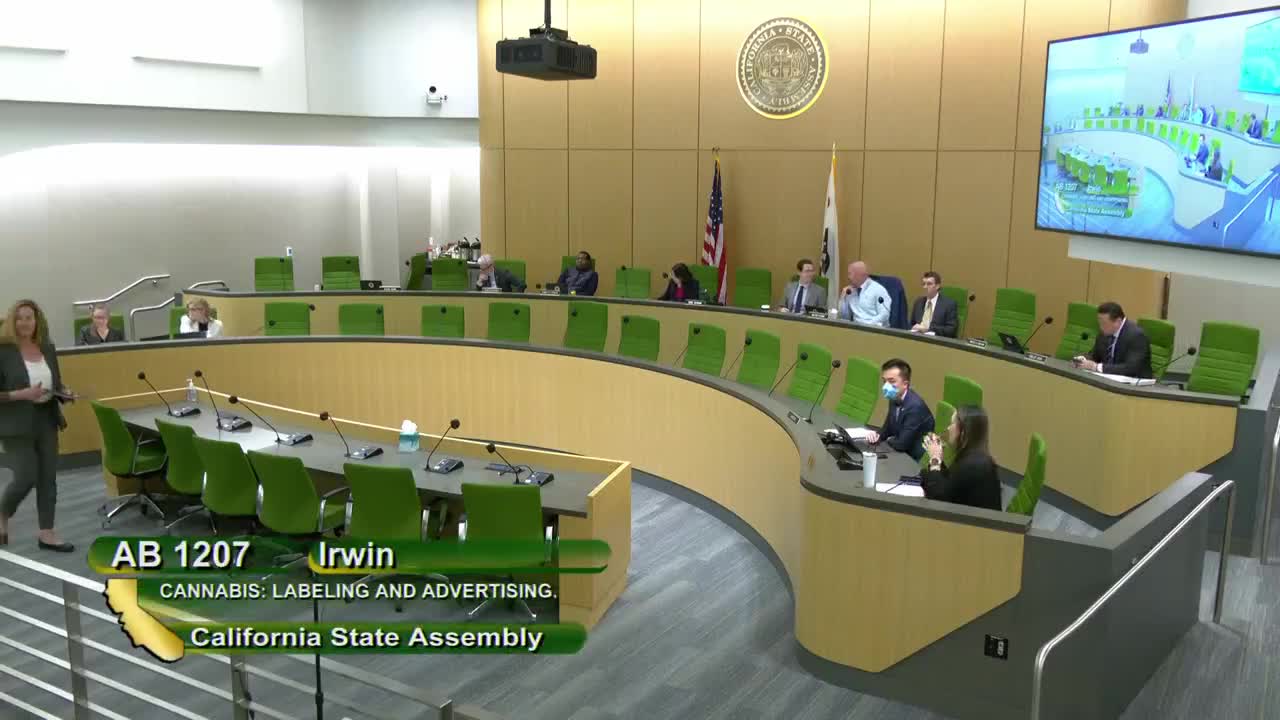 22MIN
Assembly Standing Committee on Business and Professions
Bill Author


