AB 1227: Elections: County of Santa Clara.
- Session Year: 2023-2024
- House: Assembly
- Latest Version Date: 2023-10-07
Current Status:
Passed
(2023-10-07: Chaptered by Secretary of State - Chapter 362, Statutes of 2023.)
Introduced
In Committee
First Chamber
In Committee
Second Chamber
Enacted
Under existing law, specified county officers are required to be elected by the voters in that county. Existing law generally requires the election to select county officers to be held with a statewide primary election, but if no candidate for a county office receives a majority of the votes cast for that office at the primary election, the 2 candidates who received the most votes advance to the ensuing statewide general election.
This bill would authorize the Board of Supervisors of the County of Santa Clara to adopt, and a voter of that county to propose by initiative, an ordinance to elect county officers by ranked choice voting, as specified. The bill would authorize the county, in accordance with such an ordinance, to hold a ranked choice voting election at the statewide primary election at which the election otherwise would be held in accordance with existing law, the first statewide general election following that statewide primary election, or a combination thereof, and to use ranked choice voting in special elections to fill vacancies in county offices, as specified.
This bill would make legislative findings and declarations as to the necessity of a special statute for the County of Santa Clara.
Under existing law, specified county officers are required to be elected by the voters in that county. Existing law generally requires the election to select county officers to be held with a statewide primary election, but if no candidate for a county office receives a majority of the votes cast for that office at the primary election, the 2 candidates who received the most votes advance to the ensuing statewide general election.
This bill would authorize the Board of Supervisors of the County of Santa Clara to adopt, and a voter of that county to propose by initiative, an ordinance to elect county officers by ranked choice voting, as specified. The bill would authorize the county, in accordance with such an ordinance, to hold a ranked choice voting election at the statewide primary election, the first statewide general election following the statewide primary election at which the election otherwise would be held in accordance with existing law, the first statewide general election following that statewide primary election, or a combination thereof, and to use ranked choice voting in special elections to fill vacancies in county offices, as specified.
This bill would make legislative findings and declarations as to the necessity of a special statute for the County of Santa Clara.
Under existing law, specified county officers are required to be elected by the voters in that county. Existing law generally requires the election to select county officers to be held with a statewide primary election, but if no candidate for a county office receives a majority of the votes cast for that office at the primary election, the 2 candidates who received the most votes advance to the ensuing statewide general election.
This bill would authorize the Board of Supervisors of the County of Santa Clara to adopt, and a voter of that county to propose by initiative, a proposal an ordinance to elect county officers by ranked choice voting, as specified. If a proposal would elect an officer by ranked choice voting through a single election with no possibility of a runoff, the The bill would authorize the county to county, in accordance with such an ordinance, to hold that a ranked choice voting election at the statewide primary election, the first statewide general election following the statewide primary election at which the election otherwise would be held in accordance with existing law. law, or a combination thereof, and to use ranked choice voting in special elections to fill vacancies in county offices, as specified.
This bill would make legislative findings and declarations as to the necessity of a special statute for the County of Santa Clara.
Under existing law, specified county officers are required to be elected by the voters in that county. Existing law generally requires the election to select county officers to be held with a statewide primary election, but if no candidate for a county office receives a majority of the votes cast for that office at the primary election, the 2 candidates who received the most votes advance to the ensuing statewide general election.
This bill would authorize the Board of Supervisors of the County of Santa Clara to adopt, and a voter of that county to propose by initiative, a proposal to elect county officers by ranked choice voting, as specified. If a proposal would elect an officer by ranked choice voting through a single election with no possibility of a runoff, the bill would authorize the county to hold that election at the first statewide general election following the statewide primary election at which the election otherwise would be held in accordance with existing law.
Under existing law, specified county officers are required to be elected by the voters in that county. Existing law generally requires the election to select county officers to be held with a statewide primary election, but if no candidate for a county office receives a majority of the votes cast for that office at the primary election, the 2 candidates who received the most votes advance to the ensuing statewide general election.
This bill would authorize the Board of Supervisors of the County of Santa Clara to adopt, and a voter of that county to propose by initiative, a proposal to elect county officers by ranked choice voting, as specified.
The Legislature finds and declares all of the following:
(a)To date, the Cities of Albany, Berkeley, Oakland, Palm Desert, and San Leandro, as well as the City and County of San Francisco, have successfully conducted elections using ranked choice voting.
(b)The City of Eureka amended its charter to use ranked choice voting, and is expected to use it in 2024.
(c)The voters in the City of Ojai have expressed their desire to use ranked choice voting by approving an advisory measure (Measure M) that appeared on their November 2022 ballot.
(d)The County of Santa Clara has indicated, both by a charter amendment adopted by a vote of its people and by a motion passed by its board of supervisors, that it would like the option of using ranked choice voting in its elections.
(e)The state would benefit from learning more about ranked choice voting from charter counties that wish to use it.
SEC. 2.Section 24206 is added to the Government Code, to read:24206.Notwithstanding any other law, the Board of Supervisors of the County of Santa Clara may adopt, or a voter of that county may propose by initiative, an ordinance to elect an officer of that county by ranked choice voting. The ordinance shall specify which county officers shall be elected by this method and whether they shall be elected at large or by or from district, as applicable. Notwithstanding Section 1300 of the Elections Code or any other law, an ordinance that provides for a ranked choice voting process may hold that election at the statewide primary election at which the election otherwise would be held in accordance with Section 1300 of the Elections Code, the first statewide general election following that statewide primary election, or a combination thereof. The ordinance may further specify whether ranked choice voting may be used in special elections to fill vacancies in county offices. Such special elections may be held on any date allowed for such special elections.
SEC. 3.The Legislature finds and declares that a special statute is necessary and that a general statute cannot be made applicable within the meaning of Section 16 of Article IV of the California Constitution because of the unique circumstances relating to the County of Santa Claras interest in having the option to use ranked choice voting in its elections.
The Legislature finds and declares all of the following:
(a)To date, the Cities of Albany, Berkeley, Oakland, Palm Desert, and San Leandro, as well as the City and County of San Francisco, have successfully conducted elections using ranked choice voting.
(b)The City of Eureka amended its charter to use ranked choice voting, and is expected to use it in 2024.
(c)The voters in the City of Ojai have expressed their desire to use ranked choice voting by approving an advisory measure (Measure M) that appeared on their November 2022 ballot.
(d)The County of Santa Clara has indicated, both by a charter amendment adopted by a vote of its people and by a motion passed by its board of supervisors, that it would like the option of using ranked choice voting in its elections.
(e)The state would benefit from learning more about ranked choice voting from charter counties that wish to use it.
SEC. 2.Section 24206 is added to the Government Code, to read:24206.Notwithstanding any other law, the Board of Supervisors of the County of Santa Clara may adopt, or a voter of that county may propose by initiative, an ordinance to elect an officer of that county by ranked choice voting. The ordinance shall specify which county officers shall be elected by this method and whether they shall be elected at large or by or from district, as applicable. Notwithstanding Section 1300 of the Elections Code or any other law, an ordinance that provides for a ranked choice voting process may hold that election at the statewide primary election, the first statewide general election following the statewide primary election at which the election otherwise would be held in accordance with Section 1300 of the Elections Code, the first statewide general election following that statewide primary election, or a combination thereof. The ordinance may further specify whether ranked choice voting may be used in special elections to fill vacancies in county offices. Such special elections may be held on any date allowed for such special elections.
SEC. 3.The Legislature finds and declares that a special statute is necessary and that a general statute cannot be made applicable within the meaning of Section 16 of Article IV of the California Constitution because of the unique circumstances relating to the County of Santa Claras interest in having the option to use ranked choice voting in its elections.
The Legislature finds and declares all of the following:
(a)To date, the Cities of Albany, Berkeley, Oakland, Palm Desert, and San Leandro, as well as the City and County of San Francisco, have successfully conducted elections using ranked choice voting.
(b)The City of Eureka amended its charter to use ranked choice voting, and is expected to use it in 2024.
(c)The voters in the City of Ojai have expressed their desire by way of an advisory measure to use ranked choice voting on the November 2024 ballot. by approving an advisory measure (Measure M) that appeared on their November 2022 ballot.
(d)The County of Santa Clara has indicated, both by a charter amendment adopted by a vote of its people and by a resolution motion passed by its board of supervisors, that it would like to use the option of using ranked choice voting in its elections.
(e)The state would benefit from learning more about ranked choice voting from charter counties that wish to use it.
SEC. 2.Section 24206 is added to the Government Code, to read:24206.Notwithstanding any other law, the Board of Supervisors of the County of Santa Clara may adopt, or a voter of that county may propose by initiative, a proposal an ordinance to elect an officer of that county by ranked choice voting. The proposal ordinance shall specify which county officers shall be elected by this method and whether they shall be elected at large or by or from district, as applicable. Notwithstanding Section 1300 of the Elections Code or any other law, a proposal an ordinance that provides for a ranked choice voting process to elect an officer through a single election with no possibility of a runoff may hold that election at the statewide primary election, the first statewide general election following the statewide primary election at which the election otherwise would be held in accordance with Section 1300 of the Elections Code. Code, or a combination thereof. The ordinance may further specify whether ranked choice voting may be used in special elections to fill vacancies in county offices. Such special elections may be held on any date allowed for such special elections.
SEC. 3.The Legislature finds and declares that a special statute is necessary and that a general statute cannot be made applicable within the meaning of Section 16 of Article IV of the California Constitution because of the unique circumstances relating to the County of Santa Claras interest in having the option to use ranked choice voting in its elections.
The Legislature finds and declares all of the following:
(a)To date, the Cities of Albany, Berkeley, Oakland, Palm Desert, and San Leandro, as well as the City and County of San Francisco, have successfully conducted elections using ranked choice voting.
(b)The City of Eureka amended its charter to use ranked choice voting, and is expected to use it in 2024.
(c)The voters in the City of Ojai have expressed their desire by way of an advisory measure to use ranked choice voting on the November 2024 ballot.
(d)The County of Santa Clara has indicated, both by a charter amendment adopted by a vote of its people and by a resolution passed by its board of supervisors, that it would like to use ranked choice voting in its elections.
(e)The state would benefit from learning more about ranked choice voting from charter counties that wish to use it.
SEC. 2.Section 24206 is added to the Government Code, to read:24206.Notwithstanding any other law, the Board of Supervisors of the County of Santa Clara may adopt, or a voter of that county may propose by initiative, a proposal to elect an officer of that county by ranked choice voting. The proposal shall specify which county officers shall be elected by this method and whether they shall be elected at large or by or from district, as applicable. Notwithstanding Section 1300 of the Elections Code or any other law, a proposal that provides for a ranked choice voting process to elect an officer through a single election with no possibility of a runoff may hold that election at the first statewide general election following the statewide primary election at which the election otherwise would be held in accordance with Section 1300 of the Elections Code.
The Legislature finds and declares all of the following:
(a)To date, the Cities of Albany, Berkeley, Oakland, Palm Desert, and San Leandro, as well as the City and County of San Francisco, have successfully conducted elections using ranked choice voting.
(b)The City of Eureka amended its charter to use ranked choice voting, and is expected to use it in 2024.
(c)The voters in the City of Ojai have expressed their desire by way of an advisory measure to use ranked choice voting on the November 2024 ballot.
(d)The County of Santa Clara has indicated, both by a charter amendment adopted by a vote of its people and by a resolution passed by its board of supervisors, that it would like to use ranked choice voting in its elections.
(e)The state would benefit from learning more about ranked choice voting from charter counties that wish to use it.
SEC. 2.Section 24206 is added to the Government Code, to read:24206.Notwithstanding any other law, the Board of Supervisors of the County of Santa Clara may adopt, or a voter of that county may propose by initiative, a proposal to elect an officer of that county by ranked choice voting. The proposal shall specify which county officers shall be elected by this method and whether they shall be elected at large or by or from district, as applicable.
|
Date
|
Status
|
|---|---|
| Oct 7, 2023 | Chaptered by Secretary of State - Chapter 362, Statutes of 2023. |
| Oct 7, 2023 | Approved by the Governor. |
| Sep 14, 2023 | Enrolled and presented to the Governor at 4:30 p.m. |
| Sep 7, 2023 | Senate amendments concurred in. To Engrossing and Enrolling. (Ayes 69. Noes 0. Page 3076.). |
| Sep 5, 2023 | In Assembly. Concurrence in Senate amendments pending. May be considered on or after September 7 pursuant to Assembly Rule 77. |
| Sep 5, 2023 | Read third time. Passed. Ordered to the Assembly. (Ayes 31. Noes 7. Page 2370.). |
| Aug 28, 2023 | Read second time. Ordered to third reading. |
| Aug 24, 2023 | Read third time and amended. Ordered to second reading. |
| Jul 10, 2023 | Read second time. Ordered to third reading. |
| Jul 6, 2023 | From committee: Do pass. (Ayes 6. Noes 0.) (July 5). |
| Jun 15, 2023 | From committee chair, with author's amendments: Amend, and re-refer to committee. Read second time, amended, and re-referred to Com. on E. & C.A. |
| May 10, 2023 | Referred to Com. on E. & C.A. |
| May 2, 2023 | In Senate. Read first time. To Com. on RLS. for assignment. |
| May 1, 2023 | Read third time. Passed. Ordered to the Senate. (Ayes 67. Noes 0. Page 1410.) |
| Apr 25, 2023 | Read second time. Ordered to third reading. |
| Apr 24, 2023 | Read second time and amended. Ordered returned to second reading. |
| Apr 20, 2023 | From committee: Amend, and do pass as amended. (Ayes 5. Noes 0.) (April 19). |
| Mar 16, 2023 | In committee: Set, first hearing. Hearing canceled at the request of author. |
| Mar 2, 2023 | Referred to Com. on ELECTIONS. |
| Feb 17, 2023 | From printer. May be heard in committee March 19. |
| Feb 16, 2023 | Read first time. To print. |
|
Date
|
Description
|
Location
|
Votes
|
|
|---|---|---|---|---|
| Sep 7, 2023 | AB 1227 Low Concurrence in Senate Amendments | Assembly Floor |
Passed |
|
| Sep 5, 2023 | Assembly 3rd Reading AB1227 Low et al. By Cortese | Senate Floor |
Passed |
|
| Jul 5, 2023 | Do pass | Senate Standing Committee on Elections and Constitutional Amendments |
Passed |
|
| May 1, 2023 | AB 1227 Low Assembly Third Reading | Assembly Floor |
Passed |
|
| Apr 19, 2023 | Do pass as amended. | Assembly Standing Committee on Elections |
Passed |
This list shows positions taken on this bill by organizations on the date displayed, which is linked to the original source.
Positions by individuals are not included.
|
Organization
|
Position
|
Date
|
|---|---|---|
| Bay Area Municipal Elections Committee | * Support | Apr 19, 2023 |
| California Ranked Choice Voting Coalition | ** Support | |
| Californians for Electoral Reform | ** Support | |
| CalRCV | * Support | Apr 19, 2023 |
| CANYON SNOW CONSULTING LLC | * Support | Jul 5, 2023 |
| CANYON SNOW CONSULTING LLC | * Support | Apr 19, 2023 |
| County of Santa Clara | ** Support | |
| Lawrence E. Stone, Santa Clara County Assessor | ** Against | |
| League Of Women Voters Of California | ** Support | |
| Sacramento County Green Party | * Support | Apr 19, 2023 |
| Santa Clara County Assessor | ** Against | |
| Santa Clara County Assessor Lawrence E. Stone | ** Against | |
| Santa Clara County Democratic Party | ** Support | |
| Silicon Valley Young Democrats | * Support | Jul 5, 2023 |
CONCURRENCE IN SENATE AMENDMENTS
CSA1 Bill Id:AB 1227
Author:(Low)
As Amended Ver:August 24, 2023
Majority vote
SUMMARY
Allows Santa Clara County to use ranked choice voting (RCV) to elect county officers.
Senate Amendments
- Provide that an ordinance adopted by Santa Clara County to use RCV to elect county officers may specify whether RCV may be used in special elections to fill vacancies in county offices.
- Make technical and clarifying changes, and add a co-author.
COMMENTS
RCV is an election method in which voters rank the candidates for office in order of preference, and the ballots are counted in rounds. In the case of a single-winner election, these rounds simulate a series of runoffs until only two candidates remain with the candidate having the greater number of votes being declared the winner. In the first round, every ballot counts as a vote towards the candidate indicated by the highest ranking on that ballot. After every round, if a candidate receives a majority of votes from the continuing ballots, that candidate is declared elected. If no candidate receives a majority, the candidate receiving the smallest number of votes is eliminated, and every ballot counting towards that candidate is advanced to the next-ranked continuing candidate on the ballot.
While explaining the vote tabulation system is somewhat complex, no voter gets to vote twice and no vote is counted twice. In a single-winner system where the last place candidate is eliminated, voters who listed that candidate first on their ballot then get to use the second choice on their ballot once that first choice is eliminated. They may get two (or more) chances to use their vote, but they never get more than one vote.
In November 1998, Santa Clara County residents considered Measure F, a measure that proposed to add section 208 to the county's charter stating, "Nothing in this Charter shall preclude the Board of Supervisors from authorizing an instant run-off voting system of the November general election, which eliminates the need for run-off elections, when such technology is available to the County?" (Instant runoff voting is an alternate name for RCV.) The measure was approved, with 53.9% of ballots cast in favor.
At the time that Measure F was adopted, the County's voting system was not capable of conducting elections using RCV. However, according to a December 15, 2022, memo from the Santa Clara County Registrar of Voters, the county's current voting system is capable of conducting RCV elections.
Existing state law does not expressly permit or contemplate the use of RCV for elections in California. Notwithstanding that fact, at least six California cities have conducted local elections using RCV. San Francisco has been using RCV for local elections since 2004, while the cities of Berkeley, Oakland, and San Leandro all began using RCV in 2010. The cities of Albany and Palm Desert first used RCV in 2022.
All six cities that have conducted local elections using RCV are charter cities. The California Constitution gives cities and counties the ability to adopt charters, which give those jurisdictions greater autonomy over local affairs. Charter cities, in particular, are granted a great deal of autonomy over the rules governing the election of municipal officers. The autonomy that the California Constitution grants to charter cities is what allowed those six cities to use RCV for local elections, notwithstanding the lack of authorization for using RCV in state law.
It is less clear whether charter counties similarly can use RCV to conduct local elections in the absence of authorization under state law. The autonomy granted to charter counties over the election of county officers is considerably narrower than is granted to charter cities over municipal elections.
In the December 15, 2022 memo from the Santa Clara County Registrar of Voters that is described above, the Registrar stated "Under state law, the County does not currently have the authority to conduct elections by RCV." By contrast, some RCV proponents argue that constitutional and statutory history and case law support a conclusion that charter counties can adopt RCV without the need for a change in state law.
Please see the policy committee analysis for a full discussion of this bill.
According to the Author
"It's been almost 25 years since voters in Santa Clara County approved [RCV] via a ballot initiative, Measure F. AB 1227 ensures the county implements Measure F now that the county's voting machines have the capability to conduct RCV elections."
Arguments in Support
In support of this bill, Santa Clara County writes, "In 1998, county voters adopted a charter amendment put forward by the Board of Supervisors in support of instant run-off voting, a form of ranked choice voting. At that time, the County did not have voting technology capable of implementing ranked choice voting, so there was no need to address the question of whether that charter provision would suffice to provide the authority to implement an alternative voting method. The current voting system technology used by the County has the optional certified software capability to support ranked choice voting. However, the County has determined that, absent express authority from the Legislature, charter counties (unlike charter cities) do not have authority to adopt alternative voting methods through their charters. For that reason, the County supports AB 1227, which provides that authority, allowing an ordinance implementing ranked choice voting."
Arguments in Opposition
In opposition to this bill, Santa Clara County Assessor Lawrence E. Stone writes, "AB 1227 states that cities have 'successfully conducted elections using ranked choice voting.' A recent Oakland school board election suffered from a RCV tabulation error that resulted in the wrong candidate being certified, resolved only by a lawsuit…For most voters, the main way they connect to their political leaders' agenda and values is through elections. Faith in leaders and the overall political system can be eroded if confidence in the electoral process is damaged. And the voters most impacted by a weakened perception of integrity are likely to be the very voters that RCV claims to benefit - first-time voters, voters of color, and low-income voters."
FISCAL COMMENTS
None. This bill is keyed non-fiscal by the Legislative Counsel.
VOTES:
ASM ELECTIONS: 5-0-3
YES: Bryan, Bennett, Lee, Pellerin, Blanca Rubio
ABS, ABST OR NV: Lackey, Essayli, Low
ASSEMBLY FLOOR: 67-0-13
YES: Addis, Aguiar-Curry, Alanis, Alvarez, Arambula, Bains, Bauer-Kahan, Berman, Boerner, Bonta, Bryan, Calderon, Juan Carrillo, Wendy Carrillo, Cervantes, Chen, Connolly, Davies, Flora, Mike Fong, Friedman, Gabriel, Garcia, Gipson, Grayson, Haney, Holden, Hoover, Jackson, Jones-Sawyer, Kalra, Lee, Low, Lowenthal, Maienschein, Mathis, McCarty, Muratsuchi, Stephanie Nguyen, Ortega, Pacheco, Papan, Pellerin, Petrie-Norris, Quirk-Silva, Ramos, Reyes, Luz Rivas, Robert Rivas, Rodriguez, Blanca Rubio, Sanchez, Santiago, Schiavo, Ta, Ting, Valencia, Villapudua, Waldron, Wallis, Ward, Weber, Wicks, Wilson, Wood, Zbur, Rendon
ABS, ABST OR NV: Bennett, Megan Dahle, Dixon, Essayli, Vince Fong, Gallagher, Hart, Irwin, Lackey, McKinnor, Jim Patterson, Joe Patterson, Soria
SENATE FLOOR: 31-7-2
YES: Allen, Archuleta, Ashby, Atkins, Becker, Blakespear, Bradford, Caballero, Cortese, Dodd, Durazo, Eggman, Glazer, Gonzalez, Hurtado, Laird, Limón, McGuire, Menjivar, Min, Newman, Portantino, Roth, Rubio, Skinner, Smallwood-Cuevas, Stern, Umberg, Wahab, Wiener, Wilk
NO: Alvarado-Gil, Dahle, Grove, Jones, Niello, Ochoa Bogh, Seyarto
ABS, ABST OR NV: Nguyen, Padilla
UPDATED
VERSION: August 24, 2023
CONSULTANT: Ethan Jones / ELECTIONS / (916) 319-2094 FN: 0001208
SENATE RULES COMMITTEE Office of Senate Floor Analyses (916) 651-1520 Fax: (916) 327-4478 | AB 1227 |
THIRD READING
Bill No: AB 1227
Author: Low (D), et al.
Amended: 8/24/23 in Senate
Vote: 21
SENATE ELECTIONS & C.A. COMMITTEE: 6-0, 7/5/23
AYES: Glazer, Allen, McGuire, Menjivar, Newman, Umberg
NO VOTE RECORDED: Nguyen
ASSEMBLY FLOOR: 67-0, 5/1/23 - See last page for vote
SUBJECT: Elections: County of Santa Clara
SOURCE: Author
DIGEST:
This bill allows Santa Clara County to use ranked choice voting (RCV) to elect county officers.
Senate Floor Amendments of 8/24/23 clarify that an ordinance in the County of Santa Clara providing for a ranked choice voting process may be held at a statewide primary under existing law, the first statewide general election following that statewide primary election, or a combination of the two. The amendments also add a coauthor.
ANALYSIS:
Existing law:
- Requires the Legislature to provide for county powers, an elected county sheriff, an elected district attorney, an elected assessor, and an elected governing body in each county.
- Permits a county or a city to provide for its own governance through the adoption of a charter by a majority vote of its electors voting on the question.
- Permits a city charter to provide for the conduct of city elections. Grants plenary authority, subject to limited restrictions, for a city’s charter to provide for the manner in which, the times at which, and the method by which municipal officers are elected. Provides that a legally adopted city charter supersedes all laws inconsistent with that charter with respect to municipal affairs.
- Requires a county charter to provide for an elected governing body of five or more members, and an elected sheriff, an elected district attorney, an elected assessor, other officers, their election or appointment, compensation, terms, and removal.
- Provides that specified general laws adopted by the Legislature to govern the powers and officers of counties are superseded by a legally adopted county charter as to matters for which the California Constitution permits a county to make provision in its charter, except as specified.
- Requires that all county offices be nonpartisan.
- Requires an election to select a county district attorney and county sheriff to be held with the presidential primary, except as specified.
- Requires an election to select county officers other than district attorney and sheriff to be held with the statewide primary at which candidates for Governor are nominated, except as specified. Establishes a procedure for the elections of county supervisors to be staggered by dividing the supervisors into two classes. As a result of this procedure, some county supervisors are elected in gubernatorial election years while other supervisors are elected in presidential election years.
- Provides, in general, that any candidate for a nonpartisan office who receives votes on a majority of all the ballots cast for that office at a primary election is elected to that office and prohibits the office from appearing on the ballot at the ensuing general election. Requires, if a county officer is not elected in the primary election, that a county general election be held with the ensuing statewide general election to elect the officer.
- Provides that a plurality of the votes given at any election shall constitute a choice where not otherwise directed in the California Constitution, provided that it shall be competent in all charters of cities, counties, or cities and counties framed under the authority of the California Constitution to provide the manner in which their respective elective officers may be elected and to prescribe a higher proportion of the vote therefor.
This bill:
- Allows the Santa Clara County Board of Supervisors to adopt, or permit a voter of the county to propose by initiative, an ordinance to elect an officer of the county by RCV. Requires the ordinance to specify which county officers are to be elected by this method and whether they are elected at large or by or from district, as applicable. Specifies, notwithstanding any other law, an ordinance that provides for an RCV process may hold that election at the statewide primary election at which the election otherwise provided in current law, the first statewide general election following that statewide primary election, or a combination thereof, as specified. Provides that the ordinance may further specify whether RCV may be used in special elections to fill vacancies in county offices and may be held on any date allowed for such special elections.
- Makes findings and declarations.
Background
Ranked Choice Voting Background. RCV is an election method in which voters rank the candidates for office in order of preference and the ballots are counted in rounds. In the case of a single-winner election, these rounds simulate a series of runoffs until only two candidates remain with the candidate having the greater number of votes being declared the winner. In the case of a multiple-winner election, these rounds fill all seats to be elected.
For single winner elections, in the first round, every ballot counts as a vote towards the candidate indicated by the highest ranking on that ballot. After every round, if a candidate receives a majority of votes from the continuing ballots, that candidate is declared elected. If no candidate receives a majority, the candidate receiving the smallest number of votes is eliminated, and every ballot counting towards that candidate will be advanced to the next-ranked continuing candidate on the ballot.
For an election to elect two or more candidates to office, a minimum threshold of votes necessary to be elected is determined according to a specified formula. All ballots are counted and each ballot is allocated as a vote to the candidate receiving the highest ranking. Each candidate that receives the minimum threshold of votes is declared elected.
If a candidate wins with more votes than the election threshold, but not all seats have been filled, any extra votes count proportionally towards voters’ next choices. For example, if a candidate receives 10 percent more first choices than what was needed to win, then a tenth of each of their supporters’ votes count toward their next choices.
If no candidate has more votes than the election threshold, the candidate with the fewest votes is eliminated and voters who picked that candidate have their votes count for their next choice. This repeats, just like with single-winner ranked choice voting. This process continues until every seat has been filled.
While explaining the vote tabulation system is somewhat complex, no voter gets to vote twice and no vote is counted twice. In a single-winner system where the last place candidate is eliminated, voters who listed that candidate first on their ballot then get to use the second choice on their ballot once that first choice is eliminated. They may get two (or more) chances to use their vote, but they never get more than one vote. The multi-winner system is somewhat more complicated because fractions of a person’s vote can be transferred to other candidates, but each voter still has only one total vote.
Santa Clara County Measure F (1998). According to information from the California Elections Data Archive (CEDA)—a joint project of the Center for California Studies and Institute for Social Research of California State University, Sacramento, and the Secretary of State that collects and compiles results from city, county, school district, and local ballot measure elections—in November 1998, Santa Clara County residents considered Measure F, a measure that proposed to add Section 208 to the county’s charter stating, “Nothing in this Charter shall preclude the Board of Supervisors from authorizing an instant run-off voting system of the November general election, which eliminates the need for run-off elections, when such technology is available to the County?” The measure was approved with 53.9% of ballots cast in favor.
According to Santa Clara County Counsel’s impartial analysis of Measure F, “Instant Runoff Voting (IRV) allows the majority will of the voters to be determined in a single election.” The analysis continues with a description of the IRV system where if no candidate receives a majority of the first choice votes, then the candidate with the fewest voters is eliminated and the voter’s next choices are tabulated until a candidate receives a majority of the votes. The analysis also states, “IRV eliminates the need for the second, separate, runoff election” and provides a description of how a voting system in existence in 1998 was unable to accommodate IRV.
Recent Actions in Santa Clara County. On December 15, 2022, the Finance and Government Operations Committee of the Santa Clara County Board of Supervisors received a report from the Santa Clara County Registrar of Voters related to the implementation of RCV for elected county offices. In that report, the Registrar noted that, “At the time of Measure F’s passage, the County did not yet have the technological capability to conduct RCV elections; however, the County’s current voting system now does have that capability. When the County issued a request for proposals (RFP) for a new voting system in April 2018, it included a requirement that the system be capable of conducting RCV elections. On August 13, 2019, the County executed an agreement with Dominion Voting Systems for the Democracy Suite system…The Dominion Democracy Suite system is currently being used to conduct RCV elections in other jurisdictions, including municipal elections in San Francisco and Alameda counties.”
The Registrar’s report recommended that the Board of Supervisors provide at least a year and a half of preparation time to successfully implement RCV for elections for county office. In order to move forward with RCV implementation beginning with the November 2024 general election, the Registrar suggested that the Board of Supervisors make a decision to do so by March 2023. The Registrar also indicated that the March 2023 timeline was based on the assumption that state law has been changed such that elections for countywide offices are not required occur at the same time as the statewide primary election and that the use of RCV is available to charter counties.
At the conclusion of the meeting, the county’s Finance and Government Operations Committee voted to forward the item to the full Board of Supervisors without a recommendation, and with the direction that the Board of Supervisors should receive a briefing from their county counsel in closed session about legal issues related to the county’s authority to adopt RCV for county elections without a change in state law. The Board of Supervisors has not taken action related to RCV in an open public meeting since that point. On April 18, 2023, the Board of Supervisors discussed and approved an item to add the ability of Santa Clara County to decide whether to adopt RCV to the county’s list of legislative priorities.
RCV, State Law, and Charter Counties and Cities. Existing state law does not expressly permit or contemplate the use of RCV for elections in California. Notwithstanding that fact, at least six California cities have conducted local elections using RCV. San Francisco has been using RCV for local elections since 2004 while the cities of Berkeley, Oakland, and San Leandro all began using RCV in 2010. The cities of Albany and Palm Desert first used RCV in 2022. Berkeley, Oakland, San Francisco, and San Leandro use RCV only in single winner elections. Albany generally uses RCV only in multiple winner elections, while Palm Desert uses RCV in both single and multiple winner elections. It should be noted that although the City of Eureka voted to use RCV for municipal elections beginning in 2022, it did not implement RCV in time for the 2022 election. The City of Eureka anticipates that it will use RCV for municipal elections beginning in 2024.
Comments
- According to the author, it has been almost 25 years since voters in Santa Clara County approved ranked-choice voting (RCV) via a ballot initiative, Measure F. AB 1227 ensures the county implements Measure F now that the county’s voting machines have the capability to conduct RCV elections.
- Intent of Measure F. While this bill expressly permits Santa Clara County to conduct elections for county office using RCV, it is less clear whether it would remove all legal ambiguity about whether the county can implement RCV in the way it intends. In particular, one of the frequently touted benefits of RCV is that it can eliminate the need for runoff elections. This is where IRV and RCV are similar.
IRV and RCV could also be different from each other. RCV can also be used to conduct multi-round elections. For example, Alaska uses a system in which voters pick a single candidate in the primary election, with the top four candidates from the primary advancing to a general election that is conducted using RCV. In California, all jurisdictions that conduct elections using RCV hold single-round elections.
This bill allows Santa Clara County to adopt an ordinance to elect an officer RCV. The ordinance would be required to specify whether the RCV election is held at the primary, the statewide general election, or a combination thereof. This might conflict with Measure F where the county charter was amended to state, “Nothing in this Charter shall preclude the Board of Supervisors from authorizing an instant run-off voting system of the November general election, which eliminates the need for run-off elections, when such technology is available to the County?” The charter amendment specifically states that the election should be held at the November general election and eliminates the need for a run-off election.
Related/Prior Legislation
Since 2006, there have been many bills intended to permit local jurisdictions to use RCV for either regular or special elections. All of these bills either failed passage in the Legislature or were vetoed by the Governor: SB 596 (Bowen) of 2006, AB 1294 (Mullin and Leno) of 2007, AB 1121 (Davis) of 2009, AB 2732 (Eng) of 2010, SB 1346 (Hancock) of 2010, and SB 1288 (Leno) of 2016.
SB 212 (Allen) of 2019 would have permitted a city, county, or an educational district, as specified and subject to voter approval, to conduct a local election using RCV, among other provisions. SB 212 was vetoed. In his veto message, Governor Newsom wrote, “Ranked choice is an experiment that has been tried in several charter cities in California. Where it has been implemented, I am concerned that it has often led to voter confusion, and that the promise that ranked choice voting leads to greater democracy is not necessarily fulfilled. The state would benefit from learning more from charter cities who use ranked choice voting before broadly expanding the system.”
AB 2808 (O’Donnell) of 2022 would have prohibited state and local elections from being conducted using RCV. AB 2808 was heard in by the Assembly Committee on Elections and was held in committee without recommendation.
FISCAL EFFECT: Appropriation: No Fiscal Com.: No Local: No
SUPPORT: (Verified 8/30/23)
California Ranked Choice Voting Coalition
Californians for Electoral Reform
County of Santa Clara
League of Women Voters of California
Santa Clara County Democratic Party
OPPOSITION: (Verified 8/30/23)
Lawrence E. Stone, Santa Clara County Assessor
One individual
ARGUMENTS IN SUPPORT: In a letter supporting AB 1227, the California Ranked Choice Voting Coalition stated, in part, the following:
We firmly believe that the adoption of RCV in Santa Clara County would significantly enhance the democratic process by providing voters with greater choice and enabling them to express their true preferences. RCV has been successfully implemented in other jurisdictions in California and across the United States and has been shown to increase voter turnout, promote civility in campaigns, and provide for more accurate representation of the electorate.
ARGUMENTS IN OPPOSITION: In a letter opposing AB 1227, Santa Clara County Assessor Lawrence E. Stone stated, in part, the following:
For most voters, the main way they connect to their political leaders’ agenda and values is through elections. Faith in leaders and the overall political system can be eroded if confidence in the electoral process is damaged. And the voters most impacted by a weakened perception of integrity are likely to be the very voters that RCV claims to benefit - first-time voters, voters of color, and low-income voters.
Governor Gavin Newsom cited more voter confusion, and that greater democracy has not necessarily been fulfilled in 2019 when he vetoed statewide SB 212 which would have allowed more cities, counties, and school districts across the state to switch to the RCV system. Governor Brown also vetoed a bill in 2016 that would have broadened RCV stating, “Ranked Choice Voting is overly complicated and confusing. I believe it deprives voters of genuinely informed choice.”
The California Legislature should not allow Santa Clara County the singular authority in the state to elect an officer of that county by Ranked Choice Voting.
ASSEMBLY FLOOR: 67-0, 5/1/23
AYES: Addis, Aguiar-Curry, Alanis, Alvarez, Arambula, Bains, Bauer-Kahan, Berman, Boerner, Bonta, Bryan, Calderon, Juan Carrillo, Wendy Carrillo, Cervantes, Chen, Connolly, Davies, Flora, Mike Fong, Friedman, Gabriel, Garcia, Gipson, Grayson, Haney, Holden, Hoover, Jackson, Jones-Sawyer, Kalra, Lee, Low, Lowenthal, Maienschein, Mathis, McCarty, Muratsuchi, Stephanie Nguyen, Ortega, Pacheco, Papan, Pellerin, Petrie-Norris, Quirk-Silva, Ramos, Reyes, Luz Rivas, Robert Rivas, Rodriguez, Blanca Rubio, Sanchez, Santiago, Schiavo, Ta, Ting, Valencia, Villapudua, Waldron, Wallis, Ward, Weber, Wicks, Wilson, Wood, Zbur, Rendon
NO VOTE RECORDED: Bennett, Megan Dahle, Dixon, Essayli, Vince Fong, Gallagher, Hart, Irwin, Lackey, McKinnor, Jim Patterson, Joe Patterson, Soria
Prepared by: Scott Matsumoto / E. & C.A. / (916) 651-4106
8/31/23 10:26:01
**** END ****
SENATE RULES COMMITTEE Office of Senate Floor Analyses (916) 651-1520 Fax: (916) 327-4478 | AB 1227 |
THIRD READING
Bill No: AB 1227
Author: Low (D), et al.
Amended: 6/15/23 in Senate
Vote: 21
SENATE ELECTIONS & C.A. COMMITTEE: 6-0, 7/5/23
AYES: Glazer, Allen, McGuire, Menjivar, Newman, Umberg
NO VOTE RECORDED: Nguyen
ASSEMBLY FLOOR: 67-0, 5/1/23 - See last page for vote
SUBJECT: Elections: County of Santa Clara
SOURCE: Author
DIGEST:
This bill allows Santa Clara County to use ranked choice voting (RCV) to elect county officers.
ANALYSIS:
Existing law:
- Requires the Legislature to provide for county powers, an elected county sheriff, an elected district attorney, an elected assessor, and an elected governing body in each county.
- Permits a county or a city to provide for its own governance through the adoption of a charter by a majority vote of its electors voting on the question.
- Permits a city charter to provide for the conduct of city elections. Grants plenary authority, subject to limited restrictions, for a city’s charter to provide for the manner in which, the times at which, and the method by which municipal officers are elected. Provides that a legally adopted city charter supersedes all laws inconsistent with that charter with respect to municipal affairs.
- Requires a county charter to provide for an elected governing body of five or more members, and an elected sheriff, an elected district attorney, an elected assessor, other officers, their election or appointment, compensation, terms, and removal.
- Provides that specified general laws adopted by the Legislature to govern the powers and officers of counties are superseded by a legally adopted county charter as to matters for which the California Constitution permits a county to make provision in its charter, except as specified.
- Requires that all county offices be nonpartisan.
- Requires an election to select a county district attorney and county sheriff to be held with the presidential primary, except as specified.
- Requires an election to select county officers other than district attorney and sheriff to be held with the statewide primary at which candidates for Governor are nominated, except as specified. Establishes a procedure for the elections of county supervisors to be staggered by dividing the supervisors into two classes. As a result of this procedure, some county supervisors are elected in gubernatorial election years while other supervisors are elected in presidential election years.
- Provides, in general, that any candidate for a nonpartisan office who receives votes on a majority of all the ballots cast for that office at a primary election is elected to that office and prohibits the office from appearing on the ballot at the ensuing general election. Requires, if a county officer is not elected in the primary election, that a county general election be held with the ensuing statewide general election to elect the officer.
- Provides that a plurality of the votes given at any election shall constitute a choice where not otherwise directed in the California Constitution, provided that it shall be competent in all charters of cities, counties, or cities and counties framed under the authority of the California Constitution to provide the manner in which their respective elective officers may be elected and to prescribe a higher proportion of the vote therefor.
This bill:
- Allows the Santa Clara County Board of Supervisors to adopt, or permit a voter of the county to propose by initiative, an ordinance to elect an officer of the county by RCV. Requires the ordinance to specify which county officers are to be elected by this method and whether they are elected at large or by or from district, as applicable. Specifies, notwithstanding any other law, an ordinance that provides for an RCV process may hold that election at the statewide primary election, the first statewide general election following the statewide primary election at which the election otherwise provided in current law, or a combination thereof, as specified. Provides that the ordinance may further specify whether RCV may be used in special elections to fill vacancies in county offices and may be held on any date allowed for such special elections.
- Makes findings and declarations.
Background
Ranked Choice Voting Background. RCV is an election method in which voters rank the candidates for office in order of preference and the ballots are counted in rounds. In the case of a single-winner election, these rounds simulate a series of runoffs until only two candidates remain with the candidate having the greater number of votes being declared the winner. In the case of a multiple-winner election, these rounds fill all seats to be elected.
For single winner elections, in the first round, every ballot counts as a vote towards the candidate indicated by the highest ranking on that ballot. After every round, if a candidate receives a majority of votes from the continuing ballots, that candidate is declared elected. If no candidate receives a majority, the candidate receiving the smallest number of votes is eliminated, and every ballot counting towards that candidate will be advanced to the next-ranked continuing candidate on the ballot.
For an election to elect two or more candidates to office, a minimum threshold of votes necessary to be elected is determined according to a specified formula. All ballots are counted and each ballot is allocated as a vote to the candidate receiving the highest ranking. Each candidate that receives the minimum threshold of votes is declared elected.
If a candidate wins with more votes than the election threshold, but not all seats have been filled, any extra votes count proportionally towards voters’ next choices. For example, if a candidate receives 10 percent more first choices than what was needed to win, then a 10th of each of their supporters’ votes count toward their next choices.
If no candidate has more votes than the election threshold, the candidate with the fewest votes is eliminated, and voters who picked that candidate have their votes count for their next choice. This repeats, just like with single-winner ranked choice voting. This process continues until every seat has been filled.
While explaining the vote tabulation system is somewhat complex, no voter gets to vote twice and no vote is counted twice. In a single-winner system where the last place candidate is eliminated, voters who listed that candidate first on their ballot then get to use the second choice on their ballot once that first choice is eliminated. They may get two (or more) chances to use their vote, but they never get more than one vote. The multi-winner system is somewhat more complicated because fractions of a person’s vote can be transferred to other candidates, but each voter still has only one total vote.
Santa Clara County Measure F (1998). According to information from the California Elections Data Archive (CEDA)—a joint project of the Center for California Studies and Institute for Social Research of California State University, Sacramento, and the Secretary of State that collects and compiles results from city, county, school district, and local ballot measure elections—in November 1998, Santa Clara County residents considered Measure F, a measure that proposed to add Section 208 to the county’s charter stating, “Nothing in this Charter shall preclude the Board of Supervisors from authorizing an instant run-off voting system of the November general election, which eliminates the need for run-off elections, when such technology is available to the County?” The measure was approved with 53.9% of ballots cast in favor.
According to Santa Clara County Counsel’s impartial analysis of Measure F, “Instant Runoff Voting (IRV) allows the majority will of the voters to be determined in a single election.” The analysis continues with a description of the IRV system where if no candidate receives a majority of the first choice votes, then the candidate with the fewest voters is eliminated and the voter’s next choices are tabulated until a candidate receives a majority of the votes. The analysis also states, “IRV eliminates the need for the second, separate, runoff election” and provides a description of how a voting system in existence in 1998 was unable to accommodate IRV.
Recent Actions in Santa Clara County. On December 15, 2022, the Finance and Government Operations Committee of the Santa Clara County Board of Supervisors received a report from the Santa Clara County Registrar of Voters related to the implementation of RCV for elected county offices. In that report, the Registrar noted that, “At the time of Measure F’s passage, the County did not yet have the technological capability to conduct RCV elections; however, the County’s current voting system now does have that capability. When the County issued a request for proposals (RFP) for a new voting system in April 2018, it included a requirement that the system be capable of conducting RCV elections. On August 13, 2019, the County executed an agreement with Dominion Voting Systems for the Democracy Suite system…The Dominion Democracy Suite system is currently being used to conduct RCV elections in other jurisdictions, including municipal elections in San Francisco and Alameda counties.”
The Registrar’s report recommended that the Board of Supervisors provide at least a year and a half of preparation time to successfully implement RCV for elections for county office. In order to move forward with RCV implementation beginning with the November 2024 general election, the Registrar suggested that the Board of Supervisors make a decision to do so by March 2023. The Registrar also indicated that the March 2023 timeline was based on the assumption that state law has been changed such that elections for countywide offices are not required occur at the same time as the statewide primary election and that the use of RCV is available to charter counties.
At the conclusion of the meeting, the county’s Finance and Government Operations Committee voted to forward the item to the full Board of Supervisors without a recommendation, and with the direction that the Board of Supervisors should receive a briefing from their county counsel in closed session about legal issues related to the county’s authority to adopt RCV for county elections without a change in state law. The Board of Supervisors has not taken action related to RCV in an open public meeting since that point. On April 18, 2023, the Board of Supervisors discussed and approved an item to add the ability of Santa Clara County to decide whether to adopt RCV to the county’s list of legislative priorities.
RCV, State Law, and Charter Counties and Cities. Existing state law does not expressly permit or contemplate the use of RCV for elections in California. Notwithstanding that fact, at least six California cities have conducted local elections using RCV. San Francisco has been using RCV for local elections since 2004 while the Cities of Berkeley, Oakland, and San Leandro all began using RCV in 2010. The Cities of Albany and Palm Desert first used RCV in 2022. Berkeley, Oakland, San Francisco, and San Leandro use RCV only in single winner elections. Albany generally uses RCV only in multiple winner elections, while Palm Desert uses RCV in both single and multiple winner elections. It should be noted that although the City of Eureka voted to use RCV for municipal elections beginning in 2022, it did not implement RCV in time for the 2022 election. The City of Eureka anticipates that it will use RCV for municipal elections beginning in 2024.
Comments
- Author’s statement. According to the author, it has been almost 25 years since voters in Santa Clara County approved RCV via a ballot initiative, Measure F. AB 1227 ensures the county implements Measure F now that the county’s voting machines have the capability to conduct RCV elections.
- Intent of Measure F. While this bill expressly permits Santa Clara County to conduct elections for county office using RCV, it is less clear whether it would remove all legal ambiguity about whether the county can implement RCV in the way it intends. In particular, one of the frequently touted benefits of RCV is that it can eliminate the need for runoff elections. This is where IRV and RCV are similar.
IRV and RCV could also be different from each other. RCV can also be used to conduct multi-round elections. For example, Alaska uses a system in which voters pick a single candidate in the primary election, with the top four candidates from the primary advancing to a general election that is conducted using RCV. In California, all jurisdictions that conduct elections using RCV hold single-round elections.
This bill allows Santa Clara County to adopt an ordinance to elect an officer RCV. The ordinance would be required to specify whether the RCV election is held at the primary, the statewide general election, or a combination thereof. This might conflict with Measure F where the county charter was amended to state, “Nothing in this Charter shall preclude the Board of Supervisors from authorizing an instant run-off voting system of the November general election, which eliminates the need for run-off elections, when such technology is available to the County?” The charter amendment specifically states that the election should be held at the November general election and eliminates the need for a run-off election.
Related/Prior Legislation
Since 2006, there have been many bills intended to permit local jurisdictions to use RCV for either regular or special elections. All of these bills either failed passage in the Legislature or were vetoed by the Governor: SB 596 (Bowen, 2006), AB 1294 (Mullin and Leno, 2007), AB 1121 (Davis, 2009), AB 2732 (Eng, 2010), SB 1346 (Hancock, 2010), and SB 1288 (Leno, 2016).
SB 212 (Allen, 2019) would have permitted a city, county, or an educational district, as specified and subject to voter approval, to conduct a local election using RCV, among other provisions. SB 212 was vetoed. In his veto message, Governor Newsom wrote, “Ranked choice is an experiment that has been tried in several charter cities in California. Where it has been implemented, I am concerned that it has often led to voter confusion, and that the promise that ranked choice voting leads to greater democracy is not necessarily fulfilled. The state would benefit from learning more from charter cities who use ranked choice voting before broadly expanding the system.”
AB 2808 (O’Donnell, 2022) would have prohibited state and local elections from being conducted using RCV. AB 2808 was heard in by the Assembly Committee on Elections and was held in committee without recommendation.
FISCAL EFFECT: Appropriation: No Fiscal Com.: No Local: No
SUPPORT: (Verified 7/11/23)
California Ranked Choice Voting Coalition
Californians for Electoral Reform
County of Santa Clara
League of Women Voters of California
Santa Clara County Democratic Party
OPPOSITION: (Verified 7/11/23)
Santa Clara County Assessor Lawrence E. Stone
One individual
ARGUMENTS IN SUPPORT: In a letter supporting AB 1227, the California Ranked Choice Voting Coalition stated, in part, the following:
We firmly believe that the adoption of RCV in Santa Clara County would significantly enhance the democratic process by providing voters with greater choice and enabling them to express their true preferences. RCV has been successfully implemented in other jurisdictions in California and across the United States and has been shown to increase voter turnout, promote civility in campaigns, and provide for more accurate representation of the electorate.
ARGUMENTS IN OPPOSITION: In a letter opposing AB 1227, Santa Clara County Assessor Lawrence E. Stone stated, in part, the following:
For most voters, the main way they connect to their political leaders’ agenda and values is through elections. Faith in leaders and the overall political system can be eroded if confidence in the electoral process is damaged. And the voters most impacted by a weakened perception of integrity are likely to be the very voters that RCV claims to benefit - first-time voters, voters of color, and low-income voters.
Governor Gavin Newsom cited more voter confusion, and that greater democracy has not necessarily been fulfilled in 2019 when he vetoed statewide SB 212 which would have allowed more cities, counties, and school districts across the state to switch to the RCV system. Governor Brown also vetoed a bill in 2016 that would have broadened RCV stating, “Ranked Choice Voting is overly complicated and confusing. I believe it deprives voters of genuinely informed choice.”
The California Legislature should not allow Santa Clara County the singular authority in the state to elect an officer of that county by Ranked Choice Voting.
ASSEMBLY FLOOR: 67-0, 5/1/23
AYES: Addis, Aguiar-Curry, Alanis, Alvarez, Arambula, Bains, Bauer-Kahan, Berman, Boerner, Bonta, Bryan, Calderon, Juan Carrillo, Wendy Carrillo, Cervantes, Chen, Connolly, Davies, Flora, Mike Fong, Friedman, Gabriel, Garcia, Gipson, Grayson, Haney, Holden, Hoover, Jackson, Jones-Sawyer, Kalra, Lee, Low, Lowenthal, Maienschein, Mathis, McCarty, Muratsuchi, Stephanie Nguyen, Ortega, Pacheco, Papan, Pellerin, Petrie-Norris, Quirk-Silva, Ramos, Reyes, Luz Rivas, Robert Rivas, Rodriguez, Blanca Rubio, Sanchez, Santiago, Schiavo, Ta, Ting, Valencia, Villapudua, Waldron, Wallis, Ward, Weber, Wicks, Wilson, Wood, Zbur, Rendon
NO VOTE RECORDED: Bennett, Megan Dahle, Dixon, Essayli, Vince Fong, Gallagher, Hart, Irwin, Lackey, McKinnor, Jim Patterson, Joe Patterson, Soria
Prepared by: Scott Matsumoto / E. & C.A. / (916) 651-4106
7/12/23 16:19:15
**** END ****
SENATE COMMITTEE ON
ELECTIONS AND CONSTITUTIONAL AMENDMENTS
Senator Steven Glazer, Chair
2023 - 2024 Regular
Bill No: AB Hearing Date: 7/5/23
Author: | |||
Version: | 4/24/23 | ||
Urgency: | No | Fiscal: | No |
Consultant: | Scott Matsumoto | ||
Subject: Elections: County of Santa Clara
DIGEST
This bill allows Santa Clara County to use ranked choice voting (RCV) to elect county officers.
ANALYSIS
Existing law:
- Requires the Legislature to provide for county powers, an elected county sheriff, an elected district attorney, an elected assessor, and an elected governing body in each county.
- Permits a county or a city to provide for its own governance through the adoption of a charter by a majority vote of its electors voting on the question.
- Permits a city charter to provide for the conduct of city elections. Grants plenary authority, subject to limited restrictions, for a city's charter to provide for the manner in which, the times at which, and the method by which municipal officers are elected. Provides that a legally adopted city charter supersedes all laws inconsistent with that charter with respect to municipal affairs.
- Requires a county charter to provide for an elected governing body of five or more members, and an elected sheriff, an elected district attorney, an elected assessor, other officers, their election or appointment, compensation, terms, and removal.
- Provides that specified general laws adopted by the Legislature to govern the powers and officers of counties are superseded by a legally adopted county charter as to matters for which the California Constitution permits a county to make provision in its charter, except as specified.
- Requires that all county offices be nonpartisan.
- Requires an election to select a county district attorney and county sheriff to be held with the presidential primary, except as specified.
- Requires an election to select county officers other than district attorney and sheriff to be held with the statewide primary at which candidates for Governor are nominated, except as specified. Establishes a procedure for the elections of county supervisors to be staggered by dividing the supervisors into two classes. As a result of this procedure, some county supervisors are elected in gubernatorial election years while other supervisors are elected in presidential election years.
- Provides, in general, that any candidate for a nonpartisan office who receives votes on a majority of all the ballots cast for that office at a primary election is elected to that office and prohibits the office from appearing on the ballot at the ensuing general election. Requires, if a county officer is not elected in the primary election, that a county general election be held with the ensuing statewide general election to elect the officer.
- Provides that a plurality of the votes given at any election shall constitute a choice where not otherwise directed in the California Constitution, provided that it shall be competent in all charters of cities, counties, or cities and counties framed under the authority of the California Constitution to provide the manner in which their respective elective officers may be elected and to prescribe a higher proportion of the vote therefor.
This bill:
- Allows the Santa Clara County Board of Supervisors to adopt, or permit a voter of the county to propose by initiative, a proposal to elect an officer of the county by RCV. Requires the ordinance to specify which county officers are to be elected by this method and whether they are elected at large or by or from district, as applicable. Specifies, notwithstanding any other law, an ordinance that provides for an RCV process may hold that election at the statewide primary election, the first statewide general election following the statewide primary election at which the election otherwise provided in current law, or a combination thereof, as specified. Provides that the ordinance may further specify whether RCV may be used in special elections to fill vacancies in county offices and may be held on any date allowed for such special elections.
- Makes findings and declarations.
BACKGROUND
Ranked Choice Voting Background. RCV is an election method in which voters rank the candidates for office in order of preference and the ballots are counted in rounds. In the case of a single-winner election, these rounds simulate a series of runoffs until only two candidates remain with the candidate having the greater number of votes being declared the winner. In the case of a multiple-winner election, these rounds fill all seats to be elected.
For single winner elections, in the first round, every ballot counts as a vote towards the candidate indicated by the highest ranking on that ballot. After every round, if a candidate receives a majority of votes from the continuing ballots, that candidate is declared elected. If no candidate receives a majority, the candidate receiving the smallest number of votes is eliminated, and every ballot counting towards that candidate will be advanced to the next-ranked continuing candidate on the ballot.
For an election to elect two or more candidates to office, a minimum threshold of votes necessary to be elected is determined according to a specified formula. All ballots are counted and each ballot is allocated as a vote to the candidate receiving the highest ranking. Each candidate that receives the minimum threshold of votes is declared elected.
If a candidate wins with more votes than the election threshold, but not all seats have been filled, any extra votes count proportionally towards voters’ next choices. For example, if a candidate receives 10 percent more first choices than what was needed to win, then a tenth of each of their supporters’ votes count toward their next choices.
If no candidate has more votes than the election threshold, the candidate with the fewest votes is eliminated, and voters who picked that candidate have their votes count for their next choice. This repeats, just like with single-winner ranked choice voting. This process continues until every seat has been filled.
While explaining the vote tabulation system is somewhat complex, no voter gets to vote twice and no vote is counted twice. In a single-winner system where the last place candidate is eliminated, voters who listed that candidate first on their ballot then get to use the second choice on their ballot once that first choice is eliminated. They may get two (or more) chances to use their vote, but they never get more than one vote. The multi-winner system is somewhat more complicated because fractions of a person’s vote can be transferred to other candidates, but each voter still has only one total vote.
Santa Clara County Measure F (1998). According to information from the California Elections Data Archive (CEDA)—a joint project of the Center for California Studies and Institute for Social Research of California State University, Sacramento, and the Secretary of State that collects and compiles results from city, county, school district, and local ballot measure elections—in November 1998, Santa Clara County residents considered Measure F, a measure that proposed to add Section 208 to the county’s charter stating, “Nothing in this Charter shall preclude the Board of Supervisors from authorizing an instant run-off voting system of the November general election, which eliminates the need for run-off elections, when such technology is available to the County?” The measure was approved with 53.9% of ballots cast in favor.
According to Santa Clara County Counsel’s impartial analysis of Measure F, “Instant Runoff Voting (IRV) allows the majority will of the voters to be determined in a single election.” The analysis continues with a description of the IRV system where if no candidate receives a majority of the first choice votes, then the candidate with the fewest voters is eliminated and the voter’s next choices are tabulated until a candidate receives a majority of the votes. The analysis also states, “IRV eliminates the need for the second, separate, runoff election” and provides a description of how a voting system in existence in 1998 was unable to accommodate IRV.
Recent Actions in Santa Clara County. On December 15, 2022, the Finance and Government Operations Committee of the Santa Clara County Board of Supervisors received a report from the Santa Clara County Registrar of Voters related to the implementation of RCV for elected county offices. In that report, the Registrar noted that, “At the time of Measure F’s passage, the County did not yet have the technological capability to conduct RCV elections; however, the County’s current voting system now does have that capability. When the County issued a request for proposals (RFP) for a new voting system in April 2018, it included a requirement that the system be capable of conducting RCV elections. On August 13, 2019, the County executed an agreement with Dominion Voting Systems for the Democracy Suite system…The Dominion Democracy Suite system is currently being used to conduct RCV elections in other jurisdictions, including municipal elections in San Francisco and Alameda counties.”
The Registrar’s report recommended that the Board of Supervisors provide at least a year and a half of preparation time to successfully implement RCV for elections for county office. In order to move forward with RCV implementation beginning with the November 2024 general election, the Registrar suggested that the Board of Supervisors make a decision to do so by March 2023. The Registrar also indicated that the March 2023 timeline was based on the assumption that state law has been changed such that elections for countywide offices are not required occur at the same time as the statewide primary election and that the use of RCV is available to charter counties.
At the conclusion of the meeting, the county’s Finance and Government Operations Committee voted to forward the item to the full Board of Supervisors without a recommendation, and with the direction that the Board of Supervisors should receive a briefing from their county counsel in closed session about legal issues related to the county’s authority to adopt RCV for county elections without a change in state law. The Board of Supervisors has not taken action related to RCV in an open public meeting since that point. On April 18, 2023, the Board of Supervisors discussed and approved an item to add the ability of Santa Clara County to decide whether to adopt RCV to the county’s list of legislative priorities.
RCV, State Law, and Charter Counties and Cities. Existing state law does not expressly permit or contemplate the use of RCV for elections in California. Notwithstanding that fact, at least six California cities have conducted local elections using RCV. San Francisco has been using RCV for local elections since 2004 while the cities of Berkeley, Oakland, and San Leandro all began using RCV in 2010. The cities of Albany and Palm Desert first used RCV in 2022. Berkeley, Oakland, San Francisco, and San Leandro use RCV only in single winner elections. Albany generally uses RCV only in multiple winner elections, while Palm Desert uses RCV in both single and multiple winner elections. It should be noted that although the City of Eureka voted to use RCV for municipal elections beginning in 2022, it did not implement RCV in time for the 2022 election. The City of Eureka anticipates that it will use RCV for municipal elections beginning in 2024.
All six cities that have conducted local elections using RCV are charter cities. As noted above, the California Constitution gives cities and counties the ability to adopt charters which give those jurisdictions greater autonomy over local affairs. Charter cities, in particular, are granted a great deal of autonomy over the rules governing the election of municipal officers. In fact, the Constitution grants "plenary authority," subject to limited restrictions, for a city charter to provide "the manner in which, the method by which, the times at which, and the terms for which the several municipal officers and employees…shall be elected or appointed." The autonomy granted to charter cities under the California Constitution is what allowed those six cities to choose to use RCV for local elections, notwithstanding the lack of authorization for using RCV in state law.
It is less clear whether charter counties similarly can use RCV to conduct local elections in the absence of authorization under state law. The autonomy granted to charter counties over the election of county officers is considerably narrower than is granted to charter cities over municipal elections. For counties, the Constitution specifies that a county's charter shall provide for “[a] governing body of 5 or more members, elected (1) by district or, (2) at large, or (3) at large, with a requirement that they reside in a district,” and for “an elected sheriff, an elected district attorney, an elected assessor, other officers, their election or appointment, compensation, terms and removal,” among other provisions. According to information from the California State Association of Counties, 14 (Alameda, Butte, El Dorado, Fresno, Los Angeles, Orange, Placer, Sacramento, San Bernardino, San Diego, San Francisco, San Mateo, Santa Clara, and Tehama) of California’s 58 counties are charter counties. San Francisco is a consolidated city and county, and therefore has the authority of both a charter city and a charter county.
A charter city choosing to use RCV for the election of municipal officers appears to be consistent with the authority granted to charter cities to provide for the manner in which and the method by which municipal officers are elected. The California Constitution does not similarly specify that county charters may include those types of provisions suggests that charter counties may be subject to provisions of state law governing the manner in which and the method by which county officers are elected.
On the other hand, the Elections Code provides that while a plurality of votes constitutes a choice at an election where not otherwise specified in the Constitution, “it shall be competent in all charters of cities, counties, or cities and counties…to provide the manner in which their respective elective officers may be elected and to prescribe a higher proportion of the vote therefor.” That provision was added to the Elections Code in 1970 when substantially similar language was removed from the California Constitution as part of a partial constitutional revision that was intended to streamline and clarify the Constitution. According to information from the state voter information guide about that measure (Proposition 15 at the November 1970 statewide general election), the deletion of that language from the Constitution was intended to bring that subject matter under legislative control through the enactment of statutes. There is no indication that the change was intended to substantively affect the power of charter cities, charter counties, or charter cities and counties to provide the manner in which their elective officers are elected.
In the December 15, 2022, memo from the Santa Clara County Registrar of Voters to the Finance and Government Operations Committee that is described above, the Registrar stated “Under state law, the County does not currently have the authority to conduct elections by RCV.” By contrast, a January 2023 memo to the Santa Clara County Board of Supervisors that was prepared by FairVote (a national, nonprofit organization that advocates for the adoption of RCV) and provided to the committee by the author’s office, concludes “There is ample support in the constitutional, statutory, and court history in California for the power of charter counties to adopt a method or manner of electing county officials that is at odds with the general law of the state.” The FairVote memo specifically relies upon the provisions of Section 15450 of the Elections Code, along with constitutional history and case law in reaching that conclusion.
RCV Issues in Alameda County in November 2022 Election. On December 28, 2022, the Alameda County Registrar of Voters issued a press release announcing that an improper configuration of the county’s RCV tally system resulted in incorrect ballot tallies for contests using RCV in the county at the November 8, 2022, statewide general election. The press release described the error in the tally system as follows:
[The tally system] should have been configured to advance ballots to the next ranking immediately when no candidate was selected for a particular round. This means that if no candidate was selected in the first round on the ballot, then the second-round ranking would count as the first-round ranking, the third-round ranking would count as the second round ranking, and so on. For the November 2022 General Election, the setting on the County’s equipment counted the RCV ballots in the manner in which the ballot was completed, meaning no vote was registered for those ballots in the first round of counting because those voters did not identify a valid candidate in a particular rank on the ballot.
By the time the Registrar of Voters announced the discovery of the error in the tally system, the Registrar had already certified the election results for the November 2022 election. In one race for a seat on the Oakland Unified School District board, the programming error resulted in the wrong candidate being declared the winner of the election. An election contest subsequently was filed in the Alameda County Superior Court. On March 6, 2023, the Court ordered the Registrar of Voters to revise the certified election results to reflect an accurate tabulation of the ballots, and declared elected the candidate who prevailed under that tabulation.
COMMENTS
- According to the author: It has been almost 25 years since voters in Santa Clara County approved ranked-choice voting (RCV) via a ballot initiative, Measure F. AB 1227 ensures the county implements Measure F now that the county’s voting machines have the capability to conduct RCV elections.
- Original Intent of Measure F. While this bill expressly permits Santa Clara County to conduct elections for county office using RCV, it is less clear whether it would remove all legal ambiguity about whether the county can implement RCV in the way it intends. In particular, one of the frequently touted benefits of RCV is that it can eliminate the need for runoff elections. This is where IRV and RCV are similar.
IRV and RCV could also be different from each other. RCV can also be used to conduct multi-round elections. For example, Alaska uses a system in which voters pick a single candidate in the primary election, with the top four candidates from the primary advancing to a general election that is conducted using RCV. In California, all jurisdictions that conduct elections using RCV hold single-round elections.
This bill allows Santa Clara County to adopt an ordinance to elect an officer RCV. The ordinance would be required to specify whether the RCV election is held at the primary, the statewide general election, or a combination thereof. This might conflict with Measure F where the county charter was amended to state, “Nothing in this Charter shall preclude the Board of Supervisors from authorizing an instant run-off voting system of the November general election, which eliminates the need for run-off elections, when such technology is available to the County?” The charter amendment specifically states that the election should be held at the November general election and eliminates the need for a run-off election.
While this bill would resolve some legal ambiguity about Santa Clara County’s use of RCV, the committee should consider how closely the provisions of this bill should be to what was enacted by Santa Clara County voters in 1998 (i.e. one election in November).
- Argument in Support. In a letter supporting AB 1227, the California Ranked Choice Coalition stated, in part, the following:
We firmly believe that the adoption of RCV in Santa Clara County would significantly enhance the democratic process by providing voters with greater choice and enabling them to express their true preferences. RCV has been successfully implemented in other jurisdictions in California and across the United States and has been shown to increase voter turnout, promote civility in campaigns, and provide for more accurate representation of the electorate.
- Argument in Opposition. In a letter opposing AB 1227, Santa Clara County Assessor Lawrence E. Stone stated, in part, the following:
For most voters, the main way they connect to their political leaders' agenda and values is through elections. Faith in leaders and the overall political system can be eroded if confidence in the electoral process is damaged. And the voters most impacted by a weakened perception of integrity are likely to be the very voters that RCV claims to benefit - first-time voters, voters of color, and low-income voters.
Governor Gavin Newsom cited more voter confusion, and that greater democracy has not necessarily been fulfilled in 2019 when he vetoed statewide SB 212 which would have allowed more cities, counties, and school districts across the state to switch to the RCV system. Governor Brown also vetoed a bill in 2016 that would have broadened RCV stating, "Ranked Choice Voting is overly complicated and confusing. I believe it deprives voters of genuinely informed choice."
The California Legislature should not allow Santa Clara County the singular authority in the state to elect an officer of that county by Ranked Choice Voting.
RELATED/PRIOR LEGISLATION
Since 2006, there have been many bills intended to permit local jurisdictions to use RCV for either regular or special elections. All of these bills either failed passage in the Legislature or were vetoed by the Governor: SB 596 (Bowen) of 2006, AB 1294 (Mullin and Leno) of 2007, AB 1121 (Davis) of 2009, AB 2732 (Eng) of 2010, SB 1346 (Hancock) of 2010, and SB 1288 (Leno) of 2016.
SB 212 (Allen) of 2019 would have permitted a city, county, or an educational district, as specified and subject to voter approval, to conduct a local election using RCV, among other provisions. SB 212 was vetoed. In his veto message, Governor Newsom wrote “Ranked choice is an experiment that has been tried in several charter cities in California. Where it has been implemented, I am concerned that it has often led to voter confusion, and that the promise that ranked choice voting leads to greater democracy is not necessarily fulfilled. The state would benefit from learning more from charter cities who use ranked choice voting before broadly expanding the system.”
AB 2808 (O’Donnell) of 2022 would have prohibited state and local elections from being conducted using RCV. AB 2808 was heard in by the Assembly Committee on Elections on April 6, 2022, and was held in committee without recommendation.
PRIOR ACTION
Assembly Floor: | |
Assembly Elections Committee: |
POSITIONS
Sponsor: Author
Support: California Ranked Choice Voting Coalition
Californians for Electoral Reform
County of Santa Clara
League of Women Voters of California
Santa Clara County Democratic Party
Oppose: Lawrence E. Stone, Santa Clara County Assessor
-- END --
ASSEMBLY THIRD READING
ATR Bill Id:AB 1227
Author:(Low)
As Amended Ver:April 24, 2023
Majority vote
SUMMARY
Allows Santa Clara County to use ranked choice voting (RCV) to elect county officers.
Major Provisions
- Allows the Santa Clara County Board of Supervisors to adopt, or a voter of the county to propose by initiative, a proposal to elect an officer of that county by RCV.
- Requires the proposal to elect county officers using RCV to do both of the following:
- Specify which county officers will be elected by RCV and whether they will be elected at large, or by or from district, as applicable.
- Provide for the RCV election to be held at the same time as the statewide general election, rather than at the same time as the statewide primary election, as specified. (Existing state law generally requires elections for county officers to be held at the same time as the statewide primary election, with a runoff election, if necessary, held at the same time as the statewide general election.)
COMMENTS
RCV is an election method in which voters rank the candidates for office in order of preference, and the ballots are counted in rounds. In the case of a single-winner election, these rounds simulate a series of runoffs until only two candidates remain with the candidate having the greater number of votes being declared the winner. In the first round, every ballot counts as a vote towards the candidate indicated by the highest ranking on that ballot. After every round, if a candidate receives a majority of votes from the continuing ballots, that candidate is declared elected. If no candidate receives a majority, the candidate receiving the smallest number of votes is eliminated, and every ballot counting towards that candidate is advanced to the next-ranked continuing candidate on the ballot.
While explaining the vote tabulation system is somewhat complex, no voter gets to vote twice and no vote is counted twice. In a single-winner system where the last place candidate is eliminated, voters who listed that candidate first on their ballot then get to use the second choice on their ballot once that first choice is eliminated. They may get two (or more) chances to use their vote, but they never get more than one vote.
In November 1998, Santa Clara County residents considered Measure F, a measure that proposed to add section 208 to the county's charter stating, "Nothing in this Charter shall preclude the Board of Supervisors from authorizing an instant run-off voting system of the November general election, which eliminates the need for run-off elections, when such technology is available to the County?" (Instant runoff voting is an alternate name for RCV.) The measure was approved, with 53.9% of ballots cast in favor.
At the time that Measure F was adopted, the County's voting system was not capable of conducting elections using RCV. However, according to a December 15, 2022, memo from the Santa Clara County Registrar of Voters, the county's current voting system is capable of conducting RCV elections.
Existing state law does not expressly permit or contemplate the use of RCV for elections in California. Notwithstanding that fact, at least six California cities have conducted local elections using RCV. San Francisco has been using RCV for local elections since 2004, while the cities of Berkeley, Oakland, and San Leandro all began using RCV in 2010. The cities of Albany and Palm Desert first used RCV in 2022.
All six cities that have conducted local elections using RCV are charter cities. The California Constitution gives cities and counties the ability to adopt charters, which give those jurisdictions greater autonomy over local affairs. Charter cities, in particular, are granted a great deal of autonomy over the rules governing the election of municipal officers. The autonomy that the California Constitution grants to charter cities is what allowed those six cities to use RCV for local elections, notwithstanding the lack of authorization for using RCV in state law.
It is less clear whether charter counties similarly can use RCV to conduct local elections in the absence of authorization under state law. The autonomy granted to charter counties over the election of county officers is considerably narrower than is granted to charter cities over municipal elections.
In the December 15, 2022 memo from the Santa Clara County Registrar of Voters that is described above, the Registrar stated "Under state law, the County does not currently have the authority to conduct elections by RCV." By contrast, some RCV proponents argue that constitutional and statutory history and case law support a conclusion that charter counties can adopt RCV without the need for a change in state law.
Please see the policy committee analysis for a full discussion of this bill.
According to the Author
"It's been almost 25 years since voters in Santa Clara County approved [RCV] via a ballot initiative, Measure F. AB 1227 ensures the county implements Measure F now that the county's voting machines have the capability to conduct RCV elections."
Arguments in Support
In support of this bill, the California Ranked Choice Voting Coalition writes, "We firmly believe that the adoption of RCV in Santa Clara County would significantly enhance the democratic process by providing voters with greater choice and enabling them to express their true preferences. RCV has been successfully implemented in other jurisdictions in California and across the United States and has been shown to increase voter turnout, promote civility in campaigns, and provide for more accurate representation of the electorate."
Arguments in Opposition
In opposition to this bill, Santa Clara County Assessor Lawrence E. Stone writes, "AB 1227 states that cities have 'successfully conducted elections using ranked choice voting.' A recent Oakland school board election suffered from a RCV tabulation error that resulted in the wrong candidate being certified, resolved only by a lawsuit…For most voters, the main way they connect to their political leaders' agenda and values is through elections. Faith in leaders and the overall political system can be eroded if confidence in the electoral process is damaged. And the voters most impacted by a weakened perception of integrity are likely to be the very voters that RCV claims to benefit - first-time voters, voters of color, and low-income voters."
FISCAL COMMENTS
None. This bill is keyed non-fiscal by the Legislative Counsel.
VOTES
ASM ELECTIONS: 5-0-3
YES: Bryan, Bennett, Lee, Pellerin, Blanca Rubio
ABS, ABST OR NV: Lackey, Essayli, Low
UPDATED
VERSION: April 24, 2023
CONSULTANT: Ethan Jones / ELECTIONS / (916) 319-2094 FN: 0000236
Date of Hearing: April 19, 2023
ASSEMBLY COMMITTEE ON ELECTIONS
Isaac G. Bryan, Chair
ABPCA Bill Id:AB 1227 (
Author:Low) – As Introduced Ver:February 16, 2023
SUBJECT: Elections: County of Santa Clara.
SUMMARY: Allows Santa Clara County to used ranked choice voting (RCV) to elect county officers. Specifically, this bill:
- Allows the Santa Clara County Board of Supervisors to adopt, or a voter of the county to propose by initiative, a proposal to elect an officer of that county by RCV. Requires the proposal to specify which county officers will be elected by this method and whether they will be elected at large, or by or from district, as applicable.
- Makes the following findings and declarations:
- To date, the Cities of Albany, Berkeley, Oakland, Palm Desert, and San Leandro, as well as the City and County of San Francisco, have successfully conducted elections using RCV.
- The City of Eureka amended its charter to use RCV, and is expected to use it in 2024.
- The voters in the City of Ojai have expressed their desire by way of an advisory measure to use RCV on the November 2024 ballot.
- The County of Santa Clara has indicated, both by a charter amendment adopted by a vote of its people and by a resolution passed by its board of supervisors, that it would like to use RCV in its elections.
- The state would benefit from learning more about RCV from charter counties that wish to use it.
- To date, the Cities of Albany, Berkeley, Oakland, Palm Desert, and San Leandro, as well as the City and County of San Francisco, have successfully conducted elections using RCV.
EXISTING LAW:
- Requires the Legislature to provide for county powers, an elected county sheriff, an elected district attorney, an elected assessor, and an elected governing body in each county. (California Constitution, Article XI, §1)
- Permits a county or a city to provide for its own governance through the adoption of a charter by a majority vote of its electors voting on the question. (California Constitution, Article XI, §3)
- Permits a city charter to provide for the conduct of city elections. Grants plenary authority, subject to limited restrictions, for a city's charter to provide for the manner in which, the times at which, and the method by which municipal officers are elected. Provides that a legally adopted city charter supersedes all laws inconsistent with that charter with respect to municipal affairs. (California Constitution, Article XI, §5)
- Requires a county charter to provide for an elected governing body of five or more members, and an elected sheriff, an elected district attorney, an elected assessor, other officers, their election or appointment, compensation, terms and removal. (California Constitution, Article XI, §4)
- Provides that specified general laws adopted by the Legislature to govern the powers and officers of counties are superseded by a legally adopted county charter as to matters for which the California Constitution permits a county to make provision in its charter, except as specified. (California Constitution, Article XI, §4)
- Requires that all county offices be nonpartisan. (California Constitution, Article II, §6)
- Requires an election to select a county district attorney and and county sheriff to be held with the presidential primary, except as specified. (Elections Code §1300(a)) Requires an election to select county officers other than district attorney and sheriff to be held with the statewide primary at which candidates for Governor are nominated, except as specified. (Elections Code §1300(b)) Establishes a procedure for the elections of county supervisors to be staggered by dividing the supervisors into two classes. (Government Code §§24202, 24203) As a result of this procedure, some county supervisors are elected in gubernatorial election years, while other supervisors are elected in presidential election years.
- Provides, in general, that any candidate for a nonpartisan office who receives votes on a majority of all the ballots cast for that office at a primary election is elected to that office and prohibits the office from appearing on the ballot at the ensuing general election. (Elections Code §8140) Requires, if a county officer is not elected in the primary election, that a county general election be held with the ensuing statewide general election to elect the officer. (Elections Code §1300)
- Provides that a plurality of the votes given at any election shall constitute a choice where not otherwise directed in the California Constitution, provided that it shall be competent in all charters of cities, counties, or cities and counties framed under the authority of the California Constitution to provide the manner in which their respective elective officers may be elected and to prescribe a higher proportion of the vote therefor. (Elections Code §15450)
FISCAL EFFECT: None. This bill is keyed non-fiscal by the Legislative Counsel.
COMMENTS:
- Purpose of the Bill: According to the author, “It’s been almost 25 years since voters in Santa Clara County approved [RCV] via a ballot initiative, Measure F. AB 1227 ensures the county implements Measure F now that the county’s voting machines have the capability to conduct RCV elections.”
- Ranked Choice Voting Background: RCV is an election method in which voters rank the candidates for office in order of preference, and the ballots are counted in rounds. In the case of a single-winner election, these rounds simulate a series of runoffs until only two candidates remain with the candidate having the greater number of votes being declared the winner. In the case of a multiple-winner election, these rounds fill all seats to be elected.
For single winner elections, in the first round, every ballot counts as a vote towards the candidate indicated by the highest ranking on that ballot. After every round, if a candidate receives a majority of votes from the continuing ballots, that candidate is declared elected. If no candidate receives a majority, the candidate receiving the smallest number of votes is eliminated, and every ballot counting towards that candidate will be advanced to the next-ranked continuing candidate on the ballot.
For an election to elect two or more candidates to office, a minimum threshold of votes necessary to be elected is determined according to a specified formula. All ballots are counted and each ballot is allocated as a vote to the candidate receiving the highest ranking. Each candidate that receives the minimum threshold of votes is declared elected.
If a candidate wins with more votes than the election threshold, but not all seats have been filled, any extra votes count proportionally toward voters’ next choices. For example, if a candidate receives 10 percent more first choices than what was needed to win, then a tenth of each of their supporters’ votes count toward their next choices.
If no candidate has more votes than the election threshold, the candidate with the fewest votes is eliminated, and voters who picked that candidate have their votes count for their next choice. This repeats, just like with single-winner ranked choice voting. This process continues until every seat has been filled.
While explaining the vote tabulation system is somewhat complex, no voter gets to vote twice and no vote is counted twice. In a single-winner system where the last place candidate is eliminated, voters who listed that candidate first on their ballot then get to use the second choice on their ballot once that first choice is eliminated. They may get two (or more) chances to use their vote, but they never get more than one vote. The multi-winner system is somewhat more complicated because fractions of a person’s vote can be transferred to other candidates, but each voter still has only one total vote. - Santa Clara County Measure F (1998): According to information from the California Elections Data Archive (CEDA)—a joint project of the Center for California Studies and Institute for Social Research of California State University, Sacramento, and the Secretary of State that collects and compiles results from city, county, school district, and local ballot measure elections—in November 1998, Santa Clara County residents considered Measure F, a measure that proposed to add section 208 to the county’s charter stating, “Nothing in this Charter shall preclude the Board of Supervisors from authorizing an instant run-off voting system of the November general election, which eliminates the need for run-off elections, when such technology is available to the County?” (Instant runoff voting is an alternate name for RCV.) The measure was approved, with 53.9% of ballots cast in favor.
On December 15, 2022, the Finance and Government Operations Committee of the Santa Clara County Board of Supervisors received a report from the Santa Clara County Registrar of Voters related to the implementation of RCV for elected county offices. In that report, the Registrar noted that, “At the time of Measure F’s passage, the County did not yet have the technological capability to conduct RCV elections; however, the County’s current voting system now does have that capability. When the County issued a request for proposals (RFP) for a new voting system in April 2018, it included a requirement that the system be capable of conducting RCV elections. On August 13, 2019, the County executed an agreement with Dominion Voting Systems for the Democracy Suite system…The Dominion Democracy Suite system is currently being used to conduct RCV elections in other jurisdictions, including municipal elections in San Francisco and Alameda counties.”
The Registrar’s report recommended that the Board of Supervisors provide at least a year and a half of preparation time to successfully implement RCV for elections for county office. In order to move forward with RCV implementation beginning with the November 2024 general election, the Registrar suggested that the Board of Supervisors make a decision to do so by March 2023. The Registrar also indicated that the March 2023 timeline was based on the assumption that state law has been changed such that elections for countywide offices are not required occur at the same time as the statewide primary election and that the use of RCV is available to charter counties.
At the conclusion of the meeting, the county’s Finance and Government Operations Committee voted to forward the item to the full Board of Supervisors without a recommendation, and with the direction that the Board of Supervisors should receive a briefing from their county counsel in closed session about legal issues related to the county’s authority to adopt RCV for county elections without a change in state law. (Those legal issues are discussed in greater detail below.) The Board of Supervisors has not taken action related to RCV in an open public meeting since that point. The Board of Supervisors’ agenda for its April 18, 2023 meeting, however, includes an item to discuss whether to add the ability of Santa Clara County to decide whether to adopt RCV to the county’s list of legislative priorities. At the time of the preparation of this committee analysis, the Board’s action on that item is unknown. - RCV, State Law, and Charter Counties and Cities: Existing state law does not expressly permit or contemplate the use of RCV for elections in California. Notwithstanding that fact, at least six California cities have conducted local elections using RCV. San Francisco has been using RCV for local elections since 2004, while the cities of Berkeley, Oakland, and San Leandro all began using RCV in 2010. The cities of Albany and Palm Desert first used RCV in 2022. Berkeley, Oakland, San Francisco, and San Leandro use RCV only in single winner elections. Albany generally uses RCV only in multiple winner elections, while Palm Desert uses RCV in both single and multiple winner elections. (Although the City of Eureka voted to use RCV for municipal elections beginning in 2022, it did not implement RCV in time for the 2022 election. The City anticipates that it will use RCV for municipal elections beginning in 2024.)
All six cities that have conducted local elections using RCV are charter cities. As noted above, the California Constitution gives cities and counties the ability to adopt charters, which give those jurisdictions greater autonomy over local affairs. Charter cities, in particular, are granted a great deal of autonomy over the rules governing the election of municipal officers. In fact, the Constitution grants "plenary authority," subject to limited restrictions, for a city charter to provide "the manner in which, the method by which, the times at which, and the terms for which the several municipal officers and employees…shall be elected or appointed." The autonomy granted to charter cities under the California Constitution is what allowed those six cities to choose to use RCV for local elections, notwithstanding the lack of authorization for using RCV in state law.
It is less clear whether charter counties similarly can use RCV to conduct local elections in the absence of authorization under state law. The autonomy granted to charter counties over the election of county officers is considerably narrower than is granted to charter cities over municipal elections. For counties, the Constitution specifies that a county's charter shall provide for “[a] governing body of 5 or more members, elected (1) by district or, (2) at large, or (3) at large, with a requirement that they reside in a district,” and for “an elected sheriff, an elected district attorney, an elected assessor, other officers, their election or appointment, compensation, terms and removal,” among other provisions. According to information from the California State Association of Counties, 14 (Alameda, Butte, El Dorado, Fresno, Los Angeles, Orange, Placer, Sacramento, San Bernardino, San Diego, San Francisco, San Mateo, Santa Clara, and Tehama) of California’s 58 counties are charter counties. (San Francisco is a consolidated city and county, and therefore has the authority of both a charter city and a charter county.)
A charter city choosing to use RCV for the election of municipal officers appears to be consistent with the authority granted to charter cities to provide for the manner in which and the method by which municipal officers are elected. The fact that the Constitution does not similarly specify that county charters may include those types of provisions suggests that charter counties may be subject to provisions of state law governing the manner in which and the method by which county officers are elected.
On the other hand, as detailed above, Section 15450 of the Elections Code provides that while a plurality of votes constitutes a choice at an election where not otherwise specified in the Constitution, “it shall be competent in all charters of cities, counties, or cities and counties…to provide the manner in which their respective elective officers may be elected and to prescribe a higher proportion of the vote therefor.” That provision was added to the Code in 1970 when substantially similar language was removed from the California Constitution as part of a partial constitutional revision that was intended to streamline and clarify the Constitution. According to information from the state voter information guide about that measure (Proposition 15 at the November 1970 statewide general election), the deletion of that langauge from the Constitution was intended to bring that subject matter under legislative control through the enactment of statutes. There is no indication that the change was intended to substantively affect the power of charter cities, charter counties, or charter cities and counties to provide the manner in which their elective officers are elected.
In the December 15, 2022, memo from the Santa Clara County Registrar of Voters to the Finance and Government Operations Committee that is described above, the Registrar stated “Under state law, the County does not currently have the authority to conduct elections by RCV.” By contrast, a January 2023 memo to the Santa Clara County Board of Supervisors that was prepared by FairVote (a national, nonprofit organization that advocates for the adoption of RCV) and provided to the committee by the author’s office, concludes “There is ample support in the constitutional, statutory, and court history in California for the power of charter counties to adopt a method or manner of electing county officials that is at odds with the general law of the state.” The FairVote memo specifically relies upon the provisions of Section 15450 of the Elections Code, along with constitutional history and case law in reaching that conclusion. - Timing of Elections and Suggested Amendment: While this bill expressly permits Santa Clara County to conduct elections for county office using RCV, it is less clear whether it would remove all legal ambiguity about whether the county can implement RCV in the way it intends.
In particular, one of the frequently touted benefits of RCV is that it can eliminate the need for runoff elections. While RCV can be used to conduct multi-round elections (for example, Alaska uses a system in which voters pick a single candidate in the primary election, with the top four candidates from the primary advancing to a general election that is conducted using RCV), all California jurisdictions that conduct elections using RCV hold single-round elections. While this bill would resolve legal ambiguity about Santa Clara County’s use of RCV, it does not provide any clarification about whether the county can conduct elections for county offices on a date other than the date specified in state law. As detailed above, Section 1300 of the Elections Code requires elections for county office to be conducted at the same time as statewide primary elections.
Statewide general elections generally have higher and more representative voter turnout than statewide primary elections. As a result, conducting single-round RCV elections at the same time as statewide general elections would be expected to result in higher and more representative voter participation than if single-round RCV elections were conducted at the same time as statewide primary elections. All California jurisdictions that conduct elections using RCV hold their elections at the same time as the statewide general election in November of even-numbered years.
In order to ensure that this bill does not restrict Santa Clara County to holding RCV elections at the same time as statewide primary elections, committee staff recommends that this bill be amended to specify that a proposal in Santa Clara County to elect county officers using RCV may require county officers to be elected at the same time as statewide general elections, notwithstanding Section 1300 of the Elections Code or any other law. - RCV Issues in Alameda County in November 2022 Election: On December 28, 2022, the Alameda County Registrar of Voters issued a press release announcing that an improper configuration of the county’s RCV tally system resulted in incorrect ballot tallies for contests using RCV in the county at the November 8, 2022, statewide general election. The press release described the error in the tally system as follows:
[The tally system] should have been configured to advance ballots to the next ranking immediately when no candidate was selected for a particular round. This means that if no candidate was selected in the first round on the ballot, then the second-round ranking would count as the first-round ranking, the third-round ranking would count as the second round ranking, and so on. For the November 2022 General Election, the setting on the County’s equipment counted the RCV ballots in the manner in which the ballot was completed, meaning no vote was registered for those ballots in the first round of counting because those voters did not identify a valid candidate in a particular rank on the ballot.
By the time the Registrar of Voters announced the discovery of the error in the tally system, the Registrar had already certified the election results for the November 2022 election. In one race for a seat on the Oakland Unified School District board, the programming error resulted in the wrong candidate being declared the winner of the election. An election contest subsequently was filed in the Alameda County Superior Court. On March 6, 2023, the Court ordered the Registrar of Voters to revise the certified election results to reflect an accurate tabulation of the ballots, and declared elected the candidate who prevailed under that tabulation.
- Arguments in Support: In support of this bill, the California Ranked Choice Voting Coalition writes:
As you may be aware, the voters of Santa Clara County approved Measure F in 1998, which allowed for RCV in the County. However, at that time, the County lacked the necessary technical capability to implement the will of the voters. The County has subsequently acquired voting machines capable of tabulating RCV elections…
We firmly believe that the adoption of RCV in Santa Clara County would significantly enhance the democratic process by providing voters with greater choice and enabling them to express their true preferences. RCV has been successfully implemented in other jurisdictions in California and across the United States and has been shown to increase voter turnout, promote civility in campaigns, and provide for more accurate representation of the electorate.
- Arguments in Opposition: In opposition to this bill, Santa Clara County Assessor Lawrence E. Stone writes:
The State of California should not consider a bill that allows one county out of 58 the authority to conduct elections by [RCV] in conflict with existing Election and Government Codes…
The County of Santa Clara cannot be allowed to override sections of law created to provide statewide predictability and equity in the implementation of elections.
Additionally, AB 1227 states that cities have "successfully conducted elections using ranked choice voting." A recent Oakland school board election suffered from a RCV tabulation error that resulted in the wrong candidate being certified, resolved only by a lawsuit…
For most voters, the main way they connect to their political leaders' agenda and values is through elections. Faith in leaders and the overall political system can be eroded if confidence in the electoral process is damaged. And the voters most impacted by a weakened perception of integrity are likely to be the very voters that RCV claims to benefit - first-time voters, voters of color, and low-income voters.
- Previous Legislation: Since 2006, there have been many bills intended to permit local jurisdictions to use RCV for either regular or special elections. All of these bills either failed passage in the Legislature or were vetoed by the Governor, including all of the following: SB 596 (Bowen) of 2006, AB 1294 (Mullin and Leno) of 2007, AB 1121 (Davis) of 2009, AB 2732 (Eng) of 2010, SB 1346 (Hancock) of 2010, and SB 1288 (Leno) of 2016.
Most recently, SB 212 (Allen) of 2019 would have permitted a city, county, or an educational district, as specified and subject to voter approval, to conduct a local election using RCV, among other provisions. SB 212 was vetoed. In his veto message, the Governor Newsom wrote “Ranked choice is an experiment that has been tried in several charter cities in California. Where it has been implemented, I am concerned that it has often led to voter confusion, and that the promise that ranked choice voting leads to greater democracy is not necessarily fulfilled. The state would benefit from learning more from charter cities who use ranked choice voting before broadly expanding the system.”
AB 2808 (O’Donnell) of 2022 would have prohibited state and local elections from being conducted using RCV. AB 2808 was heard in this committee on April 6, 2022, and was held in committee without recommendation.
REGISTERED SUPPORT / OPPOSITION:
Support
California Ranked Choice Voting Coalition
Californians for Electoral Reform
One individual
Opposition
Santa Clara County Assessor
Analysis Prepared by: Ethan Jones / ELECTIONS / (916) 319-2094
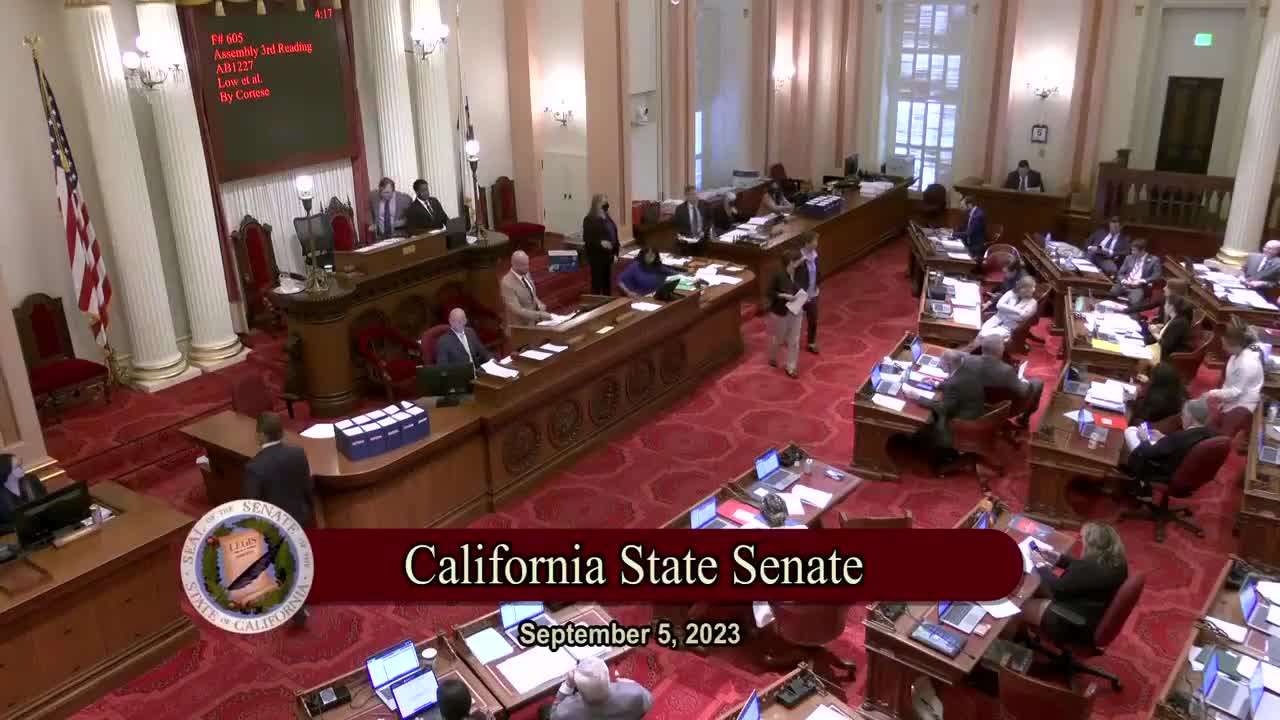
Bill Author



