AB 1270: Redevelopment: successor agency: City of Lake Forest.
- Session Year: 2023-2024
- House: Assembly
- Latest Version Date: 2023-10-04
Current Status:
Passed
(2023-10-04: Chaptered by Secretary of State - Chapter 301, Statutes of 2023.)
Introduced
In Committee
First Chamber
In Committee
Second Chamber
Enacted
Existing law dissolved redevelopment agencies and community development agencies as of February 1, 2012, and provides for the designation of successor agencies to, among other things, wind down the affairs of the dissolved redevelopment agencies and make payments due for enforceable obligations. In that regard, existing law requires the county auditor-controller to create within the county treasury a Redevelopment Property Tax Trust Fund (Fund) for the property tax revenues related to each former redevelopment agency for administration by the county auditor-controller.
Existing law requires the Orange County Auditor Controller to allocate property tax revenues attributable to the El Toro Project Area between the Fund established for the former Orange County Development Agency and the Fund established for the former Lake Forest Redevelopment Agency, as provided, to implement a specified agreement that transferred territorial jurisdiction of the El Toro Project Area from the Orange County Redevelopment Agency to the Lake Forest Redevelopment Agency.
This bill would require the Orange County Auditor Controller, upon receipt of the final resolution of dissolution for the successor agency to the former Orange County Development Agency, to allocate property tax revenues attributable to the El Toro Project Area to the Fund established for the former Lake Forest Redevelopment Agency. By revising the duties of local government officials, the bill would impose a state-mandated local program.
Existing law generally requires a successor agency to submit a Recognized Obligation Payment Schedule to certain entities, including the Department of Finance, and requires the successor agency to make payments pursuant to that schedule. When all enforceable obligations have been retired or paid off, all real property has been disposed of, and all outstanding litigation has been resolved, existing law requires the successor agency to submit a request to formally dissolve to its oversight board, which is required to approve the request and submit it to the department for approval, as specified.
Under this bill, the allocation of revenues into the Fund established for the former Lake Forest Redevelopment Agency pursuant to the transfer agreement and the listing of those payments by the successor agency to the Orange County Development Agency on its Recognized Obligation Payment Schedule would not preclude the approval of a request for dissolution of the successor agency to the Orange County Development Agency.
This bill would make legislative findings and declarations as to the necessity of a special statute for the City of Lake Forest.
The California Constitution requires the state to reimburse local agencies and school districts for certain costs mandated by the state. Statutory provisions establish procedures for making that reimbursement.
This bill would provide that, if the Commission on State Mandates determines that the bill contains costs mandated by the state, reimbursement for those costs shall be made pursuant to the statutory provisions noted above.
Existing law dissolved redevelopment agencies and community development agencies as of February 1, 2012, and provides for the designation of successor agencies to, among other things, wind down the affairs of the dissolved redevelopment agencies and make payments due for enforceable obligations. In that regard, existing law requires the county auditor-controller to create within the county treasury a Redevelopment Property Tax Trust Fund (Fund) for the property tax revenues related to each former redevelopment agency for administration by the county auditor-controller.
Existing law requires the Orange County Auditor Controller to allocate property tax revenues attributable to the El Toro Project Area between the Fund established for the former Orange County Development Agency and the Fund established for the former Lake Forest Redevelopment Agency, as provided, to implement a specified agreement that transferred territorial jurisdiction of the El Toro Project Area from the Orange County Redevelopment Agency to the Lake Forest Redevelopment Agency.
This bill would require the Orange County Auditor Controller, upon receipt of the final resolution of dissolution for the successor agency to the former Orange County Development Agency, to allocate property tax revenues attributable to the El Toro Project Area to the Fund established for the former Lake Forest Redevelopment Agency. By revising the duties of local government officials, the bill would impose a state-mandated local program.
Existing law generally requires a successor agency to submit a Recognized Obligation Payment Schedule to certain entities, including the Department of Finance, and requires the successor agency to make payments pursuant to that schedule. When all enforceable obligations have been retired or paid off, all real property has been disposed of, and all outstanding litigation has been resolved, existing law requires the successor agency to submit a request to formally dissolve to its oversight board, which is required to approve the request and submit it to the department for approval, as specified.
Under this bill, the allocation of revenues into the Fund established for the former Lake Forest Redevelopment Agency pursuant to the transfer agreement and the listing of those payments by the successor agency to the Orange County Development Agency on its Recognized Obligation Payment Schedule would not preclude the approval of a request for dissolution of the successor agency to the Orange County Development Agency.
This bill would make legislative findings and declarations as to the necessity of a special statute for the City of Lake Forest.
The California Constitution requires the state to reimburse local agencies and school districts for certain costs mandated by the state. Statutory provisions establish procedures for making that reimbursement.
This bill would provide that, if the Commission on State Mandates determines that the bill contains costs mandated by the state, reimbursement for those costs shall be made pursuant to the statutory provisions noted above.
Existing law dissolved redevelopment agencies and community development agencies as of February 1, 2012, and provides for the designation of successor agencies to, among other things, wind down the affairs of the dissolved redevelopment agencies and make payments due for enforceable obligations. In that regard, existing law requires the county auditor-controller to create within the county treasury a Redevelopment Property Tax Trust Fund (Fund) for the property tax revenues related to each former redevelopment agency for administration by the county auditor-controller.
Existing law requires the Orange County Auditor Controller to allocate property tax revenues attributable to the El Toro Project Area between the Fund established for the former Orange County Development Agency and the Fund established for the former Lake Forest Redevelopment Agency, as provided, to implement a specified agreement that transferred territorial jurisdiction of the El Toro Project Area from the Orange County Redevelopment Agency to the Lake Forest Redevelopment Agency.
This bill would instead require the Orange County Auditor Controller Controller, upon receipt of the final resolution of dissolution for the successor agency to the former Orange County Development Agency, to allocate property tax revenues attributable to the El Toro Project Area to the Fund established for the former Lake Forest Redevelopment Agency. By revising the duties of local government officials, the bill would impose a state-mandated local program.
Existing law generally requires a successor agency to submit a Recognized Obligation Payment Schedule to certain entities, including the Department of Finance, and requires the successor agency to make payments pursuant to that schedule. When all enforceable obligations have been retired or paid off, all real property has been disposed of, and all outstanding litigation has been resolved, existing law requires the successor agency to submit a request to formally dissolve to its oversight board, which is required to approve the request and submit it to the department for approval, as specified.
Under this bill, the allocation of revenues into the Fund established for the former Lake Forest Redevelopment Agency pursuant to the transfer agreement and the listing of those payments by the successor agency to the Orange County Development Agency on its Recognized Obligation Payment Schedule would not preclude the approval of a request for dissolution of the successor agency to the Orange County Development Agency.
This bill would make legislative findings and declarations as to the necessity of a special statute for the City of Lake Forest.
The California Constitution requires the state to reimburse local agencies and school districts for certain costs mandated by the state. Statutory provisions establish procedures for making that reimbursement.
This bill would provide that, if the Commission on State Mandates determines that the bill contains costs mandated by the state, reimbursement for those costs shall be made pursuant to the statutory provisions noted above.
Existing law dissolved redevelopment agencies and community development agencies as of February 1, 2012, and provides for the designation of successor agencies to, among other things, wind down the affairs of the dissolved redevelopment agencies and make payments due for enforceable obligations. In that regard, existing law requires the county auditor-controller to create within the county treasury a Redevelopment Property Tax Trust Fund (Fund) for the property tax revenues related to each former redevelopment agency for administration by the county auditor-controller.
Existing law requires the Orange County Auditor Controller to allocate property tax revenues attributable to the El Toro Project Area between the Fund established for the former Orange County Development Agency and the Fund established for the former Lake Forest Redevelopment Agency, as provided, to implement a specified agreement that transferred territorial jurisdiction of the El Toro Project Area from the Orange County Redevelopment Agency to the Lake Forest Redevelopment Agency.
This bill would instead require the Orange County Auditor Controller to allocate property tax revenues attributable to the El Toro Project Area to the Fund established for the former Lake Forest Redevelopment Agency. By revising the duties of local government officials, the bill would impose a state-mandated local program.
This bill would make legislative findings and declarations as to the necessity of a special statute for the City of Lake Forest.
The California Constitution requires the state to reimburse local agencies and school districts for certain costs mandated by the state. Statutory provisions establish procedures for making that reimbursement.
This bill would provide that, if the Commission on State Mandates determines that the bill contains costs mandated by the state, reimbursement for those costs shall be made pursuant to the statutory provisions noted above.
The Building Homes and Jobs Act (BHJA) creates in the State Treasury the Building Homes and Jobs Trust Fund and requires the moneys in the fund to be appropriated through the annual Budget Act or as prescribed in the BHJA.This bill would make nonsubstantive changes to that provision.The Building Homes and Jobs Act (BHJA) creates in the State Treasury the Building Homes and Jobs Trust Fund and requires the moneys in the fund to be appropriated through the annual Budget Act or as prescribed in the BHJA.
This bill would make nonsubstantive changes to that provision.
(a)Until a final resolution of dissolution for the successor agency to the former Orange County Development Agency has been submitted to the Orange County Auditor Controller pursuant to subdivision (f) of Section 34187, the Orange County Auditor Controller shall allocate property tax revenues attributable to the El Toro Project Area between the Redevelopment Property Tax Fund established for the former Orange County Development Agency and the Redevelopment Property Tax Trust Fund established for the former Lake Forest Redevelopment Agency as follows:
(1)All property tax revenues deposited by the Orange County Auditor Controller pursuant to paragraph (1) of subdivision (c) of Section 34182 during each fiscal year that are attributable to the Neighborhood Preservation and Development Project Area, including the El Toro Project Area, shall initially be placed into the Redevelopment Property Tax Trust Fund for the former Orange County Development Agency.
(2)After deducting the administrative costs allowed under Section 34182 and Section 95.3 of the Revenue and Taxation Code, as described in subdivision (a) of Section 34183, and remitting the amounts required under paragraph (1) of subdivision (a) of Section 34183, the Orange County Auditor Controller shall transfer the sum of both of the following, determined for the entire fiscal year, into the redevelopment obligation retirement fund of the successor agency to the Orange County Development Agency for distribution as required by law and applicable bond covenants:
(A)The amount required by Section 33670.9.
(B)All other obligations secured by a prior claim on, or pledge of, moneys in the Redevelopment Property Tax Trust Fund of the former Orange County Development Agency, including tax allocation bonds, as applicable, that are payable on a basis prior to any transfer to the former Lake Forest Redevelopment Agency pursuant to the transfer agreement or pursuant to Part 1.8 (commencing with Section 34161), this part, or other law.
(3)After depositing the amount described in paragraph (2) into the redevelopment obligation retirement fund of the successor agency to the Orange County Development Agency, the Orange County Auditor Controller shall deposit into the Redevelopment Property Tax Trust Fund established for the former Lake Forest Redevelopment Agency the transfer agreement amount, as set forth in the applicable Recognized Obligation Payment Schedule submitted by the successor agency to the Orange County Development Agency and approved by the Department of Finance, to the extent moneys are available from the portion of the former Orange County Development Agencys Redevelopment Property Tax Trust Fund attributable to the El Toro Project Area.
(4)The payment described in paragraph (3) shall be paid prior to all payments listed on the recognized obligation payment schedule of the successor agency to the former Orange County Development Agency other than the payments described in paragraph (2), unless otherwise required by statute or applicable bond covenants.
(b)Upon receipt of the final resolution of dissolution for the successor agency to the former Orange County Development Agency submitted pursuant to subdivision (f) of Section 34187, the Orange County Auditor Controller shall allocate property tax revenues attributable to the El Toro Project Area, to the Redevelopment Property Tax Trust Fund for the former Lake Forest Redevelopment Agency and allocate money in this fund pursuant to Section 34183.
(c)This section is intended to implement the transfer agreement in light of the enactment of Part 1.8 (commencing with Section 34161) and this part and the dissolution of the successor agency to the former Orange County Development Agency. Notwithstanding Section 34187, the allocation of revenues into the Redevelopment Property Tax Trust Fund established for the former Lake Forest Redevelopment Agency pursuant to the transfer agreement and the listing of those payments by the successor agency to the Orange County Development Agency on its Recognized Obligation Payment Schedule shall not preclude the approval of a request for dissolution of the successor agency to the Orange County Development Agency.
(d)For purposes of this section, both of the following definitions shall apply:
(1)El Toro Project Area means the portion of the former Orange County Development Agencys Neighborhood Preservation and Development Project Area that was transferred to the Lake Forest Redevelopment Agency pursuant to the transfer agreement and Sections 33216 and 33216.1.
(2)Transfer agreement means the Agreement to Transfer Territorial Jurisdiction of a Noncontiguous Portion of a Redevelopment Project Area dated as of July 6, 1999, entered into among the County of Orange, the Orange County Development Agency, the City of Lake Forest, the Lake Forest Redevelopment Agency, and the City of Laguna Hills.
(3)Transfer agreement amount means the amount of the payment required to be made by the former Orange County Development Agency to the former Lake Forest Redevelopment Agency pursuant to the transfer agreement, less the amount of passthrough payments attributable to the El Toro Project Area that are disbursed by the Orange County Auditor Controller pursuant to paragraph (1) of subdivision (a) of Section 34183.
SEC. 2.The Legislature finds and declares that a special statute is necessary and that a general statute cannot be made applicable within the meaning of Section 16 of Article IV of the California Constitution because of the unique financial circumstances in the City of Lake Forest relating to the repayment of its redevelopment obligations.
SEC. 3.If the Commission on State Mandates determines that this act contains costs mandated by the state, reimbursement to local agencies and school districts for those costs shall be made pursuant to Part 7 (commencing with Section 17500) of Division 4 of Title 2 of the Government Code.
(a)Until a final resolution of dissolution for the successor agency to the former Orange County Development Agency has been submitted to the Orange County Auditor Controller pursuant to subdivision (f) of Section 34187, the Orange County Auditor Controller shall allocate property tax revenues attributable to the El Toro Project Area between the Redevelopment Property Tax Fund established for the former Orange County Development Agency and the Redevelopment Property Tax Trust Fund established for the former Lake Forest Redevelopment Agency as follows:
(1)All property tax revenues deposited by the Orange County Auditor Controller pursuant to paragraph (1) of subdivision (c) of Section 34182 during each fiscal year that are attributable to the Neighborhood Preservation and Development Project Area, including the El Toro Project Area, shall initially be placed into the Redevelopment Property Tax Trust Fund for the former Orange County Development Agency.
(2)After deducting the administrative costs allowed under Section 34182 and Section 95.3 of the Revenue and Taxation Code, as described in subdivision (a) of Section 34183, and remitting the amounts required under paragraph (1) of subdivision (a) of Section 34183, the Orange County Auditor Controller shall transfer the sum of both of the following, determined for the entire fiscal year, into the redevelopment obligation retirement fund of the successor agency to the Orange County Development Agency for distribution as required by law and applicable bond covenants:
(A)The amount required by Section 33670.9.
(B)All other obligations secured by a prior claim on, or pledge of, moneys in the Redevelopment Property Tax Trust Fund of the former Orange County Development Agency, including tax allocation bonds, as applicable, that are payable on a basis prior to any transfer to the former Lake Forest Redevelopment Agency pursuant to the transfer agreement or pursuant to Part 1.8 (commencing with Section 34161), this part, or other law.
(3)After depositing the amount described in paragraph (2) into the redevelopment obligation retirement fund of the successor agency to the Orange County Development Agency, the Orange County Auditor Controller shall deposit into the Redevelopment Property Tax Trust Fund established for the former Lake Forest Redevelopment Agency the transfer agreement amount, as set forth in the applicable Recognized Obligation Payment Schedule submitted by the successor agency to the Orange County Development Agency and approved by the Department of Finance, to the extent moneys are available from the portion of the former Orange County Development Agencys Redevelopment Property Tax Trust Fund attributable to the El Toro Project Area.
(4)The payment described in paragraph (3) shall be paid prior to all payments listed on the recognized obligation payment schedule of the successor agency to the former Orange County Development Agency other than the payments described in paragraph (2), unless otherwise required by statute or applicable bond covenants.
(b)Upon receipt of the final resolution of dissolution for the successor agency to the former Orange County Development Agency submitted pursuant to subdivision (f) of Section 34187, the Orange County Auditor Controller shall allocate property tax revenues attributable to the El Toro Project Area, to the Redevelopment Property Tax Trust Fund for the former Lake Forest Redevelopment Agency and allocate money in this fund pursuant to Section 34183.
(c)This section is intended to implement the transfer agreement in light of the enactment of Part 1.8 (commencing with Section 34161) and this part and the dissolution of the successor agency to the former Orange County Development Agency. Notwithstanding Section 34187, the allocation of revenues into the Redevelopment Property Tax Trust Fund established for the former Lake Forest Redevelopment Agency pursuant to the transfer agreement and the listing of those payments by the successor agency to the Orange County Development Agency on its Recognized Obligation Payment Schedule shall not preclude the approval of a request for dissolution of the successor agency to the Orange County Development Agency.
(d)For purposes of this section, both of the following definitions shall apply:
(1)El Toro Project Area means the portion of the former Orange County Development Agencys Neighborhood Preservation and Development Project Area that was transferred to the Lake Forest Redevelopment Agency pursuant to the transfer agreement and Sections 33216 and 33216.1.
(2)Transfer agreement means the Agreement to Transfer Territorial Jurisdiction of a Noncontiguous Portion of a Redevelopment Project Area dated as of July 6, 1999, entered into among the County of Orange, the Orange County Development Agency, the City of Lake Forest, the Lake Forest Redevelopment Agency, and the City of Laguna Hills.
(3)Transfer agreement amount means the amount of the payment required to be made by the former Orange County Development Agency to the former Lake Forest Redevelopment Agency pursuant to the transfer agreement, less the amount of passthrough payments attributable to the El Toro Project Area that are disbursed by the Orange County Auditor Controller pursuant to paragraph (1) of subdivision (a) of Section 34183.
SEC. 2.The Legislature finds and declares that a special statute is necessary and that a general statute cannot be made applicable within the meaning of Section 16 of Article IV of the California Constitution because of the unique financial circumstances in the City of Lake Forest relating to the repayment of its redevelopment obligations.
SEC. 3.If the Commission on State Mandates determines that this act contains costs mandated by the state, reimbursement to local agencies and school districts for those costs shall be made pursuant to Part 7 (commencing with Section 17500) of Division 4 of Title 2 of the Government Code.
(a)The Until a final resolution of dissolution for the successor agency to the former Orange County Development Agency has been submitted to the Orange County Auditor Controller pursuant to subdivision (f) of Section 34187, the Orange County Auditor Controller shall allocate property tax revenues attributable to the El Toro Project Area between the Redevelopment Property Tax Fund established for the former Orange County Development Agency and the Redevelopment Property Tax Trust Fund established for the former Lake Forest Redevelopment Agency as provided in subdivision (b). follows:
(b)(1)
(1)All property tax revenues deposited by the Orange County Auditor Controller pursuant to paragraph (1) of subdivision (c) of Section 34182 during each fiscal year that are attributable to the Neighborhood Preservation and Development Project Area, including the El Toro Project Area, shall initially be placed into the Redevelopment Property Tax Trust Fund for the former Orange County Development Agency.
(2)After deducting the administrative costs allowed under Section 34182 and Section 95.3 of the Revenue and Taxation Code, as described in subdivision (a) of Section 34183, and remitting the amounts required under paragraph (1) of subdivision (a) of Section 34183, the Orange County Auditor Controller shall transfer the sum of both of the following, determined for the entire fiscal year, into the redevelopment obligation retirement fund of the successor agency to the Orange County Development Agency for distribution as required by law and applicable bond covenants:
(A)The amount required by Section 33670.9.
(B)All other obligations secured by a prior claim on, or pledge of, moneys in the Redevelopment Property Tax Trust Fund of the former Orange County Development Agency, including tax allocation bonds, as applicable, that are payable on a basis prior to any transfer to the former Lake Forest Redevelopment Agency pursuant to the transfer agreement or pursuant to Part 1.8 (commencing with Section 34161), this part, or other law.
(3)After depositing the amount described in paragraph (2) into the redevelopment obligation retirement fund of the successor agency to the Orange County Development Agency, the Orange County Auditor Controller shall deposit into the Redevelopment Property Tax Trust Fund established for the former Lake Forest Redevelopment Agency the transfer agreement amount, as set forth in the applicable Recognized Obligation Payment Schedule submitted by the successor agency to the Orange County Development Agency and approved by the Department of Finance, to the extent moneys are available from the portion of the former Orange County Development Agencys Redevelopment Property Tax Trust Fund attributable to the El Toro Project Area.
(4)The payment described in paragraph (3) shall be paid prior to all payments listed on the recognized obligation payment schedule of the successor agency to the former Orange County Development Agency other than the payments described in paragraph (2), unless otherwise required by statute or applicable bond covenants.
(c)This section shall not be construed to affect the obligations of the successor agency to the Orange County Development Agency under Section 33670.9. Such obligations shall be prior to any transfer of property tax revenues directed by this section and this section shall be interpreted and construed in a manner consistent with Section 33670.9.(b)Upon receipt of the final resolution of dissolution for the successor agency to the former Orange County Development Agency submitted pursuant to subdivision (f) of Section 34187, the Orange County Auditor Controller shall allocate property tax revenues attributable to the El Toro Project Area, to the Redevelopment Property Tax Trust Fund for the former Lake Forest Redevelopment Agency and allocate money in this fund pursuant to Section 34183.
(d)(c)This section is intended to implement the transfer agreement in light of the enactment of Part 1.8 (commencing with Section 34161) and this part and, except as expressly set forth herein, this section is not intended to alter the transfer agreement, which shall continue in full force and effect in accordance with its terms. and the dissolution of the successor agency to the former Orange County Development Agency. Notwithstanding Section 34187, the allocation of revenues into the Redevelopment Property Tax Trust Fund established for the former Lake Forest Redevelopment Agency pursuant to the transfer agreement and the listing of those payments by the successor agency to the Orange County Development Agency on its Recognized Obligation Payment Schedule shall not preclude the approval of a request for dissolution of the successor agency to the Orange County Development Agency.
(e)(d)For purposes of this section, both of the following definitions shall apply:
(1)El Toro Project Area means the portion of the former Orange County Development Agencys Neighborhood Preservation and Development Project Area that was transferred to the Lake Forest Redevelopment Agency pursuant to the transfer agreement and Sections 33216 and 33216.1.
(2)Transfer agreement means the Agreement to Transfer Territorial Jurisdiction of a Noncontiguous Portion of a Redevelopment Project Area dated as of July 6, 1999, entered into among the County of Orange, the Orange County Development Agency, the City of Lake Forest, the Lake Forest Redevelopment Agency, and the City of Laguna Hills.
(3)Transfer agreement amount means the amount of the payment required to be made by the former Orange County Development Agency to the former Lake Forest Redevelopment Agency pursuant to the transfer agreement, less the amount of passthrough payments attributable to the El Toro Project Area that are disbursed by the Orange County Auditor Controller pursuant to paragraph (1) of subdivision (a) of Section 34183.
SEC. 2.The Legislature finds and declares that a special statute is necessary and that a general statute cannot be made applicable within the meaning of Section 16 of Article IV of the California Constitution because of the unique financial circumstances in the City of Lake Forest relating to the repayment of its redevelopment obligations.
SEC. 3.If the Commission on State Mandates determines that this act contains costs mandated by the state, reimbursement to local agencies and school districts for those costs shall be made pursuant to Part 7 (commencing with Section 17500) of Division 4 of Title 2 of the Government Code.
(a)The Orange County Auditor Controller shall allocate property tax revenues attributable to the El Toro Project Area between the Redevelopment Property Tax Fund established for the former Orange County Development Agency and to the Redevelopment Property Tax Trust Fund established for the former Lake Forest Redevelopment Agency as provided in subdivision (b). Agency.
(b)(1)All property tax revenues deposited by the Orange County Auditor Controller pursuant to paragraph (1) of subdivision (c) of Section 34182 during each fiscal year that are attributable to the Neighborhood Preservation and Development Project Area, including the El Toro Project Area, shall initially be placed into the Redevelopment Property Tax Trust Fund for the former Orange County Development Agency.(2)After deducting the administrative costs allowed under Section 34182 and Section 95.3 of the Revenue and Taxation Code, as described in subdivision (a) of Section 34183, and remitting the amounts required under paragraph (1) of subdivision (a) of Section 34183, the Orange County Auditor Controller shall transfer the sum of both of the following, determined for the entire fiscal year, into the redevelopment obligation retirement fund of the successor agency to the Orange County Development Agency for distribution as required by law and applicable bond covenants:(A)The amount required by Section 33670.9.(B)All other obligations secured by a prior claim on, or pledge of, moneys in the Redevelopment Property Tax Trust Fund of the former Orange County Development Agency, including tax allocation bonds, as applicable, that are payable on a basis prior to any transfer to the former Lake Forest Redevelopment Agency pursuant to the transfer agreement or pursuant to Part 1.8 (commencing with Section 34161), this part, or other law.(3)After depositing the amount described in paragraph (2) into the redevelopment obligation retirement fund of the successor agency to the Orange County Development Agency, the Orange County Auditor Controller shall deposit into the Redevelopment Property Tax Trust Fund established for the former Lake Forest Redevelopment Agency the transfer agreement amount, as set forth in the applicable Recognized Obligation Payment Schedule submitted by the successor agency to the Orange County Development Agency and approved by the Department of Finance, to the extent moneys are available from the portion of the former Orange County Development Agencys Redevelopment Property Tax Trust Fund attributable to the El Toro Project Area.(4)The payment described in paragraph (3) shall be paid prior to all payments listed on the recognized obligation payment schedule of the successor agency to the former Orange County Development Agency other than the payments described in paragraph (2), unless otherwise required by statute or applicable bond covenants.(c)This section shall not be construed to affect the obligations of the successor agency to the Orange County Development Agency under Section 33670.9. Such obligations shall be prior to any transfer of property tax revenues directed by this section and this section shall be interpreted and construed in a manner consistent with Section 33670.9.(b)The Orange County Auditor-Controller shall allocate money in the Redevelopment Property Tax Trust Fund for the former Lake Forest Redevelopment Agency in accordance with Section 34183.
(d)(c)This section is intended to implement the transfer agreement in light of the enactment of Part 1.8 (commencing with Section 34161) and this part and, except as expressly set forth herein, this section is not intended to alter the transfer agreement, which shall continue in full force and effect in accordance with its terms. and the dissolution of the successor agency to the former Orange County Development Agency.
(e)(d)For purposes of this section, both of the following definitions shall apply:
(1)El Toro Project Area means the portion of the former Orange County Development Agencys Neighborhood Preservation and Development Project Area that was transferred to the Lake Forest Redevelopment Agency pursuant to the transfer agreement and Sections 33216 and 33216.1.
(2)Transfer agreement means the Agreement to Transfer Territorial Jurisdiction of a Noncontiguous Portion of a Redevelopment Project Area dated as of July 6, 1999, entered into among the County of Orange, the Orange County Development Agency, the City of Lake Forest, the Lake Forest Redevelopment Agency, and the City of Laguna Hills.
(3)Transfer agreement amount means the amount of the payment required to be made by the former Orange County Development Agency to the former Lake Forest Redevelopment Agency pursuant to the transfer agreement, less the amount of passthrough payments attributable to the El Toro Project Area that are disbursed by the Orange County Auditor Controller pursuant to paragraph (1) of subdivision (a) of Section 34183.SEC. 2.The Legislature finds and declares that a special statute is necessary and that a general statute cannot be made applicable within the meaning of Section 16 of Article IV of the California Constitution because of the unique financial circumstances in the City of Lake Forest relating to the repayment of its redevelopment obligations.
SEC. 3.If the Commission on State Mandates determines that this act contains costs mandated by the state, reimbursement to local agencies and school districts for those costs shall be made pursuant to Part 7 (commencing with Section 17500) of Division 4 of Title 2 of the Government Code.
SECTION 1.Section 50470 of the Health and Safety Code is amended to read:50470.(a)(1)There is hereby created in the State Treasury the Building Homes and Jobs Trust Fund. All interest or other increments resulting from the investment of moneys in the fund shall be deposited in the fund, notwithstanding Section 16305.7 of the Government Code.(2)Moneys in the Building Homes and Jobs Trust Fund shall not be subject to transfer to any other fund pursuant to any provision of Part 2 (commencing with Section 16300) of Division 4 of Title 2 of the Government Code, except to the Surplus Money Investment Fund.(b)Moneys in the Building Homes and Jobs Trust Fund shall be appropriated either through the annual Budget Act or as provided in this subdivision in accordance with the following:(1)Moneys collected on and after January 1, 2018, and until December 31, 2018, shall, upon appropriation by the Legislature, be allocated as follows:(A)Fifty percent of deposits into the fund shall be made available for local governments to update planning documents and zoning ordinances in order to streamline housing production, including, but not limited to, general plans, community plans, specific plans, sustainable communities strategies, and local coastal programs. Eligible uses also include new environmental analyses that eliminate the need for project-specific review and local process updates that improve and expedite local permitting.(i)Five percent of the funds specified by this subparagraph shall be available for technical assistance to jurisdictions updating specified planning documents. Technical assistance shall be provided by the department and the Governors Office of Planning and Research.(ii)The funds to be allocated pursuant to this subparagraph shall be held by the department until a local government submits a request for use. The request shall include a description of the proposed use of the funds in the interest of accelerating housing production. The proposed use of these funds shall be included in the local governments funding plan and annual reports pursuant to subclauses (II) and (III) of clause (ii) of subparagraph (B) of paragraph (2). Each recipient of funds under the program shall encumber the funds by December 31, 2020, and shall expend those funds no later than December 31, 2023. Any of these funds not allocated by the department within the first two years that those funds are available shall be made available by the department for the Multifamily Housing Program (Chapter 6.7 (commencing with Section 50675)).(B)Fifty percent of deposits into the fund shall be made available to the department to assist persons experiencing or at risk of homelessness, including, but not limited to, providing rapid rehousing, rental assistance, navigation centers, and the new construction, rehabilitation, and preservation of permanent and transitional rental housing.(C)The department shall ensure geographic equity in the distribution and expenditure of funds allocated pursuant to this paragraph.(2)Moneys collected on and after January 1, 2019, shall be allocated as follows:(A)Twenty percent of all moneys in the fund shall, upon appropriation by the Legislature, be expended for affordable owner-occupied workforce housing.(B)(i)Seventy percent of moneys deposited in the fund shall, upon appropriation by the Legislature, be made available to local governments as follows:(I)Ninety percent of the moneys specified in this subparagraph shall be allocated based on the formula specified in Section 5306 of Title 42 of the United States Code, in accordance with the distribution of funds pursuant to that formula for the federal Fiscal Year 2017, except that the portion allocated to nonentitlement areas pursuant to that section shall be distributed through a competitive grant program, administered by the department, as follows:(ia)The department shall award priority points to a county that has a population of 200,000 or less within the unincorporated areas of the county, to a local government that did not receive an award based on the formula specified in Section 5306 of Title 42 of the United States Code in 2016, and to a local government that pledges to use the money awarded pursuant to a competitive grant under this subclause to assist persons experiencing or at risk of homelessness, including, but not limited to, providing rapid rehousing, rental assistance, navigation centers, and the new construction, rehabilitation, and preservation of permanent and transitional rental housing.(ib)Moneys awarded to a local government pursuant to the competitive grant program shall be used for the purposes specified in subparagraph (D).(II)The remaining 10 percent of the moneys specified in this subparagraph shall be allocated equitably among local jurisdictions that are nonentitlement areas pursuant to the formula specified in Section 5306 of Title 42 of the United States Code for federal Fiscal Year 2017.(ii)To receive moneys pursuant to this subparagraph, local governments shall document minimum standards including the following:(I)Submit a plan to the department detailing the manner in which allocated funds will be used by the local government in a manner consistent with this paragraph and to meet the local governments unmet share of the regional housing needs allocation.(II)Have a compliant housing element with the state and submit a current annual report pursuant to Section 65400 of the Government Code.(III)Submit an annual report to the department that provides ongoing tracking of the uses and expenditures of any allocated funds.(IV)Funds may be expended for the uses listed in subparagraph (D). Two or more local governments that receive an allocation pursuant to this subparagraph may expend those moneys on a joint project that is an authorized use under subparagraph (D).(V)Prioritize investments that increase the supply of housing to households that are at or below 60 percent of area median income, adjusted for household size.(VI)If a local government does not have a documented plan to expend the moneys allocated to it pursuant to this subparagraph within five years of that allocation, those moneys shall be exempt from the allocation requirements in this paragraph and shall revert to, and be paid and deposited in, the Housing Rehabilitation Loan Fund established pursuant to Section 50661 to be used for the Multifamily Housing Program (Chapter 6.7 (commencing with Section 50675)) or for technical assistance for local governments.(VII)A local government may petition the department to return any moneys allocated to it pursuant to this subparagraph. Any moneys returned pursuant to this clause shall be used for the Multifamily Housing Program (Chapter 6.7 (commencing with Section 50675)).(C)Thirty percent of moneys deposited in the fund shall be made available to the department for use as follows:(i)Five percent of the moneys deposited in the fund shall, upon appropriation by the Legislature, be used for state incentive programs, including loans and grants administered by the department. If the department receives insufficient funding applications for incentive programs financed pursuant to this clause, the department shall make those funds available for the Multifamily Housing Program (Chapter 6.7 (commencing with Section 50675)).(ii)(I)Subject to subclause (II), 10 percent of the moneys deposited in the fund shall, upon appropriation by the Legislature, be used to address affordable homeownership and rental housing opportunities for agricultural workers and their families.(II)On and after January 1, 2020, housing funded pursuant to this clause shall not be rented, sold, or subleased to an agricultural employer, as defined in Section 1140.4 of the Labor Code, or its agent, or a farm labor contractor, as defined in Section 1682 of the Labor Code, or its agent, who employs at least one H-2A worker, as defined in Section 50205, until the expiration of the regulatory agreement or affordability covenant, as applicable. A person or entity who receives funds made available pursuant to this clause on or after January 1, 2020, and expends any of those funds for the purpose of funding predevelopment of, developing, or operating any housing that is rented, sold, or subleased to an agricultural employer, as defined in Section 1140.4 of the Labor Code, or its agent, or a farm labor contractor, as defined in Section 1682 of the Labor Code, or its agent, and who employs at least one H-2A worker, as defined in Section 50205, until the expiration of the regulatory agreement or affordability covenant, as applicable, shall reimburse the department or other state agency that provided those funds, as provided in paragraph (2) of subdivision (b) of Section 50205. This subclause shall not apply to any contract entered into or any financial assistance provided pursuant to this clause prior to January 1, 2020.(III)A person or entity who receives funds made available pursuant to this section on and after January 1, 2020, and expends any of those funds for the purpose of funding predevelopment of, developing, or operating any housing shall submit a declaration to the department declaring the following:(ia)(Ia)The person or entity is not an agricultural employer, as defined in Section 1140.4 of the Labor Code, or its agent, or a farm labor contractor, as defined in Section 1682 of the Labor Code, or its agent, who employs at least one H-2A worker, as defined in Section 50205.(Ib)The person or entity will not rent, sell, or sublease any housing funded pursuant to this chapter to an agricultural employer, as defined in Section 1140.4 of the Labor Code, or its agent, or a farm labor contractor, as defined in Section 1682 of the Labor Code, or its agent, who employs at least one H-2A worker, as defined in Section 50205, until the expiration of the regulatory agreement or affordability covenant, as applicable.(ib)The declaration described in sub-subclause (ia) can be met through the inclusion in a regulatory agreement or affordability covenant, as applicable, with the department that is signed by the person or entity receiving funds pursuant to this chapter.(iii)Fifteen percent of the moneys deposited in the fund shall, notwithstanding any other provision of this section or Section 13340 of the Government Code, be transferred to the California Housing Finance Fund and continuously appropriated to the California Housing Finance Agency for the purpose of creating mixed income multifamily residential housing for lower to moderate-income households pursuant to Chapter 6.7 (commencing with Section 51325) of Part 3.(D)The moneys in the fund allocated to local governments may be expended for the following purposes:(i)The predevelopment, development, acquisition, rehabilitation, and preservation of multifamily, residential live-work, rental housing that is affordable to extremely low, very low, low-, and moderate-income households, including necessary operating subsidies.(ii)Affordable rental and ownership housing that meets the needs of a growing workforce earning up to 120 percent of area median income, or 150 percent of area median income in high-cost areas.(iii)Matching portions of funds placed into local or regional housing trust funds.(iv)Matching portions of funds available through the Low and Moderate Income Housing Asset Fund pursuant to subdivision (d) of Section 34176 of the Health and Safety Code.(v)Capitalized reserves for services connected to the creation of new permanent supportive housing, including, but not limited to, developments funded through the Veterans Housing and Homelessness Prevention Bond Act of 2014.(vi)Assisting persons who are experiencing or at risk of homelessness, including providing rapid rehousing, rental assistance, navigation centers, emergency shelters, and the new construction, rehabilitation, and preservation of permanent and transitional housing.(vii)Accessibility modifications.(viii)Efforts to acquire and rehabilitate foreclosed or vacant homes.(ix)Homeownership opportunities, including, but not limited to, downpayment assistance.(x)Fiscal incentives or matching funds to local agencies that approve new housing for extremely low, very low, low-, and moderate-income households.(3)A state or local entity that receives an appropriation or allocation pursuant to this chapter shall use no more than 5 percent of that appropriation or allocation for costs related to the administration of the housing program for which the appropriation or allocation was made.(c)Both of the following shall be paid and deposited in the fund:(1)Any moneys appropriated and made available by the Legislature for purposes of the fund.(2)Any other moneys that may be made available to the department for the purposes of the fund from any other source or sources.(d)In consultation with stakeholders, the department may adopt guidelines to implement this section, including to determine allocation methodologies. Any guideline, rule, policy, or standard of general application employed by the department in implementing this chapter shall not be subject to the requirements of the rulemaking provisions of the Administrative Procedure Act (Chapter 3.5 (commencing with Section 11340) of Part 1 of Division 3 of Title 2 of the Government Code).(a)(1)There is hereby created in the State Treasury the Building Homes and Jobs Trust Fund. All interest or other increments resulting from the investment of moneys in the fund shall be deposited in the fund, notwithstanding Section 16305.7 of the Government Code.
(2)Moneys in the Building Homes and Jobs Trust Fund shall not be subject to transfer to any other fund pursuant to any provision of Part 2 (commencing with Section 16300) of Division 4 of Title 2 of the Government Code, except to the Surplus Money Investment Fund.
(b)Moneys in the Building Homes and Jobs Trust Fund shall be appropriated either through the annual Budget Act, Act or as provided in this subdivision, subdivision in accordance with the following:
(1)Moneys collected on and after January 1, 2018, and until December 31, 2018, shall, upon appropriation by the Legislature, be allocated as follows:
(A)Fifty percent of deposits into the fund shall be made available for local governments to update planning documents and zoning ordinances in order to streamline housing production, including, but not limited to, general plans, community plans, specific plans, sustainable communities strategies, and local coastal programs. Eligible uses also include new environmental analyses that eliminate the need for project-specific review and local process updates that improve and expedite local permitting.
(i)Five percent of the funds specified by this subparagraph shall be available for technical assistance to jurisdictions updating specified planning documents. Technical assistance shall be provided by the department and the Governors Office of Planning and Research.
(ii)The funds to be allocated pursuant to this subparagraph shall be held by the department until a local government submits a request for use. The request shall include a description of the proposed use of the funds in the interest of accelerating housing production. The proposed use of these funds shall be included in the local governments funding plan and annual reports pursuant to subclauses (II) and (III) of clause (ii) of subparagraph (B) of paragraph (2). Each recipient of funds under the program shall encumber the funds by December 31, 2020, and shall expend those funds no later than December 31, 2023. Any of these funds not allocated by the department within the first two years that those funds are available shall be made available by the department for the Multifamily Housing Program (Chapter 6.7 (commencing with Section 50675)).
(B)Fifty percent of deposits into the fund shall be made available to the department to assist persons experiencing or at risk of homelessness, including, but not limited to, providing rapid rehousing, rental assistance, navigation centers, and the new construction, rehabilitation, and preservation of permanent and transitional rental housing.
(C)The department shall ensure geographic equity in the distribution and expenditure of funds allocated pursuant to this paragraph.
(2)Moneys collected on and after January 1, 2019, shall be allocated as follows:
(A)Twenty percent of all moneys in the fund shall, upon appropriation by the Legislature, be expended for affordable owner-occupied workforce housing.
(B)(i)Seventy percent of moneys deposited in the fund shall, upon appropriation by the Legislature, be made available to local governments as follows:
(I)Ninety percent of the moneys specified in this subparagraph shall be allocated based on the formula specified in Section 5306 of Title 42 of the United States Code, in accordance with the distribution of funds pursuant to that formula for the federal Fiscal Year 2017, except that the portion allocated to nonentitlement areas pursuant to that section shall be distributed through a competitive grant program, administered by the department, as follows:
(ia)The department shall award priority points to a county that has a population of 200,000 or less within the unincorporated areas of the county, to a local government that did not receive an award based on the formula specified in Section 5306 of Title 42 of the United States Code in 2016, and to a local government that pledges to use the money awarded pursuant to a competitive grant under this subclause to assist persons experiencing or at risk of homelessness, including, but not limited to, providing rapid rehousing, rental assistance, navigation centers, and the new construction, rehabilitation, and preservation of permanent and transitional rental housing.
(ib)Moneys awarded to a local government pursuant to the competitive grant program shall be used for the purposes specified in subparagraph (D).
(II)The remaining 10 percent of the moneys specified in this subparagraph shall be allocated equitably among local jurisdictions that are nonentitlement areas pursuant to the formula specified in Section 5306 of Title 42 of the United States Code for federal Fiscal Year 2017.
(ii)To receive moneys pursuant to this subparagraph, local governments shall document minimum standards including the following:
(I)Submit a plan to the department detailing the manner in which allocated funds will be used by the local government in a manner consistent with this paragraph and to meet the local governments unmet share of the regional housing needs allocation.
(II)Have a compliant housing element with the state and submit a current annual report pursuant to Section 65400 of the Government Code.
(III)Submit an annual report to the department that provides ongoing tracking of the uses and expenditures of any allocated funds.
(IV)Funds may be expended for the uses listed in subparagraph (D). Two or more local governments that receive an allocation pursuant to this subparagraph may expend those moneys on a joint project that is an authorized use under subparagraph (D).
(V)Prioritize investments that increase the supply of housing to households that are at or below 60 percent of area median income, adjusted for household size.
(VI)If a local government does not have a documented plan to expend the moneys allocated to it pursuant to this subparagraph within five years of that allocation, those moneys shall be exempt from the allocation requirements in this paragraph and shall revert to, and be paid and deposited in, the Housing Rehabilitation Loan Fund established pursuant to Section 50661 to be used for the Multifamily Housing Program (Chapter 6.7 (commencing with Section 50675)) or for technical assistance for local governments.
(VII)A local government may petition the department to return any moneys allocated to it pursuant to this subparagraph. Any moneys returned pursuant to this clause shall be used for the Multifamily Housing Program (Chapter 6.7 (commencing with Section 50675)).
(C)Thirty percent of moneys deposited in the fund shall be made available to the department for use as follows:
(i)Five percent of the moneys deposited in the fund shall, upon appropriation by the Legislature, be used for state incentive programs, including loans and grants administered by the department. If the department receives insufficient funding applications for incentive programs financed pursuant to this clause, the department shall make those funds available for the Multifamily Housing Program (Chapter 6.7 (commencing with Section 50675)).
(ii)(I)Subject to subclause (II), 10 percent of the moneys deposited in the fund shall, upon appropriation by the Legislature, be used to address affordable homeownership and rental housing opportunities for agricultural workers and their families.
(II)On and after January 1, 2020, housing funded pursuant to this clause shall not be rented, sold, or subleased to an agricultural employer, as defined in Section 1140.4 of the Labor Code, or its agent, or a farm labor contractor, as defined in Section 1682 of the Labor Code, or its agent, who employs at least one H-2A worker, as defined in Section 50205, until the expiration of the regulatory agreement or affordability covenant, as applicable. A person or entity who receives funds made available pursuant to this clause on or after January 1, 2020, and expends any of those funds for the purpose of funding predevelopment of, developing, or operating any housing that is rented, sold, or subleased to an agricultural employer, as defined in Section 1140.4 of the Labor Code, or its agent, or a farm labor contractor, as defined in Section 1682 of the Labor Code, or its agent, and who employs at least one H-2A worker, as defined in Section 50205, until the expiration of the regulatory agreement or affordability covenant, as applicable, shall reimburse the department or other state agency that provided those funds, as provided in paragraph (2) of subdivision (b) of Section 50205. This subclause shall not apply to any contract entered into or any financial assistance provided pursuant to this clause prior to January 1, 2020.
(III)A person or entity who receives funds made available pursuant to this section on and after January 1, 2020, and expends any of those funds for the purpose of funding predevelopment of, developing, or operating any housing shall submit a declaration to the department declaring the following:
(ia)(Ia)The person or entity is not an agricultural employer, as defined in Section 1140.4 of the Labor Code, or its agent, or a farm labor contractor, as defined in Section 1682 of the Labor Code, or its agent, who employs at least one H-2A worker, as defined in Section 50205.
(Ib)The person or entity will not rent, sell, or sublease any housing funded pursuant to this chapter to an agricultural employer, as defined in Section 1140.4 of the Labor Code, or its agent, or a farm labor contractor, as defined in Section 1682 of the Labor Code, or its agent, who employs at least one H-2A worker, as defined in Section 50205, until the expiration of the regulatory agreement or affordability covenant, as applicable.
(ib)The declaration described in sub-subclause (ia) can be met through the inclusion in a regulatory agreement or affordability covenant, as applicable, with the department that is signed by the person or entity receiving funds pursuant to this chapter.
(iii)Fifteen percent of the moneys deposited in the fund shall, notwithstanding any other provision of this section or Section 13340 of the Government Code, be transferred to the California Housing Finance Fund and continuously appropriated to the California Housing Finance Agency for the purpose of creating mixed income multifamily residential housing for lower to moderate-income households pursuant to Chapter 6.7 (commencing with Section 51325) of Part 3.
(D)The moneys in the fund allocated to local governments may be expended for the following purposes:
(i)The predevelopment, development, acquisition, rehabilitation, and preservation of multifamily, residential live-work, rental housing that is affordable to extremely low, very low, low-, and moderate-income households, including necessary operating subsidies.
(ii)Affordable rental and ownership housing that meets the needs of a growing workforce earning up to 120 percent of area median income, or 150 percent of area median income in high-cost areas.
(iii)Matching portions of funds placed into local or regional housing trust funds.
(iv)Matching portions of funds available through the Low and Moderate Income Housing Asset Fund pursuant to subdivision (d) of Section 34176 of the Health and Safety Code.
(v)Capitalized reserves for services connected to the creation of new permanent supportive housing, including, but not limited to, developments funded through the Veterans Housing and Homelessness Prevention Bond Act of 2014.
(vi)Assisting persons who are experiencing or at risk of homelessness, including providing rapid rehousing, rental assistance, navigation centers, emergency shelters, and the new construction, rehabilitation, and preservation of permanent and transitional housing.
(vii)Accessibility modifications.
(viii)Efforts to acquire and rehabilitate foreclosed or vacant homes.
(ix)Homeownership opportunities, including, but not limited to, downpayment assistance.
(x)Fiscal incentives or matching funds to local agencies that approve new housing for extremely low, very low, low-, and moderate-income households.
(3)A state or local entity that receives an appropriation or allocation pursuant to this chapter shall use no more than 5 percent of that appropriation or allocation for costs related to the administration of the housing program for which the appropriation or allocation was made.
(c)Both of the following shall be paid and deposited in the fund:
(1)Any moneys appropriated and made available by the Legislature for purposes of the fund.
(2)Any other moneys that may be made available to the department for the purposes of the fund from any other source or sources.
(d)In consultation with stakeholders, the department may adopt guidelines to implement this section, including to determine allocation methodologies. Any guideline, rule, policy, or standard of general application employed by the department in implementing this chapter shall not be subject to the requirements of the rulemaking provisions of the Administrative Procedure Act (Chapter 3.5 (commencing with Section 11340) of Part 1 of Division 3 of Title 2 of the Government Code).
|
Date
|
Status
|
|---|---|
| Oct 4, 2023 | Chaptered by Secretary of State - Chapter 301, Statutes of 2023. |
| Oct 4, 2023 | Approved by the Governor. |
| Sep 15, 2023 | Enrolled and presented to the Governor at 4 p.m. |
| Sep 11, 2023 | In Assembly. Ordered to Engrossing and Enrolling. |
| Sep 11, 2023 | Read third time. Passed. Ordered to the Assembly. (Ayes 39. Noes 0. Page 2550.). |
| Jul 5, 2023 | Read second time. Ordered to third reading. |
| Jul 3, 2023 | From committee: Be ordered to second reading pursuant to Senate Rule 28.8. |
| Jun 21, 2023 | From committee: Do pass and re-refer to Com. on APPR. (Ayes 8. Noes 0.) (June 21). Re-referred to Com. on APPR. |
| Jun 7, 2023 | Referred to Com. on GOV. & F. |
| May 26, 2023 | In Senate. Read first time. To Com. on RLS. for assignment. |
| May 25, 2023 | Read third time. Passed. Ordered to the Senate. (Ayes 76. Noes 0. Page 1812.) |
| May 18, 2023 | Read second time. Ordered to Consent Calendar. |
| May 17, 2023 | From committee: Do pass. To Consent Calendar. (Ayes 15. Noes 0.) (May 17). |
| Apr 27, 2023 | From committee: Do pass and re-refer to Com. on APPR. with recommendation: To Consent Calendar. (Ayes 8. Noes 0.) (April 26). Re-referred to Com. on APPR. |
| Mar 27, 2023 | Re-referred to Com. on L. GOV. |
| Mar 23, 2023 | From committee chair, with author's amendments: Amend, and re-refer to Com. on L. GOV. Read second time and amended. |
| Mar 20, 2023 | Re-referred to Com. on L. GOV. |
| Mar 16, 2023 | Referred to Com. on L. GOV. |
| Mar 16, 2023 | From committee chair, with author's amendments: Amend, and re-refer to Com. on L. GOV. Read second time and amended. |
| Feb 17, 2023 | From printer. May be heard in committee March 19. |
| Feb 16, 2023 | Read first time. To print. |
|
Date
|
Description
|
Location
|
Votes
|
|
|---|---|---|---|---|
| Sep 11, 2023 | Assembly 3rd Reading AB1270 Dixon By Newman | Senate Floor |
Passed |
|
| Jun 21, 2023 | Do pass, but first be re-referred to the Committee on [Appropriations] | Senate Standing Committee on Governance and Finance |
Passed |
|
| May 25, 2023 | AB 1270 Dixon Consent Calendar Second Day Regular Session | Assembly Floor |
Passed |
|
| May 17, 2023 | Do pass. To Consent Calendar. | Assembly Standing Committee on Appropriations |
Passed |
|
| Apr 26, 2023 | Do pass and be re-referred to the Committee on [Appropriations] with recommendation: To Consent Calendar | Assembly Standing Committee on Local Government |
Passed |
This list shows positions taken on this bill by organizations on the date displayed, which is linked to the original source.
Positions by individuals are not included.
|
Organization
|
Position
|
Date
|
|---|---|---|
| County of Orange | ** Support |
SENATE RULES COMMITTEE Office of Senate Floor Analyses (916) 651-1520 Fax: (916) 327-4478 | AB 1270 |
THIRD READING
Bill No: AB 1270
Author: Dixon (R)
Amended: 3/23/23 in Assembly
Vote: 21
SENATE GOVERNANCE & FIN. COMMITTEE: 8-0, 6/21/23
AYES: Caballero, Seyarto, Blakespear, Dahle, Durazo, Glazer, Skinner, Wiener
SENATE APPROPRIATIONS COMMITTEE: Senate Rule 28.8
ASSEMBLY FLOOR: 76-0, 5/25/23 (Consent) - See last page for vote
SUBJECT: Redevelopment: successor agency: City of Lake Forest
SOURCE: County of Orange
DIGEST:
This bill requires the Orange County Auditor Controller, upon receipt of the final resolution of dissolution for the Orange County successor agency, to allocate property tax revenues attributable to the El Toro Project Area to the Lake Forest successor agency.
ANALYSIS:
Existing law:
- Establishes successor agencies to manage the process of unwinding former redevelopment agencies’ (RDAs) affairs, and oversight boards to approve successor agency decisions.
- Allows the Department of Finance (DOF) to review and request reconsideration of an oversight board’s decision.
- Requires the successor agency to submit specified information on its outstanding assets and obligations, also known as a Recognized Obligation Payment Schedule (ROPS).
- Allows DOF to issue a finding of completion to a successor agency acknowledging their progress towards paying off their obligations provided that its Final ROPS contains specified information.
- States that successor agencies that did not receive their finding of completion by December 31, 2015, or did not enter into a written installment payment plan with DOF, were to never receive a finding of completion.
- Requires successor agencies to make payments for the enforceable obligations RDAs entered into. These payments are supported by property tax revenues that would have gone to RDAs, but are instead deposited in a Redevelopment Property Tax Trust Fund (RPTTF).
- Defines “enforceable obligations” as bonds, bond-related payments, some loans, payments required by the federal government, obligations to the state or imposed by state law, payments to RDA employees, judgements or settlements, and other legally binding and enforceable agreements or contracts.
- Provides that any remaining property tax revenues that exceed these enforceable obligations return to cities, counties, special districts, and school and community college districts to support core services
This bill:
- Changes the redevelopment property tax allocation process when the successor agency to the former Orange County Development Agency pays of all its obligations and meets the requirements to dissolve, but for the requirement to pass on property tax revenues attributable to the El Toro Project Area.
- Requires the Orange County Auditor Controller, when it receives the final resolution of dissolution for the successor agency to the former Orange County Development Agency, to instead allocate property tax revenues attributable to the El Toro Project Area to the RPTTF for the former Lake Forest Redevelopment Agency.
- Provides that allocating revenues into the RPTTF for the former Lake Forest Redevelopment Agency must not prevent the successor agency to the former Orange County Development Agency from dissolving.
Background
Redevelopment agencies. Citing a significant State General Fund deficit, Governor Brown’s 2011-12 Budget proposed eliminating RDAs and returning billions of dollars of property tax revenues to schools, cities, and counties to fund core services. Among the statutory changes that the Legislature adopted to implement the 2011-12 Budget, ABX1-26 (Blumenfield, Chapter 5, Statutes of 2011-12, First Extraordinary Session) dissolved all RDAs. The California Supreme Court's 2011 ruling in California Redevelopment Association v. Matosantos upheld ABX1-26, but invalidated ABX1-27 (Blumenfield, Chapter 6, Statutes of 2011-12, First Extraordinary Session), which would have allowed most RDAs to avoid dissolution. In response, the California Redevelopment Association (CRA) challenged the two measures. The Supreme Court denied the petition for peremptory writ of mandate with respect to ABX1-26, but granted it with respect to ABX1-27. As a result, all RDAs dissolved as of February 1, 2012. At the time of dissolution, over 400 RDAs statewide were diverting 12% of property taxes, over $5.6 billion yearly.
RDAs’ dissolution deprived many local agencies of the primary tool they used to eliminate physical and economic blight, finance new construction, improve public infrastructure, rehabilitate existing buildings, and increase the supply of affordable housing. Until their dissolution, state law required RDAs to set aside 20% of funding generated in a project area to increase the supply of low- and moderate-income housing. At the time the state dissolved RDAs, the State Controller’s Office (SCO) estimated statewide, this requirement obligated RDAs to spend $1 billion on affordable housing.
City of Lake Forest. The Neighborhood Preservation and Development Project, established by Orange County’s former RDA, was a single redevelopment project area that consisted of 14 separate, non-contiguous subareas. When the City of Lake Forest incorporated in 1991, the City’s boundaries encompassed almost all of the subarea known as the El Toro Project Area. After the City of Lake Forest created its RDA in 1995, Orange County and Lake Forest decided to transfer jurisdiction for the El Toro Project Area to the Lake Forest RDA. However, the City did not want to enter into an agreement that required the County to approve any amendments to the redevelopment plan the City proposed. The Legislature enacted special legislation for Orange County’s RDA to transfer jurisdiction over the portion of the Neighborhood Preservation and Development Area to the city if it fell within the city’s boundaries (AB 1502, Campbell, Chapter 53, Statutes of 1997). Unlike the procedures for general RDA law, AB 1502 did not require the board of supervisors to approve an amendment unless it would violate an agreement the county or the board entered into prior to the transfer. It also required that public notice requirements to amend the plan only apply to the portion of the jurisdiction that the county transferred.
Under AB 1502, Orange County’s RDA transferred territorial jurisdiction over the portion of the El Toro Project Area located in the City of Lake Forest to the city’s RDA. In 1999, the county and the city entered into a transfer agreement that formalized the terms of the transfer. Orange County’s RDA had committed tax increment revenue from the El Toro Project area to repay indebtedness it incurred before it entered into the transfer agreement with Lake Forest. To preserve the Orange County RDA’s ability to repay its indebtedness, the transfer agreement specified the manner in which the county’s RDA and Lake Forest’s RDA were to receive tax increment revenues from the part of the El Toro Project Area subject to the transfer agreement. The agreement directed the Orange County Auditor-Controller to deduct the following amounts before allocating funds to the Lake Forest’s RDA:
- Auditor-controller’s administrative costs; and
- An amount sufficient to repay or refinance the County RDA’s existing indebtedness related to the El Toro Project Area.
The transfer agreement worked well before RDAs’ dissolution. However, RDA dissolution law complicated efforts to properly allocate property tax increment revenues among the various affected taxing entities. Under the dissolution process, the El Toro Area had two successor agencies, and two RPTTFs to cover the same area. On April 14, 2015, DOF rejected the Orange County successor agency’s ROPS that included the continued transfer agreement payments.
The City and the County explored options to continue the payments. The County challenged DOF’s determination, and tried to negotiate a memorandum of understanding with the City to clarify the process, but ultimately determined any such agreement would violate statutory requirements for how the auditor controller could distribute funds.
To restore the transfer agreement payments, AB 2647 (Wagner, Chapter 826, Statutes of 2014) clarified the process by requiring the Orange County Auditor Controller to deposit property tax revenues attributable to the Neighborhood Preservation and Development Project Area, including the El Toro Project Area, into the RPTTF for the former Orange County Development Agency. After deducting costs, and making other required pass-through payments, the Auditor-Controller must deposit the transfer agreement amount into the RPTTF for the former Lake Forest Redevelopment Agency, to the extent moneys are available.
The successor agency for the Orange County Development Agency expects to pay off its debt in 2023. However, the City of Lake Forest does not expect to retire its redevelopment debts until 2033. Since the Orange County Auditor Controller has to deposit property tax revenues into the RPTTF, before transferring funds to the successor agency for the Lake Forest Redevelopment Agency, it is unclear whether the successor agency for the Orange County Development Agency needs to remain operational for Lake Forest’s successor agency to continue to receive RPTTF revenue.
FISCAL EFFECT: Appropriation: No Fiscal Com.: Yes Local: Yes
SUPPORT: (Verified 7/4/23)
County of Orange (source)
OPPOSITION: (Verified 7/4/23)
None received
ARGUMENTS IN SUPPORT: According to the author, “Prior to the incorporation of the City of Lake Forest, the El Toro Redevelopment Project Area was under jurisdictional control of the County of Orange. When the City of Lake Forest established the Lake Forest RDA and control over the Project Area was subsequently transferred to Lake Forest, the City, County and Agency entered into a Transfer Agreement. The purpose of the Transfer Agreement was to allow the transfer of tax increment from the Project Area to the Lake Forest RDA and ensure the protection of the County's pre-existing bond obligations. With the County’s successor agency retiring its debt in September of 2023, and no longer being eligible to receive redevelopment property tax dollars, this calls into question the City’s ability to still receive said funds, as approved by the State Department of Finance. AB 1270 will allow the Lake Forest successor agency to receive redevelopment property tax revenues directly from the County Auditor-Controller; like other successor agencies.”
ASSEMBLY FLOOR: 76-0, 5/25/23
AYES: Addis, Alanis, Alvarez, Arambula, Bains, Bauer-Kahan, Bennett, Berman, Boerner, Bonta, Bryan, Calderon, Juan Carrillo, Wendy Carrillo, Cervantes, Chen, Connolly, Megan Dahle, Davies, Dixon, Essayli, Flora, Mike Fong, Vince Fong, Friedman, Gabriel, Gallagher, Garcia, Gipson, Grayson, Haney, Hart, Holden, Hoover, Irwin, Jackson, Jones-Sawyer, Lackey, Lee, Low, Lowenthal, Maienschein, McCarty, McKinnor, Muratsuchi, Stephanie Nguyen, Ortega, Pacheco, Jim Patterson, Joe Patterson, Pellerin, Petrie-Norris, Quirk-Silva, Ramos, Reyes, Luz Rivas, Robert Rivas, Rodriguez, Blanca Rubio, Sanchez, Santiago, Schiavo, Soria, Ta, Ting, Valencia, Villapudua, Waldron, Wallis, Ward, Weber, Wicks, Wilson, Wood, Zbur, Rendon
NO VOTE RECORDED: Aguiar-Curry, Kalra, Mathis, Papan
Prepared by: Jonathan Peterson / GOV. & F. / (916) 651-4119
7/5/23 14:50:42
**** END ****
SENATE COMMITTEE ON GOVERNANCE AND FINANCE
Senator Anna M. Caballero, Chair
2023 - 2024 Regular
Bill No: | AB 1270 | Hearing Date: | 6/21/23 |
Author: | Dixon | Tax Levy: | No |
Version: | 3/23/23 | Fiscal: | Yes |
Consultant: | Peterson | ||
Redevelopment: successor agency: City of Lake Forest
Requires the Orange County Auditor Controller, upon receipt of the final resolution of dissolution for the Orange County successor agency, to allocate property tax revenues attributable to the El Toro Project Area to the Lake Forest successor agency.
Background
Redevelopment agencies. From the early 1950s until the state dissolved them in 2011, California redevelopment agencies (RDAs) used property tax increment financing (TIF) to pay for economic development projects in blighted areas. Generally, property TIF involves a city or county forming a tax increment financing district to issue bonds and use the bond proceeds to pay project costs within the boundaries of a specified project area. To repay the bonds, the district captures increased property tax revenues generated when projects financed by the bonds increase assessed property values within the project area. To calculate the increased property tax revenues captured by the district, the amount of property tax revenues obtained by any local agency that receives a share of property tax revenues from property within a project area is “frozen” at the amount it received from that property prior to the project area’s formation. In future years, as the project area's assessed valuation grows above the frozen base, the resulting additional property tax revenues—the increment—flows to the tax increment financing district instead of other local agencies. After the bonds have been fully repaid, the district is dissolved, ending the diversion of tax increment revenues from participating local agencies. Property tax revenues then flow back to each local agency that receives a share of the property tax.
When a substantial portion of the noncontiguous portion of a county’s RDA project area is annexed to a city, or included within the boundaries of a new city, the jurisdiction of the RDA project area can be transferred to the city’s RDA. The two RDAs must enter into a transfer agreement, both governing bodies must adopt a resolution approving the agreement, and the city council must adopt ordinances:
- Declaring the need for an agency to function in the city, and
- To adopt the same redevelopment plan for the project area.
These agreements must specify how property tax revenue is to be shared amongst the agencies after jurisdiction is transferred, and must require that:
- Tax increment revenue allocated to the receiving agency must be available to pay any indebtedness the county incurred for the project area;
- The city and county to approve each other's plan amendments and to undertake redevelopment activities in each other's portion of the project area.
Citing a significant State General Fund deficit, Governor Brown’s 2011-12 budget proposed eliminating RDAs and returning billions of dollars of property tax revenues to schools, cities, and counties to fund core services. Among the statutory changes that the Legislature adopted to implement the 2011-12 budget, AB X1 26 (Blumenfield, 2011) dissolved all RDAs. The California Supreme Court's 2011 ruling in California Redevelopment Association v. Matosantos upheld AB X1 26, but invalidated AB X1 27 (Blumenfield, 2011), which would have allowed most RDAs to avoid dissolution. In response, the California Redevelopment Association (CRA) challenged the two measures. The Supreme Court denied the petition for peremptory writ of mandate with respect to AB X1 26, but granted it with respect to AB X1 27. As a result, all RDAs dissolved as of February 1, 2012. At the time of dissolution, over 400 RDAs statewide were diverting 12% of property taxes, over $5.6 billion yearly.
RDAs’ dissolution deprived many local agencies of the primary tool they used to eliminate physical and economic blight, finance new construction, improve public infrastructure, rehabilitate existing buildings, and increase the supply of affordable housing. Until their dissolution, state law required RDAs to set aside 20% of funding generated in a project area to increase the supply of low- and moderate-income housing. At the time the state dissolved RDAs, the State Controller’s Office (SCO) estimated statewide, this requirement obligated RDAs to spend $1 billion on affordable housing.
RDA dissolution. AB X1 26 (2011) prohibited RDAs from incurring new or expanding existing monetary or legal obligations unless otherwise specified, removed the authority for RDAs to engage in most activities except continuing to pay off enforceable obligations, and established successor agencies to manage the process of unwinding former RDA affairs. With the exception of seven cities, the city or county that created each former RDA now serves as that RDA’s successor agency.
RDA dissolution law required the SCO to review the activities of RDAs to determine whether asset transfers occurred after January 1, 2011, between the city or county that created the RDA. If such an asset transfer did occur, the SCO had to order the available assets to the RDA, or after October 1, 2011, the successor agency. Upon receiving that order, the local agency must reverse the transfer and return the assets to the RDA or successor agency.
One of a successor agency’s primary responsibilities is to make payments for the enforceable obligations RDAs entered into. These payments are supported by property tax revenues that would have gone to RDAs, but are instead deposited in a Redevelopment Property Tax Trust Fund (RPTTF). Enforceable obligations include bonds, bond-related payments, some loans, payments required by the federal government, obligations to the state or imposed by state law, payments to RDA employees, judgements or settlements, and other legally binding and enforceable agreements or contracts. Any remaining property tax revenues that exceed these enforceable obligations return to cities, counties, special districts, and school and community college districts to support core services. The amount these taxing entities receive increases as the successor agency pays off these enforceable obligations. If a successor agency adds additional enforceable obligations, the slower this stream of property tax revenue returns to these taxing entities.
State law gives county auditor-controllers the responsibility to determine the amount of property taxes that would have been allocated to each RDA in the county had the RDA not been dissolved, and administer the Redevelopment Property Tax Trust Fund.
Each successor agency has an oversight board responsible for supervising and approving its actions. The oversight board includes one member of the legislative body from each type of taxing entity, including the county, city, special districts, schools, and community colleges. Additionally, the county board of supervisors appoints a public member, and the mayor or board of supervisors appoints one member to represent RDA employees.
The Department of Finance (DOF) can review and request reconsideration of an oversight board’s decision. Once a successor agency takes over for an RDA, it reviews the RDA’s outstanding assets and obligations, and develops a plan to resolve those obligations, also known as a Recognized Obligation Payment Schedule (ROPS). To obtain required DOF approval, a successor agency submits a series of ROPS to the department. If DOF agrees with the plan, it issues a Finding of Completion acknowledging their progress towards paying off their obligations. Successor agencies issued a Finding of Completion can submit a Last and Final ROPS, meaning that (1) the remaining debt is limited to administrative costs and payments pursuant to enforceable obligations with defined payment schedules, (2) all remaining obligations have been previously listed on the ROPS and approved by DOF, and (3) the agency is not a party to outstanding or unresolved litigation. Successor agencies had until December 31, 2015, to receive their Finding of Completion from DOF. RDA dissolution law states successor agencies that did not receive their Finding of Completion by this date, or did not enter into a written installment payment plan with DOF, were to never receive a Finding of Completion. Nine successor agencies did not receive a Finding of Completion by the deadline.
Once a successor agency pays off all the former RDA’s obligations, the successor agency can dissolve, and the RPTTF revenue it receives flows back to the other taxing entities.
City of Lake Forest. The Neighborhood Preservation and Development Project, established by Orange County’s former RDA, was a single redevelopment project area that consisted of 14 separate, non-contiguous subareas. When the City of Lake Forest incorporated in 1991, the City’s boundaries encompassed almost all of the subarea known as the El Toro Project Area. After the City of Lake Forest created its RDA in 1995, Orange County and Lake Forest decided to transfer jurisdiction for the El Toro Project Area to the Lake Forest RDA. However, the City did not want to enter into an agreement that required the County to approve any amendments to the redevelopment plan the City proposed. The Legislature enacted special legislation for Orange County’s RDA to transfer jurisdiction over the portion of the Neighborhood Preservation and Development Area to the city if it fell within the city’s boundaries (AB 1502, Campbell, 1997). Unlike the procedures for general RDA law, AB 1502 did not require the board of supervisors to approve an amendment unless it would violate an agreement the county or the board entered into prior to the transfer. It also required that public notice requirements to amend the plan only apply to the portion of the jurisdiction that the county transferred.
Under AB 1502, Orange County’s RDA transferred territorial jurisdiction over the portion of the El Toro Project Area located in the City of Lake Forest to the city’s RDA. In 1999, the county and the city entered into a transfer agreement that formalized the terms of the transfer. Orange County’s RDA had committed tax increment revenue from the El Toro Project area to repay indebtedness it incurred before it entered into the transfer agreement with Lake Forest. To preserve the Orange County RDA’s ability to repay its indebtedness, the transfer agreement specified the manner in which the county’s RDA and Lake Forest’s RDA were to receive tax increment revenues from the part of the El Toro Project Area subject to the transfer agreement. The agreement directed the Orange County Auditor-Controller to deduct the following amounts before allocating funds to the Lake Forest’s RDA:
- Auditor-controller’s administrative costs; and
- An amount sufficient to repay or refinance the County RDA’s existing indebtedness related to the El Toro Project Area.
The transfer agreement worked well before RDAs’ dissolution. However, RDA dissolution law complicated efforts to properly allocate property tax increment revenues among the various affected taxing entities. Under the dissolution process, the El Toro Area had two successor agencies, and two RPTTFs to cover the same area. On April 14, 2015, DOF rejected the Orange County successor agency’s ROPS that included the continued transfer agreement payments.
The City and the County explored options to continue the payments. The County challenged DOF’s determination, and tried to negotiate a memorandum of understanding with the City to clarify the process, but ultimately determined any such agreement would violate statutory requirements for how the auditor controller could distribute funds.
To restore the transfer agreement payments, AB 2647 (Wagner, 2014) clarified the process by requiring the Orange County Auditor Controller to deposit property tax revenues attributable to the Neighborhood Preservation and Development Project Area, including the El Toro Project Area, into the RPTTF for the former Orange County Development Agency. After deducting costs, and making other required pass-through payments, the Auditor-Controller must deposit the transfer agreement amount into the RPTTF for the former Lake Forest Redevelopment Agency, to the extent moneys are available.
The successor agency for the Orange County Development Agency expects to pay off its debt in 2023. However, the City of Lake Forest does not expect to retire its redevelopment debts until 2033. Since the Orange County Auditor Controller has to deposit property tax revenues into the RPTTF, before transferring funds to the successor agency for the Lake Forest Redevelopment Agency, it is unclear whether the successor agency for the Orange County Development Agency needs to remain operational for Lake Forest’s successor agency to continue to receive RPTTF revenue.
Orange County wants to clarify how the Orange County Auditor Controller will distribute RPTTF revenues after the dissolution of the successor agency to the Orange County Development Agency.
Proposed Law
Assembly Bill 1270 changes the redevelopment property tax allocation process when the successor agency to the former Orange County Development Agency pays of all its obligations and meets the requirements to dissolve, but for the requirement to pass on property tax revenues attributable to the El Toro Project Area.
When the Orange County Auditor Controller receives the final resolution of dissolution for the successor agency to the former Orange County Development Agency, it must instead allocate property tax revenues attributable to the El Toro Project Area to the RPTTF for the former Lake Forest Redevelopment Agency. The measure also provides that allocating revenues into the RPTTF for the former Lake Forest Redevelopment Agency must not prevent the successor agency to the former Orange County Development Agency from dissolving.
State Revenue Impact
No estimate.
Comments
1. Purpose of the bill. According to the author, “Prior to the incorporation of the City of Lake Forest, the El Toro Redevelopment Project Area was under jurisdictional control of the County of Orange. When the City of Lake Forest established the Lake Forest RDA and control over the Project Area was subsequently transferred to Lake Forest, the City, County and Agency entered into a Transfer Agreement. The purpose of the Transfer Agreement was to allow the transfer of tax increment from the Project Area to the Lake Forest RDA and ensure the protection of the County's pre-existing bond obligations. With the County’s successor agency retiring its debt in September of 2023, and no longer being eligible to receive redevelopment property tax dollars, this calls into question the City’s ability to still receive said funds, as approved by the State Department of Finance. AB 1270 will allow the Lake Forest successor agency to receive redevelopment property tax revenues directly from the County Auditor-Controller; like other successor agencies.”
2. Special legislation. Section 16 of Article IV of the California Constitution prohibits special legislation when a general law can apply. AB 1270 contains findings and declarations explaining the need for legislation that applies only to the City of Lake Forest.
3. Mandate. The California Constitution requires the state to reimburse local governments for the costs of new or expanded state mandated local programs. Because AB 1270 adds to the duties of local officials, Legislative Counsel says that the bill imposes a new state mandate. The measure states if the Commission on State Mandates determines that the bill imposes a reimbursable mandate, then reimbursement must be made pursuant to existing statutory provisions.
Assembly Actions
Assembly Local Government Committee: 8-0
Assembly Appropriations Committee: 15-0
Assembly Floor: 76-0
Support and Opposition
(6/16/23)
Support: County of Orange (Sponsor)
Opposition: None received.
-- END --
Date of Hearing: May 17, 2023
ASSEMBLY COMMITTEE ON APPROPRIATIONS
Chris Holden, Chair
ABPCA Bill Id:AB 1270
Author:(Dixon) – As Amended Ver:March 23, 2023
Policy Committee: | Local Government | Vote: | 8 - 0 |
|
| ||
|
|
Urgency: No State Mandated Local Program: Yes Reimbursable: Yes
SUMMARY:
This bill requires the Orange County Auditor Controller to allocate property tax revenues attributable to the El Toro Project Area to the Redevelopment Property Tax Trust Fund (RPTTF) established for the former Lake Forest Redevelopment Agency (RDA).
Specifically, this bill:
- Requires the Orange County Auditor Controller to allocate property tax revenues attributable to the El Toro Project Area between the Redevelopment Property Tax Fund established for the former Orange County Development Agency and the Redevelopment Property Tax Fund established for the former Lake Forest RDA, as specified, until a final resolution of dissolution for the successor agency to the former Orange County Development Agency has been submitted to the Orange County Auditor Controller.
- Requires, upon receipt of the final resolution of dissolution for the successor agency to the former Orange County Development Agency submitted pursuant to existing law, the Orange County Auditor Controller to allocate property tax revenues attributable to the El Toro Project Area to the RPTTF for the former Lake Forest RDA and allocate money in this fund, as specified.
FISCAL EFFECT:
No state costs. Local costs to the Orange County Auditor Controller are likely minor to reallocate property tax revenues attributable to the El Toro Project Area in accordance with this bill. These costs are potentially reimbursable by the state, subject to a Determination by the Commission on State Mandates. It is unlikely the County would submit a claim.
COMMENTS:
- Purpose. This bill is sponsored by Orange County. According to the author:
Prior to the incorporation of the City of Lake Forest, the El Toro Redevelopment Project Area was under jurisdictional control of the County of Orange. When the City of Lake Forest established the Lake Forest RDA and control over the Project Area was subsequently transferred to Lake Forest, the City, County and Agency entered into a Transfer Agreement. The purpose of the Transfer Agreement was to allow the transfer of tax increment from the Project Area to the Lake Forest RDA and ensure the protection of the County's pre-existing bond obligations. With the County’s successor agency retiring its debt in September of 2023, and no longer being eligible to receive redevelopment property tax dollars, this calls into question the City’s ability to still receive said funds, as approved by the State Department of Finance. AB 1270 will allow the Lake Forest successor agency to receive redevelopment property tax revenues directly from the County Auditor-Controller; like other successor agencies.
- Background. The Neighborhood Preservation and Development Project, established by Orange County’s former RDA, was a single redevelopment project area that consisted of 14 separate, non-contiguous subareas. After the City of Lake Forest created its RDA, the Legislature specified terms under which Orange County’s RDA could transfer, to a city’s RDA, jurisdiction over the portion of the Neighborhood Preservation and Development Project’s area that fell within a city’s boundaries. In 1998, Orange County’s RDA transferred territorial jurisdiction over the portion of the El Toro Project Area located in the City of Lake Forest to the city’s RDA. In 1999, the county and the city entered into a transfer agreement that formalized the terms of the transfer.
To preserve the Orange County RDA’s ability to repay its indebtedness, existing law requires relevant property tax revenues related to the county’s former El Toro Sub Area be deposited into the County’s RPTTF to address county debt service before any funds are disbursed to the City of Lake Forest. The county’s Successor Agency is set to retire its debt in 2023, which means it will no longer be eligible to receive redevelopment property tax dollars. This bill allows the Lake Forest Successor Agency to receive redevelopment property tax revenues directly from the County Auditor-Controller, thus allowing the County’s Successor Agency to dissolve as planned in September 2023.
This bill requires the Orange County Auditor Controller, upon receipt of the final resolution of dissolution for the successor agency to the former Orange County Development Agency, to allocate property tax revenues attributable to the El Toro Project Area to the fund established for the former Lake Forest RDA.
Analysis Prepared by: Jennifer Swenson / APPR. / (916) 319-2081
Date of Hearing: April 26, 2023
ASSEMBLY COMMITTEE ON LOCAL GOVERNMENT
Cecilia Aguiar-Curry, Chair
ABPCA Bill Id:AB 1270 (
Author:Dixon) – As Amended Ver:March 23, 2023
SUBJECT: Redevelopment: successor agency: City of Lake Forest.
SUMMARY: Requires the Orange County Auditor Controller to allocate property tax revenues attributable to the El Toro Project Area to the Redevelopment Property Tax Trust Fund (RPTTF) established for the former Lake Forest Redevelopment Agency (RDA), as specified. Specifically, this bill:
- Provides that the Orange County Auditor shall allocate property tax revenues attributable to the El Toro Project Area between the Redevelopment Property Tax Fund established for the former Orange County Development Agency and the Redevelopment Property Tax Fund established for the former Lake Forest RDA, as specified, until a final resolution of dissolution for the successor agency to the former Orange County Development Agency has been submitted to the Orange County Auditor Controller.
- Specifies that, upon receipt of the final resolution of dissolution for the successor agency to the former Orange County Development Agency submitted pursuant to existing law, the Orange County Auditor Controller shall allocate property tax revenues attributable to the El Toro Project Area to the RPTTF for the former Lake Forest RDA and allocate money in this fund, as specified.
- Specifies that Health and Safety Code 34182.1, as proposed to be amended by this bill, is intended to implement the transfer agreement, as specified, and the dissolution of the successor agency to the former Orange Development Agency. The allocation of revenues into the RPTTF established for the former Lake Forest RDA pursuant to the transfer agreement and the listing of those payments by the successor agency to the Orange County Development Agency on its Recognized Obligation Payment Schedule (ROPS) shall not preclude the approval of a request for dissolution of the successor agency to the Orange County Development Agency, as specified.
- Removes specified declaratory language.
- Finds and declares that a special statute is necessary and that a general statute cannot be made applicable because of the unique financial circumstances in the City of Lake Forest relating to the repayment of its redevelopment obligations.
- Provides that if the Commission on State Mandates determines that this bill contains costs mandated by the state, reimbursement to local agencies and school districts for those costs shall be made.
FISCAL EFFECT: This bill is keyed fiscal and contains a state-mandated local program.
COMMENTS:
- Bill Summary and Author’s Statement. This bill would require the Orange County Auditor Controller, upon receipt of the final resolution of dissolution for the successor agency to the former Orange County Development Agency, to allocate property tax revenues attributable to the El Toro Project Area to the fund established for the former Lake Forest RDA. Orange County is the sponsor of this bill.
According to the author, “Prior to the incorporation of the City of Lake Forest, the El Toro Redevelopment Project Area was under jurisdictional control of the County of Orange. When the City of Lake Forest established the Lake Forest RDA and control over the Project Area was subsequently transferred to Lake Forest, the City, County and Agency entered into a Transfer Agreement. The purpose of the Transfer Agreement was to allow the transfer of tax increment from the Project Area to the Lake Forest RDA and ensure the protection of the County's pre-existing bond obligations. With the County’s successor agency retiring its debt in September of 2023, and no longer being eligible to receive redevelopment property tax dollars, this calls into question the City’s ability to still receive said funds, as approved by the State Department of Finance. AB 1270 will allow the Lake Forest successor agency to receive redevelopment property tax revenues directly from the County Auditor-Controller; like other successor agencies.
- Redevelopment. Article XVI, Section 16 of the California Constitution authorizes the Legislature to provide for the formation of RDAs to eliminate blight in an area by means of a self-financing schedule that pays for the redevelopment project with tax increment derived from any increase in the assessed value of property within the redevelopment project area (or tax increment). Generally, property tax increment financing involves a local government forming a tax increment financing district to issue bonds and use the bond proceeds to pay project costs within the boundaries of a specified project area. To repay the bonds, the district captures increased property tax revenues that are generated when projects financed by the bonds increase assessed property values within the project area.
To calculate the increased property tax revenues captured by the district, the amount of property tax revenues received by any local government participating in the district is “frozen” at the amount it received from property within a project area prior to the project area’s formation. In future years, as the project area's assessed valuation grows above the frozen base, the resulting additional property tax revenues — the so-called property tax “increment” revenues — flow to the tax increment financing district instead of other local governments. After the bonds have been fully repaid using the incremental property tax revenues, the district is dissolved, ending the diversion of tax increment revenues from participating local governments.
Prior to Proposition 13 very few RDAs existed; however, after its passage, RDAs became a source of funding for a variety of local infrastructure activities. Eventually, RDAs were required to set-aside 20% of funding generated in a project area to increase the supply of low and moderate income housing in the project areas. At the time RDAs were dissolved, the Controller estimated that statewide, RDAs were obligated to spend $1 billion on affordable housing. At the time of dissolution, over 400 RDAs statewide were diverting 12% of property taxes, over $5.6 billion yearly.
In 2011, facing a severe budget shortfall, the Governor proposed eliminating RDAs in order to deliver more property taxes to other local agencies. Ultimately, the Legislature approved and the Governor signed two measures, ABX1 26 (Blumenfield), Chapter 5 and ABX1 27 (Blumenfield), Chapter 6 that together dissolved RDAs as they existed at the time and created a voluntary redevelopment program on a smaller scale. In response, the California Redevelopment Association (CRA) and the League of California Cities, along with other parties, filed suit challenging the two measures. The Supreme Court denied the petition for peremptory writ of mandate with respect to ABX1 26. However, the Court did grant CRA's petition with respect to ABX1 27. As a result, all RDAs were required to dissolve as of February 1, 2012.
- RDA Dissolution. AB X1 26 (2011) established successor agencies to manage the process of unwinding former RDA affairs. With the exception of seven cities, the city or county that created each former RDA now serves as that RDA’s successor agency. One of a successor agency’s primary responsibilities is to make payments for the enforceable obligations RDAs entered into. These payments are supported by property tax revenues that would have gone to RDAs, but are instead deposited in a Redevelopment Property Tax Trust Fund (RPTTF). Enforceable obligations include bonds, bond-related payments, some loans, payments required by the federal government, obligations to the state or imposed by state law, payments to RDA employees, judgements or settlements, and other legally binding and enforceable agreements or contracts. Any remaining property tax revenues that exceed these enforceable obligations return to cities, counties, special districts, and school and community college districts to support core services.
Each successor agency has an oversight board responsible for supervising and approving its actions. DOF can review and request reconsideration of an oversight board’s decision. Once a successor agency takes over for an RDA, it reviews the RDA’s outstanding assets and obligations, and develops a plan to resolve those obligations, also known as a Recognized Obligation Payment Schedule (ROPS). To obtain required DOF approval, a successor agency submits a series of ROPS to DOF. If DOF agrees with the plan, it issues a Finding of Completion acknowledging their progress towards paying off their obligations. Successor agencies issued a Finding of Completion can submit a Last and Final ROPS, meaning that (1) the remaining debt is limited to administrative costs and payments pursuant to enforceable obligations with defined payment schedules, (2) all remaining obligations have been previously listed on the ROPS and approved by DOF, and (3) the agency is not a party to outstanding or unresolved litigation. Successor agencies had until December 31, 2015 to receive their Finding of Completion from DOF.
- Lake Forest RDA. The Neighborhood Preservation and Development Project, established by Orange County’s former RDA, was a single redevelopment project area that consisted of 14 separate, non-contiguous subareas. When the City of Lake Forest incorporated in 1991, the City’s boundaries encompassed almost all of the subarea known as the El Toro Project Area. After the City of Lake Forest created its RDA, the Legislature specified terms under which Orange County’s RDA could transfer, to a city’s RDA, jurisdiction over the portion of the Neighborhood Preservation and Development Project’s area that fell within a city’s boundaries [AB 1502 (Campbell), Chapter 53, Statutes of 1997]. Pursuant to that statute, in 1998, Orange County’s RDA transferred territorial jurisdiction over the portion of the El Toro Project Area located in the City of Lake Forest to the city’s RDA. In 1999, the county and the city entered into a transfer agreement that formalized the terms of the transfer.
Orange County’s RDA had committed tax increment revenue from the El Toro Project area to repay indebtedness it incurred before it entered into the transfer agreement with Lake Forest. To preserve the Orange County RDA’s ability to repay its indebtedness, the transfer agreement specified the manner in which the county’s RDA and Lake Forest’s RDA were to receive tax increment revenues from the part of the El Toro Project Area that was subject to the transfer agreement. Specifically, the agreement directed the Orange County Auditor-Controller to make, to the City of Lake Forest, a single annual payment of the property tax increment revenues that remained after the Auditor-Controller allocated property tax increment revenues to Orange County’s RDA, pursuant to specified formulas, in an amount sufficient to repay or refinance the County RDA’s existing indebtedness related to the El Toro Project Area.
- AB 2647 of 2014. The state laws governing RDAs’ dissolution complicated efforts to properly allocate property tax increment revenues among the various affected taxing entities. After the dissolution of RDA’s, the City of Lake Forest sponsored AB 2647 (Wagner), Chapter 826, Statutes of 2014. The author of AB 2674 stated, “Some local officials are concerned that, without legislative action to clarify this process and mitigate the confusion, payments due to the affected tax agencies, including school districts and public agencies could be delayed or missed altogether. AB 2647 provides this clarity by conforming the method for allocating property taxes from the El Toro Project Area more closely to the allocation method that applies to most other redevelopment-related property taxes.”
- Arguments in Support. According to Orange County, “Before the City of Lake Forest was incorporated, the El Toro Sub Area was under the jurisdiction of the County. When the City of Lake Forest established the Lake Forest Redevelopment Agency, the Project Area was transferred to the City. Health and Safety Code (HSC) 34182.1 requires that relevant property tax revenues related to the County’s former El Toro Sub Area be deposited into the County’s Redevelopment Property Tax Trust Fund to address County debt service before any funds being disbursed to the City of Lake Forest. Although the County’s Successor Agency is set to retire its debt in 2023, HSC Section 34182.1 would require it to remain in operation until 2033, when the City of Lake Forest retires its debt.
“Assembly Bill 1270 would amend HSC Section 34182.1 to allow the Lake Forest Successor Agency to receive redevelopment property tax revenues directly from the County Auditor-Controller and enable the County’s Successor Agency to dissolve as planned in September 2023. This legislative fix will reduce administrative costs for the County, wind down a successor agency, and ensure the City of Lake Forest continues to receive property tax dollars.” - Arguments in Opposition. None on file.
REGISTERED SUPPORT / OPPOSITION:
Support
Orange County
Opposition
None on file
Analysis Prepared by: Jimmy MacDonald / L. GOV. / (916) 319-3958
Discussed in Hearing
 58SEC
Senate Floor
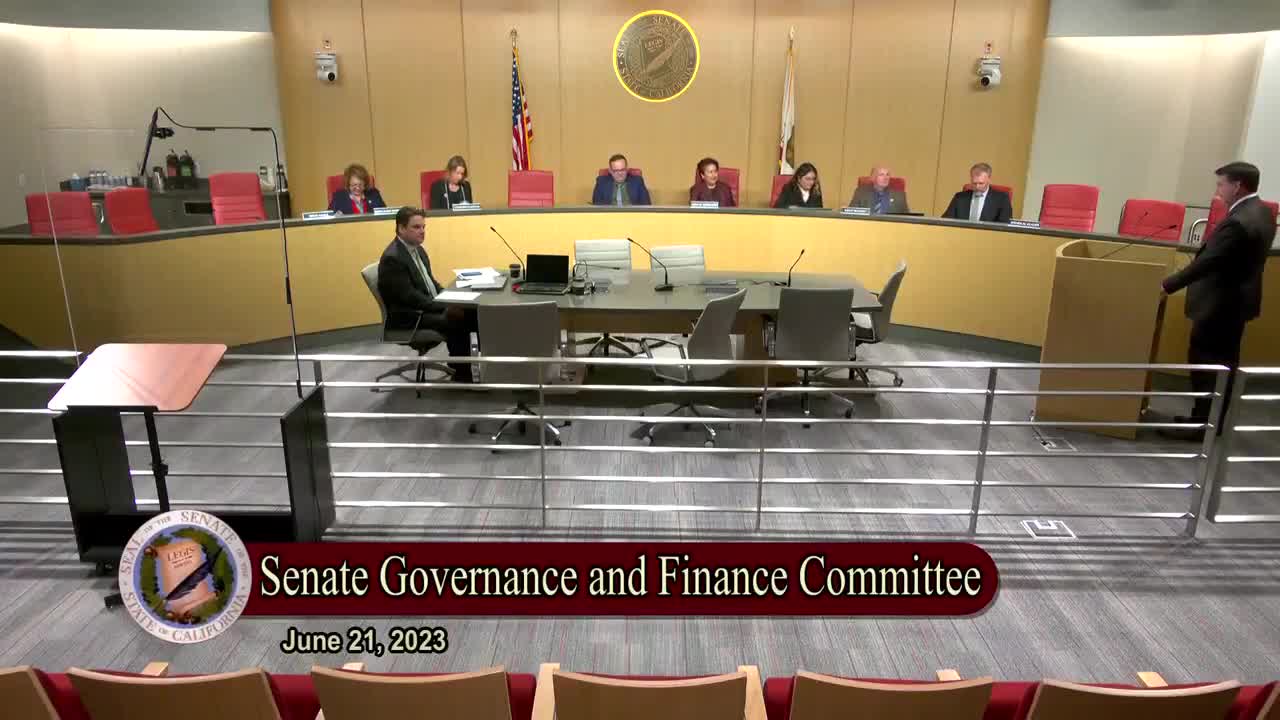 4MIN
Senate Standing Committee on Governance and Finance
Bill Author

Bill Co-Author(s):