AB 1287: Density Bonus Law: maximum allowable residential density: additional density bonus and incentives or concessions.
- Session Year: 2023-2024
- House: Assembly
- Latest Version Date: 2023-10-11
Current Status:
Passed
(2023-10-11: Chaptered by Secretary of State - Chapter 755, Statutes of 2023.)
Introduced
In Committee
First Chamber
In Committee
Second Chamber
Enacted
Existing law, referred to as the Density Bonus Law, requires a city or county to provide a developer that proposes a housing development within the city or county with a density bonus and other concessions or incentives or concessions, as specified, if the developer agrees to construct specified percentages of units for lower income households or very low income households, and meets other requirements. Existing law defines the term density bonus for these purposes to mean a density increase over the otherwise maximum allowable gross residential density as of the date of the application, as described. Existing law defines the term maximum allowable residential density for these purposes to mean the maximum number of units allowed under the zoning ordinance, specific plan, or land use element of the general plan, or, if a range of density is permitted, the maximum number of units allowed by the specific zoning range, specific plan, or land use element of the general plan applicable to the project. Existing law provides under that definition that if the density allowed under the zoning ordinance is inconsistent with the density allowed under the land use element of the general plan or specific plan, the greater density prevails.
This bill would instead define maximum allowable residential density to mean the greatest number of units allowed under the zoning ordinance, specific plan, or land use element of the general plan, or, if a range of density is permitted, the greatest number of units allowed by the specific zoning range, specific plan, or land use element of the general plan applicable to the project. The bill would also remove from that definition the provision stating that the greater density prevails if the density allowed under the zoning ordinance is inconsistent with the density allowed under the land use element of the general plan or specific plan.
This bill would require a city, county, or city and county to grant an additional density bonus, calculated as specified, when (1) an applicant proposes to construct a housing development that conforms to specified requirements, (2) the applicant agrees to include additional rental or for-sale units affordable to very low income households or moderate-income households, as specified, and (3) the housing development conforms to specified requirements and provides 24% of the total units to lower income households, conforms to specified requirements and provides 15% of the total units to very low income households, or conforms to specified requirements and provides 44% of the total units to moderate-income units. The bill would require a city, county, or city and county to grant four incentives or concessions for a project that includes at least 16% of the units for very low income households or at least 45% for persons and families of moderate income in a development in which the units are for sale. The bill would increase the incentives or concessions for a project in which 100% of all units are for lower income households, as specified, from 4 to 5.
The Density Bonus Law prohibits a local government from conditioning the submission, review, or approval of an application pursuant to the Density Bonus Law on the preparation of an additional report or study that is not otherwise required by state law, but provides that this provision does not prohibit a local government from requiring an applicant to provide reasonable documentation to establish eligibility for a requested density bonus, incentives or concessions, waivers or reductions of development standards, and parking ratios, as specified.
This bill would instead provide that this provision does not prohibit a local government from requiring an applicant to provide reasonable documentation to establish eligibility for a requested density bonus and parking ratios, as specified.
The California Constitution requires the state to reimburse local agencies and school districts for certain costs mandated by the state. Statutory provisions establish procedures for making that reimbursement.
This bill would provide that no reimbursement is required by this act for a specified reason.
This bill would incorporate additional changes to Section 65915 of the Government Code proposed by AB 323 and SB 713 to be operative only if this bill and either or both of those bills are enacted and this bill is enacted last.
Existing law, referred to as the Density Bonus Law, requires a city or county to provide a developer that proposes a housing development within the city or county with a density bonus and other concessions or incentives or concessions, as specified, if the developer agrees to construct specified percentages of units for lower income households or very low income households, and meets other requirements. Existing law defines the term density bonus for these purposes to mean a density increase over the otherwise maximum allowable gross residential density as of the date of the application, as described. Existing law defines the term maximum allowable residential density for these purposes to mean the maximum number of units allowed under the zoning ordinance, specific plan, or land use element of the general plan, or, if a range of density is permitted, the maximum number of units allowed by the specific zoning range, specific plan, or land use element of the general plan applicable to the project. Existing law provides under that definition that if the density allowed under the zoning ordinance is inconsistent with the density allowed under the land use element of the general plan or specific plan, the greater density prevails.
This bill would instead define maximum allowable residential density to mean the greatest number of units allowed under the zoning ordinance, specific plan, or land use element of the general plan, or, if a range of density is permitted, the greatest number of units allowed by the specific zoning range, specific plan, or land use element of the general plan applicable to the project. The bill would also remove from that definition the provision stating that the greater density prevails if the density allowed under the zoning ordinance is inconsistent with the density allowed under the land use element of the general plan or specific plan.
This bill would require a city, county, or city and county to grant an additional density bonus, calculated as specified, when (1) an applicant proposes to construct a housing development that conforms to specified requirements, (2) the applicant agrees to include additional rental or for-sale units affordable to very low income households or moderate-income households, as specified, and (3) the housing development conforms to specified requirements and provides 24% of the total units to lower income households, conforms to specified requirements and provides 15% of the total units to very low income households, or conforms to specified requirements and provides 44% of the total units to moderate-income units. The bill would require a city, county, or city and county to grant four incentives or concessions for a project that includes at least 16% of the units for very low income households or at least 45% for persons and families of moderate income in a development in which the units are for sale. The bill would increase the incentives or concessions for a project in which 100% of all units are for lower income households, as specified, from 4 to 5.
The Density Bonus Law prohibits a local government from conditioning the submission, review, or approval of an application pursuant to the Density Bonus Law on the preparation of an additional report or study that is not otherwise required by state law, but provides that this provision does not prohibit a local government from requiring an applicant to provide reasonable documentation to establish eligibility for a requested density bonus, incentives or concessions, waivers or reductions of development standards, and parking ratios, as specified.
This bill would instead provide that this provision does not prohibit a local government from requiring an applicant to provide reasonable documentation to establish eligibility for a requested density bonus and parking ratios, as specified.
The California Constitution requires the state to reimburse local agencies and school districts for certain costs mandated by the state. Statutory provisions establish procedures for making that reimbursement.
This bill would provide that no reimbursement is required by this act for a specified reason.
Existing law, referred to as the Density Bonus Law, requires a city or county to provide a developer that proposes a housing development within the city or county with a density bonus and other concessions or incentives or concessions, as specified, if the developer agrees to construct specified percentages of units for lower income households or very low income households, and meets other requirements.
This bill would require a city, county, or city and county to grant an additional density bonus, calculated as specified, when (1) an applicant proposes to construct a housing development that conforms to specified requirements, (2) the applicant agrees to include additional rental or for-sale units affordable to very low income households or moderate income moderate-income households, as specified, and (3) the housing development conforms to specified requirements and provides 24% of the total units to lower income households, conforms to specified requirements and provides 15% of the total units to very low income households, or conforms to specified requirements and provides 44% of the total units to moderate-income units. The bill would require a city, county, or city and county to grant four incentives or concessions for a project that includes at least 16% of the units for very low income households or at least 45% for persons and families of moderate income in a development in which the units are for sale. The bill would increase the incentives or concessions for a project in which 100% of all units are for lower income households, as specified, from 4 to 5.
The Density Bonus Law prohibits a local government from conditioning the submission, review, or approval of an application pursuant to the Density Bonus Law on the preparation of an additional report or study that is not otherwise required by state law, but provides that this provision does not prohibit a local government from requiring an applicant to provide reasonable documentation to establish eligibility for a requested density bonus, incentives or concessions, waivers or reductions of development standards, and parking ratios, as specified.
This bill would instead provide that this provision does not prohibit a local government from requiring an applicant to provide reasonable documentation to establish eligibility for a requested density bonus and parking ratios, as specified.
The California Constitution requires the state to reimburse local agencies and school districts for certain costs mandated by the state. Statutory provisions establish procedures for making that reimbursement.
This bill would provide that no reimbursement is required by this act for a specified reason.
Existing law, referred to as the Density Bonus Law, requires a city or county to provide a developer that proposes a housing development within the city or county with a density bonus and other concessions or incentives or concessions, as specified, if the developer agrees to construct specified percentages of units for lower income households or very low income households, and meets other requirements.
This bill would require a city, county, or city and county to grant an additional density bonus, calculated as specified, when (1) an applicant proposes to construct a housing development that conforms to specified requirements, (2) the applicant agrees to include additional rental or for-sale units affordable to very low income households or moderate income households, as specified, and (3) the housing development conforms to specified requirements and provides 24% of the base density total units to lower income households, conforms to specified requirements and provides 15% of the base density total units to very low income households, or conforms to specified requirements and provides 44% of the total units to moderate-income units. The bill would require a city, county, or city and county to grant four incentives or concessions for a project that includes at least 16% of the units for very low income households or at least 45% for persons and families of moderate income in a development in which the units are for sale. The bill would increase the incentives or concessions for a project in which 100% of all units are for lower income households, as specified, from 4 to 5.
The Density Bonus Law prohibits a local government from conditioning the submission, review, or approval of an application pursuant to the Density Bonus Law on the preparation of an additional report or study that is not otherwise required by state law, but provides that this provision does not prohibit a local government from requiring an applicant to provide reasonable documentation to establish eligibility for a requested density bonus, incentives or concessions, waivers or reductions of development standards, and parking ratios, as specified.
This bill would instead provide that this provision does not prohibit a local government from requiring an applicant to provide reasonable documentation to establish eligibility for a requested density bonus and parking ratios, as specified.
The California Constitution requires the state to reimburse local agencies and school districts for certain costs mandated by the state. Statutory provisions establish procedures for making that reimbursement.
This bill would provide that no reimbursement is required by this act for a specified reason.
Existing law, referred to as the Density Bonus Law, requires a city or county to provide a developer that proposes a housing development within the city or county with a density bonus and other concessions or incentives or concessions, as specified, if the developer agrees to construct specified percentages of units for lower income households or very low income households, and meets other requirements.
This bill would require a city, county, or city and county to grant an additional density bonus, calculated as specified, when (1) an applicant proposes to construct a housing development that conforms to specified requirements, (2) the applicant agrees to include additional units affordable to very low income households or moderate income households, as specified, and (3) the housing development provides 24% of the base density units to lower income households, conforms to specified requirements and provides 15% of the base density units to very low income households, or conforms to specified requirements and provides 44% of the total units to moderate-income units. The bill would require a city, county, or city and county to grant four incentives or concessions for a project that includes at least 16% of the units for very low income households or at least 45% for persons and families of moderate income in a development in which the units are for sale. The bill would increase the incentives or concessions for a project in which 100% of all units are for lower income households, as specified, from 4 to 5.
Existing law, the California Coastal Act of 1976 (act), regulates development, as defined, in the coastal zone, as defined, and requires a new development to comply with specified requirements. The Density Bonus Law provides that its provisions do not supersede or in any way alter or lessen the effect or application of the act, and requires that any density bonus, concessions, incentives, waivers or reductions of development standards, and parking ratios to which an applicant is entitled under the Density Bonus Law be permitted in a manner consistent with the act.This bill would provide that any density bonus, concessions, incentives, waivers or reductions of development standards, and parking ratios to which an applicant is entitled under the Density Bonus Law be permitted notwithstanding the act.The California Constitution requires the state to reimburse local agencies and school districts for certain costs mandated by the state. Statutory provisions establish procedures for making that reimbursement.
This bill would provide that no reimbursement is required by this act for a specified reason.
Existing law, referred to as the Density Bonus Law, requires a city or county to provide a developer that proposes a housing development within the city or county with a density bonus and other concessions or incentives or concessions, as specified, if the developer agrees to construct specified percentages of units for lower income households or very low income households, and meets other requirements.
This bill would require a city, county, or city and county to grant an additional density bonus, calculated as specified, when (1) an applicant proposes to construct a housing development that conforms to specified requirements and requirements, (2) the applicant agrees to include additional units affordable to very low income households or moderate income households, as specified, and (3) the housing development provides 24% of the base density units to lower income households, conforms to specified requirements and provides 15% of the base density units to very low income households, or conforms to specified requirements and provides 44% of the total units to moderate-income units. The bill would require a city, county, or city and county to grant additional four incentives or concessions for a project that meets any of those categories and also includes certain percentages of units for persons and families of moderate income. By imposing additional duties on local officials in administering the Density Bonus Law, this bill would create a state-mandated local program. includes at least 16% of the units for very low income households or at least 45% for persons and families of moderate income in a development in which the units are for sale. The bill would increase the incentives or concessions for a project in which 100% of all units are for lower income households, as specified, from 4 to 5.
Existing law, the California Coastal Act of 1976 (act), regulates development, as defined, in the coastal zone, as defined, and requires a new development to comply with specified requirements. The Density Bonus Law provides that its provisions do not supersede or in any way alter or lessen the effect or application of the act, and requires that any density bonus, concessions, incentives, waivers or reductions of development standards, and parking ratios to which an applicant is entitled under the Density Bonus Law be permitted in a manner consistent with the act.
This bill would provide that any density bonus, concessions, incentives, waivers or reductions of development standards, and parking ratios to which an applicant is entitled under the Density Bonus Law be permitted notwithstanding the act.
The California Constitution requires the state to reimburse local agencies and school districts for certain costs mandated by the state. Statutory provisions establish procedures for making that reimbursement.
This bill would provide that no reimbursement is required by this act for a specified reason.
Existing law, referred to as the Density Bonus Law, requires a city or county to provide a developer that proposes a housing development within the city or county with a density bonus and other concessions or incentives or concessions, as specified, if the developer agrees to construct specified percentages of units for lower income households or very low income households, and meets other requirements.
This bill would require a city, county, or city and county to grant an additional density bonus, calculated as specified, when an applicant proposes to construct a housing development that conforms to specified requirements and provides 24% of the base density units to lower income households, conforms to specified requirements and provides 15% of the base density units to very low income households, or conforms to specified requirements and provides 44% of the total units to moderate-income units. The bill would require a city, county, or city and county to grant additional incentives or concessions for a project that meets any of those categories and also includes certain percentages of units for persons and families of moderate income. By imposing additional duties on local officials in administering the Density Bonus Law, this bill would create a state-mandated local program.
Existing law, the California Coastal Act of 1976 (act), regulates development, as defined, in the coastal zone, as defined, and requires a new development to comply with specified requirements. The Density Bonus Law provides that its provisions do not supersede or in any way alter or lessen the effect or application of the act, and requires that any density bonus, concessions, incentives, waivers or reductions of development standards, and parking ratios to which an applicant is entitled under the Density Bonus Law be permitted in a manner consistent with the act.
This bill would provide that any density bonus, concessions, incentives, waivers or reductions of development standards, and parking ratios to which an applicant is entitled under the Density Bonus Law be permitted notwithstanding the act.
The California Constitution requires the state to reimburse local agencies and school districts for certain costs mandated by the state. Statutory provisions establish procedures for making that reimbursement.
This bill would provide that no reimbursement is required by this act for a specified reason.
(a)(1)When an applicant seeks a density bonus for a housing development within, or for the donation of land for housing within, the jurisdiction of a city, county, or city and county, that local government shall comply with this section. A city, county, or city and county shall adopt an ordinance that specifies how compliance with this section will be implemented. Except as otherwise provided in subdivision (s), failure to adopt an ordinance shall not relieve a city, county, or city and county from complying with this section.
(2)A local government shall not condition the submission, review, or approval of an application pursuant to this chapter on the preparation of an additional report or study that is not otherwise required by state law, including this section. This subdivision does not prohibit a local government from requiring an applicant to provide reasonable documentation to establish eligibility for a requested density bonus, as described in subdivision (b), and parking ratios, as described in subdivision (p).
(3)In order to provide for the expeditious processing of a density bonus application, the local government shall do all of the following:
(A)Adopt procedures and timelines for processing a density bonus application.
(B)Provide a list of all documents and information required to be submitted with the density bonus application in order for the density bonus application to be deemed complete. This list shall be consistent with this chapter.
(C)Notify the applicant for a density bonus whether the application is complete in a manner consistent with the timelines specified in Section 65943.
(D)(i)If the local government notifies the applicant that the application is deemed complete pursuant to subparagraph (C), provide the applicant with a determination as to the following matters:
(I)The amount of density bonus, calculated pursuant to subdivision (f), for which the applicant is eligible.
(II)If the applicant requests a parking ratio pursuant to subdivision (p), the parking ratio for which the applicant is eligible.
(III)If the applicant requests incentives or concessions pursuant to subdivision (d) or waivers or reductions of development standards pursuant to subdivision (e), whether the applicant has provided adequate information for the local government to make a determination as to those incentives, concessions, waivers, or reductions of development standards.
(ii)Any determination required by this subparagraph shall be based on the development project at the time the application is deemed complete. The local government shall adjust the amount of density bonus and parking ratios awarded pursuant to this section based on any changes to the project during the course of development.
(b)(1)A city, county, or city and county shall grant one density bonus, the amount of which shall be as specified in subdivision (f), and, if requested by the applicant and consistent with the applicable requirements of this section, incentives or concessions, as described in subdivision (d), waivers or reductions of development standards, as described in subdivision (e), and parking ratios, as described in subdivision (p), if an applicant for a housing development seeks and agrees to construct a housing development, excluding any units permitted by the density bonus awarded pursuant to this section, that will contain at least any one of the following:
(A)Ten percent of the total units of a housing development, including a shared housing building development, for rental or sale to lower income households, as defined in Section 50079.5 of the Health and Safety Code.
(B)Five percent of the total units of a housing development, including a shared housing building development, for rental or sale to very low income households, as defined in Section 50105 of the Health and Safety Code.
(C)A senior citizen housing development, as defined in Sections 51.3 and 51.12 of the Civil Code, or a mobilehome park that limits residency based on age requirements for housing for older persons pursuant to Section 798.76 or 799.5 of the Civil Code. For purposes of this subparagraph, development includes a shared housing building development.
(D)Ten percent of the total dwelling units of a housing development are sold to persons and families of moderate income, as defined in Section 50093 of the Health and Safety Code, provided that all units in the development are offered to the public for purchase.
(E)Ten percent of the total units of a housing development for transitional foster youth, as defined in Section 66025.9 of the Education Code, disabled veterans, as defined in Section 18541, or homeless persons, as defined in the federal McKinney-Vento Homeless Assistance Act (42 U.S.C. Sec. 11301 et seq.). The units described in this subparagraph are subject to a recorded affordability restriction of 55 years and shall be provided at the same affordability level as very low income units.
(F)(i)Twenty percent of the total units for lower income students in a student housing development that meets the following requirements:
(I)All units in the student housing development shall be used exclusively for undergraduate, graduate, or professional students enrolled full time at an institution of higher education accredited by the Western Association of Schools and Colleges or the Accrediting Commission for Community and Junior Colleges. In order to be eligible under this subclause, the developer shall, as a condition of receiving a certificate of occupancy, provide evidence to the city, county, or city and county that the developer has entered into an operating agreement or master lease with one or more institutions of higher education for the institution or institutions to occupy all units of the student housing development with students from that institution or institutions. An operating agreement or master lease entered into pursuant to this subclause is not violated or breached if, in any subsequent year, there are insufficient students enrolled in an institution of higher education to fill all units in the student housing development.
(II)The applicable 20-percent units shall be used for lower income students.
(III)The rent provided in the applicable units of the development for lower income students shall be calculated at 30 percent of 65 percent of the area median income for a single-room occupancy unit type.
(IV)The development shall provide priority for the applicable affordable units for lower income students experiencing homelessness. A homeless service provider, as defined in paragraph (3) of subdivision (e) of Section 103577 of the Health and Safety Code, or institution of higher education that has knowledge of a persons homeless status may verify a persons status as homeless for purposes of this subclause.
(ii)For purposes of calculating a density bonus granted pursuant to this subparagraph, the term unit as used in this section means one rental bed and its pro rata share of associated common area facilities. The units described in this subparagraph are subject to a recorded affordability restriction of 55 years.
(G)One hundred percent of all units in the development, including total units and density bonus units, but exclusive of a managers unit or units, are for lower income households, as defined by Section 50079.5 of the Health and Safety Code, except that up to 20 percent of the units in the development, including total units and density bonus units, may be for moderate-income households, as defined in Section 50053 of the Health and Safety Code. For purposes of this subparagraph, development includes a shared housing building development.
(2)For purposes of calculating the amount of the density bonus pursuant to subdivision (f), an applicant who requests a density bonus pursuant to this subdivision shall elect whether the bonus shall be awarded on the basis of subparagraph (A), (B), (C), (D), (E), (F), or (G) of paragraph (1).
(c)(1)(A)An applicant shall agree to, and the city, county, or city and county shall ensure, the continued affordability of all very low and low-income rental units that qualified the applicant for the award of the density bonus for 55 years or a longer period of time if required by the construction or mortgage financing assistance program, mortgage insurance program, or rental subsidy program.
(B)(i)Except as otherwise provided in clause (ii), rents for the lower income density bonus units shall be set at an affordable rent, as defined in Section 50053 of the Health and Safety Code.
(ii)For housing developments meeting the criteria of subparagraph (G) of paragraph (1) of subdivision (b), rents for all units in the development, including both base density and density bonus units, shall be as follows:
(I)The rent for at least 20 percent of the units in the development shall be set at an affordable rent, as defined in Section 50053 of the Health and Safety Code.
(II)The rent for the remaining units in the development shall be set at an amount consistent with the maximum rent levels for lower income households, as those rents and incomes are determined by the California Tax Credit Allocation Committee.
(2)(A)An applicant shall agree to ensure, and the city, county, or city and county shall ensure, that a for-sale unit that qualified the applicant for the award of the density bonus meets either of the following conditions:
(i)The unit is initially occupied by a person or family of very low, low, or moderate income, as required, and it is offered at an affordable housing cost, as that cost is defined in Section 50052.5 of the Health and Safety Code and is subject to an equity sharing agreement.
(ii)The unit is purchased by a qualified nonprofit housing corporation pursuant to a recorded contract that satisfies all of the requirements specified in paragraph (10) of subdivision (a) of Section 402.1 of the Revenue and Taxation Code and that includes all of the following:
(I)A repurchase option that requires a subsequent purchaser of the property that desires to resell or convey the property to offer the qualified nonprofit corporation the right to repurchase the property prior to selling or conveying that property to any other purchaser.
(II)An equity sharing agreement.
(III)Affordability restrictions on the sale and conveyance of the property that ensure that the property will be preserved for lower income housing for at least 45 years for owner-occupied housing units and will be sold or resold only to persons or families of very low, low, or moderate income, as defined in Section 50052.5 of the Health and Safety Code.
(B)For purposes of this paragraph, a qualified nonprofit housing corporation is a nonprofit housing corporation organized pursuant to Section 501(c)(3) of the Internal Revenue Code that has received a welfare exemption under Section 214.15 of the Revenue and Taxation Code for properties intended to be sold to low-income families who participate in a special no-interest loan program.
(C)The local government shall enforce an equity sharing agreement required pursuant to clause (i) or (ii) of subparagraph (A), unless it is in conflict with the requirements of another public funding source or law or may defer to the recapture provisions of the public funding source. The following apply to the equity sharing agreement:
(i)Upon resale, the seller of the unit shall retain the value of any improvements, the downpayment, and the sellers proportionate share of appreciation.
(ii)Except as provided in clause (v), the local government shall recapture any initial subsidy, as defined in clause (iii), and its proportionate share of appreciation, as defined in clause (iv), which amount shall be used within five years for any of the purposes described in subdivision (e) of Section 33334.2 of the Health and Safety Code that promote homeownership.
(iii)For purposes of this subdivision, the local governments initial subsidy shall be equal to the fair market value of the home at the time of initial sale minus the initial sale price to the moderate-income household, plus the amount of any downpayment assistance or mortgage assistance. If upon resale the market value is lower than the initial market value, then the value at the time of the resale shall be used as the initial market value.
(iv)For purposes of this subdivision, the local governments proportionate share of appreciation shall be equal to the ratio of the local governments initial subsidy to the fair market value of the home at the time of initial sale.
(v)If the unit is purchased or developed by a qualified nonprofit housing corporation pursuant to clause (ii) of subparagraph (A) the local government may enter into a contract with the qualified nonprofit housing corporation under which the qualified nonprofit housing corporation would recapture any initial subsidy and its proportionate share of appreciation if the qualified nonprofit housing corporation is required to use 100 percent of the proceeds to promote homeownership for lower income households as defined by Section 50079.5 of the Health and Safety Code within the jurisdiction of the local government.
(3)(A)An applicant shall be ineligible for a density bonus or any other incentives or concessions under this section if the housing development is proposed on any property that includes a parcel or parcels on which rental dwelling units are located or, if the dwelling units have been vacated or demolished in the five-year period preceding the application, have been subject to a recorded covenant, ordinance, or law that restricts rents to levels affordable to persons and families of lower or very low income; subject to any other form of rent or price control through a public entitys valid exercise of its police power; or occupied by lower or very low income households, unless the proposed housing development replaces those units, and either of the following applies:
(i)The proposed housing development, inclusive of the units replaced pursuant to this paragraph, contains affordable units at the percentages set forth in subdivision (b).
(ii)Each unit in the development, exclusive of a managers unit or units, is affordable to, and occupied by, either a lower or very low income household.
(B)For the purposes of this paragraph, replace shall mean either of the following:
(i)If any dwelling units described in subparagraph (A) are occupied on the date of application, the proposed housing development shall provide at least the same number of units of equivalent size to be made available at affordable rent or affordable housing cost to, and occupied by, persons and families in the same or lower income category as those households in occupancy. If the income category of the household in occupancy is not known, it shall be rebuttably presumed that lower income renter households occupied these units in the same proportion of lower income renter households to all renter households within the jurisdiction, as determined by the most recently available data from the United States Department of Housing and Urban Developments Comprehensive Housing Affordability Strategy database. For unoccupied dwelling units described in subparagraph (A) in a development with occupied units, the proposed housing development shall provide units of equivalent size to be made available at affordable rent or affordable housing cost to, and occupied by, persons and families in the same or lower income category as the last household in occupancy. If the income category of the last household in occupancy is not known, it shall be rebuttably presumed that lower income renter households occupied these units in the same proportion of lower income renter households to all renter households within the jurisdiction, as determined by the most recently available data from the United States Department of Housing and Urban Developments Comprehensive Housing Affordability Strategy database. All replacement calculations resulting in fractional units shall be rounded up to the next whole number. If the replacement units will be rental dwelling units, these units shall be subject to a recorded affordability restriction for at least 55 years. If the proposed development is for-sale units, the units replaced shall be subject to paragraph (2).
(ii)If all dwelling units described in subparagraph (A) have been vacated or demolished within the five-year period preceding the application, the proposed housing development shall provide at least the same number of units of equivalent size as existed at the highpoint of those units in the five-year period preceding the application to be made available at affordable rent or affordable housing cost to, and occupied by, persons and families in the same or lower income category as those persons and families in occupancy at that time, if known. If the incomes of the persons and families in occupancy at the highpoint is not known, it shall be rebuttably presumed that low-income and very low income renter households occupied these units in the same proportion of low-income and very low income renter households to all renter households within the jurisdiction, as determined by the most recently available data from the United States Department of Housing and Urban Developments Comprehensive Housing Affordability Strategy database. All replacement calculations resulting in fractional units shall be rounded up to the next whole number. If the replacement units will be rental dwelling units, these units shall be subject to a recorded affordability restriction for at least 55 years. If the proposed development is for-sale units, the units replaced shall be subject to paragraph (2).
(C)Notwithstanding subparagraph (B), for any dwelling unit described in subparagraph (A) that is or was, within the five-year period preceding the application, subject to a form of rent or price control through a local governments valid exercise of its police power and that is or was occupied by persons or families above lower income, the city, county, or city and county may do either of the following:
(i)Require that the replacement units be made available at affordable rent or affordable housing cost to, and occupied by, low-income persons or families. If the replacement units will be rental dwelling units, these units shall be subject to a recorded affordability restriction for at least 55 years. If the proposed development is for-sale units, the units replaced shall be subject to paragraph (2).
(ii)Require that the units be replaced in compliance with the jurisdictions rent or price control ordinance, provided that each unit described in subparagraph (A) is replaced. Unless otherwise required by the jurisdictions rent or price control ordinance, these units shall not be subject to a recorded affordability restriction.
(D)For purposes of this paragraph, equivalent size means that the replacement units contain at least the same total number of bedrooms as the units being replaced.
(E)Subparagraph (A) does not apply to an applicant seeking a density bonus for a proposed housing development if the applicants application was submitted to, or processed by, a city, county, or city and county before January 1, 2015.
(d)(1)An applicant for a density bonus pursuant to subdivision (b) may submit to a city, county, or city and county a proposal for the specific incentives or concessions that the applicant requests pursuant to this section, and may request a meeting with the city, county, or city and county. The city, county, or city and county shall grant the concession or incentive requested by the applicant unless the city, county, or city and county makes a written finding, based upon substantial evidence, of any of the following:
(A)The concession or incentive does not result in identifiable and actual cost reductions, consistent with subdivision (k), to provide for affordable housing costs, as defined in Section 50052.5 of the Health and Safety Code, or for rents for the targeted units to be set as specified in subdivision (c).
(B)The concession or incentive would have a specific, adverse impact, as defined in paragraph (2) of subdivision (d) of Section 65589.5, upon public health and safety or on any real property that is listed in the California Register of Historical Resources and for which there is no feasible method to satisfactorily mitigate or avoid the specific, adverse impact without rendering the development unaffordable to low-income and moderate-income households.
(C)The concession or incentive would be contrary to state or federal law.
(2)The applicant shall receive the following number of incentives or concessions:
(A)One incentive or concession for projects that include at least 10 percent of the total units for lower income households, at least 5 percent for very low income households, or at least 10 percent for persons and families of moderate income in a development in which the units are for sale.
(B)Two incentives or concessions for projects that include at least 17 percent of the total units for lower income households, at least 10 percent for very low income households, or at least 20 percent for persons and families of moderate income in a development in which the units are for sale.
(C)Three incentives or concessions for projects that include at least 24 percent of the total units for lower income households, at least 15 percent for very low income households, or at least 30 percent for persons and families of moderate income in a development in which the units are for sale.
(D)Five incentives or concessions for a project meeting the criteria of subparagraph (G) of paragraph (1) of subdivision (b). If the project is located within one-half mile of a major transit stop or is located in a very low vehicle travel area in a designated county, the applicant shall also receive a height increase of up to three additional stories, or 33 feet.
(E)One incentive or concession for projects that include at least 20 percent of the total units for lower income students in a student housing development.
(F)Four incentives or concessions for projects that include at least 16 percent of the units for very low income households or at least 45 percent for persons and families of moderate income in a development in which the units are for sale.
(3)The applicant may initiate judicial proceedings if the city, county, or city and county refuses to grant a requested density bonus, incentive, or concession. If a court finds that the refusal to grant a requested density bonus, incentive, or concession is in violation of this section, the court shall award the plaintiff reasonable attorneys fees and costs of suit. This subdivision shall not be interpreted to require a local government to grant an incentive or concession that has a specific, adverse impact, as defined in paragraph (2) of subdivision (d) of Section 65589.5, upon health or safety, and for which there is no feasible method to satisfactorily mitigate or avoid the specific, adverse impact. This subdivision shall not be interpreted to require a local government to grant an incentive or concession that would have an adverse impact on any real property that is listed in the California Register of Historical Resources. The city, county, or city and county shall establish procedures for carrying out this section that shall include legislative body approval of the means of compliance with this section.
(4)The city, county, or city and county shall bear the burden of proof for the denial of a requested concession or incentive.
(e)(1)In no case may a city, county, or city and county apply any development standard that will have the effect of physically precluding the construction of a development meeting the criteria of subdivision (b) at the densities or with the concessions or incentives permitted by this section. Subject to paragraph (3), an applicant may submit to a city, county, or city and county a proposal for the waiver or reduction of development standards that will have the effect of physically precluding the construction of a development meeting the criteria of subdivision (b) at the densities or with the concessions or incentives permitted under this section, and may request a meeting with the city, county, or city and county. If a court finds that the refusal to grant a waiver or reduction of development standards is in violation of this section, the court shall award the plaintiff reasonable attorneys fees and costs of suit. This subdivision shall not be interpreted to require a local government to waive or reduce development standards if the waiver or reduction would have a specific, adverse impact, as defined in paragraph (2) of subdivision (d) of Section 65589.5, upon health or safety, and for which there is no feasible method to satisfactorily mitigate or avoid the specific, adverse impact. This subdivision shall not be interpreted to require a local government to waive or reduce development standards that would have an adverse impact on any real property that is listed in the California Register of Historical Resources, or to grant any waiver or reduction that would be contrary to state or federal law.
(2)A proposal for the waiver or reduction of development standards pursuant to this subdivision shall neither reduce nor increase the number of incentives or concessions to which the applicant is entitled pursuant to subdivision (d).
(3)A housing development that receives a waiver from any maximum controls on density pursuant to clause (ii) of subparagraph (D) of paragraph (3) of subdivision (f) shall only be eligible for a waiver or reduction of development standards as provided in subparagraph (D) of paragraph (2) of subdivision (d) and clause (ii) of subparagraph (D) of paragraph (3) of subdivision (f), unless the city, county, or city and county agrees to additional waivers or reductions of development standards.
(f)For the purposes of this chapter, density bonus means a density increase over the otherwise maximum allowable gross residential density as of the date of application by the applicant to the city, county, or city and county, or, if elected by the applicant, a lesser percentage of density increase, including, but not limited to, no increase in density. The amount of density increase to which the applicant is entitled shall vary according to the amount by which the percentage of affordable housing units exceeds the percentage established in subdivision (b).
(1)For housing developments meeting the criteria of subparagraph (A) of paragraph (1) of subdivision (b), the density bonus shall be calculated as follows:
| Percentage Low-Income Units | Percentage Density Bonus |
| 10 | 20 |
| 11 | 21.5 |
| 12 | 23 |
| 13 | 24.5 |
| 14 | 26 |
| 15 | 27.5 |
| 16 | 29 |
| 17 | 30.5 |
| 18 | 32 |
| 19 | 33.5 |
| 20 | 35 |
| 21 | 38.75 |
| 22 | 42.5 |
| 23 | 46.25 |
| 24 | 50 |
(2)For housing developments meeting the criteria of subparagraph (B) of paragraph (1) of subdivision (b), the density bonus shall be calculated as follows:
| Percentage Very Low Income Units | Percentage Density Bonus |
| 5 | 20 |
| 6 | 22.5 |
| 7 | 25 |
| 8 | 27.5 |
| 9 | 30 |
| 10 | 32.5 |
| 11 | 35 |
| 12 | 38.75 |
| 13 | 42.5 |
| 14 | 46.25 |
| 15 | 50 |
(3)(A)For housing developments meeting the criteria of subparagraph (C) of paragraph (1) of subdivision (b), the density bonus shall be 20 percent of the number of senior housing units.
(B)For housing developments meeting the criteria of subparagraph (E) of paragraph (1) of subdivision (b), the density bonus shall be 20 percent of the number of the type of units giving rise to a density bonus under that subparagraph.
(C)For housing developments meeting the criteria of subparagraph (F) of paragraph (1) of subdivision (b), the density bonus shall be 35 percent of the student housing units.
(D)For housing developments meeting the criteria of subparagraph (G) of paragraph (1) of subdivision (b), the following shall apply:
(i)Except as otherwise provided in clauses (ii) and (iii), the density bonus shall be 80 percent of the number of units for lower income households.
(ii)If the housing development is located within one-half mile of a major transit stop, the city, county, or city and county shall not impose any maximum controls on density.
(iii)If the housing development is located in a very low vehicle travel area within a designated county, the city, county, or city and county shall not impose any maximum controls on density.
(4)For housing developments meeting the criteria of subparagraph (D) of paragraph (1) of subdivision (b), the density bonus shall be calculated as follows:
| Percentage Moderate-Income Units | Percentage Density Bonus |
| 10 | 5 |
| 11 | 6 |
| 12 | 7 |
| 13 | 8 |
| 14 | 9 |
| 15 | 10 |
| 16 | 11 |
| 17 | 12 |
| 18 | 13 |
| 19 | 14 |
| 20 | 15 |
| 21 | 16 |
| 22 | 17 |
| 23 | 18 |
| 24 | 19 |
| 25 | 20 |
| 26 | 21 |
| 27 | 22 |
| 28 | 23 |
| 29 | 24 |
| 30 | 25 |
| 31 | 26 |
| 32 | 27 |
| 33 | 28 |
| 34 | 29 |
| 35 | 30 |
| 36 | 31 |
| 37 | 32 |
| 38 | 33 |
| 39 | 34 |
| 40 | 35 |
| 41 | 38.75 |
| 42 | 42.5 |
| 43 | 46.25 |
| 44 | 50 |
(5)All density calculations resulting in fractional units shall be rounded up to the next whole number. The granting of a density bonus shall not require, or be interpreted, in and of itself, to require a general plan amendment, local coastal plan amendment, zoning change, or other discretionary approval.
(g)(1)When an applicant for a tentative subdivision map, parcel map, or other residential development approval donates land to a city, county, or city and county in accordance with this subdivision, the applicant shall be entitled to a 15-percent increase above the otherwise maximum allowable residential density for the entire development, as follows:
| Percentage Very Low Income | Percentage Density Bonus |
| 10 | 15 |
| 11 | 16 |
| 12 | 17 |
| 13 | 18 |
| 14 | 19 |
| 15 | 20 |
| 16 | 21 |
| 17 | 22 |
| 18 | 23 |
| 19 | 24 |
| 20 | 25 |
| 21 | 26 |
| 22 | 27 |
| 23 | 28 |
| 24 | 29 |
| 25 | 30 |
| 26 | 31 |
| 27 | 32 |
| 28 | 33 |
| 29 | 34 |
| 30 | 35 |
(2)This increase shall be in addition to any increase in density mandated by subdivision (b), up to a maximum combined mandated density increase of 35 percent if an applicant seeks an increase pursuant to both this subdivision and subdivision (b). All density calculations resulting in fractional units shall be rounded up to the next whole number. Nothing in this subdivision shall be construed to enlarge or diminish the authority of a city, county, or city and county to require a developer to donate land as a condition of development. An applicant shall be eligible for the increased density bonus described in this subdivision if all of the following conditions are met:
(A)The applicant donates and transfers the land no later than the date of approval of the final subdivision map, parcel map, or residential development application.
(B)The developable acreage and zoning classification of the land being transferred are sufficient to permit construction of units affordable to very low income households in an amount not less than 10 percent of the number of residential units of the proposed development.
(C)The transferred land is at least one acre in size or of sufficient size to permit development of at least 40 units, has the appropriate general plan designation, is appropriately zoned with appropriate development standards for development at the density described in paragraph (3) of subdivision (c) of Section 65583.2, and is or will be served by adequate public facilities and infrastructure.
(D)The transferred land shall have all of the permits and approvals, other than building permits, necessary for the development of the very low income housing units on the transferred land, not later than the date of approval of the final subdivision map, parcel map, or residential development application, except that the local government may subject the proposed development to subsequent design review to the extent authorized by subdivision (i) of Section 65583.2 if the design is not reviewed by the local government before the time of transfer.
(E)The transferred land and the affordable units shall be subject to a deed restriction ensuring continued affordability of the units consistent with paragraphs (1) and (2) of subdivision (c), which shall be recorded on the property at the time of the transfer.
(F)The land is transferred to the local agency or to a housing developer approved by the local agency. The local agency may require the applicant to identify and transfer the land to the developer.
(G)The transferred land shall be within the boundary of the proposed development or, if the local agency agrees, within one-quarter mile of the boundary of the proposed development.
(H)A proposed source of funding for the very low income units shall be identified not later than the date of approval of the final subdivision map, parcel map, or residential development application.
(h)(1)When an applicant proposes to construct a housing development that conforms to the requirements of subdivision (b) and includes a childcare facility that will be located on the premises of, as part of, or adjacent to, the project, the city, county, or city and county shall grant either of the following:
(A)An additional density bonus that is an amount of square feet of residential space that is equal to or greater than the amount of square feet in the childcare facility.
(B)An additional concession or incentive that contributes significantly to the economic feasibility of the construction of the childcare facility.
(2)The city, county, or city and county shall require, as a condition of approving the housing development, that the following occur:
(A)The childcare facility shall remain in operation for a period of time that is as long as or longer than the period of time during which the density bonus units are required to remain affordable pursuant to subdivision (c).
(B)Of the children who attend the childcare facility, the children of very low income households, lower income households, or families of moderate income shall equal a percentage that is equal to or greater than the percentage of dwelling units that are required for very low income households, lower income households, or families of moderate income pursuant to subdivision (b).
(3)Notwithstanding any requirement of this subdivision, a city, county, or city and county shall not be required to provide a density bonus or concession for a childcare facility if it finds, based upon substantial evidence, that the community has adequate childcare facilities.
(4)Childcare facility, as used in this section, means a child daycare facility other than a family daycare home, including, but not limited to, infant centers, preschools, extended daycare facilities, and schoolage childcare centers.
(i)Housing development, as used in this section, means a development project for five or more residential units, including mixed-use developments. For the purposes of this section, housing development also includes a subdivision or common interest development, as defined in Section 4100 of the Civil Code, approved by a city, county, or city and county and consists of residential units or unimproved residential lots and either a project to substantially rehabilitate and convert an existing commercial building to residential use or the substantial rehabilitation of an existing multifamily dwelling, as defined in subdivision (d) of Section 65863.4, where the result of the rehabilitation would be a net increase in available residential units. For the purpose of calculating a density bonus, the residential units shall be on contiguous sites that are the subject of one development application, but do not have to be based upon individual subdivision maps or parcels. The density bonus shall be permitted in geographic areas of the housing development other than the areas where the units for the lower income households are located.
(j)(1)The granting of a concession or incentive shall not require or be interpreted, in and of itself, to require a general plan amendment, local coastal plan amendment, zoning change, study, or other discretionary approval. For purposes of this subdivision, study does not include reasonable documentation to establish eligibility for the concession or incentive or to demonstrate that the incentive or concession meets the definition set forth in subdivision (k). This provision is declaratory of existing law.
(2)Except as provided in subdivisions (d) and (e), the granting of a density bonus shall not require or be interpreted to require the waiver of a local ordinance or provisions of a local ordinance unrelated to development standards.
(k)For the purposes of this chapter, concession or incentive means any of the following:
(1)A reduction in site development standards or a modification of zoning code requirements or architectural design requirements that exceed the minimum building standards approved by the California Building Standards Commission as provided in Part 2.5 (commencing with Section 18901) of Division 13 of the Health and Safety Code, including, but not limited to, a reduction in setback and square footage requirements and in the ratio of vehicular parking spaces that would otherwise be required that results in identifiable and actual cost reductions, to provide for affordable housing costs, as defined in Section 50052.5 of the Health and Safety Code, or for rents for the targeted units to be set as specified in subdivision (c).
(2)Approval of mixed-use zoning in conjunction with the housing project if commercial, office, industrial, or other land uses will reduce the cost of the housing development and if the commercial, office, industrial, or other land uses are compatible with the housing project and the existing or planned development in the area where the proposed housing project will be located.
(3)Other regulatory incentives or concessions proposed by the developer or the city, county, or city and county that result in identifiable and actual cost reductions to provide for affordable housing costs, as defined in Section 50052.5 of the Health and Safety Code, or for rents for the targeted units to be set as specified in subdivision (c).
(l)Subdivision (k) does not limit or require the provision of direct financial incentives for the housing development, including the provision of publicly owned land, by the city, county, or city and county, or the waiver of fees or dedication requirements.
(m)This section does not supersede or in any way alter or lessen the effect or application of the California Coastal Act of 1976 (Division 20 (commencing with Section 30000) of the Public Resources Code). Any density bonus, concessions, incentives, waivers or reductions of development standards, and parking ratios to which the applicant is entitled under this section shall be permitted in a manner that is consistent with this section and Division 20 (commencing with Section 30000) of the Public Resources Code.
(n)If permitted by local ordinance, nothing in this section shall be construed to prohibit a city, county, or city and county from granting a density bonus greater than what is described in this section for a development that meets the requirements of this section or from granting a proportionately lower density bonus than what is required by this section for developments that do not meet the requirements of this section.
(o)For purposes of this section, the following definitions shall apply:
(1)Designated county includes the Counties of Alameda, Contra Costa, Los Angeles, Marin, Napa, Orange, Riverside, Sacramento, San Bernardino, San Diego, San Mateo, Santa Barbara, Santa Clara, Solano, Sonoma, and Ventura, and the City and County of San Francisco.
(2)Development standard includes a site or construction condition, including, but not limited to, a height limitation, a setback requirement, a floor area ratio, an onsite open-space requirement, a minimum lot area per unit requirement, or a parking ratio that applies to a residential development pursuant to any ordinance, general plan element, specific plan, charter, or other local condition, law, policy, resolution, or regulation.
(3)Located within one-half mile of a major transit stop means that any point on a proposed development, for which an applicant seeks a density bonus, other incentives or concessions, waivers or reductions of development standards, or a vehicular parking ratio pursuant to this section, is within one-half mile of any point on the property on which a major transit stop is located, including any parking lot owned by the transit authority or other local agency operating the major transit stop.
(4)Lower income student means a student who has a household income and asset level that does not exceed the level for Cal Grant A or Cal Grant B award recipients as set forth in paragraph (1) of subdivision (k) of Section 69432.7 of the Education Code. The eligibility of a student to occupy a unit for lower income students under this section shall be verified by an affidavit, award letter, or letter of eligibility provided by the institution of higher education in which the student is enrolled or by the California Student Aid Commission that the student receives or is eligible for financial aid, including an institutional grant or fee waiver from the college or university, the California Student Aid Commission, or the federal government.
(5)Major transit stop has the same meaning as defined in subdivision (b) of Section 21155 of the Public Resources Code.
(6)Maximum allowable residential density or base density means the greatest number of units allowed under the zoning ordinance, specific plan, or land use element of the general plan, or, if a range of density is permitted, means the greatest number of units allowed by the specific zoning range, specific plan, or land use element of the general plan applicable to the project. Density shall be determined using dwelling units per acre. However, if the applicable zoning ordinance, specific plan, or land use element of the general plan does not provide a dwelling-units-per-acre standard for density, then the local agency shall calculate the number of units by:
(A)Estimating the realistic development capacity of the site based on the objective development standards applicable to the project, including, but not limited to, floor area ratio, site coverage, maximum building height and number of stories, building setbacks and stepbacks, public and private open-space requirements, minimum percentage or square footage of any nonresidential component, and parking requirements, unless not required for the base project. Parking requirements shall include considerations regarding number of spaces, location, design, type, and circulation. A developer may provide a base density study and the local agency shall accept it, provided that it includes all applicable objective development standards.
(B)Maintaining the same average unit size and other project details relevant to the base density study, excepting those that may be modified by waiver or concession to accommodate the bonus units, in the proposed project as in the study.
(7)(A)(i)Shared housing building means a residential or mixed-use structure, with five or more shared housing units and one or more common kitchens and dining areas designed for permanent residence of more than 30 days by its tenants. The kitchens and dining areas within the shared housing building shall be able to adequately accommodate all residents. If a local ordinance further restricts the attributes of a shared housing building beyond the requirements established in this section, the local definition shall apply to the extent that it does not conflict with the requirements of this section.
(ii)A shared housing building may include other dwelling units that are not shared housing units, provided that those dwelling units do not occupy more than 25 percent of the floor area of the shared housing building. A shared housing building may include 100 percent shared housing units.
(B)Shared housing unit means one or more habitable rooms, not within another dwelling unit, that includes a bathroom, sink, refrigerator, and microwave, is used for permanent residence, that meets the minimum room area specified in Section R304 of the California Residential Code (Part 2.5 of Title 24 of the California Code of Regulations), and complies with the definition of guestroom in Section R202 of the California Residential Code. If a local ordinance further restricts the attributes of a shared housing building beyond the requirements established in this section, the local definition shall apply to the extent that it does not conflict with the requirements of this section.
(8)(A)Total units or total dwelling units means a calculation of the number of units that:
(i)Excludes a unit added by a density bonus awarded pursuant to this section or any local law granting a greater density bonus.
(ii)Includes a unit designated to satisfy an inclusionary zoning requirement of a city, county, or city and county.
(B)For purposes of calculating a density bonus granted pursuant to this section for a shared housing building, unit means one shared housing unit and its pro rata share of associated common area facilities.
(9)Very low vehicle travel area means an urbanized area, as designated by the United States Census Bureau, where the existing residential development generates vehicle miles traveled per capita that is below 85 percent of either regional vehicle miles traveled per capita or city vehicle miles traveled per capita. For purposes of this paragraph, area may include a travel analysis zone, hexagon, or grid. For the purposes of determining regional vehicle miles traveled per capita pursuant to this paragraph, a region is the entirety of incorporated and unincorporated areas governed by a multicounty or single-county metropolitan planning organization, or the entirety of the incorporated and unincorporated areas of an individual county that is not part of a metropolitan planning organization.
(p)(1)Except as provided in paragraphs (2), (3), and (4), upon the request of the developer, a city, county, or city and county shall not require a vehicular parking ratio, inclusive of parking for persons with a disability and guests, of a development meeting the criteria of subdivisions (b) and (c), that exceeds the following ratios:
(A)Zero to one bedroom: one onsite parking space.
(B)Two to three bedrooms: one and one-half onsite parking spaces.
(C)Four and more bedrooms: two and one-half parking spaces.
(2)(A)Notwithstanding paragraph (1), if a development includes at least 20 percent low-income units for housing developments meeting the criteria of subparagraph (A) of paragraph (1) of subdivision (b) or at least 11 percent very low income units for housing developments meeting the criteria of subparagraph (B) of paragraph (1) of subdivision (b), is located within one-half mile of a major transit stop, and there is unobstructed access to the major transit stop from the development, then, upon the request of the developer, a city, county, or city and county shall not impose a vehicular parking ratio, inclusive of parking for persons with a disability and guests, that exceeds 0.5 spaces per unit. Notwithstanding paragraph (1), if a development includes at least 40 percent moderate-income units for housing developments meeting the criteria of subparagraph (D) of paragraph (1) of subdivision (b), is located within one-half mile of a major transit stop, as defined in subdivision (b) of Section 21155 of the Public Resources Code, and the residents of the development have unobstructed access to the major transit stop from the development then, upon the request of the developer, a city, county, or city and county shall not impose a vehicular parking ratio, inclusive of parking for persons with a disability and guests, that exceeds 0.5 spaces per bedroom.
(B)For purposes of this subdivision, unobstructed access to the major transit stop means a resident is able to access the major transit stop without encountering natural or constructed impediments. For purposes of this subparagraph, natural or constructed impediments includes, but is not limited to, freeways, rivers, mountains, and bodies of water, but does not include residential structures, shopping centers, parking lots, or rails used for transit.
(3)Notwithstanding paragraph (1), if a development meets the criteria of subparagraph (G) of paragraph (1) of subdivision (b), then, upon the request of the developer, a city, county, or city and county shall not impose vehicular parking standards if the development meets any of the following criteria:
(A)The development is located within one-half mile of a major transit stop and there is unobstructed access to the major transit stop from the development.
(B)The development is a for-rent housing development for individuals who are 55 years of age or older that complies with Sections 51.2 and 51.3 of the Civil Code and the development has either paratransit service or unobstructed access, within one-half mile, to fixed bus route service that operates at least eight times per day.
(C)The development is either a special needs housing development, as defined in Section 51312 of the Health and Safety Code, or a supportive housing development, as defined in Section 50675.14 of the Health and Safety Code. A development that is a special needs housing development shall have either paratransit service or unobstructed access, within one-half mile, to fixed bus route service that operates at least eight times per day.
(4)If the total number of parking spaces required for a development is other than a whole number, the number shall be rounded up to the next whole number. For purposes of this subdivision, a development may provide onsite parking through tandem parking or uncovered parking, but not through onstreet parking.
(5)This subdivision shall apply to a development that meets the requirements of subdivisions (b) and (c), but only at the request of the applicant. An applicant may request parking incentives or concessions beyond those provided in this subdivision pursuant to subdivision (d).
(6)This subdivision does not preclude a city, county, or city and county from reducing or eliminating a parking requirement for development projects of any type in any location.
(7)Notwithstanding paragraphs (2) and (3), if a city, county, city and county, or an independent consultant has conducted an areawide or jurisdictionwide parking study in the last seven years, then the city, county, or city and county may impose a higher vehicular parking ratio not to exceed the ratio described in paragraph (1), based upon substantial evidence found in the parking study, that includes, but is not limited to, an analysis of parking availability, differing levels of transit access, walkability access to transit services, the potential for shared parking, the effect of parking requirements on the cost of market-rate and subsidized developments, and the lower rates of car ownership for low-income and very low income individuals, including seniors and special needs individuals. The city, county, or city and county shall pay the costs of any new study. The city, county, or city and county shall make findings, based on a parking study completed in conformity with this paragraph, supporting the need for the higher parking ratio.
(8)A request pursuant to this subdivision shall neither reduce nor increase the number of incentives or concessions to which the applicant is entitled pursuant to subdivision (d).
(q)Each component of any density calculation, including base density and bonus density, resulting in fractional units shall be separately rounded up to the next whole number. The Legislature finds and declares that this provision is declaratory of existing law.
(r)This chapter shall be interpreted liberally in favor of producing the maximum number of total housing units.
(s)Notwithstanding any other law, if a city, including a charter city, county, or city and county has adopted an ordinance or a housing program, or both an ordinance and a housing program, that incentivizes the development of affordable housing that allows for density bonuses that exceed the density bonuses required by the version of this section effective through December 31, 2020, that city, county, or city and county is not required to amend or otherwise update its ordinance or corresponding affordable housing incentive program to comply with the amendments made to this section by the act adding this subdivision, and is exempt from complying with the incentive and concession calculation amendments made to this section by the act adding this subdivision as set forth in subdivision (d), particularly subparagraphs (B) and (C) of paragraph (2) of that subdivision, and the amendments made to the density tables under subdivision (f).
(t)When an applicant proposes to construct a housing development that conforms to the requirements of subparagraph (A) or (B) of paragraph (1) of subdivision (b) that is a shared housing building, the city, county, or city and county shall not require any minimum unit size requirements or minimum bedroom requirements that are in conflict with paragraph (7) of subdivision (o).
(u)(1)The Legislature finds and declares that the intent behind the Density Bonus Law is to allow public entities to reduce or even eliminate subsidies for a particular project by allowing a developer to include more total units in a project than would otherwise be allowed by the local zoning ordinance in exchange for affordable units. It further reaffirms that the intent is to cover at least some of the financing gap of affordable housing with regulatory incentives, rather than additional public subsidy.
(2)It is therefore the intent of the Legislature to make modifications to the Density Bonus Law by the act adding this subdivision to further incentivize the construction of very low, low-, and moderate-income housing units. It is further the intent of the Legislature in making these modifications to the Density Bonus Law to ensure that any additional benefits conferred upon a developer are balanced with the receipt of a public benefit in the form of adequate levels of affordable housing. The Legislature further intends that these modifications will ensure that the Density Bonus Law creates incentives for the construction of more housing across all areas of the state.
(v)(1)Provided that the resulting housing development would not restrict more than 50 percent of the total units to moderate-income, lower income, or very low income households, a city, county, or city and county shall grant an additional density bonus calculated pursuant to paragraph (2) when an applicant proposes to construct a housing development that conforms to the requirements of paragraph (1) of subdivision (b), agrees to include additional rental or for-sale units affordable to very low income households or moderate income households, and meets any of the following requirements:
(A)The housing development conforms to the requirements of subparagraph (A) of paragraph (1) of subdivision (b) and provides 24 percent of the total units to lower income households.
(B)The housing development conforms to the requirements of subparagraph (B) of paragraph (1) of subdivision (b) and provides 15 percent of the total units to very low income households.
(C)The housing development conforms to the requirements of subparagraph (D) of paragraph (1) of subdivision (b) and provides 44 percent of the total units to moderate-income households.
(2)A city, county, or city and county shall grant an additional density bonus for a housing development that meets the requirements of paragraph (1), calculated as follows:
| Percentage Very Low Income Units | Percentage Density Bonus |
| 5 | 20 |
| 6 | 23.75 |
| 7 | 27.5 |
| 8 | 31.25 |
| 9 | 35 |
| 10 | 38.75 |
| Percentage Moderate-Income Units | Percentage Density Bonus |
| 5 | 20 |
| 6 | 22.5 |
| 7 | 25 |
| 8 | 27.5 |
| 9 | 30 |
| 10 | 32.5 |
| 11 | 35 |
| 12 | 38.75 |
| 13 | 42.5 |
| 14 | 46.25 |
| 15 | 50 |
(3)The increase required by paragraphs (1) and (2) shall be in addition to any increase in density granted by subdivision (b).
(4)The additional density bonus required under this subdivision shall be calculated using the number of units excluding any density bonus awarded by this section.
SEC. 1.1.Section 65915 of the Government Code is amended to read:65915.(a)(1)When an applicant seeks a density bonus for a housing development within, or for the donation of land for housing within, the jurisdiction of a city, county, or city and county, that local government shall comply with this section. A city, county, or city and county shall adopt an ordinance that specifies how compliance with this section will be implemented. Except as otherwise provided in subdivision (s), failure to adopt an ordinance shall not relieve a city, county, or city and county from complying with this section.
(2)A local government shall not condition the submission, review, or approval of an application pursuant to this chapter on the preparation of an additional report or study that is not otherwise required by state law, including this section. This subdivision does not prohibit a local government from requiring an applicant to provide reasonable documentation to establish eligibility for a requested density bonus, as described in subdivision (b), and parking ratios, as described in subdivision (p).
(3)In order to provide for the expeditious processing of a density bonus application, the local government shall do all of the following:
(A)Adopt procedures and timelines for processing a density bonus application.
(B)Provide a list of all documents and information required to be submitted with the density bonus application in order for the density bonus application to be deemed complete. This list shall be consistent with this chapter.
(C)Notify the applicant for a density bonus whether the application is complete in a manner consistent with the timelines specified in Section 65943.
(D)(i)If the local government notifies the applicant that the application is deemed complete pursuant to subparagraph (C), provide the applicant with a determination as to the following matters:
(I)The amount of density bonus, calculated pursuant to subdivision (f), for which the applicant is eligible.
(II)If the applicant requests a parking ratio pursuant to subdivision (p), the parking ratio for which the applicant is eligible.
(III)If the applicant requests incentives or concessions pursuant to subdivision (d) or waivers or reductions of development standards pursuant to subdivision (e), whether the applicant has provided adequate information for the local government to make a determination as to those incentives, concessions, waivers, or reductions of development standards.
(ii)Any determination required by this subparagraph shall be based on the development project at the time the application is deemed complete. The local government shall adjust the amount of density bonus and parking ratios awarded pursuant to this section based on any changes to the project during the course of development.
(b)(1)A city, county, or city and county shall grant one density bonus, the amount of which shall be as specified in subdivision (f), and, if requested by the applicant and consistent with the applicable requirements of this section, incentives or concessions, as described in subdivision (d), waivers or reductions of development standards, as described in subdivision (e), and parking ratios, as described in subdivision (p), if an applicant for a housing development seeks and agrees to construct a housing development, excluding any units permitted by the density bonus awarded pursuant to this section, that will contain at least any one of the following:
(A)Ten percent of the total units of a housing development, including a shared housing building development, for rental or sale to lower income households, as defined in Section 50079.5 of the Health and Safety Code.
(B)Five percent of the total units of a housing development, including a shared housing building development, for rental or sale to very low income households, as defined in Section 50105 of the Health and Safety Code.
(C)A senior citizen housing development, as defined in Sections 51.3 and 51.12 of the Civil Code, or a mobilehome park that limits residency based on age requirements for housing for older persons pursuant to Section 798.76 or 799.5 of the Civil Code. For purposes of this subparagraph, development includes a shared housing building development.
(D)Ten percent of the total dwelling units of a housing development are sold to persons and families of moderate income, as defined in Section 50093 of the Health and Safety Code, provided that all units in the development are offered to the public for purchase.
(E)Ten percent of the total units of a housing development for transitional foster youth, as defined in Section 66025.9 of the Education Code, disabled veterans, as defined in Section 18541, or homeless persons, as defined in the federal McKinney-Vento Homeless Assistance Act (42 U.S.C. Sec. 11301 et seq.). The units described in this subparagraph are subject to a recorded affordability restriction of 55 years and shall be provided at the same affordability level as very low income units.
(F)(i)Twenty percent of the total units for lower income students in a student housing development that meets the following requirements:
(I)All units in the student housing development shall be used exclusively for undergraduate, graduate, or professional students enrolled full time at an institution of higher education accredited by the Western Association of Schools and Colleges or the Accrediting Commission for Community and Junior Colleges. In order to be eligible under this subclause, the developer shall, as a condition of receiving a certificate of occupancy, provide evidence to the city, county, or city and county that the developer has entered into an operating agreement or master lease with one or more institutions of higher education for the institution or institutions to occupy all units of the student housing development with students from that institution or institutions. An operating agreement or master lease entered into pursuant to this subclause is not violated or breached if, in any subsequent year, there are insufficient students enrolled in an institution of higher education to fill all units in the student housing development.
(II)The applicable 20-percent units shall be used for lower income students.
(III)The rent provided in the applicable units of the development for lower income students shall be calculated at 30 percent of 65 percent of the area median income for a single-room occupancy unit type.
(IV)The development shall provide priority for the applicable affordable units for lower income students experiencing homelessness. A homeless service provider, as defined in paragraph (3) of subdivision (e) of Section 103577 of the Health and Safety Code, or institution of higher education that has knowledge of a persons homeless status may verify a persons status as homeless for purposes of this subclause.
(ii)For purposes of calculating a density bonus granted pursuant to this subparagraph, the term unit as used in this section means one rental bed and its pro rata share of associated common area facilities. The units described in this subparagraph are subject to a recorded affordability restriction of 55 years.
(G)One hundred percent of all units in the development, including total units and density bonus units, but exclusive of a managers unit or units, are for lower income households, as defined by Section 50079.5 of the Health and Safety Code, except that up to 20 percent of the units in the development, including total units and density bonus units, may be for moderate-income households, as defined in Section 50053 of the Health and Safety Code. For purposes of this subparagraph, development includes a shared housing building development.
(2)For purposes of calculating the amount of the density bonus pursuant to subdivision (f), an applicant who requests a density bonus pursuant to this subdivision shall elect whether the bonus shall be awarded on the basis of subparagraph (A), (B), (C), (D), (E), (F), or (G) of paragraph (1).
(c)(1)(A)An applicant shall agree to, and the city, county, or city and county shall ensure, the continued affordability of all very low and low-income rental units that qualified the applicant for the award of the density bonus for 55 years or a longer period of time if required by the construction or mortgage financing assistance program, mortgage insurance program, or rental subsidy program.
(B)(i)Except as otherwise provided in clause (ii), rents for the lower income density bonus units shall be set at an affordable rent, as defined in Section 50053 of the Health and Safety Code.
(ii)For housing developments meeting the criteria of subparagraph (G) of paragraph (1) of subdivision (b), rents for all units in the development, including both base density and density bonus units, shall be as follows:
(I)The rent for at least 20 percent of the units in the development shall be set at an affordable rent, as defined in Section 50053 of the Health and Safety Code.
(II)The rent for the remaining units in the development shall be set at an amount consistent with the maximum rent levels for lower income households, as those rents and incomes are determined by the California Tax Credit Allocation Committee.
(2)(A)An applicant shall agree to ensure, and the city, county, or city and county shall ensure, that a for-sale unit that qualified the applicant for the award of the density bonus meets one of the following conditions:
(i)The unit is initially sold to and occupied by a person or family of very low, low, or moderate income, as required, and it is offered at an affordable housing cost, as that cost is defined in Section 50052.5 of the Health and Safety Code and is subject to an equity sharing agreement.
(ii)If the unit is not purchased by an income-qualified person or family within 180 days after the issuance of the certificate of occupancy, the unit is purchased by a qualified nonprofit housing corporation that meets all of the following requirements pursuant to a recorded contract that satisfies all of the requirements specified in paragraph (10) of subdivision (a) of Section 402.1 of the Revenue and Taxation Code:
(I)The nonprofit corporation has a determination letter from the Internal Revenue Service affirming its tax-exempt status pursuant to Section 501(c)(3) of the Internal Revenue Code and is not a private foundation as that term is defined in Section 509 of the Internal Revenue Code.
(II)The nonprofit corporation is based in California.
(III)All of the board members of the nonprofit corporation have their primary residence in California.
(IV)The primary activity of the nonprofit corporation is the development and preservation of affordable home ownership housing in California that incorporates within their contracts for initial purchase a repurchase option that requires a subsequent purchaser of the property that desires to resell or convey the property to offer the qualified nonprofit corporation the right to repurchase the property prior to selling or conveying that property to any other purchaser pursuant to an equity sharing agreement or affordability restrictions on the sale and conveyance of the property that ensure that the property will be preserved for lower income housing for at least 45 years for owner-occupied housing units and will be sold or resold only to persons or families of very low, low, or moderate income, as defined in Section 50052.5 of the Health and Safety Code.
(B)For purposes of this paragraph, a qualified nonprofit housing corporation is a nonprofit housing corporation organized pursuant to Section 501(c)(3) of the Internal Revenue Code that has received a welfare exemption under Section 214.15 of the Revenue and Taxation Code for properties intended to be sold to low-income families who participate in a special no-interest loan program.
(C)The local government shall enforce an equity sharing agreement required pursuant to clause (i) or (ii) of subparagraph (A), unless it is in conflict with the requirements of another public funding source or law or may defer to the recapture provisions of the public funding source. The following apply to the equity sharing agreement:
(i)Upon resale, the seller of the unit shall retain the value of any improvements, the downpayment, and the sellers proportionate share of appreciation.
(ii)Except as provided in clause (v), the local government shall recapture any initial subsidy, as defined in clause (iii), and its proportionate share of appreciation, as defined in clause (iv), which amount shall be used within five years for any of the purposes described in subdivision (e) of Section 33334.2 of the Health and Safety Code that promote homeownership.
(iii)For purposes of this subdivision, the local governments initial subsidy shall be equal to the fair market value of the home at the time of initial sale minus the initial sale price to the moderate-income household, plus the amount of any downpayment assistance or mortgage assistance. If upon resale the market value is lower than the initial market value, then the value at the time of the resale shall be used as the initial market value.
(iv)For purposes of this subdivision, the local governments proportionate share of appreciation shall be equal to the ratio of the local governments initial subsidy to the fair market value of the home at the time of initial sale.
(v)If the unit is purchased or developed by a qualified nonprofit housing corporation pursuant to clause (ii) of subparagraph (A) the local government may enter into a contract with the qualified nonprofit housing corporation under which the qualified nonprofit housing corporation would recapture any initial subsidy and its proportionate share of appreciation if the qualified nonprofit housing corporation is required to use 100 percent of the proceeds to promote homeownership for lower income households as defined by Section 50079.5 of the Health and Safety Code within the jurisdiction of the local government.
(3)(A)An applicant shall be ineligible for a density bonus or any other incentives or concessions under this section if the housing development is proposed on any property that includes a parcel or parcels on which rental dwelling units are located or, if the dwelling units have been vacated or demolished in the five-year period preceding the application, have been subject to a recorded covenant, ordinance, or law that restricts rents to levels affordable to persons and families of lower or very low income; subject to any other form of rent or price control through a public entitys valid exercise of its police power; or occupied by lower or very low income households, unless the proposed housing development replaces those units, and either of the following applies:
(i)The proposed housing development, inclusive of the units replaced pursuant to this paragraph, contains affordable units at the percentages set forth in subdivision (b).
(ii)Each unit in the development, exclusive of a managers unit or units, is affordable to, and occupied by, either a lower or very low income household.
(B)For the purposes of this paragraph, replace shall mean either of the following:
(i)If any dwelling units described in subparagraph (A) are occupied on the date of application, the proposed housing development shall provide at least the same number of units of equivalent size to be made available at affordable rent or affordable housing cost to, and occupied by, persons and families in the same or lower income category as those households in occupancy. If the income category of the household in occupancy is not known, it shall be rebuttably presumed that lower income renter households occupied these units in the same proportion of lower income renter households to all renter households within the jurisdiction, as determined by the most recently available data from the United States Department of Housing and Urban Developments Comprehensive Housing Affordability Strategy database. For unoccupied dwelling units described in subparagraph (A) in a development with occupied units, the proposed housing development shall provide units of equivalent size to be made available at affordable rent or affordable housing cost to, and occupied by, persons and families in the same or lower income category as the last household in occupancy. If the income category of the last household in occupancy is not known, it shall be rebuttably presumed that lower income renter households occupied these units in the same proportion of lower income renter households to all renter households within the jurisdiction, as determined by the most recently available data from the United States Department of Housing and Urban Developments Comprehensive Housing Affordability Strategy database. All replacement calculations resulting in fractional units shall be rounded up to the next whole number. If the replacement units will be rental dwelling units, these units shall be subject to a recorded affordability restriction for at least 55 years. If the proposed development is for-sale units, the units replaced shall be subject to paragraph (2).
(ii)If all dwelling units described in subparagraph (A) have been vacated or demolished within the five-year period preceding the application, the proposed housing development shall provide at least the same number of units of equivalent size as existed at the highpoint of those units in the five-year period preceding the application to be made available at affordable rent or affordable housing cost to, and occupied by, persons and families in the same or lower income category as those persons and families in occupancy at that time, if known. If the incomes of the persons and families in occupancy at the highpoint is not known, it shall be rebuttably presumed that low-income and very low income renter households occupied these units in the same proportion of low-income and very low income renter households to all renter households within the jurisdiction, as determined by the most recently available data from the United States Department of Housing and Urban Developments Comprehensive Housing Affordability Strategy database. All replacement calculations resulting in fractional units shall be rounded up to the next whole number. If the replacement units will be rental dwelling units, these units shall be subject to a recorded affordability restriction for at least 55 years. If the proposed development is for-sale units, the units replaced shall be subject to paragraph (2).
(C)Notwithstanding subparagraph (B), for any dwelling unit described in subparagraph (A) that is or was, within the five-year period preceding the application, subject to a form of rent or price control through a local governments valid exercise of its police power and that is or was occupied by persons or families above lower income, the city, county, or city and county may do either of the following:
(i)Require that the replacement units be made available at affordable rent or affordable housing cost to, and occupied by, low-income persons or families. If the replacement units will be rental dwelling units, these units shall be subject to a recorded affordability restriction for at least 55 years. If the proposed development is for-sale units, the units replaced shall be subject to paragraph (2).
(ii)Require that the units be replaced in compliance with the jurisdictions rent or price control ordinance, provided that each unit described in subparagraph (A) is replaced. Unless otherwise required by the jurisdictions rent or price control ordinance, these units shall not be subject to a recorded affordability restriction.
(D)For purposes of this paragraph, equivalent size means that the replacement units contain at least the same total number of bedrooms as the units being replaced.
(E)Subparagraph (A) does not apply to an applicant seeking a density bonus for a proposed housing development if the applicants application was submitted to, or processed by, a city, county, or city and county before January 1, 2015.
(d)(1)An applicant for a density bonus pursuant to subdivision (b) may submit to a city, county, or city and county a proposal for the specific incentives or concessions that the applicant requests pursuant to this section, and may request a meeting with the city, county, or city and county. The city, county, or city and county shall grant the concession or incentive requested by the applicant unless the city, county, or city and county makes a written finding, based upon substantial evidence, of any of the following:
(A)The concession or incentive does not result in identifiable and actual cost reductions, consistent with subdivision (k), to provide for affordable housing costs, as defined in Section 50052.5 of the Health and Safety Code, or for rents for the targeted units to be set as specified in subdivision (c).
(B)The concession or incentive would have a specific, adverse impact, as defined in paragraph (2) of subdivision (d) of Section 65589.5, upon public health and safety or on any real property that is listed in the California Register of Historical Resources and for which there is no feasible method to satisfactorily mitigate or avoid the specific, adverse impact without rendering the development unaffordable to low-income and moderate-income households.
(C)The concession or incentive would be contrary to state or federal law.
(2)The applicant shall receive the following number of incentives or concessions:
(A)One incentive or concession for projects that include at least 10 percent of the total units for lower income households, at least 5 percent for very low income households, or at least 10 percent for persons and families of moderate income in a development in which the units are for sale.
(B)Two incentives or concessions for projects that include at least 17 percent of the total units for lower income households, at least 10 percent for very low income households, or at least 20 percent for persons and families of moderate income in a development in which the units are for sale.
(C)Three incentives or concessions for projects that include at least 24 percent of the total units for lower income households, at least 15 percent for very low income households, or at least 30 percent for persons and families of moderate income in a development in which the units are for sale.
(D)Five incentives or concessions for a project meeting the criteria of subparagraph (G) of paragraph (1) of subdivision (b). If the project is located within one-half mile of a major transit stop or is located in a very low vehicle travel area in a designated county, the applicant shall also receive a height increase of up to three additional stories, or 33 feet.
(E)One incentive or concession for projects that include at least 20 percent of the total units for lower income students in a student housing development.
(F)Four incentives or concessions for projects that include at least 16 percent of the units for very low income households or at least 45 percent for persons and families of moderate income in a development in which the units are for sale.
(3)The applicant may initiate judicial proceedings if the city, county, or city and county refuses to grant a requested density bonus, incentive, or concession. If a court finds that the refusal to grant a requested density bonus, incentive, or concession is in violation of this section, the court shall award the plaintiff reasonable attorneys fees and costs of suit. This subdivision shall not be interpreted to require a local government to grant an incentive or concession that has a specific, adverse impact, as defined in paragraph (2) of subdivision (d) of Section 65589.5, upon health or safety, and for which there is no feasible method to satisfactorily mitigate or avoid the specific, adverse impact. This subdivision shall not be interpreted to require a local government to grant an incentive or concession that would have an adverse impact on any real property that is listed in the California Register of Historical Resources. The city, county, or city and county shall establish procedures for carrying out this section that shall include legislative body approval of the means of compliance with this section.
(4)The city, county, or city and county shall bear the burden of proof for the denial of a requested concession or incentive.
(e)(1)In no case may a city, county, or city and county apply any development standard that will have the effect of physically precluding the construction of a development meeting the criteria of subdivision (b) at the densities or with the concessions or incentives permitted by this section. Subject to paragraph (3), an applicant may submit to a city, county, or city and county a proposal for the waiver or reduction of development standards that will have the effect of physically precluding the construction of a development meeting the criteria of subdivision (b) at the densities or with the concessions or incentives permitted under this section, and may request a meeting with the city, county, or city and county. If a court finds that the refusal to grant a waiver or reduction of development standards is in violation of this section, the court shall award the plaintiff reasonable attorneys fees and costs of suit. This subdivision shall not be interpreted to require a local government to waive or reduce development standards if the waiver or reduction would have a specific, adverse impact, as defined in paragraph (2) of subdivision (d) of Section 65589.5, upon health or safety, and for which there is no feasible method to satisfactorily mitigate or avoid the specific, adverse impact. This subdivision shall not be interpreted to require a local government to waive or reduce development standards that would have an adverse impact on any real property that is listed in the California Register of Historical Resources, or to grant any waiver or reduction that would be contrary to state or federal law.
(2)A proposal for the waiver or reduction of development standards pursuant to this subdivision shall neither reduce nor increase the number of incentives or concessions to which the applicant is entitled pursuant to subdivision (d).
(3)A housing development that receives a waiver from any maximum controls on density pursuant to clause (ii) of subparagraph (D) of paragraph (3) of subdivision (f) shall only be eligible for a waiver or reduction of development standards as provided in subparagraph (D) of paragraph (2) of subdivision (d) and clause (ii) of subparagraph (D) of paragraph (3) of subdivision (f), unless the city, county, or city and county agrees to additional waivers or reductions of development standards.
(f)For the purposes of this chapter, density bonus means a density increase over the otherwise maximum allowable gross residential density as of the date of application by the applicant to the city, county, or city and county, or, if elected by the applicant, a lesser percentage of density increase, including, but not limited to, no increase in density. The amount of density increase to which the applicant is entitled shall vary according to the amount by which the percentage of affordable housing units exceeds the percentage established in subdivision (b).
(1)For housing developments meeting the criteria of subparagraph (A) of paragraph (1) of subdivision (b), the density bonus shall be calculated as follows:
| Percentage Low-Income Units | Percentage Density Bonus |
| 10 | 20 |
| 11 | 21.5 |
| 12 | 23 |
| 13 | 24.5 |
| 14 | 26 |
| 15 | 27.5 |
| 16 | 29 |
| 17 | 30.5 |
| 18 | 32 |
| 19 | 33.5 |
| 20 | 35 |
| 21 | 38.75 |
| 22 | 42.5 |
| 23 | 46.25 |
| 24 | 50 |
(2)For housing developments meeting the criteria of subparagraph (B) of paragraph (1) of subdivision (b), the density bonus shall be calculated as follows:
| Percentage Very Low Income Units | Percentage Density Bonus |
| 5 | 20 |
| 6 | 22.5 |
| 7 | 25 |
| 8 | 27.5 |
| 9 | 30 |
| 10 | 32.5 |
| 11 | 35 |
| 12 | 38.75 |
| 13 | 42.5 |
| 14 | 46.25 |
| 15 | 50 |
(3)(A)For housing developments meeting the criteria of subparagraph (C) of paragraph (1) of subdivision (b), the density bonus shall be 20 percent of the number of senior housing units.
(B)For housing developments meeting the criteria of subparagraph (E) of paragraph (1) of subdivision (b), the density bonus shall be 20 percent of the number of the type of units giving rise to a density bonus under that subparagraph.
(C)For housing developments meeting the criteria of subparagraph (F) of paragraph (1) of subdivision (b), the density bonus shall be 35 percent of the student housing units.
(D)For housing developments meeting the criteria of subparagraph (G) of paragraph (1) of subdivision (b), the following shall apply:
(i)Except as otherwise provided in clauses (ii) and (iii), the density bonus shall be 80 percent of the number of units for lower income households.
(ii)If the housing development is located within one-half mile of a major transit stop, the city, county, or city and county shall not impose any maximum controls on density.
(iii)If the housing development is located in a very low vehicle travel area within a designated county, the city, county, or city and county shall not impose any maximum controls on density.
(4)For housing developments meeting the criteria of subparagraph (D) of paragraph (1) of subdivision (b), the density bonus shall be calculated as follows:
| Percentage Moderate-Income Units | Percentage Density Bonus |
| 10 | 5 |
| 11 | 6 |
| 12 | 7 |
| 13 | 8 |
| 14 | 9 |
| 15 | 10 |
| 16 | 11 |
| 17 | 12 |
| 18 | 13 |
| 19 | 14 |
| 20 | 15 |
| 21 | 16 |
| 22 | 17 |
| 23 | 18 |
| 24 | 19 |
| 25 | 20 |
| 26 | 21 |
| 27 | 22 |
| 28 | 23 |
| 29 | 24 |
| 30 | 25 |
| 31 | 26 |
| 32 | 27 |
| 33 | 28 |
| 34 | 29 |
| 35 | 30 |
| 36 | 31 |
| 37 | 32 |
| 38 | 33 |
| 39 | 34 |
| 40 | 35 |
| 41 | 38.75 |
| 42 | 42.5 |
| 43 | 46.25 |
| 44 | 50 |
(5)All density calculations resulting in fractional units shall be rounded up to the next whole number. The granting of a density bonus shall not require, or be interpreted, in and of itself, to require a general plan amendment, local coastal plan amendment, zoning change, or other discretionary approval.
(g)(1)When an applicant for a tentative subdivision map, parcel map, or other residential development approval donates land to a city, county, or city and county in accordance with this subdivision, the applicant shall be entitled to a 15-percent increase above the otherwise maximum allowable residential density for the entire development, as follows:
| Percentage Very Low Income | Percentage Density Bonus |
| 10 | 15 |
| 11 | 16 |
| 12 | 17 |
| 13 | 18 |
| 14 | 19 |
| 15 | 20 |
| 16 | 21 |
| 17 | 22 |
| 18 | 23 |
| 19 | 24 |
| 20 | 25 |
| 21 | 26 |
| 22 | 27 |
| 23 | 28 |
| 24 | 29 |
| 25 | 30 |
| 26 | 31 |
| 27 | 32 |
| 28 | 33 |
| 29 | 34 |
| 30 | 35 |
(2)This increase shall be in addition to any increase in density mandated by subdivision (b), up to a maximum combined mandated density increase of 35 percent if an applicant seeks an increase pursuant to both this subdivision and subdivision (b). All density calculations resulting in fractional units shall be rounded up to the next whole number. Nothing in this subdivision shall be construed to enlarge or diminish the authority of a city, county, or city and county to require a developer to donate land as a condition of development. An applicant shall be eligible for the increased density bonus described in this subdivision if all of the following conditions are met:
(A)The applicant donates and transfers the land no later than the date of approval of the final subdivision map, parcel map, or residential development application.
(B)The developable acreage and zoning classification of the land being transferred are sufficient to permit construction of units affordable to very low income households in an amount not less than 10 percent of the number of residential units of the proposed development.
(C)The transferred land is at least one acre in size or of sufficient size to permit development of at least 40 units, has the appropriate general plan designation, is appropriately zoned with appropriate development standards for development at the density described in paragraph (3) of subdivision (c) of Section 65583.2, and is or will be served by adequate public facilities and infrastructure.
(D)The transferred land shall have all of the permits and approvals, other than building permits, necessary for the development of the very low income housing units on the transferred land, not later than the date of approval of the final subdivision map, parcel map, or residential development application, except that the local government may subject the proposed development to subsequent design review to the extent authorized by subdivision (i) of Section 65583.2 if the design is not reviewed by the local government before the time of transfer.
(E)The transferred land and the affordable units shall be subject to a deed restriction ensuring continued affordability of the units consistent with paragraphs (1) and (2) of subdivision (c), which shall be recorded on the property at the time of the transfer.
(F)The land is transferred to the local agency or to a housing developer approved by the local agency. The local agency may require the applicant to identify and transfer the land to the developer.
(G)The transferred land shall be within the boundary of the proposed development or, if the local agency agrees, within one-quarter mile of the boundary of the proposed development.
(H)A proposed source of funding for the very low income units shall be identified not later than the date of approval of the final subdivision map, parcel map, or residential development application.
(h)(1)When an applicant proposes to construct a housing development that conforms to the requirements of subdivision (b) and includes a childcare facility that will be located on the premises of, as part of, or adjacent to, the project, the city, county, or city and county shall grant either of the following:
(A)An additional density bonus that is an amount of square feet of residential space that is equal to or greater than the amount of square feet in the childcare facility.
(B)An additional concession or incentive that contributes significantly to the economic feasibility of the construction of the childcare facility.
(2)The city, county, or city and county shall require, as a condition of approving the housing development, that the following occur:
(A)The childcare facility shall remain in operation for a period of time that is as long as or longer than the period of time during which the density bonus units are required to remain affordable pursuant to subdivision (c).
(B)Of the children who attend the childcare facility, the children of very low income households, lower income households, or families of moderate income shall equal a percentage that is equal to or greater than the percentage of dwelling units that are required for very low income households, lower income households, or families of moderate income pursuant to subdivision (b).
(3)Notwithstanding any requirement of this subdivision, a city, county, or city and county shall not be required to provide a density bonus or concession for a childcare facility if it finds, based upon substantial evidence, that the community has adequate childcare facilities.
(4)Childcare facility, as used in this section, means a child daycare facility other than a family daycare home, including, but not limited to, infant centers, preschools, extended daycare facilities, and schoolage childcare centers.
(i)Housing development, as used in this section, means a development project for five or more residential units, including mixed-use developments. For the purposes of this section, housing development also includes a subdivision or common interest development, as defined in Section 4100 of the Civil Code, approved by a city, county, or city and county and consists of residential units or unimproved residential lots and either a project to substantially rehabilitate and convert an existing commercial building to residential use or the substantial rehabilitation of an existing multifamily dwelling, as defined in subdivision (d) of Section 65863.4, where the result of the rehabilitation would be a net increase in available residential units. For the purpose of calculating a density bonus, the residential units shall be on contiguous sites that are the subject of one development application, but do not have to be based upon individual subdivision maps or parcels. The density bonus shall be permitted in geographic areas of the housing development other than the areas where the units for the lower income households are located.
(j)(1)The granting of a concession or incentive shall not require or be interpreted, in and of itself, to require a general plan amendment, local coastal plan amendment, zoning change, study, or other discretionary approval. For purposes of this subdivision, study does not include reasonable documentation to establish eligibility for the concession or incentive or to demonstrate that the incentive or concession meets the definition set forth in subdivision (k). This provision is declaratory of existing law.
(2)Except as provided in subdivisions (d) and (e), the granting of a density bonus shall not require or be interpreted to require the waiver of a local ordinance or provisions of a local ordinance unrelated to development standards.
(k)For the purposes of this chapter, concession or incentive means any of the following:
(1)A reduction in site development standards or a modification of zoning code requirements or architectural design requirements that exceed the minimum building standards approved by the California Building Standards Commission as provided in Part 2.5 (commencing with Section 18901) of Division 13 of the Health and Safety Code, including, but not limited to, a reduction in setback and square footage requirements and in the ratio of vehicular parking spaces that would otherwise be required that results in identifiable and actual cost reductions, to provide for affordable housing costs, as defined in Section 50052.5 of the Health and Safety Code, or for rents for the targeted units to be set as specified in subdivision (c).
(2)Approval of mixed-use zoning in conjunction with the housing project if commercial, office, industrial, or other land uses will reduce the cost of the housing development and if the commercial, office, industrial, or other land uses are compatible with the housing project and the existing or planned development in the area where the proposed housing project will be located.
(3)Other regulatory incentives or concessions proposed by the developer or the city, county, or city and county that result in identifiable and actual cost reductions to provide for affordable housing costs, as defined in Section 50052.5 of the Health and Safety Code, or for rents for the targeted units to be set as specified in subdivision (c).
(l)Subdivision (k) does not limit or require the provision of direct financial incentives for the housing development, including the provision of publicly owned land, by the city, county, or city and county, or the waiver of fees or dedication requirements.
(m)This section does not supersede or in any way alter or lessen the effect or application of the California Coastal Act of 1976 (Division 20 (commencing with Section 30000) of the Public Resources Code). Any density bonus, concessions, incentives, waivers or reductions of development standards, and parking ratios to which the applicant is entitled under this section shall be permitted in a manner that is consistent with this section and Division 20 (commencing with Section 30000) of the Public Resources Code.
(n)If permitted by local ordinance, nothing in this section shall be construed to prohibit a city, county, or city and county from granting a density bonus greater than what is described in this section for a development that meets the requirements of this section or from granting a proportionately lower density bonus than what is required by this section for developments that do not meet the requirements of this section.
(o)For purposes of this section, the following definitions shall apply:
(1)Designated county includes the Counties of Alameda, Contra Costa, Los Angeles, Marin, Napa, Orange, Riverside, Sacramento, San Bernardino, San Diego, San Mateo, Santa Barbara, Santa Clara, Solano, Sonoma, and Ventura, and the City and County of San Francisco.
(2)Development standard includes a site or construction condition, including, but not limited to, a height limitation, a setback requirement, a floor area ratio, an onsite open-space requirement, a minimum lot area per unit requirement, or a parking ratio that applies to a residential development pursuant to any ordinance, general plan element, specific plan, charter, or other local condition, law, policy, resolution, or regulation.
(3)Located within one-half mile of a major transit stop means that any point on a proposed development, for which an applicant seeks a density bonus, other incentives or concessions, waivers or reductions of development standards, or a vehicular parking ratio pursuant to this section, is within one-half mile of any point on the property on which a major transit stop is located, including any parking lot owned by the transit authority or other local agency operating the major transit stop.
(4)Lower income student means a student who has a household income and asset level that does not exceed the level for Cal Grant A or Cal Grant B award recipients as set forth in paragraph (1) of subdivision (k) of Section 69432.7 of the Education Code. The eligibility of a student to occupy a unit for lower income students under this section shall be verified by an affidavit, award letter, or letter of eligibility provided by the institution of higher education in which the student is enrolled or by the California Student Aid Commission that the student receives or is eligible for financial aid, including an institutional grant or fee waiver from the college or university, the California Student Aid Commission, or the federal government.
(5)Major transit stop has the same meaning as defined in subdivision (b) of Section 21155 of the Public Resources Code.
(6)Maximum allowable residential density or base density means the greatest number of units allowed under the zoning ordinance, specific plan, or land use element of the general plan, or, if a range of density is permitted, means the greatest number of units allowed by the specific zoning range, specific plan, or land use element of the general plan applicable to the project. Density shall be determined using dwelling units per acre. However, if the applicable zoning ordinance, specific plan, or land use element of the general plan does not provide a dwelling-units-per-acre standard for density, then the local agency shall calculate the number of units by:
(A)Estimating the realistic development capacity of the site based on the objective development standards applicable to the project, including, but not limited to, floor area ratio, site coverage, maximum building height and number of stories, building setbacks and stepbacks, public and private open-space requirements, minimum percentage or square footage of any nonresidential component, and parking requirements, unless not required for the base project. Parking requirements shall include considerations regarding number of spaces, location, design, type, and circulation. A developer may provide a base density study and the local agency shall accept it, provided that it includes all applicable objective development standards.
(B)Maintaining the same average unit size and other project details relevant to the base density study, excepting those that may be modified by waiver or concession to accommodate the bonus units, in the proposed project as in the study.
(7)(A)(i)Shared housing building means a residential or mixed-use structure, with five or more shared housing units and one or more common kitchens and dining areas designed for permanent residence of more than 30 days by its tenants. The kitchens and dining areas within the shared housing building shall be able to adequately accommodate all residents. If a local ordinance further restricts the attributes of a shared housing building beyond the requirements established in this section, the local definition shall apply to the extent that it does not conflict with the requirements of this section.
(ii)A shared housing building may include other dwelling units that are not shared housing units, provided that those dwelling units do not occupy more than 25 percent of the floor area of the shared housing building. A shared housing building may include 100 percent shared housing units.
(B)Shared housing unit means one or more habitable rooms, not within another dwelling unit, that includes a bathroom, sink, refrigerator, and microwave, is used for permanent residence, that meets the minimum room area specified in Section R304 of the California Residential Code (Part 2.5 of Title 24 of the California Code of Regulations), and complies with the definition of guestroom in Section R202 of the California Residential Code. If a local ordinance further restricts the attributes of a shared housing building beyond the requirements established in this section, the local definition shall apply to the extent that it does not conflict with the requirements of this section.
(8)(A)Total units or total dwelling units means a calculation of the number of units that:
(i)Excludes a unit added by a density bonus awarded pursuant to this section or any local law granting a greater density bonus.
(ii)Includes a unit designated to satisfy an inclusionary zoning requirement of a city, county, or city and county.
(B)For purposes of calculating a density bonus granted pursuant to this section for a shared housing building, unit means one shared housing unit and its pro rata share of associated common area facilities.
(9)Very low vehicle travel area means an urbanized area, as designated by the United States Census Bureau, where the existing residential development generates vehicle miles traveled per capita that is below 85 percent of either regional vehicle miles traveled per capita or city vehicle miles traveled per capita. For purposes of this paragraph, area may include a travel analysis zone, hexagon, or grid. For the purposes of determining regional vehicle miles traveled per capita pursuant to this paragraph, a region is the entirety of incorporated and unincorporated areas governed by a multicounty or single-county metropolitan planning organization, or the entirety of the incorporated and unincorporated areas of an individual county that is not part of a metropolitan planning organization.
(p)(1)Except as provided in paragraphs (2), (3), and (4), upon the request of the developer, a city, county, or city and county shall not require a vehicular parking ratio, inclusive of parking for persons with a disability and guests, of a development meeting the criteria of subdivisions (b) and (c), that exceeds the following ratios:
(A)Zero to one bedroom: one onsite parking space.
(B)Two to three bedrooms: one and one-half onsite parking spaces.
(C)Four and more bedrooms: two and one-half parking spaces.
(2)(A)Notwithstanding paragraph (1), if a development includes at least 20 percent low-income units for housing developments meeting the criteria of subparagraph (A) of paragraph (1) of subdivision (b) or at least 11 percent very low income units for housing developments meeting the criteria of subparagraph (B) of paragraph (1) of subdivision (b), is located within one-half mile of a major transit stop, and there is unobstructed access to the major transit stop from the development, then, upon the request of the developer, a city, county, or city and county shall not impose a vehicular parking ratio, inclusive of parking for persons with a disability and guests, that exceeds 0.5 spaces per unit. Notwithstanding paragraph (1), if a development includes at least 40 percent moderate-income units for housing developments meeting the criteria of subparagraph (D) of paragraph (1) of subdivision (b), is located within one-half mile of a major transit stop, as defined in subdivision (b) of Section 21155 of the Public Resources Code, and the residents of the development have unobstructed access to the major transit stop from the development then, upon the request of the developer, a city, county, or city and county shall not impose a vehicular parking ratio, inclusive of parking for persons with a disability and guests, that exceeds 0.5 spaces per bedroom.
(B)For purposes of this subdivision, unobstructed access to the major transit stop means a resident is able to access the major transit stop without encountering natural or constructed impediments. For purposes of this subparagraph, natural or constructed impediments includes, but is not limited to, freeways, rivers, mountains, and bodies of water, but does not include residential structures, shopping centers, parking lots, or rails used for transit.
(3)Notwithstanding paragraph (1), if a development meets the criteria of subparagraph (G) of paragraph (1) of subdivision (b), then, upon the request of the developer, a city, county, or city and county shall not impose vehicular parking standards if the development meets any of the following criteria:
(A)The development is located within one-half mile of a major transit stop and there is unobstructed access to the major transit stop from the development.
(B)The development is a for-rent housing development for individuals who are 55 years of age or older that complies with Sections 51.2 and 51.3 of the Civil Code and the development has either paratransit service or unobstructed access, within one-half mile, to fixed bus route service that operates at least eight times per day.
(C)The development is either a special needs housing development, as defined in Section 51312 of the Health and Safety Code, or a supportive housing development, as defined in Section 50675.14 of the Health and Safety Code. A development that is a special needs housing development shall have either paratransit service or unobstructed access, within one-half mile, to fixed bus route service that operates at least eight times per day.
(4)If the total number of parking spaces required for a development is other than a whole number, the number shall be rounded up to the next whole number. For purposes of this subdivision, a development may provide onsite parking through tandem parking or uncovered parking, but not through onstreet parking.
(5)This subdivision shall apply to a development that meets the requirements of subdivisions (b) and (c), but only at the request of the applicant. An applicant may request parking incentives or concessions beyond those provided in this subdivision pursuant to subdivision (d).
(6)This subdivision does not preclude a city, county, or city and county from reducing or eliminating a parking requirement for development projects of any type in any location.
(7)Notwithstanding paragraphs (2) and (3), if a city, county, city and county, or an independent consultant has conducted an areawide or jurisdictionwide parking study in the last seven years, then the city, county, or city and county may impose a higher vehicular parking ratio not to exceed the ratio described in paragraph (1), based upon substantial evidence found in the parking study, that includes, but is not limited to, an analysis of parking availability, differing levels of transit access, walkability access to transit services, the potential for shared parking, the effect of parking requirements on the cost of market-rate and subsidized developments, and the lower rates of car ownership for low-income and very low income individuals, including seniors and special needs individuals. The city, county, or city and county shall pay the costs of any new study. The city, county, or city and county shall make findings, based on a parking study completed in conformity with this paragraph, supporting the need for the higher parking ratio.
(8)A request pursuant to this subdivision shall neither reduce nor increase the number of incentives or concessions to which the applicant is entitled pursuant to subdivision (d).
(q)Each component of any density calculation, including base density and bonus density, resulting in fractional units shall be separately rounded up to the next whole number. The Legislature finds and declares that this provision is declaratory of existing law.
(r)This chapter shall be interpreted liberally in favor of producing the maximum number of total housing units.
(s)Notwithstanding any other law, if a city, including a charter city, county, or city and county has adopted an ordinance or a housing program, or both an ordinance and a housing program, that incentivizes the development of affordable housing that allows for density bonuses that exceed the density bonuses required by the version of this section effective through December 31, 2020, that city, county, or city and county is not required to amend or otherwise update its ordinance or corresponding affordable housing incentive program to comply with the amendments made to this section by the act adding this subdivision, and is exempt from complying with the incentive and concession calculation amendments made to this section by the act adding this subdivision as set forth in subdivision (d), particularly subparagraphs (B) and (C) of paragraph (2) of that subdivision, and the amendments made to the density tables under subdivision (f).
(t)When an applicant proposes to construct a housing development that conforms to the requirements of subparagraph (A) or (B) of paragraph (1) of subdivision (b) that is a shared housing building, the city, county, or city and county shall not require any minimum unit size requirements or minimum bedroom requirements that are in conflict with paragraph (7) of subdivision (o).
(u)(1)The Legislature finds and declares that the intent behind the Density Bonus Law is to allow public entities to reduce or even eliminate subsidies for a particular project by allowing a developer to include more total units in a project than would otherwise be allowed by the local zoning ordinance in exchange for affordable units. It further reaffirms that the intent is to cover at least some of the financing gap of affordable housing with regulatory incentives, rather than additional public subsidy.
(2)It is therefore the intent of the Legislature to make modifications to the Density Bonus Law by the act adding this subdivision to further incentivize the construction of very low, low-, and moderate-income housing units. It is further the intent of the Legislature in making these modifications to the Density Bonus Law to ensure that any additional benefits conferred upon a developer are balanced with the receipt of a public benefit in the form of adequate levels of affordable housing. The Legislature further intends that these modifications will ensure that the Density Bonus Law creates incentives for the construction of more housing across all areas of the state.
(v)(1)Provided that the resulting housing development would not restrict more than 50 percent of the total units to moderate-income, lower income, or very low income households, a city, county, or city and county shall grant an additional density bonus calculated pursuant to paragraph (2) when an applicant proposes to construct a housing development that conforms to the requirements of paragraph (1) of subdivision (b), agrees to include additional rental or for-sale units affordable to very low income households or moderate income households, and meets any of the following requirements:
(A)The housing development conforms to the requirements of subparagraph (A) of paragraph (1) of subdivision (b) and provides 24 percent of the total units to lower income households.
(B)The housing development conforms to the requirements of subparagraph (B) of paragraph (1) of subdivision (b) and provides 15 percent of the total units to very low income households.
(C)The housing development conforms to the requirements of subparagraph (D) of paragraph (1) of subdivision (b) and provides 44 percent of the total units to moderate-income households.
(2)A city, county, or city and county shall grant an additional density bonus for a housing development that meets the requirements of paragraph (1), calculated as follows:
| Percentage Very Low Income Units | Percentage Density Bonus |
| 5 | 20 |
| 6 | 23.75 |
| 7 | 27.5 |
| 8 | 31.25 |
| 9 | 35 |
| 10 | 38.75 |
| Percentage Moderate-Income Units | Percentage Density Bonus |
| 5 | 20 |
| 6 | 22.5 |
| 7 | 25 |
| 8 | 27.5 |
| 9 | 30 |
| 10 | 32.5 |
| 11 | 35 |
| 12 | 38.75 |
| 13 | 42.5 |
| 14 | 46.25 |
| 15 | 50 |
(3)The increase required by paragraphs (1) and (2) shall be in addition to any increase in density granted by subdivision (b).
(4)The additional density bonus required under this subdivision shall be calculated using the number of units excluding any density bonus awarded by this section.
SEC. 1.2.Section 65915 of the Government Code is amended to read:65915.(a)(1)When an applicant seeks a density bonus for a housing development within, or for the donation of land for housing within, the jurisdiction of a city, county, or city and county, that local government shall comply with this section. A city, county, or city and county shall adopt an ordinance that specifies how compliance with this section will be implemented. Except as otherwise provided in subdivision (s), failure to adopt an ordinance shall not relieve a city, county, or city and county from complying with this section.
(2)A local government shall not condition the submission, review, or approval of an application pursuant to this chapter on the preparation of an additional report or study that is not otherwise required by state law, including this section. This subdivision does not prohibit a local government from requiring an applicant to provide reasonable documentation to establish eligibility for a requested density bonus, as described in subdivision (b), and parking ratios, as described in subdivision (p).
(3)In order to provide for the expeditious processing of a density bonus application, the local government shall do all of the following:
(A)Adopt procedures and timelines for processing a density bonus application.
(B)Provide a list of all documents and information required to be submitted with the density bonus application in order for the density bonus application to be deemed complete. This list shall be consistent with this chapter.
(C)Notify the applicant for a density bonus whether the application is complete in a manner consistent with the timelines specified in Section 65943.
(D)(i)If the local government notifies the applicant that the application is deemed complete pursuant to subparagraph (C), provide the applicant with a determination as to the following matters:
(I)The amount of density bonus, calculated pursuant to subdivision (f), for which the applicant is eligible.
(II)If the applicant requests a parking ratio pursuant to subdivision (p), the parking ratio for which the applicant is eligible.
(III)If the applicant requests incentives or concessions pursuant to subdivision (d) or waivers or reductions of development standards pursuant to subdivision (e), whether the applicant has provided adequate information for the local government to make a determination as to those incentives, concessions, waivers, or reductions of development standards.
(ii)Any determination required by this subparagraph shall be based on the development project at the time the application is deemed complete. The local government shall adjust the amount of density bonus and parking ratios awarded pursuant to this section based on any changes to the project during the course of development.
(b)(1)A city, county, or city and county shall grant one density bonus, the amount of which shall be as specified in subdivision (f), and, if requested by the applicant and consistent with the applicable requirements of this section, incentives or concessions, as described in subdivision (d), waivers or reductions of development standards, as described in subdivision (e), and parking ratios, as described in subdivision (p), if an applicant for a housing development seeks and agrees to construct a housing development, excluding any units permitted by the density bonus awarded pursuant to this section, that will contain at least any one of the following:
(A)Ten percent of the total units of a housing development, including a shared housing building development, for rental or sale to lower income households, as defined in Section 50079.5 of the Health and Safety Code.
(B)Five percent of the total units of a housing development, including a shared housing building development, for rental or sale to very low income households, as defined in Section 50105 of the Health and Safety Code.
(C)A senior citizen housing development, as defined in Sections 51.3 and 51.12 of the Civil Code, or a mobilehome park that limits residency based on age requirements for housing for older persons pursuant to Section 798.76 or 799.5 of the Civil Code. For purposes of this subparagraph, development includes a shared housing building development.
(D)Ten percent of the total dwelling units of a housing development are sold to persons and families of moderate income, as defined in Section 50093 of the Health and Safety Code, provided that all units in the development are offered to the public for purchase.
(E)Ten percent of the total units of a housing development for transitional foster youth, as defined in Section 66025.9 of the Education Code, disabled veterans, as defined in Section 18541, or homeless persons, as defined in the federal McKinney-Vento Homeless Assistance Act (42 U.S.C. Sec. 11301 et seq.). The units described in this subparagraph are subject to a recorded affordability restriction of 55 years and shall be provided at the same affordability level as very low income units.
(F)(i)Twenty percent of the total units for lower income students in a student housing development that meets the following requirements:
(I)All units in the student housing development shall be used exclusively for undergraduate, graduate, or professional students enrolled full time at an institution of higher education accredited by the Western Association of Schools and Colleges or the Accrediting Commission for Community and Junior Colleges. In order to be eligible under this subclause, the developer shall, as a condition of receiving a certificate of occupancy, provide evidence to the city, county, or city and county that the developer has entered into an operating agreement or master lease with one or more institutions of higher education for the institution or institutions to occupy all units of the student housing development with students from that institution or institutions. An operating agreement or master lease entered into pursuant to this subclause is not violated or breached if, in any subsequent year, there are insufficient students enrolled in an institution of higher education to fill all units in the student housing development.
(II)The applicable 20-percent units shall be used for lower income students.
(III)The rent provided in the applicable units of the development for lower income students shall be calculated at 30 percent of 65 percent of the area median income for a single-room occupancy unit type.
(IV)The development shall provide priority for the applicable affordable units for lower income students experiencing homelessness. A homeless service provider, as defined in paragraph (3) of subdivision (e) of Section 103577 of the Health and Safety Code, or institution of higher education that has knowledge of a persons homeless status may verify a persons status as homeless for purposes of this subclause.
(ii)For purposes of calculating a density bonus granted pursuant to this subparagraph, the term unit as used in this section means one rental bed and its pro rata share of associated common area facilities. The units described in this subparagraph are subject to a recorded affordability restriction of 55 years.
(G)One hundred percent of all units in the development, including total units and density bonus units, but exclusive of a managers unit or units, are for lower income households, as defined by Section 50079.5 of the Health and Safety Code, except that up to 20 percent of the units in the development, including total units and density bonus units, may be for moderate-income households, as defined in Section 50053 of the Health and Safety Code. For purposes of this subparagraph, development includes a shared housing building development.
(2)For purposes of calculating the amount of the density bonus pursuant to subdivision (f), an applicant who requests a density bonus pursuant to this subdivision shall elect whether the bonus shall be awarded on the basis of subparagraph (A), (B), (C), (D), (E), (F), or (G) of paragraph (1).
(c)(1)(A)An applicant shall agree to, and the city, county, or city and county shall ensure, the continued affordability of all very low and low-income rental units that qualified the applicant for the award of the density bonus for 55 years or a longer period of time if required by the construction or mortgage financing assistance program, mortgage insurance program, or rental subsidy program.
(B)(i)Except as otherwise provided in clause (ii), rents for the lower income density bonus units shall be set at an affordable rent, as defined in Section 50053 of the Health and Safety Code.
(ii)For housing developments meeting the criteria of subparagraph (G) of paragraph (1) of subdivision (b), rents for all units in the development, including both base density and density bonus units, shall be as follows:
(I)The rent for at least 20 percent of the units in the development shall be set at an affordable rent, as defined in Section 50053 of the Health and Safety Code.
(II)The rent for the remaining units in the development shall be set at an amount consistent with the maximum rent levels for lower income households, as those rents and incomes are determined by the California Tax Credit Allocation Committee.
(2)(A)An applicant shall agree to ensure, and the city, county, or city and county shall ensure, that a for-sale unit that qualified the applicant for the award of the density bonus meets either of the following conditions:
(i)The unit is initially occupied by a person or family of very low, low, or moderate income, as required, and it is offered at an affordable housing cost, as that cost is defined in Section 50052.5 of the Health and Safety Code and is subject to an equity sharing agreement.
(ii)The unit is purchased by a qualified nonprofit housing corporation pursuant to a recorded contract that satisfies all of the requirements specified in paragraph (10) of subdivision (a) of Section 402.1 of the Revenue and Taxation Code and that includes all of the following:
(I)A repurchase option that requires a subsequent purchaser of the property that desires to resell or convey the property to offer the qualified nonprofit corporation the right to repurchase the property prior to selling or conveying that property to any other purchaser.
(II)An equity sharing agreement.
(III)Affordability restrictions on the sale and conveyance of the property that ensure that the property will be preserved for lower income housing for at least 45 years for owner-occupied housing units and will be sold or resold only to persons or families of very low, low, or moderate income, as defined in Section 50052.5 of the Health and Safety Code.
(B)For purposes of this paragraph, a qualified nonprofit housing corporation is a nonprofit housing corporation organized pursuant to Section 501(c)(3) of the Internal Revenue Code that has received a welfare exemption under Section 214.15 of the Revenue and Taxation Code for properties intended to be sold to low-income families who participate in a special no-interest loan program.
(C)The local government shall enforce an equity sharing agreement required pursuant to clause (i) or (ii) of subparagraph (A), unless it is in conflict with the requirements of another public funding source or law or may defer to the recapture provisions of the public funding source. The following apply to the equity sharing agreement:
(i)Upon resale, the seller of the unit shall retain the value of any improvements, the downpayment, and the sellers proportionate share of appreciation.
(ii)Except as provided in clause (v), the local government shall recapture any initial subsidy, as defined in clause (iii), and its proportionate share of appreciation, as defined in clause (iv), which amount shall be used within five years for any of the purposes described in subdivision (e) of Section 33334.2 of the Health and Safety Code that promote homeownership.
(iii)For purposes of this subdivision, the local governments initial subsidy shall be equal to the fair market value of the home at the time of initial sale minus the initial sale price to the moderate-income household, plus the amount of any downpayment assistance or mortgage assistance. If upon resale the market value is lower than the initial market value, then the value at the time of the resale shall be used as the initial market value.
(iv)For purposes of this subdivision, the local governments proportionate share of appreciation shall be equal to the ratio of the local governments initial subsidy to the fair market value of the home at the time of initial sale.
(v)If the unit is purchased or developed by a qualified nonprofit housing corporation pursuant to clause (ii) of subparagraph (A) the local government may enter into a contract with the qualified nonprofit housing corporation under which the qualified nonprofit housing corporation would recapture any initial subsidy and its proportionate share of appreciation if the qualified nonprofit housing corporation is required to use 100 percent of the proceeds to promote homeownership for lower income households as defined by Section 50079.5 of the Health and Safety Code within the jurisdiction of the local government.
(3)(A)An applicant shall be ineligible for a density bonus or any other incentives or concessions under this section if the housing development is proposed on any property that includes a parcel or parcels on which rental dwelling units are located or, if the dwelling units have been vacated or demolished in the five-year period preceding the application, have been subject to a recorded covenant, ordinance, or law that restricts rents to levels affordable to persons and families of lower or very low income; subject to any other form of rent or price control through a public entitys valid exercise of its police power; or occupied by lower or very low income households, unless the proposed housing development replaces those units, and either of the following applies:
(i)The proposed housing development, inclusive of the units replaced pursuant to this paragraph, contains affordable units at the percentages set forth in subdivision (b).
(ii)Each unit in the development, exclusive of a managers unit or units, is affordable to, and occupied by, either a lower or very low income household.
(B)For the purposes of this paragraph, replace shall mean either of the following:
(i)If any dwelling units described in subparagraph (A) are occupied on the date of application, the proposed housing development shall provide at least the same number of units of equivalent size to be made available at affordable rent or affordable housing cost to, and occupied by, persons and families in the same or lower income category as those households in occupancy. If the income category of the household in occupancy is not known, it shall be rebuttably presumed that lower income renter households occupied these units in the same proportion of lower income renter households to all renter households within the jurisdiction, as determined by the most recently available data from the United States Department of Housing and Urban Developments Comprehensive Housing Affordability Strategy database. For unoccupied dwelling units described in subparagraph (A) in a development with occupied units, the proposed housing development shall provide units of equivalent size to be made available at affordable rent or affordable housing cost to, and occupied by, persons and families in the same or lower income category as the last household in occupancy. If the income category of the last household in occupancy is not known, it shall be rebuttably presumed that lower income renter households occupied these units in the same proportion of lower income renter households to all renter households within the jurisdiction, as determined by the most recently available data from the United States Department of Housing and Urban Developments Comprehensive Housing Affordability Strategy database. All replacement calculations resulting in fractional units shall be rounded up to the next whole number. If the replacement units will be rental dwelling units, these units shall be subject to a recorded affordability restriction for at least 55 years. If the proposed development is for-sale units, the units replaced shall be subject to paragraph (2).
(ii)If all dwelling units described in subparagraph (A) have been vacated or demolished within the five-year period preceding the application, the proposed housing development shall provide at least the same number of units of equivalent size as existed at the highpoint of those units in the five-year period preceding the application to be made available at affordable rent or affordable housing cost to, and occupied by, persons and families in the same or lower income category as those persons and families in occupancy at that time, if known. If the incomes of the persons and families in occupancy at the highpoint is not known, it shall be rebuttably presumed that low-income and very low income renter households occupied these units in the same proportion of low-income and very low income renter households to all renter households within the jurisdiction, as determined by the most recently available data from the United States Department of Housing and Urban Developments Comprehensive Housing Affordability Strategy database. All replacement calculations resulting in fractional units shall be rounded up to the next whole number. If the replacement units will be rental dwelling units, these units shall be subject to a recorded affordability restriction for at least 55 years. If the proposed development is for-sale units, the units replaced shall be subject to paragraph (2).
(C)Notwithstanding subparagraph (B), for any dwelling unit described in subparagraph (A) that is or was, within the five-year period preceding the application, subject to a form of rent or price control through a local governments valid exercise of its police power and that is or was occupied by persons or families above lower income, the city, county, or city and county may do either of the following:
(i)Require that the replacement units be made available at affordable rent or affordable housing cost to, and occupied by, low-income persons or families. If the replacement units will be rental dwelling units, these units shall be subject to a recorded affordability restriction for at least 55 years. If the proposed development is for-sale units, the units replaced shall be subject to paragraph (2).
(ii)Require that the units be replaced in compliance with the jurisdictions rent or price control ordinance, provided that each unit described in subparagraph (A) is replaced. Unless otherwise required by the jurisdictions rent or price control ordinance, these units shall not be subject to a recorded affordability restriction.
(D)For purposes of this paragraph, equivalent size means that the replacement units contain at least the same total number of bedrooms as the units being replaced.
(E)Subparagraph (A) does not apply to an applicant seeking a density bonus for a proposed housing development if the applicants application was submitted to, or processed by, a city, county, or city and county before January 1, 2015.
(d)(1)An applicant for a density bonus pursuant to subdivision (b) may submit to a city, county, or city and county a proposal for the specific incentives or concessions that the applicant requests pursuant to this section, and may request a meeting with the city, county, or city and county. The city, county, or city and county shall grant the concession or incentive requested by the applicant unless the city, county, or city and county makes a written finding, based upon substantial evidence, of any of the following:
(A)The concession or incentive does not result in identifiable and actual cost reductions, consistent with subdivision (k), to provide for affordable housing costs, as defined in Section 50052.5 of the Health and Safety Code, or for rents for the targeted units to be set as specified in subdivision (c).
(B)The concession or incentive would have a specific, adverse impact, as defined in paragraph (2) of subdivision (d) of Section 65589.5, upon public health and safety or on any real property that is listed in the California Register of Historical Resources and for which there is no feasible method to satisfactorily mitigate or avoid the specific, adverse impact without rendering the development unaffordable to low-income and moderate-income households.
(C)The concession or incentive would be contrary to state or federal law.
(2)The applicant shall receive the following number of incentives or concessions:
(A)One incentive or concession for projects that include at least 10 percent of the total units for lower income households, at least 5 percent for very low income households, or at least 10 percent for persons and families of moderate income in a development in which the units are for sale.
(B)Two incentives or concessions for projects that include at least 17 percent of the total units for lower income households, at least 10 percent for very low income households, or at least 20 percent for persons and families of moderate income in a development in which the units are for sale.
(C)Three incentives or concessions for projects that include at least 24 percent of the total units for lower income households, at least 15 percent for very low income households, or at least 30 percent for persons and families of moderate income in a development in which the units are for sale.
(D)Five incentives or concessions for a project meeting the criteria of subparagraph (G) of paragraph (1) of subdivision (b). If the project is located within one-half mile of a major transit stop or is located in a very low vehicle travel area in a designated county, the applicant shall also receive a height increase of up to three additional stories, or 33 feet.
(E)One incentive or concession for projects that include at least 20 percent of the total units for lower income students in a student housing development.
(F)Four incentives or concessions for projects that include at least 16 percent of the units for very low income households or at least 45 percent for persons and families of moderate income in a development in which the units are for sale.
(3)The applicant may initiate judicial proceedings if the city, county, or city and county refuses to grant a requested density bonus, incentive, or concession. If a court finds that the refusal to grant a requested density bonus, incentive, or concession is in violation of this section, the court shall award the plaintiff reasonable attorneys fees and costs of suit. This subdivision shall not be interpreted to require a local government to grant an incentive or concession that has a specific, adverse impact, as defined in paragraph (2) of subdivision (d) of Section 65589.5, upon health or safety, and for which there is no feasible method to satisfactorily mitigate or avoid the specific, adverse impact. This subdivision shall not be interpreted to require a local government to grant an incentive or concession that would have an adverse impact on any real property that is listed in the California Register of Historical Resources. The city, county, or city and county shall establish procedures for carrying out this section that shall include legislative body approval of the means of compliance with this section.
(4)The city, county, or city and county shall bear the burden of proof for the denial of a requested concession or incentive.
(e)(1)In no case may a city, county, or city and county apply any development standard that will have the effect of physically precluding the construction of a development meeting the criteria of subdivision (b) at the densities or with the concessions or incentives permitted by this section. Subject to paragraph (3), an applicant may submit to a city, county, or city and county a proposal for the waiver or reduction of development standards that will have the effect of physically precluding the construction of a development meeting the criteria of subdivision (b) at the densities or with the concessions or incentives permitted under this section, and may request a meeting with the city, county, or city and county. If a court finds that the refusal to grant a waiver or reduction of development standards is in violation of this section, the court shall award the plaintiff reasonable attorneys fees and costs of suit. This subdivision shall not be interpreted to require a local government to waive or reduce development standards if the waiver or reduction would have a specific, adverse impact, as defined in paragraph (2) of subdivision (d) of Section 65589.5, upon health or safety, and for which there is no feasible method to satisfactorily mitigate or avoid the specific, adverse impact. This subdivision shall not be interpreted to require a local government to waive or reduce development standards that would have an adverse impact on any real property that is listed in the California Register of Historical Resources, or to grant any waiver or reduction that would be contrary to state or federal law.
(2)A proposal for the waiver or reduction of development standards pursuant to this subdivision shall neither reduce nor increase the number of incentives or concessions to which the applicant is entitled pursuant to subdivision (d).
(3)A housing development that receives a waiver from any maximum controls on density pursuant to clause (ii) of subparagraph (D) of paragraph (3) of subdivision (f) shall only be eligible for a waiver or reduction of development standards as provided in subparagraph (D) of paragraph (2) of subdivision (d) and clause (ii) of subparagraph (D) of paragraph (3) of subdivision (f), unless the city, county, or city and county agrees to additional waivers or reductions of development standards.
(f)For the purposes of this chapter, density bonus means a density increase over the otherwise maximum allowable gross residential density as of the date of application by the applicant to the city, county, or city and county, or, if elected by the applicant, a lesser percentage of density increase, including, but not limited to, no increase in density. The amount of density increase to which the applicant is entitled shall vary according to the amount by which the percentage of affordable housing units exceeds the percentage established in subdivision (b).
(1)For housing developments meeting the criteria of subparagraph (A) of paragraph (1) of subdivision (b), the density bonus shall be calculated as follows:
| Percentage Low-Income Units | Percentage Density Bonus |
| 10 | 20 |
| 11 | 21.5 |
| 12 | 23 |
| 13 | 24.5 |
| 14 | 26 |
| 15 | 27.5 |
| 16 | 29 |
| 17 | 30.5 |
| 18 | 32 |
| 19 | 33.5 |
| 20 | 35 |
| 21 | 38.75 |
| 22 | 42.5 |
| 23 | 46.25 |
| 24 | 50 |
(2)For housing developments meeting the criteria of subparagraph (B) of paragraph (1) of subdivision (b), the density bonus shall be calculated as follows:
| Percentage Very Low Income Units | Percentage Density Bonus |
| 5 | 20 |
| 6 | 22.5 |
| 7 | 25 |
| 8 | 27.5 |
| 9 | 30 |
| 10 | 32.5 |
| 11 | 35 |
| 12 | 38.75 |
| 13 | 42.5 |
| 14 | 46.25 |
| 15 | 50 |
(3)(A)For housing developments meeting the criteria of subparagraph (C) of paragraph (1) of subdivision (b), the density bonus shall be 20 percent of the number of senior housing units.
(B)For housing developments meeting the criteria of subparagraph (E) of paragraph (1) of subdivision (b), the density bonus shall be 20 percent of the number of the type of units giving rise to a density bonus under that subparagraph.
(C)For housing developments meeting the criteria of subparagraph (F) of paragraph (1) of subdivision (b), the density bonus shall be 35 percent of the student housing units.
(D)For housing developments meeting the criteria of subparagraph (G) of paragraph (1) of subdivision (b), the following shall apply:
(i)Except as otherwise provided in clauses (ii) and (iii), the density bonus shall be 80 percent of the number of units for lower income households.
(ii)If the housing development is located within one-half mile of a major transit stop, the city, county, or city and county shall not impose any maximum controls on density.
(iii)If the housing development is located in a very low vehicle travel area within a designated county, the city, county, or city and county shall not impose any maximum controls on density.
(4)For housing developments meeting the criteria of subparagraph (D) of paragraph (1) of subdivision (b), the density bonus shall be calculated as follows:
| Percentage Moderate-Income Units | Percentage Density Bonus |
| 10 | 5 |
| 11 | 6 |
| 12 | 7 |
| 13 | 8 |
| 14 | 9 |
| 15 | 10 |
| 16 | 11 |
| 17 | 12 |
| 18 | 13 |
| 19 | 14 |
| 20 | 15 |
| 21 | 16 |
| 22 | 17 |
| 23 | 18 |
| 24 | 19 |
| 25 | 20 |
| 26 | 21 |
| 27 | 22 |
| 28 | 23 |
| 29 | 24 |
| 30 | 25 |
| 31 | 26 |
| 32 | 27 |
| 33 | 28 |
| 34 | 29 |
| 35 | 30 |
| 36 | 31 |
| 37 | 32 |
| 38 | 33 |
| 39 | 34 |
| 40 | 35 |
| 41 | 38.75 |
| 42 | 42.5 |
| 43 | 46.25 |
| 44 | 50 |
(5)All density calculations resulting in fractional units shall be rounded up to the next whole number. The granting of a density bonus shall not require, or be interpreted, in and of itself, to require a general plan amendment, local coastal plan amendment, zoning change, or other discretionary approval.
(g)(1)When an applicant for a tentative subdivision map, parcel map, or other residential development approval donates land to a city, county, or city and county in accordance with this subdivision, the applicant shall be entitled to a 15-percent increase above the otherwise maximum allowable residential density for the entire development, as follows:
| Percentage Very Low Income | Percentage Density Bonus |
| 10 | 15 |
| 11 | 16 |
| 12 | 17 |
| 13 | 18 |
| 14 | 19 |
| 15 | 20 |
| 16 | 21 |
| 17 | 22 |
| 18 | 23 |
| 19 | 24 |
| 20 | 25 |
| 21 | 26 |
| 22 | 27 |
| 23 | 28 |
| 24 | 29 |
| 25 | 30 |
| 26 | 31 |
| 27 | 32 |
| 28 | 33 |
| 29 | 34 |
| 30 | 35 |
(2)This increase shall be in addition to any increase in density mandated by subdivision (b), up to a maximum combined mandated density increase of 35 percent if an applicant seeks an increase pursuant to both this subdivision and subdivision (b). All density calculations resulting in fractional units shall be rounded up to the next whole number. Nothing in this subdivision shall be construed to enlarge or diminish the authority of a city, county, or city and county to require a developer to donate land as a condition of development. An applicant shall be eligible for the increased density bonus described in this subdivision if all of the following conditions are met:
(A)The applicant donates and transfers the land no later than the date of approval of the final subdivision map, parcel map, or residential development application.
(B)The developable acreage and zoning classification of the land being transferred are sufficient to permit construction of units affordable to very low income households in an amount not less than 10 percent of the number of residential units of the proposed development.
(C)The transferred land is at least one acre in size or of sufficient size to permit development of at least 40 units, has the appropriate general plan designation, is appropriately zoned with appropriate development standards for development at the density described in paragraph (3) of subdivision (c) of Section 65583.2, and is or will be served by adequate public facilities and infrastructure.
(D)The transferred land shall have all of the permits and approvals, other than building permits, necessary for the development of the very low income housing units on the transferred land, not later than the date of approval of the final subdivision map, parcel map, or residential development application, except that the local government may subject the proposed development to subsequent design review to the extent authorized by subdivision (i) of Section 65583.2 if the design is not reviewed by the local government before the time of transfer.
(E)The transferred land and the affordable units shall be subject to a deed restriction ensuring continued affordability of the units consistent with paragraphs (1) and (2) of subdivision (c), which shall be recorded on the property at the time of the transfer.
(F)The land is transferred to the local agency or to a housing developer approved by the local agency. The local agency may require the applicant to identify and transfer the land to the developer.
(G)The transferred land shall be within the boundary of the proposed development or, if the local agency agrees, within one-quarter mile of the boundary of the proposed development.
(H)A proposed source of funding for the very low income units shall be identified not later than the date of approval of the final subdivision map, parcel map, or residential development application.
(h)(1)When an applicant proposes to construct a housing development that conforms to the requirements of subdivision (b) and includes a childcare facility that will be located on the premises of, as part of, or adjacent to, the project, the city, county, or city and county shall grant either of the following:
(A)An additional density bonus that is an amount of square feet of residential space that is equal to or greater than the amount of square feet in the childcare facility.
(B)An additional concession or incentive that contributes significantly to the economic feasibility of the construction of the childcare facility.
(2)The city, county, or city and county shall require, as a condition of approving the housing development, that the following occur:
(A)The childcare facility shall remain in operation for a period of time that is as long as or longer than the period of time during which the density bonus units are required to remain affordable pursuant to subdivision (c).
(B)Of the children who attend the childcare facility, the children of very low income households, lower income households, or families of moderate income shall equal a percentage that is equal to or greater than the percentage of dwelling units that are required for very low income households, lower income households, or families of moderate income pursuant to subdivision (b).
(3)Notwithstanding any requirement of this subdivision, a city, county, or city and county shall not be required to provide a density bonus or concession for a childcare facility if it finds, based upon substantial evidence, that the community has adequate childcare facilities.
(4)Childcare facility, as used in this section, means a child daycare facility other than a family daycare home, including, but not limited to, infant centers, preschools, extended daycare facilities, and schoolage childcare centers.
(i)Housing development, as used in this section, means a development project for five or more residential units, including mixed-use developments. For the purposes of this section, housing development also includes a subdivision or common interest development, as defined in Section 4100 of the Civil Code, approved by a city, county, or city and county and consists of residential units or unimproved residential lots and either a project to substantially rehabilitate and convert an existing commercial building to residential use or the substantial rehabilitation of an existing multifamily dwelling, as defined in subdivision (d) of Section 65863.4, where the result of the rehabilitation would be a net increase in available residential units. For the purpose of calculating a density bonus, the residential units shall be on contiguous sites that are the subject of one development application, but do not have to be based upon individual subdivision maps or parcels. The density bonus shall be permitted in geographic areas of the housing development other than the areas where the units for the lower income households are located.
(j)(1)The granting of a concession or incentive shall not require or be interpreted, in and of itself, to require a general plan amendment, local coastal plan amendment, zoning change, study, or other discretionary approval. For purposes of this subdivision, study does not include reasonable documentation to establish eligibility for the concession or incentive or to demonstrate that the incentive or concession meets the definition set forth in subdivision (k). This provision is declaratory of existing law.
(2)Except as provided in subdivisions (d) and (e), the granting of a density bonus shall not require or be interpreted to require the waiver of a local ordinance or provisions of a local ordinance unrelated to development standards.
(k)For the purposes of this chapter, concession or incentive means any of the following:
(1)A reduction in site development standards or a modification of zoning code requirements or architectural design requirements that exceed the minimum building standards approved by the California Building Standards Commission as provided in Part 2.5 (commencing with Section 18901) of Division 13 of the Health and Safety Code, including, but not limited to, a reduction in setback and square footage requirements and in the ratio of vehicular parking spaces that would otherwise be required that results in identifiable and actual cost reductions, to provide for affordable housing costs, as defined in Section 50052.5 of the Health and Safety Code, or for rents for the targeted units to be set as specified in subdivision (c).
(2)Approval of mixed-use zoning in conjunction with the housing project if commercial, office, industrial, or other land uses will reduce the cost of the housing development and if the commercial, office, industrial, or other land uses are compatible with the housing project and the existing or planned development in the area where the proposed housing project will be located.
(3)Other regulatory incentives or concessions proposed by the developer or the city, county, or city and county that result in identifiable and actual cost reductions to provide for affordable housing costs, as defined in Section 50052.5 of the Health and Safety Code, or for rents for the targeted units to be set as specified in subdivision (c).
(l)Subdivision (k) does not limit or require the provision of direct financial incentives for the housing development, including the provision of publicly owned land, by the city, county, or city and county, or the waiver of fees or dedication requirements.
(m)This section does not supersede or in any way alter or lessen the effect or application of the California Coastal Act of 1976 (Division 20 (commencing with Section 30000) of the Public Resources Code). Any density bonus, concessions, incentives, waivers or reductions of development standards, and parking ratios to which the applicant is entitled under this section shall be permitted in a manner that is consistent with this section and Division 20 (commencing with Section 30000) of the Public Resources Code.
(n)If permitted by local ordinance, nothing in this section shall be construed to prohibit a city, county, or city and county from granting a density bonus greater than what is described in this section for a development that meets the requirements of this section or from granting a proportionately lower density bonus than what is required by this section for developments that do not meet the requirements of this section.
(o)For purposes of this section, the following definitions shall apply:
(1)Designated county includes the Counties of Alameda, Contra Costa, Los Angeles, Marin, Napa, Orange, Riverside, Sacramento, San Bernardino, San Diego, San Mateo, Santa Barbara, Santa Clara, Solano, Sonoma, and Ventura, and the City and County of San Francisco.
(2)Development standard includes a site or construction condition, including, but not limited to, a height limitation, a setback requirement, a floor area ratio, an onsite open-space requirement, a minimum lot area per unit requirement, or a parking ratio that applies to a residential development pursuant to any ordinance, general plan element, specific plan, charter, or other local condition, law, policy, resolution, or regulation that is adopted by the local government or that is enacted by the local governments electorate exercising its local initiative or referendum power, whether that power is derived from the California Constitution, statute, or the charter or ordinances of the local government.
(3)Located within one-half mile of a major transit stop means that any point on a proposed development, for which an applicant seeks a density bonus, other incentives or concessions, waivers or reductions of development standards, or a vehicular parking ratio pursuant to this section, is within one-half mile of any point on the property on which a major transit stop is located, including any parking lot owned by the transit authority or other local agency operating the major transit stop.
(4)Lower income student means a student who has a household income and asset level that does not exceed the level for Cal Grant A or Cal Grant B award recipients as set forth in paragraph (1) of subdivision (k) of Section 69432.7 of the Education Code. The eligibility of a student to occupy a unit for lower income students under this section shall be verified by an affidavit, award letter, or letter of eligibility provided by the institution of higher education in which the student is enrolled or by the California Student Aid Commission that the student receives or is eligible for financial aid, including an institutional grant or fee waiver from the college or university, the California Student Aid Commission, or the federal government.
(5)Major transit stop has the same meaning as defined in subdivision (b) of Section 21155 of the Public Resources Code.
(6)Maximum allowable residential density or base density means the greatest number of units allowed under the zoning ordinance, specific plan, or land use element of the general plan, or, if a range of density is permitted, means the greatest number of units allowed by the specific zoning range, specific plan, or land use element of the general plan applicable to the project. Density shall be determined using dwelling units per acre. However, if the applicable zoning ordinance, specific plan, or land use element of the general plan does not provide a dwelling-units-per-acre standard for density, then the local agency shall calculate the number of units by:
(A)Estimating the realistic development capacity of the site based on the objective development standards applicable to the project, including, but not limited to, floor area ratio, site coverage, maximum building height and number of stories, building setbacks and stepbacks, public and private open-space requirements, minimum percentage or square footage of any nonresidential component, and parking requirements, unless not required for the base project. Parking requirements shall include considerations regarding number of spaces, location, design, type, and circulation. A developer may provide a base density study and the local agency shall accept it, provided that it includes all applicable objective development standards.
(B)Maintaining the same average unit size and other project details relevant to the base density study, excepting those that may be modified by waiver or concession to accommodate the bonus units, in the proposed project as in the study.
(7)(A)(i)Shared housing building means a residential or mixed-use structure, with five or more shared housing units and one or more common kitchens and dining areas designed for permanent residence of more than 30 days by its tenants. The kitchens and dining areas within the shared housing building shall be able to adequately accommodate all residents. If a local ordinance further restricts the attributes of a shared housing building beyond the requirements established in this section, the local definition shall apply to the extent that it does not conflict with the requirements of this section.
(ii)A shared housing building may include other dwelling units that are not shared housing units, provided that those dwelling units do not occupy more than 25 percent of the floor area of the shared housing building. A shared housing building may include 100 percent shared housing units.
(B)Shared housing unit means one or more habitable rooms, not within another dwelling unit, that includes a bathroom, sink, refrigerator, and microwave, is used for permanent residence, that meets the minimum room area specified in Section R304 of the California Residential Code (Part 2.5 of Title 24 of the California Code of Regulations), and complies with the definition of guestroom in Section R202 of the California Residential Code. If a local ordinance further restricts the attributes of a shared housing building beyond the requirements established in this section, the local definition shall apply to the extent that it does not conflict with the requirements of this section.
(8)(A)Total units or total dwelling units means a calculation of the number of units that:
(i)Excludes a unit added by a density bonus awarded pursuant to this section or any local law granting a greater density bonus.
(ii)Includes a unit designated to satisfy an inclusionary zoning requirement of a city, county, or city and county.
(B)For purposes of calculating a density bonus granted pursuant to this section for a shared housing building, unit means one shared housing unit and its pro rata share of associated common area facilities.
(9)Very low vehicle travel area means an urbanized area, as designated by the United States Census Bureau, where the existing residential development generates vehicle miles traveled per capita that is below 85 percent of either regional vehicle miles traveled per capita or city vehicle miles traveled per capita. For purposes of this paragraph, area may include a travel analysis zone, hexagon, or grid. For the purposes of determining regional vehicle miles traveled per capita pursuant to this paragraph, a region is the entirety of incorporated and unincorporated areas governed by a multicounty or single-county metropolitan planning organization, or the entirety of the incorporated and unincorporated areas of an individual county that is not part of a metropolitan planning organization.
(p)(1)Except as provided in paragraphs (2), (3), and (4), upon the request of the developer, a city, county, or city and county shall not require a vehicular parking ratio, inclusive of parking for persons with a disability and guests, of a development meeting the criteria of subdivisions (b) and (c), that exceeds the following ratios:
(A)Zero to one bedroom: one onsite parking space.
(B)Two to three bedrooms: one and one-half onsite parking spaces.
(C)Four and more bedrooms: two and one-half parking spaces.
(2)(A)Notwithstanding paragraph (1), if a development includes at least 20 percent low-income units for housing developments meeting the criteria of subparagraph (A) of paragraph (1) of subdivision (b) or at least 11 percent very low income units for housing developments meeting the criteria of subparagraph (B) of paragraph (1) of subdivision (b), is located within one-half mile of a major transit stop, and there is unobstructed access to the major transit stop from the development, then, upon the request of the developer, a city, county, or city and county shall not impose a vehicular parking ratio, inclusive of parking for persons with a disability and guests, that exceeds 0.5 spaces per unit. Notwithstanding paragraph (1), if a development includes at least 40 percent moderate-income units for housing developments meeting the criteria of subparagraph (D) of paragraph (1) of subdivision (b), is located within one-half mile of a major transit stop, as defined in subdivision (b) of Section 21155 of the Public Resources Code, and the residents of the development have unobstructed access to the major transit stop from the development then, upon the request of the developer, a city, county, or city and county shall not impose a vehicular parking ratio, inclusive of parking for persons with a disability and guests, that exceeds 0.5 spaces per bedroom.
(B)For purposes of this subdivision, unobstructed access to the major transit stop means a resident is able to access the major transit stop without encountering natural or constructed impediments. For purposes of this subparagraph, natural or constructed impediments includes, but is not limited to, freeways, rivers, mountains, and bodies of water, but does not include residential structures, shopping centers, parking lots, or rails used for transit.
(3)Notwithstanding paragraph (1), if a development meets the criteria of subparagraph (G) of paragraph (1) of subdivision (b), then, upon the request of the developer, a city, county, or city and county shall not impose vehicular parking standards if the development meets any of the following criteria:
(A)The development is located within one-half mile of a major transit stop and there is unobstructed access to the major transit stop from the development.
(B)The development is a for-rent housing development for individuals who are 55 years of age or older that complies with Sections 51.2 and 51.3 of the Civil Code and the development has either paratransit service or unobstructed access, within one-half mile, to fixed bus route service that operates at least eight times per day.
(C)The development is either a special needs housing development, as defined in Section 51312 of the Health and Safety Code, or a supportive housing development, as defined in Section 50675.14 of the Health and Safety Code. A development that is a special needs housing development shall have either paratransit service or unobstructed access, within one-half mile, to fixed bus route service that operates at least eight times per day.
(4)If the total number of parking spaces required for a development is other than a whole number, the number shall be rounded up to the next whole number. For purposes of this subdivision, a development may provide onsite parking through tandem parking or uncovered parking, but not through onstreet parking.
(5)This subdivision shall apply to a development that meets the requirements of subdivisions (b) and (c), but only at the request of the applicant. An applicant may request parking incentives or concessions beyond those provided in this subdivision pursuant to subdivision (d).
(6)This subdivision does not preclude a city, county, or city and county from reducing or eliminating a parking requirement for development projects of any type in any location.
(7)Notwithstanding paragraphs (2) and (3), if a city, county, city and county, or an independent consultant has conducted an areawide or jurisdictionwide parking study in the last seven years, then the city, county, or city and county may impose a higher vehicular parking ratio not to exceed the ratio described in paragraph (1), based upon substantial evidence found in the parking study, that includes, but is not limited to, an analysis of parking availability, differing levels of transit access, walkability access to transit services, the potential for shared parking, the effect of parking requirements on the cost of market-rate and subsidized developments, and the lower rates of car ownership for low-income and very low income individuals, including seniors and special needs individuals. The city, county, or city and county shall pay the costs of any new study. The city, county, or city and county shall make findings, based on a parking study completed in conformity with this paragraph, supporting the need for the higher parking ratio.
(8)A request pursuant to this subdivision shall neither reduce nor increase the number of incentives or concessions to which the applicant is entitled pursuant to subdivision (d).
(q)Each component of any density calculation, including base density and bonus density, resulting in fractional units shall be separately rounded up to the next whole number. The Legislature finds and declares that this provision is declaratory of existing law.
(r)This chapter shall be interpreted liberally in favor of producing the maximum number of total housing units.
(s)Notwithstanding any other law, if a city, including a charter city, county, or city and county has adopted an ordinance or a housing program, or both an ordinance and a housing program, that incentivizes the development of affordable housing that allows for density bonuses that exceed the density bonuses required by the version of this section effective through December 31, 2020, that city, county, or city and county is not required to amend or otherwise update its ordinance or corresponding affordable housing incentive program to comply with the amendments made to this section by the act adding this subdivision, and is exempt from complying with the incentive and concession calculation amendments made to this section by the act adding this subdivision as set forth in subdivision (d), particularly subparagraphs (B) and (C) of paragraph (2) of that subdivision, and the amendments made to the density tables under subdivision (f).
(t)When an applicant proposes to construct a housing development that conforms to the requirements of subparagraph (A) or (B) of paragraph (1) of subdivision (b) that is a shared housing building, the city, county, or city and county shall not require any minimum unit size requirements or minimum bedroom requirements that are in conflict with paragraph (7) of subdivision (o).
(u)(1)The Legislature finds and declares that the intent behind the Density Bonus Law is to allow public entities to reduce or even eliminate subsidies for a particular project by allowing a developer to include more total units in a project than would otherwise be allowed by the local zoning ordinance in exchange for affordable units. It further reaffirms that the intent is to cover at least some of the financing gap of affordable housing with regulatory incentives, rather than additional public subsidy.
(2)It is therefore the intent of the Legislature to make modifications to the Density Bonus Law by the act adding this subdivision to further incentivize the construction of very low, low-, and moderate-income housing units. It is further the intent of the Legislature in making these modifications to the Density Bonus Law to ensure that any additional benefits conferred upon a developer are balanced with the receipt of a public benefit in the form of adequate levels of affordable housing. The Legislature further intends that these modifications will ensure that the Density Bonus Law creates incentives for the construction of more housing across all areas of the state.
(v)(1)Provided that the resulting housing development would not restrict more than 50 percent of the total units to moderate-income, lower income, or very low income households, a city, county, or city and county shall grant an additional density bonus calculated pursuant to paragraph (2) when an applicant proposes to construct a housing development that conforms to the requirements of paragraph (1) of subdivision (b), agrees to include additional rental or for-sale units affordable to very low income households or moderate income households, and meets any of the following requirements:
(A)The housing development conforms to the requirements of subparagraph (A) of paragraph (1) of subdivision (b) and provides 24 percent of the total units to lower income households.
(B)The housing development conforms to the requirements of subparagraph (B) of paragraph (1) of subdivision (b) and provides 15 percent of the total units to very low income households.
(C)The housing development conforms to the requirements of subparagraph (D) of paragraph (1) of subdivision (b) and provides 44 percent of the total units to moderate-income households.
(2)A city, county, or city and county shall grant an additional density bonus for a housing development that meets the requirements of paragraph (1), calculated as follows:
| Percentage Very Low Income Units | Percentage Density Bonus |
| 5 | 20 |
| 6 | 23.75 |
| 7 | 27.5 |
| 8 | 31.25 |
| 9 | 35 |
| 10 | 38.75 |
| Percentage Moderate-Income Units | Percentage Density Bonus |
| 5 | 20 |
| 6 | 22.5 |
| 7 | 25 |
| 8 | 27.5 |
| 9 | 30 |
| 10 | 32.5 |
| 11 | 35 |
| 12 | 38.75 |
| 13 | 42.5 |
| 14 | 46.25 |
| 15 | 50 |
(3)The increase required by paragraphs (1) and (2) shall be in addition to any increase in density granted by subdivision (b).
(4)The additional density bonus required under this subdivision shall be calculated using the number of units excluding any density bonus awarded by this section.
SEC. 1.3.Section 65915 of the Government Code is amended to read:65915.(a)(1)When an applicant seeks a density bonus for a housing development within, or for the donation of land for housing within, the jurisdiction of a city, county, or city and county, that local government shall comply with this section. A city, county, or city and county shall adopt an ordinance that specifies how compliance with this section will be implemented. Except as otherwise provided in subdivision (s), failure to adopt an ordinance shall not relieve a city, county, or city and county from complying with this section.
(2)A local government shall not condition the submission, review, or approval of an application pursuant to this chapter on the preparation of an additional report or study that is not otherwise required by state law, including this section. This subdivision does not prohibit a local government from requiring an applicant to provide reasonable documentation to establish eligibility for a requested density bonus, as described in subdivision (b), and parking ratios, as described in subdivision (p).
(3)In order to provide for the expeditious processing of a density bonus application, the local government shall do all of the following:
(A)Adopt procedures and timelines for processing a density bonus application.
(B)Provide a list of all documents and information required to be submitted with the density bonus application in order for the density bonus application to be deemed complete. This list shall be consistent with this chapter.
(C)Notify the applicant for a density bonus whether the application is complete in a manner consistent with the timelines specified in Section 65943.
(D)(i)If the local government notifies the applicant that the application is deemed complete pursuant to subparagraph (C), provide the applicant with a determination as to the following matters:
(I)The amount of density bonus, calculated pursuant to subdivision (f), for which the applicant is eligible.
(II)If the applicant requests a parking ratio pursuant to subdivision (p), the parking ratio for which the applicant is eligible.
(III)If the applicant requests incentives or concessions pursuant to subdivision (d) or waivers or reductions of development standards pursuant to subdivision (e), whether the applicant has provided adequate information for the local government to make a determination as to those incentives, concessions, waivers, or reductions of development standards.
(ii)Any determination required by this subparagraph shall be based on the development project at the time the application is deemed complete. The local government shall adjust the amount of density bonus and parking ratios awarded pursuant to this section based on any changes to the project during the course of development.
(b)(1)A city, county, or city and county shall grant one density bonus, the amount of which shall be as specified in subdivision (f), and, if requested by the applicant and consistent with the applicable requirements of this section, incentives or concessions, as described in subdivision (d), waivers or reductions of development standards, as described in subdivision (e), and parking ratios, as described in subdivision (p), if an applicant for a housing development seeks and agrees to construct a housing development, excluding any units permitted by the density bonus awarded pursuant to this section, that will contain at least any one of the following:
(A)Ten percent of the total units of a housing development, including a shared housing building development, for rental or sale to lower income households, as defined in Section 50079.5 of the Health and Safety Code.
(B)Five percent of the total units of a housing development, including a shared housing building development, for rental or sale to very low income households, as defined in Section 50105 of the Health and Safety Code.
(C)A senior citizen housing development, as defined in Sections 51.3 and 51.12 of the Civil Code, or a mobilehome park that limits residency based on age requirements for housing for older persons pursuant to Section 798.76 or 799.5 of the Civil Code. For purposes of this subparagraph, development includes a shared housing building development.
(D)Ten percent of the total dwelling units of a housing development are sold to persons and families of moderate income, as defined in Section 50093 of the Health and Safety Code, provided that all units in the development are offered to the public for purchase.
(E)Ten percent of the total units of a housing development for transitional foster youth, as defined in Section 66025.9 of the Education Code, disabled veterans, as defined in Section 18541, or homeless persons, as defined in the federal McKinney-Vento Homeless Assistance Act (42 U.S.C. Sec. 11301 et seq.). The units described in this subparagraph are subject to a recorded affordability restriction of 55 years and shall be provided at the same affordability level as very low income units.
(F)(i)Twenty percent of the total units for lower income students in a student housing development that meets the following requirements:
(I)All units in the student housing development shall be used exclusively for undergraduate, graduate, or professional students enrolled full time at an institution of higher education accredited by the Western Association of Schools and Colleges or the Accrediting Commission for Community and Junior Colleges. In order to be eligible under this subclause, the developer shall, as a condition of receiving a certificate of occupancy, provide evidence to the city, county, or city and county that the developer has entered into an operating agreement or master lease with one or more institutions of higher education for the institution or institutions to occupy all units of the student housing development with students from that institution or institutions. An operating agreement or master lease entered into pursuant to this subclause is not violated or breached if, in any subsequent year, there are insufficient students enrolled in an institution of higher education to fill all units in the student housing development.
(II)The applicable 20-percent units shall be used for lower income students.
(III)The rent provided in the applicable units of the development for lower income students shall be calculated at 30 percent of 65 percent of the area median income for a single-room occupancy unit type.
(IV)The development shall provide priority for the applicable affordable units for lower income students experiencing homelessness. A homeless service provider, as defined in paragraph (3) of subdivision (e) of Section 103577 of the Health and Safety Code, or institution of higher education that has knowledge of a persons homeless status may verify a persons status as homeless for purposes of this subclause.
(ii)For purposes of calculating a density bonus granted pursuant to this subparagraph, the term unit as used in this section means one rental bed and its pro rata share of associated common area facilities. The units described in this subparagraph are subject to a recorded affordability restriction of 55 years.
(G)One hundred percent of all units in the development, including total units and density bonus units, but exclusive of a managers unit or units, are for lower income households, as defined by Section 50079.5 of the Health and Safety Code, except that up to 20 percent of the units in the development, including total units and density bonus units, may be for moderate-income households, as defined in Section 50053 of the Health and Safety Code. For purposes of this subparagraph, development includes a shared housing building development.
(2)For purposes of calculating the amount of the density bonus pursuant to subdivision (f), an applicant who requests a density bonus pursuant to this subdivision shall elect whether the bonus shall be awarded on the basis of subparagraph (A), (B), (C), (D), (E), (F), or (G) of paragraph (1).
(c)(1)(A)An applicant shall agree to, and the city, county, or city and county shall ensure, the continued affordability of all very low and low-income rental units that qualified the applicant for the award of the density bonus for 55 years or a longer period of time if required by the construction or mortgage financing assistance program, mortgage insurance program, or rental subsidy program.
(B)(i)Except as otherwise provided in clause (ii), rents for the lower income density bonus units shall be set at an affordable rent, as defined in Section 50053 of the Health and Safety Code.
(ii)For housing developments meeting the criteria of subparagraph (G) of paragraph (1) of subdivision (b), rents for all units in the development, including both base density and density bonus units, shall be as follows:
(I)The rent for at least 20 percent of the units in the development shall be set at an affordable rent, as defined in Section 50053 of the Health and Safety Code.
(II)The rent for the remaining units in the development shall be set at an amount consistent with the maximum rent levels for lower income households, as those rents and incomes are determined by the California Tax Credit Allocation Committee.
(2)(A)An applicant shall agree to ensure, and the city, county, or city and county shall ensure, that a for-sale unit that qualified the applicant for the award of the density bonus meets one of the following conditions:
(i)The unit is initially sold to and occupied by a person or family of very low, low, or moderate income, as required, and it is offered at an affordable housing cost, as that cost is defined in Section 50052.5 of the Health and Safety Code and is subject to an equity sharing agreement.
(ii)If the unit is not purchased by an income-qualified person or family within 180 days after the issuance of the certificate of occupancy, the unit is purchased by a qualified nonprofit housing corporation that meets all of the following requirements pursuant to a recorded contract that satisfies all of the requirements specified in paragraph (10) of subdivision (a) of Section 402.1 of the Revenue and Taxation Code:
(I)The nonprofit corporation has a determination letter from the Internal Revenue Service affirming its tax-exempt status pursuant to Section 501(c)(3) of the Internal Revenue Code and is not a private foundation as that term is defined in Section 509 of the Internal Revenue Code.
(II)The nonprofit corporation is based in California.
(III)All of the board members of the nonprofit corporation have their primary residence in California.
(IV)The primary activity of the nonprofit corporation is the development and preservation of affordable home ownership housing in California that incorporates within their contracts for initial purchase a repurchase option that requires a subsequent purchaser of the property that desires to resell or convey the property to offer the qualified nonprofit corporation the right to repurchase the property prior to selling or conveying that property to any other purchaser pursuant to an equity sharing agreement or affordability restrictions on the sale and conveyance of the property that ensure that the property will be preserved for lower income housing for at least 45 years for owner-occupied housing units and will be sold or resold only to persons or families of very low, low, or moderate income, as defined in Section 50052.5 of the Health and Safety Code.
(B)For purposes of this paragraph, a qualified nonprofit housing corporation is a nonprofit housing corporation organized pursuant to Section 501(c)(3) of the Internal Revenue Code that has received a welfare exemption under Section 214.15 of the Revenue and Taxation Code for properties intended to be sold to low-income families who participate in a special no-interest loan program.
(C)The local government shall enforce an equity sharing agreement required pursuant to clause (i) or (ii) of subparagraph (A), unless it is in conflict with the requirements of another public funding source or law or may defer to the recapture provisions of the public funding source. The following apply to the equity sharing agreement:
(i)Upon resale, the seller of the unit shall retain the value of any improvements, the downpayment, and the sellers proportionate share of appreciation.
(ii)Except as provided in clause (v), the local government shall recapture any initial subsidy, as defined in clause (iii), and its proportionate share of appreciation, as defined in clause (iv), which amount shall be used within five years for any of the purposes described in subdivision (e) of Section 33334.2 of the Health and Safety Code that promote homeownership.
(iii)For purposes of this subdivision, the local governments initial subsidy shall be equal to the fair market value of the home at the time of initial sale minus the initial sale price to the moderate-income household, plus the amount of any downpayment assistance or mortgage assistance. If upon resale the market value is lower than the initial market value, then the value at the time of the resale shall be used as the initial market value.
(iv)For purposes of this subdivision, the local governments proportionate share of appreciation shall be equal to the ratio of the local governments initial subsidy to the fair market value of the home at the time of initial sale.
(v)If the unit is purchased or developed by a qualified nonprofit housing corporation pursuant to clause (ii) of subparagraph (A) the local government may enter into a contract with the qualified nonprofit housing corporation under which the qualified nonprofit housing corporation would recapture any initial subsidy and its proportionate share of appreciation if the qualified nonprofit housing corporation is required to use 100 percent of the proceeds to promote homeownership for lower income households as defined by Section 50079.5 of the Health and Safety Code within the jurisdiction of the local government.
(3)(A)An applicant shall be ineligible for a density bonus or any other incentives or concessions under this section if the housing development is proposed on any property that includes a parcel or parcels on which rental dwelling units are located or, if the dwelling units have been vacated or demolished in the five-year period preceding the application, have been subject to a recorded covenant, ordinance, or law that restricts rents to levels affordable to persons and families of lower or very low income; subject to any other form of rent or price control through a public entitys valid exercise of its police power; or occupied by lower or very low income households, unless the proposed housing development replaces those units, and either of the following applies:
(i)The proposed housing development, inclusive of the units replaced pursuant to this paragraph, contains affordable units at the percentages set forth in subdivision (b).
(ii)Each unit in the development, exclusive of a managers unit or units, is affordable to, and occupied by, either a lower or very low income household.
(B)For the purposes of this paragraph, replace shall mean either of the following:
(i)If any dwelling units described in subparagraph (A) are occupied on the date of application, the proposed housing development shall provide at least the same number of units of equivalent size to be made available at affordable rent or affordable housing cost to, and occupied by, persons and families in the same or lower income category as those households in occupancy. If the income category of the household in occupancy is not known, it shall be rebuttably presumed that lower income renter households occupied these units in the same proportion of lower income renter households to all renter households within the jurisdiction, as determined by the most recently available data from the United States Department of Housing and Urban Developments Comprehensive Housing Affordability Strategy database. For unoccupied dwelling units described in subparagraph (A) in a development with occupied units, the proposed housing development shall provide units of equivalent size to be made available at affordable rent or affordable housing cost to, and occupied by, persons and families in the same or lower income category as the last household in occupancy. If the income category of the last household in occupancy is not known, it shall be rebuttably presumed that lower income renter households occupied these units in the same proportion of lower income renter households to all renter households within the jurisdiction, as determined by the most recently available data from the United States Department of Housing and Urban Developments Comprehensive Housing Affordability Strategy database. All replacement calculations resulting in fractional units shall be rounded up to the next whole number. If the replacement units will be rental dwelling units, these units shall be subject to a recorded affordability restriction for at least 55 years. If the proposed development is for-sale units, the units replaced shall be subject to paragraph (2).
(ii)If all dwelling units described in subparagraph (A) have been vacated or demolished within the five-year period preceding the application, the proposed housing development shall provide at least the same number of units of equivalent size as existed at the highpoint of those units in the five-year period preceding the application to be made available at affordable rent or affordable housing cost to, and occupied by, persons and families in the same or lower income category as those persons and families in occupancy at that time, if known. If the incomes of the persons and families in occupancy at the highpoint is not known, it shall be rebuttably presumed that low-income and very low income renter households occupied these units in the same proportion of low-income and very low income renter households to all renter households within the jurisdiction, as determined by the most recently available data from the United States Department of Housing and Urban Developments Comprehensive Housing Affordability Strategy database. All replacement calculations resulting in fractional units shall be rounded up to the next whole number. If the replacement units will be rental dwelling units, these units shall be subject to a recorded affordability restriction for at least 55 years. If the proposed development is for-sale units, the units replaced shall be subject to paragraph (2).
(C)Notwithstanding subparagraph (B), for any dwelling unit described in subparagraph (A) that is or was, within the five-year period preceding the application, subject to a form of rent or price control through a local governments valid exercise of its police power and that is or was occupied by persons or families above lower income, the city, county, or city and county may do either of the following:
(i)Require that the replacement units be made available at affordable rent or affordable housing cost to, and occupied by, low-income persons or families. If the replacement units will be rental dwelling units, these units shall be subject to a recorded affordability restriction for at least 55 years. If the proposed development is for-sale units, the units replaced shall be subject to paragraph (2).
(ii)Require that the units be replaced in compliance with the jurisdictions rent or price control ordinance, provided that each unit described in subparagraph (A) is replaced. Unless otherwise required by the jurisdictions rent or price control ordinance, these units shall not be subject to a recorded affordability restriction.
(D)For purposes of this paragraph, equivalent size means that the replacement units contain at least the same total number of bedrooms as the units being replaced.
(E)Subparagraph (A) does not apply to an applicant seeking a density bonus for a proposed housing development if the applicants application was submitted to, or processed by, a city, county, or city and county before January 1, 2015.
(d)(1)An applicant for a density bonus pursuant to subdivision (b) may submit to a city, county, or city and county a proposal for the specific incentives or concessions that the applicant requests pursuant to this section, and may request a meeting with the city, county, or city and county. The city, county, or city and county shall grant the concession or incentive requested by the applicant unless the city, county, or city and county makes a written finding, based upon substantial evidence, of any of the following:
(A)The concession or incentive does not result in identifiable and actual cost reductions, consistent with subdivision (k), to provide for affordable housing costs, as defined in Section 50052.5 of the Health and Safety Code, or for rents for the targeted units to be set as specified in subdivision (c).
(B)The concession or incentive would have a specific, adverse impact, as defined in paragraph (2) of subdivision (d) of Section 65589.5, upon public health and safety or on any real property that is listed in the California Register of Historical Resources and for which there is no feasible method to satisfactorily mitigate or avoid the specific, adverse impact without rendering the development unaffordable to low-income and moderate-income households.
(C)The concession or incentive would be contrary to state or federal law.
(2)The applicant shall receive the following number of incentives or concessions:
(A)One incentive or concession for projects that include at least 10 percent of the total units for lower income households, at least 5 percent for very low income households, or at least 10 percent for persons and families of moderate income in a development in which the units are for sale.
(B)Two incentives or concessions for projects that include at least 17 percent of the total units for lower income households, at least 10 percent for very low income households, or at least 20 percent for persons and families of moderate income in a development in which the units are for sale.
(C)Three incentives or concessions for projects that include at least 24 percent of the total units for lower income households, at least 15 percent for very low income households, or at least 30 percent for persons and families of moderate income in a development in which the units are for sale.
(D)Five incentives or concessions for a project meeting the criteria of subparagraph (G) of paragraph (1) of subdivision (b). If the project is located within one-half mile of a major transit stop or is located in a very low vehicle travel area in a designated county, the applicant shall also receive a height increase of up to three additional stories, or 33 feet.
(E)One incentive or concession for projects that include at least 20 percent of the total units for lower income students in a student housing development.
(F)Four incentives or concessions for projects that include at least 16 percent of the units for very low income households or at least 45 percent for persons and families of moderate income in a development in which the units are for sale.
(3)The applicant may initiate judicial proceedings if the city, county, or city and county refuses to grant a requested density bonus, incentive, or concession. If a court finds that the refusal to grant a requested density bonus, incentive, or concession is in violation of this section, the court shall award the plaintiff reasonable attorneys fees and costs of suit. This subdivision shall not be interpreted to require a local government to grant an incentive or concession that has a specific, adverse impact, as defined in paragraph (2) of subdivision (d) of Section 65589.5, upon health or safety, and for which there is no feasible method to satisfactorily mitigate or avoid the specific, adverse impact. This subdivision shall not be interpreted to require a local government to grant an incentive or concession that would have an adverse impact on any real property that is listed in the California Register of Historical Resources. The city, county, or city and county shall establish procedures for carrying out this section that shall include legislative body approval of the means of compliance with this section.
(4)The city, county, or city and county shall bear the burden of proof for the denial of a requested concession or incentive.
(e)(1)In no case may a city, county, or city and county apply any development standard that will have the effect of physically precluding the construction of a development meeting the criteria of subdivision (b) at the densities or with the concessions or incentives permitted by this section. Subject to paragraph (3), an applicant may submit to a city, county, or city and county a proposal for the waiver or reduction of development standards that will have the effect of physically precluding the construction of a development meeting the criteria of subdivision (b) at the densities or with the concessions or incentives permitted under this section, and may request a meeting with the city, county, or city and county. If a court finds that the refusal to grant a waiver or reduction of development standards is in violation of this section, the court shall award the plaintiff reasonable attorneys fees and costs of suit. This subdivision shall not be interpreted to require a local government to waive or reduce development standards if the waiver or reduction would have a specific, adverse impact, as defined in paragraph (2) of subdivision (d) of Section 65589.5, upon health or safety, and for which there is no feasible method to satisfactorily mitigate or avoid the specific, adverse impact. This subdivision shall not be interpreted to require a local government to waive or reduce development standards that would have an adverse impact on any real property that is listed in the California Register of Historical Resources, or to grant any waiver or reduction that would be contrary to state or federal law.
(2)A proposal for the waiver or reduction of development standards pursuant to this subdivision shall neither reduce nor increase the number of incentives or concessions to which the applicant is entitled pursuant to subdivision (d).
(3)A housing development that receives a waiver from any maximum controls on density pursuant to clause (ii) of subparagraph (D) of paragraph (3) of subdivision (f) shall only be eligible for a waiver or reduction of development standards as provided in subparagraph (D) of paragraph (2) of subdivision (d) and clause (ii) of subparagraph (D) of paragraph (3) of subdivision (f), unless the city, county, or city and county agrees to additional waivers or reductions of development standards.
(f)For the purposes of this chapter, density bonus means a density increase over the otherwise maximum allowable gross residential density as of the date of application by the applicant to the city, county, or city and county, or, if elected by the applicant, a lesser percentage of density increase, including, but not limited to, no increase in density. The amount of density increase to which the applicant is entitled shall vary according to the amount by which the percentage of affordable housing units exceeds the percentage established in subdivision (b).
(1)For housing developments meeting the criteria of subparagraph (A) of paragraph (1) of subdivision (b), the density bonus shall be calculated as follows:
| Percentage Low-Income Units | Percentage Density Bonus |
| 10 | 20 |
| 11 | 21.5 |
| 12 | 23 |
| 13 | 24.5 |
| 14 | 26 |
| 15 | 27.5 |
| 16 | 29 |
| 17 | 30.5 |
| 18 | 32 |
| 19 | 33.5 |
| 20 | 35 |
| 21 | 38.75 |
| 22 | 42.5 |
| 23 | 46.25 |
| 24 | 50 |
(2)For housing developments meeting the criteria of subparagraph (B) of paragraph (1) of subdivision (b), the density bonus shall be calculated as follows:
| Percentage Very Low Income Units | Percentage Density Bonus |
| 5 | 20 |
| 6 | 22.5 |
| 7 | 25 |
| 8 | 27.5 |
| 9 | 30 |
| 10 | 32.5 |
| 11 | 35 |
| 12 | 38.75 |
| 13 | 42.5 |
| 14 | 46.25 |
| 15 | 50 |
(3)(A)For housing developments meeting the criteria of subparagraph (C) of paragraph (1) of subdivision (b), the density bonus shall be 20 percent of the number of senior housing units.
(B)For housing developments meeting the criteria of subparagraph (E) of paragraph (1) of subdivision (b), the density bonus shall be 20 percent of the number of the type of units giving rise to a density bonus under that subparagraph.
(C)For housing developments meeting the criteria of subparagraph (F) of paragraph (1) of subdivision (b), the density bonus shall be 35 percent of the student housing units.
(D)For housing developments meeting the criteria of subparagraph (G) of paragraph (1) of subdivision (b), the following shall apply:
(i)Except as otherwise provided in clauses (ii) and (iii), the density bonus shall be 80 percent of the number of units for lower income households.
(ii)If the housing development is located within one-half mile of a major transit stop, the city, county, or city and county shall not impose any maximum controls on density.
(iii)If the housing development is located in a very low vehicle travel area within a designated county, the city, county, or city and county shall not impose any maximum controls on density.
(4)For housing developments meeting the criteria of subparagraph (D) of paragraph (1) of subdivision (b), the density bonus shall be calculated as follows:
| Percentage Moderate-Income Units | Percentage Density Bonus |
| 10 | 5 |
| 11 | 6 |
| 12 | 7 |
| 13 | 8 |
| 14 | 9 |
| 15 | 10 |
| 16 | 11 |
| 17 | 12 |
| 18 | 13 |
| 19 | 14 |
| 20 | 15 |
| 21 | 16 |
| 22 | 17 |
| 23 | 18 |
| 24 | 19 |
| 25 | 20 |
| 26 | 21 |
| 27 | 22 |
| 28 | 23 |
| 29 | 24 |
| 30 | 25 |
| 31 | 26 |
| 32 | 27 |
| 33 | 28 |
| 34 | 29 |
| 35 | 30 |
| 36 | 31 |
| 37 | 32 |
| 38 | 33 |
| 39 | 34 |
| 40 | 35 |
| 41 | 38.75 |
| 42 | 42.5 |
| 43 | 46.25 |
| 44 | 50 |
(5)All density calculations resulting in fractional units shall be rounded up to the next whole number. The granting of a density bonus shall not require, or be interpreted, in and of itself, to require a general plan amendment, local coastal plan amendment, zoning change, or other discretionary approval.
(g)(1)When an applicant for a tentative subdivision map, parcel map, or other residential development approval donates land to a city, county, or city and county in accordance with this subdivision, the applicant shall be entitled to a 15-percent increase above the otherwise maximum allowable residential density for the entire development, as follows:
| Percentage Very Low Income | Percentage Density Bonus |
| 10 | 15 |
| 11 | 16 |
| 12 | 17 |
| 13 | 18 |
| 14 | 19 |
| 15 | 20 |
| 16 | 21 |
| 17 | 22 |
| 18 | 23 |
| 19 | 24 |
| 20 | 25 |
| 21 | 26 |
| 22 | 27 |
| 23 | 28 |
| 24 | 29 |
| 25 | 30 |
| 26 | 31 |
| 27 | 32 |
| 28 | 33 |
| 29 | 34 |
| 30 | 35 |
(2)This increase shall be in addition to any increase in density mandated by subdivision (b), up to a maximum combined mandated density increase of 35 percent if an applicant seeks an increase pursuant to both this subdivision and subdivision (b). All density calculations resulting in fractional units shall be rounded up to the next whole number. Nothing in this subdivision shall be construed to enlarge or diminish the authority of a city, county, or city and county to require a developer to donate land as a condition of development. An applicant shall be eligible for the increased density bonus described in this subdivision if all of the following conditions are met:
(A)The applicant donates and transfers the land no later than the date of approval of the final subdivision map, parcel map, or residential development application.
(B)The developable acreage and zoning classification of the land being transferred are sufficient to permit construction of units affordable to very low income households in an amount not less than 10 percent of the number of residential units of the proposed development.
(C)The transferred land is at least one acre in size or of sufficient size to permit development of at least 40 units, has the appropriate general plan designation, is appropriately zoned with appropriate development standards for development at the density described in paragraph (3) of subdivision (c) of Section 65583.2, and is or will be served by adequate public facilities and infrastructure.
(D)The transferred land shall have all of the permits and approvals, other than building permits, necessary for the development of the very low income housing units on the transferred land, not later than the date of approval of the final subdivision map, parcel map, or residential development application, except that the local government may subject the proposed development to subsequent design review to the extent authorized by subdivision (i) of Section 65583.2 if the design is not reviewed by the local government before the time of transfer.
(E)The transferred land and the affordable units shall be subject to a deed restriction ensuring continued affordability of the units consistent with paragraphs (1) and (2) of subdivision (c), which shall be recorded on the property at the time of the transfer.
(F)The land is transferred to the local agency or to a housing developer approved by the local agency. The local agency may require the applicant to identify and transfer the land to the developer.
(G)The transferred land shall be within the boundary of the proposed development or, if the local agency agrees, within one-quarter mile of the boundary of the proposed development.
(H)A proposed source of funding for the very low income units shall be identified not later than the date of approval of the final subdivision map, parcel map, or residential development application.
(h)(1)When an applicant proposes to construct a housing development that conforms to the requirements of subdivision (b) and includes a childcare facility that will be located on the premises of, as part of, or adjacent to, the project, the city, county, or city and county shall grant either of the following:
(A)An additional density bonus that is an amount of square feet of residential space that is equal to or greater than the amount of square feet in the childcare facility.
(B)An additional concession or incentive that contributes significantly to the economic feasibility of the construction of the childcare facility.
(2)The city, county, or city and county shall require, as a condition of approving the housing development, that the following occur:
(A)The childcare facility shall remain in operation for a period of time that is as long as or longer than the period of time during which the density bonus units are required to remain affordable pursuant to subdivision (c).
(B)Of the children who attend the childcare facility, the children of very low income households, lower income households, or families of moderate income shall equal a percentage that is equal to or greater than the percentage of dwelling units that are required for very low income households, lower income households, or families of moderate income pursuant to subdivision (b).
(3)Notwithstanding any requirement of this subdivision, a city, county, or city and county shall not be required to provide a density bonus or concession for a childcare facility if it finds, based upon substantial evidence, that the community has adequate childcare facilities.
(4)Childcare facility, as used in this section, means a child daycare facility other than a family daycare home, including, but not limited to, infant centers, preschools, extended daycare facilities, and schoolage childcare centers.
(i)Housing development, as used in this section, means a development project for five or more residential units, including mixed-use developments. For the purposes of this section, housing development also includes a subdivision or common interest development, as defined in Section 4100 of the Civil Code, approved by a city, county, or city and county and consists of residential units or unimproved residential lots and either a project to substantially rehabilitate and convert an existing commercial building to residential use or the substantial rehabilitation of an existing multifamily dwelling, as defined in subdivision (d) of Section 65863.4, where the result of the rehabilitation would be a net increase in available residential units. For the purpose of calculating a density bonus, the residential units shall be on contiguous sites that are the subject of one development application, but do not have to be based upon individual subdivision maps or parcels. The density bonus shall be permitted in geographic areas of the housing development other than the areas where the units for the lower income households are located.
(j)(1)The granting of a concession or incentive shall not require or be interpreted, in and of itself, to require a general plan amendment, local coastal plan amendment, zoning change, study, or other discretionary approval. For purposes of this subdivision, study does not include reasonable documentation to establish eligibility for the concession or incentive or to demonstrate that the incentive or concession meets the definition set forth in subdivision (k). This provision is declaratory of existing law.
(2)Except as provided in subdivisions (d) and (e), the granting of a density bonus shall not require or be interpreted to require the waiver of a local ordinance or provisions of a local ordinance unrelated to development standards.
(k)For the purposes of this chapter, concession or incentive means any of the following:
(1)A reduction in site development standards or a modification of zoning code requirements or architectural design requirements that exceed the minimum building standards approved by the California Building Standards Commission as provided in Part 2.5 (commencing with Section 18901) of Division 13 of the Health and Safety Code, including, but not limited to, a reduction in setback and square footage requirements and in the ratio of vehicular parking spaces that would otherwise be required that results in identifiable and actual cost reductions, to provide for affordable housing costs, as defined in Section 50052.5 of the Health and Safety Code, or for rents for the targeted units to be set as specified in subdivision (c).
(2)Approval of mixed-use zoning in conjunction with the housing project if commercial, office, industrial, or other land uses will reduce the cost of the housing development and if the commercial, office, industrial, or other land uses are compatible with the housing project and the existing or planned development in the area where the proposed housing project will be located.
(3)Other regulatory incentives or concessions proposed by the developer or the city, county, or city and county that result in identifiable and actual cost reductions to provide for affordable housing costs, as defined in Section 50052.5 of the Health and Safety Code, or for rents for the targeted units to be set as specified in subdivision (c).
(l)Subdivision (k) does not limit or require the provision of direct financial incentives for the housing development, including the provision of publicly owned land, by the city, county, or city and county, or the waiver of fees or dedication requirements.
(m)This section does not supersede or in any way alter or lessen the effect or application of the California Coastal Act of 1976 (Division 20 (commencing with Section 30000) of the Public Resources Code). Any density bonus, concessions, incentives, waivers or reductions of development standards, and parking ratios to which the applicant is entitled under this section shall be permitted in a manner that is consistent with this section and Division 20 (commencing with Section 30000) of the Public Resources Code.
(n)If permitted by local ordinance, nothing in this section shall be construed to prohibit a city, county, or city and county from granting a density bonus greater than what is described in this section for a development that meets the requirements of this section or from granting a proportionately lower density bonus than what is required by this section for developments that do not meet the requirements of this section.
(o)For purposes of this section, the following definitions shall apply:
(1)Designated county includes the Counties of Alameda, Contra Costa, Los Angeles, Marin, Napa, Orange, Riverside, Sacramento, San Bernardino, San Diego, San Mateo, Santa Barbara, Santa Clara, Solano, Sonoma, and Ventura, and the City and County of San Francisco.
(2)Development standard includes a site or construction condition, including, but not limited to, a height limitation, a setback requirement, a floor area ratio, an onsite open-space requirement, a minimum lot area per unit requirement, or a parking ratio that applies to a residential development pursuant to any ordinance, general plan element, specific plan, charter, or other local condition, law, policy, resolution, or regulation that is adopted by the local government or that is enacted by the local governments electorate exercising its local initiative or referendum power, whether that power is derived from the California Constitution, statute, or the charter or ordinances of the local government.
(3)Located within one-half mile of a major transit stop means that any point on a proposed development, for which an applicant seeks a density bonus, other incentives or concessions, waivers or reductions of development standards, or a vehicular parking ratio pursuant to this section, is within one-half mile of any point on the property on which a major transit stop is located, including any parking lot owned by the transit authority or other local agency operating the major transit stop.
(4)Lower income student means a student who has a household income and asset level that does not exceed the level for Cal Grant A or Cal Grant B award recipients as set forth in paragraph (1) of subdivision (k) of Section 69432.7 of the Education Code. The eligibility of a student to occupy a unit for lower income students under this section shall be verified by an affidavit, award letter, or letter of eligibility provided by the institution of higher education in which the student is enrolled or by the California Student Aid Commission that the student receives or is eligible for financial aid, including an institutional grant or fee waiver from the college or university, the California Student Aid Commission, or the federal government.
(5)Major transit stop has the same meaning as defined in subdivision (b) of Section 21155 of the Public Resources Code.
(6)Maximum allowable residential density or base density means the greatest number of units allowed under the zoning ordinance, specific plan, or land use element of the general plan, or, if a range of density is permitted, means the greatest number of units allowed by the specific zoning range, specific plan, or land use element of the general plan applicable to the project. Density shall be determined using dwelling units per acre. However, if the applicable zoning ordinance, specific plan, or land use element of the general plan does not provide a dwelling-units-per-acre standard for density, then the local agency shall calculate the number of units by:
(A)Estimating the realistic development capacity of the site based on the objective development standards applicable to the project, including, but not limited to, floor area ratio, site coverage, maximum building height and number of stories, building setbacks and stepbacks, public and private open-space requirements, minimum percentage or square footage of any nonresidential component, and parking requirements, unless not required for the base project. Parking requirements shall include considerations regarding number of spaces, location, design, type, and circulation. A developer may provide a base density study and the local agency shall accept it, provided that it includes all applicable objective development standards.
(B)Maintaining the same average unit size and other project details relevant to the base density study, excepting those that may be modified by waiver or concession to accommodate the bonus units, in the proposed project as in the study.
(7)(A)(i)Shared housing building means a residential or mixed-use structure, with five or more shared housing units and one or more common kitchens and dining areas designed for permanent residence of more than 30 days by its tenants. The kitchens and dining areas within the shared housing building shall be able to adequately accommodate all residents. If a local ordinance further restricts the attributes of a shared housing building beyond the requirements established in this section, the local definition shall apply to the extent that it does not conflict with the requirements of this section.
(ii)A shared housing building may include other dwelling units that are not shared housing units, provided that those dwelling units do not occupy more than 25 percent of the floor area of the shared housing building. A shared housing building may include 100 percent shared housing units.
(B)Shared housing unit means one or more habitable rooms, not within another dwelling unit, that includes a bathroom, sink, refrigerator, and microwave, is used for permanent residence, that meets the minimum room area specified in Section R304 of the California Residential Code (Part 2.5 of Title 24 of the California Code of Regulations), and complies with the definition of guestroom in Section R202 of the California Residential Code. If a local ordinance further restricts the attributes of a shared housing building beyond the requirements established in this section, the local definition shall apply to the extent that it does not conflict with the requirements of this section.
(8)(A)Total units or total dwelling units means a calculation of the number of units that:
(i)Excludes a unit added by a density bonus awarded pursuant to this section or any local law granting a greater density bonus.
(ii)Includes a unit designated to satisfy an inclusionary zoning requirement of a city, county, or city and county.
(B)For purposes of calculating a density bonus granted pursuant to this section for a shared housing building, unit means one shared housing unit and its pro rata share of associated common area facilities.
(9)Very low vehicle travel area means an urbanized area, as designated by the United States Census Bureau, where the existing residential development generates vehicle miles traveled per capita that is below 85 percent of either regional vehicle miles traveled per capita or city vehicle miles traveled per capita. For purposes of this paragraph, area may include a travel analysis zone, hexagon, or grid. For the purposes of determining regional vehicle miles traveled per capita pursuant to this paragraph, a region is the entirety of incorporated and unincorporated areas governed by a multicounty or single-county metropolitan planning organization, or the entirety of the incorporated and unincorporated areas of an individual county that is not part of a metropolitan planning organization.
(p)(1)Except as provided in paragraphs (2), (3), and (4), upon the request of the developer, a city, county, or city and county shall not require a vehicular parking ratio, inclusive of parking for persons with a disability and guests, of a development meeting the criteria of subdivisions (b) and (c), that exceeds the following ratios:
(A)Zero to one bedroom: one onsite parking space.
(B)Two to three bedrooms: one and one-half onsite parking spaces.
(C)Four and more bedrooms: two and one-half parking spaces.
(2)(A)Notwithstanding paragraph (1), if a development includes at least 20 percent low-income units for housing developments meeting the criteria of subparagraph (A) of paragraph (1) of subdivision (b) or at least 11 percent very low income units for housing developments meeting the criteria of subparagraph (B) of paragraph (1) of subdivision (b), is located within one-half mile of a major transit stop, and there is unobstructed access to the major transit stop from the development, then, upon the request of the developer, a city, county, or city and county shall not impose a vehicular parking ratio, inclusive of parking for persons with a disability and guests, that exceeds 0.5 spaces per unit. Notwithstanding paragraph (1), if a development includes at least 40 percent moderate-income units for housing developments meeting the criteria of subparagraph (D) of paragraph (1) of subdivision (b), is located within one-half mile of a major transit stop, as defined in subdivision (b) of Section 21155 of the Public Resources Code, and the residents of the development have unobstructed access to the major transit stop from the development then, upon the request of the developer, a city, county, or city and county shall not impose a vehicular parking ratio, inclusive of parking for persons with a disability and guests, that exceeds 0.5 spaces per bedroom.
(B)For purposes of this subdivision, unobstructed access to the major transit stop means a resident is able to access the major transit stop without encountering natural or constructed impediments. For purposes of this subparagraph, natural or constructed impediments includes, but is not limited to, freeways, rivers, mountains, and bodies of water, but does not include residential structures, shopping centers, parking lots, or rails used for transit.
(3)Notwithstanding paragraph (1), if a development meets the criteria of subparagraph (G) of paragraph (1) of subdivision (b), then, upon the request of the developer, a city, county, or city and county shall not impose vehicular parking standards if the development meets any of the following criteria:
(A)The development is located within one-half mile of a major transit stop and there is unobstructed access to the major transit stop from the development.
(B)The development is a for-rent housing development for individuals who are 55 years of age or older that complies with Sections 51.2 and 51.3 of the Civil Code and the development has either paratransit service or unobstructed access, within one-half mile, to fixed bus route service that operates at least eight times per day.
(C)The development is either a special needs housing development, as defined in Section 51312 of the Health and Safety Code, or a supportive housing development, as defined in Section 50675.14 of the Health and Safety Code. A development that is a special needs housing development shall have either paratransit service or unobstructed access, within one-half mile, to fixed bus route service that operates at least eight times per day.
(4)If the total number of parking spaces required for a development is other than a whole number, the number shall be rounded up to the next whole number. For purposes of this subdivision, a development may provide onsite parking through tandem parking or uncovered parking, but not through onstreet parking.
(5)This subdivision shall apply to a development that meets the requirements of subdivisions (b) and (c), but only at the request of the applicant. An applicant may request parking incentives or concessions beyond those provided in this subdivision pursuant to subdivision (d).
(6)This subdivision does not preclude a city, county, or city and county from reducing or eliminating a parking requirement for development projects of any type in any location.
(7)Notwithstanding paragraphs (2) and (3), if a city, county, city and county, or an independent consultant has conducted an areawide or jurisdictionwide parking study in the last seven years, then the city, county, or city and county may impose a higher vehicular parking ratio not to exceed the ratio described in paragraph (1), based upon substantial evidence found in the parking study, that includes, but is not limited to, an analysis of parking availability, differing levels of transit access, walkability access to transit services, the potential for shared parking, the effect of parking requirements on the cost of market-rate and subsidized developments, and the lower rates of car ownership for low-income and very low income individuals, including seniors and special needs individuals. The city, county, or city and county shall pay the costs of any new study. The city, county, or city and county shall make findings, based on a parking study completed in conformity with this paragraph, supporting the need for the higher parking ratio.
(8)A request pursuant to this subdivision shall neither reduce nor increase the number of incentives or concessions to which the applicant is entitled pursuant to subdivision (d).
(q)Each component of any density calculation, including base density and bonus density, resulting in fractional units shall be separately rounded up to the next whole number. The Legislature finds and declares that this provision is declaratory of existing law.
(r)This chapter shall be interpreted liberally in favor of producing the maximum number of total housing units.
(s)Notwithstanding any other law, if a city, including a charter city, county, or city and county has adopted an ordinance or a housing program, or both an ordinance and a housing program, that incentivizes the development of affordable housing that allows for density bonuses that exceed the density bonuses required by the version of this section effective through December 31, 2020, that city, county, or city and county is not required to amend or otherwise update its ordinance or corresponding affordable housing incentive program to comply with the amendments made to this section by the act adding this subdivision, and is exempt from complying with the incentive and concession calculation amendments made to this section by the act adding this subdivision as set forth in subdivision (d), particularly subparagraphs (B) and (C) of paragraph (2) of that subdivision, and the amendments made to the density tables under subdivision (f).
(t)When an applicant proposes to construct a housing development that conforms to the requirements of subparagraph (A) or (B) of paragraph (1) of subdivision (b) that is a shared housing building, the city, county, or city and county shall not require any minimum unit size requirements or minimum bedroom requirements that are in conflict with paragraph (7) of subdivision (o).
(u)(1)The Legislature finds and declares that the intent behind the Density Bonus Law is to allow public entities to reduce or even eliminate subsidies for a particular project by allowing a developer to include more total units in a project than would otherwise be allowed by the local zoning ordinance in exchange for affordable units. It further reaffirms that the intent is to cover at least some of the financing gap of affordable housing with regulatory incentives, rather than additional public subsidy.
(2)It is therefore the intent of the Legislature to make modifications to the Density Bonus Law by the act adding this subdivision to further incentivize the construction of very low, low-, and moderate-income housing units. It is further the intent of the Legislature in making these modifications to the Density Bonus Law to ensure that any additional benefits conferred upon a developer are balanced with the receipt of a public benefit in the form of adequate levels of affordable housing. The Legislature further intends that these modifications will ensure that the Density Bonus Law creates incentives for the construction of more housing across all areas of the state.
(v)(1)Provided that the resulting housing development would not restrict more than 50 percent of the total units to moderate-income, lower income, or very low income households, a city, county, or city and county shall grant an additional density bonus calculated pursuant to paragraph (2) when an applicant proposes to construct a housing development that conforms to the requirements of paragraph (1) of subdivision (b), agrees to include additional rental or for-sale units affordable to very low income households or moderate income households, and meets any of the following requirements:
(A)The housing development conforms to the requirements of subparagraph (A) of paragraph (1) of subdivision (b) and provides 24 percent of the total units to lower income households.
(B)The housing development conforms to the requirements of subparagraph (B) of paragraph (1) of subdivision (b) and provides 15 percent of the total units to very low income households.
(C)The housing development conforms to the requirements of subparagraph (D) of paragraph (1) of subdivision (b) and provides 44 percent of the total units to moderate-income households.
(2)A city, county, or city and county shall grant an additional density bonus for a housing development that meets the requirements of paragraph (1), calculated as follows:
| Percentage Very Low Income Units | Percentage Density Bonus |
| 5 | 20 |
| 6 | 23.75 |
| 7 | 27.5 |
| 8 | 31.25 |
| 9 | 35 |
| 10 | 38.75 |
| Percentage Moderate-Income Units | Percentage Density Bonus |
| 5 | 20 |
| 6 | 22.5 |
| 7 | 25 |
| 8 | 27.5 |
| 9 | 30 |
| 10 | 32.5 |
| 11 | 35 |
| 12 | 38.75 |
| 13 | 42.5 |
| 14 | 46.25 |
| 15 | 50 |
(3)The increase required by paragraphs (1) and (2) shall be in addition to any increase in density granted by subdivision (b).
(4)The additional density bonus required under this subdivision shall be calculated using the number of units excluding any density bonus awarded by this section.
SEC. 2.No reimbursement is required by this act pursuant to Section 6 of Article XIIIB of the California Constitution because a local agency or school district has the authority to levy service charges, fees, or assessments sufficient to pay for the program or level of service mandated by this act, within the meaning of Section 17556 of the Government Code.
SEC. 3.(a)Section 1.1 of this bill incorporates amendments to Section 65915 of the Government Code proposed by both this bill and Assembly Bill 323. That section of this bill shall only become operative if (1) both bills are enacted and become effective on or before January 1, 2024, (2) each bill amends Section 65915 of the Government Code, (3) Senate Bill 713 is not enacted or as enacted does not amend that section, and (4) this bill is enacted after Assembly Bill 323, in which case Sections 1, 1.2, and 1.3 of this bill shall not become operative.
(b)Section 1.2 of this bill incorporates amendments to Section 65915 of the Government Code proposed by both this bill and Senate Bill 713. That section of this bill shall only become operative if (1) both bills are enacted and become effective on or before January 1, 2024, (2) each bill amends Section 65915 of the Government Code, (3) Assembly Bill 323 is not enacted or as enacted does not amend that section, and (4) this bill is enacted after Senate Bill 713, in which case Sections 1, 1.1, and 1.3 of this bill shall not become operative.
(c)Section 1.3 of this bill incorporates amendments to Section 65915 of the Government Code proposed by this bill, Assembly Bill 323, and Senate Bill 713. That section of this bill shall only become operative if (1) all three bills are enacted and become effective on or before January 1, 2024, (2) all three bills amend Section 65915 of the Government Code, and (3) this bill is enacted after Assembly Bill 323 and Senate Bill 713, in which case Sections 1, 1.1, and 1.2 of this bill shall not become operative.
(a)(1)When an applicant seeks a density bonus for a housing development within, or for the donation of land for housing within, the jurisdiction of a city, county, or city and county, that local government shall comply with this section. A city, county, or city and county shall adopt an ordinance that specifies how compliance with this section will be implemented. Except as otherwise provided in subdivision (s), failure to adopt an ordinance shall not relieve a city, county, or city and county from complying with this section.
(2)A local government shall not condition the submission, review, or approval of an application pursuant to this chapter on the preparation of an additional report or study that is not otherwise required by state law, including this section. This subdivision does not prohibit a local government from requiring an applicant to provide reasonable documentation to establish eligibility for a requested density bonus, as described in subdivision (b), and parking ratios, as described in subdivision (p).
(3)In order to provide for the expeditious processing of a density bonus application, the local government shall do all of the following:
(A)Adopt procedures and timelines for processing a density bonus application.
(B)Provide a list of all documents and information required to be submitted with the density bonus application in order for the density bonus application to be deemed complete. This list shall be consistent with this chapter.
(C)Notify the applicant for a density bonus whether the application is complete in a manner consistent with the timelines specified in Section 65943.
(D)(i)If the local government notifies the applicant that the application is deemed complete pursuant to subparagraph (C), provide the applicant with a determination as to the following matters:
(I)The amount of density bonus, calculated pursuant to subdivision (f), for which the applicant is eligible.
(II)If the applicant requests a parking ratio pursuant to subdivision (p), the parking ratio for which the applicant is eligible.
(III)If the applicant requests incentives or concessions pursuant to subdivision (d) or waivers or reductions of development standards pursuant to subdivision (e), whether the applicant has provided adequate information for the local government to make a determination as to those incentives, concessions, waivers, or reductions of development standards.
(ii)Any determination required by this subparagraph shall be based on the development project at the time the application is deemed complete. The local government shall adjust the amount of density bonus and parking ratios awarded pursuant to this section based on any changes to the project during the course of development.
(b)(1)A city, county, or city and county shall grant one density bonus, the amount of which shall be as specified in subdivision (f), and, if requested by the applicant and consistent with the applicable requirements of this section, incentives or concessions, as described in subdivision (d), waivers or reductions of development standards, as described in subdivision (e), and parking ratios, as described in subdivision (p), if an applicant for a housing development seeks and agrees to construct a housing development, excluding any units permitted by the density bonus awarded pursuant to this section, that will contain at least any one of the following:
(A)Ten percent of the total units of a housing development, including a shared housing building development, for rental or sale to lower income households, as defined in Section 50079.5 of the Health and Safety Code.
(B)Five percent of the total units of a housing development, including a shared housing building development, for rental or sale to very low income households, as defined in Section 50105 of the Health and Safety Code.
(C)A senior citizen housing development, as defined in Sections 51.3 and 51.12 of the Civil Code, or a mobilehome park that limits residency based on age requirements for housing for older persons pursuant to Section 798.76 or 799.5 of the Civil Code. For purposes of this subparagraph, development includes a shared housing building development.
(D)Ten percent of the total dwelling units of a housing development are sold to persons and families of moderate income, as defined in Section 50093 of the Health and Safety Code, provided that all units in the development are offered to the public for purchase.
(E)Ten percent of the total units of a housing development for transitional foster youth, as defined in Section 66025.9 of the Education Code, disabled veterans, as defined in Section 18541, or homeless persons, as defined in the federal McKinney-Vento Homeless Assistance Act (42 U.S.C. Sec. 11301 et seq.). The units described in this subparagraph are subject to a recorded affordability restriction of 55 years and shall be provided at the same affordability level as very low income units.
(F)(i)Twenty percent of the total units for lower income students in a student housing development that meets the following requirements:
(I)All units in the student housing development shall be used exclusively for undergraduate, graduate, or professional students enrolled full time at an institution of higher education accredited by the Western Association of Schools and Colleges or the Accrediting Commission for Community and Junior Colleges. In order to be eligible under this subclause, the developer shall, as a condition of receiving a certificate of occupancy, provide evidence to the city, county, or city and county that the developer has entered into an operating agreement or master lease with one or more institutions of higher education for the institution or institutions to occupy all units of the student housing development with students from that institution or institutions. An operating agreement or master lease entered into pursuant to this subclause is not violated or breached if, in any subsequent year, there are insufficient students enrolled in an institution of higher education to fill all units in the student housing development.
(II)The applicable 20-percent units shall be used for lower income students.
(III)The rent provided in the applicable units of the development for lower income students shall be calculated at 30 percent of 65 percent of the area median income for a single-room occupancy unit type.
(IV)The development shall provide priority for the applicable affordable units for lower income students experiencing homelessness. A homeless service provider, as defined in paragraph (3) of subdivision (e) of Section 103577 of the Health and Safety Code, or institution of higher education that has knowledge of a persons homeless status may verify a persons status as homeless for purposes of this subclause.
(ii)For purposes of calculating a density bonus granted pursuant to this subparagraph, the term unit as used in this section means one rental bed and its pro rata share of associated common area facilities. The units described in this subparagraph are subject to a recorded affordability restriction of 55 years.
(G)One hundred percent of all units in the development, including total units and density bonus units, but exclusive of a managers unit or units, are for lower income households, as defined by Section 50079.5 of the Health and Safety Code, except that up to 20 percent of the units in the development, including total units and density bonus units, may be for moderate-income households, as defined in Section 50053 of the Health and Safety Code. For purposes of this subparagraph, development includes a shared housing building development.
(2)For purposes of calculating the amount of the density bonus pursuant to subdivision (f), an applicant who requests a density bonus pursuant to this subdivision shall elect whether the bonus shall be awarded on the basis of subparagraph (A), (B), (C), (D), (E), (F), or (G) of paragraph (1).
(c)(1)(A)An applicant shall agree to, and the city, county, or city and county shall ensure, the continued affordability of all very low and low-income rental units that qualified the applicant for the award of the density bonus for 55 years or a longer period of time if required by the construction or mortgage financing assistance program, mortgage insurance program, or rental subsidy program.
(B)(i)Except as otherwise provided in clause (ii), rents for the lower income density bonus units shall be set at an affordable rent, as defined in Section 50053 of the Health and Safety Code.
(ii)For housing developments meeting the criteria of subparagraph (G) of paragraph (1) of subdivision (b), rents for all units in the development, including both base density and density bonus units, shall be as follows:
(I)The rent for at least 20 percent of the units in the development shall be set at an affordable rent, as defined in Section 50053 of the Health and Safety Code.
(II)The rent for the remaining units in the development shall be set at an amount consistent with the maximum rent levels for lower income households, as those rents and incomes are determined by the California Tax Credit Allocation Committee.
(2)(A)An applicant shall agree to ensure, and the city, county, or city and county shall ensure, that a for-sale unit that qualified the applicant for the award of the density bonus meets either of the following conditions:
(i)The unit is initially occupied by a person or family of very low, low, or moderate income, as required, and it is offered at an affordable housing cost, as that cost is defined in Section 50052.5 of the Health and Safety Code and is subject to an equity sharing agreement.
(ii)The unit is purchased by a qualified nonprofit housing corporation pursuant to a recorded contract that satisfies all of the requirements specified in paragraph (10) of subdivision (a) of Section 402.1 of the Revenue and Taxation Code and that includes all of the following:
(I)A repurchase option that requires a subsequent purchaser of the property that desires to resell or convey the property to offer the qualified nonprofit corporation the right to repurchase the property prior to selling or conveying that property to any other purchaser.
(II)An equity sharing agreement.
(III)Affordability restrictions on the sale and conveyance of the property that ensure that the property will be preserved for lower income housing for at least 45 years for owner-occupied housing units and will be sold or resold only to persons or families of very low, low, or moderate income, as defined in Section 50052.5 of the Health and Safety Code.
(B)For purposes of this paragraph, a qualified nonprofit housing corporation is a nonprofit housing corporation organized pursuant to Section 501(c)(3) of the Internal Revenue Code that has received a welfare exemption under Section 214.15 of the Revenue and Taxation Code for properties intended to be sold to low-income families who participate in a special no-interest loan program.
(C)The local government shall enforce an equity sharing agreement required pursuant to clause (i) or (ii) of subparagraph (A), unless it is in conflict with the requirements of another public funding source or law or may defer to the recapture provisions of the public funding source. The following apply to the equity sharing agreement:
(i)Upon resale, the seller of the unit shall retain the value of any improvements, the downpayment, and the sellers proportionate share of appreciation.
(ii)Except as provided in clause (v), the local government shall recapture any initial subsidy, as defined in clause (iii), and its proportionate share of appreciation, as defined in clause (iv), which amount shall be used within five years for any of the purposes described in subdivision (e) of Section 33334.2 of the Health and Safety Code that promote homeownership.
(iii)For purposes of this subdivision, the local governments initial subsidy shall be equal to the fair market value of the home at the time of initial sale minus the initial sale price to the moderate-income household, plus the amount of any downpayment assistance or mortgage assistance. If upon resale the market value is lower than the initial market value, then the value at the time of the resale shall be used as the initial market value.
(iv)For purposes of this subdivision, the local governments proportionate share of appreciation shall be equal to the ratio of the local governments initial subsidy to the fair market value of the home at the time of initial sale.
(v)If the unit is purchased or developed by a qualified nonprofit housing corporation pursuant to clause (ii) of subparagraph (A) the local government may enter into a contract with the qualified nonprofit housing corporation under which the qualified nonprofit housing corporation would recapture any initial subsidy and its proportionate share of appreciation if the qualified nonprofit housing corporation is required to use 100 percent of the proceeds to promote homeownership for lower income households as defined by Section 50079.5 of the Health and Safety Code within the jurisdiction of the local government.
(3)(A)An applicant shall be ineligible for a density bonus or any other incentives or concessions under this section if the housing development is proposed on any property that includes a parcel or parcels on which rental dwelling units are located or, if the dwelling units have been vacated or demolished in the five-year period preceding the application, have been subject to a recorded covenant, ordinance, or law that restricts rents to levels affordable to persons and families of lower or very low income; subject to any other form of rent or price control through a public entitys valid exercise of its police power; or occupied by lower or very low income households, unless the proposed housing development replaces those units, and either of the following applies:
(i)The proposed housing development, inclusive of the units replaced pursuant to this paragraph, contains affordable units at the percentages set forth in subdivision (b).
(ii)Each unit in the development, exclusive of a managers unit or units, is affordable to, and occupied by, either a lower or very low income household.
(B)For the purposes of this paragraph, replace shall mean either of the following:
(i)If any dwelling units described in subparagraph (A) are occupied on the date of application, the proposed housing development shall provide at least the same number of units of equivalent size to be made available at affordable rent or affordable housing cost to, and occupied by, persons and families in the same or lower income category as those households in occupancy. If the income category of the household in occupancy is not known, it shall be rebuttably presumed that lower income renter households occupied these units in the same proportion of lower income renter households to all renter households within the jurisdiction, as determined by the most recently available data from the United States Department of Housing and Urban Developments Comprehensive Housing Affordability Strategy database. For unoccupied dwelling units described in subparagraph (A) in a development with occupied units, the proposed housing development shall provide units of equivalent size to be made available at affordable rent or affordable housing cost to, and occupied by, persons and families in the same or lower income category as the last household in occupancy. If the income category of the last household in occupancy is not known, it shall be rebuttably presumed that lower income renter households occupied these units in the same proportion of lower income renter households to all renter households within the jurisdiction, as determined by the most recently available data from the United States Department of Housing and Urban Developments Comprehensive Housing Affordability Strategy database. All replacement calculations resulting in fractional units shall be rounded up to the next whole number. If the replacement units will be rental dwelling units, these units shall be subject to a recorded affordability restriction for at least 55 years. If the proposed development is for-sale units, the units replaced shall be subject to paragraph (2).
(ii)If all dwelling units described in subparagraph (A) have been vacated or demolished within the five-year period preceding the application, the proposed housing development shall provide at least the same number of units of equivalent size as existed at the highpoint of those units in the five-year period preceding the application to be made available at affordable rent or affordable housing cost to, and occupied by, persons and families in the same or lower income category as those persons and families in occupancy at that time, if known. If the incomes of the persons and families in occupancy at the highpoint is not known, it shall be rebuttably presumed that low-income and very low income renter households occupied these units in the same proportion of low-income and very low income renter households to all renter households within the jurisdiction, as determined by the most recently available data from the United States Department of Housing and Urban Developments Comprehensive Housing Affordability Strategy database. All replacement calculations resulting in fractional units shall be rounded up to the next whole number. If the replacement units will be rental dwelling units, these units shall be subject to a recorded affordability restriction for at least 55 years. If the proposed development is for-sale units, the units replaced shall be subject to paragraph (2).
(C)Notwithstanding subparagraph (B), for any dwelling unit described in subparagraph (A) that is or was, within the five-year period preceding the application, subject to a form of rent or price control through a local governments valid exercise of its police power and that is or was occupied by persons or families above lower income, the city, county, or city and county may do either of the following:
(i)Require that the replacement units be made available at affordable rent or affordable housing cost to, and occupied by, low-income persons or families. If the replacement units will be rental dwelling units, these units shall be subject to a recorded affordability restriction for at least 55 years. If the proposed development is for-sale units, the units replaced shall be subject to paragraph (2).
(ii)Require that the units be replaced in compliance with the jurisdictions rent or price control ordinance, provided that each unit described in subparagraph (A) is replaced. Unless otherwise required by the jurisdictions rent or price control ordinance, these units shall not be subject to a recorded affordability restriction.
(D)For purposes of this paragraph, equivalent size means that the replacement units contain at least the same total number of bedrooms as the units being replaced.
(E)Subparagraph (A) does not apply to an applicant seeking a density bonus for a proposed housing development if the applicants application was submitted to, or processed by, a city, county, or city and county before January 1, 2015.
(d)(1)An applicant for a density bonus pursuant to subdivision (b) may submit to a city, county, or city and county a proposal for the specific incentives or concessions that the applicant requests pursuant to this section, and may request a meeting with the city, county, or city and county. The city, county, or city and county shall grant the concession or incentive requested by the applicant unless the city, county, or city and county makes a written finding, based upon substantial evidence, of any of the following:
(A)The concession or incentive does not result in identifiable and actual cost reductions, consistent with subdivision (k), to provide for affordable housing costs, as defined in Section 50052.5 of the Health and Safety Code, or for rents for the targeted units to be set as specified in subdivision (c).
(B)The concession or incentive would have a specific, adverse impact, as defined in paragraph (2) of subdivision (d) of Section 65589.5, upon public health and safety or on any real property that is listed in the California Register of Historical Resources and for which there is no feasible method to satisfactorily mitigate or avoid the specific, adverse impact without rendering the development unaffordable to low-income and moderate-income households.
(C)The concession or incentive would be contrary to state or federal law.
(2)The applicant shall receive the following number of incentives or concessions:
(A)One incentive or concession for projects that include at least 10 percent of the total units for lower income households, at least 5 percent for very low income households, or at least 10 percent for persons and families of moderate income in a development in which the units are for sale.
(B)Two incentives or concessions for projects that include at least 17 percent of the total units for lower income households, at least 10 percent for very low income households, or at least 20 percent for persons and families of moderate income in a development in which the units are for sale.
(C)Three incentives or concessions for projects that include at least 24 percent of the total units for lower income households, at least 15 percent for very low income households, or at least 30 percent for persons and families of moderate income in a development in which the units are for sale.
(D)Five incentives or concessions for a project meeting the criteria of subparagraph (G) of paragraph (1) of subdivision (b). If the project is located within one-half mile of a major transit stop or is located in a very low vehicle travel area in a designated county, the applicant shall also receive a height increase of up to three additional stories, or 33 feet.
(E)One incentive or concession for projects that include at least 20 percent of the total units for lower income students in a student housing development.
(F)Four incentives or concessions for projects that include at least 16 percent of the units for very low income households or at least 45 percent for persons and families of moderate income in a development in which the units are for sale.
(3)The applicant may initiate judicial proceedings if the city, county, or city and county refuses to grant a requested density bonus, incentive, or concession. If a court finds that the refusal to grant a requested density bonus, incentive, or concession is in violation of this section, the court shall award the plaintiff reasonable attorneys fees and costs of suit. This subdivision shall not be interpreted to require a local government to grant an incentive or concession that has a specific, adverse impact, as defined in paragraph (2) of subdivision (d) of Section 65589.5, upon health or safety, and for which there is no feasible method to satisfactorily mitigate or avoid the specific, adverse impact. This subdivision shall not be interpreted to require a local government to grant an incentive or concession that would have an adverse impact on any real property that is listed in the California Register of Historical Resources. The city, county, or city and county shall establish procedures for carrying out this section that shall include legislative body approval of the means of compliance with this section.
(4)The city, county, or city and county shall bear the burden of proof for the denial of a requested concession or incentive.
(e)(1)In no case may a city, county, or city and county apply any development standard that will have the effect of physically precluding the construction of a development meeting the criteria of subdivision (b) at the densities or with the concessions or incentives permitted by this section. Subject to paragraph (3), an applicant may submit to a city, county, or city and county a proposal for the waiver or reduction of development standards that will have the effect of physically precluding the construction of a development meeting the criteria of subdivision (b) at the densities or with the concessions or incentives permitted under this section, and may request a meeting with the city, county, or city and county. If a court finds that the refusal to grant a waiver or reduction of development standards is in violation of this section, the court shall award the plaintiff reasonable attorneys fees and costs of suit. This subdivision shall not be interpreted to require a local government to waive or reduce development standards if the waiver or reduction would have a specific, adverse impact, as defined in paragraph (2) of subdivision (d) of Section 65589.5, upon health or safety, and for which there is no feasible method to satisfactorily mitigate or avoid the specific, adverse impact. This subdivision shall not be interpreted to require a local government to waive or reduce development standards that would have an adverse impact on any real property that is listed in the California Register of Historical Resources, or to grant any waiver or reduction that would be contrary to state or federal law.
(2)A proposal for the waiver or reduction of development standards pursuant to this subdivision shall neither reduce nor increase the number of incentives or concessions to which the applicant is entitled pursuant to subdivision (d).
(3)A housing development that receives a waiver from any maximum controls on density pursuant to clause (ii) of subparagraph (D) of paragraph (3) of subdivision (f) shall only be eligible for a waiver or reduction of development standards as provided in subparagraph (D) of paragraph (2) of subdivision (d) and clause (ii) of subparagraph (D) of paragraph (3) of subdivision (f), unless the city, county, or city and county agrees to additional waivers or reductions of development standards.
(f)For the purposes of this chapter, density bonus means a density increase over the otherwise maximum allowable gross residential density as of the date of application by the applicant to the city, county, or city and county, or, if elected by the applicant, a lesser percentage of density increase, including, but not limited to, no increase in density. The amount of density increase to which the applicant is entitled shall vary according to the amount by which the percentage of affordable housing units exceeds the percentage established in subdivision (b).
(1)For housing developments meeting the criteria of subparagraph (A) of paragraph (1) of subdivision (b), the density bonus shall be calculated as follows:
| Percentage Low-Income Units | Percentage Density Bonus |
| 10 | 20 |
| 11 | 21.5 |
| 12 | 23 |
| 13 | 24.5 |
| 14 | 26 |
| 15 | 27.5 |
| 16 | 29 |
| 17 | 30.5 |
| 18 | 32 |
| 19 | 33.5 |
| 20 | 35 |
| 21 | 38.75 |
| 22 | 42.5 |
| 23 | 46.25 |
| 24 | 50 |
(2)For housing developments meeting the criteria of subparagraph (B) of paragraph (1) of subdivision (b), the density bonus shall be calculated as follows:
| Percentage Very Low Income Units | Percentage Density Bonus |
| 5 | 20 |
| 6 | 22.5 |
| 7 | 25 |
| 8 | 27.5 |
| 9 | 30 |
| 10 | 32.5 |
| 11 | 35 |
| 12 | 38.75 |
| 13 | 42.5 |
| 14 | 46.25 |
| 15 | 50 |
(3)(A)For housing developments meeting the criteria of subparagraph (C) of paragraph (1) of subdivision (b), the density bonus shall be 20 percent of the number of senior housing units.
(B)For housing developments meeting the criteria of subparagraph (E) of paragraph (1) of subdivision (b), the density bonus shall be 20 percent of the number of the type of units giving rise to a density bonus under that subparagraph.
(C)For housing developments meeting the criteria of subparagraph (F) of paragraph (1) of subdivision (b), the density bonus shall be 35 percent of the student housing units.
(D)For housing developments meeting the criteria of subparagraph (G) of paragraph (1) of subdivision (b), the following shall apply:
(i)Except as otherwise provided in clauses (ii) and (iii), the density bonus shall be 80 percent of the number of units for lower income households.
(ii)If the housing development is located within one-half mile of a major transit stop, the city, county, or city and county shall not impose any maximum controls on density.
(iii)If the housing development is located in a very low vehicle travel area within a designated county, the city, county, or city and county shall not impose any maximum controls on density.
(4)For housing developments meeting the criteria of subparagraph (D) of paragraph (1) of subdivision (b), the density bonus shall be calculated as follows:
| Percentage Moderate-Income Units | Percentage Density Bonus |
| 10 | 5 |
| 11 | 6 |
| 12 | 7 |
| 13 | 8 |
| 14 | 9 |
| 15 | 10 |
| 16 | 11 |
| 17 | 12 |
| 18 | 13 |
| 19 | 14 |
| 20 | 15 |
| 21 | 16 |
| 22 | 17 |
| 23 | 18 |
| 24 | 19 |
| 25 | 20 |
| 26 | 21 |
| 27 | 22 |
| 28 | 23 |
| 29 | 24 |
| 30 | 25 |
| 31 | 26 |
| 32 | 27 |
| 33 | 28 |
| 34 | 29 |
| 35 | 30 |
| 36 | 31 |
| 37 | 32 |
| 38 | 33 |
| 39 | 34 |
| 40 | 35 |
| 41 | 38.75 |
| 42 | 42.5 |
| 43 | 46.25 |
| 44 | 50 |
(5)All density calculations resulting in fractional units shall be rounded up to the next whole number. The granting of a density bonus shall not require, or be interpreted, in and of itself, to require a general plan amendment, local coastal plan amendment, zoning change, or other discretionary approval.
(g)(1)When an applicant for a tentative subdivision map, parcel map, or other residential development approval donates land to a city, county, or city and county in accordance with this subdivision, the applicant shall be entitled to a 15-percent increase above the otherwise maximum allowable residential density for the entire development, as follows:
| Percentage Very Low Income | Percentage Density Bonus |
| 10 | 15 |
| 11 | 16 |
| 12 | 17 |
| 13 | 18 |
| 14 | 19 |
| 15 | 20 |
| 16 | 21 |
| 17 | 22 |
| 18 | 23 |
| 19 | 24 |
| 20 | 25 |
| 21 | 26 |
| 22 | 27 |
| 23 | 28 |
| 24 | 29 |
| 25 | 30 |
| 26 | 31 |
| 27 | 32 |
| 28 | 33 |
| 29 | 34 |
| 30 | 35 |
(2)This increase shall be in addition to any increase in density mandated by subdivision (b), up to a maximum combined mandated density increase of 35 percent if an applicant seeks an increase pursuant to both this subdivision and subdivision (b). All density calculations resulting in fractional units shall be rounded up to the next whole number. Nothing in this subdivision shall be construed to enlarge or diminish the authority of a city, county, or city and county to require a developer to donate land as a condition of development. An applicant shall be eligible for the increased density bonus described in this subdivision if all of the following conditions are met:
(A)The applicant donates and transfers the land no later than the date of approval of the final subdivision map, parcel map, or residential development application.
(B)The developable acreage and zoning classification of the land being transferred are sufficient to permit construction of units affordable to very low income households in an amount not less than 10 percent of the number of residential units of the proposed development.
(C)The transferred land is at least one acre in size or of sufficient size to permit development of at least 40 units, has the appropriate general plan designation, is appropriately zoned with appropriate development standards for development at the density described in paragraph (3) of subdivision (c) of Section 65583.2, and is or will be served by adequate public facilities and infrastructure.
(D)The transferred land shall have all of the permits and approvals, other than building permits, necessary for the development of the very low income housing units on the transferred land, not later than the date of approval of the final subdivision map, parcel map, or residential development application, except that the local government may subject the proposed development to subsequent design review to the extent authorized by subdivision (i) of Section 65583.2 if the design is not reviewed by the local government before the time of transfer.
(E)The transferred land and the affordable units shall be subject to a deed restriction ensuring continued affordability of the units consistent with paragraphs (1) and (2) of subdivision (c), which shall be recorded on the property at the time of the transfer.
(F)The land is transferred to the local agency or to a housing developer approved by the local agency. The local agency may require the applicant to identify and transfer the land to the developer.
(G)The transferred land shall be within the boundary of the proposed development or, if the local agency agrees, within one-quarter mile of the boundary of the proposed development.
(H)A proposed source of funding for the very low income units shall be identified not later than the date of approval of the final subdivision map, parcel map, or residential development application.
(h)(1)When an applicant proposes to construct a housing development that conforms to the requirements of subdivision (b) and includes a childcare facility that will be located on the premises of, as part of, or adjacent to, the project, the city, county, or city and county shall grant either of the following:
(A)An additional density bonus that is an amount of square feet of residential space that is equal to or greater than the amount of square feet in the childcare facility.
(B)An additional concession or incentive that contributes significantly to the economic feasibility of the construction of the childcare facility.
(2)The city, county, or city and county shall require, as a condition of approving the housing development, that the following occur:
(A)The childcare facility shall remain in operation for a period of time that is as long as or longer than the period of time during which the density bonus units are required to remain affordable pursuant to subdivision (c).
(B)Of the children who attend the childcare facility, the children of very low income households, lower income households, or families of moderate income shall equal a percentage that is equal to or greater than the percentage of dwelling units that are required for very low income households, lower income households, or families of moderate income pursuant to subdivision (b).
(3)Notwithstanding any requirement of this subdivision, a city, county, or city and county shall not be required to provide a density bonus or concession for a childcare facility if it finds, based upon substantial evidence, that the community has adequate childcare facilities.
(4)Childcare facility, as used in this section, means a child daycare facility other than a family daycare home, including, but not limited to, infant centers, preschools, extended daycare facilities, and schoolage childcare centers.
(i)Housing development, as used in this section, means a development project for five or more residential units, including mixed-use developments. For the purposes of this section, housing development also includes a subdivision or common interest development, as defined in Section 4100 of the Civil Code, approved by a city, county, or city and county and consists of residential units or unimproved residential lots and either a project to substantially rehabilitate and convert an existing commercial building to residential use or the substantial rehabilitation of an existing multifamily dwelling, as defined in subdivision (d) of Section 65863.4, where the result of the rehabilitation would be a net increase in available residential units. For the purpose of calculating a density bonus, the residential units shall be on contiguous sites that are the subject of one development application, but do not have to be based upon individual subdivision maps or parcels. The density bonus shall be permitted in geographic areas of the housing development other than the areas where the units for the lower income households are located.
(j)(1)The granting of a concession or incentive shall not require or be interpreted, in and of itself, to require a general plan amendment, local coastal plan amendment, zoning change, study, or other discretionary approval. For purposes of this subdivision, study does not include reasonable documentation to establish eligibility for the concession or incentive or to demonstrate that the incentive or concession meets the definition set forth in subdivision (k). This provision is declaratory of existing law.
(2)Except as provided in subdivisions (d) and (e), the granting of a density bonus shall not require or be interpreted to require the waiver of a local ordinance or provisions of a local ordinance unrelated to development standards.
(k)For the purposes of this chapter, concession or incentive means any of the following:
(1)A reduction in site development standards or a modification of zoning code requirements or architectural design requirements that exceed the minimum building standards approved by the California Building Standards Commission as provided in Part 2.5 (commencing with Section 18901) of Division 13 of the Health and Safety Code, including, but not limited to, a reduction in setback and square footage requirements and in the ratio of vehicular parking spaces that would otherwise be required that results in identifiable and actual cost reductions, to provide for affordable housing costs, as defined in Section 50052.5 of the Health and Safety Code, or for rents for the targeted units to be set as specified in subdivision (c).
(2)Approval of mixed-use zoning in conjunction with the housing project if commercial, office, industrial, or other land uses will reduce the cost of the housing development and if the commercial, office, industrial, or other land uses are compatible with the housing project and the existing or planned development in the area where the proposed housing project will be located.
(3)Other regulatory incentives or concessions proposed by the developer or the city, county, or city and county that result in identifiable and actual cost reductions to provide for affordable housing costs, as defined in Section 50052.5 of the Health and Safety Code, or for rents for the targeted units to be set as specified in subdivision (c).
(l)Subdivision (k) does not limit or require the provision of direct financial incentives for the housing development, including the provision of publicly owned land, by the city, county, or city and county, or the waiver of fees or dedication requirements.
(m)This section does not supersede or in any way alter or lessen the effect or application of the California Coastal Act of 1976 (Division 20 (commencing with Section 30000) of the Public Resources Code). Any density bonus, concessions, incentives, waivers or reductions of development standards, and parking ratios to which the applicant is entitled under this section shall be permitted in a manner that is consistent with this section and Division 20 (commencing with Section 30000) of the Public Resources Code.
(n)If permitted by local ordinance, nothing in this section shall be construed to prohibit a city, county, or city and county from granting a density bonus greater than what is described in this section for a development that meets the requirements of this section or from granting a proportionately lower density bonus than what is required by this section for developments that do not meet the requirements of this section.
(o)For purposes of this section, the following definitions shall apply:
(1)Designated county includes the Counties of Alameda, Contra Costa, Los Angeles, Marin, Napa, Orange, Riverside, Sacramento, San Bernardino, San Diego, San Mateo, Santa Barbara, Santa Clara, Solano, Sonoma, and Ventura, and the City and County of San Francisco.
(2)Development standard includes a site or construction condition, including, but not limited to, a height limitation, a setback requirement, a floor area ratio, an onsite open-space requirement, a minimum lot area per unit requirement, or a parking ratio that applies to a residential development pursuant to any ordinance, general plan element, specific plan, charter, or other local condition, law, policy, resolution, or regulation.
(3)Located within one-half mile of a major transit stop means that any point on a proposed development, for which an applicant seeks a density bonus, other incentives or concessions, waivers or reductions of development standards, or a vehicular parking ratio pursuant to this section, is within one-half mile of any point on the property on which a major transit stop is located, including any parking lot owned by the transit authority or other local agency operating the major transit stop.
(4)Lower income student means a student who has a household income and asset level that does not exceed the level for Cal Grant A or Cal Grant B award recipients as set forth in paragraph (1) of subdivision (k) of Section 69432.7 of the Education Code. The eligibility of a student to occupy a unit for lower income students under this section shall be verified by an affidavit, award letter, or letter of eligibility provided by the institution of higher education in which the student is enrolled or by the California Student Aid Commission that the student receives or is eligible for financial aid, including an institutional grant or fee waiver from the college or university, the California Student Aid Commission, or the federal government.
(5)Major transit stop has the same meaning as defined in subdivision (b) of Section 21155 of the Public Resources Code.
(6)Maximum allowable residential density or base density means the greatest number of units allowed under the zoning ordinance, specific plan, or land use element of the general plan, or, if a range of density is permitted, means the greatest number of units allowed by the specific zoning range, specific plan, or land use element of the general plan applicable to the project. Density shall be determined using dwelling units per acre. However, if the applicable zoning ordinance, specific plan, or land use element of the general plan does not provide a dwelling-units-per-acre standard for density, then the local agency shall calculate the number of units by:
(A)Estimating the realistic development capacity of the site based on the objective development standards applicable to the project, including, but not limited to, floor area ratio, site coverage, maximum building height and number of stories, building setbacks and stepbacks, public and private open-space requirements, minimum percentage or square footage of any nonresidential component, and parking requirements, unless not required for the base project. Parking requirements shall include considerations regarding number of spaces, location, design, type, and circulation. A developer may provide a base density study and the local agency shall accept it, provided that it includes all applicable objective development standards.
(B)Maintaining the same average unit size and other project details relevant to the base density study, excepting those that may be modified by waiver or concession to accommodate the bonus units, in the proposed project as in the study.
(7)(A)(i)Shared housing building means a residential or mixed-use structure, with five or more shared housing units and one or more common kitchens and dining areas designed for permanent residence of more than 30 days by its tenants. The kitchens and dining areas within the shared housing building shall be able to adequately accommodate all residents. If a local ordinance further restricts the attributes of a shared housing building beyond the requirements established in this section, the local definition shall apply to the extent that it does not conflict with the requirements of this section.
(ii)A shared housing building may include other dwelling units that are not shared housing units, provided that those dwelling units do not occupy more than 25 percent of the floor area of the shared housing building. A shared housing building may include 100 percent shared housing units.
(B)Shared housing unit means one or more habitable rooms, not within another dwelling unit, that includes a bathroom, sink, refrigerator, and microwave, is used for permanent residence, that meets the minimum room area specified in Section R304 of the California Residential Code (Part 2.5 of Title 24 of the California Code of Regulations), and complies with the definition of guestroom in Section R202 of the California Residential Code. If a local ordinance further restricts the attributes of a shared housing building beyond the requirements established in this section, the local definition shall apply to the extent that it does not conflict with the requirements of this section.
(8)(A)Total units or total dwelling units means a calculation of the number of units that:
(i)Excludes a unit added by a density bonus awarded pursuant to this section or any local law granting a greater density bonus.
(ii)Includes a unit designated to satisfy an inclusionary zoning requirement of a city, county, or city and county.
(B)For purposes of calculating a density bonus granted pursuant to this section for a shared housing building, unit means one shared housing unit and its pro rata share of associated common area facilities.
(9)Very low vehicle travel area means an urbanized area, as designated by the United States Census Bureau, where the existing residential development generates vehicle miles traveled per capita that is below 85 percent of either regional vehicle miles traveled per capita or city vehicle miles traveled per capita. For purposes of this paragraph, area may include a travel analysis zone, hexagon, or grid. For the purposes of determining regional vehicle miles traveled per capita pursuant to this paragraph, a region is the entirety of incorporated and unincorporated areas governed by a multicounty or single-county metropolitan planning organization, or the entirety of the incorporated and unincorporated areas of an individual county that is not part of a metropolitan planning organization.
(p)(1)Except as provided in paragraphs (2), (3), and (4), upon the request of the developer, a city, county, or city and county shall not require a vehicular parking ratio, inclusive of parking for persons with a disability and guests, of a development meeting the criteria of subdivisions (b) and (c), that exceeds the following ratios:
(A)Zero to one bedroom: one onsite parking space.
(B)Two to three bedrooms: one and one-half onsite parking spaces.
(C)Four and more bedrooms: two and one-half parking spaces.
(2)(A)Notwithstanding paragraph (1), if a development includes at least 20 percent low-income units for housing developments meeting the criteria of subparagraph (A) of paragraph (1) of subdivision (b) or at least 11 percent very low income units for housing developments meeting the criteria of subparagraph (B) of paragraph (1) of subdivision (b), is located within one-half mile of a major transit stop, and there is unobstructed access to the major transit stop from the development, then, upon the request of the developer, a city, county, or city and county shall not impose a vehicular parking ratio, inclusive of parking for persons with a disability and guests, that exceeds 0.5 spaces per unit. Notwithstanding paragraph (1), if a development includes at least 40 percent moderate-income units for housing developments meeting the criteria of subparagraph (D) of paragraph (1) of subdivision (b), is located within one-half mile of a major transit stop, as defined in subdivision (b) of Section 21155 of the Public Resources Code, and the residents of the development have unobstructed access to the major transit stop from the development then, upon the request of the developer, a city, county, or city and county shall not impose a vehicular parking ratio, inclusive of parking for persons with a disability and guests, that exceeds 0.5 spaces per bedroom.
(B)For purposes of this subdivision, unobstructed access to the major transit stop means a resident is able to access the major transit stop without encountering natural or constructed impediments. For purposes of this subparagraph, natural or constructed impediments includes, but is not limited to, freeways, rivers, mountains, and bodies of water, but does not include residential structures, shopping centers, parking lots, or rails used for transit.
(3)Notwithstanding paragraph (1), if a development meets the criteria of subparagraph (G) of paragraph (1) of subdivision (b), then, upon the request of the developer, a city, county, or city and county shall not impose vehicular parking standards if the development meets any of the following criteria:
(A)The development is located within one-half mile of a major transit stop and there is unobstructed access to the major transit stop from the development.
(B)The development is a for-rent housing development for individuals who are 55 years of age or older that complies with Sections 51.2 and 51.3 of the Civil Code and the development has either paratransit service or unobstructed access, within one-half mile, to fixed bus route service that operates at least eight times per day.
(C)The development is either a special needs housing development, as defined in Section 51312 of the Health and Safety Code, or a supportive housing development, as defined in Section 50675.14 of the Health and Safety Code. A development that is a special needs housing development shall have either paratransit service or unobstructed access, within one-half mile, to fixed bus route service that operates at least eight times per day.
(4)If the total number of parking spaces required for a development is other than a whole number, the number shall be rounded up to the next whole number. For purposes of this subdivision, a development may provide onsite parking through tandem parking or uncovered parking, but not through onstreet parking.
(5)This subdivision shall apply to a development that meets the requirements of subdivisions (b) and (c), but only at the request of the applicant. An applicant may request parking incentives or concessions beyond those provided in this subdivision pursuant to subdivision (d).
(6)This subdivision does not preclude a city, county, or city and county from reducing or eliminating a parking requirement for development projects of any type in any location.
(7)Notwithstanding paragraphs (2) and (3), if a city, county, city and county, or an independent consultant has conducted an areawide or jurisdictionwide parking study in the last seven years, then the city, county, or city and county may impose a higher vehicular parking ratio not to exceed the ratio described in paragraph (1), based upon substantial evidence found in the parking study, that includes, but is not limited to, an analysis of parking availability, differing levels of transit access, walkability access to transit services, the potential for shared parking, the effect of parking requirements on the cost of market-rate and subsidized developments, and the lower rates of car ownership for low-income and very low income individuals, including seniors and special needs individuals. The city, county, or city and county shall pay the costs of any new study. The city, county, or city and county shall make findings, based on a parking study completed in conformity with this paragraph, supporting the need for the higher parking ratio.
(8)A request pursuant to this subdivision shall neither reduce nor increase the number of incentives or concessions to which the applicant is entitled pursuant to subdivision (d).
(q)Each component of any density calculation, including base density and bonus density, resulting in fractional units shall be separately rounded up to the next whole number. The Legislature finds and declares that this provision is declaratory of existing law.
(r)This chapter shall be interpreted liberally in favor of producing the maximum number of total housing units.
(s)Notwithstanding any other law, if a city, including a charter city, county, or city and county has adopted an ordinance or a housing program, or both an ordinance and a housing program, that incentivizes the development of affordable housing that allows for density bonuses that exceed the density bonuses required by the version of this section effective through December 31, 2020, that city, county, or city and county is not required to amend or otherwise update its ordinance or corresponding affordable housing incentive program to comply with the amendments made to this section by the act adding this subdivision, and is exempt from complying with the incentive and concession calculation amendments made to this section by the act adding this subdivision as set forth in subdivision (d), particularly subparagraphs (B) and (C) of paragraph (2) of that subdivision, and the amendments made to the density tables under subdivision (f).
(t)When an applicant proposes to construct a housing development that conforms to the requirements of subparagraph (A) or (B) of paragraph (1) of subdivision (b) that is a shared housing building, the city, county, or city and county shall not require any minimum unit size requirements or minimum bedroom requirements that are in conflict with paragraph (7) of subdivision (o).
(u)(1)The Legislature finds and declares that the intent behind the Density Bonus Law is to allow public entities to reduce or even eliminate subsidies for a particular project by allowing a developer to include more total units in a project than would otherwise be allowed by the local zoning ordinance in exchange for affordable units. It further reaffirms that the intent is to cover at least some of the financing gap of affordable housing with regulatory incentives, rather than additional public subsidy.
(2)It is therefore the intent of the Legislature to make modifications to the Density Bonus Law by the act adding this subdivision to further incentivize the construction of very low, low-, and moderate-income housing units. It is further the intent of the Legislature in making these modifications to the Density Bonus Law to ensure that any additional benefits conferred upon a developer are balanced with the receipt of a public benefit in the form of adequate levels of affordable housing. The Legislature further intends that these modifications will ensure that the Density Bonus Law creates incentives for the construction of more housing across all areas of the state.
(v)(1)Provided that the resulting housing development would not restrict more than 50 percent of the total units to moderate-income, lower income, or very low income households, a city, county, or city and county shall grant an additional density bonus calculated pursuant to paragraph (2) when an applicant proposes to construct a housing development that conforms to the requirements of paragraph (1) of subdivision (b), agrees to include additional rental or for-sale units affordable to very low income households or moderate income households, and meets any of the following requirements:
(A)The housing development conforms to the requirements of subparagraph (A) of paragraph (1) of subdivision (b) and provides 24 percent of the total units to lower income households.
(B)The housing development conforms to the requirements of subparagraph (B) of paragraph (1) of subdivision (b) and provides 15 percent of the total units to very low income households.
(C)The housing development conforms to the requirements of subparagraph (D) of paragraph (1) of subdivision (b) and provides 44 percent of the total units to moderate-income households.
(2)A city, county, or city and county shall grant an additional density bonus for a housing development that meets the requirements of paragraph (1), calculated as follows:
| Percentage Very Low Income Units | Percentage Density Bonus |
| 5 | 20 |
| 6 | 23.75 |
| 7 | 27.5 |
| 8 | 31.25 |
| 9 | 35 |
| 10 | 38.75 |
| Percentage Moderate-Income Units | Percentage Density Bonus |
| 5 | 20 |
| 6 | 22.5 |
| 7 | 25 |
| 8 | 27.5 |
| 9 | 30 |
| 10 | 32.5 |
| 11 | 35 |
| 12 | 38.75 |
| 13 | 42.5 |
| 14 | 46.25 |
| 15 | 50 |
(3)The increase required by paragraphs (1) and (2) shall be in addition to any increase in density granted by subdivision (b).
(4)The additional density bonus required under this subdivision shall be calculated using the number of units excluding any density bonus awarded by this section.
SEC. 1.1.Section 65915 of the Government Code is amended to read:65915.(a)(1)When an applicant seeks a density bonus for a housing development within, or for the donation of land for housing within, the jurisdiction of a city, county, or city and county, that local government shall comply with this section. A city, county, or city and county shall adopt an ordinance that specifies how compliance with this section will be implemented. Except as otherwise provided in subdivision (s), failure to adopt an ordinance shall not relieve a city, county, or city and county from complying with this section.
(2)A local government shall not condition the submission, review, or approval of an application pursuant to this chapter on the preparation of an additional report or study that is not otherwise required by state law, including this section. This subdivision does not prohibit a local government from requiring an applicant to provide reasonable documentation to establish eligibility for a requested density bonus, incentives or concessions, as described in subdivision (d), waivers or reductions of development standards, as described in subdivision (e), (b), and parking ratios, as described in subdivision (p).
(3)In order to provide for the expeditious processing of a density bonus application, the local government shall do all of the following:
(A)Adopt procedures and timelines for processing a density bonus application.
(B)Provide a list of all documents and information required to be submitted with the density bonus application in order for the density bonus application to be deemed complete. This list shall be consistent with this chapter.
(C)Notify the applicant for a density bonus whether the application is complete in a manner consistent with the timelines specified in Section 65943.
(D)(i)If the local government notifies the applicant that the application is deemed complete pursuant to subparagraph (C), provide the applicant with a determination as to the following matters:
(I)The amount of density bonus, calculated pursuant to subdivision (f), for which the applicant is eligible.
(II)If the applicant requests a parking ratio pursuant to subdivision (p), the parking ratio for which the applicant is eligible.
(III)If the applicant requests incentives or concessions pursuant to subdivision (d) or waivers or reductions of development standards pursuant to subdivision (e), whether the applicant has provided adequate information for the local government to make a determination as to those incentives, concessions, waivers, or waivers or reductions of development standards.
(ii)Any determination required by this subparagraph shall be based on the development project at the time the application is deemed complete. The local government shall adjust the amount of density bonus and parking ratios awarded pursuant to this section based on any changes to the project during the course of development.
(b)(1)A city, county, or city and county shall grant one density bonus, the amount of which shall be as specified in subdivision (f), and, if requested by the applicant and consistent with the applicable requirements of this section, incentives or concessions, as described in subdivision (d), waivers or reductions of development standards, as described in subdivision (e), and parking ratios, as described in subdivision (p), if an applicant for a housing development seeks and agrees to construct a housing development, excluding any units permitted by the density bonus awarded pursuant to this section, that will contain at least any one of the following:
(A)Ten percent of the total units of a housing development, including a shared housing building development, for rental or sale to lower income households, as defined in Section 50079.5 of the Health and Safety Code.
(B)Five percent of the total units of a housing development, including a shared housing building development, for rental or sale to very low income households, as defined in Section 50105 of the Health and Safety Code.
(C)A senior citizen housing development, as defined in Sections 51.3 and 51.12 of the Civil Code, or a mobilehome park that limits residency based on age requirements for housing for older persons pursuant to Section 798.76 or 799.5 of the Civil Code. For purposes of this subparagraph, development includes a shared housing building development.
(D)Ten percent of the total dwelling units of a housing development are sold to persons and families of moderate income, as defined in Section 50093 of the Health and Safety Code, provided that all units in the development are offered to the public for purchase.
(E)Ten percent of the total units of a housing development for transitional foster youth, as defined in Section 66025.9 of the Education Code, disabled veterans, as defined in Section 18541, or homeless persons, as defined in the federal McKinney-Vento Homeless Assistance Act (42 U.S.C. Sec. 11301 et seq.). The units described in this subparagraph shall be are subject to a recorded affordability restriction of 55 years and shall be provided at the same affordability level as very low income units.
(F)(i)Twenty percent of the total units for lower income students in a student housing development that meets the following requirements:
(I)All units in the student housing development will shall be used exclusively for undergraduate, graduate, or professional students enrolled full time at an institution of higher education accredited by the Western Association of Schools and Colleges or the Accrediting Commission for Community and Junior Colleges. In order to be eligible under this subclause, the developer shall, as a condition of receiving a certificate of occupancy, provide evidence to the city, county, or city and county that the developer has entered into an operating agreement or master lease with one or more institutions of higher education for the institution or institutions to occupy all units of the student housing development with students from that institution or institutions. An operating agreement or master lease entered into pursuant to this subclause is not violated or breached if, in any subsequent year, there are not sufficient insufficient students enrolled in an institution of higher education to fill all units in the student housing development.
(II)The applicable 20-percent units will shall be used for lower income students.
(III)The rent provided in the applicable units of the development for lower income students shall be calculated at 30 percent of 65 percent of the area median income for a single-room occupancy unit type.
(IV)The development will shall provide priority for the applicable affordable units for lower income students experiencing homelessness. A homeless service provider, as defined in paragraph (3) of subdivision (e) of Section 103577 of the Health and Safety Code, or institution of higher education that has knowledge of a persons homeless status may verify a persons status as homeless for purposes of this subclause.
(ii)For purposes of calculating a density bonus granted pursuant to this subparagraph, the term unit as used in this section means one rental bed and its pro rata share of associated common area facilities. The units described in this subparagraph shall be are subject to a recorded affordability restriction of 55 years.
(G)One hundred percent of all units in the development, including total units and density bonus units, but exclusive of a managers unit or units, are for lower income households, as defined by Section 50079.5 of the Health and Safety Code, except that up to 20 percent of the units in the development, including total units and density bonus units, may be for moderate-income households, as defined in Section 50053 of the Health and Safety Code. For purposes of this subparagraph, development includes a shared housing building development.
(2)For purposes of calculating the amount of the density bonus pursuant to subdivision (f), an applicant who requests a density bonus pursuant to this subdivision shall elect whether the bonus shall be awarded on the basis of subparagraph (A), (B), (C), (D), (E), (F), or (G) of paragraph (1).
(c)(1)(A)An applicant shall agree to, and the city, county, or city and county shall ensure, the continued affordability of all very low and low-income rental units that qualified the applicant for the award of the density bonus for 55 years or a longer period of time if required by the construction or mortgage financing assistance program, mortgage insurance program, or rental subsidy program.
(B)(i)Except as otherwise provided in clause (ii), rents for the lower income density bonus units shall be set at an affordable rent, as defined in Section 50053 of the Health and Safety Code.
(ii)For housing developments meeting the criteria of subparagraph (G) of paragraph (1) of subdivision (b), rents for all units in the development, including both base density and density bonus units, shall be as follows:
(I)The rent for at least 20 percent of the units in the development shall be set at an affordable rent, as defined in Section 50053 of the Health and Safety Code.
(II)The rent for the remaining units in the development shall be set at an amount consistent with the maximum rent levels for lower income households, as those rents and incomes are determined by the California Tax Credit Allocation Committee.
(2)(A)An applicant shall agree to ensure, and the city, county, or city and county shall ensure, that a for-sale unit that qualified the applicant for the award of the density bonus meets either one of the following conditions:
(i)The unit is initially sold to and occupied by a person or family of very low, low, or moderate income, as required, and it is offered at an affordable housing cost, as that cost is defined in Section 50052.5 of the Health and Safety Code and is subject to an equity sharing agreement.
(ii)The If the unit is not purchased by an income-qualified person or family within 180 days after the issuance of the certificate of occupancy, the unit is purchased by a qualified nonprofit housing corporation that meets all of the following requirements pursuant to a recorded contract that satisfies all of the requirements specified in paragraph (10) of subdivision (a) of Section 402.1 of the Revenue and Taxation Code and that includes all of the following: Code:
(I)A repurchase option that requires a subsequent purchaser of the property that desires to resell or convey the property to offer the qualified nonprofit corporation the right to repurchase the property prior to selling or conveying that property to any other purchaser.(II)An equity sharing agreement.(III)Affordability restrictions(I)The nonprofit corporation has a determination letter from the Internal Revenue Service affirming its tax-exempt status pursuant to Section 501(c)(3) of the Internal Revenue Code and is not a private foundation as that term is defined in Section 509 of the Internal Revenue Code.
(II)The nonprofit corporation is based in California.
(III)All of the board members of the nonprofit corporation have their primary residence in California.
(IV)The primary activity of the nonprofit corporation is the development and preservation of affordable home ownership housing in California that incorporates within their contracts for initial purchase a repurchase option that requires a subsequent purchaser of the property that desires to resell or convey the property to offer the qualified nonprofit corporation the right to repurchase the property prior to selling or conveying that property to any other purchaser pursuant to an equity sharing agreement or affordability restrictions on the sale and conveyance of the property that ensure that the property will be preserved for lower income housing for at least 45 years for owner-occupied housing units and will be sold or resold only to persons or families of very low, low, or moderate income, as defined in Section 50052.5 of the Health and Safety Code.
(B)For purposes of this paragraph, a qualified nonprofit housing corporation is a nonprofit housing corporation organized pursuant to Section 501(c)(3) of the Internal Revenue Code that has received a welfare exemption under Section 214.15 of the Revenue and Taxation Code for properties intended to be sold to low-income families who participate in a special no-interest loan program.
(C)The local government shall enforce an equity sharing agreement required pursuant to clause (i) or (ii) of subparagraph (A), unless it is in conflict with the requirements of another public funding source or law or may defer to the recapture provisions of the public funding source. The following apply to the equity sharing agreement:
(i)Upon resale, the seller of the unit shall retain the value of any improvements, the downpayment, and the sellers proportionate share of appreciation.
(ii)Except as provided in clause (v), the local government shall recapture any initial subsidy, as defined in clause (iii), and its proportionate share of appreciation, as defined in clause (iv), which amount shall be used within five years for any of the purposes described in subdivision (e) of Section 33334.2 of the Health and Safety Code that promote home ownership. homeownership.
(iii)For purposes of this subdivision, the local governments initial subsidy shall be equal to the fair market value of the home at the time of initial sale minus the initial sale price to the moderate-income household, plus the amount of any downpayment assistance or mortgage assistance. If upon resale the market value is lower than the initial market value, then the value at the time of the resale shall be used as the initial market value.
(iv)For purposes of this subdivision, the local governments proportionate share of appreciation shall be equal to the ratio of the local governments initial subsidy to the fair market value of the home at the time of initial sale.
(v)If the unit is purchased or developed by a qualified nonprofit housing corporation pursuant to clause (ii) of subparagraph (A) the local government may enter into a contract with the qualified nonprofit housing corporation under which the qualified nonprofit housing corporation would recapture any initial subsidy and its proportionate share of appreciation if the qualified nonprofit housing corporation is required to use 100 percent of the proceeds to promote homeownership for lower income households as defined by Section 50079.5 of the Health and Safety Code Section 50079.5 within the jurisdiction of the local government.
(3)(A)An applicant shall be ineligible for a density bonus or any other incentives or concessions under this section if the housing development is proposed on any property that includes a parcel or parcels on which rental dwelling units are located or, if the dwelling units have been vacated or demolished in the five-year period preceding the application, have been subject to a recorded covenant, ordinance, or law that restricts rents to levels affordable to persons and families of lower or very low income; subject to any other form of rent or price control through a public entitys valid exercise of its police power; or occupied by lower or very low income households, unless the proposed housing development replaces those units, and either of the following applies:
(i)The proposed housing development, inclusive of the units replaced pursuant to this paragraph, contains affordable units at the percentages set forth in subdivision (b).
(ii)Each unit in the development, exclusive of a managers unit or units, is affordable to, and occupied by, either a lower or very low income household.
(B)For the purposes of this paragraph, replace shall mean either of the following:
(i)If any dwelling units described in subparagraph (A) are occupied on the date of application, the proposed housing development shall provide at least the same number of units of equivalent size to be made available at affordable rent or affordable housing cost to, and occupied by, persons and families in the same or lower income category as those households in occupancy. If the income category of the household in occupancy is not known, it shall be rebuttably presumed that lower income renter households occupied these units in the same proportion of lower income renter households to all renter households within the jurisdiction, as determined by the most recently available data from the United States Department of Housing and Urban Developments Comprehensive Housing Affordability Strategy database. For unoccupied dwelling units described in subparagraph (A) in a development with occupied units, the proposed housing development shall provide units of equivalent size to be made available at affordable rent or affordable housing cost to, and occupied by, persons and families in the same or lower income category as the last household in occupancy. If the income category of the last household in occupancy is not known, it shall be rebuttably presumed that lower income renter households occupied these units in the same proportion of lower income renter households to all renter households within the jurisdiction, as determined by the most recently available data from the United States Department of Housing and Urban Developments Comprehensive Housing Affordability Strategy database. All replacement calculations resulting in fractional units shall be rounded up to the next whole number. If the replacement units will be rental dwelling units, these units shall be subject to a recorded affordability restriction for at least 55 years. If the proposed development is for-sale units, the units replaced shall be subject to paragraph (2).
(ii)If all dwelling units described in subparagraph (A) have been vacated or demolished within the five-year period preceding the application, the proposed housing development shall provide at least the same number of units of equivalent size as existed at the highpoint of those units in the five-year period preceding the application to be made available at affordable rent or affordable housing cost to, and occupied by, persons and families in the same or lower income category as those persons and families in occupancy at that time, if known. If the incomes of the persons and families in occupancy at the highpoint is not known, it shall be rebuttably presumed that low-income and very low income renter households occupied these units in the same proportion of low-income and very low income renter households to all renter households within the jurisdiction, as determined by the most recently available data from the United States Department of Housing and Urban Developments Comprehensive Housing Affordability Strategy database. All replacement calculations resulting in fractional units shall be rounded up to the next whole number. If the replacement units will be rental dwelling units, these units shall be subject to a recorded affordability restriction for at least 55 years. If the proposed development is for-sale units, the units replaced shall be subject to paragraph (2).
(C)Notwithstanding subparagraph (B), for any dwelling unit described in subparagraph (A) that is or was, within the five-year period preceding the application, subject to a form of rent or price control through a local governments valid exercise of its police power and that is or was occupied by persons or families above lower income, the city, county, or city and county may do either of the following:
(i)Require that the replacement units be made available at affordable rent or affordable housing cost to, and occupied by, low-income persons or families. If the replacement units will be rental dwelling units, these units shall be subject to a recorded affordability restriction for at least 55 years. If the proposed development is for-sale units, the units replaced shall be subject to paragraph (2).
(ii)Require that the units be replaced in compliance with the jurisdictions rent or price control ordinance, provided that each unit described in subparagraph (A) is replaced. Unless otherwise required by the jurisdictions rent or price control ordinance, these units shall not be subject to a recorded affordability restriction.
(D)For purposes of this paragraph, equivalent size means that the replacement units contain at least the same total number of bedrooms as the units being replaced.
(E)Subparagraph (A) does not apply to an applicant seeking a density bonus for a proposed housing development if the applicants application was submitted to, or processed by, a city, county, or city and county before January 1, 2015.
(d)(1)An applicant for a density bonus pursuant to subdivision (b) may submit to a city, county, or city and county a proposal for the specific incentives or concessions that the applicant requests pursuant to this section, and may request a meeting with the city, county, or city and county. The city, county, or city and county shall grant the concession or incentive requested by the applicant unless the city, county, or city and county makes a written finding, based upon substantial evidence, of any of the following:
(A)The concession or incentive does not result in identifiable and actual cost reductions, consistent with subdivision (k), to provide for affordable housing costs, as defined in Section 50052.5 of the Health and Safety Code, or for rents for the targeted units to be set as specified in subdivision (c).
(B)The concession or incentive would have a specific, adverse impact, as defined in paragraph (2) of subdivision (d) of Section 65589.5, upon public health and safety or on any real property that is listed in the California Register of Historical Resources and for which there is no feasible method to satisfactorily mitigate or avoid the specific, adverse impact without rendering the development unaffordable to low-income and moderate-income households.
(C)The concession or incentive would be contrary to state or federal law.
(2)The applicant shall receive the following number of incentives or concessions:
(A)One incentive or concession for projects that include at least 10 percent of the total units for lower income households, at least 5 percent for very low income households, or at least 10 percent for persons and families of moderate income in a development in which the units are for sale.
(B)Two incentives or concessions for projects that include at least 17 percent of the total units for lower income households, at least 10 percent for very low income households, or at least 20 percent for persons and families of moderate income in a development in which the units are for sale.
(C)Three incentives or concessions for projects that include at least 24 percent of the total units for lower income households, at least 15 percent for very low income households, or at least 30 percent for persons and families of moderate income in a development in which the units are for sale.
(D)Four Five incentives or concessions for a project meeting the criteria of subparagraph (G) of paragraph (1) of subdivision (b). If the project is located within one-half mile of a major transit stop or is located in a very low vehicle travel area in a designated county, the applicant shall also receive a height increase of up to three additional stories, or 33 feet.
(E)One incentive or concession for projects that include at least 20 percent of the total units for lower income students in a student housing development.
(F)Four incentives or concessions for projects that include at least 16 percent of the units for very low income households or at least 45 percent for persons and families of moderate income in a development in which the units are for sale.
(3)The applicant may initiate judicial proceedings if the city, county, or city and county refuses to grant a requested density bonus, incentive, or concession. If a court finds that the refusal to grant a requested density bonus, incentive, or concession is in violation of this section, the court shall award the plaintiff reasonable attorneys fees and costs of suit. This subdivision shall not be interpreted to require a local government to grant an incentive or concession that has a specific, adverse impact, as defined in paragraph (2) of subdivision (d) of Section 65589.5, upon health or safety, and for which there is no feasible method to satisfactorily mitigate or avoid the specific specific, adverse impact. This subdivision shall not be interpreted to require a local government to grant an incentive or concession that would have an adverse impact on any real property that is listed in the California Register of Historical Resources. The city, county, or city and county shall establish procedures for carrying out this section that shall include legislative body approval of the means of compliance with this section.
(4)The city, county, or city and county shall bear the burden of proof for the denial of a requested concession or incentive.
(e)(1)In no case may a city, county, or city and county apply any development standard that will have the effect of physically precluding the construction of a development meeting the criteria of subdivision (b) at the densities or with the concessions or incentives permitted by this section. Subject to paragraph (3), an applicant may submit to a city, county, or city and county a proposal for the waiver or reduction of development standards that will have the effect of physically precluding the construction of a development meeting the criteria of subdivision (b) at the densities or with the concessions or incentives permitted under this section, and may request a meeting with the city, county, or city and county. If a court finds that the refusal to grant a waiver or reduction of development standards is in violation of this section, the court shall award the plaintiff reasonable attorneys fees and costs of suit. This subdivision shall not be interpreted to require a local government to waive or reduce development standards if the waiver or reduction would have a specific, adverse impact, as defined in paragraph (2) of subdivision (d) of Section 65589.5, upon health or safety, and for which there is no feasible method to satisfactorily mitigate or avoid the specific specific, adverse impact. This subdivision shall not be interpreted to require a local government to waive or reduce development standards that would have an adverse impact on any real property that is listed in the California Register of Historical Resources, or to grant any waiver or reduction that would be contrary to state or federal law.
(2)A proposal for the waiver or reduction of development standards pursuant to this subdivision shall neither reduce nor increase the number of incentives or concessions to which the applicant is entitled pursuant to subdivision (d).
(3)A housing development that receives a waiver from any maximum controls on density pursuant to clause (ii) of subparagraph (D) of paragraph (3) of subdivision (f) shall only be eligible for a waiver or reduction of development standards as provided in subparagraph (D) of paragraph (2) of subdivision (d) and clause (ii) of subparagraph (D) of paragraph (3) of subdivision (f), unless the city, county, or city and county agrees to additional waivers or reductions of development standards.
(f)For the purposes of this chapter, density bonus means a density increase over the otherwise maximum allowable gross residential density as of the date of application by the applicant to the city, county, or city and county, or, if elected by the applicant, a lesser percentage of density increase, including, but not limited to, no increase in density. The amount of density increase to which the applicant is entitled shall vary according to the amount by which the percentage of affordable housing units exceeds the percentage established in subdivision (b).
(1)For housing developments meeting the criteria of subparagraph (A) of paragraph (1) of subdivision (b), the density bonus shall be calculated as follows:
| Percentage Low-Income Units | Percentage Density Bonus |
| 10 | 20 |
| 11 | 21.5 |
| 12 | 23 |
| 13 | 24.5 |
| 14 | 26 |
| 15 | 27.5 |
| 16 | 29 |
| 17 | 30.5 |
| 18 | 32 |
| 19 | 33.5 |
| 20 | 35 |
| 21 | 38.75 |
| 22 | 42.5 |
| 23 | 46.25 |
| 24 | 50 |
(2)For housing developments meeting the criteria of subparagraph (B) of paragraph (1) of subdivision (b), the density bonus shall be calculated as follows:
| Percentage Very Low Income Units | Percentage Density Bonus |
| 5 | 20 |
| 6 | 22.5 |
| 7 | 25 |
| 8 | 27.5 |
| 9 | 30 |
| 10 | 32.5 |
| 11 | 35 |
| 12 | 38.75 |
| 13 | 42.5 |
| 14 | 46.25 |
| 15 | 50 |
(3)(A)For housing developments meeting the criteria of subparagraph (C) of paragraph (1) of subdivision (b), the density bonus shall be 20 percent of the number of senior housing units.
(B)For housing developments meeting the criteria of subparagraph (E) of paragraph (1) of subdivision (b), the density bonus shall be 20 percent of the number of the type of units giving rise to a density bonus under that subparagraph.
(C)For housing developments meeting the criteria of subparagraph (F) of paragraph (1) of subdivision (b), the density bonus shall be 35 percent of the student housing units.
(D)For housing developments meeting the criteria of subparagraph (G) of paragraph (1) of subdivision (b), the following shall apply:
(i)Except as otherwise provided in clauses (ii) and (iii), the density bonus shall be 80 percent of the number of units for lower income households.
(ii)If the housing development is located within one-half mile of a major transit stop, the city, county, or city and county shall not impose any maximum controls on density.
(iii)If the housing development is located in a very low vehicle travel area within a designated county, the city, county, or city and county shall not impose any maximum controls on density.
(4)For housing developments meeting the criteria of subparagraph (D) of paragraph (1) of subdivision (b), the density bonus shall be calculated as follows:
| Percentage Moderate-Income Units | Percentage Density Bonus |
| 10 | 5 |
| 11 | 6 |
| 12 | 7 |
| 13 | 8 |
| 14 | 9 |
| 15 | 10 |
| 16 | 11 |
| 17 | 12 |
| 18 | 13 |
| 19 | 14 |
| 20 | 15 |
| 21 | 16 |
| 22 | 17 |
| 23 | 18 |
| 24 | 19 |
| 25 | 20 |
| 26 | 21 |
| 27 | 22 |
| 28 | 23 |
| 29 | 24 |
| 30 | 25 |
| 31 | 26 |
| 32 | 27 |
| 33 | 28 |
| 34 | 29 |
| 35 | 30 |
| 36 | 31 |
| 37 | 32 |
| 38 | 33 |
| 39 | 34 |
| 40 | 35 |
| 41 | 38.75 |
| 42 | 42.5 |
| 43 | 46.25 |
| 44 | 50 |
(5)All density calculations resulting in fractional units shall be rounded up to the next whole number. The granting of a density bonus shall not require, or be interpreted, in and of itself, to require a general plan amendment, local coastal plan amendment, zoning change, or other discretionary approval.
(g)(1)When an applicant for a tentative subdivision map, parcel map, or other residential development approval donates land to a city, county, or city and county in accordance with this subdivision, the applicant shall be entitled to a 15-percent increase above the otherwise maximum allowable residential density for the entire development, as follows:
| Percentage Very Low Income | Percentage Density Bonus |
| 10 | 15 |
| 11 | 16 |
| 12 | 17 |
| 13 | 18 |
| 14 | 19 |
| 15 | 20 |
| 16 | 21 |
| 17 | 22 |
| 18 | 23 |
| 19 | 24 |
| 20 | 25 |
| 21 | 26 |
| 22 | 27 |
| 23 | 28 |
| 24 | 29 |
| 25 | 30 |
| 26 | 31 |
| 27 | 32 |
| 28 | 33 |
| 29 | 34 |
| 30 | 35 |
(2)This increase shall be in addition to any increase in density mandated by subdivision (b), up to a maximum combined mandated density increase of 35 percent if an applicant seeks an increase pursuant to both this subdivision and subdivision (b). All density calculations resulting in fractional units shall be rounded up to the next whole number. Nothing in this subdivision shall be construed to enlarge or diminish the authority of a city, county, or city and county to require a developer to donate land as a condition of development. An applicant shall be eligible for the increased density bonus described in this subdivision if all of the following conditions are met:
(A)The applicant donates and transfers the land no later than the date of approval of the final subdivision map, parcel map, or residential development application.
(B)The developable acreage and zoning classification of the land being transferred are sufficient to permit construction of units affordable to very low income households in an amount not less than 10 percent of the number of residential units of the proposed development.
(C)The transferred land is at least one acre in size or of sufficient size to permit development of at least 40 units, has the appropriate general plan designation, is appropriately zoned with appropriate development standards for development at the density described in paragraph (3) of subdivision (c) of Section 65583.2, and is or will be served by adequate public facilities and infrastructure.
(D)The transferred land shall have all of the permits and approvals, other than building permits, necessary for the development of the very low income housing units on the transferred land, not later than the date of approval of the final subdivision map, parcel map, or residential development application, except that the local government may subject the proposed development to subsequent design review to the extent authorized by subdivision (i) of Section 65583.2 if the design is not reviewed by the local government before the time of transfer.
(E)The transferred land and the affordable units shall be subject to a deed restriction ensuring continued affordability of the units consistent with paragraphs (1) and (2) of subdivision (c), which shall be recorded on the property at the time of the transfer.
(F)The land is transferred to the local agency or to a housing developer approved by the local agency. The local agency may require the applicant to identify and transfer the land to the developer.
(G)The transferred land shall be within the boundary of the proposed development or, if the local agency agrees, within one-quarter mile of the boundary of the proposed development.
(H)A proposed source of funding for the very low income units shall be identified not later than the date of approval of the final subdivision map, parcel map, or residential development application.
(h)(1)When an applicant proposes to construct a housing development that conforms to the requirements of subdivision (b) and includes a childcare facility that will be located on the premises of, as part of, or adjacent to, the project, the city, county, or city and county shall grant either of the following:
(A)An additional density bonus that is an amount of square feet of residential space that is equal to or greater than the amount of square feet in the childcare facility.
(B)An additional concession or incentive that contributes significantly to the economic feasibility of the construction of the childcare facility.
(2)The city, county, or city and county shall require, as a condition of approving the housing development, that the following occur:
(A)The childcare facility shall remain in operation for a period of time that is as long as or longer than the period of time during which the density bonus units are required to remain affordable pursuant to subdivision (c).
(B)Of the children who attend the childcare facility, the children of very low income households, lower income households, or families of moderate income shall equal a percentage that is equal to or greater than the percentage of dwelling units that are required for very low income households, lower income households, or families of moderate income pursuant to subdivision (b).
(3)Notwithstanding any requirement of this subdivision, a city, county, or city and county shall not be required to provide a density bonus or concession for a childcare facility if it finds, based upon substantial evidence, that the community has adequate childcare facilities.
(4)Childcare facility, as used in this section, means a child daycare facility other than a family daycare home, including, but not limited to, infant centers, preschools, extended daycare facilities, and schoolage childcare centers.
(i)Housing development, as used in this section, means a development project for five or more residential units, including mixed-use developments. For the purposes of this section, housing development also includes a subdivision or common interest development, as defined in Section 4100 of the Civil Code, approved by a city, county, or city and county and consists of residential units or unimproved residential lots and either a project to substantially rehabilitate and convert an existing commercial building to residential use or the substantial rehabilitation of an existing multifamily dwelling, as defined in subdivision (d) of Section 65863.4, where the result of the rehabilitation would be a net increase in available residential units. For the purpose of calculating a density bonus, the residential units shall be on contiguous sites that are the subject of one development application, but do not have to be based upon individual subdivision maps or parcels. The density bonus shall be permitted in geographic areas of the housing development other than the areas where the units for the lower income households are located.
(j)(1)The granting of a concession or incentive shall not require or be interpreted, in and of itself, to require a general plan amendment, local coastal plan amendment, zoning change, study, or other discretionary approval. For purposes of this subdivision, study does not include reasonable documentation to establish eligibility for the concession or incentive or to demonstrate that the incentive or concession meets the definition set forth in subdivision (k). This provision is declaratory of existing law.
(2)Except as provided in subdivisions (d) and (e), the granting of a density bonus shall not require or be interpreted to require the waiver of a local ordinance or provisions of a local ordinance unrelated to development standards.
(k)For the purposes of this chapter, concession or incentive means any of the following:
(1)A reduction in site development standards or a modification of zoning code requirements or architectural design requirements that exceed the minimum building standards approved by the California Building Standards Commission as provided in Part 2.5 (commencing with Section 18901) of Division 13 of the Health and Safety Code, including, but not limited to, a reduction in setback and square footage requirements and in the ratio of vehicular parking spaces that would otherwise be required that results in identifiable and actual cost reductions, to provide for affordable housing costs, as defined in Section 50052.5 of the Health and Safety Code, or for rents for the targeted units to be set as specified in subdivision (c).
(2)Approval of mixed-use zoning in conjunction with the housing project if commercial, office, industrial, or other land uses will reduce the cost of the housing development and if the commercial, office, industrial, or other land uses are compatible with the housing project and the existing or planned development in the area where the proposed housing project will be located.
(3)Other regulatory incentives or concessions proposed by the developer or the city, county, or city and county that result in identifiable and actual cost reductions to provide for affordable housing costs, as defined in Section 50052.5 of the Health and Safety Code, or for rents for the targeted units to be set as specified in subdivision (c).
(l)Subdivision (k) does not limit or require the provision of direct financial incentives for the housing development, including the provision of publicly owned land, by the city, county, or city and county, or the waiver of fees or dedication requirements.
(m)This section does not supersede or in any way alter or lessen the effect or application of the California Coastal Act of 1976 (Division 20 (commencing with Section 30000) of the Public Resources Code). Any density bonus, concessions, incentives, waivers or reductions of development standards, and parking ratios to which the applicant is entitled under this section shall be permitted in a manner that is consistent with this section and Division 20 (commencing with Section 30000) of the Public Resources Code.
(n)If permitted by local ordinance, nothing in this section shall be construed to prohibit a city, county, or city and county from granting a density bonus greater than what is described in this section for a development that meets the requirements of this section or from granting a proportionately lower density bonus than what is required by this section for developments that do not meet the requirements of this section.
(o)For purposes of this section, the following definitions shall apply:
(1)Designated county includes the Counties of Alameda, Contra Costa, Los Angeles, Marin, Napa, Orange, Riverside, Sacramento, San Bernardino, San Diego, San Francisco, San Mateo, Santa Barbara, Santa Clara, Solano, Sonoma, and Ventura. Ventura, and the City and County of San Francisco.
(2)Development standard includes a site or construction condition, including, but not limited to, a height limitation, a setback requirement, a floor area ratio, an onsite open-space requirement, a minimum lot area per unit requirement, or a parking ratio that applies to a residential development pursuant to any ordinance, general plan element, specific plan, charter, or other local condition, law, policy, resolution, or regulation.
(3)Located within one-half mile of a major transit stop means that any point on a proposed development, for which an applicant seeks a density bonus, other incentives or concessions, waivers or reductions of development standards, or a vehicular parking ratio pursuant to this section, is within one-half mile of any point on the property on which a major transit stop is located, including any parking lot owned by the transit authority or other local agency operating the major transit stop.
(4)Lower income student means a student who has a household income and asset level that does not exceed the level for Cal Grant A or Cal Grant B award recipients as set forth in paragraph (1) of subdivision (k) of Section 69432.7 of the Education Code. The eligibility of a student to occupy a unit for lower income students under this section shall be verified by an affidavit, award letter, or letter of eligibility provided by the institution of higher education in which the student is enrolled or by the California Student Aid Commission that the student receives or is eligible for financial aid, including an institutional grant or fee waiver from the college or university, the California Student Aid Commission, or the federal government.
(5)Major transit stop has the same meaning as defined in subdivision (b) of Section 21155 of the Public Resources Code.
(6)Maximum allowable residential density or base density means the maximum greatest number of units allowed under the zoning ordinance, specific plan, or land use element of the general plan, or, if a range of density is permitted, means the maximum greatest number of units allowed by the specific zoning range, specific plan, or land use element of the general plan applicable to the project. If the density allowed under the zoning ordinance is inconsistent with the density allowed under the land use element of the general plan or specific plan, the greater shall prevail. Density shall be determined using dwelling units per acre. However, if the applicable zoning ordinance, specific plan, or land use element of the general plan does not provide a dwelling-units-per-acre standard for density, then the local agency shall calculate the number of units by:
(A)Estimating the realistic development capacity of the site based on the objective development standards applicable to the project, including, but not limited to, floor area ratio, site coverage, maximum building height and number of stories, building setbacks and stepbacks, public and private open space open-space requirements, minimum percentage or square footage of any nonresidential component, and parking requirements, unless not required for the base project. Parking requirements shall include considerations regarding number of spaces, location, design, type, and circulation. A developer may provide a base density study and the local agency shall accept it, provided that it includes all applicable objective development standards.
(B)Maintaining the same average unit size and other project details relevant to the base density study, excepting those that may be modified by waiver or concession to accommodate the bonus units, in the proposed project as in the study.
(7)(A)(i)Shared housing building means a residential or mixed-use structure, with five or more shared housing units and one or more common kitchens and dining areas designed for permanent residence of more than 30 days by its tenants. The kitchens and dining areas within the shared housing building shall be able to adequately accommodate all residents. If a local ordinance further restricts the attributes of a shared housing building beyond the requirements established in this section, the local definition shall apply to the extent that it does not conflict with the requirements of this section.
(ii)A shared housing building may include other dwelling units that are not shared housing units, provided that those dwelling units do not occupy more than 25 percent of the floor area of the shared housing building. A shared housing building may include 100 percent shared housing units.
(B)Shared housing unit means one or more habitable rooms, not within another dwelling unit, that includes a bathroom, sink, refrigerator, and microwave, is used for permanent residence, that meets the minimum room area specified in Section R304 of the California Residential Code (Part 2.5 of Title 24 of the California Code of Regulations), and complies with the definition of guestroom in Section R202 of the California Residential Code. If a local ordinance further restricts the attributes of a shared housing building beyond the requirements established in this section, the local definition shall apply to the extent that it does not conflict with the requirements of this section.
(8)(A)Total units or total dwelling units means a calculation of the number of units that:
(i)Excludes a unit added by a density bonus awarded pursuant to this section or any local law granting a greater density bonus.
(ii)Includes a unit designated to satisfy an inclusionary zoning requirement of a city, county, or city and county.
(B)For purposes of calculating a density bonus granted pursuant to this section for a shared housing building, unit means one shared housing unit and its pro rata share of associated common area facilities.
(9)Very low vehicle travel area means an urbanized area, as designated by the United States Census Bureau, where the existing residential development generates vehicle miles traveled per capita that is below 85 percent of either regional vehicle miles traveled per capita or city vehicle miles traveled per capita. For purposes of this paragraph, area may include a travel analysis zone, hexagon, or grid. For the purposes of determining regional vehicle miles traveled per capita pursuant to this paragraph, a region is the entirety of incorporated and unincorporated areas governed by a multicounty or single-county metropolitan planning organization, or the entirety of the incorporated and unincorporated areas of an individual county that is not part of a metropolitan planning organization.
(p)(1)Except as provided in paragraphs (2), (3), and (4), upon the request of the developer, a city, county, or city and county shall not require a vehicular parking ratio, inclusive of parking for persons with a disability and guests, of a development meeting the criteria of subdivisions (b) and (c), that exceeds the following ratios:
(A)Zero to one bedroom: one onsite parking space.
(B)Two to three bedrooms: one and one-half onsite parking spaces.
(C)Four and more bedrooms: two and one-half parking spaces.
(2)(A)Notwithstanding paragraph (1), if a development includes at least 20 percent low-income units for housing developments meeting the criteria of subparagraph (A) of paragraph (1) of subdivision (b) or at least 11 percent very low income units for housing developments meeting the criteria of subparagraph (B) of paragraph (1) of subdivision (b), is located within one-half mile of a major transit stop, and there is unobstructed access to the major transit stop from the development, then, upon the request of the developer, a city, county, or city and county shall not impose a vehicular parking ratio, inclusive of parking for persons with a disability and guests, that exceeds 0.5 spaces per unit. Notwithstanding paragraph (1), if a development includes at least 40 percent moderate-income units for housing developments meeting the criteria of subparagraph (D) of paragraph (1) of subdivision (b), is located within one-half mile of a major transit stop, as defined in subdivision (b) of Section 21155 of the Public Resources Code, and the residents of the development have unobstructed access to the major transit stop from the development then, upon the request of the developer, a city, county, or city and county shall not impose a vehicular parking ratio, inclusive of parking for persons with a disability and guests, that exceeds 0.5 spaces per bedroom.
(B)For purposes of this subdivision, unobstructed access to the major transit stop means a resident is able to access the major transit stop without encountering natural or constructed impediments. For purposes of this subparagraph, natural or constructed impediments includes, but is not limited to, freeways, rivers, mountains, and bodies of water, but does not include residential structures, shopping centers, parking lots, or rails used for transit.
(3)Notwithstanding paragraph (1), if a development meets the criteria of subparagraph (G) of paragraph (1) of subdivision (b), then, upon the request of the developer, a city, county, or city and county shall not impose vehicular parking standards if the development meets any of the following criteria:
(A)The development is located within one-half mile of a major transit stop and there is unobstructed access to the major transit stop from the development.
(B)The development is a for-rent housing development for individuals who are 55 years of age or older that complies with Sections 51.2 and 51.3 of the Civil Code and the development has either paratransit service or unobstructed access, within one-half mile, to fixed bus route service that operates at least eight times per day.
(C)The development is either a special needs housing development, as defined in Section 51312 of the Health and Safety Code, or a supportive housing development, as defined in Section 50675.14 of the Health and Safety Code. A development that is a special needs housing development shall have either paratransit service or unobstructed access, within one-half mile, to fixed bus route service that operates at least eight times per day.
(4)If the total number of parking spaces required for a development is other than a whole number, the number shall be rounded up to the next whole number. For purposes of this subdivision, a development may provide onsite parking through tandem parking or uncovered parking, but not through onstreet parking.
(5)This subdivision shall apply to a development that meets the requirements of subdivisions (b) and (c), but only at the request of the applicant. An applicant may request parking incentives or concessions beyond those provided in this subdivision pursuant to subdivision (d).
(6)This subdivision does not preclude a city, county, or city and county from reducing or eliminating a parking requirement for development projects of any type in any location.
(7)Notwithstanding paragraphs (2) and (3), if a city, county, city and county, or an independent consultant has conducted an areawide or jurisdictionwide parking study in the last seven years, then the city, county, or city and county may impose a higher vehicular parking ratio not to exceed the ratio described in paragraph (1), based upon substantial evidence found in the parking study, that includes, but is not limited to, an analysis of parking availability, differing levels of transit access, walkability access to transit services, the potential for shared parking, the effect of parking requirements on the cost of market-rate and subsidized developments, and the lower rates of car ownership for low-income and very low income individuals, including seniors and special needs individuals. The city, county, or city and county shall pay the costs of any new study. The city, county, or city and county shall make findings, based on a parking study completed in conformity with this paragraph, supporting the need for the higher parking ratio.
(8)A request pursuant to this subdivision shall neither reduce nor increase the number of incentives or concessions to which the applicant is entitled pursuant to subdivision (d).
(q)Each component of any density calculation, including base density and bonus density, resulting in fractional units shall be separately rounded up to the next whole number. The Legislature finds and declares that this provision is declaratory of existing law.
(r)This chapter shall be interpreted liberally in favor of producing the maximum number of total housing units.
(s)Notwithstanding any other law, if a city, including a charter city, county, or city and county has adopted an ordinance or a housing program, or both an ordinance and a housing program, that incentivizes the development of affordable housing that allows for density bonuses that exceed the density bonuses required by the version of this section effective through December 31, 2020, that city, county, or city and county is not required to amend or otherwise update its ordinance or corresponding affordable housing incentive program to comply with the amendments made to this section by the act adding this subdivision, and is exempt from complying with the incentive and concession calculation amendments made to this section by the act adding this subdivision as set forth in subdivision (d), particularly subparagraphs (B) and (C) of paragraph (2) of that subdivision, and the amendments made to the density tables under subdivision (f).
(t)When an applicant proposes to construct a housing development that conforms to the requirements of subparagraph (A) or (B) of paragraph (1) of subdivision (b) that is a shared housing building, the city, county, or city and county shall not require any minimum unit size requirements or minimum bedroom requirements that are in conflict with paragraph (7) of subdivision (o).
(u)(1)The Legislature finds and declares that the intent behind the Density Bonus Law is to allow public entities to reduce or even eliminate subsidies for a particular project by allowing a developer to include more total units in a project than would otherwise be allowed by the local zoning ordinance in exchange for affordable units. It further reaffirms that the intent is to cover at least some of the financing gap of affordable housing with regulatory incentives, rather than additional public subsidy.
(2)It is therefore the intent of the Legislature to make modifications to the Density Bonus Law by the act adding this subdivision to further incentivize the construction of very low, low-, and moderate-income housing units. It is further the intent of the Legislature in making these modifications to the Density Bonus Law to ensure that any additional benefits conferred upon a developer are balanced with the receipt of a public benefit in the form of adequate levels of affordable housing. The Legislature further intends that these modifications will ensure that the Density Bonus Law creates incentives for the construction of more housing across all areas of the state.
(v)(1)Provided that the resulting housing development would not restrict more than 50 percent of the total units to moderate-income, lower income, or very low income households, a city, county, or city and county shall grant an additional density bonus calculated pursuant to paragraph (2) when an applicant proposes to construct a housing development that conforms to the requirements of paragraph (1) of subdivision (b), agrees to include additional rental or for-sale units affordable to very low income households or moderate income households, and meets any of the following requirements:
(A)The housing development conforms to the requirements of subparagraph (A) of paragraph (1) of subdivision (b) and provides 24 percent of the total units to lower income households.
(B)The housing development conforms to the requirements of subparagraph (B) of paragraph (1) of subdivision (b) and provides 15 percent of the total units to very low income households.
(C)The housing development conforms to the requirements of subparagraph (D) of paragraph (1) of subdivision (b) and provides 44 percent of the total units to moderate-income households.
(2)A city, county, or city and county shall grant an additional density bonus for a housing development that meets the requirements of paragraph (1), calculated as follows:
| Percentage Very Low Income Units | Percentage Density Bonus |
| 5 | 20 |
| 6 | 23.75 |
| 7 | 27.5 |
| 8 | 31.25 |
| 9 | 35 |
| 10 | 38.75 |
| Percentage Moderate-Income Units | Percentage Density Bonus |
| 5 | 20 |
| 6 | 22.5 |
| 7 | 25 |
| 8 | 27.5 |
| 9 | 30 |
| 10 | 32.5 |
| 11 | 35 |
| 12 | 38.75 |
| 13 | 42.5 |
| 14 | 46.25 |
| 15 | 50 |
(3)The increase required by paragraphs (1) and (2) shall be in addition to any increase in density granted by subdivision (b).
(4)The additional density bonus required under this subdivision shall be calculated using the number of units excluding any density bonus awarded by this section.
SEC. 1.2.Section 65915 of the Government Code is amended to read:65915.(a)(1)When an applicant seeks a density bonus for a housing development within, or for the donation of land for housing within, the jurisdiction of a city, county, or city and county, that local government shall comply with this section. A city, county, or city and county shall adopt an ordinance that specifies how compliance with this section will be implemented. Except as otherwise provided in subdivision (s), failure to adopt an ordinance shall not relieve a city, county, or city and county from complying with this section.
(2)A local government shall not condition the submission, review, or approval of an application pursuant to this chapter on the preparation of an additional report or study that is not otherwise required by state law, including this section. This subdivision does not prohibit a local government from requiring an applicant to provide reasonable documentation to establish eligibility for a requested density bonus, incentives or concessions, as described in subdivision (d), waivers or reductions of development standards, as described in subdivision (e), (b), and parking ratios, as described in subdivision (p).
(3)In order to provide for the expeditious processing of a density bonus application, the local government shall do all of the following:
(A)Adopt procedures and timelines for processing a density bonus application.
(B)Provide a list of all documents and information required to be submitted with the density bonus application in order for the density bonus application to be deemed complete. This list shall be consistent with this chapter.
(C)Notify the applicant for a density bonus whether the application is complete in a manner consistent with the timelines specified in Section 65943.
(D)(i)If the local government notifies the applicant that the application is deemed complete pursuant to subparagraph (C), provide the applicant with a determination as to the following matters:
(I)The amount of density bonus, calculated pursuant to subdivision (f), for which the applicant is eligible.
(II)If the applicant requests a parking ratio pursuant to subdivision (p), the parking ratio for which the applicant is eligible.
(III)If the applicant requests incentives or concessions pursuant to subdivision (d) or waivers or reductions of development standards pursuant to subdivision (e), whether the applicant has provided adequate information for the local government to make a determination as to those incentives, concessions, waivers, or waivers or reductions of development standards.
(ii)Any determination required by this subparagraph shall be based on the development project at the time the application is deemed complete. The local government shall adjust the amount of density bonus and parking ratios awarded pursuant to this section based on any changes to the project during the course of development.
(b)(1)A city, county, or city and county shall grant one density bonus, the amount of which shall be as specified in subdivision (f), and, if requested by the applicant and consistent with the applicable requirements of this section, incentives or concessions, as described in subdivision (d), waivers or reductions of development standards, as described in subdivision (e), and parking ratios, as described in subdivision (p), if an applicant for a housing development seeks and agrees to construct a housing development, excluding any units permitted by the density bonus awarded pursuant to this section, that will contain at least any one of the following:
(A)Ten percent of the total units of a housing development, including a shared housing building development, for rental or sale to lower income households, as defined in Section 50079.5 of the Health and Safety Code.
(B)Five percent of the total units of a housing development, including a shared housing building development, for rental or sale to very low income households, as defined in Section 50105 of the Health and Safety Code.
(C)A senior citizen housing development, as defined in Sections 51.3 and 51.12 of the Civil Code, or a mobilehome park that limits residency based on age requirements for housing for older persons pursuant to Section 798.76 or 799.5 of the Civil Code. For purposes of this subparagraph, development includes a shared housing building development.
(D)Ten percent of the total dwelling units of a housing development are sold to persons and families of moderate income, as defined in Section 50093 of the Health and Safety Code, provided that all units in the development are offered to the public for purchase.
(E)Ten percent of the total units of a housing development for transitional foster youth, as defined in Section 66025.9 of the Education Code, disabled veterans, as defined in Section 18541, or homeless persons, as defined in the federal McKinney-Vento Homeless Assistance Act (42 U.S.C. Sec. 11301 et seq.). The units described in this subparagraph shall be are subject to a recorded affordability restriction of 55 years and shall be provided at the same affordability level as very low income units.
(F)(i)Twenty percent of the total units for lower income students in a student housing development that meets the following requirements:
(I)All units in the student housing development will shall be used exclusively for undergraduate, graduate, or professional students enrolled full time at an institution of higher education accredited by the Western Association of Schools and Colleges or the Accrediting Commission for Community and Junior Colleges. In order to be eligible under this subclause, the developer shall, as a condition of receiving a certificate of occupancy, provide evidence to the city, county, or city and county that the developer has entered into an operating agreement or master lease with one or more institutions of higher education for the institution or institutions to occupy all units of the student housing development with students from that institution or institutions. An operating agreement or master lease entered into pursuant to this subclause is not violated or breached if, in any subsequent year, there are not sufficient insufficient students enrolled in an institution of higher education to fill all units in the student housing development.
(II)The applicable 20-percent units will shall be used for lower income students.
(III)The rent provided in the applicable units of the development for lower income students shall be calculated at 30 percent of 65 percent of the area median income for a single-room occupancy unit type.
(IV)The development will shall provide priority for the applicable affordable units for lower income students experiencing homelessness. A homeless service provider, as defined in paragraph (3) of subdivision (e) of Section 103577 of the Health and Safety Code, or institution of higher education that has knowledge of a persons homeless status may verify a persons status as homeless for purposes of this subclause.
(ii)For purposes of calculating a density bonus granted pursuant to this subparagraph, the term unit as used in this section means one rental bed and its pro rata share of associated common area facilities. The units described in this subparagraph shall be are subject to a recorded affordability restriction of 55 years.
(G)One hundred percent of all units in the development, including total units and density bonus units, but exclusive of a managers unit or units, are for lower income households, as defined by Section 50079.5 of the Health and Safety Code, except that up to 20 percent of the units in the development, including total units and density bonus units, may be for moderate-income households, as defined in Section 50053 of the Health and Safety Code. For purposes of this subparagraph, development includes a shared housing building development.
(2)For purposes of calculating the amount of the density bonus pursuant to subdivision (f), an applicant who requests a density bonus pursuant to this subdivision shall elect whether the bonus shall be awarded on the basis of subparagraph (A), (B), (C), (D), (E), (F), or (G) of paragraph (1).
(c)(1)(A)An applicant shall agree to, and the city, county, or city and county shall ensure, the continued affordability of all very low and low-income rental units that qualified the applicant for the award of the density bonus for 55 years or a longer period of time if required by the construction or mortgage financing assistance program, mortgage insurance program, or rental subsidy program.
(B)(i)Except as otherwise provided in clause (ii), rents for the lower income density bonus units shall be set at an affordable rent, as defined in Section 50053 of the Health and Safety Code.
(ii)For housing developments meeting the criteria of subparagraph (G) of paragraph (1) of subdivision (b), rents for all units in the development, including both base density and density bonus units, shall be as follows:
(I)The rent for at least 20 percent of the units in the development shall be set at an affordable rent, as defined in Section 50053 of the Health and Safety Code.
(II)The rent for the remaining units in the development shall be set at an amount consistent with the maximum rent levels for lower income households, as those rents and incomes are determined by the California Tax Credit Allocation Committee.
(2)(A)An applicant shall agree to ensure, and the city, county, or city and county shall ensure, that a for-sale unit that qualified the applicant for the award of the density bonus meets either of the following conditions:
(i)The unit is initially occupied by a person or family of very low, low, or moderate income, as required, and it is offered at an affordable housing cost, as that cost is defined in Section 50052.5 of the Health and Safety Code and is subject to an equity sharing agreement.
(ii)The unit is purchased by a qualified nonprofit housing corporation pursuant to a recorded contract that satisfies all of the requirements specified in paragraph (10) of subdivision (a) of Section 402.1 of the Revenue and Taxation Code and that includes all of the following:
(I)A repurchase option that requires a subsequent purchaser of the property that desires to resell or convey the property to offer the qualified nonprofit corporation the right to repurchase the property prior to selling or conveying that property to any other purchaser.
(II)An equity sharing agreement.
(III)Affordability restrictions on the sale and conveyance of the property that ensure that the property will be preserved for lower income housing for at least 45 years for owner-occupied housing units and will be sold or resold only to persons or families of very low, low, or moderate income, as defined in Section 50052.5 of the Health and Safety Code.
(B)For purposes of this paragraph, a qualified nonprofit housing corporation is a nonprofit housing corporation organized pursuant to Section 501(c)(3) of the Internal Revenue Code that has received a welfare exemption under Section 214.15 of the Revenue and Taxation Code for properties intended to be sold to low-income families who participate in a special no-interest loan program.
(C)The local government shall enforce an equity sharing agreement required pursuant to clause (i) or (ii) of subparagraph (A), unless it is in conflict with the requirements of another public funding source or law or may defer to the recapture provisions of the public funding source. The following apply to the equity sharing agreement:
(i)Upon resale, the seller of the unit shall retain the value of any improvements, the downpayment, and the sellers proportionate share of appreciation.
(ii)Except as provided in clause (v), the local government shall recapture any initial subsidy, as defined in clause (iii), and its proportionate share of appreciation, as defined in clause (iv), which amount shall be used within five years for any of the purposes described in subdivision (e) of Section 33334.2 of the Health and Safety Code that promote home ownership. homeownership.
(iii)For purposes of this subdivision, the local governments initial subsidy shall be equal to the fair market value of the home at the time of initial sale minus the initial sale price to the moderate-income household, plus the amount of any downpayment assistance or mortgage assistance. If upon resale the market value is lower than the initial market value, then the value at the time of the resale shall be used as the initial market value.
(iv)For purposes of this subdivision, the local governments proportionate share of appreciation shall be equal to the ratio of the local governments initial subsidy to the fair market value of the home at the time of initial sale.
(v)If the unit is purchased or developed by a qualified nonprofit housing corporation pursuant to clause (ii) of subparagraph (A) the local government may enter into a contract with the qualified nonprofit housing corporation under which the qualified nonprofit housing corporation would recapture any initial subsidy and its proportionate share of appreciation if the qualified nonprofit housing corporation is required to use 100 percent of the proceeds to promote homeownership for lower income households as defined by Section 50079.5 of the Health and Safety Code Section 50079.5 within the jurisdiction of the local government.
(3)(A)An applicant shall be ineligible for a density bonus or any other incentives or concessions under this section if the housing development is proposed on any property that includes a parcel or parcels on which rental dwelling units are located or, if the dwelling units have been vacated or demolished in the five-year period preceding the application, have been subject to a recorded covenant, ordinance, or law that restricts rents to levels affordable to persons and families of lower or very low income; subject to any other form of rent or price control through a public entitys valid exercise of its police power; or occupied by lower or very low income households, unless the proposed housing development replaces those units, and either of the following applies:
(i)The proposed housing development, inclusive of the units replaced pursuant to this paragraph, contains affordable units at the percentages set forth in subdivision (b).
(ii)Each unit in the development, exclusive of a managers unit or units, is affordable to, and occupied by, either a lower or very low income household.
(B)For the purposes of this paragraph, replace shall mean either of the following:
(i)If any dwelling units described in subparagraph (A) are occupied on the date of application, the proposed housing development shall provide at least the same number of units of equivalent size to be made available at affordable rent or affordable housing cost to, and occupied by, persons and families in the same or lower income category as those households in occupancy. If the income category of the household in occupancy is not known, it shall be rebuttably presumed that lower income renter households occupied these units in the same proportion of lower income renter households to all renter households within the jurisdiction, as determined by the most recently available data from the United States Department of Housing and Urban Developments Comprehensive Housing Affordability Strategy database. For unoccupied dwelling units described in subparagraph (A) in a development with occupied units, the proposed housing development shall provide units of equivalent size to be made available at affordable rent or affordable housing cost to, and occupied by, persons and families in the same or lower income category as the last household in occupancy. If the income category of the last household in occupancy is not known, it shall be rebuttably presumed that lower income renter households occupied these units in the same proportion of lower income renter households to all renter households within the jurisdiction, as determined by the most recently available data from the United States Department of Housing and Urban Developments Comprehensive Housing Affordability Strategy database. All replacement calculations resulting in fractional units shall be rounded up to the next whole number. If the replacement units will be rental dwelling units, these units shall be subject to a recorded affordability restriction for at least 55 years. If the proposed development is for-sale units, the units replaced shall be subject to paragraph (2).
(ii)If all dwelling units described in subparagraph (A) have been vacated or demolished within the five-year period preceding the application, the proposed housing development shall provide at least the same number of units of equivalent size as existed at the highpoint of those units in the five-year period preceding the application to be made available at affordable rent or affordable housing cost to, and occupied by, persons and families in the same or lower income category as those persons and families in occupancy at that time, if known. If the incomes of the persons and families in occupancy at the highpoint is not known, it shall be rebuttably presumed that low-income and very low income renter households occupied these units in the same proportion of low-income and very low income renter households to all renter households within the jurisdiction, as determined by the most recently available data from the United States Department of Housing and Urban Developments Comprehensive Housing Affordability Strategy database. All replacement calculations resulting in fractional units shall be rounded up to the next whole number. If the replacement units will be rental dwelling units, these units shall be subject to a recorded affordability restriction for at least 55 years. If the proposed development is for-sale units, the units replaced shall be subject to paragraph (2).
(C)Notwithstanding subparagraph (B), for any dwelling unit described in subparagraph (A) that is or was, within the five-year period preceding the application, subject to a form of rent or price control through a local governments valid exercise of its police power and that is or was occupied by persons or families above lower income, the city, county, or city and county may do either of the following:
(i)Require that the replacement units be made available at affordable rent or affordable housing cost to, and occupied by, low-income persons or families. If the replacement units will be rental dwelling units, these units shall be subject to a recorded affordability restriction for at least 55 years. If the proposed development is for-sale units, the units replaced shall be subject to paragraph (2).
(ii)Require that the units be replaced in compliance with the jurisdictions rent or price control ordinance, provided that each unit described in subparagraph (A) is replaced. Unless otherwise required by the jurisdictions rent or price control ordinance, these units shall not be subject to a recorded affordability restriction.
(D)For purposes of this paragraph, equivalent size means that the replacement units contain at least the same total number of bedrooms as the units being replaced.
(E)Subparagraph (A) does not apply to an applicant seeking a density bonus for a proposed housing development if the applicants application was submitted to, or processed by, a city, county, or city and county before January 1, 2015.
(d)(1)An applicant for a density bonus pursuant to subdivision (b) may submit to a city, county, or city and county a proposal for the specific incentives or concessions that the applicant requests pursuant to this section, and may request a meeting with the city, county, or city and county. The city, county, or city and county shall grant the concession or incentive requested by the applicant unless the city, county, or city and county makes a written finding, based upon substantial evidence, of any of the following:
(A)The concession or incentive does not result in identifiable and actual cost reductions, consistent with subdivision (k), to provide for affordable housing costs, as defined in Section 50052.5 of the Health and Safety Code, or for rents for the targeted units to be set as specified in subdivision (c).
(B)The concession or incentive would have a specific, adverse impact, as defined in paragraph (2) of subdivision (d) of Section 65589.5, upon public health and safety or on any real property that is listed in the California Register of Historical Resources and for which there is no feasible method to satisfactorily mitigate or avoid the specific, adverse impact without rendering the development unaffordable to low-income and moderate-income households.
(C)The concession or incentive would be contrary to state or federal law.
(2)The applicant shall receive the following number of incentives or concessions:
(A)One incentive or concession for projects that include at least 10 percent of the total units for lower income households, at least 5 percent for very low income households, or at least 10 percent for persons and families of moderate income in a development in which the units are for sale.
(B)Two incentives or concessions for projects that include at least 17 percent of the total units for lower income households, at least 10 percent for very low income households, or at least 20 percent for persons and families of moderate income in a development in which the units are for sale.
(C)Three incentives or concessions for projects that include at least 24 percent of the total units for lower income households, at least 15 percent for very low income households, or at least 30 percent for persons and families of moderate income in a development in which the units are for sale.
(D)Four Five incentives or concessions for a project meeting the criteria of subparagraph (G) of paragraph (1) of subdivision (b). If the project is located within one-half mile of a major transit stop or is located in a very low vehicle travel area in a designated county, the applicant shall also receive a height increase of up to three additional stories, or 33 feet.
(E)One incentive or concession for projects that include at least 20 percent of the total units for lower income students in a student housing development.
(F)Four incentives or concessions for projects that include at least 16 percent of the units for very low income households or at least 45 percent for persons and families of moderate income in a development in which the units are for sale.
(3)The applicant may initiate judicial proceedings if the city, county, or city and county refuses to grant a requested density bonus, incentive, or concession. If a court finds that the refusal to grant a requested density bonus, incentive, or concession is in violation of this section, the court shall award the plaintiff reasonable attorneys fees and costs of suit. This subdivision shall not be interpreted to require a local government to grant an incentive or concession that has a specific, adverse impact, as defined in paragraph (2) of subdivision (d) of Section 65589.5, upon health or safety, and for which there is no feasible method to satisfactorily mitigate or avoid the specific specific, adverse impact. This subdivision shall not be interpreted to require a local government to grant an incentive or concession that would have an adverse impact on any real property that is listed in the California Register of Historical Resources. The city, county, or city and county shall establish procedures for carrying out this section that shall include legislative body approval of the means of compliance with this section.
(4)The city, county, or city and county shall bear the burden of proof for the denial of a requested concession or incentive.
(e)(1)In no case may a city, county, or city and county apply any development standard that will have the effect of physically precluding the construction of a development meeting the criteria of subdivision (b) at the densities or with the concessions or incentives permitted by this section. Subject to paragraph (3), an applicant may submit to a city, county, or city and county a proposal for the waiver or reduction of development standards that will have the effect of physically precluding the construction of a development meeting the criteria of subdivision (b) at the densities or with the concessions or incentives permitted under this section, and may request a meeting with the city, county, or city and county. If a court finds that the refusal to grant a waiver or reduction of development standards is in violation of this section, the court shall award the plaintiff reasonable attorneys fees and costs of suit. This subdivision shall not be interpreted to require a local government to waive or reduce development standards if the waiver or reduction would have a specific, adverse impact, as defined in paragraph (2) of subdivision (d) of Section 65589.5, upon health or safety, and for which there is no feasible method to satisfactorily mitigate or avoid the specific specific, adverse impact. This subdivision shall not be interpreted to require a local government to waive or reduce development standards that would have an adverse impact on any real property that is listed in the California Register of Historical Resources, or to grant any waiver or reduction that would be contrary to state or federal law.
(2)A proposal for the waiver or reduction of development standards pursuant to this subdivision shall neither reduce nor increase the number of incentives or concessions to which the applicant is entitled pursuant to subdivision (d).
(3)A housing development that receives a waiver from any maximum controls on density pursuant to clause (ii) of subparagraph (D) of paragraph (3) of subdivision (f) shall only be eligible for a waiver or reduction of development standards as provided in subparagraph (D) of paragraph (2) of subdivision (d) and clause (ii) of subparagraph (D) of paragraph (3) of subdivision (f), unless the city, county, or city and county agrees to additional waivers or reductions of development standards.
(f)For the purposes of this chapter, density bonus means a density increase over the otherwise maximum allowable gross residential density as of the date of application by the applicant to the city, county, or city and county, or, if elected by the applicant, a lesser percentage of density increase, including, but not limited to, no increase in density. The amount of density increase to which the applicant is entitled shall vary according to the amount by which the percentage of affordable housing units exceeds the percentage established in subdivision (b).
(1)For housing developments meeting the criteria of subparagraph (A) of paragraph (1) of subdivision (b), the density bonus shall be calculated as follows:
| Percentage Low-Income Units | Percentage Density Bonus |
| 10 | 20 |
| 11 | 21.5 |
| 12 | 23 |
| 13 | 24.5 |
| 14 | 26 |
| 15 | 27.5 |
| 16 | 29 |
| 17 | 30.5 |
| 18 | 32 |
| 19 | 33.5 |
| 20 | 35 |
| 21 | 38.75 |
| 22 | 42.5 |
| 23 | 46.25 |
| 24 | 50 |
(2)For housing developments meeting the criteria of subparagraph (B) of paragraph (1) of subdivision (b), the density bonus shall be calculated as follows:
| Percentage Very Low Income Units | Percentage Density Bonus |
| 5 | 20 |
| 6 | 22.5 |
| 7 | 25 |
| 8 | 27.5 |
| 9 | 30 |
| 10 | 32.5 |
| 11 | 35 |
| 12 | 38.75 |
| 13 | 42.5 |
| 14 | 46.25 |
| 15 | 50 |
(3)(A)For housing developments meeting the criteria of subparagraph (C) of paragraph (1) of subdivision (b), the density bonus shall be 20 percent of the number of senior housing units.
(B)For housing developments meeting the criteria of subparagraph (E) of paragraph (1) of subdivision (b), the density bonus shall be 20 percent of the number of the type of units giving rise to a density bonus under that subparagraph.
(C)For housing developments meeting the criteria of subparagraph (F) of paragraph (1) of subdivision (b), the density bonus shall be 35 percent of the student housing units.
(D)For housing developments meeting the criteria of subparagraph (G) of paragraph (1) of subdivision (b), the following shall apply:
(i)Except as otherwise provided in clauses (ii) and (iii), the density bonus shall be 80 percent of the number of units for lower income households.
(ii)If the housing development is located within one-half mile of a major transit stop, the city, county, or city and county shall not impose any maximum controls on density.
(iii)If the housing development is located in a very low vehicle travel area within a designated county, the city, county, or city and county shall not impose any maximum controls on density.
(4)For housing developments meeting the criteria of subparagraph (D) of paragraph (1) of subdivision (b), the density bonus shall be calculated as follows:
| Percentage Moderate-Income Units | Percentage Density Bonus |
| 10 | 5 |
| 11 | 6 |
| 12 | 7 |
| 13 | 8 |
| 14 | 9 |
| 15 | 10 |
| 16 | 11 |
| 17 | 12 |
| 18 | 13 |
| 19 | 14 |
| 20 | 15 |
| 21 | 16 |
| 22 | 17 |
| 23 | 18 |
| 24 | 19 |
| 25 | 20 |
| 26 | 21 |
| 27 | 22 |
| 28 | 23 |
| 29 | 24 |
| 30 | 25 |
| 31 | 26 |
| 32 | 27 |
| 33 | 28 |
| 34 | 29 |
| 35 | 30 |
| 36 | 31 |
| 37 | 32 |
| 38 | 33 |
| 39 | 34 |
| 40 | 35 |
| 41 | 38.75 |
| 42 | 42.5 |
| 43 | 46.25 |
| 44 | 50 |
(5)All density calculations resulting in fractional units shall be rounded up to the next whole number. The granting of a density bonus shall not require, or be interpreted, in and of itself, to require a general plan amendment, local coastal plan amendment, zoning change, or other discretionary approval.
(g)(1)When an applicant for a tentative subdivision map, parcel map, or other residential development approval donates land to a city, county, or city and county in accordance with this subdivision, the applicant shall be entitled to a 15-percent increase above the otherwise maximum allowable residential density for the entire development, as follows:
| Percentage Very Low Income | Percentage Density Bonus |
| 10 | 15 |
| 11 | 16 |
| 12 | 17 |
| 13 | 18 |
| 14 | 19 |
| 15 | 20 |
| 16 | 21 |
| 17 | 22 |
| 18 | 23 |
| 19 | 24 |
| 20 | 25 |
| 21 | 26 |
| 22 | 27 |
| 23 | 28 |
| 24 | 29 |
| 25 | 30 |
| 26 | 31 |
| 27 | 32 |
| 28 | 33 |
| 29 | 34 |
| 30 | 35 |
(2)This increase shall be in addition to any increase in density mandated by subdivision (b), up to a maximum combined mandated density increase of 35 percent if an applicant seeks an increase pursuant to both this subdivision and subdivision (b). All density calculations resulting in fractional units shall be rounded up to the next whole number. Nothing in this subdivision shall be construed to enlarge or diminish the authority of a city, county, or city and county to require a developer to donate land as a condition of development. An applicant shall be eligible for the increased density bonus described in this subdivision if all of the following conditions are met:
(A)The applicant donates and transfers the land no later than the date of approval of the final subdivision map, parcel map, or residential development application.
(B)The developable acreage and zoning classification of the land being transferred are sufficient to permit construction of units affordable to very low income households in an amount not less than 10 percent of the number of residential units of the proposed development.
(C)The transferred land is at least one acre in size or of sufficient size to permit development of at least 40 units, has the appropriate general plan designation, is appropriately zoned with appropriate development standards for development at the density described in paragraph (3) of subdivision (c) of Section 65583.2, and is or will be served by adequate public facilities and infrastructure.
(D)The transferred land shall have all of the permits and approvals, other than building permits, necessary for the development of the very low income housing units on the transferred land, not later than the date of approval of the final subdivision map, parcel map, or residential development application, except that the local government may subject the proposed development to subsequent design review to the extent authorized by subdivision (i) of Section 65583.2 if the design is not reviewed by the local government before the time of transfer.
(E)The transferred land and the affordable units shall be subject to a deed restriction ensuring continued affordability of the units consistent with paragraphs (1) and (2) of subdivision (c), which shall be recorded on the property at the time of the transfer.
(F)The land is transferred to the local agency or to a housing developer approved by the local agency. The local agency may require the applicant to identify and transfer the land to the developer.
(G)The transferred land shall be within the boundary of the proposed development or, if the local agency agrees, within one-quarter mile of the boundary of the proposed development.
(H)A proposed source of funding for the very low income units shall be identified not later than the date of approval of the final subdivision map, parcel map, or residential development application.
(h)(1)When an applicant proposes to construct a housing development that conforms to the requirements of subdivision (b) and includes a childcare facility that will be located on the premises of, as part of, or adjacent to, the project, the city, county, or city and county shall grant either of the following:
(A)An additional density bonus that is an amount of square feet of residential space that is equal to or greater than the amount of square feet in the childcare facility.
(B)An additional concession or incentive that contributes significantly to the economic feasibility of the construction of the childcare facility.
(2)The city, county, or city and county shall require, as a condition of approving the housing development, that the following occur:
(A)The childcare facility shall remain in operation for a period of time that is as long as or longer than the period of time during which the density bonus units are required to remain affordable pursuant to subdivision (c).
(B)Of the children who attend the childcare facility, the children of very low income households, lower income households, or families of moderate income shall equal a percentage that is equal to or greater than the percentage of dwelling units that are required for very low income households, lower income households, or families of moderate income pursuant to subdivision (b).
(3)Notwithstanding any requirement of this subdivision, a city, county, or city and county shall not be required to provide a density bonus or concession for a childcare facility if it finds, based upon substantial evidence, that the community has adequate childcare facilities.
(4)Childcare facility, as used in this section, means a child daycare facility other than a family daycare home, including, but not limited to, infant centers, preschools, extended daycare facilities, and schoolage childcare centers.
(i)Housing development, as used in this section, means a development project for five or more residential units, including mixed-use developments. For the purposes of this section, housing development also includes a subdivision or common interest development, as defined in Section 4100 of the Civil Code, approved by a city, county, or city and county and consists of residential units or unimproved residential lots and either a project to substantially rehabilitate and convert an existing commercial building to residential use or the substantial rehabilitation of an existing multifamily dwelling, as defined in subdivision (d) of Section 65863.4, where the result of the rehabilitation would be a net increase in available residential units. For the purpose of calculating a density bonus, the residential units shall be on contiguous sites that are the subject of one development application, but do not have to be based upon individual subdivision maps or parcels. The density bonus shall be permitted in geographic areas of the housing development other than the areas where the units for the lower income households are located.
(j)(1)The granting of a concession or incentive shall not require or be interpreted, in and of itself, to require a general plan amendment, local coastal plan amendment, zoning change, study, or other discretionary approval. For purposes of this subdivision, study does not include reasonable documentation to establish eligibility for the concession or incentive or to demonstrate that the incentive or concession meets the definition set forth in subdivision (k). This provision is declaratory of existing law.
(2)Except as provided in subdivisions (d) and (e), the granting of a density bonus shall not require or be interpreted to require the waiver of a local ordinance or provisions of a local ordinance unrelated to development standards.
(k)For the purposes of this chapter, concession or incentive means any of the following:
(1)A reduction in site development standards or a modification of zoning code requirements or architectural design requirements that exceed the minimum building standards approved by the California Building Standards Commission as provided in Part 2.5 (commencing with Section 18901) of Division 13 of the Health and Safety Code, including, but not limited to, a reduction in setback and square footage requirements and in the ratio of vehicular parking spaces that would otherwise be required that results in identifiable and actual cost reductions, to provide for affordable housing costs, as defined in Section 50052.5 of the Health and Safety Code, or for rents for the targeted units to be set as specified in subdivision (c).
(2)Approval of mixed-use zoning in conjunction with the housing project if commercial, office, industrial, or other land uses will reduce the cost of the housing development and if the commercial, office, industrial, or other land uses are compatible with the housing project and the existing or planned development in the area where the proposed housing project will be located.
(3)Other regulatory incentives or concessions proposed by the developer or the city, county, or city and county that result in identifiable and actual cost reductions to provide for affordable housing costs, as defined in Section 50052.5 of the Health and Safety Code, or for rents for the targeted units to be set as specified in subdivision (c).
(l)Subdivision (k) does not limit or require the provision of direct financial incentives for the housing development, including the provision of publicly owned land, by the city, county, or city and county, or the waiver of fees or dedication requirements.
(m)This section does not supersede or in any way alter or lessen the effect or application of the California Coastal Act of 1976 (Division 20 (commencing with Section 30000) of the Public Resources Code). Any density bonus, concessions, incentives, waivers or reductions of development standards, and parking ratios to which the applicant is entitled under this section shall be permitted in a manner that is consistent with this section and Division 20 (commencing with Section 30000) of the Public Resources Code.
(n)If permitted by local ordinance, nothing in this section shall be construed to prohibit a city, county, or city and county from granting a density bonus greater than what is described in this section for a development that meets the requirements of this section or from granting a proportionately lower density bonus than what is required by this section for developments that do not meet the requirements of this section.
(o)For purposes of this section, the following definitions shall apply:
(1)Designated county includes the Counties of Alameda, Contra Costa, Los Angeles, Marin, Napa, Orange, Riverside, Sacramento, San Bernardino, San Diego, San Francisco, San Mateo, Santa Barbara, Santa Clara, Solano, Sonoma, and Ventura. Ventura, and the City and County of San Francisco.
(2)Development standard includes a site or construction condition, including, but not limited to, a height limitation, a setback requirement, a floor area ratio, an onsite open-space requirement, a minimum lot area per unit requirement, or a parking ratio that applies to a residential development pursuant to any ordinance, general plan element, specific plan, charter, or other local condition, law, policy, resolution, or regulation. regulation that is adopted by the local government or that is enacted by the local governments electorate exercising its local initiative or referendum power, whether that power is derived from the California Constitution, statute, or the charter or ordinances of the local government.
(3)Located within one-half mile of a major transit stop means that any point on a proposed development, for which an applicant seeks a density bonus, other incentives or concessions, waivers or reductions of development standards, or a vehicular parking ratio pursuant to this section, is within one-half mile of any point on the property on which a major transit stop is located, including any parking lot owned by the transit authority or other local agency operating the major transit stop.
(4)Lower income student means a student who has a household income and asset level that does not exceed the level for Cal Grant A or Cal Grant B award recipients as set forth in paragraph (1) of subdivision (k) of Section 69432.7 of the Education Code. The eligibility of a student to occupy a unit for lower income students under this section shall be verified by an affidavit, award letter, or letter of eligibility provided by the institution of higher education in which the student is enrolled or by the California Student Aid Commission that the student receives or is eligible for financial aid, including an institutional grant or fee waiver from the college or university, the California Student Aid Commission, or the federal government.
(5)Major transit stop has the same meaning as defined in subdivision (b) of Section 21155 of the Public Resources Code.
(6)Maximum allowable residential density or base density means the maximum greatest number of units allowed under the zoning ordinance, specific plan, or land use element of the general plan, or, if a range of density is permitted, means the maximum greatest number of units allowed by the specific zoning range, specific plan, or land use element of the general plan applicable to the project. If the density allowed under the zoning ordinance is inconsistent with the density allowed under the land use element of the general plan or specific plan, the greater shall prevail. Density shall be determined using dwelling units per acre. However, if the applicable zoning ordinance, specific plan, or land use element of the general plan does not provide a dwelling-units-per-acre standard for density, then the local agency shall calculate the number of units by:
(A)Estimating the realistic development capacity of the site based on the objective development standards applicable to the project, including, but not limited to, floor area ratio, site coverage, maximum building height and number of stories, building setbacks and stepbacks, public and private open space open-space requirements, minimum percentage or square footage of any nonresidential component, and parking requirements, unless not required for the base project. Parking requirements shall include considerations regarding number of spaces, location, design, type, and circulation. A developer may provide a base density study and the local agency shall accept it, provided that it includes all applicable objective development standards.
(B)Maintaining the same average unit size and other project details relevant to the base density study, excepting those that may be modified by waiver or concession to accommodate the bonus units, in the proposed project as in the study.
(7)(A)(i)Shared housing building means a residential or mixed-use structure, with five or more shared housing units and one or more common kitchens and dining areas designed for permanent residence of more than 30 days by its tenants. The kitchens and dining areas within the shared housing building shall be able to adequately accommodate all residents. If a local ordinance further restricts the attributes of a shared housing building beyond the requirements established in this section, the local definition shall apply to the extent that it does not conflict with the requirements of this section.
(ii)A shared housing building may include other dwelling units that are not shared housing units, provided that those dwelling units do not occupy more than 25 percent of the floor area of the shared housing building. A shared housing building may include 100 percent shared housing units.
(B)Shared housing unit means one or more habitable rooms, not within another dwelling unit, that includes a bathroom, sink, refrigerator, and microwave, is used for permanent residence, that meets the minimum room area specified in Section R304 of the California Residential Code (Part 2.5 of Title 24 of the California Code of Regulations), and complies with the definition of guestroom in Section R202 of the California Residential Code. If a local ordinance further restricts the attributes of a shared housing building beyond the requirements established in this section, the local definition shall apply to the extent that it does not conflict with the requirements of this section.
(8)(A)Total units or total dwelling units means a calculation of the number of units that:
(i)Excludes a unit added by a density bonus awarded pursuant to this section or any local law granting a greater density bonus.
(ii)Includes a unit designated to satisfy an inclusionary zoning requirement of a city, county, or city and county.
(B)For purposes of calculating a density bonus granted pursuant to this section for a shared housing building, unit means one shared housing unit and its pro rata share of associated common area facilities.
(9)Very low vehicle travel area means an urbanized area, as designated by the United States Census Bureau, where the existing residential development generates vehicle miles traveled per capita that is below 85 percent of either regional vehicle miles traveled per capita or city vehicle miles traveled per capita. For purposes of this paragraph, area may include a travel analysis zone, hexagon, or grid. For the purposes of determining regional vehicle miles traveled per capita pursuant to this paragraph, a region is the entirety of incorporated and unincorporated areas governed by a multicounty or single-county metropolitan planning organization, or the entirety of the incorporated and unincorporated areas of an individual county that is not part of a metropolitan planning organization.
(p)(1)Except as provided in paragraphs (2), (3), and (4), upon the request of the developer, a city, county, or city and county shall not require a vehicular parking ratio, inclusive of parking for persons with a disability and guests, of a development meeting the criteria of subdivisions (b) and (c), that exceeds the following ratios:
(A)Zero to one bedroom: one onsite parking space.
(B)Two to three bedrooms: one and one-half onsite parking spaces.
(C)Four and more bedrooms: two and one-half parking spaces.
(2)(A)Notwithstanding paragraph (1), if a development includes at least 20 percent low-income units for housing developments meeting the criteria of subparagraph (A) of paragraph (1) of subdivision (b) or at least 11 percent very low income units for housing developments meeting the criteria of subparagraph (B) of paragraph (1) of subdivision (b), is located within one-half mile of a major transit stop, and there is unobstructed access to the major transit stop from the development, then, upon the request of the developer, a city, county, or city and county shall not impose a vehicular parking ratio, inclusive of parking for persons with a disability and guests, that exceeds 0.5 spaces per unit. Notwithstanding paragraph (1), if a development includes at least 40 percent moderate-income units for housing developments meeting the criteria of subparagraph (D) of paragraph (1) of subdivision (b), is located within one-half mile of a major transit stop, as defined in subdivision (b) of Section 21155 of the Public Resources Code, and the residents of the development have unobstructed access to the major transit stop from the development then, upon the request of the developer, a city, county, or city and county shall not impose a vehicular parking ratio, inclusive of parking for persons with a disability and guests, that exceeds 0.5 spaces per bedroom.
(B)For purposes of this subdivision, unobstructed access to the major transit stop means a resident is able to access the major transit stop without encountering natural or constructed impediments. For purposes of this subparagraph, natural or constructed impediments includes, but is not limited to, freeways, rivers, mountains, and bodies of water, but does not include residential structures, shopping centers, parking lots, or rails used for transit.
(3)Notwithstanding paragraph (1), if a development meets the criteria of subparagraph (G) of paragraph (1) of subdivision (b), then, upon the request of the developer, a city, county, or city and county shall not impose vehicular parking standards if the development meets any of the following criteria:
(A)The development is located within one-half mile of a major transit stop and there is unobstructed access to the major transit stop from the development.
(B)The development is a for-rent housing development for individuals who are 55 years of age or older that complies with Sections 51.2 and 51.3 of the Civil Code and the development has either paratransit service or unobstructed access, within one-half mile, to fixed bus route service that operates at least eight times per day.
(C)The development is either a special needs housing development, as defined in Section 51312 of the Health and Safety Code, or a supportive housing development, as defined in Section 50675.14 of the Health and Safety Code. A development that is a special needs housing development shall have either paratransit service or unobstructed access, within one-half mile, to fixed bus route service that operates at least eight times per day.
(4)If the total number of parking spaces required for a development is other than a whole number, the number shall be rounded up to the next whole number. For purposes of this subdivision, a development may provide onsite parking through tandem parking or uncovered parking, but not through onstreet parking.
(5)This subdivision shall apply to a development that meets the requirements of subdivisions (b) and (c), but only at the request of the applicant. An applicant may request parking incentives or concessions beyond those provided in this subdivision pursuant to subdivision (d).
(6)This subdivision does not preclude a city, county, or city and county from reducing or eliminating a parking requirement for development projects of any type in any location.
(7)Notwithstanding paragraphs (2) and (3), if a city, county, city and county, or an independent consultant has conducted an areawide or jurisdictionwide parking study in the last seven years, then the city, county, or city and county may impose a higher vehicular parking ratio not to exceed the ratio described in paragraph (1), based upon substantial evidence found in the parking study, that includes, but is not limited to, an analysis of parking availability, differing levels of transit access, walkability access to transit services, the potential for shared parking, the effect of parking requirements on the cost of market-rate and subsidized developments, and the lower rates of car ownership for low-income and very low income individuals, including seniors and special needs individuals. The city, county, or city and county shall pay the costs of any new study. The city, county, or city and county shall make findings, based on a parking study completed in conformity with this paragraph, supporting the need for the higher parking ratio.
(8)A request pursuant to this subdivision shall neither reduce nor increase the number of incentives or concessions to which the applicant is entitled pursuant to subdivision (d).
(q)Each component of any density calculation, including base density and bonus density, resulting in fractional units shall be separately rounded up to the next whole number. The Legislature finds and declares that this provision is declaratory of existing law.
(r)This chapter shall be interpreted liberally in favor of producing the maximum number of total housing units.
(s)Notwithstanding any other law, if a city, including a charter city, county, or city and county has adopted an ordinance or a housing program, or both an ordinance and a housing program, that incentivizes the development of affordable housing that allows for density bonuses that exceed the density bonuses required by the version of this section effective through December 31, 2020, that city, county, or city and county is not required to amend or otherwise update its ordinance or corresponding affordable housing incentive program to comply with the amendments made to this section by the act adding this subdivision, and is exempt from complying with the incentive and concession calculation amendments made to this section by the act adding this subdivision as set forth in subdivision (d), particularly subparagraphs (B) and (C) of paragraph (2) of that subdivision, and the amendments made to the density tables under subdivision (f).
(t)When an applicant proposes to construct a housing development that conforms to the requirements of subparagraph (A) or (B) of paragraph (1) of subdivision (b) that is a shared housing building, the city, county, or city and county shall not require any minimum unit size requirements or minimum bedroom requirements that are in conflict with paragraph (7) of subdivision (o).
(u)(1)The Legislature finds and declares that the intent behind the Density Bonus Law is to allow public entities to reduce or even eliminate subsidies for a particular project by allowing a developer to include more total units in a project than would otherwise be allowed by the local zoning ordinance in exchange for affordable units. It further reaffirms that the intent is to cover at least some of the financing gap of affordable housing with regulatory incentives, rather than additional public subsidy.
(2)It is therefore the intent of the Legislature to make modifications to the Density Bonus Law by the act adding this subdivision to further incentivize the construction of very low, low-, and moderate-income housing units. It is further the intent of the Legislature in making these modifications to the Density Bonus Law to ensure that any additional benefits conferred upon a developer are balanced with the receipt of a public benefit in the form of adequate levels of affordable housing. The Legislature further intends that these modifications will ensure that the Density Bonus Law creates incentives for the construction of more housing across all areas of the state.
(v)(1)Provided that the resulting housing development would not restrict more than 50 percent of the total units to moderate-income, lower income, or very low income households, a city, county, or city and county shall grant an additional density bonus calculated pursuant to paragraph (2) when an applicant proposes to construct a housing development that conforms to the requirements of paragraph (1) of subdivision (b), agrees to include additional rental or for-sale units affordable to very low income households or moderate income households, and meets any of the following requirements:
(A)The housing development conforms to the requirements of subparagraph (A) of paragraph (1) of subdivision (b) and provides 24 percent of the total units to lower income households.
(B)The housing development conforms to the requirements of subparagraph (B) of paragraph (1) of subdivision (b) and provides 15 percent of the total units to very low income households.
(C)The housing development conforms to the requirements of subparagraph (D) of paragraph (1) of subdivision (b) and provides 44 percent of the total units to moderate-income households.
(2)A city, county, or city and county shall grant an additional density bonus for a housing development that meets the requirements of paragraph (1), calculated as follows:
| Percentage Very Low Income Units | Percentage Density Bonus |
| 5 | 20 |
| 6 | 23.75 |
| 7 | 27.5 |
| 8 | 31.25 |
| 9 | 35 |
| 10 | 38.75 |
| Percentage Moderate-Income Units | Percentage Density Bonus |
| 5 | 20 |
| 6 | 22.5 |
| 7 | 25 |
| 8 | 27.5 |
| 9 | 30 |
| 10 | 32.5 |
| 11 | 35 |
| 12 | 38.75 |
| 13 | 42.5 |
| 14 | 46.25 |
| 15 | 50 |
(3)The increase required by paragraphs (1) and (2) shall be in addition to any increase in density granted by subdivision (b).
(4)The additional density bonus required under this subdivision shall be calculated using the number of units excluding any density bonus awarded by this section.
SEC. 1.3.Section 65915 of the Government Code is amended to read:65915.(a)(1)When an applicant seeks a density bonus for a housing development within, or for the donation of land for housing within, the jurisdiction of a city, county, or city and county, that local government shall comply with this section. A city, county, or city and county shall adopt an ordinance that specifies how compliance with this section will be implemented. Except as otherwise provided in subdivision (s), failure to adopt an ordinance shall not relieve a city, county, or city and county from complying with this section.
(2)A local government shall not condition the submission, review, or approval of an application pursuant to this chapter on the preparation of an additional report or study that is not otherwise required by state law, including this section. This subdivision does not prohibit a local government from requiring an applicant to provide reasonable documentation to establish eligibility for a requested density bonus, incentives or concessions, as described in subdivision (d), waivers or reductions of development standards, as described in subdivision (e), (b), and parking ratios, as described in subdivision (p).
(3)In order to provide for the expeditious processing of a density bonus application, the local government shall do all of the following:
(A)Adopt procedures and timelines for processing a density bonus application.
(B)Provide a list of all documents and information required to be submitted with the density bonus application in order for the density bonus application to be deemed complete. This list shall be consistent with this chapter.
(C)Notify the applicant for a density bonus whether the application is complete in a manner consistent with the timelines specified in Section 65943.
(D)(i)If the local government notifies the applicant that the application is deemed complete pursuant to subparagraph (C), provide the applicant with a determination as to the following matters:
(I)The amount of density bonus, calculated pursuant to subdivision (f), for which the applicant is eligible.
(II)If the applicant requests a parking ratio pursuant to subdivision (p), the parking ratio for which the applicant is eligible.
(III)If the applicant requests incentives or concessions pursuant to subdivision (d) or waivers or reductions of development standards pursuant to subdivision (e), whether the applicant has provided adequate information for the local government to make a determination as to those incentives, concessions, waivers, or waivers or reductions of development standards.
(ii)Any determination required by this subparagraph shall be based on the development project at the time the application is deemed complete. The local government shall adjust the amount of density bonus and parking ratios awarded pursuant to this section based on any changes to the project during the course of development.
(b)(1)A city, county, or city and county shall grant one density bonus, the amount of which shall be as specified in subdivision (f), and, if requested by the applicant and consistent with the applicable requirements of this section, incentives or concessions, as described in subdivision (d), waivers or reductions of development standards, as described in subdivision (e), and parking ratios, as described in subdivision (p), if an applicant for a housing development seeks and agrees to construct a housing development, excluding any units permitted by the density bonus awarded pursuant to this section, that will contain at least any one of the following:
(A)Ten percent of the total units of a housing development, including a shared housing building development, for rental or sale to lower income households, as defined in Section 50079.5 of the Health and Safety Code.
(B)Five percent of the total units of a housing development, including a shared housing building development, for rental or sale to very low income households, as defined in Section 50105 of the Health and Safety Code.
(C)A senior citizen housing development, as defined in Sections 51.3 and 51.12 of the Civil Code, or a mobilehome park that limits residency based on age requirements for housing for older persons pursuant to Section 798.76 or 799.5 of the Civil Code. For purposes of this subparagraph, development includes a shared housing building development.
(D)Ten percent of the total dwelling units of a housing development are sold to persons and families of moderate income, as defined in Section 50093 of the Health and Safety Code, provided that all units in the development are offered to the public for purchase.
(E)Ten percent of the total units of a housing development for transitional foster youth, as defined in Section 66025.9 of the Education Code, disabled veterans, as defined in Section 18541, or homeless persons, as defined in the federal McKinney-Vento Homeless Assistance Act (42 U.S.C. Sec. 11301 et seq.). The units described in this subparagraph shall be are subject to a recorded affordability restriction of 55 years and shall be provided at the same affordability level as very low income units.
(F)(i)Twenty percent of the total units for lower income students in a student housing development that meets the following requirements:
(I)All units in the student housing development will shall be used exclusively for undergraduate, graduate, or professional students enrolled full time at an institution of higher education accredited by the Western Association of Schools and Colleges or the Accrediting Commission for Community and Junior Colleges. In order to be eligible under this subclause, the developer shall, as a condition of receiving a certificate of occupancy, provide evidence to the city, county, or city and county that the developer has entered into an operating agreement or master lease with one or more institutions of higher education for the institution or institutions to occupy all units of the student housing development with students from that institution or institutions. An operating agreement or master lease entered into pursuant to this subclause is not violated or breached if, in any subsequent year, there are not sufficient insufficient students enrolled in an institution of higher education to fill all units in the student housing development.
(II)The applicable 20-percent units will shall be used for lower income students.
(III)The rent provided in the applicable units of the development for lower income students shall be calculated at 30 percent of 65 percent of the area median income for a single-room occupancy unit type.
(IV)The development will shall provide priority for the applicable affordable units for lower income students experiencing homelessness. A homeless service provider, as defined in paragraph (3) of subdivision (e) of Section 103577 of the Health and Safety Code, or institution of higher education that has knowledge of a persons homeless status may verify a persons status as homeless for purposes of this subclause.
(ii)For purposes of calculating a density bonus granted pursuant to this subparagraph, the term unit as used in this section means one rental bed and its pro rata share of associated common area facilities. The units described in this subparagraph shall be are subject to a recorded affordability restriction of 55 years.
(G)One hundred percent of all units in the development, including total units and density bonus units, but exclusive of a managers unit or units, are for lower income households, as defined by Section 50079.5 of the Health and Safety Code, except that up to 20 percent of the units in the development, including total units and density bonus units, may be for moderate-income households, as defined in Section 50053 of the Health and Safety Code. For purposes of this subparagraph, development includes a shared housing building development.
(2)For purposes of calculating the amount of the density bonus pursuant to subdivision (f), an applicant who requests a density bonus pursuant to this subdivision shall elect whether the bonus shall be awarded on the basis of subparagraph (A), (B), (C), (D), (E), (F), or (G) of paragraph (1).
(c)(1)(A)An applicant shall agree to, and the city, county, or city and county shall ensure, the continued affordability of all very low and low-income rental units that qualified the applicant for the award of the density bonus for 55 years or a longer period of time if required by the construction or mortgage financing assistance program, mortgage insurance program, or rental subsidy program.
(B)(i)Except as otherwise provided in clause (ii), rents for the lower income density bonus units shall be set at an affordable rent, as defined in Section 50053 of the Health and Safety Code.
(ii)For housing developments meeting the criteria of subparagraph (G) of paragraph (1) of subdivision (b), rents for all units in the development, including both base density and density bonus units, shall be as follows:
(I)The rent for at least 20 percent of the units in the development shall be set at an affordable rent, as defined in Section 50053 of the Health and Safety Code.
(II)The rent for the remaining units in the development shall be set at an amount consistent with the maximum rent levels for lower income households, as those rents and incomes are determined by the California Tax Credit Allocation Committee.
(2)(A)An applicant shall agree to ensure, and the city, county, or city and county shall ensure, that a for-sale unit that qualified the applicant for the award of the density bonus meets either one of the following conditions:
(i)The unit is initially sold to and occupied by a person or family of very low, low, or moderate income, as required, and it is offered at an affordable housing cost, as that cost is defined in Section 50052.5 of the Health and Safety Code and is subject to an equity sharing agreement.
(ii)The If the unit is not purchased by an income-qualified person or family within 180 days after the issuance of the certificate of occupancy, the unit is purchased by a qualified nonprofit housing corporation that meets all of the following requirements pursuant to a recorded contract that satisfies all of the requirements specified in paragraph (10) of subdivision (a) of Section 402.1 of the Revenue and Taxation Code and that includes all of the following: Code:
(I)A repurchase option that requires a subsequent purchaser of the property that desires to resell or convey the property to offer the qualified nonprofit corporation the right to repurchase the property prior to selling or conveying that property to any other purchaser.(II)An equity sharing agreement.(III)Affordability restrictions(I)The nonprofit corporation has a determination letter from the Internal Revenue Service affirming its tax-exempt status pursuant to Section 501(c)(3) of the Internal Revenue Code and is not a private foundation as that term is defined in Section 509 of the Internal Revenue Code.
(II)The nonprofit corporation is based in California.
(III)All of the board members of the nonprofit corporation have their primary residence in California.
(IV)The primary activity of the nonprofit corporation is the development and preservation of affordable home ownership housing in California that incorporates within their contracts for initial purchase a repurchase option that requires a subsequent purchaser of the property that desires to resell or convey the property to offer the qualified nonprofit corporation the right to repurchase the property prior to selling or conveying that property to any other purchaser pursuant to an equity sharing agreement or affordability restrictions on the sale and conveyance of the property that ensure that the property will be preserved for lower income housing for at least 45 years for owner-occupied housing units and will be sold or resold only to persons or families of very low, low, or moderate income, as defined in Section 50052.5 of the Health and Safety Code.
(B)For purposes of this paragraph, a qualified nonprofit housing corporation is a nonprofit housing corporation organized pursuant to Section 501(c)(3) of the Internal Revenue Code that has received a welfare exemption under Section 214.15 of the Revenue and Taxation Code for properties intended to be sold to low-income families who participate in a special no-interest loan program.
(C)The local government shall enforce an equity sharing agreement required pursuant to clause (i) or (ii) of subparagraph (A), unless it is in conflict with the requirements of another public funding source or law or may defer to the recapture provisions of the public funding source. The following apply to the equity sharing agreement:
(i)Upon resale, the seller of the unit shall retain the value of any improvements, the downpayment, and the sellers proportionate share of appreciation.
(ii)Except as provided in clause (v), the local government shall recapture any initial subsidy, as defined in clause (iii), and its proportionate share of appreciation, as defined in clause (iv), which amount shall be used within five years for any of the purposes described in subdivision (e) of Section 33334.2 of the Health and Safety Code that promote home ownership. homeownership.
(iii)For purposes of this subdivision, the local governments initial subsidy shall be equal to the fair market value of the home at the time of initial sale minus the initial sale price to the moderate-income household, plus the amount of any downpayment assistance or mortgage assistance. If upon resale the market value is lower than the initial market value, then the value at the time of the resale shall be used as the initial market value.
(iv)For purposes of this subdivision, the local governments proportionate share of appreciation shall be equal to the ratio of the local governments initial subsidy to the fair market value of the home at the time of initial sale.
(v)If the unit is purchased or developed by a qualified nonprofit housing corporation pursuant to clause (ii) of subparagraph (A) the local government may enter into a contract with the qualified nonprofit housing corporation under which the qualified nonprofit housing corporation would recapture any initial subsidy and its proportionate share of appreciation if the qualified nonprofit housing corporation is required to use 100 percent of the proceeds to promote homeownership for lower income households as defined by Section 50079.5 of the Health and Safety Code Section 50079.5 within the jurisdiction of the local government.
(3)(A)An applicant shall be ineligible for a density bonus or any other incentives or concessions under this section if the housing development is proposed on any property that includes a parcel or parcels on which rental dwelling units are located or, if the dwelling units have been vacated or demolished in the five-year period preceding the application, have been subject to a recorded covenant, ordinance, or law that restricts rents to levels affordable to persons and families of lower or very low income; subject to any other form of rent or price control through a public entitys valid exercise of its police power; or occupied by lower or very low income households, unless the proposed housing development replaces those units, and either of the following applies:
(i)The proposed housing development, inclusive of the units replaced pursuant to this paragraph, contains affordable units at the percentages set forth in subdivision (b).
(ii)Each unit in the development, exclusive of a managers unit or units, is affordable to, and occupied by, either a lower or very low income household.
(B)For the purposes of this paragraph, replace shall mean either of the following:
(i)If any dwelling units described in subparagraph (A) are occupied on the date of application, the proposed housing development shall provide at least the same number of units of equivalent size to be made available at affordable rent or affordable housing cost to, and occupied by, persons and families in the same or lower income category as those households in occupancy. If the income category of the household in occupancy is not known, it shall be rebuttably presumed that lower income renter households occupied these units in the same proportion of lower income renter households to all renter households within the jurisdiction, as determined by the most recently available data from the United States Department of Housing and Urban Developments Comprehensive Housing Affordability Strategy database. For unoccupied dwelling units described in subparagraph (A) in a development with occupied units, the proposed housing development shall provide units of equivalent size to be made available at affordable rent or affordable housing cost to, and occupied by, persons and families in the same or lower income category as the last household in occupancy. If the income category of the last household in occupancy is not known, it shall be rebuttably presumed that lower income renter households occupied these units in the same proportion of lower income renter households to all renter households within the jurisdiction, as determined by the most recently available data from the United States Department of Housing and Urban Developments Comprehensive Housing Affordability Strategy database. All replacement calculations resulting in fractional units shall be rounded up to the next whole number. If the replacement units will be rental dwelling units, these units shall be subject to a recorded affordability restriction for at least 55 years. If the proposed development is for-sale units, the units replaced shall be subject to paragraph (2).
(ii)If all dwelling units described in subparagraph (A) have been vacated or demolished within the five-year period preceding the application, the proposed housing development shall provide at least the same number of units of equivalent size as existed at the highpoint of those units in the five-year period preceding the application to be made available at affordable rent or affordable housing cost to, and occupied by, persons and families in the same or lower income category as those persons and families in occupancy at that time, if known. If the incomes of the persons and families in occupancy at the highpoint is not known, it shall be rebuttably presumed that low-income and very low income renter households occupied these units in the same proportion of low-income and very low income renter households to all renter households within the jurisdiction, as determined by the most recently available data from the United States Department of Housing and Urban Developments Comprehensive Housing Affordability Strategy database. All replacement calculations resulting in fractional units shall be rounded up to the next whole number. If the replacement units will be rental dwelling units, these units shall be subject to a recorded affordability restriction for at least 55 years. If the proposed development is for-sale units, the units replaced shall be subject to paragraph (2).
(C)Notwithstanding subparagraph (B), for any dwelling unit described in subparagraph (A) that is or was, within the five-year period preceding the application, subject to a form of rent or price control through a local governments valid exercise of its police power and that is or was occupied by persons or families above lower income, the city, county, or city and county may do either of the following:
(i)Require that the replacement units be made available at affordable rent or affordable housing cost to, and occupied by, low-income persons or families. If the replacement units will be rental dwelling units, these units shall be subject to a recorded affordability restriction for at least 55 years. If the proposed development is for-sale units, the units replaced shall be subject to paragraph (2).
(ii)Require that the units be replaced in compliance with the jurisdictions rent or price control ordinance, provided that each unit described in subparagraph (A) is replaced. Unless otherwise required by the jurisdictions rent or price control ordinance, these units shall not be subject to a recorded affordability restriction.
(D)For purposes of this paragraph, equivalent size means that the replacement units contain at least the same total number of bedrooms as the units being replaced.
(E)Subparagraph (A) does not apply to an applicant seeking a density bonus for a proposed housing development if the applicants application was submitted to, or processed by, a city, county, or city and county before January 1, 2015.
(d)(1)An applicant for a density bonus pursuant to subdivision (b) may submit to a city, county, or city and county a proposal for the specific incentives or concessions that the applicant requests pursuant to this section, and may request a meeting with the city, county, or city and county. The city, county, or city and county shall grant the concession or incentive requested by the applicant unless the city, county, or city and county makes a written finding, based upon substantial evidence, of any of the following:
(A)The concession or incentive does not result in identifiable and actual cost reductions, consistent with subdivision (k), to provide for affordable housing costs, as defined in Section 50052.5 of the Health and Safety Code, or for rents for the targeted units to be set as specified in subdivision (c).
(B)The concession or incentive would have a specific, adverse impact, as defined in paragraph (2) of subdivision (d) of Section 65589.5, upon public health and safety or on any real property that is listed in the California Register of Historical Resources and for which there is no feasible method to satisfactorily mitigate or avoid the specific, adverse impact without rendering the development unaffordable to low-income and moderate-income households.
(C)The concession or incentive would be contrary to state or federal law.
(2)The applicant shall receive the following number of incentives or concessions:
(A)One incentive or concession for projects that include at least 10 percent of the total units for lower income households, at least 5 percent for very low income households, or at least 10 percent for persons and families of moderate income in a development in which the units are for sale.
(B)Two incentives or concessions for projects that include at least 17 percent of the total units for lower income households, at least 10 percent for very low income households, or at least 20 percent for persons and families of moderate income in a development in which the units are for sale.
(C)Three incentives or concessions for projects that include at least 24 percent of the total units for lower income households, at least 15 percent for very low income households, or at least 30 percent for persons and families of moderate income in a development in which the units are for sale.
(D)Four Five incentives or concessions for a project meeting the criteria of subparagraph (G) of paragraph (1) of subdivision (b). If the project is located within one-half mile of a major transit stop or is located in a very low vehicle travel area in a designated county, the applicant shall also receive a height increase of up to three additional stories, or 33 feet.
(E)One incentive or concession for projects that include at least 20 percent of the total units for lower income students in a student housing development.
(F)Four incentives or concessions for projects that include at least 16 percent of the units for very low income households or at least 45 percent for persons and families of moderate income in a development in which the units are for sale.
(3)The applicant may initiate judicial proceedings if the city, county, or city and county refuses to grant a requested density bonus, incentive, or concession. If a court finds that the refusal to grant a requested density bonus, incentive, or concession is in violation of this section, the court shall award the plaintiff reasonable attorneys fees and costs of suit. This subdivision shall not be interpreted to require a local government to grant an incentive or concession that has a specific, adverse impact, as defined in paragraph (2) of subdivision (d) of Section 65589.5, upon health or safety, and for which there is no feasible method to satisfactorily mitigate or avoid the specific specific, adverse impact. This subdivision shall not be interpreted to require a local government to grant an incentive or concession that would have an adverse impact on any real property that is listed in the California Register of Historical Resources. The city, county, or city and county shall establish procedures for carrying out this section that shall include legislative body approval of the means of compliance with this section.
(4)The city, county, or city and county shall bear the burden of proof for the denial of a requested concession or incentive.
(e)(1)In no case may a city, county, or city and county apply any development standard that will have the effect of physically precluding the construction of a development meeting the criteria of subdivision (b) at the densities or with the concessions or incentives permitted by this section. Subject to paragraph (3), an applicant may submit to a city, county, or city and county a proposal for the waiver or reduction of development standards that will have the effect of physically precluding the construction of a development meeting the criteria of subdivision (b) at the densities or with the concessions or incentives permitted under this section, and may request a meeting with the city, county, or city and county. If a court finds that the refusal to grant a waiver or reduction of development standards is in violation of this section, the court shall award the plaintiff reasonable attorneys fees and costs of suit. This subdivision shall not be interpreted to require a local government to waive or reduce development standards if the waiver or reduction would have a specific, adverse impact, as defined in paragraph (2) of subdivision (d) of Section 65589.5, upon health or safety, and for which there is no feasible method to satisfactorily mitigate or avoid the specific specific, adverse impact. This subdivision shall not be interpreted to require a local government to waive or reduce development standards that would have an adverse impact on any real property that is listed in the California Register of Historical Resources, or to grant any waiver or reduction that would be contrary to state or federal law.
(2)A proposal for the waiver or reduction of development standards pursuant to this subdivision shall neither reduce nor increase the number of incentives or concessions to which the applicant is entitled pursuant to subdivision (d).
(3)A housing development that receives a waiver from any maximum controls on density pursuant to clause (ii) of subparagraph (D) of paragraph (3) of subdivision (f) shall only be eligible for a waiver or reduction of development standards as provided in subparagraph (D) of paragraph (2) of subdivision (d) and clause (ii) of subparagraph (D) of paragraph (3) of subdivision (f), unless the city, county, or city and county agrees to additional waivers or reductions of development standards.
(f)For the purposes of this chapter, density bonus means a density increase over the otherwise maximum allowable gross residential density as of the date of application by the applicant to the city, county, or city and county, or, if elected by the applicant, a lesser percentage of density increase, including, but not limited to, no increase in density. The amount of density increase to which the applicant is entitled shall vary according to the amount by which the percentage of affordable housing units exceeds the percentage established in subdivision (b).
(1)For housing developments meeting the criteria of subparagraph (A) of paragraph (1) of subdivision (b), the density bonus shall be calculated as follows:
| Percentage Low-Income Units | Percentage Density Bonus |
| 10 | 20 |
| 11 | 21.5 |
| 12 | 23 |
| 13 | 24.5 |
| 14 | 26 |
| 15 | 27.5 |
| 16 | 29 |
| 17 | 30.5 |
| 18 | 32 |
| 19 | 33.5 |
| 20 | 35 |
| 21 | 38.75 |
| 22 | 42.5 |
| 23 | 46.25 |
| 24 | 50 |
(2)For housing developments meeting the criteria of subparagraph (B) of paragraph (1) of subdivision (b), the density bonus shall be calculated as follows:
| Percentage Very Low Income Units | Percentage Density Bonus |
| 5 | 20 |
| 6 | 22.5 |
| 7 | 25 |
| 8 | 27.5 |
| 9 | 30 |
| 10 | 32.5 |
| 11 | 35 |
| 12 | 38.75 |
| 13 | 42.5 |
| 14 | 46.25 |
| 15 | 50 |
(3)(A)For housing developments meeting the criteria of subparagraph (C) of paragraph (1) of subdivision (b), the density bonus shall be 20 percent of the number of senior housing units.
(B)For housing developments meeting the criteria of subparagraph (E) of paragraph (1) of subdivision (b), the density bonus shall be 20 percent of the number of the type of units giving rise to a density bonus under that subparagraph.
(C)For housing developments meeting the criteria of subparagraph (F) of paragraph (1) of subdivision (b), the density bonus shall be 35 percent of the student housing units.
(D)For housing developments meeting the criteria of subparagraph (G) of paragraph (1) of subdivision (b), the following shall apply:
(i)Except as otherwise provided in clauses (ii) and (iii), the density bonus shall be 80 percent of the number of units for lower income households.
(ii)If the housing development is located within one-half mile of a major transit stop, the city, county, or city and county shall not impose any maximum controls on density.
(iii)If the housing development is located in a very low vehicle travel area within a designated county, the city, county, or city and county shall not impose any maximum controls on density.
(4)For housing developments meeting the criteria of subparagraph (D) of paragraph (1) of subdivision (b), the density bonus shall be calculated as follows:
| Percentage Moderate-Income Units | Percentage Density Bonus |
| 10 | 5 |
| 11 | 6 |
| 12 | 7 |
| 13 | 8 |
| 14 | 9 |
| 15 | 10 |
| 16 | 11 |
| 17 | 12 |
| 18 | 13 |
| 19 | 14 |
| 20 | 15 |
| 21 | 16 |
| 22 | 17 |
| 23 | 18 |
| 24 | 19 |
| 25 | 20 |
| 26 | 21 |
| 27 | 22 |
| 28 | 23 |
| 29 | 24 |
| 30 | 25 |
| 31 | 26 |
| 32 | 27 |
| 33 | 28 |
| 34 | 29 |
| 35 | 30 |
| 36 | 31 |
| 37 | 32 |
| 38 | 33 |
| 39 | 34 |
| 40 | 35 |
| 41 | 38.75 |
| 42 | 42.5 |
| 43 | 46.25 |
| 44 | 50 |
(5)All density calculations resulting in fractional units shall be rounded up to the next whole number. The granting of a density bonus shall not require, or be interpreted, in and of itself, to require a general plan amendment, local coastal plan amendment, zoning change, or other discretionary approval.
(g)(1)When an applicant for a tentative subdivision map, parcel map, or other residential development approval donates land to a city, county, or city and county in accordance with this subdivision, the applicant shall be entitled to a 15-percent increase above the otherwise maximum allowable residential density for the entire development, as follows:
| Percentage Very Low Income | Percentage Density Bonus |
| 10 | 15 |
| 11 | 16 |
| 12 | 17 |
| 13 | 18 |
| 14 | 19 |
| 15 | 20 |
| 16 | 21 |
| 17 | 22 |
| 18 | 23 |
| 19 | 24 |
| 20 | 25 |
| 21 | 26 |
| 22 | 27 |
| 23 | 28 |
| 24 | 29 |
| 25 | 30 |
| 26 | 31 |
| 27 | 32 |
| 28 | 33 |
| 29 | 34 |
| 30 | 35 |
(2)This increase shall be in addition to any increase in density mandated by subdivision (b), up to a maximum combined mandated density increase of 35 percent if an applicant seeks an increase pursuant to both this subdivision and subdivision (b). All density calculations resulting in fractional units shall be rounded up to the next whole number. Nothing in this subdivision shall be construed to enlarge or diminish the authority of a city, county, or city and county to require a developer to donate land as a condition of development. An applicant shall be eligible for the increased density bonus described in this subdivision if all of the following conditions are met:
(A)The applicant donates and transfers the land no later than the date of approval of the final subdivision map, parcel map, or residential development application.
(B)The developable acreage and zoning classification of the land being transferred are sufficient to permit construction of units affordable to very low income households in an amount not less than 10 percent of the number of residential units of the proposed development.
(C)The transferred land is at least one acre in size or of sufficient size to permit development of at least 40 units, has the appropriate general plan designation, is appropriately zoned with appropriate development standards for development at the density described in paragraph (3) of subdivision (c) of Section 65583.2, and is or will be served by adequate public facilities and infrastructure.
(D)The transferred land shall have all of the permits and approvals, other than building permits, necessary for the development of the very low income housing units on the transferred land, not later than the date of approval of the final subdivision map, parcel map, or residential development application, except that the local government may subject the proposed development to subsequent design review to the extent authorized by subdivision (i) of Section 65583.2 if the design is not reviewed by the local government before the time of transfer.
(E)The transferred land and the affordable units shall be subject to a deed restriction ensuring continued affordability of the units consistent with paragraphs (1) and (2) of subdivision (c), which shall be recorded on the property at the time of the transfer.
(F)The land is transferred to the local agency or to a housing developer approved by the local agency. The local agency may require the applicant to identify and transfer the land to the developer.
(G)The transferred land shall be within the boundary of the proposed development or, if the local agency agrees, within one-quarter mile of the boundary of the proposed development.
(H)A proposed source of funding for the very low income units shall be identified not later than the date of approval of the final subdivision map, parcel map, or residential development application.
(h)(1)When an applicant proposes to construct a housing development that conforms to the requirements of subdivision (b) and includes a childcare facility that will be located on the premises of, as part of, or adjacent to, the project, the city, county, or city and county shall grant either of the following:
(A)An additional density bonus that is an amount of square feet of residential space that is equal to or greater than the amount of square feet in the childcare facility.
(B)An additional concession or incentive that contributes significantly to the economic feasibility of the construction of the childcare facility.
(2)The city, county, or city and county shall require, as a condition of approving the housing development, that the following occur:
(A)The childcare facility shall remain in operation for a period of time that is as long as or longer than the period of time during which the density bonus units are required to remain affordable pursuant to subdivision (c).
(B)Of the children who attend the childcare facility, the children of very low income households, lower income households, or families of moderate income shall equal a percentage that is equal to or greater than the percentage of dwelling units that are required for very low income households, lower income households, or families of moderate income pursuant to subdivision (b).
(3)Notwithstanding any requirement of this subdivision, a city, county, or city and county shall not be required to provide a density bonus or concession for a childcare facility if it finds, based upon substantial evidence, that the community has adequate childcare facilities.
(4)Childcare facility, as used in this section, means a child daycare facility other than a family daycare home, including, but not limited to, infant centers, preschools, extended daycare facilities, and schoolage childcare centers.
(i)Housing development, as used in this section, means a development project for five or more residential units, including mixed-use developments. For the purposes of this section, housing development also includes a subdivision or common interest development, as defined in Section 4100 of the Civil Code, approved by a city, county, or city and county and consists of residential units or unimproved residential lots and either a project to substantially rehabilitate and convert an existing commercial building to residential use or the substantial rehabilitation of an existing multifamily dwelling, as defined in subdivision (d) of Section 65863.4, where the result of the rehabilitation would be a net increase in available residential units. For the purpose of calculating a density bonus, the residential units shall be on contiguous sites that are the subject of one development application, but do not have to be based upon individual subdivision maps or parcels. The density bonus shall be permitted in geographic areas of the housing development other than the areas where the units for the lower income households are located.
(j)(1)The granting of a concession or incentive shall not require or be interpreted, in and of itself, to require a general plan amendment, local coastal plan amendment, zoning change, study, or other discretionary approval. For purposes of this subdivision, study does not include reasonable documentation to establish eligibility for the concession or incentive or to demonstrate that the incentive or concession meets the definition set forth in subdivision (k). This provision is declaratory of existing law.
(2)Except as provided in subdivisions (d) and (e), the granting of a density bonus shall not require or be interpreted to require the waiver of a local ordinance or provisions of a local ordinance unrelated to development standards.
(k)For the purposes of this chapter, concession or incentive means any of the following:
(1)A reduction in site development standards or a modification of zoning code requirements or architectural design requirements that exceed the minimum building standards approved by the California Building Standards Commission as provided in Part 2.5 (commencing with Section 18901) of Division 13 of the Health and Safety Code, including, but not limited to, a reduction in setback and square footage requirements and in the ratio of vehicular parking spaces that would otherwise be required that results in identifiable and actual cost reductions, to provide for affordable housing costs, as defined in Section 50052.5 of the Health and Safety Code, or for rents for the targeted units to be set as specified in subdivision (c).
(2)Approval of mixed-use zoning in conjunction with the housing project if commercial, office, industrial, or other land uses will reduce the cost of the housing development and if the commercial, office, industrial, or other land uses are compatible with the housing project and the existing or planned development in the area where the proposed housing project will be located.
(3)Other regulatory incentives or concessions proposed by the developer or the city, county, or city and county that result in identifiable and actual cost reductions to provide for affordable housing costs, as defined in Section 50052.5 of the Health and Safety Code, or for rents for the targeted units to be set as specified in subdivision (c).
(l)Subdivision (k) does not limit or require the provision of direct financial incentives for the housing development, including the provision of publicly owned land, by the city, county, or city and county, or the waiver of fees or dedication requirements.
(m)This section does not supersede or in any way alter or lessen the effect or application of the California Coastal Act of 1976 (Division 20 (commencing with Section 30000) of the Public Resources Code). Any density bonus, concessions, incentives, waivers or reductions of development standards, and parking ratios to which the applicant is entitled under this section shall be permitted in a manner that is consistent with this section and Division 20 (commencing with Section 30000) of the Public Resources Code.
(n)If permitted by local ordinance, nothing in this section shall be construed to prohibit a city, county, or city and county from granting a density bonus greater than what is described in this section for a development that meets the requirements of this section or from granting a proportionately lower density bonus than what is required by this section for developments that do not meet the requirements of this section.
(o)For purposes of this section, the following definitions shall apply:
(1)Designated county includes the Counties of Alameda, Contra Costa, Los Angeles, Marin, Napa, Orange, Riverside, Sacramento, San Bernardino, San Diego, San Francisco, San Mateo, Santa Barbara, Santa Clara, Solano, Sonoma, and Ventura. Ventura, and the City and County of San Francisco.
(2)Development standard includes a site or construction condition, including, but not limited to, a height limitation, a setback requirement, a floor area ratio, an onsite open-space requirement, a minimum lot area per unit requirement, or a parking ratio that applies to a residential development pursuant to any ordinance, general plan element, specific plan, charter, or other local condition, law, policy, resolution, or regulation. regulation that is adopted by the local government or that is enacted by the local governments electorate exercising its local initiative or referendum power, whether that power is derived from the California Constitution, statute, or the charter or ordinances of the local government.
(3)Located within one-half mile of a major transit stop means that any point on a proposed development, for which an applicant seeks a density bonus, other incentives or concessions, waivers or reductions of development standards, or a vehicular parking ratio pursuant to this section, is within one-half mile of any point on the property on which a major transit stop is located, including any parking lot owned by the transit authority or other local agency operating the major transit stop.
(4)Lower income student means a student who has a household income and asset level that does not exceed the level for Cal Grant A or Cal Grant B award recipients as set forth in paragraph (1) of subdivision (k) of Section 69432.7 of the Education Code. The eligibility of a student to occupy a unit for lower income students under this section shall be verified by an affidavit, award letter, or letter of eligibility provided by the institution of higher education in which the student is enrolled or by the California Student Aid Commission that the student receives or is eligible for financial aid, including an institutional grant or fee waiver from the college or university, the California Student Aid Commission, or the federal government.
(5)Major transit stop has the same meaning as defined in subdivision (b) of Section 21155 of the Public Resources Code.
(6)Maximum allowable residential density or base density means the maximum greatest number of units allowed under the zoning ordinance, specific plan, or land use element of the general plan, or, if a range of density is permitted, means the maximum greatest number of units allowed by the specific zoning range, specific plan, or land use element of the general plan applicable to the project. If the density allowed under the zoning ordinance is inconsistent with the density allowed under the land use element of the general plan or specific plan, the greater shall prevail. Density shall be determined using dwelling units per acre. However, if the applicable zoning ordinance, specific plan, or land use element of the general plan does not provide a dwelling-units-per-acre standard for density, then the local agency shall calculate the number of units by:
(A)Estimating the realistic development capacity of the site based on the objective development standards applicable to the project, including, but not limited to, floor area ratio, site coverage, maximum building height and number of stories, building setbacks and stepbacks, public and private open space open-space requirements, minimum percentage or square footage of any nonresidential component, and parking requirements, unless not required for the base project. Parking requirements shall include considerations regarding number of spaces, location, design, type, and circulation. A developer may provide a base density study and the local agency shall accept it, provided that it includes all applicable objective development standards.
(B)Maintaining the same average unit size and other project details relevant to the base density study, excepting those that may be modified by waiver or concession to accommodate the bonus units, in the proposed project as in the study.
(7)(A)(i)Shared housing building means a residential or mixed-use structure, with five or more shared housing units and one or more common kitchens and dining areas designed for permanent residence of more than 30 days by its tenants. The kitchens and dining areas within the shared housing building shall be able to adequately accommodate all residents. If a local ordinance further restricts the attributes of a shared housing building beyond the requirements established in this section, the local definition shall apply to the extent that it does not conflict with the requirements of this section.
(ii)A shared housing building may include other dwelling units that are not shared housing units, provided that those dwelling units do not occupy more than 25 percent of the floor area of the shared housing building. A shared housing building may include 100 percent shared housing units.
(B)Shared housing unit means one or more habitable rooms, not within another dwelling unit, that includes a bathroom, sink, refrigerator, and microwave, is used for permanent residence, that meets the minimum room area specified in Section R304 of the California Residential Code (Part 2.5 of Title 24 of the California Code of Regulations), and complies with the definition of guestroom in Section R202 of the California Residential Code. If a local ordinance further restricts the attributes of a shared housing building beyond the requirements established in this section, the local definition shall apply to the extent that it does not conflict with the requirements of this section.
(8)(A)Total units or total dwelling units means a calculation of the number of units that:
(i)Excludes a unit added by a density bonus awarded pursuant to this section or any local law granting a greater density bonus.
(ii)Includes a unit designated to satisfy an inclusionary zoning requirement of a city, county, or city and county.
(B)For purposes of calculating a density bonus granted pursuant to this section for a shared housing building, unit means one shared housing unit and its pro rata share of associated common area facilities.
(9)Very low vehicle travel area means an urbanized area, as designated by the United States Census Bureau, where the existing residential development generates vehicle miles traveled per capita that is below 85 percent of either regional vehicle miles traveled per capita or city vehicle miles traveled per capita. For purposes of this paragraph, area may include a travel analysis zone, hexagon, or grid. For the purposes of determining regional vehicle miles traveled per capita pursuant to this paragraph, a region is the entirety of incorporated and unincorporated areas governed by a multicounty or single-county metropolitan planning organization, or the entirety of the incorporated and unincorporated areas of an individual county that is not part of a metropolitan planning organization.
(p)(1)Except as provided in paragraphs (2), (3), and (4), upon the request of the developer, a city, county, or city and county shall not require a vehicular parking ratio, inclusive of parking for persons with a disability and guests, of a development meeting the criteria of subdivisions (b) and (c), that exceeds the following ratios:
(A)Zero to one bedroom: one onsite parking space.
(B)Two to three bedrooms: one and one-half onsite parking spaces.
(C)Four and more bedrooms: two and one-half parking spaces.
(2)(A)Notwithstanding paragraph (1), if a development includes at least 20 percent low-income units for housing developments meeting the criteria of subparagraph (A) of paragraph (1) of subdivision (b) or at least 11 percent very low income units for housing developments meeting the criteria of subparagraph (B) of paragraph (1) of subdivision (b), is located within one-half mile of a major transit stop, and there is unobstructed access to the major transit stop from the development, then, upon the request of the developer, a city, county, or city and county shall not impose a vehicular parking ratio, inclusive of parking for persons with a disability and guests, that exceeds 0.5 spaces per unit. Notwithstanding paragraph (1), if a development includes at least 40 percent moderate-income units for housing developments meeting the criteria of subparagraph (D) of paragraph (1) of subdivision (b), is located within one-half mile of a major transit stop, as defined in subdivision (b) of Section 21155 of the Public Resources Code, and the residents of the development have unobstructed access to the major transit stop from the development then, upon the request of the developer, a city, county, or city and county shall not impose a vehicular parking ratio, inclusive of parking for persons with a disability and guests, that exceeds 0.5 spaces per bedroom.
(B)For purposes of this subdivision, unobstructed access to the major transit stop means a resident is able to access the major transit stop without encountering natural or constructed impediments. For purposes of this subparagraph, natural or constructed impediments includes, but is not limited to, freeways, rivers, mountains, and bodies of water, but does not include residential structures, shopping centers, parking lots, or rails used for transit.
(3)Notwithstanding paragraph (1), if a development meets the criteria of subparagraph (G) of paragraph (1) of subdivision (b), then, upon the request of the developer, a city, county, or city and county shall not impose vehicular parking standards if the development meets any of the following criteria:
(A)The development is located within one-half mile of a major transit stop and there is unobstructed access to the major transit stop from the development.
(B)The development is a for-rent housing development for individuals who are 55 years of age or older that complies with Sections 51.2 and 51.3 of the Civil Code and the development has either paratransit service or unobstructed access, within one-half mile, to fixed bus route service that operates at least eight times per day.
(C)The development is either a special needs housing development, as defined in Section 51312 of the Health and Safety Code, or a supportive housing development, as defined in Section 50675.14 of the Health and Safety Code. A development that is a special needs housing development shall have either paratransit service or unobstructed access, within one-half mile, to fixed bus route service that operates at least eight times per day.
(4)If the total number of parking spaces required for a development is other than a whole number, the number shall be rounded up to the next whole number. For purposes of this subdivision, a development may provide onsite parking through tandem parking or uncovered parking, but not through onstreet parking.
(5)This subdivision shall apply to a development that meets the requirements of subdivisions (b) and (c), but only at the request of the applicant. An applicant may request parking incentives or concessions beyond those provided in this subdivision pursuant to subdivision (d).
(6)This subdivision does not preclude a city, county, or city and county from reducing or eliminating a parking requirement for development projects of any type in any location.
(7)Notwithstanding paragraphs (2) and (3), if a city, county, city and county, or an independent consultant has conducted an areawide or jurisdictionwide parking study in the last seven years, then the city, county, or city and county may impose a higher vehicular parking ratio not to exceed the ratio described in paragraph (1), based upon substantial evidence found in the parking study, that includes, but is not limited to, an analysis of parking availability, differing levels of transit access, walkability access to transit services, the potential for shared parking, the effect of parking requirements on the cost of market-rate and subsidized developments, and the lower rates of car ownership for low-income and very low income individuals, including seniors and special needs individuals. The city, county, or city and county shall pay the costs of any new study. The city, county, or city and county shall make findings, based on a parking study completed in conformity with this paragraph, supporting the need for the higher parking ratio.
(8)A request pursuant to this subdivision shall neither reduce nor increase the number of incentives or concessions to which the applicant is entitled pursuant to subdivision (d).
(q)Each component of any density calculation, including base density and bonus density, resulting in fractional units shall be separately rounded up to the next whole number. The Legislature finds and declares that this provision is declaratory of existing law.
(r)This chapter shall be interpreted liberally in favor of producing the maximum number of total housing units.
(s)Notwithstanding any other law, if a city, including a charter city, county, or city and county has adopted an ordinance or a housing program, or both an ordinance and a housing program, that incentivizes the development of affordable housing that allows for density bonuses that exceed the density bonuses required by the version of this section effective through December 31, 2020, that city, county, or city and county is not required to amend or otherwise update its ordinance or corresponding affordable housing incentive program to comply with the amendments made to this section by the act adding this subdivision, and is exempt from complying with the incentive and concession calculation amendments made to this section by the act adding this subdivision as set forth in subdivision (d), particularly subparagraphs (B) and (C) of paragraph (2) of that subdivision, and the amendments made to the density tables under subdivision (f).
(t)When an applicant proposes to construct a housing development that conforms to the requirements of subparagraph (A) or (B) of paragraph (1) of subdivision (b) that is a shared housing building, the city, county, or city and county shall not require any minimum unit size requirements or minimum bedroom requirements that are in conflict with paragraph (7) of subdivision (o).
(u)(1)The Legislature finds and declares that the intent behind the Density Bonus Law is to allow public entities to reduce or even eliminate subsidies for a particular project by allowing a developer to include more total units in a project than would otherwise be allowed by the local zoning ordinance in exchange for affordable units. It further reaffirms that the intent is to cover at least some of the financing gap of affordable housing with regulatory incentives, rather than additional public subsidy.
(2)It is therefore the intent of the Legislature to make modifications to the Density Bonus Law by the act adding this subdivision to further incentivize the construction of very low, low-, and moderate-income housing units. It is further the intent of the Legislature in making these modifications to the Density Bonus Law to ensure that any additional benefits conferred upon a developer are balanced with the receipt of a public benefit in the form of adequate levels of affordable housing. The Legislature further intends that these modifications will ensure that the Density Bonus Law creates incentives for the construction of more housing across all areas of the state.
(v)(1)Provided that the resulting housing development would not restrict more than 50 percent of the total units to moderate-income, lower income, or very low income households, a city, county, or city and county shall grant an additional density bonus calculated pursuant to paragraph (2) when an applicant proposes to construct a housing development that conforms to the requirements of paragraph (1) of subdivision (b), agrees to include additional rental or for-sale units affordable to very low income households or moderate income households, and meets any of the following requirements:
(A)The housing development conforms to the requirements of subparagraph (A) of paragraph (1) of subdivision (b) and provides 24 percent of the total units to lower income households.
(B)The housing development conforms to the requirements of subparagraph (B) of paragraph (1) of subdivision (b) and provides 15 percent of the total units to very low income households.
(C)The housing development conforms to the requirements of subparagraph (D) of paragraph (1) of subdivision (b) and provides 44 percent of the total units to moderate-income households.
(2)A city, county, or city and county shall grant an additional density bonus for a housing development that meets the requirements of paragraph (1), calculated as follows:
| Percentage Very Low Income Units | Percentage Density Bonus |
| 5 | 20 |
| 6 | 23.75 |
| 7 | 27.5 |
| 8 | 31.25 |
| 9 | 35 |
| 10 | 38.75 |
| Percentage Moderate-Income Units | Percentage Density Bonus |
| 5 | 20 |
| 6 | 22.5 |
| 7 | 25 |
| 8 | 27.5 |
| 9 | 30 |
| 10 | 32.5 |
| 11 | 35 |
| 12 | 38.75 |
| 13 | 42.5 |
| 14 | 46.25 |
| 15 | 50 |
(3)The increase required by paragraphs (1) and (2) shall be in addition to any increase in density granted by subdivision (b).
(4)The additional density bonus required under this subdivision shall be calculated using the number of units excluding any density bonus awarded by this section.
SEC. 2.No reimbursement is required by this act pursuant to Section 6 of Article XIIIB of the California Constitution because a local agency or school district has the authority to levy service charges, fees, or assessments sufficient to pay for the program or level of service mandated by this act, within the meaning of Section 17556 of the Government Code.
SEC. 3.(a)Section 1.1 of this bill incorporates amendments to Section 65915 of the Government Code proposed by both this bill and Assembly Bill 323. That section of this bill shall only become operative if (1) both bills are enacted and become effective on or before January 1, 2024, (2) each bill amends Section 65915 of the Government Code, (3) Senate Bill 713 is not enacted or as enacted does not amend that section, and (4) this bill is enacted after Assembly Bill 323, in which case Sections 1, 1.2, and 1.3 of this bill shall not become operative.
(b)Section 1.2 of this bill incorporates amendments to Section 65915 of the Government Code proposed by both this bill and Senate Bill 713. That section of this bill shall only become operative if (1) both bills are enacted and become effective on or before January 1, 2024, (2) each bill amends Section 65915 of the Government Code, (3) Assembly Bill 323 is not enacted or as enacted does not amend that section, and (4) this bill is enacted after Senate Bill 713, in which case Sections 1, 1.1, and 1.3 of this bill shall not become operative.
(c)Section 1.3 of this bill incorporates amendments to Section 65915 of the Government Code proposed by this bill, Assembly Bill 323, and Senate Bill 713. That section of this bill shall only become operative if (1) all three bills are enacted and become effective on or before January 1, 2024, (2) all three bills amend Section 65915 of the Government Code, and (3) this bill is enacted after Assembly Bill 323 and Senate Bill 713, in which case Sections 1, 1.1, and 1.2 of this bill shall not become operative.
(a)(1)When an applicant seeks a density bonus for a housing development within, or for the donation of land for housing within, the jurisdiction of a city, county, or city and county, that local government shall comply with this section. A city, county, or city and county shall adopt an ordinance that specifies how compliance with this section will be implemented. Except as otherwise provided in subdivision (s), failure to adopt an ordinance shall not relieve a city, county, or city and county from complying with this section.
(2)A local government shall not condition the submission, review, or approval of an application pursuant to this chapter on the preparation of an additional report or study that is not otherwise required by state law, including this section. This subdivision does not prohibit a local government from requiring an applicant to provide reasonable documentation to establish eligibility for a requested density bonus, as described in subdivision (b), and parking ratios, as described in subdivision (p).
(3)In order to provide for the expeditious processing of a density bonus application, the local government shall do all of the following:
(A)Adopt procedures and timelines for processing a density bonus application.
(B)Provide a list of all documents and information required to be submitted with the density bonus application in order for the density bonus application to be deemed complete. This list shall be consistent with this chapter.
(C)Notify the applicant for a density bonus whether the application is complete in a manner consistent with the timelines specified in Section 65943.
(D)(i)If the local government notifies the applicant that the application is deemed complete pursuant to subparagraph (C), provide the applicant with a determination as to the following matters:
(I)The amount of density bonus, calculated pursuant to subdivision (f), for which the applicant is eligible.
(II)If the applicant requests a parking ratio pursuant to subdivision (p), the parking ratio for which the applicant is eligible.
(III)If the applicant requests incentives or concessions pursuant to subdivision (d) or waivers or reductions of development standards pursuant to subdivision (e), whether the applicant has provided adequate information for the local government to make a determination as to those incentives, concessions, waivers, or reductions of development standards.
(ii)Any determination required by this subparagraph shall be based on the development project at the time the application is deemed complete. The local government shall adjust the amount of density bonus and parking ratios awarded pursuant to this section based on any changes to the project during the course of development.
(b)(1)A city, county, or city and county shall grant one density bonus, the amount of which shall be as specified in subdivision (f), and, if requested by the applicant and consistent with the applicable requirements of this section, incentives or concessions, as described in subdivision (d), waivers or reductions of development standards, as described in subdivision (e), and parking ratios, as described in subdivision (p), if an applicant for a housing development seeks and agrees to construct a housing development, excluding any units permitted by the density bonus awarded pursuant to this section, that will contain at least any one of the following:
(A)Ten percent of the total units of a housing development, including a shared housing building development, for rental or sale to lower income households, as defined in Section 50079.5 of the Health and Safety Code.
(B)Five percent of the total units of a housing development, including a shared housing building development, for rental or sale to very low income households, as defined in Section 50105 of the Health and Safety Code.
(C)A senior citizen housing development, as defined in Sections 51.3 and 51.12 of the Civil Code, or a mobilehome park that limits residency based on age requirements for housing for older persons pursuant to Section 798.76 or 799.5 of the Civil Code. For purposes of this subparagraph, development includes a shared housing building development.
(D)Ten percent of the total dwelling units of a housing development are sold to persons and families of moderate income, as defined in Section 50093 of the Health and Safety Code, provided that all units in the development are offered to the public for purchase.
(E)Ten percent of the total units of a housing development for transitional foster youth, as defined in Section 66025.9 of the Education Code, disabled veterans, as defined in Section 18541, or homeless persons, as defined in the federal McKinney-Vento Homeless Assistance Act (42 U.S.C. Sec. 11301 et seq.). The units described in this subparagraph are subject to a recorded affordability restriction of 55 years and shall be provided at the same affordability level as very low income units.
(F)(i)Twenty percent of the total units for lower income students in a student housing development that meets the following requirements:
(I)All units in the student housing development shall be used exclusively for undergraduate, graduate, or professional students enrolled full time at an institution of higher education accredited by the Western Association of Schools and Colleges or the Accrediting Commission for Community and Junior Colleges. In order to be eligible under this subclause, the developer shall, as a condition of receiving a certificate of occupancy, provide evidence to the city, county, or city and county that the developer has entered into an operating agreement or master lease with one or more institutions of higher education for the institution or institutions to occupy all units of the student housing development with students from that institution or institutions. An operating agreement or master lease entered into pursuant to this subclause is not violated or breached if, in any subsequent year, there are insufficient students enrolled in an institution of higher education to fill all units in the student housing development.
(II)The applicable 20-percent units shall be used for lower income students.
(III)The rent provided in the applicable units of the development for lower income students shall be calculated at 30 percent of 65 percent of the area median income for a single-room occupancy unit type.
(IV)The development shall provide priority for the applicable affordable units for lower income students experiencing homelessness. A homeless service provider, as defined in paragraph (3) of subdivision (e) of Section 103577 of the Health and Safety Code, or institution of higher education that has knowledge of a persons homeless status may verify a persons status as homeless for purposes of this subclause.
(ii)For purposes of calculating a density bonus granted pursuant to this subparagraph, the term unit as used in this section means one rental bed and its pro rata share of associated common area facilities. The units described in this subparagraph are subject to a recorded affordability restriction of 55 years.
(G)One hundred percent of all units in the development, including total units and density bonus units, but exclusive of a managers unit or units, are for lower income households, as defined by Section 50079.5 of the Health and Safety Code, except that up to 20 percent of the units in the development, including total units and density bonus units, may be for moderate-income households, as defined in Section 50053 of the Health and Safety Code. For purposes of this subparagraph, development includes a shared housing building development.
(2)For purposes of calculating the amount of the density bonus pursuant to subdivision (f), an applicant who requests a density bonus pursuant to this subdivision shall elect whether the bonus shall be awarded on the basis of subparagraph (A), (B), (C), (D), (E), (F), or (G) of paragraph (1).
(c)(1)(A)An applicant shall agree to, and the city, county, or city and county shall ensure, the continued affordability of all very low and low-income rental units that qualified the applicant for the award of the density bonus for 55 years or a longer period of time if required by the construction or mortgage financing assistance program, mortgage insurance program, or rental subsidy program.
(B)(i)Except as otherwise provided in clause (ii), rents for the lower income density bonus units shall be set at an affordable rent, as defined in Section 50053 of the Health and Safety Code.
(ii)For housing developments meeting the criteria of subparagraph (G) of paragraph (1) of subdivision (b), rents for all units in the development, including both base density and density bonus units, shall be as follows:
(I)The rent for at least 20 percent of the units in the development shall be set at an affordable rent, as defined in Section 50053 of the Health and Safety Code.
(II)The rent for the remaining units in the development shall be set at an amount consistent with the maximum rent levels for lower income households, as those rents and incomes are determined by the California Tax Credit Allocation Committee.
(2)(A)An applicant shall agree to ensure, and the city, county, or city and county shall ensure, that a for-sale unit that qualified the applicant for the award of the density bonus meets either of the following conditions:
(i)The unit is initially occupied by a person or family of very low, low, or moderate income, as required, and it is offered at an affordable housing cost, as that cost is defined in Section 50052.5 of the Health and Safety Code and is subject to an equity sharing agreement.
(ii)The unit is purchased by a qualified nonprofit housing corporation pursuant to a recorded contract that satisfies all of the requirements specified in paragraph (10) of subdivision (a) of Section 402.1 of the Revenue and Taxation Code and that includes all of the following:
(I)A repurchase option that requires a subsequent purchaser of the property that desires to resell or convey the property to offer the qualified nonprofit corporation the right to repurchase the property prior to selling or conveying that property to any other purchaser.
(II)An equity sharing agreement.
(III)Affordability restrictions on the sale and conveyance of the property that ensure that the property will be preserved for lower income housing for at least 45 years for owner-occupied housing units and will be sold or resold only to persons or families of very low, low, or moderate income, as defined in Section 50052.5 of the Health and Safety Code.
(B)For purposes of this paragraph, a qualified nonprofit housing corporation is a nonprofit housing corporation organized pursuant to Section 501(c)(3) of the Internal Revenue Code that has received a welfare exemption under Section 214.15 of the Revenue and Taxation Code for properties intended to be sold to low-income families who participate in a special no-interest loan program.
(C)The local government shall enforce an equity sharing agreement required pursuant to clause (i) or (ii) of subparagraph (A), unless it is in conflict with the requirements of another public funding source or law or may defer to the recapture provisions of the public funding source. The following apply to the equity sharing agreement:
(i)Upon resale, the seller of the unit shall retain the value of any improvements, the downpayment, and the sellers proportionate share of appreciation.
(ii)Except as provided in clause (v), the local government shall recapture any initial subsidy, as defined in clause (iii), and its proportionate share of appreciation, as defined in clause (iv), which amount shall be used within five years for any of the purposes described in subdivision (e) of Section 33334.2 of the Health and Safety Code that promote home ownership. homeownership.
(iii)For purposes of this subdivision, the local governments initial subsidy shall be equal to the fair market value of the home at the time of initial sale minus the initial sale price to the moderate-income household, plus the amount of any downpayment assistance or mortgage assistance. If upon resale the market value is lower than the initial market value, then the value at the time of the resale shall be used as the initial market value.
(iv)For purposes of this subdivision, the local governments proportionate share of appreciation shall be equal to the ratio of the local governments initial subsidy to the fair market value of the home at the time of initial sale.
(v)If the unit is purchased or developed by a qualified nonprofit housing corporation pursuant to clause (ii) of subparagraph (A) the local government may enter into a contract with the qualified nonprofit housing corporation under which the qualified nonprofit housing corporation would recapture any initial subsidy and its proportionate share of appreciation if the qualified nonprofit housing corporation is required to use 100 percent of the proceeds to promote home ownership homeownership for lower income households as defined by Health and Safety Code Section 50079.5 of the Health and Safety Code within the jurisdiction of the local government.
(3)(A)An applicant shall be ineligible for a density bonus or any other incentives or concessions under this section if the housing development is proposed on any property that includes a parcel or parcels on which rental dwelling units are located or, if the dwelling units have been vacated or demolished in the five-year period preceding the application, have been subject to a recorded covenant, ordinance, or law that restricts rents to levels affordable to persons and families of lower or very low income; subject to any other form of rent or price control through a public entitys valid exercise of its police power; or occupied by lower or very low income households, unless the proposed housing development replaces those units, and either of the following applies:
(i)The proposed housing development, inclusive of the units replaced pursuant to this paragraph, contains affordable units at the percentages set forth in subdivision (b).
(ii)Each unit in the development, exclusive of a managers unit or units, is affordable to, and occupied by, either a lower or very low income household.
(B)For the purposes of this paragraph, replace shall mean either of the following:
(i)If any dwelling units described in subparagraph (A) are occupied on the date of application, the proposed housing development shall provide at least the same number of units of equivalent size to be made available at affordable rent or affordable housing cost to, and occupied by, persons and families in the same or lower income category as those households in occupancy. If the income category of the household in occupancy is not known, it shall be rebuttably presumed that lower income renter households occupied these units in the same proportion of lower income renter households to all renter households within the jurisdiction, as determined by the most recently available data from the United States Department of Housing and Urban Developments Comprehensive Housing Affordability Strategy database. For unoccupied dwelling units described in subparagraph (A) in a development with occupied units, the proposed housing development shall provide units of equivalent size to be made available at affordable rent or affordable housing cost to, and occupied by, persons and families in the same or lower income category as the last household in occupancy. If the income category of the last household in occupancy is not known, it shall be rebuttably presumed that lower income renter households occupied these units in the same proportion of lower income renter households to all renter households within the jurisdiction, as determined by the most recently available data from the United States Department of Housing and Urban Developments Comprehensive Housing Affordability Strategy database. All replacement calculations resulting in fractional units shall be rounded up to the next whole number. If the replacement units will be rental dwelling units, these units shall be subject to a recorded affordability restriction for at least 55 years. If the proposed development is for-sale units, the units replaced shall be subject to paragraph (2).
(ii)If all dwelling units described in subparagraph (A) have been vacated or demolished within the five-year period preceding the application, the proposed housing development shall provide at least the same number of units of equivalent size as existed at the highpoint of those units in the five-year period preceding the application to be made available at affordable rent or affordable housing cost to, and occupied by, persons and families in the same or lower income category as those persons and families in occupancy at that time, if known. If the incomes of the persons and families in occupancy at the highpoint is not known, it shall be rebuttably presumed that low-income and very low income renter households occupied these units in the same proportion of low-income and very low income renter households to all renter households within the jurisdiction, as determined by the most recently available data from the United States Department of Housing and Urban Developments Comprehensive Housing Affordability Strategy database. All replacement calculations resulting in fractional units shall be rounded up to the next whole number. If the replacement units will be rental dwelling units, these units shall be subject to a recorded affordability restriction for at least 55 years. If the proposed development is for-sale units, the units replaced shall be subject to paragraph (2).
(C)Notwithstanding subparagraph (B), for any dwelling unit described in subparagraph (A) that is or was, within the five-year period preceding the application, subject to a form of rent or price control through a local governments valid exercise of its police power and that is or was occupied by persons or families above lower income, the city, county, or city and county may do either of the following:
(i)Require that the replacement units be made available at affordable rent or affordable housing cost to, and occupied by, low-income persons or families. If the replacement units will be rental dwelling units, these units shall be subject to a recorded affordability restriction for at least 55 years. If the proposed development is for-sale units, the units replaced shall be subject to paragraph (2).
(ii)Require that the units be replaced in compliance with the jurisdictions rent or price control ordinance, provided that each unit described in subparagraph (A) is replaced. Unless otherwise required by the jurisdictions rent or price control ordinance, these units shall not be subject to a recorded affordability restriction.
(D)For purposes of this paragraph, equivalent size means that the replacement units contain at least the same total number of bedrooms as the units being replaced.
(E)Subparagraph (A) does not apply to an applicant seeking a density bonus for a proposed housing development if the applicants application was submitted to, or processed by, a city, county, or city and county before January 1, 2015.
(d)(1)An applicant for a density bonus pursuant to subdivision (b) may submit to a city, county, or city and county a proposal for the specific incentives or concessions that the applicant requests pursuant to this section, and may request a meeting with the city, county, or city and county. The city, county, or city and county shall grant the concession or incentive requested by the applicant unless the city, county, or city and county makes a written finding, based upon substantial evidence, of any of the following:
(A)The concession or incentive does not result in identifiable and actual cost reductions, consistent with subdivision (k), to provide for affordable housing costs, as defined in Section 50052.5 of the Health and Safety Code, or for rents for the targeted units to be set as specified in subdivision (c).
(B)The concession or incentive would have a specific, adverse impact, as defined in paragraph (2) of subdivision (d) of Section 65589.5, upon public health and safety or on any real property that is listed in the California Register of Historical Resources and for which there is no feasible method to satisfactorily mitigate or avoid the specific, adverse impact without rendering the development unaffordable to low-income and moderate-income households.
(C)The concession or incentive would be contrary to state or federal law.
(2)The applicant shall receive the following number of incentives or concessions:
(A)One incentive or concession for projects that include at least 10 percent of the total units for lower income households, at least 5 percent for very low income households, or at least 10 percent for persons and families of moderate income in a development in which the units are for sale.
(B)Two incentives or concessions for projects that include at least 17 percent of the total units for lower income households, at least 10 percent for very low income households, or at least 20 percent for persons and families of moderate income in a development in which the units are for sale.
(C)Three incentives or concessions for projects that include at least 24 percent of the total units for lower income households, at least 15 percent for very low income households, or at least 30 percent for persons and families of moderate income in a development in which the units are for sale.
(D)Five incentives or concessions for a project meeting the criteria of subparagraph (G) of paragraph (1) of subdivision (b). If the project is located within one-half mile of a major transit stop or is located in a very low vehicle travel area in a designated county, the applicant shall also receive a height increase of up to three additional stories, or 33 feet.
(E)One incentive or concession for projects that include at least 20 percent of the total units for lower income students in a student housing development.
(F)Four incentives or concessions for projects that include at least 16 percent of the units for very low income households or at least 45 percent for persons and families of moderate income in a development in which the units are for sale.
(3)The applicant may initiate judicial proceedings if the city, county, or city and county refuses to grant a requested density bonus, incentive, or concession. If a court finds that the refusal to grant a requested density bonus, incentive, or concession is in violation of this section, the court shall award the plaintiff reasonable attorneys fees and costs of suit. This subdivision shall not be interpreted to require a local government to grant an incentive or concession that has a specific, adverse impact, as defined in paragraph (2) of subdivision (d) of Section 65589.5, upon health or safety, and for which there is no feasible method to satisfactorily mitigate or avoid the specific, adverse impact. This subdivision shall not be interpreted to require a local government to grant an incentive or concession that would have an adverse impact on any real property that is listed in the California Register of Historical Resources. The city, county, or city and county shall establish procedures for carrying out this section that shall include legislative body approval of the means of compliance with this section.
(4)The city, county, or city and county shall bear the burden of proof for the denial of a requested concession or incentive.
(e)(1)In no case may a city, county, or city and county apply any development standard that will have the effect of physically precluding the construction of a development meeting the criteria of subdivision (b) at the densities or with the concessions or incentives permitted by this section. Subject to paragraph (3), an applicant may submit to a city, county, or city and county a proposal for the waiver or reduction of development standards that will have the effect of physically precluding the construction of a development meeting the criteria of subdivision (b) at the densities or with the concessions or incentives permitted under this section, and may request a meeting with the city, county, or city and county. If a court finds that the refusal to grant a waiver or reduction of development standards is in violation of this section, the court shall award the plaintiff reasonable attorneys fees and costs of suit. This subdivision shall not be interpreted to require a local government to waive or reduce development standards if the waiver or reduction would have a specific, adverse impact, as defined in paragraph (2) of subdivision (d) of Section 65589.5, upon health or safety, and for which there is no feasible method to satisfactorily mitigate or avoid the specific, adverse impact. This subdivision shall not be interpreted to require a local government to waive or reduce development standards that would have an adverse impact on any real property that is listed in the California Register of Historical Resources, or to grant any waiver or reduction that would be contrary to state or federal law.
(2)A proposal for the waiver or reduction of development standards pursuant to this subdivision shall neither reduce nor increase the number of incentives or concessions to which the applicant is entitled pursuant to subdivision (d).
(3)A housing development that receives a waiver from any maximum controls on density pursuant to clause (ii) of subparagraph (D) of paragraph (3) of subdivision (f) shall only be eligible for a waiver or reduction of development standards as provided in subparagraph (D) of paragraph (2) of subdivision (d) and clause (ii) of subparagraph (D) of paragraph (3) of subdivision (f), unless the city, county, or city and county agrees to additional waivers or reductions of development standards.
(f)For the purposes of this chapter, density bonus means a density increase over the otherwise maximum allowable gross residential density as of the date of application by the applicant to the city, county, or city and county, or, if elected by the applicant, a lesser percentage of density increase, including, but not limited to, no increase in density. The amount of density increase to which the applicant is entitled shall vary according to the amount by which the percentage of affordable housing units exceeds the percentage established in subdivision (b).
(1)For housing developments meeting the criteria of subparagraph (A) of paragraph (1) of subdivision (b), the density bonus shall be calculated as follows:
| Percentage Low-Income Units | Percentage Density Bonus |
| 10 | 20 |
| 11 | 21.5 |
| 12 | 23 |
| 13 | 24.5 |
| 14 | 26 |
| 15 | 27.5 |
| 16 | 29 |
| 17 | 30.5 |
| 18 | 32 |
| 19 | 33.5 |
| 20 | 35 |
| 21 | 38.75 |
| 22 | 42.5 |
| 23 | 46.25 |
| 24 | 50 |
(2)For housing developments meeting the criteria of subparagraph (B) of paragraph (1) of subdivision (b), the density bonus shall be calculated as follows:
| Percentage Very Low Income Units | Percentage Density Bonus |
| 5 | 20 |
| 6 | 22.5 |
| 7 | 25 |
| 8 | 27.5 |
| 9 | 30 |
| 10 | 32.5 |
| 11 | 35 |
| 12 | 38.75 |
| 13 | 42.5 |
| 14 | 46.25 |
| 15 | 50 |
(3)(A)For housing developments meeting the criteria of subparagraph (C) of paragraph (1) of subdivision (b), the density bonus shall be 20 percent of the number of senior housing units.
(B)For housing developments meeting the criteria of subparagraph (E) of paragraph (1) of subdivision (b), the density bonus shall be 20 percent of the number of the type of units giving rise to a density bonus under that subparagraph.
(C)For housing developments meeting the criteria of subparagraph (F) of paragraph (1) of subdivision (b), the density bonus shall be 35 percent of the student housing units.
(D)For housing developments meeting the criteria of subparagraph (G) of paragraph (1) of subdivision (b), the following shall apply:
(i)Except as otherwise provided in clauses (ii) and (iii), the density bonus shall be 80 percent of the number of units for lower income households.
(ii)If the housing development is located within one-half mile of a major transit stop, the city, county, or city and county shall not impose any maximum controls on density.
(iii)If the housing development is located in a very low vehicle travel area within a designated county, the city, county, or city and county shall not impose any maximum controls on density.
(4)For housing developments meeting the criteria of subparagraph (D) of paragraph (1) of subdivision (b), the density bonus shall be calculated as follows:
| Percentage Moderate-Income Units | Percentage Density Bonus |
| 10 | 5 |
| 11 | 6 |
| 12 | 7 |
| 13 | 8 |
| 14 | 9 |
| 15 | 10 |
| 16 | 11 |
| 17 | 12 |
| 18 | 13 |
| 19 | 14 |
| 20 | 15 |
| 21 | 16 |
| 22 | 17 |
| 23 | 18 |
| 24 | 19 |
| 25 | 20 |
| 26 | 21 |
| 27 | 22 |
| 28 | 23 |
| 29 | 24 |
| 30 | 25 |
| 31 | 26 |
| 32 | 27 |
| 33 | 28 |
| 34 | 29 |
| 35 | 30 |
| 36 | 31 |
| 37 | 32 |
| 38 | 33 |
| 39 | 34 |
| 40 | 35 |
| 41 | 38.75 |
| 42 | 42.5 |
| 43 | 46.25 |
| 44 | 50 |
(5)All density calculations resulting in fractional units shall be rounded up to the next whole number. The granting of a density bonus shall not require, or be interpreted, in and of itself, to require a general plan amendment, local coastal plan amendment, zoning change, or other discretionary approval.
(g)(1)When an applicant for a tentative subdivision map, parcel map, or other residential development approval donates land to a city, county, or city and county in accordance with this subdivision, the applicant shall be entitled to a 15-percent increase above the otherwise maximum allowable residential density for the entire development, as follows:
| Percentage Very Low Income | Percentage Density Bonus |
| 10 | 15 |
| 11 | 16 |
| 12 | 17 |
| 13 | 18 |
| 14 | 19 |
| 15 | 20 |
| 16 | 21 |
| 17 | 22 |
| 18 | 23 |
| 19 | 24 |
| 20 | 25 |
| 21 | 26 |
| 22 | 27 |
| 23 | 28 |
| 24 | 29 |
| 25 | 30 |
| 26 | 31 |
| 27 | 32 |
| 28 | 33 |
| 29 | 34 |
| 30 | 35 |
(2)This increase shall be in addition to any increase in density mandated by subdivision (b), up to a maximum combined mandated density increase of 35 percent if an applicant seeks an increase pursuant to both this subdivision and subdivision (b). All density calculations resulting in fractional units shall be rounded up to the next whole number. Nothing in this subdivision shall be construed to enlarge or diminish the authority of a city, county, or city and county to require a developer to donate land as a condition of development. An applicant shall be eligible for the increased density bonus described in this subdivision if all of the following conditions are met:
(A)The applicant donates and transfers the land no later than the date of approval of the final subdivision map, parcel map, or residential development application.
(B)The developable acreage and zoning classification of the land being transferred are sufficient to permit construction of units affordable to very low income households in an amount not less than 10 percent of the number of residential units of the proposed development.
(C)The transferred land is at least one acre in size or of sufficient size to permit development of at least 40 units, has the appropriate general plan designation, is appropriately zoned with appropriate development standards for development at the density described in paragraph (3) of subdivision (c) of Section 65583.2, and is or will be served by adequate public facilities and infrastructure.
(D)The transferred land shall have all of the permits and approvals, other than building permits, necessary for the development of the very low income housing units on the transferred land, not later than the date of approval of the final subdivision map, parcel map, or residential development application, except that the local government may subject the proposed development to subsequent design review to the extent authorized by subdivision (i) of Section 65583.2 if the design is not reviewed by the local government before the time of transfer.
(E)The transferred land and the affordable units shall be subject to a deed restriction ensuring continued affordability of the units consistent with paragraphs (1) and (2) of subdivision (c), which shall be recorded on the property at the time of the transfer.
(F)The land is transferred to the local agency or to a housing developer approved by the local agency. The local agency may require the applicant to identify and transfer the land to the developer.
(G)The transferred land shall be within the boundary of the proposed development or, if the local agency agrees, within one-quarter mile of the boundary of the proposed development.
(H)A proposed source of funding for the very low income units shall be identified not later than the date of approval of the final subdivision map, parcel map, or residential development application.
(h)(1)When an applicant proposes to construct a housing development that conforms to the requirements of subdivision (b) and includes a childcare facility that will be located on the premises of, as part of, or adjacent to, the project, the city, county, or city and county shall grant either of the following:
(A)An additional density bonus that is an amount of square feet of residential space that is equal to or greater than the amount of square feet in the childcare facility.
(B)An additional concession or incentive that contributes significantly to the economic feasibility of the construction of the childcare facility.
(2)The city, county, or city and county shall require, as a condition of approving the housing development, that the following occur:
(A)The childcare facility shall remain in operation for a period of time that is as long as or longer than the period of time during which the density bonus units are required to remain affordable pursuant to subdivision (c).
(B)Of the children who attend the childcare facility, the children of very low income households, lower income households, or families of moderate income shall equal a percentage that is equal to or greater than the percentage of dwelling units that are required for very low income households, lower income households, or families of moderate income pursuant to subdivision (b).
(3)Notwithstanding any requirement of this subdivision, a city, county, or city and county shall not be required to provide a density bonus or concession for a childcare facility if it finds, based upon substantial evidence, that the community has adequate childcare facilities.
(4)Childcare facility, as used in this section, means a child daycare facility other than a family daycare home, including, but not limited to, infant centers, preschools, extended daycare facilities, and schoolage childcare centers.
(i)Housing development, as used in this section, means a development project for five or more residential units, including mixed-use developments. For the purposes of this section, housing development also includes a subdivision or common interest development, as defined in Section 4100 of the Civil Code, approved by a city, county, or city and county and consists of residential units or unimproved residential lots and either a project to substantially rehabilitate and convert an existing commercial building to residential use or the substantial rehabilitation of an existing multifamily dwelling, as defined in subdivision (d) of Section 65863.4, where the result of the rehabilitation would be a net increase in available residential units. For the purpose of calculating a density bonus, the residential units shall be on contiguous sites that are the subject of one development application, but do not have to be based upon individual subdivision maps or parcels. The density bonus shall be permitted in geographic areas of the housing development other than the areas where the units for the lower income households are located.
(j)(1)The granting of a concession or incentive shall not require or be interpreted, in and of itself, to require a general plan amendment, local coastal plan amendment, zoning change, study, or other discretionary approval. For purposes of this subdivision, study does not include reasonable documentation to establish eligibility for the concession or incentive or to demonstrate that the incentive or concession meets the definition set forth in subdivision (k). This provision is declaratory of existing law.
(2)Except as provided in subdivisions (d) and (e), the granting of a density bonus shall not require or be interpreted to require the waiver of a local ordinance or provisions of a local ordinance unrelated to development standards.
(k)For the purposes of this chapter, concession or incentive means any of the following:
(1)A reduction in site development standards or a modification of zoning code requirements or architectural design requirements that exceed the minimum building standards approved by the California Building Standards Commission as provided in Part 2.5 (commencing with Section 18901) of Division 13 of the Health and Safety Code, including, but not limited to, a reduction in setback and square footage requirements and in the ratio of vehicular parking spaces that would otherwise be required that results in identifiable and actual cost reductions, to provide for affordable housing costs, as defined in Section 50052.5 of the Health and Safety Code, or for rents for the targeted units to be set as specified in subdivision (c).
(2)Approval of mixed-use zoning in conjunction with the housing project if commercial, office, industrial, or other land uses will reduce the cost of the housing development and if the commercial, office, industrial, or other land uses are compatible with the housing project and the existing or planned development in the area where the proposed housing project will be located.
(3)Other regulatory incentives or concessions proposed by the developer or the city, county, or city and county that result in identifiable and actual cost reductions to provide for affordable housing costs, as defined in Section 50052.5 of the Health and Safety Code, or for rents for the targeted units to be set as specified in subdivision (c).
(l)Subdivision (k) does not limit or require the provision of direct financial incentives for the housing development, including the provision of publicly owned land, by the city, county, or city and county, or the waiver of fees or dedication requirements.
(m)This section does not supersede or in any way alter or lessen the effect or application of the California Coastal Act of 1976 (Division 20 (commencing with Section 30000) of the Public Resources Code). Any density bonus, concessions, incentives, waivers or reductions of development standards, and parking ratios to which the applicant is entitled under this section shall be permitted in a manner that is consistent with this section and Division 20 (commencing with Section 30000) of the Public Resources Code.
(n)If permitted by local ordinance, nothing in this section shall be construed to prohibit a city, county, or city and county from granting a density bonus greater than what is described in this section for a development that meets the requirements of this section or from granting a proportionately lower density bonus than what is required by this section for developments that do not meet the requirements of this section.
(o)For purposes of this section, the following definitions shall apply:
(1)Designated county includes the Counties of Alameda, Contra Costa, Los Angeles, Marin, Napa, Orange, Riverside, Sacramento, San Bernardino, San Diego, San Mateo, Santa Barbara, Santa Clara, Solano, Sonoma, and Ventura, and the City and County of San Francisco.
(2)Development standard includes a site or construction condition, including, but not limited to, a height limitation, a setback requirement, a floor area ratio, an onsite open-space requirement, a minimum lot area per unit requirement, or a parking ratio that applies to a residential development pursuant to any ordinance, general plan element, specific plan, charter, or other local condition, law, policy, resolution, or regulation.
(3)Located within one-half mile of a major transit stop means that any point on a proposed development, for which an applicant seeks a density bonus, other incentives or concessions, waivers or reductions of development standards, or a vehicular parking ratio pursuant to this section, is within one-half mile of any point on the property on which a major transit stop is located, including any parking lot owned by the transit authority or other local agency operating the major transit stop.
(4)Lower income student means a student who has a household income and asset level that does not exceed the level for Cal Grant A or Cal Grant B award recipients as set forth in paragraph (1) of subdivision (k) of Section 69432.7 of the Education Code. The eligibility of a student to occupy a unit for lower income students under this section shall be verified by an affidavit, award letter, or letter of eligibility provided by the institution of higher education in which the student is enrolled or by the California Student Aid Commission that the student receives or is eligible for financial aid, including an institutional grant or fee waiver from the college or university, the California Student Aid Commission, or the federal government.
(5)Major transit stop has the same meaning as defined in subdivision (b) of Section 21155 of the Public Resources Code.
(6)Maximum allowable residential density or base density means the greatest number of units allowed under the zoning ordinance, specific plan, or land use element of the general plan, or, if a range of density is permitted, means the greatest number of units allowed by the specific zoning range, specific plan, or land use element of the general plan applicable to the project. Density shall be determined using dwelling units per acre. However, if the applicable zoning ordinance, specific plan, or land use element of the general plan does not provide a dwelling-units-per-acre standard for density, then the local agency shall calculate the number of units by:
(A)Estimating the realistic development capacity of the site based on the objective development standards applicable to the project, including, but not limited to, floor area ratio, site coverage, maximum building height and number of stories, building setbacks and stepbacks, public and private open-space requirements, minimum percentage or square footage of any nonresidential component, and parking requirements, unless not required for the base project. Parking requirements shall include considerations regarding number of spaces, location, design, type, and circulation. A developer may provide a base density study and the local agency shall accept it, provided that it includes all applicable objective development standards.
(B)Maintaining the same average unit size and other project details relevant to the base density study, excepting those that may be modified by waiver or concession to accommodate the bonus units, in the proposed project as in the study.
(7)(A)(i)Shared housing building means a residential or mixed-use structure, with five or more shared housing units and one or more common kitchens and dining areas designed for permanent residence of more than 30 days by its tenants. The kitchens and dining areas within the shared housing building shall be able to adequately accommodate all residents. If a local ordinance further restricts the attributes of a shared housing building beyond the requirements established in this section, the local definition shall apply to the extent that it does not conflict with the requirements of this section.
(ii)A shared housing building may include other dwelling units that are not shared housing units, provided that those dwelling units do not occupy more than 25 percent of the floor area of the shared housing building. A shared housing building may include 100 percent shared housing units.
(B)Shared housing unit means one or more habitable rooms, not within another dwelling unit, that includes a bathroom, sink, refrigerator, and microwave, is used for permanent residence, that meets the minimum room area specified in Section R304 of the California Residential Code (Part 2.5 of Title 24 of the California Code of Regulations), and complies with the definition of guestroom in Section R202 of the California Residential Code. If a local ordinance further restricts the attributes of a shared housing building beyond the requirements established in this section, the local definition shall apply to the extent that it does not conflict with the requirements of this section.
(8)(A)Total units or total dwelling units means a calculation of the number of units that:
(i)Excludes a unit added by a density bonus awarded pursuant to this section or any local law granting a greater density bonus.
(ii)Includes a unit designated to satisfy an inclusionary zoning requirement of a city, county, or city and county.
(B)For purposes of calculating a density bonus granted pursuant to this section for a shared housing building, unit means one shared housing unit and its pro rata share of associated common area facilities.
(9)Very low vehicle travel area means an urbanized area, as designated by the United States Census Bureau, where the existing residential development generates vehicle miles traveled per capita that is below 85 percent of either regional vehicle miles traveled per capita or city vehicle miles traveled per capita. For purposes of this paragraph, area may include a travel analysis zone, hexagon, or grid. For the purposes of determining regional vehicle miles traveled per capita pursuant to this paragraph, a region is the entirety of incorporated and unincorporated areas governed by a multicounty or single-county metropolitan planning organization, or the entirety of the incorporated and unincorporated areas of an individual county that is not part of a metropolitan planning organization.
(p)(1)Except as provided in paragraphs (2), (3), and (4), upon the request of the developer, a city, county, or city and county shall not require a vehicular parking ratio, inclusive of parking for persons with a disability and guests, of a development meeting the criteria of subdivisions (b) and (c), that exceeds the following ratios:
(A)Zero to one bedroom: one onsite parking space.
(B)Two to three bedrooms: one and one-half onsite parking spaces.
(C)Four and more bedrooms: two and one-half parking spaces.
(2)(A)Notwithstanding paragraph (1), if a development includes at least 20 percent low-income units for housing developments meeting the criteria of subparagraph (A) of paragraph (1) of subdivision (b) or at least 11 percent very low income units for housing developments meeting the criteria of subparagraph (B) of paragraph (1) of subdivision (b), is located within one-half mile of a major transit stop, and there is unobstructed access to the major transit stop from the development, then, upon the request of the developer, a city, county, or city and county shall not impose a vehicular parking ratio, inclusive of parking for persons with a disability and guests, that exceeds 0.5 spaces per unit. Notwithstanding paragraph (1), if a development includes at least 40 percent moderate-income units for housing developments meeting the criteria of subparagraph (D) of paragraph (1) of subdivision (b), is located within one-half mile of a major transit stop, as defined in subdivision (b) of Section 21155 of the Public Resources Code, and the residents of the development have unobstructed access to the major transit stop from the development then, upon the request of the developer, a city, county, or city and county shall not impose a vehicular parking ratio, inclusive of parking for persons with a disability and guests, that exceeds 0.5 spaces per bedroom.
(B)For purposes of this subdivision, unobstructed access to the major transit stop means a resident is able to access the major transit stop without encountering natural or constructed impediments. For purposes of this subparagraph, natural or constructed impediments includes, but is not limited to, freeways, rivers, mountains, and bodies of water, but does not include residential structures, shopping centers, parking lots, or rails used for transit.
(3)Notwithstanding paragraph (1), if a development meets the criteria of subparagraph (G) of paragraph (1) of subdivision (b), then, upon the request of the developer, a city, county, or city and county shall not impose vehicular parking standards if the development meets any of the following criteria:
(A)The development is located within one-half mile of a major transit stop and there is unobstructed access to the major transit stop from the development.
(B)The development is a for-rent housing development for individuals who are 55 years of age or older that complies with Sections 51.2 and 51.3 of the Civil Code and the development has either paratransit service or unobstructed access, within one-half mile, to fixed bus route service that operates at least eight times per day.
(C)The development is either a special needs housing development, as defined in Section 51312 of the Health and Safety Code, or a supportive housing development, as defined in Section 50675.14 of the Health and Safety Code. A development that is a special needs housing development shall have either paratransit service or unobstructed access, within one-half mile, to fixed bus route service that operates at least eight times per day.
(4)If the total number of parking spaces required for a development is other than a whole number, the number shall be rounded up to the next whole number. For purposes of this subdivision, a development may provide onsite parking through tandem parking or uncovered parking, but not through onstreet parking.
(5)This subdivision shall apply to a development that meets the requirements of subdivisions (b) and (c), but only at the request of the applicant. An applicant may request parking incentives or concessions beyond those provided in this subdivision pursuant to subdivision (d).
(6)This subdivision does not preclude a city, county, or city and county from reducing or eliminating a parking requirement for development projects of any type in any location.
(7)Notwithstanding paragraphs (2) and (3), if a city, county, city and county, or an independent consultant has conducted an areawide or jurisdictionwide parking study in the last seven years, then the city, county, or city and county may impose a higher vehicular parking ratio not to exceed the ratio described in paragraph (1), based upon substantial evidence found in the parking study, that includes, but is not limited to, an analysis of parking availability, differing levels of transit access, walkability access to transit services, the potential for shared parking, the effect of parking requirements on the cost of market-rate and subsidized developments, and the lower rates of car ownership for low-income and very low income individuals, including seniors and special needs individuals. The city, county, or city and county shall pay the costs of any new study. The city, county, or city and county shall make findings, based on a parking study completed in conformity with this paragraph, supporting the need for the higher parking ratio.
(8)A request pursuant to this subdivision shall neither reduce nor increase the number of incentives or concessions to which the applicant is entitled pursuant to subdivision (d).
(q)Each component of any density calculation, including base density and bonus density, resulting in fractional units shall be separately rounded up to the next whole number. The Legislature finds and declares that this provision is declaratory of existing law.
(r)This chapter shall be interpreted liberally in favor of producing the maximum number of total housing units.
(s)Notwithstanding any other law, if a city, including a charter city, county, or city and county has adopted an ordinance or a housing program, or both an ordinance and a housing program, that incentivizes the development of affordable housing that allows for density bonuses that exceed the density bonuses required by the version of this section effective through December 31, 2020, that city, county, or city and county is not required to amend or otherwise update its ordinance or corresponding affordable housing incentive program to comply with the amendments made to this section by the act adding this subdivision, and is exempt from complying with the incentive and concession calculation amendments made to this section by the act adding this subdivision as set forth in subdivision (d), particularly subparagraphs (B) and (C) of paragraph (2) of that subdivision, and the amendments made to the density tables under subdivision (f).
(t)When an applicant proposes to construct a housing development that conforms to the requirements of subparagraph (A) or (B) of paragraph (1) of subdivision (b) that is a shared housing building, the city, county, or city and county shall not require any minimum unit size requirements or minimum bedroom requirements that are in conflict with paragraph (7) of subdivision (o).
(u)(1)The Legislature finds and declares that the intent behind the Density Bonus Law is to allow public entities to reduce or even eliminate subsidies for a particular project by allowing a developer to include more total units in a project than would otherwise be allowed by the local zoning ordinance in exchange for affordable units. It further reaffirms that the intent is to cover at least some of the financing gap of affordable housing with regulatory incentives, rather than additional public subsidy.
(2)It is therefore the intent of the Legislature to make modifications to the Density Bonus Law by the act adding this subdivision to further incentivize the construction of very low, low-, and moderate-income housing units. It is further the intent of the Legislature in making these modifications to the Density Bonus Law to ensure that any additional benefits conferred upon a developer are balanced with the receipt of a public benefit in the form of adequate levels of affordable housing. The Legislature further intends that these modifications will ensure that the Density Bonus Law creates incentives for the construction of more housing across all areas of the state.
(v)(1)Provided that the resulting housing development would not restrict more than 50 percent of the total units to moderate-income, lower income, or very low income households, a city, county, or city and county shall grant an additional density bonus calculated pursuant to paragraph (2) when an applicant proposes to construct a housing development that conforms to the requirements of paragraph (1) of subdivision (b), agrees to include additional rental or for-sale units affordable to very low income households or moderate income households, and meets any of the following requirements:
(A)The housing development conforms to the requirements of subparagraph (A) of paragraph (1) of subdivision (b) and provides 24 percent of the total units to lower income households.
(B)The housing development conforms to the requirements of subparagraph (B) of paragraph (1) of subdivision (b) and provides 15 percent of the total units to very low income households.
(C)The housing development conforms to the requirements of subparagraph (D) of paragraph (1) of subdivision (b) and provides 44 percent of the total units to moderate-income households.
(2)A city, county, or city and county shall grant an additional density bonus for a housing development that meets the requirements of paragraph (1), calculated as follows:
| Percentage Very Low Income Units | Percentage Density Bonus |
| 5 | 20 |
| 6 | 23.75 |
| 7 | 27.5 |
| 8 | 31.25 |
| 9 | 35 |
| 10 | 38.75 |
| Percentage Moderate-Income Units | Percentage Density Bonus |
| 5 | 20 |
| 6 | 22.5 |
| 7 | 25 |
| 8 | 27.5 |
| 9 | 30 |
| 10 | 32.5 |
| 11 | 35 |
| 12 | 38.75 |
| 13 | 42.5 |
| 14 | 46.25 |
| 15 | 50 |
(3)The increase required by paragraphs (1) and (2) shall be in addition to any increase in density granted by subdivision (b).
(4)The additional density bonus required under this subdivision shall be calculated using the number of units excluding any density bonus awarded by this section.
SEC. 2.No reimbursement is required by this act pursuant to Section 6 of Article XIIIB of the California Constitution because a local agency or school district has the authority to levy service charges, fees, or assessments sufficient to pay for the program or level of service mandated by this act, within the meaning of Section 17556 of the Government Code.
(a)(1)When an applicant seeks a density bonus for a housing development within, or for the donation of land for housing within, the jurisdiction of a city, county, or city and county, that local government shall comply with this section. A city, county, or city and county shall adopt an ordinance that specifies how compliance with this section will be implemented. Except as otherwise provided in subdivision (s), failure to adopt an ordinance shall not relieve a city, county, or city and county from complying with this section.
(2)A local government shall not condition the submission, review, or approval of an application pursuant to this chapter on the preparation of an additional report or study that is not otherwise required by state law, including this section. This subdivision does not prohibit a local government from requiring an applicant to provide reasonable documentation to establish eligibility for a requested density bonus, as described in subdivision (b), and parking ratios, as described in subdivision (p).
(3)In order to provide for the expeditious processing of a density bonus application, the local government shall do all of the following:
(A)Adopt procedures and timelines for processing a density bonus application.
(B)Provide a list of all documents and information required to be submitted with the density bonus application in order for the density bonus application to be deemed complete. This list shall be consistent with this chapter.
(C)Notify the applicant for a density bonus whether the application is complete in a manner consistent with the timelines specified in Section 65943.
(D)(i)If the local government notifies the applicant that the application is deemed complete pursuant to subparagraph (C), provide the applicant with a determination as to the following matters:
(I)The amount of density bonus, calculated pursuant to subdivision (f), for which the applicant is eligible.
(II)If the applicant requests a parking ratio pursuant to subdivision (p), the parking ratio for which the applicant is eligible.
(III)If the applicant requests incentives or concessions pursuant to subdivision (d) or waivers or reductions of development standards pursuant to subdivision (e), whether the applicant has provided adequate information for the local government to make a determination as to those incentives, concessions, or waivers waivers, or reductions of development standards.
(ii)Any determination required by this subparagraph shall be based on the development project at the time the application is deemed complete. The local government shall adjust the amount of density bonus and parking ratios awarded pursuant to this section based on any changes to the project during the course of development.
(b)(1)A city, county, or city and county shall grant one density bonus, the amount of which shall be as specified in subdivision (f), and, if requested by the applicant and consistent with the applicable requirements of this section, incentives or concessions, as described in subdivision (d), waivers or reductions of development standards, as described in subdivision (e), and parking ratios, as described in subdivision (p), if an applicant for a housing development seeks and agrees to construct a housing development, excluding any units permitted by the density bonus awarded pursuant to this section, that will contain at least any one of the following:
(A)Ten percent of the total units of a housing development, including a shared housing building development, for rental or sale to lower income households, as defined in Section 50079.5 of the Health and Safety Code.
(B)Five percent of the total units of a housing development, including a shared housing building development, for rental or sale to very low income households, as defined in Section 50105 of the Health and Safety Code.
(C)A senior citizen housing development, as defined in Sections 51.3 and 51.12 of the Civil Code, or a mobilehome park that limits residency based on age requirements for housing for older persons pursuant to Section 798.76 or 799.5 of the Civil Code. For purposes of this subparagraph, development includes a shared housing building development.
(D)Ten percent of the total dwelling units of a housing development are sold to persons and families of moderate income, as defined in Section 50093 of the Health and Safety Code, provided that all units in the development are offered to the public for purchase.
(E)Ten percent of the total units of a housing development for transitional foster youth, as defined in Section 66025.9 of the Education Code, disabled veterans, as defined in Section 18541, or homeless persons, as defined in the federal McKinney-Vento Homeless Assistance Act (42 U.S.C. Sec. 11301 et seq.). The units described in this subparagraph shall be are subject to a recorded affordability restriction of 55 years and shall be provided at the same affordability level as very low income units.
(F)(i)Twenty percent of the total units for lower income students in a student housing development that meets the following requirements:
(I)All units in the student housing development will shall be used exclusively for undergraduate, graduate, or professional students enrolled full time at an institution of higher education accredited by the Western Association of Schools and Colleges or the Accrediting Commission for Community and Junior Colleges. In order to be eligible under this subclause, the developer shall, as a condition of receiving a certificate of occupancy, provide evidence to the city, county, or city and county that the developer has entered into an operating agreement or master lease with one or more institutions of higher education for the institution or institutions to occupy all units of the student housing development with students from that institution or institutions. An operating agreement or master lease entered into pursuant to this subclause is not violated or breached if, in any subsequent year, there are not sufficient insufficient students enrolled in an institution of higher education to fill all units in the student housing development.
(II)The applicable 20-percent units will shall be used for lower income students.
(III)The rent provided in the applicable units of the development for lower income students shall be calculated at 30 percent of 65 percent of the area median income for a single-room occupancy unit type.
(IV)The development will shall provide priority for the applicable affordable units for lower income students experiencing homelessness. A homeless service provider, as defined in paragraph (3) of subdivision (e) of Section 103577 of the Health and Safety Code, or institution of higher education that has knowledge of a persons homeless status may verify a persons status as homeless for purposes of this subclause.
(ii)For purposes of calculating a density bonus granted pursuant to this subparagraph, the term unit as used in this section means one rental bed and its pro rata share of associated common area facilities. The units described in this subparagraph shall be are subject to a recorded affordability restriction of 55 years.
(G)One hundred percent of all units in the development, including total units and density bonus units, but exclusive of a managers unit or units, are for lower income households, as defined by Section 50079.5 of the Health and Safety Code, except that up to 20 percent of the units in the development, including total units and density bonus units, may be for moderate-income households, as defined in Section 50053 of the Health and Safety Code. For purposes of this subparagraph, development includes a shared housing building development.
(2)For purposes of calculating the amount of the density bonus pursuant to subdivision (f), an applicant who requests a density bonus pursuant to this subdivision shall elect whether the bonus shall be awarded on the basis of subparagraph (A), (B), (C), (D), (E), (F), or (G) of paragraph (1).
(c)(1)(A)An applicant shall agree to, and the city, county, or city and county shall ensure, the continued affordability of all very low and low-income rental units that qualified the applicant for the award of the density bonus for 55 years or a longer period of time if required by the construction or mortgage financing assistance program, mortgage insurance program, or rental subsidy program.
(B)(i)Except as otherwise provided in clause (ii), rents for the lower income density bonus units shall be set at an affordable rent, as defined in Section 50053 of the Health and Safety Code.
(ii)For housing developments meeting the criteria of subparagraph (G) of paragraph (1) of subdivision (b), rents for all units in the development, including both base density and density bonus units, shall be as follows:
(I)The rent for at least 20 percent of the units in the development shall be set at an affordable rent, as defined in Section 50053 of the Health and Safety Code.
(II)The rent for the remaining units in the development shall be set at an amount consistent with the maximum rent levels for lower income households, as those rents and incomes are determined by the California Tax Credit Allocation Committee.
(2)(A)An applicant shall agree to ensure, and the city, county, or city and county shall ensure, that a for-sale unit that qualified the applicant for the award of the density bonus meets either of the following conditions:
(i)The unit is initially occupied by a person or family of very low, low, or moderate income, as required, and it is offered at an affordable housing cost, as that cost is defined in Section 50052.5 of the Health and Safety Code and is subject to an equity sharing agreement.
(ii)The unit is purchased by a qualified nonprofit housing corporation pursuant to a recorded contract that satisfies all of the requirements specified in paragraph (10) of subdivision (a) of Section 402.1 of the Revenue and Taxation Code and that includes all of the following:
(I)A repurchase option that requires a subsequent purchaser of the property that desires to resell or convey the property to offer the qualified nonprofit corporation the right to repurchase the property prior to selling or conveying that property to any other purchaser.
(II)An equity sharing agreement.
(III)Affordability restrictions on the sale and conveyance of the property that ensure that the property will be preserved for lower income housing for at least 45 years for owner-occupied housing units and will be sold or resold only to persons or families of very low, low, or moderate income, as defined in Section 50052.5 of the Health and Safety Code.
(B)For purposes of this paragraph, a qualified nonprofit housing corporation is a nonprofit housing corporation organized pursuant to Section 501(c)(3) of the Internal Revenue Code that has received a welfare exemption under Section 214.15 of the Revenue and Taxation Code for properties intended to be sold to low-income families who participate in a special no-interest loan program.
(C)The local government shall enforce an equity sharing agreement required pursuant to clause (i) or (ii) of subparagraph (A), unless it is in conflict with the requirements of another public funding source or law or may defer to the recapture provisions of the public funding source. The following apply to the equity sharing agreement:
(i)Upon resale, the seller of the unit shall retain the value of any improvements, the downpayment, and the sellers proportionate share of appreciation.
(ii)Except as provided in clause (v), the local government shall recapture any initial subsidy, as defined in clause (iii), and its proportionate share of appreciation, as defined in clause (iv), which amount shall be used within five years for any of the purposes described in subdivision (e) of Section 33334.2 of the Health and Safety Code that promote home ownership.
(iii)For purposes of this subdivision, the local governments initial subsidy shall be equal to the fair market value of the home at the time of initial sale minus the initial sale price to the moderate-income household, plus the amount of any downpayment assistance or mortgage assistance. If upon resale the market value is lower than the initial market value, then the value at the time of the resale shall be used as the initial market value.
(iv)For purposes of this subdivision, the local governments proportionate share of appreciation shall be equal to the ratio of the local governments initial subsidy to the fair market value of the home at the time of initial sale.
(v)If the unit is purchased or developed by a qualified nonprofit housing corporation pursuant to clause (ii) of subparagraph (A) the local government may enter into a contract with the qualified nonprofit housing corporation under which the qualified nonprofit housing corporation would recapture any initial subsidy and its proportionate share of appreciation if the qualified nonprofit housing corporation is required to use 100 percent of the proceeds to promote home ownership for lower income households as defined by Health and Safety Code Section 50079.5 within the jurisdiction of the local government.
(3)(A)An applicant shall be ineligible for a density bonus or any other incentives or concessions under this section if the housing development is proposed on any property that includes a parcel or parcels on which rental dwelling units are or, if the dwelling units have been vacated or demolished in the five-year period preceding the application, have been subject to a recorded covenant, ordinance, or law that restricts rents to levels affordable to persons and families of lower or very low income; subject to any other form of rent or price control through a public entitys valid exercise of its police power; or occupied by lower or very low income households, unless the proposed housing development replaces those units, and either of the following applies:
(i)The proposed housing development, inclusive of the units replaced pursuant to this paragraph, contains affordable units at the percentages set forth in subdivision (b).
(ii)Each unit in the development, exclusive of a managers unit or units, is affordable to, and occupied by, either a lower or very low income household.
(B)For the purposes of this paragraph, replace shall mean either of the following:
(i)If any dwelling units described in subparagraph (A) are occupied on the date of application, the proposed housing development shall provide at least the same number of units of equivalent size to be made available at affordable rent or affordable housing cost to, and occupied by, persons and families in the same or lower income category as those households in occupancy. If the income category of the household in occupancy is not known, it shall be rebuttably presumed that lower income renter households occupied these units in the same proportion of lower income renter households to all renter households within the jurisdiction, as determined by the most recently available data from the United States Department of Housing and Urban Developments Comprehensive Housing Affordability Strategy database. For unoccupied dwelling units described in subparagraph (A) in a development with occupied units, the proposed housing development shall provide units of equivalent size to be made available at affordable rent or affordable housing cost to, and occupied by, persons and families in the same or lower income category as the last household in occupancy. If the income category of the last household in occupancy is not known, it shall be rebuttably presumed that lower income renter households occupied these units in the same proportion of lower income renter households to all renter households within the jurisdiction, as determined by the most recently available data from the United States Department of Housing and Urban Developments Comprehensive Housing Affordability Strategy database. All replacement calculations resulting in fractional units shall be rounded up to the next whole number. If the replacement units will be rental dwelling units, these units shall be subject to a recorded affordability restriction for at least 55 years. If the proposed development is for-sale units, the units replaced shall be subject to paragraph (2).
(ii)If all dwelling units described in subparagraph (A) have been vacated or demolished within the five-year period preceding the application, the proposed housing development shall provide at least the same number of units of equivalent size as existed at the highpoint of those units in the five-year period preceding the application to be made available at affordable rent or affordable housing cost to, and occupied by, persons and families in the same or lower income category as those persons and families in occupancy at that time, if known. If the incomes of the persons and families in occupancy at the highpoint is not known, it shall be rebuttably presumed that low-income and very low income renter households occupied these units in the same proportion of low-income and very low income renter households to all renter households within the jurisdiction, as determined by the most recently available data from the United States Department of Housing and Urban Developments Comprehensive Housing Affordability Strategy database. All replacement calculations resulting in fractional units shall be rounded up to the next whole number. If the replacement units will be rental dwelling units, these units shall be subject to a recorded affordability restriction for at least 55 years. If the proposed development is for-sale units, the units replaced shall be subject to paragraph (2).
(C)Notwithstanding subparagraph (B), for any dwelling unit described in subparagraph (A) that is or was, within the five-year period preceding the application, subject to a form of rent or price control through a local governments valid exercise of its police power and that is or was occupied by persons or families above lower income, the city, county, or city and county may do either of the following:
(i)Require that the replacement units be made available at affordable rent or affordable housing cost to, and occupied by, low-income persons or families. If the replacement units will be rental dwelling units, these units shall be subject to a recorded affordability restriction for at least 55 years. If the proposed development is for-sale units, the units replaced shall be subject to paragraph (2).
(ii)Require that the units be replaced in compliance with the jurisdictions rent or price control ordinance, provided that each unit described in subparagraph (A) is replaced. Unless otherwise required by the jurisdictions rent or price control ordinance, these units shall not be subject to a recorded affordability restriction.
(D)For purposes of this paragraph, equivalent size means that the replacement units contain at least the same total number of bedrooms as the units being replaced.
(E)Subparagraph (A) does not apply to an applicant seeking a density bonus for a proposed housing development if the applicants application was submitted to, or processed by, a city, county, or city and county before January 1, 2015.
(d)(1)An applicant for a density bonus pursuant to subdivision (b) may submit to a city, county, or city and county a proposal for the specific incentives or concessions that the applicant requests pursuant to this section, and may request a meeting with the city, county, or city and county. The city, county, or city and county shall grant the concession or incentive requested by the applicant unless the city, county, or city and county makes a written finding, based upon substantial evidence, of any of the following:
(A)The concession or incentive does not result in identifiable and actual cost reductions, consistent with subdivision (k), to provide for affordable housing costs, as defined in Section 50052.5 of the Health and Safety Code, or for rents for the targeted units to be set as specified in subdivision (c).
(B)The concession or incentive would have a specific, adverse impact, as defined in paragraph (2) of subdivision (d) of Section 65589.5, upon public health and safety or on any real property that is listed in the California Register of Historical Resources and for which there is no feasible method to satisfactorily mitigate or avoid the specific, adverse impact without rendering the development unaffordable to low-income and moderate-income households.
(C)The concession or incentive would be contrary to state or federal law.
(2)The applicant shall receive the following number of incentives or concessions:
(A)One incentive or concession for projects that include at least 10 percent of the total units for lower income households, at least 5 percent for very low income households, or at least 10 percent for persons and families of moderate income in a development in which the units are for sale.
(B)Two incentives or concessions for projects that include at least 17 percent of the total units for lower income households, at least 10 percent for very low income households, or at least 20 percent for persons and families of moderate income in a development in which the units are for sale.
(C)Three incentives or concessions for projects that include at least 24 percent of the total units for lower income households, at least 15 percent for very low income households, or at least 30 percent for persons and families of moderate income in a development in which the units are for sale.
(D)Five incentives or concessions for a project meeting the criteria of subparagraph (G) of paragraph (1) of subdivision (b). If the project is located within one-half mile of a major transit stop or is located in a very low vehicle travel area in a designated county, the applicant shall also receive a height increase of up to three additional stories, or 33 feet.
(E)One incentive or concession for projects that include at least 20 percent of the total units for lower income students in a student housing development.
(F)Four incentives or concessions for projects that include at least 16 percent of the units for very low income households or at least 45 percent for persons and families of moderate income in a development in which the units are for sale.
(3)The applicant may initiate judicial proceedings if the city, county, or city and county refuses to grant a requested density bonus, incentive, or concession. If a court finds that the refusal to grant a requested density bonus, incentive, or concession is in violation of this section, the court shall award the plaintiff reasonable attorneys fees and costs of suit. This subdivision shall not be interpreted to require a local government to grant an incentive or concession that has a specific, adverse impact, as defined in paragraph (2) of subdivision (d) of Section 65589.5, upon health or safety, and for which there is no feasible method to satisfactorily mitigate or avoid the specific, adverse impact. This subdivision shall not be interpreted to require a local government to grant an incentive or concession that would have an adverse impact on any real property that is listed in the California Register of Historical Resources. The city, county, or city and county shall establish procedures for carrying out this section that shall include legislative body approval of the means of compliance with this section.
(4)The city, county, or city and county shall bear the burden of proof for the denial of a requested concession or incentive.
(e)(1)In no case may a city, county, or city and county apply any development standard that will have the effect of physically precluding the construction of a development meeting the criteria of subdivision (b) at the densities or with the concessions or incentives permitted by this section. Subject to paragraph (3), an applicant may submit to a city, county, or city and county a proposal for the waiver or reduction of development standards that will have the effect of physically precluding the construction of a development meeting the criteria of subdivision (b) at the densities or with the concessions or incentives permitted under this section, and may request a meeting with the city, county, or city and county. If a court finds that the refusal to grant a waiver or reduction of development standards is in violation of this section, the court shall award the plaintiff reasonable attorneys fees and costs of suit. This subdivision shall not be interpreted to require a local government to waive or reduce development standards if the waiver or reduction would have a specific, adverse impact, as defined in paragraph (2) of subdivision (d) of Section 65589.5, upon health or safety, and for which there is no feasible method to satisfactorily mitigate or avoid the specific, adverse impact. This subdivision shall not be interpreted to require a local government to waive or reduce development standards that would have an adverse impact on any real property that is listed in the California Register of Historical Resources, or to grant any waiver or reduction that would be contrary to state or federal law.
(2)A proposal for the waiver or reduction of development standards pursuant to this subdivision shall neither reduce nor increase the number of incentives or concessions to which the applicant is entitled pursuant to subdivision (d).
(3)A housing development that receives a waiver from any maximum controls on density pursuant to clause (ii) of subparagraph (D) of paragraph (3) of subdivision (f) shall only be eligible for a waiver or reduction of development standards as provided in subparagraph (D) of paragraph (2) of subdivision (d) and clause (ii) of subparagraph (D) of paragraph (3) of subdivision (f), unless the city, county, or city and county agrees to additional waivers or reductions of development standards.
(f)For the purposes of this chapter, density bonus means a density increase over the otherwise maximum allowable gross residential density as of the date of application by the applicant to the city, county, or city and county, or, if elected by the applicant, a lesser percentage of density increase, including, but not limited to, no increase in density. The amount of density increase to which the applicant is entitled shall vary according to the amount by which the percentage of affordable housing units exceeds the percentage established in subdivision (b).
(1)For housing developments meeting the criteria of subparagraph (A) of paragraph (1) of subdivision (b), the density bonus shall be calculated as follows:
| Percentage Low-Income Units | Percentage Density Bonus |
| 10 | 20 |
| 11 | 21.5 |
| 12 | 23 |
| 13 | 24.5 |
| 14 | 26 |
| 15 | 27.5 |
| 16 | 29 |
| 17 | 30.5 |
| 18 | 32 |
| 19 | 33.5 |
| 20 | 35 |
| 21 | 38.75 |
| 22 | 42.5 |
| 23 | 46.25 |
| 24 | 50 |
(2)For housing developments meeting the criteria of subparagraph (B) of paragraph (1) of subdivision (b), the density bonus shall be calculated as follows:
| Percentage Very Low Income Units | Percentage Density Bonus |
| 5 | 20 |
| 6 | 22.5 |
| 7 | 25 |
| 8 | 27.5 |
| 9 | 30 |
| 10 | 32.5 |
| 11 | 35 |
| 12 | 38.75 |
| 13 | 42.5 |
| 14 | 46.25 |
| 15 | 50 |
(3)(A)For housing developments meeting the criteria of subparagraph (C) of paragraph (1) of subdivision (b), the density bonus shall be 20 percent of the number of senior housing units.
(B)For housing developments meeting the criteria of subparagraph (E) of paragraph (1) of subdivision (b), the density bonus shall be 20 percent of the number of the type of units giving rise to a density bonus under that subparagraph.
(C)For housing developments meeting the criteria of subparagraph (F) of paragraph (1) of subdivision (b), the density bonus shall be 35 percent of the student housing units.
(D)For housing developments meeting the criteria of subparagraph (G) of paragraph (1) of subdivision (b), the following shall apply:
(i)Except as otherwise provided in clauses (ii) and (iii), the density bonus shall be 80 percent of the number of units for lower income households.
(ii)If the housing development is located within one-half mile of a major transit stop, the city, county, or city and county shall not impose any maximum controls on density.
(iii)If the housing development is located in a very low vehicle travel area within a designated county, the city, county, or city and county shall not impose any maximum controls on density.
(4)For housing developments meeting the criteria of subparagraph (D) of paragraph (1) of subdivision (b), the density bonus shall be calculated as follows:
| Percentage Moderate-Income Units | Percentage Density Bonus |
| 10 | 5 |
| 11 | 6 |
| 12 | 7 |
| 13 | 8 |
| 14 | 9 |
| 15 | 10 |
| 16 | 11 |
| 17 | 12 |
| 18 | 13 |
| 19 | 14 |
| 20 | 15 |
| 21 | 16 |
| 22 | 17 |
| 23 | 18 |
| 24 | 19 |
| 25 | 20 |
| 26 | 21 |
| 27 | 22 |
| 28 | 23 |
| 29 | 24 |
| 30 | 25 |
| 31 | 26 |
| 32 | 27 |
| 33 | 28 |
| 34 | 29 |
| 35 | 30 |
| 36 | 31 |
| 37 | 32 |
| 38 | 33 |
| 39 | 34 |
| 40 | 35 |
| 41 | 38.75 |
| 42 | 42.5 |
| 43 | 46.25 |
| 44 | 50 |
(5)All density calculations resulting in fractional units shall be rounded up to the next whole number. The granting of a density bonus shall not require, or be interpreted, in and of itself, to require a general plan amendment, local coastal plan amendment, zoning change, or other discretionary approval.
(g)(1)When an applicant for a tentative subdivision map, parcel map, or other residential development approval donates land to a city, county, or city and county in accordance with this subdivision, the applicant shall be entitled to a 15-percent increase above the otherwise maximum allowable residential density for the entire development, as follows:
| Percentage Very Low Income | Percentage Density Bonus |
| 10 | 15 |
| 11 | 16 |
| 12 | 17 |
| 13 | 18 |
| 14 | 19 |
| 15 | 20 |
| 16 | 21 |
| 17 | 22 |
| 18 | 23 |
| 19 | 24 |
| 20 | 25 |
| 21 | 26 |
| 22 | 27 |
| 23 | 28 |
| 24 | 29 |
| 25 | 30 |
| 26 | 31 |
| 27 | 32 |
| 28 | 33 |
| 29 | 34 |
| 30 | 35 |
(2)This increase shall be in addition to any increase in density mandated by subdivision (b), up to a maximum combined mandated density increase of 35 percent if an applicant seeks an increase pursuant to both this subdivision and subdivision (b). All density calculations resulting in fractional units shall be rounded up to the next whole number. Nothing in this subdivision shall be construed to enlarge or diminish the authority of a city, county, or city and county to require a developer to donate land as a condition of development. An applicant shall be eligible for the increased density bonus described in this subdivision if all of the following conditions are met:
(A)The applicant donates and transfers the land no later than the date of approval of the final subdivision map, parcel map, or residential development application.
(B)The developable acreage and zoning classification of the land being transferred are sufficient to permit construction of units affordable to very low income households in an amount not less than 10 percent of the number of residential units of the proposed development.
(C)The transferred land is at least one acre in size or of sufficient size to permit development of at least 40 units, has the appropriate general plan designation, is appropriately zoned with appropriate development standards for development at the density described in paragraph (3) of subdivision (c) of Section 65583.2, and is or will be served by adequate public facilities and infrastructure.
(D)The transferred land shall have all of the permits and approvals, other than building permits, necessary for the development of the very low income housing units on the transferred land, not later than the date of approval of the final subdivision map, parcel map, or residential development application, except that the local government may subject the proposed development to subsequent design review to the extent authorized by subdivision (i) of Section 65583.2 if the design is not reviewed by the local government before the time of transfer.
(E)The transferred land and the affordable units shall be subject to a deed restriction ensuring continued affordability of the units consistent with paragraphs (1) and (2) of subdivision (c), which shall be recorded on the property at the time of the transfer.
(F)The land is transferred to the local agency or to a housing developer approved by the local agency. The local agency may require the applicant to identify and transfer the land to the developer.
(G)The transferred land shall be within the boundary of the proposed development or, if the local agency agrees, within one-quarter mile of the boundary of the proposed development.
(H)A proposed source of funding for the very low income units shall be identified not later than the date of approval of the final subdivision map, parcel map, or residential development application.
(h)(1)When an applicant proposes to construct a housing development that conforms to the requirements of subdivision (b) and includes a childcare facility that will be located on the premises of, as part of, or adjacent to, the project, the city, county, or city and county shall grant either of the following:
(A)An additional density bonus that is an amount of square feet of residential space that is equal to or greater than the amount of square feet in the childcare facility.
(B)An additional concession or incentive that contributes significantly to the economic feasibility of the construction of the childcare facility.
(2)The city, county, or city and county shall require, as a condition of approving the housing development, that the following occur:
(A)The childcare facility shall remain in operation for a period of time that is as long as or longer than the period of time during which the density bonus units are required to remain affordable pursuant to subdivision (c).
(B)Of the children who attend the childcare facility, the children of very low income households, lower income households, or families of moderate income shall equal a percentage that is equal to or greater than the percentage of dwelling units that are required for very low income households, lower income households, or families of moderate income pursuant to subdivision (b).
(3)Notwithstanding any requirement of this subdivision, a city, county, or city and county shall not be required to provide a density bonus or concession for a childcare facility if it finds, based upon substantial evidence, that the community has adequate childcare facilities.
(4)Childcare facility, as used in this section, means a child daycare facility other than a family daycare home, including, but not limited to, infant centers, preschools, extended daycare facilities, and schoolage childcare centers.
(i)Housing development, as used in this section, means a development project for five or more residential units, including mixed-use developments. For the purposes of this section, housing development also includes a subdivision or common interest development, as defined in Section 4100 of the Civil Code, approved by a city, county, or city and county and consists of residential units or unimproved residential lots and either a project to substantially rehabilitate and convert an existing commercial building to residential use or the substantial rehabilitation of an existing multifamily dwelling, as defined in subdivision (d) of Section 65863.4, where the result of the rehabilitation would be a net increase in available residential units. For the purpose of calculating a density bonus, the residential units shall be on contiguous sites that are the subject of one development application, but do not have to be based upon individual subdivision maps or parcels. The density bonus shall be permitted in geographic areas of the housing development other than the areas where the units for the lower income households are located.
(j)(1)The granting of a concession or incentive shall not require or be interpreted, in and of itself, to require a general plan amendment, local coastal plan amendment, zoning change, study, or other discretionary approval. For purposes of this subdivision, study does not include reasonable documentation to establish eligibility for the concession or incentive or to demonstrate that the incentive or concession meets the definition set forth in subdivision (k). This provision is declaratory of existing law.
(2)Except as provided in subdivisions (d) and (e), the granting of a density bonus shall not require or be interpreted to require the waiver of a local ordinance or provisions of a local ordinance unrelated to development standards.
(k)For the purposes of this chapter, concession or incentive means any of the following:
(1)A reduction in site development standards or a modification of zoning code requirements or architectural design requirements that exceed the minimum building standards approved by the California Building Standards Commission as provided in Part 2.5 (commencing with Section 18901) of Division 13 of the Health and Safety Code, including, but not limited to, a reduction in setback and square footage requirements and in the ratio of vehicular parking spaces that would otherwise be required that results in identifiable and actual cost reductions, to provide for affordable housing costs, as defined in Section 50052.5 of the Health and Safety Code, or for rents for the targeted units to be set as specified in subdivision (c).
(2)Approval of mixed-use zoning in conjunction with the housing project if commercial, office, industrial, or other land uses will reduce the cost of the housing development and if the commercial, office, industrial, or other land uses are compatible with the housing project and the existing or planned development in the area where the proposed housing project will be located.
(3)Other regulatory incentives or concessions proposed by the developer or the city, county, or city and county that result in identifiable and actual cost reductions to provide for affordable housing costs, as defined in Section 50052.5 of the Health and Safety Code, or for rents for the targeted units to be set as specified in subdivision (c).
(l)Subdivision (k) does not limit or require the provision of direct financial incentives for the housing development, including the provision of publicly owned land, by the city, county, or city and county, or the waiver of fees or dedication requirements.
(m)This section does not supersede or in any way alter or lessen the effect or application of the California Coastal Act of 1976 (Division 20 (commencing with Section 30000) of the Public Resources Code). Any density bonus, concessions, incentives, waivers or reductions of development standards, and parking ratios to which the applicant is entitled under this section shall be permitted in a manner that is consistent with this section and Division 20 (commencing with Section 30000) of the Public Resources Code.
(n)If permitted by local ordinance, nothing in this section shall be construed to prohibit a city, county, or city and county from granting a density bonus greater than what is described in this section for a development that meets the requirements of this section or from granting a proportionately lower density bonus than what is required by this section for developments that do not meet the requirements of this section.
(o)For purposes of this section, the following definitions shall apply:
(1)Designated county includes the Counties of Alameda, Contra Costa, Los Angeles, Marin, Napa, Orange, Riverside, Sacramento, San Bernardino, San Diego, San Mateo, Santa Barbara, Santa Clara, Solano, Sonoma, and Ventura, and the City and County of San Francisco.
(2)Development standard includes a site or construction condition, including, but not limited to, a height limitation, a setback requirement, a floor area ratio, an onsite open-space requirement, a minimum lot area per unit requirement, or a parking ratio that applies to a residential development pursuant to any ordinance, general plan element, specific plan, charter, or other local condition, law, policy, resolution, or regulation.
(3)Located within one-half mile of a major transit stop means that any point on a proposed development, for which an applicant seeks a density bonus, other incentives or concessions, waivers or reductions of development standards, or a vehicular parking ratio pursuant to this section, is within one-half mile of any point on the property on which a major transit stop is located, including any parking lot owned by the transit authority or other local agency operating the major transit stop.
(4)Lower income student means a student who has a household income and asset level that does not exceed the level for Cal Grant A or Cal Grant B award recipients as set forth in paragraph (1) of subdivision (k) of Section 69432.7 of the Education Code. The eligibility of a student to occupy a unit for lower income students under this section shall be verified by an affidavit, award letter, or letter of eligibility provided by the institution of higher education in which the student is enrolled or by the California Student Aid Commission that the student receives or is eligible for financial aid, including an institutional grant or fee waiver from the college or university, the California Student Aid Commission, or the federal government.
(5)Major transit stop has the same meaning as defined in subdivision (b) of Section 21155 of the Public Resources Code.
(6)Maximum allowable residential density or base density means the maximum greatest number of units allowed under the zoning ordinance, specific plan, or land use element of the general plan, or, if a range of density is permitted, means the maximum greatest number of units allowed by the specific zoning range, specific plan, or land use element of the general plan applicable to the project. If the density allowed under the zoning ordinance is inconsistent with the density allowed under the land use element of the general plan or specific plan, the greater shall prevail. Density shall be determined using dwelling units per acre. However, if the applicable zoning ordinance, specific plan, or land use element of the general plan does not provide a dwelling-units-per-acre standard for density, then the local agency shall calculate the number of units by:
(A)Estimating the realistic development capacity of the site based on the objective development standards applicable to the project, including, but not limited to, floor area ratio, site coverage, maximum building height and number of stories, building setbacks and stepbacks, public and private open-space requirements, minimum percentage or square footage of any nonresidential component, and parking requirements, unless not required for the base project. Parking requirements shall include considerations regarding number of spaces, location, design, type, and circulation. A developer may provide a base density study and the local agency shall accept it, provided that it includes all applicable objective development standards.
(B)Maintaining the same average unit size and other project details relevant to the base density study, excepting those that may be modified by waiver or concession to accommodate the bonus units, in the proposed project as in the study.
(7)(A)(i)Shared housing building means a residential or mixed-use structure, with five or more shared housing units and one or more common kitchens and dining areas designed for permanent residence of more than 30 days by its tenants. The kitchens and dining areas within the shared housing building shall be able to adequately accommodate all residents. If a local ordinance further restricts the attributes of a shared housing building beyond the requirements established in this section, the local definition shall apply to the extent that it does not conflict with the requirements of this section.
(ii)A shared housing building may include other dwelling units that are not shared housing units, provided that those dwelling units do not occupy more than 25 percent of the floor area of the shared housing building. A shared housing building may include 100 percent shared housing units.
(B)Shared housing unit means one or more habitable rooms, not within another dwelling unit, that includes a bathroom, sink, refrigerator, and microwave, is used for permanent residence, that meets the minimum room area specified in Section R304 of the California Residential Code (Part 2.5 of Title 24 of the California Code of Regulations), and complies with the definition of guestroom in Section R202 of the California Residential Code. If a local ordinance further restricts the attributes of a shared housing building beyond the requirements established in this section, the local definition shall apply to the extent that it does not conflict with the requirements of this section.
(8)(A)Total units or total dwelling units means a calculation of the number of units that:
(i)Excludes a unit added by a density bonus awarded pursuant to this section or any local law granting a greater density bonus.
(ii)Includes a unit designated to satisfy an inclusionary zoning requirement of a city, county, or city and county.
(B)For purposes of calculating a density bonus granted pursuant to this section for a shared housing building, unit means one shared housing unit and its pro rata share of associated common area facilities.
(9)Very low vehicle travel area means an urbanized area, as designated by the United States Census Bureau, where the existing residential development generates vehicle miles traveled per capita that is below 85 percent of either regional vehicle miles traveled per capita or city vehicle miles traveled per capita. For purposes of this paragraph, area may include a travel analysis zone, hexagon, or grid. For the purposes of determining regional vehicle miles traveled per capita pursuant to this paragraph, a region is the entirety of incorporated and unincorporated areas governed by a multicounty or single-county metropolitan planning organization, or the entirety of the incorporated and unincorporated areas of an individual county that is not part of a metropolitan planning organization.
(p)(1)Except as provided in paragraphs (2), (3), and (4), upon the request of the developer, a city, county, or city and county shall not require a vehicular parking ratio, inclusive of parking for persons with a disability and guests, of a development meeting the criteria of subdivisions (b) and (c), that exceeds the following ratios:
(A)Zero to one bedroom: one onsite parking space.
(B)Two to three bedrooms: one and one-half onsite parking spaces.
(C)Four and more bedrooms: two and one-half parking spaces.
(2)(A)Notwithstanding paragraph (1), if a development includes at least 20 percent low-income units for housing developments meeting the criteria of subparagraph (A) of paragraph (1) of subdivision (b) or at least 11 percent very low income units for housing developments meeting the criteria of subparagraph (B) of paragraph (1) of subdivision (b), is located within one-half mile of a major transit stop, and there is unobstructed access to the major transit stop from the development, then, upon the request of the developer, a city, county, or city and county shall not impose a vehicular parking ratio, inclusive of parking for persons with a disability and guests, that exceeds 0.5 spaces per unit. Notwithstanding paragraph (1), if a development includes at least 40 percent moderate-income units for housing developments meeting the criteria of subparagraph (D) of paragraph (1) of subdivision (b), is located within one-half mile of a major transit stop, as defined in subdivision (b) of Section 21155 of the Public Resources Code, and the residents of the development have unobstructed access to the major transit stop from the development then, upon the request of the developer, a city, county, or city and county shall not impose a vehicular parking ratio, inclusive of parking for persons with a disability and guests, that exceeds 0.5 spaces per bedroom.
(B)For purposes of this subdivision, unobstructed access to the major transit stop means a resident is able to access the major transit stop without encountering natural or constructed impediments. For purposes of this subparagraph, natural or constructed impediments includes, but is not limited to, freeways, rivers, mountains, and bodies of water, but does not include residential structures, shopping centers, parking lots, or rails used for transit.
(3)Notwithstanding paragraph (1), if a development meets the criteria of subparagraph (G) of paragraph (1) of subdivision (b), then, upon the request of the developer, a city, county, or city and county shall not impose vehicular parking standards if the development meets any of the following criteria:
(A)The development is located within one-half mile of a major transit stop and there is unobstructed access to the major transit stop from the development.
(B)The development is a for-rent housing development for individuals who are 55 years of age or older that complies with Sections 51.2 and 51.3 of the Civil Code and the development has either paratransit service or unobstructed access, within one-half mile, to fixed bus route service that operates at least eight times per day.
(C)The development is either a special needs housing development, as defined in Section 51312 of the Health and Safety Code, or a supportive housing development, as defined in Section 50675.14 of the Health and Safety Code. A development that is a special needs housing development shall have either paratransit service or unobstructed access, within one-half mile, to fixed bus route service that operates at least eight times per day.
(4)If the total number of parking spaces required for a development is other than a whole number, the number shall be rounded up to the next whole number. For purposes of this subdivision, a development may provide onsite parking through tandem parking or uncovered parking, but not through onstreet parking.
(5)This subdivision shall apply to a development that meets the requirements of subdivisions (b) and (c), but only at the request of the applicant. An applicant may request parking incentives or concessions beyond those provided in this subdivision pursuant to subdivision (d).
(6)This subdivision does not preclude a city, county, or city and county from reducing or eliminating a parking requirement for development projects of any type in any location.
(7)Notwithstanding paragraphs (2) and (3), if a city, county, city and county, or an independent consultant has conducted an areawide or jurisdictionwide parking study in the last seven years, then the city, county, or city and county may impose a higher vehicular parking ratio not to exceed the ratio described in paragraph (1), based upon substantial evidence found in the parking study, that includes, but is not limited to, an analysis of parking availability, differing levels of transit access, walkability access to transit services, the potential for shared parking, the effect of parking requirements on the cost of market-rate and subsidized developments, and the lower rates of car ownership for low-income and very low income individuals, including seniors and special needs individuals. The city, county, or city and county shall pay the costs of any new study. The city, county, or city and county shall make findings, based on a parking study completed in conformity with this paragraph, supporting the need for the higher parking ratio.
(8)A request pursuant to this subdivision shall neither reduce nor increase the number of incentives or concessions to which the applicant is entitled pursuant to subdivision (d).
(q)Each component of any density calculation, including base density and bonus density, resulting in fractional units shall be separately rounded up to the next whole number. The Legislature finds and declares that this provision is declaratory of existing law.
(r)This chapter shall be interpreted liberally in favor of producing the maximum number of total housing units.
(s)Notwithstanding any other law, if a city, including a charter city, county, or city and county has adopted an ordinance or a housing program, or both an ordinance and a housing program, that incentivizes the development of affordable housing that allows for density bonuses that exceed the density bonuses required by the version of this section effective through December 31, 2020, that city, county, or city and county is not required to amend or otherwise update its ordinance or corresponding affordable housing incentive program to comply with the amendments made to this section by the act adding this subdivision, and is exempt from complying with the incentive and concession calculation amendments made to this section by the act adding this subdivision as set forth in subdivision (d), particularly subparagraphs (B) and (C) of paragraph (2) of that subdivision, and the amendments made to the density tables under subdivision (f).
(t)When an applicant proposes to construct a housing development that conforms to the requirements of subparagraph (A) or (B) of paragraph (1) of subdivision (b) that is a shared housing building, the city, county, or city and county shall not require any minimum unit size requirements or minimum bedroom requirements that are in conflict with paragraph (7) of subdivision (o).
(u)(1)The Legislature finds and declares that the intent behind the Density Bonus Law is to allow public entities to reduce or even eliminate subsidies for a particular project by allowing a developer to include more total units in a project than would otherwise be allowed by the local zoning ordinance in exchange for affordable units. It further reaffirms that the intent is to cover at least some of the financing gap of affordable housing with regulatory incentives, rather than additional public subsidy.
(2)It is therefore the intent of the Legislature to make modifications to the Density Bonus Law by the act adding this subdivision to further incentivize the construction of very low, low-, and moderate-income housing units. It is further the intent of the Legislature in making these modifications to the Density Bonus Law to ensure that any additional benefits conferred upon a developer are balanced with the receipt of a public benefit in the form of adequate levels of affordable housing. The Legislature further intends that these modifications will ensure that the Density Bonus Law creates incentives for the construction of more housing across all areas of the state.
(v)(1)Provided that the resulting housing development would not restrict more than 50 percent of the total units to moderate-income, lower income, or very low income households, a city, county, or city and county shall grant an additional density bonus calculated pursuant to paragraph (2) when an applicant proposes to construct a housing development that conforms to the requirements of paragraph (1) of subdivision (b), agrees to include additional rental or for-sale units affordable to very low income households or moderate income households, and meets any of the following requirements:
(A)The housing development conforms to the requirements of subparagraph (A) of paragraph (1) of subdivision (b) and provides 24 percent of the total units to lower income households.
(B)The housing development conforms to the requirements of subparagraph (B) of paragraph (1) of subdivision (b) and provides 15 percent of the total units to very low income households.
(C)The housing development conforms to the requirements of subparagraph (D) of paragraph (1) of subdivision (b) and provides 44 percent of the total units to moderate-income households.
(2)A city, county, or city and county shall grant an additional density bonus for a housing development that meets the requirements of paragraph (1), calculated as follows:
| Percentage Very Low Income Units | Percentage Density Bonus |
| 5 | 20 |
| 6 | 23.75 |
| 7 | 27.5 |
| 8 | 31.25 |
| 9 | 35 |
| 10 | 38.75 |
| Percentage Moderate-Income Units | Percentage Density Bonus |
| 5 | 20 |
| 6 | 22.5 |
| 7 | 25 |
| 8 | 27.5 |
| 9 | 30 |
| 10 | 32.5 |
| 11 | 35 |
| 12 | 38.75 |
| 13 | 42.5 |
| 14 | 46.25 |
| 15 | 50 |
(3)The increase required by paragraphs (1) and (2) shall be in addition to any increase in density granted by subdivision (b).
SEC. 2.No reimbursement is required by this act pursuant to Section 6 of Article XIIIB of the California Constitution because a local agency or school district has the authority to levy service charges, fees, or assessments sufficient to pay for the program or level of service mandated by this act, within the meaning of Section 17556 of the Government Code.
(a)(1)When an applicant seeks a density bonus for a housing development within, or for the donation of land for housing within, the jurisdiction of a city, county, or city and county, that local government shall comply with this section. A city, county, or city and county shall adopt an ordinance that specifies how compliance with this section will be implemented. Except as otherwise provided in subdivision (s), failure to adopt an ordinance shall not relieve a city, county, or city and county from complying with this section.
(2)A local government shall not condition the submission, review, or approval of an application pursuant to this chapter on the preparation of an additional report or study that is not otherwise required by state law, including this section. This subdivision does not prohibit a local government from requiring an applicant to provide reasonable documentation to establish eligibility for a requested density bonus, as described in subdivision (b), and parking ratios, as described in subdivision (p).
(3)In order to provide for the expeditious processing of a density bonus application, the local government shall do all of the following:
(A)Adopt procedures and timelines for processing a density bonus application.
(B)Provide a list of all documents and information required to be submitted with the density bonus application in order for the density bonus application to be deemed complete. This list shall be consistent with this chapter.
(C)Notify the applicant for a density bonus whether the application is complete in a manner consistent with the timelines specified in Section 65943.
(D)(i)If the local government notifies the applicant that the application is deemed complete pursuant to subparagraph (C), provide the applicant with a determination as to the following matters:
(I)The amount of density bonus, calculated pursuant to subdivision (f), for which the applicant is eligible.
(II)If the applicant requests a parking ratio pursuant to subdivision (p), the parking ratio for which the applicant is eligible.
(III)If the applicant requests incentives or concessions pursuant to subdivision (d) or waivers or reductions of development standards pursuant to subdivision (e), whether the applicant has provided adequate information for the local government to make a determination as to those incentives, concessions, or waivers or reductions of development standards.
(ii)Any determination required by this subparagraph shall be based on the development project at the time the application is deemed complete. The local government shall adjust the amount of density bonus and parking ratios awarded pursuant to this section based on any changes to the project during the course of development.
(b)(1)A city, county, or city and county shall grant one density bonus, the amount of which shall be as specified in subdivision (f), and, if requested by the applicant and consistent with the applicable requirements of this section, incentives or concessions, as described in subdivision (d), waivers or reductions of development standards, as described in subdivision (e), and parking ratios, as described in subdivision (p), if an applicant for a housing development seeks and agrees to construct a housing development, excluding any units permitted by the density bonus awarded pursuant to this section, that will contain at least any one of the following:
(A)Ten percent of the total units of a housing development, including a shared housing building development, for rental or sale to lower income households, as defined in Section 50079.5 of the Health and Safety Code.
(B)Five percent of the total units of a housing development, including a shared housing building development, for rental or sale to very low income households, as defined in Section 50105 of the Health and Safety Code.
(C)A senior citizen housing development, as defined in Sections 51.3 and 51.12 of the Civil Code, or a mobilehome park that limits residency based on age requirements for housing for older persons pursuant to Section 798.76 or 799.5 of the Civil Code. For purposes of this subparagraph, development includes a shared housing building development.
(D)Ten percent of the total dwelling units of a housing development are sold to persons and families of moderate income, as defined in Section 50093 of the Health and Safety Code, provided that all units in the development are offered to the public for purchase.
(E)Ten percent of the total units of a housing development for transitional foster youth, as defined in Section 66025.9 of the Education Code, disabled veterans, as defined in Section 18541, or homeless persons, as defined in the federal McKinney-Vento Homeless Assistance Act (42 U.S.C. Sec. 11301 et seq.). The units described in this subparagraph shall be subject to a recorded affordability restriction of 55 years and shall be provided at the same affordability level as very low income units.
(F)(i)Twenty percent of the total units for lower income students in a student housing development that meets the following requirements:
(I)All units in the student housing development will be used exclusively for undergraduate, graduate, or professional students enrolled full time at an institution of higher education accredited by the Western Association of Schools and Colleges or the Accrediting Commission for Community and Junior Colleges. In order to be eligible under this subclause, the developer shall, as a condition of receiving a certificate of occupancy, provide evidence to the city, county, or city and county that the developer has entered into an operating agreement or master lease with one or more institutions of higher education for the institution or institutions to occupy all units of the student housing development with students from that institution or institutions. An operating agreement or master lease entered into pursuant to this subclause is not violated or breached if, in any subsequent year, there are not sufficient students enrolled in an institution of higher education to fill all units in the student housing development.
(II)The applicable 20-percent units will be used for lower income students.
(III)The rent provided in the applicable units of the development for lower income students shall be calculated at 30 percent of 65 percent of the area median income for a single-room occupancy unit type.
(IV)The development will provide priority for the applicable affordable units for lower income students experiencing homelessness. A homeless service provider, as defined in paragraph (3) of subdivision (e) of Section 103577 of the Health and Safety Code, or institution of higher education that has knowledge of a persons homeless status may verify a persons status as homeless for purposes of this subclause.
(ii)For purposes of calculating a density bonus granted pursuant to this subparagraph, the term unit as used in this section means one rental bed and its pro rata share of associated common area facilities. The units described in this subparagraph shall be subject to a recorded affordability restriction of 55 years.
(G)One hundred percent of all units in the development, including total units and density bonus units, but exclusive of a managers unit or units, are for lower income households, as defined by Section 50079.5 of the Health and Safety Code, except that up to 20 percent of the units in the development, including total units and density bonus units, may be for moderate-income households, as defined in Section 50053 of the Health and Safety Code. For purposes of this subparagraph, development includes a shared housing building development.
(2)For purposes of calculating the amount of the density bonus pursuant to subdivision (f), an applicant who requests a density bonus pursuant to this subdivision shall elect whether the bonus shall be awarded on the basis of subparagraph (A), (B), (C), (D), (E), (F), or (G) of paragraph (1).
(c)(1)(A)An applicant shall agree to, and the city, county, or city and county shall ensure, the continued affordability of all very low and low-income rental units that qualified the applicant for the award of the density bonus for 55 years or a longer period of time if required by the construction or mortgage financing assistance program, mortgage insurance program, or rental subsidy program.
(B)(i)Except as otherwise provided in clause (ii), rents for the lower income density bonus units shall be set at an affordable rent, as defined in Section 50053 of the Health and Safety Code.
(ii)For housing developments meeting the criteria of subparagraph (G) of paragraph (1) of subdivision (b), rents for all units in the development, including both base density and density bonus units, shall be as follows:
(I)The rent for at least 20 percent of the units in the development shall be set at an affordable rent, as defined in Section 50053 of the Health and Safety Code.
(II)The rent for the remaining units in the development shall be set at an amount consistent with the maximum rent levels for lower income households, as those rents and incomes are determined by the California Tax Credit Allocation Committee.
(2)(A)An applicant shall agree to ensure, and the city, county, or city and county shall ensure, that a for-sale unit that qualified the applicant for the award of the density bonus meets either of the following conditions:
(i)The unit is initially occupied by a person or family of very low, low, or moderate income, as required, and it is offered at an affordable housing cost, as that cost is defined in Section 50052.5 of the Health and Safety Code and is subject to an equity sharing agreement.
(ii)The unit is purchased by a qualified nonprofit housing corporation pursuant to a recorded contract that satisfies all of the requirements specified in paragraph (10) of subdivision (a) of Section 402.1 of the Revenue and Taxation Code and that includes all of the following:
(I)A repurchase option that requires a subsequent purchaser of the property that desires to resell or convey the property to offer the qualified nonprofit corporation the right to repurchase the property prior to selling or conveying that property to any other purchaser.
(II)An equity sharing agreement.
(III)Affordability restrictions on the sale and conveyance of the property that ensure that the property will be preserved for lower income housing for at least 45 years for owner-occupied housing units and will be sold or resold only to persons or families of very low, low, or moderate income, as defined in Section 50052.5 of the Health and Safety Code.
(B)For purposes of this paragraph, a qualified nonprofit housing corporation is a nonprofit housing corporation organized pursuant to Section 501(c)(3) of the Internal Revenue Code that has received a welfare exemption under Section 214.15 of the Revenue and Taxation Code for properties intended to be sold to low-income families who participate in a special no-interest loan program.
(C)The local government shall enforce an equity sharing agreement required pursuant to clause (i) or (ii) of subparagraph (A), unless it is in conflict with the requirements of another public funding source or law or may defer to the recapture provisions of the public funding source. The following apply to the equity sharing agreement:
(i)Upon resale, the seller of the unit shall retain the value of any improvements, the downpayment, and the sellers proportionate share of appreciation.
(ii)Except as provided in clause (v), the local government shall recapture any initial subsidy, as defined in clause (iii), and its proportionate share of appreciation, as defined in clause (iv), which amount shall be used within five years for any of the purposes described in subdivision (e) of Section 33334.2 of the Health and Safety Code that promote home ownership.
(iii)For purposes of this subdivision, the local governments initial subsidy shall be equal to the fair market value of the home at the time of initial sale minus the initial sale price to the moderate-income household, plus the amount of any downpayment assistance or mortgage assistance. If upon resale the market value is lower than the initial market value, then the value at the time of the resale shall be used as the initial market value.
(iv)For purposes of this subdivision, the local governments proportionate share of appreciation shall be equal to the ratio of the local governments initial subsidy to the fair market value of the home at the time of initial sale.
(v)If the unit is purchased or developed by a qualified nonprofit housing corporation pursuant to clause (ii) of subparagraph (A) the local government may enter into a contract with the qualified nonprofit housing corporation under which the qualified nonprofit housing corporation would recapture any initial subsidy and its proportionate share of appreciation if the qualified nonprofit housing corporation is required to use 100 percent of the proceeds to promote home ownership for lower income households as defined by Health and Safety Code Section 50079.5 within the jurisdiction of the local government.
(3)(A)An applicant shall be ineligible for a density bonus or any other incentives or concessions under this section if the housing development is proposed on any property that includes a parcel or parcels on which rental dwelling units are or, if the dwelling units have been vacated or demolished in the five-year period preceding the application, have been subject to a recorded covenant, ordinance, or law that restricts rents to levels affordable to persons and families of lower or very low income; subject to any other form of rent or price control through a public entitys valid exercise of its police power; or occupied by lower or very low income households, unless the proposed housing development replaces those units, and either of the following applies:
(i)The proposed housing development, inclusive of the units replaced pursuant to this paragraph, contains affordable units at the percentages set forth in subdivision (b).
(ii)Each unit in the development, exclusive of a managers unit or units, is affordable to, and occupied by, either a lower or very low income household.
(B)For the purposes of this paragraph, replace shall mean either of the following:
(i)If any dwelling units described in subparagraph (A) are occupied on the date of application, the proposed housing development shall provide at least the same number of units of equivalent size to be made available at affordable rent or affordable housing cost to, and occupied by, persons and families in the same or lower income category as those households in occupancy. If the income category of the household in occupancy is not known, it shall be rebuttably presumed that lower income renter households occupied these units in the same proportion of lower income renter households to all renter households within the jurisdiction, as determined by the most recently available data from the United States Department of Housing and Urban Developments Comprehensive Housing Affordability Strategy database. For unoccupied dwelling units described in subparagraph (A) in a development with occupied units, the proposed housing development shall provide units of equivalent size to be made available at affordable rent or affordable housing cost to, and occupied by, persons and families in the same or lower income category as the last household in occupancy. If the income category of the last household in occupancy is not known, it shall be rebuttably presumed that lower income renter households occupied these units in the same proportion of lower income renter households to all renter households within the jurisdiction, as determined by the most recently available data from the United States Department of Housing and Urban Developments Comprehensive Housing Affordability Strategy database. All replacement calculations resulting in fractional units shall be rounded up to the next whole number. If the replacement units will be rental dwelling units, these units shall be subject to a recorded affordability restriction for at least 55 years. If the proposed development is for-sale units, the units replaced shall be subject to paragraph (2).
(ii)If all dwelling units described in subparagraph (A) have been vacated or demolished within the five-year period preceding the application, the proposed housing development shall provide at least the same number of units of equivalent size as existed at the highpoint of those units in the five-year period preceding the application to be made available at affordable rent or affordable housing cost to, and occupied by, persons and families in the same or lower income category as those persons and families in occupancy at that time, if known. If the incomes of the persons and families in occupancy at the highpoint is not known, it shall be rebuttably presumed that low-income and very low income renter households occupied these units in the same proportion of low-income and very low income renter households to all renter households within the jurisdiction, as determined by the most recently available data from the United States Department of Housing and Urban Developments Comprehensive Housing Affordability Strategy database. All replacement calculations resulting in fractional units shall be rounded up to the next whole number. If the replacement units will be rental dwelling units, these units shall be subject to a recorded affordability restriction for at least 55 years. If the proposed development is for-sale units, the units replaced shall be subject to paragraph (2).
(C)Notwithstanding subparagraph (B), for any dwelling unit described in subparagraph (A) that is or was, within the five-year period preceding the application, subject to a form of rent or price control through a local governments valid exercise of its police power and that is or was occupied by persons or families above lower income, the city, county, or city and county may do either of the following:
(i)Require that the replacement units be made available at affordable rent or affordable housing cost to, and occupied by, low-income persons or families. If the replacement units will be rental dwelling units, these units shall be subject to a recorded affordability restriction for at least 55 years. If the proposed development is for-sale units, the units replaced shall be subject to paragraph (2).
(ii)Require that the units be replaced in compliance with the jurisdictions rent or price control ordinance, provided that each unit described in subparagraph (A) is replaced. Unless otherwise required by the jurisdictions rent or price control ordinance, these units shall not be subject to a recorded affordability restriction.
(D)For purposes of this paragraph, equivalent size means that the replacement units contain at least the same total number of bedrooms as the units being replaced.
(E)Subparagraph (A) does not apply to an applicant seeking a density bonus for a proposed housing development if the applicants application was submitted to, or processed by, a city, county, or city and county before January 1, 2015.
(d)(1)An applicant for a density bonus pursuant to subdivision (b) may submit to a city, county, or city and county a proposal for the specific incentives or concessions that the applicant requests pursuant to this section, and may request a meeting with the city, county, or city and county. The city, county, or city and county shall grant the concession or incentive requested by the applicant unless the city, county, or city and county makes a written finding, based upon substantial evidence, of any of the following:
(A)The concession or incentive does not result in identifiable and actual cost reductions, consistent with subdivision (k), to provide for affordable housing costs, as defined in Section 50052.5 of the Health and Safety Code, or for rents for the targeted units to be set as specified in subdivision (c).
(B)The concession or incentive would have a specific, adverse impact, as defined in paragraph (2) of subdivision (d) of Section 65589.5, upon public health and safety or on any real property that is listed in the California Register of Historical Resources and for which there is no feasible method to satisfactorily mitigate or avoid the specific, adverse impact without rendering the development unaffordable to low-income and moderate-income households.
(C)The concession or incentive would be contrary to state or federal law.
(2)The applicant shall receive the following number of incentives or concessions:
(A)One incentive or concession for projects that include at least 10 percent of the total units for lower income households, at least 5 percent for very low income households, or at least 10 percent for persons and families of moderate income in a development in which the units are for sale.
(B)Two incentives or concessions for projects that include at least 17 percent of the total units for lower income households, at least 10 percent for very low income households, or at least 20 percent for persons and families of moderate income in a development in which the units are for sale.
(C)Three incentives or concessions for projects that include at least 24 percent of the total units for lower income households, at least 15 percent for very low income households, or at least 30 percent for persons and families of moderate income in a development in which the units are for sale.
(D)Five incentives or concessions for a project meeting the criteria of subparagraph (G) of paragraph (1) of subdivision (b). If the project is located within one-half mile of a major transit stop or is located in a very low vehicle travel area in a designated county, the applicant shall also receive a height increase of up to three additional stories, or 33 feet.
(E)One incentive or concession for projects that include at least 20 percent of the total units for lower income students in a student housing development.
(F)Four incentives or concessions for projects that include at least 16 percent of the units for very low income households or at least 45 percent for persons and families of moderate income in a development in which the units are for sale.
(3)The applicant may initiate judicial proceedings if the city, county, or city and county refuses to grant a requested density bonus, incentive, or concession. If a court finds that the refusal to grant a requested density bonus, incentive, or concession is in violation of this section, the court shall award the plaintiff reasonable attorneys fees and costs of suit. This subdivision shall not be interpreted to require a local government to grant an incentive or concession that has a specific, adverse impact, as defined in paragraph (2) of subdivision (d) of Section 65589.5, upon health or safety, and for which there is no feasible method to satisfactorily mitigate or avoid the specific, adverse impact. This subdivision shall not be interpreted to require a local government to grant an incentive or concession that would have an adverse impact on any real property that is listed in the California Register of Historical Resources. The city, county, or city and county shall establish procedures for carrying out this section that shall include legislative body approval of the means of compliance with this section.
(4)The city, county, or city and county shall bear the burden of proof for the denial of a requested concession or incentive.
(e)(1)In no case may a city, county, or city and county apply any development standard that will have the effect of physically precluding the construction of a development meeting the criteria of subdivision (b) at the densities or with the concessions or incentives permitted by this section. Subject to paragraph (3), an applicant may submit to a city, county, or city and county a proposal for the waiver or reduction of development standards that will have the effect of physically precluding the construction of a development meeting the criteria of subdivision (b) at the densities or with the concessions or incentives permitted under this section, and may request a meeting with the city, county, or city and county. If a court finds that the refusal to grant a waiver or reduction of development standards is in violation of this section, the court shall award the plaintiff reasonable attorneys fees and costs of suit. This subdivision shall not be interpreted to require a local government to waive or reduce development standards if the waiver or reduction would have a specific, adverse impact, as defined in paragraph (2) of subdivision (d) of Section 65589.5, upon health or safety, and for which there is no feasible method to satisfactorily mitigate or avoid the specific, adverse impact. This subdivision shall not be interpreted to require a local government to waive or reduce development standards that would have an adverse impact on any real property that is listed in the California Register of Historical Resources, or to grant any waiver or reduction that would be contrary to state or federal law.
(2)A proposal for the waiver or reduction of development standards pursuant to this subdivision shall neither reduce nor increase the number of incentives or concessions to which the applicant is entitled pursuant to subdivision (d).
(3)A housing development that receives a waiver from any maximum controls on density pursuant to clause (ii) of subparagraph (D) of paragraph (3) of subdivision (f) shall only be eligible for a waiver or reduction of development standards as provided in subparagraph (D) of paragraph (2) of subdivision (d) and clause (ii) of subparagraph (D) of paragraph (3) of subdivision (f), unless the city, county, or city and county agrees to additional waivers or reductions of development standards.
(f)For the purposes of this chapter, density bonus means a density increase over the otherwise maximum allowable gross residential density as of the date of application by the applicant to the city, county, or city and county, or, if elected by the applicant, a lesser percentage of density increase, including, but not limited to, no increase in density. The amount of density increase to which the applicant is entitled shall vary according to the amount by which the percentage of affordable housing units exceeds the percentage established in subdivision (b).
(1)For housing developments meeting the criteria of subparagraph (A) of paragraph (1) of subdivision (b), the density bonus shall be calculated as follows:
| Percentage Low-Income Units | Percentage Density Bonus |
| 10 | 20 |
| 11 | 21.5 |
| 12 | 23 |
| 13 | 24.5 |
| 14 | 26 |
| 15 | 27.5 |
| 16 | 29 |
| 17 | 30.5 |
| 18 | 32 |
| 19 | 33.5 |
| 20 | 35 |
| 21 | 38.75 |
| 22 | 42.5 |
| 23 | 46.25 |
| 24 | 50 |
(2)For housing developments meeting the criteria of subparagraph (B) of paragraph (1) of subdivision (b), the density bonus shall be calculated as follows:
| Percentage Very Low Income Units | Percentage Density Bonus |
| 5 | 20 |
| 6 | 22.5 |
| 7 | 25 |
| 8 | 27.5 |
| 9 | 30 |
| 10 | 32.5 |
| 11 | 35 |
| 12 | 38.75 |
| 13 | 42.5 |
| 14 | 46.25 |
| 15 | 50 |
(3)(A)For housing developments meeting the criteria of subparagraph (C) of paragraph (1) of subdivision (b), the density bonus shall be 20 percent of the number of senior housing units.
(B)For housing developments meeting the criteria of subparagraph (E) of paragraph (1) of subdivision (b), the density bonus shall be 20 percent of the number of the type of units giving rise to a density bonus under that subparagraph.
(C)For housing developments meeting the criteria of subparagraph (F) of paragraph (1) of subdivision (b), the density bonus shall be 35 percent of the student housing units.
(D)For housing developments meeting the criteria of subparagraph (G) of paragraph (1) of subdivision (b), the following shall apply:
(i)Except as otherwise provided in clauses (ii) and (iii), the density bonus shall be 80 percent of the number of units for lower income households.
(ii)If the housing development is located within one-half mile of a major transit stop, the city, county, or city and county shall not impose any maximum controls on density.
(iii)If the housing development is located in a very low vehicle travel area within a designated county, the city, county, or city and county shall not impose any maximum controls on density.
(4)For housing developments meeting the criteria of subparagraph (D) of paragraph (1) of subdivision (b), the density bonus shall be calculated as follows:
| Percentage Moderate-Income Units | Percentage Density Bonus |
| 10 | 5 |
| 11 | 6 |
| 12 | 7 |
| 13 | 8 |
| 14 | 9 |
| 15 | 10 |
| 16 | 11 |
| 17 | 12 |
| 18 | 13 |
| 19 | 14 |
| 20 | 15 |
| 21 | 16 |
| 22 | 17 |
| 23 | 18 |
| 24 | 19 |
| 25 | 20 |
| 26 | 21 |
| 27 | 22 |
| 28 | 23 |
| 29 | 24 |
| 30 | 25 |
| 31 | 26 |
| 32 | 27 |
| 33 | 28 |
| 34 | 29 |
| 35 | 30 |
| 36 | 31 |
| 37 | 32 |
| 38 | 33 |
| 39 | 34 |
| 40 | 35 |
| 41 | 38.75 |
| 42 | 42.5 |
| 43 | 46.25 |
| 44 | 50 |
(5)All density calculations resulting in fractional units shall be rounded up to the next whole number. The granting of a density bonus shall not require, or be interpreted, in and of itself, to require a general plan amendment, local coastal plan amendment, zoning change, or other discretionary approval.
(g)(1)When an applicant for a tentative subdivision map, parcel map, or other residential development approval donates land to a city, county, or city and county in accordance with this subdivision, the applicant shall be entitled to a 15-percent increase above the otherwise maximum allowable residential density for the entire development, as follows:
| Percentage Very Low Income | Percentage Density Bonus |
| 10 | 15 |
| 11 | 16 |
| 12 | 17 |
| 13 | 18 |
| 14 | 19 |
| 15 | 20 |
| 16 | 21 |
| 17 | 22 |
| 18 | 23 |
| 19 | 24 |
| 20 | 25 |
| 21 | 26 |
| 22 | 27 |
| 23 | 28 |
| 24 | 29 |
| 25 | 30 |
| 26 | 31 |
| 27 | 32 |
| 28 | 33 |
| 29 | 34 |
| 30 | 35 |
(2)This increase shall be in addition to any increase in density mandated by subdivision (b), up to a maximum combined mandated density increase of 35 percent if an applicant seeks an increase pursuant to both this subdivision and subdivision (b). All density calculations resulting in fractional units shall be rounded up to the next whole number. Nothing in this subdivision shall be construed to enlarge or diminish the authority of a city, county, or city and county to require a developer to donate land as a condition of development. An applicant shall be eligible for the increased density bonus described in this subdivision if all of the following conditions are met:
(A)The applicant donates and transfers the land no later than the date of approval of the final subdivision map, parcel map, or residential development application.
(B)The developable acreage and zoning classification of the land being transferred are sufficient to permit construction of units affordable to very low income households in an amount not less than 10 percent of the number of residential units of the proposed development.
(C)The transferred land is at least one acre in size or of sufficient size to permit development of at least 40 units, has the appropriate general plan designation, is appropriately zoned with appropriate development standards for development at the density described in paragraph (3) of subdivision (c) of Section 65583.2, and is or will be served by adequate public facilities and infrastructure.
(D)The transferred land shall have all of the permits and approvals, other than building permits, necessary for the development of the very low income housing units on the transferred land, not later than the date of approval of the final subdivision map, parcel map, or residential development application, except that the local government may subject the proposed development to subsequent design review to the extent authorized by subdivision (i) of Section 65583.2 if the design is not reviewed by the local government before the time of transfer.
(E)The transferred land and the affordable units shall be subject to a deed restriction ensuring continued affordability of the units consistent with paragraphs (1) and (2) of subdivision (c), which shall be recorded on the property at the time of the transfer.
(F)The land is transferred to the local agency or to a housing developer approved by the local agency. The local agency may require the applicant to identify and transfer the land to the developer.
(G)The transferred land shall be within the boundary of the proposed development or, if the local agency agrees, within one-quarter mile of the boundary of the proposed development.
(H)A proposed source of funding for the very low income units shall be identified not later than the date of approval of the final subdivision map, parcel map, or residential development application.
(h)(1)When an applicant proposes to construct a housing development that conforms to the requirements of subdivision (b) and includes a childcare facility that will be located on the premises of, as part of, or adjacent to, the project, the city, county, or city and county shall grant either of the following:
(A)An additional density bonus that is an amount of square feet of residential space that is equal to or greater than the amount of square feet in the childcare facility.
(B)An additional concession or incentive that contributes significantly to the economic feasibility of the construction of the childcare facility.
(2)The city, county, or city and county shall require, as a condition of approving the housing development, that the following occur:
(A)The childcare facility shall remain in operation for a period of time that is as long as or longer than the period of time during which the density bonus units are required to remain affordable pursuant to subdivision (c).
(B)Of the children who attend the childcare facility, the children of very low income households, lower income households, or families of moderate income shall equal a percentage that is equal to or greater than the percentage of dwelling units that are required for very low income households, lower income households, or families of moderate income pursuant to subdivision (b).
(3)Notwithstanding any requirement of this subdivision, a city, county, or city and county shall not be required to provide a density bonus or concession for a childcare facility if it finds, based upon substantial evidence, that the community has adequate childcare facilities.
(4)Childcare facility, as used in this section, means a child daycare facility other than a family daycare home, including, but not limited to, infant centers, preschools, extended daycare facilities, and schoolage childcare centers.
(i)Housing development, as used in this section, means a development project for five or more residential units, including mixed-use developments. For the purposes of this section, housing development also includes a subdivision or common interest development, as defined in Section 4100 of the Civil Code, approved by a city, county, or city and county and consists of residential units or unimproved residential lots and either a project to substantially rehabilitate and convert an existing commercial building to residential use or the substantial rehabilitation of an existing multifamily dwelling, as defined in subdivision (d) of Section 65863.4, where the result of the rehabilitation would be a net increase in available residential units. For the purpose of calculating a density bonus, the residential units shall be on contiguous sites that are the subject of one development application, but do not have to be based upon individual subdivision maps or parcels. The density bonus shall be permitted in geographic areas of the housing development other than the areas where the units for the lower income households are located.
(j)(1)The granting of a concession or incentive shall not require or be interpreted, in and of itself, to require a general plan amendment, local coastal plan amendment, zoning change, study, or other discretionary approval. For purposes of this subdivision, study does not include reasonable documentation to establish eligibility for the concession or incentive or to demonstrate that the incentive or concession meets the definition set forth in subdivision (k). This provision is declaratory of existing law.
(2)Except as provided in subdivisions (d) and (e), the granting of a density bonus shall not require or be interpreted to require the waiver of a local ordinance or provisions of a local ordinance unrelated to development standards.
(k)For the purposes of this chapter, concession or incentive means any of the following:
(1)A reduction in site development standards or a modification of zoning code requirements or architectural design requirements that exceed the minimum building standards approved by the California Building Standards Commission as provided in Part 2.5 (commencing with Section 18901) of Division 13 of the Health and Safety Code, including, but not limited to, a reduction in setback and square footage requirements and in the ratio of vehicular parking spaces that would otherwise be required that results in identifiable and actual cost reductions, to provide for affordable housing costs, as defined in Section 50052.5 of the Health and Safety Code, or for rents for the targeted units to be set as specified in subdivision (c).
(2)Approval of mixed-use zoning in conjunction with the housing project if commercial, office, industrial, or other land uses will reduce the cost of the housing development and if the commercial, office, industrial, or other land uses are compatible with the housing project and the existing or planned development in the area where the proposed housing project will be located.
(3)Other regulatory incentives or concessions proposed by the developer or the city, county, or city and county that result in identifiable and actual cost reductions to provide for affordable housing costs, as defined in Section 50052.5 of the Health and Safety Code, or for rents for the targeted units to be set as specified in subdivision (c).
(l)Subdivision (k) does not limit or require the provision of direct financial incentives for the housing development, including the provision of publicly owned land, by the city, county, or city and county, or the waiver of fees or dedication requirements.
(m)This section does not supersede or in any way alter or lessen the effect or application of the California Coastal Act of 1976 (Division 20 (commencing with Section 30000) of the Public Resources Code). Any density bonus, concessions, incentives, waivers or reductions of development standards, and parking ratios to which the applicant is entitled under this section shall be permitted in a manner that is consistent with this section and Division 20 (commencing with Section 30000) of the Public Resources Code.
(n)If permitted by local ordinance, nothing in this section shall be construed to prohibit a city, county, or city and county from granting a density bonus greater than what is described in this section for a development that meets the requirements of this section or from granting a proportionately lower density bonus than what is required by this section for developments that do not meet the requirements of this section.
(o)For purposes of this section, the following definitions shall apply:
(1)Designated county includes the Counties of Alameda, Contra Costa, Los Angeles, Marin, Napa, Orange, Riverside, Sacramento, San Bernardino, San Diego, San Mateo, Santa Barbara, Santa Clara, Solano, Sonoma, and Ventura, and the City and County of San Francisco.
(2)Development standard includes a site or construction condition, including, but not limited to, a height limitation, a setback requirement, a floor area ratio, an onsite open-space requirement, a minimum lot area per unit requirement, or a parking ratio that applies to a residential development pursuant to any ordinance, general plan element, specific plan, charter, or other local condition, law, policy, resolution, or regulation.
(3)Located within one-half mile of a major transit stop means that any point on a proposed development, for which an applicant seeks a density bonus, other incentives or concessions, waivers or reductions of development standards, or a vehicular parking ratio pursuant to this section, is within one-half mile of any point on the property on which a major transit stop is located, including any parking lot owned by the transit authority or other local agency operating the major transit stop.
(4)Lower income student means a student who has a household income and asset level that does not exceed the level for Cal Grant A or Cal Grant B award recipients as set forth in paragraph (1) of subdivision (k) of Section 69432.7 of the Education Code. The eligibility of a student to occupy a unit for lower income students under this section shall be verified by an affidavit, award letter, or letter of eligibility provided by the institution of higher education in which the student is enrolled or by the California Student Aid Commission that the student receives or is eligible for financial aid, including an institutional grant or fee waiver from the college or university, the California Student Aid Commission, or the federal government.
(5)Major transit stop has the same meaning as defined in subdivision (b) of Section 21155 of the Public Resources Code.
(6)Maximum allowable residential density or base density means the maximum number of units allowed under the zoning ordinance, specific plan, or land use element of the general plan, or, if a range of density is permitted, means the maximum number of units allowed by the specific zoning range, specific plan, or land use element of the general plan applicable to the project. If the density allowed under the zoning ordinance is inconsistent with the density allowed under the land use element of the general plan or specific plan, the greater shall prevail. Density shall be determined using dwelling units per acre. However, if the applicable zoning ordinance, specific plan, or land use element of the general plan does not provide a dwelling-units-per-acre standard for density, then the local agency shall calculate the number of units by:
(A)Estimating the realistic development capacity of the site based on the objective development standards applicable to the project, including, but not limited to, floor area ratio, site coverage, maximum building height and number of stories, building setbacks and stepbacks, public and private open-space requirements, minimum percentage or square footage of any nonresidential component, and parking requirements, unless not required for the base project. Parking requirements shall include considerations regarding number of spaces, location, design, type, and circulation. A developer may provide a base density study and the local agency shall accept it, provided that it includes all applicable objective development standards.
(B)Maintaining the same average unit size and other project details relevant to the base density study, excepting those that may be modified by waiver or concession to accommodate the bonus units, in the proposed project as in the study.
(7)(A)(i)Shared housing building means a residential or mixed-use structure, with five or more shared housing units and one or more common kitchens and dining areas designed for permanent residence of more than 30 days by its tenants. The kitchens and dining areas within the shared housing building shall be able to adequately accommodate all residents. If a local ordinance further restricts the attributes of a shared housing building beyond the requirements established in this section, the local definition shall apply to the extent that it does not conflict with the requirements of this section.
(ii)A shared housing building may include other dwelling units that are not shared housing units, provided that those dwelling units do not occupy more than 25 percent of the floor area of the shared housing building. A shared housing building may include 100 percent shared housing units.
(B)Shared housing unit means one or more habitable rooms, not within another dwelling unit, that includes a bathroom, sink, refrigerator, and microwave, is used for permanent residence, that meets the minimum room area specified in Section R304 of the California Residential Code (Part 2.5 of Title 24 of the California Code of Regulations), and complies with the definition of guestroom in Section R202 of the California Residential Code. If a local ordinance further restricts the attributes of a shared housing building beyond the requirements established in this section, the local definition shall apply to the extent that it does not conflict with the requirements of this section.
(8)(A)Total units or total dwelling units means a calculation of the number of units that:
(i)Excludes a unit added by a density bonus awarded pursuant to this section or any local law granting a greater density bonus.
(ii)Includes a unit designated to satisfy an inclusionary zoning requirement of a city, county, or city and county.
(B)For purposes of calculating a density bonus granted pursuant to this section for a shared housing building, unit means one shared housing unit and its pro rata share of associated common area facilities.
(9)Very low vehicle travel area means an urbanized area, as designated by the United States Census Bureau, where the existing residential development generates vehicle miles traveled per capita that is below 85 percent of either regional vehicle miles traveled per capita or city vehicle miles traveled per capita. For purposes of this paragraph, area may include a travel analysis zone, hexagon, or grid. For the purposes of determining regional vehicle miles traveled per capita pursuant to this paragraph, a region is the entirety of incorporated and unincorporated areas governed by a multicounty or single-county metropolitan planning organization, or the entirety of the incorporated and unincorporated areas of an individual county that is not part of a metropolitan planning organization.
(p)(1)Except as provided in paragraphs (2), (3), and (4), upon the request of the developer, a city, county, or city and county shall not require a vehicular parking ratio, inclusive of parking for persons with a disability and guests, of a development meeting the criteria of subdivisions (b) and (c), that exceeds the following ratios:
(A)Zero to one bedroom: one onsite parking space.
(B)Two to three bedrooms: one and one-half onsite parking spaces.
(C)Four and more bedrooms: two and one-half parking spaces.
(2)(A)Notwithstanding paragraph (1), if a development includes at least 20 percent low-income units for housing developments meeting the criteria of subparagraph (A) of paragraph (1) of subdivision (b) or at least 11 percent very low income units for housing developments meeting the criteria of subparagraph (B) of paragraph (1) of subdivision (b), is located within one-half mile of a major transit stop, and there is unobstructed access to the major transit stop from the development, then, upon the request of the developer, a city, county, or city and county shall not impose a vehicular parking ratio, inclusive of parking for persons with a disability and guests, that exceeds 0.5 spaces per unit. Notwithstanding paragraph (1), if a development includes at least 40 percent moderate-income units for housing developments meeting the criteria of subparagraph (D) of paragraph (1) of subdivision (b), is located within one-half mile of a major transit stop, as defined in subdivision (b) of Section 21155 of the Public Resources Code, and the residents of the development have unobstructed access to the major transit stop from the development then, upon the request of the developer, a city, county, or city and county shall not impose a vehicular parking ratio, inclusive of parking for persons with a disability and guests, that exceeds 0.5 spaces per bedroom.
(B)For purposes of this subdivision, unobstructed access to the major transit stop means a resident is able to access the major transit stop without encountering natural or constructed impediments. For purposes of this subparagraph, natural or constructed impediments includes, but is not limited to, freeways, rivers, mountains, and bodies of water, but does not include residential structures, shopping centers, parking lots, or rails used for transit.
(3)Notwithstanding paragraph (1), if a development meets the criteria of subparagraph (G) of paragraph (1) of subdivision (b), then, upon the request of the developer, a city, county, or city and county shall not impose vehicular parking standards if the development meets any of the following criteria:
(A)The development is located within one-half mile of a major transit stop and there is unobstructed access to the major transit stop from the development.
(B)The development is a for-rent housing development for individuals who are 55 years of age or older that complies with Sections 51.2 and 51.3 of the Civil Code and the development has either paratransit service or unobstructed access, within one-half mile, to fixed bus route service that operates at least eight times per day.
(C)The development is either a special needs housing development, as defined in Section 51312 of the Health and Safety Code, or a supportive housing development, as defined in Section 50675.14 of the Health and Safety Code. A development that is a special needs housing development shall have either paratransit service or unobstructed access, within one-half mile, to fixed bus route service that operates at least eight times per day.
(4)If the total number of parking spaces required for a development is other than a whole number, the number shall be rounded up to the next whole number. For purposes of this subdivision, a development may provide onsite parking through tandem parking or uncovered parking, but not through onstreet parking.
(5)This subdivision shall apply to a development that meets the requirements of subdivisions (b) and (c), but only at the request of the applicant. An applicant may request parking incentives or concessions beyond those provided in this subdivision pursuant to subdivision (d).
(6)This subdivision does not preclude a city, county, or city and county from reducing or eliminating a parking requirement for development projects of any type in any location.
(7)Notwithstanding paragraphs (2) and (3), if a city, county, city and county, or an independent consultant has conducted an areawide or jurisdictionwide parking study in the last seven years, then the city, county, or city and county may impose a higher vehicular parking ratio not to exceed the ratio described in paragraph (1), based upon substantial evidence found in the parking study, that includes, but is not limited to, an analysis of parking availability, differing levels of transit access, walkability access to transit services, the potential for shared parking, the effect of parking requirements on the cost of market-rate and subsidized developments, and the lower rates of car ownership for low-income and very low income individuals, including seniors and special needs individuals. The city, county, or city and county shall pay the costs of any new study. The city, county, or city and county shall make findings, based on a parking study completed in conformity with this paragraph, supporting the need for the higher parking ratio.
(8)A request pursuant to this subdivision shall neither reduce nor increase the number of incentives or concessions to which the applicant is entitled pursuant to subdivision (d).
(q)Each component of any density calculation, including base density and bonus density, resulting in fractional units shall be separately rounded up to the next whole number. The Legislature finds and declares that this provision is declaratory of existing law.
(r)This chapter shall be interpreted liberally in favor of producing the maximum number of total housing units.
(s)Notwithstanding any other law, if a city, including a charter city, county, or city and county has adopted an ordinance or a housing program, or both an ordinance and a housing program, that incentivizes the development of affordable housing that allows for density bonuses that exceed the density bonuses required by the version of this section effective through December 31, 2020, that city, county, or city and county is not required to amend or otherwise update its ordinance or corresponding affordable housing incentive program to comply with the amendments made to this section by the act adding this subdivision, and is exempt from complying with the incentive and concession calculation amendments made to this section by the act adding this subdivision as set forth in subdivision (d), particularly subparagraphs (B) and (C) of paragraph (2) of that subdivision, and the amendments made to the density tables under subdivision (f).
(t)When an applicant proposes to construct a housing development that conforms to the requirements of subparagraph (A) or (B) of paragraph (1) of subdivision (b) that is a shared housing building, the city, county, or city and county shall not require any minimum unit size requirements or minimum bedroom requirements that are in conflict with paragraph (7) of subdivision (o).
(u)(1)The Legislature finds and declares that the intent behind the Density Bonus Law is to allow public entities to reduce or even eliminate subsidies for a particular project by allowing a developer to include more total units in a project than would otherwise be allowed by the local zoning ordinance in exchange for affordable units. It further reaffirms that the intent is to cover at least some of the financing gap of affordable housing with regulatory incentives, rather than additional public subsidy.
(2)It is therefore the intent of the Legislature to make modifications to the Density Bonus Law by the act adding this subdivision to further incentivize the construction of very low, low-, and moderate-income housing units. It is further the intent of the Legislature in making these modifications to the Density Bonus Law to ensure that any additional benefits conferred upon a developer are balanced with the receipt of a public benefit in the form of adequate levels of affordable housing. The Legislature further intends that these modifications will ensure that the Density Bonus Law creates incentives for the construction of more housing across all areas of the state.
(v)(1)A Provided that the resulting housing development would not restrict more than 50 percent of the total units to moderate-income, lower income, or very low income households, a city, county, or city and county shall grant an additional density bonus calculated pursuant to paragraph (2) when an applicant proposes to construct a housing development that conforms to the requirements of subparagraph (A) of paragraph (1) of subdivision (b), agrees to include additional rental or for-sale units affordable to very low income households or moderate income households, and meets any of the following requirements:
(A)The housing development conforms to the requirements of subparagraph (A) of paragraph (1) of subdivision (b) and provides 24 percent of the total units to lower income households.
(B)The housing development conforms to the requirements of subparagraph (B) of paragraph (1) of subdivision (b) and provides 15 percent of the total units to very low income households.
(C)The housing development conforms to the requirements of subparagraph (D) of paragraph (1) of subdivision (b) and provides 44 percent of the total units to moderate-income units. households.
(2)A city, county, or city and county shall grant an additional density bonus for a housing development that meets the requirements of paragraph (1), calculated as follows:
| Percentage Very Low Income Units | Percentage Density Bonus |
| 5 | 20 |
| 6 | 23.75 |
| 7 | 27.5 |
| 8 | 31.25 |
| 9 | 35 |
| 10 | 38.75 |
| Percentage Moderate-Income Units | Percentage Density Bonus |
| 5 | 20 |
| 6 | 22.5 |
| 7 | 25 |
| 8 | 27.5 |
| 9 | 30 |
| 10 | 32.5 |
| 11 | 35 |
| 12 | 38.75 |
| 13 | 42.5 |
| 14 | 46.25 |
| 15 | 50 |
(3)The increase required by paragraphs (1) and (2) shall be in addition to any increase in density granted by subdivision (b).
SEC. 2.No reimbursement is required by this act pursuant to Section 6 of Article XIIIB of the California Constitution because a local agency or school district has the authority to levy service charges, fees, or assessments sufficient to pay for the program or level of service mandated by this act, within the meaning of Section 17556 of the Government Code.
(a)(1)When an applicant seeks a density bonus for a housing development within, or for the donation of land for housing within, the jurisdiction of a city, county, or city and county, that local government shall comply with this section. A city, county, or city and county shall adopt an ordinance that specifies how compliance with this section will be implemented. Except as otherwise provided in subdivision (s), failure to adopt an ordinance shall not relieve a city, county, or city and county from complying with this section.
(2)A local government shall not condition the submission, review, or approval of an application pursuant to this chapter on the preparation of an additional report or study that is not otherwise required by state law, including this section. This subdivision does not prohibit a local government from requiring an applicant to provide reasonable documentation to establish eligibility for a requested density bonus, incentives or concessions, as described in subdivision (d), waivers or reductions of development standards, as described in subdivision (e), bonus, as described in subdivision (b), and parking ratios, as described in subdivision (p).
(3)In order to provide for the expeditious processing of a density bonus application, the local government shall do all of the following:
(A)Adopt procedures and timelines for processing a density bonus application.
(B)Provide a list of all documents and information required to be submitted with the density bonus application in order for the density bonus application to be deemed complete. This list shall be consistent with this chapter.
(C)Notify the applicant for a density bonus whether the application is complete in a manner consistent with the timelines specified in Section 65943.
(D)(i)If the local government notifies the applicant that the application is deemed complete pursuant to subparagraph (C), provide the applicant with a determination as to the following matters:
(I)The amount of density bonus, calculated pursuant to subdivision (f), for which the applicant is eligible.
(II)If the applicant requests a parking ratio pursuant to subdivision (p), the parking ratio for which the applicant is eligible.
(III)If the applicant requests incentives or concessions pursuant to subdivision (d) or waivers or reductions of development standards pursuant to subdivision (e), whether the applicant has provided adequate information for the local government to make a determination as to those incentives, concessions, or waivers or reductions of development standards.
(ii)Any determination required by this subparagraph shall be based on the development project at the time the application is deemed complete. The local government shall adjust the amount of density bonus and parking ratios awarded pursuant to this section based on any changes to the project during the course of development.
(b)(1)A city, county, or city and county shall grant one density bonus, the amount of which shall be as specified in subdivision (f), and, if requested by the applicant and consistent with the applicable requirements of this section, incentives or concessions, as described in subdivision (d), waivers or reductions of development standards, as described in subdivision (e), and parking ratios, as described in subdivision (p), if an applicant for a housing development seeks and agrees to construct a housing development, excluding any units permitted by the density bonus awarded pursuant to this section, that will contain at least any one of the following:
(A)Ten percent of the total units of a housing development, including a shared housing building development, for rental or sale to lower income households, as defined in Section 50079.5 of the Health and Safety Code.
(B)Five percent of the total units of a housing development, including a shared housing building development, for rental or sale to very low income households, as defined in Section 50105 of the Health and Safety Code.
(C)A senior citizen housing development, as defined in Sections 51.3 and 51.12 of the Civil Code, or a mobilehome park that limits residency based on age requirements for housing for older persons pursuant to Section 798.76 or 799.5 of the Civil Code. For purposes of this subparagraph, development includes a shared housing building development.
(D)Ten percent of the total dwelling units of a housing development are sold to persons and families of moderate income, as defined in Section 50093 of the Health and Safety Code, provided that all units in the development are offered to the public for purchase.
(E)Ten percent of the total units of a housing development for transitional foster youth, as defined in Section 66025.9 of the Education Code, disabled veterans, as defined in Section 18541, or homeless persons, as defined in the federal McKinney-Vento Homeless Assistance Act (42 U.S.C. Sec. 11301 et seq.). The units described in this subparagraph shall be subject to a recorded affordability restriction of 55 years and shall be provided at the same affordability level as very low income units.
(F)(i)Twenty percent of the total units for lower income students in a student housing development that meets the following requirements:
(I)All units in the student housing development will be used exclusively for undergraduate, graduate, or professional students enrolled full time at an institution of higher education accredited by the Western Association of Schools and Colleges or the Accrediting Commission for Community and Junior Colleges. In order to be eligible under this subclause, the developer shall, as a condition of receiving a certificate of occupancy, provide evidence to the city, county, or city and county that the developer has entered into an operating agreement or master lease with one or more institutions of higher education for the institution or institutions to occupy all units of the student housing development with students from that institution or institutions. An operating agreement or master lease entered into pursuant to this subclause is not violated or breached if, in any subsequent year, there are not sufficient students enrolled in an institution of higher education to fill all units in the student housing development.
(II)The applicable 20-percent units will be used for lower income students.
(III)The rent provided in the applicable units of the development for lower income students shall be calculated at 30 percent of 65 percent of the area median income for a single-room occupancy unit type.
(IV)The development will provide priority for the applicable affordable units for lower income students experiencing homelessness. A homeless service provider, as defined in paragraph (3) of subdivision (e) of Section 103577 of the Health and Safety Code, or institution of higher education that has knowledge of a persons homeless status may verify a persons status as homeless for purposes of this subclause.
(ii)For purposes of calculating a density bonus granted pursuant to this subparagraph, the term unit as used in this section means one rental bed and its pro rata share of associated common area facilities. The units described in this subparagraph shall be subject to a recorded affordability restriction of 55 years.
(G)One hundred percent of all units in the development, including total units and density bonus units, but exclusive of a managers unit or units, are for lower income households, as defined by Section 50079.5 of the Health and Safety Code, except that up to 20 percent of the units in the development, including total units and density bonus units, may be for moderate-income households, as defined in Section 50053 of the Health and Safety Code. For purposes of this subparagraph, development includes a shared housing building development.
(2)For purposes of calculating the amount of the density bonus pursuant to subdivision (f), an applicant who requests a density bonus pursuant to this subdivision shall elect whether the bonus shall be awarded on the basis of subparagraph (A), (B), (C), (D), (E), (F), or (G) of paragraph (1).
(c)(1)(A)An applicant shall agree to, and the city, county, or city and county shall ensure, the continued affordability of all very low and low-income rental units that qualified the applicant for the award of the density bonus for 55 years or a longer period of time if required by the construction or mortgage financing assistance program, mortgage insurance program, or rental subsidy program.
(B)(i)Except as otherwise provided in clause (ii), rents for the lower income density bonus units shall be set at an affordable rent, as defined in Section 50053 of the Health and Safety Code.
(ii)For housing developments meeting the criteria of subparagraph (G) of paragraph (1) of subdivision (b), rents for all units in the development, including both base density and density bonus units, shall be as follows:
(I)The rent for at least 20 percent of the units in the development shall be set at an affordable rent, as defined in Section 50053 of the Health and Safety Code.(II)The rent for the remaining units in the development shall be set at an amount consistent with the maximum rent levels for lower income households, as those rents and incomes are determined by the California Tax Credit Allocation Committee.(2)(A)An applicant shall agree to ensure, and the city, county, or city and county shall ensure, that a for-sale unit that qualified the applicant for the award of the density bonus meets either of the following conditions:
(i)The unit is initially occupied by a person or family of very low, low, or moderate income, as required, and it is offered at an affordable housing cost, as that cost is defined in Section 50052.5 of the Health and Safety Code and is subject to an equity sharing agreement.
(ii)The unit is purchased by a qualified nonprofit housing corporation pursuant to a recorded contract that satisfies all of the requirements specified in paragraph (10) of subdivision (a) of Section 402.1 of the Revenue and Taxation Code and that includes all of the following:
(I)A repurchase option that requires a subsequent purchaser of the property that desires to resell or convey the property to offer the qualified nonprofit corporation the right to repurchase the property prior to selling or conveying that property to any other purchaser.
(II)An equity sharing agreement.
(III)Affordability restrictions on the sale and conveyance of the property that ensure that the property will be preserved for lower income housing for at least 45 years for owner-occupied housing units and will be sold or resold only to persons or families of very low, low, or moderate income, as defined in Section 50052.5 of the Health and Safety Code.
(B)For purposes of this paragraph, a qualified nonprofit housing corporation is a nonprofit housing corporation organized pursuant to Section 501(c)(3) of the Internal Revenue Code that has received a welfare exemption under Section 214.15 of the Revenue and Taxation Code for properties intended to be sold to low-income families who participate in a special no-interest loan program.
(C)The local government shall enforce an equity sharing agreement required pursuant to clause (i) or (ii) of subparagraph (A), unless it is in conflict with the requirements of another public funding source or law or may defer to the recapture provisions of the public funding source. The following apply to the equity sharing agreement:
(i)Upon resale, the seller of the unit shall retain the value of any improvements, the downpayment, and the sellers proportionate share of appreciation.
(ii)Except as provided in clause (v), the local government shall recapture any initial subsidy, as defined in clause (iii), and its proportionate share of appreciation, as defined in clause (iv), which amount shall be used within five years for any of the purposes described in subdivision (e) of Section 33334.2 of the Health and Safety Code that promote home ownership.
(iii)For purposes of this subdivision, the local governments initial subsidy shall be equal to the fair market value of the home at the time of initial sale minus the initial sale price to the moderate-income household, plus the amount of any downpayment assistance or mortgage assistance. If upon resale the market value is lower than the initial market value, then the value at the time of the resale shall be used as the initial market value.
(iv)For purposes of this subdivision, the local governments proportionate share of appreciation shall be equal to the ratio of the local governments initial subsidy to the fair market value of the home at the time of initial sale.
(v)If the unit is purchased or developed by a qualified nonprofit housing corporation pursuant to clause (ii) of subparagraph (A) the local government may enter into a contract with the qualified nonprofit housing corporation under which the qualified nonprofit housing corporation would recapture any initial subsidy and its proportionate share of appreciation if the qualified nonprofit housing corporation is required to use 100 percent of the proceeds to promote home ownership for lower income households as defined by Health and Safety Code Section 50079.5 within the jurisdiction of the local government.
(3)(A)An applicant shall be ineligible for a density bonus or any other incentives or concessions under this section if the housing development is proposed on any property that includes a parcel or parcels on which rental dwelling units are or, if the dwelling units have been vacated or demolished in the five-year period preceding the application, have been subject to a recorded covenant, ordinance, or law that restricts rents to levels affordable to persons and families of lower or very low income; subject to any other form of rent or price control through a public entitys valid exercise of its police power; or occupied by lower or very low income households, unless the proposed housing development replaces those units, and either of the following applies:
(i)The proposed housing development, inclusive of the units replaced pursuant to this paragraph, contains affordable units at the percentages set forth in subdivision (b).
(ii)Each unit in the development, exclusive of a managers unit or units, is affordable to, and occupied by, either a lower or very low income household.
(B)For the purposes of this paragraph, replace shall mean either of the following:
(i)If any dwelling units described in subparagraph (A) are occupied on the date of application, the proposed housing development shall provide at least the same number of units of equivalent size to be made available at affordable rent or affordable housing cost to, and occupied by, persons and families in the same or lower income category as those households in occupancy. If the income category of the household in occupancy is not known, it shall be rebuttably presumed that lower income renter households occupied these units in the same proportion of lower income renter households to all renter households within the jurisdiction, as determined by the most recently available data from the United States Department of Housing and Urban Developments Comprehensive Housing Affordability Strategy database. For unoccupied dwelling units described in subparagraph (A) in a development with occupied units, the proposed housing development shall provide units of equivalent size to be made available at affordable rent or affordable housing cost to, and occupied by, persons and families in the same or lower income category as the last household in occupancy. If the income category of the last household in occupancy is not known, it shall be rebuttably presumed that lower income renter households occupied these units in the same proportion of lower income renter households to all renter households within the jurisdiction, as determined by the most recently available data from the United States Department of Housing and Urban Developments Comprehensive Housing Affordability Strategy database. All replacement calculations resulting in fractional units shall be rounded up to the next whole number. If the replacement units will be rental dwelling units, these units shall be subject to a recorded affordability restriction for at least 55 years. If the proposed development is for-sale units, the units replaced shall be subject to paragraph (2).
(ii)If all dwelling units described in subparagraph (A) have been vacated or demolished within the five-year period preceding the application, the proposed housing development shall provide at least the same number of units of equivalent size as existed at the highpoint of those units in the five-year period preceding the application to be made available at affordable rent or affordable housing cost to, and occupied by, persons and families in the same or lower income category as those persons and families in occupancy at that time, if known. If the incomes of the persons and families in occupancy at the highpoint is not known, it shall be rebuttably presumed that low-income and very low income renter households occupied these units in the same proportion of low-income and very low income renter households to all renter households within the jurisdiction, as determined by the most recently available data from the United States Department of Housing and Urban Developments Comprehensive Housing Affordability Strategy database. All replacement calculations resulting in fractional units shall be rounded up to the next whole number. If the replacement units will be rental dwelling units, these units shall be subject to a recorded affordability restriction for at least 55 years. If the proposed development is for-sale units, the units replaced shall be subject to paragraph (2).
(C)Notwithstanding subparagraph (B), for any dwelling unit described in subparagraph (A) that is or was, within the five-year period preceding the application, subject to a form of rent or price control through a local governments valid exercise of its police power and that is or was occupied by persons or families above lower income, the city, county, or city and county may do either of the following:
(i)Require that the replacement units be made available at affordable rent or affordable housing cost to, and occupied by, low-income persons or families. If the replacement units will be rental dwelling units, these units shall be subject to a recorded affordability restriction for at least 55 years. If the proposed development is for-sale units, the units replaced shall be subject to paragraph (2).
(ii)Require that the units be replaced in compliance with the jurisdictions rent or price control ordinance, provided that each unit described in subparagraph (A) is replaced. Unless otherwise required by the jurisdictions rent or price control ordinance, these units shall not be subject to a recorded affordability restriction.
(D)For purposes of this paragraph, equivalent size means that the replacement units contain at least the same total number of bedrooms as the units being replaced.
(E)Subparagraph (A) does not apply to an applicant seeking a density bonus for a proposed housing development if the applicants application was submitted to, or processed by, a city, county, or city and county before January 1, 2015.
(d)(1)An applicant for a density bonus pursuant to subdivision (b) may submit to a city, county, or city and county a proposal for the specific incentives or concessions that the applicant requests pursuant to this section, and may request a meeting with the city, county, or city and county. The city, county, or city and county shall grant the concession or incentive requested by the applicant unless the city, county, or city and county makes a written finding, based upon substantial evidence, of any of the following:
(A)The concession or incentive does not result in identifiable and actual cost reductions, consistent with subdivision (k), to provide for affordable housing costs, as defined in Section 50052.5 of the Health and Safety Code, or for rents for the targeted units to be set as specified in subdivision (c).
(B)The concession or incentive would have a specific, adverse impact, as defined in paragraph (2) of subdivision (d) of Section 65589.5, upon public health and safety or on any real property that is listed in the California Register of Historical Resources and for which there is no feasible method to satisfactorily mitigate or avoid the specific, adverse impact without rendering the development unaffordable to low-income and moderate-income households.
(C)The concession or incentive would be contrary to state or federal law.
(2)The applicant shall receive the following number of incentives or concessions:
(A)One incentive or concession for projects that include at least 10 percent of the total units for lower income households, at least 5 percent for very low income households, or at least 10 percent for persons and families of moderate income in a development in which the units are for sale.
(B)Two incentives or concessions for projects that include at least 17 percent of the total units for lower income households, at least 10 percent for very low income households, or at least 20 percent for persons and families of moderate income in a development in which the units are for sale.
(C)Three incentives or concessions for projects that include at least 24 percent of the total units for lower income households, at least 15 percent for very low income households, or at least 30 percent for persons and families of moderate income in a development in which the units are for sale.
(D)Five incentives or concessions for a project meeting the criteria of subparagraph (G) of paragraph (1) of subdivision (b). If the project is located within one-half mile of a major transit stop or is located in a very low vehicle travel area in a designated county, the applicant shall also receive a height increase of up to three additional stories, or 33 feet.
(E)One incentive or concession for projects that include at least 20 percent of the total units for lower income students in a student housing development.
(F)Four incentives or concessions for projects that include at least 16 percent of the units for very low income households or at least 45 percent for persons and families of moderate income in a development in which the units are for sale.
(3)The applicant may initiate judicial proceedings if the city, county, or city and county refuses to grant a requested density bonus, incentive, or concession. If a court finds that the refusal to grant a requested density bonus, incentive, or concession is in violation of this section, the court shall award the plaintiff reasonable attorneys fees and costs of suit. This subdivision shall not be interpreted to require a local government to grant an incentive or concession that has a specific, adverse impact, as defined in paragraph (2) of subdivision (d) of Section 65589.5, upon health or safety, and for which there is no feasible method to satisfactorily mitigate or avoid the specific, adverse impact. This subdivision shall not be interpreted to require a local government to grant an incentive or concession that would have an adverse impact on any real property that is listed in the California Register of Historical Resources. The city, county, or city and county shall establish procedures for carrying out this section that shall include legislative body approval of the means of compliance with this section.
(4)The city, county, or city and county shall bear the burden of proof for the denial of a requested concession or incentive.
(e)(1)In no case may a city, county, or city and county apply any development standard that will have the effect of physically precluding the construction of a development meeting the criteria of subdivision (b) at the densities or with the concessions or incentives permitted by this section. Subject to paragraph (3), an applicant may submit to a city, county, or city and county a proposal for the waiver or reduction of development standards that will have the effect of physically precluding the construction of a development meeting the criteria of subdivision (b) at the densities or with the concessions or incentives permitted under this section, and may request a meeting with the city, county, or city and county. If a court finds that the refusal to grant a waiver or reduction of development standards is in violation of this section, the court shall award the plaintiff reasonable attorneys fees and costs of suit. This subdivision shall not be interpreted to require a local government to waive or reduce development standards if the waiver or reduction would have a specific, adverse impact, as defined in paragraph (2) of subdivision (d) of Section 65589.5, upon health or safety, and for which there is no feasible method to satisfactorily mitigate or avoid the specific, adverse impact. This subdivision shall not be interpreted to require a local government to waive or reduce development standards that would have an adverse impact on any real property that is listed in the California Register of Historical Resources, or to grant any waiver or reduction that would be contrary to state or federal law.
(2)A proposal for the waiver or reduction of development standards pursuant to this subdivision shall neither reduce nor increase the number of incentives or concessions to which the applicant is entitled pursuant to subdivision (d).
(3)A housing development that receives a waiver from any maximum controls on density pursuant to clause (ii) of subparagraph (D) of paragraph (3) of subdivision (f) shall only be eligible for a waiver or reduction of development standards as provided in subparagraph (D) of paragraph (2) of subdivision (d) and clause (ii) of subparagraph (D) of paragraph (3) of subdivision (f), unless the city, county, or city and county agrees to additional waivers or reductions of development standards.
(f)For the purposes of this chapter, density bonus means a density increase over the otherwise maximum allowable gross residential density as of the date of application by the applicant to the city, county, or city and county, or, if elected by the applicant, a lesser percentage of density increase, including, but not limited to, no increase in density. The amount of density increase to which the applicant is entitled shall vary according to the amount by which the percentage of affordable housing units exceeds the percentage established in subdivision (b).
(1)For housing developments meeting the criteria of subparagraph (A) of paragraph (1) of subdivision (b), the density bonus shall be calculated as follows:
| Percentage Low-Income Units | Percentage Density Bonus |
| 10 | 20 |
| 11 | 21.5 |
| 12 | 23 |
| 13 | 24.5 |
| 14 | 26 |
| 15 | 27.5 |
| 16 | 29 |
| 17 | 30.5 |
| 18 | 32 |
| 19 | 33.5 |
| 20 | 35 |
| 21 | 38.75 |
| 22 | 42.5 |
| 23 | 46.25 |
| 24 | 50 |
(2)For housing developments meeting the criteria of subparagraph (B) of paragraph (1) of subdivision (b), the density bonus shall be calculated as follows:
| Percentage Very Low Income Units | Percentage Density Bonus |
| 5 | 20 |
| 6 | 22.5 |
| 7 | 25 |
| 8 | 27.5 |
| 9 | 30 |
| 10 | 32.5 |
| 11 | 35 |
| 12 | 38.75 |
| 13 | 42.5 |
| 14 | 46.25 |
| 15 | 50 |
(3)(A)For housing developments meeting the criteria of subparagraph (C) of paragraph (1) of subdivision (b), the density bonus shall be 20 percent of the number of senior housing units.
(B)For housing developments meeting the criteria of subparagraph (E) of paragraph (1) of subdivision (b), the density bonus shall be 20 percent of the number of the type of units giving rise to a density bonus under that subparagraph.
(C)For housing developments meeting the criteria of subparagraph (F) of paragraph (1) of subdivision (b), the density bonus shall be 35 percent of the student housing units.
(D)For housing developments meeting the criteria of subparagraph (G) of paragraph (1) of subdivision (b), the following shall apply:
(i)Except as otherwise provided in clauses (ii) and (iii), the density bonus shall be 80 percent of the number of units for lower income households.
(ii)If the housing development is located within one-half mile of a major transit stop, the city, county, or city and county shall not impose any maximum controls on density.
(iii)If the housing development is located in a very low vehicle travel area within a designated county, the city, county, or city and county shall not impose any maximum controls on density.
(4)For housing developments meeting the criteria of subparagraph (D) of paragraph (1) of subdivision (b), the density bonus shall be calculated as follows:
| Percentage Moderate-Income Units | Percentage Density Bonus |
| 10 | 5 |
| 11 | 6 |
| 12 | 7 |
| 13 | 8 |
| 14 | 9 |
| 15 | 10 |
| 16 | 11 |
| 17 | 12 |
| 18 | 13 |
| 19 | 14 |
| 20 | 15 |
| 21 | 16 |
| 22 | 17 |
| 23 | 18 |
| 24 | 19 |
| 25 | 20 |
| 26 | 21 |
| 27 | 22 |
| 28 | 23 |
| 29 | 24 |
| 30 | 25 |
| 31 | 26 |
| 32 | 27 |
| 33 | 28 |
| 34 | 29 |
| 35 | 30 |
| 36 | 31 |
| 37 | 32 |
| 38 | 33 |
| 39 | 34 |
| 40 | 35 |
| 41 | 38.75 |
| 42 | 42.5 |
| 43 | 46.25 |
| 44 | 50 |
(5)All density calculations resulting in fractional units shall be rounded up to the next whole number. The granting of a density bonus shall not require, or be interpreted, in and of itself, to require a general plan amendment, local coastal plan amendment, zoning change, or other discretionary approval.
(g)(1)When an applicant for a tentative subdivision map, parcel map, or other residential development approval donates land to a city, county, or city and county in accordance with this subdivision, the applicant shall be entitled to a 15-percent increase above the otherwise maximum allowable residential density for the entire development, as follows:
| Percentage Very Low Income | Percentage Density Bonus |
| 10 | 15 |
| 11 | 16 |
| 12 | 17 |
| 13 | 18 |
| 14 | 19 |
| 15 | 20 |
| 16 | 21 |
| 17 | 22 |
| 18 | 23 |
| 19 | 24 |
| 20 | 25 |
| 21 | 26 |
| 22 | 27 |
| 23 | 28 |
| 24 | 29 |
| 25 | 30 |
| 26 | 31 |
| 27 | 32 |
| 28 | 33 |
| 29 | 34 |
| 30 | 35 |
(2)This increase shall be in addition to any increase in density mandated by subdivision (b), up to a maximum combined mandated density increase of 35 percent if an applicant seeks an increase pursuant to both this subdivision and subdivision (b). All density calculations resulting in fractional units shall be rounded up to the next whole number. Nothing in this subdivision shall be construed to enlarge or diminish the authority of a city, county, or city and county to require a developer to donate land as a condition of development. An applicant shall be eligible for the increased density bonus described in this subdivision if all of the following conditions are met:
(A)The applicant donates and transfers the land no later than the date of approval of the final subdivision map, parcel map, or residential development application.
(B)The developable acreage and zoning classification of the land being transferred are sufficient to permit construction of units affordable to very low income households in an amount not less than 10 percent of the number of residential units of the proposed development.
(C)The transferred land is at least one acre in size or of sufficient size to permit development of at least 40 units, has the appropriate general plan designation, is appropriately zoned with appropriate development standards for development at the density described in paragraph (3) of subdivision (c) of Section 65583.2, and is or will be served by adequate public facilities and infrastructure.
(D)The transferred land shall have all of the permits and approvals, other than building permits, necessary for the development of the very low income housing units on the transferred land, not later than the date of approval of the final subdivision map, parcel map, or residential development application, except that the local government may subject the proposed development to subsequent design review to the extent authorized by subdivision (i) of Section 65583.2 if the design is not reviewed by the local government before the time of transfer.
(E)The transferred land and the affordable units shall be subject to a deed restriction ensuring continued affordability of the units consistent with paragraphs (1) and (2) of subdivision (c), which shall be recorded on the property at the time of the transfer.
(F)The land is transferred to the local agency or to a housing developer approved by the local agency. The local agency may require the applicant to identify and transfer the land to the developer.
(G)The transferred land shall be within the boundary of the proposed development or, if the local agency agrees, within one-quarter mile of the boundary of the proposed development.
(H)A proposed source of funding for the very low income units shall be identified not later than the date of approval of the final subdivision map, parcel map, or residential development application.
(h)(1)When an applicant proposes to construct a housing development that conforms to the requirements of subdivision (b) and includes a childcare facility that will be located on the premises of, as part of, or adjacent to, the project, the city, county, or city and county shall grant either of the following:
(A)An additional density bonus that is an amount of square feet of residential space that is equal to or greater than the amount of square feet in the childcare facility.
(B)An additional concession or incentive that contributes significantly to the economic feasibility of the construction of the childcare facility.
(2)The city, county, or city and county shall require, as a condition of approving the housing development, that the following occur:
(A)The childcare facility shall remain in operation for a period of time that is as long as or longer than the period of time during which the density bonus units are required to remain affordable pursuant to subdivision (c).
(B)Of the children who attend the childcare facility, the children of very low income households, lower income households, or families of moderate income shall equal a percentage that is equal to or greater than the percentage of dwelling units that are required for very low income households, lower income households, or families of moderate income pursuant to subdivision (b).
(3)Notwithstanding any requirement of this subdivision, a city, county, or city and county shall not be required to provide a density bonus or concession for a childcare facility if it finds, based upon substantial evidence, that the community has adequate childcare facilities.
(4)Childcare facility, as used in this section, means a child daycare facility other than a family daycare home, including, but not limited to, infant centers, preschools, extended daycare facilities, and schoolage childcare centers.
(i)Housing development, as used in this section, means a development project for five or more residential units, including mixed-use developments. For the purposes of this section, housing development also includes a subdivision or common interest development, as defined in Section 4100 of the Civil Code, approved by a city, county, or city and county and consists of residential units or unimproved residential lots and either a project to substantially rehabilitate and convert an existing commercial building to residential use or the substantial rehabilitation of an existing multifamily dwelling, as defined in subdivision (d) of Section 65863.4, where the result of the rehabilitation would be a net increase in available residential units. For the purpose of calculating a density bonus, the residential units shall be on contiguous sites that are the subject of one development application, but do not have to be based upon individual subdivision maps or parcels. The density bonus shall be permitted in geographic areas of the housing development other than the areas where the units for the lower income households are located.(j)(1)The granting of a concession or incentive shall not require or be interpreted, in and of itself, to require a general plan amendment, local coastal plan amendment, zoning change, study, or other discretionary approval. For purposes of this subdivision, study does not include reasonable documentation to establish eligibility for the concession or incentive or to demonstrate that the incentive or concession meets the definition set forth in subdivision (k). This provision is declaratory of existing law.(2)Except as provided in subdivisions (d) and (e), the granting of a density bonus shall not require or be interpreted to require the waiver of a local ordinance or provisions of a local ordinance unrelated to development standards.
(k)For the purposes of this chapter, concession or incentive means any of the following:(1)A reduction in site development standards or a modification of zoning code requirements or architectural design requirements that exceed the minimum building standards approved by the California Building Standards Commission as provided in Part 2.5 (commencing with Section 18901) of Division 13 of the Health and Safety Code, including, but not limited to, a reduction in setback and square footage requirements and in the ratio of vehicular parking spaces that would otherwise be required that results in identifiable and actual cost reductions, to provide for affordable housing costs, as defined in Section 50052.5 of the Health and Safety Code, or for rents for the targeted units to be set as specified in subdivision (c).
(2)Approval of mixed-use zoning in conjunction with the housing project if commercial, office, industrial, or other land uses will reduce the cost of the housing development and if the commercial, office, industrial, or other land uses are compatible with the housing project and the existing or planned development in the area where the proposed housing project will be located.
(3)Other regulatory incentives or concessions proposed by the developer or the city, county, or city and county that result in identifiable and actual cost reductions to provide for affordable housing costs, as defined in Section 50052.5 of the Health and Safety Code, or for rents for the targeted units to be set as specified in subdivision (c).
(l)Subdivision (k) does not limit or require the provision of direct financial incentives for the housing development, including the provision of publicly owned land, by the city, county, or city and county, or the waiver of fees or dedication requirements.(m)This section does not supersede or in any way alter or lessen the effect or application of the California Coastal Act of 1976 (Division 20 (commencing with Section 30000) of the Public Resources Code). Any density bonus, concessions, incentives, waivers or reductions of development standards, and parking ratios to which the applicant is entitled under this section shall be permitted in a manner that is consistent with this section and Division 20 (commencing with Section 30000) of the Public Resources Code.(n)If permitted by local ordinance, nothing in this section shall be construed to prohibit a city, county, or city and county from granting a density bonus greater than what is described in this section for a development that meets the requirements of this section or from granting a proportionately lower density bonus than what is required by this section for developments that do not meet the requirements of this section.
(o)For purposes of this section, the following definitions shall apply:
(1)Designated county includes the Counties of Alameda, Contra Costa, Los Angeles, Marin, Napa, Orange, Riverside, Sacramento, San Bernardino, San Diego, San Mateo, Santa Barbara, Santa Clara, Solano, Sonoma, and Ventura, and the City and County of San Francisco.
(2)Development standard includes a site or construction condition, including, but not limited to, a height limitation, a setback requirement, a floor area ratio, an onsite open-space requirement, a minimum lot area per unit requirement, or a parking ratio that applies to a residential development pursuant to any ordinance, general plan element, specific plan, charter, or other local condition, law, policy, resolution, or regulation.
(3)Located within one-half mile of a major transit stop means that any point on a proposed development, for which an applicant seeks a density bonus, other incentives or concessions, waivers or reductions of development standards, or a vehicular parking ratio pursuant to this section, is within one-half mile of any point on the property on which a major transit stop is located, including any parking lot owned by the transit authority or other local agency operating the major transit stop.
(4)Lower income student means a student who has a household income and asset level that does not exceed the level for Cal Grant A or Cal Grant B award recipients as set forth in paragraph (1) of subdivision (k) of Section 69432.7 of the Education Code. The eligibility of a student to occupy a unit for lower income students under this section shall be verified by an affidavit, award letter, or letter of eligibility provided by the institution of higher education in which the student is enrolled or by the California Student Aid Commission that the student receives or is eligible for financial aid, including an institutional grant or fee waiver from the college or university, the California Student Aid Commission, or the federal government.
(5)Major transit stop has the same meaning as defined in subdivision (b) of Section 21155 of the Public Resources Code.
(6)Maximum allowable residential density or base density means the maximum number of units allowed under the zoning ordinance, specific plan, or land use element of the general plan, or, if a range of density is permitted, means the maximum number of units allowed by the specific zoning range, specific plan, or land use element of the general plan applicable to the project. If the density allowed under the zoning ordinance is inconsistent with the density allowed under the land use element of the general plan or specific plan, the greater shall prevail. Density shall be determined using dwelling units per acre. However, if the applicable zoning ordinance, specific plan, or land use element of the general plan does not provide a dwelling-units-per-acre standard for density, then the local agency shall calculate the number of units by:
(A)Estimating the realistic development capacity of the site based on the objective development standards applicable to the project, including, but not limited to, floor area ratio, site coverage, maximum building height and number of stories, building setbacks and stepbacks, public and private open-space requirements, minimum percentage or square footage of any nonresidential component, and parking requirements, unless not required for the base project. Parking requirements shall include considerations regarding number of spaces, location, design, type, and circulation. A developer may provide a base density study and the local agency shall accept it, provided that it includes all applicable objective development standards.
(B)Maintaining the same average unit size and other project details relevant to the base density study, excepting those that may be modified by waiver or concession to accommodate the bonus units, in the proposed project as in the study.
(7)(A)(i)Shared housing building means a residential or mixed-use structure, with five or more shared housing units and one or more common kitchens and dining areas designed for permanent residence of more than 30 days by its tenants. The kitchens and dining areas within the shared housing building shall be able to adequately accommodate all residents. If a local ordinance further restricts the attributes of a shared housing building beyond the requirements established in this section, the local definition shall apply to the extent that it does not conflict with the requirements of this section.
(ii)A shared housing building may include other dwelling units that are not shared housing units, provided that those dwelling units do not occupy more than 25 percent of the floor area of the shared housing building. A shared housing building may include 100 percent shared housing units.
(B)Shared housing unit means one or more habitable rooms, not within another dwelling unit, that includes a bathroom, sink, refrigerator, and microwave, is used for permanent residence, that meets the minimum room area specified in Section R304 of the California Residential Code (Part 2.5 of Title 24 of the California Code of Regulations), and complies with the definition of guestroom in Section R202 of the California Residential Code. If a local ordinance further restricts the attributes of a shared housing building beyond the requirements established in this section, the local definition shall apply to the extent that it does not conflict with the requirements of this section.
(8)(A)Total units or total dwelling units means a calculation of the number of units that:
(i)Excludes a unit added by a density bonus awarded pursuant to this section or any local law granting a greater density bonus.
(ii)Includes a unit designated to satisfy an inclusionary zoning requirement of a city, county, or city and county.
(B)For purposes of calculating a density bonus granted pursuant to this section for a shared housing building, unit means one shared housing unit and its pro rata share of associated common area facilities.
(9)Very low vehicle travel area means an urbanized area, as designated by the United States Census Bureau, where the existing residential development generates vehicle miles traveled per capita that is below 85 percent of either regional vehicle miles traveled per capita or city vehicle miles traveled per capita. For purposes of this paragraph, area may include a travel analysis zone, hexagon, or grid. For the purposes of determining regional vehicle miles traveled per capita pursuant to this paragraph, a region is the entirety of incorporated and unincorporated areas governed by a multicounty or single-county metropolitan planning organization, or the entirety of the incorporated and unincorporated areas of an individual county that is not part of a metropolitan planning organization.
(p)(1)Except as provided in paragraphs (2), (3), and (4), upon the request of the developer, a city, county, or city and county shall not require a vehicular parking ratio, inclusive of parking for persons with a disability and guests, of a development meeting the criteria of subdivisions (b) and (c), that exceeds the following ratios:
(A)Zero to one bedroom: one onsite parking space.
(B)Two to three bedrooms: one and one-half onsite parking spaces.
(C)Four and more bedrooms: two and one-half parking spaces.
(2)(A)Notwithstanding paragraph (1), if a development includes at least 20 percent low-income units for housing developments meeting the criteria of subparagraph (A) of paragraph (1) of subdivision (b) or at least 11 percent very low income units for housing developments meeting the criteria of subparagraph (B) of paragraph (1) of subdivision (b), is located within one-half mile of a major transit stop, and there is unobstructed access to the major transit stop from the development, then, upon the request of the developer, a city, county, or city and county shall not impose a vehicular parking ratio, inclusive of parking for persons with a disability and guests, that exceeds 0.5 spaces per unit. Notwithstanding paragraph (1), if a development includes at least 40 percent moderate-income units for housing developments meeting the criteria of subparagraph (D) of paragraph (1) of subdivision (b), is located within one-half mile of a major transit stop, as defined in subdivision (b) of Section 21155 of the Public Resources Code, and the residents of the development have unobstructed access to the major transit stop from the development then, upon the request of the developer, a city, county, or city and county shall not impose a vehicular parking ratio, inclusive of parking for persons with a disability and guests, that exceeds 0.5 spaces per bedroom.
(B)For purposes of this subdivision, unobstructed access to the major transit stop means a resident is able to access the major transit stop without encountering natural or constructed impediments. For purposes of this subparagraph, natural or constructed impediments includes, but is not limited to, freeways, rivers, mountains, and bodies of water, but does not include residential structures, shopping centers, parking lots, or rails used for transit.
(3)Notwithstanding paragraph (1), if a development meets the criteria of subparagraph (G) of paragraph (1) of subdivision (b), then, upon the request of the developer, a city, county, or city and county shall not impose vehicular parking standards if the development meets any of the following criteria:
(A)The development is located within one-half mile of a major transit stop and there is unobstructed access to the major transit stop from the development.
(B)The development is a for-rent housing development for individuals who are 55 years of age or older that complies with Sections 51.2 and 51.3 of the Civil Code and the development has either paratransit service or unobstructed access, within one-half mile, to fixed bus route service that operates at least eight times per day.
(C)The development is either a special needs housing development, as defined in Section 51312 of the Health and Safety Code, or a supportive housing development, as defined in Section 50675.14 of the Health and Safety Code. A development that is a special needs housing development shall have either paratransit service or unobstructed access, within one-half mile, to fixed bus route service that operates at least eight times per day.
(4)If the total number of parking spaces required for a development is other than a whole number, the number shall be rounded up to the next whole number. For purposes of this subdivision, a development may provide onsite parking through tandem parking or uncovered parking, but not through onstreet parking.
(5)This subdivision shall apply to a development that meets the requirements of subdivisions (b) and (c), but only at the request of the applicant. An applicant may request parking incentives or concessions beyond those provided in this subdivision pursuant to subdivision (d).
(6)This subdivision does not preclude a city, county, or city and county from reducing or eliminating a parking requirement for development projects of any type in any location.
(7)Notwithstanding paragraphs (2) and (3), if a city, county, city and county, or an independent consultant has conducted an areawide or jurisdictionwide parking study in the last seven years, then the city, county, or city and county may impose a higher vehicular parking ratio not to exceed the ratio described in paragraph (1), based upon substantial evidence found in the parking study, that includes, but is not limited to, an analysis of parking availability, differing levels of transit access, walkability access to transit services, the potential for shared parking, the effect of parking requirements on the cost of market-rate and subsidized developments, and the lower rates of car ownership for low-income and very low income individuals, including seniors and special needs individuals. The city, county, or city and county shall pay the costs of any new study. The city, county, or city and county shall make findings, based on a parking study completed in conformity with this paragraph, supporting the need for the higher parking ratio.
(8)A request pursuant to this subdivision shall neither reduce nor increase the number of incentives or concessions to which the applicant is entitled pursuant to subdivision (d).
(q)Each component of any density calculation, including base density and bonus density, resulting in fractional units shall be separately rounded up to the next whole number. The Legislature finds and declares that this provision is declaratory of existing law.
(r)This chapter shall be interpreted liberally in favor of producing the maximum number of total housing units.
(s)Notwithstanding any other law, if a city, including a charter city, county, or city and county has adopted an ordinance or a housing program, or both an ordinance and a housing program, that incentivizes the development of affordable housing that allows for density bonuses that exceed the density bonuses required by the version of this section effective through December 31, 2020, that city, county, or city and county is not required to amend or otherwise update its ordinance or corresponding affordable housing incentive program to comply with the amendments made to this section by the act adding this subdivision, and is exempt from complying with the incentive and concession calculation amendments made to this section by the act adding this subdivision as set forth in subdivision (d), particularly subparagraphs (B) and (C) of paragraph (2) of that subdivision, and the amendments made to the density tables under subdivision (f).
(t)When an applicant proposes to construct a housing development that conforms to the requirements of subparagraph (A) or (B) of paragraph (1) of subdivision (b) that is a shared housing building, the city, county, or city and county shall not require any minimum unit size requirements or minimum bedroom requirements that are in conflict with paragraph (7) of subdivision (o).
(u)(1)The Legislature finds and declares that the intent behind the Density Bonus Law is to allow public entities to reduce or even eliminate subsidies for a particular project by allowing a developer to include more total units in a project than would otherwise be allowed by the local zoning ordinance in exchange for affordable units. It further reaffirms that the intent is to cover at least some of the financing gap of affordable housing with regulatory incentives, rather than additional public subsidy.
(2)It is therefore the intent of the Legislature to make modifications to the Density Bonus Law by the act adding this subdivision to further incentivize the construction of very low, low-, and moderate-income housing units. It is further the intent of the Legislature in making these modifications to the Density Bonus Law to ensure that any additional benefits conferred upon a developer are balanced with the receipt of a public benefit in the form of adequate levels of affordable housing. The Legislature further intends that these modifications will ensure that the Density Bonus Law creates incentives for the construction of more housing across all areas of the state.
(v)(1)A city, county, or city and county shall grant an additional density bonus calculated pursuant to paragraph (2) when an applicant proposes to construct a housing development that conforms to the requirements of subparagraph (A) of paragraph (1) of subdivision (b), agrees to include additional rental or for-sale units affordable to very low income households or moderate income households, and meets any of the following requirements:
(A)The housing development conforms to the requirements of subparagraph (A) of paragraph (1) of subdivision (b) and provides 24 percent of the base density total units to lower income households.
(B)The housing development conforms to the requirements of subparagraph (B) of paragraph (1) of subdivision (b) and provides 15 percent of the base density total units to very low income households.
(C)The housing development conforms to the requirements of subparagraph (D) of paragraph (1) of subdivision (b) and provides 44 percent of the total units to moderate-income units.
(2)A city, county, or city and county shall grant an additional density bonus for a housing development that meets the requirements of paragraph (1), calculated as follows:
| Percentage Very Low Income Units | Percentage Density Bonus |
| 5 | 20 |
| 6 | 23.75 |
| 7 | 27.5 |
| 8 | 31.25 |
| 9 | 35 |
| 10 | 38.75 |
| Percentage Moderate-Income Units | Percentage Density Bonus |
| 5 | 20 |
| 6 | 22.5 |
| 7 | 25 |
| 8 | 27.5 |
| 9 | 30 |
| 10 | 32.5 |
| 11 | 35 |
| 12 | 38.75 |
| 13 | 42.5 |
| 14 | 46.25 |
| 15 | 50 |
(3)The increase required by paragraphs (1) and (2) shall be in addition to any increase in density granted by subdivision (b).
SEC. 2.No reimbursement is required by this act pursuant to Section 6 of Article XIIIB of the California Constitution because a local agency or school district has the authority to levy service charges, fees, or assessments sufficient to pay for the program or level of service mandated by this act, within the meaning of Section 17556 of the Government Code.
CORRECTIONS: HeadingLast amended date.(a)(1)When an applicant seeks a density bonus for a housing development within, or for the donation of land for housing within, the jurisdiction of a city, county, or city and county, that local government shall comply with this section. A city, county, or city and county shall adopt an ordinance that specifies how compliance with this section will be implemented. Except as otherwise provided in subdivision (s), failure to adopt an ordinance shall not relieve a city, county, or city and county from complying with this section.
(2)A local government shall not condition the submission, review, or approval of an application pursuant to this chapter on the preparation of an additional report or study that is not otherwise required by state law, including this section. This subdivision does not prohibit a local government from requiring an applicant to provide reasonable documentation to establish eligibility for a requested density bonus, incentives or concessions, as described in subdivision (d), waivers or reductions of development standards, as described in subdivision (e), and parking ratios, as described in subdivision (p).
(3)In order to provide for the expeditious processing of a density bonus application, the local government shall do all of the following:
(A)Adopt procedures and timelines for processing a density bonus application.
(B)Provide a list of all documents and information required to be submitted with the density bonus application in order for the density bonus application to be deemed complete. This list shall be consistent with this chapter.
(C)Notify the applicant for a density bonus whether the application is complete in a manner consistent with the timelines specified in Section 65943.
(D)(i)If the local government notifies the applicant that the application is deemed complete pursuant to subparagraph (C), provide the applicant with a determination as to the following matters:
(I)The amount of density bonus, calculated pursuant to subdivision (f), for which the applicant is eligible.
(II)If the applicant requests a parking ratio pursuant to subdivision (p), the parking ratio for which the applicant is eligible.
(III)If the applicant requests incentives or concessions pursuant to subdivision (d) or waivers or reductions of development standards pursuant to subdivision (e), whether the applicant has provided adequate information for the local government to make a determination as to those incentives, concessions, or waivers or reductions of development standards.
(ii)Any determination required by this subparagraph shall be based on the development project at the time the application is deemed complete. The local government shall adjust the amount of density bonus and parking ratios awarded pursuant to this section based on any changes to the project during the course of development.
(b)(1)A city, county, or city and county shall grant one density bonus, the amount of which shall be as specified in subdivision (f), and, if requested by the applicant and consistent with the applicable requirements of this section, incentives or concessions, as described in subdivision (d), waivers or reductions of development standards, as described in subdivision (e), and parking ratios, as described in subdivision (p), if an applicant for a housing development seeks and agrees to construct a housing development, excluding any units permitted by the density bonus awarded pursuant to this section, that will contain at least any one of the following:
(A)Ten percent of the total units of a housing development, including a shared housing building development, for rental or sale to lower income households, as defined in Section 50079.5 of the Health and Safety Code.
(B)Five percent of the total units of a housing development, including a shared housing building development, for rental or sale to very low income households, as defined in Section 50105 of the Health and Safety Code.
(C)A senior citizen housing development, as defined in Sections 51.3 and 51.12 of the Civil Code, or a mobilehome park that limits residency based on age requirements for housing for older persons pursuant to Section 798.76 or 799.5 of the Civil Code. For purposes of this subparagraph, development includes a shared housing building development.
(D)Ten percent of the total dwelling units of a housing development are sold to persons and families of moderate income, as defined in Section 50093 of the Health and Safety Code, provided that all units in the development are offered to the public for purchase.
(E)Ten percent of the total units of a housing development for transitional foster youth, as defined in Section 66025.9 of the Education Code, disabled veterans, as defined in Section 18541, or homeless persons, as defined in the federal McKinney-Vento Homeless Assistance Act (42 U.S.C. Sec. 11301 et seq.). The units described in this subparagraph shall be subject to a recorded affordability restriction of 55 years and shall be provided at the same affordability level as very low income units.
(F)(i)Twenty percent of the total units for lower income students in a student housing development that meets the following requirements:
(I)All units in the student housing development will be used exclusively for undergraduate, graduate, or professional students enrolled full time at an institution of higher education accredited by the Western Association of Schools and Colleges or the Accrediting Commission for Community and Junior Colleges. In order to be eligible under this subclause, the developer shall, as a condition of receiving a certificate of occupancy, provide evidence to the city, county, or city and county that the developer has entered into an operating agreement or master lease with one or more institutions of higher education for the institution or institutions to occupy all units of the student housing development with students from that institution or institutions. An operating agreement or master lease entered into pursuant to this subclause is not violated or breached if, in any subsequent year, there are not sufficient students enrolled in an institution of higher education to fill all units in the student housing development.
(II)The applicable 20-percent units will be used for lower income students.
(III)The rent provided in the applicable units of the development for lower income students shall be calculated at 30 percent of 65 percent of the area median income for a single-room occupancy unit type.
(IV)The development will provide priority for the applicable affordable units for lower income students experiencing homelessness. A homeless service provider, as defined in paragraph (3) of subdivision (e) of Section 103577 of the Health and Safety Code, or institution of higher education that has knowledge of a persons homeless status may verify a persons status as homeless for purposes of this subclause.
(ii)For purposes of calculating a density bonus granted pursuant to this subparagraph, the term unit as used in this section means one rental bed and its pro rata share of associated common area facilities. The units described in this subparagraph shall be subject to a recorded affordability restriction of 55 years.
(G)One hundred percent of all units in the development, including total units and density bonus units, but exclusive of a managers unit or units, are for lower income households, as defined by Section 50079.5 of the Health and Safety Code, except that up to 20 percent of the units in the development, including total units and density bonus units, may be for moderate-income households, as defined in Section 50053 of the Health and Safety Code. For purposes of this subparagraph, development includes a shared housing building development.
(2)For purposes of calculating the amount of the density bonus pursuant to subdivision (f), an applicant who requests a density bonus pursuant to this subdivision shall elect whether the bonus shall be awarded on the basis of subparagraph (A), (B), (C), (D), (E), (F), or (G) of paragraph (1).
(c)(1)(A)An applicant shall agree to, and the city, county, or city and county shall ensure, the continued affordability of all very low and low-income rental units that qualified the applicant for the award of the density bonus for 55 years or a longer period of time if required by the construction or mortgage financing assistance program, mortgage insurance program, or rental subsidy program.
(B)(i)Except as otherwise provided in clause (ii), rents for the lower income density bonus units shall be set at an affordable rent, as defined in Section 50053 of the Health and Safety Code.
(ii)For housing developments meeting the criteria of subparagraph (G) of paragraph (1) of subdivision (b), rents for all units in the development, including both base density and density bonus units, shall be as follows:
(I)The rent for at least 20 percent of the units in the development shall be set at an affordable rent, as defined in Section 50053 of the Health and Safety Code.
(II)The rent for the remaining units in the development shall be set at an amount consistent with the maximum rent levels for lower income households, as those rents and incomes are determined by the California Tax Credit Allocation Committee.
(2)(A)An applicant shall agree to ensure, and the city, county, or city and county shall ensure, that a for-sale unit that qualified the applicant for the award of the density bonus meets either of the following conditions:
(i)The unit is initially occupied by a person or family of very low, low, or moderate income, as required, and it is offered at an affordable housing cost, as that cost is defined in Section 50052.5 of the Health and Safety Code and is subject to an equity sharing agreement.
(ii)The unit is purchased by a qualified nonprofit housing corporation pursuant to a recorded contract that satisfies all of the requirements specified in paragraph (10) of subdivision (a) of Section 402.1 of the Revenue and Taxation Code and that includes all of the following:
(I)A repurchase option that requires a subsequent purchaser of the property that desires to resell or convey the property to offer the qualified nonprofit corporation the right to repurchase the property prior to selling or conveying that property to any other purchaser.
(II)An equity sharing agreement.
(III)Affordability restrictions on the sale and conveyance of the property that ensure that the property will be preserved for lower income housing for at least 45 years for owner-occupied housing units and will be sold or resold only to persons or families of very low, low, or moderate income, as defined in Section 50052.5 of the Health and Safety Code.
(B)For purposes of this paragraph, a qualified nonprofit housing corporation is a nonprofit housing corporation organized pursuant to Section 501(c)(3) of the Internal Revenue Code that has received a welfare exemption under Section 214.15 of the Revenue and Taxation Code for properties intended to be sold to low-income families who participate in a special no-interest loan program.
(C)The local government shall enforce an equity sharing agreement required pursuant to clause (i) or (ii) of subparagraph (A), unless it is in conflict with the requirements of another public funding source or law or may defer to the recapture provisions of the public funding source. The following apply to the equity sharing agreement:
(i)Upon resale, the seller of the unit shall retain the value of any improvements, the downpayment, and the sellers proportionate share of appreciation.
(ii)Except as provided in clause (v), the local government shall recapture any initial subsidy, as defined in clause (iii), and its proportionate share of appreciation, as defined in clause (iv), which amount shall be used within five years for any of the purposes described in subdivision (e) of Section 33334.2 of the Health and Safety Code that promote home ownership.
(iii)For purposes of this subdivision, the local governments initial subsidy shall be equal to the fair market value of the home at the time of initial sale minus the initial sale price to the moderate-income household, plus the amount of any downpayment assistance or mortgage assistance. If upon resale the market value is lower than the initial market value, then the value at the time of the resale shall be used as the initial market value.
(iv)For purposes of this subdivision, the local governments proportionate share of appreciation shall be equal to the ratio of the local governments initial subsidy to the fair market value of the home at the time of initial sale.
(v)If the unit is purchased or developed by a qualified nonprofit housing corporation pursuant to clause (ii) of subparagraph (A) the local government may enter into a contract with the qualified nonprofit housing corporation under which the qualified nonprofit housing corporation would recapture any initial subsidy and its proportionate share of appreciation if the qualified nonprofit housing corporation is required to use 100 percent of the proceeds to promote home ownership for lower income households as defined by Health and Safety Code Section 50079.5 within the jurisdiction of the local government.
(3)(A)An applicant shall be ineligible for a density bonus or any other incentives or concessions under this section if the housing development is proposed on any property that includes a parcel or parcels on which rental dwelling units are or, if the dwelling units have been vacated or demolished in the five-year period preceding the application, have been subject to a recorded covenant, ordinance, or law that restricts rents to levels affordable to persons and families of lower or very low income; subject to any other form of rent or price control through a public entitys valid exercise of its police power; or occupied by lower or very low income households, unless the proposed housing development replaces those units, and either of the following applies:
(i)The proposed housing development, inclusive of the units replaced pursuant to this paragraph, contains affordable units at the percentages set forth in subdivision (b).
(ii)Each unit in the development, exclusive of a managers unit or units, is affordable to, and occupied by, either a lower or very low income household.
(B)For the purposes of this paragraph, replace shall mean either of the following:
(i)If any dwelling units described in subparagraph (A) are occupied on the date of application, the proposed housing development shall provide at least the same number of units of equivalent size to be made available at affordable rent or affordable housing cost to, and occupied by, persons and families in the same or lower income category as those households in occupancy. If the income category of the household in occupancy is not known, it shall be rebuttably presumed that lower income renter households occupied these units in the same proportion of lower income renter households to all renter households within the jurisdiction, as determined by the most recently available data from the United States Department of Housing and Urban Developments Comprehensive Housing Affordability Strategy database. For unoccupied dwelling units described in subparagraph (A) in a development with occupied units, the proposed housing development shall provide units of equivalent size to be made available at affordable rent or affordable housing cost to, and occupied by, persons and families in the same or lower income category as the last household in occupancy. If the income category of the last household in occupancy is not known, it shall be rebuttably presumed that lower income renter households occupied these units in the same proportion of lower income renter households to all renter households within the jurisdiction, as determined by the most recently available data from the United States Department of Housing and Urban Developments Comprehensive Housing Affordability Strategy database. All replacement calculations resulting in fractional units shall be rounded up to the next whole number. If the replacement units will be rental dwelling units, these units shall be subject to a recorded affordability restriction for at least 55 years. If the proposed development is for-sale units, the units replaced shall be subject to paragraph (2).
(ii)If all dwelling units described in subparagraph (A) have been vacated or demolished within the five-year period preceding the application, the proposed housing development shall provide at least the same number of units of equivalent size as existed at the highpoint of those units in the five-year period preceding the application to be made available at affordable rent or affordable housing cost to, and occupied by, persons and families in the same or lower income category as those persons and families in occupancy at that time, if known. If the incomes of the persons and families in occupancy at the highpoint is not known, it shall be rebuttably presumed that low-income and very low income renter households occupied these units in the same proportion of low-income and very low income renter households to all renter households within the jurisdiction, as determined by the most recently available data from the United States Department of Housing and Urban Developments Comprehensive Housing Affordability Strategy database. All replacement calculations resulting in fractional units shall be rounded up to the next whole number. If the replacement units will be rental dwelling units, these units shall be subject to a recorded affordability restriction for at least 55 years. If the proposed development is for-sale units, the units replaced shall be subject to paragraph (2).
(C)Notwithstanding subparagraph (B), for any dwelling unit described in subparagraph (A) that is or was, within the five-year period preceding the application, subject to a form of rent or price control through a local governments valid exercise of its police power and that is or was occupied by persons or families above lower income, the city, county, or city and county may do either of the following:
(i)Require that the replacement units be made available at affordable rent or affordable housing cost to, and occupied by, low-income persons or families. If the replacement units will be rental dwelling units, these units shall be subject to a recorded affordability restriction for at least 55 years. If the proposed development is for-sale units, the units replaced shall be subject to paragraph (2).
(ii)Require that the units be replaced in compliance with the jurisdictions rent or price control ordinance, provided that each unit described in subparagraph (A) is replaced. Unless otherwise required by the jurisdictions rent or price control ordinance, these units shall not be subject to a recorded affordability restriction.
(D)For purposes of this paragraph, equivalent size means that the replacement units contain at least the same total number of bedrooms as the units being replaced.
(E)Subparagraph (A) does not apply to an applicant seeking a density bonus for a proposed housing development if the applicants application was submitted to, or processed by, a city, county, or city and county before January 1, 2015.
(d)(1)An applicant for a density bonus pursuant to subdivision (b) may submit to a city, county, or city and county a proposal for the specific incentives or concessions that the applicant requests pursuant to this section, and may request a meeting with the city, county, or city and county. The city, county, or city and county shall grant the concession or incentive requested by the applicant unless the city, county, or city and county makes a written finding, based upon substantial evidence, of any of the following:
(A)The concession or incentive does not result in identifiable and actual cost reductions, consistent with subdivision (k), to provide for affordable housing costs, as defined in Section 50052.5 of the Health and Safety Code, or for rents for the targeted units to be set as specified in subdivision (c).
(B)The concession or incentive would have a specific, adverse impact, as defined in paragraph (2) of subdivision (d) of Section 65589.5, upon public health and safety or on any real property that is listed in the California Register of Historical Resources and for which there is no feasible method to satisfactorily mitigate or avoid the specific, adverse impact without rendering the development unaffordable to low-income and moderate-income households.
(C)The concession or incentive would be contrary to state or federal law.
(2)The applicant shall receive the following number of incentives or concessions:
(A)One incentive or concession for projects that include at least 10 percent of the total units for lower income households, at least 5 percent for very low income households, or at least 10 percent for persons and families of moderate income in a development in which the units are for sale.
(B)Two incentives or concessions for projects that include at least 17 percent of the total units for lower income households, at least 10 percent for very low income households, or at least 20 percent for persons and families of moderate income in a development in which the units are for sale.
(C)Three incentives or concessions for projects that include at least 24 percent of the total units for lower income households, at least 15 percent for very low income households, or at least 30 percent for persons and families of moderate income in a development in which the units are for sale.
(D)Five incentives or concessions for a project meeting the criteria of subparagraph (G) of paragraph (1) of subdivision (b). If the project is located within one-half mile of a major transit stop or is located in a very low vehicle travel area in a designated county, the applicant shall also receive a height increase of up to three additional stories, or 33 feet.
(E)One incentive or concession for projects that include at least 20 percent of the total units for lower income students in a student housing development.
(F)Four incentives or concessions for projects that include at least 16 percent of the units for very low income households or at least 45 percent for persons and families of moderate income in a development in which the units are for sale.
(3)The applicant may initiate judicial proceedings if the city, county, or city and county refuses to grant a requested density bonus, incentive, or concession. If a court finds that the refusal to grant a requested density bonus, incentive, or concession is in violation of this section, the court shall award the plaintiff reasonable attorneys fees and costs of suit. This subdivision shall not be interpreted to require a local government to grant an incentive or concession that has a specific, adverse impact, as defined in paragraph (2) of subdivision (d) of Section 65589.5, upon health or safety, and for which there is no feasible method to satisfactorily mitigate or avoid the specific, adverse impact. This subdivision shall not be interpreted to require a local government to grant an incentive or concession that would have an adverse impact on any real property that is listed in the California Register of Historical Resources. The city, county, or city and county shall establish procedures for carrying out this section that shall include legislative body approval of the means of compliance with this section.
(4)The city, county, or city and county shall bear the burden of proof for the denial of a requested concession or incentive.
(e)(1)In no case may a city, county, or city and county apply any development standard that will have the effect of physically precluding the construction of a development meeting the criteria of subdivision (b) at the densities or with the concessions or incentives permitted by this section. Subject to paragraph (3), an applicant may submit to a city, county, or city and county a proposal for the waiver or reduction of development standards that will have the effect of physically precluding the construction of a development meeting the criteria of subdivision (b) at the densities or with the concessions or incentives permitted under this section, and may request a meeting with the city, county, or city and county. If a court finds that the refusal to grant a waiver or reduction of development standards is in violation of this section, the court shall award the plaintiff reasonable attorneys fees and costs of suit. This subdivision shall not be interpreted to require a local government to waive or reduce development standards if the waiver or reduction would have a specific, adverse impact, as defined in paragraph (2) of subdivision (d) of Section 65589.5, upon health or safety, and for which there is no feasible method to satisfactorily mitigate or avoid the specific, adverse impact. This subdivision shall not be interpreted to require a local government to waive or reduce development standards that would have an adverse impact on any real property that is listed in the California Register of Historical Resources, or to grant any waiver or reduction that would be contrary to state or federal law.
(2)A proposal for the waiver or reduction of development standards pursuant to this subdivision shall neither reduce nor increase the number of incentives or concessions to which the applicant is entitled pursuant to subdivision (d).
(3)A housing development that receives a waiver from any maximum controls on density pursuant to clause (ii) of subparagraph (D) of paragraph (3) of subdivision (f) shall only be eligible for a waiver or reduction of development standards as provided in subparagraph (D) of paragraph (2) of subdivision (d) and clause (ii) of subparagraph (D) of paragraph (3) of subdivision (f), unless the city, county, or city and county agrees to additional waivers or reductions of development standards.
(f)For the purposes of this chapter, density bonus means a density increase over the otherwise maximum allowable gross residential density as of the date of application by the applicant to the city, county, or city and county, or, if elected by the applicant, a lesser percentage of density increase, including, but not limited to, no increase in density. The amount of density increase to which the applicant is entitled shall vary according to the amount by which the percentage of affordable housing units exceeds the percentage established in subdivision (b).
(1)For housing developments meeting the criteria of subparagraph (A) of paragraph (1) of subdivision (b), the density bonus shall be calculated as follows:
| Percentage Low-Income Units | Percentage Density Bonus |
| 10 | 20 |
| 11 | 21.5 |
| 12 | 23 |
| 13 | 24.5 |
| 14 | 26 |
| 15 | 27.5 |
| 16 | 29 |
| 17 | 30.5 |
| 18 | 32 |
| 19 | 33.5 |
| 20 | 35 |
| 21 | 38.75 |
| 22 | 42.5 |
| 23 | 46.25 |
| 24 | 50 |
(2)For housing developments meeting the criteria of subparagraph (B) of paragraph (1) of subdivision (b), the density bonus shall be calculated as follows:
| Percentage Very Low Income Units | Percentage Density Bonus |
| 5 | 20 |
| 6 | 22.5 |
| 7 | 25 |
| 8 | 27.5 |
| 9 | 30 |
| 10 | 32.5 |
| 11 | 35 |
| 12 | 38.75 |
| 13 | 42.5 |
| 14 | 46.25 |
| 15 | 50 |
(3)(A)For housing developments meeting the criteria of subparagraph (C) of paragraph (1) of subdivision (b), the density bonus shall be 20 percent of the number of senior housing units.
(B)For housing developments meeting the criteria of subparagraph (E) of paragraph (1) of subdivision (b), the density bonus shall be 20 percent of the number of the type of units giving rise to a density bonus under that subparagraph.
(C)For housing developments meeting the criteria of subparagraph (F) of paragraph (1) of subdivision (b), the density bonus shall be 35 percent of the student housing units.
(D)For housing developments meeting the criteria of subparagraph (G) of paragraph (1) of subdivision (b), the following shall apply:
(i)Except as otherwise provided in clauses (ii) and (iii), the density bonus shall be 80 percent of the number of units for lower income households.
(ii)If the housing development is located within one-half mile of a major transit stop, the city, county, or city and county shall not impose any maximum controls on density.
(iii)If the housing development is located in a very low vehicle travel area within a designated county, the city, county, or city and county shall not impose any maximum controls on density.
(4)For housing developments meeting the criteria of subparagraph (D) of paragraph (1) of subdivision (b), the density bonus shall be calculated as follows:
| Percentage Moderate-Income Units | Percentage Density Bonus |
| 10 | 5 |
| 11 | 6 |
| 12 | 7 |
| 13 | 8 |
| 14 | 9 |
| 15 | 10 |
| 16 | 11 |
| 17 | 12 |
| 18 | 13 |
| 19 | 14 |
| 20 | 15 |
| 21 | 16 |
| 22 | 17 |
| 23 | 18 |
| 24 | 19 |
| 25 | 20 |
| 26 | 21 |
| 27 | 22 |
| 28 | 23 |
| 29 | 24 |
| 30 | 25 |
| 31 | 26 |
| 32 | 27 |
| 33 | 28 |
| 34 | 29 |
| 35 | 30 |
| 36 | 31 |
| 37 | 32 |
| 38 | 33 |
| 39 | 34 |
| 40 | 35 |
| 41 | 38.75 |
| 42 | 42.5 |
| 43 | 46.25 |
| 44 | 50 |
(5)All density calculations resulting in fractional units shall be rounded up to the next whole number. The granting of a density bonus shall not require, or be interpreted, in and of itself, to require a general plan amendment, local coastal plan amendment, zoning change, or other discretionary approval.
(g)(1)When an applicant for a tentative subdivision map, parcel map, or other residential development approval donates land to a city, county, or city and county in accordance with this subdivision, the applicant shall be entitled to a 15-percent increase above the otherwise maximum allowable residential density for the entire development, as follows:
| Percentage Very Low Income | Percentage Density Bonus |
| 10 | 15 |
| 11 | 16 |
| 12 | 17 |
| 13 | 18 |
| 14 | 19 |
| 15 | 20 |
| 16 | 21 |
| 17 | 22 |
| 18 | 23 |
| 19 | 24 |
| 20 | 25 |
| 21 | 26 |
| 22 | 27 |
| 23 | 28 |
| 24 | 29 |
| 25 | 30 |
| 26 | 31 |
| 27 | 32 |
| 28 | 33 |
| 29 | 34 |
| 30 | 35 |
(2)This increase shall be in addition to any increase in density mandated by subdivision (b), up to a maximum combined mandated density increase of 35 percent if an applicant seeks an increase pursuant to both this subdivision and subdivision (b). All density calculations resulting in fractional units shall be rounded up to the next whole number. Nothing in this subdivision shall be construed to enlarge or diminish the authority of a city, county, or city and county to require a developer to donate land as a condition of development. An applicant shall be eligible for the increased density bonus described in this subdivision if all of the following conditions are met:
(A)The applicant donates and transfers the land no later than the date of approval of the final subdivision map, parcel map, or residential development application.
(B)The developable acreage and zoning classification of the land being transferred are sufficient to permit construction of units affordable to very low income households in an amount not less than 10 percent of the number of residential units of the proposed development.
(C)The transferred land is at least one acre in size or of sufficient size to permit development of at least 40 units, has the appropriate general plan designation, is appropriately zoned with appropriate development standards for development at the density described in paragraph (3) of subdivision (c) of Section 65583.2, and is or will be served by adequate public facilities and infrastructure.
(D)The transferred land shall have all of the permits and approvals, other than building permits, necessary for the development of the very low income housing units on the transferred land, not later than the date of approval of the final subdivision map, parcel map, or residential development application, except that the local government may subject the proposed development to subsequent design review to the extent authorized by subdivision (i) of Section 65583.2 if the design is not reviewed by the local government before the time of transfer.
(E)The transferred land and the affordable units shall be subject to a deed restriction ensuring continued affordability of the units consistent with paragraphs (1) and (2) of subdivision (c), which shall be recorded on the property at the time of the transfer.
(F)The land is transferred to the local agency or to a housing developer approved by the local agency. The local agency may require the applicant to identify and transfer the land to the developer.
(G)The transferred land shall be within the boundary of the proposed development or, if the local agency agrees, within one-quarter mile of the boundary of the proposed development.
(H)A proposed source of funding for the very low income units shall be identified not later than the date of approval of the final subdivision map, parcel map, or residential development application.
(h)(1)When an applicant proposes to construct a housing development that conforms to the requirements of subdivision (b) and includes a childcare facility that will be located on the premises of, as part of, or adjacent to, the project, the city, county, or city and county shall grant either of the following:
(A)An additional density bonus that is an amount of square feet of residential space that is equal to or greater than the amount of square feet in the childcare facility.
(B)An additional concession or incentive that contributes significantly to the economic feasibility of the construction of the childcare facility.
(2)The city, county, or city and county shall require, as a condition of approving the housing development, that the following occur:
(A)The childcare facility shall remain in operation for a period of time that is as long as or longer than the period of time during which the density bonus units are required to remain affordable pursuant to subdivision (c).
(B)Of the children who attend the childcare facility, the children of very low income households, lower income households, or families of moderate income shall equal a percentage that is equal to or greater than the percentage of dwelling units that are required for very low income households, lower income households, or families of moderate income pursuant to subdivision (b).
(3)Notwithstanding any requirement of this subdivision, a city, county, or city and county shall not be required to provide a density bonus or concession for a childcare facility if it finds, based upon substantial evidence, that the community has adequate childcare facilities.
(4)Childcare facility, as used in this section, means a child daycare facility other than a family daycare home, including, but not limited to, infant centers, preschools, extended daycare facilities, and schoolage childcare centers.
(i)Housing development, as used in this section, means a development project for five or more residential units, including mixed-use developments. For the purposes of this section, housing development also includes a subdivision or common interest development, as defined in Section 4100 of the Civil Code, approved by a city, county, or city and county and consists of residential units or unimproved residential lots and either a project to substantially rehabilitate and convert an existing commercial building to residential use or the substantial rehabilitation of an existing multifamily dwelling, as defined in subdivision (d) of Section 65863.4, where the result of the rehabilitation would be a net increase in available residential units. For the purpose of calculating a density bonus, the residential units shall be on contiguous sites that are the subject of one development application, but do not have to be based upon individual subdivision maps or parcels. The density bonus shall be permitted in geographic areas of the housing development other than the areas where the units for the lower income households are located.
(j)(1)The granting of a concession or incentive shall not require or be interpreted, in and of itself, to require a general plan amendment, local coastal plan amendment, zoning change, study, or other discretionary approval. For purposes of this subdivision, study does not include reasonable documentation to establish eligibility for the concession or incentive or to demonstrate that the incentive or concession meets the definition set forth in subdivision (k). This provision is declaratory of existing law.
(2)Except as provided in subdivisions (d) and (e), the granting of a density bonus shall not require or be interpreted to require the waiver of a local ordinance or provisions of a local ordinance unrelated to development standards.
(k)For the purposes of this chapter, concession or incentive means any of the following:
(1)A reduction in site development standards or a modification of zoning code requirements or architectural design requirements that exceed the minimum building standards approved by the California Building Standards Commission as provided in Part 2.5 (commencing with Section 18901) of Division 13 of the Health and Safety Code, including, but not limited to, a reduction in setback and square footage requirements and in the ratio of vehicular parking spaces that would otherwise be required that results in identifiable and actual cost reductions, to provide for affordable housing costs, as defined in Section 50052.5 of the Health and Safety Code, or for rents for the targeted units to be set as specified in subdivision (c).
(2)Approval of mixed-use zoning in conjunction with the housing project if commercial, office, industrial, or other land uses will reduce the cost of the housing development and if the commercial, office, industrial, or other land uses are compatible with the housing project and the existing or planned development in the area where the proposed housing project will be located.
(3)Other regulatory incentives or concessions proposed by the developer or the city, county, or city and county that result in identifiable and actual cost reductions to provide for affordable housing costs, as defined in Section 50052.5 of the Health and Safety Code, or for rents for the targeted units to be set as specified in subdivision (c).
(l)Subdivision (k) does not limit or require the provision of direct financial incentives for the housing development, including the provision of publicly owned land, by the city, county, or city and county, or the waiver of fees or dedication requirements.
(m)This section does not supersede or in any way alter or lessen the effect or application of the California Coastal Act of 1976 (Division 20 (commencing with Section 30000) of the Public Resources Code). Any density bonus, concessions, incentives, waivers or reductions of development standards, and parking ratios to which an the applicant is entitled under this section shall be permitted notwithstanding the California Coastal Act of 1976 (Division in a manner that is consistent with this section and Division 20 (commencing with Section 30000) of the Public Resources Code). Code.
(n)If permitted by local ordinance, nothing in this section shall be construed to prohibit a city, county, or city and county from granting a density bonus greater than what is described in this section for a development that meets the requirements of this section or from granting a proportionately lower density bonus than what is required by this section for developments that do not meet the requirements of this section.
(o)For purposes of this section, the following definitions shall apply:
(1)Designated county includes the Counties of Alameda, Contra Costa, Los Angeles, Marin, Napa, Orange, Riverside, Sacramento, San Bernardino, San Diego, San Mateo, Santa Barbara, Santa Clara, Solano, Sonoma, and Ventura, and the City and County of San Francisco.
(2)Development standard includes a site or construction condition, including, but not limited to, a height limitation, a setback requirement, a floor area ratio, an onsite open-space requirement, a minimum lot area per unit requirement, or a parking ratio that applies to a residential development pursuant to any ordinance, general plan element, specific plan, charter, or other local condition, law, policy, resolution, or regulation.
(3)Located within one-half mile of a major transit stop means that any point on a proposed development, for which an applicant seeks a density bonus, other incentives or concessions, waivers or reductions of development standards, or a vehicular parking ratio pursuant to this section, is within one-half mile of any point on the property on which a major transit stop is located, including any parking lot owned by the transit authority or other local agency operating the major transit stop.
(4)Lower income student means a student who has a household income and asset level that does not exceed the level for Cal Grant A or Cal Grant B award recipients as set forth in paragraph (1) of subdivision (k) of Section 69432.7 of the Education Code. The eligibility of a student to occupy a unit for lower income students under this section shall be verified by an affidavit, award letter, or letter of eligibility provided by the institution of higher education in which the student is enrolled or by the California Student Aid Commission that the student receives or is eligible for financial aid, including an institutional grant or fee waiver from the college or university, the California Student Aid Commission, or the federal government.
(5)Major transit stop has the same meaning as defined in subdivision (b) of Section 21155 of the Public Resources Code.
(6)Maximum allowable residential density or base density means the maximum number of units allowed under the zoning ordinance, specific plan, or land use element of the general plan, or, if a range of density is permitted, means the maximum number of units allowed by the specific zoning range, specific plan, or land use element of the general plan applicable to the project. If the density allowed under the zoning ordinance is inconsistent with the density allowed under the land use element of the general plan or specific plan, the greater shall prevail. Density shall be determined using dwelling units per acre. However, if the applicable zoning ordinance, specific plan, or land use element of the general plan does not provide a dwelling-units-per-acre standard for density, then the local agency shall calculate the number of units by:
(A)Estimating the realistic development capacity of the site based on the objective development standards applicable to the project, including, but not limited to, floor area ratio, site coverage, maximum building height and number of stories, building setbacks and stepbacks, public and private open-space requirements, minimum percentage or square footage of any nonresidential component, and parking requirements, unless not required for the base project. Parking requirements shall include considerations regarding number of spaces, location, design, type, and circulation. A developer may provide a base density study and the local agency shall accept it, provided that it includes all applicable objective development standards.
(B)Maintaining the same average unit size and other project details relevant to the base density study, excepting those that may be modified by waiver or concession to accommodate the bonus units, in the proposed project as in the study.
(7)(A)(i)Shared housing building means a residential or mixed-use structure, with five or more shared housing units and one or more common kitchens and dining areas designed for permanent residence of more than 30 days by its tenants. The kitchens and dining areas within the shared housing building shall be able to adequately accommodate all residents. If a local ordinance further restricts the attributes of a shared housing building beyond the requirements established in this section, the local definition shall apply to the extent that it does not conflict with the requirements of this section.
(ii)A shared housing building may include other dwelling units that are not shared housing units, provided that those dwelling units do not occupy more than 25 percent of the floor area of the shared housing building. A shared housing building may include 100 percent shared housing units.
(B)Shared housing unit means one or more habitable rooms, not within another dwelling unit, that includes a bathroom, sink, refrigerator, and microwave, is used for permanent residence, that meets the minimum room area specified in Section R304 of the California Residential Code (Part 2.5 of Title 24 of the California Code of Regulations), and complies with the definition of guestroom in Section R202 of the California Residential Code. If a local ordinance further restricts the attributes of a shared housing building beyond the requirements established in this section, the local definition shall apply to the extent that it does not conflict with the requirements of this section.
(8)(A)Total units or total dwelling units means a calculation of the number of units that:
(i)Excludes a unit added by a density bonus awarded pursuant to this section or any local law granting a greater density bonus.
(ii)Includes a unit designated to satisfy an inclusionary zoning requirement of a city, county, or city and county.
(B)For purposes of calculating a density bonus granted pursuant to this section for a shared housing building, unit means one shared housing unit and its pro rata share of associated common area facilities.
(9)Very low vehicle travel area means an urbanized area, as designated by the United States Census Bureau, where the existing residential development generates vehicle miles traveled per capita that is below 85 percent of either regional vehicle miles traveled per capita or city vehicle miles traveled per capita. For purposes of this paragraph, area may include a travel analysis zone, hexagon, or grid. For the purposes of determining regional vehicle miles traveled per capita pursuant to this paragraph, a region is the entirety of incorporated and unincorporated areas governed by a multicounty or single-county metropolitan planning organization, or the entirety of the incorporated and unincorporated areas of an individual county that is not part of a metropolitan planning organization.
(p)(1)Except as provided in paragraphs (2), (3), and (4), upon the request of the developer, a city, county, or city and county shall not require a vehicular parking ratio, inclusive of parking for persons with a disability and guests, of a development meeting the criteria of subdivisions (b) and (c), that exceeds the following ratios:
(A)Zero to one bedroom: one onsite parking space.
(B)Two to three bedrooms: one and one-half onsite parking spaces.
(C)Four and more bedrooms: two and one-half parking spaces.
(2)(A)Notwithstanding paragraph (1), if a development includes at least 20 percent low-income units for housing developments meeting the criteria of subparagraph (A) of paragraph (1) of subdivision (b) or at least 11 percent very low income units for housing developments meeting the criteria of subparagraph (B) of paragraph (1) of subdivision (b), is located within one-half mile of a major transit stop, and there is unobstructed access to the major transit stop from the development, then, upon the request of the developer, a city, county, or city and county shall not impose a vehicular parking ratio, inclusive of parking for persons with a disability and guests, that exceeds 0.5 spaces per unit. Notwithstanding paragraph (1), if a development includes at least 40 percent moderate-income units for housing developments meeting the criteria of subparagraph (D) of paragraph (1) of subdivision (b), is located within one-half mile of a major transit stop, as defined in subdivision (b) of Section 21155 of the Public Resources Code, and the residents of the development have unobstructed access to the major transit stop from the development then, upon the request of the developer, a city, county, or city and county shall not impose a vehicular parking ratio, inclusive of parking for persons with a disability and guests, that exceeds 0.5 spaces per bedroom.
(B)For purposes of this subdivision, unobstructed access to the major transit stop means a resident is able to access the major transit stop without encountering natural or constructed impediments. For purposes of this subparagraph, natural or constructed impediments includes, but is not limited to, freeways, rivers, mountains, and bodies of water, but does not include residential structures, shopping centers, parking lots, or rails used for transit.
(3)Notwithstanding paragraph (1), if a development meets the criteria of subparagraph (G) of paragraph (1) of subdivision (b), then, upon the request of the developer, a city, county, or city and county shall not impose vehicular parking standards if the development meets any of the following criteria:
(A)The development is located within one-half mile of a major transit stop and there is unobstructed access to the major transit stop from the development.
(B)The development is a for-rent housing development for individuals who are 55 years of age or older that complies with Sections 51.2 and 51.3 of the Civil Code and the development has either paratransit service or unobstructed access, within one-half mile, to fixed bus route service that operates at least eight times per day.
(C)The development is either a special needs housing development, as defined in Section 51312 of the Health and Safety Code, or a supportive housing development, as defined in Section 50675.14 of the Health and Safety Code. A development that is a special needs housing development shall have either paratransit service or unobstructed access, within one-half mile, to fixed bus route service that operates at least eight times per day.
(4)If the total number of parking spaces required for a development is other than a whole number, the number shall be rounded up to the next whole number. For purposes of this subdivision, a development may provide onsite parking through tandem parking or uncovered parking, but not through onstreet parking.
(5)This subdivision shall apply to a development that meets the requirements of subdivisions (b) and (c), but only at the request of the applicant. An applicant may request parking incentives or concessions beyond those provided in this subdivision pursuant to subdivision (d).
(6)This subdivision does not preclude a city, county, or city and county from reducing or eliminating a parking requirement for development projects of any type in any location.
(7)Notwithstanding paragraphs (2) and (3), if a city, county, city and county, or an independent consultant has conducted an areawide or jurisdictionwide parking study in the last seven years, then the city, county, or city and county may impose a higher vehicular parking ratio not to exceed the ratio described in paragraph (1), based upon substantial evidence found in the parking study, that includes, but is not limited to, an analysis of parking availability, differing levels of transit access, walkability access to transit services, the potential for shared parking, the effect of parking requirements on the cost of market-rate and subsidized developments, and the lower rates of car ownership for low-income and very low income individuals, including seniors and special needs individuals. The city, county, or city and county shall pay the costs of any new study. The city, county, or city and county shall make findings, based on a parking study completed in conformity with this paragraph, supporting the need for the higher parking ratio.
(8)A request pursuant to this subdivision shall neither reduce nor increase the number of incentives or concessions to which the applicant is entitled pursuant to subdivision (d).
(q)Each component of any density calculation, including base density and bonus density, resulting in fractional units shall be separately rounded up to the next whole number. The Legislature finds and declares that this provision is declaratory of existing law.
(r)This chapter shall be interpreted liberally in favor of producing the maximum number of total housing units.
(s)Notwithstanding any other law, if a city, including a charter city, county, or city and county has adopted an ordinance or a housing program, or both an ordinance and a housing program, that incentivizes the development of affordable housing that allows for density bonuses that exceed the density bonuses required by the version of this section effective through December 31, 2020, that city, county, or city and county is not required to amend or otherwise update its ordinance or corresponding affordable housing incentive program to comply with the amendments made to this section by the act adding this subdivision, and is exempt from complying with the incentive and concession calculation amendments made to this section by the act adding this subdivision as set forth in subdivision (d), particularly subparagraphs (B) and (C) of paragraph (2) of that subdivision, and the amendments made to the density tables under subdivision (f).
(t)When an applicant proposes to construct a housing development that conforms to the requirements of subparagraph (A) or (B) of paragraph (1) of subdivision (b) that is a shared housing building, the city, county, or city and county shall not require any minimum unit size requirements or minimum bedroom requirements that are in conflict with paragraph (7) of subdivision (o).
(u)(1)The Legislature finds and declares that the intent behind the Density Bonus Law is to allow public entities to reduce or even eliminate subsidies for a particular project by allowing a developer to include more total units in a project than would otherwise be allowed by the local zoning ordinance in exchange for affordable units. It further reaffirms that the intent is to cover at least some of the financing gap of affordable housing with regulatory incentives, rather than additional public subsidy.
(2)It is therefore the intent of the Legislature to make modifications to the Density Bonus Law by the act adding this subdivision to further incentivize the construction of very low, low-, and moderate-income housing units. It is further the intent of the Legislature in making these modifications to the Density Bonus Law to ensure that any additional benefits conferred upon a developer are balanced with the receipt of a public benefit in the form of adequate levels of affordable housing. The Legislature further intends that these modifications will ensure that the Density Bonus Law creates incentives for the construction of more housing across all areas of the state.
(v)(1)A city, county, or city and county shall grant an additional density bonus calculated pursuant to paragraph (2) when an applicant proposes to construct a housing development that conforms to the requirements of subparagraph (A) of paragraph (1) of subdivision (b), agrees to include additional units affordable to very low income households or moderate income households, and meets any of the following requirements:
(A)The housing development provides 24 percent of the base density units to lower income households.
(B)The housing development conforms to the requirements of subparagraph (B) of paragraph (1) of subdivision (b) and provides 15 percent of the base density units to very low income households.
(C)The housing development conforms to the requirements of subparagraph (D) of paragraph (1) of subdivision (b) and provides 44 percent of the total units to moderate-income units.
(2)A city, county, or city and county shall grant an additional density bonus for a housing development that meets the requirements of paragraph (1), calculated as follows:
| Percentage Very Low Income Units | Percentage Density Bonus |
| 5 | 20 |
| 6 | 23.75 |
| 7 | 27.5 |
| 8 | 31.25 |
| 9 | 35 |
| 10 | 38.75 |
| Percentage Moderate-Income Units | Percentage Density Bonus |
| 5 | 20 |
| 6 | 22.5 |
| 7 | 25 |
| 8 | 27.5 |
| 9 | 30 |
| 10 | 32.5 |
| 11 | 35 |
| 12 | 38.75 |
| 13 | 42.5 |
| 14 | 46.25 |
| 15 | 50 |
(3)The increase required by paragraphs (1) and (2) shall be in addition to any increase in density granted by subdivision (b).
SEC. 2.No reimbursement is required by this act pursuant to Section 6 of Article XIIIB of the California Constitution because a local agency or school district has the authority to levy service charges, fees, or assessments sufficient to pay for the program or level of service mandated by this act, within the meaning of Section 17556 of the Government Code.
(a)(1)When an applicant seeks a density bonus for a housing development within, or for the donation of land for housing within, the jurisdiction of a city, county, or city and county, that local government shall comply with this section. A city, county, or city and county shall adopt an ordinance that specifies how compliance with this section will be implemented. Except as otherwise provided in subdivision (s), failure to adopt an ordinance shall not relieve a city, county, or city and county from complying with this section.
(2)A local government shall not condition the submission, review, or approval of an application pursuant to this chapter on the preparation of an additional report or study that is not otherwise required by state law, including this section. This subdivision does not prohibit a local government from requiring an applicant to provide reasonable documentation to establish eligibility for a requested density bonus, incentives or concessions, as described in subdivision (d), waivers or reductions of development standards, as described in subdivision (e), and parking ratios, as described in subdivision (p).
(3)In order to provide for the expeditious processing of a density bonus application, the local government shall do all of the following:
(A)Adopt procedures and timelines for processing a density bonus application.
(B)Provide a list of all documents and information required to be submitted with the density bonus application in order for the density bonus application to be deemed complete. This list shall be consistent with this chapter.
(C)Notify the applicant for a density bonus whether the application is complete in a manner consistent with the timelines specified in Section 65943.
(D)(i)If the local government notifies the applicant that the application is deemed complete pursuant to subparagraph (C), provide the applicant with a determination as to the following matters:
(I)The amount of density bonus, calculated pursuant to subdivision (f), for which the applicant is eligible.
(II)If the applicant requests a parking ratio pursuant to subdivision (p), the parking ratio for which the applicant is eligible.
(III)If the applicant requests incentives or concessions pursuant to subdivision (d) or waivers or reductions of development standards pursuant to subdivision (e), whether the applicant has provided adequate information for the local government to make a determination as to those incentives, concessions, or waivers or reductions of development standards.
(ii)Any determination required by this subparagraph shall be based on the development project at the time the application is deemed complete. The local government shall adjust the amount of density bonus and parking ratios awarded pursuant to this section based on any changes to the project during the course of development.
(b)(1)A city, county, or city and county shall grant one density bonus, the amount of which shall be as specified in subdivision (f), and, if requested by the applicant and consistent with the applicable requirements of this section, incentives or concessions, as described in subdivision (d), waivers or reductions of development standards, as described in subdivision (e), and parking ratios, as described in subdivision (p), if an applicant for a housing development seeks and agrees to construct a housing development, excluding any units permitted by the density bonus awarded pursuant to this section, that will contain at least any one of the following:
(A)Ten percent of the total units of a housing development, including a shared housing building development, for rental or sale to lower income households, as defined in Section 50079.5 of the Health and Safety Code.
(B)Five percent of the total units of a housing development, including a shared housing building development, for rental or sale to very low income households, as defined in Section 50105 of the Health and Safety Code.
(C)A senior citizen housing development, as defined in Sections 51.3 and 51.12 of the Civil Code, or a mobilehome park that limits residency based on age requirements for housing for older persons pursuant to Section 798.76 or 799.5 of the Civil Code. For purposes of this subparagraph, development includes a shared housing building development.
(D)Ten percent of the total dwelling units of a housing development are sold to persons and families of moderate income, as defined in Section 50093 of the Health and Safety Code, provided that all units in the development are offered to the public for purchase.
(E)Ten percent of the total units of a housing development for transitional foster youth, as defined in Section 66025.9 of the Education Code, disabled veterans, as defined in Section 18541, or homeless persons, as defined in the federal McKinney-Vento Homeless Assistance Act (42 U.S.C. Sec. 11301 et seq.). The units described in this subparagraph shall be subject to a recorded affordability restriction of 55 years and shall be provided at the same affordability level as very low income units.
(F)(i)Twenty percent of the total units for lower income students in a student housing development that meets the following requirements:
(I)All units in the student housing development will be used exclusively for undergraduate, graduate, or professional students enrolled full time at an institution of higher education accredited by the Western Association of Schools and Colleges or the Accrediting Commission for Community and Junior Colleges. In order to be eligible under this subclause, the developer shall, as a condition of receiving a certificate of occupancy, provide evidence to the city, county, or city and county that the developer has entered into an operating agreement or master lease with one or more institutions of higher education for the institution or institutions to occupy all units of the student housing development with students from that institution or institutions. An operating agreement or master lease entered into pursuant to this subclause is not violated or breached if, in any subsequent year, there are not sufficient students enrolled in an institution of higher education to fill all units in the student housing development.
(II)The applicable 20-percent units will be used for lower income students.
(III)The rent provided in the applicable units of the development for lower income students shall be calculated at 30 percent of 65 percent of the area median income for a single-room occupancy unit type.
(IV)The development will provide priority for the applicable affordable units for lower income students experiencing homelessness. A homeless service provider, as defined in paragraph (3) of subdivision (e) of Section 103577 of the Health and Safety Code, or institution of higher education that has knowledge of a persons homeless status may verify a persons status as homeless for purposes of this subclause.
(ii)For purposes of calculating a density bonus granted pursuant to this subparagraph, the term unit as used in this section means one rental bed and its pro rata share of associated common area facilities. The units described in this subparagraph shall be subject to a recorded affordability restriction of 55 years.
(G)One hundred percent of all units in the development, including total units and density bonus units, but exclusive of a managers unit or units, are for lower income households, as defined by Section 50079.5 of the Health and Safety Code, except that up to 20 percent of the units in the development, including total units and density bonus units, may be for moderate-income households, as defined in Section 50053 of the Health and Safety Code. For purposes of this subparagraph, development includes a shared housing building development.
(2)For purposes of calculating the amount of the density bonus pursuant to subdivision (f), an applicant who requests a density bonus pursuant to this subdivision shall elect whether the bonus shall be awarded on the basis of subparagraph (A), (B), (C), (D), (E), (F), or (G) of paragraph (1).
(c)(1)(A)An applicant shall agree to, and the city, county, or city and county shall ensure, the continued affordability of all very low and low-income rental units that qualified the applicant for the award of the density bonus for 55 years or a longer period of time if required by the construction or mortgage financing assistance program, mortgage insurance program, or rental subsidy program.
(B)(i)Except as otherwise provided in clause (ii), rents for the lower income density bonus units shall be set at an affordable rent, as defined in Section 50053 of the Health and Safety Code.
(ii)For housing developments meeting the criteria of subparagraph (G) of paragraph (1) of subdivision (b), rents for all units in the development, including both base density and density bonus units, shall be as follows:
(I)The rent for at least 20 percent of the units in the development shall be set at an affordable rent, as defined in Section 50053 of the Health and Safety Code.
(II)The rent for the remaining units in the development shall be set at an amount consistent with the maximum rent levels for lower income households, as those rents and incomes are determined by the California Tax Credit Allocation Committee.
(2)(A)An applicant shall agree to ensure, and the city, county, or city and county shall ensure, that a for-sale unit that qualified the applicant for the award of the density bonus meets either of the following conditions:
(i)The unit is initially occupied by a person or family of very low, low, or moderate income, as required, and it is offered at an affordable housing cost, as that cost is defined in Section 50052.5 of the Health and Safety Code and is subject to an equity sharing agreement.
(ii)The unit is purchased by a qualified nonprofit housing corporation pursuant to a recorded contract that satisfies all of the requirements specified in paragraph (10) of subdivision (a) of Section 402.1 of the Revenue and Taxation Code and that includes all of the following:
(I)A repurchase option that requires a subsequent purchaser of the property that desires to resell or convey the property to offer the qualified nonprofit corporation the right to repurchase the property prior to selling or conveying that property to any other purchaser.
(II)An equity sharing agreement.
(III)Affordability restrictions on the sale and conveyance of the property that ensure that the property will be preserved for lower income housing for at least 45 years for owner-occupied housing units and will be sold or resold only to persons or families of very low, low, or moderate income, as defined in Section 50052.5 of the Health and Safety Code.
(B)For purposes of this paragraph, a qualified nonprofit housing corporation is a nonprofit housing corporation organized pursuant to Section 501(c)(3) of the Internal Revenue Code that has received a welfare exemption under Section 214.15 of the Revenue and Taxation Code for properties intended to be sold to low-income families who participate in a special no-interest loan program.
(C)The local government shall enforce an equity sharing agreement required pursuant to clause (i) or (ii) of subparagraph (A), unless it is in conflict with the requirements of another public funding source or law or may defer to the recapture provisions of the public funding source. The following apply to the equity sharing agreement:
(i)Upon resale, the seller of the unit shall retain the value of any improvements, the downpayment, and the sellers proportionate share of appreciation.
(ii)Except as provided in clause (v), the local government shall recapture any initial subsidy, as defined in clause (iii), and its proportionate share of appreciation, as defined in clause (iv), which amount shall be used within five years for any of the purposes described in subdivision (e) of Section 33334.2 of the Health and Safety Code that promote home ownership.
(iii)For purposes of this subdivision, the local governments initial subsidy shall be equal to the fair market value of the home at the time of initial sale minus the initial sale price to the moderate-income household, plus the amount of any downpayment assistance or mortgage assistance. If upon resale the market value is lower than the initial market value, then the value at the time of the resale shall be used as the initial market value.
(iv)For purposes of this subdivision, the local governments proportionate share of appreciation shall be equal to the ratio of the local governments initial subsidy to the fair market value of the home at the time of initial sale.
(v)If the unit is purchased or developed by a qualified nonprofit housing corporation pursuant to clause (ii) of subparagraph (A) the local government may enter into a contract with the qualified nonprofit housing corporation under which the qualified nonprofit housing corporation would recapture any initial subsidy and its proportionate share of appreciation if the qualified nonprofit housing corporation is required to use 100 percent of the proceeds to promote home ownership for lower income households as defined by Health and Safety Code Section 50079.5 within the jurisdiction of the local government.
(3)(A)An applicant shall be ineligible for a density bonus or any other incentives or concessions under this section if the housing development is proposed on any property that includes a parcel or parcels on which rental dwelling units are or, if the dwelling units have been vacated or demolished in the five-year period preceding the application, have been subject to a recorded covenant, ordinance, or law that restricts rents to levels affordable to persons and families of lower or very low income; subject to any other form of rent or price control through a public entitys valid exercise of its police power; or occupied by lower or very low income households, unless the proposed housing development replaces those units, and either of the following applies:
(i)The proposed housing development, inclusive of the units replaced pursuant to this paragraph, contains affordable units at the percentages set forth in subdivision (b).
(ii)Each unit in the development, exclusive of a managers unit or units, is affordable to, and occupied by, either a lower or very low income household.
(B)For the purposes of this paragraph, replace shall mean either of the following:
(i)If any dwelling units described in subparagraph (A) are occupied on the date of application, the proposed housing development shall provide at least the same number of units of equivalent size to be made available at affordable rent or affordable housing cost to, and occupied by, persons and families in the same or lower income category as those households in occupancy. If the income category of the household in occupancy is not known, it shall be rebuttably presumed that lower income renter households occupied these units in the same proportion of lower income renter households to all renter households within the jurisdiction, as determined by the most recently available data from the United States Department of Housing and Urban Developments Comprehensive Housing Affordability Strategy database. For unoccupied dwelling units described in subparagraph (A) in a development with occupied units, the proposed housing development shall provide units of equivalent size to be made available at affordable rent or affordable housing cost to, and occupied by, persons and families in the same or lower income category as the last household in occupancy. If the income category of the last household in occupancy is not known, it shall be rebuttably presumed that lower income renter households occupied these units in the same proportion of lower income renter households to all renter households within the jurisdiction, as determined by the most recently available data from the United States Department of Housing and Urban Developments Comprehensive Housing Affordability Strategy database. All replacement calculations resulting in fractional units shall be rounded up to the next whole number. If the replacement units will be rental dwelling units, these units shall be subject to a recorded affordability restriction for at least 55 years. If the proposed development is for-sale units, the units replaced shall be subject to paragraph (2).
(ii)If all dwelling units described in subparagraph (A) have been vacated or demolished within the five-year period preceding the application, the proposed housing development shall provide at least the same number of units of equivalent size as existed at the highpoint of those units in the five-year period preceding the application to be made available at affordable rent or affordable housing cost to, and occupied by, persons and families in the same or lower income category as those persons and families in occupancy at that time, if known. If the incomes of the persons and families in occupancy at the highpoint is not known, it shall be rebuttably presumed that low-income and very low income renter households occupied these units in the same proportion of low-income and very low income renter households to all renter households within the jurisdiction, as determined by the most recently available data from the United States Department of Housing and Urban Developments Comprehensive Housing Affordability Strategy database. All replacement calculations resulting in fractional units shall be rounded up to the next whole number. If the replacement units will be rental dwelling units, these units shall be subject to a recorded affordability restriction for at least 55 years. If the proposed development is for-sale units, the units replaced shall be subject to paragraph (2).
(C)Notwithstanding subparagraph (B), for any dwelling unit described in subparagraph (A) that is or was, within the five-year period preceding the application, subject to a form of rent or price control through a local governments valid exercise of its police power and that is or was occupied by persons or families above lower income, the city, county, or city and county may do either of the following:
(i)Require that the replacement units be made available at affordable rent or affordable housing cost to, and occupied by, low-income persons or families. If the replacement units will be rental dwelling units, these units shall be subject to a recorded affordability restriction for at least 55 years. If the proposed development is for-sale units, the units replaced shall be subject to paragraph (2).
(ii)Require that the units be replaced in compliance with the jurisdictions rent or price control ordinance, provided that each unit described in subparagraph (A) is replaced. Unless otherwise required by the jurisdictions rent or price control ordinance, these units shall not be subject to a recorded affordability restriction.
(D)For purposes of this paragraph, equivalent size means that the replacement units contain at least the same total number of bedrooms as the units being replaced.
(E)Subparagraph (A) does not apply to an applicant seeking a density bonus for a proposed housing development if the applicants application was submitted to, or processed by, a city, county, or city and county before January 1, 2015.
(d)(1)An applicant for a density bonus pursuant to subdivision (b) may submit to a city, county, or city and county a proposal for the specific incentives or concessions that the applicant requests pursuant to this section, and may request a meeting with the city, county, or city and county. The city, county, or city and county shall grant the concession or incentive requested by the applicant unless the city, county, or city and county makes a written finding, based upon substantial evidence, of any of the following:
(A)The concession or incentive does not result in identifiable and actual cost reductions, consistent with subdivision (k), to provide for affordable housing costs, as defined in Section 50052.5 of the Health and Safety Code, or for rents for the targeted units to be set as specified in subdivision (c).
(B)The concession or incentive would have a specific, adverse impact, as defined in paragraph (2) of subdivision (d) of Section 65589.5, upon public health and safety or on any real property that is listed in the California Register of Historical Resources and for which there is no feasible method to satisfactorily mitigate or avoid the specific, adverse impact without rendering the development unaffordable to low-income and moderate-income households.
(C)The concession or incentive would be contrary to state or federal law.
(2)The applicant shall receive the following number of incentives or concessions:
(A)One incentive or concession for projects that include at least 10 percent of the total units for lower income households, at least 5 percent for very low income households, or at least 10 percent for persons and families of moderate income in a development in which the units are for sale.
(B)Two incentives or concessions for projects that include at least 17 percent of the total units for lower income households, at least 10 percent for very low income households, or at least 20 percent for persons and families of moderate income in a development in which the units are for sale.
(C)Three incentives or concessions for projects that include at least 24 percent of the total units for lower income households, at least 15 percent for very low income households, or at least 30 percent for persons and families of moderate income in a development in which the units are for sale.
(D)Four Five incentives or concessions for a project meeting the criteria of subparagraph (G) of paragraph (1) of subdivision (b). If the project is located within one-half mile of a major transit stop or is located in a very low vehicle travel area in a designated county, the applicant shall also receive a height increase of up to three additional stories, or 33 feet.
(E)One incentive or concession for projects that include at least 20 percent of the total units for lower income students in a student housing development.
(F)Four incentives or concessions for projects that include at least 5 percent of the total units for persons and families of moderate income pursuant to subdivision (v). 16 percent of the units for very low income households or at least 45 percent for persons and families of moderate income in a development in which the units are for sale.
(G)Five incentives or concessions for projects that include at least 10 percent for persons and families of moderate income pursuant to subdivision (v).(H)Six incentives or concessions for projects that include at least 15 percent for persons and families of moderate income pursuant to subdivision (v).(3)The applicant may initiate judicial proceedings if the city, county, or city and county refuses to grant a requested density bonus, incentive, or concession. If a court finds that the refusal to grant a requested density bonus, incentive, or concession is in violation of this section, the court shall award the plaintiff reasonable attorneys fees and costs of suit. This subdivision shall not be interpreted to require a local government to grant an incentive or concession that has a specific, adverse impact, as defined in paragraph (2) of subdivision (d) of Section 65589.5, upon health or safety, and for which there is no feasible method to satisfactorily mitigate or avoid the specific, adverse impact. This subdivision shall not be interpreted to require a local government to grant an incentive or concession that would have an adverse impact on any real property that is listed in the California Register of Historical Resources. The city, county, or city and county shall establish procedures for carrying out this section that shall include legislative body approval of the means of compliance with this section.
(4)The city, county, or city and county shall bear the burden of proof for the denial of a requested concession or incentive.
(e)(1)In no case may a city, county, or city and county apply any development standard that will have the effect of physically precluding the construction of a development meeting the criteria of subdivision (b) at the densities or with the concessions or incentives permitted by this section. Subject to paragraph (3), an applicant may submit to a city, county, or city and county a proposal for the waiver or reduction of development standards that will have the effect of physically precluding the construction of a development meeting the criteria of subdivision (b) at the densities or with the concessions or incentives permitted under this section, and may request a meeting with the city, county, or city and county. If a court finds that the refusal to grant a waiver or reduction of development standards is in violation of this section, the court shall award the plaintiff reasonable attorneys fees and costs of suit. This subdivision shall not be interpreted to require a local government to waive or reduce development standards if the waiver or reduction would have a specific, adverse impact, as defined in paragraph (2) of subdivision (d) of Section 65589.5, upon health or safety, and for which there is no feasible method to satisfactorily mitigate or avoid the specific, adverse impact. This subdivision shall not be interpreted to require a local government to waive or reduce development standards that would have an adverse impact on any real property that is listed in the California Register of Historical Resources, or to grant any waiver or reduction that would be contrary to state or federal law.
(2)A proposal for the waiver or reduction of development standards pursuant to this subdivision shall neither reduce nor increase the number of incentives or concessions to which the applicant is entitled pursuant to subdivision (d).
(3)A housing development that receives a waiver from any maximum controls on density pursuant to clause (ii) of subparagraph (D) of paragraph (3) of subdivision (f) shall only be eligible for a waiver or reduction of development standards as provided in subparagraph (D) of paragraph (2) of subdivision (d) and clause (ii) of subparagraph (D) of paragraph (3) of subdivision (f), unless the city, county, or city and county agrees to additional waivers or reductions of development standards.
(f)For the purposes of this chapter, density bonus means a density increase over the otherwise maximum allowable gross residential density as of the date of application by the applicant to the city, county, or city and county, or, if elected by the applicant, a lesser percentage of density increase, including, but not limited to, no increase in density. The amount of density increase to which the applicant is entitled shall vary according to the amount by which the percentage of affordable housing units exceeds the percentage established in subdivision (b).
(1)For housing developments meeting the criteria of subparagraph (A) of paragraph (1) of subdivision (b), the density bonus shall be calculated as follows:
| Percentage Low-Income Units | Percentage Density Bonus |
| 10 | 20 |
| 11 | 21.5 |
| 12 | 23 |
| 13 | 24.5 |
| 14 | 26 |
| 15 | 27.5 |
| 16 | 29 |
| 17 | 30.5 |
| 18 | 32 |
| 19 | 33.5 |
| 20 | 35 |
| 21 | 38.75 |
| 22 | 42.5 |
| 23 | 46.25 |
| 24 | 50 |
(2)For housing developments meeting the criteria of subparagraph (B) of paragraph (1) of subdivision (b), the density bonus shall be calculated as follows:
| Percentage Very Low Income Units | Percentage Density Bonus |
| 5 | 20 |
| 6 | 22.5 |
| 7 | 25 |
| 8 | 27.5 |
| 9 | 30 |
| 10 | 32.5 |
| 11 | 35 |
| 12 | 38.75 |
| 13 | 42.5 |
| 14 | 46.25 |
| 15 | 50 |
(3)(A)For housing developments meeting the criteria of subparagraph (C) of paragraph (1) of subdivision (b), the density bonus shall be 20 percent of the number of senior housing units.
(B)For housing developments meeting the criteria of subparagraph (E) of paragraph (1) of subdivision (b), the density bonus shall be 20 percent of the number of the type of units giving rise to a density bonus under that subparagraph.
(C)For housing developments meeting the criteria of subparagraph (F) of paragraph (1) of subdivision (b), the density bonus shall be 35 percent of the student housing units.
(D)For housing developments meeting the criteria of subparagraph (G) of paragraph (1) of subdivision (b), the following shall apply:
(i)Except as otherwise provided in clauses (ii) and (iii), the density bonus shall be 80 percent of the number of units for lower income households.
(ii)If the housing development is located within one-half mile of a major transit stop, the city, county, or city and county shall not impose any maximum controls on density.
(iii)If the housing development is located in a very low vehicle travel area within a designated county, the city, county, or city and county shall not impose any maximum controls on density.
(4)For housing developments meeting the criteria of subparagraph (D) of paragraph (1) of subdivision (b), the density bonus shall be calculated as follows:
| Percentage Moderate-Income Units | Percentage Density Bonus |
| 10 | 5 |
| 11 | 6 |
| 12 | 7 |
| 13 | 8 |
| 14 | 9 |
| 15 | 10 |
| 16 | 11 |
| 17 | 12 |
| 18 | 13 |
| 19 | 14 |
| 20 | 15 |
| 21 | 16 |
| 22 | 17 |
| 23 | 18 |
| 24 | 19 |
| 25 | 20 |
| 26 | 21 |
| 27 | 22 |
| 28 | 23 |
| 29 | 24 |
| 30 | 25 |
| 31 | 26 |
| 32 | 27 |
| 33 | 28 |
| 34 | 29 |
| 35 | 30 |
| 36 | 31 |
| 37 | 32 |
| 38 | 33 |
| 39 | 34 |
| 40 | 35 |
| 41 | 38.75 |
| 42 | 42.5 |
| 43 | 46.25 |
| 44 | 50 |
(5)All density calculations resulting in fractional units shall be rounded up to the next whole number. The granting of a density bonus shall not require, or be interpreted, in and of itself, to require a general plan amendment, local coastal plan amendment, zoning change, or other discretionary approval.
(g)(1)When an applicant for a tentative subdivision map, parcel map, or other residential development approval donates land to a city, county, or city and county in accordance with this subdivision, the applicant shall be entitled to a 15-percent increase above the otherwise maximum allowable residential density for the entire development, as follows:
| Percentage Very Low Income | Percentage Density Bonus |
| 10 | 15 |
| 11 | 16 |
| 12 | 17 |
| 13 | 18 |
| 14 | 19 |
| 15 | 20 |
| 16 | 21 |
| 17 | 22 |
| 18 | 23 |
| 19 | 24 |
| 20 | 25 |
| 21 | 26 |
| 22 | 27 |
| 23 | 28 |
| 24 | 29 |
| 25 | 30 |
| 26 | 31 |
| 27 | 32 |
| 28 | 33 |
| 29 | 34 |
| 30 | 35 |
(2)This increase shall be in addition to any increase in density mandated by subdivision (b), up to a maximum combined mandated density increase of 35 percent if an applicant seeks an increase pursuant to both this subdivision and subdivision (b). All density calculations resulting in fractional units shall be rounded up to the next whole number. Nothing in this subdivision shall be construed to enlarge or diminish the authority of a city, county, or city and county to require a developer to donate land as a condition of development. An applicant shall be eligible for the increased density bonus described in this subdivision if all of the following conditions are met:
(A)The applicant donates and transfers the land no later than the date of approval of the final subdivision map, parcel map, or residential development application.
(B)The developable acreage and zoning classification of the land being transferred are sufficient to permit construction of units affordable to very low income households in an amount not less than 10 percent of the number of residential units of the proposed development.
(C)The transferred land is at least one acre in size or of sufficient size to permit development of at least 40 units, has the appropriate general plan designation, is appropriately zoned with appropriate development standards for development at the density described in paragraph (3) of subdivision (c) of Section 65583.2, and is or will be served by adequate public facilities and infrastructure.
(D)The transferred land shall have all of the permits and approvals, other than building permits, necessary for the development of the very low income housing units on the transferred land, not later than the date of approval of the final subdivision map, parcel map, or residential development application, except that the local government may subject the proposed development to subsequent design review to the extent authorized by subdivision (i) of Section 65583.2 if the design is not reviewed by the local government before the time of transfer.
(E)The transferred land and the affordable units shall be subject to a deed restriction ensuring continued affordability of the units consistent with paragraphs (1) and (2) of subdivision (c), which shall be recorded on the property at the time of the transfer.
(F)The land is transferred to the local agency or to a housing developer approved by the local agency. The local agency may require the applicant to identify and transfer the land to the developer.
(G)The transferred land shall be within the boundary of the proposed development or, if the local agency agrees, within one-quarter mile of the boundary of the proposed development.
(H)A proposed source of funding for the very low income units shall be identified not later than the date of approval of the final subdivision map, parcel map, or residential development application.
(h)(1)When an applicant proposes to construct a housing development that conforms to the requirements of subdivision (b) and includes a childcare facility that will be located on the premises of, as part of, or adjacent to, the project, the city, county, or city and county shall grant either of the following:
(A)An additional density bonus that is an amount of square feet of residential space that is equal to or greater than the amount of square feet in the childcare facility.
(B)An additional concession or incentive that contributes significantly to the economic feasibility of the construction of the childcare facility.
(2)The city, county, or city and county shall require, as a condition of approving the housing development, that the following occur:
(A)The childcare facility shall remain in operation for a period of time that is as long as or longer than the period of time during which the density bonus units are required to remain affordable pursuant to subdivision (c).
(B)Of the children who attend the childcare facility, the children of very low income households, lower income households, or families of moderate income shall equal a percentage that is equal to or greater than the percentage of dwelling units that are required for very low income households, lower income households, or families of moderate income pursuant to subdivision (b).
(3)Notwithstanding any requirement of this subdivision, a city, county, or city and county shall not be required to provide a density bonus or concession for a childcare facility if it finds, based upon substantial evidence, that the community has adequate childcare facilities.
(4)Childcare facility, as used in this section, means a child daycare facility other than a family daycare home, including, but not limited to, infant centers, preschools, extended daycare facilities, and schoolage childcare centers.
(i)Housing development, as used in this section, means a development project for five or more residential units, including mixed-use developments. For the purposes of this section, housing development also includes a subdivision or common interest development, as defined in Section 4100 of the Civil Code, approved by a city, county, or city and county and consists of residential units or unimproved residential lots and either a project to substantially rehabilitate and convert an existing commercial building to residential use or the substantial rehabilitation of an existing multifamily dwelling, as defined in subdivision (d) of Section 65863.4, where the result of the rehabilitation would be a net increase in available residential units. For the purpose of calculating a density bonus, the residential units shall be on contiguous sites that are the subject of one development application, but do not have to be based upon individual subdivision maps or parcels. The density bonus shall be permitted in geographic areas of the housing development other than the areas where the units for the lower income households are located.
(j)(1)The granting of a concession or incentive shall not require or be interpreted, in and of itself, to require a general plan amendment, local coastal plan amendment, zoning change, study, or other discretionary approval. For purposes of this subdivision, study does not include reasonable documentation to establish eligibility for the concession or incentive or to demonstrate that the incentive or concession meets the definition set forth in subdivision (k). This provision is declaratory of existing law.
(2)Except as provided in subdivisions (d) and (e), the granting of a density bonus shall not require or be interpreted to require the waiver of a local ordinance or provisions of a local ordinance unrelated to development standards.
(k)For the purposes of this chapter, concession or incentive means any of the following:
(1)A reduction in site development standards or a modification of zoning code requirements or architectural design requirements that exceed the minimum building standards approved by the California Building Standards Commission as provided in Part 2.5 (commencing with Section 18901) of Division 13 of the Health and Safety Code, including, but not limited to, a reduction in setback and square footage requirements and in the ratio of vehicular parking spaces that would otherwise be required that results in identifiable and actual cost reductions, to provide for affordable housing costs, as defined in Section 50052.5 of the Health and Safety Code, or for rents for the targeted units to be set as specified in subdivision (c).
(2)Approval of mixed-use zoning in conjunction with the housing project if commercial, office, industrial, or other land uses will reduce the cost of the housing development and if the commercial, office, industrial, or other land uses are compatible with the housing project and the existing or planned development in the area where the proposed housing project will be located.
(3)Other regulatory incentives or concessions proposed by the developer or the city, county, or city and county that result in identifiable and actual cost reductions to provide for affordable housing costs, as defined in Section 50052.5 of the Health and Safety Code, or for rents for the targeted units to be set as specified in subdivision (c).
(l)Subdivision (k) does not limit or require the provision of direct financial incentives for the housing development, including the provision of publicly owned land, by the city, county, or city and county, or the waiver of fees or dedication requirements.
(m)Any density bonus, concessions, incentives, waivers or reductions of development standards, and parking ratios to which an applicant is entitled under this section shall be permitted notwithstanding the California Coastal Act of 1976 (Division 20 (commencing with Section 30000) of the Public Resources Code).
(n)If permitted by local ordinance, nothing in this section shall be construed to prohibit a city, county, or city and county from granting a density bonus greater than what is described in this section for a development that meets the requirements of this section or from granting a proportionately lower density bonus than what is required by this section for developments that do not meet the requirements of this section.
(o)For purposes of this section, the following definitions shall apply:
(1)Designated county includes the Counties of Alameda, Contra Costa, Los Angeles, Marin, Napa, Orange, Riverside, Sacramento, San Bernardino, San Diego, San Francisco, San Mateo, Santa Barbara, Santa Clara, Solano, Sonoma, and Ventura. Ventura, and the City and County of San Francisco.
(2)Development standard includes a site or construction condition, including, but not limited to, a height limitation, a setback requirement, a floor area ratio, an onsite open-space requirement, a minimum lot area per unit requirement, or a parking ratio that applies to a residential development pursuant to any ordinance, general plan element, specific plan, charter, or other local condition, law, policy, resolution, or regulation.
(3)Located within one-half mile of a major transit stop means that any point on a proposed development, for which an applicant seeks a density bonus, other incentives or concessions, waivers or reductions of development standards, or a vehicular parking ratio pursuant to this section, is within one-half mile of any point on the property on which a major transit stop is located, including any parking lot owned by the transit authority or other local agency operating the major transit stop.
(4)Lower income student means a student who has a household income and asset level that does not exceed the level for Cal Grant A or Cal Grant B award recipients as set forth in paragraph (1) of subdivision (k) of Section 69432.7 of the Education Code. The eligibility of a student to occupy a unit for lower income students under this section shall be verified by an affidavit, award letter, or letter of eligibility provided by the institution of higher education in which the student is enrolled or by the California Student Aid Commission that the student receives or is eligible for financial aid, including an institutional grant or fee waiver from the college or university, the California Student Aid Commission, or the federal government.
(5)Major transit stop has the same meaning as defined in subdivision (b) of Section 21155 of the Public Resources Code.
(6)Maximum allowable residential density or base density means the maximum number of units allowed under the zoning ordinance, specific plan, or land use element of the general plan, or, if a range of density is permitted, means the maximum number of units allowed by the specific zoning range, specific plan, or land use element of the general plan applicable to the project. If the density allowed under the zoning ordinance is inconsistent with the density allowed under the land use element of the general plan or specific plan, the greater shall prevail. Density shall be determined using dwelling units per acre. However, if the applicable zoning ordinance, specific plan, or land use element of the general plan does not provide a dwelling-units-per-acre standard for density, then the local agency shall calculate the number of units by:
(A)Estimating the realistic development capacity of the site based on the objective development standards applicable to the project, including, but not limited to, floor area ratio, site coverage, maximum building height and number of stories, building setbacks and stepbacks, public and private open-space requirements, minimum percentage or square footage of any nonresidential component, and parking requirements, unless not required for the base project. Parking requirements shall include considerations regarding number of spaces, location, design, type, and circulation. A developer may provide a base density study and the local agency shall accept it, provided that it includes all applicable objective development standards.
(B)Maintaining the same average unit size and other project details relevant to the base density study, excepting those that may be modified by waiver or concession to accommodate the bonus units, in the proposed project as in the study.
(7)(A)(i)Shared housing building means a residential or mixed-use structure, with five or more shared housing units and one or more common kitchens and dining areas designed for permanent residence of more than 30 days by its tenants. The kitchens and dining areas within the shared housing building shall be able to adequately accommodate all residents. If a local ordinance further restricts the attributes of a shared housing building beyond the requirements established in this section, the local definition shall apply to the extent that it does not conflict with the requirements of this section.
(ii)A shared housing building may include other dwelling units that are not shared housing units, provided that those dwelling units do not occupy more than 25 percent of the floor area of the shared housing building. A shared housing building may include 100 percent shared housing units.
(B)Shared housing unit means one or more habitable rooms, not within another dwelling unit, that includes a bathroom, sink, refrigerator, and microwave, is used for permanent residence, that meets the minimum room area specified in Section R304 of the California Residential Code (Part 2.5 of Title 24 of the California Code of Regulations), and complies with the definition of guestroom in Section R202 of the California Residential Code. If a local ordinance further restricts the attributes of a shared housing building beyond the requirements established in this section, the local definition shall apply to the extent that it does not conflict with the requirements of this section.
(8)(A)Total units or total dwelling units means a calculation of the number of units that:
(i)Excludes a unit added by a density bonus awarded pursuant to this section or any local law granting a greater density bonus.
(ii)Includes a unit designated to satisfy an inclusionary zoning requirement of a city, county, or city and county.
(B)For purposes of calculating a density bonus granted pursuant to this section for a shared housing building, unit means one shared housing unit and its pro rata share of associated common area facilities.
(9)Very low vehicle travel area means an urbanized area, as designated by the United States Census Bureau, where the existing residential development generates vehicle miles traveled per capita that is below 85 percent of either regional vehicle miles traveled per capita or city vehicle miles traveled per capita. For purposes of this paragraph, area may include a travel analysis zone, hexagon, or grid. For the purposes of determining regional vehicle miles traveled per capita pursuant to this paragraph, a region is the entirety of incorporated and unincorporated areas governed by a multicounty or single-county metropolitan planning organization, or the entirety of the incorporated and unincorporated areas of an individual county that is not part of a metropolitan planning organization.
(p)(1)Except as provided in paragraphs (2), (3), and (4), upon the request of the developer, a city, county, or city and county shall not require a vehicular parking ratio, inclusive of parking for persons with a disability and guests, of a development meeting the criteria of subdivisions (b) and (c), that exceeds the following ratios:
(A)Zero to one bedroom: one onsite parking space.
(B)Two to three bedrooms: one and one-half onsite parking spaces.
(C)Four and more bedrooms: two and one-half parking spaces.
(2)(A)Notwithstanding paragraph (1), if a development includes at least 20 percent low-income units for housing developments meeting the criteria of subparagraph (A) of paragraph (1) of subdivision (b) or at least 11 percent very low income units for housing developments meeting the criteria of subparagraph (B) of paragraph (1) of subdivision (b), is located within one-half mile of a major transit stop, and there is unobstructed access to the major transit stop from the development, then, upon the request of the developer, a city, county, or city and county shall not impose a vehicular parking ratio, inclusive of parking for persons with a disability and guests, that exceeds 0.5 spaces per unit. Notwithstanding paragraph (1), if a development includes at least 40 percent moderate-income units for housing developments meeting the criteria of subparagraph (D) of paragraph (1) of subdivision (b), is located within one-half mile of a major transit stop, as defined in subdivision (b) of Section 21155 of the Public Resources Code, and the residents of the development have unobstructed access to the major transit stop from the development then, upon the request of the developer, a city, county, or city and county shall not impose a vehicular parking ratio, inclusive of parking for persons with a disability and guests, that exceeds 0.5 spaces per bedroom.
(B)For purposes of this subdivision, unobstructed access to the major transit stop means a resident is able to access the major transit stop without encountering natural or constructed impediments. For purposes of this subparagraph, natural or constructed impediments includes, but is not limited to, freeways, rivers, mountains, and bodies of water, but does not include residential structures, shopping centers, parking lots, or rails used for transit.
(3)Notwithstanding paragraph (1), if a development meets the criteria of subparagraph (G) of paragraph (1) of subdivision (b), then, upon the request of the developer, a city, county, or city and county shall not impose vehicular parking standards if the development meets any of the following criteria:
(A)The development is located within one-half mile of a major transit stop and there is unobstructed access to the major transit stop from the development.
(B)The development is a for-rent housing development for individuals who are 55 years of age or older that complies with Sections 51.2 and 51.3 of the Civil Code and the development has either paratransit service or unobstructed access, within one-half mile, to fixed bus route service that operates at least eight times per day.
(C)The development is either a special needs housing development, as defined in Section 51312 of the Health and Safety Code, or a supportive housing development, as defined in Section 50675.14 of the Health and Safety Code. A development that is a special needs housing development shall have either paratransit service or unobstructed access, within one-half mile, to fixed bus route service that operates at least eight times per day.
(4)If the total number of parking spaces required for a development is other than a whole number, the number shall be rounded up to the next whole number. For purposes of this subdivision, a development may provide onsite parking through tandem parking or uncovered parking, but not through onstreet parking.
(5)This subdivision shall apply to a development that meets the requirements of subdivisions (b) and (c), but only at the request of the applicant. An applicant may request parking incentives or concessions beyond those provided in this subdivision pursuant to subdivision (d).
(6)This subdivision does not preclude a city, county, or city and county from reducing or eliminating a parking requirement for development projects of any type in any location.
(7)Notwithstanding paragraphs (2) and (3), if a city, county, city and county, or an independent consultant has conducted an areawide or jurisdictionwide parking study in the last seven years, then the city, county, or city and county may impose a higher vehicular parking ratio not to exceed the ratio described in paragraph (1), based upon substantial evidence found in the parking study, that includes, but is not limited to, an analysis of parking availability, differing levels of transit access, walkability access to transit services, the potential for shared parking, the effect of parking requirements on the cost of market-rate and subsidized developments, and the lower rates of car ownership for low-income and very low income individuals, including seniors and special needs individuals. The city, county, or city and county shall pay the costs of any new study. The city, county, or city and county shall make findings, based on a parking study completed in conformity with this paragraph, supporting the need for the higher parking ratio.
(8)A request pursuant to this subdivision shall neither reduce nor increase the number of incentives or concessions to which the applicant is entitled pursuant to subdivision (d).
(q)Each component of any density calculation, including base density and bonus density, resulting in fractional units shall be separately rounded up to the next whole number. The Legislature finds and declares that this provision is declaratory of existing law.
(r)This chapter shall be interpreted liberally in favor of producing the maximum number of total housing units.
(s)Notwithstanding any other law, if a city, including a charter city, county, or city and county has adopted an ordinance or a housing program, or both an ordinance and a housing program, that incentivizes the development of affordable housing that allows for density bonuses that exceed the density bonuses required by the version of this section effective through December 31, 2020, that city, county, or city and county is not required to amend or otherwise update its ordinance or corresponding affordable housing incentive program to comply with the amendments made to this section by the act adding this subdivision, and is exempt from complying with the incentive and concession calculation amendments made to this section by the act adding this subdivision as set forth in subdivision (d), particularly subparagraphs (B) and (C) of paragraph (2) of that subdivision, and the amendments made to the density tables under subdivision (f).
(t)When an applicant proposes to construct a housing development that conforms to the requirements of subparagraph (A) or (B) of paragraph (1) of subdivision (b) that is a shared housing building, the city, county, or city and county shall not require any minimum unit size requirements or minimum bedroom requirements that are in conflict with paragraph (7) of subdivision (o).
(u)(1)The Legislature finds and declares that the intent behind the Density Bonus Law is to allow public entities to reduce or even eliminate subsidies for a particular project by allowing a developer to include more total units in a project than would otherwise be allowed by the local zoning ordinance in exchange for affordable units. It further reaffirms that the intent is to cover at least some of the financing gap of affordable housing with regulatory incentives, rather than additional public subsidy.
(2)It is therefore the intent of the Legislature to make modifications to the Density Bonus Law by the act adding this subdivision to further incentivize the construction of very low, low-, and moderate-income housing units. It is further the intent of the Legislature in making these modifications to the Density Bonus Law to ensure that any additional benefits conferred upon a developer are balanced with the receipt of a public benefit in the form of adequate levels of affordable housing. The Legislature further intends that these modifications will ensure that the Density Bonus Law creates incentives for the construction of more housing across all areas of the state.
(v)(1)When A city, county, or city and county shall grant an additional density bonus calculated pursuant to paragraph (2) when an applicant proposes to construct a housing development that conforms to the requirements of subparagraph (A) of paragraph (1) of subdivision (b) (b), agrees to include additional units affordable to very low income households or moderate income households, and provides meets any of the following requirements:
(A)The housing development provides 24 percent of the base density units to lower income households, or conforms households.
(B)The housing development conforms to the requirements of subparagraph (B) of paragraph (1) of subdivision (b) and provides 15 percent of the base density units to very low income households, or conforms households.
(C)The housing development conforms to the requirements of subparagraph (D) of paragraph (1) of subdivision (b) and provides 44 percent of the total units to moderate-income units, the units.
(2)A city, county, or city and county shall grant an additional density bonus for a housing development that meets the requirements of paragraph (1), calculated as follows:
| Percentage Very Low Income Units | Percentage Density Bonus |
| 5 | 20 |
| 6 | 23.75 |
| 7 | 27.5 |
| 8 | 31.25 |
| 9 | 35 |
| 10 | 38.75 |
| Percentage Moderate-Income Units | Percentage Density Bonus |
| 5 | 20 |
| 6 | 22.5 |
| 7 | 25 |
| 8 | 27.5 |
| 9 | 30 |
| 10 | 32.5 |
| 11 | 35 |
| 12 | 38.75 |
| 13 | 42.5 |
| 14 | 46.25 |
| 15 | 50 |
(2)
(3)The increase required by paragraph paragraphs (1) and (2) shall be in addition to any increase in density granted by subdivision (b).
SEC. 2.No reimbursement is required by this act pursuant to Section 6 of Article XIIIB of the California Constitution because a local agency or school district has the authority to levy service charges, fees, or assessments sufficient to pay for the program or level of service mandated by this act, within the meaning of Section 17556 of the Government Code.
(a)(1)When an applicant seeks a density bonus for a housing development within, or for the donation of land for housing within, the jurisdiction of a city, county, or city and county, that local government shall comply with this section. A city, county, or city and county shall adopt an ordinance that specifies how compliance with this section will be implemented. Except as otherwise provided in subdivision (s), failure to adopt an ordinance shall not relieve a city, county, or city and county from complying with this section.
(2)A local government shall not condition the submission, review, or approval of an application pursuant to this chapter on the preparation of an additional report or study that is not otherwise required by state law, including this section. This subdivision does not prohibit a local government from requiring an applicant to provide reasonable documentation to establish eligibility for a requested density bonus, incentives or concessions, as described in subdivision (d), waivers or reductions of development standards, as described in subdivision (e), and parking ratios, as described in subdivision (p).
(3)In order to provide for the expeditious processing of a density bonus application, the local government shall do all of the following:
(A)Adopt procedures and timelines for processing a density bonus application.
(B)Provide a list of all documents and information required to be submitted with the density bonus application in order for the density bonus application to be deemed complete. This list shall be consistent with this chapter.
(C)Notify the applicant for a density bonus whether the application is complete in a manner consistent with the timelines specified in Section 65943.
(D)(i)If the local government notifies the applicant that the application is deemed complete pursuant to subparagraph (C), provide the applicant with a determination as to the following matters:
(I)The amount of density bonus, calculated pursuant to subdivision (f), for which the applicant is eligible.
(II)If the applicant requests a parking ratio pursuant to subdivision (p), the parking ratio for which the applicant is eligible.
(III)If the applicant requests incentives or concessions pursuant to subdivision (d) or waivers or reductions of development standards pursuant to subdivision (e), whether the applicant has provided adequate information for the local government to make a determination as to those incentives, concessions, or waivers or reductions of development standards.
(ii)Any determination required by this subparagraph shall be based on the development project at the time the application is deemed complete. The local government shall adjust the amount of density bonus and parking ratios awarded pursuant to this section based on any changes to the project during the course of development.
(b)(1)A city, county, or city and county shall grant one density bonus, the amount of which shall be as specified in subdivision (f), and, if requested by the applicant and consistent with the applicable requirements of this section, incentives or concessions, as described in subdivision (d), waivers or reductions of development standards, as described in subdivision (e), and parking ratios, as described in subdivision (p), if an applicant for a housing development seeks and agrees to construct a housing development, excluding any units permitted by the density bonus awarded pursuant to this section, that will contain at least any one of the following:
(A)Ten percent of the total units of a housing development, including a shared housing building development, for rental or sale to lower income households, as defined in Section 50079.5 of the Health and Safety Code.
(B)Five percent of the total units of a housing development, including a shared housing building development, for rental or sale to very low income households, as defined in Section 50105 of the Health and Safety Code.
(C)A senior citizen housing development, as defined in Sections 51.3 and 51.12 of the Civil Code, or a mobilehome park that limits residency based on age requirements for housing for older persons pursuant to Section 798.76 or 799.5 of the Civil Code. For purposes of this subparagraph, development includes a shared housing building development.
(D)Ten percent of the total dwelling units of a housing development are sold to persons and families of moderate income, as defined in Section 50093 of the Health and Safety Code, provided that all units in the development are offered to the public for purchase.
(E)Ten percent of the total units of a housing development for transitional foster youth, as defined in Section 66025.9 of the Education Code, disabled veterans, as defined in Section 18541, or homeless persons, as defined in the federal McKinney-Vento Homeless Assistance Act (42 U.S.C. Sec. 11301 et seq.). The units described in this subparagraph shall be subject to a recorded affordability restriction of 55 years and shall be provided at the same affordability level as very low income units.
(F)(i)Twenty percent of the total units for lower income students in a student housing development that meets the following requirements:
(I)All units in the student housing development will be used exclusively for undergraduate, graduate, or professional students enrolled full time at an institution of higher education accredited by the Western Association of Schools and Colleges or the Accrediting Commission for Community and Junior Colleges. In order to be eligible under this subclause, the developer shall, as a condition of receiving a certificate of occupancy, provide evidence to the city, county, or city and county that the developer has entered into an operating agreement or master lease with one or more institutions of higher education for the institution or institutions to occupy all units of the student housing development with students from that institution or institutions. An operating agreement or master lease entered into pursuant to this subclause is not violated or breached if, in any subsequent year, there are not sufficient students enrolled in an institution of higher education to fill all units in the student housing development.
(II)The applicable 20-percent units will be used for lower income students.
(III)The rent provided in the applicable units of the development for lower income students shall be calculated at 30 percent of 65 percent of the area median income for a single-room occupancy unit type.
(IV)The development will provide priority for the applicable affordable units for lower income students experiencing homelessness. A homeless service provider, as defined in paragraph (3) of subdivision (e) of Section 103577 of the Health and Safety Code, or institution of higher education that has knowledge of a persons homeless status may verify a persons status as homeless for purposes of this subclause.
(ii)For purposes of calculating a density bonus granted pursuant to this subparagraph, the term unit as used in this section means one rental bed and its pro rata share of associated common area facilities. The units described in this subparagraph shall be subject to a recorded affordability restriction of 55 years.
(G)One hundred percent of all units in the development, including total units and density bonus units, but exclusive of a managers unit or units, are for lower income households, as defined by Section 50079.5 of the Health and Safety Code, except that up to 20 percent of the units in the development, including total units and density bonus units, may be for moderate-income households, as defined in Section 50053 of the Health and Safety Code. For purposes of this subparagraph, development includes a shared housing building development.
(2)For purposes of calculating the amount of the density bonus pursuant to subdivision (f), an applicant who requests a density bonus pursuant to this subdivision shall elect whether the bonus shall be awarded on the basis of subparagraph (A), (B), (C), (D), (E), (F), or (G) of paragraph (1).
(c)(1)(A)An applicant shall agree to, and the city, county, or city and county shall ensure, the continued affordability of all very low and low-income rental units that qualified the applicant for the award of the density bonus for 55 years or a longer period of time if required by the construction or mortgage financing assistance program, mortgage insurance program, or rental subsidy program.
(B)(i)Except as otherwise provided in clause (ii), rents for the lower income density bonus units shall be set at an affordable rent, as defined in Section 50053 of the Health and Safety Code.
(ii)For housing developments meeting the criteria of subparagraph (G) of paragraph (1) of subdivision (b), rents for all units in the development, including both base density and density bonus units, shall be as follows:
(I)The rent for at least 20 percent of the units in the development shall be set at an affordable rent, as defined in Section 50053 of the Health and Safety Code.
(II)The rent for the remaining units in the development shall be set at an amount consistent with the maximum rent levels for lower income households, as those rents and incomes are determined by the California Tax Credit Allocation Committee.
(2)(A)An applicant shall agree to ensure, and the city, county, or city and county shall ensure, that a for-sale unit that qualified the applicant for the award of the density bonus meets either of the following conditions:
(i)The unit is initially occupied by a person or family of very low, low, or moderate income, as required, and it is offered at an affordable housing cost, as that cost is defined in Section 50052.5 of the Health and Safety Code and is subject to an equity sharing agreement.
(ii)The unit is purchased by a qualified nonprofit housing corporation pursuant to a recorded contract that satisfies all of the requirements specified in paragraph (10) of subdivision (a) of Section 402.1 of the Revenue and Taxation Code and that includes all of the following:
(I)A repurchase option that requires a subsequent purchaser of the property that desires to resell or convey the property to offer the qualified nonprofit corporation the right to repurchase the property prior to selling or conveying that property to any other purchaser.
(II)An equity sharing agreement.
(III)Affordability restrictions on the sale and conveyance of the property that ensure that the property will be preserved for lower income housing for at least 45 years for owner-occupied housing units and will be sold or resold only to persons or families of very low, low, or moderate income, as defined in Section 50052.5 of the Health and Safety Code.
(B)For purposes of this paragraph, a qualified nonprofit housing corporation is a nonprofit housing corporation organized pursuant to Section 501(c)(3) of the Internal Revenue Code that has received a welfare exemption under Section 214.15 of the Revenue and Taxation Code for properties intended to be sold to low-income families who participate in a special no-interest loan program.
(C)The local government shall enforce an equity sharing agreement required pursuant to clause (i) or (ii) of subparagraph (A), unless it is in conflict with the requirements of another public funding source or law or may defer to the recapture provisions of the public funding source. The following apply to the equity sharing agreement:
(i)Upon resale, the seller of the unit shall retain the value of any improvements, the downpayment, and the sellers proportionate share of appreciation.
(ii)Except as provided in clause (v), the local government shall recapture any initial subsidy, as defined in clause (iii), and its proportionate share of appreciation, as defined in clause (iv), which amount shall be used within five years for any of the purposes described in subdivision (e) of Section 33334.2 of the Health and Safety Code that promote home ownership.
(iii)For purposes of this subdivision, the local governments initial subsidy shall be equal to the fair market value of the home at the time of initial sale minus the initial sale price to the moderate-income household, plus the amount of any downpayment assistance or mortgage assistance. If upon resale the market value is lower than the initial market value, then the value at the time of the resale shall be used as the initial market value.
(iv)For purposes of this subdivision, the local governments proportionate share of appreciation shall be equal to the ratio of the local governments initial subsidy to the fair market value of the home at the time of initial sale.
(v)If the unit is purchased or developed by a qualified nonprofit housing corporation pursuant to clause (ii) of subparagraph (A) the local government may enter into a contract with the qualified nonprofit housing corporation under which the qualified nonprofit housing corporation would recapture any initial subsidy and its proportionate share of appreciation if the qualified nonprofit housing corporation is required to use 100 percent of the proceeds to promote homeownership home ownership for lower income households as defined by Health and Safety Code Section 50079.5 within the jurisdiction of the local government.
(3)(A)An applicant shall be ineligible for a density bonus or any other incentives or concessions under this section if the housing development is proposed on any property that includes a parcel or parcels on which rental dwelling units are or, if the dwelling units have been vacated or demolished in the five-year period preceding the application, have been subject to a recorded covenant, ordinance, or law that restricts rents to levels affordable to persons and families of lower or very low income; subject to any other form of rent or price control through a public entitys valid exercise of its police power; or occupied by lower or very low income households, unless the proposed housing development replaces those units, and either of the following applies:
(i)The proposed housing development, inclusive of the units replaced pursuant to this paragraph, contains affordable units at the percentages set forth in subdivision (b).
(ii)Each unit in the development, exclusive of a managers unit or units, is affordable to, and occupied by, either a lower or very low income household.
(B)For the purposes of this paragraph, replace shall mean either of the following:
(i)If any dwelling units described in subparagraph (A) are occupied on the date of application, the proposed housing development shall provide at least the same number of units of equivalent size to be made available at affordable rent or affordable housing cost to, and occupied by, persons and families in the same or lower income category as those households in occupancy. If the income category of the household in occupancy is not known, it shall be rebuttably presumed that lower income renter households occupied these units in the same proportion of lower income renter households to all renter households within the jurisdiction, as determined by the most recently available data from the United States Department of Housing and Urban Developments Comprehensive Housing Affordability Strategy database. For unoccupied dwelling units described in subparagraph (A) in a development with occupied units, the proposed housing development shall provide units of equivalent size to be made available at affordable rent or affordable housing cost to, and occupied by, persons and families in the same or lower income category as the last household in occupancy. If the income category of the last household in occupancy is not known, it shall be rebuttably presumed that lower income renter households occupied these units in the same proportion of lower income renter households to all renter households within the jurisdiction, as determined by the most recently available data from the United States Department of Housing and Urban Developments Comprehensive Housing Affordability Strategy database. All replacement calculations resulting in fractional units shall be rounded up to the next whole number. If the replacement units will be rental dwelling units, these units shall be subject to a recorded affordability restriction for at least 55 years. If the proposed development is for-sale units, the units replaced shall be subject to paragraph (2).
(ii)If all dwelling units described in subparagraph (A) have been vacated or demolished within the five-year period preceding the application, the proposed housing development shall provide at least the same number of units of equivalent size as existed at the highpoint of those units in the five-year period preceding the application to be made available at affordable rent or affordable housing cost to, and occupied by, persons and families in the same or lower income category as those persons and families in occupancy at that time, if known. If the incomes of the persons and families in occupancy at the highpoint is not known, it shall be rebuttably presumed that low-income and very low income renter households occupied these units in the same proportion of low-income and very low income renter households to all renter households within the jurisdiction, as determined by the most recently available data from the United States Department of Housing and Urban Developments Comprehensive Housing Affordability Strategy database. All replacement calculations resulting in fractional units shall be rounded up to the next whole number. If the replacement units will be rental dwelling units, these units shall be subject to a recorded affordability restriction for at least 55 years. If the proposed development is for-sale units, the units replaced shall be subject to paragraph (2).
(C)Notwithstanding subparagraph (B), for any dwelling unit described in subparagraph (A) that is or was, within the five-year period preceding the application, subject to a form of rent or price control through a local governments valid exercise of its police power and that is or was occupied by persons or families above lower income, the city, county, or city and county may do either of the following:
(i)Require that the replacement units be made available at affordable rent or affordable housing cost to, and occupied by, low-income persons or families. If the replacement units will be rental dwelling units, these units shall be subject to a recorded affordability restriction for at least 55 years. If the proposed development is for-sale units, the units replaced shall be subject to paragraph (2).
(ii)Require that the units be replaced in compliance with the jurisdictions rent or price control ordinance, provided that each unit described in subparagraph (A) is replaced. Unless otherwise required by the jurisdictions rent or price control ordinance, these units shall not be subject to a recorded affordability restriction.
(D)For purposes of this paragraph, equivalent size means that the replacement units contain at least the same total number of bedrooms as the units being replaced.
(E)Subparagraph (A) does not apply to an applicant seeking a density bonus for a proposed housing development if the applicants application was submitted to, or processed by, a city, county, or city and county before January 1, 2015.
(d)(1)An applicant for a density bonus pursuant to subdivision (b) may submit to a city, county, or city and county a proposal for the specific incentives or concessions that the applicant requests pursuant to this section, and may request a meeting with the city, county, or city and county. The city, county, or city and county shall grant the concession or incentive requested by the applicant unless the city, county, or city and county makes a written finding, based upon substantial evidence, of any of the following:
(A)The concession or incentive does not result in identifiable and actual cost reductions, consistent with subdivision (k), to provide for affordable housing costs, as defined in Section 50052.5 of the Health and Safety Code, or for rents for the targeted units to be set as specified in subdivision (c).
(B)The concession or incentive would have a specific, adverse impact, as defined in paragraph (2) of subdivision (d) of Section 65589.5, upon public health and safety or on any real property that is listed in the California Register of Historical Resources and for which there is no feasible method to satisfactorily mitigate or avoid the specific, adverse impact without rendering the development unaffordable to low-income and moderate-income households.
(C)The concession or incentive would be contrary to state or federal law.
(2)The applicant shall receive the following number of incentives or concessions:
(A)One incentive or concession for projects that include at least 10 percent of the total units for lower income households, at least 5 percent for very low income households, or at least 10 percent for persons and families of moderate income in a development in which the units are for sale.
(B)Two incentives or concessions for projects that include at least 17 percent of the total units for lower income households, at least 10 percent for very low income households, or at least 20 percent for persons and families of moderate income in a development in which the units are for sale.
(C)Three incentives or concessions for projects that include at least 24 percent of the total units for lower income households, at least 15 percent for very low income households, or at least 30 percent for persons and families of moderate income in a development in which the units are for sale.
(D)Four incentives or concessions for a project meeting the criteria of subparagraph (G) of paragraph (1) of subdivision (b). If the project is located within one-half mile of a major transit stop or is located in a very low vehicle travel area in a designated county, the applicant shall also receive a height increase of up to three additional stories, or 33 feet.
(E)One incentive or concession for projects that include at least 20 percent of the total units for lower income students in a student housing development.
(F)Four incentives or concessions for projects that include at least 5 percent of the total units for persons and families of moderate income pursuant to subdivision (v).
(G)Five incentives or concessions for projects that include at least 10 percent for persons and families of moderate income pursuant to subdivision (v).
(H)Six incentives or concessions for projects that include at least 15 percent for persons and families of moderate income pursuant to subdivision (v).
(3)The applicant may initiate judicial proceedings if the city, county, or city and county refuses to grant a requested density bonus, incentive, or concession. If a court finds that the refusal to grant a requested density bonus, incentive, or concession is in violation of this section, the court shall award the plaintiff reasonable attorneys fees and costs of suit. This subdivision shall not be interpreted to require a local government to grant an incentive or concession that has a specific, adverse impact, as defined in paragraph (2) of subdivision (d) of Section 65589.5, upon health or safety, and for which there is no feasible method to satisfactorily mitigate or avoid the specific specific, adverse impact. This subdivision shall not be interpreted to require a local government to grant an incentive or concession that would have an adverse impact on any real property that is listed in the California Register of Historical Resources. The city, county, or city and county shall establish procedures for carrying out this section that shall include legislative body approval of the means of compliance with this section.
(4)The city, county, or city and county shall bear the burden of proof for the denial of a requested concession or incentive.
(e)(1)In no case may a city, county, or city and county apply any development standard that will have the effect of physically precluding the construction of a development meeting the criteria of subdivision (b) at the densities or with the concessions or incentives permitted by this section. Subject to paragraph (3), an applicant may submit to a city, county, or city and county a proposal for the waiver or reduction of development standards that will have the effect of physically precluding the construction of a development meeting the criteria of subdivision (b) at the densities or with the concessions or incentives permitted under this section, and may request a meeting with the city, county, or city and county. If a court finds that the refusal to grant a waiver or reduction of development standards is in violation of this section, the court shall award the plaintiff reasonable attorneys fees and costs of suit. This subdivision shall not be interpreted to require a local government to waive or reduce development standards if the waiver or reduction would have a specific, adverse impact, as defined in paragraph (2) of subdivision (d) of Section 65589.5, upon health or safety, and for which there is no feasible method to satisfactorily mitigate or avoid the specific specific, adverse impact. This subdivision shall not be interpreted to require a local government to waive or reduce development standards that would have an adverse impact on any real property that is listed in the California Register of Historical Resources, or to grant any waiver or reduction that would be contrary to state or federal law.
(2)A proposal for the waiver or reduction of development standards pursuant to this subdivision shall neither reduce nor increase the number of incentives or concessions to which the applicant is entitled pursuant to subdivision (d).
(3)A housing development that receives a waiver from any maximum controls on density pursuant to clause (ii) of subparagraph (D) of paragraph (3) of subdivision (f) shall only be eligible for a waiver or reduction of development standards as provided in subparagraph (D) of paragraph (2) of subdivision (d) and clause (ii) of subparagraph (D) of paragraph (3) of subdivision (f), unless the city, county, or city and county agrees to additional waivers or reductions of development standards.
(f)For the purposes of this chapter, density bonus means a density increase over the otherwise maximum allowable gross residential density as of the date of application by the applicant to the city, county, or city and county, or, if elected by the applicant, a lesser percentage of density increase, including, but not limited to, no increase in density. The amount of density increase to which the applicant is entitled shall vary according to the amount by which the percentage of affordable housing units exceeds the percentage established in subdivision (b).
(1)For housing developments meeting the criteria of subparagraph (A) of paragraph (1) of subdivision (b), the density bonus shall be calculated as follows:
| Percentage Low-Income Units | Percentage Density Bonus |
| 10 | 20 |
| 11 | 21.5 |
| 12 | 23 |
| 13 | 24.5 |
| 14 | 26 |
| 15 | 27.5 |
| 16 | 29 |
| 17 | 30.5 |
| 18 | 32 |
| 19 | 33.5 |
| 20 | 35 |
| 21 | 38.75 |
| 22 | 42.5 |
| 23 | 46.25 |
| 24 | 50 |
(2)For housing developments meeting the criteria of subparagraph (B) of paragraph (1) of subdivision (b), the density bonus shall be calculated as follows:
| Percentage Very Low Income Units | Percentage Density Bonus |
| 5 | 20 |
| 6 | 22.5 |
| 7 | 25 |
| 8 | 27.5 |
| 9 | 30 |
| 10 | 32.5 |
| 11 | 35 |
| 12 | 38.75 |
| 13 | 42.5 |
| 14 | 46.25 |
| 15 | 50 |
(3)(A)For housing developments meeting the criteria of subparagraph (C) of paragraph (1) of subdivision (b), the density bonus shall be 20 percent of the number of senior housing units.
(B)For housing developments meeting the criteria of subparagraph (E) of paragraph (1) of subdivision (b), the density bonus shall be 20 percent of the number of the type of units giving rise to a density bonus under that subparagraph.
(C)For housing developments meeting the criteria of subparagraph (F) of paragraph (1) of subdivision (b), the density bonus shall be 35 percent of the student housing units.
(D)For housing developments meeting the criteria of subparagraph (G) of paragraph (1) of subdivision (b), the following shall apply:
(i)Except as otherwise provided in clauses (ii) and (iii), the density bonus shall be 80 percent of the number of units for lower income households.
(ii)If the housing development is located within one-half mile of a major transit stop, the city, county, or city and county shall not impose any maximum controls on density.
(iii)If the housing development is located in a very low vehicle travel area within a designated county, the city, county, or city and county shall not impose any maximum controls on density.
(4)For housing developments meeting the criteria of subparagraph (D) of paragraph (1) of subdivision (b), the density bonus shall be calculated as follows:
| Percentage Moderate-Income Units | Percentage Density Bonus |
| 10 | 5 |
| 11 | 6 |
| 12 | 7 |
| 13 | 8 |
| 14 | 9 |
| 15 | 10 |
| 16 | 11 |
| 17 | 12 |
| 18 | 13 |
| 19 | 14 |
| 20 | 15 |
| 21 | 16 |
| 22 | 17 |
| 23 | 18 |
| 24 | 19 |
| 25 | 20 |
| 26 | 21 |
| 27 | 22 |
| 28 | 23 |
| 29 | 24 |
| 30 | 25 |
| 31 | 26 |
| 32 | 27 |
| 33 | 28 |
| 34 | 29 |
| 35 | 30 |
| 36 | 31 |
| 37 | 32 |
| 38 | 33 |
| 39 | 34 |
| 40 | 35 |
| 41 | 38.75 |
| 42 | 42.5 |
| 43 | 46.25 |
| 44 | 50 |
(5)All density calculations resulting in fractional units shall be rounded up to the next whole number. The granting of a density bonus shall not require, or be interpreted, in and of itself, to require a general plan amendment, local coastal plan amendment, zoning change, or other discretionary approval.
(g)(1)When an applicant for a tentative subdivision map, parcel map, or other residential development approval donates land to a city, county, or city and county in accordance with this subdivision, the applicant shall be entitled to a 15-percent increase above the otherwise maximum allowable residential density for the entire development, as follows:
| Percentage Very Low Income | Percentage Density Bonus |
| 10 | 15 |
| 11 | 16 |
| 12 | 17 |
| 13 | 18 |
| 14 | 19 |
| 15 | 20 |
| 16 | 21 |
| 17 | 22 |
| 18 | 23 |
| 19 | 24 |
| 20 | 25 |
| 21 | 26 |
| 22 | 27 |
| 23 | 28 |
| 24 | 29 |
| 25 | 30 |
| 26 | 31 |
| 27 | 32 |
| 28 | 33 |
| 29 | 34 |
| 30 | 35 |
(2)This increase shall be in addition to any increase in density mandated by subdivision (b), up to a maximum combined mandated density increase of 35 percent if an applicant seeks an increase pursuant to both this subdivision and subdivision (b). All density calculations resulting in fractional units shall be rounded up to the next whole number. Nothing in this subdivision shall be construed to enlarge or diminish the authority of a city, county, or city and county to require a developer to donate land as a condition of development. An applicant shall be eligible for the increased density bonus described in this subdivision if all of the following conditions are met:
(A)The applicant donates and transfers the land no later than the date of approval of the final subdivision map, parcel map, or residential development application.
(B)The developable acreage and zoning classification of the land being transferred are sufficient to permit construction of units affordable to very low income households in an amount not less than 10 percent of the number of residential units of the proposed development.
(C)The transferred land is at least one acre in size or of sufficient size to permit development of at least 40 units, has the appropriate general plan designation, is appropriately zoned with appropriate development standards for development at the density described in paragraph (3) of subdivision (c) of Section 65583.2, and is or will be served by adequate public facilities and infrastructure.
(D)The transferred land shall have all of the permits and approvals, other than building permits, necessary for the development of the very low income housing units on the transferred land, not later than the date of approval of the final subdivision map, parcel map, or residential development application, except that the local government may subject the proposed development to subsequent design review to the extent authorized by subdivision (i) of Section 65583.2 if the design is not reviewed by the local government before the time of transfer.
(E)The transferred land and the affordable units shall be subject to a deed restriction ensuring continued affordability of the units consistent with paragraphs (1) and (2) of subdivision (c), which shall be recorded on the property at the time of the transfer.
(F)The land is transferred to the local agency or to a housing developer approved by the local agency. The local agency may require the applicant to identify and transfer the land to the developer.
(G)The transferred land shall be within the boundary of the proposed development or, if the local agency agrees, within one-quarter mile of the boundary of the proposed development.
(H)A proposed source of funding for the very low income units shall be identified not later than the date of approval of the final subdivision map, parcel map, or residential development application.
(h)(1)When an applicant proposes to construct a housing development that conforms to the requirements of subdivision (b) and includes a childcare facility that will be located on the premises of, as part of, or adjacent to, the project, the city, county, or city and county shall grant either of the following:
(A)An additional density bonus that is an amount of square feet of residential space that is equal to or greater than the amount of square feet in the childcare facility.
(B)An additional concession or incentive that contributes significantly to the economic feasibility of the construction of the childcare facility.
(2)The city, county, or city and county shall require, as a condition of approving the housing development, that the following occur:
(A)The childcare facility shall remain in operation for a period of time that is as long as or longer than the period of time during which the density bonus units are required to remain affordable pursuant to subdivision (c).
(B)Of the children who attend the childcare facility, the children of very low income households, lower income households, or families of moderate income shall equal a percentage that is equal to or greater than the percentage of dwelling units that are required for very low income households, lower income households, or families of moderate income pursuant to subdivision (b).
(3)Notwithstanding any requirement of this subdivision, a city, county, or city and county shall not be required to provide a density bonus or concession for a childcare facility if it finds, based upon substantial evidence, that the community has adequate childcare facilities.
(4)Childcare facility, as used in this section, means a child daycare facility other than a family daycare home, including, but not limited to, infant centers, preschools, extended daycare facilities, and schoolage childcare centers.
(i)Housing development, as used in this section, means a development project for five or more residential units, including mixed-use developments. For the purposes of this section, housing development also includes a subdivision or common interest development, as defined in Section 4100 of the Civil Code, approved by a city, county, or city and county and consists of residential units or unimproved residential lots and either a project to substantially rehabilitate and convert an existing commercial building to residential use or the substantial rehabilitation of an existing multifamily dwelling, as defined in subdivision (d) of Section 65863.4, where the result of the rehabilitation would be a net increase in available residential units. For the purpose of calculating a density bonus, the residential units shall be on contiguous sites that are the subject of one development application, but do not have to be based upon individual subdivision maps or parcels. The density bonus shall be permitted in geographic areas of the housing development other than the areas where the units for the lower income households are located.
(j)(1)The granting of a concession or incentive shall not require or be interpreted, in and of itself, to require a general plan amendment, local coastal plan amendment, zoning change, study, or other discretionary approval. For purposes of this subdivision, study does not include reasonable documentation to establish eligibility for the concession or incentive or to demonstrate that the incentive or concession meets the definition set forth in subdivision (k). This provision is declaratory of existing law.
(2)Except as provided in subdivisions (d) and (e), the granting of a density bonus shall not require or be interpreted to require the waiver of a local ordinance or provisions of a local ordinance unrelated to development standards.
(k)For the purposes of this chapter, concession or incentive means any of the following:
(1)A reduction in site development standards or a modification of zoning code requirements or architectural design requirements that exceed the minimum building standards approved by the California Building Standards Commission as provided in Part 2.5 (commencing with Section 18901) of Division 13 of the Health and Safety Code, including, but not limited to, a reduction in setback and square footage requirements and in the ratio of vehicular parking spaces that would otherwise be required that results in identifiable and actual cost reductions, to provide for affordable housing costs, as defined in Section 50052.5 of the Health and Safety Code, or for rents for the targeted units to be set as specified in subdivision (c).
(2)Approval of mixed-use zoning in conjunction with the housing project if commercial, office, industrial, or other land uses will reduce the cost of the housing development and if the commercial, office, industrial, or other land uses are compatible with the housing project and the existing or planned development in the area where the proposed housing project will be located.
(3)Other regulatory incentives or concessions proposed by the developer or the city, county, or city and county that result in identifiable and actual cost reductions to provide for affordable housing costs, as defined in Section 50052.5 of the Health and Safety Code, or for rents for the targeted units to be set as specified in subdivision (c).
(l)Subdivision (k) does not limit or require the provision of direct financial incentives for the housing development, including the provision of publicly owned land, by the city, county, or city and county, or the waiver of fees or dedication requirements.
(m)Any density bonus, concessions, incentives, waivers or reductions of development standards, and parking ratios to which an applicant is entitled under this section shall be permitted notwithstanding the California Coastal Act of 1976 (Division 20 (commencing with Section 30000) of the Public Resources Code).
(n)If permitted by local ordinance, nothing in this section shall be construed to prohibit a city, county, or city and county from granting a density bonus greater than what is described in this section for a development that meets the requirements of this section or from granting a proportionately lower density bonus than what is required by this section for developments that do not meet the requirements of this section.
(o)For purposes of this section, the following definitions shall apply:
(1)Designated county includes the Counties of Alameda, Contra Costa, Los Angeles, Marin, Napa, Orange, Riverside, Sacramento, San Bernardino, San Diego, San Francisco, San Mateo, Santa Barbara, Santa Clara, Solano, Sonoma, and Ventura.
(2)Development standard includes a site or construction condition, including, but not limited to, a height limitation, a setback requirement, a floor area ratio, an onsite open-space requirement, a minimum lot area per unit requirement, or a parking ratio that applies to a residential development pursuant to any ordinance, general plan element, specific plan, charter, or other local condition, law, policy, resolution, or regulation.
(3)Located within one-half mile of a major transit stop means that any point on a proposed development, for which an applicant seeks a density bonus, other incentives or concessions, waivers or reductions of development standards, or a vehicular parking ratio pursuant to this section, is within one-half mile of any point on the property on which a major transit stop is located, including any parking lot owned by the transit authority or other local agency operating the major transit stop.
(4)Lower income student means a student who has a household income and asset level that does not exceed the level for Cal Grant A or Cal Grant B award recipients as set forth in paragraph (1) of subdivision (k) of Section 69432.7 of the Education Code. The eligibility of a student to occupy a unit for lower income students under this section shall be verified by an affidavit, award letter, or letter of eligibility provided by the institution of higher education in which the student is enrolled or by the California Student Aid Commission that the student receives or is eligible for financial aid, including an institutional grant or fee waiver from the college or university, the California Student Aid Commission, or the federal government.
(5)Major transit stop has the same meaning as defined in subdivision (b) of Section 21155 of the Public Resources Code.
(6)Maximum allowable residential density or base density means the maximum number of units allowed under the zoning ordinance, specific plan, or land use element of the general plan, or, if a range of density is permitted, means the maximum number of units allowed by the specific zoning range, specific plan, or land use element of the general plan applicable to the project. If the density allowed under the zoning ordinance is inconsistent with the density allowed under the land use element of the general plan or specific plan, the greater shall prevail. Density shall be determined using dwelling units per acre. However, if the applicable zoning ordinance, specific plan, or land use element of the general plan does not provide a dwelling-units-per-acre standard for density, then the local agency shall calculate the number of units by:
(A)Estimating the realistic development capacity of the site based on the objective development standards applicable to the project, including, but not limited to, floor area ratio, site coverage, maximum building height and number of stories, building setbacks and stepbacks, public and private open space open-space requirements, minimum percentage or square footage of any nonresidential component, and parking requirements, unless not required for the base project. Parking requirements shall include considerations regarding number of spaces, location, design, type, and circulation. A developer may provide a base density study and the local agency shall accept it, provided that it includes all applicable objective development standards.
(B)Maintaining the same average unit size and other project details relevant to the base density study, excepting those that may be modified by waiver or concession to accommodate the bonus units, in the proposed project as in the study.
(7)(A)(i)Shared housing building means a residential or mixed-use structure, with five or more shared housing units and one or more common kitchens and dining areas designed for permanent residence of more than 30 days by its tenants. The kitchens and dining areas within the shared housing building shall be able to adequately accommodate all residents. If a local ordinance further restricts the attributes of a shared housing building beyond the requirements established in this section, the local definition shall apply to the extent that it does not conflict with the requirements of this section.
(ii)A shared housing building may include other dwelling units that are not shared housing units, provided that those dwelling units do not occupy more than 25 percent of the floor area of the shared housing building. A shared housing building may include 100 percent shared housing units.
(B)Shared housing unit means one or more habitable rooms, not within another dwelling unit, that includes a bathroom, sink, refrigerator, and microwave, is used for permanent residence, that meets the minimum room area specified in Section R304 of the California Residential Code (Part 2.5 of Title 24 of the California Code of Regulations), and complies with the definition of guestroom in Section R202 of the California Residential Code. If a local ordinance further restricts the attributes of a shared housing building beyond the requirements established in this section, the local definition shall apply to the extent that it does not conflict with the requirements of this section.
(8)(A)Total units or total dwelling units means a calculation of the number of units that:
(i)Excludes a unit added by a density bonus awarded pursuant to this section or any local law granting a greater density bonus.
(ii)Includes a unit designated to satisfy an inclusionary zoning requirement of a city, county, or city and county.
(B)For purposes of calculating a density bonus granted pursuant to this section for a shared housing building, unit means one shared housing unit and its pro rata share of associated common area facilities.
(9)Very low vehicle travel area means an urbanized area, as designated by the United States Census Bureau, where the existing residential development generates vehicle miles traveled per capita that is below 85 percent of either regional vehicle miles traveled per capita or city vehicle miles traveled per capita. For purposes of this paragraph, area may include a travel analysis zone, hexagon, or grid. For the purposes of determining regional vehicle miles traveled per capita pursuant to this paragraph, a region is the entirety of incorporated and unincorporated areas governed by a multicounty or single-county metropolitan planning organization, or the entirety of the incorporated and unincorporated areas of an individual county that is not part of a metropolitan planning organization.
(p)(1)Except as provided in paragraphs (2), (3), and (4), upon the request of the developer, a city, county, or city and county shall not require a vehicular parking ratio, inclusive of parking for persons with a disability and guests, of a development meeting the criteria of subdivisions (b) and (c), that exceeds the following ratios:
(A)Zero to one bedroom: one onsite parking space.
(B)Two to three bedrooms: one and one-half onsite parking spaces.
(C)Four and more bedrooms: two and one-half parking spaces.
(2)(A)Notwithstanding paragraph (1), if a development includes at least 20 percent low-income units for housing developments meeting the criteria of subparagraph (A) of paragraph (1) of subdivision (b) or at least 11 percent very low income units for housing developments meeting the criteria of subparagraph (B) of paragraph (1) of subdivision (b), is located within one-half mile of a major transit stop, and there is unobstructed access to the major transit stop from the development, then, upon the request of the developer, a city, county, or city and county shall not impose a vehicular parking ratio, inclusive of parking for persons with a disability and guests, that exceeds 0.5 spaces per unit. Notwithstanding paragraph (1), if a development includes at least 40 percent moderate-income units for housing developments meeting the criteria of subparagraph (D) of paragraph (1) of subdivision (b), is located within one-half mile of a major transit stop, as defined in subdivision (b) of Section 21155 of the Public Resources Code, and the residents of the development have unobstructed access to the major transit stop from the development then, upon the request of the developer, a city, county, or city and county shall not impose a vehicular parking ratio, inclusive of parking for persons with a disability and guests, that exceeds 0.5 spaces per bedroom.
(B)For purposes of this subdivision, unobstructed access to the major transit stop means a resident is able to access the major transit stop without encountering natural or constructed impediments. For purposes of this subparagraph, natural or constructed impediments includes, but is not limited to, freeways, rivers, mountains, and bodies of water, but does not include residential structures, shopping centers, parking lots, or rails used for transit.
(3)Notwithstanding paragraph (1), if a development meets the criteria of subparagraph (G) of paragraph (1) of subdivision (b), then, upon the request of the developer, a city, county, or city and county shall not impose vehicular parking standards if the development meets any of the following criteria:
(A)The development is located within one-half mile of a major transit stop and there is unobstructed access to the major transit stop from the development.
(B)The development is a for-rent housing development for individuals who are 55 years of age or older that complies with Sections 51.2 and 51.3 of the Civil Code and the development has either paratransit service or unobstructed access, within one-half mile, to fixed bus route service that operates at least eight times per day.
(C)The development is either a special needs housing development, as defined in Section 51312 of the Health and Safety Code, or a supportive housing development, as defined in Section 50675.14 of the Health and Safety Code. A development that is a special needs housing development shall have either paratransit service or unobstructed access, within one-half mile, to fixed bus route service that operates at least eight times per day.
(4)If the total number of parking spaces required for a development is other than a whole number, the number shall be rounded up to the next whole number. For purposes of this subdivision, a development may provide onsite parking through tandem parking or uncovered parking, but not through onstreet parking.
(5)This subdivision shall apply to a development that meets the requirements of subdivisions (b) and (c), but only at the request of the applicant. An applicant may request parking incentives or concessions beyond those provided in this subdivision pursuant to subdivision (d).
(6)This subdivision does not preclude a city, county, or city and county from reducing or eliminating a parking requirement for development projects of any type in any location.
(7)Notwithstanding paragraphs (2) and (3), if a city, county, city and county, or an independent consultant has conducted an areawide or jurisdictionwide parking study in the last seven years, then the city, county, or city and county may impose a higher vehicular parking ratio not to exceed the ratio described in paragraph (1), based upon substantial evidence found in the parking study, that includes, but is not limited to, an analysis of parking availability, differing levels of transit access, walkability access to transit services, the potential for shared parking, the effect of parking requirements on the cost of market-rate and subsidized developments, and the lower rates of car ownership for low-income and very low income individuals, including seniors and special needs individuals. The city, county, or city and county shall pay the costs of any new study. The city, county, or city and county shall make findings, based on a parking study completed in conformity with this paragraph, supporting the need for the higher parking ratio.
(8)A request pursuant to this subdivision shall neither reduce nor increase the number of incentives or concessions to which the applicant is entitled pursuant to subdivision (d).
(q)Each component of any density calculation, including base density and bonus density, resulting in fractional units shall be separately rounded up to the next whole number. The Legislature finds and declares that this provision is declaratory of existing law.
(r)This chapter shall be interpreted liberally in favor of producing the maximum number of total housing units.
(s)Notwithstanding any other law, if a city, including a charter city, county, or city and county has adopted an ordinance or a housing program, or both an ordinance and a housing program, that incentivizes the development of affordable housing that allows for density bonuses that exceed the density bonuses required by the version of this section effective through December 31, 2020, that city, county, or city and county is not required to amend or otherwise update its ordinance or corresponding affordable housing incentive program to comply with the amendments made to this section by the act adding this subdivision, and is exempt from complying with the incentive and concession calculation amendments made to this section by the act adding this subdivision as set forth in subdivision (d), particularly subparagraphs (B) and (C) of paragraph (2) of that subdivision, and the amendments made to the density tables under subdivision (f).
(t)When an applicant proposes to construct a housing development that conforms to the requirements of subparagraph (A) or (B) of paragraph (1) of subdivision (b) that is a shared housing building, the city, county, or city and county shall not require any minimum unit size requirements or minimum bedroom requirements that are in conflict with paragraph (7) of subdivision (o).
(u)(1)The Legislature finds and declares that the intent behind the Density Bonus Law is to allow public entities to reduce or even eliminate subsidies for a particular project by allowing a developer to include more total units in a project than would otherwise be allowed by the local zoning ordinance in exchange for affordable units. It further reaffirms that the intent is to cover at least some of the financing gap of affordable housing with regulatory incentives, rather than additional public subsidy.
(2)It is therefore the intent of the Legislature to make modifications to the Density Bonus Law by the act adding this subdivision to further incentivize the construction of very low, low-, and moderate-income housing units. It is further the intent of the Legislature in making these modifications to the Density Bonus Law to ensure that any additional benefits conferred upon a developer are balanced with the receipt of a public benefit in the form of adequate levels of affordable housing. The Legislature further intends that these modifications will ensure that the Density Bonus Law creates incentives for the construction of more housing across all areas of the state.
(v)(1)When an applicant proposes to construct a housing development that conforms to the requirements of subparagraph (A) of paragraph (1) of subdivision (b) and provides 24 percent of the base density units to lower income households, or conforms to the requirements of subparagraph (B) of paragraph (1) of subdivision (b) and provides 15 percent of the base density units to very low income households, or conforms to the requirements of subparagraph (D) of paragraph (1) of subdivision (b) and provides 44 percent of the total units to moderate-income units, the city, county, or city and county shall grant an additional density bonus calculated as follows:
| Percentage Moderate-Income Units | Percentage Density Bonus |
| 5 | 20 |
| 6 | 22.5 |
| 7 | 25 |
| 8 | 27.5 |
| 9 | 30 |
| 10 | 32.5 |
| 11 | 35 |
| 12 | 38.75 |
| 13 | 42.5 |
| 14 | 46.25 |
| 15 | 50 |
(2)The increase required by paragraph (1) shall be in addition to any increase in density granted by subdivision (b).
SEC. 2.No reimbursement is required by this act pursuant to Section 6 of Article XIIIB of the California Constitution because a local agency or school district has the authority to levy service charges, fees, or assessments sufficient to pay for the program or level of service mandated by this act, within the meaning of Section 17556 of the Government Code.
(a)(1)When an applicant seeks a density bonus for a housing development within, or for the donation of land for housing within, the jurisdiction of a city, county, or city and county, that local government shall comply with this section. A city, county, or city and county shall adopt an ordinance that specifies how compliance with this section will be implemented. Except as otherwise provided in subdivision (s), failure to adopt an ordinance shall not relieve a city, county, or city and county from complying with this section.
(2)A local government shall not condition the submission, review, or approval of an application pursuant to this chapter on the preparation of an additional report or study that is not otherwise required by state law, including this section. This subdivision does not prohibit a local government from requiring an applicant to provide reasonable documentation to establish eligibility for a requested density bonus, incentives or concessions, as described in subdivision (d), waivers or reductions of development standards, as described in subdivision (e), and parking ratios, as described in subdivision (p).
(3)In order to provide for the expeditious processing of a density bonus application, the local government shall do all of the following:
(A)Adopt procedures and timelines for processing a density bonus application.
(B)Provide a list of all documents and information required to be submitted with the density bonus application in order for the density bonus application to be deemed complete. This list shall be consistent with this chapter.
(C)Notify the applicant for a density bonus whether the application is complete in a manner consistent with the timelines specified in Section 65943.
(D)(i)If the local government notifies the applicant that the application is deemed complete pursuant to subparagraph (C), provide the applicant with a determination as to the following matters:
(I)The amount of density bonus, calculated pursuant to subdivision (f), for which the applicant is eligible.
(II)If the applicant requests a parking ratio pursuant to subdivision (p), the parking ratio for which the applicant is eligible.
(III)If the applicant requests incentives or concessions pursuant to subdivision (d) or waivers or reductions of development standards pursuant to subdivision (e), whether the applicant has provided adequate information for the local government to make a determination as to those incentives, concessions, or waivers or reductions of development standards.
(ii)Any determination required by this subparagraph shall be based on the development project at the time the application is deemed complete. The local government shall adjust the amount of density bonus and parking ratios awarded pursuant to this section based on any changes to the project during the course of development.
(b)(1)A city, county, or city and county shall grant one density bonus, the amount of which shall be as specified in subdivision (f), and, if requested by the applicant and consistent with the applicable requirements of this section, incentives or concessions, as described in subdivision (d), waivers or reductions of development standards, as described in subdivision (e), and parking ratios, as described in subdivision (p), if an applicant for a housing development seeks and agrees to construct a housing development, excluding any units permitted by the density bonus awarded pursuant to this section, that will contain at least any one of the following:
(A)Ten percent of the total units of a housing development, including a shared housing building development, for rental or sale to lower income households, as defined in Section 50079.5 of the Health and Safety Code.
(B)Five percent of the total units of a housing development, including a shared housing building development, for rental or sale to very low income households, as defined in Section 50105 of the Health and Safety Code.
(C)A senior citizen housing development, as defined in Sections 51.3 and 51.12 of the Civil Code, or a mobilehome park that limits residency based on age requirements for housing for older persons pursuant to Section 798.76 or 799.5 of the Civil Code. For purposes of this subparagraph, development includes a shared housing building development.
(D)Ten percent of the total dwelling units of a housing development are sold to persons and families of moderate income, as defined in Section 50093 of the Health and Safety Code, provided that all units in the development are offered to the public for purchase.
(E)Ten percent of the total units of a housing development for transitional foster youth, as defined in Section 66025.9 of the Education Code, disabled veterans, as defined in Section 18541, or homeless persons, as defined in the federal McKinney-Vento Homeless Assistance Act (42 U.S.C. Sec. 11301 et seq.). The units described in this subparagraph shall be subject to a recorded affordability restriction of 55 years and shall be provided at the same affordability level as very low income units.
(F)(i)Twenty percent of the total units for lower income students in a student housing development that meets the following requirements:
(I)All units in the student housing development will be used exclusively for undergraduate, graduate, or professional students enrolled full time at an institution of higher education accredited by the Western Association of Schools and Colleges or the Accrediting Commission for Community and Junior Colleges. In order to be eligible under this subclause, the developer shall, as a condition of receiving a certificate of occupancy, provide evidence to the city, county, or city and county that the developer has entered into an operating agreement or master lease with one or more institutions of higher education for the institution or institutions to occupy all units of the student housing development with students from that institution or institutions. An operating agreement or master lease entered into pursuant to this subclause is not violated or breached if, in any subsequent year, there are not sufficient students enrolled in an institution of higher education to fill all units in the student housing development.
(II)The applicable 20-percent units will be used for lower income students.
(III)The rent provided in the applicable units of the development for lower income students shall be calculated at 30 percent of 65 percent of the area median income for a single-room occupancy unit type.
(IV)The development will provide priority for the applicable affordable units for lower income students experiencing homelessness. A homeless service provider, as defined in paragraph (3) of subdivision (e) of Section 103577 of the Health and Safety Code, or institution of higher education that has knowledge of a persons homeless status may verify a persons status as homeless for purposes of this subclause.
(ii)For purposes of calculating a density bonus granted pursuant to this subparagraph, the term unit as used in this section means one rental bed and its pro rata share of associated common area facilities. The units described in this subparagraph shall be subject to a recorded affordability restriction of 55 years.
(G)One hundred percent of all units in the development, including total units and density bonus units, but exclusive of a managers unit or units, are for lower income households, as defined by Section 50079.5 of the Health and Safety Code, except that up to 20 percent of the units in the development, including total units and density bonus units, may be for moderate-income households, as defined in Section 50053 of the Health and Safety Code. For purposes of this subparagraph, development includes a shared housing building development.
(2)For purposes of calculating the amount of the density bonus pursuant to subdivision (f), an applicant who requests a density bonus pursuant to this subdivision shall elect whether the bonus shall be awarded on the basis of subparagraph (A), (B), (C), (D), (E), (F), or (G) of paragraph (1).
(c)(1)(A)An applicant shall agree to, and the city, county, or city and county shall ensure, the continued affordability of all very low and low-income rental units that qualified the applicant for the award of the density bonus for 55 years or a longer period of time if required by the construction or mortgage financing assistance program, mortgage insurance program, or rental subsidy program.
(B)(i)Except as otherwise provided in clause (ii), rents for the lower income density bonus units shall be set at an affordable rent, as defined in Section 50053 of the Health and Safety Code.
(ii)For housing developments meeting the criteria of subparagraph (G) of paragraph (1) of subdivision (b), rents for all units in the development, including both base density and density bonus units, shall be as follows:
(I)The rent for at least 20 percent of the units in the development shall be set at an affordable rent, as defined in Section 50053 of the Health and Safety Code.
(II)The rent for the remaining units in the development shall be set at an amount consistent with the maximum rent levels for lower income households, as those rents and incomes are determined by the California Tax Credit Allocation Committee.
(2)(A)An applicant shall agree to ensure, and the city, county, or city and county shall ensure, that a for-sale unit that qualified the applicant for the award of the density bonus meets either of the following conditions:
(i)The unit is initially occupied by a person or family of very low, low, or moderate income, as required, and it is offered at an affordable housing cost, as that cost is defined in Section 50052.5 of the Health and Safety Code and is subject to an equity sharing agreement.
(ii)The unit is purchased by a qualified nonprofit housing corporation pursuant to a recorded contract that satisfies all of the requirements specified in paragraph (10) of subdivision (a) of Section 402.1 of the Revenue and Taxation Code and that includes all of the following:
(I)A repurchase option that requires a subsequent purchaser of the property that desires to resell or convey the property to offer the qualified nonprofit corporation the right to repurchase the property prior to selling or conveying that property to any other purchaser.
(II)An equity sharing agreement.
(III)Affordability restrictions on the sale and conveyance of the property that ensure that the property will be preserved for lower income housing for at least 45 years for owner-occupied housing units and will be sold or resold only to persons or families of very low, low, or moderate income, as defined in Section 50052.5 of the Health and Safety Code.
(B)For purposes of this paragraph, a qualified nonprofit housing corporation is a nonprofit housing corporation organized pursuant to Section 501(c)(3) of the Internal Revenue Code that has received a welfare exemption under Section 214.15 of the Revenue and Taxation Code for properties intended to be sold to low-income families who participate in a special no-interest loan program.
(C)The local government shall enforce an equity sharing agreement required pursuant to clause (i) or (ii) of subparagraph (A), unless it is in conflict with the requirements of another public funding source or law or may defer to the recapture provisions of the public funding source. The following apply to the equity sharing agreement:
(i)Upon resale, the seller of the unit shall retain the value of any improvements, the downpayment, and the sellers proportionate share of appreciation.
(ii)Except as provided in clause (v), the local government shall recapture any initial subsidy, as defined in clause (iii), and its proportionate share of appreciation, as defined in clause (iv), which amount shall be used within five years for any of the purposes described in subdivision (e) of Section 33334.2 of the Health and Safety Code that promote home ownership.
(iii)For purposes of this subdivision, the local governments initial subsidy shall be equal to the fair market value of the home at the time of initial sale minus the initial sale price to the moderate-income household, plus the amount of any downpayment assistance or mortgage assistance. If upon resale the market value is lower than the initial market value, then the value at the time of the resale shall be used as the initial market value.
(iv)For purposes of this subdivision, the local governments proportionate share of appreciation shall be equal to the ratio of the local governments initial subsidy to the fair market value of the home at the time of initial sale.
(v)If the unit is purchased or developed by a qualified nonprofit housing corporation pursuant to clause (ii) of subparagraph (A) the local government may enter into a contract with the qualified nonprofit housing corporation under which the qualified nonprofit housing corporation would recapture any initial subsidy and its proportionate share of appreciation if the qualified nonprofit housing corporation is required to use 100 percent of the proceeds to promote homeownership for lower income households as defined by Health and Safety Code Section 50079.5 within the jurisdiction of the local government.
(3)(A)An applicant shall be ineligible for a density bonus or any other incentives or concessions under this section if the housing development is proposed on any property that includes a parcel or parcels on which rental dwelling units are or, if the dwelling units have been vacated or demolished in the five-year period preceding the application, have been subject to a recorded covenant, ordinance, or law that restricts rents to levels affordable to persons and families of lower or very low income; subject to any other form of rent or price control through a public entitys valid exercise of its police power; or occupied by lower or very low income households, unless the proposed housing development replaces those units, and either of the following applies:
(i)The proposed housing development, inclusive of the units replaced pursuant to this paragraph, contains affordable units at the percentages set forth in subdivision (b).
(ii)Each unit in the development, exclusive of a managers unit or units, is affordable to, and occupied by, either a lower or very low income household.
(B)For the purposes of this paragraph, replace shall mean either of the following:
(i)If any dwelling units described in subparagraph (A) are occupied on the date of application, the proposed housing development shall provide at least the same number of units of equivalent size to be made available at affordable rent or affordable housing cost to, and occupied by, persons and families in the same or lower income category as those households in occupancy. If the income category of the household in occupancy is not known, it shall be rebuttably presumed that lower income renter households occupied these units in the same proportion of lower income renter households to all renter households within the jurisdiction, as determined by the most recently available data from the United States Department of Housing and Urban Developments Comprehensive Housing Affordability Strategy database. For unoccupied dwelling units described in subparagraph (A) in a development with occupied units, the proposed housing development shall provide units of equivalent size to be made available at affordable rent or affordable housing cost to, and occupied by, persons and families in the same or lower income category as the last household in occupancy. If the income category of the last household in occupancy is not known, it shall be rebuttably presumed that lower income renter households occupied these units in the same proportion of lower income renter households to all renter households within the jurisdiction, as determined by the most recently available data from the United States Department of Housing and Urban Developments Comprehensive Housing Affordability Strategy database. All replacement calculations resulting in fractional units shall be rounded up to the next whole number. If the replacement units will be rental dwelling units, these units shall be subject to a recorded affordability restriction for at least 55 years. If the proposed development is for-sale units, the units replaced shall be subject to paragraph (2).
(ii)If all dwelling units described in subparagraph (A) have been vacated or demolished within the five-year period preceding the application, the proposed housing development shall provide at least the same number of units of equivalent size as existed at the highpoint of those units in the five-year period preceding the application to be made available at affordable rent or affordable housing cost to, and occupied by, persons and families in the same or lower income category as those persons and families in occupancy at that time, if known. If the incomes of the persons and families in occupancy at the highpoint is not known, it shall be rebuttably presumed that low-income and very low income renter households occupied these units in the same proportion of low-income and very low income renter households to all renter households within the jurisdiction, as determined by the most recently available data from the United States Department of Housing and Urban Developments Comprehensive Housing Affordability Strategy database. All replacement calculations resulting in fractional units shall be rounded up to the next whole number. If the replacement units will be rental dwelling units, these units shall be subject to a recorded affordability restriction for at least 55 years. If the proposed development is for-sale units, the units replaced shall be subject to paragraph (2).
(C)Notwithstanding subparagraph (B), for any dwelling unit described in subparagraph (A) that is or was, within the five-year period preceding the application, subject to a form of rent or price control through a local governments valid exercise of its police power and that is or was occupied by persons or families above lower income, the city, county, or city and county may do either of the following:
(i)Require that the replacement units be made available at affordable rent or affordable housing cost to, and occupied by, low-income persons or families. If the replacement units will be rental dwelling units, these units shall be subject to a recorded affordability restriction for at least 55 years. If the proposed development is for-sale units, the units replaced shall be subject to paragraph (2).
(ii)Require that the units be replaced in compliance with the jurisdictions rent or price control ordinance, provided that each unit described in subparagraph (A) is replaced. Unless otherwise required by the jurisdictions rent or price control ordinance, these units shall not be subject to a recorded affordability restriction.
(D)For purposes of this paragraph, equivalent size means that the replacement units contain at least the same total number of bedrooms as the units being replaced.
(E)Subparagraph (A) does not apply to an applicant seeking a density bonus for a proposed housing development if the applicants application was submitted to, or processed by, a city, county, or city and county before January 1, 2015.
(d)(1)An applicant for a density bonus pursuant to subdivision (b) may submit to a city, county, or city and county a proposal for the specific incentives or concessions that the applicant requests pursuant to this section, and may request a meeting with the city, county, or city and county. The city, county, or city and county shall grant the concession or incentive requested by the applicant unless the city, county, or city and county makes a written finding, based upon substantial evidence, of any of the following:
(A)The concession or incentive does not result in identifiable and actual cost reductions, consistent with subdivision (k), to provide for affordable housing costs, as defined in Section 50052.5 of the Health and Safety Code, or for rents for the targeted units to be set as specified in subdivision (c).
(B)The concession or incentive would have a specific, adverse impact, as defined in paragraph (2) of subdivision (d) of Section 65589.5, upon public health and safety or on any real property that is listed in the California Register of Historical Resources and for which there is no feasible method to satisfactorily mitigate or avoid the specific, adverse impact without rendering the development unaffordable to low-income and moderate-income households.
(C)The concession or incentive would be contrary to state or federal law.
(2)The applicant shall receive the following number of incentives or concessions:
(A)One incentive or concession for projects that include at least 10 percent of the total units for lower income households, at least 5 percent for very low income households, or at least 10 percent for persons and families of moderate income in a development in which the units are for sale.
(B)Two incentives or concessions for projects that include at least 17 percent of the total units for lower income households, at least 10 percent for very low income households, or at least 20 percent for persons and families of moderate income in a development in which the units are for sale.
(C)Three incentives or concessions for projects that include at least 24 percent of the total units for lower income households, at least 15 percent for very low income households, or at least 30 percent for persons and families of moderate income in a development in which the units are for sale.
(D)Four incentives or concessions for a project meeting the criteria of subparagraph (G) of paragraph (1) of subdivision (b). If the project is located within one-half mile of a major transit stop or is located in a very low vehicle travel area in a designated county, the applicant shall also receive a height increase of up to three additional stories, or 33 feet.
(E)One incentive or concession for projects that include at least 20 percent of the total units for lower income students in a student housing development.
(F)Four incentives or concessions for projects that include at least 5 percent of the total units for persons and families of moderate income pursuant to subdivision (v).
(G)Five incentives or concessions for projects that include at least 10 percent for persons and families of moderate income pursuant to subdivision (v).
(H)Six incentives or concessions for projects that include at least 15 percent for persons and families of moderate income pursuant to subdivision (v).
(3)The applicant may initiate judicial proceedings if the city, county, or city and county refuses to grant a requested density bonus, incentive, or concession. If a court finds that the refusal to grant a requested density bonus, incentive, or concession is in violation of this section, the court shall award the plaintiff reasonable attorneys fees and costs of suit. This subdivision shall not be interpreted to require a local government to grant an incentive or concession that has a specific, adverse impact, as defined in paragraph (2) of subdivision (d) of Section 65589.5, upon health or safety, and for which there is no feasible method to satisfactorily mitigate or avoid the specific adverse impact. This subdivision shall not be interpreted to require a local government to grant an incentive or concession that would have an adverse impact on any real property that is listed in the California Register of Historical Resources. The city, county, or city and county shall establish procedures for carrying out this section that shall include legislative body approval of the means of compliance with this section.
(4)The city, county, or city and county shall bear the burden of proof for the denial of a requested concession or incentive.
(e)(1)In no case may a city, county, or city and county apply any development standard that will have the effect of physically precluding the construction of a development meeting the criteria of subdivision (b) at the densities or with the concessions or incentives permitted by this section. Subject to paragraph (3), an applicant may submit to a city, county, or city and county a proposal for the waiver or reduction of development standards that will have the effect of physically precluding the construction of a development meeting the criteria of subdivision (b) at the densities or with the concessions or incentives permitted under this section, and may request a meeting with the city, county, or city and county. If a court finds that the refusal to grant a waiver or reduction of development standards is in violation of this section, the court shall award the plaintiff reasonable attorneys fees and costs of suit. This subdivision shall not be interpreted to require a local government to waive or reduce development standards if the waiver or reduction would have a specific, adverse impact, as defined in paragraph (2) of subdivision (d) of Section 65589.5, upon health or safety, and for which there is no feasible method to satisfactorily mitigate or avoid the specific adverse impact. This subdivision shall not be interpreted to require a local government to waive or reduce development standards that would have an adverse impact on any real property that is listed in the California Register of Historical Resources, or to grant any waiver or reduction that would be contrary to state or federal law.
(2)A proposal for the waiver or reduction of development standards pursuant to this subdivision shall neither reduce nor increase the number of incentives or concessions to which the applicant is entitled pursuant to subdivision (d).
(3)A housing development that receives a waiver from any maximum controls on density pursuant to clause (ii) of subparagraph (D) of paragraph (3) of subdivision (f) shall only be eligible for a waiver or reduction of development standards as provided in subparagraph (D) of paragraph (2) of subdivision (d) and clause (ii) of subparagraph (D) of paragraph (3) of subdivision (f), unless the city, county, or city and county agrees to additional waivers or reductions of development standards.
(f)For the purposes of this chapter, density bonus means a density increase over the otherwise maximum allowable gross residential density as of the date of application by the applicant to the city, county, or city and county, or, if elected by the applicant, a lesser percentage of density increase, including, but not limited to, no increase in density. The amount of density increase to which the applicant is entitled shall vary according to the amount by which the percentage of affordable housing units exceeds the percentage established in subdivision (b).
(1)For housing developments meeting the criteria of subparagraph (A) of paragraph (1) of subdivision (b), the density bonus shall be calculated as follows:
| Percentage Low-Income Units | Percentage Density Bonus |
| 10 | 20 |
| 11 | 21.5 |
| 12 | 23 |
| 13 | 24.5 |
| 14 | 26 |
| 15 | 27.5 |
| 16 | 29 |
| 17 | 30.5 |
| 18 | 32 |
| 19 | 33.5 |
| 20 | 35 |
| 21 | 38.75 |
| 22 | 42.5 |
| 23 | 46.25 |
| 24 | 50 |
(2)For housing developments meeting the criteria of subparagraph (B) of paragraph (1) of subdivision (b), the density bonus shall be calculated as follows:
| Percentage Very Low Income Units | Percentage Density Bonus |
| 5 | 20 |
| 6 | 22.5 |
| 7 | 25 |
| 8 | 27.5 |
| 9 | 30 |
| 10 | 32.5 |
| 11 | 35 |
| 12 | 38.75 |
| 13 | 42.5 |
| 14 | 46.25 |
| 15 | 50 |
(3)(A)For housing developments meeting the criteria of subparagraph (C) of paragraph (1) of subdivision (b), the density bonus shall be 20 percent of the number of senior housing units.
(B)For housing developments meeting the criteria of subparagraph (E) of paragraph (1) of subdivision (b), the density bonus shall be 20 percent of the number of the type of units giving rise to a density bonus under that subparagraph.
(C)For housing developments meeting the criteria of subparagraph (F) of paragraph (1) of subdivision (b), the density bonus shall be 35 percent of the student housing units.
(D)For housing developments meeting the criteria of subparagraph (G) of paragraph (1) of subdivision (b), the following shall apply:
(i)Except as otherwise provided in clauses (ii) and (iii), the density bonus shall be 80 percent of the number of units for lower income households.
(ii)If the housing development is located within one-half mile of a major transit stop, the city, county, or city and county shall not impose any maximum controls on density.
(iii)If the housing development is located in a very low vehicle travel area within a designated county, the city, county, or city and county shall not impose any maximum controls on density.
(4)For housing developments meeting the criteria of subparagraph (D) of paragraph (1) of subdivision (b), the density bonus shall be calculated as follows:
| Percentage Moderate-Income Units | Percentage Density Bonus |
| 10 | 5 |
| 11 | 6 |
| 12 | 7 |
| 13 | 8 |
| 14 | 9 |
| 15 | 10 |
| 16 | 11 |
| 17 | 12 |
| 18 | 13 |
| 19 | 14 |
| 20 | 15 |
| 21 | 16 |
| 22 | 17 |
| 23 | 18 |
| 24 | 19 |
| 25 | 20 |
| 26 | 21 |
| 27 | 22 |
| 28 | 23 |
| 29 | 24 |
| 30 | 25 |
| 31 | 26 |
| 32 | 27 |
| 33 | 28 |
| 34 | 29 |
| 35 | 30 |
| 36 | 31 |
| 37 | 32 |
| 38 | 33 |
| 39 | 34 |
| 40 | 35 |
| 41 | 38.75 |
| 42 | 42.5 |
| 43 | 46.25 |
| 44 | 50 |
(5)All density calculations resulting in fractional units shall be rounded up to the next whole number. The granting of a density bonus shall not require, or be interpreted, in and of itself, to require a general plan amendment, local coastal plan amendment, zoning change, or other discretionary approval.
(g)(1)When an applicant for a tentative subdivision map, parcel map, or other residential development approval donates land to a city, county, or city and county in accordance with this subdivision, the applicant shall be entitled to a 15-percent increase above the otherwise maximum allowable residential density for the entire development, as follows:
| Percentage Very Low Income | Percentage Density Bonus |
| 10 | 15 |
| 11 | 16 |
| 12 | 17 |
| 13 | 18 |
| 14 | 19 |
| 15 | 20 |
| 16 | 21 |
| 17 | 22 |
| 18 | 23 |
| 19 | 24 |
| 20 | 25 |
| 21 | 26 |
| 22 | 27 |
| 23 | 28 |
| 24 | 29 |
| 25 | 30 |
| 26 | 31 |
| 27 | 32 |
| 28 | 33 |
| 29 | 34 |
| 30 | 35 |
(2)This increase shall be in addition to any increase in density mandated by subdivision (b), up to a maximum combined mandated density increase of 35 percent if an applicant seeks an increase pursuant to both this subdivision and subdivision (b). All density calculations resulting in fractional units shall be rounded up to the next whole number. Nothing in this subdivision shall be construed to enlarge or diminish the authority of a city, county, or city and county to require a developer to donate land as a condition of development. An applicant shall be eligible for the increased density bonus described in this subdivision if all of the following conditions are met:
(A)The applicant donates and transfers the land no later than the date of approval of the final subdivision map, parcel map, or residential development application.
(B)The developable acreage and zoning classification of the land being transferred are sufficient to permit construction of units affordable to very low income households in an amount not less than 10 percent of the number of residential units of the proposed development.
(C)The transferred land is at least one acre in size or of sufficient size to permit development of at least 40 units, has the appropriate general plan designation, is appropriately zoned with appropriate development standards for development at the density described in paragraph (3) of subdivision (c) of Section 65583.2, and is or will be served by adequate public facilities and infrastructure.
(D)The transferred land shall have all of the permits and approvals, other than building permits, necessary for the development of the very low income housing units on the transferred land, not later than the date of approval of the final subdivision map, parcel map, or residential development application, except that the local government may subject the proposed development to subsequent design review to the extent authorized by subdivision (i) of Section 65583.2 if the design is not reviewed by the local government before the time of transfer.
(E)The transferred land and the affordable units shall be subject to a deed restriction ensuring continued affordability of the units consistent with paragraphs (1) and (2) of subdivision (c), which shall be recorded on the property at the time of the transfer.
(F)The land is transferred to the local agency or to a housing developer approved by the local agency. The local agency may require the applicant to identify and transfer the land to the developer.
(G)The transferred land shall be within the boundary of the proposed development or, if the local agency agrees, within one-quarter mile of the boundary of the proposed development.
(H)A proposed source of funding for the very low income units shall be identified not later than the date of approval of the final subdivision map, parcel map, or residential development application.
(h)(1)When an applicant proposes to construct a housing development that conforms to the requirements of subdivision (b) and includes a childcare facility that will be located on the premises of, as part of, or adjacent to, the project, the city, county, or city and county shall grant either of the following:
(A)An additional density bonus that is an amount of square feet of residential space that is equal to or greater than the amount of square feet in the childcare facility.
(B)An additional concession or incentive that contributes significantly to the economic feasibility of the construction of the childcare facility.
(2)The city, county, or city and county shall require, as a condition of approving the housing development, that the following occur:
(A)The childcare facility shall remain in operation for a period of time that is as long as or longer than the period of time during which the density bonus units are required to remain affordable pursuant to subdivision (c).
(B)Of the children who attend the childcare facility, the children of very low income households, lower income households, or families of moderate income shall equal a percentage that is equal to or greater than the percentage of dwelling units that are required for very low income households, lower income households, or families of moderate income pursuant to subdivision (b).
(3)Notwithstanding any requirement of this subdivision, a city, county, or city and county shall not be required to provide a density bonus or concession for a childcare facility if it finds, based upon substantial evidence, that the community has adequate childcare facilities.
(4)Childcare facility, as used in this section, means a child daycare facility other than a family daycare home, including, but not limited to, infant centers, preschools, extended daycare facilities, and schoolage childcare centers.
(i)Housing development, as used in this section, means a development project for five or more residential units, including mixed-use developments. For the purposes of this section, housing development also includes a subdivision or common interest development, as defined in Section 4100 of the Civil Code, approved by a city, county, or city and county and consists of residential units or unimproved residential lots and either a project to substantially rehabilitate and convert an existing commercial building to residential use or the substantial rehabilitation of an existing multifamily dwelling, as defined in subdivision (d) of Section 65863.4, where the result of the rehabilitation would be a net increase in available residential units. For the purpose of calculating a density bonus, the residential units shall be on contiguous sites that are the subject of one development application, but do not have to be based upon individual subdivision maps or parcels. The density bonus shall be permitted in geographic areas of the housing development other than the areas where the units for the lower income households are located.(j)(1)The granting of a concession or incentive shall not require or be interpreted, in and of itself, to require a general plan amendment, local coastal plan amendment, zoning change, study, or other discretionary approval. For purposes of this subdivision, study does not include reasonable documentation to establish eligibility for the concession or incentive or to demonstrate that the incentive or concession meets the definition set forth in subdivision (k). This provision is declaratory of existing law.(2)Except as provided in subdivisions (d) and (e), the granting of a density bonus shall not require or be interpreted to require the waiver of a local ordinance or provisions of a local ordinance unrelated to development standards.
(k)For the purposes of this chapter, concession or incentive means any of the following:(1)A reduction in site development standards or a modification of zoning code requirements or architectural design requirements that exceed the minimum building standards approved by the California Building Standards Commission as provided in Part 2.5 (commencing with Section 18901) of Division 13 of the Health and Safety Code, including, but not limited to, a reduction in setback and square footage requirements and in the ratio of vehicular parking spaces that would otherwise be required that results in identifiable and actual cost reductions, to provide for affordable housing costs, as defined in Section 50052.5 of the Health and Safety Code, or for rents for the targeted units to be set as specified in subdivision (c).
(2)Approval of mixed-use zoning in conjunction with the housing project if commercial, office, industrial, or other land uses will reduce the cost of the housing development and if the commercial, office, industrial, or other land uses are compatible with the housing project and the existing or planned development in the area where the proposed housing project will be located.
(3)Other regulatory incentives or concessions proposed by the developer or the city, county, or city and county that result in identifiable and actual cost reductions to provide for affordable housing costs, as defined in Section 50052.5 of the Health and Safety Code, or for rents for the targeted units to be set as specified in subdivision (c).
(l)Subdivision (k) does not limit or require the provision of direct financial incentives for the housing development, including the provision of publicly owned land, by the city, county, or city and county, or the waiver of fees or dedication requirements.(m)This section does not supersede or in any way alter or lessen the effect or application of the California Coastal Act of 1976 (Division 20 (commencing with Section 30000) of the Public Resources Code). Any density bonus, concessions, incentives, waivers or reductions of development standards, and parking ratios to which the an applicant is entitled under this section shall be permitted in a manner that is consistent with this section and Division notwithstanding the California Coastal Act of 1976 (Division 20 (commencing with Section 30000) of the Public Resources Code. Code).(n)If permitted by local ordinance, nothing in this section shall be construed to prohibit a city, county, or city and county from granting a density bonus greater than what is described in this section for a development that meets the requirements of this section or from granting a proportionately lower density bonus than what is required by this section for developments that do not meet the requirements of this section.
(o)For purposes of this section, the following definitions shall apply:
(1)Designated county includes the Counties of Alameda, Contra Costa, Los Angeles, Marin, Napa, Orange, Riverside, Sacramento, San Bernardino, San Diego, San Francisco, San Mateo, Santa Barbara, Santa Clara, Solano, Sonoma, and Ventura.
(2)Development standard includes a site or construction condition, including, but not limited to, a height limitation, a setback requirement, a floor area ratio, an onsite open-space requirement, a minimum lot area per unit requirement, or a parking ratio that applies to a residential development pursuant to any ordinance, general plan element, specific plan, charter, or other local condition, law, policy, resolution, or regulation.
(3)Located within one-half mile of a major transit stop means that any point on a proposed development, for which an applicant seeks a density bonus, other incentives or concessions, waivers or reductions of development standards, or a vehicular parking ratio pursuant to this section, is within one-half mile of any point on the property on which a major transit stop is located, including any parking lot owned by the transit authority or other local agency operating the major transit stop.
(4)Lower income student means a student who has a household income and asset level that does not exceed the level for Cal Grant A or Cal Grant B award recipients as set forth in paragraph (1) of subdivision (k) of Section 69432.7 of the Education Code. The eligibility of a student to occupy a unit for lower income students under this section shall be verified by an affidavit, award letter, or letter of eligibility provided by the institution of higher education in which the student is enrolled or by the California Student Aid Commission that the student receives or is eligible for financial aid, including an institutional grant or fee waiver from the college or university, the California Student Aid Commission, or the federal government.
(5)Major transit stop has the same meaning as defined in subdivision (b) of Section 21155 of the Public Resources Code.
(6)Maximum allowable residential density or base density means the maximum number of units allowed under the zoning ordinance, specific plan, or land use element of the general plan, or, if a range of density is permitted, means the maximum number of units allowed by the specific zoning range, specific plan, or land use element of the general plan applicable to the project. If the density allowed under the zoning ordinance is inconsistent with the density allowed under the land use element of the general plan or specific plan, the greater shall prevail. Density shall be determined using dwelling units per acre. However, if the applicable zoning ordinance, specific plan, or land use element of the general plan does not provide a dwelling-units-per-acre standard for density, then the local agency shall calculate the number of units by:
(A)Estimating the realistic development capacity of the site based on the objective development standards applicable to the project, including, but not limited to, floor area ratio, site coverage, maximum building height and number of stories, building setbacks and stepbacks, public and private open space requirements, minimum percentage or square footage of any nonresidential component, and parking requirements, unless not required for the base project. Parking requirements shall include considerations regarding number of spaces, location, design, type, and circulation. A developer may provide a base density study and the local agency shall accept it, provided that it includes all applicable objective development standards.
(B)Maintaining the same average unit size and other project details relevant to the base density study, excepting those that may be modified by waiver or concession to accommodate the bonus units, in the proposed project as in the study.
(7)(A)(i)Shared housing building means a residential or mixed-use structure, with five or more shared housing units and one or more common kitchens and dining areas designed for permanent residence of more than 30 days by its tenants. The kitchens and dining areas within the shared housing building shall be able to adequately accommodate all residents. If a local ordinance further restricts the attributes of a shared housing building beyond the requirements established in this section, the local definition shall apply to the extent that it does not conflict with the requirements of this section.
(ii)A shared housing building may include other dwelling units that are not shared housing units, provided that those dwelling units do not occupy more than 25 percent of the floor area of the shared housing building. A shared housing building may include 100 percent shared housing units.
(B)Shared housing unit means one or more habitable rooms, not within another dwelling unit, that includes a bathroom, sink, refrigerator, and microwave, is used for permanent residence, that meets the minimum room area specified in Section R304 of the California Residential Code (Part 2.5 of Title 24 of the California Code of Regulations), and complies with the definition of guestroom in Section R202 of the California Residential Code. If a local ordinance further restricts the attributes of a shared housing building beyond the requirements established in this section, the local definition shall apply to the extent that it does not conflict with the requirements of this section.
(8)(A)Total units or total dwelling units means a calculation of the number of units that:
(i)Excludes a unit added by a density bonus awarded pursuant to this section or any local law granting a greater density bonus.
(ii)Includes a unit designated to satisfy an inclusionary zoning requirement of a city, county, or city and county.
(B)For purposes of calculating a density bonus granted pursuant to this section for a shared housing building, unit means one shared housing unit and its pro rata share of associated common area facilities.
(9)Very low vehicle travel area means an urbanized area, as designated by the United States Census Bureau, where the existing residential development generates vehicle miles traveled per capita that is below 85 percent of either regional vehicle miles traveled per capita or city vehicle miles traveled per capita. For purposes of this paragraph, area may include a travel analysis zone, hexagon, or grid. For the purposes of determining regional vehicle miles traveled per capita pursuant to this paragraph, a region is the entirety of incorporated and unincorporated areas governed by a multicounty or single-county metropolitan planning organization, or the entirety of the incorporated and unincorporated areas of an individual county that is not part of a metropolitan planning organization.
(p)(1)Except as provided in paragraphs (2), (3), and (4), upon the request of the developer, a city, county, or city and county shall not require a vehicular parking ratio, inclusive of parking for persons with a disability and guests, of a development meeting the criteria of subdivisions (b) and (c), that exceeds the following ratios:
(A)Zero to one bedroom: one onsite parking space.
(B)Two to three bedrooms: one and one-half onsite parking spaces.
(C)Four and more bedrooms: two and one-half parking spaces.
(2)(A)Notwithstanding paragraph (1), if a development includes at least 20 percent low-income units for housing developments meeting the criteria of subparagraph (A) of paragraph (1) of subdivision (b) or at least 11 percent very low income units for housing developments meeting the criteria of subparagraph (B) of paragraph (1) of subdivision (b), is located within one-half mile of a major transit stop, and there is unobstructed access to the major transit stop from the development, then, upon the request of the developer, a city, county, or city and county shall not impose a vehicular parking ratio, inclusive of parking for persons with a disability and guests, that exceeds 0.5 spaces per unit. Notwithstanding paragraph (1), if a development includes at least 40 percent moderate-income units for housing developments meeting the criteria of subparagraph (D) of paragraph (1) of subdivision (b), is located within one-half mile of a major transit stop, as defined in subdivision (b) of Section 21155 of the Public Resources Code, and the residents of the development have unobstructed access to the major transit stop from the development then, upon the request of the developer, a city, county, or city and county shall not impose a vehicular parking ratio, inclusive of parking for persons with a disability and guests, that exceeds 0.5 spaces per bedroom.
(B)For purposes of this subdivision, unobstructed access to the major transit stop means a resident is able to access the major transit stop without encountering natural or constructed impediments. For purposes of this subparagraph, natural or constructed impediments includes, but is not limited to, freeways, rivers, mountains, and bodies of water, but does not include residential structures, shopping centers, parking lots, or rails used for transit.
(3)Notwithstanding paragraph (1), if a development meets the criteria of subparagraph (G) of paragraph (1) of subdivision (b), then, upon the request of the developer, a city, county, or city and county shall not impose vehicular parking standards if the development meets any of the following criteria:
(A)The development is located within one-half mile of a major transit stop and there is unobstructed access to the major transit stop from the development.
(B)The development is a for-rent housing development for individuals who are 55 years of age or older that complies with Sections 51.2 and 51.3 of the Civil Code and the development has either paratransit service or unobstructed access, within one-half mile, to fixed bus route service that operates at least eight times per day.
(C)The development is either a special needs housing development, as defined in Section 51312 of the Health and Safety Code, or a supportive housing development, as defined in Section 50675.14 of the Health and Safety Code. A development that is a special needs housing development shall have either paratransit service or unobstructed access, within one-half mile, to fixed bus route service that operates at least eight times per day.
(4)If the total number of parking spaces required for a development is other than a whole number, the number shall be rounded up to the next whole number. For purposes of this subdivision, a development may provide onsite parking through tandem parking or uncovered parking, but not through onstreet parking.
(5)This subdivision shall apply to a development that meets the requirements of subdivisions (b) and (c), but only at the request of the applicant. An applicant may request parking incentives or concessions beyond those provided in this subdivision pursuant to subdivision (d).
(6)This subdivision does not preclude a city, county, or city and county from reducing or eliminating a parking requirement for development projects of any type in any location.
(7)Notwithstanding paragraphs (2) and (3), if a city, county, city and county, or an independent consultant has conducted an areawide or jurisdictionwide parking study in the last seven years, then the city, county, or city and county may impose a higher vehicular parking ratio not to exceed the ratio described in paragraph (1), based upon substantial evidence found in the parking study, that includes, but is not limited to, an analysis of parking availability, differing levels of transit access, walkability access to transit services, the potential for shared parking, the effect of parking requirements on the cost of market-rate and subsidized developments, and the lower rates of car ownership for low-income and very low income individuals, including seniors and special needs individuals. The city, county, or city and county shall pay the costs of any new study. The city, county, or city and county shall make findings, based on a parking study completed in conformity with this paragraph, supporting the need for the higher parking ratio.
(8)A request pursuant to this subdivision shall neither reduce nor increase the number of incentives or concessions to which the applicant is entitled pursuant to subdivision (d).
(q)Each component of any density calculation, including base density and bonus density, resulting in fractional units shall be separately rounded up to the next whole number. The Legislature finds and declares that this provision is declaratory of existing law.
(r)This chapter shall be interpreted liberally in favor of producing the maximum number of total housing units.
(s)Notwithstanding any other law, if a city, including a charter city, county, or city and county has adopted an ordinance or a housing program, or both an ordinance and a housing program, that incentivizes the development of affordable housing that allows for density bonuses that exceed the density bonuses required by the version of this section effective through December 31, 2020, that city, county, or city and county is not required to amend or otherwise update its ordinance or corresponding affordable housing incentive program to comply with the amendments made to this section by the act adding this subdivision, and is exempt from complying with the incentive and concession calculation amendments made to this section by the act adding this subdivision as set forth in subdivision (d), particularly subparagraphs (B) and (C) of paragraph (2) of that subdivision, and the amendments made to the density tables under subdivision (f).
(t)When an applicant proposes to construct a housing development that conforms to the requirements of subparagraph (A) or (B) of paragraph (1) of subdivision (b) that is a shared housing building, the city, county, or city and county shall not require any minimum unit size requirements or minimum bedroom requirements that are in conflict with paragraph (7) of subdivision (o).
(u)(1)The Legislature finds and declares that the intent behind the Density Bonus Law is to allow public entities to reduce or even eliminate subsidies for a particular project by allowing a developer to include more total units in a project than would otherwise be allowed by the local zoning ordinance in exchange for affordable units. It further reaffirms that the intent is to cover at least some of the financing gap of affordable housing with regulatory incentives, rather than additional public subsidy.
(2)It is therefore the intent of the Legislature to make modifications to the Density Bonus Law by the act adding this subdivision to further incentivize the construction of very low, low-, and moderate-income housing units. It is further the intent of the Legislature in making these modifications to the Density Bonus Law to ensure that any additional benefits conferred upon a developer are balanced with the receipt of a public benefit in the form of adequate levels of affordable housing. The Legislature further intends that these modifications will ensure that the Density Bonus Law creates incentives for the construction of more housing across all areas of the state.
(v)(1)When an applicant proposes to construct a housing development that conforms to the requirements of subparagraph (A) of paragraph (1) of subdivision (b) and provides 24 percent of the base density units to lower income households, conforms to the requirements of subparagraph (B) of paragraph (1) of subdivision (b) and provides 15 percent of the base density units to very low income households, or conforms to the requirements of subparagraph (D) of paragraph (1) of subdivision (b) and provides 44 percent of the total units to moderate-income units, the city, county, or city and county shall grant an additional density bonus calculated as follows:
| Percentage Moderate-Income Units | Percentage Density Bonus |
| 5 | 20 |
| 6 | 22.5 |
| 7 | 25 |
| 8 | 27.5 |
| 9 | 30 |
| 10 | 32.5 |
| 11 | 35 |
| 12 | 38.75 |
| 13 | 42.5 |
| 14 | 46.25 |
| 15 | 50 |
(2)The increase required by paragraph (1) shall be in addition to any increase in density granted by subdivision (b).
SEC. 2.No reimbursement is required by this act pursuant to Section 6 of Article XIIIB of the California Constitution because a local agency or school district has the authority to levy service charges, fees, or assessments sufficient to pay for the program or level of service mandated by this act, within the meaning of Section 17556 of the Government Code.
|
Date
|
Status
|
|---|---|
| Oct 11, 2023 | Chaptered by Secretary of State - Chapter 755, Statutes of 2023. |
| Oct 11, 2023 | Approved by the Governor. |
| Sep 21, 2023 | Enrolled and presented to the Governor at 3:30 p.m. |
| Sep 13, 2023 | Senate amendments concurred in. To Engrossing and Enrolling. (Ayes 76. Noes 1. Page 3411.). |
| Sep 12, 2023 | In Assembly. Concurrence in Senate amendments pending. |
| Sep 12, 2023 | Read third time. Passed. Ordered to the Assembly. (Ayes 31. Noes 4. Page 2638.). |
| Sep 11, 2023 | Read second time. Ordered to third reading. |
| Sep 8, 2023 | Read third time and amended. Ordered to second reading. |
| Aug 24, 2023 | Read second time. Ordered to third reading. |
| Aug 23, 2023 | Read third time and amended. Ordered to second reading. |
| Aug 22, 2023 | Read second time. Ordered to third reading. |
| Aug 21, 2023 | From committee: Be ordered to second reading pursuant to Senate Rule 28.8. |
| Aug 14, 2023 | From committee chair, with author's amendments: Amend, and re-refer to committee. Read second time, amended, and re-referred to Com. on APPR. |
| Jul 26, 2023 | In committee: Hearing postponed by committee. |
| Jul 10, 2023 | Read second time and amended. Re-referred to Com. on APPR. |
| Jul 6, 2023 | From committee: Amend, and do pass as amended and re-refer to Com. on APPR. (Ayes 5. Noes 1.) (July 5). |
| Jun 22, 2023 | Measure version as amended on June 21 corrected. |
| Jun 21, 2023 | From committee chair, with author's amendments: Amend, and re-refer to committee. Read second time, amended, and re-referred to Com. on GOV. & F. |
| Jun 21, 2023 | From committee: Do pass and re-refer to Com. on GOV. & F. (Ayes 9. Noes 1.) (June 20). Re-referred to Com. on GOV. & F. |
| Jun 14, 2023 | Referred to Coms. on HOUSING and GOV. & F. |
| Jun 1, 2023 | In Senate. Read first time. To Com. on RLS. for assignment. |
| May 31, 2023 | Read third time. Passed. Ordered to the Senate. (Ayes 72. Noes 1. Page 2023.) |
| May 22, 2023 | Ordered to third reading. |
| May 22, 2023 | From Consent Calendar. |
| May 18, 2023 | Read second time. Ordered to Consent Calendar. |
| May 17, 2023 | From committee: Do pass. To Consent Calendar. (Ayes 15. Noes 0.) (May 17). |
| Apr 27, 2023 | Re-referred to Com. on APPR. |
| Apr 26, 2023 | Read second time and amended. |
| Apr 25, 2023 | From committee: Amend, and do pass as amended and re-refer to Com. on APPR. (Ayes 10. Noes 0.) (April 24). |
| Apr 17, 2023 | Re-referred to Com. on NAT. RES. |
| Apr 13, 2023 | Read second time and amended. |
| Apr 12, 2023 | From committee: Amend, and do pass as amended and re-refer to Com. on NAT. RES. (Ayes 8. Noes 0.) (April 12). |
| Mar 22, 2023 | Re-referred to Com. on H. & C.D. |
| Mar 21, 2023 | From committee chair, with author's amendments: Amend, and re-refer to Com. on H. & C.D. Read second time and amended. |
| Mar 2, 2023 | Referred to Coms. on H. & C.D. and NAT. RES. |
| Feb 17, 2023 | From printer. May be heard in committee March 19. |
| Feb 16, 2023 | Read first time. To print. |
|
Date
|
Description
|
Location
|
Votes
|
|
|---|---|---|---|---|
| Sep 13, 2023 | AB 1287 Alvarez Concurrence in Senate Amendments | Assembly Floor |
Passed |
|
| Sep 12, 2023 | Assembly 3rd Reading AB1287 Alvarez By Padilla | Senate Floor |
Passed |
|
| Jul 5, 2023 | Do pass as amended, but first amend, and re-refer to the Committee on [Appropriations] | Senate Standing Committee on Governance and Finance |
Passed |
|
| Jun 20, 2023 | Do pass, but first be re-referred to the Committee on [Governance and Finance] | Senate Standing Committee on Housing |
Passed |
|
| May 31, 2023 | AB 1287 Alvarez Assembly Third Reading | Assembly Floor |
Passed |
|
| May 17, 2023 | Do pass. To Consent Calendar. | Assembly Standing Committee on Appropriations |
Passed |
|
| Apr 24, 2023 | Do pass as amended and be re-referred to the Committee on [Appropriations] | Assembly Standing Committee on Natural Resources |
Passed |
|
| Apr 12, 2023 | Do pass as amended and be re-referred to the Committee on [Natural Resources] | Assembly Standing Committee on Housing and Community Development |
Passed |
This list shows positions taken on this bill by organizations on the date displayed, which is linked to the original source.
Positions by individuals are not included.
|
Organization
|
Position
|
Date
|
|---|---|---|
| Abundant Housing LA | ** Support | |
| Azul | ** Against | |
| Bay Area Council | ** Support | |
| Buckeye Properties | * Support | Jul 5, 2023 |
| Buildcasa | ** Support | |
| California Apartment Association | ** Support | |
| California Building Industry Association | ** Support | |
| California Coastal Commission | ** Against | |
| California Coastal Protection Network | ** Against | |
| California Coastkeeper Alliance | ** Against | |
| California community builders | ** Support | |
| California Contract Cities Association | ** Against | |
| California YIMBY | ** Support | |
| Circulate San Diego | ** Support | |
| Citizens Preserving Venice | ** Against | |
| City Of Beverly Hills | ** Against | |
| City Of Huntington Beach | ** Against | |
| City of La Mesa | * Support | Apr 12, 2023 |
| City Of San Diego | ** Support | |
| CivicWell | ** Support | |
| Coastal Environmental Rights Foundation | ** Against | |
| Coastal San Pedro Neighborhood Council | ** Against | |
| Council of Infill Builders | ** Support | |
| East Bay for Everyone | ** Support | |
| East Bay YIMBY | ** Support | |
| Eden Housing | ** Support | |
| Environmental Center of San Diego | ** Against | |
| Environmental Defense Center | ** Against | |
| Fieldset | * Support | Jul 5, 2023 |
| Fieldstead And Company, Inc. | ** Support | |
| Friends, Artists and Neighbors of Elkhorn Slough | ** Against | |
| Generation Housing | ** Support | |
| Greenbelt Alliance | ** Support | |
| Grow the Richmond | ** Support | |
| Housing Action Coalition | ** Support | |
| How to ADU | ** Support | |
| Humboldt Baykeeper | ** Against | |
| Lighthouse Public Affairs | * Support | Jun 20, 2023 |
| MidPen Housing | ** Support | |
| Mountain View YIMBY | ** Support | |
| Napa-Solano for Everyone | ** Support | |
| National Association Of Hispanic Real Estate Professionals | ** Support | |
| New Livable California Dba Livable California | ** Support | |
| Northern Neighbors | ** Support | |
| Ocean Conservation Research | ** Against | |
| Orange County Business Council | ** Support | |
| Orange County Coastkeeper | ** Against | |
| pacific palisades community council | ** Against | |
| Peninsula for Everyone | ** Support | |
| People For Housing Orange County | ** Support | |
| Planning And Conservation League | ** Against | |
| Progress Noe Valley | ** Support | |
| Public Trust Alliance, a Project of The Resource Renewal Institute | ** Against | |
| Rammy Urban Infill | * Support | Apr 12, 2023 |
| Rammy Urban Infill | * Support | Jul 5, 2023 |
| Rammy Urban Infill | * Support | Jun 20, 2023 |
| Resource Renewal Institute | ** Against | |
| San Diego Coastkeeper | ** Against | |
| San Diego Housing Commission | ** Support | |
| San Francisco Bay Area Planning and Urban Research Association | ** Support | |
| San Francisco Yimby | ** Support | |
| Sand Hill Property Company | ** Support | |
| Sandhill Properties | * Support | Jul 5, 2023 |
| Santa Cruz Yimby | ** Support | |
| Santa Rosa Yimby | ** Support | |
| Sierra Club California | * Against Unless Amend | Apr 24, 2023 |
| Silicon Valley @ Home | ** Support | |
| Silicon Valley Leadership Group | ** Support | |
| SLO County YIMBY | ** Support | |
| SoCal 350 Climate Action | ** Against | |
| South Bay Yimby | ** Support | |
| Southside Forward | ** Support | |
| Turtle Island Restoration Network | ** Against | |
| Urban Environmentalists | ** Support | |
| Ventura County YIMBY | ** Support | |
| West Marin Environmental Action Committee | * Against Unless Amend | Apr 24, 2023 |
| westwood south of santa monica blvd. homeowner association | ** Against | |
| Yimby Action | ** Support |
CONCURRENCE IN SENATE AMENDMENTS
CSA1 Bill Id:AB 1287
Author:(Alvarez)
As Amended Ver:September 8, 2023
Majority vote
SUMMARY
Requires a city, county, or city and county to grant additional density and concessions and incentives if an applicant agrees to include additional low or moderate income units on top of the maximum amount of units for lower, very low, or moderate income units.
Senate Amendments
Incorporate provisions of AB 440 (Wicks) that clarify that the base density for a development requesting a density bonus is the greatest allowable density in the zoning ordinance, specific plan, or the land use element of the general plan. Provide that any additional density will be calculated based on the number of units excluding the density bonus units.
COMMENTS
Density Bonus Law: DBL was originally enacted in 1979 as an incentive to encourage housing developers to produce affordable units which can be offered at below market-rates. In return for including a certain percentage of affordable units, housing developers receive the ability to add additional units for their project above the jurisdiction’s allowable zoned density for the site (thus the term "density bonus"). In order to qualify for a density bonus a developer of multifamily housing (5+ units) must agree to build housing that includes at least one of the following:
- 10% of all units for lower-income households;
- 5% of all units for very low-income households,
- Specified senior housing;
- 10% of all units in a CID for moderate income individuals and families;
- 10% of all units for transition age foster youth, disabled veterans, or individuals experiencing homelessness; or
- 20% of all units for lower-income students within in student housing development.
The affordability requirements for units built via density bonus run for a minimum of 55 years. Additionally, DBL specifies concessions and incentives around development standards (e.g., architectural, height, setback requirements) and reductions in vehicle parking requirements that projects can receive to offset the cost of building affordable units. Both market rate and 100% affordable housing projects can use the provisions and all local governments are required to adopt a density bonus ordinance. However, failure to adopt an ordinance does not exempt a local government from complying with state density bonus law.
Concessions and Incentives: Density bonus law provides more density and incentives and concessions to developers the more affordable units provided and the more deeply affordable the units. A developer can get three concessions and incentives for including the maximum amount of lower income (24%), very low income (15%) and moderate income units (44%) in a development. A developer that makes 100% of the units affordable can get four concessions and incentives if located within one-half mile of a major transit stop or a designated low vehicle-miles-travelled (VMT) area.
Moderate Income: Density bonus law only applies to moderate income for-sale housing. Although the bill is not currently drafted to apply to moderate income rental housing, the sponsor shared that is their intent. Moderate income is defined as a household that makes 120% of the AMI. In some jurisdictions, moderate income is market rate. The purposes of density bonus is to support the inclusion of affordable housing in a development by providing enough density and concession and incentives to offset the cost of the affordable housing without additional ongoing subsidy – in effect, to "pay for" those additional affordable units. This bill would provide an additional density and concession and incentives if a developer includes the maximum amount of lower, very low and moderate-income units required under density bonus as well as an additional percentage of either very low or moderate-income units.
According to the Author
"While we must continue to support more affordable housing for low-income families, a holistic approach to the housing crisis requires we also tackle housing unaffordability for middle-income earners. AB 1287 does this by creating moderate income benefits, which would stack on top of the existing Density Bonus Law benefits.
Importantly, AB 1287 requires that a project maximizes the production of Very-Low, Low, or Moderate Income units, as allowed by current Density Bonus Law, before they can take advantage of the incentives in AB 1287. This structure ensures that the new Moderate Income Bonus never undermines existing incentives under Density Bonus Law. In fact, it even creates new economic reasons to maximize deeply affordable unit production, by offering an additional sweetener in the form of the stacked bonus and additional concessions."
Arguments in Support
According sponsors of this bill, "AB 1287 creates a new incentive that can only be used when a project maximizes the production of Very Low-, Low-, or Moderate-Income units, as allowed by current Density Bonus Law. Only when those maximums are met, does an additional bonus become available when a project deed-restricts an additional set of Moderate-Income units. This structure ensures that the new Moderate-Income Bonus never undermines existing incentives under Density Bonus Law. In fact, it even creates new economic reasons to maximize deeply affordable unit production, by offering an additional sweetener in the form of the stacked bonus and additional concessions."
Arguments in Opposition
According to the California Contract Cities Association, "Cities have the authority and ability to fashion housing and development policies that will impact local communities. Every city is different and these unique attributes should be a key consideration when developing policies that will impact local communities. In its current form, the Density Bonus Law serves as a robust set of rules and incentives for housing developments across the state. By adding new layers of requirements to Density Bonus Law, AB 1287 would broaden a-one-size-all fit to development affordable housing, limiting cities ability to address the specific housing needs of their citizens."
FISCAL COMMENTS
According to the Assembly Appropriations Committee, local costs of an unknown amount to local agencies to meet the new density bonus requirements in this bill. These costs are not reimbursable by the state because local agencies have general authority to charge and adjust fees to cover these activities.
VOTES:
ASM HOUSING AND COMMUNITY DEVELOPMENT: 8-0-0
YES: Wicks, Joe Patterson, Wendy Carrillo, Gabriel, Kalra, Quirk-Silva, Sanchez, Ward
ASM NATURAL RESOURCES: 10-0-1
YES: Luz Rivas, Flora, Addis, Friedman, Hoover, Mathis, Pellerin, Ward, Wood, Zbur
ABS, ABST OR NV: Muratsuchi
ASM APPROPRIATIONS: 15-0-1
YES: Holden, Megan Dahle, Bryan, Calderon, Wendy Carrillo, Dixon, Mike Fong, Hart, Lowenthal, Mathis, Papan, Pellerin, Robert Rivas, Sanchez, Ortega
ABS, ABST OR NV: Weber
ASSEMBLY FLOOR: 72-1-7
YES: Addis, Aguiar-Curry, Alanis, Alvarez, Arambula, Bains, Bauer-Kahan, Berman, Bonta, Bryan, Juan Carrillo, Wendy Carrillo, Cervantes, Chen, Megan Dahle, Davies, Flora, Mike Fong, Vince Fong, Friedman, Gabriel, Gallagher, Garcia, Gipson, Grayson, Haney, Hart, Holden, Hoover, Irwin, Jackson, Jones-Sawyer, Kalra, Lackey, Lee, Low, Lowenthal, Maienschein, Mathis, McCarty, McKinnor, Stephanie Nguyen, Ortega, Pacheco, Papan, Jim Patterson, Joe Patterson, Pellerin, Petrie-Norris, Quirk-Silva, Ramos, Reyes, Luz Rivas, Robert Rivas, Rodriguez, Blanca Rubio, Sanchez, Santiago, Schiavo, Soria, Ting, Valencia, Villapudua, Waldron, Wallis, Ward, Weber, Wicks, Wilson, Wood, Zbur, Rendon
NO: Boerner
ABS, ABST OR NV: Bennett, Calderon, Connolly, Dixon, Essayli, Muratsuchi, Ta
UPDATED
VERSION: September 8, 2023
CONSULTANT: Lisa Engel / H. & C.D. / (916) 319-2085 FN: 0002408
SENATE RULES COMMITTEE Office of Senate Floor Analyses (916) 651-1520 Fax: (916) 327-4478 | AB 1287 |
THIRD READING
Bill No: AB 1287
Author: Alvarez (D)
Amended: 9/8/23 in Senate
Vote: 21
SENATE HOUSING COMMITTEE: 9-1, 6/20/23
AYES: Wiener, Blakespear, Caballero, Cortese, McGuire, Padilla, Skinner, Umberg, Wahab
NOES: Seyarto
NO VOTE RECORDED: Ochoa Bogh
SENATE GOVERNANCE & FIN. COMMITTEE: 5-1, 7/5/23
AYES: Caballero, Blakespear, Durazo, Skinner, Wiener
NOES: Seyarto
NO VOTE RECORDED: Dahle, Glazer
SENATE APPROPRIATIONS COMMITTEE: Senate Rule 28.8
ASSEMBLY FLOOR: 72-1, 5/31/23 - See last page for vote
SUBJECT: Density Bonus Law: maximum allowable residential density: additional density bonus and incentives or concessions
SOURCE: San Diego Housing Commission
DIGEST: This bill requires a city, county, or city and county to grant additional density and concessions and incentives if an applicant agrees to include additional low- or moderate-income units on top of the maximum amount of units for lower, very-low, or moderate-income units.
Senate Floor Amendments of 9/8/23 resolve chaptering conflicts with AB 323 (Holden, 2023) and SB 713 (Padilla, 2023).
ANALYSIS:
Existing law:
- Requires each city and county to adopt an ordinance that specifies how it will implement state Density Bonus Law (DBL). Requires cities and counties to grant a density bonus when an applicant for a housing development of five or more units seeks and agrees to construct a project that will contain at least one of the following:
- 10% of the total units of a housing development for lower income households;
- 5% of the total units of a housing development for very low-income households;
- A senior citizen housing development or mobile home park;
- 10% of the units in a common interest development (CID) for moderate-income households;
- 10% of the total units for transitional foster youth, veterans, or people experiencing homelessness;
- 20% of the total units for lower-income students in a student housing development; or
- 100% of the units of a housing development for lower-income households, except that 20% of units may be for moderate-income households.
- Requires a city or county to allow an increase in density on a sliding scale from 20% to 50%, depending on the percentage of units affordable to low- and very low-income households, over the otherwise maximum allowable residential density under the applicable zoning ordinance and land use element of the general plan. Requires the increase in density on a sliding scale for moderate-income for-sale developments from 5% to 50% over the otherwise allowable residential density.
- Provides that upon the request of a developer, a city or county shall not require a vehicular parking ratio, inclusive of disabled and guest parking, that meets the following ratios:
- Zero to one bedroom — one onsite parking space.
- Two to three bedrooms — one and one-half onsite parking spaces.
- Four and more bedrooms — two and one-half parking spaces.
- Provides, notwithstanding 3) above, that a city or county shall not impose a parking ratio higher than 0.5 spaces per unit, nor any parking standards, for a project that is:
- Located within one-half mile of a major transit stop and the residents have unobstructed access to the transit stop; or
- A for-rent housing development for individuals who are 62 years or older and the residents have either access to paratransit service or unobstructed access, within one-half mile, to fixed bus route service that operates at least eight times per day.
- Provides, notwithstanding 3) and 4) above, that a city or county shall not impose any minimum parking requirement on a housing development that consists solely of rental units for lower income families and the is either a special needs or a supportive housing development.
- Provides that the applicant shall receive the following number of incentives or concessions:
- One incentive or concession for projects that include at least 10% of the total units for moderate-income households, 10% of the total units for lower-income households, or at least 5% for very low-income households.
- Two incentives or concessions for projects that include at least 20% of the total units for moderate-income households, 17% of the total units for lower income households, or least 10% for very low income households.
- Three incentives or concessions for projects that include at least 30% of the total units for moderate-income households 24% of the total units for lower-income households, or at least 15% for very low-income households.
- Four incentives or concessions for projects where 100% of the units of a housing development for lower-income households, except that 20% of units may be for moderate-income households, as well as a height increase up to 33 feet if the project is located within one-half mile of a transit stop.
This bill:
- Grants five concessions and incentives, instead of four, to projects that are 100% affordable to lower income households, except that up to 20% of the units may be for moderate-income households.
- Grants four concessions and incentives for projects that include at least 16% of the units for very low-income households or at least 45% for persons and families of moderate-income in a development in which the units are for sale.
- Requires, provided the resulting housing development does not restrict more than 50% of the total units to moderate, low-, or very low-income households, a local government to grant an additional density bonus, on top of any increase authorized in existing law, as specified below in 4), when an applicant proposes to construct a housing development that meets one of the following requirements:
- The housing development provides 24% of the base density units to lower income households;
- The housing development provides 15% of the base density units to very low income households; and
- The housing development provides 44% of the total units to moderate-income households.
- Requires a local government to grant the following additional density bonus for housing development that meets the requirements in 3):
% VLI Units | % Density Bonus |
5 | 20 |
6 | 23.75 |
7 | 27.5 |
8 | 31.25 |
9 | 35 |
20 | 38.75 |
% Mod Units | % Density Bonus |
5 | 20 |
6 | 22.5 |
7 | 25 |
8 | 27.5 |
9 | 30 |
10 | 32.5 |
11 | 35 |
12 | 38.75 |
13 | 42.5 |
14 | 46.25 |
15 | 50 |
Background
Given California’s high land and construction costs for housing, it is extremely difficult for the private market to provide housing units that are affordable to low- and even moderate-income households. Public subsidy is often required to fill the financial gap on affordable units. DBL allows public entities to reduce or even eliminate subsidies for a particular project by allowing a developer to include more total units in a project than would otherwise be allowed by the local zoning ordinance, in exchange for affordable units. Allowing more total units permits the developer to spread the cost of the affordable units more broadly over the market-rate units. The idea of DBL is to cover at least some of the financing gap of affordable housing with regulatory incentives, rather than additional subsidy.
Under existing law, if a developer proposes to construct a housing development with a specified percentage of affordable units, the city or county must provide all of the following benefits: a density bonus; incentives or concessions (hereafter referred to as incentives); waiver of any development standards that prevent the developer from utilizing the density bonus or incentives; and reduced parking standards.
To qualify for benefits under DBL, a proposed housing development must contain a minimum percentage of affordable housing. If one of these options is met, a developer is entitled to a base increase in density for the project as a whole (referred to as a density bonus) and one regulatory incentive. Under DBL, a developer is entitled to a sliding scale of density bonuses, up to a maximum of 50% of the maximum zoning density and up to four incentives, as specified, depending on the percentage of affordable housing included in the project. At the low end, a developer receives 20% additional density for 5% very low-income units and 20% density for 10% low-income units. The maximum additional density permitted is 50%, in exchange for 15% very low-income units and 24% low-income units. The developer also negotiates additional incentives, reduced parking, and design standard waivers, with the local government. This helps developers reduce costs while enabling a local government to determine what changes make the most sense for that site and community.
Comments
More benefits for more affordability. Under current DBL, a developer can receive maximum density bonuses for a project that contains 15% of the units affordable to very low-income households, 24% of the units affordable to low income households, or 44% of the units affordable to moderate income households. If a developer goes above these percentages, they do not receive any additional density bonuses, unless 100% of the units are affordable to low income households.
This bill allows a developer to get additional density, as specified, if the developer provides more affordable units above and beyond what is currently provided for under DBL. For example, as noted above, under current law, if a developer provides 15% of the units affordable to very low-income units, they receive a max density bonus of 35%. Under current law, if a developer includes 20% of the units affordable to very low-income families (i.e., 5% over the current DBL maximum percentage), they’d still only receive a 35% density bonus. With this bill, however, because the developer provided an additional 5% of the units affordable to very low income households, the developer is entitled to another 20% density bonus for a total of 55% density bonus (i.e., 35% under current law + 20% under this bill). This bill also grants projects with higher affordability levels an additional incentive and concession.
FISCAL EFFECT: Appropriation: No Fiscal Com.: Yes Local: Yes
SUPPORT: (Verified 9/8/23)
San Diego Housing Commission (source)
Abundant Housing LA
Bay Area Council
California Apartment Association
California Building Industry Association
California Community Builders
California YIMBY
Circulate San Diego
City of San Diego
CivicWell
Council of Infill Builders
East Bay for Everyone
East Bay YIMBY
Eden Housing
Fieldstead and Company, Inc.
Generation Housing
Greenbelt Alliance
Grow the Richmond
Housing Action Coalition
How to ADU
MidPen Housing
Mountain View YIMBY
Napa-Solano for Everyone
National Association of Hispanic Real Estate Professionals
Northern Neighbors
Orange County Business Council
Peninsula for Everyone
People for Housing Orange County
Progress Noe Valley
San Francisco Bay Area Planning and Urban Research Association
San Francisco YIMBY
Santa Cruz YIMBY
Santa Rosa YIMBY
SLO County YIMBY
South Bay YIMBY
Southside Forward
Urban Environmentalists
Ventura County YIMBY
YIMBY Action
OPPOSITION: (Verified 9/8/23)
California Contract Cities Association
City of Beverly Hills
City of Huntington Beach
ARGUMENTS IN SUPPORT: According to the author, "[w]hile we must continue to support more affordable housing for low-income families, a holistic approach to the housing crisis requires we also tackle housing unaffordability for middle-income earners. AB 1287 does this by creating moderate income benefits, which would stack on top of the existing Density Bonus Law benefits. Importantly, AB 1287 requires that a project maximizes the production of Very-Low, Low, or Moderate Income units, as allowed by current Density Bonus Law, before they can take advantage of the incentives in AB 1287. This structure ensures that the new Moderate Income Bonus never undermines existing incentives under Density Bonus Law. In fact, it even creates new economic reasons to maximize deeply affordable unit production, by offering an additional sweetener in the form of the stacked bonus and additional concessions."
ARGUMENTS IN OPPOSITION: Writing on a prior version of this bill, the California Contract Cities Association and the City of Huntington Beach are opposed to further limits on local control. Writing on a prior version of this bill, the City of Beverly Hills shares similar concerns and claims it could “risk fostering overdevelopment, while potentially disrupting the character and quality of life in our community.”
ASSEMBLY FLOOR: 72-1, 5/31/23
AYES: Addis, Aguiar-Curry, Alanis, Alvarez, Arambula, Bains, Bauer-Kahan, Berman, Bonta, Bryan, Juan Carrillo, Wendy Carrillo, Cervantes, Chen, Megan Dahle, Davies, Flora, Mike Fong, Vince Fong, Friedman, Gabriel, Gallagher, Garcia, Gipson, Grayson, Haney, Hart, Holden, Hoover, Irwin, Jackson, Jones-Sawyer, Kalra, Lackey, Lee, Low, Lowenthal, Maienschein, Mathis, McCarty, McKinnor, Stephanie Nguyen, Ortega, Pacheco, Papan, Jim Patterson, Joe Patterson, Pellerin, Petrie-Norris, Quirk-Silva, Ramos, Reyes, Luz Rivas, Robert Rivas, Rodriguez, Blanca Rubio, Sanchez, Santiago, Schiavo, Soria, Ting, Valencia, Villapudua, Waldron, Wallis, Ward, Weber, Wicks, Wilson, Wood, Zbur, Rendon
NOES: Boerner
NO VOTE RECORDED: Bennett, Calderon, Connolly, Dixon, Essayli, Muratsuchi, Ta
Prepared by: Alison Hughes / HOUSING / (916) 651-4124
9/11/23 13:01:55
**** END ****
SENATE RULES COMMITTEE Office of Senate Floor Analyses (916) 651-1520 Fax: (916) 327-4478 | AB 1287 |
THIRD READING
Bill No: AB 1287
Author: Alvarez (D)
Amended: 8/23/23 in Senate
Vote: 21
SENATE HOUSING COMMITTEE: 9-1, 6/20/23
AYES: Wiener, Blakespear, Caballero, Cortese, McGuire, Padilla, Skinner, Umberg, Wahab
NOES: Seyarto
NO VOTE RECORDED: Ochoa Bogh
SENATE GOVERNANCE & FIN. COMMITTEE: 5-1, 7/5/23
AYES: Caballero, Blakespear, Durazo, Skinner, Wiener
NOES: Seyarto
NO VOTE RECORDED: Dahle, Glazer
SENATE APPROPRIATIONS COMMITTEE: Senate Rule 28.8
ASSEMBLY FLOOR: 72-1, 5/31/23 - See last page for vote
SUBJECT: Density Bonus Law: maximum allowable residential density: additional density bonus and incentives or concessions
SOURCE: San Diego Housing Commission
DIGEST: This bill requires a city, county, or city and county to grant additional density and concessions and incentives if an applicant agrees to include additional low- or moderate-income units on top of the maximum amount of units for lower, very-low, or moderate-income units.
Senate Floor Amendments of 8/23/23 make technical changes and provide that any additional density will be calculated based on the number of units excluding the density bonus units.
ANALYSIS:
Existing law:
- Requires each city and county to adopt an ordinance that specifies how it will implement state Density Bonus Law (DBL). Requires cities and counties to grant a density bonus when an applicant for a housing development of five or more units seeks and agrees to construct a project that will contain at least one of the following:
- 10% of the total units of a housing development for lower income households;
- 5% of the total units of a housing development for very low-income households;
- A senior citizen housing development or mobile home park;
- 10% of the units in a common interest development (CID) for moderate-income households;
- 10% of the total units for transitional foster youth, veterans, or people experiencing homelessness;
- 20% of the total units for lower-income students in a student housing development; or
- 100% of the units of a housing development for lower-income households, except that 20% of units may be for moderate-income households.
- Requires a city or county to allow an increase in density on a sliding scale from 20% to 50%, depending on the percentage of units affordable to low- and very low-income households, over the otherwise maximum allowable residential density under the applicable zoning ordinance and land use element of the general plan. Requires the increase in density on a sliding scale for moderate-income for-sale developments from 5% to 50% over the otherwise allowable residential density.
- Provides that upon the request of a developer, a city or county shall not require a vehicular parking ratio, inclusive of disabled and guest parking, that meets the following ratios:
- Zero to one bedroom — one onsite parking space.
- Two to three bedrooms — one and one-half onsite parking spaces.
- Four and more bedrooms — two and one-half parking spaces.
- Provides, notwithstanding 3) above, that a city or county shall not impose a parking ratio higher than 0.5 spaces per unit, nor any parking standards, for a project that is:
- Located within one-half mile of a major transit stop and the residents have unobstructed access to the transit stop; or
- A for-rent housing development for individuals who are 62 years or older and the residents have either access to paratransit service or unobstructed access, within one-half mile, to fixed bus route service that operates at least eight times per day.
- Provides, notwithstanding 3) and 4) above, that a city or county shall not impose any minimum parking requirement on a housing development that consists solely of rental units for lower income families and the is either a special needs or a supportive housing development.
- Provides that the applicant shall receive the following number of incentives or concessions:
- One incentive or concession for projects that include at least 10% of the total units for moderate-income households, 10% of the total units for lower-income households, or at least 5% for very low-income households.
- Two incentives or concessions for projects that include at least 20% of the total units for moderate-income households, 17% of the total units for lower income households, or least 10% for very low income households.
- Three incentives or concessions for projects that include at least 30% of the total units for moderate-income households 24% of the total units for lower-income households, or at least 15% for very low-income households.
- Four incentives or concessions for projects where 100% of the units of a housing development for lower-income households, except that 20% of units may be for moderate-income households, as well as a height increase up to 33 feet if the project is located within one-half mile of a transit stop.
This bill:
- Grants five concessions and incentives, instead of four, to projects that are 100% affordable to lower income households, except that up to 20% of the units may be for moderate-income households.
- Grants four concessions and incentives for projects that include at least 16% of the units for very low-income households or at least 45% for persons and families of moderate-income in a development in which the units are for sale.
- Requires, provided the resulting housing development does not restrict more than 50% of the total units to moderate, low-, or very low-income households, a local government to grant an additional density bonus, on top of any increase authorized in existing law, as specified below in 4), when an applicant proposes to construct a housing development that meets one of the following requirements:
- The housing development provides 24% of the base density units to lower income households;
- The housing development provides 15% of the base density units to very low income households; and
- The housing development provides 44% of the total units to moderate-income households.
- Requires a local government to grant the following additional density bonus for housing development that meets the requirements in 3):
% VLI Units | % Density Bonus |
5 | 20 |
6 | 23.75 |
7 | 27.5 |
8 | 31.25 |
9 | 35 |
20 | 38.75 |
% Mod Units | % Density Bonus |
5 | 20 |
6 | 22.5 |
7 | 25 |
8 | 27.5 |
9 | 30 |
10 | 32.5 |
11 | 35 |
12 | 38.75 |
13 | 42.5 |
14 | 46.25 |
15 | 50 |
Background
Density Bonus Law. Given California’s high land and construction costs for housing, it is extremely difficult for the private market to provide housing units that are affordable to low- and even moderate-income households. Public subsidy is often required to fill the financial gap on affordable units. DBL allows public entities to reduce or even eliminate subsidies for a particular project by allowing a developer to include more total units in a project than would otherwise be allowed by the local zoning ordinance, in exchange for affordable units. Allowing more total units permits the developer to spread the cost of the affordable units more broadly over the market-rate units. The idea of DBL is to cover at least some of the financing gap of affordable housing with regulatory incentives, rather than additional subsidy.
Under existing law, if a developer proposes to construct a housing development with a specified percentage of affordable units, the city or county must provide all of the following benefits: a density bonus; incentives or concessions (hereafter referred to as incentives); waiver of any development standards that prevent the developer from utilizing the density bonus or incentives; and reduced parking standards.
To qualify for benefits under DBL, a proposed housing development must contain a minimum percentage of affordable housing. If one of these options is met, a developer is entitled to a base increase in density for the project as a whole (referred to as a density bonus) and one regulatory incentive. Under DBL, a developer is entitled to a sliding scale of density bonuses, up to a maximum of 50% of the maximum zoning density and up to four incentives, as specified, depending on the percentage of affordable housing included in the project. At the low end, a developer receives 20% additional density for 5% very low-income units and 20% density for 10% low-income units. The maximum additional density permitted is 50%, in exchange for 15% very low-income units and 24% low-income units. The developer also negotiates additional incentives, reduced parking, and design standard waivers, with the local government. This helps developers reduce costs while enabling a local government to determine what changes make the most sense for that site and community.
Comments
More benefits for more affordability. Under current density bonus law, a developer can receive maximum density bonuses for a project that contains 15% of the units affordable to very low-income households, 24% of the units affordable to low income households, or 44% of the units affordable to moderate income households. If a developer goes above these percentages, they do not receive any additional density bonuses, unless 100% of the units are affordable to low income households.
This bill allows a developer to get additional density, as specified, if the developer provides more affordable units above and beyond what is currently provided for under DBL. For example, as noted above, under current law, if a developer provides 15% of the units affordable to very low-income units, they receive a max density bonus of 35%. Under current law, if a developer includes 20% of the units affordable to very low-income families (i.e., 5% over the current DBL maximum percentage), they’d still only receive a 35% density bonus. With this bill, however, because the developer provided an additional 5% of the units affordable to very low income households, the developer is entitled to another 20% density bonus for a total of 55% density bonus (i.e., 35% under current law + 20% under this bill). This bill also grants projects with higher affordability levels an additional incentive and concession.
FISCAL EFFECT: Appropriation: No Fiscal Com.: Yes Local: Yes
SUPPORT: (Verified 8/21/23)
San Diego Housing Commission (source)
Abundant Housing LA
Bay Area Council
California Apartment Association
California Building Industry Association
California Community Builders
California YIMBY
Circulate San Diego
City of San Diego
CivicWell
Council of Infill Builders
East Bay for Everyone
East Bay YIMBY
Eden Housing
Fieldstead and Company, Inc.
Generation Housing
Greenbelt Alliance
Grow the Richmond
Housing Action Coalition
How to ADU
MidPen Housing
Mountain View YIMBY
Napa-Solano for Everyone
National Association of Hispanic Real Estate Professionals
Northern Neighbors
Orange County Business Council
Peninsula for Everyone
People for Housing Orange County
Progress Noe Valley
San Francisco Bay Area Planning and Urban Research Association
San Francisco YIMBY
Santa Cruz YIMBY
Santa Rosa YIMBY
SLO County YIMBY
South Bay YIMBY
Southside Forward
Urban Environmentalists
Ventura County YIMBY
YIMBY Action
OPPOSITION: (Verified 8/21/23)
California Contract Cities Association
City of Beverly Hills
City of Huntington Beach
ARGUMENTS IN SUPPORT: According to the author, "[w]hile we must continue to support more affordable housing for low-income families, a holistic approach to the housing crisis requires we also tackle housing unaffordability for middle-income earners. AB 1287 does this by creating moderate income benefits, which would stack on top of the existing Density Bonus Law benefits. Importantly, AB 1287 requires that a project maximizes the production of Very-Low, Low, or Moderate Income units, as allowed by current Density Bonus Law, before they can take advantage of the incentives in AB 1287. This structure ensures that the new Moderate Income Bonus never undermines existing incentives under Density Bonus Law. In fact, it even creates new economic reasons to maximize deeply affordable unit production, by offering an additional sweetener in the form of the stacked bonus and additional concessions."
ARGUMENTS IN OPPOSITION: Writing on a prior version of this bill, the California Contract Cities Association and the City of Huntington Beach are opposed to further limits on local control. Writing on a prior version of this bill, the City of Beverly Hills shares similar concerns and claims it could “risk fostering overdevelopment, while potentially disrupting the character and quality of life in our community.”
ASSEMBLY FLOOR: 72-1, 5/31/23
AYES: Addis, Aguiar-Curry, Alanis, Alvarez, Arambula, Bains, Bauer-Kahan, Berman, Bonta, Bryan, Juan Carrillo, Wendy Carrillo, Cervantes, Chen, Megan Dahle, Davies, Flora, Mike Fong, Vince Fong, Friedman, Gabriel, Gallagher, Garcia, Gipson, Grayson, Haney, Hart, Holden, Hoover, Irwin, Jackson, Jones-Sawyer, Kalra, Lackey, Lee, Low, Lowenthal, Maienschein, Mathis, McCarty, McKinnor, Stephanie Nguyen, Ortega, Pacheco, Papan, Jim Patterson, Joe Patterson, Pellerin, Petrie-Norris, Quirk-Silva, Ramos, Reyes, Luz Rivas, Robert Rivas, Rodriguez, Blanca Rubio, Sanchez, Santiago, Schiavo, Soria, Ting, Valencia, Villapudua, Waldron, Wallis, Ward, Weber, Wicks, Wilson, Wood, Zbur, Rendon
NOES: Boerner
NO VOTE RECORDED: Bennett, Calderon, Connolly, Dixon, Essayli, Muratsuchi, Ta
Prepared by: Alison Hughes / HOUSING / (916) 651-4124
8/25/23 13:38:46
**** END ****
SENATE RULES COMMITTEE Office of Senate Floor Analyses (916) 651-1520 Fax: (916) 327-4478 | AB 1287 |
THIRD READING
Bill No: AB 1287
Author: Alvarez (D)
Amended: 8/14/23 in Senate
Vote: 21
SENATE HOUSING COMMITTEE: 9-1, 6/20/23
AYES: Wiener, Blakespear, Caballero, Cortese, McGuire, Padilla, Skinner, Umberg, Wahab
NOES: Seyarto
NO VOTE RECORDED: Ochoa Bogh
SENATE GOVERNANCE & FIN. COMMITTEE: 5-1, 7/5/23
AYES: Caballero, Blakespear, Durazo, Skinner, Wiener
NOES: Seyarto
NO VOTE RECORDED: Dahle, Glazer
SENATE APPROPRIATIONS COMMITTEE: Senate Rule 28.8
ASSEMBLY FLOOR: 72-1, 5/31/23 - See last page for vote
SUBJECT: Density Bonus Law: maximum allowable residential density: additional density bonus and incentives or concessions
SOURCE: San Diego Housing Commission
DIGEST:
This bill requires a city, county, or city and county to grant additional density and concessions and incentives if an applicant agrees to include additional low- or moderate-income units on top of the maximum amount of units for lower, very-low, or moderate-income units.
ANALYSIS:
Existing law:
- Requires each city and county to adopt an ordinance that specifies how it will implement state Density Bonus Law (DBL). Requires cities and counties to grant a density bonus when an applicant for a housing development of five or more units seeks and agrees to construct a project that will contain at least one of the following:
- 10% of the total units of a housing development for lower income households;
- 5% of the total units of a housing development for very low-income households;
- A senior citizen housing development or mobile home park;
- 10% of the units in a common interest development (CID) for moderate-income households;
- 10% of the total units for transitional foster youth, veterans, or people experiencing homelessness;
- 20% of the total units for lower-income students in a student housing development; or
- 100% of the units of a housing development for lower-income households, except that 20% of units may be for moderate-income households.
- Requires a city or county to allow an increase in density on a sliding scale from 20% to 50%, depending on the percentage of units affordable to low- and very low-income households, over the otherwise maximum allowable residential density under the applicable zoning ordinance and land use element of the general plan. Requires the increase in density on a sliding scale for moderate-income for-sale developments from 5% to 50% over the otherwise allowable residential density.
- Provides that upon the request of a developer, a city or county shall not require a vehicular parking ratio, inclusive of disabled and guest parking, that meets the following ratios:
- Zero to one bedroom — one onsite parking space.
- Two to three bedrooms — one and one-half onsite parking spaces.
- Four and more bedrooms — two and one-half parking spaces.
- Provides, notwithstanding 3) above, that a city or county shall not impose a parking ratio higher than 0.5 spaces per unit, nor any parking standards, for a project that is:
- Located within one-half mile of a major transit stop and the residents have unobstructed access to the transit stop; or
- A for-rent housing development for individuals who are 62 years or older and the residents have either access to paratransit service or unobstructed access, within one-half mile, to fixed bus route service that operates at least eight times per day.
- Provides, notwithstanding 3) and 4) above, that a city or county shall not impose any minimum parking requirement on a housing development that consists solely of rental units for lower income families and the is either a special needs or a supportive housing development.
- Provides that the applicant shall receive the following number of incentives or concessions:
- One incentive or concession for projects that include at least 10% of the total units for moderate-income households, 10% of the total units for lower-income households, or at least 5% for very low-income households.
- Two incentives or concessions for projects that include at least 20% of the total units for moderate-income households, 17% of the total units for lower income households, or least 10% for very low income households.
- Three incentives or concessions for projects that include at least 30% of the total units for moderate-income households 24% of the total units for lower-income households, or at least 15% for very low-income households.
- Four incentives or concessions for projects where 100% of the units of a housing development for lower-income households, except that 20% of units may be for moderate-income households, as well as a height increase up to 33 feet if the project is located within one-half mile of a transit stop.
This bill:
- Grants five concessions and incentives, instead of four, to projects that are 100% affordable to lower income households, except that up to 20% of the units may be for moderate-income households.
- Grants four concessions and incentives for projects that include at least 16% of the units for very low-income households or at least 45% for persons and families of moderate-income in a development in which the units are for sale.
- Requires, provided the resulting housing development does not restrict more than 50% of the total units to moderate, low-, or very low-income households, a local government to grant an additional density bonus, on top of any increase authorized in existing law, as specified below in 4), when an applicant proposes to construct a housing development that meets one of the following requirements:
- The housing development provides 24% of the base density units to lower income households;
- The housing development provides 15% of the base density units to very low income households; and
- The housing development provides 44% of the total units to moderate-income households.
- Requires a local government to grant the following additional density bonus for housing development that meets the requirements in 3):
% VLI Units | % Density Bonus |
5 | 20 |
6 | 23.75 |
7 | 27.5 |
8 | 31.25 |
9 | 35 |
20 | 38.75 |
% Mod Units | % Density Bonus |
5 | 20 |
6 | 22.5 |
7 | 25 |
8 | 27.5 |
9 | 30 |
10 | 32.5 |
11 | 35 |
12 | 38.75 |
13 | 42.5 |
14 | 46.25 |
15 | 50 |
Background
Density Bonus Law. Given California’s high land and construction costs for housing, it is extremely difficult for the private market to provide housing units that are affordable to low- and even moderate-income households. Public subsidy is often required to fill the financial gap on affordable units. DBL allows public entities to reduce or even eliminate subsidies for a particular project by allowing a developer to include more total units in a project than would otherwise be allowed by the local zoning ordinance, in exchange for affordable units. Allowing more total units permits the developer to spread the cost of the affordable units more broadly over the market-rate units. The idea of DBL is to cover at least some of the financing gap of affordable housing with regulatory incentives, rather than additional subsidy.
Under existing law, if a developer proposes to construct a housing development with a specified percentage of affordable units, the city or county must provide all of the following benefits: a density bonus; incentives or concessions (hereafter referred to as incentives); waiver of any development standards that prevent the developer from utilizing the density bonus or incentives; and reduced parking standards.
To qualify for benefits under DBL, a proposed housing development must contain a minimum percentage of affordable housing. If one of these options is met, a developer is entitled to a base increase in density for the project as a whole (referred to as a density bonus) and one regulatory incentive. Under DBL, a developer is entitled to a sliding scale of density bonuses, up to a maximum of 50% of the maximum zoning density and up to four incentives, as specified, depending on the percentage of affordable housing included in the project. At the low end, a developer receives 20% additional density for 5% very low-income units and 20% density for 10% low-income units. The maximum additional density permitted is 50%, in exchange for 15% very low-income units and 24% low-income units. The developer also negotiates additional incentives, reduced parking, and design standard waivers, with the local government. This helps developers reduce costs while enabling a local government to determine what changes make the most sense for that site and community.
Comments
More benefits for more affordability. Under current density bonus law, a developer can receive maximum density bonuses for a project that contains 15% of the units affordable to very low-income households, 24% of the units affordable to low income households, or 44% of the units affordable to moderate income households. If a developer goes above these percentages, they do not receive any additional density bonuses, unless 100% of the units are affordable to low income households.
This bill would allow a developer to get additional density, as specified, if the developer provides more affordable units above and beyond what is currently provided for under DBL. For example, as noted above, under current law, if a developer provides 15% of the units affordable to very low-income units, they receive a max density bonus of 35%. Under current law, if a developer includes 20% of the units affordable to very low-income families (i.e., 5% over the current DBL maximum percentage), they’d still only receive a 35% density bonus. With this bill, however, because the developer provided an additional 5% of the units affordable to very low income households, the developer is entitled to another 20% density bonus for a total of 55% density bonus (i.e., 35% under current law + 20% under this bill). This bill also grants projects with higher affordability levels an additional incentive and concession.
FISCAL EFFECT: Appropriation: No Fiscal Com.: Yes Local: Yes
SUPPORT: (Verified 8/21/23)
San Diego Housing Commission (source)
Abundant Housing LA
Bay Area Council
California Apartment Association
California Building Industry Association
California Community Builders
California YIMBY
Circulate San Diego
City of San Diego
CivicWell
Council of Infill Builders
East Bay for Everyone
East Bay YIMBY
Eden Housing
Fieldstead and Company, Inc.
Generation Housing
Greenbelt Alliance
Grow the Richmond
Housing Action Coalition
How to ADU
MidPen Housing
Mountain View YIMBY
Napa-Solano for Everyone
National Association of Hispanic Real Estate Professionals
Northern Neighbors
Orange County Business Council
Peninsula for Everyone
People for Housing Orange County
Progress Noe Valley
San Francisco Bay Area Planning and Urban Research Association
San Francisco YIMBY
Santa Cruz YIMBY
Santa Rosa YIMBY
Slo County YIMBY
South Bay YIMBY
Southside Forward
Urban Environmentalists
Ventura County YIMBY
YIMBY Action
OPPOSITION: (Verified 8/21/23)
California Contract Cities Association
City of Beverly Hills
City of Huntington Beach
ARGUMENTS IN SUPPORT: According to the author, "[w]hile we must continue to support more affordable housing for low-income families, a holistic approach to the housing crisis requires we also tackle housing unaffordability for middle-income earners. AB 1287 does this by creating moderate income benefits, which would stack on top of the existing Density Bonus Law benefits. Importantly, AB 1287 requires that a project maximizes the production of Very-Low, Low, or Moderate Income units, as allowed by current Density Bonus Law, before they can take advantage of the incentives in AB 1287. This structure ensures that the new Moderate Income Bonus never undermines existing incentives under Density Bonus Law. In fact, it even creates new economic reasons to maximize deeply affordable unit production, by offering an additional sweetener in the form of the stacked bonus and additional concessions."
ARGUMENTS IN OPPOSITION: Writing on a prior version of this bill, the California Contract Cities Association and the City of Huntington Beach are opposed to further limits on local control. Writing on a prior version of this bill, the City of Beverly Hills shares similar concerns and claims it could “risk fostering overdevelopment, while potentially disrupting the character and quality of life in our community.”
ASSEMBLY FLOOR: 72-1, 5/31/23
AYES: Addis, Aguiar-Curry, Alanis, Alvarez, Arambula, Bains, Bauer-Kahan, Berman, Bonta, Bryan, Juan Carrillo, Wendy Carrillo, Cervantes, Chen, Megan Dahle, Davies, Flora, Mike Fong, Vince Fong, Friedman, Gabriel, Gallagher, Garcia, Gipson, Grayson, Haney, Hart, Holden, Hoover, Irwin, Jackson, Jones-Sawyer, Kalra, Lackey, Lee, Low, Lowenthal, Maienschein, Mathis, McCarty, McKinnor, Stephanie Nguyen, Ortega, Pacheco, Papan, Jim Patterson, Joe Patterson, Pellerin, Petrie-Norris, Quirk-Silva, Ramos, Reyes, Luz Rivas, Robert Rivas, Rodriguez, Blanca Rubio, Sanchez, Santiago, Schiavo, Soria, Ting, Valencia, Villapudua, Waldron, Wallis, Ward, Weber, Wicks, Wilson, Wood, Zbur, Rendon
NOES: Boerner
NO VOTE RECORDED: Bennett, Calderon, Connolly, Dixon, Essayli, Muratsuchi, Ta
Prepared by: Alison Hughes / HOUSING / (916) 651-4124
8/23/23 14:42:52
**** END ****
SENATE COMMITTEE ON GOVERNANCE AND FINANCE
Senator Anna M. Caballero, Chair
2023 - 2024 Regular
Bill No: | AB 1287 | Hearing Date: | 7/5/23 |
Author: | Alvarez | Tax Levy: | No |
Version: | 6/21/23 | Fiscal: | Yes |
Consultant: | Peterson | ||
Density Bonus Law: additional density bonus and incentives or concessions
Requires a city, county, or city and county to grant additional density, and concessions and incentives, if an applicant agrees to include additional low- or moderate-income units on top of the maximum amount of units for lower, very-low, or moderate-income units.
Background
Planning and approving new housing is mainly a local responsibility. The California Constitution allows cities and counties to “make and enforce within its limits, all local, police, sanitary and other ordinances and regulations not in conflict with general laws.” It is from this fundamental power (commonly called the police power) that cities and counties derive their authority to regulate behavior to preserve the health, safety, and welfare of the public—including land use authority.
Planning and Zoning Law. State law provides additional powers and duties for cities and counties regarding land use. The Planning and Zoning Law requires every county and city to adopt a general plan that sets out planned uses for all of the area covered by the plan. A general plan must include specified mandatory “elements,” including a housing element that establishes the locations and densities of housing, among other requirements. Cities’ and counties’ major land use decisions—including most zoning ordinances and other aspects of development permitting—must be consistent with their general plans. The Planning and Zoning Law also establishes a planning agency in each city and county, which may be a separate planning commission, administrative body, or the legislative body of the city or county itself. Cities and counties must provide a path to appeal a decision to the planning commission and/or the city council or county board of supervisors.
Zoning and approval processes. Local governments use their police power to enact zoning ordinances that shape development, such as setting maximum heights and densities for housing units, minimum numbers of required parking spaces, setbacks to preserve privacy, lot coverage ratios to increase open space, and others. These ordinances can also include conditions on development to address aesthetics, community impacts, or other particular site-specific considerations.
Local governments have broad authority to define the specific approval processes needed to satisfy these considerations. Some housing projects can be permitted by city or county planning staff “ministerially” or without further approval from elected officials, but most large housing projects require “discretionary” approvals from local governments, such as a conditional use permit or a change in zoning laws. This process requires hearings by the local planning commission and public notice and may require additional approvals.
Density bonus law. State law, known as density bonus law, grants certain benefits to developers who build affordable units in order to encourage greater affordable housing production. Density bonus law requires cities and counties to grant a density bonus when an applicant for a housing development of five or more units seeks and agrees to construct a project that will contain at least one of the following:
- 10% of the total units of a housing development for lower income households;
- 5% of the total units of a housing development for very low-income households;
- A senior citizen housing development or mobile home park;
- 10% of the units in a common interest development (CID) for moderate-income households;
- 10% of the total units for transitional foster youth, disabled veterans, or homeless persons; or
- 20% of the total units for lower income students in a student housing development.
If a project meets one of these conditions, the city or county must allow an increase in density on a sliding scale from 20%-50% over the otherwise maximum allowable residential density under the applicable zoning ordinance and land use element of the general plan, depending on the percentage of affordable units.
Density bonus law also grants certain reductions in minimum parking requirements and grants “incentives or concessions” that can be used to modify development policies that add costs or reduce the number of units a developer can build on a site. The number of incentives or concessions a project may be eligible for is based on the percentage of affordable units contained in the project, up to a maximum of four. Incentives and concessions can vary widely based on the individual projects, but examples can include reduced fees, waivers of zoning codes, or reduced parking requirements. Density bonus law also allows developer waivers of any development standards that physically prevents the developer from constructing a project at the density allowed, along with the incentives or concessions, under density bonus law.
“Super” density bonus. Density bonus law provides significantly enhanced benefits to projects that are entirely composed of affordable housing units (AB 1763, Chiu, 2019). These projects may include up to 20% of the units affordable to moderate income households—the remaining units must be affordable to lower-income households. Under density bonus law, 100% affordable housing projects receive four incentives or concessions (other density bonus projects only get three) and an increase in allowable density that is 80% of the percentage of units affordable to lower-income households (other projects max out at a 50% increase in density).
If the project is located within one-half mile of a major transit stop, these projects receive even greater benefits: a height increase of up to three additional stories, or 33 feet, and the project also cannot be subject to any maximum controls on density. 100% lower-income affordable projects that are located within ½ mile of a major transit stop also escape any minimum parking requirements. Major transit stops include a rail or bus rapid transit station, a ferry terminal, the intersection of two or more major bus routes with a frequency of service interval of 15 minutes or less during the morning and afternoon peak commute periods, and any major transit stop identified in a regional transportation plan.
Last year, AB 2334 (Wicks) geographically expanded super density bonus to projects in areas in sixteen counties where existing residential development generates 15% less vehicle miles traveled (VMT) per person than in the rest of the region.
The author wants to provide further incentives for the construction of affordable housing by stacking density bonuses, and provide additional concessions to more affordable projects.
Proposed Law
Assembly Bill 1287 expands density bonus for certain projects that already qualify for bonuses.
First, AB 1287 increases the number of incentives or concessions for 100% affordable projects from four to five.
Second, AB 1287 grants projects that include at least 16% of units for very low-income households, or at least 45% for moderate income in a development in which the units are for sale, four incentives or concessions.
Third, AB 1287 requires a local agency to grant additional density bonus when an applicant proposes to construct a housing development that does the following:
- Dedicates at least 10% of total units for lower-income households;
- Includes additional rental or for-sale units for very low- or moderate-income households; and
- Meets any of the following:
- For projects with base density units of 10% for lower-income households, provides 24% of total units to lower-income households;
- For projects with base density units of 5% of total units for very low-income households, provides 15% of total units to very low-income households;
- For projects with base density units of 10% of total units for sale to moderate-income households, provides 44% of total units to moderate-income units.
The local agency must calculate the additional density bonus as follows:
Percentage Very Low Income Units | Percentage Density Bonus |
5 | 20 |
6 | 23.75 |
7 | 27.5 |
8 | 31.25 |
9 | 35 |
10 | 38.75 |
Percentage Moderate-Income Units | Percentage Density Bonus |
5 | 20 |
6 | 22.5 |
7 | 25 |
8 | 27.5 |
9 | 30 |
10 | 32.5 |
11 | 35 |
12 | 38.75 |
13 | 42.5 |
14 | 46.25 |
15 | 50 |
These increases must be in addition to any increase in density under existing density bonus law.
The measure makes various technical changes.
State Revenue Impact
No estimate.
Comments
1. Purpose of the bill. According to the author, “While we must continue to support more affordable housing for low-income families, a holistic approach to the housing crisis requires we also tackle housing unaffordability for middle-income earners. AB 1287 does this by creating moderate-income benefits, which would stack on top of the existing Density Bonus Law benefits. Importantly, AB 1287 requires that a project maximizes the production of Very-Low, Low, or Moderate Income units, as allowed by current Density Bonus Law, before they can take advantage of the incentives in AB 1287. This structure ensures that the new Moderate Income Bonus never undermines existing incentives under Density Bonus Law. In fact, it even creates new economic reasons to maximize deeply affordable unit production, by offering an additional sweetener in the form of the stacked bonus and additional concessions.”
2. Home rule. Local officials are elected to represent the interests of all their constituents and to look broadly at how new development might impact their community. For example, concerns over maintaining the character of a community prompt some local governments to impose density requirements to ensure a highly dense project is not surrounded by single family homes. State density bonus law already requires cities and counties to grant a density bonus when an applicant for a housing development of five or more units seeks and agrees to construct a project that promises certain percentages of affordable units, regardless of the decisions local officials have made regarding density. AB 1287 goes one step further by allowing projects that offer more affordability additional bonuses. On the one hand, this could result in more affordable units on certain projects. On the other hand, the California Contract Cities Association notes that, “Every city is different, and these unique attributes should be a key consideration when developing policies that will impact local communities. In its current form, the Density Bonus Law already serves as a robust set of rules and incentives for housing developments across the State. By adding new layers of requirements to the Density Bonus Law, AB 1287 would further restrict cities’ ability to oversee and address the specific housing needs of their constituents.” Does AB 1287 go too far in taking decisions about housing density out of the hands of local elected officials?
3. How much is too much? Under current density bonus law, a developer can receive maximum density bonuses for a project that contains 15% of the units affordable to very low-income households, 24% of the units affordable to low-income households, or 44% of the units affordable to moderate-income households. If a developer goes above these percentages, they do not receive any additional density bonuses, unless 100% of the units are affordable to lower-income households. AB 1287 seeks to allow certain projects to stack additional density bonuses on top of their base density bonus. For example, if a developer provides 15% of units very low-income households, the developer receives a max density bonus of 35%. If a developer includes 20% of units to very low-income households (an additional 5%), the developer only receives the same 35% density bonus. Under AB 1287, the developer that dedicates an additional 5% of units to very low-income households would receive an additional 20% bonus, for a total 55% density bonus. This bill also grants projects with higher affordability levels an additional incentive and concession. While this could result in more affordable units, it could concentrate units affordable to lower-income households in a smaller number of denser developments. The Committee may wish to consider amending the bill to limit the proportion of lower-income units in developments that stack AB 1287’s density bonus on top of their existing density bonus.
4. Let’s be clear. AB 1287 requires all projects to dedicate 10% of total units for lower-income households, even if the developer received the base density bonus because of the number of very low-income or moderate-income units they dedicated. To ensure the bill furthers the author’s intent, the Committee may wish to consider amending the bill to clarify that it applies to projects that maximize the production of very-low, low, or moderate-income units, as allowed by current Density Bonus Law, before they can take advantage of the incentives in AB 1287.
5. Let’s get technical! Committee staff recommends the following technical amendments:
- On page 28, line 21, replace “moderate-income units” with “moderate-income households.”
6. Mandate. The California Constitution requires the state to reimburse local governments for the costs of new or expanded state mandated local programs. Because AB 1287 imposes new duties on local officials regarding housing development approvals, Legislative Counsel says that the bill imposes a new state mandate. AB 1287 disclaims the state's responsibility for providing reimbursement by citing local governments’ authority to charge for the costs of implementing the bill’s provisions.
7. Incoming! The Senate Housing Committee approved AB 1287 at its June 20th hearing on a vote of 9-1. The Senate Governance and Finance Committee is hearing AB 1287 as the committee of second reference.
Assembly Actions
Assembly Housing and Community Development Committee: 8-0
Assembly Natural Resources Committee: 10-0
Assembly Appropriations Committee: 15-0
Assembly Floor: 72-1
Support and Opposition
(6/30/23)
Support: San Diego Housing Commission (Co-Sponsor)
Abundant Housing LA
Bay Area Council
California Apartment Association
California Building Industry Association (CBIA)
California Communiity Builders
Circulate San Diego
Civicwell
Council of Infill Builders
East Bay for Everyone
East Bay Yimby
Fieldstead and Company, INC.
Greenbelt Alliance
Grow the Richmond
Housing Action Coalition
How to Adu
Midpen Housing
Mountain View Yimby
Napa-Solano for Everyone
National Association of Hispanic Real Estate Professionals (NAHREP)
New Livable California Dba Livable California
Northern Neighbors
Orange County Business Council
Peninsula for Everyone
People for Housing Orange County
Progress Noe Valley
San Francisco Yimby
Santa Cruz Yimby
Santa Rosa Yimby
Slo County Yimby
South Bay Yimby
Southside Forward
Spur
Urban Environmentalists
Ventura County Yimby
Yimby Action
Opposition: California Contract Cities Association
-- END --
SENATE COMMITTEE ON HOUSING
Senator Scott Wiener, Chair
2023 - 2024 Regular
Bill No: AB 1287 Hearing Date: 6/20/2023
Author: | Alvarez | ||
Version: | 4/26/2023 | ||
Urgency: | No | Fiscal: | Yes |
Consultant: | Alison Hughes | ||
SUBJECT: Density Bonus Law: additional density bonus and incentives or concessions: California Coastal Act of 1976
DIGEST: This bill requires a city, county, or city and county to grant additional density and concessions and incentives if an applicant agrees to include additional low- or moderate-income units on top of the maximum amount of units for lower, very-low, or moderate-income units.
ANALYSIS:
Existing law:
- Requires each city and county to adopt an ordinance that specifies how it will implement state Density Bonus Law (DBL). Requires cities and counties to grant a density bonus when an applicant for a housing development of five or more units seeks and agrees to construct a project that will contain at least one of the following:
- 10% of the total units of a housing development for lower income households;
- 5% of the total units of a housing development for very low-income households;
- A senior citizen housing development or mobile home park;
- 10% of the units in a common interest development (CID) for moderate-income households;
- 10% of the total units for transitional foster youth, veterans, or people experiencing homelessness; or
- 20% of the total units for lower-income students in a student housing development.
- 100% of the units of a housing development for lower-income households, except that 20% of units may be for moderate-income households.
- Requires a city or county to allow an increase in density on a sliding scale from 20% to 50%, depending on the percentage of units affordable to low- and very low-income households, over the otherwise maximum allowable residential density under the applicable zoning ordinance and land use element of the general plan. Requires the increase in density on a sliding scale for moderate-income for-sale developments from 5% to 50% over the otherwise allowable residential density.
- Provides that upon the request of a developer, a city or county shall not require a vehicular parking ratio, inclusive of disabled and guest parking, that meets the following ratios:
- Zero to one bedroom — one onsite parking space.
- Two to three bedrooms — one and one-half onsite parking spaces.
- Four and more bedrooms — two and one-half parking spaces.
- Notwithstanding (4) above, provides that a city or county shall not impose a parking ratio higher than 0.5 spaces per unit, nor any parking standards, for a project that is:
- Located within one-half mile of a major transit stop and the residents have unobstructed access to the transit stop; or
- A for-rent housing development for individuals who are 62 years or older and the residents have either access to paratransit service or unobstructed access, within one-half mile, to fixed bus route service that operates at least eight times per day.
- Notwithstanding (4) and (5) above, provides that a city or county shall not impose any minimum parking requirement on a housing development that consists solely of rental units for lower income families and the is either a special needs or a supportive housing development.
- Provides that the applicant shall receive the following number of incentives or concessions:
- One incentive or concession for projects that include at least 10% of the total units for moderate-income households, 10% of the total units for lower-income households, or at least 5% for very low-income households.
- Two incentives or concessions for projects that include at least 20% of the total units for moderate-income households, 17% of the total units for lower income households, or least 10% for very low income households.
- Three incentives or concessions for projects that include at least 30% of the total units for moderate-income households 24% of the total units for lower-income households, or at least 15% for very low-income households.
- Four incentives or concessions for projects where 100% of the units of a housing development for lower-income households, except that 20% of units may be for moderate-income households, as well as a height increase up to 33 feet if the project is located within one-half mile of a transit stop.
This bill:
- Grants five concessions and incentives, instead of four, to projects that are 100% affordable to lower income households, except that up to 20% of the units may be for moderate-income households.
- Grants four concessions and incentives for projects that include at least 16% of the units for very low-income households or at least 45% for persons and families of moderate-income in a development in which the units are for sale.
- Requires a local government to grant an additional density bonus, on top of any increase authorized in existing law, as specified below in (4), when an applicant proposes to construct a housing development that meets one of the following requirements:
- The housing development provides 24% of the base density units to lower income households;
- The housing development provides 15% of the base density units to very low income households;
- The housing development provides 44% of the total units to moderate-income households.
- Requires a local government to grant the following additional density bonus for housing development that meets the requirements in (3):
% VLI Units | % Density Bonus |
5 | 20 |
6 | 23.75 |
7 | 27.5 |
8 | 31.25 |
9 | 35 |
20 | 38.75 |
% Mod Units | % Density Bonus |
5 | 20 |
6 | 22.5 |
7 | 25 |
8 | 27.5 |
9 | 30 |
10 | 32.5 |
11 | 35 |
12 | 38.75 |
13 | 42.5 |
14 | 46.25 |
15 | 50 |
COMMENTS:
- Author’s statement. "While we must continue to support more affordable housing for low-income families, a holistic approach to the housing crisis requires we also tackle housing unaffordability for middle-income earners. AB 1287 does this by creating moderate income benefits, which would stack on top of the existing Density Bonus Law benefits. Importantly, AB 1287 requires that a project maximizes the production of Very-Low, Low, or Moderate Income units, as allowed by current Density Bonus Law, before they can take advantage of the incentives in AB 1287. This structure ensures that the new Moderate Income Bonus never undermines existing incentives under Density Bonus Law. In fact, it even creates new economic reasons to maximize deeply affordable unit production, by offering an additional sweetener in the form of the stacked bonus and additional concessions."
- Density Bonus Law. Given California’s high land and construction costs for housing, it is extremely difficult for the private market to provide housing units that are affordable to low- and even moderate-income households. Public subsidy is often required to fill the financial gap on affordable units. DBL allows public entities to reduce or even eliminate subsidies for a particular project by allowing a developer to include more total units in a project than would otherwise be allowed by the local zoning ordinance, in exchange for affordable units. Allowing more total units permits the developer to spread the cost of the affordable units more broadly over the market-rate units. The idea of DBL is to cover at least some of the financing gap of affordable housing with regulatory incentives, rather than additional subsidy.
Under existing law, if a developer proposes to construct a housing development with a specified percentage of affordable units, the city or county must provide all of the following benefits: a density bonus; incentives or concessions (hereafter referred to as incentives); waiver of any development standards that prevent the developer from utilizing the density bonus or incentives; and reduced parking standards.
To qualify for benefits under DBL, a proposed housing development must contain a minimum percentage of affordable housing. If one of these options is met, a developer is entitled to a base increase in density for the project as a whole (referred to as a density bonus) and one regulatory incentive. Under DBL, a developer is entitled to a sliding scale of density bonuses, up to a maximum of 50% of the maximum zoning density and up to four incentives, as specified, depending on the percentage of affordable housing included in the project. At the low end, a developer receives 20% additional density for 5% very low-income units and 20% density for 10% low-income units. The maximum additional density permitted is 50%, in exchange for 15% very low-income units and 24% low-income units. The developer also negotiates additional incentives, reduced parking, and design standard waivers, with the local government. This helps developers reduce costs while enabling a local government to determine what changes make the most sense for that site and community.
- More benefits for more affordability. Under current density bonus law, a developer can receive maximum density bonuses for a project that contains 15% of the units affordable to very low-income households, 24% of the units affordable to low income households, or 44% of the units affordable to moderate income households. If a developer goes above these percentages, they do not receive any additional density bonuses, unless 100% of the units are affordable to low income households.
This bill would allow a developer to get additional density, as specified, if the developer provides more affordable units above and beyond what is currently provided for under DBL. For example, as noted above, under current law, if a developer provides 15% of the units affordable to very low-income units, they receive a max density bonus of 35%. Under current law, if a developer includes 20% of the units affordable to very low-income families (i.e., 5% over the current DBL maximum percentage), they’d still only receive a 35% density bonus. With this bill, however, because the developer provided an additional 5% of the units affordable to very low income households, the developer is entitled to another 20% density bonus for a total of 55% density bonus (i.e., 35% under current law + 20% under this bill). This bill also grants projects with higher affordability levels an additional incentive and concession.
4) DBL v. California Coastal Act. Density bonus law (DBL) has proven to be a powerful tool to unlock affordable housing units across the state. Despite recent efforts to strengthen DBL, including the provisions of this bill, affordable housing developers do not often pursue projects in the coastal zone, citing difficulties with the California Coastal Commission (CCC) as one of the reasons.
According to the CCC, coastal communities are on average wealthier and less diverse than the state as a whole. Specifically, within one kilometer of coastal access locations, the proportion of white residents is 25% higher than what would be expected given an even distribution of residents across California. Coastal residents earn on average 20% more than the state average income.
Under current density bonus law, DBL cannot supercede or in any way lessen or alter the effect or application of the California Coastal Act; this often means that subjective standards are applied to housing developments, leading to uncertainty, delays, and added costs, which can mean the death of an affordable housing project. Additionally, communities in the coastal zone often utilize any tool necessary to keep multifamily projects out of their neighborhoods, including through the use of height restrictions and unit caps.
The Legislature in recent years has also taken great strides to ensure that exclusionary communities (previously redlined) are open to all populations and housing types by unlocking more mixed-income, gentle density (i.e., missing middle housing types), and requiring all local governments demonstrate how they are affirmatively furthering fair housing. Additional requirements through the Coastal Act in the coastal zone that limit or effectively prohibit mixed income and affordable housing projects from being developed in wealthier areas undermines that work, and further exacerbates fair housing challenges and maintains segregated communities.
While this bill does not currently address any conflicts between the Coastal Act and DBL, the Legislature should consider whether DBL should apply in the coastal zone in the same manner as the rest of the state.
5) Double referral. This bill has also been referred to the Governance & Finance Committee.
FISCAL EFFECT: Appropriation: No Fiscal Com.: Yes Local: Yes
POSITIONS: (Communicated to the committee before noon on Wednesday,
June 14, 2023.)
SUPPORT:
San Diego Housing Commission (Co-Sponsor)
Abundant Housing LA
Bay Area Council
California Apartment Association
California Building Industry Association (CBIA)
California YIMBY
Circulate San Diego
Civicwell
Council of Infill Builders
East Bay for Everyone
Eden Housing
Fieldstead and Company, INC.
Generation Housing
Housing Action Coalition
Midpen Housing
National Association of Hispanic Real Estate Professionals (NAHREP)
Orange County Business Council
San Francisco Bay Area Planning and Urban Research Association (SPUR)
OPPOSITION:
None received.
-- END --
ASSEMBLY THIRD READING
ATR Bill Id:AB 1287
Author:(Alvarez)
As Amended Ver:April 26, 2023
Majority vote
SUMMARY
Requires a city, county, or city and county to grant additional density and concessions and incentives if an applicant agrees to include additional low or moderate income units on top of the maximum amount of units for lower, very low, or moderate income units.
Major Provisions
- Provides that when an applicant for a density bonus proposes to construct the maximum amount allowed under existing law, meaning 24% of the base density units to lower income households, 15% of the base density units to very low income households, or 44% of the total units to moderate-income households, and an applicant includes additional very low or moderate income units above the maximum thresholds, then the city, county, or city and county is required to provide an additional density bonus, as specified.
- Requires that an applicant for a density bonus shall receive the additional following incentives or concessions:
- Four incentives or concessions for projects that include at least 16% of the units for very low income households or at least 45% for persons and families of moderate income in a development in which the units are for sale.
- Five incentives or concessions for a project in which 100% of all units are for lower income households (current law provides four incentives).
COMMENTS
Density Bonus Law: DBL was originally enacted in 1979 as an incentive to encourage housing developers to produce affordable units which can be offered at below market-rates. In return for including a certain percentage of affordable units, housing developers receive the ability to add additional units for their project above the jurisdiction's allowable zoned density for the site (thus the term "density bonus"). In order to qualify for a density bonus a developer of multifamily housing (5+ units) must agree to build housing that includes at least one of the following:
- 10% of all units for lower-income households;
- 5% of all units for very low-income households,
- Specified senior housing;
- 10% of all units in a CID for moderate income individuals and families;
- 10% of all units for transition age foster youth, disabled veterans, or individuals experiencing homelessness; or
- 20% of all units for lower-income students within in student housing development.
The affordability requirements for units built via density bonus run for a minimum of 55 years. Additionally, DBL specifies concessions and incentives around development standards (e.g., architectural, height, setback requirements) and reductions in vehicle parking requirements that projects can receive to offset the cost of building affordable units. Both market rate and 100% affordable housing projects can use the provisions and all local governments are required to adopt a density bonus ordinance. However, failure to adopt an ordinance does not exempt a local government from complying with state density bonus law.
Concessions and Incentives: Density bonus law provides more density and incentives and concessions to developers the more affordable units provided and the more deeply affordable the units. A developer can get three concessions and incentives for including the maximum amount of lower income (24%), very low income (15%) and moderate income units (44%) in a development. A developer that makes 100% of the units affordable can get four concessions and incentives if located within one-half mile of a major transit stop or a designated low vehicle-miles-travelled (VMT) area.
Moderate Income: Density bonus law only applies to moderate income for-sale housing. Although the bill is not currently drafted to apply to moderate income rental housing, the sponsor shared that is their intent. Moderate income is defined as a household that makes 120% of the AMI. In some jurisdictions, moderate income is market rate. The purposes of density bonus is to support the inclusion of affordable housing in a development by providing enough density and concession and incentives to offset the cost of the affordable housing without additional ongoing subsidy – in effect, to "pay for" those additional affordable units. This bill would provide an additional density and concession and incentives if a developer includes the maximum amount of lower, very low and moderate-income units required under density bonus as well as an additional percentage of either very low or moderate-income units.
Statewide Housing Needs: According to the California Housing Partnership (CHP), the rate of severe cost burden (paying over half of income in rent) among moderate-income households remains low statewide at just six percent. It jumps to 24% for lower-households, 53% for very low-income households, and 78% for extremely low-income households. In addition, a recent study by CHP found that in most of the state, median-income renters (those at 100% of AMI, the midpoint of the moderate-income range) can afford average rent in 55 out of 58 counties. For very low-income renters there are only four counties where average rent is affordable, and there are no counties affordable to extremely low-income renters. The study further found that median-income households can afford average rent in all but 399 of California's 2,125 ZIP codes. Of those unaffordable ZIP codes, 227 are in Southern California, 67 are on the Central Coast, 47 are in San Diego, 42 are in the Bay Area, 10 are in the San Joaquin Valley, and six are in Greater Sacramento.
According to the Department of Housing and Community Development's (HCD's) Housing Element Data Dashboard, in the 5th Regional Housing Needs Allocation (RHNA) cycle so far, jurisdictions across the state have permitted the following:
- 19.9% of the very low-income RHNA
- 29.9% of the low-income RHNA
- 55% of the moderate-income RHNA
- 142.2% of the above moderate-income RHNA
According to the Author
"While we must continue to support more affordable housing for low-income families, a holistic approach to the housing crisis requires we also tackle housing unaffordability for middle-income earners. AB 1287 does this by creating moderate income benefits, which would stack on top of the existing Density Bonus Law benefits.
Importantly, AB 1287 requires that a project maximizes the production of Very-Low, Low, or Moderate Income units, as allowed by current Density Bonus Law, before they can take advantage of the incentives in AB 1287. This structure ensures that the new Moderate Income Bonus never undermines existing incentives under Density Bonus Law. In fact, it even creates new economic reasons to maximize deeply affordable unit production, by offering an additional sweetener in the form of the stacked bonus and additional concessions."
Arguments in Support
According sponsors of this bill, "AB 1287 creates a new incentive that can only be used when a project maximizes the production of Very Low-, Low-, or Moderate-Income units, as allowed by current Density Bonus Law. Only when those maximums are met, does an additional bonus become available when a project deed-restricts an additional set of Moderate-Income units. This structure ensures that the new Moderate-Income Bonus never undermines existing incentives under Density Bonus Law. In fact, it even creates new economic reasons to maximize deeply affordable unit production, by offering an additional sweetener in the form of the stacked bonus and additional concessions."
Arguments in Opposition
According to the California Contract Cities Association, "Cities have the authority and ability to fashion housing and development policies that will impact local communities. Every city is different and these unique attributes should be a key consideration when developing policies that will impact local communities. In its current form, the Density Bonus Law serves as a robust set of rules and incentives for housing developments across the state. By adding new layers of requirements to Density Bonus Law, AB 1287 would broaden a-one-size-all fit to development affordable housing, limiting cities ability to address the specific housing needs of their citizens."
FISCAL COMMENTS
According to the Assembly Committee on Appropriations, local costs of an unknown amount to local agencies to meet the new density bonus requirements in this bill. These costs are not reimbursable by the state because local agencies have general authority to charge and adjust fees to cover these activities.
VOTES
ASM HOUSING AND COMMUNITY DEVELOPMENT: 8-0-0
YES: Wicks, Joe Patterson, Wendy Carrillo, Gabriel, Kalra, Quirk-Silva, Sanchez, Ward
ASM NATURAL RESOURCES: 10-0-1
YES: Luz Rivas, Flora, Addis, Friedman, Hoover, Mathis, Pellerin, Ward, Wood, Zbur
ABS, ABST OR NV: Muratsuchi
ASM APPROPRIATIONS: 15-0-1
YES: Holden, Megan Dahle, Bryan, Calderon, Wendy Carrillo, Dixon, Mike Fong, Hart, Lowenthal, Mathis, Papan, Pellerin, Robert Rivas, Sanchez, Ortega
ABS, ABST OR NV: Weber
UPDATED
VERSION: April 26, 2023
CONSULTANT: Lisa Engel / H. & C.D. / (916) 319-2085 FN: 0000414
Date of Hearing: May 17, 2023
ASSEMBLY COMMITTEE ON APPROPRIATIONS
Chris Holden, Chair
ABPCA Bill Id:AB 1287
Author:(Alvarez) – As Amended Ver:April 26, 2023
Policy Committee: | Housing and Community Development | Vote: | 8 - 0 |
Natural Resources | 10 - 0 | ||
|
|
Urgency: No State Mandated Local Program: Yes Reimbursable: No
SUMMARY:
This bill requires a city or county to grant additional density bonus and concessions and incentives if an applicant agrees to include additional moderate income units beyond the maximum amount of units for lower, very low, or moderate income units.
Specifically, this bill, requires a city, county, or city and county to grant an applicant for a density bonus the additional following incentives or concessions:
- Four incentives or concessions for projects that include at least 16% of the units for very low income households or at least 45% for persons and families of moderate income in a development in which the units are for sale.
- Five incentives or concessions for a project in which 100% of all units are for lower income households (current law provides four incentives).
FISCAL EFFECT:
Local costs of an unknown amount to local agencies to meet the new density bonus requirements in this bill. These costs are not reimbursable by the state because local agencies have general authority to charge and adjust fees to cover these activities.
COMMENTS:
- Purpose. This bill creates a “super” density bonus based on an ordinance in San Diego that is intended to incentivize more moderate-income housing. According to the author:
While we must continue to support more affordable housing for low-income families, a holistic approach to the housing crisis requires we also tackle housing unaffordability for middle-income earners. [This bill] does this by creating moderate income benefits, which would stack on top of the existing Density Bonus Law benefits. Importantly, this bill requires that a project maximizes the production of Very-Low, Low, or Moderate Income units, as allowed by current Density Bonus Law, before they can take advantage of the incentives in [this bill]. This structure ensures that the new Moderate Income Bonus never undermines existing incentives under Density Bonus Law.
- Background. Density Bonus Law (DBL) was originally enacted in 1979 as an incentive to encourage housing developers to produce affordable units that can be offered at below market-rates. In return for including a certain percentage of affordable units, housing developers receive the ability to add additional units for their project above the jurisdiction’s allowable zoned density for the site (“density bonus”). In order to qualify for a density bonus a developer of multifamily housing (5+ units) must agree to build housing with specified percentages of low or very-low income housing.
The affordability requirements for units built via density bonus run for a minimum of 55 years. Additionally, DBL specifies concessions and incentives around development standards (e.g., architectural, height, setback requirements) and reductions in vehicle parking requirements that projects can receive to offset the cost of building affordable units. Both market rate and 100% affordable housing projects can use the provisions and all local governments are required to adopt a density bonus ordinance. However, failure to adopt an ordinance does not exempt a local government from complying with state density bonus law.
DBLprovides more density and incentives and concessions to developers the more affordable units provided and the more deeply affordable the units. A developer can get three concessions and incentives for including the maximum amount of lower income (24%), very low income (15%) and moderate income units (44%) in a development. A developer that makes 100% of the units affordable can get four concessions and incentives if located within one-half mile of a major transit stop or a designated low vehicle-miles-travelled area. This bill would give up to five concessions and incentives if a developer met the maximum unit amount described above and includes the additional moderate income units above those thresholds.
- Arguments in Support. According California YIMBY:
[This bill] creates a new incentive that can only be used when a project maximizes the production of Very Low-, Low-, or Moderate-Income units, as allowed by current Density Bonus Law. Only when those maximums are met, does an additional bonus become available when a project deed-restricts an additional set of Moderate-Income units. This structure ensures that the new Moderate-Income Bonus never undermines existing incentives under Density Bonus Law. In fact, it even creates new economic reasons to maximize deeply affordable unit production, by offering an additional sweetener in the form of the stacked bonus and additional concessions.
- Arguments in Opposition. According to the California Contract Cities Association:
Cities have the authority and ability to fashion housing and development policies that will impact local communities. Every city is different and these unique attributes should be a key consideration when developing policies that will impact local communities. In its current form, the Density Bonus Law serves as a robust set of rules and incentives for housing developments across the state. By adding new layers of requirements to Density Bonus Law, [this bill] would broaden a-one-size-all fit to development affordable housing, limiting cities ability to address the specific housing needs of their citizens.
Analysis Prepared by: Jennifer Swenson / APPR. / (916) 319-2081
Date of Hearing: April 24, 2023
ASSEMBLY COMMITTEE ON NATURAL RESOURCES
Luz Rivas, Chair
ABPCA Bill Id:AB 1287 (
Author:Alvarez) – As Amended Ver: April 13, 2023
SUBJECT: Density Bonus Law: additional density bonus and incentives or concessions: California Coastal Act of 1976
SUMMARY: Provides that any density bonus, concessions, incentives, waivers or reductions of development standards, and parking ratios to which an applicant is entitled under the Density Bonus Law be permitted notwithstanding the California Coastal Act.
EXISTING LAW:
- Pursuant to the Density Bonus Law:
- Requires a city or county to provide a developer that proposes a housing development within the city or county with a density bonus and other incentives or concessions, as specified, if the developer agrees to construct specified percentages of units for lower income households or very low income households, and meets other requirements. (Government Code (Gov Code) 65915 (b)(1))
- Provides that the Density Bonus Law does not supersede or in any way alter or lessen the effect or application of the Coastal Act, and requires that any density bonus, concessions, incentives, waivers or reductions of development standards, and parking ratios to which an applicant is entitled under the Density Bonus Law be permitted in a manner consistent with the California Coastal Act. (Gov Code 65915 (m))
- Requires the review of a housing element for jurisdictions located within a coastal zone to provide an additional analysis of units constructed, demolished and replaced within three miles of a coastal zone to ensure the affordable housing stock with the coastal zone is being protected and provided. (Gov Code 65588 (d))
- Pursuant to the California Coastal Act of 1976 (Coastal Act):
- Regulates development in the coastal zone and requires a new development to comply with specified requirements. (Public Resources Code (PRC) 30000)
- Requires any person wishing to perform or undertake any development in the coastal zone, in addition to obtaining any other permit required by law from any local government or from any state, regional, or local agency, to obtain a coastal development permit. (PRC 30600)
- Defines “development” to mean, among other things, the placement or erection of any solid material or structure on land or in water. “Structure” includes, but is not limited to, any building, road, pipe, flume, conduit, siphon, aqueduct, telephone line, and electrical power transmission and distribution line. (PRC 30106)
- Provides that the scenic and visual qualities of coastal areas must be considered and protected as a resource of public importance. Permitted development must be sited and designed to protect views to and along the ocean and scenic coastal areas, to minimize the alteration of natural land forms, to be visually compatible with the character of surrounding areas, and, where feasible, to restore and enhance visual quality in visually degraded areas. New development in highly scenic areas such as those designated in the California Coastline Preservation and Recreation Plan prepared by the Department of Parks and Recreation and by local government must be subordinate to the character of its setting. (PRC 30251)
- Requires all new development to minimize risks to life and property in areas of high geologic, flood, and fire hazard; assure stability and structural integrity, and neither create nor contribute significantly to erosion, geologic instability, or destruction of the site or surrounding area or in any way require the construction of protective devices that would substantially alter natural landforms along bluffs and cliffs; be consistent with requirements imposed by an air pollution control district or the State Air Resources Board as to each particular development; minimize energy consumption and vehicle miles traveled; and, where appropriate, protect special communities and neighborhoods that, because of their unique characteristics, are popular visitor destination points for recreational uses. (PRC 30253 (f))
- Provides that the Legislature finds and declares that it is important for the California Coastal Commission (Commission) to encourage the protection of existing and the provision of new affordable housing opportunities for persons of low- and moderate-income in the coastal zone. (PRC 30604 (g))
THIS BILL:
- Requires that an applicant for a density bonus shall receive the additional following incentives or concessions:
- Four incentives or concessions for projects that include at least 16% of the units for very low income households or at least 45% for persons and families of moderate income in a development in which the units are for sale.
- Five incentives or concessions for a project in which 100% of all units are for lower income households (current law provides four incentives).
- Strikes the current prohibition on the density bonus law from superseding the Coastal Act.
- Requires any density bonus, concessions, incentives, waivers or reductions of development standards, and parking ratios to which an applicant is entitled under current law to be permitted notwithstanding the Coastal Act.
FISCAL EFFECT: Unknown
COMMENTS:
- Need for the bill. According to the author:
While we must continue to support more affordable housing for low-income families, a holistic approach to the housing crisis requires we also tackle housing unaffordability for middle-income earners. AB 1287 does this by creating moderate income benefits, which would stack on top of the existing Density Bonus Law benefits.
Importantly, AB 1287 requires that a project maximizes the production of Very-Low, Low, or Moderate Income units, as allowed by current Density Bonus Law, before they can take advantage of the incentives in AB 1287. This structure ensures that the new Moderate Income Bonus never undermines existing incentives under Density Bonus Law. In fact, it even creates new economic reasons to maximize deeply affordable unit production, by offering an additional sweetener in the form of the stacked bonus and additional concessions.
- Affordable housing. California state law recognizes that local governments play a vital role in developing affordable housing and requires each community’s fair share of housing to be determined through a mandated regional housing needs allocation. In 1969, the state mandated that all California cities, towns, and counties to plan for the housing needs of our residents, regardless of income.
- Density Bonus Law. California, like much of the country, is in the midst of a housing crisis that continues to exacerbate existing inequities. The median price for a single-family home in California in 2021 was $786,750, which only 26% of households could afford to purchase. Options for affordable rentals are similarly limited. California ranks in the top seven states in the country for inadequate affordable housing stock, and more than half of the state’s renter households were cost burdened in 2019, meaning that they spent more than 30% of their household income on rent.
California’s Density Bonus Law was enacted in 1979 to provide housing developers tools to encourage the development of much needed affordable and senior housing. The Law achieves this objective by allowing developers to exceed the normal density restrictions when they meet certain criteria. Cities and counties are required to grant a “density bonus,” which is an exceedance of the otherwise allowable project density, if a housing project would include affordable units for one or more of these demographics. The amount of the density bonus is codified as a sliding scale based on the percentage of affordable units provided and the demographics targeted. The law also allows for a 100% density bonus for residential developments that are 100% affordable. In addition to proving a density bonus, the law requires a city or county to provide up to four incentives or concessions to any project that qualifies for a density bonus, depending on the percentage of affordable units provided.
The Legislature continues to refine the Density Bonus Law, with new legislation taking effect on January 1 of this year providing additional flexibility to developers in meeting requirements for a density bonus. In addition, a 2021 appellate court ruling changed the types of information that local governments can require from density bonus applications seeking an incentive or concession.
According to the Commission, many local jurisdictions in the coastal zone have already adopted inclusionary housing ordinances separate from Density Bonus Law. Inclusionary housing ordinances generally require that any new multi-unit residential project include a certain percentage of affordable units, with no density bonus or other development standard exception granted in return. Such requirements frequently range from 15% to 20%, and are typically framed in terms of providing such units on-site, contributing a fee to allow for the construction of such units off-site, or some combination thereof. Inclusionary housing ordinances are not insulated from Density Bonus Law. In jurisdictions where an inclusionary housing ordinance has stronger requirements than the Density Bonus Law, a developer is not required to propose any additional affordable units in order to receive the multitude of exceptions afforded by the Density Bonus Law.
The policies of the Coastal Act establish development standards intended to protect coastal resources. Where the Density Bonus Law allows development projects to exceed these development standards, the Coastal Act and Density Bonus Law conflict with one another, potentially significantly. The Density Bonus Law reinforces this conflict by stating that the granting of a density bonus or an incentive/concession does not require amending the applicable Local Coastal Plan (LCP) or issuing any discretionary approval. Current law in the Density Bonus Law (Gov. Code sec. 65915 (m)) seeks to avoid these conflicts and harmonize the two laws.
The Density Bonus Law provides that its provisions do not supersede or in any way alter or lessen the effect or application of the Coastal Act, and requires that any density bonus, concessions, incentives, waivers or reductions of development standards, and parking ratios to which an applicant is entitled under the Density Bonus Law be permitted in a manner consistent with the Coastal Act.
AB 1287 proposes to repeal that provision and instead require any density bonus, concessions, incentives, waivers or reductions of development standards, and parking ratios to which an applicant is entitled under current law to be permitted regardless of the Coastal Act.
- Housing development in the coastal zone. The Commission administers the Coastal Act and regulates proposed development along the coast and in nearby areas. Generally, any development activity in the coastal zone requires a coastal development permit from the Commission or local government with a certified LCP. Eighty-five percent of the coastal zone is currently governed by LCPs drafted by cities and counties, and certified by the Commission. In these certified jurisdictions, local governments issue Coastal Development Permits (CDP) with detailed planning and design standards. There are 14 jurisdictions without LCPs – also known as “uncertified” jurisdictions – where the Commission is still the permitting authority for CDPs. The width of the coastal zone varies, but it can extend up to five miles inland from the shore, including private and public property.
The original Coastal Act of 1976 included PRC Sec. 30213 of the Coastal Act, which stated:
Lower cost visitor and recreational facilities and housing opportunities for persons of low and moderate income shall be protected, encouraged, and, where feasible, provided.
The definition of low- and moderate-income households was anyone earning up to 120% of the median income, which included about 2/3 of California households at the time.
In the first five years of the Coastal Act, the Commission successfully required the construction of more than 5,000 affordable, deed-restricted, owner-occupancy and rental units in high-priced areas such as Laguna Nigel, San Clemente, and Dana Point. It also collected about $2 million in in-lieu fees for additional housing opportunities throughout the state.
Over time, however, many local governments objected to the loss of local control and stated that the Coastal Act’s housing policies were preventing them from preparing LCPs. Subsequently, in 1981, the Legislature adopted the Mello Act (SB 626, Mello, Chapter 1007, Statutes of 1981) to remove the housing polices out of the Coastal Act and by providing that “No local coastal program shall be required to include housing policies and programs.” (PRC sec. 30500.1) That legislation allowed any developer who had not yet completed a coastal housing project to require the Commission to remove the affordable requirements from the permit and prohibited the Commission from requiring local governments to include affordable housing in their LCPs. As a result, affordable housing development waned in the coastal zone.
Despite this, the Commission has maintained its mandate to protect the coast and, as of 2019, had approved more than 90% of all development applications. In fact, the Coastal Act continues to require the Commission to encourage housing opportunities for persons of low and moderate income. It further prohibits, in reviewing residential development applications for low- and moderate-income housing, the issuing local agency, or the Commission on appeal, from requiring measures that reduce residential densities below the density sought by an applicant if the density sought is within the permitted density or range of density established by local zoning plus the additional permitted density.
The Commission, in fact, has never denied a single affordable housing project in its history. Furthermore, permit review doesn’t appear to be a roadblock to development. In terms of affordable housing project application turnaround times, permits are subject to the Permit Streamlining Act, thus the Commission must comply with those deadlines. Further, the Commission finds ‘No Substantial Issue’ on most of the appeals received, and turns permit applications around in 49 days.
- This bill. AB 1287 would skirt the Coastal Act for permitting density bonuses, concessions, incentives, waivers or reductions of development standards, and parking ratios. Notwithstanding the Coastal Act null and voids coastal protections afforded to housing development in the coastal zone.
- Protecting the coastal zone. A central tenet of the Commission and foundational pillar of the Coastal Act is equitable access to coastal resources. The Coastal Act, through coastal development permits, provides unique protections to the coastal zone that are separate and distinct from the California Environmental Quality Act. The Coastal Act includes consideration of the prevention of sprawling developing, protection of views to and along the ocean and scenic coastal areas, and maintenance and enhancement of public access to the coast. Further, all new development is required to minimize risk to life and property in areas of high geologic, flood, and fire hazard; assure geologic stability; minimize energy consumption and vehicle miles travelled, and, where appropriate, protect special communities and neighborhoods that, because of their unique characteristics, are popular visitor destination points for recreational uses.
As Mary Shallenberger, Coastal Commissioner from 2004-2017, wrote in 2019:
Relaxing development controls in the coastal zone isn’t the answer because over-regulation was never the problem. The problem is there is little market-based incentive to build this type of housing to begin with, compounded by the fact that the Legislature stripped the regulatory authority from the agency that was doing more than any other to provide actual affordable units.
The Commission’s January 2022 report, Report on the Historical Roots of Housing Inequity and Impacts on Coastal Zone Demographic Patterns, explains that one thing that makes tackling the affordable housing shortage difficult are the myriad overlapping jurisdictional authorities and housing policies that apply to one particular area. Commission staff and other housing advocates would benefit from research on the various housing policies applicable to the coastal zone and how they interact with each other and the Coastal Act. These include the Mello Act of 1982 and subsequent Mello Act Ordinances, the Density Bonus Law, the Housing Accountability Act, Coastal Act and LCP policies on accessory dwelling units, the California H.O.M.E. Act, inclusionary zoning initiatives, and others. Understanding this ecosystem of policy and legislation is an important part of designing effective policy solutions that are compliant with existing law.
The author may wish to consider this recommendation from the Commission, which could inform future legislation on this subject.
- Committee amendments. To preserve the protections of the Coastal Act, the Committee may wish to consider striking the amendments to Sec. 65915 (m) and maintaining that provision of current law as it stands.
- Double referral. This bill was heard in the Assembly Housing Committee on April 12, where it was approved 8-0.
REGISTERED SUPPORT / OPPOSITION:
Support
Abundant Housing LA
Bay Area Council
Buildcasa
California Community Builders
California Yimby
Circulate San Diego
Civicwell
Council of Infill Builders
East Bay for Everyone
East Bay Yimby
Eden Housing
Fieldstead and Company, INC.
Greenbelt Alliance
Grow the Richmond
Housing Action Coalition
How to Adu
Midpen Housing
Mountain View Yimby
Napa-Solano for Everyone
National Association of Hispanic Real Estate Professionals (NAHREP)
Northern Neighbors SF
Orange County Business Council
Peninsula for Everyone
People for Housing - Orange County
Progress Noe Valley
San Francisco Yimby
San Luis Obispo Yimby
Sand Hill Property Company
Santa Cruz Yimby
Santa Rosa Yimby
Silicon Valley @ Home
Silicon Valley Leadership Group
South Bay Yimby
Southside Forward
Spur
Urban Environmentalists
Ventura County Yimby
Yimby Action
Opposition:
Azul
California Contract Cities Association
California Coastal Commission
California Coastal Protection Network
California Coastkeeper Alliance
Citizens Preserving Venice
Coastal Environmental Rights Foundation
Coastal San Pedro Neighborhood Council
Environmental Action Committee of West Marin (EAC)
Environmental Center of San Diego
Environmental Defense Center
Friends, Artists and Neighbors of Elkhorn Slough
Humboldt Bay keeper
New Livable California
Ocean Conservation Research
Orange County Coastkeeper
Pacific Palisades Community Council
Planning and Conservation League
Public Trust Alliance, a Project of The Resource Renewal Institute
Resource Renewal Institute
San Diego Coastkeeper
Sierra Club California
So Cal 350 Climate Action
Turtle Island Restoration Network
Westwood South of Santa Monica Blvd. Homeowners Association
Analysis Prepared by: Paige Brokaw / NAT. RES. /
Date of Hearing: April 12, 2023
ASSEMBLY COMMITTEE ON HOUSING AND COMMUNITY DEVELOPMENT
Buffy Wicks, Chair
ABPCA Bill Id:AB 1287 (
Author:Alvarez) – As Amended Ver:March 21, 2023
SUBJECT: Density Bonus Law: additional density bonus and incentives or concessions: California Coastal Act of 1976
SUMMARY: Requires a city, county, or city and county to grant additional density and concessions and incentives if an applicant agrees to include additional moderate income units on top of the maximum amount of units for lower, very low, or moderate income units, and applies Density Bonus Law (DBL) to the Coastal Act without limitation. Specifically, this bill:
- Provides that when an applicant for a density bonus proposes to construct the maximum amount allowed under existing law, meaning 24 percent of the base density units to lower income households, 15 percent of the base density units to very low income households, or 44 percent of the total units to moderate-income households, and an applicant includes additional moderate income units above the maximum thresholds, then the city, county, or city and county is required to provide an additional density bonus calculated as follows:
Percentage Additional Moderate-Income Units | Percentage Density Bonus |
5 | 20 |
6 | 22.5 |
7 | 25 |
8 | 27.5 |
9 | 30 |
10 | 32.5 |
11 | 35 |
12 | 38.75 |
13 | 42.5 |
14 | 46.25 |
15 | 50 |
- Requires a city, county, or city and county to grant the following number of concessions and incentives for projects that include the maximum amount of density for lower, very low, or moderate income households and the additional moderate income units as outlined in 1) above:
- Four incentives or concessions for projects that include at least five percent of the total units for persons and families of moderate income;
- Five incentives or concessions for projects that include at least 10 percent for persons and families of moderate income; and
- Six incentives or concessions for projects that include at least 15 percent for persons and families of moderate income.
- Deletes the provision that states that nothing in DBL supersedes or in any way alters or lessens the application of the Coastal Act of 1976 (the Coastal Act).
- Provides that any density bonus, concessions, incentives, waivers or waivers of development standards, and parking rations to which an applicant is entitled under density bonus law are permitted notwithstanding the Coastal Act.
EXISTING LAW:
- States that nothing in Density Bonus Law supersedes or in any way alters or lessens the application of the Coastal Act. (Government Code (GC) Section 65915(m))
- Provides that any density bonus, concessions, incentives, waivers or waivers of development standards, and parking ratios to which an applicant is entitled under density bonus law shall be permitted in a manner that is consistent with the Coastal Act. (GC 65915(m))
- Defines “concession or incentive” as:
- A reduction in site development standards or a modification of zoning code requirements or architectural design requirements that exceed the minimum building standards including, but not limited to, a reduction in setback and square footage requirements and in the ratio of vehicular parking spaces that would otherwise be required, that results in identifiable and actual cost reductions to provide for affordable housing costs or for rents for the targeted units;
- Approval of specified compatible mixed-use zoning in conjunction with the housing project that will reduce the cost of development; and
- Other regulatory incentives or concessions proposed by the developer or the local government that results in identifiable and actual cost reductions to provide for affordable housing. (GC 65915(k)(1)-(3))
- Requires a city, county, or city and county to grant a concession or incentive requested by an applicant unless the city, county, or city and county makes a written finding based upon substantial evidence of any of the following:
- The concession or incentive does not result in identifiable and actual cost reductions necessary to support the affordable housing costs or rents for the affordable housing units required;
- The concession or incentive would have a specific, adverse impact upon public health and safety or on any real property that is listed in the California Register of Historical Resources and for which there is no feasible method to satisfactorily mitigate or avoid the specific, adverse impact without rendering the development unaffordable to low-income and moderate-income households; or
- The concession or incentive would be contrary to state or federal law.
- Requires cities and counties to grant a density bonus, based on a specified formula, when an applicant for a housing development of at least five units seeks and agrees to construct a project that will contain at least one of the following:
- Ten percent of the total units of a housing development for low-income households;
- Five percent of the total units of a housing development for very low-income households;
- A senior citizen housing development or age-restricted mobilehome park;
- Ten percent of the units in a common interest development (CID) for moderate-income households, provided the units are available for public purchase;
- Ten percent of the total units for transitional foster youth, disabled veterans, or homeless persons; or
- Twenty percent of the total units for lower income students in a student housing development, as specified. (GC 65915(b) – (b)(1))
- Specifies that applicants for a density bonus can receive the following number of incentives or concessions:
- One incentive or concession for projects that include:
- At least 10 percent of the total units for lower-income households;
- At least five percent for very low-income households;
- At least 10 percent for moderate-income persons and families in a development in which units are for sale; or
- At least 20 percent of the units for lower-income students in a student housing development.
- Two incentives or concessions for projects that include at least 17 percent of the total units for lower-income households, at least 10 percent for very low-income households, or at least 20 percent for moderate-income persons and families in a development in which units are for sale;
- Three incentives or concessions for projects that include at least 24 percent of the total units for lower-income households, at least 15 percent for very low-income households, or at least 30 percent for moderate-income persons and families in CIDs; and
- Four incentives or concessions for a project with at least 80 percent of the total units for lower-income households and no more than 20 percent of the total units for moderate-income households. (GC 65915(d)(2)(A) – (E))
- One incentive or concession for projects that include:
- Establishes the Coastal Commission (Commission) in the Natural Resources Agency and requires the Commission to consist of 15 members (3 non-voting and 12 voting). (Public Resources Code (PRC) Section 31004)
- Requires a person planning to perform or undertake any development in the coastal zone to obtain a coastal development permit (CDP) from the Commission or local government enforcing a local coastal program (LCP). ( PRC Section 30600)
- Defines “development” to mean, among other things, the placement or erection of any solid material or structure on land or in water. “Structure” includes, but is not limited to, any building, road, pipe, flume, conduit, siphon, aqueduct, telephone line, and electrical power transmission and distribution line. (PRC 30106)
- Defines the “coastal zone” as the land and water area of the State of California from the Oregon border to the border of the Republic of Mexico, extending seaward to the state's outer limit of jurisdiction, including all offshore islands, and extending inland generally 1,000 yards from the mean high tide line of the sea. In significant coastal estuarine, habitat, and recreational areas, the coastal zone extends inland to the first major ridgeline paralleling the sea or five miles from the mean high tide line of the sea, whichever is less. In developed urban areas, the zone generally extends inland less than 1,000 yards. The coastal zone does not include the area of jurisdiction of the San Francisco Bay Conservation and Development Commission, nor any area contiguous thereto, including any river, stream, tributary, creek, or flood control or drainage channel flowing into such area. (PRC 30103)
- Provides that nothing in the Act shall exempt local governments from meeting the requirements of state and federal law with respect to providing low- and moderate-income housing, replacement housing, relocation benefits, or any other obligation related to housing imposed by existing law or any law hereafter enacted. (PRC 30007)
- Provides that the Legislature finds and declares that it is important for the Commission to encourage the protection of existing and the provision of new affordable housing opportunities for persons of low- and moderate-income in the coastal zone. (PRC 30604)
- Requires the Commission to encourage housing opportunities for low-and moderate-income households. Provides that the Commission may not take measures that reduce the density of a housing project below the level allowed by local zoning ordinances and state density bonus law unless the Commission makes a finding that there is no feasible method to accommodate the density without creating a significant adverse impact on coastal resources. (PRC 30604)
- Provides that the scenic and visual qualities of coastal areas must be considered and protected as a resource of public importance. Permitted development must be sited and designed to protect views to and along the ocean and scenic coastal areas, to minimize the alteration of natural land forms, to be visually compatible with the character of surrounding areas, and, where feasible, to restore and enhance visual quality in visually degraded areas. New development in highly scenic areas such as those designated in the California Coastline Preservation and Recreation Plan prepared by the Department of Parks and Recreation and by local government must be subordinate to the character of its setting. (PRC 30251)
FISCAL EFFECT: Unknown.
COMMENTS:
Author’s Statement: According to the author, “While we must continue to support more affordable housing for low-income families, a holistic approach to the housing crisis requires we also tackle housing unaffordability for middle-income earners. AB 1287 does this by creating moderate income benefits, which would stack on top of the existing Density Bonus Law benefits.
Importantly, AB 1287 requires that a project maximizes the production of Very-Low, Low, or Moderate Income units, as allowed by current Density Bonus Law, before they can take advantage of the incentives in AB 1287. This structure ensures that the new Moderate Income Bonus never undermines existing incentives under Density Bonus Law. In fact, it even creates new economic reasons to maximize deeply affordable unit production, by offering an additional sweetener in the form of the stacked bonus and additional concessions.”
Density Bonus Law: DBL was originally enacted in 1979 as an incentive to encourage housing developers to produce affordable units which can be offered at below market-rates. In return for including a certain percentage of affordable units, housing developers receive the ability to add additional units for their project above the jurisdiction’s allowable zoned density for the site (thus the term “density bonus”). In order to qualify for a density bonus a developer of multifamily housing (5+ units) must agree to build housing that includes at least one of the following:
- 10 percent of all units for lower-income households;
- 5 percent of all units for very low-income households,
- Specified senior housing;
- 10 percent of all units in a CID for moderate income individuals and families;
- 10 percent of all units for transition age foster youth, disabled veterans, or individuals experiencing homelessness; or
- 20 percent of all units for lower-income students within in student housing development.
The affordability requirements for units built via density bonus run for a minimum of 55 years. Additionally, DBL specifies concessions and incentives around development standards (e.g., architectural, height, setback requirements) and reductions in vehicle parking requirements that projects can receive to offset the cost of building affordable units. Both market rate and 100 percent affordable housing projects can use the provisions and all local governments are required to adopt a density bonus ordinance. However, failure to adopt an ordinance does not exempt a local government from complying with state density bonus law.
Concessions and Incentives: Density bonus law provides more density and incentives and concessions to developers the more affordable units provided and the more deeply affordable the units. A developer can get three concessions and incentives for including the maximum amount of lower income (24%), very low income (15%) and moderate income units (44%) in a development. A developer that makes 100 percent of the units affordable can get four concessions and incentives if located within one-half mile of a major transit stop or a designated low vehicle-miles-travelled (VMT) area. This bill would give up to six concessions and incentives if a developer met the maximum unit amount described above and includes the additional moderate income units above those thresholds. Moderate income households can make up to 120 percent of the area median income (AMI). A developer could use this bill to build a development where 59 percent of the units are limited to moderate income housing and receive a 100 percent density bonus over the base density. In this scenario, in a development with a base density of 100 units, the developer would be allowed to build 200 units, and 59 percent would be moderate income while the remaining would be market rate. Does it makes sense to provide the most concessions and incentives to a development that could be solely moderate income, and in some case market rate housing?
Moderate Income: Density bonus law only applies to moderate income for-sale housing. Although the bill is not currently drafted to apply to moderate income rental housing, the sponsor shared that is their intent. Moderate income is defined as a household that makes 120 percent of the AMI. In some jurisdictions, moderate income is market rate. The purposes of density bonus is to support the inclusion of affordable housing in a development by providing enough density and concession and incentives to offset the cost of the affordable housing without additional ongoing subsidy – in effect, to “pay for” those additional affordable units. It is not clear that moderate income housing is more costly to build than lower income housing, such that it warrants up to six concessions or incentives. The committee also may wish to consider requiring any moderate income rental housing produced under this bill to be below market rate by requiring the units to be rented at some percentage below 120 percent of the AMI.
Statewide Housing Needs: According to the California Housing Partnership (CHP), the rate of severe cost burden (paying over half of income in rent) among moderate-income households remains low statewide at just six percent. It jumps to 24 percent for lower-households, 53 percent for very low-income households, and 78 percent for extremely low-income households. In addition, a recent study by CHP found that in most of the state, median-income renters (those at 100 percent of AMI, the midpoint of the moderate-income range) can afford average rent in 55 out of 58 counties. For very low-income renters there are only four counties where average rent is affordable, and there are no counties affordable to extremely low-income renters. The study further found that median-income households can afford average rent in all but 399 of California’s 2,125 ZIP codes. Of those unaffordable ZIP codes, 227 are in Southern California, 67 are on the Central Coast, 47 are in San Diego, 42 are in the Bay Area, 10 are in the San Joaquin Valley, and six are in Greater Sacramento.
According to the Department of Housing and Community Development’s (HCD’s) Housing Element Data Dashboard, in the 5th Regional Housing Needs Allocation (RHNA) cycle so far, jurisdictions across the state have permitted the following:
- 19.9 percent of the very low-income RHNA
- 29.9 percent of the low-income RHNA
- 55 percent of the moderate-income RHNA
- 142.2 percent of the above moderate-income RHNA
The chart below breaks down permitting by regional Councils of Government (COGs). Although there is a dire need for very low-income and low-income housing generally across all regions, some jurisdictions, like San Diego, could benefit from a system that incentivizes additional moderate-income housing production. The density bonus scheme proposed in this bill is based off of the City of San Diego’s local ordinance. Providing cities the discretion to develop local ordinances that reflect local conditions has benefits – however, the existence of the City of San Diego’s local ordinance demonstrates they are already enabled to do just that under current law.
REGION | VLI | LI | Mod | Above Mod | % of 5th Cycle Complete |
ABAG | 36.6% | 51.3% | 56.2% | 199.6% | 87.5% |
AMBAG | 39.9% | 66.7% | 46.0% | 123.1% | 87.5% |
Butte CAG | 51.7% | 70.1% | 107.4% | 144.8% | 100% |
Fresno COG | 11.8% | 17.3% | 102.2% | 108.9% | 87.5% |
Humboldt CAG | 44.4% | 42.8% | 189.1% | 50.2% | 100% |
Kern COG | 4.3% | 10.8% | 50.9% | 47.4% | 87.5% |
Merced CAG | 19.9% | 30.0% | 55.0% | 142.4% | 94.6% |
SACOG | 12% | 21.1% | 115.1% | 111.6% | 100% |
San Benito COG | 1.2% | 5.7% | 24.9% | 257.1% | 87.5% |
San Joaquin COG | 6.1% | 9.3% | 33.9% | 113.0% | 87.5% |
Santa Barbara | 24.0% | 128.8% | 67.5% | 127.6% | 87.5% |
SANDAG | 14.6% | 25.3% | 12.8% | 116.8% | 100% |
SCAG | 20.7% | 25% | 52.4% | 174.4% | 100% |
SLOCOG | 48.8% | 62.4% | 95.8% | 296.8% | 100% |
Development in the Coastal Zone: In 1976, the Legislature enacted the Coastal Act, mandating that coastal counties manage the conservation and development of coastal resources through a comprehensive planning and regulatory program. In partnership with coastal cities and counties, the Commission plans and regulates the use of land and water in the coastal zone. Development activities, which are broadly defined by the Coastal Act to include construction of buildings, divisions of land, and activities that change the intensity of use of land or public access to coastal waters, generally require a special permit (CDP) from either the Commission or the local government with a certified LCP.
Eighty-five percent of the coastal zone is currently governed by LCPs drafted by cities and counties, and certified by the Commission. In these certified jurisdictions, local governments issue CDPs with detailed planning and design standards. There are 14 jurisdictions without LCPs – also known as “uncertified” jurisdictions – where the Commission is still the permitting authority for CDPs. One exception to this is the City of Los Angeles, which implements the Act directly by issuing CDPs. However, every city-issued CDP can be appealed to the Commission.
Kalnel Gardens, LLC v. City of Los Angeles (3 Cal.App.5th 927 (2016)): In 2013, City of Los Angeles planning officials approved a proposed residential development in the Venice area. The project would have involved tearing down a two-story, three-unit apartment building and replacing it with a 15-unit housing development including five duplexes and five single-family homes. Pursuant to DBL, the developer was allowed to exceed the normal density restrictions for that location because two of the units would have been designated for very low-income households. DBL also entitled the developer to other zoning concessions, including a height variance. The City approved the project’s vesting tentative tract map, including findings that the project complied with the City’s General Plan as well as the Venice Specific Plan, and also approved a CDP under the Act.
In September 2013, a neighborhood group appealed the planning department’s development approvals, including the CDP. The residents argued the project violated the Act because its height, density, setbacks, and other visual and physical characteristics were inconsistent with the existing neighborhood. The Planning Commission found that the development did not conform to the Act because its size, height, bulk, mass, and scale were incompatible with and harmful to the surrounding neighborhood and because the setbacks were too small. The developer appealed the Planning Commission's decision to the City Council, which denied the appeal.
The developer then brought an administrative mandate action against the City, alleging that it had violated the Housing Accountability Act, the Density Bonus Act, and the Mello Act. For the purpose of this analysis, the focus will be on the court's decision as it relates to state DBL and the Act. The trial court found that the density bonus, height and setback variations initially approved for the project were proper under the housing density statutes and other City zoning plans and regulations, including the Commission-approved Venice Land Use Plan. However, the trial court found that the housing density statutes were subordinate to the Act and that substantial evidence supported the Planning Commission’s findings that the project violated the Act because it was visually out of step with the surrounding coastal community.
The developer appealed, and the appellate court affirmed the trial court's decision, holding that that state DBL is subordinate to the Act and that a project that violates the Act as the result of a density bonus may be denied on that basis. The court noted that “the Legislature appears to have struck a balance” between the Act and DBL “by requiring local agencies to grant density bonuses unless doing so would violate the [Act].”
It is worthwhile to examine the legislative history behind two bills relating to state density bonus law and the Act, both of which enacted laws referenced in the Kalnel Gardens, LLC case. AB 1866 (Wright), Chapter 1062, Statutes of 2002, made numerous changes to state DBL and state law relating to second units. According to this Committee's analysis of that bill, the sponsors contended that “there are many reasons for California's housing crisis, but one very important reason are the many constraints and obstacles imposed on housing by local governments.” One of the provisions of DBL added by AB 1866 is that the granting of a concession or incentive shall not require or be interpreted, in and of itself, to require an LCP amendment. It also added the section of law this bill seeks to amend—Government Code Section 65915(m), providing that DBL does not supersede or in any way alter or lessen the effect or application of the Act.
AB 1866 was opposed by the Commission until August 6, 2002, shortly after amendments taken in the Senate added, among other provisions, what is now Government Code Section 65915(m). Prior to that amendment, in the Commission's opposition letter to the Senate Housing Committee, it stated “…[t]he Commission has historically taken the position that housing density bonus ordinances need to be consistent with other LCP and Coastal Act policies, and therefore should be formally amended into any applicable LCP.” The Commission's August 7, 2002 letter to the author of AB 1866 states that the Commission voted to remove its opposition and take a neutral position on the bill because “the most recent amendments clarify that nothing in the bill is meant to supersede or lessen the application of the Coastal Act policies…” The Assembly Concurrence in Senate Amendments analysis, which appears to be the only legislative analysis of AB 1866 that directly addresses this amendment, describes the amendment as "[p]rovid[ing] that the requirements of the California Coastal Act shall not be superseded by any of the provisions in this measure.”
One year later, SB 619 (Ducheny), Chapter 793, Statutes of 2003, made several changes to laws relating to the development of affordable housing, including requiring the Commission to encourage housing opportunities for low- and moderate-income households. It also provided that the Commission may not take measures that reduce the density of a housing project below the level allowed by local zoning ordinances and state DBL unless the Commission makes a finding that there is no feasible method to accommodate the density without creating a significant adverse impact on coastal resources. This Committee's analysis noted that the “author asserts that in spite of overwhelming need, many communities continue to resist new housing development, especially multifamily housing and higher density housing.” According to the Senate Natural Resources Committee analysis, “California coast cities, with the current rate of growth, will have to support more housing. From an environmental perspective, coastal areas should consider increasing housing density and affordability…Affordable housing projects developed in coastal areas, as long as they are consistent with LCPs, are an environmental bonus, not a detriment.”
In 2018, AB 2797 (Bloom), Chapter 904, further clarified the law in response to Kalnel Gardens, LLC to provide that any density bonus, concessions, incentives, waivers or reductions of development standards and parking ratios to which the applicant is entitled under density bonus law shall be accommodated, but in a manner that harmonizes DBL and the portions of the Act relating to Coastal Resources Planning and Management Policies. This bill would remove that requirement and apply DBL in the Coastal Zone notwithstanding the Coastal Act. As a result, the Commission or a local agency implementing the Act would be required to approve a developer’s request for density, concessions and incentives, and parking reductions regardless of a conflict with the LCP.
Arguments in Support: According sponsors of this bill, “AB 1287 creates a new incentive that can only be used when a project maximizes the production of Very Low-, Low-, or Moderate-Income units, as allowed by current Density Bonus Law. Only when those maximums are met, does an additional bonus become available when a project deed-restricts an additional set of Moderate-Income units. This structure ensures that the new Moderate-Income Bonus never undermines existing incentives under Density Bonus Law. In fact, it even creates new economic reasons to maximize deeply affordable unit production, by offering an additional sweetener in the form of the stacked bonus and additional concessions.”
Arguments in Opposition: According to the California Contract Cities Association, “Cities have the authority and ability to fashion housing and development policies that will impact local communities. Every city is different and these unique attributes should be a key consideration when developing policies that will impact local communities. In its current form, the Density Bonus Law serves as a robust set of rules and incentives for housing developments across the state. By adding new layers of requirements to Density Bonus Law, AB 1287 would broaden a-one-size-all fit to development affordable housing, limiting cities ability to address the specific housing needs of their citizens.”
Staff Comments: Density bonus is one of the state’s tools to incentivize market rate housing developers to include lower income and very low income units without subsidy. This bill creates a super density bonus based on an ordinance in San Diego that is intended to incentivize more moderate-income housing. While that may make sense in San Diego, it does not make sense in the majority of the state where there is a greater need for lower income and very low-income housing than moderate-income housing. In addition, this bill provides significant incentives for moderate-income housing over more modest incentives for lower and very low-income housing. To address these policy concerns, the committee may wish to consider the following alternatives:
- Create an incentive to include additional very low-income units by providing additional density if a developer includes the maximum amount of very low-income units (15 percent), lower-income (24 percent) or moderate-income (44 percent) units required under existing law. See chart below:
Percentage Very Low Income Units | Percentage Density Bonus |
5 | 20 |
6 | 23.75 |
7 | 27.5 |
8 | 31.25 |
9 | 35 |
10 | 38.75 |
- Provide the following moderate-income density bonus increase for projects that include very-low income units (15 percent), lower income (24 percent) or moderate income (44 percent) units required under existing law. This changes the formula in the bill to allow for a 2.75 unit increase versus a 3.75 unit increase. If a city wants to provide more density than what is included below, that would be permitted under existing law.
Percentage Additional Moderate-Income Units | Percentage Density Bonus |
5 |
|
6 |
|
7 |
|
8 |
|
9 |
|
10 |
|
11 |
|
12 |
|
13 |
|
14 |
|
15 |
|
- Continue to prioritize the highest amount of affordable housing for very low-income and lower-income housing under the incentive and concessions formula allowed under DBL by revising the concessions and incentives section in the bill as follows|:
(2) The applicant shall receive the following number of incentives or concessions:
(A) One incentive or concession for projects that include at least 10 percent of the total units for lower income households, at least 5 percent for very low income households, or at least 10 percent for persons and families of moderate income in a development in which the units are for sale.
(B) Two incentives or concessions for projects that include at least 17 percent of the total units for lower income households, at least 10 percent for very low income households, or at least 20 percent for persons and families of moderate income in a development in which the units are for sale.
(C) Three incentives or concessions for projects that include at least 24 percent of the total units for lower income households, at least 15 percent for very low income households, or at least 30 percent for persons and families of moderate income in a development in which the units are for sale.
(D) Four Five incentives or concessions for a project meeting the criteria of subparagraph (G) of paragraph (1) of subdivision (b). If the project is located within one-half mile of a major transit stop or is located in a very low vehicle travel area in a designated county, the applicant shall also receive a height increase of up to three additional stories, or 33 feet.
(E) Four incentives or concessions for a project that includes at least 16 percent of the total units for very low income households or at least 45 percent for persons and families of moderate income in a development in which the units are for sale.
(EF) One incentive or concession for projects that include at least 20 percent of the total units for lower income students in a student housing development.
(F) Four incentives or concessions for projects that include at least 5 percent of the total units for persons and families of moderate income pursuant to subdivision (v).
(G) Five incentives or concessions for projects that include at least 10 percent for persons and families of moderate income pursuant to subdivision (v).
(H) Six incentives or concessions for projects that include at least 15 percent for persons and families of moderate income pursuant to subdivision (v).
Related Legislation:
AB 2797 (Bloom), Chapter 904, Statutes of 2019, clarified the law to provide that any density bonus, concessions, incentives, waivers or reductions of development standards and parking ratios to which the applicant is entitled under density bonus law shall be accommodated, but in a manner that harmonizes density bonus law and the portions of the Act relating to Coastal Resources Planning and Management Policies.
SB 619 (Ducheny), Chapter 793, Statutes of 2003, made several changes to laws relating to the development of affordable housing, including requiring the Commission to encourage housing opportunities for low- and moderate-income households. The bill also provided that the Commission may not take measures that reduce the density of a housing project below the level allowed by local zoning ordinances and state DBL unless the Commission makes a finding that there is no feasible method to accommodate the density without creating a significant adverse impact on coastal resources.
AB 1866 (Wright), Chapter 1062, Statutes of 2002, made numerous changes to state DBL and state law relating to second units. The bill specified that the granting of a concession or incentive under DBL shall not require or be interpreted, in and of itself, to require an LCP amendment, and provided that DBL does not supersede or in any way alter or lessen the effect or application of the Act.
Double Referred: This bill was also referred to the Assembly Committee on Natural Resources, where it will be heard should it pass out of this committee.
REGISTERED SUPPORT / OPPOSITION:
Support
Bay Area Council (Sponsor)
Circulate San Diego (Sponsor)
Spur (Sponsor)
Abundant Housing LA
Build Casa
California Building Industry Association
California Community Builders
California Yimby
CivicWell
Council of Infill Builders
East Bay Yimby
Fieldstead and Company
Greenbelt Alliance
Grow the Richmond
Housing Action Coalition
How to ADU
MidPen Housing
Mountain View Yimby
Napa-Solano for Everyone
National Association of Hispanic Real Estate Professionals
Northern Neighbors SF
Orange County Business Council
Peninsula for Everyone
People for Housing - Orange County
Progress Noe Valley
San Francisco YIMBY
San Luis Obispo Yimby
Sand Hill Property Company
Santa Cruz YIMBY
Santa Rosa YIMBY
Silicon Valley @ Home
Silicon Valley Leadership Group
South Bay Yimby
Southside Forward
Urban Environmentalists
Ventura County YIMBY
YIMBY Action
Opposition
California Contract Cities Association
Analysis Prepared by: Lisa Engel / H. & C.D. / (916) 319-2085
Discussed in Hearing
 1MIN
Assembly Floor
 3MIN
Senate Floor
 10MIN
Senate Standing Committee on Governance and Finance
 12MIN
Senate Standing Committee on Housing
 34MIN
Assembly Standing Committee on Natural Resources
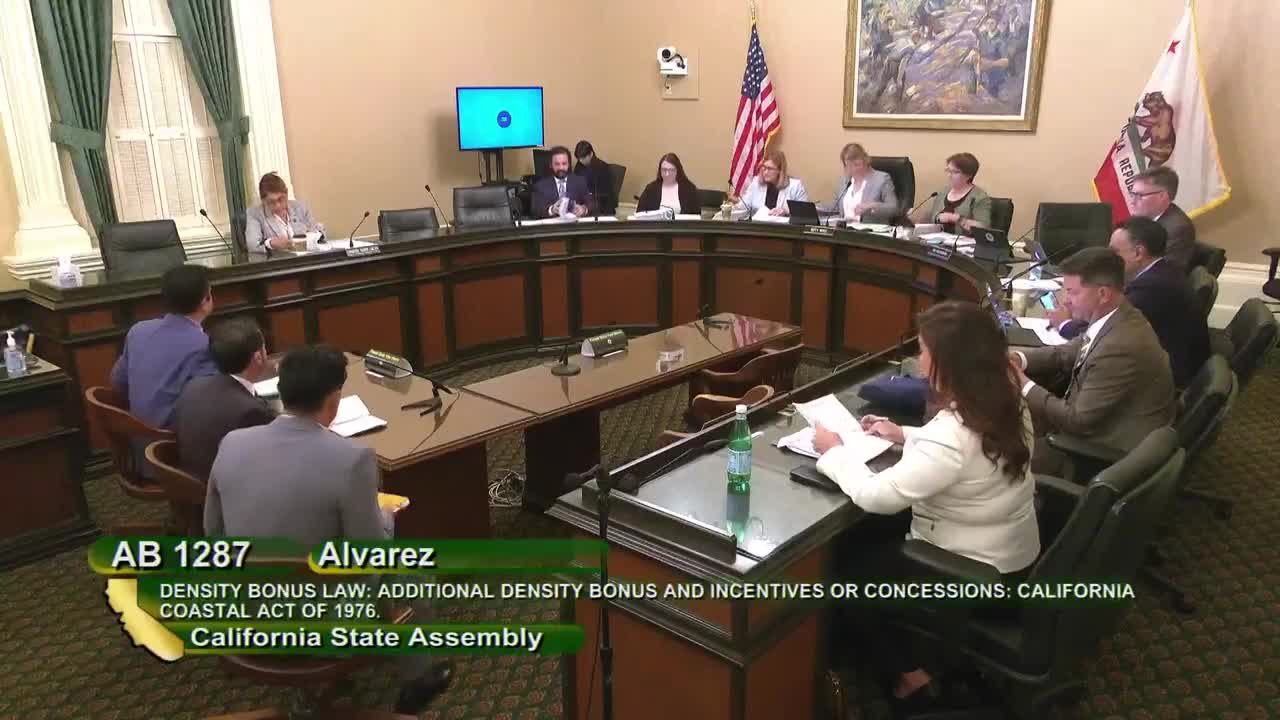 11MIN
Assembly Standing Committee on Housing and Community Development
Bill Author

Bill Co-Author(s):