AB 1366: Unfair competition and false advertising: disgorgement.
- Session Year: 2023-2024
- House: Assembly
- Latest Version Date: 2023-10-10
Current Status:
Passed
(2023-10-10: Chaptered by Secretary of State - Chapter 686, Statutes of 2023.)
Introduced
In Committee
First Chamber
In Committee
Second Chamber
Enacted
Existing law generally regulates false advertising and makes it a crime for a person or a firm, corporation, or association, or any employee thereof, to engage in specified false or misleading advertising practices. Existing unfair competition laws make various unfair competition practices unlawful, including any unlawful, unfair, or fraudulent business act or practice and unfair, deceptive, untrue, or misleading advertising.
Existing law authorizes certain public officials, including the Attorney General, to take specified actions upon failure of the advertiser to adequately substantiate a claim within a reasonable time or if the requesting official has reason to believe that an advertising claim is false or misleading. Existing law requires a person who engages or proposes to engage in unfair competition to be liable for a civil penalty of not more than $2,500, per violation, which is assessed and recovered in an action brought by certain public officials, including the Attorney General.
This bill would authorize the court, in an action brought by the Attorney General under specified false advertising and unfair competition laws, to award the remedy of disgorgement, in addition to the other remedies provided under those false advertising and unfair competition laws. The bill would require the funds recovered by the Attorney General under these provisions to be deposited into the Victims of Consumer Fraud Restitution Fund, which the bill would establish in the State Treasury. The bill would make the funds, upon appropriation by the Legislature, available to the Attorney General to provide restitution to victims of acts or practices for which consumer restitution has been ordered but not paid in an action brought by the Attorney General, as specified. The bill would authorize funds recovered by the Attorney General from a defendant after payment from the fund has been made to be used by the Attorney General to reimburse the fund. The bill would authorize the Attorney General to promulgate regulations in furtherance of these provisions.
Existing law generally regulates false advertising and makes it a crime for a person or a firm, corporation, or association, or any employee thereof, to engage in specified false or misleading advertising practices. Existing unfair competition laws make various unfair competition practices unlawful, including any unlawful, unfair, or fraudulent business act or practice and unfair, deceptive, untrue, or misleading advertising.
Existing law authorizes certain public officials, including the Attorney General, to take specified actions upon failure of the advertiser to adequately substantiate a claim within a reasonable time or if the requesting official has reason to believe that an advertising claim is false or misleading. Existing law requires a person who engages or proposes to engage in unfair competition to be liable for a civil penalty of not more than $2,500, per violation, which is assessed and recovered in an action brought by certain public officials, including the Attorney General.
This bill would authorize the Attorney General, court, in an action brought by the Attorney General under specified false advertising and unfair competition laws to obtain laws, to award the remedy of disgorgement, in addition to the other remedies provided under prescribed law. those false advertising and unfair competition laws. The bill would require the funds recovered by the Attorney General under these provisions to be deposited into the Victims of Consumer Fraud Restitution Fund. The bill would establish the Victims of Consumer Fraud Restitution Fund ns Fund, which the bill would establish in the State Treasury and provide that the funds in the fund may, Treasury. The bill would make the funds, upon appropriation by the Legislature, be used by available to the Attorney General to provide restitution to victims of acts or practices for which consumer restitution has been ordered but not paid in an action brought by the Attorney General, as specified. The bill would authorize funds recovered by the Attorney General from a defendant after payment from the fund has been made to be used by the Attorney General to reimburse the fund. The bill would authorize the Attorney General to promulgate regulations in furtherance of these provisions.
Existing law generally regulates false advertising and makes it a crime for a person or a firm, corporation, or association, or any employee thereof, to engage in specified false or misleading advertising practices. Existing unfair competition laws make various unfair competition practices unlawful, including any unlawful, unfair, or fraudulent business act or practice and unfair, deceptive, untrue, or misleading advertising.
Existing law authorizes certain public officials, including the Attorney General, to take specified actions upon failure of the advertiser to adequately substantiate a claim within a reasonable time or if the requesting official has reason to believe that an advertising claim is false or misleading. Existing law requires a person who engages or proposes to engage in unfair competition to be liable for a civil penalty of not more than $2,500, per violation, which is assessed and recovered in an action brought by certain public officials, including the Attorney General.
This bill would authorize the Attorney General, in an action brought under specified false advertising and unfair competition laws to obtain the remedy of disgorgement, in addition to the other remedies provided under prescribed law. The bill would require the funds recovered by the Attorney General under these provisions to be deposited into the Victims of Consumer Fraud Restitution Fund. The bill would establish the Victims of Consumer Fraud Restitution Fund ns the State Treasury and provide that the funds in the fund may, upon appropriation by the Legislature, be used by the Attorney General to provide restitution to victims of acts or practices for which consumer restitution has been ordered but not paid in an action brought by the Attorney General, as specified. The bill would authorize the Attorney General to promulgate regulations in furtherance of these provisions.
Under existing law a person has a lien, dependent upon possession, for the amount the person is owed for any services, materials, or storage provided for any aircraft, unless specified exceptions apply. Under existing law, if the lienholder is not paid the amount due within 10 days of its due date, the lienholder is entitled to sell the aircraft at public auction in satisfaction of the lien. Existing law requires the lienholder to publish notice of the lien sale in a newspaper published in the county in which the aircraft is situated, or if there is no newspaper, by posting notice of sale in 3 of the most public places in the city or place where the aircraft is to be sold for 10 days previous to the date of the sale, as specified.This bill would instead require a lienholder to post notice of the sale of the aircraft in 5 of the most public places in the city or place where the aircraft is to be sold if there is no newspaper published in the county.Under existing law a person has a lien, dependent upon possession, for the amount the person is owed for any services, materials, or storage provided for any aircraft, unless specified exceptions apply. Under existing law, if the lienholder is not paid the amount due within 10 days of its due date, the lienholder is entitled to sell the aircraft at public auction in satisfaction of the lien. Existing law requires the lienholder to publish notice of the lien sale in a newspaper published in the county in which the aircraft is situated, or if there is no newspaper, by posting notice of sale in 3 of the most public places in the city or place where the aircraft is to be sold for 10 days previous to the date of the sale, as specified.
This bill would instead require a lienholder to post notice of the sale of the aircraft in 5 of the most public places in the city or place where the aircraft is to be sold if there is no newspaper published in the county.
(a)The court may, in an action brought by the Attorney General under the unfair competition laws (Chapter 5 (commencing with Section 17200) of Part 2 of Division 7 of the Business and Professions Code) or false advertising laws (Article 1 (commencing with Section 17500) of Chapter 1 of Part 3 of Division 7 of the Business and Professions Code), and in addition to the remedies provided for in those statutes, award the remedy of disgorgement.
(b)In determining whether to award disgorgement pursuant to subdivision (a), and the amount thereof, the court shall take into account, in addition to any other appropriate factors, the amount of civil penalties and restitution ordered by the court.
(c)Funds recovered by the Attorney General under this section shall be deposited into the Victims of Consumer Fraud Restitution Fund.
(d)The Victims of Consumer Fraud Restitution Fund is established in the State Treasury. Funds in the Victims of Consumer Fraud Restitution Fund may, upon appropriation by the Legislature, be used by the Attorney General to provide restitution to victims of acts or practices for which consumer restitution has been ordered but not paid in an action brought by the Attorney General under Chapter 5 (commencing with Section 17200) of Part 2 of Division 7 of the Business and Professions Code or Article 1 (commencing with Section 17500) of Chapter 1 of Part 3 of Division 7 of the Business and Professions Code. If the Attorney General pays restitution from the Victims of Consumer Fraud Restitution Fund and then recovers restitution from a defendant in the underlying action or from another source, those recoveries may be used by the Attorney General to reimburse the Victims of Consumer Fraud Restitution Fund.
(e)The Attorney General may promulgate regulations in furtherance of this section.
(a)The Attorney General court may, in an action brought by the Attorney General under the unfair competition laws (Chapter 5 (commencing with Section 17200) of Part 2 of Division 7 of the Business and Professions Code) or false advertising laws (Article 1 (commencing with Section 17500) of Chapter 1 of Part 3 of Division 7 of the Business and Professions Code), and in addition to the remedies provided for in those statutes, obtain award the remedy of disgorgement.
(b)In determining whether to award disgorgement pursuant to subdivision (a), and the amount thereof, the court shall take into account, in addition to any other appropriate factors, the amount of civil penalties and restitution ordered by the court.
(b)(c)Funds recovered by the Attorney General under this section shall be deposited into the Victims of Consumer Fraud Restitution Fund.
(c)(d)The Victims of Consumer Fraud Restitution Fund is established in the State Treasury. Funds in the Victims of Consumer Fraud Restitution Fund may, upon appropriation by the Legislature, be used by the Attorney General to provide restitution to victims of acts or practices for which consumer restitution has been ordered but not paid in an action brought by the Attorney General under Chapter 5 (commencing with Section 17200) of Part 2 of Division 7 of the Business and Professions Code or Article 1 (commencing with Section 17500) of Chapter 1 of Part 3 of Division 7 of the Business and Professions Code. If the Attorney General pays restitution from the Victims of Consumer Fraud Restitution Fund and then recovers restitution from a defendant in the underlying action or from another source, those recoveries may be used by the Attorney General to reimburse the Victims of Consumer Fraud Restitution Fund.
(d)(e)The Attorney General may promulgate regulations in furtherance of this section.
(a)The Attorney General may, in an action brought under unfair competition laws (Chapter 5 (commencing with Section 17200) of Part 2 of Division 7 of the Business and Professions Code) or false advertising laws (Article 1 (commencing with Section 17500) of Chapter 1 of Part 3 of Division 7 of the Business and Professions Code), and in addition to the remedies provided for in those statutes, obtain the remedy of disgorgement.
(b)Funds recovered by the Attorney General under this section shall be deposited into the Victims of Consumer Fraud Restitution Fund.
(c)The Victims of Consumer Fraud Restitution Fund is established in the State Treasury. Funds in the Victims of Consumer Fraud Restitution Fund may, upon appropriation by the Legislature, be used by the Attorney General to provide restitution to victims of acts or practices for which consumer restitution has been ordered but not paid in an action brought by the Attorney General under Chapter 5 (commencing with Section 17200) of Part 2 of Division 7 of the Business and Professions Code or Article 1 (commencing with Section 17500) of Chapter 1 of Part 3 of Division 7 of the Business and Professions Code.
(d)The Attorney General may promulgate regulations in furtherance of this section.
SECTION 1.Section 1208.66 of the Code of Civil Procedure is amended to read:1208.66.Prior to any sale the lienholder shall publish a notice of the sale pursuant to Section 6062 of the Government Code in a newspaper published in the county in which the aircraft is situated, or if there is no newspaper, by posting notice of sale in five of the most public places in the city or place where the aircraft is to be sold for 10 days previous to the date of the sale. Prior to the sale of any aircraft to satisfy a lien, 20 days notice by registered mail shall be given to the legal owner as it appears in the registration certificate.Prior to any such sale the lienholder shall publish a notice of the sale pursuant to Section 6062 of the Government Code in a newspaper published in the county in which the aircraft is situated, or if there is no such newspaper, by posting notice of sale in three five of the most public places in the city or place where such the aircraft is to be sold for 10 days previous to the date of the sale. Prior to the sale of any aircraft to satisfy any such a lien, 20 days notice by registered mail shall be given to the legal owner as it appears in the registration certificate.
|
Date
|
Status
|
|---|---|
| Oct 10, 2023 | Chaptered by Secretary of State - Chapter 686, Statutes of 2023. |
| Oct 10, 2023 | Approved by the Governor. |
| Sep 19, 2023 | Enrolled and presented to the Governor at 4 p.m. |
| Sep 12, 2023 | Senate amendments concurred in. To Engrossing and Enrolling. (Ayes 80. Noes 0. Page 3269.). |
| Sep 12, 2023 | Assembly Rule 77 suspended. (Page 3228.) |
| Sep 11, 2023 | In Assembly. Concurrence in Senate amendments pending. May be considered on or after September 13 pursuant to Assembly Rule 77. |
| Sep 11, 2023 | Read third time. Passed. Ordered to the Assembly. (Ayes 39. Noes 0. Page 2563.). |
| Sep 5, 2023 | Read second time. Ordered to third reading. |
| Sep 1, 2023 | Read third time and amended. Ordered to second reading. |
| Aug 16, 2023 | Read second time. Ordered to third reading. |
| Aug 15, 2023 | From committee: Do pass. (Ayes 7. Noes 0.) (August 14). |
| Jun 28, 2023 | From committee: Do pass and re-refer to Com. on APPR with recommendation: To Consent Calendar. (Ayes 11. Noes 0.) (June 27). Re-referred to Com. on APPR. |
| May 31, 2023 | Referred to Com. on JUD. |
| May 18, 2023 | In Senate. Read first time. To Com. on RLS. for assignment. |
| May 18, 2023 | Read third time. Passed. Ordered to the Senate. (Ayes 74. Noes 0. Page 1597.) |
| May 11, 2023 | Read second time. Ordered to Consent Calendar. |
| May 10, 2023 | From committee: Do pass. To Consent Calendar. (Ayes 14. Noes 0.) (May 10). |
| Apr 25, 2023 | From committee: Do pass and re-refer to Com. on APPR. with recommendation: To Consent Calendar. (Ayes 11. Noes 0.) (April 25). Re-referred to Com. on APPR. |
| Apr 6, 2023 | Re-referred to Com. on JUD. |
| Apr 5, 2023 | From committee chair, with author's amendments: Amend, and re-refer to Com. on JUD. Read second time and amended. |
| Mar 2, 2023 | Referred to Com. on JUD. |
| Feb 18, 2023 | From printer. May be heard in committee March 20. |
| Feb 17, 2023 | Read first time. To print. |
|
Date
|
Description
|
Location
|
Votes
|
|
|---|---|---|---|---|
| Sep 12, 2023 | AB 1366 Maienschein Concurrence in Senate Amendments | Assembly Floor |
Passed |
|
| Sep 11, 2023 | Assembly 3rd Reading AB1366 Maienschein By Padilla | Senate Floor |
Passed |
|
| Aug 14, 2023 | Do pass | Senate Standing Committee on Appropriations |
Passed |
|
| Jun 27, 2023 | Do pass, but first be re-referred to the Committee on [Appropriations] with the recommendation: To Consent Calendar | Senate Standing Committee on Judiciary |
Passed |
|
| May 18, 2023 | AB 1366 Maienschein Consent Calendar Second Day Regular Session | Assembly Floor |
Passed |
|
| May 10, 2023 | Do pass. To Consent Calendar. | Assembly Standing Committee on Appropriations |
Passed |
|
| Apr 25, 2023 | Do pass and be re-referred to the Committee on [Appropriations] with recommendation: To Consent Calendar | Assembly Standing Committee on Judiciary |
Passed |
This list shows positions taken on this bill by organizations on the date displayed, which is linked to the original source.
Positions by individuals are not included.
|
Organization
|
Position
|
Date
|
|---|---|---|
| Attorney General Rob Bonta | ** Support | |
| California Department of Justice | ** Support | |
| California Low-Income Consumer Coalition | ** Support | |
| California Nurses for Environmental Health and Justice | * Support | Aug 14, 2023 |
| Consumer Financial Protection Bureau | ** Support |
CONCURRENCE IN SENATE AMENDMENTS
CSA1 Bill Id:AB 1366
Author:(Maienschein)
As Amended Ver: September 1, 2023
Majority vote
SUMMARY
Permits a court to award disgorgement in consumer protection cases brought by the Attorney General, and to award the proceeds from those actions to create a Victims of Consumer Fraud Restitution Fund.
Major Provisions
- Permits a court to award the remedy of disgorgement as a remedy for violation of any of the following statutes:
- Unfair Competition Laws (Business and Professions Code Section 17200 et seq.)
- False Advertising Laws (Business and Professions Code Section 17500 et seq.)
- Establishes the Victims of Consumer Fraud Restitution Fund in the State Treasury.
- Provides that funds recovered by the Attorney General pursuant to 1) are to be deposited into the Victims of Consumer Fraud Restitution Fund.
- Establishes that funds deposited in the Victims of Consumer Fraud Restitution Fund may, upon appropriation by the Legislature, be used by the Attorney General to provide restitution to victims of acts or practices for which consumer restitution has been ordered but not paid in an action bought by the Attorney General for violation of the provisions of 1).
- Establishes that in determining whether to award disgorgement and the amount thereof, the court must take into account, in addition to any other appropriate factors, the amount of civil penalties and restitution ordered by the court.
- Provides that if the Attorney General pays restitution from the Victims of Consumer Fraud Restitution Fund and then recovers restitution from a defendant in the underlying action or from another source, those recoveries may be used by the Attorney General to reimburse the Victims of Consumer Fraud Restitution Fund.
- Authorizes that Attorney General to promulgate regulations to achieve this section.
Senate Amendments
Clarify that in determining whether to award disgorgement and the amount thereof, the court must take into account, in addition to any other appropriate factors, the amount of civil penalties and restitution ordered by the court. Clarify that if the Attorney General pays restitution from the Victims of Consumer Fraud Restitution Fund and then recovers restitution from a defendant in the underlying action or from another source, those recoveries may be used by the Attorney General to reimburse the Victims of Consumer Fraud Restitution Fund.
COMMENTS
This bill seeks to establish a Victims of Consumer Fraud Restitution Fund that would be funded from the ill-gotten gains of businesses that violate California's consumer protection laws.
California's unfair competition and false advertising laws provide limited remedies. The Legislature has long considered consumer protection to be a matter of high importance. The Unfair Competition Law (UCL) is one of the primary tools available to government attorneys to protect the public from "any unlawful, unfair or fraudulent business act or practice and unfair, deceptive, untrue or misleading advertising[.]" (Business and Professions Code Section 17200.) Remedies under the UCL include injunctive relief, restitution, and civil penalties. "[I]n the UCL context ... restitution means the return of money to those persons from whom it was taken or who had an ownership interest in it." (Madrid v. Perot Systems Corp. (2005) 130 Cal.App.4th 440, 455.) In other words, the focus is on the plaintiff's loss. It is typified by the situation where "the disgorged money or property [came] from the prospective plaintiff in the first instance." (Korea Supply Co. v. Lockheed Martin Corp. (2003) 29 Cal.4th 1134, 1152.)
The False Advertising Law (FAL) proscribes making or disseminating any statement that is known or should be known to be untrue or misleading with intent to directly or indirectly dispose of real or personal property. (Business and Professions Code Section 17500 et seq.) Violators are subject to a civil penalty not to exceed $2,500 for each violation in an action brought by the Attorney General or by any district attorney, county counsel, or city attorney. (Business and Professions Code Section 17536.) Similar to the UCL, the FAL provides that a person may bring an action for an injunction or restitution if the person has suffered injury in fact and has lost money or property as a result of a violation of the FAL. (Business and Professions Code Section 17535.)
Some consumer law violators are "judgment proof," leaving judgments unpaid, and victims uncompensated. Both the UCL and FAL permit the Attorney General to obtain restitution, a form of monetary relief that aims to restore the injured party to the position they would have been in had the wrong not occurred. Unfortunately, while some defendants have substantial funds to meet their restitution obligations, other predatory businesses involved in these cases go bankrupt or cease to exist, leaving inadequate funds to pay restitution to their victims. Thus, despite the Attorney General having obtained a judgment in their favor, victims of consumer protection violations are never made whole for the injuries they have suffered.
Examples of these "judgment-proof" defendants—and their resulting empty-handed victims— are numerous. For example, in 2016 the Attorney General's office reached a $1.6 billion settlement with Corinthian Colleges, Inc. for the company's violations of the UCL. More recently, in November 2022, Paul Blanco's Good Car Company was ordered to pay $20 million for engaging in unlawful business practices, including false advertising about credit and discount programs, making false statements on credit applications, and deceiving customers into purchasing add-on products. The defunct corporation was insolvent and their victims were never made whole for the injuries they suffered. These examples illustrate the problem with monetary judgments—they do not mean much to the victims if they are not paid.
This bill would allow the Attorney General to obtain another type of restitution that is currently unavailable for violations of California's consumer protection laws—non-restitutionary disgorgement. When seeking non-restitutionary disgorgement, the focus is on the defendant's gain from the unfair practice; the plaintiff need not have suffered a loss. (Frieman v. San Rafael Rock Quarry, Inc. (2004) 116 Cal.App.4th 29, 36.) As the California Supreme Court explained: "This court has never approved of non-restitutionary disgorgement of profits as a remedy under the UCL." (Korea Supply, supra at p.1148.) Currently, there is no statutory authority that allows a judge "to order a defendant to disgorge all profits to a plaintiff who does not have an ownership interest in those profits." (Id. at p. 1177.) This bill would change that by expressly allowing the Attorney General to obtain non-restitutionary disgorgement, or the defendant's ill-gotten gains, as a remedy.
Under this bill, the Attorney General can seek to obtain non-restitutionary disgorgement as a remedy in cases where the consumer law offender received unjust profits. A court would determine whether and how much non-restitutionary disgorgement to award. Those non-restitutionary disgorgement proceeds in UCL and FAC cases—to the extent any were awarded by a judge in a given case—would fund the Victims of Consumer Fraud Restitution Fund. Proceeds from the Fund could then be used to compensate victims in other cases who might otherwise go uncompensated because of the inability of the defendant in their case to pay restitution.
This process of obtaining a disgorgement remedy in one case to fund a victim compensation fund for similarly situated victims is not entirely new or novel. The Legislature recently enacted AB 1864 (Limon), Chap. 157, Stats. 2020, to authorize the Department of Financial Protection and Innovation (DFPI), which oversees financial institutions and financial services, to seek disgorgement in enforcing a different law, the California Consumer Financial Protection Law (CCFPL). Under AB 1864, ill-gotten gains disgorged to DFPI are placed in a separate Financial Protection Fund to be used for DFPI's administration of the CCFPL. The federal government also employs a similar approach. Pursuant to the 2010 Dodd-Frank Act, Congress established a fund from civil penalties imposed in other cases to provide compensation to consumers who have been harmed by violations of federal consumer financial protection law. Attorneys General in California's sister states, including Arizona and New York, likewise can obtain disgorgement under their consumer protections laws. In 2022, Arizona reached a historic $85 million settlement with Google for a case brought pursuant to its Consumer Fraud Act. The Attorney General in Arizona sought disgorgement of all profits, gains, gross receipts, and other benefits obtained by Google's widespread and systemic use of deceptive and unfair business practices to obtain information about the location of its users. (State of Arizona, ex rel. Mark Brnovich,
Attorney General v. Google, LLC, No. CV2020-006219.)
As the Arizona v. Google example illustrates, in the context of consumer protection, disgorgement serves several purposes. First, it helps to deter businesses from engaging in deceptive or illegal practices by making clear that they will not be able to keep any profits obtained through such practices. This is particularly true where, like in that case, the amount of injury sustained by any particular individual is small or otherwise difficult to quantify, but the cumulative unjust profit to the violator is significant. Second, disgorgement serves as a means of compensating consumers who have been harmed by deceptive or illegal practices. This is accomplished with this bill's creation of a Victims of Consumer Fraud Restitution Fund, which provides a source of funds that can be used to compensate consumers for any losses they have suffered as a result of a business's actions. Third, disgorgement helps to level the playing field between businesses that comply with consumer protection laws and those that engage in deceptive or illegal practices. By requiring businesses that engage in such practices to give up their profits, disgorgement ensures that honest businesses are not at a competitive disadvantage and that consumers are not misled.
The bill creates both a mechanism for obtaining unjust profits from consumer law violators and a funding source for compensating those victims who would otherwise be left empty-handed.
According to the Author
In order to ensure that there is a source of funding to help make whole victims who otherwise might go uncompensated because of the inability of the defendant to pay restitution, AB 1366 would establish a new Victims of Consumer Fraud Restitution Fund in the state Treasury. The new Victims of Consumer Fraud Restitution Fund would be funded from the ill-gotten gains of businesses that violate California's consumer protection laws, rather than through taxes or fees charged to law abiding businesses. Specifically, AB 1366 would authorize the Attorney General to seek the remedy of disgorgement in actions brought under the existing Unfair Competition Law (UCL) and False Advertising Law (FAL), two of the cornerstone consumer protection laws in California. Unlike the existing and complementary remedies in these laws, disgorgement aims to deter wrongdoing by preventing the wrongdoer from retaining ill-gotten gains from its illegal conduct. Under AB 1366, funds in this new Restitution Fund may, upon appropriation of the Legislature, be used by the Attorney General to provide restitution to fraud victims for which consumer restitution has been ordered but not paid in an action brought by the Attorney General under the UCL or FAL.
Arguments in Support
The California Department of Justice, this bill's sponsor, writes in support of the bill:
Under AB 1366, the new Victims of Consumer Fraud Restitution Fund would be funded from the ill-gotten gains of businesses that violate California's consumer protection laws, rather than through taxes or fees charged to law abiding businesses. Specifically, AB 1366 would authorize the AG to seek the remedy of disgorgement in actions brought under the existing UCL and False Advertising Law (FAL), two of the cornerstone consumer protection laws in California. Unlike the existing and complimentary remedies in these laws, disgorgement aims to deter wrongdoing by preventing the wrongdoer from retaining ill-gotten gains from its illegal conduct…AB 1366 will meet that need by establishing the Victims of Consumer Fraud Restitution Fund. Attorney General Bonta is proud to sponsor AB 1366, and reaffirms his commitment to vigorously enforce the consumer protection laws of the state and obtain the best positive outcomes for victims of consumer fraud. Thank you for your leadership on this important issue for California consumers.
The California Low-Income Consumer Coalition is also in strong support:
The Unfair Competition Law (UCL) (Business & Professions Code sec. 17200) allows the Attorney General to recover civil penalties for consumer protection violations and to obtain orders requiring businesses that have engaged in fraud to pay restitution to their victims. Generally, the AG can require those businesses to pay back the money that they took. But sometimes the predatory businesses involved in these cases go bankrupt or cease to exist, leaving insufficient funds available to provide relief to their victims. As a result, those victims are never made whole for the injuries they have suffered, even though the AG has obtained a judgment against the business. AB 1366 would fix this problem.
Arguments in Opposition
No opposition on file.
FISCAL COMMENTS
According to the Senate Appropriations Committee, "The Department of Justice reports costs of $38,000 in 2023-24 and $76,000 annually thereafter for forensic accounting analysis experts to support claims of engorgement (Unfair Competition Law Fund)."
VOTES:
ASM JUDICIARY: 11-0-0
YES: Maienschein, Essayli, Connolly, Dixon, Haney, Kalra, Pacheco, Papan, Reyes, Robert Rivas, Sanchez
ASM APPROPRIATIONS: 14-0-2
YES: Holden, Megan Dahle, Calderon, Wendy Carrillo, Dixon, Mike Fong, Addis, Lowenthal, Papan, Pellerin, Robert Rivas, Sanchez, Weber, Wilson
ABS, ABST OR NV: Bryan, Mathis
ASSEMBLY FLOOR: 74-0-6
YES: Addis, Aguiar-Curry, Alanis, Alvarez, Arambula, Bains, Bauer-Kahan, Bennett, Berman, Boerner, Bonta, Bryan, Calderon, Juan Carrillo, Wendy Carrillo, Chen, Connolly, Megan Dahle, Davies, Dixon, Essayli, Flora, Mike Fong, Gabriel, Gallagher, Garcia, Gipson, Grayson, Haney, Hart, Holden, Hoover, Irwin, Jackson, Jones-Sawyer, Kalra, Lackey, Lee, Low, Lowenthal, Maienschein, Mathis, McCarty, McKinnor, Muratsuchi, Stephanie Nguyen, Ortega, Pacheco, Papan, Jim Patterson, Joe Patterson, Pellerin, Petrie-Norris, Quirk-Silva, Ramos, Reyes, Luz Rivas, Robert Rivas, Rodriguez, Blanca Rubio, Sanchez, Santiago, Schiavo, Soria, Ta, Ting, Valencia, Wallis, Ward, Weber, Wicks, Wood, Zbur, Rendon
ABS, ABST OR NV: Cervantes, Vince Fong, Friedman, Villapudua, Waldron, Wilson
SENATE FLOOR: 39-0-1
YES: Allen, Alvarado-Gil, Archuleta, Ashby, Atkins, Becker, Blakespear, Bradford, Cortese, Dahle, Dodd, Durazo, Eggman, Glazer, Gonzalez, Grove, Hurtado, Jones, Laird, Limón, McGuire, Menjivar, Min, Newman, Nguyen, Niello, Ochoa Bogh, Padilla, Portantino, Roth, Rubio, Seyarto, Skinner, Smallwood-Cuevas, Stern, Umberg, Wahab, Wiener, Wilk
ABS, ABST OR NV: Caballero
UPDATED
VERSION: September 1, 2023
CONSULTANT: Shiran Zohar / JUD. / (916) 319-2334 FN: 0001654
SENATE RULES COMMITTEE Office of Senate Floor Analyses (916) 651-1520 Fax: (916) 327-4478 | AB 1366 |
THIRD READING
Bill No: AB 1366
Author: Maienschein (D)
Amended: 9/1/23 in Senate
Vote: 21
SENATE JUDICIARY COMMITTEE: 11-0, 6/27/23
AYES: Umberg, Wilk, Allen, Ashby, Caballero, Durazo, Laird, Min, Niello, Stern, Wiener
SENATE APPROPRIATIONS COMMITTEE: 7-0, 8/14/23
AYES: Portantino, Jones, Ashby, Bradford, Seyarto, Wahab, Wiener
ASSEMBLY FLOOR: 74-0, 5/18/23 (Consent) - See last page for vote
SUBJECT: Unfair competition and false advertising: disgorgement
SOURCE: Attorney General Rob Bonta
DIGEST:
This bill authorizes courts to award the Attorney General the remedy of disgorgement in actions brought pursuant to California’s Unfair Competition Law or False Advertising Law. Such amounts may be used to provide restitution to victims in other actions, as provided.
Senate Floor Amendments of 9/1/23 place the remedy of disgorgement in the discretion of the court and provide some direction thereto and clarify the proper uses of relevant financial recoveries.
ANALYSIS:
Existing law:
- Establishes the Unfair Competition Law (UCL), which provides a statutory cause of action for any unlawful, unfair, or fraudulent business act or practice and unfair, deceptive, untrue, or misleading advertising, including over the internet. (Bus. & Prof. Code § 17200 et seq.) Establishes the False Advertising Law (FAL), which proscribes making or disseminating any statement that is known or should be known to be untrue or misleading with intent to directly or indirectly dispose of real or personal property. (Bus. & Prof. Code § 17500 et seq.)
- Defines “unfair competition” to mean and include any unlawful, unfair, or fraudulent business act or practice and any unfair, deceptive, untrue, or misleading advertising, and any act prohibited by the False Advertising Law, Business and Professions Code section 17500 et seq. (Bus. & Prof. Code § 17200.)
- Provides that any person who engages, has engaged, or proposes to engage in unfair competition may be enjoined in any court of competent jurisdiction. (Bus. & Prof. Code § 17203.)
- Requires actions for relief pursuant to the UCL be prosecuted exclusively in a court of competent jurisdiction and only by the following:
- the Attorney General;
- a district attorney;
- a county counsel authorized by agreement with the district attorney in actions involving violation of a county ordinance;
- a city attorney of a city having a population in excess of 750,000;
- a county counsel of any county within which a city has a population in excess of 750,000;
- a city attorney in a city and county;
- a city prosecutor in a city having a full-time city prosecutor in the name of the people of the State of California upon their own complaint or upon the complaint of a board, officer, person, corporation, or association with the consent of the district attorney; or
- a person who has suffered injury in fact and has lost money or property as a result of the unfair competition. (Bus. & Prof. Code § 17204.)
- Provides that any person who engages, has engaged, or proposes to engage in unfair competition is liable for a civil penalty not to exceed $2,500 for each violation. The court shall impose a civil penalty for each violation. In assessing the amount of the civil penalty, the court shall consider any one or more of the relevant circumstances presented by any of the parties to the case, including the nature and seriousness of the misconduct, the number of violations, the persistence of the misconduct, the length of time over which the misconduct occurred, the willfulness of the defendant’s misconduct, and the defendant’s assets, liabilities, and net worth. (Bus. & Prof. Code § 17206.)
- Provides remedies for individuals who have suffered damages as a result of fraud or deceit, including situations involving fraudulent misrepresentations. (See Civil Code §§ 1709-1710, 1572-1573.)
This bill:
- Authorizes the court to award the Attorney General, in an action brought pursuant to the UCL or FAL, and in addition to the remedies provided for in those statutes, the remedy of disgorgement.
- Provides that the court, in determining whether to award disgorgement and the amount thereof, shall take into account, in addition to any other appropriate factors, the amount of civil penalties and restitution ordered by the court.
- Requires funds recovered to be deposited into the Victims of Consumer Fraud Restitution Fund (the Fund), which the bill establishes in the State Treasury.
- Authorizes funds in the Fund, upon appropriation by the Legislature, to be used by the Attorney General to provide restitution to victims of acts or practices for which consumer restitution has been ordered but not paid in an action brought by the Attorney General pursuant to the UCL or FAL.
- Provides that if the Attorney General pays restitution from the Victims of Consumer Fraud Restitution Fund and then recovers restitution from a defendant in the underlying action or from another source, those recoveries may be used by the Attorney General to reimburse the Victims of Consumer Fraud Restitution Fund.
- Authorizes the Attorney General to promulgate regulations in furtherance of this section.
Background
Unfair business practices encompass fraud, misrepresentation, and oppressive or unconscionable acts or practices by businesses, often against consumers. In California, individuals and specified governmental agencies are authorized to bring civil actions for unfair competition and false advertising and to recover civil penalties or injunctive relief pursuant to the Unfair Competition Law (UCL), Business and Professions Code Section 17200 et seq., and the False Advertising Law (FAL), Business and Professions Code Section 17500 et seq. Specified public prosecutors, including the Attorney General, are authorized to seek civil penalties, restitution, and injunctive relief.
Despite these remedies, in certain cases, the Attorney General may secure an award of restitution for victims, but the defendant is unable to satisfy the judgment, leaving the consumers without an adequate remedy. This bill allows the court to award the Attorney General disgorgement in actions brought pursuant to the UCL or FAL. This remedy allows the Attorney General to force violators to give up any profits from their wrongdoing. These funds are then made available for consumers in other UCL or FAL actions brought by the Attorney General that are awarded restitution, but where the defendant is unable to pay it, as provided. The bill is sponsored by Attorney General Rob Bonta.
Comments
According to the author:
In order to ensure that there is a source of funding to help make whole victims who otherwise might go uncompensated because of the inability of the defendant to pay restitution, AB 1366 would establish a new Victims of Consumer Fraud Restitution Fund in the state Treasury.
The new Victims of Consumer Fraud Restitution Fund would be funded from the ill-gotten gains of businesses that violate California’s consumer protection laws, rather than through taxes or fees charged to law abiding businesses. Specifically, AB 1366 would authorize the Attorney General to seek the remedy of disgorgement in actions brought under the existing Unfair Competition Law (UCL) and False Advertising Law (FAL), two of the cornerstone consumer protection laws in California. Unlike the existing and [complementary] remedies in these laws, disgorgement aims to deter wrongdoing by preventing the wrongdoer from retaining ill-gotten gains from its illegal conduct.
Under AB 1366, funds in this new Restitution Fund may, upon appropriation of the Legislature, be used by the Attorney General to provide restitution to fraud victims for which consumer restitution has been ordered but not paid in an action brought by the AG under the UCL or FAL.
Providing a new tool to the Attorney General inuring to the benefit of consumers
The purpose of the UCL is to combat and prevent the use or employment by any person of any practice which constitutes unfair competition. The law provides for civil penalties and whatever other relief is necessary to effectuate its purpose. In addition, the UCL currently grants certain government entities the ability to prosecute such actions.
However, in some cases, the public prosecutor may secure an award of restitution for consumers but the defendant is unable to satisfy such judgments. Therefore, consumers are unable to be made whole. However, in other cases, wrongdoers may have benefited and made profit off of their unfair or unlawful practices and the judgment may not fully recover such funds.
A recent article lays out the problem:
In November 2022, the California attorney general’s office secured a $20 million judgment against Paul Blanco’s Good Car Co., a network of auto dealerships, over hundreds of thousands of false advertising and other consumer protection law violations.
In fall of 2016, a multistate judgment against USA Discounters for defrauding military service members with high-interest loans and hidden fees should have resulted in $7 million in debt relief for 4,000 California victims.
Earlier that year, the for-profit Corinthian Colleges was hit with a $1.1 billion judgment for its predatory marketing and lending tactics.
But in all of these cases, the actual consumers harmed by these businesses’ shady practices saw little to none of the compensation. That’s because despite the attention-grabbing numbers, oftentimes the companies in question go bankrupt, leaving people with little recourse and disappointing results.[1]
This bill solves this problem by making available the remedy of disgorgement. Disgorgement is a remedy requiring a party who profits from illegal or wrongful acts to give up any profits they made as a result of that illegal or wrongful conduct. The purpose of this remedy is to prevent unjust enrichment and make illegal conduct unprofitable. While UCL and FAL actions can be brought by a wide array of public prosecutors, disgorgement can only be awarded to the Attorney General.
The bill requires any funds received through this new remedy to be placed into the Fund, which is created by the bill. Upon appropriation, the Attorney General can then draw monies from the Fund to award to consumers that were granted restitution through actions brought by the Attorney General in separate UCL or FAL actions but where such restitution was not or was unable to be paid by a defendant.
The structure established by this bill is not unprecedented, with states such as Arizona authorizing their Attorney General to seek disgorgement in similar actions. In fact, California already authorizes this remedy in connection with state enforcement of consumer protection laws. AB 1864 (Limon, Ch. 157, Stats. 2020) authorized the Department of Financial Protection and Innovation (DFPI), which oversees financial institutions and financial services, to seek disgorgement in enforcing a different law, the California Consumer Financial Protection Law (CCFPL). The law authorizes DFPI to bring an enforcement action against any covered person or service provider who engages in unlawful, unfair, deceptive or abusive practices with respect to consumer financial products and services. DFPI is authorized to seek specified relief including disgorgements. Recovered funds are placed in a separate Financial Protection Fund to be used for DFPI’s administration of the CCFPL.
FISCAL EFFECT: Appropriation: No Fiscal Com.: Yes Local: No
According to the Senate Appropriations Committee, “The Department of Justice reports costs of $38,000 in 2023-24 and $76,000 annually thereafter for forensic accounting analysis experts to support claims of engorgement (Unfair Competition Law Fund).”
SUPPORT: (Verified 9/1/23)
Attorney General Rob Bonta (source)
Consumer Financial Protection Bureau
OPPOSITION: (Verified 9/1/23)
None received
ARGUMENTS IN SUPPORT: Attorney General Rob Bonta writes:
In order to ensure that there is a source of funding to help make whole victims who otherwise might go uncompensated because of the inability of the defendant to pay restitution, AB 1366 would establish a new Victims of Consumer Fraud Restitution Fund in the state Treasury.
AB 1366 follows the example set at the federal level by the Dodd-Frank Act, which addressed this problem by creating a fund that the Consumer Financial Protection Bureau can use to pay such victims (12 US Code § 5497(d)(2)). It would supplement funds, like the Student Tuition Recovery Fund, Client Security Fund, and the Secretary of State’s Victims of Corporate Compensation Fund, that use fee revenue to provide restitution to victims of certain types of misconduct at a state level.
Under AB 1366, the new Victims of Consumer Fraud Restitution Fund would be funded from the ill-gotten gains of businesses that violate California’s consumer protection laws, rather than through taxes or fees charged to law abiding businesses. Specifically, AB 1366 would authorize the AG to seek the remedy of disgorgement in actions brought under the existing UCL and False Advertising Law (FAL), two of the cornerstone consumer protection laws in California. Unlike the existing and complimentary remedies in these laws, disgorgement aims to deter wrongdoing by preventing the wrongdoer from retaining ill-gotten gains from its illegal conduct.
ASSEMBLY FLOOR: 74-0, 5/18/23
AYES: Addis, Aguiar-Curry, Alanis, Alvarez, Arambula, Bains, Bauer-Kahan, Bennett, Berman, Boerner, Bonta, Bryan, Calderon, Juan Carrillo, Wendy Carrillo, Chen, Connolly, Megan Dahle, Davies, Dixon, Essayli, Flora, Mike Fong, Gabriel, Gallagher, Garcia, Gipson, Grayson, Haney, Hart, Holden, Hoover, Irwin, Jackson, Jones-Sawyer, Kalra, Lackey, Lee, Low, Lowenthal, Maienschein, Mathis, McCarty, McKinnor, Muratsuchi, Stephanie Nguyen, Ortega, Pacheco, Papan, Jim Patterson, Joe Patterson, Pellerin, Petrie-Norris, Quirk-Silva, Ramos, Reyes, Luz Rivas, Robert Rivas, Rodriguez, Blanca Rubio, Sanchez, Santiago, Schiavo, Soria, Ta, Ting, Valencia, Wallis, Ward, Weber, Wicks, Wood, Zbur, Rendon
NO VOTE RECORDED: Cervantes, Vince Fong, Friedman, Villapudua, Waldron, Wilson
Prepared by: Christian Kurpiewski / JUD. / (916) 651-4113
9/4/23 10:18:17
**** END ****
Marisa Endicott, New California law would compensate consumer fraud victims stiffed by shady companies (April 12, 2023) The Press Democrat, https://www.northbaybusinessjournal.com/article/news/new-california-law-would-compensate-consumer-fraud-victims-stiffed-by-shady/ [as of September 1, 2023]. ↑
SENATE RULES COMMITTEE Office of Senate Floor Analyses (916) 651-1520 Fax: (916) 327-4478 | AB 1366 |
THIRD READING
Bill No: AB 1366
Author: Maienschein (D)
Amended: 4/5/23 in Assembly
Vote: 21
SENATE JUDICIARY COMMITTEE: 11-0, 6/27/23
AYES: Umberg, Wilk, Allen, Ashby, Caballero, Durazo, Laird, Min, Niello, Stern, Wiener
SENATE APPROPRIATIONS COMMITTEE: 7-0, 8/14/23
AYES: Portantino, Jones, Ashby, Bradford, Seyarto, Wahab, Wiener
ASSEMBLY FLOOR: 74-0, 5/18/23 (Consent) - See last page for vote
SUBJECT: Unfair competition and false advertising: disgorgement
SOURCE: Attorney General Rob Bonta
DIGEST:
This bill authorizes the Attorney General to seek the remedy of disgorgement in actions brought pursuant to California’s Unfair Competition Law or False Advertising Law. Such amounts may be used to provide restitution to victims in other actions, as provided.
ANALYSIS:
Existing law:
- Establishes the Unfair Competition Law (UCL), which provides a statutory cause of action for any unlawful, unfair, or fraudulent business act or practice and unfair, deceptive, untrue, or misleading advertising, including over the internet. (Bus. & Prof. Code § 17200 et seq.) Establishes the False Advertising Law (FAL), which proscribes making or disseminating any statement that is known or should be known to be untrue or misleading with intent to directly or indirectly dispose of real or personal property. (Bus. & Prof. Code § 17500 et seq.)
- Defines “unfair competition” to mean and include any unlawful, unfair, or fraudulent business act or practice and any unfair, deceptive, untrue, or misleading advertising, and any act prohibited by the False Advertising Law, Business and Professions Code section 17500 et seq. (Bus. & Prof. Code § 17200.)
- Provides that any person who engages, has engaged, or proposes to engage in unfair competition may be enjoined in any court of competent jurisdiction. (Bus. & Prof. Code § 17203.)
- Requires actions for relief pursuant to the UCL be prosecuted exclusively in a court of competent jurisdiction and only by the following:
- the Attorney General;
- a district attorney;
- a county counsel authorized by agreement with the district attorney in actions involving violation of a county ordinance;
- a city attorney of a city having a population in excess of 750,000;
- a county counsel of any county within which a city has a population in excess of 750,000;
- a city attorney in a city and county;
- a city prosecutor in a city having a full-time city prosecutor in the name of the people of the State of California upon their own complaint or upon the complaint of a board, officer, person, corporation, or association with the consent of the district attorney; or
- a person who has suffered injury in fact and has lost money or property as a result of the unfair competition. (Bus. & Prof. Code § 17204.)
- Provides that any person who engages, has engaged, or proposes to engage in unfair competition is liable for a civil penalty not to exceed $2,500 for each violation. The court shall impose a civil penalty for each violation. In assessing the amount of the civil penalty, the court shall consider any one or more of the relevant circumstances presented by any of the parties to the case, including the nature and seriousness of the misconduct, the number of violations, the persistence of the misconduct, the length of time over which the misconduct occurred, the willfulness of the defendant’s misconduct, and the defendant’s assets, liabilities, and net worth. (Bus. & Prof. Code § 17206.)
- Provides remedies for individuals who have suffered damages as a result of fraud or deceit, including situations involving fraudulent misrepresentations. (See Civil Code §§ 1709-1710, 1572-1573.)
This bill:
- Authorizes the Attorney General, in an action brought pursuant to the UCL or FAL, and in addition to the remedies provided for in those statutes, to obtain the remedy of disgorgement.
- Requires funds recovered to be deposited into the Victims of Consumer Fraud Restitution Fund (the Fund), which the bill establishes in the State Treasury.
- Authorizes funds in the Fund, upon appropriation by the Legislature, to be used by the Attorney General to provide restitution to victims of acts or practices for which consumer restitution has been ordered but not paid in an action brought by the Attorney General pursuant to the UCL or FAL.
- Authorizes the Attorney General to promulgate regulations in furtherance of this section.
Background
Unfair business practices encompass fraud, misrepresentation, and oppressive or unconscionable acts or practices by businesses, often against consumers. In California, individuals and specified governmental agencies are authorized to bring civil actions for unfair competition and false advertising and to recover civil penalties or injunctive relief pursuant to the Unfair Competition Law (UCL), Business and Professions Code Section 17200 et seq., and the False Advertising Law (FAL), Business and Professions Code Section 17500 et seq. Specified public prosecutors, including the Attorney General, are authorized to seek civil penalties, restitution, and injunctive relief.
Despite these remedies, in certain cases, the Attorney General may secure an award of restitution for victims, but the defendant is unable to satisfy the judgment, leaving the consumers without an adequate remedy. This bill allows only the Attorney General to seek disgorgement in actions brought pursuant to the UCL or FAL. This remedy allows the Attorney General to force violators to give up any profits from their wrongdoing. These funds are then made available for consumers in other UCL or FAL actions brought by the Attorney General that are awarded restitution, but where the defendant is unable to pay it. The bill is sponsored by Attorney General Rob Bonta.
Comments
According to the author:
In order to ensure that there is a source of funding to help make whole victims who otherwise might go uncompensated because of the inability of the defendant to pay restitution, AB 1366 would establish a new Victims of Consumer Fraud Restitution Fund in the state Treasury.
The new Victims of Consumer Fraud Restitution Fund would be funded from the ill-gotten gains of businesses that violate California’s consumer protection laws, rather than through taxes or fees charged to law abiding businesses. Specifically, AB 1366 would authorize the Attorney General to seek the remedy of disgorgement in actions brought under the existing Unfair Competition Law (UCL) and False Advertising Law (FAL), two of the cornerstone consumer protection laws in California. Unlike the existing and [complementary] remedies in these laws, disgorgement aims to deter wrongdoing by preventing the wrongdoer from retaining ill-gotten gains from its illegal conduct.
Under AB 1366, funds in this new Restitution Fund may, upon appropriation of the Legislature, be used by the Attorney General to provide restitution to fraud victims for which consumer restitution has been ordered but not paid in an action brought by the AG under the UCL or FAL.
Providing a new tool to the Attorney General inuring to the benefit of consumers
The purpose of the UCL is to combat and prevent the use or employment by any person of any practice which constitutes unfair competition. The law provides for civil penalties and whatever other relief is necessary to effectuate its purpose. In addition, the UCL currently grants certain government entities the ability to prosecute such actions.
However, in some cases, the public prosecutor may secure an award of restitution for consumers but the defendant is unable to satisfy such judgments. Therefore, consumers are unable to be made whole. However, in other cases, wrongdoers may have benefited and made profit off of their unfair or unlawful practices and the judgment may not fully recover such funds.
A recent article lays out the problem:
In November 2022, the California attorney general’s office secured a $20 million judgment against Paul Blanco’s Good Car Co., a network of auto dealerships, over hundreds of thousands of false advertising and other consumer protection law violations.
In fall of 2016, a multistate judgment against USA Discounters for defrauding military service members with high-interest loans and hidden fees should have resulted in $7 million in debt relief for 4,000 California victims.
Earlier that year, the for-profit Corinthian Colleges was hit with a $1.1 billion judgment for its predatory marketing and lending tactics.
But in all of these cases, the actual consumers harmed by these businesses’ shady practices saw little to none of the compensation. That’s because despite the attention-grabbing numbers, oftentimes the companies in question go bankrupt, leaving people with little recourse and disappointing results.[1]
This bill solves this problem by making available the remedy of disgorgement. Disgorgement is a remedy requiring a party who profits from illegal or wrongful acts to give up any profits they made as a result of that illegal or wrongful conduct. The purpose of this remedy is to prevent unjust enrichment and make illegal conduct unprofitable. While UCL and FAL actions can be brought by a wide array of public prosecutors, disgorgement can only be sought by the Attorney General.
The bill requires any funds received through this new remedy to be placed into the Fund, which is created by the bill. Upon appropriation, the Attorney General can then draw monies from the Fund to award to consumers that were granted restitution through actions brought by the Attorney General in separate UCL or FAL actions but where such restitution was not or was unable to be paid by a defendant.
The structure established by this bill is not unprecedented, with states such as Arizona authorizing their Attorney General to seek disgorgement in similar actions. In fact, California already authorizes this remedy in connection with state enforcement of consumer protection laws. AB 1864 (Limon, Ch. 157, Stats. 2020) authorized the Department of Financial Protection and Innovation (DFPI), which oversees financial institutions and financial services, to seek disgorgement in enforcing a different law, the California Consumer Financial Protection Law (CCFPL). The law authorizes DFPI to bring an enforcement action against any covered person or service provider who engages in unlawful, unfair, deceptive or abusive practices with respect to consumer financial products and services. DFPI is authorized to seek specified relief including disgorgements. Recovered funds are placed in a separate Financial Protection Fund to be used for DFPI’s administration of the CCFPL.
FISCAL EFFECT: Appropriation: No Fiscal Com.: Yes Local: No
According to the Senate Appropriations Committee, “The Department of Justice reports costs of $38,000 in 2023-24 and $76,000 annually thereafter for forensic accounting analysis experts to support claims of engorgement (Unfair Competition Law Fund).”
SUPPORT: (Verified 8/15/23)
Attorney General Rob Bonta (source)
Consumer Financial Protection Bureau
OPPOSITION: (Verified 8/15/23)
None received
ARGUMENTS IN SUPPORT: Attorney General Rob Bonta writes:
In order to ensure that there is a source of funding to help make whole victims who otherwise might go uncompensated because of the inability of the defendant to pay restitution, AB 1366 would establish a new Victims of Consumer Fraud Restitution Fund in the state Treasury.
AB 1366 follows the example set at the federal level by the Dodd-Frank Act, which addressed this problem by creating a fund that the Consumer Financial Protection Bureau can use to pay such victims (12 US Code § 5497(d)(2)). It would supplement funds, like the Student Tuition Recovery Fund, Client Security Fund, and the Secretary of State’s Victims of Corporate Compensation Fund, that use fee revenue to provide restitution to victims of certain types of misconduct at a state level.
Under AB 1366, the new Victims of Consumer Fraud Restitution Fund would be funded from the ill-gotten gains of businesses that violate California’s consumer protection laws, rather than through taxes or fees charged to law abiding businesses. Specifically, AB 1366 would authorize the AG to seek the remedy of disgorgement in actions brought under the existing UCL and False Advertising Law (FAL), two of the cornerstone consumer protection laws in California. Unlike the existing and complimentary remedies in these laws, disgorgement aims to deter wrongdoing by preventing the wrongdoer from retaining ill-gotten gains from its illegal conduct.
ASSEMBLY FLOOR: 74-0, 5/18/23
AYES: Addis, Aguiar-Curry, Alanis, Alvarez, Arambula, Bains, Bauer-Kahan, Bennett, Berman, Boerner, Bonta, Bryan, Calderon, Juan Carrillo, Wendy Carrillo, Chen, Connolly, Megan Dahle, Davies, Dixon, Essayli, Flora, Mike Fong, Gabriel, Gallagher, Garcia, Gipson, Grayson, Haney, Hart, Holden, Hoover, Irwin, Jackson, Jones-Sawyer, Kalra, Lackey, Lee, Low, Lowenthal, Maienschein, Mathis, McCarty, McKinnor, Muratsuchi, Stephanie Nguyen, Ortega, Pacheco, Papan, Jim Patterson, Joe Patterson, Pellerin, Petrie-Norris, Quirk-Silva, Ramos, Reyes, Luz Rivas, Robert Rivas, Rodriguez, Blanca Rubio, Sanchez, Santiago, Schiavo, Soria, Ta, Ting, Valencia, Wallis, Ward, Weber, Wicks, Wood, Zbur, Rendon
NO VOTE RECORDED: Cervantes, Vince Fong, Friedman, Villapudua, Waldron, Wilson
Prepared by: Christian Kurpiewski / JUD. / (916) 651-4113
8/16/23 10:14:40
**** END ****
Marisa Endicott, New California law would compensate consumer fraud victims stiffed by shady companies (April 12, 2023) The Press Democrat, https://www.northbaybusinessjournal.com/article/news/new-california-law-would-compensate-consumer-fraud-victims-stiffed-by-shady/ [as of August 15, 2023]. ↑
SENATE COMMITTEE ON
Senator Anthony Portantino, Chair
2023 - 2024 Regular Session
AB 1366 (Maienschein) - Unfair competition and false advertising: disgorgement
Version: | Policy Vote: |
Urgency: | Mandate: |
Hearing Date: | Consultant: |
Bill Summary:
AB 1366 would authorize the Attorney General to seek the legal remedy of disgorgement for violations of the Unfair Competition Law (UCL) and False Advertising Law (FAL), and it would create the Victims of Consumer Fraud Restitution Fund into which proceeds obtained through disgorgement would be deposited.
Fiscal Impact:
The Department of Justice reports costs of $38,000 in 2023-24 and $76,000 annually thereafter for forensic accounting analysis experts to support claims of engorgement (Unfair Competition Law Fund).
Background:
Unfair business practices encompass fraud, misrepresentation, and oppressive or unconscionable acts or practices by businesses, often against consumers. In California, individuals and specified governmental agencies are authorized to bring civil actions for unfair competition and false advertising and to recover civil penalties or injunctive relief pursuant to the UCL and FAL. Specified public prosecutors, including the Attorney General, are authorized to seek civil penalties, restitution, and injunctive relief.
The UCL provides remedies for anything that can properly be called a business practice and that at the same time is forbidden by law. The UCL provides that a court may make orders or judgments that are necessary to restore to any person in interest any money or property, real or personal, which may have been acquired by means of unfair competition. The law also permits courts to award injunctive relief and, in certain cases, to assess civil penalties against the violator.
The FAL proscribes making or disseminating any statement that is known or should be known to be untrue or misleading with intent to directly or indirectly dispose of real or personal property. Violators are subject to a civil penalty not to exceed $2,500 for each violation in an action brought by the Attorney General or by any district attorney, county counsel, or city attorney. Similar to the UCL, the FAL provides that a person may bring an action for an injunction or restitution if the person has suffered injury in fact and has lost money or property as a result of a violation of the FAL.
Disgorgement is a remedy requiring a party who profits from illegal or wrongful acts to give up any profits they made as a result of that illegal or wrongful conduct. The purpose of this remedy is to prevent unjust enrichment and make illegal conduct unprofitable. Current law does not allow for disgorgement in actions brought under either the UCL or the FAL.
Proposed Law:
- Authorizes the Attorney General, in an action brought pursuant to the UCL or FAL, and in addition to the remedies provided for in those statutes, to obtain the remedy of disgorgement.
- Requires funds recovered to be deposited into the Victims of Consumer Fraud Restitution Fund, which the bill establishes in the State Treasury.
- Provides that monies in the Victims of Consumer Fraud Restitution Fund, upon appropriation by the Legislature, may be used by the Attorney General to provide restitution to victims of acts or practices for which consumer restitution has been ordered but not paid in an action brought by the Attorney General pursuant to the UCL or FAL.
- Authorizes the Attorney General to promulgate regulations in furtherance of this section.
Related Legislation:
- AB 2766 (Maienschein, Ch. 698, Stats. 2022) granted certain city attorneys and county counsel the power to conduct investigations, including the ability to issue pre-litigation subpoenas, when they reasonably believe there has been a violation of the UCL.
- SB 461 (Cortese, Ch. 140, Stats. 2021) extended the authority to bring these cases independently to county counsel of any county within which a city has a population in excess of 750,000. Currently this provides authority to three county counsel in California, those in San Diego County, Los Angeles County, and Santa Clara County, as the cities of San Diego, Los Angeles, and San Jose have populations over 750,000.
-- END --
Senator Thomas Umberg, Chair
2023-2024 Regular Session
Bill No: AB 1366 (Author:Maienschein)
Version: April 5, 2023
Hearing Date: June 27, 2023
Fiscal: Yes
Urgency: No
Consultant: CK
SUBJECT
Unfair competition and false advertising: disgorgement
DIGEST
This bill authorizes the Attorney General to seek the remedy of disgorgement in actions brought pursuant to California’s Unfair Competition Law or False Advertising Law. Such amounts may be used to provide restitution to victims in other actions, as provided.
EXECUTIVE SUMMARY
Unfair business practices encompass fraud, misrepresentation, and oppressive or unconscionable acts or practices by businesses, often against consumers. In California, individuals and specified governmental agencies are authorized to bring civil actions for unfair competition and false advertising and to recover civil penalties or injunctive relief pursuant to the Unfair Competition Law (UCL), Business and Professions Code Section 17200 et seq., and the False Advertising Law (FAL), Business and Professions Code Section 17500 et seq. Specified public prosecutors, including the Attorney General, are authorized to seek civil penalties, restitution, and injunctive relief.
Despite these remedies, in certain cases, the Attorney General may secure an award of restitution for victims, but the defendant is unable to satisfy the judgment, leaving the consumers without an adequate remedy. This bill allows only the Attorney General to seek disgorgement in actions brought pursuant to the UCL or FAL. This remedy allows the Attorney General to force violators to give up any profits from their wrongdoing. These funds are then made available for consumers in other UCL or FAL actions brought by the Attorney General that are awarded restitution, but where the defendant is unable to pay it.
The bill is sponsored by Attorney General Rob Bonta. There is no known support or opposition.
PROPOSED CHANGES TO THE LAW
Existing law:
- Establishes the Unfair Competition Law (UCL), which provides a statutory cause of action for any unlawful, unfair, or fraudulent business act or practice and unfair, deceptive, untrue, or misleading advertising, including over the internet. (Bus. & Prof. Code § 17200 et seq.)
- Establishes the False Advertising Law (FAL), which proscribes making or disseminating any statement that is known or should be known to be untrue or misleading with intent to directly or indirectly dispose of real or personal property. (Bus. & Prof. Code § 17500 et seq.)
- Defines “unfair competition” to mean and include any unlawful, unfair, or fraudulent business act or practice and any unfair, deceptive, untrue, or misleading advertising, and any act prohibited by the False Advertising Law, Business and Professions Code section 17500 et seq. (Bus. & Prof. Code § 17200.)
- Provides that any person who engages, has engaged, or proposes to engage in unfair competition may be enjoined in any court of competent jurisdiction. (Bus. & Prof. Code § 17203.)
- Requires actions for relief pursuant to the UCL be prosecuted exclusively in a court of competent jurisdiction and only by the following:
- the Attorney General;
- a district attorney;
- a county counsel authorized by agreement with the district attorney in actions involving violation of a county ordinance;
- a city attorney of a city having a population in excess of 750,000;
- a county counsel of any county within which a city has a population in excess of 750,000;
- a city attorney in a city and county;
- a city prosecutor in a city having a full-time city prosecutor in the name of the people of the State of California upon their own complaint or upon the complaint of a board, officer, person, corporation, or association with the consent of the district attorney; or
- a person who has suffered injury in fact and has lost money or property as a result of the unfair competition. (Bus. & Prof. Code § 17204.)
- Provides that any person who engages, has engaged, or proposes to engage in unfair competition is liable for a civil penalty not to exceed $2,500 for each violation. The court shall impose a civil penalty for each violation. In assessing the amount of the civil penalty, the court shall consider any one or more of the relevant circumstances presented by any of the parties to the case, including the nature and seriousness of the misconduct, the number of violations, the persistence of the misconduct, the length of time over which the misconduct occurred, the willfulness of the defendant’s misconduct, and the defendant’s assets, liabilities, and net worth. (Bus. & Prof. Code § 17206.)
- Provides remedies for individuals who have suffered damages as a result of fraud or deceit, including situations involving fraudulent misrepresentations. (See Civil Code §§ 1709-1710, 1572-1573.)
This bill:
- Authorizes the Attorney General, in an action brought pursuant to the UCL or FAL, and in addition to the remedies provided for in those statutes, to obtain the remedy of disgorgement.
- Requires funds recovered to be deposited into the Victims of Consumer Fraud Restitution Fund (the Fund), which the bill establishes in the State Treasury.
- Authorizes funds in the Fund, upon appropriation by the Legislature, to be used by the Attorney General to provide restitution to victims of acts or practices for which consumer restitution has been ordered but not paid in an action brought by the Attorney General pursuant to the UCL or FAL.
- Authorizes the Attorney General to promulgate regulations in furtherance of this section.
COMMENTS
- California’s consumer protection laws
The Legislature has long considered consumer protection to be a matter of high importance. State law is replete with statutes aimed at protecting California consumers from unfair, dishonest, or harmful market practices. These consumer-protection laws authorize consumers to enforce their own rights and seek remedies to make them whole.
The UCL (Bus. & Prof. Code § 17200) provides remedies for “anything that can properly be called a business practice and that at the same time is forbidden by law.” (Cel-Tech Communications, Inc. v. Los Angeles Cellular Telephone Co. (1999) 20 Cal.4th 163, 180 [citations omitted].) The UCL provides that a court “may make such orders or judgments . . . as may be necessary to restore to any person in interest any money or property, real or personal, which may have been acquired by means of such unfair competition.” (Bus. & Prof. Code § 17203; see also Korea Supply Co. v. Lockheed Martin Corp. (2003) 29 Cal.4th 1134, 1146 [“An order for restitution, then, is authorized by the clear language of the [UCL.”]].) The law also permits courts to award injunctive relief and, in certain cases, to assess civil penalties against the violator. (Bus. & Prof. Code §§ 17203, 17206.)
The FAL proscribes making or disseminating any statement that is known or should be known to be untrue or misleading with intent to directly or indirectly dispose of real or personal property. (Bus. & Prof. Code § 17500 et seq.) Violators are subject to a civil penalty not to exceed $2,500 for each violation in an action brought by the Attorney General or by any district attorney, county counsel, or city attorney. (Bus. & Prof. Code § 17536.) Similar to the UCL, the FAL provides that a person may bring an action for an injunction or restitution if the person has suffered injury in fact and has lost money or property as a result of a violation of the FAL. (Bus. & Prof. Code § 17535.)
- Providing a new tool to the Attorney General inuring to the benefit of consumers
The purpose of the UCL is to combat and prevent the use or employment by any person of any practice which constitutes unfair competition. The law provides for civil penalties and whatever other relief is necessary to effectuate its purpose. In addition, the UCL currently grants certain government entities the ability to prosecute such actions.
However, in some cases, the public prosecutor may secure an award of restitution for consumers but the defendant is unable to satisfy such judgments. Therefore, consumers are unable to be made whole. However, in other cases, wrongdoers may have benefited and made profit off of their unfair or unlawful practices and the judgment may not fully recover such funds.
A recent article lays out the problem:
In November 2022, the California attorney general’s office secured a $20 million judgment against Paul Blanco’s Good Car Co., a network of auto dealerships, over hundreds of thousands of false advertising and other consumer protection law violations.
In fall of 2016, a multistate judgment against USA Discounters for defrauding military service members with high-interest loans and hidden fees should have resulted in $7 million in debt relief for 4,000 California victims.
Earlier that year, the for-profit Corinthian Colleges was hit with a $1.1 billion judgment for its predatory marketing and lending tactics.
But in all of these cases, the actual consumers harmed by these businesses’ shady practices saw little to none of the compensation. That’s because despite the attention-grabbing numbers, oftentimes the companies in question go bankrupt, leaving people with little recourse and disappointing results.[1]
This bill solves this problem by making available the remedy of disgorgement. Disgorgement is a remedy requiring a party who profits from illegal or wrongful acts to give up any profits they made as a result of that illegal or wrongful conduct. The purpose of this remedy is to prevent unjust enrichment and make illegal conduct unprofitable. While UCL and FAL actions can be brought by a wide array of public prosecutors, disgorgement can only be sought by the Attorney General.
The bill requires any funds received through this new remedy to be placed into the Fund, which is created by the bill. Upon appropriation, the Attorney General can then draw monies from the Fund to award to consumers that were granted restitution through actions brought by the Attorney General in separate UCL or FAL actions but where such restitution was not or was unable to be paid by a defendant.
The structure established by this bill is not unprecedented, with states such as Arizona authorizing their Attorney General to seek disgorgement in similar actions. In fact, California already authorizes this remedy in connection with state enforcement of consumer protection laws. AB 1864 (Limon, Ch. 157, Stats. 2020) authorized the Department of Financial Protection and Innovation (DFPI), which oversees financial institutions and financial services, to seek disgorgement in enforcing a different law, the California Consumer Financial Protection Law (CCFPL). The law authorizes DFPI to bring an enforcement action against any covered person or service provider who engages in unlawful, unfair, deceptive or abusive practices with respect to consumer financial products and services. DFPI is authorized to seek specified relief including disgorgements. Recovered funds are placed in a separate Financial Protection Fund to be used for DFPI’s administration of the CCFPL.
- Stakeholder positions
According to the author:
In order to ensure that there is a source of funding to help make whole victims who otherwise might go uncompensated because of the inability of the defendant to pay restitution, AB 1366 would establish a new Victims of Consumer Fraud Restitution Fund in the state Treasury.
The new Victims of Consumer Fraud Restitution Fund would be funded from the ill-gotten gains of businesses that violate California’s consumer protection laws, rather than through taxes or fees charged to law abiding businesses. Specifically, AB 1366 would authorize the Attorney General to seek the remedy of disgorgement in actions brought under the existing Unfair Competition Law (UCL) and False Advertising Law (FAL), two of the cornerstone consumer protection laws in California. Unlike the existing and [complementary] remedies in these laws, disgorgement aims to deter wrongdoing by preventing the wrongdoer from retaining ill-gotten gains from its illegal conduct.
Under AB 1366, funds in this new Restitution Fund may, upon appropriation of the Legislature, be used by the Attorney General to provide restitution to fraud victims for which consumer restitution has been ordered but not paid in an action brought by the AG under the UCL or FAL.
Attorney General Rob Bonta, the sponsor of this bill, writes:
In order to ensure that there is a source of funding to help make whole victims who otherwise might go uncompensated because of the inability of the defendant to pay restitution, AB 1366 would establish a new Victims of Consumer Fraud Restitution Fund in the state Treasury.
AB 1366 follows the example set at the federal level by the Dodd-Frank Act, which addressed this problem by creating a fund that the Consumer Financial Protection Bureau can use to pay such victims (12 US Code § 5497(d)(2)). It would supplement funds, like the Student Tuition Recovery Fund, Client Security Fund, and the Secretary of State’s Victims of Corporate Compensation Fund, that use fee revenue to provide restitution to victims of certain types of misconduct at a state level.
Under AB 1366, the new Victims of Consumer Fraud Restitution Fund would be funded from the ill-gotten gains of businesses that violate California’s consumer protection laws, rather than through taxes or fees charged to law abiding businesses. Specifically, AB 1366 would authorize the AG to seek the remedy of disgorgement in actions brought under the existing UCL and False Advertising Law (FAL), two of the cornerstone consumer protection laws in California. Unlike the existing and complimentary remedies in these laws, disgorgement aims to deter wrongdoing by preventing the wrongdoer from retaining ill-gotten gains from its illegal conduct.
SUPPORT
Attorney General Rob Bonta (sponsor)
OPPOSITION
None known
RELATED LEGISLATION
Pending Legislation: AB 315 (Bauer-Kahan, 2023) prohibits a person doing business in California who is performing, has performed, or intends to perform a pregnancy-related service from advertising using a false or misleading statement related to the person’s provision, or lack of provision, of abortion. A violation of this provision is an unfair business practice under the UCL. This bill was held in the Assembly Appropriations Committee.
Prior Legislation:
AB 2766 (Maienschein, Ch. 698, Stats. 2022) granted certain city attorneys and county counsel the power to conduct investigations, including the ability to issue pre-litigation subpoenas, when they reasonably believe there has been a violation of the UCL.
SB 461 (Cortese, Ch. 140, Stats. 2021) extended the authority to bring these cases independently to county counsel of any county within which a city has a population in excess of 750,000. Currently this provides authority to three county counsel in California, those in San Diego County, Los Angeles County, and Santa Clara County, as the cities of San Diego, Los Angeles, and San Jose have populations over 750,000.
AB 1864 (Limon, Ch. 157, Stats. 2020) See Comment 2.
AB 3020 (Gloria, Ch. 75, Stats. 2020) adjusted the distribution of civil penalties recovered by the City Attorney of San Diego in UCL actions.
PRIOR VOTES:
Assembly Floor (Ayes 74, Noes 0)
Assembly Appropriations Committee (Ayes 14, Noes 0)
Assembly Judiciary Committee (Ayes 11, Noes 0)
**************
Marisa Endicott, New California law would compensate consumer fraud victims stiffed by shady companies (April 12, 2023) The Press Democrat, https://www.northbaybusinessjournal.com/article/news/new-california-law-would-compensate-consumer-fraud-victims-stiffed-by-shady/ [as of June 21, 2023]. ↑
Date of Hearing: May 10, 2023
ASSEMBLY COMMITTEE ON APPROPRIATIONS
Chris Holden, Chair
ABPCA Bill Id:AB 1366
Author:(Maienschein) – As Amended Ver:April 5, 2023
Policy Committee: | Judiciary | Vote: | 11 - 0 |
|
| ||
|
|
Urgency: No State Mandated Local Program: No Reimbursable: No
SUMMARY:
This bill allows the Attorney General to obtain disgorgement, a remedy that requires a party who profits from wrongful acts to give up their profits from those acts, for violations of the Unfair Competition Law (UCL) and False Advertising Law (FAL) and direct the resulting money into a Victims of Consumer Fraud Restitution Fund.
FISCAL EFFECT:
Costs (Unfair Competition Law Fund) to the Department of Justice (DOJ). DOJ anticipates that it will need additional funding for forensic accounting analysis experts to support claims of engorgement. DOJ expects $38,000 in expected costs in fiscal year (FY) 2023-24 and $76,000 in FY 2024-25 and ongoing. DOJ reports that regulations authorized by this bill can be promulgated using the department’s existing resources.
COMMENTS:
- Author’s Statement. According to the author:
In order to ensure that there is a source of funding to help make whole victims who otherwise might go uncompensated because of the inability of the defendant to pay restitution, AB 1366 would establish a new Victims of Consumer Fraud Restitution Fund in the state Treasury. The new Victims of Consumer Fraud Restitution Fund would be funded from the ill-gotten gains of businesses that violate California’s consumer protection laws, rather than through taxes or fees charged to law abiding businesses. Specifically, AB 1366 would authorize the Attorney General to seek the remedy of disgorgement in actions brought under the existing Unfair Competition Law (UCL) and False Advertising Law (FAL), two of the cornerstone consumer protection laws in California. Unlike the existing and complementary remedies in these laws, disgorgement aims to deter wrongdoing by preventing the wrongdoer from retaining ill-gotten gains from its illegal conduct. Under AB 1366, funds in this new Restitution Fund may, upon appropriation of the Legislature, be used by the Attorney General to provide restitution to fraud victims for which consumer restitution has been ordered but not paid in an action brought by the Attorney General under the UCL or FAL.
- Background. The Unfair Competition Law (UCL) and False Advertising Law (FAL) are California consumer protection statutes intended to protect the public from unlawful and fraudulent business practices, deceptive and misleading advertising, and untrue and misleading statements made during the disposition of property. Both of these laws allow the Attorney General to enforce violations in civil court. If the Attorney General prevails in a UCL lawsuit, available remedies include injunctive relief, restitution, and civil penalties. In an FAL lawsuit, the Attorney General may seek an injunction and restitution in specified circumstances.
As detailed in the analysis of this bill by the Assembly Committee on Judiciary, these remedies are not always sufficient to make victims of consumer fraud whole. Often, even if a court orders restitution, the offending company cannot pay it because the company goes bankrupt. This bill would allow the Attorney General to seek non-restitutionary disgorgement, a remedy that requires a company who violated the law to give the government its ill-gotten gains even if the plaintiff has not suffered a loss from the company’s violation. If the Attorney General recovers disgorgement funds, this bill requires DOJ to deposit them in the Victims of Consumer Fraud Restitution Fund. The bill states that, upon appropriation by the Legislature, the Attorney General may use the fund to provide restitution to victims to whom consumer restitution has been ordered but not paid, as specified.
Analysis Prepared by: Annika Carlson / APPR. / (916) 319-2081
Date of Hearing: April 25, 2023
ASSEMBLY COMMITTEE ON JUDICIARY
Brian Maienschein, Chair
ABPCA Bill Id:AB 1366
Author:Maienschein – As Amended Ver:April 5, 2023
PROPOSED CONSENT
SUBJECT: Unfair competition and false advertising: disgorgement
KEY ISSUES:
- SHOULD THE ATTORNEY GENERAL BE PERMITTED TO OBTAIN NON-RESTITUTIONARY DISGORGEMENT FOR VIOLATIONS OF THE EXISTING UNFAIR COMPETITION LAW AND FALSE ADVERTISING LAW?
- SHOULD a “victims of consumer fraud restitution fund” be created to compensate victims of consumer fraud?
SYNOPSIS
California’s consumer protection laws permit the Attorney General to obtain restitution, a form a monetary relief that aims to restore the injured party to the position they would have been in had the wrong not occurred, from violators of several state consumer protection laws. Unfortunately, while some defendants have substantial funds to meet their restitution obligations, other predatory businesses involved in these cases go bankrupt or cease to exist, leaving inadequate funds available to pay restitution to their victims. Thus, despite the Attorney General having obtained a judgment in their favor, victims of consumer protection violations are never made whole for the injuries they have suffered.
This bill seeks to solve that injustice by doing two related things: first, the bill would permit the Attorney General to obtain another type of restitution that is currently unavailable for violations of California’s consumer protection laws—non-restitutionary disgorgement, also known as unjust profits or ill-gotten gains. Second, it would create a Victims of Consumer Fraud Restitution Fund to compensate victims defrauded by “judgment proof” defendants. The Victims of Consumer Fraud Restitution Fund would be funded entirely by unjust profits disgorged in cases litigated pursuant to California’s cornerstone consumer protection statues, the Unfair Competition and False Advertising Laws. This bill is sponsored by the California Attorney General, and is supported by the California Low-Income Consumer Coalition. There is no known opposition to the bill.
SUMMARY: Permits the Attorney General to obtain disgorgement in consumer protection cases, and uses the proceeds from those actions to create a Victims of Consumer Fraud Restitution Fund. Specifically, this bill:
- Permits the Attorney General to obtain the remedy of disgorgement as a remedy for violation of any of the following statutes:
- Unfair Competition Laws (Business and Professions Code Section 17200 et seq.)
- False Advertising Laws (Business and Professions Code Section 17500 et seq.)
- Establishes the Victims of Consumer Fraud Restitution Fund in the State Treasury.
- Provides that funds recovered by the Attorney General pursuant to 1) are to be deposited into the Victims of Consumer Fraud Restitution Fund.
- Establishes that funds deposited in the Victims of Consumer Fraud Restitution Fund may, upon appropriation by the Legislature, be used by the Attorney General to provide restitution to victims of acts or practices for which consumer restitution has been ordered but not paid in an actions bought by the Attorney General for violation of the provisions of 1).
- Authorizes that Attorney General to promulgate regulations to achieve this section.
EXISTING LAW:
- Establishes the Unfair Competition Law (UCL), which provides a statutory cause of action for any unlawful, unfair, or fraudulent business act or practice and unfair, deceptive, untrue, or misleading advertising, including over the internet. (Business and Professions Code Section 17200 et seq.)
- Establishes the False Advertising Law (FAL), which proscribes making or disseminating any statement that is known or should be known to be untrue or misleading with the intent to directly or indirectly dispose of real or personal property. (Business and Professions Code Section 17500 et seq.)
- Establishes an Unfair Competition Law Fund, created as a special account within the General Fund, which is funded by penalties assessed by public prosecutors for violations of the UCL. (Business and Professions Code Section 17206.)
- Provides that monies in the Unfair Competition Law Fund are to be used by the Attorney General to support investigations and prosecutions of California’s consumer protection laws. (Ibid.)
FISCAL EFFECT: As currently in print this bill is keyed fiscal.
COMMENTS: This bill seeks to establish a Victims of Consumer Fraud Restitution Fund that would be funded from the ill-gotten gains of businesses that violate California’s consumer protection laws. According to the author:
In order to ensure that there is a source of funding to help make whole victims who otherwise might go uncompensated because of the inability of the defendant to pay restitution, AB 1366 would establish a new Victims of Consumer Fraud Restitution Fund in the state Treasury. The new Victims of Consumer Fraud Restitution Fund would be funded from the ill-gotten gains of businesses that violate California’s consumer protection laws, rather than through taxes or fees charged to law abiding businesses. Specifically, AB 1366 would authorize the Attorney General to seek the remedy of disgorgement in actions brought under the existing Unfair Competition Law (UCL) and False Advertising Law (FAL), two of the cornerstone consumer protection laws in California. Unlike the existing and complementary remedies in these laws, disgorgement aims to deter wrongdoing by preventing the wrongdoer from retaining ill-gotten gains from its illegal conduct. Under AB 1366, funds in this new Restitution Fund may, upon appropriation of the Legislature, be used by the Attorney General to provide restitution to fraud victims for which consumer restitution has been ordered but not paid in an action brought by the Attorney General under the UCL or FAL.
California’s unfair competition and false advertising laws provide limited remedies. The Legislature has long considered consumer protection to be a matter of high importance. State law is replete with statutes aimed at protecting California consumers from unfair, dishonest, or harmful business practices.
The Unfair Competition Law (UCL) is one of the primary tools available to government attorneys to protect the public from “any unlawful, unfair or fraudulent business act or practice and unfair, deceptive, untrue or misleading advertising[.]” (Business and Professions Code Section 17200.) As recently summarized by the California Supreme Court:
The statute’s purpose is to protect both consumers and competitors by promoting fair competition in commercial markets for goods and services. In service of that purpose, the Legislature framed the UCL’s substantive provisions in broad, sweeping language to reach anything that can properly be called a business practice and that at the same time is forbidden by law. By proscribing any unlawful business practice, section 17200 borrows violations of other laws and treats them as unlawful practices that the unfair competition law makes independently actionable. [T]he Legislature…intended by this sweeping language to permit tribunals to enjoin on-going wrongful business conduct in whatever context such activity might occur. To that end, the Legislature has created a scheme of overlapping enforcement authority. […] While the UCL provides for both public and private enforcement, authorized public prosecutors have an additional tool to enforce the state's consumer protection laws: civil penalties. (Abbott Laboratories v. Superior Court (2020) 9 Cal. 5th 642, 651-52 [internal citations and quotations omitted.])
Remedies under the UCL include injunctive relief, restitution, and civil penalties. “[I]n the UCL context ... restitution means the return of money to those persons from whom it was taken or who had an ownership interest in it.” (Madrid v. Perot Systems Corp. (2005) 130 Cal.App.4th 440, 455.) In other words, the focus is on the plaintiff’s loss. It is typified by the situation where “the disgorged money or property [came] from the prospective plaintiff in the first instance.” (Korea Supply Co. v. Lockheed Martin Corp. (2003) 29 Cal.4th 1134, 1152.)
The False Advertising Law (FAL) proscribes making or disseminating any statement that is known or should be known to be untrue or misleading with intent to directly or indirectly dispose of real or personal property. (Business and Professions Code Section 17500 et seq.) Violators are subject to a civil penalty not to exceed $2,500 for each violation in an action brought by the Attorney General or by any district attorney, county counsel, or city attorney. (Business and Professions Code Section 17536.) Similar to the UCL, the FAL provides that a person may bring an action for an injunction or restitution if the person has suffered injury in fact and has lost money or property as a result of a violation of the FAL. (Business and Professions Code Section 17535.)
Some consumer law violators are “judgment proof,” leaving judgments unpaid, and victims uncompensated. Both the UCL and FAL permit the Attorney General to obtain restitution, a form of monetary relief that aims to restore the injured party to the position they would have been in had the wrong not occurred. Unfortunately, while some defendants have substantial funds to meet their restitution obligations, other predatory businesses involved in these cases go bankrupt or cease to exist, leaving inadequate funds to pay restitution to their victims. Thus, despite the Attorney General having obtained a judgment in their favor, victims of consumer protection violations are never made whole for the injuries they have suffered.
Examples of these “judgment-proof” defendants—and their resulting empty-handed victims— are numerous. For example, in 2016 the Attorney General’s office reached a $1.6 billion settlement with Corinthian Colleges, Inc. for the company’s violations of the UCL. Corinthian Colleges, a for-profit college operator, was accused of false advertising, predatory lending practices, and misrepresenting job placement rates to students. Under the terms of the settlement, Corinthian Colleges was required to forgive nearly $500 million in student loans, for over 35,000 students who attended the college between 2010 and 2013. Additionally, the company was required to pay $51 million in restitution to students who had taken out private loans to attend Corinthian’s colleges. While victims in that case did receive significant student loan debt relief from the federal government, the judgment against the company went unpaid.
A more recent example, from November 2022, involves a $20 million judgment against Paul Blanco’s Good Car Company and its affiliates for engaging in unlawful business practices, including false advertising about credit and discount programs, making false statements on credit applications, and deceiving customers into purchasing add-on products. The defunct corporations were insolvent and their victims were never made whole for the injuries they suffered.
These examples illustrate the problem with monetary judgments—they do not mean much to the victims if they are not paid.
This bill. This bill would allow the Attorney General to obtain another type of restitution that is currently unavailable for violations of California’s consumer protection laws—non-restitutionary disgorgement. When seeking non-restitutionary disgorgement, the focus is on the defendant’s gain from the unfair practice; the plaintiff need not have suffered a loss. (Frieman v. San Rafael Rock Quarry, Inc. (2004) 116 Cal.App.4th 29, 36.) As the California Supreme Court explained: “This court has never approved of non-restitutionary disgorgement of profits as a remedy under the UCL.” (Korea Supply, supra at p.1148.) Currently, there is no statutory authority that allows a judge “to order a defendant to disgorge all profits to a plaintiff who does not have an ownership interest in those profits.” (Id. at p. 1177.) This bill would change that by expressly allowing the Attorney General to obtain non-restitutionary disgorgement, or the defendant’s ill-gotten gains, as a remedy.
Under this bill, the Attorney General can seek to obtain non-restitutionary disgorgement as a remedy in cases where the consumer law offender received unjust profits. A court would determine whether and how much non-restitutionary disgorgement to award. Those non-restitutionary disgorgement proceeds in UCL and FAC cases—to the extent any were awarded by a judge in a given case—would fund the Victims of Consumer Fraud Restitution Fund. Proceeds from the Fund could then be used to compensate victims in other cases who might otherwise go uncompensated because of the inability of the defendant in their case to pay restitution.
This process of obtaining a disgorgement remedy in one case to fund a victim compensation fund for similarly situated victims is not entirely new or novel. The Legislature recently enacted AB 1864 (Limon), Ch. 157, Stats. 2020, to authorize the Department of Financial Protection and Innovation (DFPI), which oversees financial institutions and financial services, to seek disgorgement in enforcing a different law, the California Consumer Financial Protection Law (CCFPL). Under AB 1864, ill-gotten gains disgorged to DFPI are placed in a separate Financial Protection Fund to be used for DFPI’s administration of the CCFPL. The federal government also employs a similar approach. Pursuant to the 2010 Dodd-Frank Act, Congress established a fund from civil penalties imposed in other cases to provide compensation to consumers who have been harmed by violations of federal consumer financial protection law. Attorneys General in California’s sister states, including Arizona and New York, likewise can obtain disgorgement under their consumer protections laws. In 2022, Arizona reached a historic $85 million settlement with Google for a case brought pursuant to its Consumer Fraud Act. The Attorney General in Arizona sought disgorgement of all profits, gains, gross receipts, and other benefits obtained by Google’s widespread and systemic use of deceptive and unfair business practices to obtain information about the location of its users. (State of Arizona, ex rel. Mark Brnovich,
Attorney General v. Google, LLC, No. CV2020-006219.)
As the Arizona v. Google example illustrates, in the context of consumer protection, disgorgement serves several purposes. First, it helps to deter businesses from engaging in deceptive or illegal practices by making clear that they will not be able to keep any profits obtained through such practices. This is particularly true where, like in that case, the amount of injury sustained by any particular individual is small or otherwise difficult to quantify, but the cumulative unjust profit to the violator is significant. Second, disgorgement serves as a means of compensating consumers who have been harmed by deceptive or illegal practices. This is accomplished with this bill’s creation of a Victims of Consumer Fraud Restitution Fund, which provides a source of funds that can be used to compensate consumers for any losses they have suffered as a result of a business’s actions. Third, disgorgement helps to level the playing field between businesses that comply with consumer protection laws and those that engage in deceptive or illegal practices. By requiring businesses that engage in such practices to give up their profits, disgorgement ensures that honest businesses are not at a competitive disadvantage and that consumers are not misled.
In sum, the bill creates both a mechanism for obtaining unjust profits from consumer law violators and a funding source for compensating those victims who would otherwise be left empty-handed.
ARGUMENTS IN SUPPORT: The California Department of Justice, this bill’s sponsor, writes in support of the bill:
Under AB 1366, the new Victims of Consumer Fraud Restitution Fund would be funded from the ill-gotten gains of businesses that violate California’s consumer protection laws, rather than through taxes or fees charged to law abiding businesses. Specifically, AB 1366 would authorize the AG to seek the remedy of disgorgement in actions brought under the existing UCL and False Advertising Law (FAL), two of the cornerstone consumer protection laws in California. Unlike the existing and complimentary remedies in these laws, disgorgement aims to deter wrongdoing by preventing the wrongdoer from retaining ill-gotten gains from its illegal conduct.
Disgorgement is not a new or novel remedy. Here in California, the Department of Financial Protection and Innovation (DFPI), which oversees financial institutions and financial services, was recently authorized by the Legislature to seek disgorgement in enforcing a different law, the California Consumer Financial Protection Law (CCFPL), thanks to the passage of AB 1864 (Limon), Ch. 157, Stats. 2020. Under AB 1864, ill-gotten gains disgorged by DFPI are placed in a separate Financial Protection Fund (FPF) to be used for DFPI’s administration of the CCFPL. Furthermore, Attorneys General in some of our sister states – including New York and Arizona – can obtain disgorgement under their consumer protection laws, but this is not the case under California law.
In short, a mechanism and funding source similar to AB 1864 is needed in the arena of state consumer protection law, and AB 1366 will meet that need by establishing the Victims of Consumer Fraud Restitution Fund. Attorney General Bonta is proud to sponsor AB 1366, and reaffirms his commitment to vigorously enforce the consumer protection laws of the state and obtain the best positive outcomes for victims of consumer fraud. Thank you for your leadership on this important issue for California consumers.
The California Low-Income Consumer Coalition is also in strong support:
The Unfair Competition Law (UCL) (Business & Professions Code sec. 17200) allows the Attorney General to recover civil penalties for consumer protection violations and to obtain orders requiring businesses that have engaged in fraud to pay restitution to their victims. Generally, the AG can require those businesses to pay back the money that they took. But sometimes the predatory businesses involved in these cases go bankrupt or cease to exist, leaving insufficient funds available to provide relief to their victims. As a result, those victims are never made whole for the injuries they have suffered, even though the AG has obtained a judgment against the business. AB 1366 would fix this problem. The bill establishes a new Victims of Consumer Fraud Restitution Fund in the state Treasury to provide a steady source of funding to provide relief to victims who otherwise might go uncompensated because the business that defrauded them has gone under.
REGISTERED SUPPORT / OPPOSITION:
Support
California Department of Justice (sponsor)
California Low-Income Consumer Coalition
Opposition
None on file
Analysis Prepared by: Shiran Zohar / JUD. / (916) 319-2334
Discussed in Hearing
 36SEC
Assembly Floor
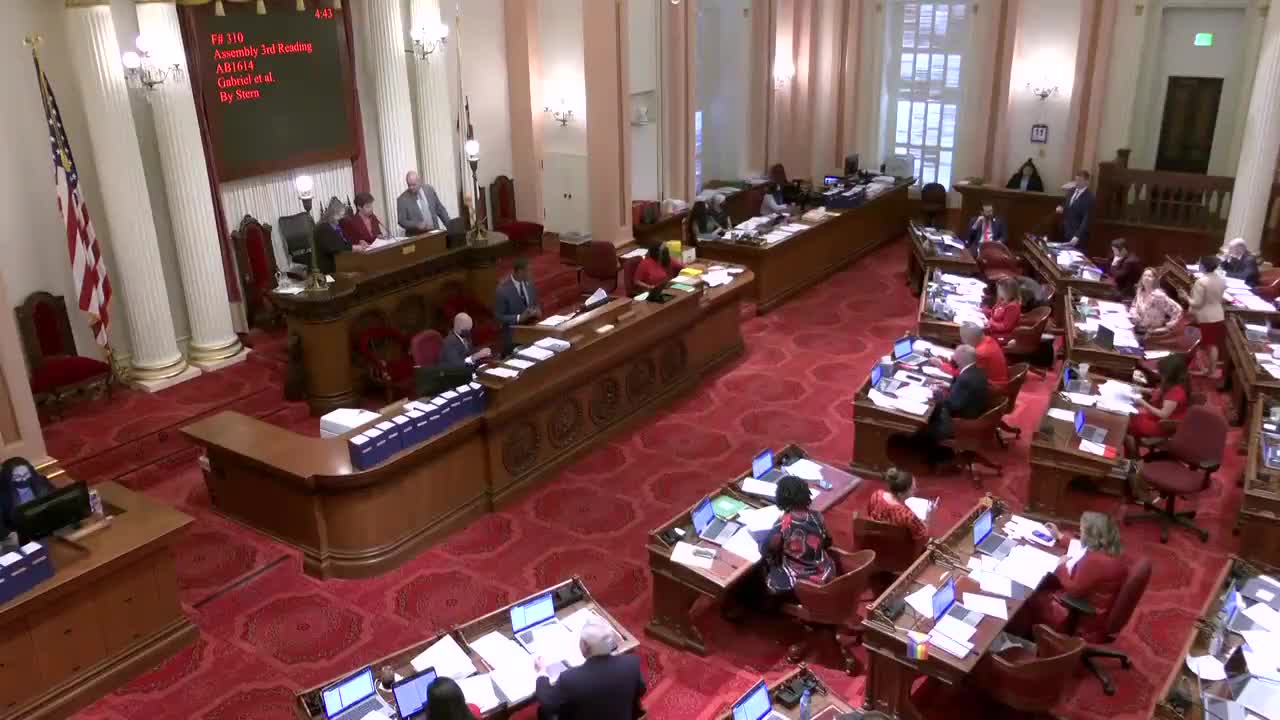 1MIN
Senate Floor
 4MIN
Senate Standing Committee on Appropriations
Bill Author

Bill Co-Author(s):