AB 1371: Unlawful sexual intercourse with a minor.
- Session Year: 2023-2024
- House: Assembly
- Latest Version Date: 2023-10-13
Current Status:
Passed
(2023-10-13: Chaptered by Secretary of State - Chapter 838, Statutes of 2023.)
Introduced
In Committee
First Chamber
In Committee
Second Chamber
Enacted
What does this bill do?
People convicted under Penal Code section 261.5(d) — adults 21 or older who had sexual intercourse with someone under 16 — and who are given probation would be barred from doing their required community service at schools or other places where children gather.
The summary is provided by generative AI which can make mistakes. For original language, please view the details in the table below.
Existing law makes it a crime, known as unlawful sexual intercourse, to commit an act of sexual intercourse with a person who is not the spouse of the perpetrator, if the person is a minor. Under existing law, if a person 21 years of age or older engages in an act of unlawful sexual intercourse with a minor who is under 16 years of age they are guilty of either a misdemeanor or a felony, as specified.
This bill would prohibit a person convicted of this crime who is granted probation from completing community service at a school or location where children congregate.
Existing law makes it a crime, known as unlawful sexual intercourse, to commit an act of sexual intercourse with a person who is not the spouse of the perpetrator, if the person is a minor. Existing law prescribes various terms of imprisonment and civil penalties or fines, depending on the age difference between the person committing the act and the victim. Under existing law, if a person 21 years of age or older engages in an act of unlawful sexual intercourse with a minor who is under 16 years of age they are guilty of either a misdemeanor or a felony, as specified.
This bill would prohibit a person convicted of this crime who is granted probation from completing community service at a school or location where children congregate.
Existing law makes it a crime, known as unlawful sexual intercourse, to commit an act of sexual intercourse with a person who is not the spouse of the perpetrator, if the person is a minor. Existing law prescribes various terms of imprisonment and civil penalties or fines, depending on the age difference between the person committing the act and the victim.
This bill would prohibit a person convicted of this crime who is granted probation from completing community service at a school or location where children congregate.
Existing law prohibits the carrying of a concealed firearm, as specified. Existing law exempts specified active and retired peace officers from this prohibition, subject to certain conditions.This bill would make a technical, nonsubstantive change to that provision.Existing law prohibits the carrying of a concealed firearm, as specified. Existing law exempts specified active and retired peace officers from this prohibition, subject to certain conditions.
This bill would make a technical, nonsubstantive change to that provision.
(a)Unlawful sexual intercourse is an act of sexual intercourse accomplished with a person who is not the spouse of the perpetrator, if the person is a minor. For the purposes of this section, a minor is a person under 18 years of age and an adult is a person who is 18 years of age or older.
(b)A person who engages in an act of unlawful sexual intercourse with a minor who is not more than three years older or three years younger than the perpetrator, is guilty of a misdemeanor.
(c)A person who engages in an act of unlawful sexual intercourse with a minor who is more than three years younger than the perpetrator is guilty of either a misdemeanor or a felony, and shall be punished by imprisonment in a county jail not exceeding one year, or by imprisonment pursuant to subdivision (h) of Section 1170.
(d)A person 21 years of age or older who engages in an act of unlawful sexual intercourse with a minor who is under 16 years of age is guilty of either a misdemeanor or a felony, and shall be punished by imprisonment in a county jail not exceeding one year, or by imprisonment pursuant to subdivision (h) of Section 1170 for two, three, or four years.
(e)(1)Notwithstanding any other provision of this section, an adult who engages in an act of sexual intercourse with a minor in violation of this section may be liable for civil penalties in the following amounts:
(A)An adult who engages in an act of unlawful sexual intercourse with a minor less than two years younger than the adult is liable for a civil penalty not to exceed two thousand dollars ($2,000).
(B)An adult who engages in an act of unlawful sexual intercourse with a minor at least two years younger than the adult is liable for a civil penalty not to exceed five thousand dollars ($5,000).
(C)An adult who engages in an act of unlawful sexual intercourse with a minor at least three years younger than the adult is liable for a civil penalty not to exceed ten thousand dollars ($10,000).
(D)An adult over 21 years of age who engages in an act of unlawful sexual intercourse with a minor under 16 years of age is liable for a civil penalty not to exceed twenty-five thousand dollars ($25,000).
(2)The district attorney may bring actions to recover civil penalties pursuant to this subdivision. From the amounts collected for each case, an amount equal to the costs of pursuing the action shall be deposited with the treasurer of the county in which the judgment was entered, and the remainder shall be deposited in the Underage Pregnancy Prevention Fund, which is hereby created in the State Treasury. Amounts deposited in the Underage Pregnancy Prevention Fund may be used only for the purpose of preventing underage pregnancy upon appropriation by the Legislature.
(3)In addition to any punishment imposed under this section, the judge may assess a fine not to exceed seventy dollars ($70) against a person who violates this section with the proceeds of this fine to be used in accordance with Section 1463.23. The court shall, however, take into consideration the defendants ability to pay, and a defendant shall not be denied probation because of their inability to pay the fine permitted under this subdivision.
(f)A person convicted of violating subdivision (d) who is granted probation shall not complete their community service at a school or location where children congregate.
(a)Unlawful sexual intercourse is an act of sexual intercourse accomplished with a person who is not the spouse of the perpetrator, if the person is a minor. For the purposes of this section, a minor is a person under 18 years of age and an adult is a person who is 18 years of age or older.
(b)A person who engages in an act of unlawful sexual intercourse with a minor who is not more than three years older or three years younger than the perpetrator, is guilty of a misdemeanor.
(c)A person who engages in an act of unlawful sexual intercourse with a minor who is more than three years younger than the perpetrator is guilty of either a misdemeanor or a felony, and shall be punished by imprisonment in a county jail not exceeding one year, or by imprisonment pursuant to subdivision (h) of Section 1170.
(d)A person 21 years of age or older who engages in an act of unlawful sexual intercourse with a minor who is under 16 years of age is guilty of either a misdemeanor or a felony, and shall be punished by imprisonment in a county jail not exceeding one year, or by imprisonment pursuant to subdivision (h) of Section 1170 for two, three, or four years.
(e)(1)Notwithstanding any other provision of this section, an adult who engages in an act of sexual intercourse with a minor in violation of this section may be liable for civil penalties in the following amounts:
(A)An adult who engages in an act of unlawful sexual intercourse with a minor less than two years younger than the adult is liable for a civil penalty not to exceed two thousand dollars ($2,000).
(B)An adult who engages in an act of unlawful sexual intercourse with a minor at least two years younger than the adult is liable for a civil penalty not to exceed five thousand dollars ($5,000).
(C)An adult who engages in an act of unlawful sexual intercourse with a minor at least three years younger than the adult is liable for a civil penalty not to exceed ten thousand dollars ($10,000).
(D)An adult over 21 years of age who engages in an act of unlawful sexual intercourse with a minor under 16 years of age is liable for a civil penalty not to exceed twenty-five thousand dollars ($25,000).
(2)The district attorney may bring actions to recover civil penalties pursuant to this subdivision. From the amounts collected for each case, an amount equal to the costs of pursuing the action shall be deposited with the treasurer of the county in which the judgment was entered, and the remainder shall be deposited in the Underage Pregnancy Prevention Fund, which is hereby created in the State Treasury. Amounts deposited in the Underage Pregnancy Prevention Fund may be used only for the purpose of preventing underage pregnancy upon appropriation by the Legislature.
(3)In addition to any punishment imposed under this section, the judge may assess a fine not to exceed seventy dollars ($70) against a person who violates this section with the proceeds of this fine to be used in accordance with Section 1463.23. The court shall, however, take into consideration the defendants ability to pay, and a defendant shall not be denied probation because of their inability to pay the fine permitted under this subdivision.
(f)A person convicted of violating this section subdivision (d) who is granted probation shall not complete their community service at a school or location where children congregate.
(a)Unlawful sexual intercourse is an act of sexual intercourse accomplished with a person who is not the spouse of the perpetrator, if the person is a minor. For the purposes of this section, a minor is a person under the age of 18 years of age and an adult is a person who is at least 18 years of age. age or older.
(b)Any A person who engages in an act of unlawful sexual intercourse with a minor who is not more than three years older or three years younger than the perpetrator, is guilty of a misdemeanor.
(c)Any A person who engages in an act of unlawful sexual intercourse with a minor who is more than three years younger than the perpetrator is guilty of either a misdemeanor or a felony, and shall be punished by imprisonment in a county jail not exceeding one year, or by imprisonment pursuant to subdivision (h) of Section 1170.
(d)Any A person 21 years of age or older who engages in an act of unlawful sexual intercourse with a minor who is under 16 years of age is guilty of either a misdemeanor or a felony, and shall be punished by imprisonment in a county jail not exceeding one year, or by imprisonment pursuant to subdivision (h) of Section 1170 for two, three, or four years.
(e)(1)Notwithstanding any other provision of this section, an adult who engages in an act of sexual intercourse with a minor in violation of this section may be liable for civil penalties in the following amounts:
(A)An adult who engages in an act of unlawful sexual intercourse with a minor less than two years younger than the adult is liable for a civil penalty not to exceed two thousand dollars ($2,000).
(B)An adult who engages in an act of unlawful sexual intercourse with a minor at least two years younger than the adult is liable for a civil penalty not to exceed five thousand dollars ($5,000).
(C)An adult who engages in an act of unlawful sexual intercourse with a minor at least three years younger than the adult is liable for a civil penalty not to exceed ten thousand dollars ($10,000).
(D)An adult over the age of 21 years of age who engages in an act of unlawful sexual intercourse with a minor under 16 years of age is liable for a civil penalty not to exceed twenty-five thousand dollars ($25,000).
(2)The district attorney may bring actions to recover civil penalties pursuant to this subdivision. From the amounts collected for each case, an amount equal to the costs of pursuing the action shall be deposited with the treasurer of the county in which the judgment was entered, and the remainder shall be deposited in the Underage Pregnancy Prevention Fund, which is hereby created in the State Treasury. Amounts deposited in the Underage Pregnancy Prevention Fund may be used only for the purpose of preventing underage pregnancy upon appropriation by the Legislature.
(3)In addition to any punishment imposed under this section, the judge may assess a fine not to exceed seventy dollars ($70) against any a person who violates this section with the proceeds of this fine to be used in accordance with Section 1463.23. The court shall, however, take into consideration the defendants ability to pay, and no a defendant shall not be denied probation because of his or her their inability to pay the fine permitted under this subdivision.
(f)A person convicted of violating this section who is granted probation shall not complete their community service at a school or location where children congregate.
SECTION 1.Section 25450 of the Penal Code is amended to read:25450.As provided in this article, Section 25400 does not apply to, or affect, any of the following:(a)Any peace officer, listed in Section 830.1 or 830.2, or subdivision (a) of Section 830.33, whether active or honorably retired.(b)Any other duly appointed peace officer.(c)Any honorably retired peace officer listed in subdivision (c) of Section 830.5.(d)Any other honorably retired peace officer who during the course and scope of their appointment as a peace officer was authorized to, and did, carry a firearm.(e)Any full-time paid peace officer of another state or the federal government who is carrying out official duties while in California.(f)Any person summoned by any of these officers to assist in making arrests or preserving the peace while the person is actually engaged in assisting that officer.As provided in this article, Section 25400 does not apply to, or affect, any of the following:
(a)Any peace officer, listed in Section 830.1 or 830.2, or subdivision (a) of Section 830.33, whether active or honorably retired.
(b)Any other duly appointed peace officer.
(c)Any honorably retired peace officer listed in subdivision (c) of Section 830.5.
(d)Any other honorably retired peace officer who during the course and scope of his or her their appointment as a peace officer was authorized to, and did, carry a firearm.
(e)Any full-time paid peace officer of another state or the federal government who is carrying out official duties while in California.
(f)Any person summoned by any of these officers to assist in making arrests or preserving the peace while the person is actually engaged in assisting that officer.
|
Date
|
Status
|
|---|---|
| Oct 13, 2023 | Chaptered by Secretary of State - Chapter 838, Statutes of 2023. |
| Oct 13, 2023 | Approved by the Governor. |
| Sep 12, 2023 | Enrolled and presented to the Governor at 2 p.m. |
| Sep 5, 2023 | In Assembly. Ordered to Engrossing and Enrolling. |
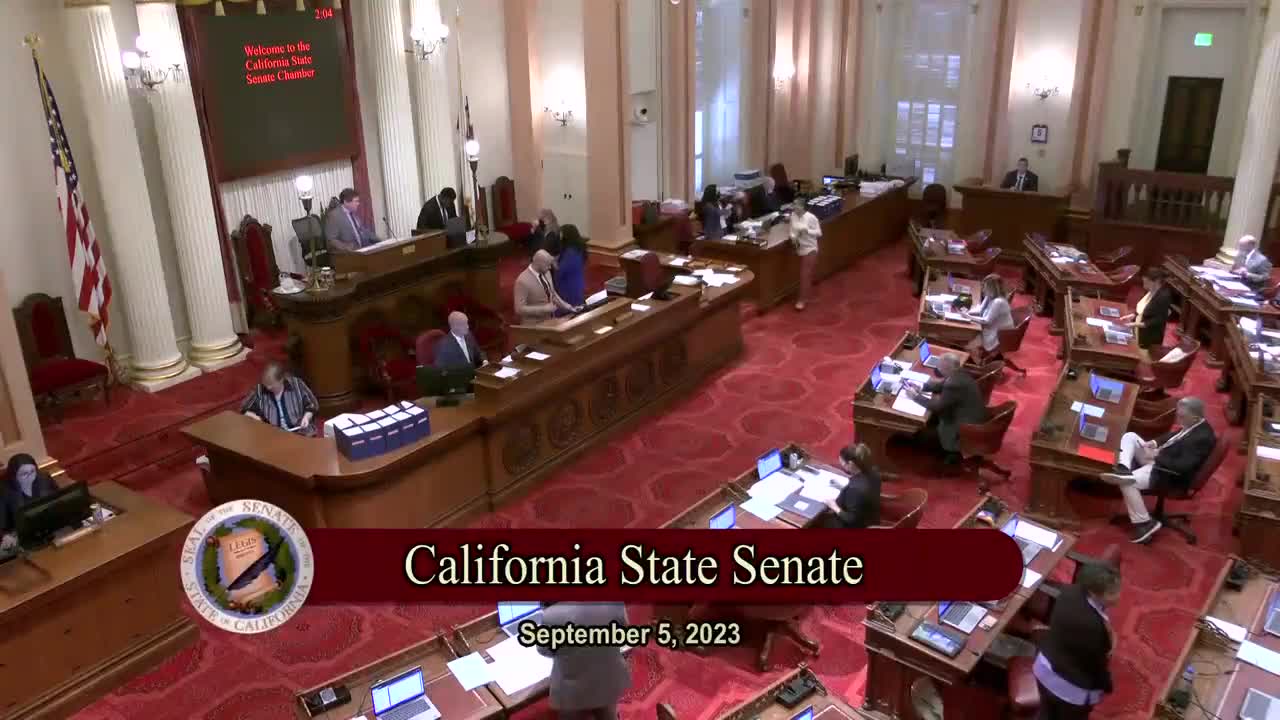
| Sep 5, 2023 | Read third time. Passed. Ordered to the Assembly. (Ayes 39. Noes 0. Page 2351.). |
| Jun 20, 2023 | Read second time. Ordered to third reading. |
| Jun 19, 2023 | Withdrawn from committee. |
| Jun 19, 2023 | Ordered to second reading. |
| Jun 19, 2023 | In committee: Hearing postponed by committee. |
| Jun 13, 2023 | From committee: Do pass and re-refer to Com. on APPR with recommendation: To Consent Calendar. (Ayes 5. Noes 0.) (June 13). Re-referred to Com. on APPR. |
| May 10, 2023 | Referred to Com. on PUB S. |
| Apr 27, 2023 | In Senate. Read first time. To Com. on RLS. for assignment. |
| Apr 27, 2023 | Read third time. Passed. Ordered to the Senate. (Ayes 79. Noes 0. Page 1370.) |
| Apr 24, 2023 | Read second time. Ordered to Consent Calendar. |
| Apr 20, 2023 | Read second time and amended. Ordered returned to second reading. |
| Apr 19, 2023 | From committee: Amend, and do pass as amended. To Consent Calendar. (Ayes 8. Noes 0.) (April 18). |
| Mar 27, 2023 | Re-referred to Com. on PUB. S. |
| Mar 23, 2023 | Referred to Com. on PUB. S. |
| Mar 23, 2023 | From committee chair, with author's amendments: Amend, and re-refer to Com. on PUB. S. Read second time and amended. |
| Feb 18, 2023 | From printer. May be heard in committee March 20. |
| Feb 17, 2023 | Read first time. To print. |
|
Date
|
Description
|
Location
|
Votes
|
|
|---|---|---|---|---|
| Sep 5, 2023 | Assembly 3rd Reading AB1371 Low By Grove | Senate Floor |
Passed |
|
| Jun 13, 2023 | Do pass, but first be re-referred to the Committee on [Appropriations] with the recommendation: To Consent Calendar | Senate Standing Committee on Public Safety |
Passed |
|
| Apr 27, 2023 | AB 1371 Low Consent Calendar Second Day Regular Session | Assembly Floor |
Passed |
|
| Apr 18, 2023 | Do pass as amended. To Consent Calendar. | Assembly Standing Committee on Public Safety |
Passed |
This list shows positions taken on this bill by organizations on the date displayed, which is linked to the original source.
Positions by individuals are not included.
|
Organization
|
Position
|
Date
|
|---|---|---|
| California District Attorneys Association | ** Support | |
| Crime Victims Alliance | ** Support | |
| Crime Victims United Of California | ** Support | |
| Peace Officers Research Association Of California | ** Support |
SENATE RULES COMMITTEE Office of Senate Floor Analyses (916) 651-1520 Fax: (916) 327-4478 | AB 1371 |
THIRD READING
Bill No: AB 1371
Author: Low (D)
Amended: 4/20/23 in Assembly
Vote: 21
SENATE PUBLIC SAFETY COMMITTEE: 5-0, 6/13/23
AYES: Wahab, Ochoa Bogh, Bradford, Skinner, Wiener
ASSEMBLY FLOOR: 79-0, 4/27/23 (Consent) - See last page for vote
SUBJECT: Unlawful sexual intercourse with a minor
SOURCE: Author
DIGEST:
This bill prohibits a person who is 21 years of age or older, and who is convicted of statutory rape with a minor under 16 years of age, from completing community service imposed as a condition of probation at a school or location where children congregate.
ANALYSIS:
Existing law:
- Specifies that "unlawful sexual intercourse" is an act of sexual intercourse accomplished with a person who is not the spouse of the perpetrator, if the person is a minor. For the purposes of this section, a "minor" is a person under the age of 18 years and an "adult" is a person who is at least 18 years of age. (Penal Code § 261.5 (a).) Punishes unlawful sexual intercourse as follows:
- Any person who engages in an act of unlawful sexual intercourse with a minor who is not more than three years older or three years younger than the perpetrator, is guilty of a misdemeanor. (Penal Code § 261.5 (b).)
- Any person who engages in an act of unlawful sexual intercourse with a minor who is more than three years younger than the perpetrator is guilty of either a misdemeanor or a felony, and shall be punished by imprisonment in a county jail not exceeding one year, or by imprisonment for 16 months, two, or three years in the county jail for a violation of the felony provision. (Penal Code, § 261.5(c).)
- Any person 21 years of age or older who engages in an act of unlawful sexual intercourse with a minor who is under 16 years of age is guilty of either a misdemeanor or a felony, and shall be punished by imprisonment in a county jail not exceeding one year, or by imprisonment in county jail for two, three, or four years. (Penal Code, § 261.5(d).)
- Defines “probation” as “the suspension of the imposition or execution of a sentence and the order of conditional and revocable release in the community under the supervision of a probation officer.” (Penal Code § 1203 (a).)
- Defines “conditional sentence” as “the suspension of the imposition or execution of a sentence and the order of revocable release in the community subject to conditions established by the court without the supervision of a probation officer.” (Penal Code § 1203 (a).)
- Sets the period of probation for a misdemeanor to no longer than one year, unless the offense includes specific probation lengths within its provisions. (Penal Code § 1203a.)
- Sets the period of probation for a felony to no longer than two years, except as specified (Penal Code § 1203.1 (a) & (l).)
- Authorizes the court to impose and require any or all reasonable conditions of probation as it may determine are fitting and proper so that justice may be done, that amends may be done to society for the breach of the law, for any injury done to any person resulting from that breach, and generally and specifically for the reformation and rehabilitation of the probationer. (Penal Code § 1203.1 (j).)
- Authorizes the court to revoke, modify, or terminate its order of probation. (Penal Code §§ 1203.2 & 1203.3.)
This bill prohibits a person who is 21 years of age or older, and who is convicted of statutory rape with a minor under 16 years of age, from completing community service imposed as a condition of probation at a school or location where children congregate.
Background
Probation is the suspension of a custodial sentence and a conditional release of a defendant into the community. Probation can be “formal” or “informal.” “Formal” probation is under the direction and supervision of a probation officer. Under “informal” probation, a defendant is not supervised by a probation officer but instead reports to the court. Probation supervision is intended to facilitate rehabilitation and ensure defendant accountability. The court has broad discretion to impose conditions that foster the defendant’s rehabilitation and protect the public safety. (People v. Carbajal (1995) 10 Cal.4th 1114, 1120.) A valid condition must be reasonably related to the offense and aimed at deterring such misconduct in the future. (Id. at p. 1121.)
This bill prohibits a person who is 21 years of age or older, and who is convicted of statutory rape with a minor under 16 years of age, from completing community service imposed as a condition of probation at a school or location where children congregate.
FISCAL EFFECT: Appropriation: No Fiscal Com.: No Local: No
SUPPORT: (Verified 6/19/23)
California District Attorneys Association
Crime Victims Alliance
Crime Victims United of California
Peace Officers Research Association of California
OPPOSITION: (Verified 6/19/23)
None received
ARGUMENTS IN SUPPORT: Crime Victim Alliance supports this bill stating, “We believe this is common sense legislation that will ensure that as sex offenders who have assaulted minors and are placed on probation, are not able to complete their community service hours at a school or a location where children congregate.”
ASSEMBLY FLOOR: 79-0, 4/27/23
AYES: Addis, Aguiar-Curry, Alanis, Alvarez, Arambula, Bains, Bauer-Kahan, Bennett, Berman, Boerner, Bonta, Bryan, Calderon, Juan Carrillo, Wendy Carrillo, Cervantes, Chen, Connolly, Megan Dahle, Davies, Dixon, Essayli, Flora, Mike Fong, Vince Fong, Friedman, Gabriel, Gallagher, Garcia, Gipson, Grayson, Haney, Hart, Holden, Hoover, Irwin, Jackson, Jones-Sawyer, Kalra, Lackey, Lee, Low, Lowenthal, Maienschein, Mathis, McCarty, McKinnor, Muratsuchi, Stephanie Nguyen, Ortega, Pacheco, Papan, Joe Patterson, Pellerin, Petrie-Norris, Quirk-Silva, Ramos, Reyes, Luz Rivas, Robert Rivas, Rodriguez, Blanca Rubio, Sanchez, Santiago, Schiavo, Soria, Ta, Ting, Valencia, Villapudua, Waldron, Wallis, Ward, Weber, Wicks, Wilson, Wood, Zbur, Rendon
NO VOTE RECORDED: Jim Patterson
Prepared by: Mary Kennedy / PUB. S. /
6/21/23 14:29:16
**** END ****
SENATE COMMITTEE ON PUBLIC SAFETY
Senator Aisha Wahab, Chair
2023 - 2024 Regular
Bill No: AB 1371 Hearing Date: June 13, 2023
Author: | Low | ||
Version: | April 20, 2023 | ||
Urgency: | No | Fiscal: | No |
Consultant: | MK | ||
Subject: Unlawful sexual intercourse with a minor
HISTORY
Source: Author
Prior Legislation: Not Applicable
Support: California District Attorneys Association; Crime Victims Alliance; Crime Victims United of California; Peace Officers Research Association of California (PORAC)
Opposition: None known
Assembly Floor Vote: 79 - 0
PURPOSE
The purpose of this bill is to prohibit a person who is 21 years of age or older, and who is convicted of statutory rape with a minor under 16 years of age, from completing community service imposed as a condition of probation at a school or location where children congregate.
Existing law specifies that "unlawful sexual intercourse" is an act of sexual intercourse accomplished with a person who is not the spouse of the perpetrator, if the person is a minor. For the purposes of this section, a "minor" is a person under the age of 18 years and an "adult" is a person who is at least 18 years of age. (Penal Code § 261.5 (a).) Punishes unlawful sexual intercourse as follows:
- Any person who engages in an act of unlawful sexual intercourse with a minor who is not more than three years older or three years younger than the perpetrator, is guilty of a misdemeanor. (Penal Code § 261.5 (b).)
- Any person who engages in an act of unlawful sexual intercourse with a minor who is more than three years younger than the perpetrator is guilty of either a misdemeanor or a felony, and shall be punished by imprisonment in a county jail not exceeding one year, or by imprisonment for 16 months, two, or three years in the county jail for a violation of the felony provision. (Penal Code, § 261.5(c).)
- Any person 21 years of age or older who engages in an act of unlawful sexual intercourse with a minor who is under 16 years of age is guilty of either a misdemeanor or a felony, and shall be punished by imprisonment in a county jail not exceeding one year, or by imprisonment in county jail for two, three, or four years. (Penal Code, § 261.5(d).)
Existing law defines “probation” as “the suspension of the imposition or execution of a sentence and the order of conditional and revocable release in the community under the supervision of a probation officer.” (Penal Code § 1203 (a).)
Existing law defines “conditional sentence” as “the suspension of the imposition or execution of a sentence and the order of revocable release in the community subject to conditions established by the court without the supervision of a probation officer.” (Penal Code § 1203 (a).)
Existing law sets the period of probation for a misdemeanor to no longer than one year, unless the offense includes specific probation lengths within its provisions. (Penal Code § 1203a.)
Existing law sets the period of probation for a felony to no longer than two years, except as specified (Penal Code § 1203.1 (a) & (l).)
Existing law authorizes the court to impose and require any or all reasonable conditions of probation as it may determine are fitting and proper so that justice may be done, that amends may be done to society for the breach of the law, for any injury done to any person resulting from that breach, and generally and specifically for the reformation and rehabilitation of the probationer. (Penal Code § 1203.1 (j).)
Existing law authorizes the court to revoke, modify, or terminate its order of probation. (Penal Code §§ 1203.2 & 1203.3.)
This bill prohibits a person who is 21 years of age or older, and who is convicted of statutory rape with a minor under 16 years of age, from completing community service imposed as a condition of probation at a school or location where children congregate.
COMMENTS
1. Need for This Bill
According to the author:
Victims' rights are critical to make sure our criminal justice system remains fair and balanced. It's inexcusable for rape cases in our state to be mishandled. AB 1371 is going to ensure victims are protected and rape cases are prosecuted correctly. If someone is found guilty of statutory rape, the defendant should never be able to fulfill community service in a place where minors are present.
2. Probation Supervision
Probation is the suspension of a custodial sentence and a conditional release of a defendant into the community. Probation can be “formal” or “informal.” “Formal” probation is under the direction and supervision of a probation officer. Under “informal” probation, a defendant is not supervised by a probation officer but instead reports to the court. Probation supervision is intended to facilitate rehabilitation and ensure defendant accountability. The court has broad discretion to impose conditions that foster the defendant’s rehabilitation and protect the public safety. (People v. Carbajal (1995) 10 Cal.4th 1114, 1120.) A valid condition must be reasonably related to the offense and aimed at deterring such misconduct in the future. (Id. at p. 1121.)
This bill would prohibit a person who is 21 years of age or older, and who is convicted of statutory rape with a minor under 16 years of age, from completing community service imposed as a condition of probation at a school or location where children congregate.
It is well-settled that a probationer, like a parolee, retains basic constitutional protection against arbitrary and oppressive official action. (See In re Taylor (2015) 60 Cal.4th 1019, 1038; People v. Reyes (1998) 19 Cal.4th 743, 753-754; People v. Woods (1999) 21 Cal.4th 668, 691.) However, courts have observed that “probation is a privilege and not a right, and that adult probationers, in preference to incarceration, validly may consent to limitations upon their constitutional rights—as, for example, when they agree to warrantless search conditions.” (People v. Olguin (2008) 45 Cal.4th 375, 384 [citation omitted]; People v. Bravo (1987) 43 Cal.3d 600, 609.) Reasonable probation conditions may infringe upon constitutional rights, provided the conditions are narrowly tailored to achieve legitimate purposes, such as fostering the probationer's rehabilitation or protecting the public. (Olguin, at p. 384.)
Freedom of association, for example, is a constitutional right. (People v. Gonsalves (2021) 66 Cal.App.5th 1, 6-7.) Because this bill would prohibit an individual from completing community service at a school or place where children congregate, it arguably may infringe on this right. That being said, this bill would prohibit only one subset of statutory rape offenders from performing community service at a school or where children congregate – those 21 years of age or older who were convicted on the basis of having engaged in sexual intercourse with a minor under 16 years of age. This bill would not encompass statutory rape cases where the age difference is much narrower and the perpetrator themselves could be a minor. Arguably, it is intended to balance fostering an individual’s rehabilitation through community service while protecting children.
3. Argument in Support
Crime Victim Alliance supports this bill stating:
We believe this is common sense legislation that will ensure that as sex offenders who have assaulted minors and are placed on probation, are not able to complete their community service hours at a school or a location where children congregate.
-- END –
Date of Hearing:
Counsel: Cheryl Anderson
ASSEMBLY COMMITTEE ON PUBLIC SAFETY
Reginald Byron Jones-Sawyer, Sr., Chair
ABPCA Bill Id:AB 1371
Author:(Low) – As Amended Ver:March 23, 2023
As Proposed to be Amended in Committee
SUMMARY:
Prohibits a person who is 21 years of age or older, and who is convicted of statutory rape with a minor under 16 years of age, from completing community service imposed as a condition of probation at a school or location where children congregate.
EXISTING LAW:
- Specifies that "unlawful sexual intercourse" is an act of sexual intercourse accomplished with a person who is not the spouse of the perpetrator, if the person is a minor. For the purposes of this section, a "minor" is a person under the age of 18 years and an "adult" is a person who is at least 18 years of age. (Pen. Code, § 261.5, subd. (a).) Punishes unlawful sexual intercourse as follows:
- Any person who engages in an act of unlawful sexual intercourse with a minor who is not more than three years older or three years younger than the perpetrator, is guilty of a misdemeanor. (Pen. Code, § 261.5, subd. (b).)
- Any person who engages in an act of unlawful sexual intercourse with a minor who is more than three years younger than the perpetrator is guilty of either a misdemeanor or a felony, and shall be punished by imprisonment in a county jail not exceeding one year, or by imprisonment for 16 months, two, or three years in the county jail for a violation of the felony provision. (Pen. Code, § 261.5, subd. (c).)
- Any person 21 years of age or older who engages in an act of unlawful sexual intercourse with a minor who is under 16 years of age is guilty of either a misdemeanor or a felony, and shall be punished by imprisonment in a county jail not exceeding one year, or by imprisonment in county jail for two, three, or four years. (Pen. Code, § 261.5, subd. (d).)
- Defines “probation” as “the suspension of the imposition or execution of a sentence and the order of conditional and revocable release in the community under the supervision of a probation officer.” (Pen. Code, § 1203, subd. (a).)
- Defines “conditional sentence” as “the suspension of the imposition or execution of a sentence and the order of revocable release in the community subject to conditions established by the court without the supervision of a probation officer.” (Pen. Code, § 1203, subd. (a).)
- Sets the period of probation for a misdemeanor to no longer than one year, unless the offense includes specific probation lengths within its provisions. (Pen. Code, § 1203a.)
- Sets the period of probation for a felony to no longer than two years, except as specified (Pen. Code, § 1203.1, subds. (a) & (l).)
- Authorizes the court to impose and require any or all reasonable conditions of probation as it may determine are fitting and proper so that justice may be done, that amends may be done to society for the breach of the law, for any injury done to any person resulting from that breach, and generally and specifically for the reformation and rehabilitation of the probationer. (Pen. Code, § 1203.1, subd. (j).)
- Authorizes the court to revoke, modify, or terminate its order of probation. (Pen. Code, §§ 1203.2 & 1203.3.)
FISCAL EFFECT:
Unknown
COMMENTS:
- Author's Statement: According to the author, “Victims' rights are critical to make sure our criminal justice system remains fair and balanced. It's inexcusable for rape cases in our state to be mishandled. AB 1371 is going to ensure victims are protected and rape cases are prosecuted correctly. If someone is found guilty of statutory rape, the defendant should never be able to fulfill community service in a place where minors are present.”
- Probation Supervision: Probation is the suspension of a custodial sentence and a conditional release of a defendant into the community. Probation can be “formal” or “informal.” “Formal” probation is under the direction and supervision of a probation officer. Under “informal” probation, a defendant is not supervised by a probation officer but instead reports to the court. Probation supervision is intended to facilitate rehabilitation and ensure defendant accountability. The court has broad discretion to impose conditions that foster the defendant’s rehabilitation and protect the public safety. (People v. Carbajal (1995) 10 Cal.4th 1114, 1120.) A valid condition must be reasonably related to the offense and aimed at deterring such misconduct in the future. (Id. at p. 1121.)
This bill would prohibit a person who is 21 years of age or older, and who is convicted of statutory rape with a minor under 16 years of age, from completing community service imposed as a condition of probation at a school or location where children congregate. - Constitutional Considerations: It is well-settled that a probationer, like a parolee, retains basic constitutional protection against arbitrary and oppressive official action. (See In re Taylor (2015) 60 Cal.4th 1019, 1038; People v. Reyes (1998) 19 Cal.4th 743, 753-754; People v. Woods (1999) 21 Cal.4th 668, 691.) However, courts have observed that “probation is a privilege and not a right, and that adult probationers, in preference to incarceration, validly may consent to limitations upon their constitutional rights—as, for example, when they agree to warrantless search conditions.” (People v. Olguin (2008) 45 Cal.4th 375, 384 [citation omitted]; People v. Bravo (1987) 43 Cal.3d 600, 609.) Reasonable probation conditions may infringe upon constitutional rights, provided the conditions are narrowly tailored to achieve legitimate purposes, such as fostering the probationer's rehabilitation or protecting the public. (Olguin, at p. 384.)
Freedom of association, for example, is a constitutional right. (People v. Gonsalves (2021) 66 Cal.App.5th 1, 6-7.) Because this bill would prohibit an individual from completing community service at a school or place where children congregate, it arguably may infringe on this right. That being said, this bill would prohibit only one subset of statutory rape offenders from performing community service at a school or where children congregate – those 21 years of age or older who were convicted on the basis of having engaged in sexual intercourse with a minor under 16 years of age. This bill would not encompass statutory rape cases where the age difference is much narrower and the perpetrator themselves could be a minor. Arguably, it is intended to balance fostering an individual’s rehabilitation through community service while protecting children.
Probation conditions may also be challenged as excessively vague. "'It is an essential component of due process that individuals be given fair notice of those acts which may lead to a loss of liberty. [Citations.] This is true whether the loss of liberty arises from a criminal conviction or the revocation of probation. [Citations.] [P] "'Fair notice' requires only that a violation be described with a '"reasonable degree of certainty"' . . . so that 'ordinary people can understand what conduct is prohibited.'"' [Citations.]" (In re Angel J. (1992) 9 Cal.App.4th 1096, 1101-1102; In re Byron B. (2004) 119 Cal.App.4th 1013, 1018.) Thus, a probation condition "'must be sufficiently precise for the probationer to know what is required of him,'" and for the court to determine whether the condition has been violated. (People v. Lopez (1998) 66 Cal.App.4th 615, 630, quoting from People v. Reinertson (1986) 178 Cal.App.3d 320, 324-325.)
Some might argue that the probation condition to "stay away from any places where minor children congregate" may be unconstitutionally vague. But in People v. Delvalle (1994) 26 Cal.App.4th 869, the court considered that same language and found it not unconstitutionally vague. The court noted that the obvious places that come to mind are elementary schools, day care, and parks. (Id. at pp. 878-879.) However, in an abundance of caution, the author may wish to further clarify this provision to avoid potential constitutional vagueness issues.
- Argument in Support: According to Crime Victims Alliance, “We believe this is common sense legislation that will ensure that as sex offenders who have assaulted minors and are placed on probation, are not able to complete their community service hours at a school or a location where children congregate.”
- Argument in Opposition: None on file.
- Prior Legislation: AB 2199 (Campos), of the 2015-2016 Legislative Session, would have made statutory rape punishable by an additional two-year sentence enhancement if the offender is a person in a “position of authority” over the victim, as specified. AB 2199 was held in the Senate Appropriations Committee.
REGISTERED SUPPORT / OPPOSITION:
Support
California District Attorneys Association
Crime Victims Alliance
Peace Officers Research Association of California (PORAC)
Opposition
None on file
Analysis Prepared by:
Cheryl Anderson / PUB. S. / (916) 319-3744
Bill Author

Bill Co-Author(s):