AB 1594: Medium- and heavy-duty zero-emission vehicles: public agency utilities.
- Session Year: 2023-2024
- House: Assembly
- Latest Version Date: 2023-10-08
Current Status:
Passed
(2023-10-08: Chaptered by Secretary of State - Chapter 585, Statutes of 2023.)
Introduced
In Committee
First Chamber
In Committee
Second Chamber
Enacted
What does this bill do?
The bill says any state rule that would require fleets to buy medium- or heavy‑duty zero‑emission vehicles must allow public utility agencies to buy replacement traditional specialized utility vehicles at end of life when needed to keep water or electric service reliable and to respond to major events like severe weather, wildfires, disasters, or attacks. It defines public agency utilities to include local public electric utilities, community water systems, water districts, and wastewater treatment providers, and allows those utilities to submit broader vehicle‑usage data (not just the lowest‑mileage days) to show daily use.
The summary is provided by generative AI which can make mistakes. For original language, please view the details in the table below.
Executive Order No. N-79-20 establishes the goal of transitioning medium- and heavy-duty vehicles in California to zero-emission vehicles by 2045 for all operations where feasible and by 2035 for drayage trucks, and requires the State Air Resources Board to develop and propose medium- and heavy-duty vehicle regulations to meet that goal.
Existing law establishes the Air Quality Improvement Program that is administered by the board for purposes of funding projects related to, among other things, the reduction of criteria air pollutants and improvement of air quality, and establishes the Medium- and Heavy-Duty Zero-Emission Vehicle Fleet Purchasing Assistance Program within the Air Quality Improvement Program to make financing tools and nonfinancial supports available to operators of medium- and heavy-duty vehicle fleets to enable those operators to transition their fleets to zero-emission vehicles.
This bill would require any state regulation that seeks to require, or otherwise compel, the procurement of medium- and heavy-duty zero-emission vehicles to authorize public agency utilities to purchase replacements for traditional utility-specialized vehicles that are at the end of life when needed to maintain reliable service and respond to major foreseeable events, including severe weather, wildfires, natural disasters, and physical attacks, as specified. The bill would define a public agency utility to include a local publicly owned electric utility, a community water system, a water district, and a wastewater treatment provider, as specified.
Executive Order No. N-79-20 establishes the goal of transitioning medium- and heavy-duty vehicles in California to zero-emission vehicles by 2045 for all operations where feasible and by 2035 for drayage trucks, and requires the State Air Resources Board to develop and propose medium- and heavy-duty vehicle regulations to meet that goal.
Existing law establishes the Air Quality Improvement Program that is administered by the board for purposes of funding projects related to, among other things, the reduction of criteria air pollutants and improvement of air quality, and establishes the Medium- and Heavy-Duty Zero-Emission Vehicle Fleet Purchasing Assistance Program within the Air Quality Improvement Program to make financing tools and nonfinancial supports available to operators of medium- and heavy-duty vehicle fleets to enable those operators to transition their fleets to zero-emission vehicles.
This bill would require any state regulation that seeks to require, or otherwise compel, the procurement of medium- and heavy-duty zero-emission vehicles by a public agency utility to ensure that those vehicles can support a public agency utilitys ability to maintain reliable water and electric services, respond to disasters in an emergency capacity, and provide mutual aid assistance statewide and nationwide, among other requirements. The bill would define a public agency utility to include a local publicly owned electric utility, a community water system, and a wastewater treatment provider, as specified.This bill would require any state regulation that seeks to require, or otherwise compel, the procurement of medium- and heavy-duty zero-emission vehicles to authorize public agency utilities to purchase replacements for traditional utility-specialized vehicles that are at the end of life when needed to maintain reliable service and respond to major foreseeable events, including severe weather, wildfires, natural disasters, and physical attacks, as specified. The bill would define a public agency utility to include a local publicly owned electric utility, a community water system, and a wastewater treatment provider, as specified.
Executive Order No. N-79-20 establishes the goal of transitioning medium- and heavy-duty vehicles in California to zero-emission vehicles by 2045 for all operations where feasible and by 2035 for drayage trucks, and requires the State Air Resources Board to develop and propose medium- and heavy-duty vehicle regulations to meet that goal.
Existing law establishes the Air Quality Improvement Program that is administered by the board for purposes of funding projects related to, among other things, the reduction of criteria air pollutants and improvement of air quality, and establishes the Medium- and Heavy-Duty Zero-Emission Vehicle Fleet Purchasing Assistance Program within the Air Quality Improvement Program to make financing tools and nonfinancial supports available to operators of medium- and heavy-duty vehicle fleets to enable those operators to transition their fleets to zero-emission vehicles.
This bill would require any state regulation that seeks to require, or otherwise compel, the procurement of medium- and heavy-duty zero-emission vehicles by a public agency utility to ensure that those vehicles can support a public agency utilitys ability to maintain reliable water and electric services, respond to disasters in an emergency capacity, and provide mutual aid assistance statewide and nationwide, among other requirements. The bill would define a public agency utility to include a local publicly owned electric utility, a community water system, and a wastewater treatment provider, as specified.
Existing law generally regulates authorized emergency vehicles, and exempts the driver of an authorized emergency vehicle from various provisions of the rules of the road, as contained in the Vehicle Code, if, among other things, the vehicle is being driven in response to an emergency call, the driver of the vehicle sounds a siren, and the vehicle displays a lighted red lamp visible from the front as a warning to other drivers and pedestrians. Existing law defines authorized emergency vehicle to include, among others, any vehicle owned by the state, or any bridge and highway district, and equipped and used either for fighting fires, or towing or servicing other vehicles, caring for injured persons, or repairing damaged lighting or electrical equipment.This bill would instead define authorized emergency vehicle to include any vehicle owned by the state, or any bridge and highway district, and equipped and used for, among other things, repairing damaged lighting or electrical infrastructure.Existing law generally regulates authorized emergency vehicles, and exempts the driver of an authorized emergency vehicle from various provisions of the rules of the road, as contained in the Vehicle Code, if, among other things, the vehicle is being driven in response to an emergency call, the driver of the vehicle sounds a siren, and the vehicle displays a lighted red lamp visible from the front as a warning to other drivers and pedestrians. Existing law defines authorized emergency vehicle to include, among others, any vehicle owned by the state, or any bridge and highway district, and equipped and used either for fighting fires, or towing or servicing other vehicles, caring for injured persons, or repairing damaged lighting or electrical equipment.
This bill would instead define authorized emergency vehicle to include any vehicle owned by the state, or any bridge and highway district, and equipped and used for, among other things, repairing damaged lighting or electrical infrastructure.
The Legislature finds and declares all of the following:
(a)Public agency utility vehicles are essential to maintaining reliable water and electric service, achieving the states ambitious energy and water goals, for responding to disasters in an emergency capacity, and for providing mutual aid assistance in the state and nationwide.
(b)Public agency utility vehicles are operated under various weather and geographic conditions and zero-emission vehicle procurement plans for public agency utilities should be reasonably tailored to support each public agency utilitys ability to respond to major disruption events, including, but not limited to, severe weather, wildfires, natural disasters, and physical attacks, and to maintain reliable utility services to California communities.
SEC. 2.The heading of Division 12.5 (commencing with Section 28500) is added to the Vehicle Code, to read:12.5.Zero-Emission VehiclesSEC. 3.Chapter 1 (commencing with Section 28500) is added to Division 12.5 of the Vehicle Code, to read:1.Public Agency Utility Medium- and Heavy-Duty Vehicles28500.(a)Public agency utility means a local publicly owned electric utility, as defined in Section 224.3 of the Public Utilities Code, a community water system, as defined in Section 116275 of the Health and Safety Code, a water district, as defined in Section 20200 of the Water Code, and a wastewater treatment provider, as defined in Section 116773.2 of the Health and Safety Code.
(b)Any state regulation that seeks to require, or otherwise compel, the procurement of medium- and heavy-duty zero-emission vehicles shall authorize public agency utilities to purchase replacements for traditional utility-specialized vehicles that are at the end of life, as determined by the State Air Resources Board in consultation with public agency utilities, when needed to maintain reliable service and respond to major foreseeable events, including, but not limited to, severe weather, wildfires, natural disasters, and physical attacks, without regard to the model year of the vehicle being replaced. For the purposes of determining the daily usage of a medium- or heavy-duty vehicle, a public agency utility may provide comprehensive usage data for a class of vehicles that does not exclusively rely on the lowest mileage reading and does not exclude the highest usage days.
The Legislature finds and declares all of the following:
(a)Public agency utility vehicles are essential to maintaining reliable water and electric service, achieving the states ambitious energy and water goals, for responding to disasters in an emergency capacity, and for providing mutual aid assistance in the state and nationwide.
(b)Public agency utility vehicles are operated under various weather and geographic conditions and zero-emission vehicle procurement plans for public agency utilities should be reasonably tailored to support each public agency utilitys ability to respond to major disruption events, including, but not limited to, severe weather, wildfires, natural disasters, and physical attacks, and to maintain reliable utility services to California communities.
SEC. 2.The heading of Division 12.5 (commencing with Section 28500) is added to the Vehicle Code, to read:12.5.Zero-Emission VehiclesSEC. 3.Chapter 1 (commencing with Section 28500) is added to Division 12.5 of the Vehicle Code, to read:1.Public Agency Utility Medium- and Heavy-Duty Vehicles28500.(a)Public agency utility means a local publicly owned electric utility, as defined in Section 224.3 of the Public Utilities Code, a community water system, as defined in Section 116275 of the Health and Safety Code, a water district, as defined in Section 20200 of the Water Code, and a wastewater treatment provider, as defined in Section 116773.2 of the Health and Safety Code.
(b)Any state regulation that seeks to require, or otherwise compel, the procurement of medium- and heavy-duty zero-emission vehicles shall authorize public agency utilities to purchase replacements for traditional utility-specialized vehicles that are at the end of life life, as determined by the State Air Resources Board in consultation with public agency utilities, when needed to maintain reliable service and respond to major foreseeable events, including, but not limited to, severe weather, wildfires, natural disasters, and physical attacks, without regard to the model year of the vehicle being replaced. For the purposes of determining the daily usage of a medium- or heavy-duty vehicle, a public agency utility may provide comprehensive usage data for a class of vehicles that does not exclusively rely on the lowest mileage reading and does not exclude the highest usage days.
The Legislature finds and declares all of the following:
(a)Public agency utility vehicles are essential to maintaining reliable water and electric service, achieving the states ambitious energy and water goals, for responding to disasters in an emergency capacity, and for providing mutual aid assistance in the state and nationwide.
(b)Public agency utility vehicles are operated under various weather and geographic conditions and zero-emission vehicle procurement plans for public agency utilities should be reasonably tailored to support each public agency utilitys ability to respond to major disruption events, including, but not limited to, severe weather, wildfires, natural disasters, and physical attacks, and to maintain reliable utility services to California communities.
SECTION 1.SEC. 2.The heading of Division 12.5 (commencing with Section 28500) is added to the Vehicle Code, to read:12.5.Zero-Emission VehiclesSEC. 2.SEC. 3.Chapter 1 (commencing with Section 28500) is added to Division 12.5 of the Vehicle Code, to read:1.Public Agency Utility Medium- and Heavy-Duty Vehicles28500.(a)Public agency utility means a local publicly owned electric utility, as defined in Section 224.3 of the Public Utilities Code, a community water system, as defined in Section 116275 of the Health and Safety Code, and a wastewater treatment provider, as defined in Section 116773.2 of the Health and Safety Code.
(b)Any state regulation that seeks to require, or otherwise compel, the procurement of medium- and heavy-duty zero-emission vehicles shall ensure that those vehicles can support a public agency utilitys ability to maintain reliable water and electric service, respond to disasters in an emergency capacity, and provide mutual aid assistance statewide and nationwide, and shall do both of the following:(1)Recognize the diversity of fleet size, terrain, and climate, and authorize public agency utilities to purchase replacements for traditional utility-specialized vehicles that are at the end of life when needed to maintain reliable service and respond to major foreseeable events, including, but not limited to, severe weather, wildfires, natural disasters, and physical attacks.(2)Authorize a public agency utility to request that the public agency utility be allowed to determine whether a comparable zero-emission vehicle is available for purchase without regard to the model year of the vehicle being replaced and in consideration of daily usage capabilities and foreseeable emergency response and mutual aid assistance needs.(b)Any state regulation that seeks to require, or otherwise compel, the procurement of medium- and heavy-duty zero-emission vehicles shall authorize public agency utilities to purchase replacements for traditional utility-specialized vehicles that are at the end of life when needed to maintain reliable service and respond to major foreseeable events, including, but not limited to, severe weather, wildfires, natural disasters, and physical attacks, without regard to the model year of the vehicle being replaced. For the purposes of determining the daily usage of a medium- or heavy-duty vehicle, a public agency utility may provide comprehensive usage data for a class of vehicles that does not exclusively rely on the lowest mileage reading and does not exclude the highest usage days.
(a)Public agency utility means a local publicly owned electric utility, as defined in Section 224.3 of the Public Utilities Code, a community water system, as defined in Section 116275 of the Health and Safety Code, and a wastewater treatment provider, as defined in Section 116773.2 of the Health and Safety Code.
(b)Any state regulation that seeks to require, or otherwise compel, the procurement of medium- and heavy-duty zero-emission vehicles shall ensure that those vehicles can support a public agency utilitys ability to maintain reliable water and electric service, respond to disasters in an emergency capacity, and provide mutual aid assistance statewide and nationwide, and shall do both of the following:
(1)Recognize the diversity of fleet size, terrain, and climate, and authorize public agency utilities to purchase replacements for traditional utility specialized utility-specialized vehicles that are at the end of life when needed to maintain reliable service and respond to major foreseeable events, including, but not limited to, severe weather, wildfires, natural disasters, and physical attacks.
(2)In coordination with public agency utilities, include a list of vehicle vendors and suppliers that meet zero-emission vehicle standards and the public agency utilities technical and performance requirements.(2)Authorize a public agency utility to request that the public agency utility be allowed to determine whether a comparable zero-emission vehicle is available for purchase without regard to the model year of the vehicle being replaced and in consideration of daily usage capabilities and foreseeable emergency response and mutual aid assistance needs.
(a)Public agency utility means a local publicly owned electric utility, as defined in Section 224.3 of the Public Utilities Code, a community water system, as defined in Section 116275 of the Health and Safety Code, and a wastewater treatment provider, as defined in Section 116773.2 of the Health and Safety Code.
(b)Any state regulation that seeks to require, or otherwise compel, the procurement of medium- and heavy-duty zero-emission vehicles shall ensure that those vehicles can support a public agency utilitys ability to maintain reliable water and electric service, respond to disasters in an emergency capacity, and provide mutual aid assistance statewide and nationwide, and shall do both of the following:
(1)Recognize the diversity of fleet size, terrain, and climate, and authorize public agency utilities to purchase replacements for traditional utility specialized vehicles that are at the end of life when needed to maintain reliable service and respond to major foreseeable events, including, but not limited to, severe weather, wildfires, natural disasters, and physical attacks.
(2)In coordination with public agency utilities, include a list of vehicle vendors and suppliers that meet zero-emission vehicle standards and the public agency utilities technical and performance requirements.
SECTION 1.Section 165 of the Vehicle Code is amended to read:165.An authorized emergency vehicle is:(a)Any publicly owned and operated ambulance, lifeguard, or lifesaving equipment or any privately owned or operated ambulance licensed by the Commissioner of the California Highway Patrol to operate in response to emergency calls.(b)Any publicly owned vehicle operated by the following persons, agencies, or organizations:(1)Any federal, state, or local agency, department, or district employing peace officers as that term is defined in Chapter 4.5 (commencing with Section 830) of Title 3 of Part 2 of the Penal Code, for use by those officers in the performance of their duties.(2)Any forestry or fire department of any public agency or fire department organized as provided in the Health and Safety Code.(c)Any vehicle owned by the state, or any bridge and highway district, and equipped and used either for fighting fires, or towing or servicing other vehicles, caring for injured persons, or repairing damaged lighting or electrical infrastructure.(d)Any state-owned vehicle used in responding to emergency fire, rescue, or communications calls and operated either by the Office of Emergency Services or by any public agency or industrial fire department to which the Office of Emergency Services has assigned the vehicle.(e)(1)Any vehicle owned or operated by a federally recognized Indian tribe used in responding to emergency, fire, ambulance, or lifesaving calls. For the purposes of this section and the provisions of Sections 2501 and 2510, a vehicle used in responding to emergency, fire, ambulance, or lifesaving calls owned or operated by a federally recognized Indian tribe is considered an authorized emergency vehicle.(2)Any vehicle owned or operated by any department or agency of the United States government when the vehicle is used in responding to emergency fire, ambulance, or lifesaving calls or is actively engaged in law enforcement work.(f)Any vehicle for which an authorized emergency vehicle permit has been issued by the Commissioner of the California Highway Patrol. REVISIONS: HeadingLines 2 and 3.An authorized emergency vehicle is:
(a)Any publicly owned and operated ambulance, lifeguard, or lifesaving equipment or any privately owned or operated ambulance licensed by the Commissioner of the California Highway Patrol to operate in response to emergency calls.
(b)Any publicly owned vehicle operated by the following persons, agencies, or organizations:
(1)Any federal, state, or local agency, department, or district employing peace officers as that term is defined in Chapter 4.5 (commencing with Section 830) of Part 2 of Title 3 of Part 2 of the Penal Code, for use by those officers in the performance of their duties.
(2)Any forestry or fire department of any public agency or fire department organized as provided in the Health and Safety Code.
(c)Any vehicle owned by the state, or any bridge and highway district, and equipped and used either for fighting fires, or towing or servicing other vehicles, caring for injured persons, or repairing damaged lighting or electrical equipment. infrastructure.
(d)Any state-owned vehicle used in responding to emergency fire, rescue, or communications calls and operated either by the Office of Emergency Services or by any public agency or industrial fire department to which the Office of Emergency Services has assigned the vehicle.
(e)(1)Any vehicle owned or operated by a federally recognized Indian tribe used in responding to emergency, fire, ambulance, or lifesaving calls. For the purposes of this section and the provisions of Sections 2501 and 2510, a vehicle used in responding to emergency, fire, ambulance, or lifesaving calls owned or operated by a federally recognized Indian tribe is considered an authorized emergency vehicle.
(2)Any vehicle owned or operated by any department or agency of the United States government when the vehicle is used in responding to emergency fire, ambulance, or lifesaving calls or is actively engaged in law enforcement work.
(f)Any vehicle for which an authorized emergency vehicle permit has been issued by the Commissioner of the California Highway Patrol.
|
Date
|
Status
|
|---|---|
| Oct 8, 2023 | Chaptered by Secretary of State - Chapter 585, Statutes of 2023. |
| Oct 8, 2023 | Approved by the Governor. |
| Sep 21, 2023 | Enrolled and presented to the Governor at 3:30 p.m. |
| Sep 13, 2023 | Senate amendments concurred in. To Engrossing and Enrolling. (Ayes 78. Noes 0. Page 3473.). |
| Sep 13, 2023 | In Assembly. Concurrence in Senate amendments pending. |
| Sep 13, 2023 | Read third time. Passed. Ordered to the Assembly. (Ayes 34. Noes 1. Page 2703.). |
| Sep 11, 2023 | Ordered to third reading. |
| Sep 11, 2023 | From special consent calendar |
| Sep 8, 2023 | Ordered to special consent calendar. |
| Sep 5, 2023 | Read second time. Ordered to third reading. |
| Sep 1, 2023 | Read second time and amended. Ordered returned to second reading. |
| Sep 1, 2023 | From committee: Amend, and do pass as amended. (Ayes 7. Noes 0.) (September 1). |
| Aug 14, 2023 | In committee: Referred to APPR suspense file. |
| Jul 13, 2023 | Read second time and amended. Re-referred to Com. on APPR. |
| Jul 12, 2023 | From committee: Amend, and do pass as amended and re-refer to Com. on APPR with recommendation: To Consent Calendar. (Ayes 16. Noes 0.) (July 11). |
| Jul 5, 2023 | From committee: Do pass and re-refer to Com. on TRANS. with recommendation: To Consent Calendar. (Ayes 7. Noes 0.) (July 5). Re-referred to Com. on TRANS. |
| Jun 14, 2023 | Referred to Coms. on E.Q. and TRANS. |
| Jun 1, 2023 | In Senate. Read first time. To Com. on RLS. for assignment. |
| May 31, 2023 | Read third time. Passed. Ordered to the Senate. (Ayes 80. Noes 0. Page 2017.) |
| May 22, 2023 | Read second time. Ordered to third reading. |
| May 18, 2023 | Read second time and amended. Ordered returned to second reading. |
| May 18, 2023 | From committee: Amend, and do pass as amended. (Ayes 11. Noes 0.) (May 18). |
| May 10, 2023 | In committee: Set, first hearing. Referred to APPR. suspense file. |
| Apr 25, 2023 | From committee: Do pass and re-refer to Com. on APPR. with recommendation: To Consent Calendar. (Ayes 15. Noes 0.) (April 24). Re-referred to Com. on APPR. |
| Apr 25, 2023 | Coauthors revised. |
| Mar 14, 2023 | Re-referred to Com. on TRANS. |
| Mar 13, 2023 | From committee chair, with author's amendments: Amend, and re-refer to Com. on TRANS. Read second time and amended. |
| Mar 9, 2023 | Referred to Com. on TRANS. |
| Feb 18, 2023 | From printer. May be heard in committee March 20. |
| Feb 17, 2023 | Read first time. To print. |
|
Date
|
Description
|
Location
|
Votes
|
|
|---|---|---|---|---|
| Sep 13, 2023 | AB 1594 Garcia Concurrence in Senate Amendments | Assembly Floor |
Passed |
|
| Sep 13, 2023 | Assembly 3rd Reading AB1594 Garcia et al. By Bradford | Senate Floor |
Passed |
|
| Sep 1, 2023 | Do pass as amended | Senate Standing Committee on Appropriations |
Passed |
|
| Aug 14, 2023 | Placed on suspense file | Senate Standing Committee on Appropriations |
Passed |
|
| Jul 11, 2023 | Do pass as amended, but first amend, and re-refer to the Committee on [Appropriations] with the recommendation: To Consent Calendar | Senate Standing Committee on Transportation |
Passed |
|
| Jul 5, 2023 | Do pass, but first be re-referred to the Committee on [Transportation] with the recommendation: To Consent Calendar | Senate Standing Committee on Environmental Quality |
Passed |
|
| May 31, 2023 | AB 1594 Garcia Assembly Third Reading | Assembly Floor |
Passed |
|
| May 18, 2023 | Do pass as amended. | Assembly Standing Committee on Appropriations |
Passed |
|
| Apr 24, 2023 | Do pass and be re-referred to the Committee on [Appropriations] with recommendation: To Consent Calendar | Assembly Standing Committee on Transportation |
Passed |
This list shows positions taken on this bill by organizations on the date displayed, which is linked to the original source.
Positions by individuals are not included.
|
Organization
|
Position
|
Date
|
|---|---|---|
| Alameda Municipal Power | ** Support | |
| Association Of California Water Agencies | ** Support | |
| Burbank Water and Power | ** Support | |
| California Electric Transportation Coalition | ** Support | |
| California Municipal Utilities Association | ** Support | |
| California Special Districts Association | ** Support | |
| City of Banning | ** Support | |
| City Of Burbank | ** Support | |
| City of Corona | ** Support | |
| City of Roseville | ** Support | |
| City Of Santa Clara | ** Support | |
| City of Santa Rosa | ** Support | |
| City of Shasta Lake | ** Support | |
| Contra Costa Water District | ** Support | |
| East Valley Water District | ** Support | |
| Elsinore Valley Municipal Water District | ** Support | |
| Imperial Irrigation District | ** Support | |
| Irvine Ranch Water District | ** Support | |
| Las Virgenes Municipal Water District | ** Support | |
| Lassen Municipal Utility District | ** Support | |
| Mesa Water District | ** Support | |
| North Tahoe Public Utility District | ** Support | |
| Northern California Power Agency | ** Support | |
| Olivenhain Municipal Water District | ** Support | |
| Padre Dam Municipal Water District | ** Support | |
| Palmdale Water District | ** Support | |
| Placer County Water Agency | ** Support | |
| Rancho California Water District | ** Support | |
| Redding Electric Utility | ** Support | |
| San Diego County Water Authority | ** Support | |
| Santa Clara Valley Water District | ** Support | |
| Santa Clarita Valley Water Agency | ** Support | |
| South San Joaquin Irrigation District | ** Support | |
| Southern California Public Power Authority | ** Support | |
| Truckee Donner Public Utility District | ** Support | |
| Valley Sanitary District | ** Support | |
| Western Municipal Water District | ** Support |
CONCURRENCE IN SENATE AMENDMENTS
CSA1 Bill Id:AB 1594
Author:(Garcia)
As Amended Ver:September 1, 2023
Majority vote
SUMMARY
Requires any state regulation that seeks to require, or otherwise compel, the procurement of medium- and heavy-duty zero-emission vehicles (ZEV) to allow public agency utilities to purchase end of life replacements, without regard to the model year of the vehicle being replaced, under specified conditions.
Major Provisions
- Requires any state regulation that seeks to require the procurement of medium- and heavy-duty ZEVs to authorize public agency utilities to purchase replacements for traditional utility-specialized vehicles that are at the end of life, as determined by the State Air Resources Board (CARB) in consultation with public utility agencies, when needed to maintain reliable service and respond to major foreseeable events, including severe weather, wildfires, natural disasters, and physical attacks, without regard to the model year of the vehicle being replaced.
- Authorizes a public agency utility, for the purposes of determining the daily usage of a medium- or heavy-duty vehicle, to provide comprehensive usage data for a class of vehicles that does not exclusively rely on the lowest mileage reading and does not exclude the highest usage days.
- Defines "public agency utility" as a local publicly owned electric utility, a community water system, a water district, and a wastewater treatment provider.
Senate Amendments
Provide further legislative direction to CARB to refine the exemptions provided in the Advanced Clean Fleet (ACF) regulation while still specifically addressing:
- The issue of utilities' specialty vehicles' useful lives being shorter than 13 years; and,
- How CARB conducts the daily usage analysis, to allow a public agency utility to provide the necessary information to CARB without any unreasonable restrictions.
COMMENTS
The Legislature has set a number of goals to reduce GHG emissions and address climate change. The Global Warming Solutions Act of 2006, AB 32 (Nuñéz) Chapter 488, Statutes of 2006, and subsequent companion legislation SB 32 (Pavley) Chapter 249, Statutes of 2016 requires California to reduce statewide GHG emissions to 40% below the 1990 level by 2030. AB 1279 (Muratsuchi) Chapter 337, Statutes of 2022 establishes the policy of the state to achieve carbon neutrality as soon as possible, but no later than 2045. CARB is responsible for developing a Scoping Plan to detail how the state will achieve its GHG emissions reduction targets mandated by law.
Nearly 40% of California's GHG emissions are generated by the transportation sector, which includes both the light-duty (passenger) and medium- and heavy-duty fleets. Heavy-duty diesel trucks also contribute to unhealthy levels of ozone, inhalable particulate matter, carbon monoxide, NOx, and sulfur dioxide, affecting local air quality. In the transportation sector, measures to reduce GHG emissions include requiring the use of low carbon fuels, cleaner vehicles, and strategies to promote sustainable communities and improved transportation choices that reduce growth in number of vehicle miles traveled.
CARB finalized the Advanced Clean Truck (ACT) regulation in June 2020. ACT accelerates a large-scale transition of medium and heavy duty vehicles such as diesel trucks and vans to zero-emission vehicles (ZEV). One component of the regulation is a manufacturer sales requirement based on vehicle weight classes which range from Class 2b to Class 8 for medium and heavy duty vehicles. Manufacturers who certify Class 2b-8 chassis or complete vehicles with combustion engines would be required to sell zero-emission trucks as an increasing percentage of their annual California sales from 2024 to 2035. By 2035, zero-emission truck/chassis sales would need to be 55% of Class 2b – 3 truck sales, 75% of Class 4 – 8 straight truck sales, and 40% of truck tractor sales.
To further the transition to a zero-emission fleet, at the end of 2020, Governor Newsom issued Executive Order (EO) N-79-20 which requires 100% of medium- and heavy-duty vehicles in the state be zero-emission by 2045 for all operations where feasible and by 2035 for drayage trucks. EO N-79-20 charges CARB with developing and proposing medium- and heavy-duty vehicle regulations requiring increasing volumes of new zero-emission trucks and buses sold and operated in the state towards that goal. CARB is currently in the process of finalizing the ACF regulation.
Rulemaking process. The regular rulemaking process requires an agency to publish a proposed rule and conduct a 45-day public comment period and potentially a public hearing. During this time an agency considers comments and may change the proposed rule. If substantial changes are made, the agency posts the new language for an additional public comment period (either 15 or 45 days). CARB initially posted the proposed ACF on August 30, 2022. On March 23, 2023 CARB posted the "15 day language" or "15 day changes" and the Board approved the item in April 2023. The regulation is currently under review at the Office of Administrative Law.
ACF, as proposed, requires starting in 2036 all Class 2b-8 vehicles sold into California must be ZEVs. ACF additionally sets requirements for three main fleet categories; drayage trucks, so called "high priority" fleets, and state and local government fleets. This bill focuses on publicly owned utility fleets which fall under the latter category.
State and Local Government Fleet Provisions under ACF.
- Requires in 2024-2026, 50% of vehicle purchases to be ZEV or near zero emission vehicles (NZEV).
- Requires January 1, 2027 100% of vehicle purchases to be ZEV or NZEV.
- Exempts agencies in designated counties and divisions with 10 or fewer trucks until 2027.
- Exempts emergency vehicles as defined in the California Vehicle Code Section 265.
- Authorizes the use of certain exemptions and extensions, as follows:
- Daily usage exemption [Section 2013.1(b)]. Fleet owners may request an exemption to purchase a new internal combustion engine, if no new BEV is available to purchase that can meet the demonstrated daily usage needs of any existing vehicles of the same configuration in the fleet.
- ZEV purchase exemption [Section 2013.1(d)]. Fleet owners may request exemptions, as specified, to purchase a new internal combustion engine vehicle if a needed configuration is not available to purchase as a ZEV or NZEV.
- ZEV Infrastructure delay [Section 2013,1(c)]. Fleet owners may request extensions if they experience delays due to circumstances beyond their control on a project to install ZEV fueling infrastructure. This includes delays in ZEV infrastructure construction and site electrification.
- Mutual aid exemption [Section 2013.1(e)]. Fleet owners with mutual aid agreements may request this exemption to purchase new internal combustion engines not to exceed 25% of the total number of vehicles in the fleet. The fleet must be comprised of a minimum proportion of ZEVs to apply.
- Backup vehicle exemption [Section 2013(n)(1)]. Fleet owners may purchase a new or used internal combustion engine vehicle and exclude it from the ZEV purchase requirement, if the vehicle is designated as a backup vehicle, as specified.
- Intermittent snow removal vehicle exemption [Section 2013(n)(6)]. Fleet owners receive an exemption from the ZEV purchase requirements until January 1, 2030.
ZEV Milestone Schedule (Optional): Instead of the Model Year Schedule (identified above), state and local government fleets may elect to meet ZEV targets as a percentage of the total fleet starting with vehicle types that are most suitable for electrification. The proposed schedule is laid out in this Table:
Percentage of vehicles that must be zero-emission | 10% | 25% | 50% | 75% | 100% |
Milestone Group 1: Box trucks, vans, buses with yard tractors, light-duty package delivery vehicles | 2025 | 2028 | 2031 | 2033 | 2035 and beyond |
Milestone Group 2: Work trucks, day cab tractors, buses with three axles | 2027 | 2030 | 2033 | 2036 | 2039 and beyond |
Milestone Group 3: Sleeper cab tractors and specialty vehicles | 2030 | 2033 | 2036 | 2039 | 2042 and beyond |
While, the CARB regulations broadly address the ZEV transition for medium and heavy duty vehicles, not all vehicles are used for the same purpose and have the same operating requirements. Publicly owned utilities operate under unique and often challenging circumstances and their medium- and heavy-duty vehicle fleets are essential to effectively provide communities with services such as water and power. Publicly owned utilities operate specialty vehicles over long distances, in remote areas, on difficult terrain, and for extended periods — sometimes at the same time. These vehicles often are needed for rapid response or emergency situations and require refueling in the field.
As a regulatory agency, CARB has an important task in recognizing the concerns that public utilities, and various other stakeholders, raise during the ACF rulemaking process and at the same time ensuring that changes made are 1) consistent with the purpose of the regulation, 2) feasible to implement, and 3) enforceable. During the rulemaking process, some legislators had concerns that the needs of vehicles providing public services may not be adequately addressed and ten legislators sent a letter to CARB asking that ACF be changed to "support the strongest possible regulation that does not compromise essential public services."
This bill narrowly refines the exemptions provided in the ACF regulation to address two issues that the public utilities have: the useful life of specialty vehicles and the daily usage analysis.
According to the Author
"As we continue to work toward our greenhouse gas reduction goals it is imperative that our agencies, utilities, and other stakeholders operate in a collaborative fashion responsive to the needs of this moment."
Arguments in Support
California Municipal Utilities Association writes, "[This bill] is necessary to meet our 100% ZEV goals in a manner tailored to each publicly owned utility and the essential services they provide their communities. Specifically, for regulations such as the CARB rule referenced above, [this bill] would require the state agency to do both of the following:
- Recognize the diversity of fleet size, terrain, and climate, and authorize public agency utilities to purchase replacements for traditional utility specialized vehicles that are at the end of life when needed to maintain reliable service and respond to major foreseeable events, including, but not limited to, severe weather, wildfires, natural disasters, and physical attacks.
- In coordination with public agency utilities, include a list of vehicle vendors and suppliers that meet zero-emission vehicle standards and the public agency utilities' technical and performance requirements."
Arguments in Opposition
No opposition on file.
FISCAL COMMENTS
According to the Senate Appropriations Committee, for the July 13, 2023 version of this bill, CARB estimates ongoing costs of about $223,000 annually and one-time costs of $437,000 in 2023-24 (Air Quality Improvement Fund [AQIF]) to amend the ACF regulation, update reporting systems to include this new exemption, and track and assess entities and vehicles that qualify for the exemption. Staff does not anticipate significant changes to this cost estimate as a result of either the author or committee amendments.
VOTES:
ASM TRANSPORTATION: 15-0-0
YES: Friedman, Vince Fong, Berman, Juan Carrillo, Davies, Gipson, Hart, Jackson, Kalra, Lowenthal, Stephanie Nguyen, Sanchez, Wallis, Ward, Wicks
ASM APPROPRIATIONS: 11-0-5
YES: Holden, Bryan, Calderon, Wendy Carrillo, Mike Fong, Hart, Lowenthal, Papan, Pellerin, Weber, Ortega
ABS, ABST OR NV: Megan Dahle, Dixon, Mathis, Robert Rivas, Sanchez
ASSEMBLY FLOOR: 80-0-0
YES: Addis, Aguiar-Curry, Alanis, Alvarez, Arambula, Bains, Bauer-Kahan, Bennett, Berman, Boerner, Bonta, Bryan, Calderon, Juan Carrillo, Wendy Carrillo, Cervantes, Chen, Connolly, Megan Dahle, Davies, Dixon, Essayli, Flora, Mike Fong, Vince Fong, Friedman, Gabriel, Gallagher, Garcia, Gipson, Grayson, Haney, Hart, Holden, Hoover, Irwin, Jackson, Jones -Sawyer, Kalra, Lackey, Lee, Low, Lowenthal, Maienschein, Mathis, McCarty, McKinnor, Muratsuchi, Stephanie Nguyen, Ortega, Pacheco, Papan, Jim Patterson, Joe Patterson, Pellerin, Petrie-Norris, Quirk-Silva, Ramos, Reyes, Luz Rivas, Robert Rivas, Rodriguez, Blanca Rubio, Sanchez, Santiago, Schiavo, Soria, Ta, Ting, Valencia, Villapudua, Waldron, Wallis, Ward, Weber, Wicks, Wilson, Wood, Zbur, Rendon
UPDATED
VERSION: September 1, 2023
CONSULTANT: Christine Casey / TRANS. / (916) 319-2093 FN: 0001691
SENATE RULES COMMITTEE Office of Senate Floor Analyses (916) 651-1520 Fax: (916) 327-4478 | AB 1594 |
THIRD READING
Bill No: AB 1594
Author: Garcia (D), et al.
Amended: 9/1/23 in Senate
Vote: 21
SENATE ENVIRONMENTAL QUALITY COMMITTEE: 7-0, 7/5/23
AYES: Allen, Dahle, Gonzalez, Hurtado, Menjivar, Nguyen, Skinner
SENATE TRANSPORTATION COMMITTEE: 16-0, 7/11/23
AYES: Gonzalez, Niello, Allen, Archuleta, Becker, Blakespear, Cortese, Dahle, Durazo, Laird, Limón, McGuire, Newman, Nguyen, Seyarto, Umberg
SENATE APPROPRIATIONS COMMITTEE: 7-0, 9/1/23
AYES: Portantino, Jones, Ashby, Bradford, Seyarto, Wahab, Wiener
ASSEMBLY FLOOR: 80-0, 5/31/23 - See last page for vote
SUBJECT: Medium- and heavy-duty zero-emission vehicles: public agency utilities
SOURCE: California Municipal Utilities Association
DIGEST:
This bill requires any state regulation that seeks to require the procurement of medium- and heavy-duty zero-emission vehicles (ZEVs) to authorize public agency utilities to purchase replacements for traditional utility-specialized vehicles that are at the end of life, as determined by the California Air Resources Board in consultation with public agency utilities, when needed to maintain reliable service and respond to major foreseeable events, including severe weather, wildfires, natural disasters, and physical attacks, as specified.
ANALYSIS:
Existing law:
- Defines “local publicly owned electric utility” as a municipality or municipal corporation operating as a “public utility” furnishing electric service, a municipal utility district furnishing electric service, a public utility district furnishing electric services, an irrigation district furnishing electric services, or a joint powers authority that includes one or more of these agencies and that owns generation or transmission facilities, or furnishes electric services over its own or its member’s electric distribution system. (Public Utilities Code (PUC) § 244.3)
- Defines “community water system” as a public water system that serves at least 15 service connections used by yearlong residents or regularly serves at least 25 of the same persons over 6 months per year. (Health and Safety Code (HSC) § 116275)
- Defines wastewater treatment provider as a city, county, special district, or joint powers authority that provides wastewater collection, treatment, or disposal service through a publicly owned treatment works. (HSC § 116773.2)
- Establishes California Air Resources Board (CARB) as the air pollution control agency in California and requires CARB, among other things, to control emissions from a wide array of mobile sources and coordinate with local air districts to control emission from stationary sources in order to implement the Federal Clean Air Act. (HSC § 39602; HSC § 39602.5)
This bill:
- Defines “public agency utility” to mean a local publicly owned electric utility, a community water system, a water district, and a wastewater treatment provider.
- Requires any state regulation that seeks to require, or otherwise compel, the procurement of medium- and heavy-duty ZEVs to:
- Authorize public agency utilities to purchase replacements for traditional utility-specialized vehicles that are at the end of life, as determined by CARB in consultation with public agency utilities, when needed to maintain reliable service and respond to major foreseeable events, as defined, without regard to the model year of the vehicle being replaced; and
- Allow a public agency utility to, for the purposes of determining the daily usage of a medium- or heavy-duty vehicle, provide comprehensive usage data for a class of vehicles that does not exclusively rely on the lowest mileage reading nor exclude the highest usage days.
Background
- Medium- and heavy-duty ZEV rules. Nearly 40% of California's Green House Gas (GHG) emissions are generated by the transportation sector, which includes both the light-duty (passenger) and medium- and heavy-duty fleets. Heavy-duty diesel trucks also contribute to unhealthy levels of ozone, inhalable particulate matter, carbon monoxide, NOx, and sulfur dioxide, affecting local air quality. Trucks make up only 6% of the state’s vehicle population, but they represent almost a quarter of the state's transportation GHG emissions and nearly half the NOx emissions. In the transportation sector, measures to reduce GHG emissions include requiring the use of low carbon fuels, cleaner vehicles, and strategies to promote sustainable communities and improved transportation choices that reduce growth in number of vehicle miles traveled.
CARB finalized the Advanced Clean Truck (ACT) regulation in June 2020. ACT accelerates a large-scale transition of medium and heavy-duty vehicles such as diesel trucks and vans to ZEVs. One component of the regulation is a manufacturer sales requirement based on vehicle weight classes which range from Class 2b to Class 8 for medium and heavy duty vehicles. Manufacturers who certify Class 2b-8 chassis or complete vehicles with combustion engines would be required to sell zero-emission trucks as an increasing percentage of their annual California sales from 2024 to 2035. By 2035, zero-emission truck/chassis sales would need to be 55% of Class 2b – 3 truck sales, 75% of Class 4 – 8 straight truck sales, and 40% of truck tractor sales.
To further the transition to a zero-emission fleet, at the end of 2020, Governor Newsom issued Executive Order (EO) N-79-20, which requires 100% of medium-and heavy-duty vehicles in the state be zero-emission by 2045 for all operations where feasible and by 2035 for drayage trucks. EO N-79-20 charges CARB with developing and proposing medium- and heavy-duty vehicle regulations requiring increasing volumes of new zero-emission trucks and buses sold and operated in the state towards that goal. To this end, and in furtherance of their mandate to reduce emissions from mobile sources to help reach the state’s climate and air quality goals, CARB recently unanimously approved the Advanced Clean Fleet (ACF) regulations.
- Advanced Clean Fleets. Approved unanimously by the CARB Board in April of this year, ACF requires a phased-in transition toward zero-emission medium-and-heavy duty vehicles. The rule is expected to generate $26.6 billion in health savings from reduced asthma attacks, emergency room visits and respiratory illnesses. Furthermore, fleet owners will save an estimated $48 billion in their total operating costs from the transition through 2050.
Under the new rule, fleet owners operating vehicles for private services such as last-mile delivery and federal fleets such as the Postal Service, along with state and local government fleets, will begin their transition toward zero-emission vehicles starting in 2024. The rule includes the ability to continue operating existing vehicles through their useful life. Due to the impact that truck traffic has on residents living near heavily trafficked corridors, drayage trucks will need to be zero-emissions by 2035. All other fleet owners will have the option to transition a percentage of their vehicles to meet expected zero-emission milestones, which gives owners the flexibility to continue operating combustion-powered vehicles as needed during the move toward cleaner technology. The flexibility is intended to take into consideration the available technology and the need to target the highest-polluting vehicles. For example, last mile delivery and yard trucks must transition by 2035, work trucks and day cab tractors must be zero-emission by 2039, and sleeper cab tractors and specialty vehicles must be zero-emission by 2042.
- Tailoring ACF: accommodations and exemptions. California’s vehicle fleet is massive, complex, and (in some instances) absolutely vital to a safely functioning society. In much the same way as California’s clean energy goals include careful consideration of grid reliability, so too does ACF carefully balance the need to move rapidly towards a zero emission vehicle (ZEV) fleet with the need to respond to emergencies and maintain all utility services.
While, the CARB regulations broadly address the ZEV transition for medium- and heavy-duty vehicles, not all vehicles are used for the same purpose and have the same operating requirements. Publicly owned utilities operate under unique and often challenging circumstances and their medium-and heavy-duty vehicle fleets are essential to effectively provide communities with services such as water and power. Publicly owned utilities operate specialty vehicles over long distances, in remote areas, on difficult terrain, and for extended periods — sometimes at the same time. These vehicles often are needed for rapid response or emergency situations and require refueling in the field.
ACF includes a number of specifically tailored exemptions and delays. Many of these are pertinent to utilities, and most of these were proposed and further expanded or refined over the course of the three-year process by which ACF was developed. Briefly, there are exemptions from ACF allowing fleets to:
- Purchase Internal Combustion Engine (ICE) replacement vehicles if a functionally-comparable ZEV is unavailable in the year of or the year before the compliance date;
- Purchase ICE replacement vehicles if available ZEVs do not meet the fleet’s duty cycle needs;
- Delay implementation if infrastructure installation was delayed for reasons outside their control;
- Delay implementation if an ordered vehicle is not delivered in time;
- Completely exempt vehicles operated for under 1,000 miles a year from the regulation;
- (Only for fleets with mutual aid agreements – i.e. utilities) Reserve up to 25% of their vehicles to remain exempt from the regulation’s requirements, once they reach certain thresholds of ZEVs purchased;
- Calculate their fleet size in ways that accommodate the unique demands on rental fleets;
- Exempt vehicles that are in California for less than five days per year;
- Delay implementation for waste and wastewater fleets who are implementing organic waste diversion programs by roughly three years;
- Purchase new ICE vehicles if the original vehicle was totaled in an accident;
- Exempt snow removal vehicles from the regulation until 2030; and
- Exempt maintenance and support vehicles owned by transit agencies until 2030 so they can focus their efforts on moving transit operations to ZEVs.
Through this painstaking process, CARB developed a first-in-the-world regulation to help accelerate the transition of the transportation sector to ZEVs while minimizing disruptions to essential services.
Comments
- Purpose of Bill. According to the author, “As we continue to work toward our greenhouse gas reduction goals it is imperative that our agencies, utilities, and other stakeholders operate in a collaborative fashion responsive to the needs of this moment.”
- Three years to write, three months to run a bill. As described in the background, the ACF regulations went through an extremely rigorous development process. CARB had multiple public hearings and workshops, and their staff worked extensively with stakeholders to tailor the regulations to address their specific concerns. Admittedly and unsurprisingly, a number of concessions and details were ironed out in the final weeks of the process, even though they were supported by years of engagement. The sponsors of this bill contend that while the accommodations for utilities were much needed and appreciated, some particular details will unintentionally limit their usefulness as currently written.
- Why the unanimously-approved regulation isn’t enough. The sponsors of this measure contend that, despite the accommodations and exemptions described above, they are still concerned that ACF will, in some circumstances, impact utilities’ ability to provide necessary services to the communities they serve.
Several of the exemptions provided to fleets under ACF are only available when replacing a vehicle that is at the end of its useful life. “Useful life” is defined as 13 years, the lowest end provided under SB 1 for commercial vehicles to be precluded from regulations requiring them to retire, replace, retrofit, or repower. For the specialty vehicles used by utilities to maintain and repair essential utility service, many are often retired sooner than 13 years.
As another accommodation for public agency utilities, ACF also includes “daily usage” provisions that attempt to provide flexibility if a ZEV cannot meet performance standards. As currently written, AB 1594 could allow a POU to make this determination, because the sponsors of this bill contend that the specific calculations required by CARB to claim the daily usage accommodation do not otherwise comport with their use cases.
In order to gain access to some of those hard-fought accommodations to ACF, the utilities claim two small fixes are needed. Moreover, they claim the existing process by which CARB’s Executive Officer can make minor subsequent changes to the ACF regulations is not a tenable solution.
FISCAL EFFECT: Appropriation: No Fiscal Com.: Yes Local: No
According to the Senate Appropriations Committee, for the July 13, 2023 version of this bill, CARB estimates ongoing costs of about $223,000 annually and one-time costs of $437,000 in 2023-24 (Air Quality Improvement Fund [AQIF]) to amend the Advanced Clean Fleets (ACF) regulation, update reporting systems to include this new exemption, and track and assess entities and vehicles that qualify for the exemption. Staff does not anticipate significant changes to this cost estimate as a result of either the author or committee amendments.
California Municipal Utilities Association (source)
Alameda Municipal Power
Burbank Water and Power
California Electric Transportation Coalition
California Special Districts Association
City of Banning
City of Corona
City of Santa Clara
City of Santa Rosa
Contra Costa Water District
East Valley Water District
Elsinore Valley Municipal Water District
Imperial Irrigation District
Irvine Ranch Water District
Mesa Water District
Northern California Power Agency
Olivenhain Municipal Water District
Padre Dam Municipal Water District
Palmdale Water District
Placer County Water Agency
Rancho California Water District
San Diego County Water Authority
Santa Clara Valley Water District
Southern California Public Power Authority
Valley Sanitary District
OPPOSITION: (Verified 9/1/23)
None received
ASSEMBLY FLOOR: 80-0, 5/31/23
AYES: Addis, Aguiar-Curry, Alanis, Alvarez, Arambula, Bains, Bauer-Kahan, Bennett, Berman, Boerner, Bonta, Bryan, Calderon, Juan Carrillo, Wendy Carrillo, Cervantes, Chen, Connolly, Megan Dahle, Davies, Dixon, Essayli, Flora, Mike Fong, Vince Fong, Friedman, Gabriel, Gallagher, Garcia, Gipson, Grayson, Haney, Hart, Holden, Hoover, Irwin, Jackson, Jones-Sawyer, Kalra, Lackey, Lee, Low, Lowenthal, Maienschein, Mathis, McCarty, McKinnor, Muratsuchi, Stephanie Nguyen, Ortega, Pacheco, Papan, Jim Patterson, Joe Patterson, Pellerin, Petrie-Norris, Quirk-Silva, Ramos, Reyes, Luz Rivas, Robert Rivas, Rodriguez, Blanca Rubio, Sanchez, Santiago, Schiavo, Soria, Ta, Ting, Valencia, Villapudua, Waldron, Wallis, Ward, Weber, Wicks, Wilson, Wood, Zbur, Rendon
Prepared by: Eric Walters / E.Q. / (916) 651-4108
9/2/23 16:58:31
**** END ****
SENATE COMMITTEE ON
Senator Anthony Portantino, Chair
2023 - 2024 Regular Session
AB 1594 (Garcia) - Medium- and heavy-duty zero-emission vehicles: public agency utilities
Version: | Policy Vote: |
Urgency: | Mandate: |
Hearing Date: | Consultant: |
Bill Summary:
This bill would require any state regulation that seeks to require the procurement of medium- and heavy-duty zero-emission vehicles (ZEV) to authorize public agency utilities to purchase replacements for traditional utility-specialized vehicles that are at the end of life when needed to maintain reliable service and respond to major foreseeable events, including severe weather, wildfires, natural disasters, and physical attacks, as specified.
*********** ANALYSIS ADDENDUM – SUSPENSE FILE ***********
The following information is revised to reflect amendments
adopted by the committee on September 1, 2023
Fiscal Impact:
- For the July 13, 2023 version of this bill, the California Air Resources Board (CARB) estimates ongoing costs of about $223,000 annually and one-time costs of $437,000 in 2023-24 (Air Quality Improvement Fund [AQIF]) to amend the Advanced Clean Fleets (ACF) regulation, update reporting systems to include this new exemption, and track and assess entities and vehicles that qualify for the exemption. Staff does not anticipate significant changes to this cost estimate as a result of either the author or committee amendments.
Author Amendments:
These amendments would require that the end of life for traditional utility-specialized vehicles be determined by CARB in consultation with public agency utilities.
Committee Amendments:
These amendments would add water districts to the definition of public agency utilities.
-- END --
SENATE COMMITTEE ON APPROPRIATIONS
Senator Anthony Portantino, Chair
2023 - 2024 Regular Session
AB 1594 (Garcia) - Medium- and heavy-duty zero-emission vehicles: public agency utilities
Version: July 13, 2023 | Policy Vote: E.Q. 7 - 0, TRANS. 16 - 0 |
Urgency: No | Mandate: No |
Hearing Date: August 14, 2023 | Consultant: Ashley Ames |
Bill Summary:
This bill would require any state regulation that seeks to require the procurement of medium- and heavy-duty zero-emission vehicles (ZEV) to authorize public agency utilities to purchase replacements for traditional utility-specialized vehicles that are at the end of life when needed to maintain reliable service and respond to major foreseeable events, including severe weather, wildfires, natural disasters, and physical attacks, as specified.
Fiscal Impact:
- The California Air Resources Board (CARB) estimates ongoing costs of about $223,000 annually and one-time costs of $437,000 in 2023-24 (Air Quality Improvement Fund [AQIF]) to amend the Advanced Clean Fleets (ACF) regulation, update reporting systems to include this new exemption, and track and assess entities and vehicles that qualify for the exemption.
Background:
Medium- and heavy-duty ZEV rules. Nearly 40% of California's GHG emissions are generated by the transportation sector, which includes both the light-duty (passenger) and medium- and heavy-duty fleets. Heavy-duty diesel trucks also contribute to unhealthy levels of ozone, inhalable particulate matter, carbon monoxide, NOx, and sulfur dioxide, affecting local air quality. Trucks make up only 6% of the state’s vehicle population, but they represent almost a quarter of the state's transportation GHG emissions and nearly half the NOx emissions. In the transportation sector, measures to reduce GHG emissions include requiring the use of low carbon fuels, cleaner vehicles, and strategies to promote sustainable communities and improved transportation choices that reduce growth in number of vehicle miles traveled.
CARB finalized the Advanced Clean Truck (ACT) regulation in June 2020. ACT accelerates a large-scale transition of medium and heavy-duty vehicles such as diesel trucks and vans to ZEVs. One component of the regulation is a manufacturer sales requirement based on vehicle weight classes which range from Class 2b to Class 8 for medium and heavy duty vehicles. Manufacturers who certify Class 2b-8 chassis or complete vehicles with combustion engines would be required to sell zero-emission trucks as an increasing percentage of their annual California sales from 2024 to 2035. By 2035, zero-emission truck/chassis sales would need to be 55% of Class 2b – 3 truck sales, 75% of Class 4 – 8 straight truck sales, and 40% of truck tractor sales.
To further the transition to a zero-emission fleet, at the end of 2020, Governor Newsom issued Executive Order (EO) N-79-20, which requires 100% of medium-and heavy-duty vehicles in the state be zero-emission by 2045 for all operations where feasible and by 2035 for drayage trucks. EO N-79-20 charges CARB with developing and proposing medium- and heavy-duty vehicle regulations requiring increasing volumes of new zero-emission trucks and buses sold and operated in the state towards that goal. To this end, and in furtherance of their mandate to reduce emissions from mobile sources to help reach the state’s climate and air quality goals, CARB recently unanimously approved the ACF regulations.
Advanced Clean Fleets. Approved unanimously by the CARB Board in April of this year, ACF requires a phased-in transition toward zero-emission medium-and-heavy duty vehicles. The rule is expected to generate $26.6 billion in health savings from reduced asthma attacks, emergency room visits and respiratory illnesses. Furthermore, fleet owners will save an estimated $48 billion in their total operating costs from the transition through 2050.
Under the new rule, fleet owners operating vehicles for private services such as last-mile delivery and federal fleets such as the Postal Service, along with state and local government fleets, will begin their transition toward zero-emission vehicles starting in 2024. The rule includes the ability to continue operating existing vehicles through their useful life. Due to the impact that truck traffic has on residents living near heavily trafficked corridors, drayage trucks will need to be zero-emissions by 2035. All other fleet owners will have the option to transition a percentage of their vehicles to meet expected zero-emission milestones, which gives owners the flexibility to continue operating combustion-powered vehicles as needed during the move toward cleaner technology. The flexibility is intended to take into consideration the available technology and the need to target the highest-polluting vehicles. For example, last mile delivery and yard trucks must transition by 2035, work trucks and day cab tractors must be zero-emission by 2039, and sleeper cab tractors and specialty vehicles must be zero-emission by 2042.
Tailoring ACF: accommodations and exemptions. California’s vehicle fleet is massive, complex, and (in some instances) absolutely vital to a safely functioning society. In much the same way as California’s clean energy goals include careful consideration of grid reliability, so too does ACF carefully balance the need to move rapidly towards a zero emission vehicle (ZEV) fleet with the need to respond to emergencies and maintain all utility services.
While, the CARB regulations broadly address the ZEV transition for medium- and heavy-duty vehicles, not all vehicles are used for the same purpose and have the same operating requirements. Publicly owned utilities operate under unique and often challenging circumstances and their medium-and heavy-duty vehicle fleets are essential to effectively provide communities with services such as water and power. Publicly owned utilities operate specialty vehicles over long distances, in remote areas, on difficult terrain, and for extended periods — sometimes at the same time. These vehicles often are needed for rapid response or emergency situations and require refueling in the field.
While ACF includes purchase mandates for all fleets, it also provides an alternative, flexible compliance option for state and local agencies called the ZEV milestone option. The ZEV milestone option requires a certain number of vehicles in the overall fleet to be zero-emissions by key milestone dates. As long as the ZEV milestones are met, fleet owners have considerable flexibility with the rest of the fleet. Fleets can continue purchasing some internal combustion engine (ICE) vehicles, and the mileage and age of existing trucks do not matter. For example, if a fleet meets the ZEV milestones and purchases an ICE vehicle in 2028, they will be able to operate it up to 2039, even when the rest of the fleet will need to be ZEVs. For specialty vehicles, such as those operated by some utilities, the ZEV milestone option means they will not actually need to have 100% ZEV fleets until 2042.
Beyond the ZEV milestone option, ACF also includes a number of specifically tailored exemptions and delays. Many of these are pertinent to utilities, and most of these were proposed and further expanded or refined over the course of the three-year process by which ACF was developed. Briefly, there are exemptions from ACF allowing fleets to:
- Purchase ICE replacement vehicles if a functionally-comparable ZEV is unavailable in the year of or the year before the compliance date;
- Purchase ICE replacement vehicles if available ZEVs do not meet the fleet’s duty cycle needs;
- Delay implementation if infrastructure installation was delayed for reasons outside their control;
- Delay implementation if an ordered vehicle is not delivered in time;
- Completely exempt vehicles operated for under 1,000 miles a year from the regulation;
- (Only for fleets with mutual aid agreements – i.e. utilities) Reserve up to 25% of their vehicles to remain exempt from the regulation’s requirements, once they reach certain thresholds of ZEVs purchased;
- Calculate their fleet size in ways that accommodate the unique demands on rental fleets;
- Exempt vehicles that are in California for less than five days per year;
- Delay implementation for waste and wastewater fleets who are implementing organic waste diversion programs by roughly three years;
- Purchase new ICE vehicles if the original vehicle was totaled in an accident;
- Exempt snow removal vehicles from the regulation until 2030; and
- Exempt maintenance and support vehicles owned by transit agencies until 2030 so they can focus their efforts on moving transit operations to ZEVs.
Through this painstaking process, CARB developed a first-in-the-world regulation to help accelerate the transition of the transportation sector to ZEVs while minimizing disruptions to essential services. After three years of active development, the ACF regulations are currently pending final approval by the Office of Administrative Law (OAL), as is needed for any regulation.
Tailoring ACF: allowing further tweaks. Despite all the accommodations and exemptions above, CARB still recognized that small issues and details may still need to be worked out in the regulation. In adopting the regulation, the Board resolved to direct the Executive Officer to determine if additional sufficiently-related modifications to the regulations are appropriate. If the Executive Officer determines that additional sufficiently-related substantial modifications to the ACF regulations are appropriate, the modified regulatory language is to be made available for public comment for at least 15 days. The Board delegated to the Executive Officer the authority to both either approve or disapprove proposed changes in regulatory language, as specified, or present any further changes to the Board if their consideration is warranted.
Proposed Law:
This bill would require any state regulation that seeks to require the procurement of medium- and heavy-duty zero-emission vehicles (ZEV) to authorize public agency utilities to purchase replacements for traditional utility-specialized vehicles that are at the end of life when needed to maintain reliable service and respond to major foreseeable events. Specifically, this bill would:
- Define “public agency utility” to mean a local publicly owned electric utility, a community water system, and a wastewater treatment provider.
- Require any state regulation that seeks to require, or otherwise compel, the procurement of medium- and heavy-duty ZEVs to authorize public agency utilities to purchase replacements for traditional utility-specialized vehicles that are at the end of their service when needed to maintain reliable service and respond to major forseeable events without regard to the model year of the vehicle being replaced.
- Specify that, for purposes of determining the daily usage of a medium or heavy-duty vehicle, a public agency utility would be permitted to provide comprehensive usage data for a class of vehicles that does not exclusively rely on the lowest mileage reading and does not exclude the highest usage days.
Related Legislation:
AB 1372 (Alvarez, 2023) would have prohibited CARB, prior to January 1, 2026, from enforcing any regulation requiring the purchase and use of zero-emission trucks heavier than 8,500 pounds operating at a land port of entry within a commercial zone, as defined. This bill was held in the Assembly Transportation Committee.
Staff Comments:
The 2022-23 budget provided CARB with $7.6 million in 2023-24 from the Air Pollution Control Fund for 32.5 three-year limited-term position to comply with the proposed ACF Regulation, including $2 million in one-time funding to modify two separate reporting systems to handle reporting for the new regulations to verify and track compliance as the requirements are phased in and $400,000 in 2024-25 and 2025-26 for maintenance and ongoing fees to run the two systems.
-- END --
SENATE COMMITTEE ON TRANSPORTATION
Senator Lena Gonzalez, Chair
2023 - 2024 Regular
Bill No: Hearing Date: 7/11/2023
Author: | Garcia | ||
Version: | 5/18/2023 amended | ||
Urgency: | No | Fiscal: | Yes |
Consultant: | Randy Chinn | ||
SUBJECT:
DIGEST: This bill requires any state regulation that seeks to require the procurement of medium- and heavy-duty zero-emission vehicles (ZEV) to ensure those vehicles can support a public agency utility’s duties, as specified, and to authorize the utility to make certain determinations and vehicle replacements, as specified.
ANALYSIS:
Existing law:
- Defines “local publicly owned electric utility” as a municipality or municipal corporation operating as a “public utility” furnishing electric service, a municipal utility district furnishing electric service, a public utility district furnishing electric services, an irrigation district furnishing electric services, or a joint powers authority that includes one or more of these agencies and that owns generation or transmission facilities, or furnishes electric services over its own or its member’s electric distribution system. (Public Utilities Code (PUC) § 244.3)
- Defines “community water system” as a public water system that serves at least 15 service connections used by yearlong residents or regularly serves at least 25 of the same persons over 6 months per year. (Health and Safety Code (HSC) § 116275)
- Defines wastewater treatment provider as a city, county, special district, or joint powers authority that provides wastewater collection, treatment, or disposal service through a publicly owned treatment works. (HSC § 116773.2)
- Establishes California Air Resources Board (CARB) as the air pollution control agency in California and requires CARB, among other things, to control emissions from a wide array of mobile sources and coordinate with local air districts to control emission from stationary sources in order to implement the Federal Clean Air Act. (HSC § 39602; HSC § 39602.5)
- Requires CARB, pursuant to California Global Warming Solutions Act of 2006 (AB 32 (Núñez), Chapter 488, Statutes of 2006) to adopt a statewide greenhouse gases (GHG) emissions limit equivalent to 1990 levels by 2020 and to develop a scoping plan for achieving the maximum technologically feasible and cost effective reductions in GHGs. (HSC § 38500)
- Requires, pursuant to SB 32 (Pavley), Chapter 249, Statutes of 2016 that CARB ensure that statewide GHG emissions are reduced to at least 40% below 1990 levels by 2030. (HSC § 38566)
- Provides, pursuant to the California Climate Crisis Act (AB 1279 (Muratsuchi), Chapter 337, Statutes of 2022) that it is the policy of the state to achieve net zero GHG emissions as soon as possible but no later than 2045; and ensure that by 2045, GHG emissions are reduced to at least 85% below 1990 levels.
This bill:
(Note that this description reflects amendments agreed to in the Senate Environmental Quality hearing on July 5, 2023)
- Defines “public agency utility” to mean a local publicly owned electric utility, a community water system, and a wastewater treatment provider.
- Requires any state regulation that seeks to require, or otherwise compel, the procurement of medium- and heavy-duty ZEVs to authorize public agency utilities to purchase replacements for traditional utility-specialized vehicles that are at the end of their service when needed to maintain reliable service and respond to major forseeable events without regard to the model year of the vehicle being replaced. For purposes of determining the daily usageof a medium or heavy-duty vehicle, a public agency utility is permitted to provide comprehensive usage sata for a class of vehicles that does not exclusively rely on the lowest mileage reading and does not exclude the highest usage days.
COMMENTS:
- Purpose of Bill. According to the author, “As we continue to work toward our greenhouse gas reduction goals it is imperative that our agencies, utilities, and other stakeholders operate in a collaborative fashion responsive to the needs of this moment.”
- Cleaner Trucks. Nearly 40% of California's GHG emissions are generated by the transportation sector, which includes both the light-duty (passenger) and medium- and heavy-duty fleets. Heavy-duty diesel trucks also contribute to unhealthy levels of ozone, inhalable particulate matter, carbon monoxide, NOx, and sulfur dioxide, affecting local air quality. Trucks make up only 6% of the state’s vehicle population, but they represent almost a quarter of the state's transportation GHG emissions and nearly half the NOx emissions. In the transportation sector, measures to reduce GHG emissions include requiring the use of low carbon fuels, cleaner vehicles, and strategies to promote sustainable communities and improved transportation choices that reduce growth in number of vehicle miles traveled.
Advanced Clean Trucks -- In June 2020 CARB established the Advanced Clean Truck (ACT) regulation. ACT accelerates a large-scale transition of medium and heavy-duty vehicles such as diesel trucks and vans to ZEVs. One component of the regulation is a manufacturer sales requirement based on vehicle weight classes to sell zero-emission trucks as an increasing percentage of their annual California sales from 2024 to 2035.
Executive Order -- To further the transition to a zero-emission fleet, at the end of 2020, Governor Newsom issued Executive Order (EO) N-79-20, which requires 100% of medium-and heavy-duty vehicles in the state be zero-emission by 2045 for all operations where feasible and by 2035 for drayage trucks. EO N-79-20 charges CARB with developing and proposing medium- and heavy-duty vehicle regulations requiring increasing volumes of new zero-emission trucks and buses sold and operated in the state towards that goal.
To this end, and in furtherance of their mandate to reduce emissions from mobile sources to help reach the state’s climate and air quality goals, CARB recently unanimously approved the Advanced Clean Fleet (ACF) regulations.
Advanced Clean Fleets -- In furtherance of EO N-79-20 in April 2023 CARB approved the Advanced Clean Fleet (ACF) regulation which requires a phased-in transition toward zero-emission medium-and-heavy duty vehicles. Under the new rule, many fleet owners will begin their transition toward zero-emission vehicles starting in 2024. The rule includes the ability to continue operating existing vehicles through their useful life.
While the CARB regulations broadly address the ZEV transition for medium- and heavy-duty vehicles, it is difficult to account for the myriad different use cases. Flexibility is essential for the regulation to be effective and fair. Publicly owned utilities operate under unique and often challenging circumstances and their medium-and heavy-duty vehicle fleets are essential to effectively provide communities with services such as water and power. Publicly owned utilities operate specialty vehicles over long distances, in remote areas, on difficult terrain, and for extended periods — sometimes at the same time. These vehicles often are needed for rapid response or emergency situations and require refueling in the field.
CARB provides for flexibility to publicly owned utilities in its regulations and empowers its Executive Officer to tweak the regulations if appropriate. However, this has not proven fruitful for the bill sponsors leading to this bill.
- More Flexible. The sponsors of this measure contend that, despite the accommodations and exemptions described above, they are still concerned that ACF will impact utilities’ ability to provide necessary services to the communities they serve.
Several of the exemptions provided to fleets under ACF are only available when replacing a vehicle that is at the end of its useful life, defined as 13 years. For the specialty vehicles used by utilities to maintain and repair essential utility service, many are often retired sooner than 13 years.
As another accommodation for public agency utilities, ACF also includes “daily usage” provisions that attempt to provide flexibility if a ZEV cannot meet performance standards. The sponsors indicate that the mechanism for determining daily usage does not fully account for the actual utility use cases.
This bill revises CARB’s regulation to account for these shortcomings. The Environmental Quality Committee believes this provides the public agency utilities with what they need to provide reliable service but not more.
- It’s Complicated. Given the complexity and diversity of the California economy, transitioning the entire fleet of medium- and heavy-duty vehicles to zero-emission is a huge and complicated effort, much more so than the light-duty vehicle transition. It should be expected that unforeseen issues arise as this transition relies not just on new vehicle technology but also new charging technology, infrastructure deployment and fueling/electric supply adequacy that are regulatory issues beyond even CARBs reach. It is clear that this transition will occupy the attention of regulators and legislators for years to come.
- Double Referral. This bill was heard by the Senate Environmental Quality Committee on July 5, 2023 and approved on consent
Related Legislation:
AB 1372 (Alvarez, 2023) prohibits CARB, prior to January 1, 2026, from enforcing any regulation requiring the purchase and use of zero-emission trucks heavier than 8,500 pounds operating at a land port of entry within a commercial zone, as defined. This bill was held in the Assembly Transportation Committee.
FISCAL EFFECT: Appropriation: No Fiscal Com.: Yes Local: No
From the Assembly Appropriations Committee:
The Air Resources Board (ARB) anticipates costs of $2.7 million in fiscal year (FY) 2023-24 and $1.4 million annually thereafter (Air Pollution Control Fund or other special fund).
POSITIONS: (Communicated to the committee before noon on Wednesday,
July 6, 2023.)
SUPPORT:
Alameda Municipal Power
Burbank Water and Power
California Electric Transportation Coalition
California Municipal Utilities Association
California Special Districts Association
City of Banning
City of Burbank
City of Corona
City of Santa Rosa
Contra Costa Water District
East Valley Water District
Elsinore Valley Municipal Water District
Imperial Irrigation District
Irvine Ranch Water District
Mesa Water District
Northern California Power Agency
Olivenhain Municipal Water District
Padre Dam Municipal Water District
Palmdale Water District
Placer County Water Agency
Rancho California Water District
San Diego County Water Authority
Santa Clara Valley Water District
Santa Clara; City of
Southern California Public Power Authority (SCPPA)
Valley Sanitary District
Western Municipal Water District
OPPOSITION:
None Received
-- END --
SENATE COMMITTEE ON ENVIRONMENTAL QUALITY
Senator Allen, Chair
2023 - 2024 Regular
Bill No. | AB 1594 | Hearing Date: | 7/5/2023 |
Author: | Garcia | ||
Version: | 5/18/2023 | ||
Urgency: | No | Fiscal: | Yes |
Consultant: | Eric Walters | ||
SUBJECT: Medium- and heavy-duty zero-emission vehicles: public agency utilities
DIGEST: This bill requires any state regulation that seeks to require the procurement of medium- and heavy-duty zero-emission vehicles (ZEV) to ensure those vehicles can support a public agency utility’s duties, as specified, and to authorize the utility to make certain determinations and vehicle replacements, as specified.
ANALYSIS:
Existing law:
- Defines “local publicly owned electric utility” as a municipality or municipal corporation operating as a “public utility” furnishing electric service, a municipal utility district furnishing electric service, a public utility district furnishing electric services, an irrigation district furnishing electric services, or a joint powers authority that includes one or more of these agencies and that owns generation or transmission facilities, or furnishes electric services over its own or its member’s electric distribution system. (Public Utilities Code (PUC) § 244.3)
- Defines “community water system” as a public water system that serves at least 15 service connections used by yearlong residents or regularly serves at least 25 of the same persons over 6 months per year. (Health and Safety Code (HSC) § 116275)
- Defines wastewater treatment provider as a city, county, special district, or joint powers authority that provides wastewater collection, treatment, or disposal service through a publicly owned treatment works. (HSC § 116773.2)
- Establishes California Air Resources Board (CARB) as the air pollution control agency in California and requires CARB, among other things, to control emissions from a wide array of mobile sources and coordinate with local air districts to control emission from stationary sources in order to implement the Federal Clean Air Act. (HSC § 39602; HSC § 39602.5)
- Requires CARB, pursuant to California Global Warming Solutions Act of 2006 (AB 32 (Núñez), Chapter 488, Statutes of 2006) to adopt a statewide greenhouse gases (GHG) emissions limit equivalent to 1990 levels by 2020 and to develop a scoping plan for achieving the maximum technologically feasible and cost effective reductions in GHGs. (HSC § 38500)
- Requires, pursuant to SB 32 (Pavley), Chapter 249, Statutes of 2016 that CARB ensure that statewide GHG emissions are reduced to at least 40% below 1990 levels by 2030. (HSC § 38566)
- Provides, pursuant to the California Climate Crisis Act (AB 1279 (Muratsuchi), Chapter 337, Statutes of 2022) that it is the policy of the state to achieve net zero GHG emissions as soon as possible but no later than 2045; and ensure that by 2045, GHG emissions are reduced to at least 85% below 1990 levels.
This bill:
- Defines “public agency utility” to mean a local publicly owned electric utility, a community water system, and a wastewater treatment provider.
- Requires any state regulation that seeks to require, or otherwise compel, the procurement of medium- and heavy-duty ZEVs to ensure that those vehicles can support a public agency utility’s ability to maintain reliable water and electric service, respond to disasters in an emergency capacity, and provide mutual aid assistance statewide and nationwide.
- Requires the state regulation mentioned above to:
- Recognize the diversity of fleet size, terrain, and climate, and authorize public agency utilities to purchase replacements for traditional utility-specialized vehicles that are at the end of life when needed to maintain reliable service and respond to major foreseeable events, including, but not limited to, severe weather, wildfires, natural disasters, and physical attacks; and
- Authorize a public agency utility to request that the public agency utility be allowed to determine whether a comparable zero-emission vehicle is available for purchase without regard to the model year of the vehicle being replaced and in consideration of daily usage capabilities and foreseeable emergency response and mutual aid assistance needs.
- Recognize the diversity of fleet size, terrain, and climate, and authorize public agency utilities to purchase replacements for traditional utility-specialized vehicles that are at the end of life when needed to maintain reliable service and respond to major foreseeable events, including, but not limited to, severe weather, wildfires, natural disasters, and physical attacks; and
Background
- Medium- and heavy-duty ZEV rules. Nearly 40% of California's GHG emissions are generated by the transportation sector, which includes both the light-duty (passenger) and medium- and heavy-duty fleets. Heavy-duty diesel trucks also contribute to unhealthy levels of ozone, inhalable particulate matter, carbon monoxide, NOx, and sulfur dioxide, affecting local air quality. Trucks make up only 6% of the state’s vehicle population, but they represent almost a quarter of the state's transportation GHG emissions and nearly half the NOx emissions. In the transportation sector, measures to reduce GHG emissions include requiring the use of low carbon fuels, cleaner vehicles, and strategies to promote sustainable communities and improved transportation choices that reduce growth in number of vehicle miles traveled.
CARB finalized the Advanced Clean Truck (ACT) regulation in June 2020. ACT accelerates a large-scale transition of medium and heavy-duty vehicles such as diesel trucks and vans to ZEVs. One component of the regulation is a manufacturer sales requirement based on vehicle weight classes which range from Class 2b to Class 8 for medium and heavy duty vehicles. Manufacturers who certify Class 2b-8 chassis or complete vehicles with combustion engines would be required to sell zero-emission trucks as an increasing percentage of their annual California sales from 2024 to 2035. By 2035, zero-emission truck/chassis sales would need to be 55% of Class 2b – 3 truck sales, 75% of Class 4 – 8 straight truck sales, and 40% of truck tractor sales.
To further the transition to a zero-emission fleet, at the end of 2020, Governor Newsom issued Executive Order (EO) N-79-20, which requires 100% of medium-and heavy-duty vehicles in the state be zero-emission by 2045 for all operations where feasible and by 2035 for drayage trucks. EO N-79-20 charges CARB with developing and proposing medium- and heavy-duty vehicle regulations requiring increasing volumes of new zero-emission trucks and buses sold and operated in the state towards that goal. To this end, and in furtherance of their mandate to reduce emissions from mobile sources to help reach the state’s climate and air quality goals, CARB recently unanimously approved the Advanced Clean Fleet (ACF) regulations. - Advanced Clean Fleets. Approved unanimously by the CARB Board in April of this year, ACF requires a phased-in transition toward zero-emission medium-and-heavy duty vehicles. The rule is expected to generate $26.6 billion in health savings from reduced asthma attacks, emergency room visits and respiratory illnesses. Furthermore, fleet owners will save an estimated $48 billion in their total operating costs from the transition through 2050.
Under the new rule, fleet owners operating vehicles for private services such as last-mile delivery and federal fleets such as the Postal Service, along with state and local government fleets, will begin their transition toward zero-emission vehicles starting in 2024. The rule includes the ability to continue operating existing vehicles through their useful life. Due to the impact that truck traffic has on residents living near heavily trafficked corridors, drayage trucks will need to be zero-emissions by 2035. All other fleet owners will have the option to transition a percentage of their vehicles to meet expected zero-emission milestones, which gives owners the flexibility to continue operating combustion-powered vehicles as needed during the move toward cleaner technology. The flexibility is intended to take into consideration the available technology and the need to target the highest-polluting vehicles. For example, last mile delivery and yard trucks must transition by 2035, work trucks and day cab tractors must be zero-emission by 2039, and sleeper cab tractors and specialty vehicles must be zero-emission by 2042. - Tailoring ACF: accommodations and exemptions. California’s vehicle fleet is massive, complex, and (in some instances) absolutely vital to a safely functioning society. In much the same way as California’s clean energy goals include careful consideration of grid reliability, so too does ACF carefully balance the need to move rapidly towards a zero emission vehicle (ZEV) fleet with the need to respond to emergencies and maintain all utility services.
While, the CARB regulations broadly address the ZEV transition for medium- and heavy-duty vehicles, not all vehicles are used for the same purpose and have the same operating requirements. Publicly owned utilities operate under unique and often challenging circumstances and their medium-and heavy-duty vehicle fleets are essential to effectively provide communities with services such as water and power. Publicly owned utilities operate specialty vehicles over long distances, in remote areas, on difficult terrain, and for extended periods — sometimes at the same time. These vehicles often are needed for rapid response or emergency situations and require refueling in the field.
While ACF includes purchase mandates for all fleets, it also provides an alternative, flexible compliance option for state and local agencies called the ZEV milestone option. The ZEV milestone option requires a certain number of vehicles in the overall fleet to be zero-emissions by key milestone dates. As long as the ZEV milestones are met, fleet owners have considerable flexibility with the rest of the fleet. Fleets can continue purchasing some internal combustion engine (ICE) vehicles, and the mileage and age of existing trucks do not matter. For example, if a fleet meets the ZEV milestones and purchases an ICE vehicle in 2028, they will be able to operate it up to 2039, even when the rest of the fleet will need to be ZEVs. For specialty vehicles, such as those operated by some utilities, the ZEV milestone option means they will not actually need to have 100% ZEV fleets until 2042.
Beyond the ZEV milestone option, ACF also includes a number of specifically tailored exemptions and delays. Many of these are pertinent to utilities, and most of these were proposed and further expanded or refined over the course of the three-year process by which ACF was developed. Briefly, there are exemptions from ACF allowing fleets to:- Purchase ICE replacement vehicles if a functionally-comparable ZEV is unavailable in the year of or the year before the compliance date;
- Purchase ICE replacement vehicles if available ZEVs do not meet the fleet’s duty cycle needs;
- Delay implementation if infrastructure installation was delayed for reasons outside their control;
- Delay implementation if an ordered vehicle is not delivered in time;
- Completely exempt vehicles operated for under 1,000 miles a year from the regulation;
- (Only for fleets with mutual aid agreements – i.e. utilities) Reserve up to 25% of their vehicles to remain exempt from the regulation’s requirements, once they reach certain thresholds of ZEVs purchased;
- Calculate their fleet size in ways that accommodate the unique demands on rental fleets;
- Exempt vehicles that are in California for less than five days per year;
- Delay implementation for waste and wastewater fleets who are implementing organic waste diversion programs by roughly three years;
- Purchase new ICE vehicles if the original vehicle was totaled in an accident;
- Exempt snow removal vehicles from the regulation until 2030; and
- Exempt maintenance and support vehicles owned by transit agencies until 2030 so they can focus their efforts on moving transit operations to ZEVs.
Through this painstaking process, CARB developed a first-in-the-world regulation to help accelerate the transition of the transportation sector to ZEVs while minimizing disruptions to essential services. After three years of active development, the ACF regulations are currently pending final approval by the Office of Administrative Law (OAL), as is needed for any regulation.
- Tailoring ACF: allowing further tweaks. Despite all the accommodations and exemptions above, CARB still recognized that small issues and details may still need to be worked out in the regulation. In adopting the regulation, the Board resolved to direct the Executive Officer to determine if additional sufficiently-related modifications to the regulations are appropriate. If the Executive Officer determines that additional sufficiently-related substantial modifications to the ACF regulations are appropriate, the modified regulatory language is to be made available for public comment for at least 15 days. The Board delegated to the Executive Officer the authority to both either approve or disapprove proposed changes in regulatory language, as specified, or present any further changes to the Board if their consideration is warranted.
It is the understanding of committee staff that this bill’s sponsors have pursued a remedy to their concern through this process with the Executive Office, but that they believe that course of action will not resolve their issue.
Comments
- Purpose of Bill. According to the author, “As we continue to work toward our greenhouse gas reduction goals it is imperative that our agencies, utilities, and other stakeholders operate in a collaborative fashion responsive to the needs of this moment.”
- Three years to write, three months to run a bill. As described in the background, the ACF regulations went through an extremely rigorous development process. CARB had multiple public hearings and workshops, and their staff worked extensively with stakeholders to tailor the regulations to address their specific concerns. Admittedly and unsurprisingly, a number of concessions and details were ironed out in the final weeks of the process, even though they were supported by years of engagement. The sponsors of this bill contend that while the accommodations for utilities were much needed and appreciated, some particular details will unintentionally limit their usefulness as currently written.
The OAL is responsible for reviewing administrative regulations proposed by over 200 state agencies for compliance with the standards set forth in California's Administrative Procedure Act (APA). The OAL ensures that agency regulations are clear, necessary, legally valid, and available to the public. As of this hearing, OAL has still not provided final approval of the ACF regulations.
Nevertheless, ACF is already under considerable scrutiny from members of the regulated community and legislators alike. A number of bills—as well as a proposal for an audit of CARB’s development of ACF—have been introduced this session. Prior to ACF’s final approval, a letter was sent on behalf of the utilities to CARB, signed by 10 legislators, which called for “support[ing] the strongest possible regulation that does not compromise essential public services.” That letter also asked CARB to, “work with publicly-owned utilities on clarifications to the regulation that maintain the 2036 sales timeline while addressing the unique issues public utilities face.” The language included in the letter mirrors some of the original text of AB 1594.
It should be noted that AB 1594 was introduced before ACF was approved by the CARB Board in April. CARB did not address the concerns raised in that letter to the extent desired by the utilities, and so this bill has continued through the legislative process while the context has shifted somewhat around it. The committee is now asked to consider approving legislation that would change regulations that have not yet even received their final OAL approval. - Why the unanimously-approved regulation isn’t enough. The sponsors of this measure contend that, despite the accommodations and exemptions described above, they are still concerned that ACF will, in some circumstances, impact utilities’ ability to provide necessary services to the communities they serve.
Several of the exemptions provided to fleets under ACF are only available when replacing a vehicle that is at the end of its useful life. “Useful life” is defined as 13 years, the lowest end provided under SB 1 for commercial vehicles to be precluded from regulations requiring them to retire, replace, retrofit, or repower. For the specialty vehicles used by utilities to maintain and repair essential utility service, many are often retired sooner than 13 years.
As another accommodation for public agency utilities, ACF also includes “daily usage” provisions that attempt to provide flexibility if a ZEV cannot meet performance standards. As currently written, AB 1594 could allow a POU to make this determination, because the sponsors of this bill contend that the specific calculations required by CARB to claim the daily usage accommodation do not otherwise comport with their use cases.
In order to gain access to some of those hard-fought accommodations to ACF, the utilities claim two small fixes are needed. Moreover, they claim the existing process by which CARB’s Executive Officer can make minor subsequent changes to the ACF regulations is not a tenable solution.
Given all of the above, if the committee deems it necessary to provide further legislative direction to CARB to refine the exemptions provided in the ACF regulations, the committee may wish to consider reducing the scope of the bill to be as narrow as possible while still specifically addressing:- The issue regarding utilities’ specialty vehicles’ useful lives being shorter than 13 years; and
- How CARB conducts the daily usage analysis, to allow a public agency utility to provide the necessary information to CARB without any unreasonable restrictions.
- Committee amendments. Staff recommends the committee adopt the bolded amendments contained in comments 3 above.
DOUBLE REFERRAL:
If this measure is approved by the Senate Environmental Quality Committee, the do pass motion must include the action to re-refer the bill to the Senate Transportation Committee.
Related/Prior Legislation
AB 1372 (Alvarez, 2023) prohibits CARB, prior to January 1, 2026, from enforcing any regulation requiring the purchase and use of zero-emission trucks heavier than 8,500 pounds operating at a land port of entry within a commercial zone, as defined. This bill was held in the Assembly Transportation Committee.
SOURCE:
California Municipal Utilities Association
Southern California Public Power Authority
SUPPORT:
Alameda Municipal Power
Burbank Water and Power
California Electric Transportation Coalition
California Municipal Utilities Association
California Special Districts Association
City of Banning
City of Corona
Contra Costa Water District
East Valley Water District
Elsinore Valley Municipal Water District
Imperial Irrigation District
Irvine Ranch Water District
Mesa Water District
Northern California Power Agency
Olivenhain Municipal Water District
Palmdale Water District
Placer County Water Agency
Rancho California Water District
San Diego County Water Authority
Santa Clara Valley Water District
Santa Clara; City of
Southern California Public Power Authority (SCPPA)
Valley Sanitary District
OPPOSITION:
None received
-- END --
ASSEMBLY THIRD READING
ATR Bill Id:AB 1594
Author:(Garcia)
As Amended Ver:May 18, 2023
Majority vote
SUMMARY
Requires any state regulation that seeks to require, or otherwise compel, the procurement of medium- and heavy-duty zero-emission vehicles (ZEV) to ensure that those vehicles can support a public agency utility's ability to maintain reliable water and electric service, respond to disasters in an emergency capacity, and provide mutual aid assistance statewide and nationwide.
Major Provisions
- Requires any state regulation that seeks to require the procurement of medium- and heavy-duty ZEVs to do both of the following:
- Recognize the diversity of fleet size, terrain, and climate, and authorize public agency utilities to purchase replacements for traditional utility-specialized vehicles that are at the end of life when needed to maintain reliable service and respond to major foreseeable events, including but not limited to, severe weather, wildfires, natural disasters, and physical attacks; and,
- Authorize a public agency utility to request that the public agency utility be allowed to determine whether a comparable ZEV is available for purchase without regard to the model year of the vehicle being replaced and in consideration of daily usage capabilities and foreseeable emergency response and mutual aid assistance needs.
- Defines "public agency utility" as a local publicly owned electric utility, a community water system, and a wastewater treatment provider.
COMMENTS
The Legislature has set a number of goals to reduce Greenhouse Gases (GHG) emissions and address climate change. The Global Warming Solutions Act of 2006, AB 32 (Nunez) Chapter 488, Statutes of 2006, and subsequent companion legislation SB 32 (Pavley) Chapter 249, Statutes of 2016 requires California to reduce statewide GHG emissions to 40% below the 1990 level by 2030. AB 1279 (Muratsuchi), Chapter 337, Statutes of 2022 establishes the policy of the state to achieve carbon neutrality as soon as possible, but no later than 2045. The California Air Resources Board (CARB) is responsible for developing a Scoping Plan to detail how the state will achieve its GHG emissions reduction targets mandated by law.
Nearly 40% of California's GHG emissions are generated by the transportation sector, which includes both the light-duty (passenger) and medium- and heavy-duty fleets. Heavy-duty diesel trucks also contribute to unhealthy levels of ozone, inhalable particulate matter, carbon monoxide, NOx, and sulfur dioxide, affecting local air quality. In the transportation sector, measures to reduce GHG emissions include requiring the use of low carbon fuels, cleaner vehicles, and strategies to promote sustainable communities and improved transportation choices that reduce growth in number of vehicle miles traveled.
CARB finalized the Advanced Clean Truck (ACT) regulation in June 2020. ACT accelerates a large-scale transition of medium and heavy duty vehicles such as diesel trucks and vans to zero-emission vehicles (ZEV). One component of the regulation is a manufacturer sales requirement based on vehicle weight classes which range from Class 2b to Class 8 for medium and heavy duty vehicles. Manufacturers who certify Class 2b-8 chassis or complete vehicles with combustion engines would be required to sell zero-emission trucks as an increasing percentage of their annual California sales from 2024 to 2035. By 2035, zero-emission truck/chassis sales would need to be 55% of Class 2b– 3 truck sales, 75% of Class 4 – 8 straight truck sales, and 40% of truck tractor sales.
To further the transition to a zero-emission fleet, at the end of 2020, Governor Newsom issued Executive Order (EO) N-79-20 which requires 100% of medium- and heavy-duty vehicles in the state be zero-emission by 2045 for all operations where feasible and by 2035 for drayage trucks. EO N-79-20 charges CARB with developing and proposing medium- and heavy-duty vehicle regulations requiring increasing volumes of new zero-emission trucks and buses sold and operated in the state towards that goal. CARB is currently in the process of finalizing the Advanced Clean Fleet (ACF) regulation.
Rulemaking process. The regular rulemaking process requires an agency to publish a proposed rule and conduct a 45-day public comment period and potentially a public hearing. During this time an agency considers comments and may change the proposed rule. If substantial changes are made, the agency posts the new language for an additional public comment period (either 15 or 45 days). CARB initially posted the proposed ACF on August 30, 2022. On March 23, 2023 CARB posted the "15 day language" or "15 day changes" and the Board will be voting on the item in April 2023.
ACF, as proposed, requires starting in 2036 all Class 2b-8 vehicles sold into California must be ZEVs. ACF additionally sets requirements for three main fleet categories; drayage trucks, so called "high priority" fleets, and state and local government fleets. This bill focuses on publicly owned utility fleets which fall under the latter category.
State and Local Government Fleet Provisions under ACF.
- Requires in 2024-2026, 50% of vehicle purchases to be ZEV or near zero emission vehicles (NZEV).
- Requires January 1, 2027 100% of vehicle purchases to be ZEV or NZEV.
- Exempts agencies in designated counties and divisions with 10 or fewer trucks until 2027.
- Exempts emergency vehicles as defined in the California Vehicle Code Section 265.
- Authorizes the use of certain exemptions and extensions, as follows:
- Daily usage exemption [Section 2013.1(b)]. Fleet owners may request an exemption to purchase a new internal combustion engine, if no new BEV is available to purchase that can meet the demonstrated daily usage needs of any existing vehicles of the same configuration in the fleet.
- ZEV purchase exemption [§2013.1(d)]. Fleet owners may request exemptions, as specified, to purchase a new internal combustion engine vehicle if a needed configuration is not available to purchase as a ZEV or NZEV.
- ZEV Infrastructure delay [§2013,1(c)]. Fleet owners may request extensions if they experience delays due to circumstances beyond their control on a project to install ZEV fueling infrastructure. This includes delays in ZEV infrastructure construction and site electrification.
- Mutual aid exemption [§2013.1(e)]. Fleet owners with mutual aid agreements may request this exemption to purchase new internal combustion engines not to exceed 25% of the total number of vehicles in the fleet. The fleet must be comprised of a minimum proportion of ZEVs to apply.
- Backup vehicle exemption [§2013(n)(1)]. Fleet owners may purchase a new or used internal combustion engine vehicle and exclude it from the ZEV purchase requirement, if the vehicle is designated as a backup vehicle, as specified.
- Intermittent snow removal vehicle exemption [§2013(n)(6)]. Fleet owners receive an exemption from the ZEV purchase requirements until January 1, 2030.
ZEV Milestone Schedule (Optional): Instead of the Model Year Schedule (identified above), state and local government fleets may elect to meet ZEV targets as a percentage of the total fleet starting with vehicle types that are most suitable for electrification. The proposed schedule is laid out in this Table:
Percentage of vehicles that must be zero-emission | 10% | 25% | 50% | 75% | 100% |
Milestone Group 1: Box trucks, vans, buses with yard tractors, light-duty package delivery vehicles | 2025 | 2028 | 2031 | 2033 | 2035 and beyond |
Milestone Group 2: Work trucks, day cab tractors, buses with three axles | 2027 | 2030 | 2033 | 2036 | 2039 and beyond |
Milestone Group 3: Sleeper cab tractors and specialty vehicles | 2030 | 2033 | 2036 | 2039 | 2042 and beyond |
While, the CARB regulations broadly address the ZEV transition for medium and heavy duty vehicles, not all vehicles are used for the same purpose and have the same operating requirements. Publicly owned utilities operate under unique and often challenging circumstances and their medium- and heavy-duty vehicle fleets are essential to effectively provide communities with services such as water and power. Publicly owned utilities operate specialty vehicles over long distances, in remote areas, on difficult terrain, and for extended periods — sometimes at the same time. These vehicles often are needed for rapid response or emergency situations and require refueling in the field.
As a regulatory agency, CARB has an important task in recognizing the concerns that public utilities, and various other stakeholders, raise during the ACF rulemaking process and at the same time ensuring that changes made are 1) consistent with the purpose of the regulation, 2) feasible to implement, and 3) enforceable. During the rulemaking process, some legislators had concerns that the needs of vehicles providing public services may not be adequately addressed and ten legislators sent a letter to CARB asking that ACF be changed to "support the strongest possible regulation that does not compromise essential public services."
This bill requires any state regulation that seeks to require, or otherwise compel, the procurement of medium- and heavy-duty ZEVs to ensure that those vehicles can support a public agency utility's ability to maintain reliable water and electric service, respond to disasters in an emergency capacity, and provide mutual aid assistance statewide and nationwide. This requirement is consistent with the asks of the legislative letter.
This bill authorizes a public agency utility to request that the public agency utility be allowed to determine whether a comparable ZEV is available for purchase without regard to the model year of the vehicle being replaced and in consideration of daily usage capabilities and foreseeable emergency response and mutual aid assistance needs.
According to the Author
"As we continue to work toward our greenhouse gas reduction goals it is imperative that our agencies, utilities, and other stakeholders operate in a collaborative fashion responsive to the needs of this moment."
Arguments in Support
California Municipal Utilities Association writes, "[This bill] is necessary to meet our 100% ZEV goals in a manner tailored to each publicly owned utility and the essential services they provide their communities. Specifically, for regulations such as the CARB rule referenced above, [this bill] would require the state agency to do both of the following.
- Recognize the diversity of fleet size, terrain, and climate, and authorize public agency utilities to purchase replacements for traditional utility specialized vehicles that are at the end of life when needed to maintain reliable service and respond to major foreseeable events, including, but not limited to, severe weather, wildfires, natural disasters, and physical attacks.
- In coordination with public agency utilities, include a list of vehicle vendors and suppliers that meet zero-emission vehicle standards and the public agency utilities' technical and performance requirements."
Arguments in Opposition
No opposition on file.
FISCAL COMMENTS
According to the Assembly Appropriations Committee, costs to CARB to assess the capabilities of zero-emission vehicles and ensure they can meet public agency utility needs to maintain reliable water and electric service, respond to disasters in an emergency capacity and provide mutual aid assistance statewide and nationwide. Costs to CARB in FY 2023-24 for three specialists at $641,000 per year and three technicians at $321,000 per year. In subsequent years, CARB expects to need two specialists and two technicians, with associated annual costs dropping to $423,000 and $210,000, respectively.
Cost to CARB of an unknown, but presumably significant amount, to review requests submitted by public agency utilities to allow the requesting agency to determine whether a comparable ZEV is available for purchase, regardless of the model year of the vehicle being replaced and in consideration of daily usage capabilities and foreseeable emergency response and mutual aid assistance needs. (Air Pollution Control Fund or other special fund.)
VOTES
ASM TRANSPORTATION: 15-0-0
YES: Friedman, Vince Fong, Berman, Juan Carrillo, Davies, Gipson, Hart, Jackson, Kalra, Lowenthal, Stephanie Nguyen, Sanchez, Wallis, Ward, Wicks
ASM APPROPRIATIONS: 11-0-5
YES: Holden, Bryan, Calderon, Wendy Carrillo, Mike Fong, Hart, Lowenthal, Papan, Pellerin, Weber, Ortega
ABS, ABST OR NV: Megan Dahle, Dixon, Mathis, Robert Rivas, Sanchez
UPDATED
VERSION: May 18, 2023
CONSULTANT: Christine Casey / TRANS. / (916) 319-2093 FN: 0000891
Date of Hearing: May 10, 2023
ASSEMBLY COMMITTEE ON APPROPRIATIONS
Chris Holden, Chair
ABPCA Bill Id:AB 1594
Author:(Garcia) – As Amended Ver:March 13, 2023
Policy Committee: | Transportation | Vote: | 15 - 0 |
|
| ||
|
|
Urgency: No State Mandated Local Program: No Reimbursable: Yes
SUMMARY:
This bill requires any state regulations that require procurement of medium- and heavy-duty zero-emission vehicles ensure that those vehicles can support a public agency utility’s ability to maintain reliable water and electric service, respond to disasters in an emergency capacity and provide mutual aid assistance statewide and nationwide.
The bill also requires any such state regulation (1) recognize the diversity of fleet size, terrain, and climate, and authorize public agency utilities to purchase replacements for traditional utility specialized vehicles that are at the end of life when needed to maintain reliable service and respond to major foreseeable events, including, but not limited to, severe weather, wildfires, natural disasters, and physical attacks and (2), in coordination with public agency utilities, include a list of vehicle vendors and suppliers that meet zero-emission vehicle standards and the public agency utilities’ technical and performance requirements
FISCAL EFFECT:
The Air Resources Board (ARB) anticipates costs of $2.7 million in fiscal year (FY) 2023-24 and $1.4 million annually thereafter (Air Pollution Control Fund or other special fund).
ARB divides these costs between two tasks: (1) assessing the capabilities of zero-emission vehicles and ensure they can meet public agency utility needs to maintain reliable water and electric service, respond to disasters in an emergency capacity and provide mutual aid assistance statewide and nationwide and (2) reviewing vehicle specifications for all vehicles and body types procured by public utilities to ensure available zero emission vehicles meet public agency utility requirements.
For the first task, ARB expects to need, in FY 2023-24, three specialists at a cost of $641,000 per year and three technicians at a cost of $321,000 per year. In subsequent years, ARB expects to need two specialists and two technicians, with associated annual costs dropping to $423,000 and $210,000, respectively.
For the second task, ARB expects to need, in FY 2023-24, six specialist at a cost of $1.3 million and three technicians at a cost of $321,000. In subsequent years, ARB expects to need two specialists at a cost of $423,000 and two technicians at a cost of $210,000. ARB contends work and costs for task two could be eliminated if the bill did not require ARB to analyze the vehicle specifications of every vehicle at every public utility to determine which ones are, and are not, on the market, which ARB interprets the current version of the bill as requiring it to do.
COMMENTS:
- Background. At the end of 2020, Governor Newsom issued Executive Order (EO) N-79-20 to require 100% of medium- and heavy-duty vehicles in the state be zero-emission by 2045 for all operations where feasible and by 2035 for drayage trucks. EO N-79-20 charges ARB with developing and proposing medium- and heavy-duty vehicle regulations to achieve the goals of the EO.
ARB is developing its Advanced Clean Truck (ACT) regulation. ACT requires manufacturers of medium- and heavy-duty vehicles to sell a progressively greater percentage of zero-emission vehicles, starting in 2024, so that, by 2035, 40% to 75% of medium- and heavy-duty vehicles sold in California would to be zero-emission vehicles, with specific percentages set by specific weight class. On April 28, 2023, ARB’s governing board approved ACT.
Many public utilities, while possibly in support of ARB’s clean vehicle efforts in general, express concern ARB’s ACT may interfere with their ability to provide critical services, such as power and water, especially during an emergency or following a natural disaster. As the California Municipal Utility Association (CMUA) writes, in support of this bill:
Publicly owned utilities operate under unique and often challenging circumstances and their medium- and heavy-duty vehicle fleets are essential to effectively providing their communities with continuous water and power. Publicly owned utilities operate specialty vehicles over long distances, in remote areas, on difficult terrain, and for extended periods — sometimes at the same time. These vehicles often are needed for rapid response or emergency situations and require refueling in the field…As publicly owned utilities transition their fleets to ZEVs everywhere feasible by 2045 – consistent with Governor Newsom’s issued Executive Order N-79-20 – it is critical that they have flexibility if a ZEV is not commercially available or cannot meet utility needs, such as when responding to an emergency.
CMUA, and many other public utilities, conclude this bill gives them the flexibility they need.
- Related Legislation. AB 1372 (Alvarez) prohibits ARB, prior to January 1, 2026, from enforcing any regulation requiring the purchase and use of zero-emission trucks heavier than 8,500 pounds operating at a land port of entry within a commercial zone. AB 1372 is in the Assembly Transportation Committee.
Analysis Prepared by: Jay Dickenson / APPR. / (916) 319-2081
Date of Hearing: April 24, 2023
ASSEMBLY COMMITTEE ON TRANSPORTATION
Laura Friedman, Chair
ABPCA Bill Id:AB 1594 (
Author:Garcia) – As Amended Ver:March 13, 2023
SUBJECT: Medium- and heavy-duty zero-emission vehicles: public agency utilities
SUMMARY: Requires the California Air Resources Board (CARB) to maintain a list of vehicle vendors and suppliers that meet zero-emission vehicle (ZEV) standards and the public agency utilities’ technical and performance requirements. Specifically, this bill:
- Requires any state regulation that seeks to require, or otherwise compel, the procurement of medium- and heavy-duty ZEVs to ensure that those vehicles can support a public agency utility’s ability to maintain reliable water and electric service, respond to disasters in an emergency capacity, and provide mutual aid assistance statewide and nationwide.
- Requires the state regulation mentioned above to do both of the following:
- Recognize the diversity of fleet size, terrain, and climate, and authorize public agency utilities to purchase replacements for traditional utility specialized vehicles that are at the end of life when needed to maintain reliable service and respond to major foreseeable events, including but not limited to, severe weather, wildfires, natural disasters, and physical attacks; and,
- In coordination with public agency utilities, include a list of vehicle vendors and suppliers that meet ZEV standards and the public agency utilities’ technical and performance requirements.
- Defines “public agency utility” as a local publicly owned electric utility, a community water system, and a wastewater treatment provider.
EXISTING LAW:
- Defines “local publicly owned electric utility” as a municipality or municipal corporation operating as a “public utility” furnishing electric service, a municipal utility district furnishing electric service, a public utility district furnishing electric services, an irrigation district furnishing electric services, or a joint powers authority that includes one or more of these agencies and that owns generation or transmission facilities, or furnishes electric services over its own or its member’s electric distribution system. (Public Utilities Code (PUC) 244.3)
- Defines “community water system” as a public water system that serves at least 15 service connections used by yearlong residents or regularly serves at least 25 of the same persons over 6 months per year. (Health and Safety Code (HSC) 116275)
- Defines wastewater treatment provider as a city, county, special district, or joint powers authority that provides wastewater collection, treatment, or disposal service through a publicly owned treatment works. (HSC 116773.2)
- Establishes CARB as the air pollution control agency in California and requires CARB, among other things, to control emissions from a wide array of mobile sources and coordinate with local air districts to control emission from stationary sources in order to implement the Federal Clean Air Act. (HSC 39602; HSC 39602.5)
- Requires CARB, pursuant to California Global Warming Solutions Act of 2006 (AB 32 (Núñez), Chapter 488, Statutes of 2006) to adopt a statewide GHG emissions limit equivalent to 1990 levels by 2020 and to develop a scoping plan for achieving the maximum technologically feasible and cost effective reductions in GHGs. (HSC 38500)
- Requires, pursuant to SB 32 (Pavley), Chapter 249, Statutes of 2016 that CARB ensure that statewide GHG emissions are reduced to at least 40% below 1990 levels by 2030. (HSC 38566)
- Provides, pursuant to the California Climate Crisis Act (AB 1279 (Muratsuchi), Chapter 337, Statutes of 2022) that it is the policy of the state to do both of the following:
- Achieve net zero GHG emissions as soon as possible but no later than 2045; and,
- Ensure that by 2045, GHG emissions are reduced to at least 85% below 1990 levels.
FISCAL EFFECT: Unknown
COMMENTS: The Legislature has set a number of goals to reduce GHG emissions and address climate change. The Global Warming Solutions Act of 2006, AB 32 (Nunez) Chapter 488, Statutes of 2006, and subsequent companion legislation SB 32 (Pavley) Chapter 249, Statutes of 2016 requires California to reduce statewide GHG emissions to 40% below the 1990 level by 2030. AB 1279 (Muratsuchi) Chapter 337, Statutes of 2022 establishes the policy of the state to achieve carbon neutrality as soon as possible, but no later than 2045. CARB is responsible for developing a Scoping Plan to detail how the state will achieve its GHG emissions reduction targets mandated by law.
Nearly 40% of California's GHG emissions are generated by the transportation sector, which includes both the light-duty (passenger) and medium- and heavy-duty fleets. Heavy-duty diesel trucks also contribute to unhealthy levels of ozone, inhalable particulate matter, carbon monoxide, NOx, and sulfur dioxide, affecting local air quality. In the transportation sector, measures to reduce GHG emissions include requiring the use of low carbon fuels, cleaner vehicles, and strategies to promote sustainable communities and improved transportation choices that reduce growth in number of vehicle miles traveled.
CARB finalized the Advanced Clean Truck (ACT) regulation in June 2020. ACT accelerates a large-scale transition of medium and heavy duty vehicles such as diesel trucks and vans to zero-emission vehicles (ZEV). One component of the regulation is a manufacturer sales requirement based on vehicle weight classes which range from Class 2b to Class 8 for medium and heavy duty vehicles. Manufacturers who certify Class 2b-8 chassis or complete vehicles with combustion engines would be required to sell zero-emission trucks as an increasing percentage of their annual California sales from 2024 to 2035. By 2035, zero-emission truck/chassis sales would need to be 55% of Class 2b – 3 truck sales, 75% of Class 4 – 8 straight truck sales, and 40% of truck tractor sales.
To further the transition to a zero-emission fleet, at the end of 2020, Governor Newsom issued Executive Order (EO) N-79-20 which requires 100% of medium- and heavy-duty vehicles in the state be zero-emission by 2045 for all operations where feasible and by 2035 for drayage trucks. EO N-79-20 charges CARB with developing and proposing medium- and heavy-duty vehicle regulations requiring increasing volumes of new zero-emission trucks and buses sold and operated in the state towards that goal. CARB is currently in the process of finalizing the Advanced Clean Fleet (ACF) regulation.
Rulemaking process. The regular rulemaking process requires an agency to publish a proposed rule and conduct a 45-day public comment period and potentially a public hearing. During this time an agency considers comments and may change the proposed rule. If substantial changes are made, the agency posts the new language for an additional public comment period (either 15 or 45 days). CARB initially posted the proposed ACF on August 30, 2022. On March 23, 2023 CARB posted the “15 day language” or “15 day changes” and the Board will be voting on the item in April 2023.
ACF, as proposed, requires starting in 2036 all Class 2b-8 vehicles sold into California must be ZEVs. ACF additionally sets requirements for three main fleet categories; drayage trucks, so called “high priority” fleets, and state and local government fleets. This bill focuses on publicly owned utility fleets which fall under the latter category.
State and Local Government Fleet Provisions under ACF.
- Requires in 2024-2026, 50% of vehicle purchases to be ZEV or near zero emission vehicles (NZEV).
- Requires January 1, 2027 100% of vehicle purchases to be ZEV or NZEV.
- Exempts agencies in designated counties and divisions with 10 or fewer trucks until 2027.
- Exempts emergency vehicles as defined in the California Vehicle Code Section 265.
- Authorizes the use of certain exemptions and extensions, as follows:
- Daily usage exemption [§2013.1(b)]. Fleet owners may request an exemption to purchase a new internal combustion engine, if no new BEV is available to purchase that can meet the demonstrated daily usage needs of any existing vehicles of the same configuration in the fleet.
- ZEV purchase exemption [§2013.1(d)]. Fleet owners may request exemptions, as specified, to purchase a new internal combustion engine vehicle if a needed configuration is not available to purchase as a ZEV or NZEV.
- ZEV Infrastructure delay [§2013,1(c)]. Fleet owners may request extensions if they experience delays due to circumstances beyond their control on a project to install ZEV fueling infrastructure. This includes delays in ZEV infrastructure construction and site electrification.
- Mutual aid exemption [§2013.1(e)]. Fleet owners with mutual aid agreements may request this exemption to purchase new internal combustion engines not to exceed 25% of the total number of vehicles in the fleet. The fleet must be comprised of a minimum proportion of ZEVs to apply.
- Backup vehicle exemption [§2013(n)(1)]. Fleet owners may purchase a new or used internal combustion engine vehicle and exclude it from the ZEV purchase requirement, if the vehicle is designated as a backup vehicle, as specified.
- Intermittent snow removal vehicle exemption [§2013(n)(6)]. Fleet owners receive an exemption from the ZEV purchase requirements until January 1, 2030.
ZEV Milestone Schedule (Optional): Instead of the Model Year Schedule (identified above), state and local government fleets may elect to meet ZEV targets as a percentage of the total fleet starting with vehicle types that are most suitable for electrification. The proposed schedule is laid out in this Table:
Percentage of vehicles that must be zero-emission | 10% | 25% | 50% | 75% | 100% |
Milestone Group 1: Box trucks, vans, buses with yard tractors, light-duty package delivery vehicles | 2025 | 2028 | 2031 | 2033 | 2035 and beyond |
Milestone Group 2: Work trucks, day cab tractors, buses with three axles | 2027 | 2030 | 2033 | 2036 | 2039 and beyond |
Milestone Group 3: Sleeper cab tractors and specialty vehicles | 2030 | 2033 | 2036 | 2039 | 2042 and beyond |
While, the CARB regulations broadly address the ZEV transition for medium and heavy duty vehicles, not all vehicles are used for the same purpose and have the same operating requirements. Publicly owned utilities operate under unique and often challenging circumstances and their medium- and heavy-duty vehicle fleets are essential to effectively provide communities with services such as water and power. Publicly owned utilities operate specialty vehicles over long distances, in remote areas, on difficult terrain, and for extended periods — sometimes at the same time. These vehicles often are needed for rapid response or emergency situations and require refueling in the field.
According to the author, “As we continue to work toward our greenhouse gas reduction goals it is imperative that our agencies, utilities, and other stakeholders operate in a collaborative fashion responsive to the needs of this moment.”
In support, the California Municipal Utilities Association writes, “[This bill] is necessary to meet our 100% ZEV goals in a manner tailored to each publicly owned utility and the essential services they provide their communities. Specifically, for regulations such as the CARB rule referenced above, [this bill] would require the state agency to do both of the following.
1) Recognize the diversity of fleet size, terrain, and climate, and authorize public agency utilities to purchase replacements for traditional utility specialized vehicles that are at the end of life when needed to maintain reliable service and respond to major foreseeable events, including, but not limited to, severe weather, wildfires, natural disasters, and physical attacks.
2) In coordination with public agency utilities, include a list of vehicle vendors and suppliers that meet zero-emission vehicle standards and the public agency utilities’ technical and performance requirements.”
Committee comments:
As a regulatory agency, CARB has an important task in recognizing the concerns that public utilities, and various other stakeholders, raise during the ACF rulemaking process and at the same time ensuring that changes made are 1) consistent with the purpose of the regulation, 2) feasible to implement, and 3) enforceable. During the rulemaking process, some legislators had concerns that the needs of vehicles providing public services may not be adequately addressed and ten legislators sent a letter to CARB asking that ACF be changed to “support the strongest possible regulation that does not compromise essential public services.”
This bill requires any state regulation that seeks to require, or otherwise compel, the procurement of medium- and heavy-duty ZEVs to ensure that those vehicles can support a public agency utility’s ability to maintain reliable water and electric service, respond to disasters in an emergency capacity, and provide mutual aid assistance statewide and nationwide. This requirement is consistent with the asks of the legislative letter.
This bill requires CARB to maintain a list of vehicle vendors and suppliers that meet ZEV standards and the public agency utilities’ technical and performance requirements. While the regulation may not have a need to define available vehicles, CARB staff has indicated an openness to maintaining a list of available vehicles either through the ACF program or their funding programs.
Related and previous legislation: AB 1372 (Alvarez) of this session prohibits CARB, prior to January 1, 2026, from enforcing any regulation requiring the purchase and use of zero-emission trucks heavier than 8,500 pounds operating at a land port of entry within a commercial zone, as defined. This bill is currently in the Assembly Transportation Committee.
AB 1087 (Grayson) of this session requires prior to installation and use any equipment installed on a commercial harbor craft that interacts with the propulsion system of the craft to be approved for use with the propulsion system by the United States Coast Guard, at least one authorized classification society, and the manufacturer or the propulsion system. This bill is currently in the Assembly Transportation Committee.
REGISTERED SUPPORT / OPPOSITION:
Support
Association of California Water Agencies
California Municipal Utilities Association
City of Corona
City of Roseville
City of Shasta Lake
Imperial Irrigation District
Irvine Ranch Water District
Las Virgenes Municipal Water District
Lassen Municipal Utility District
Northern California Power Agency
North Tahoe Public Utility District
Olivenhain Municipal Water District
Rancho California Water District
Redding Electric Utility
Santa Clarita Valley Water Agency
South San Joaquin Irrigation District
Southern California Public Power Authority
Truckee Donner Public Utility District
Opposition
None on file
Analysis Prepared by: Christine Casey / TRANS. / (916) 319-2093
Discussed in Hearing
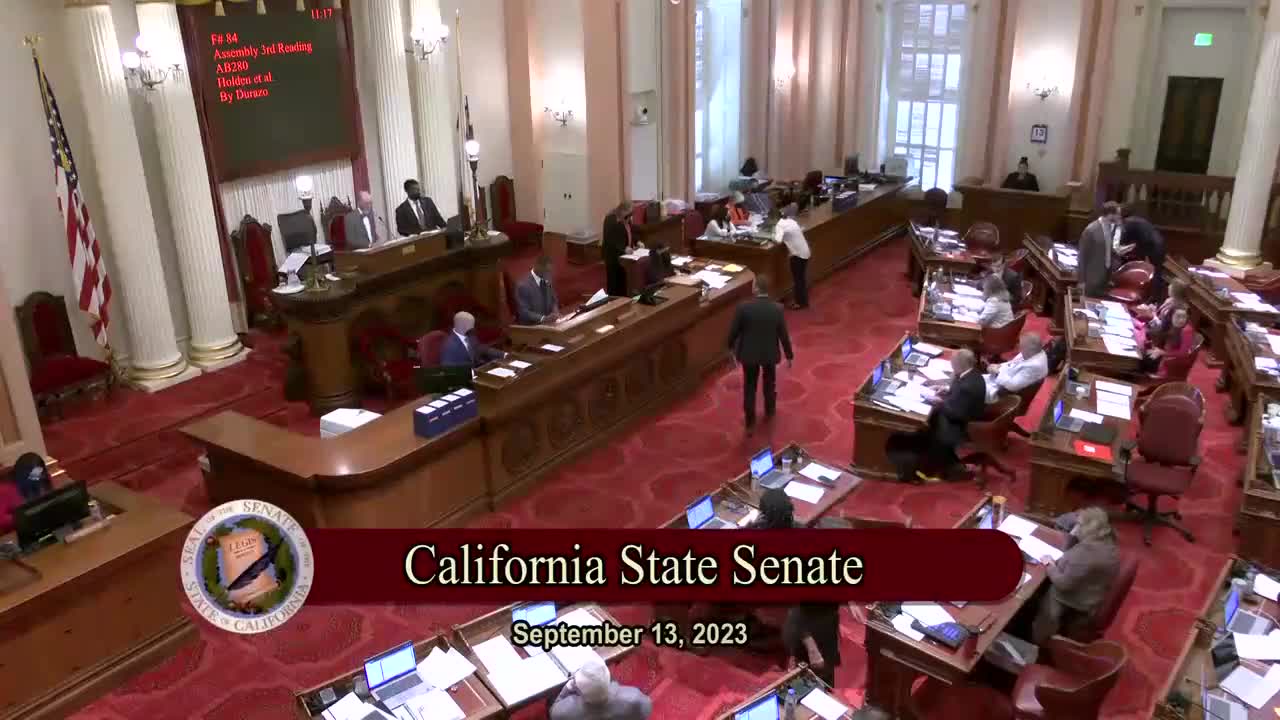 7MIN
Senate Floor
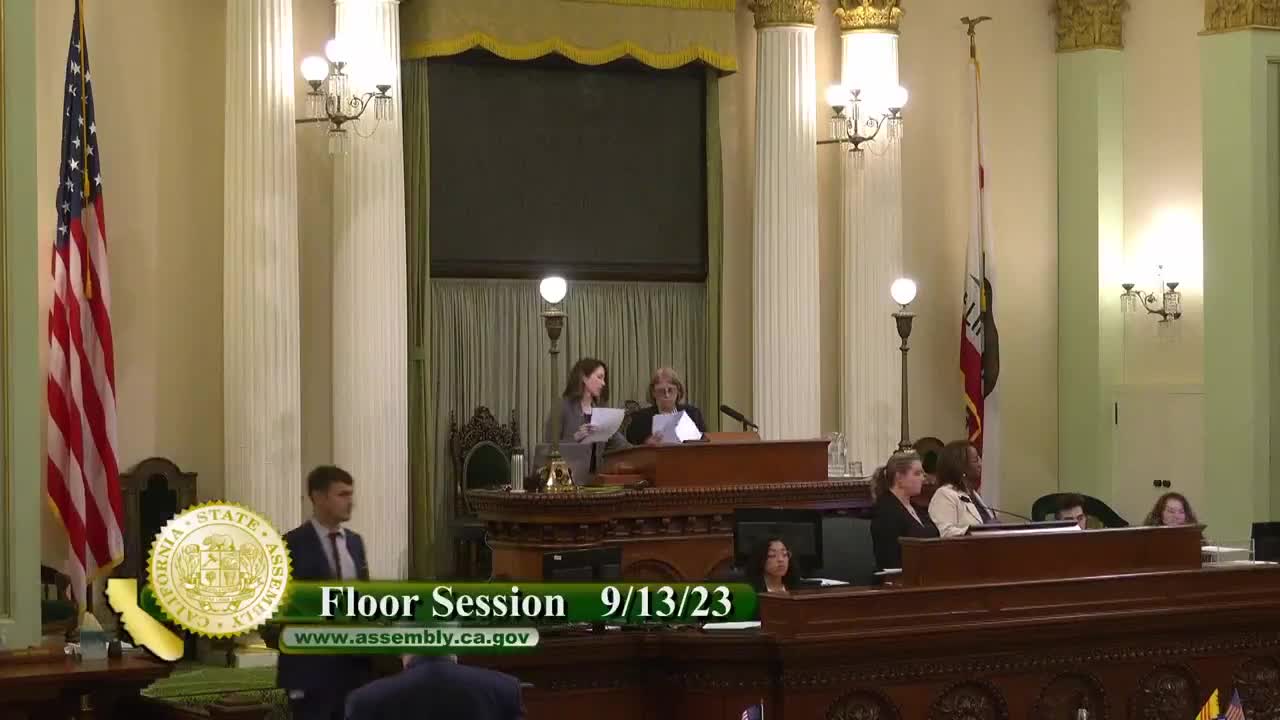 45SEC
Assembly Floor
 1MIN
Senate Standing Committee on Appropriations
Bill Author



