AB 1606: Driver’s license renewal alternatives.
- Session Year: 2023-2024
- House: Assembly
- Latest Version Date: 2023-10-07
Current Status:
Passed
(2023-10-07: Chaptered by Secretary of State - Chapter 373, Statutes of 2023.)
Introduced
In Committee
First Chamber
In Committee
Second Chamber
Enacted
Existing law requires an application for renewal of a drivers license to be made at an office of the Department of Motor Vehicles by the person to whom the license was issued. Existing law also requires renewal of a license to be under the terms and conditions prescribed by the department.
This bill, until January 1, 2035, would authorize the Director of Motor Vehicles to establish a program to evaluate the traffic safety and other effects of renewing drivers licenses by virtual or other remote processes. The bill would prohibit the program from granting such a renewal to a person who is 70 years of age or older without a test of the eyesight of the applicant. The bill would also prohibit the department from renewing a license by virtual or other remote processes when the license has been previously renewed by that method or by mail 2 consecutive times for 5-year periods or if the applicant is 80 years of age or older. The bill would authorize the director to terminate the renewal by virtual or other remote processes at any time. The bill would require the department to provide a report on the program to the Legislature on or before January 1, 2034.
Existing law requires an application for renewal of a drivers license to be made at an office of the Department of Motor Vehicles by the person to whom the license was issued. Existing law also requires renewal of a license to be under the terms and conditions prescribed by the department.
This bill, until January 1, 2035, would authorize the Director of Motor Vehicles to establish a program to evaluate the traffic safety and other effects of renewing drivers licenses by virtual or other remote processes. The bill would prohibit the program from granting a mail or online such a renewal under the program to a person who is 70 years of age or older without a visual test. test of the eyesight of the applicant. The bill would also prohibit the department from renewing a license by virtual or other remote processes when the license has been previously renewed by that method or by mail 2 consecutive times for 5-year periods or if the applicant is 80 years of age or older. The bill would authorize the director to terminate the renewal by virtual or other remote processes at any time. The bill would require the department to provide a report on the program to the Legislature on or before January 1, 2034.
Existing law requires an application for renewal of a drivers license to be made at an office of the Department of Motor Vehicles by the person to whom the license was issued. Existing law also requires renewal of a license to be under the terms and conditions prescribed by the department.
This bill bill, until January 1, 2035, would authorize the Director of Motor Vehicles to establish a program to evaluate the traffic safety and other effects of renewing drivers licenses by virtual or other remote processes. The bill would prohibit the program from granting a mail or online renewal under the program to a person who is 70 years of age or older without a visual test. The bill would authorize the director to terminate the renewal by virtual or other remote processes at any time. The bill would require the department to provide a report on the program to the Legislature on or before January 1, 2034.
Existing law requires an application for renewal of a drivers license to be made at an office of the Department of Motor Vehicles by the person to whom the license was issued. Existing law also requires renewal of a license to be under the terms and conditions prescribed by the department.
This bill would authorize the Director of Motor Vehicles to establish a program to evaluate the traffic safety and other effects of renewing drivers licenses by virtual or other remote processes. The bill would authorize the director to terminate the renewal by virtual or other remote processes at any time.
(a)The director may establish a program to evaluate the traffic safety and other effects of renewing drivers licenses by virtual or other remote processes, in lieu of submitting an application at an office of the department pursuant to subdivision (a) of Section 12814. Pursuant to that program, the department may renew drivers licenses by virtual or other remote processes.
(b)The director may terminate the renewal by virtual or other remote processes authorized by this section at any time.
(c)On or before January 1, 2034, the department shall provide a report to the Legislature and relevant policy committees detailing the program established under this section.
(1)The report shall include the steps the department took to prevent individuals other than the applicant from taking the knowledge test, the number of individuals on an annual basis that opted to take the knowledge examination virtually or by other remote processes, and the number of individuals that opted to submit a test of their eyesight by virtual or other remote processes, and the process the department took to verify the authenticity of the tests submitted to the department.
(2)The report shall be submitted in compliance with Section 9795 of the Government Code.
(d)A renewal by virtual or other remote processes under this program shall not be granted to a person who is 70 years of age or older without a test of the eyesight of the applicant.
(e)The department shall not renew a drivers license by virtual or other remote processes that has been previously renewed by mail or by virtual or other remote processes two consecutive times for five-year periods, or by an applicant that is 80 years of age or older.
(f)This section shall remain in effect only until January 1, 2035, and as of that date is repealed.
(a)The director may establish a program to evaluate the traffic safety and other effects of renewing drivers licenses by virtual or other remote processes, in lieu of submitting an application at an office of the department pursuant to subdivision (a) of Section 12814. Pursuant to that program, the department may renew drivers licenses by virtual or other remote processes.
(b)The director may terminate the renewal by virtual or other remote processes authorized by this section at any time.
(c)On or before January 1, 2034, the department shall provide a report to the Legislature and relevant policy committees detailing the program established under this section.
(1)The report shall include the steps the department took to prevent individuals other than the applicant from taking the knowledge test, the number of individuals on an annual basis that opted to take the knowledge examination virtually or by other remote processes, and the number of individuals that opted to take the visual test virtually, submit a test of their eyesight by virtual or other remote processes, and the process the department took to verify the authenticity of the tests submitted to the department.
(2)The report shall be submitted in compliance with Section 9795 of the Government Code.
(d)A renewal by mail or on the internet website virtual or other remote processes under this program shall not be granted to a person who is 70 years of age or older without a visual test. test of the eyesight of the applicant.
(e)This program shall require all individuals 80 years of age or older to come into a field office, pursuant to Section 12814. The department shall not renew a drivers license by virtual or other remote processes that has been previously renewed by mail or by virtual or other remote processes two consecutive times for five-year periods, or by an applicant that is 80 years of age or older.
(f)This section shall remain in effect only until January 1, 2035, and as of that date is repealed.
(a)The director may establish a program to evaluate the traffic safety and other effects of renewing drivers licenses by virtual or other remote processes, in lieu of submitting an application at an office of the department pursuant to subdivision (a) of Section 12814. Pursuant to that program, the department may renew drivers licenses by virtual or other remote processes.
(b)The director may terminate the renewal by virtual or other remote processes authorized by this section at any time.
(c)On or before January 1, 2034, the department shall provide a report to the Legislature and relevant policy committees detailing the program established under this section.
(1)The report shall include the steps the department took to prevent individuals other than the applicant from taking the knowledge test, the number of individuals on an annual basis that opted to take the knowledge examination virtually or by other remote processes, and the number of individuals that opted to take the visual test virtually, and the process the department took to verify the authenticity of the tests submitted to the department.
(2)The report shall be submitted in compliance with Section 9795 of the Government Code.
(d)A renewal by mail or on the internet website under this program shall not be granted to a person who is 70 years of age or older without a visual test.
(e)This program shall require all individuals 80 years of age or older to come into a field office, pursuant to Section 12814.
(f)This section shall remain in effect only until January 1, 2035, and as of that date is repealed.
(a)The director may establish a program to evaluate the traffic safety and other effects of renewing drivers licenses by virtual or other remote processes, in lieu of submitting an application at an office of the department pursuant to subdivision (a) of Section 12814. Pursuant to that program, the department may renew drivers licenses by virtual or other remote processes.
(b)The director may terminate the renewal by virtual or other remote processes authorized by this section at any time.
|
Date
|
Status
|
|---|---|
| Oct 7, 2023 | Chaptered by Secretary of State - Chapter 373, Statutes of 2023. |
| Oct 7, 2023 | Approved by the Governor. |
| Sep 20, 2023 | Enrolled and presented to the Governor at 4 p.m. |
| Sep 12, 2023 | Senate amendments concurred in. To Engrossing and Enrolling. (Ayes 80. Noes 0. Page 3302.). |
| Sep 12, 2023 | Assembly Rule 77 suspended. (Page 3228.) |
| Sep 11, 2023 | In Assembly. Concurrence in Senate amendments pending. May be considered on or after September 13 pursuant to Assembly Rule 77. |
| Sep 11, 2023 | Read third time. Passed. Ordered to the Assembly. (Ayes 39. Noes 0. Page 2590.). |
| Sep 7, 2023 | Read second time. Ordered to third reading. |
| Sep 6, 2023 | Read third time and amended. Ordered to second reading. |
| Sep 5, 2023 | Read second time. Ordered to third reading. |
| Sep 1, 2023 | From committee: Do pass. (Ayes 7. Noes 0.) (September 1). |
| Aug 14, 2023 | In committee: Referred to APPR suspense file. |
| Jul 12, 2023 | From committee: Do pass and re-refer to Com. on APPR with recommendation: To Consent Calendar. (Ayes 16. Noes 0.) (July 11). Re-referred to Com. on APPR. |
| Jun 14, 2023 | Referred to Com. on TRANS. |
| Jun 1, 2023 | In Senate. Read first time. To Com. on RLS. for assignment. |
| May 31, 2023 | Read third time. Passed. Ordered to the Senate. (Ayes 80. Noes 0. Page 2035.) |
| May 18, 2023 | Read second time. Ordered to third reading. |
| May 18, 2023 | Joint Rule 62(a), file notice suspended. (Page 1580.) |
| May 18, 2023 | From committee: Do pass. (Ayes 15. Noes 0.) (May 18). |
| May 17, 2023 | In committee: Set, first hearing. Referred to APPR. suspense file. |
| Apr 27, 2023 | Re-referred to Com. on APPR. |
| Apr 26, 2023 | Read second time and amended. |
| Apr 25, 2023 | From committee: Amend, and do pass as amended and re-refer to Com. on APPR. (Ayes 15. Noes 0.) (April 24). |
| Mar 9, 2023 | Referred to Com. on TRANS. |
| Feb 18, 2023 | From printer. May be heard in committee March 20. |
| Feb 17, 2023 | Read first time. To print. |
|
Date
|
Description
|
Location
|
Votes
|
|
|---|---|---|---|---|
| Sep 12, 2023 | AB 1606 Gipson Concurrence in Senate Amendments | Assembly Floor |
Passed |
|
| Sep 11, 2023 | Assembly 3rd Reading AB1606 Gipson By Limón | Senate Floor |
Passed |
|
| Sep 1, 2023 | Do pass | Senate Standing Committee on Appropriations |
Passed |
|
| Aug 14, 2023 | Placed on suspense file | Senate Standing Committee on Appropriations |
Passed |
|
| Jul 11, 2023 | Do pass, but first be re-referred to the Committee on [Appropriations] with the recommendation: To Consent Calendar | Senate Standing Committee on Transportation |
Passed |
|
| May 31, 2023 | AB 1606 Gipson Assembly Third Reading | Assembly Floor |
Passed |
|
| May 18, 2023 | Do pass. | Assembly Standing Committee on Appropriations |
Passed |
|
| Apr 24, 2023 | Do pass as amended and be re-referred to the Committee on [Appropriations] | Assembly Standing Committee on Transportation |
Passed |
This list shows positions taken on this bill by organizations on the date displayed, which is linked to the original source.
Positions by individuals are not included.
|
Organization
|
Position
|
Date
|
|---|---|---|
| California Senior Legislature | * Support | Apr 24, 2023 |
CONCURRENCE IN SENATE AMENDMENTS
CSA1 Bill Id:AB 1606
Author:(Gipson)
As Amended Ver:September 6, 2023
Majority vote
SUMMARY
This bill authorizes, but does not require, the director of the Department of Motor Vehicles (DMV) to establish a program to evaluate the traffic safety and other effects of renewing driver's licenses by virtual or other remote processes. The bill specifies that such a program would need to require every individual 80 years of age or older to come into a field office to renew their driver's license.
Senate Amendments
Prohibit DMV from renewing a driver's license by virtual or other remote processes when the license has been previously renewed by mail or by virtual remote processes two consecutive times for five-year periods.
COMMENTS
In response to a budget crisis, the California Legislature passed AB 777 (Calvo), Chapter 625, statutes of 1978 which authorized DMV to offer the option of renewal of a DL by mail twice every 15 years, with the exception of individuals over the age of 70 or individuals with certain traffic offenses. At the time the average lifespan was 69 years old.
In October of 2020, Governor Gavin Newsom temporarily waived the California law requiring senior drivers 70 and older to renew their licenses at a DMV field office as part of his emergency powers granted as a result of the COVID-19 pandemic. AB 175 (Budget), Chapter 254, Statutes of 2021 temporarily suspended the requirement for individuals 70 and older to renew their license in person every five years.
On March 17, 2022 DMV began offering online options for customers who need to take a driver's license knowledge test can complete the requirement at home before visiting a DMV office. The test is available in 35 languages and requires customers to have an internet-enabled computer or laptop with a webcam that must be turned on during the entire test. The exam cannot be taken on a tablet or mobile device. DMV permits applicants to take the test online twice and after that requires them to come into DMV offices in person. This bill codifies DMVs authority to offer this examination virtually. This is the second bill in as many years where DMV established a virtual program first and came to the Legislature seeking authorizing legislation afterwards.
There has long been a concern about the deteriorating health of older persons and driving in the United States. As people age, their vision, hearing and reflexes often deteriorate. According to Pew Research, by 2030 more than 60 million older adults could be driving on the nation's roadways. In the early 1970s, barely half of Americans 65 and older held a driver's license. Today 84% do. Seniors are more likely to follow the rules and wear seat belts, observe the speed limit, and are less likely to drink and drive. Their crash rates have continued to drop over the years, and they are less likely than previous generations of seniors to be in a crash or to be killed or seriously injured.
However, older drivers are at higher risk of crashing than middle-aged people because of declining vision, hearing and cognitive ability and medical conditions that are affecting their driving. While they are less likely to be involved in a crash, when the crash they are more likely to be injured or killed than drivers in other age groups.
As of 2016, 19 states have shorter renewal periods for drivers over a certain age. 18 states demand more frequent vision screenings, and 15 states allow drivers to renew by mail or online do not offer that option to older drivers. Illinois requires drivers 79 and older to take a yearly driver's test.
According to Driver license renewal policies and fatal crash involvement rates of older drivers, United States, 1986–2011, a report published in Injury Epidemiology, these policies generally have no effect, except that mandatory in-person renewal was associated with a 31% reduction in the fatal crash rate for individuals 85 and older. When in-person renewal was not required, requiring drivers to pass a vision test in order to renew their license was associated with similar reductions; however, requiring a vision test at in-person renewal when in-person renewal was already required was not found to yield any additional reduction in rates of fatal crashes beyond that associated with in-person renewal alone.
According to the Author
"This bill is necessary in order to provide our elderly community with other options that do not include having to go in person to the DMV. Having online services available and accessible to seniors over the age of 70, will save them the trouble of driving to the DMV and waiting long periods of time for a process that can be done quickly and easily through the internet or by mail. It will also protect at-risk seniors with weak immune systems, from potentially exacerbating their health conditions through unneeded travel. This bill will overall increase customer convenience and reduce the number of DMV visits."
Arguments in Support
According to one individual writing in support, "With DMVs fully reopened without physical distancing, the DMVs might be the most crowded place a senior is likely to enter. Weather or concern about missing appointment announcements may also discourage elderly customers from waiting outside the building. As shown in the table below, which was prepared for earlier COVD-19 variants that were even less transmissible, the combined time waiting alongside unmasked DMV customers and obtaining service at a window is likely to expose elderly drivers to high levels of COVID-19 virus. This is true even with opportunities for filling out some paperwork ahead of time and scheduling appointments.
Today, it is possible for drivers to take written tests remotely. A licensed professional, such as an optometrist or physician, can provide confirmation of adequate eyesight, similar to the occupational safety medical clearance currently required for commercial and ambulance license endorsements. Specific screening procedures, such as physician clearance or self-certification, can be used for certain classes of higher risk, or particularly elderly drivers. Consequently, it is unnecessary to expose all drivers over 70 years of age to heightened COVID-19 risk as the price of retaining driving independence."
Arguments in Opposition
None on file.
FISCAL COMMENTS
According to Senate Appropriations Committee:
One-time DMV costs, likely in the range of $100,000 to $150,000 over the 2024-25 and 2025-26 fiscal years, to develop and adopt regulations specifying the parameters and procedures associated with implementing virtual or remote processes for renewing driver's licenses, including submitting vision exams, taking knowledge tests remotely, and establishing processes for verifying the authenticity of tests. (Motor Vehicle Account)
Unknown one-time DMV costs, potentially minor and up to the low hundreds of thousands of dollars, likely in the 2026-27 fiscal year, to make any necessary programmatic IT modifications necessary to implement the virtual and remote processes for renewing driver's licenses, as specified in the bill. Staff notes that DMV is currently undertaking a multi-year Enterprise Modernization Project, the Digital eXperience Project (DXP) that will not be completed until 2025-26. Any IT modifications resulting from this bill would be implemented after the DXP is complete, and actual costs would depend upon the functionality of the new systems. (Motor Vehicle Account)
Unknown, significant DMV ongoing administrative cost savings from fiscal years 2026-27 to 2034-35 as a result of the elimination of in-person field office visits. DMV indicates that approximately one million individuals renew driver's licenses in-person in a DMV field office each year that would have the option to renew remotely under this bill. Actual ongoing cost savings would depend upon the number of eligible drivers who elect to renew driver's licenses remotely, and the cost savings associated with verifying information programmatically rather than conducting vision and knowledge testing in-person. (Motor Vehicle Account)
DMV indicates costs to prepare and submit the report to the Legislature by January 1, 2034 would be minor and absorbable. (Motor Vehicle Account)
VOTES:
ASM TRANSPORTATION: 15-0-0
YES: Friedman, Vince Fong, Berman, Juan Carrillo, Davies, Gipson, Hart, Jackson, Kalra, Lowenthal, Stephanie Nguyen, Sanchez, Wallis, Ward, Wicks
ASM APPROPRIATIONS: 15-0-1
YES: Holden, Megan Dahle, Bryan, Calderon, Wendy Carrillo, Dixon, Mike Fong, Hart, Lowenthal, Mathis, Papan, Pellerin, Sanchez, Weber, Ortega
ABS, ABST OR NV: Robert Rivas
ASSEMBLY FLOOR: 80-0-0
YES: Addis, Aguiar-Curry, Alanis, Alvarez, Arambula, Bains, Bauer-Kahan, Bennett, Berman, Boerner, Bonta, Bryan, Calderon, Juan Carrillo, Wendy Carrillo, Cervantes, Chen, Connolly, Megan Dahle, Davies, Dixon, Essayli, Flora, Mike Fong, Vince Fong, Friedman, Gabriel, Gallagher, Garcia, Gipson, Grayson, Haney, Hart, Holden, Hoover, Irwin, Jackson, Jones‑Sawyer, Kalra, Lackey, Lee, Low, Lowenthal, Maienschein, Mathis, McCarty, McKinnor, Muratsuchi, Stephanie Nguyen, Ortega, Pacheco, Papan, Jim Patterson, Joe Patterson, Pellerin, Petrie-Norris, Quirk-Silva, Ramos, Reyes, Luz Rivas, Robert Rivas, Rodriguez, Blanca Rubio, Sanchez, Santiago, Schiavo, Soria, Ta, Ting, Valencia, Villapudua, Waldron, Wallis, Ward, Weber, Wicks, Wilson, Wood, Zbur, Rendon
SENATE FLOOR: 39-0-1
YES: Allen, Alvarado-Gil, Archuleta, Ashby, Atkins, Becker, Blakespear, Bradford, Cortese, Dahle, Dodd, Durazo, Eggman, Glazer, Gonzalez, Grove, Hurtado, Jones, Laird, Limón, McGuire, Menjivar, Min, Newman, Nguyen, Niello, Ochoa Bogh, Padilla, Portantino, Roth, Rubio, Seyarto, Skinner, Smallwood-Cuevas, Stern, Umberg, Wahab, Wiener, Wilk
ABS, ABST OR NV: Caballero
UPDATED
VERSION: September 6, 2023
CONSULTANT: David Sforza / TRANS. / (916) 319-2093 FN: 0002101
SENATE RULES COMMITTEE Office of Senate Floor Analyses (916) 651-1520 Fax: (916) 327-4478 | AB 1606 |
THIRD READING
Bill No: AB 1606
Author: Gipson (D)
Amended: 9/6/23 in Senate
Vote: 21
SENATE TRANSPORTATION COMMITTEE: 16-0, 7/11/23
AYES: Gonzalez, Niello, Allen, Archuleta, Becker, Blakespear, Cortese, Dahle, Durazo, Laird, Limón, McGuire, Newman, Nguyen, Seyarto, Umberg
SENATE APPROPRIATIONS COMMITTEE: 7-0, 9/1/23
AYES: Portantino, Jones, Ashby, Bradford, Seyarto, Wahab, Wiener
ASSEMBLY FLOOR: 80-0, 5/31/23 - See last page for vote
SUBJECT: Driver’s license renewal alternatives
SOURCE: Author
DIGEST:
This bill authorizes the Director of Motor Vehicles (DMV) to establish a program to evaluate the traffic safety and other effects of renewing driver’s licenses (DL) by virtual or other remote processes. This program must include specified restrictions on remote renewal based on age. Requires the DMV to provide a report on the program to the Legislature by January 1, 2034.
Senate Floor Amendments of 9/6/23 restrict virtual renewal of driver’s licenses to two consecutive times for five-year periods and make technical changes.
ANALYSIS:
Existing law:
- Requires DLs to be renewed every five years. (Vehicle code (VEH) §12816)
- Permits the DMV to establish a program to authorize the renewal of DL by mail twice every 15 years. (VEH §12814.5)
- Prohibits DMV from authorizing renewal by mail for individuals over the age of 70, individuals with certain negative operation points on their licenses, or with certain driving related convictions.
- Authorizes DMV to require applicants who are renewing their DL to take an examination deemed appropriate by the DMV considering the licensee’s record of convictions and accidents or evidence of a condition affecting the ability of the applicant to safely operate a motor vehicle. Prohibits DMV from making this determination solely on the basis of an individual’s age. (VEH §12814)
- Requires physicians and surgeons to report immediately to the local health officer, who will then report to the DMV the name, date of birth, and address of any patient at least 14 years or older diagnosed with a disorder characterized by lapses of consciousness. (Health and Safety Code (HSC) §103900)
- Authorizes a physician or surgeon, if they believe that the reporting of a patient will serve the public interest, to similarly report a patient even if their condition is not characterized by lapses of consciousness.
- Authorizes the DMV, upon reexamination of a person’s qualifications to operate a motor vehicle, to restrict, make subject to terms and conditions of probation, suspend, or revoke the driving privilege of that person. (VEH §12818)
This bill:
- Authorizes the Director of the DMV to establish a program to evaluate the traffic safety and other effects of renewing DL by virtual or other remote processes, in lieu of submitting an application at an office.
- Requires a person who is 70 years or older to conduct a visual test in order to renew their DL through this program.
- Directs the DMV to not renew a DL by virtual or other remote processes for any applicant who is 80 years or older.
- Directs the DMV to not renew a DL by virtual or other remote processes for an individual who has renewed their license by mail or by virtual or other remote processes two consecutive times for five-year periods
- Requires the DMV to provide a report to the Legislature and relevant policy committees on this program by January 1, 2034. This report shall include:
- The steps the DMV took to prevent individuals other than the applicant from taking the knowledge test;
- The number of individuals on an annual basis that opted to take the knowledge examination virtually or by other remote processes;
- The number of individuals that opted to take the visual test virtually or by other remote processes; and
- The process the DMV used to verify the authenticity of the tests.
Comments
- Purpose of bill. According to the author “This bill is necessary in order to provide our elderly community with other options that do not include having to go in person to the DMV. Having online services available and accessible to seniors over the age of 70, will save them the trouble of driving to the DMV and waiting long periods of time for a process that can be done quickly and easily through the internet or by mail. It will also protect at-risk seniors with weak immune systems, from potentially exacerbating their health conditions through unneeded travel. This bill will overall increase customer convenience and reduce the number of DMV visits.”
- Remote driver’s license renewals. In response to a budget crisis, the California Legislature passed AB 777 (Calvo, Chapter 625, Statutes of 1979) which authorized DMV to offer the option of renewal of a DL by mail twice every 15 years, with the exception of individuals over the age of 70 or individuals with certain traffic offenses. Allowing for mail, or remote, renewal decreases the administrative burden on the DMV, reducing costs and wait times for other services at field offices.
In October of 2020, Governor Gavin Newsom temporarily waived the California law requiring senior drivers 70 and older to renew their DL at a DMV field office as part of his emergency powers granted as a result of the COVID-19 pandemic. AB 174 (Committee on Budget, Chapter 254, Statutes of 2021) temporarily suspended the requirement for individuals 70 and older to renew their license in person every 5 years. This was in recognition of the disproportionately high risk COVID exposure posed to the senior population. Both of these measures expired as of January 1, 2023.
On March 17th, 2022 DMV began offering online options for customers who need to take a DL knowledge test by allowing them to complete the requirement at home before visiting a DMV office. The test is available in 35 languages and requires customers to have an internet-enabled computer or laptop with a webcam that must be turned on during the entire test. The exam cannot be taken on a tablet or mobile device. DMV permits applicants to take the test online twice and after that requires them to come into DMV offices in person. This bill codifies DMVs authority to offer this examination virtually. This is the second bill in as many years where DMV established a virtual program first and came to the Legislature seeking authorizing legislation afterwards.
- Aging and driving safety. The number of older drivers is rapidly raising due to the aging population. According to Pew Research, by 2030 more than 60 million older adults could be driving on the nation’s roadways. In the early 1970s, barely half of Americans 65 and older held a driver’s license. Today 84% do.
Senior drivers tend to practice safer driving behavior. Research has shown seniors are more likely to follow the rules and wear seat belts, observe the speed limit, and are less likely to drink and drive. Crash rates among seniors have dropped over the years and older drivers have a much lower crash rate than teen divers. Unfortunately this safer behavior cannot outweigh the deteriorating effects of aging on vision, hearing, and reflexes. Older drivers are at higher risk of crashing than middle-aged people because of declining vision, hearing and cognitive ability and medical conditions that may affect their driving. Furthermore, when an older driver is involved in a crash they are more likely to be injured or killed than drivers in other age groups.
- License renewal for older drivers. Various states have implemented policies aimed at providing additional oversight when renewing DLs for older drivers. As of 2016, 19 states have shorter renewal periods for drivers over a certain age. 18 states demand more frequent vision screenings, and 15 states allow drivers to renew by mail or online do not offer that option to older drivers. Illinois requires drivers 79 and older to take a yearly driver’s test.
In California, the DMV cannot take action to refuse renewal of DLs based on age alone, but they may act if health conditions caused by aging are limiting a person’s ability to safely operate a motor vehicle. This might be identified through vision and hearing tests performed at a field office as part of renewal, through confidential reports to the DMV from their physician, or through incident reports from violations or crashes. In these cases, the DMV can require additional knowledge or skills testing prior to renewal.
According to “Driver license renewal policies and fatal crash involvement rates of older drivers, United States, 1986–2011”, a report published in Injury Epidemiology, most of the policies providing additional review of drivers solely based on age have little to no effect on reducing crash rates among seniors. However, mandatory in-person renewal was associated with a 31% reduction in the fatal crash rate for individuals 85 and older. When in-person renewal was not required, requiring drivers to pass a vision test in order to renew their DL was associated with similar reductions; however, requiring a vision test at in-person renewal when in-person renewal was already required was not found to yield any additional reduction in rates of fatal crashes.
In recognition of this research, this bill requires that if the DMV authorizes remote DL renewal for those over 70 the renewal must still include a vision test.
FISCAL EFFECT: Appropriation: No Fiscal Com.: Yes Local: No
According to the Senate Appropriations Committee, “this bill will result in one-time DMV costs, likely in the range of $100,000 to $150,000 over the 2024-25 and 2025-26 fiscal years, to develop and adopt regulations specifying the parameters and procedures associated with implementing virtual or remote processes for renewing driver’s licenses, including submitting vision exams, taking knowledge tests remotely, and establishing processes for verifying the authenticity of tests. Unknown one-time DMV costs, potentially minor and up to the low hundreds of thousands of dollars, likely in the 2026-27 fiscal year, to make any necessary programmatic IT modifications necessary to implement the virtual and remote processes for renewing driver’s licenses, as specified in this bill. Unknown, significant DMV ongoing administrative cost savings from fiscal years 2026-27 to 2034-35 as a result of the elimination of in-person field office visits. DMV indicates costs to prepare and submit the report to the Legislature by January 1, 2034, would be minor and absorbable”.
SUPPORT: (Verified 9/6/23)
None received
OPPOSITION: (Verified 9/6/23)
None received
ASSEMBLY FLOOR: 80-0, 5/31/23
AYES: Addis, Aguiar-Curry, Alanis, Alvarez, Arambula, Bains, Bauer-Kahan, Bennett, Berman, Boerner, Bonta, Bryan, Calderon, Juan Carrillo, Wendy Carrillo, Cervantes, Chen, Connolly, Megan Dahle, Davies, Dixon, Essayli, Flora, Mike Fong, Vince Fong, Friedman, Gabriel, Gallagher, Garcia, Gipson, Grayson, Haney, Hart, Holden, Hoover, Irwin, Jackson, Jones-Sawyer, Kalra, Lackey, Lee, Low, Lowenthal, Maienschein, Mathis, McCarty, McKinnor, Muratsuchi, Stephanie Nguyen, Ortega, Pacheco, Papan, Jim Patterson, Joe Patterson, Pellerin, Petrie-Norris, Quirk-Silva, Ramos, Reyes, Luz Rivas, Robert Rivas, Rodriguez, Blanca Rubio, Sanchez, Santiago, Schiavo, Soria, Ta, Ting, Valencia, Villapudua, Waldron, Wallis, Ward, Weber, Wicks, Wilson, Wood, Zbur, Rendon
Prepared by: Jacob O'Connor / TRANS. / (916) 651-4121
9/8/23 14:33:50
**** END ****
SENATE RULES COMMITTEE Office of Senate Floor Analyses (916) 651-1520 Fax: (916) 327-4478 | AB 1606 |
THIRD READING
Bill No: AB 1606
Author: Gipson (D)
Amended: 4/26/23 in Assembly
Vote: 21
SENATE TRANSPORTATION COMMITTEE: 16-0, 7/11/23
AYES: Gonzalez, Niello, Allen, Archuleta, Becker, Blakespear, Cortese, Dahle, Durazo, Laird, Limón, McGuire, Newman, Nguyen, Seyarto, Umberg
SENATE APPROPRIATIONS COMMITTEE: 7-0, 9/1/23
AYES: Portantino, Jones, Ashby, Bradford, Seyarto, Wahab, Wiener
ASSEMBLY FLOOR: 80-0, 5/31/23 - See last page for vote
SUBJECT: Driver’s license renewal alternatives
SOURCE: Author
DIGEST:
This bill authorizes the Director of Motor Vehicles to establish a program to evaluate the traffic safety and other effects of renewing driver’s licenses by virtual or other remote processes. This program must include specified restrictions on remote renewal based on age. This bill requires the Department of Motor Vehicles to provide a report on the program to the Legislature by January 1, 2034.
ANALYSIS:
Existing law:
- Requires driver’s licenses (DLs) to be renewed every five years. (Vehicle code (VEH) §12816)
- Permits the Department of Motor Vehicles (DMV) to establish a program to authorize the renewal of DL by mail twice every 15 years. (VEH §12814.5)
- Prohibits DMV from authorizing renewal by mail for individuals over the age of 70, individuals with certain negative operation points on their licenses, or with certain driving related convictions.
- Authorizes DMV to require applicants who are renewing their driver’s license to take an examination deemed appropriate by the DMV considering the licensee’s record of convictions and accidents or evidence of a condition affecting the ability of the applicant to safely operate a motor vehicle. Prohibits DMV from making this determination solely on the basis of an individual’s age. (VEH §12814)
- Requires physicians and surgeons to report immediately to the local health officer, who will then report to the DMV, the name, date of birth, and address of any patient at least 14 years or older diagnosed with a disorder characterized by lapses of consciousness. (Health and Safety Code (HSC) §103900)
- Authorizes a physician or surgeon, if they believe that the reporting of a patient will serve the public interest, to similarly report a patient even if their condition is not characterized by lapses of consciousness.
- Authorizes the DMV, upon reexamination of a person’s qualifications to operate a motor vehicle, to restrict, make subject to terms and conditions of probation, suspend, or revoke the driving privilege of that person. (VEH §12818)
This bill:
- Authorizes the Director of the DMV to establish a program to evaluate the traffic safety and other effects of renewing driver’s license by virtual or other remote processes, in lieu of submitting an application at an office.
- Requires a person who is 70 years or older to conduct a visual test in order to renew their license through this program.
- Requires a person who is 80 years or older to come into a field office under this program.
- Requires the DMV to provide a report to the Legislature and relevant policy committees on this program by January 1, 2034. This report shall include:
- The steps the DMV took to prevent individuals other than the applicant from taking the knowledge test;
- The number of individuals on an annual basis that opted to take the knowledge examination virtually or by other remote processes;
- The number of individuals that opted to take the visual test virtually; and
- The process the DMV used to verify the authenticity of the tests.
Comments
- Purpose of bill. According to the author “This bill is necessary in order to provide our elderly community with other options that do not include having to go in person to the DMV. Having online services available and accessible to seniors over the age of 70, will save them the trouble of driving to the DMV and waiting long periods of time for a process that can be done quickly and easily through the internet or by mail. It will also protect at-risk seniors with weak immune systems, from potentially exacerbating their health conditions through unneeded travel. This bill will overall increase customer convenience and reduce the number of DMV visits.”
- Remote driver’s license renewals. In response to a budget crisis, the California Legislature passed AB 777 (Calvo, Chapter 625, Statutes of 1979) which authorized DMV to offer the option of renewal of a DL by mail twice every 15 years, with the exception of individuals over the age of 70 or individuals with certain traffic offenses. Allowing for mail, or remote, renewal decreases the administrative burden on the DMV, reducing costs and wait times for other services at field offices.
In October of 2020, Governor Gavin Newsom temporarily waived the California law requiring senior drivers 70 and older to renew their licenses at a DMV field office as part of his emergency powers granted as a result of the COVID-19 pandemic. AB 174 (Committee on Budget, Chapter 254, Statutes of 2021) temporarily suspended the requirement for individuals 70 and older to renew their license in person every five years. This was in recognition of the disproportionately high risk COVID exposure posed to the senior population. Both of these measures expired as of January 1, 2023.
On March 17th, 2022, DMV began offering online options for customers who need to take a driver’s license knowledge test by allowing them to complete the requirement at home before visiting a DMV office. The test is available in 35 languages and requires customers to have an internet-enabled computer or laptop with a webcam that must be turned on during the entire test. The exam cannot be taken on a tablet or mobile device. DMV permits applicants to take the test online twice and after that requires them to come into DMV offices in person. This bill codifies DMVs authority to offer this examination virtually. This is the second bill in as many years where DMV established a virtual program first and came to the Legislature seeking authorizing legislation afterwards.
- Aging and driving safety. The number of older drivers is rapidly raising due to the aging population. According to Pew Research, by 2030 more than 60 million older adults could be driving on the nation’s roadways. In the early 1970s, barely half of Americans 65 and older held a driver’s license. Today 84% do.
Senior drivers tend to practice safer driving behavior. Research has shown seniors are more likely to follow the rules and wear seat belts, observe the speed limit, and are less likely to drink and drive. Crash rates among seniors have dropped over the years and older drivers have a much lower crash rate than teen divers. Unfortunately this safer behavior cannot outweigh the deteriorating effects of aging on vision, hearing, and reflexes. Older drivers are at higher risk of crashing than middle-aged people because of declining vision, hearing and cognitive ability and medical conditions that may affect their driving. Furthermore, when an older driver is involved in a crash they are more likely to be injured or killed than drivers in other age groups.
- License renewal for older drivers. Various states have implemented policies aimed at providing additional oversight when renewing DLs for older drivers. As of 2016, 19 states have shorter renewal periods for drivers over a certain age. 18 states demand more frequent vision screenings, and 15 states allow drivers to renew by mail or online do not offer that option to older drivers. Illinois requires drivers 79 and older to take a yearly driver’s test.
In California the DMV cannot take action to refuse renewal of driver’s licenses based on age alone, but they may act if health conditions caused by aging are limiting a person’s ability to safely operate a motor vehicle. This might be identified through vision and hearing tests performed at a field office as part of renewal, through confidential reports to the Department from their physician, or through incident reports from violations or crashes. In these cases the DMV can require additional knowledge or skills testing prior to renewal.
According to “Driver license renewal policies and fatal crash involvement rates of older drivers, United States, 1986–2011”, a report published in Injury Epidemiology, most of the policies providing additional review of drivers solely based on age have little to no effect on reducing crash rates among seniors. However, mandatory in-person renewal was associated with a 31% reduction in the fatal crash rate for individuals 85 and older. When in-person renewal was not required, requiring drivers to pass a vision test in order to renew their license was associated with similar reductions; however, requiring a vision test at in-person renewal when in-person renewal was already required was not found to yield any additional reduction in rates of fatal crashes.
In recognition of this research, this bill requires that if the DMV authorizes remote DL renewal for those over 70 the renewal must still include a vision test.
FISCAL EFFECT: Appropriation: No Fiscal Com.: Yes Local: No
According to the Senate Appropriations Committee, this bill will result in one-time DMV costs, likely in the range of $100,000 to $150,000 over the 2024-25 and 2025-26 fiscal years, to develop and adopt regulations specifying the parameters and procedures associated with implementing virtual or remote processes for renewing driver’s licenses, including submitting vision exams, taking knowledge tests remotely, and establishing processes for verifying the authenticity of tests. Unknown one-time DMV costs, potentially minor and up to the low hundreds of thousands of dollars, likely in the 2026-27 fiscal year, to make any necessary programmatic IT modifications necessary to implement the virtual and remote processes for renewing driver’s licenses, as specified in this bill. Unknown, significant DMV ongoing administrative cost savings from fiscal years 2026-27 to 2034-35 as a result of the elimination of in-person field office visits. DMV indicates costs to prepare and submit the report to the Legislature by January 1, 2034, would be minor and absorbable.
SUPPORT: (Verified 9/1/23)
None received
OPPOSITION: (Verified 9/1/23)
None received
ASSEMBLY FLOOR: 80-0, 5/31/23
AYES: Addis, Aguiar-Curry, Alanis, Alvarez, Arambula, Bains, Bauer-Kahan, Bennett, Berman, Boerner, Bonta, Bryan, Calderon, Juan Carrillo, Wendy Carrillo, Cervantes, Chen, Connolly, Megan Dahle, Davies, Dixon, Essayli, Flora, Mike Fong, Vince Fong, Friedman, Gabriel, Gallagher, Garcia, Gipson, Grayson, Haney, Hart, Holden, Hoover, Irwin, Jackson, Jones-Sawyer, Kalra, Lackey, Lee, Low, Lowenthal, Maienschein, Mathis, McCarty, McKinnor, Muratsuchi, Stephanie Nguyen, Ortega, Pacheco, Papan, Jim Patterson, Joe Patterson, Pellerin, Petrie-Norris, Quirk-Silva, Ramos, Reyes, Luz Rivas, Robert Rivas, Rodriguez, Blanca Rubio, Sanchez, Santiago, Schiavo, Soria, Ta, Ting, Valencia, Villapudua, Waldron, Wallis, Ward, Weber, Wicks, Wilson, Wood, Zbur, Rendon
Prepared by: Jacob O'Connor / TRANS. / (916) 651-4121
9/2/23 15:01:39
**** END ****
SENATE COMMITTEE ON
Senator Anthony Portantino, Chair
2023 - 2024 Regular Session
AB 1606 (Gipson) - Driver’s license renewal alternatives
Version: | Policy Vote: |
Urgency: | Mandate: |
Hearing Date: | Consultant: |
Bill Summary:
AB 1606 would authorize the Department of Motor Vehicles (DMV) to establish a program to evaluate the traffic safety and other effects of renewing driver’s licenses by virtual or other remote processes, as specified, until January 1, 2035.
Fiscal Impact:
- One-time DMV costs, likely in the range of $100,000 to $150,000 over the 2024-25 and 2025-26 fiscal years, to develop and adopt regulations specifying the parameters and procedures associated with implementing virtual or remote processes for renewing driver’s licenses, including submitting vision exams, taking knowledge tests remotely, and establishing processes for verifying the authenticity of tests. (Motor Vehicle Account)
- Unknown one-time DMV costs, potentially minor and up to the low hundreds of thousands of dollars, likely in the 2026-27 fiscal year, to make any necessary programmatic IT modifications necessary to implement the virtual and remote processes for renewing driver’s licenses, as specified in the bill. Staff notes that DMV is currently undertaking a multi-year Enterprise Modernization Project, the Digital eXperience Project (DXP) that will not be completed until 2025-26. Any IT modifications resulting from this bill would be implemented after the DXP is complete, and actual costs would depend upon the functionality of the new systems. (Motor Vehicle Account)
- Unknown, significant DMV ongoing administrative cost savings from fiscal years 2026-27 to 2034-35 as a result of the elimination of in-person field office visits. DMV indicates that approximately one million individuals renew driver’s licenses in-person in a DMV field office each year that would have the option to renew remotely under this bill. Actual ongoing cost savings would depend upon the number of eligible drivers who elect to renew driver’s licenses remotely, and the cost savings associated with verifying information programmatically rather than conducting vision and knowledge testing in-person. (Motor Vehicle Account)
- DMV indicates costs to prepare and submit the report to the Legislature by January 1, 2034 would be minor and absorbable. (Motor Vehicle Account)
Background:
Existing law prescribes the processes and procedures for the issuance and renewal of driver’s licenses, and requires a person to renew their driver license every five years. Existing law authorizes DMV to permit renewal of a driver’s license by mail twice every fifteen years, but prohibits DMV from authorizing renewal by mail for a person 70 years of age or older, a person who has negative operation points on their license, or a person with certain driving related convictions. Existing law authorizes DMV to require applicants who are renewing their driver’s license to take an examination deemed appropriate by the DMV considering the licensee’s record of convictions and accidents or evidence of a condition affecting the ability of the applicant to safely operate a motor vehicle. DMV is prohibited from making this determination solely on the basis of an individual’s age.
In October of 2020, Governor Gavin Newsom, acting under emergency powers in response to the COVID-19 pandemic, temporarily waived the statutory requirement that a driver 70 years of age or older must renew their driver’s license at a DMV field office. Subsequently, SB 174 (Committee on Budget), Chap.254/2021, suspended the requirement that an individual 70 years of age or older renew their driver’s license in person every five years and allowed such a driver to renew their license online until January 1, 2023.
On March 17th, 2022 DMV began offering online options for customers who need to take a driver’s license knowledge test by allowing them to complete the requirement at home before visiting a DMV field office. The test is available in 35 languages and requires customers to have an internet-enabled computer or laptop (not a tablet or mobile device) with a webcam that must be turned on during the entire test. DMV permits applicants to take the test online twice, and after that requires them to come into a DMV filed office in person.
Proposed Law:
AB 1606 would authorize DMV to establish a program to evaluate the traffic safety and other effects of renewing driver’s licenses by virtual or other remote processes, in lieu of submitting an application at a field office, until January 1, 2035. The bill specifies that the program established under the authority provided by this bill would require all individuals 80 years of age or older to come into a field office to renew their license, and a renewal by mail or on the internet under the program would not be granted to a person 70 years of age or older without a visual test.
The bill would require DMV to submit a report to the Legislature by January 1, 2034 that includes:
- The steps that DMV took to prevent individuals other than the applicant from taking the knowledge test.
- The number of individuals on an annual basis that opted to take the knowledge examination virtually or by other remote processes.
- The number of individuals that opted to take the visual test virtually.
- The process that DMV used to verify the authenticity of the tests.
Related Legislation:
AB 174 (Committee on Budget), Chap. 254/2021, included a provision that temporarily suspended the requirement for individuals 70 years of age and older to renew their license in-person every five years until January 1, 2023.
-- END --
SENATE COMMITTEE ON TRANSPORTATION
Senator Lena Gonzalez, Chair
2023 - 2024 Regular
Bill No: Hearing Date: 07/11/2023
Author: | Gipson | ||
Version: | 4/26/2023 | ||
Urgency: | No | Fiscal: | Yes |
Consultant: | Jacob O'Connor | ||
SUBJECT:
DIGEST: This bill authorizes the Director of Motor Vehicles to establish a program to evaluate the traffic safety and other effects of renewing driver’s licenses by virtual or other remote processes. This program must include specified restrictions on remote renewal based on age. Requires the Department of Motor Vehicles to provide a report on the program to the Legislature by January 1, 2034.
ANALYSIS:
Existing law:
- Requires driver’s licenses (DLs) to be renewed every five years. (Vehicle code (VEH) §12816)
- Permits the Department of Motor Vehicles (DMV) to establish a program to authorize the renewal of DL by mail twice every 15 years. (VEH §12814.5)
- Prohibits DMV from authorizing renewal by mail for individuals over the age of 70, individuals with certain negative operation points on their licenses, or with certain driving related convictions.
- Authorizes DMV to require applicants who are renewing their driver’s license to take an examination deemed appropriate by the DMV considering the licensee’s record of convictions and accidents or evidence of a condition affecting the ability of the applicant to safely operate a motor vehicle. Prohibits DMV from making this determination solely on the basis of an individual’s age. (VEH §12814)
- Requires physicians and surgeons to report immediately to the local health officer, who will then report to the Department of Motor Vehicles (DMV), the name, date of birth, and address of any patient at least 14 years or older diagnosed with a disorder characterized by lapses of consciousness. (Health and Safety Code (HSC) §103900)
- Authorizes a physician or surgeon, if they believe that the reporting of a patient will serve the public interest, to similarly report a patient even if their condition is not characterized by lapses of consciousness.
- Authorizes the DMV, upon reexamination of a person’s qualifications to operate a motor vehicle, to restrict, make subject to terms and conditions of probation, suspend, or revoke the driving privilege of that person. (VEH §12818)
This bill:
- Authorizes the Director of the DMV to establish a program to evaluate the traffic safety and other effects of renewing driver’s license by virtual or other remote processes, in lieu of submitting an application at an office.
- Requires a person who is 70 years or older to conduct a visual test in order to renew their license through this program.
- Requires a person who is 80 years or older to come into a field office under this program.
- Requires the DMV to provide a report to the Legislature and relevant policy committees on this program by January 1, 2034. This report shall include:
- The steps the DMV took to prevent individuals other than the applicant from taking the knowledge test;
- The number of individuals on an annual basis that opted to take the knowledge examination virtually or by other remote processes;
- The number of individuals that opted to take the visual test virtually; and
- The process the DMV used to verify the authenticity of the tests.
COMMENTS:
- Purpose of bill. According to the author “This bill is necessary in order to provide our elderly community with other options that do not include having to go in person to the DMV. Having online services available and accessible to seniors over the age of 70, will save them the trouble of driving to the DMV and waiting long periods of time for a process that can be done quickly and easily through the internet or by mail. It will also protect at-risk seniors with weak immune systems, from potentially exacerbating their health conditions through unneeded travel. This bill will overall increase customer convenience and reduce the number of DMV visits.”
- Remote driver’s license renewals. In response to a budget crisis, the California Legislature passed AB 777 (Calvo), Chapter 625, statutes of 1979 which authorized DMV to offer the option of renewal of a DL by mail twice every 15 years, with the exception of individuals over the age of 70 or individuals with certain traffic offenses. Allowing for mail, or remote, renewal decreases the administrative burden on the DMV, reducing costs and wait times for other services at field offices.
In October of 2020, Governor Gavin Newsom temporarily waived the California law requiring senior drivers 70 and older to renew their licenses at a DMV field office as part of his emergency powers granted as a result of the COVID-19 pandemic. AB 174 (Budget), Chapter 254, Statutes of 2021 temporarily suspended the requirement for individuals 70 and older to renew their license in person every 5 years. This was in recognition of the disproportionately high risk COVID exposure posed to the senior population. Both of these measures expired as of January 1, 2023.
On March 17th, 2022 DMV began offering online options for customers who need to take a driver’s license knowledge test by allowing them to complete the requirement at home before visiting a DMV office. The test is available in 35 languages and requires customers to have an internet-enabled computer or laptop with a webcam that must be turned on during the entire test. The exam cannot be taken on a tablet or mobile device. DMV permits applicants to take the test online twice and after that requires them to come into DMV offices in person. This bill codifies DMVs authority to offer this examination virtually. This is the second bill in as many years where DMV established a virtual program first and came to the Legislature seeking authorizing legislation afterwards.
- Aging and driving safety. The number of older drivers is rapidly raising due to the aging population. According to Pew Research, by 2030 more than 60 million older adults could be driving on the nation’s roadways. In the early 1970s, barely half of Americans 65 and older held a driver’s license. Today 84% do.
Senior drivers tend to practice safer driving behavior. Research has shown seniors are more likely to follow the rules and wear seat belts, observe the speed limit, and are less likely to drink and drive. Crash rates among seniors have dropped over the years and older drivers have a much lower crash rate than teen divers. Unfortunately this safer behavior cannot outweigh the deteriorating effects of aging on vision, hearing, and reflexes. Older drivers are at higher risk of crashing than middle-aged people because of declining vision, hearing and cognitive ability and medical conditions that may affect their driving. Furthermore, when an older driver is involved in a crash they are more likely to be injured or killed than drivers in other age groups.
- License renewal for older drivers. Various states have implemented policies aimed at providing additional oversight when renewing DLs for older drivers. As of 2016, 19 states have shorter renewal periods for drivers over a certain age. 18 states demand more frequent vision screenings, and 15 states allow drivers to renew by mail or online do not offer that option to older drivers. Illinois requires drivers 79 and older to take a yearly driver’s test.
In California the DMV cannot take action to refuse renewal of driver’s licenses based on age alone, but they may act if health conditions caused by aging are limiting a person’s ability to safely operate a motor vehicle. This might be identified through vision and hearing tests performed at a field office as part of renewal, through confidential reports to the Department from their physician, or through incident reports from violations or crashes. In these cases the DMV can require additional knowledge or skills testing prior to renewal.
According to “Driver license renewal policies and fatal crash involvement rates of older drivers, United States, 1986–2011”, a report published in Injury Epidemiology, most of the policies providing additional review of drivers solely based on age have little to no effect on reducing crash rates among seniors. However, mandatory in-person renewal was associated with a 31% reduction in the fatal crash rate for individuals 85 and older. When in-person renewal was not required, requiring drivers to pass a vision test in order to renew their license was associated with similar reductions; however, requiring a vision test at in-person renewal when in-person renewal was already required was not found to yield any additional reduction in rates of fatal crashes.
In recognition of this research this bill requires that if the DMV authorizes remote DL renewal for those over 70 the renewal must still include a vision test.
- What about other risky drivers? California’s current renewal by mail program, in addition to excluding drivers older than 70, prohibits renewal by mail for individuals with more than three unsafe vehicle operator violation points or who have had their licenses suspended or have refused to submit to chemical testing. This bill currently contains no such provision, the only restrictions on remote renewal are based on age. However this program does not remove the DMV’s authority to require additional testing based on factors such as these. Additional knowledge testing may be compatible with remote renewal, but additional skill testing may require in-person components. The committee and author may wish to consider including in its report the number of people in these groups who participated in remote renewal and the steps the DMV took to ensure appropriate additional testing.
Related Legislation:
SB 1193 (Newman, Chapter 838, Statutes of 2022) authorizes the Department of Motor Vehicles (DMV) to notify its customers using electronic mail for various DMV transactions so long as DMV obtains consent from the customer.
AB 174 (Budget, Chapter 254, Statutes of 2021) among other provisions, temporarily suspended the requirement for individuals 70 and older to renew their license in person every 5 years.
AB 777 (Calvo, Chapter 625, Statutes of 1978) authorized DMV to offer the option of renewal of a DL by mail twice every 15 years, with the exception of individuals over the age of 70 or individuals with certain traffic offenses.
FISCAL EFFECT: Appropriation: No Fiscal Com.: Yes Local: No
According to the Assembly Appropriations Committee, this bill will create cost pressure of a significant amount, likely in excess of $150,000, for DMV to develop, consider and adopt regulations to implement this bill (Motor Vehicle Account (MVA)). Because the bill does not require DMV to undertake this work, DMV could schedule this regulatory effort for 2026 or beyond so that it does not coincide with DMV’s IT modernization efforts, thereby avoiding costs DMV has attributed to so many other bills. DMV notes this bill may eliminate approximately one million visits to DMV offices each year, thereby resulting in substantial administrative savings, should DMV act on the authority provided to it by this bill.
POSITIONS: (Communicated to the committee before noon on Wednesday,
July 5th.)
SUPPORT:
None received
OPPOSITION:
None received
-- END --
ASSEMBLY THIRD READING
ATR Bill Id:AB 1606
Author:(Gipson)
As Amended Ver:April 26, 2023
Majority vote
SUMMARY
This bill authorizes, but does not require, the director of the Department of Motor Vehicles (DMV) to establish a program to evaluate the traffic safety and other effects of renewing driver's licenses by virtual or other remote processes. The bill specifies that such a program would need to require every individual 80 years of age or older to come into a field office to renew their driver's license.
Major Provisions
The bill requires the DMV, on or before January 1, 2034, to submit a report to the Legislature on the program. The bill is to remain in effect until January 1, 2035.
COMMENTS
In response to a budget crisis, the California Legislature passed AB 777 (Calvo), Chapter 625, statutes of 1978 which authorized DMV to offer the option of renewal of a DL by mail twice every 15 years, with the exception of individuals over the age of 70 or individuals with certain traffic offenses. At the time the average lifespan was 69 years old.
In October of 2020, Governor Gavin Newsom temporarily waived the California law requiring senior drivers 70 and older to renew their licenses at a DMV field office as part of his emergency powers granted as a result of the COVID-19 pandemic. AB 175 (Budget), Chapter 254, Statutes of 2021 temporarily suspended the requirement for individuals 70 and older to renew their license in person every 5 years.
On March 17th, 2022 DMV began offering online options for customers who need to take a driver's license knowledge test can complete the requirement at home before visiting a DMV office. The test is available in 35 languages and requires customers to have an internet-enabled computer or laptop with a webcam that must be turned on during the entire test. The exam cannot be taken on a tablet or mobile device. DMV permits applicants to take the test online twice and after that requires them to come into DMV offices in person. This bill codifies DMVs authority to offer this examination virtually. This is the second bill in as many years where DMV established a virtual program first and came to the Legislature seeking authorizing legislation afterwards.
There has long been a concern about the deteriorating health of older persons and driving in the United States. As people age, their vision, hearing and reflexes often deteriorate. According to Pew Research, by 2030 more than 60 million older adults could be driving on the nation's roadways. In the early 1970s, barely half of Americans 65 and older held a driver's license. Today 84% do. Seniors are more likely to follow the rules and wear seat belts, observe the speed limit, and are less likely to drink and drive. Their crash rates have continued to drop over the years, and they are less likely than previous generations of seniors to be in a crash or to be killed or seriously injured.
However, older drivers are at higher risk of crashing than middle-aged people because of declining vision, hearing and cognitive ability and medical conditions that are affecting their driving. While they are less likely to be involved in a crash, when the crash they are more likely to be injured or killed than drivers in other age groups.
As of 2016, 19 states have shorter renewal periods for drivers over a certain age. 18 states demand more frequent vision screenings, and 15 states allow drivers to renew by mail or online do not offer that option to older drivers. Illinois requires drivers 79 and older to take a yearly driver's test.
According to Driver license renewal policies and fatal crash involvement rates of older drivers, United States, 1986–2011, a report published in Injury Epidemiology, these policies generally have no effect, except that mandatory in-person renewal was associated with a 31% reduction in the fatal crash rate for individuals 85 and older. When in-person renewal was not required, requiring drivers to pass a vision test in order to renew their license was associated with similar reductions; however, requiring a vision test at in-person renewal when in-person renewal was already required was not found to yield any additional reduction in rates of fatal crashes beyond that associated with in-person renewal alone.
According to the Author
"This bill is necessary in order to provide our elderly community with other options that do not include having to go in person to the DMV. Having online services available and accessible to seniors over the age of 70, will save them the trouble of driving to the DMV and waiting long periods of time for a process that can be done quickly and easily through the internet or by mail. It will also protect at-risk seniors with weak immune systems, from potentially exacerbating their health conditions through unneeded travel. This bill will overall increase customer convenience and reduce the number of DMV visits."
Arguments in Support
According to one individual writing in support, "With DMVs fully reopened without physical distancing, the DMVs might be the most crowded place a senior is likely to enter. Weather or concern about missing appointment announcements may also discourage elderly customers from waiting outside the building. As shown in the table below, which was prepared for earlier COVD-19 variants that were even less transmissible, the combined time waiting alongside unmasked DMV customers and obtaining service at a window is likely to expose elderly drivers to high levels of COVID-19 virus. This is true even with opportunities for filling out some paperwork ahead of time and scheduling appointments.
Today, it is possible for drivers to take written tests remotely. A licensed professional, such as an optometrist or physician, can provide confirmation of adequate eyesight, similar to the occupational safety medical clearance currently required for commercial and ambulance license endorsements. Specific screening procedures, such as physician clearance or self-certification, can be used for certain classes of higher risk, or particularly elderly drivers. Consequently, it is unnecessary to expose all drivers over 70 years of age to heightened COVID-19 risk as the price of retaining driving independence."
Arguments in Opposition
No opposition on file.
FISCAL COMMENTS
According to Assembly Appropriations Committee:
Cost pressure of a significant amount, likely in excess of $150,000, for DMV to develop, consider and adopt regulations to implement this bill (Motor Vehicle Account (MVA)). Because the bill does not require DMV to undertake this work, DMV could schedule this regulatory effort for 2026 or beyond so that it does not coincide with DMV's IT modernization efforts, thereby avoiding costs DMV has attributed to so many other bills.
DMV notes this bill may eliminate approximately one million visits to DMV offices each year, thereby resulting in substantial administrative savings, should DMV act on the authority provided to it by this bill.
VOTES
ASM TRANSPORTATION: 15-0-0
YES: Friedman, Vince Fong, Berman, Juan Carrillo, Davies, Gipson, Hart, Jackson, Kalra, Lowenthal, Stephanie Nguyen, Sanchez, Wallis, Ward, Wicks
ASM APPROPRIATIONS: 15-0-1
YES: Holden, Megan Dahle, Bryan, Calderon, Wendy Carrillo, Dixon, Mike Fong, Hart, Lowenthal, Mathis, Papan, Pellerin, Sanchez, Weber, Ortega
ABS, ABST OR NV: Robert Rivas
UPDATED
VERSION: April 26, 2023
CONSULTANT: David Sforza / TRANS. / (916) 319-2093 FN: 0000592
Date of Hearing: May 17, 2023
ASSEMBLY COMMITTEE ON APPROPRIATIONS
Chris Holden, Chair
ABPCA Bill Id:AB 1606
Author:(Gipson) – As Amended Ver:April 26, 2023
Policy Committee: | Transportation | Vote: | 15 - 0 |
|
| ||
|
|
Urgency: No State Mandated Local Program: No Reimbursable: No
SUMMARY:
This bill authorizes, but does not require, the director of the Department of Motor Vehicles (DMV) to establish a program to evaluate the traffic safety and other effects of renewing driver’s licenses by virtual or other remote processes. The bill specifies that such a program would need to require every individual 80 years of age or older to come into a field office to renew their driver’s license.
The bill requires the DMV, on or before January 1, 2034, to submit a report to the Legislature on the program. The bill is to remain in effect until January 1, 2035.
FISCAL EFFECT:
Cost pressure of a significant amount, likely in excess of $150,000, for DMV to develop, consider and adopt regulations to implement this bill (Motor Vehicle Account (MVA)). Because the bill does not require DMV to undertake this work, DMV could schedule this regulatory effort for 2026 or beyond so that it does not coincide with DMV’s IT modernization efforts, thereby avoiding costs DMV has attributed to so many other bills.
DMV notes this bill may eliminate approximately one million visits to DMV offices each year, thereby resulting in substantial administrative savings, should DMV act on the authority provided to it by this bill.
COMMENTS:
Existing law prescribes how and how often a person must renew their driver’s license. The law requires a person to renew their driver license every five years. Existing law allow DMV to permit renewal of a driver’s license twice every fifteen years, though it prohibits DMV from authorizing renewal by mail for a person 70 years of age or older, a person who has negative operation points on their license or a person with certain driving related convictions.
In October of 2020, Governor Gavin Newsom, acting under emergency powers in response to the COVID-19 pandemic, temporarily waived the statutory requirement that a driver 70 years or older renew their driver’s licenses at a DMV field office. Subsequently, SB 174 (Budget), Chapter 254, Statutes of 2021, suspended the requirement that an individual 70 years or older renew their license in-person every five years and allowed such a driver to renew their driver’s license online.
This ability of a senior to renew their driver’s license online ended January 1, 2023. The author would like seniors to again have this option. According to the author:
This bill is necessary in order to provide our elderly community with other options that do not include having to go in person to the DMV. Having online services available and accessible to seniors over the age of 70, will save them the trouble of driving to the DMV and waiting long periods of time for a process that can be done quickly and easily through the internet or by mail. It will also protect at-risk seniors with weak immune systems, from potentially exacerbating their health conditions through unneeded travel. This bill will overall increase customer convenience and reduce the number of DMV visits.
Analysis Prepared by: Jay Dickenson / APPR. / (916) 319-2081
Date of Hearing: April 24, 2023
ASSEMBLY COMMITTEE ON TRANSPORTATION
Laura Friedman, Chair
ABPCA Bill Id:AB 1606 (
Author:Gipson) – As Introduced Ver:February 17, 2023
SUBJECT: Driver’s license renewal alternatives
SUMMARY: Authorizes the director of the Department of Motor Vehicles (DMV) to establish a program to evaluate the traffic safety and other effects of renewing driver’s licenses (DLs) by virtual or other remote processes, in lieu of submitting an application at an office at DMV and authorizes DMV to renew a driver’s license by virtual or other remote process. Specifically, this bill:
- Authorizes the director of DMV to terminate the renewal by virtual or other remote processes authorized by this section at any time.
EXISTING LAW:
- Requires DLs to be renewed every five years. (Vehicle code section (VEH) 12816)
- Permits DMV to establish a program to authorize the renewal of DL by mail twice every 15 years. (VEH 12814.5)
- Prohibits DMV from authorizing renewal by mail for individuals over the age of 70, individuals with certain negative operation points on their licenses, or with certain driving related convictions. (VEH 12814.5.
- Authorizes DMV to require applicants who are renewing their driver’s license to take the knowledge test. Prohibits DMV from making this determination solely on the basis of an individual’s age. (VEH 12814)
FISCAL EFFECT: Unknown
COMMENTS: In response to a budget crisis, the California Legislature passed AB 777 (Calvo), Chapter 625, statutes of 1978 which authorized DMV to offer the option of renewal of a DL by mail twice every 15 years, with the exception of individuals over the age of 70 or individuals with certain traffic offenses. At the time the average lifespan was 69 years old.
In October of 2020, Governor Gavin Newsom temporarily waived the California law requiring senior drivers 70 and older to renew their licenses at a DMV field office as part of his emergency powers granted as a result of the COVID-19 pandemic. AB 175 (Budget), Chapter 254, Statutes of 2021 temporarily suspended the requirement for individuals 70 and older to renew their license in person every 5 years.
On March 17th, 2022 DMV began offering online options for customers who need to take a driver’s license knowledge test can complete the requirement at home before visiting a DMV office. The test is available in 35 languages and requires customers to have an internet-enabled computer or laptop with a webcam that must be turned on during the entire test. The exam cannot be taken on a tablet or mobile device. DMV permits applicants to take the test online twice and after that requires them to come into DMV offices in person. This bill codifies DMVs authority to offer this examination virtually. This is the second bill in as many years where DMV established a virtual program first and came to the Legislature seeking authorizing legislation afterwards.
While the language provided in this bill does not explicitly authorize DMV to waive the in-person requirement for license renewal for individuals over 70 years old, materials provided to the committee suggest that is the intent of DMV.
According to the author, “This bill is necessary in order to provide our elderly community with other options that do not include having to go in person to the DMV. Having online services available and accessible to seniors over the age of 70, will save them the trouble of driving to the DMV and waiting long periods of time for a process that can be done quickly and easily through the internet or by mail. It will also protect at-risk seniors with weak immune systems, from potentially exacerbating their health conditions through unneeded travel. This bill will overall increase customer convenience and reduce the number of DMV visits.”
Committee comments: There has long been a concern about the deteriorating health of older persons and driving in the United States. As people age, their vision, hearing and reflexes often deteriorate. According to Pew Research, by 2030 more than 60 million older adults could be driving on the nation’s roadways. In the early 1970s, barely half of Americans 65 and older held a driver’s license. Today 84% do. Seniors are more likely to follow the rules and wear seat belts, observe the speed limit, and are less likely to drink and drive. Their crash rates have continued to drop over the years, and they are less likely than previous generations of seniors to be in a crash or to be killed or seriously injured.
However, older drivers are at higher risk of crashing than middle-aged people because of declining vision, hearing and cognitive ability and medical conditions that are affecting their driving. While they are less likely to be involved in a crash, when the crash they are more likely to be injured or killed than drivers in other age groups.
As of 2016, 19 states have shorter renewal periods for drivers over a certain age. 18 states demand more frequent vision screenings, and 15 states allow drivers to renew by mail or online do not offer that option to older drivers. Illinois requires drivers 79 and older to take a yearly driver’s test.
According to Driver license renewal policies and fatal crash involvement rates of older drivers, United States, 1986–2011, a report published in Injury Epidemiology, these policies generally have no effect, except that mandatory in-person renewal was associated with a 31% reduction in the fatal crash rate for individuals 85 and older. When in-person renewal was not required, requiring drivers to pass a vision test in order to renew their license was associated with similar reductions; however, requiring a vision test at in-person renewal when in-person renewal was already required was not found to yield any additional reduction in rates of fatal crashes beyond that associated with in-person renewal alone.
The authority granted to DMV in this bill is vague and may grant them powers beyond what the Legislature intends. The committee recommends temporarily increasing the requirement to renew in person from 70 to 80 under the new program, but requiring an out-of-DMV field office vision test for those between 70 and 79 if they want to renew by mail or online. As such, the committee recommends the following amendments in bold:
SECTION 1. Section 12814.4 is added to the Vehicle Code, to read:
12814.4. (a) The director may establish a program to evaluate the traffic safety and other effects of renewing driver’s licenses by virtual or other remote processes, in lieu of submitting an application at an office of the department pursuant to subdivision (a) of Section 12814. Pursuant to that program, the department may renew driver’s licenses by virtual or other remote processes.
(b) The director may terminate the renewal by virtual or other remote processes authorized by this section at any time.
(c) The department shall provide a report to the legislature and relevant policy committees detailing the program established under this section by January 1, 2034. The report shall include the steps the department took to prevent individuals other than the applicant from taking the knowledge test, the number of individuals on an annual basis that opted to take the knowledge examination virtually or other remote processes, and the number of individuals that opted to take the visual test virtually and the process the department took to verify the authenticity of the tests submitted to the department.
(e) A renewal by mail or on the internet website under this program shall not be granted to any person who is 70 years of age or older without a visual test.
(f) This program shall require all individuals 80 years old and above to come into a field office pursuant to 12814.
(d) This section shall remain in effect until January 1, 2035 and as of the date is repealed.
Related legislation: SB 357 (Portantino) removes the requirement for physicians and surgeons to report to the DMV patients who are diagnosed with a disorder characterized by lapses in consciousness. That bill passed out of Senate Transportation Committee and is pending before Senate Judiciary Committee.
Previous legislation:
SB 1193 (Newman), Chapter 838, Statutes of 2022 authorizes the Department of Motor Vehicles (DMV) to notify its customers using electronic mail for various DMV transactions so long as DMV obtains consent from the customer.
AB 777 (Calvo), Chapter 625, Statutes of 1978 authorized DMV to offer the option of renewal of a DL by mail twice every 15 years, with the exception of individuals over the age of 70 or individuals with certain traffic offenses.
REGISTERED SUPPORT / OPPOSITION:
Support
One Individual
Opposition
None on file
Analysis Prepared by: David Sforza / TRANS. / (916) 319-2093
Discussed in Hearing
View Older Hearings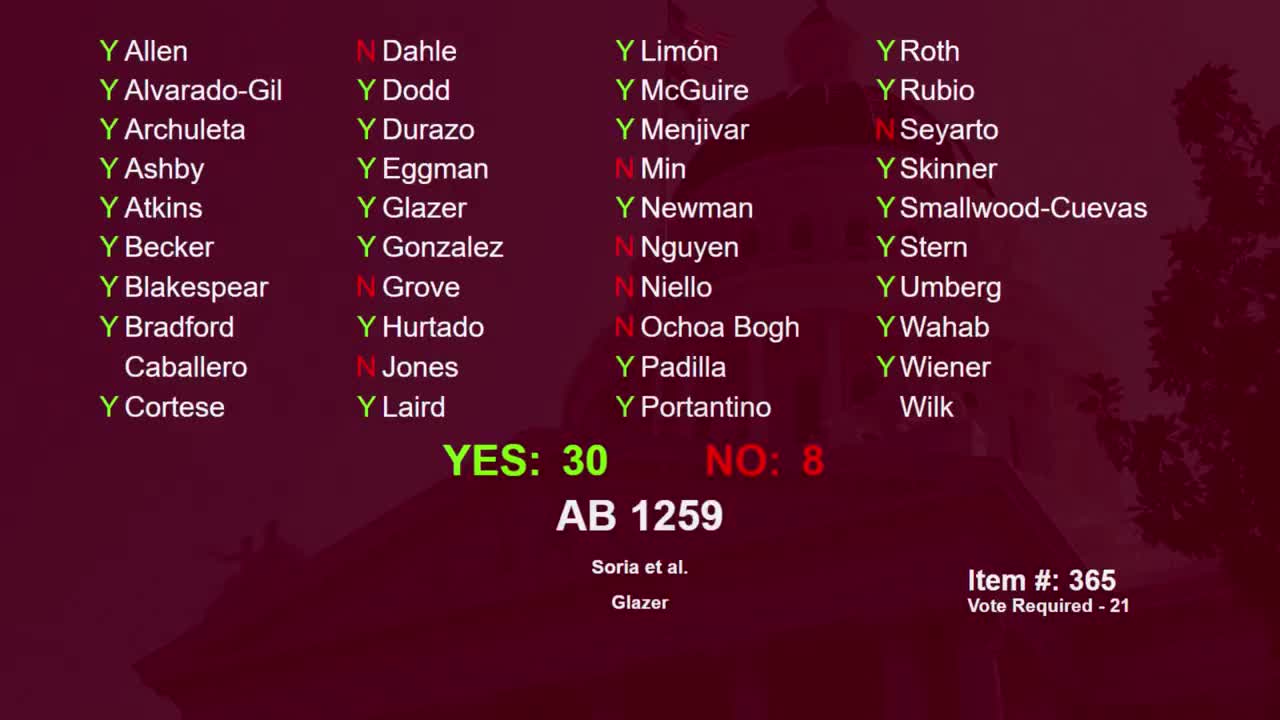
Bill Author

Bill Co-Author(s):