AB 1768: Horse racing.
- Session Year: 2023-2024
- House: Assembly
- Latest Version Date: 2024-09-22
Current Status:
Passed
(2024-09-22: Chaptered by Secretary of State - Chapter 354, Statutes of 2024.)
Introduced
In Committee
First Chamber
In Committee
Second Chamber
Enacted
What does this bill do?
The bill requires all civil lawsuits and subpoenas against the California Horse Racing Board or its executive director to be served at the board’s headquarters in Sacramento. It lets racing licenses for stewards, officials, and other racing participants be issued for terms up to three years and exempts races on the Pegasus World Cup card from the statewide cap of 50 imported thoroughbred races per day for wagering. It also names the executive director, the chief of licensing and enforcement, supervising investigators, and investigators as peace officers (law enforcement officers) for enforcing state and federal horse‑racing laws.
The summary is provided by generative AI which can make mistakes. For original language, please view the details in the table below.
(1)The Horse Racing Law vests the California Horse Racing Board with jurisdiction and supervision over horse racing meetings in the state and requires the board to appoint an executive director to carry out and execute the duties as specified by law and by the board.
This bill would require all civil process in actions brought against the executive director or the board and all subpoenas for the production of board records to be served upon the executive director or their designated representative at the boards headquarters in Sacramento.
(2)Existing law requires an original license for stewards and racing officials who are not licensed as track operators and every person who participates in, or has anything to do with, the racing of horses, to be issued for a period of the calendar year in which it is issued, and to be renewable for a period, not to exceed three years, which the board is authorized to establish by regulation.
This bill would instead require a license for the above-described persons to be issued for a period not to exceed 3 years, which the board would be authorized to establish by regulation.
(3)Existing law authorizes a thoroughbred racing association or fair to distribute the audiovisual signal and accept wagers on the results of out-of-state thoroughbred races conducted in the United States during the calendar period the association or fair is conducting a race meeting, including days on which there is no live racing being conducted by the association or fair, without the consent of the organization that represents horsemen and horsewomen participating in the race meeting and without regard to the amount of purses. Under that law, the total number of thoroughbred races imported by associations or fairs on a statewide basis under these provisions is prohibited from exceeding 50 races per day on days when live thoroughbred or fair racing is being conducted in the state, with the exception of prescribed races.
This bill would exempt from the 50 imported race per day limitation, races imported that are part of the race card of the Pegasus World Cup.
(4)Existing law requires the secretary and chief investigator of the board to coordinate a policy for the enforcement of specified horse racing laws and provides that they are peace officers for those purposes. Existing law provides that designated investigators of the board whose primary duty is enforcement of specified horse racing laws are peace officers.
This bill would instead require the executive director and chief of licensing and enforcement of the board to coordinate the above-described policy and provide that they are peace officers for those purposes. The bill would instead provide that the chief of licensing enforcement, supervising investigators, and investigators, whose primary duty is enforcement of those specified horse racing laws, including the federal Horseracing Integrity and Safety Act of 2020, are peace officers.
(1)The Horse Racing Law vests the California Horse Racing Board with jurisdiction and supervision over horse racing meetings in the state and requires the board to appoint an executive director to carry out and execute the duties as specified by law and by the board.
This bill would require all civil process in actions brought against the executive director or the board and all subpoenas for the production of board records to be served upon the executive director or their designated representative at the boards headquarters in Sacramento.
(2)Existing law requires an original license for stewards and racing officials who are not licensed as track operators and every person who participates in, or has anything to do with, the racing of horses, to be issued for a period of the calendar year in which it is issued, and to be renewable for a period, not to exceed three years, which the board is authorized to establish by regulation.
This bill would instead require a license for the above-described persons to be issued for a period not to exceed 3 years, which the board would be authorized to establish by regulation.
The Horse Racing Law authorizes(3)Existing law authorizes a thoroughbred racing association or fair to distribute the audiovisual signal and accept wagers on the results of out-of-state thoroughbred races conducted in the United States during the calendar period the association or fair is conducting a race meeting, including days on which there is no live racing being conducted by the association or fair, without the consent of the organization that represents horsemen and horsewomen participating in the race meeting and without regard to the amount of purses. Under that law, the total number of thoroughbred races imported by associations or fairs on a statewide basis under these provisions are required to not exceed 50 per day on days when live thoroughbred or fair racing is being conducted in the state, with the exception of prescribed races.
This bill would exempt from the 50 imported race per day limitation, races imported that are part of the race card of the Pegasus World Cup.
(4)Existing law requires the executive director and chief of licensing and enforcement of the board to coordinate a policy for the enforcement of specified horse racing crimes and provides that they are peace officers for those purposes. Existing law provides that designated investigators of the board whose primary duty is enforcement of specified horse racing laws are peace officers.
This bill would provide that only the chief is a peace officer for purposes of enforcing those specified horse racing crimes, and would instead provide that the chief, supervising investigators, and investigators whose primary duty is enforcement of those specified horse racing laws, as well as the federal Horseracing Integrity and Safety Act of 2020, are peace officers.
The Horse Racing Law authorizes a thoroughbred racing association or fair to distribute the audiovisual signal and accept wagers on the results of out-of-state thoroughbred races conducted in the United States during the calendar period the association or fair is conducting a race meeting, including days on which there is no live racing being conducted by the association or fair, without the consent of the organization that represents horsemen and horsewomen participating in the race meeting and without regard to the amount of purses. Under that law, the total number of thoroughbred races imported by associations or fairs on a statewide basis under these provisions are required to not exceed 50 per day on days when live thoroughbred or fair racing is being conducted in the state, with the exception of prescribed races.
This bill would exempt from the 50 imported race per day limitation, races imported that are part of the race card of the Pegasus World Cup.
All civil process in actions brought against the executive director or the board and all subpoenas for the production of board records shall be served upon the executive director or their designated representative at the boards headquarters in Sacramento.
SEC. 2.Section 19515 of the Business and Professions Code is amended to read:19515.(a)A license issued under this article shall be issued for a period not to exceed three years, which the board may, by regulation, establish. The board may establish a license fee schedule consistent with the different period for which these licenses may be granted.
(b)The license shall be valid at all horse racing meetings in this state during the period for which it is issued, unless it is suspended or revoked before the expiration of the period.
SEC. 3.Section 19521 of the Business and Professions Code is amended to read:19521.(a)A license issued pursuant to this article shall be issued for a period not to exceed three years, which the board may, by regulation, establish. The board may establish a license fee schedule consistent with the different period for which the licenses may be granted.
(b)The license shall be valid at all horse racing meetings in this state during the period for which it is issued, unless it is suspended or revoked before the expiration of the period.
SEC. 4.Section 19596.2 of the Business and Professions Code is amended to read:19596.2.(a)Notwithstanding any other law and except as provided in Section 19596.4, a thoroughbred racing association or fair may distribute the audiovisual signal and accept wagers on the results of out-of-state thoroughbred races conducted in the United States during the calendar period the association or fair is conducting a race meeting, including days on which there is no live racing being conducted by the association or fair, without the consent of the organization that represents horsemen and horsewomen participating in the race meeting and without regard to the amount of purses. Further, the total number of thoroughbred races imported by associations or fairs on a statewide basis under this section shall not exceed 50 per day on days when live thoroughbred or fair racing is being conducted in the state. The limitation of 50 imported races per day does not apply to any of the following:
(1)Races imported for wagering purposes pursuant to subdivision (c).
(2)Races imported that are part of the race card of the Kentucky Derby, the Kentucky Oaks, the Preakness Stakes, the Belmont Stakes, the Jockey Club Gold Cup, the Travers Stakes, the Pegasus World Cup, the Arlington Million, the Breeders Cup World Championship, the Dubai World Cup, the Arkansas Derby, the Apple Blossom Handicap, the Blue Grass Stakes, or the Haskell Invitational.
(3)Races imported into the northern zone when there is no live thoroughbred or fair racing being conducted in the northern zone.
(4)Races imported into the combined central and southern zones when there is no live thoroughbred or fair racing being conducted in the combined central and southern zones.
(b)Any thoroughbred association or fair accepting wagers pursuant to subdivision (a) shall conduct the wagering in accordance with the applicable provisions of Sections 19601, 19616, 19616.1, and 19616.2.
(c)No thoroughbred association or fair may accept wagers pursuant to this section on out-of-state races commencing after 7 p.m., Pacific standard time, without the consent of the harness or quarter horse racing association that is then conducting a live racing meeting in the Counties of Orange or Sacramento.
SEC. 5.Section 337.9 of the Penal Code is amended to read:337.9.The executive director and chief of licensing and enforcement of the California Horse Racing Board shall coordinate a policy for the enforcement of this chapter with all other enforcement bureaus in the state in order to ensure prosecution of all persons who commit any offense against the horse racing laws of this state. For those purposes, the chief of licensing and enforcement is a peace officer and has all the powers of a peace officer.
SEC. 6.Section 830.3 of the Penal Code is amended to read:830.3.The following persons are peace officers whose authority extends to any place in the state for the purpose of performing their primary duty or when making an arrest pursuant to Section 836 as to any public offense with respect to which there is immediate danger to person or property, or of the escape of the perpetrator of that offense, or pursuant to Section 8597 or 8598 of the Government Code. These peace officers may carry firearms only if authorized and under those terms and conditions as specified by their employing agencies:
(a)Persons employed by the Division of Investigation of the Department of Consumer Affairs and investigators of the Dental Board of California, who are designated by the Director of Consumer Affairs, provided that the primary duty of these peace officers shall be the enforcement of the law as that duty is set forth in Section 160 of the Business and Professions Code.
(b)Voluntary fire wardens designated by the Director of Forestry and Fire Protection pursuant to Section 4156 of the Public Resources Code, provided that the primary duty of these peace officers shall be the enforcement of the law as that duty is set forth in Section 4156 of that code.
(c)Employees of the Department of Motor Vehicles designated in Section 1655 of the Vehicle Code, provided that the primary duty of these peace officers shall be the enforcement of the law as that duty is set forth in Section 1655 of that code.
(d)The chief of licensing and enforcement, supervising investigators, and investigators of the California Horse Racing Board designated by the board, if the primary duty of these peace officers is the enforcement of the Horse Racing Law (Chapter 4 (commencing with Section 19400) of Division 8 of the Business and Professions Code), Chapter 10 (commencing with Section 330) of Title 9 of Part 1, and the federal Horseracing Integrity and Safety Act of 2020 (15 U.S.C. Sec. 3051 et seq.).
(e)The State Fire Marshal and assistant or deputy state fire marshals appointed pursuant to Section 13103 of the Health and Safety Code, provided that the primary duty of these peace officers shall be the enforcement of the law as that duty is set forth in Section 13104 of that code.
(f)Inspectors of the food and drug section designated by the chief pursuant to subdivision (a) of Section 106500 of the Health and Safety Code, provided that the primary duty of these peace officers shall be the enforcement of the law as that duty is set forth in Section 106500 of that code.
(g)All investigators of the Division of Labor Standards Enforcement designated by the Labor Commissioner, provided that the primary duty of these peace officers shall be the enforcement of the law as prescribed in Section 95 of the Labor Code.
(h)All investigators of the State Departments of Health Care Services, Public Health, and Social Services, the Department of Toxic Substances Control, the Office of Statewide Health Planning and Development, and the Public Employees Retirement System, provided that the primary duty of these peace officers shall be the enforcement of the law relating to the duties of their department or office. Notwithstanding any other law, investigators of the Public Employees Retirement System shall not carry firearms.
(i)Either the Deputy Commissioner, Enforcement Branch of, or the Fraud Division Chief of, the Department of Insurance and those investigators designated by the deputy or the chief, provided that the primary duty of those investigators shall be the enforcement of Section 550.
(j)Employees of the Department of Housing and Community Development designated under Section 18023 of the Health and Safety Code, provided that the primary duty of these peace officers shall be the enforcement of the law as that duty is set forth in Section 18023 of that code.
(k)Investigators of the office of the Controller, provided that the primary duty of these investigators shall be the enforcement of the law relating to the duties of that office. Notwithstanding any other law, except as authorized by the Controller, the peace officers designated pursuant to this subdivision shall not carry firearms.
(l)Investigators of the Department of Financial Protection and Innovation designated by the Commissioner of Financial Protection and Innovation, provided that the primary duty of these investigators shall be the enforcement of the provisions of law administered by the Department of Financial Protection and Innovation. Notwithstanding any other law, the peace officers designated pursuant to this subdivision shall not carry firearms.
(m)Persons employed by the Contractors State License Board designated by the Director of Consumer Affairs pursuant to Section 7011.5 of the Business and Professions Code, provided that the primary duty of these persons shall be the enforcement of the law as that duty is set forth in Section 7011.5, and in Chapter 9 (commencing with Section 7000) of Division 3, of that code. The Director of Consumer Affairs may designate as peace officers not more than 12 persons who shall at the time of their designation be assigned to the special investigations unit of the board. Notwithstanding any other law, the persons designated pursuant to this subdivision shall not carry firearms.
(n)The Chief and coordinators of the Law Enforcement Branch of the Office of Emergency Services.
(o)Investigators of the office of the Secretary of State designated by the Secretary of State, provided that the primary duty of these peace officers shall be the enforcement of the law as prescribed in Chapter 3 (commencing with Section 8200) of Division 1 of Title 2 of, and Section 12172.5 of, the Government Code. Notwithstanding any other law, the peace officers designated pursuant to this subdivision shall not carry firearms.
(p)The Deputy Director for Security designated by Section 8880.38 of the Government Code, and all lottery security personnel assigned to the California State Lottery and designated by the director, provided that the primary duty of any of those peace officers shall be the enforcement of the laws related to ensuring the integrity, honesty, and fairness of the operation and administration of the California State Lottery.
(q)Investigators employed by the Investigation Division of the Employment Development Department designated by the director of the department, provided that the primary duty of those peace officers shall be the enforcement of the law as that duty is set forth in Section 317 of the Unemployment Insurance Code. Notwithstanding any other law, the peace officers designated pursuant to this subdivision shall not carry firearms.
(r)The chief, assistant chief, and all security and safety officers of museum security and safety of Exposition Park, as designated by the Exposition Park Manager pursuant to Section 4108 of the Food and Agricultural Code, provided that the primary duty of those peace officers shall be the enforcement of the law as that duty is set forth in Section 4108 of the Food and Agricultural Code.
(s)Employees of the Franchise Tax Board designated by the board, provided that the primary duty of these peace officers shall be the enforcement of the law as set forth in Chapter 9 (commencing with Section 19701) of Part 10.2 of Division 2 of the Revenue and Taxation Code.
(t)(1)Notwithstanding any other provision of this section, a peace officer authorized by this section shall not be authorized to carry firearms by their employing agency until that agency has adopted a policy on the use of deadly force by those peace officers, and until those peace officers have been instructed in the employing agencys policy on the use of deadly force.
(2)Every peace officer authorized pursuant to this section to carry firearms by their employing agency shall qualify in the use of the firearms at least every six months.
(u)Investigators of the Department of Managed Health Care designated by the Director of the Department of Managed Health Care, provided that the primary duty of these investigators shall be the enforcement of the provisions of laws administered by the Director of the Department of Managed Health Care. Notwithstanding any other law, the peace officers designated pursuant to this subdivision shall not carry firearms.
(v)The Chief, Deputy Chief, supervising investigators, and investigators of the Office of Protective Services of the State Department of Developmental Services, the Office of Protective Services of the State Department of State Hospitals, and the Office of Law Enforcement Support of the California Health and Human Services Agency, provided that the primary duty of each of those persons shall be the enforcement of the law relating to the duties of their department or office.
All civil process in actions brought against the executive director or the board and all subpoenas for the production of board records shall be served upon the executive director or their designated representative at the boards headquarters in Sacramento.
SEC. 2.Section 19515 of the Business and Professions Code is amended to read:19515.An original (a)A license issued under this article shall be issued for a period of the calendar year in which it is issued, and shall be renewable for a period, not to exceed three years, which the board may, by regulation, establish. The board may establish a license fee schedule consistent with the different period for which these licenses may be granted.
The(b)The license shall be valid at all horse racing meetings in this state during the period for which it is issued, unless it is suspended or revoked prior to before the expiration of the period.
SEC. 3.Section 19521 of the Business and Professions Code is amended to read:19521.An original (a)A license issued pursuant to this article shall be issued for a period of the calendar year in which it is issued, and shall be renewable for a period, not to exceed three years, which the board may, by regulation, establish. The board may establish a license fee schedule consistent with the different period for which the licenses may be granted. The
(b)The license shall be valid at all horse racing meetings in this state during the period for which it is issued, unless it is suspended or revoked prior to before the expiration of the period.
SECTION 1.SEC. 4.Section 19596.2 of the Business and Professions Code is amended to read:19596.2.(a)Notwithstanding any other law and except as provided in Section 19596.4, a thoroughbred racing association or fair may distribute the audiovisual signal and accept wagers on the results of out-of-state thoroughbred races conducted in the United States during the calendar period the association or fair is conducting a race meeting, including days on which there is no live racing being conducted by the association or fair, without the consent of the organization that represents horsemen and horsewomen participating in the race meeting and without regard to the amount of purses. Further, the total number of thoroughbred races imported by associations or fairs on a statewide basis under this section shall not exceed 50 per day on days when live thoroughbred or fair racing is being conducted in the state. The limitation of 50 imported races per day does not apply to any of the following:
(1)Races imported for wagering purposes pursuant to subdivision (c).
(2)Races imported that are part of the race card of the Kentucky Derby, the Kentucky Oaks, the Preakness Stakes, the Belmont Stakes, the Jockey Club Gold Cup, the Travers Stakes, the Pegasus World Cup, the Arlington Million, the Breeders Cup World Championship, the Dubai World Cup, the Arkansas Derby, the Apple Blossom Handicap, the Blue Grass Stakes, or the Haskell Invitational.
(3)Races imported into the northern zone when there is no live thoroughbred or fair racing being conducted in the northern zone.
(4)Races imported into the combined central and southern zones when there is no live thoroughbred or fair racing being conducted in the combined central and southern zones.
(b)Any thoroughbred association or fair accepting wagers pursuant to subdivision (a) shall conduct the wagering in accordance with the applicable provisions of Sections 19601, 19616, 19616.1, and 19616.2.
(c)No thoroughbred association or fair may accept wagers pursuant to this section on out-of-state races commencing after 7 p.m., Pacific standard time, without the consent of the harness or quarter horse racing association that is then conducting a live racing meeting in the Counties of Orange or Sacramento.
SEC. 5.Section 337.9 of the Penal Code is amended to read:337.9.The secretary executive director and chief investigator of licensing and enforcement of the California Horse Racing Board shall coordinate a policy for the enforcement of this chapter with all other enforcement bureaus in the State state in order to insure ensure prosecution of all persons who commit any offense against the horse racing laws of this State. state. For such purposes those purposes, the secretary and chief investigator are chief of licensing and enforcement is a peace officers officer and have has all the powers thereof. of a peace officer.
SEC. 6.Section 830.3 of the Penal Code is amended to read:830.3.The following persons are peace officers whose authority extends to any place in the state for the purpose of performing their primary duty or when making an arrest pursuant to Section 836 as to any public offense with respect to which there is immediate danger to person or property, or of the escape of the perpetrator of that offense, or pursuant to Section 8597 or 8598 of the Government Code. These peace officers may carry firearms only if authorized and under those terms and conditions as specified by their employing agencies:
(a)Persons employed by the Division of Investigation of the Department of Consumer Affairs and investigators of the Dental Board of California, who are designated by the Director of Consumer Affairs, provided that the primary duty of these peace officers shall be the enforcement of the law as that duty is set forth in Section 160 of the Business and Professions Code.
(b)Voluntary fire wardens designated by the Director of Forestry and Fire Protection pursuant to Section 4156 of the Public Resources Code, provided that the primary duty of these peace officers shall be the enforcement of the law as that duty is set forth in Section 4156 of that code.
(c)Employees of the Department of Motor Vehicles designated in Section 1655 of the Vehicle Code, provided that the primary duty of these peace officers shall be the enforcement of the law as that duty is set forth in Section 1655 of that code.
(d)Investigators The chief of licensing and enforcement, supervising investigators, and investigators of the California Horse Racing Board designated by the board, provided that if the primary duty of these peace officers shall be is the enforcement of Chapter the Horse Racing Law (Chapter 4 (commencing with Section 19400) of Division 8 of the Business and Professions Code and Code), Chapter 10 (commencing with Section 330) of Title 9 of Part 1. 1, and the federal Horseracing Integrity and Safety Act of 2020 (15 U.S.C. Sec. 3051 et seq.).
(e)The State Fire Marshal and assistant or deputy state fire marshals appointed pursuant to Section 13103 of the Health and Safety Code, provided that the primary duty of these peace officers shall be the enforcement of the law as that duty is set forth in Section 13104 of that code.
(f)Inspectors of the food and drug section designated by the chief pursuant to subdivision (a) of Section 106500 of the Health and Safety Code, provided that the primary duty of these peace officers shall be the enforcement of the law as that duty is set forth in Section 106500 of that code.
(g)All investigators of the Division of Labor Standards Enforcement designated by the Labor Commissioner, provided that the primary duty of these peace officers shall be the enforcement of the law as prescribed in Section 95 of the Labor Code.
(h)All investigators of the State Departments of Health Care Services, Public Health, and Social Services, the Department of Toxic Substances Control, the Office of Statewide Health Planning and Development, and the Public Employees Retirement System, provided that the primary duty of these peace officers shall be the enforcement of the law relating to the duties of their department or office. Notwithstanding any other law, investigators of the Public Employees Retirement System shall not carry firearms.
(i)Either the Deputy Commissioner, Enforcement Branch of, or the Fraud Division Chief of, the Department of Insurance and those investigators designated by the deputy or the chief, provided that the primary duty of those investigators shall be the enforcement of Section 550.
(j)Employees of the Department of Housing and Community Development designated under Section 18023 of the Health and Safety Code, provided that the primary duty of these peace officers shall be the enforcement of the law as that duty is set forth in Section 18023 of that code.
(k)Investigators of the office of the Controller, provided that the primary duty of these investigators shall be the enforcement of the law relating to the duties of that office. Notwithstanding any other law, except as authorized by the Controller, the peace officers designated pursuant to this subdivision shall not carry firearms.
(l)Investigators of the Department of Financial Protection and Innovation designated by the Commissioner of Financial Protection and Innovation, provided that the primary duty of these investigators shall be the enforcement of the provisions of law administered by the Department of Financial Protection and Innovation. Notwithstanding any other law, the peace officers designated pursuant to this subdivision shall not carry firearms.
(m)Persons employed by the Contractors State License Board designated by the Director of Consumer Affairs pursuant to Section 7011.5 of the Business and Professions Code, provided that the primary duty of these persons shall be the enforcement of the law as that duty is set forth in Section 7011.5, and in Chapter 9 (commencing with Section 7000) of Division 3, of that code. The Director of Consumer Affairs may designate as peace officers not more than 12 persons who shall at the time of their designation be assigned to the special investigations unit of the board. Notwithstanding any other law, the persons designated pursuant to this subdivision shall not carry firearms.
(n)The Chief and coordinators of the Law Enforcement Branch of the Office of Emergency Services.
(o)Investigators of the office of the Secretary of State designated by the Secretary of State, provided that the primary duty of these peace officers shall be the enforcement of the law as prescribed in Chapter 3 (commencing with Section 8200) of Division 1 of Title 2 of, and Section 12172.5 of, the Government Code. Notwithstanding any other law, the peace officers designated pursuant to this subdivision shall not carry firearms.
(p)The Deputy Director for Security designated by Section 8880.38 of the Government Code, and all lottery security personnel assigned to the California State Lottery and designated by the director, provided that the primary duty of any of those peace officers shall be the enforcement of the laws related to ensuring the integrity, honesty, and fairness of the operation and administration of the California State Lottery.
(q)Investigators employed by the Investigation Division of the Employment Development Department designated by the director of the department, provided that the primary duty of those peace officers shall be the enforcement of the law as that duty is set forth in Section 317 of the Unemployment Insurance Code. Notwithstanding any other law, the peace officers designated pursuant to this subdivision shall not carry firearms.
(r)The chief, assistant chief, and all security and safety officers of museum security and safety of Exposition Park, as designated by the Exposition Park Manager pursuant to Section 4108 of the Food and Agricultural Code, provided that the primary duty of those peace officers shall be the enforcement of the law as that duty is set forth in Section 4108 of the Food and Agricultural Code.
(s)Employees of the Franchise Tax Board designated by the board, provided that the primary duty of these peace officers shall be the enforcement of the law as set forth in Chapter 9 (commencing with Section 19701) of Part 10.2 of Division 2 of the Revenue and Taxation Code.
(t)(1)Notwithstanding any other provision of this section, a peace officer authorized by this section shall not be authorized to carry firearms by their employing agency until that agency has adopted a policy on the use of deadly force by those peace officers, and until those peace officers have been instructed in the employing agencys policy on the use of deadly force.
(2)Every peace officer authorized pursuant to this section to carry firearms by their employing agency shall qualify in the use of the firearms at least every six months.
(u)Investigators of the Department of Managed Health Care designated by the Director of the Department of Managed Health Care, provided that the primary duty of these investigators shall be the enforcement of the provisions of laws administered by the Director of the Department of Managed Health Care. Notwithstanding any other law, the peace officers designated pursuant to this subdivision shall not carry firearms.
(v)The Chief, Deputy Chief, supervising investigators, and investigators of the Office of Protective Services of the State Department of Developmental Services, the Office of Protective Services of the State Department of State Hospitals, and the Office of Law Enforcement Support of the California Health and Human Services Agency, provided that the primary duty of each of those persons shall be the enforcement of the law relating to the duties of their department or office.
(a)Notwithstanding any other law and except as provided in Section 19596.4, a thoroughbred racing association or fair may distribute the audiovisual signal and accept wagers on the results of out-of-state thoroughbred races conducted in the United States during the calendar period the association or fair is conducting a race meeting, including days on which there is no live racing being conducted by the association or fair, without the consent of the organization that represents horsemen and horsewomen participating in the race meeting and without regard to the amount of purses. Further, the total number of thoroughbred races imported by associations or fairs on a statewide basis under this section shall not exceed 50 per day on days when live thoroughbred or fair racing is being conducted in the state. The limitation of 50 imported races per day does not apply to any of the following:
(1)Races imported for wagering purposes pursuant to subdivision (c).
(2)Races imported that are part of the race card of the Kentucky Derby, the Kentucky Oaks, the Preakness Stakes, the Belmont Stakes, the Jockey Club Gold Cup, the Travers Stakes, the Pegasus World Cup, the Arlington Million, the Breeders Cup, Cup World Championship, the Dubai World Cup, the Arkansas Derby, the Apple Blossom Handicap, the Blue Grass Stakes, or the Haskell Invitational.
(3)Races imported into the northern zone when there is no live thoroughbred or fair racing being conducted in the northern zone.
(4)Races imported into the combined central and southern zones when there is no live thoroughbred or fair racing being conducted in the combined central and southern zones.
(b)Any thoroughbred association or fair accepting wagers pursuant to subdivision (a) shall conduct the wagering in accordance with the applicable provisions of Sections 19601, 19616, 19616.1, and 19616.2.
(c)No thoroughbred association or fair may accept wagers pursuant to this section on out-of-state races commencing after 7 p.m., Pacific standard time, without the consent of the harness or quarter horse racing association that is then conducting a live racing meeting in the Counties of Orange or Sacramento.
|
Date
|
Status
|
|---|---|
| Sep 22, 2024 | Chaptered by Secretary of State - Chapter 354, Statutes of 2024. |
| Sep 22, 2024 | Approved by the Governor. |
| Sep 10, 2024 | Enrolled and presented to the Governor at 4:30 p.m. |
| Aug 28, 2024 | Senate amendments concurred in. To Engrossing and Enrolling. (Ayes 77. Noes 0.). |
| Aug 28, 2024 | In Assembly. Concurrence in Senate amendments pending. May be considered on or after August 30 pursuant to Assembly Rule 77. |
| Aug 28, 2024 | Assembly Rule 77 suspended. |
| Aug 27, 2024 | Read third time. Passed. Ordered to the Assembly. (Ayes 40. Noes 0.). |
| Jun 25, 2024 | From committee: That the measure be returned to Senate Floor for consideration. (Ayes 14. Noes 0.) (June 25) |
| Jun 12, 2024 | Re-referred to Com. on G.O. pursuant to Senate Rule 29.10(b). |
| Jun 6, 2024 | Read second time. Ordered to third reading. |
| Jun 6, 2024 | Re-referred to Com. on RLS pursuant to Senate Rule 29.10(b). |
| Jun 5, 2024 | Read third time and amended. Ordered to second reading. |
| Jun 4, 2024 | Read second time. Ordered to third reading. |
| Jun 3, 2024 | Ordered to second reading. |
| Jun 3, 2024 | From inactive file. |
| Sep 12, 2023 | Ordered to inactive file at the request of Senator Dodd. |
| Jul 13, 2023 | Ordered to third reading. |
| Jul 13, 2023 | From Consent Calendar. |
| Jul 12, 2023 | Read second time. Ordered to Consent Calendar. |
| Jul 11, 2023 | From committee: Do pass. To Consent Calendar. (Ayes 14. Noes 0.) (July 11). |
| May 17, 2023 | Referred to Com. on G.O. |
| May 4, 2023 | In Senate. Read first time. To Com. on RLS. for assignment. |
| May 4, 2023 | Read third time. Passed. Ordered to the Senate. (Ayes 75. Noes 0. Page 1466.) |
| May 1, 2023 | Read second time. Ordered to Consent Calendar. |
| Apr 27, 2023 | From committee: Do pass. To Consent Calendar. (Ayes 22. Noes 0.) (April 26). |
| Mar 30, 2023 | Referred to Com. on G.O. |
| Mar 23, 2023 | From printer. May be heard in committee April 22. |
| Mar 22, 2023 | Read first time. To print. |
|
Date
|
Description
|
Location
|
Votes
|
|
|---|---|---|---|---|
| Aug 28, 2024 | AB 1768 G.O. Concurrence in Senate Amendments By RUBIO | Assembly Floor |
Passed |
|
| Aug 27, 2024 | Assembly 3rd Reading AB1768 G.O. (Blanca Rubio) By Dodd | Senate Floor |
Passed |
|
| Jun 25, 2024 | That the measure be returned to Senate Floor for consideration. Ordered to third reading. | Senate Standing Committee on Governmental Organization |
Passed |
|
| Jul 11, 2023 | Do pass and be ordered to the Consent Calendar | Senate Standing Committee on Governmental Organization |
Passed |
|
| May 4, 2023 | AB 1768 Governmental Organization Consent Calendar Second Day Regular Session | Assembly Floor |
Passed |
|
| Apr 26, 2023 | Do pass. To Consent Calendar. | Assembly Standing Committee on Governmental Organization |
Passed |
This list shows positions taken on this bill by organizations on the date displayed, which is linked to the original source.
Positions by individuals are not included.
CONCURRENCE IN SENATE AMENDMENTS
CSA1 Bill Id:AB 1768
Author:(Committee on Governmental Organization)
As Amended Ver:June 5, 2024
Majority vote
SUMMARY
This bill would modify various aspects of the California Horse Racing Law, including service of civil procedures, licensing periods, the designation of certain staff as peace officers, and an exemption for the Pegasus World Cup from the 50 race-per-day import limitation, as specified.
Senate Amendments
1) Requires all civil process in actions brought against the Executive Director or the California Horse Racing Board (CHRB) and all subpoenas for the production of CHRB records to be served upon the Executive Director or their designated representative at CHRB's headquarters in Sacramento.
2) Requires a license for stewards and racing officials who are not licensed as track operators and every person who participates in, or has anything to do with, the racing of horses, to be issued for a period not to exceed three years, which CHRB would be authorized to establish by regulation.
3) Provides that only CHRB's chief of licensing and enforcement is a peace officer for purposes of enforcing specified horse racing crimes, and provides that the chief, supervising investigators, and investigators whose primary duty is enforcement of specified horse racing laws, as well as the federal Horseracing Integrity and Safety Act of 2020 (Act), are peace officers.
COMMENTS
This bill represents the annual Assembly Committee on Governmental Organization omnibus bill that makes clarifying, technical and non-controversial changes to statute. There is no opposition to this bill.
Horseracing Integrity and Safety Act of 2020. The federal Act established the Horseracing Integrity and Safety Authority (HISA), which is a private self-regulatory organization that regulates the sport of Thoroughbred horse racing in the United States. HISA was created to implement, for the first time, a national, uniform set of integrity and safety rules that are intended to be applied consistently to every Thoroughbred racing participant and racetrack facility. The rules and regulations drafted by HISA's Racetrack Safety and Anti-Doping and Medication Control Standing Committees are designed to enhance the safety and wellbeing of both horse and rider while ensuring the integrity of the sport for the benefit of the industry, fans, and bettors.
Pegasus World Cup Invitational. The Pegasus World Cup Invitational Stakes is an American Thoroughbred horse race that first ran on January 28, 2017, at Gulfstream Park in Hallandale Beach, Florida. The race covers 1 1/8 miles (9 furlongs) on dirt and is open to horses aged four years and older. It inherited its Grade 1 rating from the Donn Handicap.
Initially, with a purse of $12 million, the Pegasus World Cup surpassed the Dubai World Cup as the world's richest horse race for 2017 and 2018. The purse increased to $16 million in 2018 but dropped to $9 million in 2019 and $3 million in 2020. The entry fee has also changed over the years, starting at $1 million in 2017 and 2018, reducing to $500,000 in 2019, and becoming free in 2020.
Horses in the race carry 124 pounds with a three-pound allowance for fillies and mares. From 2017 to 2019, horses running without the pre-race medication furosemide (Lasix) received a five-pound allowance. Starting in 2020, the use of all race-day medications, including Lasix, is prohibited.
Proposed Changes to California Horse Racing Law. This bill requires all civil process in actions brought against the executive director or the CHRB and all subpoenas for the production of CHRB records to be served upon the executive director or their designated representative at CHRB's headquarters in Sacramento.
Due to lack of specificity in existing law, subpoenas and other legal documents are occasionally delivered to the CHRB at one of its various racetrack satellite locations. When track employees fail to distribute the mail in a timely manner, serious consequences can occur. In the past, the delay in forwarding a subpoena cost the CHRB its right to defend against the release of information that would have otherwise been protected.
Additionally, this bill removes the length of license distinction between original (i.e., initial) licenses and renewal licenses, making it so that all licenses may be issued for up to three years. The CHRB would maintain the ability to create shorter licensing terms via regulation. Existing law is inflexible in that original licenses are only valid for the calendar year in which they are issued.
Further, this bill updates outdated code sections in the California Penal Code by aligning CHRB positions listed in statute with current titles and functions. This bill also adds the Horseracing Integrity and Safety Act of 2020 to the primary duties under which peace officers employed by the CHRB are authorized to carry a firearm.
Finally, this bill adds the Pegasus World Cup to the list of exempted races that are not subject to the 50 race-per-day import limitation under current law.
According to the Author
According to the author's office, "this bill makes various changes to update the Horse Racing Law and help facilitate CHRB to effectively carry out its legislative mandate. This bill clarifies existing law and corrects for unintended inefficiencies. Additionally, this bill provides that all races imported by a thoroughbred association or fair that are part of the race card of the overall Pegasus World Cup Invitational day would be exempted from the 50-race per day limit as defined in current law."
Arguments in Support
None on file
Arguments in Opposition
None on file
FISCAL COMMENTS
According to the Senate Appropriations Committee, no additional costs to the CHRB. The CHRB notes the proposed changes modernize outdated sections of the California Horse Racing Law, which will be helpful to the board's ongoing administrative and enforcement operations.
VOTES:
ASM GOVERNMENTAL ORGANIZATION: 22-0-0
YES: Santiago, Lackey, Aguiar-Curry, Berman, Bryan, Cervantes, Megan Dahle, Davies, Garcia, Gipson, Jones-Sawyer, Low, Mathis, McCarty, McKinnor, Jim Patterson, Quirk-Silva, Ramos, Robert Rivas, Blanca Rubio, Ta, Villapudua
ASSEMBLY FLOOR: 75-0-5
YES: Addis, Aguiar-Curry, Alanis, Alvarez, Arambula, Bains, Bauer-Kahan, Bennett, Berman, Boerner, Bonta, Bryan, Calderon, Juan Carrillo, Wendy Carrillo, Cervantes, Chen, Connolly, Megan Dahle, Davies, Dixon, Essayli, Mike Fong, Vince Fong, Friedman, Gabriel, Gallagher, Garcia, Gipson, Grayson, Haney, Hart, Holden, Hoover, Irwin, Jackson, Jones-Sawyer, Kalra, Lackey, Lee, Low, Lowenthal, Maienschein, Mathis, McCarty, Stephanie Nguyen, Ortega, Pacheco, Papan, Jim Patterson, Joe Patterson, Pellerin, Petrie-Norris, Quirk-Silva, Ramos, Reyes, Luz Rivas, Robert Rivas, Rodriguez, Blanca Rubio, Sanchez, Santiago, Schiavo, Soria, Ta, Ting, Valencia, Villapudua, Waldron, Ward, Weber, Wilson, Wood, Zbur, Rendon
ABS, ABST OR NV: Flora, McKinnor, Muratsuchi, Wallis, Wicks
SENATE FLOOR: 40-0-0
YES: Allen, Alvarado-Gil, Archuleta, Ashby, Atkins, Becker, Blakespear, Bradford, Caballero, Cortese, Dahle, Dodd, Durazo, Eggman, Glazer, Gonzalez, Grove, Hurtado, Jones, Laird, Limón, McGuire, Menjivar, Min, Newman, Nguyen, Niello, Ochoa Bogh, Padilla, Portantino, Roth, Rubio, Seyarto, Skinner, Smallwood-Cuevas, Stern, Umberg, Wahab, Wiener, Wilk
UPDATED
VERSION: June 5, 2024
CONSULTANT: Eric Johnson / G.O. / (916) 319-2531 FN: 0004783
SENATE RULES COMMITTEE Office of Senate Floor Analyses (916) 651-1520 Fax: (916) 327-4478 | AB 1768 |
THIRD READING
Bill No: AB 1768
Author: Committee on Governmental Organization
Amended: 6/5/24 in Senate
Vote: 21
PRIOR VOTES NOT RELEVANT
SENATE GOVERNMENTAL ORG. COMMITTEE: 14-0, 6/25/24 (Pursuant to Senate Rule 29.10)
AYES: Dodd, Wilk, Alvarado-Gil, Archuleta, Ashby, Bradford, Glazer, Nguyen, Ochoa Bogh, Padilla, Roth, Rubio, Seyarto, Smallwood-Cuevas
NO VOTE RECORDED: Jones, Portantino
SUBJECT: Horse racing
SOURCE: Author
DIGEST:
This bill modifies various aspects of the California Horse Racing Law, including service of civil procedures, licensing periods, the designation of certain staff as peace officers, and an exemption for the Pegasus World Cup from the 50 race-per-day import limitation, as specified.
Senate Floor Amendments of 6/5/24 address several out-of-date code sections.
ANALYSIS:
Existing law:
- Article IV, Section 19(b) of the Constitution of the State of California authorizes the Legislature to provide for the regulation of horse races and horse race meetings and wagering on the results.
- Grants the California Horse Racing Board (CHRB) the authority to regulate the various forms of horse racing authorized in this state and requires the Executive Director of CHRB to carry out and execute the duties as specified by law and by CHRB.
- Authorizes thoroughbred racing associations or fairs to distribute the audiovisual signal and accept wagers on the results of out-of-state and international thoroughbred races during the calendar period the association or fair is conducting live racing, including days on which there is no live racing being conducted by the association or fair.
- Limits the number of races that may be imported by associations and fairs to no more than 50 races per day on days when live thoroughbred or fair racing is being conducted in this state, with specified exceptions.
- Requires an original license for stewards and racing officials who are not licensed as track operators and every person who participates in, or has anything to do with, the racing of horses, to be issued for a period of the calendar year in which it is issued, and to be renewable for a period, not to exceed three years, which the CHRB is authorized to establish by regulation.
- Requires the Executive Director of CHRB and chief of licensing and enforcement of CHRB to coordinate a policy for the enforcement of specified horse racing crimes and provides that they are peace officers for those purposes.
- Provides that designated investigators of CHRB whose primary duty is enforcement of specified horse racing laws are peace officers.
This bill:
- Requires all civil process in actions brought against the Executive Director or CHRB and all subpoenas for the production of CHRB records to be served upon the Executive Director or their designated representative at CHRB’s headquarters in Sacramento.
- Requires a license for stewards and racing officials who are not licensed as track operators and every person who participates in, or has anything to do with, the racing of horses, to be issued for a period not to exceed three years, which CHRB would be authorized to establish by regulation.
- Provides that only CHRB’s chief of licensing and enforcement is a peace officer for purposes of enforcing specified horse racing crimes, and provides that the chief, supervising investigators, and investigators whose primary duty is enforcement of specified horse racing laws, as well as the federal Horseracing Integrity and Safety Act of 2020 (Act), are peace officers.
- Exempts any races that are part of the race card of the Pegasus World Cup from the 50 imported race per day limitation.
Background
- Author Statement. According to the author’s office, “this bill makes various changes to update the Horse Racing Law and help facilitate CHRB to effectively carry out its legislative mandate. This bill clarifies existing law and corrects for unintended inefficiencies. Additionally, this bill provides that all races imported by a thoroughbred association or fair that are part of the race card of the overall Pegasus World Cup Invitational day would be exempted from the 50-race per day limit as defined in current law.”
- Proposed Changes to California Horse Racing Law. This bill requires all civil process in actions brought against the executive director or CHRB and all subpoenas for the production of CHRB records to be served upon the executive director or their designated representative at CHRB’s headquarters in Sacramento located at 1010 Hurley Way, Suite 300.
Due to lack of specificity in existing law, subpoenas and other legal documents are occasionally delivered to CHRB at one of its various racetrack satellite locations. When track employees fail to distribute the mail in a timely manner, serious consequences can occur. In the past, the delay in forwarding a subpoena cost the CHRB its right to defend against the release of information that would have otherwise been protected.
Additionally, this bill removes the length of license distinction between original (i.e., initial) licenses and renewal licenses, making it so that all licenses may be issued for up to three years. CHRB would maintain the ability to create shorter licensing terms via regulation. Existing law is inflexible in that original licenses are only valid for the calendar year in which they are issued.
Further, this bill updates outdated code sections in the California Penal Code by aligning CHRB positions listed in statute with current titles and functions. This bill also adds the Horseracing Integrity and Safety Act of 2020 to the primary duties under which peace officers employed by the CHRB are authorized to carry a firearm.
Finally, this bill adds the Pegasus World Cup to the list of exempted races that are not subject to the 50 race-per-day import limitation.
- Satellite Wagering and Simulcasting. Satellite wagering via an off-track facility has been legal in California since the 1980s when California began experiencing a decline in attendance and handle figures. The industry believed that making the product easier to access not only exposes and markets horse racing to potential customers, but also makes it more convenient for the existing patrons to wager more often.
Simulcasting is the process of transmitting the audio and video signal of a live racing performance from one facility to a satellite for re-transmission to other locations or venues where pari-mutuel wagering is permitted. Simulcasting provides racetracks with the opportunity to increase revenues by exporting their live racing content to as many wagering locations as possible, such as other racetracks, fair satellite facilities, and Indian casinos. Revenues increase because simulcasting provides racetracks that export their live content with additional customers in multiple locations who would not have otherwise been able to place wagers on the live racing event.
Thoroughbred racing associations and fairs in California can distribute the audiovisual signal and accept wagers on the results of out-of-state thoroughbred races during their own race meetings. This is allowed even on days when no live races are being held at their venues. There is a limit on the number of out-of-state races that can be imported into California for betting purposes. On days when there is live thoroughbred or fair racing happening in California, the total number of races imported from out-of-state must not exceed 50 races-per-day.
However, there are exemptions to this limit. Races that are part of specific major events like the Kentucky Derby, Breeder’s Cup, and other specified races can be imported without falling under the 50 race-per-day limit. Additional exceptions are made for importing races into certain geographical zones of California when no local live racing is occurring. Any wagering on these out-of-state races must comply with specific provisions of California’s Horse Racing Law that govern how betting should be conducted. Wagers on out-of-state races are not allowed after 7 p.m. PST unless there is consent from the local harness or quarter horse racing associations conducting live racing in either Orange or Sacramento County.
- Horse Racing in California. Horse racing, once the cornerstone of American sports betting, has experienced a shift in its cultural and economic landscape over the past few decades. The sport, steeped in tradition and history, has faced challenges in maintaining its prominence in an increasingly diversified entertainment and gambling market, waning interest from younger generations, and animal welfare concerns.
The industry’s stability is undermined by competition from horse racing, alternative forms of gaming, and the aftermath of negative public reaction to a spate of horse deaths in 2019. Declining attendance at race events exacerbates the situation, as does the lure of higher returns from real estate development compared to the revenue generated from racing operations. In 2023, it was announced that Golden Gate Fields in the San Francisco Bay Area would be closing permanently at the end of their 2024 meet.
This economic strain has led to deficits across nearly all industry revenue streams. Traditional financial models, including takeout rates and distribution formulas, are no longer sufficient to sustain ongoing operations. The decline in the profitability of racing operations has forced track owners to seek higher returns on their investments, often considering the sale or redevelopment of racetrack properties for more lucrative uses.
As a result, the industry faces unprecedented instability and capital flight. This instability jeopardizes thousands of jobs directly linked to horse racing, including those on breeding farms and other associated businesses. The closure of key racetracks, including Golden Gate Fields, highlights the precarious state of the industry and related jobs. Also at risk is a substantial amount of local and state revenue generated both directly and indirectly by the industry.
- Horseracing Integrity and Safety Act of 2020. The federal Act established the Horseracing Integrity and Safety Authority (HISA), which is a private self-regulatory organization that regulates the sport of Thoroughbred horse racing in the United States. HISA was created to implement, for the first time, a national, uniform set of integrity and safety rules that are intended to be applied consistently to every Thoroughbred racing participant and racetrack facility. This congressional action came in the aftermath of a spate of nearly three dozen horse racing deaths that plagued the industry and Santa Anita Park in 2019.
The rules and regulations drafted by HISA’s Racetrack Safety and Anti-Doping and Medication Control Standing Committees are designed to enhance the safety and wellbeing of both horse and rider while ensuring the integrity of the sport for the benefit of the industry, fans, and bettors. The Federal Trade Commission (FTC) gave broad oversight over HISA, which, after providing an opportunity for public comment, must approve or disapprove of any rule proposed by HISA. Civil sanctions imposed by HISA for violations of its rules or standards may be appealed to the FTC for review by an Administrative Law Judge and by HISA. HISA must also submit guidance it develops to the FTC.
Some states, however, are refusing to recognize the Act and HISA’s authority, instead continuing to operate under safety and medication regulations on a state level. The Texas Racing Commission has refused to recognize HISA on the grounds that it conflicts with its own state rules. In addition to Texas, racing jurisdictions in Louisiana and West Virginia continue to operate under state rules, as the implementation of HISA has been postponed while awaiting the resolution of legal challenges.
- Pegasus World Cup Invitational. The Pegasus World Cup Invitational Stakes is an American Thoroughbred horse race that first ran on January 28, 2017, at Gulfstream Park in Hallandale Beach, Florida. The race covers 1 1/8 miles (9 furlongs) on dirt and is open to horses aged four years and older. It inherited its Grade 1 rating from the Donn Handicap.
Initially, with a purse of $12 million, the Pegasus World Cup surpassed the Dubai World Cup as the world’s richest horse race for 2017 and 2018. The purse increased to $16 million in 2018 but dropped to $9 million in 2019 and $3 million in 2020. The entry fee has also changed over the years, starting at $1 million in 2017 and 2018, reducing to $500,000 in 2019, and becoming free in 2020.
Horses in the race carry 124 pounds with a three-pound allowance for fillies and mares. From 2017 to 2019, horses running without the pre-race medication furosemide (Lasix) received a five-pound allowance. Starting in 2020, the use of all race-day medications, including Lasix, is prohibited.
The race is named after Pegasus, the mythical Greek horse, symbolized by a 110-foot statue at Gulfstream Park.
Related/Prior Legislation
AB 1946 (Alanis, 2024) adds the Whitney Stakes to the group of out-of-state horseraces that are exempt from the 50 races-per-day limit on imported races into California. (Pending on the Senate Floor)
AB 3261 (M. Fong, 2024) raises the existing limit on the importation of out-of-state thoroughbred races, for the purposes of accepting wagers on those races, from 50 to 75 out-of-state races-per-day; and, prohibits, when the total number of those races imported is between 51 and 75 races-per-day, a thoroughbred association or fair from accepting wagers on those races commencing after 5:30 p.m. without the consent of the harness or quarter horse racing association that is then conducting a live race meeting in the County of Orange or the County of Sacramento. (Pending in the Senate Appropriations Committee)
SB 624 (Alvarado-Gil, 2023) allows the California Department of Food and Agriculture to receive reimbursement for the cost of allocating revenue received from sales tax collected on state-designated fairgrounds to fairs, not to exceed five percent of the funds, as specified. (Held on the Assembly Revenue and Taxation Suspense File)
AB 1074 (Alanis, Chapter 275, Statutes of 2023) provided that if CHRB does not license a thoroughbred race meet at a racetrack located in the cities of Berkeley and Albany (Golden Gate Fields) after July 1, 2024, and no live racing is being conducted in the norther zone, this bill deems a thoroughbred racing association or racing fair in the southern or central zone, as specified, to be operating in the northern zone for the purposes of conducting all permissible forms of wagering in the northern zone and making and receiving required distribution from those wagers; and, permits any fair in the County of Stanislaus to operate one satellite wagering facility within the boundaries of the fair, as specified.
AB 1174 (Patterson, 2023) makes various technical and non-substantive changes to provisions of Horse Racing Law including clarifying that “live” also includes live in-state races as part of the organization’s racing program, as specified. (Pending in the Senate Governmental Organization Committee)
AB 1173 (Cooper, Chapter 531, Statutes of 2021) required the contractual compensation received by the Advance Deposit Wagering provider to be the average of the contractual compensation specified in the hub agreement that is the subject of the arbitration and the contractual compensation set forth in the arbitration case, as specified.
SB 800 (Dodd, Chapter 252, Statutes of 2020) authorized veterinarians to make available the entire medical records of racehorses to specified parties involved in horse racing; requires the CHRB to publish on a weekly basis all horse fatalities that occur within a licensed facility, as specified; and requires the CHRB to post results of non-confidential official racehorse drug test samples within five business days of the confirmed negative split sample test result, as specified.
SB 469 (Dodd, Chapter 22, Statutes of 2019) authorized the CHRB to immediately suspend a license to conduct a horse racing meeting when necessary to protect the health and safety of horses and riders, as specified.
FISCAL EFFECT: Appropriation: No Fiscal Com.: Yes Local: No
According to the Senate Appropriations Committee, no additional costs to the CHRB. CHRB notes the proposed changes modernize outdated sections of the California Horse Racing Law, which will be helpful to the board’s ongoing administrative and enforcement operations.
SUPPORT: (Verified 6/25/24)
None received
OPPOSITION: (Verified 6/25/24)
Prepared by: Brian Duke / G.O. / (916) 651-1530
6/26/24 14:28:14
**** END ****
SENATE COMMITTEE ON GOVERNMENTAL ORGANIZATION
Senator Bill Dodd
Chair
2023 - 2024 Regular
Bill No: AB Hearing Date: 6/25/2024
Author: | Committee on Governmental Organization | ||
Version: | Amended | ||
Urgency: | Fiscal: | ||
Consultant: | |||
SUBJECT:
DIGEST: This bill modifies various aspects of the California Horse Racing Law, including service of civil procedures, licensing periods, the designation of certain staff as peace officers, and an exemption for the Pegasus World Cup from the 50 race-per-day import limitation, as specified.
ANALYSIS:
Existing law:
- Article IV, Section 19(b) of the Constitution of the State of California authorizes the Legislature to provide for the regulation of horse races and horse race meetings and wagering on the results.
- Grants the California Horse Racing Board (CHRB) the authority to regulate the various forms of horse racing authorized in this state and requires the Executive Director of CHRB to carry out and execute the duties as specified by law and by CHRB.
- Authorizes thoroughbred racing associations or fairs to distribute the audiovisual signal and accept wagers on the results of out-of-state and international thoroughbred races during the calendar period the association or fair is conducting live racing, including days on which there is no live racing being conducted by the association or fair.
- Limits the number of races that may be imported by associations and fairs to no more than 50 races per day on days when live thoroughbred or fair racing is being conducted in this state, with specified exceptions.
- Requires an original license for stewards and racing officials who are not licensed as track operators and every person who participates in, or has anything to do with, the racing of horses, to be issued for a period of the calendar year in which it is issued, and to be renewable for a period, not to exceed three years, which the CHRB is authorized to establish by regulation.
- Requires the Executive Director of CHRB and chief of licensing and enforcement of CHRB to coordinate a policy for the enforcement of specified horse racing crimes and provides that they are peace officers for those purposes.
- Provides that designated investigators of CHRB whose primary duty is enforcement of specified horse racing laws are peace officers.
This bill:
- Requires all civil process in actions brought against the Executive Director or CHRB and all subpoenas for the production of CHRB records to be served upon the Executive Director or their designated representative at CHRB’s headquarters in Sacramento.
- Requires a license for stewards and racing officials who are not licensed as track operators and every person who participates in, or has anything to do with, the racing of horses, to be issued for a period not to exceed three years, which CHRB would be authorized to establish by regulation.
- Provides that only CHRB’s chief of licensing and enforcement is a peace officer for purposes of enforcing specified horse racing crimes, and provides that the chief, supervising investigators, and investigators whose primary duty is enforcement of specified horse racing laws, as well as the federal Horseracing Integrity and Safety Act of 2020 (Act), are peace officers.
- Exempts any races that are part of the race card of the Pegasus World Cup from the 50 imported race per day limitation.
Background
Author Statement. According to the author’s office, “this bill makes various changes to update the Horse Racing Law and help facilitate CHRB to effectively carry out its legislative mandate. This bill clarifies existing law and corrects for unintended inefficiencies. Additionally, this bill provides that all races imported by a thoroughbred association or fair that are part of the race card of the overall Pegasus World Cup Invitational day would be exempted from the 50-race per day limit as defined in current law.”
Proposed Changes to California Horse Racing Law. This bill requires all civil process in actions brought against the executive director or CHRB and all subpoenas for the production of CHRB records to be served upon the executive director or their designated representative at CHRB’s headquarters in Sacramento located at 1010 Hurley Way, Suite 300.
Due to lack of specificity in existing law, subpoenas and other legal documents are occasionally delivered to CHRB at one of its various racetrack satellite locations. When track employees fail to distribute the mail in a timely manner, serious consequences can occur. In the past, the delay in forwarding a subpoena cost the CHRB its right to defend against the release of information that would have otherwise been protected.
Additionally, this bill removes the length of license distinction between original (i.e., initial) licenses and renewal licenses, making it so that all licenses may be issued for up to three years. CHRB would maintain the ability to create shorter licensing terms via regulation. Existing law is inflexible in that original licenses are only valid for the calendar year in which they are issued.
Further, this bill updates outdated code sections in the California Penal Code by aligning CHRB positions listed in statute with current titles and functions. This bill also adds the Horseracing Integrity and Safety Act of 2020 to the primary duties under which peace officers employed by the CHRB are authorized to carry a firearm.
Finally, this bill adds the Pegasus World Cup to the list of exempted races that are not subject to the 50 race-per-day import limitation.
Satellite Wagering and Simulcasting. Satellite wagering via an off-track facility has been legal in California since the 1980s when California racetracks began experiencing a decline in attendance and handle figures. The industry believed that making the product easier to access not exposes and markets horse racing to potential customers, but also makes it more convenient for the existing patrons to wager more often.
Simulcasting is the process of transmitting the audio and video signal of a live racing performance from one facility to a satellite for re-transmission to other locations or venues where pari-mutuel wagering is permitted. Simulcasting provides racetracks with the opportunity to increase revenues by exporting their live racing content to as many wagering locations as possible, such as other racetracks, fair satellite facilities, and Indian casinos. Revenues increase because simulcasting provides racetracks that export their live content with additional customers in multiple locations who would not have otherwise been able to place wagers on the live racing event.
Thoroughbred racing associations and fairs in California can distribute the audiovisual signal and accept wagers on the results of out-of-state thoroughbred races during their own race meetings. This is allowed even on days when no live races are being held at their venues. There is a limit on the number of out-of-state races that can be imported into California for betting purposes. On days when there is live thoroughbred or fair racing happening in California, the total number of races imported from out-of-state must not exceed 50 races-per-day.
However, there are exemptions to this limit. Races that are part of specific major events like the Kentucky Derby, Breeder’s Cup, and other specified races can be imported without falling under the 50 race-per-day limit. Additional exceptions are made for importing races into certain geographical zones of California when no local live racing is occurring. Any wagering on these out-of-state races must comply with specific provisions of California’s Horse Racing Law that govern how betting should be conducted. Wagers on out-of-state races are not allowed after 7 p.m. PST unless there is consent from the local harness or quarter horse racing associations conducting live racing in either Orange or Sacramento County.
Horse Racing in California. Horse racing, once the cornerstone of American sports betting, has experienced a shift in its cultural and economic landscape over the past few decades. The sport, steeped in tradition and history, has faced challenges in maintaining its prominence in an increasingly diversified entertainment and gambling market, waning interest from younger generations, and animal welfare concerns.
The industry’s stability is undermined by competition from horse racing, alternative forms of gaming, and the aftermath of negative public reaction to a spate of horse deaths in 2019. Declining attendance at race events exacerbates the situation, as does the lure of higher returns from real estate development compared to the revenue generated from racing operations. In 2023, it was announced that Golden Gate Fields in the San Francisco Bay Area would be closing permanently at the end of their 2024 meet.
This economic strain has led to deficits across nearly all industry revenue streams. Traditional financial models, including takeout rates and distribution formulas, are no longer sufficient to sustain ongoing operations. The decline in the profitability of racing operations has forced track owners to seek higher returns on their investments, often considering the sale or redevelopment of racetrack properties for more lucrative uses.
As a result, the industry faces unprecedented instability and capital flight. This instability jeopardizes thousands of jobs directly linked to horse racing, including those on breeding farms and other associated businesses. The closure of key racetracks, including Golden Gate Fields, highlights the precarious state of the industry and related jobs. Also at risk is a substantial amount of local and state revenue generated both directly and indirectly by the industry.
Horseracing Integrity and Safety Act of 2020. The federal Act established the Horseracing Integrity and Safety Authority (HISA), which is a private self-regulatory organization that regulates the sport of Thoroughbred horse racing in the United States. HISA was created to implement, for the first time, a national, uniform set of integrity and safety rules that are intended to be applied consistently to every Thoroughbred racing participant and racetrack facility. This congressional action came in the aftermath of a spate of nearly three dozen horse racing deaths that plagued the industry and Santa Anita Park in 2019.
The rules and regulations drafted by HISA’s Racetrack Safety and Anti-Doping and Medication Control Standing Committees are designed to enhance the safety and wellbeing of both horse and rider while ensuring the integrity of the sport for the benefit of the industry, fans, and bettors. The Federal Trade Commission (FTC) gave broad oversight over HISA, which, after providing an opportunity for public comment, must approve or disapprove of any rule proposed by HISA. Civil sanctions imposed by HISA for violations of its rules or standards may be appealed to the FTC for review by an Administrative Law Judge and by HISA. HISA must also submit guidance it develops to the FTC.
Some states, however, are refusing to recognize the Act and HISA’s authority, instead continuing to operate under safety and medication regulations on a state level. The Texas Racing Commission has refused to recognize HISA on the grounds that it conflicts with its own state rules. In addition to Texas, racing jurisdictions in Louisiana and West Virginia continue to operate under state rules, as the implementation of HISA has been postponed while awaiting the resolution of legal challenges.
Pegasus World Cup Invitational. The Pegasus World Cup Invitational Stakes is an American Thoroughbred horse race that first ran on January 28, 2017, at Gulfstream Park in Hallandale Beach, Florida. The race covers 1 1/8 miles (9 furlongs) on dirt and is open to horses aged four years and older. It inherited its Grade 1 rating from the Donn Handicap.
Initially, with a purse of $12 million, the Pegasus World Cup surpassed the Dubai World Cup as the world’s richest horse race for 2017 and 2018. The purse increased to $16 million in 2018 but dropped to $9 million in 2019 and $3 million in 2020. The entry fee has also changed over the years, starting at $1 million in 2017 and 2018, reducing to $500,000 in 2019, and becoming free in 2020.
Horses in the race carry 124 pounds with a three-pound allowance for fillies and mares. From 2017 to 2019, horses running without the pre-race medication furosemide (Lasix) received a five-pound allowance. Starting in 2020, the use of all race-day medications, including Lasix, is prohibited.
The race is named after Pegasus, the mythical Greek horse, symbolized by a 110-foot statue at Gulfstream Park.
Prior/Related Legislation
AB 1946 (Alanis, 2024) adds the Whitney Stakes to the group of out-of-state horseraces that are exempt from the 50 races-per-day limit on imported races into California. (Pending on the Senate Floor)
AB 3261 (M. Fong, 2024) raises the existing limit on the importation of out-of-state thoroughbred races, for the purposes of accepting wagers on those races, from 50 to 75 out-of-state races-per-day; and, prohibits, when the total number of those races imported is between 51 and 75 races-per-day, a thoroughbred association or fair from accepting wagers on those races commencing after 5:30 p.m. without the consent of the harness or quarter horse racing association that is then conducting a live race meeting in the County of Orange or the County of Sacramento. (Pending in the Senate Appropriations Committee)
SB 624 (Alvarado-Gil, 2023) allows the California Department of Food and Agriculture to receive reimbursement for the cost of allocating revenue received from sales tax collected on state-designated fairgrounds to fairs, not to exceed five percent of the funds, as specified. (Held on the Assembly Revenue and Taxation Suspense File)
AB 1074 (Alanis, Chapter 275, Statutes of 2023) provides that if CHRB does not license a thoroughbred race meet at a racetrack located in the cities of Berkeley and Albany (Golden Gate Fields) after July 1, 2024, and no live racing is being conducted in the norther zone, this bill deems a thoroughbred racing association or racing fair in the southern or central zone, as specified, to be operating in the northern zone for the purposes of conducting all permissible forms of wagering in the northern zone and making and receiving required distribution from those wagers; and, permits any fair in the County of Stanislaus to operate one satellite wagering facility within the boundaries of the fair, as specified.
AB 1174 (Patterson, 2023) makes various technical and non-substantive changes to provisions of Horse Racing Law including clarifying that “live” also includes live in-state races as part of the organization’s racing program, as specified. (Pending in the Senate Governmental Organization Committee)
AB 1173 (Cooper, Chapter 531, Statutes of 2021) requires the contractual compensation received by the Advance Deposit Wagering provider to be the average of the contractual compensation specified in the hub agreement that is the subject of the arbitration and the contractual compensation set forth in the arbitration case, as specified.
SB 800 (Dodd, Chapter 252, Statutes of 2020) authorizes veterinarians to make available the entire medical records of racehorses to specified parties involved in horse racing; requires the CHRB to publish on a weekly basis all horse fatalities that occur within a licensed facility, as specified; and requires the CHRB to post results of non-confidential official racehorse drug test samples within five business days of the confirmed negative split sample test result, as specified.
SB 469 (Dodd, Chapter 22, Statutes of 2019) authorized the CHRB to immediately suspend a license to conduct a horse racing meeting when necessary to protect the health and safety of horses and riders, as specified.
FISCAL EFFECT: Appropriation: No Fiscal Com.: Yes Local: No
SUPPORT:
None received
OPPOSITION:
None received
SENATE RULES COMMITTEE Office of Senate Floor Analyses (916) 651-1520 Fax: (916) 327-4478 | AB 1768 |
THIRD READING
Bill No: AB 1768
Author: Committee on Governmental Organization
Introduced: 3/22/23
Vote: 21
SENATE GOVERNMENTAL ORG. COMMITTEE: 14-0, 7/11/23
AYES: Dodd, Wilk, Alvarado-Gil, Archuleta, Ashby, Bradford, Glazer, Jones, Ochoa Bogh, Padilla, Portantino, Roth, Rubio, Seyarto
NO VOTE RECORDED: Grove
ASSEMBLY FLOOR: 75-0, 5/4/23 (Consent) - See last page for vote
SUBJECT: Horse racing: out-of-state thoroughbred races: Pegasus World Cup
SOURCE: Author
DIGEST:
This bill adds the Pegasus World Cup to the group of races which are exempt from the 50-race per day limit on imported races in California.
ANALYSIS:
Existing law:
- Provides, under Article IV, Section 19(b) of the Constitution of the State of California, that the Legislature may provide for the regulation of horse races and horse race meetings and wagering on the results.
- Grants the California Horse Racing Board (CHRB) the authority to regulate the various forms of horse racing authorized in this state.
- Authorizes thoroughbred racing associations or fairs to distribute the audiovisual signal and accept wagers on the results of out-of-state and international thoroughbred races during the calendar period the association or fair is conducting live racing, including days on which there is no live racing being conducted by the association or fair.
- Limits the number of races that may be imported by associations and fairs to no more than 50 races per day on days when live thoroughbred or fair racing is being conducted in this state, with specified exceptions.
- Exempts from that 50-race per day limit certain prominent races, including the Kentucky Derby, the Kentucky Oaks, the Preakness Stakes, the Belmont Stakes, the Jockey Club Gold Cup, the Travers Stakes, the Arlington Million, the Breeders’ Cup, the Dubai World Cup, the Arkansas Derby, the Apple Blossom Handicap, the Blue Grass Stakes, and the Haskell Invitational.
This bill exempts any races that are part of the race card of the Pegasus World Cup from the 50 imported race per day limitation.
Background
Author’s Statement. According to the author’s office, “this bill provides that all races imported by a thoroughbred association or fair that are part of the race card of the overall Pegasus World Cup Invitational day would be exempted from the 50-race per day limit as defined in current law. Over the years, the law has been amended to allow imports of specific well-known stake races outside of this cap for promotional and financial reasons.”
Further, the author’s office notes that, “passage of this legislation will help increase the wagering handle on this specific day (Pegasus World Cup Invitational) which will lead to increased purses, racetrack revenue, and breeders' awards in California. Purses are important to California's racing industry because they provide revenue to horse owners for their racing operations and to breeders through an increase in the value of their breeding stock. California's racing industry has discovered that it is easier to increase attendance on a big day than on a typical Wednesday or Thursday. Additionally, because racing fans will want to wager on all of the races from the host track of the Pegasus World Cup Invitational, this measure will also give the racing industry a marketing tool to increase on-track and off-track handle on this designated day.”
Horse Racing in California. Wagering on horse racing in California was legalized via a constitutional amendment in 1933 and since that time Thoroughbred and Quarter horses have been allowed to race in virtually all flat races offered in the state while Arabians have generally been restricted to racing at fair race meets throughout California. The CHRB approves many different types of horse racing, including flat racing, jump racing, harness racing, and endurance racing. Each type of racing has different breeds that excel in a specific type of race and generally, entry in such races is restricted to certain breeds.
Parimutuel Wagering. Horse racing has been taking place in California since the 1800s, but horse racing as we now know it – under the parimutuel wagering system – was not made possible until the electorate passed a constitutional amendment in 1933. The expressed intent of the Horse Racing Law is to allow parimutuel wagering on horse races. Parimutuel, from the French Pari-Mutuel or mutual betting, is a betting system in which all bets of a particular type are placed together in a pool, and payoff odds are calculated by sharing the pool among all winning bets. Parimutuel betting differs from fixed-odds betting in that the final payout is not determined until the pool is closed – in fixed-odds betting, the payout is agreed at the time the bet is sold.
Simulcasting. Simulcasting is the process of transmitting the audio and video signal of a live racing performance from one facility to a satellite for re-transmission to other locations or venues where pari-mutuel wagering is permitted. Simulcasting provides racetracks with the opportunity to increase revenues by exporting their live racing content to as many wagering locations as possible, such as other racetracks, fair satellite facilities, and Indian casinos.
Revenues increase because simulcasting provides racetracks that export their live content with additional customers in multiple locations who would not have otherwise been able to place wagers on the live racing event. Existing law limits the total number of races imported by associations or fairs on a statewide basis not to exceed 50 per day on days when live thoroughbred racing or fair racing is being conducted in the state. Additionally, existing law includes a list of races that have been exempted from the 50-race per day limitation through previous legislation.
Horse Racing Trends. Horseracing, once the cornerstone of American sports betting, has experienced a shift in its cultural and economic landscape over the past few decades. The sport, steeped in tradition and history, has faced challenges in maintaining its prominence in an increasingly diversified entertainment and gambling market, and waning interest from younger generations.
The number of operational racetracks in the United States, which hovers around 100, has remained relatively stable, albeit with a slight downward trend. This trend could be attributed to a confluence of factors, including the emergence of alternative forms of gambling and a subtle shift in societal attitudes towards animal-centric sports.
Wagering, a critical revenue stream for the industry, has seen a gradual decline since the early 2000s. This corresponds with the rise of online gaming and sports betting across the nation, which offer a broader array of options for potential bettors. However, marquee events such as the Triple Crown races continue to attract significant betting interest.
Moreover, the number of races run annually has been on a downward trajectory. In 1990, the United States hosted over 50,000 races, a figure that had contracted to around 37,000 by 2010. This trend reflects a complex interplay of factors, including a reduction in the horse population and subtle shifts in industry practices.
This Legislature has attempted to address the issue of flagging interest and animal welfare in horse racing a number of times over the last decade or so through a variety of approaches (see Related/Prior Legislation).
Pegasus World Cup Invitational. In 2017, Gulfstream Park in Hallandale Beach, Florida hosted the first Pegasus World Cup, an American thoroughbred race. On January 28, 2023, the sixth running of the 1 1/8-mile race, which will pay out a $3 million purse and be open to horses four years old and up, and held along with the $1 million Pegasus World Cup Turf Invitational Stakes. Previous winners of the race include Arrogate (2017), Gun Runner (2018), City of Light (2019), and Knicks Go (2021). Both races will continue to prohibit the use of all race-day medication, including Lasix (Furosemide). Over $43.8 million was wagered on the 12-race program of the 2022 Pegasus World Cup, which broke the previous record of $41.8 million set in 2020 and represented an increase of 8% from the previous year.
This bill gallops with a purpose, just like the tenacious War Admiral. It yearns to raise the stakes, fill the coffers, and reinvigorate the pulses of horse racing enthusiasts far and wide. With an affectionate nod to the legendary Seabiscuit and the agility of Secretariat, this bill strives to expand the state's racetrack canvas, adding an exotic shade - the Pegasus World Cup - to its vibrant palette.
In the heart of the Golden State, where the equine athletes are no less than Phar Lap in spirit, this bill seeks to extend the echoes of thundering hooves, stretching beyond the 50-race limit that currently paints the outlines of a race day. Riding on the wings of the mythical Pegasus, this bill aspires to bring the magic of the Pegasus World Cup to California, invoking the spirit of our racing heroes, both past and present.
Related/Prior Legislation
SB 624 (Alvarado-Gil, 2023) allows the California Department of Food and Agriculture to receive reimbursement for the cost of allocating revenue received from sales tax collected on state-designated fairgrounds to fairs, not to exceed 5% of the funds, as specified. (Pending in the Assembly Revenue and Taxation Committee)
AB 1074 (Alanis, 2023) permits any fair in the County of Stanislaus to operate one satellite wagering facility within the boundaries of the fair, as specified. (Pending in the Senate Appropriations Committee)
AB 1174 (Patterson, 2023) makes various technical and non-substantive changes to provisions of Horse Racing Law including clarifying that “live” also includes live in-state races as part of the organization’s racing program, as specified. (Pending in the Senate Governmental Organization Committee)
AB 1679 (Santiago, 2023) would have added the New York Stakes to the group of races which are exempt from the 50-race per day limit on imported races in California. (Gutted and Amended into an Unrelated Issue)
AB 2968 (Committee on Governmental Organization, Chapter 503, Statutes of 2022) added the Blue Grass Stakes to the group of out-of-state horseraces that are exempt from the 50-race per day limit on imported races in California.
SB 820 (Committee on Governmental Organization, Chapter 393, Statutes of 2021) made specified changes related to the calculation of revenues for California fairs derived from sales tax collected on state-designated fairgrounds.
AB 1173 (Cooper, Chapter 531, Statutes of 2021) required the contractual compensation received by the Advance Deposit Wagering provider to be the average of the contractual compensation specified in the hub agreement that is the subject of the arbitration and the contractual compensation set forth in the arbitration case, as specified.
AB 1437 (Frazier, 2021) would have added the Whitney Stakes to the group of races which are exempt from the 50-race per day limit on imported races in California. (Never heard in the Assembly Governmental Organization Committee)
SB 800 (Dodd, Chapter 252, Statutes of 2020) authorized veterinarians to make available the entire medical records of racehorses to specified parties involved in horse racing; requires the CHRB to publish on a weekly basis all horse fatalities that occur within a licensed facility, as specified; and required the CHRB to post results of non-confidential official racehorse drug test samples within five business days of the confirmed negative split sample test result, as specified.
FISCAL EFFECT: Appropriation: No Fiscal Com.: No Local: No
SUPPORT: (Verified 7/11/23)
None received
OPPOSITION: (Verified 7/11/23)
None received
ASSEMBLY FLOOR: 75-0, 5/4/23
AYES: Addis, Aguiar-Curry, Alanis, Alvarez, Arambula, Bains, Bauer-Kahan, Bennett, Berman, Boerner, Bonta, Bryan, Calderon, Juan Carrillo, Wendy Carrillo, Cervantes, Chen, Connolly, Megan Dahle, Davies, Dixon, Essayli, Mike Fong, Vince Fong, Friedman, Gabriel, Gallagher, Garcia, Gipson, Grayson, Haney, Hart, Holden, Hoover, Irwin, Jackson, Jones-Sawyer, Kalra, Lackey, Lee, Low, Lowenthal, Maienschein, Mathis, McCarty, Stephanie Nguyen, Ortega, Pacheco, Papan, Jim Patterson, Joe Patterson, Pellerin, Petrie-Norris, Quirk-Silva, Ramos, Reyes, Luz Rivas, Robert Rivas, Rodriguez, Blanca Rubio, Sanchez, Santiago, Schiavo, Soria, Ta, Ting, Valencia, Villapudua, Waldron, Ward, Weber, Wilson, Wood, Zbur, Rendon
NO VOTE RECORDED: Flora, McKinnor, Muratsuchi, Wallis, Wicks
Prepared by: Brian Duke / G.O. / (916) 651-1530
7/13/23 12:31:02
**** END ****
SENATE COMMITTEE ON GOVERNMENTAL ORGANIZATION
Senator Bill Dodd
Chair
2023 - 2024 Regular
Bill No: AB Hearing Date: 7/11/2023
Author: | Committee on Governmental Organization | ||
Version: | Introduced | ||
Urgency: | Fiscal: | ||
Consultant: | |||
SUBJECT:
DIGEST: This bill adds the Pegasus World Cup to the group of races which are exempt from the 50-race per day limit on imported races in California.
ANALYSIS:
Existing law:
- Article IV, Section 19(b) of the Constitution of the State of California provides that the Legislature may provide for the regulation of horse races and horse race meetings and wagering on the results.
- Grants the California Horse Racing Board (CHRB) the authority to regulate the various forms of horse racing authorized in this state.
- Authorizes thoroughbred racing associations or fairs to distribute the audiovisual signal and accept wagers on the results of out-of-state and international thoroughbred races during the calendar period the association or fair is conducting live racing, including days on which there is no live racing being conducted by the association or fair.
- Limits the number of races that may be imported by associations and fairs to no more than 50 races per day on days when live thoroughbred or fair racing is being conducted in this state, with specified exceptions.
- Exempts from that 50-race per day limit certain prominent races, including the Kentucky Derby, the Kentucky Oaks, the Preakness Stakes, the Belmont Stakes, the Jockey Club Gold Cup, the Travers Stakes, the Arlington Million, the Breeders’ Cup, the Dubai World Cup, the Arkansas Derby, the Apple Blossom Handicap, the Blue Grass Stakes, and the Haskell Invitational.
This bill exempts any races that are part of the race card of the Pegasus World Cup from the 50 imported race per day limitation.
Background
Author Statement. According to the author’s office, “this bill provides that all races imported by a thoroughbred association or fair that are part of the race card of the overall Pegasus World Cup Invitational day would be exempted from the 50-race per day limit as defined in current law. Over the years, the law has been amended to allow imports of specific well-known stake races outside of this cap for promotional and financial reasons.”
Further, the author’s office notes that, “passage of this legislation will help increase the wagering handle on this specific day (Pegasus World Cup Invitational) which will lead to increased purses, racetrack revenue, and breeders' awards in California. Purses are important to California's racing industry because they provide revenue to horse owners for their racing operations and to breeders through an increase in the value of their breeding stock. California's racing industry has discovered that it is easier to increase attendance on a big day than on a typical Wednesday or Thursday. Additionally, because racing fans will want to wager on all of the races from the host track of the Pegasus World Cup Invitational, this measure will also give the racing industry a marketing tool to increase on-track and off-track handle on this designated day.”
Horse Racing in California. Wagering on horse racing in California was legalized via a constitutional amendment in 1933 and since that time Thoroughbred and Quarter horses have been allowed to race in virtually all flat races offered in the state while Arabians have generally been restricted to racing at fair race meets throughout California. The CHRB approves many different types of horse racing, including flat racing, jump racing, harness racing, and endurance racing. Each type of racing has different breeds that excel in a specific type of race and generally, entry in such races is restricted to certain breeds.
Parimutuel Wagering. Horse racing has been taking place in California since the 1800s, but horse racing as we now know it – under the parimutuel wagering system – was not made possible until the electorate passed a constitutional amendment in 1933. The expressed intent of the Horse Racing Law is to allow parimutuel wagering on horse races. Parimutuel, from the French Pari-Mutuel or mutual betting, is a betting system in which all bets of a particular type are placed together in a pool, and payoff odds are calculated by sharing the pool among all winning bets. Parimutuel betting differs from fixed-odds betting in that the final payout is not determined until the pool is closed – in fixed-odds betting, the payout is agreed at the time the bet is sold.
Simulcasting. Simulcasting is the process of transmitting the audio and video signal of a live racing performance from one facility to a satellite for re-transmission to other locations or venues where pari-mutuel wagering is permitted. Simulcasting provides racetracks with the opportunity to increase revenues by exporting their live racing content to as many wagering locations as possible, such as other racetracks, fair satellite facilities, and Indian casinos.
Revenues increase because simulcasting provides racetracks that export their live content with additional customers in multiple locations who would not have otherwise been able to place wagers on the live racing event. Existing law limits the total number of races imported by associations or fairs on a statewide basis not to exceed 50 per day on days when live thoroughbred racing or fair racing is being conducted in the state. Additionally, existing law includes a list of races that have been exempted from the 50-race per day limitation through previous legislation.
Horse Racing Trends. Horseracing, once the cornerstone of American sports betting, has experienced a shift in its cultural and economic landscape over the past few decades. The sport, steeped in tradition and history, has faced challenges in maintaining its prominence in an increasingly diversified entertainment and gambling market, and waning interest from younger generations.
The number of operational racetracks in the United States, which hovers around 100, has remained relatively stable, albeit with a slight downward trend. This trend could be attributed to a confluence of factors, including the emergence of alternative forms of gambling and a subtle shift in societal attitudes towards animal-centric sports.
Wagering, a critical revenue stream for the industry, has seen a gradual decline since the early 2000s. This corresponds with the rise of online gaming and sports betting across the nation, which offer a broader array of options for potential bettors. However, marquee events such as the Triple Crown races continue to attract significant betting interest.
Moreover, the number of races run annually has been on a downward trajectory. In 1990, the United States hosted over 50,000 races, a figure that had contracted to around 37,000 by 2010. This trend reflects a complex interplay of factors, including a reduction in the horse population and subtle shifts in industry practices.
This legislature has attempted to address the issue of flagging interest and animal welfare in horse racing a number of times over the last decade or so through a variety of approaches (see Prior/Related Legislation).
Pegasus World Cup Invitational. In 2017, Gulfstream Park in Hallandale Beach, Florida hosted the first Pegasus World Cup, an American thoroughbred race. On January 28, 2023, the sixth running of the 1 1/8-mile race, which will pay out a $3 million purse and be open to horses four years old and up, and held along with the $1 million Pegasus World Cup Turf Invitational Stakes. Previous winners of the race include Arrogate (2017), Gun Runner (2018), City of Light (2019), and Knicks Go (2021). Both races will continue to prohibit the use of all race-day medication, including Lasix (Furosemide). Over $43.8 million was wagered on the 12-race program of the 2022 Pegasus World Cup, which broke the previous record of $41.8 million set in 2020 and represented an increase of eight percent from the previous year.
Prior/Related Legislation
SB 624 (Alvarado-Gil, 2023) allows the California Department of Food and Agriculture to receive reimbursement for the cost of allocating revenue received from sales tax collected on state-designated fairgrounds to fairs, not to exceed 5 percent of the funds, as specified. (Pending in the Assembly Appropriations Committee)
AB 1074 (Alanis, 2023) permits any fair in the County of Stanislaus to operate one satellite wagering facility within the boundaries of the fair, as specified. (Pending in the Senate Appropriations Committee)
AB 1174 (Patterson, 2023) makes various technical and non-substantive changes to provisions of Horse Racing Law including clarifying that “live” also includes live in-state races as part of the organization’s racing program, as specified. (Pending in the Senate Governmental Organization Committee)
AB 1679 (Santiago, 2023) would have added the New York Stakes to the group of races which are exempt from the 50-race per day limit on imported races in California. (Gutted and Amended into an Unrelated Issue)
AB 2968 (Governmental Organization, Chapter 503, Statutes of 2022) added the Blue Grass Stakes to the group of out-of-state horseraces that are exempt from the 50-race per day limit on imported races in California.
SB 820 (Committee on Governmental Organization, Chapter 393, Statutes of 2021) made specified changes related to the calculation of revenues for California fairs derived from sales tax collected on state-designated fairgrounds.
AB 1173 (Cooper, Chapter 531, Statutes of 2021) requires the contractual compensation received by the Advance Deposit Wagering provider to be the average of the contractual compensation specified in the hub agreement that is the subject of the arbitration and the contractual compensation set forth in the arbitration case, as specified.
AB 1437 (Frazier, 2021) would have added the Whitney Stakes to the group of races which are exempt from the 50-race per day limit on imported races in California. (Never heard in the Assembly Governmental Organization Committee)
SB 800 (Dodd, Chapter 252, Statutes of 2020) authorizes veterinarians to make available the entire medical records of racehorses to specified parties involved in horse racing; requires the CHRB to publish on a weekly basis all horse fatalities that occur within a licensed facility, as specified; and requires the CHRB to post results of non-confidential official racehorse drug test samples within five business days of the confirmed negative split sample test result, as specified.
FISCAL EFFECT: Appropriation: No Fiscal Com.: No Local: No
SUPPORT:
None received
OPPOSITION:
None received
Date of Hearing: April 26, 2023
ASSEMBLY COMMITTEE ON GOVERNMENTAL ORGANIZATION
Miguel Santiago, Chair
ABPCA Bill Id:AB 1768 (
Author:Committee on Governmental Organization) – As Introduced Ver:March 22, 2023
SUBJECT: Horse racing: out-of-state thoroughbred races: Pegasus World Cup
SUMMARY: This bill would add the "Pegasus World Cup Invitational" to the group of stake races which are exempt from the 50-race per day limit on imported races in California. Specifically, this bill:
1) Adds the "Pegasus World Cup Invitational” to the group of stake races which are exempt from the 50-race per day limit on imported races in California.
2) Makes non-substantive technical changes.
EXISTING LAW:
1) Article IV, Section 19(b) of the Constitution of the State of California provides that the Legislature may provide for the regulation of horse races and horse race meetings and wagering
on the results.
2) Grants the California Horse Racing Board (CHRB) the authority to regulate the various forms of horse racing authorized in this state.
3) Authorizes thoroughbred racing associations or fairs to distribute the audiovisual signal and accept wagers on the results of out-of-state and international thoroughbred races during the calendar period the association or fair is conducting live racing, including days on which there is no live racing being conducted by the association or fair.
4) Limits the number of races that may be imported by associations and fairs to no more than 50 races per day on days when live thoroughbred or fair racing is being conducted in this state, with specified exceptions. (California Business and Professions Code § 19596.2)
5) Exempts from that 50-race per day limit races imported that are part of the race card of certain prominent races, including the Kentucky Derby, the Kentucky Oaks, the Preakness Stakes, the Belmont Stakes, the Jockey Club Gold Cup, the Travers Stakes, the Arlington Million, the Breeders’ Cup, the Dubai World Cup, the Arkansas Derby, the Apple Blossom Handicap, the Blue Grass Stakes, or the Haskell Invitational. (California Business and Professions Code § 19596.2)
FISCAL EFFECT: This bill is keyed non-fiscal by Legislative Counsel.
COMMENTS:
Purpose of the bill. According to the author’s office, this bill provides that all races imported by a thoroughbred association or fair that are part of the race card of the overall Pegasus World Cup Invitational day would be exempted from the 50-race per day limit as defined in current law. Over the years, the law has been amended to allow imports of specific well-known stake races outside of this cap for promotional and financial reasons.
The author points out that the passage of this legislation will help increase the wagering handle on this specific day (Pegasus World Cup Invitational) which will lead to increased purses, racetrack revenue, and breeders' awards in California. Purses are important to California's racing industry because they provide revenue to horse owners for their racing operations and to breeders through an increase in the value of their breeding stock. California's racing industry has discovered that it is easier to increase attendance on a big day than on a typical Wednesday or Thursday. Additionally, because racing fans will want to wager on all of the races from the host track of the Pegasus World Cup Invitational, this measure will also give the racing industry a marketing tool to increase on-track and off-track handle on this designated day.
Background.
Pegasus World Cup Invitational. In 2017, Gulfstream Park in Hallandale Beach, Florida hosted the first Pegasus World Cup, an American thoroughbred race. On January 28, 2023, the sixth running of the 1 1/8-mile race, which will pay out a $3 million purse and be open to horses four years old and up, and held along with the $1 million Pegasus World Cup Turf Invitational Stakes. Previous winners of the race include Arrogate (2017), Gun Runner (2018), City of Light (2019), and Knicks Go (2021). Both races will continue to prohibit the use of all race-day medication, including Lasix (Furosemide). Over $43.8 million was wagered on the 12-race program of the 2022 Pegasus World Cup, which broke the previous record of $41.8 million set in 2020 and represented an increase of 8% from the previous year.
Satellite wagering. Satellite wagering via off-track betting has been legal in California since the 1980s, when California racetracks were beginning to experience declining attendance and handle figures. The industry believed that making the product easier to access would not only expose and market horse racing to potential customers, but it would also make it more convenient for existing patrons to wager more often.
Simulcasting. Simulcasting is the process of transmitting the audio and video signal of a live racing performance from one facility to a satellite for re-transmission to other locations or venues where pari-mutuel wagering is permitted. Simulcasting provides racetracks with the opportunity to increase revenues by exporting their live racing content to as many wagering locations as possible. This includes other racetracks, fair satellite facilities, and Indian casinos. Revenues are increased because simulcasting provides racetracks that export their real-time content to additional customers in multiple locations who would not have otherwise been able to place wagers on the live racing event.
Racetrack attendance. Over the past 30 years, the horse racing industry has witnessed a general decline in the number of people attending and wagering at live tracks in California because of several factors, including increased competition from other forms of gaming, the unwillingness of customers to travel a significant distance to racetracks, and the availability of off-track wagering. The declining attendance at live horse racing events has prompted racetracks to rely on revenues from in-state and out-of-state satellite wagering and account wagering.
REGISTERED SUPPORT / OPPOSITION:
Support
None on file
Opposition
None on file
Analysis Prepared by: Eric Johnson / G.O. / (916) 319-2531
Discussed in Hearing
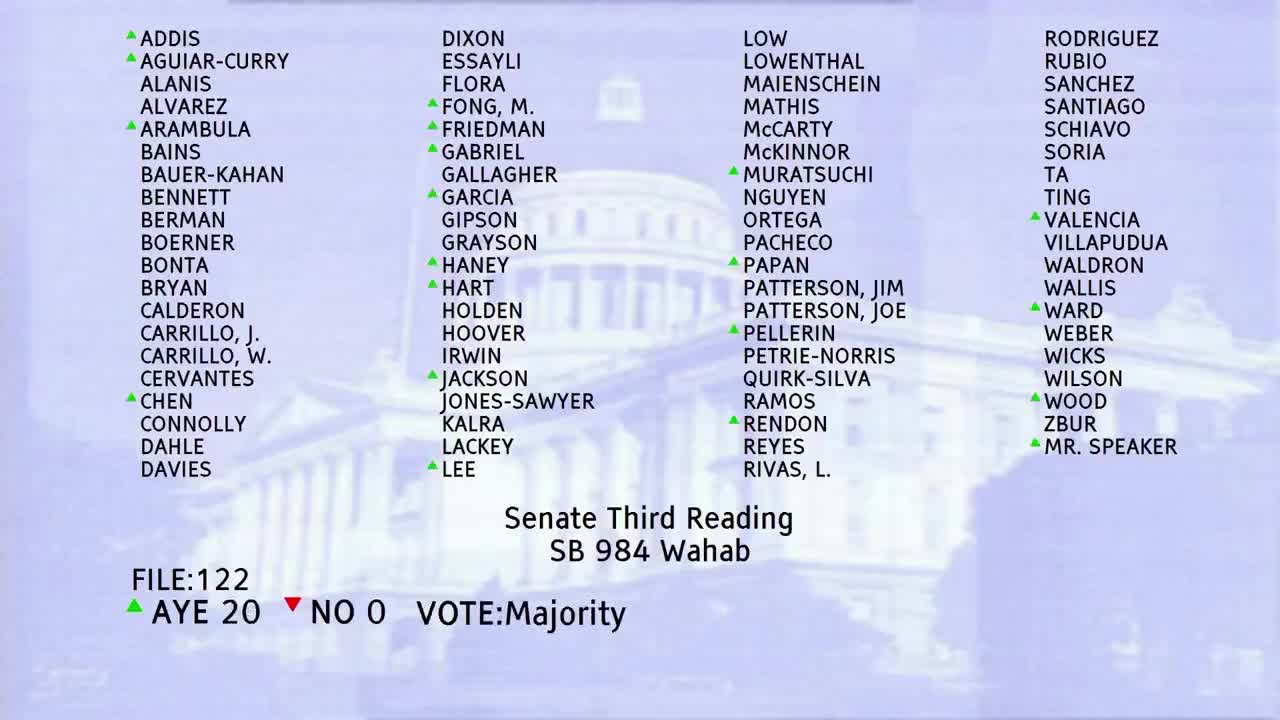 52SEC
Assembly Floor
 1MIN
Senate Floor
 2MIN
Senate Standing Committee on Governmental Organization
Bill Author
Bill Co-Author(s):