AB 1775: Cannabis: retail preparation, sale, and consumption of noncannabis food and beverage products.
- Session Year: 2023-2024
- House: Assembly
- Latest Version Date: 2024-09-30
Current Status:
Passed
(2024-09-30: Chaptered by Secretary of State - Chapter 1004, Statutes of 2024.)
Introduced
In Committee
First Chamber
In Committee
Second Chamber
Enacted
The Control, Regulate and Tax Adult Use of Marijuana Act (AUMA), an initiative measure approved as Proposition 64 at the November 8, 2016, statewide general election, authorizes a person who obtains a state license under AUMA to engage in commercial adult-use cannabis activity pursuant to that license and applicable local ordinances. Existing law, the Medicinal and Adult-Use Cannabis Regulation and Safety Act (MAUCRSA), among other things, consolidates the licensure and regulation of commercial medicinal and adult-use cannabis activities. MAUCRSA establishes the Department of Cannabis Control (department) within the Business, Consumer Services, and Housing Agency to administer the act, and requires the department to be under the supervision and control of a director. Existing law provides that a local jurisdiction may allow for the smoking, vaporizing, and ingesting of cannabis or cannabis products on the premises of a retailer or microbusiness licensed under this division if certain conditions are met. Existing administrative law specifies that a licensed retailer or licensed microbusiness authorized for retail sales who operates a consumption area on the licensed premises in accordance with this provision may also sell prepackaged, noncannabis-infused, nonalcoholic food and beverages if the applicable local jurisdiction allows.
This bill would authorize a local jurisdiction, if specified conditions are met, to allow for the preparation or sale of noncannabis food or beverage products, as specified, by a licensed retailer or microbusiness in the area where the consumption of cannabis is allowed, and to allow, and to sell tickets for, live musical or other performances on the premises of a licensed retailer or microbusiness in the area where the consumption of cannabis is allowed. The bill would additionally specify that these provisions do not authorize a licensed retailer or microbusiness to prepare or sell industrial hemp or products containing industrial hemp, as provided.
The Control, Regulate and Tax Adult Use of Marijuana Act (AUMA), an initiative measure approved as Proposition 64 at the November 8, 2016, statewide general election, authorizes a person who obtains a state license under AUMA to engage in commercial adult-use cannabis activity pursuant to that license and applicable local ordinances. Existing law, the Medicinal and Adult-Use Cannabis Regulation and Safety Act (MAUCRSA), among other things, consolidates the licensure and regulation of commercial medicinal and adult-use cannabis activities. MAUCRSA establishes the Department of Cannabis Control (department) within the Business, Consumer Services, and Housing Agency to administer the act, and requires the department to be under the supervision and control of a director. Existing law provides that a local jurisdiction may allow for the smoking, vaporizing, and ingesting of cannabis or cannabis products on the premises of a retailer or microbusiness licensed under this division if certain conditions are met. Existing administrative law specifies that a licensed retailer or licensed microbusiness authorized for retail sales who operates a consumption area on the licensed premises in accordance with this provision may also sell prepackaged, noncannabis-infused, nonalcoholic food and beverages if the applicable local jurisdiction allows.
This bill would authorize a local jurisdiction, if specified conditions are met, to allow for the preparation or sale of noncannabis food or beverage products, as specified, by a licensed retailer or microbusiness in the area where the consumption of cannabis is allowed, to allow for the sale of prepackaged, noncannabis-infused, nonalcoholic food and beverages by a licensed retailer, and to allow, and to sell tickets for, live musical or other performances on the premises of a licensed retailer or microbusiness in the area where the consumption of cannabis is allowed. The bill would additionally specify that these provisions do not authorize a licensed retailer or microbusiness to prepare or sell industrial hemp or products containing industrial hemp, as provided.
(a)(1)Except as set forth in the Medicinal Cannabis Patients Right of Access Act (Chapter 26 (commencing with Section 26320)), this division shall not be interpreted to supersede or limit the authority of a local jurisdiction to adopt and enforce local ordinances to regulate businesses licensed under this division, including, but not limited to, local zoning and land use requirements, business license requirements, and requirements related to reducing exposure to secondhand smoke, or to completely prohibit the establishment or operation of one or more types of businesses licensed under this division within the local jurisdiction.
(2)Except as set forth in the Medicinal Cannabis Patients Right of Access Act (Chapter 26 (commencing with Section 26320)), this division shall not be interpreted to supersede or limit existing local authority for law enforcement activity, enforcement of local zoning requirements or local ordinances, or enforcement of local license, permit, or other authorization requirements.
(b)This division shall not be interpreted to require the department to undertake local law enforcement responsibilities, enforce local zoning requirements, or enforce local licensing, permitting, or other authorization requirements.
(c)A local jurisdiction shall notify the department upon revocation of any local license, permit, or authorization for a licensee to engage in commercial cannabis activity within the local jurisdiction. Within 60 days of being so informed, the department shall begin the process to determine whether a license issued to the licensee should be suspended or revoked pursuant to Chapter 3 (commencing with Section 26030).
(d)For facilities issued a state license that are located within the incorporated area of a city, the city shall have full power and authority to enforce this division and the regulations promulgated by the department, if delegated by the state. Notwithstanding Sections 101375, 101400, and 101405 of the Health and Safety Code or any contract entered into pursuant thereto, or any other law, the city shall assume complete responsibility for any regulatory function pursuant to this division within the city limits that would otherwise be performed by the county or any county officer or employee, including a county health officer, without liability, cost, or expense to the county.
(e)(1)This division does not prohibit the issuance of a state temporary event license to a licensee authorizing onsite cannabis sales to, and consumption by, persons 21 years of age or older at a county fair event, district agricultural association event, or at another venue expressly approved by a local jurisdiction for the purpose of holding temporary events of this nature, provided that the activities, at a minimum, comply with all the following:
(A)The requirements of subparagraphs (A) to (C), inclusive, of paragraph (2) of subdivision (g).
(B)All participants who are engaged in the onsite retail sale of cannabis or cannabis products at the event are licensed under this division to engage in that activity.
(C)The activities are otherwise consistent with regulations promulgated and adopted by the department governing state temporary event licenses, except as otherwise provided in paragraphs (6), (7), and (8).
(D)A state temporary event license shall only be issued in local jurisdictions that authorize such events.
(E)A licensee who submits an application for a state temporary event license shall, 60 days before the event, provide to the department a list of all licensees that will be providing onsite sales of cannabis or cannabis products at the event. If any changes occur in that list, the licensee shall provide the department with a final updated list to reflect those changes. A person shall not engage in the onsite retail sale of cannabis or cannabis products, or in any way participate in the event, who is not included in the list, including any updates, provided to the department.
(2)The department may impose a civil penalty on any person who violates this subdivision, or any regulations adopted by the department governing state temporary event licenses, in an amount up to three times the amount of the license fee for each violation, consistent with Sections 26018 and 26038.
(3)The department may require the event and all participants to cease operations without delay if in the opinion of the department or local law enforcement it is necessary to protect the immediate public health and safety of the people of the state. The department may also require the event organizer to immediately expel from the event any participant selling cannabis or cannabis products without a license from the department that authorizes the participant to sell cannabis or cannabis products. If the unlicensed participant does not leave the event, the department may require the event and all participants to cease operations immediately.
(4)The order by the department for the event to cease operations pursuant to paragraph (3) does not entitle the event organizer or any participant in the event to a hearing or an appeal of the decision. Chapter 3 (commencing with Section 490) of Division 1.5 and Chapter 4 (commencing with Section 26040) of this division shall not apply to the order by the department for the event to cease operations pursuant to paragraph (3).
(5)The smoking of cannabis or cannabis products at temporary events authorized pursuant to this subdivision is prohibited in locations where smoking is prohibited. For purposes of this section, smoking has the same meaning as defined in subdivision (c) of Section 22950.5.
(6)(A)All licensees who are issued a state temporary event license allowed pursuant to this subdivision may, upon completion or cessation of the temporary event, reconcile unsold inventory of cannabis or cannabis products and return it to the licensees retail premises.
(B)All unsold inventory of cannabis or cannabis products from the temporary event shall be noted in track and trace prior to transport.
(C)All unsold inventory of cannabis or cannabis products from the temporary event shall be in its original packaging in which it was placed pursuant to Chapter 12 (commencing with Section 26120).
(7)The inventory of cannabis or cannabis products authorized to be sold by a state temporary event license pursuant to this subdivision shall only be transported to and from the temporary event by a licensed distributor or licensed microbusiness.
(8)The department shall not deny an application for a state temporary event license pursuant to this subdivision solely on the basis that there is a license issued pursuant to the Alcoholic Beverage Control Act (Division 9 (commencing with Section 23000)) for the proposed premises of the event. Furthermore, the Department of Alcoholic Beverage Control shall not take any disciplinary action against a person licensed pursuant to the Alcoholic Beverage Control Act on the basis of a state temporary event license issued by the department to a licensee pursuant to this subdivision that utilizes the same premises as the person licensed pursuant to the Alcoholic Beverage Control Act.
(A)All on- and off-sale privileges of alcoholic beverages at the venue shall be suspended for the day of the event and shall not resume until 6 a.m. on the day after the event has ended.
(B)Alcohol consumption on the venue premises shall be strictly prohibited for the day of the event and shall not resume until 6 a.m. on the day after the event has ended.
(f)This division, or any regulations promulgated thereunder, shall not be deemed to limit the authority or remedies of a city, county, or city and county under any provision of law, including, but not limited to, Section 7 of Article XI of the California Constitution.
(g)(1)Notwithstanding paragraph (1) of subdivision (a) of Section 11362.3 of the Health and Safety Code, if all of the conditions in paragraph (2) are met, a local jurisdiction may allow for any of the following:
(A)Smoking, vaporizing, and ingesting of cannabis or cannabis products on the premises of a retailer or microbusiness licensed under this division that has been granted authority by a local jurisdiction to engage in onsite cannabis consumption.
(B)(i)Preparation or sale of noncannabis food or beverage products in compliance with all applicable provisions of the California Retail Food Code (Chapter 1 (commencing with Section 113700) of Part 7 of Division 104 of the Health and Safety Code) by a retailer or microbusiness licensed under this division in the area where the consumption of cannabis is allowed.
(ii)For purposes of this subparagraph, noncannabis food or beverage products shall not include industrial hemp products or hemp products, as defined in Section 111920 of the Health and Safety Code.
(C)Live musical or other performances on the premises of a retailer or microbusiness licensed under this division in the area where the consumption of cannabis is allowed, and the sale of tickets for those performances.
(2)A local jurisdiction may allow any of the activities provided in paragraph (1) if all of the following conditions are met:
(A)Access to the area where cannabis consumption is allowed is restricted to persons 21 years of age or older and each entrance to the area prominently posts a warning that cannabis consumption, including smoking of cannabis, is permitted inside.
(B)Cannabis consumption is not visible from any public place or nonage-restricted area.
(C)Sale or consumption of alcohol or tobacco is not allowed on the premises.
(D)Noncannabis food or beverage products are not contaminated by or commingled with any cannabis products sold or served on the premises where the consumption of cannabis is allowed.
(E)(i)Smoking or vaporizing of any cannabis product by an employee or customer is not allowed in the food preparation, food storage, or warewashing area of a food facility located on the premises.
(ii)For purposes of this subparagraph, the following definitions apply:
(I)Food facility has the same meaning as that term is defined in Section 113789 of the Health and Safety Code.
(II)Warewashing has the same meaning as that term is defined in Section 113940 of the Health and Safety Code.
(F)The local jurisdiction considers whether to require adequate ventilation and filtration systems.
(i)Ventilation and filtration systems are considered adequate for the purpose of this subparagraph if they prevent smoke and odors from migrating to any other part of the building hosting the consumption lounge or any neighboring building or grounds.
(ii)Nothing in this subparagraph prohibits a local jurisdiction from allowing one or more forms of cannabis consumption on the premises of a retailer or microbusiness licensed under this division, including smoking, vaporizing, and ingesting of cannabis or cannabis products, while prohibiting other forms of cannabis consumption on the premises of a retailer or microbusiness licensed under this division.
(G)(i)Employees are permitted at their discretion and without penalty or sanction to wear a mask for respiration, including N95 and NIOSH N95 rated masks in any area where cannabis is smoked.
(ii)Employers are required to pay for the mask.
(H)When hired, employees who will be working where cannabis is smoked shall be provided in writing the Department of Public Health or its successors guidance regarding secondhand cannabis smoke.
(I)A cannabis consumption lounge that offers on-site consumption of cannabis products shall include secondhand smoke in their analysis of potential work hazards for purposes of their injury and illness prevention programs required by Section 3203 of Title 8 of the California Code of Regulations.
(J)Loitering in or around the business is prohibited, and the retailer or microbusiness shall ensure the absence of loitering.
(h)This division shall not be interpreted to supersede Section 6404.5 of the Labor Code.
(i)This section does not alter or affect the prohibition on the sale of alcoholic beverages by a licensee, as provided in Section 26054, on or at a venue premises licensed under this division.
(j)If a retailer or microbusiness license issued under this division is suspended, the licensee shall not engage in activities authorized under subdivision (g) for the duration of the license suspension.
(k)All noncannabis food and beverages present, pursuant to this section, on the premises of a retailer or microbusiness licensed under this division shall be stored and displayed separately and distinctly from all cannabis and cannabis products present on the premises.
(l)Subdivision (g) does not authorize a retailer or microbusiness licensed under this division to prepare or sell industrial hemp, as defined in Section 11018.5 of the Health and Safety Code, or any products containing industrial hemp.
(a)(1)Except as set forth in the Medicinal Cannabis Patients Right of Access Act (Chapter 26 (commencing with Section 26320)), this division shall not be interpreted to supersede or limit the authority of a local jurisdiction to adopt and enforce local ordinances to regulate businesses licensed under this division, including, but not limited to, local zoning and land use requirements, business license requirements, and requirements related to reducing exposure to secondhand smoke, or to completely prohibit the establishment or operation of one or more types of businesses licensed under this division within the local jurisdiction.
(2)Except as set forth in the Medicinal Cannabis Patients Right of Access Act (Chapter 26 (commencing with Section 26320)), this division shall not be interpreted to supersede or limit existing local authority for law enforcement activity, enforcement of local zoning requirements or local ordinances, or enforcement of local license, permit, or other authorization requirements.
(b)This division shall not be interpreted to require the department to undertake local law enforcement responsibilities, enforce local zoning requirements, or enforce local licensing, permitting, or other authorization requirements.
(c)A local jurisdiction shall notify the department upon revocation of any local license, permit, or authorization for a licensee to engage in commercial cannabis activity within the local jurisdiction. Within 60 days of being so informed, the department shall begin the process to determine whether a license issued to the licensee should be suspended or revoked pursuant to Chapter 3 (commencing with Section 26030).
(d)For facilities issued a state license that are located within the incorporated area of a city, the city shall have full power and authority to enforce this division and the regulations promulgated by the department, if delegated by the state. Notwithstanding Sections 101375, 101400, and 101405 of the Health and Safety Code or any contract entered into pursuant thereto, or any other law, the city shall assume complete responsibility for any regulatory function pursuant to this division within the city limits that would otherwise be performed by the county or any county officer or employee, including a county health officer, without liability, cost, or expense to the county.
(e)(1)This division does not prohibit the issuance of a state temporary event license to a licensee authorizing onsite cannabis sales to, and consumption by, persons 21 years of age or older at a county fair event, district agricultural association event, or at another venue expressly approved by a local jurisdiction for the purpose of holding temporary events of this nature, provided that the activities, at a minimum, comply with all the following:
(A)The requirements of subparagraphs (A) to (C), inclusive, of paragraph (2) of subdivision (g).
(B)All participants who are engaged in the onsite retail sale of cannabis or cannabis products at the event are licensed under this division to engage in that activity.
(C)The activities are otherwise consistent with regulations promulgated and adopted by the department governing state temporary event licenses, except as otherwise provided in paragraphs (6), (7), and (8).
(D)A state temporary event license shall only be issued in local jurisdictions that authorize such events.
(E)A licensee who submits an application for a state temporary event license shall, 60 days before the event, provide to the department a list of all licensees that will be providing onsite sales of cannabis or cannabis products at the event. If any changes occur in that list, the licensee shall provide the department with a final updated list to reflect those changes. A person shall not engage in the onsite retail sale of cannabis or cannabis products, or in any way participate in the event, who is not included in the list, including any updates, provided to the department.
(2)The department may impose a civil penalty on any person who violates this subdivision, or any regulations adopted by the department governing state temporary event licenses, in an amount up to three times the amount of the license fee for each violation, consistent with Sections 26018 and 26038.
(3)The department may require the event and all participants to cease operations without delay if in the opinion of the department or local law enforcement it is necessary to protect the immediate public health and safety of the people of the state. The department may also require the event organizer to immediately expel from the event any participant selling cannabis or cannabis products without a license from the department that authorizes the participant to sell cannabis or cannabis products. If the unlicensed participant does not leave the event, the department may require the event and all participants to cease operations immediately.
(4)The order by the department for the event to cease operations pursuant to paragraph (3) does not entitle the event organizer or any participant in the event to a hearing or an appeal of the decision. Chapter 3 (commencing with Section 490) of Division 1.5 and Chapter 4 (commencing with Section 26040) of this division shall not apply to the order by the department for the event to cease operations pursuant to paragraph (3).
(5)The smoking of cannabis or cannabis products at temporary events authorized pursuant to this subdivision is prohibited in locations where smoking is prohibited. For purposes of this section, smoking has the same meaning as defined in subdivision (c) of Section 22950.5.
(6)(A)All licensees who are issued a state temporary event license allowed pursuant to this subdivision may, upon completion or cessation of the temporary event, reconcile unsold inventory of cannabis or cannabis products and return it to the licensees retail premises.
(B)All unsold inventory of cannabis or cannabis products from the temporary event shall be noted in track and trace prior to transport.
(C)All unsold inventory of cannabis or cannabis products from the temporary event shall be in its original packaging in which it was placed pursuant to Chapter 12 (commencing with Section 26120).
(7)The inventory of cannabis or cannabis products authorized to be sold by a state temporary event license pursuant to this subdivision shall only be transported to and from the temporary event by a licensed distributor or licensed microbusiness.
(8)The department shall not deny an application for a state temporary event license pursuant to this subdivision solely on the basis that there is a license issued pursuant to the Alcoholic Beverage Control Act (Division 9 (commencing with Section 23000)) for the proposed premises of the event. Furthermore, the Department of Alcoholic Beverage Control shall not take any disciplinary action against a person licensed pursuant to the Alcoholic Beverage Control Act on the basis of a state temporary event license issued by the department to a licensee pursuant to this subdivision that utilizes the same premises as the person licensed pursuant to the Alcoholic Beverage Control Act.
(A)All on- and off-sale privileges of alcoholic beverages at the venue shall be suspended for the day of the event and shall not resume until 6 a.m. on the day after the event has ended.
(B)Alcohol consumption on the venue premises shall be strictly prohibited for the day of the event and shall not resume until 6 a.m. on the day after the event has ended.
(f)This division, or any regulations promulgated thereunder, shall not be deemed to limit the authority or remedies of a city, county, or city and county under any provision of law, including, but not limited to, Section 7 of Article XI of the California Constitution.
(g)(1)Notwithstanding paragraph (1) of subdivision (a) of Section 11362.3 of the Health and Safety Code, if all of the conditions in paragraph (2) are met, a local jurisdiction may allow for any of the following:
(A)Smoking, vaporizing, and ingesting of cannabis or cannabis products on the premises of a retailer or microbusiness licensed under this division that has been granted authority by a local jurisdiction to engage in onsite cannabis consumption.
(B)(i)Preparation or sale of noncannabis food or beverage products in compliance with all applicable provisions of the California Retail Food Code (Chapter 1 (commencing with Section 113700) of Part 7 of Division 104 of the Health and Safety Code) by a retailer or microbusiness licensed under this division in the area where the consumption of cannabis is allowed.
(ii)For purposes of this subparagraph, noncannabis food or beverage products shall not include industrial hemp products or hemp products, as defined in Section 111920 of the Health and Safety Code.
(C)Live musical or other performances on the premises of a retailer or microbusiness licensed under this division in the area where the consumption of cannabis is allowed, and the sale of tickets for those performances.
(2)A local jurisdiction may allow any of the activities provided in paragraph (1) if all of the following conditions are met:
(A)Access to the area where cannabis consumption is allowed is restricted to persons 21 years of age or older. older and each entrance to the area prominently posts a warning that cannabis consumption, including smoking of cannabis, is permitted inside.
(B)Cannabis consumption is not visible from any public place or nonage-restricted area.
(C)Sale or consumption of alcohol or tobacco is not allowed on the premises.
(D)Noncannabis food or beverage products are not contaminated by or commingled with any cannabis products sold or served on the premises where the consumption of cannabis is allowed.
(E)(i)Smoking or vaporizing of any cannabis product by an employee or customer is not allowed in the food preparation, food storage, or warewashing area of a food facility located on the premises.
(ii)For purposes of this subparagraph, the following definitions apply:
(I)Food facility has the same meaning as that term is defined in Section 113789 of the Health and Safety Code.
(II)Warewashing has the same meaning as that term is defined in Section 113940 of the Health and Safety Code.
(F)The local jurisdiction considers whether to require adequate ventilation and filtration systems.
(i)Ventilation and filtration systems are considered adequate for the purpose of this subparagraph if they prevent smoke and odors from migrating to any other part of the building hosting the consumption lounge or any neighboring building or grounds.
(ii)Nothing in this subparagraph prohibits a local jurisdiction from allowing one or more forms of cannabis consumption on the premises of a retailer or microbusiness licensed under this division, including smoking, vaporizing, and ingesting of cannabis or cannabis products, while prohibiting other forms of cannabis consumption on the premises of a retailer or microbusiness licensed under this division.
(G)(i)Employees are permitted at their discretion and without penalty or sanction to wear a mask for respiration, including N95 and NIOSH N95 rated masks in any area where cannabis is smoked.
(ii)Employers are required to pay for the mask.
(H)When hired, employees who will be working where cannabis is smoked shall be provided in writing the Department of Public Health or its successors guidance regarding secondhand cannabis smoke.
(I)A cannabis consumption lounge that offers on-site consumption of cannabis products shall include secondhand smoke in their analysis of potential work hazards for purposes of their injury and illness prevention programs required by Section 3203 of Title 8 of the California Code of Regulations.
(J)Loitering in or around the business is prohibited, and the retailer or microbusiness shall ensure the absence of loitering.
(h)This division shall not be interpreted to supersede Section 6404.5 of the Labor Code.
(i)This section does not alter or affect the prohibition on the sale of alcoholic beverages by a licensee, as provided in Section 26054, on or at a venue premises licensed under this division.
(j)If a retailer or microbusiness license issued under this division is suspended, the licensee shall not engage in activities authorized under subdivision (g) for the duration of the license suspension.
(k)All noncannabis food and beverages present, pursuant to this section, on the premises of a retailer or microbusiness licensed under this division shall be stored and displayed separately and distinctly from all cannabis and cannabis products present on the premises.
(l)Subdivision (g) does not authorize a retailer or microbusiness licensed under this division to prepare or sell industrial hemp, as defined in Section 11018.5 of the Health and Safety Code, or any products containing industrial hemp.
(a)(1)Except as set forth in the Medicinal Cannabis Patients Right of Access Act (Chapter 26 (commencing with Section 26320)), this division shall not be interpreted to supersede or limit the authority of a local jurisdiction to adopt and enforce local ordinances to regulate businesses licensed under this division, including, but not limited to, local zoning and land use requirements, business license requirements, and requirements related to reducing exposure to secondhand smoke, or to completely prohibit the establishment or operation of one or more types of businesses licensed under this division within the local jurisdiction.
(2)Except as set forth in the Medicinal Cannabis Patients Right of Access Act (Chapter 26 (commencing with Section 26320)), this division shall not be interpreted to supersede or limit existing local authority for law enforcement activity, enforcement of local zoning requirements or local ordinances, or enforcement of local license, permit, or other authorization requirements.
(b)This division shall not be interpreted to require the department to undertake local law enforcement responsibilities, enforce local zoning requirements, or enforce local licensing, permitting, or other authorization requirements.
(c)A local jurisdiction shall notify the department upon revocation of any local license, permit, or authorization for a licensee to engage in commercial cannabis activity within the local jurisdiction. Within 60 days of being so informed, the department shall begin the process to determine whether a license issued to the licensee should be suspended or revoked pursuant to Chapter 3 (commencing with Section 26030).
(d)For facilities issued a state license that are located within the incorporated area of a city, the city shall have full power and authority to enforce this division and the regulations promulgated by the department, if delegated by the state. Notwithstanding Sections 101375, 101400, and 101405 of the Health and Safety Code or any contract entered into pursuant thereto, or any other law, the city shall assume complete responsibility for any regulatory function pursuant to this division within the city limits that would otherwise be performed by the county or any county officer or employee, including a county health officer, without liability, cost, or expense to the county.
(e)(1)This division does not prohibit the issuance of a state temporary event license to a licensee authorizing onsite cannabis sales to, and consumption by, persons 21 years of age or older at a county fair event, district agricultural association event, or at another venue expressly approved by a local jurisdiction for the purpose of holding temporary events of this nature, provided that the activities, at a minimum, comply with all the following:
(A)The requirements of subparagraphs (A) to (C), inclusive, of paragraph (2) of subdivision (g).
(B)All participants who are engaged in the onsite retail sale of cannabis or cannabis products at the event are licensed under this division to engage in that activity.
(C)The activities are otherwise consistent with regulations promulgated and adopted by the department governing state temporary event licenses, except as otherwise provided in paragraphs (6), (7), and (8).
(D)A state temporary event license shall only be issued in local jurisdictions that authorize such events.
(E)A licensee who submits an application for a state temporary event license shall, 60 days before the event, provide to the department a list of all licensees that will be providing onsite sales of cannabis or cannabis products at the event. If any changes occur in that list, the licensee shall provide the department with a final updated list to reflect those changes. A person shall not engage in the onsite retail sale of cannabis or cannabis products, or in any way participate in the event, who is not included in the list, including any updates, provided to the department.
(2)The department may impose a civil penalty on any person who violates this subdivision, or any regulations adopted by the department governing state temporary event licenses, in an amount up to three times the amount of the license fee for each violation, consistent with Sections 26018 and 26038.
(3)The department may require the event and all participants to cease operations without delay if in the opinion of the department or local law enforcement it is necessary to protect the immediate public health and safety of the people of the state. The department may also require the event organizer to immediately expel from the event any participant selling cannabis or cannabis products without a license from the department that authorizes the participant to sell cannabis or cannabis products. If the unlicensed participant does not leave the event, the department may require the event and all participants to cease operations immediately.
(4)The order by the department for the event to cease operations pursuant to paragraph (3) does not entitle the event organizer or any participant in the event to a hearing or an appeal of the decision. Chapter 3 (commencing with Section 490) of Division 1.5 and Chapter 4 (commencing with Section 26040) of this division shall not apply to the order by the department for the event to cease operations pursuant to paragraph (3).
(5)The smoking of cannabis or cannabis products at temporary events authorized pursuant to this subdivision is prohibited in locations where smoking is prohibited. For purposes of this section, smoking has the same meaning as defined in subdivision (c) of Section 22950.5.
(6)(A)All licensees who are issued a state temporary event license allowed pursuant to this subdivision may, upon completion or cessation of the temporary event, reconcile unsold inventory of cannabis or cannabis products and return it to the licensees retail premises.
(B)All unsold inventory of cannabis or cannabis products from the temporary event shall be noted in track and trace prior to transport.
(C)All unsold inventory of cannabis or cannabis products from the temporary event shall be in its original packaging in which it was placed pursuant to Chapter 12 (commencing with Section 26120).
(7)The inventory of cannabis or cannabis products authorized to be sold by a state temporary event license pursuant to this subdivision shall only be transported to and from the temporary event by a licensed distributor or licensed microbusiness.
(8)The department shall not deny an application for a state temporary event license pursuant to this subdivision solely on the basis that there is a license issued pursuant to the Alcoholic Beverage Control Act (Division 9 (commencing with Section 23000)) for the proposed premises of the event. Furthermore, the Department of Alcoholic Beverage Control shall not take any disciplinary action against a person licensed pursuant to the Alcoholic Beverage Control Act on the basis of a state temporary event license issued by the department to a licensee pursuant to this subdivision that utilizes the same premises as the person licensed pursuant to the Alcoholic Beverage Control Act.
(A)All on- and off-sale privileges of alcoholic beverages at the venue shall be suspended for the day of the event and shall not resume until 6 a.m. on the day after the event has ended.
(B)Alcohol consumption on the venue premises shall be strictly prohibited for the day of the event and shall not resume until 6 a.m. on the day after the event has ended.
(f)This division, or any regulations promulgated thereunder, shall not be deemed to limit the authority or remedies of a city, county, or city and county under any provision of law, including, but not limited to, Section 7 of Article XI of the California Constitution.
(g)(1)Notwithstanding paragraph (1) of subdivision (a) of Section 11362.3 of the Health and Safety Code, if all of the conditions in paragraph (2) are met, a local jurisdiction may allow for any of the following:
(A)Smoking, vaporizing, and ingesting of cannabis or cannabis products on the premises of a retailer or microbusiness licensed under this division that has been granted authority by a local jurisdiction to engage in onsite cannabis consumption.
(B)(i)Preparation or sale of noncannabis food or beverage products in compliance with all applicable provisions of the California Retail Food Code (Chapter 1 (commencing with Section 113700) of Part 7 of Division 104 of the Health and Safety Code) by a retailer or microbusiness licensed under this division in the area where the consumption of cannabis is allowed.
(ii)For purposes of this subparagraph, noncannabis food or beverage products shall not include industrial hemp products or hemp products, as defined in Section 111920 of the Health and Safety Code.
(C)Live musical or other performances on the premises of a retailer or microbusiness licensed under this division in the area where the consumption of cannabis is allowed, and the sale of tickets for those performances.
(2)A local jurisdiction may allow any of the activities provided in paragraph (1) if all of the following conditions are met:
(A)Access to the area where cannabis consumption is allowed is restricted to persons 21 years of age or older.
(B)Cannabis consumption is not visible from any public place or nonage-restricted area.
(C)Sale or consumption of alcohol or tobacco is not allowed on the premises.
(D)Noncannabis food or beverage products are not contaminated by or commingled with any cannabis products sold or served on the premises where the consumption of cannabis is allowed.
(E)(i)Smoking or vaporizing of any cannabis product by an employee or customer is not allowed in the food preparation, food storage, or warewashing area of a food facility located on the premises.
(ii)For purposes of this subparagraph, the following definitions apply:
(I)Food facility has the same meaning as that term is defined in Section 113789 of the Health and Safety Code.
(II)Warewashing has the same meaning as that term is defined in Section 113940 of the Health and Safety Code.
(h)This division shall not be interpreted to supersede Section 6404.5 of the Labor Code.
(i)This section does not alter or affect the prohibition on the sale of alcoholic beverages by a licensee, as provided in Section 26054, on or at a venue premises licensed under this division.
(j)If a retailer or microbusiness license issued under this division is suspended, the licensee shall not engage in activities authorized under subdivision (g) for the duration of the license suspension.
(k)All noncannabis food and beverages present, pursuant to this section, on the premises of a retailer or microbusiness licensed under this division shall be stored and displayed separately and distinctly from all cannabis and cannabis products present on the premises.
(l)Subdivision (g) does not authorize a retailer or microbusiness licensed under this division to prepare or sell industrial hemp, as defined in Section 11018.5 of the Health and Safety Code, or any products containing industrial hemp.
(a)(1)Except as set forth in the Medicinal Cannabis Patients Right of Access Act (Chapter 26 (commencing with Section 26320)), this division shall not be interpreted to supersede or limit the authority of a local jurisdiction to adopt and enforce local ordinances to regulate businesses licensed under this division, including, but not limited to, local zoning and land use requirements, business license requirements, and requirements related to reducing exposure to secondhand smoke, or to completely prohibit the establishment or operation of one or more types of businesses licensed under this division within the local jurisdiction.
(2)Except as set forth in the Medicinal Cannabis Patients Right of Access Act (Chapter 26 (commencing with Section 26320)), this division shall not be interpreted to supersede or limit existing local authority for law enforcement activity, enforcement of local zoning requirements or local ordinances, or enforcement of local license, permit, or other authorization requirements.
(b)This division shall not be interpreted to require the department to undertake local law enforcement responsibilities, enforce local zoning requirements, or enforce local licensing, permitting, or other authorization requirements.
(c)A local jurisdiction shall notify the department upon revocation of any local license, permit, or authorization for a licensee to engage in commercial cannabis activity within the local jurisdiction. Within 60 days of being so informed, the department shall begin the process to determine whether a license issued to the licensee should be suspended or revoked pursuant to Chapter 3 (commencing with Section 26030).
(d)For facilities issued a state license that are located within the incorporated area of a city, the city shall have full power and authority to enforce this division and the regulations promulgated by the department, if delegated by the state. Notwithstanding Sections 101375, 101400, and 101405 of the Health and Safety Code or any contract entered into pursuant thereto, or any other law, the city shall assume complete responsibility for any regulatory function pursuant to this division within the city limits that would otherwise be performed by the county or any county officer or employee, including a county health officer, without liability, cost, or expense to the county.
(e)(1)This division does not prohibit the issuance of a state temporary event license to a licensee authorizing onsite cannabis sales to, and consumption by, persons 21 years of age or older at a county fair event, district agricultural association event, or at another venue expressly approved by a local jurisdiction for the purpose of holding temporary events of this nature, provided that the activities, at a minimum, comply with all the following:
(A)The requirements of subparagraphs (A) to (C), inclusive, of paragraph (2) of subdivision (g).
(B)All participants who are engaged in the onsite retail sale of cannabis or cannabis products at the event are licensed under this division to engage in that activity.
(C)The activities are otherwise consistent with regulations promulgated and adopted by the department governing state temporary event licenses, except as otherwise provided in paragraphs (6), (7), and (8).
(D)A state temporary event license shall only be issued in local jurisdictions that authorize such events.
(E)A licensee who submits an application for a state temporary event license shall, 60 days before the event, provide to the department a list of all licensees that will be providing onsite sales of cannabis or cannabis products at the event. If any changes occur in that list, the licensee shall provide the department with a final updated list to reflect those changes. A person shall not engage in the onsite retail sale of cannabis or cannabis products, or in any way participate in the event, who is not included in the list, including any updates, provided to the department.
(2)The department may impose a civil penalty on any person who violates this subdivision, or any regulations adopted by the department governing state temporary event licenses, in an amount up to three times the amount of the license fee for each violation, consistent with Sections 26018 and 26038.
(3)The department may require the event and all participants to cease operations without delay if in the opinion of the department or local law enforcement it is necessary to protect the immediate public health and safety of the people of the state. The department may also require the event organizer to immediately expel from the event any participant selling cannabis or cannabis products without a license from the department that authorizes the participant to sell cannabis or cannabis products. If the unlicensed participant does not leave the event, the department may require the event and all participants to cease operations immediately.
(4)The order by the department for the event to cease operations pursuant to paragraph (3) does not entitle the event organizer or any participant in the event to a hearing or an appeal of the decision. Chapter 3 (commencing with Section 490) of Division 1.5 and Chapter 4 (commencing with Section 26040) of this division shall not apply to the order by the department for the event to cease operations pursuant to paragraph (3).
(5)The smoking of cannabis or cannabis products at temporary events authorized pursuant to this subdivision is prohibited in locations where smoking is prohibited. For purposes of this section, smoking has the same meaning as defined in subdivision (c) of Section 22950.5.
(6)(A) All licensees who are issued a state temporary event license allowed pursuant to this subdivision may, upon completion or cessation of the temporary event, reconcile unsold inventory of cannabis or cannabis products and return it to the licensees retail premises.
(B)All unsold inventory of cannabis or cannabis products from the temporary event shall be noted in track and trace prior to transport.
(C)All unsold inventory of cannabis or cannabis products from the temporary event shall be in its original packaging in which it was placed pursuant to Chapter 12 (commencing with Section 26120).
(7)The inventory of cannabis or cannabis products authorized to be sold by a state temporary event license pursuant to this subdivision shall only be transported to and from the temporary event by a licensed distributor or licensed microbusiness.
(8)The department shall not deny an application for a state temporary event license pursuant to this subdivision solely on the basis that there is a license issued pursuant to the Alcoholic Beverage Control Act (Division 9 (commencing with Section 23000)) for the proposed premises of the event. Furthermore, the Department of Alcoholic Beverage Control shall not take any disciplinary action against a person licensed pursuant to the Alcoholic Beverage Control Act on the basis of a state temporary event license issued by the department to a licensee pursuant to this subdivision that utilizes the same premises as the person licensed pursuant to the Alcoholic Beverage Control Act.
(A)All on- and off-sale privileges of alcoholic beverages at the venue shall be suspended for the day of the event and shall not resume until 6 a.m. on the day after the event has ended.
(B)Alcohol consumption on the venue premises shall be strictly prohibited for the day of the event and shall not resume until 6 a.m. on the day after the event has ended.
(f)This division, or any regulations promulgated thereunder, shall not be deemed to limit the authority or remedies of a city, county, or city and county under any provision of law, including, but not limited to, Section 7 of Article XI of the California Constitution.
(g)(1)Notwithstanding paragraph (1) of subdivision (a) of Section 11362.3 of the Health and Safety Code, if all of the conditions in paragraph (2) are met, a local jurisdiction may allow for any of the following:
(A)Smoking, vaporizing, and ingesting of cannabis or cannabis products on the premises of a retailer or microbusiness licensed under this division that has been granted authority by a local jurisdiction to engage in onsite cannabis consumption.
(B)(i)Preparation or sale of noncannabis food or beverage products in compliance with all applicable provisions of the California Retail Food Code (Chapter 1 (commencing with Section 113700) of Part 7 of Division 104 of the Health and Safety Code) by a retailer or microbusiness licensed under this division in the area where the consumption of cannabis is allowed.
(ii)For purposes of this subparagraph, noncannabis food or beverage products shall not include industrial hemp products or hemp products, as defined in Section 111920 of the Health and Safety Code.
(C)Live musical or other performances on the premises of a retailer or microbusiness licensed under this division in the area where the consumption of cannabis is allowed, and the sale of tickets for those performances.
(2)A local jurisdiction may allow any of the activities provided in paragraph (1) if all of the following conditions are met:
(A)Access to the area where cannabis consumption is allowed is restricted to persons 21 years of age or older.
(B)Cannabis consumption is not visible from any public place or nonage-restricted area.
(C)Sale or consumption of alcohol or tobacco is not allowed on the premises.
(h)(1)A local jurisdiction may allow for the sale of prepackaged, noncannabis-infused, nonalcoholic food and beverages by a retailer licensed under this division.(2)For purposes of this subdivision, prepackaged, noncannabis-infused, nonalcoholic food and beverages shall not include industrial hemp products or hemp products, as defined in Section 111920 of the Health and Safety Code.(i)(h)This division shall not be interpreted to supersede Section 6404.5 of the Labor Code.
(j)(i)This section does not alter or affect the prohibition on the sale of alcoholic beverages by a licensee, as provided in Section 26054, on or at a venue premises licensed under this division.
(k)(j)If a retailer or microbusiness license issued under this division is suspended, the licensee shall not engage in activities authorized under subdivisions (g) and (h) subdivision (g) for the duration of the license suspension.
(l)(k)All noncannabis food and beverages present, pursuant to this section, on the premises of a retailer or microbusiness licensed under this division shall be stored and displayed separately and distinctly from all cannabis and cannabis products present on the premises.
(m)(l)Subdivision (g) or (h) does not authorize a retailer or microbusiness licensed under this division to prepare or sell industrial hemp, as defined in Section 11018.5 of the Health and Safety Code, or any products containing industrial hemp.
(a)(1)Except as set forth in the Medicinal Cannabis Patients Right of Access Act (Chapter 26 (commencing with Section 26320)), this division shall not be interpreted to supersede or limit the authority of a local jurisdiction to adopt and enforce local ordinances to regulate businesses licensed under this division, including, but not limited to, local zoning and land use requirements, business license requirements, and requirements related to reducing exposure to secondhand smoke, or to completely prohibit the establishment or operation of one or more types of businesses licensed under this division within the local jurisdiction.
(2)Except as set forth in the Medicinal Cannabis Patients Right of Access Act (Chapter 26 (commencing with Section 26320)), this division shall not be interpreted to supersede or limit existing local authority for law enforcement activity, enforcement of local zoning requirements or local ordinances, or enforcement of local license, permit, or other authorization requirements.
(b)This division shall not be interpreted to require the department to undertake local law enforcement responsibilities, enforce local zoning requirements, or enforce local licensing, permitting, or other authorization requirements.
(c)A local jurisdiction shall notify the department upon revocation of any local license, permit, or authorization for a licensee to engage in commercial cannabis activity within the local jurisdiction. Within 60 days of being so informed, the department shall begin the process to determine whether a license issued to the licensee should be suspended or revoked pursuant to Chapter 3 (commencing with Section 26030).
(d)For facilities issued a state license that are located within the incorporated area of a city, the city shall have full power and authority to enforce this division and the regulations promulgated by the department, if delegated by the state. Notwithstanding Sections 101375, 101400, and 101405 of the Health and Safety Code or any contract entered into pursuant thereto, or any other law, the city shall assume complete responsibility for any regulatory function pursuant to this division within the city limits that would otherwise be performed by the county or any county officer or employee, including a county health officer, without liability, cost, or expense to the county.
(e)(1)This division does not prohibit the issuance of a state temporary event license to a licensee authorizing onsite cannabis sales to, and consumption by, persons 21 years of age or older at a county fair event, district agricultural association event, or at another venue expressly approved by a local jurisdiction for the purpose of holding temporary events of this nature, provided that the activities, at a minimum, comply with all the following:
(A)The requirements of paragraphs (1) subparagraphs (A) to (3), (C), inclusive, of paragraph (2) of subdivision (g).
(B)All participants who are engaged in the onsite retail sale of cannabis or cannabis products at the event are licensed under this division to engage in that activity.
(C)The activities are otherwise consistent with regulations promulgated and adopted by the department governing state temporary event licenses, except as otherwise provided in paragraphs (6), (7), and (8).
(D)A state temporary event license shall only be issued in local jurisdictions that authorize such events.
(E)A licensee who submits an application for a state temporary event license shall, 60 days before the event, provide to the department a list of all licensees that will be providing onsite sales of cannabis or cannabis products at the event. If any changes occur in that list, the licensee shall provide the department with a final updated list to reflect those changes. A person shall not engage in the onsite retail sale of cannabis or cannabis products, or in any way participate in the event, who is not included in the list, including any updates, provided to the department.
(2)The department may impose a civil penalty on any person who violates this subdivision, or any regulations adopted by the department governing state temporary event licenses, in an amount up to three times the amount of the license fee for each violation, consistent with Sections 26018 and 26038.
(3)The department may require the event and all participants to cease operations without delay if in the opinion of the department or local law enforcement it is necessary to protect the immediate public health and safety of the people of the state. The department may also require the event organizer to immediately expel from the event any participant selling cannabis or cannabis products without a license from the department that authorizes the participant to sell cannabis or cannabis products. If the unlicensed participant does not leave the event, the department may require the event and all participants to cease operations immediately.
(4)The order by the department for the event to cease operations pursuant to paragraph (3) does not entitle the event organizer or any participant in the event to a hearing or an appeal of the decision. Chapter 3 (commencing with Section 490) of Division 1.5 and Chapter 4 (commencing with Section 26040) of this division shall not apply to the order by the department for the event to cease operations pursuant to paragraph (3).
(5)The smoking of cannabis or cannabis products at temporary events authorized pursuant to this subdivision is prohibited in locations where smoking is prohibited. For purposes of this section, smoking has the same meaning as defined in subdivision (c) of Section 22950.5.
(6)(A) All licensees who are issued a state temporary event license allowed pursuant to this subdivision may, upon completion or cessation of the temporary event, reconcile unsold inventory of cannabis or cannabis products and return it to the licensees retail premises.
(B)All unsold inventory of cannabis or cannabis products from the temporary event shall be noted in track and trace prior to transport.
(C)All unsold inventory of cannabis or cannabis products from the temporary event shall be in its original packaging in which it was placed pursuant to Chapter 12 (commencing with Section 26120).
(7)The inventory of cannabis or cannabis products authorized to be sold by a state temporary event license pursuant to this subdivision shall only be transported to and from the temporary event by a licensed distributor or licensed microbusiness.
(8)The department shall not deny an application for a state temporary event license pursuant to this subdivision solely on the basis that there is a license issued pursuant to the Alcoholic Beverage Control Act (Division 9 (commencing with Section 23000)) for the proposed premises of the event. Furthermore, the Department of Alcoholic Beverage Control shall not take any disciplinary action against a person licensed pursuant to the Alcoholic Beverage Control Act on the basis of a state temporary event license issued by the department to a licensee pursuant to this subdivision that utilizes the same premises as the person licensed pursuant to the Alcoholic Beverage Control Act.
(A)All on- and off-sale privileges of alcoholic beverages at the venue shall be suspended for the day of the event and shall not resume until 6 a.m. on the day after the event has ended.
(B)Alcohol consumption on the venue premises shall be strictly prohibited for the day of the event and shall not resume until 6 a.m. on the day after the event has ended.
(f)This division, or any regulations promulgated thereunder, shall not be deemed to limit the authority or remedies of a city, county, or city and county under any provision of law, including, but not limited to, Section 7 of Article XI of the California Constitution.
(g)(1)Notwithstanding paragraph (1) of subdivision (a) of Section 11362.3 of the Health and Safety Code, if all of the conditions in paragraph (2) are met, a local jurisdiction may allow for the smoking, vaporizing, and ingesting of cannabis or cannabis products on the premises of a retailer or microbusiness licensed under this division if all of the following are met: any of the following:
(A)Smoking, vaporizing, and ingesting of cannabis or cannabis products on the premises of a retailer or microbusiness licensed under this division that has been granted authority by a local jurisdiction to engage in onsite cannabis consumption.
(B)(i)Preparation or sale of noncannabis food or beverage products in compliance with all applicable provisions of the California Retail Food Code (Chapter 1 (commencing with Section 113700) of Part 7 of Division 104 of the Health and Safety Code) by a retailer or microbusiness licensed under this division in the area where the consumption of cannabis is allowed.
(ii)For purposes of this subparagraph, noncannabis food or beverage products shall not include industrial hemp products or hemp products, as defined in Section 111920 of the Health and Safety Code.
(C)Live musical or other performances on the premises of a retailer or microbusiness licensed under this division in the area where the consumption of cannabis is allowed, and the sale of tickets for those performances.
(2)A local jurisdiction may allow any of the activities provided in paragraph (1) if all of the following conditions are met:
(1)(A)Access to the area where cannabis consumption is allowed is restricted to persons 21 years of age or older.
(2)(B)Cannabis consumption is not visible from any public place or nonage-restricted area.
(3)(C)Sale or consumption of alcohol or tobacco is not allowed on the premises.
(h)(1)A local jurisdiction may allow for the sale of prepackaged, noncannabis-infused, nonalcoholic food and beverages by a retailer licensed under this division.
(2)For purposes of this subdivision, prepackaged, noncannabis-infused, nonalcoholic food and beverages shall not include industrial hemp products or hemp products, as defined in Section 111920 of the Health and Safety Code.
(h)(i)This division shall not be interpreted to supersede Section 6404.5 of the Labor Code.
(i)(j)This section does not alter or affect the prohibition on the sale of alcoholic beverages by a licensee, as provided in Section 26054, on or at a venue premises licensed under this division.
(k)If a retailer or microbusiness license issued under this division is suspended, the licensee shall not engage in activities authorized under subdivisions (g) and (h) for the duration of the license suspension.
(l)All noncannabis food and beverages present, pursuant to this section, on the premises of a retailer or microbusiness licensed under this division shall be stored and displayed separately and distinctly from all cannabis and cannabis products present on the premises.
(m)Subdivision (g) or (h) does not authorize a retailer or microbusiness licensed under this division to prepare or sell industrial hemp, as defined in Section 11018.5 of the Health and Safety Code, or any products containing industrial hemp.
|
Date
|
Status
|
|---|---|
| Sep 30, 2024 | Chaptered by Secretary of State - Chapter 1004, Statutes of 2024. |
| Sep 30, 2024 | Approved by the Governor. |
| Sep 10, 2024 | Enrolled and presented to the Governor at 4:30 p.m. |
| Aug 28, 2024 | Senate amendments concurred in. To Engrossing and Enrolling. (Ayes 63. Noes 5.). |
| Aug 28, 2024 | In Assembly. Concurrence in Senate amendments pending. May be considered on or after August 30 pursuant to Assembly Rule 77. |
| Aug 28, 2024 | Assembly Rule 77 suspended. |
| Aug 27, 2024 | Read third time. Passed. Ordered to the Assembly. (Ayes 30. Noes 7.). |
| Aug 26, 2024 | Read second time. Ordered to third reading. |
| Aug 23, 2024 | Read third time and amended. Ordered to second reading. |
| Jun 11, 2024 | Read second time. Ordered to third reading. |
| Jun 10, 2024 | From committee: Do pass. (Ayes 9. Noes 2.) (June 10). |
| May 29, 2024 | Referred to Com. on B., P. & E. D. |
| May 21, 2024 | In Senate. Read first time. To Com. on RLS. for assignment. |
| May 20, 2024 | Read third time. Passed. Ordered to the Senate. (Ayes 58. Noes 6. Page 5297.) |
| Apr 25, 2024 | Read third time and amended. Ordered to third reading. (Page 4993.) |
| Apr 22, 2024 | Read second time. Ordered to third reading. |
| Apr 18, 2024 | From committee: Do pass. (Ayes 13. Noes 2.) (April 17). |
| Apr 4, 2024 | Re-referred to Com. on G.O. |
| Apr 3, 2024 | Read second time and amended. |
| Apr 2, 2024 | From committee: Amend, and do pass as amended and re-refer to Com. on G.O. (Ayes 14. Noes 2.) (April 2). |
| Jan 16, 2024 | Referred to Coms. on B. & P. and G.O. |
| Jan 4, 2024 | From printer. May be heard in committee February 3. |
| Jan 3, 2024 | Read first time. To print. |
|
Date
|
Description
|
Location
|
Votes
|
|
|---|---|---|---|---|
| Aug 28, 2024 | AB 1775 Haney Concurrence in Senate Amendments | Assembly Floor |
Passed |
|
| Aug 27, 2024 | Assembly 3rd Reading AB1775 Haney et al. By Allen | Senate Floor |
Passed |
|
| Jun 10, 2024 | Do pass | Senate Standing Committee on Business, Professions and Economic Development |
Passed |
|
| May 20, 2024 | AB 1775 Haney Assembly Third Reading | Assembly Floor |
Passed |
|
| Apr 17, 2024 | Do pass. | Assembly Standing Committee on Governmental Organization |
Passed |
|
| Apr 2, 2024 | Do pass as amended and be re-referred to the Committee on [Governmental Organization] | Assembly Standing Committee on Business and Professions |
Passed |
This list shows positions taken on this bill by organizations on the date displayed, which is linked to the original source.
Positions by individuals are not included.
|
Organization
|
Position
|
Date
|
|---|---|---|
| American Alliance for Medical Cannabis | * Support | Jun 10, 2024 |
| American Cancer Society Cancer Action Network Inc. | ** Against | |
| American Heart Association | ** Against | |
| American Lung Association in California | ** Against | |
| Americans for Nonsmokers' Rights | ** Against | |
| Americans for Safe Access | ** Support | |
| Big Sur Farmers Association | ** Support | |
| California Cannabis Industry Association | ** Support | |
| California Cannabis Manufacturers Association | * Support | Apr 2, 2024 |
| California Narcotic Officers' Association | ** Against | |
| California Nightlife Association | ** Support | |
| California NORML | ** Support | |
| California Travel Association | ** Support | |
| City and County of San Francisco | ** Support | |
| Coastal Communities Drug-Free Coalition | ** Against | |
| Health Officers Association Of California | ** Against | |
| Humboldt County Growers Alliance | ** Support | |
| Law Offices of Omar Figueroa | ** Support | |
| Lompoc Valley Cannabis Association, Santa Barbara County | ** Support | |
| Mendocino Cannabis Alliance | ** Support | |
| Nevada County Cannabis Alliance | ** Support | |
| Origins Council | ** Support | |
| Public Health Institute | ** Against | |
| Tobacco Education and Research Oversight Committee | ** Against | |
| Trinity County Agriculture Alliance | ** Support | |
| UFCW - Western States Council | ** Support | |
| University of California San Francisco | * Against | Jun 10, 2024 |
| Youth Forward | ** Against |
CONCURRENCE IN SENATE AMENDMENTS
CSA1 Bill Id:AB 1775
Author:(Haney)
As Amended Ver:August 23, 2024
Majority vote
SUMMARY
Authorizes local jurisdictions to allow cannabis retailers to prepare and serve non-cannabis food and beverages, and to sell tickets to live musical or other performances, in the area of the premises where consumption of cannabis and cannabis goods is authorized.
Senate Amendments
- Require the entrance to the area where cannabis consumption is allowed to prominently post a warning that cannabis consumption, including smoking of cannabis, is permitted inside.
- Require local jurisdictions that choose to authorize additional activities in a consumption area to consider whether to require adequate ventilation and filtration systems, as specified.
- Provide that employees working in a consumption lounge shall be permitted to wear a mask for respiration, including N95 and NIOSH N95 rated masks in any area where cannabis is smoked, and employers are required to pay for the mask.
- Require that employees working where cannabis is smoked to be provided guidance regarding secondhand cannabis smoke and require secondhand smoke to be included in a business's analysis of potential work hazards for purposes of their injury and illness prevention programs.
- Prohibit loitering in or around a cannabis retailer where consumption occurs under the bill.
COMMENTS
Cannabis Consumption Lounges. The author states that the intent of this bill is to allow for cannabis retailers to engage in a business model analogous to establishments found in Amsterdam. While cannabis is officially a controlled substance in the Netherlands and both possession and cultivation of the plant is a crime, the country has long applied what is referred to as gedoogbeleid—a policy of tolerance. The Dutch Ministry of Justice has consistently tolerated possession of up to five grams of cannabis for personal and cultivation of up to five plants. This policy effectively decriminalizes recreational consumption of cannabis, though possession or cultivation beyond personal use is still subject to criminal penalties.
As a result of the country's tolerance policy, there has been a proliferation of so-called "coffeeshops" in cities such as Amsterdam where cannabis may be sold and consumed. While there is no formally lawful way for these establishments to purchase bulk cannabis for resale, consumers may safely purchase and consume cannabis within the personal use limits on the premises. According to the author, these establishments often serve as social hubs where live music may be performed, and food and beverages not containing cannabis are available for purchase and consumption.
There are some restrictions on the Amsterdam model. Dutch law prohibits the sale and consumption of alcohol in coffeeshops, and a national tobacco smoking ban applies to those establishments. Since 2008, Dutch law has prohibited coffeeshops from being operated within 250m of schools. In an effort to combat concerns of "drug tourism," the Dutch government announced in 2011 that tourists were to be banned from patronizing coffeeshops.
The coffeeshop establishment model is arguably only partially allowable under California law. MAUCRSA generally prohibits smoking, vaporizing, or ingesting cannabis or cannabis products in any public place. However, Proposition 64 authorized local jurisdictions to allow for cannabis to be consumed on the premises of a retailer under certain conditions. This language gave cities and counties the option of locally allowing for the establishment of settings referred to as "consumption lounges" where cannabis use can occur socially. MAUCRSA law does not expressly allow for licensees to sell non-cannabis food or beverages within a consumption lounge. The law also does not speak to the legality of selling tickets to performances held on the premises. However, the Department's regulations states: "In addition to cannabis goods, a licensed retailer may sell only cannabis accessories and the branded merchandise of any licensee." This regulation historically prohibited cannabis retailers from selling food or beverages not infused with cannabis, including on the premises of a consumption lounge.
This prohibition would not allow for the type of consumption lounges proposed by the City of West Hollywood, which adopted a Cannabis Ordinance on November 20, 2017. License applicants presented the city with hospitality-focused business proposals, where customers would be able to consume cannabis and cannabis products in a "social lounge" setting. One proposal described itself as a "full service restaurant" offering meals "featuring local, organic ingredients with farm-to-table preparation." Under the proposal, these meals could be optionally enhanced "with CBD and THC infused dressings and sauces, natural agave sweeteners, and wellness shots." The City of West Hollywood sponsored multiple bills to preempt the Department's regulations, but these measures did not reach the Governor's desk.
In 2022, the Department revised its regulations to additionally state that cannabis retailers who operate a consumption area to "may also sell prepackaged, non-cannabis-infused, non-alcoholic food and beverages if the applicable local jurisdiction allows such sales." The Department's revised regulations further clarified that nothing in its regulations prevents consumers from "bringing or receiving non-cannabis-infused, non-alcoholic food and beverages from a restaurant or food delivery service for consumption in the designated consumption area on the licensed premises, if the applicable local jurisdiction allows such activities." The Department's revised regulations created a model wherein non-cannabis food and beverages can be sold and consumed in a consumption lounge. However, the law still doesn't allow cannabis retailers to prepare fresh food or beverages on the premises. The regulations also do not allow for any other types of sales to occur on the premises of a cannabis retailer, including the sale of tickets to live musical performances.
This bill seeks to preempt the Department's regulations and amend MAUCRSA to explicitly allow cannabis retailers to sell non-cannabis-infused food, nonalcoholic beverages, and tickets to live musical or other performances. This allowance would remain within the context of the consumption lounge model, which requires local authorization and approval. The bill would also retain MAUCRSA's prohibition against cannabis retailers selling or serving alcoholic beverages or tobacco products, and access to the consumption lounge area would remain restricted to persons 21 or older and be kept out of sight from the general public.
The author believes that by expressly allowing for these sales to occur under MAUCRSA, California can more effectively market consumption lounges as a social venue where consumers can enjoy activities that are more inclusive than simply consuming cannabis. The author of this proposal introduced a bill in 2023 that was substantially similar to this one. Assembly Bill 374 (Haney) was passed by the Legislature but was ultimately vetoed by the Governor, who cited concerns that had been raised by opposition to the bill by public health advocacy organizations. In his veto message, the Governor wrote:
"I appreciate the author's intent to provide cannabis retailers with increased business opportunities and an avenue to attract new customers. However, I am concerned this bill could undermine California's long-standing smoke-free workplace protections. Protecting the health and safety of workers is paramount. I encourage the author to address this concern in subsequent legislation."
In response to the concerns raised in the Governor's veto message, this bill includes several new provisions aimed at reducing health risks to employees and consumers in consumption lounge environments. Among other new safeguards, the bill would require local governments to consider requiring adequate ventilation and filtration systems to prevent smoke and odors from migrating to any other part of the building hosting the consumption lounge or any neighboring building or grounds. Employees would explicitly be allowed to wear masks, at the employer's expense, and would be provided guidance regarding secondhand cannabis smoke. The author believes this new language appropriately balances public health concerns with the intended benefits of the bill.
According to the Author
"California is known worldwide as the birthplace of cannabis culture—but California's small cannabis businesses are struggling. Issues like over-saturation, high taxes, and the thriving illicit market are hurting cannabis businesses who follow the rules and pay taxes. California's decade of medical marijuana only policies has led to pharmacy-like cannabis "dispensaries" that encourage customers to buy cannabis and leave. Other cities, like Amsterdam, are known for their social, community style cannabis cafés. While consuming cannabis on site is technically legal in California, selling non-cannabis-infused products is not. AB 1775 legalizes cannabis cafes by allowing the sale of non-cannabis food and soft drink, allowing small cannabis retailers to diversify their business and move away from the limiting dispensary model."
Arguments in Support
Americans for Safe Access (ASA) writes the following in support of the bill: "All activities permitted by AB 1775 would be subject to prior local approval, as well as applicable state and local laws. Additionally, the HVAC and air exchange requirements for these establishments are the result of local ordinances. Historically these ordinances are so rigorous that workers in these lounges face no health risks relating to the air they breathe while at work. The augmented services contemplated in AB 1775 would enhance the clean, quiet operations that have always characterized consumption lounges in California. The highly regulated nature of these establishments ensures that both patrons and employees face no risks, health or otherwise, if they populate these venues."
Arguments in Opposition
The American Cancer Society Cancer Action Network, the American Heart Association, and the American Lung Association write jointly in opposition to this bill: "Secondhand marijuana smoke contains many of the same toxins and carcinogens found in directly inhaled marijuana smoke, in similar amounts if not more. In addition, particulate levels from marijuana smoke are higher than tobacco smoke. Exposure to fine particulate matter can cause cardiovascular disease, lung irritation, asthma attacks and makes respiratory infections more likely. Marijuana smoke has been shown to injure the cell linings of the large airways, and can lead to symptoms such as chronic cough, phlegm production, wheeze and acute bronchitis." The coalition argues that "California has fought hard to protect workers and ensure a safe, healthy, smoke-free work environment. AB 1775 will undo that by re-creating the harmful work environments of the past."
FISCAL COMMENTS
This bill is keyed nonfiscal by the Legislative Counsel.
VOTES:
ASM BUSINESS AND PROFESSIONS: 14-2-2
YES: Berman, Flora, Alanis, Juan Carrillo, Chen, Grayson, Jackson, Low, Lowenthal, McKinnor, Stephanie Nguyen, Pellerin, Soria, Zbur
NO: Dixon, Sanchez
ABS, ABST OR NV: Bains, Irwin
ASM GOVERNMENTAL ORGANIZATION: 13-2-7
YES: Blanca Rubio, Lackey, Lee, Gabriel, Haney, Jones-Sawyer, Low, McKinnor, Pacheco, Papan, Ramos, Valencia, Wallis
NO: Davies, Dixon
ABS, ABST OR NV: Addis, Bains, Cervantes, Gipson, Jim Patterson, Soria, Ta
ASSEMBLY FLOOR: 58-6-16
YES: Aguiar-Curry, Alanis, Alvarez, Bauer-Kahan, Bennett, Berman, Boerner, Bonta, Bryan, Calderon, Juan Carrillo, Wendy Carrillo, Chen, Connolly, Flora, Mike Fong, Friedman, Garcia, Gipson, Grayson, Haney, Hart, Holden, Hoover, Jackson, Jones-Sawyer, Kalra, Lackey, Lee, Low, Lowenthal, McCarty, McKinnor, Ortega, Pacheco, Papan, Joe Patterson, Pellerin, Petrie-Norris, Quirk-Silva, Ramos, Rendon, Rodriguez, Blanca Rubio, Santiago, Schiavo, Soria, Ting, Valencia, Villapudua, Waldron, Wallis, Ward, Wicks, Wilson, Wood, Zbur, Robert Rivas
NO: Davies, Dixon, Vince Fong, Irwin, Jim Patterson, Sanchez
ABS, ABST OR NV: Addis, Arambula, Bains, Cervantes, Megan Dahle, Essayli, Gabriel, Gallagher, Maienschein, Mathis, Muratsuchi, Stephanie Nguyen, Reyes, Luz Rivas, Ta, Weber
SENATE FLOOR: 30-7-3
YES: Allen, Alvarado-Gil, Archuleta, Atkins, Becker, Blakespear, Bradford, Caballero, Cortese, Dahle, Dodd, Durazo, Eggman, Glazer, Gonzalez, Grove, Laird, Limón, McGuire, Min, Newman, Niello, Padilla, Roth, Skinner, Smallwood-Cuevas, Stern, Umberg, Wiener, Wilk
NO: Hurtado, Jones, Menjivar, Nguyen, Ochoa Bogh, Seyarto, Wahab
ABS, ABST OR NV: Ashby, Portantino, Rubio
UPDATED
VERSION: August 23, 2024
CONSULTANT: Robert Sumner / B. & P. / (916) 319-3301 FN: 0004860
SENATE RULES COMMITTEE Office of Senate Floor Analyses (916) 651-1520 Fax: (916) 327-4478 | AB 1775 |
THIRD READING
Bill No: AB 1775
Author: Haney (D), et al.
Amended: 8/23/24 in Senate
Vote: 21
SENATE BUS., PROF. & ECON. DEV. COMMITTEE: 9-2, 6/10/24
AYES: Alvarado-Gil, Archuleta, Becker, Dodd, Eggman, Glazer, Niello, Roth, Wilk
NOES: Ashby, Nguyen
NO VOTE RECORDED: Menjivar, Smallwood-Cuevas
ASSEMBLY FLOOR: 58-6, 5/20/24 - See last page for vote
SUBJECT: Cannabis: retail preparation, sale, and consumption of noncannabis food and beverage products
SOURCE: California Nightlife Association
California NORML
DIGEST:
This bill authorizes a local jurisdiction to allow a licensed cannabis retailer or microbusiness to prepare or sell non-cannabis food or beverage products, in compliance with retail food code, where the consumption of cannabis is currently allowed in accordance with local requirements. The bill also permits live music or other performances on the premises of a licensed cannabis retailer or microbusiness where cannabis consumption is permitted, as specified.
Senate Floor Amendments of 8/23/24 add a warning that cannabis consumption will take place on premises, specify how ventilation and filtration systems can be considered adequate, authorize employees to wear masks and require employers to pay for masks, require employees to be provided information about secondhand smoke, require cannabis consumption lounge employers to include secondhand smoke in their workplace hazards evaluation, and prohibit loitering around the business.
ANALYSIS:
Existing law.
- Enacts the Medicinal and Adult-Use Cannabis Regulation and Safety Act (MAUCRSA) to provide for a comprehensive regulatory framework for the cultivation, distribution, transport, storage, manufacturing, processing, and sale of medicinal and adult-use cannabis. (Business and Professions Code (BPC) §§ 26000 et seq.)
- Authorizes a local jurisdiction to allow for the smoking, vaporizing, and ingesting of cannabis or cannabis products on the premises of a licensed retailer or microbusiness if all of the following are met:
- Access to the area where cannabis consumption is allowed is restricted to persons 21 years of age or older.
- Cannabis consumption is not visible from any public place or nonage-restricted area.
- Sale or consumption of alcohol or tobacco is not allowed on the premises. (BPC § 26200(g))
- Establishes the California Retail Food Code for the purpose of safeguarding public health and providing to consumers food that is safe, unadulterated, and honestly presented through adoption of science-based standards. (Health and Safety Code (HSC) § 113700 et seq.)
This bill:
- Authorizes a local jurisdiction to allow a licensed cannabis retailer or microbusiness to prepare or sell noncannabis food or beverage products in compliance with applicable retail food code, where the consumption of cannabis is allowed, if the following additional conditions are met:
- Noncannabis food or beverage products are not contaminated by or commingled with any cannabis products sold or served on the premises where the consumption of cannabis is allowed; and,
- Smoking or vaporizing of any cannabis product by an employee or customer is not allowed in the food preparation, food storage, or warewashing area of a food facility located on the premises.
- Authorizes a local jurisdiction to allow live musical or other performances at a licensed cannabis retailer or microbusiness premises where the consumption of cannabis is allowed, and the sale of tickets for those performances.
- Restricts access to a place where cannabis consumption is allowed to those 21 years or older and requires that a warning be posted at the entrance advising that cannabis consumption is permitted inside.
- Specifies that noncannabis food or beverage products do not include industrial hemp products or hemp products, as defined.
- Prohibits a licensed cannabis retailer or microbusiness with a suspended license from engaging in specified consumption activities, including noncannabis food and beverage and live musical or other performances for the duration of the license suspension.
- Requires all noncannabis food and beverage products present on the premises of a retailer or microbusiness authorized under the provisions of this bill to be stored and displayed separately and distinctly from all cannabis and cannabis products present on the premises.
- Clarifies that nothing in this bill authorizes a licensed cannabis retailer or microbusiness to prepare or sell industrial hemp, as defined, or any products containing industrial hemp.
- Defines the following for purposes of this bill:
- “food facility” to have the same meaning as HSC § 113789 which is defined as an operation that stores, prepares, packages, serves, vends, or otherwise provides food for human consumption at the retail level, including, but not limited to, an operation where food is consumed on or off the premises, regardless of whether there is a charge for the food and a place used in conjunction with the operations described in this subdivision, including, but not limited to, storage facilities for food-related utensils, equipment, and materials.
- “warewashing” to have the same meaning as HSC § 113940 which means the cleaning and sanitizing of utensils and food-contact surfaces of equipment.
- Requires a local jurisdiction to consider whether to require adequate ventilation and filtration and specifies how to meet that requirement.
- Authorizes employees to wear masks at their discretion without penalty or sanction and requires employers to provide masks. Specifies that when employees are hired, they must receive California Department of Public Health guidance on secondhand smoke.
- Requires a cannabis consumption lounge to include secondhand smoke in their analysis of potential work hazards for purposes of injury and illness prevention programs.
- Prohibits loitering in and around the business and requires business owners to ensure the absence of loitering.
- Background
Cannabis Regulations and Cannabis Consumption. MAUCRSA generally prohibits smoking, vaporizing, or ingesting cannabis or cannabis products in any public place. However, Proposition 64 authorized local jurisdictions to allow for the smoking, vaporizing, and ingesting of cannabis or cannabis products on the premises of a cannabis retailer or microbusiness licensed under certain conditions. This language gave cities and counties the option of locally authorizing the establishment of settings like lounges or areas where cannabis use can occur socially on site of the retailer or microbusiness.
In November of 2022, the DCC revised its regulations to permit cannabis retailers who operate a consumption area to “sell prepackaged, non-cannabis-infused, non-alcoholic food and beverages if the applicable local jurisdiction allows such sales.” Prepackaged food and beverages are those food and beverages made at an offsite facility and not at the retailer or microbusiness operations. The regulations further clarified that nothing prevents consumers from “bringing or receiving non-cannabis-infused, non-alcoholic food and beverages from a restaurant or food delivery service for consumption in the designated consumption area on the licensed cannabis premises, if the applicable local jurisdiction allows such activities.” The regulations also do not allow for any other types of sales to occur on the premises of a cannabis retailer, including the sale of tickets to live musical performances.
This bill would statutorily authorize licensed cannabis retailers and microbusinesses who have received local authorization to operate a consumption lounge or consumption area, to sell non-cannabis food or beverages made on site. The prohibition on alcoholic products at these locations would remain. The inspection and oversight of the food sales would remain with local jurisdictions as these areas would be subject to the current provisions of the retail food code, which contains the structural, equipment, and operational requirements for all California retail food facilities.
A “consumption lounge” or “consumption area” in the cannabis space is where a person can consume authorized cannabis products on site. In order to obtain local approval, the consumption lounge area where cannabis is consumed is restricted to persons 21-years or older, consumption is not visible from any public place, and alcohol sales are prohibited. This bill would incorporate additional requirements that a retailer or microbusiness would need to comply with in order to be eligible to prepare or sell noncannabis food and beverages. Those include that noncannabis food and beverage products are not comingled with or contaminated with any cannabis product sold or served on the cannabis premises, and that smoking or vaporizing of any cannabis products by an employee or customer is not allowed in any of the food preparation or food storage areas of a food facility.
In addition to permitting the sale of noncannabis foods and beverages at consumption lounge locations approved by local jurisdictions, this bill would permit live musical or other performances on the premises of a licensed retailer or microbusiness where consumption is permitted. Because these live performances would only be authorized at consumption lounges, they would have to abide by current law with respect to limited access to those 21-years and older, the areas of cannabis consumption not being visible from any public place, and not permitting tobacco or alcohol sales on the premises.
In 2023, SB 374 (Haney of 2023), which was substantially similar to this bill, was vetoed by the Governor. In the veto message, the Governor noted, “I appreciate the author's intent to provide cannabis retailers with increased business opportunities and an avenue to attract new customers. However, I am concerned this bill could undermine California's long-standing smoke-free workplace protections. Protecting the health and safety of workers is paramount. I encourage the author to address this concern in subsequent legislation.”
Public Health Advocates note similar concerns as raised by the Governor is his veto message of AB 374. In essence, this bill would permit prepared food and beverages to be offered or sold onsite at a cannabis consumption lounge. Presumably, those individuals preparing the food would be subject to some form of second-hand cannabis smoke. Although this bill attempts to place parameters on the food preparation proximity to cannabis consumption, the potential for exposure to secondhand cannabis smoke and vapors continues to be a concern.
FISCAL EFFECT: Appropriation: No Fiscal Com.: No Local: No
California Nightlife Association (co-source)
California NORML (co-source)
Americans for Safe Access
Big Sur Farmers Association
California Cannabis Industry Association
California Travel Association
City and County of San Francisco
Humboldt County Growers Alliance
Law Offices of Omar Figueroa
Lompoc Valley Cannabis Association, Santa Barbara County
Mendocino Cannabis Alliance
Nevada County Cannabis Alliance
Origins Council
Trinity County Agriculture Alliance
UFCW - Western States Council
OPPOSITION: (Verified 8/23/24)
American Cancer Society Cancer Action Network INC.
American Heart Association
American Lung Association in California
Americans for Nonsmokers' Rights
California Narcotic Officers' Association
Coastal Communities Drug Free Coalition
Health Officers Association of California
Public Health Institute
Tobacco Education and Research Oversight Committee
Youth Forward
ARGUMENTS IN SUPPORT: Supporters note generally that this bill will expand opportunities for cannabis businesses while maintaining local control.
ARGUMENTS IN OPPOSITION: Opponents note generally that this bill will roll back existing worker protections and employees and other workers will be exposed to secondhand smoke.
ASSEMBLY FLOOR: 58-6, 5/20/24
AYES: Aguiar-Curry, Alanis, Alvarez, Bauer-Kahan, Bennett, Berman, Boerner, Bonta, Bryan, Calderon, Juan Carrillo, Wendy Carrillo, Chen, Connolly, Flora, Mike Fong, Friedman, Garcia, Gipson, Grayson, Haney, Hart, Holden, Hoover, Jackson, Jones-Sawyer, Kalra, Lackey, Lee, Low, Lowenthal, McCarty, McKinnor, Ortega, Pacheco, Papan, Joe Patterson, Pellerin, Petrie-Norris, Quirk-Silva, Ramos, Rendon, Rodriguez, Blanca Rubio, Santiago, Schiavo, Soria, Ting, Valencia, Villapudua, Waldron, Wallis, Ward, Wicks, Wilson, Wood, Zbur, Robert Rivas
NOES: Davies, Dixon, Vince Fong, Irwin, Jim Patterson, Sanchez
NO VOTE RECORDED: Addis, Arambula, Bains, Cervantes, Megan Dahle, Essayli, Gabriel, Gallagher, Maienschein, Mathis, Muratsuchi, Stephanie Nguyen, Reyes, Luz Rivas, Ta, Weber
Prepared by: Elissa Silva / B., P. & E.D. /
8/25/24 13:35:27
**** END ****
SENATE RULES COMMITTEE Office of Senate Floor Analyses (916) 651-1520 Fax: (916) 327-4478 | AB 1775 |
THIRD READING
Bill No: AB 1775
Author: Haney (D)
Amended: 4/25/24 in Assembly
Vote: 21
SENATE BUS., PROF. & ECON. DEV. COMMITTEE: 9-2, 6/10/24
AYES: Alvarado-Gil, Archuleta, Becker, Dodd, Eggman, Glazer, Niello, Roth, Wilk
NOES: Ashby, Nguyen
NO VOTE RECORDED: Menjivar, Smallwood-Cuevas
ASSEMBLY FLOOR: 58-6, 5/20/24 - See last page for vote
SUBJECT: Cannabis: retail preparation, sale, and consumption of noncannabis food and beverage products
SOURCE: California NORML
DIGEST:
This bill authorizes a local jurisdiction to allow a licensed cannabis retailer or microbusiness to prepare or sell non-cannabis food or beverage products, in compliance with retail food code, where the consumption of cannabis is currently allowed in accordance with local requirements. The bill also permits live music or other performances on the premises of a licensed cannabis retailer or microbusiness where cannabis consumption is permitted, as specified.
ANALYSIS:
Existing law:
- Enacts the Medicinal and Adult-Use Cannabis Regulation and Safety Act (MAUCRSA) to provide for a comprehensive regulatory framework for the cultivation, distribution, transport, storage, manufacturing, processing, and sale of medicinal and adult-use cannabis. (Business and Professions Code (BPC) §§ 26000 et seq.)
- Authorizes a local jurisdiction to allow for the smoking, vaporizing, and ingesting of cannabis or cannabis products on the premises of a licensed retailer or microbusiness if all of the following are met:
- Access to the area where cannabis consumption is allowed is restricted to persons 21 years of age or older.
- Cannabis consumption is not visible from any public place or nonage-restricted area.
- Sale or consumption of alcohol or tobacco is not allowed on the premises. (BPC § 26200(g))
- Establishes the California Retail Food Code for the purpose of safeguarding public health and providing to consumers food that is safe, unadulterated, and honestly presented through adoption of science-based standards. (Health and Safety Code (HSC) § 113700 et seq.)
This bill:
- Authorizes a local jurisdiction to allow a licensed cannabis retailer or microbusiness to prepare or sell noncannabis food or beverage products in compliance with applicable retail food code, where the consumption of cannabis is allowed, if the following additional conditions are met:
- Noncannabis food or beverage products are not contaminated by or commingled with any cannabis products sold or served on the premises where the consumption of cannabis is allowed; and,
- Smoking or vaporizing of any cannabis product by an employee or customer is not allowed in the food preparation, food storage, or warewashing area of a food facility located on the premises.
- Authorizes a local jurisdiction to allow live musical or other performances at a licensed cannabis retailer or microbusiness premises where the consumption of cannabis is allowed, and the sale of tickets for those performances.
- Specifies that noncannabis food or beverage products do not include industrial hemp products or hemp products, as defined.
- Prohibits a licensed cannabis retailer or microbusiness with a suspended license from engaging in specified consumption activities, including noncannabis food and beverage and live musical or other performances for the duration of the license suspension.
- Requires all noncannabis food and beverage products present on the premises of a retailer or microbusiness authorized under the provisions of this bill to be stored and displayed separately and distinctly from all cannabis and cannabis products present on the premises.
- Clarifies that nothing in this bill authorizes a licensed cannabis retailer or microbusiness to prepare or sell industrial hemp, as defined, or any products containing industrial hemp.
- Defines the following for purposes of this bill:
- “Food facility” to have the same meaning as HSC Section 113789 which is defined as an operation that stores, prepares, packages, serves, vends, or otherwise provides food for human consumption at the retail level, including, but not limited to, an operation where food is consumed on or off the premises, regardless of whether there is a charge for the food and a place used in conjunction with the operations described in this subdivision, including, but not limited to, storage facilities for food-related utensils, equipment, and materials.
- “Warewashing” to have the same meaning as HSC Section 113940 which means the cleaning and sanitizing of utensils and food-contact surfaces of equipment.
Background
Cannabis Regulations and Cannabis Consumption. MAUCRSA generally prohibits smoking, vaporizing, or ingesting cannabis or cannabis products in any public place. However, Proposition 64 authorized local jurisdictions to allow for the smoking, vaporizing, and ingesting of cannabis or cannabis products on the premises of a cannabis retailer or microbusiness licensed under certain conditions. This language gave cities and counties the option of locally authorizing the establishment of settings like lounges or areas where cannabis use can occur socially on site of the retailer or microbusiness.
In November 2022, the Department of Cannabis Control revised its regulations to permit cannabis retailers who operate a consumption area to “sell prepackaged, non-cannabis-infused, non-alcoholic food and beverages if the applicable local jurisdiction allows such sales.” Prepackaged food and beverages are those food and beverages made at an offsite facility and not at the retailer or microbusiness operations. The regulations further clarified that nothing prevents consumers from “bringing or receiving non-cannabis-infused, non-alcoholic food and beverages from a restaurant or food delivery service for consumption in the designated consumption area on the licensed cannabis premises, if the applicable local jurisdiction allows such activities.” The regulations also do not allow for any other types of sales to occur on the premises of a cannabis retailer, including the sale of tickets to live musical performances.
This bill statutorily authorizes licensed cannabis retailers and microbusinesses who have received local authorization to operate a consumption lounge or consumption area, to sell non-cannabis food or beverages made on site. The prohibition on alcoholic products at these locations would remain. The inspection and oversight of the food sales would remain with local jurisdictions as these areas would be subject to the current provisions of the retail food code, which contains the structural, equipment, and operational requirements for all California retail food facilities.
A “consumption lounge” or “consumption area” in the cannabis space is where a person can consume authorized cannabis products on site. In order to obtain local approval, the consumption lounge area where cannabis is consumed is restricted to persons 21-years or older, consumption is not visible from any public place, and alcohol sales are prohibited. This bill incorporated additional requirements that a retailer or microbusiness would need to comply with in order to be eligible to prepare or sell noncannabis food and beverages. Those include that noncannabis food and beverage products are not comingled with or contaminated with any cannabis product sold or served on the cannabis premises, and that smoking or vaporizing of any cannabis products by an employee or customer is not allowed in any of the food preparation or food storage areas of a food facility.
In addition to permitting the sale of noncannabis foods and beverages at consumption lounge locations approved by local jurisdictions, this bill permits live musical or other performances on the premises of a licensed retailer or microbusiness where consumption is permitted. Because these live performances would only be authorized at consumption lounges, they would have to abide by current law with respect to limited access to those 21-years and older, the areas of cannabis consumption not being visible from any public place, and not permitting tobacco or alcohol sales on the premises.
In 2023, SB 374 (Haney, 2023), which was substantially similar to this bill, was vetoed by the Governor. In the veto message, the Governor noted, “I appreciate the author's intent to provide cannabis retailers with increased business opportunities and an avenue to attract new customers. However, I am concerned this bill could undermine California's long-standing smoke-free workplace protections. Protecting the health and safety of workers is paramount. I encourage the author to address this concern in subsequent legislation.”
Public Health Advocates note similar concerns as raised by the Governor is his veto message of AB 374. In essence, this bill permits prepared food and beverages to be offered or sold onsite at a cannabis consumption lounge. Presumably, those individuals preparing the food would be subject to some form of second-hand cannabis smoke. Although this bill attempts to place parameters on the food preparation proximity to cannabis consumption, the potential for exposure to secondhand cannabis smoke and vapors continues to be a concern.
FISCAL EFFECT: Appropriation: No Fiscal Com.: No Local: No
SUPPORT: (Verified 6/10/24)
California NORML (Source)
Americans for Safe Access
Big Sur Farmers Association
California Cannabis Industry Association
California Travel Association
City and County of San Francisco
Humboldt County Growers Alliance
Law Offices of Omar Figueroa
Lompoc Valley Cannabis Association, Santa Barbara County
Mendocino Cannabis Alliance
Nevada County Cannabis Alliance
Origins Council
Trinity County Agriculture Alliance
UFCW - Western States Council
OPPOSITION: (Verified 6/10/24)
American Cancer Society Cancer Action Network Ins.
American Heart Association
American Lung Association in California
Americans for Nonsmokers' Rights
California Narcotic Officers' Association
Coastal Communities Drug Free Coalition
Health Officers Association of California
Public Health Institute
Tobacco Education and Research Oversight Committee
Youth Forward
ARGUMENTS IN SUPPORT: Supporters note generally that this bill will expand opportunities for cannabis businesses while maintaining local control.
ARGUMENTS IN OPPOSITION: Opponents note generally that this bill will roll back existing worker protections and employees and other workers will be exposed to secondhand smoke.
ASSEMBLY FLOOR: 58-6, 5/20/24
AYES: Aguiar-Curry, Alanis, Alvarez, Bauer-Kahan, Bennett, Berman, Boerner, Bonta, Bryan, Calderon, Juan Carrillo, Wendy Carrillo, Chen, Connolly, Flora, Mike Fong, Friedman, Garcia, Gipson, Grayson, Haney, Hart, Holden, Hoover, Jackson, Jones-Sawyer, Kalra, Lackey, Lee, Low, Lowenthal, McCarty, McKinnor, Ortega, Pacheco, Papan, Joe Patterson, Pellerin, Petrie-Norris, Quirk-Silva, Ramos, Rendon, Rodriguez, Blanca Rubio, Santiago, Schiavo, Soria, Ting, Valencia, Villapudua, Waldron, Wallis, Ward, Wicks, Wilson, Wood, Zbur, Robert Rivas
NOES: Davies, Dixon, Vince Fong, Irwin, Jim Patterson, Sanchez
NO VOTE RECORDED: Addis, Arambula, Bains, Cervantes, Megan Dahle, Essayli, Gabriel, Gallagher, Maienschein, Mathis, Muratsuchi, Stephanie Nguyen, Reyes, Luz Rivas, Ta, Weber
Prepared by: Elissa Silva / B., P. & E.D. / 916-651-4104
6/11/24 13:14:08
**** END ****
SENATE COMMITTEE ON
BUSINESS, PROFESSIONS AND ECONOMIC DEVELOPMENT
Senator Angelique Ashby, Chair
2023 - 2024 Regular
Bill No: Hearing Date: June 10, 2024
Author: | |||
Version: | April 25, 2024 | ||
Urgency: | No | Fiscal: | No |
Consultant: | Elissa Silva | ||
Subject:
SUMMARY:
Authorizes a local jurisdiction to allow a licensed cannabis retailer or microbusiness to prepare or sell non-cannabis food or beverage products, in compliance with retail food code, where the consumption of cannabis is currently allowed in accordance with local requirements. Permits live music or other performances on the premises of a licensed cannabis retailer or microbusiness where cannabis consumption is permitted, as specified.
Existing law:
- Enacts the Medicinal and Adult-Use Cannabis Regulation and Safety Act (MAUCRSA) to provide for a comprehensive regulatory framework for the cultivation, distribution, transport, storage, manufacturing, processing, and sale of medicinal and adult-use cannabis. (Business and Professions Code (BPC) §§ 26000 et seq.)
- Establishes the Department of Cannabis Control (DCC) to regulate cannabis with the sole authority to create, issue, deny, renew, discipline, suspend, or revoke licenses commercial cannabis activity and has the authority to collect fees and create additional license types as necessary. (BPC §§ 26010, 26012)
- Provides for twenty-two total types of cannabis licenses, including subtypes for cultivation, manufacturing, testing, retail, distribution, and microbusiness; requires each licensee except for testing laboratories to clearly designate whether their license is for adult-use or medicinal cannabis. (BPC § 26050)
- Establishes grounds for disciplinary action against cannabis licensees, including failure to comply with state licensing requirements, as well as local laws and ordinances. (BPC § 26030)
- Subjects cannabis businesses operating without a license to civil penalties of up to three times the amount of the license fee for each violation in addition to any criminal penalties. (BPC § 26038)
- Expresses that state cannabis laws shall not be interpreted to supersede or limit the authority of a local jurisdiction to adopt and enforce local ordinances to regulate cannabis businesses. (BPC § 26200(a))
- Authorizes a local jurisdiction to allow for the smoking, vaporizing, and ingesting of cannabis or cannabis products on the premises of a licensed retailer or microbusiness if all of the following are met:
- Access to the area where cannabis consumption is allowed is restricted to persons 21 years of age or older.
- Cannabis consumption is not visible from any public place or nonage-restricted area.
- Sale or consumption of alcohol or tobacco is not allowed on the premises.
(BPC § 26200(g))
- Establishes the California Retail Food Code for the purpose of safeguarding public health and providing to consumers food that is safe, unadulterated, and honestly presented through adoption of science-based standards. (Health and Safety Code (HSC) § 113700 et seq.)
- Permits a licensed retailer or licensed microbusiness authorized for retail sales who operates a consumption area on the licensed premises, as specified, to also sell prepackaged, non-cannabis-infused, non-alcoholic food and beverages if the applicable local jurisdiction allows such sales. (Title 4 of the California Code of Regulations (4 CCR) § 15407).
- States that nothing is to be interpreted to prevent consumers from bringing or receiving non-cannabis-infused, non-alcoholic food and beverages from a restaurant or food delivery service for consumption in the designated consumption area on the licensed premises, if the applicable local jurisdiction allows such activities. (4 CCR § 15407).
This bill:
- Authorizes a local jurisdiction to allow a licensed cannabis retailer or microbusiness to prepare or sell noncannabis food or beverage products in compliance with applicable retail food code, where the consumption of cannabis is allowed, if the following additional conditions are met:
- Noncannabis food or beverage products are not contaminated by or commingled with any cannabis products sold or served on the premises where the consumption of cannabis is allowed; and,
- Smoking or vaporizing of any cannabis product by an employee or customer is not allowed in the food preparation, food storage, or warewashing area of a food facility located on the premises.
- Authorizes a local jurisdiction to allow live musical or other performances at a licensed cannabis retailer or microbusiness premises where the consumption of cannabis is allowed, and the sale of tickets for those performances.
- Specifies that noncannabis food or beverage products do not include industrial hemp products or hemp products, as defined.
- Prohibits a licensed cannabis retailer or microbusiness with a suspended license from engaging in specified consumption activities, including noncannabis food and beverage and live musical or other performances for the duration of the license suspension.
- Requires all noncannabis food and beverage products present on the premises of a retailer or microbusiness authorized under the provisions of this bill to be stored and displayed separately and distinctly from all cannabis and cannabis products present on the premises.
- Clarifies that nothing in this bill authorizes a licensed cannabis retailer or microbusiness to prepare or sell industrial hemp, as defined, or any products containing industrial hemp.
- Defines the following for purposes of this bill:
- “food facility” to have the same meaning as HSC § 113789 which is defined as an operation that stores, prepares, packages, serves, vends, or otherwise provides food for human consumption at the retail level, including, but not limited to, an operation where food is consumed on or off the premises, regardless of whether there is a charge for the food and a place used in conjunction with the operations described in this subdivision, including, but not limited to, storage facilities for food-related utensils, equipment, and materials.
- “warewashing” to have the same meaning as HSC § 113940 which means the cleaning and sanitizing of utensils and food-contact surfaces of equipment.
FISCAL EFFECT:
Unknown. This bill is not keyed fiscal by Legislative Counsel.
COMMENTS:
- Purpose. The California Nightlife Association and California NORML are the sponsors of this bill. According to the author, “Amsterdam has become a major tourist destination for people from all over the world who want to experience the Dutch cannabis cafe. Annually over 1.5 million tourists go to cannabis cafes during visits to the Netherlands, and 10% of the country’s 4.5 million annual tourists say that cannabis cafes are the reason they visit the country. There are over 700 cannabis cafes that operate across the Netherlands, and over 1 billion dollars is spent in the cafes every year.
California on the other hand, is still dealing with the unintended consequences of decades of medical marijuana-only policies. California’s “dispensaries” have replaced the social aspect of the Amsterdam cannabis scene with pharmacy-like businesses that only allow customers to order cannabis at a counter, purchase nothing else, and then leave.
These outdated policies not only prevent revenue generation for the economy, but it can also promote the illicit cannabis market. Many legal cannabis business owners say their businesses must expand to survive. Selling food, drinks, and an experience is a way to help them expand and survive.”
- Background.
Cannabis Regulations and Cannabis Consumption. MAUCRSA generally prohibits smoking, vaporizing, or ingesting cannabis or cannabis products in any public place. However, Proposition 64 authorized local jurisdictions to allow for the smoking, vaporizing, and ingesting of cannabis or cannabis products on the premises of a cannabis retailer or microbusiness licensed under certain conditions. This language gave cities and counties the option of locally authorizing the establishment of settings like lounges or areas where cannabis use can occur socially on site of the retailer or microbusiness.
Until 2022, cannabis retailers authorized by their local jurisdictions to operate a consumption lounge or consumption area for cannabis were not permitted to sell prepackaged food or beverages. In November of 2022, the DCC revised its regulations to permit cannabis retailers who operate a consumption area to “sell prepackaged, non-cannabis-infused, non-alcoholic food and beverages if the applicable local jurisdiction allows such sales.” Prepackaged food and beverages are those food and beverages made at an offsite facility and not at the retailer or microbusiness operations.
The regulations further clarified that nothing prevents consumers from “bringing or receiving non-cannabis-infused, non-alcoholic food and beverages from a restaurant or food delivery service for consumption in the designated consumption area on the licensed cannabis premises, if the applicable local jurisdiction allows such activities.” The DCC’s regulations created a model wherein non-cannabis food and beverages could be sold and consumed in a consumption lounge, as long as the cannabis retailers are not preparing the food or beverages on the licensed cannabis premises. The regulations also do not allow for any other types of sales to occur on the premises of a cannabis retailer, including the sale of tickets to live musical performances.
This bill would statutorily authorize licensed cannabis retailers and microbusinesses who have received local authorization to operate a consumption lounge or consumption area, to additionally sell non-cannabis food or beverages that are made on site. The prohibition on alcoholic products at these locations would remain. The inspection and oversight of the food sales would remain with local jurisdictions as these areas would be subject to the current provisions of the retail food code, which contains the structural, equipment, and operational requirements for all California retail food facilities. Provisions of the retail food code are primarily enforced by the various local environmental health regulatory agencies.
A “consumption lounge” or “consumption area” in the cannabis space is where a patron can consume authorized cannabis products on site. In order to obtain local approval, the consumption lounge area where cannabis is consumed is restricted to persons 21-years or older, consumption is not visible from any public place, and alcohol sales are prohibited. This bill would incorporate additional requirements that a retailer or microbusiness would need to comply with in order to be eligible to prepare or sell noncannabis food and beverages including that noncannabis food and beverage products are not comingled with or contaminated with any cannabis product sold or served on the cannabis premises, and that smoking or vaporizing of any cannabis products by an employee or customer is not allowed in any of the food preparation or food storage areas of a food facility.
Local jurisdictions. The City of West Hollywood was the leader in the consumption lounge model. On November 20, 2017, the West Hollywood City Council adopted a Cannabis Ordinance providing local authorization for a variety of different licensed cannabis businesses. This included two types of consumption lounges: one featuring only edible cannabis products, and the other allowing smoking, vaping, and edibles. There are a number of jurisdictions in California which currently permit consumption lounges to operate as part of their cannabis regulatory program, include, but are not limited to, San Francisco, Oakland, Alameda, Palm Springs, National City, Sacramento, Ukiah, Cloverdale, Arcata, Fortuna, Ft. Bragg, and Weed. However, as noted, those venues are limited in their ability to sell or provide food or beverages prepared onsite to consumers while there. This bill does not require consumption lounges to offer food and leaves whether the activities included in this bill are permitted open to local jurisdiction authorization and oversight.
Live musical and other performances. In addition to permitting the sale of noncannabis foods and beverages at consumption lounge locations approved by local jurisdictions, this bill would permit live musical or other performances on the premises of a licensed retailer or microbusiness where consumption is permitted.
Because these live performances would only be authorized at consumption lounges, they would have to abide by current law with respect to limited access to those 21-years and older, the areas of cannabis consumption not being visible from any public place, and not permitting tobacco or alcohol sales on the premises.
AB 374 of 2023. In 2023, SB 374 (Haney of 2023), which was substantially similar to this bill, was vetoed by the Governor. In the Governor’s veto message, the Governor noted, “I appreciate the author's intent to provide cannabis retailers with increased business opportunities and an avenue to attract new customers. However, I am concerned this bill could undermine California's long-standing smoke-free workplace protections. Protecting the health and safety of workers is paramount. I encourage the author to address this concern in subsequent legislation.”
Public Health Concerns. The enactment of AB 13 (Friedman, Chapter 310, Statutes of 1994) set California as one of the first states in the nation to establish restrictions on tobacco smoke in working spaces. That bill prohibited employers from knowingly or intentionally permitting, or any person to engage in, the smoking of tobacco products in an enclosed workplace. According to the findings and declarations from AB 13, The Legislature finds and declares that regulation of smoking in the workplace is a matter of statewide interest and concern. It is the intent of the Legislature in enacting this section to prohibit the smoking of tobacco products in all (100 percent of) enclosed places of employment in this state, as covered by this section, thereby eliminating the need of local governments to enact workplace smoking restrictions within their respective jurisdictions. It is further the intent of the Legislature to create a uniform statewide standard to restrict and prohibit the smoking of tobacco products in enclosed places of employment, as specified in this section, in order to reduce employee exposure to environmental tobacco smoke to a level that will prevent anything other than insignificantly harmful effects to exposed employees, and also to eliminate the confusion and hardship that can result from enactment or enforcement of disparate local workplace smoking restrictions.”
Public Health Advocates note similar concerns as raised by the Governor is his veto message of AB 374. In essence, this bill would permit prepared food and beverages to be offered or sold onsite at a cannabis consumption lounge. Presumably, those individuals preparing the food would be subject to some form of second-hand cannabis smoke. Although this bill attempts to place parameters on the food preparation proximity to cannabis consumption, the potential for exposure to secondhand cannabis smoke and vapors continues to be a concern. While there is much research surrounding the negative effects of secondhand tobacco smoke, similar research in the effects of secondhand cannabis smoke are under-studied when compared to the tobacco counterpart. However, with the increase in legal cannabis across the country, more research is underway. As noted on the U.S. Center for Disease Control and Prevention’s website about cannabis and public health, it cites from a study that secondhand cannabis smoke contains many of the same toxic and cancer-causing chemicals found in tobacco smoke and some in higher amounts.
- Related Legislation. AB 374 (Haney of 2023) would have authorized a licensed cannabis retailer or microbusiness to prepare or sell non-cannabis, non-alcoholic food or beverage products, in compliance with retail food code requirements, where the consumption of cannabis is currently allowed and in accordance with local requirements. Would have permitted a licensed cannabis retailer to sell non-cannabis prepackaged food and beverages, as specified, and permitted live music or other performances on the premises of a retailer or microbusiness where cannabis consumption is permitted. (Status: This bill was vetoed by the Governor)
SB 285 (Allen of 2023) would have authorized a licensed cannabis retailer or microbusiness to prepare or sell non-cannabis non-alcoholic food or beverage products, in compliance with retail food code requirements, where the consumption of cannabis is currently allowed and in accordance with local requirements. Would have permitted a licensed cannabis retailer to sell non-cannabis prepackaged food and beverages, as specified. (Status: This bill was amended to address a topic unrelated to cannabis)
AB 420 (Aguiar-Curry of 2023), among other provisions, would have specified that a MAUCRSA licensee is not prohibited from manufacturing, distributing, or selling products that contain industrial hemp, or cannabinoids, extracts, or derivatives from industrial hemp, if the product complies with all applicable state laws and regulations. (Status: This bill was held in the Assembly Committee on Appropriations)
AB 1034 (Bloom of 2021), would have authorized a local jurisdiction to allow for the preparation or sale of noncannabis food or beverage products by a licensed cannabis retailer or microbusiness in an area where the consumption of cannabis is allowed. (Status: This bill failed passage in this Committee)
AB 2020 (Quirk, Chapter 749, Statutes of 2018) authorized a local jurisdiction to allow for the smoking, vaporizing, and ingesting of cannabis or cannabis products on the premises of a licensed retailer or microbusiness, under the following circumstances: a) access to the area where cannabis consumption is allowed is restricted to persons 21 years of age or older; b) cannabis consumption is not visible from any public place or nonage-restricted area; and c) sale or consumption of alcohol or tobacco is not allowed on the premises.
AB 1465 (Bloom of 2019) would have created a new cannabis license type for a “consumption cafe/lounge,” in which customers may consume cannabis and cannabis products onsite within an establishment that may prepare and sell noncannabis products. (Status: This bill was held in the Assembly Appropriations Committee.)
- Arguments in Support. United Food and Commercial Workers write in support and note, “Allowing cannabis businesses to branch out in this limited capacity will strengthen the legal industry in the face of high taxation, restrictive regulations, and harsh competition from the illicit cannabis market. It is in California’s best interest to support the legal cannabis industry. Giving this industry the chance to grow will create jobs and help cities and communities thrive, and in turn will benefit the medical patients and consumers who rely on legally regulated cannabis products for pain and symptom management, or for recreation.”
Americans for Safe Access writes, “The augmented services contemplated in AB 1775 would enhance the clean, quiet operations that have always characterized consumption lounges in California. The highly regulated nature of these establishments ensures that both patrons and employees face no risks, health or otherwise, if they populate these venues.”
California NORML notes, “Giving this industry the chance to grow will create jobs and help their cities and communities thrive.”
California Cannabis Industry Association notes, “AB 1775 upholds the fundamental principles outlined in Proposition 64 by preserving local control, while expanding opportunities for cannabis retailers to provide innovative and enriched customer experiences.”
Good Farmers Great Neighbors notes, ““AB 1775 - is another progressive step forward encouraging local jurisdictions to collaborate with existing cannabis retail businesses, tourism organizations and other stakeholders to allow the sale of non-cannabis foods and beverages - including [hosting] live performances. Economic experts are forecasting an increase of $17 billion of cannabis sales from $25 billion in 2021 to $42 billion in 2026 nationally. A stable California cannabis market is favorably positioned to be competitive and local regions will be highly attractive to visit as destination get-aways for both in and out of state tourists.”
The Origins Council, Mendocino Cannabis Alliance, Trinity County Agriculture Alliance, Humboldt County Growers Alliance, Nevada County Cannabis Alliance, and Big Sur Farmers Association note, “While current state law allows for consumption lounges at a retail premises subject to local authorization, existing consumption lounges are practically limited in their scope of operations. The sale of freshly-prepared foods and beverages, as well as tickets, are basic functions that will increase the viability of consumption lounges.
- Arguments in Opposition. The Public Health Institute, Coastal Communities Drug Free Coalition, and Youth Forward notes, “The creation of smoke-free environments in all workplaces including restaurants and bars, most places of entertainment, and many other public spaces, has been one of the great public health triumphs of the past century. GenZ and Millennial youth have grown up in smoke-free environments, leading to far lower rates of smoking and reduced risk of cancer and heart disease. California has been a national leader in creating and protecting smoke free air.”
The American Cancer Society Cancer Action Network, the American Heart Association, and the American Lung Association note, “California has fought hard to protect workers and ensure a safe, healthy, smoke-free work environment. AB 1775 will undo that by re-creating the harmful work environments of the past. For these reasons, we urge your “no” vote when the bill comes before you.”
Americans for Nonsmokers’ Rights notes, “Food service and other hospitality workers are now at risk of becoming a new class of worker who are required to be exposed to increased indoor air pollution from secondhand smoke in order to do their job. We again urge the legislature to not roll back California’s longstanding and proven effective protections for smokefree workplaces. Instead of bringing secondhand smoke back indoors, we advise establishing outdoor spaces for combustible or vaped cannabis products.”
The California Narcotics Officers Association notes, “We remain concerned that people will be getting and staying high for longer periods of time at these locations, resulting in even more people (who are likely even more high) traveling on our roads and highways to return home. This is a recipe for disaster.”
Health Officers Association of California notes, “AB 1775 threatens to erode existing workplace protections against secondhand smoke exposure for food service staff and performers in cannabis establishments.”
The Tobacco Education Research Oversight Committee is concerned that “AB 1775 will not only endanger the health of retail workers and food handlers in cannabis cafes and lounges, but it will also undermine existing smoke-free indoor air laws by re-establishing the concept of smoking at nonsmoking establishments, such as restaurants and concert/performance venues.”
SUPPORT AND OPPOSITION:
Support:
Americans for Safe Access
Big Sur Farmers Association
California Cannabis Industry Association
California NORML (sponsor)
Good Farmers Great Neighbors
Humboldt County Growers Alliance
Lompoc Valley Cannabis Association, Santa Barbara County
Mendocino Cannabis Alliance
Nevada County Cannabis Alliance
Origins Council
Trinity County Agriculture Alliance
UFCW - Western States Council
Opposition:
American Cancer Society Cancer Action Network INC.
American Heart Association
American Lung Association in California
Americans for Nonsmokers' Rights
California Narcotic Officers' Association
Coastal Communities Drug Free Coalition
Health Officers Association of California
Public Health Institute
Tobacco Education and Research Oversight Committee
Youth Forward
-- END --
ASSEMBLY THIRD READING
ATR Bill Id:AB 1775
Author:(Haney)
As Amended Ver:April 25, 2024
Majority vote
SUMMARY
Authorizes local jurisdictions to allow cannabis retailers to prepare and serve non-cannabis food and beverages, and to sell tickets to live musical or other performances, in the area of the premises where consumption of cannabis and cannabis goods is authorized.
Major Provisions
- Authorizes a local jurisdiction to allow a licensed cannabis retailer or microbusiness to conduct the following business activities on its premises in addition to consuming cannabis or cannabis products:
- Preparing and selling non-cannabis-infused food and nonalcoholic beverages.
- Hosting, and selling tickets for, live musical or other performances.
- Requires all noncannabis food or beverage products to be prepared and sold in compliance with the California Retail Food Code.
- Expressly excludes hemp products from the definition of "noncannabis food or beverage products."
- Require all noncannabis food and beverages to be stored and displayed separately and distinctly from all cannabis and cannabis products present on the premises.
- Prohibits a retailer from engaging in the above activities if their license is suspended.
- Prohibits smoking or vaporizing cannabis products by either an employee or a customer in the food preparation, food storage, or warewashing area of a food facility located on the premises of a consumption lounge.
- Prohibits noncannabis food or beverage products from being contaminated by, or commingled with, any cannabis products sold or served on the premises of the consumption lounge.
COMMENTS
Cannabis Consumption Lounges. The author states that the intent of this bill is to allow for cannabis retailers to engage in a business model analogous to establishments found in Amsterdam. While cannabis is officially a controlled substance in the Netherlands and both possession and cultivation of the plant is a crime, the country has long applied what is referred to as gedoogbeleid—a policy of tolerance. The Dutch Ministry of Justice has consistently tolerated possession of up to five grams of cannabis for personal and cultivation of up to five plants. This policy effectively decriminalizes recreational consumption of cannabis, though possession or cultivation beyond personal use is still subject to criminal penalties.
As a result of the country's tolerance policy, there has been a proliferation of so-called "coffeeshops" in cities such as Amsterdam where cannabis may be sold and consumed. While there is no formally lawful way for these establishments to purchase bulk cannabis for resale, consumers may safely purchase and consume cannabis within the personal use limits on the premises. According to the author, these establishments often serve as social hubs where live music may be performed, and food and beverages not containing cannabis are available for purchase and consumption.
There are some restrictions on the Amsterdam model. Dutch law prohibits the sale and consumption of alcohol in coffeeshops, and a national tobacco smoking ban applies to those establishments. Since 2008, Dutch law has prohibited coffeeshops from being operated within 250m of schools. In an effort to combat concerns of "drug tourism," the Dutch government announced in 2011 that tourists were to be banned from patronizing coffeeshops.
The coffeeshop establishment model is arguably only partially allowable under California law. The Medicinal and Adult Use Cannabis Regulation and Safety Act (MAUCRSA) generally prohibits smoking, vaporizing, or ingesting cannabis or cannabis products in any public place. However, Proposition 64 authorized local jurisdictions to allow for cannabis to be consumed on the premises of a retailer under certain conditions. This language gave cities and counties the option of locally allowing for the establishment of settings referred to as "consumption lounges" where cannabis use can occur socially. MAUCRSA law does not expressly allow for licensees to sell non-cannabis food or beverages within a consumption lounge. The law also does not speak to the legality of selling tickets to performances held on the premises. However, the Department's regulations states: "In addition to cannabis goods, a licensed retailer may sell only cannabis accessories and the branded merchandise of any licensee." This regulation historically prohibited cannabis retailers from selling food or beverages not infused with cannabis, including on the premises of a consumption lounge.
This prohibition would not allow for the type of consumption lounges proposed by the City of West Hollywood, which adopted a Cannabis Ordinance on November 20, 2017. License applicants presented the city with hospitality-focused business proposals, where customers would be able to consume cannabis and cannabis products in a "social lounge" setting. One proposal described itself as a "full service restaurant" offering meals "featuring local, organic ingredients with farm-to-table preparation." Under the proposal, these meals could be optionally enhanced "with CBD and THC infused dressings and sauces, natural agave sweeteners, and wellness shots." The City of West Hollywood sponsored multiple bills to preempt the Department's regulations, but these measures did not reach the Governor's desk.
In 2022, the Department revised its regulations to additionally state that cannabis retailers who operate a consumption area to "may also sell prepackaged, non-cannabis-infused, non-alcoholic food and beverages if the applicable local jurisdiction allows such sales." The Department's revised regulations further clarified that nothing in its regulations prevents consumers from "bringing or receiving non-cannabis-infused, non-alcoholic food and beverages from a restaurant or food delivery service for consumption in the designated consumption area on the licensed premises, if the applicable local jurisdiction allows such activities." The Department's revised regulations created a model wherein non-cannabis food and beverages can be sold and consumed in a consumption lounge. However, the law still doesn't allow cannabis retailers to prepare fresh food or beverages on the premises. The regulations also do not allow for any other types of sales to occur on the premises of a cannabis retailer, including the sale of tickets to live musical performances.
This bill seeks to preempt the Department's regulations and amend MAUCRSA to explicitly allow cannabis retailers to sell non-cannabis-infused food, nonalcoholic beverages, and tickets to live musical or other performances. This allowance would remain within the context of the consumption lounge model, which requires local authorization and approval. The bill would also retain MAUCRSA's prohibition against cannabis retailers selling or serving alcoholic beverages or tobacco products, and access to the consumption lounge area would remain restricted to persons 21 or older and be kept out of sight from the general public.
The author believes that by expressly allowing for these sales to occur under MAUCRSA, California can more effectively market consumption lounges as a social venue where consumers can enjoy activities that are more inclusive than simply consuming cannabis. The author of this proposal introduced a bill in 2023 that was substantially similar to this one. AB 374 (Haney) was passed by the Legislature but was ultimately vetoed by the Governor, who cited concerns that had been raised by opposition to the bill by public health advocacy organizations. In his veto message, the Governor wrote:
"I appreciate the author's intent to provide cannabis retailers with increased business opportunities and an avenue to attract new customers. However, I am concerned this bill could undermine California's long-standing smoke-free workplace protections. Protecting the health and safety of workers is paramount. I encourage the author to address this concern in subsequent legislation."
The author has indicated that he intends to consider further amendments to this bill in response to the concerns outlined in the Governor's veto. Recent amendments prohibit the smoking or vaping of cannabis products in the "back of house" of the consumption lounge where food is prepared or stored, or where warewashing occurs. Specifically, potential language would address the opposition's concerns as they relate to secondhand smoke in the workplace. As this bill continues to move through the process, the author and stakeholders will presumably remain engaged in discussions to resolve the Governor's concerns so that the reintroduced bill may be successfully signed into law.
According to the Author
"California is known worldwide as the birthplace of cannabis culture—but California's small cannabis businesses are struggling. Issues like over-saturation, high taxes, and the thriving illicit market are hurting cannabis businesses who follow the rules and pay taxes. California's decade of medical marijuana only policies has led to pharmacy-like cannabis "dispensaries" that encourage customers to buy cannabis and leave. Other cities, like Amsterdam, are known for their social, community style cannabis cafés. While consuming cannabis on site is technically legal in California, selling non-cannabis-infused products is not. [This bill] legalizes cannabis cafes by allowing the sale of non-cannabis food and soft drink, allowing small cannabis retailers to diversify their business and move away from the limiting dispensary model."
Arguments in Support
Americans for Safe Access (ASA) writes the following in support of the bill: "All activities permitted by [this bill] would be subject to prior local approval, as well as applicable state and local laws. Additionally, the HVAC and air exchange requirements for these establishments are the result of local ordinances. Historically these ordinances are so rigorous that workers in these lounges face no health risks relating to the air they breathe while at work. The augmented services contemplated in [this bill] would enhance the clean, quiet operations that have always characterized consumption lounges in California. The highly regulated nature of these establishments ensures that both patrons and employees face no risks, health or otherwise, if they populate these venues."
Arguments in Opposition
The American Cancer Society Cancer Action Network, the American Heart Association, and the American Lung Association write jointly in opposition to this bill: "Secondhand marijuana smoke contains many of the same toxins and carcinogens found in directly inhaled marijuana smoke, in similar amounts if not more. In addition, particulate levels from marijuana smoke are higher than tobacco smoke. Exposure to fine particulate matter can cause cardiovascular disease, lung irritation, asthma attacks and makes respiratory infections more likely. Marijuana smoke has been shown to injure the cell linings of the large airways, and can lead to symptoms such as chronic cough, phlegm production, wheeze and acute bronchitis." The coalition argues that "California has fought hard to protect workers and ensure a safe, healthy, smoke-free work environment. [This bill] will undo that by re-creating the harmful work environments of the past."
FISCAL COMMENTS
This bill is keyed nonfiscal by the Legislative Counsel.
VOTES
ASM BUSINESS AND PROFESSIONS: 14-2-2
YES: Berman, Flora, Alanis, Juan Carrillo, Chen, Grayson, Jackson, Low, Lowenthal, McKinnor, Stephanie Nguyen, Pellerin, Soria, Zbur
NO: Dixon, Sanchez
ABS, ABST OR NV: Bains, Irwin
ASM GOVERNMENTAL ORGANIZATION: 13-2-7
YES: Blanca Rubio, Lackey, Lee, Gabriel, Haney, Jones-Sawyer, Low, McKinnor, Pacheco, Papan, Ramos, Valencia, Wallis
NO: Davies, Dixon
ABS, ABST OR NV: Addis, Bains, Cervantes, Gipson, Jim Patterson, Soria, Ta
UPDATED
VERSION: April 25, 2024
CONSULTANT: Robert Sumner / B. & P. / (916) 319-3301 FN: 0002764
ASSEMBLY THIRD READING
ATR Bill Id:AB 1775
Author:(Haney)
As Amended Ver:April 3, 2024
Majority vote
SUMMARY
Authorizes local jurisdictions to allow cannabis retailers to prepare and serve non-cannabis food and beverages, and to sell tickets to live musical or other performances, in the area of the premises where consumption of cannabis and cannabis goods is authorized.
Major Provisions
- Authorizes a local jurisdiction to allow a licensed cannabis retailer or microbusiness to conduct the following business activities on its premises in addition to consuming cannabis or cannabis products:
- Preparing and selling non-cannabis-infused food and nonalcoholic beverages.
- Hosting, and selling tickets for, live musical or other performances.
- Requires all noncannabis food or beverage products to be prepared and sold in compliance with the California Retail Food Code.
- Expressly excludes hemp products from the definition of "noncannabis food or beverage products."
- Require all noncannabis food and beverages to be stored and displayed separately and distinctly from all cannabis and cannabis products present on the premises.
- Prohibits a retailer from engaging in the above activities if their license is suspended.
COMMENTS
Cannabis Consumption Lounges. The author states that the intent of this bill is to allow for cannabis retailers to engage in a business model analogous to establishments found in Amsterdam. While cannabis is officially a controlled substance in the Netherlands and both possession and cultivation of the plant is a crime, the country has long applied what is referred to as gedoogbeleid—a policy of tolerance. The Dutch Ministry of Justice has consistently tolerated possession of up to five grams of cannabis for personal and cultivation of up to five plants. This policy effectively decriminalizes recreational consumption of cannabis, though possession or cultivation beyond personal use is still subject to criminal penalties.
As a result of the country's tolerance policy, there has been a proliferation of so-called "coffeeshops" in cities such as Amsterdam where cannabis may be sold and consumed. While there is no formally lawful way for these establishments to purchase bulk cannabis for resale, consumers may safely purchase and consume cannabis within the personal use limits on the premises. According to the author, these establishments often serve as social hubs where live music may be performed, and food and beverages not containing cannabis are available for purchase and consumption.
There are some restrictions on the Amsterdam model. Dutch law prohibits the sale and consumption of alcohol in coffeeshops, and a national tobacco smoking ban applies to those establishments. Since 2008, Dutch law has prohibited coffeeshops from being operated within 250m of schools. In an effort to combat concerns of "drug tourism," the Dutch government announced in 2011 that tourists were to be banned from patronizing coffeeshops.
The coffeeshop establishment model is arguably only partially allowable under California law. Medicinal and Adult-Use Cannabis Regulation and Safety Act (MAUCRSA) generally prohibits smoking, vaporizing, or ingesting cannabis or cannabis products in any public place. However, Proposition 64 authorized local jurisdictions to allow for cannabis to be consumed on the premises of a retailer under certain conditions. This language gave cities and counties the option of locally allowing for the establishment of settings referred to as "consumption lounges" where cannabis use can occur socially. MAUCRSA law does not expressly allow for licensees to sell non-cannabis food or beverages within a consumption lounge. The law also does not speak to the legality of selling tickets to performances held on the premises. However, the Department's regulations states: "In addition to cannabis goods, a licensed retailer may sell only cannabis accessories and the branded merchandise of any licensee." This regulation historically prohibited cannabis retailers from selling food or beverages not infused with cannabis, including on the premises of a consumption lounge.
This prohibition would not allow for the type of consumption lounges proposed by the City of West Hollywood, which adopted a Cannabis Ordinance on November 20, 2017. License applicants presented the city with hospitality-focused business proposals, where customers would be able to consume cannabis and cannabis products in a "social lounge" setting. One proposal described itself as a "full service restaurant" offering meals "featuring local, organic ingredients with farm-to-table preparation." Under the proposal, these meals could be optionally enhanced "with cannabidiol (CBD) and tetrahydrocannabinol (THC) infused dressings and sauces, natural agave sweeteners, and wellness shots." The City of West Hollywood sponsored multiple bills to preempt the Department's regulations, but these measures did not reach the Governor's desk.
In 2022, the Department revised its regulations to additionally state that cannabis retailers who operate a consumption area to "may also sell prepackaged, non-cannabis-infused, non-alcoholic food and beverages if the applicable local jurisdiction allows such sales." The Department's revised regulations further clarified that nothing in its regulations prevents consumers from "bringing or receiving non-cannabis-infused, non-alcoholic food and beverages from a restaurant or food delivery service for consumption in the designated consumption area on the licensed premises, if the applicable local jurisdiction allows such activities." The Department's revised regulations created a model wherein non-cannabis food and beverages can be sold and consumed in a consumption lounge. However, the law still doesn't allow cannabis retailers to prepare fresh food or beverages on the premises. The regulations also do not allow for any other types of sales to occur on the premises of a cannabis retailer, including the sale of tickets to live musical performances.
This bill seeks to preempt the Department's regulations and amend MAUCRSA to explicitly allow cannabis retailers to sell non-cannabis-infused food, nonalcoholic beverages, and tickets to live musical or other performances. This allowance would remain within the context of the consumption lounge model, which requires local authorization and approval. The bill would also retain MAUCRSA's prohibition against cannabis retailers selling or serving alcoholic beverages or tobacco products, and access to the consumption lounge area would remain restricted to persons 21 or older and be kept out of sight from the general public.
The author believes that by expressly allowing for these sales to occur under MAUCRSA, California can more effectively market consumption lounges as a social venue where consumers can enjoy activities that are more inclusive than simply consuming cannabis. The author of this proposal introduced a bill in 2023 that was substantially similar to this one. Assembly Bill 374 (Haney) was passed by the Legislature but was ultimately vetoed by the Governor, who cited concerns that had been raised by opposition to the bill by public health advocacy organizations. In his veto message, the Governor wrote:
"I appreciate the author's intent to provide cannabis retailers with increased business opportunities and an avenue to attract new customers. However, I am concerned this bill could undermine California's long-standing smoke-free workplace protections. Protecting the health and safety of workers is paramount. I encourage the author to address this concern in subsequent legislation."
The author has indicated that he intends to consider further amendments to this bill in response to the concerns outlined in the Governor's veto. Specifically, potential language would address the opposition's concerns as they relate to secondhand smoke in the workplace. As this bill continues to move through the process, the author and stakeholders will presumably remain engaged in discussions to resolve the Governor's concerns so that the reintroduced bill may be successfully signed into law.
According to the Author
"California is known worldwide as the birthplace of cannabis culture—but California's small cannabis businesses are struggling. Issues like over-saturation, high taxes, and the thriving illicit market are hurting cannabis businesses who follow the rules and pay taxes. California's decade of medical marijuana only policies has led to pharmacy-like cannabis "dispensaries" that encourage customers to buy cannabis and leave. Other cities, like Amsterdam, are known for their social, community style cannabis cafés. While consuming cannabis on site is technically legal in California, selling non-cannabis-infused products is not. AB 1775 legalizes cannabis cafes by allowing the sale of non-cannabis food and soft drink, allowing small cannabis retailers to diversify their business and move away from the limiting dispensary model."
Arguments in Support
Americans for Safe Access (ASA) writes the following in support of the bill: "All activities permitted by AB 1775 would be subject to prior local approval, as well as applicable state and local laws. Additionally, the HVAC and air exchange requirements for these establishments are the result of local ordinances. Historically these ordinances are so rigorous that workers in these lounges face no health risks relating to the air they breathe while at work. The augmented services contemplated in AB 1775 would enhance the clean, quiet operations that have always characterized consumption lounges in California. The highly regulated nature of these establishments ensures that both patrons and employees face no risks, health or otherwise, if they populate these venues."
Arguments in Opposition
The American Cancer Society Cancer Action Network, the American Heart Association, and the American Lung Association write jointly in opposition to this bill: "Secondhand marijuana smoke contains many of the same toxins and carcinogens found in directly inhaled marijuana smoke, in similar amounts if not more. In addition, particulate levels from marijuana smoke are higher than tobacco smoke. Exposure to fine particulate matter can cause cardiovascular disease, lung irritation, asthma attacks and makes respiratory infections more likely. Marijuana smoke has been shown to injure the cell linings of the large airways, and can lead to symptoms such as chronic cough, phlegm production, wheeze and acute bronchitis." The coalition argues that "California has fought hard to protect workers and ensure a safe, healthy, smoke-free work environment. AB 1775 will undo that by re-creating the harmful work environments of the past."
FISCAL COMMENTS
This bill is keyed nonfiscal by the Legislative Counsel.
VOTES
ASM BUSINESS AND PROFESSIONS: 14-2-2
YES: Berman, Flora, Alanis, Juan Carrillo, Chen, Grayson, Jackson, Low, Lowenthal, McKinnor, Stephanie Nguyen, Pellerin, Soria, Zbur
NO: Dixon, Sanchez
ABS, ABST OR NV: Bains, Irwin
ASM GOVERNMENTAL ORGANIZATION: 13-2-7
YES: Blanca Rubio, Lackey, Lee, Gabriel, Haney, Jones-Sawyer, Low, McKinnor, Pacheco, Papan, Ramos, Valencia, Wallis
NO: Davies, Dixon
ABS, ABST OR NV: Addis, Bains, Cervantes, Gipson, Jim Patterson, Soria, Ta
UPDATED
VERSION: April 3, 2024
CONSULTANT: Robert Sumner / B. & P. / (916) 319-3301 FN: 0002755
Date of Hearing: April 17, 2024
ASSEMBLY COMMITTEE ON GOVERNMENTAL ORGANIZATION
Blanca Rubio, Chair
ABPCA Bill Id:AB 1775 (
Author:Haney) – As Amended Ver:April 3, 2024
SUBJECT: Cannabis: retail preparation, sale, and consumption of noncannabis food and beverage products
SUMMARY: The bill would authorize local jurisdictions, if specified conditions are met, to allow cannabis retailers to prepare and serve non-cannabis food and nonalcoholic beverages, and to sell tickets to live musical or other performances, in the area of the premises where consumption of cannabis and cannabis goods is authorized, as specified. Specifically, this bill:
- Authorizes a local jurisdiction to allow a licensed cannabis retailer or microbusiness to conduct the following business activities on its premises in addition to consuming cannabis or cannabis products:
- Prepare and sell non-cannabis-infused food and nonalcoholic beverages.
- Host, and sell tickets for, live musical or other performances.
- Requires all noncannabis food or beverage products to be prepared and sold in compliance with the California Retail Food Code.
- Requires all noncannabis food and beverages to be stored and displayed separately and distinctly from all cannabis and cannabis products present on the premises.
- Prohibits a retailer from engaging in the above activities if their license is suspended.
EXISTING LAW:
1) Enacts the Medicinal and Adult-Use Cannabis Regulation and Safety Act (MAUCRSA) to provide for a comprehensive regulatory framework for the cultivation, distribution, transport, storage, manufacturing, processing, and sale of medicinal and adult-use cannabis. (Business and Professions Code (Business and Professions Code §§ 26000 et seq.)
2) Establishes the Department of Cannabis Control (DCC or department) within the Business, Consumer Services, and Housing Agency (previously established as the Bureau of Cannabis Control, the Bureau of Marijuana Control, the Bureau of Medical Cannabis Regulation, and the Bureau of Medical Marijuana Regulation), for purposes of administering and enforcing MAUCRSA. (Business and Professions Code § 26010)
3) Provides for twenty total types of cannabis licenses including subtypes for cultivation, manufacturing, testing, retail, distribution, and microbusiness. (Business and Professions Code §
26050)
4) Requires the DCC to convene an advisory committee to advise state licensing authorities on the development of standards and regulations for legal cannabis, including best practices and guidelines that protect public health and safety while ensuring a regulated environment for commercial cannabis activity that does not impose such barriers so as to perpetuate, rather than reduce and eliminate, the illicit market for cannabis. (Business and Professions Code § 26014)
5) Establishes grounds for disciplinary action against cannabis licensees, including failures to comply with state licensing requirements as well as local laws and ordinances. (Business and Professions Code § 26030)
6) Prohibits a cannabis licensee from selling alcoholic beverages or tobacco products on its premises. (Business and Professions Code § 26054)
7) Requires cannabis or cannabis products purchased by a customer to be placed in an opaque package prior to leaving a licensed retail premises. (Business and Professions Code § 26070.1)
8) Expresses that state cannabis laws shall not be interpreted to supersede or limit the authority of a local jurisdiction to adopt and enforce local ordinances to regulate cannabis businesses. (Business and Professions Code § 26200(a))
9) Authorizes a local jurisdiction to allow for the smoking, vaporizing, and ingesting of cannabis or cannabis products on the premises of a licensed retailer or microbusiness if all of the following are met:
a) Access to the area where cannabis consumption is allowed is restricted to persons 21 years of age or older.
b) Cannabis consumption is not visible from any public place or nonage-restricted area.
c) Sale or consumption of alcohol or tobacco is not allowed on the premises. (Business and Professions Code § 26200(g)
FISCAL EFFECT: This bill is keyed non-fiscal by Legislative Counse1.
COMMENTS:
Double referral. This bill was heard by the Assembly Committee on Business and Professions on April 2, 2024, and passed that Committee by a vote of 14 to 2.
Purpose of the bill. According to the author’s office, “California is known worldwide as the birthplace of cannabis culture—but California’s small cannabis businesses are struggling. Issues like over-saturation, high taxes, and the thriving illicit market are hurting cannabis businesses who follow the rules and pay taxes. California’s decade of medical marijuana only policies has led to pharmacy-like cannabis “dispensaries” that encourage customers to buy cannabis and leave. Other cities, like Amsterdam, are known for their social, community style cannabis cafés. While consuming cannabis on site is technically legal in California, selling non-cannabis-infused products is not. AB 1775 legalizes cannabis cafes by allowing the sale of non-cannabis food and soft drink, allowing small cannabis retailers to diversify their business and move away from the limiting dispensary model.”
Background.
Oversight of Cannabis in California. In 1996, voters approved Proposition 215, the Compassionate Use Act, which legalized cannabis consumption for the first time in California. In accordance with a physician's recommendation, Proposition 215 protected eligible patients and their caregivers from prosecution in connection with the possession and cultivation of cannabis for medical purposes.
This regulatory scheme was further refined by SB 420 (Vasconcellos) in 2003, which established the state’s Medical Marijuana Program. After several years of lawful cannabis cultivation and consumption under state law, a lack of a uniform regulatory framework led to persistent problems across the state. Cannabis’s continued illegality under the federal Controlled Substances Act, which classifies cannabis as a Schedule I drug ineligible for prescription, generated periodic enforcement activities by the United States Department of Justice. Threat of action by the federal government created apprehension within California’s cannabis community.
After several prior attempts to improve the state’s regulation of cannabis, the Legislature passed the Medical Marijuana Regulation and Safety Act—subsequently retitled the Medical Cannabis Regulation and Safety Act (MCRSA)—in 2015. MCRSA established, for the first time, a comprehensive statewide licensing and regulatory framework for the cultivation, manufacture, transportation, testing, distribution, and sale of medicinal cannabis. While entrusting state agencies to promulgate extensive regulations governing the implementation of the state’s cannabis laws, MCRSA fully preserved local control. Under MCRSA, local governments may establish their own ordinances to regulate medicinal cannabis activity. Local jurisdictions could also choose to ban cannabis establishments altogether.
Not long after the Legislature enacted MCRSA, California voters passed Proposition 64, the
Adult Use of Marijuana Act (AUMA). The passage of the AUMA legalized cannabis for non-medicinal adult use in a private home or licensed business; allowed adults 21 and over to possess and give away up to approximately one ounce of cannabis and up to eight grams of concentrate; and permitted the personal cultivation of up to six plants. The proponents of the AUMA sought to make use of much of the regulatory framework and authorities set out by MCRSA while making a few notable changes to the structure still being implemented.
In the spring of 2017, SB 94 (Committee on Budget and Fiscal Review) was passed to reconcile the distinct systems for the regulation, licensing, and enforcement of legal cannabis that had been established under the respective authorities of MCRSA and the AUMA. The single consolidated system established by the bill—known as the Medicinal and Adult-Use Cannabis Regulation and Safety Act (MAUCRSA)—created a unified series of cannabis laws. On January 16, 2019, the state’s three cannabis licensing authorities—the Bureau of Cannabis Control, the California Department of Food and Agriculture, and the California Department of Public Health—officially announced that the Office of Administrative Law had approved final cannabis regulations promulgated by the three agencies respectively.
In early 2021, the Department of Finance released trailer bill language to create a new
Department with centralized authority for cannabis licensing and enforcement activities. This new department was created through a consolidation of the three prior licensing authorities’ cannabis programs. As of July 1, 2021, the Department has been the single entity responsible for administering and enforcing the majority of MAUCRSA. New regulations went into effect on January 1, 2023 to effectuate the consolidation and make other changes to cannabis regulation.
Cannabis Consumption Lounges. The author states that the intent of this bill is to allow for cannabis retailers to engage in a business model analogous to establishments found in Amsterdam. While cannabis is officially a controlled substance in the Netherlands and both possession and cultivation of the plant is a crime, the country has long applied what is referred to as gedoogbeleid—a policy of tolerance. The Dutch Ministry of Justice has consistently tolerated possession of up to five grams of cannabis for personal and cultivation of up to five plants. This policy effectively decriminalizes recreational consumption of cannabis, though possession or cultivation beyond personal use is still subject to criminal penalties.
As a result of the country’s tolerance policy, there has been a proliferation of so-called “coffee shops” in cities such as Amsterdam where cannabis may be sold and consumed. While there is no formally lawful way for these establishments to purchase bulk cannabis for resale, consumers may safely purchase and consume cannabis within the personal use limits on the premises. According to the author, these establishments often serve as social hubs where live music may be performed, and food and beverages not containing cannabis are available for purchase and consumption.
There are some restrictions on the Amsterdam model. Dutch law prohibits the sale and consumption of alcohol in coffee shops, and a national tobacco smoking ban applies to those establishments. Since 2008, Dutch law has prohibited coffee shops from being operated within 250m of schools. In an effort to combat concerns of “drug tourism,” the Dutch government announced in 2011 that tourists were to be banned from patronizing coffee shops.
The coffee shop establishment model is arguably only partially allowable under California law. MAUCRSA generally prohibits smoking, vaporizing, or ingesting cannabis or cannabis products in any public place. However, Proposition 64 authorized local jurisdictions to allow for cannabis or cannabis products to be consumed on the premises of a retailer or microbusiness licensed under certain conditions. This language gave cities and counties the option of locally allowing for the establishment of settings referred to commonly as “consumption lounges” where cannabis use can occur socially.
However, MAUCRSA law does not expressly allow for licensees to sell non-cannabis food or beverages within a consumption lounge. The law also does not speak to the legality of selling tickets to performances held on the premises. However, Section 15407 in the Department’s regulations states: “In addition to cannabis goods, a licensed retailer may sell only cannabis accessories and the branded merchandise of any licensee.” This regulation historically prohibited cannabis retailers from selling food or beverages not infused with cannabis, including on the premises of a consumption lounge.
This prohibition would not allow for the type of consumption lounges proposed by the City of West Hollywood, which adopted a Cannabis Ordinance on November 20, 2017. License applicants presented the city with hospitality-focused business proposals, where customers would be able to consume cannabis and cannabis products in a “social lounge” setting. One proposal described itself as a “full service restaurant” offering meals “featuring local, organic ingredients with farm-to-table preparation.” Under the proposal, these meals could be optionally enhanced “with CBD and THC infused dressings and sauces, natural agave sweeteners, and wellness shots.” The City of West Hollywood sponsored multiple bills to preempt the Department’s regulations, but these measures did not reach the Governor’s desk.
In 2022, the Department revised its regulations to additionally state that cannabis retailers who operate a consumption area to “may also sell prepackaged, non-cannabis-infused, non-alcoholic food and beverages if the applicable local jurisdiction allows such sales.” The Department’s revised regulations further clarified that nothing in its regulations prevents consumers from “bringing or receiving non-cannabis-infused, non-alcoholic food and beverages from a restaurant or food delivery service for consumption in the designated consumption area on the licensed premises, if the applicable local jurisdiction allows such activities.”
The Department’s revised regulations created a model wherein non-cannabis food and beverages can be sold and consumed in a consumption lounge. However, the law still doesn’t allow cannabis retailers to prepare fresh food or beverages on the premises. The regulations also do not allow for any other types of sales to occur on the premises of a cannabis retailer, including the sale of tickets to live musical performances.
This bill seeks to preempt the Department’s regulations and amend MAUCRSA to explicitly allow cannabis retailers to sell non-cannabis-infused food, nonalcoholic beverages, and tickets to live musical or other performances. This allowance would remain within the context of the consumption lounge model, which requires local authorization and approval. AB 1775 would also retain MAUCRSA’s prohibition against cannabis retailers selling or serving alcoholic beverages or tobacco products, and access to the consumption lounge area would remain restricted to persons 21 or older and be kept out of sight from the general public. The author believes that by expressly allowing for these sales to occur under MAUCRSA, California can more effectively market consumption lounges as a social venue where consumers can enjoy activities that are more inclusive than simply consuming cannabis.
The author of this proposal introduced a bill in 2023 that was substantially similar to this one. Assembly Bill 374 (Haney) was passed by the Legislature but was ultimately vetoed by the Governor, who cited concerns that had been raised by opposition to the bill by public health advocacy organizations. In his veto message, the Governor wrote:
“I appreciate the author's intent to provide cannabis retailers with increased business opportunities and an avenue to attract new customers. However, I am concerned this bill could undermine California's long-standing smoke-free workplace protections. Protecting the health and safety of workers is paramount. I encourage the author to address this concern in subsequent legislation.”
The author has indicated that he intends to consider further amendments to this bill in response to the concerns outlined in the Governor’s veto. Specifically, potential language would address the opposition’s concerns as they relate to secondhand smoke in the workplace. As this bill continues to move through the process, the author and stakeholders will presumably remain engaged in discussions to resolve the Governor’s concerns so that the reintroduced bill may be successfully signed into law.
ABC Advisory (November 1, 2021) on Cannabis Products, Industrial Hemp Products, and
Alcoholic Beverages. The ABC advisory provided guidance relating to which activities are allowed on or in premises licensed by ABC. The advisory stated that “MAUCRSA (BPC §
26054) states that the holder of a license issued under the MAUCRSA “shall not sell alcoholic beverages or tobacco products on or at any premises licensed under this division.”
In addition, Section 15000.3 of the DCC regulations provides that a premises shall not be in a location that requires persons to pass through a business that sells alcohol or tobacco or a private residence to access the licensed premises, or that requires persons to pass through the licensed premises to access a business that sells tobacco or alcohol or a private residence. Commercial cannabis products may only be cultivated, processed, stored, or sold at premises licensed pursuant to the MAUCRSA. Due to the restrictions on licensing and permissible activities, premises may not be licensed with both an ABC license and a license issued under MAUCRSA, even though a licensee may hold licenses (at separate premises) under both statutory schemes.”
In support. Americans for Safe Access (ASA) writes in support, “All activities permitted by the bill would be subject to prior local approval, as well as applicable state and local laws. Additionally, the HVAC and air exchange requirements for these establishments are the result of local ordinances. Historically these ordinances are so rigorous that workers in these lounges face no health risks relating to the air they breathe while at work. The augmented services contemplated in AB 1775 would enhance the clean, quiet operations that have always characterized consumption lounges in California. The highly regulated nature of these establishments ensures that both patrons and employees face no risks, health or otherwise, if they populate these venues.”
In opposition. The American Cancer Society Cancer Action Network, the American Heart Association, and the American Lung Association write jointly in opposition to this bill: “Secondhand marijuana smoke contains many of the same toxins and carcinogens found in directly inhaled marijuana smoke, in similar amounts if not more. In addition, particulate levels from marijuana smoke are higher than tobacco smoke. Exposure to fine particulate matter can cause cardiovascular disease, lung irritation, asthma attacks and makes respiratory infections more likely. Marijuana smoke has been shown to injure the cell linings of the large airways, and can lead to symptoms such as chronic cough, phlegm production, wheeze and acute bronchitis.” The coalition argues that “California has fought hard to protect workers and ensure a safe, healthy, smoke-free work environment. AB 1775 will undo that by re-creating the harmful work environments of the past.”
Policy consideration. It should be noted that the bill would only allow for such sales of non-cannabis food and beverage goods if a local government chooses to allow it. A retailer or microbusiness would still be prohibited from selling tobacco or alcohol products.
Related legislation. SB 285 (Allen) of 2023. This bill would authorize a local jurisdiction to allow for the preparation or sale of non-cannabis food or beverage products by a cannabis retailer in the area where the consumption of cannabis is allowed. (Assembly Committee on Governmental Organization)
Prior legislation. AB 374 (Haney) of 2023. Would have authorized local jurisdictions to allow cannabis retailers to prepare and serve non-cannabis food and beverages, and to hold and sell tickets to live musical or other performances, in the area of the premises where consumption of cannabis and cannabis goods is authorized. (Vetoed by Governor) – See Governor’s veto message above.
AB 471 (Kalra) of 2023. Would have authorized the DCC to issue a state caterer license that authorizes the licensee to serve cannabis at a private event approved by a local jurisdiction for the purpose of allowing event attendees to consume the cannabis. (Held under submission by the Assembly Appropriations Committee)
AB 2844 (Kalra) of 2022. Would have authorized the DCC to issue a state caterer license authorizing the licensee to serve cannabis for consumption by attendees age 21 or older at a private event approved by a local jurisdiction. (Held under submission by the Assembly Appropriations Committee)
AB 2210 (Quirk), Chapter 391, Statutes of 2022. Prohibits the DCC from denying an application for a state temporary event license solely on the basis that there is a license issued pursuant to the ABC Act for the proposed premises of the event. The bill would require all on- and off-sale privileges of alcoholic beverages at the venue to be suspended for the day of the event and would prohibit all alcohol consumption on the venue premises for the day of the event, and would prohibit those privileges and consumption from resuming until 6 a.m. on the day after the event.
AB 2691 (Wood) of 2022. Would have required the DCC to issue temporary event cultivator retail licenses to cannabis cultivators, as specified, for cannabis events operating in accordance with existing law. (Died on Assembly inactive file)
AB 1034 (Bloom) of 2021. Would have authorized a local jurisdiction to allow for the preparation or sale of non-cannabis food or beverage products by a licensed cannabis retailer or microbusiness in an area where the consumption of cannabis is allowed. (Never heard by the Senate Committee on Business, Professions and Economic Development)
AB 1465 (Bloom) of 2019. Would have created a new cannabis license type for a “consumption cafe/lounge,” in which customers may consume cannabis and cannabis products onsite within an establishment that may also prepare and sell non-cannabis products. (Held by the Assembly Appropriations Committee)
AB 2914 (Cooley), Chapter 827, Statutes of 2018. Prohibited an alcoholic beverage licensee from selling, offering, or providing cannabis or cannabis products at its licensed premises, and prohibits a cannabis licensee from selling, offering, or providing a cannabis product that is an alcoholic beverage, as specified.
SB 94 (Committee on Budget and Fiscal Review), Chapter 27, Statutes of 2017. Combined AUMA and MCRSA into one system for the regulation of cannabis, resulting in MAUCRSA.
REGISTERED SUPPORT / OPPOSITION:
Support
Americans for Safe Access
California Cannabis Industry Association
California Norml
Lompoc Valley Cannabis Association, Santa Barbara County
UFCW - Western States Council
Oppose
American Cancer Society Cancer Action Network INC.
American Heart Association
American Lung Association in California
Americans for Nonsmokers' Rights
Coastal Communities Drug Free Coalition
Public Health Institute
Tobacco Education and Research Oversight Committee
Youth Forward
Analysis Prepared by: Eric Johnson / G.O. / (916) 319-2531
Date of Hearing: April 2, 2024
ASSEMBLY COMMITTEE ON BUSINESS AND PROFESSIONS
Marc Berman, Chair
ABPCA Bill Id:AB 1775
Author:(Haney) – As Introduced Ver:January 3, 2024
NOTE: This bill is double referred and if passed by this Committee will be re-referred to the Assembly Committee on Governmental Organization.
SUBJECT: Cannabis: retail preparation, sale, and consumption of noncannabis food and beverage products.
SUMMARY: Authorizes local jurisdictions to allow cannabis retailers to prepare and serve non-cannabis food and beverages, and to sell tickets to live musical or other performances, in the area of the premises where consumption of cannabis and cannabis goods is authorized, and to allow for the sale of prepackaged, non-cannabis-infused food and beverages by a cannabis retailer.
EXISTING LAW:
- Enacts the Medicinal and Adult-Use Cannabis Regulation and Safety Act (MAUCRSA) to provide for a comprehensive regulatory framework for the cultivation, distribution, transport, storage, manufacturing, processing, and sale of medicinal and adult-use cannabis. (Business and Professions Code (BPC) §§ 26000 et seq.)
- Establishes the Department of Cannabis Control (Department) within the Business, Consumer Services, and Housing Agency, for purposes of administering and enforcing MAUCRSA. (BPC § 26010)
- Provides for twenty total types of cannabis licenses including subtypes for cultivation, manufacturing, testing, retail, distribution, and microbusiness. (BPC § 26050)
- Requires the Department to convene an advisory committee to advise state licensing authorities on the development of standards and regulations for legal cannabis, including best practices and guidelines that protect public health and safety while ensuring a regulated environment for commercial cannabis activity that does not impose such barriers so as to perpetuate, rather than reduce and eliminate, the illicit market for cannabis. (BPC § 26014)
- Establishes grounds for disciplinary action against cannabis licensees, including failures to comply with state licensing requirements as well as local laws and ordinances. (BPC § 26030)
- Prohibits a cannabis licensee from selling alcoholic beverages or tobacco products on its premises. (BPC § 26054)
- Requires cannabis or cannabis products purchased by a customer to be placed in an opaque package prior to leaving a licensed retail premises. (BPC § 26070.1)
- Expresses that state cannabis laws shall not be interpreted to supersede or limit the authority of a local jurisdiction to adopt and enforce local ordinances to regulate cannabis businesses. (BPC § 26200(a))
- Authorizes a local jurisdiction to allow for the smoking, vaporizing, and ingesting of cannabis or cannabis products on the premises of a licensed retailer or microbusiness if all of the following are met:
- Access to the area where cannabis consumption is allowed is restricted to persons 21 years of age or older.
- Cannabis consumption is not visible from any public place or nonage-restricted area.
- Sale or consumption of alcohol or tobacco is not allowed on the premises.
(BPC § 26200(g))
THIS BILL:
- Authorizes a local jurisdiction to allow a licensed cannabis retailer or microbusiness to conduct the following business activities on its premises in addition to consuming cannabis or cannabis products:
- Preparing and selling non-cannabis-infused food and nonalcoholic beverages.
- Hosting, and selling tickets for, live musical or other performances.
- Requires all noncannabis food or beverage products to be prepared and sold in compliance with the California Retail Food Code.
- Authorizes a local jurisdiction to allow for the sale of prepackaged, noncannabis-infused, non-hemp, nonalcoholic food and beverages by a licensed cannabis retailer.
- Require all noncannabis food and beverages to be stored and displayed separately and distinctly from all cannabis and cannabis products present on the premises.
- Prohibits a retailer from engaging in the above activities if their license is suspended.
FISCAL EFFECT: This bill is keyed nonfiscal by the Legislative Counsel.
COMMENTS:
Purpose. This bill is sponsored by the California Nightlife Association and California NORML. According to the author:
“California is known worldwide as the birthplace of cannabis culture—but California’s small cannabis businesses are struggling. Issues like over-saturation, high taxes, and the thriving illicit market are hurting cannabis businesses who follow the rules and pay taxes. California’s decade of medical marijuana only policies has led to pharmacy-like cannabis “dispensaries” that encourage customers to buy cannabis and leave. Other cities, like Amsterdam, are known for their social, community style cannabis cafés. While consuming cannabis on site is technically legal in California, selling non-cannabis-infused products is not. AB 1775 legalizes cannabis cafes by allowing the sale of non-cannabis food and soft drink, allowing small cannabis retailers to diversify their business and move away from the limiting dispensary model.”
Background.
Brief History of Cannabis Regulation in California. Consumption of cannabis was first made lawful in California in 1996 when voters approved Proposition 215, or the Compassionate Use Act. Proposition 215 protected qualified patients and caregivers from prosecution relating to the possession and cultivation of cannabis for medicinal purposes, if recommended by a physician. This regulatory scheme was further refined by SB 420 (Vasconcellos) in 2003, which established the state’s Medical Marijuana Program. After several years of lawful cannabis cultivation and consumption under state law, a lack of a uniform regulatory framework led to persistent problems across the state. Cannabis’s continued illegality under the federal Controlled Substances Act, which classifies cannabis as a Schedule I drug ineligible for prescription, generated periodic enforcement activities by the United States Department of Justice. Threat of action by the federal government created apprehension within California’s cannabis community.
After several prior attempts to improve the state’s regulation of cannabis, the Legislature passed the Medical Marijuana Regulation and Safety Act—subsequently retitled the Medical Cannabis Regulation and Safety Act (MCRSA)—in 2015. MCRSA established, for the first time, a comprehensive statewide licensing and regulatory framework for the cultivation, manufacture, transportation, testing, distribution, and sale of medicinal cannabis. While entrusting state agencies to promulgate extensive regulations governing the implementation of the state’s cannabis laws, MCRSA fully preserved local control. Under MCRSA, local governments may establish their own ordinances to regulate medicinal cannabis activity. Local jurisdictions could also choose to ban cannabis establishments altogether.
Not long after the Legislature enacted MCRSA, California voters passed Proposition 64, the Adult Use of Marijuana Act (AUMA). The passage of the AUMA legalized cannabis for non-medicinal adult use in a private home or licensed business; allowed adults 21 and over to possess and give away up to approximately one ounce of cannabis and up to eight grams of concentrate; and permitted the personal cultivation of up to six plants. The proponents of the AUMA sought to make use of much of the regulatory framework and authorities set out by MCRSA while making a few notable changes to the structure still being implemented.
In the spring of 2017, SB 94 (Committee on Budget and Fiscal Review) was passed to reconcile the distinct systems for the regulation, licensing, and enforcement of legal cannabis that had been established under the respective authorities of MCRSA and the AUMA. The single consolidated system established by the bill—known as the Medicinal and Adult-Use Cannabis Regulation and Safety Act (MAUCRSA)—created a unified series of cannabis laws. On January 16, 2019, the state’s three cannabis licensing authorities—the Bureau of Cannabis Control, the California Department of Food and Agriculture, and the California Department of Public Health—officially announced that the Office of Administrative Law had approved final cannabis regulations promulgated by the three agencies respectively.
In early 2021, the Department of Finance released trailer bill language to create a new Department with centralized authority for cannabis licensing and enforcement activities. This new department was created through a consolidation of the three prior licensing authorities’ cannabis programs. As of July 1, 2021, the Department has been the single entity responsible for administering and enforcing the majority of MAUCRSA. New regulations went into effect on January 1, 2023 to effectuate the consolidation and make other changes to cannabis regulation.
Cannabis Consumption Lounges. The author states that the intent of this bill is to allow for cannabis retailers to engage in a business model analogous to establishments found in Amsterdam. While cannabis is officially a controlled substance in the Netherlands and both possession and cultivation of the plant is a crime, the country has long applied what is referred to as gedoogbeleid—a policy of tolerance. The Dutch Ministry of Justice has consistently tolerated possession of up to five grams of cannabis for personal and cultivation of up to five plants. This policy effectively decriminalizes recreational consumption of cannabis, though possession or cultivation beyond personal use is still subject to criminal penalties.
As a result of the country’s tolerance policy, there has been a proliferation of so-called “coffeeshops” in cities such as Amsterdam where cannabis may be sold and consumed. While there is no formally lawful way for these establishments to purchase bulk cannabis for resale, consumers may safely purchase and consume cannabis within the personal use limits on the premises. According to the author, these establishments often serve as social hubs where live music may be performed, and food and beverages not containing cannabis are available for purchase and consumption.
There are some restrictions on the Amsterdam model. Dutch law prohibits the sale and consumption of alcohol in coffeeshops, and a national tobacco smoking ban applies to those establishments. Since 2008, Dutch law has prohibited coffeeshops from being operated within 250m of schools. In an effort to combat concerns of “drug tourism,” the Dutch government announced in 2011 that tourists were to be banned from patronizing coffeeshops.
The coffeeshop establishment model is arguably only partially allowable under California law. MAUCRSA generally prohibits smoking, vaporizing, or ingesting cannabis or cannabis products in any public place. However, Proposition 64 authorized local jurisdictions to allow for cannabis or cannabis products to be consumed on the premises of a retailer or microbusiness licensed under certain conditions. This language gave cities and counties the option of locally allowing for the establishment of settings referred to commonly as “consumption lounges” where cannabis use can occur socially.
However, MAUCRSA law does not expressly allow for licensees to sell non-cannabis food or beverages within a consumption lounge. The law also does not speak to the legality of selling tickets to performances held on the premises. However, Section 15407 in the Department’s regulations states: “In addition to cannabis goods, a licensed retailer may sell only cannabis accessories and the branded merchandise of any licensee.” This regulation historically prohibited cannabis retailers from selling food or beverages not infused with cannabis, including on the premises of a consumption lounge.
This prohibition would not allow for the type of consumption lounges proposed by the City of West Hollywood, which adopted a Cannabis Ordinance on November 20, 2017. License applicants presented the city with hospitality-focused business proposals, where customers would be able to consume cannabis and cannabis products in a “social lounge” setting. One proposal described itself as a “full service restaurant” offering meals “featuring local, organic ingredients with farm-to-table preparation.” Under the proposal, these meals could be optionally enhanced “with CBD and THC infused dressings and sauces, natural agave sweeteners, and wellness shots.” The City of West Hollywood sponsored multiple bills to preempt the Department’s regulations, but these measures did not reach the Governor’s desk.
In 2022, the Department revised its regulations to additionally state that cannabis retailers who operate a consumption area to “may also sell prepackaged, non-cannabis-infused, non-alcoholic food and beverages if the applicable local jurisdiction allows such sales.” The Department’s revised regulations further clarified that nothing in its regulations prevents consumers from “bringing or receiving non-cannabis-infused, non-alcoholic food and beverages from a restaurant or food delivery service for consumption in the designated consumption area on the licensed premises, if the applicable local jurisdiction allows such activities.”
The Department’s revised regulations created a model wherein non-cannabis food and beverages can be sold and consumed in a consumption lounge. However, the law still doesn’t allow cannabis retailers to prepare fresh food or beverages on the premises. The regulations also do not allow for any other types of sales to occur on the premises of a cannabis retailer, including the sale of tickets to live musical performances.
This bill seeks to preempt the Department’s regulations and amend MAUCRSA to explicitly allow cannabis retailers to sell non-cannabis-infused food, nonalcoholic beverages, and tickets to live musical or other performances. This allowance would remain within the context of the consumption lounge model, which requires local authorization and approval. The bill would also retain MAUCRSA’s prohibition against cannabis retailers selling or serving alcoholic beverages or tobacco products, and access to the consumption lounge area would remain restricted to persons 21 or older and be kept out of sight from the general public. The author believes that by expressly allowing for these sales to occur under MAUCRSA, California can more effectively market consumption lounges as a social venue where consumers can enjoy activities that are more inclusive than simply consuming cannabis.
Additionally, this bill would expand the current authority for cannabis retailers to sell prepackaged, non-cannabis-infused, non-hemp, nonalcoholic food and beverages with local approval. While the Department’s regulations currently limit these sales to within an authorized consumption area, this bill would extend the authority of local governments to allow for any cannabis retailer to sell prepackaged food and beverages, including those that conduct sales exclusively through delivery. This provision of the bill is intended to expand the amount of non-cannabis commercial activity a retailer may engage in.
The author of this proposal introduced a bill in 2023 that was substantially similar to this one. Assembly Bill 374 (Haney) was passed by the Legislature but was ultimately vetoed by the Governor, who cited concerns that had been raised by opposition to the bill by public health advocacy organizations. In his veto message, the Governor wrote:
“I appreciate the author's intent to provide cannabis retailers with increased business opportunities and an avenue to attract new customers. However, I am concerned this bill could undermine California's long-standing smoke-free workplace protections. Protecting the health and safety of workers is paramount. I encourage the author to address this concern in subsequent legislation.”
The author has indicated that he intends to consider further amendments to this bill in response to the concerns outlined in the Governor’s veto. Specifically, potential language would address the opposition’s concerns as they relate to secondhand smoke in the workplace. As this bill continues to move through the process, the author and stakeholders will presumably remain engaged in discussions to resolve the Governor’s concerns so that the reintroduced bill may be successfully signed into law.
Current Related Legislation.
SB 285 (Allen) similarly authorizes a local jurisdiction to allow for the preparation or sale of non-cannabis food or beverage products by a licensed cannabis retailer or microbusiness in an area where the consumption of cannabis is allowed. This bill is pending in the Assembly Committee on Governmental Organization.
Prior Related Legislation.
AB 374 (Haney) of 2023 was substantially similar to this bill. This bill was vetoed by the Governor.
AB 1034 (Bloom) of 2021 would have authorized a local jurisdiction to allow for the preparation or sale of non-cannabis food or beverage products by a licensed cannabis retailer or microbusiness in an area where the consumption of cannabis is allowed. This bill died in the Senate Committee on Business, Professions and Economic Development.
AB 1465 (Bloom) of 2019 would have created a new cannabis license type for a “consumption cafe/lounge,” in which customers may consume cannabis and cannabis products onsite within an establishment that may also prepare and sell non-cannabis products. This bill died in Assembly Appropriations Committee.
SB 94 (Committee on Budget and Fiscal Review, Chapter 27, Statutes of 2017) combined AUMA and MCRSA into one system for the regulation of cannabis, resulting in MAUCRSA.
ARGUMENTS IN SUPPORT:
Americans for Safe Access (ASA) writes the following in support of the bill: “All activities permitted by AB 1775 would be subject to prior local approval, as well as applicable state and local laws. Additionally, the HVAC and air exchange requirements for these establishments are the result of local ordinances. Historically these ordinances are so rigorous that workers in these lounges face no health risks relating to the air they breathe while at work. The augmented services contemplated in AB 1775 would enhance the clean, quiet operations that have always characterized consumption lounges in California. The highly regulated nature of these establishments ensures that both patrons and employees face no risks, health or otherwise, if they populate these venues.”
ARGUMENTS IN OPPOSITION:
The American Cancer Society Cancer Action Network, the American Heart Association, and the American Lung Association write jointly in opposition to this bill: “Secondhand marijuana smoke contains many of the same toxins and carcinogens found in directly inhaled marijuana smoke, in similar amounts if not more. In addition, particulate levels from marijuana smoke are higher than tobacco smoke. Exposure to fine particulate matter can cause cardiovascular disease, lung irritation, asthma attacks and makes respiratory infections more likely. Marijuana smoke has been shown to injure the cell linings of the large airways, and can lead to symptoms such as chronic cough, phlegm production, wheeze and acute bronchitis.” The coalition argues that “California has fought hard to protect workers and ensure a safe, healthy, smoke-free work environment. AB 1775 will undo that by re-creating the harmful work environments of the past.”
POLICY ISSUE(S) FOR CONSIDERATION:
Prepackaged Food and Beverage Sales. In addition to allowing cannabis retailers to sell freshly prepared non-cannabis food and beverages within their authorized consumption areas, this bill would allow any licensed cannabis retailer to sell prepackaged non-cannabis food and beverages as part of its general retail operations. This would mean that a cannabis retailer could feature bags of chips or cans of soda on its shelves alongside cannabis products, and that a nonstorefront retailer could deliver these types of items. As previously discussed, the Department’s regulations currently only allow for these items to be sold within an approved consumption area.
While it may appear reasonable to allow a cannabis retailer to additionally sell non-cannabis goods that may be appealing to its customers, this expansion may open the door to the incorporation of cannabis sales into otherwise non-cannabis oriented enterprises. For example, if a cannabis retailer may sell grocery items, there is nothing that would necessarily prevent a local grocery store from obtaining a cannabis license. This is arguably not what the voters envisioned when they approved Proposition 64.
It should be noted that the bill would only allow for such sales of non-cannabis food and beverage goods if a local government chooses to allow it. Retail stores would be prohibited from selling tobacco or alcohol products, which may discourage them from choosing to obtain a cannabis retail license, and they would have to comply with a litany of additional regulations under MAUCRSA that do not currently apply to grocery stores. However, given that the Department’s regulations have historically sought to limit the extent to which a cannabis retailer may offer other goods and services to consumers, the author may wish to consider whether this is an appropriate step to take in the direction of expanding where cannabis and non-cannabis food products may be sold concurrently.
Attractiveness to Children. Another potential issue with the proposal to broaden the sale of prepackaged non-cannabis food and beverage products involves potential conflict with protections in Proposition 64 relating to attractiveness to children. The AUMA includes a number of specified safeguards for minors, including a prohibition against cannabis products that are “designed to be appealing to children or easily confused with commercially sold candy or foods that do not contain marijuana.” It would arguably be inconsistent with the intent of the initiative to allow for cannabis retailers to sell cannabis products alongside the actual candy they are prohibited from resembling.
AMENDMENTS:
To remove language in the bill authorizing local jurisdictions to allow for the sale of prepackaged, non-cannabis-infused, nonalcoholic food and beverages by a retailer, strike subdivision (h) as proposed in the bill, along with additional references to that subdivision.
REGISTERED SUPPORT:
Americans for Safe Access
California NORML
Lompoc Valley Cannabis Association, Santa Barbara County
UFCW – Western States Council
REGISTERED OPPOSITION:
American Cancer Society Cancer Action Network
American Heart Association
American Lung Association in California
Americans for Nonsmokers’ Rights
Public Health Institute
Tobacco Education and Research Oversight Committee
Analysis Prepared by: Robert Sumner / B. & P. / (916) 319-3301
Discussed in Hearing
 1MIN
Assembly Floor
 3MIN
Senate Floor
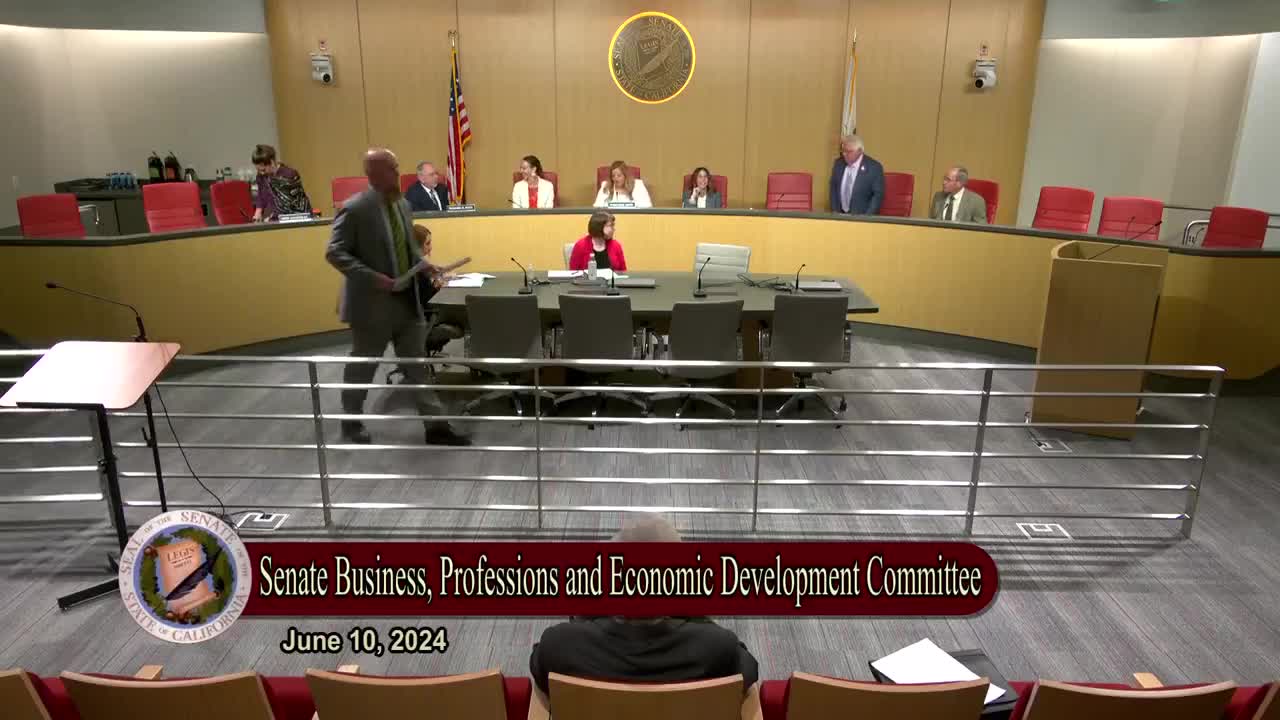 24MIN
Senate Standing Committee on Business, Professions and Economic Development
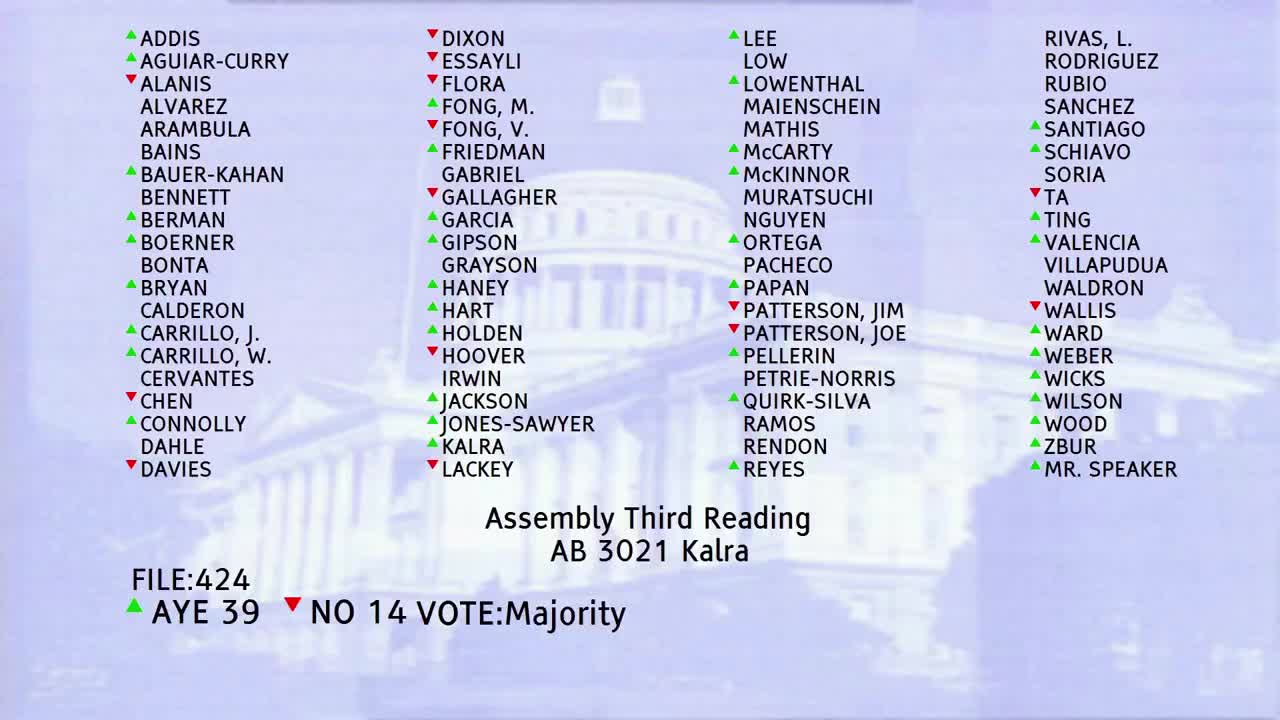 2MIN
Assembly Floor
 12MIN
Assembly Standing Committee on Governmental Organization
 16MIN
Assembly Standing Committee on Business and Professions
Bill Author

Bill Co-Author(s):
