AB 1780: Independent institutions of higher education: legacy and donor preference in admissions: prohibition.
- Session Year: 2023-2024
- House: Assembly
- Latest Version Date: 2024-09-30
Current Status:
Passed
(2024-09-30: Chaptered by Secretary of State - Chapter 1006, Statutes of 2024.)
Introduced
In Committee
First Chamber
In Committee
Second Chamber
Enacted
Existing law establishes independent institutions of higher education as one of the segments of postsecondary education in the state.
Existing law, the Cal Grant Program, establishes the Cal Grant A Entitlement Awards, the Cal Grant B Entitlement Awards, the California Community College Expanded Entitlement Awards, the California Community College Transfer Entitlement Awards, the Competitive Cal Grant A and B Awards, the Cal Grant C Awards, and the Cal Grant T Awards under the administration of the Student Aid Commission.
The Cal Grant Reform Act revises and recasts the provisions establishing and governing the existing Cal Grant Program into a new Cal Grant Program. Existing law specifies that the act becomes operative only if General Fund moneys over the multiyear forecasts beginning in the 202425 fiscal year are available to support ongoing augmentations and actions, and if funding is provided in the annual Budget Act to implement the act.
This bill would prohibit, commencing September 1, 2025, an independent institution of higher education, as defined, from providing a legacy preference or donor preference in admissions, as defined, to an applicant as part of the regular or early action admissions process. The bill would require, on or before June 30, 2026, and annually thereafter, an independent institution of higher education to report to the Legislature and the Department of Justice on whether it is in compliance or violation of these provisions, and if in violation of these provisions, to also report, for that academic year, (1) specified information about newly enrolled students and (2) the admission rate of students who are provided a legacy preference or donor preference in admissions, as compared to the admission rate of students who are not provided a legacy preference or donor preference in admissions. The bill would require the department to post the names of the independent institutions of higher education that violate the prohibition on its internet website by the next fiscal year.
Existing law establishes independent institutions of higher education as one of the segments of postsecondary education in the state.
Existing law, the Cal Grant Program, establishes the Cal Grant A Entitlement Awards, the Cal Grant B Entitlement Awards, the California Community College Expanded Entitlement Awards, the California Community College Transfer Entitlement Awards, the Competitive Cal Grant A and B Awards, the Cal Grant C Awards, and the Cal Grant T Awards under the administration of the Student Aid Commission.
The Cal Grant Reform Act revises and recasts the provisions establishing and governing the existing Cal Grant Program into a new Cal Grant Program. Existing law specifies that the act becomes operative only if General Fund moneys over the multiyear forecasts beginning in the 202425 fiscal year are available to support ongoing augmentations and actions, and if funding is provided in the annual Budget Act to implement the act.
This bill would prohibit an independent institution of higher education, as defined, from providing a legacy preference or donor preference in admissions, as defined, to an applicant as part of the regular or early action admissions process. The bill would require, on or before June 30, 2026, and annually thereafter, an independent institution of higher education to report to the Legislature and the Department of Justice on whether it is in compliance or violation of these provisions, and if in violation of these provisions, to also report report, for that academic year, (1) specified information about newly enrolled students and (2) the admission rate of students who are provided a legacy preference or donor preference in admissions, as compared to the admission rate of students who are not provided a legacy preference or donor preference in admissions. The bill would require the department to post the names of the independent institutions of higher education that violate the prohibition on its internet website by the next fiscal year.
Existing law establishes independent institutions of higher education as one of the segments of postsecondary education in the state.
Existing law, the Cal Grant Program, establishes the Cal Grant A Entitlement Awards, the Cal Grant B Entitlement Awards, the California Community College Expanded Entitlement Awards, the California Community College Transfer Entitlement Awards, the Competitive Cal Grant A and B Awards, the Cal Grant C Awards, and the Cal Grant T Awards under the administration of the Student Aid Commission.
The Cal Grant Reform Act revises and recasts the provisions establishing and governing the existing Cal Grant Program into a new Cal Grant Program. Existing law specifies that the act becomes operative only if General Fund moneys over the multiyear forecasts beginning in the 202425 fiscal year are available to support ongoing augmentations and actions, and if funding is provided in the annual Budget Act to implement the act.
This bill would prohibit an independent institution of higher education, as defined, from providing a legacy preference or donor preference in admissions, as defined, to an applicant as part of the regular or early action admissions process. The bill would require, on or before June 30, 2026, and annually thereafter, an independent institution of higher education to report to the Legislature and the Department of Justice on whether it is in compliance or violation of these provisions, and if in violation of these provisions, to also report (1) specified information about admitted students, as specified. enrolled students and (2) the admission rate of students who are provided a legacy preference or donor preference in admissions, as compared to the admission rate of students who are not provided a legacy preference or donor preference in admissions. The bill would require the department to post the names of the independent institutions of higher education that violate the prohibition on its internet website by the next fiscal year.
Existing law establishes independent institutions of higher education as one of the segments of postsecondary education in the state.
Existing law, the Cal Grant Program, establishes the Cal Grant A Entitlement Awards, the Cal Grant B Entitlement Awards, the California Community College Expanded Entitlement Awards, the California Community College Transfer Entitlement Awards, the Competitive Cal Grant A and B Awards, the Cal Grant C Awards, and the Cal Grant T Awards under the administration of the Student Aid Commission.
The Cal Grant Reform Act revises and recasts the provisions establishing and governing the existing Cal Grant Program into a new Cal Grant Program. Existing law specifies that the act becomes operative only if General Fund moneys over the multiyear forecasts beginning in the 202425 fiscal year are available to support ongoing augmentations and actions, and if funding is provided in the annual Budget Act to implement the act.
This bill would prohibit an independent institution of higher education, as defined, from providing a legacy preference or donor preference in admissions, as defined, to an applicant as part of the regular or early action admissions process. The bill would require, on or before June 30, 2026, and annually thereafter, an independent institution of higher education to report to the Legislature and the Department of Justice on whether it is in compliance or violation of these provisions, and if in violation of these provisions, to also report specified information about admitted students, as specified. The bill would require the department to post the names of the independent institutions of higher education that violate the prohibition on its internet website by the next fiscal year.
Existing law establishes independent institutions of higher education as one of the segments of postsecondary education in the state.
Existing law, the Cal Grant Program, establishes the Cal Grant A Entitlement Awards, the Cal Grant B Entitlement Awards, the California Community College Expanded Entitlement Awards, the California Community College Transfer Entitlement Awards, the Competitive Cal Grant A and B Awards, the Cal Grant C Awards, and the Cal Grant T Awards under the administration of the Student Aid Commission.
The Cal Grant Reform Act revises and recasts the provisions establishing and governing the existing Cal Grant Program into a new Cal Grant Program. Existing law specifies that the act becomes operative only if General Fund moneys over the multiyear forecasts beginning in the 202425 fiscal year are available to support ongoing augmentations and actions, and if funding is provided in the annual Budget Act to implement the act.
This bill would prohibit an independent institution of higher education, as defined, from providing a legacy preference or donor preference in admissions, as defined, to an applicant as part of the regular or early action admissions process. The bill would make a violation of the prohibition subject to a civil penalty equal to the amount the independent institution of higher education receives in the year before the violation occurred pursuant to the Cal Grant Program or the Cal Grant Reform Act, as applicable. The bill would require the civil penalty to be assessed and recovered by the Department of Justice and deposited into the Cal Grant Account, which the bill would establish in the State Treasury. The bill would require funds in the account, upon appropriation by the Legislature, to be available for purposes of funding the Cal Grant Program or the Cal Grant Reform Act. The bill would require, on or before June 30, 2026, and annually thereafter, an independent institution of higher education to report to the Legislature and the Department of Justice on whether it is in compliance or violation of these provisions, and if in violation of these provisions, to also report specified information about admitted students, as specified. The bill would require the department to post the names of the independent institutions of higher education that violate the prohibition on its internet website by the next fiscal year.
Existing law establishes independent institutions of higher education as one of the segments of postsecondary education in the state.
Existing law, the Cal Grant Program, establishes the Cal Grant A Entitlement Awards, the Cal Grant B Entitlement Awards, the California Community College Expanded Entitlement Awards, the California Community College Transfer Entitlement Awards, the Competitive Cal Grant A and B Awards, the Cal Grant C Awards, and the Cal Grant T Awards under the administration of the Student Aid Commission.
The Cal Grant Reform Act revises and recasts the provisions establishing and governing the existing Cal Grant Program into a new Cal Grant Program. Existing law specifies that the act becomes operative only if General Fund moneys over the multiyear forecasts beginning in the 202425 fiscal year are available to support ongoing augmentations and actions, and if funding is provided in the annual Budget Act to implement the act.
This bill would prohibit an independent institution of higher education, as defined, from providing a legacy preference or donor preference in admissions, as defined, to an applicant as part of the regular or early action admissions process. The bill would make a violation of the prohibition subject to a civil penalty equal to the amount the independent institution of higher education receives in the year before the violation occurred pursuant to the Cal Grant Program or the Cal Grant Reform Act, as applicable. The bill would require the civil penalty to be assessed and recovered by the Department of Justice and deposited into the Cal Grant Account, which the bill would establish in the State Treasury. The bill would require funds in the account, upon appropriation by the Legislature, to be available for purposes of funding the Cal Grant Program or the Cal Grant Reform Act. The bill would require the department to post the names of the independent institutions of higher education that violate the prohibition on its internet website. The bill would require, on or before June 30, 2026, and annually thereafter, an independent institution of higher education to report to the Legislature and the Department of Justice on whether it is in compliance or violation of these provisions, and if in violation of these provisions, to also report specified information about admitted students to the Legislature. students, as specified. The bill would require the department to post the names of the independent institutions of higher education that violate the prohibition on its internet website by the next fiscal year.
Existing law establishes independent institutions of higher education as one of the segments of postsecondary education in the state.
Existing law, the Cal Grant Program, establishes the Cal Grant A Entitlement Awards, the Cal Grant B Entitlement Awards, the California Community College Expanded Entitlement Awards, the California Community College Transfer Entitlement Awards, the Competitive Cal Grant A and B Awards, the Cal Grant C Awards, and the Cal Grant T Awards under the administration of the Student Aid Commission.
The Cal Grant Reform Act revises and recasts the provisions establishing and governing the existing Cal Grant Program into a new Cal Grant Program. Existing law specifies that the act becomes operative only if General Fund moneys over the multiyear forecasts beginning in the 202425 fiscal year are available to support ongoing augmentations and actions, and if funding is provided in the annual Budget Act to implement the act.
This bill would prohibit an independent institution of higher education, as defined, from providing a legacy preference or donor preference in admissions, as defined, to an applicant as part of the regular or early action admission admissions process. The bill would make a violation of the prohibition subject to a civil penalty equal to the amount the independent institution of higher education receives in the year before the violation occurred pursuant to the Cal Grant Program or the Cal Grant Reform Act, as applicable. The bill would require the civil penalty to be assessed and recovered by the Bureau for Private Postsecondary Education Department of Justice and deposited into the Cal Grant Account, which the bill would establish in the State Treasury. The bill would require funds in the account, upon appropriation by the Legislature, to be available for purposes of funding the Cal Grant Program or the Cal Grant Reform Act. The bill would require the Civil Rights Department department to post the names of the independent institutions of higher education that violate the prohibition on its internet website. The bill would require, on or before June 30, 2026, and annually thereafter, an independent institution of higher education to report specified information about admitted students to the Legislature.
Existing law establishes independent institutions of higher education as one of the segments of postsecondary education in the state.
Existing law, the Cal Grant Program, establishes the Cal Grant A Entitlement Awards, the Cal Grant B Entitlement Awards, the California Community College Expanded Entitlement Awards, the California Community College Transfer Entitlement Awards, the Competitive Cal Grant A and B Awards, the Cal Grant C Awards, and the Cal Grant T Awards under the administration of the Student Aid Commission.The Cal Grant Reform Act revises and recasts the provisions establishing and governing the existing Cal Grant Program into a new Cal Grant Program. Existing law specifies that the act becomes operative only if General Fund moneys over the multiyear forecasts beginning in the 202425 fiscal year are available to support ongoing augmentations and actions, and if funding is provided in the annual Budget Act to implement the act.Existing law establishes eligibility requirements for awards under these programs for participating students attending qualifying postsecondary educational institutions, and prescribes requirements that postsecondary educational institutions must comply with in order to be a qualifying postsecondary educational institution for purposes of the Cal Grant Program or the Cal Grant Reform Act, including, among others, certain information disclosure requirements, a maximum 3-year cohort default rate, as specified, and a minimum graduation rate, as specified.This bill would prohibit, for applications received on or after January 1, 2025, each participating postsecondary educational institution from giving preferential treatment in admission to an applicant because of the applicants relationship to a donor or alumni of the institution in order to be a qualifying institution for purposes of the Cal Grant Program and the Cal Grant Reform Act.This bill would prohibit an independent institution of higher education, as defined, from providing a legacy preference or donor preference in admissions, as defined, to an applicant as part of the regular or early action admission process. The bill would make a violation of the prohibition subject to a civil penalty equal to the amount the independent institution of higher education receives in the year before the violation occurred pursuant to the Cal Grant Program or the Cal Grant Reform Act, as applicable. The bill would require the civil penalty to be assessed and recovered by the Bureau for Private Postsecondary Education and deposited into the Cal Grant Account, which the bill would establish in the State Treasury. The bill would require funds in the account, upon appropriation by the Legislature, to be available for purposes of funding the Cal Grant Program or the Cal Grant Reform Act. The bill would require the Civil Rights Department to post the names of the independent institutions of higher education that violate the prohibition on its internet website. The bill would require, on or before June 30, 2026, and annually thereafter, an independent institution of higher education to report specified information about admitted students to the Legislature.
Existing law, the Cal Grant Program, establishes the Cal Grant A Entitlement Awards, the Cal Grant B Entitlement Awards, the California Community College Expanded Entitlement Awards, the California Community College Transfer Entitlement Awards, the Competitive Cal Grant A and B Awards, the Cal Grant C Awards, and the Cal Grant T Awards under the administration of the Student Aid Commission.
The Cal Grant Reform Act revises and recasts the provisions establishing and governing the existing Cal Grant Program into a new Cal Grant Program. Existing law specifies that the act becomes operative only if General Fund moneys over the multiyear forecasts beginning in the 202425 fiscal year are available to support ongoing augmentations and actions, and if funding is provided in the annual Budget Act to implement the act.
Existing law establishes eligibility requirements for awards under these programs for participating students attending qualifying postsecondary educational institutions, and prescribes requirements that postsecondary educational institutions must comply with in order to be a qualifying postsecondary educational institution for purposes of the Cal Grant Program or the Cal Grant Reform Act, including, among others, certain information disclosure requirements, a maximum 3-year cohort default rate, as specified, and a minimum graduation rate, as specified.
This bill would prohibit, for applications received on or after January 1, 2025, each participating postsecondary educational institution from giving preferential treatment in admission to an applicant because of the applicants relationship to a donor or alumni of the institution in order to be a qualifying institution for purposes of the Cal Grant Program and the Cal Grant Reform Act.
Existing law establishes the California State University, the University of California, and independent institutions of higher education as segments of postsecondary education in the state.This bill would state the intent of the Legislature to enact future legislation to address legacy admissions in order to bring more equity and fairness to college admissions.Existing law establishes the California State University, the University of California, and independent institutions of higher education as segments of postsecondary education in the state.
This bill would state the intent of the Legislature to enact future legislation to address legacy admissions in order to bring more equity and fairness to college admissions.
(a)It is the intent of the Legislature to stop the practice of legacy and donor admissions and protect students as they pursue their higher education.
(b)For purposes of this section, the following definitions apply:
(1)Donor preference in admissions means considering an applicants relation to a donor of, or a donation to, the independent institution of higher education as a factor in the admissions process, including asking an applicant to indicate their familys donor status and including that information among the documents that the independent institution of higher education uses to consider an applicant for admission.
(2)Independent institution of higher education means a nonpublic higher education institution that grants undergraduate degrees, graduate degrees, or both, that is formed as a nonprofit corporation in this state, that is accredited by an agency recognized by the United States Department of Education, and that receives, or benefits from, state-funded student financial assistance or that enrolls students who receive state-funded student financial assistance.
(3)(A)Legacy preference in admissions means considering an applicants relation to an alumni of the independent institution of higher education as a factor in the admissions process, including asking an applicant to indicate where their relatives attended college and including that information among the documents that the independent institution of higher education uses to consider an applicant for admission.
(B)Legacy preference in admissions does not include collecting data on an applicants relation to an alumni or donors for purposes other than admissions decisions.
(c)Commencing September 1, 2025, an independent institution of higher education shall not provide a legacy preference or donor preference in admissions to an applicant as part of the regular or early action admissions process.
(d)On or before June 30, 2026, and annually thereafter, an independent institution of higher education shall report to the Legislature and the Department of Justice, in compliance with Section 9795 of the Government Code, either of the following:
(1)The independent institution of higher education was in compliance with subdivision (c) for all enrolled students for that academic year.
(2)(A)The independent institution of higher education was in violation of subdivision (c) for that same academic year.
(B)(i)An independent institution of higher education that reports that it was in violation of subdivision (c), regardless of the number of violations, shall include in its report both of the following for that academic year:
(I)The legacy status, donor status, race, county of residence, income brackets, and athletic status of newly enrolled students at the independent institution of higher education.
(II)The admission rate of students who are provided a legacy preference or donor preference in admissions, as compared to the admission rate of students who are not provided a legacy preference or donor preference in admissions.
(ii)Data in the report submitted pursuant to clause (i) shall only be publicly provided in the aggregate and in a manner that prevents the identification of any individual.
(e)The Department of Justice shall post the names of the independent institutions of higher education that violate subdivision (c) on its internet website by the next fiscal year after receiving reports pursuant to subdivision (d).
(a)It is the intent of the Legislature to stop the practice of legacy and donor admissions and protect students as they pursue their higher education.
(b)For purposes of this section, the following definitions apply:
(1)Donor preference in admissions means considering an applicants relation to a donor of, or a donation to, the independent institution of higher education as a factor in the admissions process, including asking an applicant to indicate their familys donor status and including that information among the documents that the independent institution of higher education uses to consider an applicant for admission.
(2)Independent institution of higher education means a nonpublic higher education institution that grants undergraduate degrees, graduate degrees, or both, that is formed as a nonprofit corporation in this state, that is accredited by an agency recognized by the United States Department of Education, and that receives, or benefits from, state-funded student financial assistance or that enrolls students who receive state-funded student financial assistance.
(3)(A)Legacy preference in admissions means considering an applicants relation to an alumni of the independent institution of higher education as a factor in the admissions process, including asking an applicant to indicate where their relatives attended college and including that information among the documents that the independent institution of higher education uses to consider an applicant for admission.
(B)Legacy preference in admissions does not include collecting data on an applicants relation to an alumni or donors for purposes other than admissions decisions.
(c)Commencing September 1, 2025, an independent institution of higher education shall not provide a legacy preference or donor preference in admissions to an applicant as part of the regular or early action admissions process.
(d)On or before June 30, 2026, and annually thereafter, an independent institution of higher education shall report to the Legislature and the Department of Justice, in compliance with Section 9795 of the Government Code, either of the following:
(1)The independent institution of higher education was in compliance with subdivision (c) for all enrolled students for that academic year.
(2)(A)The independent institution of higher education was in violation of subdivision (c) for that same academic year.
(B)(i)An independent institution of higher education that reports that it was in violation of subdivision (c), regardless of the number of violations, shall include in its report both of the following for that academic year:
(I)The legacy status, donor status, race, county of residence, income brackets, and athletic status of all newly enrolled students at the independent institution of higher education.
(II)The admission rate of students who are provided a legacy preference or donor preference in admissions, as compared to the admission rate of students who are not provided a legacy preference or donor preference in admissions.
(ii)Data in the report submitted pursuant to clause (i) shall only be publicly provided in the aggregate and in a manner that prevents the identification of any individual.
(e)The Department of Justice shall post the names of the independent institutions of higher education that violate subdivision (c) on its internet website by the next fiscal year after receiving reports pursuant to subdivision (d).
(a)It is the intent of the Legislature to stop the practice of legacy and donor admissions and protect students as they pursue their higher education.
(b)For purposes of this section, the following definitions apply:
(1)Donor preference in admissions means considering an applicants relation to a donor of, or a donation to, the independent institution of higher education as a factor in the admissions process, including asking an applicant to indicate their familys donor status and including that information among the documents that the independent institution of higher education uses to consider an applicant for admission.
(2)Independent institution of higher education means a nonpublic higher education institution that grants undergraduate degrees, graduate degrees, or both, that is formed as a nonprofit corporation in this state, that is accredited by an agency recognized by the United States Department of Education, and that receives, or benefits from, state-funded student financial assistance or that enrolls students who receive state-funded student financial assistance.
(3)(A)Legacy preference in admissions means considering an applicants relation to an alumni of the independent institution of higher education as a factor in the admissions process, including asking an applicant to indicate where their relatives attended college and including that information among the documents that the independent institution of higher education uses to consider an applicant for admission.
(B)Legacy preference in admissions does not include collecting data on an applicants relation to an alumni or donors for purposes other than admissions decisions.
(c)Commencing September 1, 2025, an independent institution of higher education shall not provide a legacy preference or donor preference in admissions to an applicant as part of the regular or early action admissions process.
(d)On or before June 30, 2026, and annually thereafter, an independent institution of higher education shall report to the Legislature and the Department of Justice, in compliance with Section 9795 of the Government Code, either of the following:
(1)The independent institution of higher education was in compliance with subdivision (c) for all enrolled students for that academic year.
(2)(A)The independent institution of higher education was in violation of subdivision (c) for that same academic year.
(B)(i)An independent institution of higher education that reports that it was in violation of subdivision (c), regardless of the number of violations, shall include in its report both of the following for all enrolled students admitted that academic year:
(I)The legacy status, donor status, race, geography, county of residence, income brackets, and athletic status of all admitted enrolled students at the independent institution of higher education.
(II)The admission rate of students who are provided a legacy preference or donor preference in admissions, as compared to the admission rate of students who are not provided a legacy preference or donor preference in admissions.
(ii)Data in the report submitted pursuant to clause (i) shall only be publicly provided in the aggregate and in a manner that prevents the identification of any individual.
(e)The Department of Justice shall post the names of the independent institutions of higher education that violate subdivision (c) on its internet website by the next fiscal year after receiving reports pursuant to subdivision (d).
(a)It is the intent of the Legislature to stop the practice of legacy and donor admissions and protect students as they pursue their higher education.
(b)For purposes of this section, the following definitions apply:
(1)Donor preference in admissions means considering an applicants relation to a donor of, or a donation to, the independent institution of higher education as a factor in the admissions process, including asking an applicant to indicate their familys donor status and including that information among the documents that the independent institution of higher education uses to consider an applicant for admission.
(2)Independent institution of higher education means a nonpublic higher education institution that grants undergraduate degrees, graduate degrees, or both, that is formed as a nonprofit corporation in this state, that is accredited by an agency recognized by the United States Department of Education, and that receives, or benefits from, state-funded student financial assistance or that enrolls students who receive state-funded student financial assistance.
(3)(A)Legacy preference in admissions means considering an applicants relation to an alumni of the independent institution of higher education as a factor in the admissions process, including asking an applicant to indicate where their relatives attended college and including that information among the documents that the independent institution of higher education uses to consider an applicant for admission.
(B)Legacy preference in admissions does not include collecting data on an applicants relation to an alumni or donors for purposes other than admissions decisions.
(c)Commencing September 1, 2025, an independent institution of higher education shall not provide a legacy preference or donor preference in admissions to an applicant as part of the regular or early action admissions process.
(d)On or before June 30, 2026, and annually thereafter, an independent institution of higher education shall report to the Legislature and the Department of Justice, in compliance with Section 9795 of the Government Code, either of the following:
(1)The independent institution of higher education was in compliance with subdivision (c) for all enrolled students for that academic year.
(2)(A)The independent institution of higher education was in violation of subdivision (c) for that same academic year.
(B)(i)An independent institution of higher education that reports that it was in violation of subdivision (c), regardless of the number of violations, shall include in its report both of the following for all enrolled students admitted that academic year:
(i)(I)The legacy status, donor status, race, geography, income brackets, and athletic status of all admitted students at the independent institution of higher education.
(ii)(II)The admission rate of students who are provided a legacy preference or donor preference in admissions, as compared to the admission rate of students who are not provided a legacy preference or donor preference in admissions.
(ii)Data in the report submitted pursuant to clause (i) shall only be publicly provided in the aggregate and in a manner that prevents the identification of any individual.
(e)The Department of Justice shall post the names of the independent institutions of higher education that violate subdivision (c) on its internet website by the next fiscal year after receiving reports pursuant to subdivision (d).
(a)It is the intent of the Legislature to stop the practice of legacy and donor admissions and protect students as they pursue their higher education.
(b)For purposes of this section, the following definitions apply:
(1)Donor preference in admissions means considering an applicants relation to a donor of, or a donation to, the independent institution of higher education as a factor in the admissions process, including asking an applicant to indicate their familys donor status and including that information among the documents that the independent institution of higher education uses to consider an applicant for admission.
(2)Independent institution of higher education has the same meaning as defined in subdivision (b) of Section 66010. means a nonpublic higher education institution that grants undergraduate degrees, graduate degrees, or both, that is formed as a nonprofit corporation in this state, that is accredited by an agency recognized by the United States Department of Education, and that receives, or benefits from, state-funded student financial assistance or that enrolls students who receive state-funded student financial assistance.
(3)(A)Legacy preference in admissions means considering an applicants relation to an alumni of the independent institution of higher education as a factor in the admissions process, including asking an applicant to indicate where their relatives attended college and including that information among the documents that the independent institution of higher education uses to consider an applicant for admission.
(B)Legacy preference in admissions does not include collecting data on an applicants relation to an alumni or donors for purposes other than admissions decisions.
(c)Commencing September 1, 2025, an independent institution of higher education shall not provide a legacy preference or donor preference in admissions to an applicant as part of the regular or early action admissions process.
(d)A violation of subdivision (c) shall result in a civil penalty equal to the amount the independent institution of higher education receives in the year before the violation occurred pursuant to the Ortiz-Pacheco-Poochigian-Vasconcellos Cal Grant Program (Chapter 1.7 (commencing with Section 69430) of Part 42) or the Cal Grant Reform Act (Chapter 1.5 (commencing with Section 69405) of Part 42), as applicable. The civil penalty shall be assessed and recovered by the Department of Justice and deposited into the Cal Grant Account, which is hereby established in the State Treasury. Upon appropriation by the Legislature, funds in the Cal Grant Account shall be available for purposes of funding the Ortiz-Pacheco-Poochigian-Vasconcellos Cal Grant Program (Chapter 1.7 (commencing with Section 69430) of Part 42) and the Cal Grant Reform Act (Chapter 1.5 (commencing with Section 69405) of Part 42). The Department of Justice may use any and all statutory means to obtain information that will aid in the enforcement of this section.(e)(d)On or before June 30, 2026, and annually thereafter, an independent institution of higher education shall report to the Legislature and the Department of Justice, in compliance with Section 9795 of the Government Code, either of the following:
(1)The independent institution of higher education was in compliance with subdivision (c) for all enrolled students for that academic year.
(2)(A)The independent institution of higher education was in violation of subdivision (c) for that same academic year.
(B)An independent institution of higher education that reports that it was in violation of subdivision (c), regardless of the number of violations, shall include in its report both of the following for all enrolled students admitted that academic year:
(i)The legacy status, donor status, race, geography, income brackets, and athletic status of all admitted students at the independent institution of higher education.
(ii)The admission rate of students who are provided a legacy preference or donor preference in admissions, as compared to the admission rate of students who are not provided a legacy preference or donor preference in admissions.
(f)(e)The Department of Justice shall post the names of the independent institutions of higher education that violate subdivision (c) on its internet website by the next fiscal year after receiving reports pursuant to subdivision (e). (d).
(a)It is the intent of the Legislature to stop the practice of legacy and donor admissions and protect students receiving Cal Grant funds as they pursue their higher education.
(b)For purposes of this section, the following definitions apply:
(1)Donor preference in admissions means considering an applicants relation to a donor of, or a donation to, the independent institution of higher education as a factor in the admissions process. process, including asking an applicant to indicate their familys donor status and including that information among the documents that the independent institution of higher education uses to consider an applicant for admission.
(2)Independent institution of higher education has the same meaning as defined in subdivision (b) of Section 66010.
(3)(A)Legacy preference in admissions means considering an applicants relation to an alumni of the independent institution of higher education as a factor in the admissions process, including asking an applicant to indicate where their relatives attended college and including that information among the documents that the independent institution of higher education uses to consider an applicant for admission.
(B)Legacy preference in admissions does not include collecting data on an applicants relation to an alumni or donors for purposes other than admissions decisions.
(c)An Commencing September 1, 2025, an independent institution of higher education shall not provide a legacy preference or donor preference in admissions to an applicant as part of the regular or early action admissions process.
(d)A violation of subdivision (c) shall result in a civil penalty equal to the amount the independent institution of higher education receives in the year before the violation occurred pursuant to the Ortiz-Pacheco-Poochigian-Vasconcellos Cal Grant Program (Chapter 1.7 (commencing with Section 69430) of Part 42) or the Cal Grant Reform Act (Chapter 1.5 (commencing with Section 69405) of Part 42), as applicable. The civil penalty shall be assessed and recovered by the Department of Justice and deposited into the Cal Grant Account, which is hereby established in the State Treasury. Upon appropriation by the Legislature, funds in the Cal Grant Account shall be available for purposes of funding the Ortiz-Pacheco-Poochigian-Vasconcellos Cal Grant Program (Chapter 1.7 (commencing with Section 69430) of Part 42) and the Cal Grant Reform Act (Chapter 1.5 (commencing with Section 69405) of Part 42). The Department of Justice may use any and all statutory means to obtain information that will aid in the enforcement of this section.
(e)The Department of Justice shall post the names of the independent institutions of higher education that violate subdivision (c) on its internet website.(f)(e)On or before June 30, 2026, and annually thereafter, an independent institution of higher education shall report to the Legislature, Legislature and the Department of Justice, in compliance with Section 9795 of the Government Code, both either of the following:
(1)The independent institution of higher education was in compliance with subdivision (c) for all enrolled students for that academic year.
(2)(A)The independent institution of higher education was in violation of subdivision (c) for that same academic year.
(B)An independent institution of higher education that reports that it was in violation of subdivision (c), regardless of the number of violations, shall include in its report both of the following for all enrolled students admitted that academic year:
(1)(i)The legacy status, donor status, race, geography, income brackets, and athletic status of all admitted students at the independent institution of higher education.
(2)(ii)The admission rate of students who are provided a legacy preference or donor preference in admissions, as compared to the admission rate of students who are not provided a legacy preference or donor preference in admissions.
(f)The Department of Justice shall post the names of the independent institutions of higher education that violate subdivision (c) on its internet website by the next fiscal year after receiving reports pursuant to subdivision (e).
(a)It is the intent of the Legislature to stop the practice of legacy and donor admissions and protect students receiving Cal Grant funds as they pursue their higher education.
(b)For purposes of this section, the following definitions apply:
(1)Donor preference in admissions means considering an applicants relation to a donor of, or a donation to, the independent institution of higher education as a factor in the admission admissions process.
(2)Independent institution of higher education has the same meaning as defined in subdivision (b) of Section 66010.
(3)Legacy preference in admissions means considering an applicants relation to an alumni of the independent institution of higher education as a factor in the admission admissions process, including asking an applicant to indicate where their relatives attended college and including that information among the documents that the independent institution of higher education uses to consider an applicant for admission.
(c)An independent institution of higher education shall not provide a legacy preference or donor preference in admissions to an applicant as part of the regular or early action admission admissions process.
(d)A violation of subdivision (c) shall result in a civil penalty equal to the amount the independent institution of higher education receives in the year before the violation occurred pursuant to the Ortiz-Pacheco-Poochigian-Vasconcellos Cal Grant Program (Chapter 1.7 (commencing with Section 69430) of Part 42) or the Cal Grant Reform Act (Chapter 1.5 (commencing with Section 69405) of Part 42), as applicable. The civil penalty shall be assessed and recovered by the Bureau for Private Postsecondary Education Department of Justice and deposited into the Cal Grant Account, which is hereby established in the State Treasury. Upon appropriation by the Legislature, funds in the Cal Grant Account shall be available for purposes of funding the Ortiz-Pacheco-Poochigian-Vasconcellos Cal Grant Program (Chapter 1.7 (commencing with Section 69430) of Part 42) and the Cal Grant Reform Act (Chapter 1.5 (commencing with Section 69405) of Part 42).
(e)The Civil Rights Department Department of Justice shall post the names of the independent institutions of higher education that violate subdivision (c) on its internet website. The information shall be provided to the Civil Rights Department by the Bureau for Private Postsecondary Education.
(f)On or before June 30, 2026, and annually thereafter, an independent institution of higher education shall report to the Legislature, in compliance with Section 9795 of the Government Code, both of the following:
(1)The race, geography, income brackets, and athletic status of all admitted students at the independent institution of higher education.
(2)The admission rate of students who are provided a legacy preference or donor preference in admissions, as compared to the admission rate of students who are not provided a legacy preference or donor preference in admissions.
(a)It is the intent of the Legislature to stop the practice of legacy and donor admissions and protect students receiving Cal Grant funds as they pursue their higher education.
(b)For purposes of this section, the following definitions apply:
(1)Donor preference in admissions means considering an applicants relation to a donor of, or a donation to, the independent institution of higher education as a factor in the admission process.
(2)Independent institution of higher education has the same meaning as defined in subdivision (b) of Section 66010.
(3)Legacy preference in admissions means considering an applicants relation to an alumni of the independent institution of higher education as a factor in the admission process, including asking an applicant to indicate where their relatives attended college and including that information among the documents that the independent institution of higher education uses to consider an applicant for admission.
(c)An independent institution of higher education shall not provide a legacy preference or donor preference in admissions to an applicant as part of the regular or early action admission process.
(d)A violation of subdivision (c) shall result in a civil penalty equal to the amount the independent institution of higher education receives in the year before the violation occurred pursuant to the Ortiz-Pacheco-Poochigian-Vasconcellos Cal Grant Program (Chapter 1.7 (commencing with Section 69430) of Part 42) or the Cal Grant Reform Act (Chapter 1.5 (commencing with Section 69405) of Part 42), as applicable. The civil penalty shall be assessed and recovered by the Bureau for Private Postsecondary Education and deposited into the Cal Grant Account, which is hereby established in the State Treasury. Upon appropriation by the Legislature, funds in the Cal Grant Account shall be available for purposes of funding the Ortiz-Pacheco-Poochigian-Vasconcellos Cal Grant Program (Chapter 1.7 (commencing with Section 69430) of Part 42) and the Cal Grant Reform Act (Chapter 1.5 (commencing with Section 69405) of Part 42).
(e)The Civil Rights Department shall post the names of the independent institutions of higher education that violate subdivision (c) on its internet website. The information shall be provided to the Civil Rights Department by the Bureau for Private Postsecondary Education.
(f)On or before June 30, 2026, and annually thereafter, an independent institution of higher education shall report to the Legislature, in compliance with Section 9795 of the Government Code, both of the following:
(1)The race, geography, income brackets, and athletic status of all admitted students at the independent institution of higher education.
(2)The admission rate of students who are provided a legacy preference or donor preference in admissions, as compared to the admission rate of students who are not provided a legacy preference or donor preference in admissions.
SECTION 1.Section 69406 of the Education Code is amended to read:69406.For purposes of this chapter, the following definitions apply:(a)An academic year is July 1 to June 30, inclusive. The starting date of a session shall determine the academic year in which it is included.(b)Access costs means living expenses and expenses for transportation, supplies, technology, and books.(c)Award year means one academic year, or the equivalent, of attendance at a qualifying institution.(d)College grade point average and community college grade point average mean a grade point average calculated on the basis of all college work completed, except for nontransferable units and courses not counted in the computation for admission to a California public institution of higher education that grants a baccalaureate degree.(e)Commission means the Student Aid Commission.(f)Eligibility index for student aid, with respect to an applicant, shall be determined using the federal methodology pursuant to subdivision (a) of Section 69506 (as established by Title IV of the federal Higher Education Act of 1965, as amended (20 U.S.C. Sec. 1070 et seq.)) and applicable rules and regulations adopted by the commission.(g)Enrollment status means part- or full-time status.(1)Part time, for purposes of Cal Grant eligibility, means 6 to 11 semester units, inclusive, or the equivalent.(2)Full time, for purposes of Cal Grant eligibility, means 12 or more semester units or the equivalent.(h)High school grade point average means a grade point average calculated on a 4.0 scale, using all academic coursework, for the sophomore year, the summer following the sophomore year, the junior year, and the summer following the junior year, excluding physical education, Reserve Officers Training Corps (ROTC), and remedial courses, and computed pursuant to regulations of the commission. However, for high school graduates who apply after their senior year, high school grade point average includes senior year coursework.(i)Instructional program of not less than one academic year means a program of study that results in the award of an associate or baccalaureate degree or certificate requiring at least 24 semester units or the equivalent, or that results in eligibility for transfer from a community college to a baccalaureate degree program.(j)Instructional program of not less than two academic years means a program of study that results in the award of an associate or baccalaureate degree requiring at least 48 semester units or the equivalent, or that results in eligibility for transfer from a community college to a baccalaureate degree program.(k)(1)Qualifying institution means an institution that complies with paragraphs (2) to (4), inclusive, and is any of the following:(A)A California private or independent postsecondary educational institution that participates in the federal Pell Grant program and in at least two of the following federal student aid programs:(i)Federal Work-Study Program.(ii)Federal Stafford Loan Program.(iii)Federal Supplemental Educational Opportunity Grant Program.(B)A nonprofit institution headquartered and operating in California that certifies to the commission that 10 percent of the institutions operating budget, as demonstrated in an audited financial statement, is expended for purposes of institutionally funded student financial aid in the form of grants, that demonstrates to the commission that it has the administrative capacity to administer the funds, that is accredited by the Western Association of Schools and Colleges, and that meets any other state-required criteria adopted by regulation by the commission in consultation with the Department of Finance. A regionally accredited institution that was deemed qualified by the commission to participate in the Cal Grant Program for the 200001 academic year shall retain its eligibility as long as it maintains its existing accreditation status.(C)A California public postsecondary educational institution.(2)(A)The institution shall provide information on where to access California license examination passage rates for the most recent available year from graduates of its undergraduate programs leading to employment for which passage of a California licensing examination is required, if that data is electronically available through the internet website of a California licensing or regulatory agency. For purposes of this paragraph, provide may exclusively include placement of an internet website address labeled as an access point for the data on the passage rates of recent program graduates on the internet website where enrollment information is also located, on an internet website that provides centralized admissions information for postsecondary educational systems with multiple campuses, or on applications for enrollment or other program information distributed to prospective students.(B)The institution shall be responsible for certifying to the commission compliance with the requirements of subparagraph (A).(3)(A)The commission shall certify by November 1 of each year the institutions latest official three-year cohort default rate and graduation rate as most recently reported by the United States Department of Education. For purposes of this section, the graduation rate is the percentage of full-time, first-time degree or certificate-seeking undergraduate students who graduate in 150 percent or less of the expected time to complete degree requirements as most recently reported publicly in any format, including preliminary data records, by the United States Department of Education.(B)For purposes of the 202425 academic year, and every academic year thereafter, an otherwise qualifying institution with a three-year cohort default rate that is equal to or greater than 15.5 percent, as certified by the commission on October 1, 2011, and every year thereafter, shall be ineligible for initial and renewal Cal Grant awards at the institution.(C)(i)An otherwise qualifying institution that becomes ineligible under this paragraph for initial and renewal Cal Grant awards shall regain its eligibility for the academic year for which it satisfies the requirements established in subparagraph (B) or (E), as applicable.(ii)If the United States Department of Education corrects or revises an institutions three-year cohort default rate or graduation rate that originally failed to satisfy the requirements established in subparagraph (B) or (E), as applicable, and the correction or revision results in the institutions three-year cohort default rate or graduation rate satisfying those requirements, that institution shall immediately regain its eligibility for the academic year to which the corrected or revised three-year cohort default rate or graduation rate would have been applied.(D)An otherwise qualifying institution for which no three-year cohort default rate or graduation rate has been reported by the United States Department of Education shall be provisionally eligible to participate in the Cal Grant Program until a three-year cohort default rate or graduation rate has been reported for the institution by the United States Department of Education.(E)For purposes of the 202425 academic year, and every academic year thereafter, an otherwise qualifying institution with a graduation rate of 30 percent or less, as certified by the commission pursuant to subparagraph (A), shall be ineligible for initial and renewal Cal Grant awards at the institution.(F)Notwithstanding any other law, the requirements of this paragraph shall not apply to institutions with 40 percent or less of undergraduate students borrowing federal student loans, using information reported to the United States Department of Education for the academic year two years before the academic year in which the commission is certifying the three-year cohort default rate or graduation rate pursuant to subparagraph (A).(G)The commission shall do all of the following:(i)Notify initial Cal Grant recipients seeking to attend, or attending, an institution that is ineligible for initial and renewal Cal Grant awards under subparagraph (B) or (E) that the institution is ineligible for initial Cal Grant awards for the academic year for which the student received an initial Cal Grant award.(ii)Notify renewal Cal Grant recipients attending an institution that is ineligible for initial and renewal Cal Grant awards at the institution under subparagraph (B) or (E) that the students Cal Grant award will be eliminated if the student attends the ineligible institution in an academic year in which the institution is ineligible.(iii)Provide initial and renewal Cal Grant recipients seeking to attend, or attending, an institution that is ineligible for initial and renewal Cal Grant awards at the institution under subparagraph (B) or (E) with a complete list of all California postsecondary educational institutions at which the student would be eligible to receive an unreduced Cal Grant award.(iv)(I)Establish an appeal process for an otherwise qualifying institution that fails to satisfy the three-year cohort default rate and graduation rate requirements in subparagraphs (B) and (E), respectively.(II)The commission may grant an appeal for an academic year only if the commission has determined the institution has a cohort size of 20 individuals or less and the cohort is not representative of the overall institutional performance.(4)For applications received on or after January 1, 2025, the institution shall not give preferential treatment in admission to an applicant because of the applicants relationship to a donor or alumni of the institution.(l)Satisfactory academic progress means those criteria required by applicable federal standards published in Title 34 of the Code of Federal Regulations. The commission may adopt regulations defining satisfactory academic progress in a manner that is consistent with those federal standards. The regulations adopted by the commission under this subdivision shall, to the extent consistent with applicable federal standards, provide that homelessness, as defined as a homeless individual within the meaning of the federal McKinney-Vento Homeless Assistance Act (42 U.S.C. Sec. 11302(a)), or as defined as a homeless child or youth, as defined in subsection (2) of Section 725 of the federal McKinney-Vento Homeless Assistance Act (42 U.S.C. Sec. 11434a(2)), is an extenuating circumstance for students who are otherwise unable to meet the requirements deemed to constitute satisfactory academic progress at the institution they attend, and that extenuating circumstance may be considered by the institution to alter or excuse compliance with those progress requirements.SEC. 2.Section 69432.7 of the Education Code is amended to read:69432.7.As used in this chapter, the following terms have the following meanings:(a)An academic year is July 1 to June 30, inclusive. The starting date of a session shall determine the academic year in which it is included.(b)Access costs means living expenses and expenses for transportation, supplies, technology, and books.(c)Award year means one academic year, or the equivalent, of attendance at a qualifying institution.(d)College grade point average and community college grade point average mean a grade point average calculated on the basis of all college work completed, except for nontransferable units and courses not counted in the computation for admission to a California public institution of higher education that grants a baccalaureate degree.(e)Commission means the Student Aid Commission.(f)Enrollment status means part- or full-time status.(1)Part time, for purposes of Cal Grant eligibility, means 6 to 11 semester units, inclusive, or the equivalent.(2)Full time, for purposes of Cal Grant eligibility, means 12 or more semester units or the equivalent.(g)Expected family contribution, with respect to an applicant, shall be determined using the federal methodology pursuant to subdivision (a) of Section 69506 (as established by Title IV of the federal Higher Education Act of 1965, as amended (20 U.S.C. Sec. 1070 et seq.)) and applicable rules and regulations adopted by the commission.(h)High school grade point average means a grade point average calculated on a 4.0 scale, using all academic coursework, for the sophomore year, the summer following the sophomore year, the junior year, and the summer following the junior year, excluding physical education, Reserve Officers Training Corps (ROTC), and remedial courses, and computed pursuant to regulations of the commission. However, for high school graduates who apply after their senior year, high school grade point average includes senior year coursework.(i)Instructional program of not less than one academic year means a program of study that results in the award of an associate or baccalaureate degree or certificate requiring at least 24 semester units or the equivalent, or that results in eligibility for transfer from a community college to a baccalaureate degree program.(j)Instructional program of not less than two academic years means a program of study that results in the award of an associate or baccalaureate degree requiring at least 48 semester units or the equivalent, or that results in eligibility for transfer from a community college to a baccalaureate degree program.(k)(1)Maximum household income and asset levels means the applicable household income and household asset levels for participants, including new applicants and renewing recipients, in the Cal Grant Program, as defined and adopted in regulations by the commission for the 200102 academic year, which shall be set pursuant to the following income and asset ceiling amounts:CAL GRANT PROGRAM INCOME CEILINGSCal Grant A, C, and TCal Grant BDependent and Independent students with dependents*Family SizeSix or more$74,100$40,700Five$68,700$37,700Four$64,100$33,700Three$59,000$30,300Two$57,600$26,900 IndependentSingle, no dependents$23,500$23,500Married$26,900$26,900*Applies to independent students with dependents other than a spouse.CAL GRANT PROGRAM ASSET CEILINGSCal Grant A, C, and TCal Grant B Dependent**$49,600$49,600Independent$23,600$23,600**Applies to independent students with dependents other than a spouse.(2)The commission shall annually adjust the maximum household income and asset levels based on the percentage change in the cost of living within the meaning of paragraph (1) of subdivision (e) of Section 8 of Article XIIIB of the California Constitution. The maximum household income and asset levels applicable to a renewing recipient shall be the greater of the adjusted maximum household income and asset levels or the maximum household income and asset levels at the time of the renewing recipients initial Cal Grant award. For a recipient who was initially awarded a Cal Grant for an academic year before the 201112 academic year, the maximum household income and asset levels shall be the greater of the adjusted maximum household income and asset levels or the 201011 academic year maximum household income and asset levels. An applicant or renewal recipient who qualifies to be considered under the simplified needs test established by federal law for student assistance shall be presumed to meet the asset level test under this section. Before disbursing any Cal Grant funds, a qualifying institution shall be obligated, under the terms of its institutional participation agreement with the commission, to resolve any conflicts that may exist in the data the institution possesses relating to that individual.(l)(1)Qualifying institution means an institution that complies with paragraphs (2) to (5), inclusive, and is any of the following:(A)A California private or independent postsecondary educational institution that participates in the Pell Grant Program and in at least two of the following federal student aid programs:(i)Federal Work-Study Program.(ii)Federal Stafford Loan Program.(iii)Federal Supplemental Educational Opportunity Grant Program.(B)A nonprofit institution headquartered and operating in California that certifies to the commission that 10 percent of the institutions operating budget, as demonstrated in an audited financial statement, is expended for purposes of institutionally funded student financial aid in the form of grants, that demonstrates to the commission that it has the administrative capacity to administer the funds, that is accredited by the Western Association of Schools and Colleges, and that meets any other state-required criteria adopted by regulation by the commission in consultation with the Department of Finance. A regionally accredited institution that was deemed qualified by the commission to participate in the Cal Grant Program for the 200001 academic year shall retain its eligibility as long as it maintains its existing accreditation status.(C)A California public postsecondary educational institution.(2)(A)The institution shall provide information on where to access California license examination passage rates for the most recent available year from graduates of its undergraduate programs leading to employment for which passage of a California licensing examination is required, if that data is electronically available through the internet website of a California licensing or regulatory agency. For purposes of this paragraph, provide may exclusively include placement of an internet website address labeled as an access point for the data on the passage rates of recent program graduates on the internet website where enrollment information is also located, on an internet website that provides centralized admissions information for postsecondary educational systems with multiple campuses, or on applications for enrollment or other program information distributed to prospective students.(B)The institution shall be responsible for certifying to the commission compliance with the requirements of subparagraph (A).(3)(A)The commission shall certify by November 1 of each year the institutions latest official three-year cohort default rate and graduation rate as most recently reported by the United States Department of Education. For purposes of this section, the graduation rate is the percentage of full-time, first-time degree or certificate-seeking undergraduate students who graduate in 150 percent or less of the expected time to complete degree requirements as most recently reported publicly in any format, including preliminary data records, by the United States Department of Education.(B)For purposes of the 201112 academic year, an otherwise qualifying institution with a three-year cohort default rate reported by the United States Department of Education that is equal to or greater than 24.6 percent shall be ineligible for initial and renewal Cal Grant awards at the institution.(C)For purposes of the 201213 academic year, and every academic year thereafter, an otherwise qualifying institution with a three-year cohort default rate that is equal to or greater than 15.5 percent, as certified by the commission on October 1, 2011, and every year thereafter, shall be ineligible for initial and renewal Cal Grant awards at the institution.(D)(i)An otherwise qualifying institution that becomes ineligible under this paragraph for initial and renewal Cal Grant awards shall regain its eligibility for the academic year for which it satisfies the requirements established in subparagraph (B), (C), or (F), as applicable.(ii)If the United States Department of Education corrects or revises an institutions three-year cohort default rate or graduation rate that originally failed to satisfy the requirements established in subparagraph (B), (C), or (F), as applicable, and the correction or revision results in the institutions three-year cohort default rate or graduation rate satisfying those requirements, that institution shall immediately regain its eligibility for the academic year to which the corrected or revised three-year cohort default rate or graduation rate would have been applied.(E)An otherwise qualifying institution for which no three-year cohort default rate or graduation rate has been reported by the United States Department of Education shall be provisionally eligible to participate in the Cal Grant Program until a three-year cohort default rate or graduation rate has been reported for the institution by the United States Department of Education.(F)For purposes of the 201213 academic year, and every academic year thereafter, an otherwise qualifying institution with a graduation rate of 30 percent or less, as certified by the commission pursuant to subparagraph (A), shall be ineligible for initial and renewal Cal Grant awards at the institution, except as provided for in subparagraph (H).(G)Notwithstanding any other law, the requirements of this paragraph shall not apply to institutions with 40 percent or less of undergraduate students borrowing federal student loans, using information reported to the United States Department of Education for the academic year two years before the academic year in which the commission is certifying the three-year cohort default rate or graduation rate pursuant to subparagraph (A).(H)Notwithstanding subparagraph (F), an otherwise qualifying institution that maintains a three-year cohort default rate that is less than 15.5 percent and a graduation rate above 20 percent for students taking 150 percent or less of the expected time to complete degree requirements, as certified by the commission pursuant to subparagraph (A), shall be eligible for initial and renewal Cal Grant awards at the institution through the 201617 academic year.(I)The commission shall do all of the following:(i)Notify initial Cal Grant recipients seeking to attend, or attending, an institution that is ineligible for initial and renewal Cal Grant awards under subparagraph (C) or (F) that the institution is ineligible for initial Cal Grant awards for the academic year for which the student received an initial Cal Grant award.(ii)Notify renewal Cal Grant recipients attending an institution that is ineligible for initial and renewal Cal Grant awards at the institution under subparagraph (C) or (F) that the students Cal Grant award will be reduced by 20 percent, or eliminated, as appropriate, if the student attends the ineligible institution in an academic year in which the institution is ineligible.(iii)Provide initial and renewal Cal Grant recipients seeking to attend, or attending, an institution that is ineligible for initial and renewal Cal Grant awards at the institution under subparagraph (C) or (F) with a complete list of all California postsecondary educational institutions at which the student would be eligible to receive an unreduced Cal Grant award.(iv)(I)Establish an appeal process for an otherwise qualifying institution that fails to satisfy the three-year cohort default rate and graduation rate requirements in subparagraphs (C) and (F), respectively.(II)The commission may grant an appeal for an academic year only if the commission has determined the institution has a cohort size of 20 individuals or less and the cohort is not representative of the overall institutional performance.(III)Notwithstanding subclause (II), the commission may grant an appeal for the 202324 academic year if the institution failed to meet the three-year cohort default rate solely due to acquisition of an out-of-state institution that impacted its three-year cohort default rate, and the acquired out-of-state institution has since closed any time between the 201920 to 202223 academic years, inclusive. The institutions Cal Grant eligibility shall not be transferrable if the institution is bought or sold during the 202324 fiscal year. This authority shall be in effect for an appeal for the 202324 academic year only and shall sunset on July 1, 2023. The institutions Cal Grant eligibility shall not be transferrable to a new site acquired by the institution.(4)By the start of the 202425 academic year, the institution shall develop and implement policies defining satisfactory academic progress in a manner that is consistent with the federal standards published in Title 34 of the Code of Federal Regulations. The institution shall also comply with all of the following requirements:(A)Set the standards for grade point average and pace of completion at the minimum federal standards as determined by Section 668.34(a) of Title 34 of the Code of Federal Regulations.(B)Provide information to students about the institutions satisfactory academic progress standards and financial aid appeals process during new student orientation and include student-friendly language on the institutions internet website and financial aid award letters regarding the standards and appeals process. The institution shall request its faculty to include student-friendly language on course syllabi regarding the standards and appeals process.(C)Notify a student when the student has not achieved the satisfactory academic progress standards following every term of enrollment, regardless of the frequency at which satisfactory academic progress is formally evaluated. This subparagraph does not preclude an institution from conducting the formal evaluation annually.(D)Evaluate whether a student satisfies the grade point average and pace of completion standards set forth in subparagraph (A) based on cumulative measures. An institution shall not require a student to satisfy the minimum grade point average and pace of completion standards for each individual term. This paragraph does not preclude an institution from requiring a student on financial aid probation as defined by Section 668.34(b) of Title 34 of the Code of Federal Regulations to comply with the terms of the students academic plan in order to maintain financial aid eligibility.(E)Exclude remedial coursework from maximum timeframe calculations if the institution offers remedial coursework.(F)Allow a student who fulfills the terms and conditions of the students academic plan to remain on financial aid probation as defined by Section 668.34(b) of Title 34 of the Code of Federal Regulations, including continuing to receive financial aid for any term for which the student fulfills the terms and conditions of the students academic plan.(G)In the case of a satisfactory academic progress determination for a transfer student, when calculating maximum timeframe as defined by Section 668.34(b) of Title 34 of the Code of Federal Regulations, only include those credits from other institutions that count towards the students current program of study.(H)Accept both electronic and hard copy financial aid appeals for any student who is ineligible to receive financial aid due to the determination that the student did not meet satisfactory academic progress, as defined by the institution where the student is enrolled, subject to all of the following:(i)A student who loses financial aid eligibility may appeal the determination during any subsequent term following loss of financial aid eligibility. The institution shall not limit the total number of appeals that may be submitted by a student throughout the duration of the students enrollment. The institution may limit the number of appeals per term, but each appeal that is denied shall be subject to the second review process pursuant to clause (vi). The institution shall not impose deadlines for submitting an appeal that are earlier than three weeks before the end of each term.(ii)A student who previously disenrolled while being ineligible to receive financial aid may appeal the loss of financial aid upon reenrollment, and the timing for consideration of the appeal shall allow the student, if the student meets the criteria for financial aid reinstatement, to qualify for reinstatement upon the first term of reenrollment.(iii)The institution shall provide a student who is ineligible to receive financial aid with written notice of the financial aid appeals process, including the process for a student to file an appeal, information about the second review process for an appeal that is denied as described in clause (vi), and how a student may request a second review.(iv)In reviewing a students appeal, the institution may consider any additional special circumstances that the institution deems appropriate, and shall consider a broad range of special circumstances, including, but not limited to, any of the following:(I)Death of a relative or other significant person.(II)Injury or illness, including, but not limited to, behavioral health conditions, of the student or a relative or other significant person.(III)Pregnancy or birth of a child.(IV)Homelessness.(V)Loss of childcare.(VI)Loss or change in employment.(VII)Loss of access to personal or public transportation.(VIII)Being a victim of a serious crime, including, but not limited to, domestic abuse, even if the crime was not reported or did not result in criminal prosecution or civil liability.(IX)Natural disaster.(X)Change of major.(v)The institution shall review a students appeal and notify the student of the appeal decision within 45 days of submission of a complete appeal. The institution shall not disenroll a student for nonpayment of tuition and fees while the students appeal is pending.(vi)The institution shall provide a second review process for an appeal that is denied if requested by the student. The second review shall be conducted by a reviewer who did not participate in the first review.(vii)The institution shall waive any requirement for third-party written documentation of the special circumstances forming the basis of an appeal if that documentation cannot be reasonably obtained by the student and the student signs a statement attesting to the veracity of the special circumstances presented as the grounds for appeal.(viii)This subparagraph shall not be interpreted to require institutions to provide retroactive financial aid for a term preceding the term in which a student reenrolls.(5)For applications received on or after January 1, 2025, the institution shall not give preferential treatment in admission to an applicant because of the applicants relationship to a donor or alumni of the institution.(m)Satisfactory academic progress means those criteria required by applicable federal standards published in Title 34 of the Code of Federal Regulations.For purposes of this chapter, the following definitions apply:
(a)An academic year is July 1 to June 30, inclusive. The starting date of a session shall determine the academic year in which it is included.
(b)Access costs means living expenses and expenses for transportation, supplies, technology, and books.
(c)Award year means one academic year, or the equivalent, of attendance at a qualifying institution.
(d)College grade point average and community college grade point average mean a grade point average calculated on the basis of all college work completed, except for nontransferable units and courses not counted in the computation for admission to a California public institution of higher education that grants a baccalaureate degree.
(e)Commission means the Student Aid Commission.
(f)Eligibility index for student aid, with respect to an applicant, shall be determined using the federal methodology pursuant to subdivision (a) of Section 69506 (as established by Title IV of the federal Higher Education Act of 1965, as amended (20 U.S.C. Sec. 1070 et seq.)) and applicable rules and regulations adopted by the commission.
(g)Enrollment status means part- or full-time status.
(1)Part time, for purposes of Cal Grant eligibility, means 6 to 11 semester units, inclusive, or the equivalent.
(2)Full time, for purposes of Cal Grant eligibility, means 12 or more semester units or the equivalent.
(h)High school grade point average means a grade point average calculated on a 4.0 scale, using all academic coursework, for the sophomore year, the summer following the sophomore year, the junior year, and the summer following the junior year, excluding physical education, Reserve Officers Training Corps (ROTC), and remedial courses, and computed pursuant to regulations of the commission. However, for high school graduates who apply after their senior year, high school grade point average includes senior year coursework.
(i)Instructional program of not less than one academic year means a program of study that results in the award of an associate or baccalaureate degree or certificate requiring at least 24 semester units or the equivalent, or that results in eligibility for transfer from a community college to a baccalaureate degree program.
(j)Instructional program of not less than two academic years means a program of study that results in the award of an associate or baccalaureate degree requiring at least 48 semester units or the equivalent, or that results in eligibility for transfer from a community college to a baccalaureate degree program.
(k)(1)Qualifying institution means an institution that complies with paragraphs (2) and (3) to (4), inclusive, and is any of the following:
(A)A California private or independent postsecondary educational institution that participates in the federal Pell Grant program and in at least two of the following federal student aid programs:
(i)Federal Work-Study Program.
(ii)Federal Stafford Loan Program.
(iii)Federal Supplemental Educational Opportunity Grant Program.
(B)A nonprofit institution headquartered and operating in California that certifies to the commission that 10 percent of the institutions operating budget, as demonstrated in an audited financial statement, is expended for purposes of institutionally funded student financial aid in the form of grants, that demonstrates to the commission that it has the administrative capacity to administer the funds, that is accredited by the Western Association of Schools and Colleges, and that meets any other state-required criteria adopted by regulation by the commission in consultation with the Department of Finance. A regionally accredited institution that was deemed qualified by the commission to participate in the Cal Grant Program for the 200001 academic year shall retain its eligibility as long as it maintains its existing accreditation status.
(C)A California public postsecondary educational institution.
(2)(A)The institution shall provide information on where to access California license examination passage rates for the most recent available year from graduates of its undergraduate programs leading to employment for which passage of a California licensing examination is required, if that data is electronically available through the internet website of a California licensing or regulatory agency. For purposes of this paragraph, provide may exclusively include placement of an internet website address labeled as an access point for the data on the passage rates of recent program graduates on the internet website where enrollment information is also located, on an internet website that provides centralized admissions information for postsecondary educational systems with multiple campuses, or on applications for enrollment or other program information distributed to prospective students.
(B)The institution shall be responsible for certifying to the commission compliance with the requirements of subparagraph (A).
(3)(A)The commission shall certify by November 1 of each year the institutions latest official three-year cohort default rate and graduation rate as most recently reported by the United States Department of Education. For purposes of this section, the graduation rate is the percentage of full-time, first-time degree or certificate-seeking undergraduate students who graduate in 150 percent or less of the expected time to complete degree requirements as most recently reported publicly in any format, including preliminary data records, by the United States Department of Education.
(B)For purposes of the 202425 academic year, and every academic year thereafter, an otherwise qualifying institution with a three-year cohort default rate that is equal to or greater than 15.5 percent, as certified by the commission on October 1, 2011, and every year thereafter, shall be ineligible for initial and renewal Cal Grant awards at the institution.
(C)(i)An otherwise qualifying institution that becomes ineligible under this paragraph for initial and renewal Cal Grant awards shall regain its eligibility for the academic year for which it satisfies the requirements established in subparagraph (B) or (E), as applicable.
(ii)If the United States Department of Education corrects or revises an institutions three-year cohort default rate or graduation rate that originally failed to satisfy the requirements established in subparagraph (B) or (E), as applicable, and the correction or revision results in the institutions three-year cohort default rate or graduation rate satisfying those requirements, that institution shall immediately regain its eligibility for the academic year to which the corrected or revised three-year cohort default rate or graduation rate would have been applied.
(D)An otherwise qualifying institution for which no three-year cohort default rate or graduation rate has been reported by the United States Department of Education shall be provisionally eligible to participate in the Cal Grant Program until a three-year cohort default rate or graduation rate has been reported for the institution by the United States Department of Education.
(E)For purposes of the 202425 academic year, and every academic year thereafter, an otherwise qualifying institution with a graduation rate of 30 percent or less, as certified by the commission pursuant to subparagraph (A), shall be ineligible for initial and renewal Cal Grant awards at the institution.
(F)Notwithstanding any other law, the requirements of this paragraph shall not apply to institutions with 40 percent or less of undergraduate students borrowing federal student loans, using information reported to the United States Department of Education for the academic year two years before the academic year in which the commission is certifying the three-year cohort default rate or graduation rate pursuant to subparagraph (A).
(G)The commission shall do all of the following:
(i)Notify initial Cal Grant recipients seeking to attend, or attending, an institution that is ineligible for initial and renewal Cal Grant awards under subparagraph (B) or (E) that the institution is ineligible for initial Cal Grant awards for the academic year for which the student received an initial Cal Grant award.
(ii)Notify renewal Cal Grant recipients attending an institution that is ineligible for initial and renewal Cal Grant awards at the institution under subparagraph (B) or (E) that the students Cal Grant award will be eliminated if the student attends the ineligible institution in an academic year in which the institution is ineligible.
(iii)Provide initial and renewal Cal Grant recipients seeking to attend, or attending, an institution that is ineligible for initial and renewal Cal Grant awards at the institution under subparagraph (B) or (E) with a complete list of all California postsecondary educational institutions at which the student would be eligible to receive an unreduced Cal Grant award.
(iv)(I)Establish an appeal process for an otherwise qualifying institution that fails to satisfy the three-year cohort default rate and graduation rate requirements in subparagraphs (B) and (E), respectively.
(II)The commission may grant an appeal for an academic year only if the commission has determined the institution has a cohort size of 20 individuals or less and the cohort is not representative of the overall institutional performance.
(4)For applications received on or after January 1, 2025, the institution shall not give preferential treatment in admission to an applicant because of the applicants relationship to a donor or alumni of the institution.
(l)Satisfactory academic progress means those criteria required by applicable federal standards published in Title 34 of the Code of Federal Regulations. The commission may adopt regulations defining satisfactory academic progress in a manner that is consistent with those federal standards. The regulations adopted by the commission under this subdivision shall, to the extent consistent with applicable federal standards, provide that homelessness, as defined as a homeless individual within the meaning of the federal McKinney-Vento Homeless Assistance Act (42 U.S.C. Sec. 11302(a)), or as defined as a homeless child or youth, as defined in subsection (2) of Section 725 of the federal McKinney-Vento Homeless Assistance Act (42 U.S.C. Sec. 11434a(2)), is an extenuating circumstance for students who are otherwise unable to meet the requirements deemed to constitute satisfactory academic progress at the institution they attend, and that extenuating circumstance may be considered by the institution to alter or excuse compliance with those progress requirements.
SEC. 2.Section 69432.7 of the Education Code is amended to read:69432.7.As used in this chapter, the following terms have the following meanings:
(a)An academic year is July 1 to June 30, inclusive. The starting date of a session shall determine the academic year in which it is included.
(b)Access costs means living expenses and expenses for transportation, supplies, technology, and books.
(c)Award year means one academic year, or the equivalent, of attendance at a qualifying institution.
(d)College grade point average and community college grade point average mean a grade point average calculated on the basis of all college work completed, except for nontransferable units and courses not counted in the computation for admission to a California public institution of higher education that grants a baccalaureate degree.
(e)Commission means the Student Aid Commission.
(f)Enrollment status means part- or full-time status.
(1)Part time, for purposes of Cal Grant eligibility, means 6 to 11 semester units, inclusive, or the equivalent.
(2)Full time, for purposes of Cal Grant eligibility, means 12 or more semester units or the equivalent.
(g)Expected family contribution, with respect to an applicant, shall be determined using the federal methodology pursuant to subdivision (a) of Section 69506 (as established by Title IV of the federal Higher Education Act of 1965, as amended (20 U.S.C. Sec. 1070 et seq.)) and applicable rules and regulations adopted by the commission.
(h)High school grade point average means a grade point average calculated on a 4.0 scale, using all academic coursework, for the sophomore year, the summer following the sophomore year, the junior year, and the summer following the junior year, excluding physical education, Reserve Officers Training Corps (ROTC), and remedial courses, and computed pursuant to regulations of the commission. However, for high school graduates who apply after their senior year, high school grade point average includes senior year coursework.
(i)Instructional program of not less than one academic year means a program of study that results in the award of an associate or baccalaureate degree or certificate requiring at least 24 semester units or the equivalent, or that results in eligibility for transfer from a community college to a baccalaureate degree program.
(j)Instructional program of not less than two academic years means a program of study that results in the award of an associate or baccalaureate degree requiring at least 48 semester units or the equivalent, or that results in eligibility for transfer from a community college to a baccalaureate degree program.
(k)(1)Maximum household income and asset levels means the applicable household income and household asset levels for participants, including new applicants and renewing recipients, in the Cal Grant Program, as defined and adopted in regulations by the commission for the 200102 academic year, which shall be set pursuant to the following income and asset ceiling amounts:
CAL GRANT PROGRAM INCOME CEILINGS |
Cal Grant A, | Cal Grant B | |
Dependent and Independent students with dependents* | ||
Family Size | ||
Six or more | $74,100 | $40,700 |
Five | $68,700 | $37,700 |
Four | $64,100 | $33,700 |
Three | $59,000 | $30,300 |
Two | $57,600 | $26,900 |
| ||
Single, no dependents | $23,500 | $23,500 |
Married | $26,900 | $26,900 |
*Applies to independent students with dependents other than a
spouse.
CAL GRANT PROGRAM ASSET CEILINGS |
Cal Grant A, | Cal Grant B | |
|
|
|
Independent | $23,600 | $23,600 |
**Applies to independent students with dependents other than a
spouse.
(2)The commission shall annually adjust the maximum household income and asset levels based on the percentage change in the cost of living within the meaning of paragraph (1) of subdivision (e) of Section 8 of Article XIIIB of the California Constitution. The maximum household income and asset levels applicable to a renewing recipient shall be the greater of the adjusted maximum household income and asset levels or the maximum household income and asset levels at the time of the renewing recipients initial Cal Grant award. For a recipient who was initially awarded a Cal Grant for an academic year before the 201112 academic year, the maximum household income and asset levels shall be the greater of the adjusted maximum household income and asset levels or the 201011 academic year maximum household income and asset levels. An applicant or renewal recipient who qualifies to be considered under the simplified needs test established by federal law for student assistance shall be presumed to meet the asset level test under this section. Before disbursing any Cal Grant funds, a qualifying institution shall be obligated, under the terms of its institutional participation agreement with the commission, to resolve any conflicts that may exist in the data the institution possesses relating to that individual.
(l)(1)Qualifying institution means an institution that complies with paragraphs (2) to (4), (5), inclusive, and is any of the following:
(A)A California private or independent postsecondary educational institution that participates in the Pell Grant Program and in at least two of the following federal student aid programs:
(i)Federal Work-Study Program.
(ii)Federal Stafford Loan Program.
(iii)Federal Supplemental Educational Opportunity Grant Program.
(B)A nonprofit institution headquartered and operating in California that certifies to the commission that 10 percent of the institutions operating budget, as demonstrated in an audited financial statement, is expended for purposes of institutionally funded student financial aid in the form of grants, that demonstrates to the commission that it has the administrative capacity to administer the funds, that is accredited by the Western Association of Schools and Colleges, and that meets any other state-required criteria adopted by regulation by the commission in consultation with the Department of Finance. A regionally accredited institution that was deemed qualified by the commission to participate in the Cal Grant Program for the 200001 academic year shall retain its eligibility as long as it maintains its existing accreditation status.
(C)A California public postsecondary educational institution.
(2)(A)The institution shall provide information on where to access California license examination passage rates for the most recent available year from graduates of its undergraduate programs leading to employment for which passage of a California licensing examination is required, if that data is electronically available through the internet website of a California licensing or regulatory agency. For purposes of this paragraph, provide may exclusively include placement of an internet website address labeled as an access point for the data on the passage rates of recent program graduates on the internet website where enrollment information is also located, on an internet website that provides centralized admissions information for postsecondary educational systems with multiple campuses, or on applications for enrollment or other program information distributed to prospective students.
(B)The institution shall be responsible for certifying to the commission compliance with the requirements of subparagraph (A).
(3)(A)The commission shall certify by November 1 of each year the institutions latest official three-year cohort default rate and graduation rate as most recently reported by the United States Department of Education. For purposes of this section, the graduation rate is the percentage of full-time, first-time degree or certificate-seeking undergraduate students who graduate in 150 percent or less of the expected time to complete degree requirements as most recently reported publicly in any format, including preliminary data records, by the United States Department of Education.
(B)For purposes of the 201112 academic year, an otherwise qualifying institution with a three-year cohort default rate reported by the United States Department of Education that is equal to or greater than 24.6 percent shall be ineligible for initial and renewal Cal Grant awards at the institution.
(C)For purposes of the 201213 academic year, and every academic year thereafter, an otherwise qualifying institution with a three-year cohort default rate that is equal to or greater than 15.5 percent, as certified by the commission on October 1, 2011, and every year thereafter, shall be ineligible for initial and renewal Cal Grant awards at the institution.
(D)(i)An otherwise qualifying institution that becomes ineligible under this paragraph for initial and renewal Cal Grant awards shall regain its eligibility for the academic year for which it satisfies the requirements established in subparagraph (B), (C), or (F), as applicable.
(ii)If the United States Department of Education corrects or revises an institutions three-year cohort default rate or graduation rate that originally failed to satisfy the requirements established in subparagraph (B), (C), or (F), as applicable, and the correction or revision results in the institutions three-year cohort default rate or graduation rate satisfying those requirements, that institution shall immediately regain its eligibility for the academic year to which the corrected or revised three-year cohort default rate or graduation rate would have been applied.
(E)An otherwise qualifying institution for which no three-year cohort default rate or graduation rate has been reported by the United States Department of Education shall be provisionally eligible to participate in the Cal Grant Program until a three-year cohort default rate or graduation rate has been reported for the institution by the United States Department of Education.
(F)For purposes of the 201213 academic year, and every academic year thereafter, an otherwise qualifying institution with a graduation rate of 30 percent or less, as certified by the commission pursuant to subparagraph (A), shall be ineligible for initial and renewal Cal Grant awards at the institution, except as provided for in subparagraph (H).
(G)Notwithstanding any other law, the requirements of this paragraph shall not apply to institutions with 40 percent or less of undergraduate students borrowing federal student loans, using information reported to the United States Department of Education for the academic year two years before the academic year in which the commission is certifying the three-year cohort default rate or graduation rate pursuant to subparagraph (A).
(H)Notwithstanding subparagraph (F), an otherwise qualifying institution that maintains a three-year cohort default rate that is less than 15.5 percent and a graduation rate above 20 percent for students taking 150 percent or less of the expected time to complete degree requirements, as certified by the commission pursuant to subparagraph (A), shall be eligible for initial and renewal Cal Grant awards at the institution through the 201617 academic year.
(I)The commission shall do all of the following:
(i)Notify initial Cal Grant recipients seeking to attend, or attending, an institution that is ineligible for initial and renewal Cal Grant awards under subparagraph (C) or (F) that the institution is ineligible for initial Cal Grant awards for the academic year for which the student received an initial Cal Grant award.
(ii)Notify renewal Cal Grant recipients attending an institution that is ineligible for initial and renewal Cal Grant awards at the institution under subparagraph (C) or (F) that the students Cal Grant award will be reduced by 20 percent, or eliminated, as appropriate, if the student attends the ineligible institution in an academic year in which the institution is ineligible.
(iii)Provide initial and renewal Cal Grant recipients seeking to attend, or attending, an institution that is ineligible for initial and renewal Cal Grant awards at the institution under subparagraph (C) or (F) with a complete list of all California postsecondary educational institutions at which the student would be eligible to receive an unreduced Cal Grant award.
(iv)(I)Establish an appeal process for an otherwise qualifying institution that fails to satisfy the three-year cohort default rate and graduation rate requirements in subparagraphs (C) and (F), respectively.
(II)The commission may grant an appeal for an academic year only if the commission has determined the institution has a cohort size of 20 individuals or less and the cohort is not representative of the overall institutional performance.
(III)Notwithstanding subclause (II), the commission may grant an appeal for the 202324 academic year if the institution failed to meet the three-year cohort default rate solely due to acquisition of an out-of-state institution that impacted its three-year cohort default rate, and the acquired out-of-state institution has since closed any time between the 201920 to 202223 academic years, inclusive. The institutions Cal Grant eligibility shall not be transferrable if the institution is bought or sold during the 202324 fiscal year. This authority shall be in effect for an appeal for the 202324 academic year only and shall sunset on July 1, 2023. The institutions Cal Grant eligibility shall not be transferrable to a new site acquired by the institution.
(4)By the start of the 202425 academic year, the institution shall develop and implement policies defining satisfactory academic progress in a manner that is consistent with the federal standards published in Title 34 of the Code of Federal Regulations. The institution shall also comply with all of the following requirements:
(A)Set the standards for grade point average and pace of completion at the minimum federal standards as determined by Section 668.34(a) of Title 34 of the Code of Federal Regulations.
(B)Provide information to students about the institutions satisfactory academic progress standards and financial aid appeals process during new student orientation and include student-friendly language on the institutions internet website and financial aid award letters regarding the standards and appeals process. The institution shall request its faculty to include student-friendly language on course syllabi regarding the standards and appeals process.
(C)Notify a student when the student has not achieved the satisfactory academic progress standards following every term of enrollment, regardless of the frequency at which satisfactory academic progress is formally evaluated. This subparagraph does not preclude an institution from conducting the formal evaluation annually.
(D)Evaluate whether a student satisfies the grade point average and pace of completion standards set forth in subparagraph (A) based on cumulative measures. An institution shall not require a student to satisfy the minimum grade point average and pace of completion standards for each individual term. This paragraph does not preclude an institution from requiring a student on financial aid probation as defined by Section 668.34(b) of Title 34 of the Code of Federal Regulations to comply with the terms of the students academic plan in order to maintain financial aid eligibility.
(E)Exclude remedial coursework from maximum timeframe calculations if the institution offers remedial coursework.
(F)Allow a student who fulfills the terms and conditions of the students academic plan to remain on financial aid probation as defined by Section 668.34(b) of Title 34 of the Code of Federal Regulations, including continuing to receive financial aid for any term for which the student fulfills the terms and conditions of the students academic plan.
(G)In the case of a satisfactory academic progress determination for a transfer student, when calculating maximum timeframe as defined by Section 668.34(b) of Title 34 of the Code of Federal Regulations, only include those credits from other institutions that count towards the students current program of study.
(H)Accept both electronic and hard copy financial aid appeals for any student who is ineligible to receive financial aid due to the determination that the student did not meet satisfactory academic progress, as defined by the institution where the student is enrolled, subject to all of the following:
(i)A student who loses financial aid eligibility may appeal the determination during any subsequent term following loss of financial aid eligibility. The institution shall not limit the total number of appeals that may be submitted by a student throughout the duration of the students enrollment. The institution may limit the number of appeals per term, but each appeal that is denied shall be subject to the second review process pursuant to clause (vi). The institution shall not impose deadlines for submitting an appeal that are earlier than three weeks before the end of each term.
(ii)A student who previously disenrolled while being ineligible to receive financial aid may appeal the loss of financial aid upon reenrollment, and the timing for consideration of the appeal shall allow the student, if the student meets the criteria for financial aid reinstatement, to qualify for reinstatement upon the first term of reenrollment.
(iii)The institution shall provide a student who is ineligible to receive financial aid with written notice of the financial aid appeals process, including the process for a student to file an appeal, information about the second review process for an appeal that is denied as described in clause (vi), and how a student may request a second review.
(iv)In reviewing a students appeal, the institution may consider any additional special circumstances that the institution deems appropriate, and shall consider a broad range of special circumstances, including, but not limited to, any of the following:
(I)Death of a relative or other significant person.
(II)Injury or illness, including, but not limited to, behavioral health conditions, of the student or a relative or other significant person.
(III)Pregnancy or birth of a child.
(IV)Homelessness.
(V)Loss of childcare.
(VI)Loss or change in employment.
(VII)Loss of access to personal or public transportation.
(VIII)Being a victim of a serious crime, including, but not limited to, domestic abuse, even if the crime was not reported or did not result in criminal prosecution or civil liability.
(IX)Natural disaster.
(X)Change of major.
(v)The institution shall review a students appeal and notify the student of the appeal decision within 45 days of submission of a complete appeal. The institution shall not disenroll a student for nonpayment of tuition and fees while the students appeal is pending.
(vi)The institution shall provide a second review process for an appeal that is denied if requested by the student. The second review shall be conducted by a reviewer who did not participate in the first review.
(vii)The institution shall waive any requirement for third-party written documentation of the special circumstances forming the basis of an appeal if that documentation cannot be reasonably obtained by the student and the student signs a statement attesting to the veracity of the special circumstances presented as the grounds for appeal.
(viii)This subparagraph shall not be interpreted to require institutions to provide retroactive financial aid for a term preceding the term in which a student reenrolls.
(5)For applications received on or after January 1, 2025, the institution shall not give preferential treatment in admission to an applicant because of the applicants relationship to a donor or alumni of the institution.
(m)Satisfactory academic progress means those criteria required by applicable federal standards published in Title 34 of the Code of Federal Regulations.
SECTION 1.It is the intent of the Legislature to enact future legislation to address legacy admissions in order to bring more equity and fairness to college admissions.It is the intent of the Legislature to enact future legislation to address legacy admissions in order to bring more equity and fairness to college admissions.
|
Date
|
Status
|
|---|---|
| Sep 30, 2024 | Chaptered by Secretary of State - Chapter 1006, Statutes of 2024. |
| Sep 30, 2024 | Approved by the Governor. |
| Sep 10, 2024 | Enrolled and presented to the Governor at 4:30 p.m. |
| Aug 28, 2024 | Senate amendments concurred in. To Engrossing and Enrolling. (Ayes 62. Noes 0.). |
| Aug 28, 2024 | In Assembly. Concurrence in Senate amendments pending. May be considered on or after August 30 pursuant to Assembly Rule 77. |
| Aug 28, 2024 | Assembly Rule 77 suspended. |
| Aug 27, 2024 | Read third time. Passed. Ordered to the Assembly. (Ayes 26. Noes 5.). |
| Aug 26, 2024 | Read second time. Ordered to third reading. |
| Aug 23, 2024 | Read third time and amended. Ordered to second reading. |
| Aug 19, 2024 | Read second time. Ordered to third reading. |
| Aug 15, 2024 | Read second time and amended. Ordered returned to second reading. |
| Aug 15, 2024 | From committee: Amend, and do pass as amended. (Ayes 5. Noes 2.) (August 15). |
| Aug 5, 2024 | In committee: Referred to APPR suspense file. |
| Jul 1, 2024 | Withdrawn from committee. |
| Jul 1, 2024 | Re-referred to Com. on APPR. |
| Jun 27, 2024 | From committee chair, with author's amendments: Amend, and re-refer to committee. Read second time, amended, and re-referred to Com. on JUD. |
| Jun 25, 2024 | Read second time and amended. Re-referred to Com. on JUD. |
| Jun 24, 2024 | From committee: Amend, and do pass as amended and re-refer to Com. on JUD. (Ayes 4. Noes 0.) (June 19). |
| Jun 11, 2024 | From committee chair, with author's amendments: Amend, and re-refer to committee. Read second time, amended, and re-referred to Com. on ED. |
| May 29, 2024 | Referred to Coms. on ED. and JUD. |
| May 22, 2024 | In Senate. Read first time. To Com. on RLS. for assignment. |
| May 21, 2024 | Read third time. Passed. Ordered to the Senate. (Ayes 55. Noes 0. Page 5389.) |
| May 20, 2024 | Read second time. Ordered to third reading. |
| May 16, 2024 | From committee: Do pass. (Ayes 11. Noes 0.) (May 16). |
| May 8, 2024 | In committee: Set, first hearing. Referred to APPR. suspense file. |
| Apr 22, 2024 | Re-referred to Com. on APPR. |
| Apr 18, 2024 | Read second time and amended. |
| Apr 17, 2024 | From committee: Amend, and do pass as amended and re-refer to Com. on APPR. (Ayes 8. Noes 0.) (April 16). |
| Apr 9, 2024 | Re-referred to Com. on HIGHER ED. |
| Apr 8, 2024 | From committee chair, with author's amendments: Amend, and re-refer to Com. on HIGHER ED. Read second time and amended. |
| Mar 12, 2024 | Re-referred to Com. on HIGHER ED. |
| Mar 11, 2024 | Referred to Com. on HIGHER ED. |
| Mar 11, 2024 | From committee chair, with author's amendments: Amend, and re-refer to Com. on HIGHER ED. Read second time and amended. |
| Jan 4, 2024 | From printer. May be heard in committee February 3. |
| Jan 3, 2024 | Read first time. To print. |
|
Date
|
Description
|
Location
|
Votes
|
|
|---|---|---|---|---|
| Aug 28, 2024 | AB 1780 Ting Concurrence in Senate Amendments | Assembly Floor |
Passed |
|
| Aug 27, 2024 | Assembly 3rd Reading AB1780 Ting et al. By Limón | Senate Floor |
Passed |
|
| Aug 15, 2024 | Do pass as amended | Senate Standing Committee on Appropriations |
Passed |
|
| Aug 5, 2024 | Placed on suspense file | Senate Standing Committee on Appropriations |
Passed |
|
| Jun 19, 2024 | Do pass as amended, but first amend, and re-refer to the Committee on [Judiciary] | Senate Standing Committee on Education |
Passed |
|
| May 21, 2024 | AB 1780 Ting Assembly Third Reading | Assembly Floor |
Passed |
|
| May 16, 2024 | Do pass. | Assembly Standing Committee on Appropriations |
Passed |
|
| Apr 16, 2024 | Do pass as amended and be re-referred to the Committee on [Appropriations] | Assembly Standing Committee on Higher Education |
Passed |
This list shows positions taken on this bill by organizations on the date displayed, which is linked to the original source.
Positions by individuals are not included.
|
Organization
|
Position
|
Date
|
|---|---|---|
| AAPI Equity Alliance | ** Support | |
| Alliance for A Better Community | ** Support | |
| Asian Americans Advancing Justice Southern California | ** Support | |
| Associated Students of Stanford University | ** Support | |
| Association of Independent California Colleges Universities | ** Against | |
| California Charter Schools Association | ** Support | |
| California Competes: Higher Education for a Strong Economy | ** Support | |
| California Federation Of Teachers | ** Support | |
| Campaign For College Opportunity | ** Support | |
| Center for Asian Americans in Action | ** Support | |
| Center for Empowering Refugees and Immigrants | ** Support | |
| Class Action | * Support | Jun 19, 2024 |
| Class Action | * Support | Apr 16, 2024 |
| Class Action | * Support | Apr 16, 2024 |
| Class Action | * Support | Apr 16, 2024 |
| Class Action | * Support | Apr 16, 2024 |
| Class Action | * Support | Jun 19, 2024 |
| Class Action | * Support | Jun 19, 2024 |
| Class Action | * Support | Jun 19, 2024 |
| Class Action | * Support | Jun 19, 2024 |
| Class Action Network | ** Support | |
| College for All Coalition | ** Support | |
| Consejo de Federaciones Mexicanas | ** Support | |
| Diversify Our Narrative | ** Support | |
| Empowering Pacific Islander Communities Fiscally Sponsored by Community Partners | ** Support | |
| Faith And Community Empowerment | ** Support | |
| Generation Up | ** Support | |
| Hispanas Organized for Political Equality | ** Support | |
| Institute for College Access and Success | * Support | Jun 21, 2024 |
| Kid City Hope Place | ** Support | |
| Koreatown Youth and Community Center | ** Support | |
| Latino and Latina Roundtable of the San Gabriel and Pomona Valley | ** Support | |
| Los Angeles United Methodist Urban Foundation | ** Support | |
| NAACP Pomona Valley Branch | ** Support | |
| NextGen California | ** Support | |
| San Francisco Rising | ** Support | |
| Southeast Asia Resource Action Center | ** Support | |
| Southern California College Access Network | ** Support | |
| Stanford University | * Support | Jun 19, 2024 |
| Students for Educational Equity Stanford | ** Support | |
| Students for Equitable Education | * Support | Jun 19, 2024 |
| Thai Community Development Center | ** Support | |
| The Education Trust - West | ** Support | |
| uAspire | ** Support | |
| UC Student Association | ** Support | |
| W Strategies | * Support | Apr 16, 2024 |
CONCURRENCE IN SENATE AMENDMENTS
CSA1 Bill Id:AB 1780
Author:(Ting, et al.)
As Amended Ver:August 23, 2024
Majority vote
SUMMARY
Prohibits an independent institution of higher education (also known as an independent California College or University (ICCU)), from providing legacy or donor preference in admissions decisions and requires these institutions to report to the Legislature and the Department of Justice (DOJ) regarding their compliance with the prohibition.
Senate Amendments
- Insert a due date sure of September 1, 2025, prohibiting an ICCU from providing a legacy preference or donor preference in admissions to an applicant as part of the regular or early action admissions process.
- Redefine, for purposes of this measure, "ICCU" to mean a nonpublic higher education institution that grants undergraduate degrees, graduate degrees, or both, that is formed as a nonprofit corporation in this state, that is accredited by an agency recognized by the United States Department of Education, and that receives, or benefits from, state-funded student financial assistance or that enrolls students who receive state-funded student financial assistance.
- Redefine "donor preference in admissions" to mean considering an applicant's relation to a donor of, or a donation to, the ICCU as a factor in the admissions process, including asking an applicant to indicate their family's donor status and including that information among the documents that the ICCU uses to consider an applicant for admission.
- Stipulate that "legacy preference in admissions" does not include collecting data on an applicant's relation to an alumni or donors for purposes other than admissions decisions.
- Add to the data set what the ICCU must report to annually to the Legislature.
- Make technical and clarifying changes.
COMMENTS
The ICCUs. California is home to 90 nonprofit ICCUs. According the to the 2024 Impact Report on ICCUs, by the Association of Independent California Colleges and Universities (AICCU) (the organizational voice of the ICCUs), as a sector, 78% of ICCUs are Yellow Ribbon Institutions serving U.S. Veterans; 75% of ICCUs are Hispanic Serving Institutions (HSI) or emerging HSIs; and, 48% of students receiving a Cal Grant are first generation students.
Please refer to the Assembly policy committee analysis for further discussion.
The Unites States Supreme Court (SCOTUS) decision. In June 2023, SCOTUS announced a decision to curtail the use of race in college and university admissions, thus ruling affirmative action in college admissions unconstitutional. While SCOTUS did not directly opine about legacy admissions, according to the March 2024 Brookings Institute report, titled, Who Uses
Legacy Admissions, special consideration admissions (sometimes referred by as legacy preferences) have come under increased scrutiny. The report finds that critics say that the practice of legacy admissions is not meritocratic and disproportionately benefits White students from wealthy backgrounds. The U.S. Department of Education has opened a civil rights investigation into Harvard University's legacy admissions practice. According to the report, a recent study of a dozen highly selective, private "Ivy plus" colleges found that legacy admissions are an important mechanism driving higher admissions rate among the richest applicants.
According to the Brookings Institute report, considering family connections in admission is contrary to the mission of a public college or university. The report signals that at the very least, colleges and universities that consider legacy status should clarify their policies for potential applicants and families. Further, the report suggest that policymakers and university leadership should understand that the ending of legacy admissions practice will likely have only small effects on racial and socioeconomic diversity and would be unlikely to offset the effects of ending affirmative action at most colleges and universities. Legacy admissions are just a small piece of a college admissions system that tends to favor students form advantaged backgrounds.
Recent report on admissions. Pursuant to existing law, the AICCU released the most recent report on admissions on June 30, 2023. The report notes that of the 87 member ICCUs,* 10 are graduate-only institutions that are not subject to the requirements of the relevant Education Code. Five undergraduate-serving ICCUs do not participate in the Cal Grant program, and are not deemed a "qualifying institution" for purposes of the report. Two ICCUs (Stanford University and University of Southern California (USC)) submitted their own reports to the Legislature.
Further, the AICCU report found that, of the 70 qualifying ICCUs, 65 reported that they did not provide any manner of preferential treatment in admissions on the basis of applicant relationships to donors or alumni for the 2022-23 AY. Five ICCUs reported that, for the 2022-23 AY, they did offer admissions to at least one applicant in a manner that meets reporting requires in existing law; the five ICCUs are as follows: (1) Claremont McKenna College; (2) Harvey Mudd College; (3) Pepperdine University; (4) Santa Clara University; and, (5) Vanguard University of Sothern California.
*Since the release of the June 2023 report, three more ICCUs officially became members of the AICCU.
Two ICCUs, Stanford University and USC submit their own reports. According to Stanford's June 2023 report:
Most students who apply to and are admitted to Stanford each year have no previous connection to the university. Stanford's report found that undergraduates admitted to Stanford for Fall 2022, both first-year and transfer students, 21.5% were first-generation college attendees.
Stanford also received applications from students whose families do have some form of existing connection to Stanford. In recent years there has been increased national interest in two categories of college applicants: (1) "legacy" students who are the children of alumni; and/or, (2) students whose family members have contributed philanthropically to a university.
At Stanford, "legacy" applicants are defined as the children of Stanford graduates at either the undergraduate or graduate level. With respect to philanthropy, Stanford does not document in admission files the donor status of all applicants' families. However, some applicants' files may contain a notation about their family's giving. In the large majority of these cases, the parents
of the applicants are also graduates of Stanford. The report notes that, "philanthropy plays a significant role in supporting the opportunities available to all students at Stanford, including the ability to attend the university through our program of need-based financial aid."
Stanford's report also stated that, "in our holistic review process, applicants are evaluated based on the totality of their accomplishments and attributes, including consideration of 'legacy' or philanthropic factors, with academic excellence representing the primary criterion for admission. If an applicant to Stanford is not highly competitive academically, an existing family connection or historical giving to the university means nothing in the process."
Lastly, Stanford's report noted the following:
- Admission. Among undergraduates admitted for Fall 2022 entrance, 263 were the children of Stanford graduates. For some of these students, their admission files also noted a history of family philanthropy. An additional 24 admitted students had no legacy affiliation with Stanford, but their admission files noted a history of family philanthropy that could be considered along with all other factors in the admission process. Together, those with either of these two characteristics totaled 287 students, or 13.5% of the admitted class.
As a point of comparison, first-generation college students represented 21.5% of the admitted class.
- Enrollment. Among undergraduates enrolling in the university for the first time in Fall 2022, 244 were the children of Stanford graduates (again, for some of these students, their admission files also noted a history of family philanthropy). An additional 22 students had no legacy affiliation with Stanford, but their admission files noted a history of family philanthropy that could be considered along with all other factors in the admission process. Together, those with either of these two characteristics totaled 266 students, or 14.9% of the newly enrolling class in Fall 2022. First-generation college students represented 21.1% of the newly enrolling class.
The USC June 2023 report found that their admitted students who have a relationship with donors and/or alumni have academic credentials roughly comparable with all admitted students. No donor or alumni relationship guarantees an applicant's admission. An unqualified applicant, even one with a relationship to donors and/or alumni, will not be offered admission.
USC's admission decisions are made by the Office of Admission ("Admission") through a holistic analysis of an applicant's credentials including grade point average, the rigor of high school, standardized test scores, extracurricular activities, personal background, and a consideration of contribution to the diversity of the campus community.
The USC report identified that for the 2022-23 AY, it admitted 1,740 applicants (both first year and transfer students) who had relationships with alumni and/or donors. Most of the students in the reporting group had relationships with alumni; only a very small percentage had relationships with non-alumni donors. It is important to put those figures into context. Those 1,740 students with relationships to alumni and/or donors comprised 14% of all admitted applicants.
The USC report states that, "while we appreciate our alumni and donors and could not exist without them, those relationships do not guarantee admission to USC. In fact, those relationships will not help an unqualified applicant gain admission."
Please refer to the Assembly policy committee analysis for further discussion.
According to the Author
"Legacy admissions have again come back to the forefront with the 2023 Supreme Court decision banning the use of affirmative action policies in admissions. Affirmative action policies are intended to improve educational and employment opportunities for traditionally marginalized groups. With this decision, the concern over how legacy admissions benefit the already privileged has resulted in nationwide conversations about stopping the practice. Studies show legacy admissions practices disproportionately benefit wealthy and White applicants."
The author contends that, "AB 1780 is an opportunity to create a more equitable system for all students."
Arguments in Support
According to the Campaign for College Opportunity, co-sponsors of this measure, "Legacy admissions are known to exacerbate existing disparities in higher education. For example, at Notre Dame in 2020, 21% of freshmen were legacies compared to only 4% who were Black. Similar disparities were observed at Harvard, Stanford University, the University of North Carolina, and Cornell University. A 2020 study of Harvard's admission procedures revealed that legacy applicants were five times more likely to be admitted than non-legacy applicants."
Additionally, the Campaign for College Opportunity states that, "furthermore, an analysis conducted at Harvard University found that approximately three-quarters of White legacy admits would likely not have been accepted without their connections, underscoring the systemic advantages conferred by legacy status. These findings underscore the urgent need for legislation like AB 1780 to dismantle systems of privilege and promote fairness and equity in college admissions."
Lastly, the Campaign for College Opportunity contends that, "at a time when equal opportunity to higher education is being challenged nationwide, due to the ongoing effects of the COVID-19 pandemic, a late FAFSA rollout, and a U.S. Supreme Court decision ending the use of race-conscious admissions practices, students are questioning their place in higher education and the value of a college degree. AB 1780 sends a strong message the California believes influence and money should not dictate who gets a seat at our esteemed colleges and universities and that all students deserve a fair shot at a college education regardless of family background, income-level, or the color of their skin. We urge your support for AB 1780 to help level the playing field and ensure that higher education is accessible to all California students who wish to pursue it."
Arguments in Opposition
The AICCU, in their "oppose unless of amended" letter state that, "AB 1780 again proposes to address the use of legacy or donor-related admissions by creating a civil penalty for institutions if they provide donor preference or legacy preference in admission. The penalty would be equal to the amount of Cal Grant funds the students of the institution received the previous year and would be recovered by the Bureau for Private Postsecondary Education (BPPE). We do not believe that it is either appropriate or within the authority of BPPE to take on this role."
Further, AICCU states that, "we are committed to working with the author's office and stakeholders to develop appropriate language that ensures increased fairness of admissions process in a manner that: (1) Does not threaten low-income student access to the Cal Grant program or through other punitive actions that ultimately detract from the work of institutions to recruit, support, and graduate students who have been historically underrepresented in higher education; (2) Recognizes that our colleges and universities are compliance-driven institutions and proposes solutions that recognize this; (3) Provides appropriate disclosures, which could include posting on the California Student Aid Commission's website if an institution offers preferential admission to an applicant based on their relationship to donors or alumni; (4) Clarifies and ensures institutions can collect data on the status of an applicant related to an
alumnus for purposes that are not related to the actual determination of eligibility for admission but are still important, including eligibility for designated scholarships, communications, and/or programming, etc.; and, (5) Sets an implementation timeline that aligns with the academic calendar and allows sufficient time for the review and revision of institutional policies."
FISCAL COMMENTS
According to the Senate Committee on Appropriations:
- The DOJ estimates General Fund costs of $235,000 and 2.0 positions for an increase in workload for its Civil Rights Enforcement Section (CRES) to review, investigate, and enforce potential violations by educational institutions.
- The institutions impacted by this bill would likely incur additional, unknown costs to comply with the bill's reporting requirements regarding their compliance with the prohibition.
VOTES:
ASM HIGHER EDUCATION: 8-0-3
YES: Mike Fong, Arambula, Boerner, Irwin, Jackson, Addis, Muratsuchi, Quirk-Silva
ABS, ABST OR NV: Ta, Chen, Alanis
ASM APPROPRIATIONS: 11-0-4
YES: Wicks, Arambula, Bryan, Calderon, Wendy Carrillo, Mike Fong, Grayson, Haney, Hart, Pellerin, Villapudua
ABS, ABST OR NV: Sanchez, Dixon, Jim Patterson, Ta
ASSEMBLY FLOOR: 55-0-25
YES: Addis, Aguiar-Curry, Alvarez, Arambula, Bains, Bennett, Berman, Boerner, Bonta, Bryan, Calderon, Juan Carrillo, Wendy Carrillo, Connolly, Davies, Mike Fong, Garcia, Gipson, Grayson, Haney, Hart, Irwin, Jackson, Jones-Sawyer, Kalra, Lee, Low, Lowenthal, Maienschein, McCarty, McKinnor, Muratsuchi, Stephanie Nguyen, Ortega, Pacheco, Papan, Pellerin, Petrie-Norris, Quirk-Silva, Rendon, Reyes, Rodriguez, Blanca Rubio, Santiago, Schiavo, Soria, Ting, Villapudua, Ward, Weber, Wicks, Wilson, Wood, Zbur, Robert Rivas
ABS, ABST OR NV: Alanis, Bauer-Kahan, Cervantes, Chen, Megan Dahle, Dixon, Essayli, Flora, Vince Fong, Friedman, Gabriel, Gallagher, Holden, Hoover, Lackey, Mathis, Jim Patterson, Joe Patterson, Ramos, Luz Rivas, Sanchez, Ta, Valencia, Waldron, Wallis
SENATE FLOOR: 26-5-9
YES: Archuleta, Ashby, Atkins, Bradford, Caballero, Cortese, Durazo, Eggman, Gonzalez, Hurtado, Laird, Limón, McGuire, Menjivar, Min, Newman, Padilla, Portantino, Roth, Rubio, Skinner, Smallwood-Cuevas, Stern, Umberg, Wahab, Wiener
NO: Alvarado-Gil, Jones, Niello, Seyarto, Wilk
ABS, ABST OR NV: Allen, Becker, Blakespear, Dahle, Dodd, Glazer, Grove, Nguyen, Ochoa Bogh
UPDATED
VERSION: August 23, 2024
CONSULTANT: Jeanice Warden / HIGHER ED. / (916) 319-3960 FN: 0004324
SENATE RULES COMMITTEE Office of Senate Floor Analyses (916) 651-1520 Fax: (916) 327-4478 | AB 1780 |
THIRD READING
Bill No: AB 1780
Author: Ting (D), McCarty (D) and Wilson (D), et al.
Amended: 8/23/24 in Senate
Vote: 21
SENATE EDUCATION COMMITTEE: 4-0, 6/19/24
AYES: Newman, Cortese, Gonzalez, Smallwood-Cuevas
NO VOTE RECORDED: Ochoa Bogh, Glazer, Wilk
SENATE APPROPRIATIONS COMMITTEE: 5-2, 8/15/24
AYES: Caballero, Ashby, Becker, Bradford, Wahab
NOES: Jones, Seyarto
ASSEMBLY FLOOR: 55-0, 5/21/24 - See last page for vote
SUBJECT: Independent institutions of higher education: legacy and donor preference in admissions: prohibition
SOURCE: Asian Americans Advancing Justice-Southern California
Campaign for College Opportunity
College for All Coalition
Diversify Our Narrative
Generation Up
Hispanas Organized for Political Equality
uAspire
DIGEST:
This bill prohibits private nonprofit institutions of higher education from providing legacy or donor preference in admissions decisions and require these institutions to report to the Legislature and the Department of Justice regarding their compliance with the prohibition.
Senate Floor Amendments of 8/23/24 limit reported student data to include only newly enrolled students, not all enrolled students.
ANALYSIS:
Existing law:
- Establishes the Donahoe Higher Education Act, setting forth the mission of the University of California (UC), California State University (CSU), and California Community Colleges (CCC); and, defines “independent institutions of higher education” as nonpublic higher education institutions that grant undergraduate degrees, graduate degrees, or both, and that are formed as nonprofit corporations in California and are accredited by an agency recognized by the United States Department of Education. (Education Code (EC) Section 66010, et seq.)
- Requires, on or before June 30, 2020, and on or before June 30 of each year from 2021 to 2024, inclusive, the Trustees of the CSU, the Regents of the UC, and the appropriate governing bodies of each Independent California College and University (ICCU) that is a “qualifying institution,” as defined to report to the appropriate budget subcommittees and policy committees of the Legislature whether their respective institutions provide any manner of preferential treatment in admission to applicants on the basis of their relationships to donors or alumni of the institution. Current law further requires that each institution that provides preferential treatment, as specified, must include in its report, all of the following for the academic year (AY) commencing in the previous calendar year pertaining to applicants who received preferential treatment:
- The number of applicants who did not meet the institution’s admission standards that apply to all applicants, but who were offered admission.
b) The number of applicants reported per (a) above, who accepted admission to the institution.
c) The number of applicants reported, pursuant to (b) above, who enrolled at the institution.
d) The number of applicants who met the institution’s admission standards that apply to all applicants and who were offered admission.
e) The number of applicants reported, as specified in (d) above, who accepted admission to the institution.
f) The number of applicants reported as enumerated in (e) above, who enrolled at the institution. (EC § 66018.5)
This bill:
- Prohibits, commencing September 1, 2025, an ICCU from providing a legacy preference or donor preference in admissions to an applicant as part of the regular or early action admissions process.
- Requires, by June 30, 2026 of each year thereafter, an ICCU to report to the Legislature, either of the following:
- The ICCU was a in compliance with this bill’s provisions for all enrolled students for that academic year.
- The ICCU was in violation with this bill’s provisions for that same academic year and reports that it was in violation, regardless of the number of violations shall include in its report for that academic year:
- The legacy status, donor status, race, county of residence, income brackets, and athletic status of newly enrolled students at the ICCU.
- The admission rate of students who are provided a legacy preference or donor preference in admissions, as compared to the admission rate of students who are not provided a legacy preference or donor preference in admissions.
- Submitted data is only to be made publicly available in the aggregate and in a manner that prevents the identification of any individual.
- Requires that the Department of Justice post the names of the ICCU that violate this bill’s provisions on its website.
- Declares the Legislature’s intent to stop the practice of legacy and donor admissions and protect students as they pursue their higher education.
- Defines all of the following terms for purposes of the bill:
- “Donor preference in admissions” means considering an applicant’s relation to a donor of, or a donation to, the independent institution of higher education as a factor in the admissions process, including asking an applicant to indicate their family’s donor status and including that information among the documents that the independent institution of higher education uses to consider an applicant for admission.
- “Independent institution of higher education” to mean a nonpublic higher education institution that grants undergraduate degrees, graduate degrees, or both, that is formed as a nonprofit corporation in this state, that is accredited by an agency recognized by the United States Department of Education, and that receives, or benefits from, state-funded student financial assistance or that enrolls students who receive state-funded student financial assistance.
- “Legacy preference in admissions” means considering an applicant’s relation to an alumni of the independent institution of higher education as a factor in the admissions process, including asking an applicant to indicate where their relatives attended college and including that information among the documents that the independent institution of higher education uses to consider an applicant for admission. This bill further provides that “Legacy preference in admissions” does not include collecting data on an applicant’s relation to an alumni or donors for purposes other than admissions decisions.
Comments
- Need for the bill. According to the author, “California is home to many of the nation’s premier colleges and universities. Attendance at these universities is prized because they ostensibly only admit the most meritorious students. However, some private universities in California still give preferential treatment to students who are related to alumni or donors through a practice known as “legacy admissions.” This bill prohibits private colleges and universities from practicing legacy admissions in California.
“The state subsidizes tuition, research, and the overall development of higher education institutions to promote educational equity and provide social mobility for all Californians. Institutions that give special advantage to the family of alumni or donors are engaging in a practice that directly conflicts with those goals while continuing to receive public funding. This bill will stop the state’s subsidy of this inequitable practice by fining institutions that violate the prohibition of legacy admissions an amount equal to the Cal Grant dollars they receive. AB 1780 ensures that all Californians will be given a fair opportunity to be admitted to their dream school, regardless of who their parents are.”
- The United States Supreme Court (SCOTUS) decision. In June 2023, SCOTUS announced a decision to curtail the use of race in college and university admissions, thus ruling affirmative action in college admissions unconstitutional. While SCOTUS did not directly opine about legacy admissions, according to the March 2024 Brookings Institute report, titled, Who Uses Legacy Admissions, special consideration admissions (sometimes referred by as legacy preferences) have come under increased scrutiny. The report finds that critics say that the practice of legacy admissions is not meritocratic and disproportionately benefits White students from wealthy backgrounds. The U.S. Department of Education has opened a civil rights investigation into Harvard University’s legacy admissions practice. According to the report, a recent study of a dozen highly selective, private “Ivy Plus” colleges found that legacy admissions are an important mechanism driving higher admissions rate among the richest applicants.
According to the Brookings Institute report, considering family connections in admission is contrary to the mission of a public college or university. The report signals that at the very least, colleges and universities that consider legacy status should clarify their policies for potential applicants and families. Further, the report suggests that policymakers and university leadership should understand that the ending of legacy admissions practice will likely have only small effects on racial and socioeconomic diversity and would be unlikely to offset the effects of ending affirmative action at most colleges and universities. Legacy admissions are just a small piece of a college admissions system that tends to favor students from advantaged backgrounds.
- Independent California Colleges and Universities. The institutions that would be impacted from the provisions of this bill are Western Association of Schools and Colleges accredited non-profit colleges and universities headquartered in California. These institutions, as known as ICCUs, include research universities, liberal arts colleges, religiously affiliated institutions, and specialized colleges and universities that focus on the arts, theater and music.
ICCUs are generally members of the Association of Independent California Colleges and Universities (AICCU). The AICCU reports in their 2024 impact report that their member institutions enroll over 350,000 students, comprised of 183,667 undergraduate students including 25,000 Cal Grant recipients and 166,199 graduate students. ICCU institutions award over 54 percent of all graduate degrees in California and approximately 20 percent of the baccalaureate degrees. The sector produces 41 percent of the teaching credentials, 25 percent of computer and information science degrees, 51 percent of nursing degrees, and 91 percent of clinical, counseling and applied psychology degrees in the state. California residents make up approximately 63 percent of the undergraduate population of ICCUs. AICCU is comprised of 89 nonprofit colleges and universities in California, 75 percent of which are Hispanic Serving Institutions or emerging Hispanic Serving Institutions.
- What is the extent of the issue? Current law requires an ICCU that is a qualifying institution as defined under the Cal Grant program that provides preferential treatment in admissions to applicants with a relationship to donors or alumni to report, until 2024, that information to the Legislature. The AICCU released its most recent report on June 30, 2023. The report notes that of the 87 (at that time) member ICCUs, 10 are graduate-only institutions that are not subject to the requirements, and five are undergraduate-serving ICCUs that do not participate in the Cal Grant program and are not deemed a “qualifying institution” for purposes of the report. Two ICCUs, Stanford the University and University of Southern California (USC), submitted their own reports to the Legislature.
For the 2022–23 academic year, 7 out of 72 ICCUs provided preferential admissions treatment based on applicant relationships to donors or alumni. According to the AICCU report, 65 ICCUs reported that they did not provide any form of preferential treatment in admissions based on applicant relationships to donors or alumni in the same year. Five ICCUs reported that, for the 2022-23 academic year, they did offer admissions to at least one applicant in a manner that meets reporting requirements in existing law; the five ICCUs are Claremont McKenna College, Harvey Mudd College, Pepperdine University, Santa Clara University and Vanguard University of Southern California. In addition to the above information, Stanford University and USC report the following information:
Stanford University –. Academic excellence is our primary criterion for admission, and all students who are admitted to Stanford meet the university’s admission standards; there are no exceptions. Among undergraduates admitted for the Fall 2022 entrance, 263 were the children of Stanford graduates. For some of these students, their admission files also noted a history of family philanthropy. An additional 24 admitted students had no legacy affiliation with Stanford, but their admission files noted a history of family philanthropy that could be considered along with all other factors in the admission process. Together, those with either of these two characteristics totaled 287 students, or 13.5 percent of the admitted class. As a point of comparison, first-generation college students represented 21.5percent of the admitted class.
USC –Admitted students who have a relationship with donors and/or alumni have academic credentials roughly comparable with all admitted students. No donor or alumni relationship guarantees an applicant’s admission. An unqualified applicant, even one with a relationship to donors and/or alumni, will not be offered admission. USC has identified that for the 2022-23 Academic Year, it admitted 1,740 applicants (both first-year and transfer students) who had relationships with alumni and/or donors. Most of the students in the reporting group had relationships with alumni; only a very small percentage had relationships with non-alumni donors. It is important to put those figures into context. Those 1,740 students with relationships to alumni and/or donors comprised 14 percent of all admitted applicants. By comparison, out of all admitted students: 22 percent are first-generation college students, 22 percent are Pell eligible, 74 percent are students of color and 28 percent are from historically underrepresented minority populations.
FISCAL EFFECT: Appropriation: No Fiscal Com.: Yes Local: No
According to the Senate Appropriations Committee:
- The Department of Justice estimates General Fund costs of $235,000 and 2.0 positions for an increase in workload for its Civil Rights Enforcement Section (CRES) to review, investigate, and enforce potential violations by educational institutions.
- The institutions impacted by this bill would likely incur additional, unknown costs to comply with the bill’s reporting requirements regarding their compliance with the prohibition.
SUPPORT: (Verified 8/23/24)
Asian Americans Advancing Justice-Southern California (co-source)
Campaign for College Opportunity (co-source)
College for All Coalition (co-source)
Diversify Our Narrative (co-source)
Generation Up (co-source)
Hispanas Organized for Political Equality (co-source)
uAspire (co-source)
Alliance for a Better Community
Associated Students of Stanford University
California Charter Schools Association
California Competes: Higher Education for a Strong Economy
California Federation of Teachers
Center for Asian Americans in Action
Center for Empowering Refugees and Immigrants
Class Action Network
Consejo De Federaciones Mexicanas
Faith and Community Empowerment
Kid City Hope Place
Latino and Latina Roundtable of the San Gabriel and Pomona Valley
NAACP Pomona Valley Branch
NextGen California
San Francisco Rising
Southeast Asia Resource Action Center
Southern California College Access Network
Students for Educational Equity Stanford
The Education Trust - West
UC Student Association
OPPOSITION: (Verified 8/23/24)
Association of Independent California Colleges & Universities
ASSEMBLY FLOOR: 55-0, 5/21/24
AYES: Addis, Aguiar-Curry, Alvarez, Arambula, Bains, Bennett, Berman, Boerner, Bonta, Bryan, Calderon, Juan Carrillo, Wendy Carrillo, Connolly, Davies, Mike Fong, Garcia, Gipson, Grayson, Haney, Hart, Irwin, Jackson, Jones-Sawyer, Kalra, Lee, Low, Lowenthal, Maienschein, McCarty, McKinnor, Muratsuchi, Stephanie Nguyen, Ortega, Pacheco, Papan, Pellerin, Petrie-Norris, Quirk-Silva, Rendon, Reyes, Rodriguez, Blanca Rubio, Santiago, Schiavo, Soria, Ting, Villapudua, Ward, Weber, Wicks, Wilson, Wood, Zbur, Robert Rivas
NO VOTE RECORDED: Alanis, Bauer-Kahan, Cervantes, Chen, Megan Dahle, Dixon, Essayli, Flora, Vince Fong, Friedman, Gabriel, Gallagher, Holden, Hoover, Lackey, Mathis, Jim Patterson, Joe Patterson, Ramos, Luz Rivas, Sanchez, Ta, Valencia, Waldron, Wallis
Prepared by: Olgalilia Ramirez / ED. / (916) 651-4105
8/25/24 12:49:24
**** END ****
SENATE RULES COMMITTEE Office of Senate Floor Analyses (916) 651-1520 Fax: (916) 327-4478 | AB 1780 |
THIRD READING
Bill No: AB 1780
Author: Ting (D), McCarty (D) and Wilson (D), et al.
Amended: 8/15/24 in Senate
Vote: 21
SENATE EDUCATION COMMITTEE: 4-0, 6/19/24
AYES: Newman, Cortese, Gonzalez, Smallwood-Cuevas
NO VOTE RECORDED: Ochoa Bogh, Glazer, Wilk
SENATE APPROPRIATIONS COMMITTEE: 5-2, 8/15/24
AYES: Caballero, Ashby, Becker, Bradford, Wahab
NOES: Jones, Seyarto
ASSEMBLY FLOOR: 55-0, 5/21/24 - See last page for vote
SUBJECT: Independent institutions of higher education: legacy and donor preference in admissions: prohibition
SOURCE: Asian Americans Advancing Justice-Southern California
Campaign for College Opportunity
College for All Coalition
Diversify Our Narrative
Generation Up
uAspire
DIGEST:
This bill prohibits private nonprofit institutions of higher education from providing legacy or donor preference in admissions decisions and require these institutions to report to the Legislature and the Department of Justice regarding their compliance with the prohibition.
ANALYSIS:
Existing law:
- Establishes the Donahoe Higher Education Act, setting forth the mission of the University of California (UC), California State University (CSU), and California Community Colleges (CCC); and, defines “independent institutions of higher education” as nonpublic higher education institutions that grant undergraduate degrees, graduate degrees, or both, and that are formed as nonprofit corporations in California and are accredited by an agency recognized by the United States Department of Education. (Education Code (EC) Section 66010, et seq.)
- Requires, on or before June 30, 2020, and on or before June 30 of each year from 2021 to 2024, inclusive, the Trustees of the CSU, the Regents of the UC, and the appropriate governing bodies of each Independent California College and University (ICCU) that is a “qualifying institution,” as defined to report to the appropriate budget subcommittees and policy committees of the Legislature whether their respective institutions provide any manner of preferential treatment in admission to applicants on the basis of their relationships to donors or alumni of the institution. Current law further requires that each institution that provides preferential treatment, as specified, must include in its report, all of the following for the academic year (AY) commencing in the previous calendar year pertaining to applicants who received preferential treatment:
- The number of applicants who did not meet the institution’s admission standards that apply to all applicants, but who were offered admission.
b) The number of applicants reported per (a) above, who accepted admission to the institution.
c) The number of applicants reported, pursuant to (b) above, who enrolled at the institution.
d) The number of applicants who met the institution’s admission standards that apply to all applicants and who were offered admission.
e) The number of applicants reported, as specified in (d) above, who accepted admission to the institution.
f) The number of applicants reported as enumerated in (e) above, who enrolled at the institution. (EC § 66018.5)
This bill:
- Prohibits, commencing September 1, 2025, an ICCU from providing a legacy preference or donor preference in admissions to an applicant as part of the regular or early action admissions process.
- Requires, by June 30, 2026 of each year thereafter, an ICCU to report to the Legislature, either of the following:
- The ICCU was a in compliance with this bill’s provisions for all enrolled students for that academic year.
- The ICCU was in violation with this bill’s provisions for that sameacademic year and reports that it was in violation, regardless of the number of violations shall include in its report for that academic year:
- The legacy status, donor status, race, county of residence, income brackets, and athletic status of all enrolled students at the ICCU.
- The admission rate of students who are provided a legacy preference or donor preference in admissions, as compared to the admission rate of students who are not provided a legacy preference or donor preference in admissions.
- Submitted data is only to be made publicly available in the aggregate and in a manner that prevents the identification of any individual.
- Requires that the Department of Justice post the names of the ICCU that violate this bill’s provisions on its website.
- Declares the Legislature’s intent to stop the practice of legacy and donor admissions and protect students as they pursue their higher education.
- Defines all of the following terms for purposes of the bill:
- “Donor preference in admissions” means considering an applicant’s relation to a donor of, or a donation to, the independent institution of higher education as a factor in the admissions process, including asking an applicant to indicate their family’s donor status and including that information among the documents that the independent institution of higher education uses to consider an applicant for admission.
- “Independent institution of higher education” to mean a nonpublic higher education institution that grants undergraduate degrees, graduate degrees, or both, that is formed as a nonprofit corporation in this state, that is accredited by an agency recognized by the United States Department of Education, and that receives, or benefits from, state-funded student financial assistance or that enrolls students who receive state-funded student financial assistance.
- “Legacy preference in admissions” means considering an applicant’s relation to an alumni of the independent institution of higher education as a factor in the admissions process, including asking an applicant to indicate where their relatives attended college and including that information among the documents that the independent institution of higher education uses to consider an applicant for admission. This bill further provides that “Legacy preference in admissions” does not include collecting data on an applicant’s relation to an alumni or donors for purposes other than admissions decisions.
Comments
- Need for the bill. According to the author, “California is home to many of the nation’s premier colleges and universities. Attendance at these universities is prized because they ostensibly only admit the most meritorious students. However, some private universities in California still give preferential treatment to students who are related to alumni or donors through a practice known as “legacy admissions.” AB 1780 prohibits private colleges and universities from practicing legacy admissions in California.
“The state subsidizes tuition, research, and the overall development of higher education institutions to promote educational equity and provide social mobility for all Californians. Institutions that give special advantage to the family of alumni or donors are engaging in a practice that directly conflicts with those goals while continuing to receive public funding. This bill will stop the state’s subsidy of this inequitable practice by fining institutions that violate the prohibition of legacy admissions an amount equal to the Cal Grant dollars they receive. AB 1780 ensures that all Californians will be given a fair opportunity to be admitted to their dream school, regardless of who their parents are.”
- The United States Supreme Court (SCOTUS) decision. In June 2023, SCOTUS announced a decision to curtail the use of race in college and university admissions, thus ruling affirmative action in college admissions unconstitutional. While SCOTUS did not directly opine about legacy admissions, according to the March 2024 Brookings Institute report, titled, Who Uses Legacy Admissions, special consideration admissions (sometimes referred by as legacy preferences) have come under increased scrutiny. The report finds that critics say that the practice of legacy admissions is not meritocratic and disproportionately benefits White students from wealthy backgrounds. The U.S. Department of Education has opened a civil rights investigation into Harvard University’s legacy admissions practice. According to the report, a recent study of a dozen highly selective, private “Ivy Plus” colleges found that legacy admissions are an important mechanism driving higher admissions rate among the richest applicants.
According to the Brookings Institute report, considering family connections in admission is contrary to the mission of a public college or university. The report signals that at the very least, colleges and universities that consider legacy status should clarify their policies for potential applicants and families. Further, the report suggests that policymakers and university leadership should understand that the ending of legacy admissions practice will likely have only small effects on racial and socioeconomic diversity and would be unlikely to offset the effects of ending affirmative action at most colleges and universities. Legacy admissions are just a small piece of a college admissions system that tends to favor students from advantaged backgrounds.
- Independent California Colleges and Universities. The institutions that would be impacted from the provisions of this bill are Western Association of Schools and Colleges accredited non-profit colleges and universities headquartered in California. These institutions, as known as ICCUs, include research universities, liberal arts colleges, religiously affiliated institutions, and specialized colleges and universities that focus on the arts, theater and music.
ICCUs are generally members of the Association of Independent California Colleges and Universities (AICCU). The AICCU reports in their 2024 impact report that their member institutions enroll over 350,000 students, comprised of 183,667 undergraduate students including 25,000 Cal Grant recipients and 166,199 graduate students. ICCU institutions award over 54 percent of all graduate degrees in California and approximately 20 percent of the baccalaureate degrees. The sector produces 41 percent of the teaching credentials, 25 percent of computer and information science degrees, 51 percent of nursing degrees, and 91 percent of clinical, counseling and applied psychology degrees in the state. California residents make up approximately 63 percent of the undergraduate population of ICCUs. AICCU is comprised of 89 nonprofit colleges and universities in California, 75 percent of which are Hispanic Serving Institutions or emerging Hispanic Serving Institutions.
- What is the extent of the issue? Current law requires an ICCU that is a qualifying institution as defined under the Cal Grant program that provides preferential treatment in admissions to applicants with a relationship to donors or alumni to report, until 2024, that information to the Legislature. The AICCU released its most recent report on June 30, 2023. The report notes that of the 87 (at that time) member ICCUs, 10 are graduate-only institutions that are not subject to the requirements, and five are undergraduate-serving ICCUs that do not participate in the Cal Grant program and are not deemed a “qualifying institution” for purposes of the report. Two ICCUs, Stanford the University and University of Southern California (USC), submitted their own reports to the Legislature.
For the 2022–23 academic year, 7 out of 72 ICCUs provided preferential admissions treatment based on applicant relationships to donors or alumni. According to the AICCU report, 65 ICCUs reported that they did not provide any form of preferential treatment in admissions based on applicant relationships to donors or alumni in the same year. Five ICCUs reported that, for the 2022-23 academic year, they did offer admissions to at least one applicant in a manner that meets reporting requirements in existing law; the five ICCUs are Claremont McKenna College, Harvey Mudd College, Pepperdine University, Santa Clara University and Vanguard University of Southern California.
In addition to the above information, Stanford University and USC report the following information:
Stanford University –. Academic excellence is our primary criterion for admission, and all students who are admitted to Stanford meet the university’s admission standards; there are no exceptions. Among undergraduates admitted for the Fall 2022 entrance, 263 were the children of Stanford graduates. For some of these students, their admission files also noted a history of family philanthropy. An additional 24 admitted students had no legacy affiliation with Stanford, but their admission files noted a history of family philanthropy that could be considered along with all other factors in the admission process. Together, those with either of these two characteristics totaled 287 students, or 13.5 percent of the admitted class. As a point of comparison, first-generation college students represented 21.5percent of the admitted class.
USC –Admitted students who have a relationship with donors and/or alumni have academic credentials roughly comparable with all admitted students. No donor or alumni relationship guarantees an applicant’s admission. An unqualified applicant, even one with a relationship to donors and/or alumni, will not be offered admission. USC has identified that for the 2022-23 Academic Year, it admitted 1,740 applicants (both first-year and transfer students) who had relationships with alumni and/or donors. Most of the students in the reporting group had relationships with alumni; only a very small percentage had relationships with non-alumni donors. It is important to put those figures into context. Those 1,740 students with relationships to alumni and/or donors comprised 14 percent of all admitted applicants. By comparison, out of all admitted students: 22 percent are first-generation college students, 22 percent are Pell eligible, 74 percent are students of color and 28 percent are from historically underrepresented minority populations.
FISCAL EFFECT: Appropriation: No Fiscal Com.: Yes Local: No
According to the Senate Appropriations Committee:
- The Department of Justice estimates General Fund costs of $235,000 and 2.0 positions for an increase in workload for its Civil Rights Enforcement Section (CRES) to review, investigate, and enforce potential violations by educational institutions.
- The institutions impacted by this bill would likely incur additional, unknown costs to comply with the bill’s reporting requirements regarding their compliance with the prohibition.
SUPPORT: (Verified 8/16/24)
Asian Americans Advancing Justice-Southern California (co-source)
Campaign for College Opportunity (co-source)
College for All Coalition (co-source)
Diversify Our Narrative (co-source)
Generation Up (co-source)
uAspire (co-source)
Alliance for a Better Community
Asian Americans Advancing Justice Southern California
Associated Students of Stanford University
California Charter Schools Association
California Competes: Higher Education for a Strong Economy
California Federation of Teachers
Center for Asian Americans in Action
Center for Empowering Refugees and Immigrants
Class Action Network
Consejo De Federaciones Mexicanas
Faith and Community Empowerment
Hispanas Organized for Political Equality
Kid City Hope Place
Latino and Latina Roundtable of the San Gabriel and Pomona Valley
NAACP Pomona Valley Branch
NextGen California
San Francisco Rising
Southeast Asia Resource Action Center
Southern California College Access Network
Students for Educational Equity Stanford
The Education Trust - West
UC Student Association
OPPOSITION: (Verified 8/16/24)
Association of Independent California Colleges & Universities
ASSEMBLY FLOOR: 55-0, 5/21/24
AYES: Addis, Aguiar-Curry, Alvarez, Arambula, Bains, Bennett, Berman, Boerner, Bonta, Bryan, Calderon, Juan Carrillo, Wendy Carrillo, Connolly, Davies, Mike Fong, Garcia, Gipson, Grayson, Haney, Hart, Irwin, Jackson, Jones-Sawyer, Kalra, Lee, Low, Lowenthal, Maienschein, McCarty, McKinnor, Muratsuchi, Stephanie Nguyen, Ortega, Pacheco, Papan, Pellerin, Petrie-Norris, Quirk-Silva, Rendon, Reyes, Rodriguez, Blanca Rubio, Santiago, Schiavo, Soria, Ting, Villapudua, Ward, Weber, Wicks, Wilson, Wood, Zbur, Robert Rivas
NO VOTE RECORDED: Alanis, Bauer-Kahan, Cervantes, Chen, Megan Dahle, Dixon, Essayli, Flora, Vince Fong, Friedman, Gabriel, Gallagher, Holden, Hoover, Lackey, Mathis, Jim Patterson, Joe Patterson, Ramos, Luz Rivas, Sanchez, Ta, Valencia, Waldron, Wallis
Prepared by: Olgalilia Ramirez / ED. / (916) 651-4105
8/19/24 10:47:14
**** END ****
SENATE COMMITTEE ON
Senator Anna Caballero, Chair
2023 - 2024 Regular Session
AB 1780 (Ting) - Independent institutions of higher education: legacy and donor preference in admissions: prohibition
Version: | Policy Vote: |
Urgency: | Mandate: |
Hearing Date: | Consultant: |
Bill Summary:
This bill prohibits private nonprofit institutions of higher education from providing legacy or donor preference in admissions decisions and require these institutions to report to the Legislature and the Department of Justice regarding their compliance with the prohibition.
*********** ANALYSIS ADDENDUM – SUSPENSE FILE ***********
The following information is revised to reflect amendments
adopted by the committee on August 15, 2024
Fiscal Impact:
- The Department of Justice estimates General Fund costs of $235,000 and 2.0 positions for an increase in workload for its Civil Rights Enforcement Section (CRES) to review, investigate, and enforce potential violations by educational institutions.
- The institutions impacted by this bill would likely incur additional, unknown costs to comply with the bill’s reporting requirements regarding their compliance with the prohibition.
Author Amendments:
Make clarifying changes to the reporting requirements.
-- END --
SENATE COMMITTEE ON APPROPRIATIONS
Senator Anna Caballero, Chair
2023 - 2024 Regular Session
AB 1780 (Ting) - Independent institutions of higher education: legacy and donor preference in admissions: prohibition
Version: June 27, 2024 | Policy Vote: ED. 4 - 0 |
Urgency: No | Mandate: No |
Hearing Date: August 5, 2024 | Consultant: Lenin Del Castillo |
Bill Summary:
This bill prohibits private nonprofit institutions of higher education from providing legacy or donor preference in admissions decisions and require these institutions to report to the Legislature and the Department of Justice regarding their compliance with the prohibition.
Fiscal Impact:
- The Department of Justice estimates General Fund costs of $235,000 and 2.0 positions for an increase in workload for its Civil Rights Enforcement Section (CRES) to review, investigate, and enforce potential violations by educational institutions.
- The institutions impacted by this bill would likely incur additional, unknown costs to comply with the bill’s reporting requirements regarding their compliance with the prohibition.
Background:
Existing law establishes the Donahoe Higher Education Act, setting forth the mission of the University of California (UC), the California State University (CSU), and California Community Colleges (CCCs). It defines "independent institutions of higher education" as nonpublic higher education institutions that grant undergraduate degrees, graduate degrees, or both, and that are formed as nonprofit corporations in California and are accredited by an agency recognized by the United States Department of Education.
Existing law requires, on or before June 30, 2020, and on or before June 30 of each year from 2021to 2024, inclusive, the Trustees of the CSU, the Regents of the UC, and the appropriate governing bodies of each Independent California College and University (ICCU) that is a “qualifying institution” to report to the appropriate budget subcommittees and policy committees of the Legislature whether their respective institutions provide any manner of preferential treatment in admission to applicants on the basis of their relationships to donors or alumni of the institution. Existing law also requires that each institution that provides preferential treatment, as specified, must include in its report, specified information for the academic year commencing in the previous calendar year pertaining to applicants who received preferential treatment.
Proposed Law:
This bill prohibits, commencing September 1, 2025, an ICCU from providing a legacy preference or donor preference in admissions to an applicant as part of the regular or early action admissions process.
This bill requires, by June 30, 2026, and annually thereafter, an ICCU to report to the Legislature and the Department of Justice, either of the following:
- The ICCU was in compliance with this bill’s provisions for all enrolled students for that academic year.
- The ICCU was in violation with this bill’s provisions for that same academic year. The ICCU shall report that it was in violation and include in its report both of the following for all enrolled students admitted that academic year:
- The legacy status, donor status, race, geography, income brackets, and athletic status of all admitted students at the ICCU.
- The admission rate of students who are provided a legacy preference or donor preference in admissions, as compared to the admission rate of students who are not provided a legacy preference or donor preference in admissions.
This bill provides that the data in the report shall only be publicly provided in the aggregate and in a manner that prevents the identification of any individual.
This bill requires the Department of Justice to post the names of the independent institutions of higher education that violate these provisions on its internet website by the next fiscal year after receiving the reports.
Staff Comments:
The institutions that would be impacted from the provisions of this bill are Western Association of Schools and Colleges accredited non-profit colleges and universities headquartered in California. These institutions, as known as ICCUs, include research universities, liberal arts colleges, religiously affiliated institutions, and specialized colleges and universities that focus on the arts, theater and music.
According to the author, “California is home to many of the nation’s premier colleges and universities. Attendance at these universities is prized because they ostensibly only admit the most meritorious students. However, some private universities in California still give preferential treatment to students who are related to alumni or donors through a practice known as “legacy admissions.” AB 1780 prohibits private colleges and universities from practicing legacy admissions in California.
“The state subsidizes tuition, research, and the overall development of higher education institutions to promote educational equity and provide social mobility for all Californians. Institutions that give special advantage to the family of alumni or donors are engaging in a practice that directly conflicts with those goals while continuing to receive public funding. This bill will stop the state’s subsidy of this inequitable practice by fining institutions that violate the prohibition of legacy admissions an amount equal to the Cal Grant dollars they receive. AB 1780 ensures that all Californians will be given a fair opportunity to be admitted to their dream school, regardless of who their parents are.”
-- END --
SENATE COMMITTEE ON EDUCATION
Senator Josh Newman, Chair
2023 - 2024 Regular
Bill No: AB 1780 Hearing Date: June 19, 2024
Author: | |||
Version: | June 11, 2024 | ||
Urgency: | No | Fiscal: | Yes |
Consultant: | Olgalilia Ramirez | ||
Subject: Independent institutions of higher education: legacy and donor preference in admissions: prohibition
Note: This bill has been referred to the Committees on Education and Judiciary. A “do pass” motion should include referral to the Committee on Judiciary.
SUMMARY
This bill prohibits, commencing September 1, 2025, an independent institution of higher education (IHE) from providing a legacy preference or donor preference in admissions to an applicant as part of the regular or early action admissions process. It also imposes a civil penalty for violating this rule and requires the Department of Justice to post the names of the IHE on its website. Lastly, it requires that an IHE submit a report to the Legislature if it was in compliance with this bill’s provisions for all enrolled students for that academic year and requires further reporting for violating this bill’s provisions.
BACKGROUND
Existing law:
1) Establishes the Donahoe Higher Education Act, setting forth the mission of the
University of California (UC), California State University (CSU), and California Community Colleges (CCC); and, defines "independent institutions of higher education" as nonpublic higher education institutions that grant undergraduate degrees, graduate degrees, or both, and that are formed as nonprofit corporations in California and are accredited by an agency recognized by the United States Department of Education. (Education Code (EC) Section 66010, et seq.)
2) Requires, on or before June 30, 2020, and on or before June 30 of each year from 2021 to 2024, inclusive, the Trustees of the CSU, the Regents of the UC, and the appropriate governing bodies of each Independent California College and University (ICCU) that is a “qualifying institution,” as defined to report to the appropriate budget subcommittees and policy committees of the Legislature whether their respective institutions provide any manner of preferential treatment in admission to applicants on the basis of their relationships to donors or alumni of the institution. Current law further requires that each institution that provides preferential treatment, as specified, must include in its report, all of the following for the academic year (AY) commencing in the previous calendar year pertaining to applicants who received preferential treatment:
- The number of applicants who did not meet the institution’s admission standards that apply to all applicants, but who were offered admission.
b) The number of applicants reported per (a) above, who accepted admission to the institution.
c) The number of applicants reported, pursuant to (b) above, who enrolled at the institution.
d) The number of applicants who met the institution’s admission standards that apply to all applicants and who were offered admission.
e) The number of applicants reported, as specified in (d) above, who accepted admission to the institution.
f) The number of applicants reported as enumerated in (e) above, who enrolled at the institution. (EC § 66018.5)
ANALYSIS
This bill:
- Prohibits, commencing September 1, 2025, an ICCU from providing a legacy preference or donor preference in admissions to an applicant as part of the regular or early action admissions process.
- Subjects an ICCU that violates 1) above to a civil plenty equal to the amount the institution receives from the Cal Grant Program in the year before the violation occurred and:
- That the civil penalty be assessed and recovered by the Department
of Justice and deposited into the Cal Grant Account established by this
bill.
- Requires, upon appropriation by the Legislature, that funds in the Cal
Grant account be available for purposes of funding the Cal Grant Program.
- Requires, by June 30, 2026 of each year thereafter, an ICCU to report to the Legislature, either of the following:
- The ICCU was a in compliance with this bill’s provisions for all enrolled
students for that academic year.
- The ICCU was in violation with this bill’s provisions for that same
academic year and reports that it was in violation, regardless of the number of violations shall include in its report both of the following for all enrolled students admitted that academic year:
- The legacy status, donor status, race, geography, income
brackets, and athletic status of all admitted students at the ICCU.
- The admission rate of students who are provided a legacy
preference or donor preference in admissions, as compared to the admission rate of students who are not provided a legacy preference or donor preference in admissions.
- The admission rate of students who are provided a legacy
preference or donor preference in admissions, as compared to the admission rate of students who are not provided a legacy preference or donor preference in admissions.
- Requires that the Department of Justice post the names of the ICCU that violate this bill’s provisions on its website.
- Declares the Legislature’s intent to stop the practice of legacy and donor admissions and protect students as they pursue their higher education.
- Defines all of the following terms for purposes of the bill:
- “Donor preference in admissions” means considering an applicant’s
relation to a donor of, or a donation to, the independent institution of higher education as a factor in the admissions process, including asking an applicant to indicate their family’s donor status and including that information among the documents that the independent institution of higher education uses to consider an applicant for admission.
- “Independent institution of higher education” has the same meaning as
defined in current law.
- “Legacy preference in admissions” means considering an applicant’s
relation to an alumni of the independent institution of higher education as a factor in the admissions process, including asking an applicant to indicate where their relatives attended college and including that information among the documents that the independent institution of higher education uses to consider an applicant for admission. This bill further provides that “Legacy preference in admissions” does not include collecting data on an applicant’s relation to an alumni or donors for purposes other than admissions decisions.
STAFF COMMENTS
- Need for the bill. According to the author, “California is home to many of the nation’s premier colleges and universities. Attendance at these universities is prized because they ostensibly only admit the most meritorious students. However, some private universities in California still give preferential treatment to students who are related to alumni or donors through a practice known as “legacy admissions.” AB 1780 prohibits private colleges and universities from practicing legacy admissions in California.
“The state subsidizes tuition, research, and the overall development of higher education institutions to promote educational equity and provide social mobility for all Californians. Institutions that give special advantage to the family of alumni or donors are engaging in a practice that directly conflicts with those goals while continuing to receive public funding. This bill will stop the state’s subsidy of this inequitable practice by fining institutions that violate the prohibition of legacy admissions an amount equal to the Cal Grant dollars they receive. AB 1780 ensures that all Californians will be given a fair opportunity to be admitted to their dream school, regardless of who their parents are.”
- College admissions gaming. The Department of Justice charged several dozen individuals accused of cheating and accepting bribes to gain student’s unlawful admission to top universities throughout the country, including the UC. Athletic coaches from Yale, Stanford, University of Southern California, Wake Forest, and Georgetown, among others, were implicated, as well as parents and exam administrators. Neither the community college nor CSU system played a role in the mentioned admission incident. In light of these events, legislation was enacted to shed light on college admissions practices in California.
- The United States Supreme Court (SCOTUS) decision. As noted in the Assembly Higher Education Committee analysis, in June 2023, SCOTUS announced a decision to curtail the use of race in college and university admissions, thus ruling affirmative action in college admissions unconstitutional. While SCOTUS did not directly opine about legacy admissions, according to the March 2024 Brookings Institute report, titled, Who Uses Legacy Admissions, special consideration admissions (sometimes referred by as legacy preferences) have come under increased scrutiny. The report finds that critics say that the practice of legacy admissions is not meritocratic and disproportionately benefits White students from wealthy backgrounds. The U.S. Department of Education has opened a civil rights investigation into Harvard University’s legacy admissions practice. According to the report, a recent study of a dozen highly selective, private “Ivy Plus” colleges found that legacy admissions are an important mechanism driving higher admissions rate among the richest applicants.
According to the Brookings Institute report, considering family connections in admission is contrary to the mission of a public college or university. The report signals that at the very least, colleges and universities that consider legacy status should clarify their policies for potential applicants and families. Further, the report suggests that policymakers and university leadership should understand that the ending of legacy admissions practice will likely have only small effects on racial and socioeconomic diversity and would be unlikely to offset the effects of ending affirmative action at most colleges and universities. Legacy admissions are just a small piece of a college admissions system that tends to favor students form advantaged backgrounds.
- Public institutions do not have policies that grant preferential treatment based on relationships. CCCs are open access institutions and do not participate in selective admissions procedures. At CSU, there is no systemwide policy on legacy admissions. The UC discourages such action. As stated in the, UC Regents Policy Barring Development Considerations, “Admissions motivated by concern for financial, political or other such benefit to the University do not have place in the admission process.” It appears some independent non-profit colleges and universities may grant preferential treatment when considering admissions overall. Existing law requires higher education institutions including ICCUs to annually self-report preferential admissions data to the Legislature.
- Independent California Colleges and Universities. The institutions that would be impacted from the provisions of this bill are Western Association of Schools and Colleges accredited non-profit colleges and universities headquartered in California. These institutions, as known as ICCUs, include research universities, liberal arts colleges, religiously affiliated institutions, and specialized colleges and universities that focus on the arts, theater and music.
ICCUs are generally members of the Association of Independent California Colleges and Universities (AICCU). The AICCU reports in their 2024 impact report that their member institutions enroll over 350,000 students, comprised of 183,667 undergraduate students including 25,000 Cal Grant recipients and 166,199 graduate students. ICCU institutions award over 54 percent of all graduate degrees in California and approximately 20 percent of the baccalaureate degrees. The sector produces 41 percent of the teaching credentials, 25 percent of computer and information science degrees, 51 percent of nursing degrees, and 91 percent of clinical, counseling and applied psychology degrees in the state. California residents make up approximately 63 percent of the undergraduate population of ICCUs. AICCU is comprised of 89 nonprofit colleges and universities in California, 75 percent of which are Hispanic Serving Institutions or emerging Hispanic Serving Institutions.
- What is the extent of the issue? Current law requires an ICCU that is a qualifying institution as defined under the Cal Grant program that provides preferential treatment in admissions to applicants with a relationship to donors or alumni to report, until 2024, that information to the Legislature. The AICCU released its most recent report on June 30, 2023. The report notes that of the 87 (at that time) member ICCUs, 10 are graduate-only institutions that are not subject to the requirements, and five are undergraduate-serving ICCUs that do not participate in the Cal Grant program and are not deemed a “qualifying institution” for purposes of the report. Two ICCUs, Stanford the University and University of Southern California (USC), submitted their own reports to the Legislature.
For the 2022–23 academic year, 7 out of 72 ICCUs provided preferential admissions treatment based on applicant relationships to donors or alumni. According to the AICCU report, 65 ICCUs reported that they did not provide any form of preferential treatment in admissions based on applicant relationships to donors or alumni in the same year. Five ICCUs reported that, for the 2022-23 academic year, they did offer admissions to at least one applicant in a manner that meets reporting requirements in existing law; the five ICCUs are as follows:
- Claremont McKenna College.
- Harvey Mudd College.
- Pepperdine University.
- Santa Clara University.
- Vanguard University of Southern California.
The chart below, sourced from the AICCU report, displays the qualifying ICCUs that granted applicants preferential treatment based on their relationship to donors or alumni of the institution during the academic year 2022–2023.

In addition to the above information, Stanford University and USC report the following information:
Stanford University –. Academic excellence is our primary criterion for admission, and all students who are admitted to Stanford meet the university’s admission standards; there are no exceptions. Among undergraduates admitted for the Fall 2022 entrance, 263 were the children of Stanford graduates. For some of these students, their admission files also noted a history of family philanthropy. An additional 24 admitted students had no legacy affiliation with Stanford, but their admission files noted a history of family philanthropy that could be considered along with all other factors in the admission process. Together, those with either of these two characteristics totaled 287 students, or 13.5percent of the admitted class. As a point of comparison, first-generation college students represented 21.5percent of the admitted class.
USC –Admitted students who have a relationship with donors and/or alumni have academic credentials roughly comparable with all admitted students. No donor or alumni relationship guarantees an applicant’s admission. An unqualified applicant, even one with a relationship to donors and/or alumni, will not be offered admission. USC has identified that for the 2022-23 Academic Year, it admitted 1,740 applicants (both first-year and transfer students) who had relationships with alumni and/or donors. Most of the students in the reporting group had relationships with alumni; only a very small percentage had relationships with non-alumni donors. It is important to put those figures into context. Those 1,740 students with relationships to alumni and/or donors comprised 14 percent of all admitted applicants. By comparison, out of all admitted students: 22 percent are first-generation college students, 22 percent are Pell eligible, 74 percent are students of color and 28 percent are from historically underrepresented minority populations.
- The Cal Grant program. The Cal Grant Program, the state’s largest financial aid program, is intended to help students with financial need to cover college costs. The program offers multiple types of Cal Grant awards. The amount of aid students receive depends on their award type and the segment of higher education they attend. In 2023, the maximum award amount is $ 9,358 for a student enrolled at an ICCU. Award amounts for a student attending a CSU or UC cover the full cost of tuition. Approximately 25,000 Cal Grant recipients attend are enrolled in an AICCU institution.
- Civil penalty is linked with the allocation of Cal Grant funds. The bill would add a civil plenty equal to the amount the institution receives in Cal Grant funding for violating the donor or legacy admission rule. In essence as each Cal Grant recipient gains admission, the fine increases. For some ICCU’s this could result in a fine in the millions of dollars. Could this potentially raise concerns about the admission of Cal Grant recipients to ICCUs?
- Amendments. Several state and federal laws impact ICCU's operations without necessitating the enforcement of civil penalties for non-compliance. For example, the California Ban on Scholarship Displacement Act of 2021 prohibits a higher education institution that receives or benefits from state-funded financial assistance or enrolls students who receive state-funded student financial assistance from reducing offers of institutional gift aid. Other statutes established by the following legislative proposals have similar provisions: AB 524 (Rodriguez, Chapter 268, Statutes of 2022), SB 493 (Jackson, Chapter 303, Statutes of 2020), and AB 697 (Ting, Chapter 514, Statutes of 2019). Seemingly, the goals of the bill can be achieved without having a civil penalty enforcement mechanism. Staff recommends that the bill be amended to:
- Align the definition of “Independent institutions of higher education,” with other provisions in law that compel ICCU institutions to comply with state law. “Independent institution of higher education” means an institution as defined in subdivision (b) of Section 66010 that receives, or benefits from, state-funded student financial assistance or enrolls students who receive state-funded student financial assistance.
- Strike the civil penalty provisions from the bill.
- Arguments in support. According to the Campaign for College Opportunity, co-sponsors of this measure, “Legacy admissions are known to exacerbate existing disparities in higher education. For example, at Notre Dame in 2020, 21 percent of freshmen were legacies compared to only 4 percent who were Black. Similar disparities were observed at Harvard, Stanford University, the University of North Carolina, and Cornell University. A 2020 study of Harvard’s admission procedures revealed that legacy applicants were five times more likely to be admitted than non-legacy applicants.”
Additionally, the Campaign for College Opportunity states that, “furthermore, an analysis conducted at Harvard University found that approximately three-quarters of White legacy admits would likely not have been accepted without their connections, underscoring the systemic advantages conferred by legacy status. These findings underscore the urgent need for legislation like AB 1780 to dismantle systems of privilege and promote fairness and equity in college admissions.”
Lastly, the Campaign for College Opportunity contends that, “at a time when equal opportunity to higher education is being challenged nationwide, due to the ongoing effects of the COVID-19 pandemic, a late FAFSA rollout, and a U.S. Supreme Court decision ending the use of race-conscious admissions practices, students are questioning their place in higher education and the value of a college degree. AB 1780 sends a strong message the California believes influence and money should not dictate who gets a seat at our esteemed colleges and universities and that all students deserve a fair shot at a college education regardless of family background, income-level, or the color of their skin. We urge your support for AB 1780 to help level the playing field and ensure that higher education is accessible to all California students who wish to pursue it.”
- Arguments in opposition. AICCU in their opposition submitted to this Committee argue, in part, “We commend the author and bill sponsors for raising the important issue of increasing access to higher education among first-generation, low-income, and underrepresented students. Today, three out of four AICCU institutions are Hispanic Serving Institutions (HSI) or emerging HSI. We are proud to serve 25,000+ Cal Grant students, over half of whom identify as Latino, and 48percent are first generation college students. The demographics of our student body have changed dramatically in recent decades: between 1984 and 2022, the proportion of undergraduates who identify as White decreased from 70% to 34.1%, while the proportion of students identifying as Hispanic/Latino increased from 6.8% to 25.6%. As a set of institutions, we strongly believe that a diverse student body provides and enhances the learning experiences of our students and prepares them for success in society and the workplace.
“In response to the “Operation Varsity Blues” investigation, in 2019 the Legislature responded with Assembly Bill 697, which sought to regulate the use of admission policies pertaining to legacy applicants and donor-related applicants. The resulting statute required five years of reporting by California’s public and private institutions of higher education regarding whether they provided “any manner of preferential treatment in admission to the applicants on the basis of their relationships to donors or alumni of the institution.” Over the last four years, AICCU and our institutions have complied with those reporting requirements, with a total of eight institutions self-reporting affirmatively. It is important to note that the data from those reports reveal that, with very limited exceptions, these applicants who were admitted met the institutions’ admission standards that apply to all applicants.
“AB 1780 again proposes to address the use of legacy or donor-related admissions by creating a civil penalty for institutions if they provide donor preference or legacy preference in admission. The penalty would be equal to the amount of Cal Grant funds the students of the institution received the previous year and would be recovered by the California Department of Justice. We believe that a civil penalty enforcement mechanism is inappropriate and unprecedented to compel private nonprofit institutions to comply with state law, especially considering the lack of evidence that our colleges willfully defy laws passed by the Legislature.”
- Prior legislation.
AB 697 (Ting, Chapter 514, Statutes of 20190, required, by June 30 of each year from 2021 to 2024, the CSU Trustees, the UC Regents, and the appropriate governing bodies of each ICCU that is a qualifying institution as defined under the Cal Grant Program that provides preferential treatment in admissions to applicants with a relationship to donors or alumni, to annually report information about those admissions to the Legislature.
AB 1383 (McCarty, Chapter 522, Statutes of 2019) established a process in statute for the UC and the CSU to use in granting admissions by exception by prohibiting a UC or CSU campus from admitting a student by admission by exception unless the student's admission has been approved by a minimum of three senior campus administrators, as specified.
SUPPORT
Asian Americans Advancing Justice-Southern California (Co-Sponsor)
Campaign for College Opportunity (Co-Sponsor)
College for All Coalition (Co-Sponsor)
Diversify Our Narrative (Co-Sponsor)
Generation Up (Co-Sponsor)
Hispanas Organized for Political Equality (Co-Sponsor)
uAspire (Co-Sponsor)
Alliance for a Better Community
Asian Americans Advancing Justice Southern California
California Charter Schools Association
California Competes: Higher Education for a Strong Economy
California Federation of Teachers
Center for Asian Americans in Action
Class Action Network
Consejo De Federaciones Mexicanas
Kid City Hope Place
Latino and Latina Roundtable of the San Gabriel and Pomona Valley
NAACP Pomona Valley Branch
San Francisco Rising
Southeast Asia Resource Action Center
Southern California College Access Network
The Education Trust - West
UC Student Association
OPPOSITION
Association of Independent California Colleges & Universities
-- END --
ASSEMBLY THIRD READING
ATR Bill Id:AB 1780
Author:(Ting, et al.)
As Amended Ver:April 18, 2024
Majority vote
SUMMARY
Prohibits an independent institution of higher education (also known as an independent California College or University (ICCU)), as defined, from providing legacy or donor preference in admissions decisions.
Requires, if an ICCU violates this prohibition, the institution be subject to a civil penalty equal to the amount of Cal Grant funding the institution received in the year prior. In this instance, the Department of Justice (DOJ) is to recover funds to be deposited into a newly established account at the State Treasury to be distributed to other Cal Grant recipients. The bill also requires DOJ to post the names of the independent institutions of higher education that violate the prohibition on its website. In addition, the bill requires, beginning June 30, 2026, annual reports from all nonprofit institutions related to legacy and donor admissions and demographic information.
COMMENTS
The ICCUs. California is home to 90 nonprofit ICCUs. According the to the 2024 Impact Report on ICCUs, by the Association of Independent California Colleges and Universities (AICCU) (the organizational voice of the ICCUs), as a sector, 78% of ICCUs are Yellow Ribbon Institutions serving U.S. Veterans; 75% of ICCUs are Hispanic Serving Institutions (HSI) or emerging HSIs; and, 48% of students receiving a Cal Grant are first generation students.
Legacy admissions. Legacy preference or legacy admission is a preference given by an institution or organization to certain applicants on the basis of their familial relationship to alumni of that institution. It has become controversial in college admissions.
Please refer to the policy committee analysis for further discussion.
The Unites States Supreme Court (SCOTUS) decision. In June 2023, SCOTUS announced a decision to curtail the use of race in college and university admissions, thus ruling affirmative action in college admissions unconstitutional. While SCOTUS did not directly opine about legacy admissions, according to the March 2024 Brookings Institute report, titled, Who Uses
Legacy Admissions, special consideration admissions (sometimes referred by as legacy preferences) have come under increased scrutiny. The report finds that critics say that the practice of legacy admissions is not meritocratic and disproportionately benefits White students from wealthy backgrounds. The U.S. Department of Education has opened a civil rights investigation into Harvard University's legacy admissions practice. According to the report, a recent study of a dozen highly selective, private "Ivy plus" colleges found that legacy admissions are an important mechanism driving higher admissions rate among the richest applicants.
According to the Brookings Institute report, considering family connections in admission is contrary to the mission of a public college or university. The report signals that at the very least, colleges and universities that consider legacy status should clarify their policies for potential applicants and families. Further, the report suggest that policymakers and university leadership should understand that the ending of legacy admissions practice will likely have only small effects on racial and socioeconomic diversity and would be unlikely to offset the effects of ending affirmative action at most colleges and universities. Legacy admissions are just a small piece of a college admissions system that tends to favor students form advantaged backgrounds.
Recent report on admissions. Pursuant to existing law, the AICCU released the most recent report on admissions on June 30, 2023. The report notes that of the 87 member ICCUs,* 10 are graduate-only institutions that are not subject to the requirements of the relevant Education Code. Five undergraduate-serving ICCUs do not participate in the Cal Grant program, and are not deemed a "qualifying institution" for purposes of the report. Two ICCUs (Stanford University and University of Southern California (USC)) submitted their own reports to the Legislature.
Further, the AICCU report found that, of the 70 qualifying ICCUs, 65 reported that they did not provide any manner of preferential treatment in admissions on the basis of applicant relationships to donors or alumni for the 2022-23 AY. Five ICCUs reported that, for the 2022-23 AY, they did offer admissions to at least one applicant in a manner that meets reporting requires in existing law; the five ICCUs are as follows: (1) Claremont McKenna College; (2) Harvey Mudd College; (3) Pepperdine University; (4) Santa Clara University; and, (5) Vanguard University of Sothern California.
*Since the release of the June 2023 report, three more ICCUs officially became members of the AICCU.
 The chart below, from the AICCU report, reflects the qualifying ICCUs that did provide some manner of preferential treatment to applicants on the basis of their relationship to donors of alumni of the institution for AY 2022-23: Two ICCUs, Stanford University and USC submit their own reports. According to Stanford's June 2023 report:
Most students who apply to and are admitted to Stanford each year have no previous connection to the university. Stanford’s report found that undergraduates admitted to Stanford for Fall 2022, both first-year and transfer students, 21.5% were first-generation college attendees.
Stanford also received applications from students whose families do have some form of existing connection to Stanford. In recent years there has been increased national interest in two categories of college applicants: (1) "legacy" students who are the children of alumni; and/or, (2) students whose family members have contributed philanthropically to a university.
At Stanford, "legacy" applicants are defined as the children of Stanford graduates at either the undergraduate or graduate level. With respect to philanthropy, Stanford does not document in admission files the donor status of all applicants’ families. However, some applicants’ files may contain a notation about their family’s giving. In the large majority of these cases, the parents
of the applicants are also graduates of Stanford. The report notes that, “philanthropy plays a significant role in supporting the opportunities available to all students at Stanford, including the ability to attend the university through our program of need-based financial aid.”
Stanford's report also stated that, "in our holistic review process, applicants are evaluated based on the totality of their accomplishments and attributes, including consideration of 'legacy' or philanthropic factors, with academic excellence representing the primary criterion for admission. If an applicant to Stanford is not highly competitive academically, an existing family connection or historical giving to the university means nothing in the process."
Lastly, Stanford’s report noted the following:
Admission. Among undergraduates admitted for Fall 2022 entrance, 263 were the children of Stanford graduates. For some of these students, their admission files also noted a history of family philanthropy. An additional 24 admitted students had no legacy affiliation with Stanford, but their admission files noted a history of family philanthropy that could be considered along with all other factors in the admission process. Together, those with either of these two characteristics totaled 287 students, or 13.5% of the admitted class.
As a point of comparison, first-generation college students represented 21.5% of the admitted class.
- Enrollment. Among undergraduates enrolling in the university for the first time in Fall 2022, 244 were the children of Stanford graduates (again, for some of these students, their admission files also noted a history of family philanthropy). An additional 22 students had no legacy affiliation with Stanford, but their admission files noted a history of family philanthropy that could be considered along with all other factors in the admission process. Together, those with either of these two characteristics totaled 266 students, or 14.9% of the newly enrolling class in Fall 2022. First-generation college students represented 21.1% of the newly enrolling class.
The USC June 2023 report found that their admitted students who have a relationship with donors and/or alumni have academic credentials roughly comparable with all admitted students. No donor or alumni relationship guarantees an applicant’s admission. An unqualified applicant, even one with a relationship to donors and/or alumni, will not be offered admission.
USC's admission decisions are made by the Office of Admission ("Admission") through a holistic analysis of an applicant's credentials including grade point average, the rigor of high school, standardized test scores, extracurricular activities, personal background, and a consideration of contribution to the diversity of the campus community.
The USC report identified that for the 2022-23 AY, it admitted 1,740 applicants (both first year and transfer students) who had relationships with alumni and/or donors. Most of the students in the reporting group had relationships with alumni; only a very small percentage had relationships with non-alumni donors. It is important to put those figures into context. Those 1,740 students with relationships to alumni and/or donors comprised 14% of all admitted applicants.
The USC report states that, "while we appreciate our alumni and donors and could not exist without them, those relationships do not guarantee admission to USC. In fact, those relationships will not help an unqualified applicant gain admission."
Please refer to the policy committee analysis for further discussion.
According to the Author
"Legacy admissions have again come back to the forefront with the 2023 Supreme Court decision banning the use of affirmative action policies in admissions. Affirmative action policies are intended to improve educational and employment opportunities for traditionally marginalized groups. With this decision, the concern over how legacy admissions benefit the already privileged has resulted in nationwide conversations about stopping the practice. Studies show legacy admissions practices disproportionately benefit wealthy and White applicants."
The author contends that, "AB 1780 is an opportunity to create a more equitable system for all students."
Arguments in Support
According to the Campaign for College Opportunity, co-sponsors of this measure, "Legacy admissions are known to exacerbate existing disparities in higher education. For example, at Notre Dame in 2020, 21% of freshmen were legacies compared to only 4% who were Black. Similar disparities were observed at Harvard, Stanford University, the University of North Carolina, and Cornell University. A 2020 study of Harvard’s admission procedures revealed that legacy applicants were five times more likely to be admitted than non-legacy applicants."
Additionally, the Campaign for College Opportunity states that, "furthermore, an analysis conducted at Harvard University found that approximately three-quarters of White legacy admits would likely not have been accepted without their connections, underscoring the systemic advantages conferred by legacy status. These findings underscore the urgent need for legislation like AB 1780 to dismantle systems of privilege and promote fairness and equity in college admissions."
Lastly, the Campaign for College Opportunity contends that, "at a time when equal opportunity to higher education is being challenged nationwide, due to the ongoing effects of the COVID-19 pandemic, a late FAFSA rollout, and a U.S. Supreme Court decision ending the use of race-conscious admissions practices, students are questioning their place in higher education and the value of a college degree. AB 1780 sends a strong message the California believes influence and money should not dictate who gets a seat at our esteemed colleges and universities and that all students deserve a fair shot at a college education regardless of family background, income-level, or the color of their skin. We urge your support for AB 1780 to help level the playing field and ensure that higher education is accessible to all California students who wish to pursue it."
Arguments in Opposition
The AICCU, in their "oppose unless of amended" letter state that, "AB 1780 again proposes to address the use of legacy or donor-related admissions by creating a civil penalty for institutions if they provide donor preference or legacy preference in admission. The penalty would be equal to the amount of Cal Grant funds the students of the institution received the previous year and would be recovered by the Bureau for Private Postsecondary Education (BPPE). We do not believe that it is either appropriate or within the authority of BPPE to take on this role."
Further, AICCU states that, "we are committed to working with the author's office and stakeholders to develop appropriate language that ensures increased fairness of admissions process in a manner that: (1) Does not threaten low-income student access to the Cal Grant program or through other punitive actions that ultimately detract from the work of institutions to recruit, support, and graduate students who have been historically underrepresented in higher education; (2) Recognizes that our colleges and universities are compliance-driven institutions and proposes solutions that recognize this; (3) Provides appropriate disclosures, which could include posting on the California Student Aid Commission's website if an institution offers preferential admission to an applicant based on their relationship to donors or alumni; (4) Clarifies and ensures institutions can collect data on the status of an applicant related to an alumnus for purposes that are not related to the actual determination of eligibility for admission but are still important, including eligibility for designated scholarships, communications, and/or programming, etc.; and, (5) Sets an implementation timeline that aligns with the academic calendar and allows sufficient time for the review and revision of institutional policies."
FISCAL COMMENTS
According to the Assembly Committee on Appropriations:
- General Fund cost savings of up to about $50 million in Cal Grant financial aid no longer awarded to students attending ICCUs using legacy or donor admissions practices.
- Five universities appear to use donor and legacy admissions. These institutions received $18.9 million in Cal Grant in the 2022-23 academic year. Two universities might use donor and legacy admissions. These institutions received $30 million in Cal Grants in the 2022-23 academic year.
- Unknown General Fund costs to DOJ to recover funds and post certain information on its website. DOJ was unable to provide an estimate, but costs could be above $150,000.
VOTES
ASM HIGHER EDUCATION: 8-0-3
YES: Mike Fong, Arambula, Boerner, Irwin, Jackson, Addis, Muratsuchi, Quirk-Silva
ABS, ABST OR NV: Ta, Chen, Alanis
ASM APPROPRIATIONS: 11-0-4
YES: Wicks, Arambula, Bryan, Calderon, Wendy Carrillo, Mike Fong, Grayson, Haney, Hart, Pellerin, Villapudua
ABS, ABST OR NV: Sanchez, Dixon, Jim Patterson, Ta
UPDATED
VERSION: April 18, 2024
CONSULTANT: Jeanice Warden / HIGHER ED. / (916) 319-3960 FN: 0003174
Date of Hearing: May 8, 2024
ASSEMBLY COMMITTEE ON APPROPRIATIONS
Buffy Wicks, Chair
ABPCA Bill Id:AB 1780
Author:(Ting) – As Amended Ver:April 18, 2024
Policy Committee: | Higher Education | Vote: | 8 - 0 |
|
| ||
|
|
Urgency: No State Mandated Local Program: No Reimbursable: No
SUMMARY:
This bill prohibits private nonprofit institutions of higher education from providing legacy or donor preference in admissions decisions.
Specifically, this bill requires, if a private nonprofit institution violates this prohibition, the institution be subject to a civil penalty equal to the amount of Cal Grant funding the institution received in the year prior. In this instance, the Department of Justice (DOJ) is to recover funds to be deposited into a newly established account at the State Treasury to be distributed to other Cal Grant recipients. The bill also requires DOJ to post the names of the independent institutions of higher education that violate the prohibition on its website. In addition, the bill requires, beginning June 30, 2026, annual reports from all nonprofit institutions related to legacy and donor admissions and demographic information.
FISCAL EFFECT:
- General Fund cost savings of up to about $50 million in Cal Grant financial aid no longer awarded to students attending private nonprofit institutions using legacy or donor admissions practices.
Five universities appear to use donor and legacy admissions. These institutions received $18.9 million in Cal Grant in the 2022-23 academic year. Two universities might use donor and legacy admissions. These institutions received $30 million in Cal Grants in the 2022-23 academic year.
- Unknown General Fund costs to DOJ to recover funds and post certain information on its website. DOJ was unable to provide an estimate, but costs could be above $150,000.
COMMENTS:
- Purpose. According to the author:
Legacy admissions have again come back to the forefront with the 2023 Supreme Court decision banning the use of affirmative action policies in admissions. Affirmative action policies are intended to improve educational and employment opportunities for traditionally marginalized groups. With this decision, the concern over how legacy admissions benefit the already privileged has resulted in nationwide conversations about stopping the practice. Studies show legacy admissions practices disproportionately benefit wealthy and White applicants.
- Background. California has 90 private nonprofit institutions of higher education. Students demonstrating financial need who attend one of these institutions may be eligible for state financial aid. The state provided about $230 million in Cal Grants, the largest state financial aid program, to students attending these schools in the 2022-23 academic year.
Legacy preference or legacy admission is a preference given by an institution or organization to certain applicants on the basis of their familial relationship to alumni of that institution. In June 2023, the Unites States Supreme Court ruled affirmative action in college admissions unconstitutional. While the ruling did not prohibit legacy admissions, such admissions practices have come under increased scrutiny.
Pursuant to existing law, the organization representing private nonprofit institutions in California, the Association of Independent California Colleges and Universities (AICCU), released a report on its admissions in June 2023. The report found that 70 of its 87 members are eligible for Cal Grants. Of these, 65 reported they did not use legacy or donor preference in admissions. The report found that five institutions do use donor or legacy admissions (Claremont McKenna College, Harvey Mudd College, Pepperdine University, Santa Clara University, Vanguard University of Sothern California) and an additional two institutions might use donor or legacy admissions (University of Southern California and Stanford University).
- Opposition. AICCU has an oppose-unless-amended position on this bill and states:
We are committed to working with the author’s office and stakeholders to develop appropriate language that ensures increased fairness of admissions process in a manner that does not threaten low-income student access to the Cal Grant program or through other punitive actions that ultimately detract from the work of institutions to recruit, support, and graduate students who have been historically underrepresented in higher education…provides appropriate disclosures, which could include posting on the California Student Aid Commission’s website if an institution offers preferential admission to an applicant based on their relationship to donors or alumni.
Analysis Prepared by: Natasha Collins / APPR. / (916) 319-2081
Date of Hearing: April 16, 2024
ASSEMBLY COMMITTEE ON HIGHER EDUCATION
Mike Fong, Chair
ABPCA Bill Id:AB 1780 (
Author:Ting) – As Amended Ver:April 8, 2024
SUBJECT: Independent institutions of higher education: legacy and donor preference in admissions: prohibition.
SUMMARY: Prohibits an independent institution of higher education (also known as an independent California College or University (ICCU)), as defined, from providing a legacy preference or donor preference in admissions, as defined, to an applicant as part of the regular or early action admission process and makes it a violation of the prohibition subject to a civil penalty equal to the amount the ICCU campus received in the year before the violation occurred. Specifically, this bill:
- Prohibits an ICCU from providing a legacy preference or donor preference in admissions to an applicant as part of the regular or early action admission process.
- Stipulates that a violation of (1) above, will result in a civil penalty equal to the amount the ICCU receives in the year before the violation occurred pursuant Cal Grant Program or the Cal Grant Reform Act, as applicable. The civil penalty will be assessed and recovered by the Bureau for Private Postsecondary Education (BPPE) and deposited into the Cal Grant Account, which is hereby established in the State Treasury. Upon appropriation by the Legislature, funds in the Cal Grant Account will be available for purposes of funding the Cal Grant Program and the Cal Grant Reform Act.
- Requires that the Civil Rights Department must post the names of the ICCU campuses that violate (1) above on its internet website. The information must be provided to the Civil Rights Department by the BPPE.
- Requires the ICCUs on or before June 30, 2026, and annually thereafter to report to the Legislature, both of the following:
- The race, geography, income brackets, and athletic status of all admitted students at the independent institution of higher education; and,
- The admission rate of students who are provided a legacy preference or donor preference in admissions, as compared to the admission rate of students who are not provided a legacy preference or donor preference in admissions.
- Defines the following, for purposes of this measure:
- “Donor preference in admissions” to mean considering an applicant’s relation to a donor of, or a donation to, the independent institution of higher education as a factor in the admission process;
- “ICCU” has the same meaning as defined in subdivision (b) of Section 66010; and,
- “Legacy preference in admissions” means considering an applicant’s relation to an alumni of the ICCU as a factor in the admission process, including asking an applicant to indicate where their relatives attended college and including that information among the documents that the ICCU uses to consider an applicant for admission.
EXISTING LAW:
- Establishes the Donahoe Higher Education Act, setting forth the mission of the University of California (UC), California State University (CSU), and California Community Colleges (CCC); and, defines "independent institutions of higher education" as nonpublic higher education institutions that grant undergraduate degrees, graduate degrees, or both, and that are formed as nonprofit corporations in California and are accredited by an agency recognized by the United States Department of Education (Education Code (EC) Section 66010, et seq.).
- Requires, on or before June 30, 2020, and on or before June 30 of each year from 2021 to 2024, inclusive, the Trustees of the CSU, the Regents of the UC, and the appropriate governing bodies of each ICCU that is a “qualifying institution,” as defined to report to the appropriate budget subcommittees and policy committees of the Legislature whether their respective institutions provide any manner of preferential treatment in admission to applicants on the basis of their relationships to donors or alumni of the institution;
- Each institution that provides preferential treatment, as specified, must include in its report, all of the following for the academic year (AY) commencing in the previous calendar year pertaining to applicants who received preferential treatment:
- The number of applicants who did not meet the institution’s admission standards that apply to all applicants, but who were offered admission;
- The number of applicants reported per (a) above, who accepted admission to the institution;
- The number of applicants reported pursuant to (b) above, who enrolled at the institution;
- The number of applicants who met the institution’s admission standards that apply to all applicants and who were offered admission;
- The number of applicants reported as specified in (d) above, who accepted admission to the institution; and,
- The number of applicants reported as enumerated in (e) above, who enrolled at the institution.
- Stipulates information reported by the CSU and the UC must be disaggregated by each campus of the CSU and UC (ED Section 66018.5).
FISCAL EFFECT: Unknown
COMMENTS: Need for the measure. According to the author, “legacy admissions have again come back to the forefront with the 2023 Supreme Court decision banning the use of affirmative action policies in admissions. Affirmative action policies are intended to improve educational and employment opportunities for traditionally marginalized groups. With this decision, the concern over how legacy admissions benefit the already privileged has resulted in nationwide conversations about stopping the practice. Studies show legacy admissions practices disproportionately benefit wealthy and White applicants.”
The author contends that, “AB 1780 is an opportunity to create a more equitable system for all students.”
This measure prohibits an ICCU from providing a legacy preference or donor preference in admissions to an applicant as part of the regular or early action admission process, and makes it a violation of the prohibition subject to a civil penalty equal to the amount the ICCU campus received in the year before the violation occurred.
The ICCUs. California is home to 90 nonprofit ICCUs. According the to the 2024 Impact Report on ICCUs, by the Association of Independent California Colleges and Universities (AICCU) (the organizational voice of the ICCUs), as a sector, 78% of ICCUs are Yellow Ribbon Institutions serving U.S. Veterans; 75% of ICCUs are Hispanic Serving Institutions (HSI) or emerging HSIs; and, 48% of students receiving a Cal Grant are first generation students.
Committee Staff notes that HSI is a federal designation defined by the Higher Education Act. To qualify as an HSI, an institution must meet the following criteria:
- Accreditation: The institution must be a two- or four-year accredited college.
- Low-Income Student Enrollment: It should enroll a significant proportion of low-income students.
- Hispanic Student Enrollment: At least 25% of its full-time undergraduate student body must be Hispanic or Latinx.
The graphs below, from the 2024 AICCU Impact Report, show the impact of the ICCU sector for students and the State:


Source: 2024 AICCU Impact Report
Based on the data, it appears that ICCUs are actively working to increase diversity.
The Committee may wish to explore if the civil penalties in this measure are punitive, and ultimately, if students will negatively be impacted.
Legacy admissions. Legacy preference or legacy admission is a preference given by an institution or organization to certain applicants on the basis of their familial relationship to alumni of that institution. It has become controversial in college admissions.
The Unites States Supreme Court (SCOTUS) decision. In June 2023, SCOTUS announced a decision to curtail the use of race in college and university admissions, thus ruling affirmative action in college admissions unconstitutional. While SCOTUS did not directly opine about legacy admissions, according to the March 2024 Brookings Institute report, titled, Who Uses Legacy Admissions, special consideration admissions (sometimes referred by as legacy preferences) have come under increased scrutiny. The report finds that critics say that the practice of legacy admissions is not meritocratic and disproportionately benefits White students from wealthy backgrounds. The U.S. Department of Education has opened a civil rights investigation into Harvard University’s legacy admissions practice. According to the report, a recent study of a dozen highly selective, private “Ivy plus” colleges found that legacy admissions are an important mechanism driving higher admissions rate among the richest applicants.
According to the Brookings Institute report, considering family connections in admission is contrary to the mission of a public college or university. The report signals that at the very least, colleges and universities that consider legacy status should clarify their policies for potential applicants and families. Further, the report suggest that policymakers and university leadership should understand that the ending of legacy admissions practice will likely have only small effects on racial and socioeconomic diversity and would be unlikely to offset the effects of ending affirmative action at most colleges and universities. Legacy admissions are just a small piece of a college admissions system that tends to favor students form advantaged backgrounds.
Recent report on admissions. Pursuant to existing law, the AICCU released the most recent report on admissions on June 30, 2023. The report notes that of the 87 member ICCUs,* 10 are graduate-only institutions that are not subject to the requirements of the relevant Education Code. Five undergraduate-serving ICCUs do not participate in the Cal Grant program, and are not deemed a “qualifying institution” for purposes of the report. Two ICCUs (Stanford University and University of Southern California (USC)) submitted their own reports to the Legislature.
Further, the AICCU report found that, of the 70 qualifying ICCUs, 65 reported that they did not provide any manner of preferential treatment in admissions on the basis of applicant relationships to donors or alumni for the 2022-23 AY. Five ICCUs reported that, for the 2022-23 AY, they did offer admissions to at least one applicant in a manner that meets reporting requires in existing law; the five ICCUs are as follows:
- Claremont McKenna College
- Harvey Mudd College
- Pepperdine University
- Santa Clara University
- Vanguard University of Sothern California
*Committee Staff notes that since the release of the June 2023 report, three more ICCUs officially became members of the AICCU.
The chart below, from the AICCU report, reflects the qualifying ICCUs that did provide some manner of preferential treatment to applicants on the basis of their relationship to donors of alumni of the institution for AY 2022-23: Two ICCUs, Stanford University and USC submit their own reports. According to Stanford’s June 2023 report:
Most students who apply to and are admitted to Stanford each year have no previous connection to the university. Stanford’s report found that undergraduates admitted to Stanford for Fall 2022, both first-year and transfer students, 21.5% were first-generation college attendees.
Stanford also received applications from students whose families do have some form of existing connection to Stanford. In recent years there has been increased national interest in two categories of college applicants: (1) “legacy” students who are the children of alumni; and/or, (2) students whose family members have contributed philanthropically to a university.
At Stanford, “legacy” applicants are defined as the children of Stanford graduates at either the undergraduate or graduate level. With respect to philanthropy, Stanford does not document in admission files the donor status of all applicants’ families. However, some applicants’ files may contain a notation about their family’s giving. In the large majority of these cases, the parents
of the applicants are also graduates of Stanford. The report notes that, “philanthropy plays a significant role in supporting the opportunities available to all students at Stanford, including the ability to attend the university through our program of need-based financial aid.”
Stanford’s report also stated that, “in our holistic review process, applicants are evaluated based on the totality of their accomplishments and attributes, including consideration of ‘legacy’ or philanthropic factors, with academic excellence representing the primary criterion for admission. If an applicant to Stanford is not highly competitive academically, an existing family connection or historical giving to the university means nothing in the process.”
Lastly, Stanford’s report noted the following:
- Admission. Among undergraduates admitted for Fall 2022 entrance, 263 were the children of Stanford graduates. For some of these students, their admission files also noted a history of family philanthropy. An additional 24 admitted students had no legacy affiliation with Stanford, but their admission files noted a history of family philanthropy that could be considered along with all other factors in the admission process. Together, those with either of these two characteristics totaled 287 students, or 13.5% of the admitted class.
As a point of comparison, first-generation college students represented 21.5% of the admitted class.
- Enrollment. Among undergraduates enrolling in the university for the first time in Fall 2022, 244 were the children of Stanford graduates (again, for some of these students, their admission files also noted a history of family philanthropy). An additional 22 students had no legacy affiliation with Stanford, but their admission files noted a history of family philanthropy that could be considered along with all other factors in the admission process. Together, those with either of these two characteristics totaled 266 students, or 14.9% of the newly enrolling class in Fall 2022.
Committee Staff understands that first-generation college students represented 21.1% of the newly enrolling class.
The USC June 2023 report found that their admitted students who have a relationship with donors and/or alumni have academic credentials roughly comparable with all admitted students. No donor or alumni relationship guarantees an applicant’s admission. An unqualified applicant, even one with a relationship to donors and/or alumni, will not be offered admission.
USC’s admission decisions are made by the Office of Admission (“Admission”) through a holistic analysis of an applicant’s credentials including grade point average, the rigor of high school, standardized test scores, extracurricular activities, personal background, and a consideration of contribution to the diversity of the campus community.
The USC report identified that for the 2022-23 AY, it admitted 1,740 applicants (both first year and transfer students) who had relationships with alumni and/or donors. Most of the students in the reporting group had relationships with alumni; only a very small percentage had relationships with non-alumni donors. It is important to put those figures into context. Those 1,740 students with relationships to alumni and/or donors comprised 14% of all admitted applicants. By comparison, out of all admitted students:
- 12% are California Community College transfers;
- 22% are first-generation college students;
- 22% are students eligible for Pell Grants;
- 28% are under-represented minority students;
- 45% are California residents; and,
- 74% are students of color.
The USC report states that, “while we appreciate our alumni and donors and could not exist without them, those relationships do not guarantee admission to USC. In fact, those relationships will not help an unqualified applicant gain admission.” The narrative below, reflects all the findings from the report.
- The number of applicants with alumni/donor relationships who did not meet the institution’s admission standards that apply to all applicants, but who were offered admission: One student - the student, a Syrian refugee, could not provide official proof of high school graduation. However, USC notes it had no reason to believe that the student did not graduate;
- The number of applicants reported pursuant to paragraph (1) who accepted admission to the institution: One student.
- The number of applicants reported pursuant to paragraph (2) who enrolled at the Institution: One student.
- The number of applicants with alumni/donor relationships who met the institution’s admission standards that apply to all applicants and who were offered admission: 1,739.
- Freshman (alumni-related): 992
- Freshman (non-alumni, donor-related): 52
- Transfer (alumni-related): 680
- Transfer (non-alumni, donor-related): 15
- The number of applicants reported pursuant to paragraph (4) who accepted admission to the institution: 1,192.
- Freshman (alumni-related): 560
- Freshman (non-alumni, donor-related): 42
- Transfer (alumni-related): 575
- Transfer (non-alumni, donor-related): 15
- The number of applicants reported pursuant to paragraph (5) who enrolled at the
Institution: 1,125.
- Freshman (alumni-related): 532
- Freshman (non-alumni, donor-related): 42
- Transfer (alumni-related): 536
- Transfer (non-alumni, donor-related): 15
Committee comments and amendments. The measure currently stipulates that violation of the provision of this measure, as specified, will result in a civil penalty equal to the amount the ICCU campus receives in the year before the violation occurred pursuant to the Cal Grant Program. Further, the measure stipulates that the civil penalty must be assessed and recovered by the BPPE and deposited into the established Cal Grant Account. However, all ICCUs that are fully accredited by the Western Association of Schools and Colleges (the premier accrediting body for this region of the nation) are exempt from the BPPE. Further, the measure requires that the Civil Rights Department to post the names of the ICCU campuses that violate the provisions of this measure on its internet website, based on information provided to the Department by the BPPE.
With the above in mind, Committee Staff recommends, and the author as agreed, to accept the following amendment, which removes the BPPE as the entity to assess and recover funds.
Section 66018.45 (d) A violation of subdivision (c) shall result in a civil penalty equal to the amount the independent institution of higher education receives in the year before the violation occurred pursuant to the Ortiz-Pacheco-Poochigian-Vasconcellos Cal Grant Program (Chapter 1.7 (commencing with Section 69430) of Part 42) or the Cal Grant Reform Act (Chapter 1.5 (commencing with Section 69405) of Part 42), as applicable. The civil penalty shall be assessed and recovered by the Bureau for Private Postsecondary Education California Department of Justice and deposited into the Cal Grant Account, which is hereby established in the State Treasury.
(e) The Civil Rights Department shall post the names of the independent institutions of higher education that violate subdivision (c) on its internet website. The information shall be provided to the Civil Rights Department by the Bureau for Private Postsecondary Education.
The California Department of Justice shall post the names of the independent institutions of higher education that violate subdivision (c) on its internet website.
Further, the measure requires that on or before June 30, 2026, and annually thereafter, an ICCU campus must report to the Legislature on specified demographics of all admitted students at ICCU campuses and specified demographics of the admission rate of students who are provided a legacy preference or donor preference in admissions, as compared to the admission rate of students who are not provided a legacy preference or donor preference in admissions.
It is presently not clear why the report would be needed annually in perpetuity.
Moving forward the author may wish to include a sunset of the annual report.
Lastly, Committee Staff understands that the mandated demographics for admitted students, may not presently exist and could pose a challenge to implement.
Moving forward, the author may wish work with the appropriate stakeholders in order to determine the best data collection that may already exist and accomplish the goals of the measure.
Arguments in support. According to the Campaign for College Opportunity, co-sponsors of this measure, “Legacy admissions are known to exacerbate existing disparities in higher education. For example, at Notre Dame in 2020, 21% of freshmen were legacies compared to only 4% who were Black. Similar disparities were observed at Harvard, Stanford University, the University of North Carolina, and Cornell University. A 2020 study of Harvard’s admission procedures revealed that legacy applicants were five times more likely to be admitted than non-legacy applicants.”
Additionally, the Campaign for College Opportunity states that, “furthermore, an analysis conducted at Harvard University found that approximately three-quarters of White legacy admits would likely not have been accepted without their connections, underscoring the systemic advantages conferred by legacy status. These findings underscore the urgent need for legislation like AB 1780 to dismantle systems of privilege and promote fairness and equity in college admissions.”
Lastly, the Campaign for College Opportunity contends that, “at a time when equal opportunity to higher education is being challenged nationwide, due to the ongoing effects of the COVID-19 pandemic, a late FAFSA rollout, and a U.S. Supreme Court decision ending the use of race-conscious admissions practices, students are questioning their place in higher education and the value of a college degree. AB 1780 sends a strong message the California believes influence and money should not dictate who gets a seat at our esteemed colleges and universities and that all students deserve a fair shot at a college education regardless of family background, income-level, or the color of their skin. We urge your support for AB 1780 to help level the playing field and ensure that higher education is accessible to all California students who wish to pursue it.”
Arguments in concern. The AICCU, in their “oppose unless of amended” letter state that, “AB 1780 again proposes to address the use of legacy or donor-related admissions by creating a civil penalty for institutions if they provide donor preference or legacy preference in admission. The penalty would be equal to the amount of Cal Grant funds the students of the institution received the previous year and would be recovered by the Bureau for Private Postsecondary Education (BPPE). We do not believe that it is either appropriate or within the authority of BPPE to take on this role.”
Further, AICCU states that, “we are committed to working with the author’s office and stakeholders to develop appropriate language that ensures increased fairness of admissions process in a manner that: (1) Does not threaten low-income student access to the Cal Grant program or through other punitive actions that ultimately detract from the work of institutions to recruit, support, and graduate students who have been historically underrepresented in higher education; (2) Recognizes that our colleges and universities are compliance-driven institutions and proposes solutions that recognize this; (3) Provides appropriate disclosures, which could include posting on the California Student Aid Commission’s website if an institution offers preferential admission to an applicant based on their relationship to donors or alumni; (4) Clarifies and ensures institutions can collect data on the status of an applicant related to an
alumnus for purposes that are not related to the actual determination of eligibility for admission but are still important, including eligibility for designated scholarships, communications, and/or programming, etc.; and, (5) Sets an implementation timeline that aligns with the academic calendar and allows sufficient time for the review and revision of institutional policies.”
Prior legislation. AB 697 (Ting), Chapter 514, Statutes of 2019, requires, by June 30 of each year from 2021 to 2024, the CSU Trustees, the UC Regents, and the appropriate governing bodies of each ICCU that is a qualifying institution as defined under the Cal Grant Program that provides preferential treatment in admissions to applicants with a relationship to donors or alumni, to annually report information about those admissions to the Legislature.
AB 1383 (McCarty), Chapter 522, Statutes of 2019, establishes a process in statute for the UC and the CSU to use in granting admissions by exception by prohibiting a UC or CSU campus from admitting a student by admission by exception unless the student's admission has been approved by a minimum of three senior campus administrators, as specified.
REGISTERED SUPPORT / OPPOSITION:
Support
Asian Americans Advancing Justice-Southern California (Co-Sponsor)
Campaign for College Opportunity (Co-Sponsor)
AAPI Equity Alliance
Alliance for a Better Community
California Charter Schools Association (CCSA)
Center for Asian Americans in Action
Center for Empowering Refugees and Immigrants
College for All Coalition
Diversify Our Narrative
Empowering Pacific Islander Communities (EPIC) Fiscally Sponsored by Community Partners
Faith and Community Empowerment
Generation Up
Hispanas Organized for Political Equality (HOPE)
Kid City Hope Place
Koreatown Youth and Community Center
Latino and Latina Roundtable of The San Gabriel and Pomona Valley
Los Angeles United Methodist Urban Foundation
Southeast Asia Resource Action Center
Thai Community Development Center
uAspire
University of California Student Association
Opposition
None on file.
Analysis Prepared by: Jeanice Warden / HIGHER ED. / (916) 319-3960
Discussed in Hearing
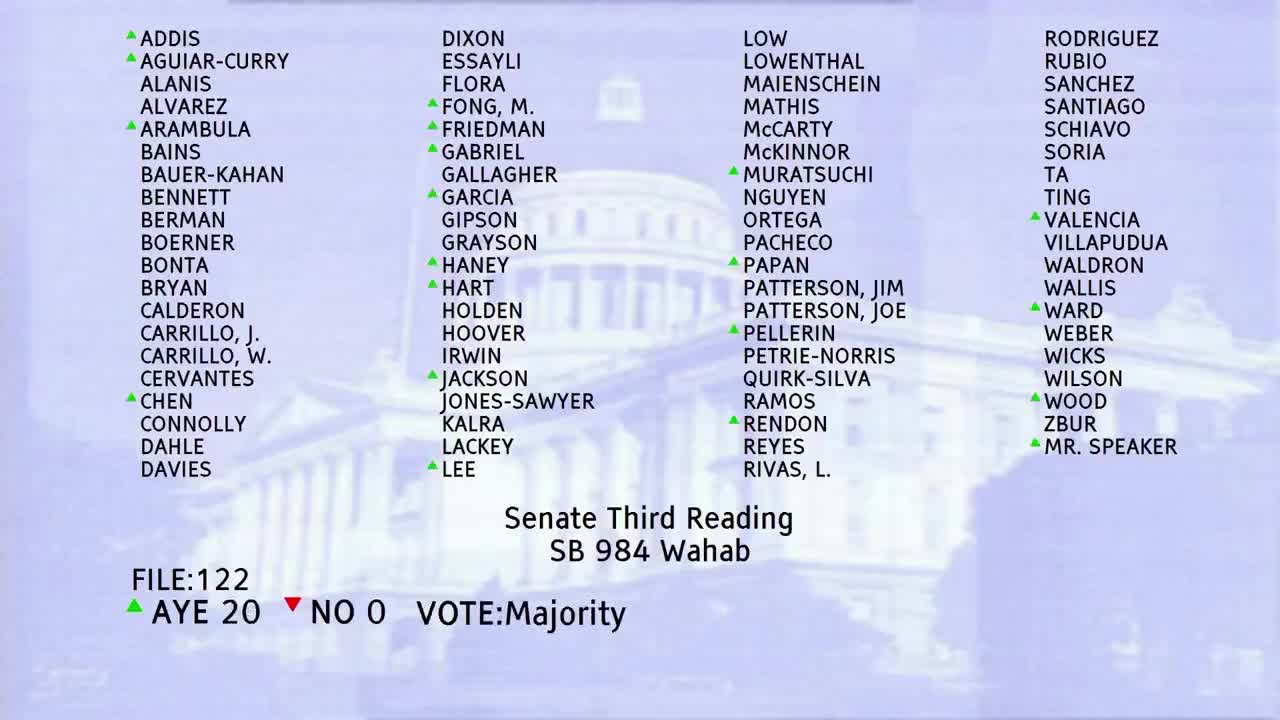 51SEC
Assembly Floor
 2MIN
Senate Floor
 1MIN
Senate Standing Committee on Appropriations
 19MIN
Senate Standing Committee on Education
 2MIN
Assembly Floor
 16MIN





