AB 1785: California Public Records Act.
- Session Year: 2023-2024
- House: Assembly
- Latest Version Date: 2024-09-25
Current Status:
Passed
(2024-09-25: Chaptered by Secretary of State - Chapter 551, Statutes of 2024.)
Introduced
In Committee
First Chamber
In Committee
Second Chamber
Enacted
What does this bill do?
The bill stops state and local agencies from posting on the internet an elected or appointed official’s home address, phone number, or the combination of the official’s name and assessor parcel number (the county property ID linked to the home) without the official’s written permission. It defines “publicly post” as making the information freely available online, allows legally required notices to be posted, and says the restriction is intended to protect officials’ safety and privacy.
The summary is provided by generative AI which can make mistakes. For original language, please view the details in the table below.
The California Public Records Act requires state and local agencies to make their records available for public inspection, unless an exemption from disclosure applies. The act prohibits a state or local agency from posting the home address or telephone number of any elected or appointed official on the internet without first obtaining the written permission of that individual.
This bill would instead prohibit a state or local agency from publicly posting, as defined, the home address, telephone number, or both the name and assessor parcel number associated with the home address of any elected or appointed official on the internet without first obtaining the written permission of that individual. By expanding the scope of a current provision and thereby increasing the duties of local agencies, the bill would impose a state-mandated local program.
The bill would state the intent of the Legislature to enact legislation relating to the above-described provision to accomplish specified goals.
Existing constitutional provisions require that a statute that limits the right of access to the meetings of public bodies or the writings of public officials and agencies be adopted with findings demonstrating the interest protected by the limitation and the need for protecting that interest.
This bill would make legislative findings to that effect.
The California Constitution requires the state to reimburse local agencies and school districts for certain costs mandated by the state. Statutory provisions establish procedures for making that reimbursement.
This bill would provide that no reimbursement is required by this act for a specified reason.
The California Public Records Act requires state and local agencies to make their records available for public inspection, unless an exemption from disclosure applies. The act prohibits a state or local agency from posting the home address or telephone number of any elected or appointed official on the internet without first obtaining the written permission of that individual.
This bill would instead prohibit a state or local agency from publicly posting, as defined, the home address, telephone number, or both the name and assessor parcel number associated with the home address of any elected or appointed official on the internet without first obtaining the written permission of that individual. By expanding the scope of a current provision and thereby increasing the duties of local agencies, the bill would impose a state-mandated local program.
The bill would state the intent of the legislature Legislature to enact legislation relating to the above-described provision to accomplish specified goals.
Existing constitutional provisions require that a statute that limits the right of access to the meetings of public bodies or the writings of public officials and agencies be adopted with findings demonstrating the interest protected by the limitation and the need for protecting that interest.
This bill would make legislative findings to that effect.
The California Constitution requires the state to reimburse local agencies and school districts for certain costs mandated by the state. Statutory provisions establish procedures for making that reimbursement.
This bill would provide that no reimbursement is required by this act for a specified reason.
The California Public Records Act requires state and local agencies to make their records available for public inspection, unless an exemption from disclosure applies. The act prohibits a state or local agency from posting the home address or telephone number of any elected or appointed official on the internet without first obtaining the written permission of that individual.
This bill would define home address, for purposes of the above provision, to include an assessors parcel number, which may be converted to a physical address through reference to other information made available online by the state or local agency. instead prohibit a state or local agency from publicly posting, as defined, the home address, telephone number, or both the name and assessor parcel number associated with the home address of any elected or appointed official on the internet without first obtaining the written permission of that individual. By expanding the scope of this a current provision and thereby increasing the duties of local agencies, the bill would impose a state-mandated local program.
The bill would state the intent of the legislature to enact legislation relating to the above-described provision to accomplish specified goals.
Existing constitutional provisions require that a statute that limits the right of access to the meetings of public bodies or the writings of public officials and agencies be adopted with findings demonstrating the interest protected by the limitation and the need for protecting that interest.
This bill would make legislative findings to that effect.
The California Constitution requires the state to reimburse local agencies and school districts for certain costs mandated by the state. Statutory provisions establish procedures for making that reimbursement.
This bill would provide that no reimbursement is required by this act for a specified reason.
The California Public Records Act requires state and local agencies to make their records available for public inspection, unless an exemption from disclosure applies. The act prohibits a state or local agency from posting the home address or telephone number of any elected or appointed official on the internet without first obtaining the written permission of that individual.
This bill would define home address, for purposes of the above provision, to include an assessors parcel number, which may be converted to a physical address through reference to other information made available online by the state or local agency. By expanding the scope of this provision and thereby increasing the duties of local agencies, the bill would impose a state-mandated local program.
Existing constitutional provisions require that a statute that limits the right of access to the meetings of public bodies or the writings of public officials and agencies be adopted with findings demonstrating the interest protected by the limitation and the need for protecting that interest.
This bill would make legislative findings to that effect.
The California Constitution requires the state to reimburse local agencies and school districts for certain costs mandated by the state. Statutory provisions establish procedures for making that reimbursement.
This bill would provide that no reimbursement is required by this act for a specified reason.
It is the intent of the Legislature to enact legislation that accomplishes all of the following:
(a)Does not limit or prohibit the access to recorded documents, indices, and assessor data through electronic means by business entities, including title companies, title plants, credit reporting agencies, or lenders.
(b)Does not cause databases that currently provide the public with online access to recorded documents, indices, and assessor data to be taken offline or otherwise made unavailable to the public.
(c)Clarifies existing law and closes a loophole in obtaining an elected or appointed officials home addresses through the public posting of assessor parcel numbers associated with that home address, while continuing to allow the public to inspect and obtain copies of public records that are in the possession of a county recorder or assessor during business hours.
SEC. 2.Section 7928.205 of the Government Code is amended to read:7928.205.(a)Notwithstanding subdivision (a) of Section 7922.545, no state or local agency shall publicly post the home address, telephone number, or both the name and assessor parcel number associated with the home address of any elected or appointed official on the internet without first obtaining the written permission of that individual.
(b)For purposes of this section, publicly post means to intentionally communicate or otherwise make available the information described in subdivision (a) on the internet in an unrestricted and publicly available manner.
(c)This section does not prohibit a state or local agency from publicly posting a legally required notice or publication of an elected or appointed official on the internet.
SEC. 3.The Legislature finds and declares that Section 1 of this act, which amends Section 7928.205 of the Government Code, imposes a limitation on the publics right of access to the meetings of public bodies or the writings of public officials and agencies within the meaning of Section 3 of Article I of the California Constitution. Pursuant to that constitutional provision, the Legislature makes the following findings to demonstrate the interest protected by this limitation and the need for protecting that interest:
It is necessary to protect the personal safety and privacy of public officials and their families by limiting access to assessors parcel numbers in connection with the home address of those individuals.
SEC. 4.No reimbursement is required by this act pursuant to Section 6 of Article XIIIB of the California Constitution because the only costs that may be incurred by a local agency or school district under this act would result from a legislative mandate that is within the scope of paragraph (7) of subdivision (b) of Section 3 of Article I of the California Constitution.
It is the intent of the Legislature to enact legislation that accomplishes all of the following:
(a)Does not limit or prohibit the access to recorded documents, indices, and assessor data through electronic means by business entities, including title companies, title plants, credit reporting agencies, or lenders.
(b)Does not cause databases that currently provide the public with online access to recorded documents, indices, and assessor data to be taken offline or otherwise made unavailable to the public.
(c)Clarifies existing law and closes a loophole in obtaining an elected or appointed officials home addresses through the public posting of assessor parcel numbers associated with that home address, while continuing to allow the public to inspect and obtain copies of public records that are in the possession of a county recorder or assessor during business hours.
SECTION 1.SEC. 2.Section 7928.205 of the Government Code is amended to read:7928.205.(a)No Notwithstanding subdivision (a) of Section 7922.545, no state or local agency shall publicly post the home address or telephone number address, telephone number, or both the name and assessor parcel number associated with the home address of any elected or appointed official on the internet without first obtaining the written permission of that individual.
(b)For purposes of this section, home address includes an assessors parcel number, which may be converted to a physical address through reference to other information made available online by the state or local agency. publicly post means to intentionally communicate or otherwise make available the information described in subdivision (a) on the internet in an unrestricted and publicly available manner.
SEC. 2.SEC. 3.The Legislature finds and declares that Section 1 of this act, which amends Section 7928.205 of the Government Code, imposes a limitation on the publics right of access to the meetings of public bodies or the writings of public officials and agencies within the meaning of Section 3 of Article I of the California Constitution. Pursuant to that constitutional provision, the Legislature makes the following findings to demonstrate the interest protected by this limitation and the need for protecting that interest:
It is necessary to protect the personal safety and privacy of public officials and their families by limiting access to assessors parcel numbers in connection with the home address of those individuals.
SEC. 3.SEC. 4.No reimbursement is required by this act pursuant to Section 6 of Article XIIIB of the California Constitution because the only costs that may be incurred by a local agency or school district under this act would result from a legislative mandate that is within the scope of paragraph (7) of subdivision (b) of Section 3 of Article I of the California Constitution.
(a)No state or local agency shall post the home address or telephone number of any elected or appointed official on the internet without first obtaining the written permission of that individual.
(b)For purposes of this section, home address includes an assessors parcel number, which may be converted to a physical address through reference to other information made available online by the state or local agency.
SEC. 2.The Legislature finds and declares that Section 1 of this act, which amends Section 7928.205 of the Government Code, imposes a limitation on the publics right of access to the meetings of public bodies or the writings of public officials and agencies within the meaning of Section 3 of Article I of the California Constitution. Pursuant to that constitutional provision, the Legislature makes the following findings to demonstrate the interest protected by this limitation and the need for protecting that interest:
It is necessary to protect the personal safety and privacy of public officials and their families by limiting access to assessors parcel numbers in connection with the home address of those individuals.
SEC. 3.No reimbursement is required by this act pursuant to Section 6 of Article XIII B of the California Constitution because the only costs that may be incurred by a local agency or school district under this act would result from a legislative mandate that is within the scope of paragraph (7) of subdivision (b) of Section 3 of Article I of the California Constitution.
|
Date
|
Status
|
|---|---|
| Sep 25, 2024 | Chaptered by Secretary of State - Chapter 551, Statutes of 2024. |
| Sep 25, 2024 | Approved by the Governor. |
| Sep 5, 2024 | Enrolled and presented to the Governor at 4 p.m. |
| Aug 27, 2024 | Senate amendments concurred in. To Engrossing and Enrolling. (Ayes 77. Noes 0.). |
| Aug 27, 2024 | Assembly Rule 77 suspended. |
| Aug 26, 2024 | In Assembly. Concurrence in Senate amendments pending. May be considered on or after August 28 pursuant to Assembly Rule 77. |
| Aug 26, 2024 | Read third time. Passed. Ordered to the Assembly. (Ayes 39. Noes 0.). |
| Jun 27, 2024 | Ordered to third reading. |
| Jun 27, 2024 | From Consent Calendar. |
| Jun 25, 2024 | Read second time. Ordered to Consent Calendar. |
| Jun 24, 2024 | From committee: Be ordered to second reading file pursuant to Senate Rule 28.8 and ordered to Consent Calendar. |
| Jun 12, 2024 | From committee: Do pass and re-refer to Com. on APPR with recommendation: To Consent Calendar. (Ayes 11. Noes 0.) (June 11). Re-referred to Com. on APPR. |
| May 29, 2024 | From committee chair, with author's amendments: Amend, and re-refer to committee. Read second time, amended, and re-referred to Com. on JUD. |
| May 8, 2024 | Referred to Com. on JUD. |
| Apr 25, 2024 | In Senate. Read first time. To Com. on RLS. for assignment. |
| Apr 25, 2024 | Read third time. Passed. Ordered to the Senate. (Ayes 75. Noes 0. Page 4996.) |
| Apr 18, 2024 | Read second time. Ordered to Consent Calendar. |
| Apr 17, 2024 | From committee: Do pass. To Consent Calendar. (Ayes 15. Noes 0.) (April 17). |
| Apr 4, 2024 | Re-referred to Com. on APPR. |
| Apr 3, 2024 | Read second time and amended. |
| Apr 2, 2024 | From committee: Amend, and do pass as amended and re-refer to Com. on APPR. with recommendation: To Consent Calendar. (Ayes 12. Noes 0.) (April 2). |
| Mar 6, 2024 | In committee: Hearing postponed by committee. |
| Jan 16, 2024 | Referred to Com. on JUD. |
| Jan 4, 2024 | From printer. May be heard in committee February 3. |
| Jan 3, 2024 | Read first time. To print. |
|
Date
|
Description
|
Location
|
Votes
|
|
|---|---|---|---|---|
| Aug 27, 2024 | AB 1785 Pacheco Concurrence in Senate Amendments | Assembly Floor |
Passed |
|
| Aug 26, 2024 | Assembly 3rd Reading AB1785 Pacheco By Umberg | Senate Floor |
Passed |
|
| Jun 11, 2024 | Do pass, but first be re-referred to the Committee on [Appropriations] with the recommendation: To Consent Calendar | Senate Standing Committee on Judiciary |
Passed |
|
| Apr 25, 2024 | AB 1785 Pacheco Consent Calendar Second Day Regular Session | Assembly Floor |
Passed |
|
| Apr 17, 2024 | Do pass. To Consent Calendar. | Assembly Standing Committee on Appropriations |
Passed |
|
| Apr 2, 2024 | Do pass as amended, and be re-referred to the Committee on [Appropriations] with recommendation: To Consent Calendar | Assembly Standing Committee on Judiciary |
Passed |
This list shows positions taken on this bill by organizations on the date displayed, which is linked to the original source.
Positions by individuals are not included.
|
Organization
|
Position
|
Date
|
|---|---|---|
| California Association of County Treasurers and Tax Collectors | ** Support | |
| California Association Of Joint Powers Authorities | ** Support | |
| California Judges Association | ** Support | |
| California Land Title Association | ** Support | |
| California State Association Of Counties | ** Support | |
| City of Thousand Oaks | ** Support | |
| Concern | ** Support | |
| Desert Water Agency | ** Support | |
| El Dorado Irrigation District | ** Support | |
| Judicial Council of California | ** Support | |
| Neutral | ** Support | |
| Palmdale Water District | ** Support | |
| Public Risk Innovation Solutions and Management | ** Support | |
| Rowland Water District | ** Support | |
| Rural County Representatives of California | ** Support | |
| Urban Counties of California | ** Support | |
| Walnut Valley Water District | ** Support | |
| Water Replenishment District Of Southern California | ** Support |
CONCURRENCE IN SENATE AMENDMENTS
CSA1 Bill Id:AB 1785
Author:(Pacheco)
As Amended Ver:May 29, 2024
Majority vote
SUMMARY
In order to clarify existing law, prohibits a public agency from publicly posting both the name and assessor parcel number associated with the home address of any elected or appointed official and defines "publicly post."
Major Provisions
- States the following:
It is the intent of the Legislature in enacting the changes in this bill to not limit or prohibit the access to recorded documents, indices, and assessor data through electronic means by business entities, such as title companies, title plants, credit reporting agencies, or lenders. Nor is it the intent of the Legislature that databases which currently provide the public with online access to recorded documents, indices, and assessor will be taken offline or otherwise made unavailable to the public as a result of the changes in this bill. It is the further intent of the Legislature that these changes are clarifying in nature and intend to close a loophole in obtaining elected or appointed official's home addresses through the public posting of assessor parcel numbers associated with that home address while continuing to allow the public to inspect and obtain copies of public records that are in the possession of a county recorder or assessor during business hours.
- Prohibits a public agency from publicly posting both the name and assessor parcel number associated with the home address, of any elected or appointed official on the internet without first obtaining the written permission of that individual. However, this does not prohibit a state or local agency from publicly posting a legally required notice or publication of an elected or appointed official on the internet.
- Defines "publicly post" to mean, "intentionally communicate or otherwise make available the information described in subdivision (a) on the internet in an unrestricted and publicly available manner."
Senate Amendments
Clarify that 2), above, does not prohibit a state or local agency from publicly posting a legally required notice or publication of an elected or appointed official on the internet.
COMMENTS
This bill, sponsored by the California Judges Association, seeks to clarify existing law, which prohibits a public agency from posting on the internet the home address or telephone number of an "elected or appointed official" (including a judge or court commissioner), to apply to specific types of data that can be combined to easily determine an official's home address. Specifically, this bill, as proposed to be amended, would prohibit a public agency from "publicly" posting on the internet both the name and assessor's parcel number associated with the home address of any elected or appointed official without first obtaining the written permission of that official.
Public Records and Public Access to Such Records. Access to information concerning the conduct of the people's business is a fundamental and necessary right of every person in this state. (Government Code Section 7921.000.) In 2004, the right of public access was enshrined in the California Constitution with the passage of Proposition 59 (Nov. 3, 2004, statewide general election), placed on the ballot by a unanimous vote of both houses of the Legislature. (SCA 1 (Burton, Ch. 1, Statutes of 2004), which amended the California Constitution to specifically protect the right of the public to access and obtain government records: "The people have the right of access to information concerning the conduct of the people's business, and therefore . . . the writings of public officials and agencies shall be open to public scrutiny." (California Constiution, Article I, Section 3 (b)(1)). In 2014, voters approved Proposition 42 (Jun 3, 2014, statewide direct primary election), placed on the ballot by a unanimous vote of both houses of the Legislature, (SCA 3 (Leno) Chapter 123, Statutes of 2013), to further increase public access to government records by requiring local agencies to comply with the CPRA and the Ralph M. Brown Act, and with any subsequent statutory enactment amending either act, as provided. (California Constiution, Article I, Section 3 (b)(7).)
Under the California Public Records Act (CPRA), public records are open to inspection at all times during the office hours of a public agency for inspection by the public, unless exempted. (Government Code Section 7922.525.) A public record is defined as any writing containing information relating to the conduct of the public's business prepared, owned, used, or retained by any public agency regardless of physical form or characteristics. (Government Code Section 7920.530.) The CPRA allows a public agency 10 days or, in specified "unusual circumstances," within 14 days of the 10-day period to respond to a request for the requested public record, and authorizes the agency to charge a fee for its "direct costs of duplication" of the record. (Government Code Sections 7922.530(a), 7922.535.)
Despite the CPRA's general rule making public records open to inspection and subject to disclosure, the CPRA provides exceptions when a document, or a portion thereof, is exempt from public disclosure. An exemption can be explicit in the CPRA itself, pursuant to another law that is incorporated by reference into the CPRA, or justified by the agency's determination--based on the facts of the particular case—that the public interest served by not disclosing the record clearly outweighs the public interest served by disclosure of the record. (See Government Code Sections 7922.000, 7922.525, 7922.530.)
Limits (and Inconsistencies) in Existing Law Regarding Disclosure of Address and Telephone Information Regarding Public Employees and Elected and Appointed Officials. Existing law provides a number of disclosure rules for public records that contain information about the home address and phone numbers of public employees and officials. These provisions generally act as exceptions to the CPRA's general rule that records in the possession of a public agency, including all content of those records, are open to the public and subject to disclosure upon request. These provisions are different (and arguably inconsistent), depending on whether the address or phone number at issue is for an employee or an official.
On one hand, information about the home address and phone number of a public employee is generally exempt from disclosure under the CPRA pursuant to Government Code Section 7928.300. Therefore, except in specified circumstances, an agency would be required to redact information about the employee's home address and /or phone number (and similar information about the employee) from any record that otherwise was open to the public and subject to disclosure. If the record were not otherwise public (because it contained only personal information, for example), the agency would be required to withhold the entire record.
On the other hand, existing law does not explicitly prohibit the inspection and disclosure of the home address and telephone number of an elected or appointed official in response to a CPRA request. An agency would be required to provide public access to any record, including home address information, unless the agency made an argument under Government Code Section 7922.000 that on the facts of the particular case, the public interest served by not disclosing the record clearly outweighed the public interest served by disclosure of the record.
However, existing law places limits on the disclosure of home address information, including the home addresses of elected and appointed officials. For example, existing law prohibits a state or local agency from posting on the internet the home address or the telephone number of any "elected or appointed official" without first obtaining the written permission of the official. (Government Code Section 7928.205.) Existing law does not prohibit disclosure of the record of the official's home address, however. The information can be inspected and copied at the office of a recorder or assessor because it does not appear to be exempt from public disclosure under the CPRA. Furthermore, a person who obtained the address or telephone information from a public agency would appear to be free to post the information on the internet (as long as they did not have malicious intent for doing so in violation of Government Code Section 7928.210(a)).
This bill. While Section Government Code 7928.205 prohibits public agencies from posting on the internet the home addresses of elected and appointed officials, some county agencies are posting other information on the internet that can easily be used to determine the elected or appointed official's home address. Specifically, according to the author and sponsor, certain county recorder office's websites provide information through the grantor-grantee databases that leads, when searching for an individual's name, to an assessor's parcel number. Then, by using the same county assessor's website and searching by the assessor's parcel number, a physical home address can be obtained. According to the author, this two-step process can be accomplished entirely online within minutes and poses a significant risk to elected and appointed officials and their families, undermining the effectiveness of existing law.
This bill prohibits a state or local agency from publicly posting, as defined, the name and assessor parcel number associated with the home address of any elected or appointed official on the internet without first obtaining written permission. Senate amendments clarify that the bill does not prohibit a state or local agency from publicly posting a legally required notice or publication of an elected or appointed official on the internet.
According to the Author
Nationwide, elected and appointed officials face rising threats and violence against themselves and their family members. We have seen judges and their family members assassinated in their homes and threats to all levels of elected and appointed officials. This escalating danger continues to underscore the need to provide safeguards from the improper disclosure of official's personal and sensitive information.
…Several counties, like Los Angeles and Santa Clara, ensure this official's information is not available on their county recorder or assessor websites by not positing any searchable databases on the internet. However, other counties have posted searchable databases with protections to shield certain aspects from online positing.
Arguments in Support
Sponsor California Judges Association writes the following in support of the bill:
Nationwide, elected and appointed officials, including judges and court commissioners, face rising threats and violence against themselves and their family members. According to the U.S. Marshals Service, the entity in charge of protecting federal judges, they assessed 5,873 threats and inappropriate communications against the judiciary between 2021 and 2022. There have been numerous instances of individuals with malicious intent using information found in public records to locate the address of an elected or appointed official…
Presently, a critical gap exists in state law meant to protect the online posting of officials' personal information. Specifically, state law prohibits the posting of an official's home address and telephone numbers by any state or local agency without the public official's permission. Counties have had a less than uniform approach to complying with this existing prohibition. … By searching an individual's name, results are produced which contain within conveyance documents an assessor's parcel number. Then, by using the county assessor's website and searching for the assessor's parcel number obtained from the county recorder's website, a physical home address can be produced. This two-step process can be accomplished entirely online within seconds and poses a significant risk to elected and appointed officials and their families.
AB 1785 seeks to close this loophole by prohibiting the posting of an assessor's parcel number which can be converted into a home address.
Arguments in Opposition
No opposition on file.
FISCAL COMMENTS
According to the Senate Appropriations Committee, pursuant to Senate Rule 28.8, negligible state costs.
VOTES:
ASM JUDICIARY: 12-0-0
YES: Kalra, Dixon, Bauer-Kahan, Bryan, Connolly, Haney, Maienschein, McKinnor, Pacheco, Reyes, Sanchez, Waldron
ASM APPROPRIATIONS: 15-0-0
YES: Wicks, Sanchez, Arambula, Bryan, Calderon, Wendy Carrillo, Dixon, Mike Fong, Grayson, Haney, Hart, Jim Patterson, Pellerin, Ta, Villapudua
ASSEMBLY FLOOR: 75-0-5
YES: Addis, Aguiar-Curry, Alanis, Alvarez, Arambula, Bains, Bauer-Kahan, Bennett, Berman, Bonta, Bryan, Calderon, Juan Carrillo, Wendy Carrillo, Cervantes, Chen, Connolly, Davies, Dixon, Essayli, Flora, Mike Fong, Vince Fong, Friedman, Gabriel, Garcia, Gipson, Grayson, Haney, Holden, Hoover, Irwin, Jackson, Jones-Sawyer, Kalra, Lackey, Lee, Low, Lowenthal, Maienschein, McCarty, McKinnor, Muratsuchi, Stephanie Nguyen, Ortega, Pacheco, Papan, Jim Patterson, Joe Patterson, Pellerin, Petrie-Norris, Quirk-Silva, Ramos, Rendon, Reyes, Luz Rivas, Rodriguez, Blanca Rubio, Sanchez, Santiago, Schiavo, Soria, Ta, Ting, Valencia, Villapudua, Waldron, Wallis, Ward, Weber, Wicks, Wilson, Wood, Zbur, Robert Rivas
ABS, ABST OR NV: Boerner, Megan Dahle, Gallagher, Hart, Mathis
SENATE FLOOR: 40-0-0
YES: Allen, Alvarado-Gil, Archuleta, Ashby, Atkins, Becker, Blakespear, Bradford, Caballero, Cortese, Dahle, Dodd, Durazo, Eggman, Glazer, Gonzalez, Grove, Hurtado, Jones, Laird, Limón, McGuire, Menjivar, Min, Newman, Nguyen, Niello, Ochoa Bogh, Padilla, Portantino, Roth, Rubio, Seyarto, Skinner, Smallwood-Cuevas, Stern, Umberg, Wahab, Wiener, Wilk
UPDATED
VERSION: May 29, 2024
CONSULTANT: Alison Merrilees / JUD. / (916) 319-2334 FN: 0004503
CONCURRENCE IN SENATE AMENDMENTS
CSA1 Bill Id:AB 1785
Author:(Pacheco)
As Amended Ver:May 29, 2024
Majority vote
SUMMARY
In order to clarify existing law, prohibits a public agency from publicly posting both the name and assessor parcel number associated with the home address of any elected or appointed official and defines "publicly post."
Major Provisions
- States the following:
It is the intent of the Legislature in enacting the changes in this bill to not limit or prohibit the access to recorded documents, indices, and assessor data through electronic means by business entities, such as title companies, title plants, credit reporting agencies, or lenders. Nor is it the intent of the Legislature that databases which currently provide the public with online access to recorded documents, indices, and assessor will be taken offline or otherwise made unavailable to the public as a result of the changes in this bill. It is the further intent of the Legislature that these changes are clarifying in nature and intend to close a loophole in obtaining elected or appointed official's home addresses through the public posting of assessor parcel numbers associated with that home address while continuing to allow the public to inspect and obtain copies of public records that are in the possession of a county recorder or assessor during business hours.
- Prohibits a public agency from publicly posting both the name and assessor parcel number associated with the home address, of any elected or appointed official on the internet without first obtaining the written permission of that individual. However, this does not prohibit a state or local agency from publicly posting a legally required notice or publication of an elected or appointed official on the internet.
- Defines "publicly post" to mean, "intentionally communicate or otherwise make available the information described in subdivision (a) on the internet in an unrestricted and publicly available manner."
Senate Amendments
Clarify that 2), above, does not prohibit a state or local agency from publicly posting a legally required notice or publication of an elected or appointed official on the internet.
COMMENTS
This bill, sponsored by the California Judges Association, seeks to clarify existing law, which prohibits a public agency from posting on the internet the home address or telephone number of an "elected or appointed official" (including a judge or court commissioner), to apply to specific types of data that can be combined to easily determine an official's home address. Specifically, this bill, as proposed to be amended, would prohibit a public agency from "publicly" posting on the internet both the name and assessor's parcel number associated with the home address of any elected or appointed official without first obtaining the written permission of that official.
Public Records and Public Access to Such Records. Access to information concerning the conduct of the people's business is a fundamental and necessary right of every person in this state. (Government Code Section 7921.000.) In 2004, the right of public access was enshrined in the California Constitution with the passage of Proposition 59 (Nov. 3, 2004, statewide general election), placed on the ballot by a unanimous vote of both houses of the Legislature. (SCA 1 (Burton, Ch. 1, Statutes of 2004), which amended the California Constitution to specifically protect the right of the public to access and obtain government records: "The people have the right of access to information concerning the conduct of the people's business, and therefore . . . the writings of public officials and agencies shall be open to public scrutiny." (California Constiution, Article I, Section 3 (b)(1)). In 2014, voters approved Proposition 42 (Jun 3, 2014, statewide direct primary election), placed on the ballot by a unanimous vote of both houses of the Legislature, (SCA 3 (Leno) Chapter 123, Statutes of 2013), to further increase public access to government records by requiring local agencies to comply with the CPRA and the Ralph M. Brown Act, and with any subsequent statutory enactment amending either act, as provided. (California Constiution, Article I, Section 3 (b)(7).)
Under the California Public Records Act (CPRA), public records are open to inspection at all times during the office hours of a public agency for inspection by the public, unless exempted. (Government Code Section 7922.525.) A public record is defined as any writing containing information relating to the conduct of the public's business prepared, owned, used, or retained by any public agency regardless of physical form or characteristics. (Government Code Section 7920.530.) The CPRA allows a public agency 10 days or, in specified "unusual circumstances," within 14 days of the 10-day period to respond to a request for the requested public record, and authorizes the agency to charge a fee for its "direct costs of duplication" of the record. (Government Code Sections 7922.530(a), 7922.535.)
Despite the CPRA's general rule making public records open to inspection and subject to disclosure, the CPRA provides exceptions when a document, or a portion thereof, is exempt from public disclosure. An exemption can be explicit in the CPRA itself, pursuant to another law that is incorporated by reference into the CPRA, or justified by the agency's determination--based on the facts of the particular case—that the public interest served by not disclosing the record clearly outweighs the public interest served by disclosure of the record. (See Government Code Sections 7922.000, 7922.525, 7922.530.)
Limits (and Inconsistencies) in Existing Law Regarding Disclosure of Address and Telephone Information Regarding Public Employees and Elected and Appointed Officials. Existing law provides a number of disclosure rules for public records that contain information about the home address and phone numbers of public employees and officials. These provisions generally act as exceptions to the CPRA's general rule that records in the possession of a public agency, including all content of those records, are open to the public and subject to disclosure upon request. These provisions are different (and arguably inconsistent), depending on whether the address or phone number at issue is for an employee or an official.
On one hand, information about the home address and phone number of a public employee is generally exempt from disclosure under the CPRA pursuant to Government Code Section 7928.300. Therefore, except in specified circumstances, an agency would be required to redact information about the employee's home address and /or phone number (and similar information about the employee) from any record that otherwise was open to the public and subject to disclosure. If the record were not otherwise public (because it contained only personal information, for example), the agency would be required to withhold the entire record.
On the other hand, existing law does not explicitly prohibit the inspection and disclosure of the home address and telephone number of an elected or appointed official in response to a CPRA request. An agency would be required to provide public access to any record, including home address information, unless the agency made an argument under Government Code Section 7922.000 that on the facts of the particular case, the public interest served by not disclosing the record clearly outweighed the public interest served by disclosure of the record.
However, existing law places limits on the disclosure of home address information, including the home addresses of elected and appointed officials. For example, existing law prohibits a state or local agency from posting on the internet the home address or the telephone number of any "elected or appointed official" without first obtaining the written permission of the official. (Government Code Section 7928.205.) Existing law does not prohibit disclosure of the record of the official's home address, however. The information can be inspected and copied at the office of a recorder or assessor because it does not appear to be exempt from public disclosure under the CPRA. Furthermore, a person who obtained the address or telephone information from a public agency would appear to be free to post the information on the internet (as long as they did not have malicious intent for doing so in violation of Government Code Section 7928.210(a)).
This bill. While Section Government Code 7928.205 prohibits public agencies from posting on the internet the home addresses of elected and appointed officials, some county agencies are posting other information on the internet that can easily be used to determine the elected or appointed official's home address. Specifically, according to the author and sponsor, certain county recorder office's websites provide information through the grantor-grantee databases that leads, when searching for an individual's name, to an assessor's parcel number. Then, by using the same county assessor's website and searching by the assessor's parcel number, a physical home address can be obtained. According to the author, this two-step process can be accomplished entirely online within minutes and poses a significant risk to elected and appointed officials and their families, undermining the effectiveness of existing law.
This bill prohibits a state or local agency from publicly posting, as defined, the name and assessor parcel number associated with the home address of any elected or appointed official on the internet without first obtaining written permission. Senate amendments clarify that the bill does not prohibit a state or local agency from publicly posting a legally required notice or publication of an elected or appointed official on the internet.
According to the Author
Nationwide, elected and appointed officials face rising threats and violence against themselves and their family members. We have seen judges and their family members assassinated in their homes and threats to all levels of elected and appointed officials. This escalating danger continues to underscore the need to provide safeguards from the improper disclosure of official's personal and sensitive information.
…Several counties, like Los Angeles and Santa Clara, ensure this official's information is not available on their county recorder or assessor websites by not positing any searchable databases on the internet. However, other counties have posted searchable databases with protections to shield certain aspects from online positing.
Arguments in Support
Sponsor California Judges Association writes the following in support of the bill:
Nationwide, elected and appointed officials, including judges and court commissioners, face rising threats and violence against themselves and their family members. According to the U.S. Marshals Service, the entity in charge of protecting federal judges, they assessed 5,873 threats and inappropriate communications against the judiciary between 2021 and 2022. There have been numerous instances of individuals with malicious intent using information found in public records to locate the address of an elected or appointed official…
Presently, a critical gap exists in state law meant to protect the online posting of officials' personal information. Specifically, state law prohibits the posting of an official's home address and telephone numbers by any state or local agency without the public official's permission. Counties have had a less than uniform approach to complying with this existing prohibition. … By searching an individual's name, results are produced which contain within conveyance documents an assessor's parcel number. Then, by using the county assessor's website and searching for the assessor's parcel number obtained from the county recorder's website, a physical home address can be produced. This two-step process can be accomplished entirely online within seconds and poses a significant risk to elected and appointed officials and their families.
AB 1785 seeks to close this loophole by prohibiting the posting of an assessor's parcel number which can be converted into a home address.
Arguments in Opposition
No opposition on file.
FISCAL COMMENTS
According to the Senate Appropriations Committee, pursuant to Senate Rule 28.8, negligible state costs.
VOTES:
ASM JUDICIARY: 12-0-0
YES: Kalra, Dixon, Bauer-Kahan, Bryan, Connolly, Haney, Maienschein, McKinnor, Pacheco, Reyes, Sanchez, Waldron
ASM APPROPRIATIONS: 15-0-0
YES: Wicks, Sanchez, Arambula, Bryan, Calderon, Wendy Carrillo, Dixon, Mike Fong, Grayson, Haney, Hart, Jim Patterson, Pellerin, Ta, Villapudua
ASSEMBLY FLOOR: 75-0-5
YES: Addis, Aguiar-Curry, Alanis, Alvarez, Arambula, Bains, Bauer-Kahan, Bennett, Berman, Bonta, Bryan, Calderon, Juan Carrillo, Wendy Carrillo, Cervantes, Chen, Connolly, Davies, Dixon, Essayli, Flora, Mike Fong, Vince Fong, Friedman, Gabriel, Garcia, Gipson, Grayson, Haney, Holden, Hoover, Irwin, Jackson, Jones-Sawyer, Kalra, Lackey, Lee, Low, Lowenthal, Maienschein, McCarty, McKinnor, Muratsuchi, Stephanie Nguyen, Ortega, Pacheco, Papan, Jim Patterson, Joe Patterson, Pellerin, Petrie-Norris, Quirk-Silva, Ramos, Rendon, Reyes, Luz Rivas, Rodriguez, Blanca Rubio, Sanchez, Santiago, Schiavo, Soria, Ta, Ting, Valencia, Villapudua, Waldron, Wallis, Ward, Weber, Wicks, Wilson, Wood, Zbur, Robert Rivas
ABS, ABST OR NV: Boerner, Megan Dahle, Gallagher, Hart, Mathis
UPDATED
VERSION: May 29, 2024
CONSULTANT: Alison Merrilees / JUD. / (916) 319-2334 FN: 0004503
SENATE RULES COMMITTEE Office of Senate Floor Analyses (916) 651-1520 Fax: (916) 327-4478 | AB 1785 |
THIRD READING
Bill No: AB 1785
Author: Pacheco (D)
Amended: 5/29/24 in Senate
Vote: 21
SENATE JUDICIARY COMMITTEE: 11-0, 6/11/24
AYES: Umberg, Wilk, Allen, Ashby, Caballero, Durazo, Laird, Niello, Roth, Stern, Wahab
SENATE APPROPRIATIONS COMMITTEE: Senate Rule 28.8
ASSEMBLY FLOOR: 75-0, 4/25/24 (Consent) - See last page for vote
SUBJECT: California Public Records Act
SOURCE: California Judges Association
DIGEST:
This bill prohibits a state or local agency from publicly posting, as defined, the name and assessor parcel number associated with the home address of any elected or appointed official on the internet without first obtaining written permission.
ANALYSIS:
Existing law:
- Provides, pursuant to the California Constitution, that the people have the right of access to information concerning the conduct of the people’s business, and, therefore, the meetings of public bodies and the writings of public officials and agencies are required to be open to public scrutiny. (Cal. const. art. I, § 3(b)(1).)
- Requires a statute to be broadly construed if it furthers the people’s right of access, and narrowly construed if it limits the right of access. (Cal. const. art. I, § 3(b)(1))
- Requires a statute that limits the public’s right of access to be adopted with findings demonstrating the interest protected by the limitation and the need for protecting that interest. (Cal. const. art. I, § 3(b)(1))
- Governs the disclosure of information collected and maintained by public agencies pursuant to the California Public Records Act (CPRA). (Government (Gov.) Code §§ 7920.000 et seq.)
- States that, the Legislature, mindful of the right of individuals to privacy, finds and declares that access to information concerning the conduct of the people’s business is a fundamental and necessary right of every person in this state. (Gov. Code § 7921.000)
- Defines “public records” as any writing containing information relating to the conduct of the public’s business prepared, owned, used, or retained by any state or local agency regardless of physical form or characteristics. (Gov. Code § 7920.530.)
- Defines “public agency” as any state or local agency. (Gov. Code § 7920.525(a).)
- Provides that all public records are open to inspection at all times during the office hours of a state or local agency and every person has a right to inspect any public record, unless the record is exempt from public disclosure. Any reasonably segregable portion of a record shall be available for inspection by any person requesting the record after deletion of the portions that are exempted by law. (Gov. Code § 7922.525)
Some records are prohibited from being disclosed and other records are permissively exempted from being disclosed. (See e.g. Gov. Code §§ 7920.505 & 7922.200)
There are several general categories of documents or information that are permissively exempt from disclosure under the CPRA essentially due to the character of the information. The exempt information can be withheld by the public agency with custody of the information, but it also may be disclosed if it is shown that the public’s interest in disclosure outweighs the public’s interest in non-disclosure of the information. (CBS, Inc. v. Block (1986) 42 Cal.3d 646, at 652)
- Provides that a public agency may comply with the requirement in 3), above, by posting any public record on its website and, in response to a request for a public record posted on the website, directing a member of the public to the location on the website where the public record is posted. However, if after the public agency directs a member of the public to their website, that member of the public requests a copy of the public record due to an inability to access or reproduce the public record from the internet website, the public agency must promptly provide a copy of the public record, as specified. (Gov. Code § 7922.545)
- Prohibits a state or local agency from posting the address or telephone number of any elected or appointed official on the internet without first obtaining the written permission of the individual. (Gov. Code § 7928.205)
An “elected or appointed official” incudes, but is not limited to, all of the following: a state constitutional officer; a member of the Legislature; a judge or court commissioner; a district attorney; a public defender; a member of a city council; a member of a board of supervisors; an appointee of the Governor; an appointee of the Legislature; a mayor; a city attorney; a police chief or sheriff; a public safety official; a state administrative law judge; a federal judge or federal defender; a member of the United States Congress or appointee of the President of the United States; a judge of a federally recognized Indian tribe. (Gov. Code § 7920.500)
This bill:
- Prohibits a state or local agency from publicly posting the name and assessor parcel number associated with the home address of any elected or appointed official on the internet without first obtaining written permission in addition to prohibiting the posting of their home address or telephone number.
- Defines “publicly post” to mean intentionally communicating or otherwise making available the information described in 1), above, on the internet in an unrestricted and publicly available manner.
- States it is the intent of the Legislature to enact legislation that accomplishes all of the following:
- Does not limit or prohibit the access to recorded documents, indices, and assessor data through electronic means by business entities, including title companies, title plants, credit reporting agencies, or lenders.
- Does not cause databases that currently provide the public with online access to recorded documents, indices, and assessor data to be taken offline or otherwise made unavailable to the public.
- Clarifies existing law and closes a loophole in obtaining an elected or appointed official’s home addresses through the public posting of assessor parcel numbers associated with that home address, while continuing to allow the public to inspect and obtain copies of public records that are in the possession of a county recorder or assessor during business hours.
- Specifies that these provisions do not prohibit a state or local agency from publicly posting a legally required notice or publication of an elected or appointed official on the internet.
- States that the Legislature finds and declares that the limitation on the access to public records in this bill is necessary to protect the personal safety and privacy of public officials and their families by limiting access to assessor’s parcel numbers in connection with the home address of those individuals.
Comments
Existing law already prohibits a state or local agency from publicly posting the home address of an elected or appointed official. (Gov. Code Section 7928.205) However, the author and sponsor of this bill state that some county agencies post information online that can be linked together to find the home address of an elected or appointed official. For example, certain county websites provide information through the grantor-grantee data bases where anyone can search an individual’s name and get results that contain an assessor’s parcel number. A person can then search that same website for the assessor’s parcel number and obtain the home address associated with that parcel number. According to the author and sponsor, this two-step process can be accomplished entirely online within minutes and poses a significant risk to elected and appointed officials and their families. This bill seeks to prevent this from happening by prohibiting a state or local agency from publicly posting the name and assessor parcel number associated with the home address of any elected or appointed official on the internet without first obtaining written permission of the elected or appointed official. This bill defines publicly posting as intentionally communicating or otherwise making available the information described in subdivision (a) on the internet in an unrestricted and publicly available manner.
Under the CPRA, elected or appointed official is defined to include, but is not limited to, all of the following: a state constitutional officer; a member of the Legislature; a judge or court commissioner; a district attorney; a public defender; a member of a city council; a member of a board of supervisors; an appointee of the Governor; an appointee of the Legislature; a mayor; a city attorney; a police chief or sheriff; a public safety official; a state administrative law judge; a federal judge or federal defender; a member of the United States Congress or appointee of the President of the United States; a judge of a federally recognized Indian tribe. (Gov. Code Section 7920.500) In order to assuage some concerns raised by various stakeholders this bill also states it is the intent of the Legislature in enacting this legislation to accomplish all of the following:
- Does not limit or prohibit the access to recorded documents, indices, and assessor data through electronic means by business entities, including title companies, title plants, credit reporting agencies, or lenders;
- Does not cause databases that currently provide the public with online access to recorded documents, indices, and assessor data to be taken offline or otherwise made unavailable to the public; and
- Clarifies existing law and closes a loophole in obtaining an elected or appointed official’s home addresses through the public posting of assessor parcel numbers associated with that home address, while continuing to allow the public to inspect and obtain copies of public records that are in the possession of a county recorder or assessor during business hours.
Access to information concerning the conduct of the people’s business is a fundamental and necessary right of every person in this state. (Gov. Cod Section 7921.000) In 2004, the right of public access was enshrined in the California Constitution with the passage of Proposition 59 (Nov. 3, 2004, statewide general election),[1] which amended the California Constitution to specifically protect the right of the public to access and obtain government records: “The people have the right of access to information concerning the conduct of the people’s business, and therefore . . . the writings of public officials and agencies shall be open to public scrutiny.” (Cal. Const., art. I, sec. 3 (b)(1)) In 2014, voters approved Proposition 42 (Jun. 3, 2014, statewide direct primary election)[2] to further increase public access to government records by requiring local agencies to comply with the CPRA and the Ralph M. Brown Act[3], and with any subsequent statutory enactment amending either act, as provided. (Cal. Const., art. I, sec. 3 (b)(7))
Under the CPRA, public records are open to inspection by the public at all times during the office hours of the agency, unless exempted from disclosure. (Gov. Cod § 7922.252) A public record is defined as any writing containing information relating to the conduct of the public’s business prepared, owned, used, or retained by any public agency regardless of physical form or characteristics. (Gov. Code § 7920.530) There are several general categories of documents or information that are permissively exempt from disclosure under the CPRA essentially due to the character of the information. The exempt information can be withheld by the public agency with custody of the information, but it also may be disclosed if it is shown that the public’s interest in disclosure outweighs the public’s interest in non-disclosure of the information. (CBS, Inc. v. Block (1986) 42 Cal.3d 646, at 652). Additionally some records are prohibited from disclosure or are specifically stated to not be public records. (see Gov. Code § 7924.110(a))
By prohibiting a state or local agency from publicly posting this information, this bill arguably limits access to public records. This bill states this limitation is necessary to protect the personal safety and privacy of public officials and their families by limiting access to assessor’s parcel numbers in connection with the home address of those individuals. In light of the concerns raised by this bill, this limitation seems warranted and consistent with existing law, which already prohibits a state or local agency from publicly posting the home address of an elected or appointed official.
The CPRA prohibits a person, business, or association from publicly posting or publicly displaying on the internet the home address or telephone number of any elected or appointed official if that official has, either directly or through an agent, made a written demand of that person, business, or association to not disclose the official’s home address or telephone number. (Gov. Code § 7928.215(b); previously Gov. Code § 6254.21(c)(1))[4] In 2017, this statute was challenged on several grounds, including that it violates the First Amendment of the U.S. Constitution. (Publius v. Boyer-Vine (E.D. Cal. 2017) 237 F.Supp.3d 997.) In Publius, the plaintiff, maintained a political blog and in response to the Legislature enacting gun control legislation posted the names, home addresses and phone numbers of all Legislators who voted for the legislation. (Id. at 1004.) The legislation in question required the creation of a database that would contain the driver’s license, residential address, telephone number, and date of birth of anyone who purchased or transferred ammunition in California. (Id. at 1003-04.) Shortly after the plaintiff posted the Legislator’s personally identifying information, members of the Legislature received threatening phone calls and social media messages. (Id. at 1004-05.) Representatives for the Legislature sent a written demand seeking the immediate take down of the posted information and WordPress, the blogging platform, immediately removed the blog entry. (Id. at 1005-06.)
The plaintiff brought a suit alleging several causes, including that the statute violated the First Amendment of the U.S. Constitution. The basis for enacting this provision was to protect the personal safety of covered officials and their families, which is a state interest of the highest order; however, a federal district court held that the statute violated the First Amendment’s overbreadth doctrine. (Id. at 1019.) The district court found that the statute was not narrowly tailored; and that is was both overinclusive because it prohibited publication of the information, regardless of whether the information was widely available to the public or had previously been disclosed, and underinclusive because it irrationally punished just publication on the internet but did not address other forms of publication, such as in newspapers. (Id. at 1020.)
The provision of existing law that this bill is amending— prohibiting a state or local agency from posting the home address or telephone number of any elected or appointed official on the internet without first obtaining the written permission of that individual—was not addressed in Publius and does not seem to have been otherwise challenged on First Amendment grounds. Arguably, the same issues raised in Publius could potentially be raised against this statute; however, a distinction can be made as the statute in Publius applied to anyone positing certain information where this bill only applies to local or state agencies posting specified information.
FISCAL EFFECT: Appropriation: No Fiscal Com.: Yes Local: Yes
SUPPORT: (Verified 6/25/24)
California Judges Association (source)
California Association of County Treasurers and Tax Collectors
City of Thousand Oaks
Desert Water Agency
El Dorado Irrigation District
Judicial Council of California
Palmdale Water District
Public Risk Innovation, Solutions, and Management
Rowland Water District
Walnut Valley Water District
Water Replenishment District of Southern California
OPPOSITION: (Verified 6/25/24)
None received
ARGUMENTS IN SUPPORT: According to the author:
Nationwide, elected and appointed officials face rising threats and violence against themselves and their family members. We have seen judges and their family members assassinated in their homes and threats to all levels of elected and appointed officials. This escalating danger continues to underscore the need to provide safeguards from the improper disclosure of official’s personal and sensitive information.
California has a long history of protecting this personal and sensitive information by prohibiting the posting of this information on state and local agency websites. Counties have acted differently in complying with this existing prohibition. Several counties, like Los Angeles and Santa Clara, ensure this official’s information is not available on their county recorder or assessor websites by not positing any searchable databases on the internet. However, other counties have posted searchable databases with protections to shield certain aspects from online posting.
In these counties which post these databases, we have discovered a potential loophole which poses a risk to elected and appointed officials. AB 1785 seeks to close this loophole by prohibiting the posting of an assessor’s parcel number which can be converted into a home address. We believe this modest clarification can provide further certainty that our state and local agencies are not inadvertently disclosing this sensitive and personal information. We have worked with the County Recorders, County Assessors, County Tax Collector, real estate, and financial services industries to address any unintended consequences by closing this loophole.
The California Association of County Treasurers and Tax Collectors (CACTTC) writes in support stating:
AB 1785 furthers existing law, which prohibits a public agency from posting on the internet the home address or telephone number of an “elected or appointed official” (including a judge or court commissioner) by including specific types of data that can be combined to easily determine an official’s home address. CACTTC fully understands and appreciates the need to ensure the safety of elected and appointed officials, and their need and right to feel safe in their homes with their families.
The May 29, 2024 amends provide critical certainty for Tax Collectors, as they provide important clarification for county tax collectors regarding their ability to lawfully notify property owners in default through existing, mandated publications. AB 1785 now provides vital clarity to Tax Collectors in what situations the address or APN of such an official may be published. Examples include when a property becomes tax defaulted and eligible for a property tax sale. The measure provides the balance necessary to ensure that administration of property tax law can be continue in a fair and sensible way.
For these reasons, CACTTC is pleased to support AB 1785 as amended, and urges your Aye vote on this measure.
ASSEMBLY FLOOR: 75-0, 4/25/24
AYES: Addis, Aguiar-Curry, Alanis, Alvarez, Arambula, Bains, Bauer-Kahan, Bennett, Berman, Bonta, Bryan, Calderon, Juan Carrillo, Wendy Carrillo, Cervantes, Chen, Connolly, Davies, Dixon, Essayli, Flora, Mike Fong, Vince Fong, Friedman, Gabriel, Garcia, Gipson, Grayson, Haney, Holden, Hoover, Irwin, Jackson, Jones-Sawyer, Kalra, Lackey, Lee, Low, Lowenthal, Maienschein, McCarty, McKinnor, Muratsuchi, Stephanie Nguyen, Ortega, Pacheco, Papan, Jim Patterson, Joe Patterson, Pellerin, Petrie-Norris, Quirk-Silva, Ramos, Rendon, Reyes, Luz Rivas, Rodriguez, Blanca Rubio, Sanchez, Santiago, Schiavo, Soria, Ta, Ting, Valencia, Villapudua, Waldron, Wallis, Ward, Weber, Wicks, Wilson, Wood, Zbur, Robert Rivas
NO VOTE RECORDED: Boerner, Megan Dahle, Gallagher, Hart, Mathis
Prepared by: Amanda Mattson / JUD. / (916) 651-4113
6/27/24 15:38:47
**** END ****
Prop. 59 was placed on the ballot by a unanimous vote of both houses of the Legislature. (SCA 1, Burton, Chapter 1, Statutes of 2004)) ↑
Prop. 42 was placed on the ballot by a unanimous vote of both houses of the Legislature. (SCA 3,Leno, Chapter. 123, Statutes of. 2013)) ↑
The Ralph M. Brown Act is the open meetings laws that applies to local agencies. (Gov. Code §§ 59450 et. seq.) ↑
In 2021 the CPRA was recodified by AB 473 (Chow, Chapter 614, Statutes of. 2021). Prior to the recodification, the equivalent to Section 7928.215 of the Government Code was Section 6254.21(c)(1) of that code. As such, the Plubius case refers to Section 6254.21(c)(1) throughout. ↑
SENATE RULES COMMITTEE Office of Senate Floor Analyses (916) 651-1520 Fax: (916) 327-4478 | AB 1785 |
CONSENT
Bill No: AB 1785
Author: Pacheco (D)
Amended: 5/29/24 in Senate
Vote: 21
SENATE JUDICIARY COMMITTEE: 11-0, 6/11/24
AYES: Umberg, Wilk, Allen, Ashby, Caballero, Durazo, Laird, Niello, Roth, Stern, Wahab
SENATE APPROPRIATIONS COMMITTEE: Senate Rule 28.8
ASSEMBLY FLOOR: 75-0, 4/25/24 (Consent) - See last page for vote
SUBJECT: California Public Records Act
SOURCE: California Judges Association
DIGEST:
This bill prohibits a state or local agency from publicly posting, as defined, the name and assessor parcel number associated with the home address of any elected or appointed official on the internet without first obtaining written permission.
ANALYSIS:
Existing law:
- Provides, pursuant to the California Constitution, that the people have the right of access to information concerning the conduct of the people’s business, and, therefore, the meetings of public bodies and the writings of public officials and agencies are required to be open to public scrutiny. (Cal. const. art. I, § 3(b)(1).)
- Requires a statute to be broadly construed if it furthers the people’s right of access, and narrowly construed if it limits the right of access. (Cal. const. art. I, § 3(b)(1).)
- Requires a statute that limits the public’s right of access to be adopted with findings demonstrating the interest protected by the limitation and the need for protecting that interest. (Cal. const. art. I, § 3(b)(1).)
- Governs the disclosure of information collected and maintained by public agencies pursuant to the California Public Records Act (CPRA). (Gov. Code §§ 7920.000 et seq.)
- States that, the Legislature, mindful of the right of individuals to privacy, finds and declares that access to information concerning the conduct of the people’s business is a fundamental and necessary right of every person in this state. (Gov. Code § 7921.000.)
- Defines “public records” as any writing containing information relating to the conduct of the public’s business prepared, owned, used, or retained by any state or local agency regardless of physical form or characteristics. (Gov. Code § 7920.530.)
- Defines “public agency” as any state or local agency. (Gov. Code § 7920.525(a).)
- Provides that all public records are open to inspection at all times during the office hours of a state or local agency and every person has a right to inspect any public record, unless the record is exempt from public disclosure. Any reasonably segregable portion of a record shall be available for inspection by any person requesting the record after deletion of the portions that are exempted by law. (Gov. Code § 7922.525.)
Some records are prohibited from being disclosed and other records are permissively exempted from being disclosed. (See e.g. Gov. Code §§ 7920.505 & 7922.200.)
There are several general categories of documents or information that are permissively exempt from disclosure under the CPRA essentially due to the character of the information. The exempt information can be withheld by the public agency with custody of the information, but it also may be disclosed if it is shown that the public’s interest in disclosure outweighs the public’s interest in non-disclosure of the information. (CBS, Inc. v. Block (1986) 42 Cal.3d 646, at 652.).
- Provides that a public agency may comply with the requirement in 3), above, by posting any public record on its website and, in response to a request for a public record posted on the website, directing a member of the public to the location on the website where the public record is posted. However, if after the public agency directs a member of the public to their website, that member of the public requests a copy of the public record due to an inability to access or reproduce the public record from the internet website, the public agency must promptly provide a copy of the public record, as specified. (Gov. Code § 7922.545.)
- Prohibits a state or local agency from posting the address or telephone number of any elected or appointed official on the internet without first obtaining the written permission of the individual. (Gov. Code § 7928.205.)
An “elected or appointed official” incudes, but is not limited to, all of the following: a state constitutional officer; a member of the Legislature; a judge or court commissioner; a district attorney; a public defender; a member of a city council; a member of a board of supervisors; an appointee of the Governor; an appointee of the Legislature; a mayor; a city attorney; a police chief or sheriff; a public safety official; a state administrative law judge; a federal judge or federal defender; a member of the United States Congress or appointee of the President of the United States; a judge of a federally recognized Indian tribe. (Gov. Code § 7920.500.)
This bill:
- Prohibits a state or local agency from publicly posting the name and assessor parcel number associated with the home address of any elected or appointed official on the internet without first obtaining written permission in addition to prohibiting the posting of their home address or telephone number.
- Defines “publicly post” to mean intentionally communicating or otherwise making available the information described in 1), above, on the internet in an unrestricted and publicly available manner.
- States it is the intent of the Legislature to enact legislation that accomplishes all of the following:
- Does not limit or prohibit the access to recorded documents, indices, and assessor data through electronic means by business entities, including title companies, title plants, credit reporting agencies, or lenders.
- Does not cause databases that currently provide the public with online access to recorded documents, indices, and assessor data to be taken offline or otherwise made unavailable to the public.
- Clarifies existing law and closes a loophole in obtaining an elected or appointed official’s home addresses through the public posting of assessor parcel numbers associated with that home address, while continuing to allow the public to inspect and obtain copies of public records that are in the possession of a county recorder or assessor during business hours.
- Specifies that these provisions do not prohibit a state or local agency from publicly posting a legally required notice or publication of an elected or appointed official on the internet.
- States that the Legislature finds and declares that the limitation on the access to public records in this bill is necessary to protect the personal safety and privacy of public officials and their families by limiting access to assessor’s parcel numbers in connection with the home address of those individuals.
Comments
Existing law already prohibits a state or local agency from publicly posting the home address of an elected or appointed official. (Gov. Code § 7928.205.) However, the author and sponsor of this bill state that some county agencies post information online that can be linked together to find the home address of an elected or appointed official. For example, certain county websites provide information through the grantor-grantee data bases where anyone can search an individual’s name and get results that contain an assessor’s parcel number. A person can then search that same website for the assessor’s parcel number and obtain the home address associated with that parcel number. According to the author and sponsor, this two-step process can be accomplished entirely online within minutes and poses a significant risk to elected and appointed officials and their families. This bill seeks to prevent this from happening by prohibiting a state or local agency from publicly posting the name and assessor parcel number associated with the home address of any elected or appointed official on the internet without first obtaining written permission of the elected or appointed official. This bill defines publicly posting as intentionally communicating or otherwise making available the information described in subdivision (a) on the internet in an unrestricted and publicly available manner.
Under the CPRA, elected or appointed official is defined to include, but is not limited to, all of the following: a state constitutional officer; a member of the Legislature; a judge or court commissioner; a district attorney; a public defender; a member of a city council; a member of a board of supervisors; an appointee of the Governor; an appointee of the Legislature; a mayor; a city attorney; a police chief or sheriff; a public safety official; a state administrative law judge; a federal judge or federal defender; a member of the United States Congress or appointee of the President of the United States; a judge of a federally recognized Indian tribe. (Gov. Code § 7920.500.) In order to assuage some concerns raised by various stakeholders this bill also states it is the intent of the Legislature in enacting this legislation to accomplish all of the following:
- Does not limit or prohibit the access to recorded documents, indices, and assessor data through electronic means by business entities, including title companies, title plants, credit reporting agencies, or lenders;
- Does not cause databases that currently provide the public with online access to recorded documents, indices, and assessor data to be taken offline or otherwise made unavailable to the public; and
- Clarifies existing law and closes a loophole in obtaining an elected or appointed official’s home addresses through the public posting of assessor parcel numbers associated with that home address, while continuing to allow the public to inspect and obtain copies of public records that are in the possession of a county recorder or assessor during business hours.
Access to information concerning the conduct of the people’s business is a fundamental and necessary right of every person in this state. (Gov. Cod § 7921.000.) In 2004, the right of public access was enshrined in the California Constitution with the passage of Proposition 59 (Nov. 3, 2004, statewide general election),[1] which amended the California Constitution to specifically protect the right of the public to access and obtain government records: “The people have the right of access to information concerning the conduct of the people’s business, and therefore . . . the writings of public officials and agencies shall be open to public scrutiny.” (Cal. Const., art. I, sec. 3 (b)(1).) In 2014, voters approved Proposition 42 (Jun. 3, 2014, statewide direct primary election)[2] to further increase public access to government records by requiring local agencies to comply with the CPRA and the Ralph M. Brown Act[3], and with any subsequent statutory enactment amending either act, as provided. (Cal. Const., art. I, sec. 3 (b)(7).)
Under the CPRA, public records are open to inspection by the public at all times during the office hours of the agency, unless exempted from disclosure. (Gov. Cod § 7922.252.) A public record is defined as any writing containing information relating to the conduct of the public’s business prepared, owned, used, or retained by any public agency regardless of physical form or characteristics. (Gov. Code § 7920.530.) There are several general categories of documents or information that are permissively exempt from disclosure under the CPRA essentially due to the character of the information. The exempt information can be withheld by the public agency with custody of the information, but it also may be disclosed if it is shown that the public’s interest in disclosure outweighs the public’s interest in non-disclosure of the information. (CBS, Inc. v. Block (1986) 42 Cal.3d 646, at 652.). Additionally some records are prohibited from disclosure or are specifically stated to not be public records. (see Gov. Code § 7924.110(a).)
By prohibiting a state or local agency from publicly posting this information, this bill arguably limits access to public records. This bill states this limitation is necessary to protect the personal safety and privacy of public officials and their families by limiting access to assessor’s parcel numbers in connection with the home address of those individuals. In light of the concerns raised by this bill, this limitation seems warranted and consistent with existing law, which already prohibits a state or local agency from publicly posting the home address of an elected or appointed official.
The CPRA prohibits a person, business, or association from publicly posting or publicly displaying on the internet the home address or telephone number of any elected or appointed official if that official has, either directly or through an agent, made a written demand of that person, business, or association to not disclose the official’s home address or telephone number. (Gov. Code § 7928.215(b); previously Gov. Code § 6254.21(c)(1).)[4] In 2017, this statute was challenged on several grounds, including that it violates the First Amendment of the U.S. Constitution. (Publius v. Boyer-Vine (E.D. Cal. 2017) 237 F.Supp.3d 997.) In Publius, the plaintiff, maintained a political blog and in response to the Legislature enacting gun control legislation posted the names, home addresses and phone numbers of all Legislators who voted for the legislation. (Id. at 1004.) The legislation in question required the creation of a database that would contain the driver’s license, residential address, telephone number, and date of birth of anyone who purchased or transferred ammunition in California. (Id. at 1003-04.) Shortly after the plaintiff posted the Legislator’s personally identifying information, members of the Legislature received threatening phone calls and social media messages. (Id. at 1004-05.) Representatives for the Legislature sent a written demand seeking the immediate take down of the posted information and WordPress, the blogging platform, immediately removed the blog entry. (Id. at 1005-06.)
The plaintiff brought a suit alleging several causes, including that the statute violated the First Amendment of the U.S. Constitution. The basis for enacting this provision was to protect the personal safety of covered officials and their families, which is a state interest of the highest order; however, a federal district court held that the statute violated the First Amendment’s overbreadth doctrine. (Id. at 1019.) The district court found that the statute was not narrowly tailored; and that is was both overinclusive because it prohibited publication of the information, regardless of whether the information was widely available to the public or had previously been disclosed, and underinclusive because it irrationally punished just publication on the internet but did not address other forms of publication, such as in newspapers. (Id. at 1020.)
The provision of existing law that this bill is amending— prohibiting a state or local agency from posting the home address or telephone number of any elected or appointed official on the internet without first obtaining the written permission of that individual—was not addressed in Publius and does not seem to have been otherwise challenged on First Amendment grounds. Arguably, the same issues raised in Publius could potentially be raised against this statute; however, a distinction can be made as the statute in Publius applied to anyone positing certain information where this bill only applies to local or state agencies posting specified information.
FISCAL EFFECT: Appropriation: No Fiscal Com.: Yes Local: Yes
SUPPORT: (Verified 6/25/24)
California Judges Association (source)
California Association of County Treasurers and Tax Collectors
City of Thousand Oaks
Desert Water Agency
El Dorado Irrigation District
Judicial Council of California
Palmdale Water District
Public Risk Innovation, Solutions, and Management (PRISM)
Rowland Water District
Walnut Valley Water District
Water Replenishment District of Southern California
OPPOSITION: (Verified 6/25/24)
None received
ARGUMENTS IN SUPPORT: According to the author:
Nationwide, elected and appointed officials face rising threats and violence against themselves and their family members. We have seen judges and their family members assassinated in their homes and threats to all levels of elected and appointed officials. This escalating danger continues to underscore the need to provide safeguards from the improper disclosure of official’s personal and sensitive information.
California has a long history of protecting this personal and sensitive information by prohibiting the posting of this information on state and local agency websites. Counties have acted differently in complying with this existing prohibition. Several counties, like Los Angeles and Santa Clara, ensure this official’s information is not available on their county recorder or assessor websites by not positing any searchable databases on the internet. However, other counties have posted searchable databases with protections to shield certain aspects from online posting.
In these counties which post these databases, we have discovered a potential loophole which poses a risk to elected and appointed officials. AB 1785 seeks to close this loophole by prohibiting the posting of an assessor’s parcel number which can be converted into a home address. We believe this modest clarification can provide further certainty that our state and local agencies are not inadvertently disclosing this sensitive and personal information. We have worked with the County Recorders, County Assessors, County Tax Collector, real estate, and financial services industries to address any unintended consequences by closing this loophole.
The California Association of County Treasurers and Tax Collectors (CACTTC) writes in support stating:
AB 1785 furthers existing law, which prohibits a public agency from posting on the internet the home address or telephone number of an “elected or appointed official” (including a judge or court commissioner) by including specific types of data that can be combined to easily determine an official’s home address. CACTTC fully understands and appreciates the need to ensure the safety of elected and appointed officials, and their need and right to feel safe in their homes with their families.
The May 29, 2024 amends provide critical certainty for Tax Collectors, as they provide important clarification for county tax collectors regarding their ability to lawfully notify property owners in default through existing, mandated publications. AB 1785 now provides vital clarity to Tax Collectors in what situations the address or APN of such an official may be published. Examples include when a property becomes tax defaulted and eligible for a property tax sale. The measure provides the balance necessary to ensure that administration of property tax law can be continue in a fair and sensible way.
For these reasons, CACTTC is pleased to support AB 1785 as amended, and urges your Aye vote on this measure.
ASSEMBLY FLOOR: 75-0, 4/25/24
AYES: Addis, Aguiar-Curry, Alanis, Alvarez, Arambula, Bains, Bauer-Kahan, Bennett, Berman, Bonta, Bryan, Calderon, Juan Carrillo, Wendy Carrillo, Cervantes, Chen, Connolly, Davies, Dixon, Essayli, Flora, Mike Fong, Vince Fong, Friedman, Gabriel, Garcia, Gipson, Grayson, Haney, Holden, Hoover, Irwin, Jackson, Jones-Sawyer, Kalra, Lackey, Lee, Low, Lowenthal, Maienschein, McCarty, McKinnor, Muratsuchi, Stephanie Nguyen, Ortega, Pacheco, Papan, Jim Patterson, Joe Patterson, Pellerin, Petrie-Norris, Quirk-Silva, Ramos, Rendon, Reyes, Luz Rivas, Rodriguez, Blanca Rubio, Sanchez, Santiago, Schiavo, Soria, Ta, Ting, Valencia, Villapudua, Waldron, Wallis, Ward, Weber, Wicks, Wilson, Wood, Zbur, Robert Rivas
NO VOTE RECORDED: Boerner, Megan Dahle, Gallagher, Hart, Mathis
Prepared by: Amanda Mattson / JUD. / (916) 651-4113
6/26/24 13:53:44
**** END ****
Prop. 59 was placed on the ballot by a unanimous vote of both houses of the Legislature. (SCA 1, Burton, Chapter 1, Statutes of 2004)) ↑
Prop. 42 was placed on the ballot by a unanimous vote of both houses of the Legislature. (SCA 3,Leno, Chapter. 123, Statutes of. 2013)) ↑
The Ralph M. Brown Act is the open meetings laws that applies to local agencies. (Gov. Code §§ 59450 et. seq.) ↑
In 2021 the CPRA was recodified by AB 473 (Chow, Chapter 614, Statutes of. 2021). Prior to the recodification, the equivalent to Section 7928.215 of the Government Code was Section 6254.21(c)(1) of that code. As such, the Plubius case refers to Section 6254.21(c)(1) throughout. ↑
Senator Thomas Umberg, Chair
2023-2024 Regular Session
Bill No: AB 1785 (Author:Pacheco)
Version: May 29, 2024
Hearing Date: June 11, 2024
Fiscal: Yes
Urgency: No
Consultant: AM
SUBJECT
California Public Records Act
DIGEST
This bill prohibits a state or local agency from publicly posting, as defined, the name and assessor parcel number associated with the home address of any elected or appointed official on the internet without first obtaining written permission.
EXECUTIVE SUMMARY
The California Judges Association, the sponsor of the bill, states that they have discovered that certain county recorder’s websites are linking elected and appointed officials’ personal information through the county recorders’ and county assessors’ online databases, which can be used to discern the home address of an elected or appointed official. In order to prevent this, this bill would prohibit a state or local agency from publicly posting the name and assessor parcel number associated with the home address of any elected or appointed official on the internet without first obtaining written permission. This bill is supported by various governmental entities. No timely opposition was received by the Committee.
PROPOSED CHANGES TO THE LAW
Existing law:
- Provides, pursuant to the California Constitution, that the people have the right of access to information concerning the conduct of the people’s business, and, therefore, the meetings of public bodies and the writings of public officials and agencies are required to be open to public scrutiny. (Cal. const. art. I, § 3(b)(1).)
- Requires a statute to be broadly construed if it furthers the people’s right of access, and narrowly construed if it limits the right of access. (Cal. const. art. I, § 3(b)(1).)
- Requires a statute that limits the public’s right of access to be adopted with findings demonstrating the interest protected by the limitation and the need for protecting that interest. (Cal. const. art. I, § 3(b)(1).)
- Governs the disclosure of information collected and maintained by public agencies pursuant to the CPRA. (Gov. Code §§ 792.000 et seq.)
- States that, the Legislature, mindful of the right of individuals to privacy, finds and declares that access to information concerning the conduct of the people’s business is a fundamental and necessary right of every person in this state. (Gov. Code § 7921.000.)
- Defines “public records” as any writing containing information relating to the conduct of the public’s business prepared, owned, used, or retained by any state or local agency regardless of physical form or characteristics. (Gov. Code § 7920.530.)
- Defines “public agency” as any state or local agency. (Gov. Code § 7920.525(a).)
- Provides that all public records are open to inspection at all times during the office hours of a state or local agency and every person has a right to inspect any public record, unless the record is exempt from public disclosure. Any reasonably segregable portion of a record shall be available for inspection by any person requesting the record after deletion of the portions that are exempted by law. (Gov. Code § 7922.525.)
- Some records are prohibited from being disclosed and other records are permissively exempted from being disclosed. (See e.g. Gov. Code §§ 7920.505 & 7922.200.)
- There are several general categories of documents or information that are permissively exempt from disclosure under the CPRA essentially due to the character of the information. The exempt information can be withheld by the public agency with custody of the information, but it also may be disclosed if it is shown that the public’s interest in disclosure outweighs the public’s interest in non-disclosure of the information. (CBS, Inc. v. Block (1986) 42 Cal.3d 646, at 652.).
- Provides that a public agency may comply with the requirement in 3), above, by posting any public record on its website and, in response to a request for a public record posted on the website, directing a member of the public to the location on the website where the public record is posted. However, if after the public agency directs a member of the public to their website, that member of the public requests a copy of the public record due to an inability to access or reproduce the public record from the internet website, the public agency must promptly provide a copy of the public record, as specified. (Gov. Code § 7922.545.)
- Prohibits a state or local agency from posting the address or telephone number of any elected or appointed official on the internet without first obtaining the written permission of the individual. (Gov. Code § 7928.205.)
- An “elected or appointed official” incudes, but is not limited to, all of the following: a state constitutional officer; a member of the Legislature; a judge or court commissioner; a district attorney; a public defender; a member of a city council; a member of a board of supervisors; an appointee of the Governor; an appointee of the Legislature; a mayor; a city attorney; a police chief or sheriff; a public safety official; a state administrative law judge; a federal judge or federal defender; a member of the United States Congress or appointee of the President of the United States; a judge of a federally recognized Indian tribe. (Gov. Code § 7920.500.)
This bill:
- Prohibits a state or local agency from publicly posting the name and assessor parcel number associated with the home address of any elected or appointed official on the internet without first obtaining written permission in addition to prohibiting the posting of their home address or telephone number.
- Defines “publicly post” to mean intentionally communicating or otherwise making available the information described in 1), above, on the internet in an unrestricted and publicly available manner.
- States it is the intent of the Legislature to enact legislation that accomplishes all of the following:
- Does not limit or prohibit the access to recorded documents, indices, and assessor data through electronic means by business entities, including title companies, title plants, credit reporting agencies, or lenders.
- Does not cause databases that currently provide the public with online access to recorded documents, indices, and assessor data to be taken offline or otherwise made unavailable to the public.
- Clarifies existing law and closes a loophole in obtaining an elected or appointed official’s home addresses through the public posting of assessor parcel numbers associated with that home address, while continuing to allow the public to inspect and obtain copies of public records that are in the possession of a county recorder or assessor during business hours.
- Specifies that these provisions do not prohibit a state or local agency from publicly posting a legally required notice or publication of an elected or appointed official on the internet.
- States that the Legislature finds and declares that the limitation on the access to public records in this bill is necessary to protect the personal safety and privacy of public officials and their families by limiting access to assessor’s parcel numbers in connection with the home address of those individuals.
COMMENTS
- Stated need for the bill
The author writes:
Nationwide, elected and appointed officials face rising threats and violence against themselves and their family members. We have seen judges and their family members assassinated in their homes and threats to all levels of elected and appointed officials. This escalating danger continues to underscore the need to provide safeguards from the improper disclosure of official’s personal and sensitive information.
California has a long history of protecting this personal and sensitive information by prohibiting the posting of this information on state and local agency websites. Counties have acted differently in complying with this existing prohibition. Several counties, like Los Angeles and Santa Clara, ensure this official’s information is not available on their county recorder or assessor websites by not positing any searchable databases on the internet. However, other counties have posted searchable databases with protections to shield certain aspects from online posting.
In these counties which post these databases, we have discovered a potential loophole which poses a risk to elected and appointed officials. AB 1785 seeks to close this loophole by prohibiting the posting of an assessor’s parcel number which can be converted into a home address. We believe this modest clarification can provide further certainty that our state and local agencies are not inadvertently disclosing this sensitive and personal information. We have worked with the County Recorders, County Assessors, County Tax Collector, real estate, and financial services industries to address any unintended consequences by closing this loophole.
- This bill seeks to address an issue that could potentially lead to personal information of an elected or appointed official being easily discoverable
- Bill seeks to address a “loophole” under existing law
Existing law already prohibits a state or local agency from publicly posting the home address of an elected or appointed official. (Gov. Code § 7928.205.) However, the author and sponsor of the bill state that some county agencies post information online that can be linked together to find the home address of an elected or appointed official. For example, certain county websites provide information through the grantor-grantee data bases where anyone can search an individual’s name and get results that contain an assessor’s parcel number. A person can then search that same website for the assessor’s parcel number and obtain the home address associated with that parcel number. According to the author and sponsor, this two-step process can be accomplished entirely online within minutes and poses a significant risk to elected and appointed officials and their families. This bill seeks to prevent this from happening by prohibiting a state or local agency from publicly posting the name and assessor parcel number associated with the home address of any elected or appointed official on the internet without first obtaining written permission of the elected or appointed official. The bill defines publicly posting as intentionally communicating or otherwise making available the information described in subdivision (a) on the internet in an unrestricted and publicly available manner.
Under the CPRA, elected or appointed official is defined to include, but is not limited to, all of the following: a state constitutional officer; a member of the Legislature; a judge or court commissioner; a district attorney; a public defender; a member of a city council; a member of a board of supervisors; an appointee of the Governor; an appointee of the Legislature; a mayor; a city attorney; a police chief or sheriff; a public safety official; a state administrative law judge; a federal judge or federal defender; a member of the United States Congress or appointee of the President of the United States; a judge of a federally recognized Indian tribe. (Gov. Code § 7920.500.) In order to assuage some concerns raised by various stakeholders the bill also states it is the intent of the Legislature in enacting this legislation to accomplish all of the following:
- does not limit or prohibit the access to recorded documents, indices, and assessor data through electronic means by business entities, including title companies, title plants, credit reporting agencies, or lenders;
- does not cause databases that currently provide the public with online access to recorded documents, indices, and assessor data to be taken offline or otherwise made unavailable to the public; and
- clarifies existing law and closes a loophole in obtaining an elected or appointed official’s home addresses through the public posting of assessor parcel numbers associated with that home address, while continuing to allow the public to inspect and obtain copies of public records that are in the possession of a county recorder or assessor during business hours.
- The CPRA and access to public records
Access to information concerning the conduct of the people’s business is a fundamental and necessary right of every person in this state. (Gov. Cod § 7921.000.) In 2004, the right of public access was enshrined in the California Constitution with the passage of Proposition 59 (Nov. 3, 2004, statewide general election),[1] which amended the California Constitution to specifically protect the right of the public to access and obtain government records: “The people have the right of access to information concerning the conduct of the people’s business, and therefore . . . the writings of public officials and agencies shall be open to public scrutiny.” (Cal. Const., art. I, sec. 3 (b)(1).) In 2014, voters approved Proposition 42 (Jun. 3, 2014, statewide direct primary election)[2] to further increase public access to government records by requiring local agencies to comply with the CPRA and the Ralph M. Brown Act[3], and with any subsequent statutory enactment amending either act, as provided. (Cal. Const., art. I, sec. 3 (b)(7).)
Under the CPRA, public records are open to inspection by the public at all times during the office hours of the agency, unless exempted from disclosure. (Gov. Cod § 7922.252.) A public record is defined as any writing containing information relating to the conduct of the public’s business prepared, owned, used, or retained by any public agency regardless of physical form or characteristics. (Gov. Code § 7920.530.) There are several general categories of documents or information that are permissively exempt from disclosure under the CPRA essentially due to the character of the information. The exempt information can be withheld by the public agency with custody of the information, but it also may be disclosed if it is shown that the public’s interest in disclosure outweighs the public’s interest in non-disclosure of the information. (CBS, Inc. v. Block (1986) 42 Cal.3d 646, at 652.). Additionally some records are prohibited from disclosure or are specifically stated to not be public records. (see Gov. Code § 7924.110(a).)
By prohibiting a state or local agency from publicly posting this information, the bill arguably limits access to public records. The bill states this limitation is necessary to protect the personal safety and privacy of public officials and their families by limiting access to assessor’s parcel numbers in connection with the home address of those individuals. In light of the concerns raised by this bill, this limitation seems warranted and consistent with existing law, which already prohibits a state or local agency from publicly posting the home address of an elected or appointed official.
- First Amendment concerns
The CPRA prohibits a person, business, or association from publicly posting or publicly displaying on the internet the home address or telephone number of any elected or appointed official if that official has, either directly or through an agent, made a written demand of that person, business, or association to not disclose the official’s home address or telephone number. (Gov. Code § 7928.215(b); previously Gov. Code § 6254.21(c)(1).)[4] In 2017, this statute was challenged on several grounds, including that it violates the First Amendment of the U.S. Constitution. (Publius v. Boyer-Vine (E.D. Cal. 2017) 237 F.Supp.3d 997.) In Publius, the plaintiff, maintained a political blog and in response to the Legislature enacting gun control legislation posted the names, home addresses and phone numbers of all Legislators who voted for the legislation. (Id. at 1004.) The legislation in question required the creation of a database that would contain the driver’s license, residential address, telephone number, and date of birth of anyone who purchased or transferred ammunition in California. (Id. at 1003-04.) Shortly after the plaintiff posted the Legislator’s personally identifying information, members of the Legislature received threatening phone calls and social media messages. (Id. at 1004-05.) Representatives for the Legislature sent a written demand seeking the immediate take down of the posted information and WordPress, the blogging platform, immediately removed the blog entry. (Id. at 1005-06.)
The plaintiff brought a suit alleging several causes, including that the statute violated the First Amendment of the U.S. Constitution. The basis for enacting this provision was to protect the personal safety of covered officials and their families, which is a state interest of the highest order; however, a federal district court held that the statute violated the First Amendment’s overbreadth doctrine. (Id. at 1019.) The district court found that the statute was not narrowly tailored; and that is was both overinclusive because it prohibited publication of the information, regardless of whether the information was widely available to the public or had previously been disclosed, and underinclusive because it irrationally punished just publication on the internet but did not address other forms of publication, such as in newspapers. (Id. at 1020.)
The provision of existing law that this bill is amending— prohibiting a state or local agency from posting the home address or telephone number of any elected or appointed official on the internet without first obtaining the written permission of that individual—was not addressed in Publius and does not seem to have been otherwise challenged on First Amendment grounds. Arguably, the same issues raised in Publius could potentially be raised against this statute; however, a distinction can be made as the statute in Publius applied to anyone positing certain information where this bill only applies to local or state agencies posting specified information.
- Statements in support
The California Association of County Treasurers and Tax Collectors (CACTTC) writes in support stating:
AB 1785 furthers existing law, which prohibits a public agency from posting on the internet the home address or telephone number of an “elected or appointed official” (including a judge or court commissioner) by including specific types of data that can be combined to easily determine an official’s home address. CACTTC fully understands and appreciates the need to ensure the safety of elected and appointed officials, and their need and right to feel safe in their homes with their families.
The May 29, 2024 amends provide critical certainty for Tax Collectors, as they provide important clarification for county tax collectors regarding their ability to lawfully notify property owners in default through existing, mandated publications. AB 1785 now provides vital clarity to Tax Collectors in what situations the address or APN of such an official may be published. Examples include when a property becomes tax defaulted and eligible for a property tax sale. The measure provides the balance necessary to ensure that administration of property tax law can be continue in a fair and sensible way.
For these reasons, CACTTC is pleased to support AB 1785 as amended, and urges your Aye vote on this measure.
SUPPORT
California Judges Association (sponsor)
California Association of County Treasurers and Tax Collectors
City of Thousand Oaks
Desert Water Agency
El Dorado Irrigation District
Judicial Council of California
Palmdale Water District
Public Risk Innovation, Solutions, and Management (PRISM)
Rowland Water District
Walnut Valley Water District
Water Replenishment District of Southern California
OPPOSITION
None received
RELATED LEGISLATION
Pending Legislation: None known.
Prior Legislation:
AB 1756 (Committee on Judiciary, Ch. 1756, Stats. 2023), among other things, additionally included a judge of a federally recognized Indian tribe under the definition of “elected or appointed official” under the CPRA.
PRIOR VOTES
Assembly Floor (Ayes 75, Noes 0)
Assembly Appropriations Committee (Ayes 15, Noes 0)
Assembly Judiciary Committee (Ayes 12, Noes 0)
**************
Prop. 59 was placed on the ballot by a unanimous vote of both houses of the Legislature. (SCA 1 (Burton, Ch. 1, Stats. 2004)) ↑
Prop. 42 was placed on the ballot by a unanimous vote of both houses of the Legislature. (SCA 3 (Leno, Ch. 123, Stats. 2013)) ↑
The Ralph M. Brown Act is the open meetings laws that applies to local agencies. (Gov. Code §§ 59450 et. seq.) ↑
In 2021 the CPRA was recodified by AB 473 (Chow, Ch. 614, Stats. 2021). Prior to the recodification, the equivalent to Section 7928.215 of the Government Code was Section 6254.21(c)(1) of that code. As such, the Plubius case refers to Section 6254.21(c)(1) throughout. ↑
Date of Hearing: April 17, 2024
ASSEMBLY COMMITTEE ON APPROPRIATIONS
Buffy Wicks, Chair
ABPCA Bill Id:AB 1785
Author:(Pacheco) – As Amended Ver:April 3, 2024
Policy Committee: | Judiciary | Vote: | 12 - 0 |
|
| ||
|
|
Urgency: No State Mandated Local Program: Yes Reimbursable: No
SUMMARY:
This bill prohibits a state or local agency from publicly posting online the name and assessor parcel number associated with the home address of any elected or appointed official without written permission of the official.
FISCAL EFFECT:
No significant state costs. Non-reimbursable costs to local agencies of an unknown amount to redact or otherwise ensure that publicly available documents comply with the requirements of this bill. Proposition 42 (2014) requires all local governments to comply with the Public Records Act (PRA) and eliminated state reimbursement to local agencies for costs of complying with the PRA.
COMMENTS:
- Purpose. According to the author:
Nationwide, elected and appointed officials face rising threats and violence against themselves and their family members. We have seen judges and their family members assassinated in their homes and threats to all levels of elected and appointed officials. This escalating danger continues to underscore the need to provide safeguards from the improper disclosure of official’s personal and sensitive information…
Several counties, like Los Angeles and Santa Clara, ensure this official’s information is not available on their county recorder or assessor websites by not posting any searchable databases on the internet. However, other counties have posted searchable databases with protections to shield certain aspects from online posting.
- Background. The PRA requires a government agency to make a public record available to a member of the public upon request, unless the record is exempt from disclosure due to state or federal law, or the agency can show that the public interest in nondisclosure of the record clearly outweighs the public interest in disclosure. Currently, the PRA prohibits a state or local agency from posting the home address or telephone number of any elected or appointed official without first obtaining the official’s written permission. However, it is relatively easy to find a property owner’s assessor parcel number on a county recorder’s website, which can be used to find the property owner’s physical home address on other county websites. Because all this information can be readily assembled from different agency sources, the PRA’s current prohibition on publishing the home address of an elected or appointed official provides insufficient protection of the official’s privacy. This bill prohibits a public agency from publicly posting online both the name and assessor parcel number associated with the home address of any elected or appointed official, unless the agency obtains written permission from the official.
Analysis Prepared by: Annika Carlson / APPR. / (916) 319-2081
Date of Hearing: April 2, 2024
ASSEMBLY COMMITTEE ON JUDICIARY
Ash Kalra, Chair
ABPCA Bill Id:AB 1785
Author:(Pacheco) – As Introduced Ver:January 3, 2024
PROPOSED CONSENT (As Proposed to be Amended)
SUBJECT: California Public Records Act
KEY ISSUE: should existing law, which prohibits A PUBLIC AGENCY FROM POSTING the home address of an elected or appointed official WITHOUT THEIR PERMISSION, be clarified so that AN AGENCY ALSO IS PROHIBITED FROM POSTING both the name of the official and the assessor’s parcel number associated with their home address, GIVEN THAT THE TWO TYPES OF INFORMATION EASILY CAN BE COMBINED TO DETERMINE THE OFFICIAL’S HOME ADDRESS?
SYNOPSIS
The California Public Records Act (CPRA) makes all documents and “writings” of a public agency open to public inspection upon request, unless the records are otherwise exempt from public disclosure. The CPRA also gives the public the right to obtain a copy of any public record. The only exception is when the document, or a portion thereof, is exempt from public disclosure as a matter of law—under the CPRA itself, or pursuant to another law that is incorporated by reference into the CPRA—or because based on the facts of the particular case, the public interest served by not disclosing the record clearly outweighs the public interest served by disclosure of the record. (See Government Code Sections 7922.000 7922.525, 7922.530.) Existing law does not make the home address of an “elected or appointed official” exempt from public inspection and disclosure. Like other public records, this information is presumed to be open to the public. However, as an apparent compromise – to prevent the information from being too easily accessible – existing law prohibits a public agency from posting such information on the internet. (Government Code Section 7928.20.)
The bill in print would define “home address” to include an assessor’s parcel number. But the clarification proposed by the bill in print could paradoxically add confusion to the code. As proposed to be amended, the bill prohibits a public agency from “publicly” posting both the name and the assessor’s parcel number associated with the home address, of any elected or appointed official, on the internet; and defines “publicly post” to mean “intentionally communicate or otherwise make available” the identifying information on the internet “in an unrestricted and publicly available manner.” The author’s amendments are reflected in the SUMMARY, below, and explained in the analysis.
The bill is sponsored by the California Judges Association and supported by the Public Risk Innovation, Solutions, and Management (PRISM). While there is no formal opposition on file, a number of organizations that represent public agencies and the private entities that use their records to ascertain ownership to, and identify liens or other encumbrances on, real property, express concerns with the bill in print. It is unknown whether the proposed amendments remove all of their concerns.
SUMMARY: In order to clarify existing law, prohibits a public agency from publicly posting both the name and assessor parcel number associated with the home address of any elected or appointed official and defines “publicly post.” Specifically, this bill:
- States the following:
It is the intent of the Legislature in enacting the changes in this bill to not limit or prohibit the access to recorded documents, indices, and assessor data through electronic means by business entities, such as title companies, title plants, credit reporting agencies, or lenders. Nor is it the intent of the Legislature that databases which currently provide the public with online access to recorded documents, indices, and assessor will be taken offline or otherwise made unavailable to the public as a result of the changes in this bill. It is the further intent of the Legislature that these changes are clarifying in nature and intend to close a loophole in obtaining elected or appointed official’s home addresses through the public posting of assessor parcel numbers associated with that home address while continuing to allow the public to inspect and obtain copies of public records that are in the possession of a county recorder or assessor during business hours.
- Prohibits a public agency from publicly posting both the name and assessor parcel number associated with the home address, of any elected or appointed official on the internet without first obtaining the written permission of that individual.
- Defines “publicly post” to mean, “intentionally communicate or otherwise make available the information described in subdivision (a) on the internet in an unrestricted and publicly available manner.”
EXISTING LAW:
- Provides that the people have the right of access to information concerning the conduct of the people’s business and, therefore, the writings of public officials and agencies shall be open to public scrutiny. Specifies that any law or rule that limits the public right of access shall be adopted with findings demonstrating the interest protected by the limitation. (California Constitution, art. I, Section 3.)
- Provides that, in enacting the California Public Records Act (CPRA), the Legislature, mindful of the right of individuals to privacy, finds and declares that access to information concerning the conduct of the people’s business is a fundamental and necessary right of every person in this state. (Government Code Section 7921.000. All further statutory references are to this code, unless otherwise indicated.)
- Defines “public records” to include any writing containing information relating to the conduct of the public’s business prepared, owned, used, or retained by any state or local agency regardless of physical form or characteristics and those in the custody of, or maintained by, the Governor’s office means any writing prepared on or after January 6, 1975. (Section 7920.530.)
- Provides that public records are open to inspection at all times during the office hours of a state or local agency and every person has a right to inspect any public record, exempted as otherwise provided; and that any reasonably segregable portion of a record shall be available for inspection by any person requesting the record after deletion of the portions that are exempted by law. (Section 7922.525.)
- Requires a public agency to determine whether it has disclosable public records in its possession within ten days or, in specified “unusual circumstances,” within 14 days of the ten-day period, of its receipt of a request for public records and to promptly notify the person making the request of the determination and the reasons therefor. (Section 7922.535 (a).)
- Requires a public agency to justify withholding any record by demonstrating that the record in question is exempt under express provisions of this division, or that on the facts of the particular case the public interest served by not disclosing the record clearly outweighs the public interest served by disclosure of the record. (Section 7922.000.)
- Provides that the home addresses, home telephone numbers, personal cellular telephone numbers, and birthdates of all employees of a public agency are not public records and shall not be deemed to be public records or open to public inspection. (Section 7928.300 (a).)
- Prohibits a state or local agency from posting the home address or telephone number of any elected or appointed official on the internet without first obtaining the written permission of that individual. (Section 7928.205.)
- Provides that an agency may, in addition to maintaining public records for public inspection during its office hours, comply with its obligations to make its records open for inspection by posting any public record on its internet website and, in response to a request for a public record posted on the internet website, directing a member of the public to the location on the internet website where the public record is posted. (Section 7922.545 (a).)
- Defines “elected or appointed official” to include, but not be limited to, all of the following:
- A state constitutional officer.
- A Member of the Legislature.
- A judge or court commissioner.
- A district attorney.
- A public defender.
- A member of a city council.
- A member of a board of supervisors.
- An appointee of the Governor.
- An appointee of the Legislature.
- A mayor.
- A city attorney.
- A police chief or sheriff.
- A public safety official.
- A state administrative law judge.
- A federal judge or federal defender.
- A member of the United States Congress or appointee of the President of the United States.
- A judge of a federally recognized Indian tribe. (Section 7920.500.)
FISCAL EFFECT: As currently in print this bill is keyed fiscal.
COMMENTS: This bill, sponsored by the California Judges Association, seeks to clarify existing law, which prohibits a public agency from posting on the internet the home address or telephone number of an “elected or appointed official” (including a judge or court commissioner), to apply to specific types of data that can be combined to easily determine an official’s home address. Specifically, this bill, as proposed to be amended, would prohibit a public agency from “publicly” posting on the internet both the name and assessor’s parcel number associated with the home address of any elected or appointed official without first obtaining the written permission of that official.
Public Records and Public Access to Such Records. Access to information concerning the conduct of the people’s business is a fundamental and necessary right of every person in this state. (Section 7921.000.) In 2004, the right of public access was enshrined in the California Constitution with the passage of Proposition 59 (Nov. 3, 2004, statewide general election), placed on the ballot by a unanimous vote of both houses of the Legislature. (SCA 1 (Burton, Ch. 1, Stats. 2004), which amended the California Constitution to specifically protect the right of the public to access and obtain government records: “The people have the right of access to information concerning the conduct of the people’s business, and therefore . . . the writings of public officials and agencies shall be open to public scrutiny.” (Cal. Const., art. I, sec. 3 (b)(1).) In 2014, voters approved Proposition 42 (Jun. 3, 2014, statewide direct primary election), placed on the ballot by a unanimous vote of both houses of the Legislature, (SCA 3 (Leno, Ch. 123, Stats. 2013), to further increase public access to government records by requiring local agencies to comply with the CPRA and the Ralph M. Brown Act, and with any subsequent statutory enactment amending either act, as provided. (Cal. Const., art. I, sec. 3 (b)(7).)
Under the California Public Records Act (CPRA), public records are open to inspection at all times during the office hours of a public agency for inspection by the public, unless exempted. (Section 7922.525.) A public record is defined as any writing containing information relating to the conduct of the public’s business prepared, owned, used, or retained by any public agency regardless of physical form or characteristics. (Section 7920.530.) The CPRA allows a public agency 10 days or, in specified “unusual circumstances,” within 14 days of the 10-day period to respond to a request for the requested public record, and authorizes the agency to charge a fee for its “direct costs of duplication” of the record. (Sections 7922.530 (a), 7922.535.)
Despite the CPRA’s general rule making public records open to inspection and subject to disclosure, the CPRA provides exceptions when a document, or a portion thereof, is exempt from public disclosure. An exemption can be explicit in the CPRA itself, pursuant to another law that is incorporated by reference into the CPRA, or justified by the agency’s determination--based on the facts of the particular case—that the public interest served by not disclosing the record clearly outweighs the public interest served by disclosure of the record. (See Sections 7922.000, 7922.525, 7922.530.)
Limits (and Inconsistencies) in Existing Law Regarding Disclosure of Address and Telephone Information Regarding Public Employees and Elected and Appointed Officials. Existing law provides a number of disclosure rules for public records that contain information about the home address and phone numbers of public employees and officials. These provisions generally act as exceptions to the CPRA’s general rule that records in the possession of a public agency, including all content of those records, are open to the public and subject to disclosure upon request. These provisions are different (and arguably inconsistent), depending on whether the address or phone number at issue is for an employee or an official.
On one hand, information about the home address and phone number of a public employee is generally exempt from disclosure under the CPRA pursuant to Section 7928.300. Therefore, except in specified circumstances, an agency would be required to redact information about the employee’s home address and /or phone number (and similar information about the employee) from any record that otherwise was open to the public and subject to disclosure. If the record were not otherwise public (because it contained only personal information, for example), the agency would be required to withhold the entire record.
On the other hand, existing law does not explicitly prohibit the inspection and disclosure of the home address and telephone number of an elected or appointed official in response to a CPRA request. An agency would be required to provide public access to any record, including home address information, unless the agency made an argument under Section 7922.000 that on the facts of the particular case, the public interest served by not disclosing the record clearly outweighed the public interest served by disclosure of the record.
Why the difference between how this apparently private information is treated differently, depending on whether it is about a public employee, as opposed to an elected or appointed official? It appears that the Legislature may have concluded that the public has a greater interest in knowing the home address of an elected or appointed official. For example, unless otherwise specifically provided, no person is eligible to be elected or appointed to an elective office unless that person is a registered voter and otherwise qualified to vote for that office at the time that nomination papers are issued to the person or at the time of the person’s appointment. (Elections Code Section 201.) In other words, unless otherwise specified, the person appointed or elected to an office must live in the geographic area that the office represents. There is a public interest–of residents who live in the geographic area represented by the office, the press, or the public in general – in knowing where the official lives.
However, existing law places limits on the disclosure of home address information, including the home addresses of elected and appointed officials. For example, existing law prohibits a state or local agency from posting on the internet the home address or the telephone number of any “elected or appointed official” without first obtaining the written permission of the official. (Section 7928.205.) Existing law does not prohibit disclosure of the record of the official’s home address, however. The information can be inspected and copied at the office of a recorder or assessor because it does not appear to be exempt from public disclosure under the CPRA. Furthermore, a person who obtained the address or telephone information from a public agency would appear to be free to post the information on the internet (as long as they did not have malicious intent for doing so in violation of Section 7928.210 (a)).
Why the discrepancy between public posting on the internet versus public inspection of the information in person? The Legislature seems to have made a judgment that the ease of access to home address information when it is posted on the internet makes the information too easily available to the public and therefore too easily used for illicit purposes. On the other hand, the Legislature seems to have concluded that when the public is required to make the effort to view the information in person on the premises of a public agency, they are more likely to be seeking it for legitimate purposes. In any case, this provision seems to strike a balance –like many provisions in the CPRA—between the public interest of making records available to the public while also protecting privacy interests.
Some limitations on the public disclosure of information about public officials have been held to violate the First Amendment because of their overbreadth. The prohibition on a public agency posting information about an elected or appointed official on the internet became law in 1999 (Chap. 621, Stats. of 1998). In 2005, the publication prohibition was greatly expanded by AB 1595 ((Evans) Chap. 343, Stats. 2005). One provision of AB 1595 prohibited any “person, business, or association” from publicly posting or publicly displaying on the Internet the home address or telephone number of any elected or appointed official if “that official has, either directly or through an agent designated under paragraph (3), made a written demand of that person, business, or association to not disclose his or her home address or telephone number.” (Section 6254.21 (c) as it read prior to being repealed by AB 473 (Chap. 614, Stats. 2021), effective January 1, 2022.) While the rationale for this provision of AB 1595 was to protect the personal safety of covered officials and their families—“a state interest of the highest order”—a federal district court held that it violated the First Amendment’s overbreadth doctrine. (Publius v. Boyer-Vine (E.D. Cal. 2017) 237 F. Supp. 3d 997, 1019.) The district court held that the law was not narrowly tailored; rather, it was both overinclusive (prohibiting publication of the information, regardless of whether the information were widely available to the public or had previously been disclosed) and underinclusive (because it irrationally punished just one type of publication--on the internet--but did not address other forms of publication, such as in newspapers). (Id. at p. 1020.)
The provision of existing law that is amended by this bill, prohibiting a state or local agency from posting the home address or telephone number of any elected or appointed official on the internet without first obtaining the written permission of that individual (Section 7928.205), was not addressed in Publius and does not appear to have ever been challenged on First Amendment grounds, at least not in a published appellate court decision.
This bill. While Section 7928.205 prohibits public agencies from posting on the internet the home addresses of elected and appointed officials, some county agencies are posting other information on the internet that can easily be used to determine the elected or appointed official’s home address. Specifically, according to the author and sponsor, certain county recorder office’s websites provide information through the grantor-grantee databases that leads, when searching for an individual’s name, to an assessor’s parcel number. Then, by using the same county assessor’s website and searching by the assessor’s parcel number, a physical home address can be obtained. According to the author, this two-step process can be accomplished entirely online within minutes and poses a significant risk to elected and appointed officials and their families, undermining the effectiveness of existing law. According to the author:
Nationwide, elected and appointed officials face rising threats and violence against themselves and their family members. We have seen judges and their family members assassinated in their homes and threats to all levels of elected and appointed officials. This escalating danger continues to underscore the need to provide safeguards from the improper disclosure of official’s personal and sensitive information.
. . . Several counties, like Los Angeles and Santa Clara, ensure this official’s information is not available on their county recorder or assessor websites by not positing any searchable databases on the internet. However, other counties have posted searchable databases with protections to shield certain aspects from online positing.
First Amendment Concerns? Arguably, some of the same First Amendment concerns that led to the former Section 6254.21(c) being invalidated in Publius v. Boyer-Vine also are relevant to this bill. The Publius court wrote the following to explain why the former statute violated the overbreadth doctrine:
Section § 6254.21(c)(1) is not narrowly tailored for the additional reason that it does not differentiate between acts that "make public" previously private information and those that "make public" information that is already publicly available. . . . Because the information Plaintiffs published came from freely available public records, § 6254.21(c)(1) is not narrowly tailored to protecting the safety of covered officials and their families. [Citation.]
Third, § 6254.21(c)(1) is underinclusive. . . . A statute is underinclusive when it affects "too little speech," such that there are "doubts about whether the government is in fact pursuing the interest it invokes, rather than disfavoring a particular speaker or viewpoint." Williams-Yulee v. Florida Bar, 135 S.Ct. 1656, 1668, 191 L. Ed. 2d 570 (2015) (emphasis, quotation marks, and citation omitted). "The Supreme Court has looked skeptically on statutes that exempt certain speech from regulation, where the exempted speech implicates the very same concerns as the regulated speech." Chaker v. Crogan, 428 F.3d 1215, 1227 (9th Cir. 2005) (citations omitted). In Florida Star, for instance, the challenged statute only prohibited the publication of information identifying a rape victim on "an instrument of mass communication." 491 U.S. at 540. That the statute did not prohibit the same information being spread by other means raised "serious doubts" as to whether the statute was serving the interests it purportedly served. Id. at 525, 540.
Section 6254.21(c)(1) is similarly underinclusive. It proscribes the dissemination of a covered official's home address and phone number only on the internet, regardless of the extent to which it is available or disseminated elsewhere. That the statute does not prohibit a major newspaper or television channel from publishing the information, but would potentially prohibit an online blog with a limited audience from doing so, raises serious questions about whether it is serving its intended goals. See id. "[A] law cannot be regarded as protecting an interest of the highest order, and thus as justifying a restriction upon truthful speech, when it leaves appreciable damage to that supposedly vital interest unprohibited." Id. at 541-42 (Scalia, J., concurring) (citation and quotation marks omitted). The Court therefore concludes § 6254.21(c)(1) is not narrowly tailored to serve its underlying interests. (Publius v. Boyer-Vine (E.D.Cal. 2017) [footnotes omitted] 237 F. Supp. 3d 997, 1020-1021.)
It could be argued that existing law has some of these same First Amendment overbreadth issues discussed in Publius in that it is irrationally both underinclusive and overinclusive. The information at issue—home address of an elected or appointed official--may be obtained by other means (inspection at the assessor’s office, for example) and fundamentally is public information. The prohibition in existing law on “posting” applies only to the internet, not to disclosure or publication by other means. However, the First Amendment concerns about existing law are far less significant. Whereas the former Section 6254.21 (c) prohibited the internet posting of home address and telephone number information regarding public officials by individuals and entities —and punished such publication with civil penalties—Section 7928.205 prohibits the publication by public agencies of such information and does not impose any penalty on an agency for doing so. And the information can be requested and obtained on the premises of the assessor’s or recorder’s office. Existing law therefore appears to strike a balance between the public interests of protecting the safety and privacy of an elected or appointed official and the interest of the public in obtaining home address information of these officials by not allowing such records to be posted online, at least by a public agency.
Concerns expressed by a variety of public agencies and private entities that rely upon their records. Organizations representing local governments - California State Association of Counties (CSAC), the Urban Counties of California (UCC), and the Rural County Representatives of California (RCRC)—express concern about the bill. “While we can appreciate the desire to avoid inadvertent disclosure of an elected or appointed official’s address, we are concerned about counties’ practical and fiscal capacity to accurately and consistently ensure that this information is appropriately redacted.”
Counties share an interest in protecting personal information, including home addresses, of elected and appointed officials; we, too, are concerned about the growing hostility and intimidation of public officials across the state. All too often, the Public Records Act is abused by those who seek to harass public officials and disrupt government operations. However, as currently drafted, the provisions of AB 1785 pose a significant challenge for counties to achieve and to do so effectively would require a significant investment in staff resources and interfere with the routine work of county recorders and assessors. Further, assessor parcel numbers are often used as a property descriptor in numerous departments responsible for property-related services, like planning, building, and code enforcement, resulting in additional workload across many departments. Given the serious fiscal challenges that exist at all levels of government, we are mindful that counties are unlikely to have the necessary resources to meet this new mandate.
The Californian Land Title Association (CLTA) writes that, “Given the threats faced by public and elected officials today, we understand the author’s goal of making it more difficult to identify those officials’ whereabouts via online access to specific information contained within public records.” It explains, “Title and escrow companies are reliant upon access to real property records in order to ascertain ownership to, and identify liens or other encumbrances on, real property. . [.] This access is essential to the work that title insurers, realtors, escrow companies, and other interested parties perform in order to conduct real estate transactions, and is foundational to California’s real estate economy.” Finally, it is concerned that, “As drafted, AB 1785 could unintentionally disrupt this system, along with the hundreds of thousands of title searches and escrow transactions per year that it enables. In so doing, the bill could: delay, derail, and increase the cost of real estate transactions; impede the collection of child support and other debt payments by impairing the identification of child support and other liens, and; allow the perpetuation of fraudulent activity through the recording of fraudulent deeds, among other impacts.” The author’s proposed amendments appear to address the concerns of the CLTA and many, if not all, of these concerns, of other organizations that have not taken an official position, but communicated their “concerns” with the bill in print.
Author’s Amendments. The bill in print seeks to clarify that, “For purposes of this section, “home address” includes an assessor’s parcel number[.]” But the clarification proposed by the bill in print could paradoxically add confusion to the code. Does the “assessor’s parcel number” refer to the assessor’s parcel number of the official’s home address, or to any assessor’s parcel number of any parcel recorded in the official’s name?
Also, existing law does not acknowledge that it conflicts with Section 7922.545 (a), which allows a public agency to “comply with its obligations to make its records open for inspection by posting any public record on its internet website and, in response to a request for a public record posted on the internet website, directing a member of the public to the location on the internet website where the public record is posted.”
Finally, the author wishes to clarify several points: (1) that public agencies may continue making their recorded documents, indices, and assessor data through electronic means by business entities, such as title companies, title plants, credit reporting agencies, or lenders; (2) that databases which currently provide the public with online access to recorded documents, indices, and assessor will not be taken offline or otherwise made unavailable to the public as a result of the changes in this bill; and (3) that the changes proposed by the bill are intended to close a loophole in existing law while continuing to allow the public to inspect and obtain copies of public records that are in the possession of a county recorder or assessor during business hours.
In order to address all of these issues, the author proposes to amend the bill as follows:
- Add the following uncodified Intent Language to the bill:
It is the intent of the Legislature in enacting the changes in this bill to not limit or prohibit the access to recorded documents, indices, and assessor data through electronic means by business entities, such as title companies, title plants, credit reporting agencies, or lenders. Nor is it the intent of the Legislature that databases which currently provide the public with online access to recorded documents, indices, and assessor will be taken offline or otherwise made unavailable to the public as a result of the changes in this bill. It is the further intent of the Legislature that these changes are clarifying in nature and intended to close a loophole in obtaining elected or appointed official’s home addresses through the public posting of assessor parcel numbers associated with that home address while continuing to allow the public to inspect and obtain copies of public records that are in the possession of a county recorder or assessor during business hours.
- Amend Section 1 as follows:
7928.205. (a) No Notwithstanding subdivision (a) of Section 7922.545, no state or local agency shall publicly post the home address, or telephone number, or both the name and assessor parcel number associated with the home address, of any elected or appointed official on the internet without first obtaining the written permission of that individual.
(b) For purposes of this section, “home address” includes an assessor’s parcel number, which may be converted to a physical address through reference to other information made available online by the state or local agency.
(b) For purposes of this section, “publicly post” means to intentionally communicate or otherwise make available the information described in subdivision (a) on the internet in an unrestricted and publicly available manner.
The California Land Title Association, which has “concerns” with the bill in print, has communicated to the Committee that the proposed amendments will address their concerns and result in them having no official position on the bill.
ARGUMENTS IN SUPPORT: Sponsor California Judges Association writes the following in support of the bill:
Nationwide, elected and appointed officials, including judges and court commissioners, face rising threats and violence against themselves and their family members. According to the U.S. Marshals Service, the entity in charge of protecting federal judges, they assessed 5,873 threats and inappropriate communications against the judiciary between 2021 and 2022. There have been numerous instances of individuals with malicious intent using information found in public records to locate the address of an elected or appointed official. . .
Presently, a critical gap exists in state law meant to protect the online posting of officials' personal information. Specifically, state law prohibits the posting of an official’s home address and telephone numbers by any state or local agency without the public official’s permission. Counties have had a less than uniform approach to complying with this existing prohibition. . . . By searching an individual’s name, results are produced which contain within conveyance documents an assessor’s parcel number. Then, by using the county assessor’s website and searching for the assessor’s parcel number obtained from the county recorder’s website, a physical home address can be produced. This two-step process can be accomplished entirely online within seconds and poses a significant risk to elected and appointed officials and their families.
AB 1785 seeks to close this loophole by prohibiting the posting of an assessor’s parcel number which can be converted into a home address.
REGISTERED SUPPORT / OPPOSITION:
Support
California Association of Joint Powers Authorities
California Judges Association
Desert Water Agency
El Dorado Irrigation District
Judicial Council of California
Public Risk Innovation, Solutions, and Management (PRISM)
Neutral (as proposed to be amended)
California Land Title Association
Concern
California State Association of Counties (CSAC)
Rural County Representatives of California (RCRC)
Urban Counties of California (UCC)
Opposition
None on file
Analysis Prepared by: Alison Merrilees / JUD. / (916) 319-2334
Discussed in Hearing
View Older Hearings
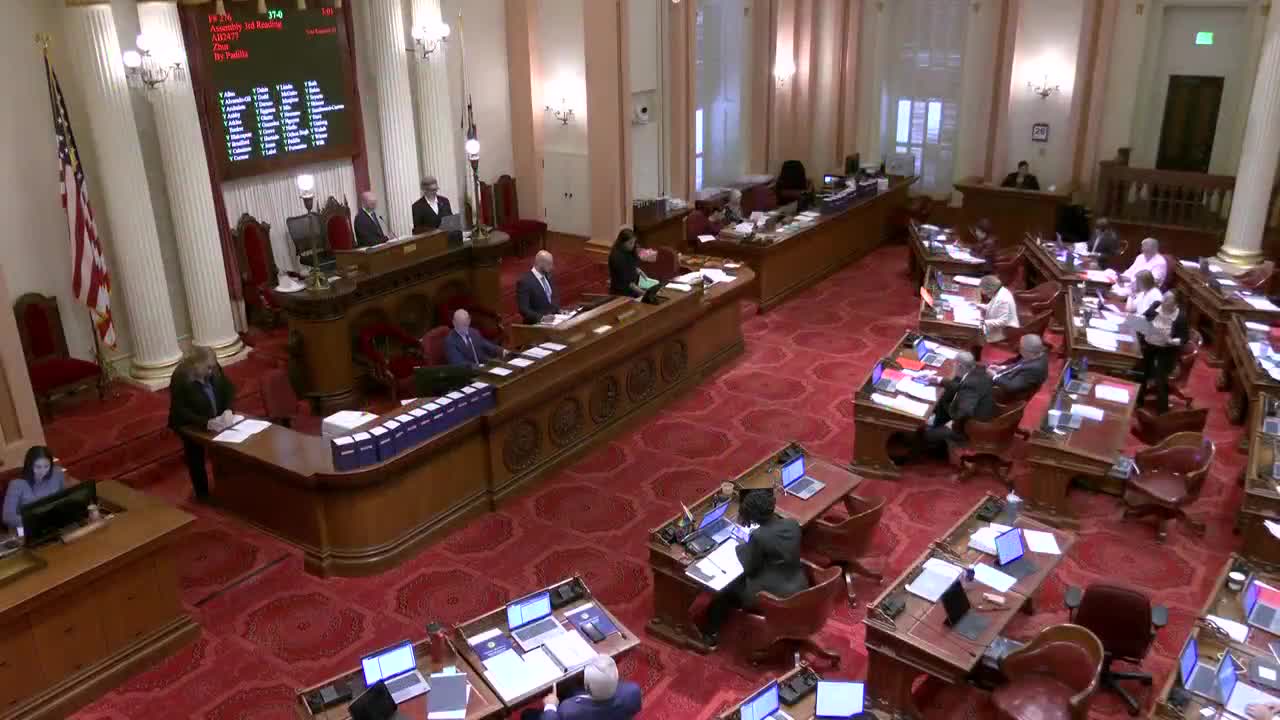
Bill Author

Bill Co-Author(s):